 April showers bring May flowers, or so they say. I’ll just say that, after the last couple of weeks of March, that umbrella on the cover of this month’s issue looks really familiar. As does the model on the right — she was featured (with a more flattering haircut) in many issues throughout the 1950s.
April’s theme is “Holidays Ahead” and if you are planning to spend your holiday in April or May on the British isles or the North Sea coast, you will definitely want to wear one of the warm, bulky wool garments from this issue. “Jenny”‘s thick, double-knit Norwegian-style jumper and hat, described as “dazzling designs to cut a dash on the beach this summer”, tells you everything you need to know about that.
The adult garments continue the warm, bulky and casual trend with a men’s “crochet-knit shirt” and “country-style cardigan” in double knitting weight. Knitting pattern stitches that look like crochet crop up every once in a while and it’s certainly an intriguing idea. That said, I don’t think this jumper particularly looks like crochet — it’s yo, k2tog on every right-side row and purl on the wrong side in staggered rows, which is just a simple lace pattern. I’m guessing they thought the word “lace” was not manly enough… The cardigan is made in three-colour slip stitch and is probably very warm and “squishy”. I like the neat, almost hidden pockets and the narrow edging band.


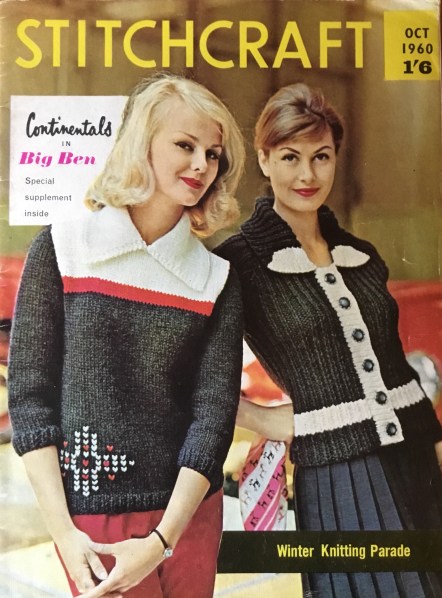
The women’s garments offer two more elegant, but still casual blouses, the two jumpers with fun collar details featured on the front cover and a relaxed “holiday cardigan” in double knitting. Patons “Totem” crepe wool appears in 4-ply (the blouses) or in double knitting weight (the cardigan). “Crepe” in this case meant that the wool was spun very smooth and tightly plied to minimise “fuzziness” and give raised stitch patterns a crisp, precise look. The jumpers from the cover are designed for ever-popular Rimple wool, a crinkly wool-synthetic blend intended to look like towelling fabric. Fans of truly bulky knitting can make this his-n-hers set (well, not really a “set” as they are two completely different designs, but featured together in the photo spread). Her sweater is made in fisherman’s rib stitch and if it looks that bulky on the petite, fine-boned model, I can only imagine it would make anyone else look elephantine — but good for sailing and/or April beachwear, I guess.


Housewares include the continuation of the “Zodiac” theme with an Aries motif, a traycloth in cross-stitch, a cross-stitch and pile rug, “amusing” aprons for the whole family (the father looks utterly un-amused at having to participate in the washing-up), a village townscape needle etching, a cross-stitch cushion… i.e. the usual fare. You can also make a toy “Wag” puppy for fans of the children’s comic from the last few issues, “Wendy and Wag in Wallpaper Land.” I don’t mind telling you that it had a happy ending for everyone. And with that, happy April and see you next time!


P.S. There wasn’t any project in this issue that really called to me, so I’m going to finish up a project of my own design that was inspired by this Stitchcraft children’s jacket from March 1960 that I made last year and write about that. Stay tuned…
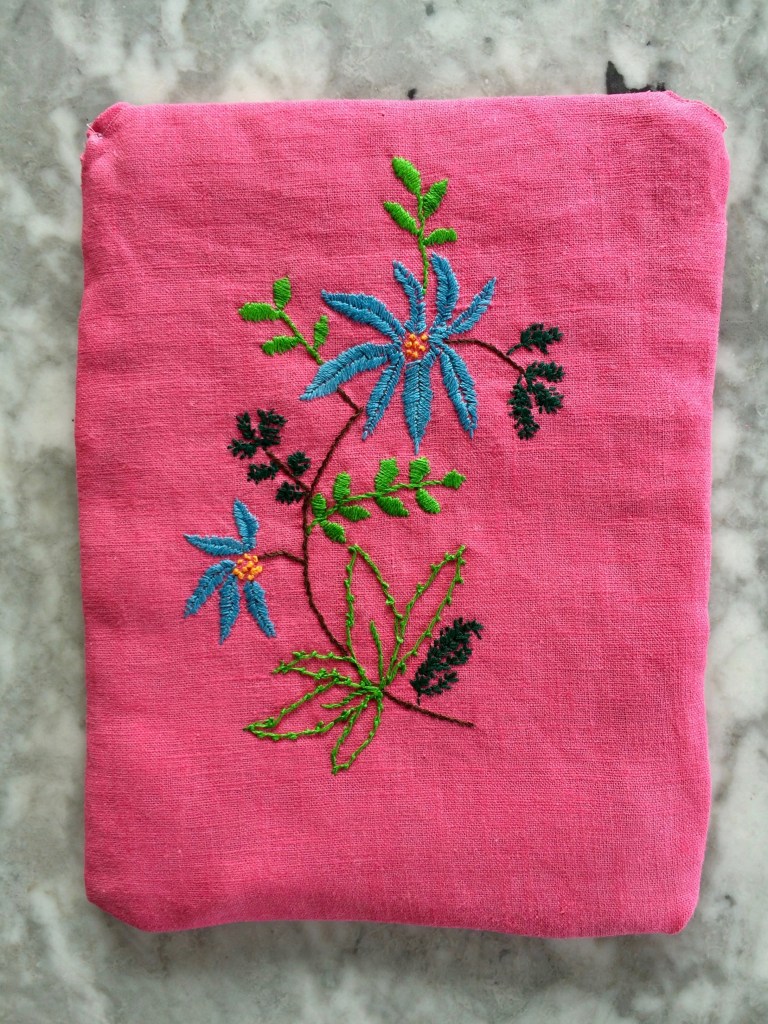
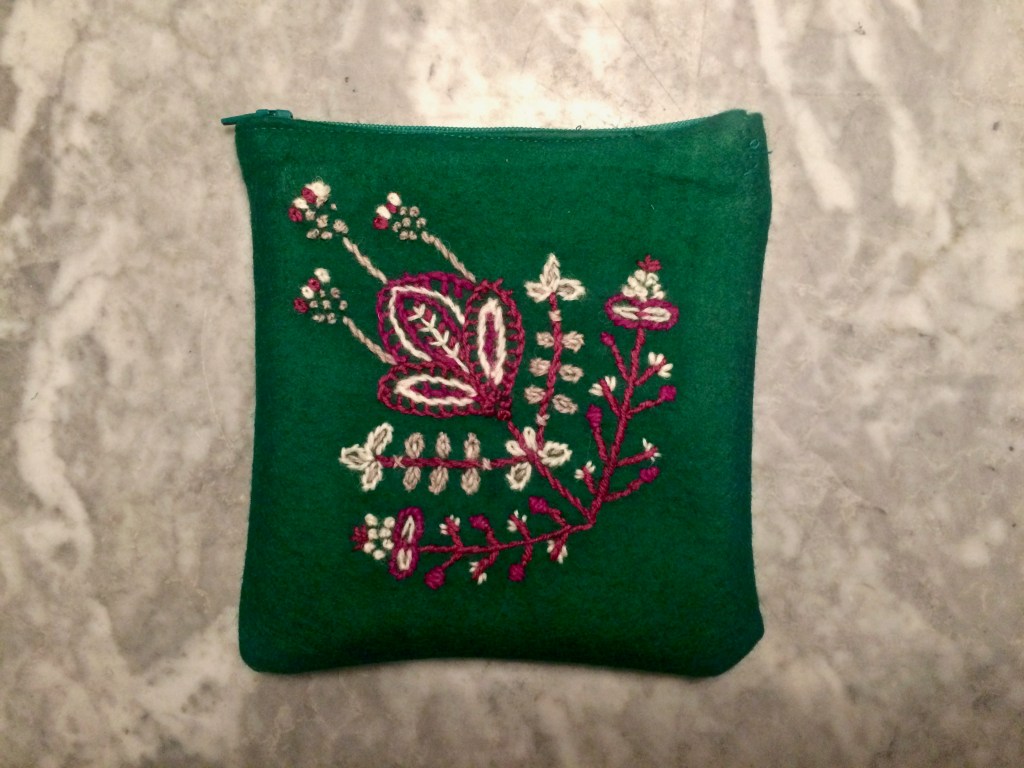
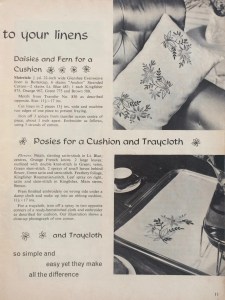 My Stitchcraft project this month was a simple embroidered spray of flowers, originally intended as a decoration for a cushion or traycloth. Having enough cushions and not using traycloths, I updated the design for an iPad cover similar to


 Are you ready to “Rendez-vous with Spring”? I sure am! This month’s issue has a lovely extra “centerfold” spread in colour, showing off Spring 1961’s latest fashions.


 The ads are for the usual knitting machines and sewing fabrics… except for this one, for “Cooper’s moth proofer” spray, presumably made of
  After January’s time- and labor-intensive pullover for me, I wanted to make something quick and easy in February. And there’s always a friend, colleague, or relative having a baby, so I made this simple ” Tiny Cardigan” from the cardigan and slipper set.
 The cardigan has a basic bottom-up raglan construction with the twisted ribbing featured in January’s


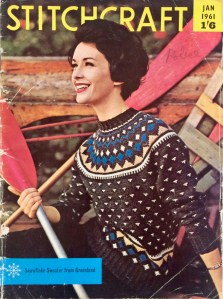 January’s project was — like


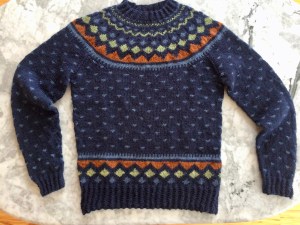 After thinking it over, the most reasonable course was to work the little bit of pre-yoke between the armhole bind-offs and patterned yoke back and forth with raglan decreases as written, but beginning the front neck shaping (pre-yoke, concurrent with the raglan decreases) an inch or so lower than the back. That preserved the proper stitch count, let the sweater hang better, and shortened the yoke a bit. I didn’t mind shortening the yoke, as I like sweaters to be snug under the arms and not too high on the neck. I didn’t need a zipper, so I made the patterned yoke entirely in the round.
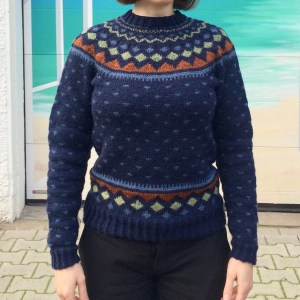 It worked out perfectly! I could hardly believe it. Raglans and round yokes may be somewhat forgiving on the body, but it is a fundamentally tricky mathematical game to make all the interdependent factors of width, depth, and pattern repeat come out right, so I was really proud of myself for making it work. My only other modifications were on the sleeves (longer) and the waist shaping (original pattern had none, I started out narrower at the waist and increased gradually at the sides to give a more figure-flattering look.)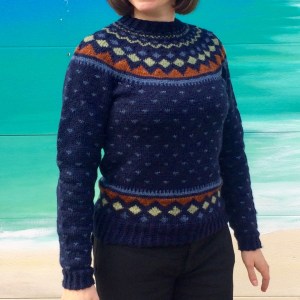


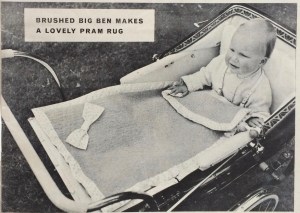


 My December project was a warm winter dress for a baby, part of the “Baby’s Special Outfit” of dress, bootees and mittens that continued the baby set started in the November 1960 issue.
 I used a lovely 100% wool that was hand-dyed by a fellow knitter in my local knitting group. She uses natural dyes from plants in her garden, or the bits of food items that are normally not eaten: walnut shells, onion skins, and so on. This green-melange wool was dyed with red onion skins! She did explain to me how that worked, but please don’t ask me, because I forgot the answer already. Anyway, it’s very nice. I was worried that it might be too scratchy for sensitive baby skin, but wash-blocking it and rinsing with hair conditioner softened it up quite a bit.

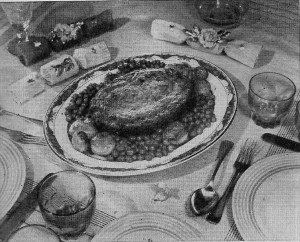 In its earlier decades, Stitchcraft included a page of easy and economical recipes in each issue, mostly for tea-time cakes or pastries. The tradition ended around 1950, so none of my 1960s issues have a recipe page, but I do have a few magazines from the late 1940s and thought this would be a fun time to try out their “Christmas Cooking” ideas.


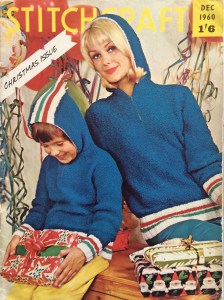 This year (1960 or 2018, take your pick) draws to a close with Stitchcraft’s “Christmas Issue”, which, as you may expect, is full of holiday-themed novelties to decorate and give.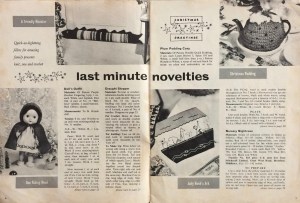


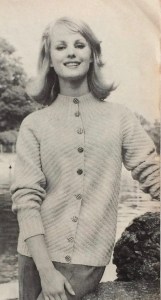 Adult women, having hopefully embraced the “new length” (long) and “new sleeve style” (3/4 or 7/8) from last issue, can get ready for Paris’ “new necklines” — a high turn-down-and-rib combination or a buttoned-up turtle (polo) neck. No turn-down collars this time — are they on the way out? There’s a new yarn to go with them, Cameo Crepe, which is smooth and less “hairy” than other wools, for good stitch definition.


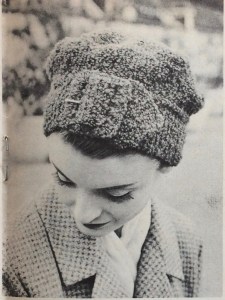 November’s project was a little cloche hat, made out of leftover wool from July’s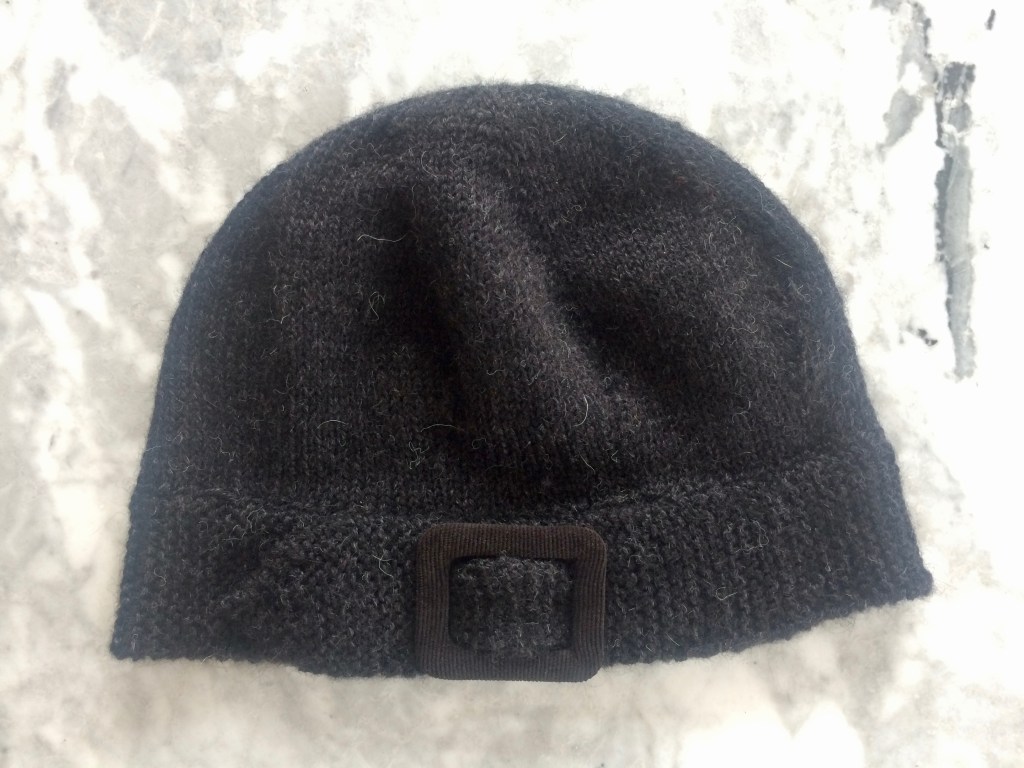
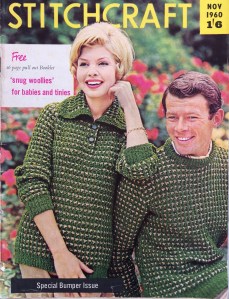 Brrrr! November 1960’s Special Bumper Issue” brings us “Colour for the Cold Days” and an extra 16-page pull-out booklet of baby woollies. Sadly, so sadly, the booklet from my copy of this issue has been pulled out long ago and is missing.


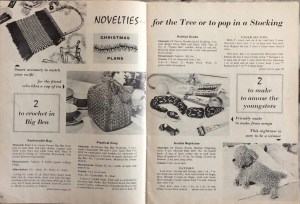 Homewares are still in a weird phase. The working woman or baby-boom mum (and those were overlapping categories, then as now) of 1960 didn’t have the time or patience to make too many elaborate Jacobean embroidery pieces or huge, detailed tapestries, especially not right before the great rush to get Christmas presents under the tree, so the focus is on quick, easy-to-make novelties for gifts. The aesthetic sense does seem to get lost a bit, though, if you ask me.


 (I notice that Word Press does not recognise the word “chairback”. They have been out of fashion for too many years, I guess, having fallen victim to cheaper furniture, more frequent hair-washings and less
 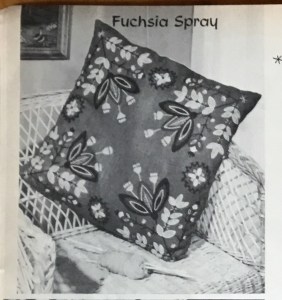 I really, really liked the idea of this embroidery project. Sadly, there was no colour photo, but the design is fun and very 1960 and I imagine the colours (Plum and Magenta with Cream and Fawn shades on deep green) to be quite striking. Working with tapestry wool instead of crewel cotton was (or would have been) another first, so all in all, I was eager to try it.


 October and November are really the best months for knitting. The weather has gotten cold enough that you really want to wear and make warm, woolly things, and there’s the nice “surprise” of packing the winter clothes out of storage, and so remembering what nice hand-knitted pieces you made in other years. At least, that’s my experience.


 September’s issue had a fantastic design of blackwork fish on a cushion. Blackwork is a type of embroidery combining counted-thread patterns (the fillings) with regular crewel embroidery stitches for outlines and details. I loved the way it looked but had never tried it before, so this was another Stitchcraft Sixties debut.


 The pillow was easy to make up, as I didn’t use piping (I thought the design was bold enough that a plain edge would be nicer.) All in all, I love the look of blackwork but don’t like the effort. I guess it’s easier on a looser-weave fabric where you can really see the holes in the weave to count them. It was made as a gift for a friend who I think will really like and appreciate it, and I feel happy giving it to her, as I am quite satisfied with the final result.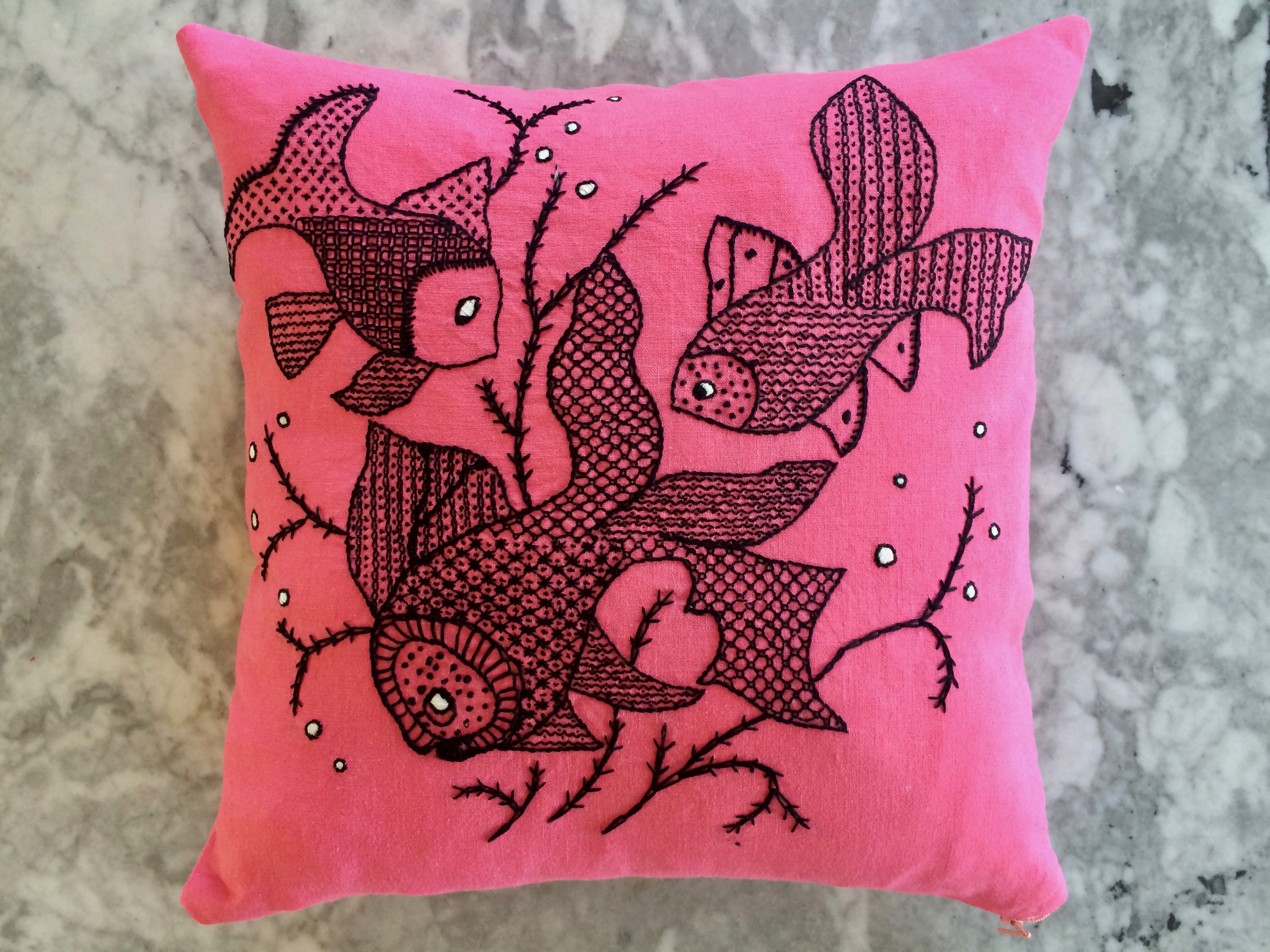
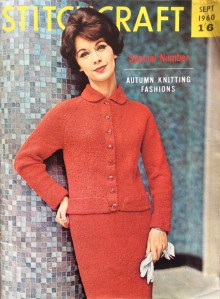 September 1960 is supposedly a “Special Number” of autumn knitting fashions. I’m not sure what exactly makes it so special, since it doesn’t seem to have any more, or particularly different, projects than the average issue. I guess it’s special in that September is finally a bit cooler weather-wise, so you can start to make some nice wool garments for the colder months — very appropriate in 2018, where we had the summer to end all summers. Things have cooled down a bit now, so I’m looking forward to wearing my (still unfinished) projects from July and August soon.


 The Stitchcraft Sixties