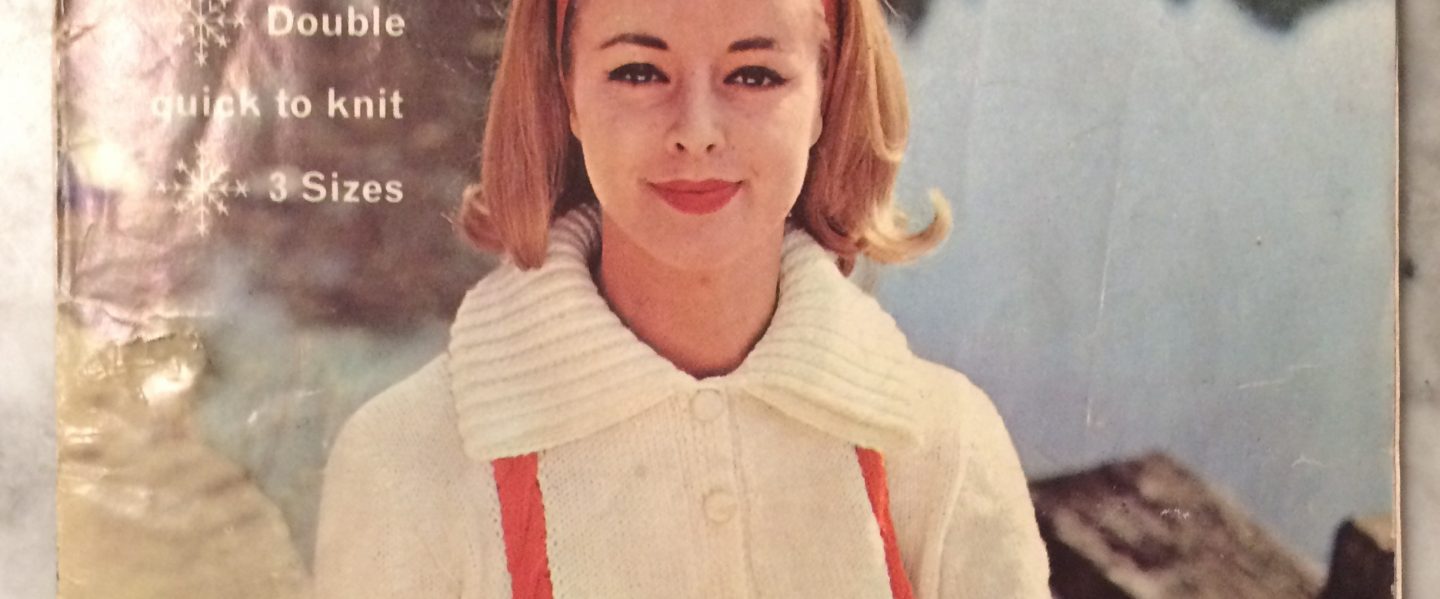
 Are you ready to “Rendez-vous with Spring”? I sure am! This month’s issue has a lovely extra “centerfold” spread in colour, showing off Spring 1961’s latest fashions.
That said, no especially new looks, wools or techniques are introduced. The partner look is still going strong, as you can see from the his-n-hers Aran sweaters on the cover. They both have boatnecks, popular for a little while in the late 1950s and showing up again here. They are not shaped at the front neck at all, so I imagine them to be uncomfortable and awkward to wear.
Nubbly Rimple and thick, bulky Big Ben wools continue to be popular, featuring in almost all of this month’s adult garments. Big collars are still in, but one jumper utilises a contrast collar design in a different wool, with an interesting shape and ribbed texture. For larger sizes, there’s a cardigan skirt suit in purple plaid — bold colours and jewel tones are in fashion for all sizes and make a great centerfold picture all lined up together.

In the homewares department, we’ve got another beautiful “peasant” design (they really love that word) for a cushion, a decorative wall tapestry with pictures of chipmunks, some flower embroideries for cushions or a tray cloth, this month’s Zodiac symbol to embroider on whatever you want (Pisces), and a really difficult-looking crocheted cushion cover.


The highlight of the homewares patterns has got to be this incredible “Willow pattern” latch-hook rug. I had heard of “willow-ware” porcelain (remember that scene from one of the Anne of Green Gables books, where Anne or Davy or someone accidentally breaks Aunt Josephine’s blue and white willow-ware platter, then Anne sees a similar one in someone’s house, climbs up on the roof of the barn or something to look at it through the window, then falls through the roof and gets stuck, having to wait in a rainstorm until the owner gets home and then explain the situation?) and I have seen this type of pattern on porcelain china, but never knew that the one was referring to the other.

Stitchcraft‘s description of the rug refers to “the 3 figures in the Willow Pattern story.” I had also never heard of any Willow Pattern story, but my good friend Wikipedia told me all about the history of the Willow pattern and the associated legend (spoiler: the “legend”, like the pattern, was a 100% British invention made up to sell more porcelain goods, not any kind of authentic Chinese folk tale). Both the pattern and the associated story served as inspiration for further literary, media and commercial works. You can read all about it here.


Finally, it would not be Stitchcraft without a page of little items “for sale-of-work” at church bazaars etc., or to surprise your family on Easter morning. The continuation of Belinda the doll’s knitted outfit is quite cute, but what on earth were they thinking with these egg cosies?!? They look positively psychotic. If I were a child and my mother served my Easter morning Easter egg in one of those things, I would be surprised all right… and probably wouldn’t sleep for a week.

Speaking of children, here are some who weren’t scared off by their egg cosies and were rewarded with bright, sunny “play sweaters from Vienna” in spring colours of lemon yellow and white. The caption on the page opposite is “Gay as a See-Saw!” I’m sure there are a lot of jokes one could make about gay and see-saws, but I won’t. The kid’s comic in the back pages has the usual continuing story — Wendy and her dog Wag are having some fun adventures in Wallpaper Land.
 The ads are for the usual knitting machines and sewing fabrics… except for this one, for “Cooper’s moth proofer” spray, presumably made of DDT or some other extremely toxic insecticide that kills “ants, beetles… these and other crawling insects die on contact — even months after spraying.” Just the thing to use in your enclosed, airless closet space!
With that, I wish you all a lovely, non-toxic, gay as a see-saw rendez-vous with spring. My March project will be some version of the flower embroidery.
 After January’s time- and labor-intensive pullover for me, I wanted to make something quick and easy in February. And there’s always a friend, colleague, or relative having a baby, so I made this simple ” Tiny Cardigan” from the cardigan and slipper set.
 The cardigan has a basic bottom-up raglan construction with the twisted ribbing featured in January’s


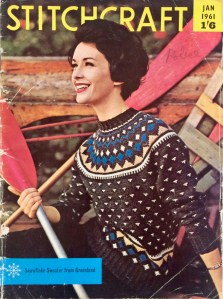 January’s project was — like


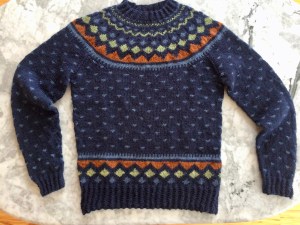 After thinking it over, the most reasonable course was to work the little bit of pre-yoke between the armhole bind-offs and patterned yoke back and forth with raglan decreases as written, but beginning the front neck shaping (pre-yoke, concurrent with the raglan decreases) an inch or so lower than the back. That preserved the proper stitch count, let the sweater hang better, and shortened the yoke a bit. I didn’t mind shortening the yoke, as I like sweaters to be snug under the arms and not too high on the neck. I didn’t need a zipper, so I made the patterned yoke entirely in the round.
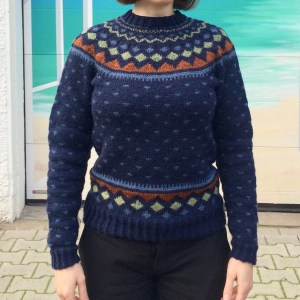 It worked out perfectly! I could hardly believe it. Raglans and round yokes may be somewhat forgiving on the body, but it is a fundamentally tricky mathematical game to make all the interdependent factors of width, depth, and pattern repeat come out right, so I was really proud of myself for making it work. My only other modifications were on the sleeves (longer) and the waist shaping (original pattern had none, I started out narrower at the waist and increased gradually at the sides to give a more figure-flattering look.)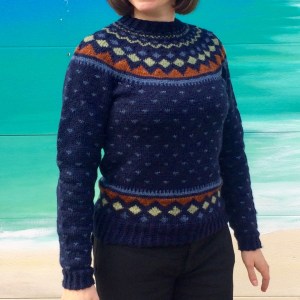


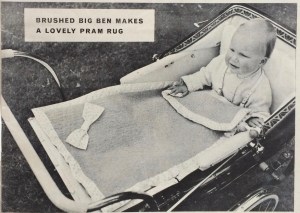


 My December project was a warm winter dress for a baby, part of the “Baby’s Special Outfit” of dress, bootees and mittens that continued the baby set started in the November 1960 issue.
 I used a lovely 100% wool that was hand-dyed by a fellow knitter in my local knitting group. She uses natural dyes from plants in her garden, or the bits of food items that are normally not eaten: walnut shells, onion skins, and so on. This green-melange wool was dyed with red onion skins! She did explain to me how that worked, but please don’t ask me, because I forgot the answer already. Anyway, it’s very nice. I was worried that it might be too scratchy for sensitive baby skin, but wash-blocking it and rinsing with hair conditioner softened it up quite a bit.

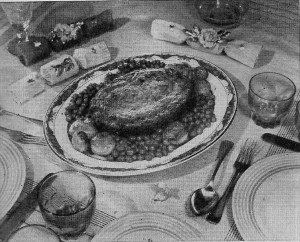 In its earlier decades, Stitchcraft included a page of easy and economical recipes in each issue, mostly for tea-time cakes or pastries. The tradition ended around 1950, so none of my 1960s issues have a recipe page, but I do have a few magazines from the late 1940s and thought this would be a fun time to try out their “Christmas Cooking” ideas.


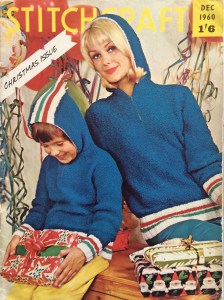 This year (1960 or 2018, take your pick) draws to a close with Stitchcraft’s “Christmas Issue”, which, as you may expect, is full of holiday-themed novelties to decorate and give.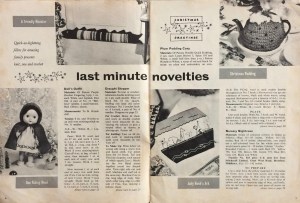


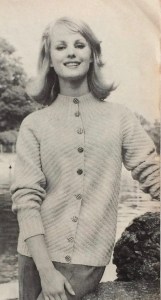 Adult women, having hopefully embraced the “new length” (long) and “new sleeve style” (3/4 or 7/8) from last issue, can get ready for Paris’ “new necklines” — a high turn-down-and-rib combination or a buttoned-up turtle (polo) neck. No turn-down collars this time — are they on the way out? There’s a new yarn to go with them, Cameo Crepe, which is smooth and less “hairy” than other wools, for good stitch definition.


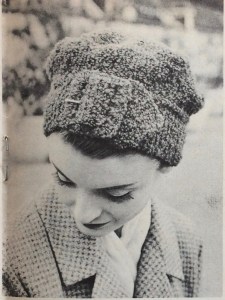 November’s project was a little cloche hat, made out of leftover wool from July’s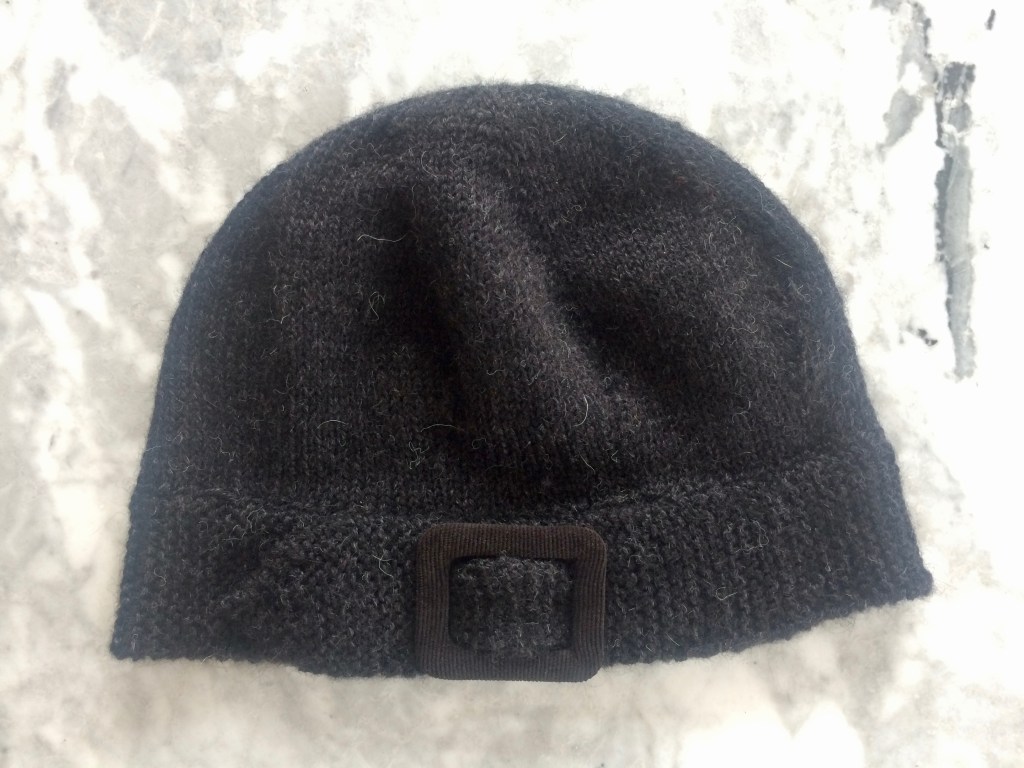
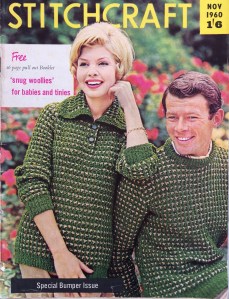 Brrrr! November 1960’s Special Bumper Issue” brings us “Colour for the Cold Days” and an extra 16-page pull-out booklet of baby woollies. Sadly, so sadly, the booklet from my copy of this issue has been pulled out long ago and is missing.


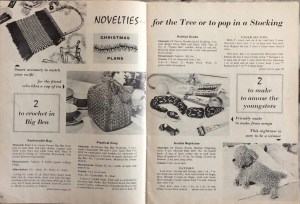 Homewares are still in a weird phase. The working woman or baby-boom mum (and those were overlapping categories, then as now) of 1960 didn’t have the time or patience to make too many elaborate Jacobean embroidery pieces or huge, detailed tapestries, especially not right before the great rush to get Christmas presents under the tree, so the focus is on quick, easy-to-make novelties for gifts. The aesthetic sense does seem to get lost a bit, though, if you ask me.


 (I notice that Word Press does not recognise the word “chairback”. They have been out of fashion for too many years, I guess, having fallen victim to cheaper furniture, more frequent hair-washings and less
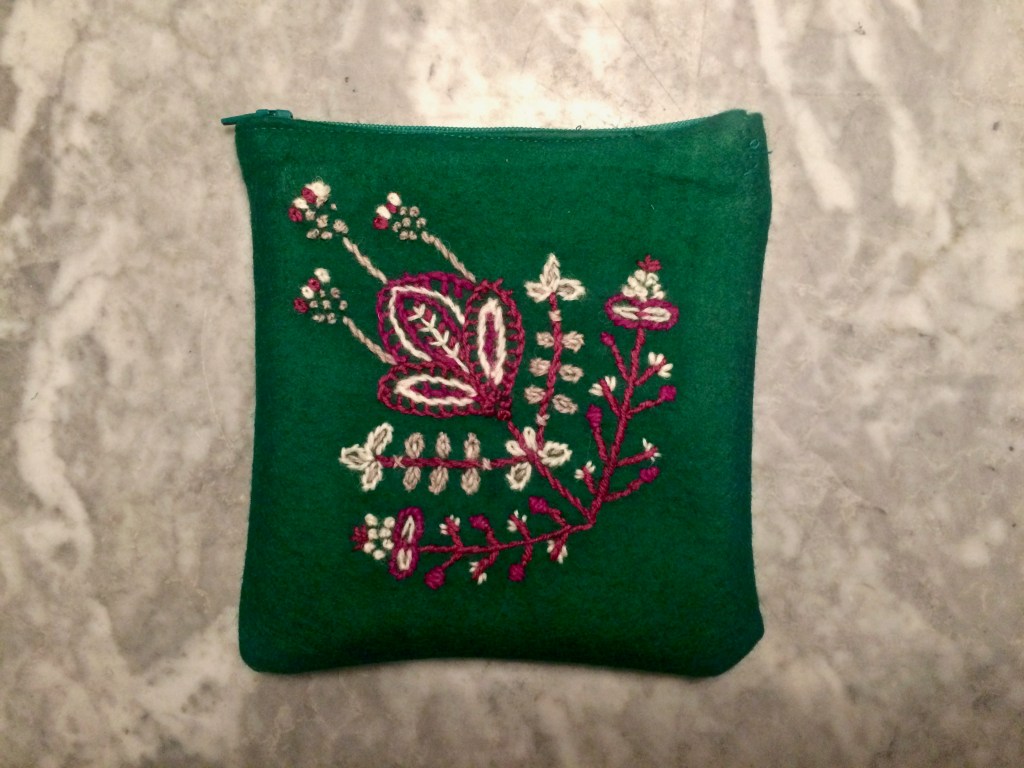
 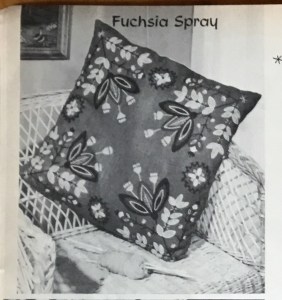 I really, really liked the idea of this embroidery project. Sadly, there was no colour photo, but the design is fun and very 1960 and I imagine the colours (Plum and Magenta with Cream and Fawn shades on deep green) to be quite striking. Working with tapestry wool instead of crewel cotton was (or would have been) another first, so all in all, I was eager to try it.


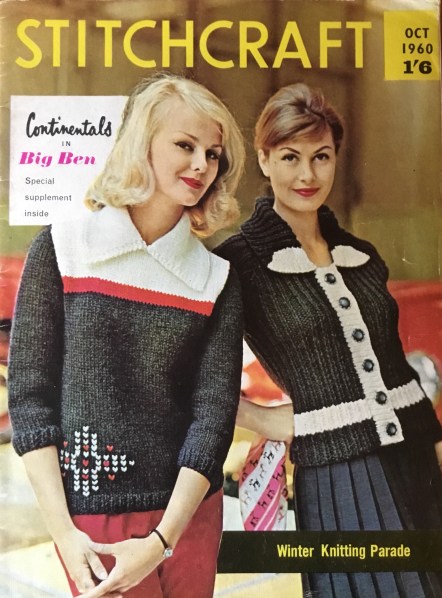 October and November are really the best months for knitting. The weather has gotten cold enough that you really want to wear and make warm, woolly things, and there’s the nice “surprise” of packing the winter clothes out of storage, and so remembering what nice hand-knitted pieces you made in other years. At least, that’s my experience.


 September’s issue had a fantastic design of blackwork fish on a cushion. Blackwork is a type of embroidery combining counted-thread patterns (the fillings) with regular crewel embroidery stitches for outlines and details. I loved the way it looked but had never tried it before, so this was another Stitchcraft Sixties debut.


 The pillow was easy to make up, as I didn’t use piping (I thought the design was bold enough that a plain edge would be nicer.) All in all, I love the look of blackwork but don’t like the effort. I guess it’s easier on a looser-weave fabric where you can really see the holes in the weave to count them. It was made as a gift for a friend who I think will really like and appreciate it, and I feel happy giving it to her, as I am quite satisfied with the final result.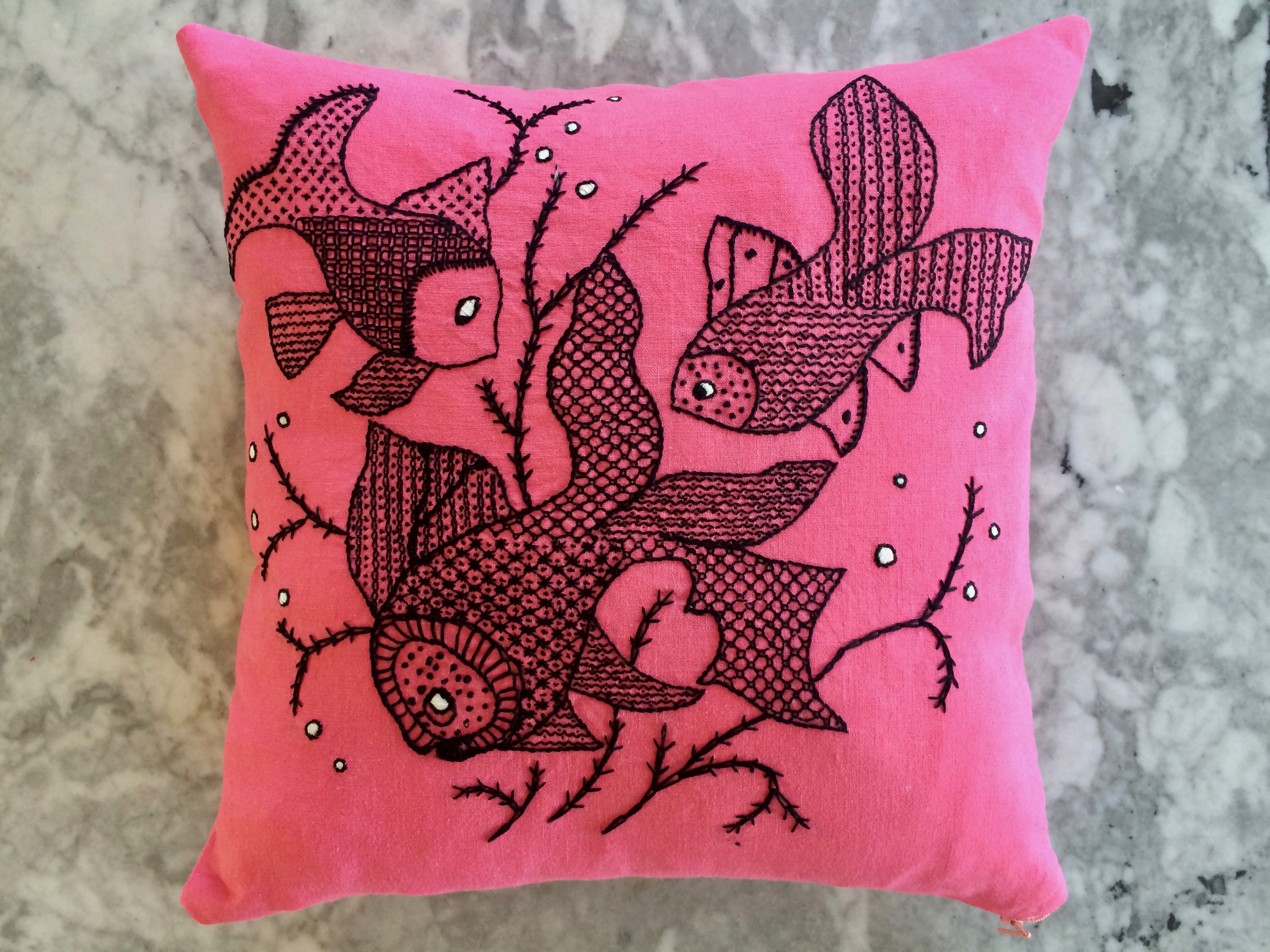
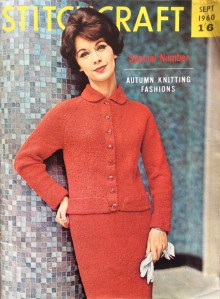 September 1960 is supposedly a “Special Number” of autumn knitting fashions. I’m not sure what exactly makes it so special, since it doesn’t seem to have any more, or particularly different, projects than the average issue. I guess it’s special in that September is finally a bit cooler weather-wise, so you can start to make some nice wool garments for the colder months — very appropriate in 2018, where we had the summer to end all summers. Things have cooled down a bit now, so I’m looking forward to wearing my (still unfinished) projects from July and August soon.


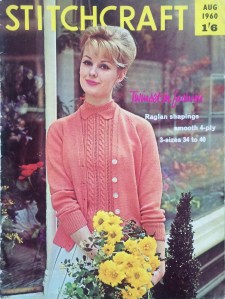 I loved this twinset at first sight. I loved the short raglan sleeves on the pullover, the cable-and-mesh panel on the front and the very original mock-turtleneck-meets-peter-pan collar. It’s one of the reasons I started this whole long-term Stitchcraft blog project, so I’m thrilled to have it come to life.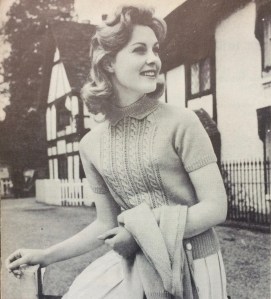
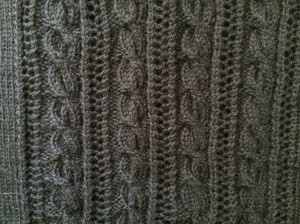 The cables have an interesting twist — literally. You put four stitches on the cable needle, knit the other four and then give the cable needle an extra 360 degree clockwise twist before knitting the stitches off of it. This gives them a cool extra definition. I forgot to do it once and it was almost unnoticeable — almost — but I didn’t want to rip back that far, so when everything was done I looped a little tiny thread around one of the cable stitches and just pulled it over more to the side and tacked it down by tying the thread ends in a knot on the wrong side. Look at the close-up picture above — can you tell which cable it was? I can’t on the finished garment. Good to know.


 The cardigan is somewhat more plain, as it doesn’t have the cables, but it makes such a lovely set with the pullover — not to mention it’s an excellent “everyday” cardigan to go with lots of other outfits. The sleeves came out a bit long — I was obviously over-compensating for my long arms and the fact that I always have to lengthen the arms a bit — but it looks just as good with the cuffs turned back, and I can turn them down for extra warmth under a coat and gloves. I hadn’t expected the raglan sleeves to have so much armhole depth. I thought about adding facing ribbon to the button bands, but it turned out to not be necessary, as the cardigan fits fine whether buttoned or unbuttoned. In short, I am thrilled with my new twin-set and it will surely get a lot of use this winter.


 The Stitchcraft Sixties