February 1965: Overview

Whew! January is over. I don’t know about all of you, but it’s my least favourite month. The holidays are a dim memory, it’s still cold and dark and damp in my northern climate, and spring feels far away.

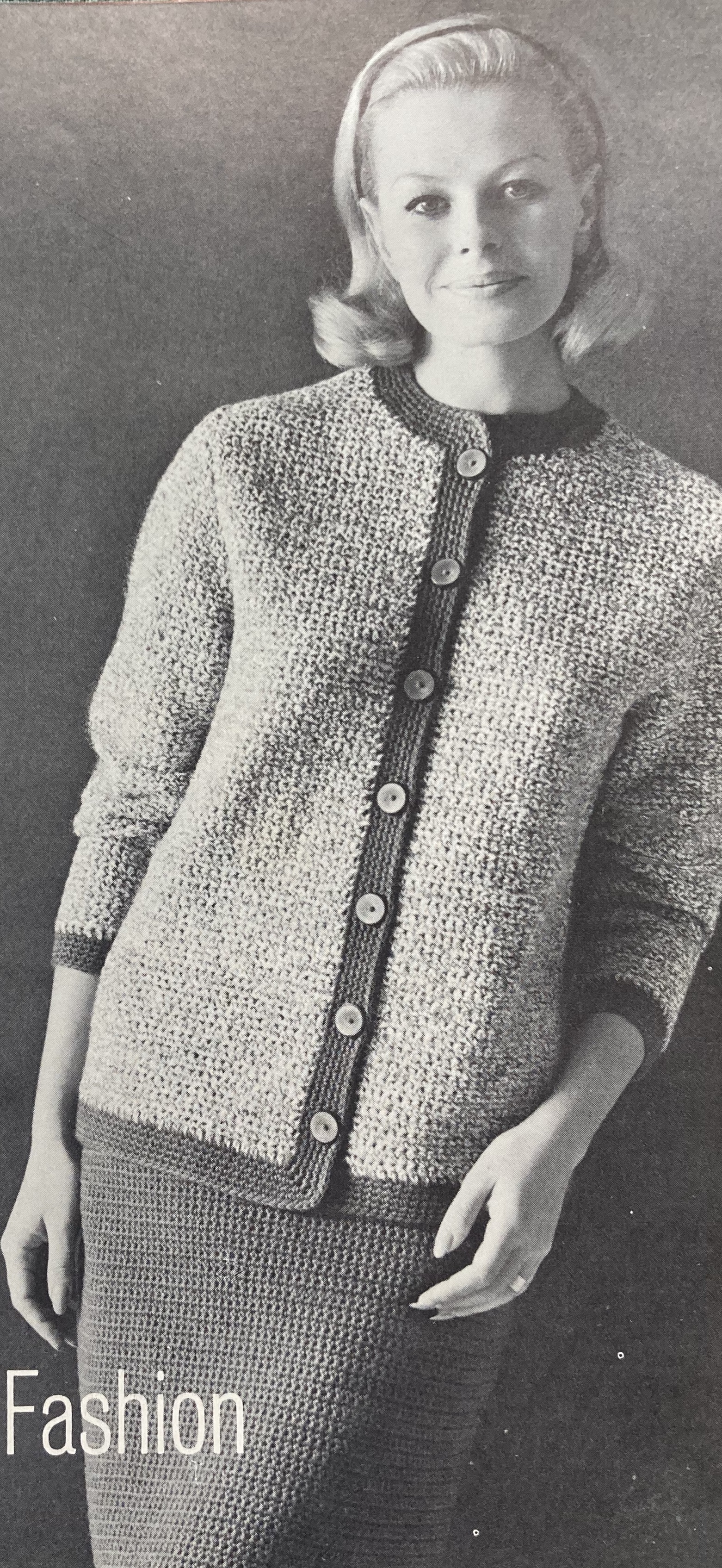
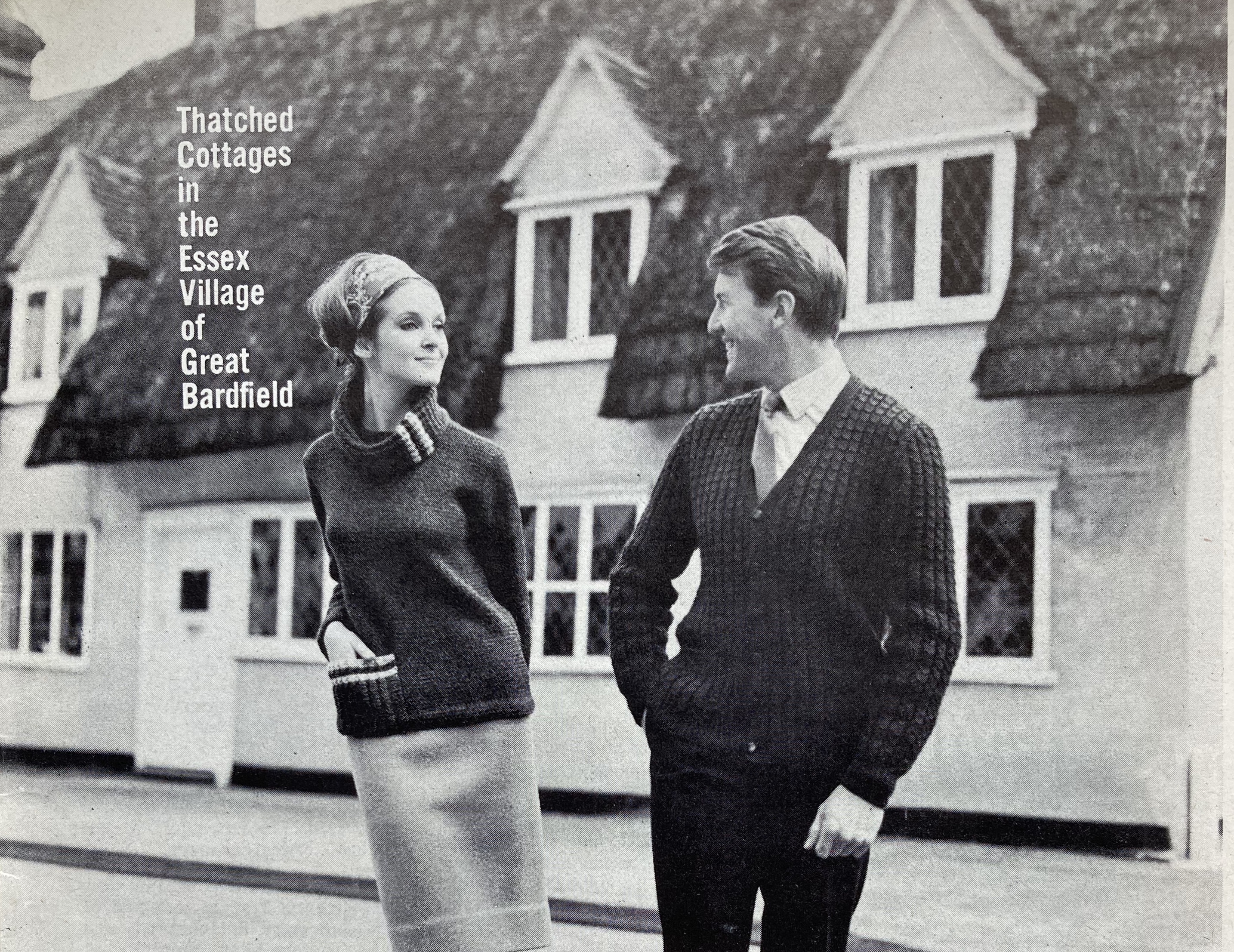
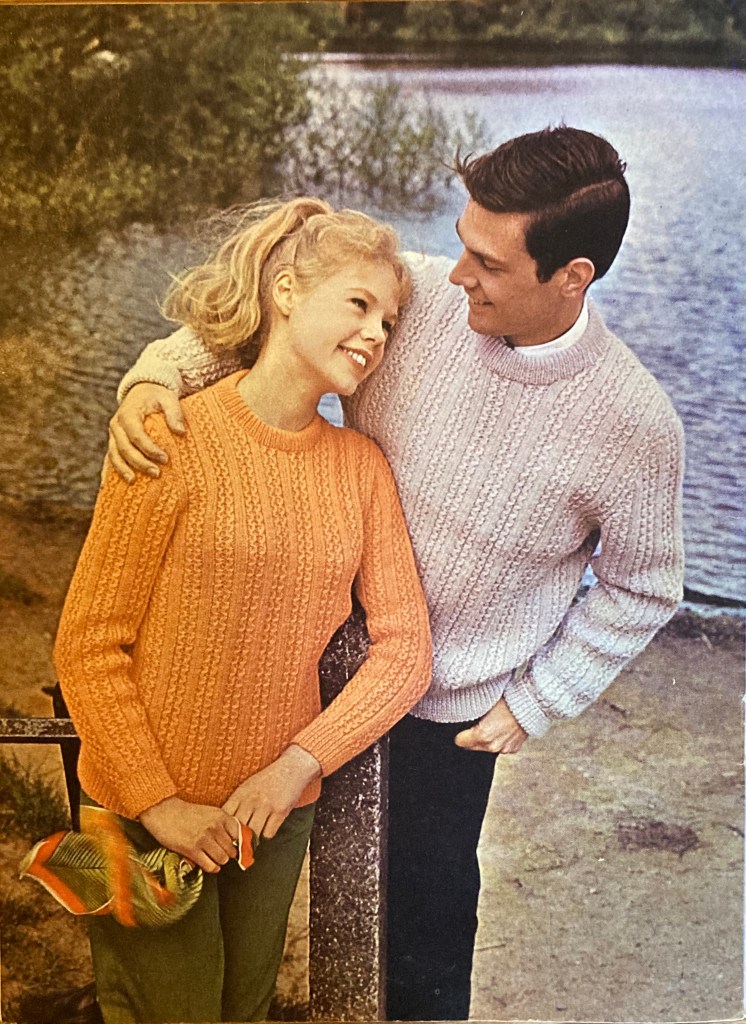
Stitchcraft seems to know how I feel, since this month’s issue features outdoor photos in pretty, colourful outfits and interesting settings “to get away from the last of that tired January feeling.” There are lots of warm indoor-outdoor garments, like the boxy jacket on the cover with cable details on the pockets and collar. It matches a short-sleeved cable jumper to make a casual twin-set or to be worn separately, and both are showcased in the centrefold photo montage with another “country cardigan” in a twisted-stitch wheat-ear pattern. The cover cardigan and cabled jumper are both made in warm, normal Patons DK, the country cardigan in slightly thicker Flair. All have the typical mid-60s shape: long, loose-fitting and unshaped, and are made in natural, outdoorsy colours of off-white, gold and caramel brown.

The other adult women’s garments include an intriguing sweater in a “crunchy bramble knit … to look like crochet.” The bramble pattern is made by making a k1, yo, k1 all into the same stitch, then purling these 3 stitches together on the next row. It’s presumably very warm, uses a lot of wool and while it doesn’t exactly look like crochet, it has the same sort of nubbly texture you could get with crochet stitches. There’s no colour photo, but in white, “Golden Willow” and “Oakapple”, it fits nicely into the outdoor-casual colour scheme. For something a little less casual and a little more colourful, there’s a tweedy bright-purple cardigan suit in heavy-weight “Glenora”and two more elegant, fine-knit designs: a smooth, collared turquoise jumper with front-panel detail in Cameo Crepe and a bouclet suit with a dramatic blue-and-white colour-block design.

The men’s garments are casual and outdoorsy in form, but colourful and creative in design: a casual (though he’s probably secretly wearing a tie under it…) boat-neck pullover in a two-colour pattern made by knitting the RS rows in “Cool Lime” green and working the WS rows as k1, p1 in “Tahiti” brown. Even more impressive is the pullover in a remarkable “woven texture from Vienna”, featured in colour in the back cover. This “new Continental stitch” is made by combining normal two-colour stranded knitting with “long” stitches (wool wrapped three times around the needle) which are then slipped for a few rows before being knitted back in. It’s ingenious and produces a very striking effect without being very difficult to knit. Here too, natural colours of brown, beige and green are trending.

My photos aren’t crooked, by the way. It seems to be a trend to have the models stand at an angle, or have the models stand straight and take the photo at an angle, to get that dynamic diagonal effect.

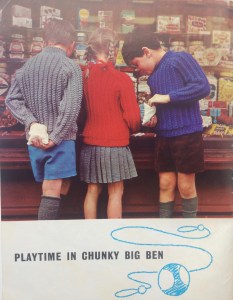
And speaking of dynamic, check out this fantastic “play sweater for the space age”! It’s got a “cheerful mechanical man” motif on the front and is matched with a “jolly robot” hat (same motif, but with bobbles on top that make the robot look like a cheerleader.) This is as 1965 as it gets! The other children’s fashions are practical and easy: a back-buttoning “pinafore” and matching jumper for little girls (could she please wear more clothing on her lower body, though?) and a broken-rib button-up for school-age tots made with “Brilliante” synthetic-blend yarn.

The embroidery and housewares department is less exciting, with a few standard items in different craft categories. There’s a cross-stitch “ABC” rug for the children’s playroom, an apron and traycloth set in huckaback embroidery and easy counted- and cross-stitch items for the table.The inside back cover has a nice colour photo of a cross-stitch picture panel of the church spire in Chester.

There are so many fantastic designs in this issue, and yet I don’t have a practical use for any of them. Big, casual sweaters with no shaping are not really my style (even in that fabulous Viennese stitch) and I can’t think of any children I know of the right age and size who would want a space-age, robot-motif sweater (more’s the pity). If anyone wants to commission me to make one for their kid (to fit 28/30/32 inch chest), send me an email! Otherwise, I’ll use this month to finish a long-term WIP from a slightly later issue of Stitchcraft.

January 1965: Overview

Happy New Year, everyone! It’s 2023 in the present day and 1965 here at the Stitchcraft Sixties.

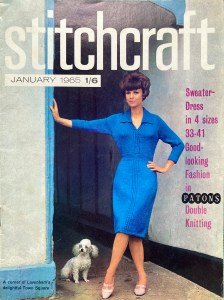
We are now solidly in the mid-60s fashion era of miniskirts, Twiggy and the “Space Age” look, but Stitchcraft was a conservative magazine, so hemlines are still at least knee length and the “country casual” look prevails. To be fair, it’s also January, so the focus is on practical, warm garments for both outdoors and in (good central heating was still not available in many British homes) and homeware projects to keep hands busy during the long, dark winter evenings.

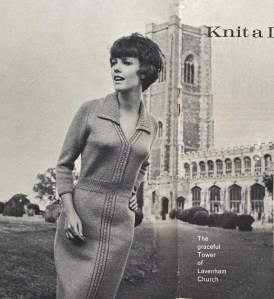
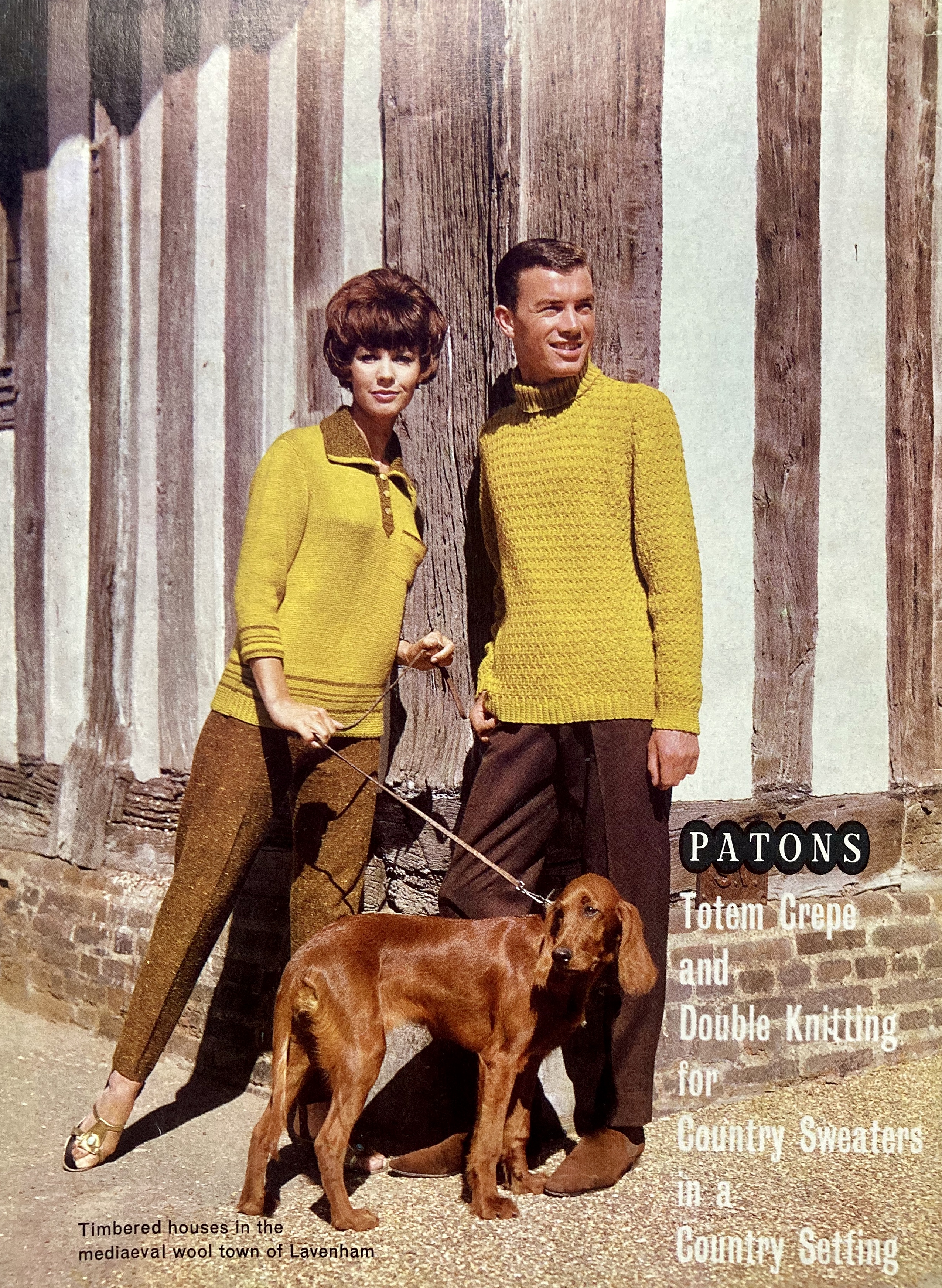
The January 1965 issue was photographed in Lavenham, a medieval town noted for its timber-frame houses and its connection to the wool industry in the 16th century — a fitting setting for knitting magazine photos! Our model poses for the cover in “A corner of Lavenham’s delightful town square” whose entryway arch perfectly matches her bright blue sweater-dress (I don’t know if the poodle is hers or just happened to stop by for the photo) and for the inside photo in front of the historic St. Peter and St. Paul Church, whose construction was financed primarily by merchants in the wool and cloth business.

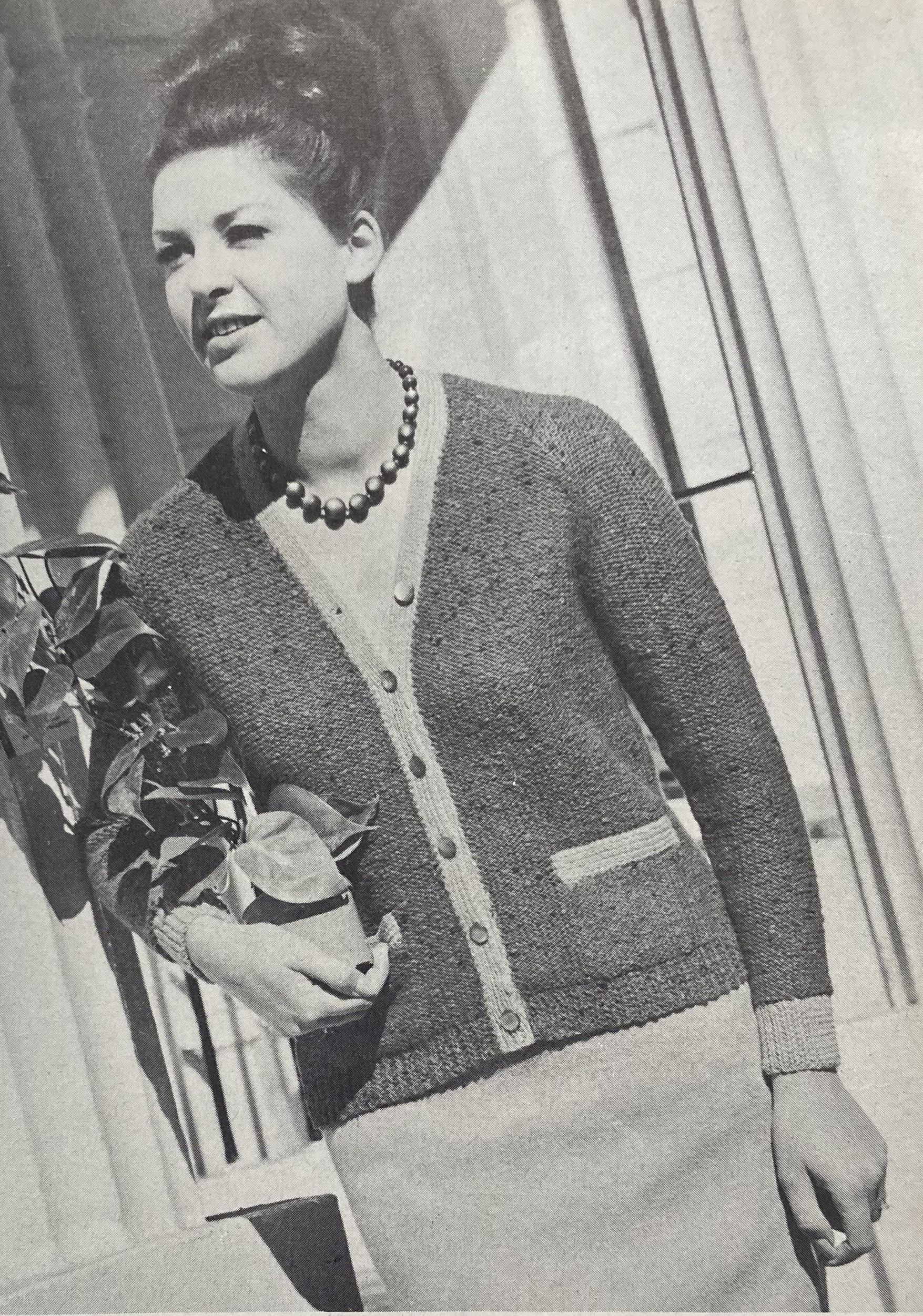
Other warm “sweater” garments for adults include a shirt-style pullover for women and a smocked-cable pullover for men in shades of gold and brown, a tweed cardigan in larger sizes (up to 43 inch bust), a crocheted skirt suit, and a “senior pullover” for “Father’s Classic Look”. All of them are in DK-weight or heavier wool. With the exception of the cover dress and the larger-sizes cardigan, both made in bright blue, tweedy, marled colours of brown, gold, copper and olive green prevail. Photographic fashion favours strong, straight-standing poses for the “bold” look, often with the camera held at a diagonal angle.

Winter means warm, quickly knit accessories as well, and this issue has some fun hats and mittens with Norwegian or blocky stripe patterns (the one with the broken lines is done by saddle-stitching embroidery on the finished cap.) No harvest golds and burnished coppers here: the caps are all made in red and white or royal blue and white for a typical wintery snowflake look. The cosy bedjacket is also blue and white and features a soft, squishy slipped-stitch lace pattern that is presumably very warm and comfortable.

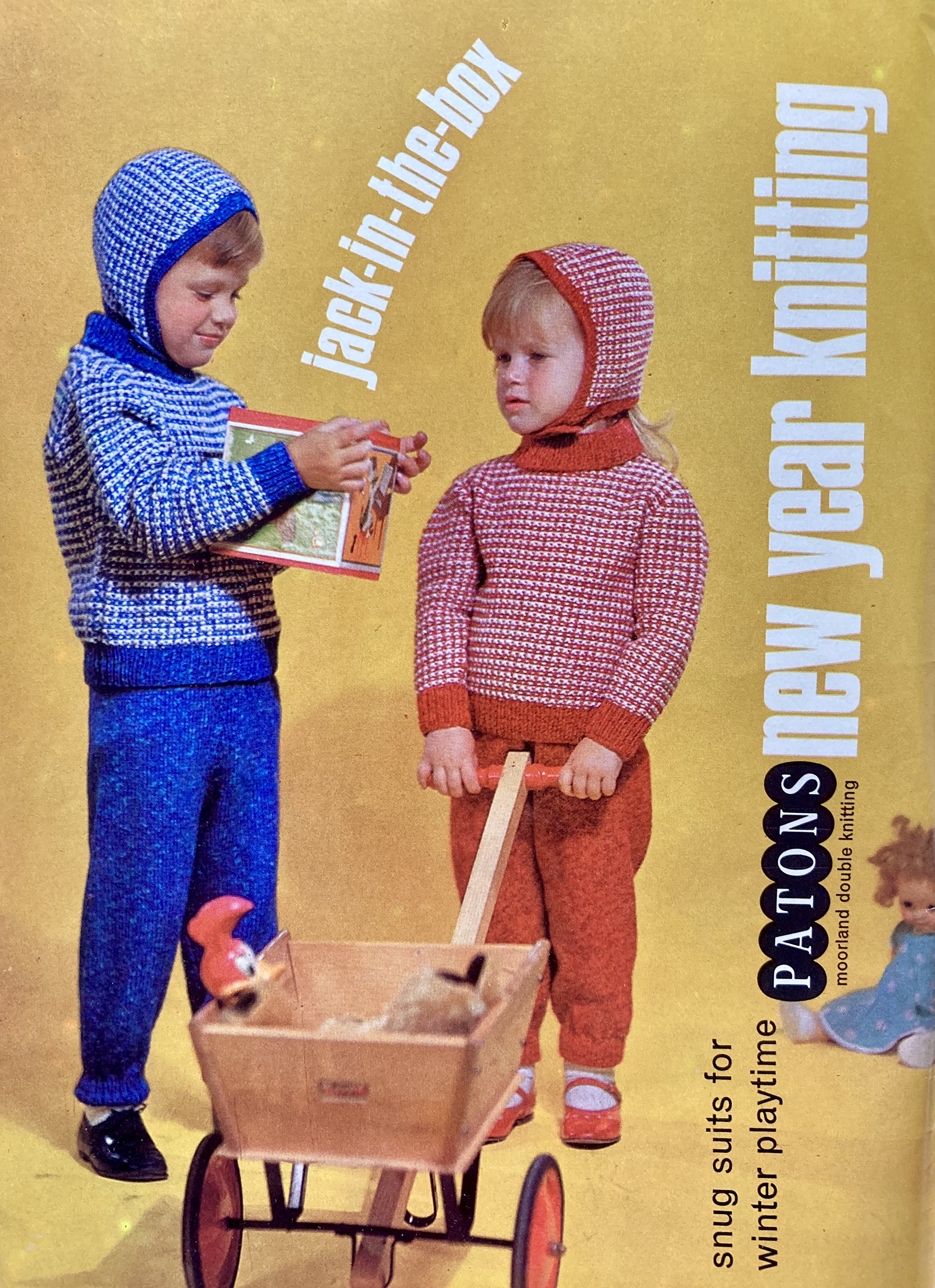
Younger children can wear a truly cosy “snug suit for winter playtime”: a set of pullover and “helmet”-style cap in a thick slipped-stitch pattern with knitted leggings. Blue and white or red and white are the colour choices here as well. There’s also a pullover for “Junior” (three sizes to fit 24-29 inch chest) in light blue and dark blue. The “crunchy” stitch pattern looks complicated, but is made entirely using normal knit and purl stitches in a combination of stocking-stitch, reverse stocking-stitch and small bobbles made by knitting, purling, knitting into the same stitch on one row and purling 3 together three rows later.

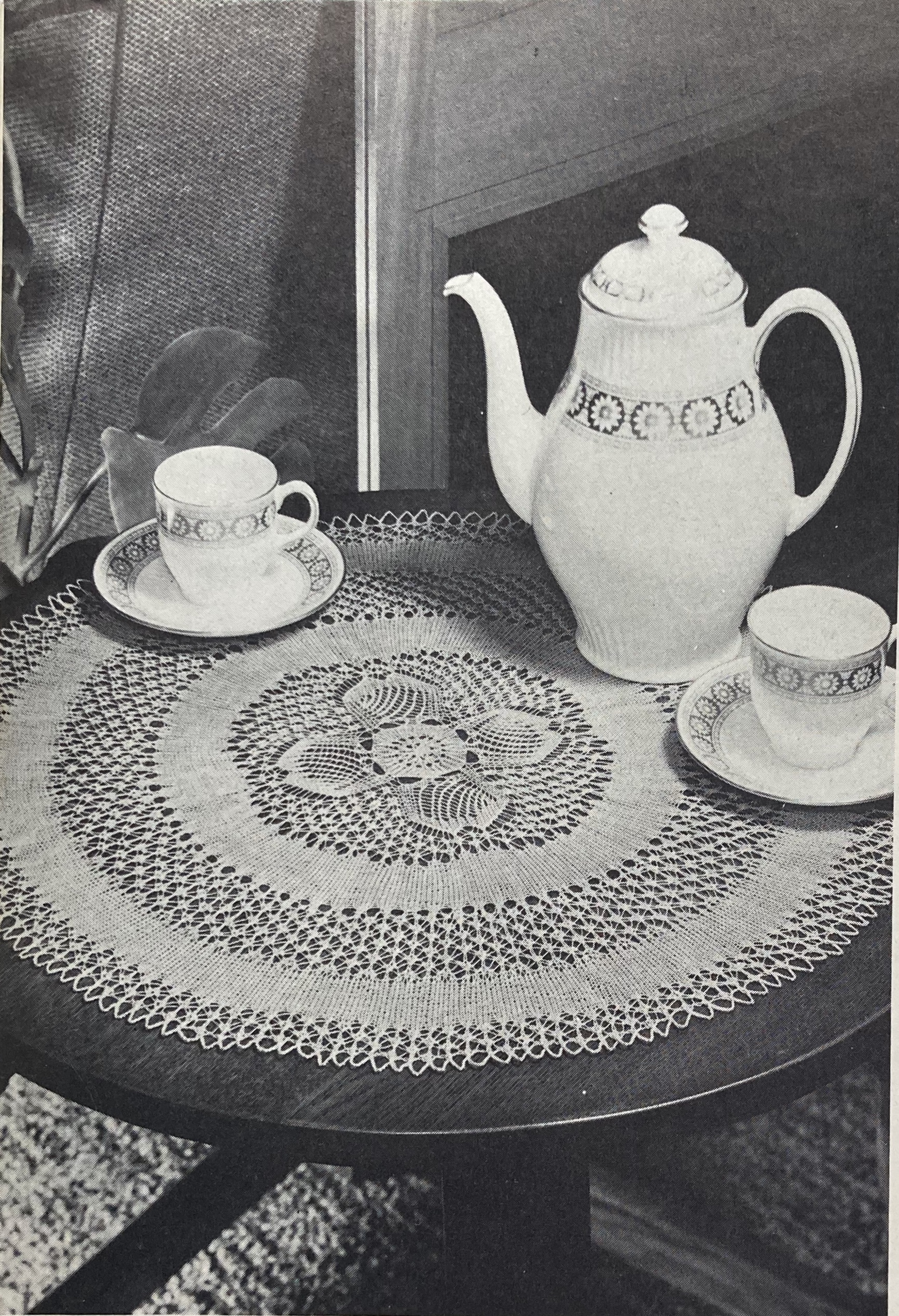
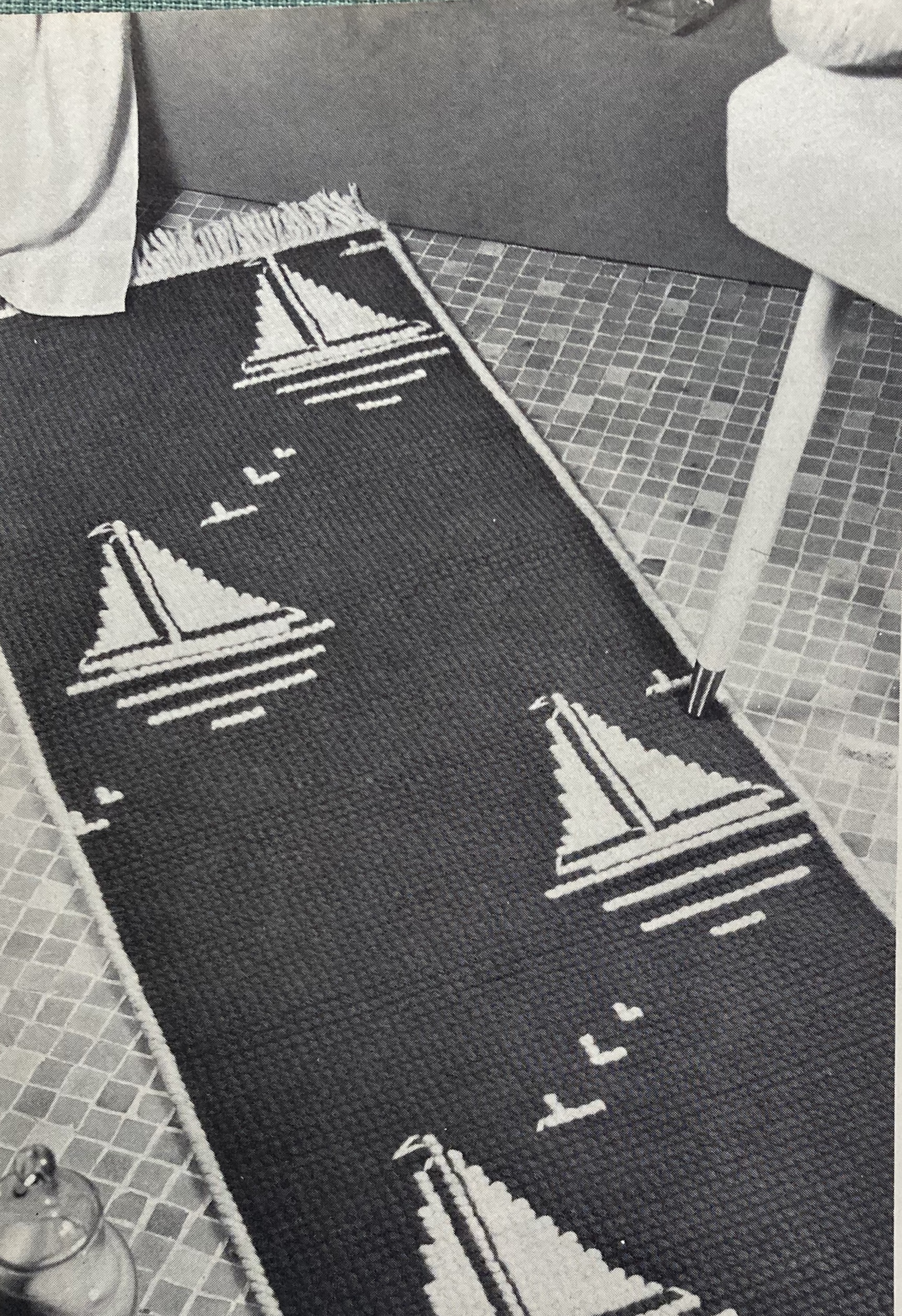
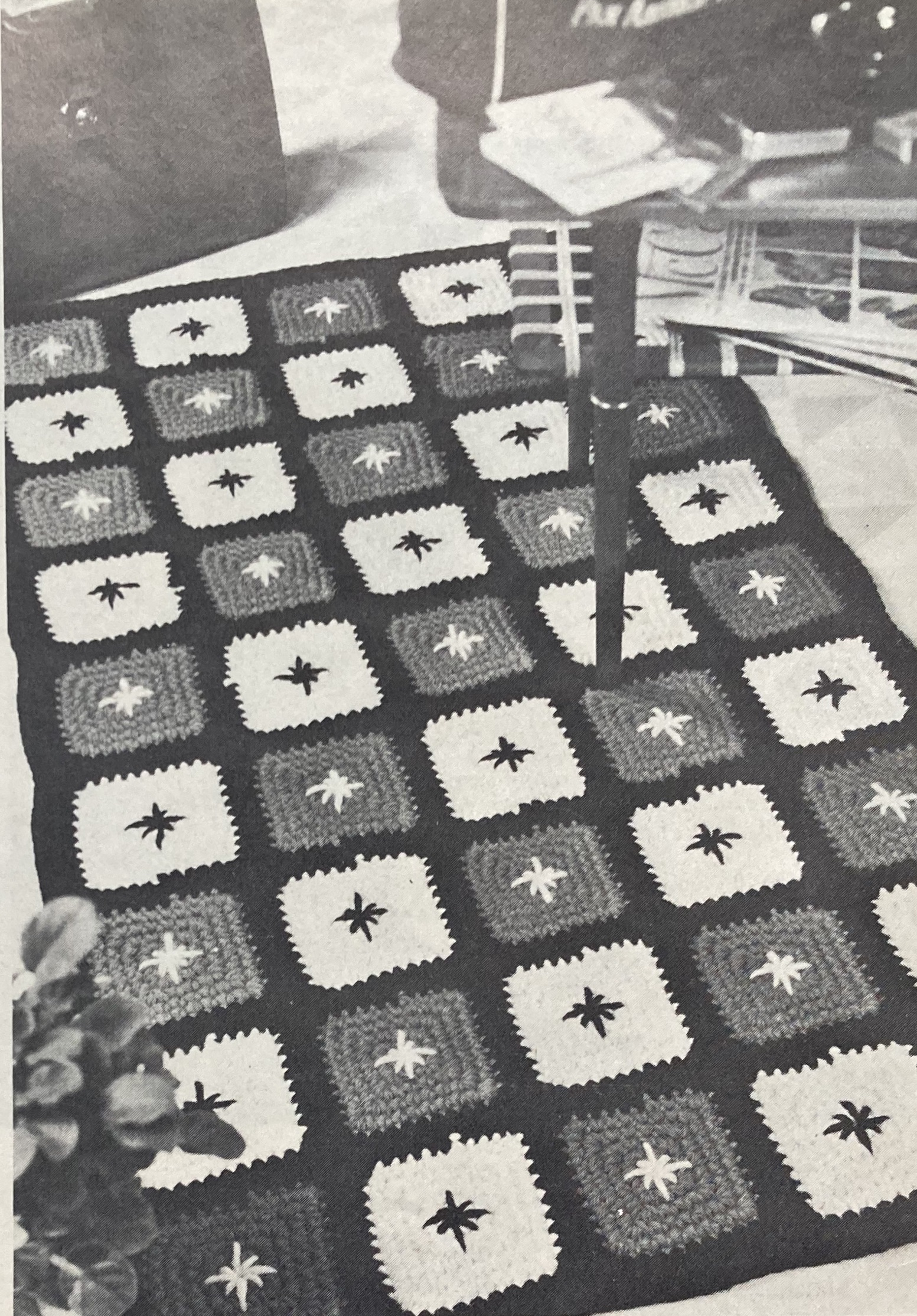
There are plenty of homeware projects as well: like the knitted items, everything except the lace doily is more serviceable than fancy. There are stitched and crocheted rugs– and a conveniently placed advertisement for rugmaking which is one of the very few advertisements of this era that show a man working on handcrafts.

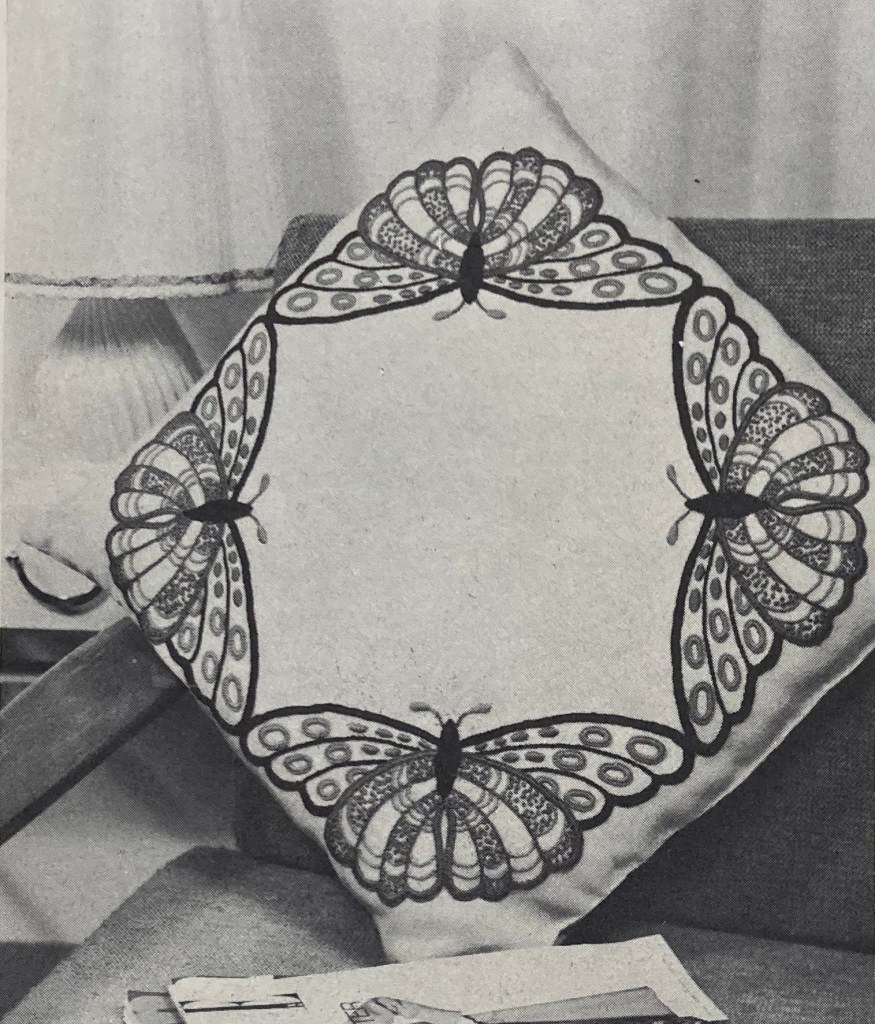
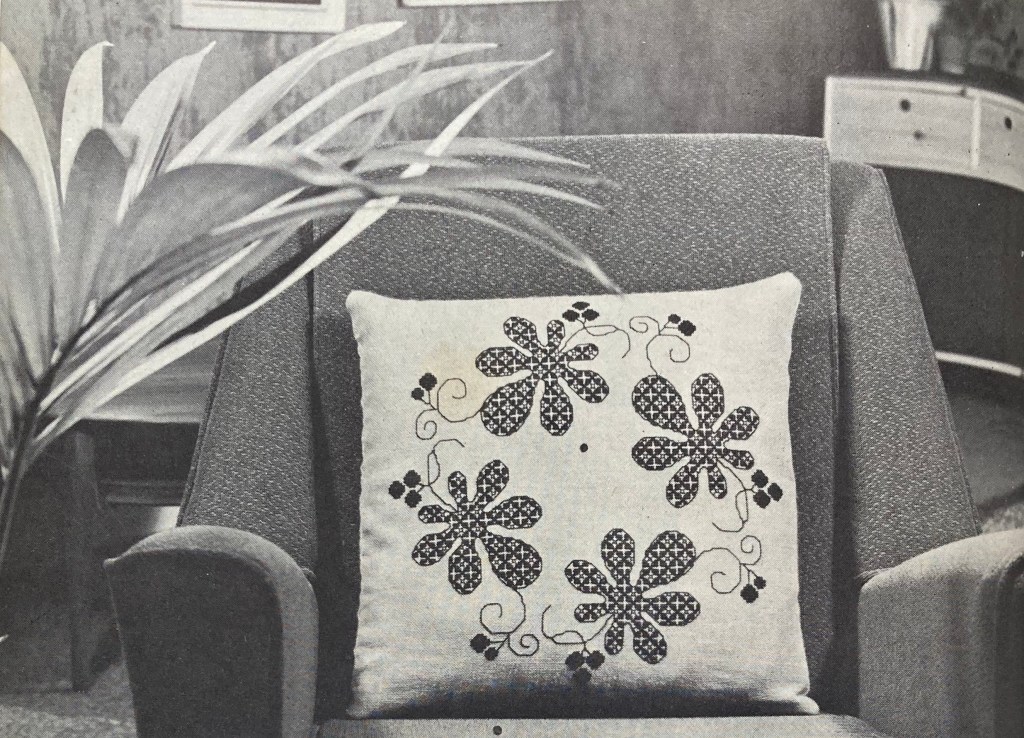
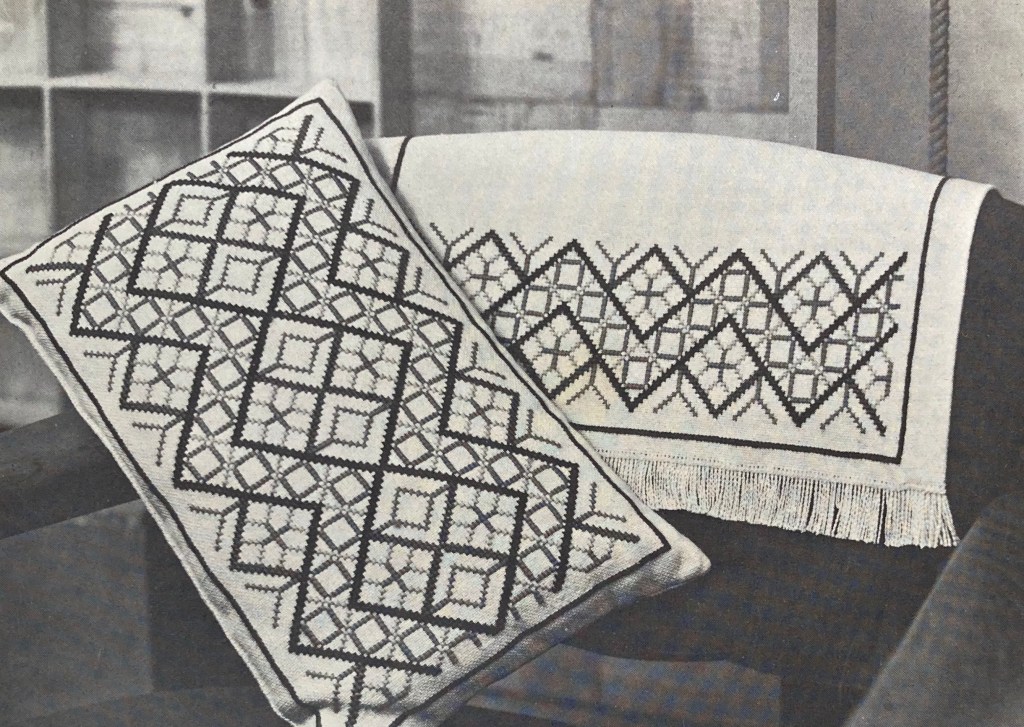
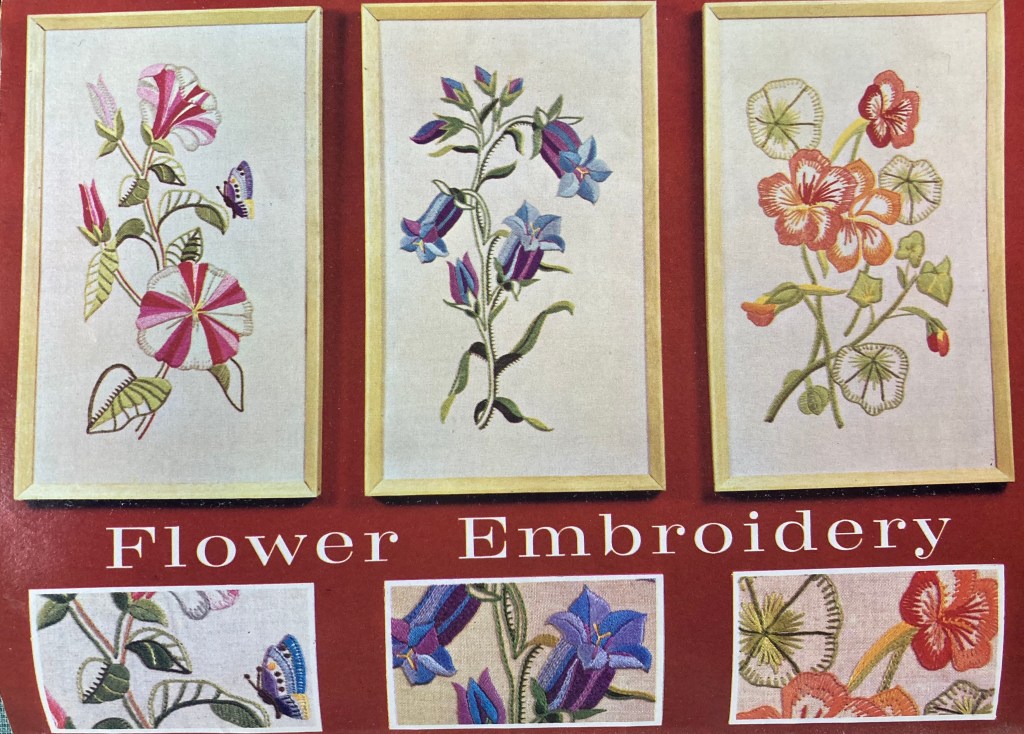
There’s a butterfly design in cutwork or as wool embroidery on a cushion in mid-60s shades of brown and dark green as well as more cushions in Tudor blackwork design or a geometric “peasant” pattern. The latter two take up the “bold” colour scheme idea with black on bright red or royal blue, scarlet, gold and jade on natural fabric. Finally, there are three flower panels than can be worked individually or combined to decorate a folding 3-part screen.

That’s this issue! My project will be the Norwegian cap and mitts in trending 1965 colours of blue and white. Happy New Year to you all.

October 1964: Overview

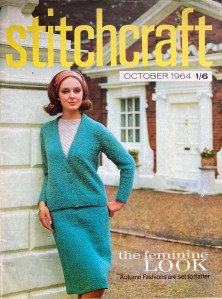
October is the start of the best season for knitting, and the October 1964 issue of Stitchcraft rose to the occasion with multiple themes and more colour pages than ever before (photographed in the villages of Great Waltham and Stebbing in Essex). There are knit designs for “him and her” as well as for different ages of babies and children, embroidery, tapestry, rugmaking and appliqué projects, “novelties” and even a few extra tidbits in the back “Readers’ Pages.” Shall we… fall in?

Our first Autumn theme is “The Feminine Look”, which cracks me up, for when has Stitchcraft or any handcraft magazine ever promoted the “masculine look” for women? It goes without saying that they would never advertise the feminine look for men… As far as I can see, the designs don’t look any more feminine than the designs from any other issue. Maybe it’s meant in contrast to the “partner-look” designs from previous fashion trends.

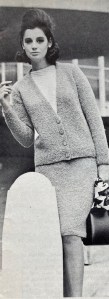
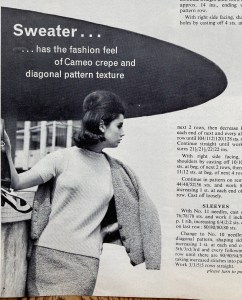
In any case, the cover-photo suit with coordinating jumper for underneath is simple and elegant, and probably quite comfortable to wear. It’s made in still-popular nubbly Rimple wool in DK weight and a slightly tweedy shade of light blue. The jumper is made in fingering weight and has a diagonal pattern.

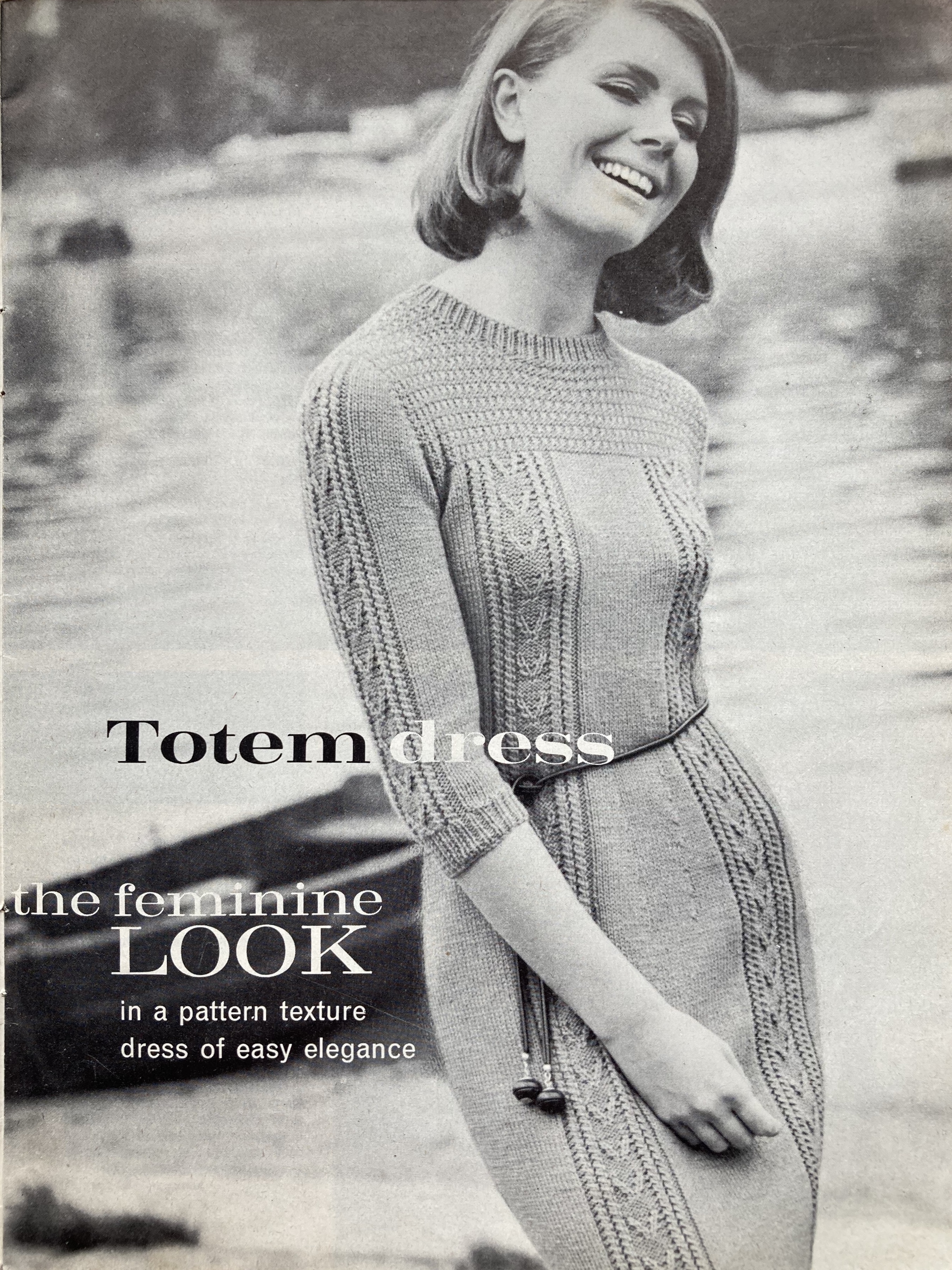
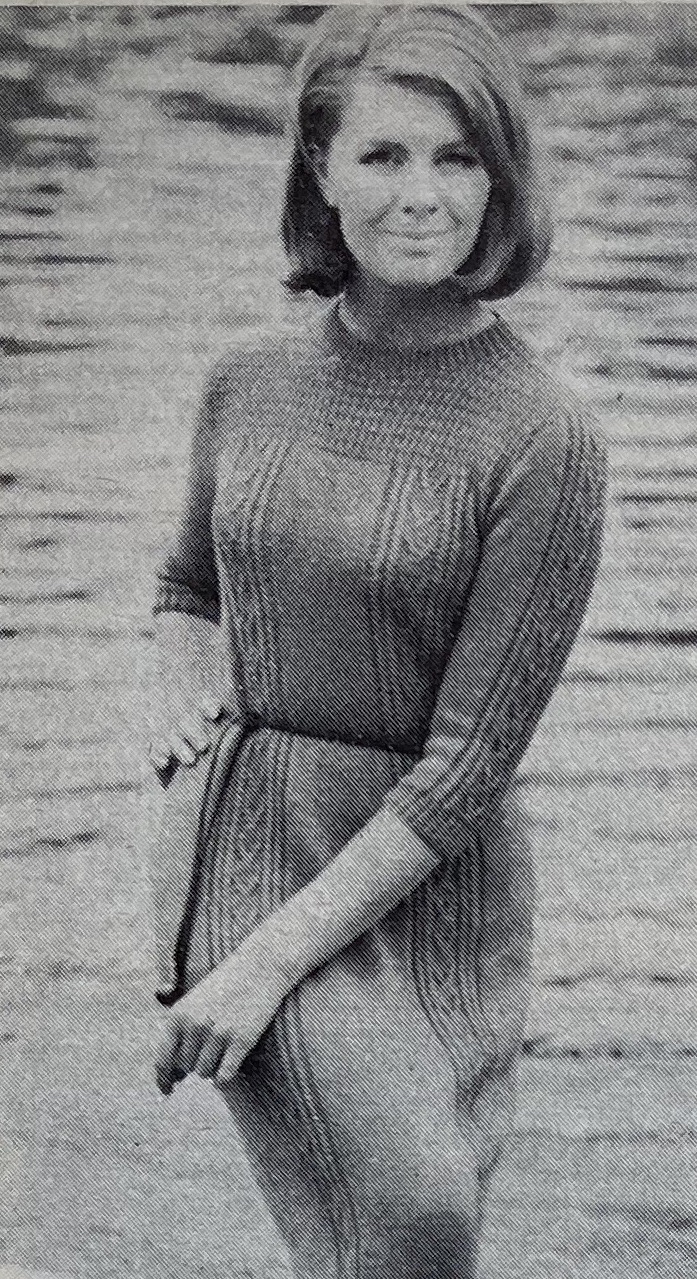
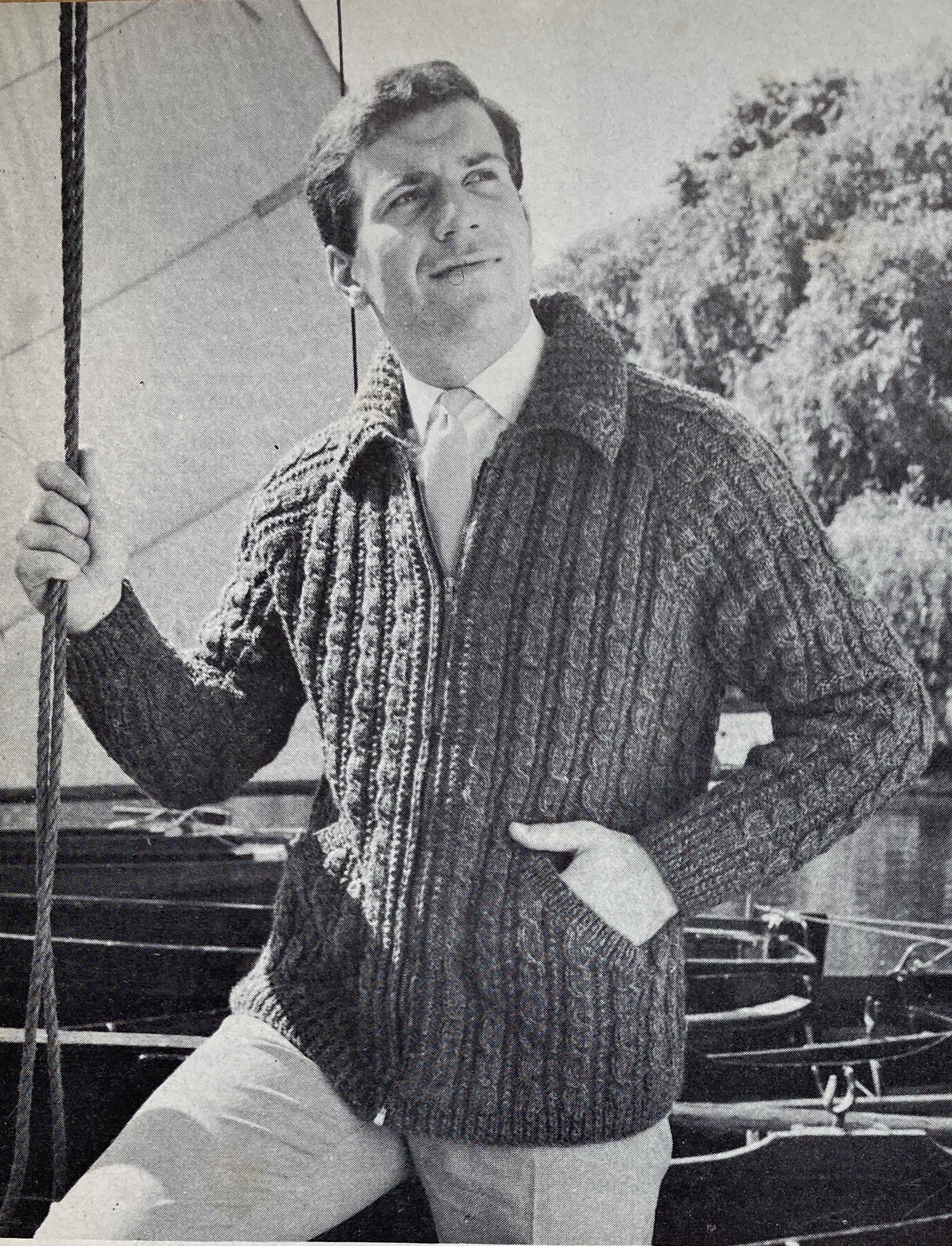
The women’s “feminine” fashions include a great cable-pattern dress as well, in smooth, DK weight Totem wool, and a less “feminine”, but probably very cosy, roll-collar pullover with an aysmmetrically-placed pocket. The mock-cable pattern on the pocket and collar is used as an all-over pattern on a man’s classic V-neck cardigan, and there’s another man’s cardigan as well in a very similar design, with “real” cables, a zip fastening and in bulky Ariel wool.

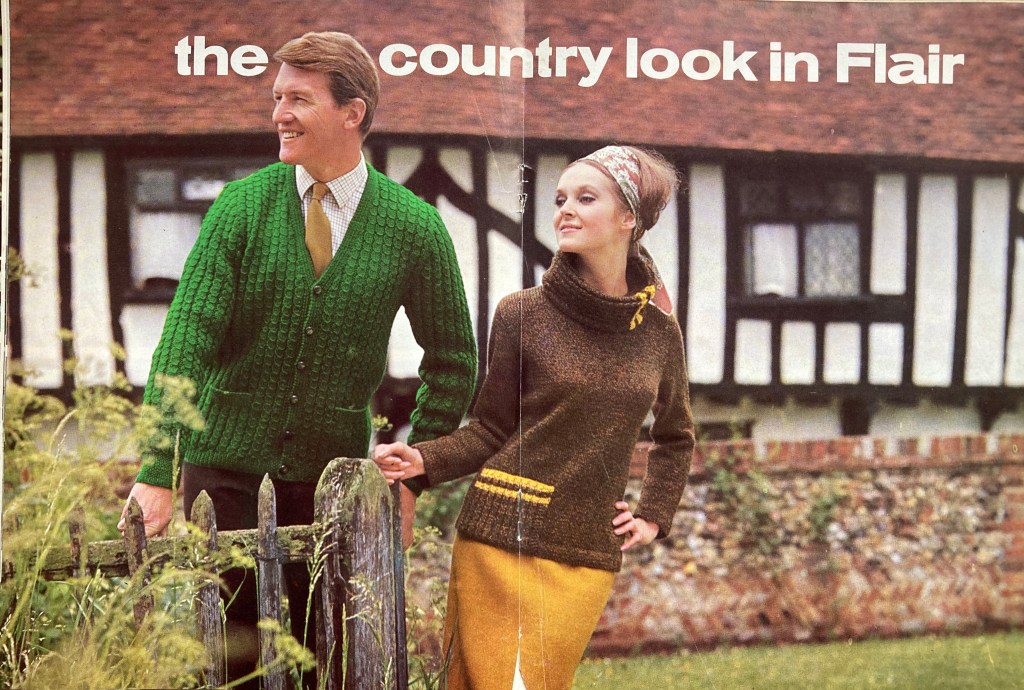
The cable cardigan and women’s pullover are shown off in a gorgeous full-colour centrefold photo where the green, yellow and brown of the knitwear harmonise perfectly with the country setting. As the caption says, both garments are made in “Flair”, a somewhat heavier wool-acrylic blend.

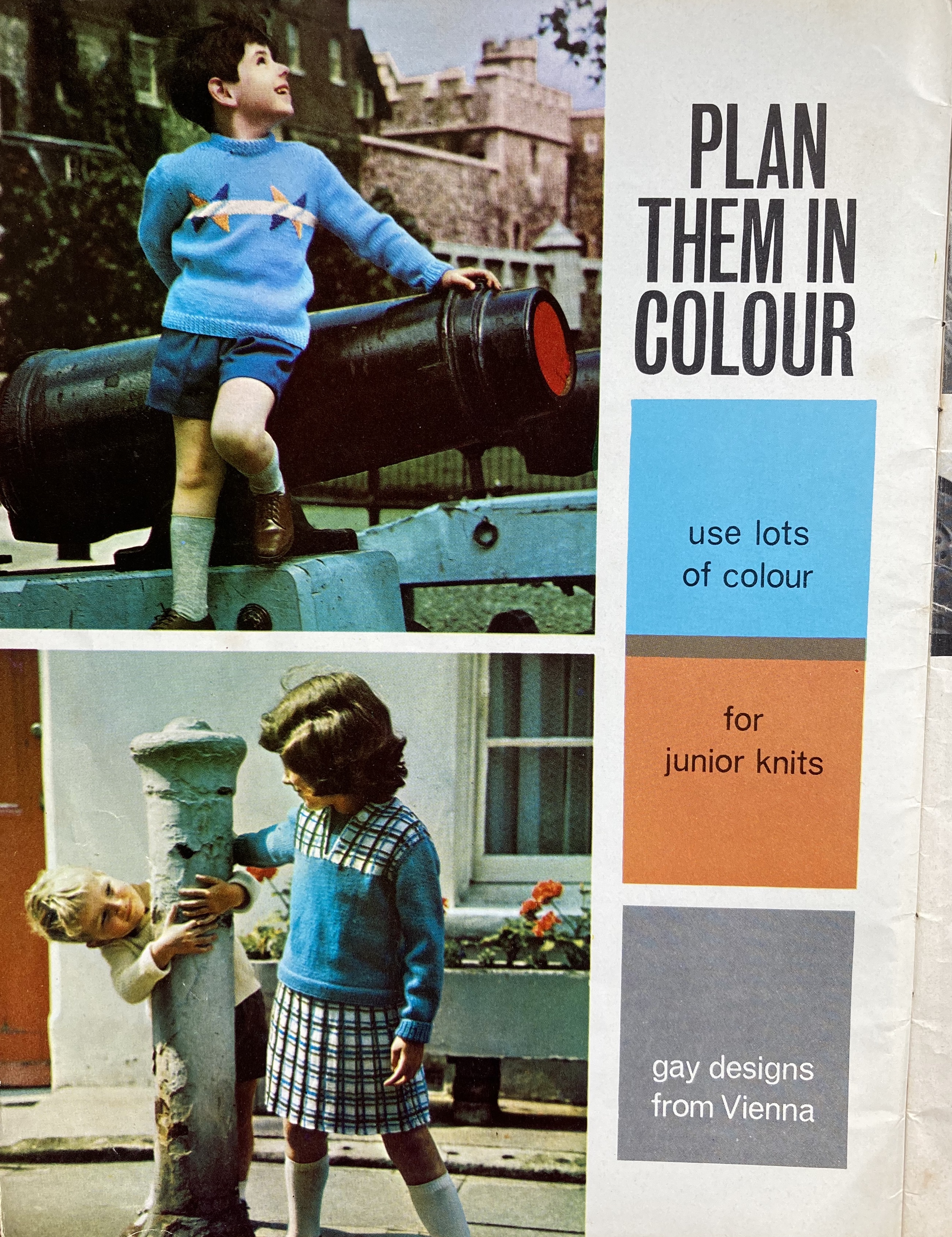
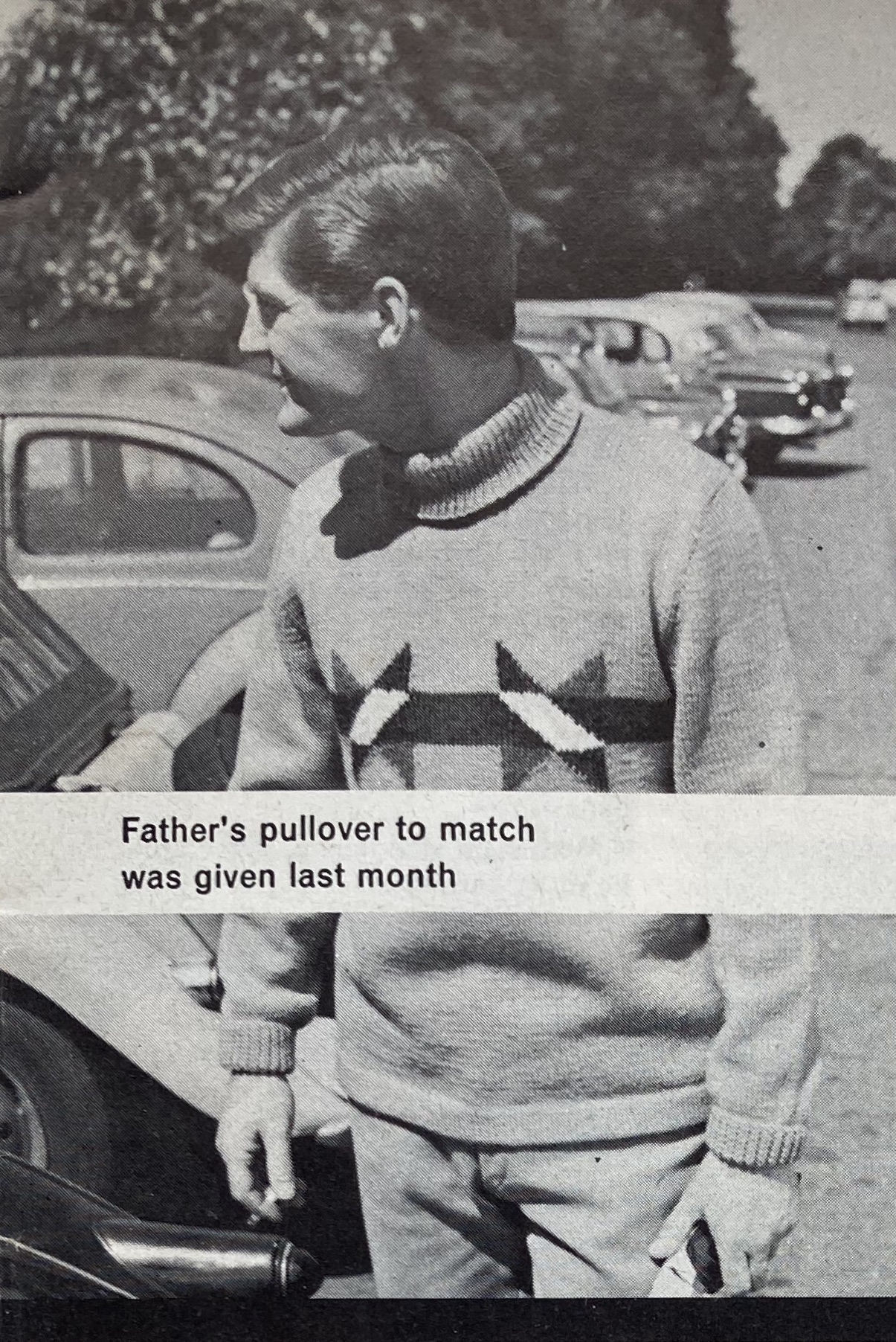
For the children, there’s a boys’ version of a men’s pullover from last month’s issue… the one that would not be a good choice for most women to wear. I personally think the placement of the star motifs is a bit odd even on a flat-chested body (they could have placed the band near the hem, or in a round yoke), but Stitchcraft liked it enough to offer a smaller-sized version in blue. Girls get a jumper suit in a plaid-trimmed “gay design from Vienna”. The colour palette for both the adult and children’s fashion is bright — blues, green, yellow, chocolate brown and “Flamenco” (I’m guessing red?), the patterns are bold and clear and collars and pockets are big and conspicuous.

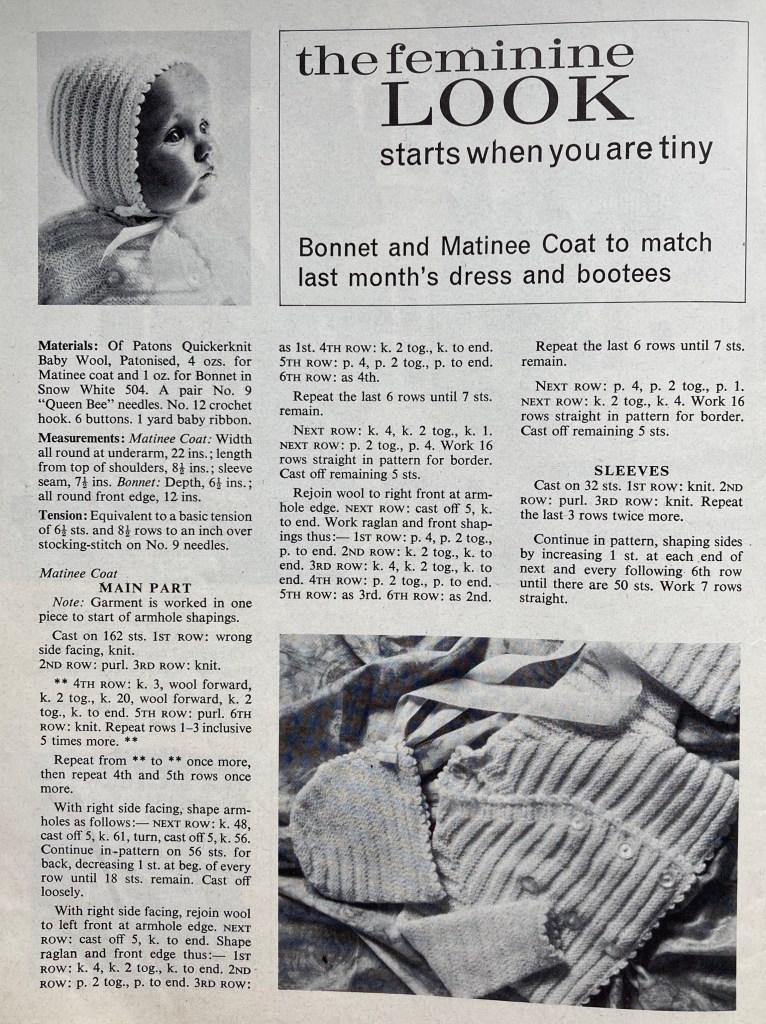
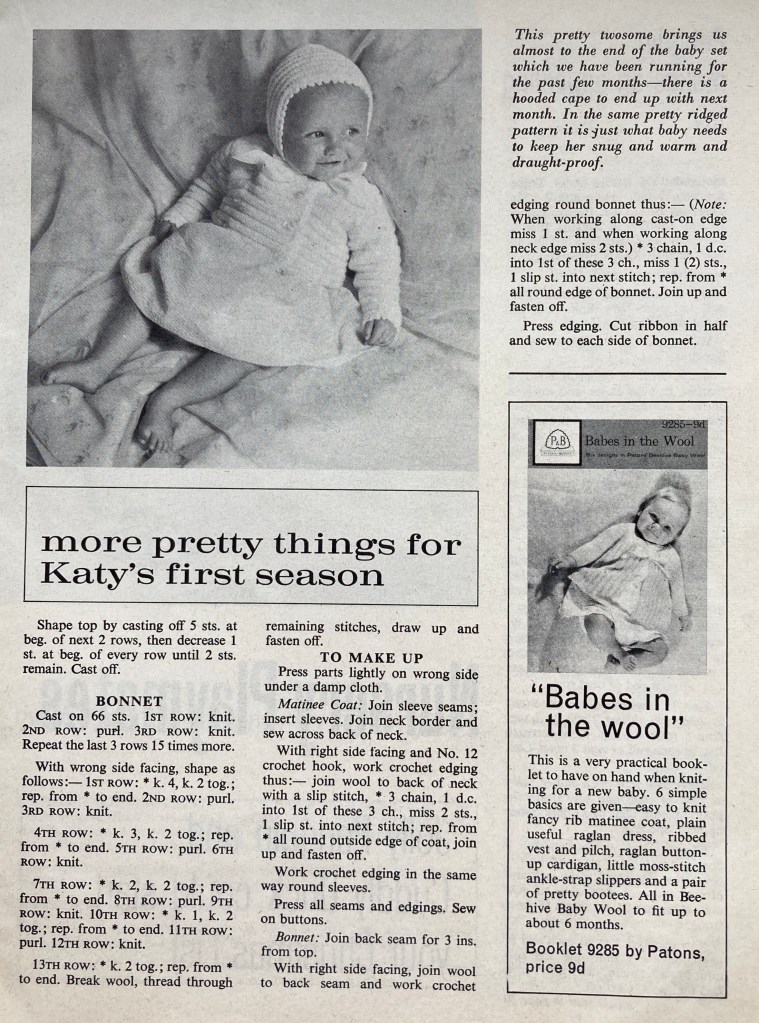
Continuing the baby-outfit series from the previous months’ issues, the (girl) baby of the family gets a bonnet and matinée coat. “The feminine LOOK starts when you are tiny” — i.e. get used to having cold legs now! The set is certainly pretty, and there’s a very practically placed ad for a Patons’ baby-pattern booklet, “Babes in the Wool” on the page as well.

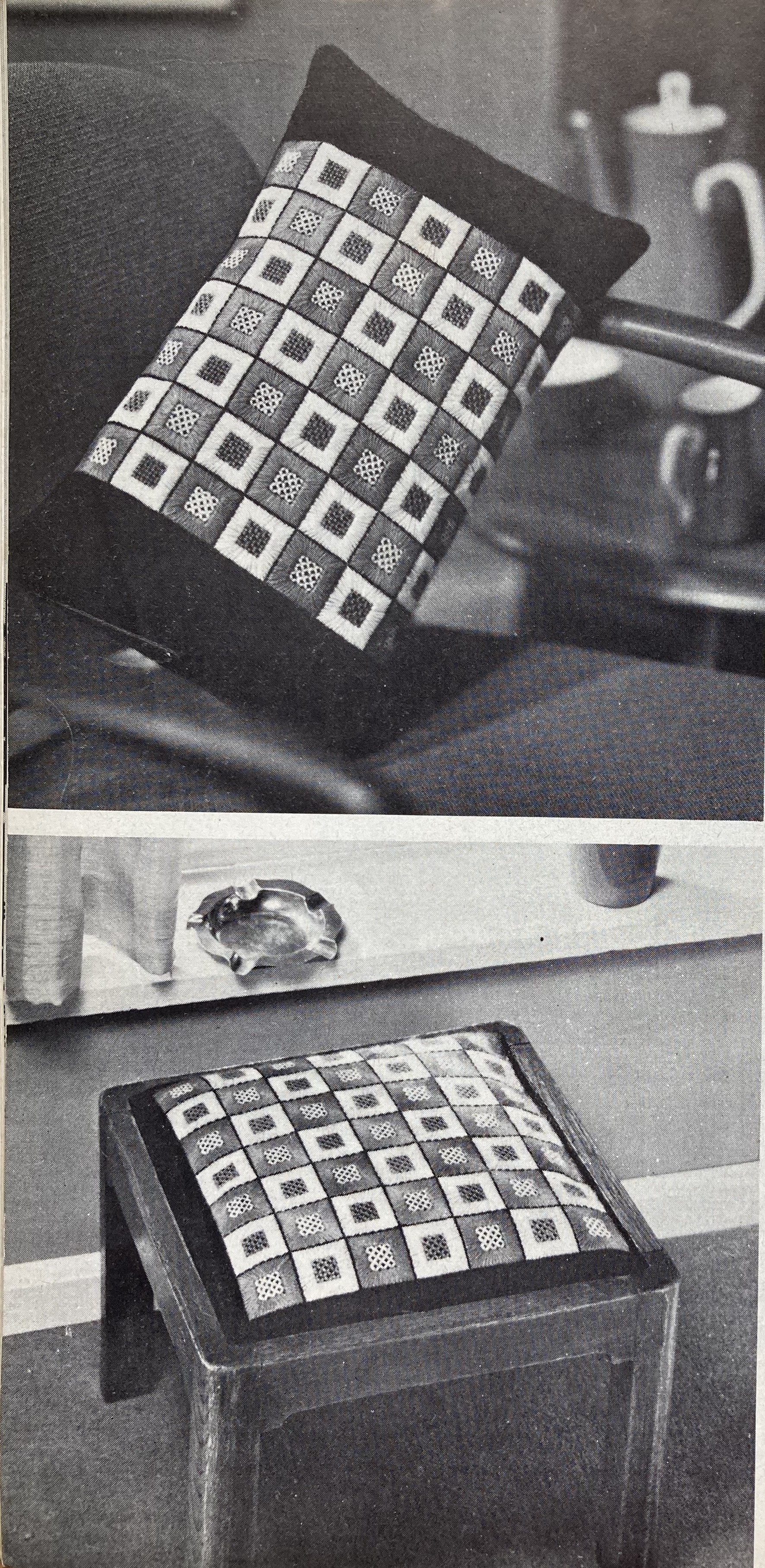
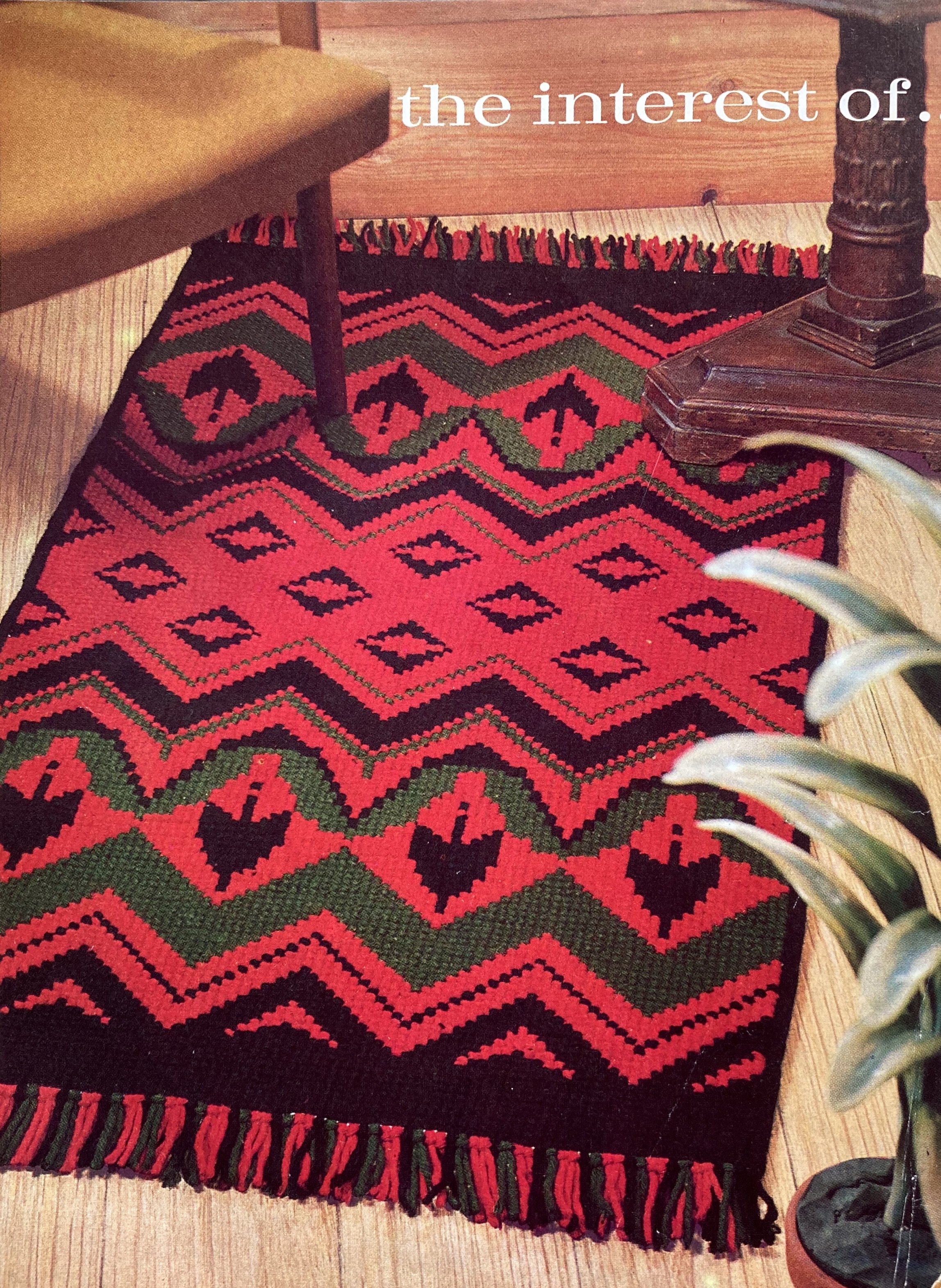
With all these great knitting designs, you’d think the homewares department would be skimpy, but they really went all-out on this issue: in addition to the usual cushions, stool-tops and chairbacks in huckaback work or tapestry, there’s a bold red-and-green “traditional Austrian” rug photographed in colour (notice how a traditional Austrian design is not called “peasant”, interesting…)

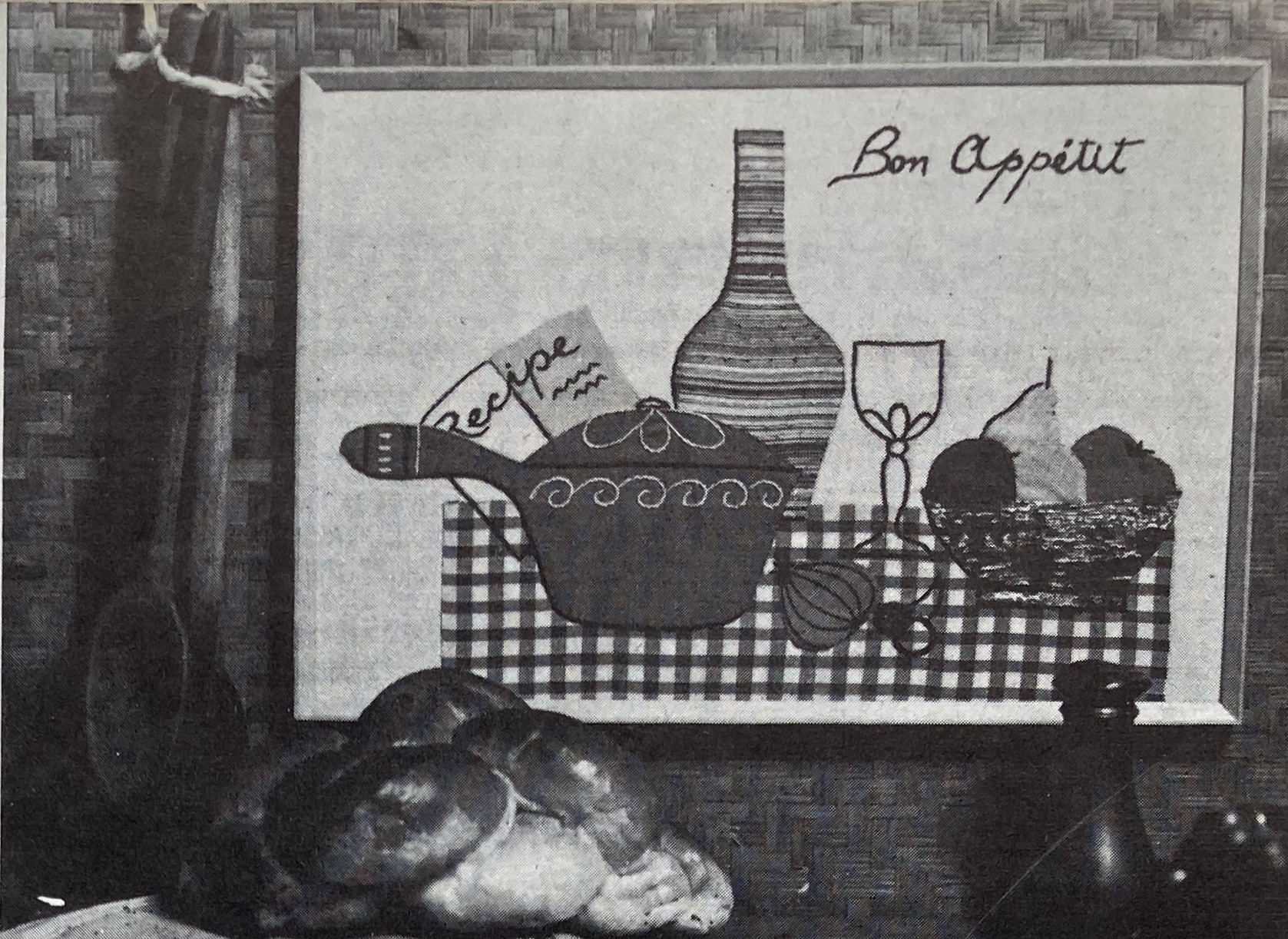
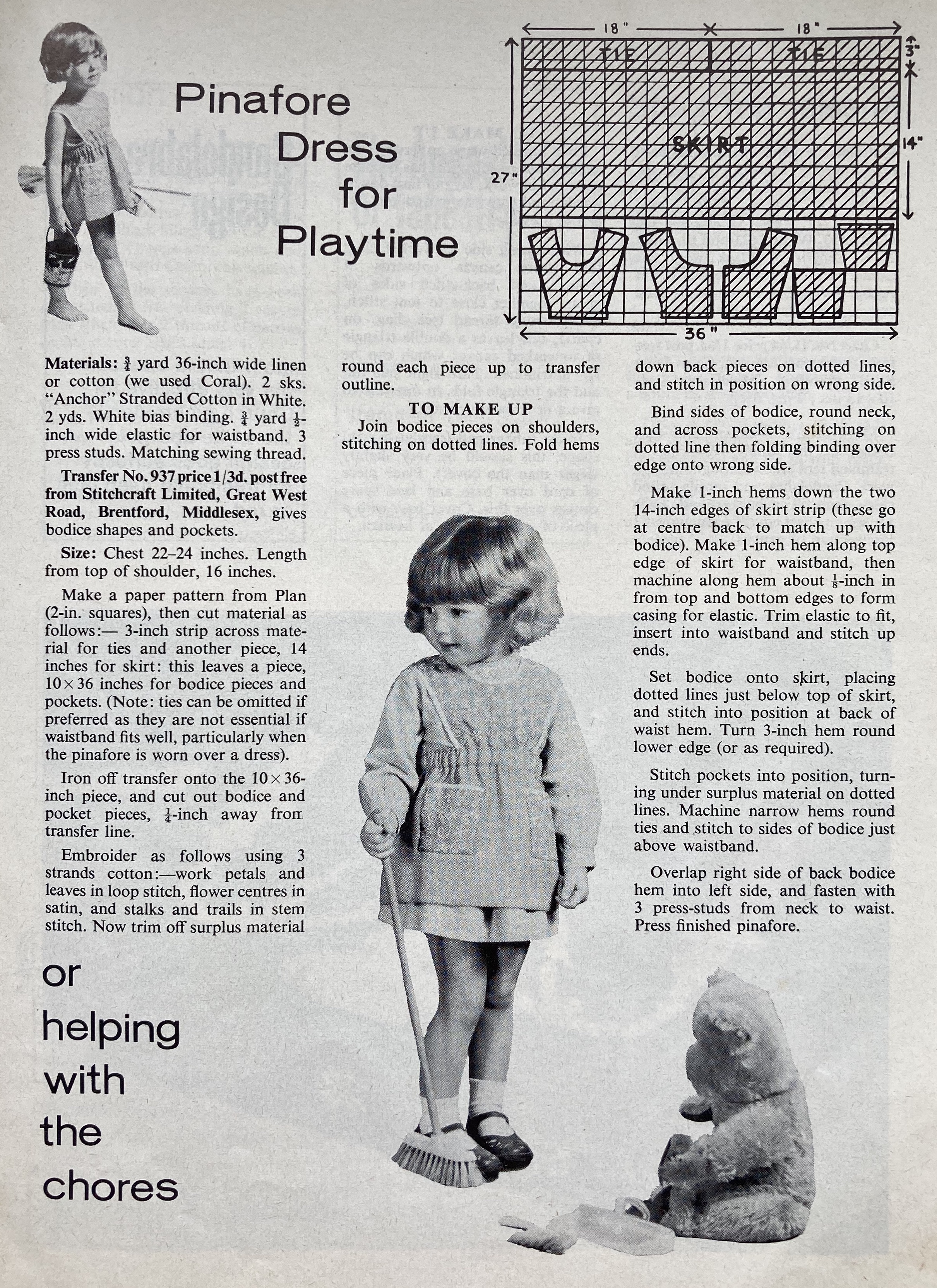
… and an appliquéd wall picture with a “kitchen”-themed design. Do I have terrible taste if I admit that I love this wall hanging? It’s utterly kitschy and very 1960s! There’s a little sewing design as well, for a child’s pinafore smock… “for playtime or helping with the chores.” Beware, little girl, that feminine look comes with its own designated activities.

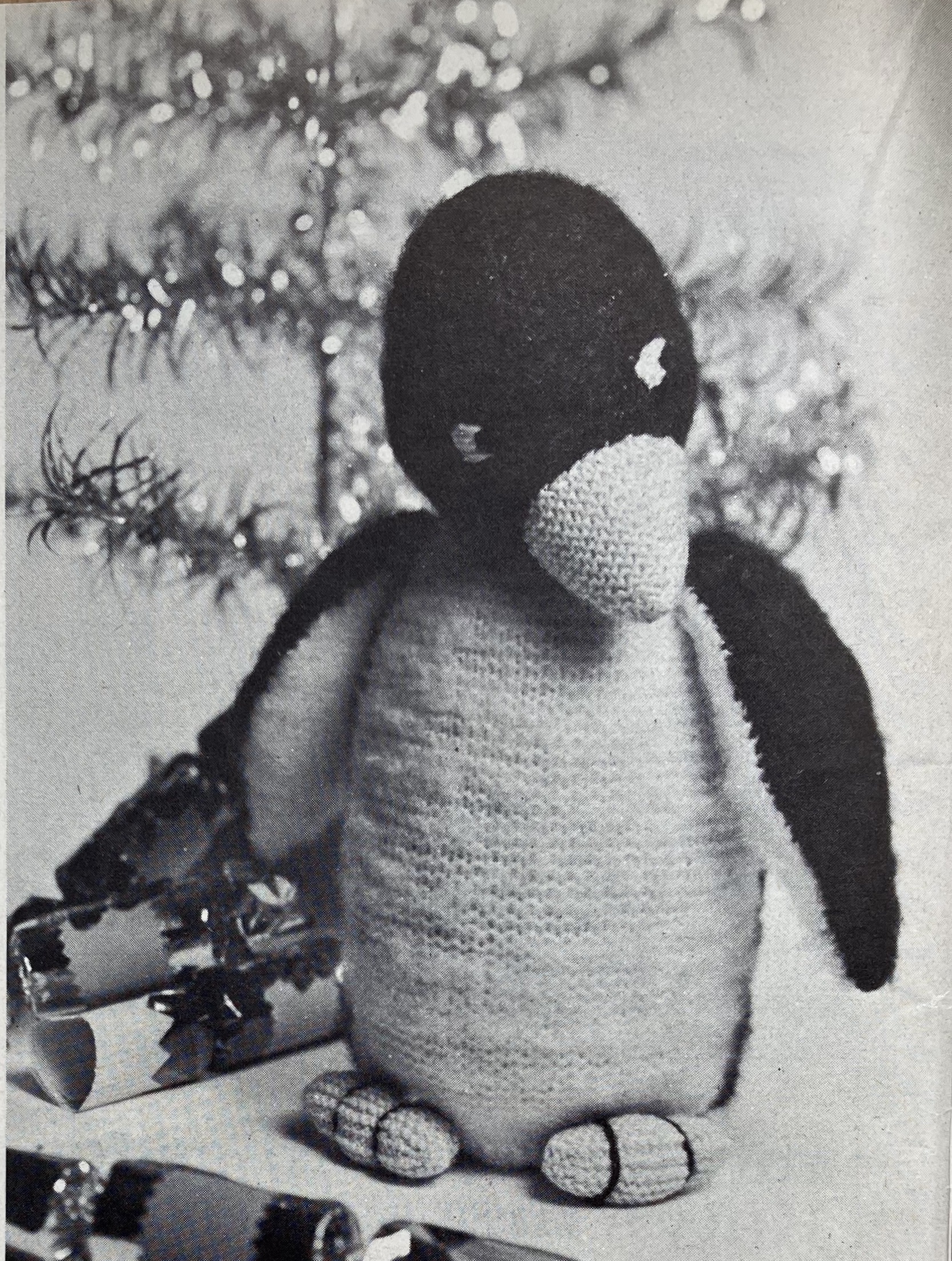
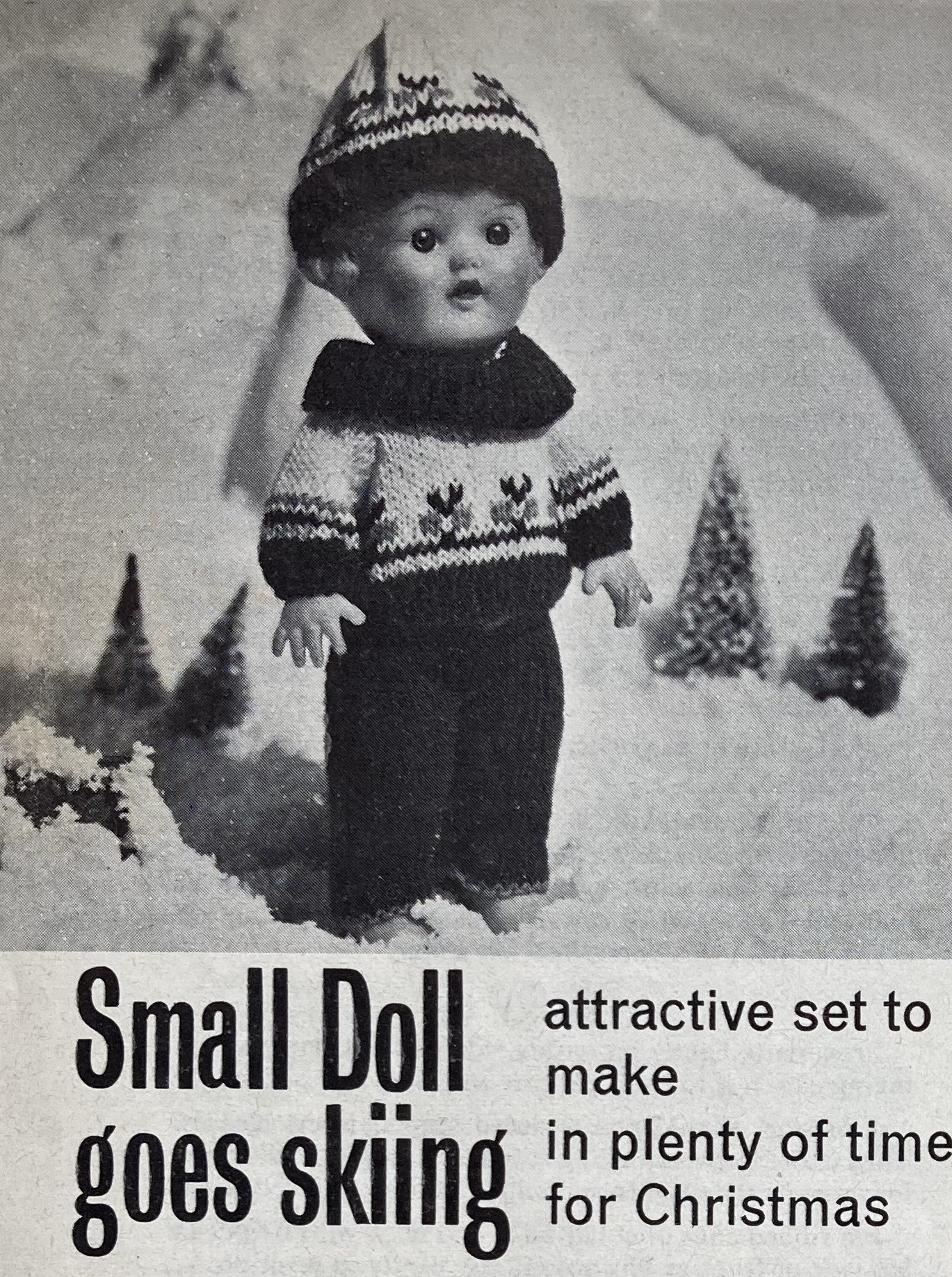
And don’t forget the “novelties”, which are not quite as weird in this month’s issue as we have seen in other issues. There’s a little stuffed penguin toy with very funny feet, and a night-case in the shape of a knitted duck. There’s also a winter ski set for a doll, with ski-pants and a warm stranded pullover and cap. (If the doll looks a little worried and not quite warm and comfortable, it’s probably because it’s standing barefoot in the snow.)

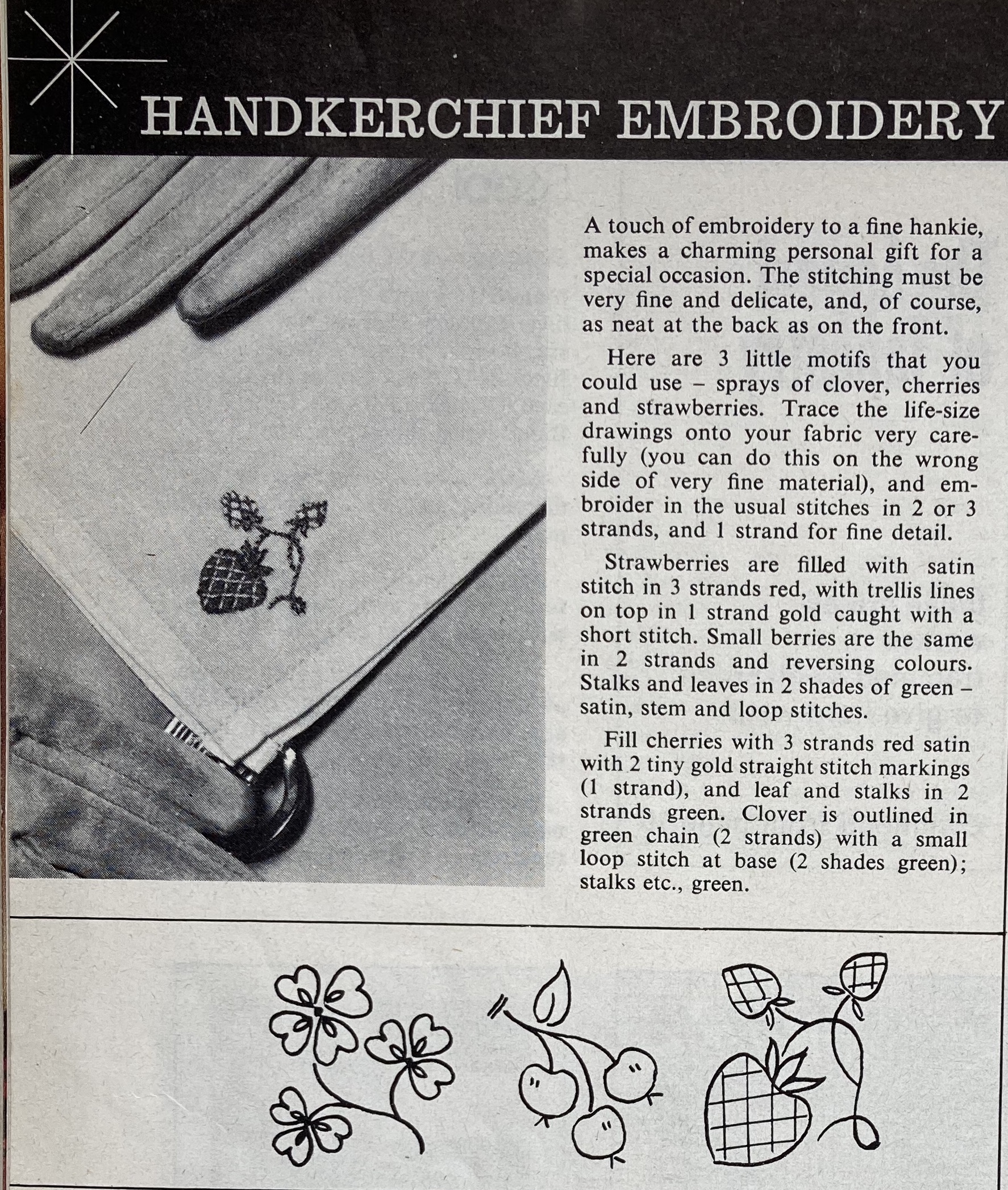
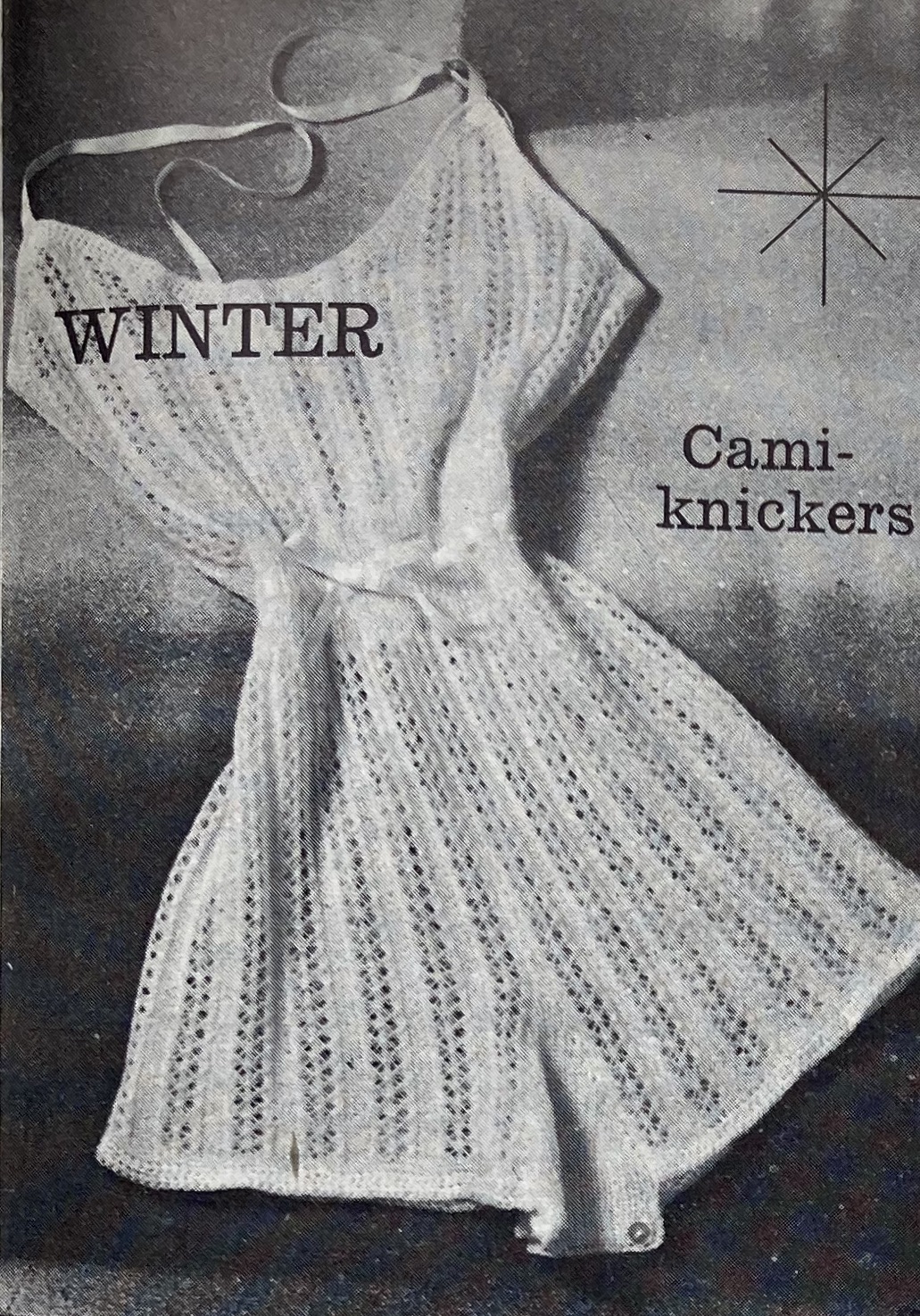
But that’s not all! In addition to the usual comic (Anne learns how to embroider an owl and a swallow using different embroidery stitches), the “Readers’ Pages” in the back of the magazine have a reprint of a 1944 knitting pattern for warm “cami-knickers” underwear, and some dainty stencils to embroider onto handkerchiefs. I love embroidered handkerchiefs, having inherited some beautiful ones from my grandmother and occasionally bought more on ebay. If I ever find any plain new ones to buy (shouldn’t be that difficult), I could try my hand at embroidering them myself.

The handkerchiefs, cami-knickers and even the cheesy appliqué picture all appeal to me, but I love the cabled knit dress most of all, so that will be my October project. I can’t imagine it will be done by the end of October, but I have already bought wool and made a swatch and am just starting casting on, so I’ll post about it soon when there’s something to see and write about.

Till then, happy Autumn!

June 1964: Overview

Welcome to the official start of the Stitchcraft holiday season! The June 1964 issue gives us a mix of elegant 4-ply designs, casual bulky knits to wear as outerwear, beach clothes for the kiddies and easy homeware projects that can be packed up and worked from a deck chair.

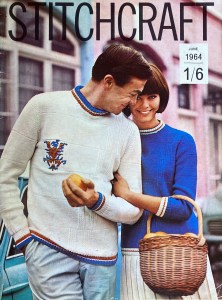
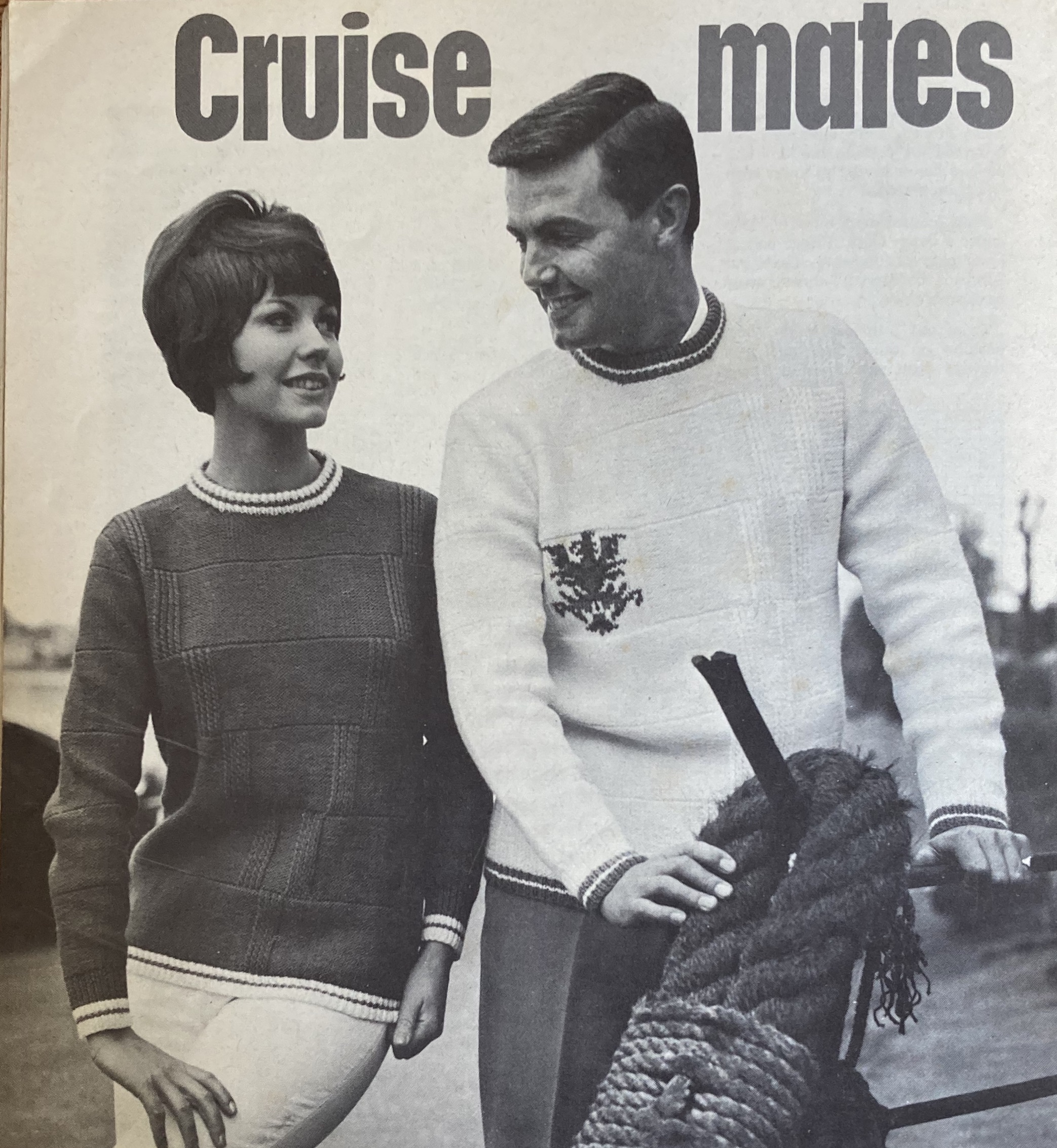
Our cover models are just returning from the weekend market, where they have secured a basket of nectarines. They’re wearing an “easy-line sport pair” of “cruise mates” in complementary colours and the same basic block-and-rib pattern. The ribs are made with p1, k1tbl to give them a more textured look, and the men’s version has an eagle motif, because it is “manly for him.” I wonder if both versions were originally designed with a motif until the designer realised that it would fall in an awkward place on the women’s version?

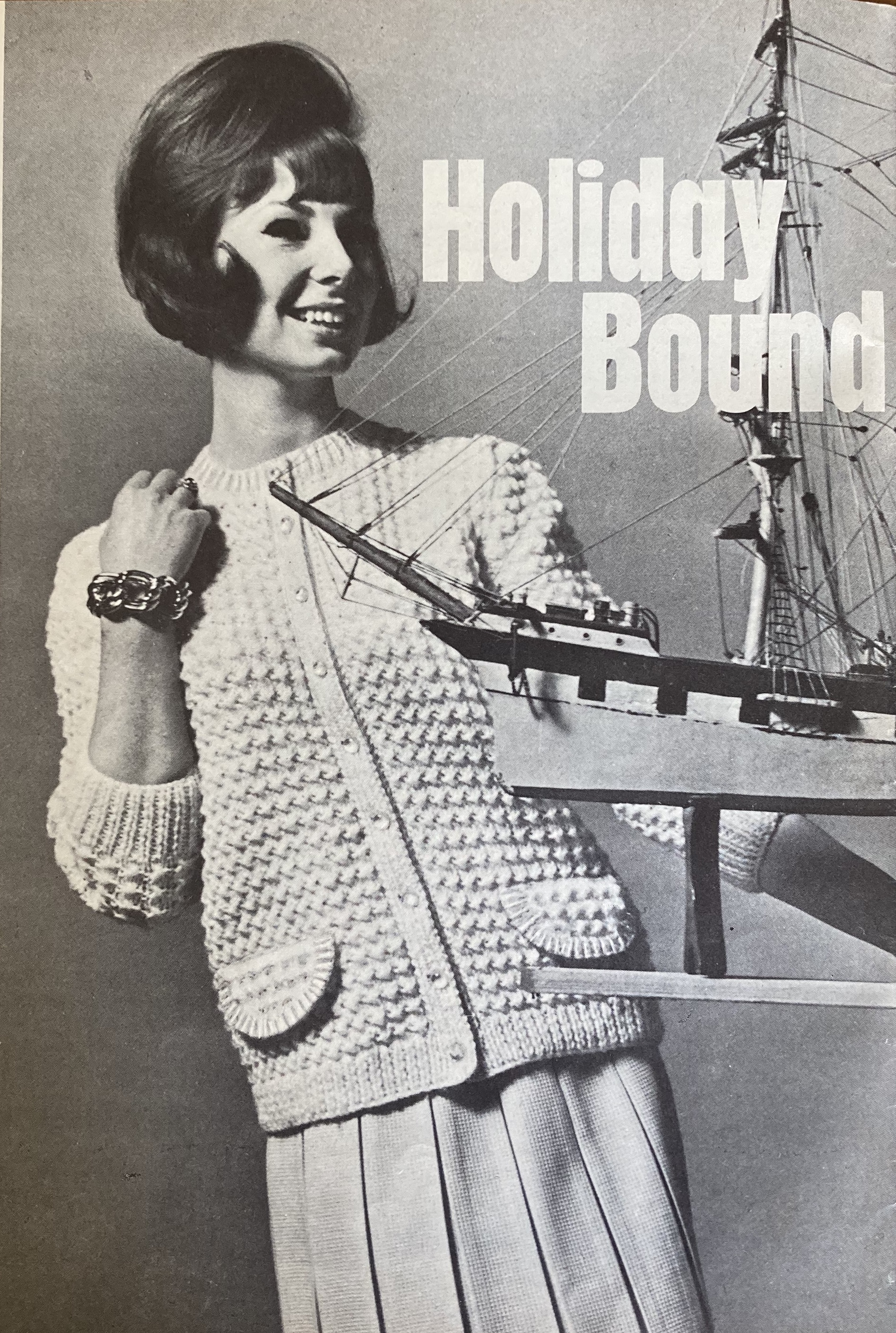
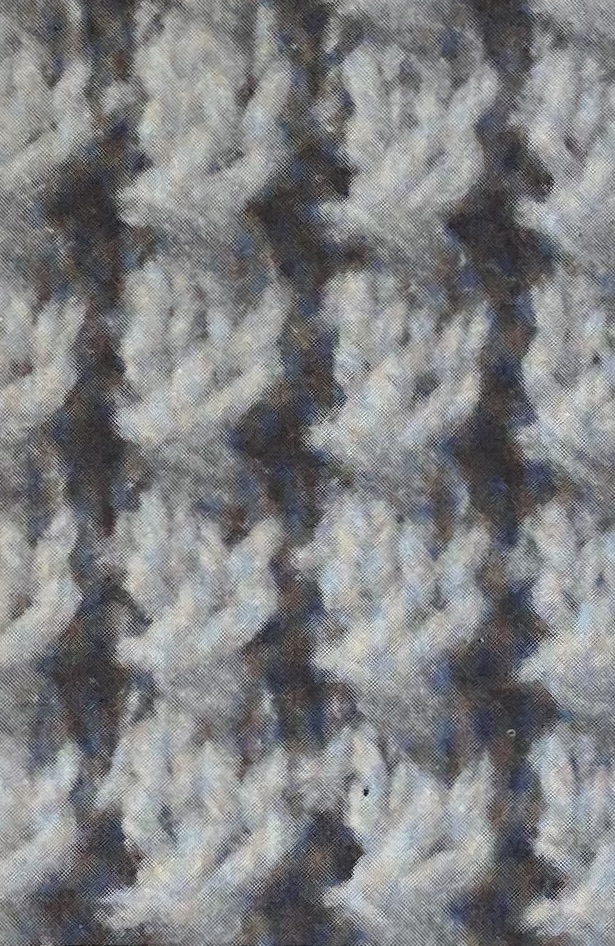
Nautical navy blue and white with red accents never goes out of style for summer casuals, and we see it in this bulky, yet “featherweight” (18-20 ounces of Patons Ariel, so make of that what you will) white cardigan. I can believe Stitchcraft when they say that the wool is lightweight, considering its bulk, since the twisted-rib pattern eats up a lot of wool.

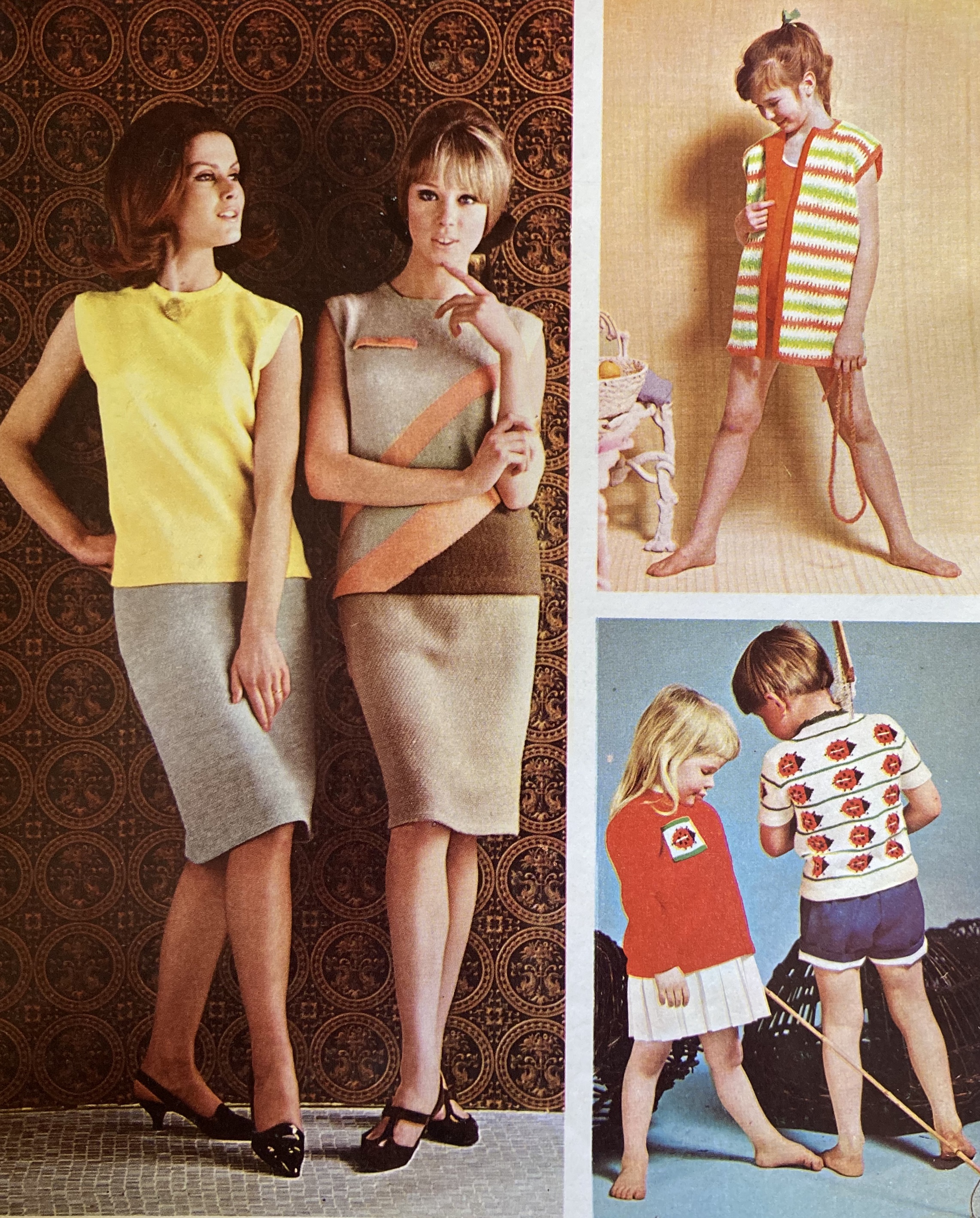
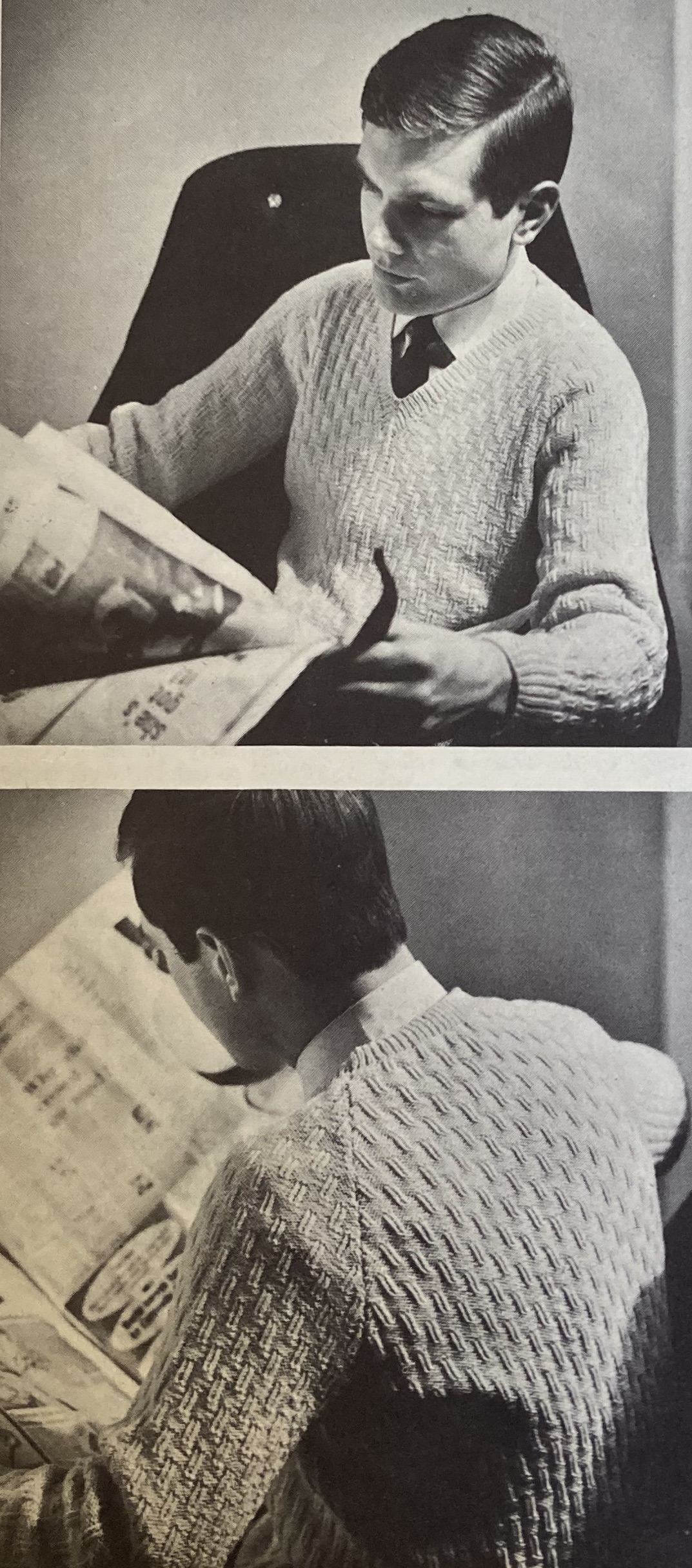
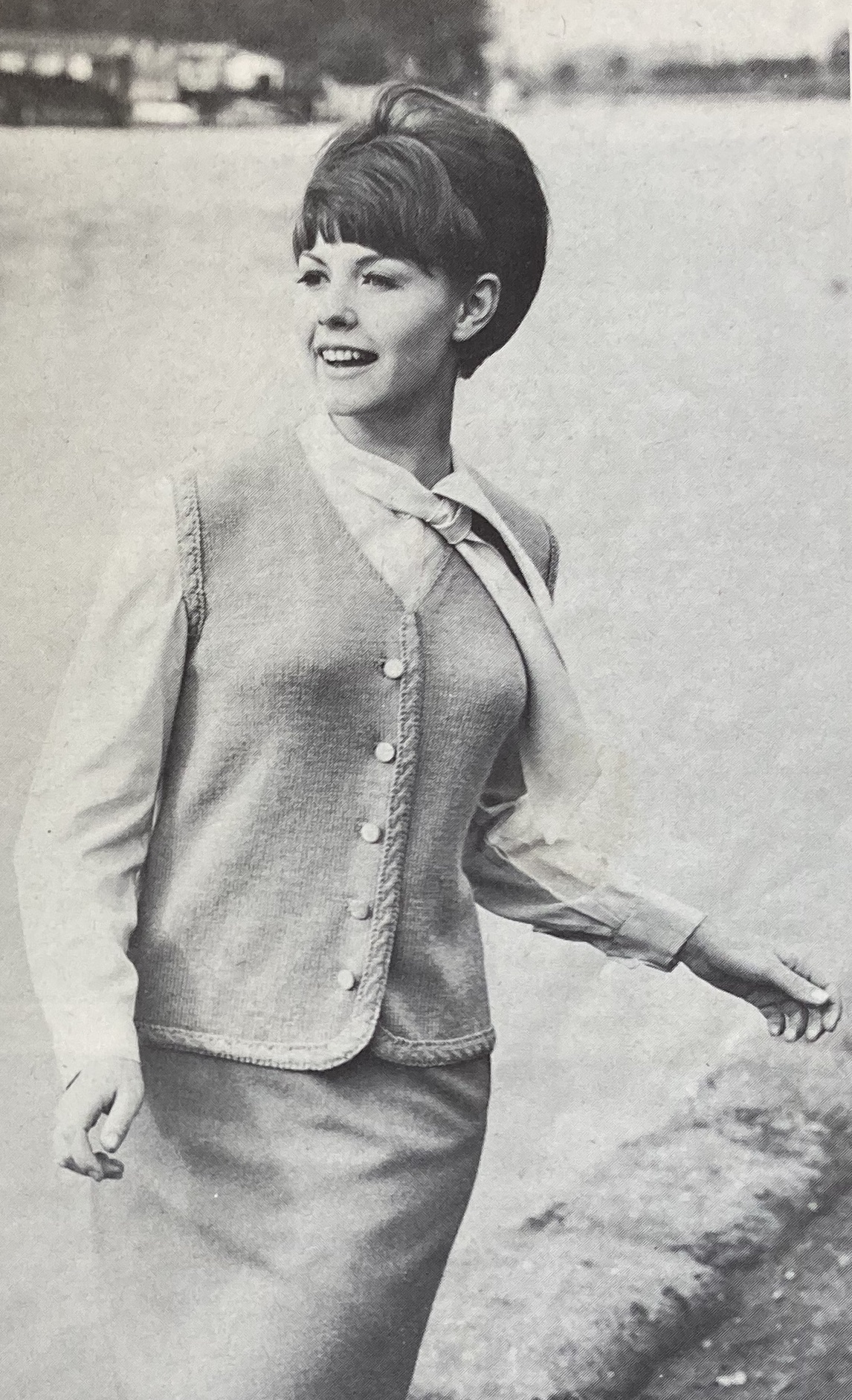
Ona different note, we see simple, yet elegant knitwear separates in 4-ply that are suitable for the office of a more dressy casual situation. The basic skirt and plain or diagonal-striped top are knit in muted pastel shades and meant to be interchangeable — “Basic skirt with a change of top” is the headline for this well-coordinated set. There’s also a waistcoat for her that would match the skirt when worn with a blouse, and a fine-knit raglan pullover for him. The waiscoat and pullover are both in this season’s trendy yellow tones of “Spun Gold” and “French Mustard”.

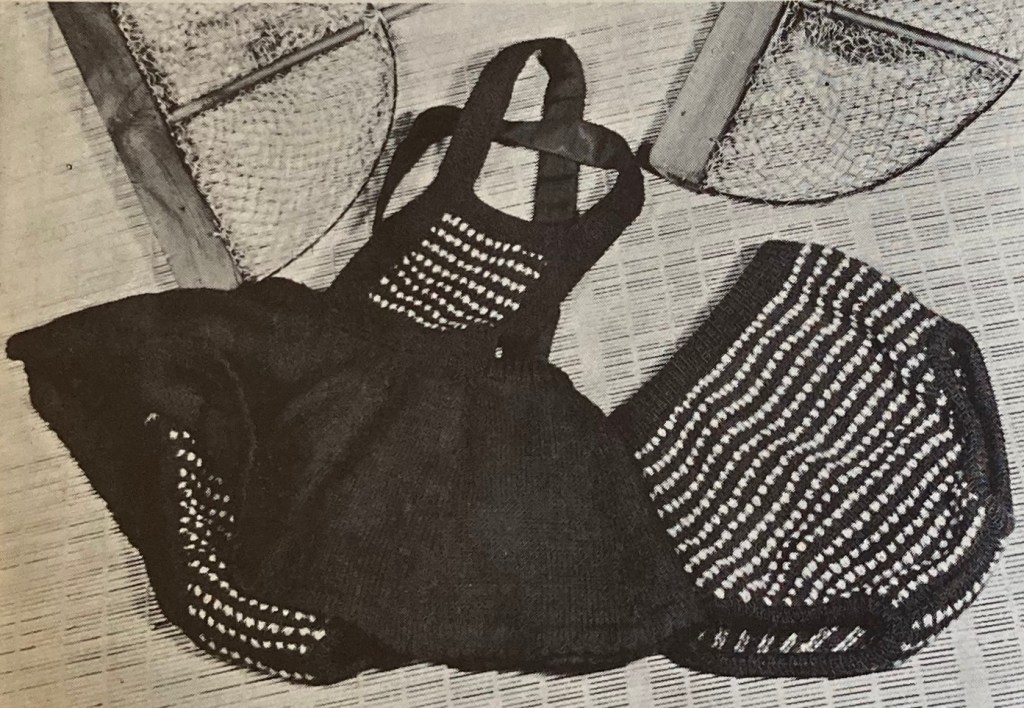
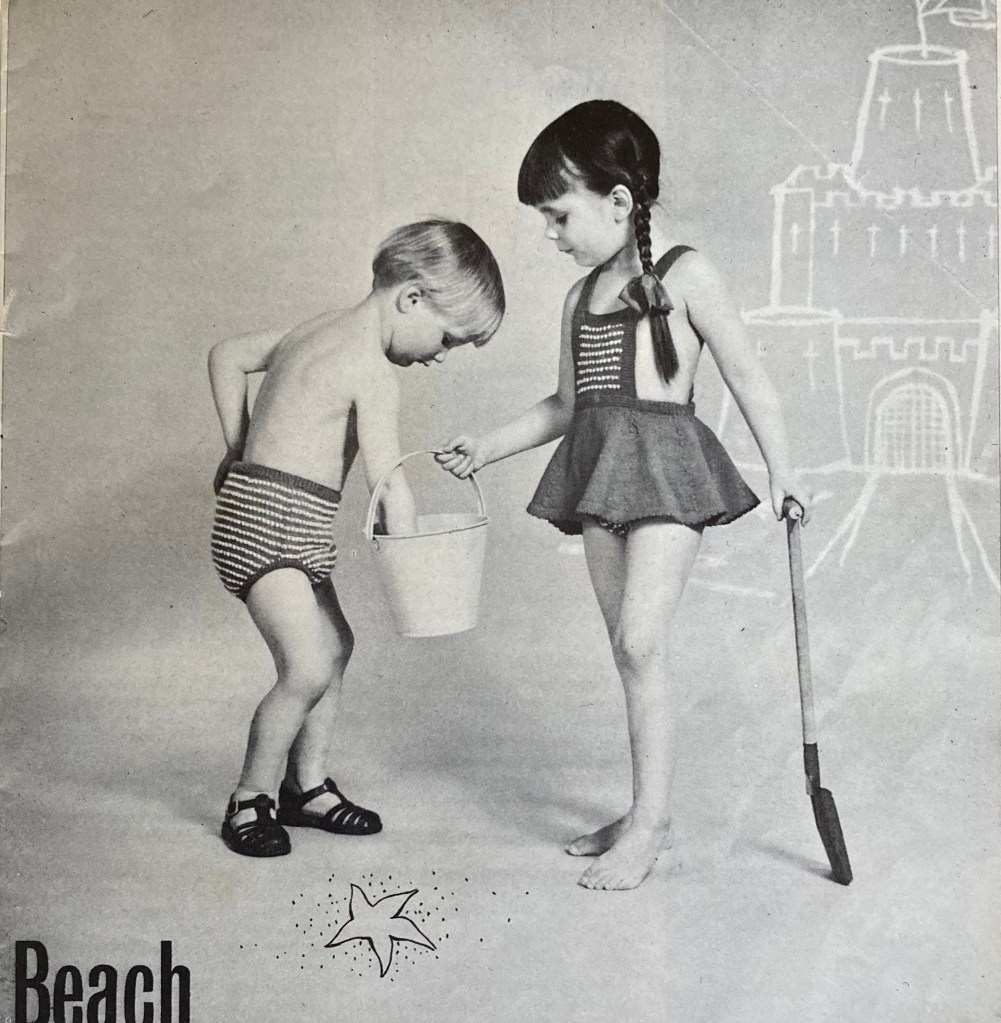
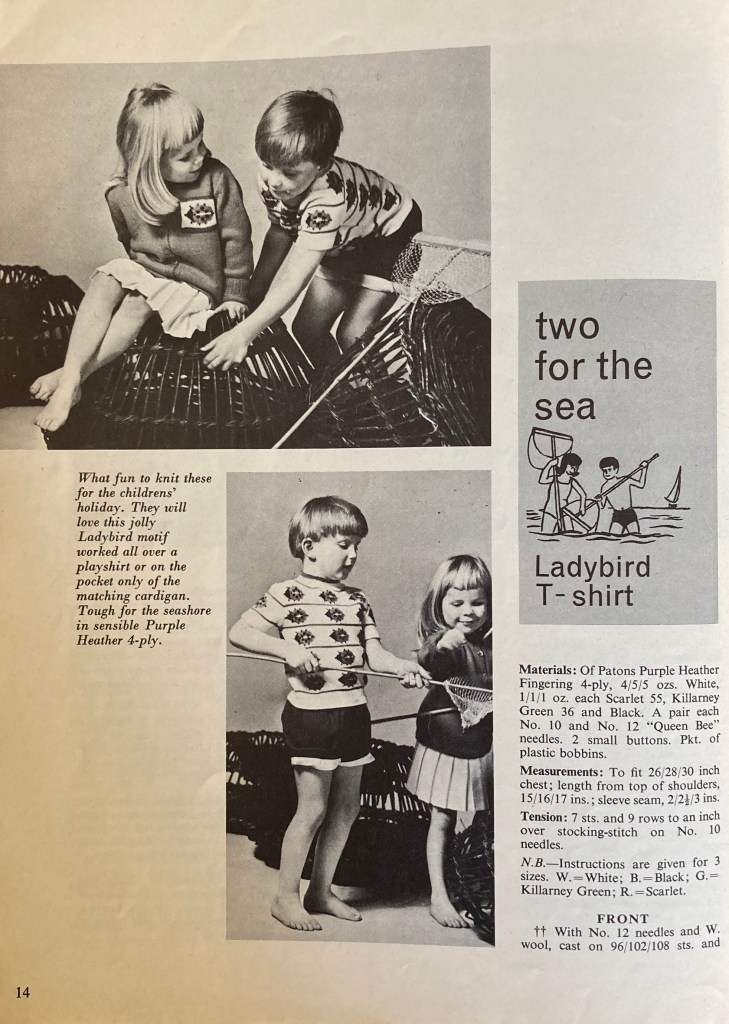
Children can enjoy splashing around at the beach in their trunks and sundress (the girl’s trunks are sewn into the sundress to prevent wardrobe malfunctions, definitely necessary with a micro-mini tunic skirt.) Here again, traditional red and white or navy blue and white are the chosen Somewhat older children have a choice of short-sleeved jumper and/or cardigan with a Ladybird motif (more about that in the next issue…!), continuing the red and white theme. On a completely different colour note, you can make a beach cover-up coat in crinkly “Rimple” wool lined with towelling — a brilliant idea for drying off and staying warm after a swim in cold northern waters. It’s quite easy to make, consisting of literally three rectangles for fronts and back, with garter-stitch borders and then lined with the towelling.

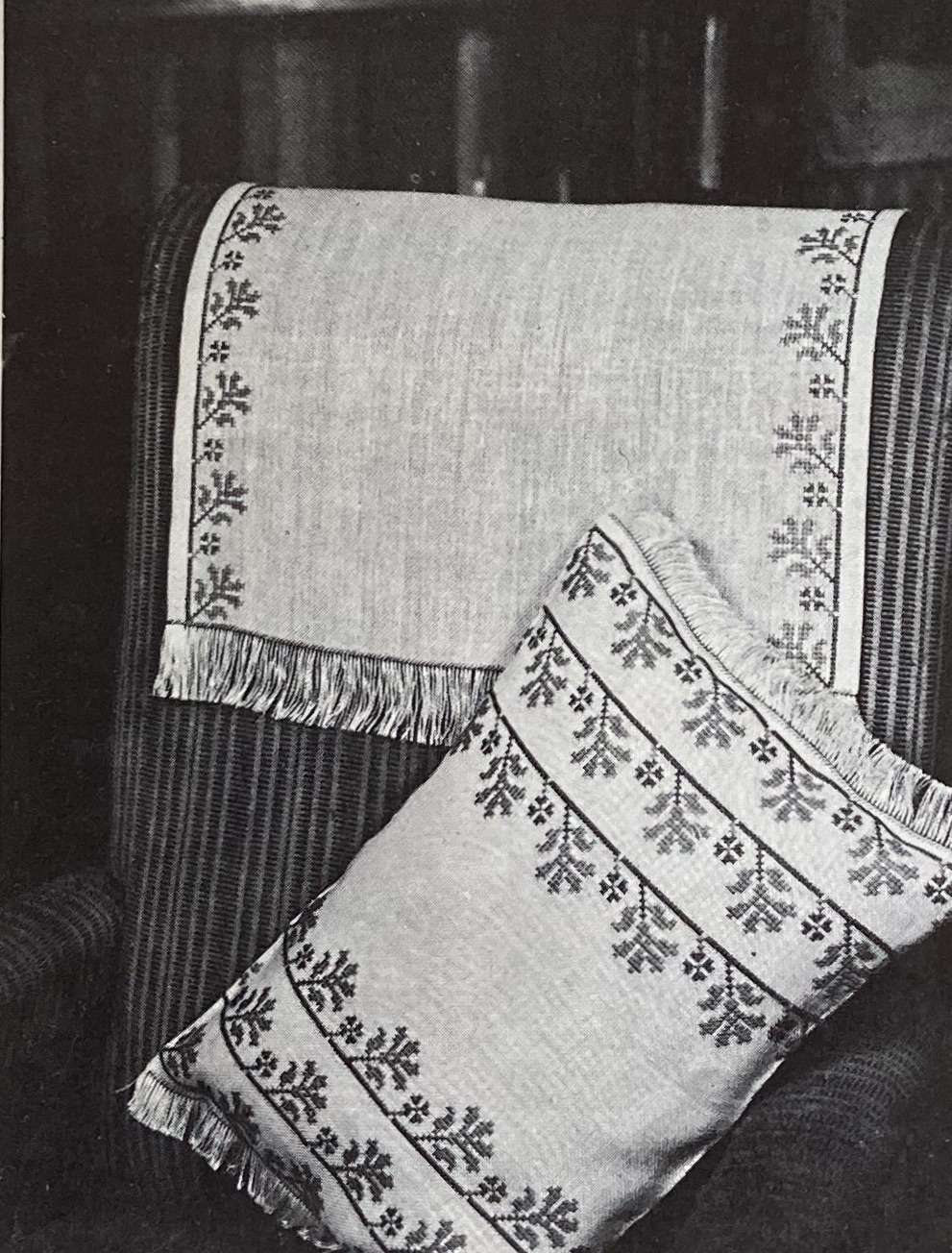
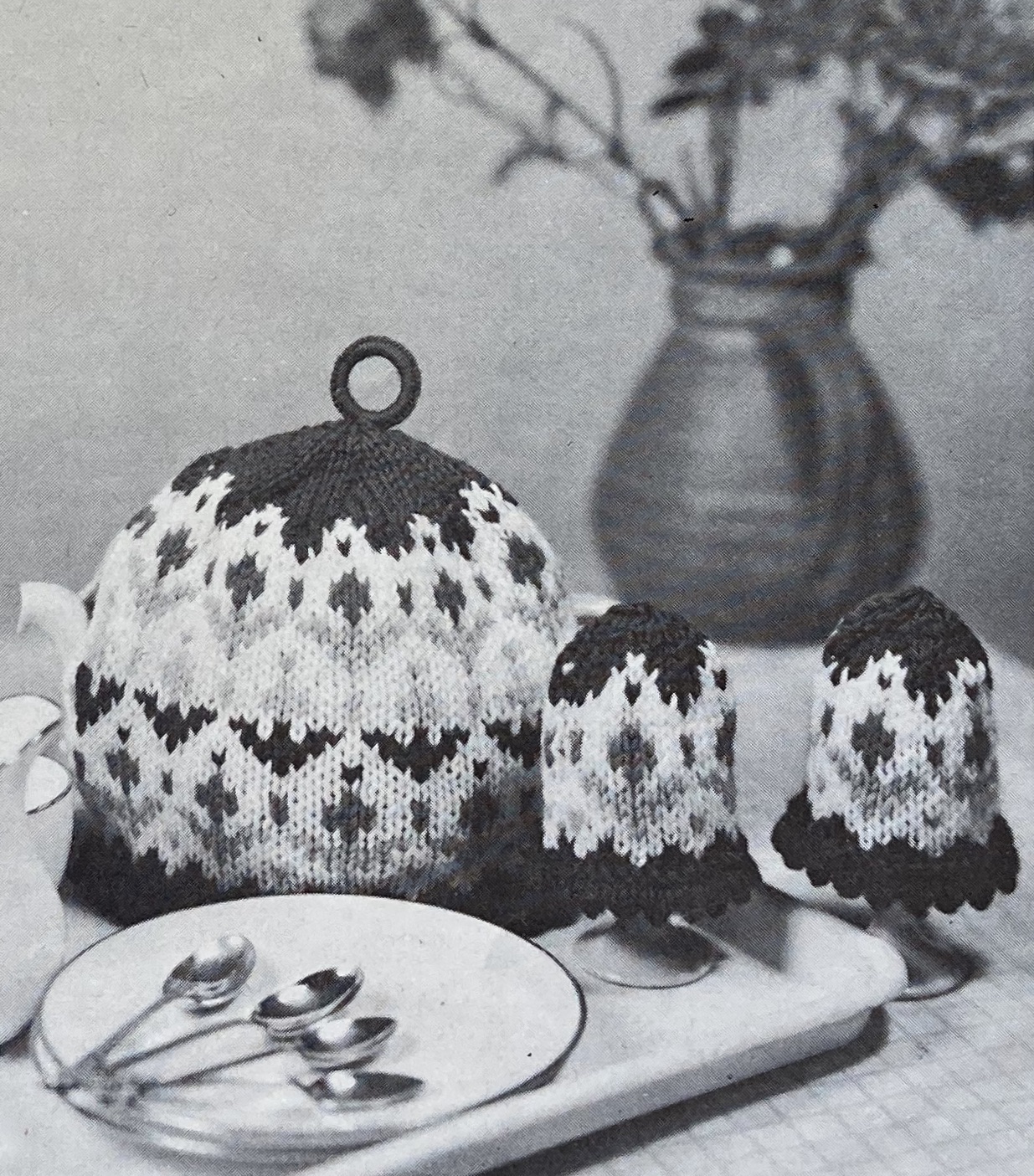
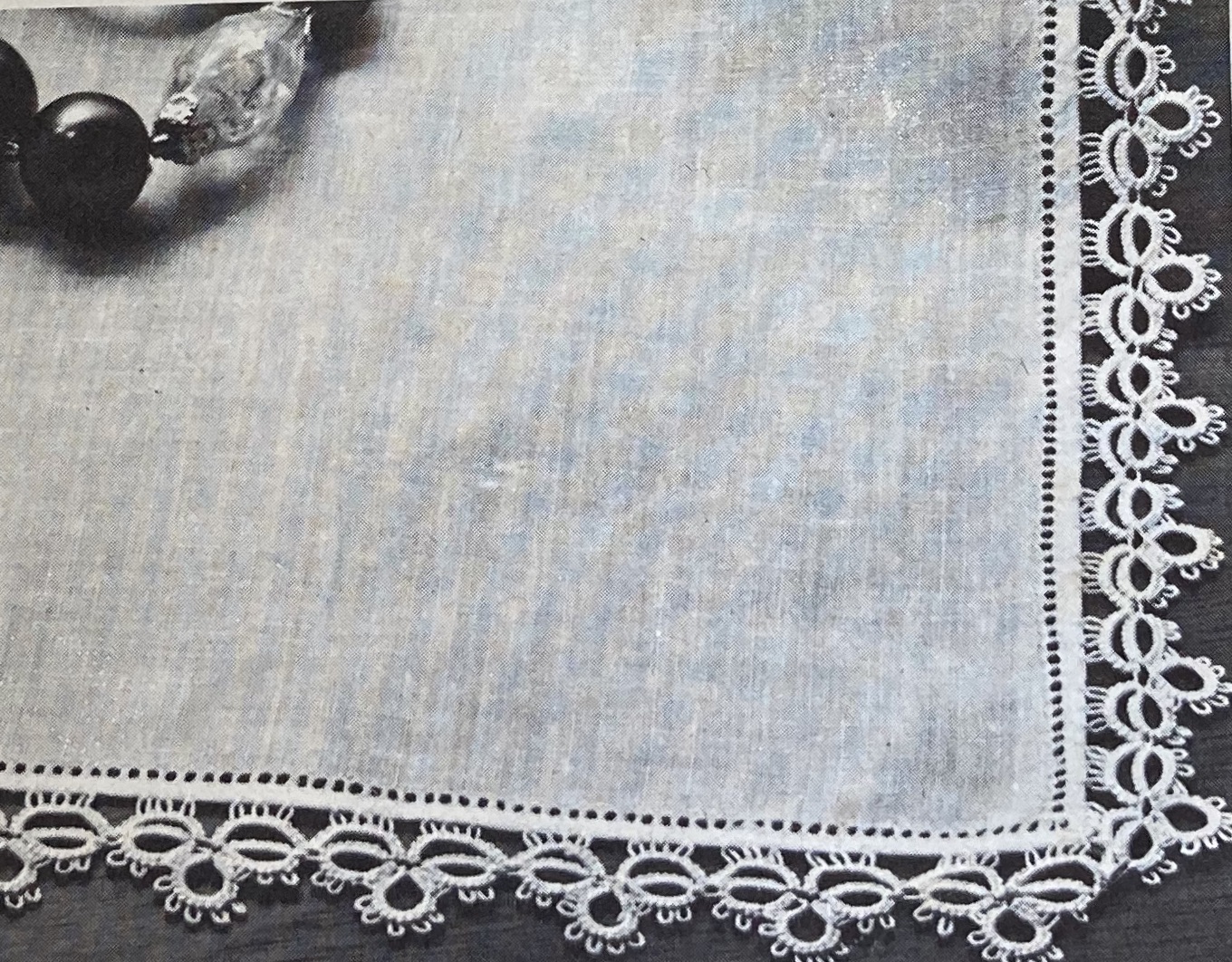
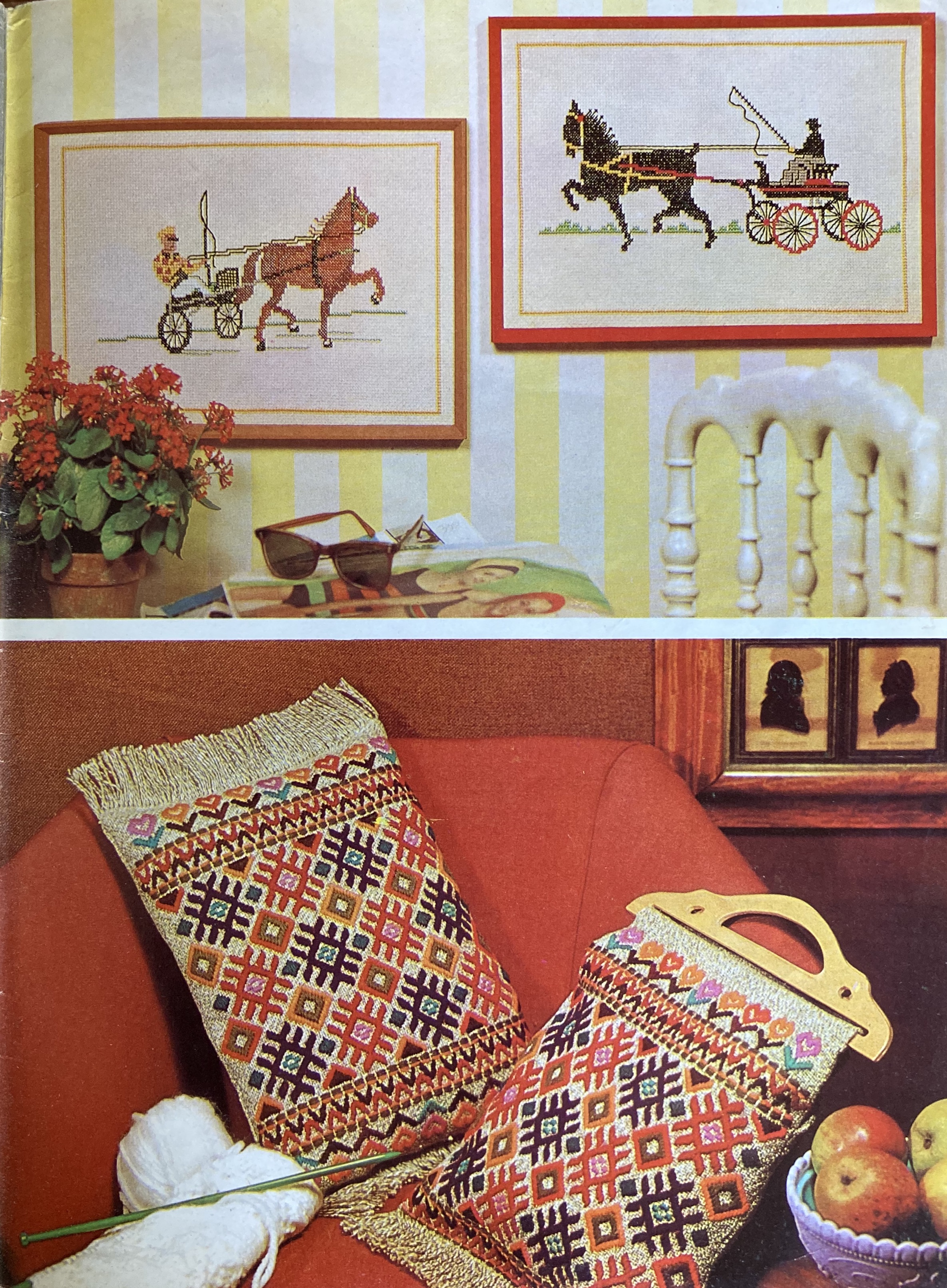
While sitting and sunning at the beach, you can work on an easy homeware project, such as a cross-stitch cushion, a knitted tea or egg cosy, or a tatted lace edging for handkerchiefs or pillowcases. Even the workbag in Turkish darning would be easy enough to work on while on holiday, though the Victorian-esque horse-and-buggy cross stitch picture, the needle etching, and the crocheted rug are presumably easier to work on at home.

That’s it! Summer issues are usually less exciting than autumn and winter, as many people (understandably) don’t like to hold wool in their hands in hot weather. As with many of the mid-1960s issues, there’s nothing in here that particularly speaks to me, so my June project will be another “excursion”, this time all the way back to the 1920s. The project is almost finished (unlike my April and May blog projects…) so I’ll be able to put out a finished project post in time for once, even if it’s neither from Stitchcraft nor from the 1960s. Think of it as a holiday from the usual blog theme.

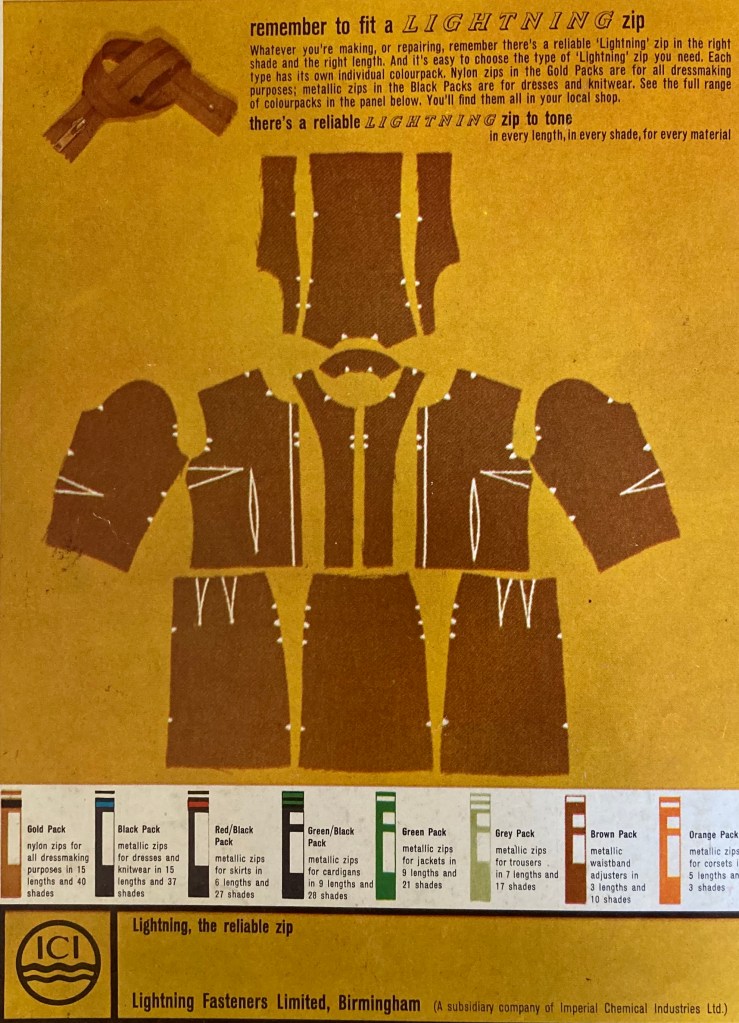
P.S. The back cover is a full-page ad for “Lightning” brand zips and and is illustrated with a very professional-looking pattern for a suit! I am tempted to size it up and sew it. Here it is for any readers who would like to try their hand at it.

December 1963: Overview

Cover photo from Stotchcraft magazine, number 360, December 1963

“Christmas is very nearly here” — where did the year go? As always, Stitchcraft‘s December issue is a mix of warm, bulky, quick-to-knit winter garments for the family and little handcrafts for presents and decorations.

Our cover model is wearing a hat in trendy “high-crowned” style with matching muffler. It uses “Glenora”, Patons new tweedy-multicolour wool. Unlike the “tufted” hat from last month’s issue, this one needs no millinery wire to keep it from flopping — the wool is relatively thick and is used double on the hat to make it really solid and windproof. The buttons are purely decorative and are made by covering button moulds with velvet cut from a strip of ribbon.

Other cold-weather accessories include these mitt(en)s, crocheted in a spiral to make the backs and fronts. Aside from the stripes on the fronts, they are almost identical to these mittens from February 1960. The full-size garments are all made of bulky wools for wamth and quicker knitting. There are pullovers for men and women in Big Ben or Ariel wools, a check-patterned pullover in double knitting weight and a cardigan “in larger sizes” (39-42 inch bust). Both of the bulky pullovers as well as the cardigan use variations on twisted or mock-cable stitch patterns, where you knit stitches in the “wrong order” in order to cross them. Big, pointy collars are still very much in fashion and the colours are bright and bold for winter: “Lipstick Red”, “Strawberry Ice” and “Royal Blue”.

Children get “Christmas sweaters” in holiday colours of red, green, and white, with bold snowflake motifs in stranded patterning.There’s a frilly bed jacket in lightweight 3-ply and a waistcoat variation on the men’s pullover, as well. They’re photographed in colour on the inside back cover. Funny that, with all the brightly coloured garments in the issue, they chose the one beige garment for the colour photo! You do see the tweed flecks better, though. That amazing creation at the top of the page is the Royal Pavilion in Brighton, reproduced in fine embroidery in felt appliqué. This isn’t the first huge, complicated wall panel project we’ve seen and I can only assume that Stitchcraft had a really good appliqué designer.

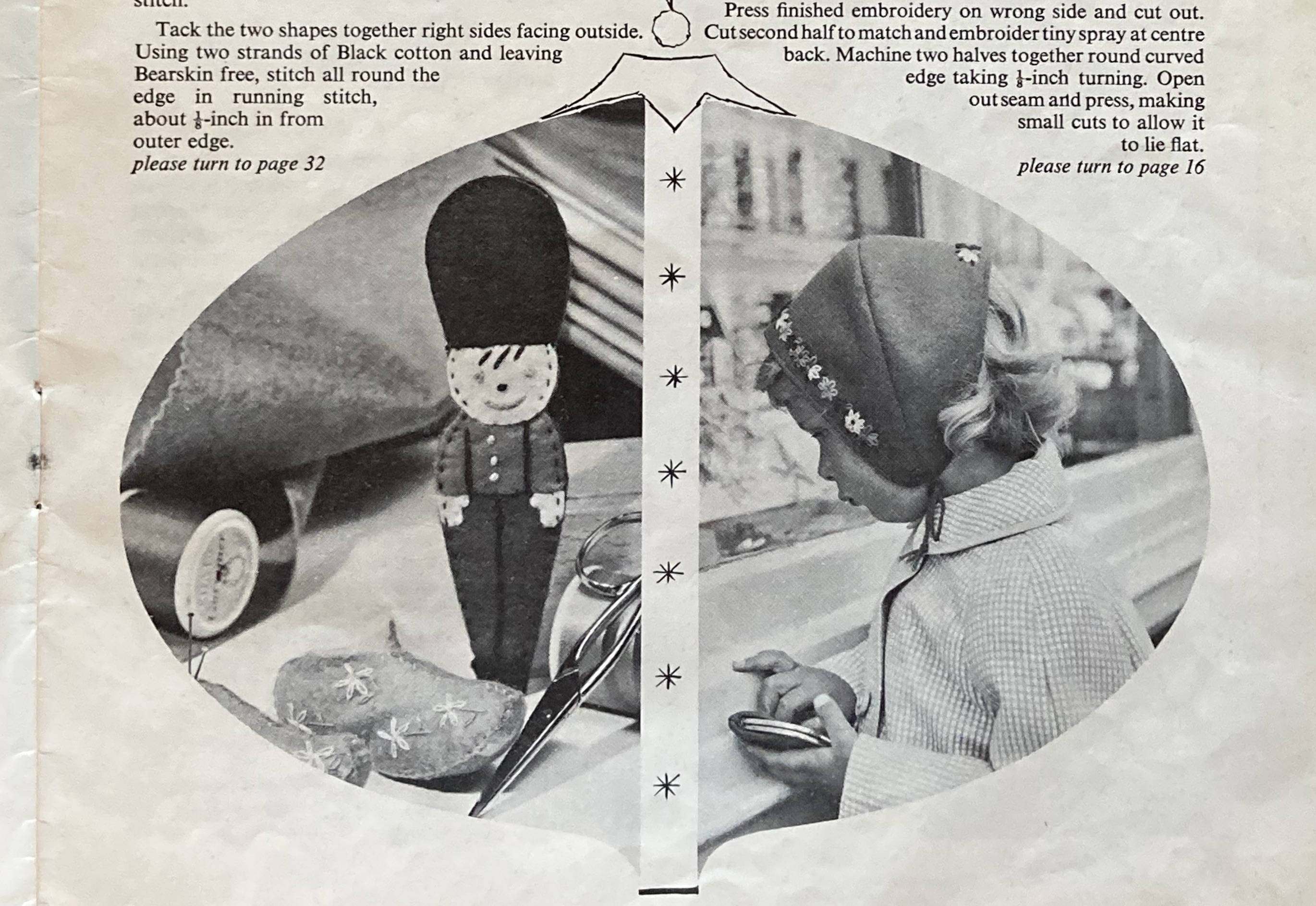
The other homeware/decoration projects are small and easy, intended for little gifts, holiday bazaar sales or to brighten up the festive table. You can knit a little puppy doll complete with its own fully dressed bed, or make some silly but nonetheless cute egg cosies (the human-looking one is supposed to be Friar Tuck.) There’s a “pinny” apron to sew for a child, party table mats with a star motif, and these stuffed and embroidered felt stars to hang on the tree. I made one of these last year and will probably make some more this year — they are quick to make and just the thing for a mini-present.

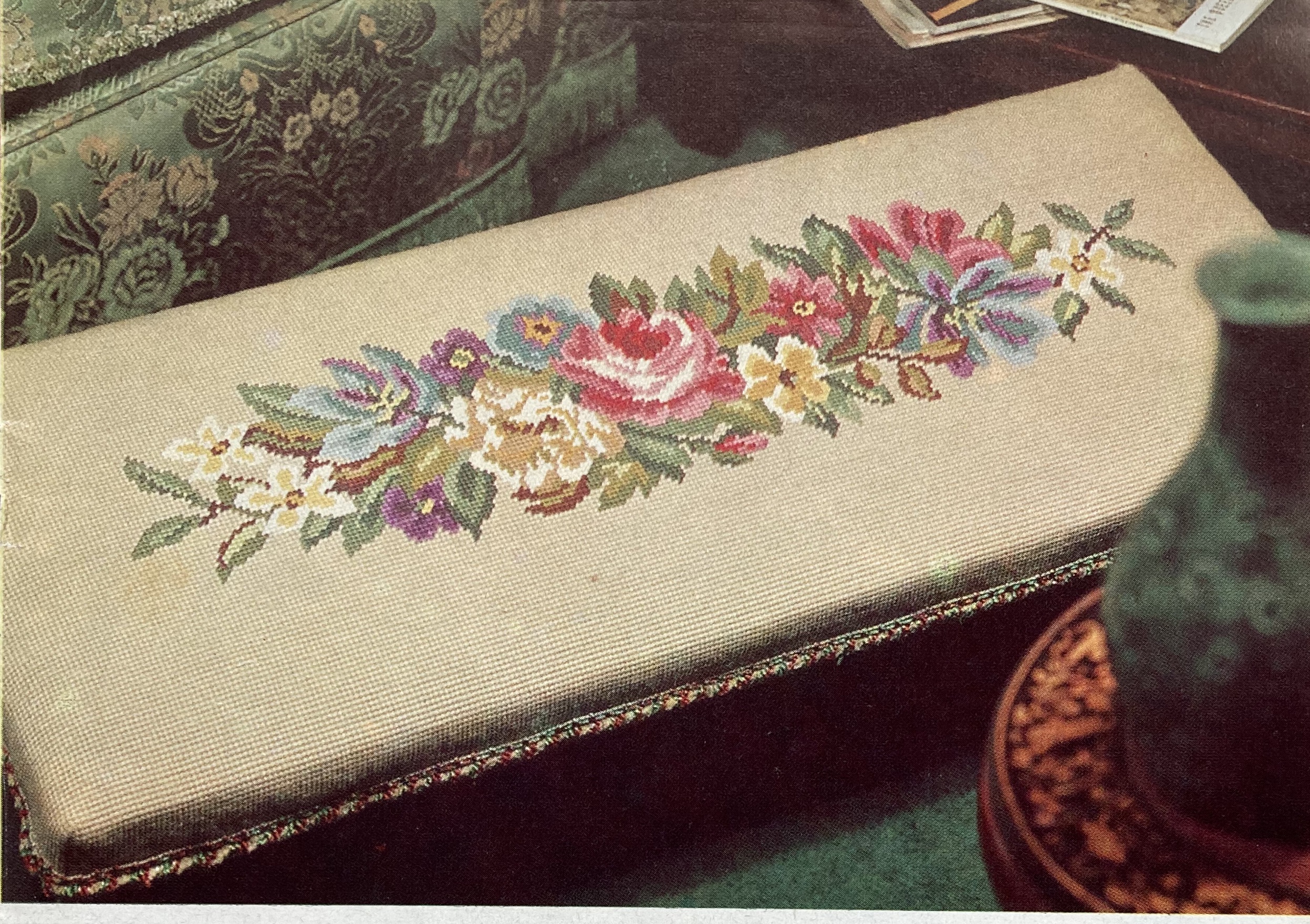
If you have a little more time (but don’t want to tackle the Brighton panel), you can knit a knitting bag, crochet a floor mat, or make a hard-wearing cushion in a standard “ribbon” needlepoint design. If you’ve really got some time on those long winter nights, you can make a set of dining-room chair seats in tapestry, or a large pile rug in a “Byzantine” design. (Beautiful leather satchel in that photo as well! It’s a just a prop, though, of course — Stitchcraft‘s crafts didn’t extend to leather-work.)

Then there’s this design for a little sewn bag with an embroidered horse named Archie on it. Archie, since you asked, is the horse in the children’s comic “The Smuggler’s Sack”, which has been running on the back pages of Stitchcraft for the past few months. It features children Joe and Jenny, who live in a waterfront town whose mystery pirate/smuggler treasure has never before been discovered. Will they be the ones to find it at last? As of yet, they’ve found a mysterious box … which has a false bottom … which contains a map and a key .. which leads them to .. an inn called “The Smuggler’s Sack.” They’re disappointed, but could the inn hold the clue they’ve been looking for? Shades of Daphne du Maurier!

“Archie” will in fact feature in my December project, where I will be embroidering him onto a modern soft case / traveling bag for a pocket synthesizer.

Happy Holidays, everyone!

October 1963: Overview

Cover photo, Stitchcraft magazine, October 1963

Tweed! Remember last month’s post with the advertisement for variegated-colour yarn? This month’s issue presents Patons’ new variegated wool, “Glenora Tweed”, a slightly thicker DK-weight wool with dark tweedy flecks. It appears to have been made up of 80% wool and 20% synthetic fibre. The twelve colours were chosen to be as vibrant as tweed can be (and very 1960s…) with rich shades of red, green, orange and yellow.

As it knits up fast at about 4 stitches to the inch (but promises to still give a “beautifully firm crunchy texture” i.e. hopefully not sag too much under its own weight), it is showcased with larger garments — the “pinafore-style” over-dress and men’s cardigan shown on the cover and two two-piece suits for women. There’s also a pinafore-style overdress with pleated skirt for a older girl and a boatneck sweater for men, both in similar Bracken Tweed wool. In keeping with the newer, looser and more square-shaped style, the garments have minimal or no shaping (except the girl’s outfit) and the skirts come to just above the knee. To me, the women’s Glenora garments look so similar that I had to check twice to assure myself that the pinafore dress on the cover (with high scoop neck) and the two-piece set with skirt and “overblouse” (V-neck) were in fact different designs.

There is a matching 4-ply (women’s) or DK-weight (girl’s) jumper to go underneath the pinafore looks or the overblouse, which, combined with the thick over-garments, must have been suitably warm for outdoors or poorly heated rooms in October. (The girl, of course, is going to have cold legs all the same.) For those who resist the tweed craze, there’s also a bright, fun colour-block sweater in a three-colour slip stitch pattern. I love the matching orange head scarf!

There’s also a fun 4-ply jumper for a child with some easy stranded colourwork blocks at the waist and yoke. The accessories continue the bulky, easy-to-knit trend, with a cap and scarf in Big Ben wool and a big, cosy scarf for men in an intriguing reversible cable-moss pattern.

Rounding out the family’s fall wardrobe is a matinee coat and “helmet”-style cap for a baby, matching the dress from the September issue. The November issue promises a warm shawl to match again, thus rounding out the set. Judging from the photo, “dear little baby Alicia” seems to have realised that the purpose of a helmet-style cap is to prevent the baby from removing it and flinging it around the room, and is suitably disappointed. It’s a great design, though, with the sides and chin strap done in garter stitch to accommodate movement and growing heads.

The homewares are plentiful and here again, there are some larger projects to be tackled at home during the colder Autumn days. The bright red rug in Soumak stitch and traditional design is vivid and cheerful, as is the Jacobean cushion “for the skilled needlewoman” which I would love to make if I didn’t already have two unfinished embroidered cushions in the WIP pile. (Not to mention that I am not skilled enough to make that elaborate a design, especially without a transfer.) The Autumn-themed acorn cushion is definitely easier. There’s a Regency ribbon design for tapestry or cross-stitch, too.

For those who want a quicker, easier homeware project or are already getting started on the Christmas presents, there are more embroidered acorns on cutwork mats and some knitted and crocheted goodies: a “Scottie-dog” night-case, a crocheted bag, and… a hippo, yes, a friendly knitted hippo stuffed animal. Well, why not? It’s cute. An older child might embroider her own Little Miss Muffet picture in cross-stitch.

The very last project in the issue, tucked way back in the “Readers’ Pages”, is the one I will make. In fact, I have been waiting for this issue to come up specifically so that I can make it! It is a very simply constructed and embroidered “Apron-cum-Knitting-Bag” where the front panel and waist ties of the apron fold into the bag part along with your knitting. Pull the drawstrings closed and carry the bag around, then when it’s time to knit you can undo the strings, pull the apron part out of the bag and tie it around your waist, Presto, you are ready to knit in any situation, standing or sitting, and your ball of wool will not fall down and roll about the room. Stay tuned for a project that will actually get finished on time, as well as progress on those projects that didn’t.

August 1963: Overview

End of the Season! Sadly, yes, the “holiday” season is drawing to a close and although it’s only the last day of July, it feels like autumn is around the corner. On the bright side, the late summer and autumn issues of Stitchcraft are always the most fun, with a good range of lighter-weight and warmer garments, children’s things for school, and more intricate homewares.

“The trend for colour use is in these bold clear motifs” writes “editress” Patience Horne, a trend which is reflected in “chunky”, boxy shapes, bright colours and simple stripe or geometric designs. The cover illustration shows two of a three-piece “his and hers” set — cardigan and mock-layered turtleneck for her and a buttoned-collar pullover for him– that all make use of single bold stripes. The woman’s matching pullover is made to look like a deep V-neck over a turtleneck top, but the under-layer is just an insertion knitted separately and sewn in.

There’s more use of simple, geometric motifs in the other women’s garments: a classic pullover with a wide check stripe down the front in double knitting and a colour-block cardigan with diamond motifs made in bulky “Ariel” wool. Diamond shapes are still trending from last month. There’s a bulky indoor-outdoor cardigan jacket in Big Ben wool, made in a slightly less simple striped waffle stitch. Necklines are high, whether buttoned or not, and collars are either big and square or non-existent.

Continuing the interesting neckline/collar trend, we’ve got unisex “tomboy tops” for children, with a cute “tie” decoration on one of the pullovers. Simple, bold stripes and pointy diamond patterns show up here as well, whether in colour or as a stitch pattern element. The one lighter-weight design is a square, buttoned-neck pullover with double stripes near the hem and a coordinated skirt. Rounding out the garments is a lovely classic cardigan for men featuring cables on the upper yoke and — you guessed it — in two simple lines down the fronts.

Unlike the knit designs, some of the embroidery and tapestry projects are quite elaborate and ornate. Look at these Chippendale chairseats! That seems quite out of place to me in a modern 1963 home of clean lines and unfussy decoration, but of course many of Stitchcraft’s readers were older and/or conservative in their style, and probably not on the cutting edge of home redecoration even if they had the money to spend on it (which I’m guessing most of the readership didn’t.) The “peasant motif” tablecloth and cross-stitch place mats have more of a clean, colour-block aesthetic. I really love the tablecloth design! It can also be adapted for a cushion. Speaking of cushions, here’s a fancy one made of essentially two very large, intricately knitted lace doilies joined together around the cushion base.

And let’s not forget that standby of every proper 1960s home… the fluffy hand-made bathmat and matching well-dressed “pedestal” aka toilet! Hats off to every grandmother and great-aunt who kept true to this amazing home furnishing concept throughout the rest of the 20th century. (Seriously, one of my great-aunts had a setup like this in her guest bathroom in the plushiest, fluffiest, yellow and black shag carpeting you could imagine, and I’m pretty sure it stayed there until the turn of the millennium.)

That about wraps it up for this month’s issue. The ads are unspectacular and a new children’s comic is starting up, featuring twins Joe and Jenny on their hunt for the legendary “Smuggler’s Sack” that just might be waiting to be found in the caves near the beach. Good luck, little friends! My project for this month will be the men’s cabled cardigan.

June 1963: Overview

Cover photo from Stitchcraft magazine, June 1963

“Light & Airy” is the theme of the June 1963 issue, with short-sleeved 4-ply knits as well as bulky items made in fluffy, lighter wool/synthetic blends. June is also the beginning of the holiday season, “where the emphasis to-day is so much on the active side and casual look — sailing, rambling and of course, so much travelling” (Patience Horne, “Editress”). Accordingly, many of the projects are easy, quick and/or small, to be finished before the travelling starts or suitable for working from your deck-chair.

In her introduction to this issue, Editress Horne also has a “special word for older readers”:

Remember that top models all come in the young age groups, but many of our designs, though often photographed on young models, are very suitable for older women, and often, a sweater with a long line, can be shortened without difficulty, for the more mature figure.

Graphic of a dandelion with the words "Light & Airy"

The 1940s and 1950s issues of Stitchcraft did have older models from time to time, usually modelling the designs intended for those “mature figures”. The 1960s issues often have plus-size designs and models, but they are indeed all on the younger side. I assume this had to do with the target demographic slowly moving from young working women and older matrons after the war, to young(ish) mothers of future Baby Boomers in the later 1950s and 1960s.

Anyway, on to the designs! The happy holidaying couple can make matching cardigan jackets in lightweight-but-bulky “Ariel” yarn when they play tennis or go “strolling and sight-seeing.” Diamond and zig-zag patterns make a showing in stranded colourwork patterns (the cover blouse), textured stitch patterns (the panelled 4-ply jumper and short-sleeved cardigan blouse) or Swiss darning (the colourblock “playtime sweater” worn by our young drummer.) The same Swiss darning (a.k.a. duplicate stitch) embroidery is used for tiny accents on a casual, collared cardigan.

The youngest of the family get a cute “matinee coat” and/or jacket decorated with regular embroidery, or a sun-suit with matching short-sleeved cover-up. Embroidery is definitely a trend! Collars and neckline finishings can be subtle, non-existent or big and bold, as seen on the woman’s cardigan and this men’s casual, tweedy shawl-collar number.

The homeware projects are all fairly simple and versatile, one design being suitable for different types of project, but some are too large to want to take along on holiday. There’s a tablecloth and/or chairback with cutwork ivy design, a rose motif apron and/or cushion, and a Victorian-inspired cushion and/or stool seat in tapestry and/or cross-stitch. Pick your combination!

The outdoor cushions with sea motifs are a good summer-themed project, or you can preserve your holiday memories in a needlepoint picture of Lynmouth. There’s also a cross-stitch rug for a larger, at-home project.

With so many interesting ideas to choose from, I’m sure nobody’s holiday will be too relaxing, ha ha. I am undecided about what project to make. I am so far behind and have so many unfinished projects! At the same time, there are too many projects from this issue that I would like to make. I could genuinely use a new cardigan and the embroidered one with the big collar is just my style… but where will I find the time to make another full-size adult garment? The same goes for the short-sleeved cardigan blouse and the panelled diamond-stitch jumper. The baby coat or cardigan would be practical for using up stash and might actually be done quickly enough, so that might be the best choice. Stay tuned!

March 1963: Overview

Cover photo, Stitchcraft magazine, March 1963

Start your engines and give that propeller a whirl! The theme of this month’s issue is “Fashion On The Go” and the photo team really outdid themselves in showcasing adventurous and enjoyable modes of transportation. “With the wonderful opportunities for travel”, writes “editress” Patience Horne, “you need clothes that are easy to wear and will carry you through the day without a lot of care and pressing.”

Travel opportunities definitely took off (pun intended) in the early 1960s. Passenger air travel, though still a luxury, became increasingly possible and affordable with the advent of jet aircraft. Ocean liners, challenged by the rise of air travel, revamped into cruise ships. The Eurail train pass was introduced in 1959. Huge improvements in automobile technology and design made the freedom of the open road more tempting and accessible than ever. Yearly sales of Vespa scooters doubled from 1956 to 1960. Of course there was very little, if any, concern for environmental factors, and the oil crises of the 1970s were far in the future. There was no better time to travel.

On the race-car track, our cover model is wearing her “Paris Flash Slimline Blazer” — a simple but elegant jacket in moss stitch — and her colleague is sporting a “Double Quick shirt waister” that promises to be “the perfect travelling dress”. In a lovely juxtaposition of modernity and history, the model in the photo next to her is posed in front of what looks like an old-fashioned, horse-drawn stage coach! Her twin-set is made in finer 4-ply wool and though you can’t see it in the photo, the jumper is made in normal stocking stitch and the cardigan in reversed stocking stitch. In a separate photo, you see her posed in front of a horse box — no doubt one of the horses who pull the coach. Train travel is covered with a beautiful photo of this tweedy green travelling coat. It looks very cosy, but as it is made from 60 ounces (!! 3 3/4 pounds or 1700 grams !!) of extra-bulky, extra-heavy Big Ben wool and unlined, I can only imagine how it will stretch and sag with time and wearing.

The centerfold photo showcases more glamorous nautical and aerial travel opportunities. (I am sorry to say that the photo is blurry in the magazine, not just in my photo.) The “boat-deck sweaters” are both in double knitting weight with plain stocking-stitch and collared-shirt form for him, fun nubbly Rimple wool and a welted front insertion with cute tied collar for her. Collars, in general, remain well in fashion, though they are not quite as large as in the last few seasons. The airplane enthusiasts in the right-hand photos sport a casual, oversized cabled cardigan in bulky Big Ben wool and a striped dolman-sleeve pullover in double knitting weight. The dolman pullover sits weirdly around the neck and looks like it would be awkward to wear.

For those who prefer more leisurely ways to travel, i.e. walking around town, here’s a “stroller sweater” in fluffy Ariel and a sort of diagonal basketweave stitch pattern. Even the children get a travel-themed photo, if only in the studio! While the little sister is very keen to drive her wooden locomotive, big brother is apparently tired of playing conductor (but still blocking the tracks…) They’ve both got wonderful things to wear. The two-tone pleated skirt is knitted sideways and the pleats sewn in with the making-up, and his light-weight pullover has another fun diagonal knit-and-purl pattern.

With all these wonderful things to knit, you would think the homewares would be less interesting, but there are still plenty of projects that are mostly small enough to pack with you on your travels. There are all sorts of cushions to embroider: darned and tufted in very 1960s colours (brown, biscuit, fawn, two shades of orange and two shades of rust), neon-on-black “peasant embroidery” in regular crewel work, and with a matching chair-back in Assisi embroidery — traditional Italian designs where the backgrounds and ornaments are filled in with cross-stitch, but the main motifs are left unworked. The Victorian-inspired tapestry chair seat and stitched bathroom rug are probably too unwieldy to pack, but the fine embroidered initials and baby outfit are easy and portable. Readers could order the pattern for the baby set along with the embroidery transfer.

The back pages feature the worst of the Patons & Baldwins “please your man” advertisements, in which a woman can’t even knit herself something for once or look nice in it without all of it being To Please Him. (And then she has to pretend to be interested in whatever boring mansplaining he’s doing with the book he’s showing her.) I can’t help thinking of that scene in Vertigo where James Stewart’s character is trying to get Kim Novak’s character to dye her hair… and she doesn’t want to… and he gets more and more frustrated before blurting out, “It can’t matter to you!” Alfred Hitchcock would have approved of this ad.

The “Children’s Features” continue the alternative telling of the Miss Muffet rhyme story, in which Miss Muffet, leaving the home of the kindly spider-lady, gets captured up by a grumpy beetle, saved by the first spider, and then in turn saves a captured beetle who promises her a present. What could it be? We will find out in next month’s issue!

None of the larger projects are begging me to make them and I’m still working through the WIP pile, so I’m going to use some of that fine embroidery on the vintage handkerchiefs I inherited from my grandmother.

February 1963: Overview

This month’s issue brings us on another lovely photographic journey, with “elegant settings for Spring Fashions” in and around historic Bath. Looking closer at the photos, it’s clear that some thought went into the combinations of outfit and setting. The “city” photos show models in elegant knitted dresses or suit-like separates, whilst the “country” photos highlight the continuing trend for casual, bulky garments that could theoretically be worn as outer garments instead of a coat in spring weather.

Our cover model starts off the “city” look with a fur-trimmed dress in “Ariel“, a bulky, yet airy triple-knit wool-acrylic blend. It’s advertised as being “light as thistledown” — the whole dress uses 14, 15 or 16 2-ounce balls of wool, which comes out to about 550 grams for the middle size stitch pattern. I’m guessing the diagonal slip-stitch herringbone pattern and ribbed, belted waistline also help control any sagging. The same yarn and same stitch pattern are used for a jumper-and-skirt set in a dramatic yellow and black colour combination. Look at that model’s hair! I always thought people with red hair should never wear yellow, but she looks amazing. Bobbles on ties feature in both the belt of the dress and the neckline of the jumper and skirts are still just below the knee.

Rounding out the elegant city category is a classic skirt set whose rectangular, unshaped form is made more elegant by the use of vertical lines on the cardigan. Bouclet wool in fingering weight keeps the effect sleek and light.

For casual country wear (a.k.a. “The Open-Air Look”), bulky Big Ben wool is still the first choice, or double knitting weight for a somewhat lighter look. Both the men’s and women’s garments are hip-length and unshaped and cardigans are mean to be worn buttoned. At the same time, interesting stitch patterns, textured wools and details like collars and pockets break up some of the shapeless-bulky effect. Even toddlers can join in on the fashion fun with a knitted bathrobe, which showcases many of the current trends (bulky “Ariel”, textured stitch pattern, contrasting collar and cuffs, and a bobble-tie belt) as well as being practical for chilly homes in February.

The homewares in this issue are mostly standard fare — cutwork or embroidered aprons, tablecloths or finger plates — but a couple of more creative ideas stand out. There’s a pile rug with a “modern” design, which I would have loved to have seen in a colour photo (note guitar and records — I did mention that the Beatles’ first album came out in 1963, right?) and a crocheted and cross-stitched bathmat that makes it very clear in which room it belongs (though I can’t help laughing when I think that this issue was also photographed in Bath — they could have had some absurd fun with the bath mat in front of the cathedral or one of the historic buildings…)

For tapestry fans, there’s a prayer book cover and kneeler “for an Easter bride” with a flowery cross pattern, using gold Lurex thread together with wool (kneeler) or silk (book cover) for extra luxury. There’s also a footstool made up of old tins! They used old stockings to pad and wrap the clean, empty tins, then stitched fabric around the bottom and sides and covered the top with the tapestry. The result is a bit oddly shaped, but I suppose it would be quite useful — strong and able to support a bit of weight, but still quite light — and I admire the creativity and the upcycling spirit.

There are no particularly interesting advertisements in this issue, but in the ongoing children’s retelling-of-fairy-tales comic series, Miss Muffet gets invited to the spider’s home, where Mrs. Spider shows her the lace curtains and tablecloths she has spun out of spider-silk and teaches her to spin a shawl. How sweet! Next month: “The Beetle-lady.” (Also: Note the ruler printed on the side of the page, to make it easy to check your knitting tension. It’s in every issue.)

I’m a bit at a loss as to what project to make from this issue. I love the “Ariel” cover dress and yellow sweater, but I have serious stash overflow and so, so many unfinished projects, so I would prefer to make something small and easy. I am not religious and would probably not have much use for a prayer-book cover or kneeling pad even if I were, but the flower tapestry design without the cross would be pretty and versatile, and I still have tapestry wool and backing fabric from an earlier failed project. The question is, what should I make out of it? A clutch purse? Coin purse? Cell phone cosy?? I already have so many little zippered bags for knitting tools and sewing notions and general “stuff”. I’ll give it some thought and let you know. If it’s easy enough, I will hopefully be able to finish up and edit some of the WIPs lying dormant in the blog. Stay tuned!

November 1962: Overview

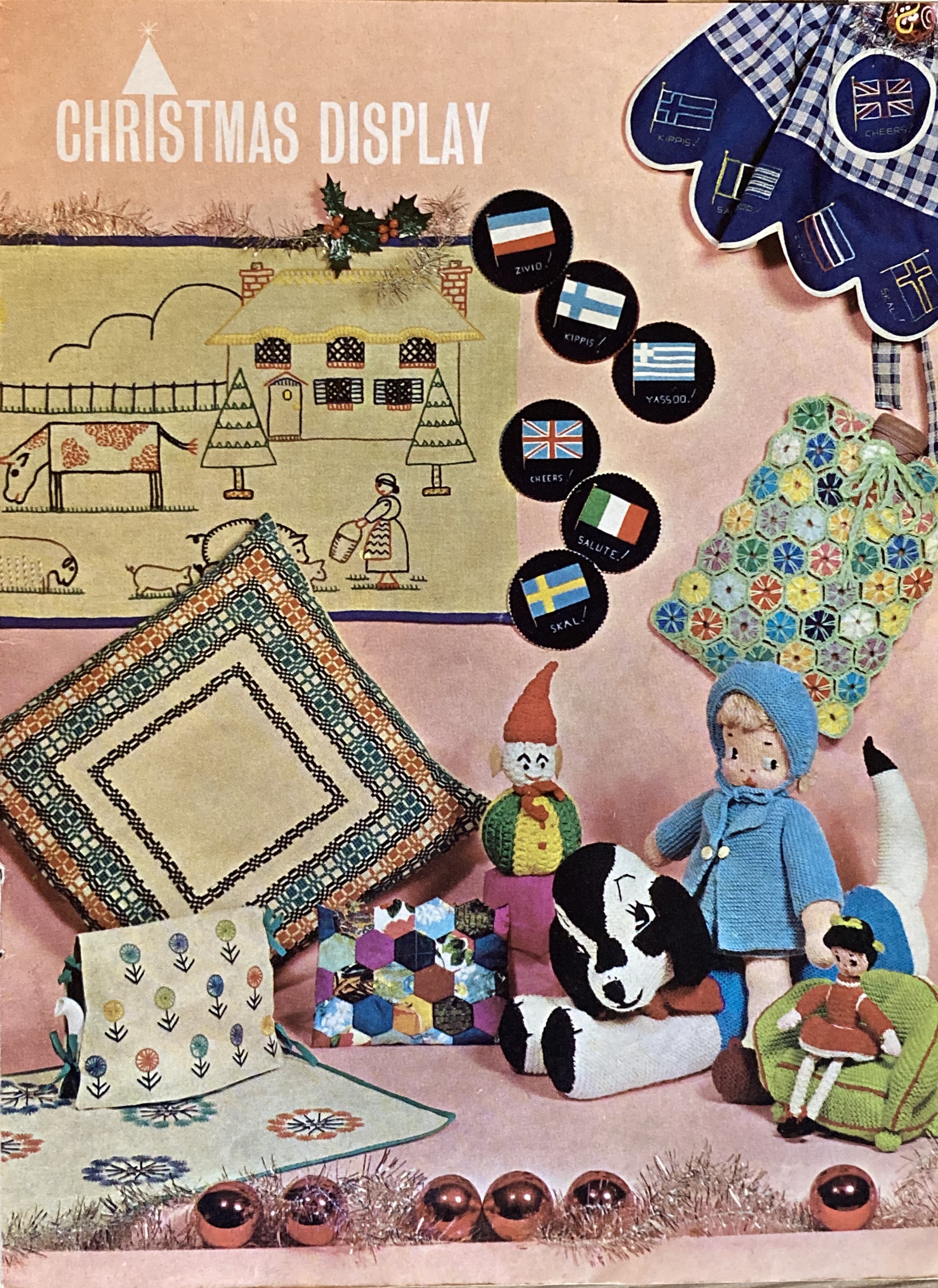
For 1960s Stitchcraft readers, November means holiday planning, so this month’s issue is full of quick homewares for decorating and small, easy projects for gift-giving. The garments are warm and bulky, featuring Patons’ new “Ariel” wool. Warm autumn tones of brown and orange as well as bright, cheerful holiday reds and blues are the colours of the season. Christmas Plans and Winter Fashions ahoy!

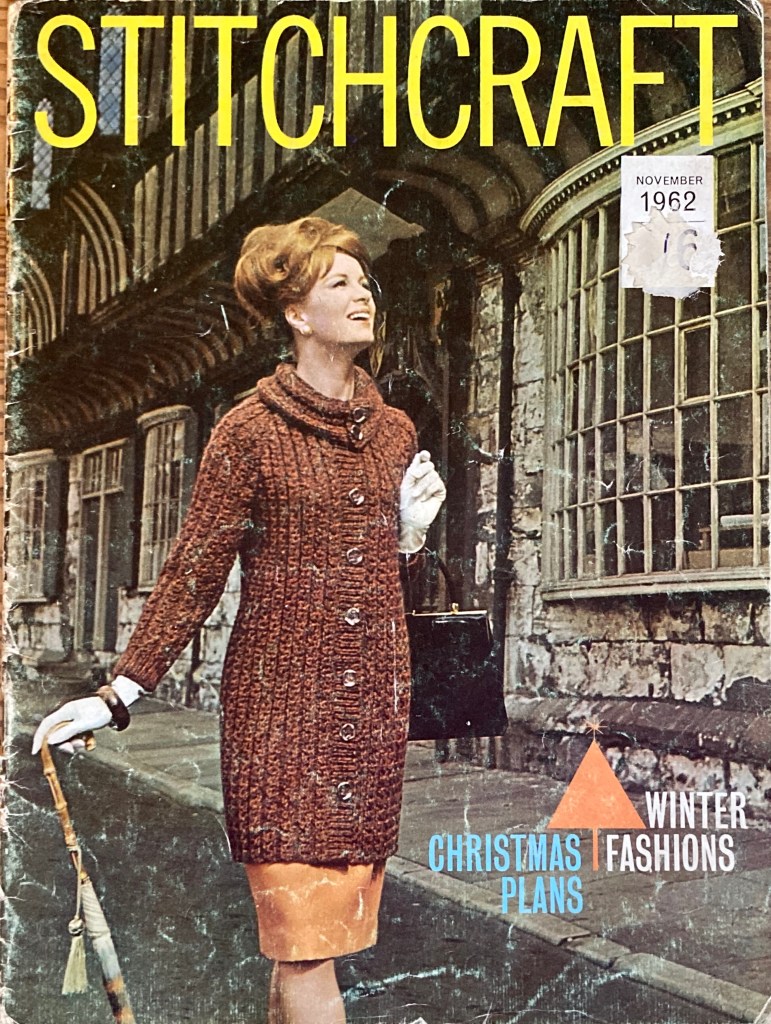
Our cover garment is a bulky, yet elegant coat in Big Ben wool, weighing in at a hefty 52-56 ounces (up to 3 1/2 pounds, or about 1500 grams). The mock cable/twisted rib pattern certainly won’t curl at the bottom edge, which is why I guess it’s designed without a hem or ribbing, but at that weight and in that pattern, I suspect the coat would grow ever longer and ever narrower (just in time for holiday weight gain). Still, it looks lovely! I especially like the buttoned collar. Also, I just might try to re-create the model’s hairdo with my long lockdown hair.

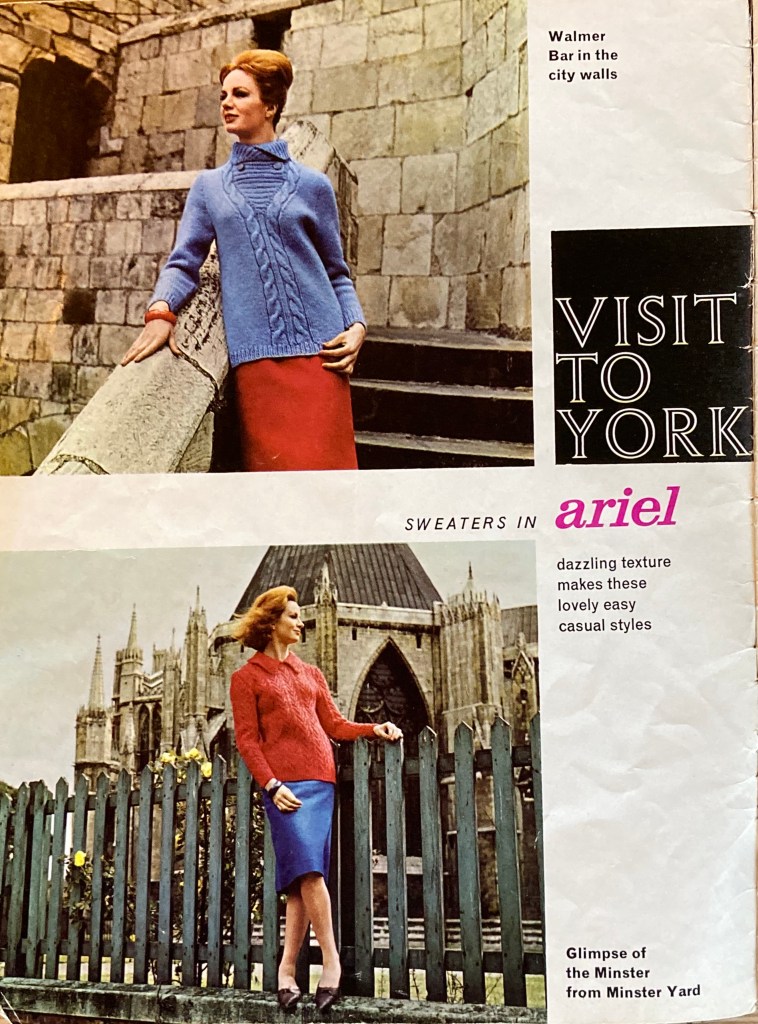
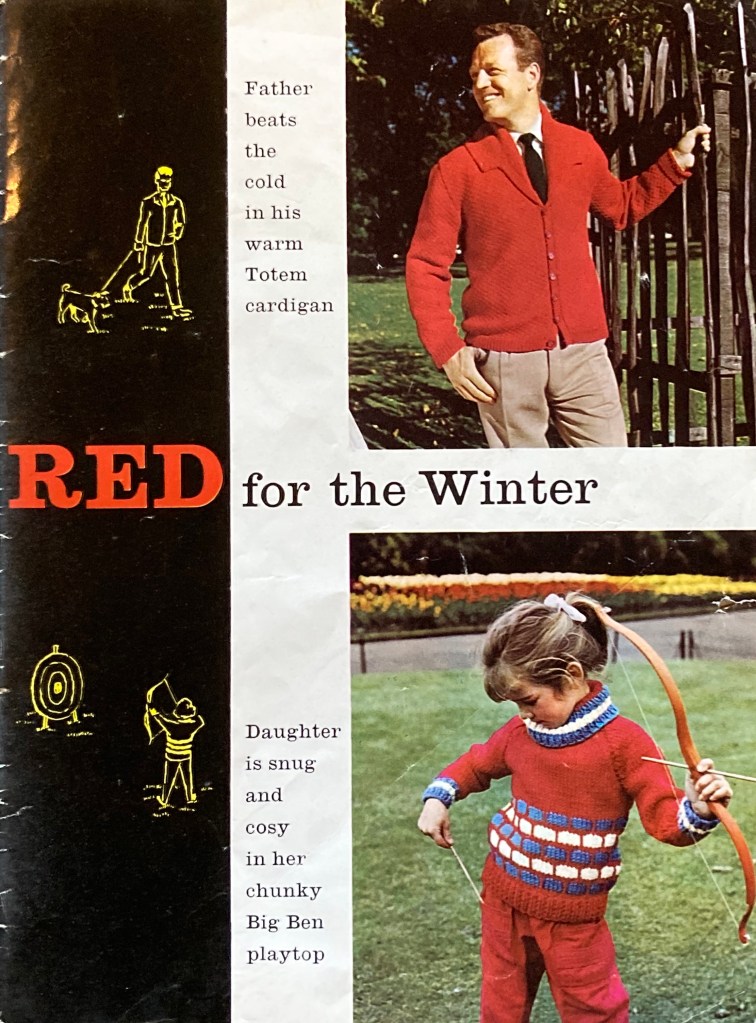
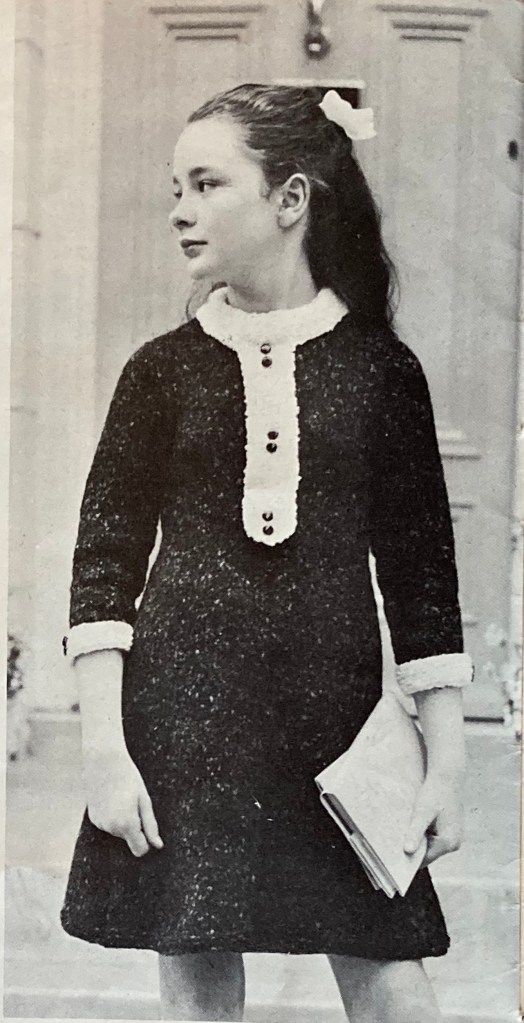
The outdoor photography was taken near historical buildings in York, whose grey-beige stone walls give a nice background to the bright red and blue sweaters made with “Ariel” a bulky, yet “feather-light” (well… 20-24 ounces for a sweater, so lighter than Big Ben, at least) wool-synthetic mix. I really like the red chevron sweater and it doesn’t look bulky at all to me, just fluffy and cosy. Father and daughter also get warm, cheerful garments, and look at this amazing mini-dress for a young miss! That is going on my list of patterns to adapt for myself.

Older teens and young lovers can make “the ‘sweater-match’ theme with girl-friend and boy-friend” – classic pullovers with cable ribs in double-knitting weight and identical except for slightly different shoulder width and back length proportions. That’s all for the knitted garments in this issue, since the real focus is on Christmas preparations with little gifts and housewares.

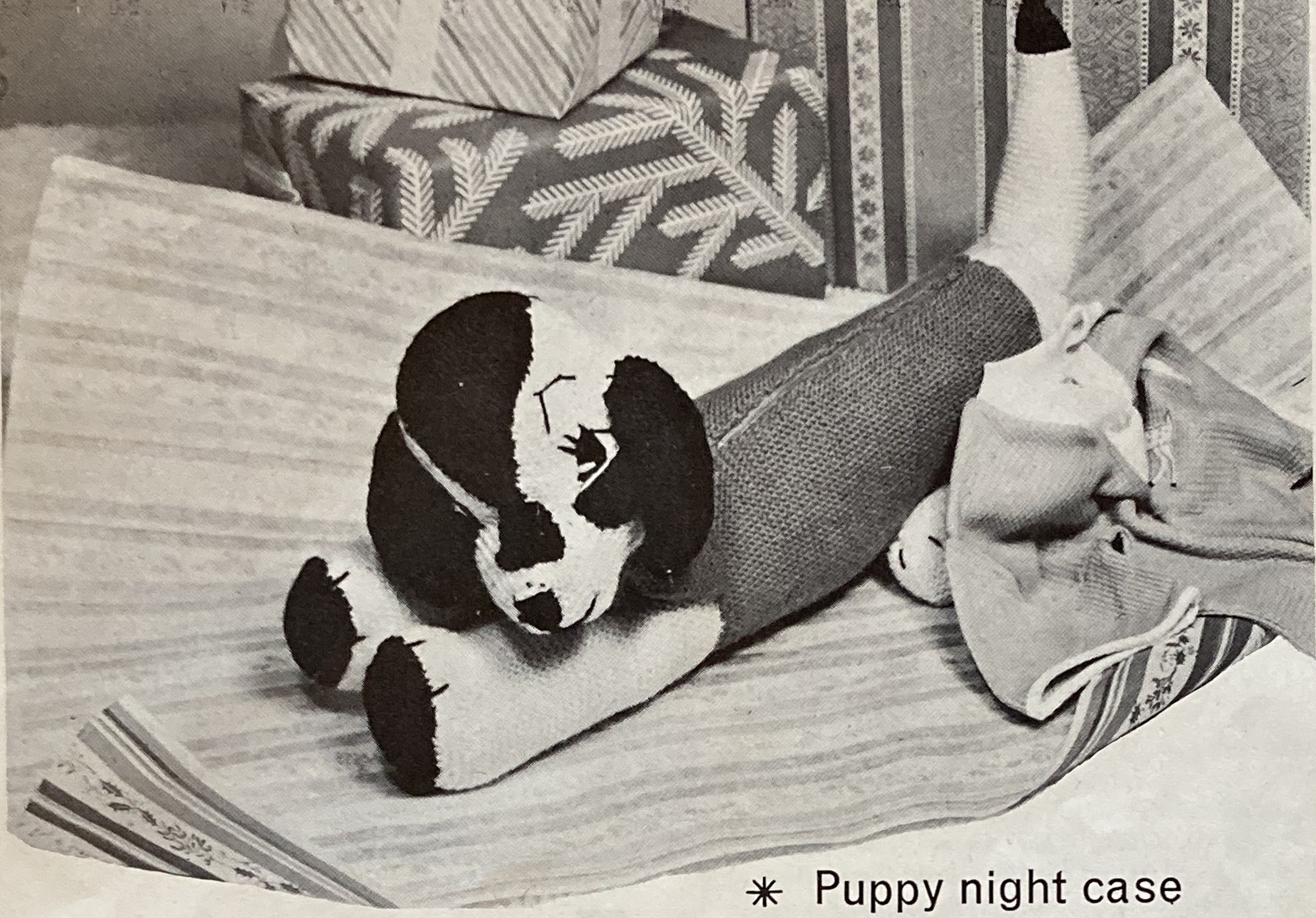
For children’s gifts, there’s a doll, clothes for another doll (pattern in last month’s issue), and a night case in the form of a puppy. This last was especially popular around the late 1950s and early 1960s – I have a different magazine with a poodle nightcase on the cover, and Stitchcraft also had some kind of poodle nightcase in the later 1950s. Poodle or puppy or not, I don’t know why a person would want to put their nightgown in a special case in or on the bed. If you don’t want other people who might be using the room to see your nightdress lying around, you could just… put it under the pillow?

There’s an intriguing “Byzantine” cushion, a firescreen with this month’s embroidered flower (chrysanthemum) and some little gifts sewn in felt, but the more interesting projects are displayed nicely in the large colour photo in the middle of the issue. We’ve got an embroidered farm scene for the nursery wall, a “hostess set” of apron and coasters featuring international drinking mottos, the usual cross-stitch cushion, and a tray cloth/tea cosy design that I would love to adapt to an iPad/tablet cover. Crocheters can use up all their scraps with medallions or a … cute? eerie? not sure what to say about it? pixie doll and patchwork fans, generally ignored by Stitchcraft, finally have a little bag as a starter project.

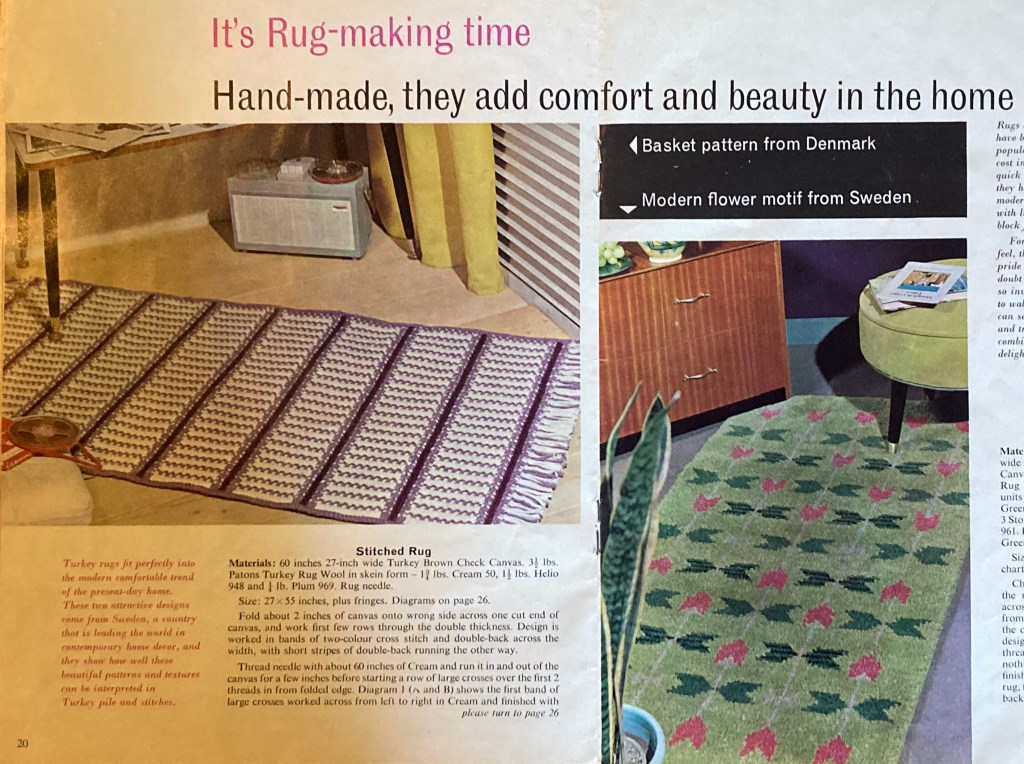
There are even rugs in Scandinavian designs (is that basket pattern from Denmark or from Sweden?), one stitched, the other done with a latch-hook.

What an issue! There are so many projects I would like to make from it: the girl’s dress in my size, an embroidered tea-cosy for the digitalised world, the little girl’s bulky red sweater, even the green latch-hook rug. Sadly, pandemic and lockdown have thrown a monkey wrench into my current knitting plans, it’s hard to get supplies, and I’m trying to finish or even start multiple other large projects that were planned or promised or have been lying in the WIP pile for ever. One of those WIPs was a (non-vintage) garment that I will have to frog anyway (ran out of wool and can’t make it work), so the plan is to frog that project and use the wool to make “Father’s cardigan” from this issue. Said project and I are geographically separated at the moment, though, so long story short: I do not know when I will be able to post a November project. Take heart, though: there will be some more Stitchcraft cooking fun in December as well as a special surprise next week.

June 1962: Overview

Holiday season is in full swing in this month’s issue, with featured photos taken in pretty villages in and around Buckinghamshire and Kent. All the projects are easy and fairly quick to make, and even the fit is relaxed: the close-fitting, waist-length jumpers that were still more or less in fashion in 1960 and 1961 have now completely given way to loose-fitting, hip-length sweaters and blouses. I could use some relaxation, couldn’t you? Let’s dive in… gently.

The cover sweaters check all the 1962 trend boxes: loose, easy pullovers for “him and her” in sunny lemon yellow with interesting stitch textures and contrasting collar-and-cuff accents. Soft yellows, pastel shades and white show up again in the more glamorous “holiday sweaters” made with Patons’ Fuzzy-Wuzzy yarn (55% angora, 45% wool), as well as the women’s 4-ply “golfer style” cardigan (in “gay turquoise” and white 4-ply) and men’s “shirt-style” pullover in presumably light beige “Palomino” colour with contrasting collar.

The other garments are all photographed in black and white, but the yellow/pastel/white and contrasting accent trends are clear from the colour names of the yarns: the pretty “Junior Miss” cardigan is knitted in 4-ply Nylox “Sunglint” (the same colour as the cover sweaters), the “afternoon style” blouse is “Bois de Rose” pink and the bulky, textured Big Ben sweater is “Spring Green” with a white collar.

The smaller children of the family need something fun and easy for holidays too, of course, so here are some “seashore sets for toddlers in the swim.” They’re made in Nylox (80% wool, 20% nylon) and I don’t think they would be suitable for actual swimming, but definitely cute for playing around on the beach and splashing around.

With all these lovely things to knit, it’s not surprising that the homewares section is a little boring. Fittingly enough for June, this month’s flower is the rose, featured in a pattern for a “finger panel” to attach to a door. Readers, you have been so helpful in the past with solving mysteries for me, so i ask you: Why a finger panel? It seems to be used to keep the door clean from grubby handprints, which I can certainly understand in a family home, but I don’t see why it would be easier, or preferable, to wipe those grubby prints from an embroidery panel mounted under acrylic glass than to just wipe them off of the door. What do you think? Am I missing something here?

Otherwise, we’ve got some Scandinavian tapestry cushions, a “modern” (geometric and also Scandinavian design-inspired) hall runner rug, a more complex cross-stitch tablecloth (white and green on yellow linen, to match your yellow sweaters), some unspectacular oven mitts and some genuinely cute table mats in appliquéd and embroidered felt.

I feel more relaxed already, don’t you? There’s nothing from this issue that particularly inspires me and I have many WIPs to finish up, so my June project will be a “Blast from the Past” featuring a wonderful twin-set from a 1947 issue of Stitchcraft.

October 1961: Overview

IMG_2820October 1961 gives us “Colour for autumn” with “special fashion features” and a great center spread with colour photos. “I always think October is a nice friendly month,” writes “editress” Patience Horne on the facing page, and I have to agree.

Bulky Big Ben wool and different kinds of textured ribIMG_2821 stitches play a prominent role in this month’s issue, starting with the partner-look pullover and cardigan on the front cover. Both are made in the same drop-stitch rib pattern — basically 2×2 ribbing, but you drop a stitch down 3 rows every 4th row and pick it up again in the next row to make a long vertical rib. Children get twisted-rib raglan pullovers to keep their upper bodies nice and warm while their legs freeze in tiny shorts and mini-skirts, typical for the era.

Nubbly Rimple wool may be easing out of fashion, as there’s only one pattern for it in this issue: a simple, yet elegant dress with “the new horseshoe neckline.” Other women’s garments include a cabled cardigan with colour accents and matching cap, a long-line pullover with a wide collar (still in fashion) and saddle-stitching detail, and a cardigan jacket in a wonderfully ornate Florentine stitch that involves a lot of slipping, dropping and pulling stitches up and around in two colours. The finished effect is a lot like a trellis, accentuated here by posing the model in a green skirt and holding on to a plant. Autumn colours of gold, orange, and beige prevail.

There are some additions to the “Stitchcraft Layette” for the smallest member of the family, but we’ve moved on from the bramble-stitch pattern in the last few issues to a mix of cables and flower motifs. Both cardigan and blanket are  pretty and useful, but I don’t like the huge dolman sleeves on the cardigan —  I can see a baby getting their arm stuck inside it. The bottle cover with a fuzzy knitted kitten on it is great, though! If it were made somewhat smaller or larger, I could imagine it as a phone or tablet cover.

In the homewares and accessories department, we’ve got the usual teapot cosies (how many can one household have??), a knitted donkey named “Ned”, and a pair of “mitts for a scooter fan” — with separate thumb and first finger. There are tapestry patterns for a piano stool and a chair seat, and did you honestly think we were finished with the Zodiac theme, just because all the months had had their patterns already? Of course not! Now you can order the complete chart and embroider them all one more time on a tablecloth.

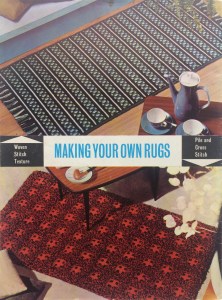
The back cover illustration shows two hand-made rugs using different techniques: flat crossed stitches for a woven effect, or stitching combined with pile knotting (latch hook), which was apparently the latest thing in Sweden at the time.

IMG_2838


The highlight of the home art section, for me, is this sequinned, glittered appliqué wall hanging of some of Great Britain’s famous kings and queens. I don’t think I would hang it in my own home, but what a wild idea and the appliqué and embroidery work is certainly stunning. Look the detail on Queen Elizabeth (I)’s face! And they definitely found a wall with the perfect wallpaper to hang the sample piece on.

The “Readers Pages” have the usual ads, kiddy comic (Sally in Sampler Land), a preview of the next issue, and some easy counted-stitch ideas for borders on towels, pillowcases, etc. I love this ad for the latest Coats crochet booklet — it has flower-arranging lessons in addition to the crochet patterns.

IMG_2836


That’s all for now! My October project will be the baby cardigan (with modified sleeves) and maybe some kind of phone-cover version of the kitten bottle cover.


September 1961: Circular Rug to Crochet

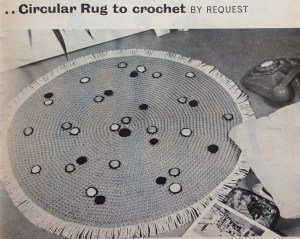
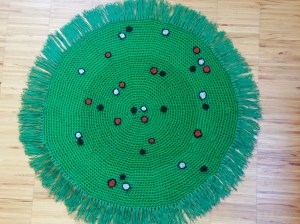
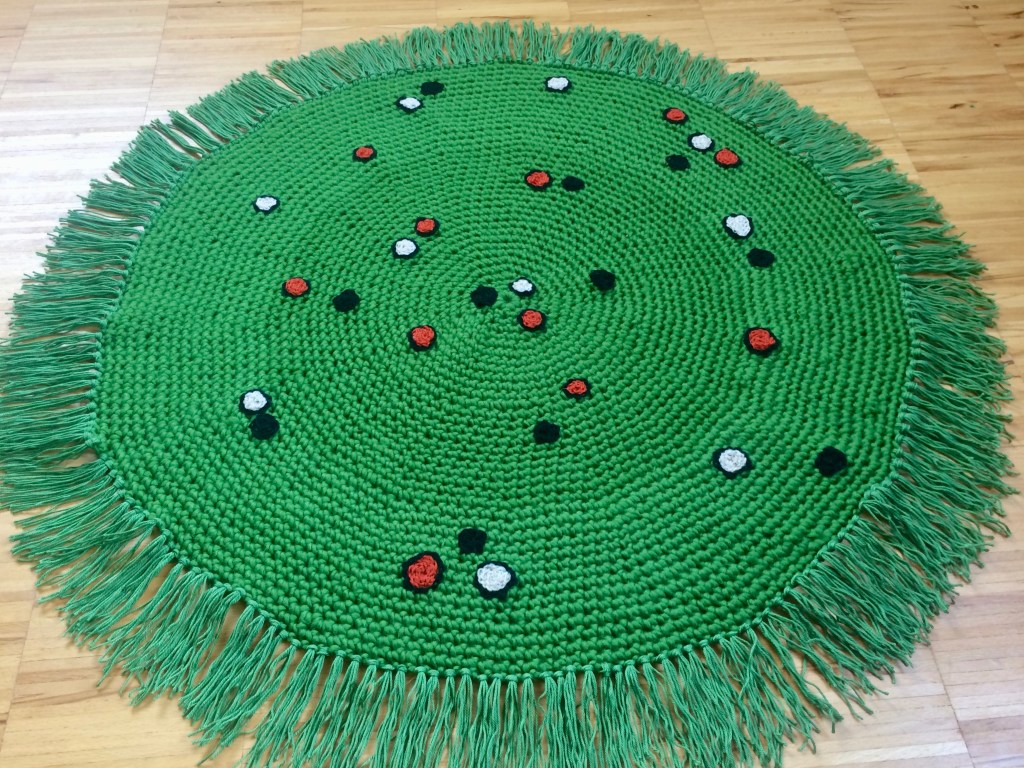
IMG_2785September’s project (finished only one day late) was this extremely 1960s crocheted green rug with black, white and orange embroidered spots (they “add a modern touch”) and fringe. Loved it!

Before I could start, I had to figure out what kind of wool to use. Rug wool, such as the Patons Turkey Rug Wool in the pattern, was available in the 1960s in large skeins by weight and rugs could be made using tapestry stitches on canvas, crocheting, tufting or using the latch-hook method. Latch-hook rug makers had to cut the wool themselves and there were ingenious little tools to help them do that, like this Patwin rug-wool cutter or this “strip slitter” from Bliss. Later in the decade, “cut packs” were introduced for latch-hook use and it is now very difficult to find rug wool in skeins.

IMG_2763Felting wool, like rug wool, is bulky, mostly unprocessed, coarse and strong, so that was my first thought… but would it felt with use or washing? I decided to take the chance, since it’s easy to find, inexpensive and there happened to be some in the perfect colour at my local yarn shop. It’s the exact same shade of green as the embroidered cushion from 1960 that I made last year! It even possibly matches the original colour from the pattern, “Green Haze”.

I had to order more wool than they had in the store. To figure out how much wool I needed, I asked a better mathematician than me if he could work it out using the diameter of the swatch, finished diameter of the rug (29 inches without fringe) and the amount of wool per skein. Then I calculated it myself based on the number of stitches in one skein’s worth of wool and the total number of stitches in the rug. We were both a bit off — he thought I would need 11 skeins (65 grams) and I thought I would need 9, when in fact I only needed 8. Then again, the 8 skeins made a slightly smaller rug when done by the pattern, so I kept on for a few more rounds and used one more skein to get the proper size.

IMG_2802The crochet part was easy — just rounds of double crochet with regular increases — and went very quickly. You can see that the wool I ordered was from a different dye lot than the first skeins from the store, but I don’t mind. The embroidery was a bit tedious and the fringe posed a new problem: this type of old-fashioned cotton sew-on fringe is very much not in fashion and hard to find in stores these days. I hate buying things on the Internet, so I asked my friendly wool-shop owner from the store where I bought the wool  what she thought, or if it could be ordered through the store. She suggested hand-knotting the fringe with cotton yarn in a similar colour to the rug. (the fringe in the original seems to be white or a lighter colour). I was eager to get the thing done and not wait for more elements to arrive, so I did it. I like the result! It’s stringier than the original, of course, but it makes the rug look like a sort of friendly amoeba. I like that.

IMG_2810Wash-blocking it gently in cold water worked well and did not felt the wool. Also, it is going to live under my coffee table where it won’t get much foot traffic, so I’m not worried.

A good friend saw it and said, “Wow, it’s so ugly, I love it!” Which stung a bit, but I know what they meant. It’s really 1960s! But it also really goes well with my retro/vintage living room decor and I don’t think it’s ugly at all, just goofy. I’m very happy with the way it turned out.


IMG_2808

April 1961: Overview

IMG_2438April showers bring May flowers, or so they say. I’ll just say that, after the last couple of weeks of March, that umbrella on the cover of this month’s issue looks really familiar. As does the model on the right — she was featured (with a more flattering haircut)  in many issues throughout the 1950s.

April’s theme is “Holidays Ahead” and if you are planningIMG_2440 to spend your holiday in April or May on the British isles or the North Sea coast, you will definitely want to wear one of the warm, bulky wool garments from this issue. “Jenny”‘s thick, double-knit Norwegian-style jumper and hat, described as “dazzling designs to cut a dash on the beach this summer”, tells you everything you need to know about that.

The adult garments continue the warm, bulky and casual trend with a men’s “crochet-knit shirt” and “country-style cardigan” in double knitting weight. Knitting pattern stitches that look like crochet crop up every once in a while and it’s certainly an intriguing idea. That said, I don’t think this jumper particularly looks like crochet — it’s yo, k2tog on every right-side row and purl on the wrong side in staggered rows, which is just a simple lace pattern. I’m guessing they thought the word “lace” was not manly enough… The cardigan is made in three-colour slip stitch and is probably very warm and “squishy”. I like the neat, almost hidden pockets and the narrow edging band.
The women’s garments offer two more elegant, but still casual blouses, the two jumpers with fun collar details featured on the front cover and a relaxed “holiday cardigan” in double knitting. Patons “Totem” crepe wool appears in 4-ply (the blouses) or in double knitting weight (the cardigan). “Crepe” in this case meant that the wool was spun very smooth and tightly plied to minimise “fuzziness” and give raised stitch patterns a crisp, precise look. The jumpers from the cover are designed for ever-popular Rimple wool, a crinkly wool-synthetic blend intended to look like towelling fabric. Fans of truly bulky knitting can make this his-n-hers set (well, not really a “set” as they are two completely different designs, but featured together in the photo spread). Her sweater is made in fisherman’s rib stitch and if it looks that bulky on the petite, fine-boned model, I can only imagine it would make anyone else look elephantine — but good for sailing and/or April beachwear, I guess.

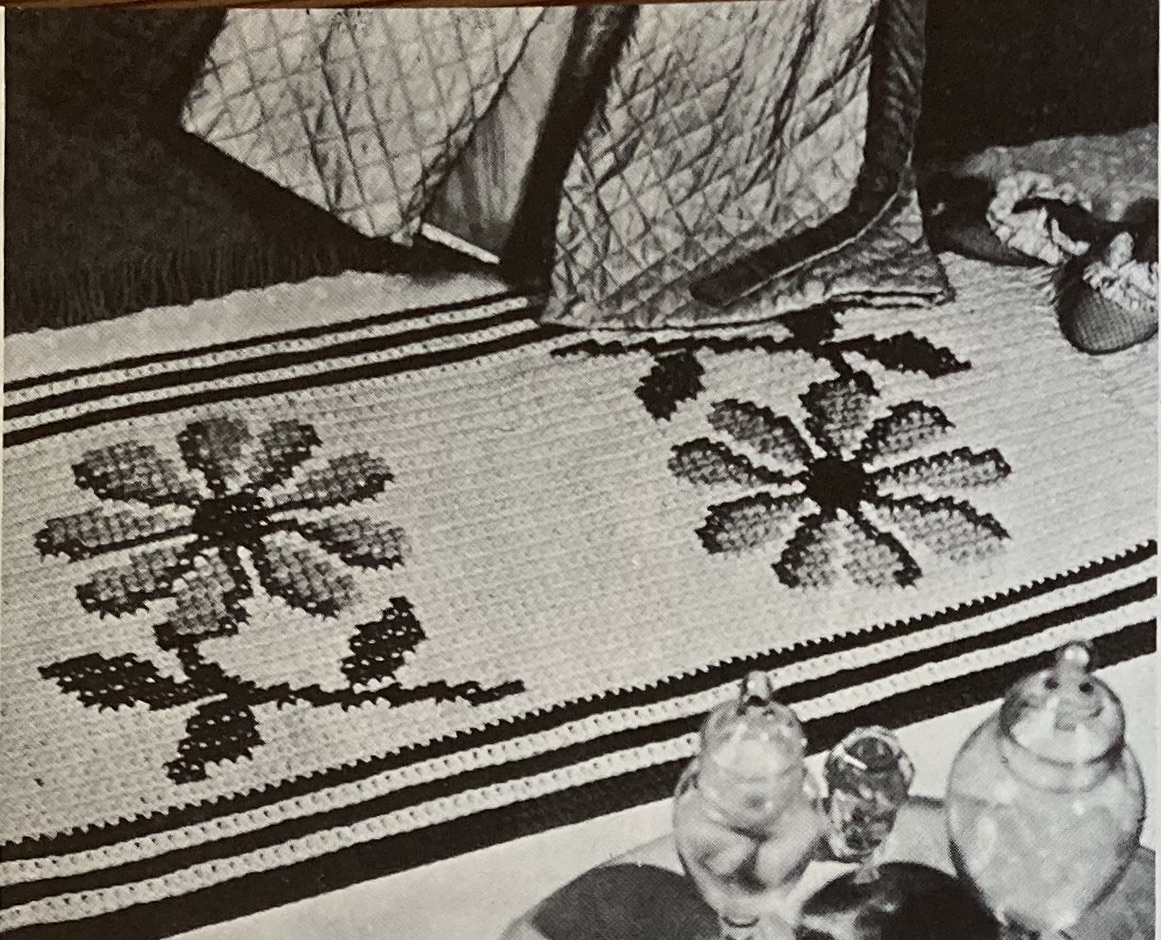
Housewares include the continuation of the “Zodiac” theme with an Aries motif, a traycloth in cross-stitch, a cross-stitch and pile rug, “amusing” aprons for the whole family (the father looks utterly un-amused at having to participate in the washing-up), a village townscape needle etching, a cross-stitch cushion… i.e. the usual fare. You can also make a toy “Wag” puppy for fans of the children’s comic from the last few issues, “Wendy and Wag in Wallpaper Land.” I don’t mind telling you that it had a happy ending for everyone. And with that, happy April and see you next time!

P.S. There wasn’t any project in this issue that really called to me, so I’m going to finish up a project of my own design that was inspired by this Stitchcraft children’s jacket from March 1960 that I made last year and write about that. Stay tuned…


March 1961: Overview

IMG_2399Are you ready to “Rendez-vous with Spring”? I sure am! This month’s issue has a lovely extra “centerfold” spread in colour, showing off Spring 1961’s latest fashions.

That said, no especially new looks, wools or techniques are introduced. The partner look is still going strong, as you can see from the his-n-hers Aran sweaters on the cover. They both have boatnecks, popular for a little while in the late 1950s and showing up again here. They are not shaped at the front neck at all, so I imagine them to be uncomfortable and awkward to wear.

Nubbly Rimple and thick, bulky Big Ben wools continue to be popular, featuring in almost all of this month’s adult garments. Big collars are still in, but one jumper utilises a contrast collar design in a different wool, with an interesting shape and ribbed texture. For larger sizes, there’s a cardigan skirt suit in purple plaid — bold colours and jewel tones are in fashion for all sizes and make a great centerfold picture all lined up together.

IMG_2418

In the homewares department, we’ve got another beautiful “peasant” design (they really love that word) for a cushion, a decorative wall tapestry with pictures of chipmunks, some flower embroideries for cushions or a tray cloth, this month’s Zodiac symbol to embroider on whatever you want (Pisces), and a really difficult-looking crocheted cushion cover.

The highlight of the homewares patterns has got to be this incredible “Willow pattern” latch-hook rug. I had heard of “willow-ware” porcelain (remember that scene from one of the Anne of Green Gables books, where Anne or Davy or someone accidentally breaks Aunt Josephine’s blue and white willow-ware platter, then Anne sees a similar one in someone’s house, climbs up on the roof of the barn or something to look at it through the window, then falls through the roof and gets stuck, having to wait in a rainstorm until the owner gets home and then explain the situation?) and I have seen this type of pattern on porcelain china, but never knew that the one was referring to the other.

IMG_2417

Stitchcraft‘s description of the rug refers to “the 3 figures in the Willow Pattern story.” I had also never heard of any Willow Pattern story, but my good friend Wikipedia told me all about the history of the Willow pattern and the associated legend (spoiler: the “legend”, like the pattern, was a 100% British invention made up to sell more porcelain goods, not any kind of authentic Chinese folk tale). Both the pattern and the associated story served as inspiration for further literary, media and commercial works. You can read all about it here.

Finally, it would not be Stitchcraft without a page of little items “for sale-of-work” at church bazaars etc., or to surprise your family on Easter morning. The continuation of Belinda the doll’s knitted outfit is quite cute, but what on earth were they thinking with these egg cosies?!? They look positively psychotic. If I were a child and my mother served my Easter morning Easter egg in one of those things, I would be surprised all right… and probably wouldn’t sleep for a week.

IMG_2424 2

Speaking of children, here are some who weren’t scared off by their egg cosies and were rewarded with bright, sunny “play sweaters from Vienna” in spring colours of lemon yellow and white. The caption on the page opposite is “Gay as a See-Saw!” I’m sure there are a lot of jokes one could make about gay and see-saws, but I won’t. The kid’s comic in the back pages has the usual continuing story — Wendy and her dog Wag are having some fun adventures in Wallpaper Land.

IMG_2423The ads are for the usual knitting machines and sewing fabrics… except for this one, for “Cooper’s moth proofer” spray, presumably made of DDT  or some other extremely toxic insecticide that kills “ants, beetles… these and other crawling insects die on contact — even months after spraying.” Just the thing to use in your enclosed, airless closet space!

With that, I wish you all a lovely, non-toxic, gay as a see-saw rendez-vous with spring. My March project will be some version of the flower embroidery.