December 1967: Overview

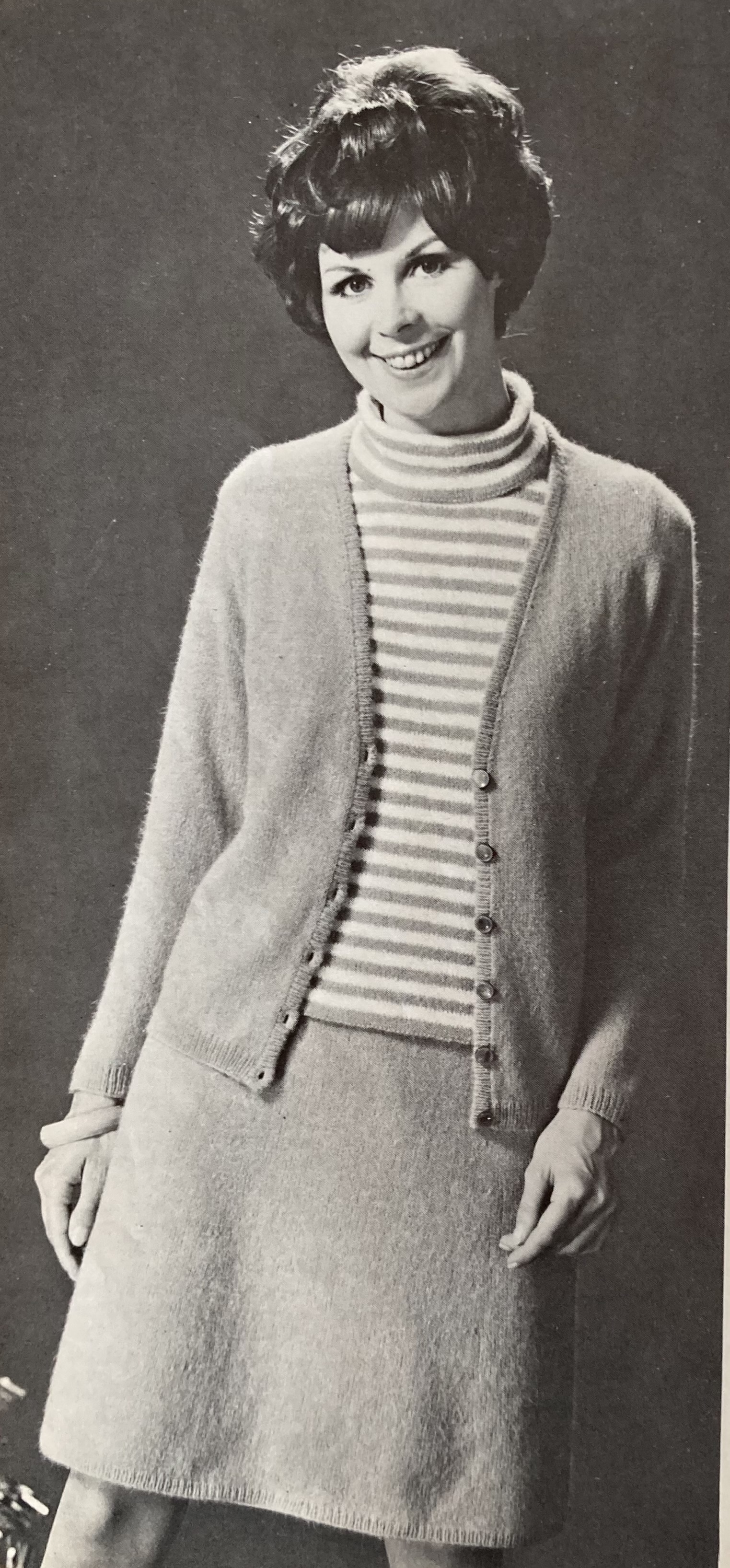
It’s here! The December 1967 Stitchcraft Christmas issue is a “bumper number to help with last-minute ideas for your Christmas giving, and suggestions for your winter handicrafts.”

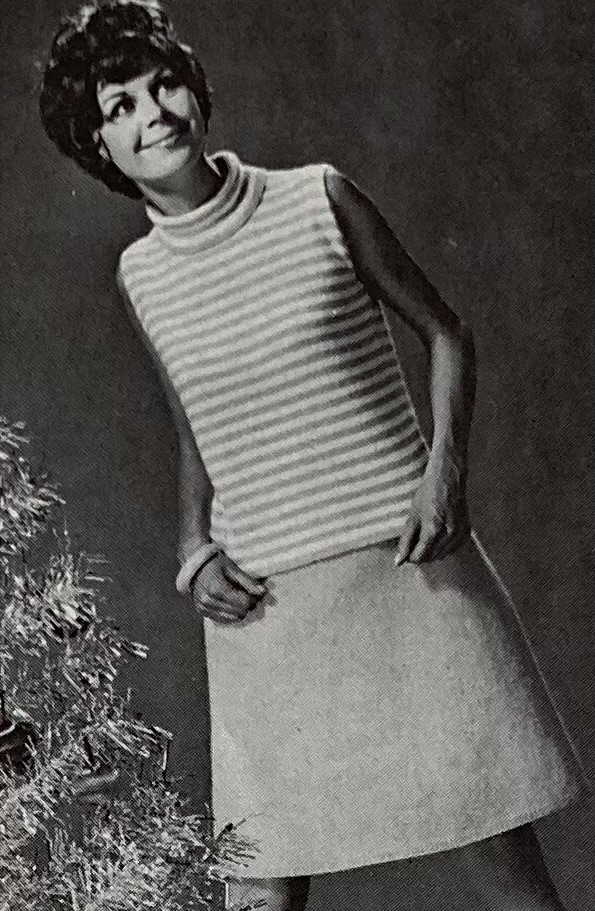
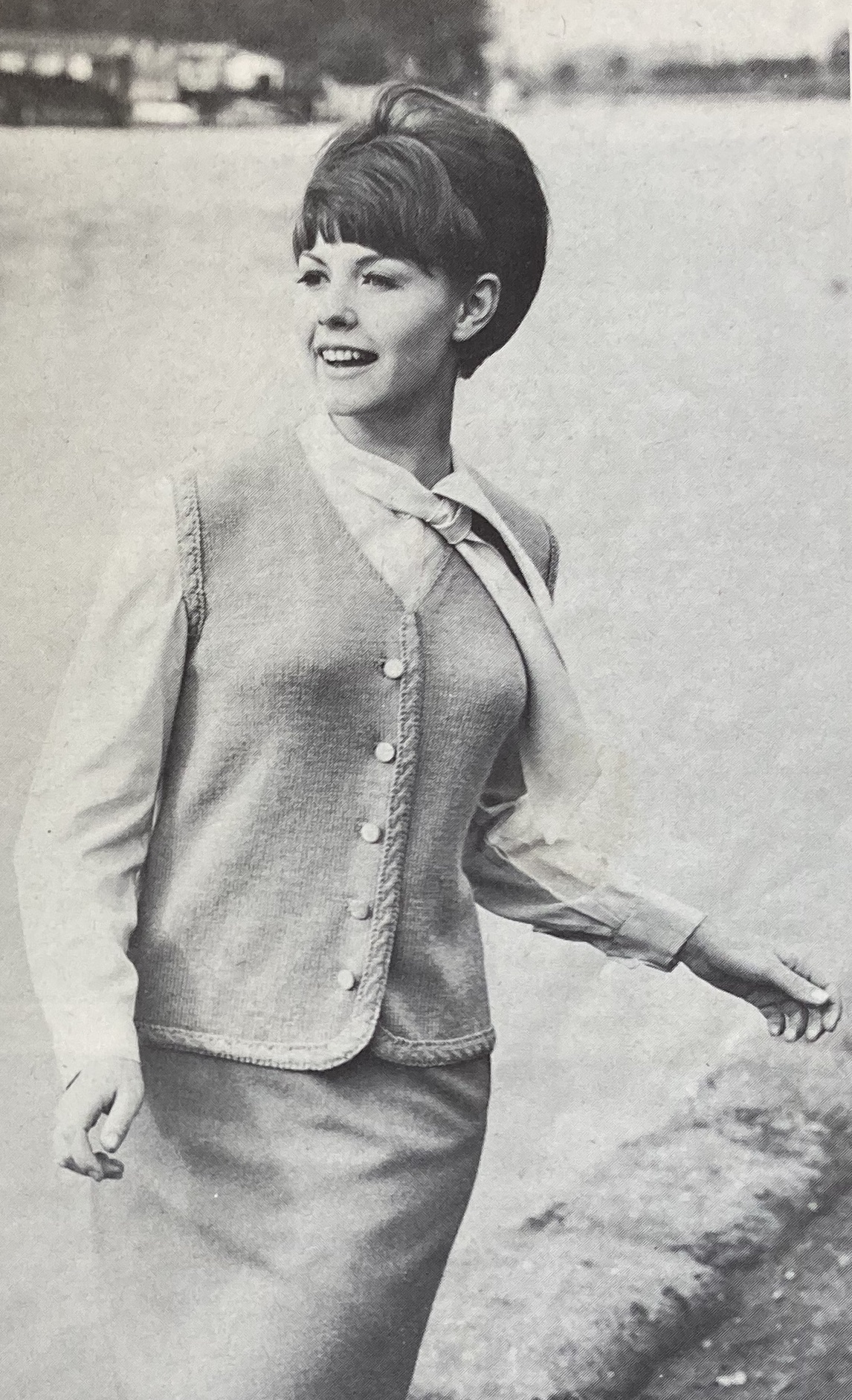
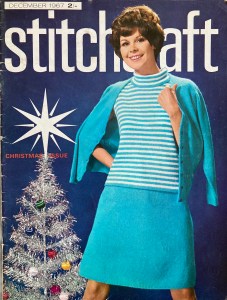
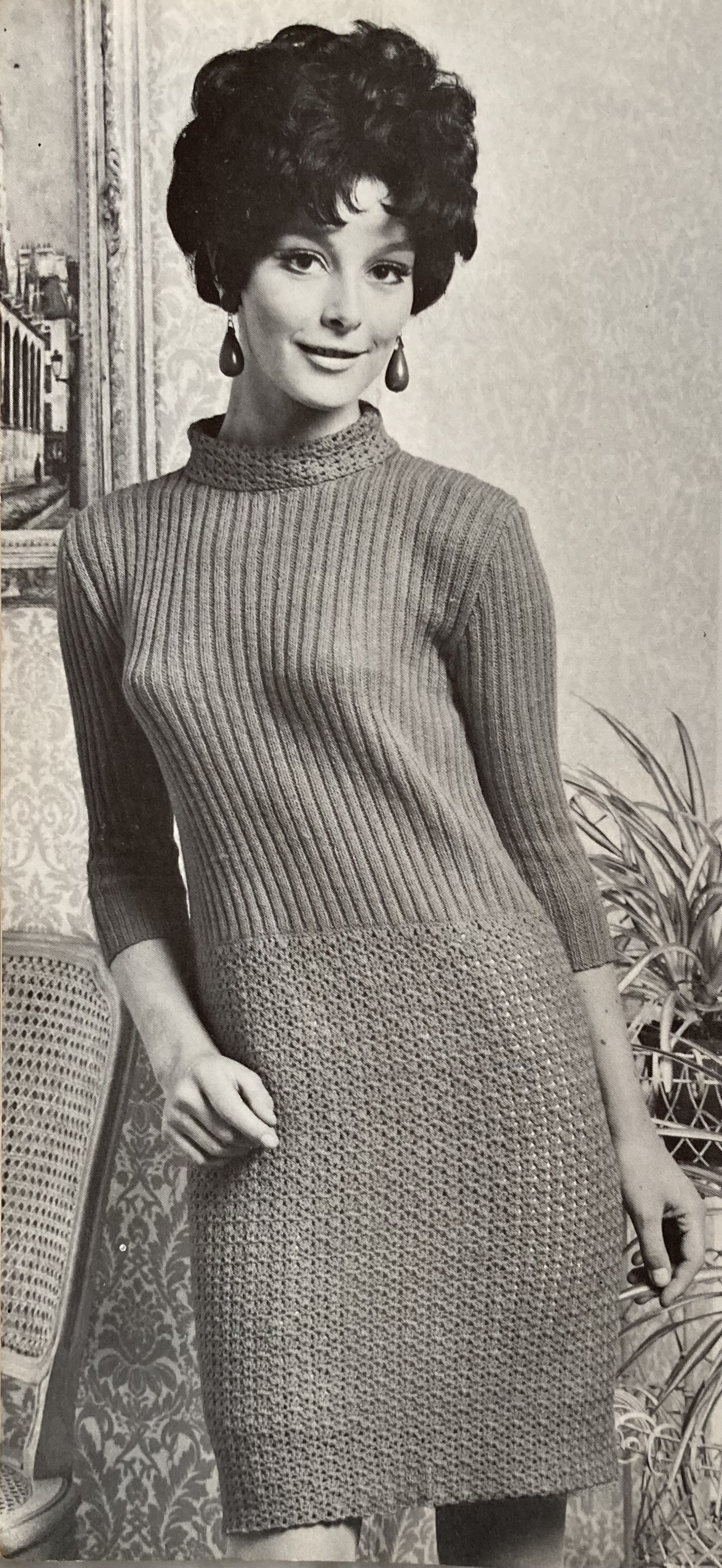
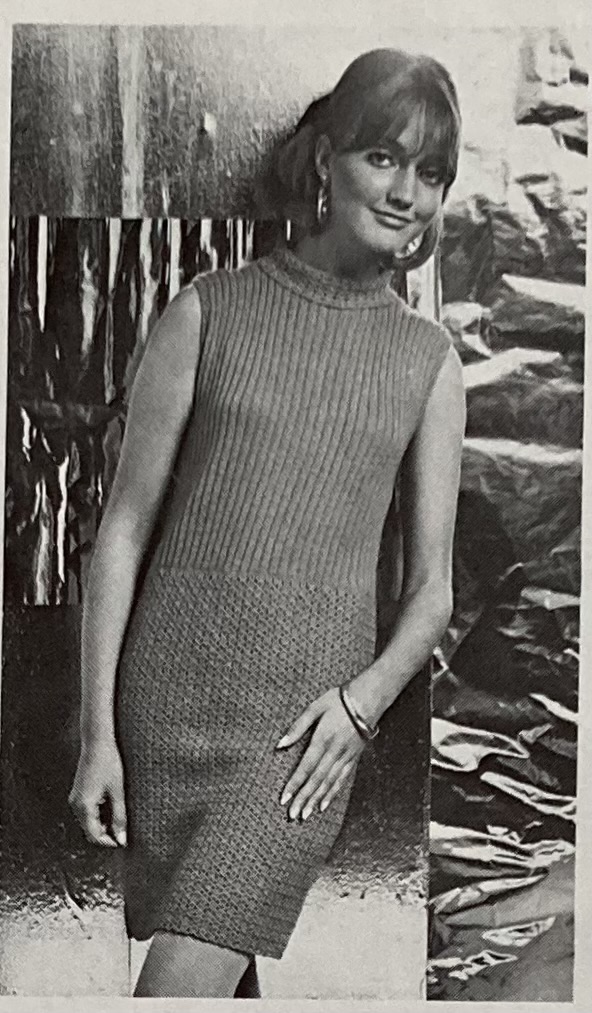
The cover photo went with a wintery blue, white and silver colour scheme to set off the featured 3-piece skirt suit. It’s knitted in Patons “Princess”, a light, fluffy yarn made of 80% wool and 20% angora. At 8 stitches to the inch on No 11 (3.0 mm) needles, I imagine it won’t get finished by Christmas. The striped top is sleeveless, and the skirt shorter than knee-length without being “mini”: this is an outfit intended for the respectable suburban mother of the family. A more fun-loving adult woman can make a party dress with or without sleeves, that combines knitting and crochet. Looking at the second picture, you can see why all the models pose with their spines in that corkscrew S-curve — it’s to hide the fact that the unshaped, unbelted dress will look like a sack on them otherwise. Must be hard to hold the pose for the whole party…
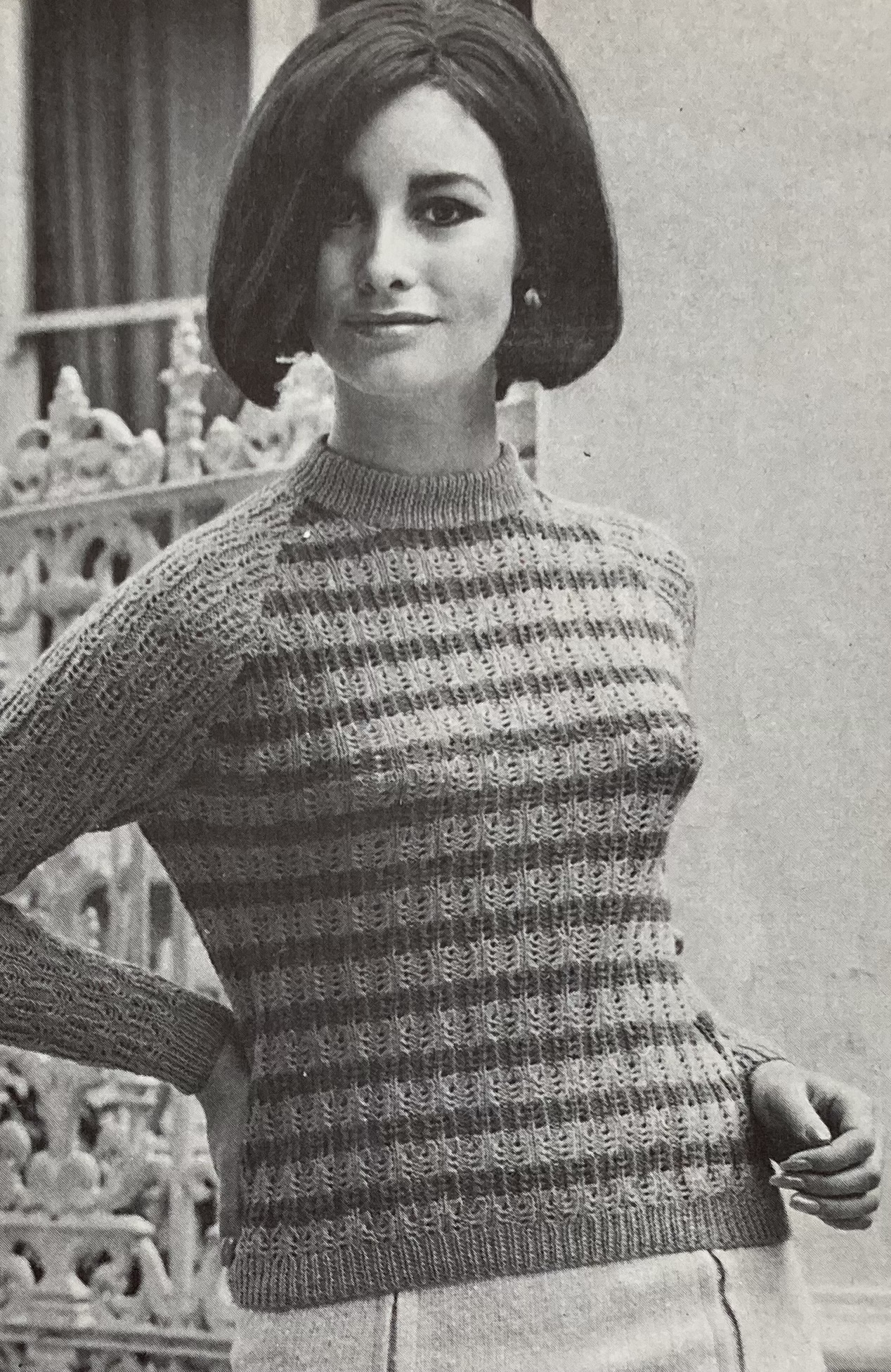
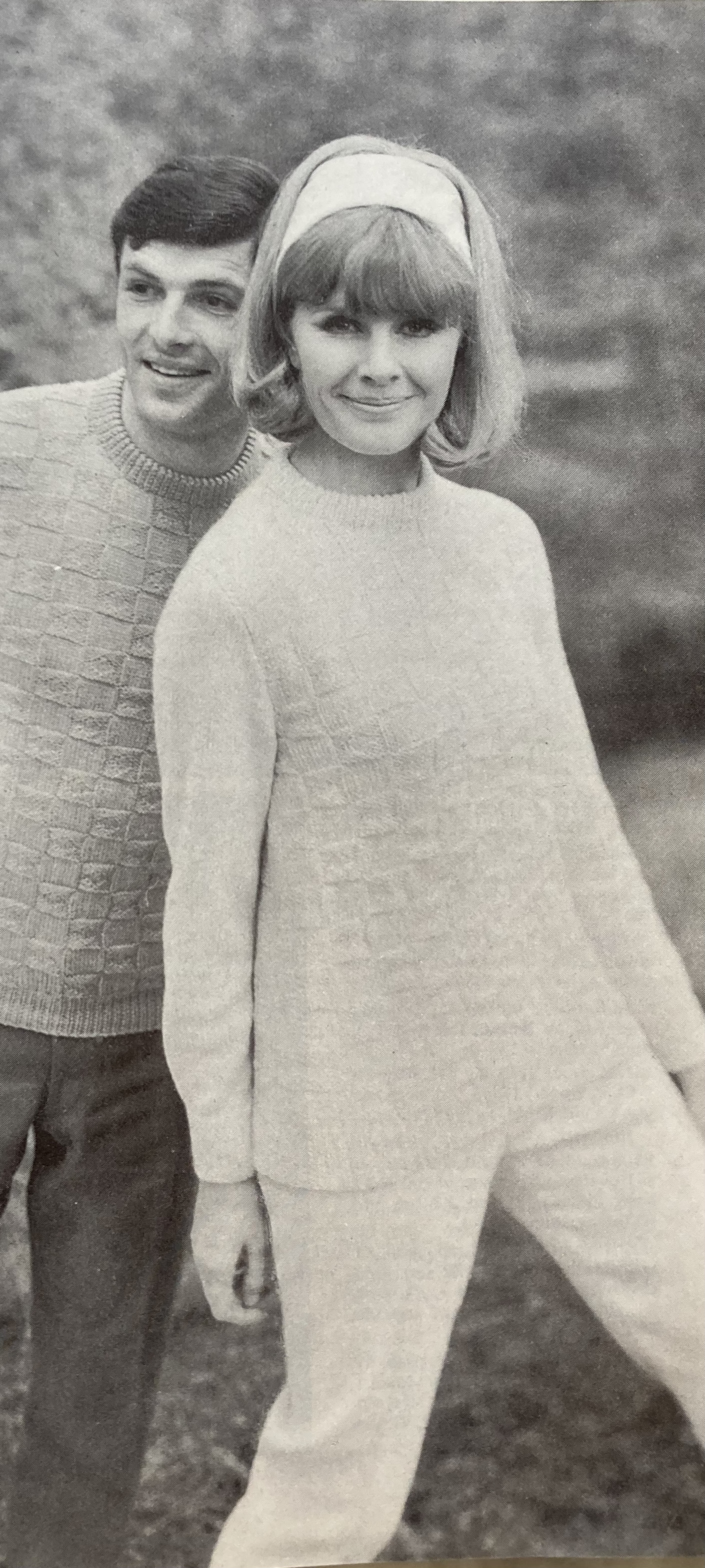
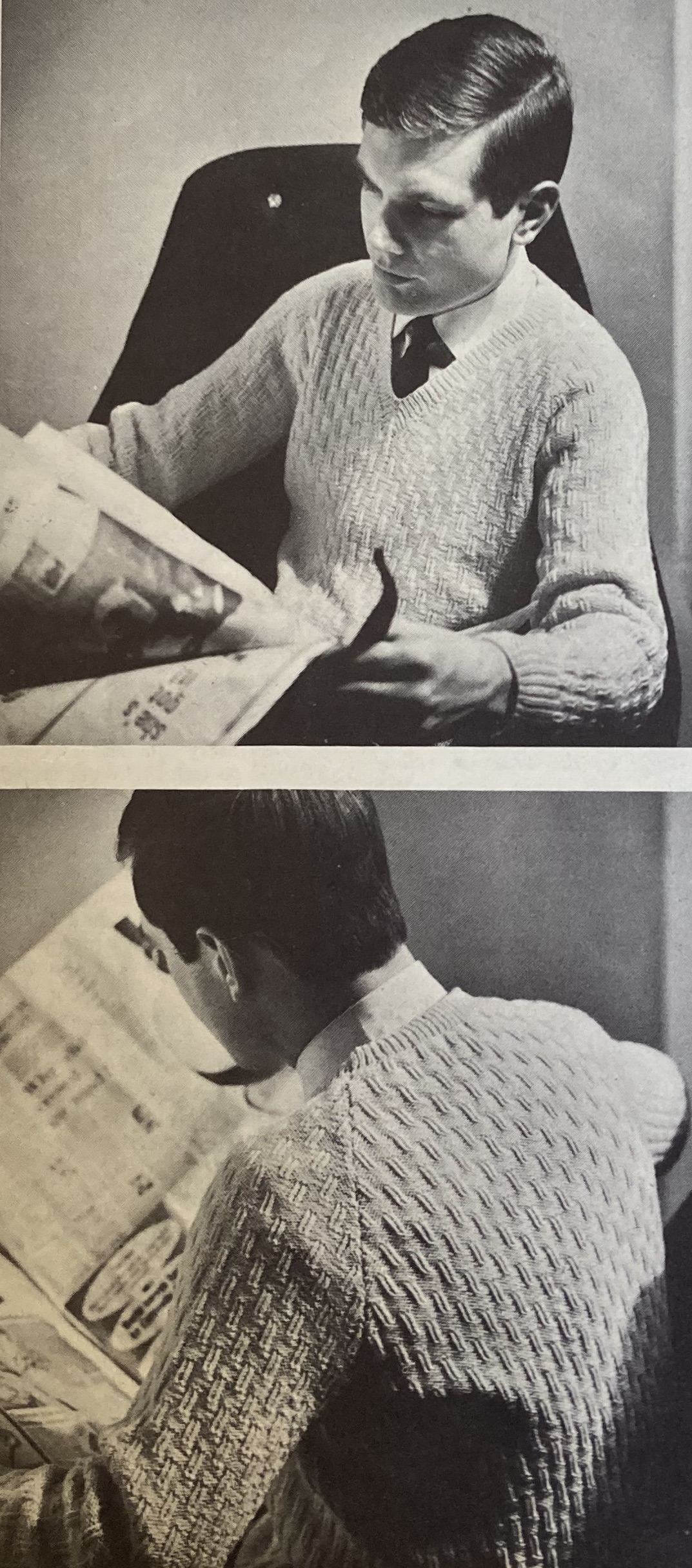
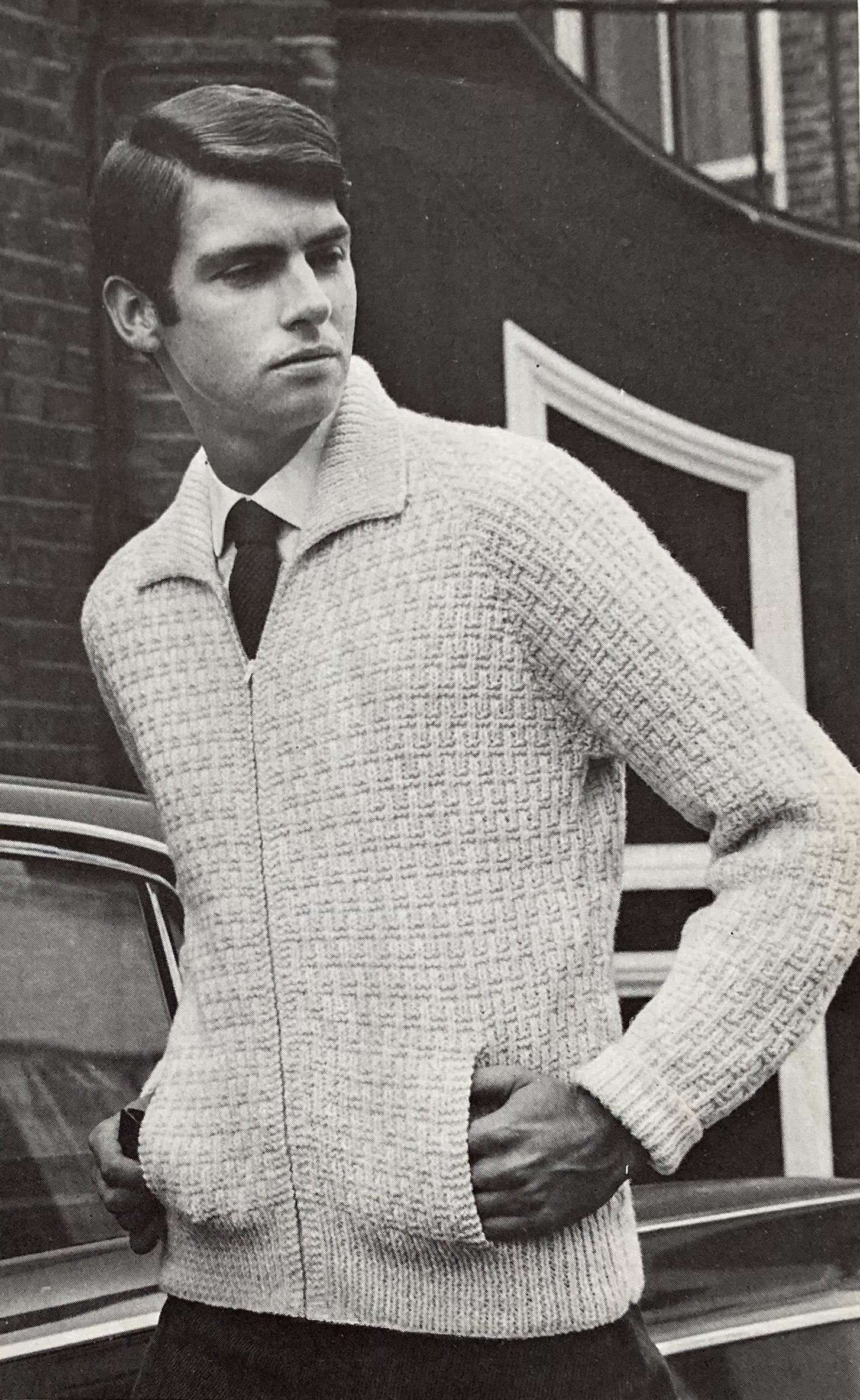
As for the “young team”, they “love to match”, according to Stitchcraft, and can knit themselves (who am I kidding, the girl will knit for both of them) some warm pullovers in a fun two-colour basketweave pattern with ribbed sleeves. The colour pattern is made with slip stitches. Other adult garments include a “lumber style” mens’ zipped cardigan, two practical jumper-blouses to “go with suits and skirts” and a classic cardigan for larger sizes.
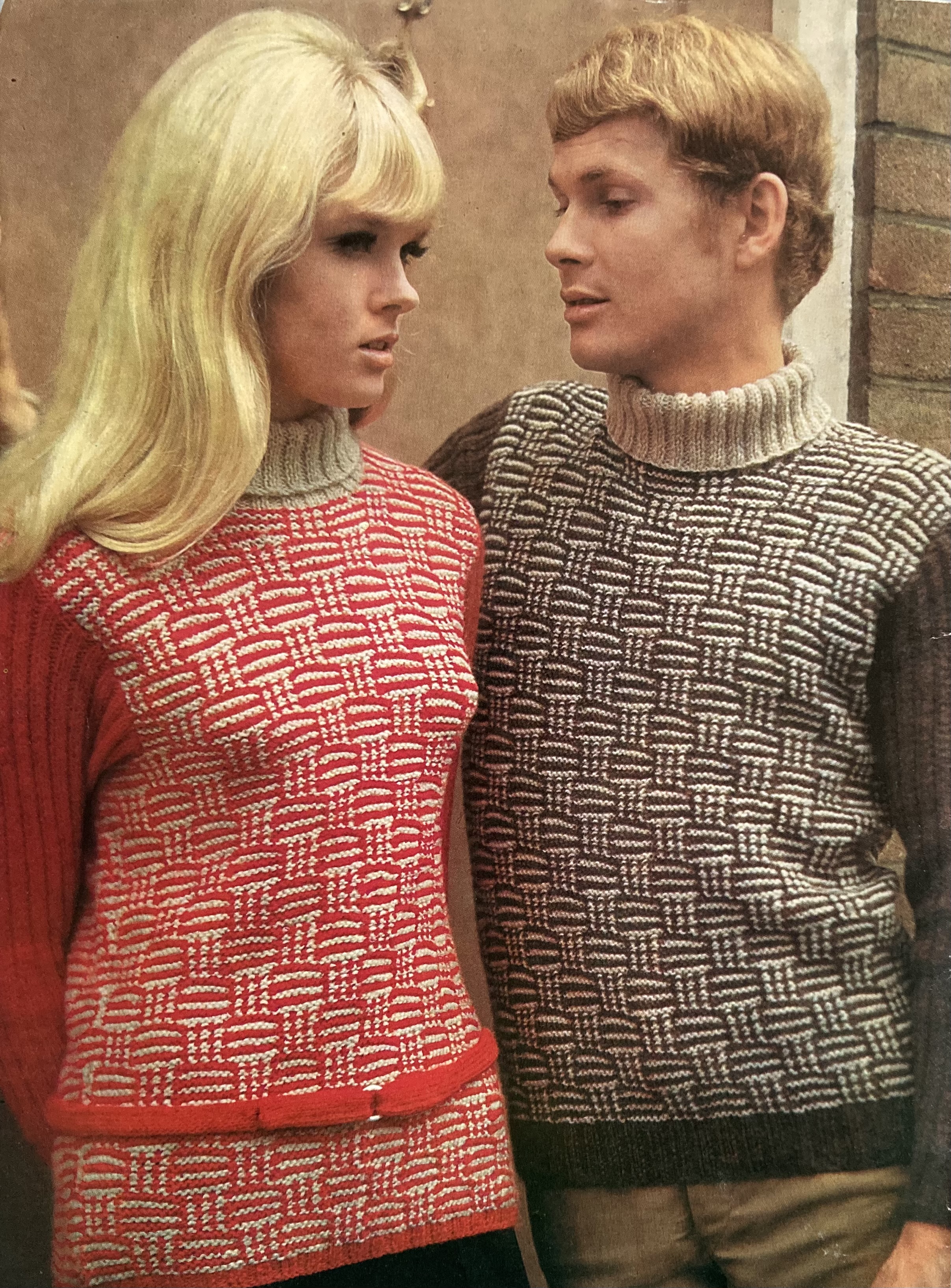
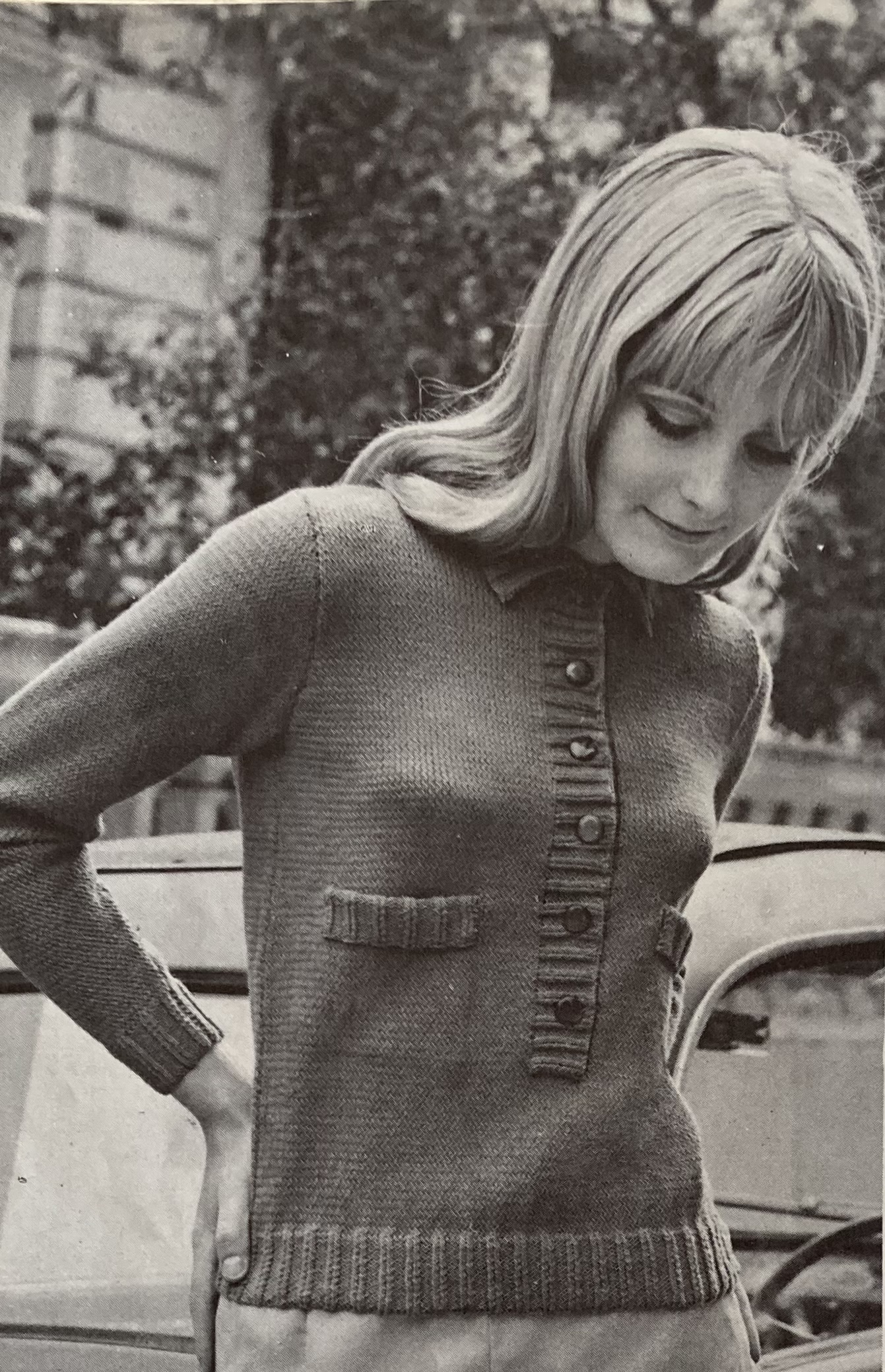
Cables and basketweave textures are on trend, and the colours are not particularly Christmas-oriented — strong, cool colours and neutrals. The mens’ basketweave cardigan is made in cream-coloured, undyed “Capstan” wool and the two suit-skirt jumpers in “Planet Jade” and “Bracken Gold” with “Brandy Snap” contrast. Only the knit-crochet party dress is in holiday “Hawthorn Red”.
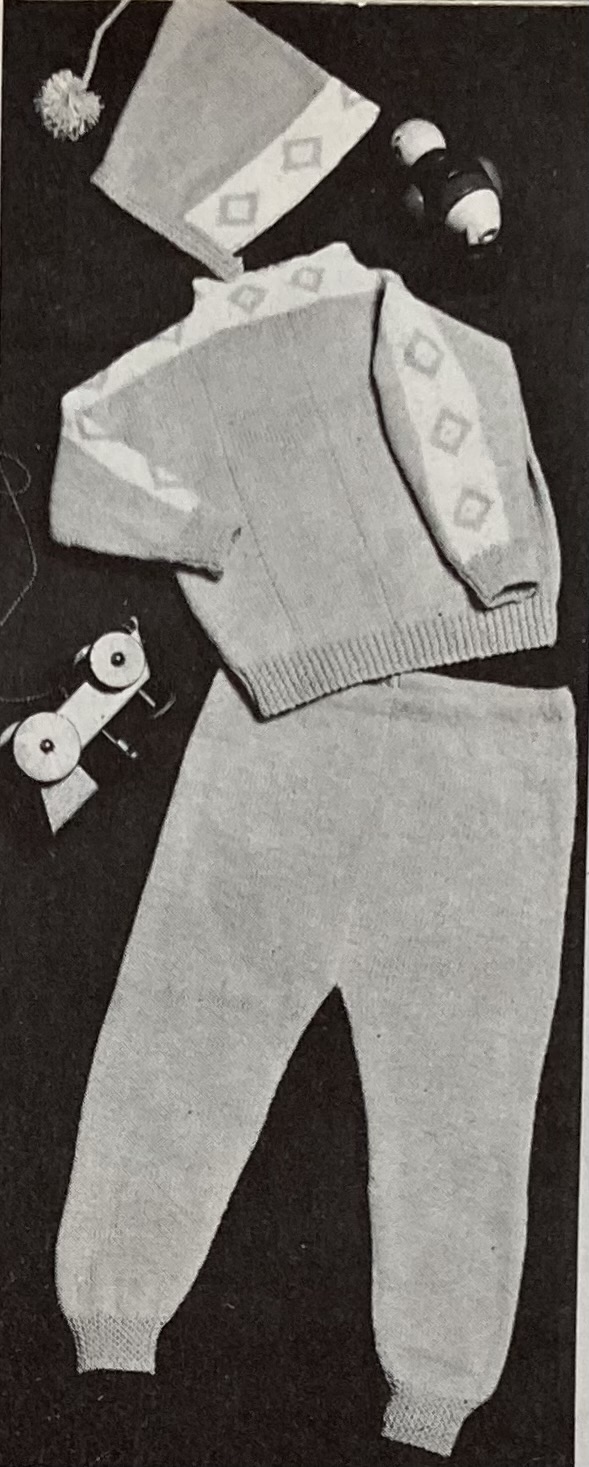
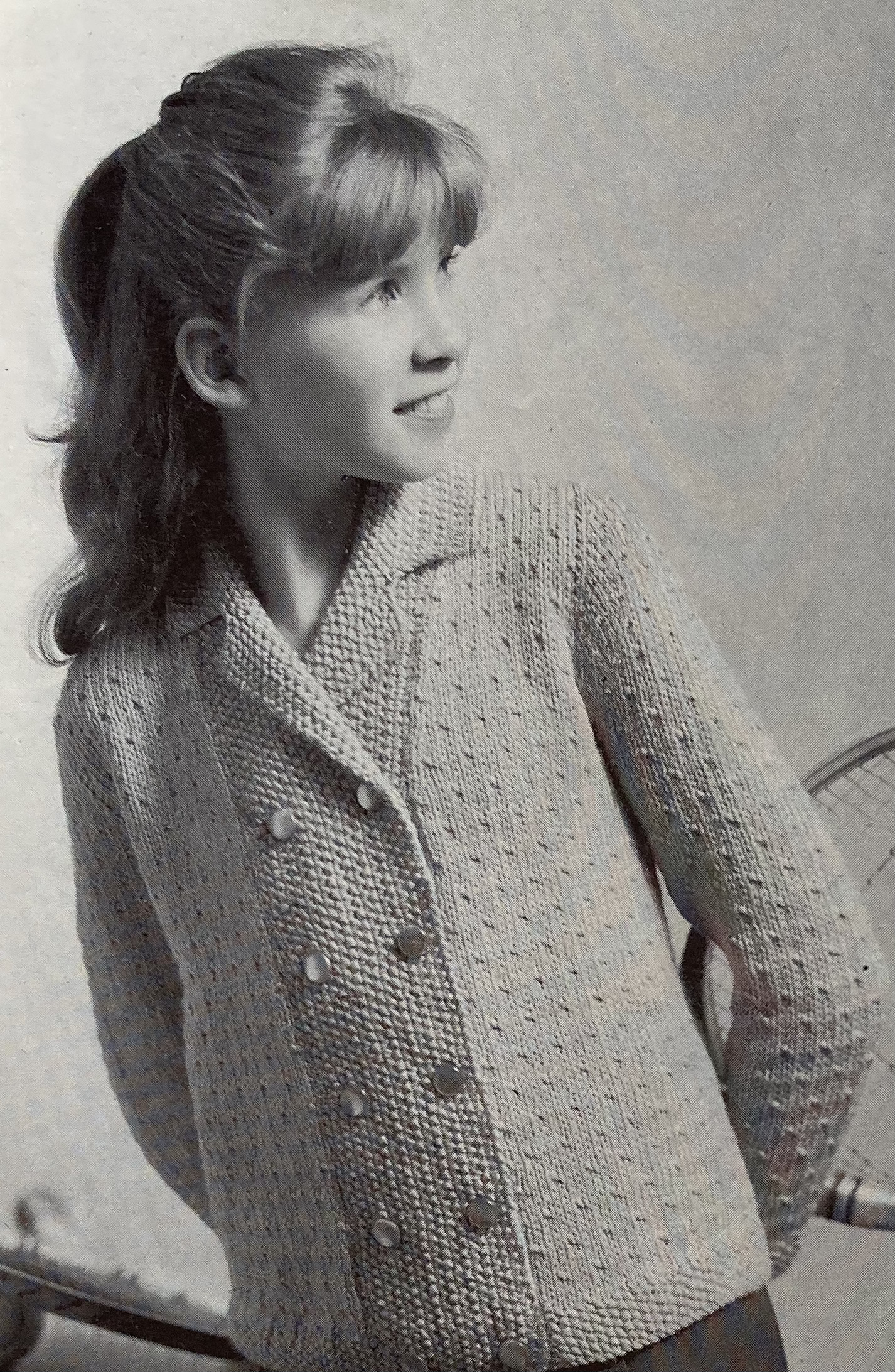
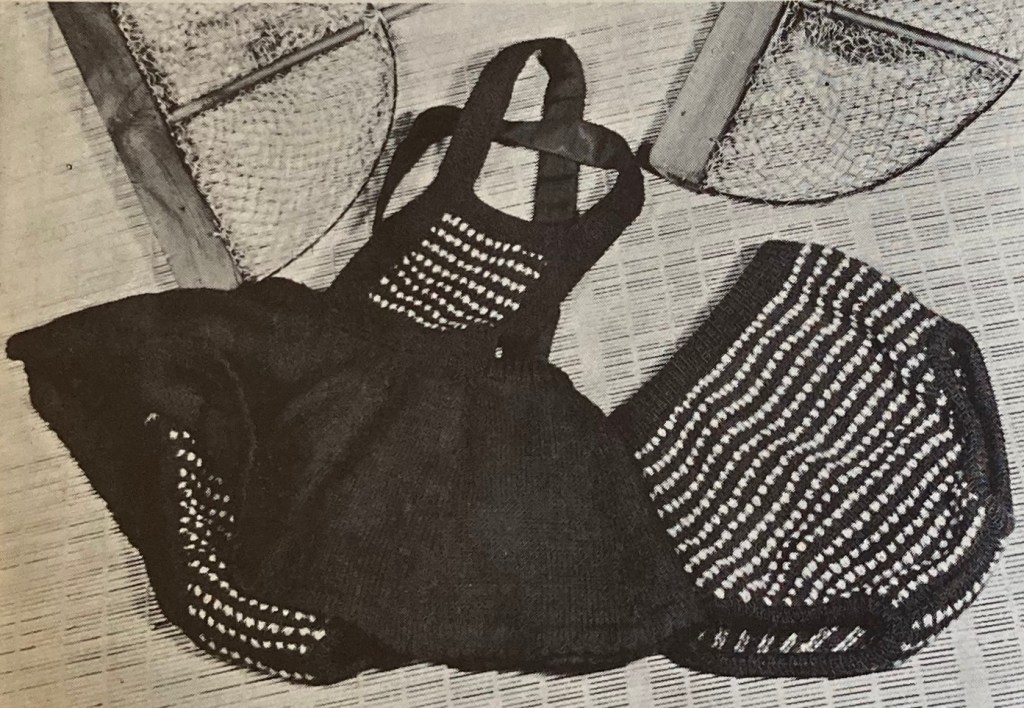
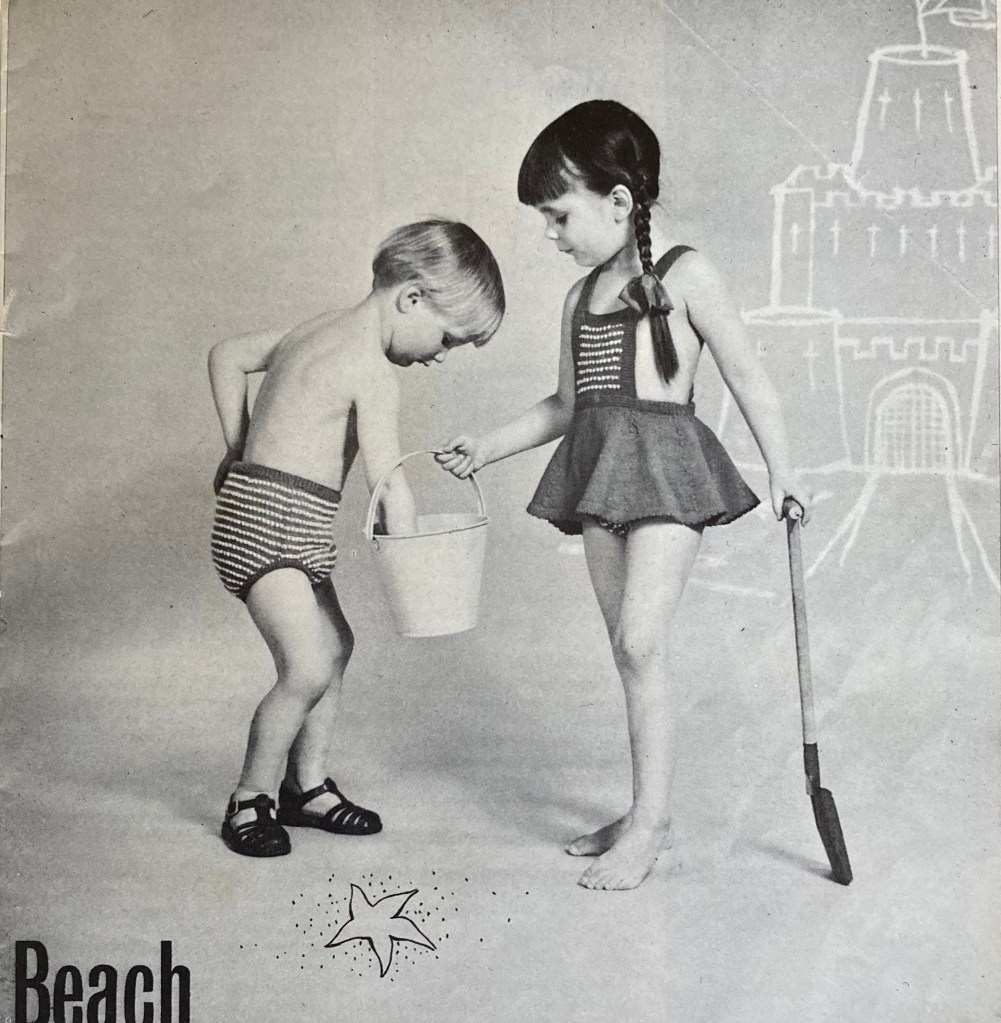
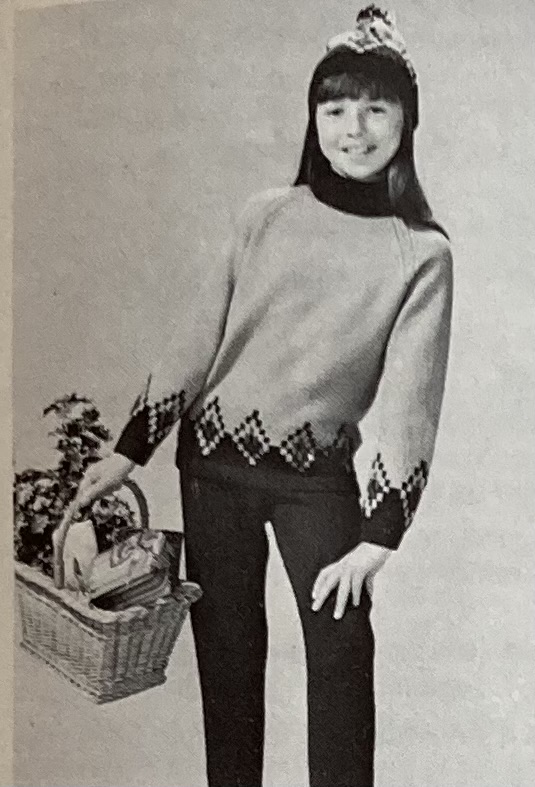
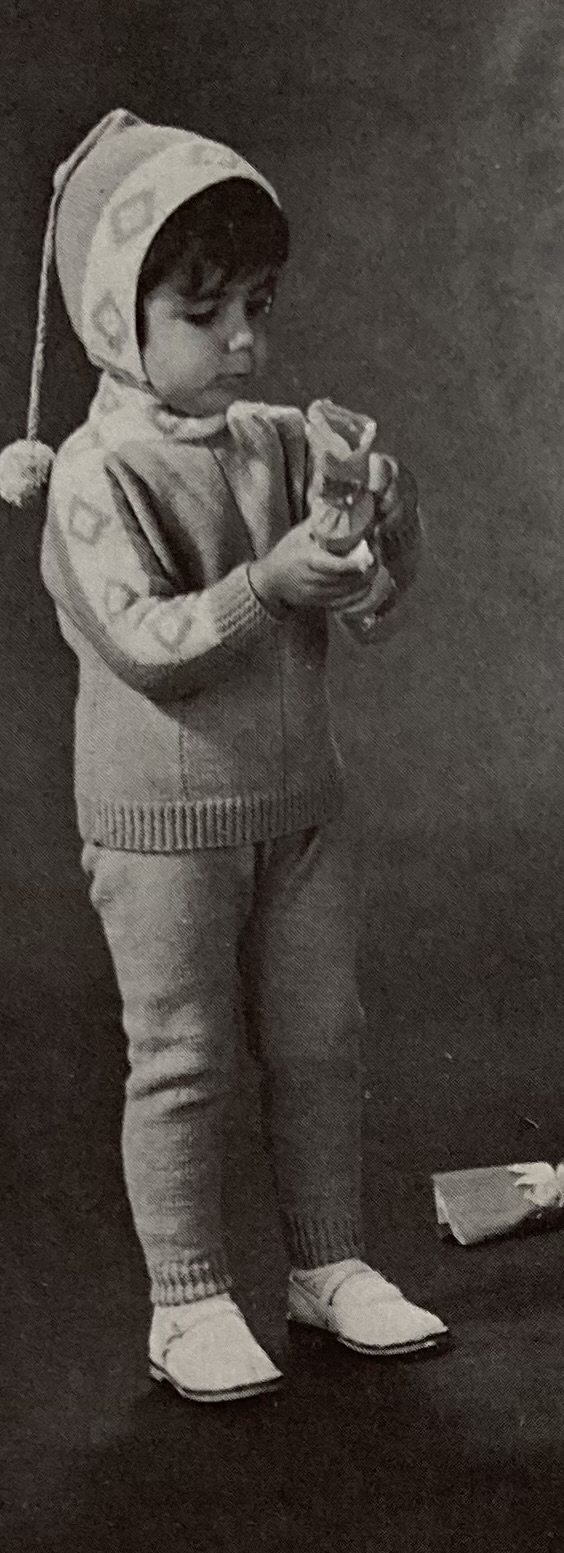
There are some great fashions for children in this issue that could theoretically be finished by Christmas morning: a warm set of jumper, leggings and hat for a little one, a dress-and-cardigan set for a school-age girl and another jumper, leggings and hat set for a pre-teen. On second thought, you would have to be an extremely fast knitter to get any of those sets finished in time… Here too, cool, bright colours prevail, and stripes, slip-stitch lines, and diamond patterns are trending.
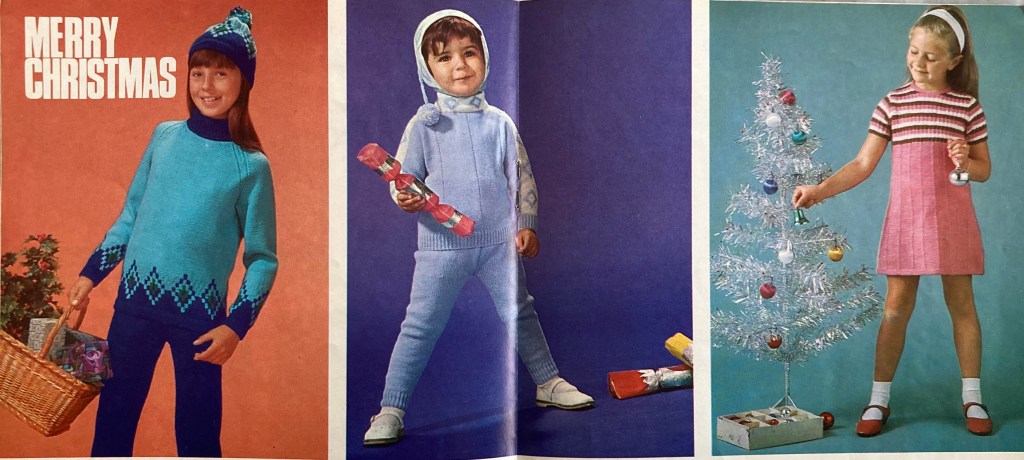
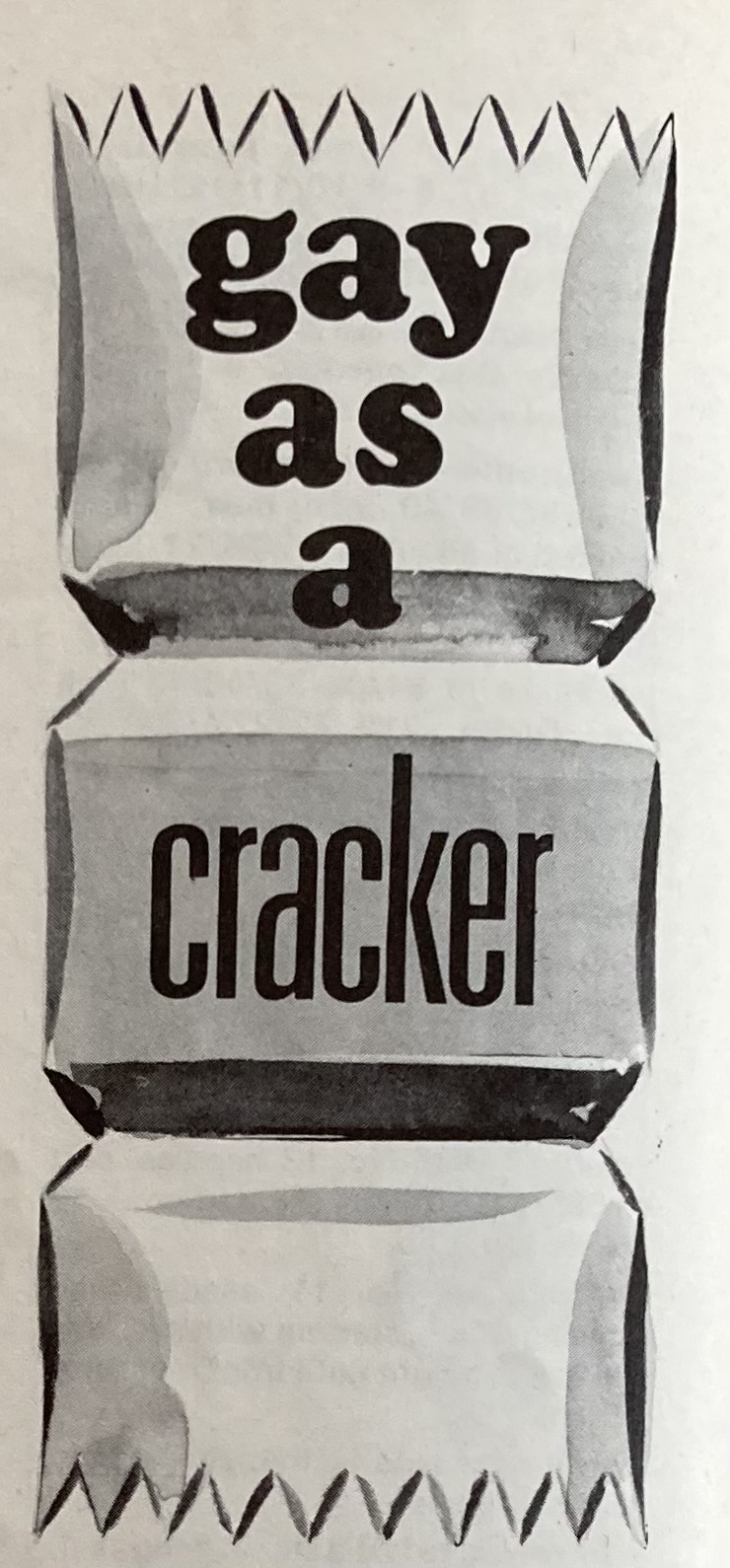
(On another note, the slogan that Stitchcraft chose to describe all of these children’s patterns is “Gay as a Cracker”. I do understand that they mean the outfits are as bright, fun and festive as a Christmas cracker that you pull across the table and get a little prize and a paper hat out of, but that did not age well.)
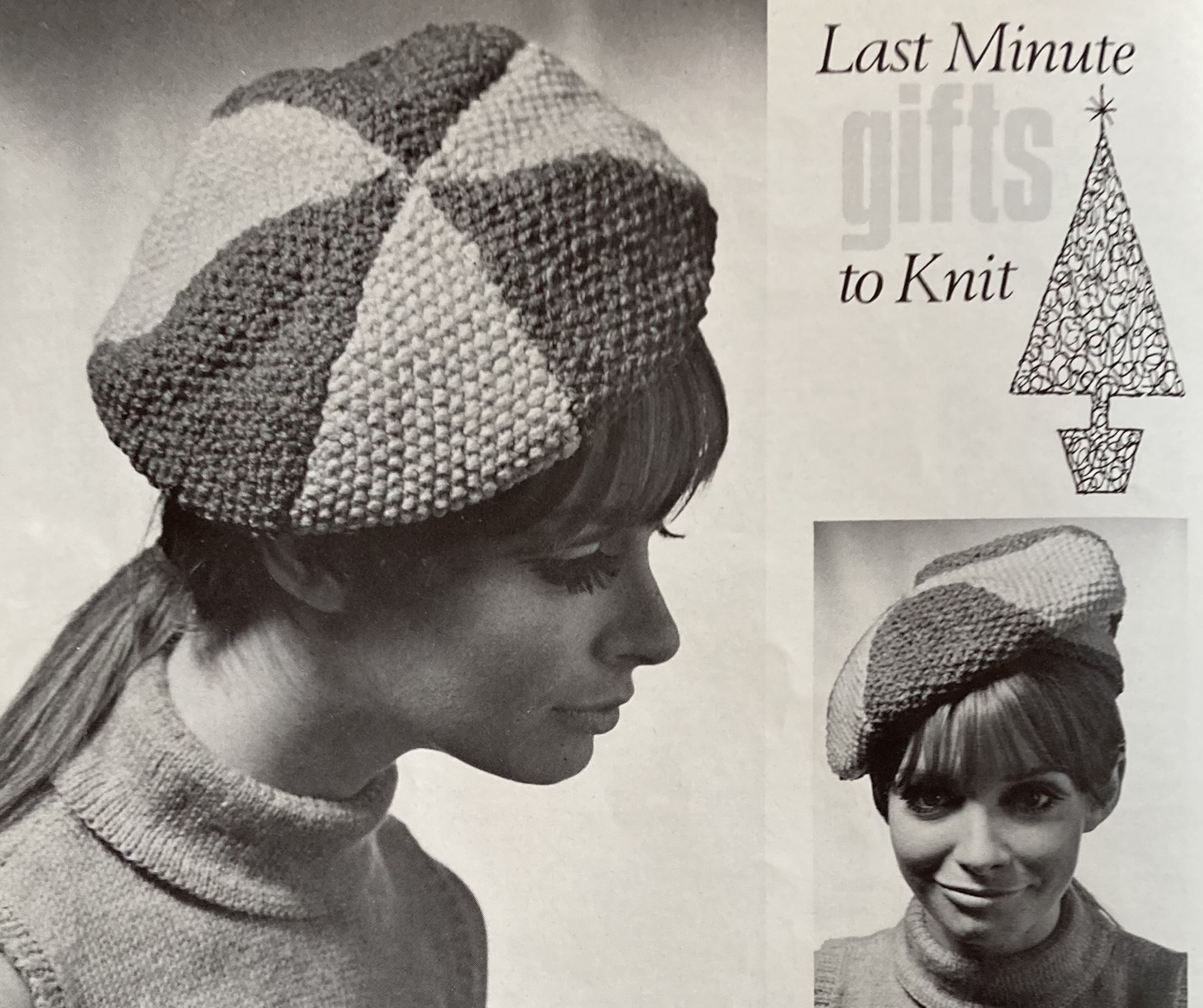
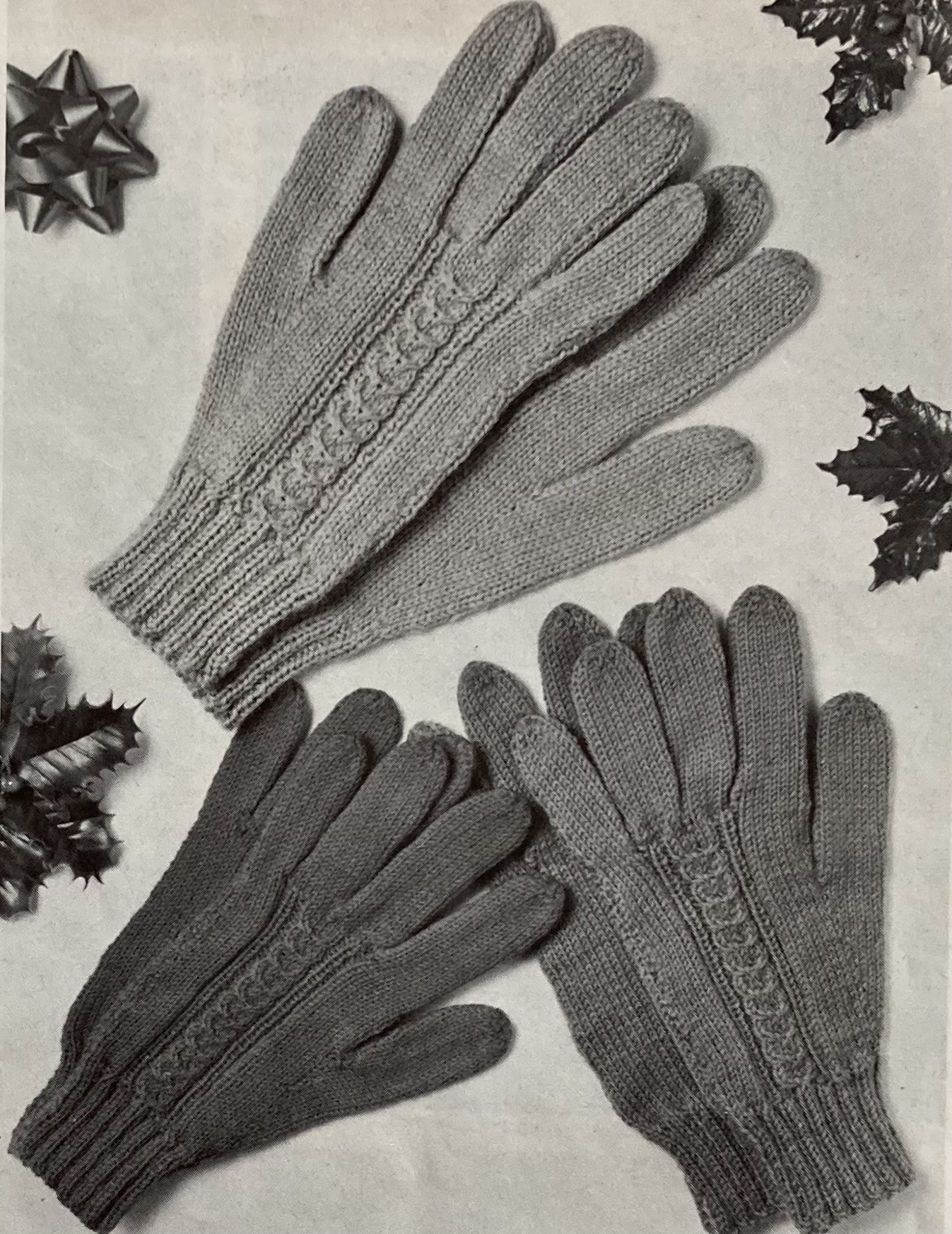
For quick gifts that have to be finished on time, you can make a “tweedy” (actually moss-stitch, but OK) beret or cleverly designed gloves for the whole family. The gloves are all made from the same pattern, using double knitting-weight wool for the large/men’s size, 4-ply for the medium/women’s size, or 3-ply for the small/child’s size. You can also make a very easy crochet cushion, and it even matches the hat!
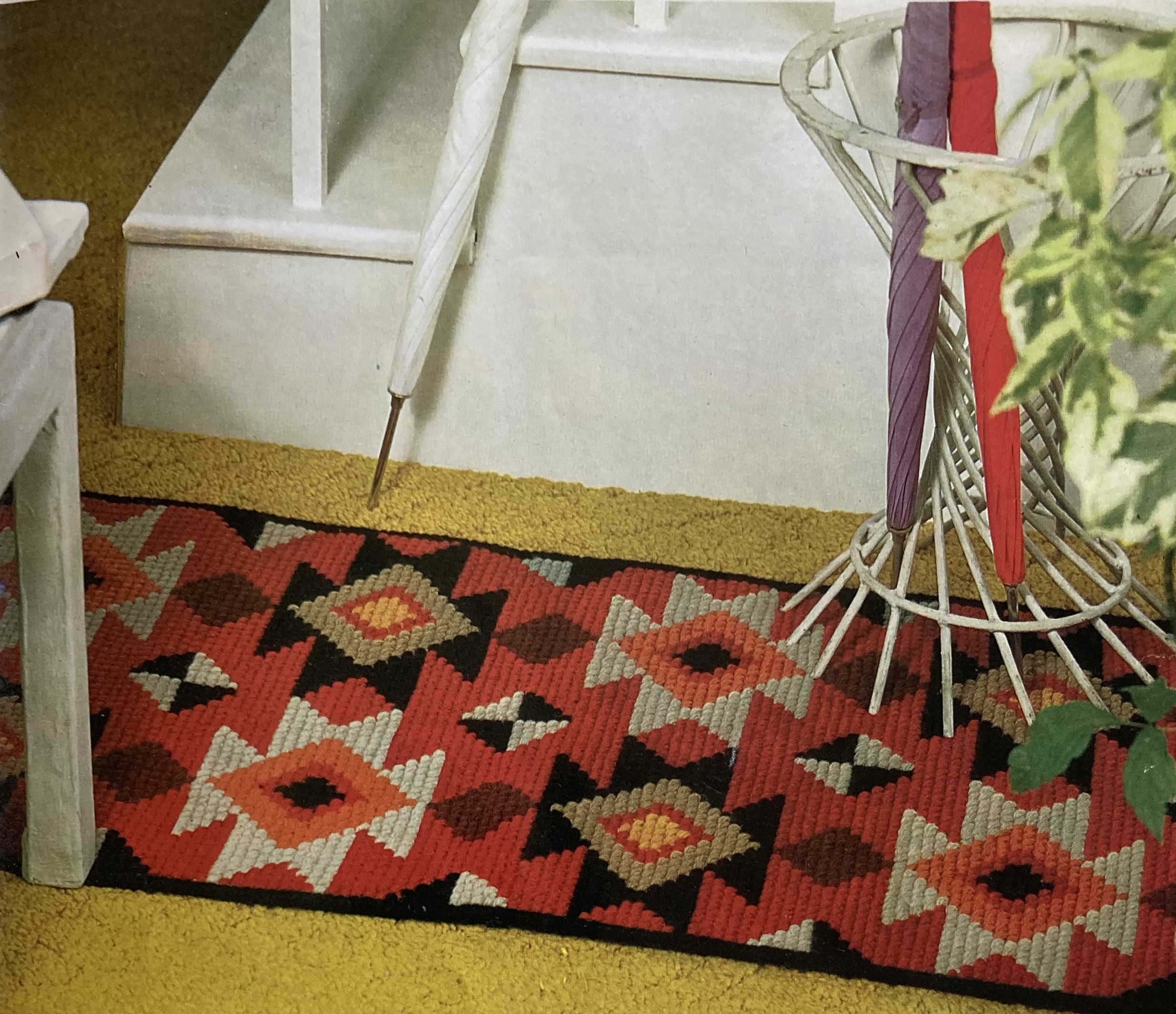
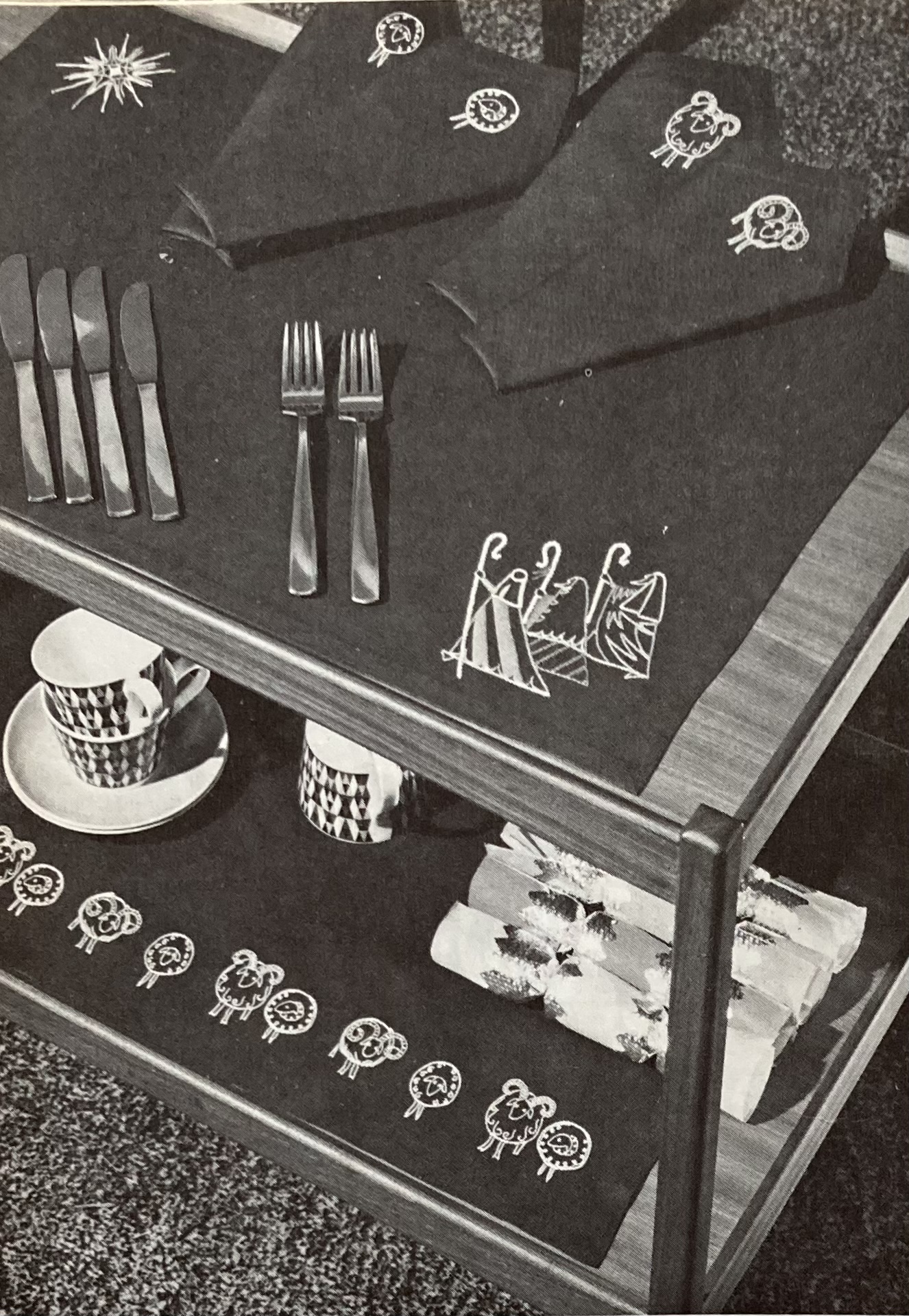
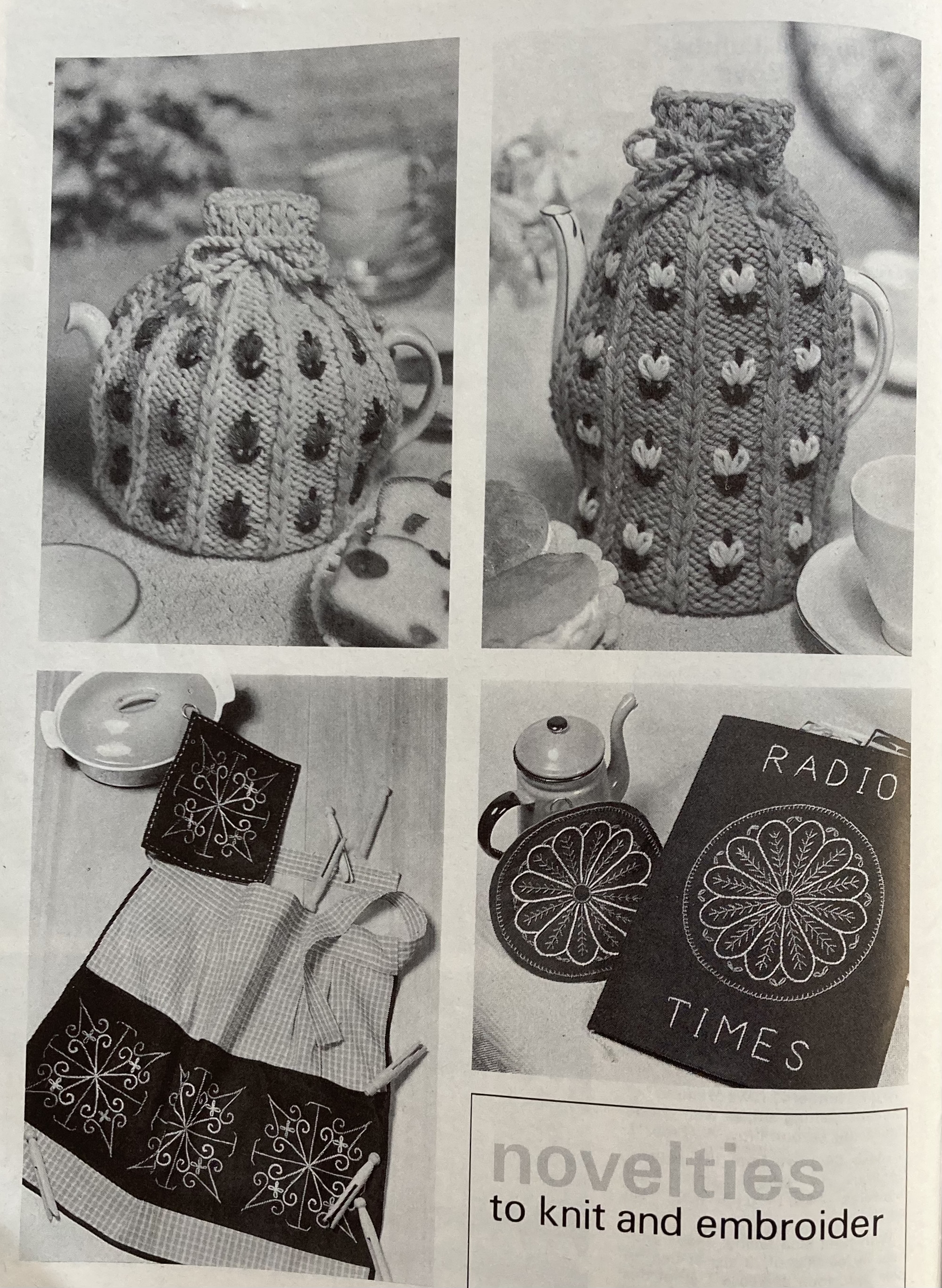
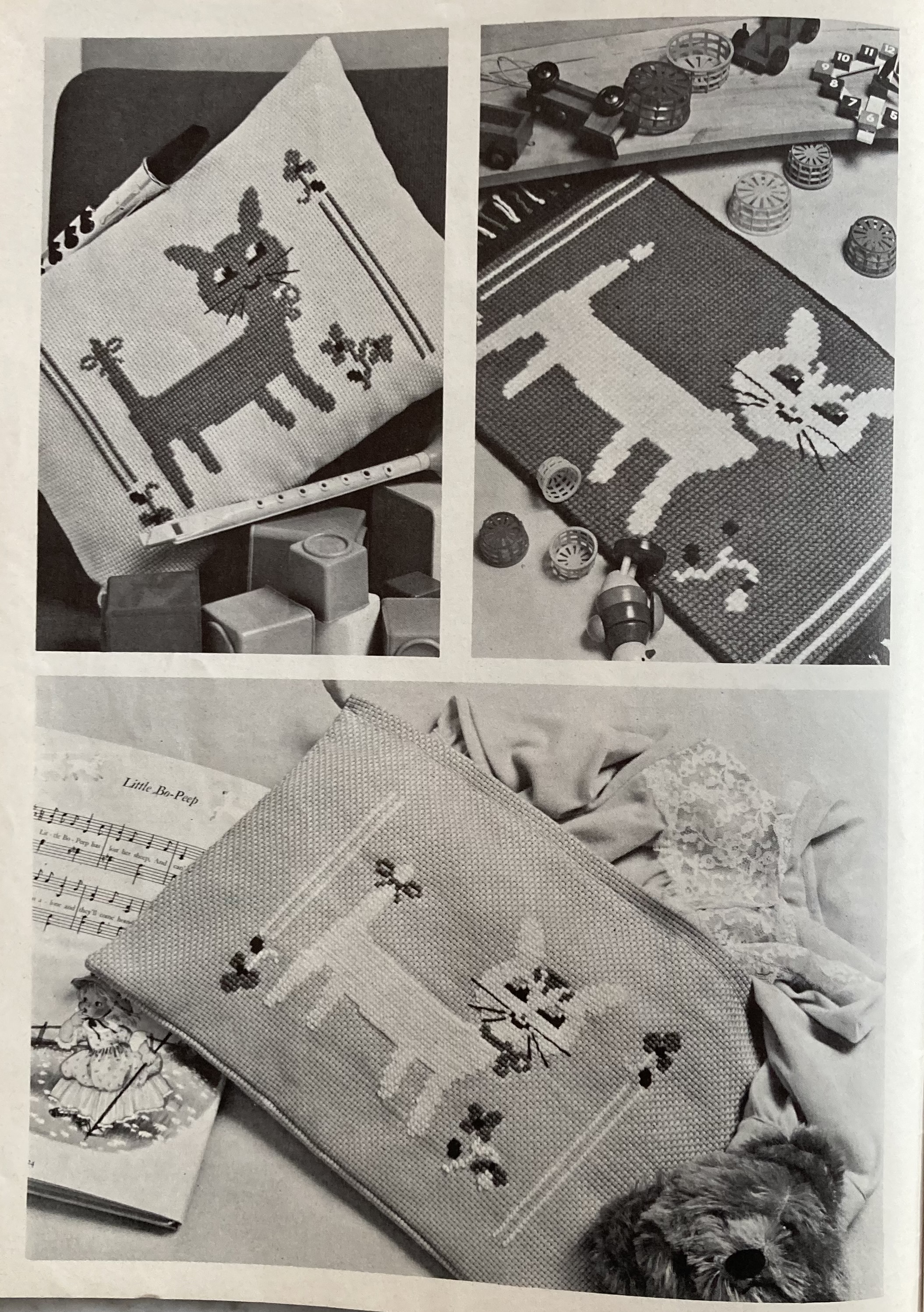
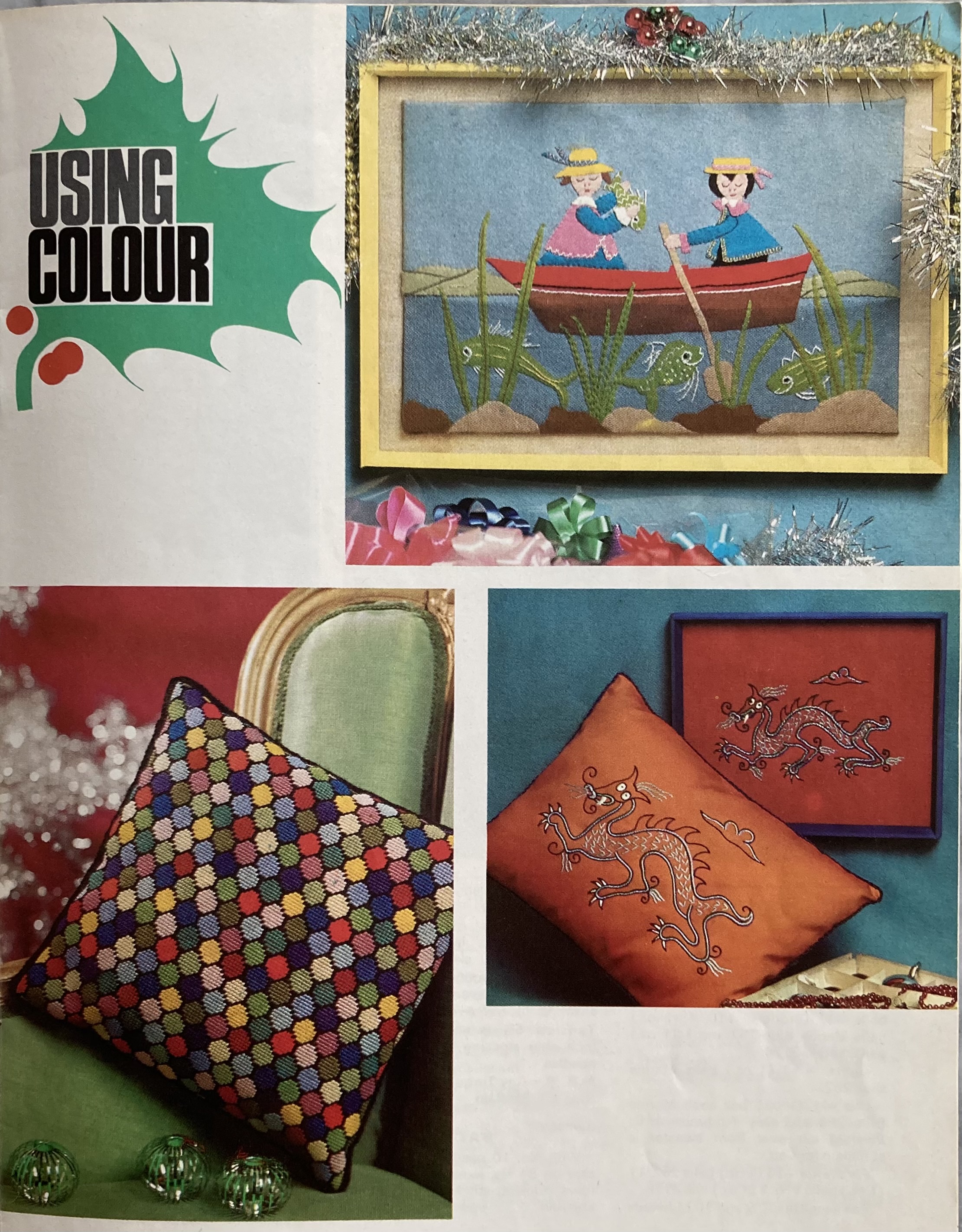
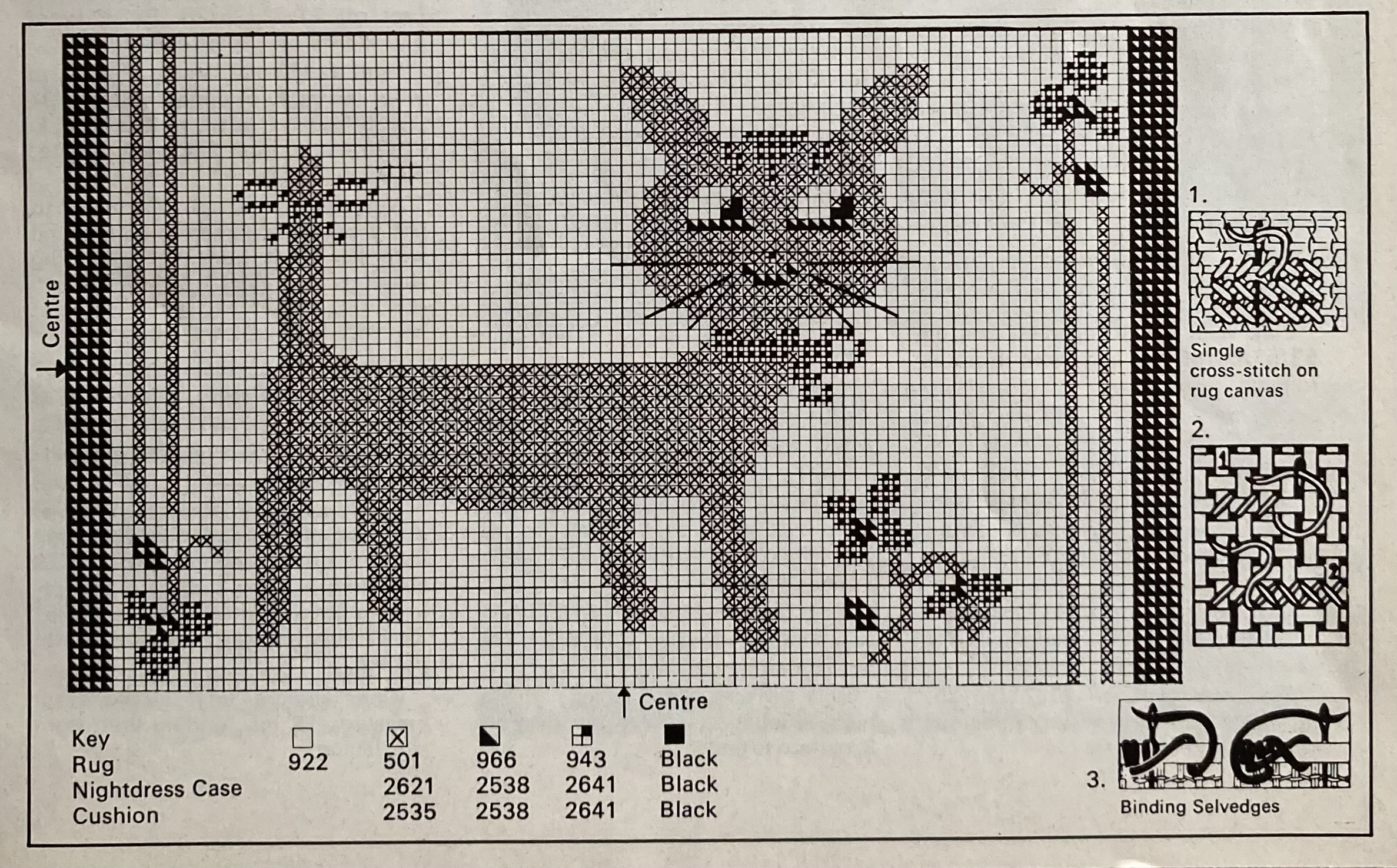
There are plenty of embroidery and tapestry projects for those long winter evenings. My favourite is the cross-stitch cat that can be made into a cushion, rug, and/or nightcase. (I have not yet understood the point of putting your pajamas or nightgown in a zippered case during the day. Were any of you readers children of the time and can tell me about it?) According to Stitchcraft, cross-stitch cats are lucky! I could use it. There’s also an appliqué picture of a boy and girl rowing, an embroidered dragon cushion or wall panel (that dragon is definitely high on something, cheers), an opportunity to turn leftover tapestry wool scraps into a tea-cosy or cushion, and a cross-stitch rug to use as a hall runner. The only specifically Christmas-themed project (in the entire issue, really) is an embroidered serving set of table cloth and/or trolley mats with somewhat abstract renditions of shepherds, sheep and a star.
In the children’s comic, “The Woodland Wool Shop”, Mrs Olive Owl starts knitting a long strip of fabric with no plan about what to do with it (been there) and realises that it would make a great coat for Daniel Dachshund. Isn’t that nice? I hope all your projects turn out to be equally useful and make someone (including you) equally happy.

My project will be something small, probably the gloves. I do love the lucky cross-stitch cat, though. Merry Christmas to those of you who celebrate it, and happy December holidays to all.
November 1967: Overview

Autumn is officially here, winter is around the corner, and Stitchcraft‘s November 1967 issue presents “the GOLDEN LOOK for winter sparkle”, with warm garments, warm colours, fun textures, and matching his-and-hers outfits to chase away the cold, grey days of November.

Our cover models sport matching polo- (aka turtle-) neck sweaters in “Flair” wool and a suitably golden colour called “Musk.” There are only two sizes given: 35-37 or 40-42 inch bust, so intended as a one-size-fits-most, basically unisex pattern. The textured pattern is made entirely with knit and purl stitches. Our other partner-look models wear polo-neck pullovers as well, with a simple stranded chevron border at the hem. They seem to be designed for somewhat younger and thinner folks, with three sizes from 32-33 to 38-39 inch bust. There’s one more design just for men: a “country cardigan” in blue wool and a fern-like textured pattern.

The women’s designs include a rich green jumper suit, with a buttoned pullover in low-contrast stranded diamond pattern and a plain olive-green skirt; a hooded jacket in a chunky bobble-like pattern made with twisted stitches; a delicate jumper in soft, fuzzy “Princess” wool with a contrasting colour yoke; a polo-neck pullover in colourful “rainbow” chevron pattern; and a bright blue cabled jumper for larger sizes (40-45 inch bust).

With all these great designs for adults, it’s not surprising that there’s only one children’s pattern in this issue, a tunic for girls age ca. 4 to 7. It’s knitted sideways in pieces, starting at the left side edge of the back, then the fronts separately, then the sleeves separately, which are also knit sideways. I’m glad to see the girl model wearing tights, for once! The children’s comic in the “Readers Pages”, titled “The Woodland Wool Shop”, tells the story of Daisy Lamb, who wants to learn cross-stitch, but doesn’t want to be cross about it.

The homewares and “novelties” are all designed with an eye towards December gift-giving, and most of them are featured in a single, big colour photograph. There are lots of things to make in felts: holiday-themed potholders and party mats, a night-case patterned after the nursery rhyme about the old woman who lived in a shoe, some racist “Golliwog” puppet mitts (unfortunately, still a thing), giraffes to appliqué onto an apron, coffee cosy or apron, and another truly terrifying clown intended for use as a string dispenser — yes, you put a roll of string in its head and pull the string out through its mouth. Stephen King was already 20 years old when this issue of Stitchcraft came out (and lived in another country), but if he grew up with things like this in the 50s, it’s not hard to see where he got the inspiration for It. Just saying.

You can also embroider sprays of holly on place mats or another apron, or make a cross-stitch rug or cushion in a Norwegian pattern, or a different cushion in a Florentine pattern. More advanced tapestry aficionados can make a tray-cloth or yet another cushion based on a design from a Chinese tapestry. On the simpler side, you can sew a little doll and dress her in traditional Dutch clothing, or knit a little stuffed toy set of a mother and baby fox. Many, many gift ideas in this issue. Oh, and another rug, in cross stitch!

The ideas keep coming, with two little cross-stitch pictures symbolising “Autumn” and “Winter” (to match the “Spring” and “Summer” pictures in the last issue). And how could I not mention the best gift idea of all: the bed-jacket in loop-stitch, modeled by my favourite model, who seems to have been hired by Stitchcraft exclusively to model bed-jackets with a sexy come-hither smile. I have to admit, the loop-pattern spoils the sexiness for me, but we all have our own preferences… Love the pink-on-pink photograph, though.

That’s all for this issue! My project will be the buttoned pullover from the jaquard jumper suit (just the jumper for now.) May your November be bright and golden.

March 1967: Overview

The March 1967 issue of Stitchcraft promises us „new fashion looks for Spring knitting“. March weather being notably unpredictable, there are warm, bulky knits for colder days (or to wear as sporty outerwear) and finer knits for Spring. The former are mostly made in „Big Ben“ to knit up quickly and warmly, but slightly less bulky in shape than before, the latter in smooth crepe wool with or without glittery accents. The „skinny“ „mini“ jumper makes an appearance as an alternative to the bulky look for young folks, and the crochet look in knitwear is still trending.

Our cover duo sports (heh) matching bulky V-necks in Big Ben wool, knitting up quickly at 3 1/2 stitches per inch. The cable panels down the front give it a little bit of vertical line to counteract the bulk. The cable-and-V-neck combination show up in a slightly less heavy-knit casual cardigan for larger sizes. The „Sweater with flower trims“ on the inside cover looks bulky, but is merely oversized and actually knitted in fine Cameo Crepe at 8 stitches to an inch. The flowers are made with intarsia with crocheted motif centres sewn on and the buttons are covered in fabric knitted from the same wool as the sweater — a cute extra touch. The crochet look in knitting continues with a high-buttoned cardigan in a sort of arrowhead-shaped slip-stitch pattern. It too is knitted in fine crepe wool, but looks bulky due to the oversized design and three-dimensional stitch pattern.

Teenage girls can knit themselves a „Little Shetland“ cardigan or pullover with an easy stranded pattern at the yoke or hem, or a fine-knit „skinny rib top“ which would be just as much in fashion nowadays as then. Whatever the girl behind the skinny rib top model is wearing is not part of this issue and will remain a mystery.

Finally, there‘s a glamourous sleeveless cocktail dress with matching jacket. The lacy pattern panels get a little extra glitz from knitting with the base wool (Cameo Crepe) and Lurex thread held together.

There are so many women‘s fashions in this issue that there apparently wasn‘t much room for men‘s or kid‘s designs. What there is is great, though: a three-piece baby set for spring outings in the pram and a hard-wearing cabled Aran pullover for a school-age boy.

The homewares in this issue are less interesting than usual and feature versatile designs that can be adapted to different furnishing needs: a woven design for a rug or cushion, grapes and leaves to embroider on an apron, mats or cushion, etc. Ambitious crafters could make an entire set for a room that way.

There‘s a cute breakfast set for a child‘s Easter morning and a crocheted mat for the adult‘s afternoon coffee table. Really ambitious embroideresses could make an elaborate and very pretty flowered tablecloth.

There‘s a new comic series in the Readers Pages which is cute and well-meant, but also fairly eyeroll-y for modern sensibilities: „Children of Other Lands“, featuring well-trodden clichés about cultural practices etc. in non-British countries. This month features Jan, a Dutch boy whose wooden shoes get stolen by mice, who use them as a boat on the canal. You get the idea. The ad for the Scotch Wool shop manages to be at least as much fun without any stereotypes.

That‘s all for this issue! I don‘t know what to make. I love the cocktail dress combo, but the ratio of time and effort in making / actual use I would get out of it doesn‘t add up. The larger-sizes cardigan is practical and nice, but I have multiple larger projects on the needles and don‘t want to start a warm cardigan in Spring. I might make another project from the January 1967 (the Fair Isle cardigan! Finally bought the wool for it!) or February 1967 (Lacy knee socks!) issue instead, or start ahead on the April project (chevron striped dress.) I promise to get something done sometime. Happy Spring!

December 1966: Overview

Hooray, it’s the Christmas issue! Our cover model from the December 1966 issue of Stitchcraft sports a holiday-red knitted dress with a jaunty black velvet bow in her hair. Bright, cheerful colours, fun ideas for gifts and holiday parties, and the “Total Look” of a complete knitted outfit in one colour theme light up the pages.

The cover dress is made in Shetland-blend “Fiona” yarn and a diagonal criss-cross pattern that looks like cables, but is actually made entirely out of normal increases and decreases (yo, sl-k-psso, k2tog). The skirt is plain stocking-stitch and amazingly for 1966, still falls just above the knee. The two-colour suit with stranded “key” pattern in yoke and skirt hem is similarly demure. The two colours of lightweight “Cameo Crepe” wool are “Pearl Frost”, which I assume is the lighter one, and “Mastic” — I have no idea what colour “Mastic” is supposed to be. (I can only think of Mastix cosmetic glue, used for sticking on fake beards etc., which of course has no colour at all.) As an alternative, the magazine suggests to use Patons Beehive 4-ply in “Mink” and “Magnolia”, so I guess “Mastic” is a medium brown and the magnolia is white. Or the magnolia is dark pink and the mink has got its winter coat on. By the way, Stitchcraft‘s “editress” Patience Horne promises us in the notes to this issue that starting in January 1967, there will be more colour photos, so there may be less guesswork in the future.

The other patterns for adults include a lacy bedjacket, also in “Fiona”, that is pretty enough to wear as a cardigan, as well as a party jacket with Lurex metallic thread held together with the main crepe wool on the borders for extra holiday sparkle. There’s also practical heavy cardigan in reverse stocking-stitch with cable panels.

For the man in the family, an oversized shirt-sweater with angular pattern lines. Or you can make a his-and-hers set of “snow sweaters” in a typical all-over tiled Fair Isle pattern. Diagonal lines are a clear theme in this issue, whether made via texture, colour, or with angular cables.

For the kids, there’s a cute, warm 3-piece outfit of leggings, jumper and cardigan that is good for winter playtime (and finally, a girl can have warm legs and move around without worrying about where her skirt is flying. Look how happy she is!). The boys’ slipover features elements of the cable pattern and blocks of ribbing that we saw on the women’s cardigan. Finally, a bigger girl can enjoy the “Total Look” of tunic, tights and floppy pom-pom-trimmed hat, all coordinated in bright shades of “Lipstick Red” and “Strawberry Ice” double knitting. I’m glad they used a colour photo for this one!

The usual embroidery patterns for cross-stitch borders and easy cushions are supplemented by another big, fun appliqué wall panel: “Widdicombe Fair.” (Spelled with two “d”‘s in Stitchcraft.) I admit, I did not grow up in the UK and wasn’t familiar with it. For others who also weren’t in the know: it’s a traditional agricultural/livestock market fair that has developed into a more social gathering for traditional events, arts and crafts, and rural activities. Have any of you readers been there? Do they have knitting? Tell us about it in the comments! The wall panel shows a scene of happy (and presumably quite tipsy) fair-goers riding home on a pony after the fair. It is comic-like in style, but actually quite intricately worked, with close-fitted felt pieces embroidered and decorated after the appliqué is done.

And of course, it wouldn’t be Christmas without little handmade gifts and Christmas “novelties.” You can knit a hot-water-bottle cover and address it in embroidery to “Miss Miranda” in “Dreamland” (presumably other names and addresses would work as well) or knit some fireside slippers in an easy bobbly-lace pattern. While you’re knitting, make some cabled gloves with a contrasting-colour cable on palm and back of hand for “Father” and a kangaroo with baby for your littlest one. A crocheted hall runner is a “practical gift for the Home.”

The Christmas novelties run the gamut from elegant (an appliquéd panel of a poppy flower from which you can hang a tiny calendar), to cute and wintry (felt table mats with appliquéd stars, a “Father Christmas” sack to fill with gifts), to cute and silly (a knitting snowman made of cardboard, with the “snow” effect made by just pasting cotton wool onto the cardboard), to “what even is it” (little “mascots” made from the scraps of felt left over from the other projects. Apparently, they represent “amusing Bongle people”. I was very afraid to find out what that meant, but they seem to be a sort of fairytale gnome that have recently made a modern comeback in the video game Baldur’s Gate? Either that, or a slang term for copyright protection, lol. I’m guessing the Stitchcraft mascots are the fairytale gnome kind.)

The Readers’ Pages have a great little pattern for a potholder with a crocheted robin sitting on the handle of an embroidered spade. In the comic, schoolmarms Miss Prim and Miss Proper try to teach untidy piglet Higgledy Piggledy how to be neat and clean, but he is not having any of it. It’s the schoolmarms’ fault that he flies out the window, though, since they sat down too hard on the other end of the bench he was sitting on. To finish off the issue, there’s a thoroughly groovy ad for “Stop Red” and “So Dotty” lingerie from the Scotch Wool Shop.

That’s all for this issue! I have no idea what project I will make. Stay tuned, and happy holidays.

October 1966: Overview

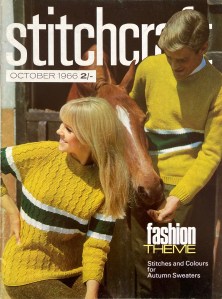
Autumn is here, and Stitchcraft‘s October 1966 issue celebrated it with warm, cosy sweaters in bold colours and textured stitches. Our cover pair sports not-quite-matching partnered pullovers in bright “Golden Willow” with a thick stripe in “Woodland Green.” The stripe on the man’s sweater is diagonal and made in intarsia. “Her” pullover has a broken-zigzag stitch pattern and the stripe running horizontally under the bust line and across the sleeve. Both are made in smooth Totem Double Crepe wool.

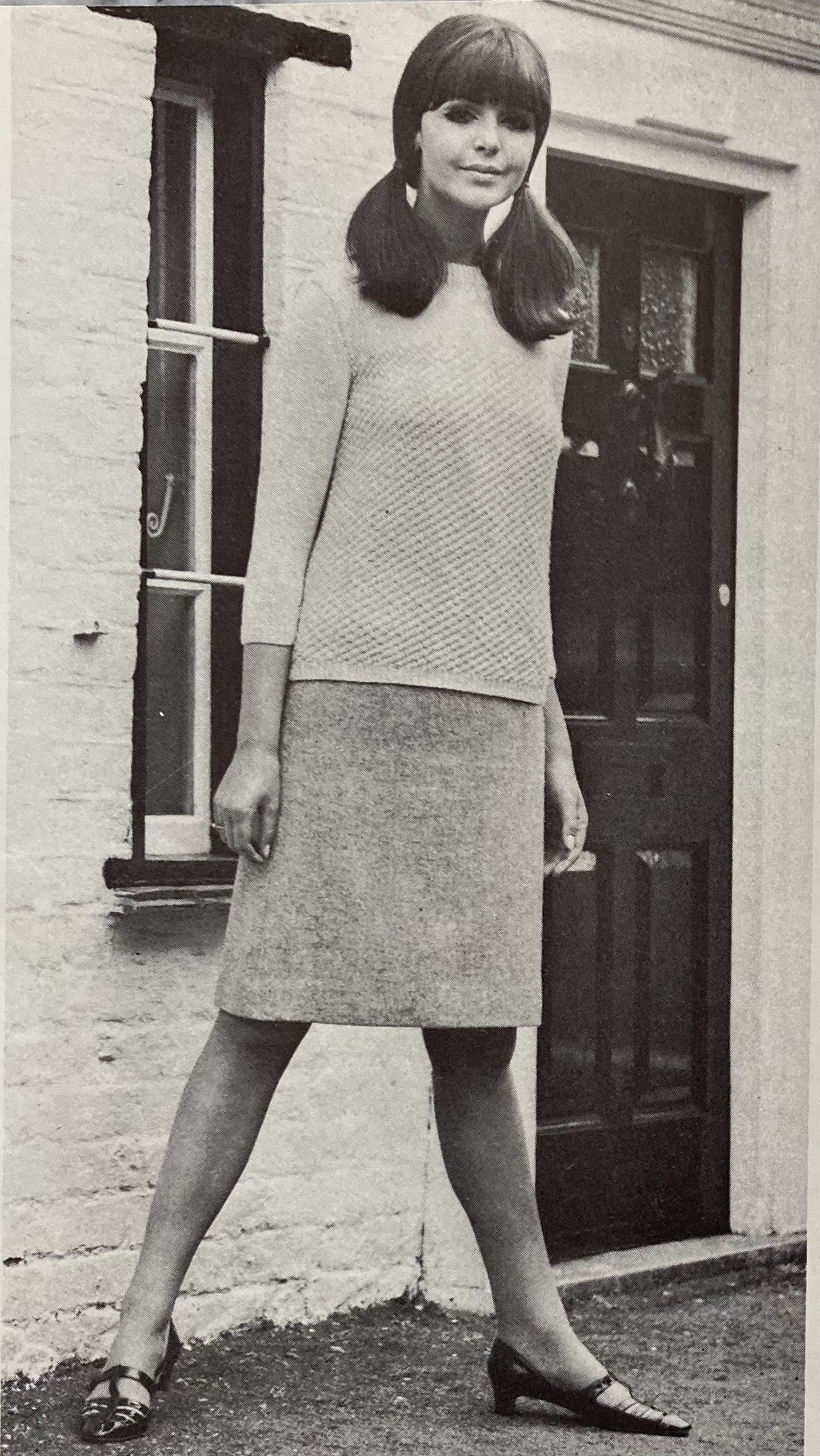
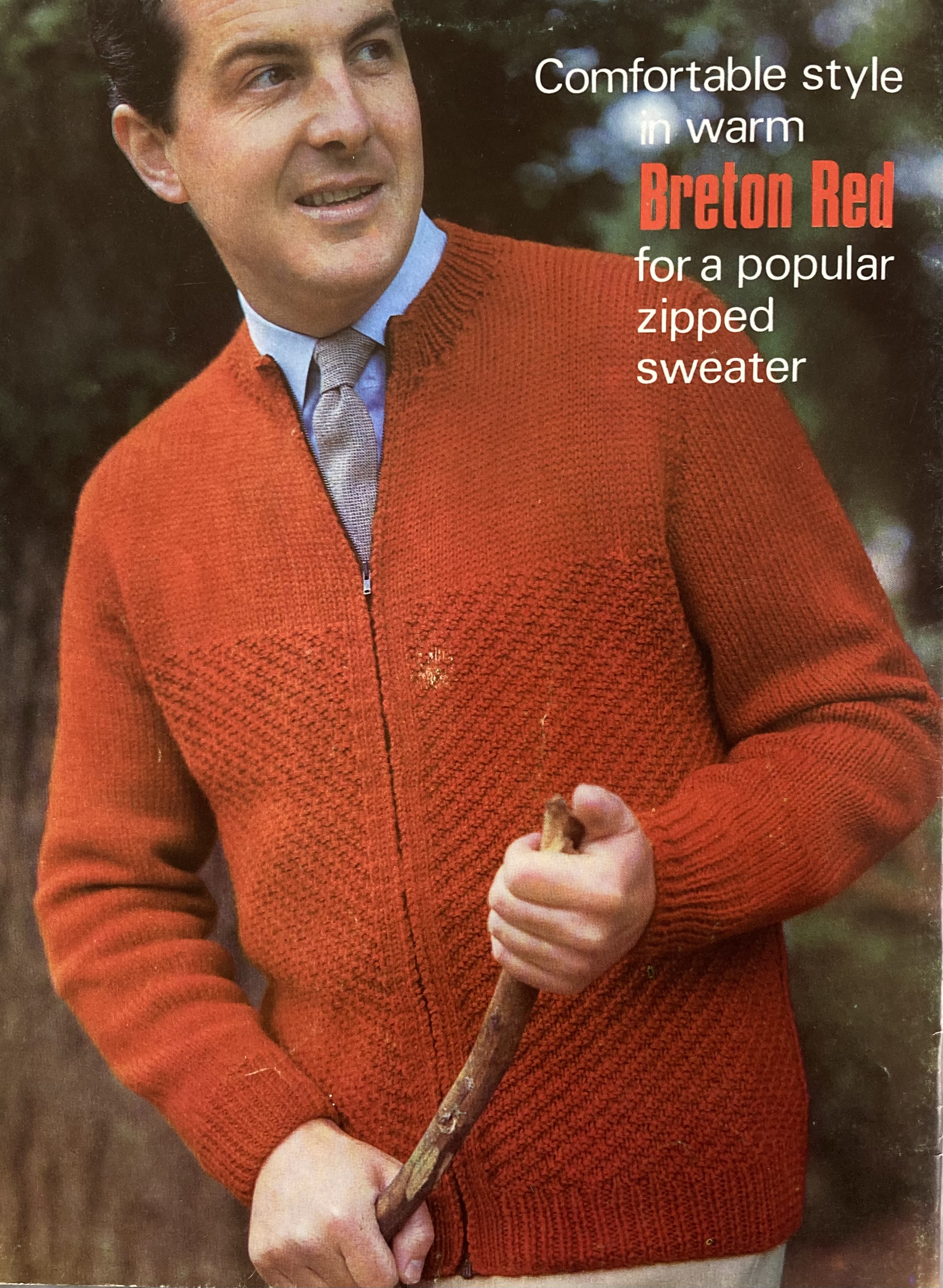
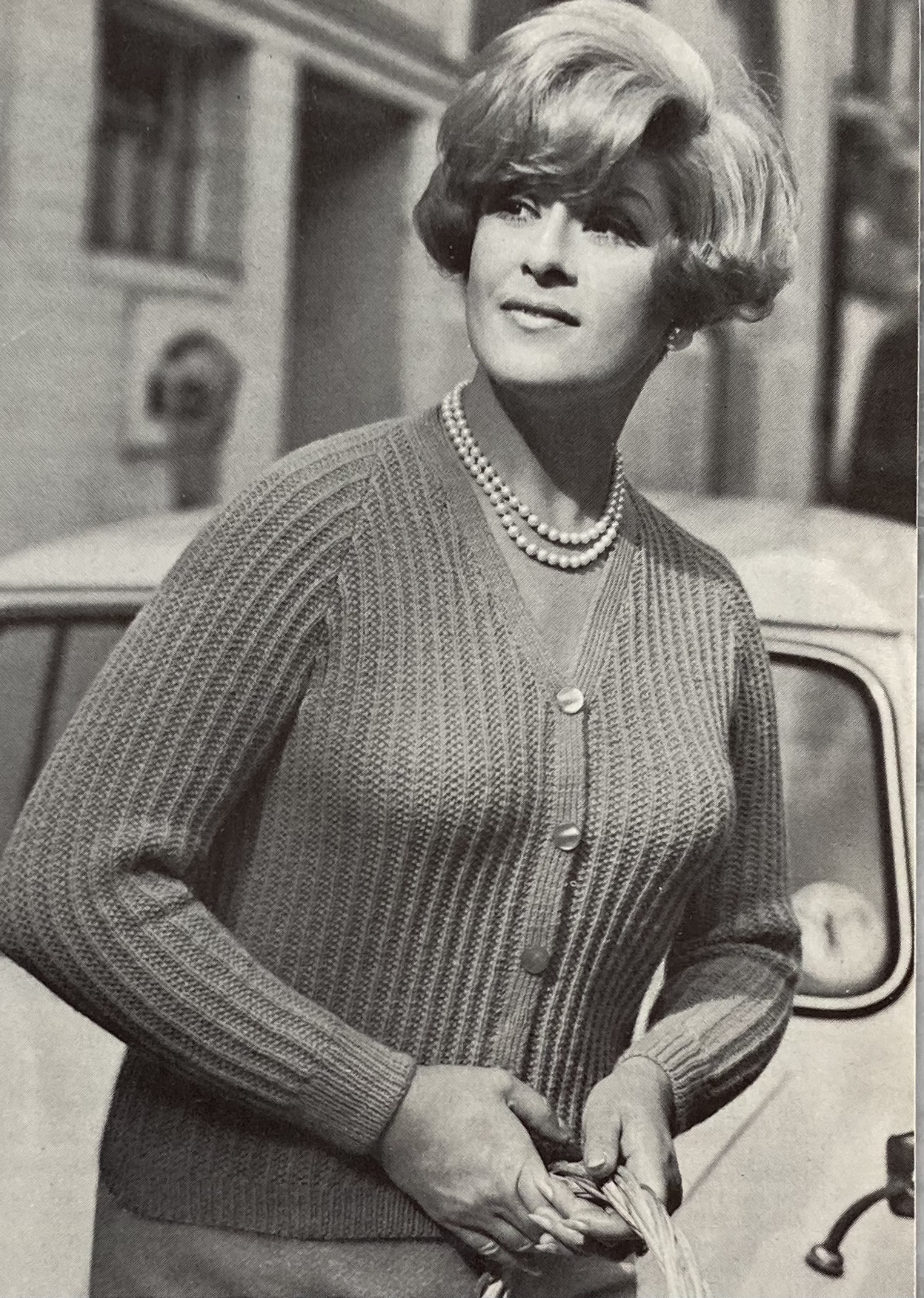
Bold colours, textures and diagonal stripes (whether made with colours or stitch pattern) are on trend for many of the other garments in this issue as well, for example, a ridge-pattern women’s pullover in “Gemini Turquoise” in Courtelle Double Crepe (like Totem, but 100% synthetic), or a “car coat” for larger sizes in bulky, bright red Capstan with a flattened cable pattern. There’s a rust-red zipped cardigan for men, too, in Patons Flair wool and diagonal herringbone stitch.

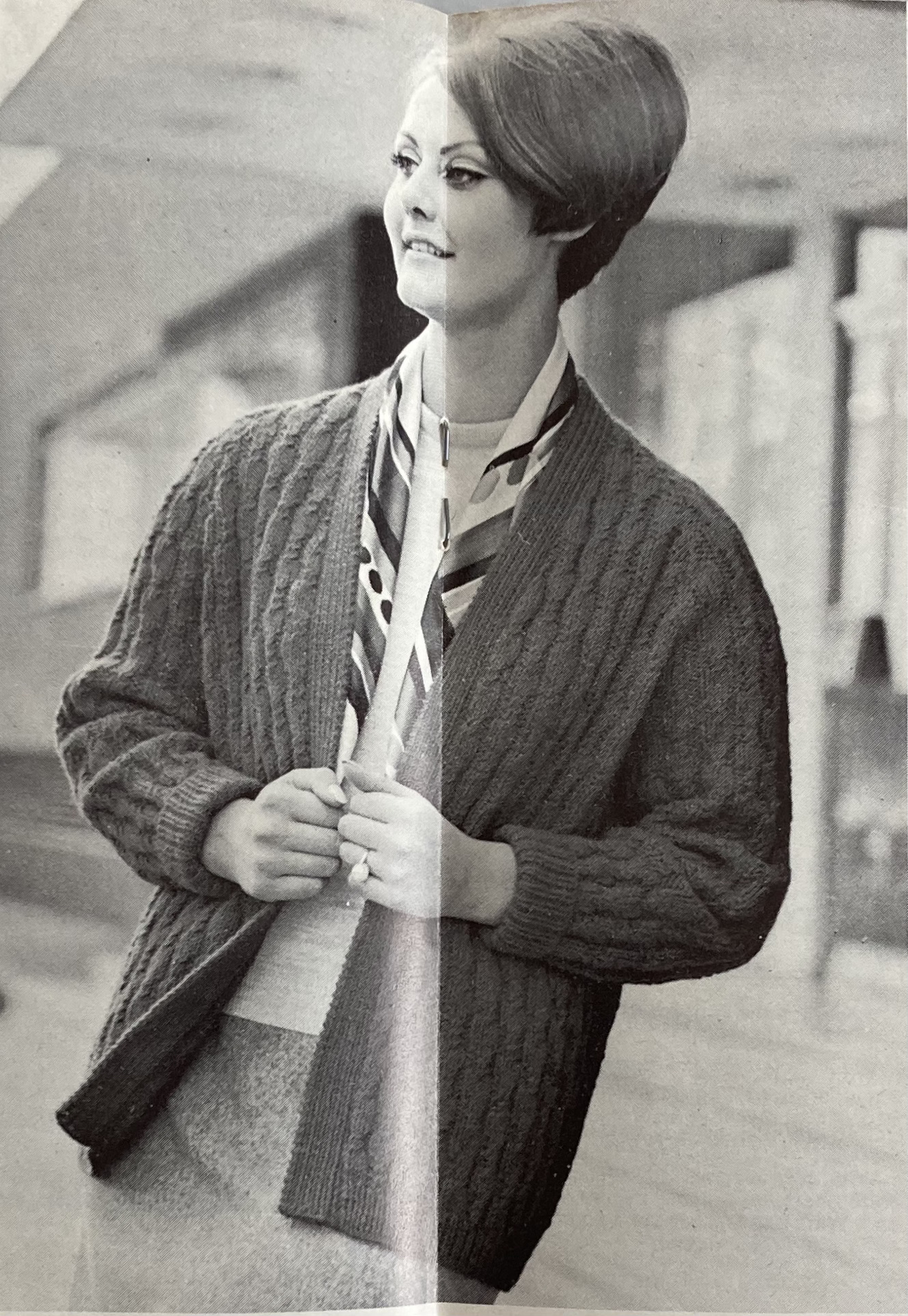
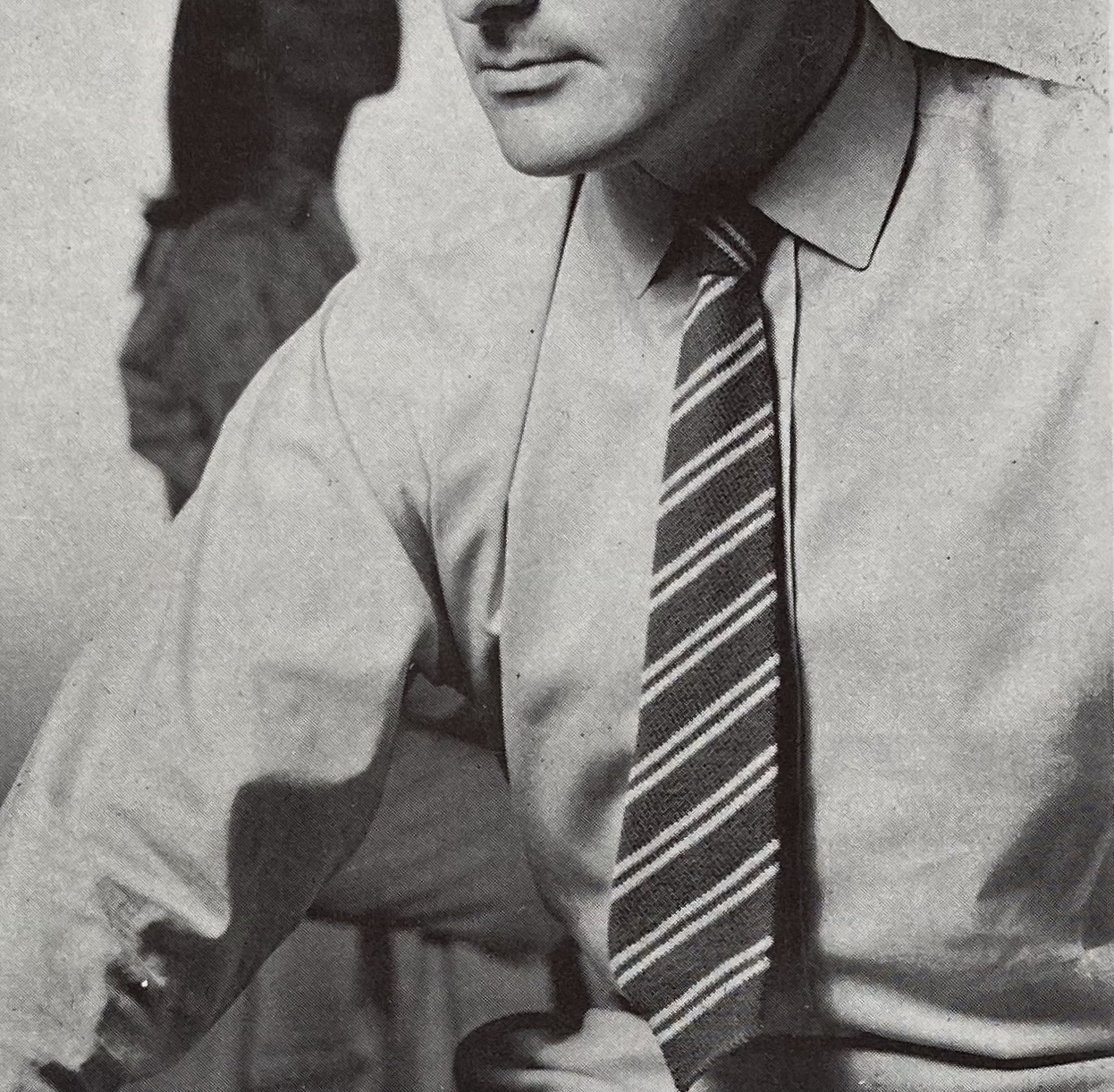
For a more elegant look, there are two garments in lighter, 4-ply wool: a dress in “French Green” with an intriguing “shadow check” pattern or a classic V-neck cardigan for larger sizes (colour: “Blue Streak”). I have never seen either of the stitch patterns before. The “shadow check” is particularly intriguing, as it seems quite simple, but makes a very cool sort of large waffle-check effect. The first two rows are stocking-stitch, to make the horizontal line, then the squares are made with 1 row of k1 tbl / p1 tbl “ribbing” separated by 2 purl stitches and one row of k2, p9, repeated to the end of the “block” (14 rows in all). The pattern on the cardigan is even simpler: Row 1: k3, p1; Row 2: k1, p1. If you have any wool left over, you can make a diagonally-striped (or plain) knitted tie.

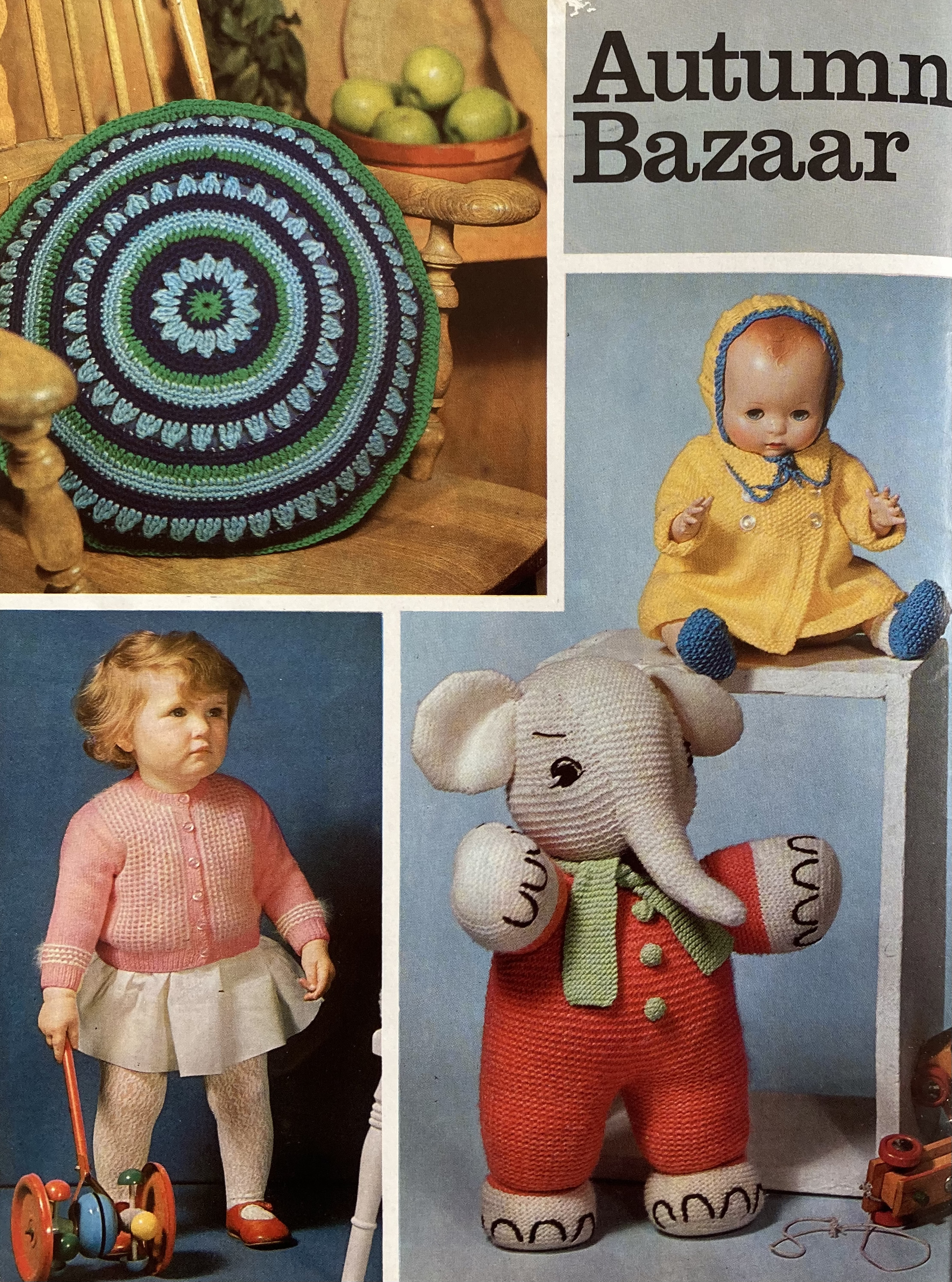
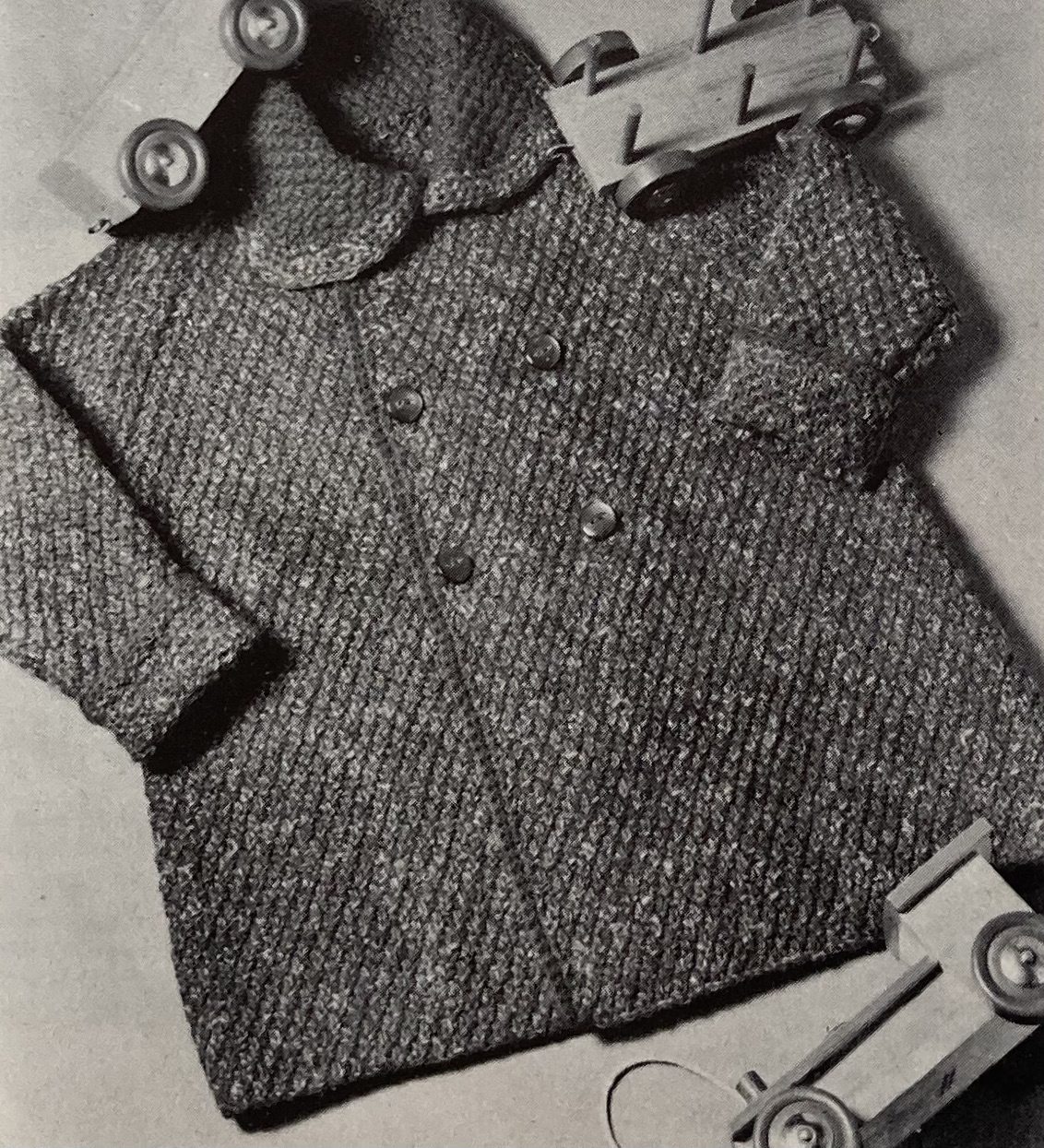
For the little ones, there’s a cardigan with checked front panels in “Fuzzy Wuzzy” angora wool that are knitted separately and sewn on to the front+back piece before adding the ribbed trim, and a nice warm tweed coat in “Moorland” wool. Well, at least the upper half of this poor tot’s body will be warm — if he goes out dressed as he is in the photo, I worry that he will literally freeze his arse off. (Doesn’t seem to bother him — I’m guessing it was warm enough in the studio). There’s a huggable stuffed elephant and a winter outfit for a doll to knit, as well.

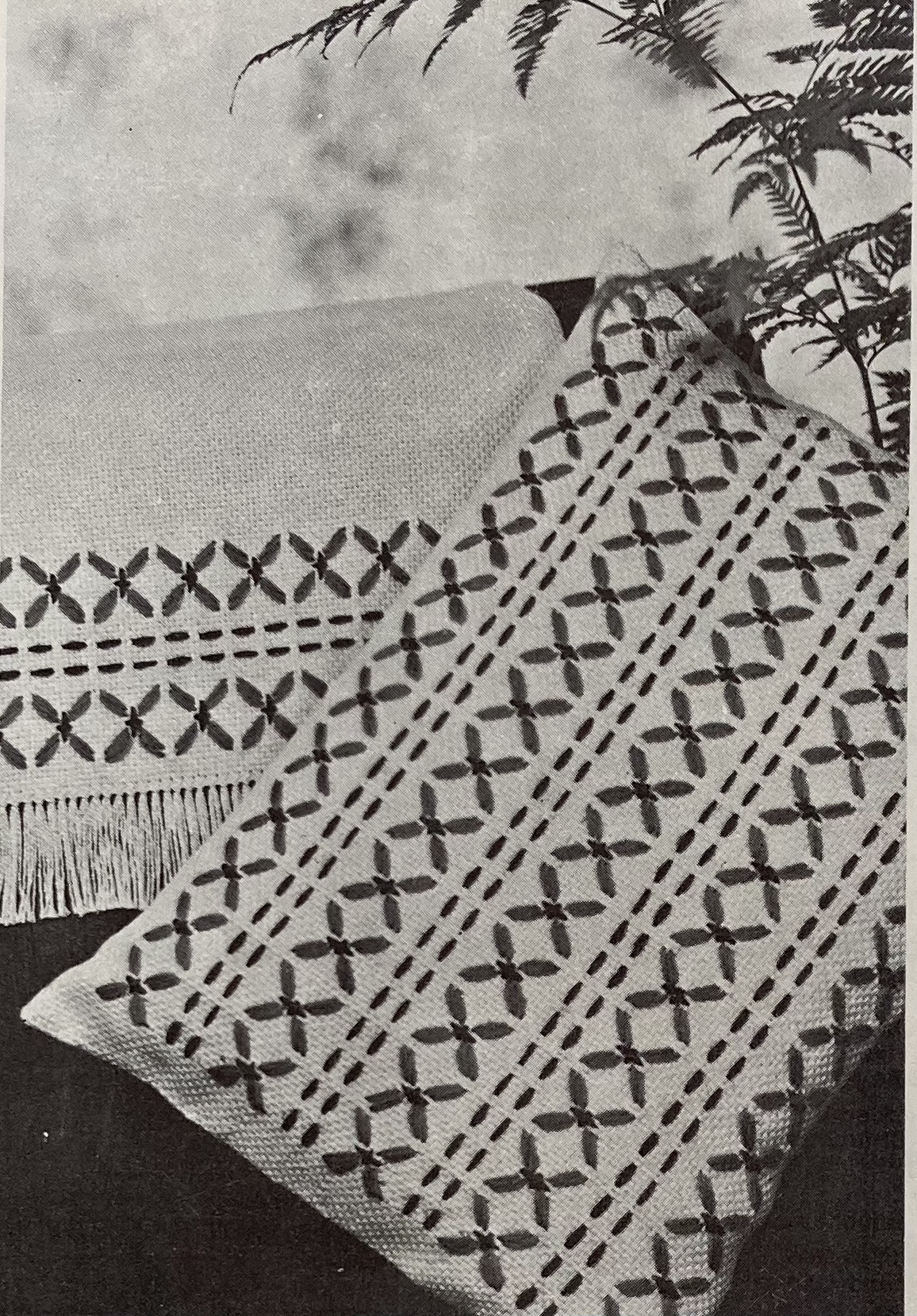
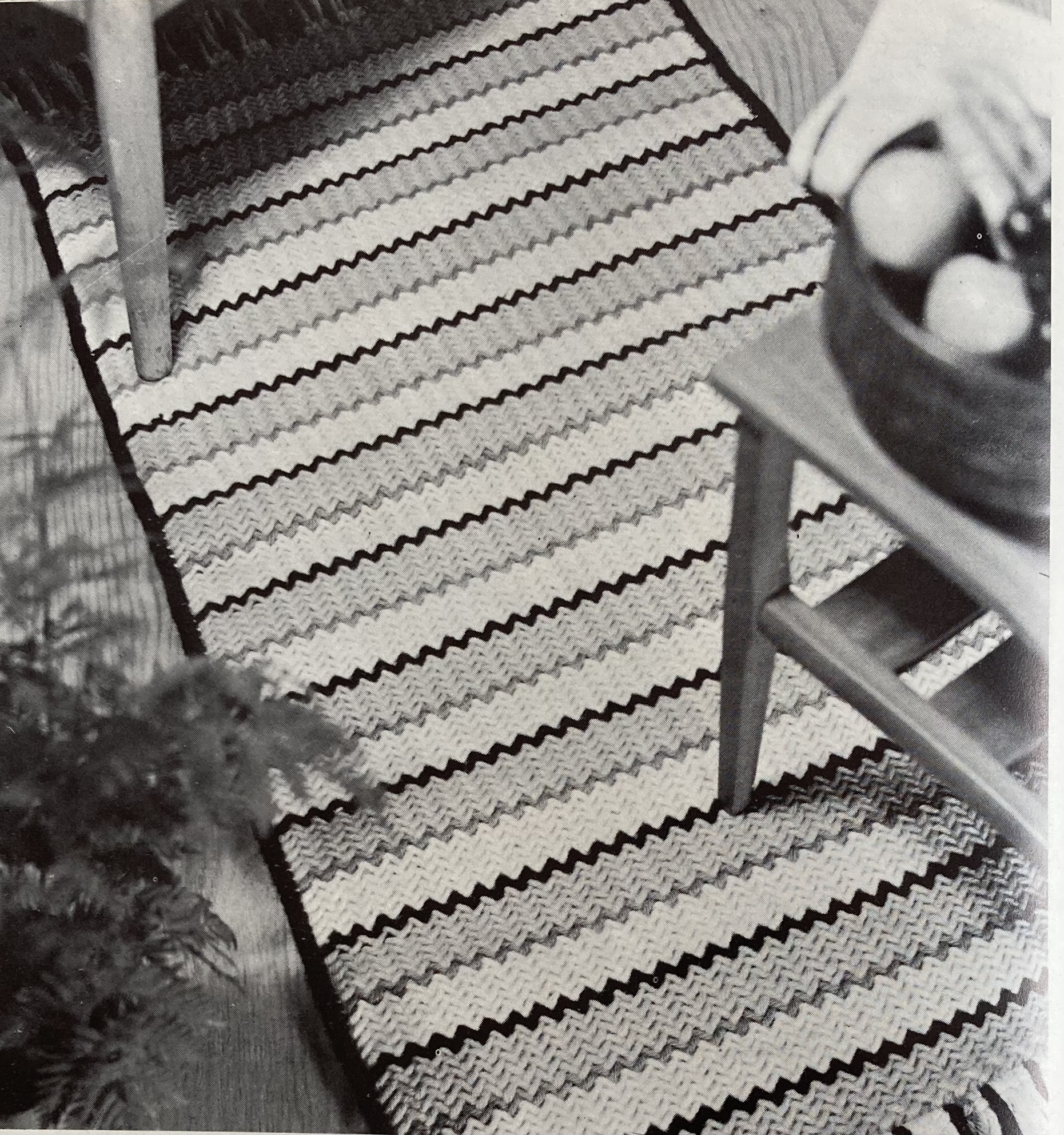
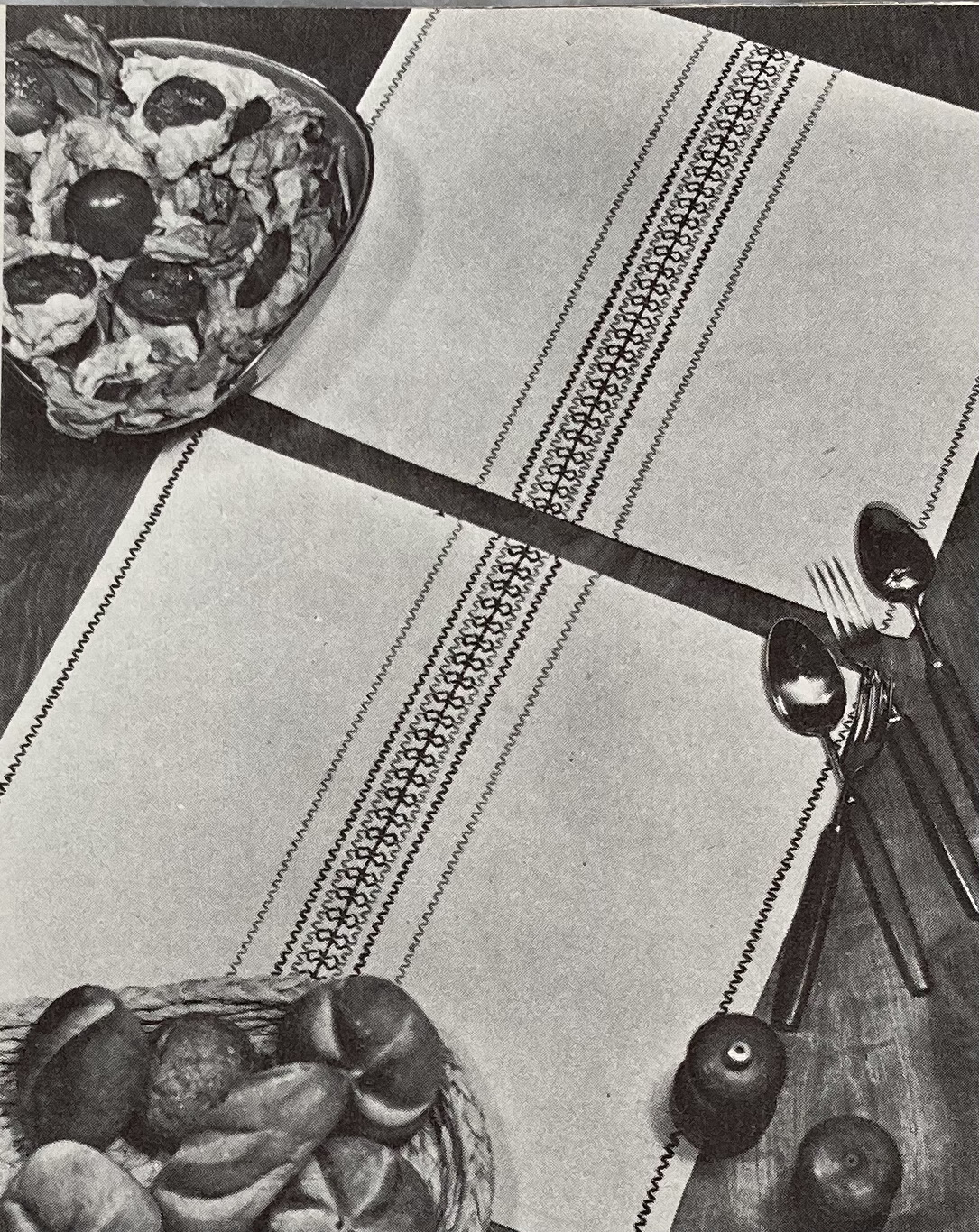
The homewares are pretty standard, but offer a range of different techniques: a crocheted cushion, a counted-stitch cushion and chairback, a practical stitched rug, or huckaback embroidery for various practical linens. Advanced embroideresses can make a stunning chairback set in Jacobean-style wool embroidery with plenty of intricate and multi-coloured stitches.

But wait, there’s more! Or not, sadly. This issue apparently had a supplement of nine designs “to knit for the family in Patons Brilliante qualities”. It must have been carefully removed from this particular issue at some point and separated from it, since there is no trace of it in my magazine, not even in the centre fold where it was presumably stapled in, and all the regular pages are intact. If you happen to have this supplement, please feel free to write in and let us know what’s in it!

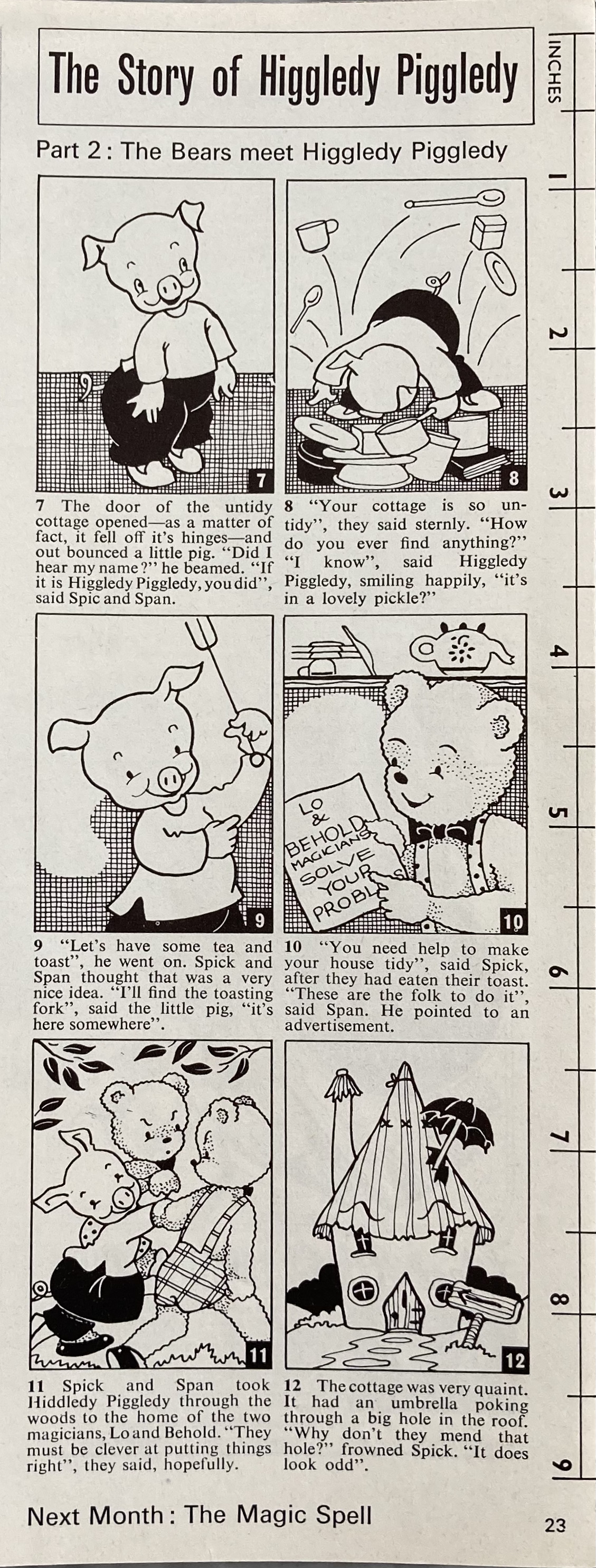
In the “Readers Pages”, there’s a reprint of a pattern for machine-knitted wool “slacks” (I guess we would call them leggings today) and Part 2 of the comic adventures of Spick and Span, the two very neat and tidy teddy bears. They meet a very untidy bear named Higgledy Piggledy and seek out the services of two magicians, “Lo” and “Behold”, to magically turn him into a tidy bear. I sense a certain pedagogical overtone in this story, which is perhaps why it is less fun and interesting than some of the other ones.

That’s all! I don’t know what to make from this issue. I offered to knit my father the red zippered cardigan, but he claimed to not need another cardigan, and nothing else really speaks to me except for the Jacobean embroidery. But what to embroider it on? I have so many cushions and I don’t need a chairback. New laptop case? Black felt skirt? We’ll see! I still have to finish my September 1966 project, anyway.

August 1966: Overview

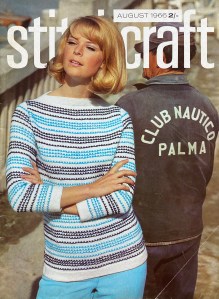
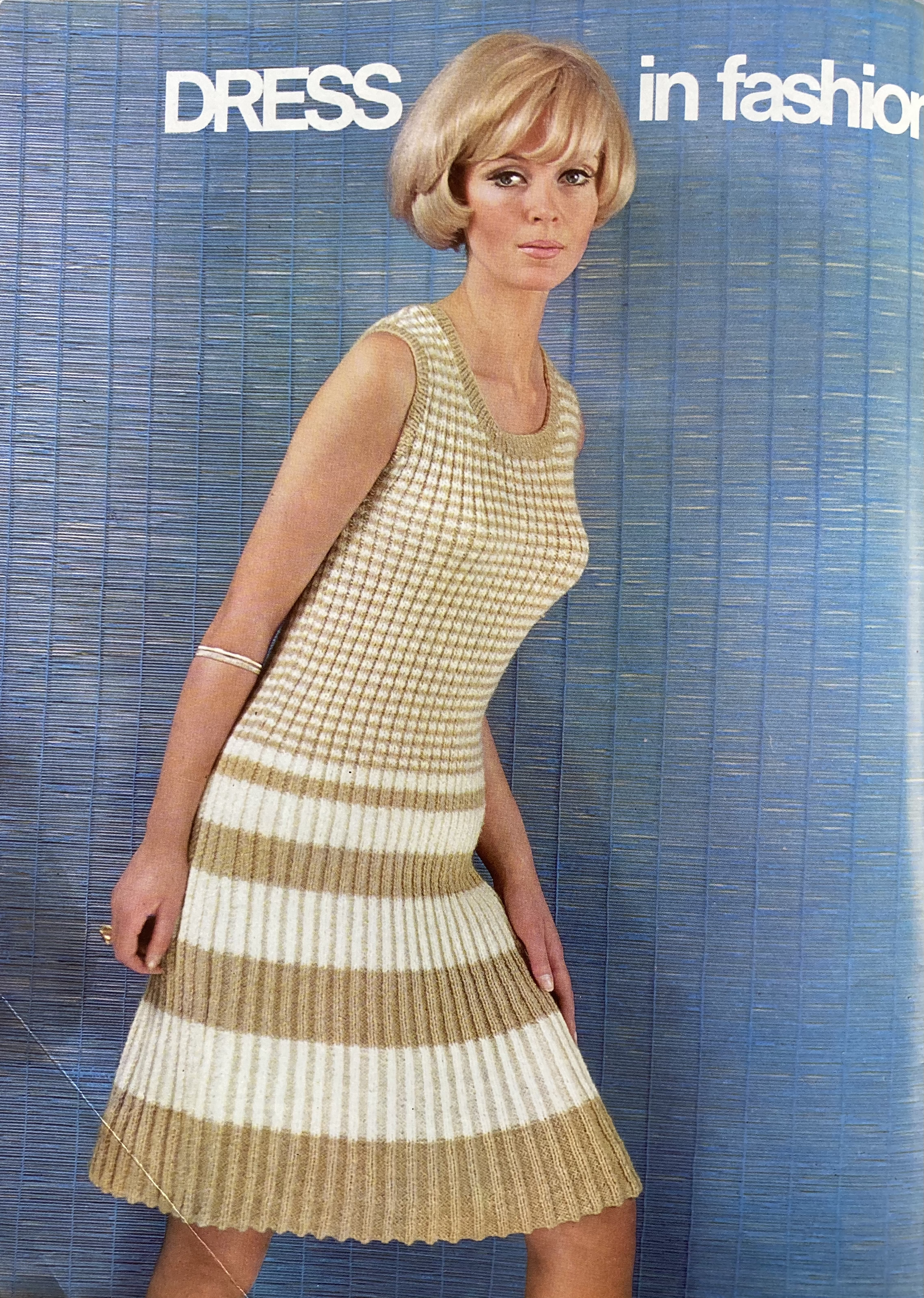
Dress in fashion for the height of summer! August is, as Stitchcraft‘s “editress” Patience Horne writes in this issue, a tricky month. Autumn is around the corner and it wouldn’t make much sense to keep knitting for warm weather, only for the season to change just as a project was finished. On the other hand, if it’s hot and muggy, you don’t want to hold warm wool in your hands. Stitchcraft‘s solution for August 1966? Sleeveless and short-sleeved garments in double-knitting weight that can be layered for cooler weather or worn in the evening on warmer days, plus some fine-knits and quick summer accessories to be worn right away.

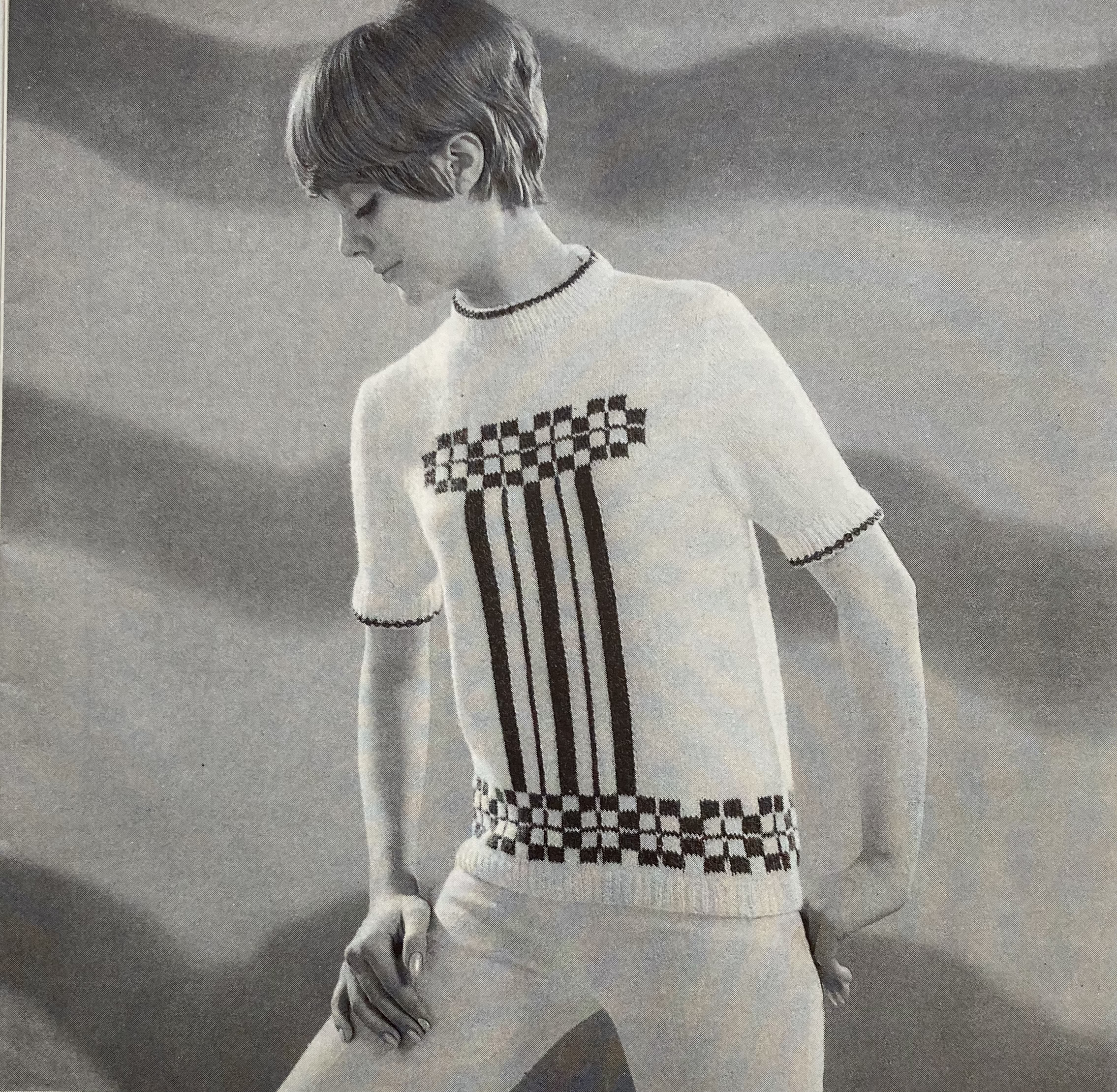
The “striped holiday tunic” on the cover strikes a good balance: made in Totem Double Crepe, it’s warm enough for sailing or windy-day wear, but the fresh white and turquoise stripes make it unquestionably a summer garment. The pattern is made by slipping the contrasting-colour stitches on the purl rows. More cool-warm fashions in DK wool are explored with a sleeveless, ribbed dress, a “racing stripe” jumper, and a short-sleeved twisted rib blouse “for cooler days” The ribbing on the dress gives a “pleated” effect to the skirt. Stripes and checks on white are a clear fashion trend.

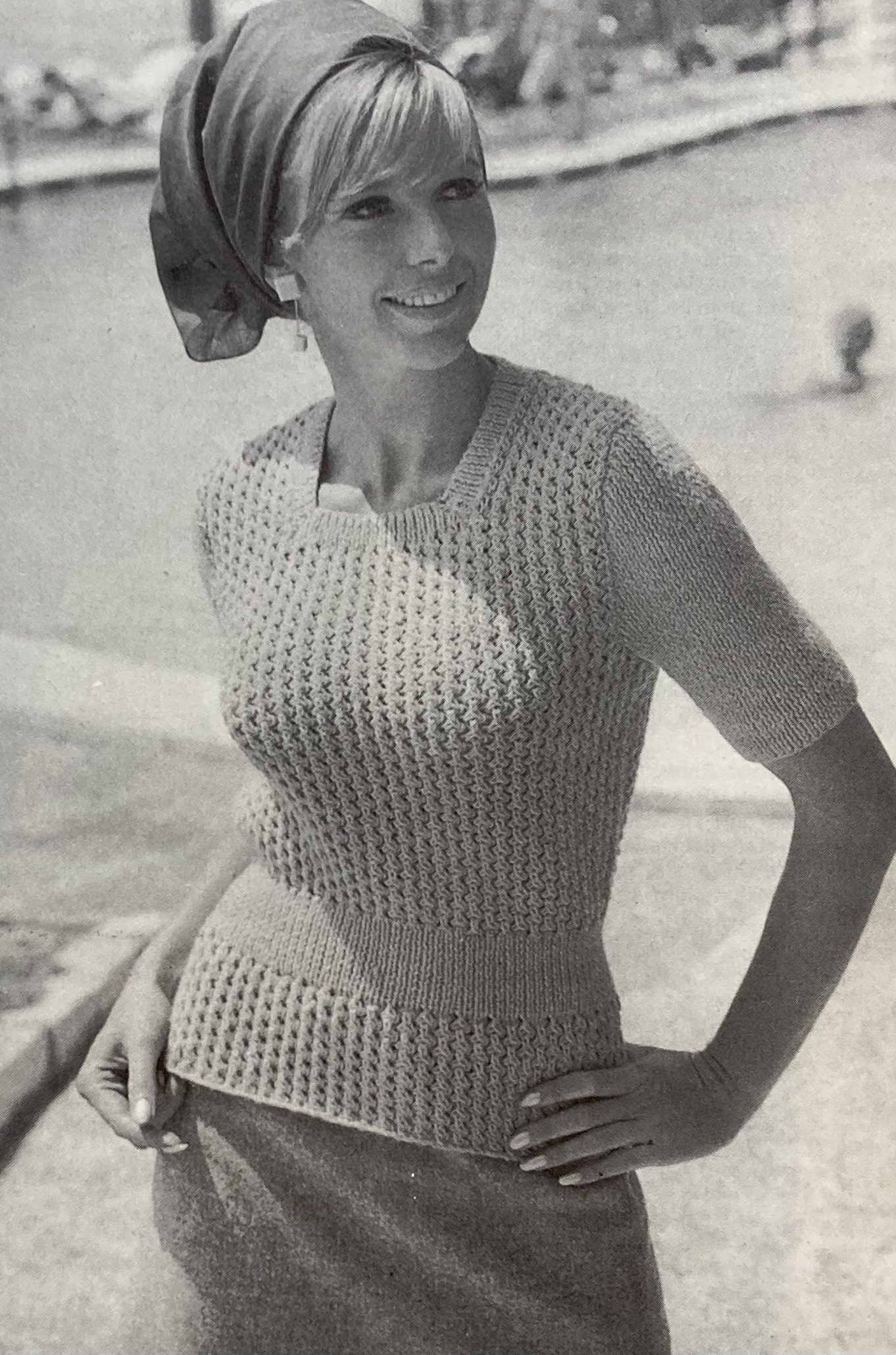
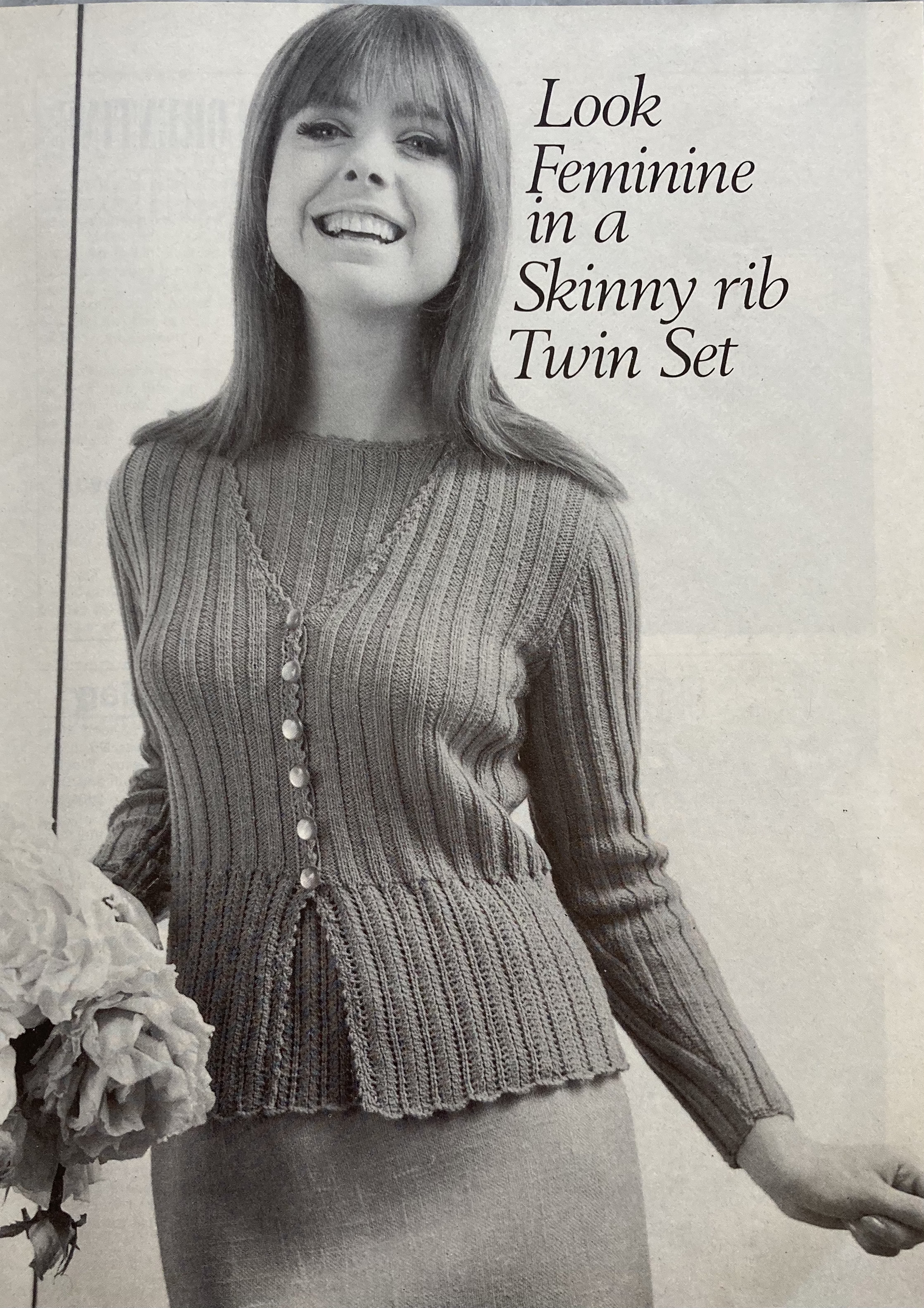
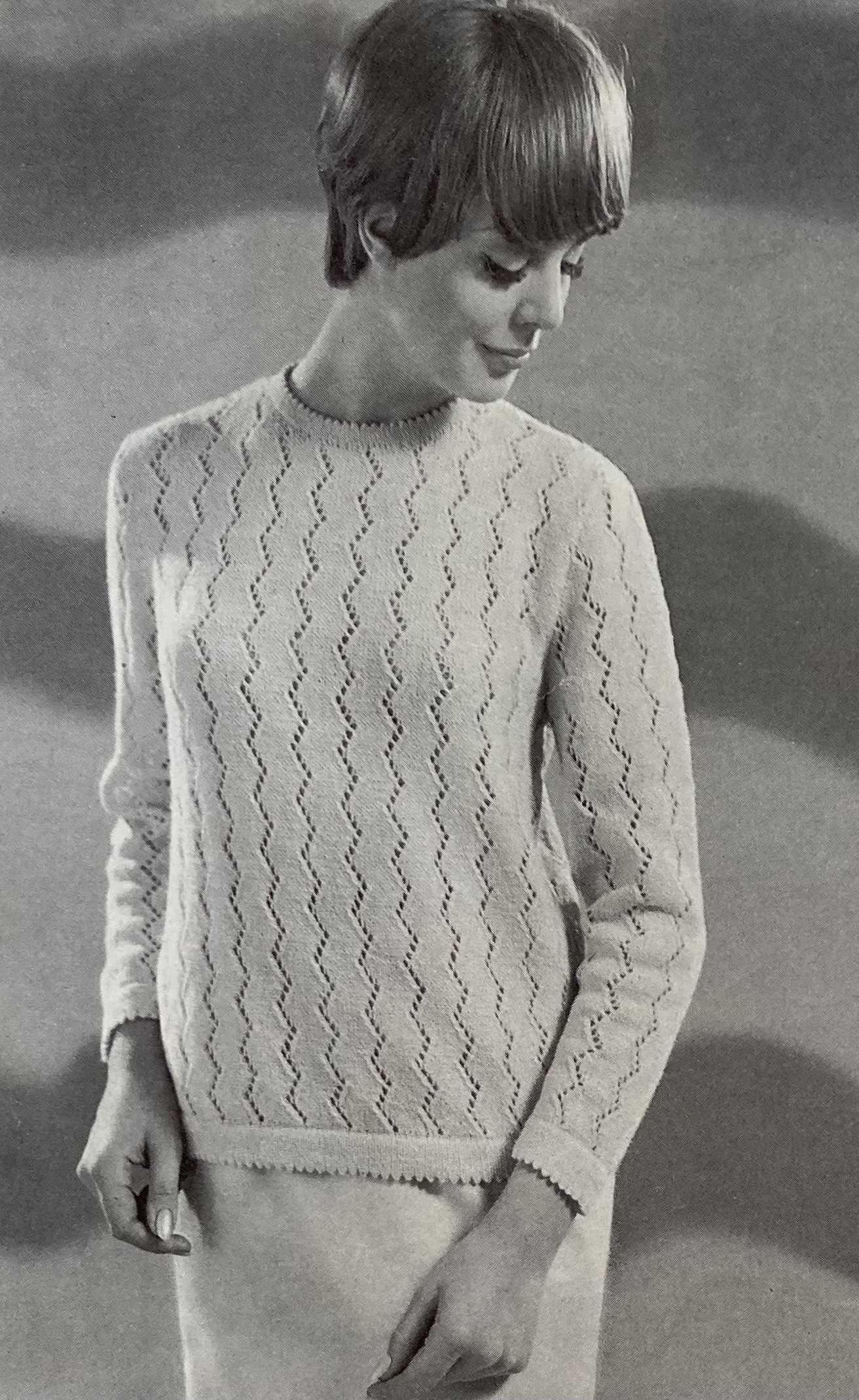
The more elegant designs are made in lightweight wools: a “skinny rib” twin set which promises to be flattering for both young and older women, with pearl buttons and a peplum-like “skirt” in ribbed lace, or a lace blouse with zig-zag motifs in both the lace and the picot hems. Here, the “stripe” trend is interpreted via pattern instead of colour.

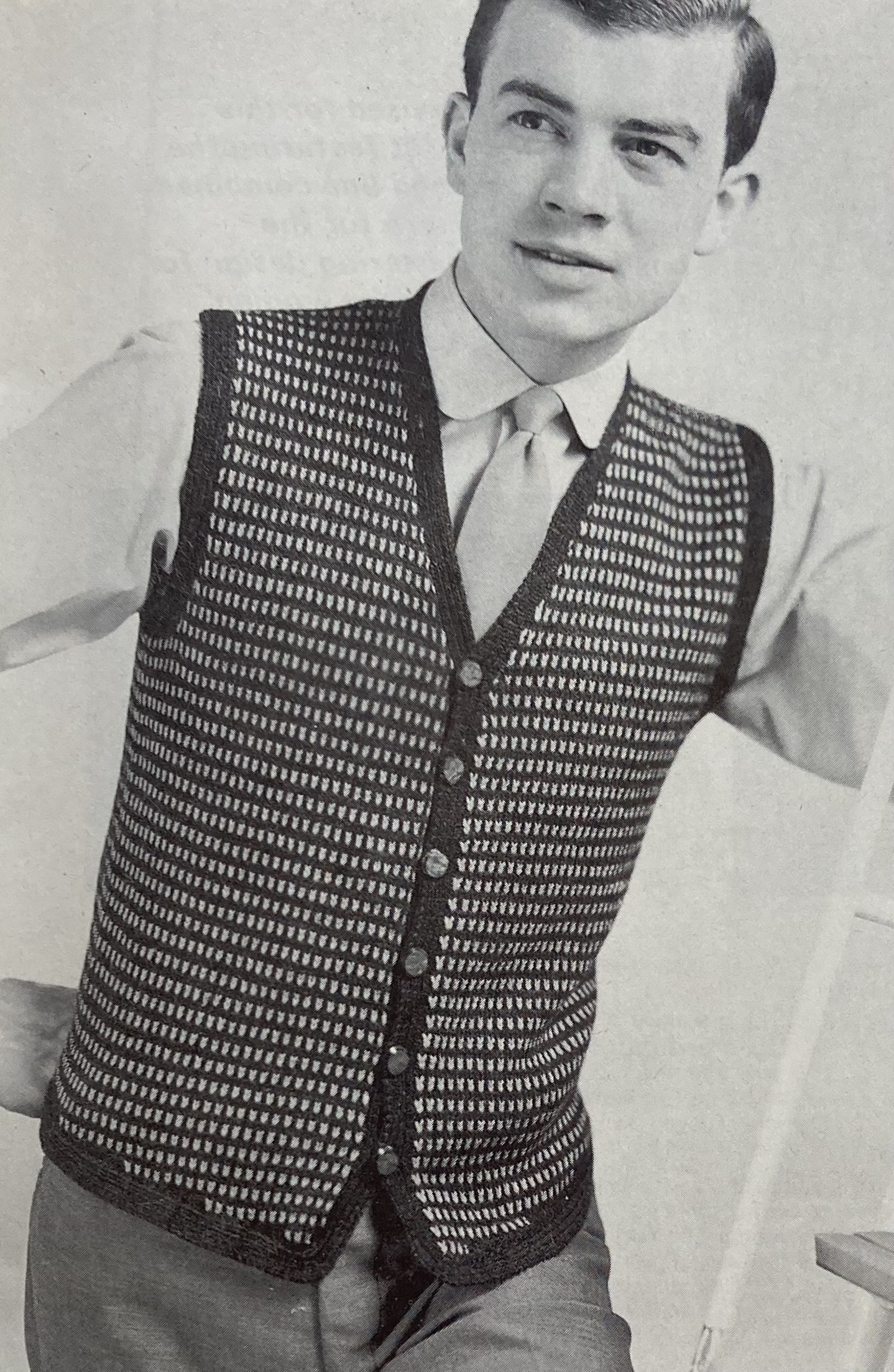
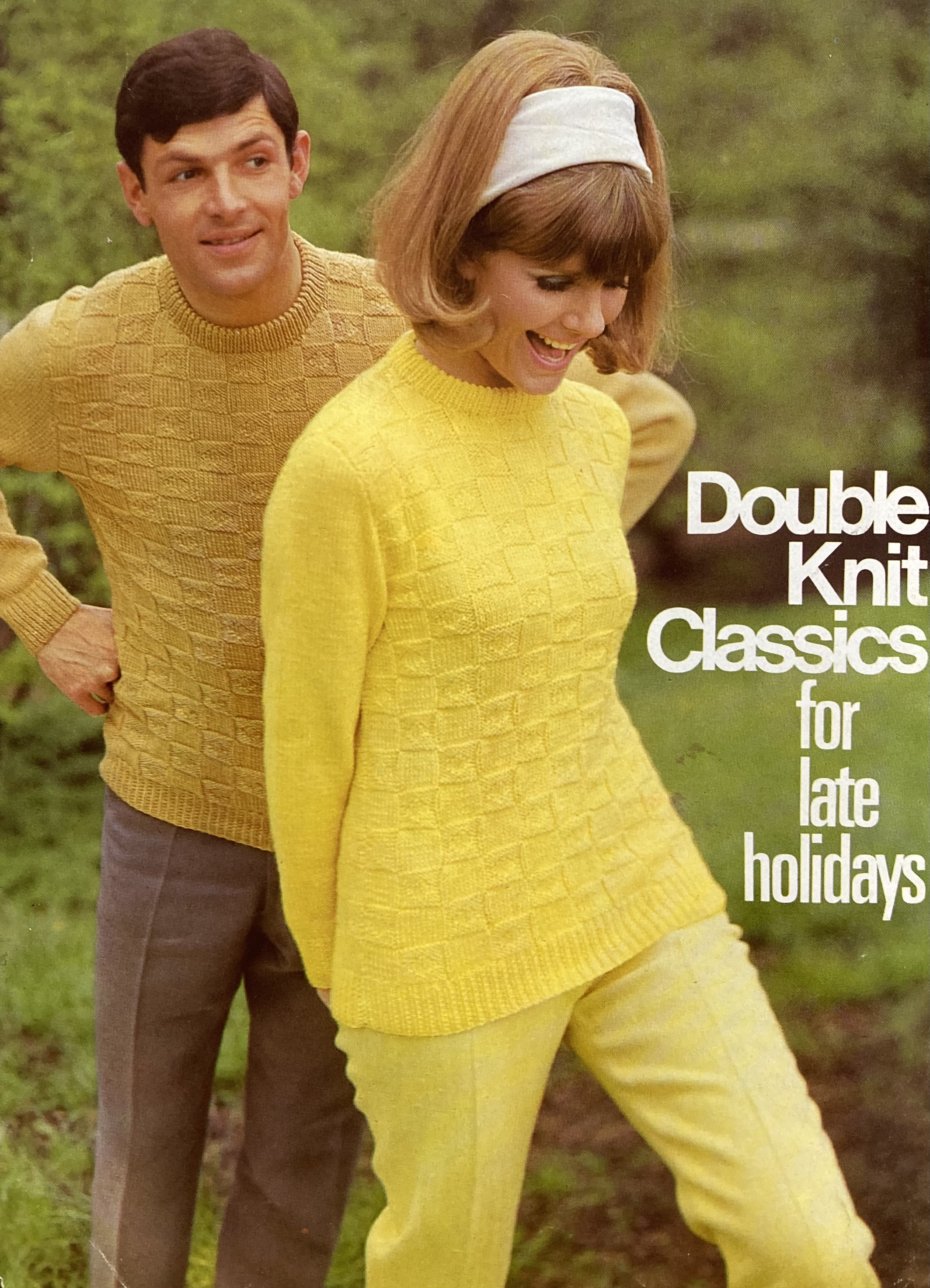
Continuing the stripe/check theme for men, there’s a nice V-neck waistcoat in a very 1960s-typical colour combination of charcoal and mustard (don’t eat it). The pattern is made stranded, and very easy, and the front and hem borders are made in one long strip, sewn in position as you go along. I have personally never had much success with this method, as you are supposed to stretch the strip “slightly” while sewing on and I find it difficult to get exactly the right, and same, amount of tension on both sides. There’a also a “his and hers” unisex pullover in a similar basketweave stitch as the short-sleeved blouse that I made from the June 1966 issue. Apropos unisex: this issue features a record number of women wearing slacks, and the short “pixie” or “five-point” cut has finally made it to the pages of Stitchcraft.

There’s nothing for babies or toddlers in this issue. Older kids and pre-teens get casual cardigans for layering or as outdoor garments. The stripe trend lives on in the boy’s zipped jacket, made in nautical colours of navy blue, red, and white. The girl’s tennis blazer is more subdued, in a neat spot-stitch pattern with moss-stitch revers. Top it off with a fun crocheted hat in the current “tall” style.

Those who do not like to hold wool in summer are always well served by the summer homeware designs, which tend to be small and easy — to pack in your holiday luggage and work on in your beach chair. There’s the usual page of bazaar items and “novelties”. I can’t make the bizarre-bazaar joke this time, since they are actually quite cute and nice. The fancy knitted lace mats are a more elaborate, but still portable, project, or you can embroider Mesembryanthemums on a cushion or workbag. I had never heard of this type of plant, hence the Wikipedia link in case you haven’t either.

The other homewares are more suited to making at home. There’s a cross-stitch cushion and/or chairback in a traditional Greek pattern (says Stitchcraft — I cannot confirm or deny authenticity) and a rug in a matching colour scheme. For churchgoers, there’s a tapestry kneeler with a pattern inspired by stained-glass windows. The stripe-check trend that we see in the garments appears again in the woven-tapestry wool cushion and knitting bag.

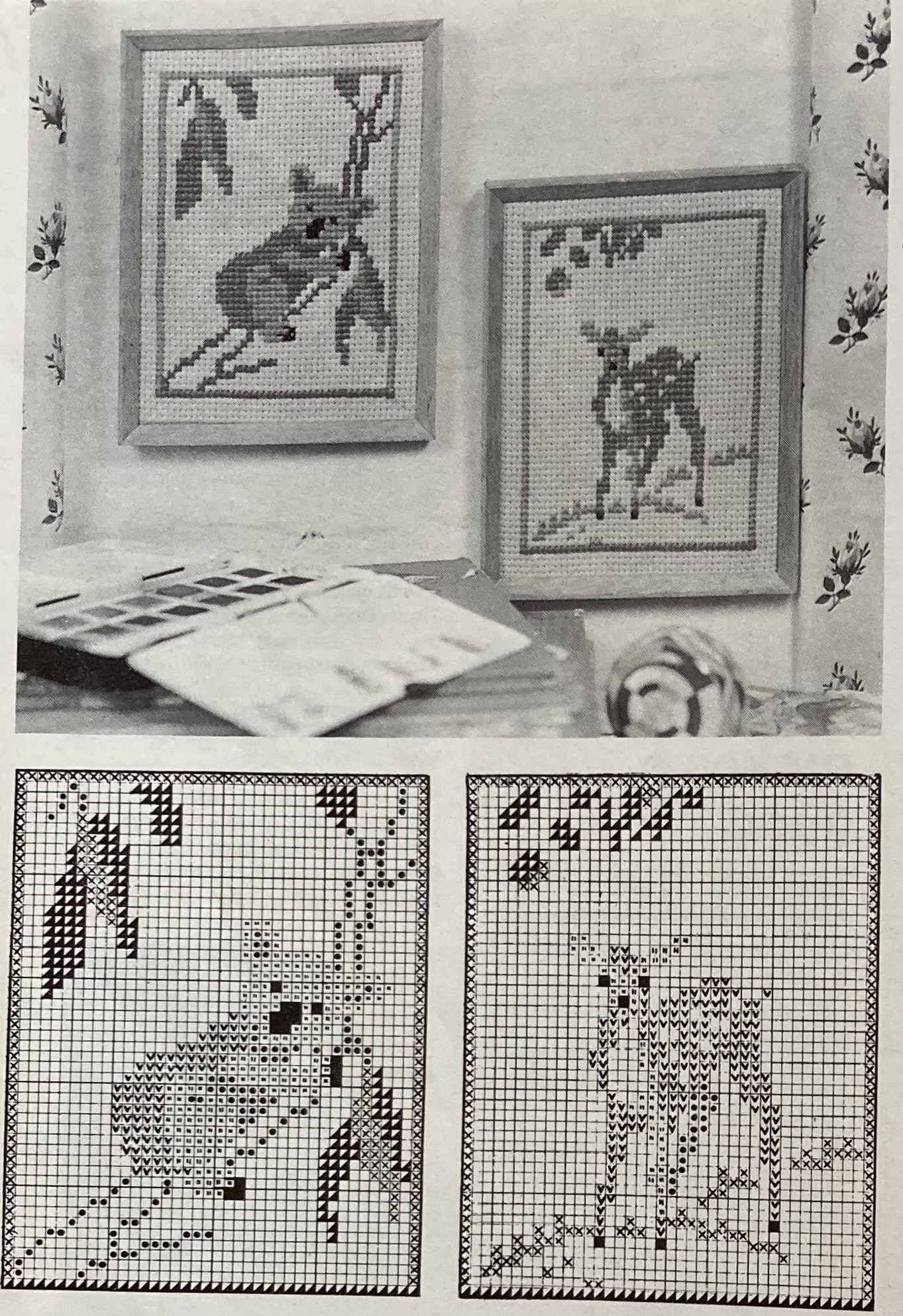
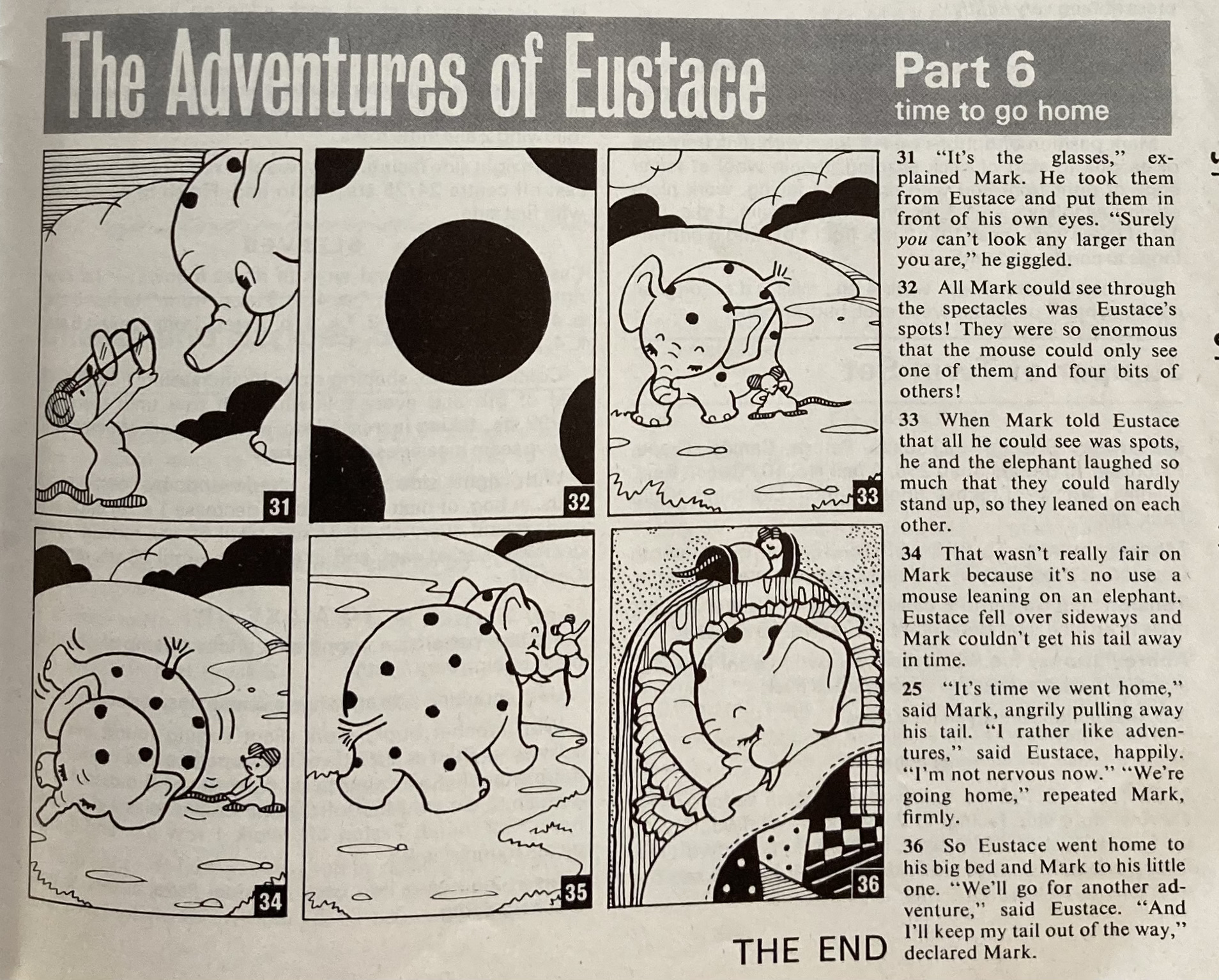
The “Readers Pages” give us a reprint of a July 1963 design for two little cross-stitch pictures, some helpful hints on mounting tapestry designs (mount it on cardboard with pins or threads and check that the tension on the right side is even), and the conclusion of our latest children’s serial comic, “The Adventures of Eustace”. For those who haven’t been keeping up (including myself; this story was not one of the more interesting ones), Eustace is an elephant who went on some very tame adventures (highlights: eating buns for tea, looking through glasses the wrong way) with his friend Mark, the mouse. Mark calls an end to the adventure and the comic, and they go home and have a nap. That sounds like my kind of summer adventure.

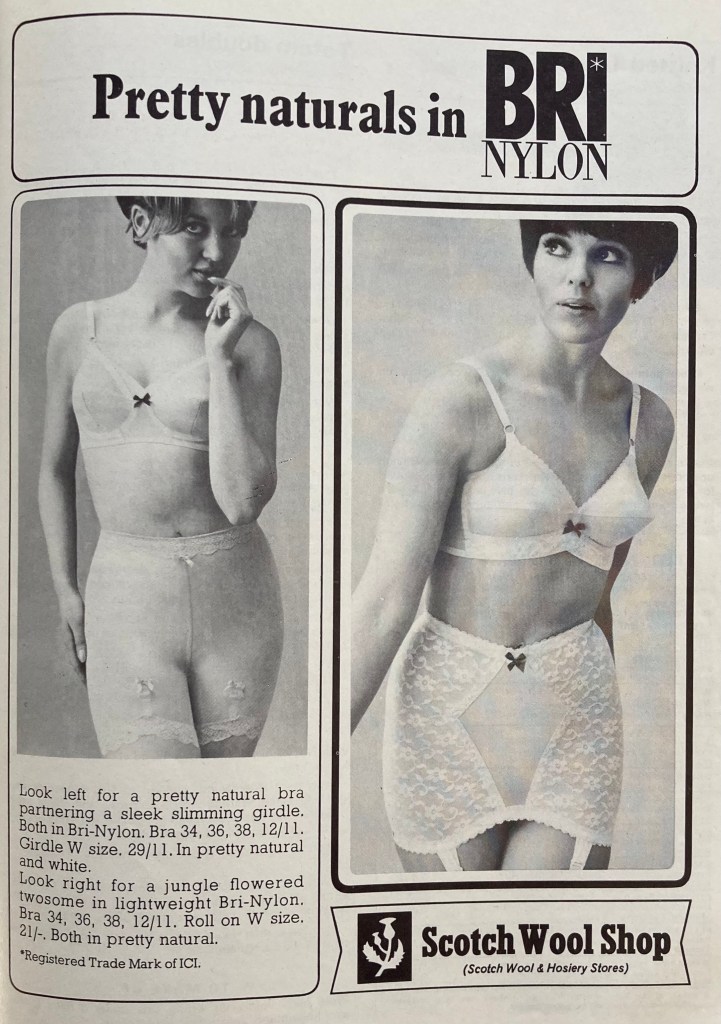
I will leave you with this ad for “pretty natural” underwear from the Scotch Wool Shop. The underwear is made from extremely synthetic Bri-Nylon and is intended to shape one’s body in directions it doesn’t go by itself, so the only “natural” thing going on here is the colour, if you have pale beige skin. But it is quite pretty.

Enjoy the rest of your summer! My project will be the mesembryanthemum embroidery on a vegetable bag.

July 1966: Overview

It’s all about teamwork in Stitchcraft’s July 1966 issue: two-piece sets for casual, sport or city wear as well as matching designs for all members of the family. Appropriately for the theme and the season, the emphasis is on sports and leisure, with casual, loose-fitting designs.

Our cover ensemble pairs a checked, sleeveless top with a skirt whose pleated insets match the check pattern. The check pattern is stranded, and I hope the navy blue didn’t bleed into or show through the white at the first washing. It’s the dressiest of the designs in this issue, but still keeps a casual air with its loose, unshaped top and shorter skirt (hemlines are finally rising at Stitchcraft, long after the miniskirt became popular everywhere else) and the check pattern, which is reminiscent of a race-car flag. The “favourite continental look for casual wear” is a team of “overpull” (oversized pullover) and short-sleeved blouse with a polo (turtle) neck in matching colour.

For warmer days, there’s a trio of lightweight and/or sleeveless blouses: in a lacy striped pattern or textured rib in 4-ply, or a mini-top in eyelet rib. Pink, white and turquoise are fun ice-cream colours for summer and harmonise well with the maritime blue of the checked suit.

A high-buttoning cardigan in heavier DK is good for cooler weather. Twisted stitches are the summer knitting trend, seen in the cardigan as well as in the eyelet rib and the striped lace tops. Our male model teams up with a horse to show off his cleverly designed “Viennese sports pullover” in tan DK wool with white cable stripes going up and down the front and back as well as down the sleeves.

The ultimate 1960s team is, of course, the nuclear family, and this issue offers a design for (almost) everyone: a simple, casual pullover with a trellis pattern in three sizes. The trellis is formed by making a k2tog or sl-k-psso at the right point in the pattern with a yo right before it to keep the stitch count even. The purl stitches on the wrong side are worked into the back of the “made” stitches to close the yo holes even more and make the trellis stitches stand out. Here too, summery ice-cream pastels and neutrals are in: “Banana Cream” for him and light green “Linden” for her and the daughter.

I did say “almost” the whole family, right? The youngest members have their own designs. Junior’s play jersey in blue and white echoes the women’s check suit, but here the check pattern is made by slipping stitches and/or letting them drop and picking them up a few rows later. The baby gets its own “teamwork” set of matinee coat and bootees in pretty lace and moss stitch.

The homeware designs are pretty standard, but numerous and cover all the home bases. There are some easy floral cross-stitch and pulled-thread mats, a cushion and/or stool top in tapestry (a check design, once again) or a stitched rug in Florentine design. More ambitious tapestry fans can make a wall panel of boats at Norfolk Broads.

And for once, the “Summer Bazaar” designs are not weird! There’s a simple crochet tea cosy, crocheted lace coaster mats, or an apron and/or potholder set appliquéd and embroidered with cute images of vegetables. In the “Readers Pages”, there’s a reprint of a 1961 pattern for a knitted pram blanket, and Eustace the elephant gets very startled when he tries on a pair of spectacles and suddenly sees Mark the mouse in larger-than-life size.

That’s all for this issue! Since I didn’t get around to making the sun cushion last month, I’ll make it this month. (Technically, it’s sort of part of this issue as well, since it photo-bombed the picture of the ribbed polo blouse.) And nothing else from this issue really called to me. Sunny days ahead, and may your team always win.

December 1964: Overview

Stitchcraft sends good wishes for Christmas 1964! Yes, another year has gone by in a flash. Luckily, this issue is full of ideas for quick last-minute gifts, as well as warm clothing for the family.

The bulky partner-look cardigans on the front cover are timeless and modern – apart from the 1960s styling and lighting, and the man wearing a shirt and tie, this could be a modern advertisement for ready-to-wear knitwear. The jackets are made in „Big Ben“ bulky wool at 3.5 stitches to the inch, so they might just be finished in time for a winter cold snap. Similarly bulky, but lighter-weight „Ariel“ wool is featured in a vertically-striped („adds to the slimming look“) cardigan for somewhat larger women‘s sizes up to 42 inch bust, and there‘s a warm cabled „Cardigan for Driving“ for him with practical pockets and a big collar.

The women‘s fashions are more sleek, with classic straight lines and unfussy crew necks. A simple ridge-welt pattern can be knit from the bottom up with dolman sleeves for a horizontal stripe, or as a cardigan knitted sideways edge-to-edge for a vertical stripe effect. There‘s also a classic jumper with a twisted-stitch rib panel and a lacy sheath dress for parties.

„Juniors and Tots“ will stay warm in a fun stranded half-cardigan (zip opening from neck to waist – this is called a „Troya“ style where I live but Stitchcraft just calls it a jersey) with matching cap. Therre‘s another cap with cables running around horizontally, as well. „Tots“ from ages 1-4 get a sewn pinafore romper with a cross-stitch squirrel motif or a knitted tunic to wear over a jumper and tights (thank goodness, our child model can have warm legs for once.) Colours are warm and earthy — orange, brown and „Inca Gold“ for the adult and children’s garments and emerald green for the toddler‘s tunic.

The most important, and sometimes most entertaining, part of the December issue is the gifts, of course, and this one is full of „Last minute ideas“ — you can allegedly „make them all in an evening or two.“ Well, evenings are longer in the winter… There‘s a startled- looking owl to sew from felt pieces, and felt table mars with appliquéd butterflies. Felt is used for the draught-stopping caterpillar snake (with pipe cleaner feelers) as well, and cotton embroidered baby bibs shaped like a kitten and bunny rabbit complete the craft menagerie.

Other quick gifts include a knitted ball for a baby, a knitted and a tapestry tea cosy, and a knitted cushion — all good ways to use up scraps of wool. The „Ping the Peke“ stuffed dog looks a bit more time-consuming, and it’s probably difficult to achieve a really professional look with it.

Experienced embroideresses who have efficiently provided all of their Christmas gifts already and are not scrambling to get last-minute gifts finished can make a beautiful and very Christmas-y blue and green cross-stitch tablecloth based on a Rumanian motif. (For once, they didn‘t call a design from Eastern Europe „peasant“ embroidery! Progress.) Those looking for a simpler project can make a pretty dressing table set with flower motifs, or for the whimsically minded, there‘s a cross-stitch cushion „gift for a motorist“ with a picture of a prototype automobile on it.

The Readers Pages are full of ideas of things to buy (Stitchcraft subscriptions et. al.) plus an entire knitting pattern for a child‘s hoodie (2nd time reprint from 1954 — this must have been a very popular pattern) and instructions for an easy appliquéd spectacle case that a child could make „for Granny.“

My project will be the classic jumper with the twisted-stitch panel, in the same fun orange colour as the photo. Happy Holidays!

July 1964: Overview

Cover photo from Stitchcraft magazine, July 1964. A women poses in a blue and white cardigan.

Are you in a “Summer Mood”? I certainly am and so is Stitchcraft. Knowing that knitters are less inclined to hold warm wool in their hands in hot weather, this issue, like most summer issues, is a bit less exciting than the ones from the rest of the year. Still, there are some nice designs.

Sky blue, white and peachy-orange are the trending colours, with the blue-white combination chosen for this pretty ribbed cardigan on the front cover. The ribs are broken up by little bobbles for a sort of trellis effect. Interesting variations on rib and trellis patterns can be found in the men’s waistcoat in slip-stitch rib and the wild and wavy partner-look pullovers on the back cover. At first glance, they might seem to be made in stranded technique, but if you look closely at the photo, you can see the dropped and slipped stitches that are “pulled up” in a later row. The long stitch is achieved by purling three times into a stitch on one row, then dropping the two “extra” stitches off the needle on the next row. It’s then slipped on multiple rows until it gets re-integrated in the pattern. Alternating this between the two colours makes a pattern that resembles Bargello tapestry (also popular at the time, though not well represented in Stitchcraft) and is less difficult than it looks.

A short-sleeved, yet DK-weight top in orange and white continues the colour trend and for a monochrome look, there’s a thick white cardigan in larger sizes and nubbly Rimple Double Knitting wool. The stitch pattern is also a rib variant, a mesh with lace eyelets. (Isn’t that photo fantastic, by the way? It’s so incredibly 1960s and I feel like it could be used as an advertising photo to sell absolutely anything from the time.) The final adult garment is a lightweight sleeveless top with a flowery neck border.

Children and babies get some fun play clothes for warm and cool summer days. The blue, white and “shrimp” pink/orange sleeveless top and trunks for a toddler make good use of July 1964’s trend colours, as do the blue and “sand beige” pullovers for larger children. Very clever to use sand beige instead of white for play clothes at the beach! Meanwhile, the “Bandbox Look for Baby” begins with a pretty matinee coat in this issue, to be continued with a matching vest and pilch in August, a “charming dress and bootees” in September, a cross-over jacket in October and a hooded cape in the November issue.

Speaking of children… Remember that playshirt from last month’s issue with the ladybird on it? Someone at Stitchcraft apparently forgot to mention that it was a trademarked logo! “No doubt” readers knew that it was used by permission, but just in case, they made a full-page announcement telling us about it.

Moving on to homewares, here are plenty of embroidery and houseware designs, though none so spectacular. You can make a rug and toilet(ry) bag for the bathroom, or a wall hanging or some small practical items (spectacle case, pincushion) in tapestry:

Or the usual cushion and chairset, some easy garden cushions, or tablecloth and tea cosy in embroidery.

There’s also fun “cocktail set” of place mats and “pinny” apron for holiday entertaining at home, decorated with an embroidered cockerel. The cockerel looks a lot like the Portuguese mascot that can be found on all sorts of souvenirs from the country, and I don’t think that’s an accident: the 1960s saw the first big boom in tourism from the UK to Portugal and it has remained an extremely popular holiday destination up to the present day. If our 1964 housewife couldn’t afford a holiday in Portugal this year and buy herself an embroidered serving set there, she could at least make one for herself at home. (The bottle-stopper is my own, from Portugal and vintage, probably from the 1960s).

There are a couple of crocheted doily-type projects in the back pages as well as two reprints of popular little patterns (bedsocks and a toy penguin) from the 1950s –this was a special “by request” feature in many of the mid- and later 1960s issues. And that about wraps it up for this issue! It seemed to not have as many projects as other issues, but after going through them all, it’s actually quite full of ideas. My project will be the sleeveless top with the square neckline. Happy Summer!

June 1964: Overview

Welcome to the official start of the Stitchcraft holiday season! The June 1964 issue gives us a mix of elegant 4-ply designs, casual bulky knits to wear as outerwear, beach clothes for the kiddies and easy homeware projects that can be packed up and worked from a deck chair.

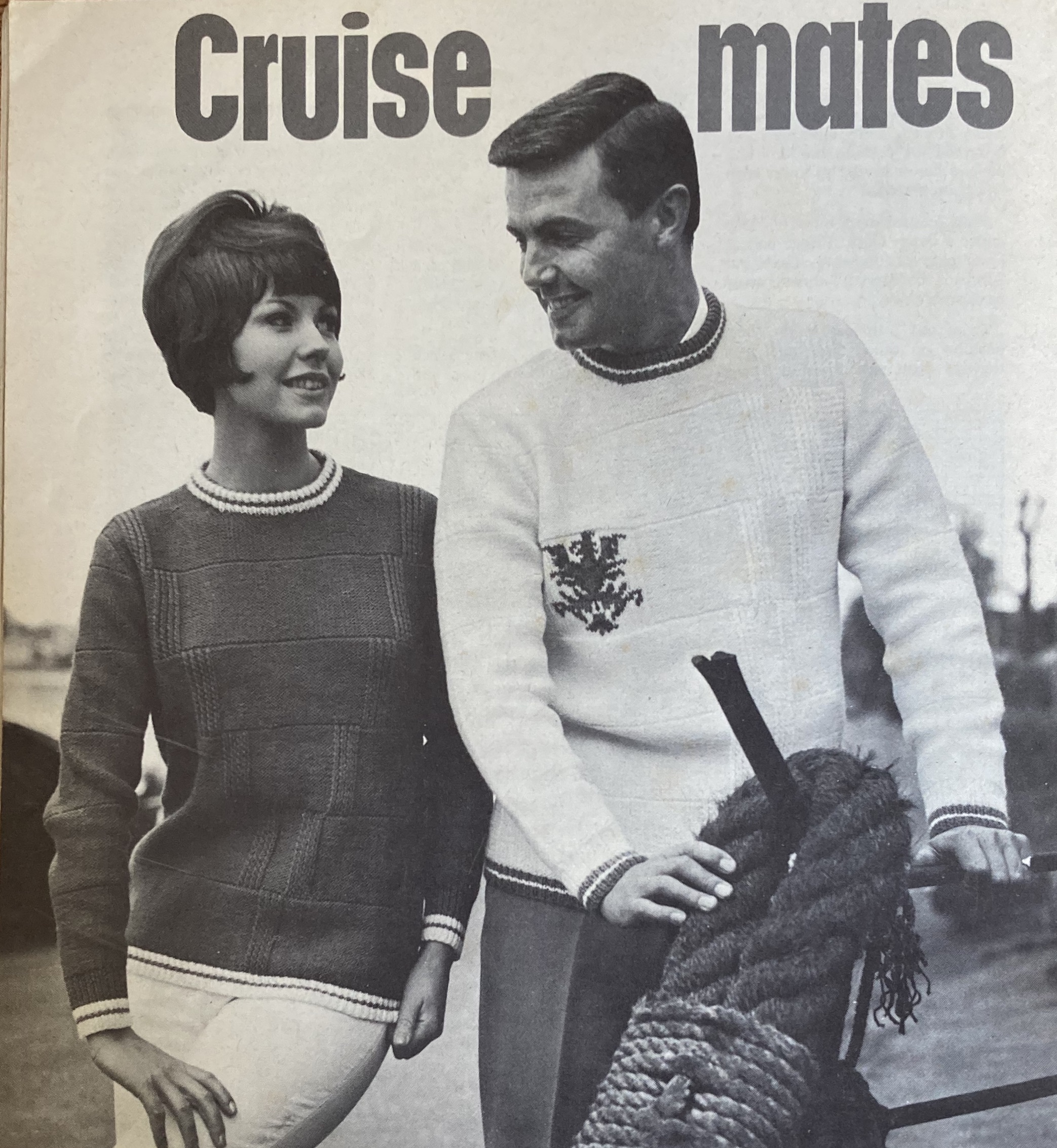
Our cover models are just returning from the weekend market, where they have secured a basket of nectarines. They’re wearing an “easy-line sport pair” of “cruise mates” in complementary colours and the same basic block-and-rib pattern. The ribs are made with p1, k1tbl to give them a more textured look, and the men’s version has an eagle motif, because it is “manly for him.” I wonder if both versions were originally designed with a motif until the designer realised that it would fall in an awkward place on the women’s version?

Nautical navy blue and white with red accents never goes out of style for summer casuals, and we see it in this bulky, yet “featherweight” (18-20 ounces of Patons Ariel, so make of that what you will) white cardigan. I can believe Stitchcraft when they say that the wool is lightweight, considering its bulk, since the twisted-rib pattern eats up a lot of wool.

Ona different note, we see simple, yet elegant knitwear separates in 4-ply that are suitable for the office of a more dressy casual situation. The basic skirt and plain or diagonal-striped top are knit in muted pastel shades and meant to be interchangeable — “Basic skirt with a change of top” is the headline for this well-coordinated set. There’s also a waistcoat for her that would match the skirt when worn with a blouse, and a fine-knit raglan pullover for him. The waiscoat and pullover are both in this season’s trendy yellow tones of “Spun Gold” and “French Mustard”.

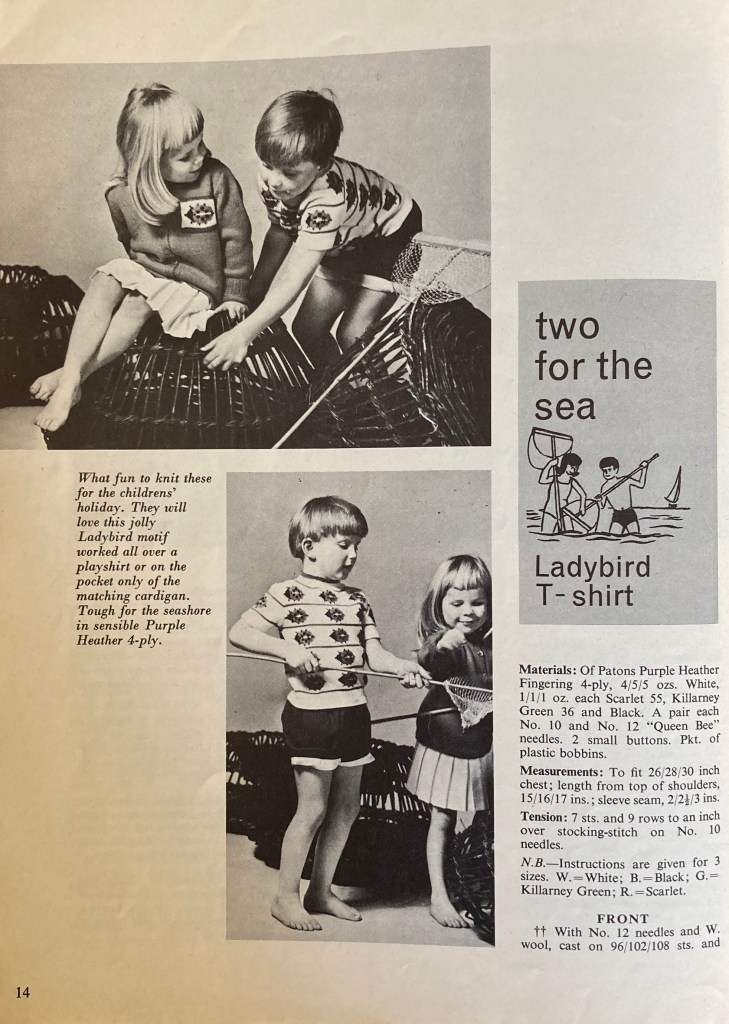
Children can enjoy splashing around at the beach in their trunks and sundress (the girl’s trunks are sewn into the sundress to prevent wardrobe malfunctions, definitely necessary with a micro-mini tunic skirt.) Here again, traditional red and white or navy blue and white are the chosen Somewhat older children have a choice of short-sleeved jumper and/or cardigan with a Ladybird motif (more about that in the next issue…!), continuing the red and white theme. On a completely different colour note, you can make a beach cover-up coat in crinkly “Rimple” wool lined with towelling — a brilliant idea for drying off and staying warm after a swim in cold northern waters. It’s quite easy to make, consisting of literally three rectangles for fronts and back, with garter-stitch borders and then lined with the towelling.

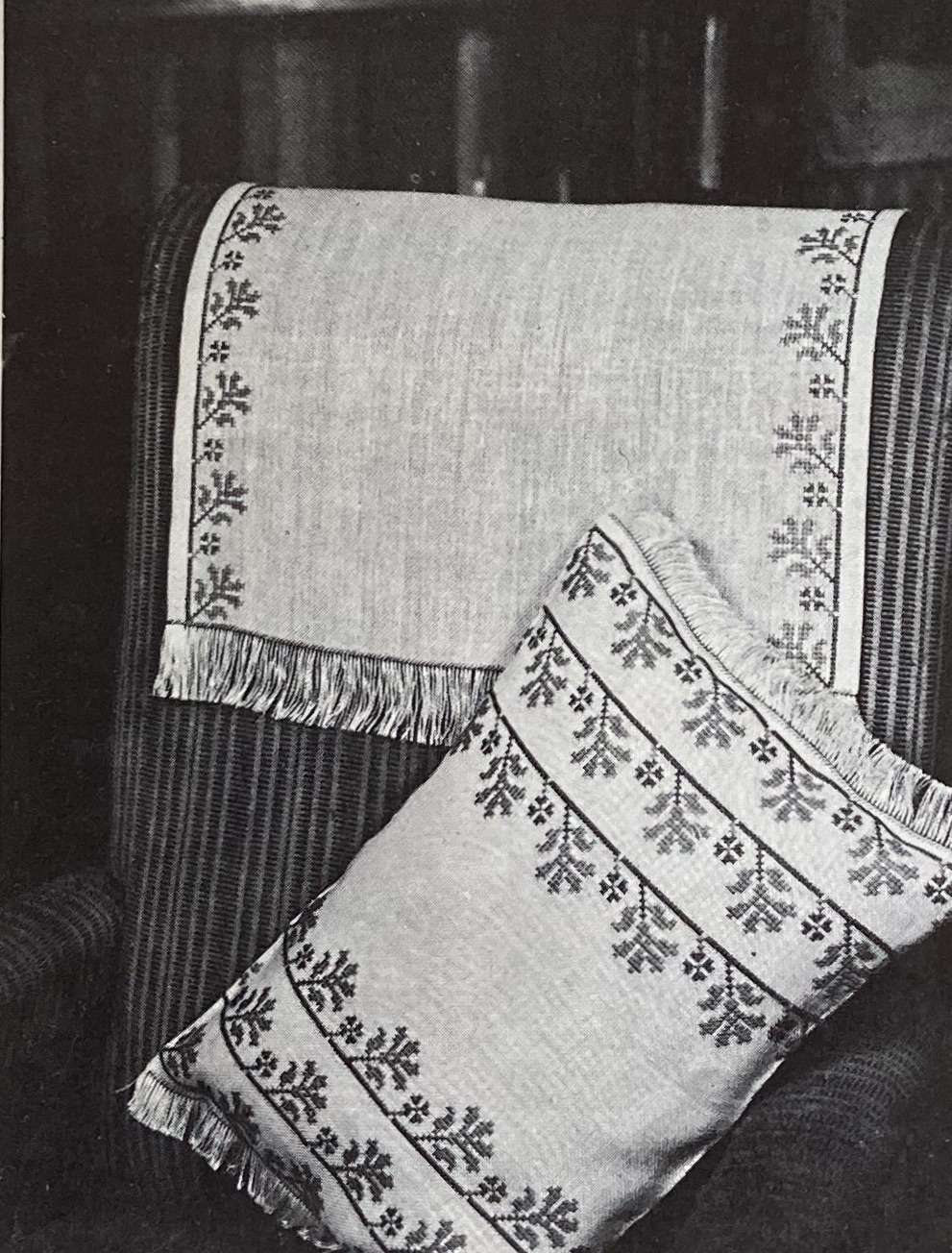
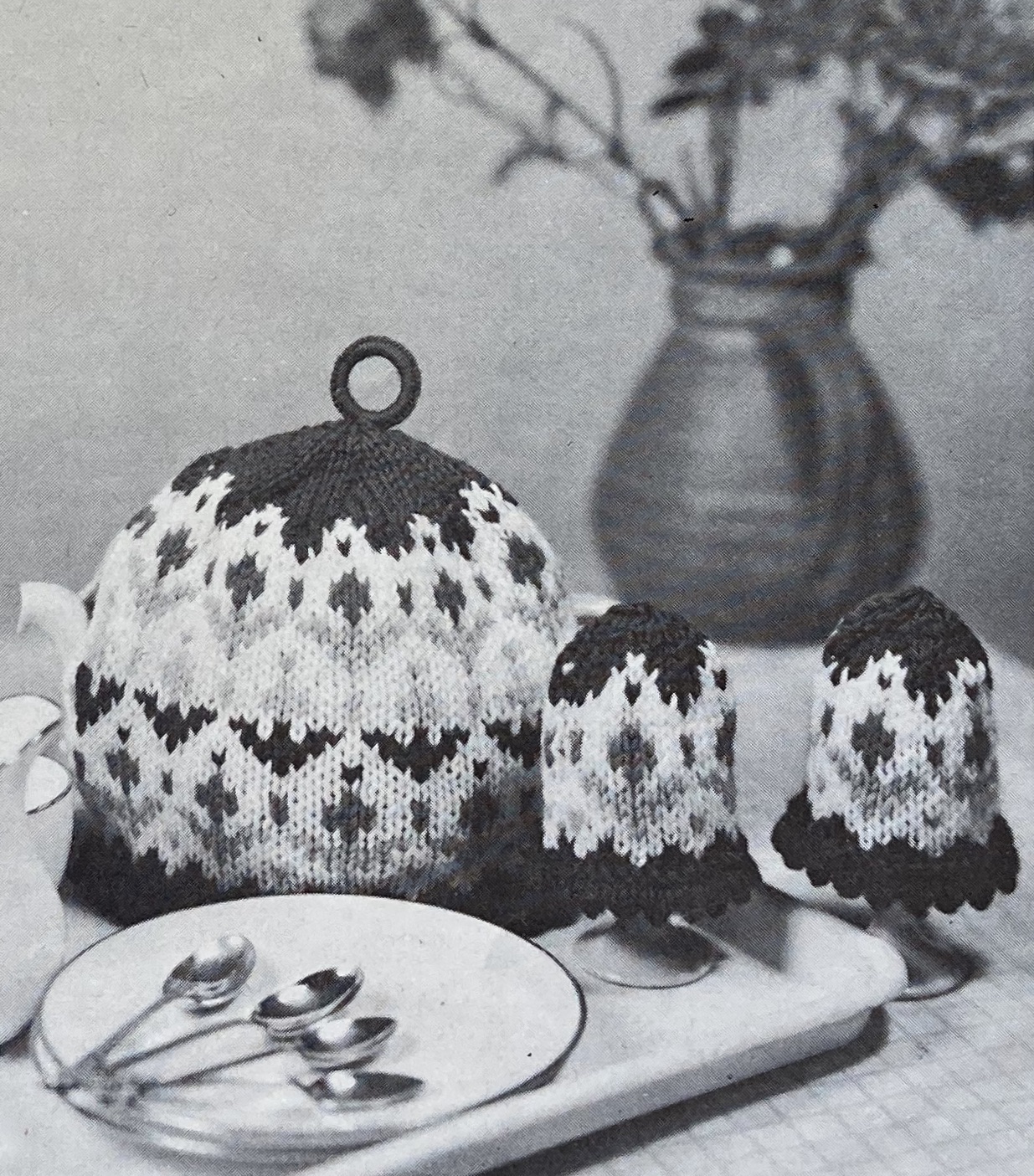
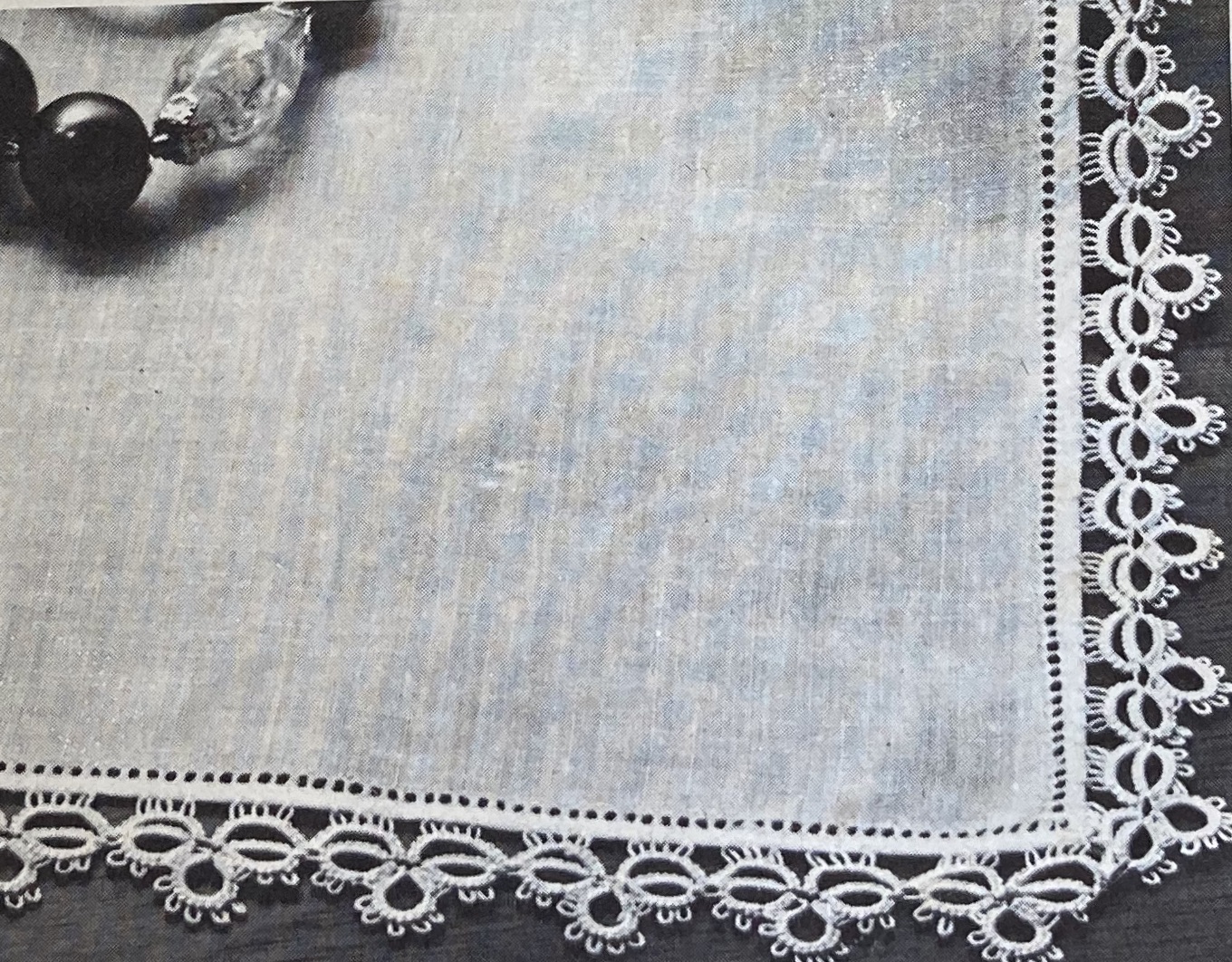
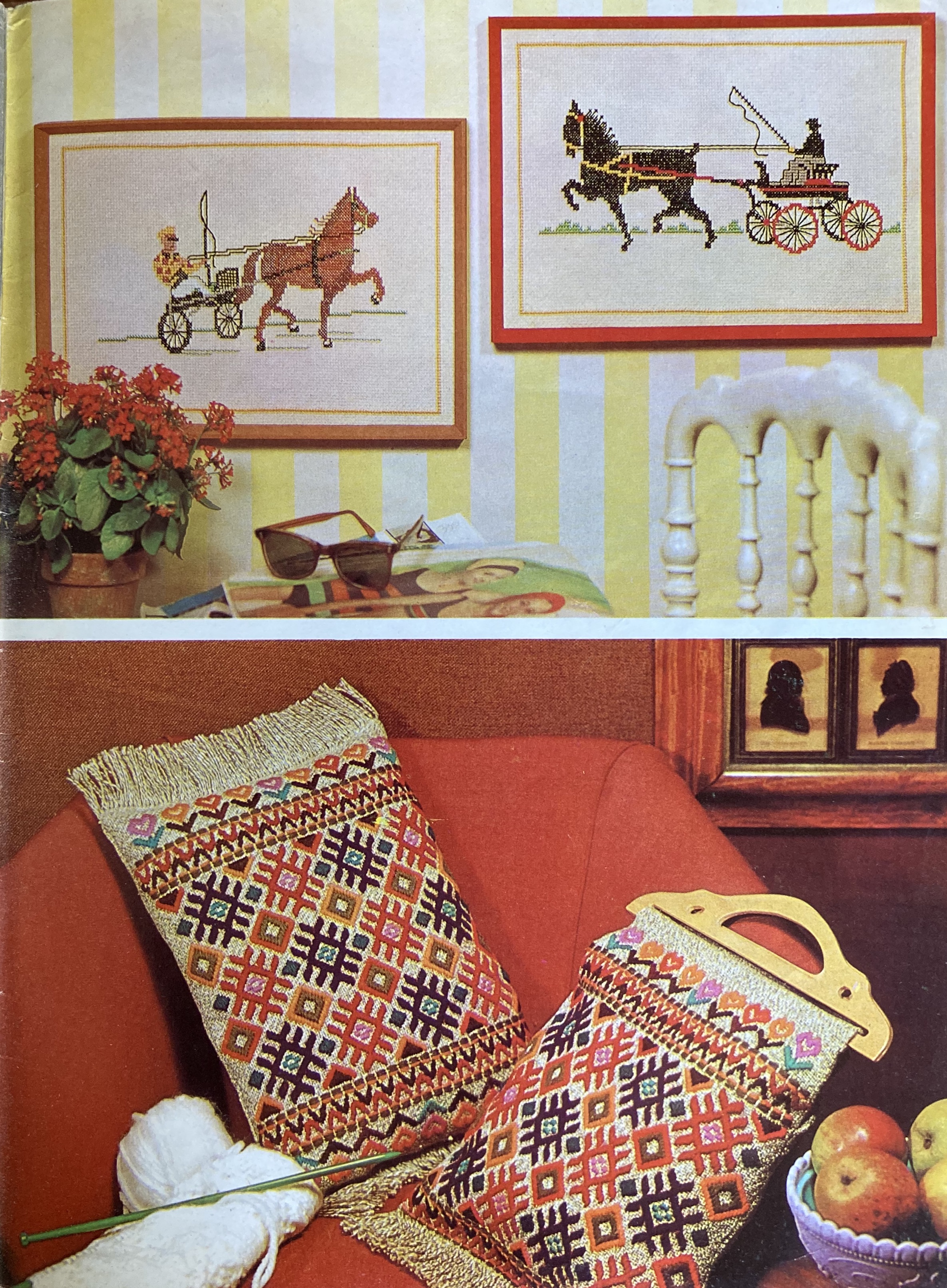
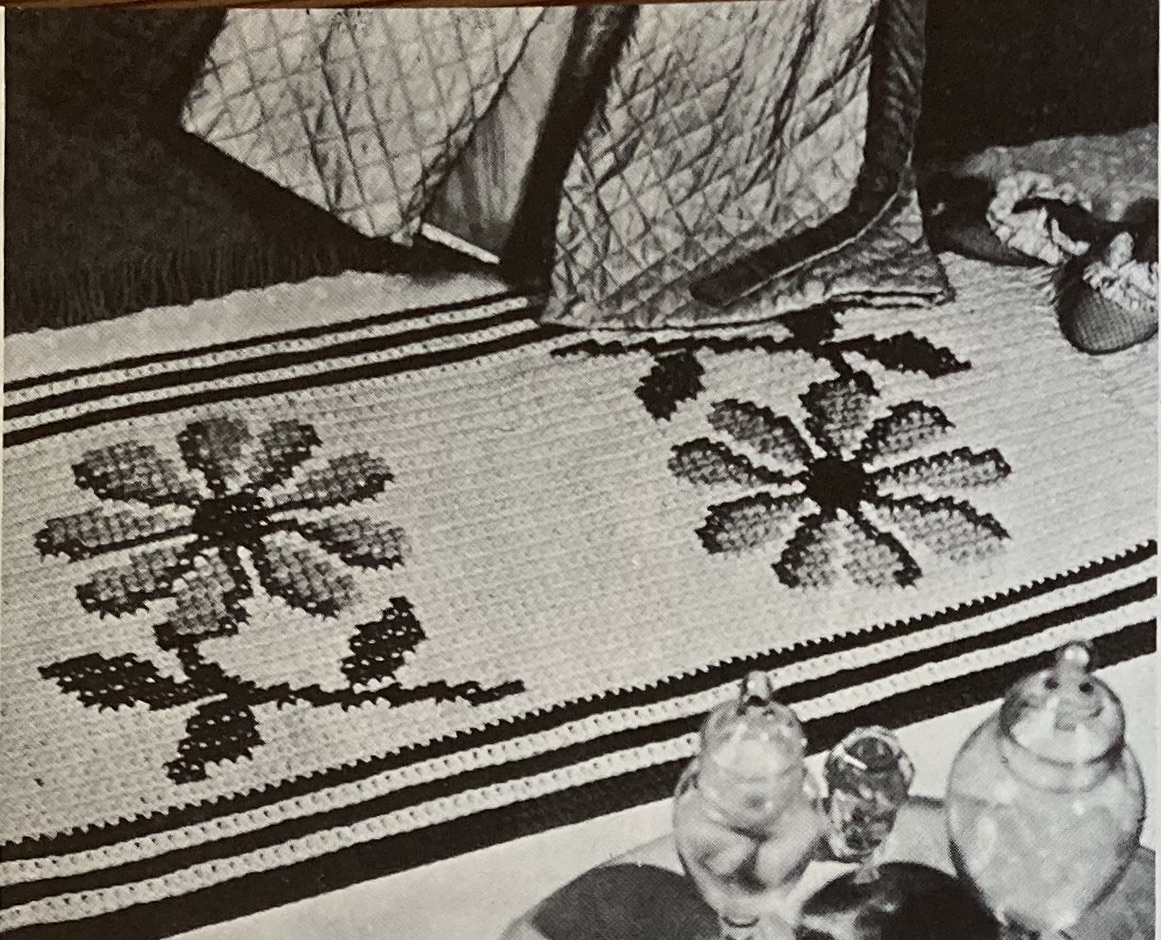
While sitting and sunning at the beach, you can work on an easy homeware project, such as a cross-stitch cushion, a knitted tea or egg cosy, or a tatted lace edging for handkerchiefs or pillowcases. Even the workbag in Turkish darning would be easy enough to work on while on holiday, though the Victorian-esque horse-and-buggy cross stitch picture, the needle etching, and the crocheted rug are presumably easier to work on at home.

That’s it! Summer issues are usually less exciting than autumn and winter, as many people (understandably) don’t like to hold wool in their hands in hot weather. As with many of the mid-1960s issues, there’s nothing in here that particularly speaks to me, so my June project will be another “excursion”, this time all the way back to the 1920s. The project is almost finished (unlike my April and May blog projects…) so I’ll be able to put out a finished project post in time for once, even if it’s neither from Stitchcraft nor from the 1960s. Think of it as a holiday from the usual blog theme.

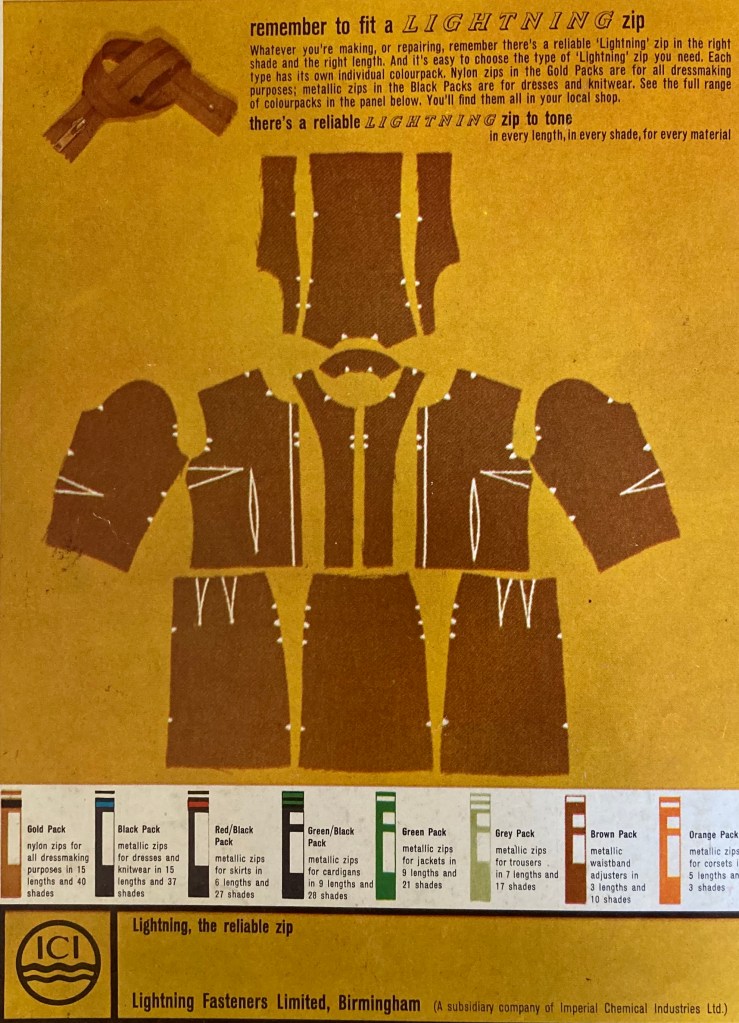
P.S. The back cover is a full-page ad for “Lightning” brand zips and and is illustrated with a very professional-looking pattern for a suit! I am tempted to size it up and sew it. Here it is for any readers who would like to try their hand at it.

March 1964: Overview

Greetings from Kent from your March 1964 issue of Stitchcraft, featuring “Spring Into Summer Fashions” photographed in “some of your favourite spots around Canterbury and Tunbridge Wells” so that you can see the knitwear “in their own settings as you would wear them.” Shall we go?

“For our climate”, writes editress Patience Horne, the best outfit for the spring and early summer months is a sweater suit, quickly knitted in double knitting wool. Cool blues, salmon pink and yellow-green are the trendy colours, and pattern stitches are used sparingly as an accent on hems or collars, or as a single vertical stripe panel.

Our cover model is wearing a twin set with a trellis pattern accent on the cuffs, pockets and collar of the jacket and the hem of the short-sleeved jumper underneath. Here, again, we see how twin-set styles have changed since the 1940s — everything is long, loosely-fitting and unshaped. The “Golden Willow” sweater suit on the inside front cover is similarly unfitted, with a cable “V” pattern stripe. For “The Creamy Look”, there’s a a high-buttoning cardigan with a subtle diamond pattern on the fronts. All three models are made in “Double Quick” knitting.

“Double Quick” is also the featured wool for the men’s and women’s “sport sweaters” in the lovely full-color center photo. I’m not sure what makes those two garments more “sporty”, as they look equally as elegant as anything else in the issue. His sweater is worked in stranded technique from a chart included in the instructions, and hers is made in plain stripes with the diamond pattern embroidered on later in Swiss darning / duplicate stitch. If “Double Quick” is not bulky enough for you, there are matching sports sweaters for him and her made in bulky “Big Ben” at 3 1/2 stitches to the inch. The salmon-pink jumper (Stitchcraft calls is a “sweater blouse”), by contrast, is made in 4-ply wool in a classic shape, with pattern accent panels in an interesting mini-bobble stitch.

Babies get a wonderful pram set of footed leggings, coat and matching bonnet. It’s referred to in the index as a “four-piece” set, but I am at a loss to find a fourth piece anywhere in the instructions or photos. Maybe they planned to make matching mittens and then didn’t? Bigger children get a cute slipover with an argyle pattern on the front. The photo is very 1960s, with the girl freezing her legs off in a micro-mini skirt and the boy sporting a bow tie.

The homewares are fairly standard: a tea cosy, apron and tray set and a knitted kangaroo with baby for your bizarre/bazaar novelty needs (there’s also a reprint of a 1956 knitted ice-skating panda bear doll, if the kangaroo isn’t enough for you.) You can also cross-stitch a rug and pyjama case with square-headed dancing soldiers to haunt your small son’s dreams, or some flowered place mats, a cushion or wall hanging, or another cushion inspired from a traditional Greek star design.

In the “Readers Pages”, a new serial comic is starting: “Susan’s Sampler”, in which our heroine learns embroidery from a magic needle, and our back cover ad (for Patons Double Quick Knitting wool) shows yet another woman lovingly looking up at a man who has trapped her with her back to the wall in order to mansplain something to her. Feel free to give the photo some speech bubbles befitting a modern interpretation of this scenario!

That’s all for this issue. I’ll be making the child’s slipover and for once, I’m quite sure it will be done on time. Happy Spring!

October 1962: Overview

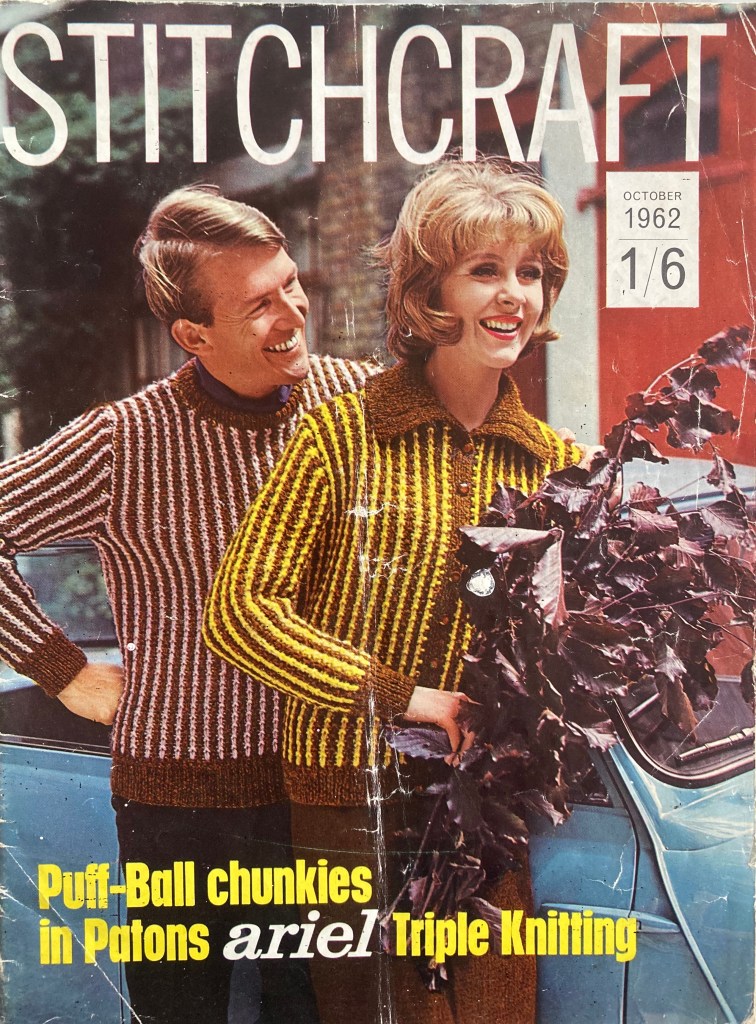
“There are several “special” things about this issue” writes Stitchcraft’s “editress” on the facing page, and I’m glad she put the word “special” in quotes, because this month’s issue is definitely a mixed bag. On the plus side, it has extra pages in colour and introduces a new yarn: Patons Ariel, designed to be “triple-knit” bulky and therefore quick to knit, but still lightweight. On the minus side… we’ll get to that later in the post.

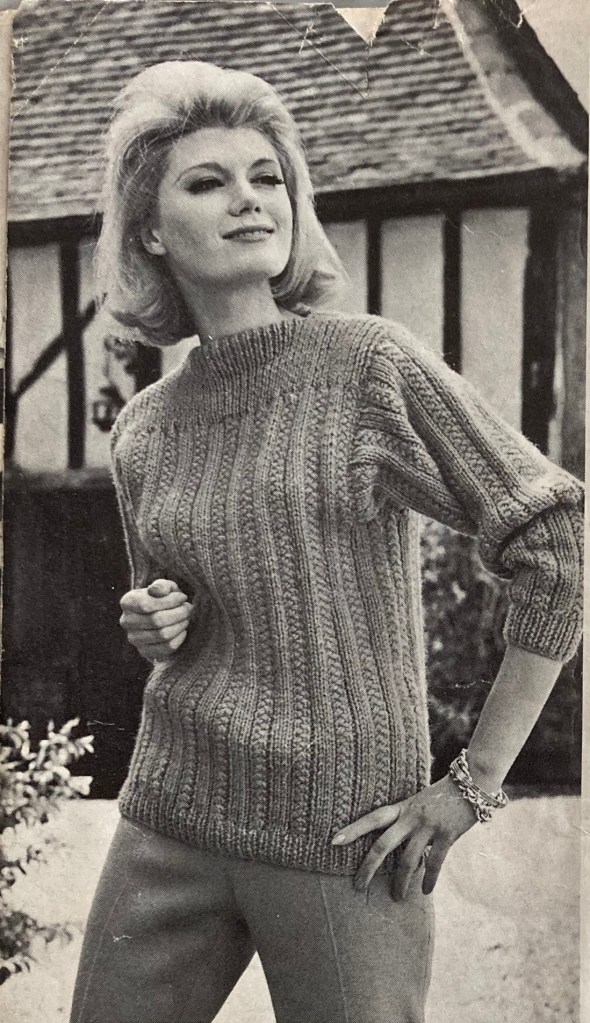
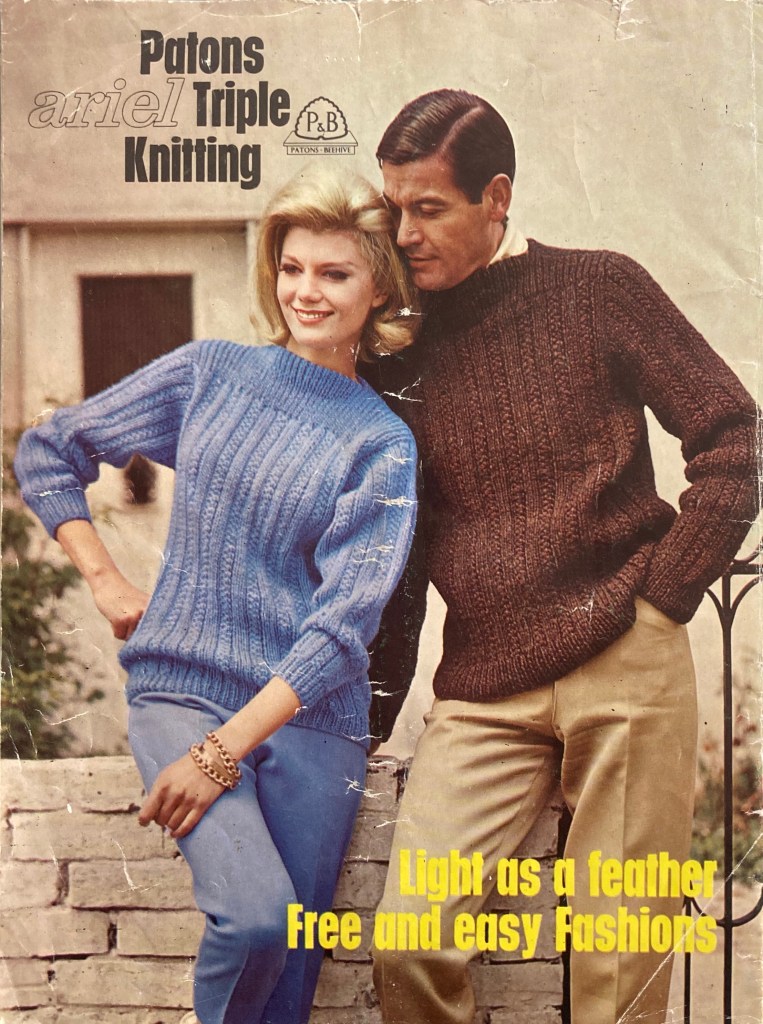
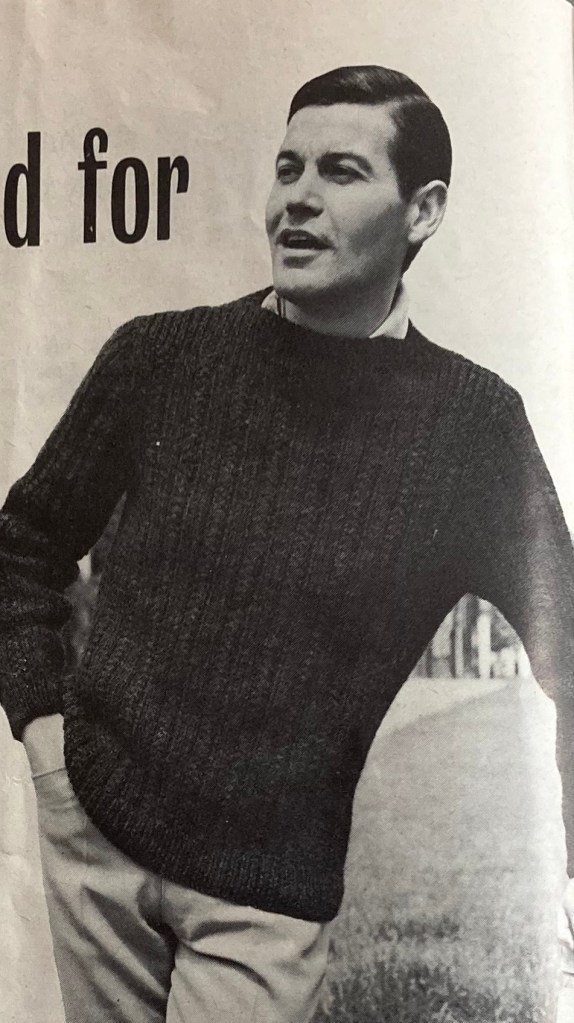
The new wool, Ariel, is listed on Ravelry as bulky weight (97 yards in a 2-ounce ball) and composed of 80% wool and 20% “other” (synthetic fibres). According to the person who wrote the Ravelry entry, it may or may not have been waterproof! It appears to be quite fluffy, thus the name and the “light as a feather” claim. It’s used for the two-colour, slip-stitch-patterned garments in the cover photo as well as the identical boatneck pullovers for men or women. The partner-look idea is still going strong.

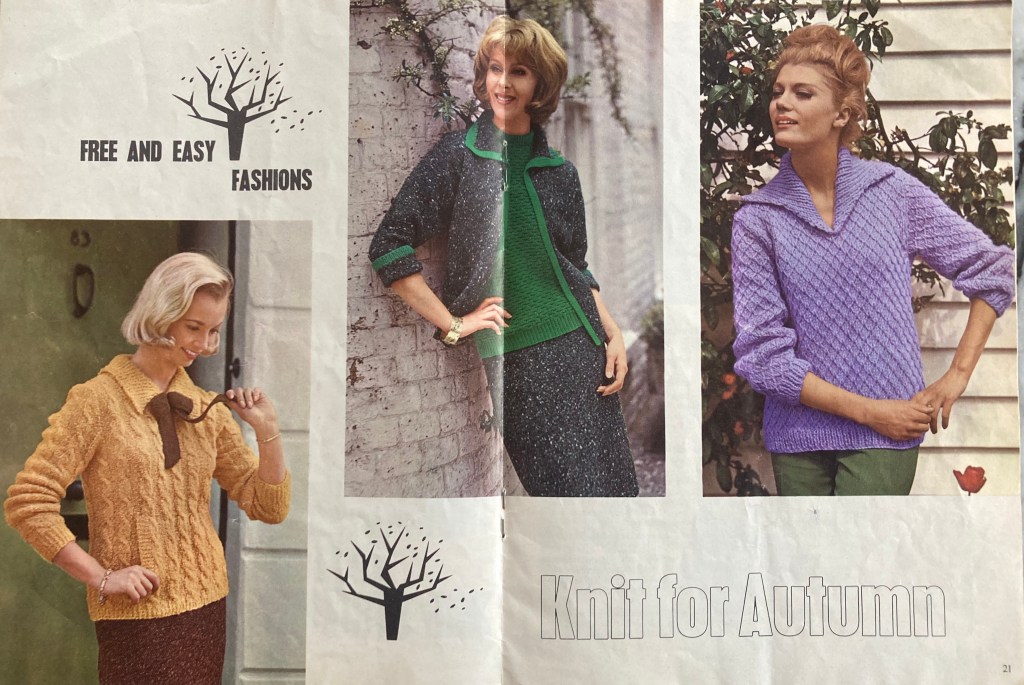
Tweed looks and suits are always popular in the fall, and this month’s issue gives us a loose-fitting suit with a short-sleeved jumper to wear underneath, all in double knitting weight. Nubbly Rimple yarn is also DK weight and still a fashionable choice for this sweater with a contrasting bow-tie. The purple pullover with the big collar (still in fashion after two years!) is made in bulky Big Ben wool. Greens, browns and yellows dominate the colour palette and go with the autumn theme.

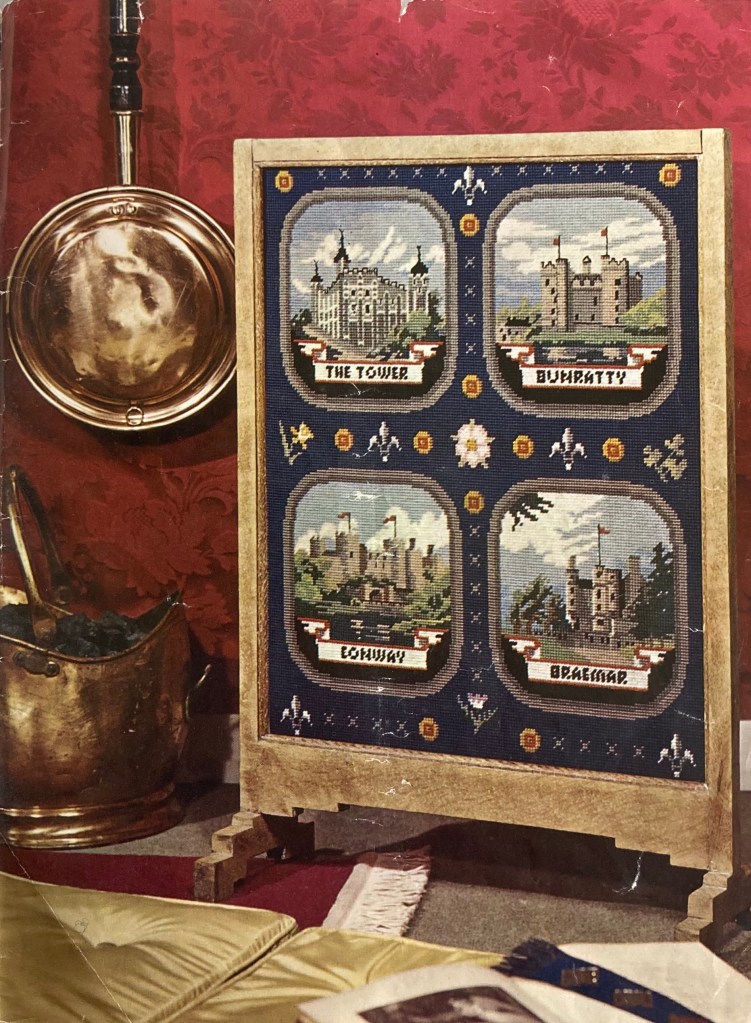
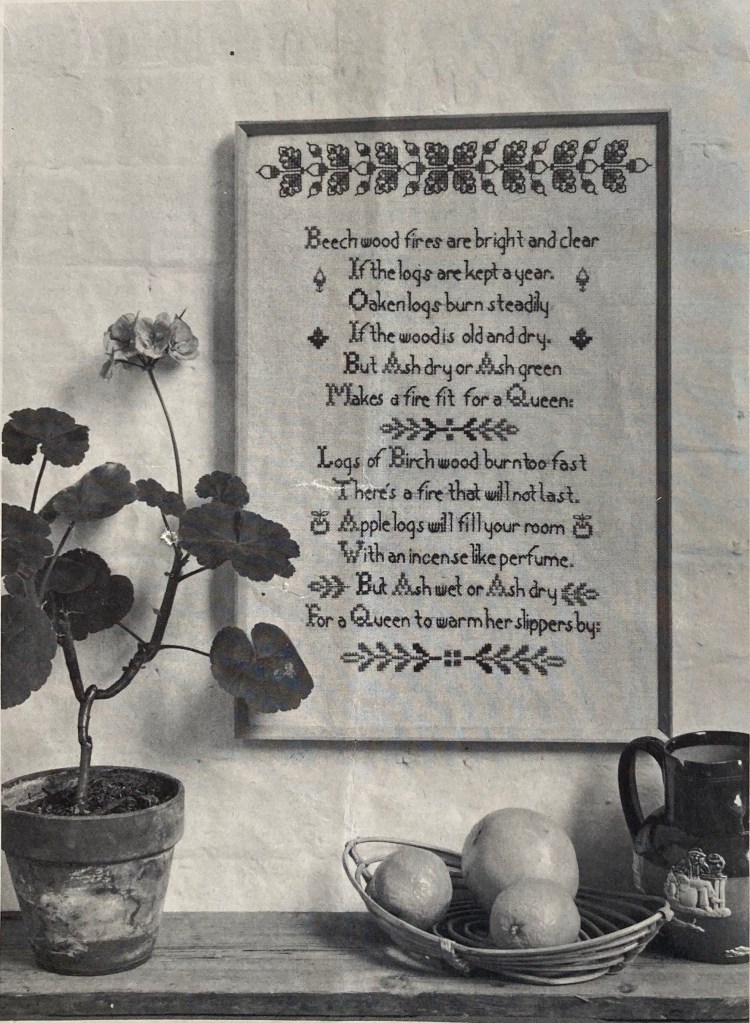
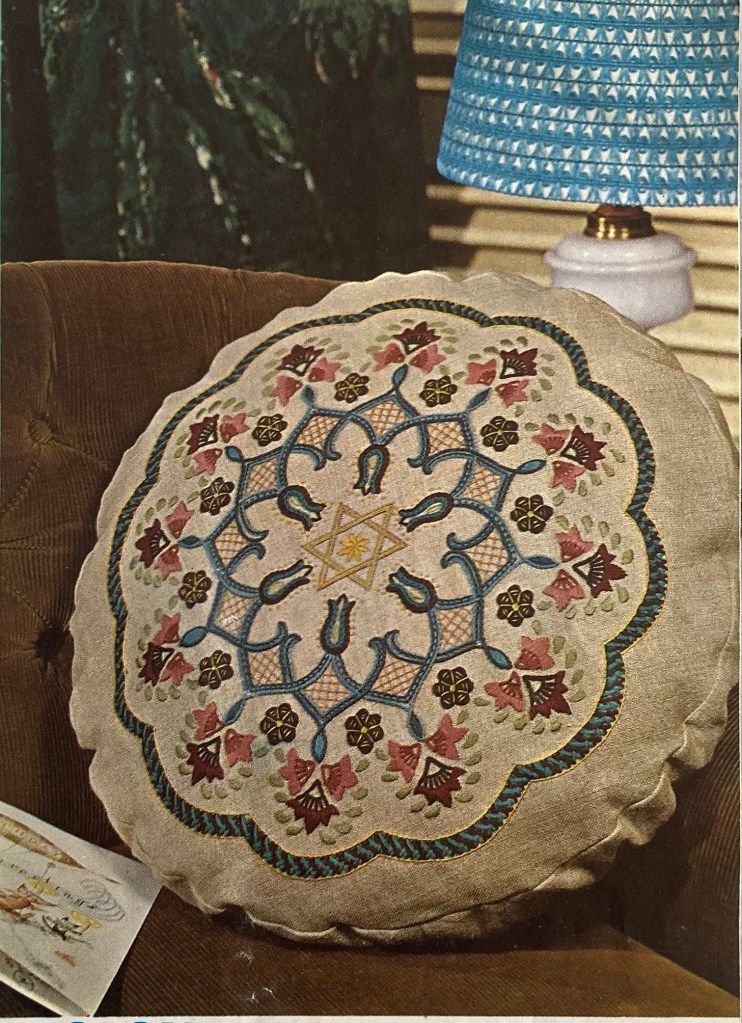
Embroidery and tapestry take a backseat to the autumn knits in this issue, with typical floral chair-back, apron, and traycloth designs. There’s a tapestry of four famous castles, a cross-stitch wall hanging with a poem about what type of wood to burn in a fireplace (I had never heard this rhyme, have any of you?) and a more complexly embroidered cushion of “Indian design”. I cannot vouch for its cultural authenticity, but the woven and latticed stitches are certainly striking and effective.

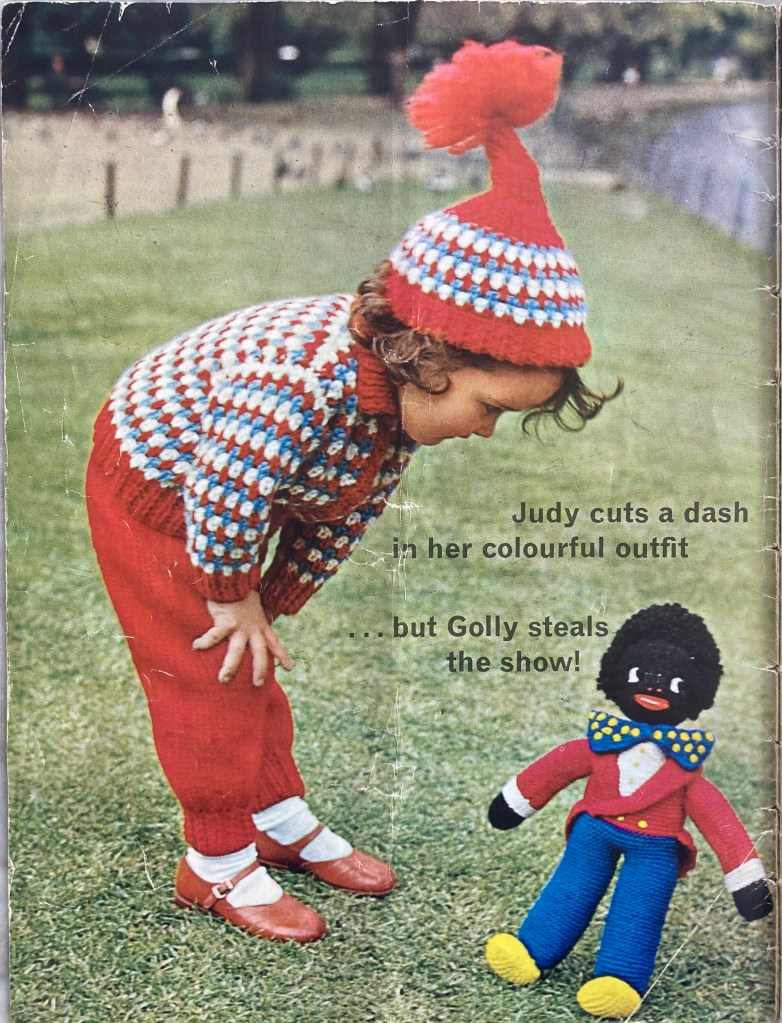
Speaking of cultural history, remember our little model Judy with her “trim Outfit” from 1960? (Of course you don’t, and I wouldn’t have recognised her either if her name weren’t in the caption.) Here she is, two years older, cutting a dash in her warm 3-piece play suit and all set to play with…

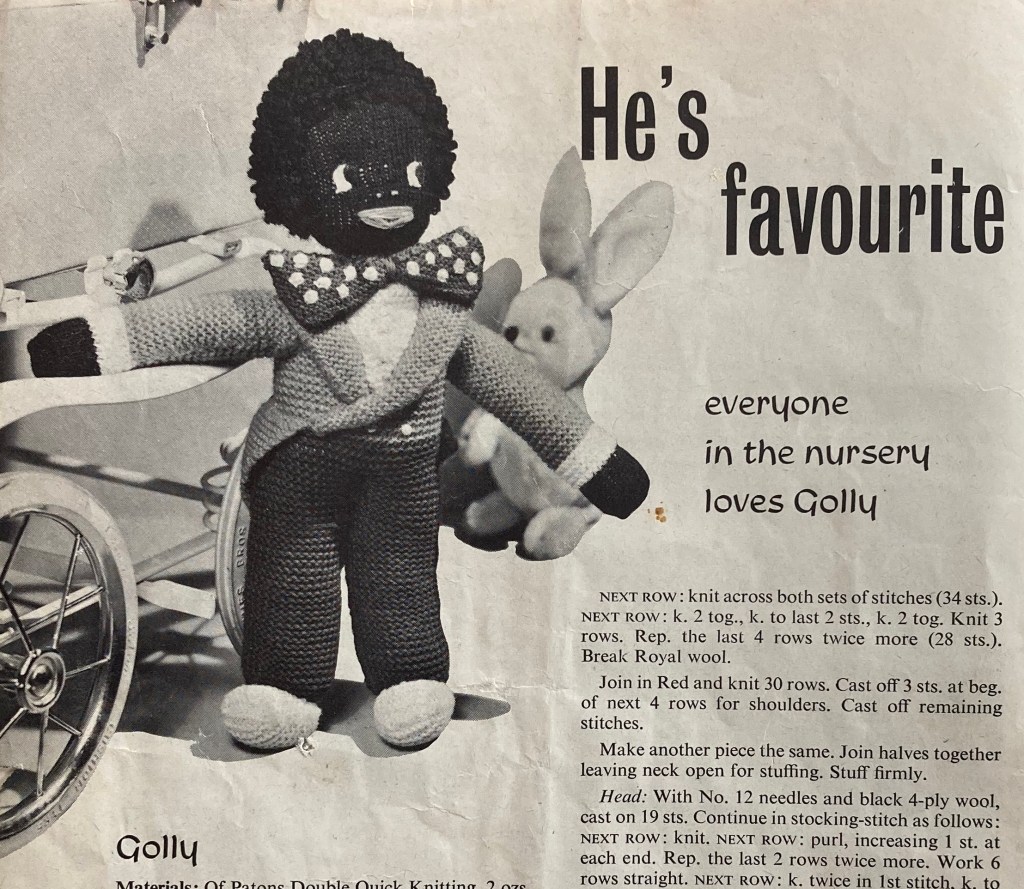
Ah, right. Her “Golly”, who “steals the show” and whom readers can also knit from a pattern in this issue. “He’s favourite”, writes our editress, and “everyone in the nursery loves Golly.” Who is he?

In 1895, the English-American cartoonist and illustrator Florence Kate Upton produced her first children’s book, titled The Adventures of Two Dutch Dolls and a Golliwogg. Over the next fourteen years, she and her mother Bertha collaborated on twelve more books starring the same characters. The books, and particularly the “Golliwog” character, enjoyed enormous popularity for at least sixty years afterwards and “Golly” dolls and toys as well as “golliwog” images on brand names and household products were practically ubiquitous in popular culture — particularly children’s culture — in the UK and elsewhere throughout the 1950s and 1960s.

Though Upton intended the Golliwog(g) to be a positive character and the hero of the story, it can’t be denied that his representation is a racist caricature born of the blackface minstrel tradition in the United States. According to Upton herself, her inspiration for the character was a Black minstrel doll found in her house, and typical “Golly” representations show him with exaggerated, distorted features and wearing an outfit typical of minstrel performers in the early 20th century. Later literary and cultural depictions of “golliwogs” often portrayed them as animalistic, uncultured or criminal, thus reflecting and perpetuating negative racial stereotypes about Black people. Over time, the word “golliwog” and shortened forms of it became used and recognised as demeaning racial slurs.

Though many white Britons, Americans and Australians who grew up with golliwog dolls continue to claim that they are inoffensive (and capitalise on their popularity via Internet auctions and collectors’ organisations), it should be pretty obvious that they, and their related imagery, are problematic. For a more in-depth understanding of why, I encourage further reading, starting with this excellent article from the Jim Crow Museum of Racist Memorabilia at Ferris State University in Michigan (US).

It’s not the first or only time that Stitchcraft (like just about every other knitting/craft publication of its time) has featured patterns for toys or dolls that reflect stereotypes of particular ethnic groups or portray them as an “exotic Other”, even if those representations are supposed to be positive. Many patterns from the 1940s and 1950s are particularly offensive (take my word for it, I don’t want to show them here), as is the use, up until the late 1950s in some cases, of racial slurs as colour names for certain shades of wool (ditto). By the way, I have issues of Stitchcraft and many other vintage knitting magazines up to the mid-1970s and nowhere, in any of them, have I ever seen a model who was not white — the caricatures were also the only representation to be found. Let’s remember that, for all their fantastic fashions, the mid-century decades were definitely not the “good old days”.

On top of all that, there’s no pattern in this issue that I particularly want to make, so I’ll either embroider some anemones on a vegetable bag or finish up something from the WIP pile.

June 1962: Overview

Holiday season is in full swing in this month’s issue, with featured photos taken in pretty villages in and around Buckinghamshire and Kent. All the projects are easy and fairly quick to make, and even the fit is relaxed: the close-fitting, waist-length jumpers that were still more or less in fashion in 1960 and 1961 have now completely given way to loose-fitting, hip-length sweaters and blouses. I could use some relaxation, couldn’t you? Let’s dive in… gently.

The cover sweaters check all the 1962 trend boxes: loose, easy pullovers for “him and her” in sunny lemon yellow with interesting stitch textures and contrasting collar-and-cuff accents. Soft yellows, pastel shades and white show up again in the more glamorous “holiday sweaters” made with Patons’ Fuzzy-Wuzzy yarn (55% angora, 45% wool), as well as the women’s 4-ply “golfer style” cardigan (in “gay turquoise” and white 4-ply) and men’s “shirt-style” pullover in presumably light beige “Palomino” colour with contrasting collar.

The other garments are all photographed in black and white, but the yellow/pastel/white and contrasting accent trends are clear from the colour names of the yarns: the pretty “Junior Miss” cardigan is knitted in 4-ply Nylox “Sunglint” (the same colour as the cover sweaters), the “afternoon style” blouse is “Bois de Rose” pink and the bulky, textured Big Ben sweater is “Spring Green” with a white collar.

The smaller children of the family need something fun and easy for holidays too, of course, so here are some “seashore sets for toddlers in the swim.” They’re made in Nylox (80% wool, 20% nylon) and I don’t think they would be suitable for actual swimming, but definitely cute for playing around on the beach and splashing around.

With all these lovely things to knit, it’s not surprising that the homewares section is a little boring. Fittingly enough for June, this month’s flower is the rose, featured in a pattern for a “finger panel” to attach to a door. Readers, you have been so helpful in the past with solving mysteries for me, so i ask you: Why a finger panel? It seems to be used to keep the door clean from grubby handprints, which I can certainly understand in a family home, but I don’t see why it would be easier, or preferable, to wipe those grubby prints from an embroidery panel mounted under acrylic glass than to just wipe them off of the door. What do you think? Am I missing something here?

Otherwise, we’ve got some Scandinavian tapestry cushions, a “modern” (geometric and also Scandinavian design-inspired) hall runner rug, a more complex cross-stitch tablecloth (white and green on yellow linen, to match your yellow sweaters), some unspectacular oven mitts and some genuinely cute table mats in appliquéd and embroidered felt.

I feel more relaxed already, don’t you? There’s nothing from this issue that particularly inspires me and I have many WIPs to finish up, so my June project will be a “Blast from the Past” featuring a wonderful twin-set from a 1947 issue of Stitchcraft.

April 1962: Overview

IMG_3168“Easter Greetings” from Stitchcraft, April 1962! According to “editress” Patience Horne, “everyone is getting that “out-of-doors” feeling”. I and my fellow compatriots from 2020 have had a very much in-doors feeling for the last few weeks, as we watch Spring unfold from our quarantine windows.

Back in 1962, the whole family can sport matching waffle-stitch pullovers and cardigan jackets for those inevitable country rambles. All three cover-photo designs are made in bulky Big Ben wool at 3 1/2 stitches to the inch. Those who prefer double-knitting weight wool can make a men’s pullover in “slip-on shirt style for sailing and tennis” (with sporty illustration!), a buttonless women’s jacket, or a “crunchy” cabled pullover. Roll-necks or rolled collars are gradually eclipsing the larger, pointier collars of the years before.

There’s also a “travel set” of jumper, cardigan and two skirts to take on your spring holiday, made in both plain green and a marled two-tone green that appears to be one of the early multi-colour yarns just starting to come onto the market around this time, but is actually made by holding one strand of each of the two colours together . The child’s striped V-neck pullover seems like a good way to use up all the leftover yarn.

Even the baby of the family, or a baby-to-be, can expect a lovely Easter present in the form of a dress, bonnet, jacket, bootee and blanket set — plus a “pin tidy” to hold all the safety pins that will fasten our 1962 baby’s cloth nappy in place. The blanket is also made in Big Ben (ensuring it will be done in time for baby’s arrival), while the other garments are made in the usual 3- or 4-ply baby fingering wool.

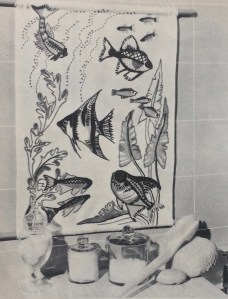
IMG_3173Springtime also means spring cleaning, and Easter means presents and bizarre sorry bazaar novelties (honestly, with some of the designs it’s hard to tell the difference.) Here’s an intriguing “splash panel” to hang on the bathroom wall. As with the elaborately embroidered “finger plates” for doors, its utility evades me. Why would anyone hang a hand-embroidered tapestry on the bathroom wall, for the express purpose of being splashed with soap and toothpaste and who knows what else, which would therefore need to be taken down and (hand!)-washed frequently, rather than just… wipe down the tile wall? I do like the fish design, though!

The pineapple (-ish) motif cushion, embroidered flower-of-the-month iris, latch-key and crocheted rugs are less interesting, but the Easter novelties — a stuffed polka-dot giraffe, a hedgehog pincushion (brilliant), a chicken egg cosy and a knitted lamb with mascara and eyebrows — do not disappoint. A crocheted altar cloth and a set of versatile cross-stitch animal motifs round out the homewares selection. Finally, there’s a great surprise on the inside back cover: a set of embroidered and appliquéd place mats and matching cushion with a chess-set motif! That’s actually quite a lot of fun.

I hope you are all staying sane and healthy in these unfortunate times. May you all have enough projects to keep you busy and enough non-physical-proximity games to keep you happy. Two friends of mine will be expecting babies in the summer, so my Stitchcraft project for April will be the jacket from the baby set. Hang in there, everyone!

January 1962: Overview

IMG_3019Happy New Year, everyone! It’s 2020 in my real world and 1962 in my blog world. Where will Stitchcraft take us?

… Not very far, fashion-wise. The “Swinging Sixties” started later in the decade; 1962 was still definitely part of the “early” 1960s aesthetic, i.e. more of a continuation of 1950s styles. At the same time, new trends are pushing fashion in new directions, and Stitchcraft is (slowly) moving with the tide.  Fine-knit wool blouses have become rare and the bulky look is definitely in. Knitted suits are loose-fitting and give a rectangular silhouette. Accessories are becoming more experimental and fun, with “turret” and loop-stitch hats and oversized knitted or crocheted bags.

So, what does January 1962 offer us? The cabled sweaters on the front (and yes, that is the word that this British magazine uses: for Stitchcraft, a “jumper” is generally more form-fitting and finely knit, while a “sweater” is bulkier and more casual) can be made in Big Ben wool for the truly bulky effect in a pullover, or in double knitting for a more streamlined cardigan. The casual “his and hers” sweaters with a diagonal “v” stitch pattern are made in double knitting wool, but oversized and loose-fitting. There’s a “big and bold” shortie dolman for teenage girls and you can knit matching, you guessed it, bulky, oversized pullovers for “the menfolk” of the family.

There’s a casual suit in Bracken Tweed wool, highlighting the new fashion for multicolour, heathery tweed yarns. It too is meant to hang loosely, and the collars, cuffs and borders are knitted in a complementary colour that picks up one of the tweed undertones. The only fine-knit garment in the issue is a lovely twin set in 4-ply Cameo crepe wool, and even it is mostly unshaped — quite unlike the twin sets of the 1950s. Children can get a nice warm play-suit in stranded colourwork.

In the early 1960s, Stitchcraft liked “year-round” embroidery themes, with a different versatile small design each month. At the end of the year, all the transfers were made available as a set to be used together on a tablecloth or larger project. 1962’s theme is “flowers” — more conservative and less original than the previous “Zodiac” theme. Still. the narcissus design is pretty and elegant. The bathroom mat, flowery “peasant design” tablecloth, Victorian tapestry and knitted doilies are pretty standard fare and the knitted clown with flags stuck in it like a voodoo doll is predictably terrifying — seriously, do not look at the photo if you have a clown phobia, it will give you nightmares.

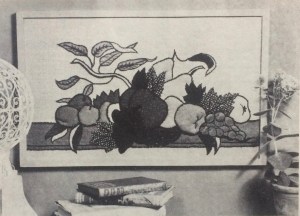
To clear your head of that image, you can make a wall hanging — a still life of fruits and vegetables done in padded appliqué for a three-dimensional effect.

IMG_3027

All in all, Stitchcraft‘s 1962 starts with a whimper, not a bang. Still, there are enough nice designs that it’s hard to pick one. I love the twin set, but could also use a nice, normal cabled V-neck cardigan in double knitting, and the toddler’s playsuit is probably fun to knit. I’ll let my local yarn shop decide, i.e. see what they have in stock that says, “Use me for this project.”


October 1961: Overview

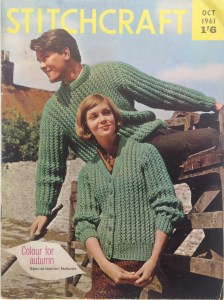
IMG_2820October 1961 gives us “Colour for autumn” with “special fashion features” and a great center spread with colour photos. “I always think October is a nice friendly month,” writes “editress” Patience Horne on the facing page, and I have to agree.

Bulky Big Ben wool and different kinds of textured ribIMG_2821 stitches play a prominent role in this month’s issue, starting with the partner-look pullover and cardigan on the front cover. Both are made in the same drop-stitch rib pattern — basically 2×2 ribbing, but you drop a stitch down 3 rows every 4th row and pick it up again in the next row to make a long vertical rib. Children get twisted-rib raglan pullovers to keep their upper bodies nice and warm while their legs freeze in tiny shorts and mini-skirts, typical for the era.

Nubbly Rimple wool may be easing out of fashion, as there’s only one pattern for it in this issue: a simple, yet elegant dress with “the new horseshoe neckline.” Other women’s garments include a cabled cardigan with colour accents and matching cap, a long-line pullover with a wide collar (still in fashion) and saddle-stitching detail, and a cardigan jacket in a wonderfully ornate Florentine stitch that involves a lot of slipping, dropping and pulling stitches up and around in two colours. The finished effect is a lot like a trellis, accentuated here by posing the model in a green skirt and holding on to a plant. Autumn colours of gold, orange, and beige prevail.

There are some additions to the “Stitchcraft Layette” for the smallest member of the family, but we’ve moved on from the bramble-stitch pattern in the last few issues to a mix of cables and flower motifs. Both cardigan and blanket are  pretty and useful, but I don’t like the huge dolman sleeves on the cardigan —  I can see a baby getting their arm stuck inside it. The bottle cover with a fuzzy knitted kitten on it is great, though! If it were made somewhat smaller or larger, I could imagine it as a phone or tablet cover.
In the homewares and accessories department, we’ve got the usual teapot cosies (how many can one household have??), a knitted donkey named “Ned”, and a pair of “mitts for a scooter fan” — with separate thumb and first finger. There are tapestry patterns for a piano stool and a chair seat, and did you honestly think we were finished with the Zodiac theme, just because all the months had had their patterns already? Of course not! Now you can order the complete chart and embroider them all one more time on a tablecloth.

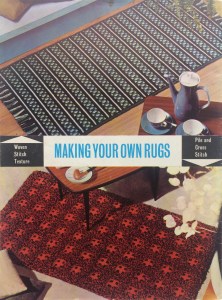
The back cover illustration shows two hand-made rugs using different techniques: flat crossed stitches for a woven effect, or stitching combined with pile knotting (latch hook), which was apparently the latest thing in Sweden at the time.

IMG_2838


The highlight of the home art section, for me, is this sequinned, glittered appliqué wall hanging of some of Great Britain’s famous kings and queens. I don’t think I would hang it in my own home, but what a wild idea and the appliqué and embroidery work is certainly stunning. Look the detail on Queen Elizabeth (I)’s face! And they definitely found a wall with the perfect wallpaper to hang the sample piece on.

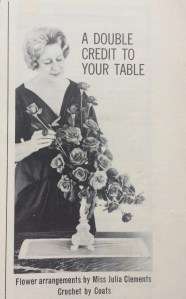
The “Readers Pages” have the usual ads, kiddy comic (Sally in Sampler Land), a preview of the next issue, and some easy counted-stitch ideas for borders on towels, pillowcases, etc. I love this ad for the latest Coats crochet booklet — it has flower-arranging lessons in addition to the crochet patterns.

IMG_2836


That’s all for now! My October project will be the baby cardigan (with modified sleeves) and maybe some kind of phone-cover version of the kitten bottle cover.