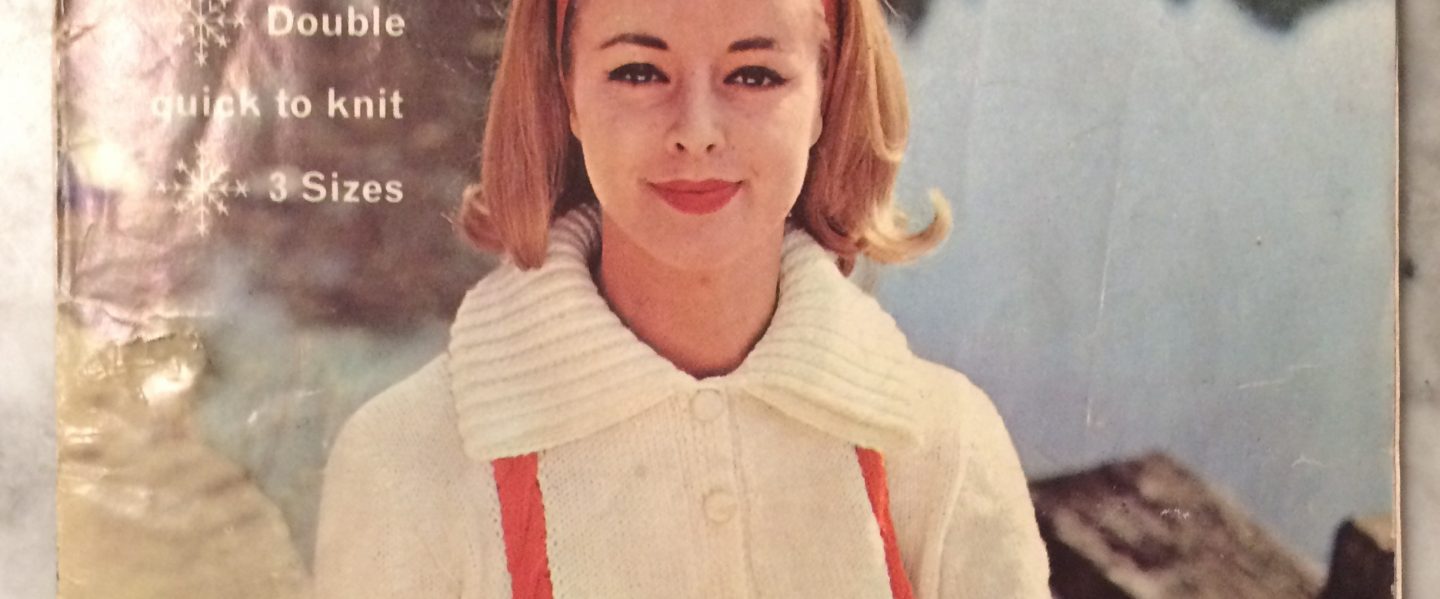
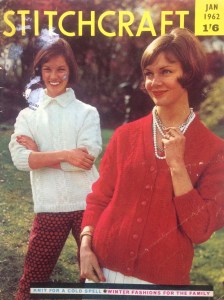
 Happy New Year, everyone! It’s 2020 in my real world and 1962 in my blog world. Where will Stitchcraft take us?
… Not very far, fashion-wise. The “Swinging Sixties” started later in the decade; 1962 was still definitely part of the “early” 1960s aesthetic, i.e. more of a continuation of 1950s styles. At the same time, new trends are pushing fashion in new directions, and Stitchcraft is (slowly) moving with the tide. Fine-knit wool blouses have become rare and the bulky look is definitely in. Knitted suits are loose-fitting and give a rectangular silhouette. Accessories are becoming more experimental and fun, with “turret” and loop-stitch hats and oversized knitted or crocheted bags.
So, what does January 1962 offer us? The cabled sweaters on the front (and yes, that is the word that this British magazine uses: for Stitchcraft, a “jumper” is generally more form-fitting and finely knit, while a “sweater” is bulkier and more casual) can be made in Big Ben wool for the truly bulky effect in a pullover, or in double knitting for a more streamlined cardigan. The casual “his and hers” sweaters with a diagonal “v” stitch pattern are made in double knitting wool, but oversized and loose-fitting. There’s a “big and bold” shortie dolman for teenage girls and you can knit matching, you guessed it, bulky, oversized pullovers for “the menfolk” of the family.


There’s a casual suit in Bracken Tweed wool, highlighting the new fashion for multicolour, heathery tweed yarns. It too is meant to hang loosely, and the collars, cuffs and borders are knitted in a complementary colour that picks up one of the tweed undertones. The only fine-knit garment in the issue is a lovely twin set in 4-ply Cameo crepe wool, and even it is mostly unshaped — quite unlike the twin sets of the 1950s. Children can get a nice warm play-suit in stranded colourwork.


In the early 1960s, Stitchcraft liked “year-round” embroidery themes, with a different versatile small design each month. At the end of the year, all the transfers were made available as a set to be used together on a tablecloth or larger project. 1962’s theme is “flowers” — more conservative and less original than the previous “Zodiac” theme. Still. the narcissus design is pretty and elegant. The bathroom mat, flowery “peasant design” tablecloth, Victorian tapestry and knitted doilies are pretty standard fare and the knitted clown with flags stuck in it like a voodoo doll is predictably terrifying — seriously, do not look at the photo if you have a clown phobia, it will give you nightmares.


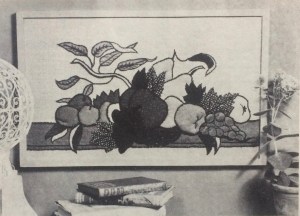
To clear your head of that image, you can make a wall hanging — a still life of fruits and vegetables done in padded appliqué for a three-dimensional effect.
All in all, Stitchcraft‘s 1962 starts with a whimper, not a bang. Still, there are enough nice designs that it’s hard to pick one. I love the twin set, but could also use a nice, normal cabled V-neck cardigan in double knitting, and the toddler’s playsuit is probably fun to knit. I’ll let my local yarn shop decide, i.e. see what they have in stock that says, “Use me for this project.”
 October 1961 gives us “Colour for autumn” with “special fashion features” and a great center spread with colour photos. “I always think October is a nice friendly month,” writes “editress” Patience Horne on the facing page, and I have to agree.
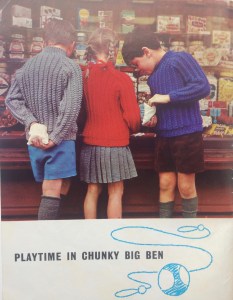 stitches play a prominent role in this month’s issue, starting with the partner-look pullover and cardigan on the front cover. Both are made in the same drop-stitch rib pattern — basically 2×2 ribbing, but you drop a stitch down 3 rows every 4th row and pick it up again in the next row to make a long vertical rib. Children get twisted-rib raglan pullovers to keep their upper bodies nice and warm while their legs freeze in tiny shorts and mini-skirts, typical for the era.


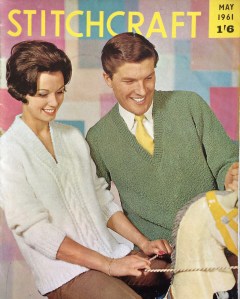 Time for the Summer Forecast! “Editress” Patience Horne writes that it is “a lovely sunny day in March” as they go to press for the May issue. It’s freezing cold and pouring rain where I am on May 2nd, so my summer forecast feelings have been literally dampened.


 Are you ready to “Rendez-vous with Spring”? I sure am! This month’s issue has a lovely extra “centerfold” spread in colour, showing off Spring 1961’s latest fashions.


 The ads are for the usual knitting machines and sewing fabrics… except for this one, for “Cooper’s moth proofer” spray, presumably made of


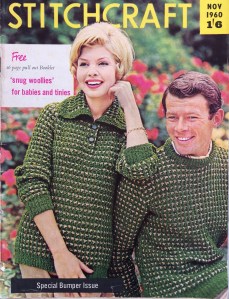 Brrrr! November 1960’s Special Bumper Issue” brings us “Colour for the Cold Days” and an extra 16-page pull-out booklet of baby woollies. Sadly, so sadly, the booklet from my copy of this issue has been pulled out long ago and is missing.


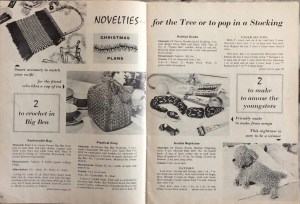 Homewares are still in a weird phase. The working woman or baby-boom mum (and those were overlapping categories, then as now) of 1960 didn’t have the time or patience to make too many elaborate Jacobean embroidery pieces or huge, detailed tapestries, especially not right before the great rush to get Christmas presents under the tree, so the focus is on quick, easy-to-make novelties for gifts. The aesthetic sense does seem to get lost a bit, though, if you ask me.


 (I notice that Word Press does not recognise the word “chairback”. They have been out of fashion for too many years, I guess, having fallen victim to cheaper furniture, more frequent hair-washings and less
