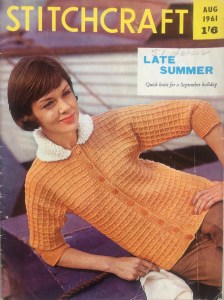
 Stitchcraft‘s August 1961 “Late Summer” issue had multiple cute, easy embroidery and tapestry projects. Mine was this little set of rose sprays. To show the versatility of the designs, the magazine usually had directions for and photos of the designs made on different items: a cushion and/or tray cloth, for example. Overall, there was a huge range of homewares that could potentially be embroidered: an apron, a place mat, a chair-back, a wall hanging, a “nightie case”, a project bag, a finger plate, a fire screen, even a room divider or a waste-paper basket cover. This issue added a new idea to the mix: the rose-spray design on a lampshade, complete with a pattern to cut out, sew and fringe the lampshade cover itself.

I don’t need an embroidered lampshade (or finger plate, or fire screen, or tray cloth, or chair-back, or waste-paper basket cover etc. etc.) and I have plenty of cushions and project bags, so I’m often at a loss when I see a nice embroidery pattern and don’t know what to put it on. I’ve made a couple of tablet cosies for myself or for presents for friends, or useful little bags to store “stuff”, but there are limits. I guess I could sell whatever I don’t need, but haven’t gone that route yet. So what to make?
Vegetable bags.
I stopped using plastic bags for vegetables long ago, which wasn’t difficult as I pretty much only buy vegetables at the farmer’s market or organic supermarket, both of which put vegetables in little paper bags (for small or sandy things like mushrooms, potatoes or little tomatoes) or don’t package them at all (I just put them into my basket/cloth shopping bag loose). I try to re-use the paper bags, but my best bag of all is a little linen drawstring sack that originally held soapberry nuts for washing laundry. It’s tough, washable and the perfect size for holding the right amount of potatoes or green beans or whatever. And both the organic supermarket and, incredibly, the regular supermarket in my neighbourhood have now stopped offering even little paper bags for vegetables, so time to make more bags!
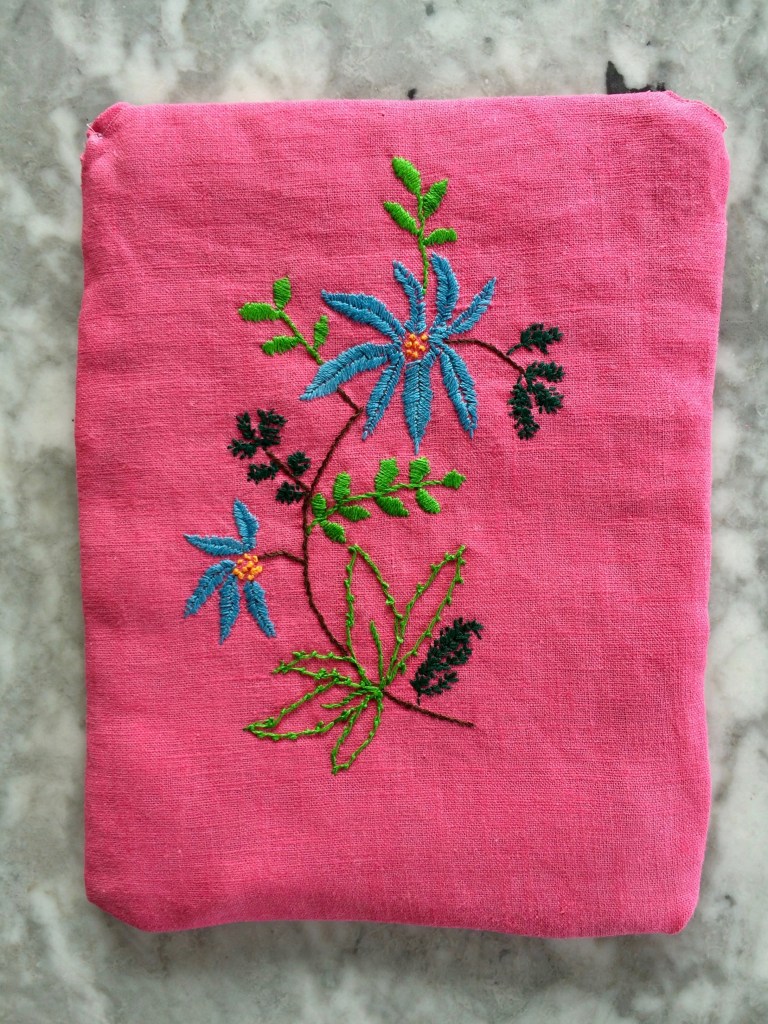
 Of course, they don’t have to be embroidered, but why not? Cotton embroidery floss is machine-washable even at high temperatures and I have plenty of scraps and bits of plain linen or cotton materials that can be put to good purpose. The bag I made for this August project was made from a piece of linen from shoes, yes, shoes that a friend bought (the shoes came wrapped in this piece of fabric in the shoe box instead of in paper.) I had enough embroidery floss on hand, so this was an almost 100% up-cycled / didn’t have to buy anything new project. (I say almost because I bought the cord for the drawstrings — then realised I could have made monks’ cord or i-cord from leftover cotton yarn. Next time…)
 The design is of blue roses, which don’t exist in the natural world but can be created by putting white roses in blue-tinted water for a few days. (Interestingly, this low-tech process is much more successful than trying to create blue roses via genetic engineering, which so far has only made purplish-lavender roses.) I think blue is an interesting colour choice for embroidered roses, because of course when you see blue flowers you don’t automatically think of roses. I love how the colours turned out though. The stitches are easy stem-stitch, satin stitch and long-and-short stitch. Of course I didn’t have the transfer, but the design was easy enough to copy onto the fabric freehand.
I’m really, really happy with this and look forward to making more unnecessarily pretty, but necessarily environmentally friendly vegetable bags in the future.

 “August is an issue that needs special thought and planning” writes Stitchcraft‘s “editress”, Patience Horne, in the introduction to the August issue, pointing out that it is “rather an “in-between” month for needleworkers” — often too hot to want to wear or make heavy sweaters and too late in the year for fine-knits. At the same time, reminding people that “Autumn is around the corner” can be “a little depressing” to people enjoying their late-summer holiday.


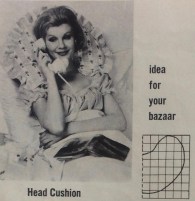 My favourite, though, is this sewing project: a head cushion that lets you recline charmingly in bed with your hair and makeup perfectly done, your satin nightie on, a book on your lap and your telephone on your ear. It’s glamorous leisure and lifestyle advertising personified, and though they say it’s an “idea for your bazaar”, I would bet the Stitchcraft readers who made this in 1961 did not make it to sell.
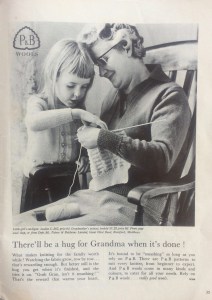 Apropos lifestyle advertising, the early 1960s Stitchcrafts show a rise in full-page ads for Patons and Baldwins wools. That’s obviously not surprising considering the magazine was published for the Patons wool company, but the full-page ads that “tell a story” are a new trend: the late 1950s and 1960s issues up to now had little celebrity testimonials. This one caters to grandmothers and the message is clear: Knitting is not only a rewarding pastime on its own, but earns you the love and affection of the grandchildren for whom you knit. (But only if the kid likes it, and that’s only guaranteed if you use P&B wools, of course.) The 1950s and 1960s saw a huge shift in advertising methods towards a psychologically-based system, which is a huge topic that I won’t start with here, but suffice to say there will be more of these ads, and that they are representative of changing advertising styles.
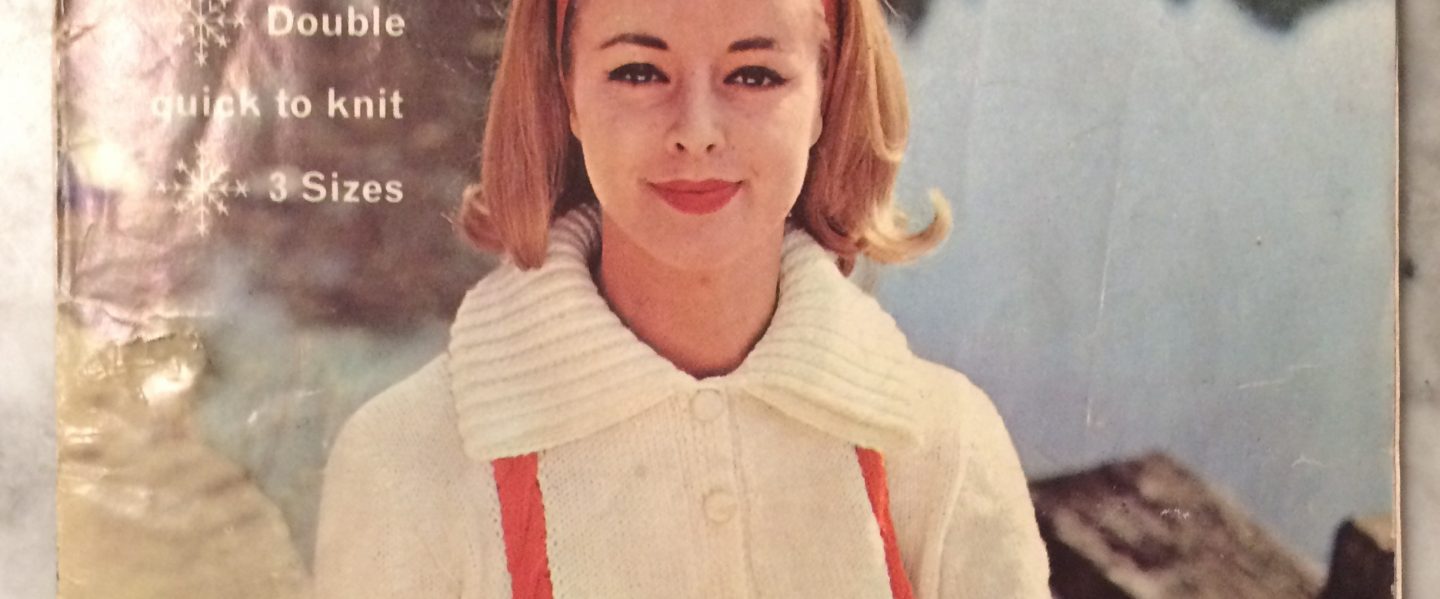
 I love this cover. The yellow stripes on the hats, the yellow trim on the sweaters and the yellow sans-serif lettering all harmonise perfectly with the off-white garments in the center focus. Even the models’ hair colour looks like it was chosen to match the wooden wall. And we can see that typical 1960s hairdo coming into fashion, with more volume on the top and curled ends.
 elephant! The dress is totally cute and definitely on my project list for this month, for my friend’s kid who just turned three. Those are seahorses, in case that wasn’t clear (the ones on the front panel of the dress and matching sunsuit look weird to me — I think I’ll fill in the bodies to make the shape more clear.) The sunsuit and dress are made in wool-nylon blend
  (Speaking of tiny children in goofy poses, am I the only one who finds this advertisement for next month’s Stitchcraft strangely funny? What is it about this baby that comes off looking so weird? Too much hair? The quasi-adult-looking face? The indescribable expression?)


 And then there’s this incredible birds-in-a-tree number, to be worked either in wool on linen for a firescreen or in felt appliqué with wool embroidery on linen for a picture. I’m normally not so crazy about 1950s and 1960s neo-Jacobean designs, but I love this one and definitely want to make the felt appliqué version as a cushion (with a more greeny green for the tree and not quite so much brown-orange-yellow in the appliqué work.) I imagine it might be tough without a transfer, but they gave us two very clear photographs including one in full colour, so what could go wrong?
 Last but not least, there’s a lovely, elegant two-piece suit in nubbly Rimple double knitting wool, featured in the most magnificent photo I have ever seen in any magazine, ever. If I remember correctly, I saw it in one of those Internet lists of “best/worst/weirdest knitting pattern photos” long before I started collecting vintage patterns. It’s definitely at the top of my list and if you haven’t seen it yet, you saw it here first!
 My project from the May 1961 issue of Stitchcraft was a charming tapestry handbag with a Victorian-inspired flower ribbon design. The magazine gives directions for either the handbag or a piano-stool top. As much as I would love to have a handbag that matched my piano stool, I’m just making the bag for now.
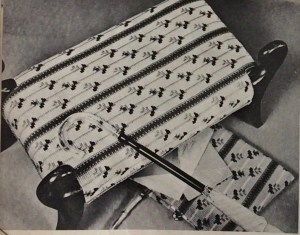 counted cross-stitch done on tapestry net canvas with tapestry wool. The hardest part was getting all the components together! The original pattern calls for Beehive Tapestry Canvas No. 27 and Beehive Tapestry Wool, which as far as I can see do not exist anymore — and if they did, they could very well be quite different from the same canvas and wools manufactured in 1961. Unlike cross-stitch fabric, there’s no indication of holes per inch, so I had to sort of guess from the photo of the bag (3 purple stripes across and 3 or 4 flowers vertically in the stripes) and the number of stitches in one repeat of the chart and factor in the size that I wanted the bag to be (a little smaller than the 9 inches deep and 11 inches wide given in the pattern) and the size of the modern handles.
 I found some net that seemed about right, but tapestry wool is not to be found in a craft, knitting, wool, fabric, or notions store anywhere near me. So I had to order it online… from a mail-order Internet store whose address is in my own city, but does not have an actual brick-and-mortar store. So I couldn’t see the wool before buying and they had to ship it to me, when I could and would have gladly just gone over and picked it up. And seen it beforehand… because it is really thick! About as thick as double knitting wool. It would have been so much easier to match the size of the wool to the size of the net if I could have found both of them in the same place. It’s usable with the net I bought, but I think the bag will be rather stiff.
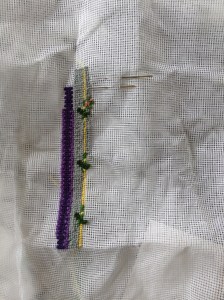 and buy all of this stuff together. It works for knitting, sewing and embroidery, but I guess tapestry is such an unfashionable hobby that it’s not worth using store space for the materials. I should probably be glad that they’re still manufactured at all.
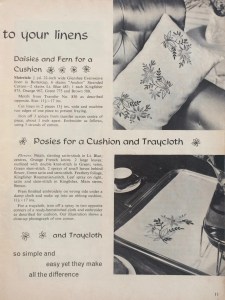 My Stitchcraft project this month was a simple embroidered spray of flowers, originally intended as a decoration for a cushion or traycloth. Having enough cushions and not using traycloths, I updated the design for an iPad cover similar to


 Are you ready to “Rendez-vous with Spring”? I sure am! This month’s issue has a lovely extra “centerfold” spread in colour, showing off Spring 1961’s latest fashions.


 The ads are for the usual knitting machines and sewing fabrics… except for this one, for “Cooper’s moth proofer” spray, presumably made of
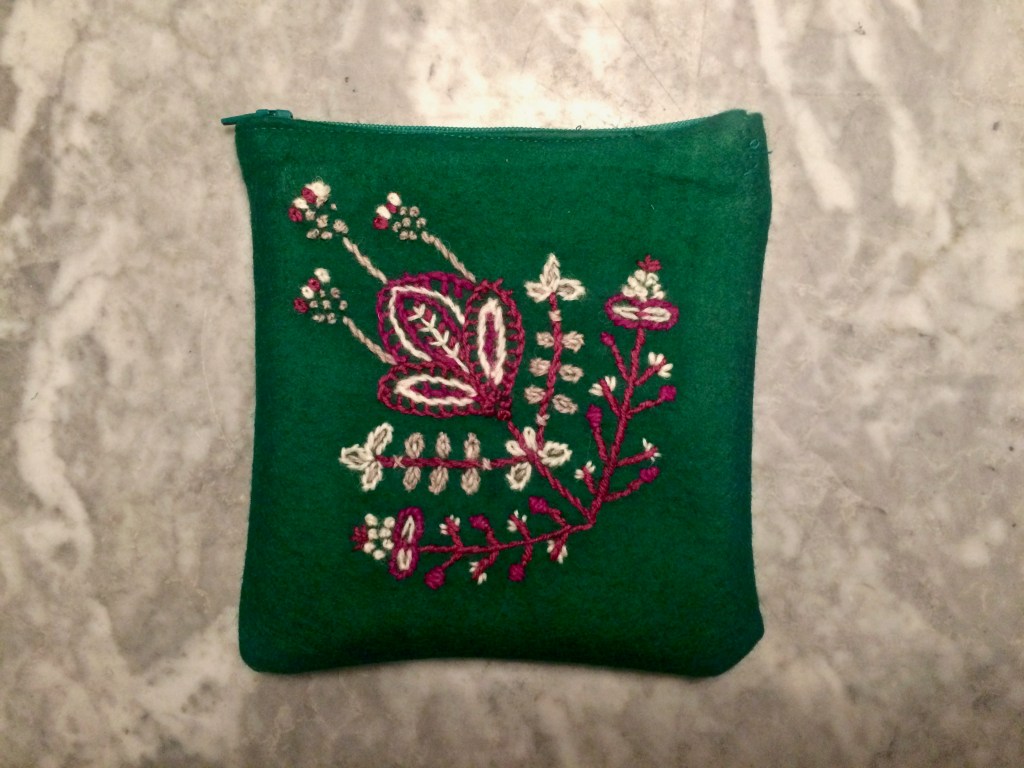
 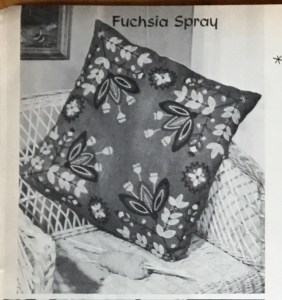 I really, really liked the idea of this embroidery project. Sadly, there was no colour photo, but the design is fun and very 1960 and I imagine the colours (Plum and Magenta with Cream and Fawn shades on deep green) to be quite striking. Working with tapestry wool instead of crewel cotton was (or would have been) another first, so all in all, I was eager to try it.


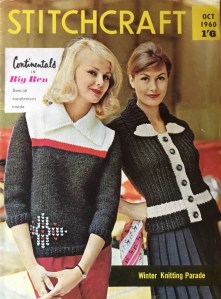 October and November are really the best months for knitting. The weather has gotten cold enough that you really want to wear and make warm, woolly things, and there’s the nice “surprise” of packing the winter clothes out of storage, and so remembering what nice hand-knitted pieces you made in other years. At least, that’s my experience.