June 1967: Daisy Motif Peg Bag

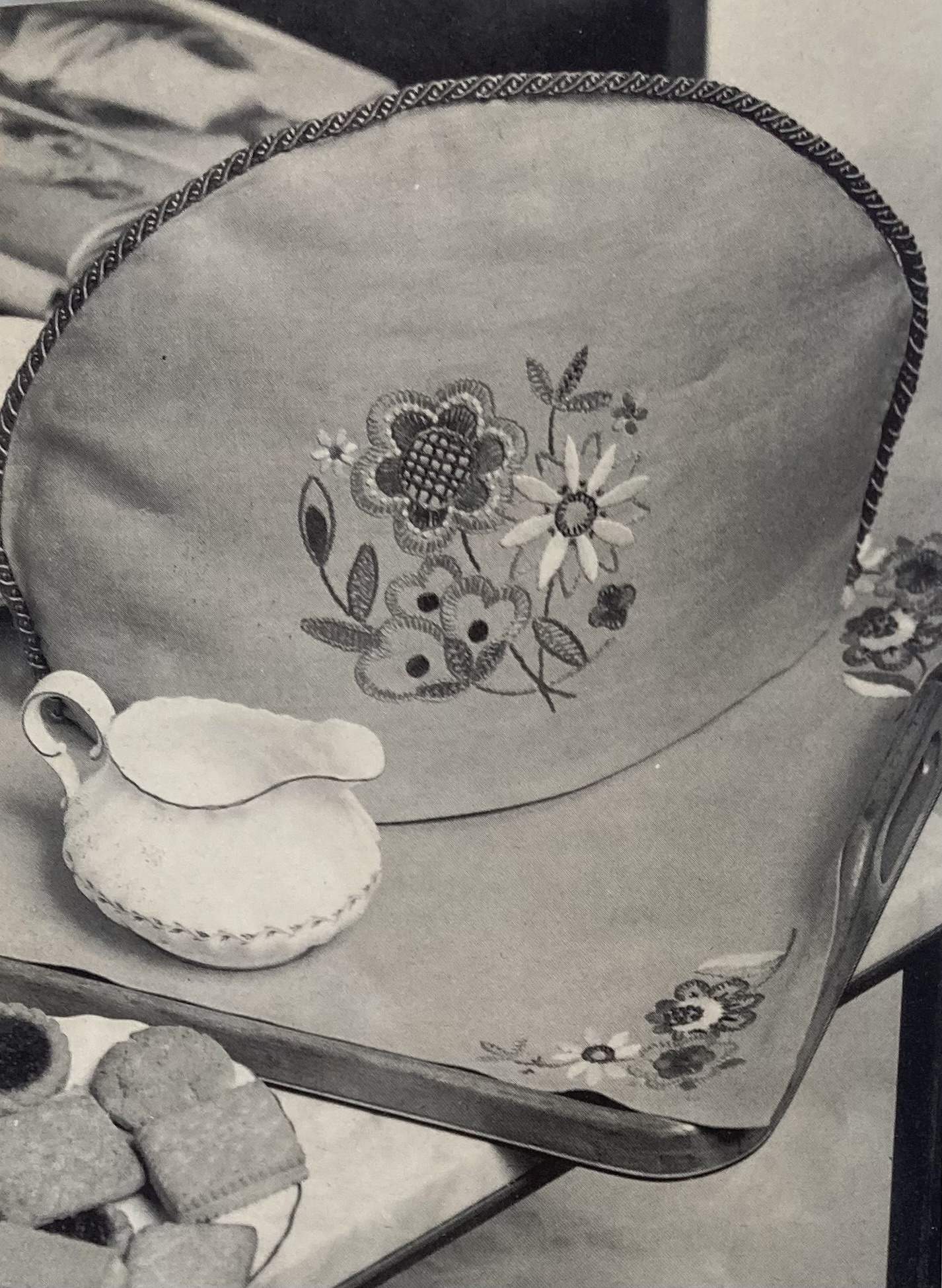
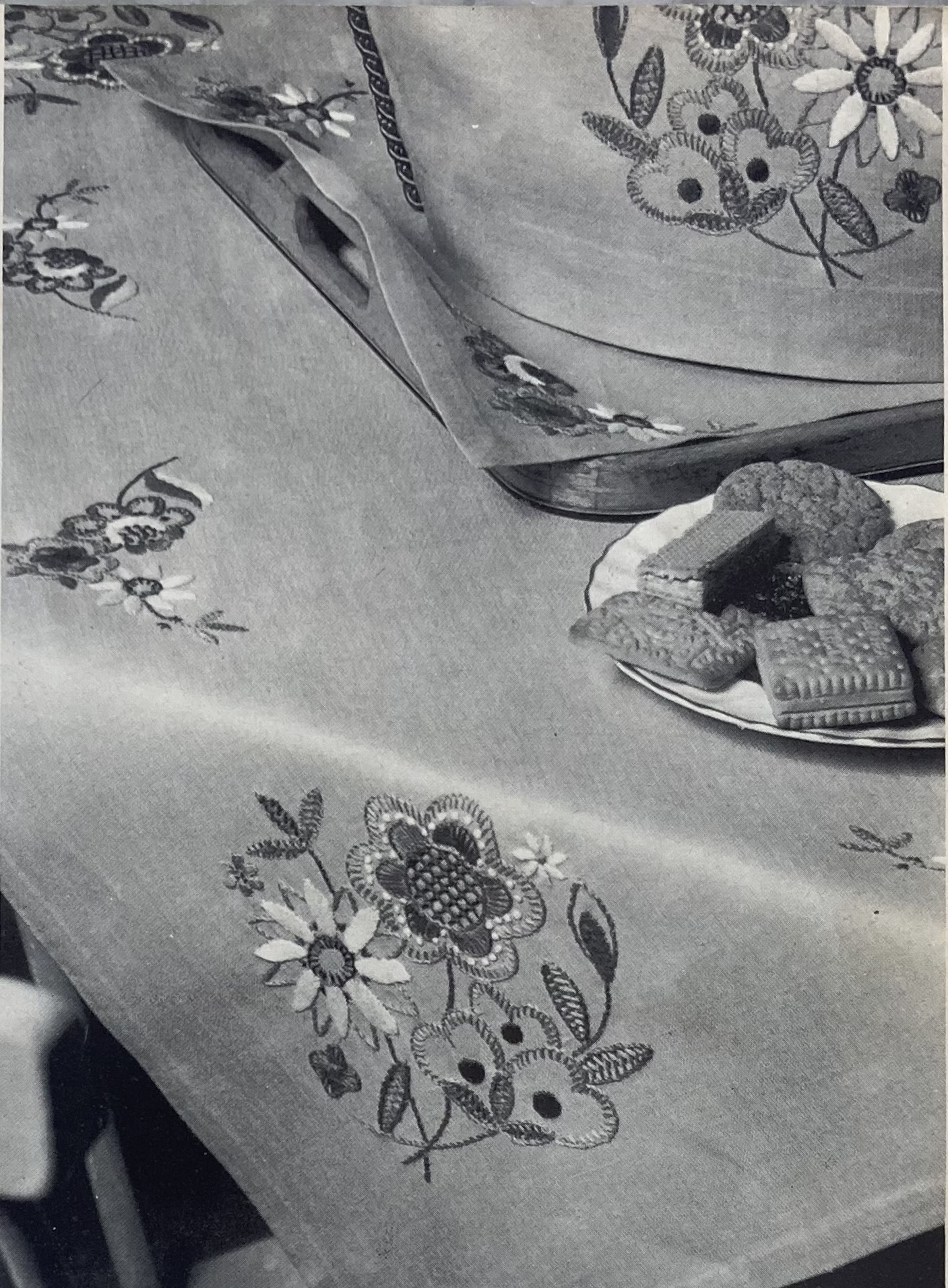
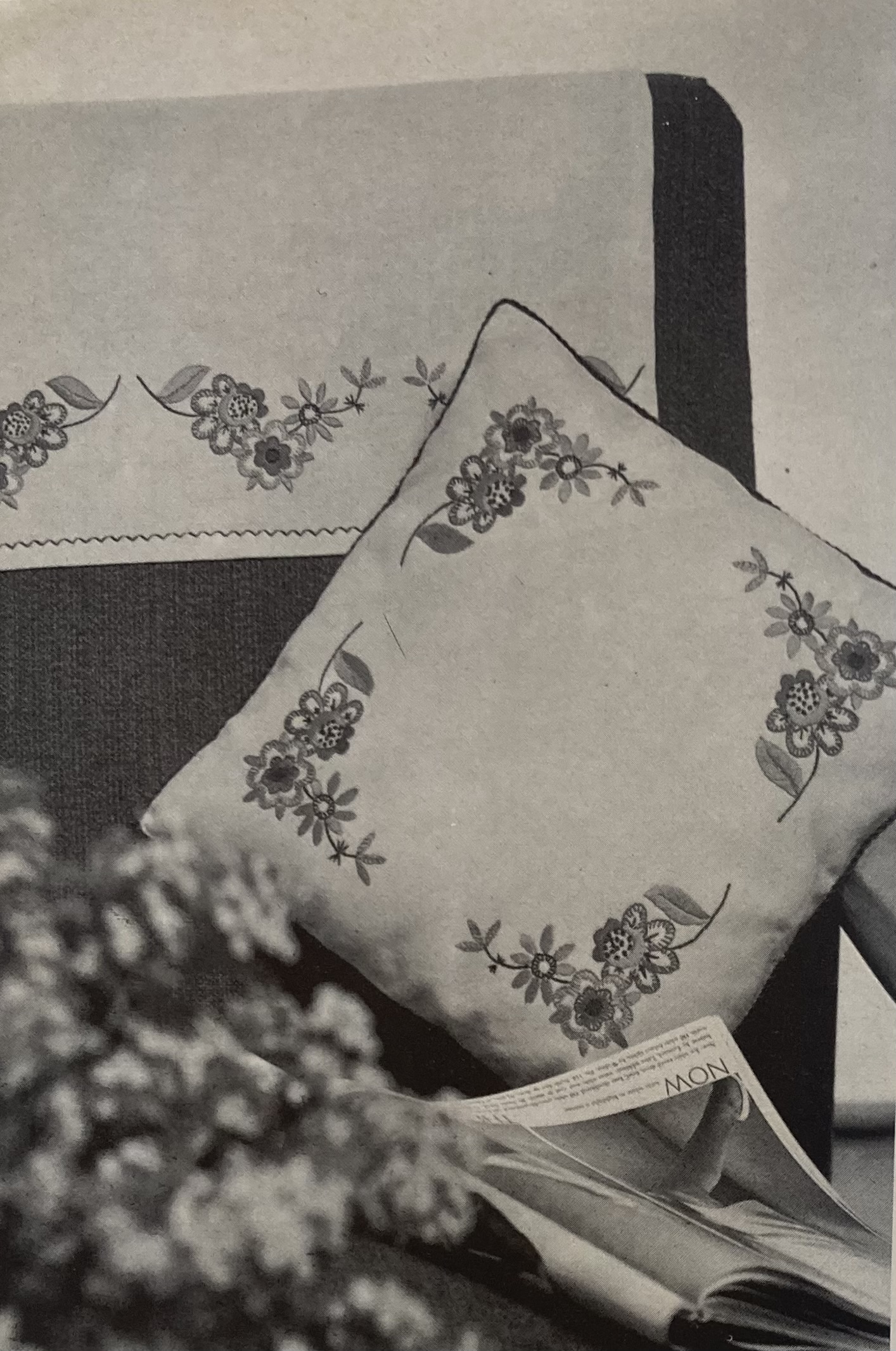
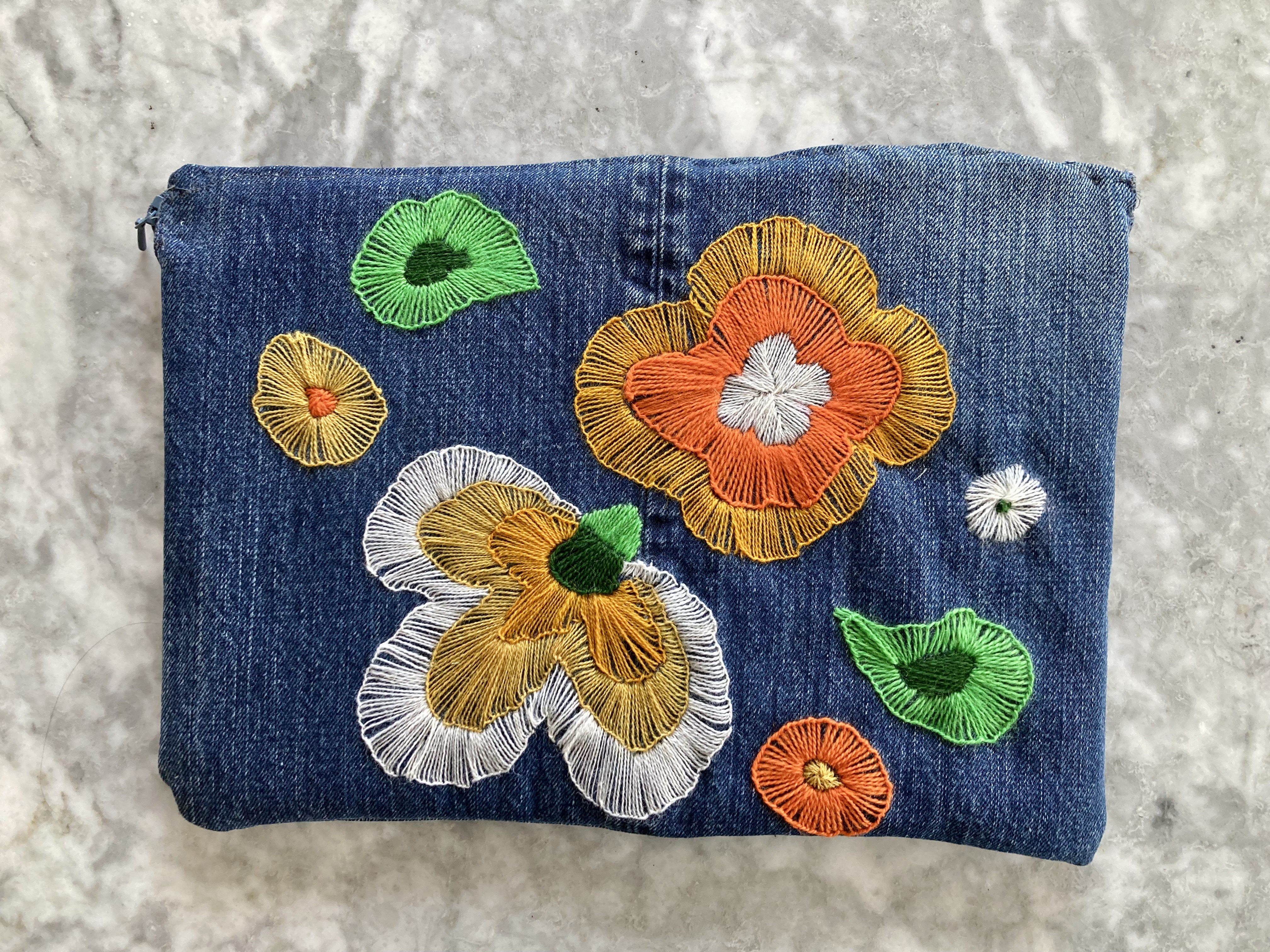
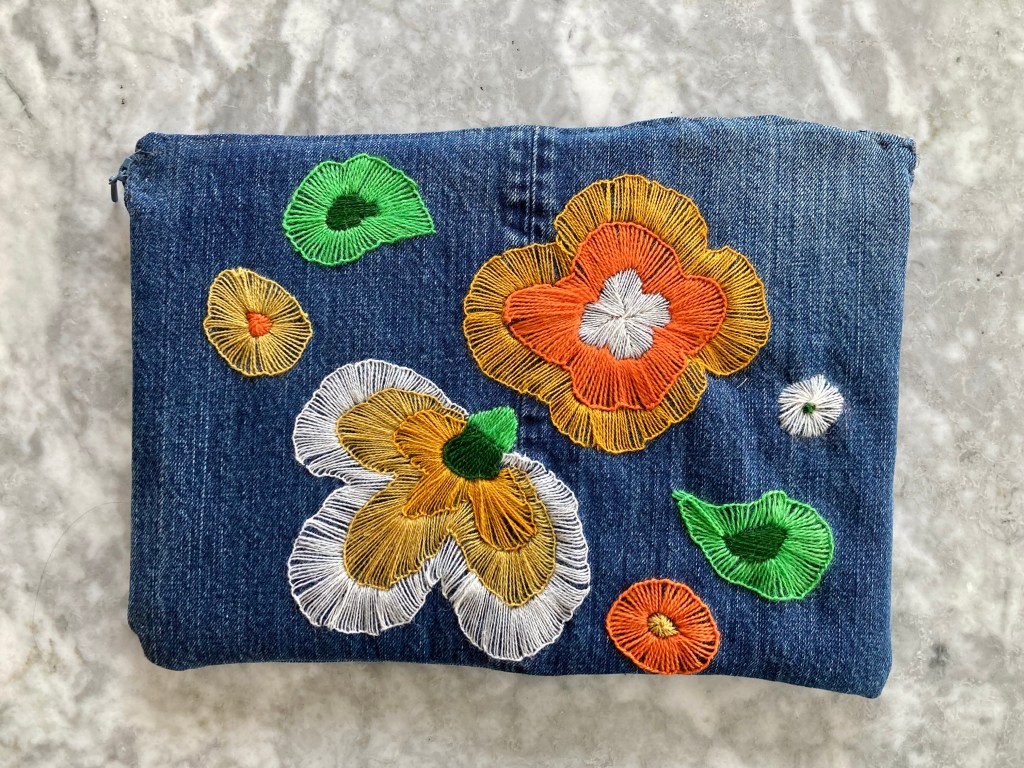
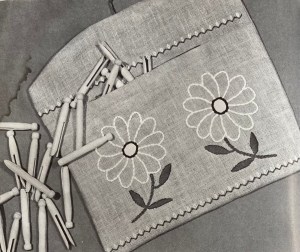
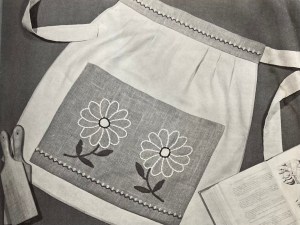
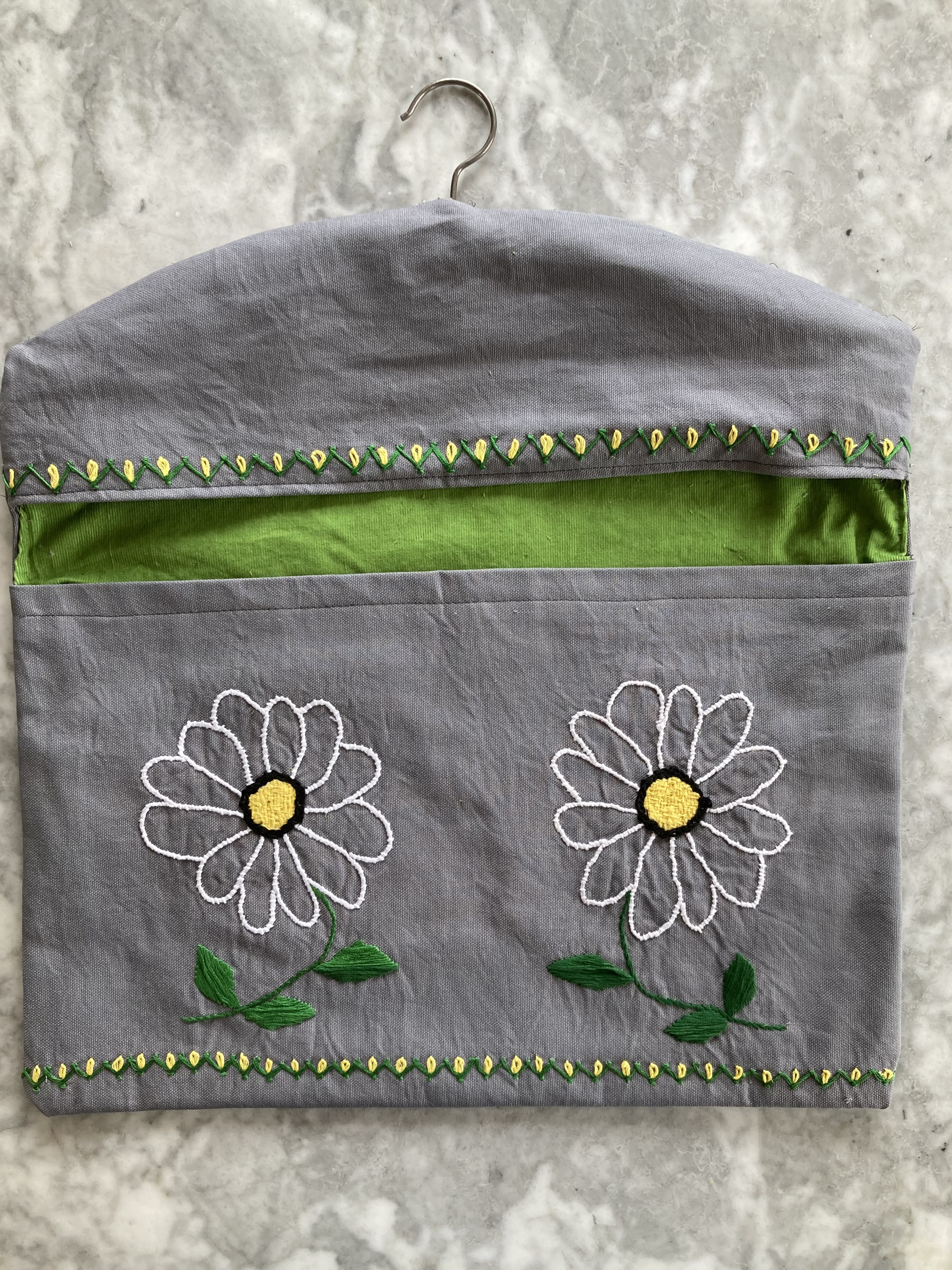
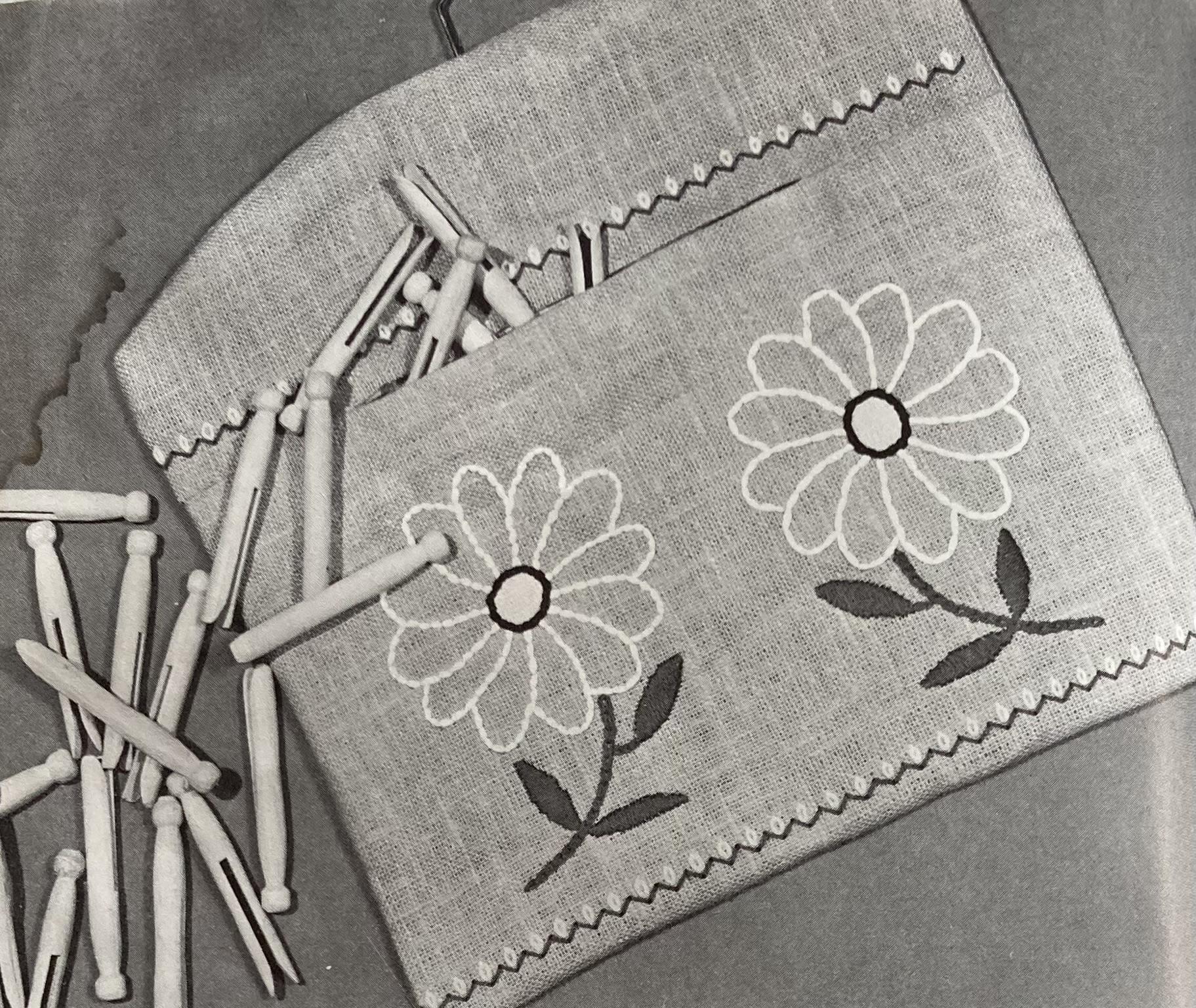
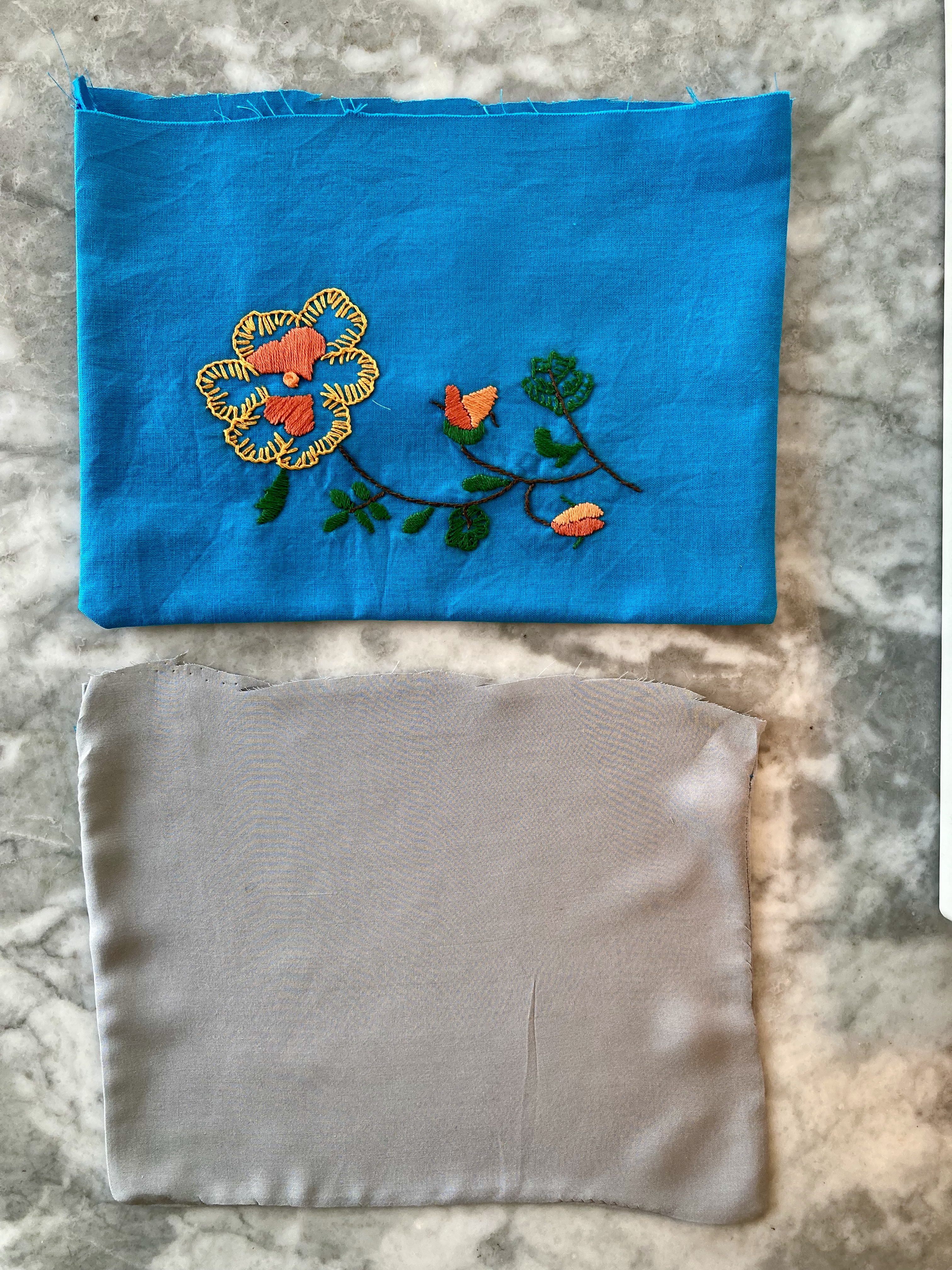
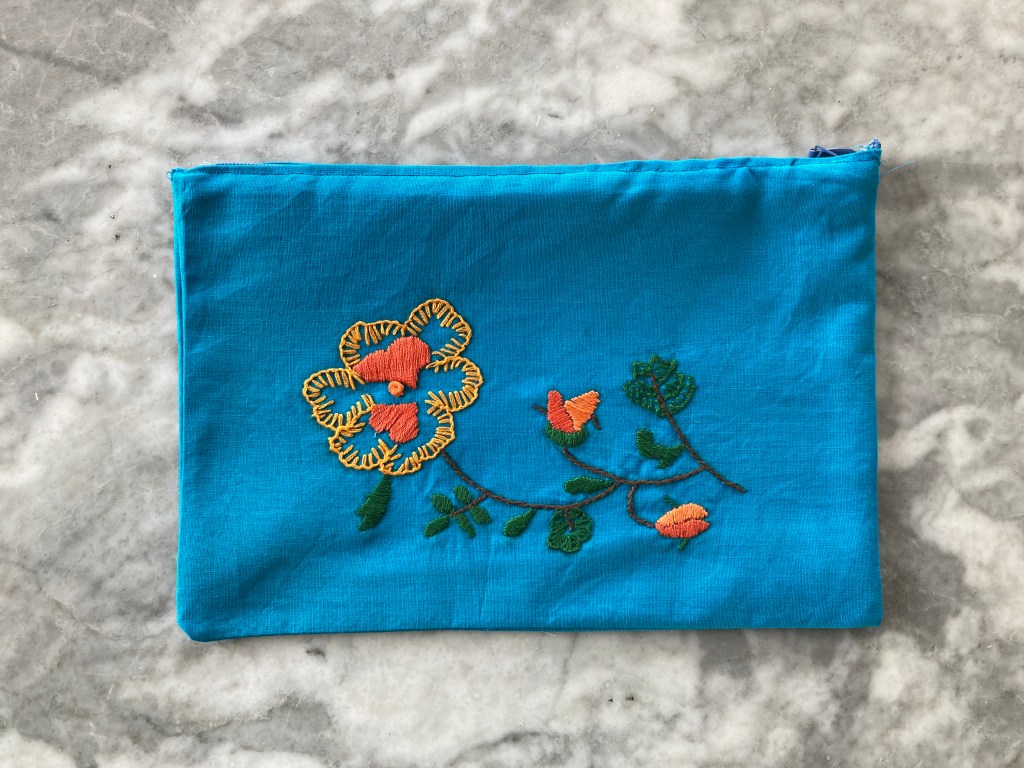
My project from the June 1967 issue of Stitchcraft was a “peg bag” adorned with simple embroidery.

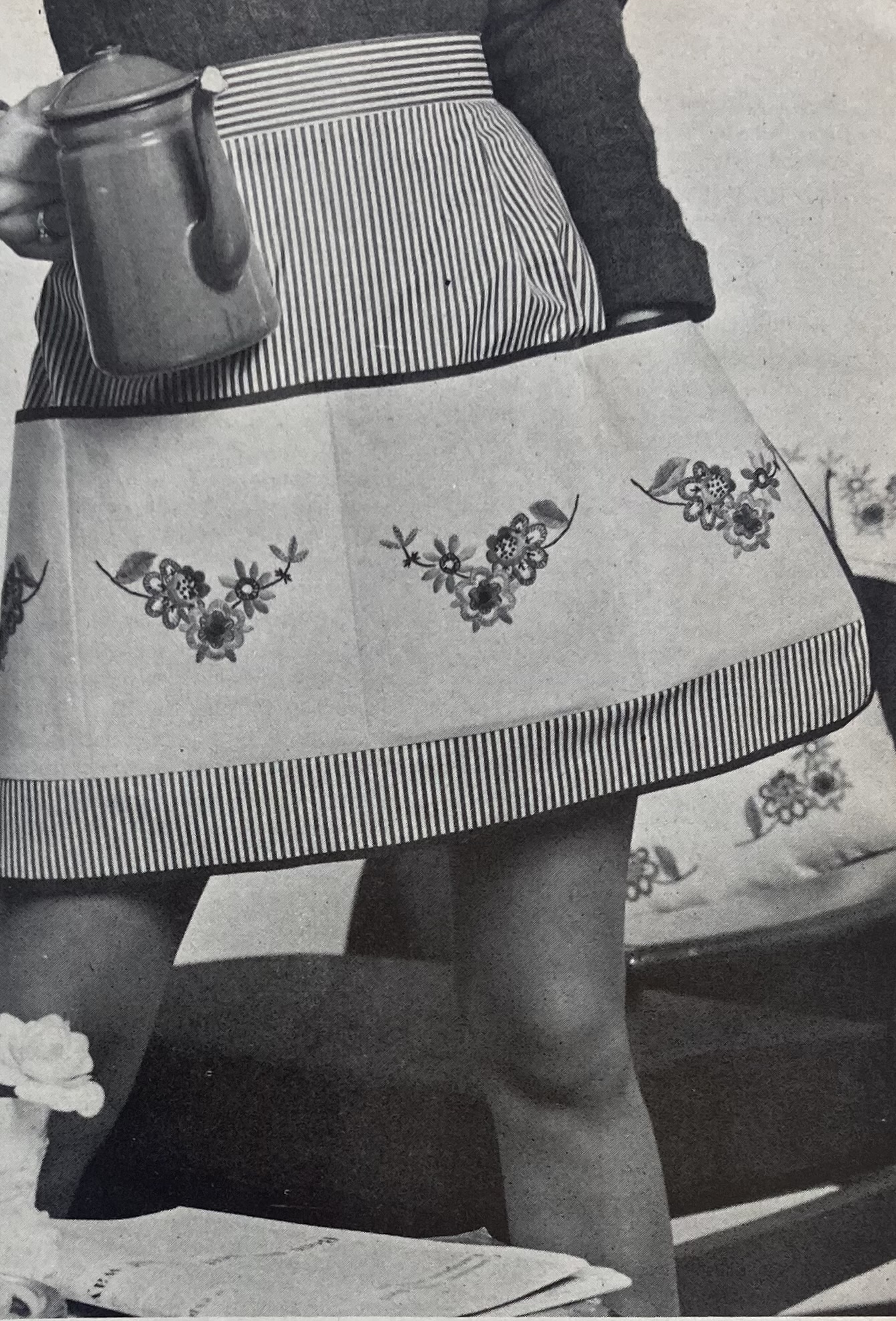
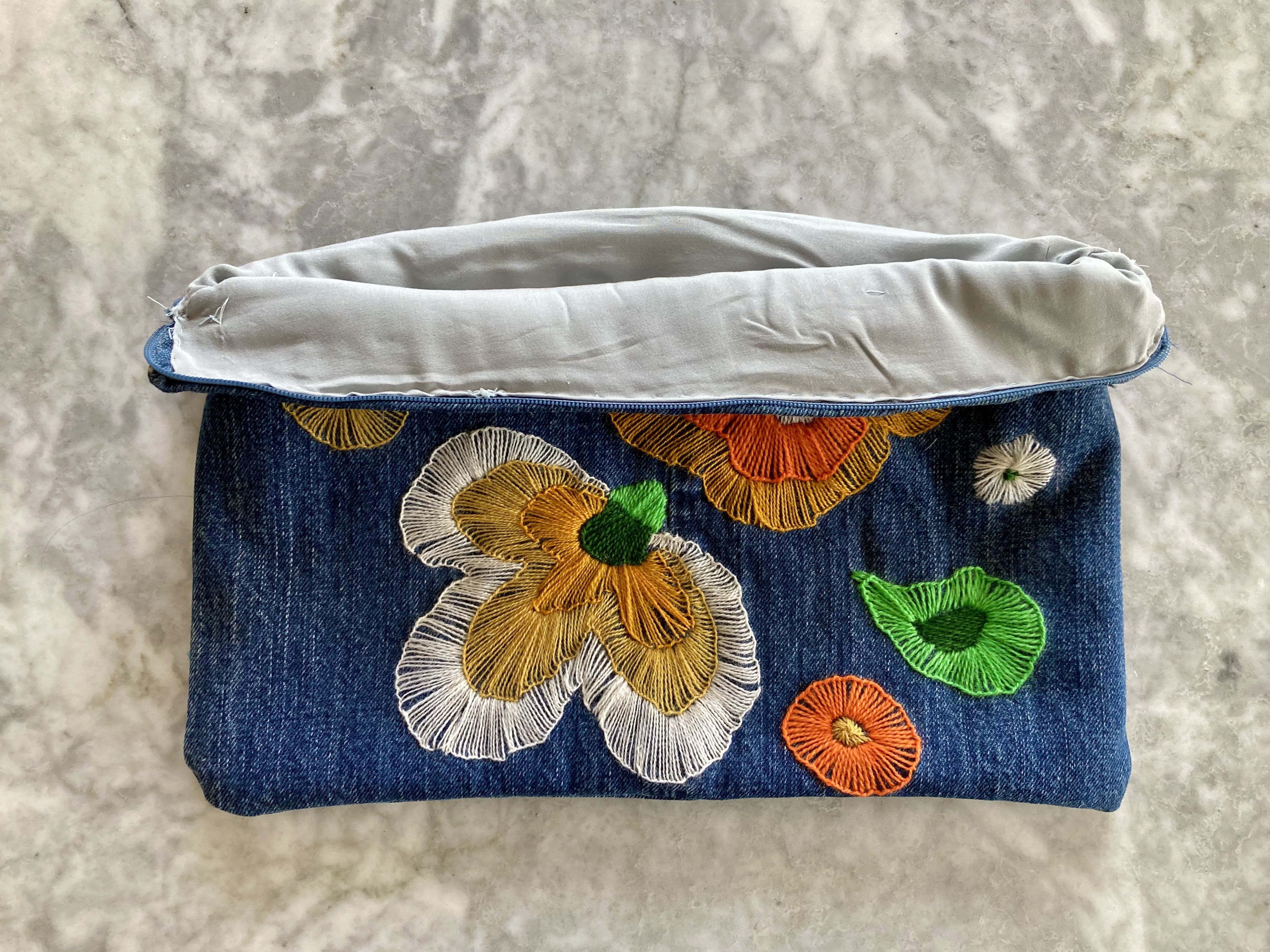
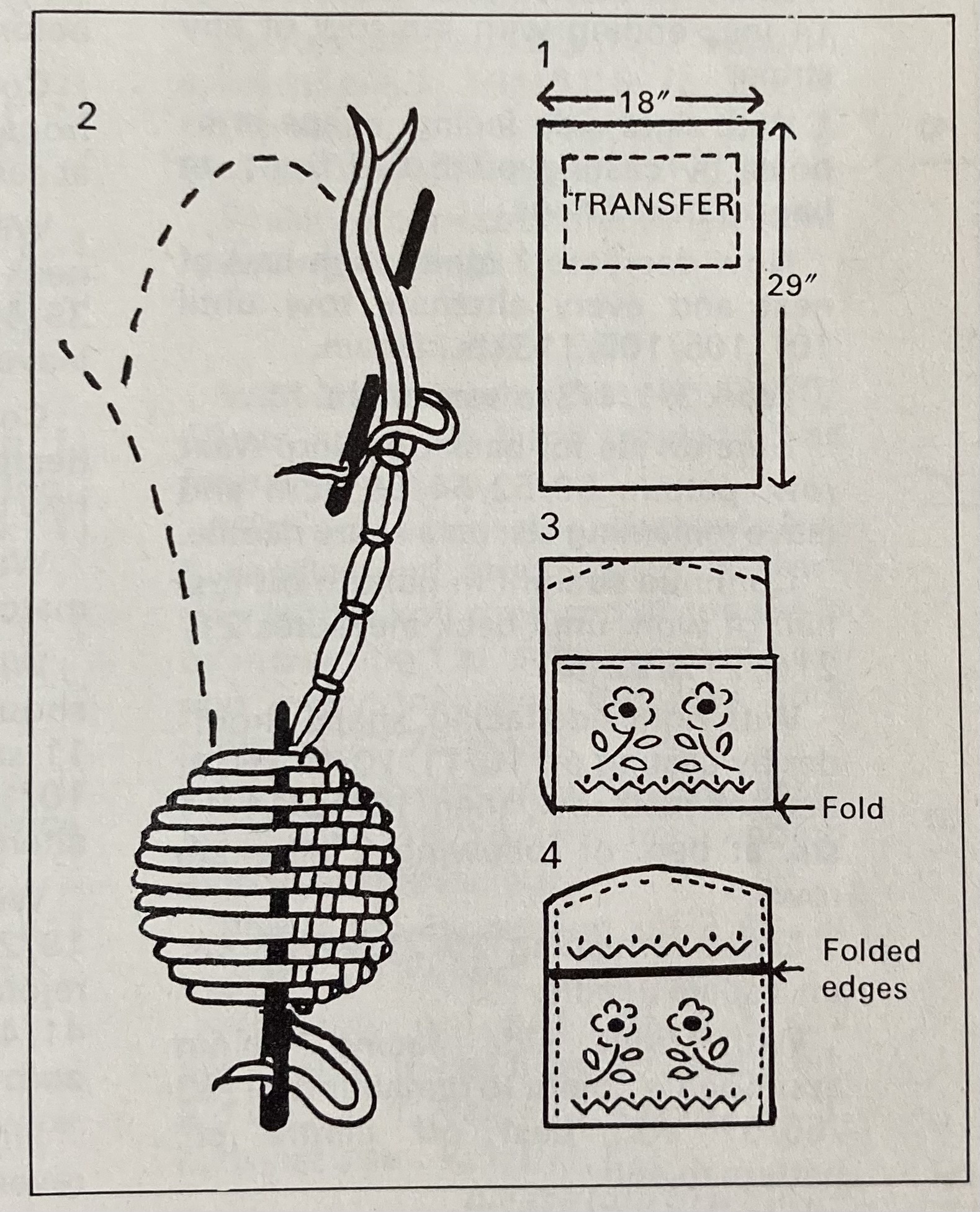
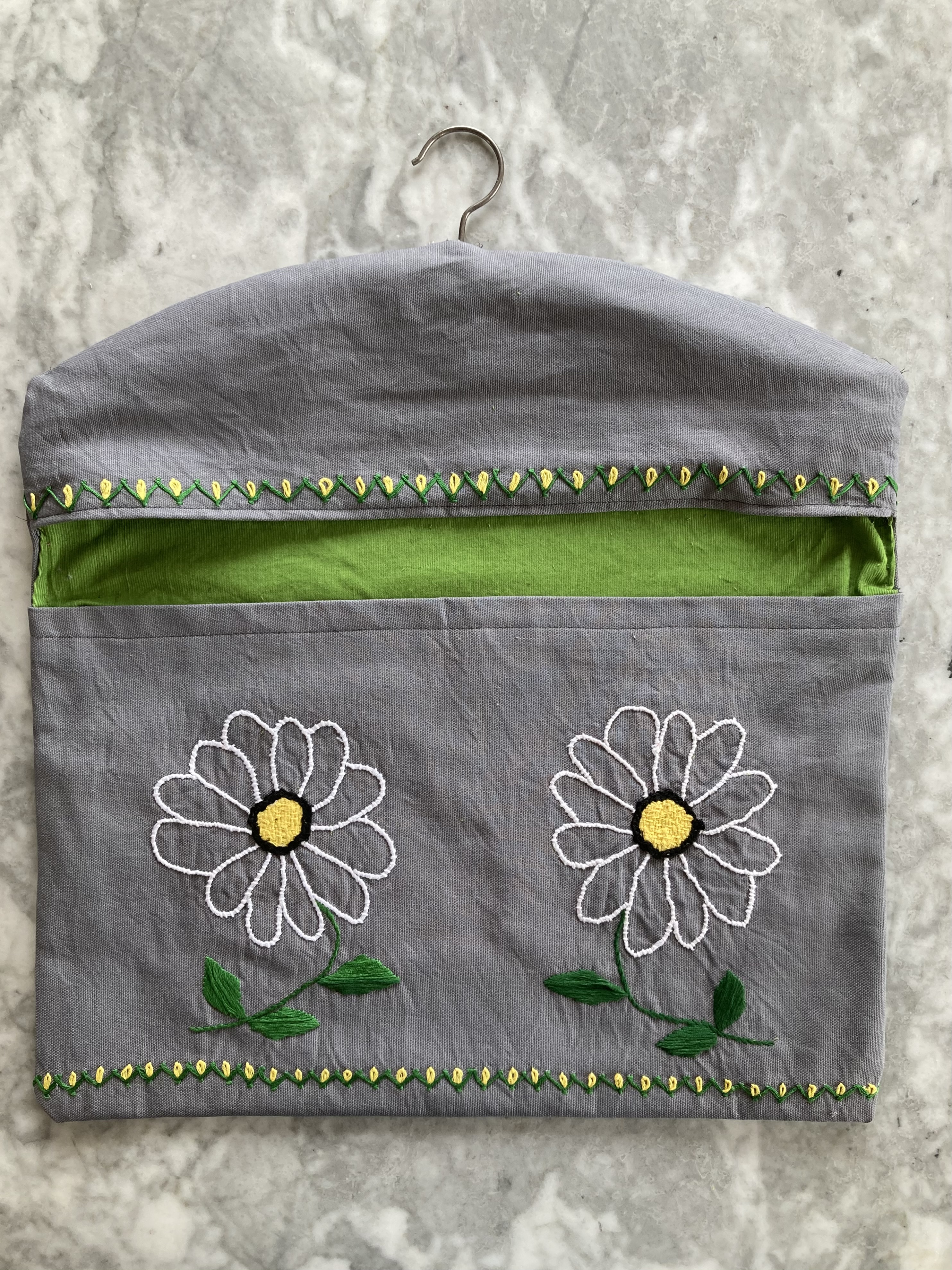
“What is a peg bag?”, some of those who dry their laundry on a rack indoors or in an electric dryer may ask. As you can probably tell from the photo, it is a bag to hold laundry pegs a.k.a. clothespins so that they are close at hand while you are hanging up your clean laundry on a line to dry. The design from this issue had a folded-over top into which you insert a wooden coat hanger to hang it up while you work, as well as a matching apron for maximum laundry-hanging style which I didn’t make this time, but will keep in mind for later.

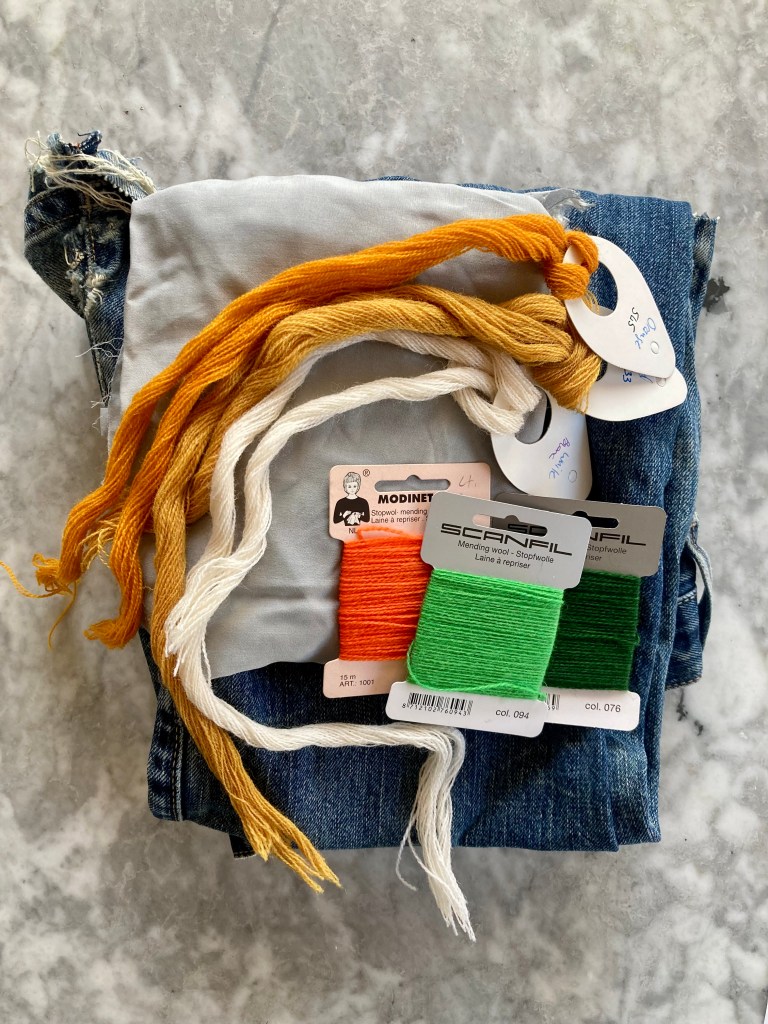
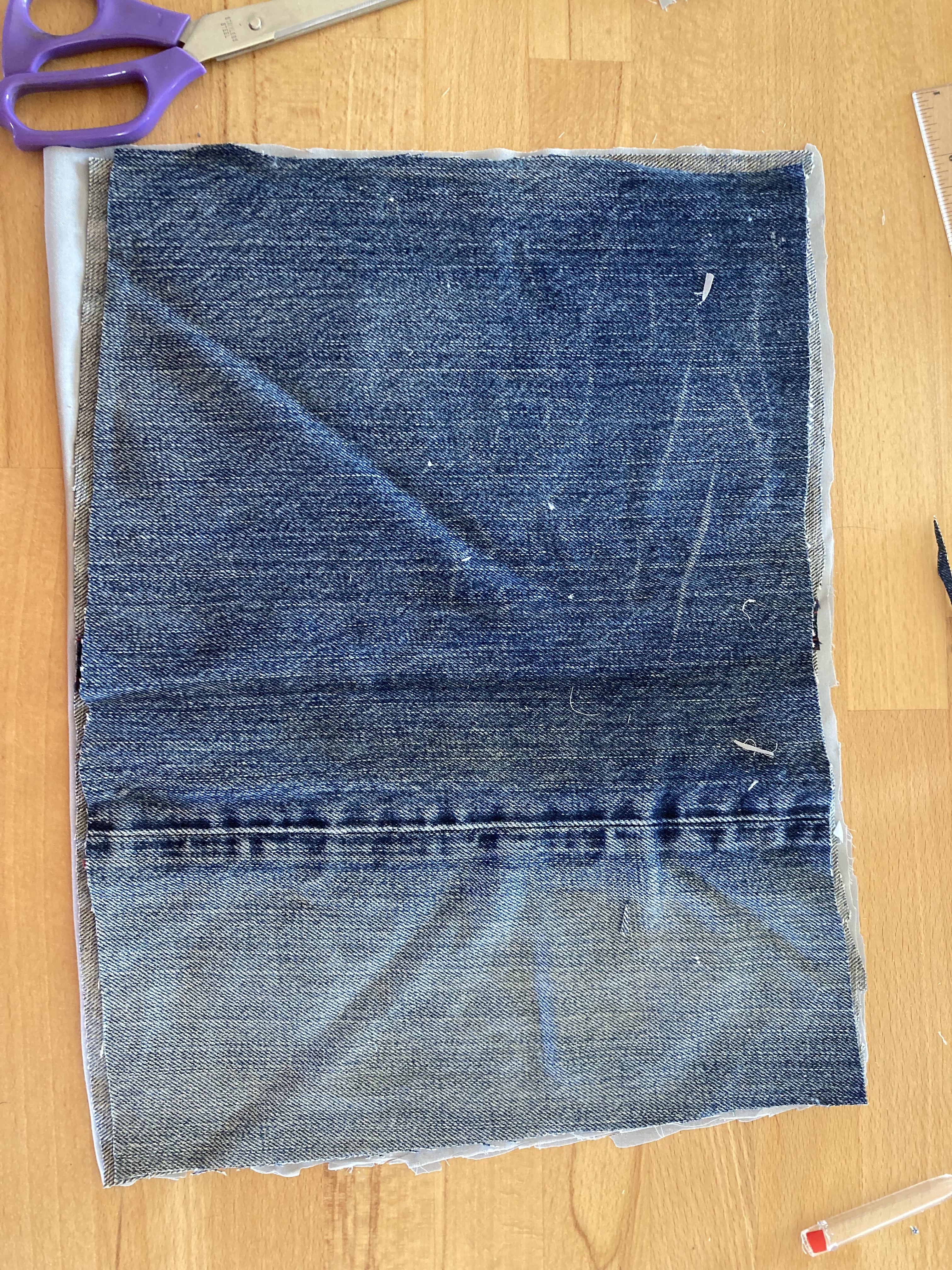
The base fabric is supposed to be orange or gold coloured — I used leftover dark grey from last month’s “crab” cushion. It is supposed to be lined with gingham — I used leftover green fine corduroy from last month’s “fish” cushion. The only thing I had to buy was more embroidery thread — I had enough white and black, but not enough yellow or green.

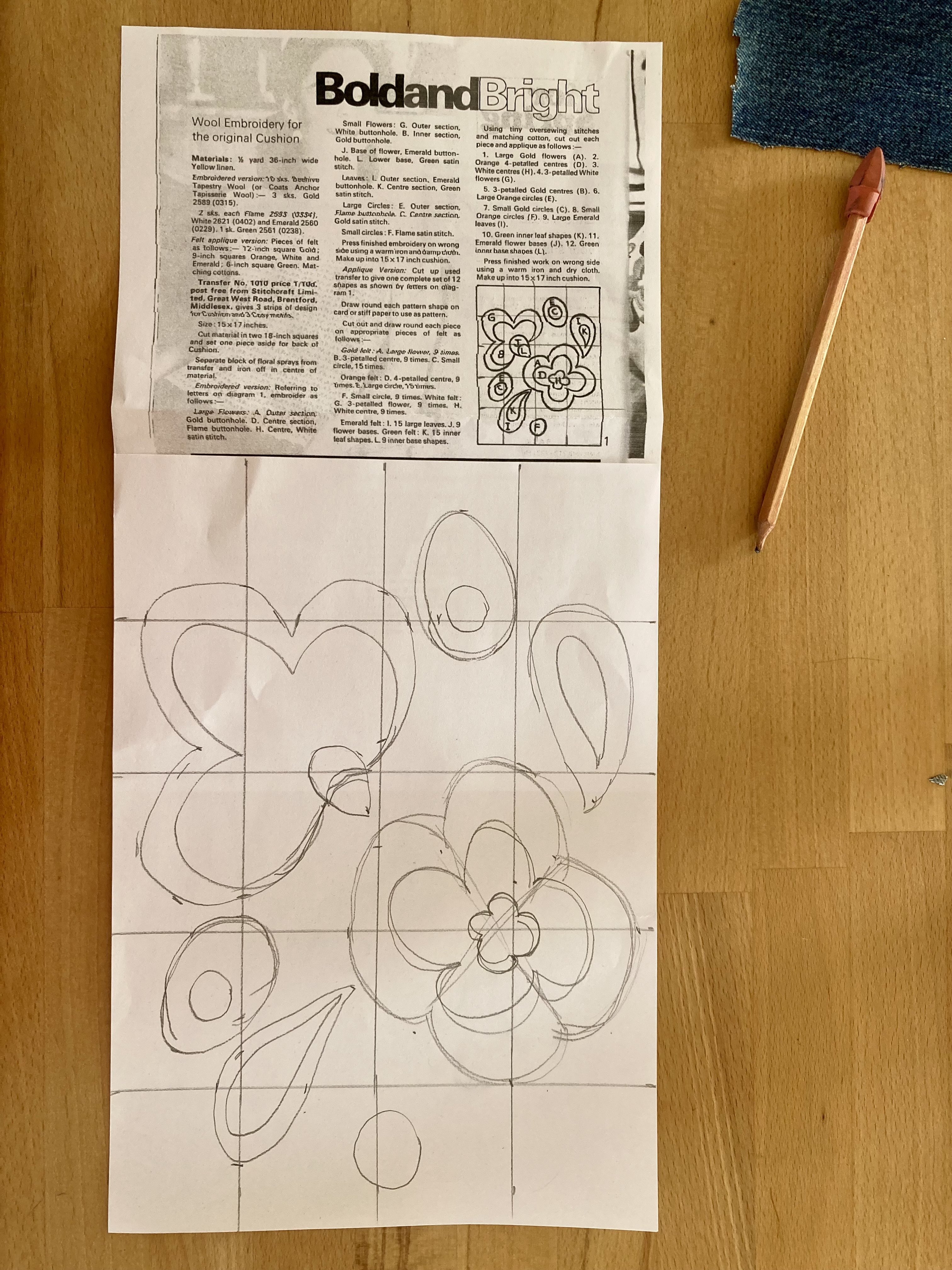
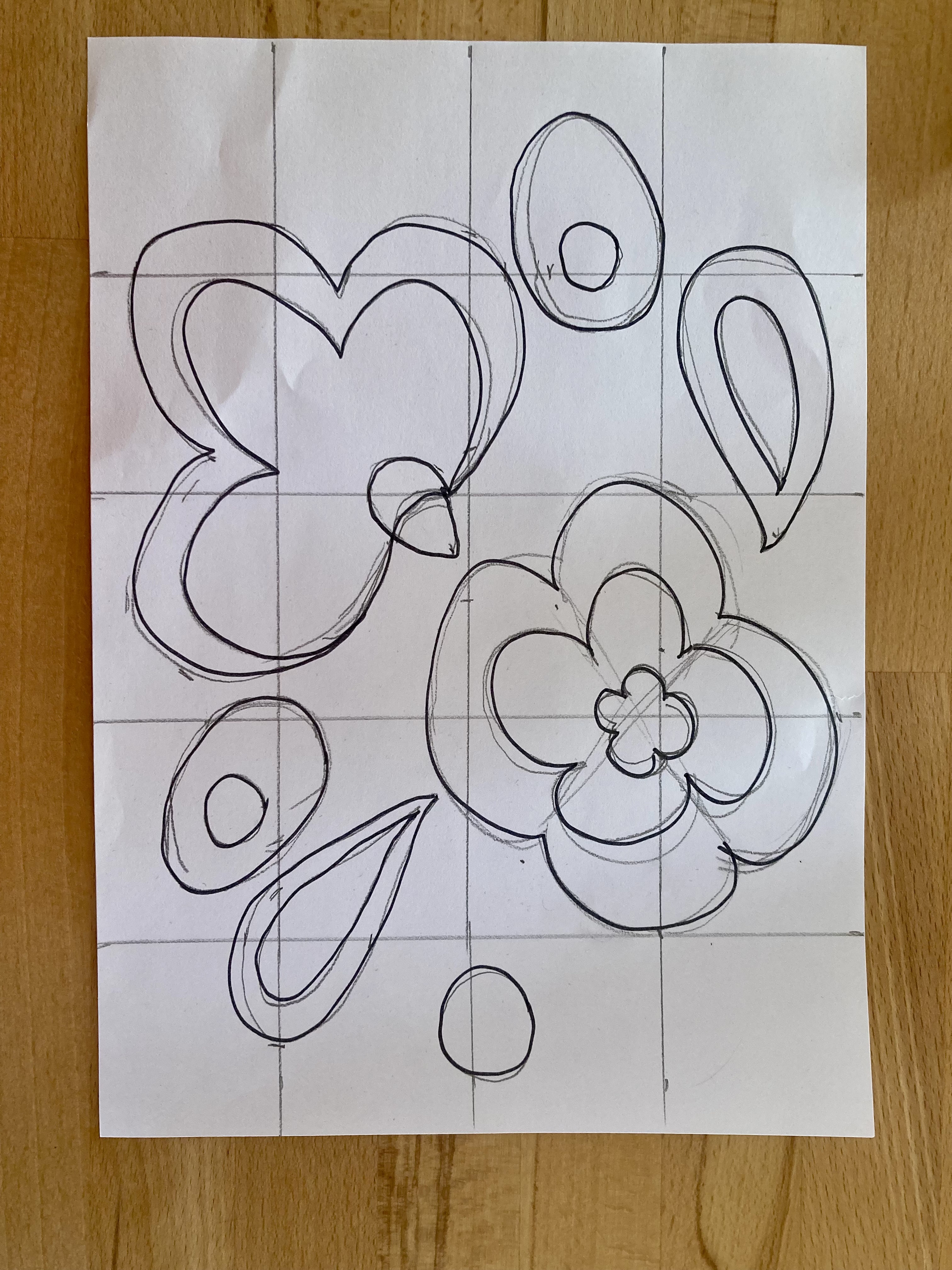
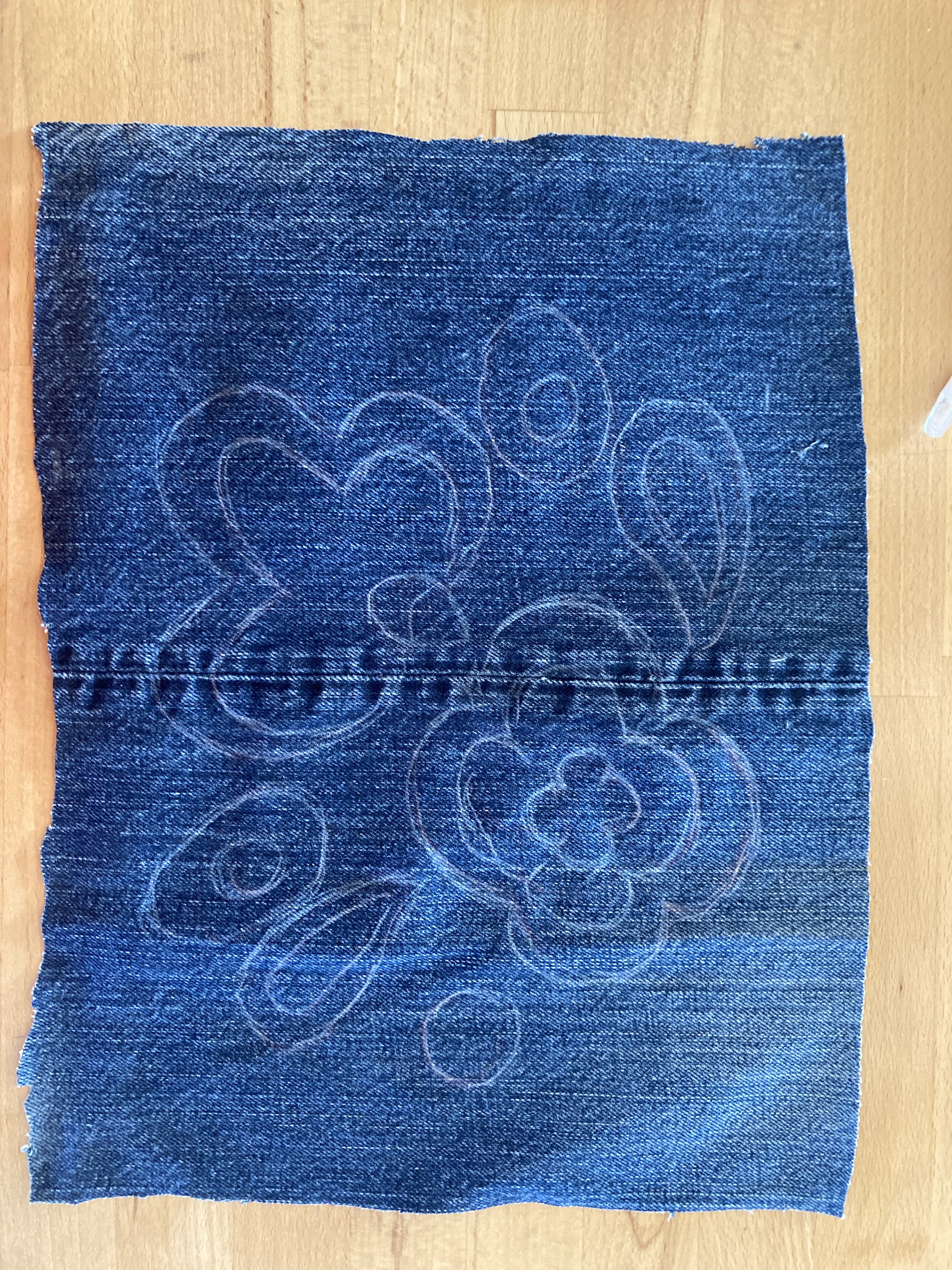
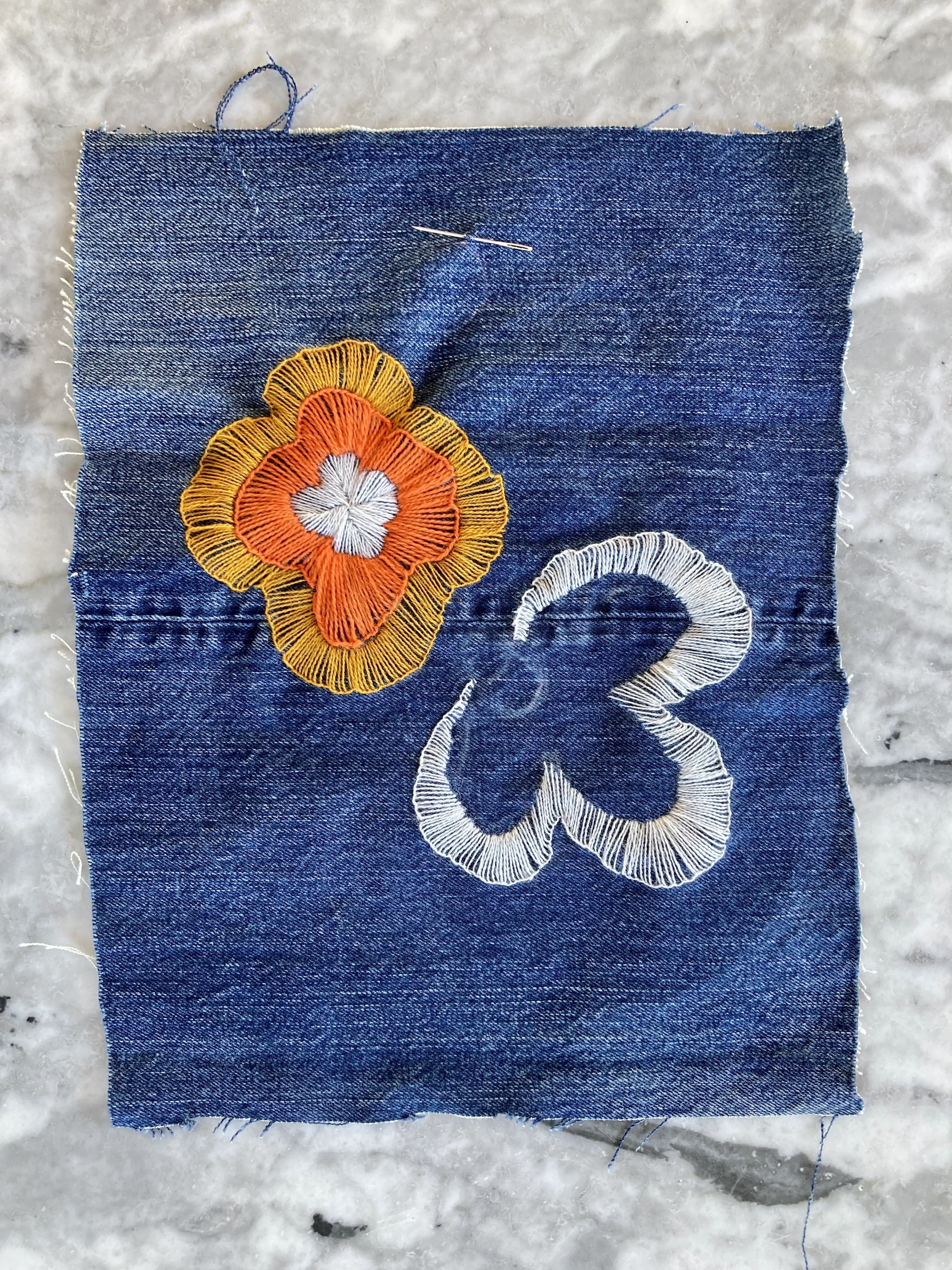
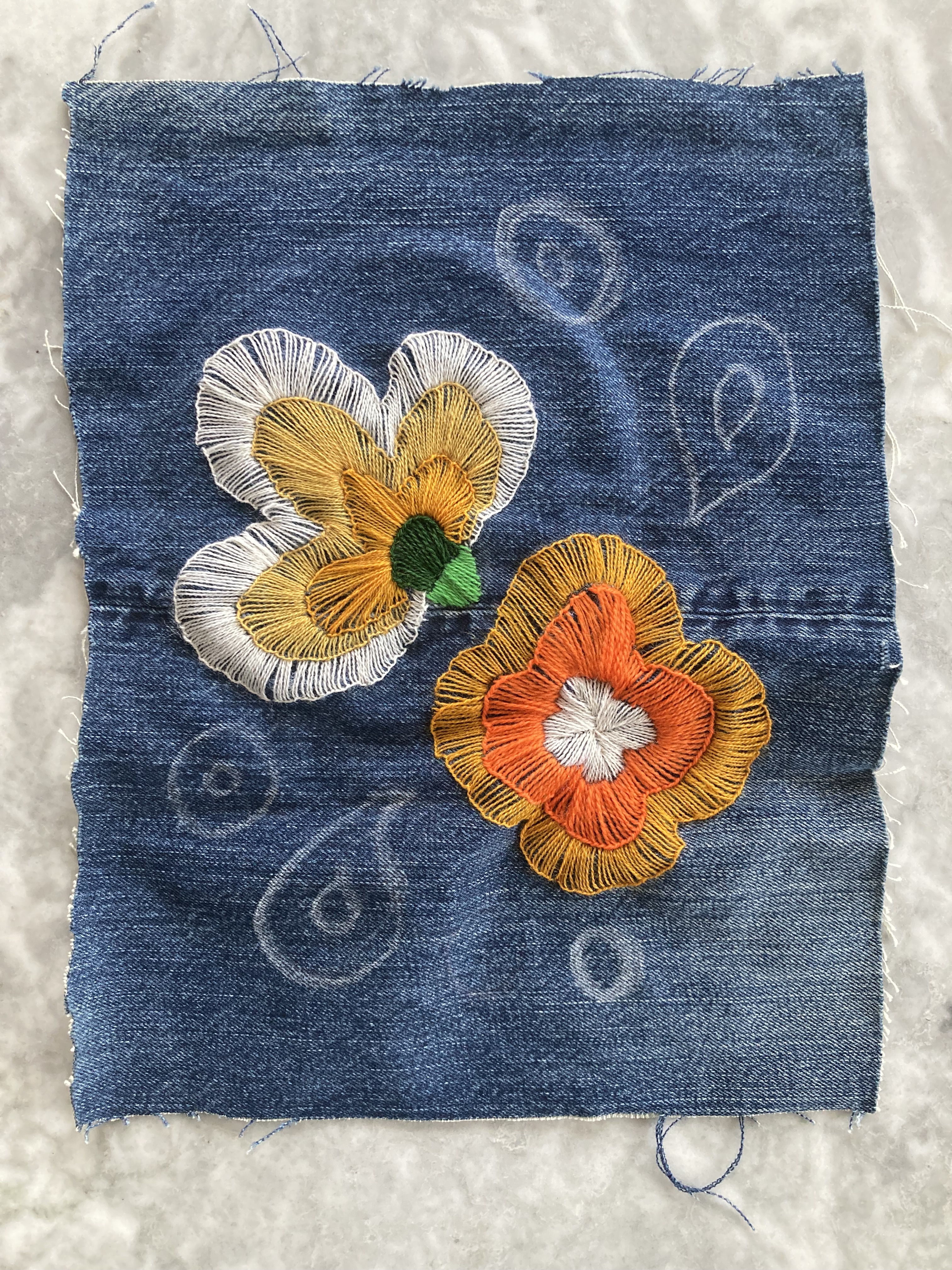
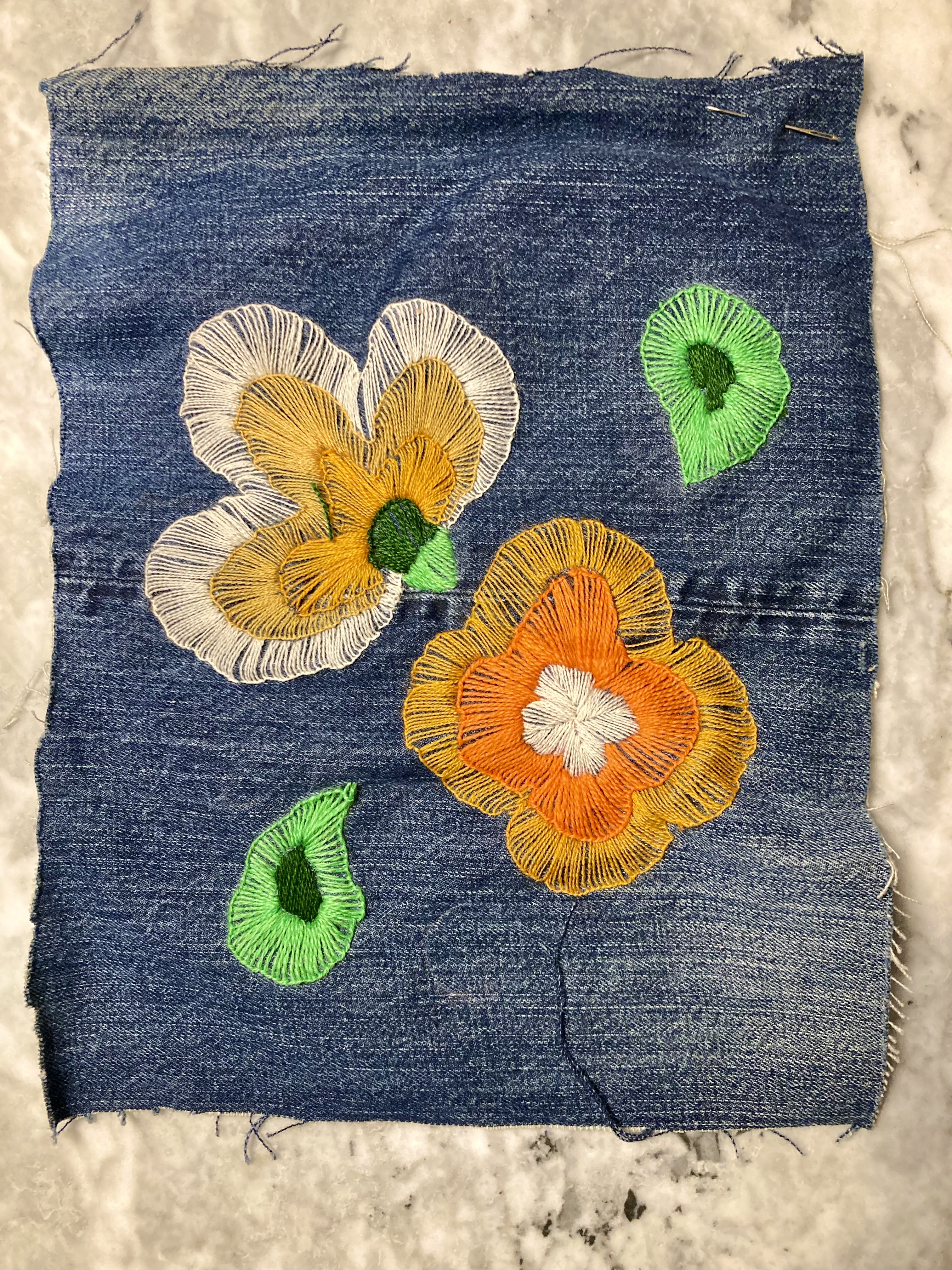
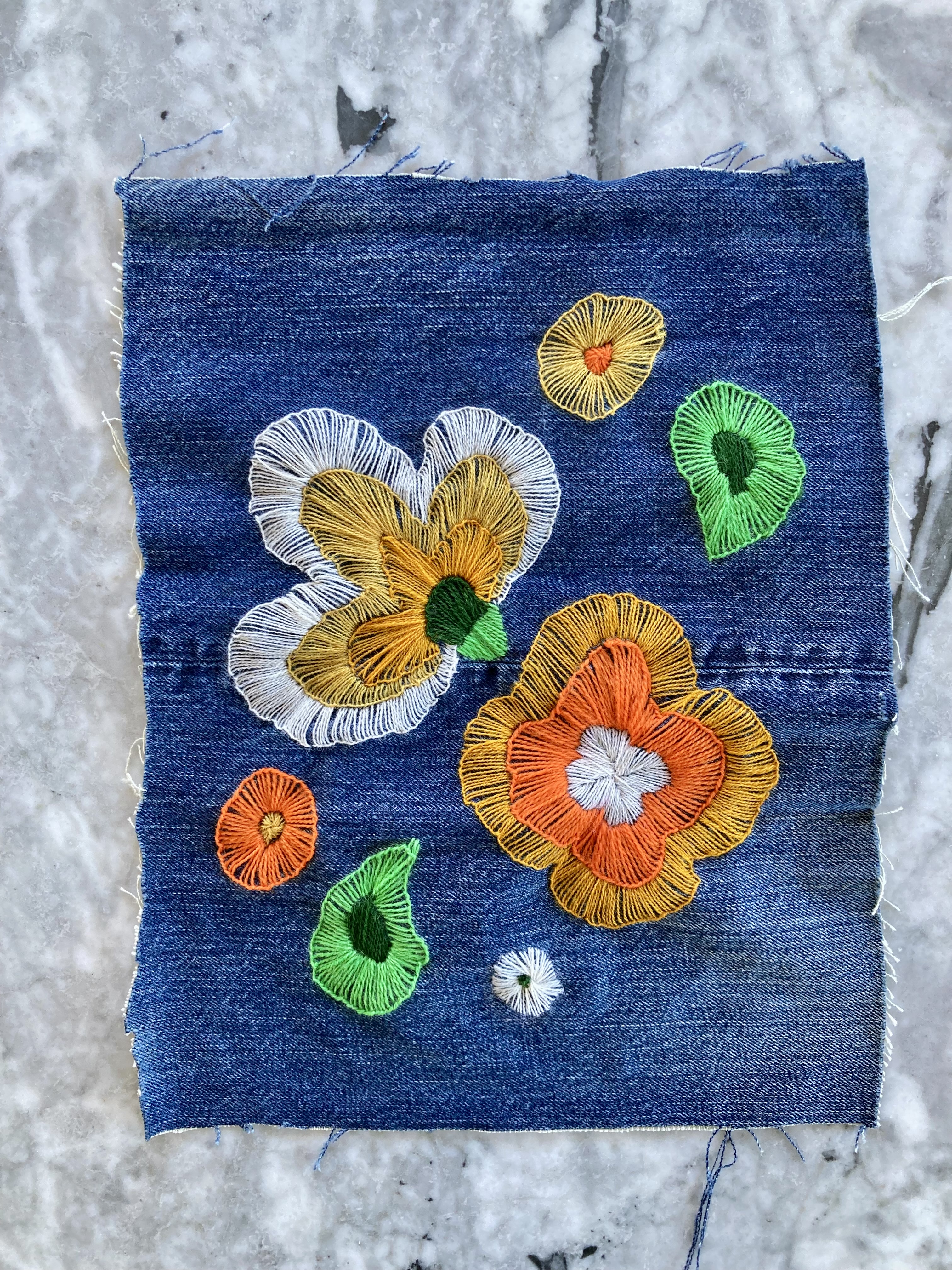
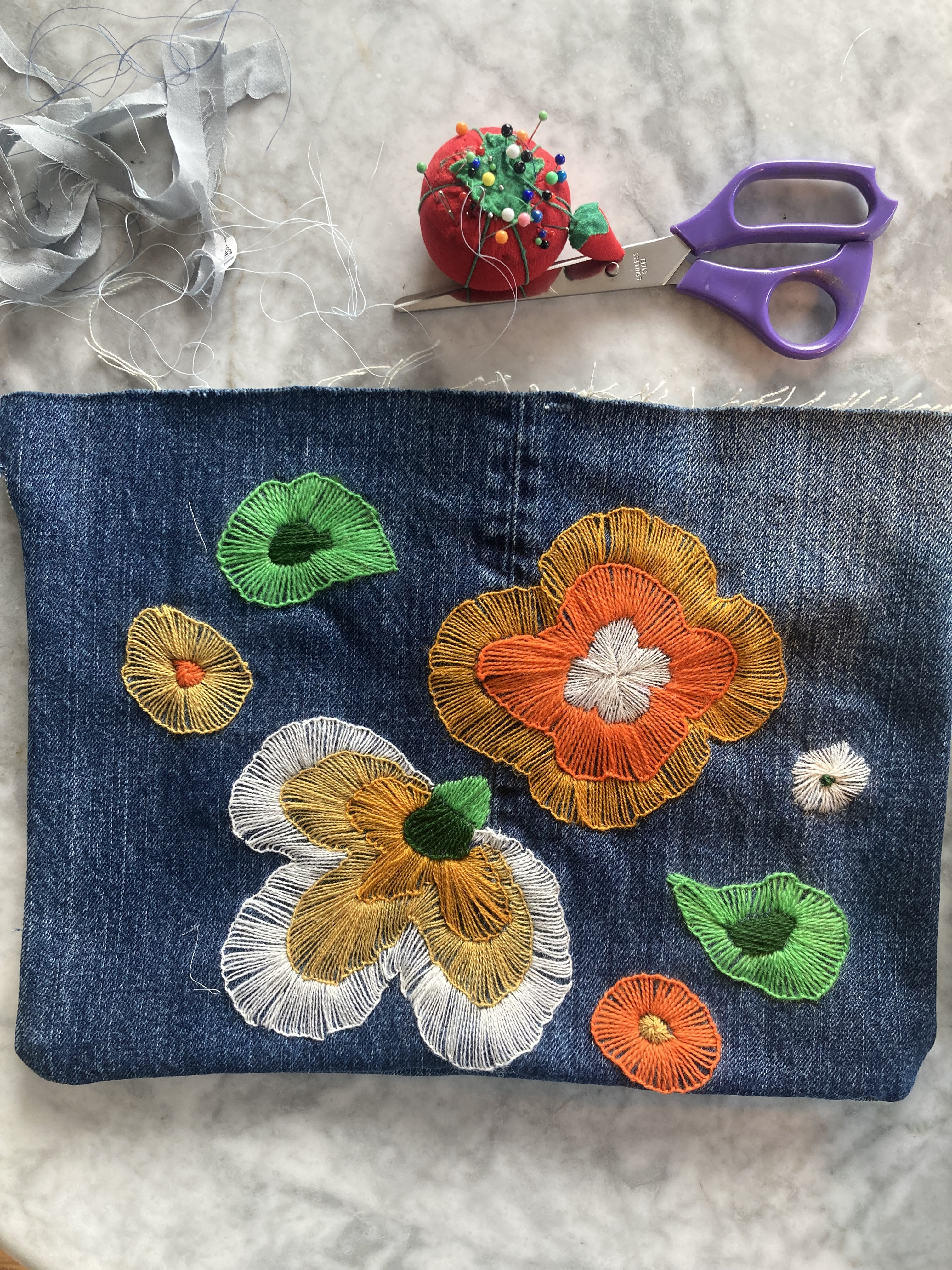
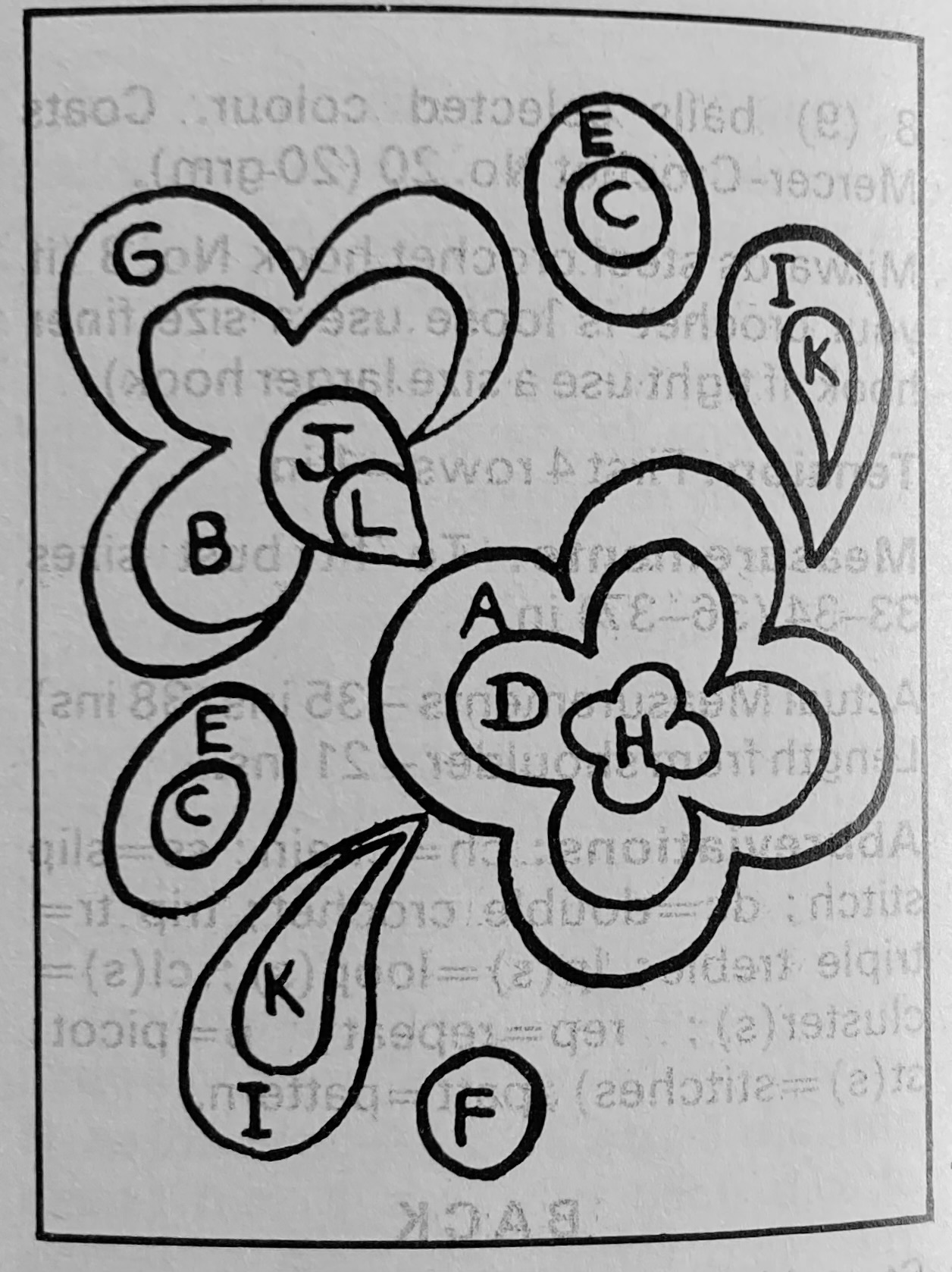
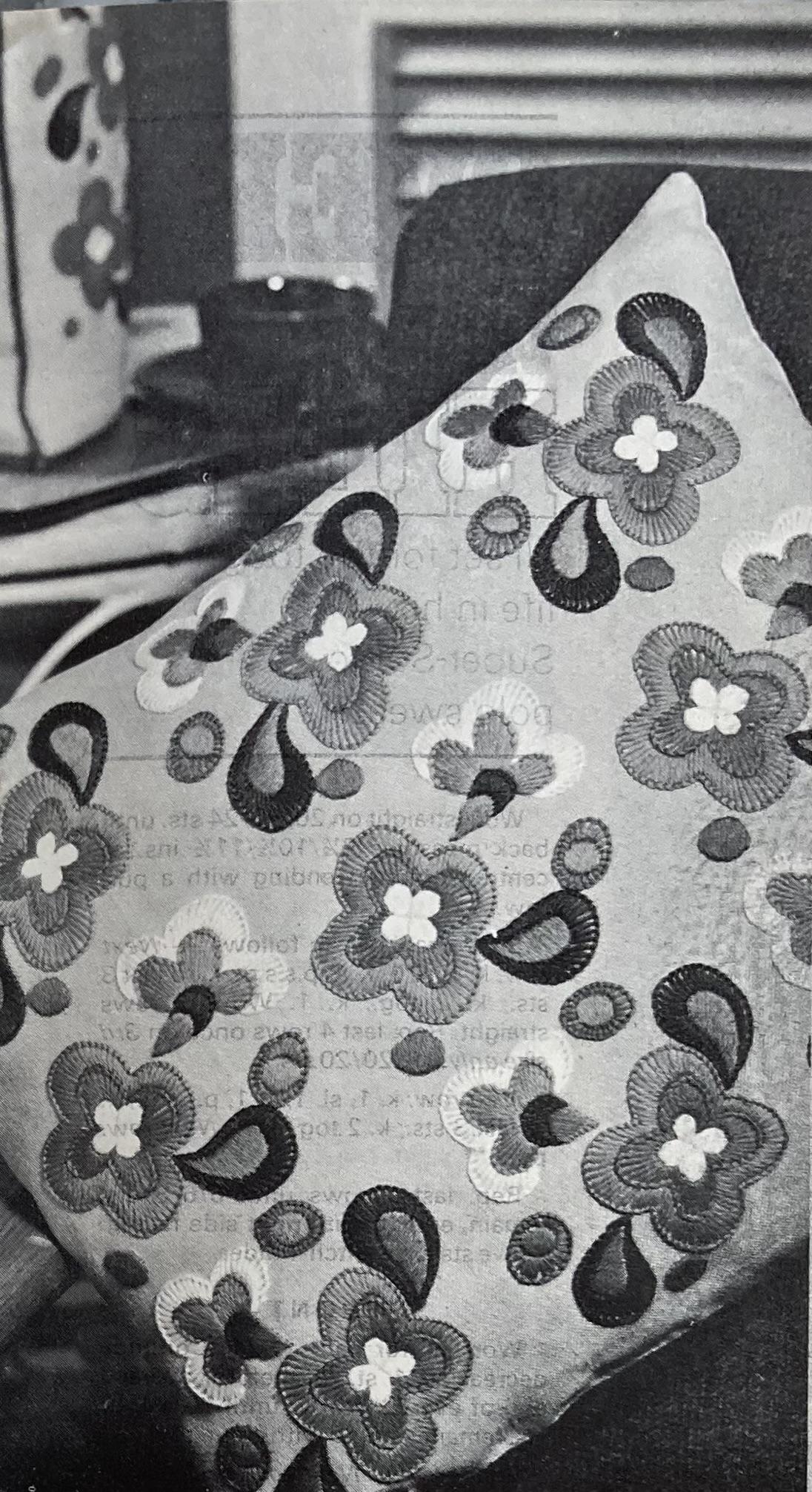
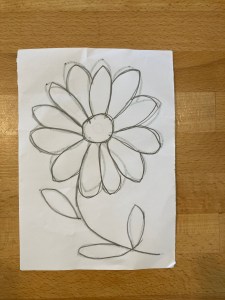
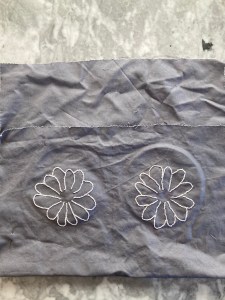
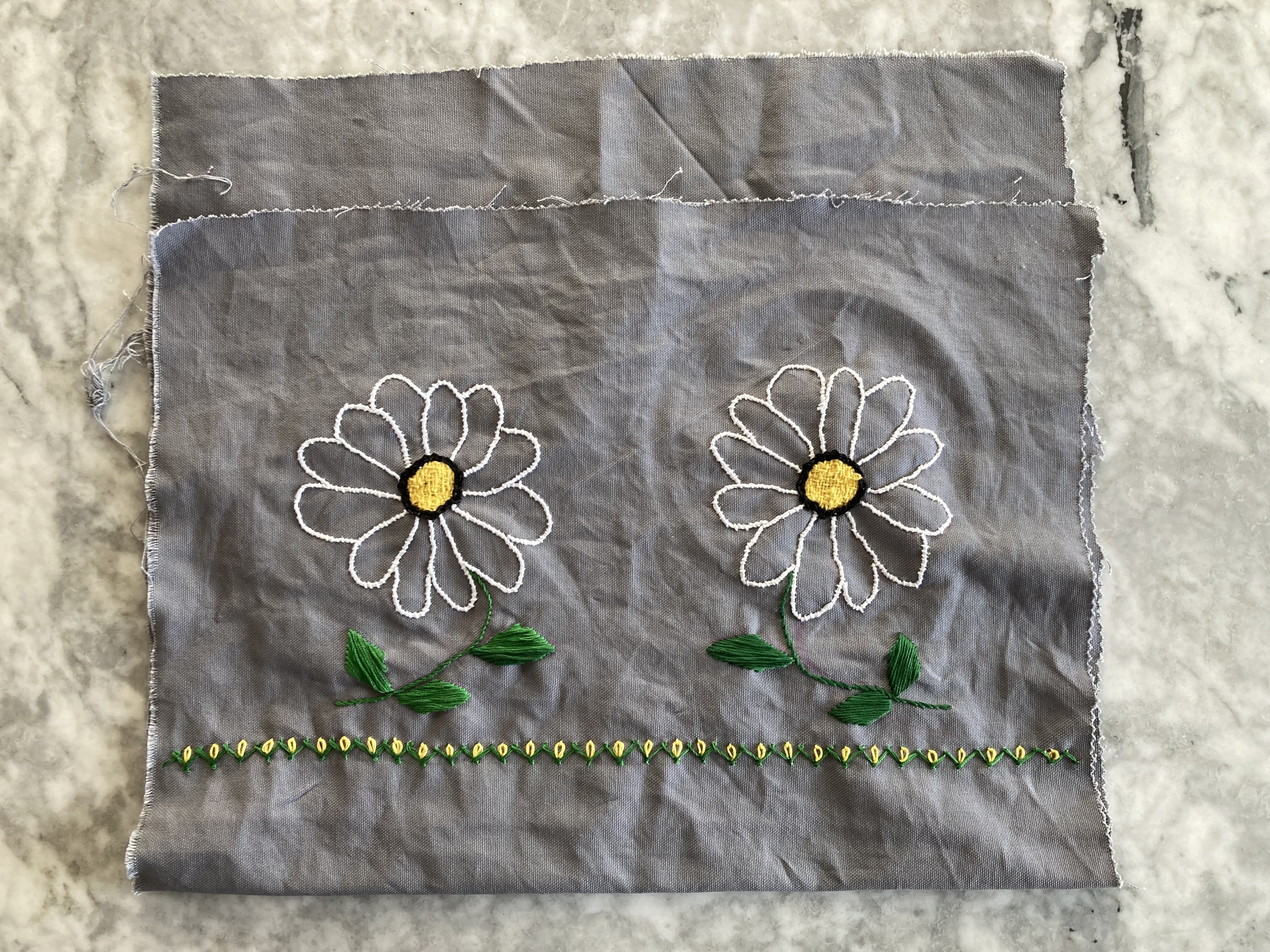
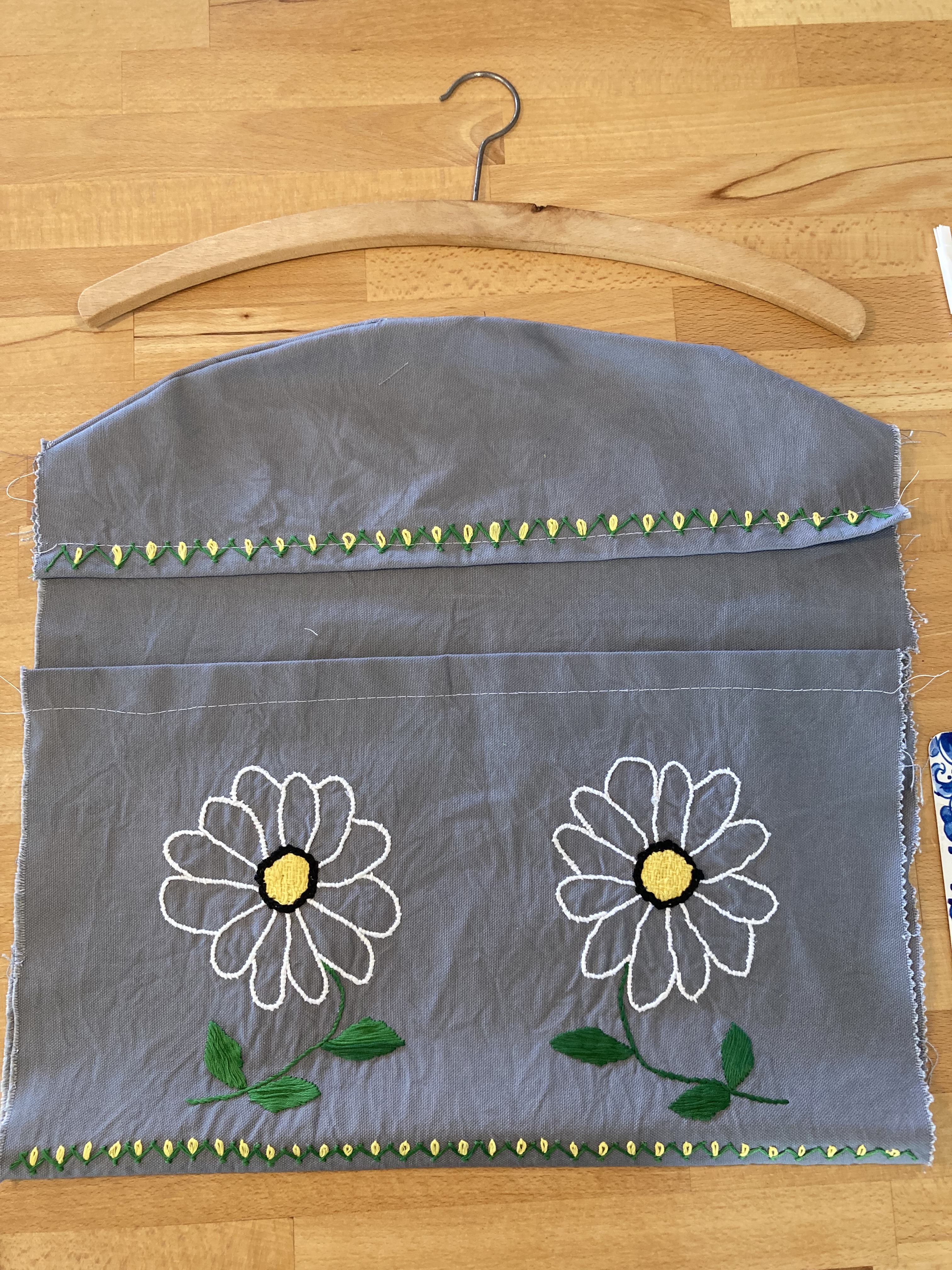
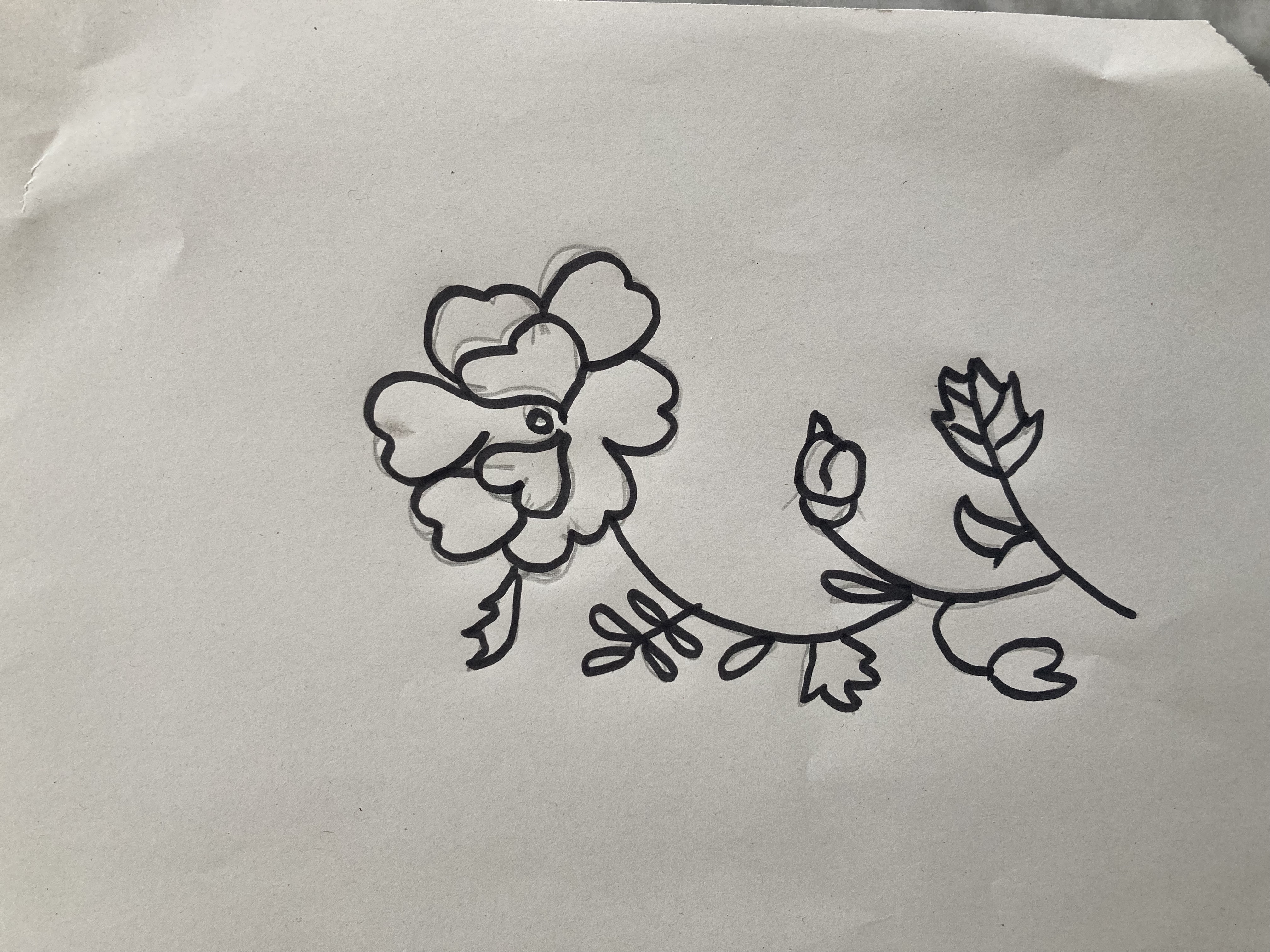
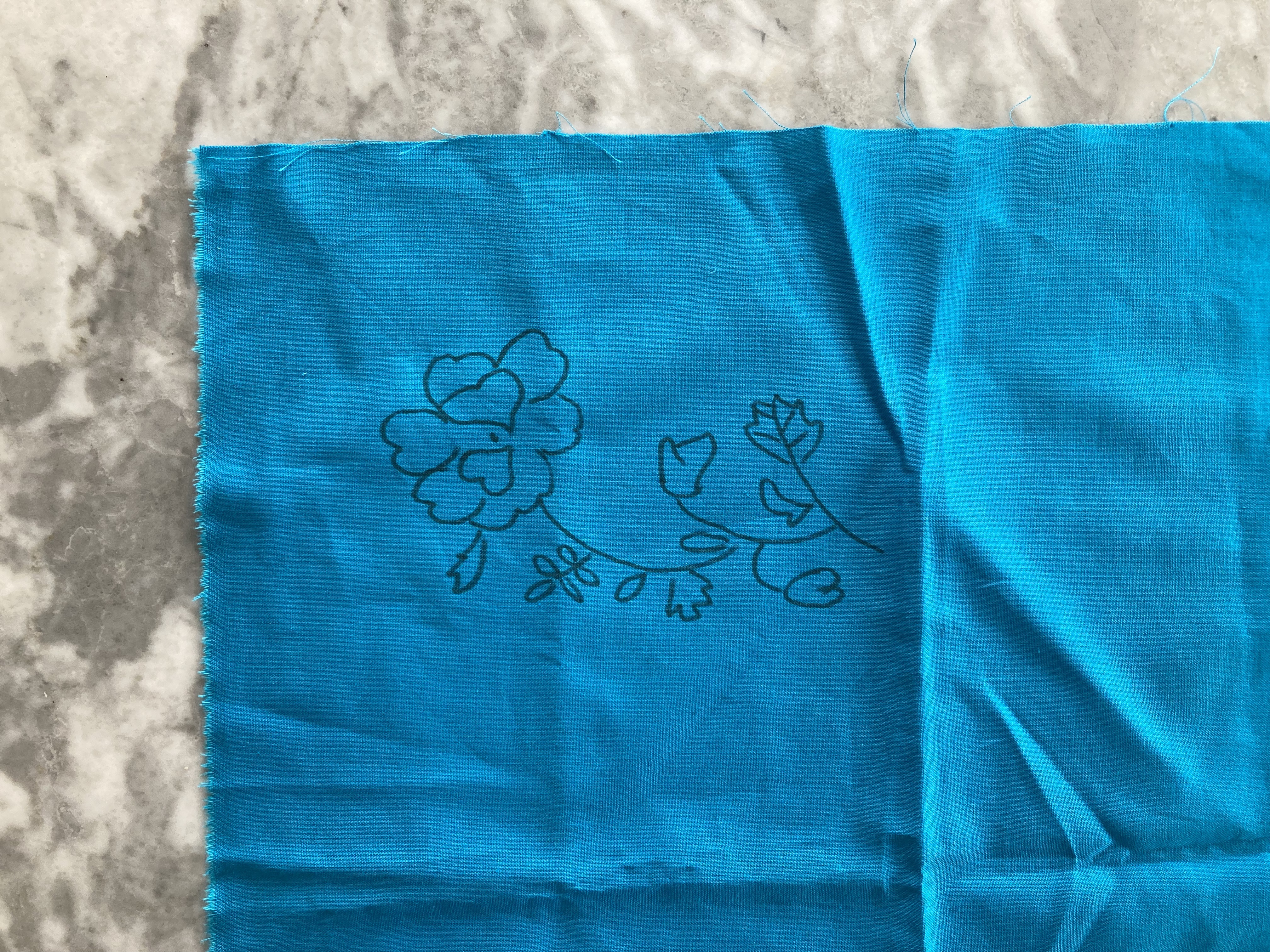
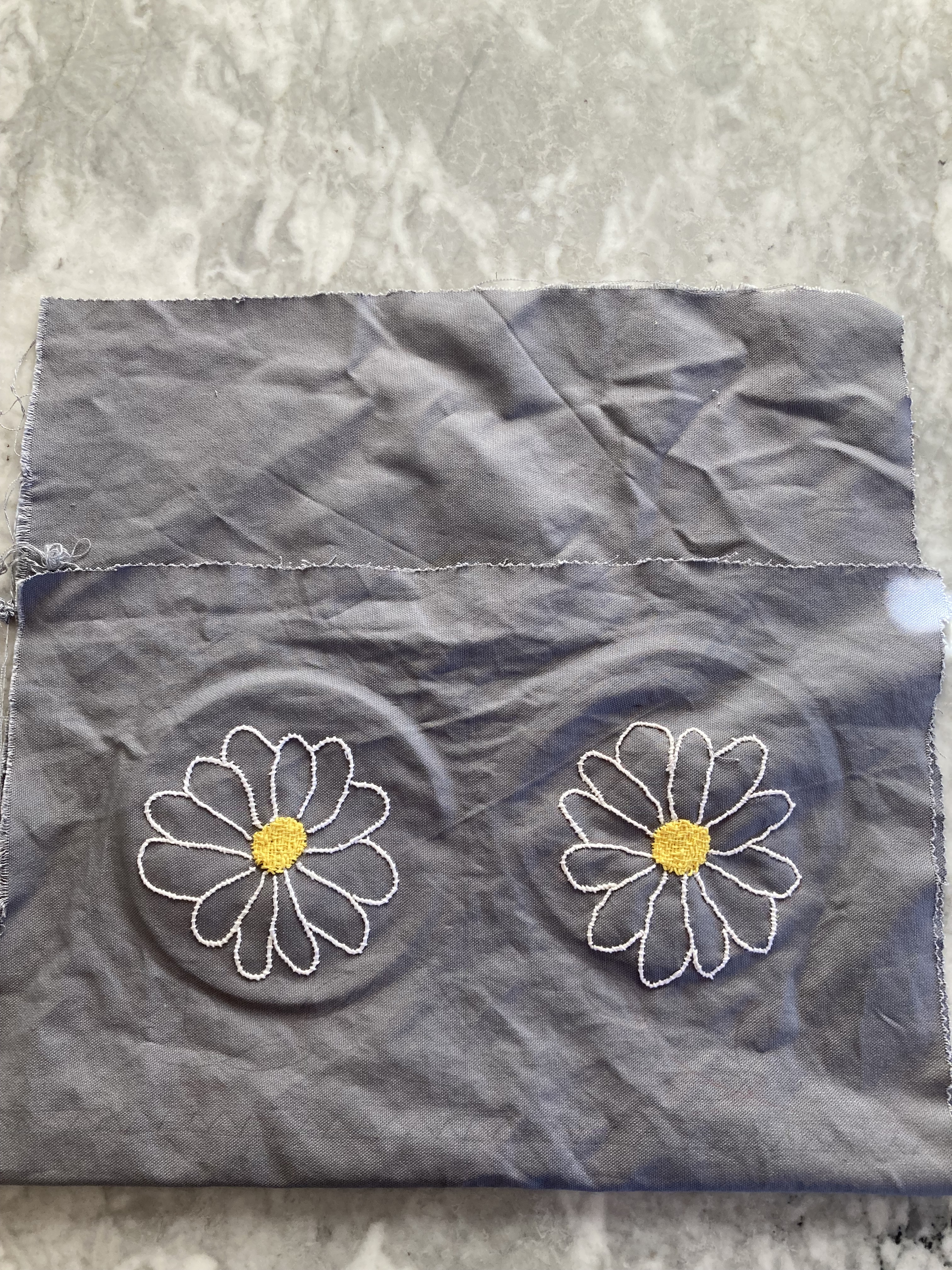
Not having a transfer as usual, I just drew the daisy on a piece of paper freehand and copied it onto the fabric with carbon transfer paper. For the chevron-and-loop-stitch borders, I drew two parallel lines with V’s in between for the chevrons. The embroidery was not quite as simple as the design would lead you to believe. The white outlines of the daisies are done in couching stitch — laying down a thread and tacking it down with tiny stitches along its length. Easy in theory, but tricky in practice. In retropsect, I could have glued down the outline threads with water-soluble glue before couching them, to make them stay in place better. (Do any of you do this?)

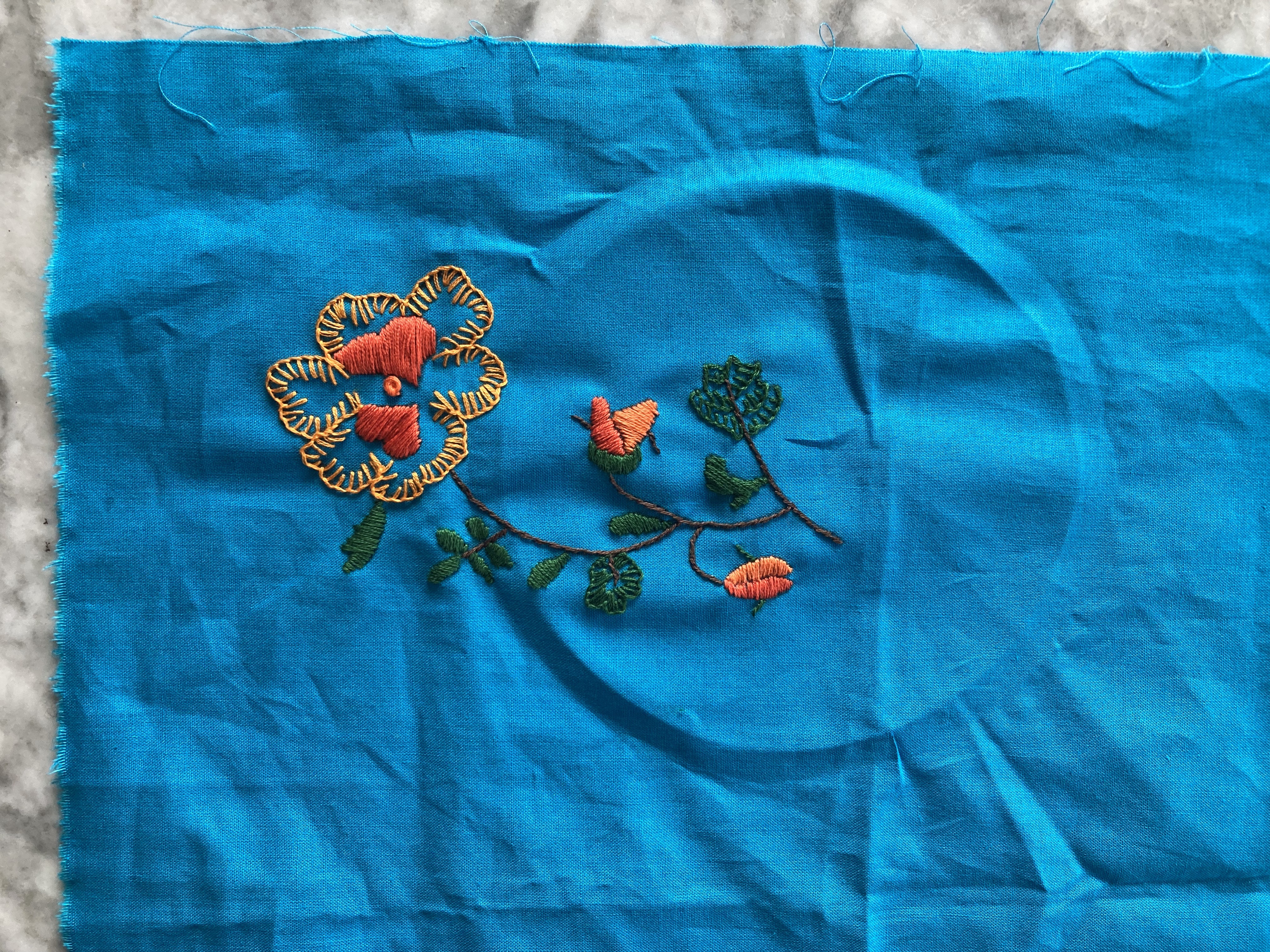
The yellow centers are also couched, or actually woven — you put down slightly loose satin stitches in one direction and weave cross-threads through in the other direction. It gives a marvelous texture, but I was working with 6 strands and the cross-threads were prone to either split or skip over the ones they were supposed to be weaving through. The outline around the centers is black chain-stitch and the leaves and stems are satin and chain-stitch — except that I didn’t read carefully enough and did the stems in stem stitch. Also, I think two different shades of green got mixed up in my green thread stash? But it gives a nice subtle shading effect. The borders are chevron stitch with loop stitches.

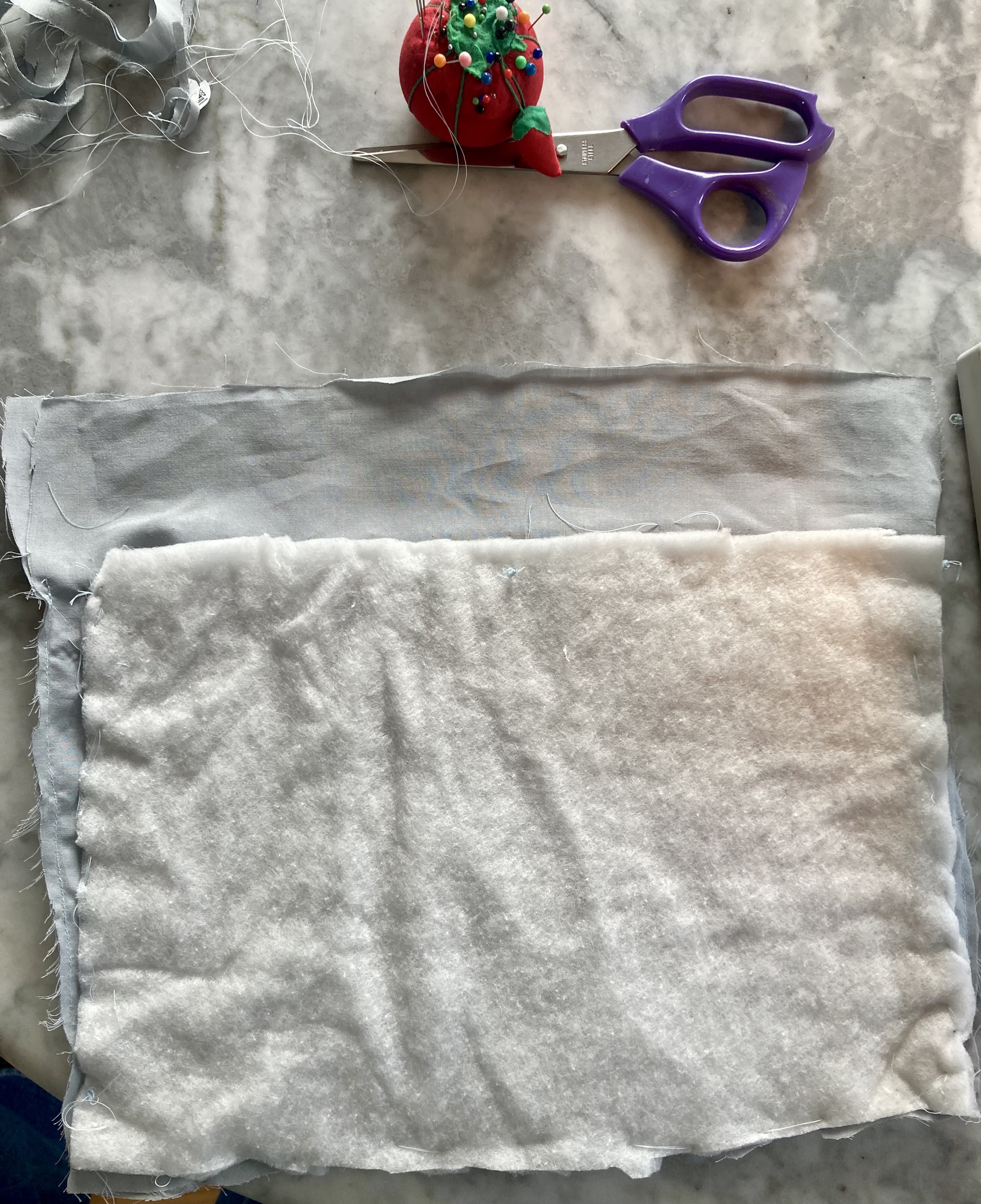
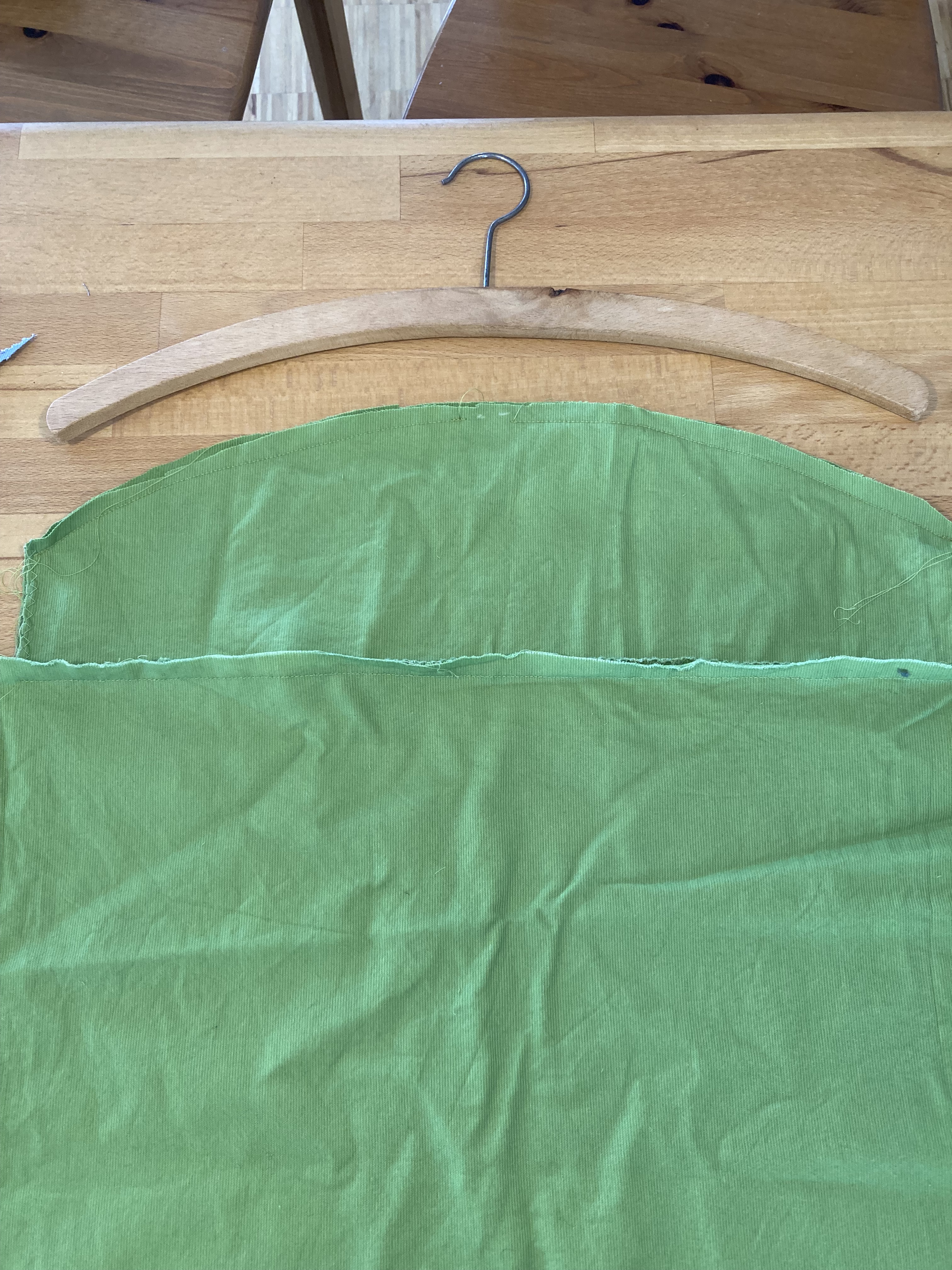
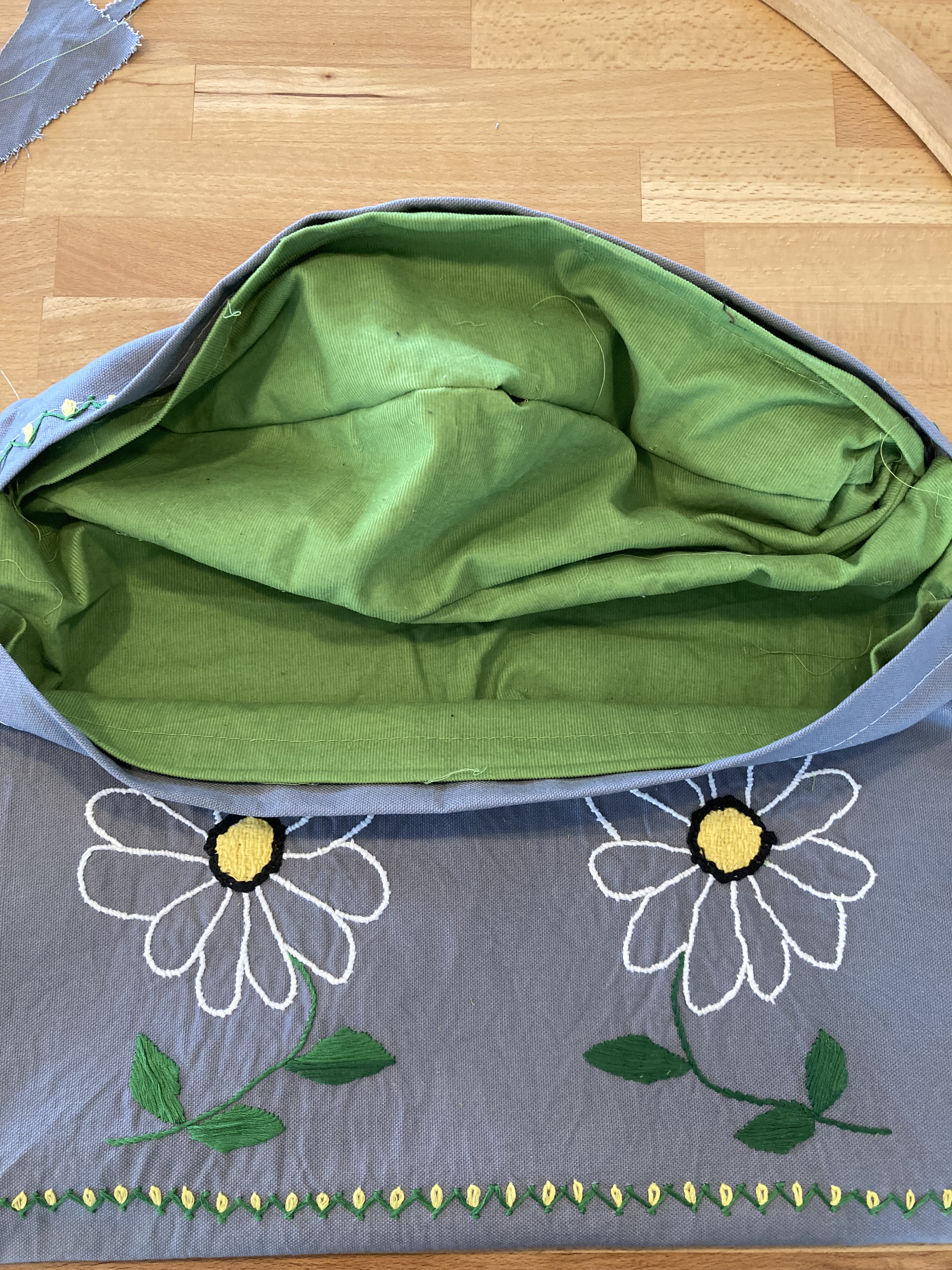
The difficult part of this project was the construction, particularly the lining. I had to rip out the top-pocket seam more than once and re-position it to make all the right and wrong sides come out correctly. When I finally got it right, the lining did not stay in perfectly smoothly, but i will live with it. Also, the corduroy-ish fabric is not really a good lining choice, as it picks up every tiny bit of fuzz floating around while also producing its own. The colour is good, though!

I inserted an old-fashioned wooden coat hanger and noticed that the lining “caught” on one side, so did some more adjustments until it fit better. Voilà. It looks better in real life — the camera makes weird shadow patterns. My only complaint, besides my inability to sew straight lines, is that the finished bag is quite big — how many pegs / pins are you really going to put in it? But it can also be useful for hanging in the hallway / coat rack area to hold gloves, accessories, cat toys or whatever.

I have both an electric dryer and a drying rack, but no outside space to hang up laundry, so I will give this bag to someone who has a garden with a clothesline. The intended recipient also wears hats and fingerless gloves and has two cats, so the bag will find a use in any case.

Not the most exciting project I have ever made, but fun, cute and useful.

June 1967: Overview

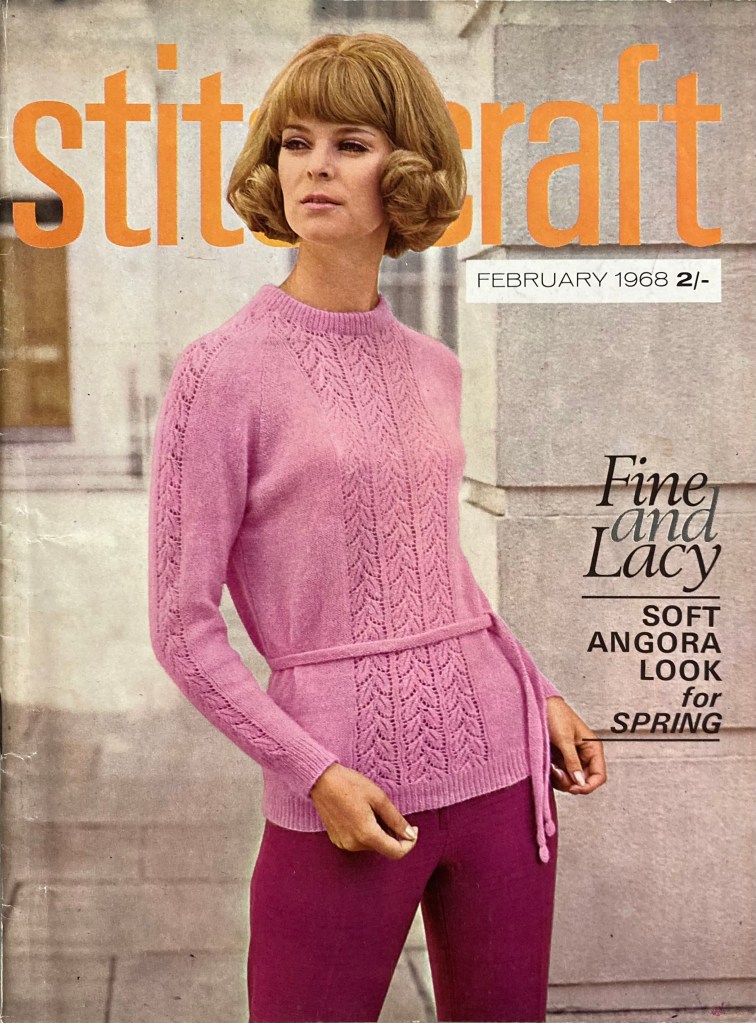
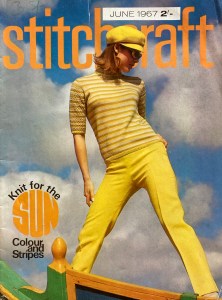
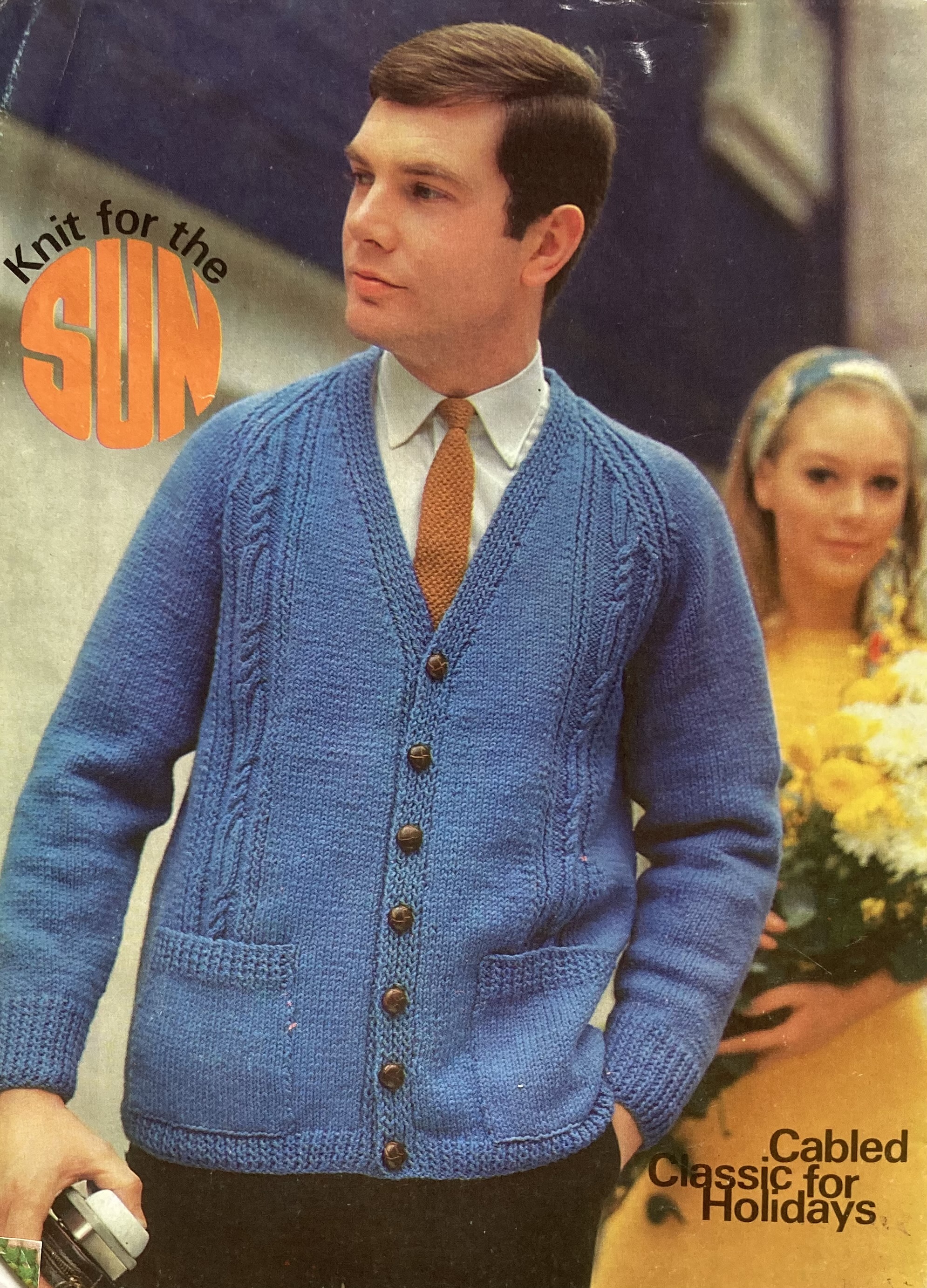
“Knit for the SUN” is the theme of the June 1967 issue of Stitchcraft, and our cover model gives us the best example of that in her striped and sunny yellow outfit.

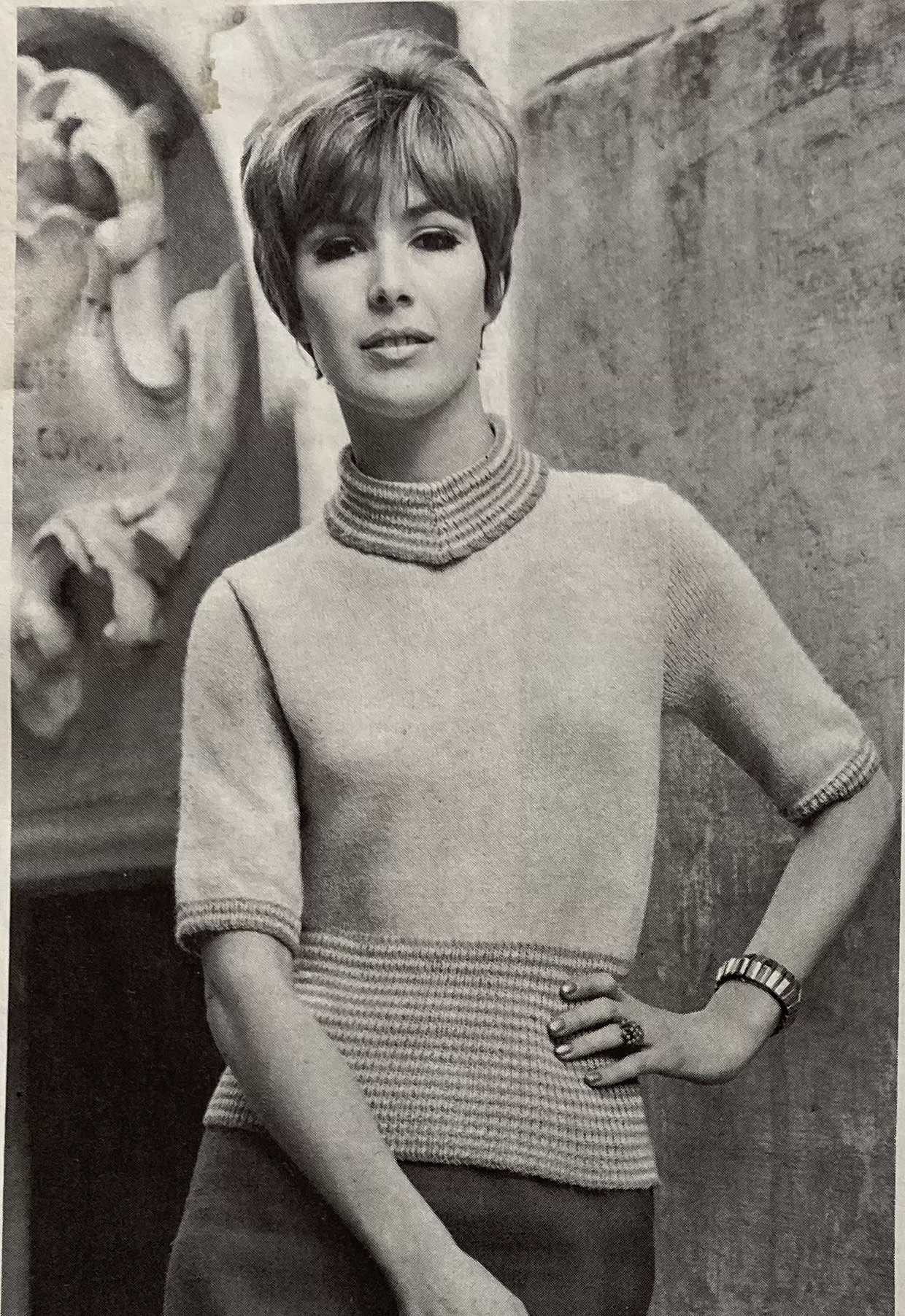
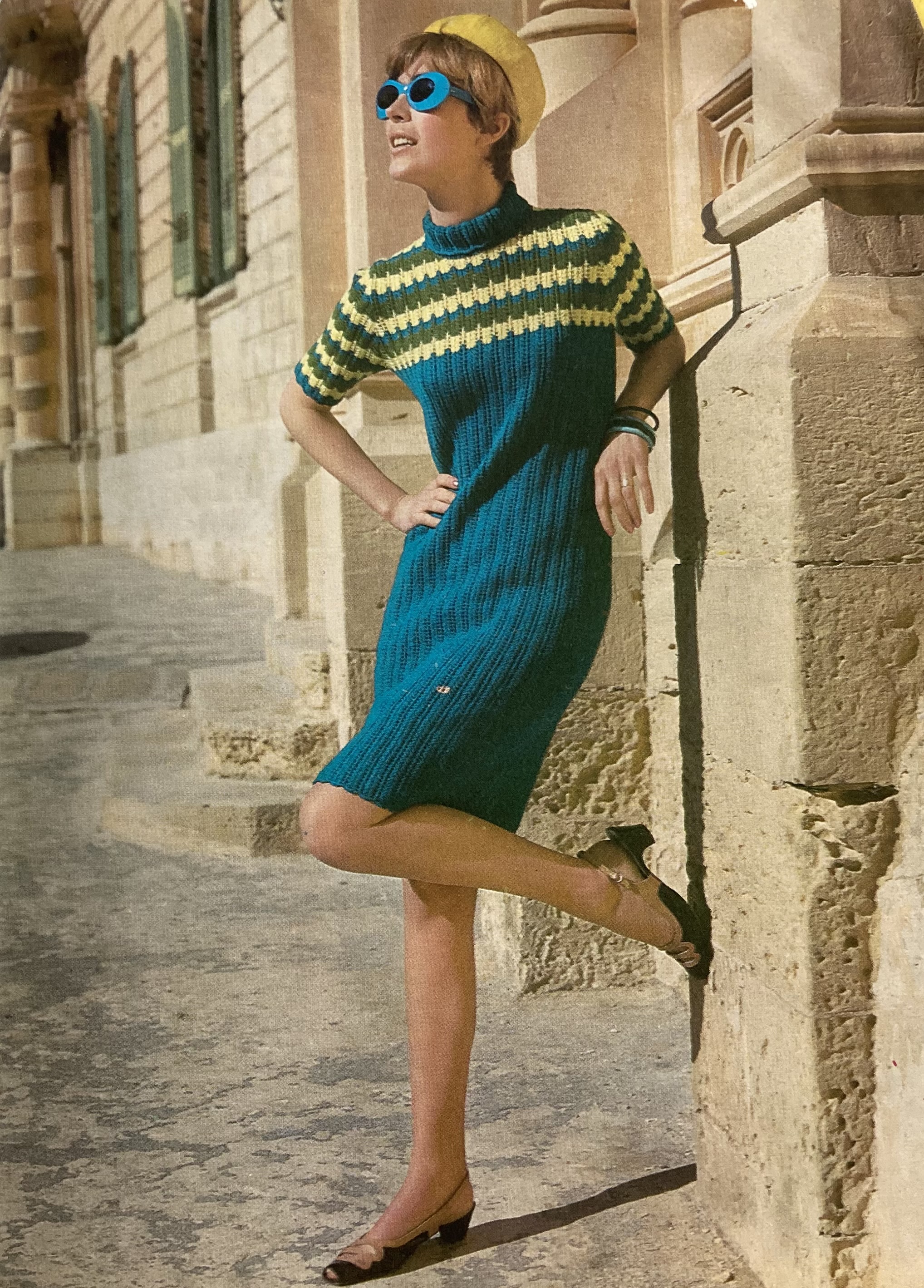
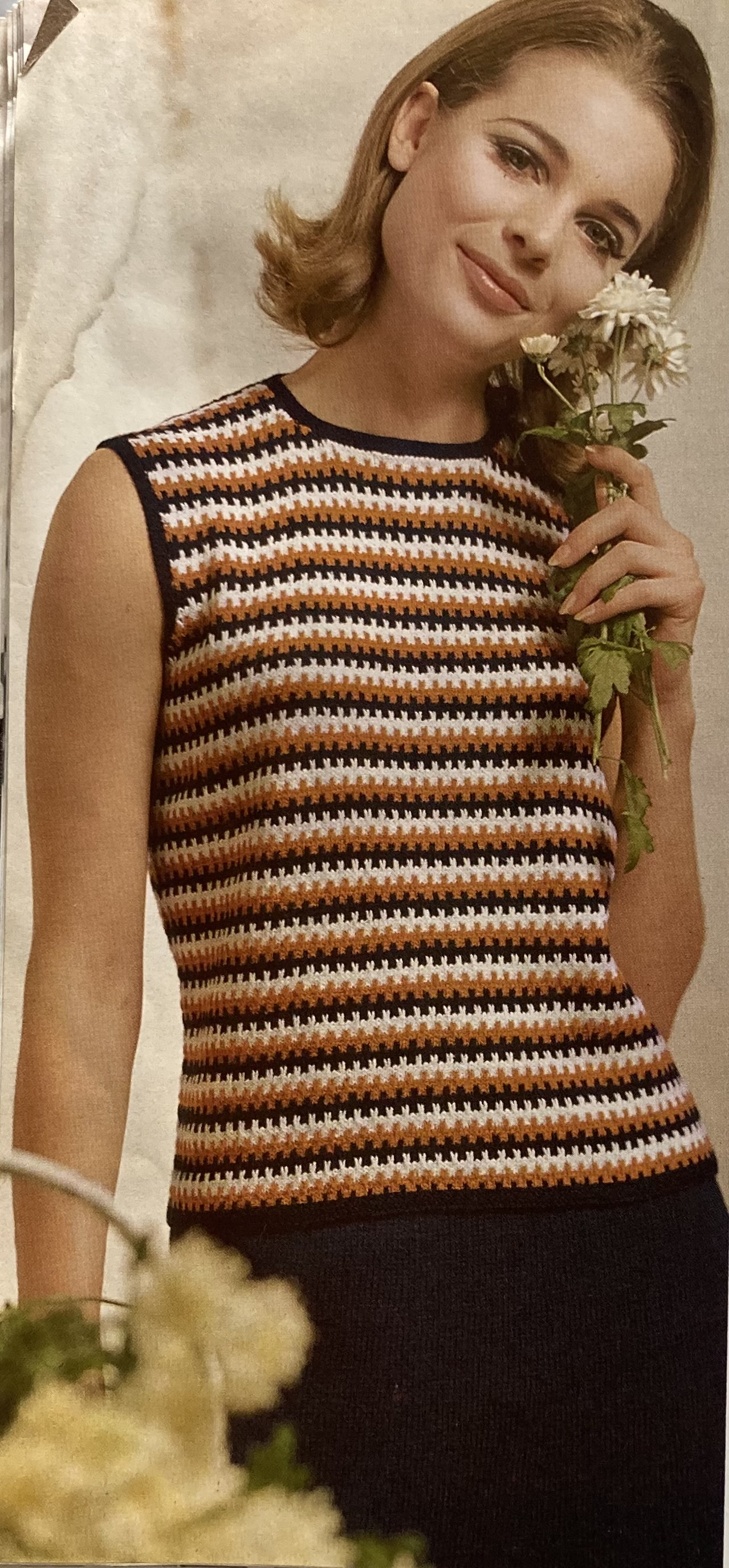
“Stripes and Colour” show up in different ways in this issue, combined with stitch patterns and stranded colourwork for novelty and texture. The pullover on the cover has normal stocking-stitch stripes on the front and back and a novel mini-cable pattern on the sleeves which mixes the four-row colour repetition with a two-stitch cable every four stitches on every fourth row, alternating left- and right- leaning cables for a zigzag effect. Another short-sleeved pullover has striped ribbing, but a plain body and sleeves. The “feathery lace” dress has vertical stripes implied by the ribbed lace pattern combined with plain horizontal colour stripes that look scalloped due to the stitch pattern. Love those sunglasses, too! And a sleeveless shell uses a slip-stitch pattern to make stripes with toothy ridges.

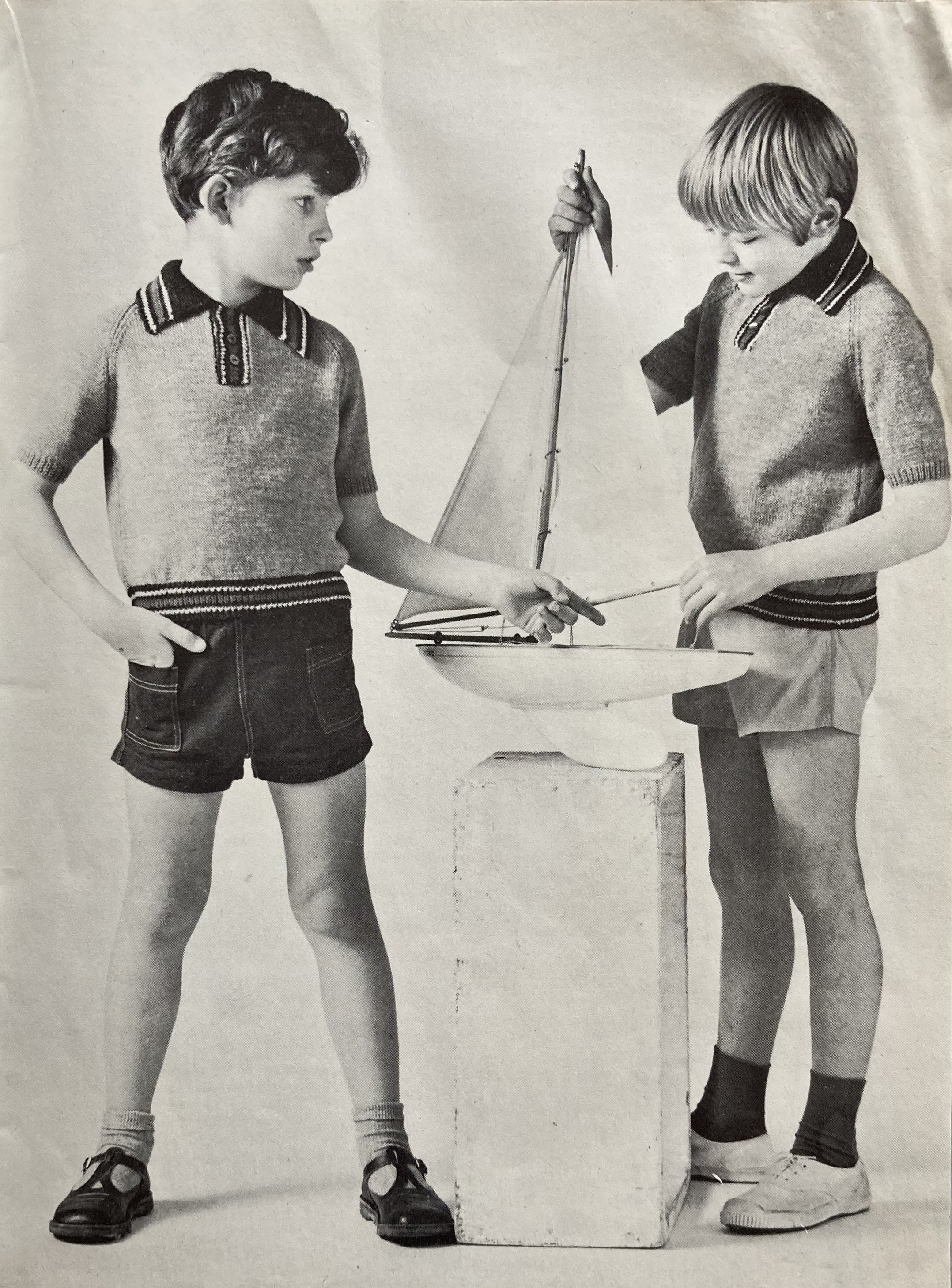
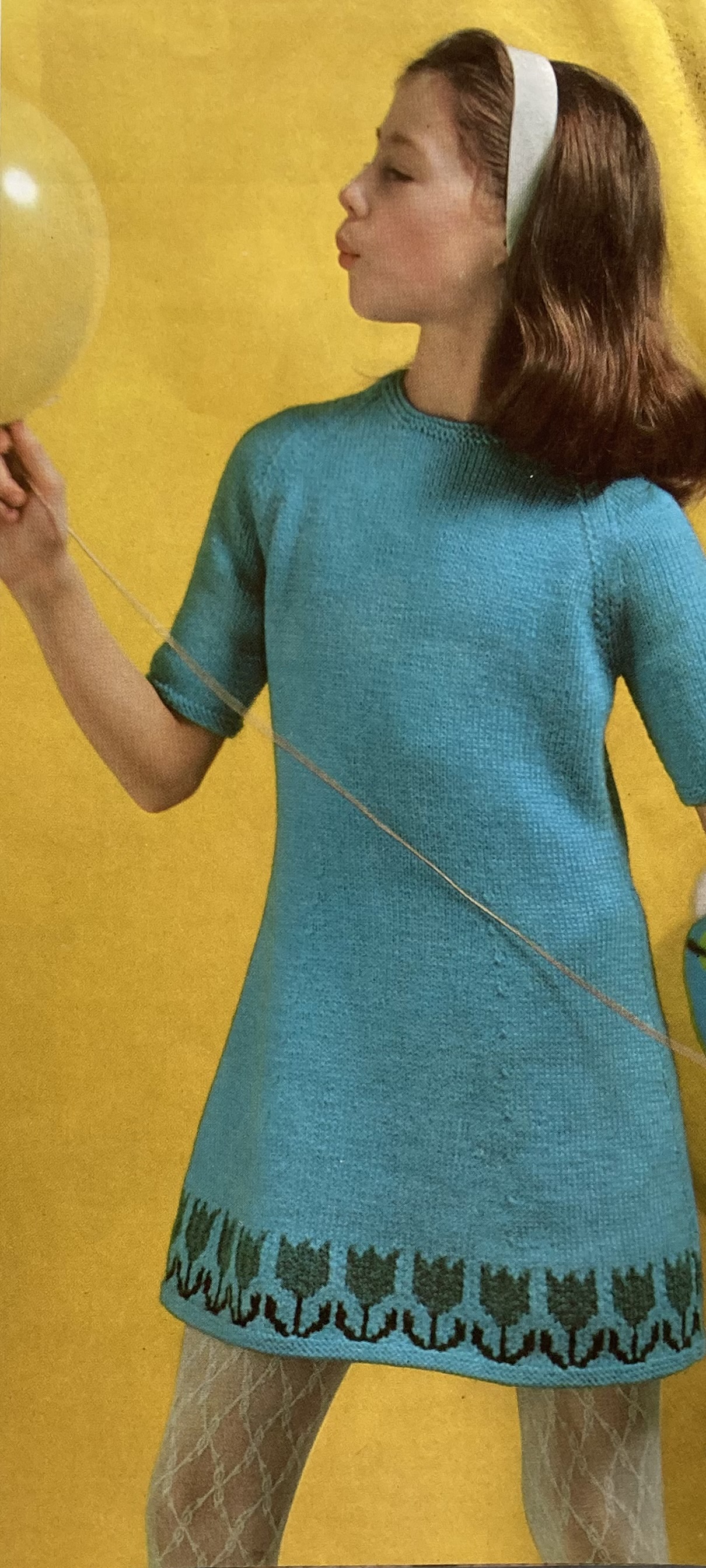
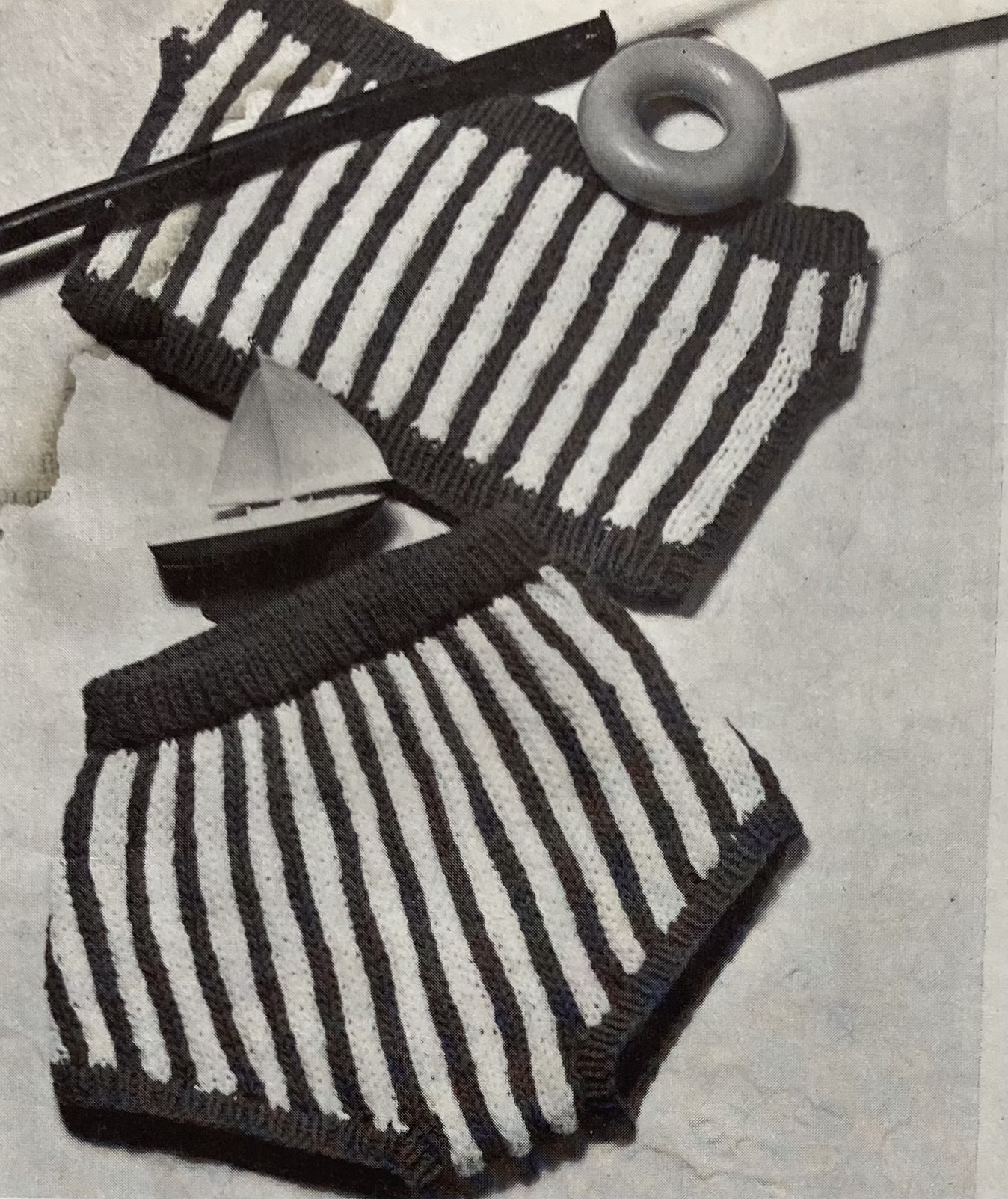
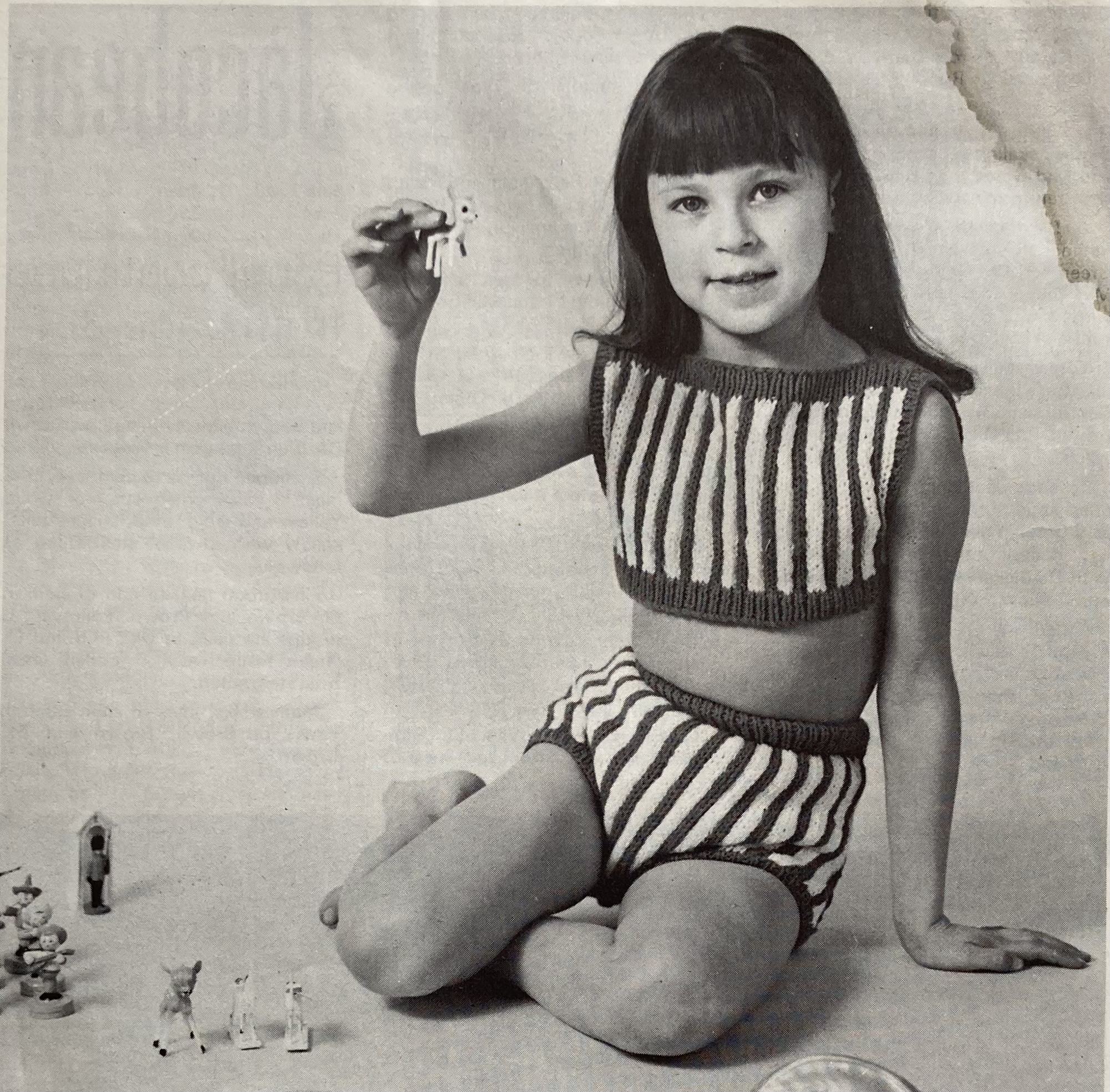
Fun stripes show up on the children’s garments too. There are shirts for boys with the same striped ribbing and collar, plain body and sleeves idea as the women’s top, and a dress for older girls with a stripe of colourwork flowers at the hem. “Junior” girls can “splash and paddle” (i.e. not really swim effectively) in a supposedly stretch-proof knitted bikini in vertical stripe stranded work — the strands should keep it from stretching too much horizontally in the water, but I’m not sure I’m convinced. The top is just two rectangles sewn together.

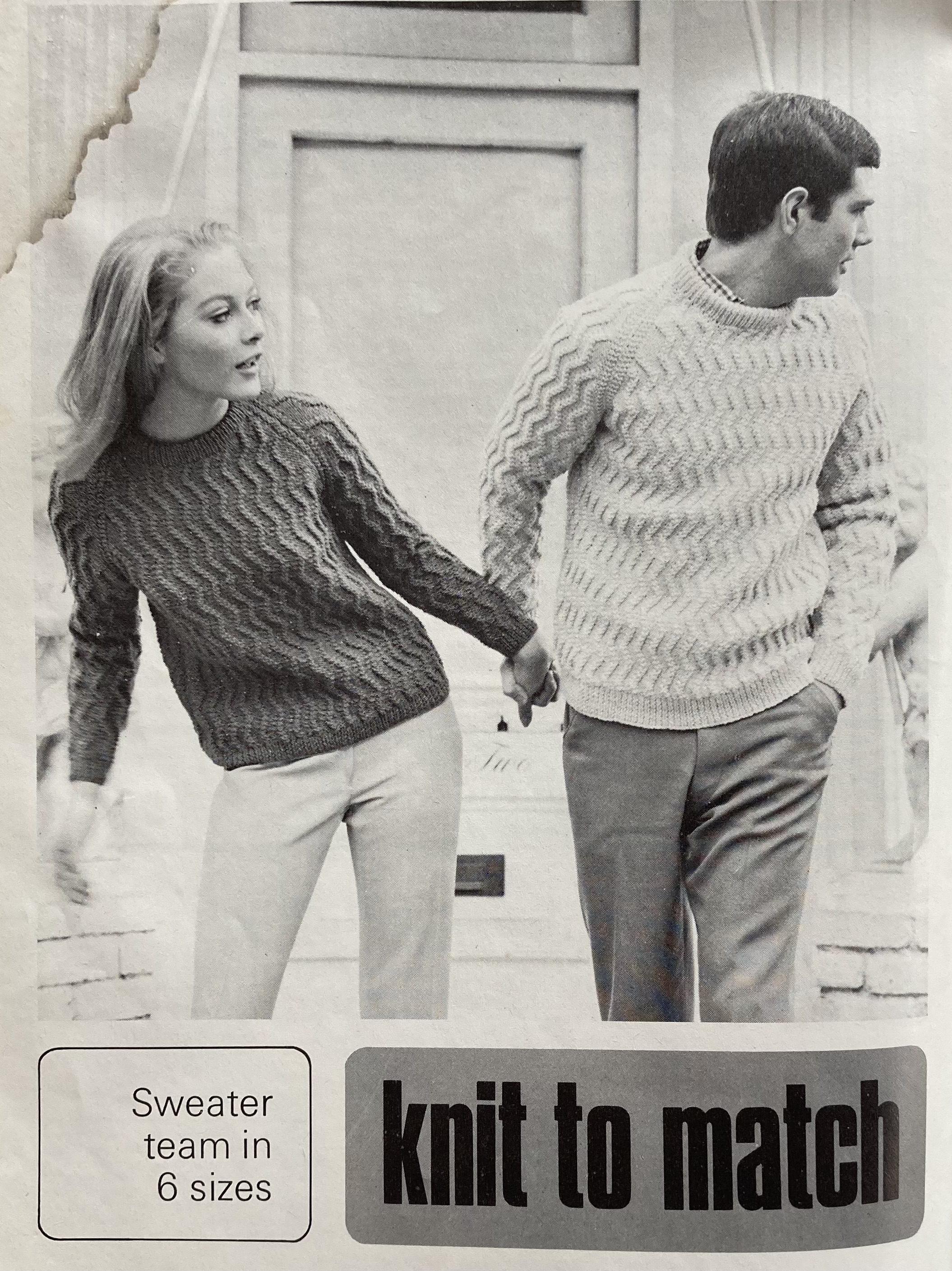
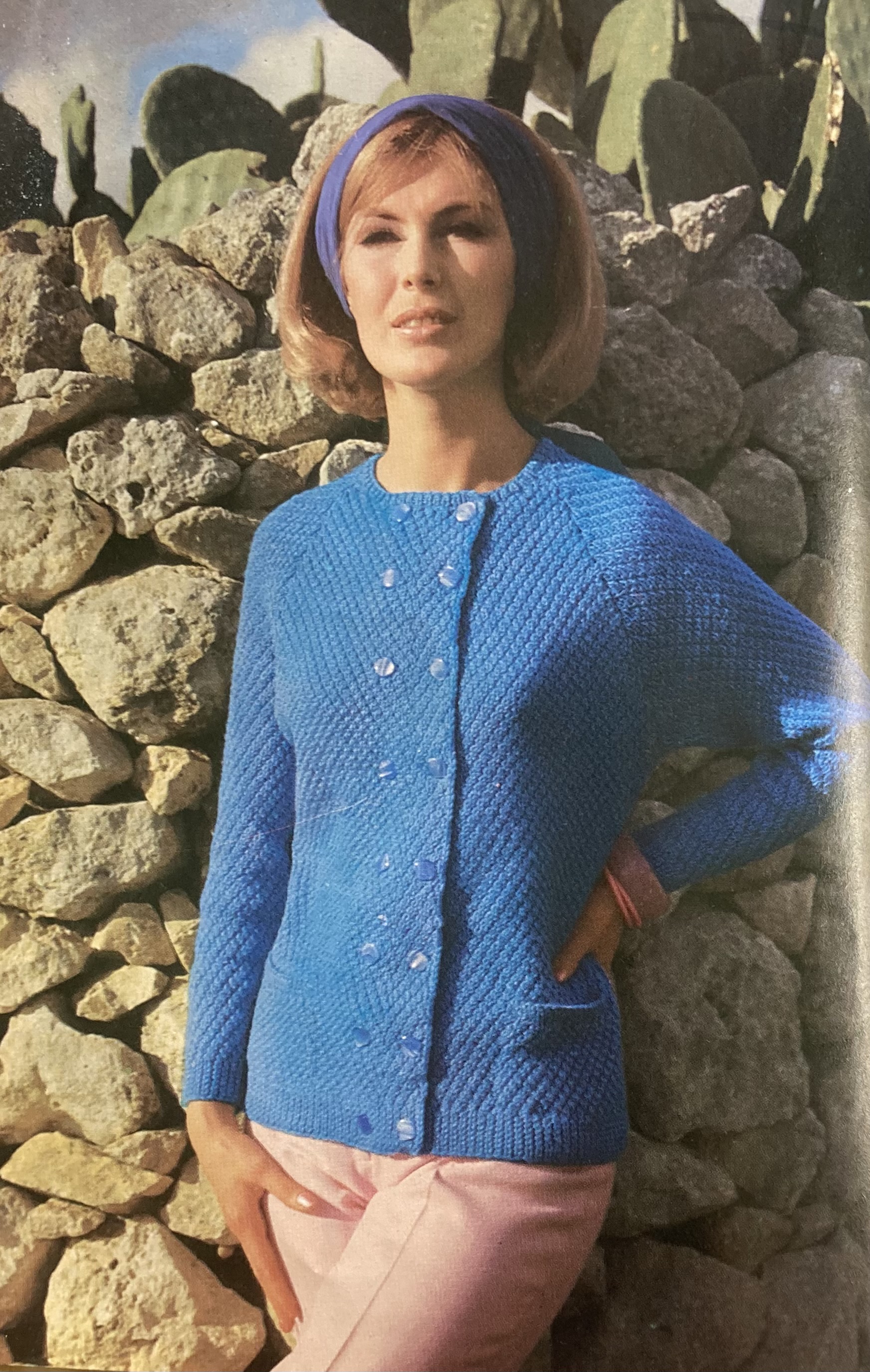
Stripes can be vertical or zig-zagged as well — either worked in colour as with the top on the cover, or in monochromatic stitch patterns. There are his-n-hers pullovers “knit to match” in a pattern similar to the sleeves on the cover design, but worked with 2-stitch twists instead of mini-cables, and a sleeveless polo in “Shetland mood” with a cable pattern on the front. (The caption says, “Janet sports her own jaunty beret, but Booklet 9775 is an easy one to knit — details on page 37.”) The two remaining garment designs, a cardigan and a blazer, have neither stripes nor zig-zags, but continue the theme of fun stitch patterns and this month’s trending colour of bright sky blue.

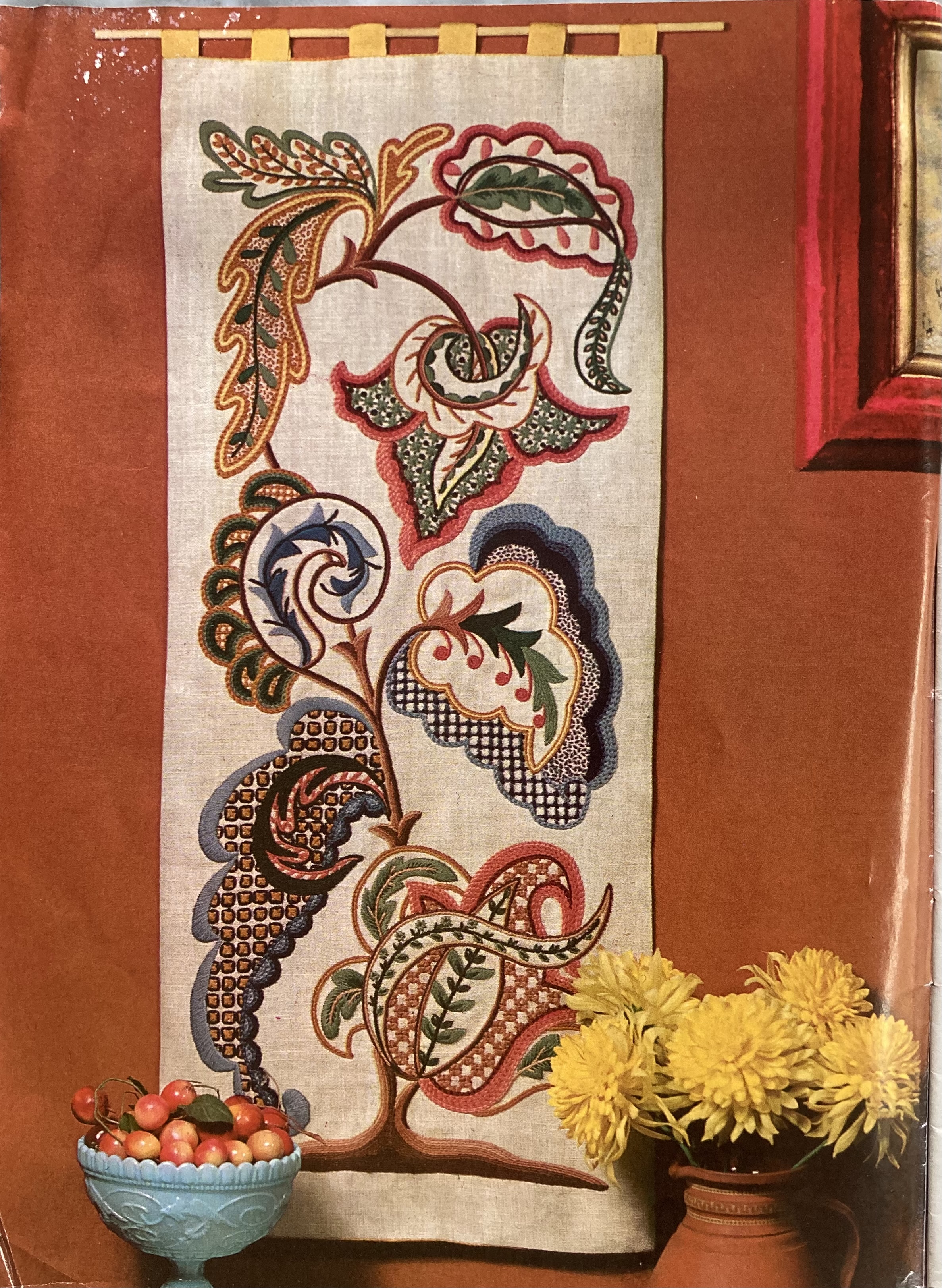
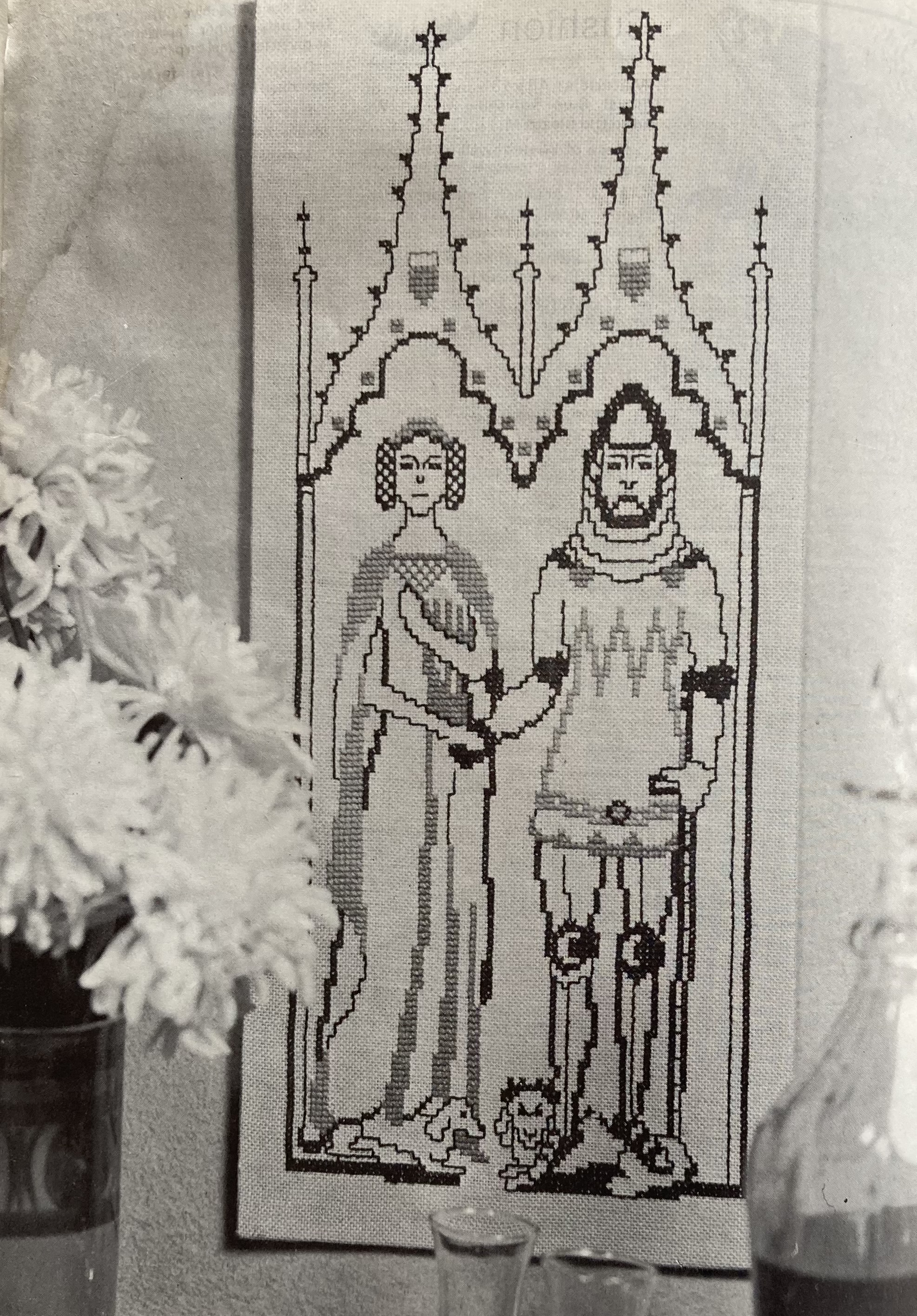
Homewares dive deeply into the Jacobean era, with an amazing wall panel that integrates complicated, historically-inspired stitch work and floral designs with a bold and oversized 60s aesthetic. Not Jacobean-inspired, but equally colourful and exotic, is the cross-stitch tropical bird. You can work it on a cushion or use it to cover a cake tin (appropriately, the name of the background colour is Biscuit.) For a real historical flair, you can make a cross-stitch wall panel adapted from a brass rubbing of Sir John Harsick, anno 1384, in Southacre, Norfolk. According to Stitchcraft, embroidery in the style of a brass rubbing “has become very popular over the last few years.” Interesting!

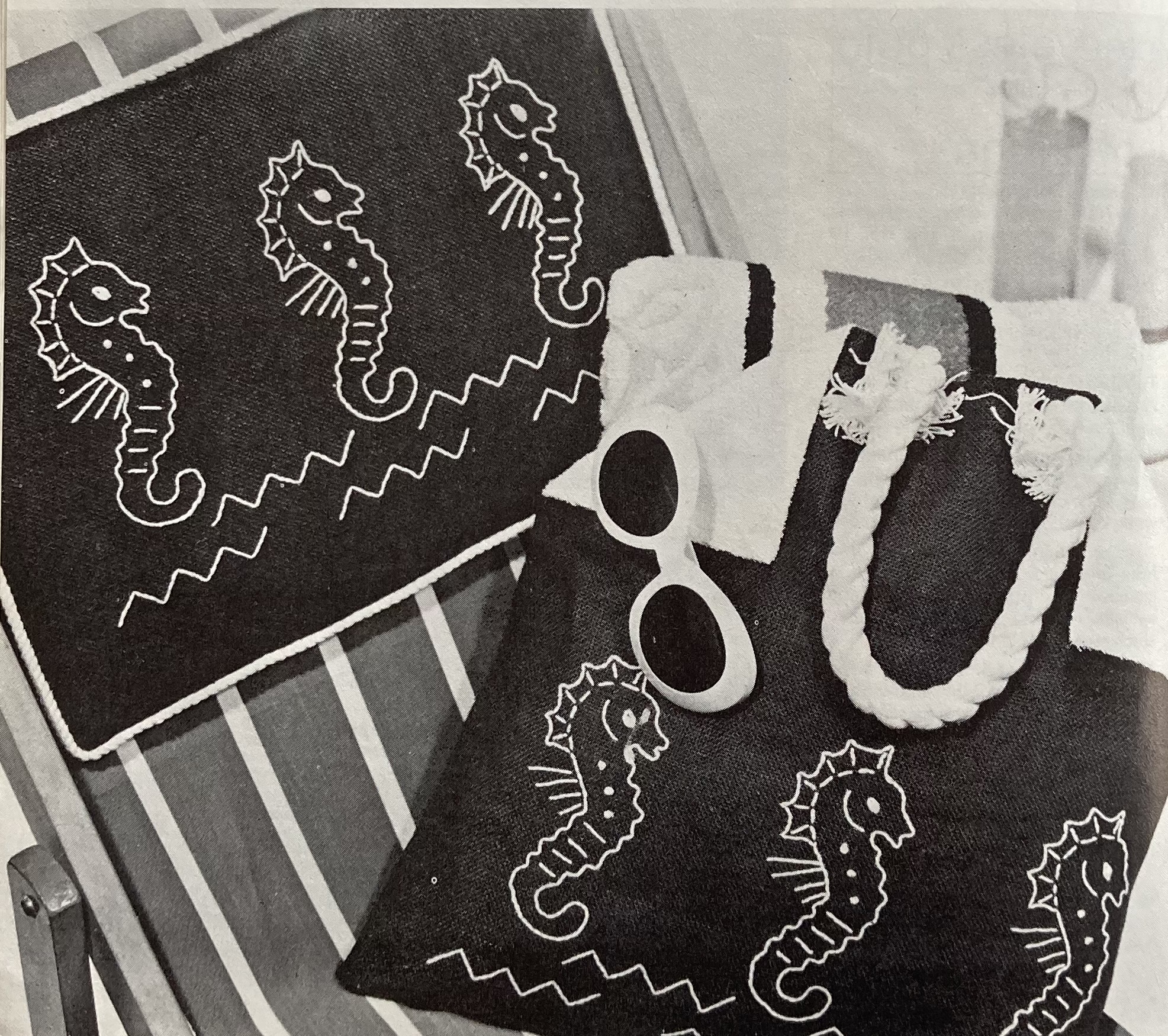
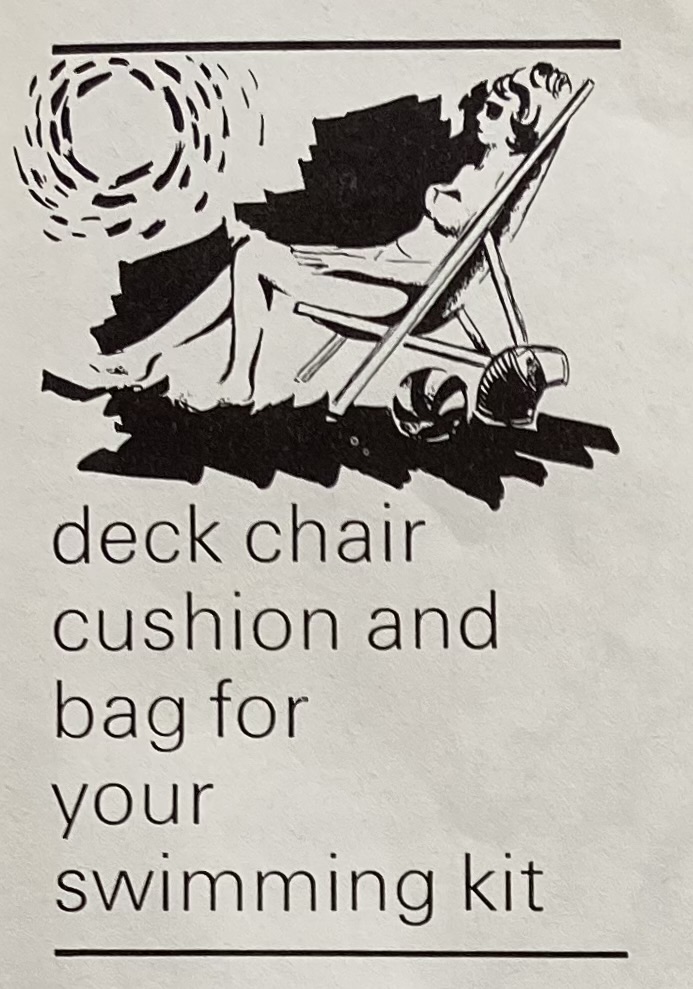
For an easier project, you can embroider sea-horses on a beach bag and matching deck-chair cushion (love the little aspirational illustration.) Or you can sew up a practical, and also cute and sunny, laundry-peg bag and matching apron and embroider them with big, cheerful daisies — “quick and gay to work on kitchen linens or for a bazaar.”

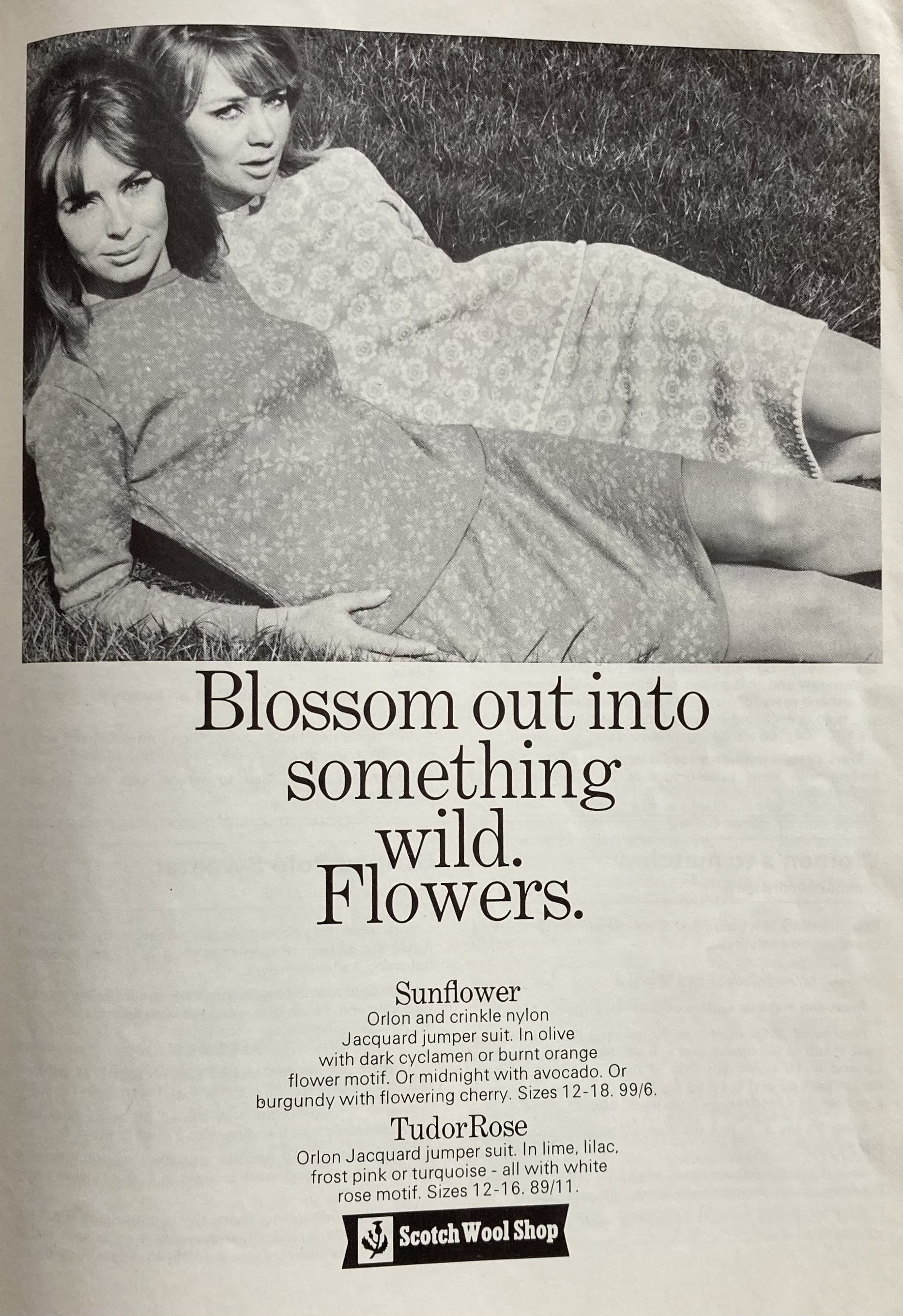
The Readers Pages reprint a striped knitted rug from the September 1964 issue, and the single full-page ad gives us another example of brilliant, yet meaningless, 1960s advertising copywriting and exceptionally 1960s colour combinations: the “Sunflower” Orlon-nylon jersey ensembles is available in olive/cyclamen, olive/burnt orange, midnight/avocado or burgundy/cherry. (A midnight avocado with olives, cherry and a nice Burgundy doesn’t sound half bad, if you took care not to burn the orange.)

I am tempted to make the brass-rubbing embroidery just for the weirdness of it, but realistically, my project will be the daisy-embroidered peg bag and apron. Have a sunny June!

March Excursion: Snow Daisies

Welcome to Spring! Is it snowing where you live? The March 1967 issue of Stitchcraft had some nice designs, but nothing that was fast, easy or practical enough for my knitting life at the moment, so for this month’s post I’ll write about a cardigan I finished in mid-February: the Snow Daisies cardigan from the Spool Cotton Company’s issue No. 189: “Women’s Sweaters: America at Work and Play” from 1942. The booklet with all the patterns is available for free here.

The “Snow Daisies” cardigan is touted as a “heavy cardigan for outdoors”. Knitted somewhat oversized (esp. for 1940s sweater standards) in thick wool, it has “plenty of room for a sweater underneath.” What you don’t see in the magazine photo is the fact that not only the sleeves, but also the back is made in 2×2 ribbing. This was an excellent design feature on many “sport” garments from the first half of the 20th century, allowing for generous movement without extra fabric to flop around and get in the way of your golf swing or ski poles or whatever. The front is made in reverse stocking-stitch with an open cable on each side, and decorated with embroidered daisy flowers. It’s a nod to all the “Bavarian”, “Tyrolean”, “Alpine” etc. traditional southern German and Austrian styles, though of course an American pattern from 1942 doesn’t use those words as I imagine they did not want the association.

I made my version in Hjertegarn New Life, a very interesting recycled wool — if I understood correctly, it’s reclaimed from older knitted items. Mine was 65% recycled wool and 35% recycled “other” fibres (synthetic, I guess?). It felt like strong, nice wool, tough but not too scratchy.

My tension was a little larger than the pattern and I wanted the cardigan to not fit too loosely, so I adjusted the stitch counts. The sleeves were fine, though the ribbing didn’t pull in as much as I thought it should. I guess that comes from wool that is only 2/3 actual wool and 1/3 mysterious “other”? So I made the back even narrower than I had calculated. It was too narrow. I made extra panels on the sides to make up for it. On the front, I placed the cables slightly differently to couter-balance having fewer stitches. I forgot to do one extra cable twist in the center twist part, but if you can’t see it in the photo, I won’t tell you where it is. The daisies were easy to embroider on.

I was not so happy with the final result. The overall look is quite square — the ribbed shoulders add bulk in an area where I am plenty wide enough. Worse, the ribbing just doesn’t pull in at all — it expands horizontally, especially after washing and with wearing, as ribbing is not supposed to do. I took out the extra side panels, which helped a little. I’m just not happy with the wool, though. It’s too bulky and not springy enough. Also, the button band is “wavy”, though I think that might be a design feature, since it looks like that in the photo, too?

(Not having any winter sports gear, here I am posing with a croquet mallet and ball…)

I’ll see what I can do with it, but I might end up giving it away.

October 1966: Jacobean Embroidery

EDIT November 19, 2024: Finished!

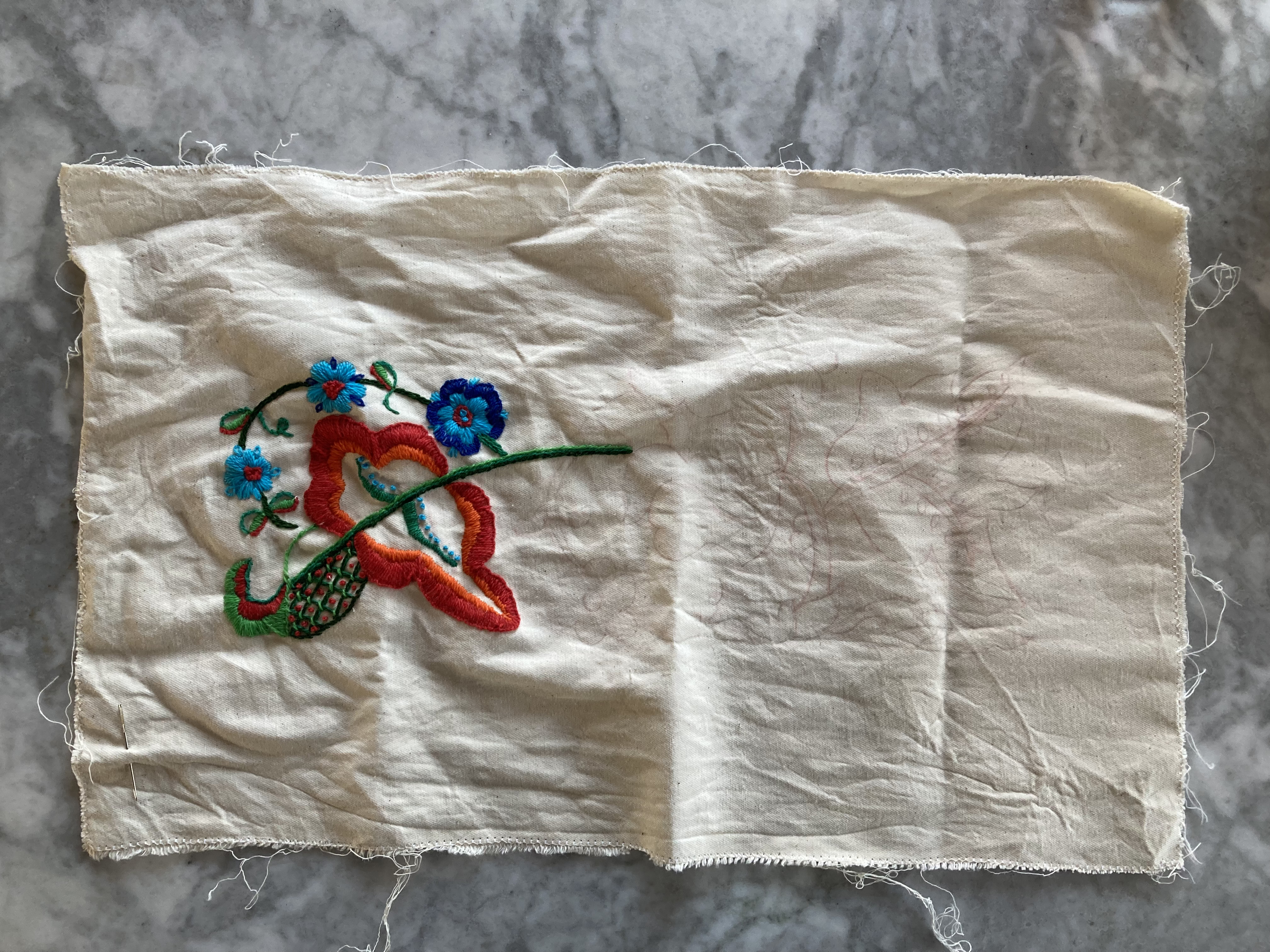
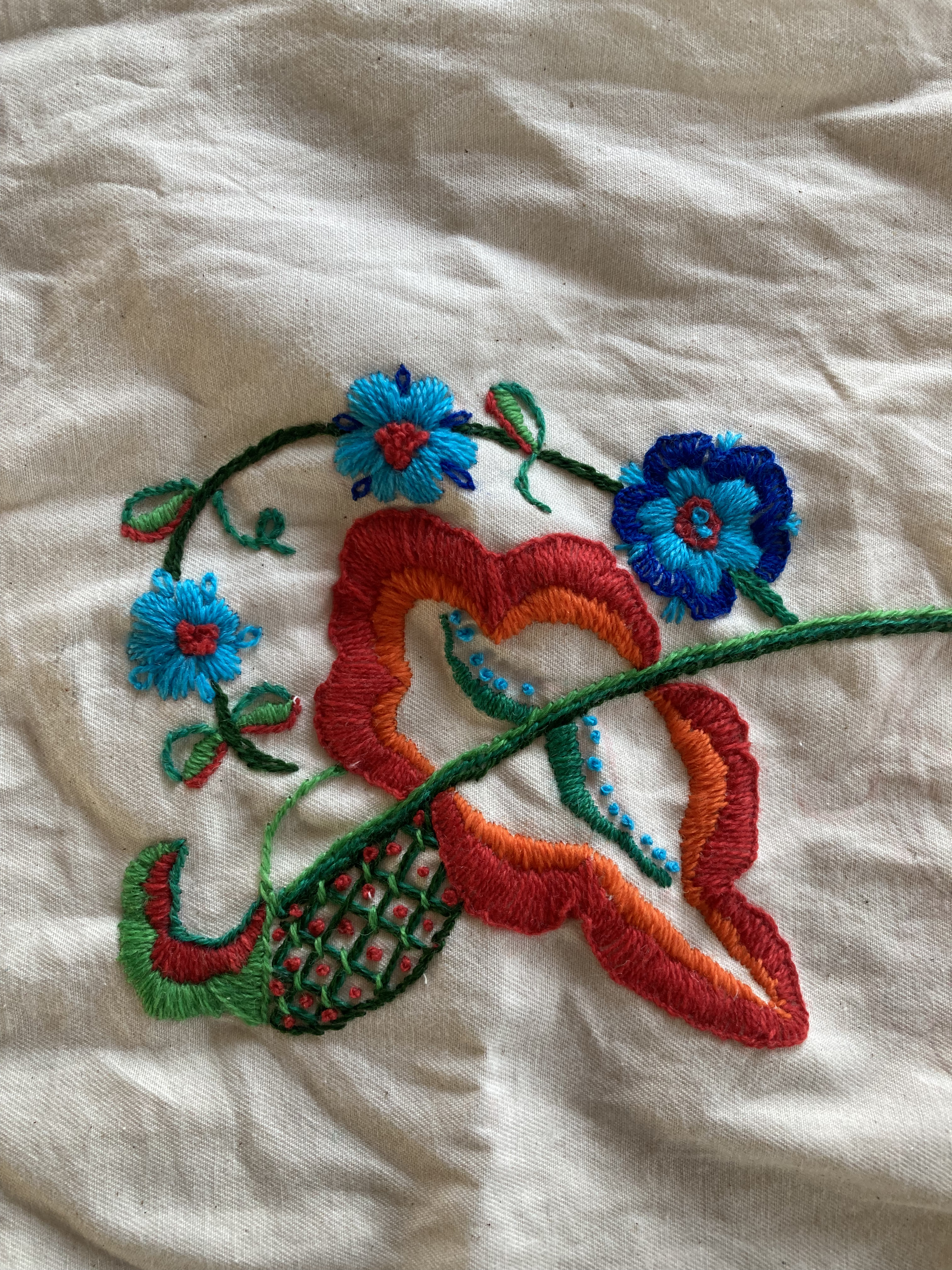
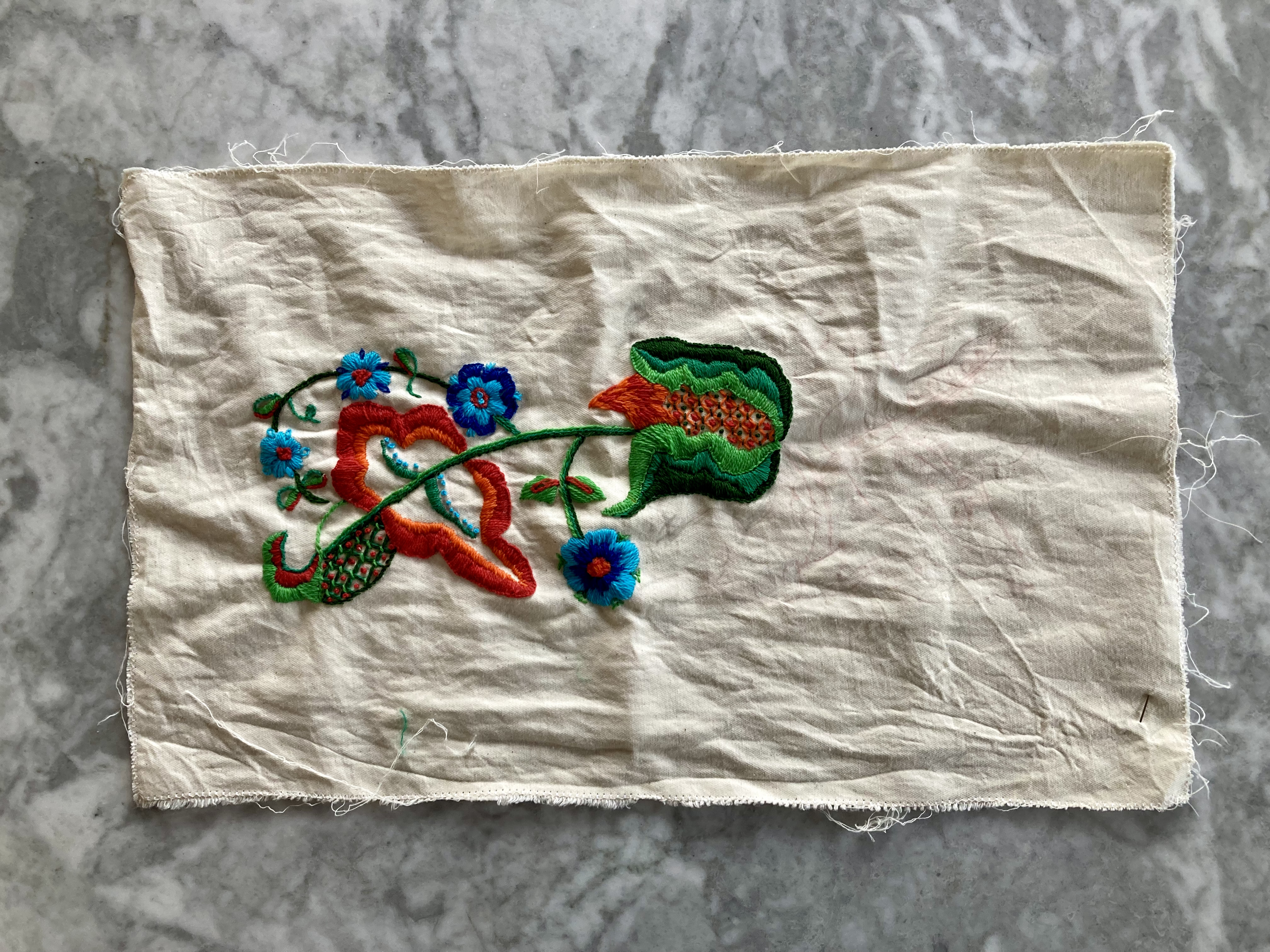
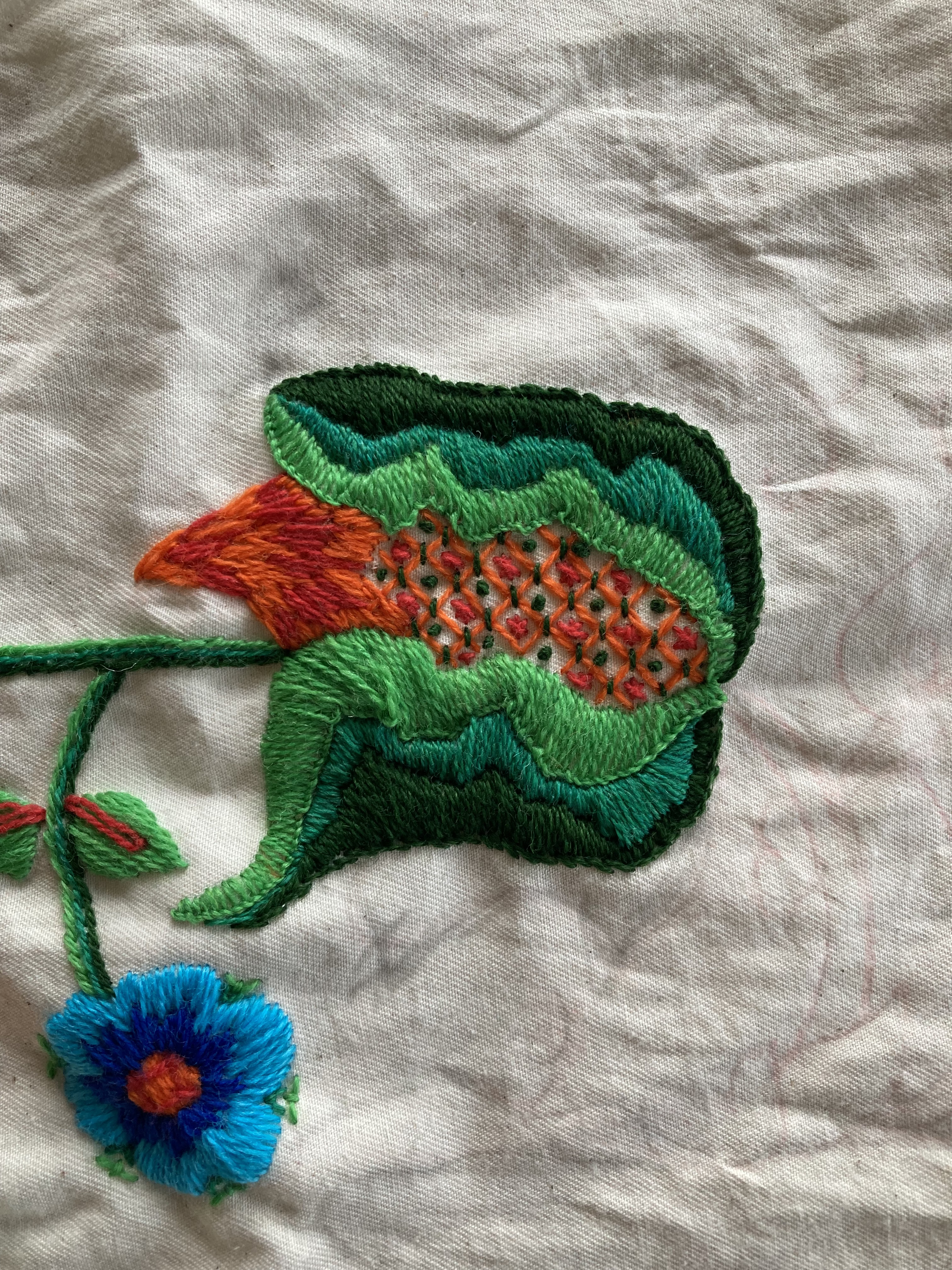
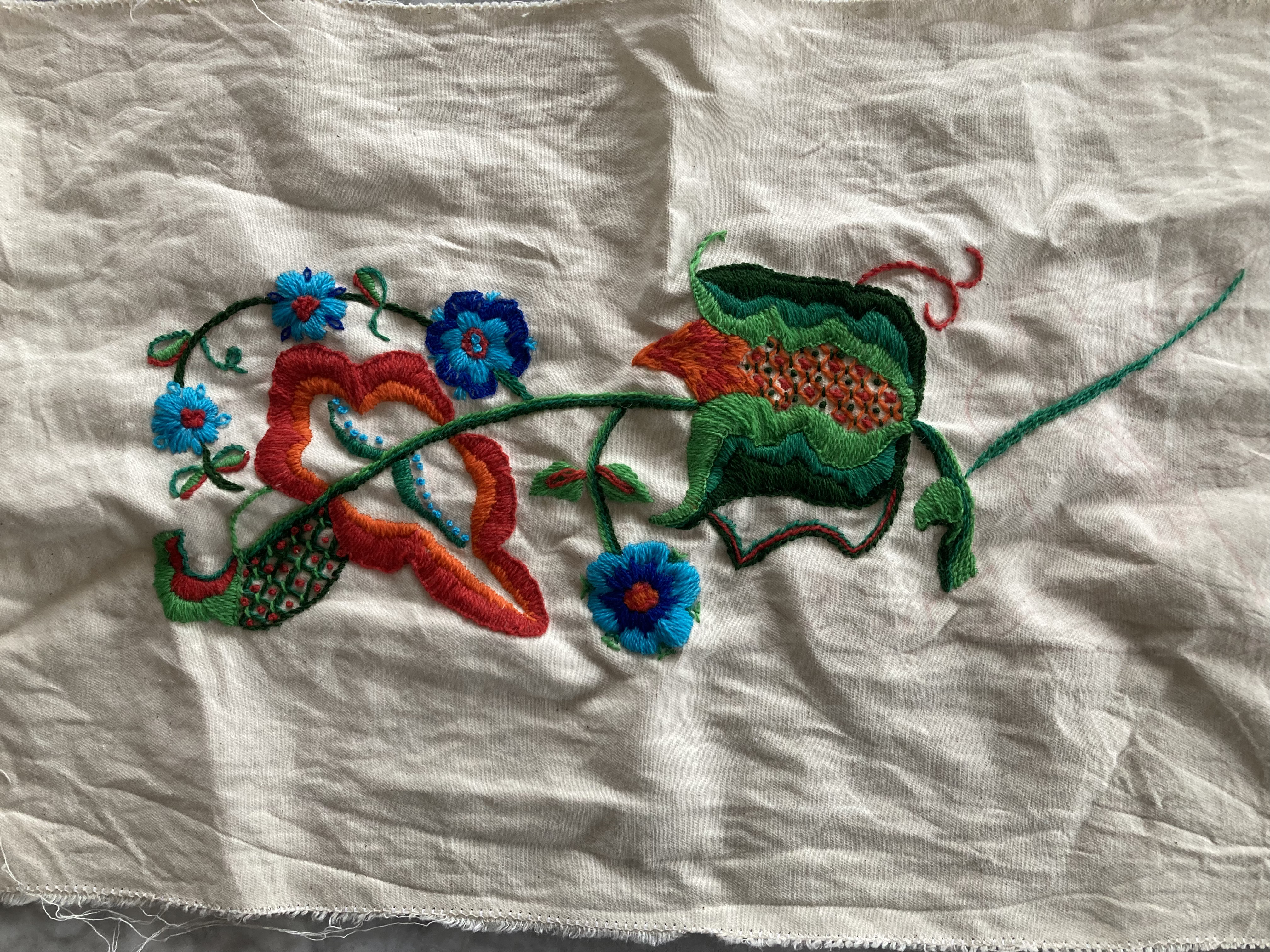
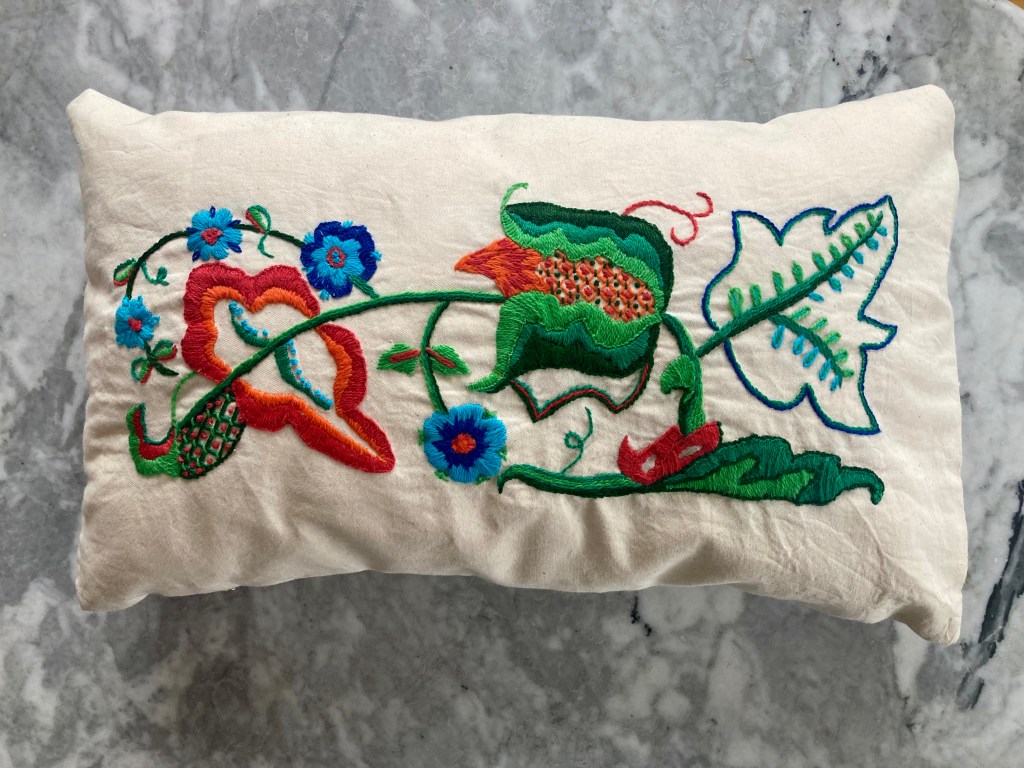
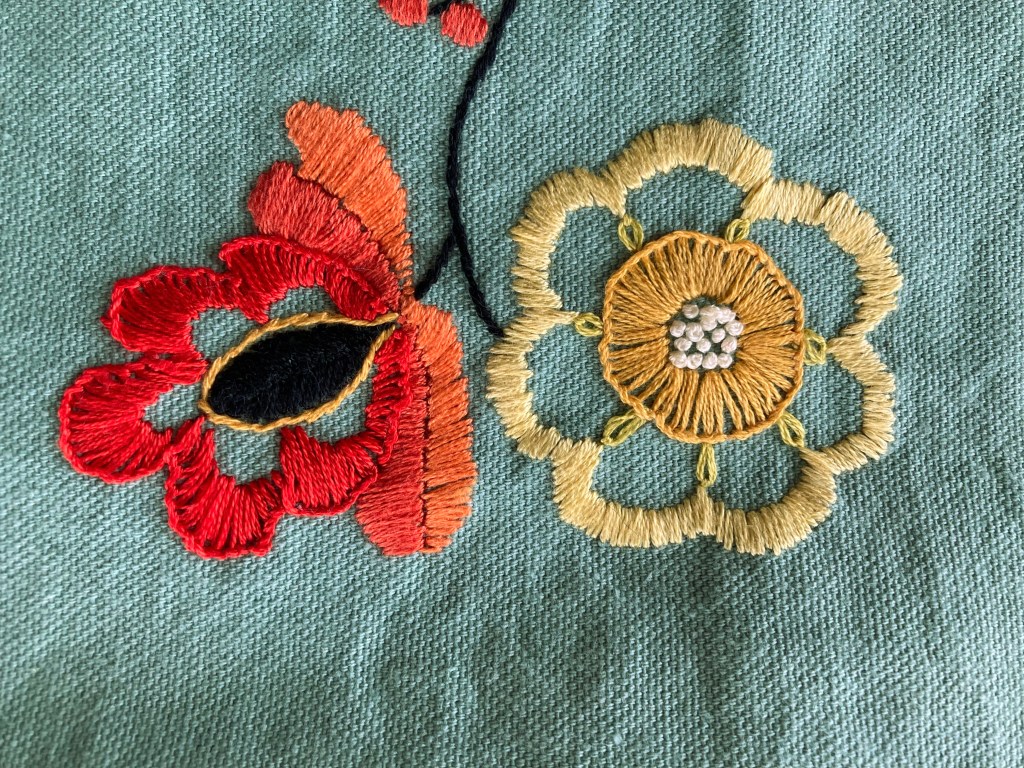
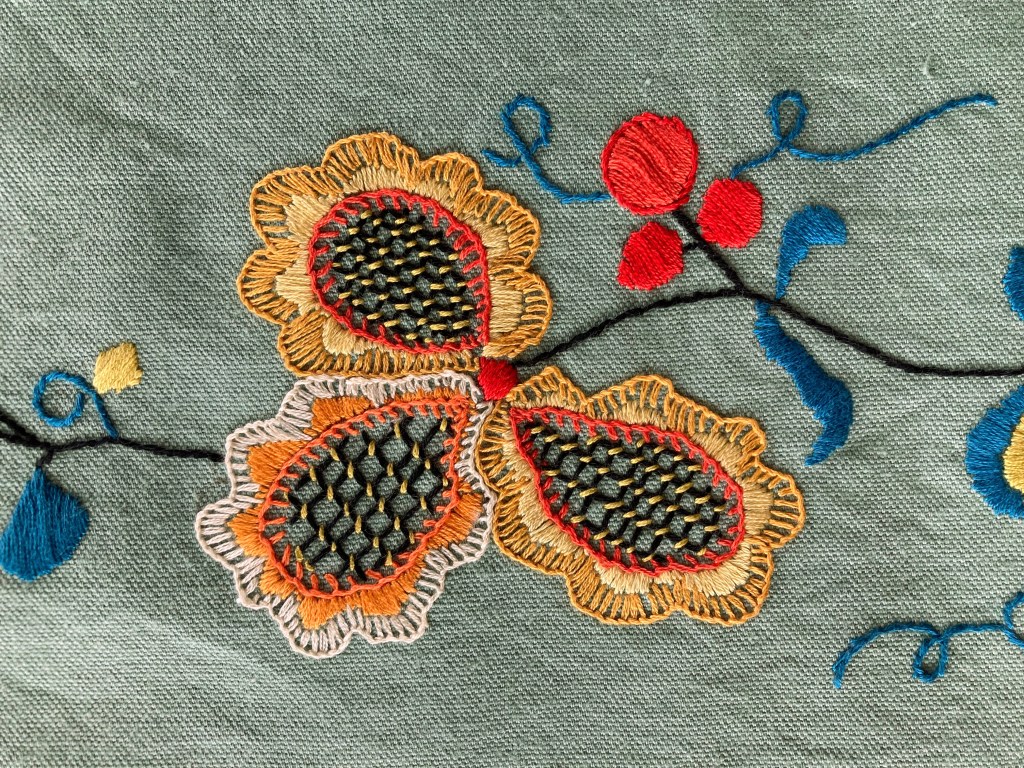
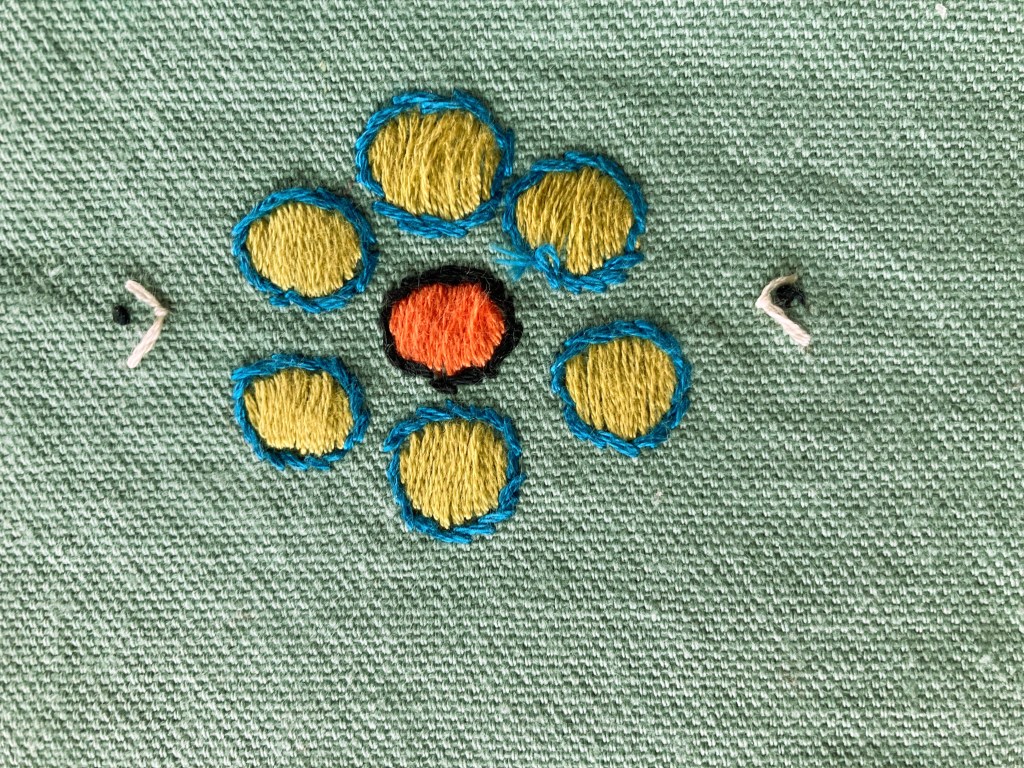
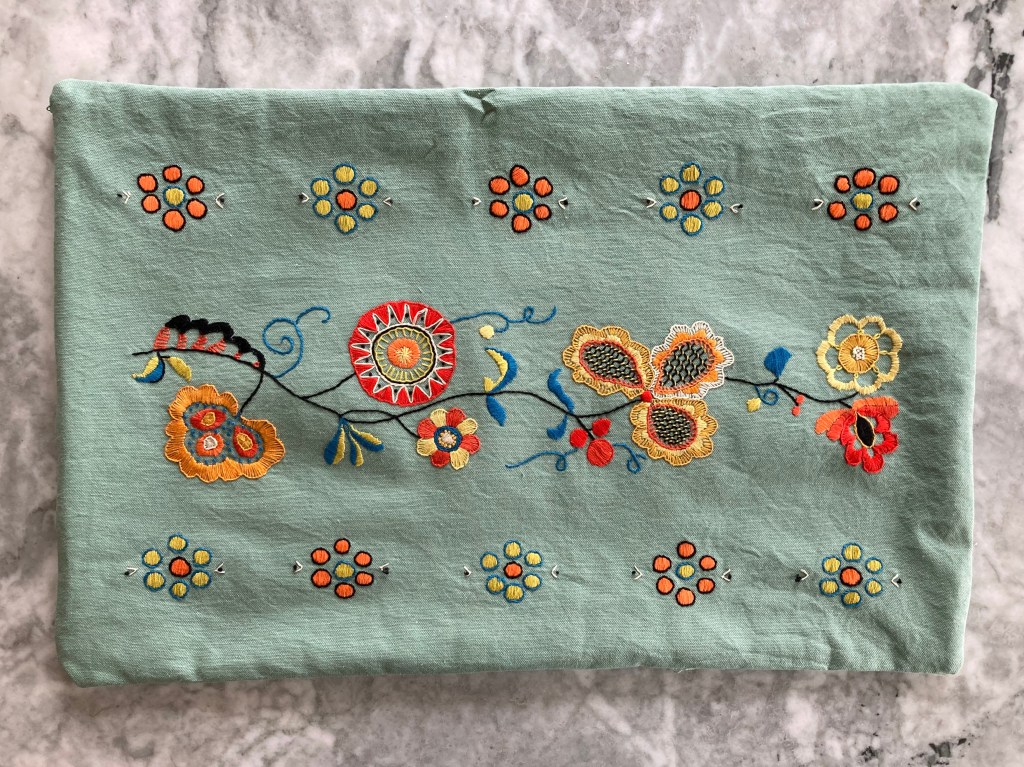
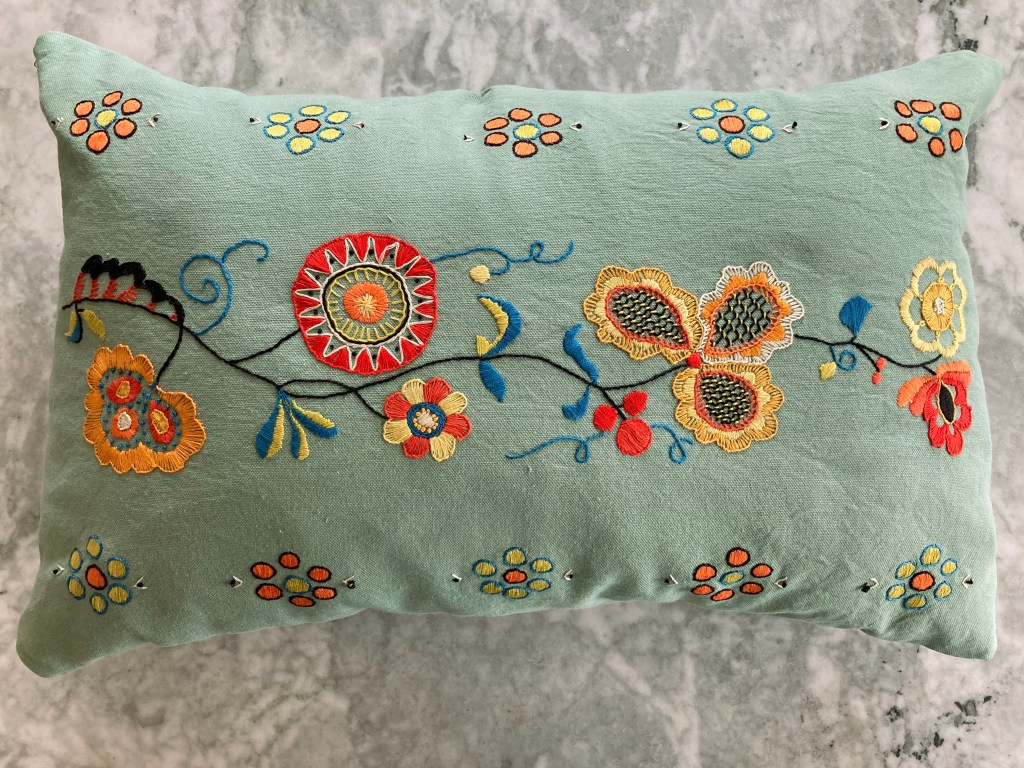
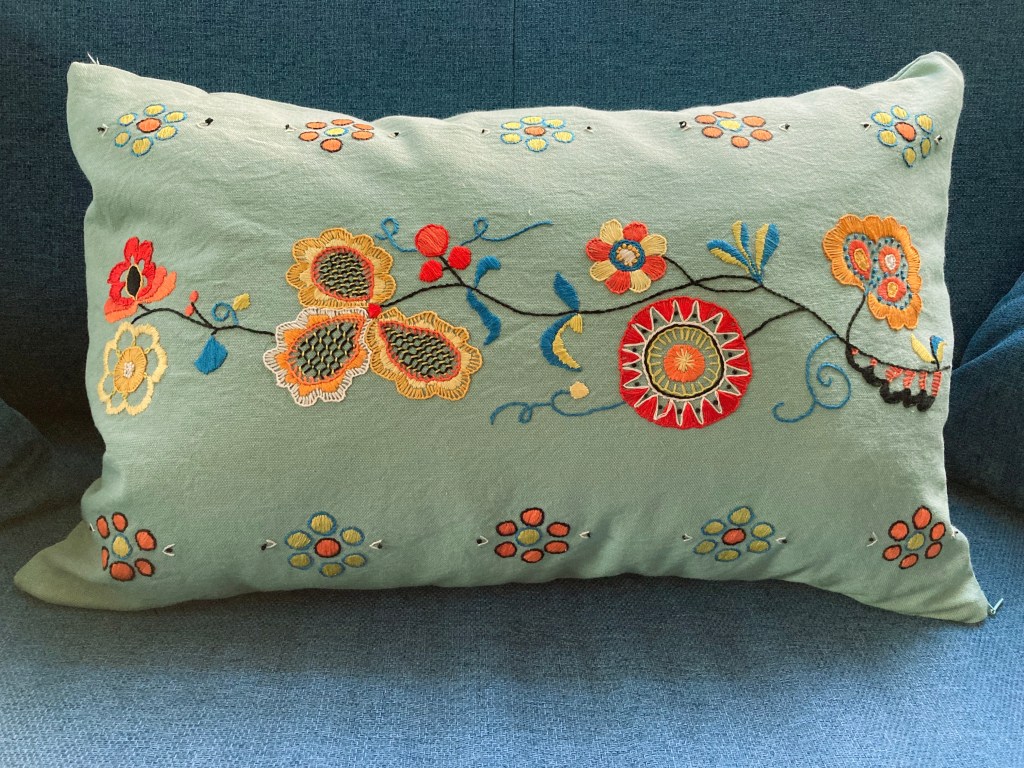
My October 2024 project was an embroidered panel in “Jacobean” style from the October 1966 issue of Stitchcraft.

Real Jacobean embroidery was an elaborate, mostly floral style of wool-on-linen work that was popular in the early 17th century. It featured heavy, filled stitches and complicated couching, often in multiple colours and with a high level of skill and artistic virtuosity. The style enjoyed a revival in the mid-20th century, and many home embroideresses made Jacobean-inspired designs to decorate home furnishings such as cushions and wall panels.

This finished panel is intended to be used as a chair-back and / or sofa-back, with the sofa-back incorporating the panel twice. Chair-backs and sofa-backs were a popular way to extend the life of upholstered furniture by keeping it clean and protected from sun damage. You don’t see them much nowadays, except in the casual form of throwing a blanket or quilt over the sofa back to hide faded or worn spots. I could actually use a sofa-back, since my sofa sits under a window and the sun does fade the dye quite a bit over time, but my sofa is already so cluttered with hand-made cushions. I decided to make the panel first and then decide if it should become a cushion, laptop case, decorative wall panel or other use.

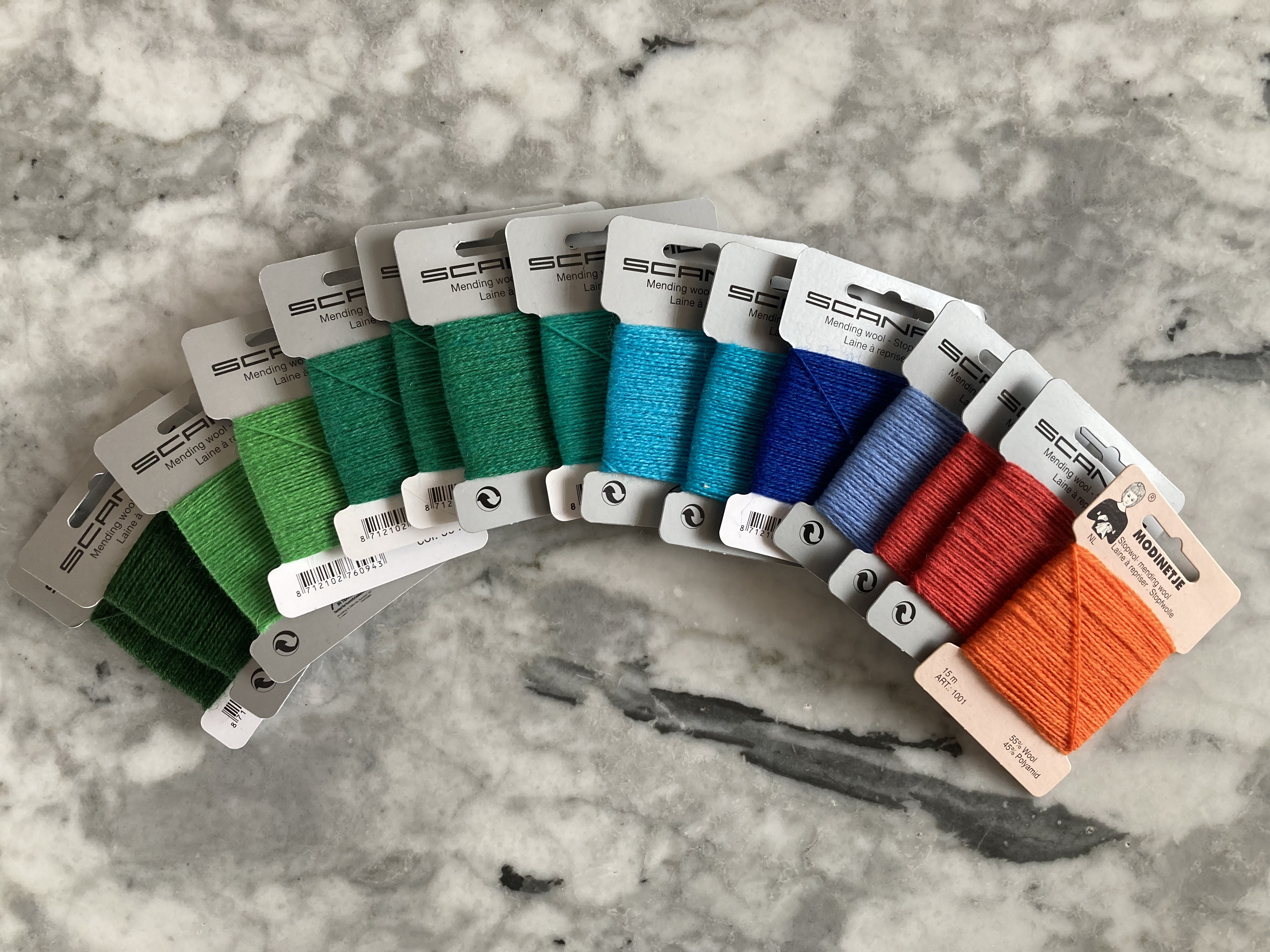
The pattern is written for wool embroidery on furnishing linen. I had no trouble finding an appropriate background fabric — although mine is thick cotton muslin, not linen — but fine embroidery wool is difficult to find. I know one store in Paris and a Ravelry friend just let me know about another (also in France.) I could have ordered from either one of them, but I happened to be in a store that sold mending wool in a variety of colours, and decided to give that a try instead. The colours in the pattern were light green, green, dark green, peacock, dark peacock, rust and light rust, which I found with an extra alternative-light-blue and slightly-more-blue-green for variety. It worked well!

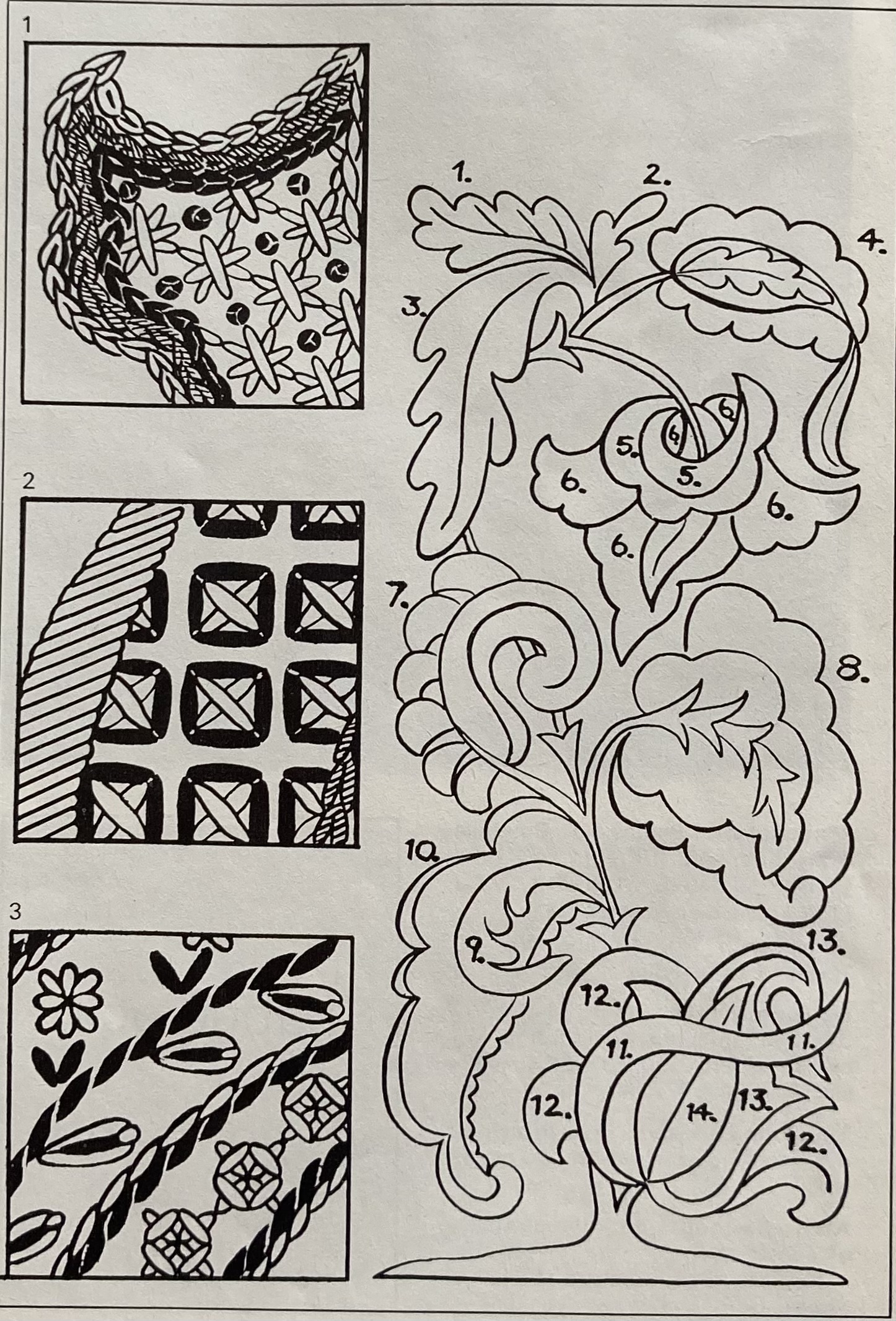
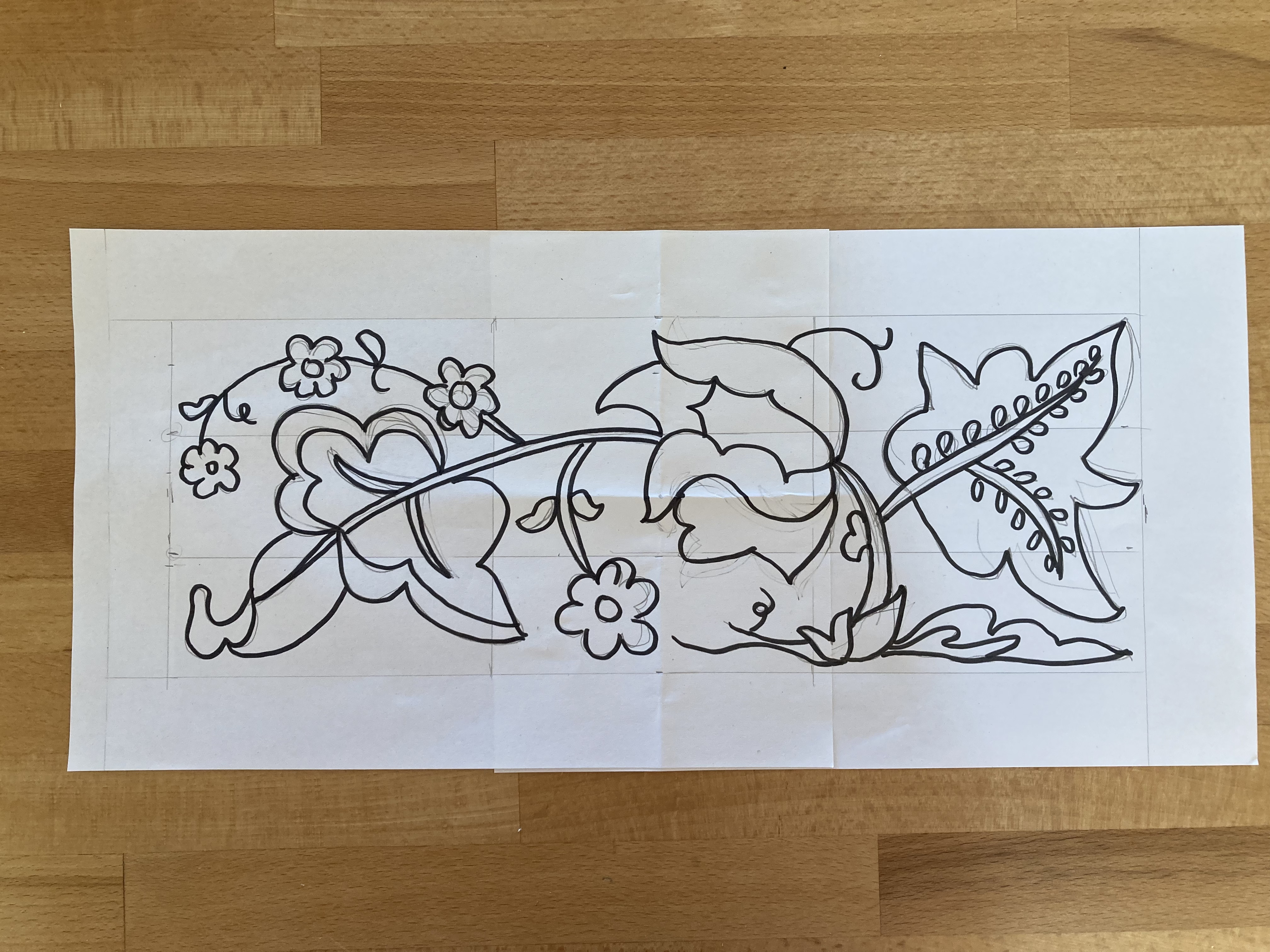
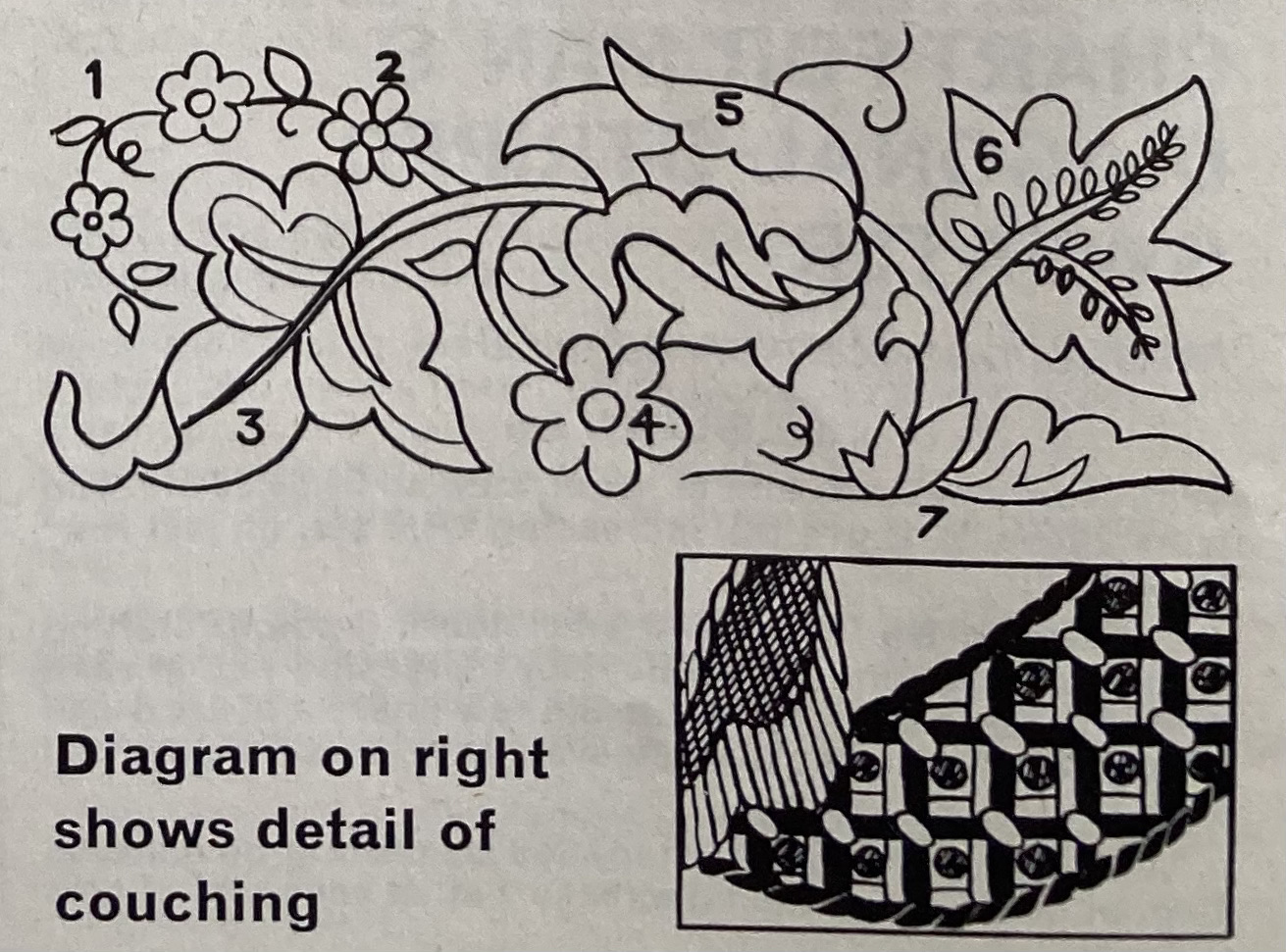
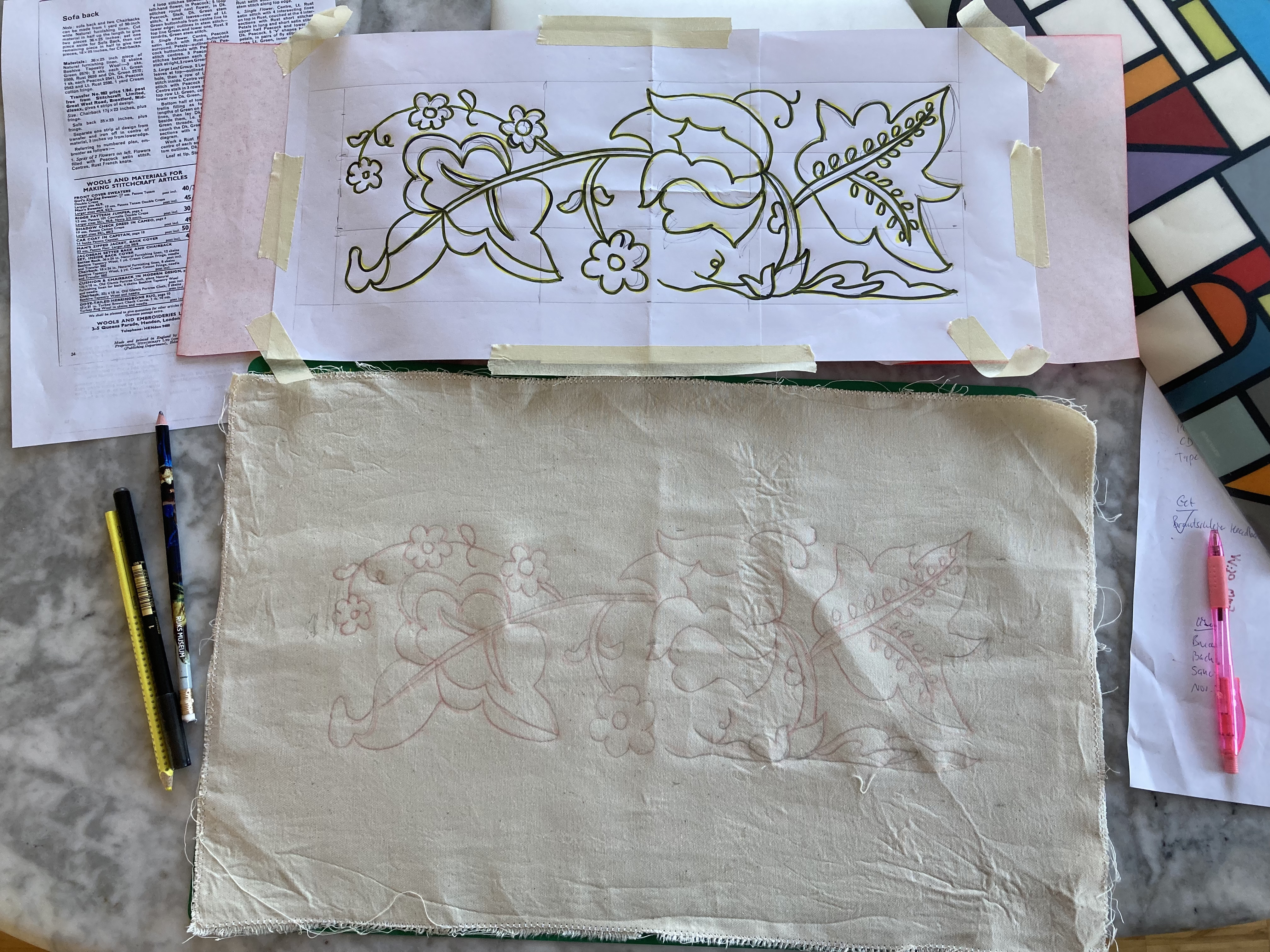
The most difficult and time-consuming part of all these vintage embroidery patterns, as always, was getting the design onto the fabric. Back in the Stitchcraft days, you had to send away for the iron-on transfer by post. These days, old transfers occasionally pop up for sale on ebay, but of course not exactly the one I want to work on right at that moment, so I have to recreate them myself. I do it the old-fashioned way, by drawing a grid over whatever photo or schematic is in the magazine, then drawing a proportional grid over a piece of paper in the correct size, and enlarging by copying square for square. Then I go over it with marking pen, and transfer it to the fabric via “lightbox” (i.e. taping it to a window) or dressmakers’ carbon paper. I used carbon paper for this one.

I’m sure there are computer programs that could do all of that a lot faster, but then I would have to take the time to learn the computer programs… and I like keeping the handwork aspect of the craft alive.

The embroidery itself was not nearly as difficult as I had expected, considering that the design looks very complicated. It’s really just lots of satin, buttonhole and stem stitch. The fancy couched parts were a lot easier to do than the buttonhole areas, in my opinion! They are worked by laying down threads in crossing diagonal lines and tacking them at the corners, then working French knots or tiny crosses in the squares.

It went quickly and although it is was not quite done by the end of October, I did get the embroidery finished at the beginning of November. The I was traveling for work and didn’t get a chance to make it up into anything without my sewing machine.

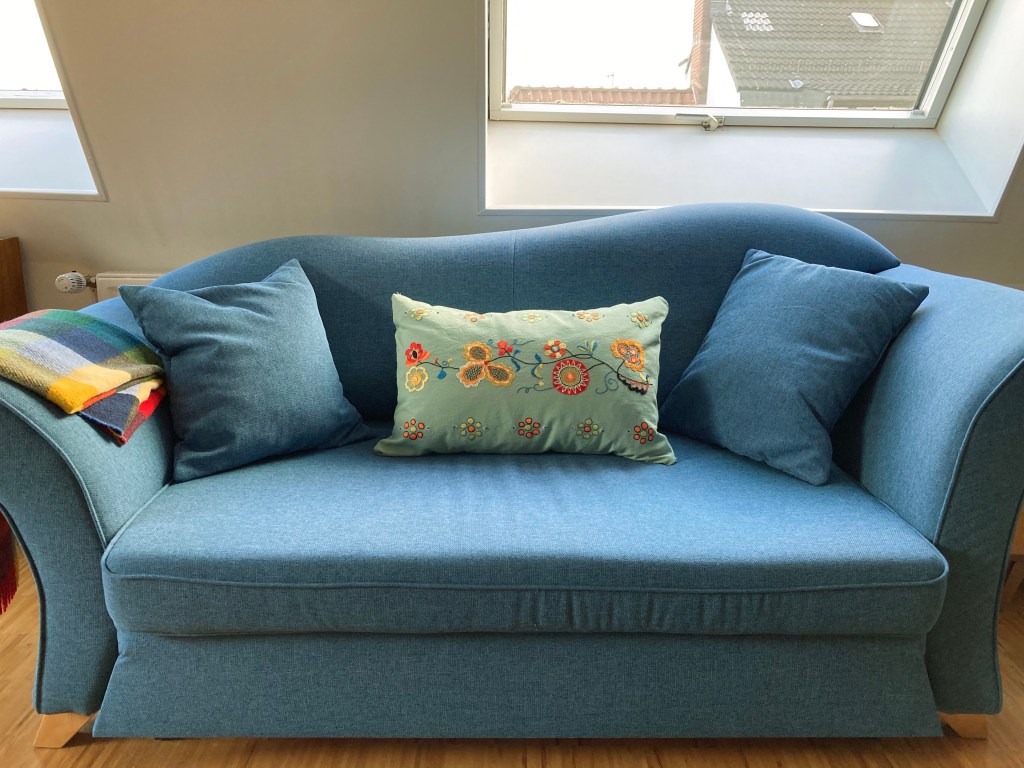
In the end, I decided to make it into a cushion — simple and period-appropriate. I made a separate cushion for inside the embroidered cover to make washing easier and fastened it with a button flap this time instead of a zipper this time. That was it!

The finished size is about 18 x 11.5 inches (47 x 29 cm), which corresponds to the width of the original chair-back design. It’s perfect, and since I don’t have space for more cushions and like making people happy, I arranged to give it to a friend.

August 1966: Flower Design Veggie Bag

Lovely sparkling colours of simple flower heads, show up beautifully on dark linen. Just a circular cluster of the flowers look very effective on a cushion or workbag.

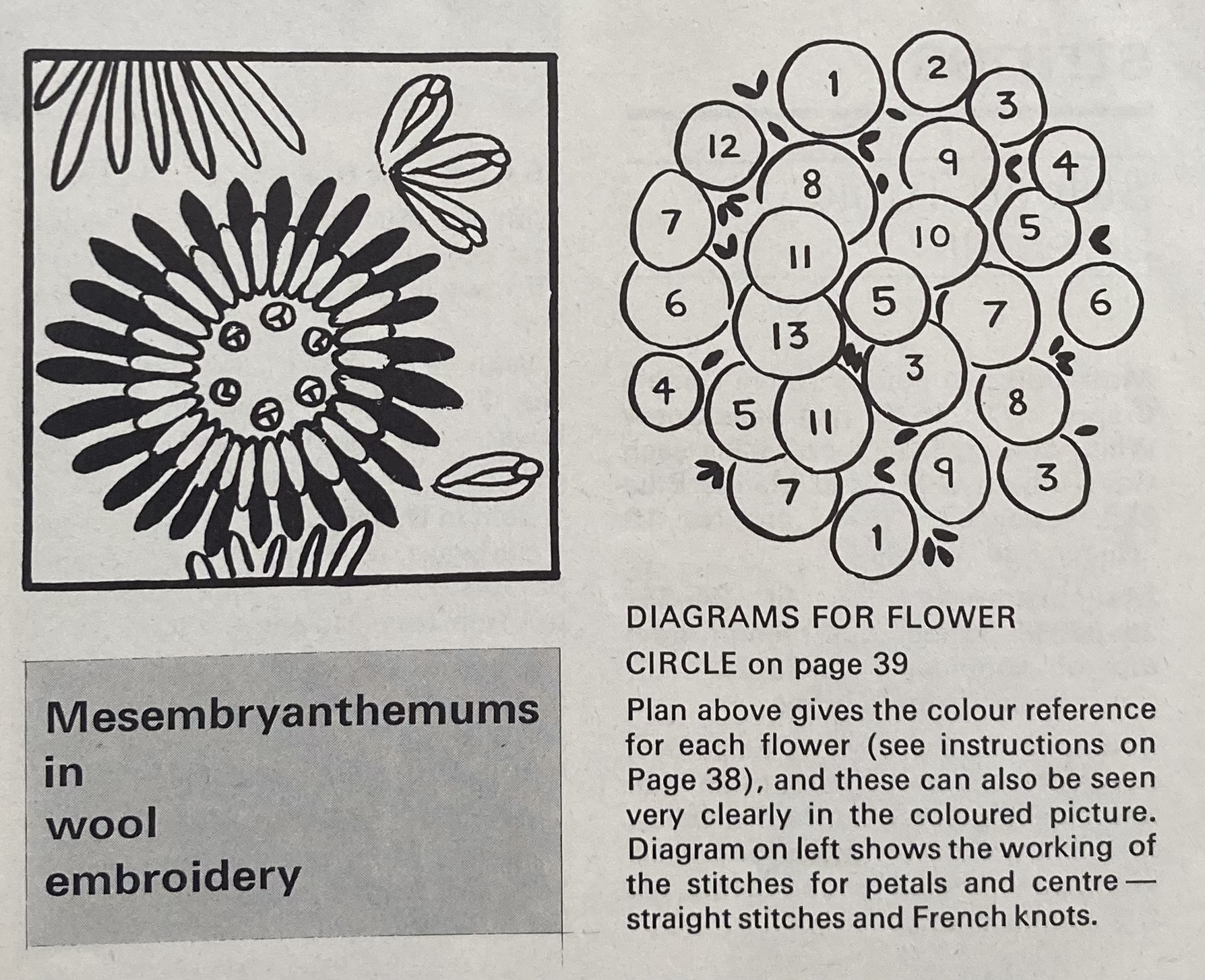
My August 1966 / August 2024 project was this fun and easy embroidery design featuring a flower whose name, at least, was unfamiliar to me: the tongue-twisting Mesembryanthemum. The name encompasses an entire genus of plants, native to southern Africa, of which some species are succulents and others more “flowery” types. The species that inspired the embroidery is presumably M. crystallinum, aka “iceplant”, which I have encountered without knowing what it was called. Now I know!

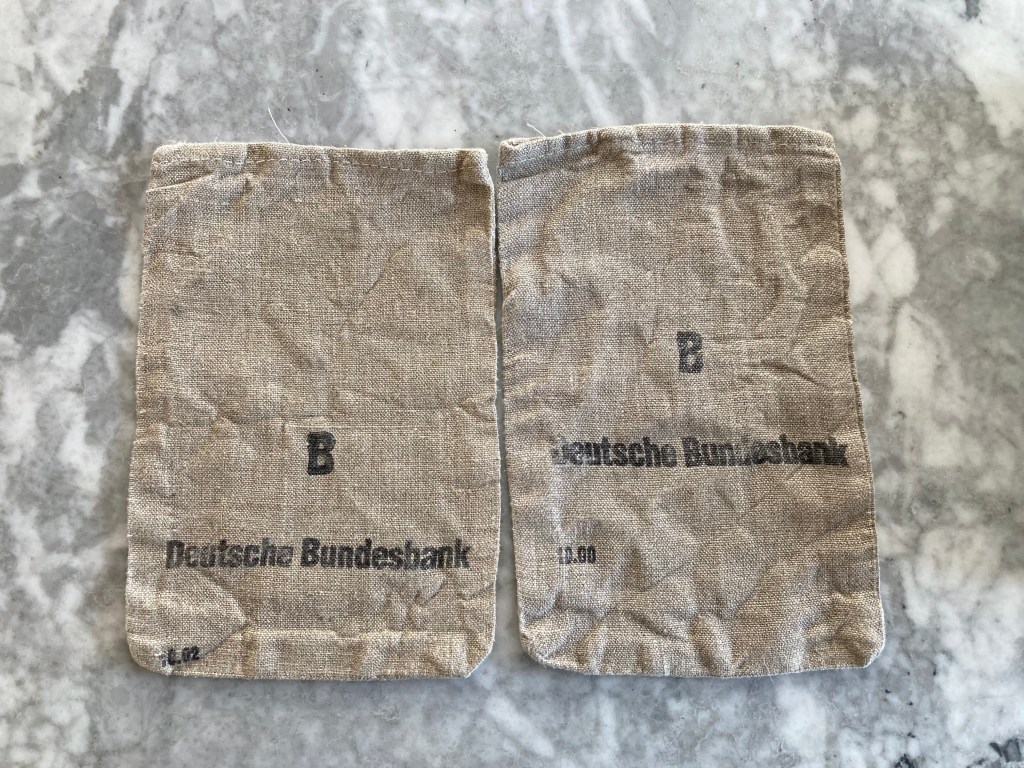
The pattern is for a cushion or workbag, and the flowers are meant to be worked in wool embroidery on black linen. I have too many cushions and workbags already, so I adapted the design to make another little bag to buy and transport unpackaged fruits and vegetables from the farmers’ market, organic supermarkt, etc. (Here’s an overview of previous embroidered bag projects.) I bought a bunch of old money bags at an antique sale a while ago, which I upcycle and decorate for this purpose.

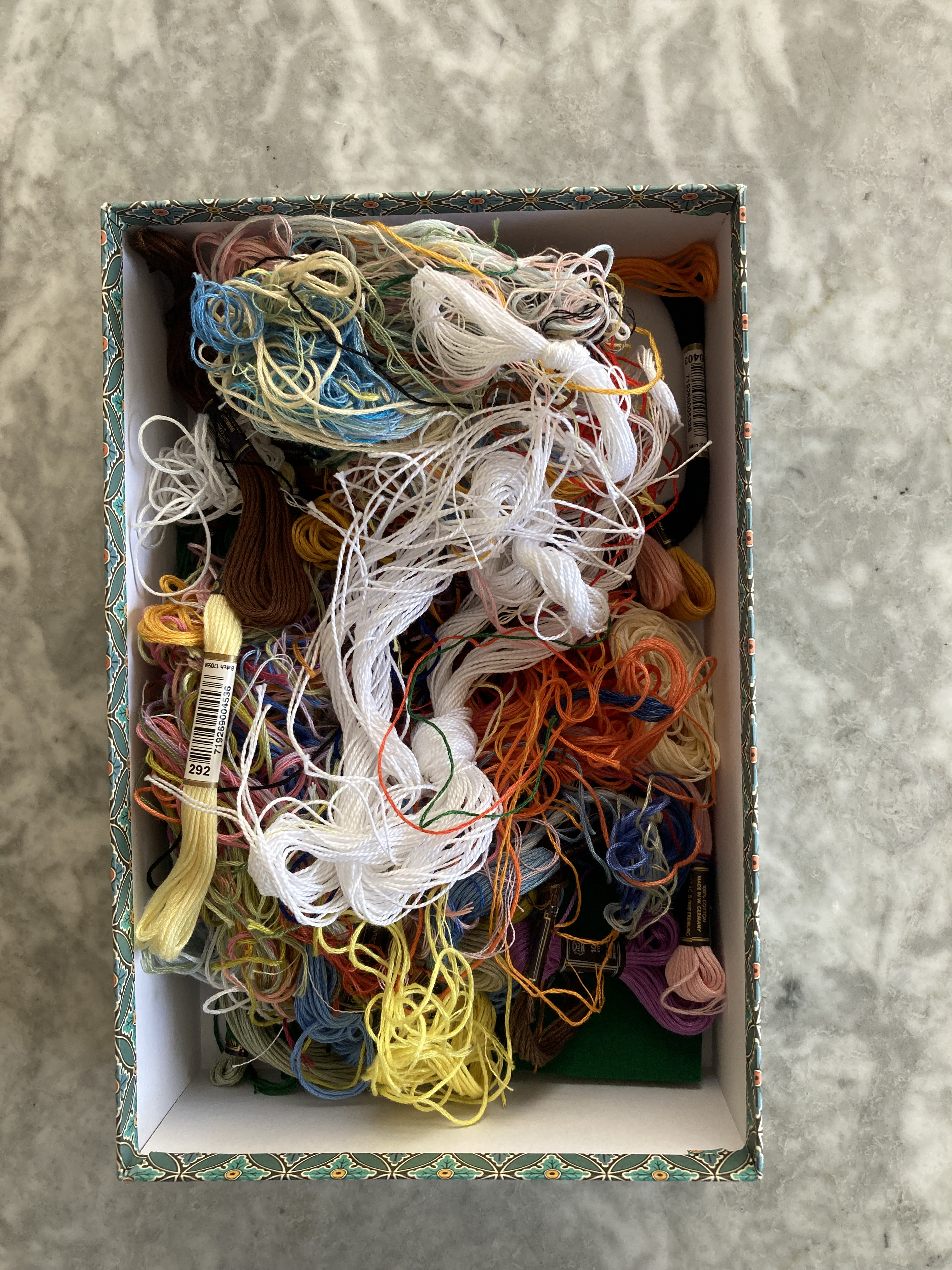
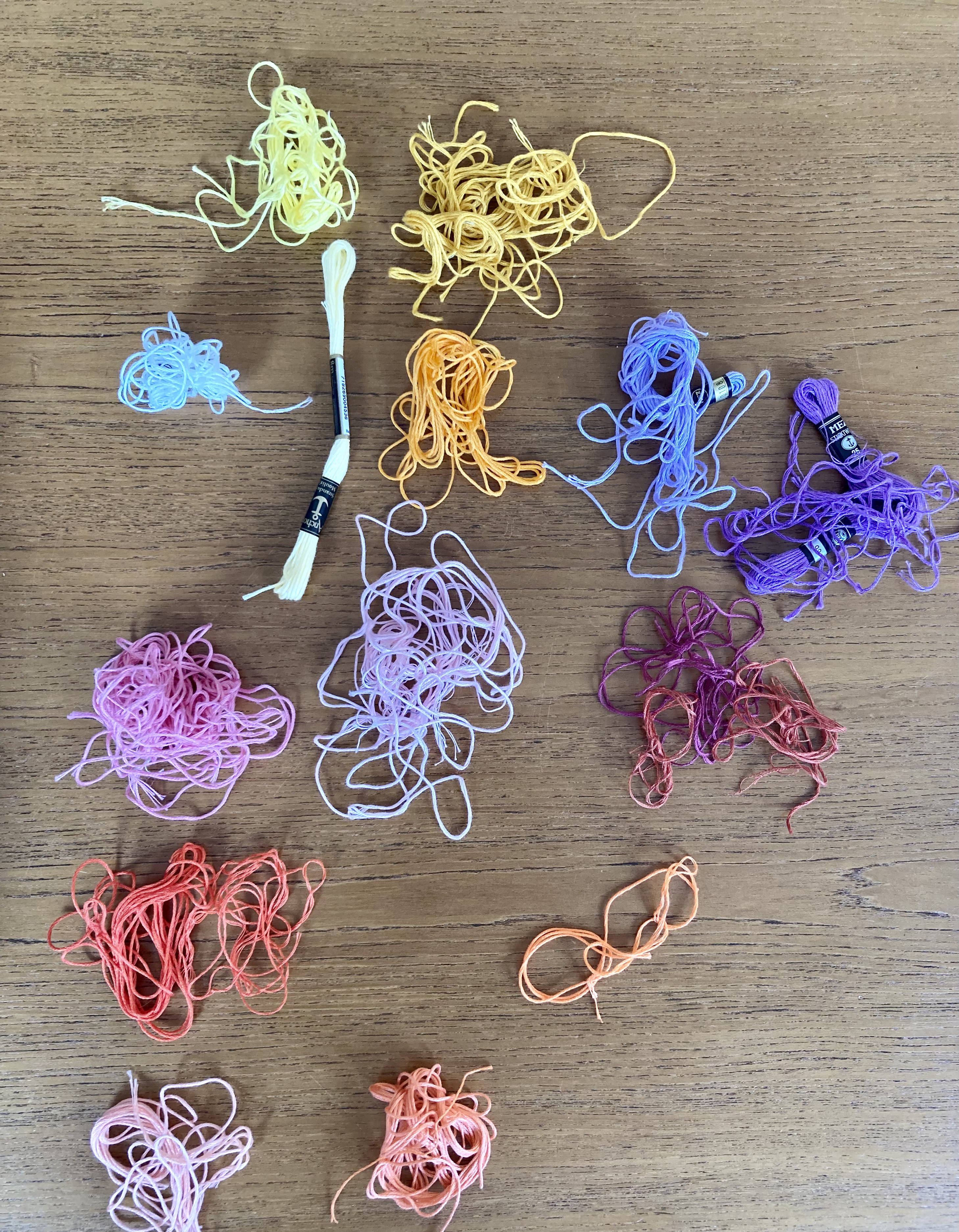
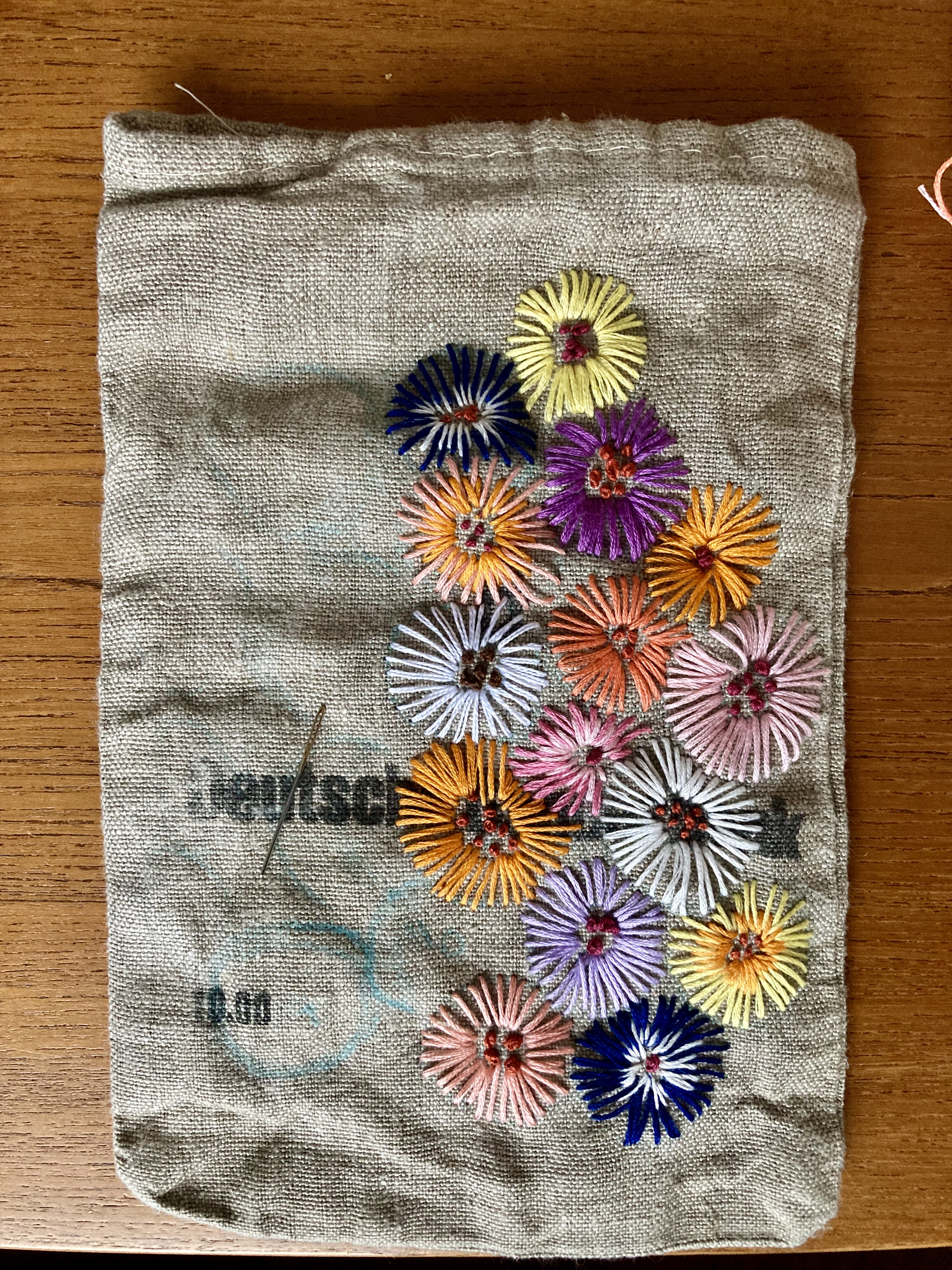
The flattish flowers with slender petals translate well to easy embroidery — the flowers are all worked in straight stitches, with French knot centres, and the little leaf details are loop stitches. I used scraps of cotton floss instead of wool, since the bag will be used and washed frequently. N.B. the tangled mess in the box of embroidery thread is not my doing! I inherited a big handful of embroidery cotton scraps from someone downsizing their elderly relative’s home. It proved very useful for this project, as I was able to match the colours from the pattern (white, maize, orange, mauve, violet, light pink, light magenta, magenta, spice pink, and plum, plus olive for the leaves) fairly accurately without having to buy anything new. Also, “spice pink” is listed in the materials section, but not included anywhere in the instructions. The colours in the photo are not accurate, either — what looks like sky blue and light turquoise is actually navy blue (my version of “violet”) and white.

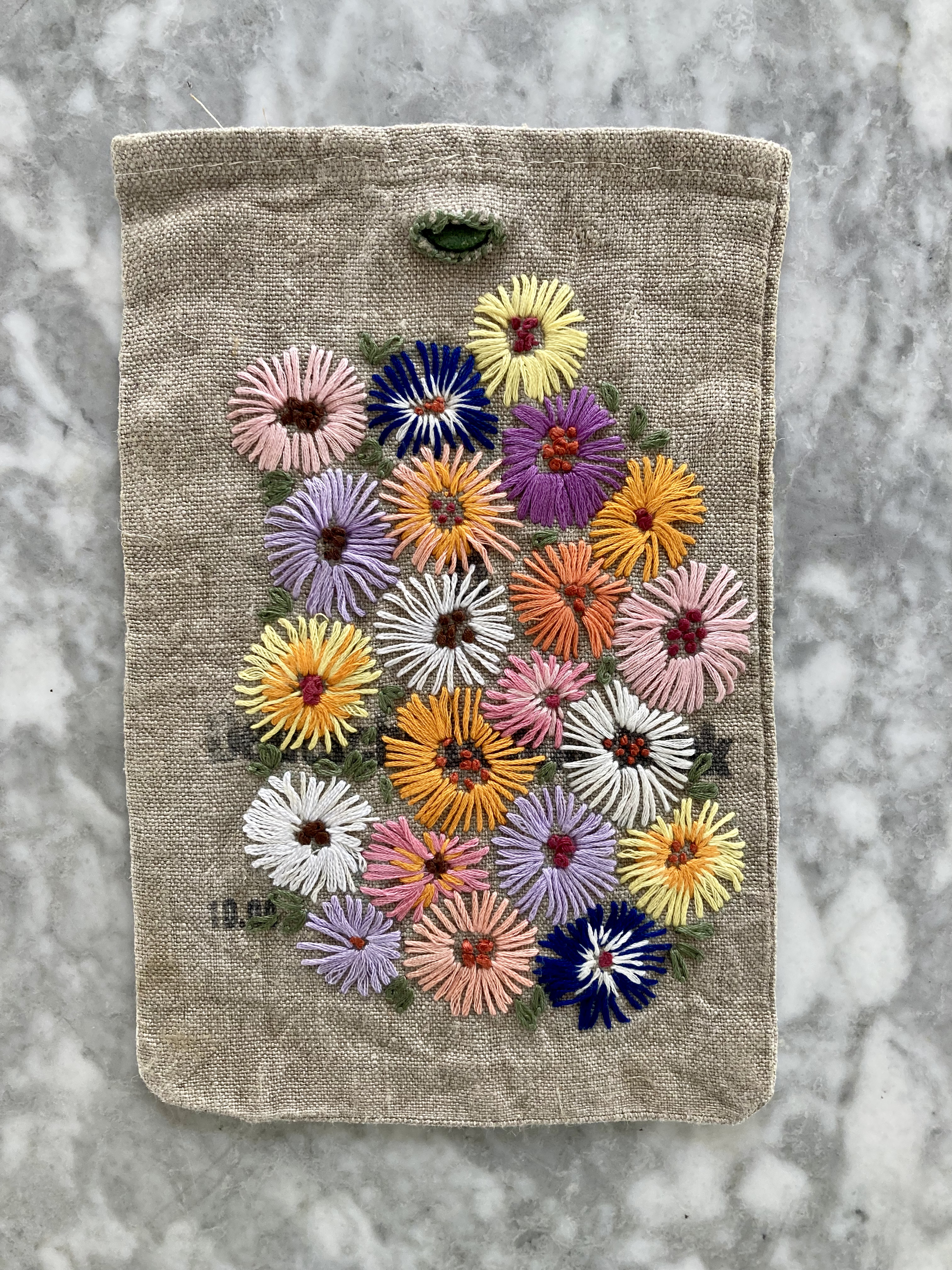
The positions and colours of the individual flowers are given on a separate page in the magazine, which was practical as of course I didn’t have (or would have been able to use) a transfer. I had to adapt it anyway to fit the rectangular bag, but kept to the schematic as well as possible. Looking back, I could have balanced it out better by making the second flower from the bottom on the left side purple or orangey-pink instead of white, but whatever. I used my approximation of “plum” plus a sort of brick orange and medium brown for the French knot centres, using up the colours I only had little bits of. I finished off the bag with a button — always nice to find a use for that interesting, but singular button from the 10-cent random button bowl.

And that’s it! This was the perfect upcycling project — I made something useful and sustainable from 100% re-used and/or vintage materials. I love using these bags and can’t wait to show this new one to the cashier at the organic supermarket who always takes a second to admire them. I should make the next one for her.

June 1966: Overview

Colour for High Summer! The trending colour in Stitchcraft’s June 1966 issue is turquoise, and “High Summer” means casual, easy knitwear in washable synthetic yarns for holiday travel. Let’s dive in!

The knitted fashions are high-necked but loose-sleeved, knitted mostly without shaping in textured stitch patterns. Our cover cardigan is made in turquoise “Courtelle” synthetic wool with a pattern made by increasing and decreasing in the same stitch to create a sort of flattened bobble over multiple rows. There’s a white pullover with a bold intarsia turquoise flower, a his-and-hers white cabled rib for seafaring holidays, or sporty numbers for playing tennis in a dress shirt and tie. The colourwork pullover is also made in turquoise and white, and the sleeveless men’s tennis top in blue.

For warmer days, there’s a heavy-knit, but sleeveless and lacy, “jaunty beach top”, or a choice of two pretty T-shirt tops. The basketweave-patterned top is also blue, and the diamond-patterned top in “Banana Cream” beige — the colour trends are very clear. The last two tops are made in finer, 3- or 4-ply wool, but also make use of synthetic yarns like the wool-nylon “Nylox” three-ply used for the basketweave top. You can complete the outfit with one of two crocheted hats: pillbox style or with a corded brim, both in heavy “Capstan” wool.

Children can enjoy their holiday in a striped play-shirt with matching “overpull” or a bobbled cardigan and pleated skirt (though the skirt, like so many fashions for little girls, is quite impractical for any kind of actual playtime.) The cardigan features an interesting two-colour pattern made by dropping a yellow stitch down three rows and picking it back up together with three white loops. Interestingly, the children’s patterns feature neither turquoise nor blue of any kind, but are made in bright yellow and white or more subdued stripes of grey and light red.

Homewares are fun and easy, starting with a knitted “World Cup Willie” car rug. The 1966 FIFA World Cup football (soccer) tournament was held in England in July 1966, and “World Cup Willie” was its official mascot. England won the trophy that year, beating West Germany in the final match 4-2, so I guess Willie was indeed a bringer of good luck. Personally, I am much more interested in the Stitchcraft model’s dress, hat and shoes than Willie or the World Cup — I want that entire outfit! The rug is made in heavy “Big Ben” wool and a sturdy moss-stitch pattern, with the “Willie” motifs worked in intarsia technique from a chart included in the magazine issue.

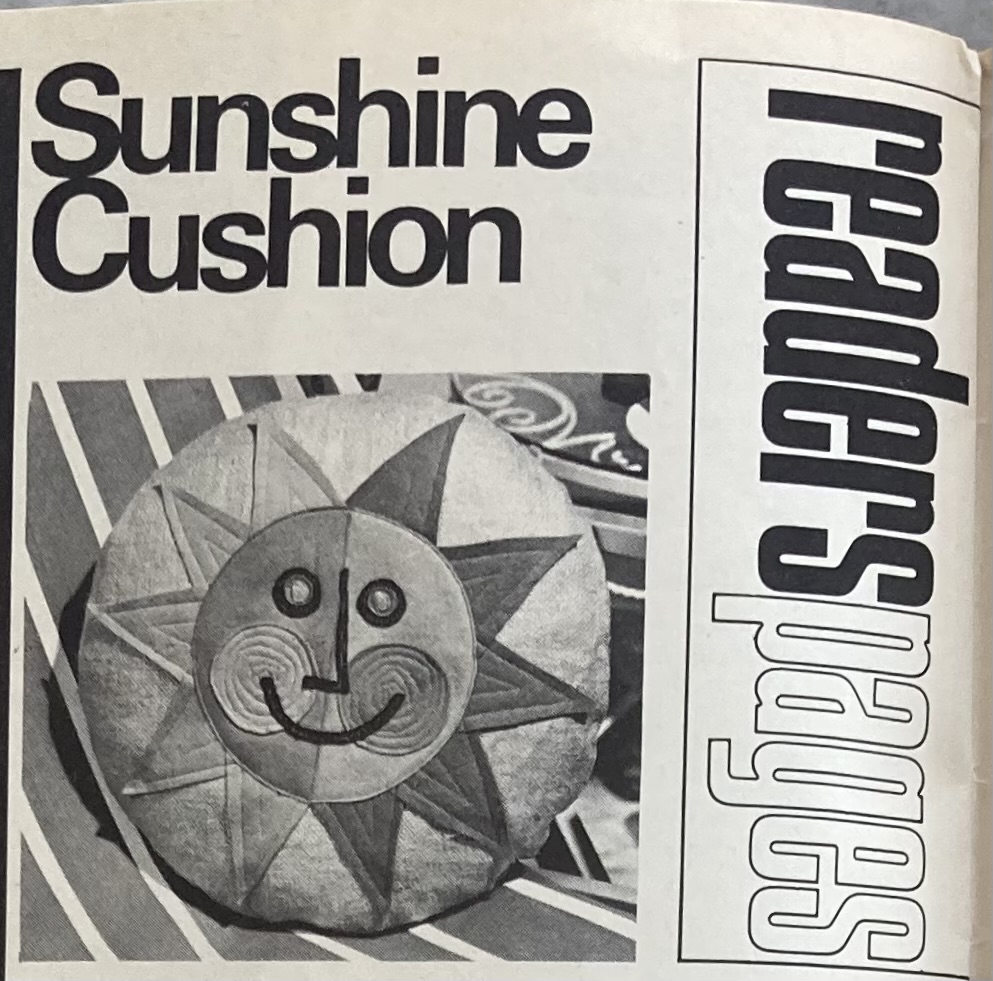
Moving on, there’s an embroidered wall panel to commemorate the 900th (plus a year) anniversary of the consecration of Westminster Abbey — we haven’t had a commemorative wall panel for a while, so that’s a nice plus. As always, there are chair-accessories and cushions, this time with delicate embroidered satin-stitch poppies in wool on linen, or a very 1960s happy smiling sun worked in felt on Hessian/burlap fabric for tough use in the garden.

You can also make a beach bag from towelling material gathered with “Rufflette” curtain tape, or sew an easy sundress for a small child — basically a big rectangle of fabric gathered and sewn at the shoulders — and embroider a lucky fish on the pocket. Speaking of lucky fish, how about this masterpiece of 1960s advertising copywriting that accompanies a photo of a woman “caught” in a fish net? It’s all happening at your local Scotch Wool Shop.

That’s all for high summer! My project will be the sunny garden cushion, and possibly also the basketweave top.

May 1966: Cushion For the Nursery

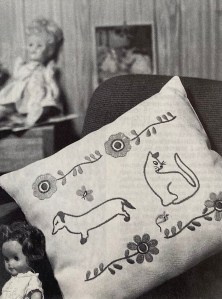
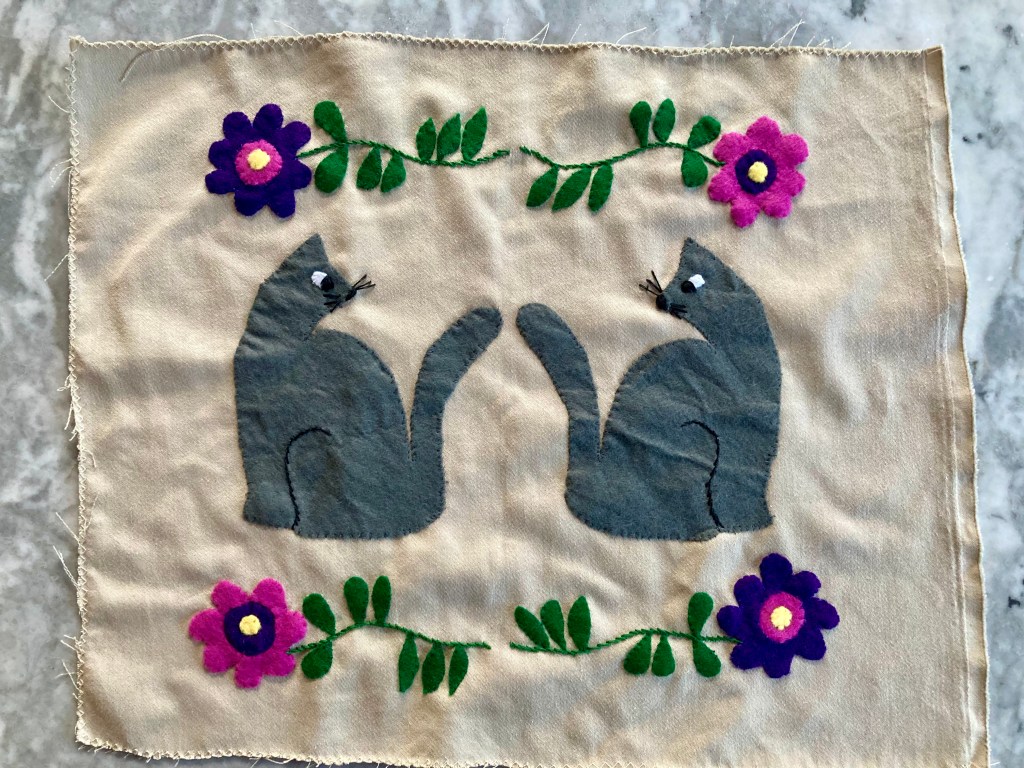
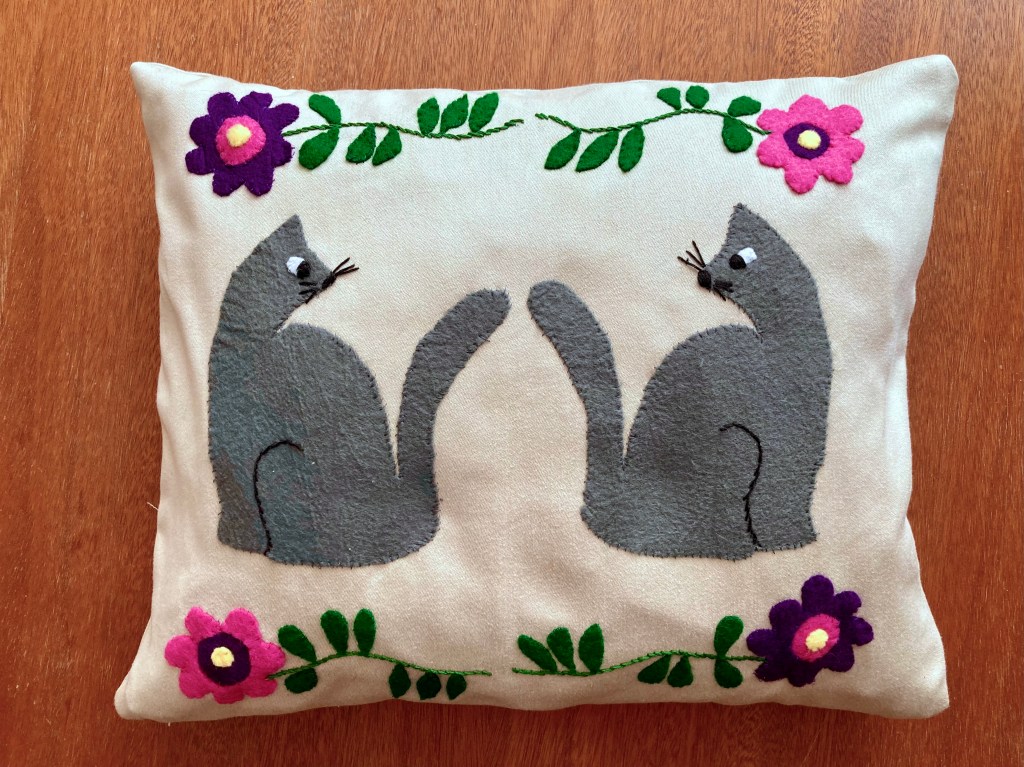
My May 1966/May 2024 project was based on an adaptable project “for the nursery” featuring cute little animals and flowers. The pattern as offered in the magazine could be used to make either a wall hanging in felt appliqué, or a cushion in wool embroidery. I chose to use elements of both designs and made a cushion in felt appliqué.

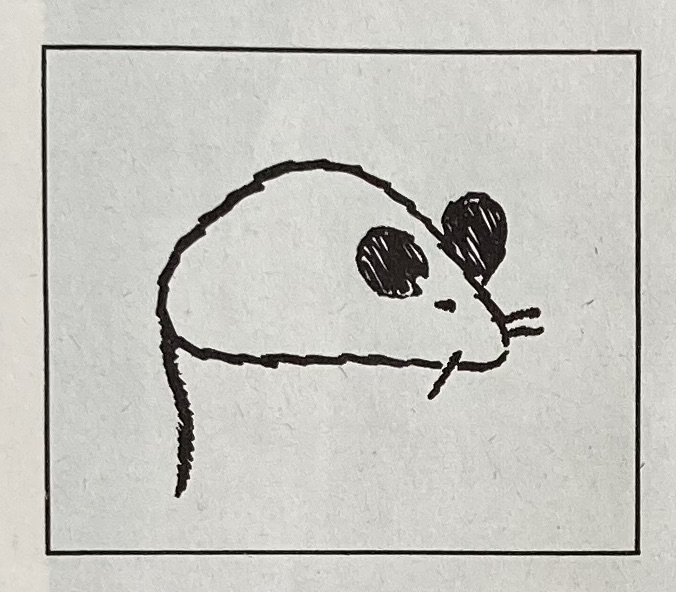
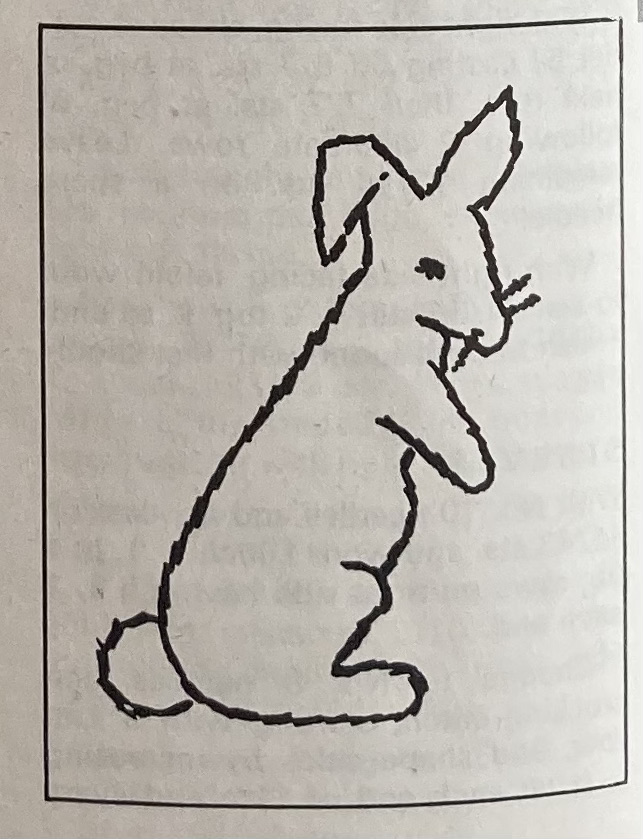
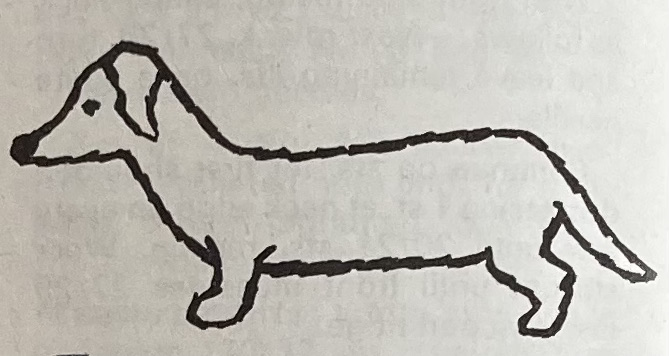
As always, the transfer was not included in the magazine — readers had to send 1/10d to Stitchcraft and received the transfer post free by mail. Obviously, that would not work now, as Stitchcraft is no longer published. Happily, the animal and flower shapes are quite easy to copy and individual illustrations of the dog, bunny and mouse are printed in the magazine.

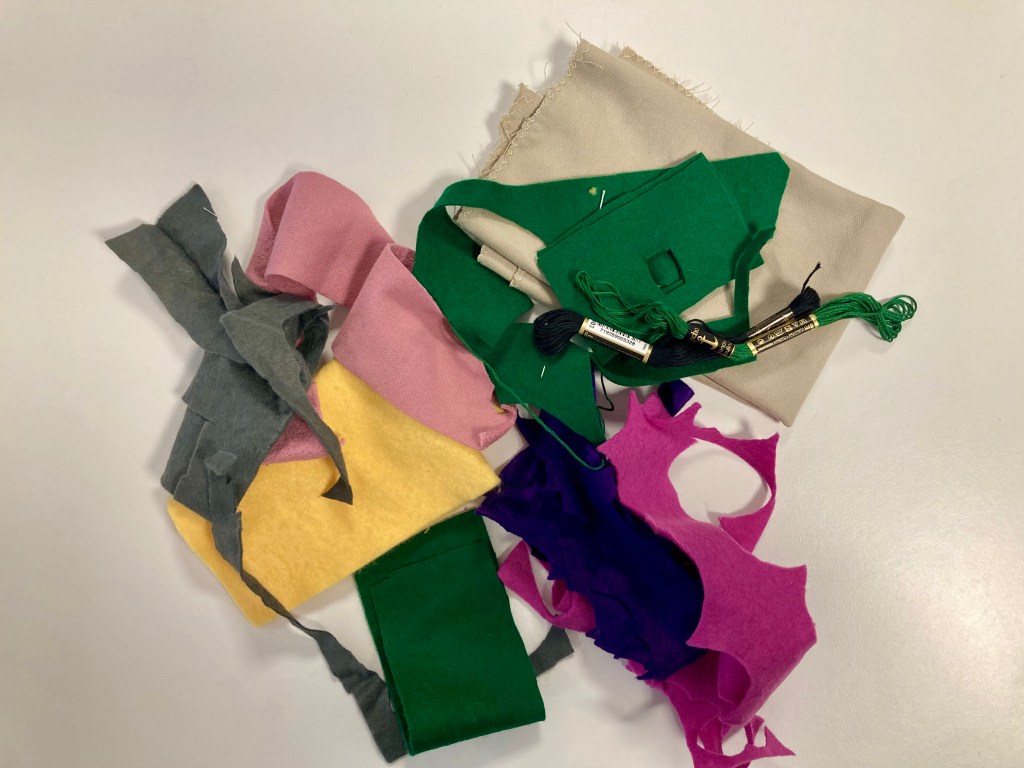
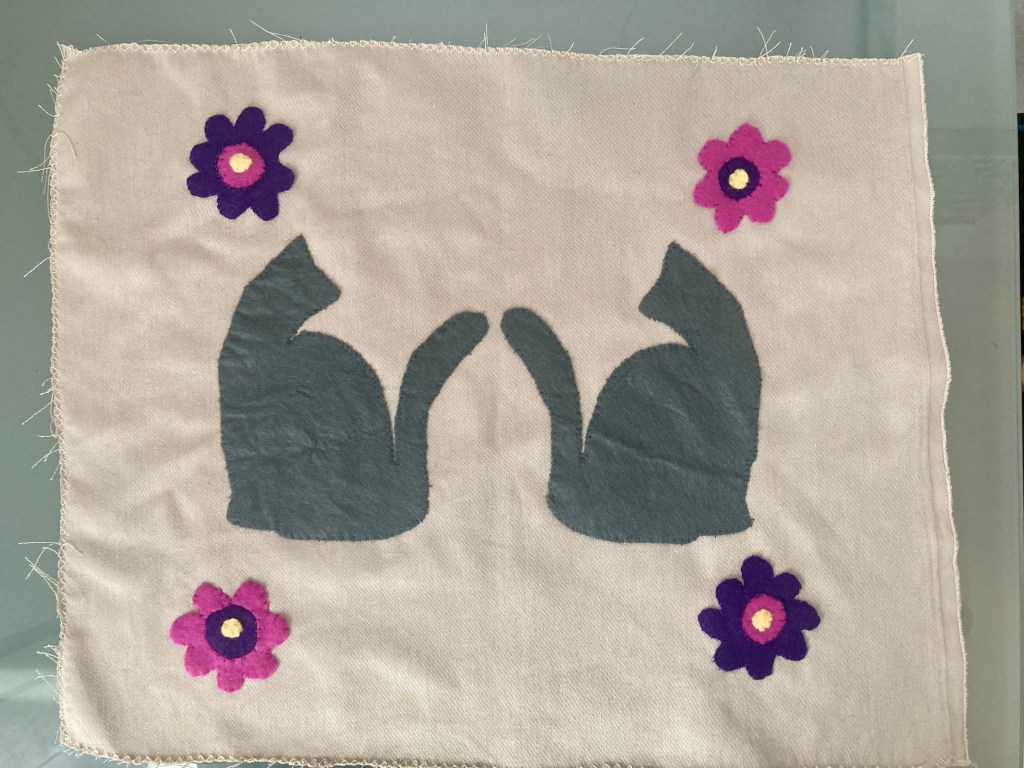
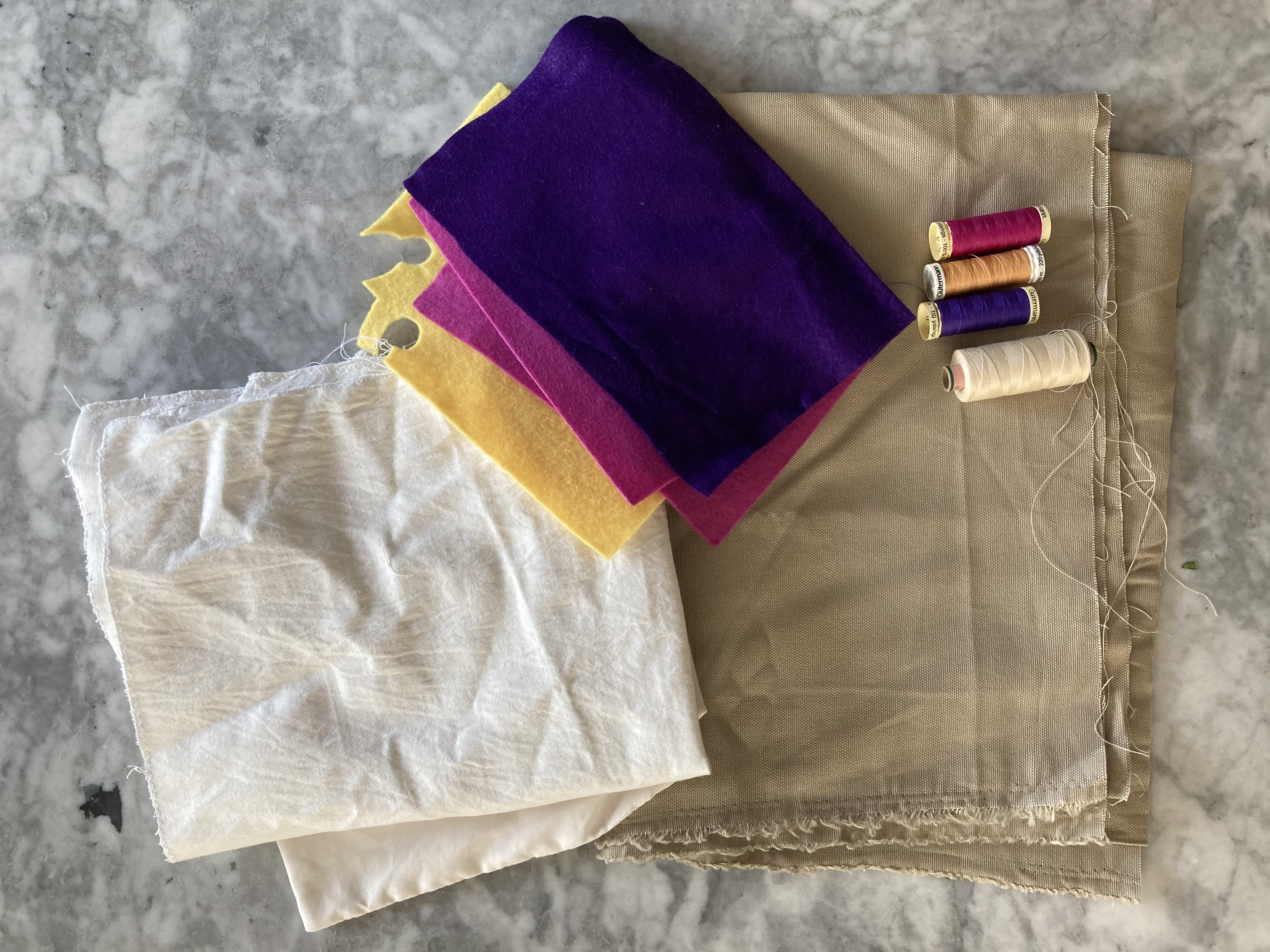
Both the appliquéd animals in the wall hanging and the embroidered outlines on the cushion are intended to be made with non-realistic colours (the rabbits are blue and magenta, the donkey gold, the cat jade green, the dachshund magenta, and the mouse bright pink). I chose more realistic colours based on what I had in my felt-scrap stash, and I like cats, so I made two grey cats looking at each other over their shoulders. I had enough purple, magenta and yellow felt left over from the last appliqué cushion I made to make the flowers. I made the cushion cover itself in a natural-coloured linen, as intended in the pattern, and the inner cushion in leftover white and beige fabric from other projects.

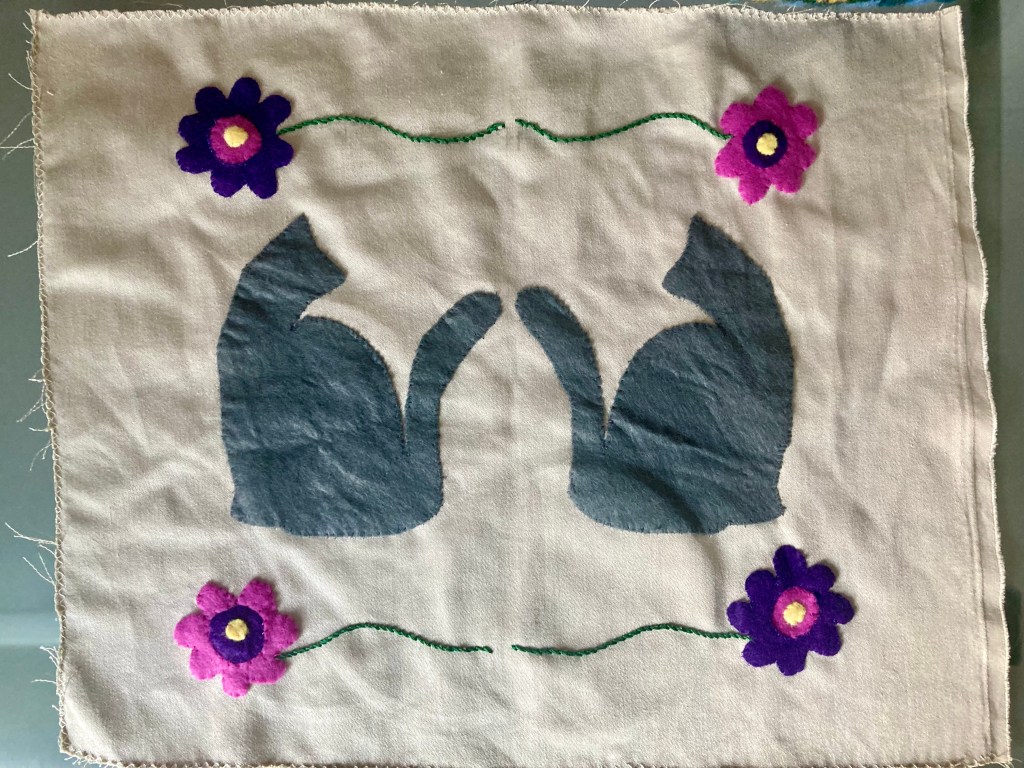
The appliqué work was quite easy and pleasant, even the tiny leaves of the flowers. The flower stems are embroidered in stem-stitch. I was nervous about making the cat’s eyes (white felt embroidered in black) as the expressions can be very tricky, but I think they turned out quite nicely. Since I was on the road for most of this project and didn’t always have access to my sewing machine, I put in the zipper by hand, which worked out fine.

And there it was! I love making cushions and would make more of them if I knew what to do with them after they were done. I have more cushions than space already for myself, and this particular design, although extremely cute, is a bit childish even for my playful decorating style. Luckily, I have friends with small children, and this cushion will go to one of them, who is currently decorating her three-year-old’s room. I hope he likes it! I am certainly quite happy with my happy cat cushion and I think he will be too.

April 1966: Knitted Lamb

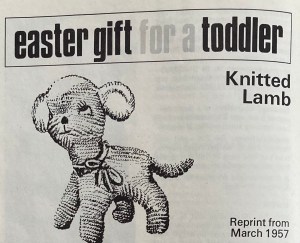
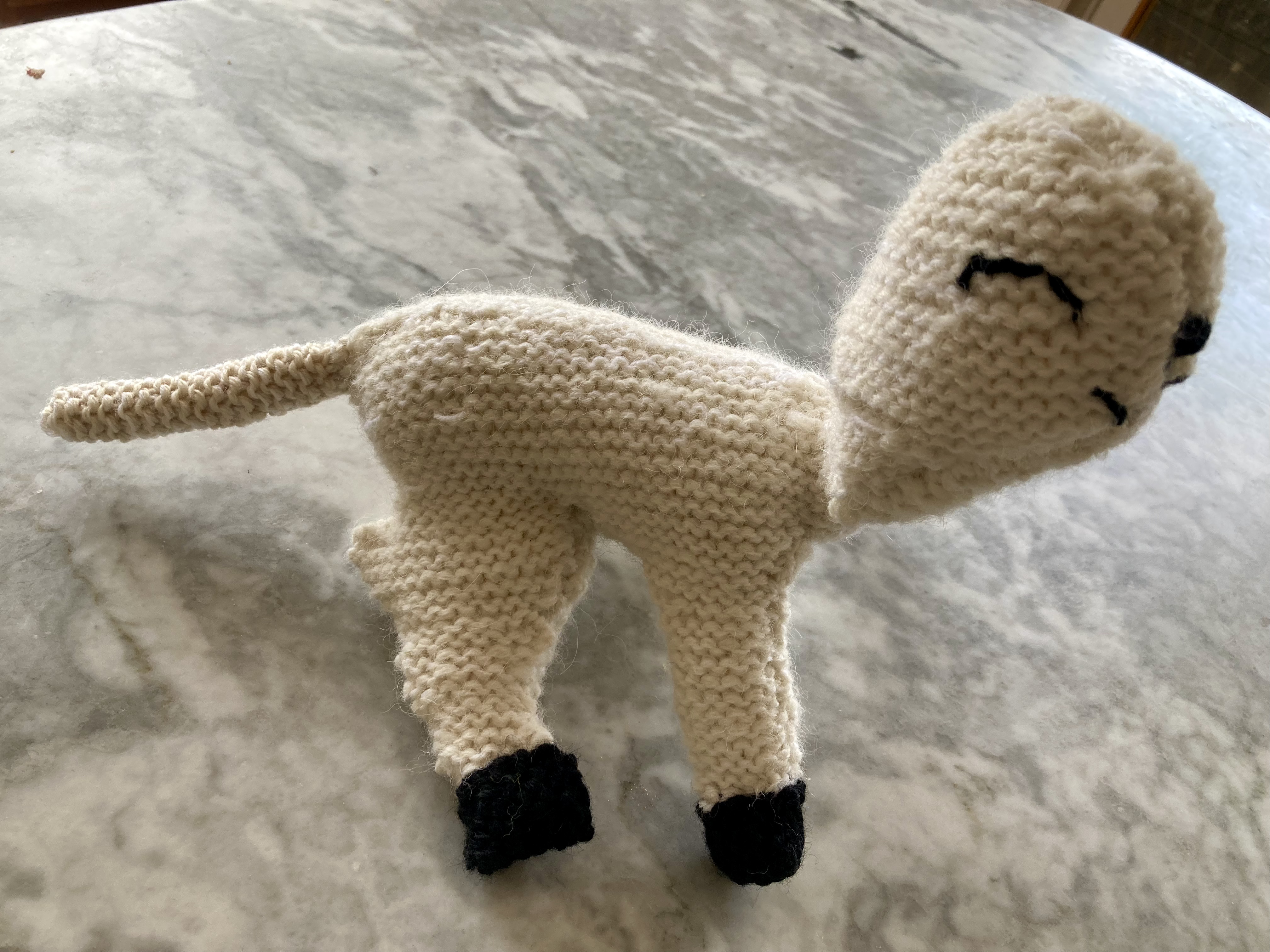
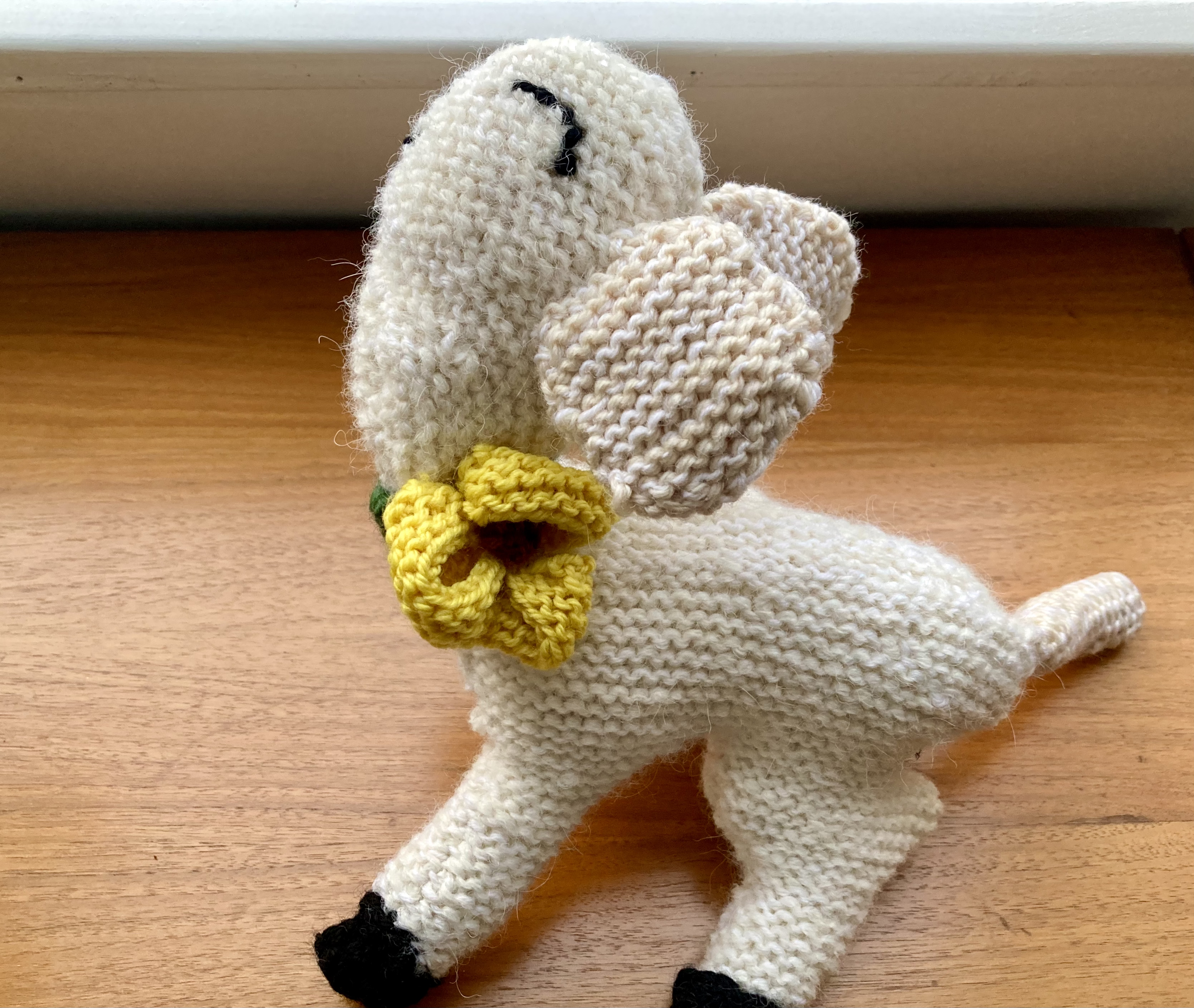
My Stitchcraft project from the April 1966 issue was actually a reprint from the March 1957 issue: a knitted lamb as an “Easter gift for a toddler.” Knit a little lamb for your knitting friend who is about to have a baby, they said. It will be fun and cute and use up leftover bits of wool, they said…

My first clue should have been the fact that there is no accompanying photo of the finished lamb in the 1966 issue. Either the original issue didn’t have a photograph (I don’t have the 1957 issue in my collection) or they just didn’t reprint it along with the pattern, since the latter version only has a drawn illustration. Why would the editors not want to show a lovely photograph of the lovely finished knitted lamb? Why indeed?

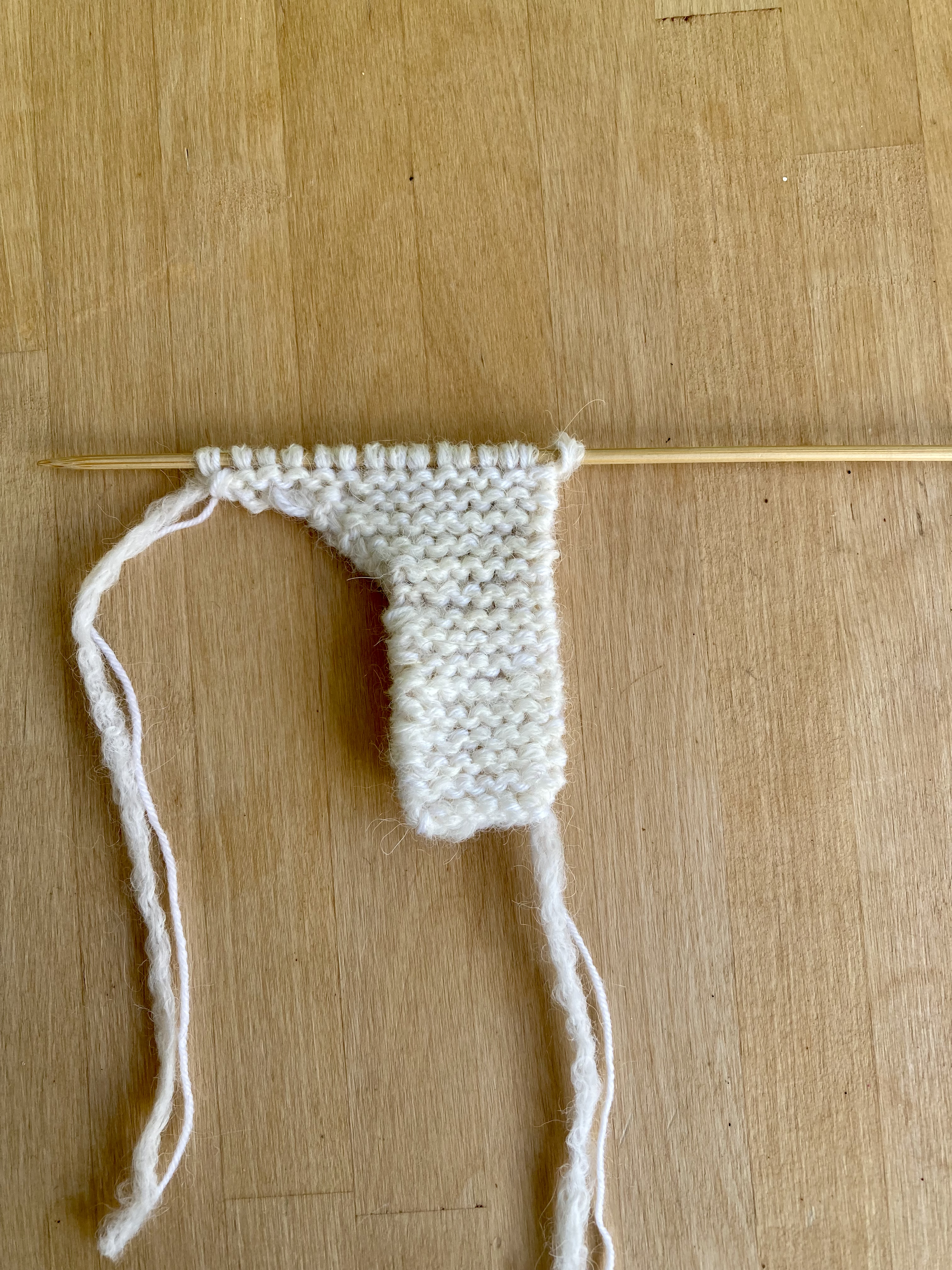
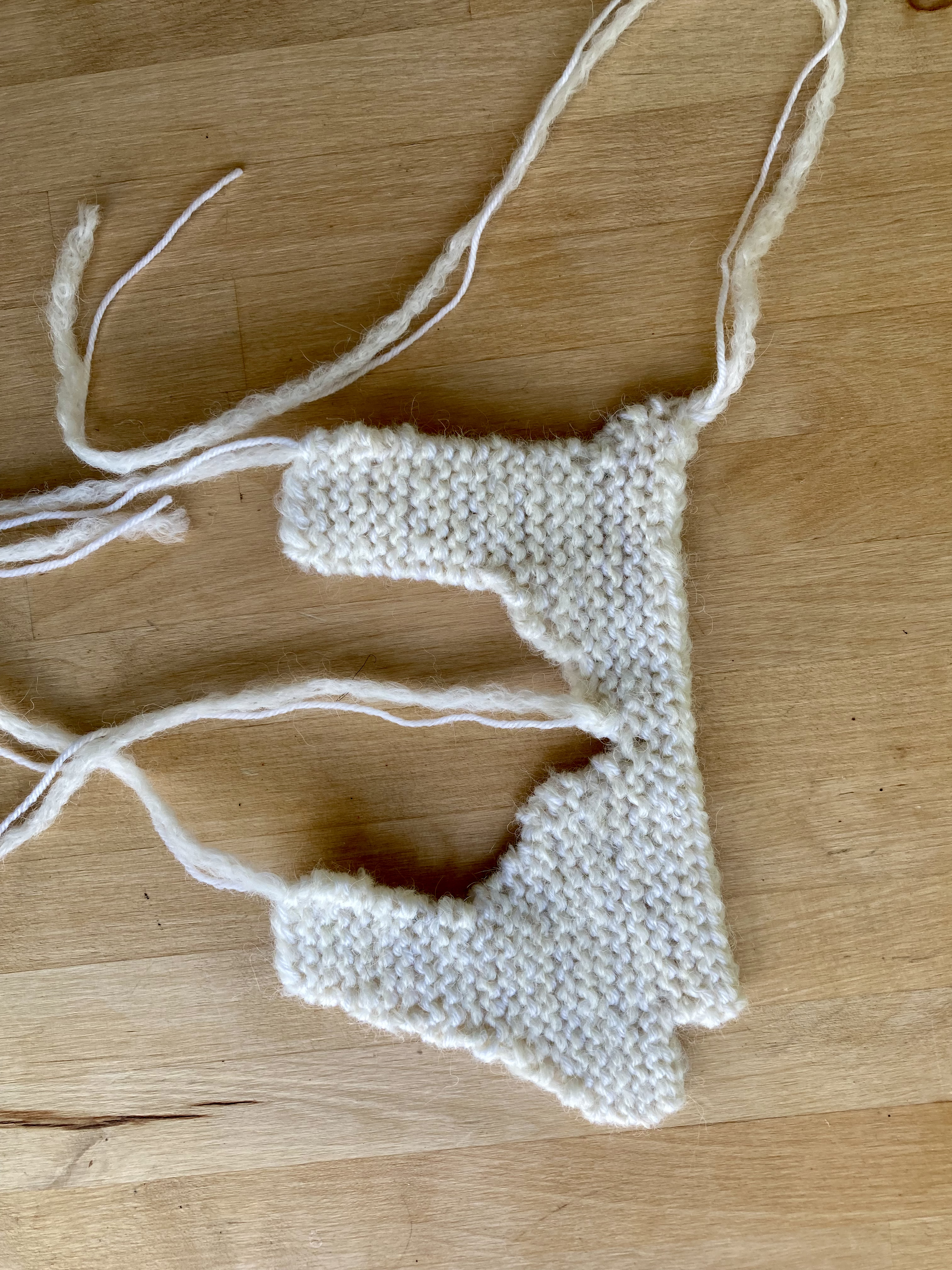
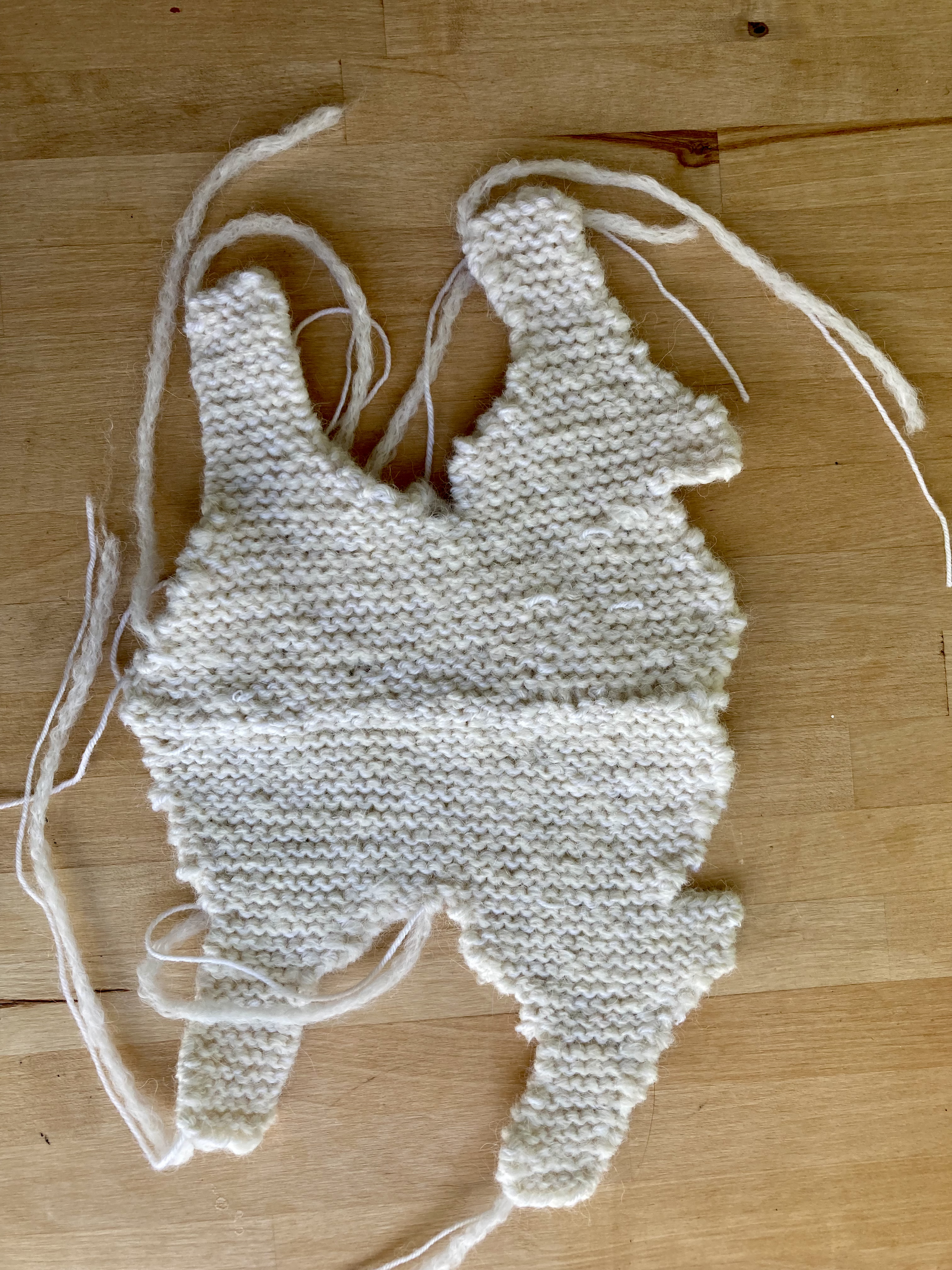
I admit the next step was “my fault”. Since the pattern called for 4-ply yarn held single, and I mostly had fluffy DK-or-thicker alpaca left over from the tot’s coat in February, I chose to adjust the stitch counts for a stitch-per-inch gauge and try to make the lamb turn out the same size as in the pattern. I did the math correctly, but I suspect something may have been off in the row gauge . The pattern starts with the legs and the main body (top part) in multiple pieces (1/2 each of back and front leg) and involves a complicated series of increases and decreases for the shaping. The “corner” on the back legs seemed odd to me, but I know I followed the pattern. Surely it will all come out right when sewn together, I told myself. After all, I successfully grafted the top back “spine” instead of sewing it! Obviously I was good at this! And it did pretty much look like a sheep’s pelt when laid out flat.

The next piece in sequence is the under-body, which is almost the same as the top, just shorter/narrower. I sewed it to the main body as instructed and stuffed it well, as instructed. The back legs were longer than the front ones, and what was with those weird “hocks” now? Shouldn’t they be sort of… attached to the rear end of the animal instead of just hanging off into space?

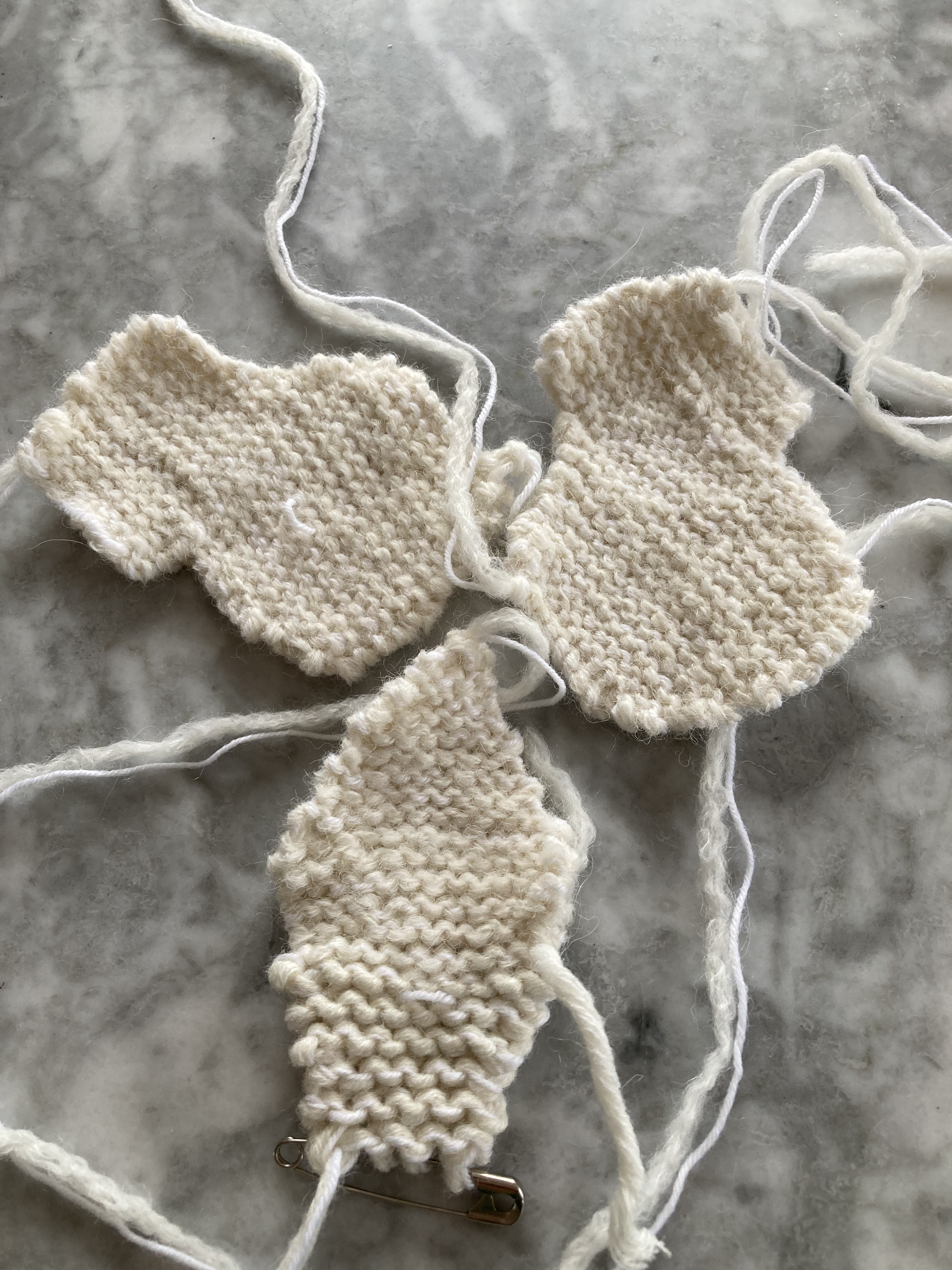
No matter, I made hooves. I guess the hooves were fine. Then the head, which was made in three parts: two sides and the “head gusset” for the “chin” and neck. I sewed them together as instructed, and it looked like Frankenstein’s lamb. The head was … not as round as in the illustration, and the neck strangely proportioned. Had I done the math wrong? Was it supposed to fit onto the opening of main and under-body? It didn’t really, but I persevered.

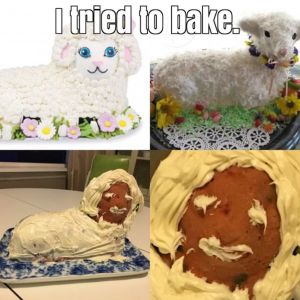
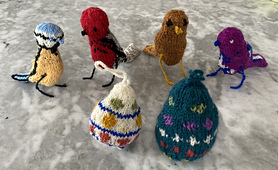
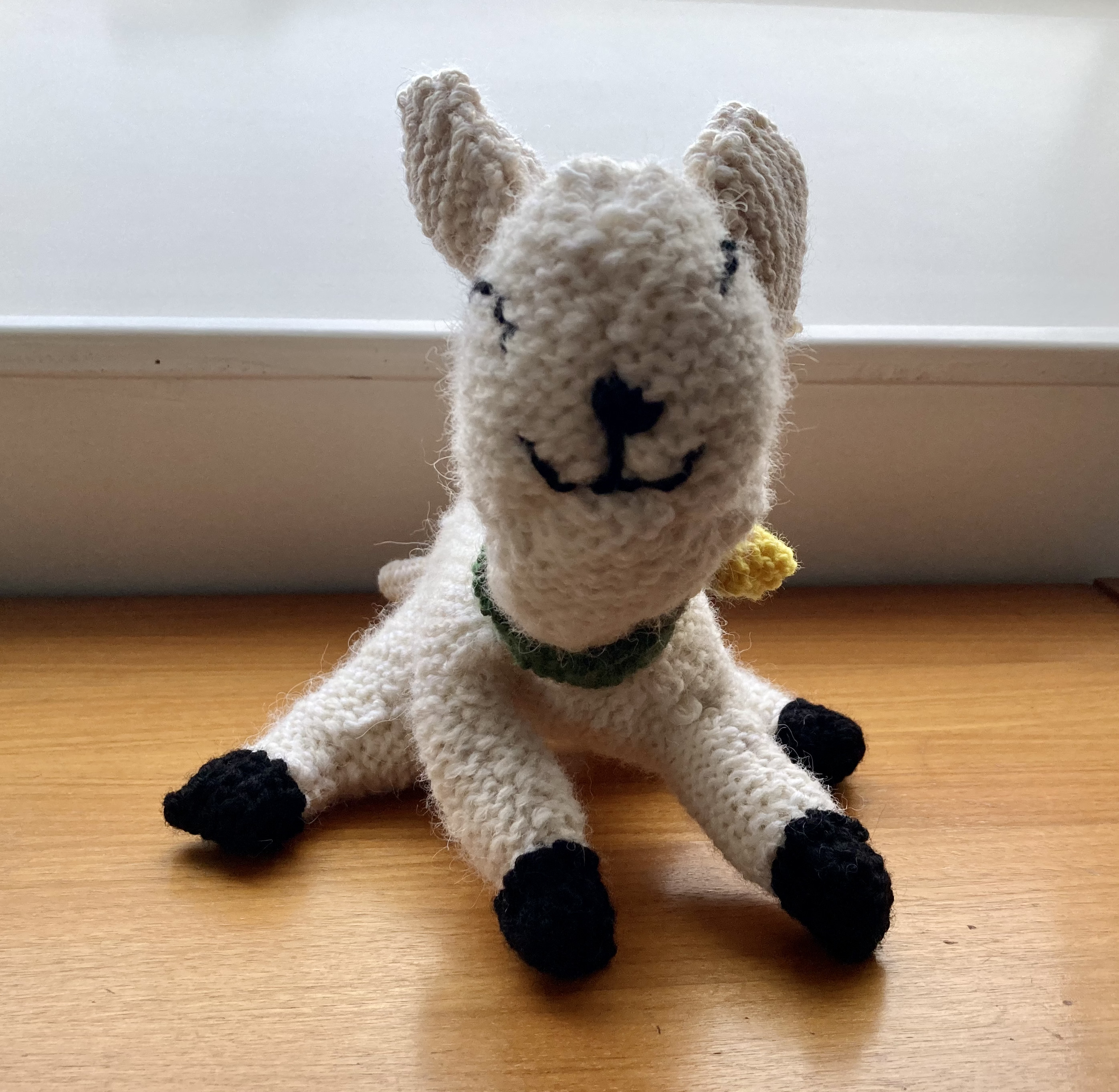
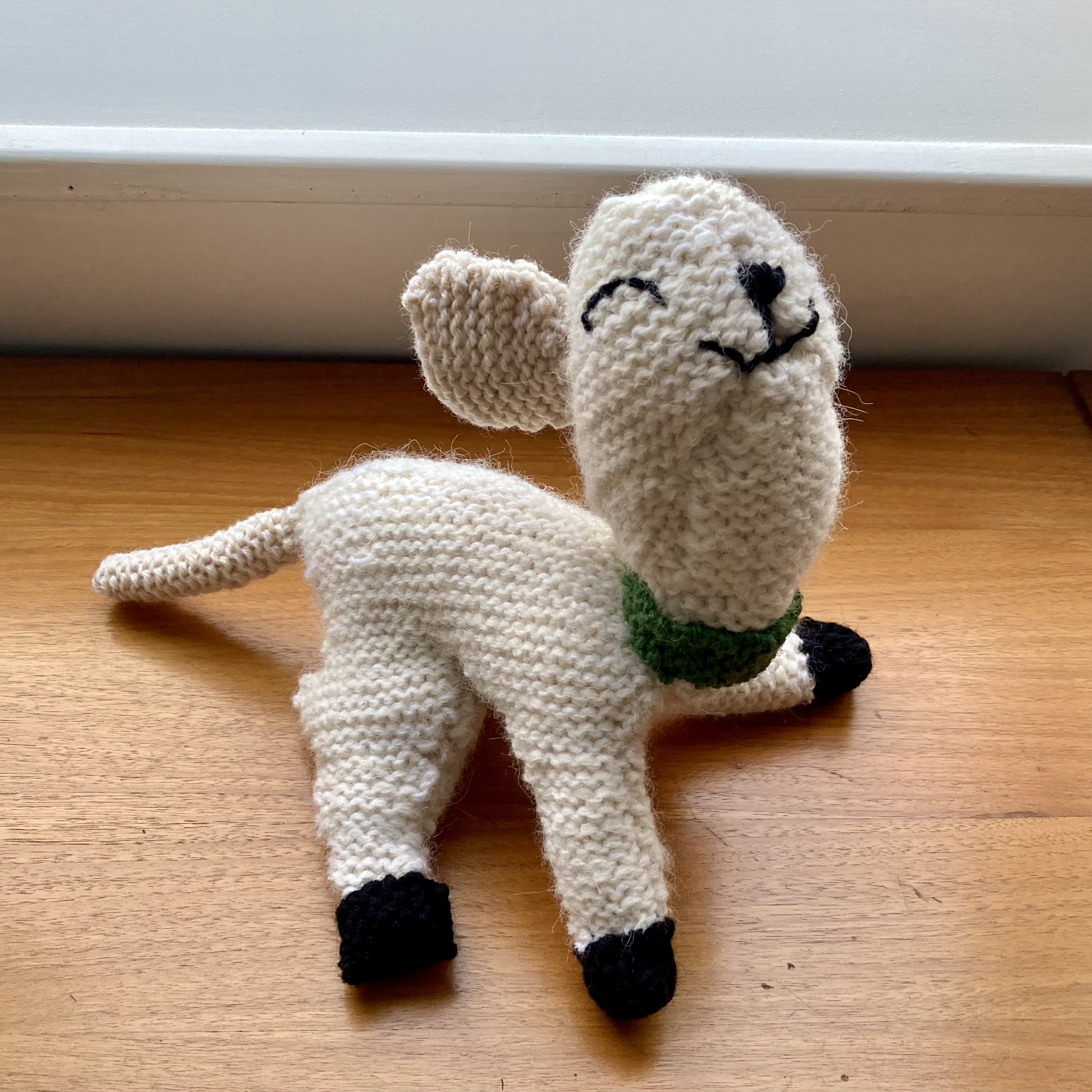
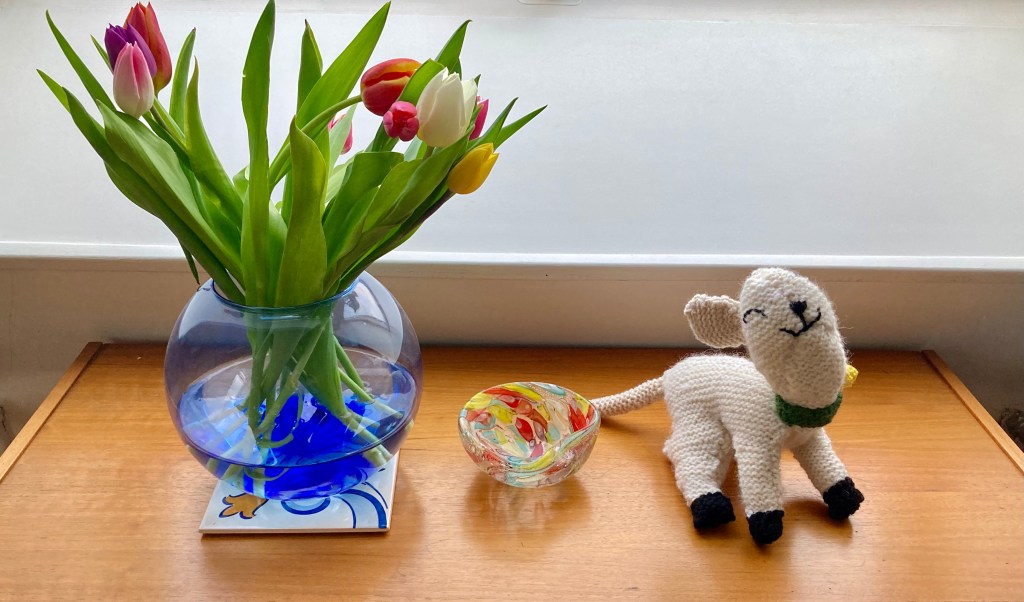
Eyes. The lamb needed to have eyes, as well as a symbolic nose and mouth. This was the part I had been dreading. Ever since I tried to knit some decorative stuffed birds that ended up looking sad, psychotic and/or dead (see photo), I have been afraid to embroider eyes on a toy. The eyes in the illustration look like the lamb is rolling its eyes in high annoyance (at all the knitters who fail at embroidering faces, no doubt.) Not wanting to even attempt that, I had the brilliant idea to make “closed” eyes. Just a little upside-down “u” and a smiling mouth! Hurrah, it worked! Little Lamb is so happy not to have been eaten for Easter supper!

Side note, marijuana was legalised in Germany on Easter Monday, one day after I finished this lamb. Perhaps the lamb was celebrating early. In any case, it’s really, really happy.

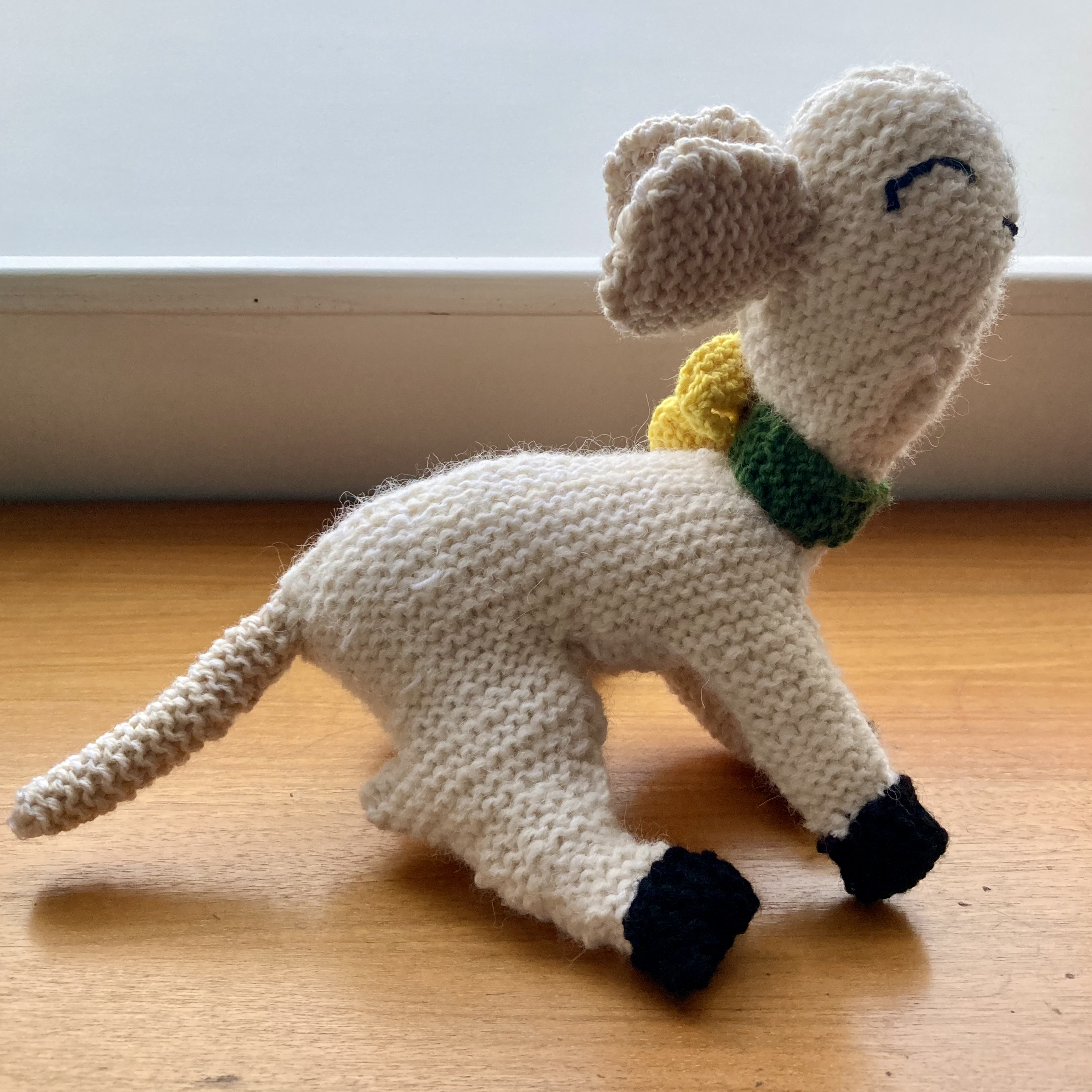
At this point I was torn between giving up entirely or just seeing it through. Oh, and I had also run out of the alpaca yarn, so when I decided to just roll with it and finish the project, I switched to some mystery something that was also sort of off-white for the ears and tail. The ears looked nothing like the ears in the illustration, but I was getting used to that by now.

I sewed all the bits together and strangely, the head stayed up by itself. And the lamb could almost stand on its own, depending on what position you bent it into and how widely the legs were splayed out. (I do feel like that’s kind of accurate as to how real lambs look when they learn to walk, says the person who has never lived anywhere near the countryside or raised sheep.) The lamb’s “necklace” as given in the pattern was a complicated bit of braiding, knotting and embroidery, to which I said “nope” and made a little green collar with an easy yellow flower instead. (Thank you, Frankie Brown, for writing and publishing a great pattern for the flower. I donated to the Children’s Liver Disease Foundation and can promise you that I am not going to try to sell this lamb!) Luckily, the collar conveniently hid the awkward seams at the neck. Otherwise I would have had to go full Frankenstein and put in some screw-bolts.

And there it was! Behold the finished lamb, in all his / her / its glory. It is so wonky. The more you look at it, the more weirdness you see. But also, the more you look at it, the happier you feel. I love this lamb so much and challenge all of you to look at it and not feel happy with me. I almost want to keep it for myself instead of giving it to the baby… Maybe it can stay with me just a little while longer?

May all your imperfect projects bring you such joy.

July 1965: “Pansies” Garden Cushion

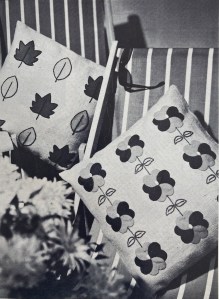
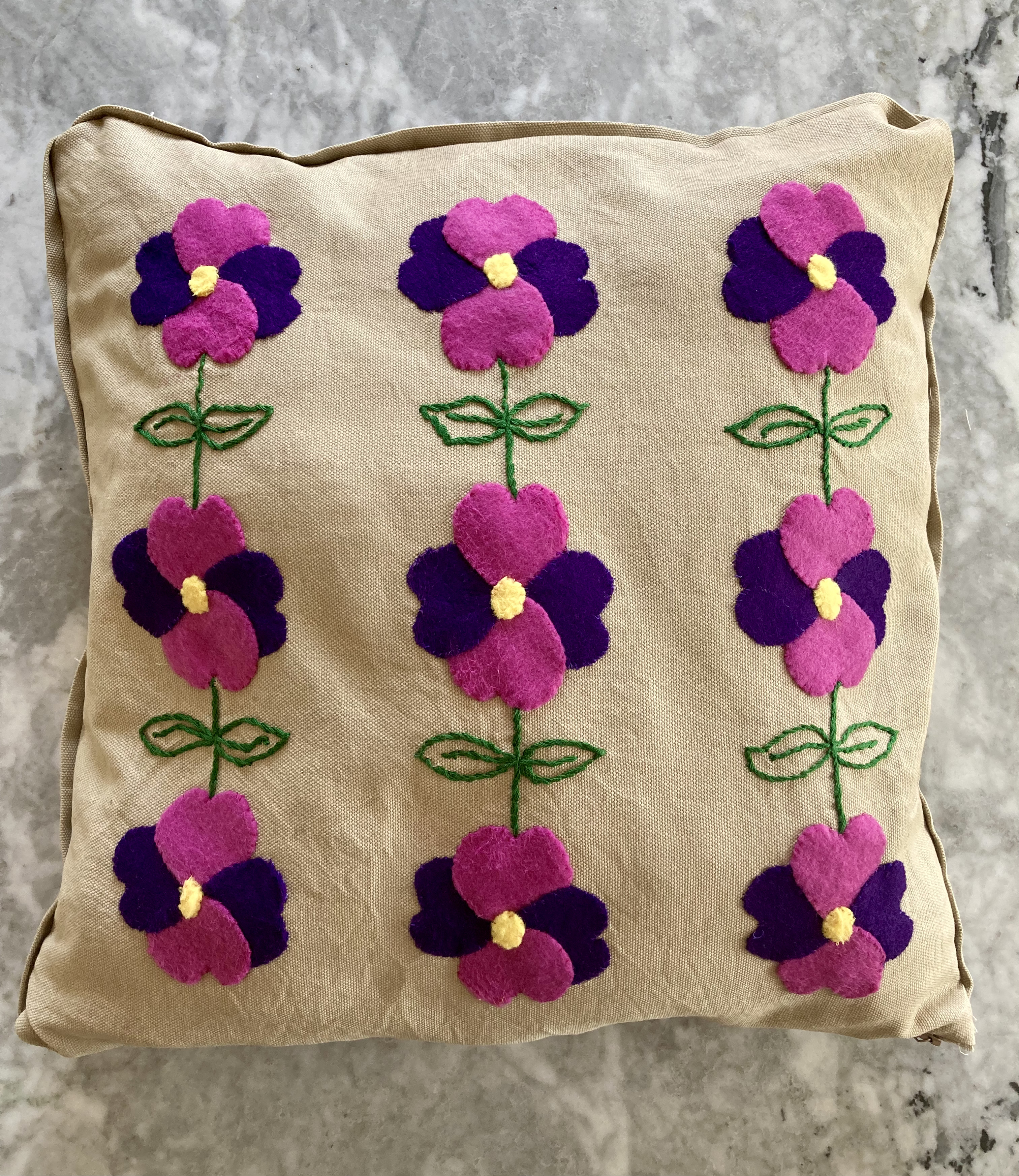
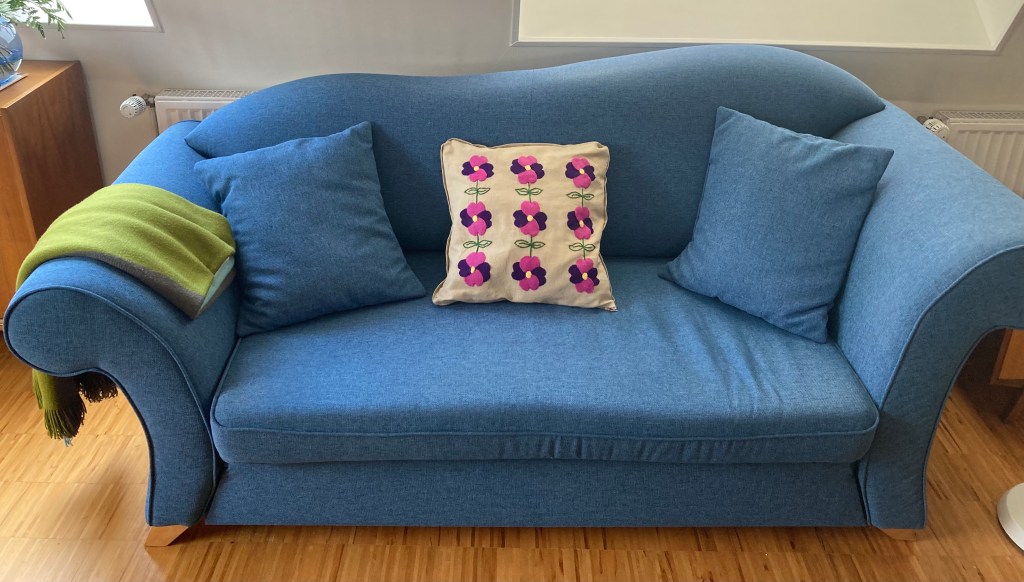
This month’s project was an appliquéd and embroidered cushion. Or, as the description in the magazine put it:

Attractive appliqué cushions in hardwearing hessian add a gay touch for garden lounging — ideal for deckchair comfort or to use on the lawn. Children will love them too, and they are tough enough to stand up to the rough-and-tumble of garden play.

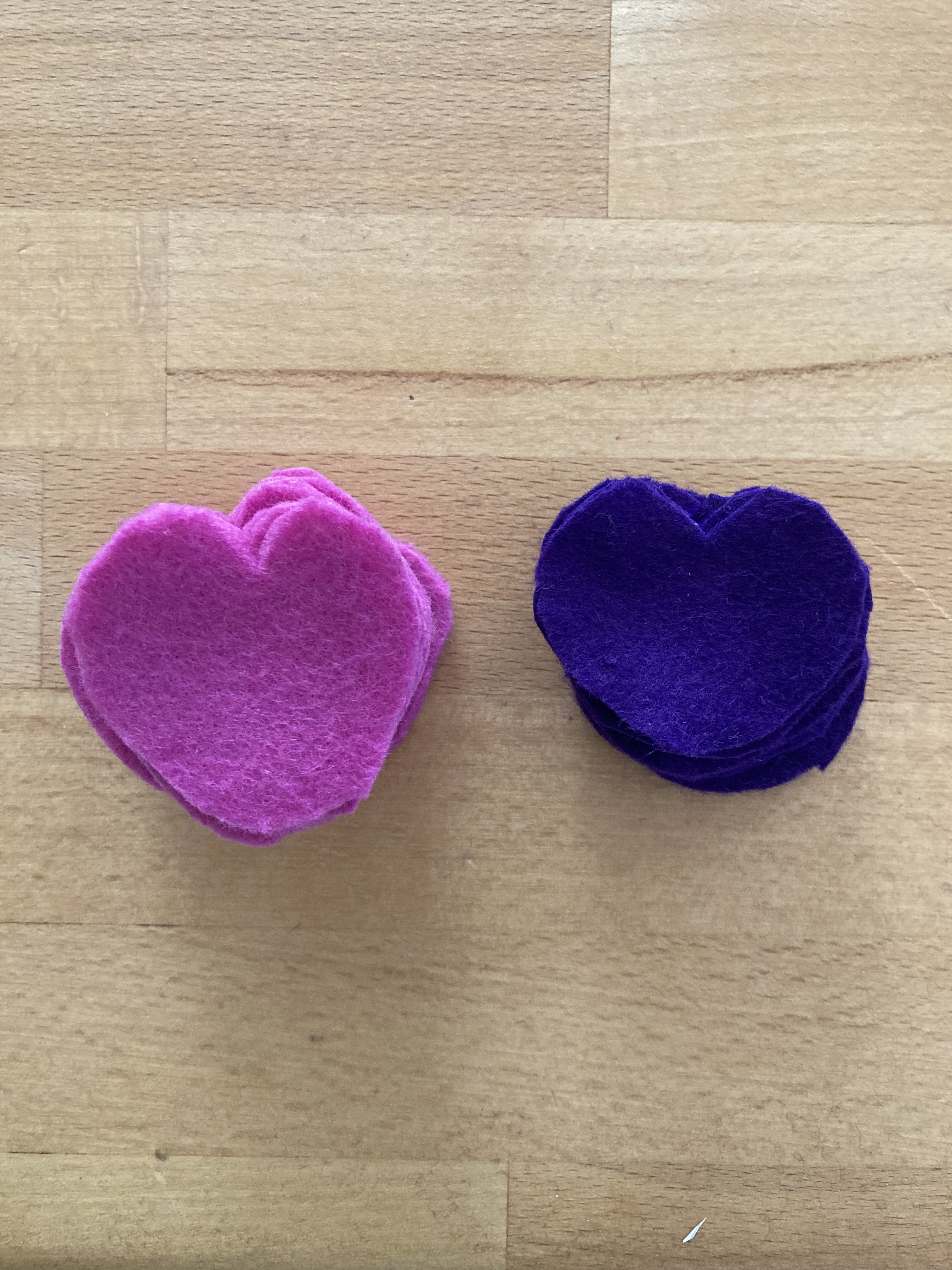
Two cushion designs are given, one with autumn leaves and one with pink and purple pansies. I chose the pansies, which were bright and fun and very 1960s. As luck would have it, I had exactly the right amount of pink and purple felt in stash, and almost enough green embroidery thread for the stems and leaves, so I didn’t have to buy many materials and could use the project to de-stash. I did have to buy the backing fabric, and decided on a tough decorating/upholstery cotton instead of real Hessian fabric (aka burlap, jute, gunny-sack), since I don’t think this cushion will be subjected to any “rough-and-tumble of garden play” on my friend’s balcony.

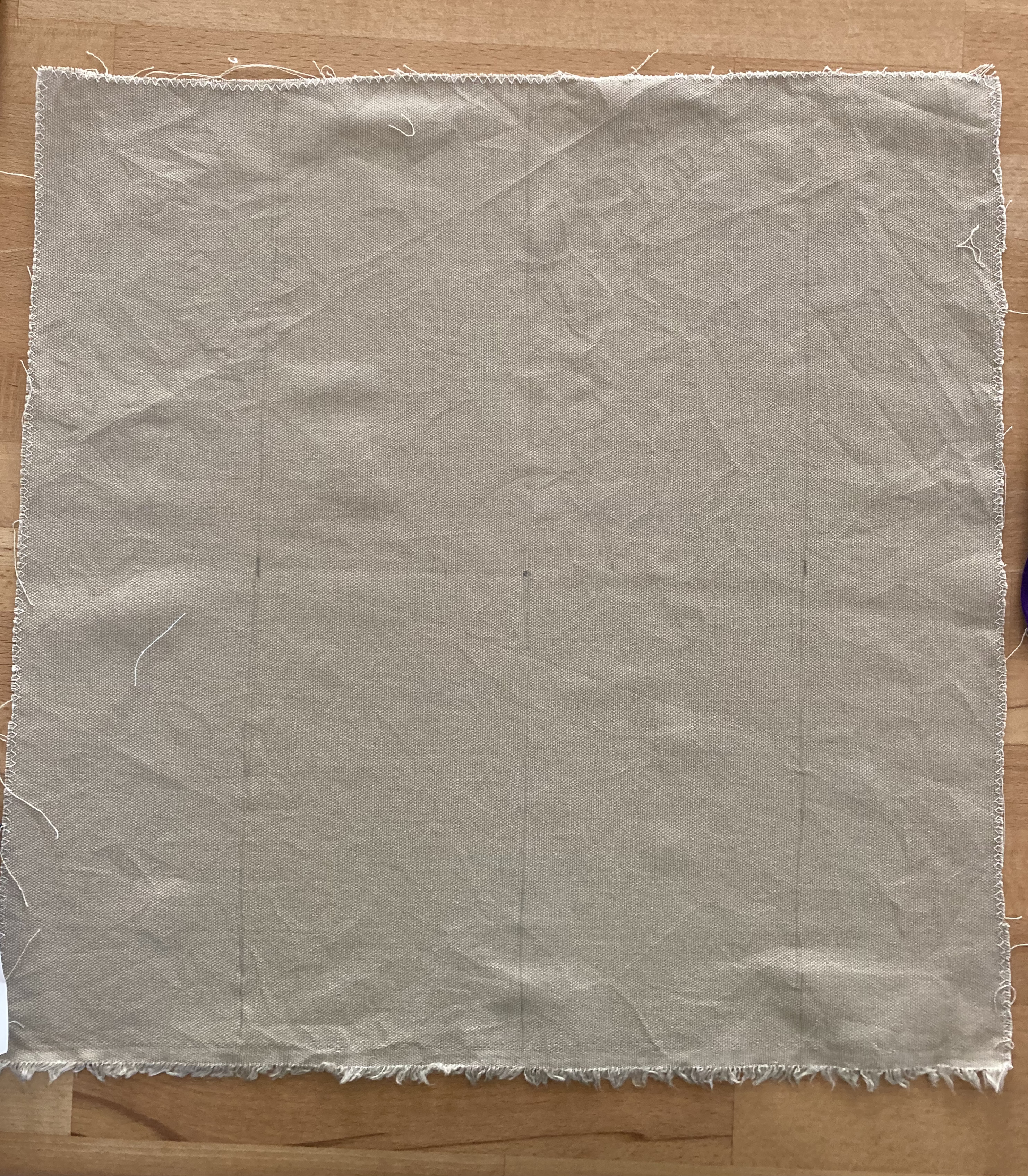
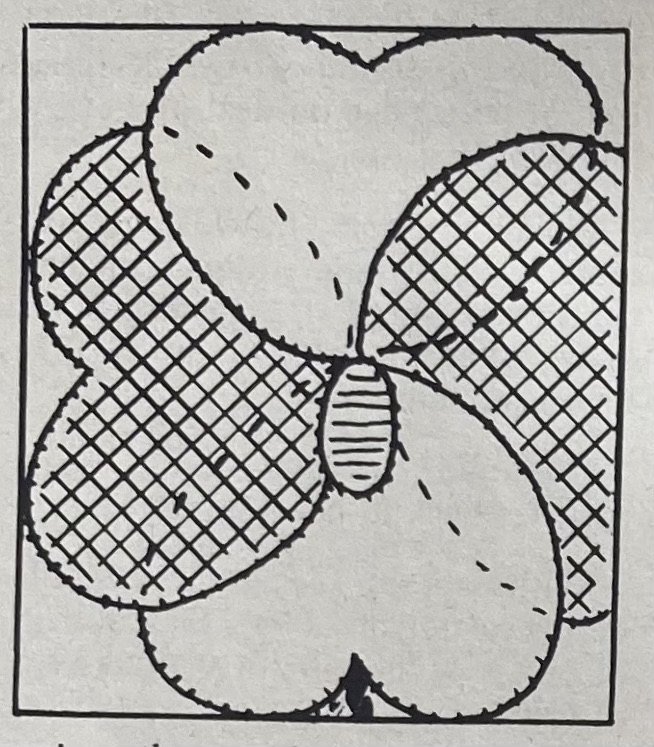
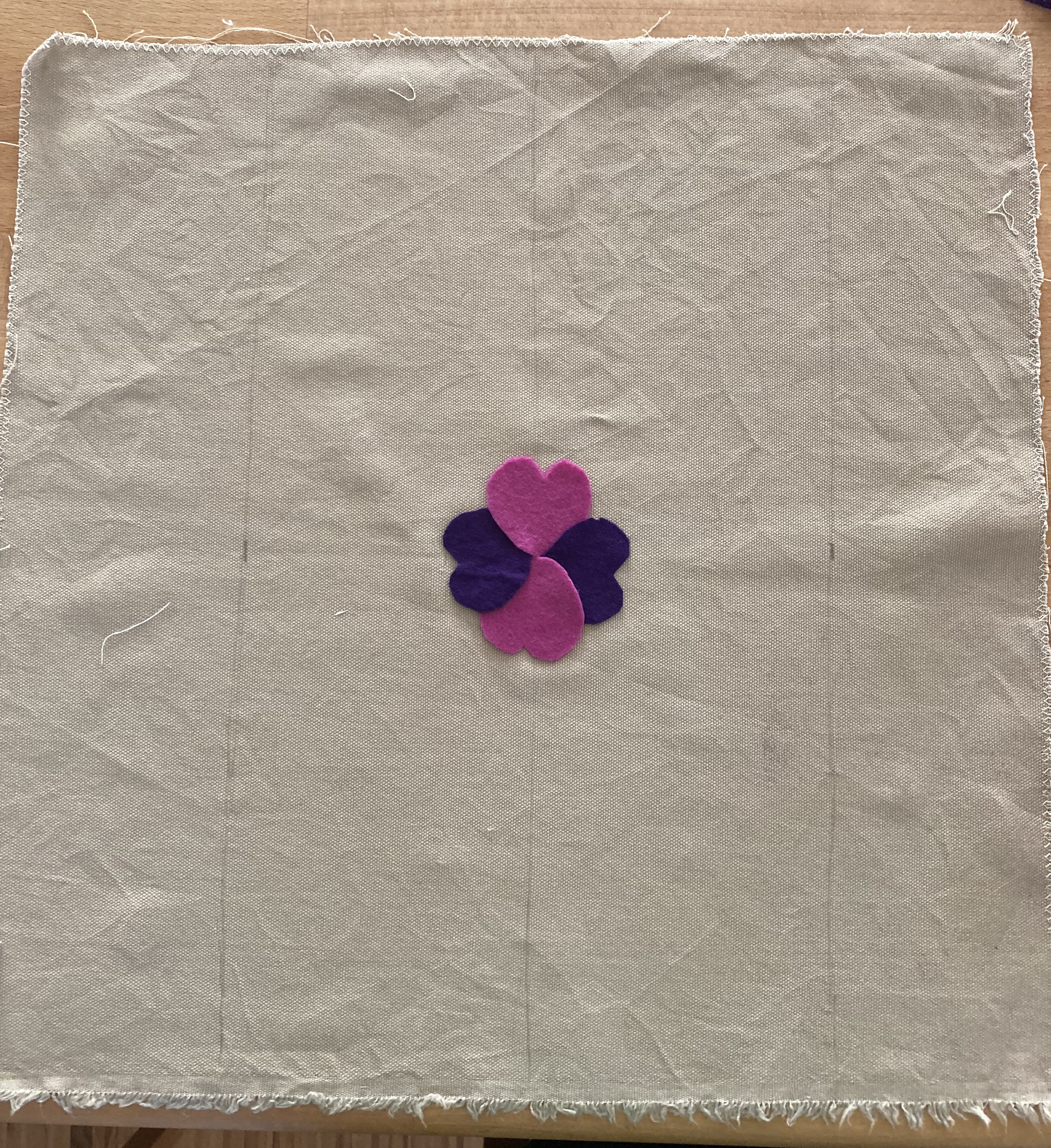
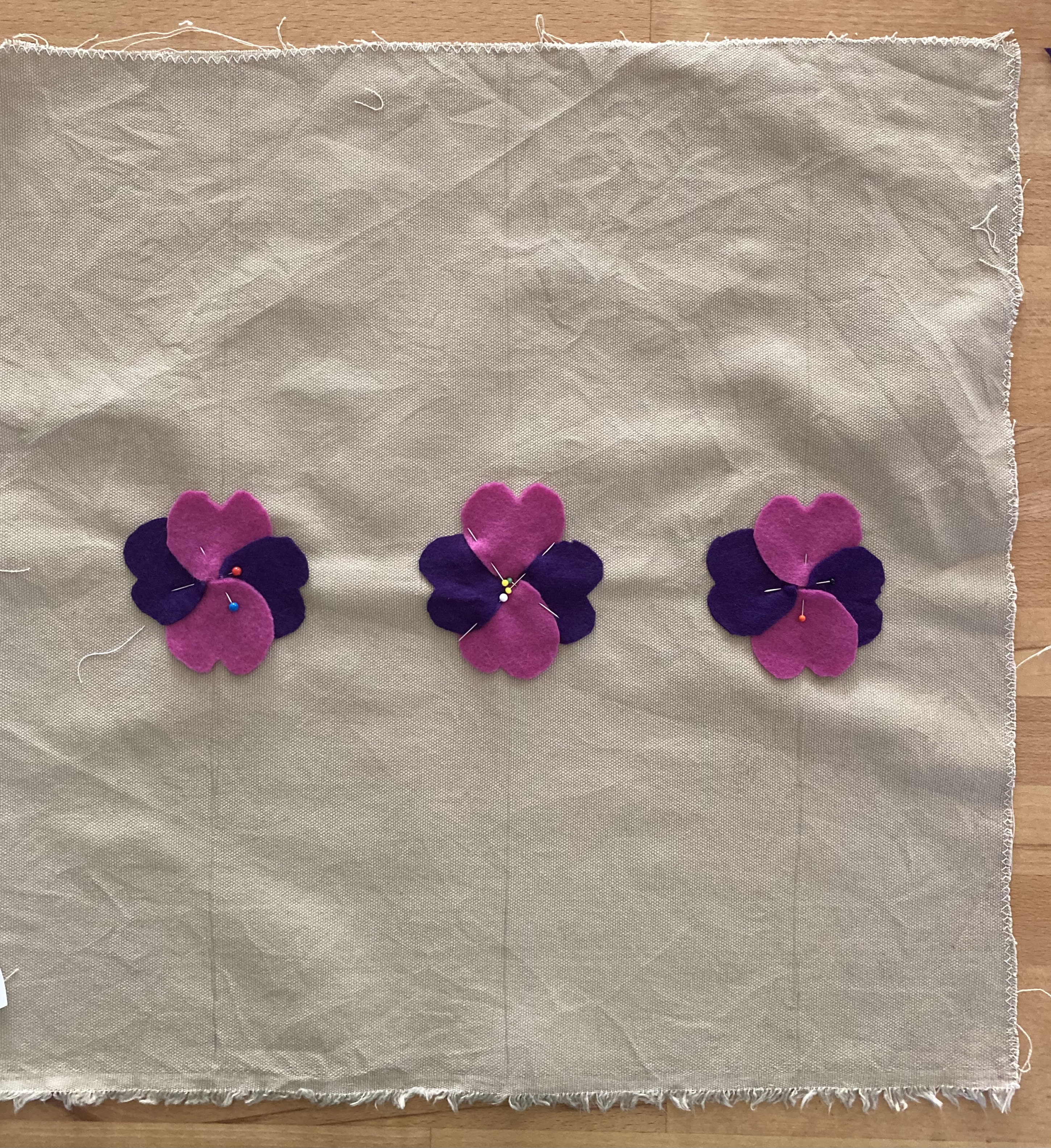
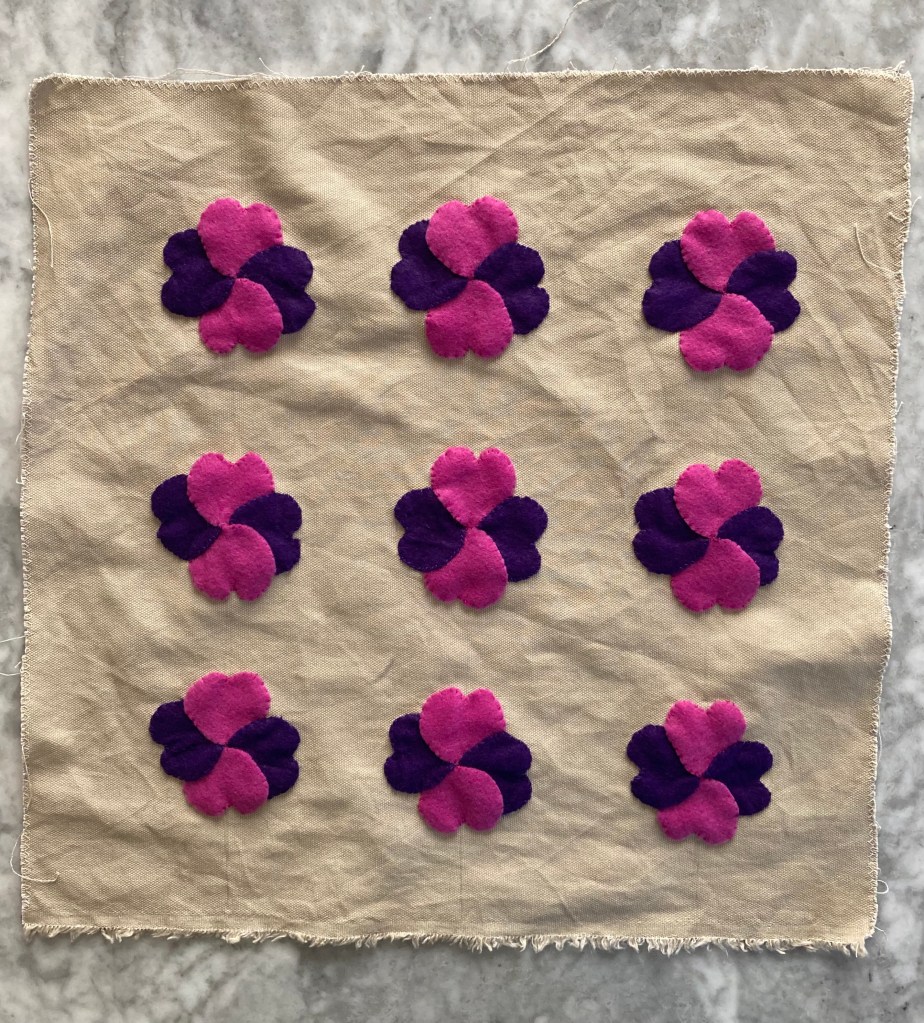
Since I didn’t have a transfer, I made a little paper pattern for the felt petals, estimating the size based on the amount of felt and the size of the background fabric. One modern “standard size” piece of decorating felt made exactly 18 petals and I think it came very close to whatever size the original transfer pattern was. I overlapped the leaves in a sort of pinwheel layer (following the helpful illustration), using a little bit of stick glue to help keep them in place, and then secured them with pins. For placement, I simply folded the background fabric in quarters and used the fold lines for the two middle axes, then measured evenly from there for the corner flowers.

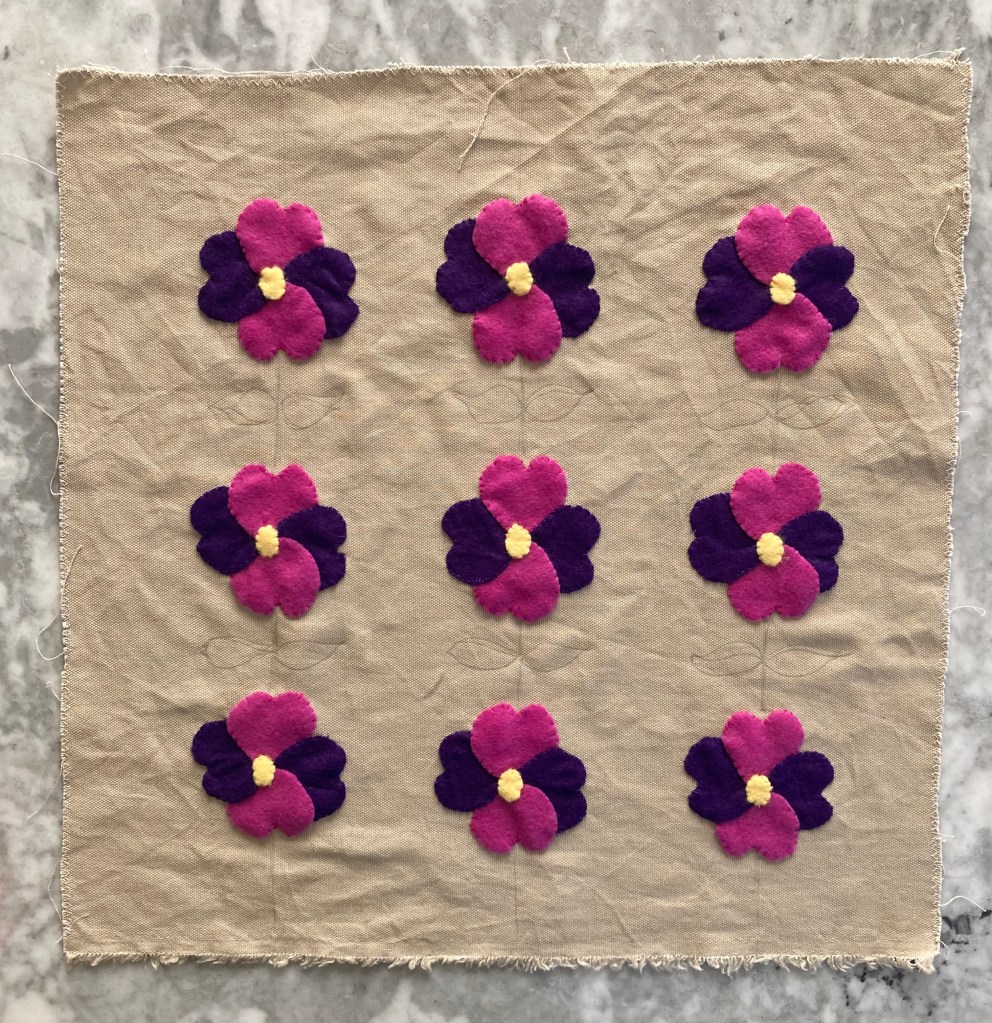
I sewed the flowers down with matching thread and added the yellow centres. The diagram shows them a bit above or below the actual centre of the petals, but I like symmetry, so I made the yellow pieces more round and put them right on the centre. (The layers of felt weren’t too heavy.)

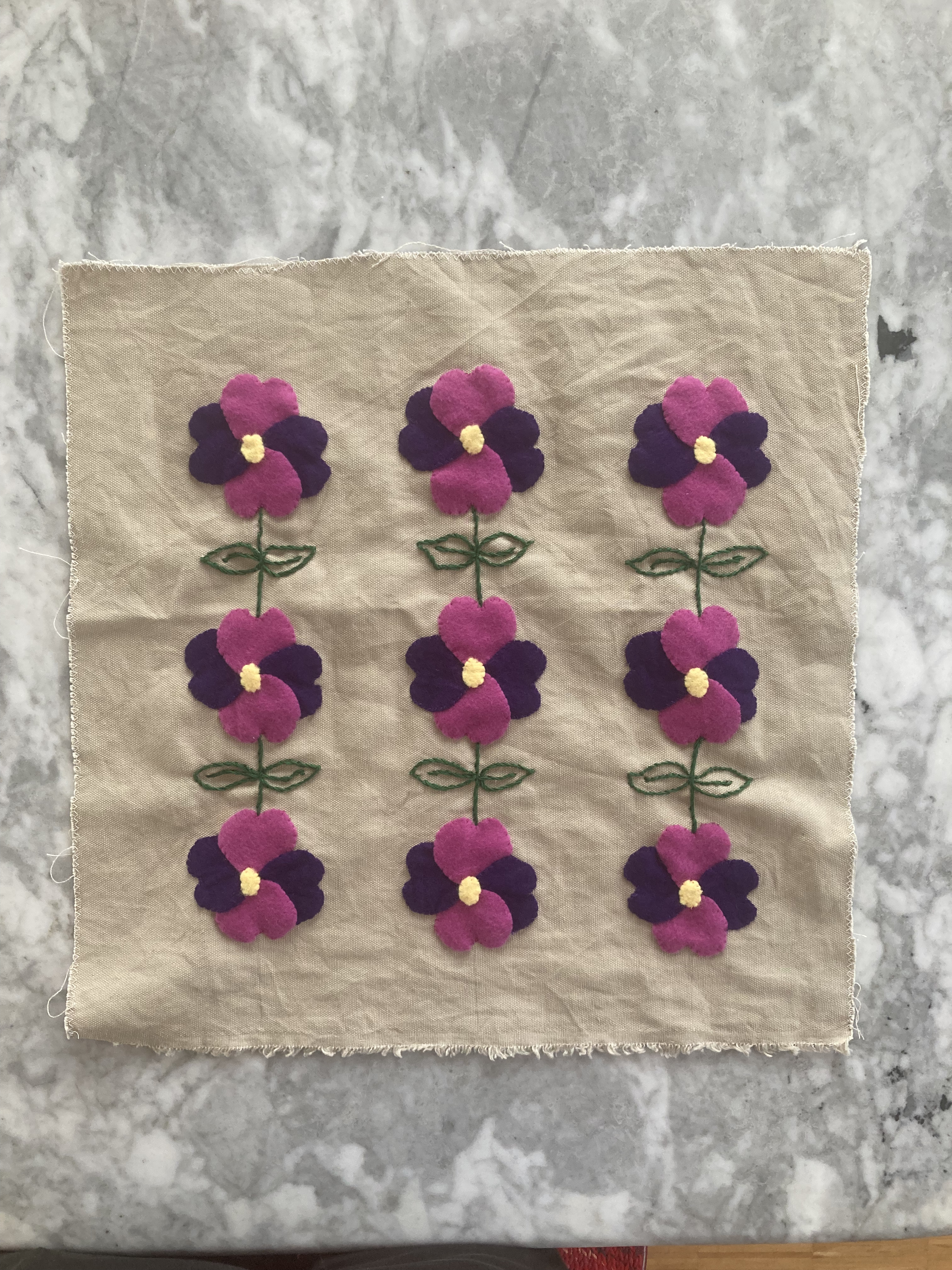
All that was left to do after that was the leaf and stem embroidery, which was done in easy stem-stitch in green thread. The pattern didn’t say how many strands of thread to use, but seeing as it was a bold design, I used all six threads together and ran out of thread. (Up until this point, I had done all of the work in one day, but alas, I had to pause because it was Saturday late afternoon and the shops wouldn’t open again until Monday.)

Monday came, I bought more thread and finished the surface of the cushion. Sewing it up was easy enough. I had enough muslin in stash to make up one half of the inner cushion pad (pro tip: the inner cushion should always be a little bit larger than the outer cover, to prevent sagging) and enough of the beige cotton to make the other half. I did not, as suggested in the pattern, line the pad with plastic to make it waterproof “for use on the grass”. After making the pad, I had exactly enough beige fabric left to make strips for “piping”, so added that as well (not part of the original design). It was not “real” piping, which is made on a bias strip, and thus came out a bit uneven. Oh well. At least the zipper was no problem this time.

And that was that! I stuffed the inner cushion with fluff, sewed it up, zipped it into the cover and voilà. I have no garden, no balcony and too many cushions already, so this will be a gift for a friend.

May 1965: Primroses and Violets

For this month’s project, I couldn’t decide whether to make the pretty 3-colour “Shaded Blouse” (knowing that I have plenty of knitted tops, and that I would have to buy yarn for it when I am trying hard to reduce my stash) or adapt the tablecloth/dressing-table set embroidery pattern for another vegetable bag (quick, easy, useful, environmentally friendly and reduces the stash of embroidery thread and yet-unembroidered bags). Spoiler: I made both, so the stash balance will remain even. The top will take a little while, so here’s the veggie bag in the meantime.

The pattern is a design of yellow primroses and purple violets, but not in the same “bouquet” — there’s an option for a tablecloth with the primrose sprays in the corners and the smaller, individual violets scattered across the middle surface, or a “cheval set” for your dressing table with one large mat (2 primrose sprays and 2 violets) and two small mats (one violet each.) I chose to just make the primrose spray.

The bag is one of several that I bought at an antique sale a few years ago for a euro each. They are literally old moneybags, formerly used to transport money to and from the German national bank (hence the “Deutsche Bundesbank” and date printed on it; this bag was apparently from January 1997.) After 2002, the German Bundesbank replaced the old bags with newer and better ones (better in the sense that they presumably fulfilled new security regulations for the Euro) and you can now buy the disused old bags at antique markets, via ebay, etc. How they got from the bank to there, I do not know, but would love to find out. (If you are an expert in the sale and trade of disused moneybags, please share your wisdom in the comments — I genuinely would like to know.)

Anyway, apart from the fascinating can of worms that is their origin story, the bags are the absolute best for buying vegetables at the grocery store, farmers’ market etc, being made of a very thick linen (?) fabric and just the right size for small amounts of things like mushrooms, green beans, shallots, etc. Because they are both tough and easily washable (of course I washed them thoroughly before starting to use them for food items — money is literally filthy) they are particularly good for sandy or earthy vegetables like the aforementioned mushrooms, new potatoes, or the kind of carrots that I like to eat, which are grown in peat and therefore quite “dirty” (but taste better than regular carrots).

The actual embroidery pattern was not difficult. Of course, I had no transfer, since I would have had to order it in the mail in 1965. But it was no problem to sketch out the flower spray from the photo. I used transfer paper to transfer the design onto the fabric. The ink was quite faint, so I went over it with a ball-point pen (washable), which worked well enough. There were instructions in the magazine and even a helpful close-up of the stitches, which were all extremely easy: satin stitch for the petals, blanket stitch for the leaf outlines and stem stitch for everything else. I ran out of light yellow after embroidering half of the flowers, and the new skein I bought was one colour-shade different. You can tell if you look closely, but I don’t think it’s a flaw — it gives the flowers a little more depth.

This is the third “Bundesbank” bag that I’ve embroidered, as well as another bag of regular cotton fabric. I used the other bags to buy stuff at the local organic supermarket last week and the cashier stopped in the middle of my checkout to say, “I’m sorry, I just need to take a second to admire this beautiful work.” That was sweet! If I ever get enough of these made, I’ll probably start selling them.

Stay tuned for the “shaded blouse”!

March 1965: Flower Border Bag

Choosing a project from the March 1965 issue of Stitchcraft was an interesting process. I loved both of the children’s designs (a “continental” cardigan and a textured pullover with a round stranded yoke), but could find no takers among the children / parents of children that size that I knew. I loved the red cardigan in the cover photo, but didn’t feel like going through the work of re-sizing and re-proportioning it for myself and it wasn’t the right style for any knit-worthy men in my life. None of the bulky, large, unshaped garments in the issue would have suited me. Also, I had multiple “endless” WIPs that I wanted to finish and other projects that have been waiting in the queue for a long time. So — I made a little embroidery project.

The project as presented in the magazine is a flower border in simple stitches and a limited colour palette (all blue, all “peacock”, or green and orange), to be worked either on a cushion, as a border on a pillowcase, or on satin fabric for a door panel. Not needing any of those things, I embraced the spirit of versatility and made a little embroidered and zippered bag that can be used for spare knitting needles / accessories or any other kind of easy-to-categorise-but-hard-to-contain “stuff”. I have many of these bags around the house, some made by me and some by friends. They are particularly useful for organising things in drawers or travel luggage. You can never have enough… and yet I kind of do! Luckily, they also make great little presents for friends, and one of mine has a birthday coming up, so I made it for her.

Of course, I don’t have the embroidery transfer from the magazine — readers had to send away for them back in the day. The flower is quite simple, however, and I was able to just copy it onto a piece of paper freehand. I had some nice bright turquoise linen left over from this cushion, some dove-grey viscose for lining left over from whatever, and embroidery floss in several shades of orange left over from this cushion as well as brown, so all I had to buy was a skein of green floss and a zipper. I transferred the pattern to the fabric by taping it up on the window and tracing with a marker pen and was good to go.

The embroidery is done entirely in satin, stem and blanket stitches — really fast and easy. I finished it in one afternoon, washed it out by hand under the tap to get rid of the marker lines and let it dry overnight. The next day, I made it up into a bag and voilà, finished.

It measures about 24×17 cm or 9.5×6 inches, a practical size, and the design works well. I could have chosen a more vibrant green for the leaves, but the subtlety of the leaves and stems makes the bright orange flower pop even more, and I think the smaller orange buds balance it out nicely. I am also very proud of my zipper-setting skills. All in all, I think this was a great example of how vintage designs can be adapted to fit modern needs and make homeware items that are both useful and attractive.

January 1965: Overview

Happy New Year, everyone! It’s 2023 in the present day and 1965 here at the Stitchcraft Sixties.

We are now solidly in the mid-60s fashion era of miniskirts, Twiggy and the “Space Age” look, but Stitchcraft was a conservative magazine, so hemlines are still at least knee length and the “country casual” look prevails. To be fair, it’s also January, so the focus is on practical, warm garments for both outdoors and in (good central heating was still not available in many British homes) and homeware projects to keep hands busy during the long, dark winter evenings.

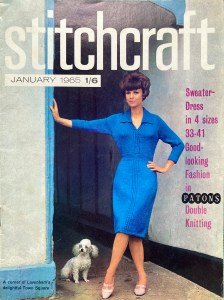
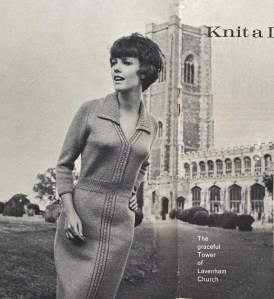
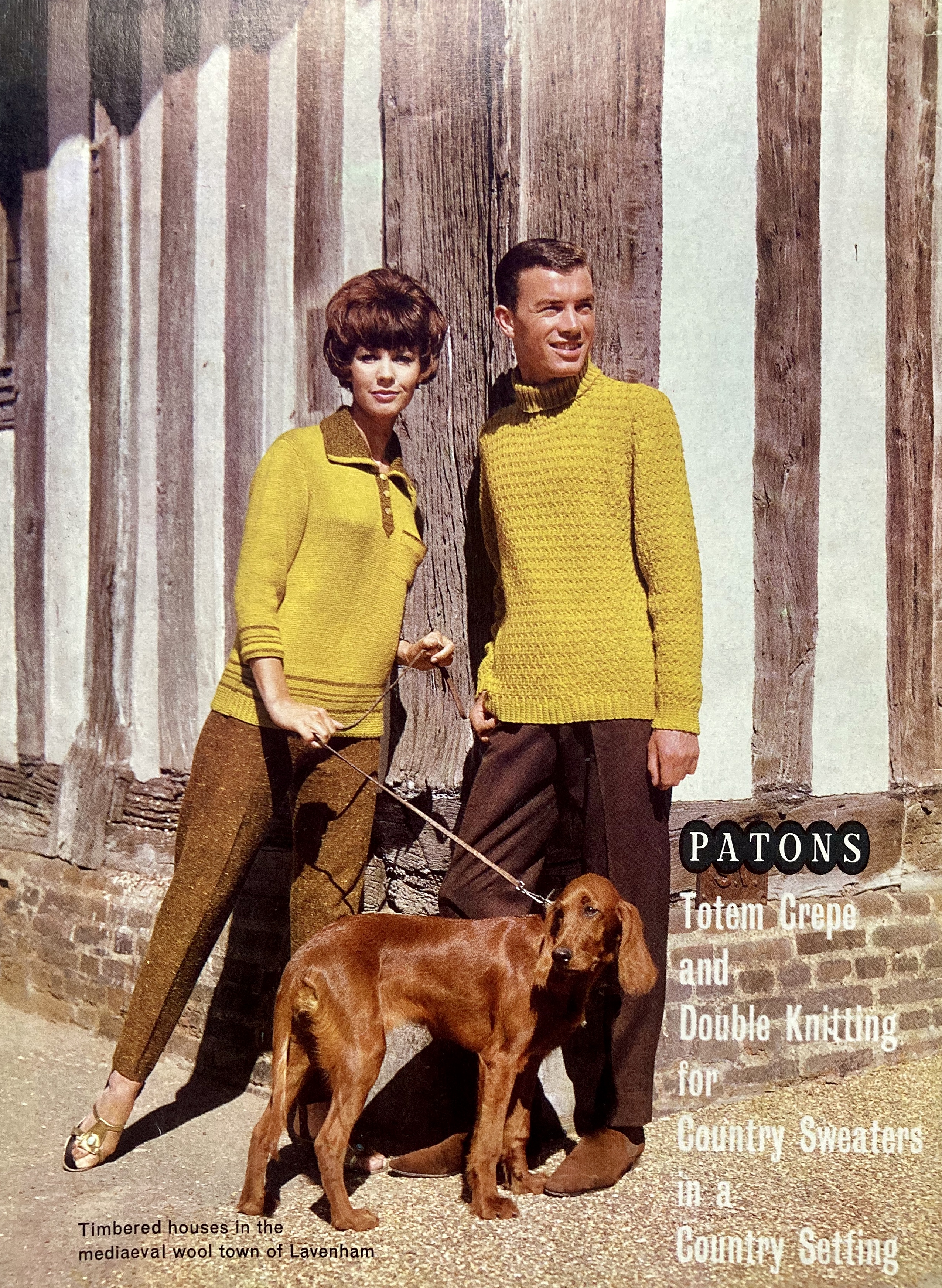
The January 1965 issue was photographed in Lavenham, a medieval town noted for its timber-frame houses and its connection to the wool industry in the 16th century — a fitting setting for knitting magazine photos! Our model poses for the cover in “A corner of Lavenham’s delightful town square” whose entryway arch perfectly matches her bright blue sweater-dress (I don’t know if the poodle is hers or just happened to stop by for the photo) and for the inside photo in front of the historic St. Peter and St. Paul Church, whose construction was financed primarily by merchants in the wool and cloth business.

Other warm “sweater” garments for adults include a shirt-style pullover for women and a smocked-cable pullover for men in shades of gold and brown, a tweed cardigan in larger sizes (up to 43 inch bust), a crocheted skirt suit, and a “senior pullover” for “Father’s Classic Look”. All of them are in DK-weight or heavier wool. With the exception of the cover dress and the larger-sizes cardigan, both made in bright blue, tweedy, marled colours of brown, gold, copper and olive green prevail. Photographic fashion favours strong, straight-standing poses for the “bold” look, often with the camera held at a diagonal angle.

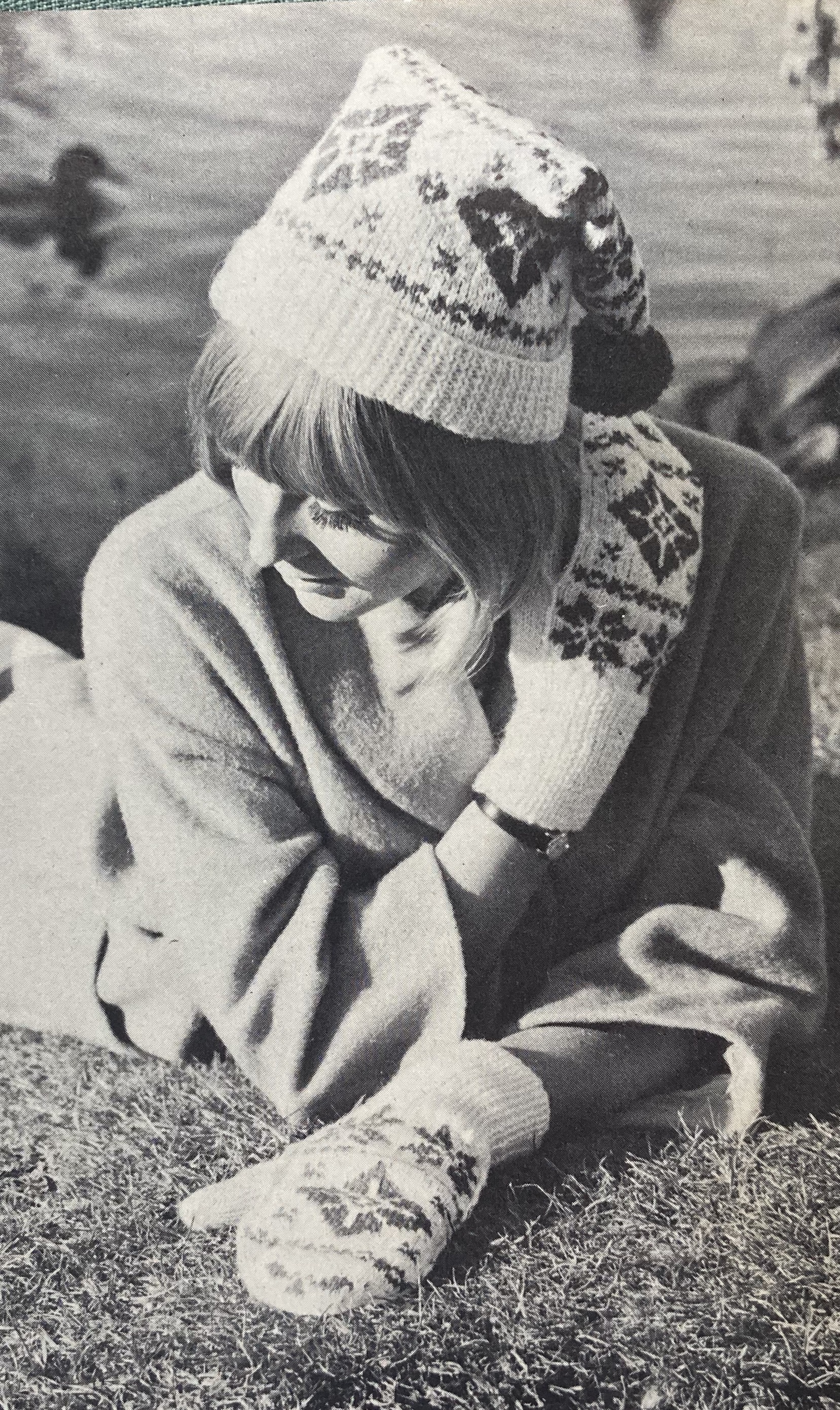
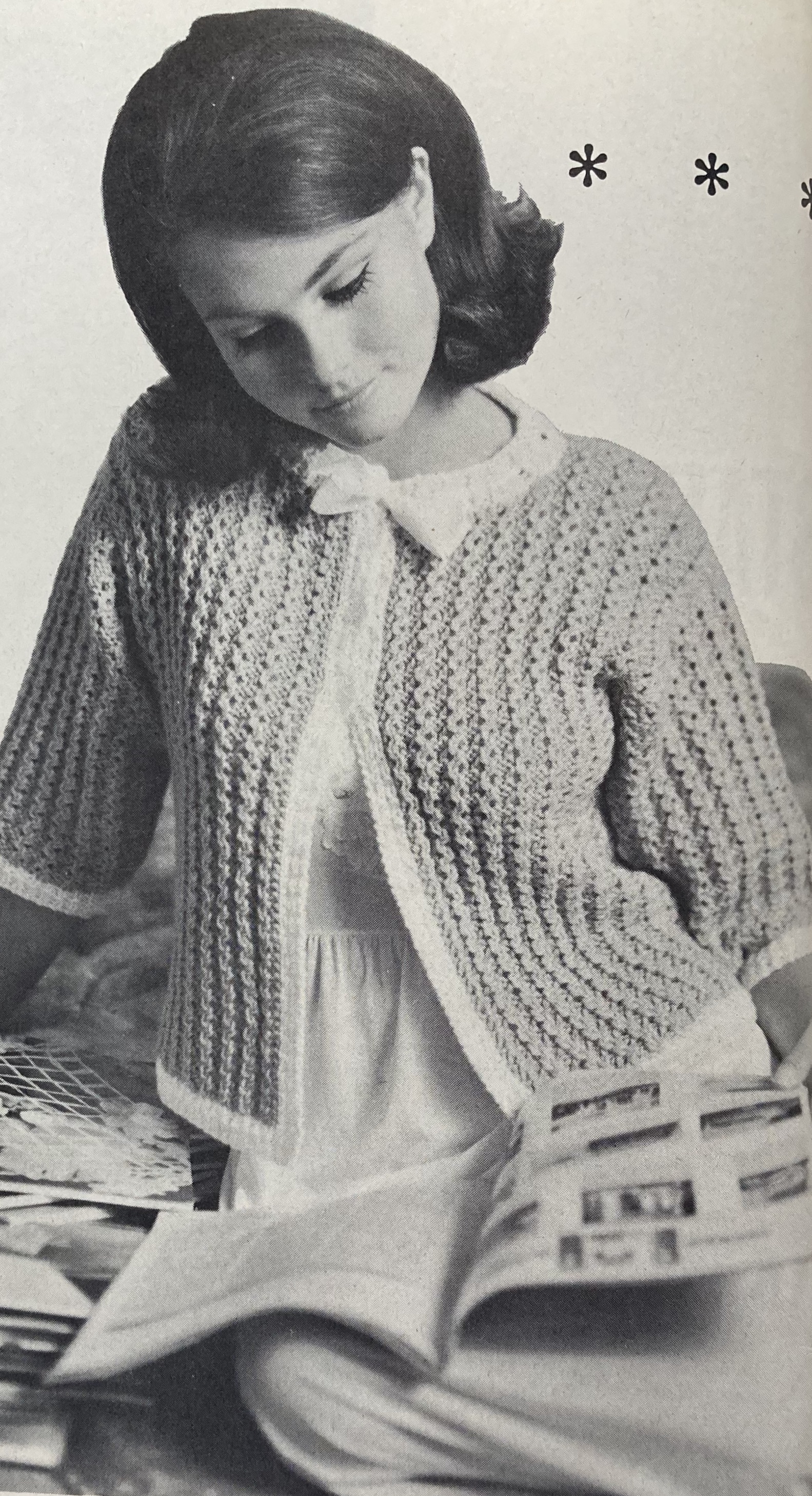
Winter means warm, quickly knit accessories as well, and this issue has some fun hats and mittens with Norwegian or blocky stripe patterns (the one with the broken lines is done by saddle-stitching embroidery on the finished cap.) No harvest golds and burnished coppers here: the caps are all made in red and white or royal blue and white for a typical wintery snowflake look. The cosy bedjacket is also blue and white and features a soft, squishy slipped-stitch lace pattern that is presumably very warm and comfortable.

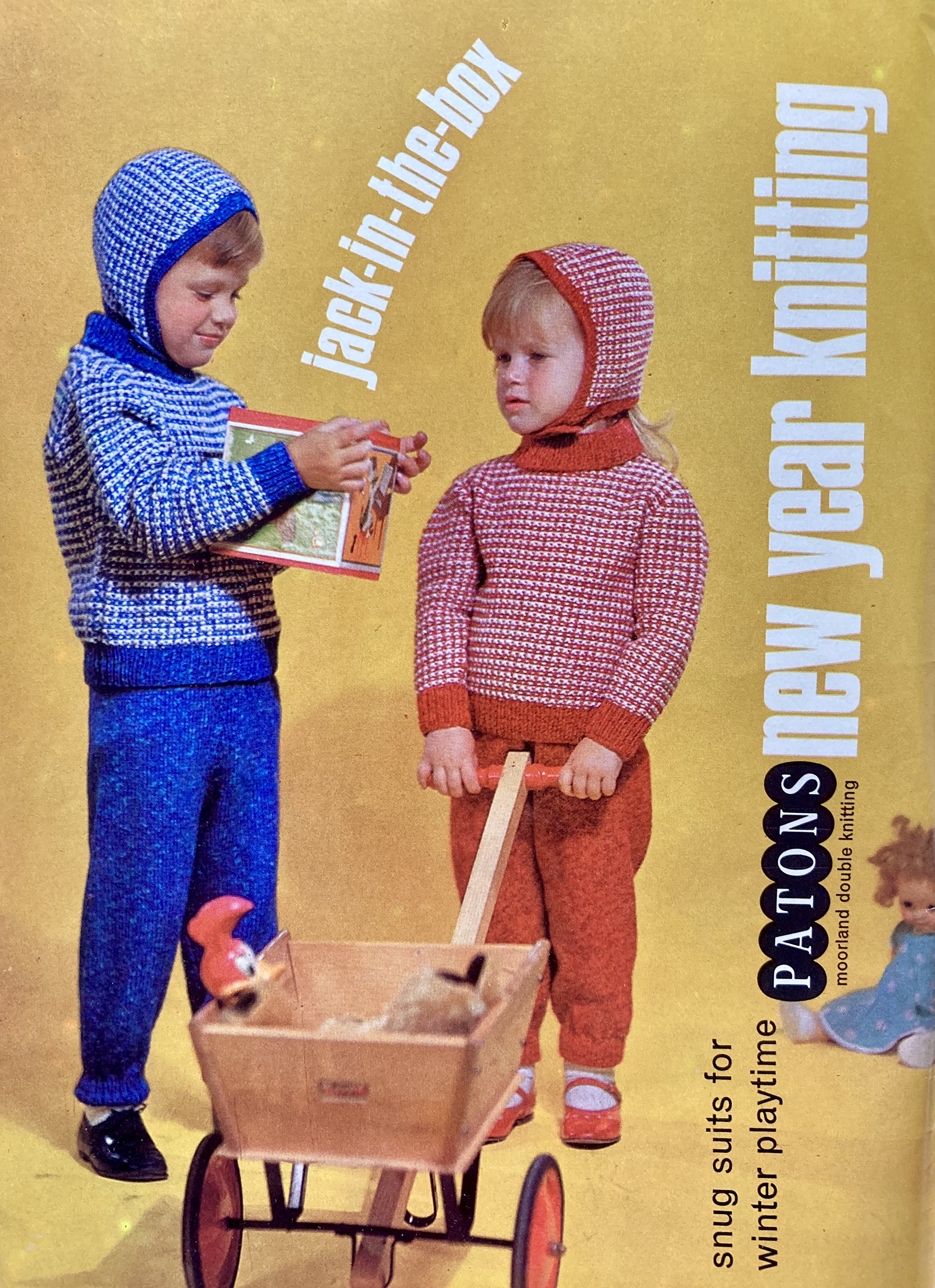
Younger children can wear a truly cosy “snug suit for winter playtime”: a set of pullover and “helmet”-style cap in a thick slipped-stitch pattern with knitted leggings. Blue and white or red and white are the colour choices here as well. There’s also a pullover for “Junior” (three sizes to fit 24-29 inch chest) in light blue and dark blue. The “crunchy” stitch pattern looks complicated, but is made entirely using normal knit and purl stitches in a combination of stocking-stitch, reverse stocking-stitch and small bobbles made by knitting, purling, knitting into the same stitch on one row and purling 3 together three rows later.

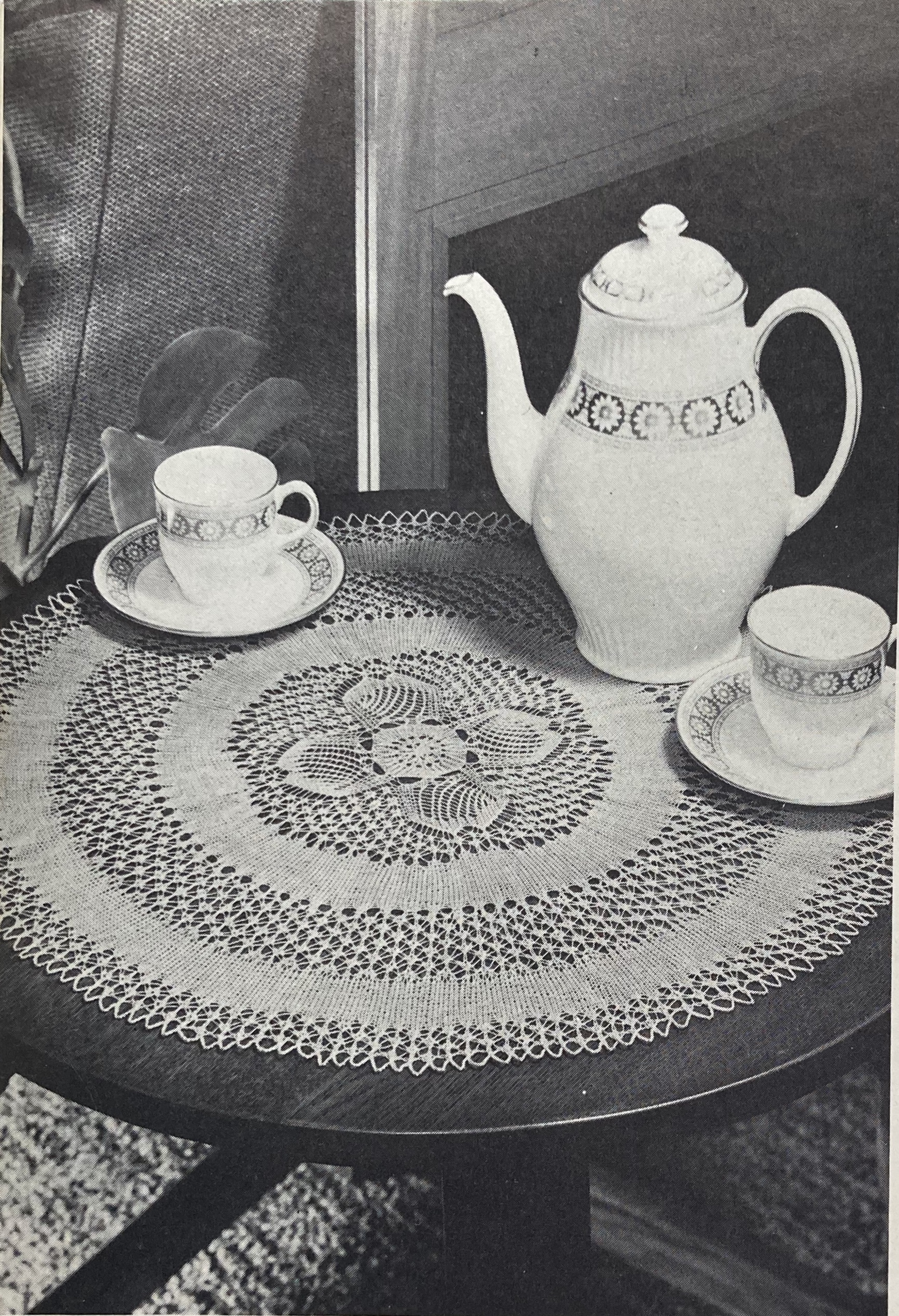
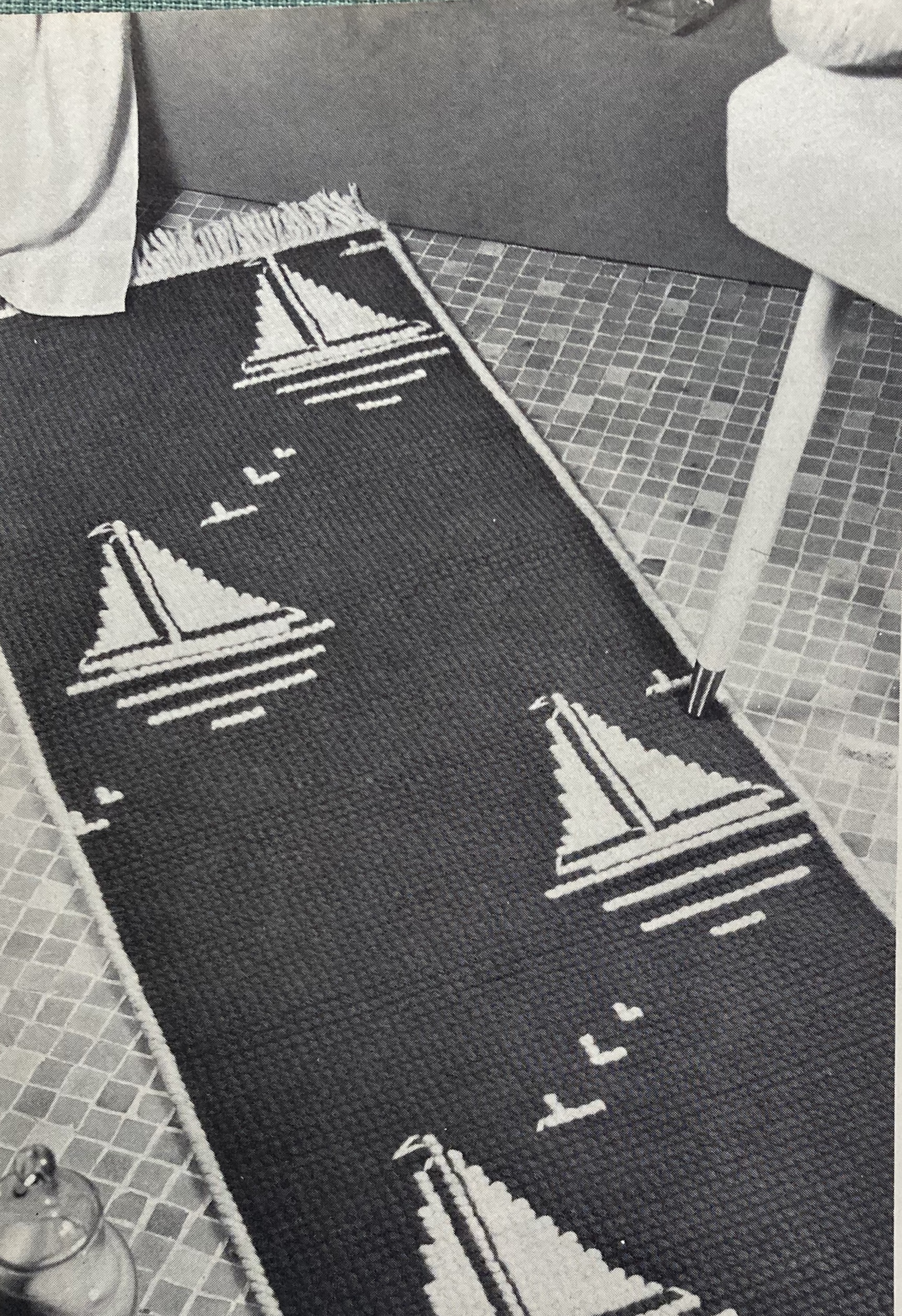
There are plenty of homeware projects as well: like the knitted items, everything except the lace doily is more serviceable than fancy. There are stitched and crocheted rugs– and a conveniently placed advertisement for rugmaking which is one of the very few advertisements of this era that show a man working on handcrafts.

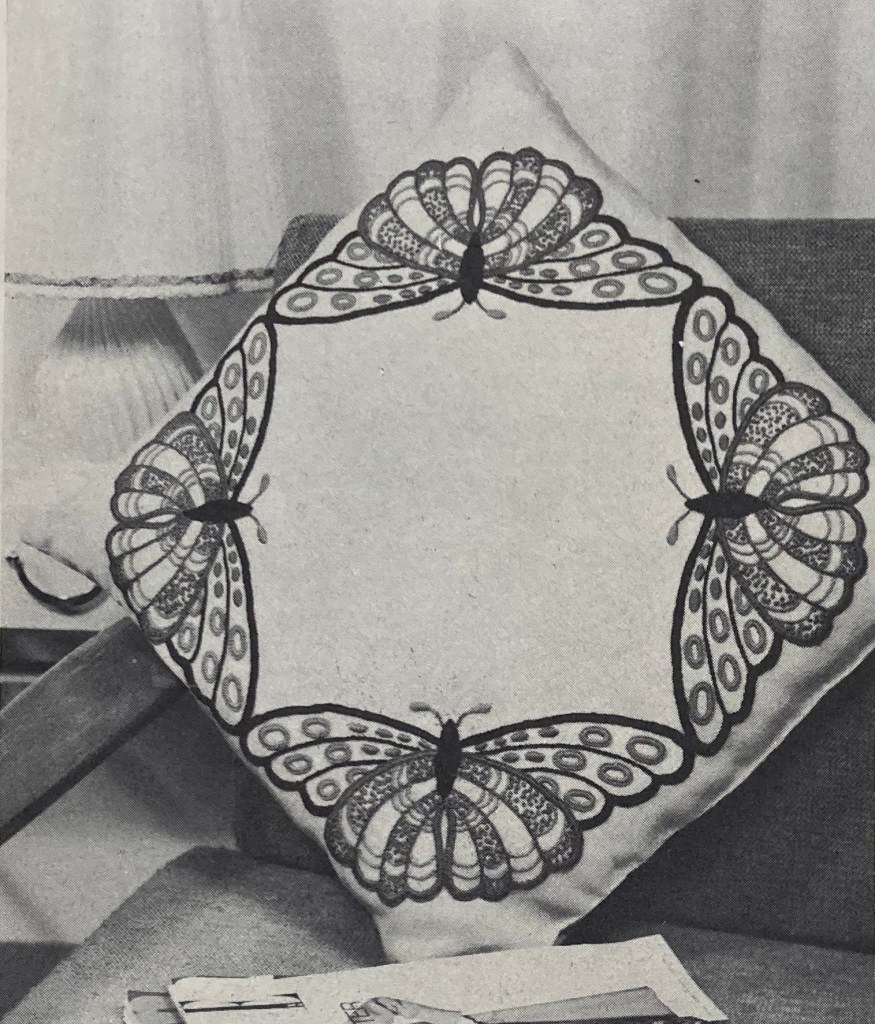
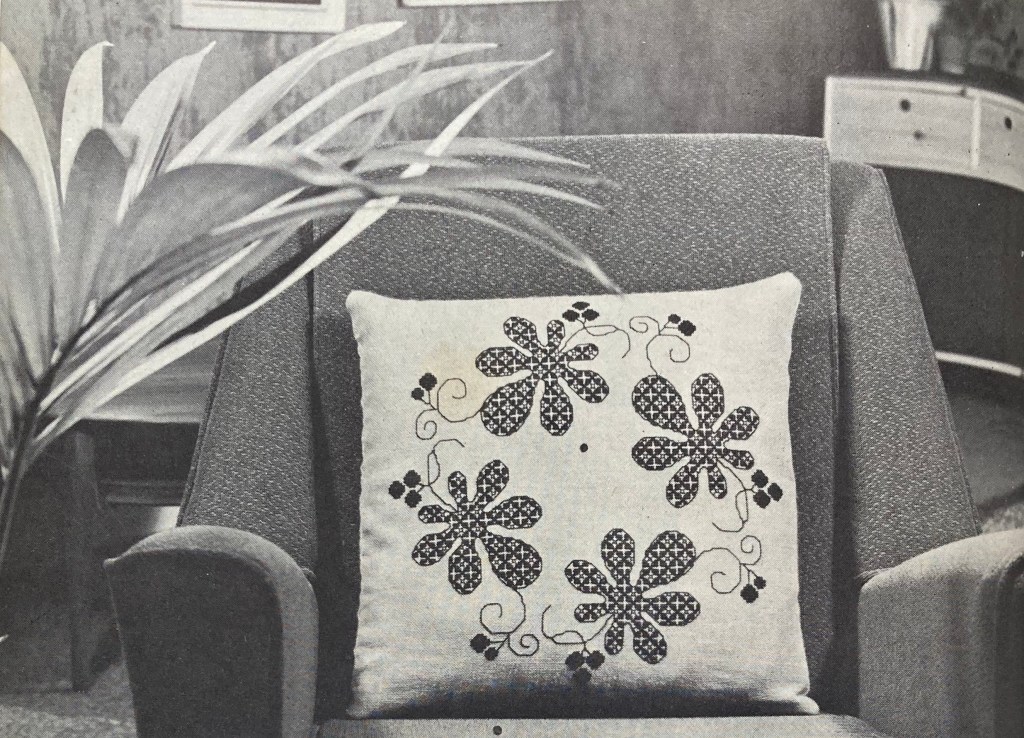
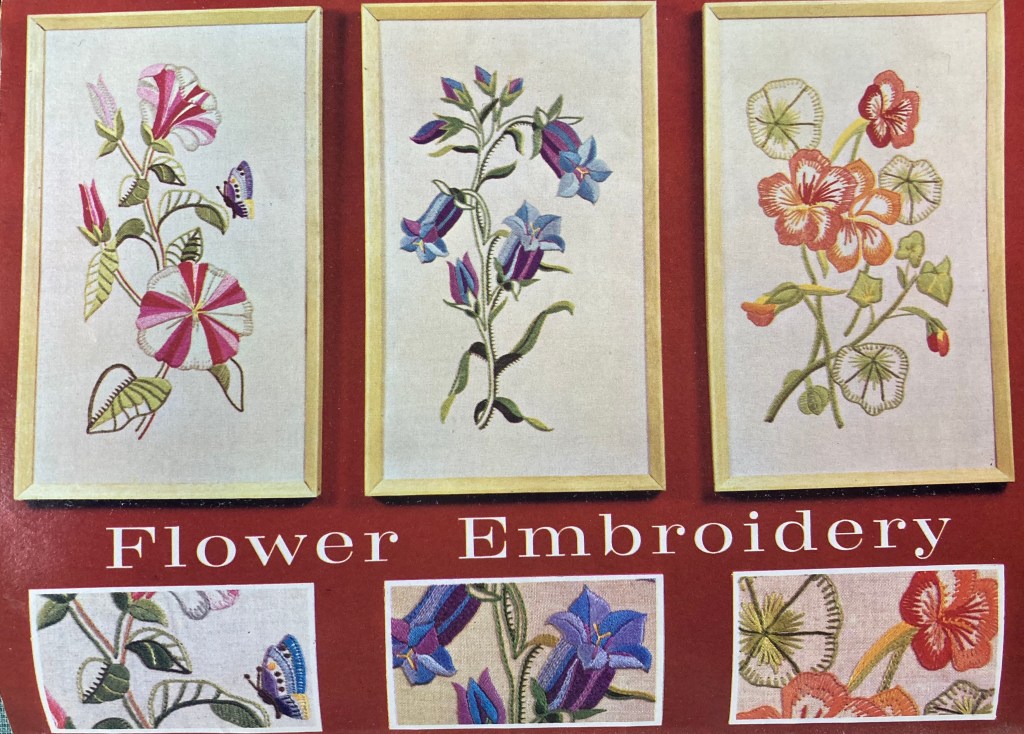
There’s a butterfly design in cutwork or as wool embroidery on a cushion in mid-60s shades of brown and dark green as well as more cushions in Tudor blackwork design or a geometric “peasant” pattern. The latter two take up the “bold” colour scheme idea with black on bright red or royal blue, scarlet, gold and jade on natural fabric. Finally, there are three flower panels than can be worked individually or combined to decorate a folding 3-part screen.

That’s this issue! My project will be the Norwegian cap and mitts in trending 1965 colours of blue and white. Happy New Year to you all.

September 1964: “Peasant” Embroidery

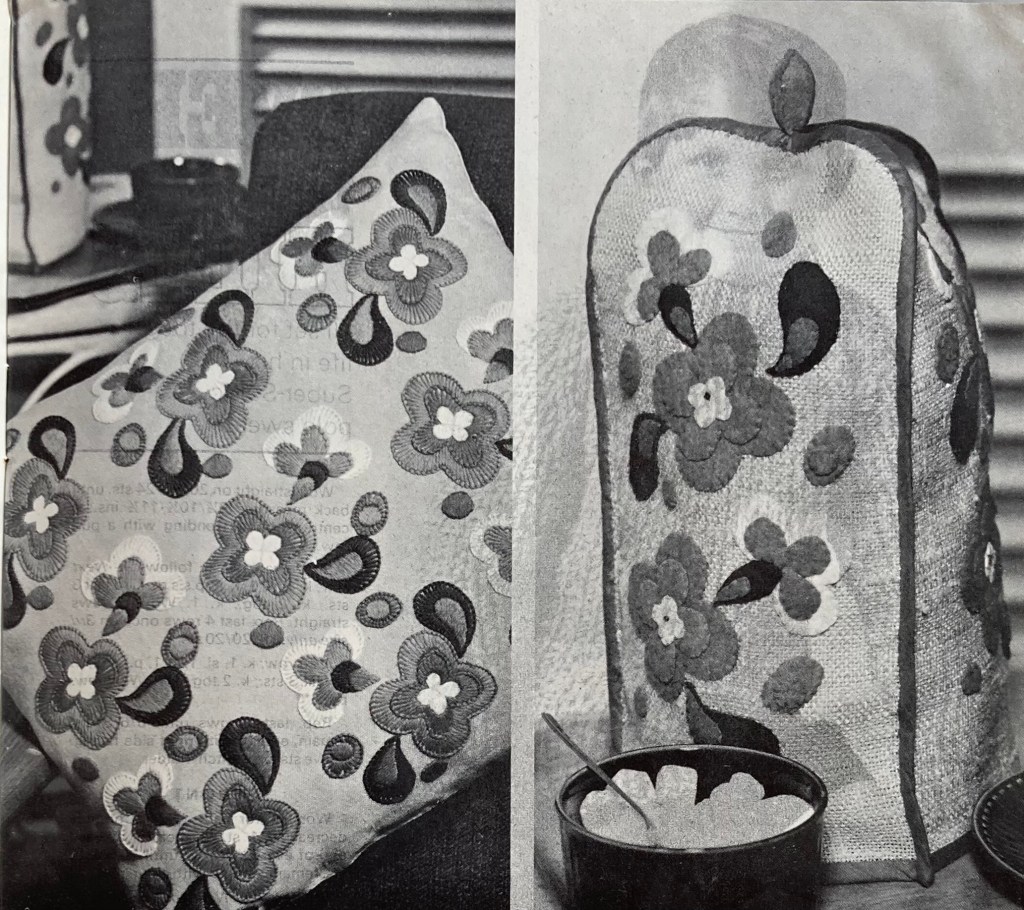
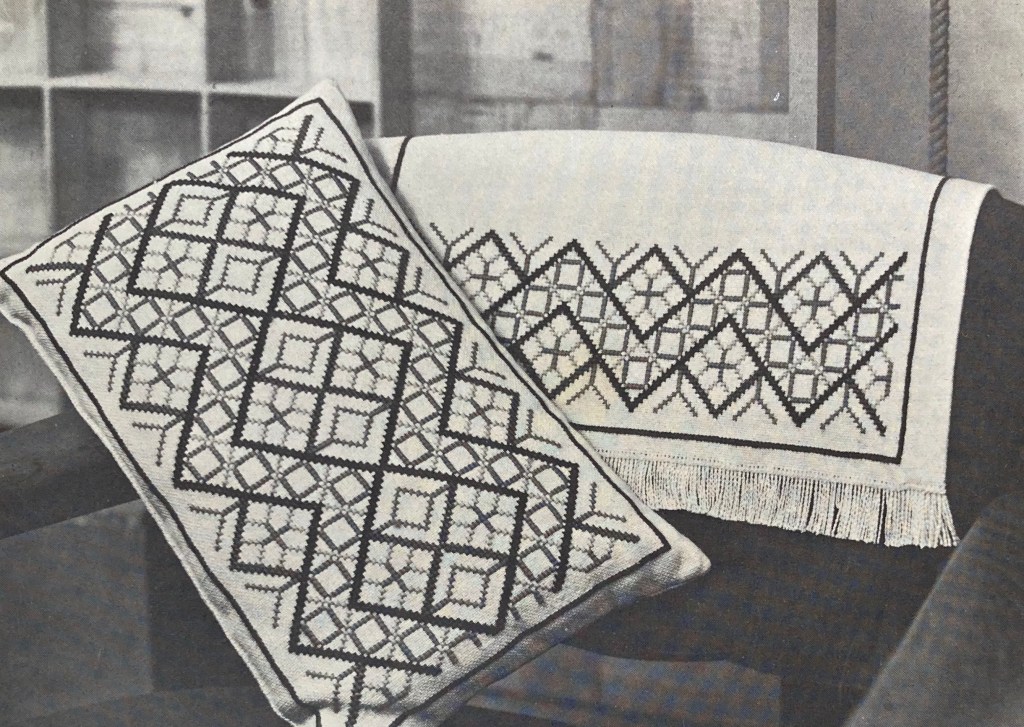
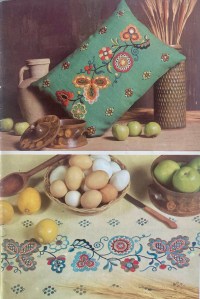
Photo of am embroidered cushion and tablecloth, from Stitchcraft magazine, September 1964

This month’s project — finished just on time! — was another embroidered cushion, larger and more ambitious than the previous ones I have made.

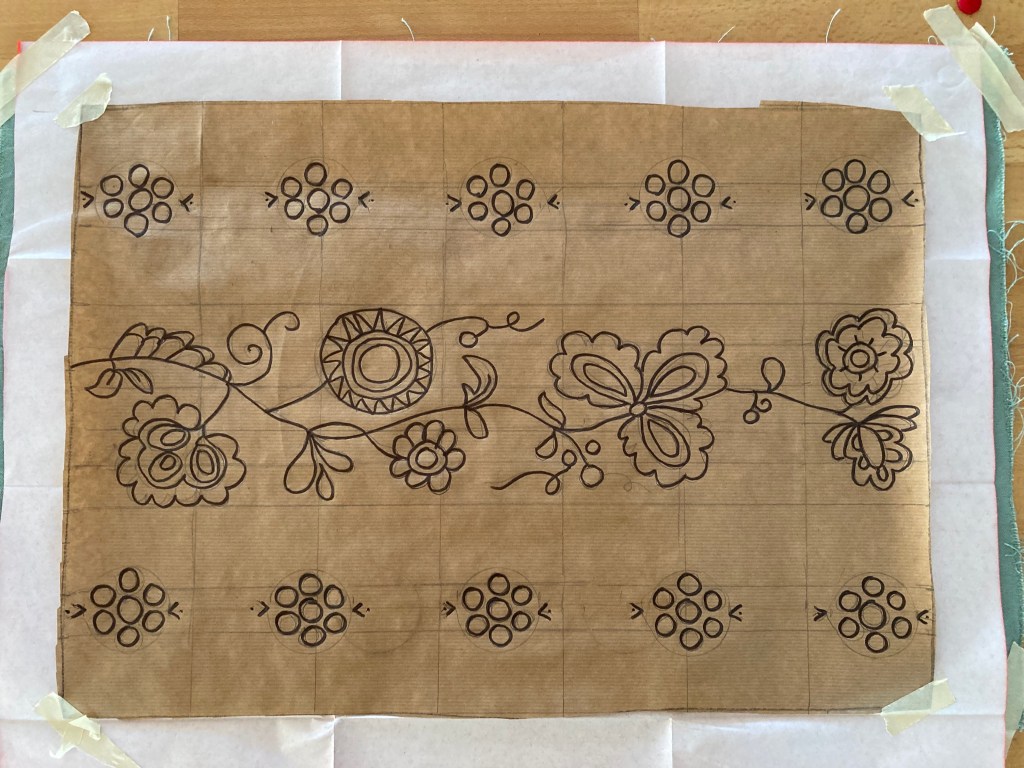
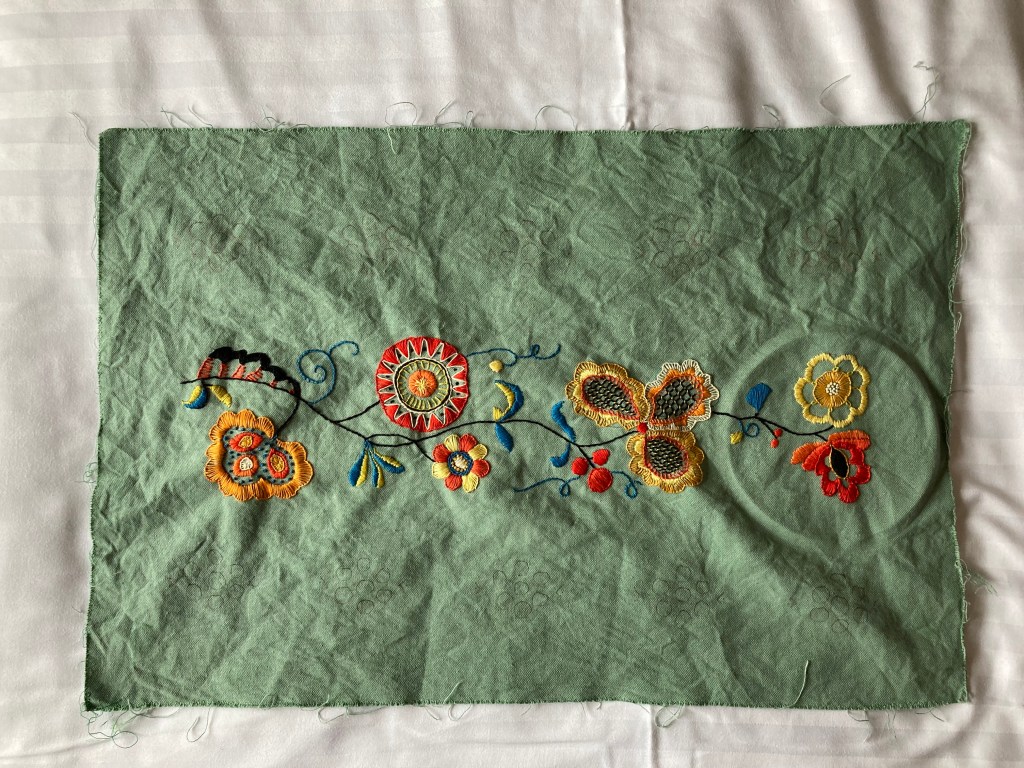
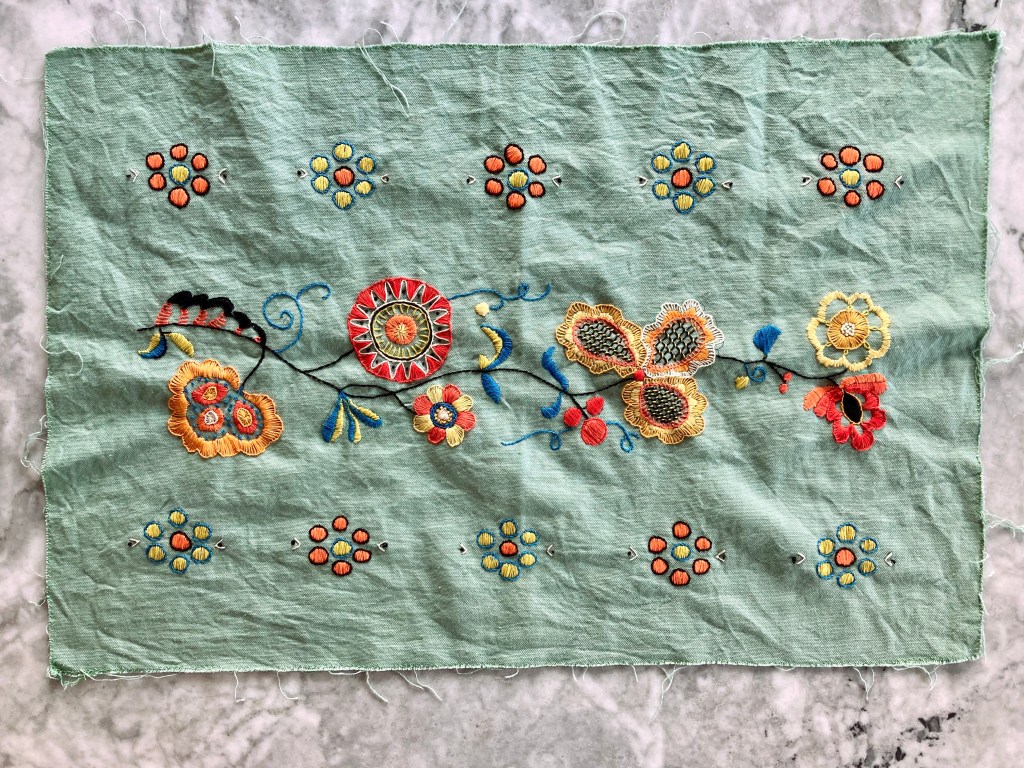
The cushion cover measures roughly 15×21 inches or almost 40×80 centimetres and features a highly stylised flower design in bold colours in the style of traditional Hungarian or Romanian designs. It is… interesting to note that Stitchcraft used very different appellations for traditional embroidery designs depending on the country or region they came from or which style they emulated. Typical Nordic designs were called “Scandinavian” or used the specific country name. Designs based on Indian, Persian, Chinese or Japanese works or styles usually used those country names. But anything related to a Southern or Eastern European tradition — Hungary, Romania, Czechoslovakia (one country at that time), Yugoslavia (country name at the time), Greece, etc. was a “peasant” design, with or without a specific country name. I’m sure it wasn’t meant in an insulting way (also pretty sure that most of Stitchcraft’s readers were descended from “peasants” if you go back far enough), but the word doesn’t quite sit right when you think about it in context; there is an unconscious bias at play, unfortunately typical for the time but worth noticing and pointing out when discussing vintage magazines now.

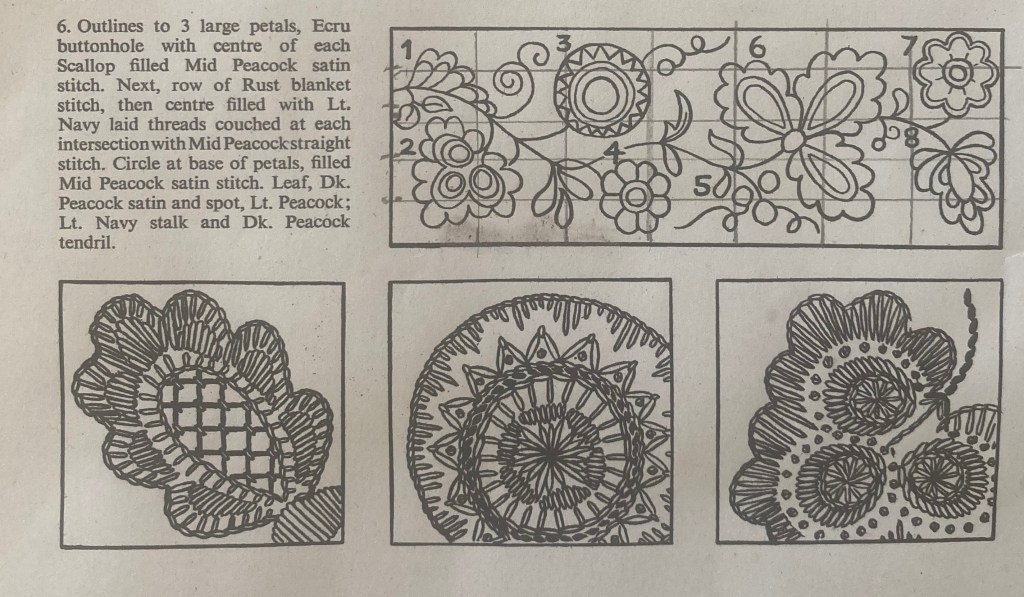
The design, in any case, is beautiful, and is given in two versions, for a cushion or a tablecloth border. As always, the biggest challenge is re-creating the transfer, which Stitchcraft readers at the time had to order separately. There is a colour photo, and helpfully, also a schematic diagram that is presumably exactly the same as the transfer, just smaller.

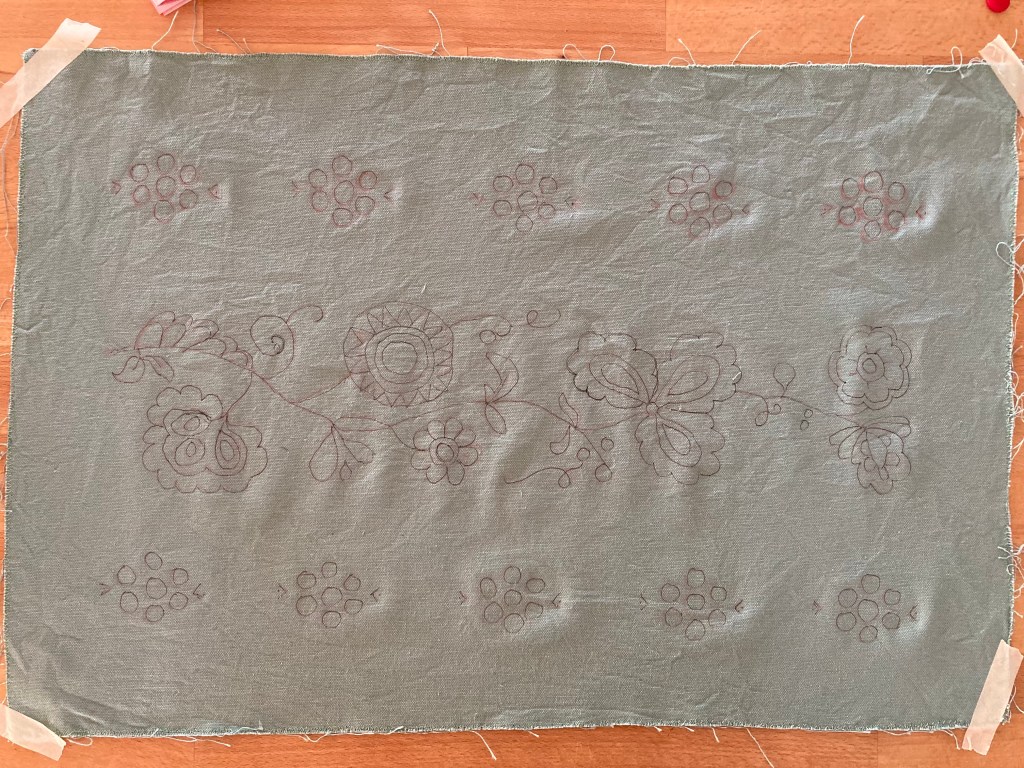
If the cushion were smaller, I might have been able to scan the diagram into the computer, adjust it to the correct size and print it out, then copy it onto the fabric with carbon transfer paper. Or even use the special embroidery printer paper that you can stick onto the fabric and wash off when the embroidery is done. But the design is much bigger than any paper my printer can print. I suppose I could have taken it to the print-and-copy shop, but I chose to enlarge the design the old-fashioned way, by drawing a grid over the diagram and the paper and copying it by hand. It’s a good exercise, and one I can certainly use more practice in. I transferred it with carbon paper and went over it with water-soluble pen. For the border flower circles, I marked the positions and just traced around a button.

My fabric was a fairly heavy furnishing linen in exactly the same colour as the original. The pattern is written for wool embroidery thread, which I would have had to order from the one little shop in Paris that sells it. It’s a wonderful shop, but I wanted to get the project started, so I just went with regular cotton crewel thread. The colours are Black, Peacock, Red, Rust, Dk Orange, Lt Orange, Gold, Yellow, Lime, and Cream. I used the photo and my own taste as a guide to all the shades of orange and yellow. My “Lime”, like the “Lime” in the photo, was more like a slightly greenish lemon, but it looked good (and probably accurately reflected the colour of any real limes available in England in 1964…) On working the embroidery, I noticed that the directions say “White” instead of “Cream”, but I was glad I had used the off-white — I think real white would have been too strong a contrast.

The stitches are all quite basic: stem, satin, buttonhole and blanket with some French knots and one use of Romanian stitch in the middle of the red and black flower. It was good practice for buttonhole stitch and French knots, which were my nemeses before, but have improved significantly due to this project.

I realised while working it that the individual motifs weren’t quite big enough — in the original, they are much closer together, almost touching. There was no way I was going to re-do the entire transfer and start over, so I accepted it.

The work went surprisingly quickly, considering how large the cushion is. I made it up into a cover with the same fabric as a backing and a zipper close. A standard 40×80 cm bed pillow fits in it well. Though my embroidery skills are still a work in progress, I am very happy with the final result.

When I started this project, I had no plans for it after finishing — I have more cushions than couch/chair space, so I assumed I would give it away as a present or sell it. Happily, a colleague noticed me working on it during a break and loved it, saying it was the perfect colour for her sofa and the walls in the living room, and she offered to buy it! So it will have a good home and I earned a bit of money for the craft budget. Perfect.

Blast from the Past: October 1956

This month’s blog project was a bit different than planned. The August 1964 issue didn’t have any projects that particularly called to me. There was a nice baby set of “vest and pilch”, but I didn’t know anyone who was having a baby soon… or did I? In fact, I did know that a friend of mine was expecting twins, but we hadn’t seen each other for a while and unfortunately that fact slipped my mind until the babies were almost due! At which point I could have made two vest-and-pilch sets, but I wanted to get the project done quickly and also destash some yarn that was more suitable for a top/middle layer than to be worn right next to delicate baby skin.

I decided to make two similar, but non-identical cardigans and opted to make one without a pattern and one from this pattern for a dolman-sleeve cardigan from Stitchcraft‘s October 1956 issue. The use of two block colours made it a good choice for the two yarns I wanted to use, and the embroidery was a cute touch.

The pattern calls for Patons Beehive 3-ply Baby Wool at a tension of 8 stitches to the inch for a cardigan that is 19 inches around the underarms. My wools were Becoming Art Cielo fingering in the colour combination “Carousel” (multi) and Schöppel Admiral Hanf in red — admittedly not a very vintage colour combination or standard baby-pastel, but I like knitting bright colours for babies, and the mother’s favourite colour to wear is red, so I loved it.

Both wools were gifts — the Admiral Hanf from my knitting group’s holiday “secret Santa” and the Cielo Carousel a prize from the last KAL at the All Things Vintage forum on Ravelry. “Hanf” is German for hemp, which makes up 10% of the red yarn and gives it strength and durability. It’s not scratchy, but also not super-soft. The Cielo fingering is delightfully springy and squishy. I got 6.5 stitches to the inch with each of them on 3 mm needles, but saw no need to change the pattern, as a larger cardigan would be more practical for autumn/winter wear, when the babies will be bigger and wear more clothing underneath.

The cardigan is knit from the bottom up in three pieces — back and two fronts, with the sleeves cast on horizontally. The colour-block effect is made by using separate balls of wool and twisting them together at the colour change, intarsia-style. I made both the fronts together with separate balls of yarn on one needle to insure symmetry. The cuff ribbing is picked up and knit in rib after the main pieces are done and the front button bands are knitted separately and vertically in rib and sewn on. (I’m not a fan of this type of button band and would just as soon have knitted the bands together with the fronts, even if technically they’re supposed to be made on a smaller needle.)

The little flowers on the fronts are embroidered on in loop stitch after everything else is finished. It was surprisingly difficult to get all the “petals” to be the same size and distributed evenly around the centre. Perhaps I should have made them larger. I’m always happy to practice embroidery on knitting, since I think it looks really cool, but it continues to be a challenge. The wool is a bit of leftover Onion Nettle Sock yarn.

One 100 gram skein of the multi-colour wool and one 50 g ball of the red were enough to make this cardigan, another “fraternal” cardigan (plain crew-neck with set-in sleeves) made without pattern using the multi-colour yarn for the body and the red for the sleeves and ribbing, and almost two hats with multi-colour ribbing and a red body. The crown of one hat was finished in the green Onion sock, which I also used to embroider two larger flowers near one shoulder of the no-pattern cardigan.
I loved the dolman pattern and will surely use it again for another baby. I love the similar, but not identical cardigans for (fraternal) twins. I love matching hats and cardigans. I love the bright colours! And I think these sets will be very useful for the twins and make the parents happy.

October 1963: Knitting Apron

Photo of a woman wearing a knitting apron and knitting, Stitchcraft magazine, October 1963

This month’s project was, as its name suggests, a knitting workbag with an apron-style top, allowing you to “tie it on and keep your wool in your pocket as you work.” Brilliant idea! I actually have a vintage, embroidered apron that I inherited from my grandmother that I use as a tie-on knitting bag, but this Stitchcraft project goes one better in that the apron top folds down into the bag when not being worn, allowing you to close the bag with drawstrings so that nothing falls out in transport.

It’s supposed to be made with gingham fabric and embroidered with cross-stitches in the gingham squares, but I have so many unfinished embroidery projects that I went ahead and made this one plain, using a nice cotton print from Marimekko.

Fabric cutting plan

Since the “pattern pieces” are all just squares and rectangles, there’s a little chart showing how to divide up the fabric to get piece A (bag), B (apron top), C (waistband), and D (tie strings). After cutting out all the pieces (why are straight lines the hardest to cut?) I was suddenly confused: The bag, piece A, was 18×17 inches. That’s pretty big, and in fact looks just about that size in the photo, but a bag has a front and a back… Was I supposed to cut it on the fold? Or cut two pieces? The waistband is obviously folded in half, and the instructions for hemming the apron top make it clear that only one, unfolded piece was needed. Huh?

I cut another identical piece for the bag and decided to also cut another identical piece for the apron top, so the hems could be neater and the fabric stronger. I cut the two bag pieces with the selvedge on the bottom edge to make a very wide seam allowance, which I could then open up and sew down to make a really sturdy bag bottom. Similarly, I hemmed the side edges before making the side seams instead of zig-zagging the raw edges. This made everything very sturdy and very neat.The apron top is made with a couple of little pleats on the sides to bridge the width difference between bag top and waistband. Before it was sewn on, it looked like a little doll miniskirt!

The apron top is sewn into the back part of the bag, so that it folds down into the bag when not in use. I was really glad I had made the apron top double, as it makes the seams even neater and everything looks very smartly finished from every angle, inside and out. (I am a sloppy sewer, so always impressed with myself when lines are straight or seams are not ragged.)

That was it! I finished the whole thing in three hours. It works perfectly and I can use it to knit while standing, walking, sitting in the train, etc. without worrying that my yarn will roll away, and it packs up in a flash. The bag part is quite large — if I made it again, I would make it slightly smaller. Other than that, it’s perfect. I imagine it would be a lot of fun to make in felt, with an embroidered front part, and that I could adapt a lot of the typical Stitchcraft designs for embroidered chairbacks, cushions, tea cosies etc. to make more of these.

August 1963: Overview

End of the Season! Sadly, yes, the “holiday” season is drawing to a close and although it’s only the last day of July, it feels like autumn is around the corner. On the bright side, the late summer and autumn issues of Stitchcraft are always the most fun, with a good range of lighter-weight and warmer garments, children’s things for school, and more intricate homewares.

“The trend for colour use is in these bold clear motifs” writes “editress” Patience Horne, a trend which is reflected in “chunky”, boxy shapes, bright colours and simple stripe or geometric designs. The cover illustration shows two of a three-piece “his and hers” set — cardigan and mock-layered turtleneck for her and a buttoned-collar pullover for him– that all make use of single bold stripes. The woman’s matching pullover is made to look like a deep V-neck over a turtleneck top, but the under-layer is just an insertion knitted separately and sewn in.
There’s more use of simple, geometric motifs in the other women’s garments: a classic pullover with a wide check stripe down the front in double knitting and a colour-block cardigan with diamond motifs made in bulky “Ariel” wool. Diamond shapes are still trending from last month. There’s a bulky indoor-outdoor cardigan jacket in Big Ben wool, made in a slightly less simple striped waffle stitch. Necklines are high, whether buttoned or not, and collars are either big and square or non-existent.

Continuing the interesting neckline/collar trend, we’ve got unisex “tomboy tops” for children, with a cute “tie” decoration on one of the pullovers. Simple, bold stripes and pointy diamond patterns show up here as well, whether in colour or as a stitch pattern element. The one lighter-weight design is a square, buttoned-neck pullover with double stripes near the hem and a coordinated skirt. Rounding out the garments is a lovely classic cardigan for men featuring cables on the upper yoke and — you guessed it — in two simple lines down the fronts.

Unlike the knit designs, some of the embroidery and tapestry projects are quite elaborate and ornate. Look at these Chippendale chairseats! That seems quite out of place to me in a modern 1963 home of clean lines and unfussy decoration, but of course many of Stitchcraft’s readers were older and/or conservative in their style, and probably not on the cutting edge of home redecoration even if they had the money to spend on it (which I’m guessing most of the readership didn’t.) The “peasant motif” tablecloth and cross-stitch place mats have more of a clean, colour-block aesthetic. I really love the tablecloth design! It can also be adapted for a cushion. Speaking of cushions, here’s a fancy one made of essentially two very large, intricately knitted lace doilies joined together around the cushion base.

And let’s not forget that standby of every proper 1960s home… the fluffy hand-made bathmat and matching well-dressed “pedestal” aka toilet! Hats off to every grandmother and great-aunt who kept true to this amazing home furnishing concept throughout the rest of the 20th century. (Seriously, one of my great-aunts had a setup like this in her guest bathroom in the plushiest, fluffiest, yellow and black shag carpeting you could imagine, and I’m pretty sure it stayed there until the turn of the millennium.)

That about wraps it up for this month’s issue. The ads are unspectacular and a new children’s comic is starting up, featuring twins Joe and Jenny on their hunt for the legendary “Smuggler’s Sack” that just might be waiting to be found in the caves near the beach. Good luck, little friends! My project for this month will be the men’s cabled cardigan.