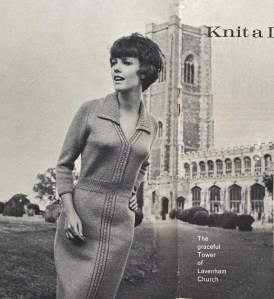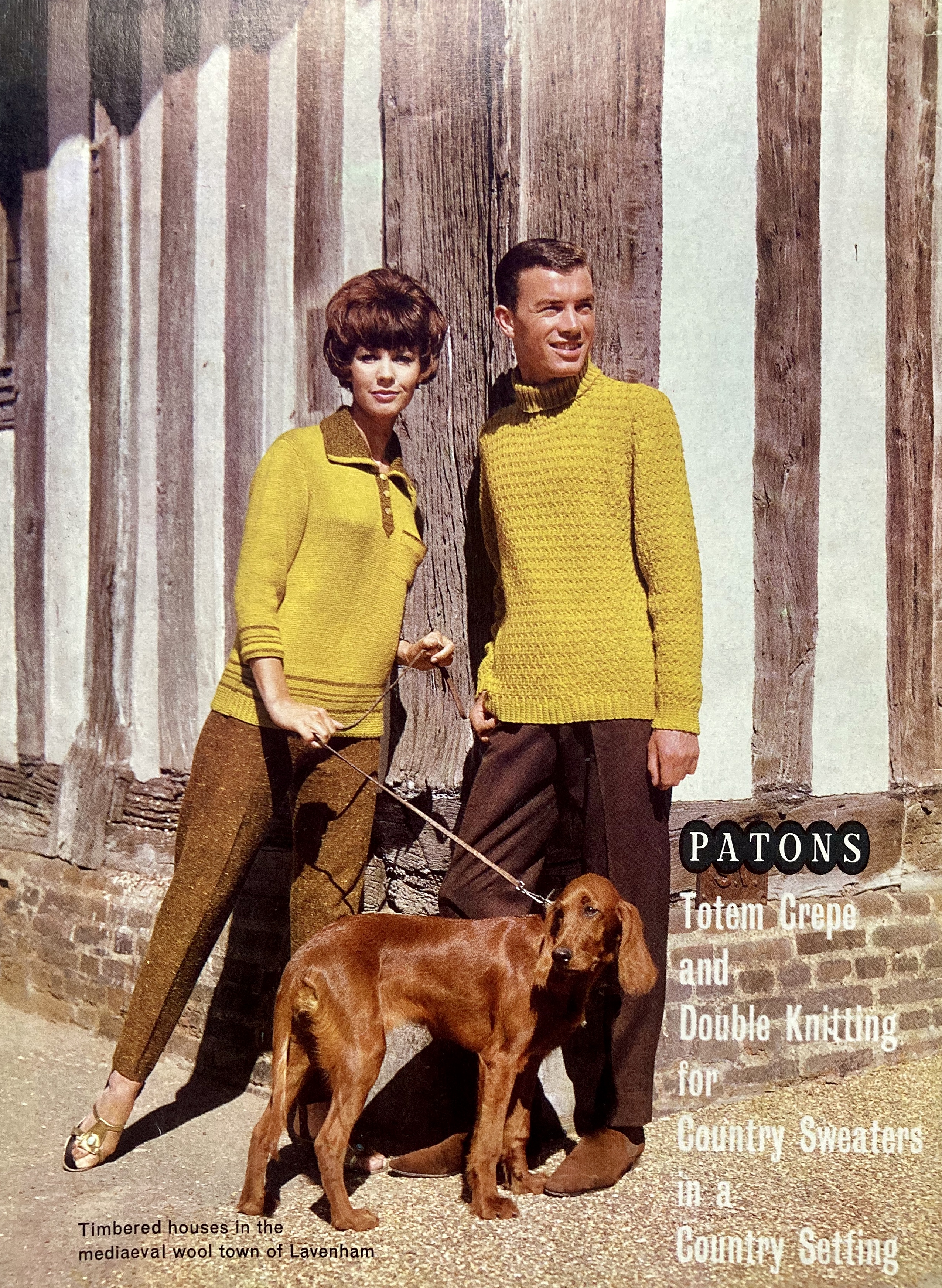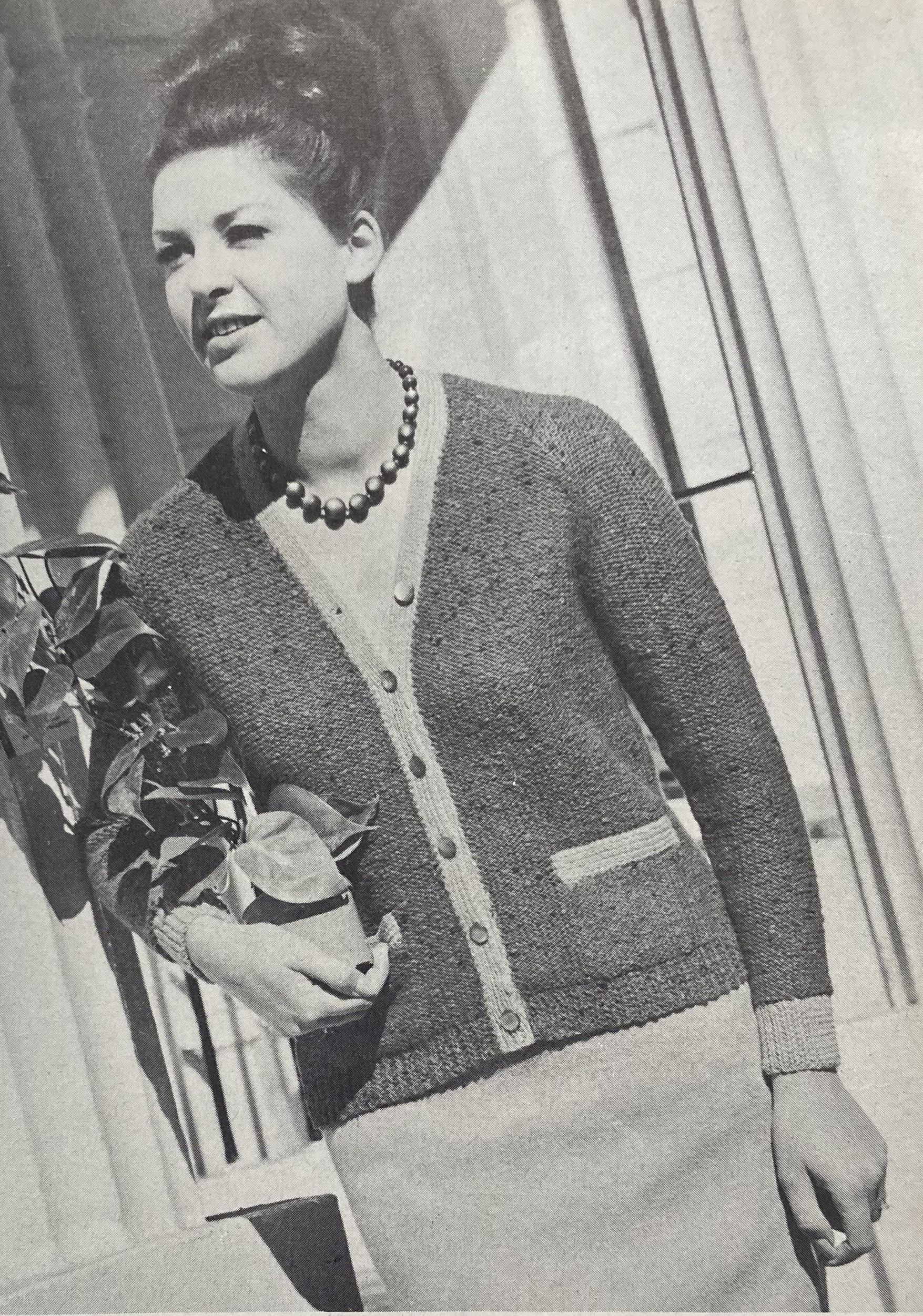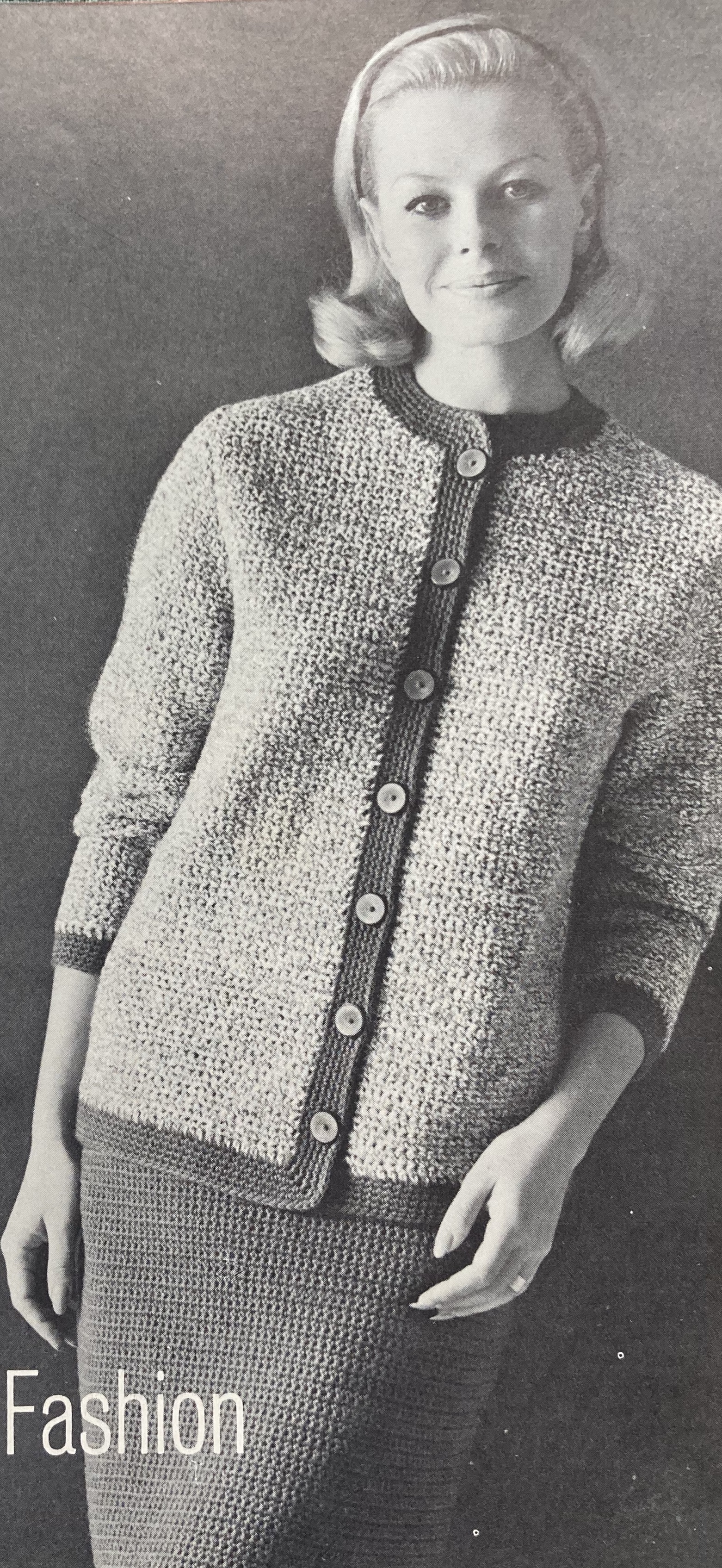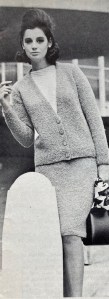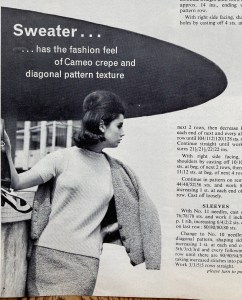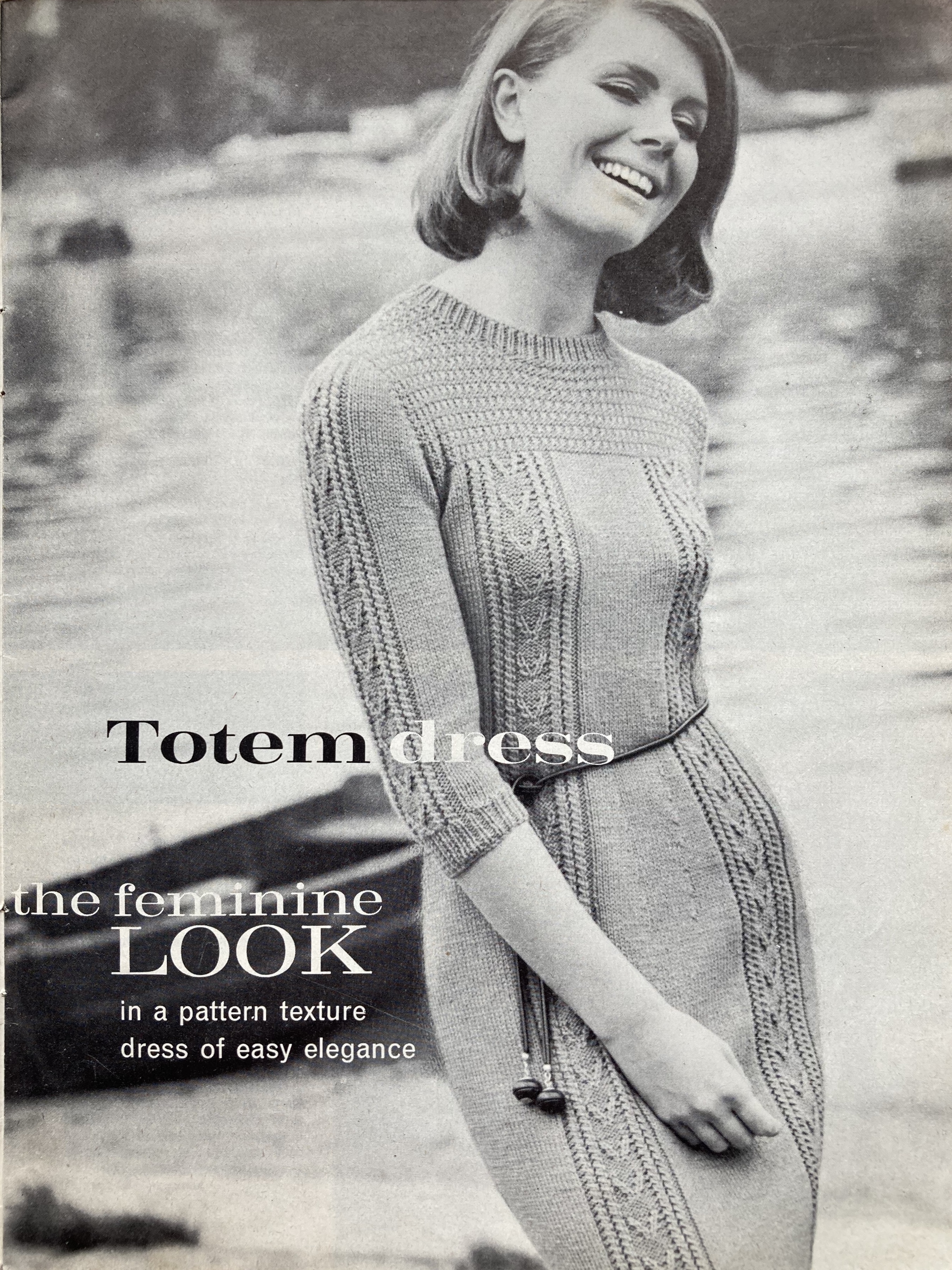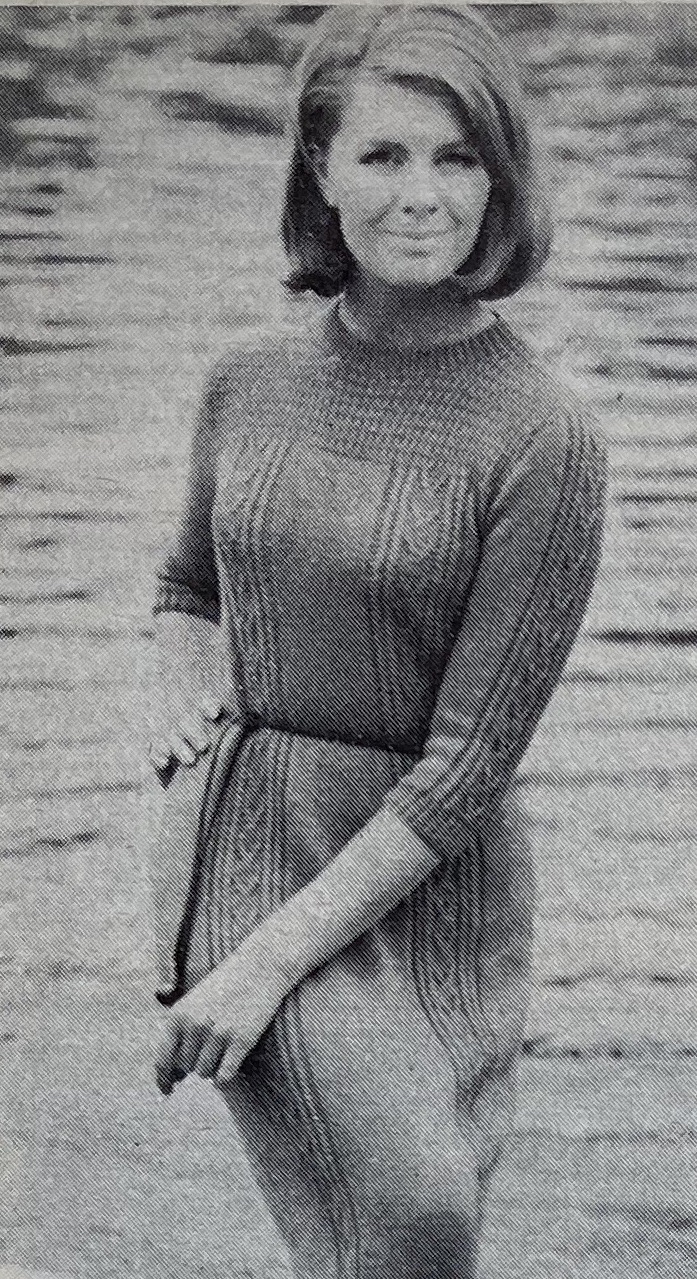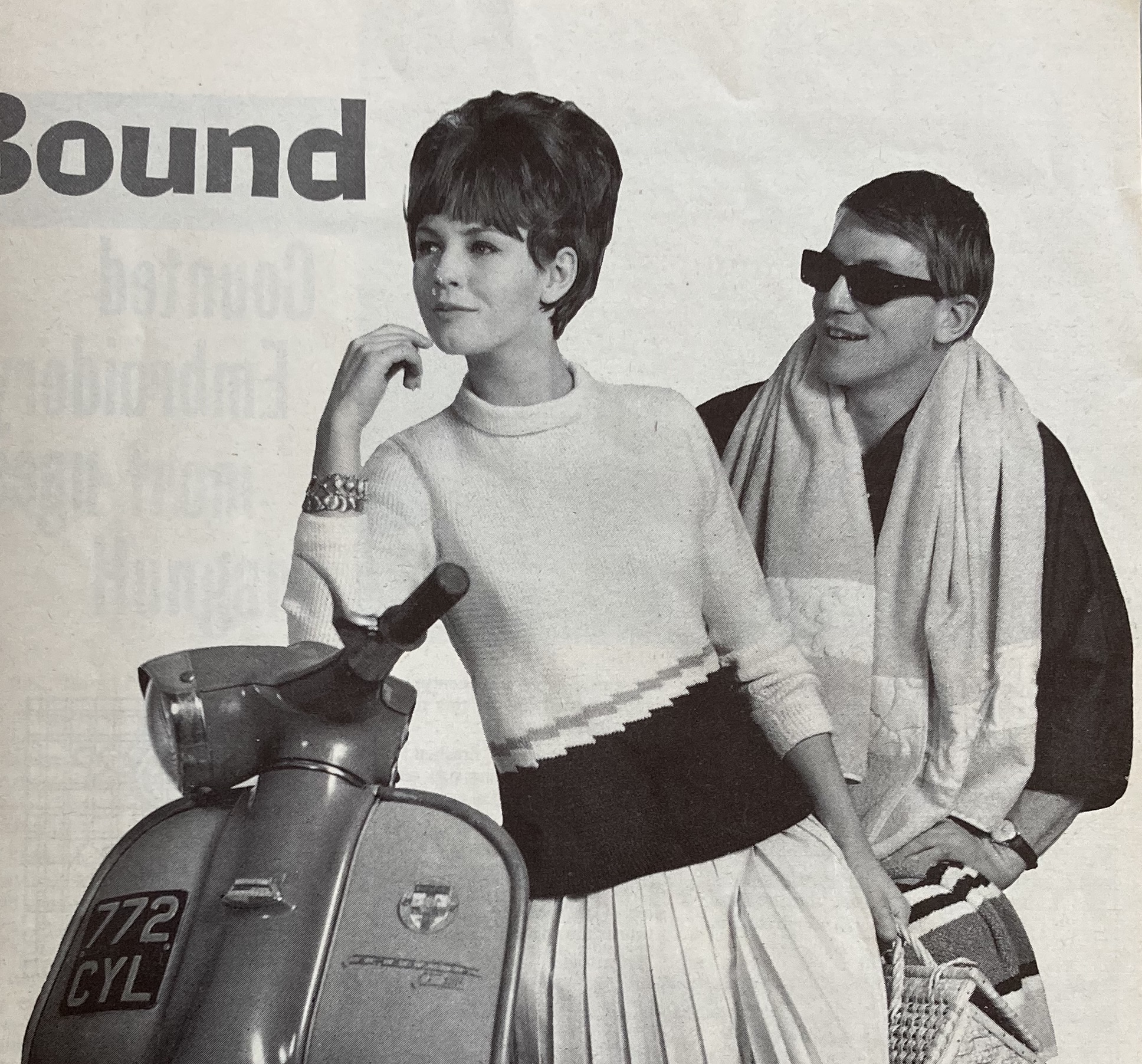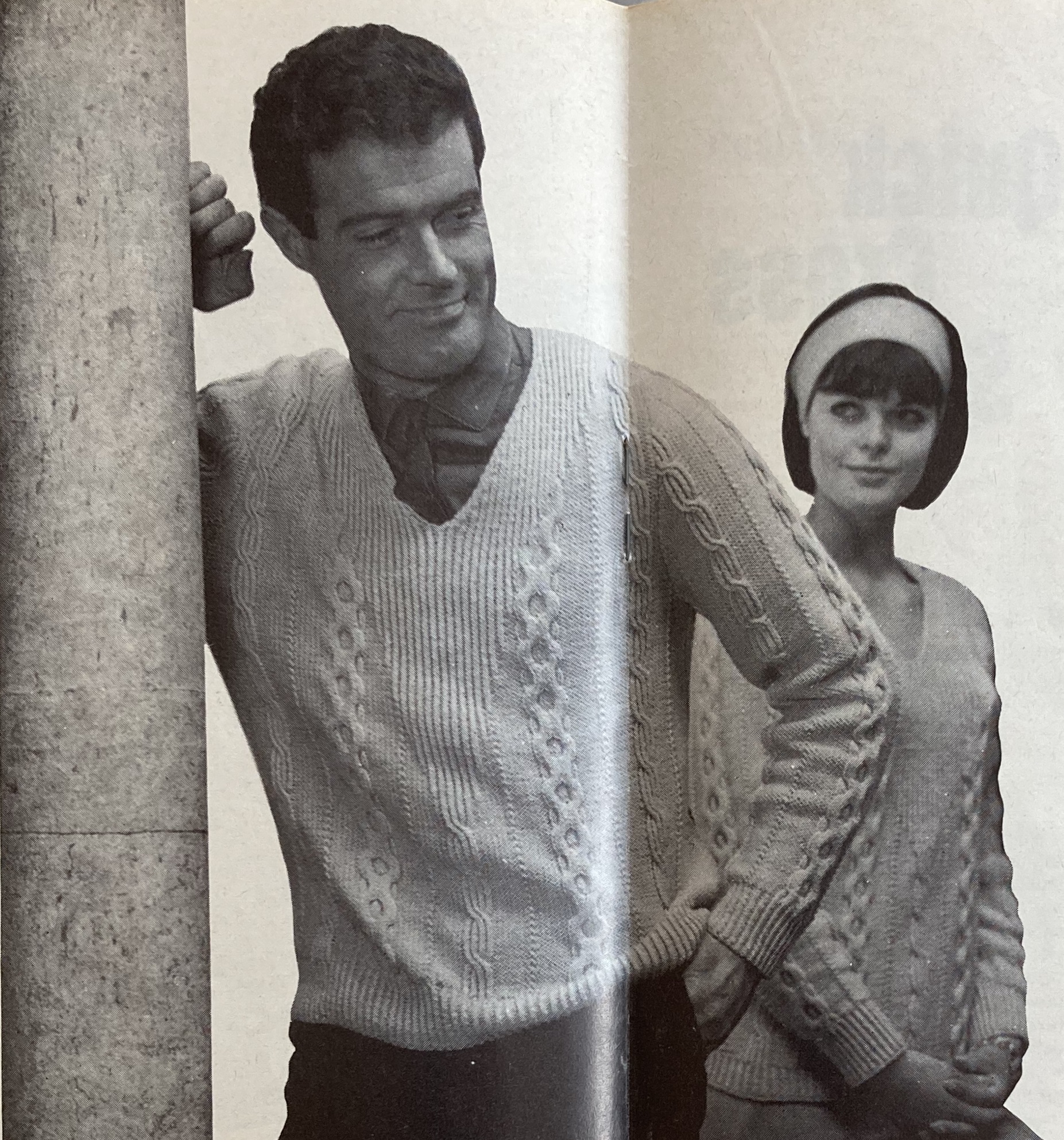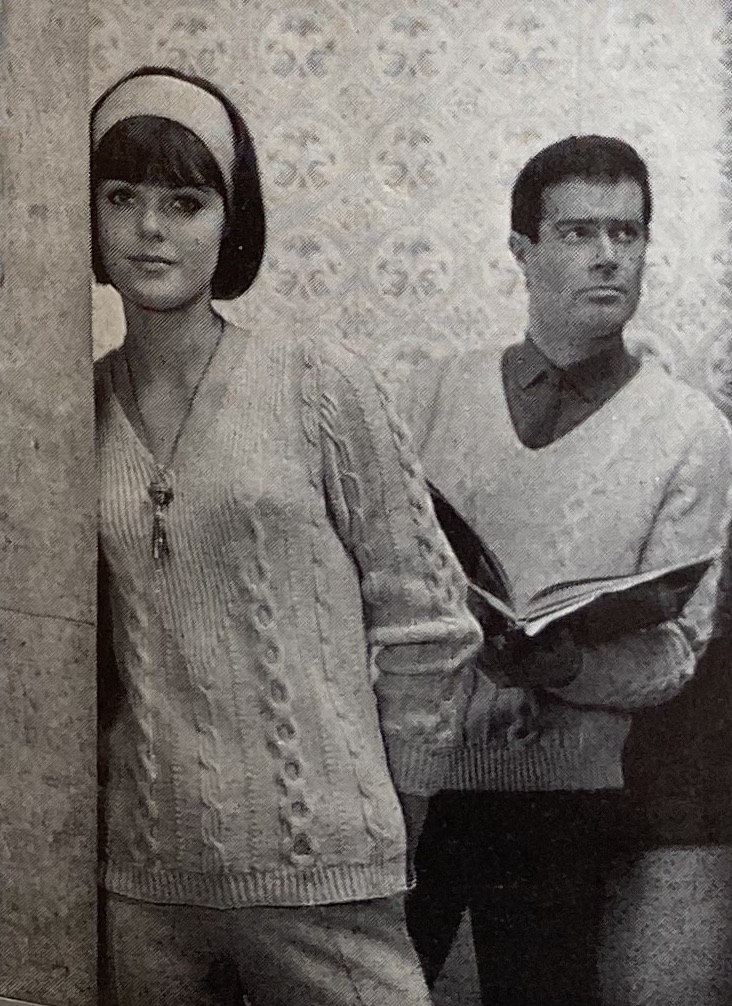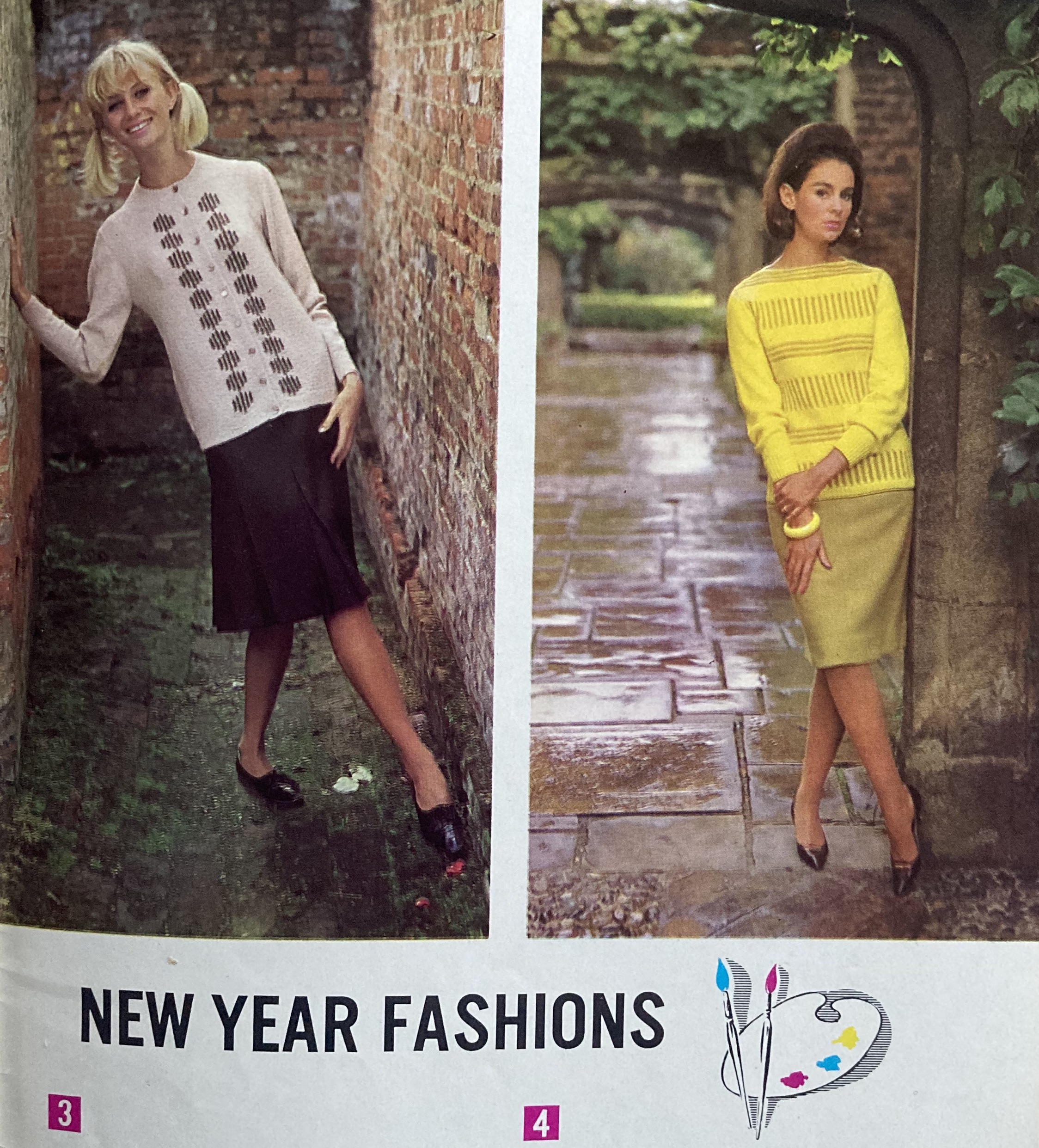
September 1964: Overview

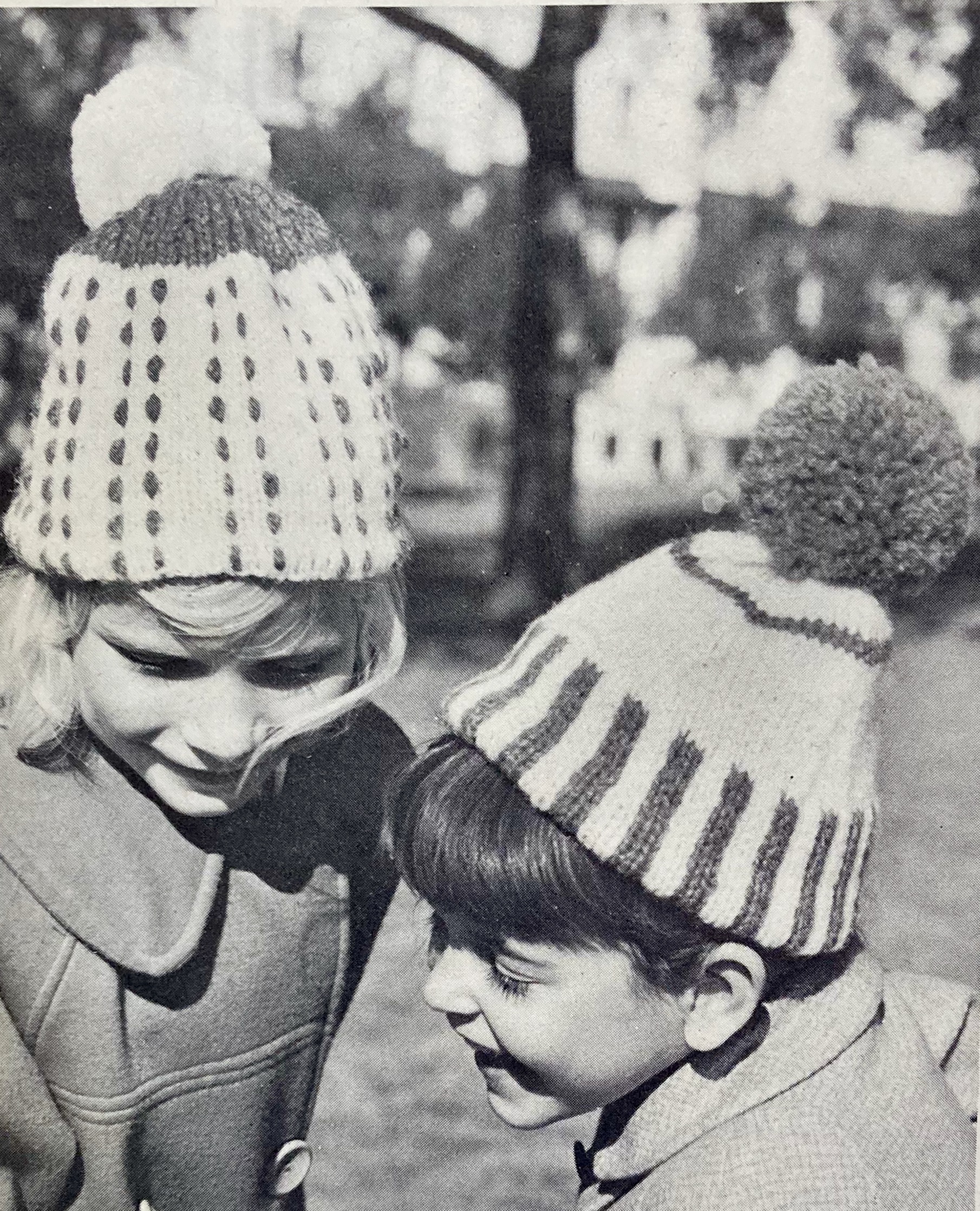
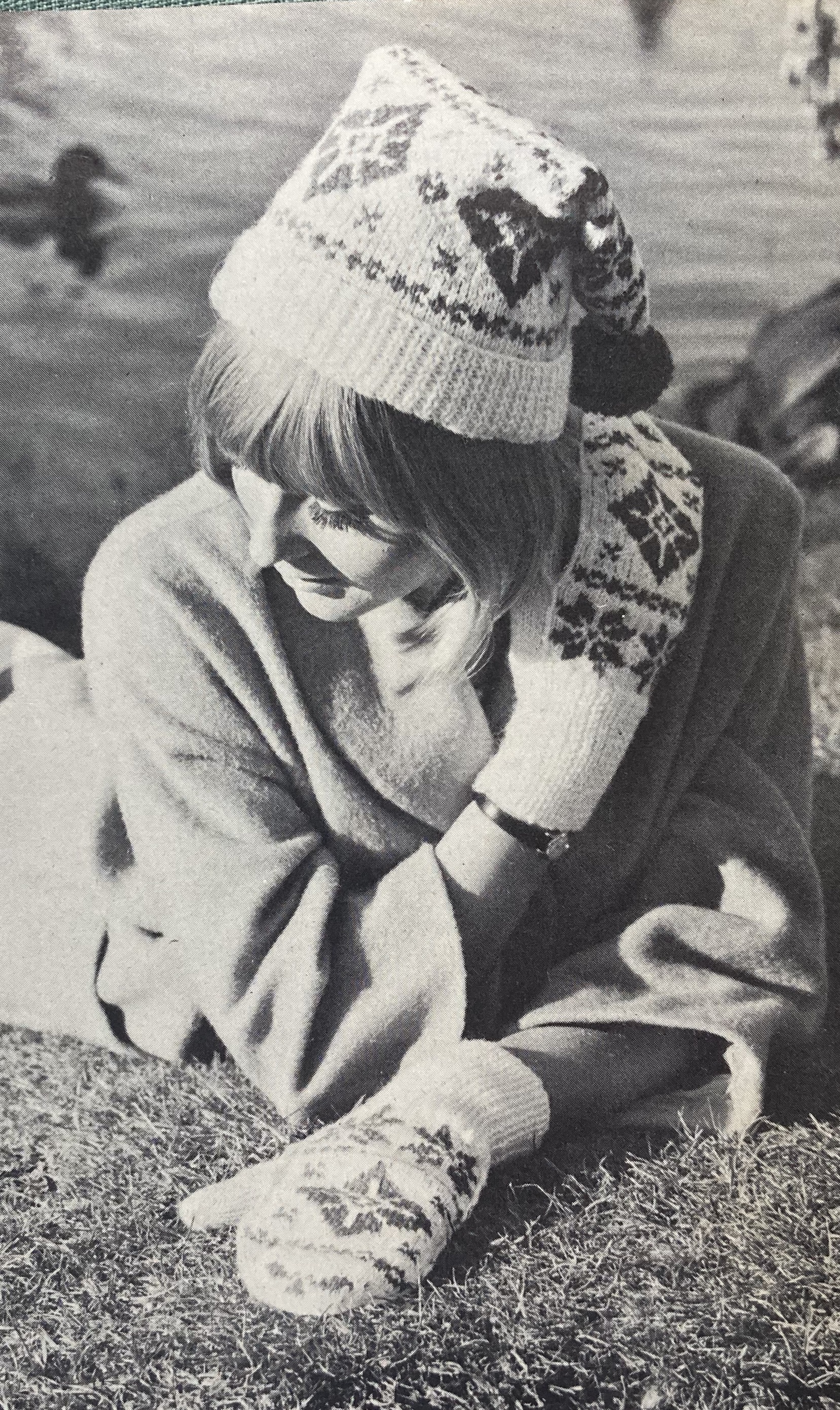
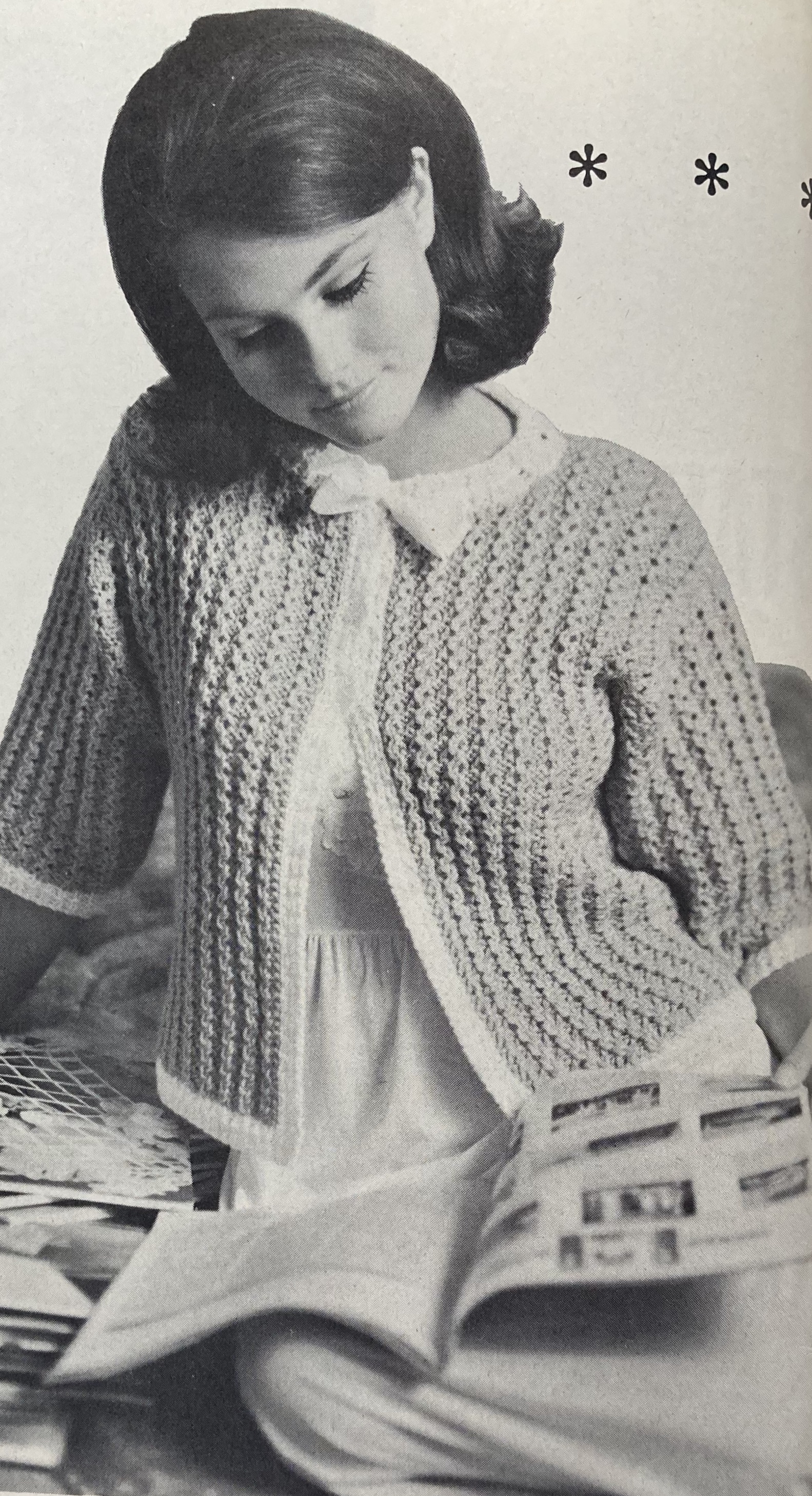
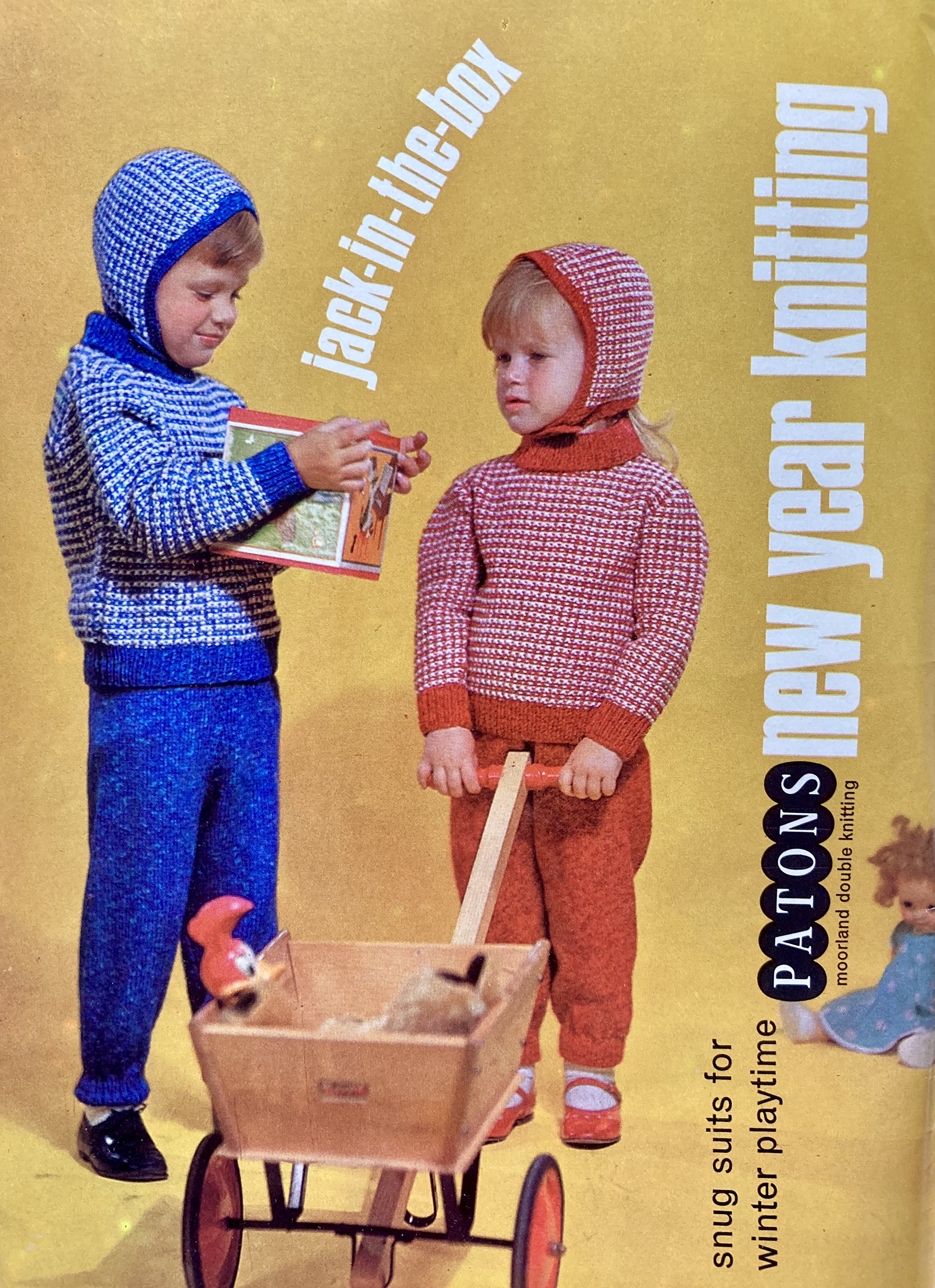
It’s the start of the autumn knitting season, and this issue’s slogan is “Knitting in Full Swing”. There are practical garments for adults and various ages of children, as well as a new yarn: Patons Flair.

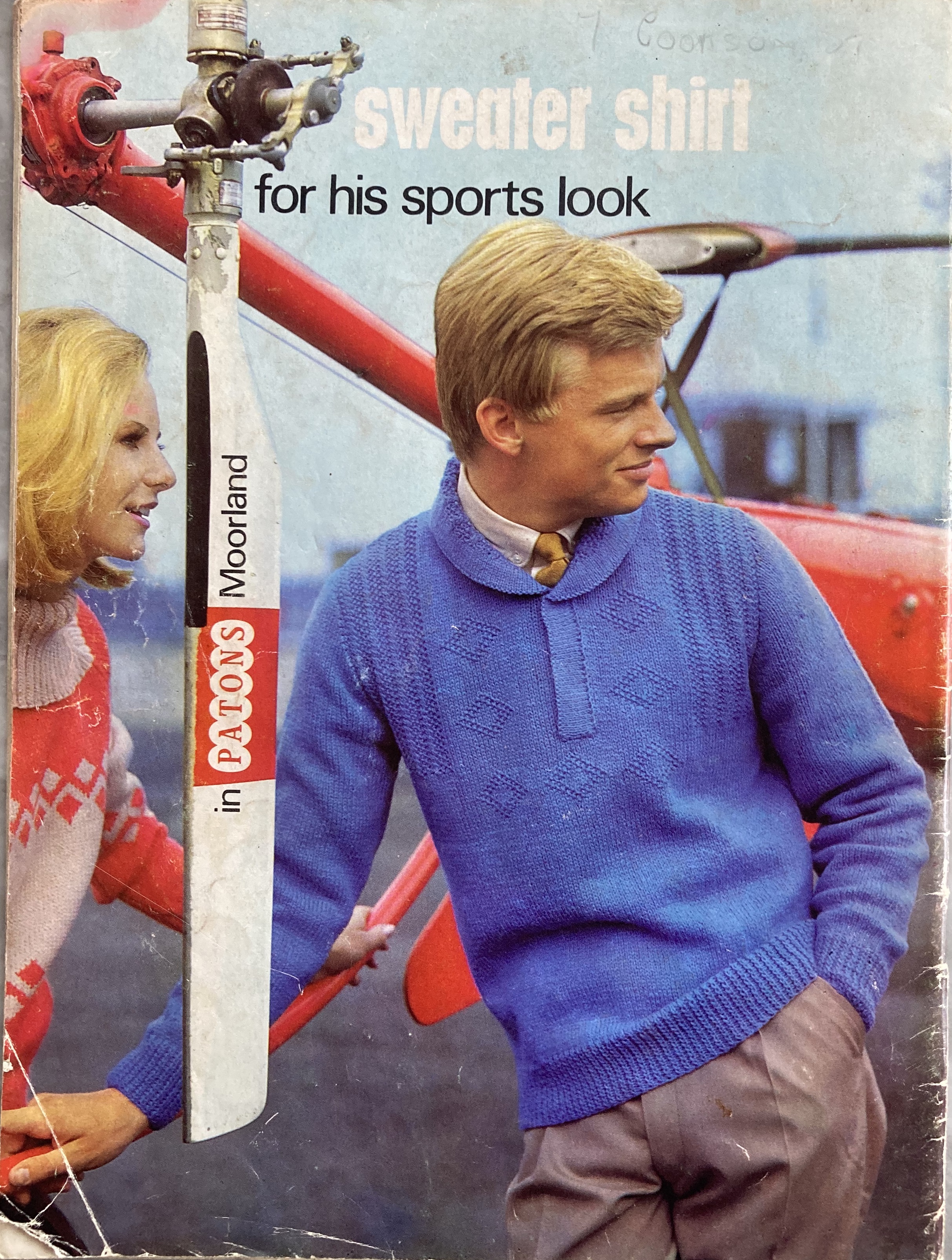
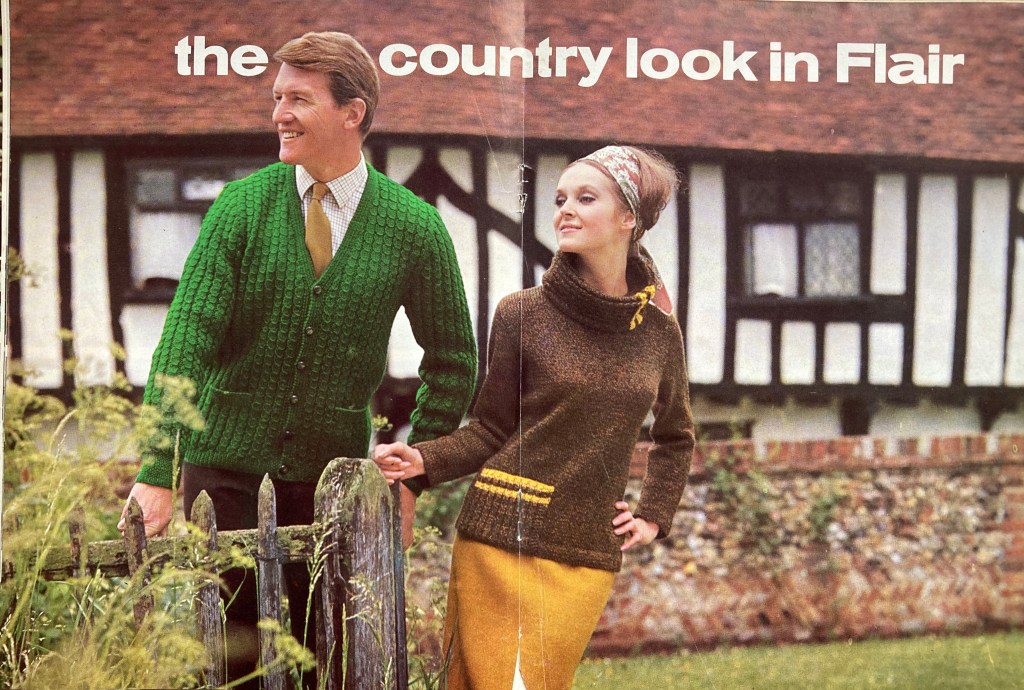
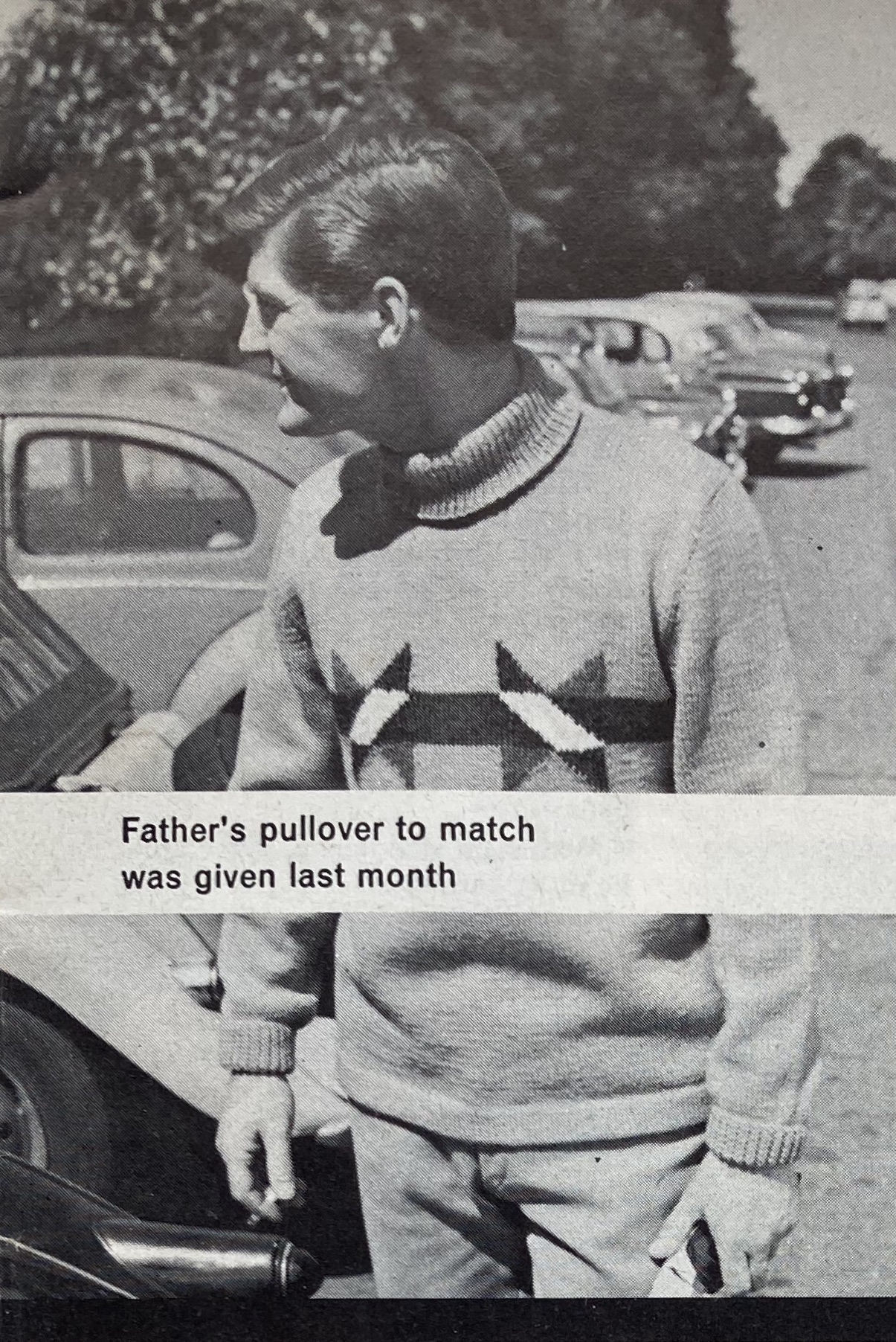
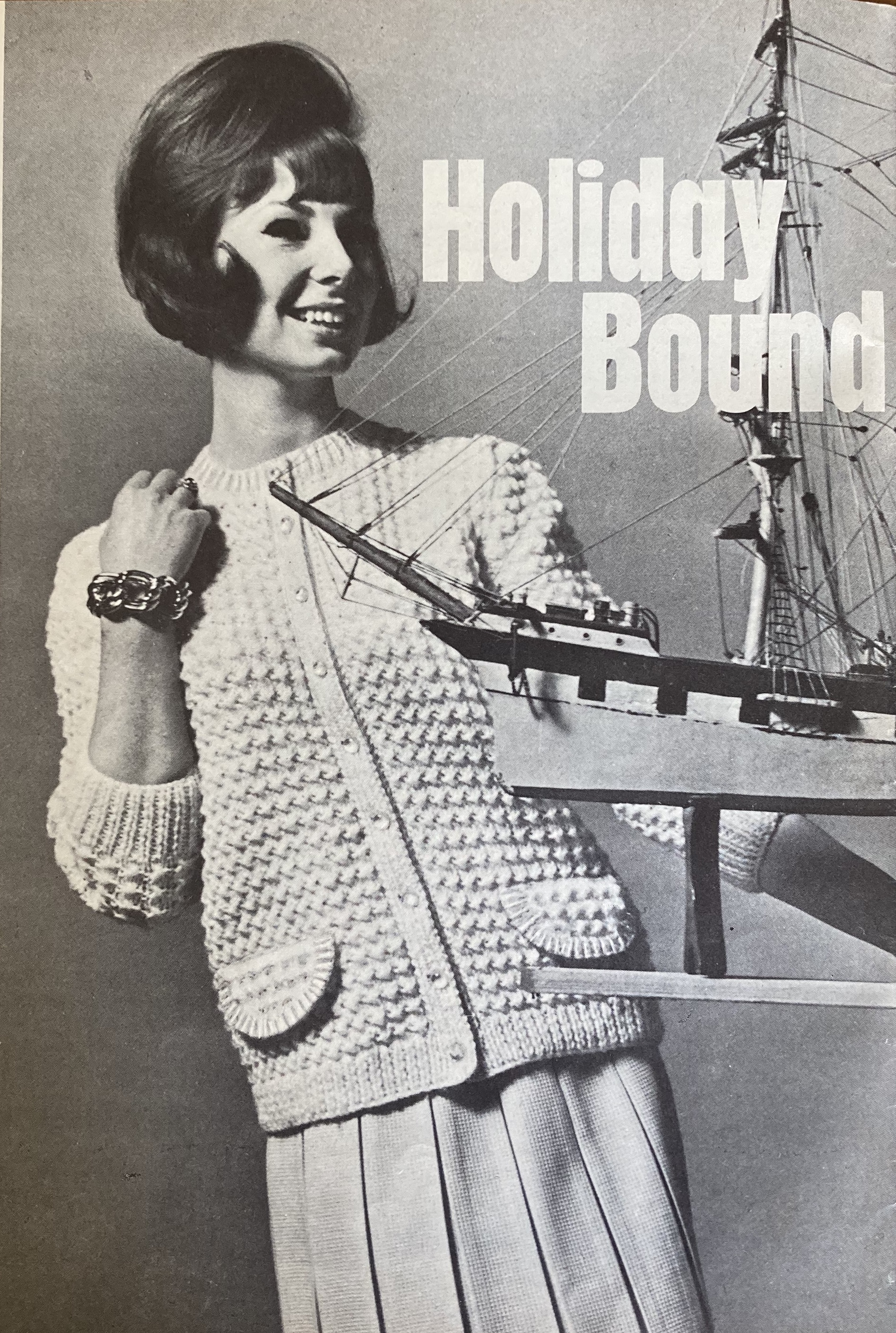
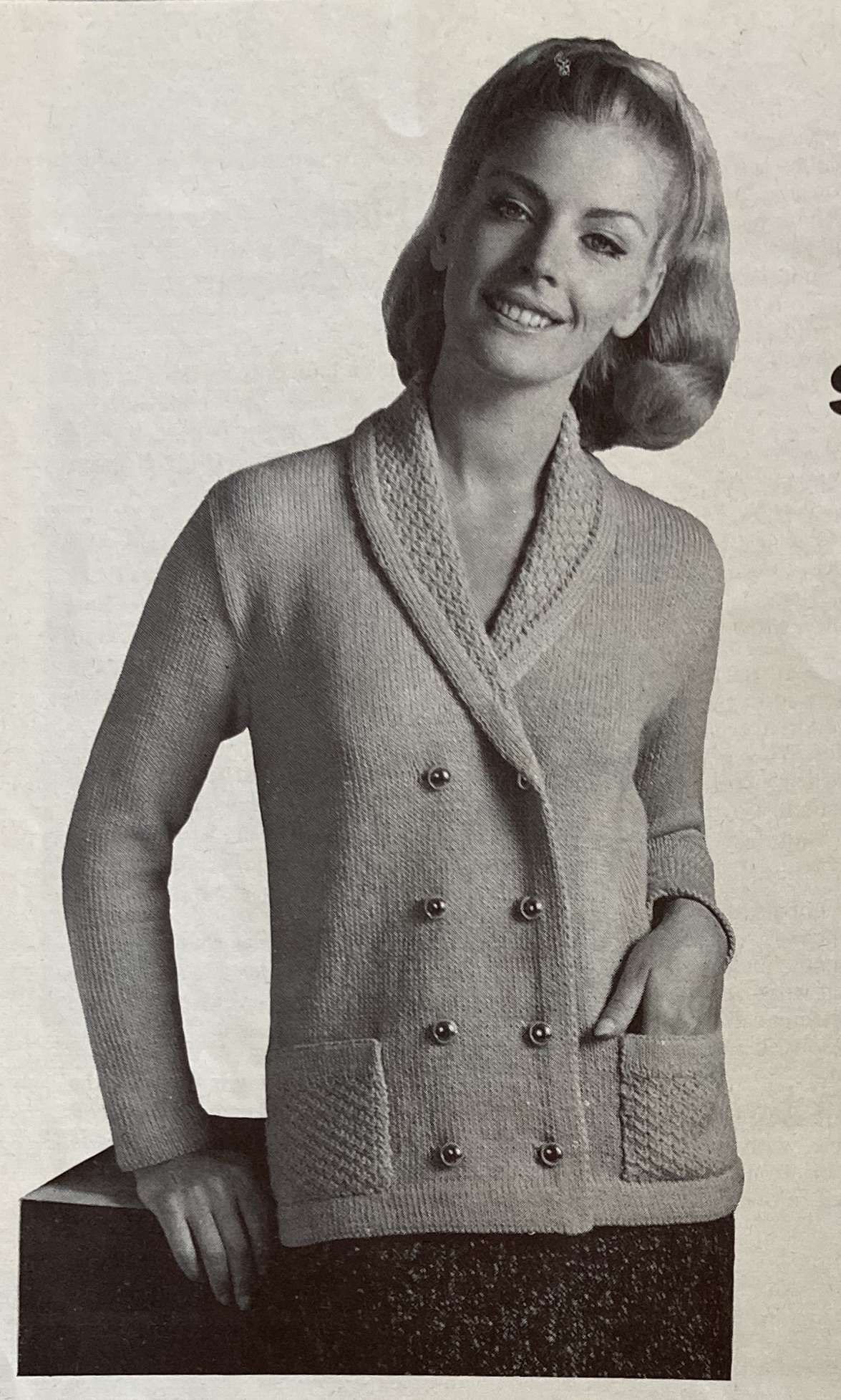
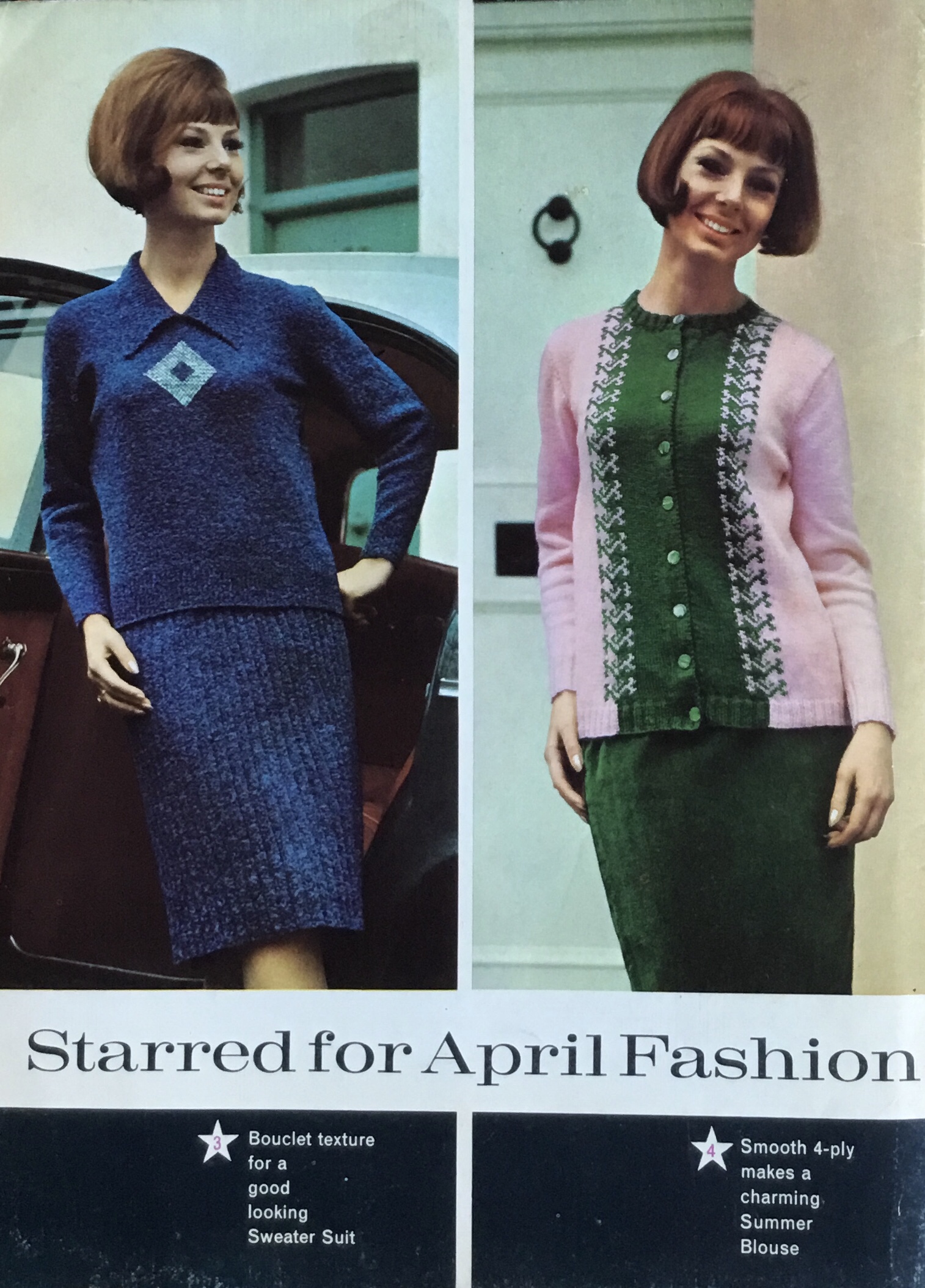
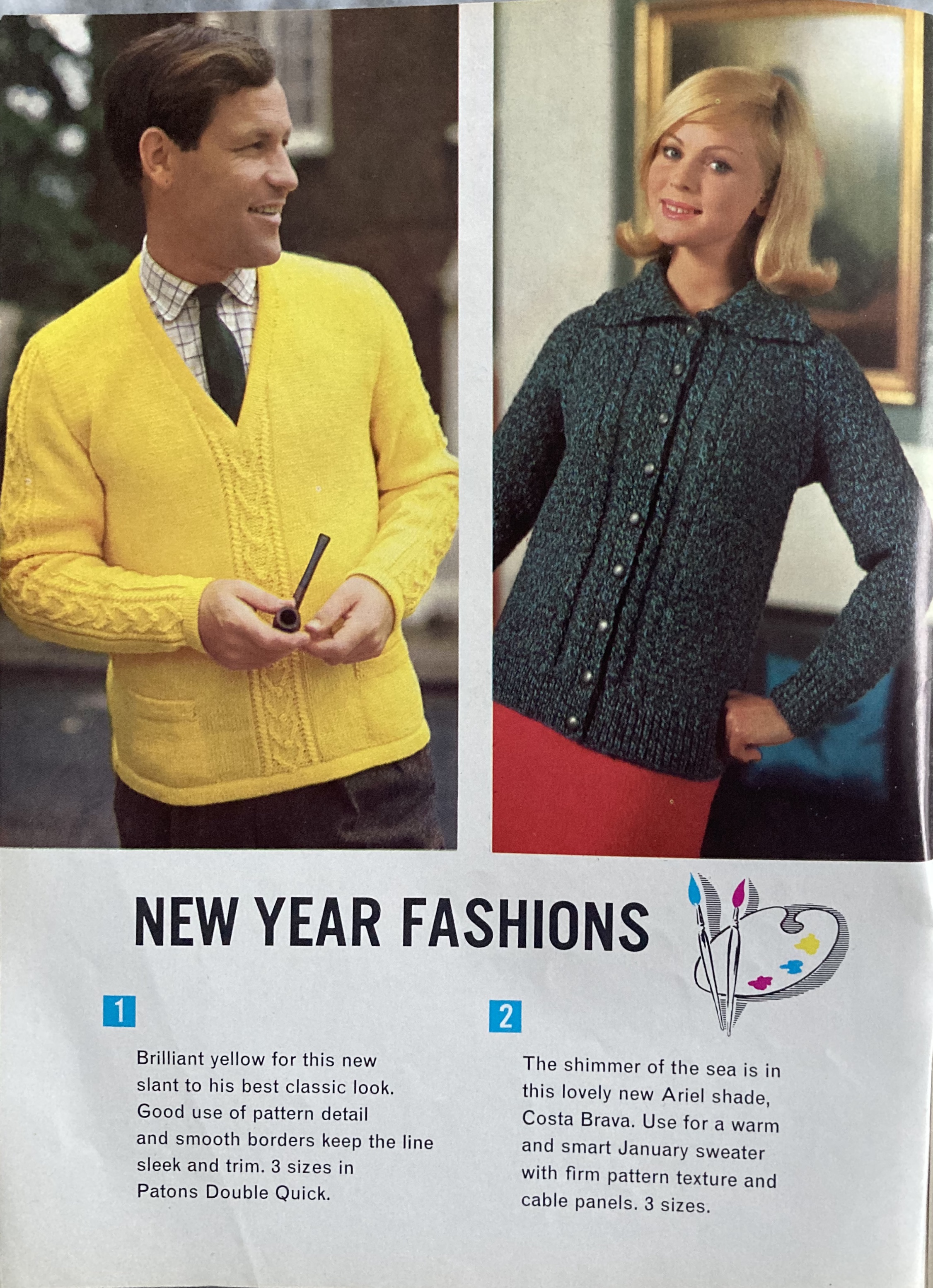
Flair” is somewhat heavier than DK weight — what is now often called “worsted” — and made of 60% wool and 40% “Courtelle“, a synthetic fibre pioneered in the late 1950s by the Courtaulds company. It features in the green cardigan and the yellow star-motif pullover on the cover. I love the cardigan, with its bright green colour and use of simple garter-stitch ribs and bobbles to decorate the fronts. The placement of the motifs on the yellow pullover is… interesting. I guess it works OK on a male figure, but I would not recommend it for a partner look! There’s also a plain, classic V-neck pullover for him and a “blister stitch” sweater for her on the back cover. Bright, cheerful colours are in fashion. (The men’s V-neck pullover colour name is “Sorrento” — anyone know what colour it is?)

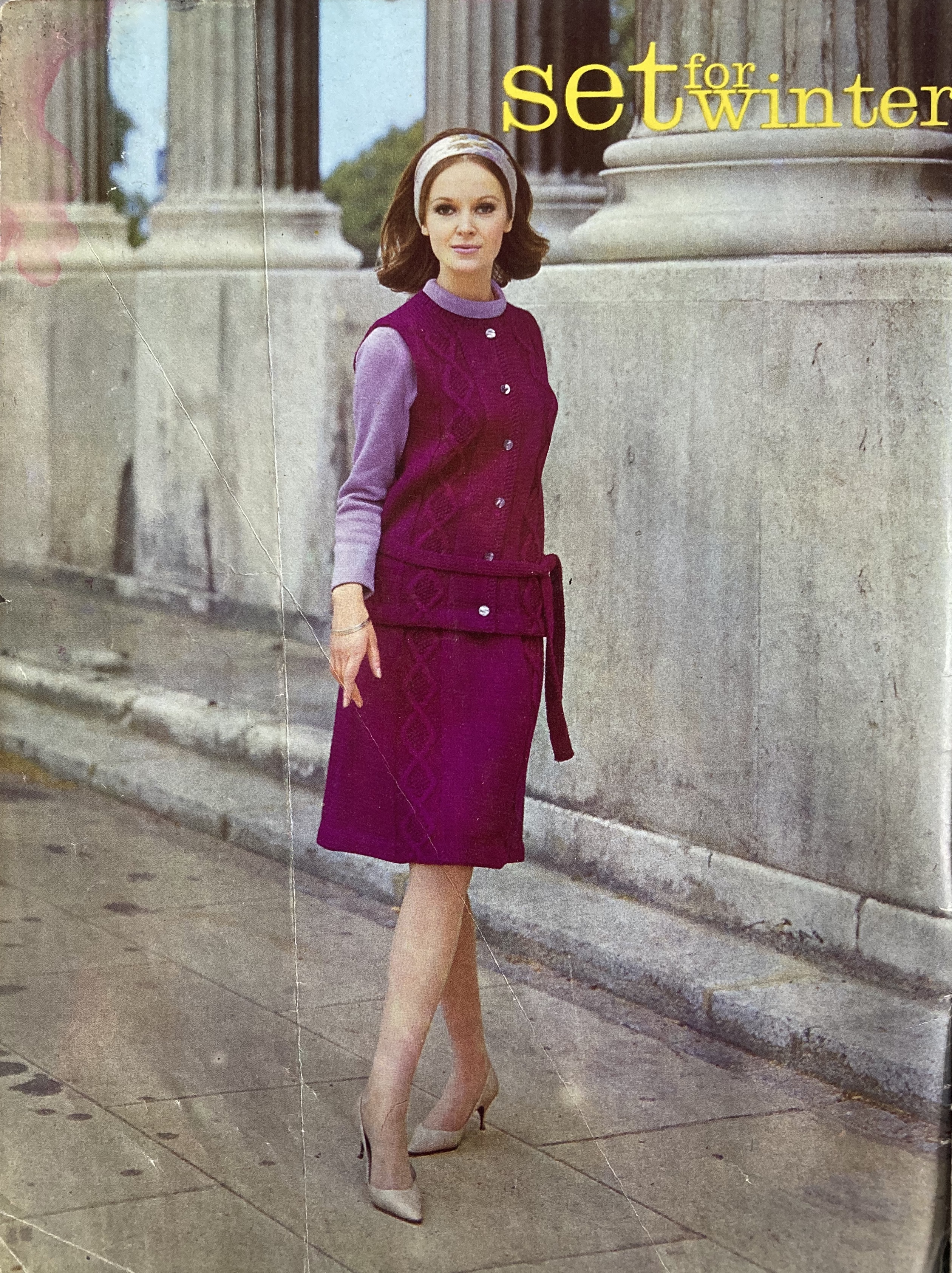
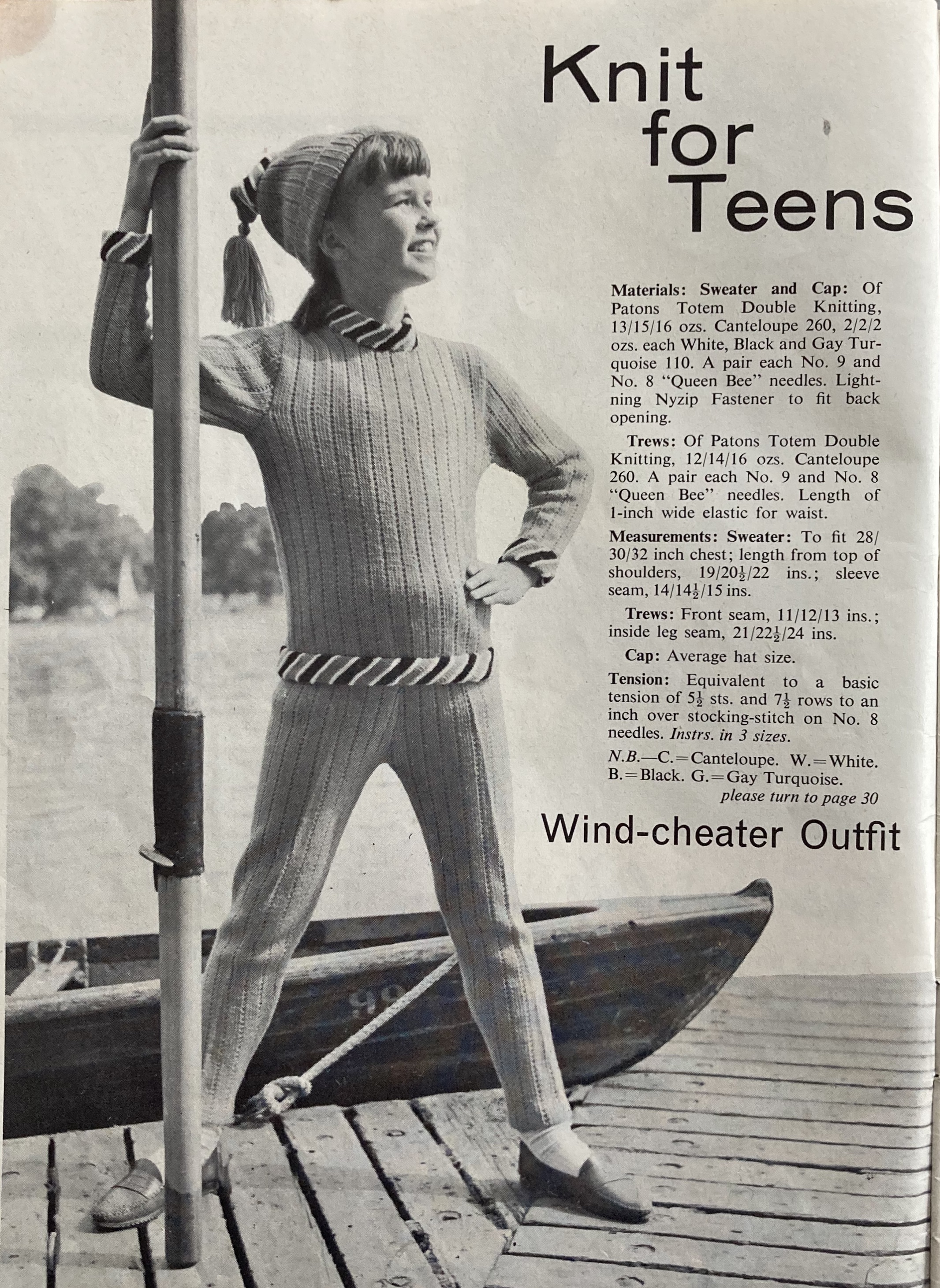
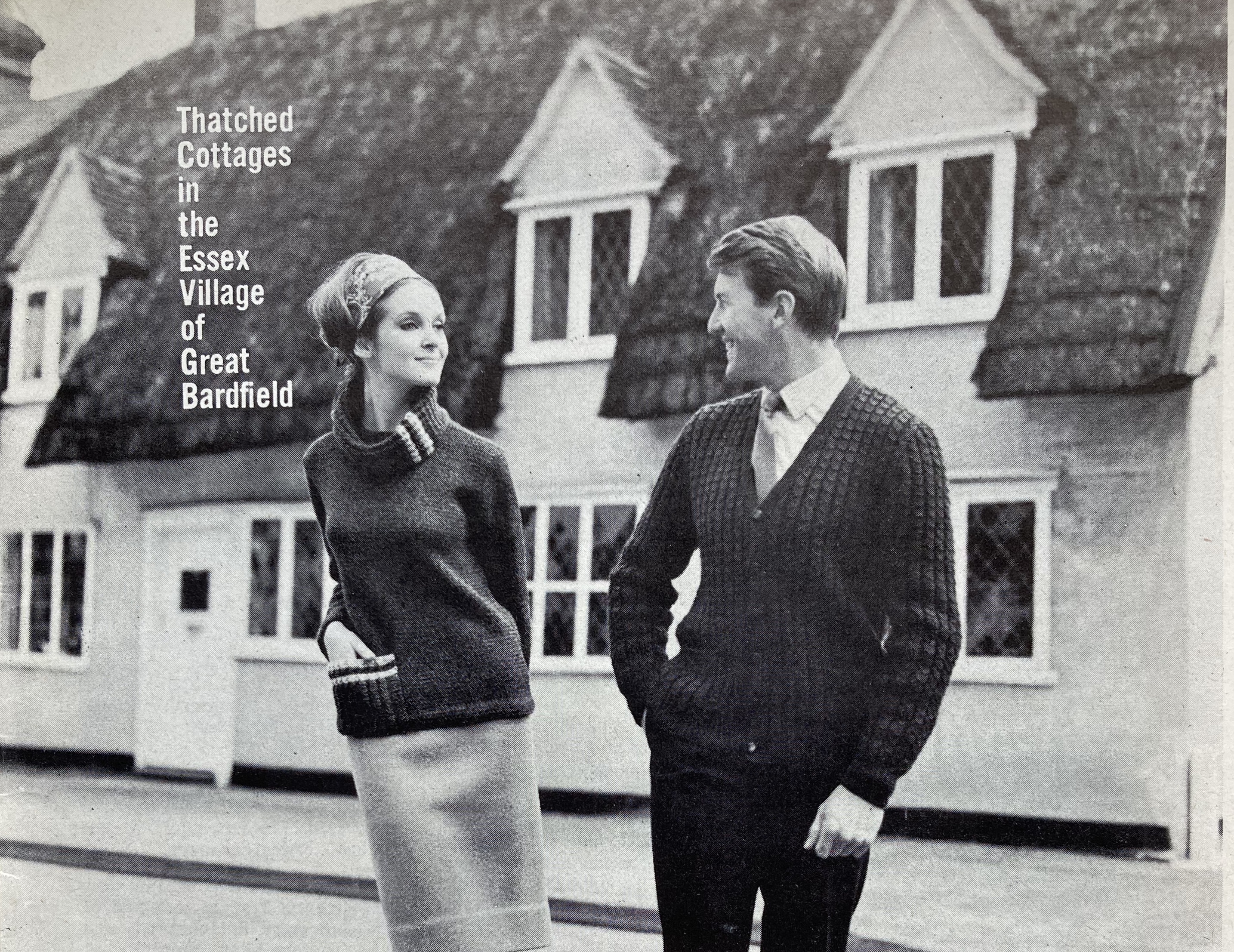
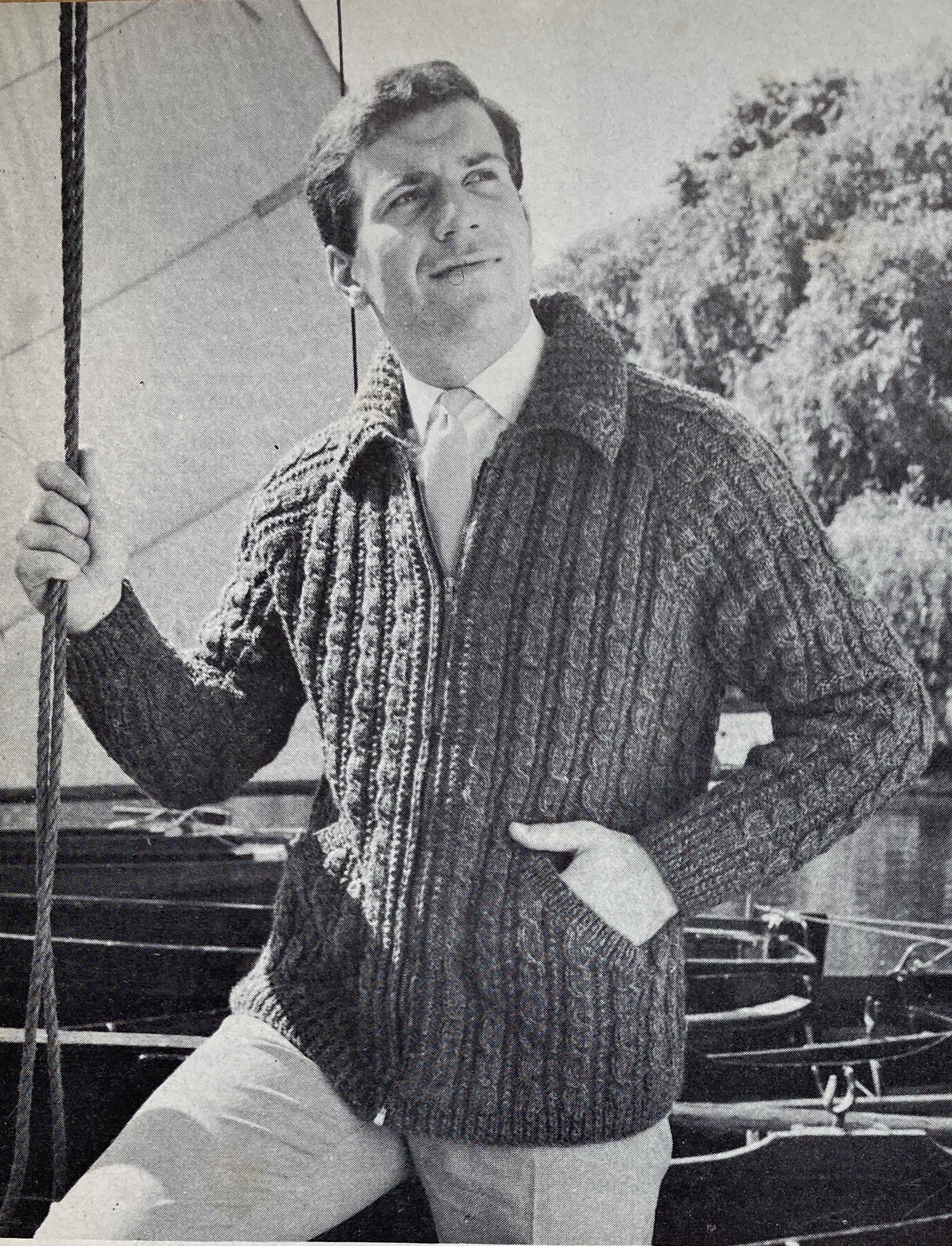
The non-Flair adult garments are all made in DK weight yarn: a “country sweater” in a twisted-rib pattern with an oversized Vandyke collar, a complicated cable-and-stripe men’s shirt-style pullover, an elegant set of slim skirt and “overblouse” and a long, skinny sweater “for teens”. All of them feature interesting stitch textures, particularly twisted-rib patterns and bobbles, and interesting details like the fake “pocket” decorations on the front of the overblouse. The cable-and-stripe pattern is especially complex and uses separate lengths of wool for the vertical twisted ribs while stranding the stripe colours behind. Aside from the teen sweater in “Flamingo”, the colours are slightly subtler, with light “Cream Whip” and dark “Loganberry” for the base colours (sounds delicious) and accents of light blue, olive green and melon-orange.

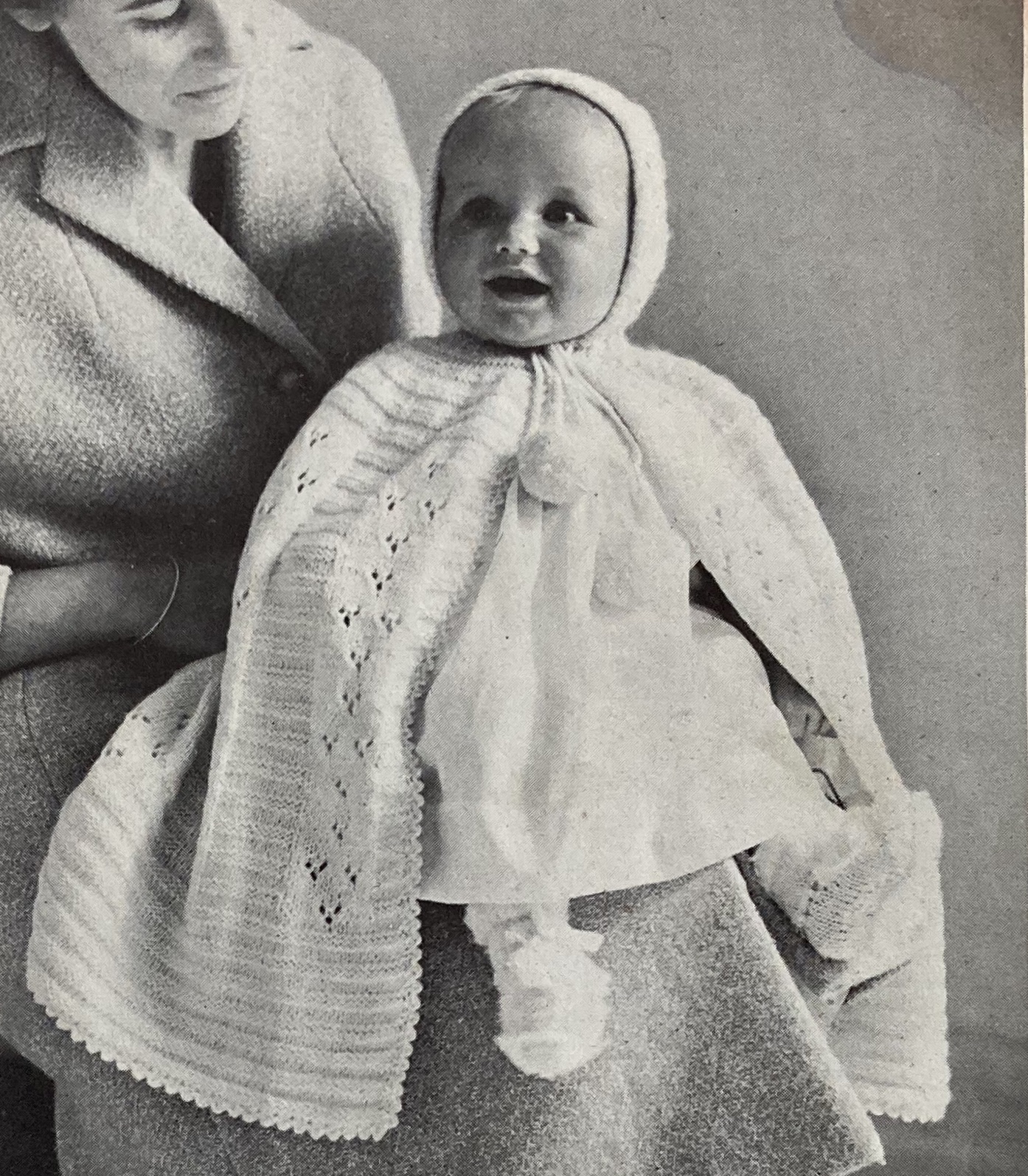
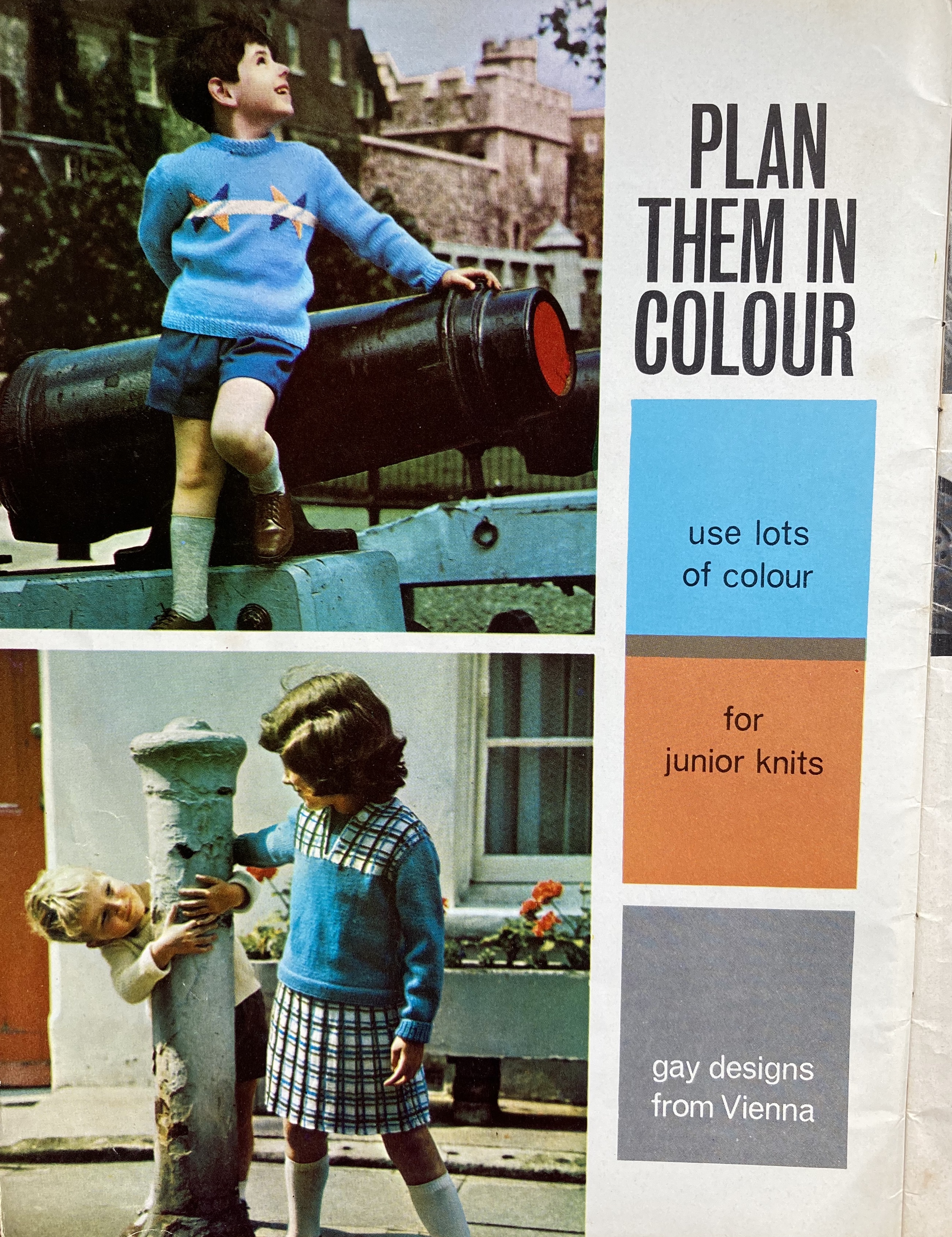
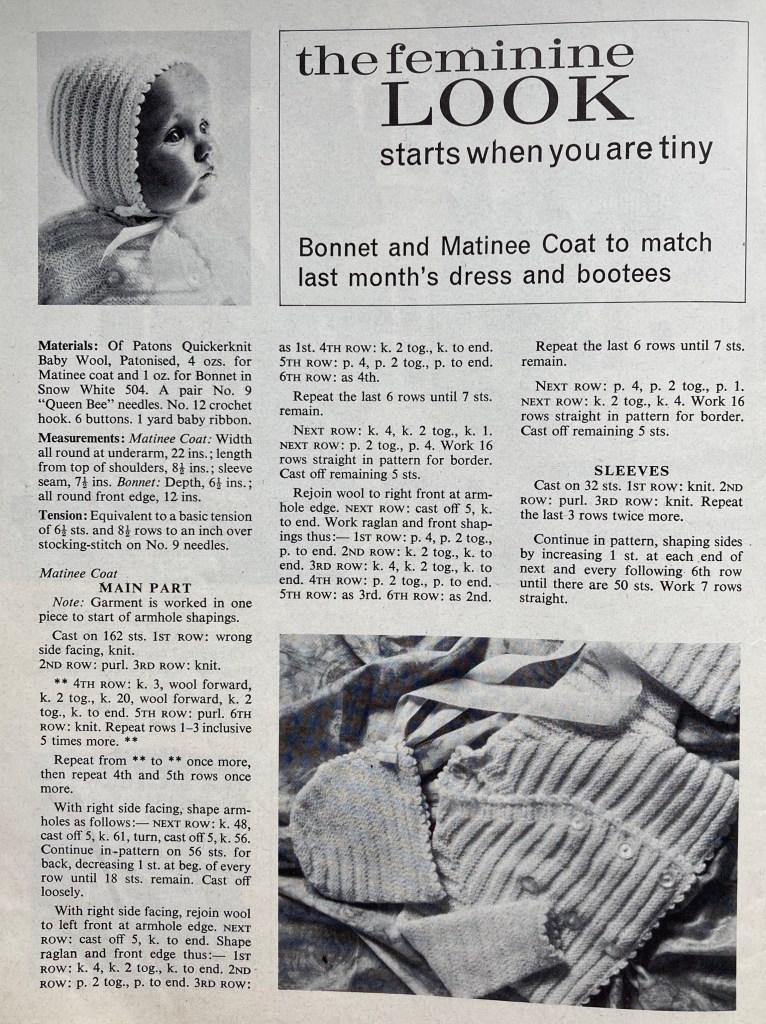
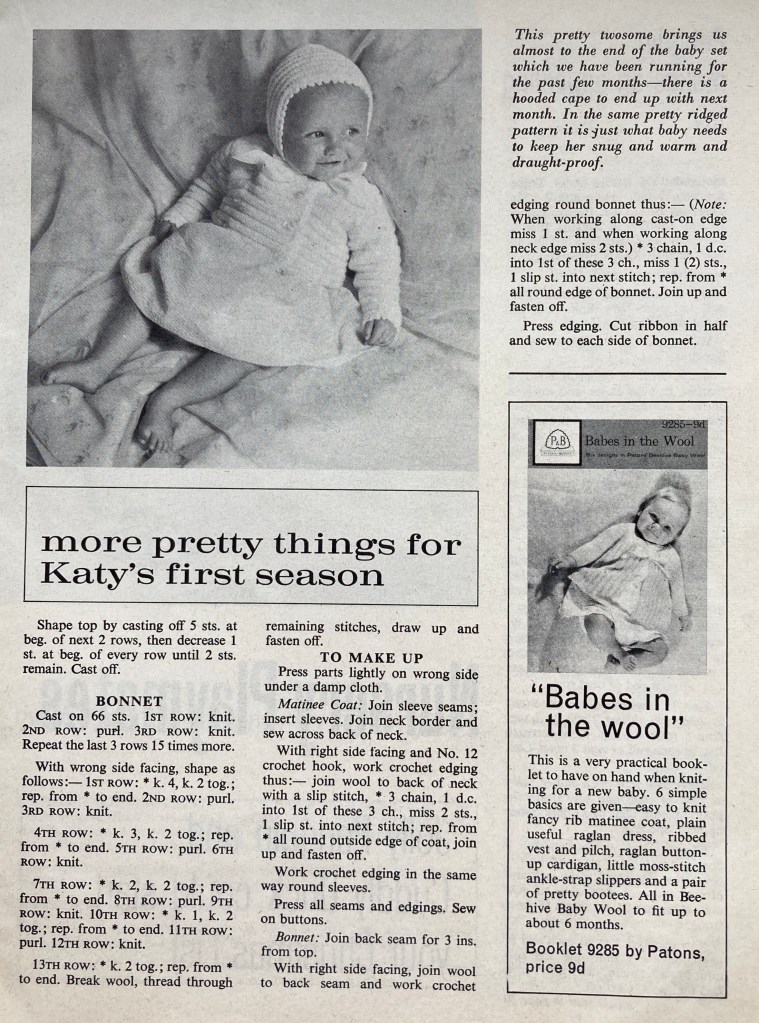
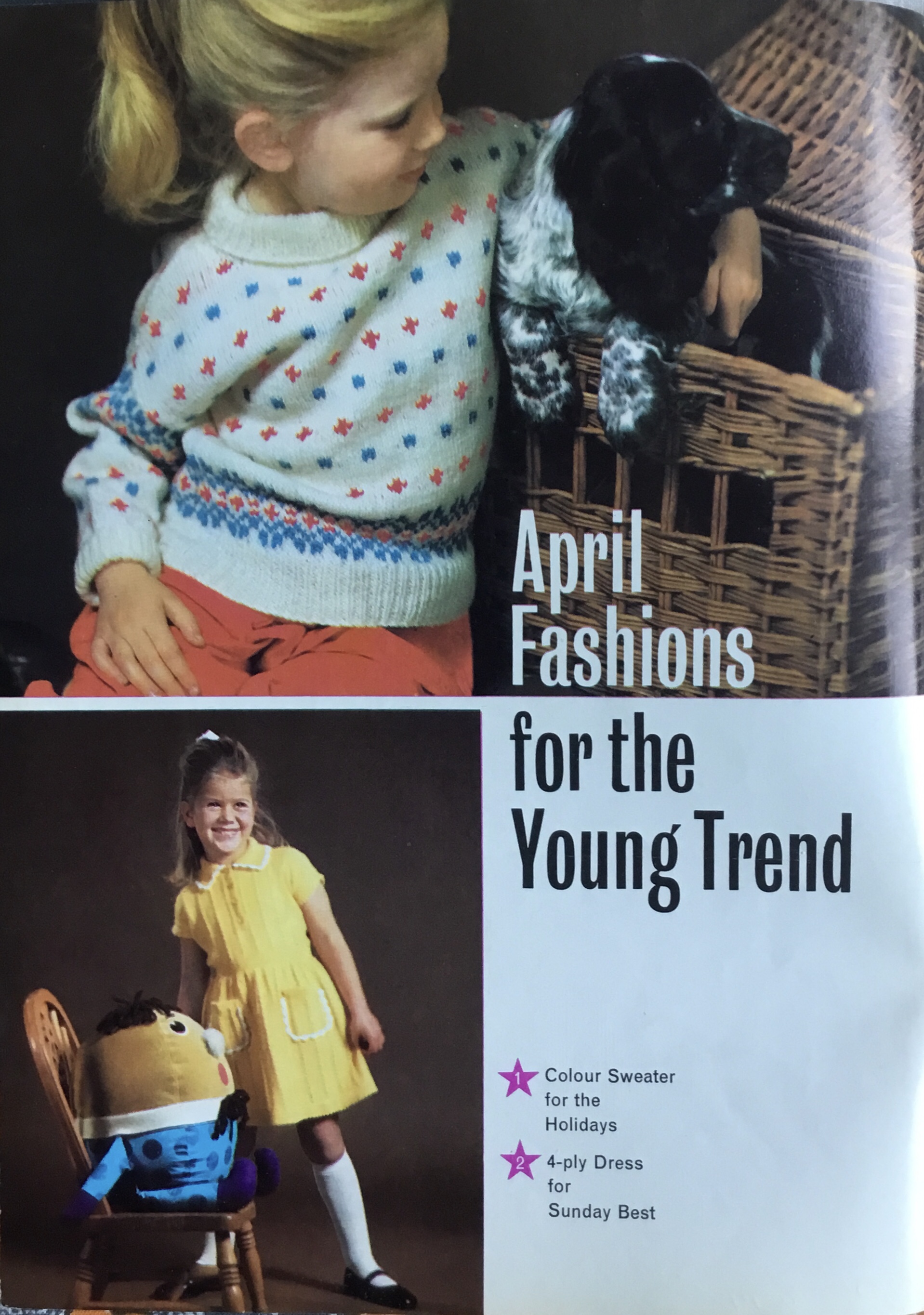
For the younger members of the family, there’s a fun and cheerful five-piece set “for twins”, consisting of a skirt, shorts with braces, a short-sleeved jumper, cardigan and beret. They’re all made in DK wool in a similar bright, sunny yellow to the man’s pullover on the cover. Continuing the matching-set-for-babies look, this month’s issue has a dress and bootees for a six-month-old, to be followed by a matching matinee coat and bonnet in next month’s issue.

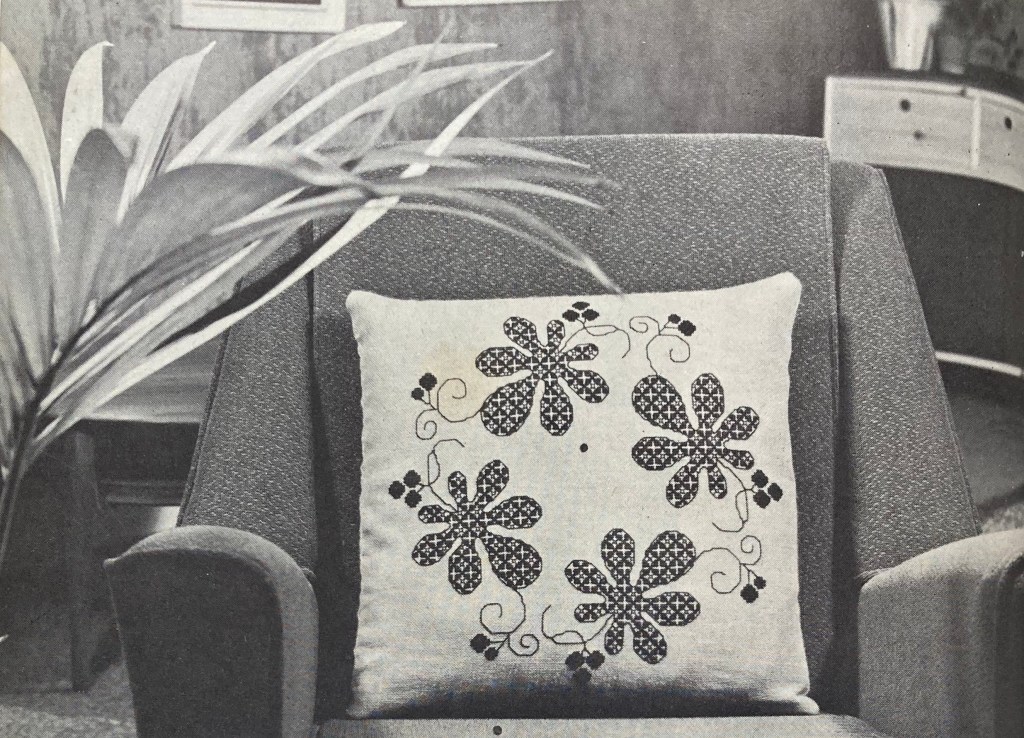
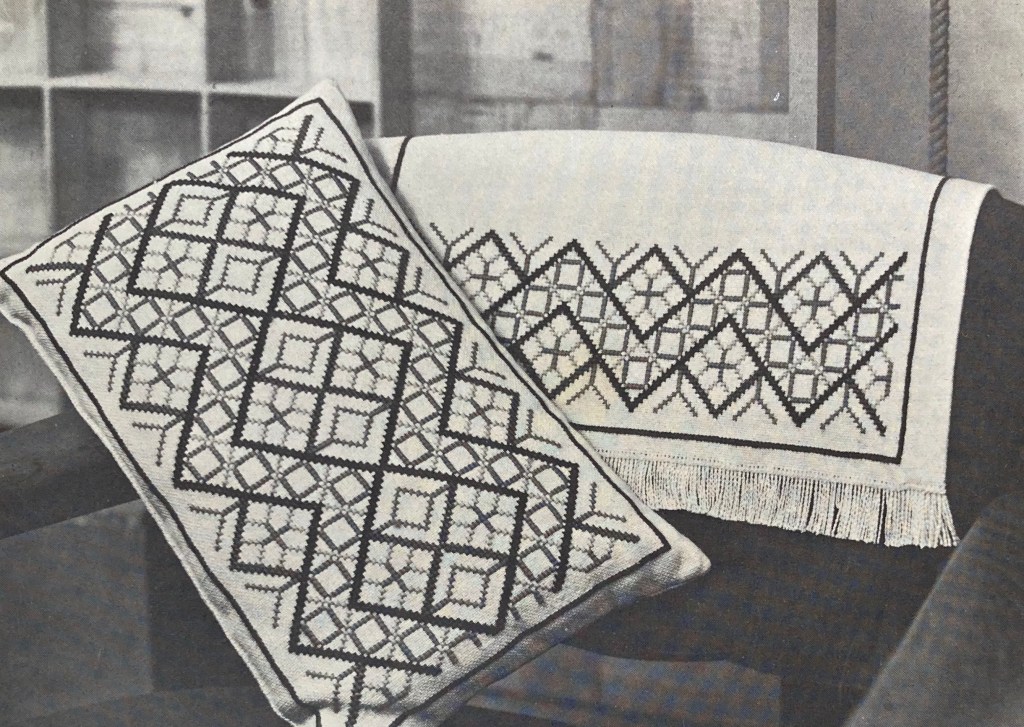
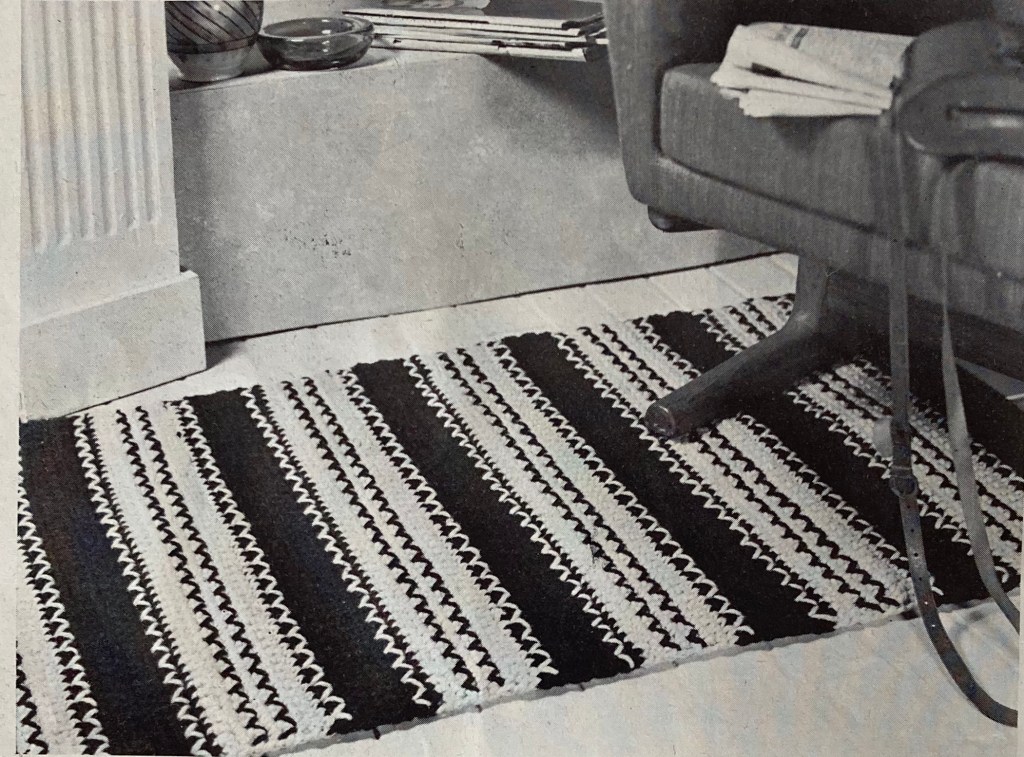
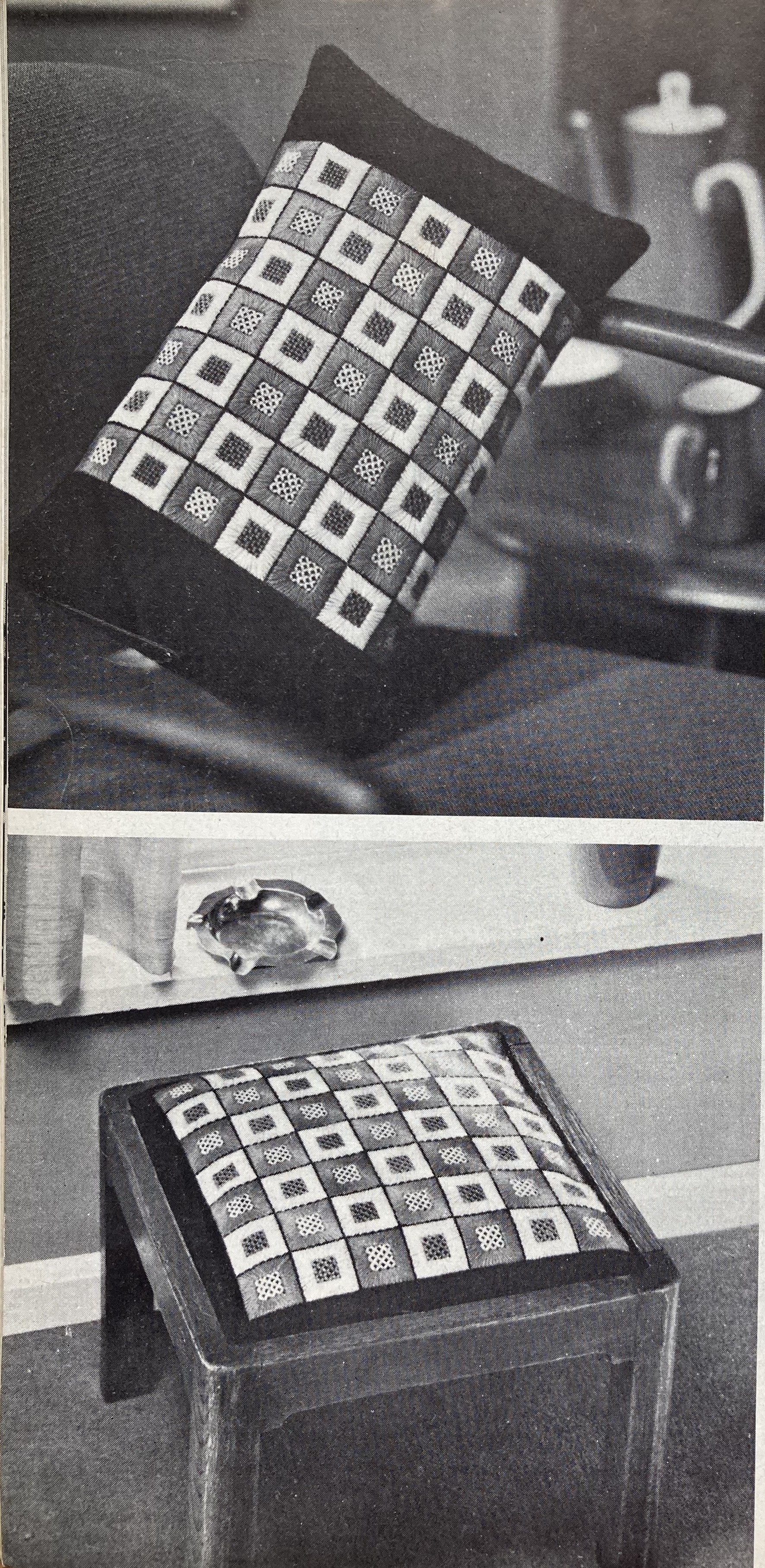
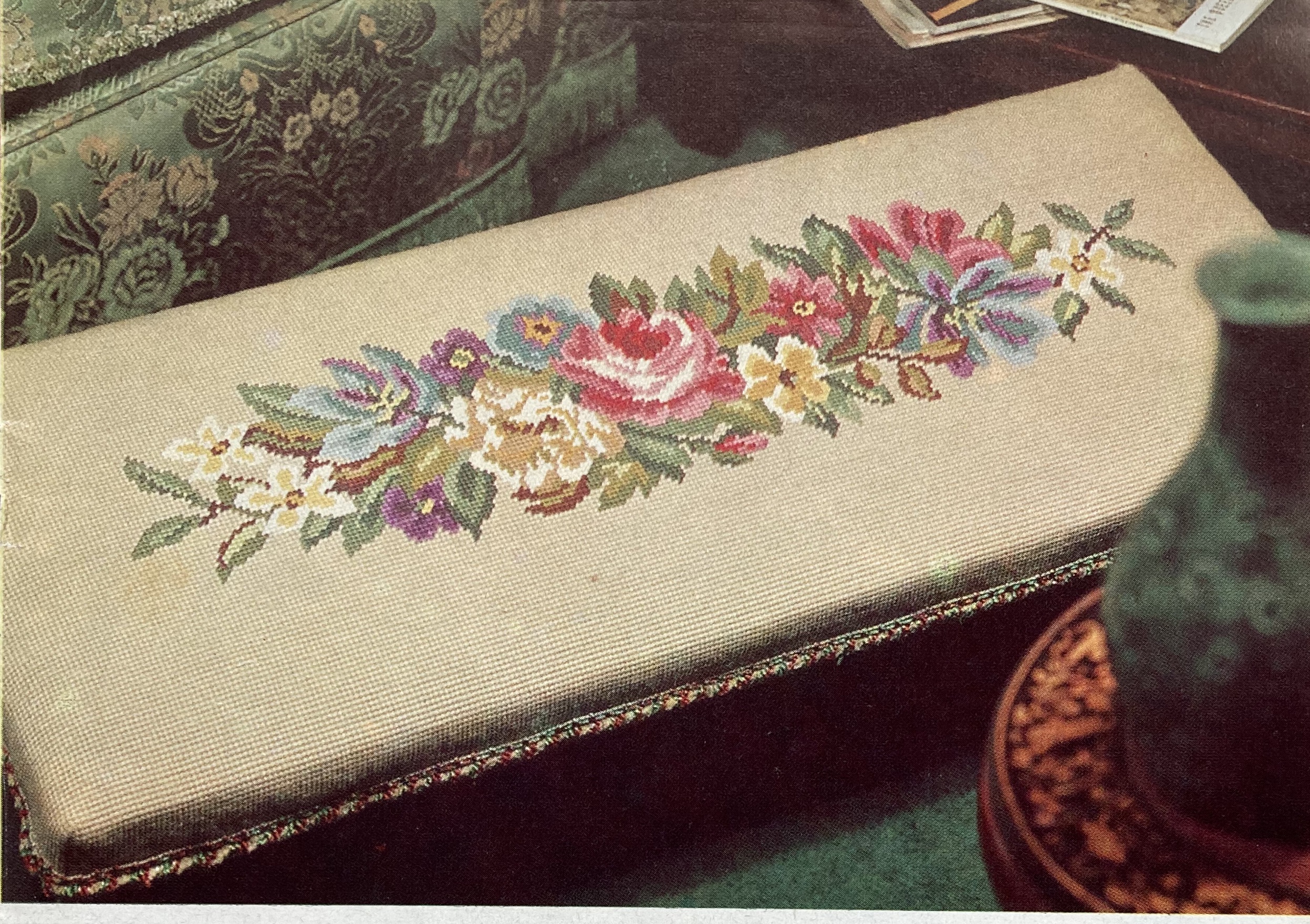
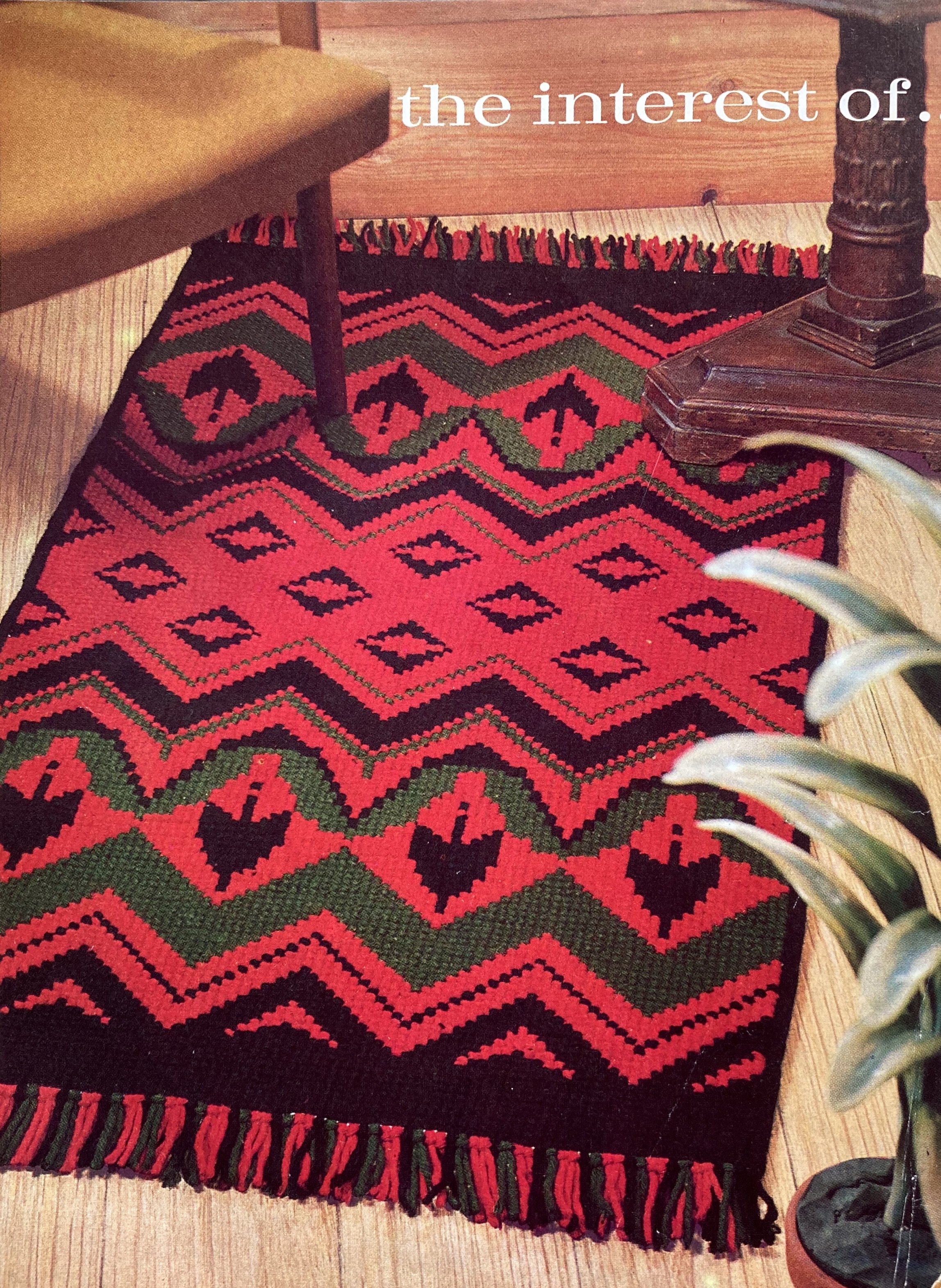
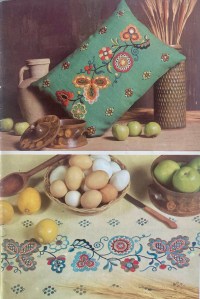
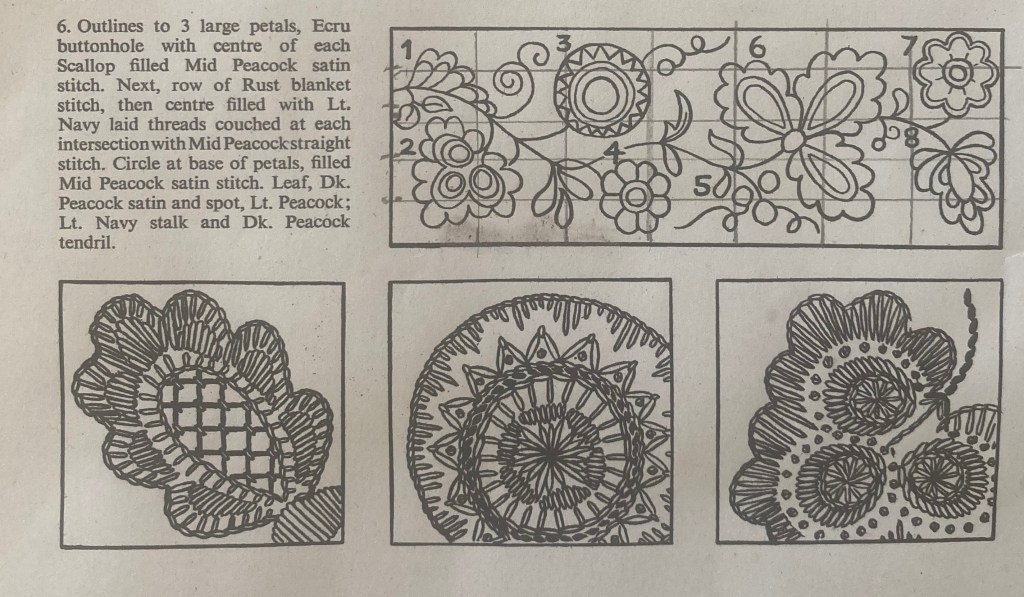
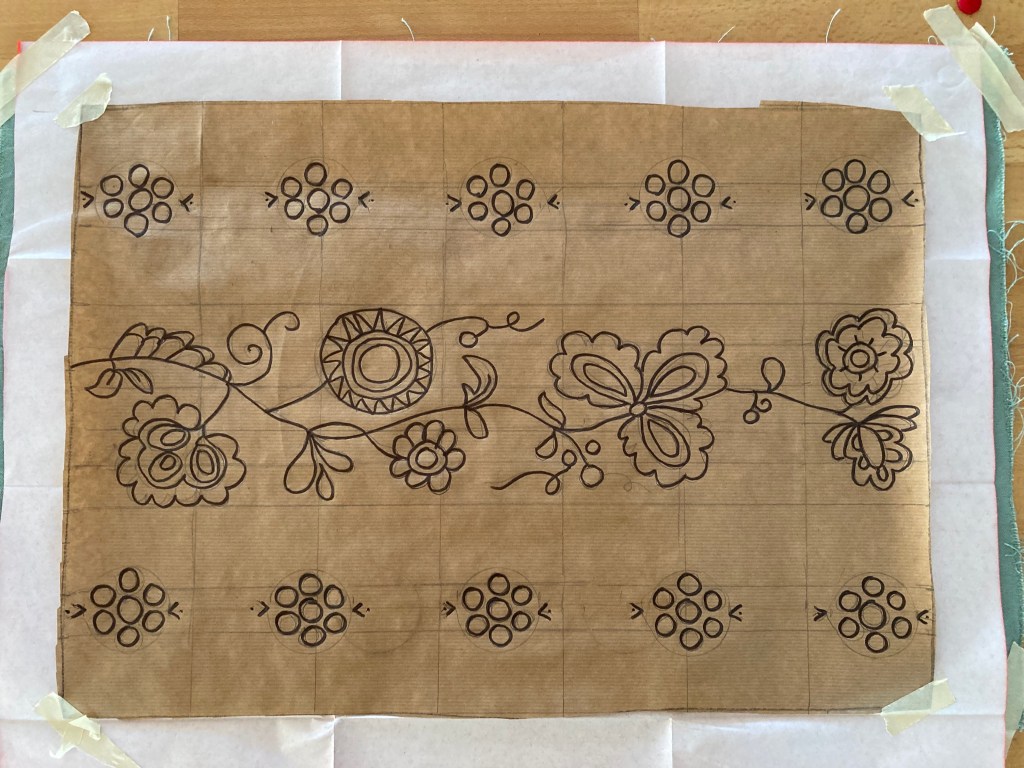
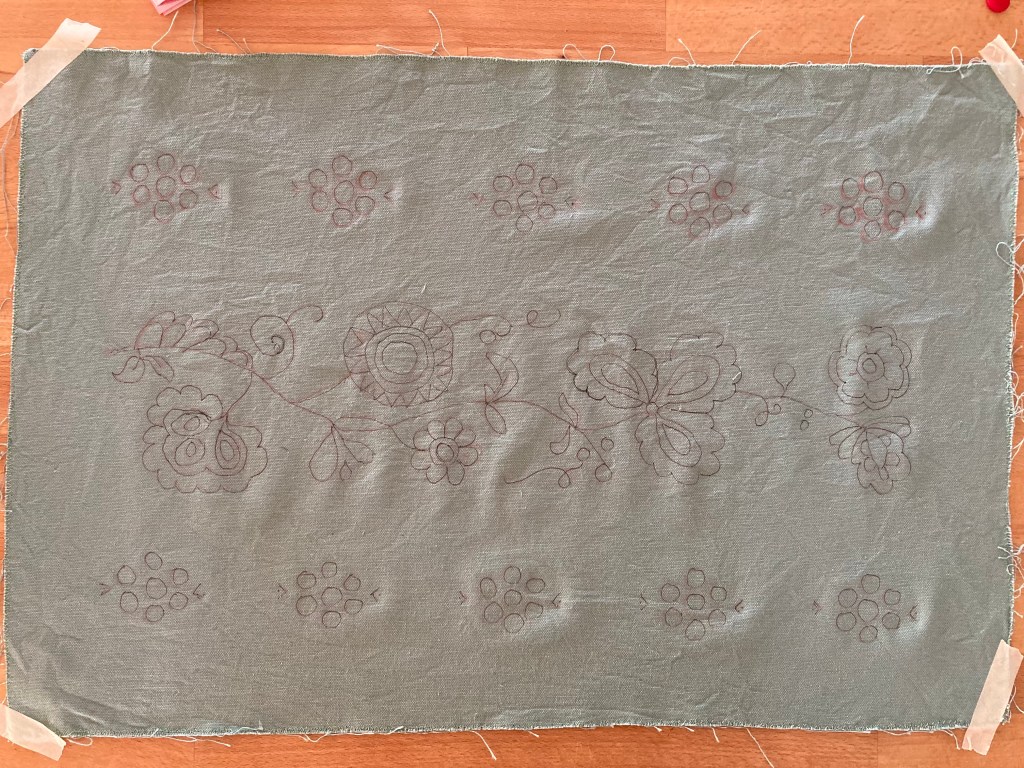
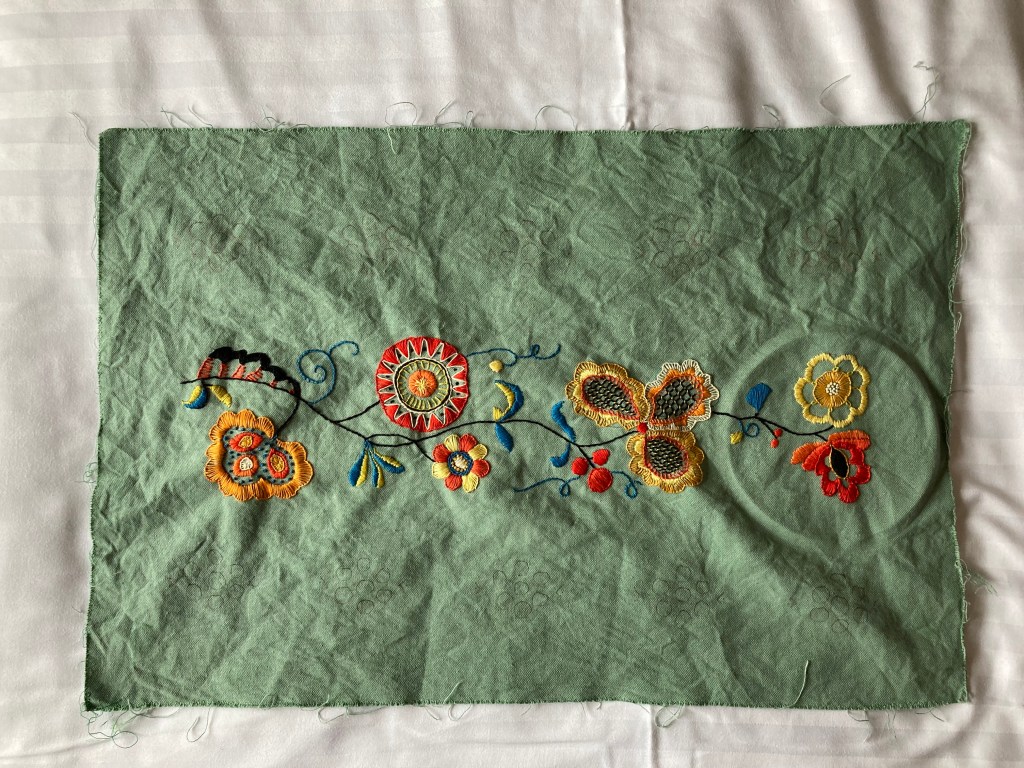
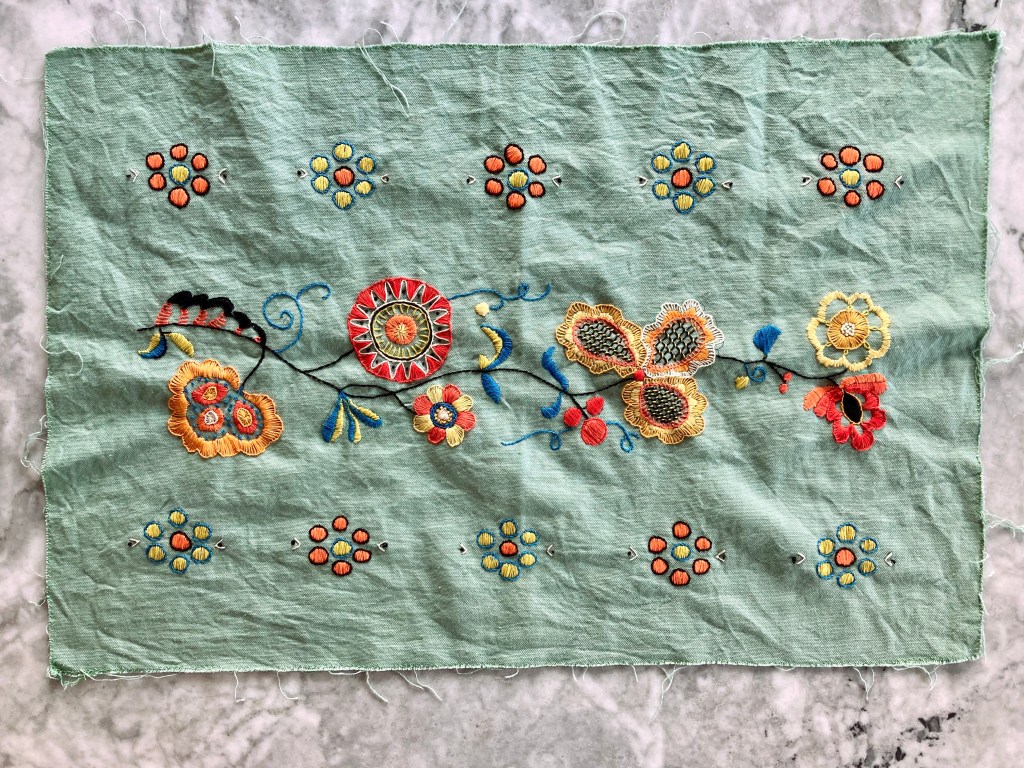
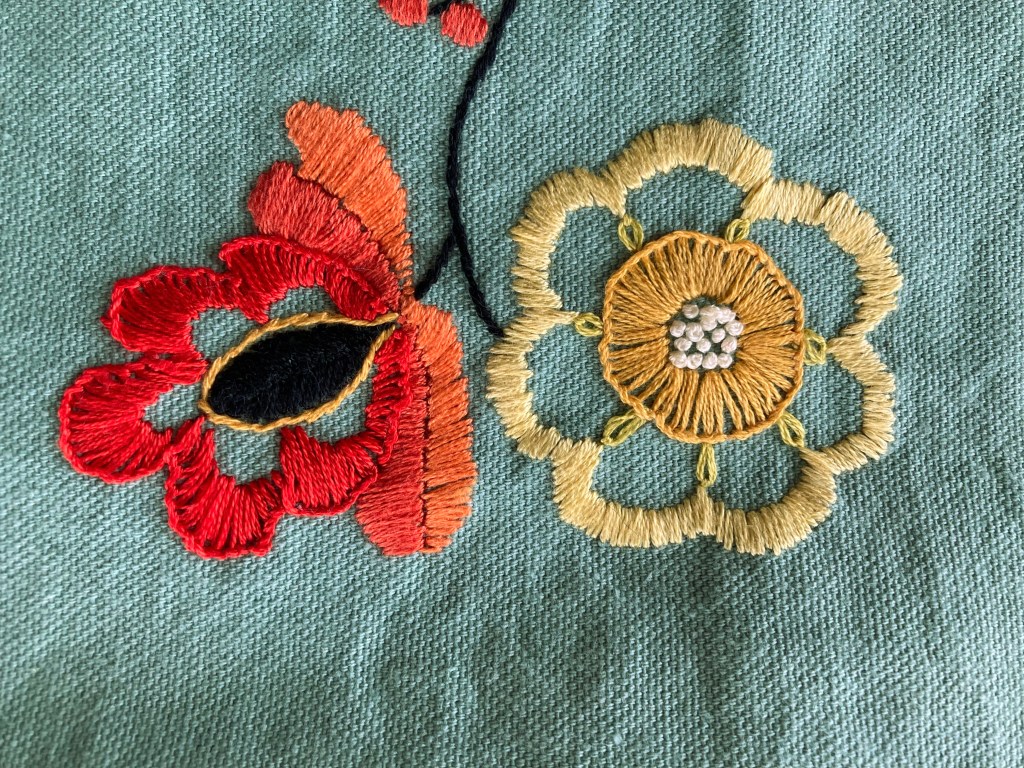
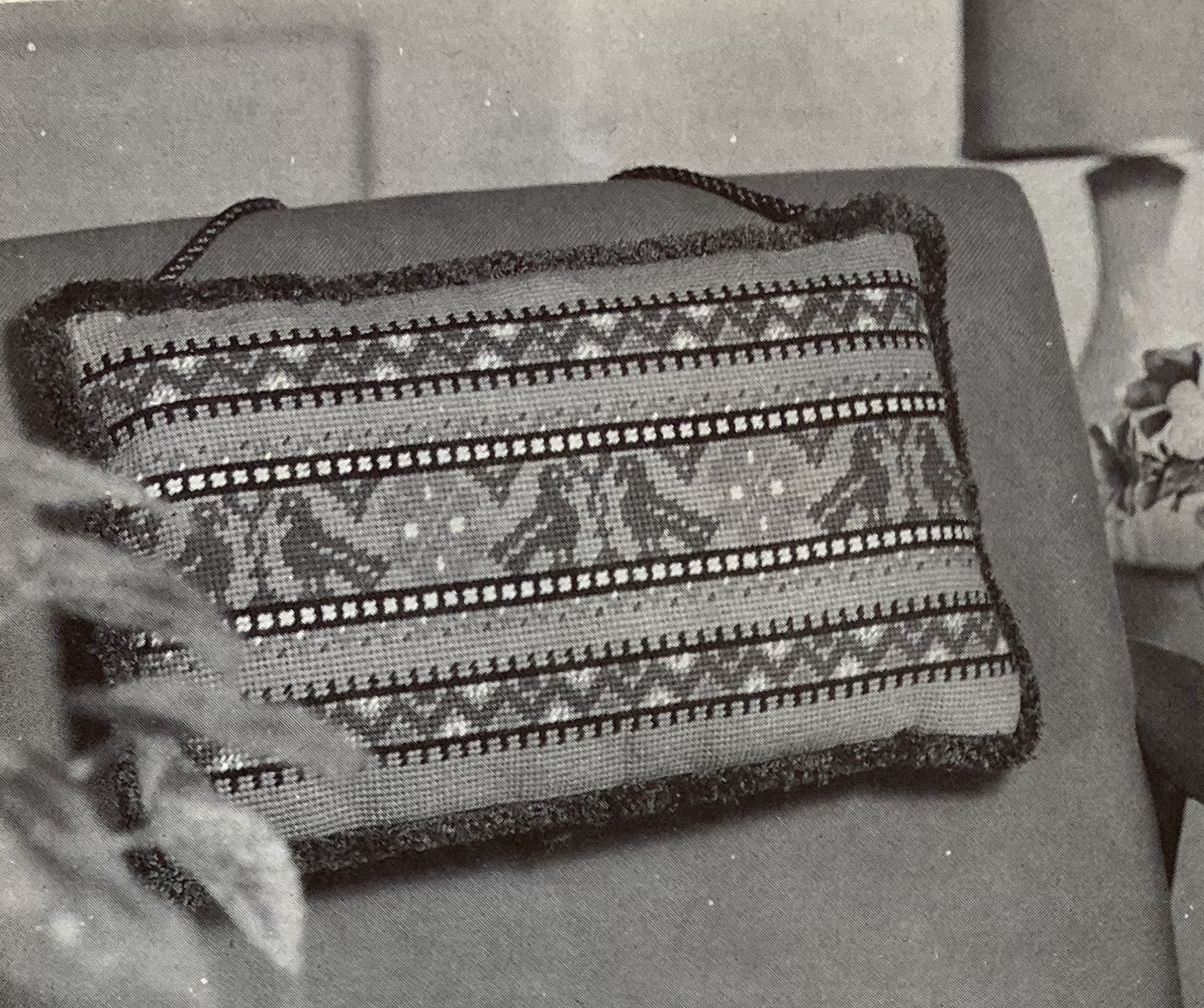
With all these lovely things to knit, it’s amazing that there are any homeware projects in the issue at all, but there are always a few utilitarian projects: here, an easy cushion / tray cloth or a thick rug or mat for kitchen or bathroom. For more ambitious embroideresses, there’s a tablecloth or cushion in bright “peasant” design (Stitchcraft‘s choice of word for traditional or folk designs from certain countries and not from others; I do wish they would just call them all “traditional designs” and leave it at that). The design, like the knitted garments, is big and bold and fun and colourful on the cushion, and slightly more subdued in red and blue for the tablecloth.

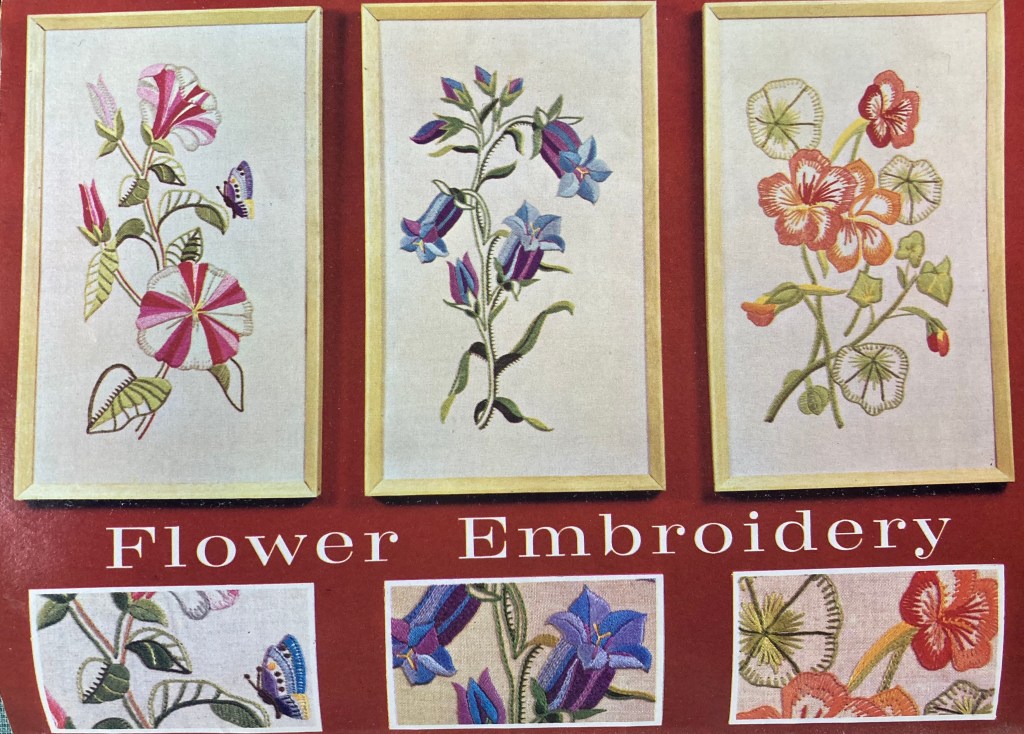
Though embroidery doesn’t feature big in the issue’s projects, it does have a place in the back pages: in the new children’s comic, “Anne and her Embroidery”, little Anne is bored on a rainy day and passes the time by learning to embroider pictures of the flowers in her window-box. Two pages later, there’s a full-page advertisement for a new tapisserie wool suitable for both tapestry and embroidery. Coincidence? I think not! The other interesting ad is for the new Patons Flair yarn, highlighting its easy care and washability.

That’s all for this issue! My project will be the embroidered cushion.

Blast from the Past: October 1956

This month’s blog project was a bit different than planned. The August 1964 issue didn’t have any projects that particularly called to me. There was a nice baby set of “vest and pilch”, but I didn’t know anyone who was having a baby soon… or did I? In fact, I did know that a friend of mine was expecting twins, but we hadn’t seen each other for a while and unfortunately that fact slipped my mind until the babies were almost due! At which point I could have made two vest-and-pilch sets, but I wanted to get the project done quickly and also destash some yarn that was more suitable for a top/middle layer than to be worn right next to delicate baby skin.

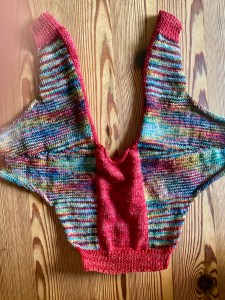
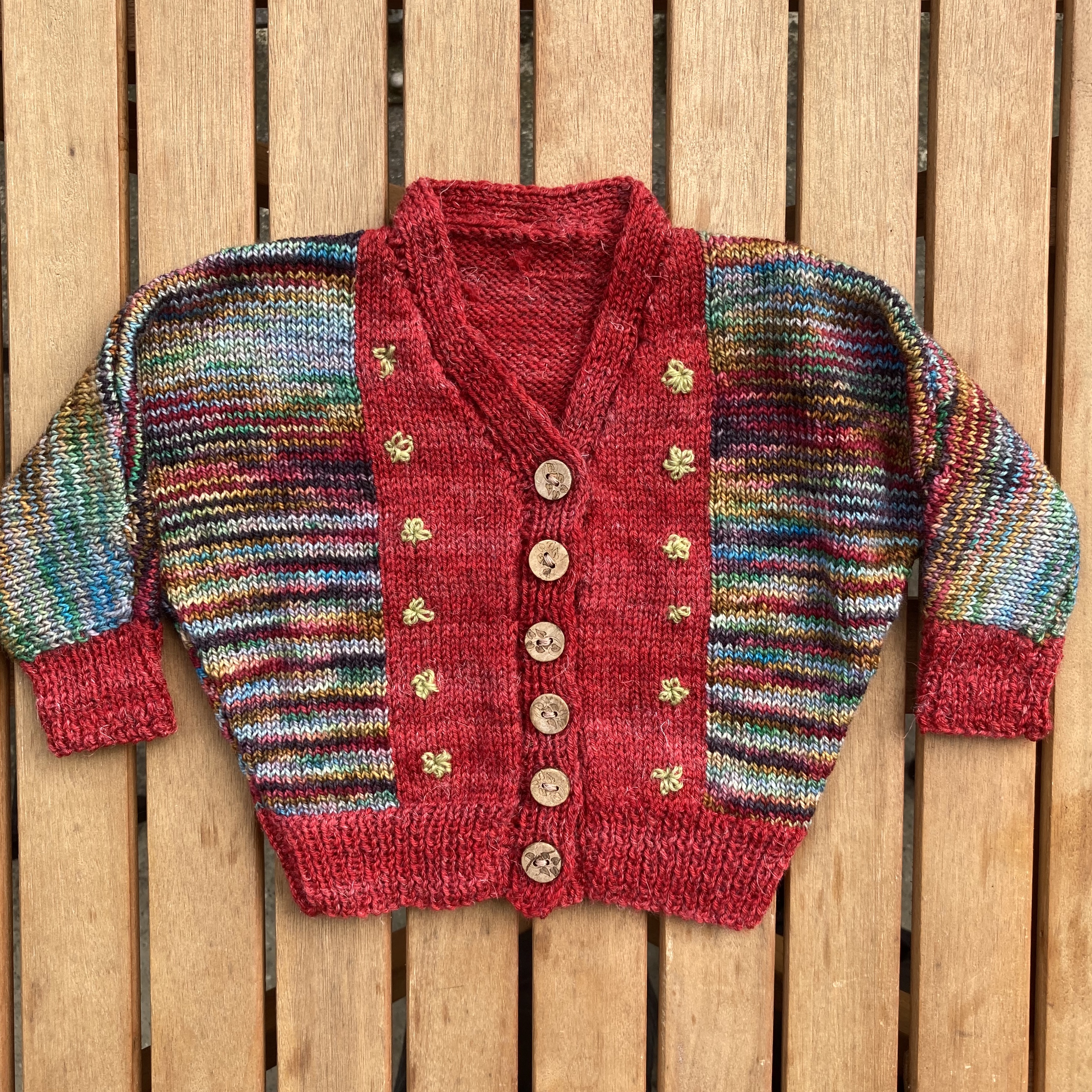
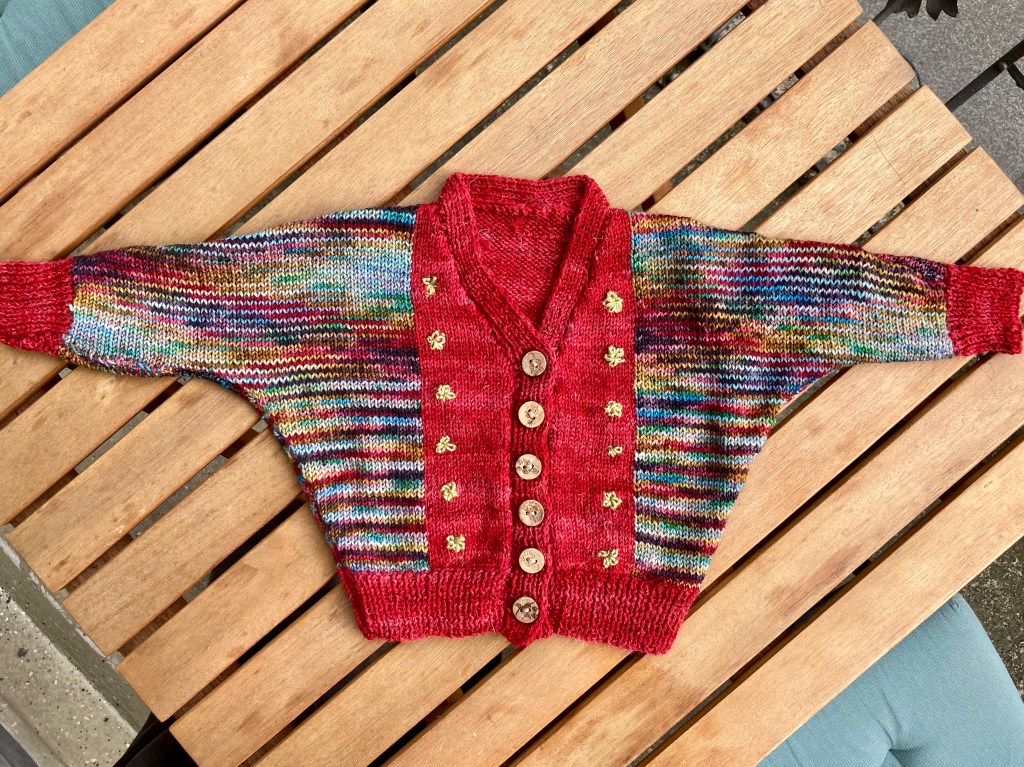
I decided to make two similar, but non-identical cardigans and opted to make one without a pattern and one from this pattern for a dolman-sleeve cardigan from Stitchcraft‘s October 1956 issue. The use of two block colours made it a good choice for the two yarns I wanted to use, and the embroidery was a cute touch.

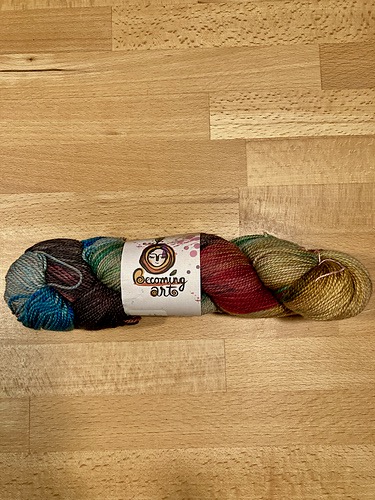
The pattern calls for Patons Beehive 3-ply Baby Wool at a tension of 8 stitches to the inch for a cardigan that is 19 inches around the underarms. My wools were Becoming Art Cielo fingering in the colour combination “Carousel” (multi) and Schöppel Admiral Hanf in red — admittedly not a very vintage colour combination or standard baby-pastel, but I like knitting bright colours for babies, and the mother’s favourite colour to wear is red, so I loved it.

Both wools were gifts — the Admiral Hanf from my knitting group’s holiday “secret Santa” and the Cielo Carousel a prize from the last KAL at the All Things Vintage forum on Ravelry. “Hanf” is German for hemp, which makes up 10% of the red yarn and gives it strength and durability. It’s not scratchy, but also not super-soft. The Cielo fingering is delightfully springy and squishy. I got 6.5 stitches to the inch with each of them on 3 mm needles, but saw no need to change the pattern, as a larger cardigan would be more practical for autumn/winter wear, when the babies will be bigger and wear more clothing underneath.

The cardigan is knit from the bottom up in three pieces — back and two fronts, with the sleeves cast on horizontally. The colour-block effect is made by using separate balls of wool and twisting them together at the colour change, intarsia-style. I made both the fronts together with separate balls of yarn on one needle to insure symmetry. The cuff ribbing is picked up and knit in rib after the main pieces are done and the front button bands are knitted separately and vertically in rib and sewn on. (I’m not a fan of this type of button band and would just as soon have knitted the bands together with the fronts, even if technically they’re supposed to be made on a smaller needle.)

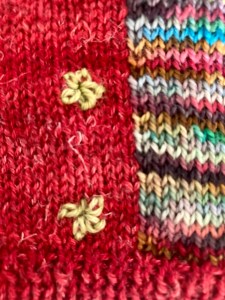
The little flowers on the fronts are embroidered on in loop stitch after everything else is finished. It was surprisingly difficult to get all the “petals” to be the same size and distributed evenly around the centre. Perhaps I should have made them larger. I’m always happy to practice embroidery on knitting, since I think it looks really cool, but it continues to be a challenge. The wool is a bit of leftover Onion Nettle Sock yarn.

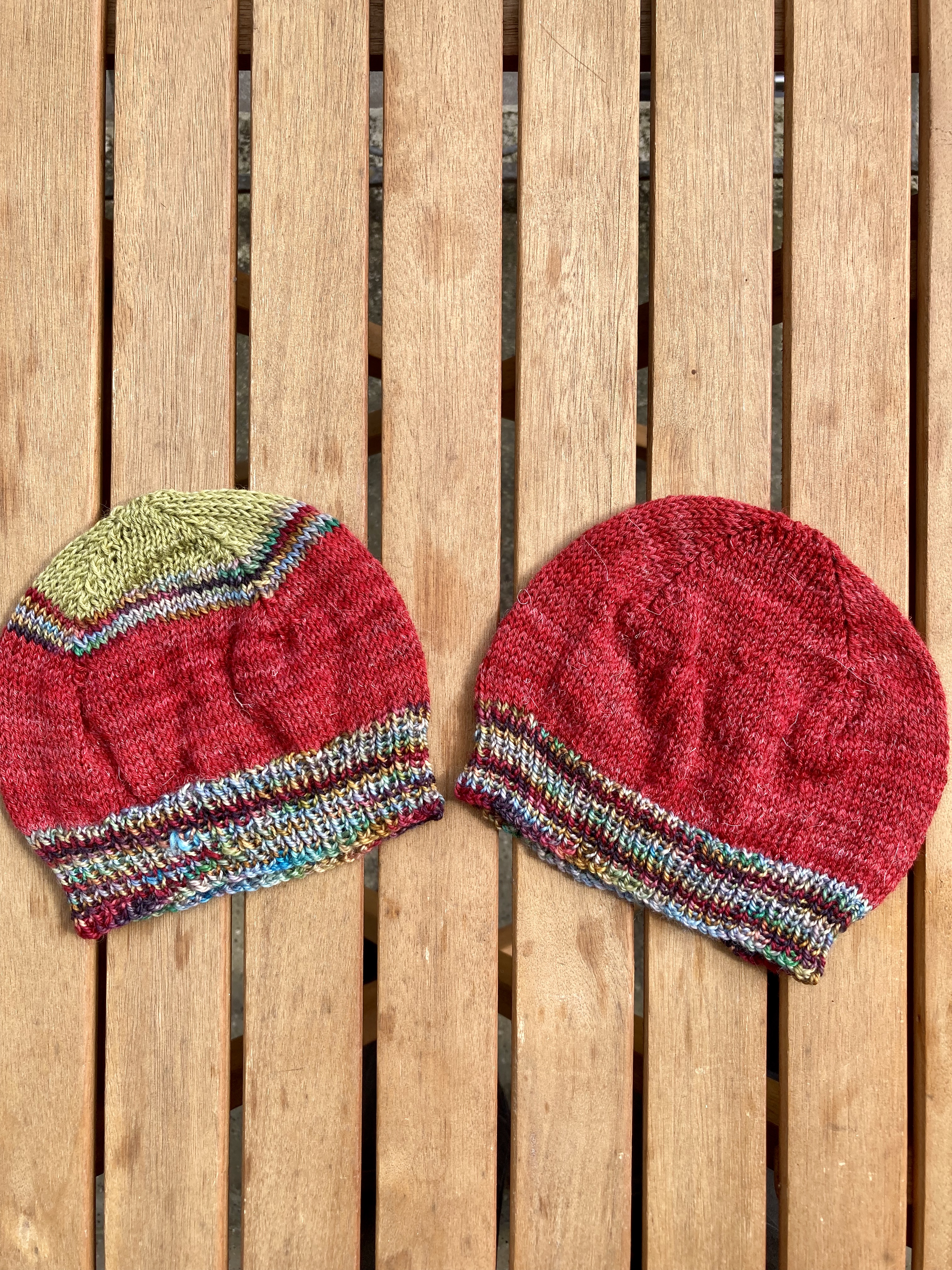
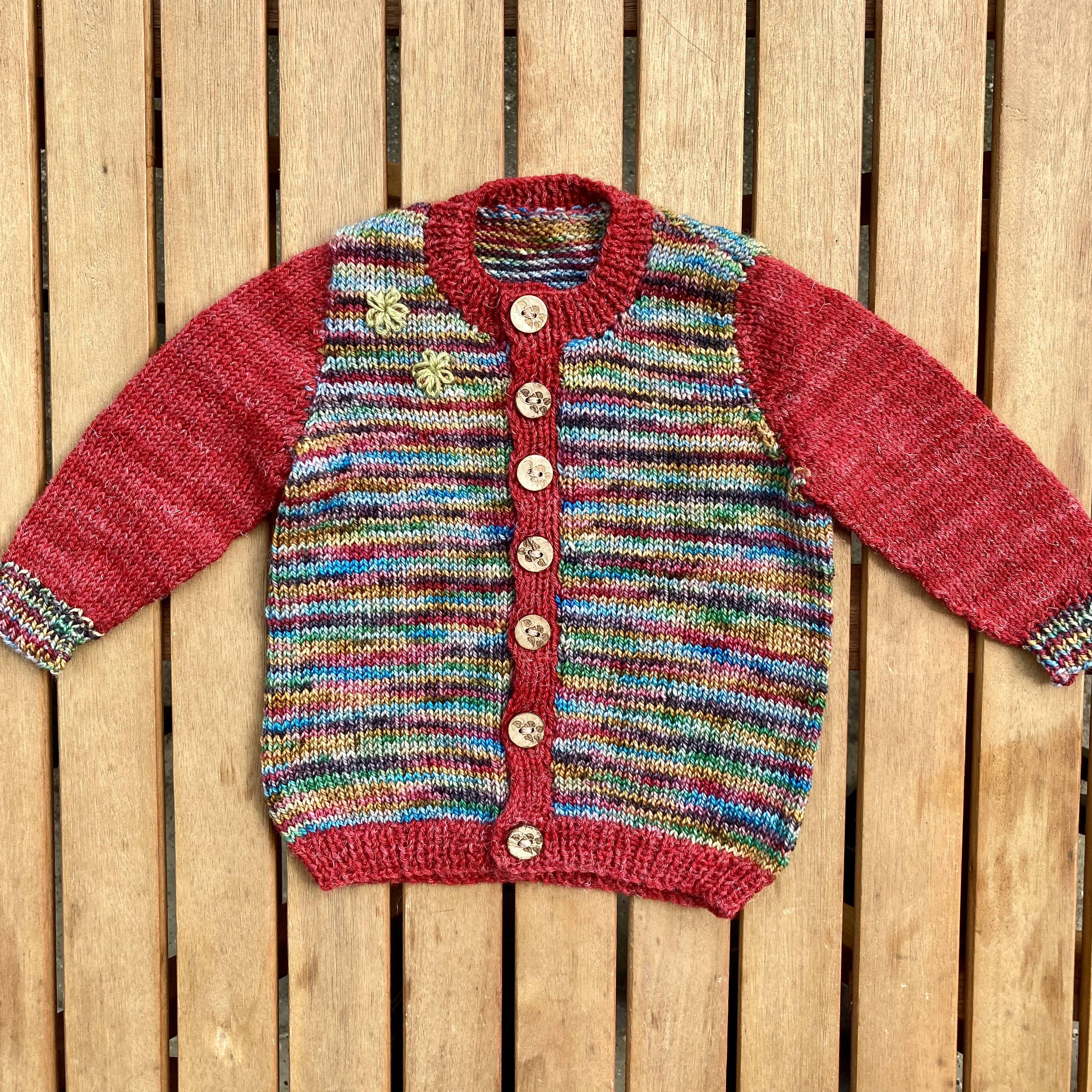
One 100 gram skein of the multi-colour wool and one 50 g ball of the red were enough to make this cardigan, another “fraternal” cardigan (plain crew-neck with set-in sleeves) made without pattern using the multi-colour yarn for the body and the red for the sleeves and ribbing, and almost two hats with multi-colour ribbing and a red body. The crown of one hat was finished in the green Onion sock, which I also used to embroider two larger flowers near one shoulder of the no-pattern cardigan.

I loved the dolman pattern and will surely use it again for another baby. I love the similar, but not identical cardigans for (fraternal) twins. I love matching hats and cardigans. I love the bright colours! And I think these sets will be very useful for the twins and make the parents happy.

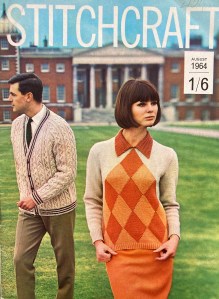
August 1964: Overview

The August issues of Stitchcraft are always a mix of styles and seasons. The summer holidays are winding down, and knitters will want to start work on warmer garments for the autumn. At the same time, it’s still summer, and it may well be too hot to want to hold wool in your hands, not to mention wear that bulky wool pullover. Stitchcraft’s solution is to offer a range of casual “country” knits that can be worn as outer garments on cooler summer days and be useful for indoor-outdoor wear as autumn approaches.

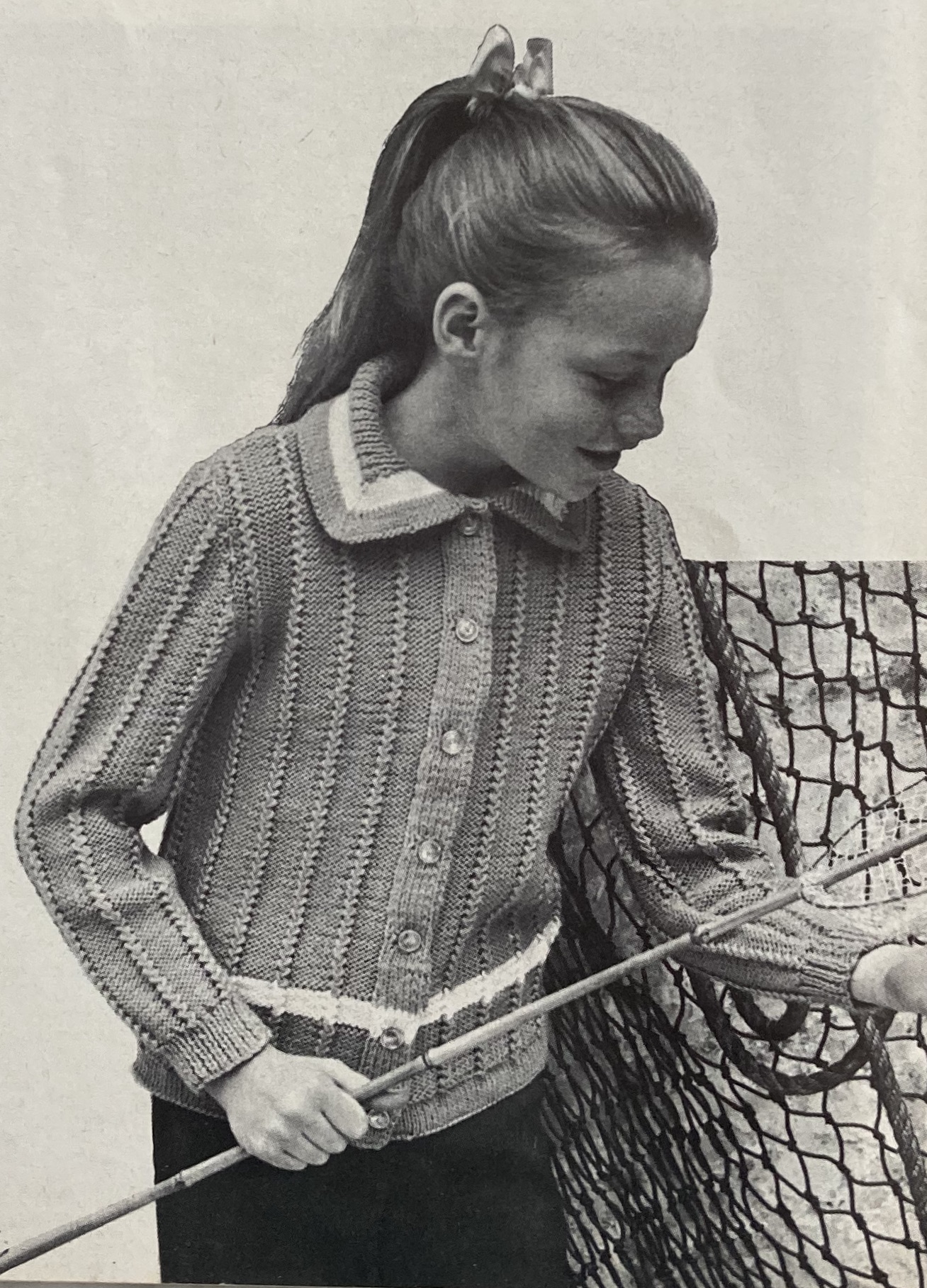
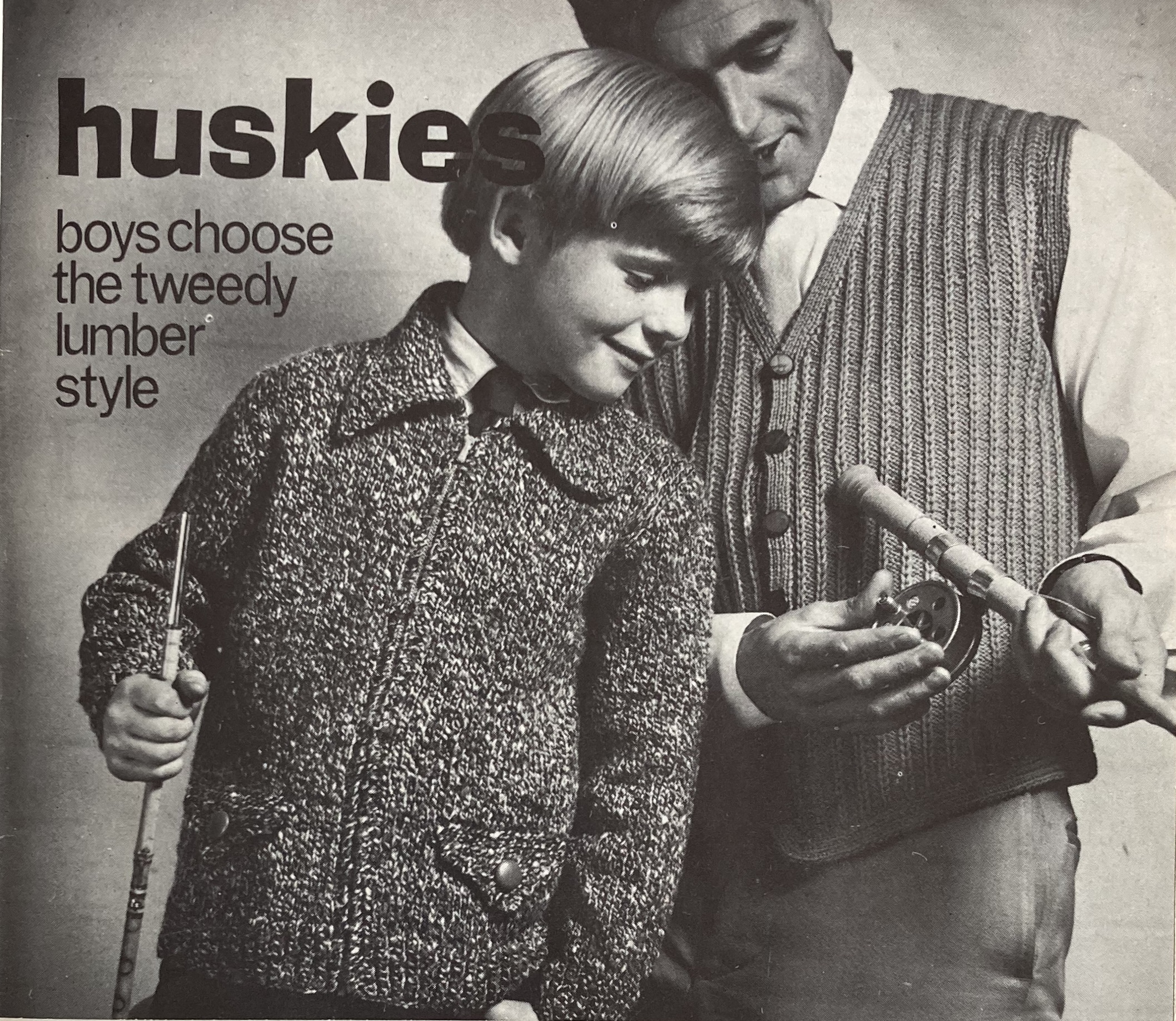
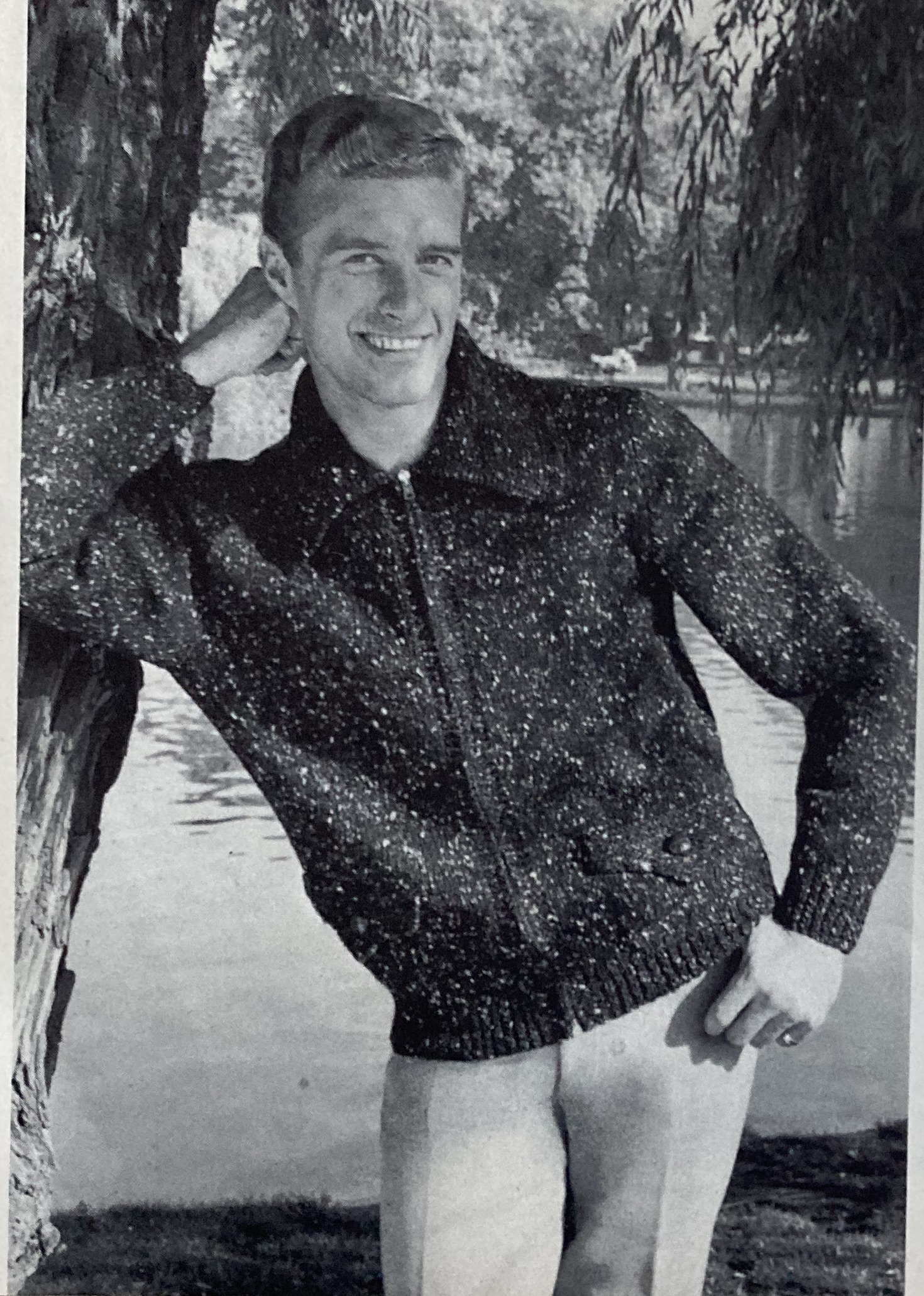
“Junior Knits” have a special prominence in this issue: heavier, loose-fitting pullovers and cardigans for older schoolchildren or teenagers (or smaller-size adult women) that are versatile enough to be worn on holiday, back to school, under a coat in later months etc. They are casual, but stylish, with interesting stitch-pattern details, and a mix of cheerful and neutral colours. The girl’s cardigan is made in DK wool with a twisted-stitch rib pattern and the pullover in bulky “Big Ben” wool can be made up to 34-35 inch bust size. The boys’ “lumber jacket” zipped cardigan is also made in a bulkier, quick-knitting wool: Bracken Tweed. The colour is “Marble”, perhaps a darkish grey? (The “father” in the photo is wearing the waistcoat from the July 1964 issue.)

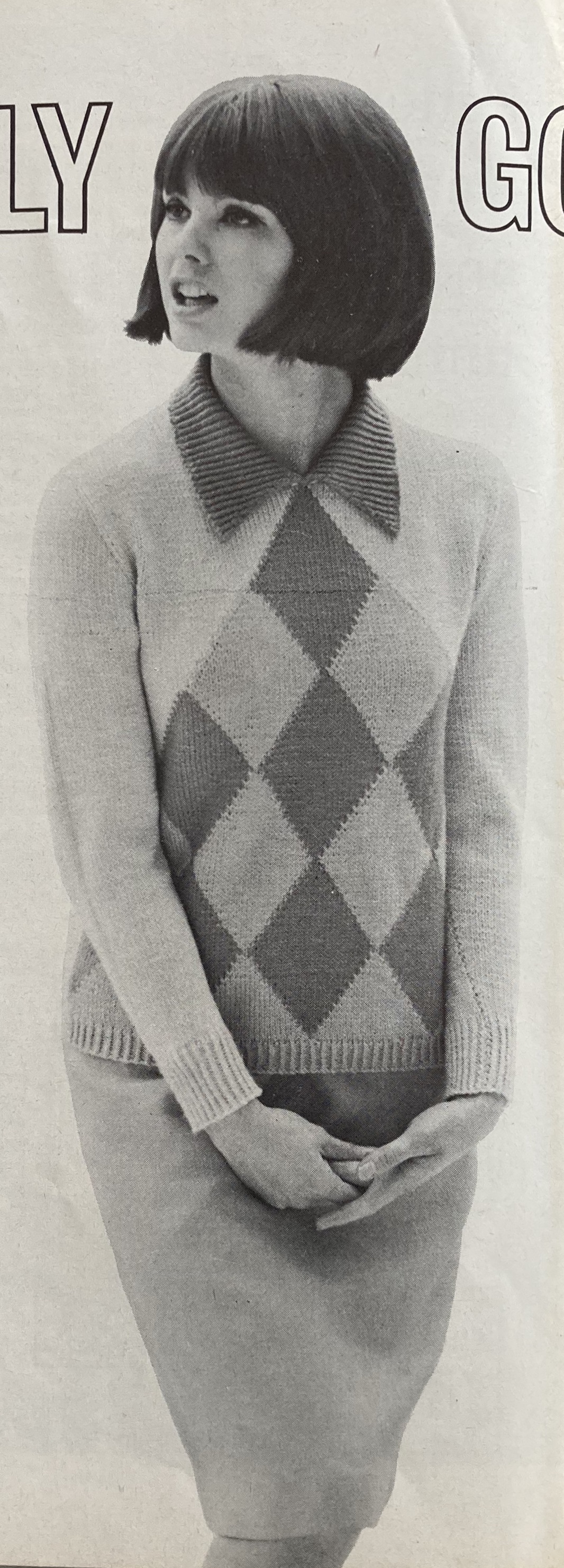
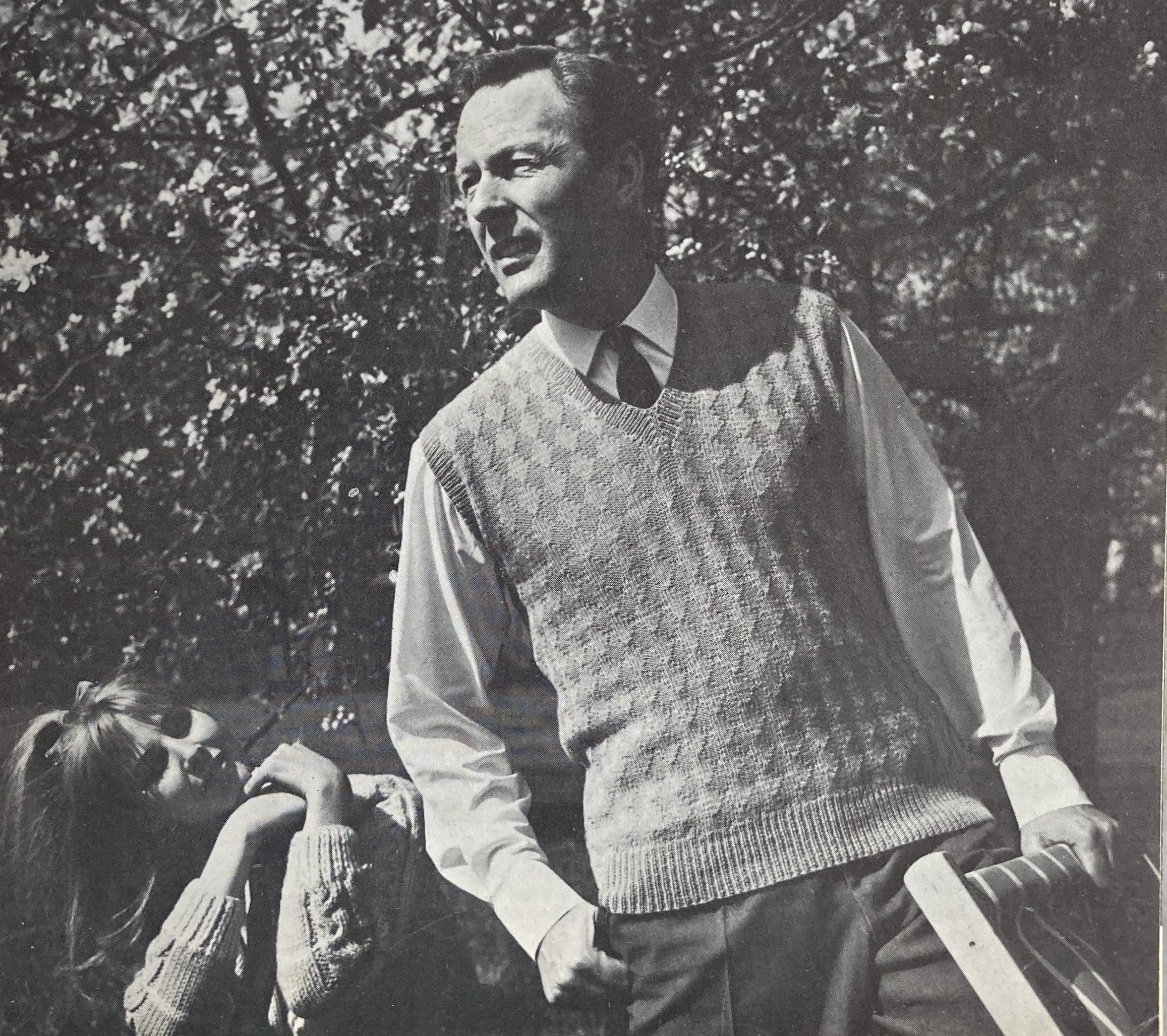
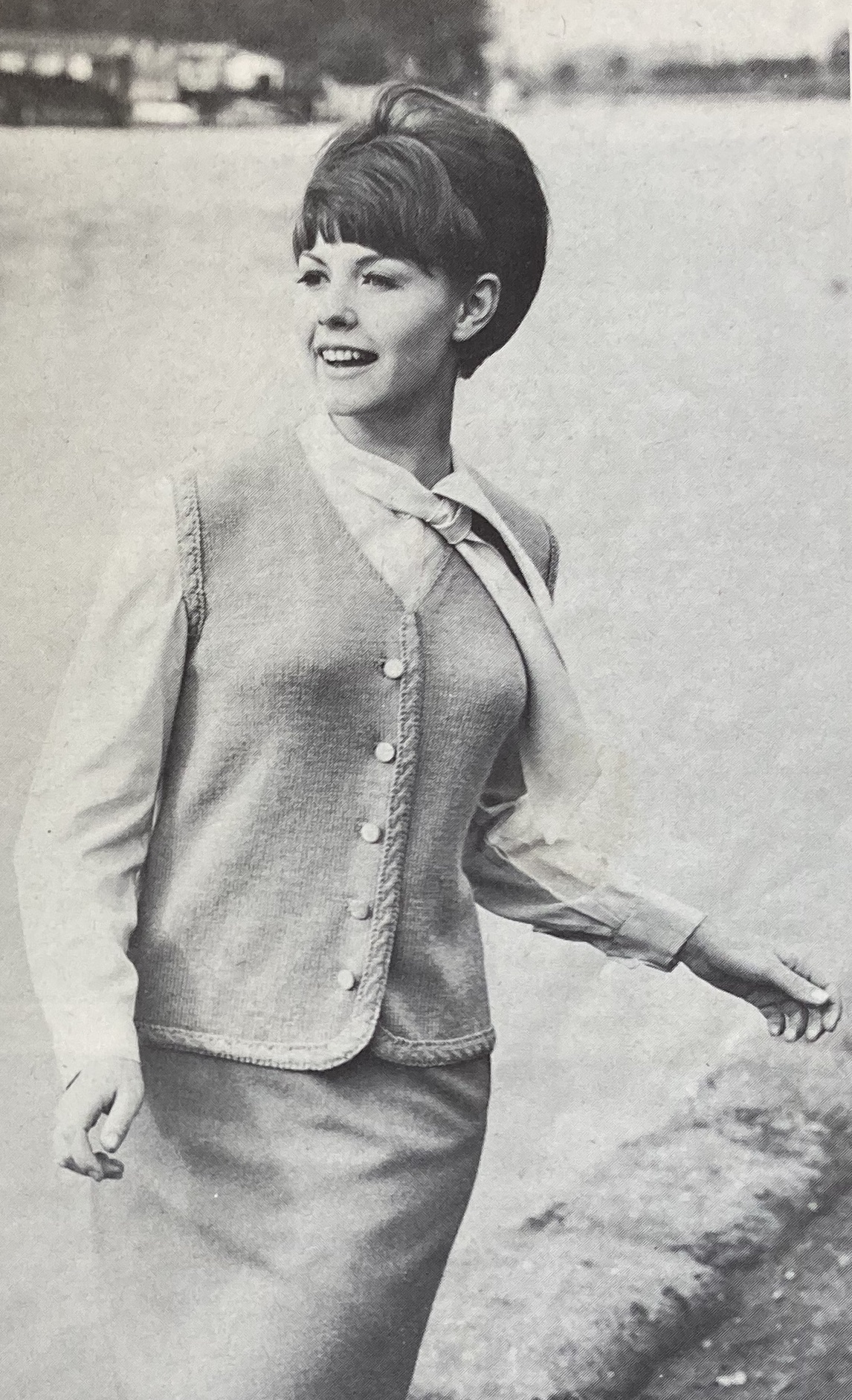
The adult-size garments are a mix of casual, bulky holiday outerwear and more refined garments for a dressy holiday outing or the return to work and daily life in September. For women, there’s a striped, sleeveless top, knitted sideways and belted and made in DK wool to be warm under a jacket or cardigan, or the wonderful “harlequin” diamond-pattern pullover in the cover, or a sleek 4-ply sweater suit with pleated skirt for autumn wear. Men get a thick zigzag-cable cardigan for “driving and all-casual wear” as well as an elegant 4-ply slipover in a diamond pattern. With the exception of the skirt suit, neutral cream colours with ice-cream peach and orange contrasts prevail. Cables, zigzag and diamond patterns are still on trend, as are large , pointy or polo/turtle-neck collars.

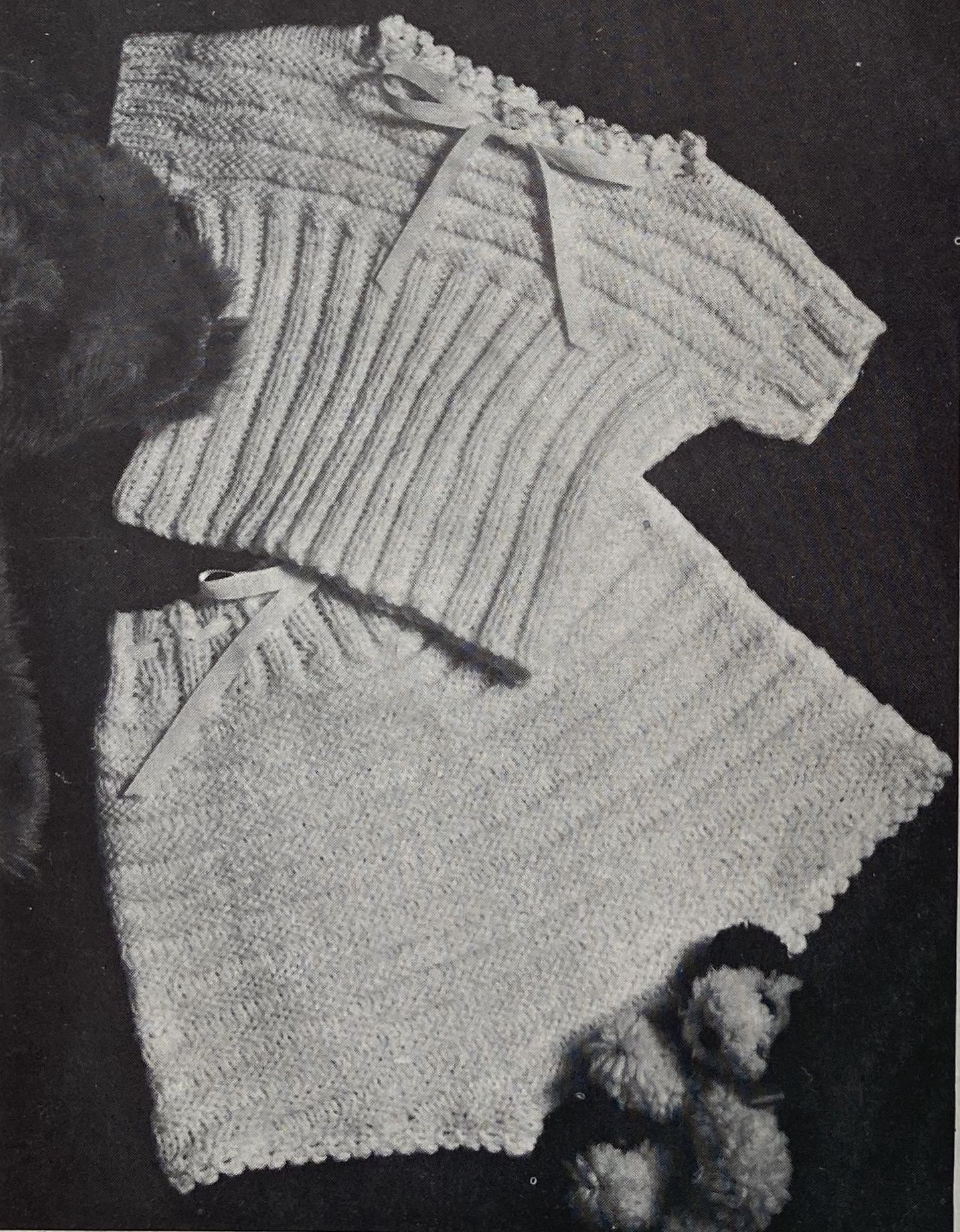
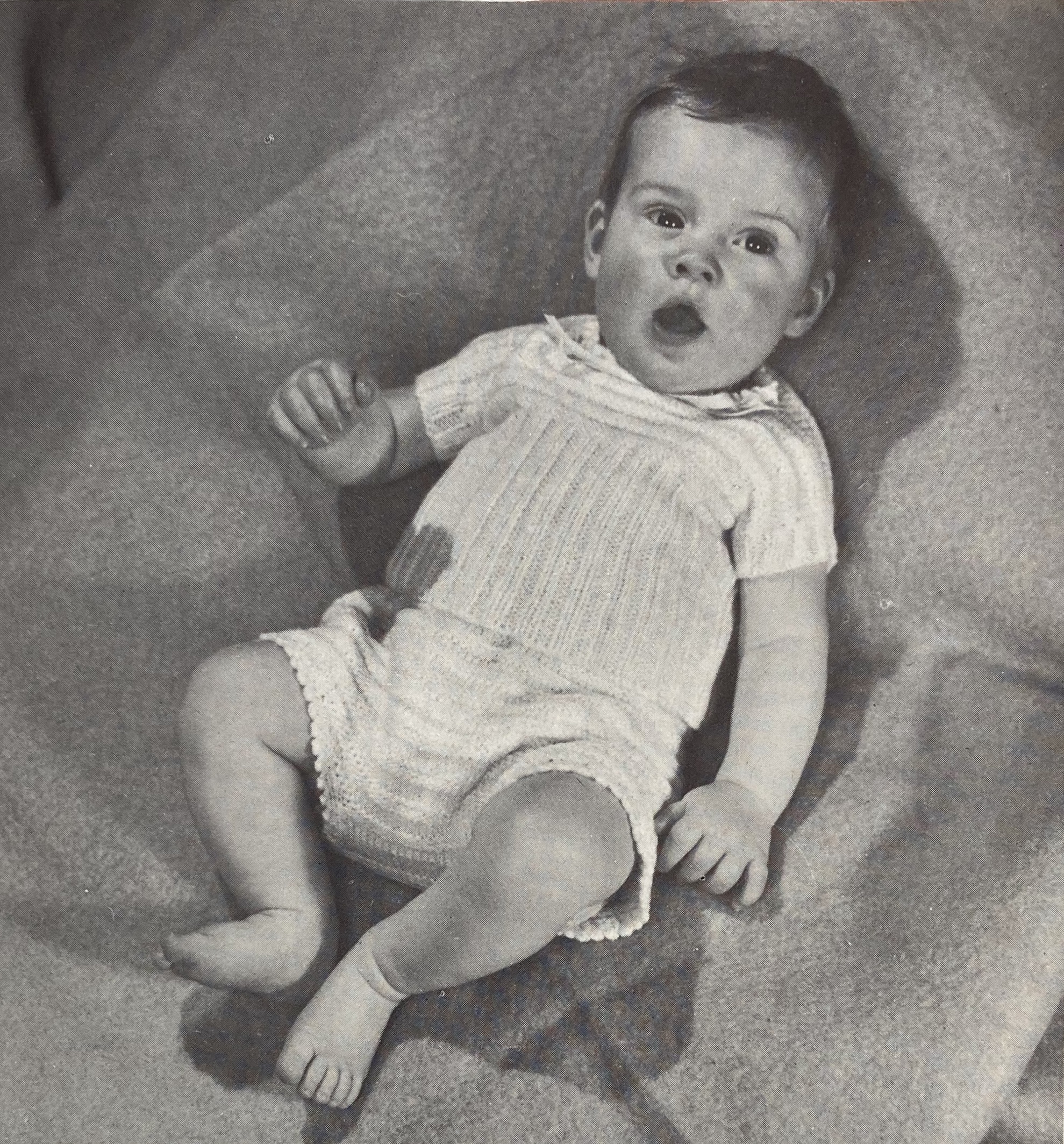
The baby layette series continues with a second-size (ca. 6 months) “pilch” (shorts) and vest in an easy vertical and horizontal rib pattern. The vest is made in a simple T-shape. There’s also a reprint of a baby blanket pattern from 1958 in the back pages. Sitchcraft apparently got many requests for reprints of popular patterns and many of them appear in issues from the mid- and late 1960s.

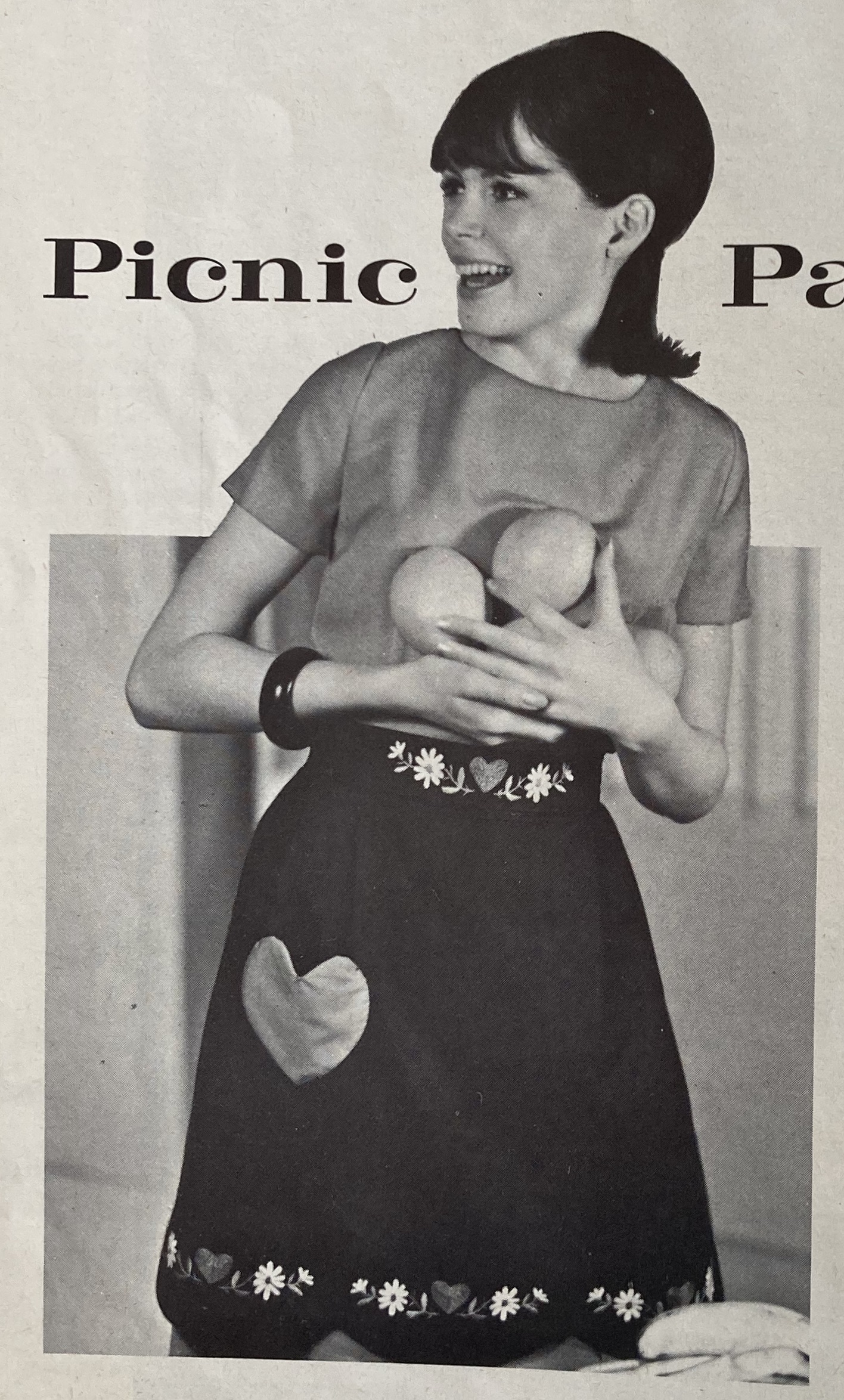
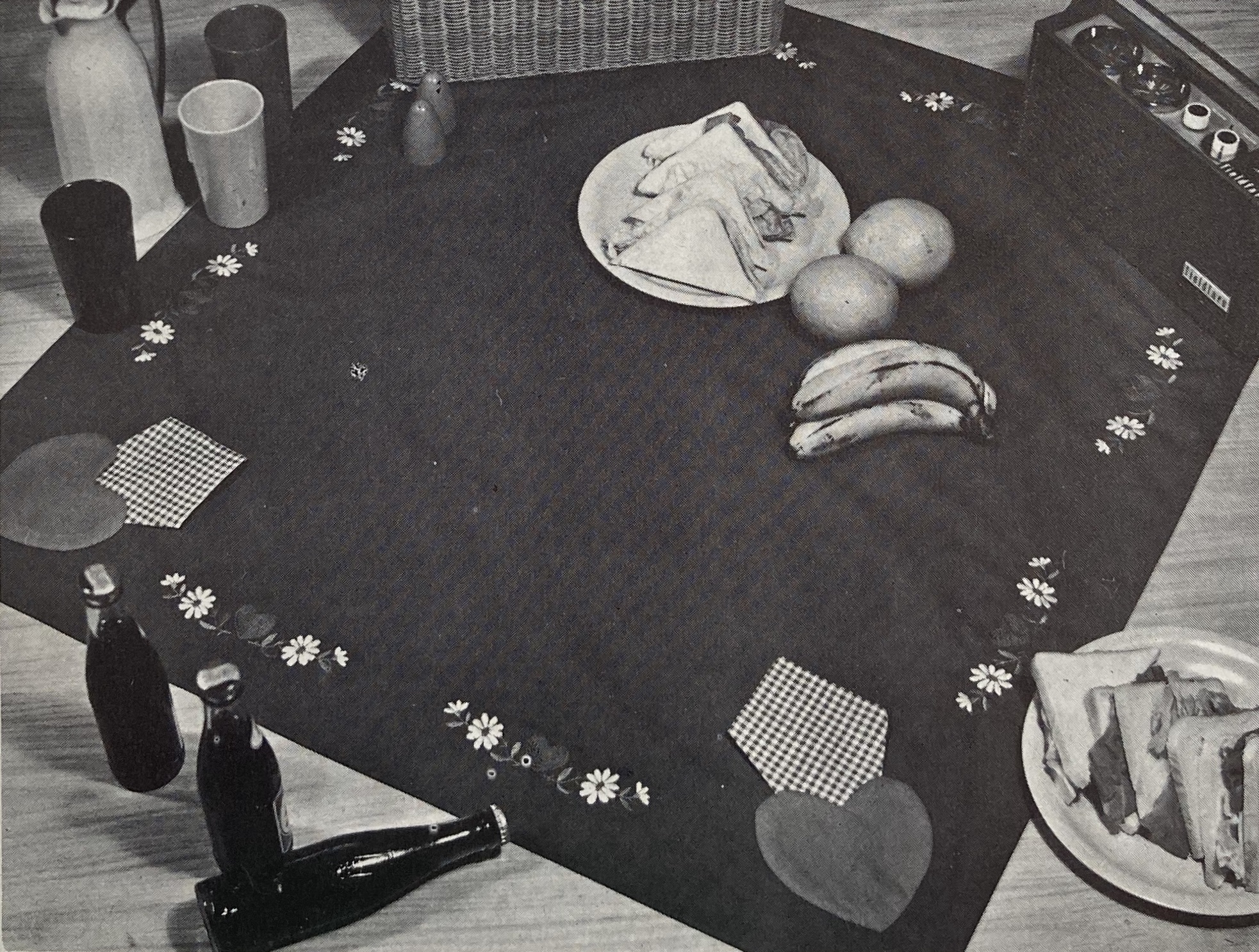
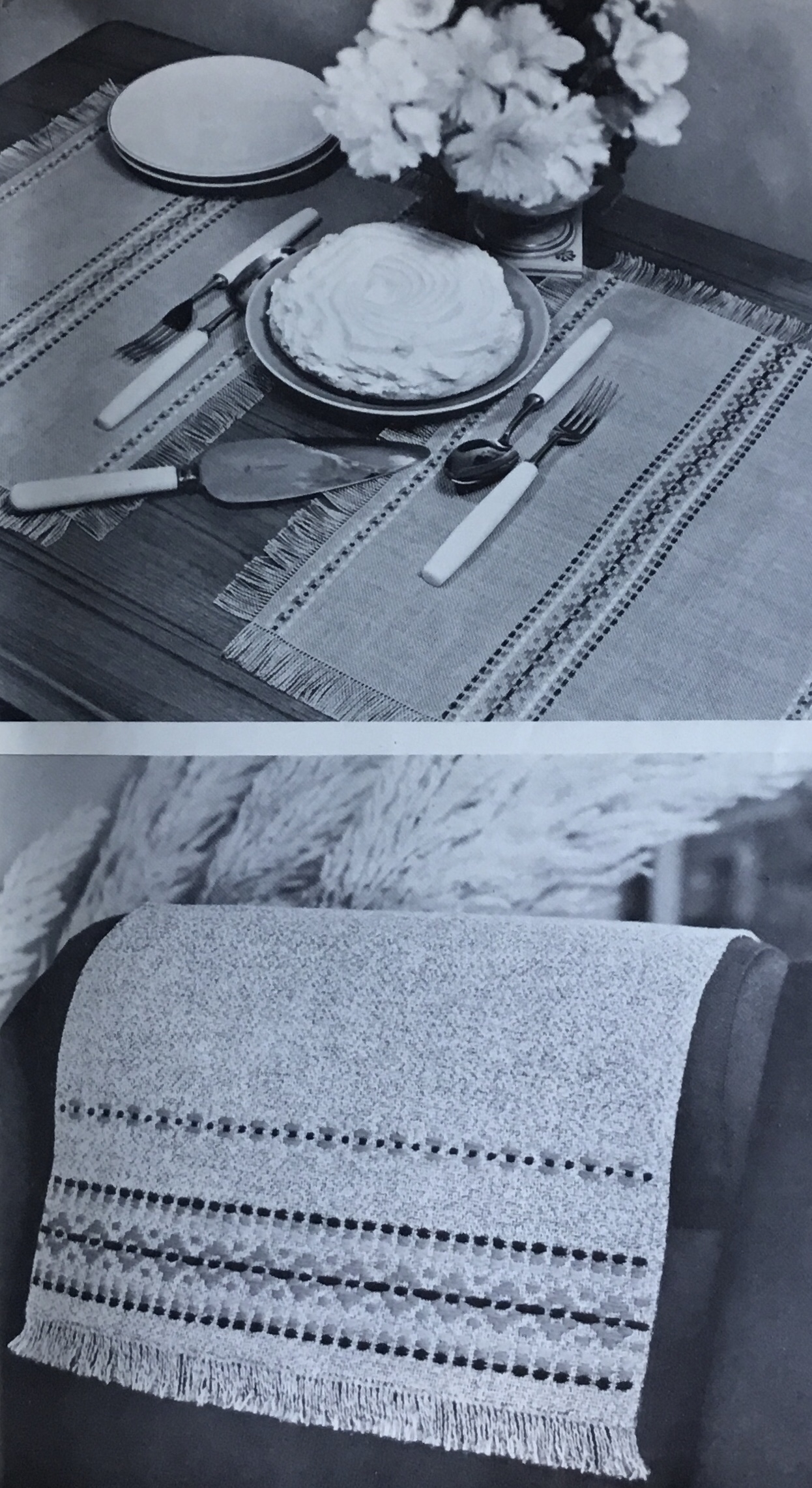
Homewares are a mix of smaller, easy projects that one could take along or use on a late August holiday, and larger at-home projects to work on for the autumn. In the first category, there’s a charming, easy embroidered apron and cloth set for a summer picnic, with appliquéd hearts as pockets in both the apron and (for napkins, how cute!) picnic cloth, an easy cushion embroidered on Bincarette and simple woven table mats suitable for patio use.

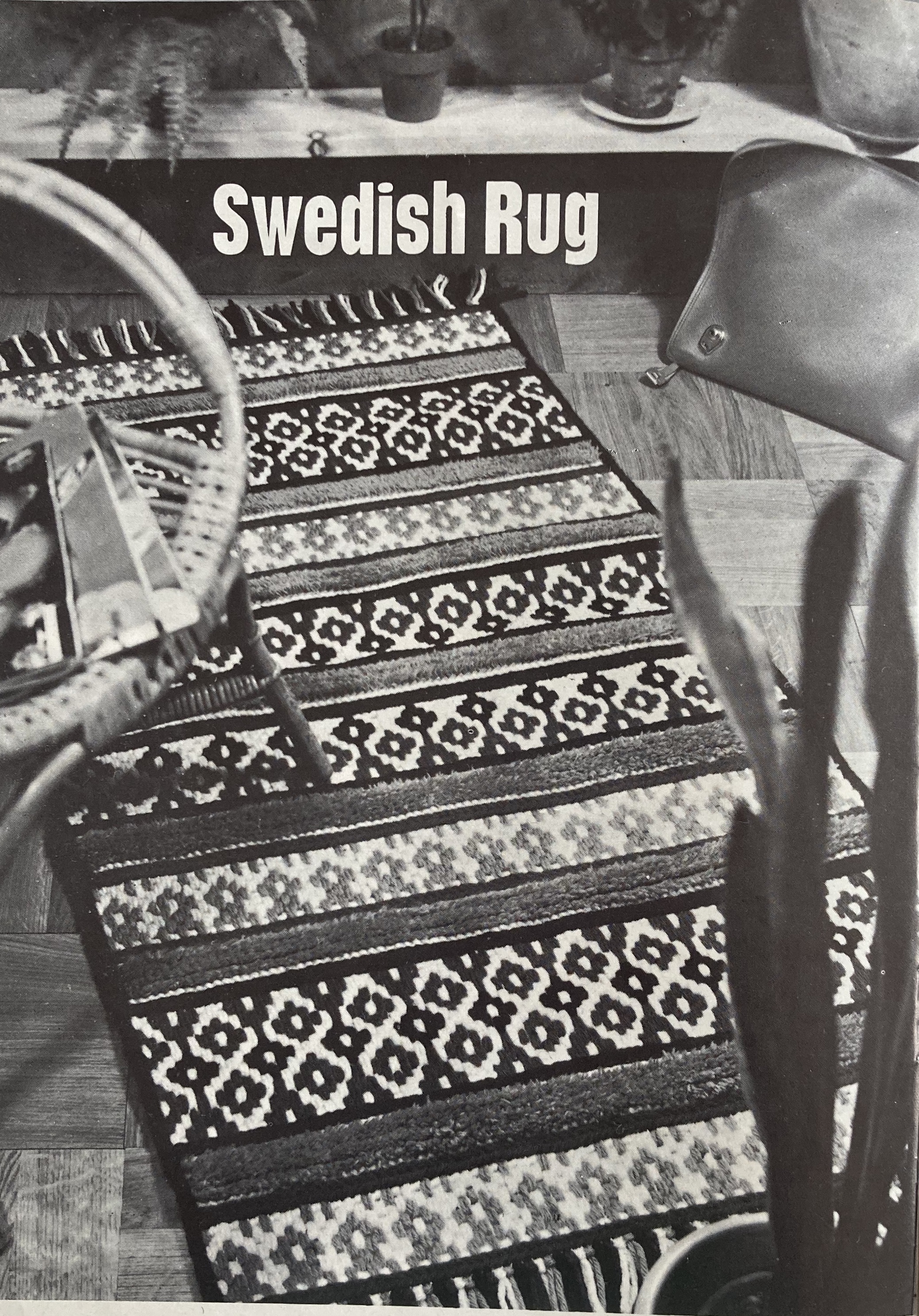
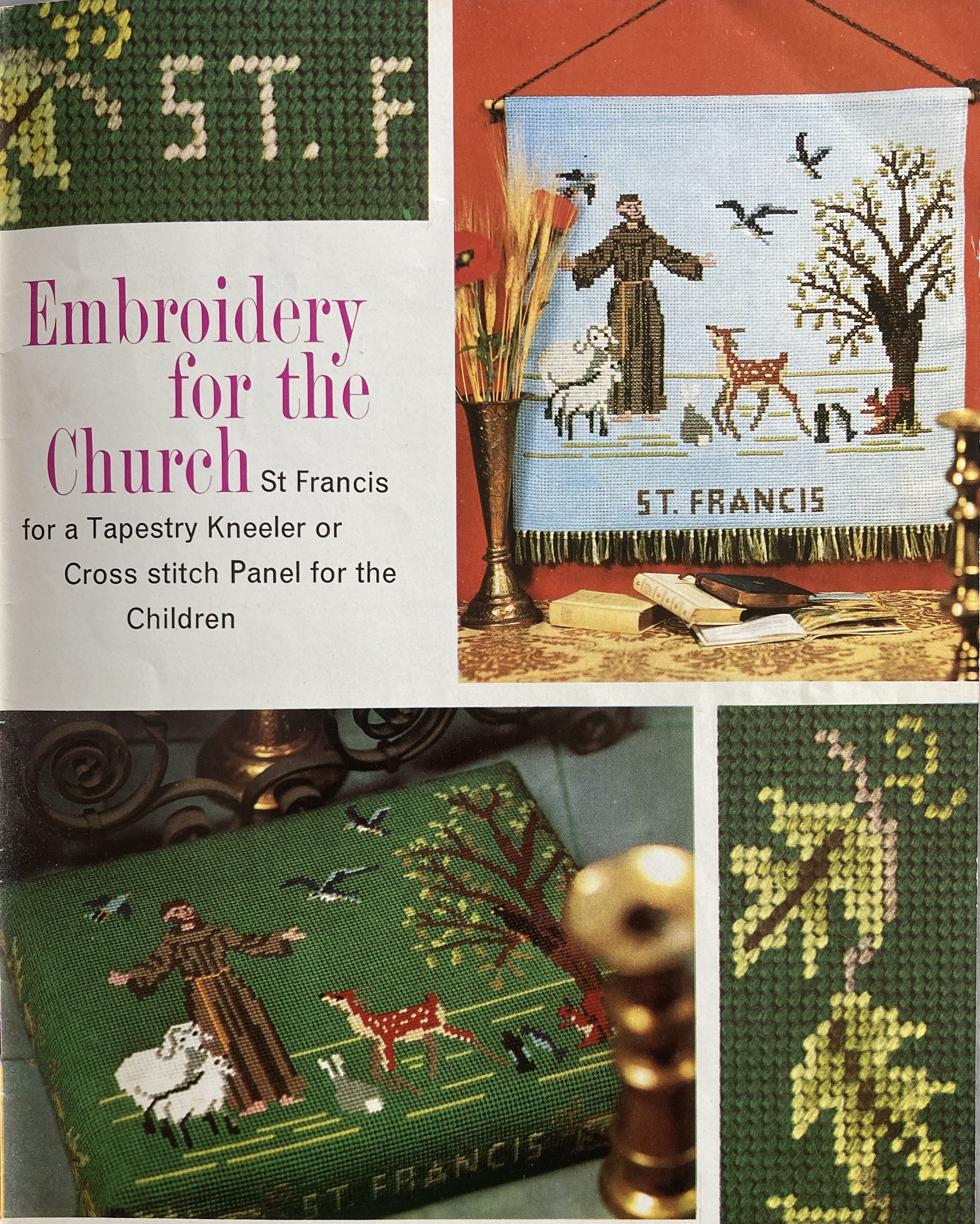
In the second category, there’s a complicated “Swedish” rug with both pattern weaving and tufting and for churchgoers, a cross stitch panel or kneeler featuring a scene of St. Francis with various animals.

The Patons wool ad is weird and sexist, as usual. When you’re not with your man, naturally all your time is spent doing things for him and knitting for him — but if the photo is any indication, you’re not even happy about it? Here is the beloved man smugly lording it over his wife, who looks sad and embarrassed in spite of having knitted a lovely comfortable cardigan for him as well as a gorgeous outfit for herself. Be proud of yourself, skilled knitter, and remind your man that he would die of starvation and cold if you didn’t cook for him three times a day and knit him warm things!

As nice as many of the projects in this issue are, there’s nothing that catches my fancy enough to want to make it except perhaps the baby items (but I don’t know any babies that age at the moment, or anyone who’s expecting one right now.) I have so many WIPs and one of them is from a 1967 issue of Stitchcraft, so I’ll try to finish that up and make another “Fast Forward” post about it. My July ersatz project should get finished this week, so I’ll update that post soon as well.

July 1964: Overview

Cover photo from Stitchcraft magazine, July 1964. A women poses in a blue and white cardigan.

Are you in a “Summer Mood”? I certainly am and so is Stitchcraft. Knowing that knitters are less inclined to hold warm wool in their hands in hot weather, this issue, like most summer issues, is a bit less exciting than the ones from the rest of the year. Still, there are some nice designs.

Sky blue, white and peachy-orange are the trending colours, with the blue-white combination chosen for this pretty ribbed cardigan on the front cover. The ribs are broken up by little bobbles for a sort of trellis effect. Interesting variations on rib and trellis patterns can be found in the men’s waistcoat in slip-stitch rib and the wild and wavy partner-look pullovers on the back cover. At first glance, they might seem to be made in stranded technique, but if you look closely at the photo, you can see the dropped and slipped stitches that are “pulled up” in a later row. The long stitch is achieved by purling three times into a stitch on one row, then dropping the two “extra” stitches off the needle on the next row. It’s then slipped on multiple rows until it gets re-integrated in the pattern. Alternating this between the two colours makes a pattern that resembles Bargello tapestry (also popular at the time, though not well represented in Stitchcraft) and is less difficult than it looks.

A short-sleeved, yet DK-weight top in orange and white continues the colour trend and for a monochrome look, there’s a thick white cardigan in larger sizes and nubbly Rimple Double Knitting wool. The stitch pattern is also a rib variant, a mesh with lace eyelets. (Isn’t that photo fantastic, by the way? It’s so incredibly 1960s and I feel like it could be used as an advertising photo to sell absolutely anything from the time.) The final adult garment is a lightweight sleeveless top with a flowery neck border.

Children and babies get some fun play clothes for warm and cool summer days. The blue, white and “shrimp” pink/orange sleeveless top and trunks for a toddler make good use of July 1964’s trend colours, as do the blue and “sand beige” pullovers for larger children. Very clever to use sand beige instead of white for play clothes at the beach! Meanwhile, the “Bandbox Look for Baby” begins with a pretty matinee coat in this issue, to be continued with a matching vest and pilch in August, a “charming dress and bootees” in September, a cross-over jacket in October and a hooded cape in the November issue.

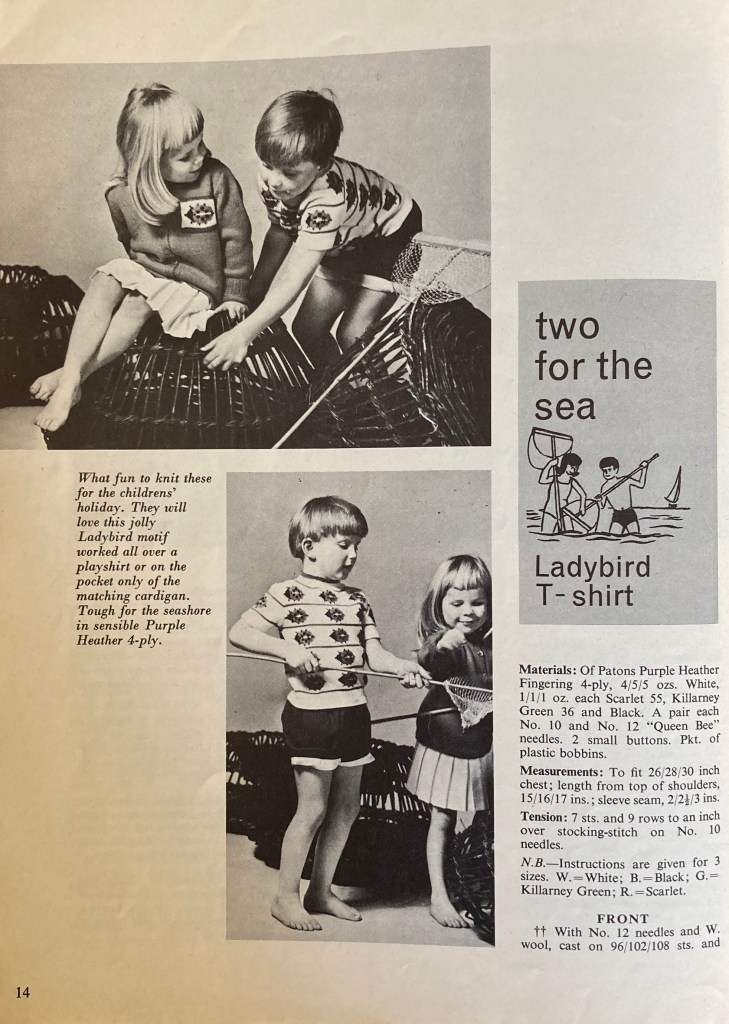
Speaking of children… Remember that playshirt from last month’s issue with the ladybird on it? Someone at Stitchcraft apparently forgot to mention that it was a trademarked logo! “No doubt” readers knew that it was used by permission, but just in case, they made a full-page announcement telling us about it.

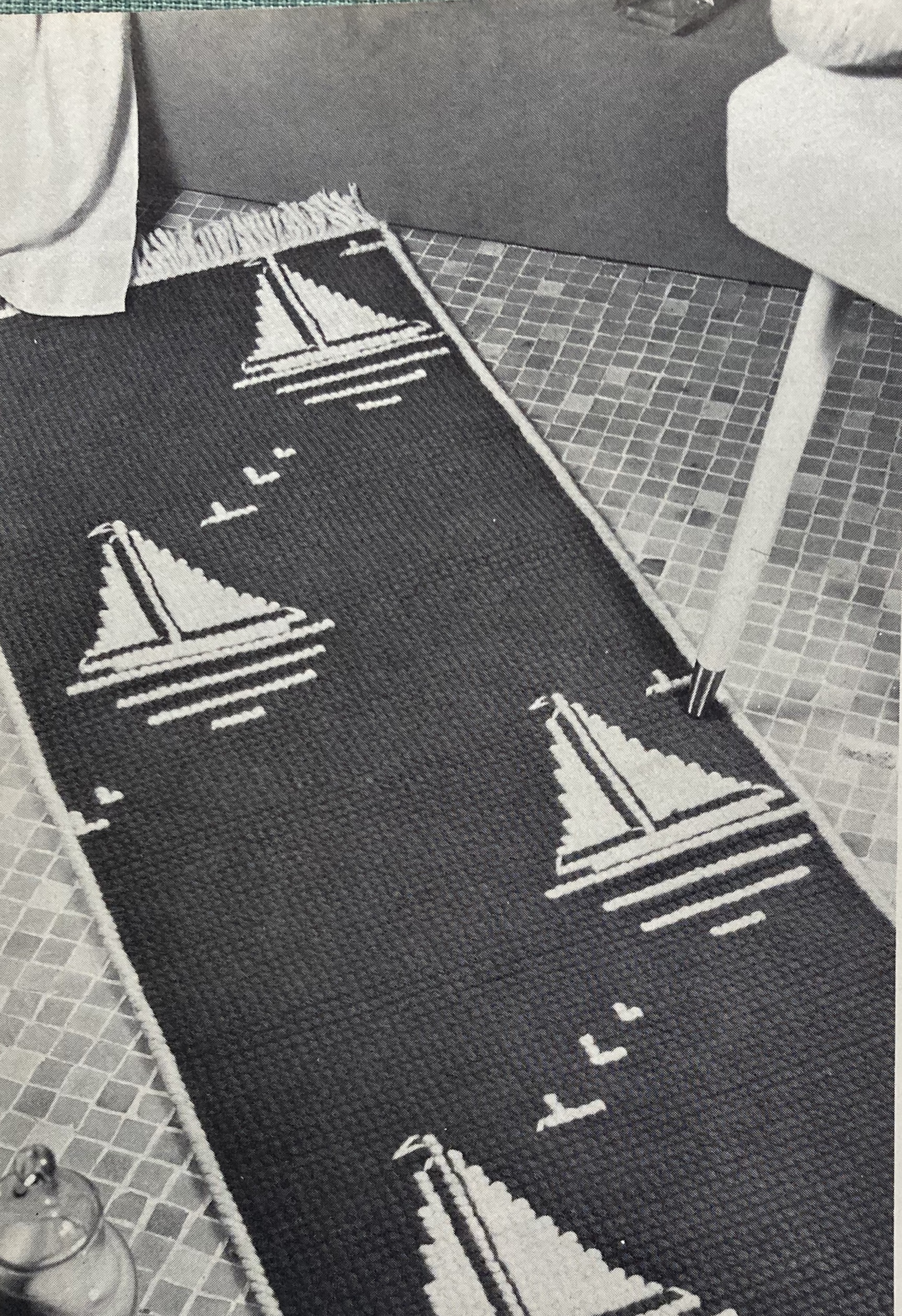
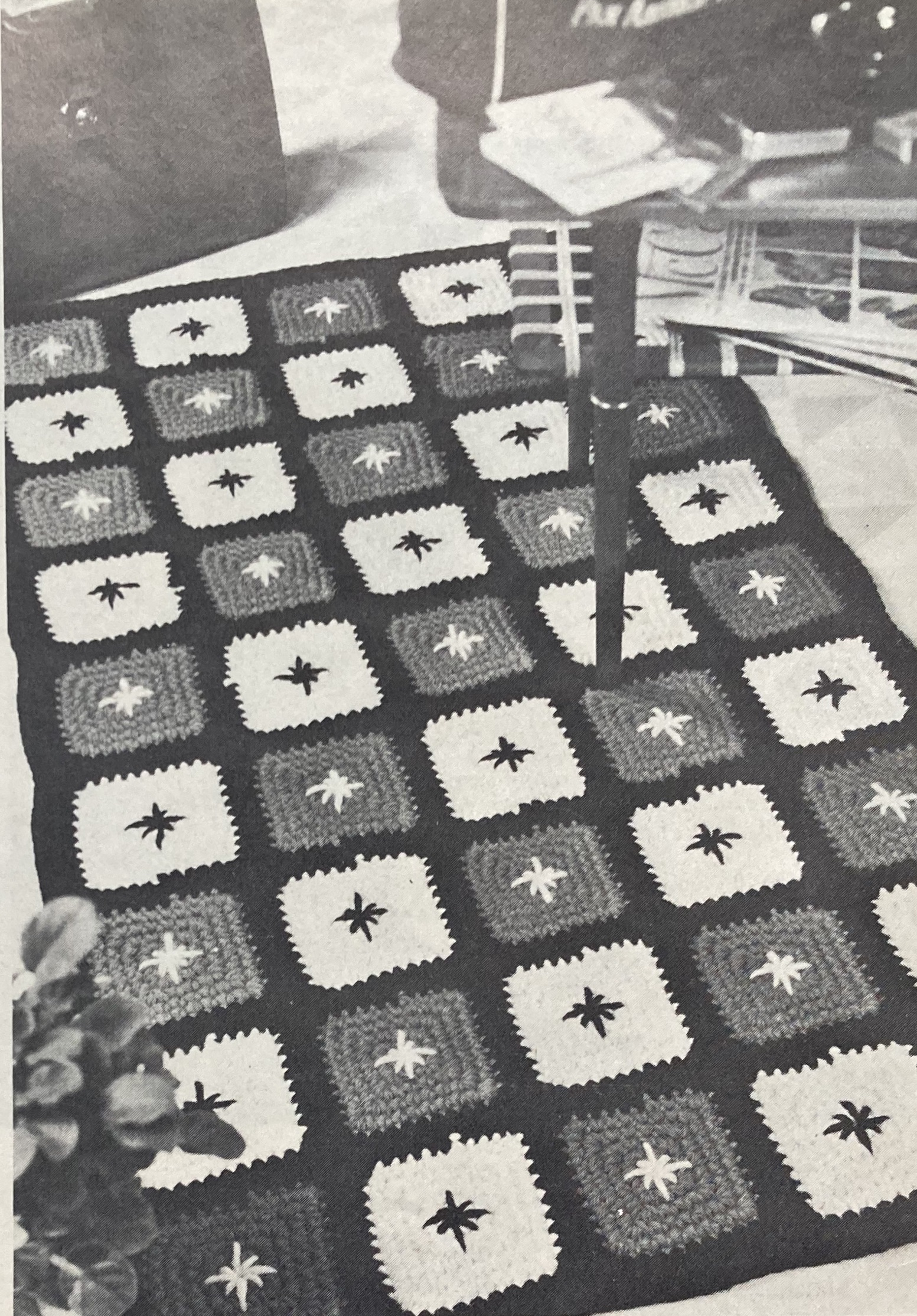
Moving on to homewares, here are plenty of embroidery and houseware designs, though none so spectacular. You can make a rug and toilet(ry) bag for the bathroom, or a wall hanging or some small practical items (spectacle case, pincushion) in tapestry:

Or the usual cushion and chairset, some easy garden cushions, or tablecloth and tea cosy in embroidery.

There’s also fun “cocktail set” of place mats and “pinny” apron for holiday entertaining at home, decorated with an embroidered cockerel. The cockerel looks a lot like the Portuguese mascot that can be found on all sorts of souvenirs from the country, and I don’t think that’s an accident: the 1960s saw the first big boom in tourism from the UK to Portugal and it has remained an extremely popular holiday destination up to the present day. If our 1964 housewife couldn’t afford a holiday in Portugal this year and buy herself an embroidered serving set there, she could at least make one for herself at home. (The bottle-stopper is my own, from Portugal and vintage, probably from the 1960s).

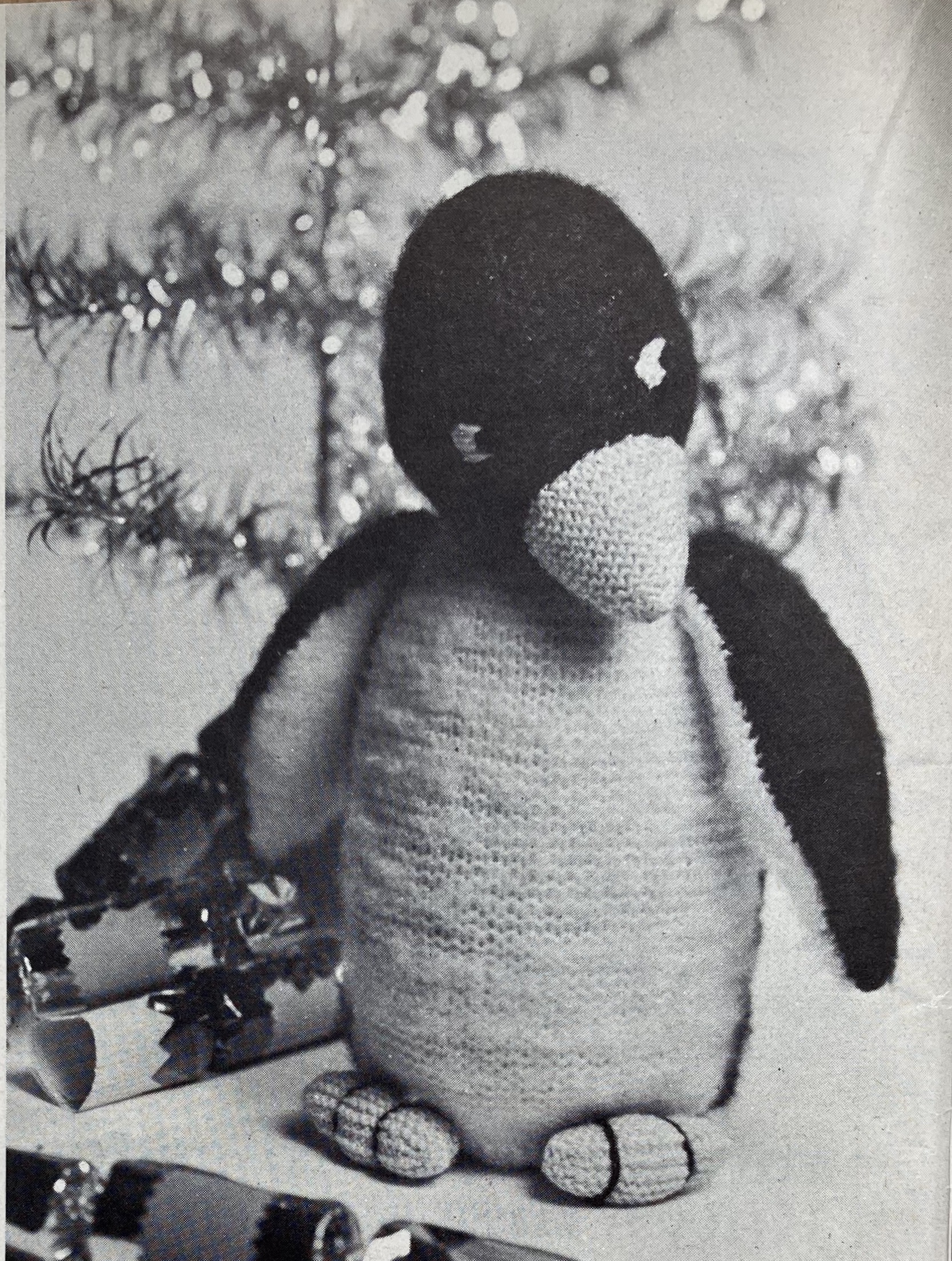
There are a couple of crocheted doily-type projects in the back pages as well as two reprints of popular little patterns (bedsocks and a toy penguin) from the 1950s –this was a special “by request” feature in many of the mid- and later 1960s issues. And that about wraps it up for this issue! It seemed to not have as many projects as other issues, but after going through them all, it’s actually quite full of ideas. My project will be the sleeveless top with the square neckline. Happy Summer!

June 1964: Overview

Welcome to the official start of the Stitchcraft holiday season! The June 1964 issue gives us a mix of elegant 4-ply designs, casual bulky knits to wear as outerwear, beach clothes for the kiddies and easy homeware projects that can be packed up and worked from a deck chair.

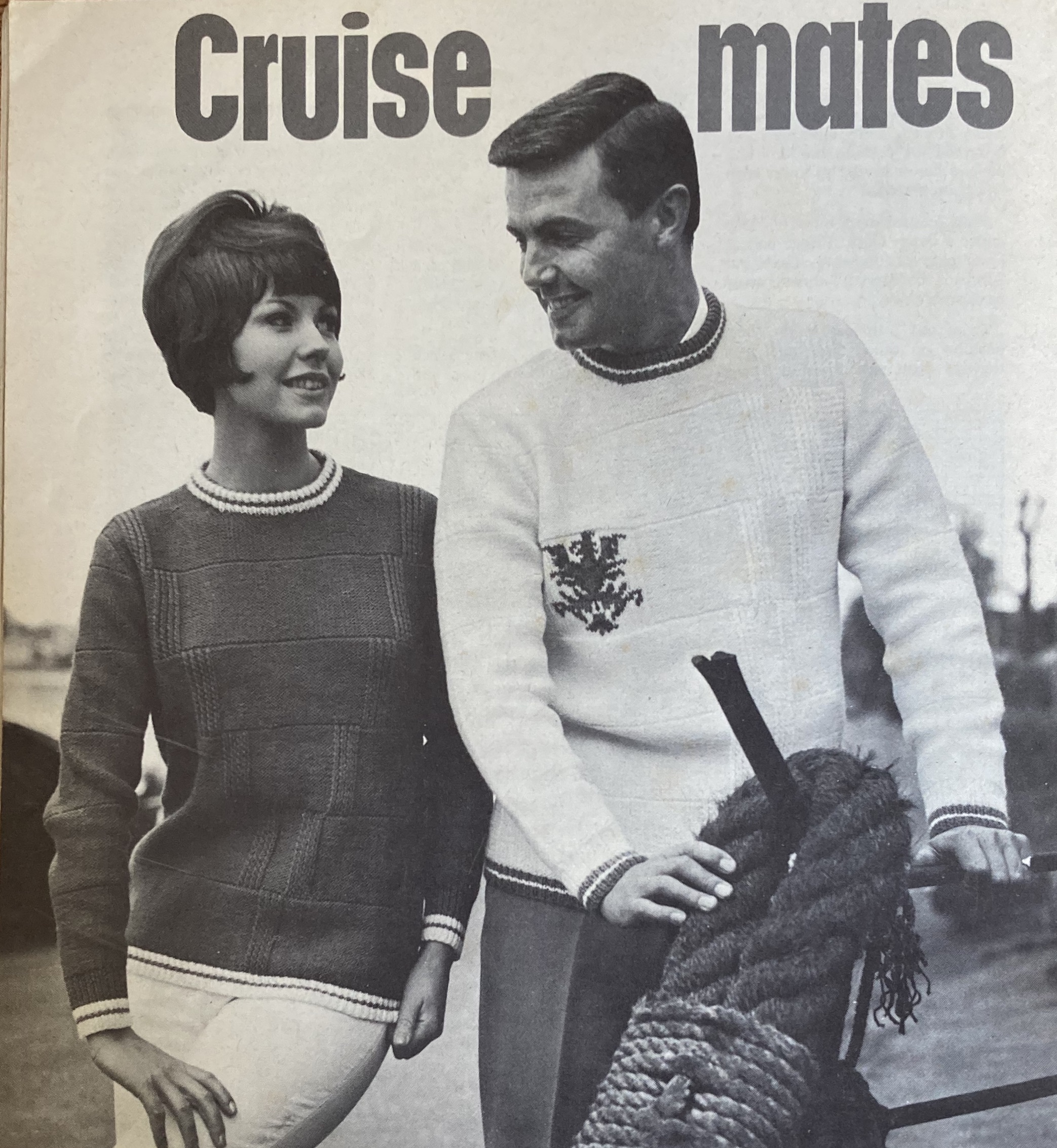
Our cover models are just returning from the weekend market, where they have secured a basket of nectarines. They’re wearing an “easy-line sport pair” of “cruise mates” in complementary colours and the same basic block-and-rib pattern. The ribs are made with p1, k1tbl to give them a more textured look, and the men’s version has an eagle motif, because it is “manly for him.” I wonder if both versions were originally designed with a motif until the designer realised that it would fall in an awkward place on the women’s version?

Nautical navy blue and white with red accents never goes out of style for summer casuals, and we see it in this bulky, yet “featherweight” (18-20 ounces of Patons Ariel, so make of that what you will) white cardigan. I can believe Stitchcraft when they say that the wool is lightweight, considering its bulk, since the twisted-rib pattern eats up a lot of wool.

Ona different note, we see simple, yet elegant knitwear separates in 4-ply that are suitable for the office of a more dressy casual situation. The basic skirt and plain or diagonal-striped top are knit in muted pastel shades and meant to be interchangeable — “Basic skirt with a change of top” is the headline for this well-coordinated set. There’s also a waistcoat for her that would match the skirt when worn with a blouse, and a fine-knit raglan pullover for him. The waiscoat and pullover are both in this season’s trendy yellow tones of “Spun Gold” and “French Mustard”.

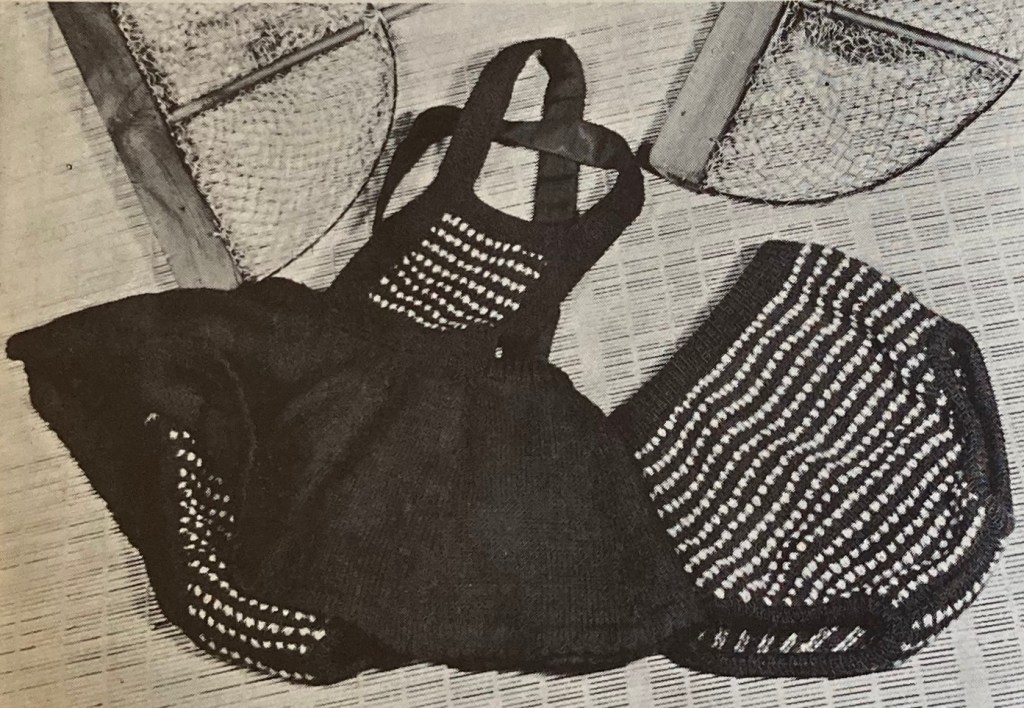
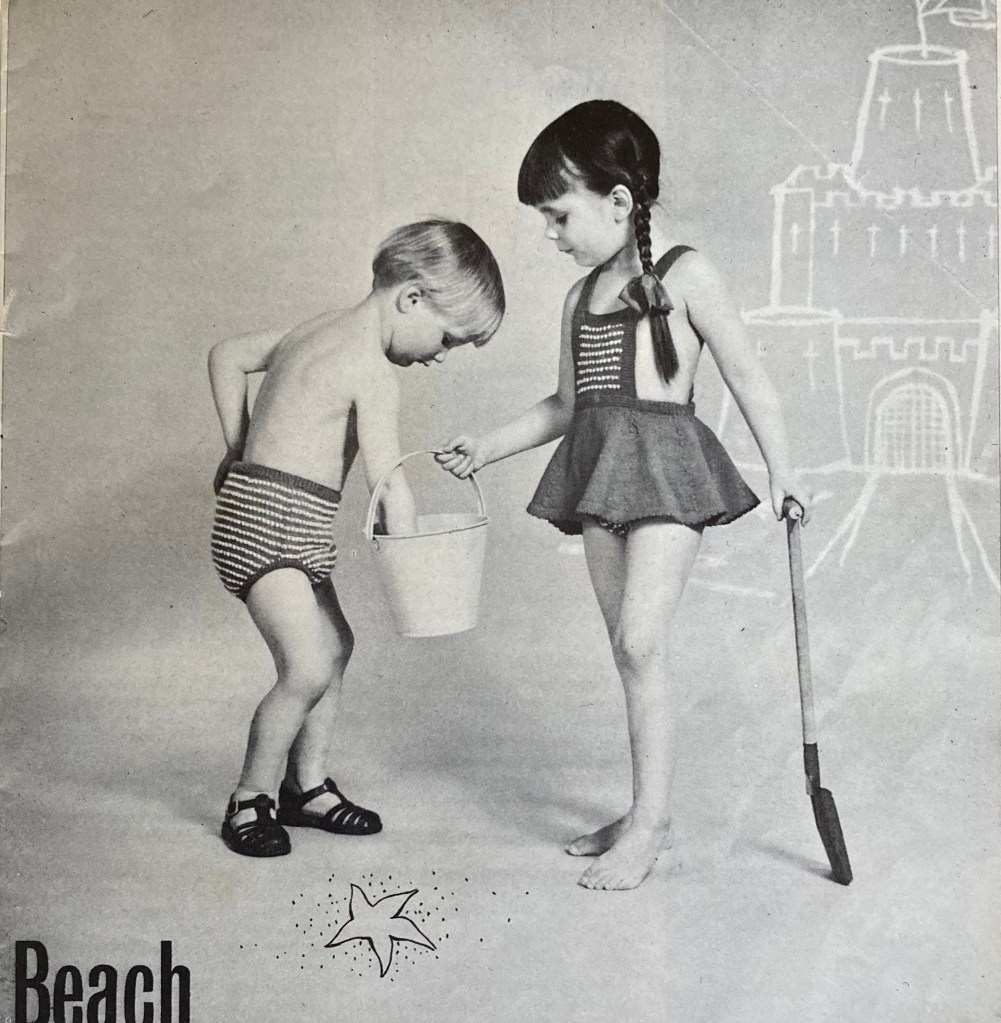
Children can enjoy splashing around at the beach in their trunks and sundress (the girl’s trunks are sewn into the sundress to prevent wardrobe malfunctions, definitely necessary with a micro-mini tunic skirt.) Here again, traditional red and white or navy blue and white are the chosen Somewhat older children have a choice of short-sleeved jumper and/or cardigan with a Ladybird motif (more about that in the next issue…!), continuing the red and white theme. On a completely different colour note, you can make a beach cover-up coat in crinkly “Rimple” wool lined with towelling — a brilliant idea for drying off and staying warm after a swim in cold northern waters. It’s quite easy to make, consisting of literally three rectangles for fronts and back, with garter-stitch borders and then lined with the towelling.

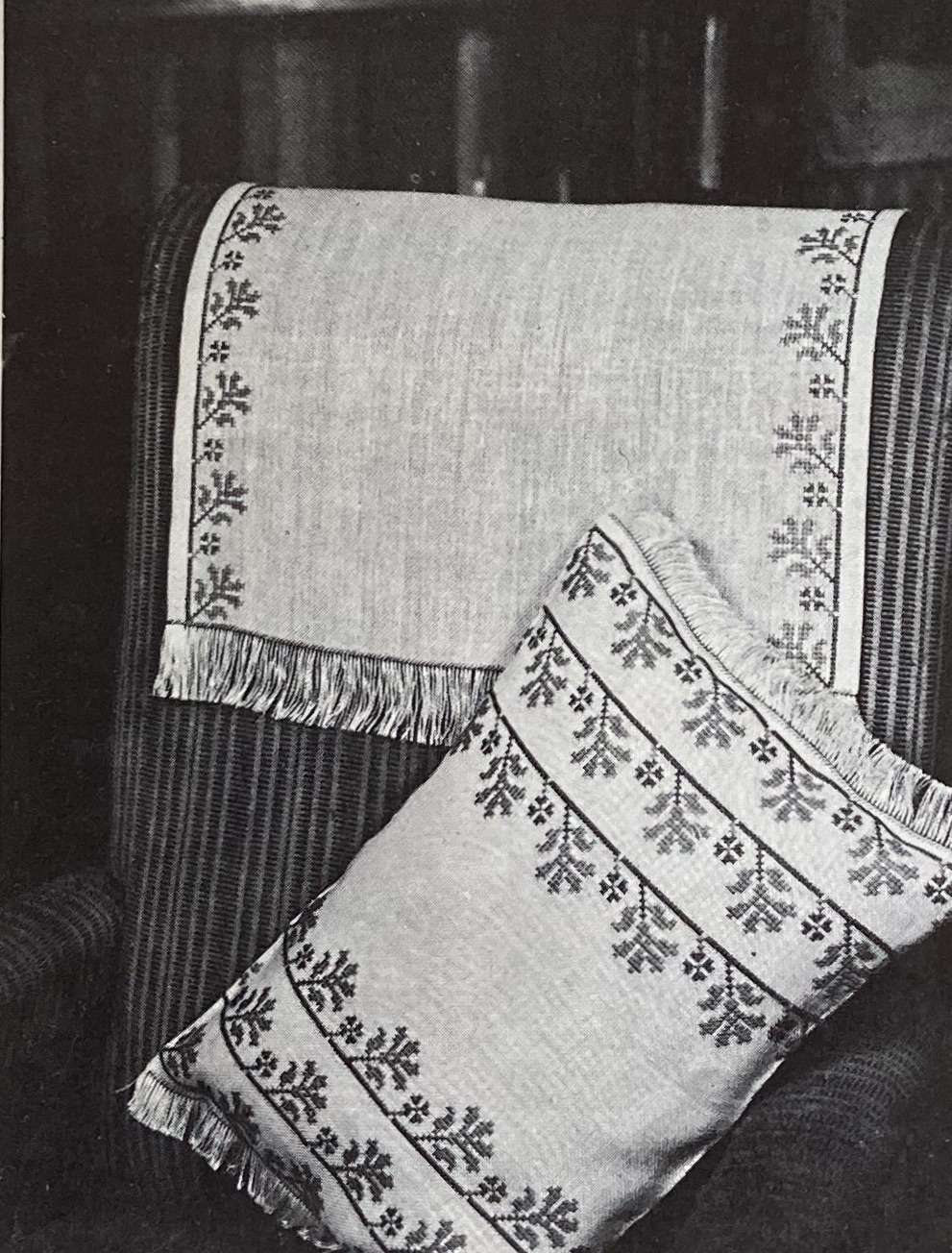
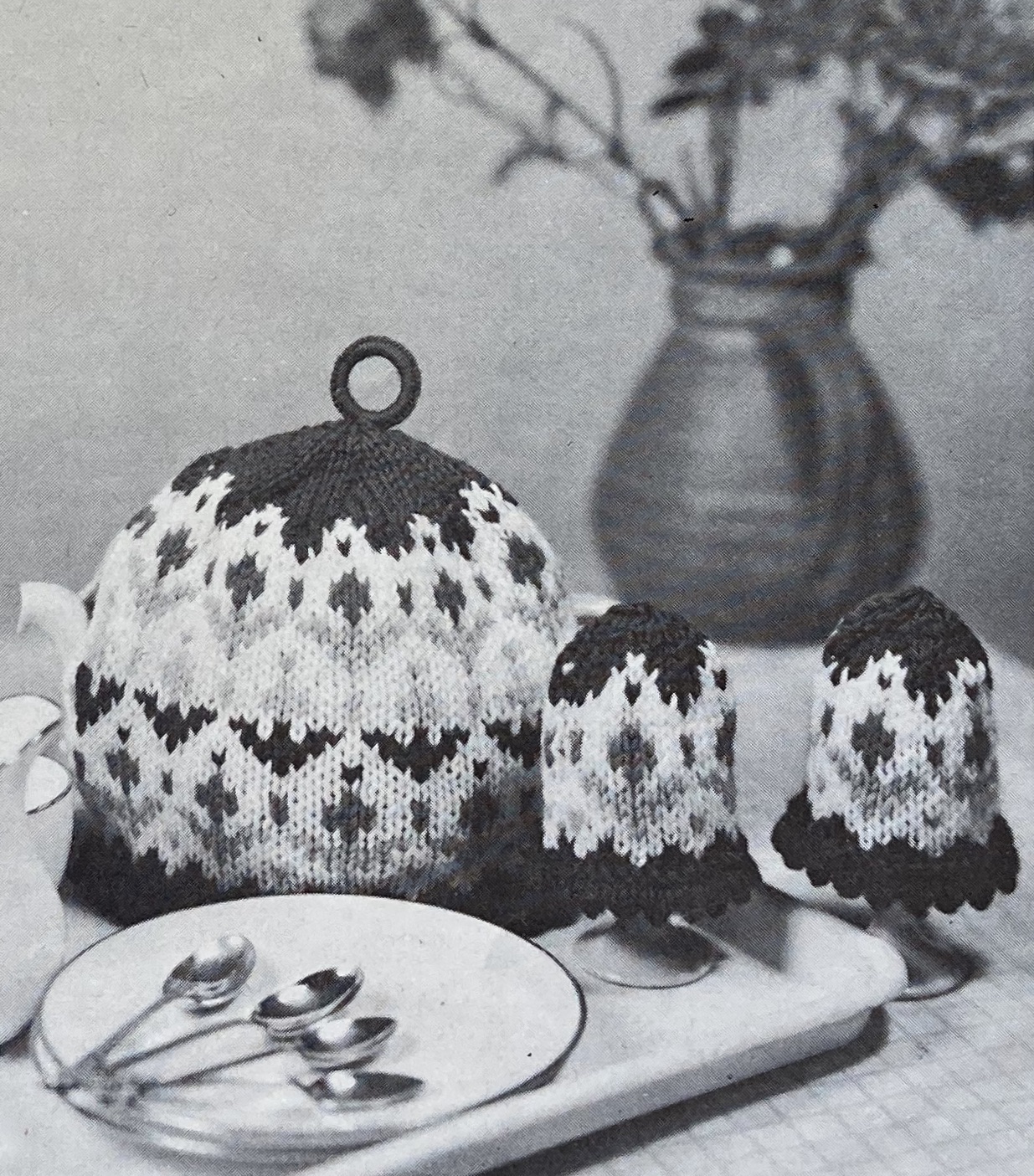
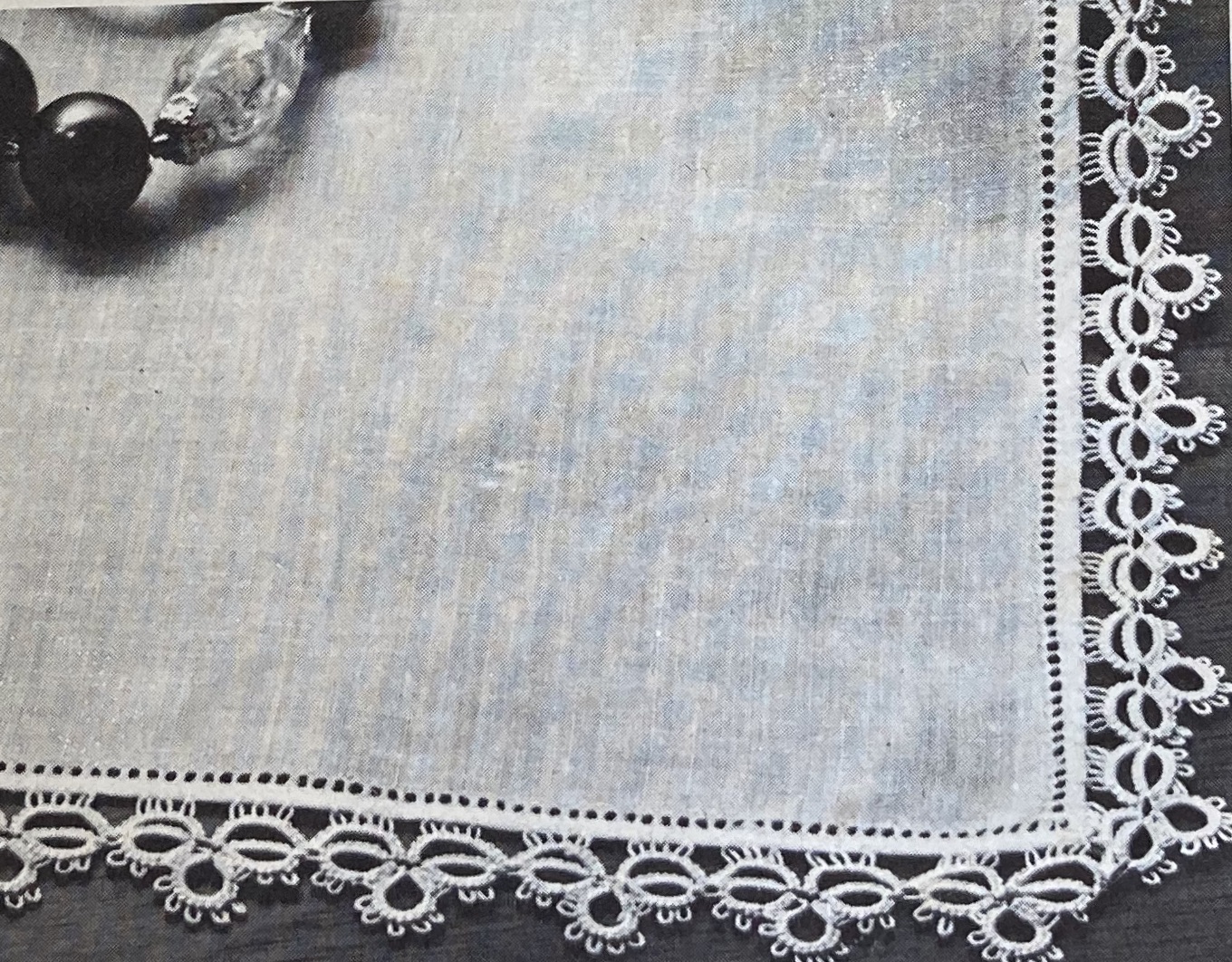
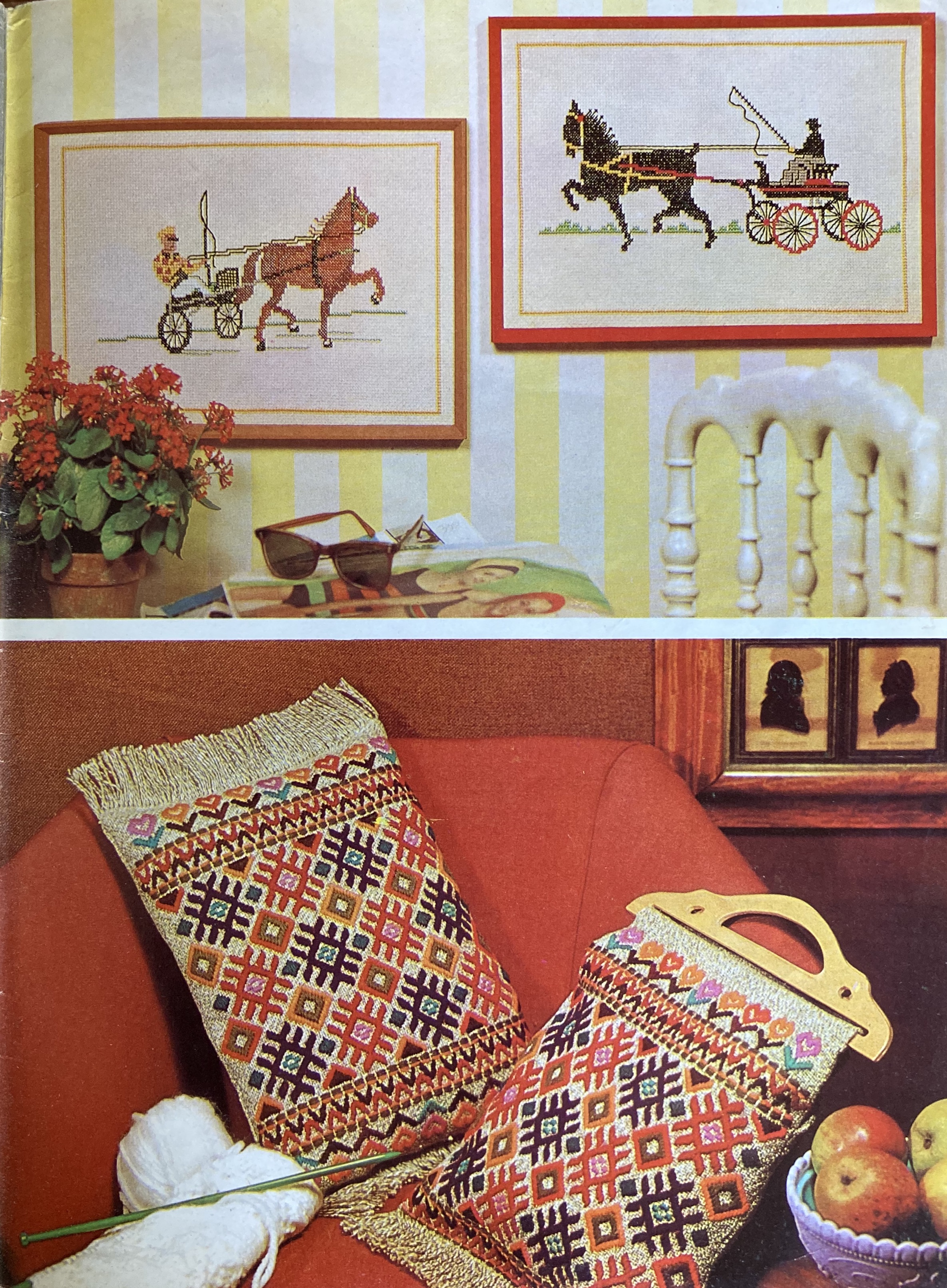
While sitting and sunning at the beach, you can work on an easy homeware project, such as a cross-stitch cushion, a knitted tea or egg cosy, or a tatted lace edging for handkerchiefs or pillowcases. Even the workbag in Turkish darning would be easy enough to work on while on holiday, though the Victorian-esque horse-and-buggy cross stitch picture, the needle etching, and the crocheted rug are presumably easier to work on at home.

That’s it! Summer issues are usually less exciting than autumn and winter, as many people (understandably) don’t like to hold wool in their hands in hot weather. As with many of the mid-1960s issues, there’s nothing in here that particularly speaks to me, so my June project will be another “excursion”, this time all the way back to the 1920s. The project is almost finished (unlike my April and May blog projects…) so I’ll be able to put out a finished project post in time for once, even if it’s neither from Stitchcraft nor from the 1960s. Think of it as a holiday from the usual blog theme.

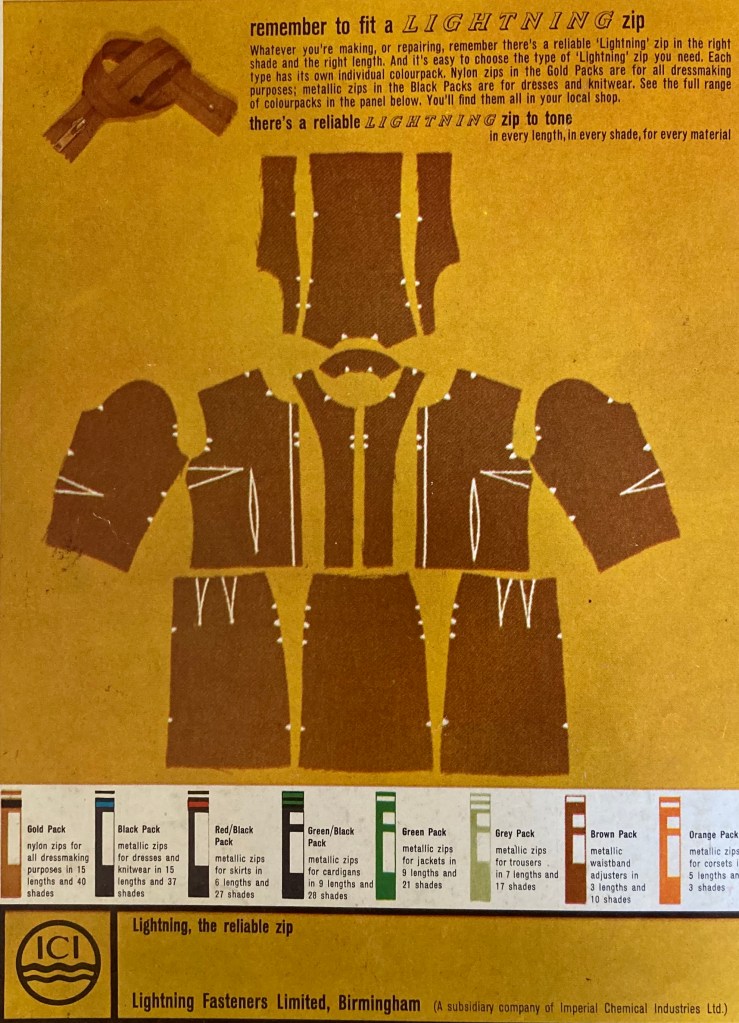
P.S. The back cover is a full-page ad for “Lightning” brand zips and and is illustrated with a very professional-looking pattern for a suit! I am tempted to size it up and sew it. Here it is for any readers who would like to try their hand at it.

May 1964: Overview

Cover photo from Stitchcraft magazine, May 1964, showing a woman in a pink knitted cardigan

Stitchcraft‘s May 1964 issue promises a “May Merry-Go-Round” of “a wide choice of Summer Knits for leisure, holidays, travel and all the warmer weather activities.” Time flies so fast that I feel like I’m on a merry-go-round even without knitting — but let’s see what this issue has in store for us.

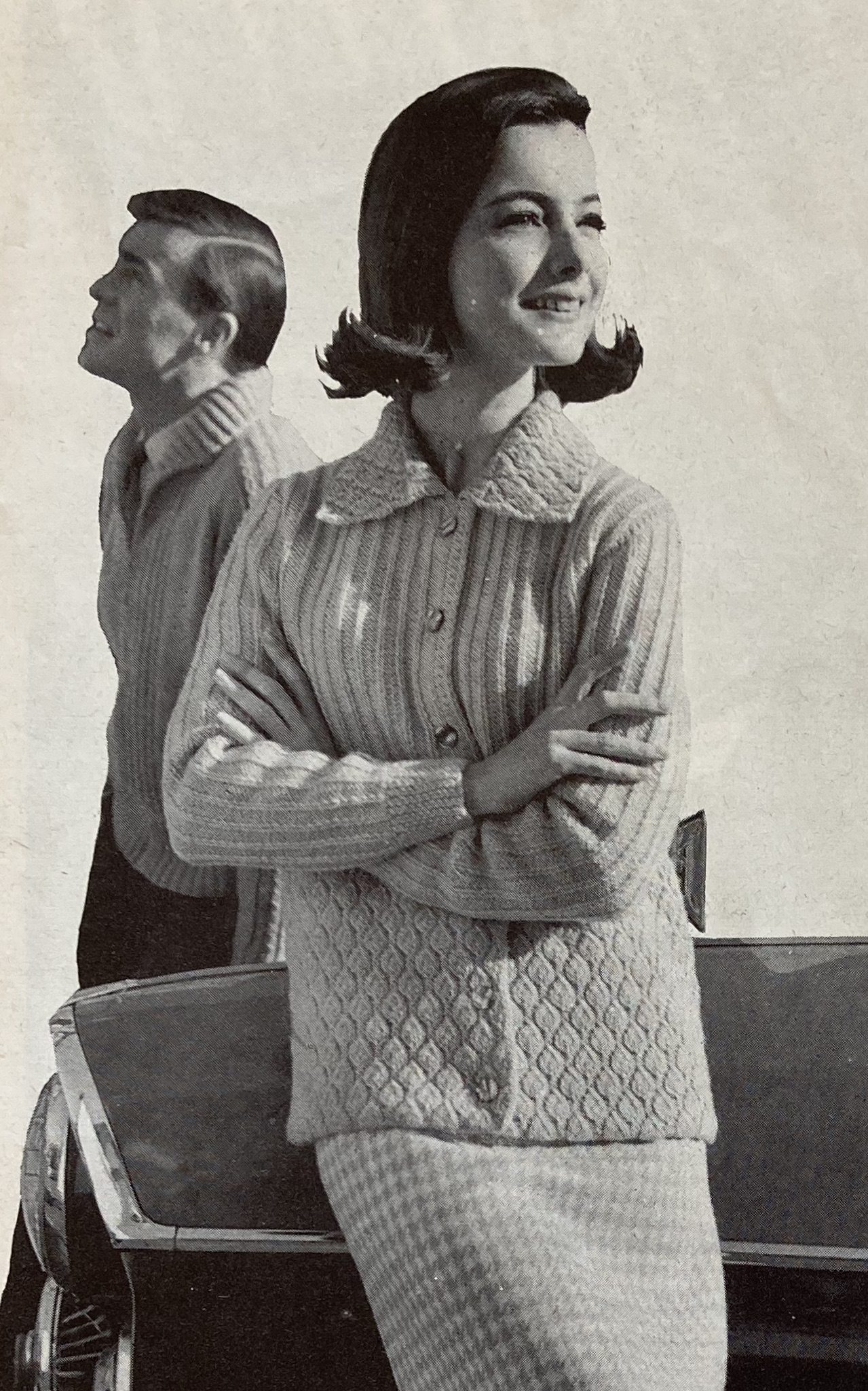
Our cover feature is a high-buttoned cardigan with a deep “pineapple stitch” hem and collar. It’s made in DK weight wool, but the pineapple stitch and slip-stitch rib make it quite heavy (20 oz.) and presumably warm and sturdy. There’s a less bulky design in DK wool on the facing page; no collar and a plain twisted stocking-stitch make it require only 12-14 ounces of wool. Patterns that utilise texture and lines, especially diagonal lines, are still very much in fashion, as are high necklines and collars.

The back cover shows off the latest in partner-look sweaters, this time with a V-neck. It’s not what you would call a traditional Aran-pattern design, but it combines some of the typical cable elements with textured ribbing for a sleek, modern twist on the traditional look. The sweaters are made in light colours with Patons Totem Double Crepe, a very smooth yarn with a tight (“crepe”) twist, to make the pattern stand out.

(Side note: This issue is visually one of the most fun I have encountered, thanks to multiple photographs of the same garments and models in different poses, and the liberal use of illustrations. I particularly like the one with our male model looking up out of his book (travel atlas?), apparently quite concerned, while the female model looks calmly into the distance. Feel free to suggest captions!)

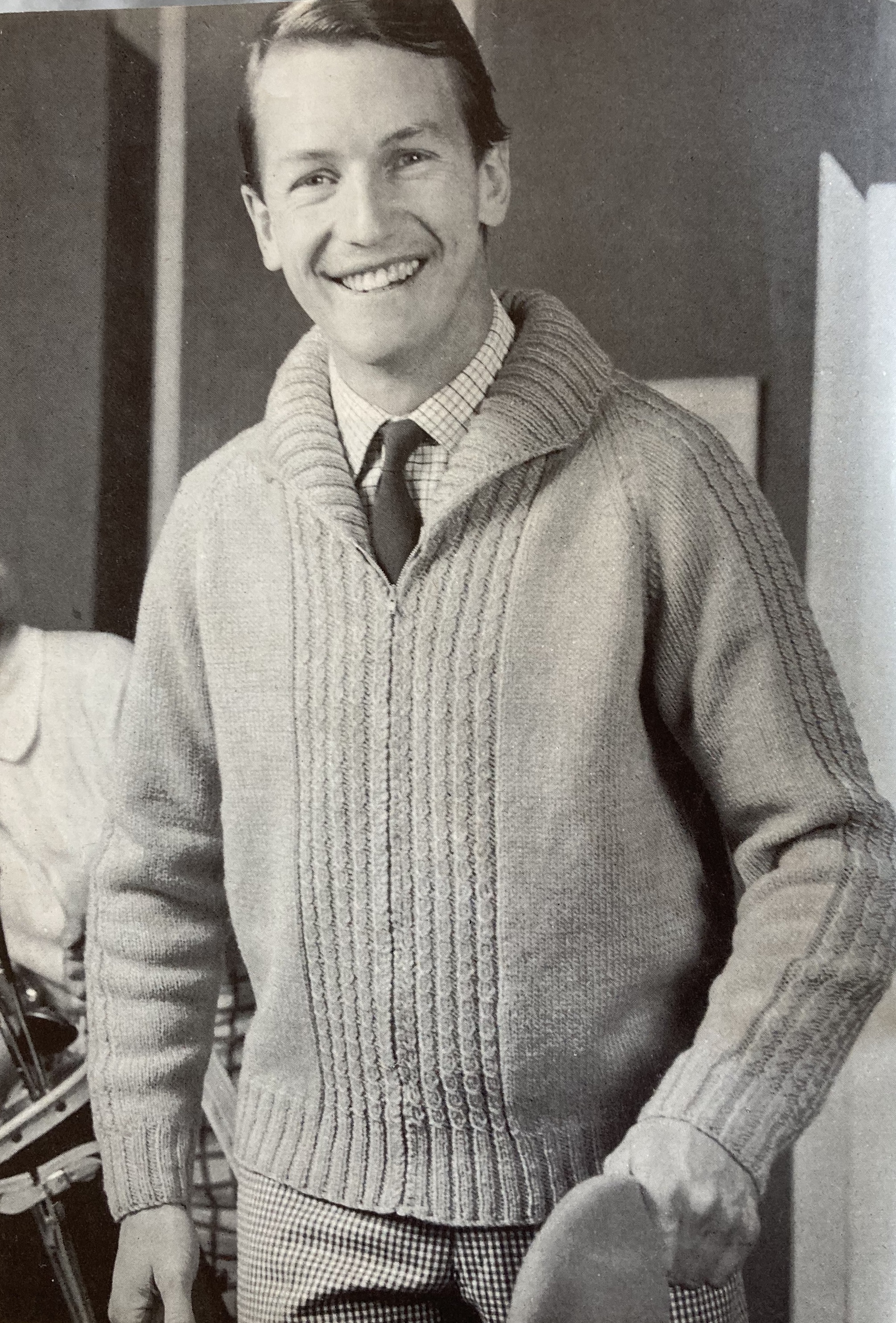
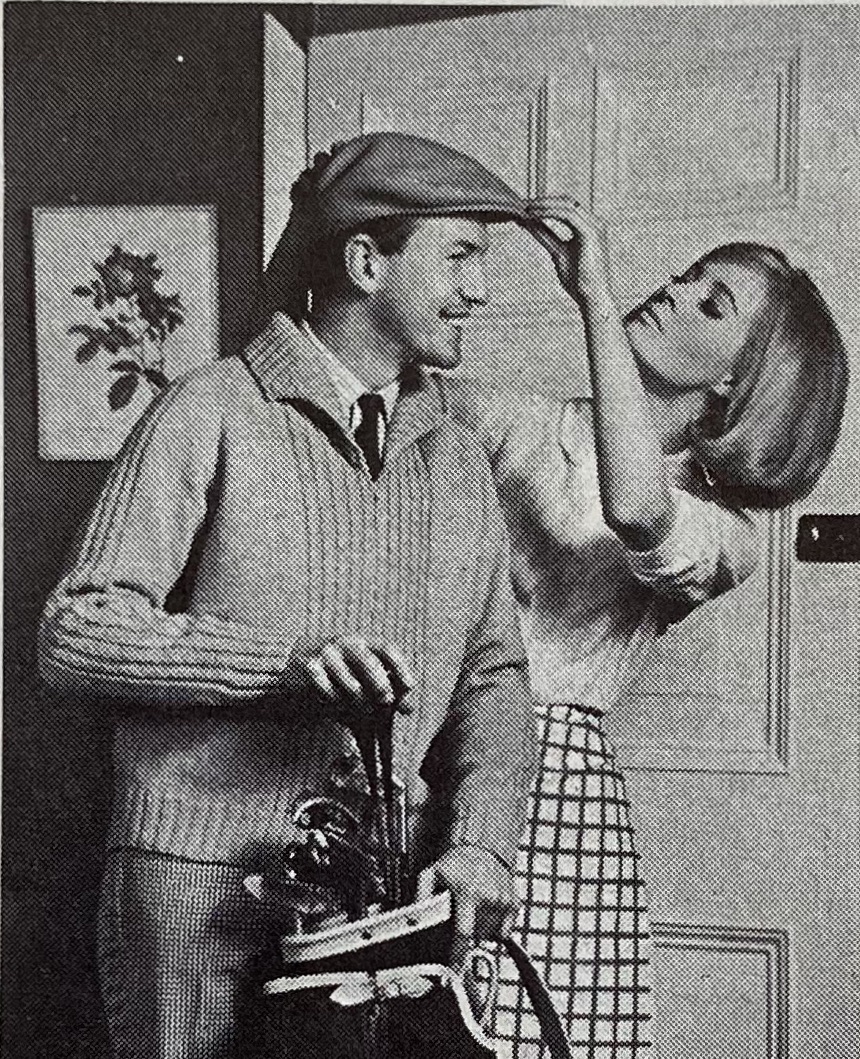
“Finer-knit fans need not feel neglected” by all these bulky, loose-fitting overgarments, promises our “editress” in the facing-page notes: here’s a cute blouse-cardigan in 4-ply wool with the same use of vertical lines, textured pattern and collar, but all in a more refined and elegant look. It’s made in Nylox, a wool-synthetic blend much like modern 4-ply sock wool, and promises to be “very pretty and feminine worn with a pastel skirt.” The man of the family sticks with DK-weight wool, though, and gets a “best of all golfer style” zipped cardigan with classic shawl collar and mock cable detail. I’m only sorry that they chose the normal pose for the full-page photo and relegated the fun one to the facing page.

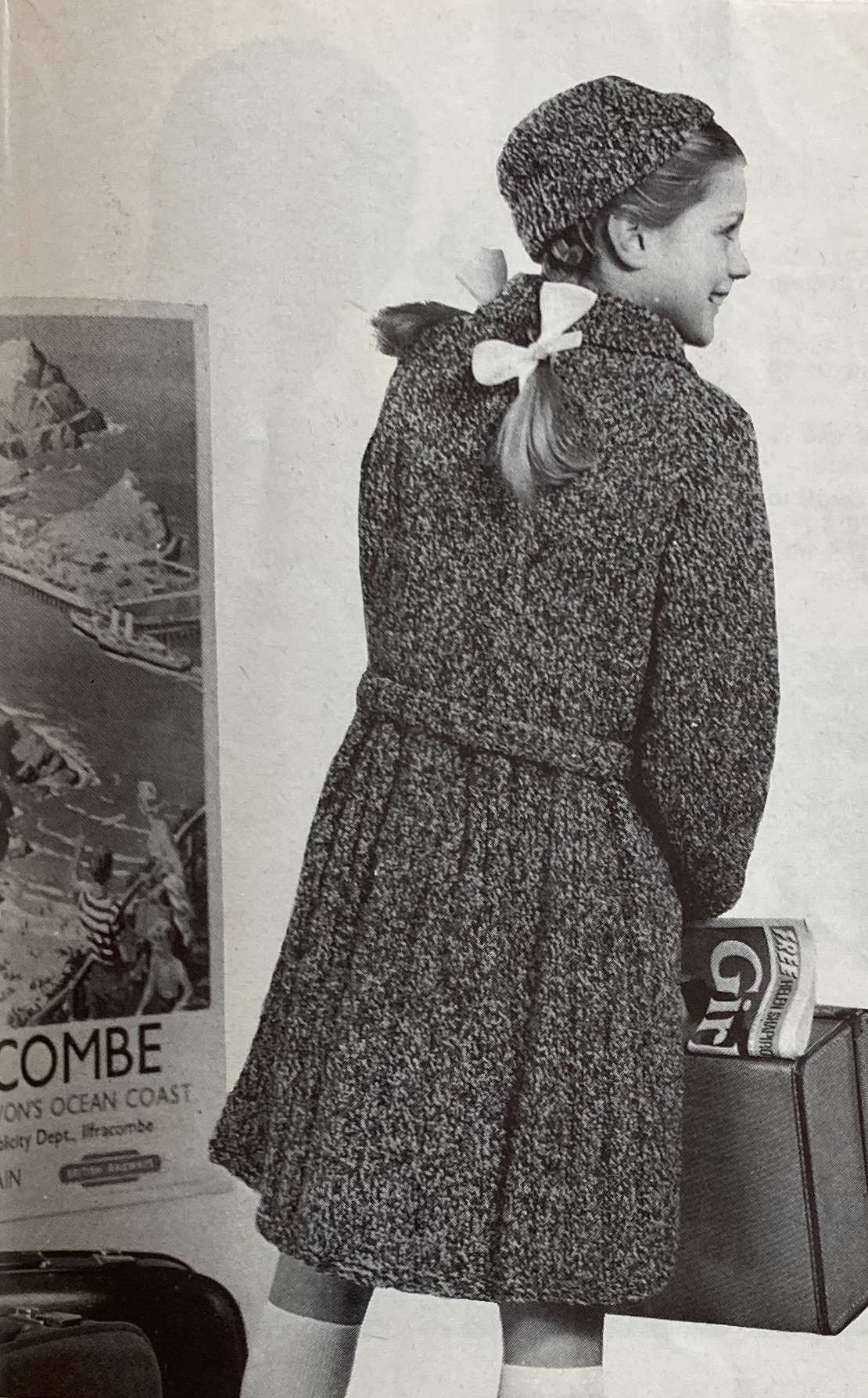
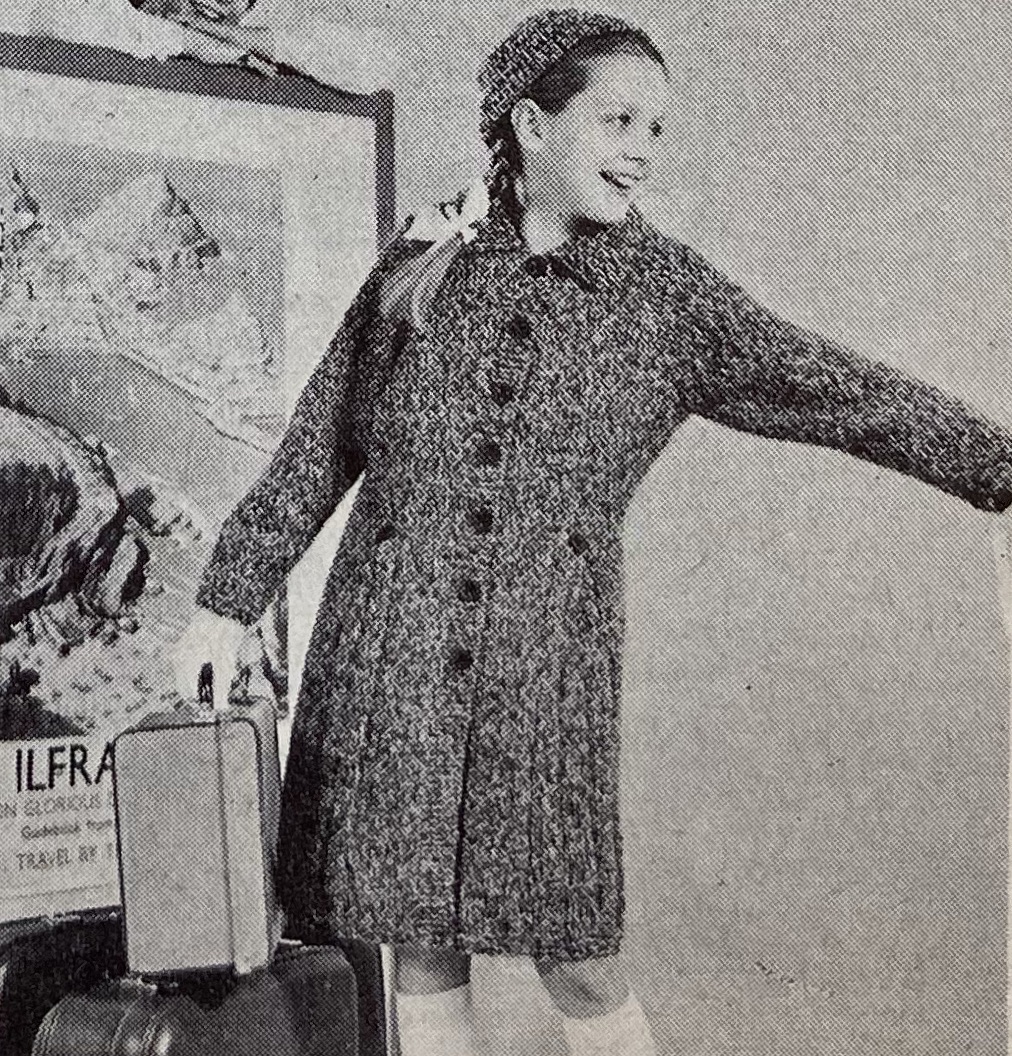
A cardigan jacket for indoor-outer wear is practical for summer travelling, so this month’s issue offers us a structured, yet comfortable “Blazer for Globe-Trotting” in DK weight as well as a belted coat with pleated swing back for the teenage daughter. The coat has a matching cap, as well, and is made in tweedy, bulkier “Glenora” wool. Here, again, there are multiple photos, so you can get a sense of the coat in its entirety.

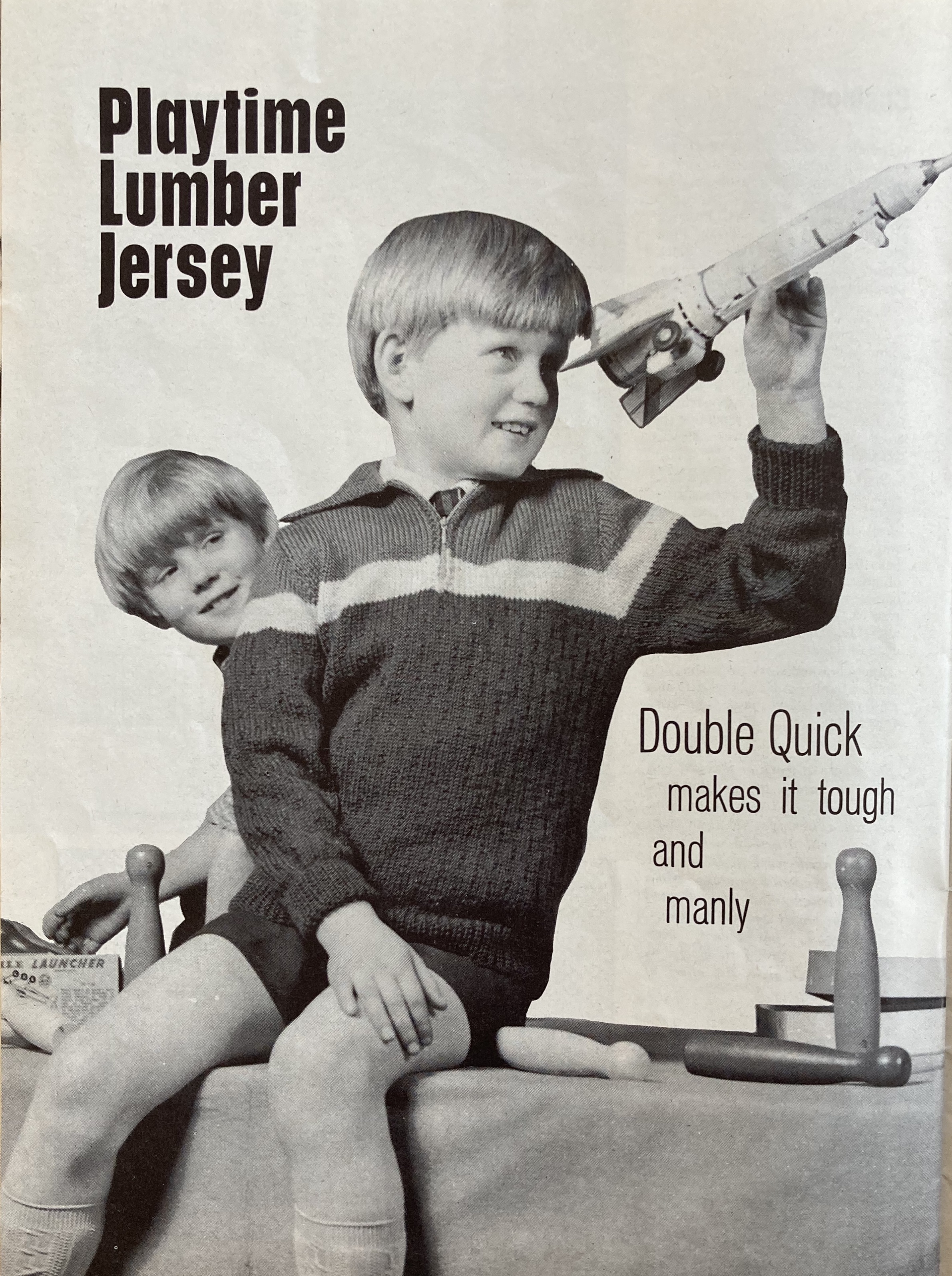
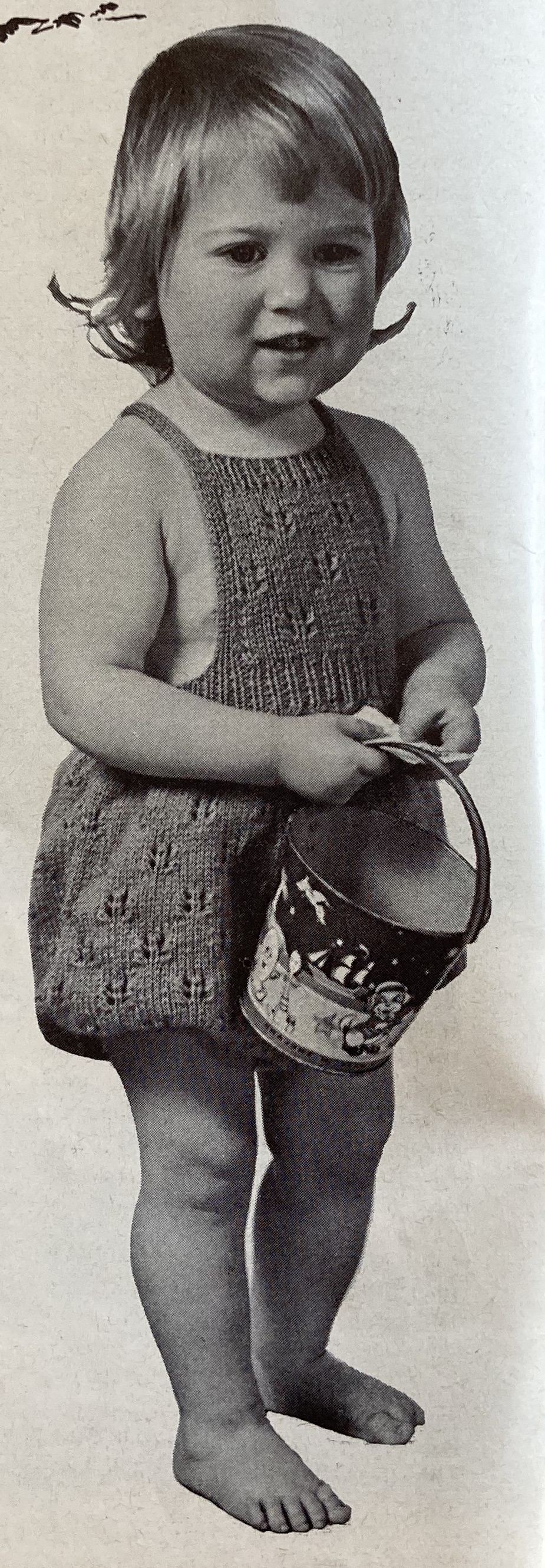
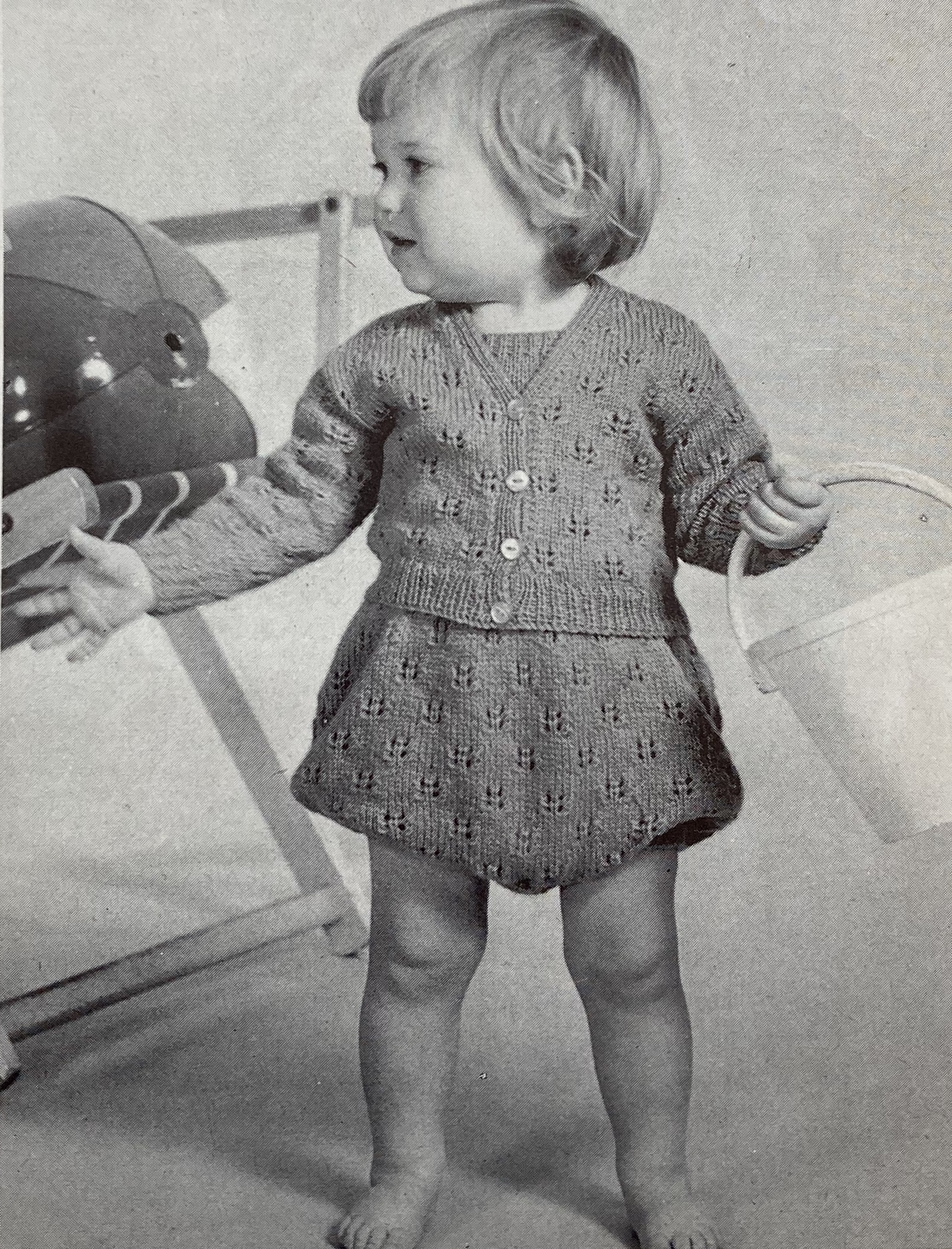
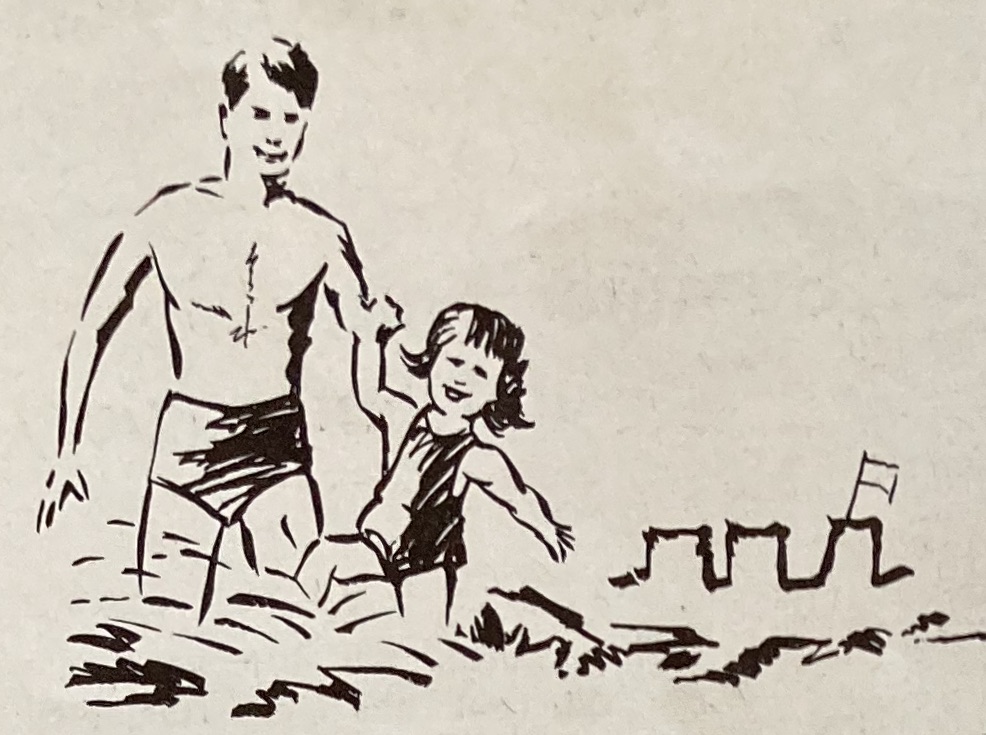
Younger children can enjoy their holidays in hand-knits as well: the boy’s zip-neck jersey promises to be “tough and manly” for the future rocket scientist of the family and makes nice use of stripes and a more subtle textured pattern. (The colours, from neck to waist, are “Breton Red”, “Magnolia” and “Woodland Green”.) Toddlers can go “splashing and paddling” at the beach in a cute romper with a matching cardigan to cover up when it gets chilly. And here’s another great illustration, showing our little model splashing and paddling with her father, sand castle in the background.

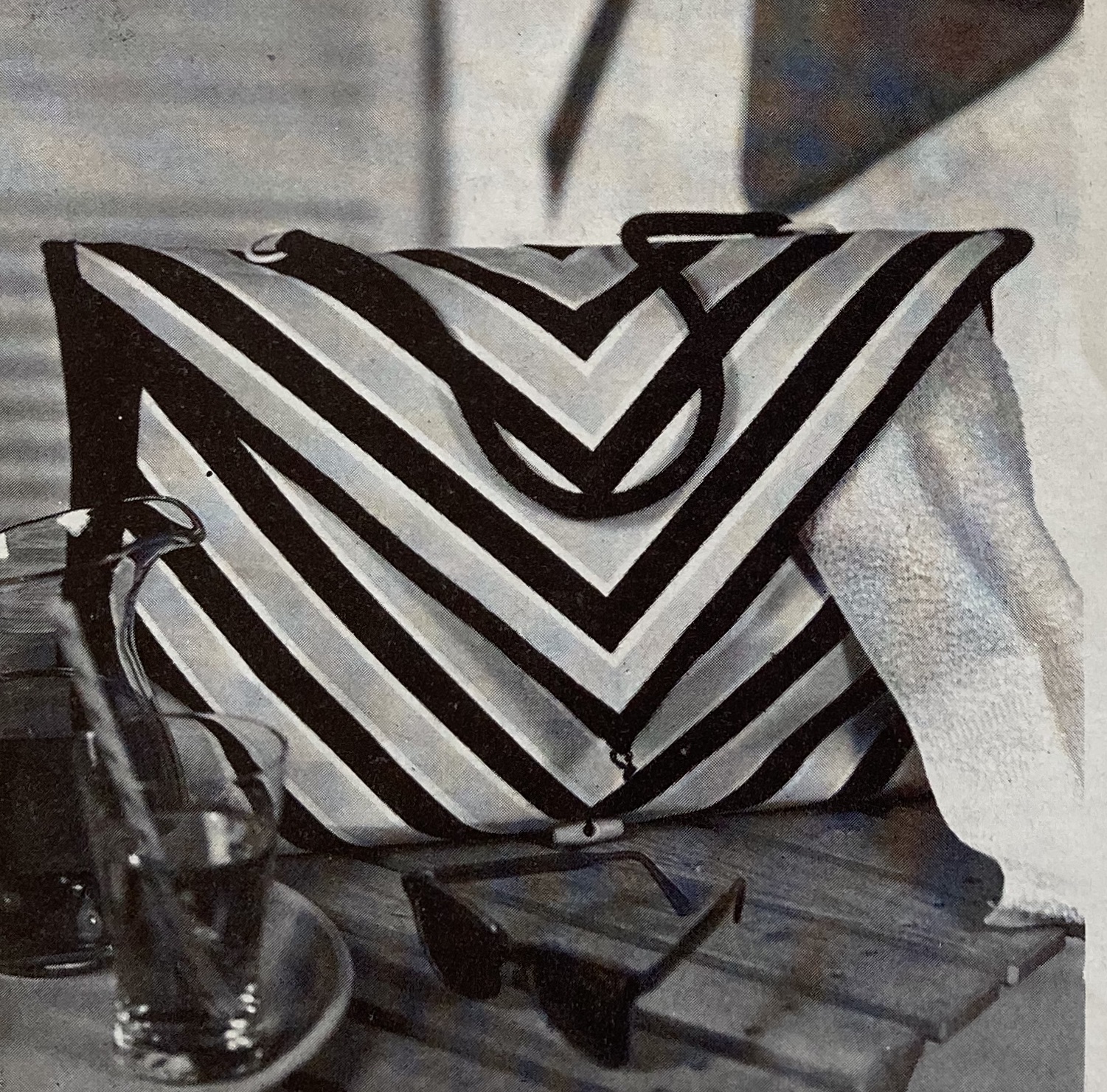
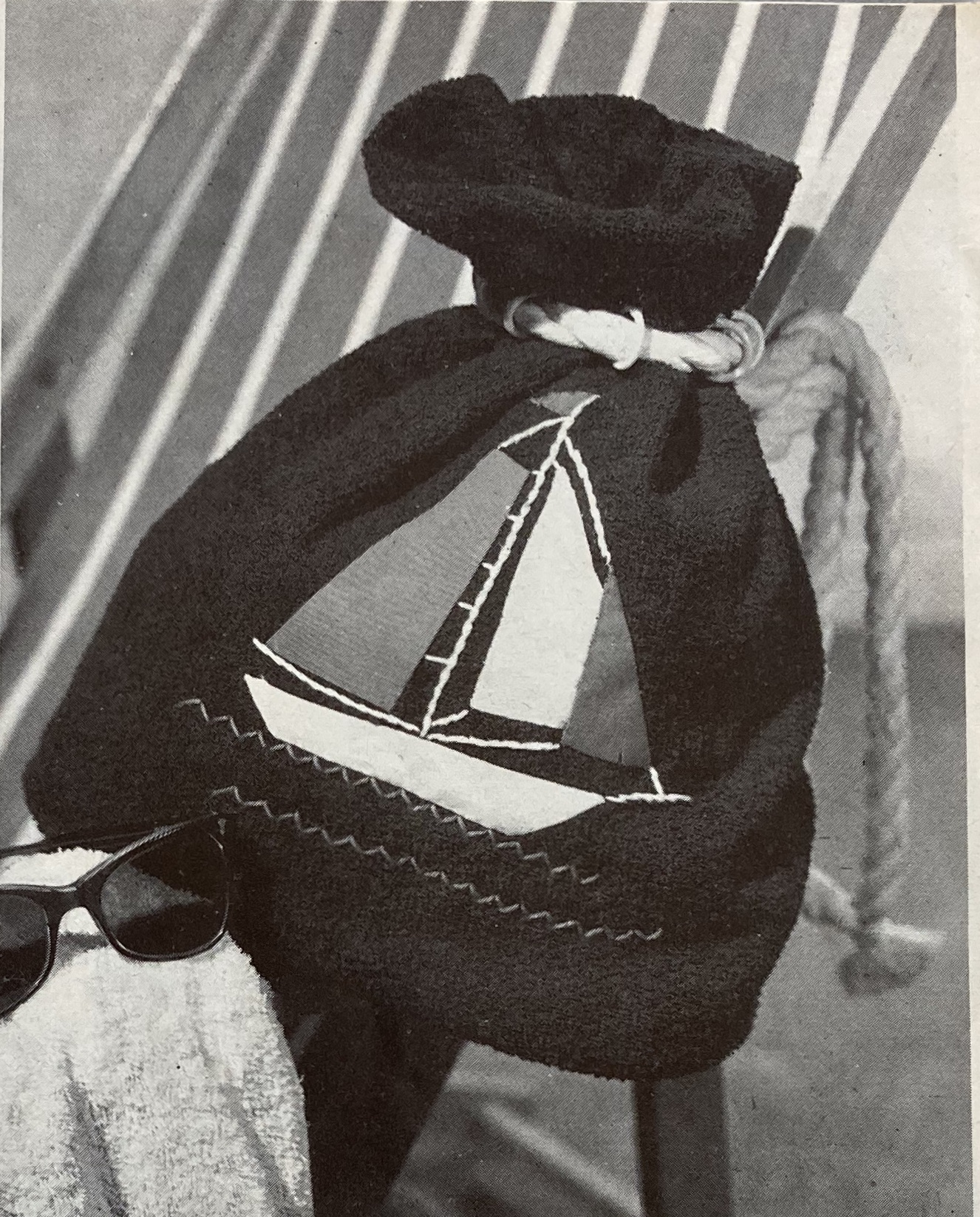
Speaking of beach holidays, how are you going to transport your (possibly wet) swimsuit, sunglasses, towel and whatever else you need back and forth? In a chic, yet practical home-made kit bag, of course. Here are two designs to sew yourself: an “envelope type” made out of tough deck-chair canvas, or a drawstring bag made out of towelling material lined with plastic and decorated with a sailboat motif in appliqué and embroidery.

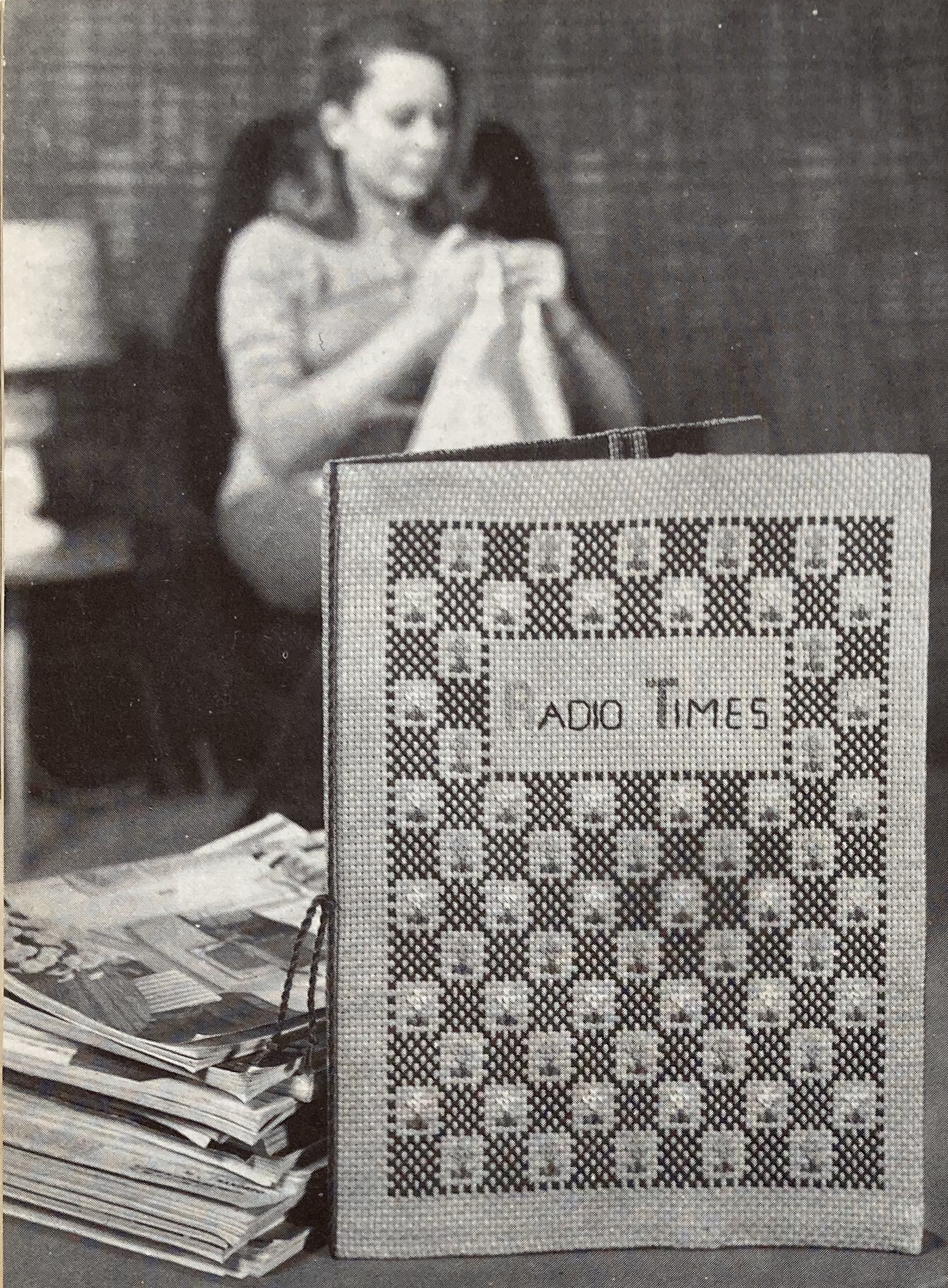
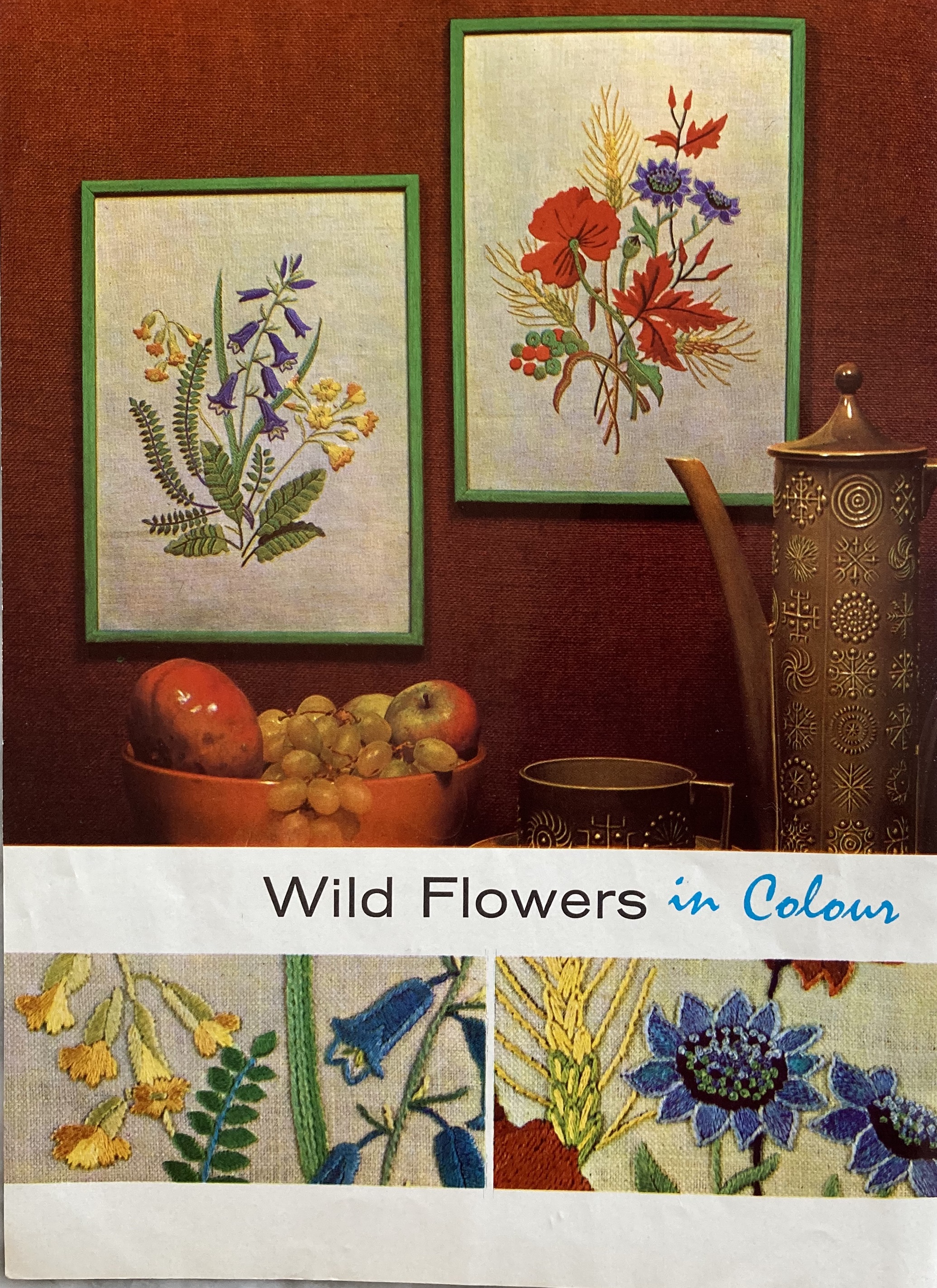
There’s regular embroidery for the home, too (to work on which sunning in your deck-cair, perhaps): an easy cross-stitch book jacket for the Radio Times, another traditional chair-back/cushion design, and some more intricate wall panels with colourful wildflowers.

Speaking of intricate wall panels: if all that weren’t enough, there’s another amazing felt appliqué wall panel, this one featuring characters from “favourite books.” That is, if your favourite author is Charles Dickens, which, why not, I suppose? There’s Barnaby Rudge and Oliver Twist from their namesake novels, Peggoty, Little Emily and David Copperfield from his namesake novel, Mr Pickwick from his namesake novel (‘s papers) and Grandfather and Little Nell from… (OK, I admit I had to resort to Wikipedia for this one) The Old Curiosity Shop, one of Dickens’ books which I have heard of, but never read. Anyway, the appliqué is fantastic — just look at the detail photo on Mr Pickwick’s face.

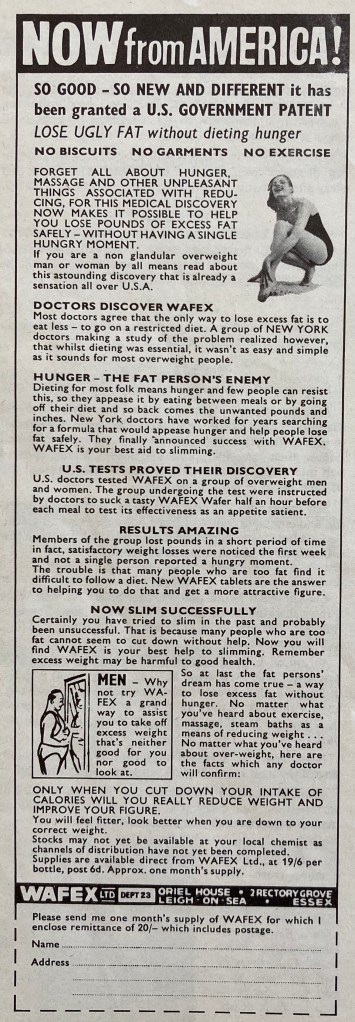
That brings us to the end of our issue, and by the way, if you suffer from unwanted weight gain as a result of all your holiday leisure, why not try sucking on a tasty “WAFEX” wafer half an hour before each meal? I’m suuuuuure it’s not only extremely effective, but also perfectly safe. After all, it’s “SO GOOD — SO NEW AND DIFFERENT that it has been granted a U.S. GOVERNMENT PATENT” ! (Note: I do not actually know what was in these appetite suppressant wafers, but seeing as it was 1964, they could contain anything from sugar to amphetamines to absolutely nothing. Please do not take medical advice from me, or from 1960s knitting-magazine advertisements.)

I would love to make the 4-ply cardigan blouse, but it will take a while, as I have so many unfinished larger projects on the needles at the moment. Until then, enjoy your Spring, Summer, holidays, travel or whatever else May has in store for you.

April 1964: Overview

Like March April weather, Stitchcraft‘s „Spring Lineup“ from March April 1964 has a little bit of everything to offer. (No, that was not an April Fool’s joke — I have apparently lost track of time. Thank you Gretchen for noticing!!) There are warmer garments to wear on a spring ramble or for summer sailing, knitted cardigan jackets to take the place of outerwear, some slightly dressier separates for a going-out ensemble, and easy homewares that can be packed and taken along on your coming holiday.

Our cover model is wearing a knitted jacket whose texture almost gives the appearance of being woven, thanks to a very firm three-colour slip-stitch pattern made by moving the working wool back and forth and so „wrapping“ the slipped stitches on each row. It‘s made in Totem Double Crepe and is intended to be worn as outerwear — as well as being „ideal for the car.“ Men get an outerwear-cardigan as well, this time with a combined texture and colour pattern and classic shape, and anyone can wear these casual, loose-fitting „sports sweaters“ while sailing or otherwise out in cooler maritime weather.

For more dressier occasions, there‘s a two-colour fancy cardigan in 4-ply fingering weight, or a jumper with matching pleated skirt in 4-ply bouclet. You can also make an „overblouse“ in double knitting to wear over a short-sleeved, lightweight jumper in a new twist on the twin-set theme. Zig-zag patterns, whether worked in colour or texture, and large collars continue to be popular.

In the „Junior Knitting Fashions“ department, there‘s both a warm Scandinavian-style sweater in a typical snowflake pattern, or a wonderful „Sunday best“ dress.

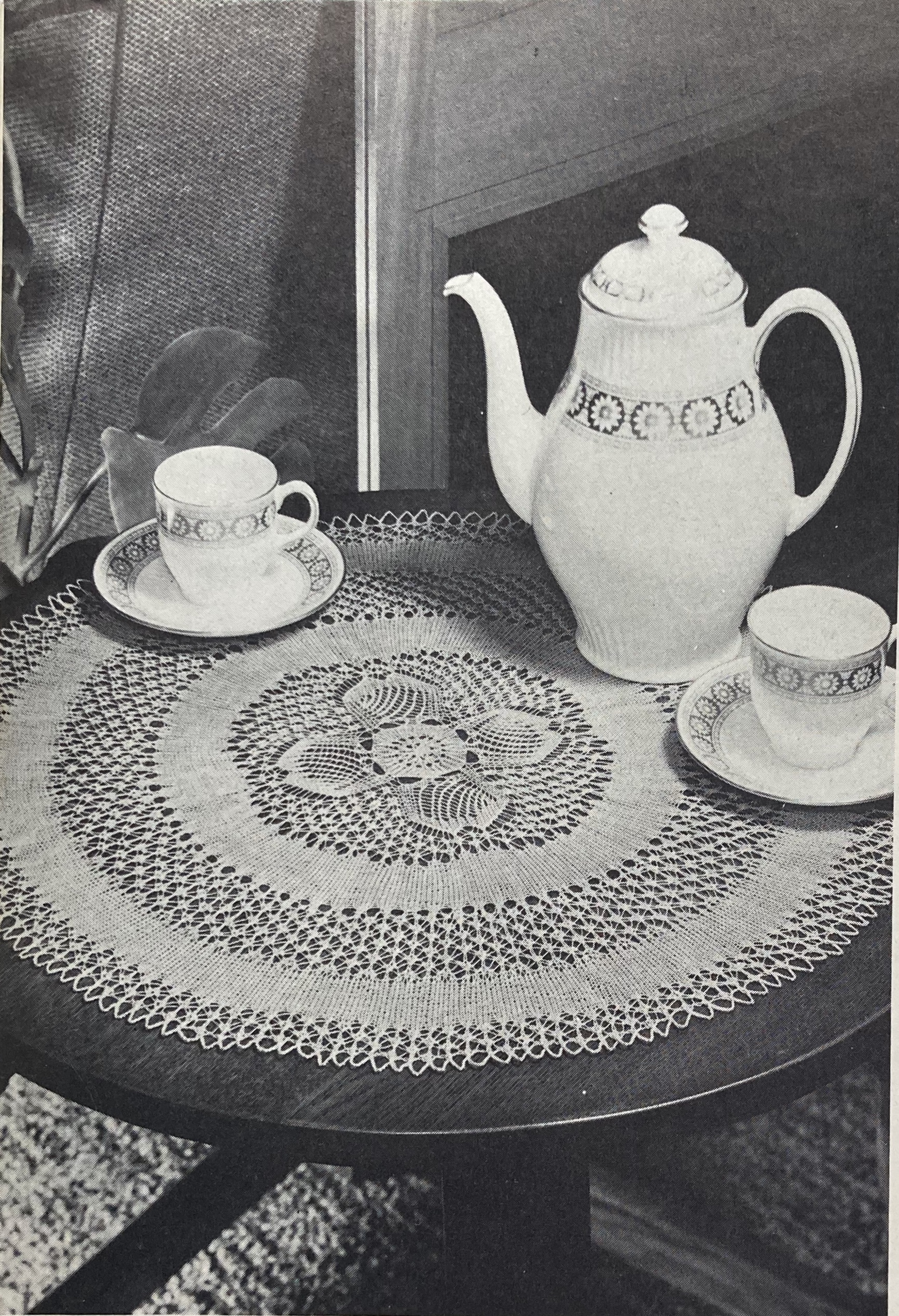
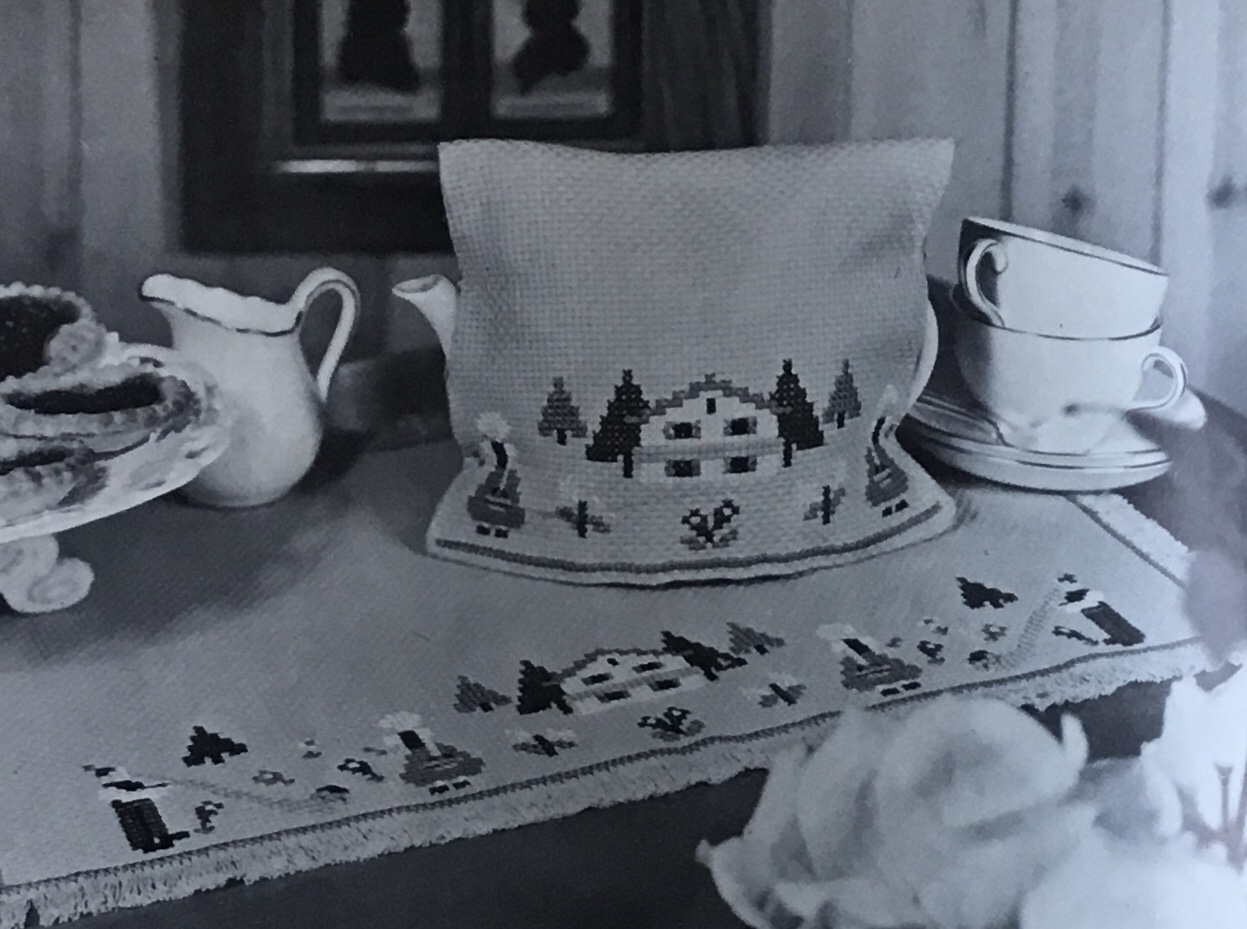
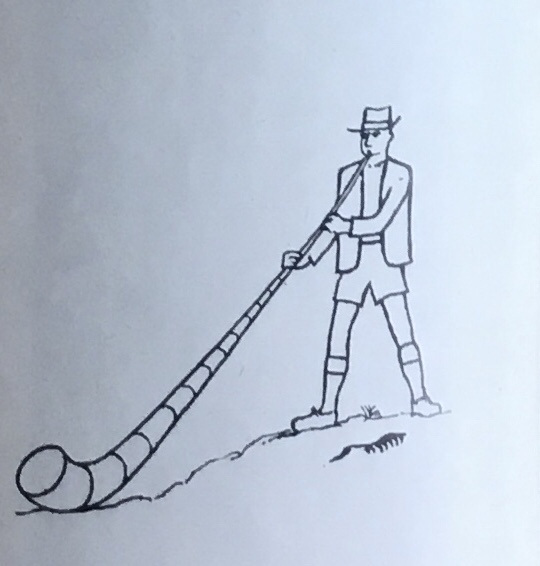
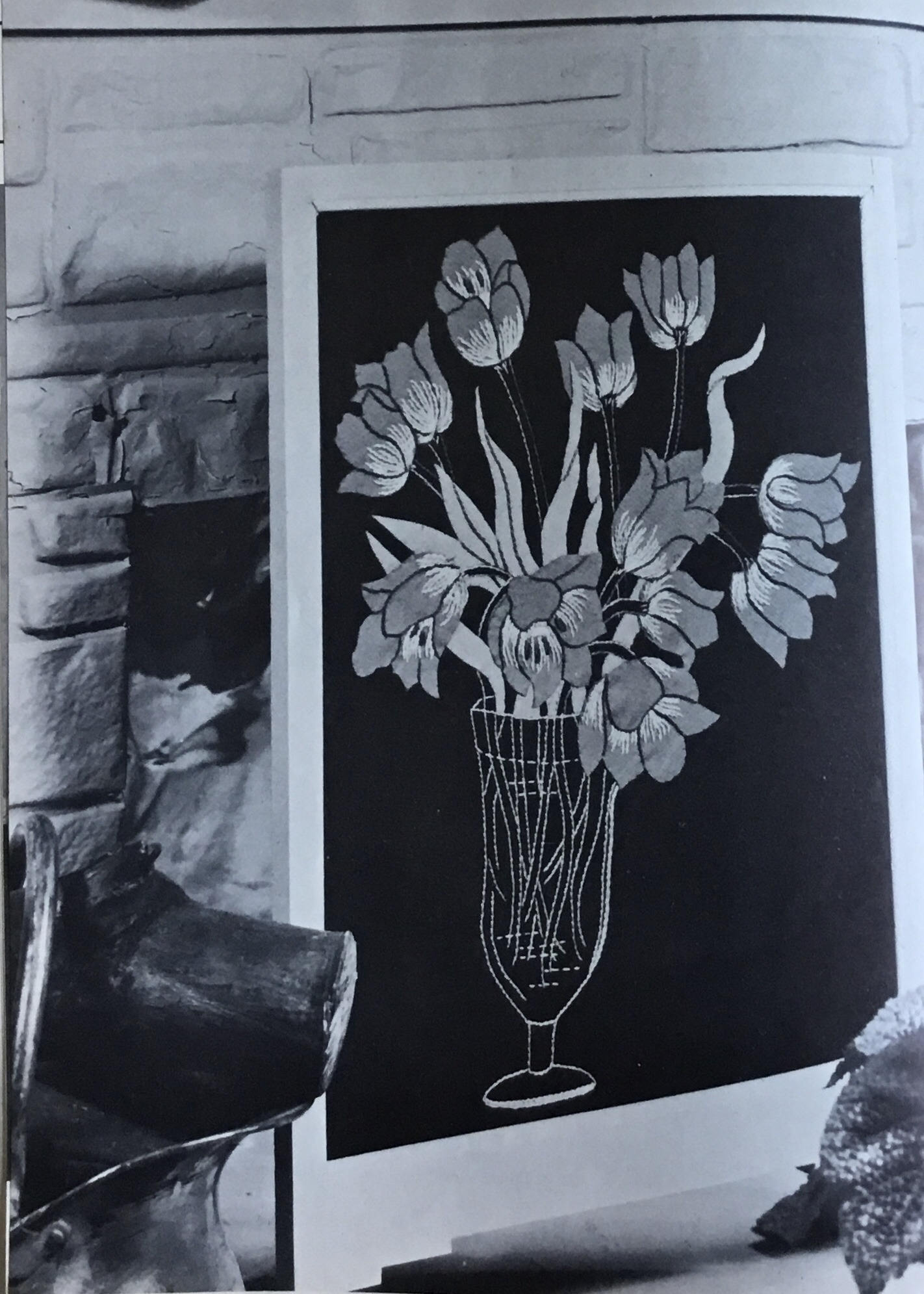
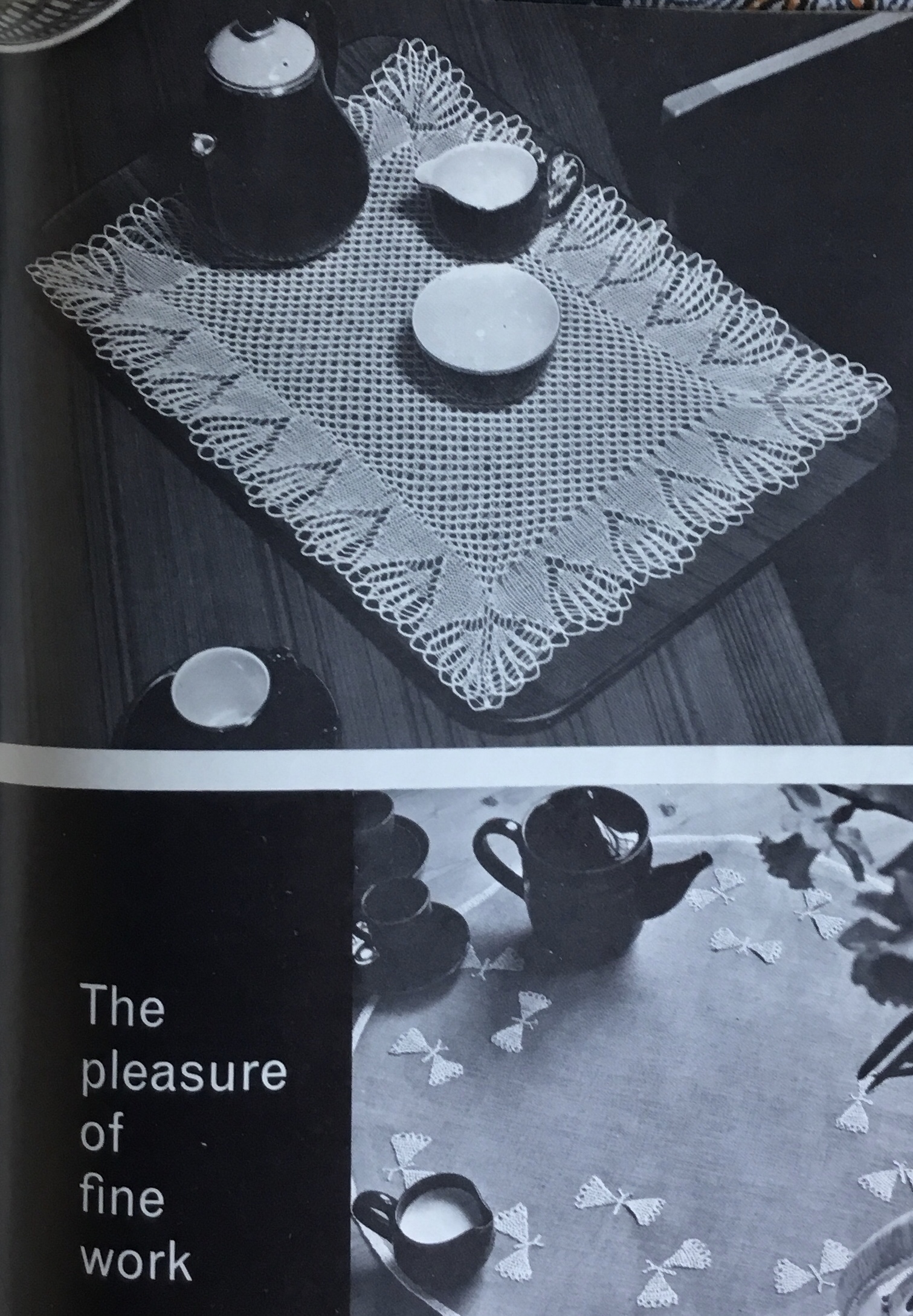
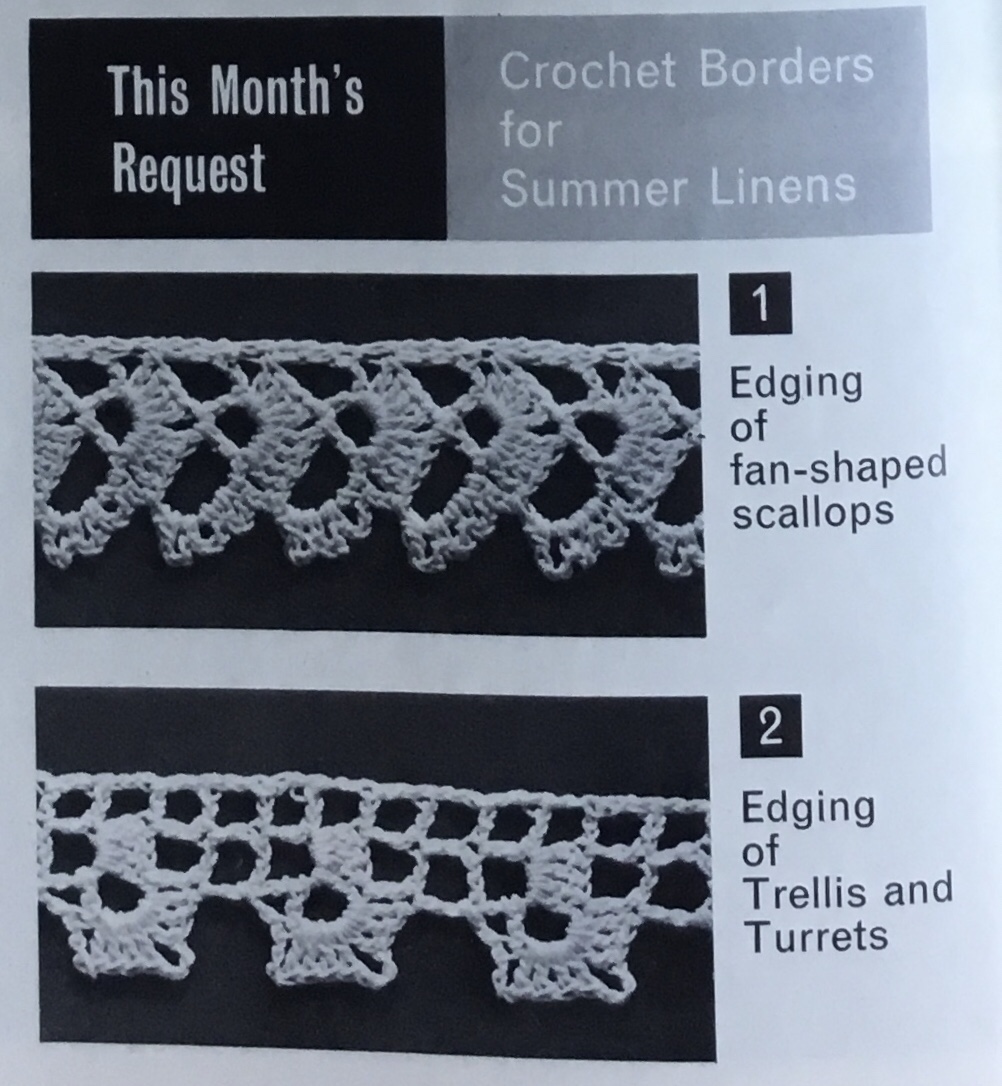
Homeware project ideas are plentiful, but not out of the ordinary. Embroidery fans can make a lovely apron with a traditional Romanian design, or cross-stitch a kitschy „Swiss border“ (nice illustration of an Alphorn player!), or work a counted darning pattern on placemats or a chair back. There‘s a fire screen with appliquéd tulips, a tapestry chair seat, a fancy knitted lace traycloth and a mat with appliquéd crocheted butterflies. You can also crochet lace borders to trim linens or whatever else you like. Truly, there is something for everyone!

I would love to make the child‘s dress, but don‘t necessarily know a child who wants one. Maybe I should size it up for myself? I would wear it! Otherwise, the embroidered apron is really nice. Maybe too nice to get splattered with food… but it would make a great knitting apron as well. We‘ll see!

P.S. Sorry for the lousy formatting. The WordPress editor does not work well on a tablet.

February 1964: Overview

Cover photo from Stitchcraft magazine, February 1964

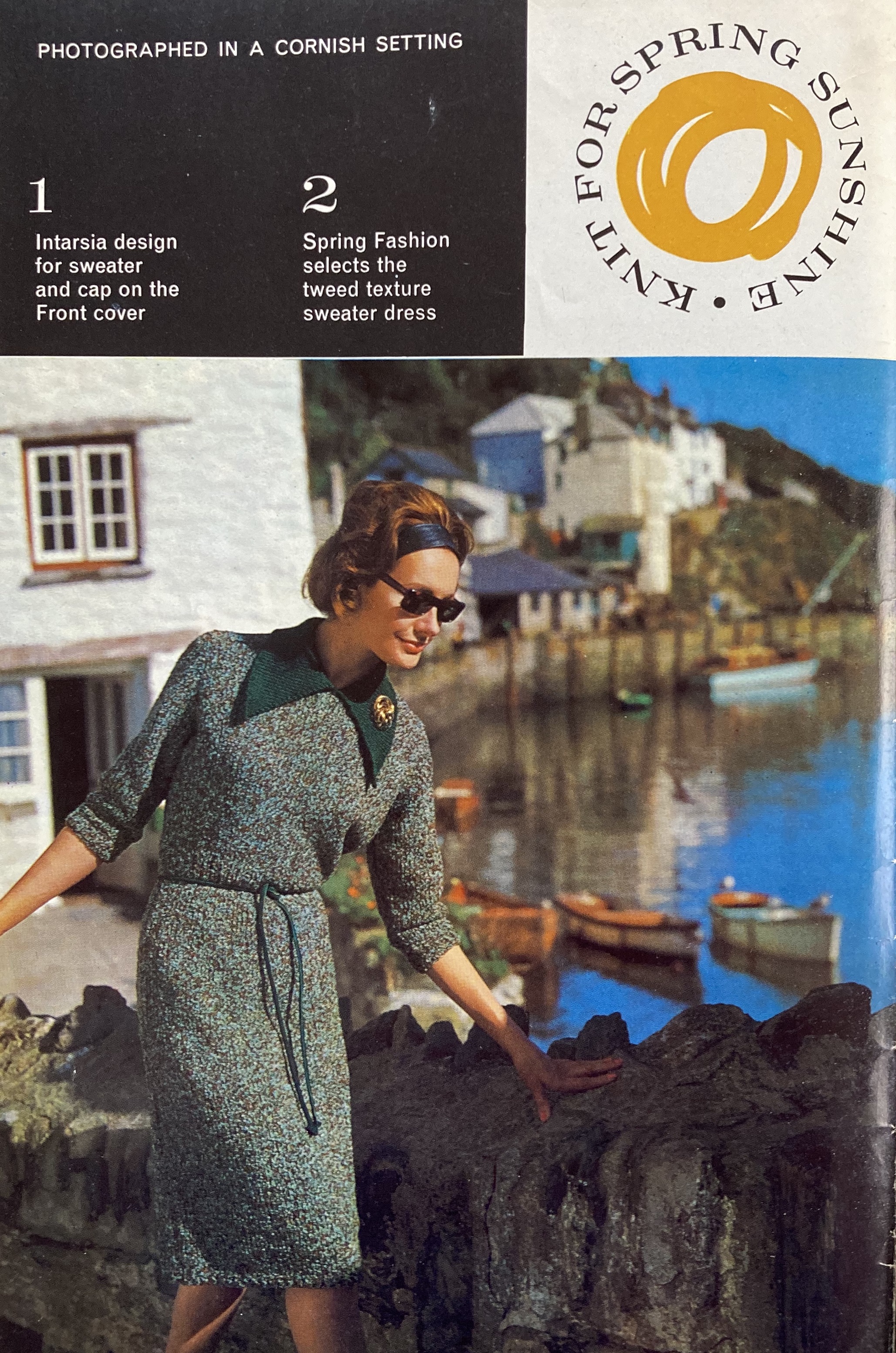
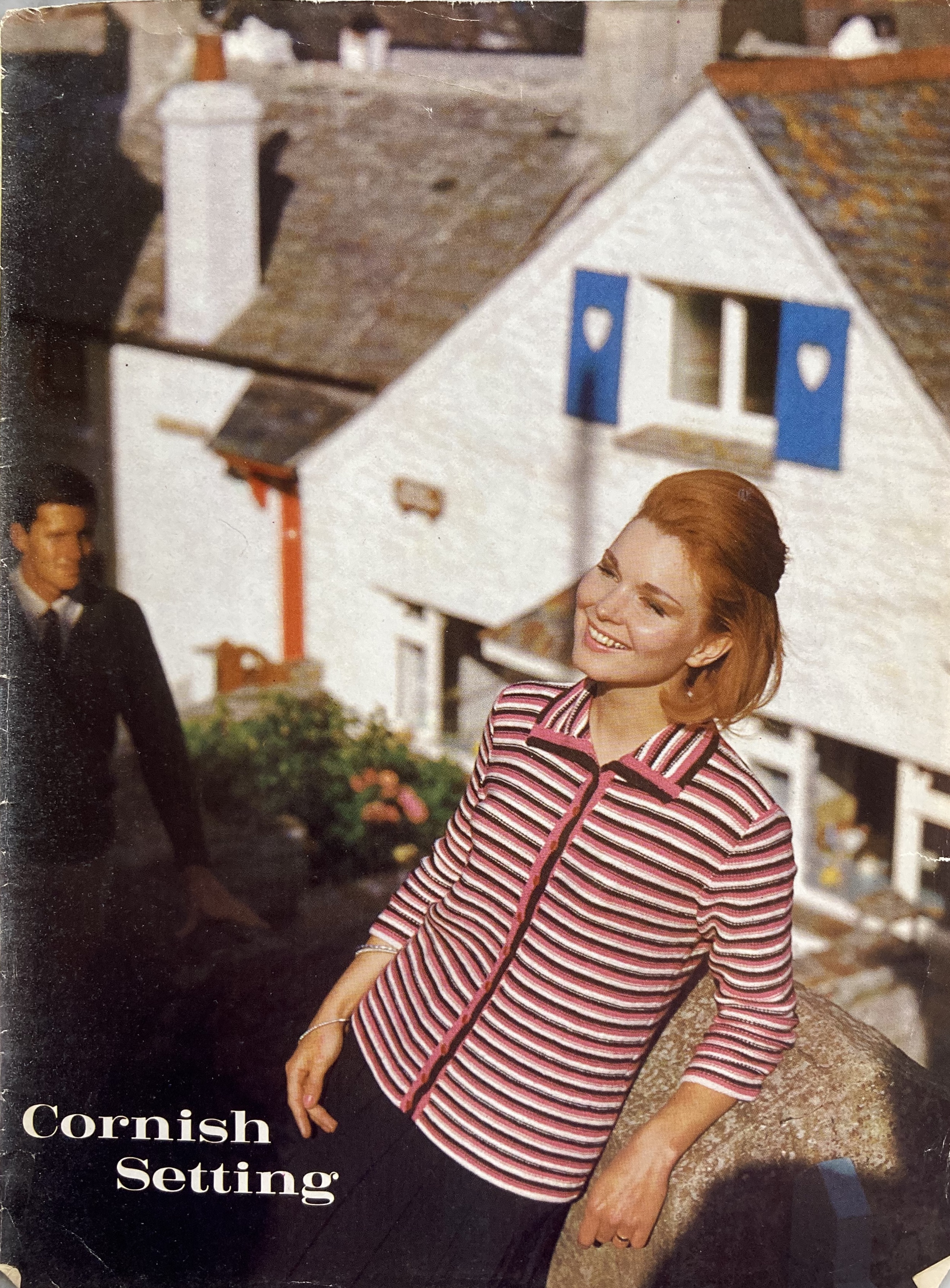
Knit for Spring Sunshine! It’s four o’clock in the afternoon here on February 1st, 2022, getting dark, raining sleet and there has not been a single minute of today where I was able to do anything without turning on the lights, so I am especially happy to dream of modelling beautiful handknits in sunny Polperro in Cornwall, where this issue was photographed.

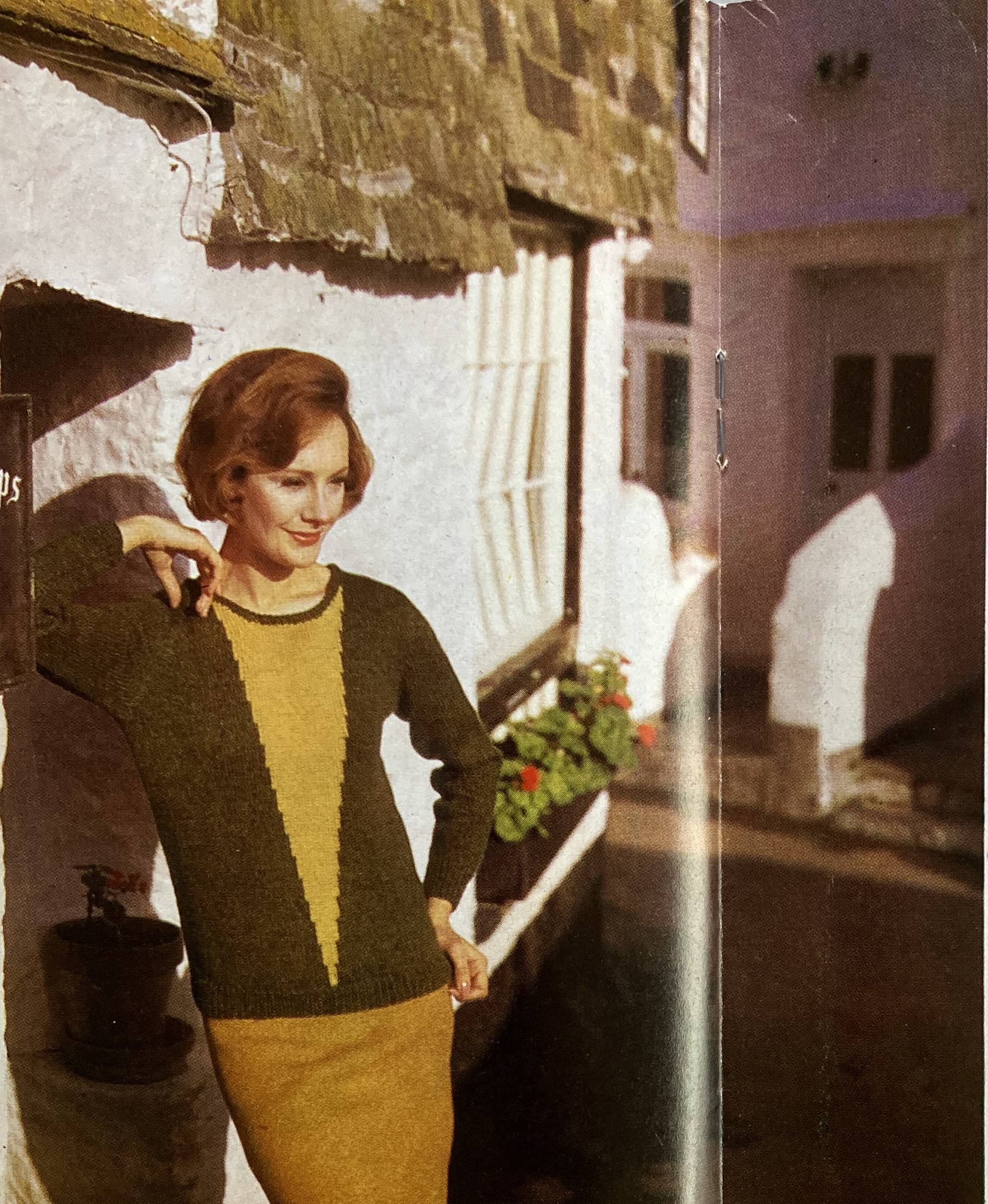
Colour variations are a big theme this month, be it tweedy new multicolour yarns, stripes or classic stranded colourwork and intarsia. Our cover model shows off the gradient look in a fun diamond-pattern sweater with a matching tie and cap. Both cap and sweater are knitted in intarsia technique with the different colours of wool wound onto bobbins, but strangely, I can’t see the diamond pattern on the cap at all. I guess it’s because the top part of the cap only uses the two darker colours, and they don’t show up well in a black and white photo (see close-up of the cap below).

Collars and ties make an appearance in the tweed dress from the inside front cover, made in multicolour “Glenora” wool, and there’s a sparkly tweed suit in purple Bracken Tweed wool as well. Men get a classic raglan V-neck, also in Glenora tweed. Deep jewel tones (I’m guessing the colour “Trossach” from the men’s pullover is a sort of deep fenny green, named after the Trossachs area in the Scottish Highlands) are in fashion as well as gold, featured in two pullovers on the inside pages. A loose, casual fit with no shaping remains the preferred silhouette (or lack thereof).

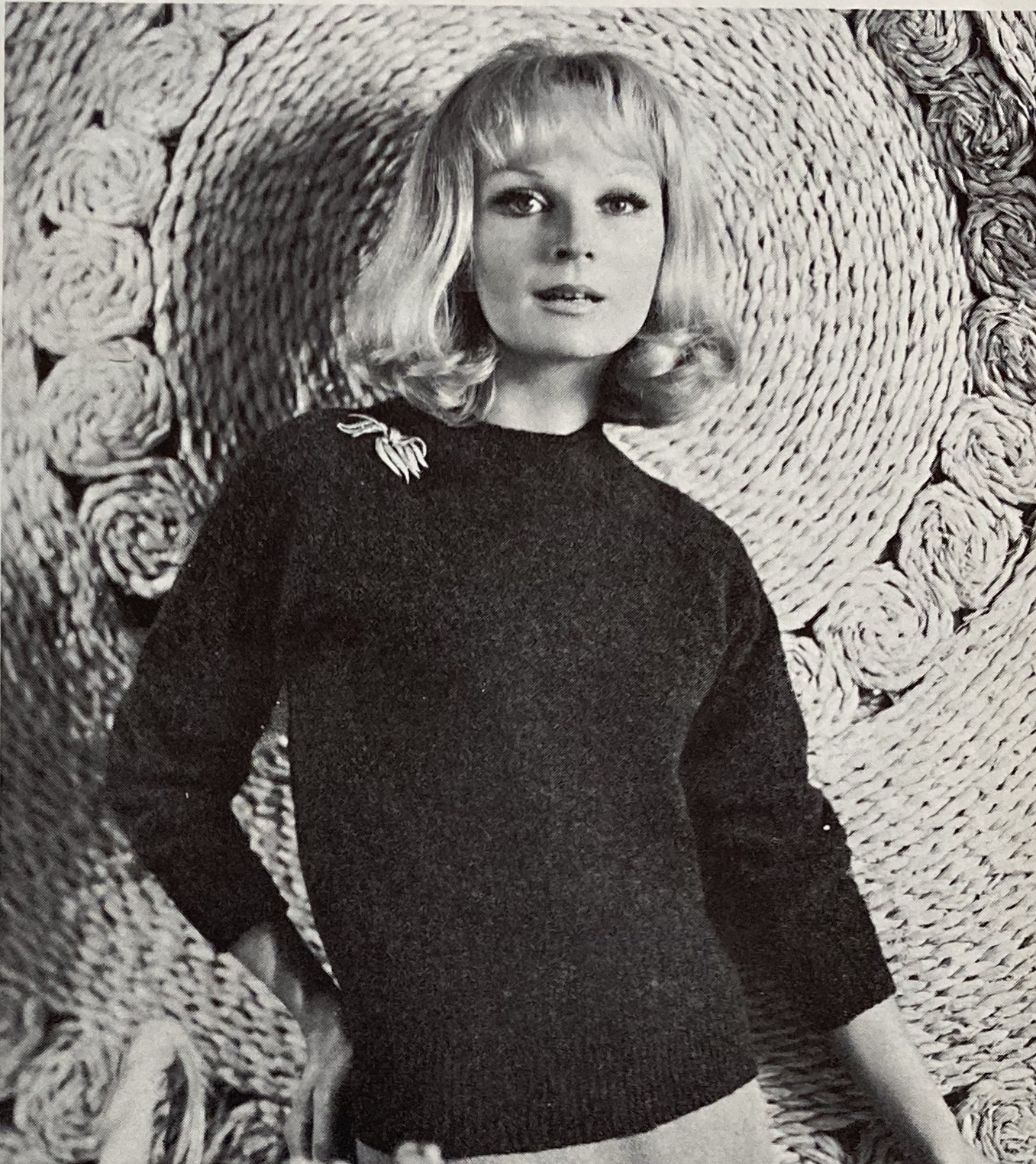
For contrast, there’s a classic, lightweight jumper in 4-ply wool bouclet. The jumper style would be right at home in other decades, but the photo style is as 60s as you will ever find, with an extreme close-up of a round braided place mat used as a backdrop. I’m almost waiting for it to start swirling! Finishing off the adult garments is a cheerful striped cardigan in 4-ply Nylox (wool/nylon blend).

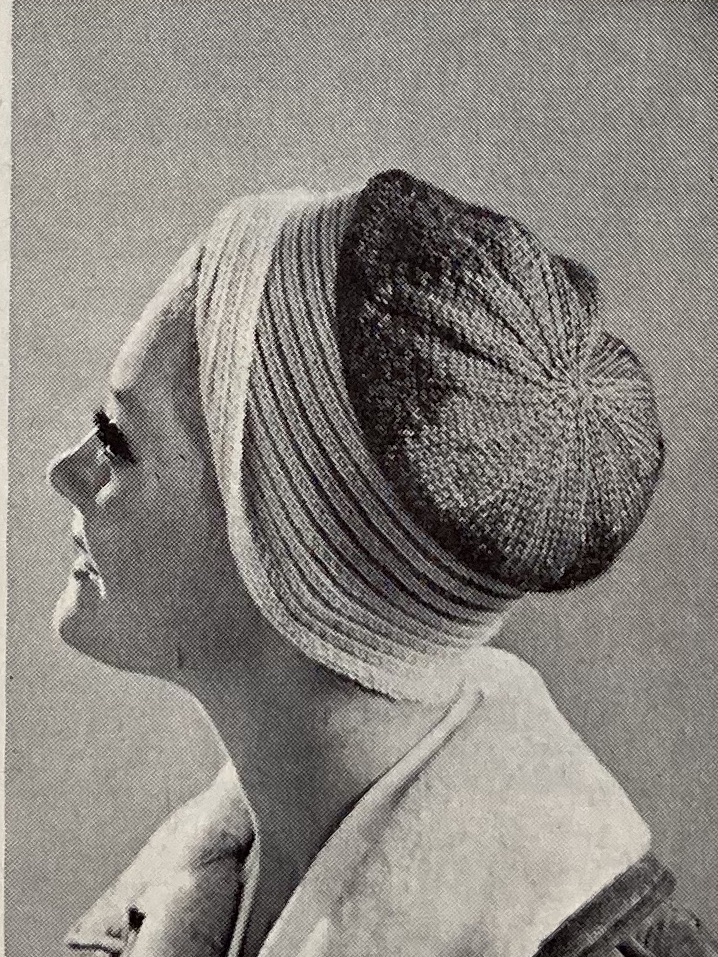
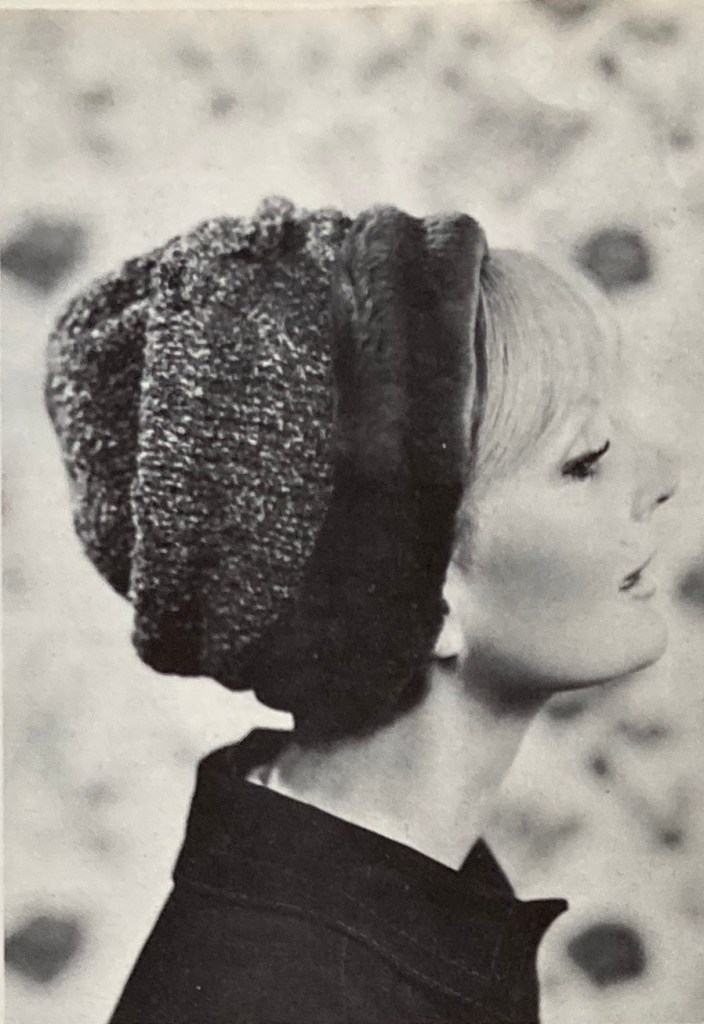
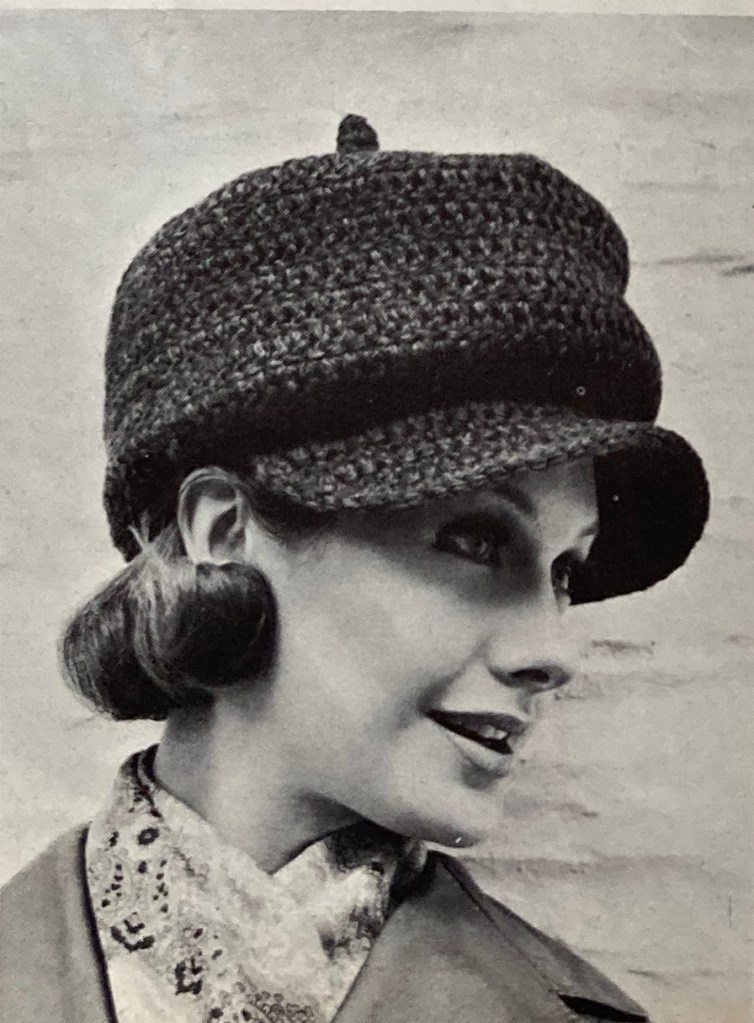
The accessories match the garments well, using the same wools and in similar casual, oversized style. Besides the diamond cap, there’s a knitted cap in Glenora with fur trim and a “baker boy” cap to crochet.

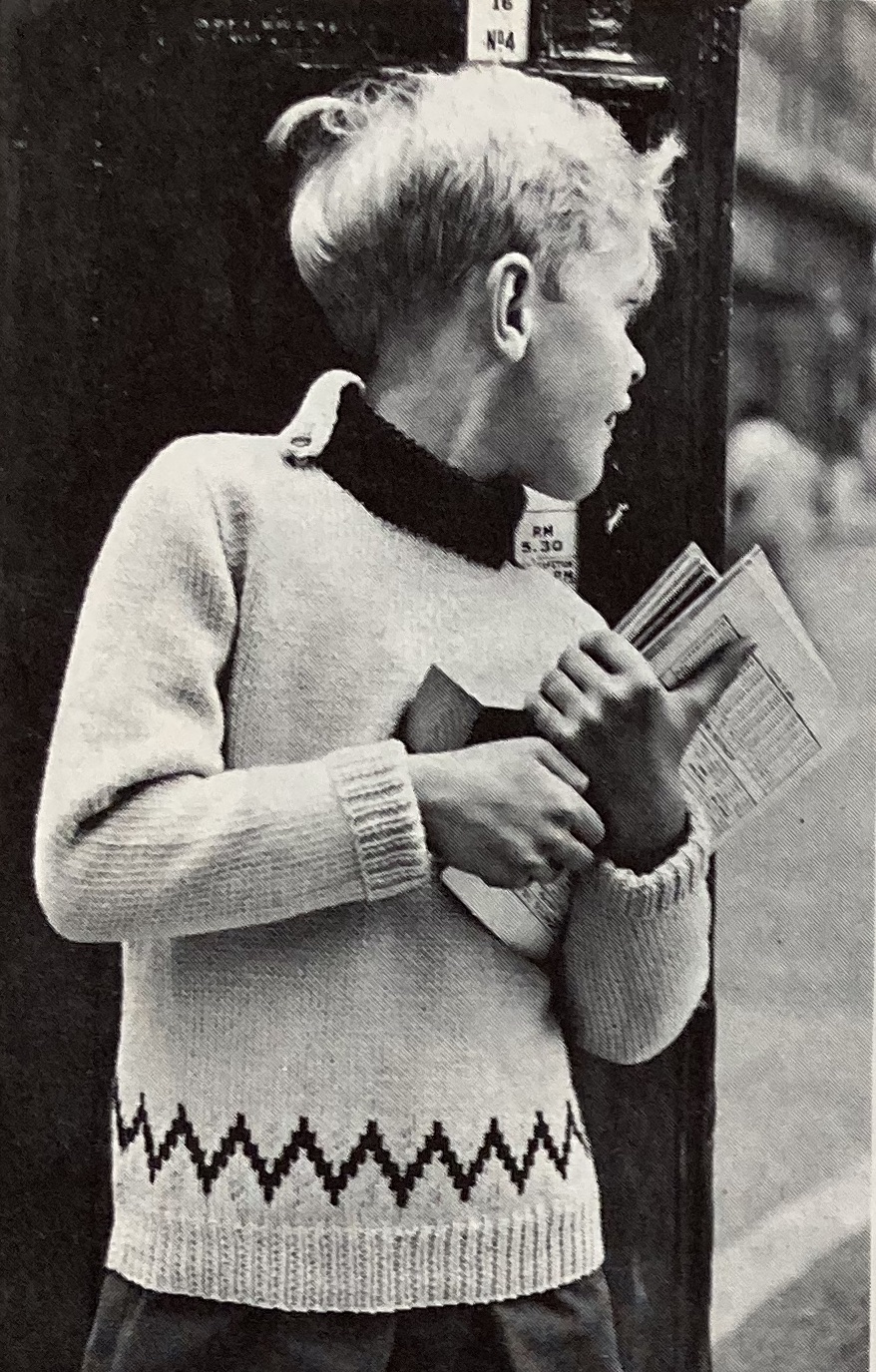
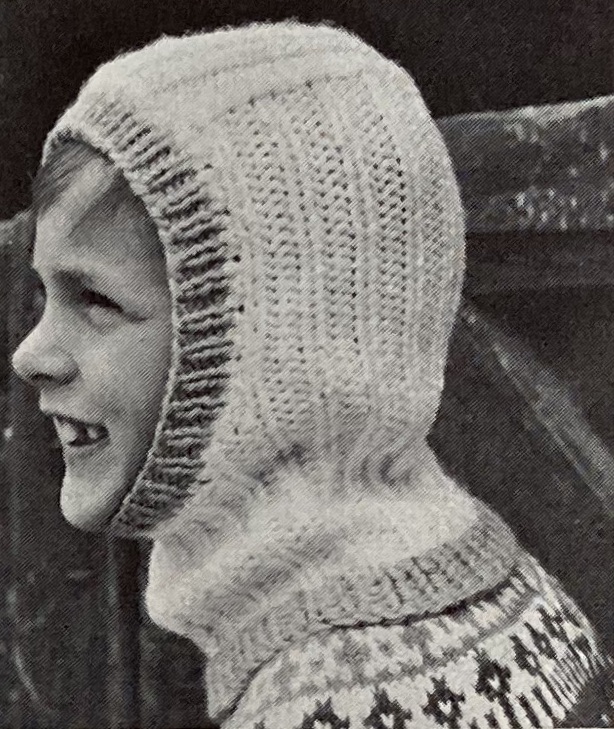
There’s nothing for babies or very young children in this issue, but older kids can get some very nice new additions to their wardrobe, like this wonderful dress in blue Bracken Tweed with contrasting checked collar and cuffs, or a sweater for boys with in intriguing tab collar and colour detail at the hem. There’s also a balaclava-style “helmet” to keep out any March winds.

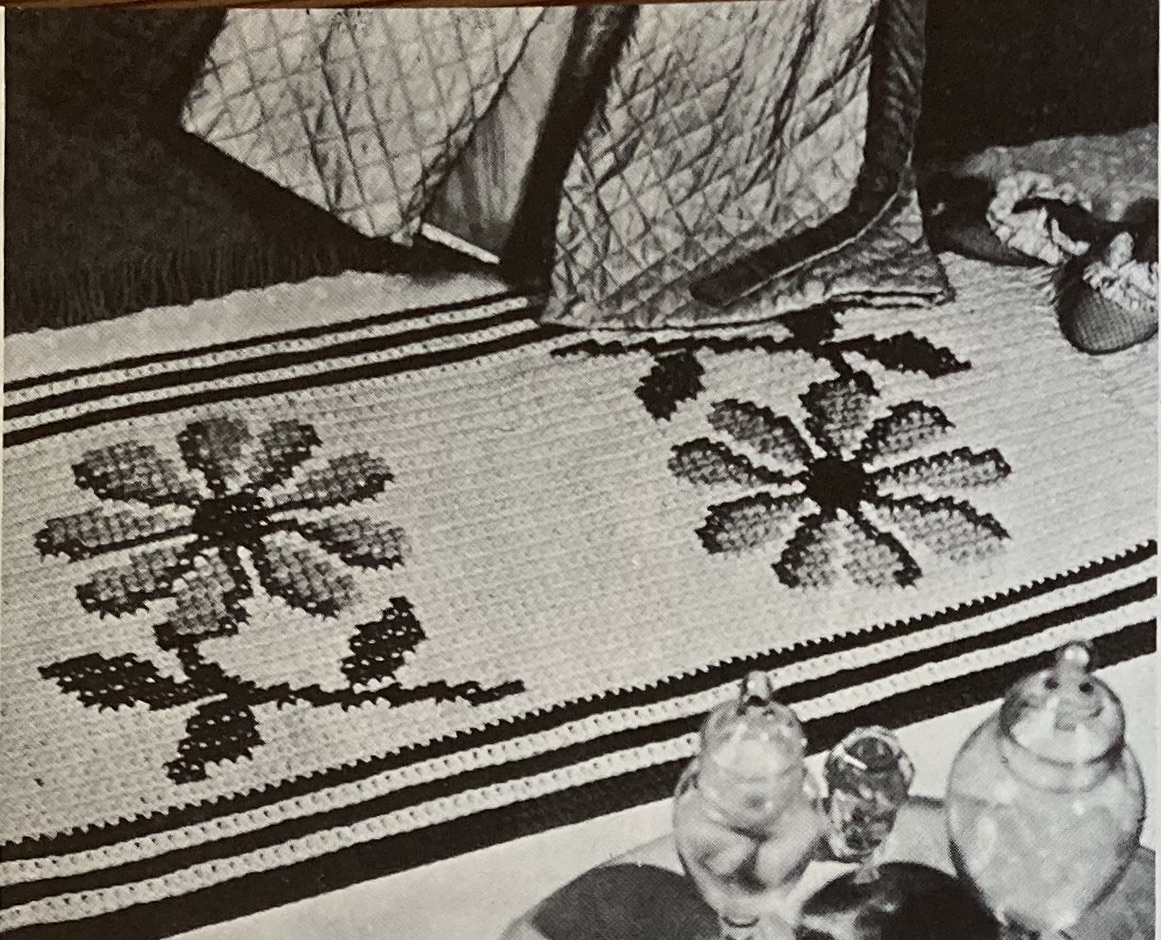
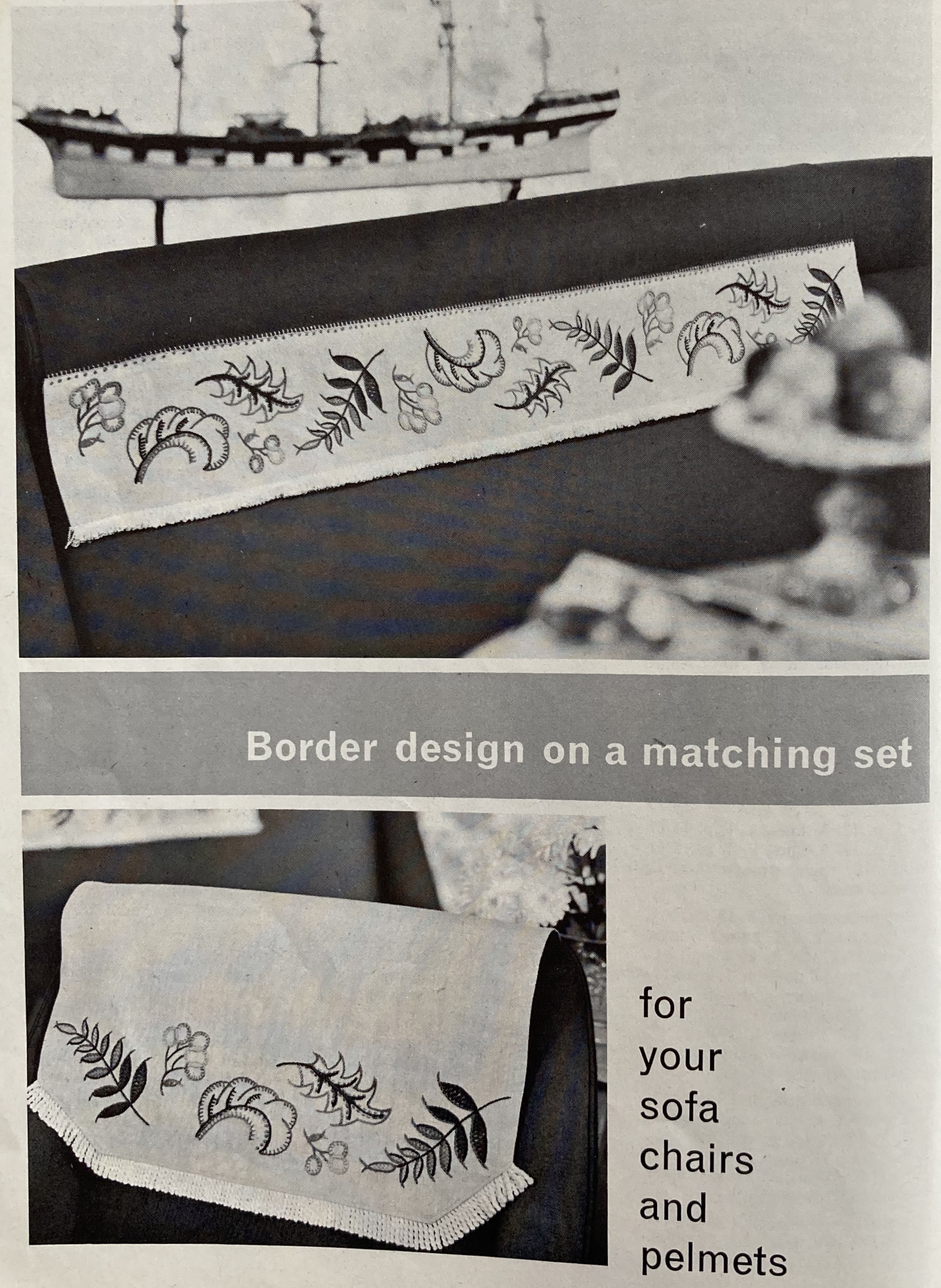
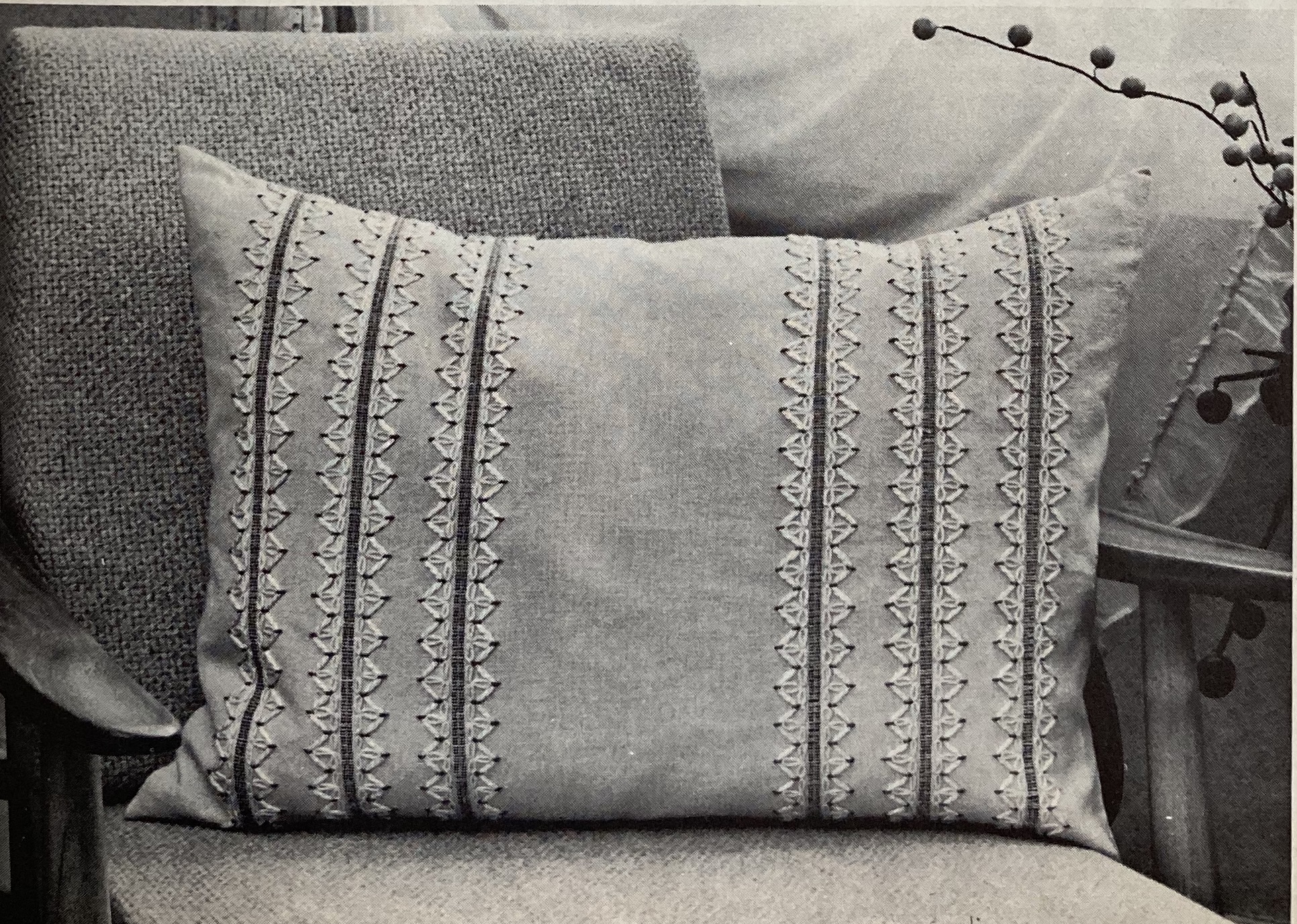
With all these larger projects to knit, it’s no wonder that the homewares are less than spectacular this month. There are embroidery projects for sofas, chair backs and pelmets (N.B. if you, like me, are not familiar with the last word, it’s that strip of fabric at the top of old-fashioned curtains, that hides the curtain rings / mechanism.) There’s a cushion and/or fire screen in a traditional Yugoslavian pattern, a stitched bathroom rug, a tapestry picture and dressing-table mats in cutwork embroidery. The cushion in “Continental laced stitch” is the most interesting of the projects, to me — it’s made by drawing threads and stitching around the resulting rows of holes, then putting the cover over a contrasting-colour cushion.

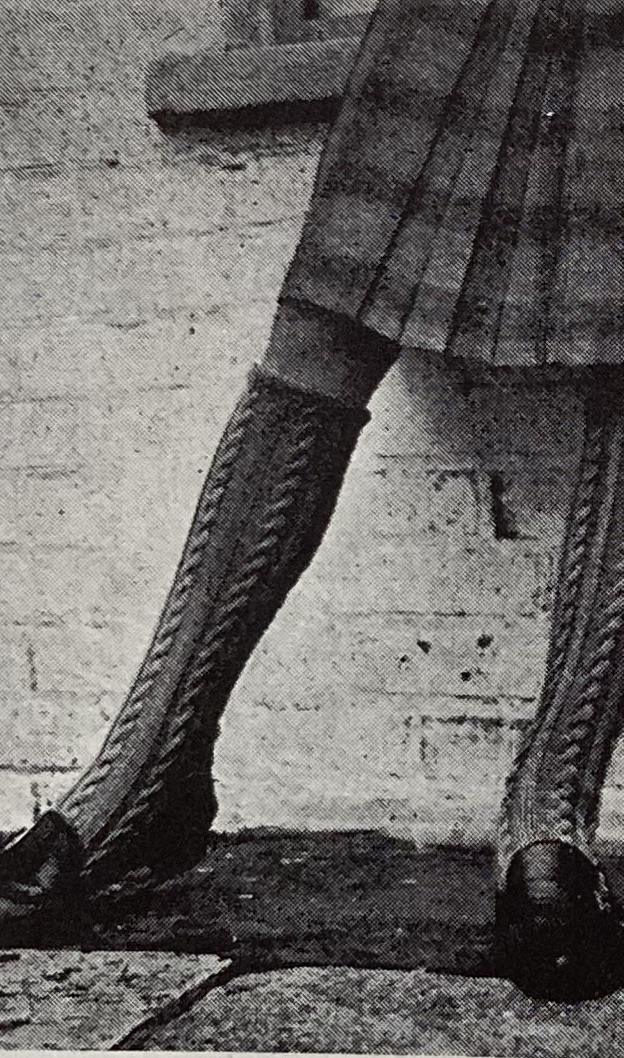
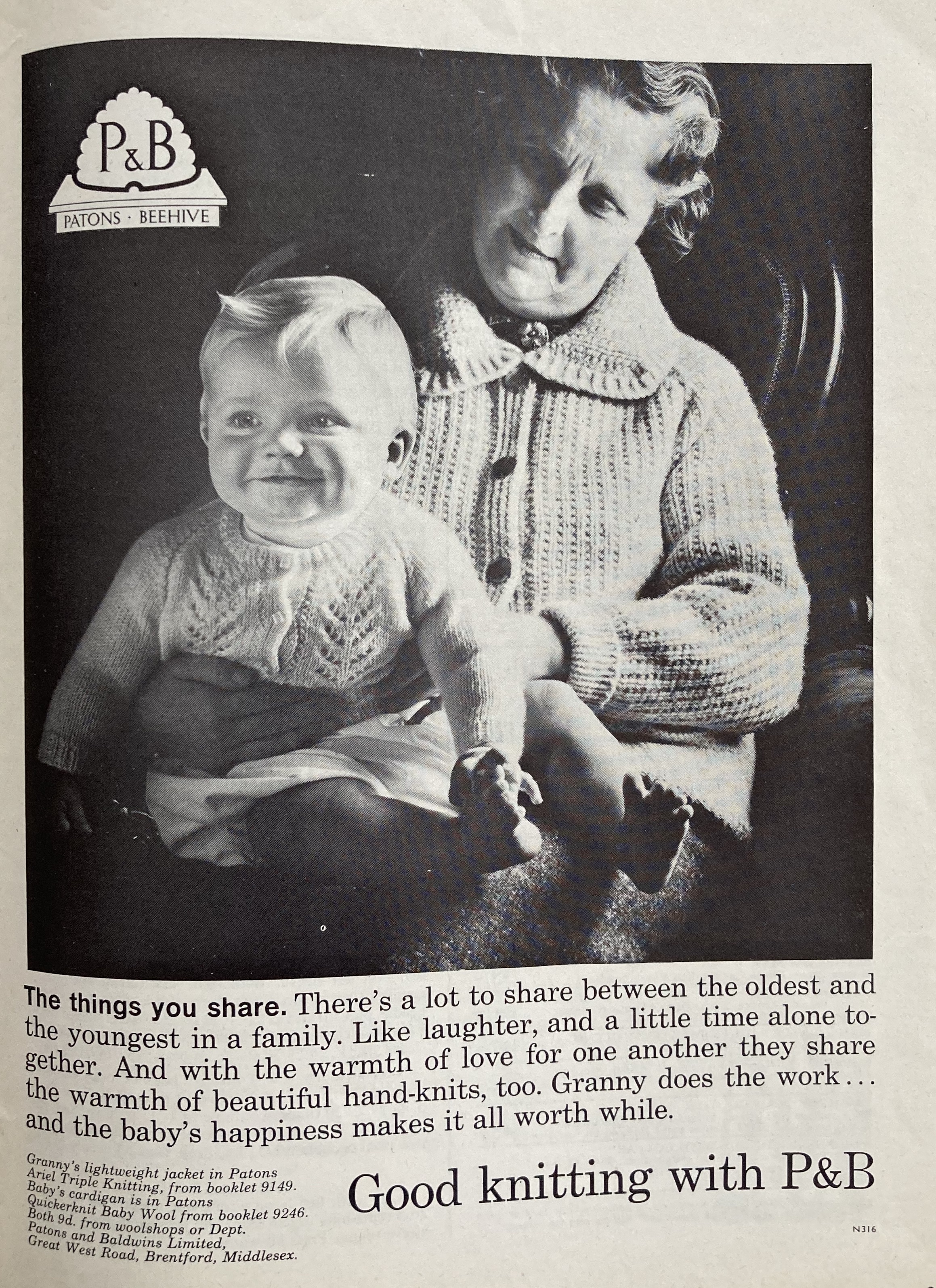
There is no children’s comic this time (how sad!) but the “Readers Pages” offer a reprint of a 1955 pattern for knee-high cabled socks, instructions on how to make a wool daisy and a magnificent “flower basket” teapot cosy featuring those wool daisies. If you’re on Ravelry and search projects for “flower basket” tea cosies, you will find many similar examples — this seems to be a popular item in modern times as well! The Patons wool advertisement shows a happy baby whose grandmother has knit him something pretty, and the back-cover Lightning Zip ad has a very practical dress pattern laid out. I’m tempted to copy it large and sew it up.

That’s all for this issue. My project will be the (faux) fur-trimmed tweed hat. See you soon and until then, let’s dream of spring sunshine!

January 1964: Overview

Happy New Year! It’s 1964 in the Stitchcraft blog world. “Busy as we all are,” writes “editress” Patience Horne in the issue notes, “it is surprising how many things needlewomen manage to make in a year.” Well, it’s my New Year’s handcraft resolution to finish up WIPs and reduce yarn stash, so let’s see how many new things I will manage to make.

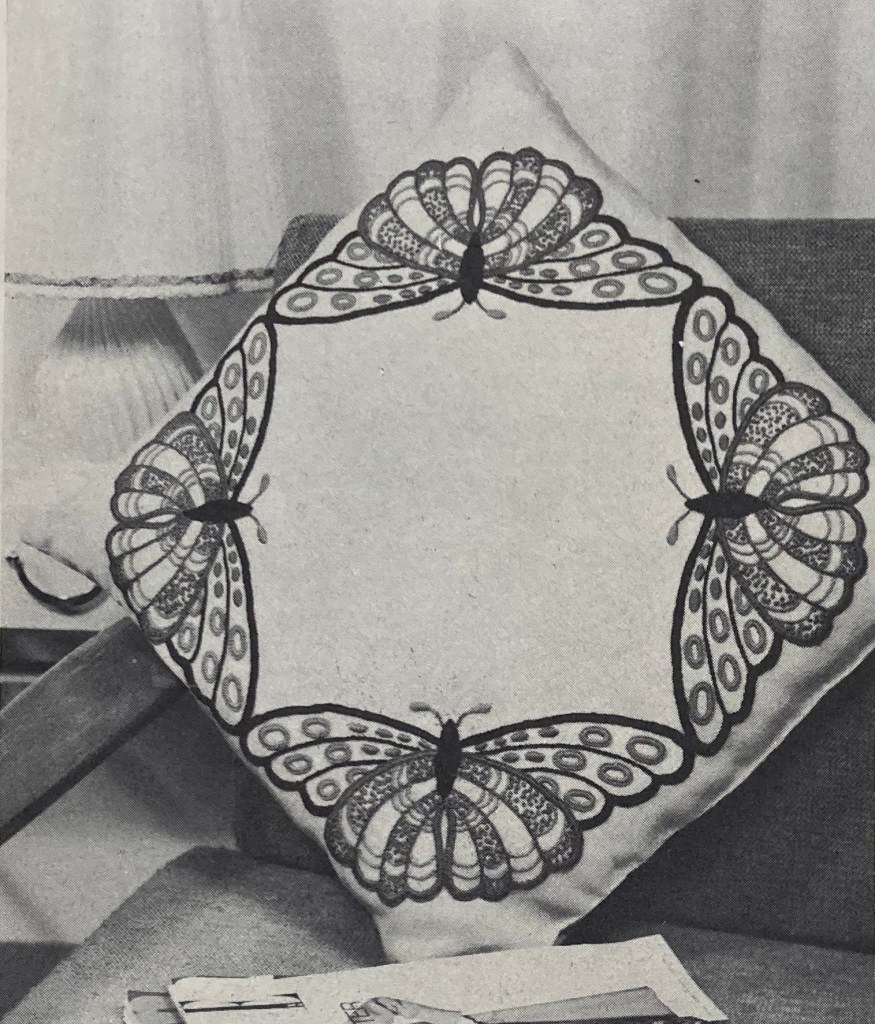
(Apropos finishing up WIPs, I finally finished two very detailed and extravagant cushions: these blackwork butterflies and this amazing neo-Jacobean embroidered felt appliqué extravaganza, so be sure to check out the updated posts.)

Back to January 1964, what does the New Year have in store for us, fashion-wise? At first glance, it doesn’t look much different from the trends of 1963. Garments are warm, bulky, tweedy and textured, and homewares are traditional and floral. The Swinging Sixties have not swung through the pages of fashion-conservative Stitchcraft yet. Still, the designs are fun and easy-going, the bulky items quick to make.

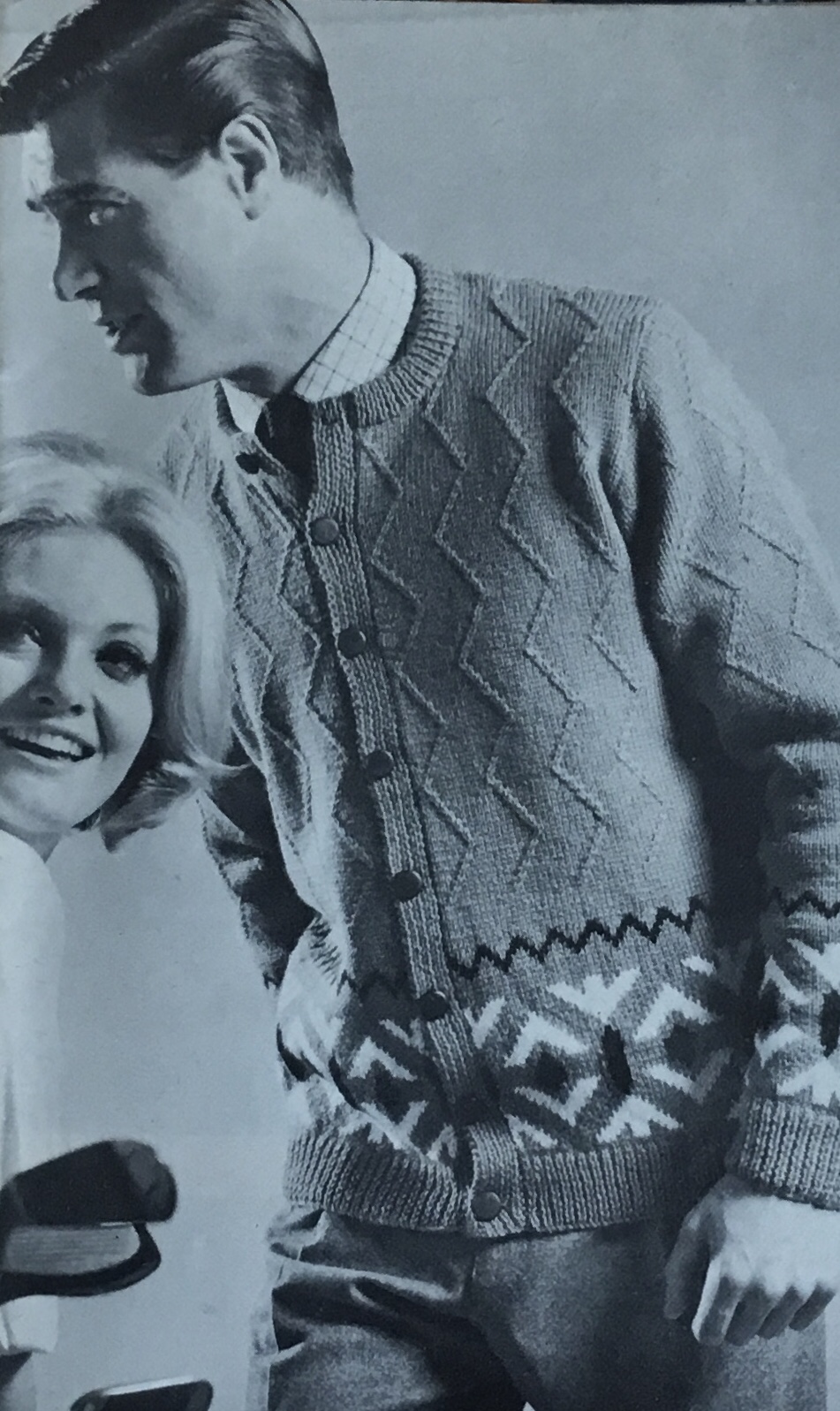
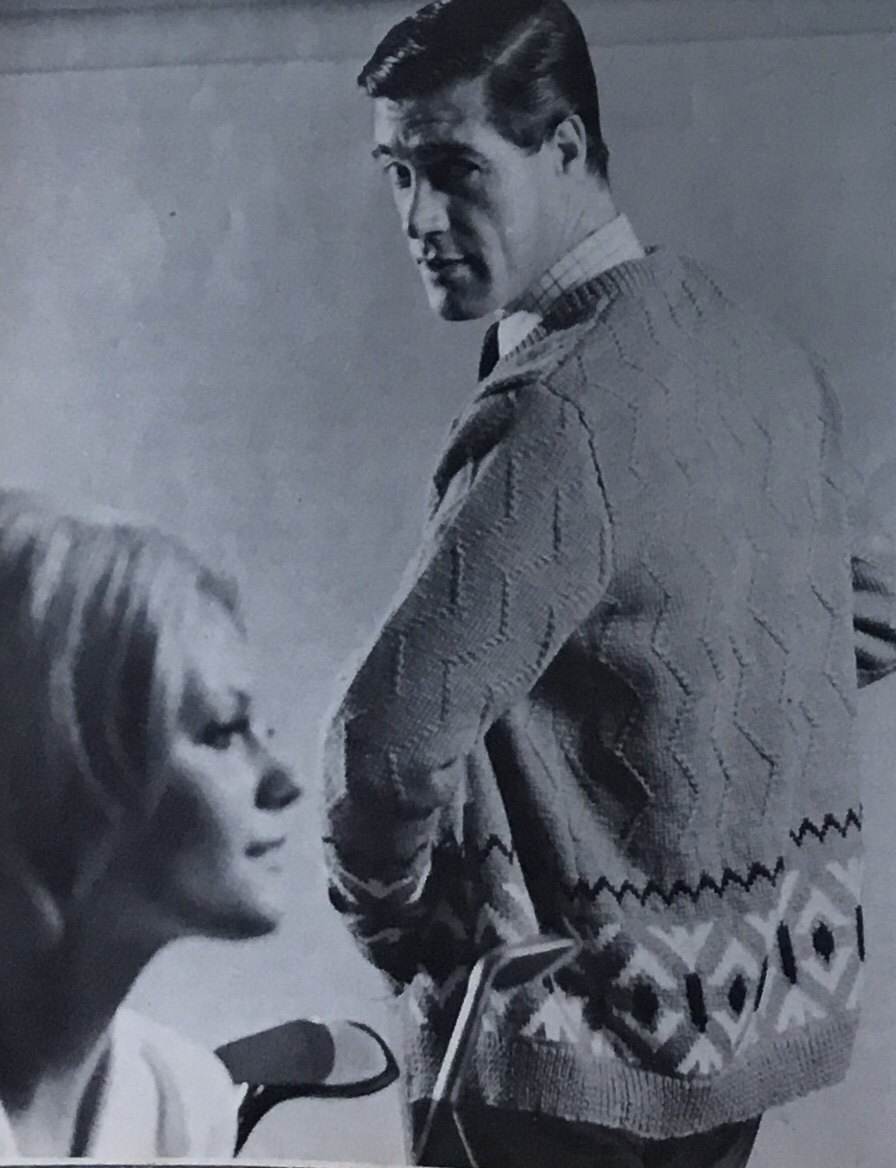
Our cover design is a sweater suit in in plain DK and tweedy Patons “Glenora” wool. There’s an equally tweedy cardigan in bulky Ariel for women as well as garments with fun colour motifs and textured stripes. The colours are warm and vibrant, with deep pinks and yellows prevailing. Men get a very yellow pullover with nice cable details and a zip-up cardigan for the casual “country look” (with a coquettish smile from our handsome model.)

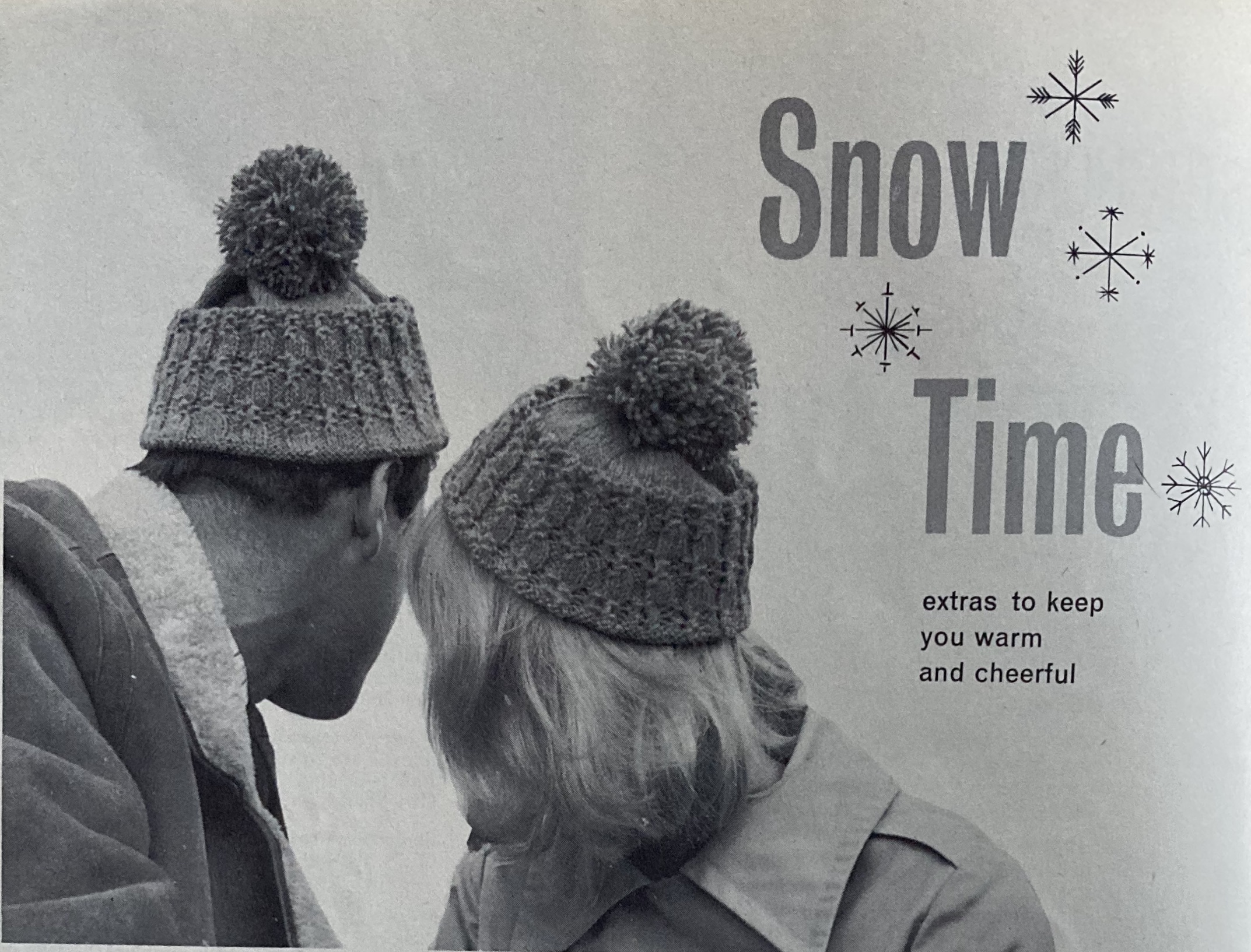
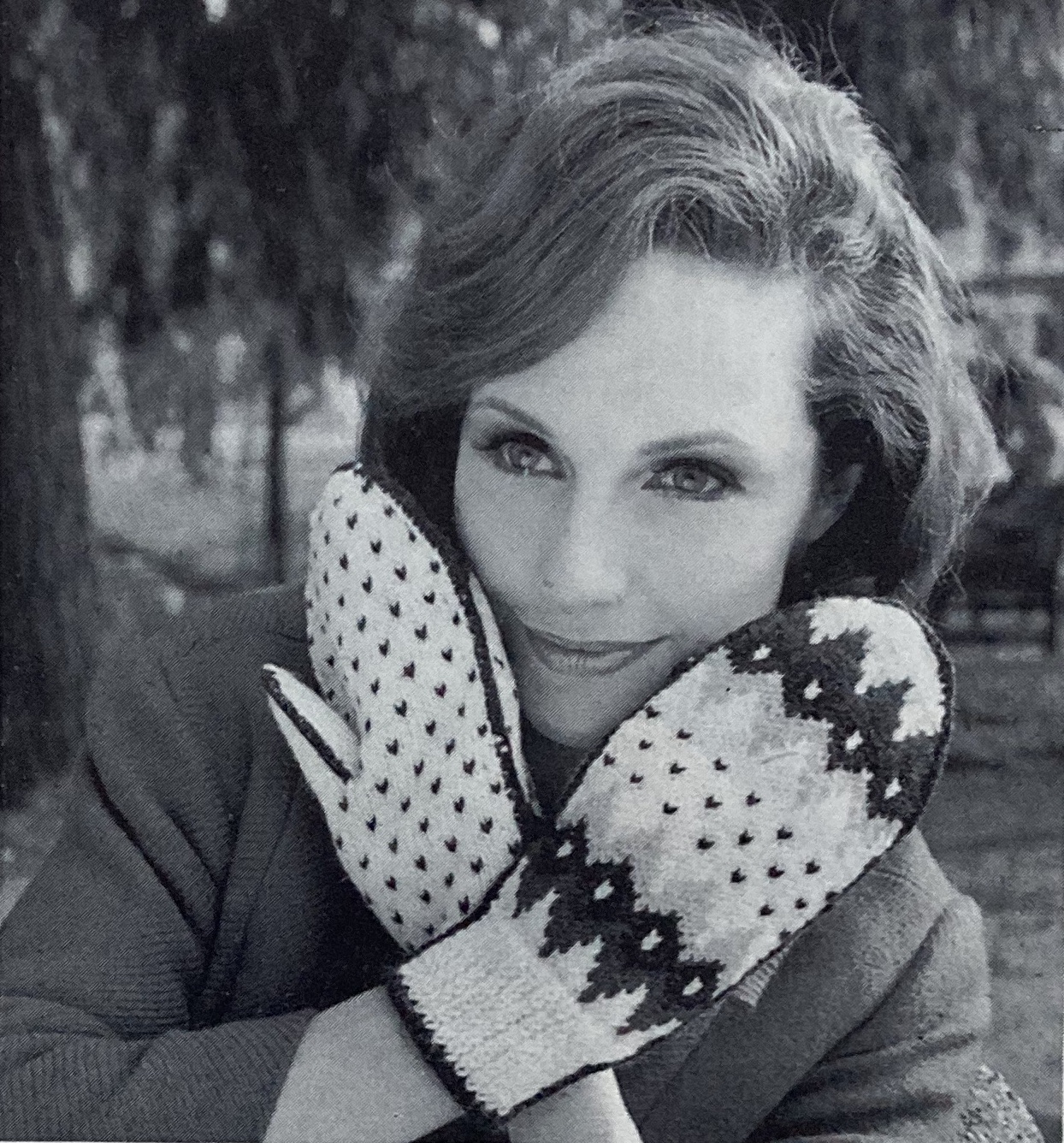
Appropriately enough for January, the accessories are warm and practical: cheerful hats in an interesting tied-loop stitch for “him and her” and warm mittens in stranded colourwork. As usual for this time, the stranded patterns, even for gloves, are worked back and forth, with front and back pieces worked separately and crocheted together.

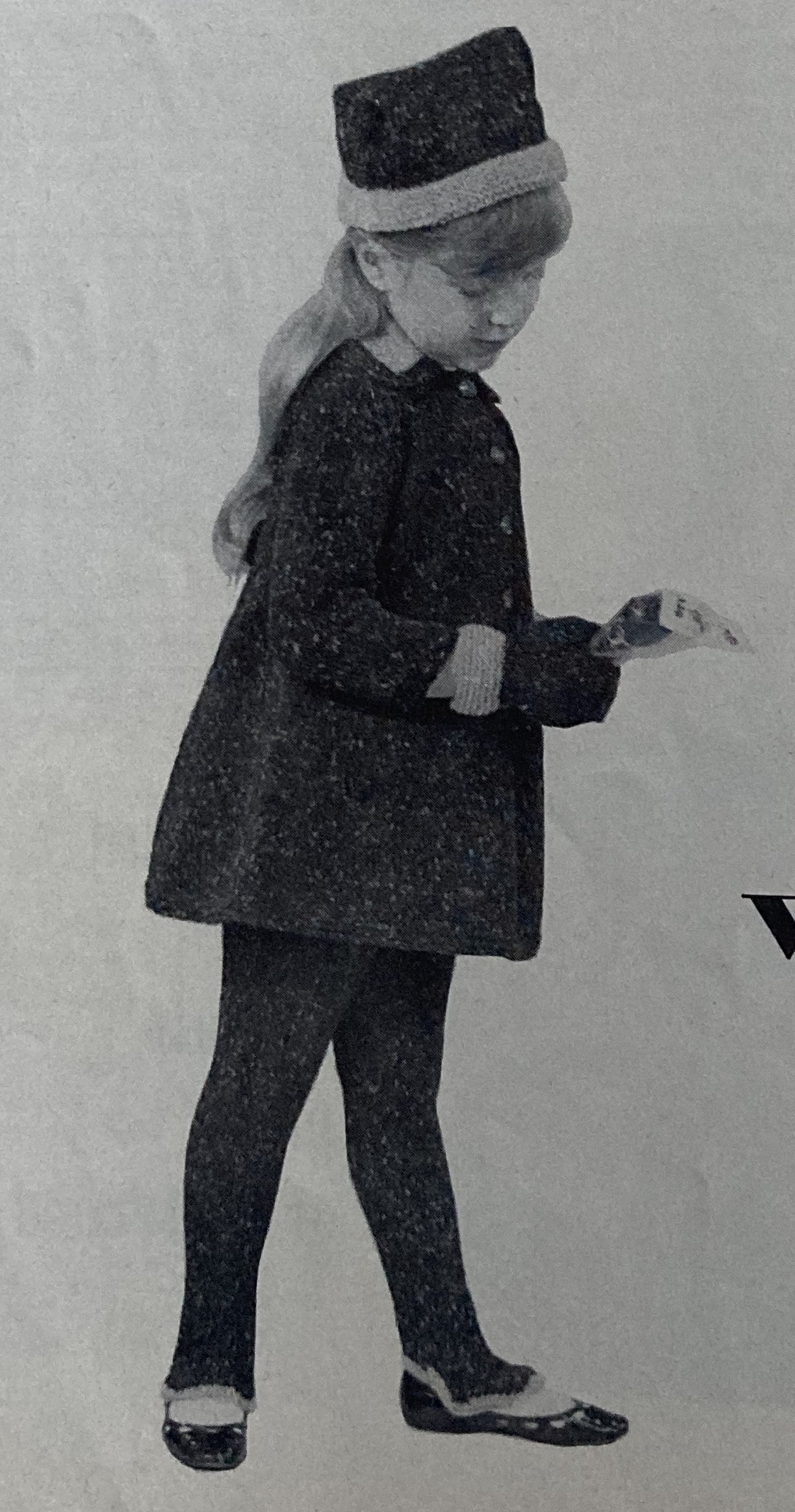
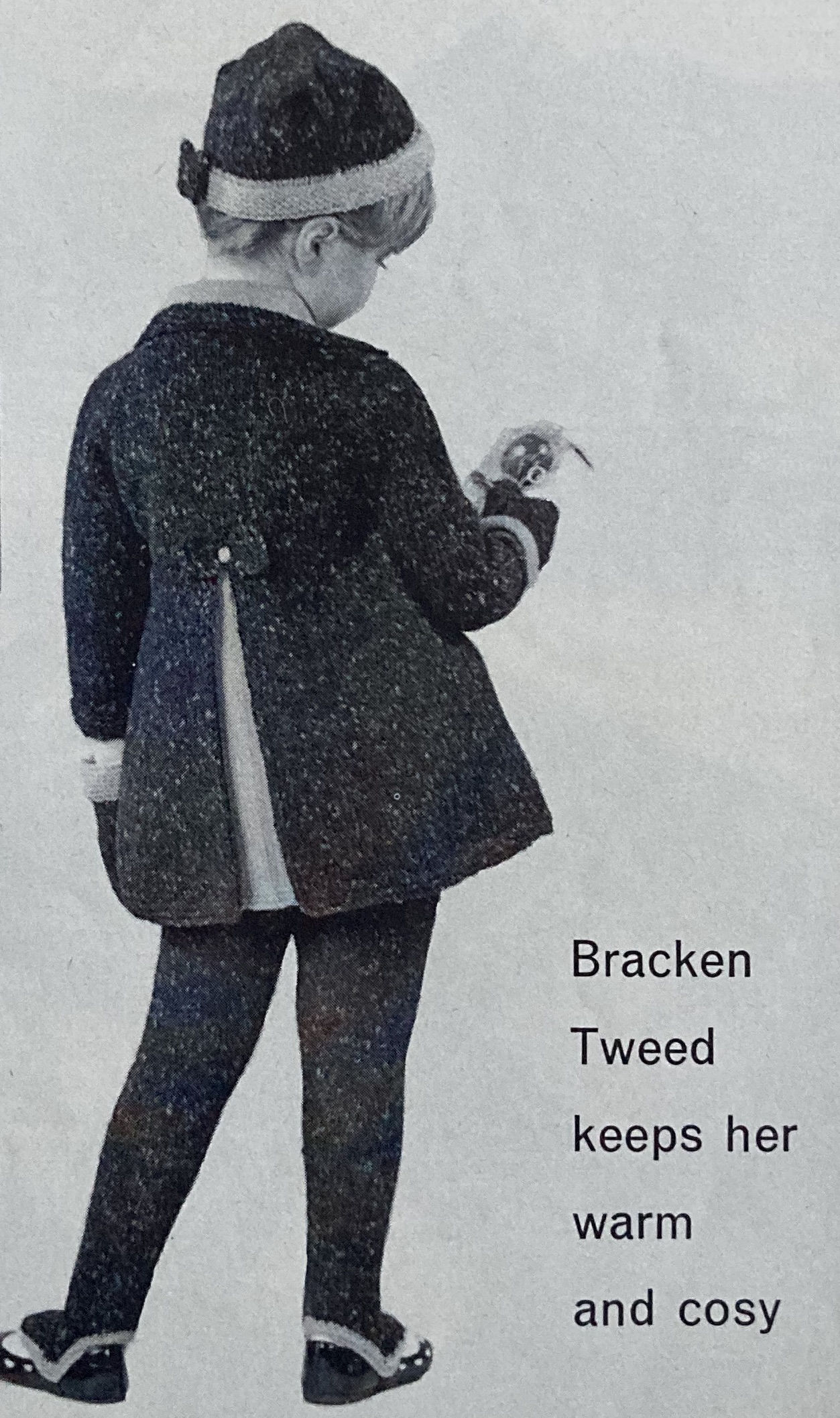
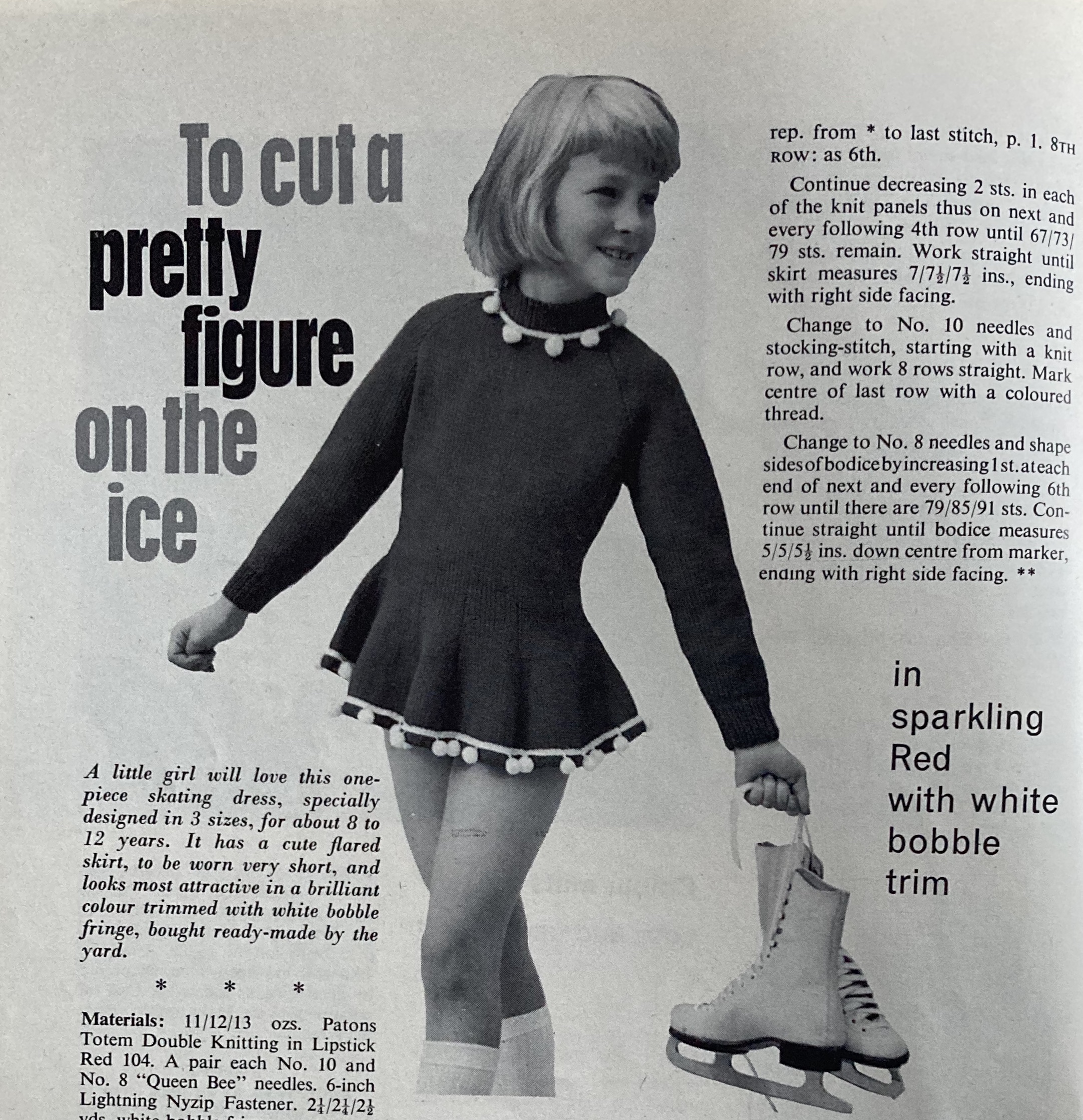
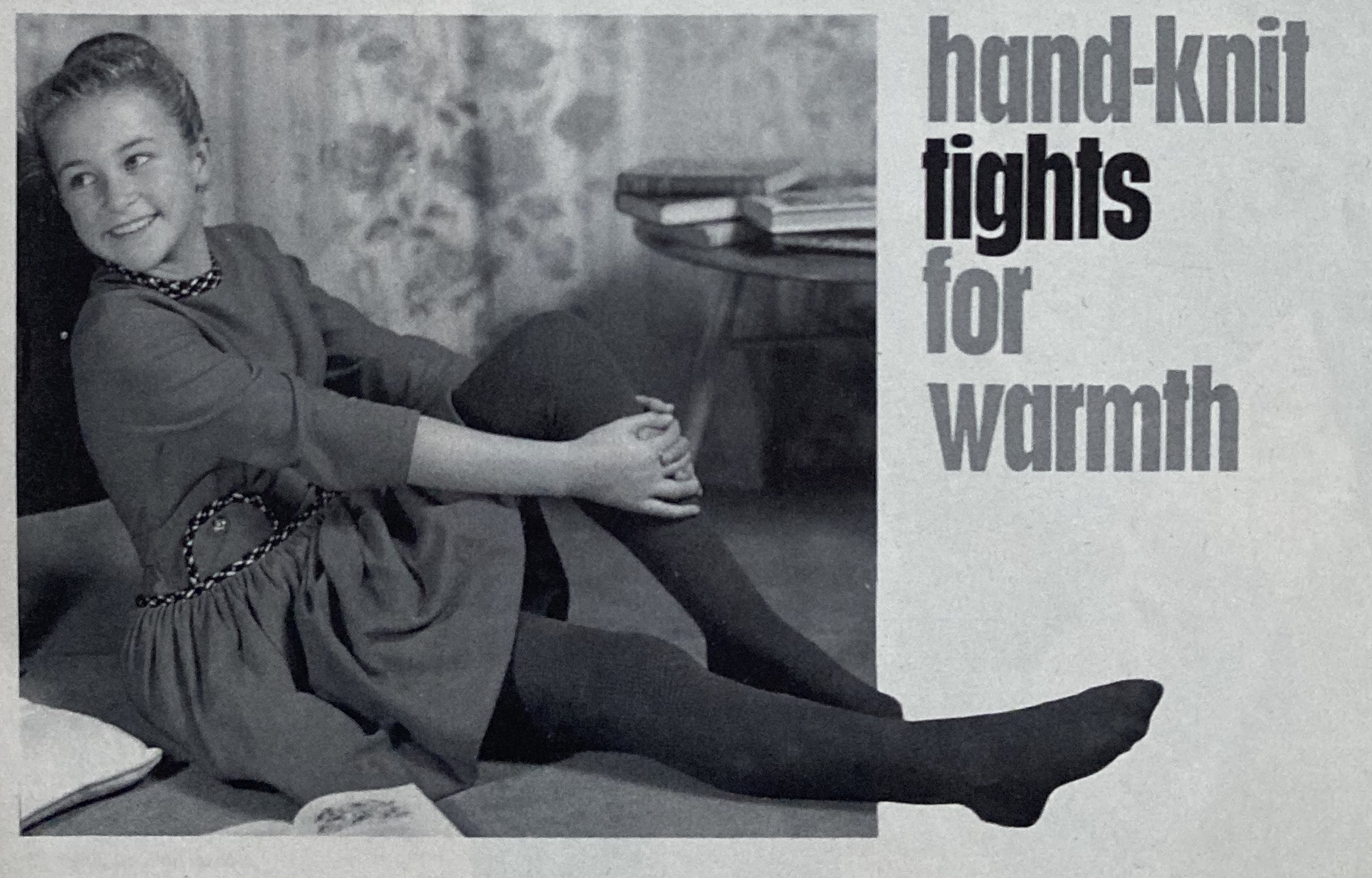
There are three fantastic designs for a young girl in this issue: a wonderful “walking set” for a toddler, a warm wool dress for an ice-skater and — at long last! — hand-knitted tights to keep a girl’s legs warm. (Strangely, our skating model is not wearing the tights, though you think she would need them out on the ice more than the young model pictured in an indoor setting!) I love the toddler’s outfit, with its contrasting colour in the flared back seam of the coat and ribbing on the hat, mittens and leggings. I like the seated girl’s dress too, as well, though it’s neither knitted nor one of the magazine’s designs.

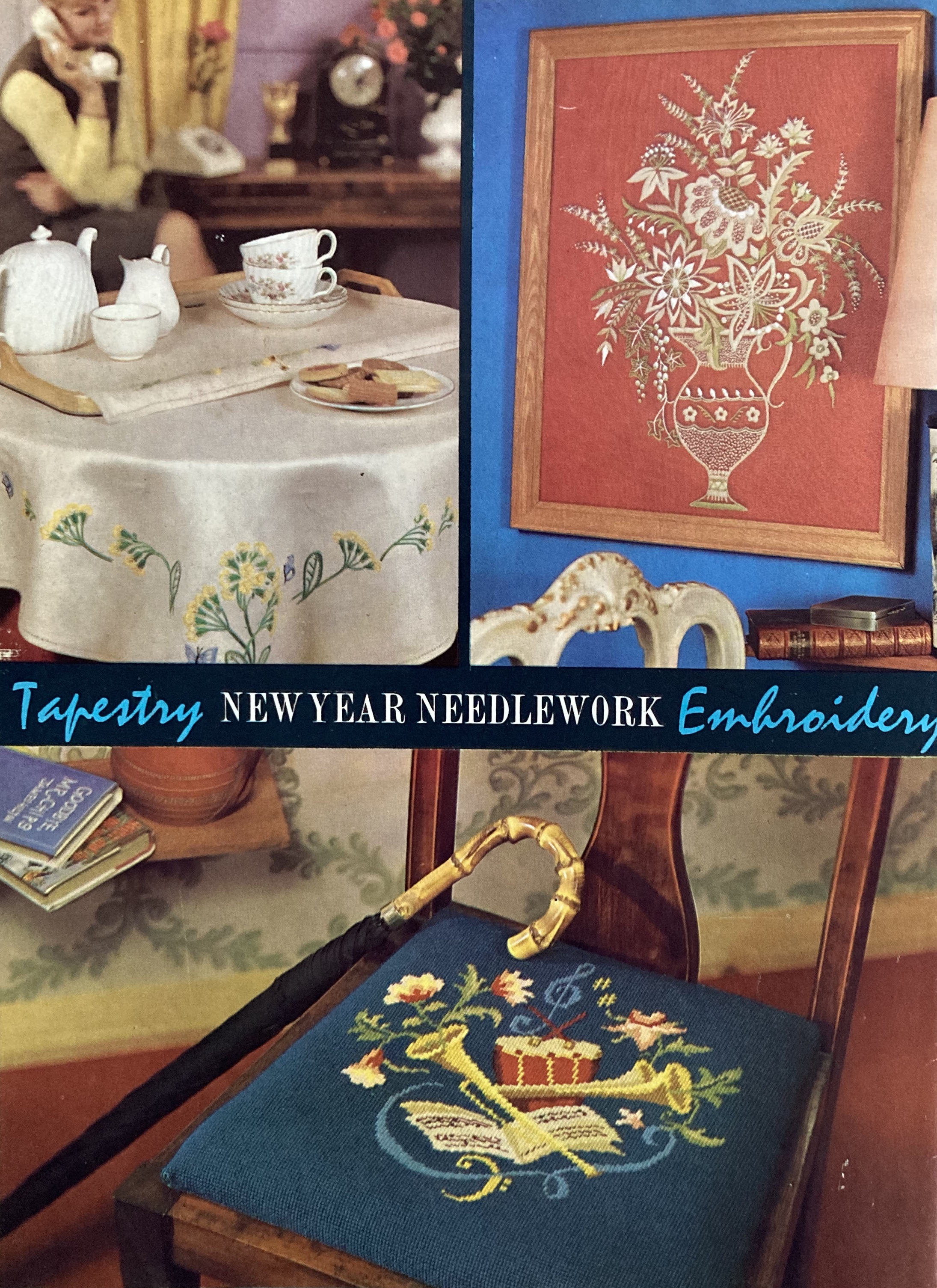
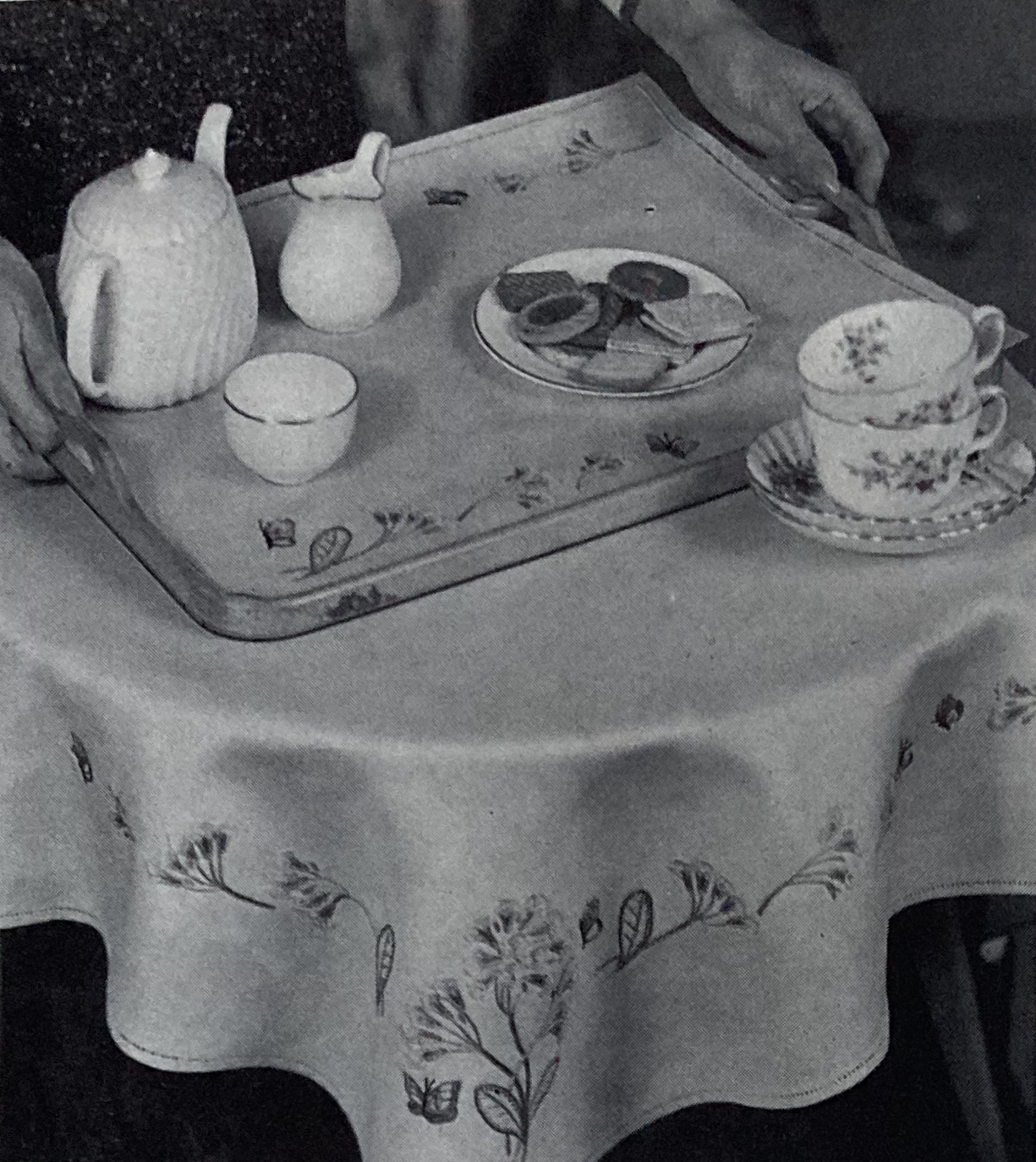
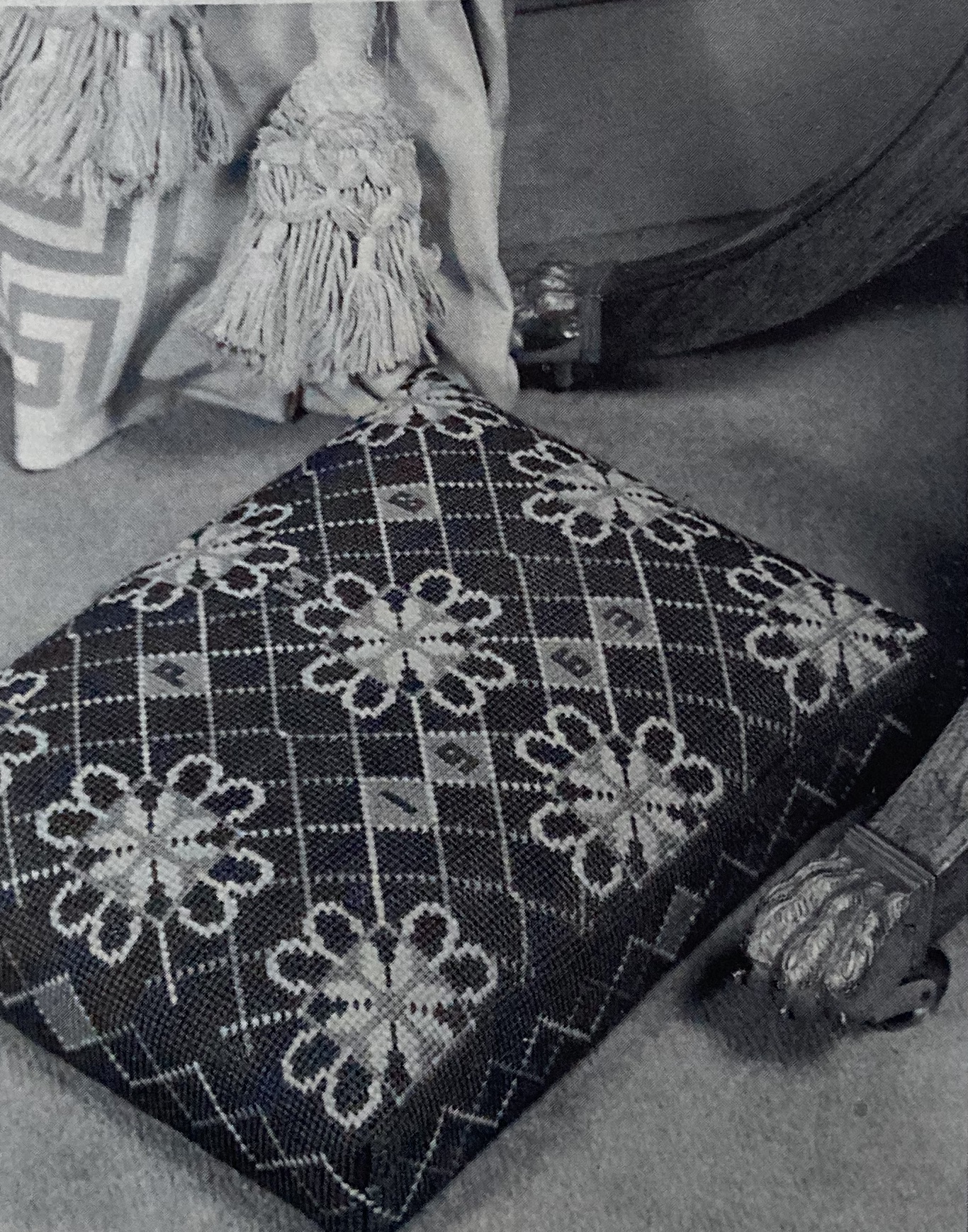
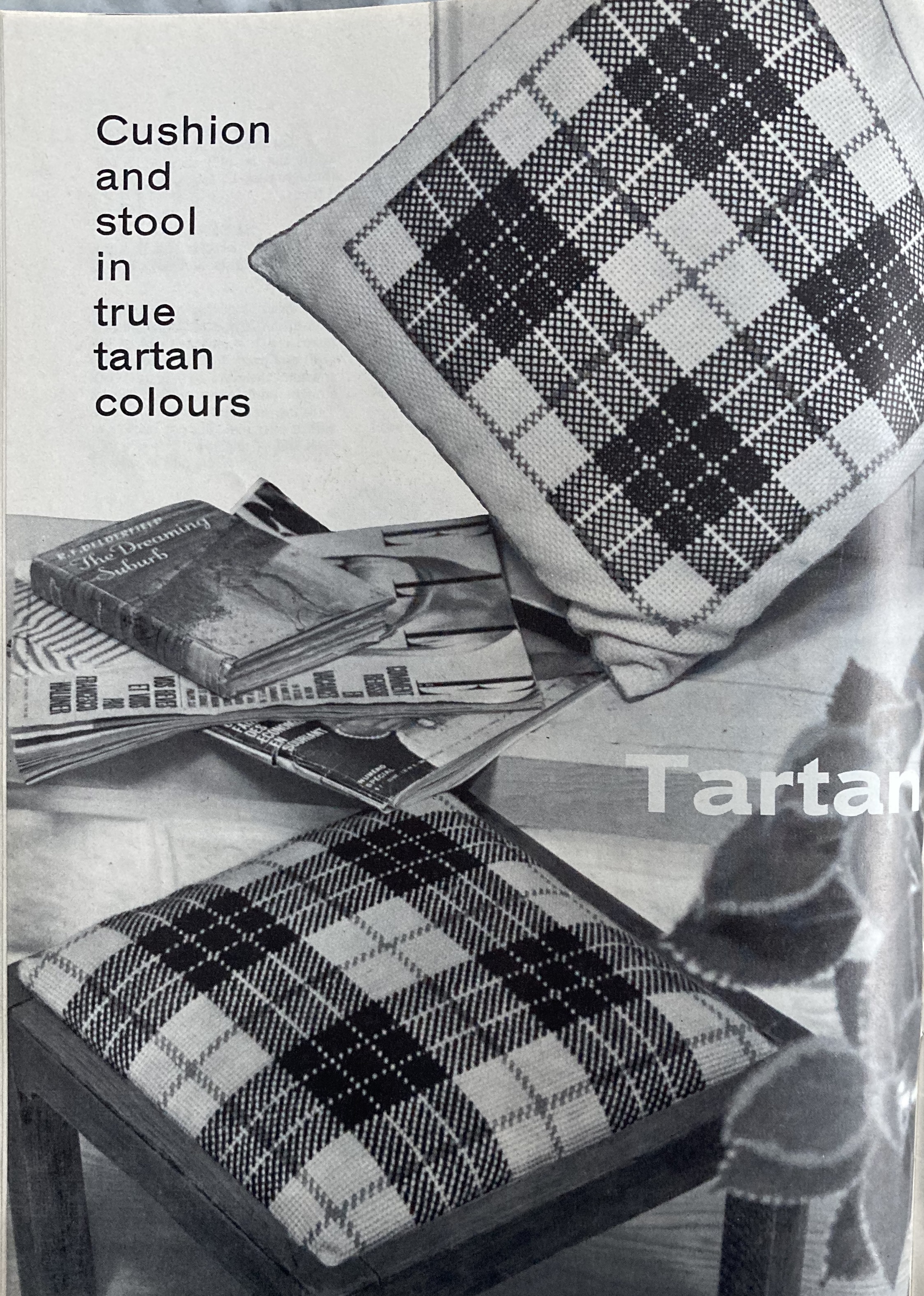
The homeware projects are fairly standard: a floral tablecloth, a tartan tapestry chair seat, a decorative panel with a white vase worked on a red background. The “music” tapestry motif is quite classic, as is the tapestry kneeler for church use.

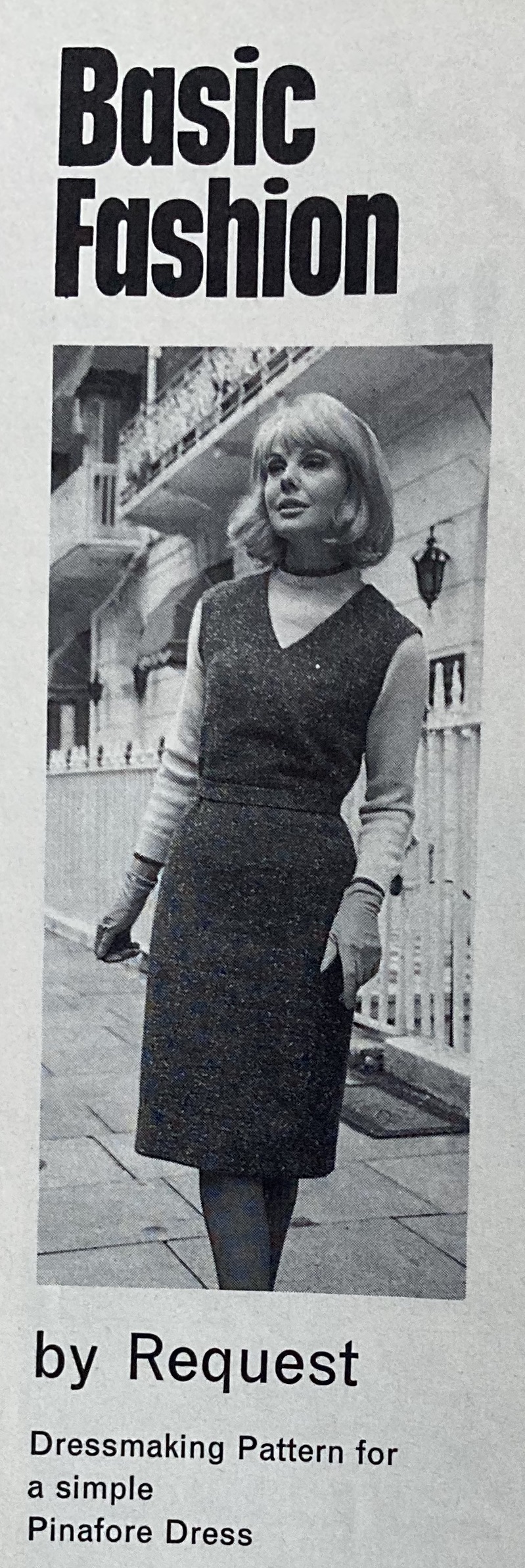
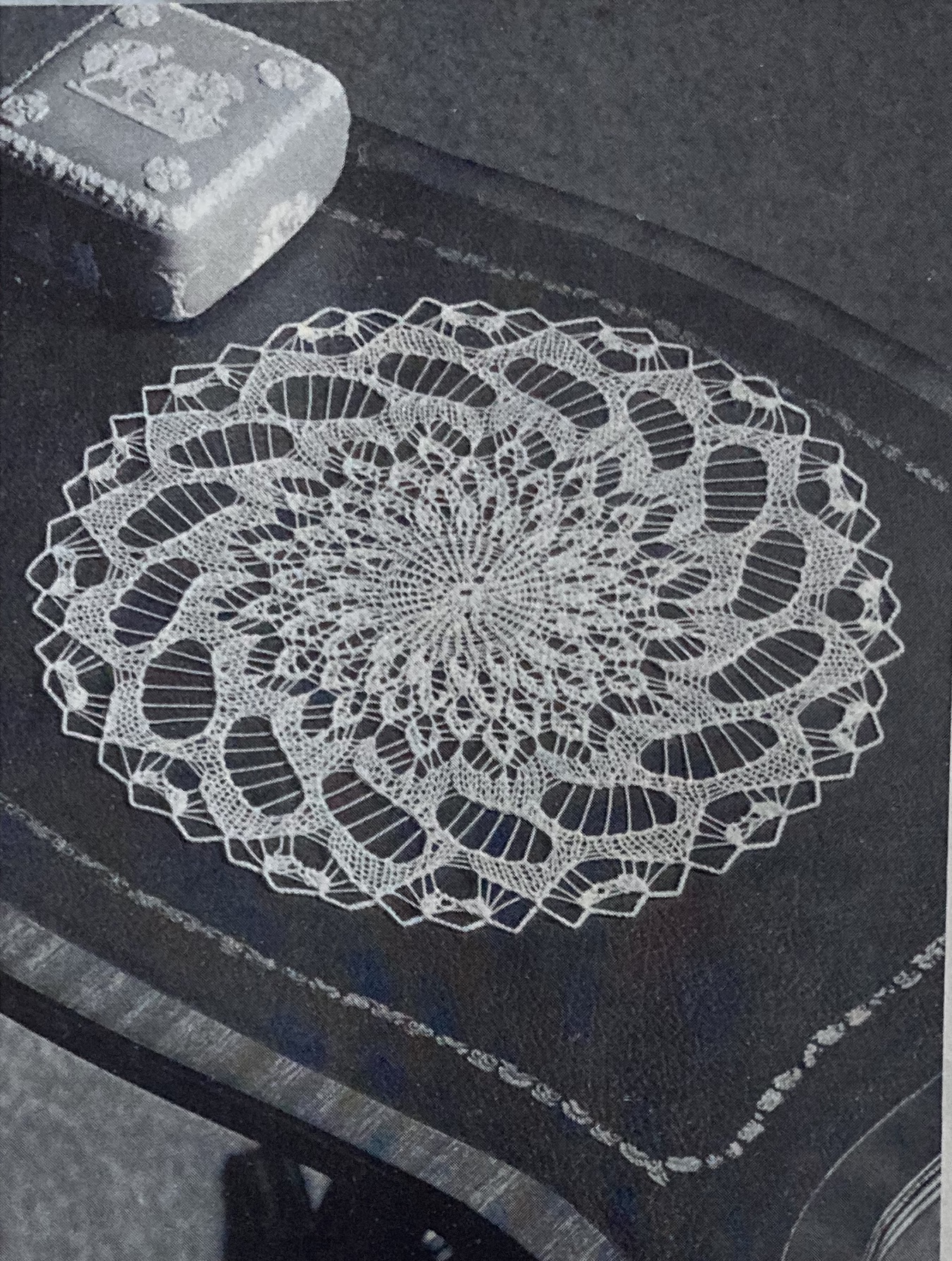
As always, some of the most interesting features are tucked away in the back pages. I would love to be able to send away for this sewing design, offered by Vogue patterns in cooperation with Stitchcraft. It’s a simple, sewn woolen “pinafore dress” that could be worn over a blouse or lightweight jumper, with a blazer for a suit effect, etc. Unfortunately, I can’t sew well enough to reverse-engineer a no-longer-existent sewing pattern from a photo. Also, what a beautiful knitted doily.

As much as I would love to make the toddler’s walking outfit, I don’t currently know a child of the right age, and starting another huge project seems daunting at the moment. I’ll probably skip ahead or back a few years to find a project from another issue that will help me de-stash. Stay tuned for details, and happy New Year!

December 1963: Appliquéd Archie

My December project was a bit of a detour: an adaptation of a little embroidery design from the “readers’ pages” of the December 1963 issue.

A lot of the embroidery and needlework projects in vintage Stitchcrafts have great designs, but are intended for items that I don’t personally need or use: tea cosies, finger plates, chair-back covers, fireplace screens and so on. I had already adapted some of the designs into decorations for useful modern things like this appliquéd tablet cosy, or this embroidered tablet cosy, or this other embroidered tablet cosy, or various vegetable bags like this one, this one, and this one. In this case, a dear person in my life had recently bought a pocket synthesizer and requested a soft case for it as a Christmas present. I aim to please, and adaptations are fun.

1960s Stitchcrafts always featured a children’s comic serial in the back pages, usually a fairy-tale-like story about a child or children (often, a brother and sister) who go on magical adventures. The adventures sometimes involve knitting or textile work, and there are often tie-ins with simple projects that a child could make and that relate to the story or the characters. The story that has been running in Stitchcraft since August 1963, “The Smuggler’s Sack”, stars children Joe and Jenny on a quest for the mysterious “Smuggler’s Sack” that is possibly hidden somewhere in the seaside town with a history of pirates (think Cornwall).

They are joined on their adventures by their horse, Archie, and the December issue offers a design for your very own “Smuggler’s Sack” bag to sew up easily from sailcloth and embroider with a cute portrait of Archie. The Archie picture was very cute and suitable for appliqué, I had an old pair of jeans that would make a great case as well as some fuzzy fleece that would look perfect as a horse’s head. The intended recipient even used to ride horses in their younger years, so it all fit perfectly.

What didn’t immediately fit perfectly was the design for the inside of the case. The pocket synthesizer is not flat: it has two knobs on the front that poke out about 2 centimetres, and two AAA batteries on the back that poke out about 1 centimetre. I had to decide whether to make a simple bag that didn’t conform to the shape, a closed case that let the knobs poke out, or a more complicated case with a made-to-fit inner lining. Of course, I chose the most complicated design…

… meaning I had to first figure out the inner dimensions of the front and back pads, and make sides for the case as well. I am not great at measuring or making things come out straight and even, so this was a challenge. I have to say, I did a really good job with the pattern, though! I made the front pad in felt and stuffed it with a bit of pillow stuffing, and the back pad with some folded fleece, then sewed them to a felt lining. The outer case was made of denim and of course had to be measured to fit perfectly. How frightening! (This is why I like knitted things that stretch and so not have to be perfectly exact).

The appliqué and embroidery was the easiest part and the most fun. I decided to not give Archie a bridle, as in the picture. The “Whee” caption is a joke between the recipient and myself, but conveniently also what a horse says when it neighs happily (if you stretch your imagination a little.) I hate setting in zippers and this one was particularly awful because of the felt and padding, but it worked out OK in the end.

I am really happy with Archie the pocket synthesizer horse and I think he will be well used and appreciated!

Merry Christmas, if that’s your holiday, and Happy New Year to you all.

December 1963: Overview

Cover photo from Stotchcraft magazine, number 360, December 1963

“Christmas is very nearly here” — where did the year go? As always, Stitchcraft‘s December issue is a mix of warm, bulky, quick-to-knit winter garments for the family and little handcrafts for presents and decorations.

Our cover model is wearing a hat in trendy “high-crowned” style with matching muffler. It uses “Glenora”, Patons new tweedy-multicolour wool. Unlike the “tufted” hat from last month’s issue, this one needs no millinery wire to keep it from flopping — the wool is relatively thick and is used double on the hat to make it really solid and windproof. The buttons are purely decorative and are made by covering button moulds with velvet cut from a strip of ribbon.

Other cold-weather accessories include these mitt(en)s, crocheted in a spiral to make the backs and fronts. Aside from the stripes on the fronts, they are almost identical to these mittens from February 1960. The full-size garments are all made of bulky wools for wamth and quicker knitting. There are pullovers for men and women in Big Ben or Ariel wools, a check-patterned pullover in double knitting weight and a cardigan “in larger sizes” (39-42 inch bust). Both of the bulky pullovers as well as the cardigan use variations on twisted or mock-cable stitch patterns, where you knit stitches in the “wrong order” in order to cross them. Big, pointy collars are still very much in fashion and the colours are bright and bold for winter: “Lipstick Red”, “Strawberry Ice” and “Royal Blue”.

Children get “Christmas sweaters” in holiday colours of red, green, and white, with bold snowflake motifs in stranded patterning.There’s a frilly bed jacket in lightweight 3-ply and a waistcoat variation on the men’s pullover, as well. They’re photographed in colour on the inside back cover. Funny that, with all the brightly coloured garments in the issue, they chose the one beige garment for the colour photo! You do see the tweed flecks better, though. That amazing creation at the top of the page is the Royal Pavilion in Brighton, reproduced in fine embroidery in felt appliqué. This isn’t the first huge, complicated wall panel project we’ve seen and I can only assume that Stitchcraft had a really good appliqué designer.
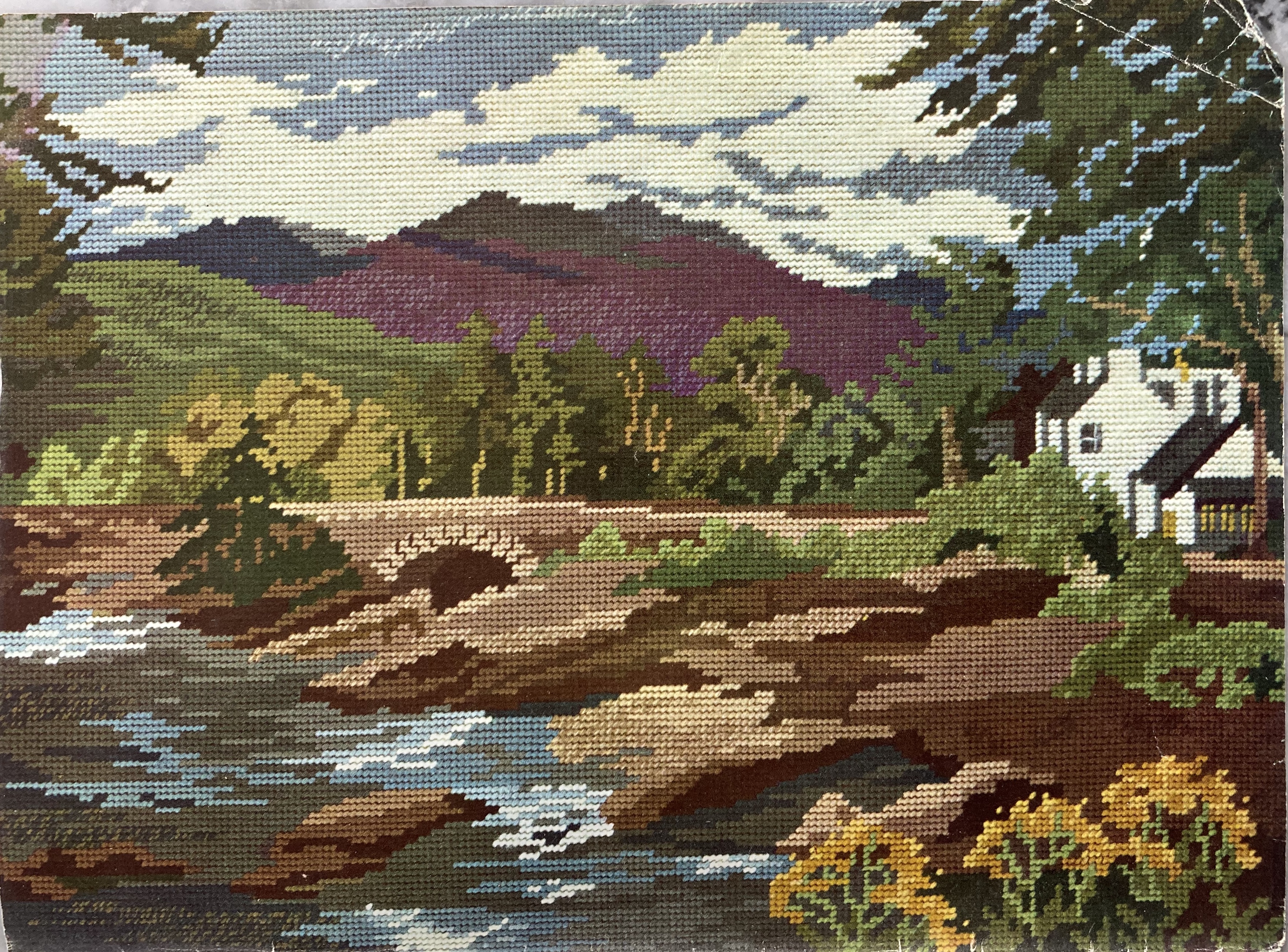
The other homeware/decoration projects are small and easy, intended for little gifts, holiday bazaar sales or to brighten up the festive table. You can knit a little puppy doll complete with its own fully dressed bed, or make some silly but nonetheless cute egg cosies (the human-looking one is supposed to be Friar Tuck.) There’s a “pinny” apron to sew for a child, party table mats with a star motif, and these stuffed and embroidered felt stars to hang on the tree. I made one of these last year and will probably make some more this year — they are quick to make and just the thing for a mini-present.

If you have a little more time (but don’t want to tackle the Brighton panel), you can knit a knitting bag, crochet a floor mat, or make a hard-wearing cushion in a standard “ribbon” needlepoint design. If you’ve really got some time on those long winter nights, you can make a set of dining-room chair seats in tapestry, or a large pile rug in a “Byzantine” design. (Beautiful leather satchel in that photo as well! It’s a just a prop, though, of course — Stitchcraft‘s crafts didn’t extend to leather-work.)

Then there’s this design for a little sewn bag with an embroidered horse named Archie on it. Archie, since you asked, is the horse in the children’s comic “The Smuggler’s Sack”, which has been running on the back pages of Stitchcraft for the past few months. It features children Joe and Jenny, who live in a waterfront town whose mystery pirate/smuggler treasure has never before been discovered. Will they be the ones to find it at last? As of yet, they’ve found a mysterious box … which has a false bottom … which contains a map and a key .. which leads them to .. an inn called “The Smuggler’s Sack.” They’re disappointed, but could the inn hold the clue they’ve been looking for? Shades of Daphne du Maurier!

“Archie” will in fact feature in my December project, where I will be embroidering him onto a modern soft case / traveling bag for a pocket synthesizer.

Happy Holidays, everyone!

November 1963: Overview

The autumn months are always the best for knitting magazines, with a mixture of heavy garments for colder days, easy-to-make holiday gifts, warm accessories and a few glamorous items for parties. Stitchcraft‘s November 1963 issue puts the focus on “warm family fashions… with the emphasis on colour and attractive textures that are interesting to knit and very becoming to wear”. There’s something for family members of every age and “for the petite to the not-so-slim.” The homewares and little projects are quick and fun to be finished in time for holiday decorating and/or gift-giving.

The “country jacket” on the cover continues the tweedy, variegated colour effect in fashion this fall, using Bracken Tweed wool for the main body and Totem DK for the collar and cuffs. I finally know what colour Totem “Oakapple” is! The other women’s outdoor-wear fashions include a zip-neck sweater with textured pattern bands in turquoise, an “overpull” with cabled neckline in flecked “Cantaloupe” colour (sadly, no colour photo, I have no idea how it looked in real life) and a simple brown top made glamorous by knitting the wool (Cameo Crepe 4-ply) together with a strand of sparkly Lurex thread. There’s also a warm, soft cape for winter reading in bed, knitted sideways in an easy zig-zag pattern. Aside from the green and white bedcape, shades of autumn brown as well as bold blues and red are the season’s trendy colours. Stripes, zig-zags and textures complete the Autumn 1963 look.

Men’s fashions are just as colourful as the women’s, or even more so (less use of plain brown…) and show more of the zig-zag trend. Here are some bold designs for “him and her” using bulky Big Ben wool (and photographed in front of…). The construction is the same for both, with the smaller design for bust sizes 33-35 inches and the larger for 39-41 inches, with the advice that “Plumper girls could follow his size”. The man’s pullover in “Italian colouring” uses stripes and textures, toned down by the use of more neutral colours. The blue-and-white cabled sweater in the photo next to it is for teenagers.

School-age children get their own “tough, tomboy sweaters” in Bracken Tweed wool. The suggested colours are “Black Olive” or “Gorse Heath”, which I assume is a sort of green-yellow tweed (no colour photo). Babies get a lovely shawl to match the layette from the September and October issues. It’s easy to knit, as the centre and borders are made separately. The other baby/nursery-age items are crocheted, sewn or stitched: a pram cover with a teddy-bear motif, a little nightcase with fluffy appliquéd kittens, a knitted doll, an embroidered “feeder”, sewn and appliquéd pinafore smocks…
There are fewer designs for accessories, but the utter fabulousness of this loop-stitch crocheted hat makes up for anything else that could be missing. The model in the photo features in many issues from this time period and always looks either quite sad or has that alluring Mona Lisa smile that’s she’s sporting here. (Am I mean, or wrong, to assume that she probably had bad teeth?) I would smile widely if wearing that hat, and I hope everyone who saw me in it would too. Also, knit your man a tie!

With all this bounty, the homewares are mostly standard: embroidered table mats and a Christmas-design tablecloth, a decorative panel with the Star of Bethlehem for more religiously-minded households, and a very impressive tatted doily and crocheted trolley-mat. The show-stopper is a lovely decorative panel “taken from a book of Oriental designs” embroidered in Filoselle silk on linen. (The design is allegedly of Persian origin, though of course neither Stitchcraft nor its typical readers of the time gave much thought to questions of authenticity, nomenclature, exoticism or any related issues that we would regard and discuss today.) It is a pretty picture in any case, and was probably not too difficult to embroider, consisting mostly of standard seed and straight stitches, French knots, and so on.

That’s all for this issue! I am going to make that wonderfully ridiculous hat.

October 1963: Overview

Cover photo, Stitchcraft magazine, October 1963

Tweed! Remember last month’s post with the advertisement for variegated-colour yarn? This month’s issue presents Patons’ new variegated wool, “Glenora Tweed”, a slightly thicker DK-weight wool with dark tweedy flecks. It appears to have been made up of 80% wool and 20% synthetic fibre. The twelve colours were chosen to be as vibrant as tweed can be (and very 1960s…) with rich shades of red, green, orange and yellow.

As it knits up fast at about 4 stitches to the inch (but promises to still give a “beautifully firm crunchy texture” i.e. hopefully not sag too much under its own weight), it is showcased with larger garments — the “pinafore-style” over-dress and men’s cardigan shown on the cover and two two-piece suits for women. There’s also a pinafore-style overdress with pleated skirt for a older girl and a boatneck sweater for men, both in similar Bracken Tweed wool. In keeping with the newer, looser and more square-shaped style, the garments have minimal or no shaping (except the girl’s outfit) and the skirts come to just above the knee. To me, the women’s Glenora garments look so similar that I had to check twice to assure myself that the pinafore dress on the cover (with high scoop neck) and the two-piece set with skirt and “overblouse” (V-neck) were in fact different designs.

There is a matching 4-ply (women’s) or DK-weight (girl’s) jumper to go underneath the pinafore looks or the overblouse, which, combined with the thick over-garments, must have been suitably warm for outdoors or poorly heated rooms in October. (The girl, of course, is going to have cold legs all the same.) For those who resist the tweed craze, there’s also a bright, fun colour-block sweater in a three-colour slip stitch pattern. I love the matching orange head scarf!

There’s also a fun 4-ply jumper for a child with some easy stranded colourwork blocks at the waist and yoke. The accessories continue the bulky, easy-to-knit trend, with a cap and scarf in Big Ben wool and a big, cosy scarf for men in an intriguing reversible cable-moss pattern.

Rounding out the family’s fall wardrobe is a matinee coat and “helmet”-style cap for a baby, matching the dress from the September issue. The November issue promises a warm shawl to match again, thus rounding out the set. Judging from the photo, “dear little baby Alicia” seems to have realised that the purpose of a helmet-style cap is to prevent the baby from removing it and flinging it around the room, and is suitably disappointed. It’s a great design, though, with the sides and chin strap done in garter stitch to accommodate movement and growing heads.

The homewares are plentiful and here again, there are some larger projects to be tackled at home during the colder Autumn days. The bright red rug in Soumak stitch and traditional design is vivid and cheerful, as is the Jacobean cushion “for the skilled needlewoman” which I would love to make if I didn’t already have two unfinished embroidered cushions in the WIP pile. (Not to mention that I am not skilled enough to make that elaborate a design, especially without a transfer.) The Autumn-themed acorn cushion is definitely easier. There’s a Regency ribbon design for tapestry or cross-stitch, too.

For those who want a quicker, easier homeware project or are already getting started on the Christmas presents, there are more embroidered acorns on cutwork mats and some knitted and crocheted goodies: a “Scottie-dog” night-case, a crocheted bag, and… a hippo, yes, a friendly knitted hippo stuffed animal. Well, why not? It’s cute. An older child might embroider her own Little Miss Muffet picture in cross-stitch.

The very last project in the issue, tucked way back in the “Readers’ Pages”, is the one I will make. In fact, I have been waiting for this issue to come up specifically so that I can make it! It is a very simply constructed and embroidered “Apron-cum-Knitting-Bag” where the front panel and waist ties of the apron fold into the bag part along with your knitting. Pull the drawstrings closed and carry the bag around, then when it’s time to knit you can undo the strings, pull the apron part out of the bag and tie it around your waist, Presto, you are ready to knit in any situation, standing or sitting, and your ball of wool will not fall down and roll about the room. Stay tuned for a project that will actually get finished on time, as well as progress on those projects that didn’t.

September 1963: Overview

Cover photo from Stitchcraft magazine, September 1963

“Knitting Time starts with a Sparkle” is Stitchcraft’s motto for the September 1963 issue, and the editress’ note assures us that “this is going to be a particularly interesting Autumn-Winter knitting season.” What does that mean for us? Lots of interesting use of bolder colours in traditional or not-so-traditional stranded and geometric patterns as well as subtler use of colour variation in tweeds and toning changes.

1963 was the year when variegated yarns, so beloved by modern knitters, first came into fashion (hence the “sparkle”), and although Patons doesn’t yet offer a truly colour-variegated yarn, here’s one from the competition: Bernat Klein No. 1, as featured in this stunning eight-page advertisement in Vogue Knitting Book No. 62 from 1963:

(The Lux and Opti-lon ads should look familiar to Stitchcraft enthusiasts as well.)

The tweedy look starts with the three-piece suit from the cover photo, consisting of a skirt, long-sleeved jumper and high-buttoning cardigan with stripe accents to bring out the lighter blue tweed flecks. Apropos “fleck”, that’s the name of the yarn: Totem Fleck. The jumper is made in the lighter, solid blue color with ribbing accents in the tweed shade. It seems to be a “switch-around” ensemble, i.e. you are not intended to wear the cardigan over the jumper as you would with a twin-set. Bracken Tweed, the somewhat bulkier tweed wool of the season (Totem Fleck is DK and Bracken is more like Aran-weight at 18 sts to the inch), is featured in this blazer “for young men who like comfortable clothes”. You know, the kind of clothes you can play ball sports in: a button-up shirt with tie, short wool trousers and a hand-knitted tweed blazer. Of course.

The other adult or teen garments feature bolder colours and interesting stranded or textured designs, like this intriguing dolman sweater with the stranded stripe running horizontally across the yoke and down the sleeves. I feel like this use of colour would look terrible on me (wide chest and long arms), but I love the idea! The man’s sweater uses a more traditional placement of the colour bands, but in contrasting green and orange tones and a spiky geometric diamond design (continuing the trend from summer 1963). The sweaters on the inside back cover have a more muted colour palette and subtle diamond texture pattern. Textured patterns make a showing in the other women’s garments as well: a bobbled raglan pullover, mock-cable cardigan and nubbly “Rimple” jumper. I want those glasses! The diamond-shape trend shows itself here in more subtle form via V-neck openings and pointy collars.

This issue also starts a new layette set for the youngest members of the family, starting with a warm dress, hat and bootees. Next month’s issue promises a matching matinee coat and cosy “helmet” cap. The caption for the modelled photo reads, “Jonathan is just 2 months” and reminds us that babies of both sexes wore lacy dresses with both pink and blue embroidery on them. 1963 was definitely a more sexist era, but also a more practical one in some ways.

There’s an interesting selection of Autumn-themed homewares as well, like a leafy fender-stool and chair-seat set, some blackwork finger-plates for the door (reminding me that I still have not finished my blackwork butterfly cushion from April…) a cushion and runner with Chinese motifs (I cannot vouch for any kind of authenticity — the motifs look very similar to the traditional European “Jacobean” designs to me, but what do I know), a pair of crochet-appliqué trolley cloths and a crochet-motif cushion.

And then there’s this “practical idea” — cover an old box (they used a wooden margarine box of about 16×12 inches and 8 inches deep, which sounds like a lot of margarine ha ha) with embroidered Binca canvas, cushion the lid with foam rubber under the embroidery and strengthen it with a piece of wood on the under-side and voilà: a “magazine tidy” which can also be used as a little stool to sit on. Very practical indeed and reduces clutter. I like it.

That’s all for this issue! I’ll be making the quick ! easy ! uses up leftovers ! crochet cushion. How quick and easy is it, you ask? I’ll tell you: it is so quick and easy that I started working on it last night, September 1st, and am already more than half finished: (Working on both halves of the cushion cover alternately so as to gauge how much wool I have of each colour.)

So there will definitely by a finished project in September, and hopefully this will give me some time to finish up the rest of the WIPs. I did also complete a retro-themed jumper of my own design which is not technically from Stitchcraft, but I’ll post about it anyway, because it was fun.

August 1963: Overview

End of the Season! Sadly, yes, the “holiday” season is drawing to a close and although it’s only the last day of July, it feels like autumn is around the corner. On the bright side, the late summer and autumn issues of Stitchcraft are always the most fun, with a good range of lighter-weight and warmer garments, children’s things for school, and more intricate homewares.

“The trend for colour use is in these bold clear motifs” writes “editress” Patience Horne, a trend which is reflected in “chunky”, boxy shapes, bright colours and simple stripe or geometric designs. The cover illustration shows two of a three-piece “his and hers” set — cardigan and mock-layered turtleneck for her and a buttoned-collar pullover for him– that all make use of single bold stripes. The woman’s matching pullover is made to look like a deep V-neck over a turtleneck top, but the under-layer is just an insertion knitted separately and sewn in.

There’s more use of simple, geometric motifs in the other women’s garments: a classic pullover with a wide check stripe down the front in double knitting and a colour-block cardigan with diamond motifs made in bulky “Ariel” wool. Diamond shapes are still trending from last month. There’s a bulky indoor-outdoor cardigan jacket in Big Ben wool, made in a slightly less simple striped waffle stitch. Necklines are high, whether buttoned or not, and collars are either big and square or non-existent.

Continuing the interesting neckline/collar trend, we’ve got unisex “tomboy tops” for children, with a cute “tie” decoration on one of the pullovers. Simple, bold stripes and pointy diamond patterns show up here as well, whether in colour or as a stitch pattern element. The one lighter-weight design is a square, buttoned-neck pullover with double stripes near the hem and a coordinated skirt. Rounding out the garments is a lovely classic cardigan for men featuring cables on the upper yoke and — you guessed it — in two simple lines down the fronts.

Unlike the knit designs, some of the embroidery and tapestry projects are quite elaborate and ornate. Look at these Chippendale chairseats! That seems quite out of place to me in a modern 1963 home of clean lines and unfussy decoration, but of course many of Stitchcraft’s readers were older and/or conservative in their style, and probably not on the cutting edge of home redecoration even if they had the money to spend on it (which I’m guessing most of the readership didn’t.) The “peasant motif” tablecloth and cross-stitch place mats have more of a clean, colour-block aesthetic. I really love the tablecloth design! It can also be adapted for a cushion. Speaking of cushions, here’s a fancy one made of essentially two very large, intricately knitted lace doilies joined together around the cushion base.

And let’s not forget that standby of every proper 1960s home… the fluffy hand-made bathmat and matching well-dressed “pedestal” aka toilet! Hats off to every grandmother and great-aunt who kept true to this amazing home furnishing concept throughout the rest of the 20th century. (Seriously, one of my great-aunts had a setup like this in her guest bathroom in the plushiest, fluffiest, yellow and black shag carpeting you could imagine, and I’m pretty sure it stayed there until the turn of the millennium.)

That about wraps it up for this month’s issue. The ads are unspectacular and a new children’s comic is starting up, featuring twins Joe and Jenny on their hunt for the legendary “Smuggler’s Sack” that just might be waiting to be found in the caves near the beach. Good luck, little friends! My project for this month will be the men’s cabled cardigan.

July 1963: Overview

Cover photo of Stitchcraft magazine, July 1963

“In the Holiday Limelight” is the theme of this month’s issue, covering sporty, casual garments for holiday wear, a few slightly more dressy options and — with one incredible exception — quick and easy homeware projects.

Most of the adult garments seem quite warm and heavy for summer wear, but most are meant to be worn as outerwear in an unpredictable northern-maritime climate. Our partner-look cover duo, for example weighs in at 22-24 (hers) or 28-30 ounces of heavily cabled DK wool and is expressly touted as “in colour for sailing” (hers) or “white for tennis” (his). I imagine it would be quite warm for tennis but probably very good for sailing, as the textured stitch pattern would ward off splashes and insulate from cold winds. Unusual cables are also featured on the bright yellow button-up cardigan, while the design (“from Vienna”) of the mens’ black-and-white pullover suggests a cable-like vertical movement in the sideways-knitted colourwork front piece. A short-sleeved collared jumper and houndstooth-pattern jacket round out the warmer, double-knitting-weight garments.

For more dressy occasions, there are two lightweight jumpers made of Patons Cameo Crepe (fingering-weight wool with a tight twist for a smooth texture in stocking stitch). Both have a slightly nautical theme, at least in the names and colour choices. The “sailor collar” jumper is excellently photographed with matching red hairband and telephone! The diamond-pattern jumper in white with marine blue has a similar round collar to the heavier short-sleeved jumper, as well as a similar idea of using little dots or diamonds as decoration. (I imagine the diamonds must be placed very carefully to fall above the bustline.)

There’s a charming striped cardigan for a young girl, who could be encouraged to practice her budding handcraft skills on two miniature cross-stitch pictures — a deer and a koala bear. Embroidered on Bincarette mesh fabric (an older word for Binca fabric, roughly the same as Aida but slightly fewer threads per inch), the background is not filled in, so there are very few stitches to actually make and they could be easily done by a young child to hang in her room. More experienced “embroideresses” can make this densely-worked cushion, which combines cross-stitch with Holbein or double running stitch in a tessellated design.

Continuing the homeware designs are two hard-wearing, but very easy to make, applique/embroidery cushions for the garden. Perfect for a staycation, they are made with strong sailcloth material and stuffed with foam clippings to repel moisture. Readers could set their garden table with interesting placemats made in blackwork or with appliquéd crocheted bands. Especially pious readers who prefer to spend their holiday doing church work can even make a kneeler, a Bible marker and/or a secular footstool cover in tapestry.

Oh yes, and in the is it-for-a-bazaar-or-is-it-just-bizarre category, here are some “amusing” coffee-pot and egg cosies in the form of sad, legless, eyes-follow-you-around-the room-quilted cats! Add them to your collection of murderous crocheted clowns, evil felt Father Christmases and disembodied-head egg cosies, or demand that your church sell them at their next bazaar in return for the lovely Bible marker you made for them.

But wait, there’s more, and as always, the best comes last… Did I say that the homewares were easy, with one incredible exception? I am in awe of this large (16×22 inches) yet finely detailed appliqué wall hanging depicting the Mad Hatter’s Tea Party from Alice in Wonderland. It is the companion piece to the “Alice” wall hanging showing the Queen of Hearts and the gardeners from the August 1962 issue, and is designed so that both pictures can be fitted together to make a single panel. The stitch detail and precision required to make all those tiny felt pieces fit perfectly is amazing.

That wraps it up for our July 1963 issue! I will probably make the diamond-pattern jumper, since I have some more of the annoying un-plied cotton from the Hamburger Wollfabrik that I might as well use to make something with, and the long-line style will suit me well. I might, just might, also finish the blackwork butterfly cushion sometime soon. Happy Summer!