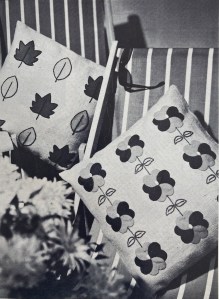
This month’s project was an appliquéd and embroidered cushion. Or, as the description in the magazine put it:
Attractive appliqué cushions in hardwearing hessian add a gay touch for garden lounging — ideal for deckchair comfort or to use on the lawn. Children will love them too, and they are tough enough to stand up to the rough-and-tumble of garden play.
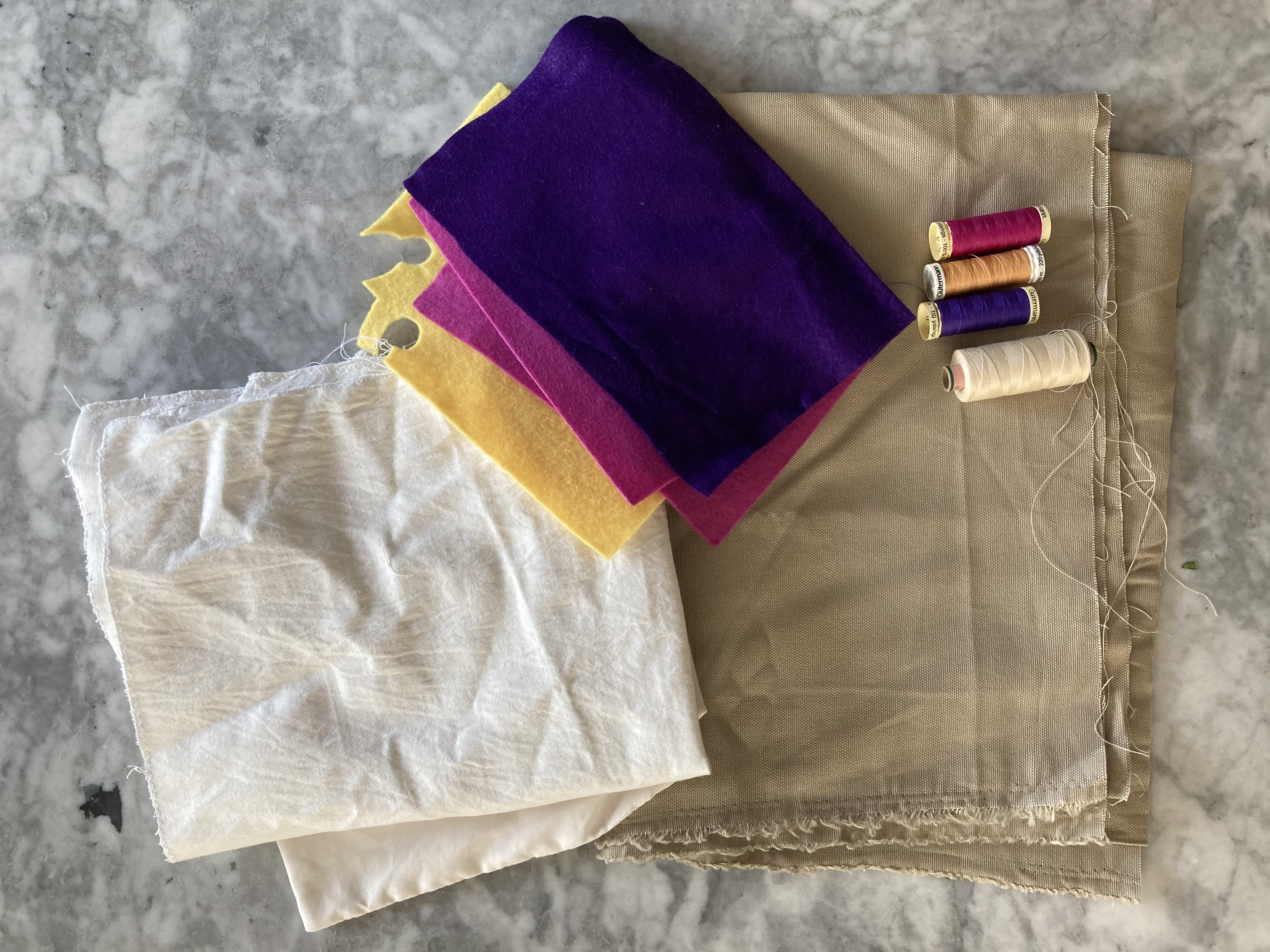
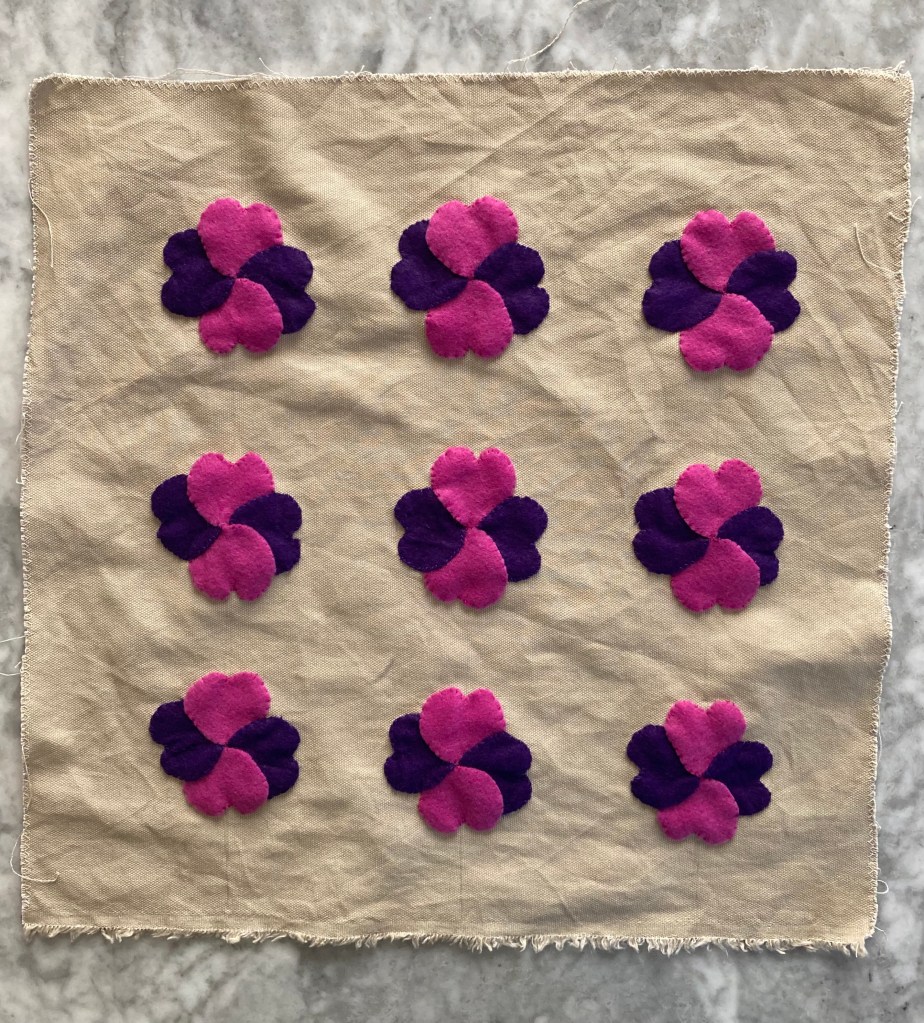
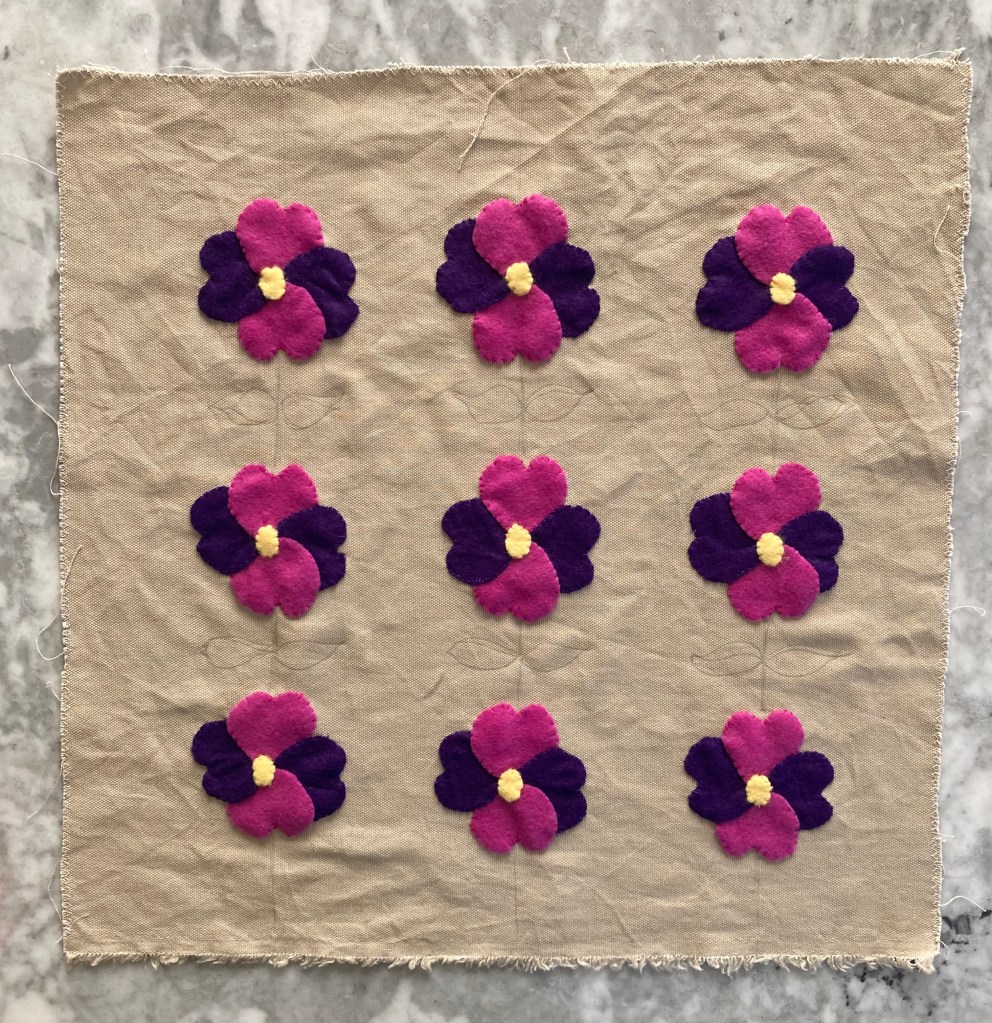
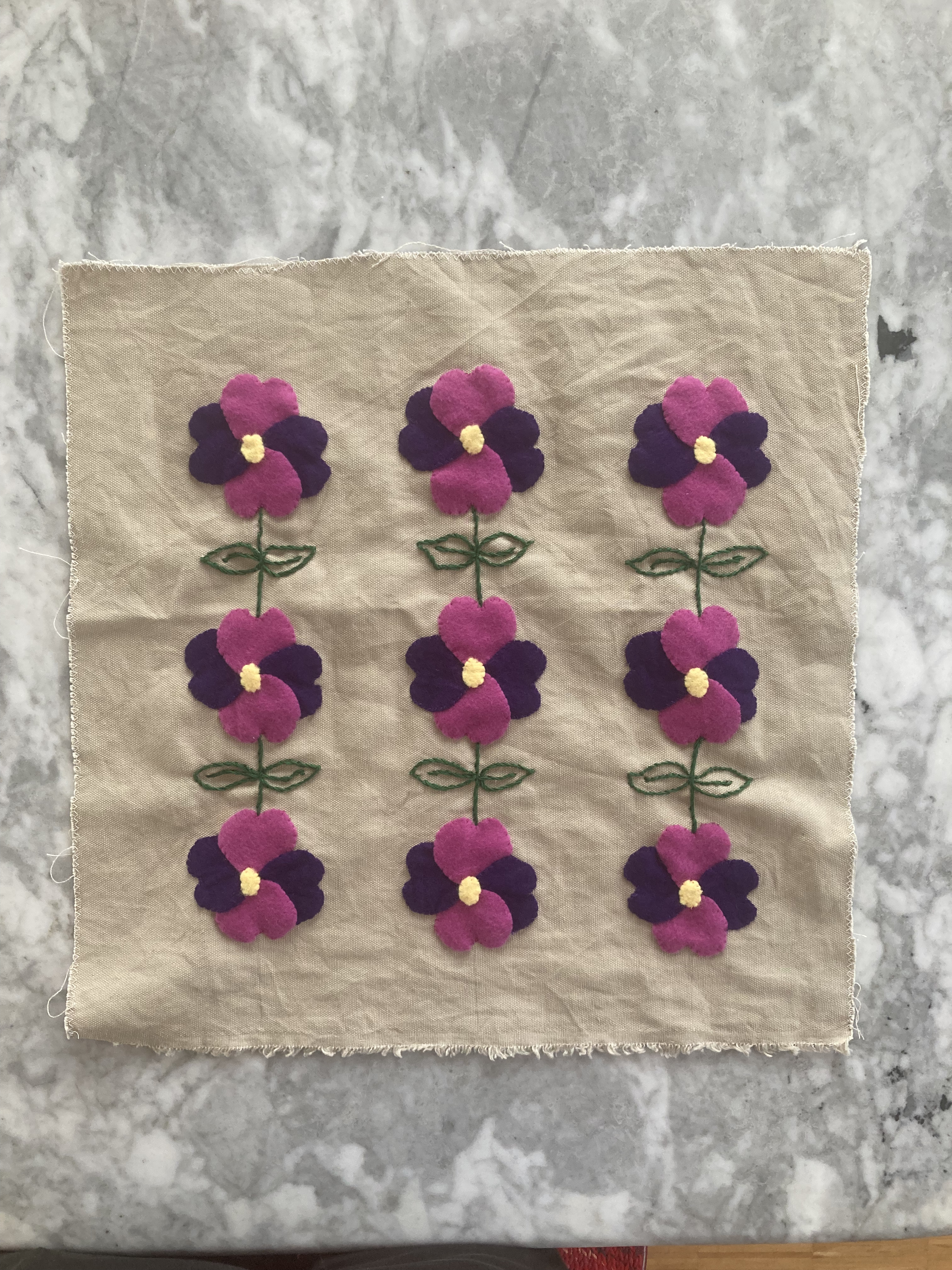
Two cushion designs are given, one with autumn leaves and one with pink and purple pansies. I chose the pansies, which were bright and fun and very 1960s. As luck would have it, I had exactly the right amount of pink and purple felt in stash, and almost enough green embroidery thread for the stems and leaves, so I didn’t have to buy many materials and could use the project to de-stash. I did have to buy the backing fabric, and decided on a tough decorating/upholstery cotton instead of real Hessian fabric (aka burlap, jute, gunny-sack), since I don’t think this cushion will be subjected to any “rough-and-tumble of garden play” on my friend’s balcony.
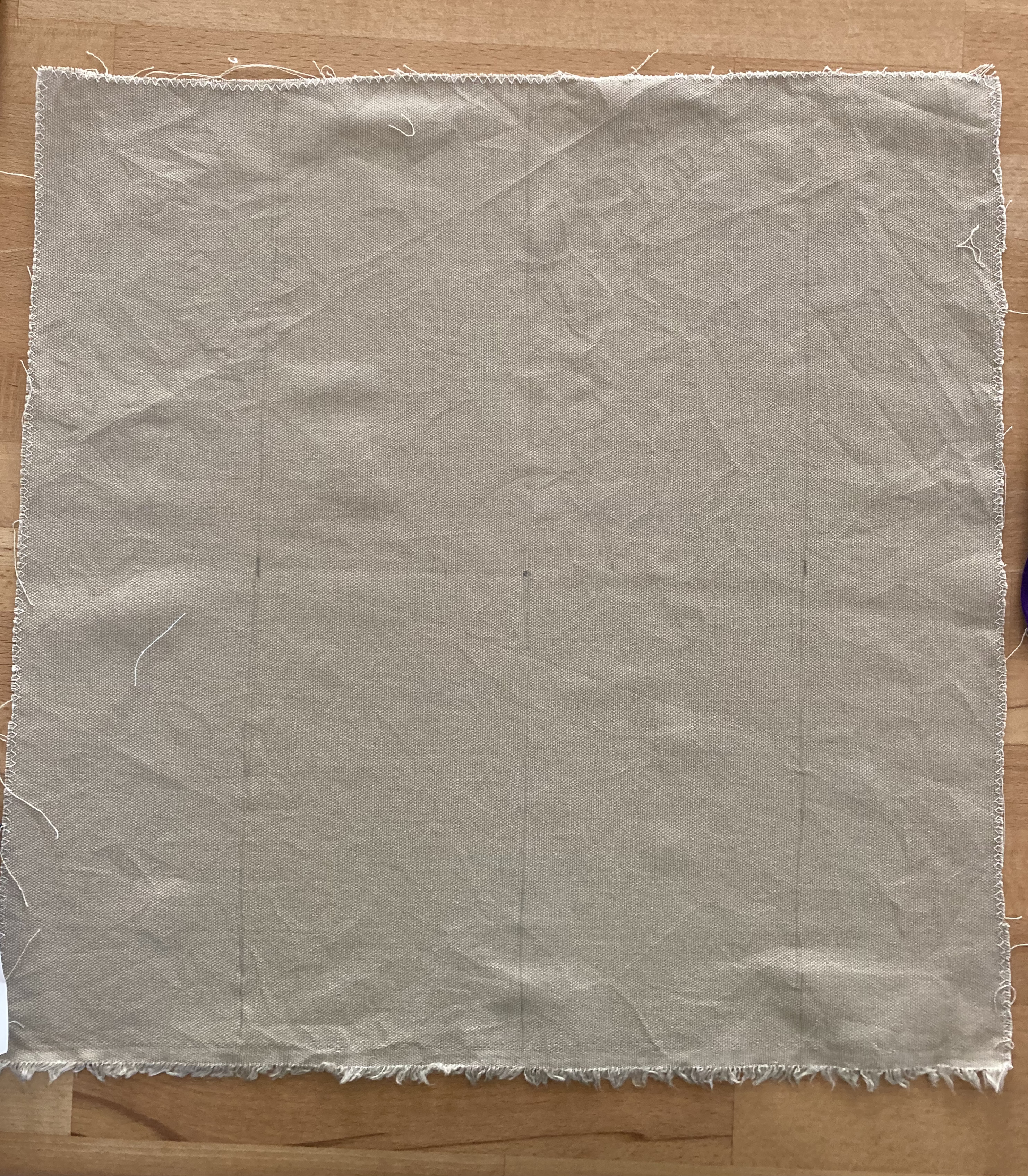
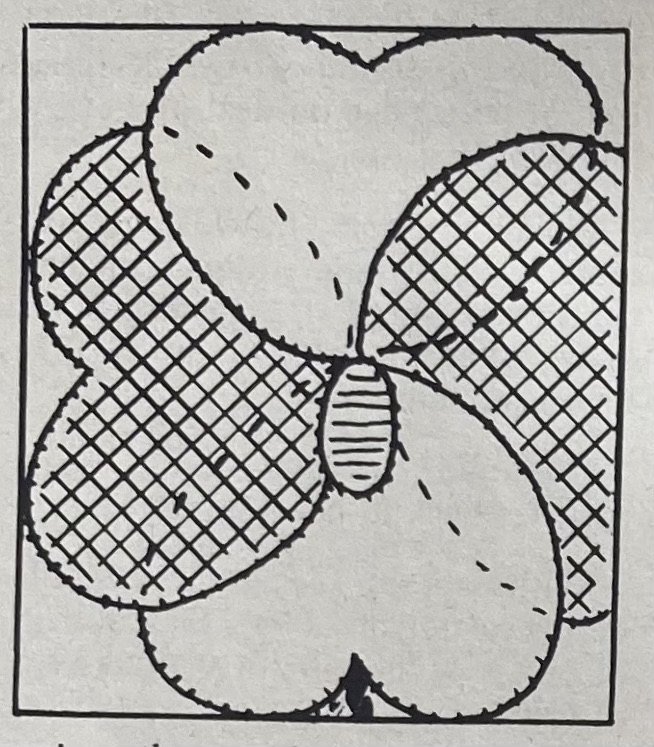
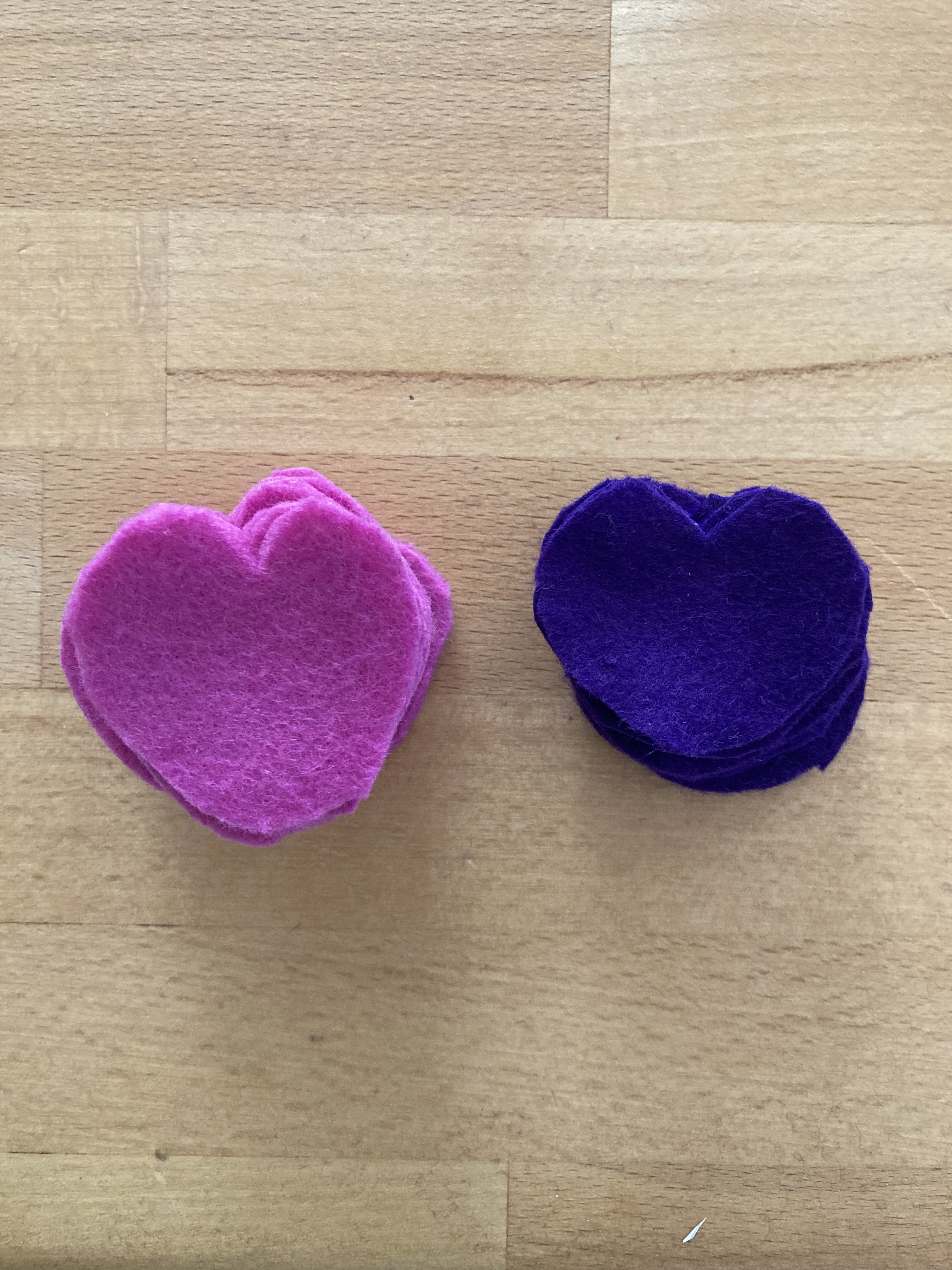
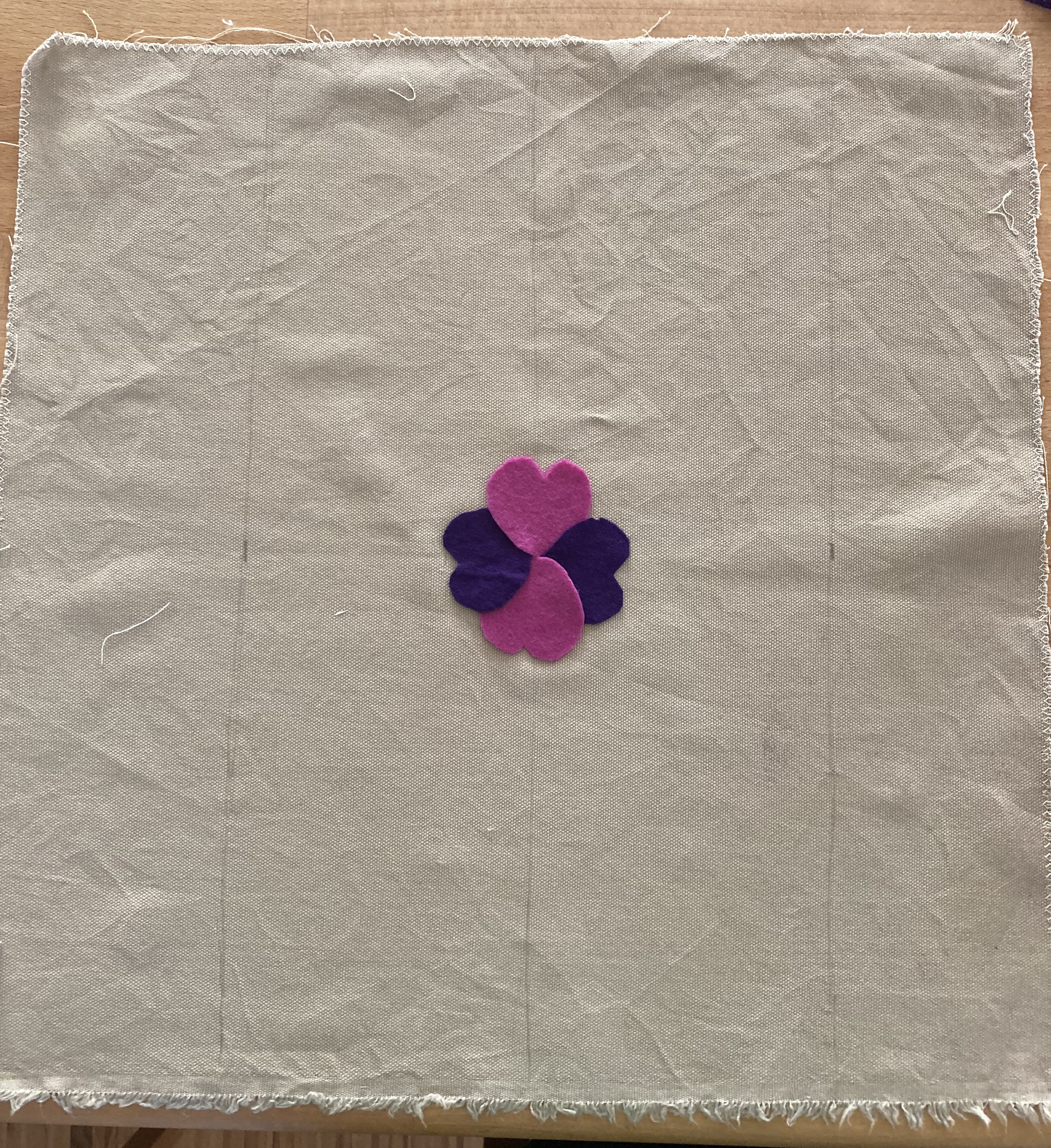
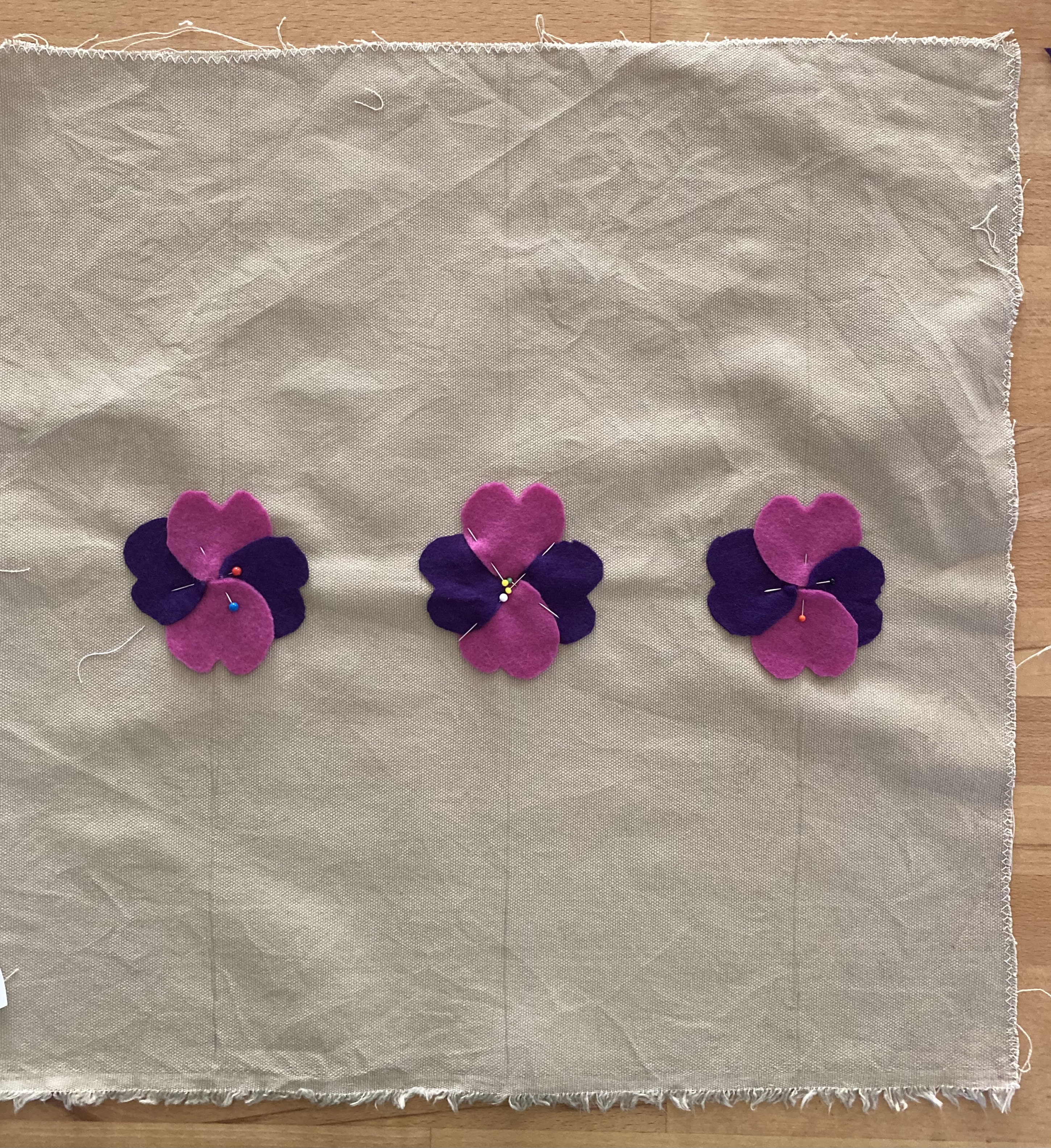
Since I didn’t have a transfer, I made a little paper pattern for the felt petals, estimating the size based on the amount of felt and the size of the background fabric. One modern “standard size” piece of decorating felt made exactly 18 petals and I think it came very close to whatever size the original transfer pattern was. I overlapped the leaves in a sort of pinwheel layer (following the helpful illustration), using a little bit of stick glue to help keep them in place, and then secured them with pins. For placement, I simply folded the background fabric in quarters and used the fold lines for the two middle axes, then measured evenly from there for the corner flowers.
I sewed the flowers down with matching thread and added the yellow centres. The diagram shows them a bit above or below the actual centre of the petals, but I like symmetry, so I made the yellow pieces more round and put them right on the centre. (The layers of felt weren’t too heavy.)
All that was left to do after that was the leaf and stem embroidery, which was done in easy stem-stitch in green thread. The pattern didn’t say how many strands of thread to use, but seeing as it was a bold design, I used all six threads together and ran out of thread. (Up until this point, I had done all of the work in one day, but alas, I had to pause because it was Saturday late afternoon and the shops wouldn’t open again until Monday.)
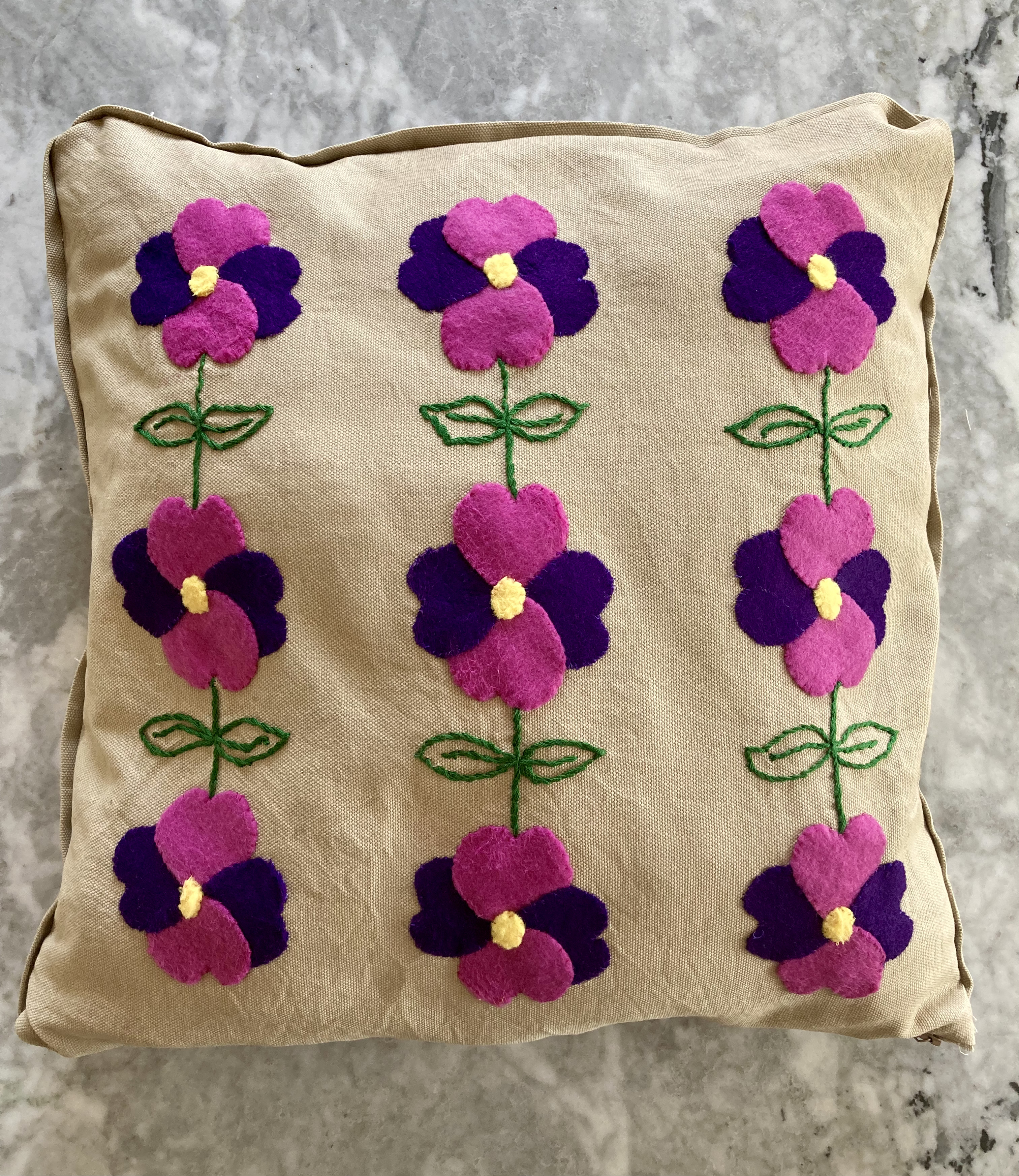
Monday came, I bought more thread and finished the surface of the cushion. Sewing it up was easy enough. I had enough muslin in stash to make up one half of the inner cushion pad (pro tip: the inner cushion should always be a little bit larger than the outer cover, to prevent sagging) and enough of the beige cotton to make the other half. I did not, as suggested in the pattern, line the pad with plastic to make it waterproof “for use on the grass”. After making the pad, I had exactly enough beige fabric left to make strips for “piping”, so added that as well (not part of the original design). It was not “real” piping, which is made on a bias strip, and thus came out a bit uneven. Oh well. At least the zipper was no problem this time.
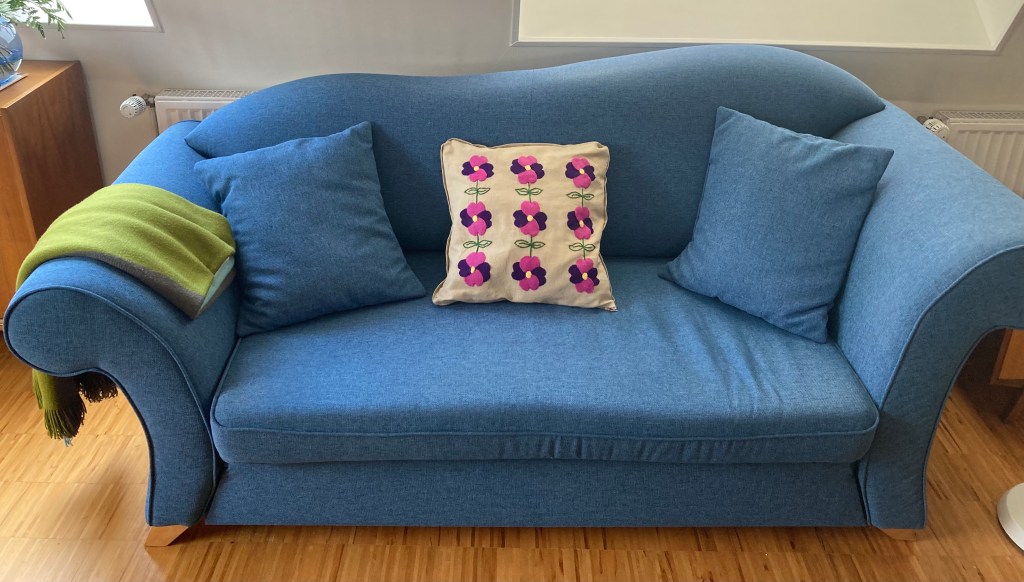
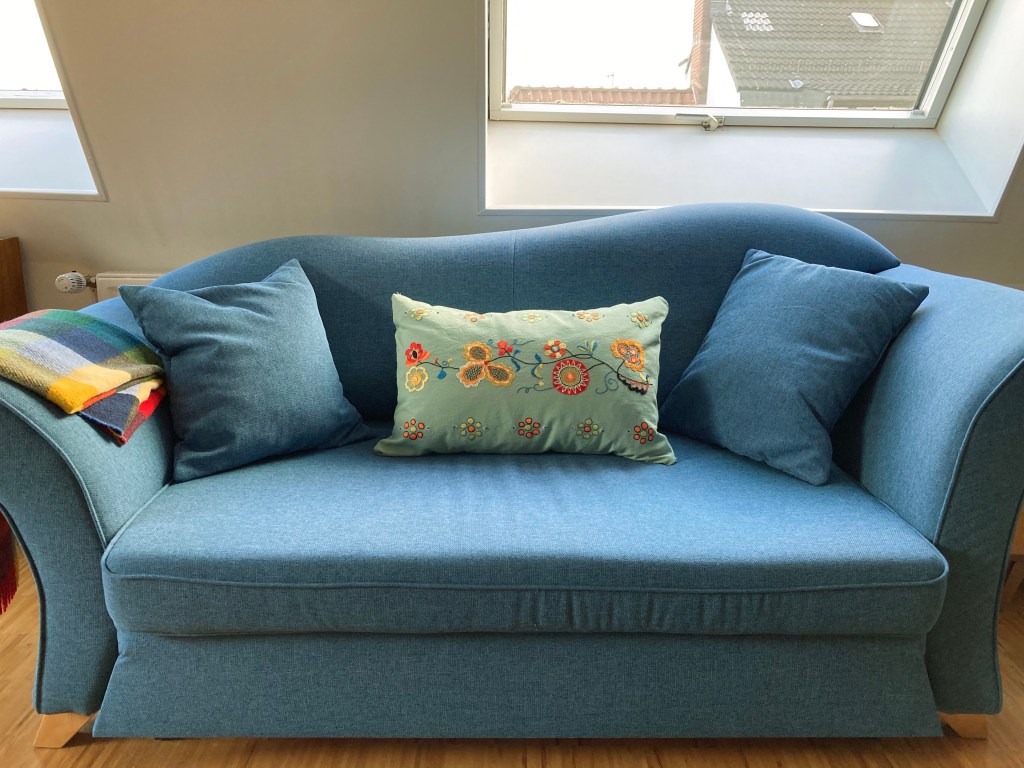
And that was that! I stuffed the inner cushion with fluff, sewed it up, zipped it into the cover and voilà. I have no garden, no balcony and too many cushions already, so this will be a gift for a friend.
July is still “holiday” season over at Stitchcraft, but this summery issue is already looking towards cooler autumn temperatures and the return to post-holiday life. For women’s fashions, this means a “revival of the more feminine line” (as if there were ever a fashion for “the masculine line” in 1960s women’s fashions.) I guess they mean a slightly closer-fitting silhouette, or a little more shaping of upper-body garments between hem and bust. At the same time, “quick and easy yarns” or “easy-to-wear loose front styling” jackets are still in fashion, emphasising comfort and wearability.
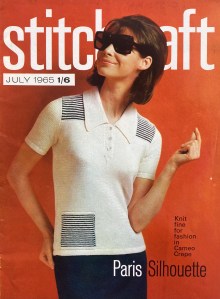
Our cover model sports a white blouse made in 4-ply “Cameo Crepe” wool and twisted stocking-stitch for a little more texture. The navy blue accents on shoulder and pocket match the knitted skirt, which is just below-knee length. That may seem surprising if you associate mid-1960s fashions with miniskirts, but it took a while for the ideas of cutting-edge designers like Mary Quant or André Courrèges to trickle down to the general public, and hand-knitting magazines, even the more fashionable / aspirational ones, were oriented towards designs that “regular people” could wear in everyday life . The dresses and skirts in Vogue Knitting’s 1965 Spring/Summer issue, for example, all fall between just-barely-above and solidly-below knee-length — and Stitchcraft was a more conservative magazine than Vogue Knitting. We won’t be seeing miniskirts here for a while yet.
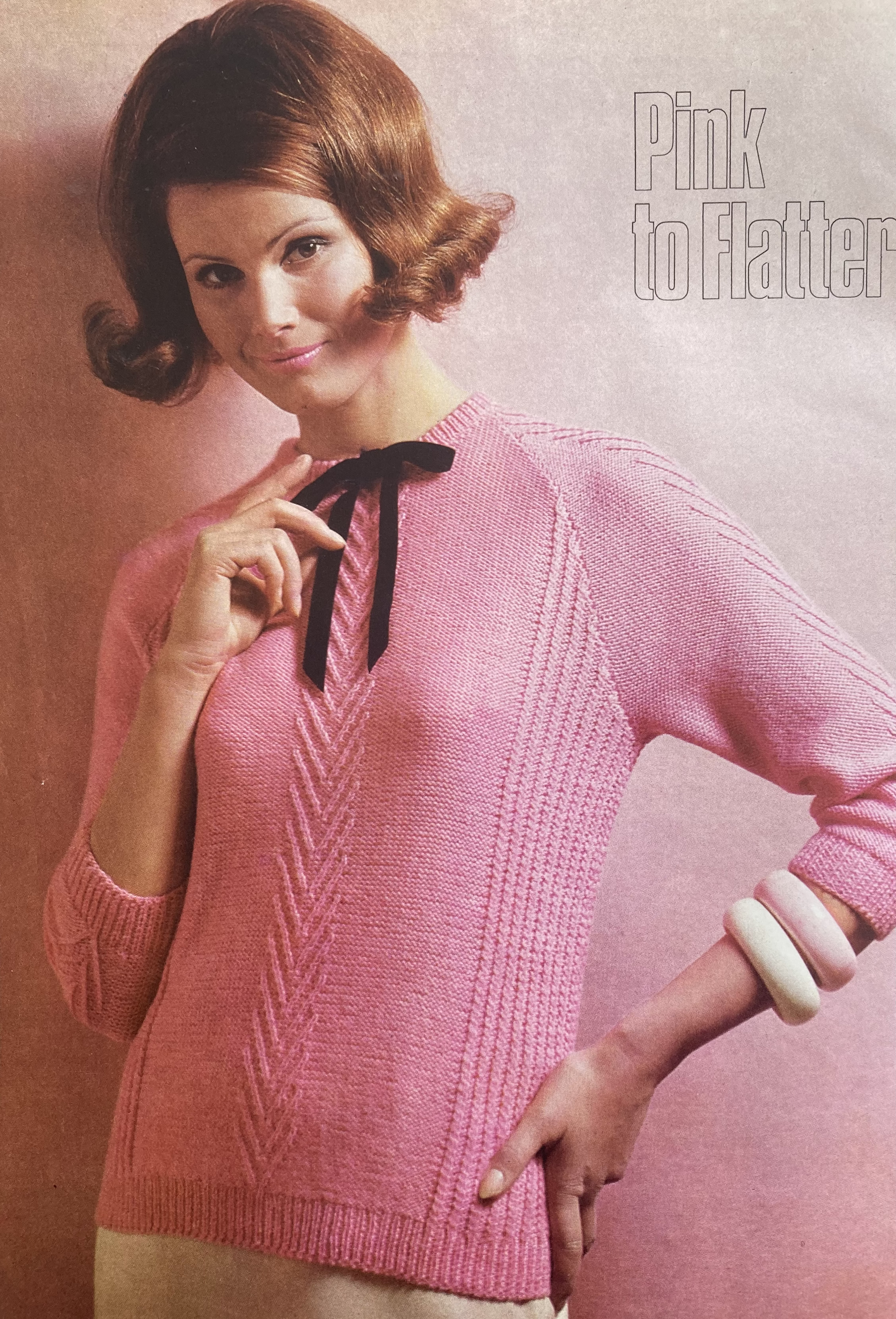
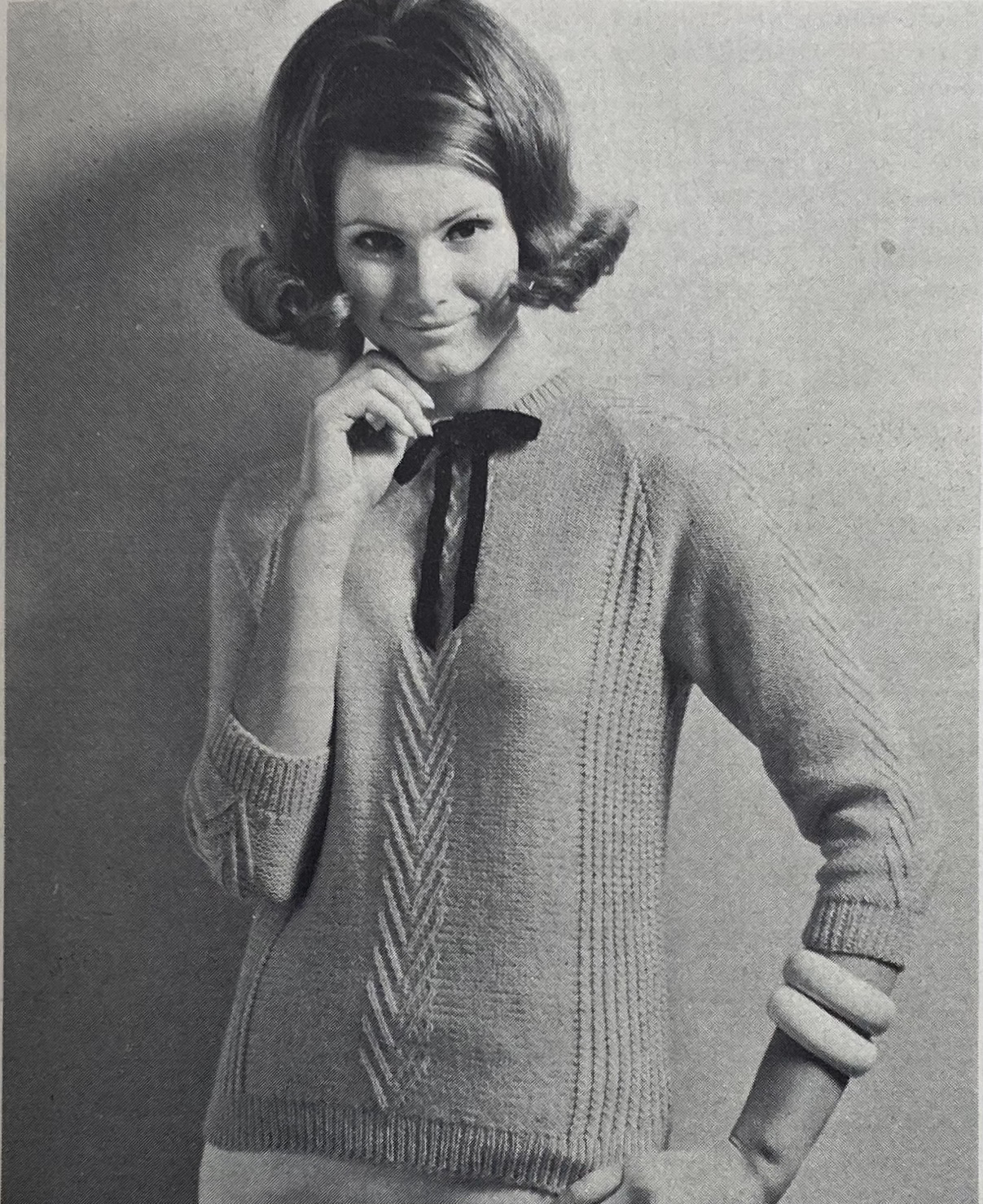
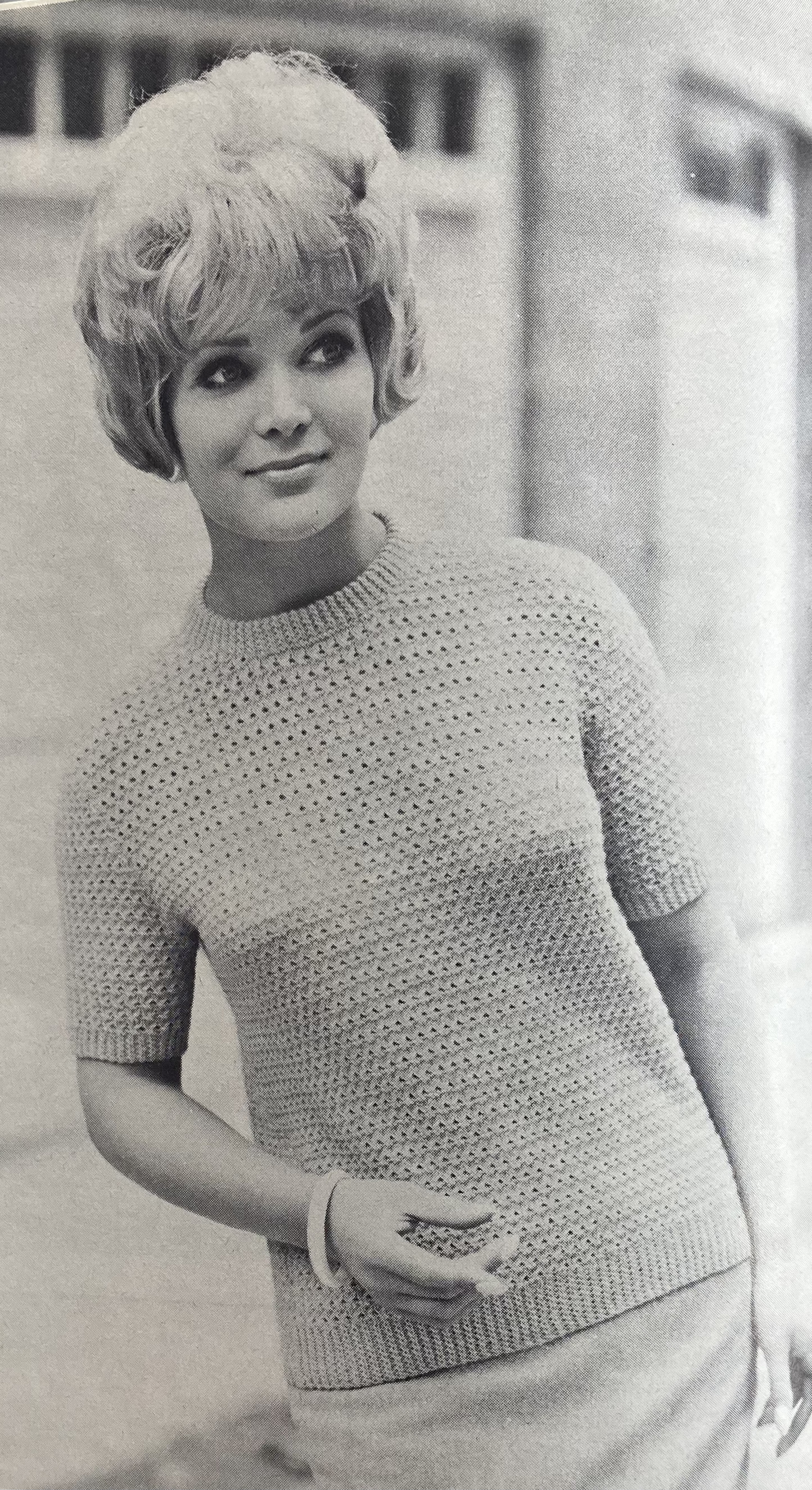
The upper-body fashions for women show, if not an extreme “revival of the feminine line”, a definite attention to cute colour and pattern details, particularly in the use of twisted stitches or ribbing variants. The pink raglan pullover on the inside front cover combines a sort of twisted rib on the sides with a “v” pattern, also made by twisting stitches, up the front and back midline and on the sleeves, and tops ot off with a black necktie bow. Nice touch to put it on a red-haired model! The combination of colour detail and ribbing variant (here: stranded panel and narrow slip-stitch rib) is also used on the warm blue-and-white cardigan. The “knitting that looks like crochet” trend continues in a short-sleeved blouse for larger sizes in 4-ply wool and a textured-lace pattern.
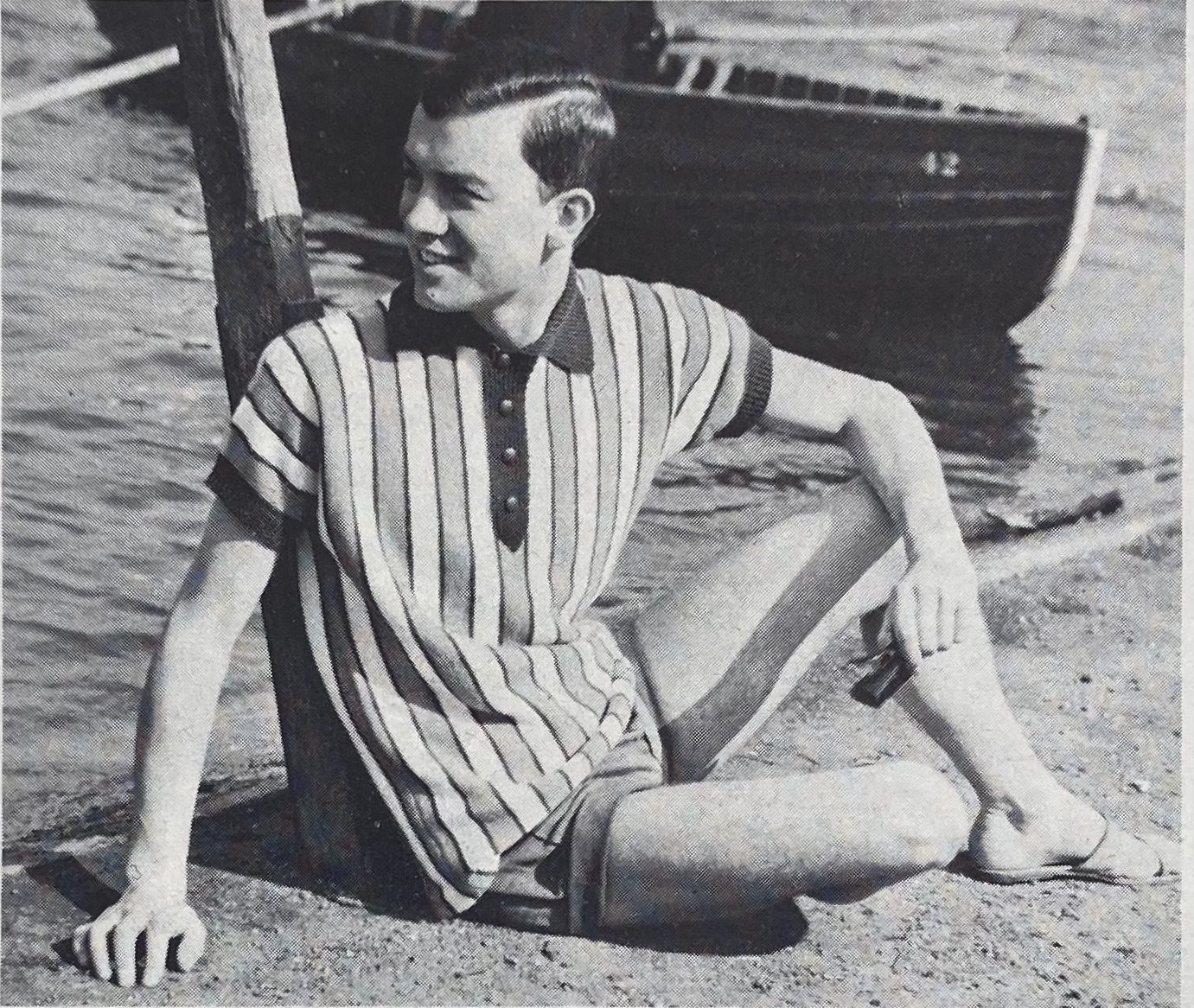
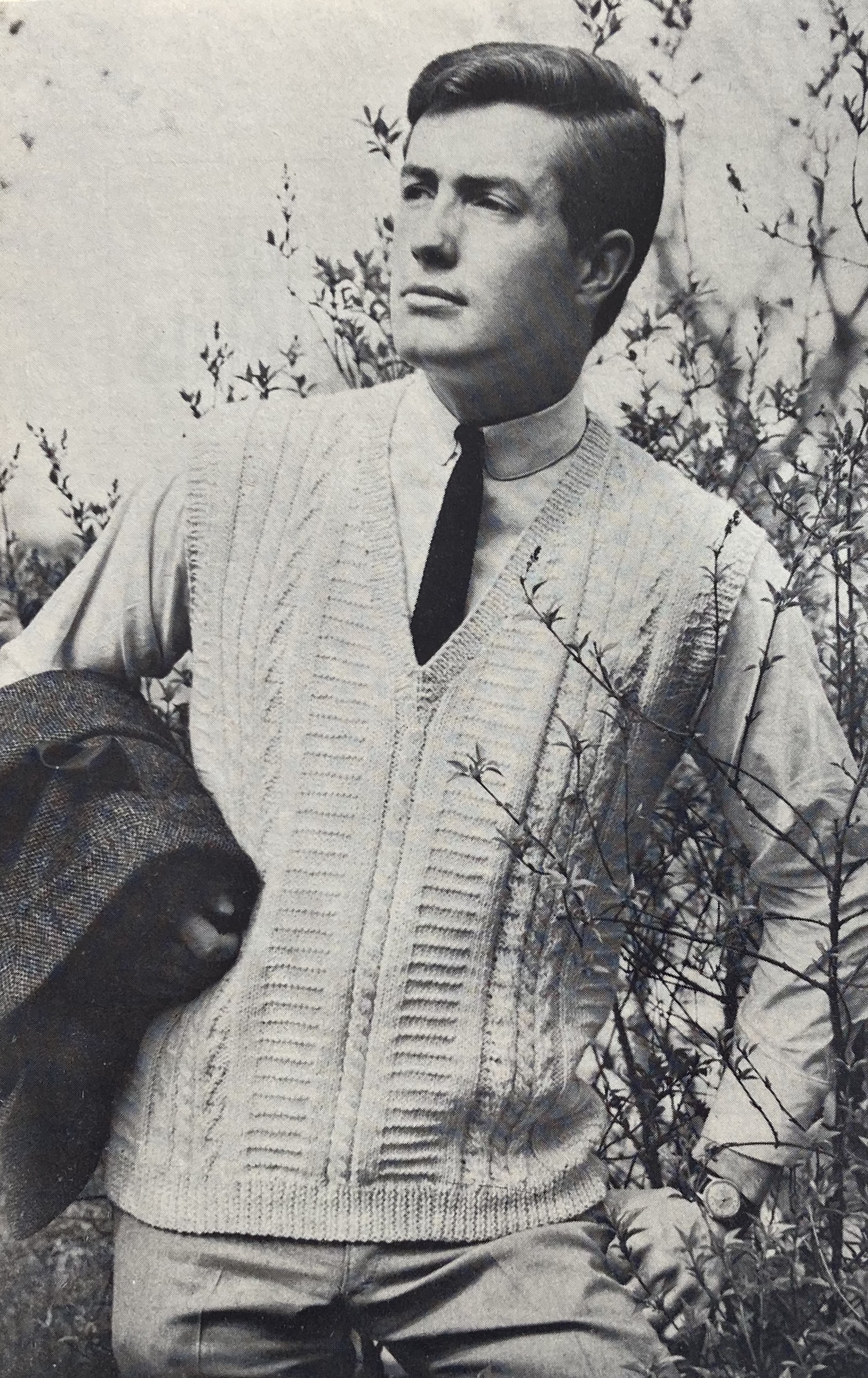
The men’s fashions use a predictably less dainty, but no less interesting use of colour and pattern: there’s a loose.fitting, sideways-knit and vertically-striped dolman-sleeve shirt for beach wear in “father and son” sizes for adults and children (though the “adult” model in the photo looks hardly older than a teenager himself) and a slipover in an Aran-style pattern of cables, ridges and zig-zags.
The kids’ designs utilise the same fashion features as the adults: the boys’ striped shirt is the exact same pattern as “Father’s”, and there’s a zip-neck pullover for girls with a stranded border reminiscent of the panel in the womens’ jacket. For younger girls, there’s a quick and easy, slightly striped pullover whose pattern details are embroidered on after knitting. Nautical white and blue, pretty pink and sunny yellow make up the summer colour palette.
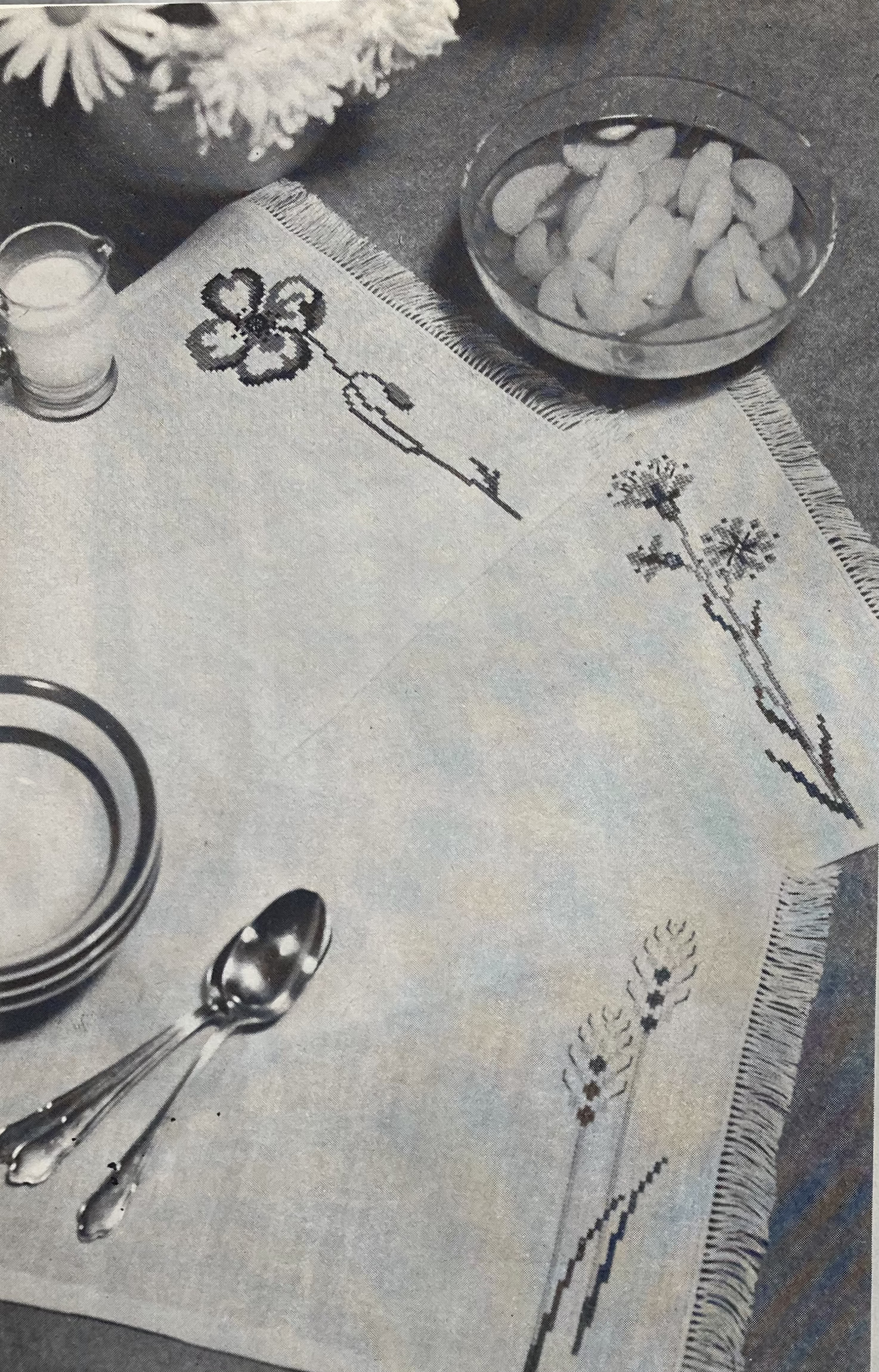
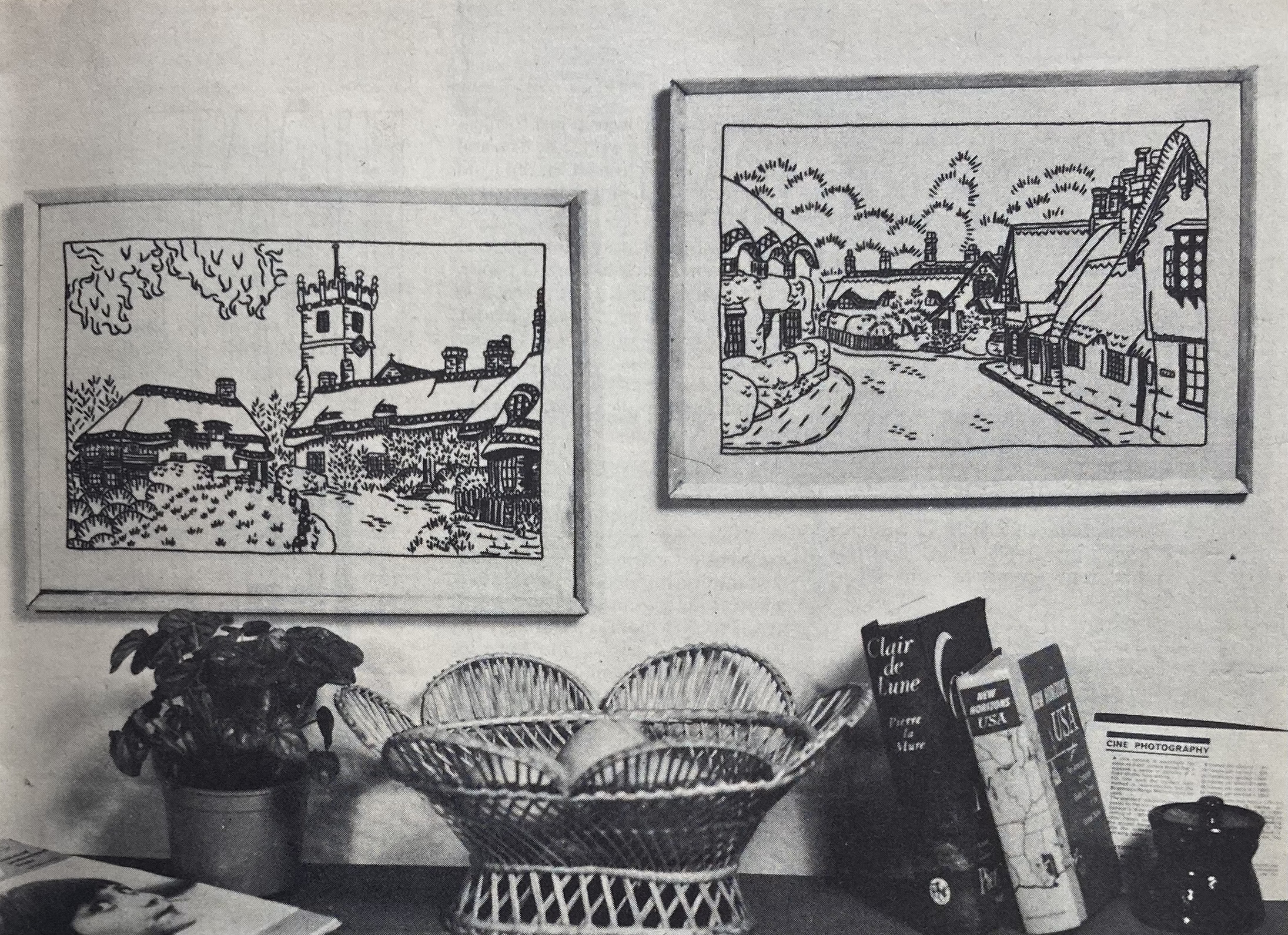
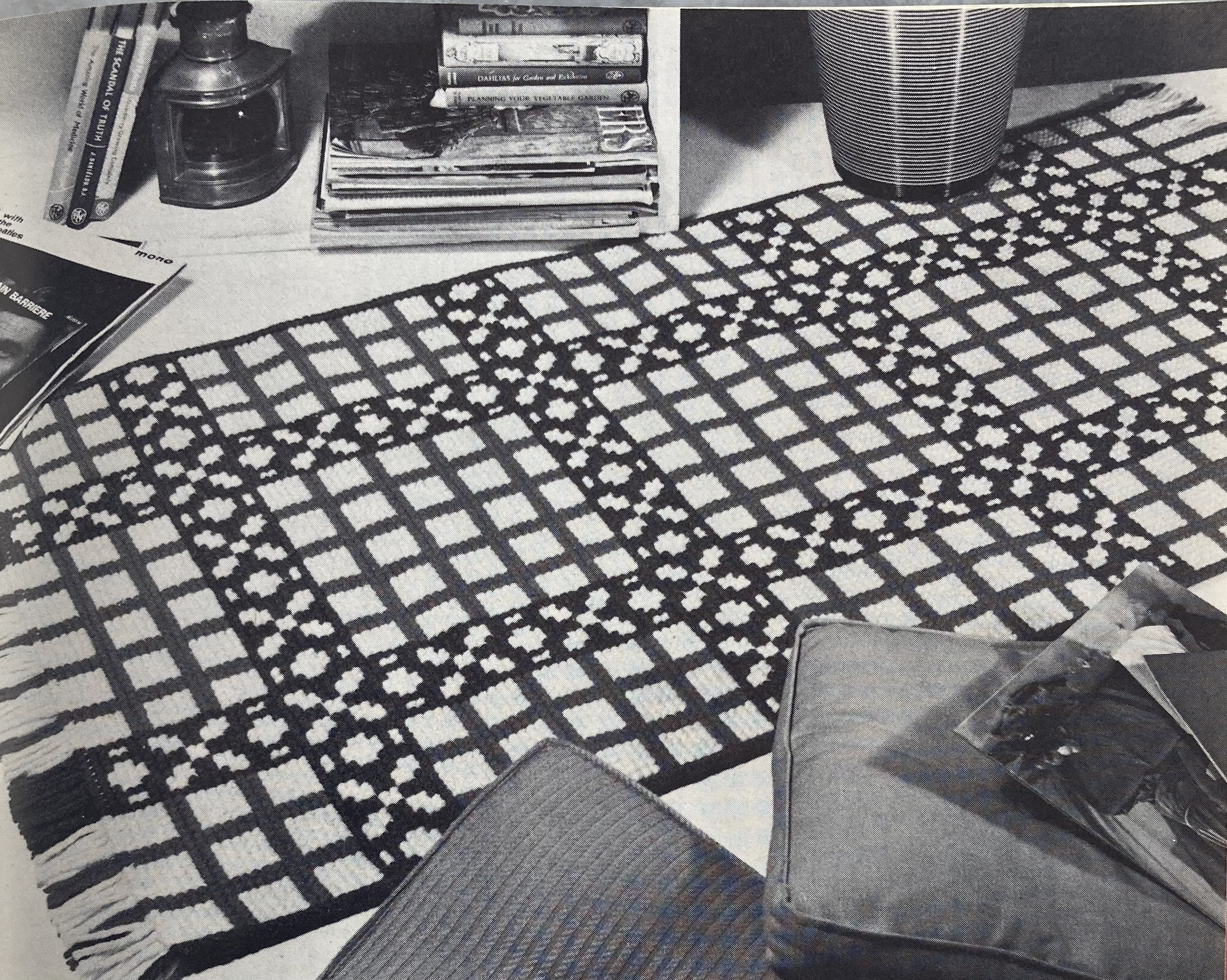
There’s a good selection of easy homeware and embroidery projects: appliquéd garden cushions in “hardwearing hessian” fabric, single flowers cross-stitched on place mats “for an outdoor supper party”, embroidered “needle etchtings” of village scenes (Godshill and Shanklin Old Village on the Isle of Wight), or an easy stitched rug.
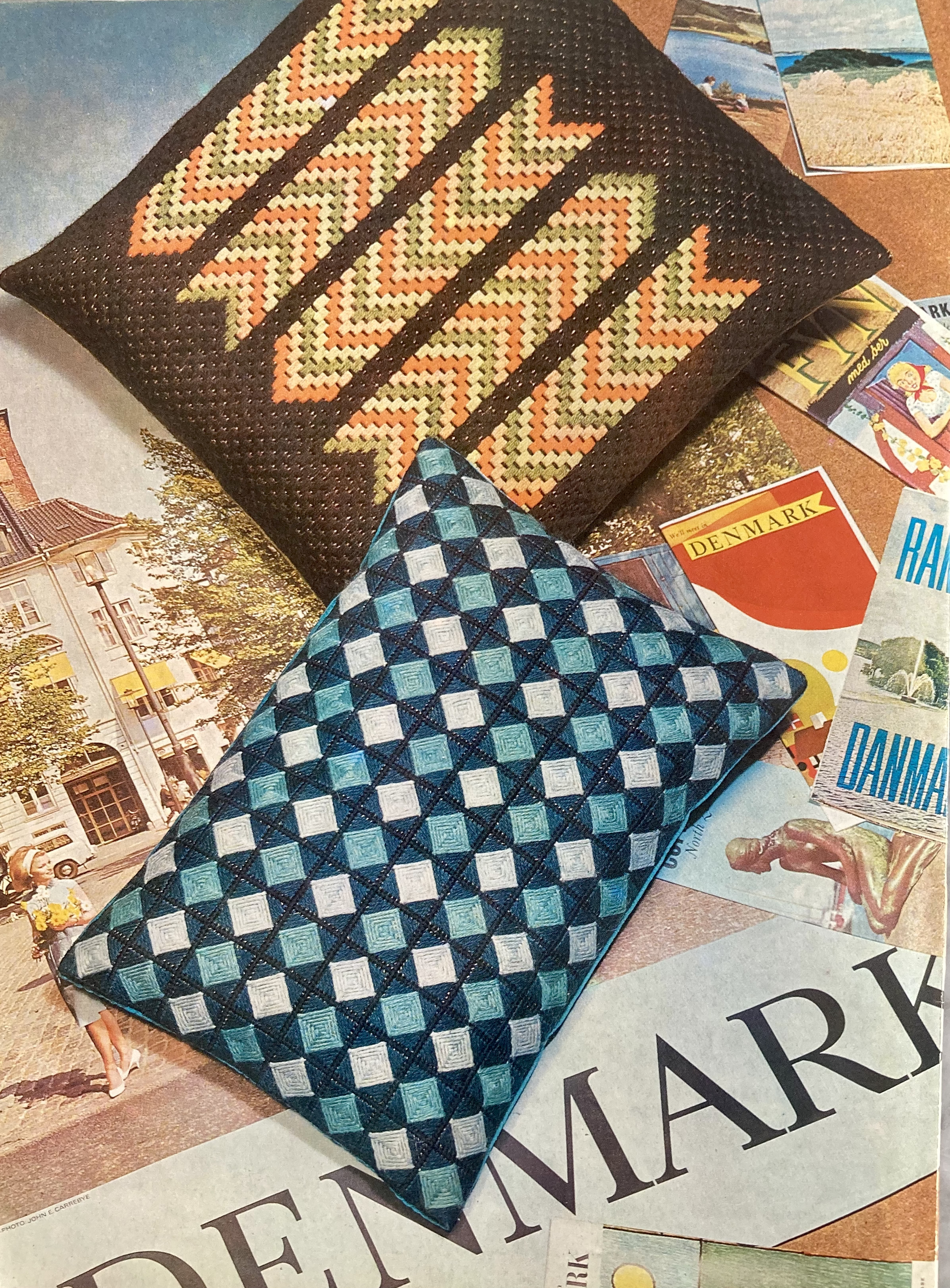
The Danish-design tapestry cushions look more complicated than they are, but are also more complicated than the usual tapestry cushions. Fans of finer work in cotton can make doilies or a traycloth, or pretty trims for bed pillows.
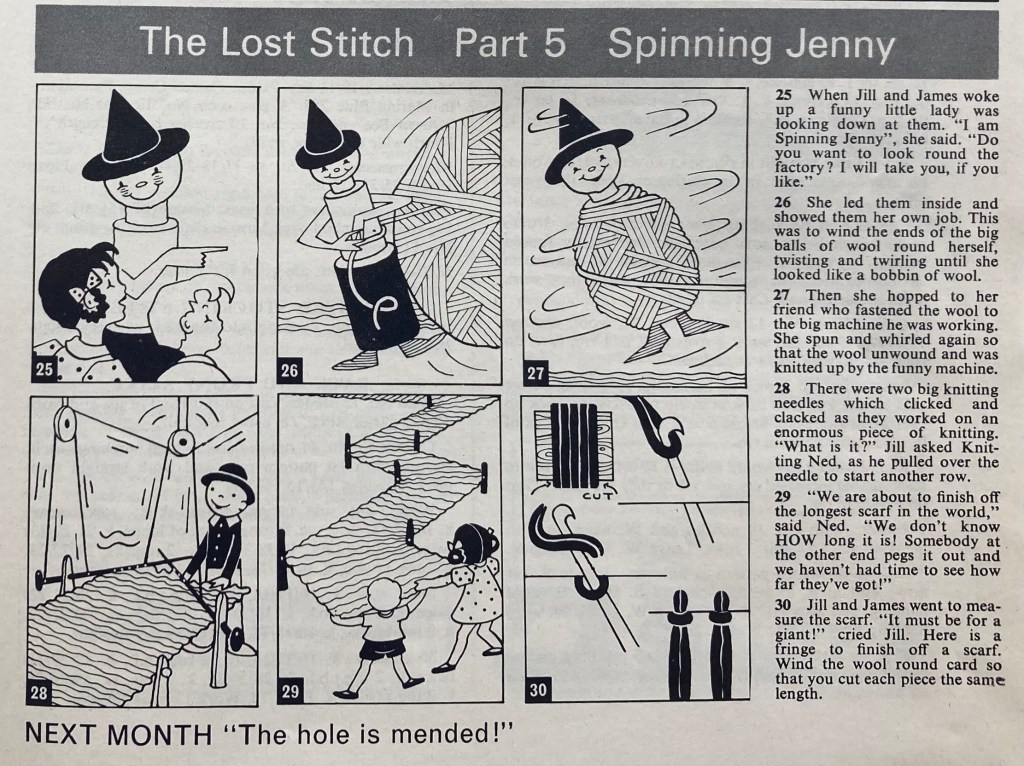
The ads are quite usual: Singer sewing machines, Patons yarns, and a swirly nightgown and negligée from the Scotch Wool Shop. Not to forget: the Turmix knitting machine, Stitchcraft binding cases to store a year’s worth of magazines, and order houses for wools, fabric remnants, etc. The children’s comic follows the adventures of Jill and James searching for a lost stitch and encountering interesting characters such as Spinning Jenny, who shows them how a spinning machine works.
That’s all for this issue! My project will be the appliquéd flower cushion.
Stitchcraft’s April 1965 theme is “Out in the Open Knitting”, with “country” style cardigans and jackets to be worn outdoors, and easy homeware projects that are “just the type of work to do through the lighter evenings and out of doors.” Spring is here!
Our cover photo features a “stroller jacket” made in tweedy “Glenora” wool. At 30 to 32 ounces and made in stocking stitch, I fear it would stretch and sag to much longer than the 34-35 inches given in the pattern. The other adult “outdoor” garments are similarly heavy: a “country jacket” in bulky Big Ben wool and knotted-stitch pattern and a square-shaped men’s jacket in double-moss stitch. Outdoor colours include natural beige and brown tones as well as sky blue.
The “indoor” garments are less bulky and use matching layers to adapt to capricious spring temperatures: a subdued twin set with “braided” bolero-style border on the cardigan and a set of jumper + “overblouse” slipover. The twin set and jumper are in lightweight 4-ply wool, the overblouse in DK.
Colours are muted and match well with the outdoor neutrals: , soft pink, peachy-orange and grey-brown tweed. There’s an “indoor” pullover for men as well, in tweedy green to match the outdoor country theme.
Children of all ages get “bread-and-butter” garments for school and play. There’s a crocheted baby jacket to be made either without shaping (“for a boy”) or with a skirted matinee coat shape (“for a girl”). There’s a tunic dress for a somewhat older girl, featured in one of my favourite photographs ever. Drink your tea… or else! The dress is pretty cool too: decorated with embroidered chain-stitch over nubbly Rimple DK wool.
School-age kids can get a practical unisex waistcoat for school wear, or a very nice fine-knit cardigan in 3-ply “Brilliante” wool. Brilliante was a wool blend using “Orlon” acrylic fiber, which had been invented in 1941 but only started to be popular for hand-knitting use in the mid-1960s. See also: the two advertisements in this issue touting the qualities of Brilliante and Orlon: soft, washable and thoroughly modern.
There are all sorts of homewares to choose from, most of them fairly standard: a striped, darned rug, a church kneeler in trammed-stitch tapestry, cutwork place mats, a simple embroidered cushion… There’s a flowery embroidered tablecloth for Easter (Easter Sunday was rather late in 1965, falling on April 18th, but still — better get that tablecloth done soon!) and two more cushions in counted cross-stitch work.
The two more interesting projects are a pattern for tatted place mats and napkin rings, or tapestry chair seats with an oceanic theme. Tatting designs are rare in Stitchcraft, so this was a special “by request” pattern. The sea-life chair seats are quite pretty and elaborate. One design features sea shells and coral, the other “Pond Life” — flowers, insects and butterflies. They are made with tapestry wool on canvas.
That’s all! My project for this month will be unusual: an adaptation of the cross-stitch “spot” design in knitting. I love the design, but I don’t like counted work and I don’t need any more cushions. I think it would work really well as an argyle-like intarsia + embroidered lines pattern for fingerless gloves. We’ll see how that works!
Stitchcraft sends good wishes for Christmas 1964! Yes, another year has gone by in a flash. Luckily, this issue is full of ideas for quick last-minute gifts, as well as warm clothing for the family.
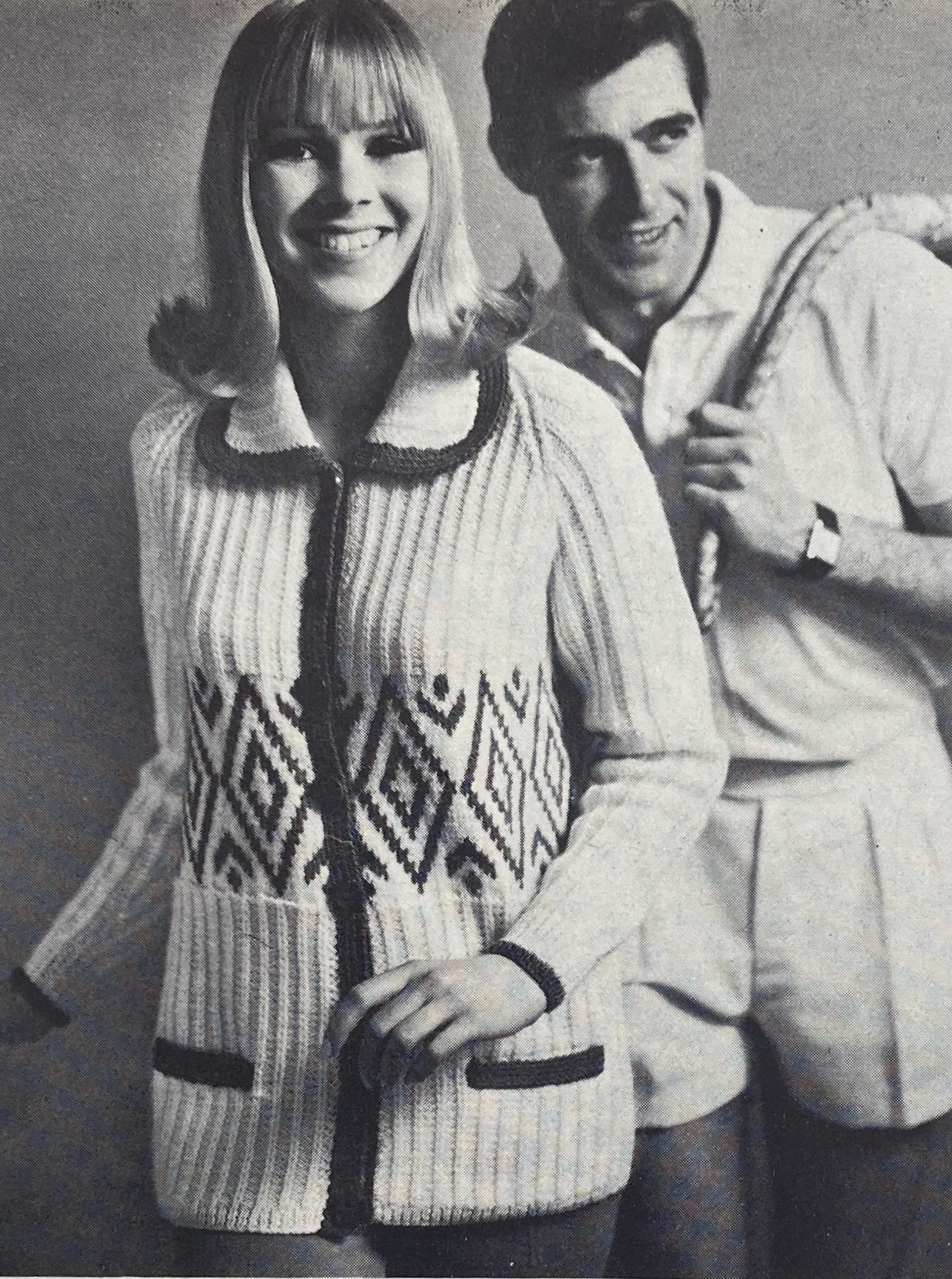
The bulky partner-look cardigans on the front cover are timeless and modern – apart from the 1960s styling and lighting, and the man wearing a shirt and tie, this could be a modern advertisement for ready-to-wear knitwear. The jackets are made in „Big Ben“ bulky wool at 3.5 stitches to the inch, so they might just be finished in time for a winter cold snap. Similarly bulky, but lighter-weight „Ariel“ wool is featured in a vertically-striped („adds to the slimming look“) cardigan for somewhat larger women‘s sizes up to 42 inch bust, and there‘s a warm cabled „Cardigan for Driving“ for him with practical pockets and a big collar.
The women‘s fashions are more sleek, with classic straight lines and unfussy crew necks. A simple ridge-welt pattern can be knit from the bottom up with dolman sleeves for a horizontal stripe, or as a cardigan knitted sideways edge-to-edge for a vertical stripe effect. There‘s also a classic jumper with a twisted-stitch rib panel and a lacy sheath dress for parties.
„Juniors and Tots“ will stay warm in a fun stranded half-cardigan (zip opening from neck to waist – this is called a „Troya“ style where I live but Stitchcraft just calls it a jersey) with matching cap. Therre‘s another cap with cables running around horizontally, as well. „Tots“ from ages 1-4 get a sewn pinafore romper with a cross-stitch squirrel motif or a knitted tunic to wear over a jumper and tights (thank goodness, our child model can have warm legs for once.) Colours are warm and earthy — orange, brown and „Inca Gold“ for the adult and children’s garments and emerald green for the toddler‘s tunic.
The most important, and sometimes most entertaining, part of the December issue is the gifts, of course, and this one is full of „Last minute ideas“ — you can allegedly „make them all in an evening or two.“ Well, evenings are longer in the winter… There‘s a startled- looking owl to sew from felt pieces, and felt table mars with appliquéd butterflies. Felt is used for the draught-stopping caterpillar snake (with pipe cleaner feelers) as well, and cotton embroidered baby bibs shaped like a kitten and bunny rabbit complete the craft menagerie.
Other quick gifts include a knitted ball for a baby, a knitted and a tapestry tea cosy, and a knitted cushion — all good ways to use up scraps of wool. The „Ping the Peke“ stuffed dog looks a bit more time-consuming, and it’s probably difficult to achieve a really professional look with it.
Experienced embroideresses who have efficiently provided all of their Christmas gifts already and are not scrambling to get last-minute gifts finished can make a beautiful and very Christmas-y blue and green cross-stitch tablecloth based on a Rumanian motif. (For once, they didn‘t call a design from Eastern Europe „peasant“ embroidery! Progress.) Those looking for a simpler project can make a pretty dressing table set with flower motifs, or for the whimsically minded, there‘s a cross-stitch cushion „gift for a motorist“ with a picture of a prototype automobile on it.
The Readers Pages are full of ideas of things to buy (Stitchcraft subscriptions et. al.) plus an entire knitting pattern for a child‘s hoodie (2nd time reprint from 1954 — this must have been a very popular pattern) and instructions for an easy appliquéd spectacle case that a child could make „for Granny.“
My project will be the classic jumper with the twisted-stitch panel, in the same fun orange colour as the photo. Happy Holidays!
This month’s project — finished just on time! — was another embroidered cushion, larger and more ambitious than the previous ones I have made.
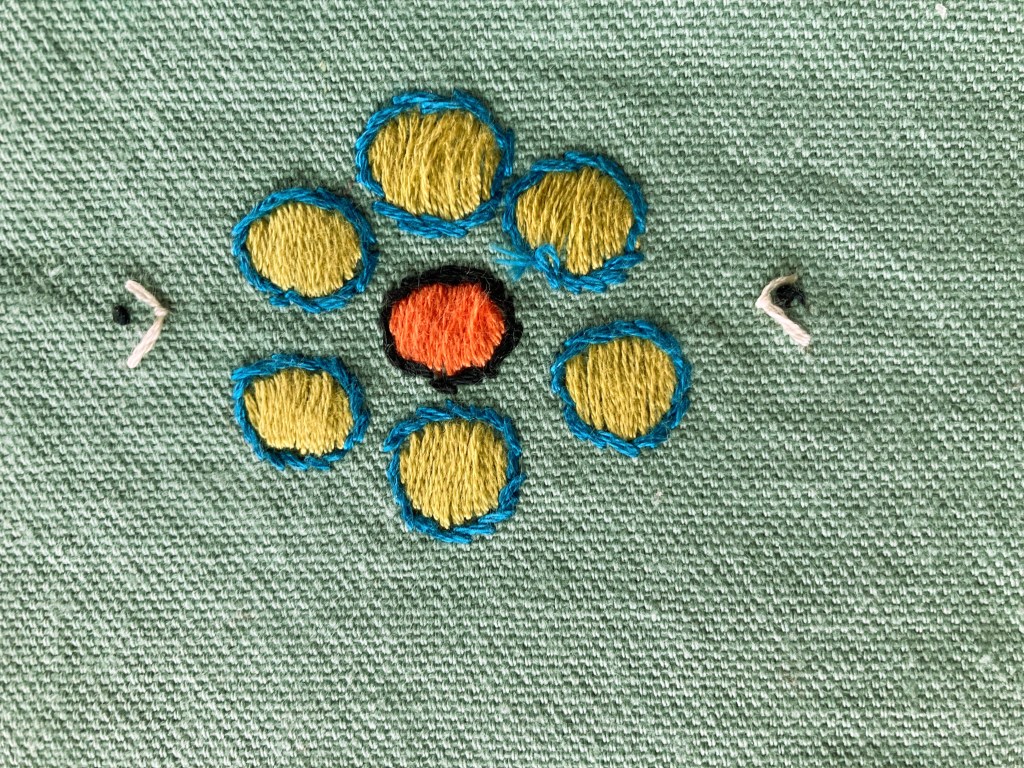
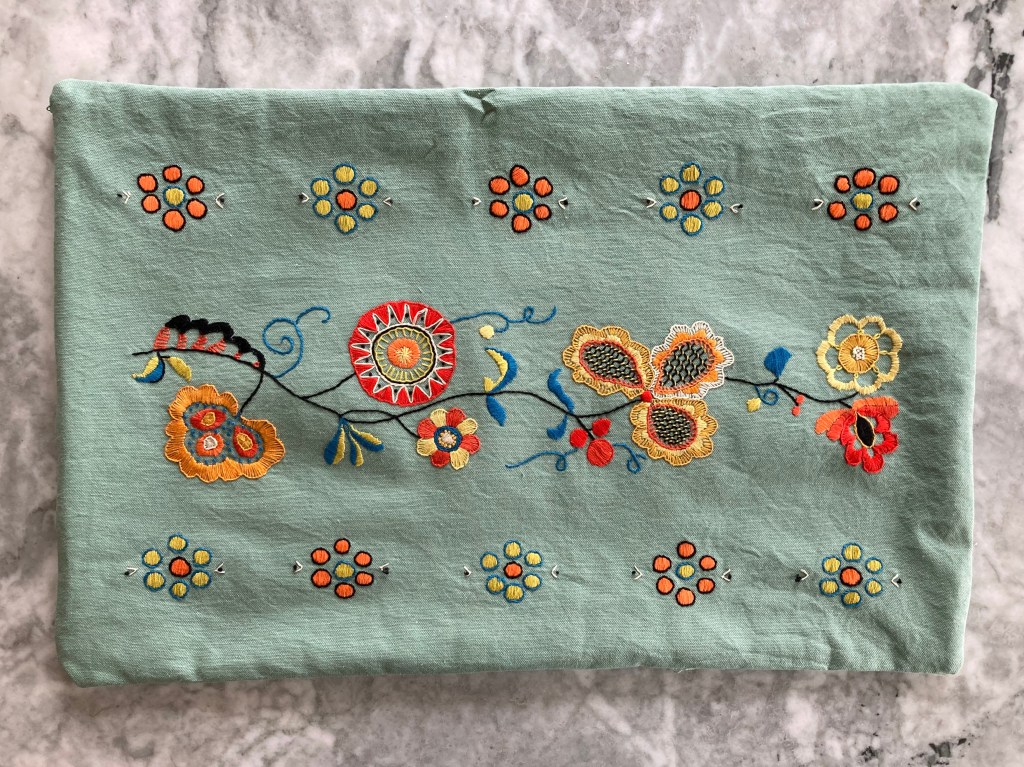
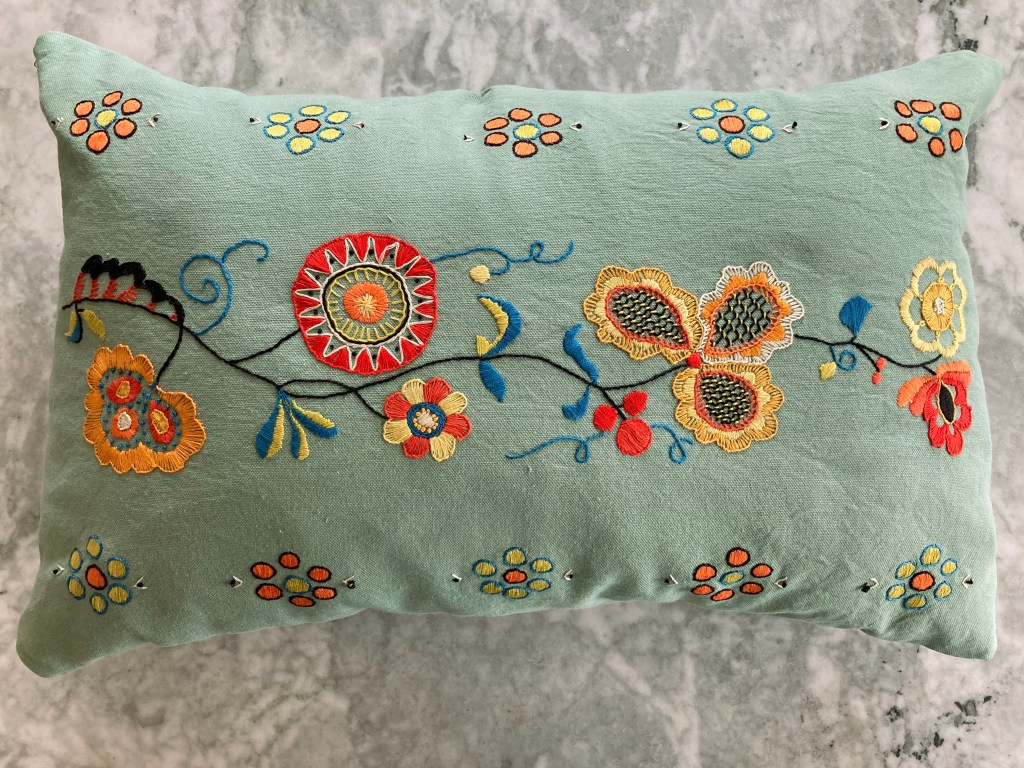
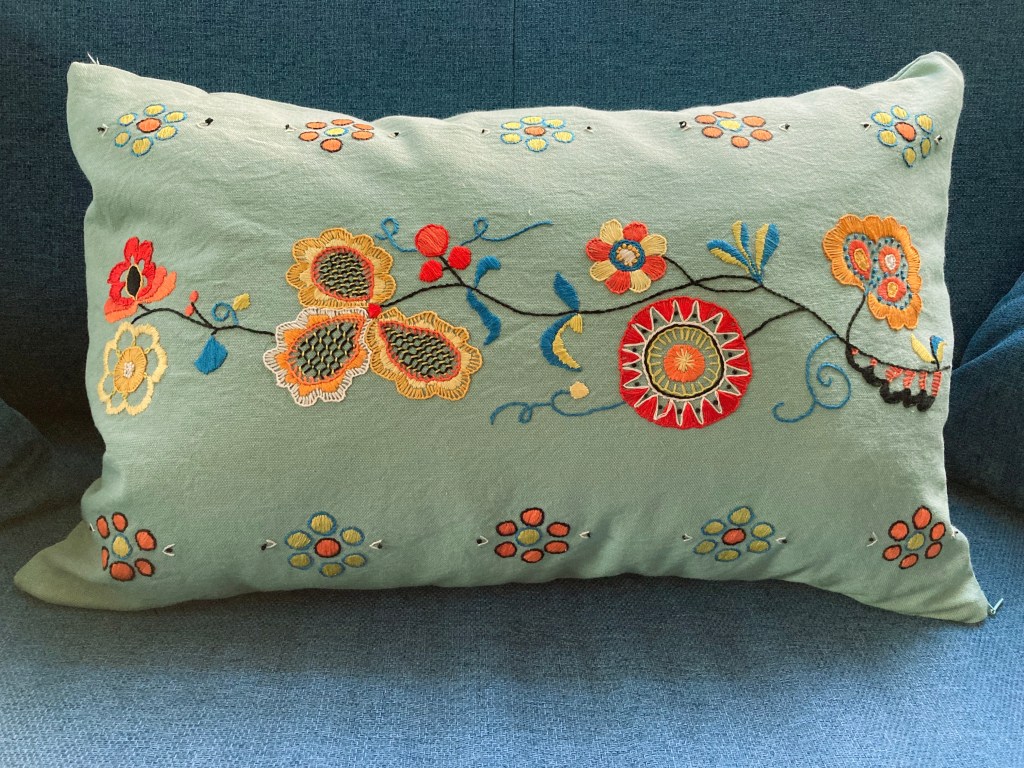
The cushion cover measures roughly 15×21 inches or almost 40×80 centimetres and features a highly stylised flower design in bold colours in the style of traditional Hungarian or Romanian designs. It is… interesting to note that Stitchcraft used very different appellations for traditional embroidery designs depending on the country or region they came from or which style they emulated. Typical Nordic designs were called “Scandinavian” or used the specific country name. Designs based on Indian, Persian, Chinese or Japanese works or styles usually used those country names. But anything related to a Southern or Eastern European tradition — Hungary, Romania, Czechoslovakia (one country at that time), Yugoslavia (country name at the time), Greece, etc. was a “peasant” design, with or without a specific country name. I’m sure it wasn’t meant in an insulting way (also pretty sure that most of Stitchcraft’s readers were descended from “peasants” if you go back far enough), but the word doesn’t quite sit right when you think about it in context; there is an unconscious bias at play, unfortunately typical for the time but worth noticing and pointing out when discussing vintage magazines now.
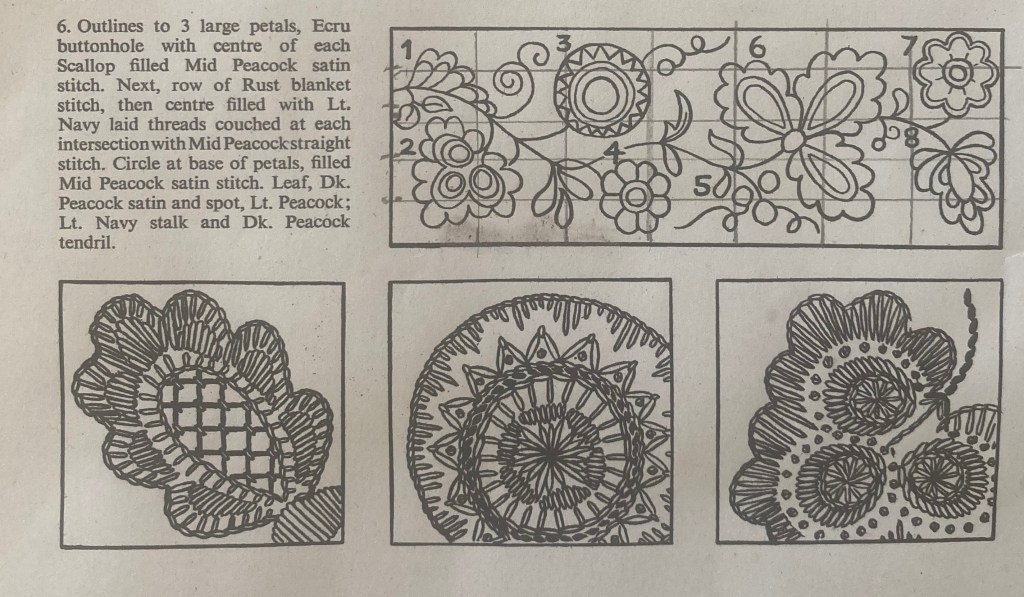
The design, in any case, is beautiful, and is given in two versions, for a cushion or a tablecloth border. As always, the biggest challenge is re-creating the transfer, which Stitchcraft readers at the time had to order separately. There is a colour photo, and helpfully, also a schematic diagram that is presumably exactly the same as the transfer, just smaller.
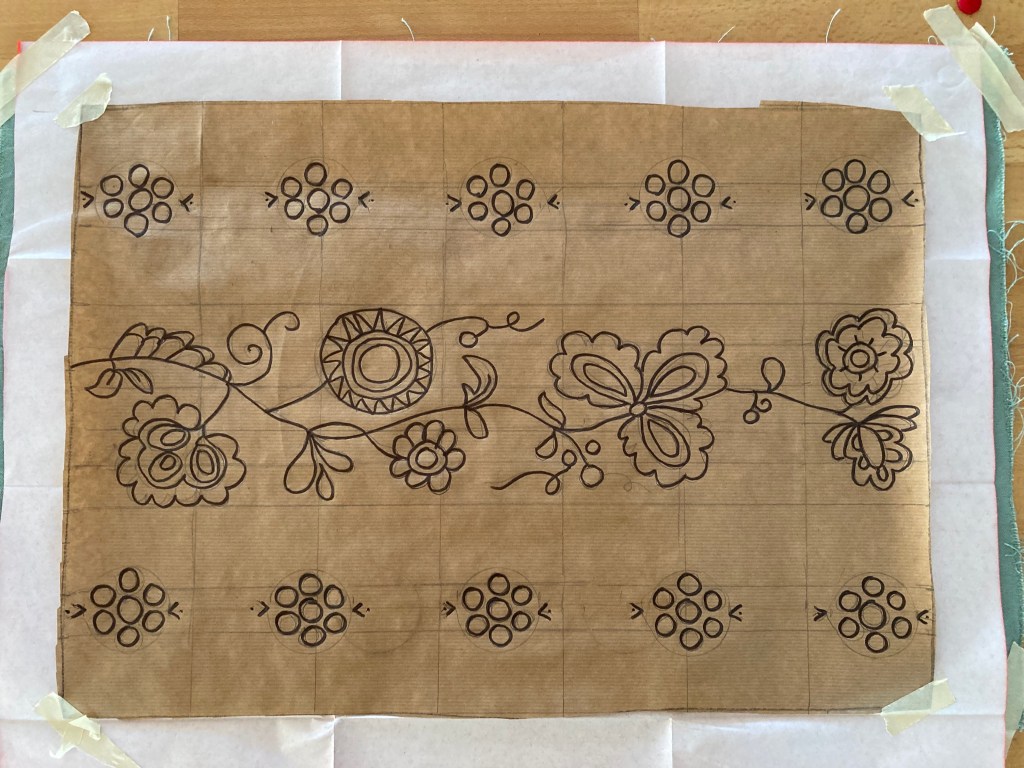
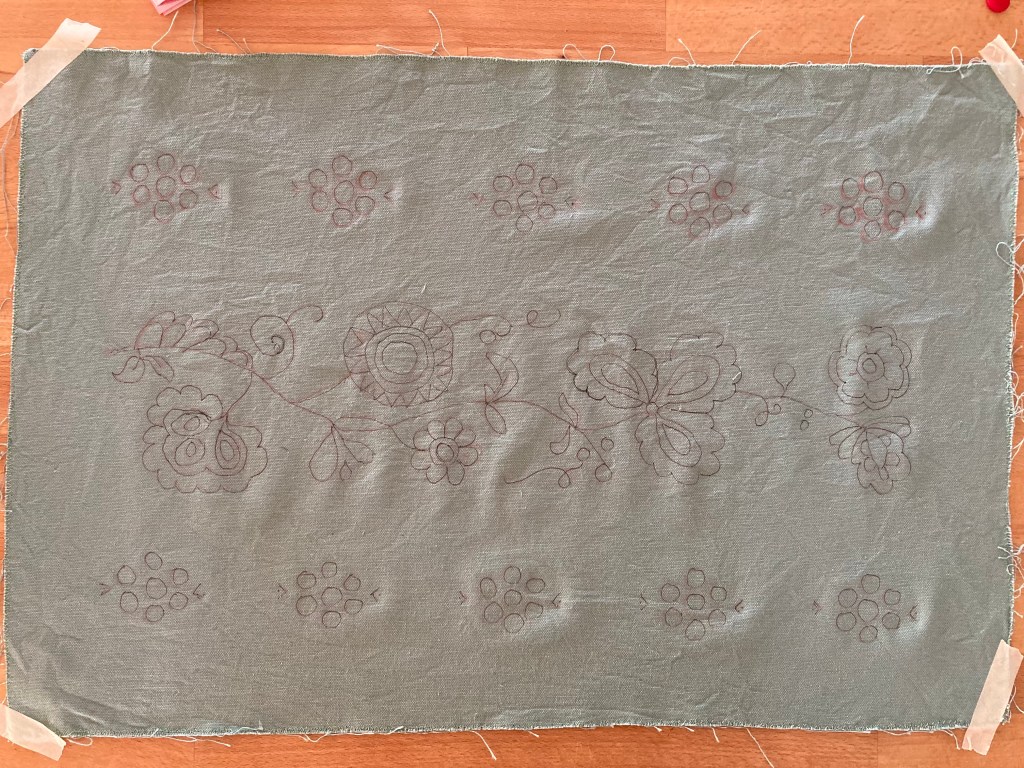
If the cushion were smaller, I might have been able to scan the diagram into the computer, adjust it to the correct size and print it out, then copy it onto the fabric with carbon transfer paper. Or even use the special embroidery printer paper that you can stick onto the fabric and wash off when the embroidery is done. But the design is much bigger than any paper my printer can print. I suppose I could have taken it to the print-and-copy shop, but I chose to enlarge the design the old-fashioned way, by drawing a grid over the diagram and the paper and copying it by hand. It’s a good exercise, and one I can certainly use more practice in. I transferred it with carbon paper and went over it with water-soluble pen. For the border flower circles, I marked the positions and just traced around a button.
My fabric was a fairly heavy furnishing linen in exactly the same colour as the original. The pattern is written for wool embroidery thread, which I would have had to order from the one little shop in Paris that sells it. It’s a wonderful shop, but I wanted to get the project started, so I just went with regular cotton crewel thread. The colours are Black, Peacock, Red, Rust, Dk Orange, Lt Orange, Gold, Yellow, Lime, and Cream. I used the photo and my own taste as a guide to all the shades of orange and yellow. My “Lime”, like the “Lime” in the photo, was more like a slightly greenish lemon, but it looked good (and probably accurately reflected the colour of any real limes available in England in 1964…) On working the embroidery, I noticed that the directions say “White” instead of “Cream”, but I was glad I had used the off-white — I think real white would have been too strong a contrast.
The stitches are all quite basic: stem, satin, buttonhole and blanket with some French knots and one use of Romanian stitch in the middle of the red and black flower. It was good practice for buttonhole stitch and French knots, which were my nemeses before, but have improved significantly due to this project.
I realised while working it that the individual motifs weren’t quite big enough — in the original, they are much closer together, almost touching. There was no way I was going to re-do the entire transfer and start over, so I accepted it.
The work went surprisingly quickly, considering how large the cushion is. I made it up into a cover with the same fabric as a backing and a zipper close. A standard 40×80 cm bed pillow fits in it well. Though my embroidery skills are still a work in progress, I am very happy with the final result.
When I started this project, I had no plans for it after finishing — I have more cushions than couch/chair space, so I assumed I would give it away as a present or sell it. Happily, a colleague noticed me working on it during a break and loved it, saying it was the perfect colour for her sofa and the walls in the living room, and she offered to buy it! So it will have a good home and I earned a bit of money for the craft budget. Perfect.
It’s the start of the autumn knitting season, and this issue’s slogan is “Knitting in Full Swing”. There are practical garments for adults and various ages of children, as well as a new yarn: Patons Flair.
“Flair” is somewhat heavier than DK weight — what is now often called “worsted” — and made of 60% wool and 40% “Courtelle“, a synthetic fibre pioneered in the late 1950s by the Courtaulds company. It features in the green cardigan and the yellow star-motif pullover on the cover. I love the cardigan, with its bright green colour and use of simple garter-stitch ribs and bobbles to decorate the fronts. The placement of the motifs on the yellow pullover is… interesting. I guess it works OK on a male figure, but I would not recommend it for a partner look! There’s also a plain, classic V-neck pullover for him and a “blister stitch” sweater for her on the back cover. Bright, cheerful colours are in fashion. (The men’s V-neck pullover colour name is “Sorrento” — anyone know what colour it is?)
The non-Flair adult garments are all made in DK weight yarn: a “country sweater” in a twisted-rib pattern with an oversized Vandyke collar, a complicated cable-and-stripe men’s shirt-style pullover, an elegant set of slim skirt and “overblouse” and a long, skinny sweater “for teens”. All of them feature interesting stitch textures, particularly twisted-rib patterns and bobbles, and interesting details like the fake “pocket” decorations on the front of the overblouse. The cable-and-stripe pattern is especially complex and uses separate lengths of wool for the vertical twisted ribs while stranding the stripe colours behind. Aside from the teen sweater in “Flamingo”, the colours are slightly subtler, with light “Cream Whip” and dark “Loganberry” for the base colours (sounds delicious) and accents of light blue, olive green and melon-orange.
For the younger members of the family, there’s a fun and cheerful five-piece set “for twins”, consisting of a skirt, shorts with braces, a short-sleeved jumper, cardigan and beret. They’re all made in DK wool in a similar bright, sunny yellow to the man’s pullover on the cover. Continuing the matching-set-for-babies look, this month’s issue has a dress and bootees for a six-month-old, to be followed by a matching matinee coat and bonnet in next month’s issue.
With all these lovely things to knit, it’s amazing that there are any homeware projects in the issue at all, but there are always a few utilitarian projects: here, an easy cushion / tray cloth or a thick rug or mat for kitchen or bathroom. For more ambitious embroideresses, there’s a tablecloth or cushion in bright “peasant” design (Stitchcraft‘s choice of word for traditional or folk designs from certain countries and not from others; I do wish they would just call them all “traditional designs” and leave it at that). The design, like the knitted garments, is big and bold and fun and colourful on the cushion, and slightly more subdued in red and blue for the tablecloth.
Though embroidery doesn’t feature big in the issue’s projects, it does have a place in the back pages: in the new children’s comic, “Anne and her Embroidery”, little Anne is bored on a rainy day and passes the time by learning to embroider pictures of the flowers in her window-box. Two pages later, there’s a full-page advertisement for a new tapisserie wool suitable for both tapestry and embroidery. Coincidence? I think not! The other interesting ad is for the new Patons Flair yarn, highlighting its easy care and washability.
That’s all for this issue! My project will be the embroidered cushion.
Greetings from Kent from your March 1964 issue of Stitchcraft, featuring “Spring Into Summer Fashions” photographed in “some of your favourite spots around Canterbury and Tunbridge Wells” so that you can see the knitwear “in their own settings as you would wear them.” Shall we go?
“For our climate”, writes editress Patience Horne, the best outfit for the spring and early summer months is a sweater suit, quickly knitted in double knitting wool. Cool blues, salmon pink and yellow-green are the trendy colours, and pattern stitches are used sparingly as an accent on hems or collars, or as a single vertical stripe panel.
Our cover model is wearing a twin set with a trellis pattern accent on the cuffs, pockets and collar of the jacket and the hem of the short-sleeved jumper underneath. Here, again, we see how twin-set styles have changed since the 1940s — everything is long, loosely-fitting and unshaped. The “Golden Willow” sweater suit on the inside front cover is similarly unfitted, with a cable “V” pattern stripe. For “The Creamy Look”, there’s a a high-buttoning cardigan with a subtle diamond pattern on the fronts. All three models are made in “Double Quick” knitting.
“Double Quick” is also the featured wool for the men’s and women’s “sport sweaters” in the lovely full-color center photo. I’m not sure what makes those two garments more “sporty”, as they look equally as elegant as anything else in the issue. His sweater is worked in stranded technique from a chart included in the instructions, and hers is made in plain stripes with the diamond pattern embroidered on later in Swiss darning / duplicate stitch. If “Double Quick” is not bulky enough for you, there are matching sports sweaters for him and her made in bulky “Big Ben” at 3 1/2 stitches to the inch. The salmon-pink jumper (Stitchcraft calls is a “sweater blouse”), by contrast, is made in 4-ply wool in a classic shape, with pattern accent panels in an interesting mini-bobble stitch.
Babies get a wonderful pram set of footed leggings, coat and matching bonnet. It’s referred to in the index as a “four-piece” set, but I am at a loss to find a fourth piece anywhere in the instructions or photos. Maybe they planned to make matching mittens and then didn’t? Bigger children get a cute slipover with an argyle pattern on the front. The photo is very 1960s, with the girl freezing her legs off in a micro-mini skirt and the boy sporting a bow tie.
The homewares are fairly standard: a tea cosy, apron and tray set and a knitted kangaroo with baby for your bizarre/bazaar novelty needs (there’s also a reprint of a 1956 knitted ice-skating panda bear doll, if the kangaroo isn’t enough for you.) You can also cross-stitch a rug and pyjama case with square-headed dancing soldiers to haunt your small son’s dreams, or some flowered place mats, a cushion or wall hanging, or another cushion inspired from a traditional Greek star design.
In the “Readers Pages”, a new serial comic is starting: “Susan’s Sampler”, in which our heroine learns embroidery from a magic needle, and our back cover ad (for Patons Double Quick Knitting wool) shows yet another woman lovingly looking up at a man who has trapped her with her back to the wall in order to mansplain something to her. Feel free to give the photo some speech bubbles befitting a modern interpretation of this scenario!
That’s all for this issue. I’ll be making the child’s slipover and for once, I’m quite sure it will be done on time. Happy Spring!
This month’s project was a crocheted cushion “to use up your wool left-overs.” It was promised to be “very quickly and easily made”, and it was! Nota bene, today is September 5th, I started this project on the evening of September 1st, and it is already finished, including blocking and photographing. I don’t think I have ever made any project, no matter how small, that went this fast.
It’s designed for DK wool and the original colours are black, flamingo pink, silver and white. Of course, I used leftovers of DK wool that I had in stash, and they happened to be more in the blue and green spectrum. The black is Jamieson’s Double Knitting left over from this blazer, the dark grey and turquoise are Reginella wool-alpaca mix from Chile left over from a non-vintage project, the more blue-blue is lovely Schoeller&Stahl left over from swatch knitting, the slightly darker green is Drops Lima left over from another non-vintage project and the lighter green is not technically a left-over, but hand-dyed wool from a knitting colleague. Yay, I used up some leftovers! The pattern is a standard granny-square shell stitch which just continues around to make… two giant granny squares.
I worked on both squares (front and back of cushion cover) at the same time in alternatum and was glad I did, because I ran out of some colours sooner than expected and had to adjust the colour scheme accordingly. I like how the colours turned out. The finished size in the pattern is 13 inches square, but I happened to have a cover-less cushion in the sewing drawer that was about 15 inches square, so I added another colour pattern repeat to make it fit. I considered dyeing the cushion turquoise, since I had some fabric dye and the crochet is fairly hole-y, but in the end I thought the white cushion showing through gave the dark colours in the crochet work a bit more pop. The edges of the two squares are crocheted together on the right side.
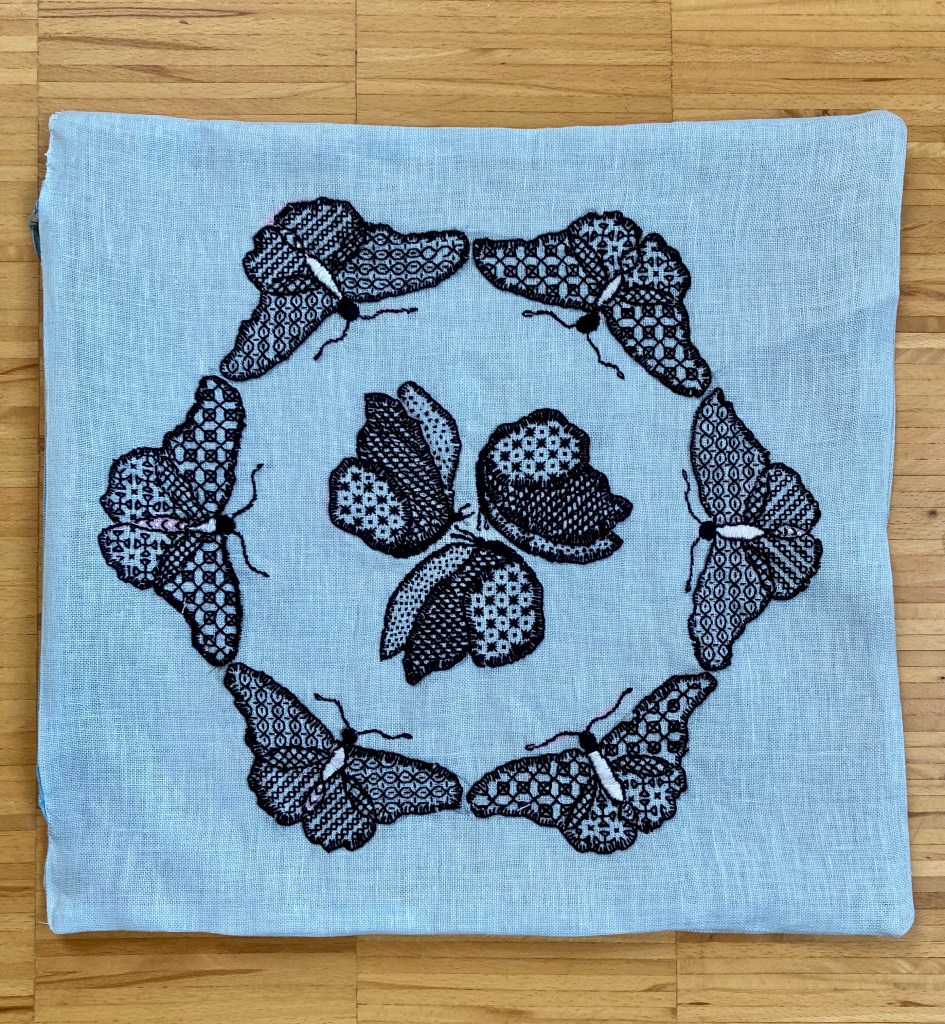
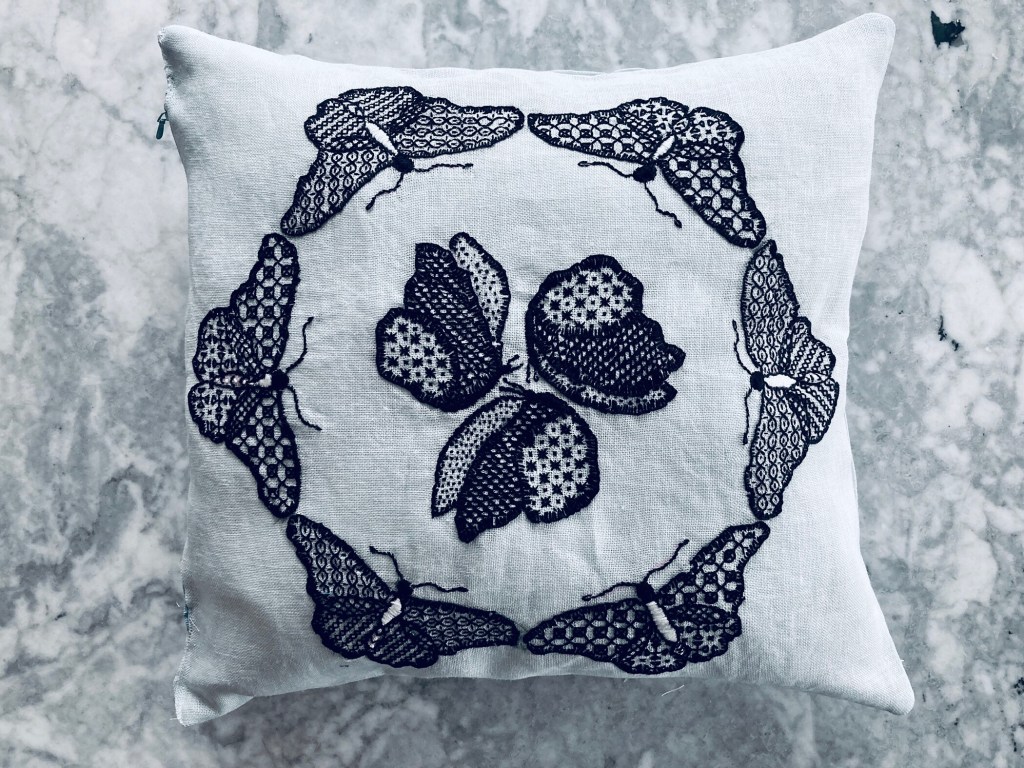
What more is there to say? I now have time to finish all those WIPs, so stay tuned for progress on the August 1963 cardigan… and the April 1963 embroidered blackwork cushion… and the I-don’t-even-remember-when-I-started-it-it’s-been-so-long epic Jacobean appliqué cushion. So many cushions, not enough sofas! Here’s one, at least.
End of the Season! Sadly, yes, the “holiday” season is drawing to a close and although it’s only the last day of July, it feels like autumn is around the corner. On the bright side, the late summer and autumn issues of Stitchcraft are always the most fun, with a good range of lighter-weight and warmer garments, children’s things for school, and more intricate homewares.
“The trend for colour use is in these bold clear motifs” writes “editress” Patience Horne, a trend which is reflected in “chunky”, boxy shapes, bright colours and simple stripe or geometric designs. The cover illustration shows two of a three-piece “his and hers” set — cardigan and mock-layered turtleneck for her and a buttoned-collar pullover for him– that all make use of single bold stripes. The woman’s matching pullover is made to look like a deep V-neck over a turtleneck top, but the under-layer is just an insertion knitted separately and sewn in.
There’s more use of simple, geometric motifs in the other women’s garments: a classic pullover with a wide check stripe down the front in double knitting and a colour-block cardigan with diamond motifs made in bulky “Ariel” wool. Diamond shapes are still trending from last month. There’s a bulky indoor-outdoor cardigan jacket in Big Ben wool, made in a slightly less simple striped waffle stitch. Necklines are high, whether buttoned or not, and collars are either big and square or non-existent.
Continuing the interesting neckline/collar trend, we’ve got unisex “tomboy tops” for children, with a cute “tie” decoration on one of the pullovers. Simple, bold stripes and pointy diamond patterns show up here as well, whether in colour or as a stitch pattern element. The one lighter-weight design is a square, buttoned-neck pullover with double stripes near the hem and a coordinated skirt. Rounding out the garments is a lovely classic cardigan for men featuring cables on the upper yoke and — you guessed it — in two simple lines down the fronts.
Unlike the knit designs, some of the embroidery and tapestry projects are quite elaborate and ornate. Look at these Chippendale chairseats! That seems quite out of place to me in a modern 1963 home of clean lines and unfussy decoration, but of course many of Stitchcraft’s readers were older and/or conservative in their style, and probably not on the cutting edge of home redecoration even if they had the money to spend on it (which I’m guessing most of the readership didn’t.) The “peasant motif” tablecloth and cross-stitch place mats have more of a clean, colour-block aesthetic. I really love the tablecloth design! It can also be adapted for a cushion. Speaking of cushions, here’s a fancy one made of essentially two very large, intricately knitted lace doilies joined together around the cushion base.
And let’s not forget that standby of every proper 1960s home… the fluffy hand-made bathmat and matching well-dressed “pedestal” aka toilet! Hats off to every grandmother and great-aunt who kept true to this amazing home furnishing concept throughout the rest of the 20th century. (Seriously, one of my great-aunts had a setup like this in her guest bathroom in the plushiest, fluffiest, yellow and black shag carpeting you could imagine, and I’m pretty sure it stayed there until the turn of the millennium.)
That about wraps it up for this month’s issue. The ads are unspectacular and a new children’s comic is starting up, featuring twins Joe and Jenny on their hunt for the legendary “Smuggler’s Sack” that just might be waiting to be found in the caves near the beach. Good luck, little friends! My project for this month will be the men’s cabled cardigan.
“In the Holiday Limelight” is the theme of this month’s issue, covering sporty, casual garments for holiday wear, a few slightly more dressy options and — with one incredible exception — quick and easy homeware projects.
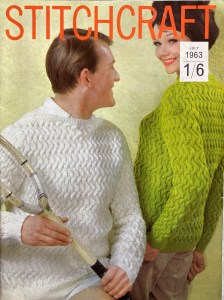
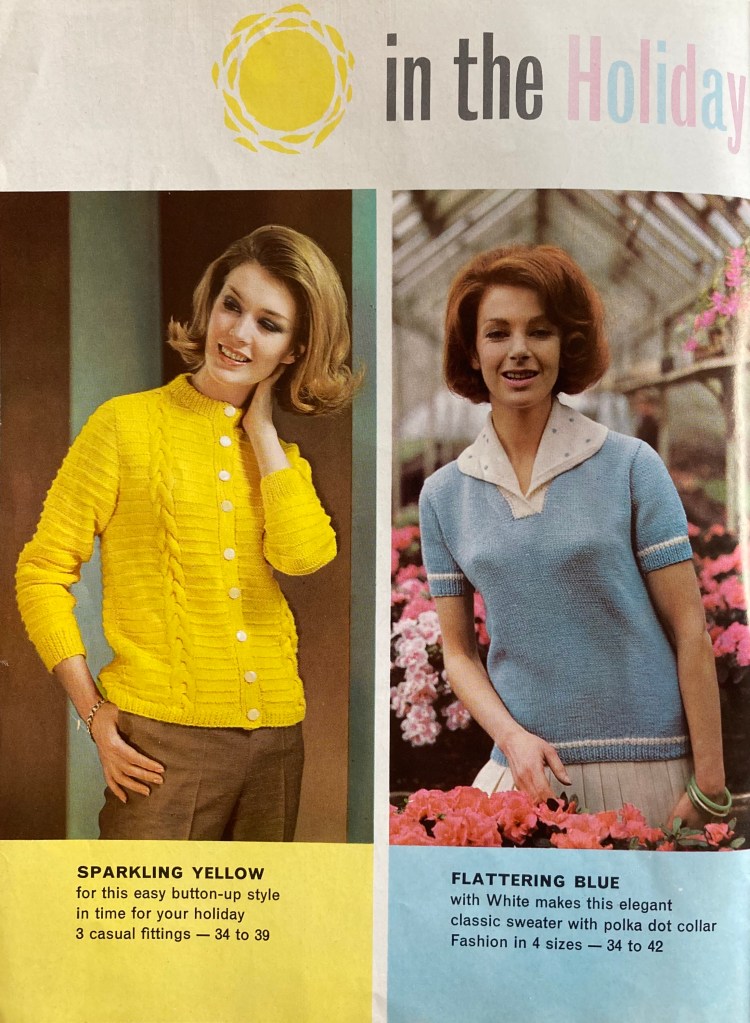
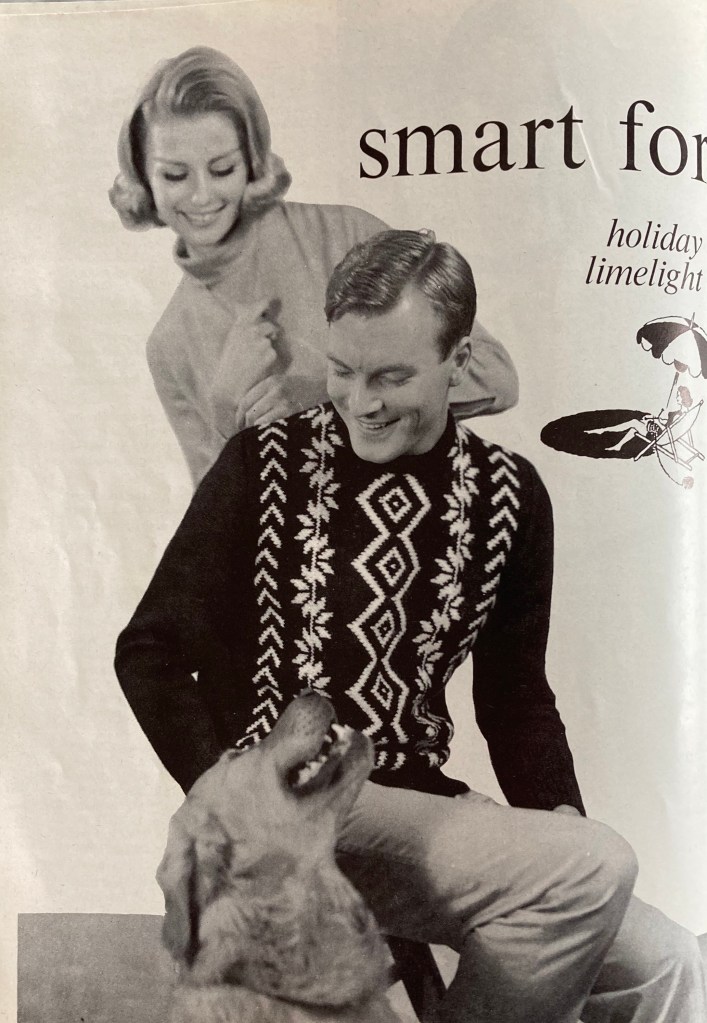
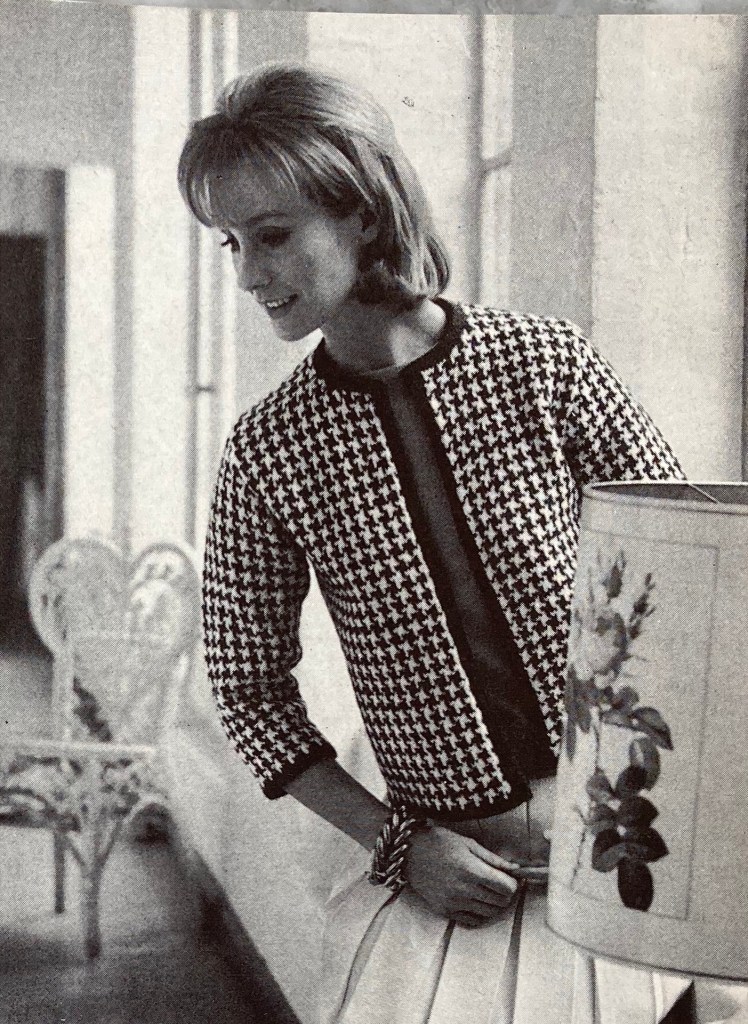
Most of the adult garments seem quite warm and heavy for summer wear, but most are meant to be worn as outerwear in an unpredictable northern-maritime climate. Our partner-look cover duo, for example weighs in at 22-24 (hers) or 28-30 ounces of heavily cabled DK wool and is expressly touted as “in colour for sailing” (hers) or “white for tennis” (his). I imagine it would be quite warm for tennis but probably very good for sailing, as the textured stitch pattern would ward off splashes and insulate from cold winds. Unusual cables are also featured on the bright yellow button-up cardigan, while the design (“from Vienna”) of the mens’ black-and-white pullover suggests a cable-like vertical movement in the sideways-knitted colourwork front piece. A short-sleeved collared jumper and houndstooth-pattern jacket round out the warmer, double-knitting-weight garments.
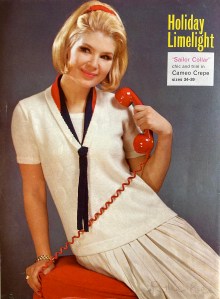
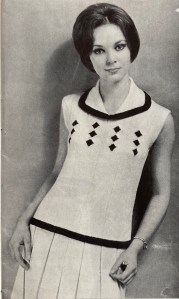
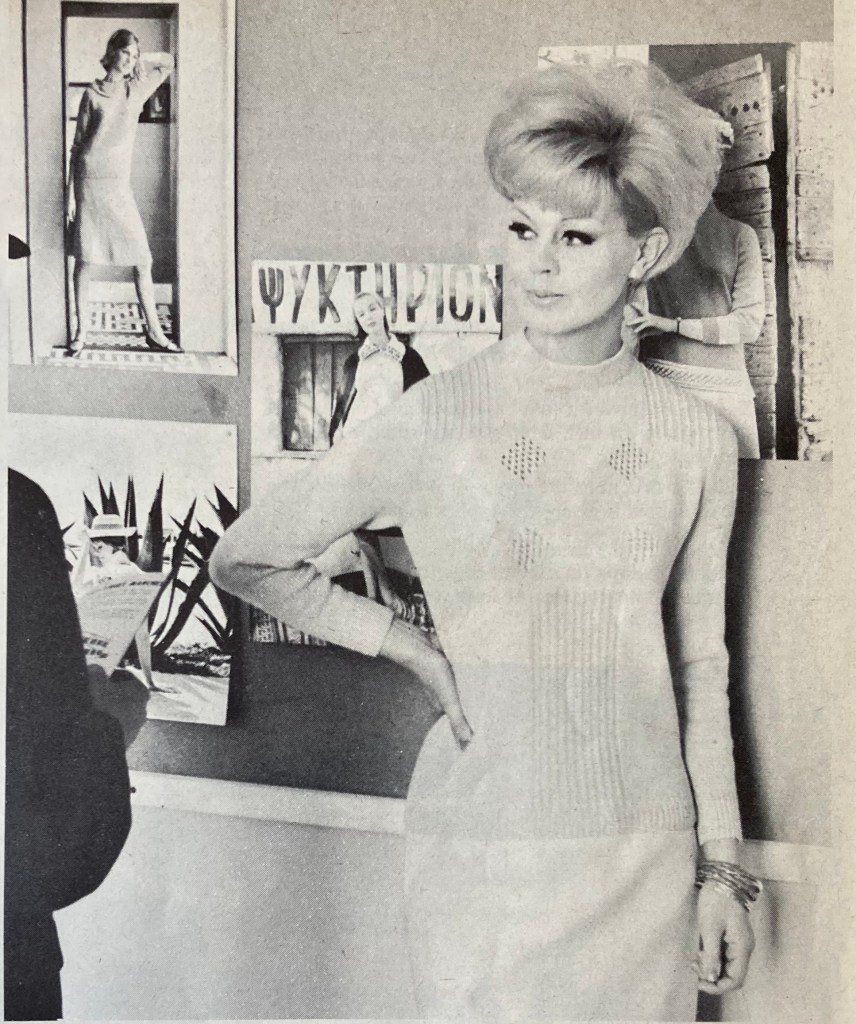
For more dressy occasions, there are two lightweight jumpers made of Patons Cameo Crepe (fingering-weight wool with a tight twist for a smooth texture in stocking stitch). Both have a slightly nautical theme, at least in the names and colour choices. The “sailor collar” jumper is excellently photographed with matching red hairband and telephone! The diamond-pattern jumper in white with marine blue has a similar round collar to the heavier short-sleeved jumper, as well as a similar idea of using little dots or diamonds as decoration. (I imagine the diamonds must be placed very carefully to fall above the bustline.)
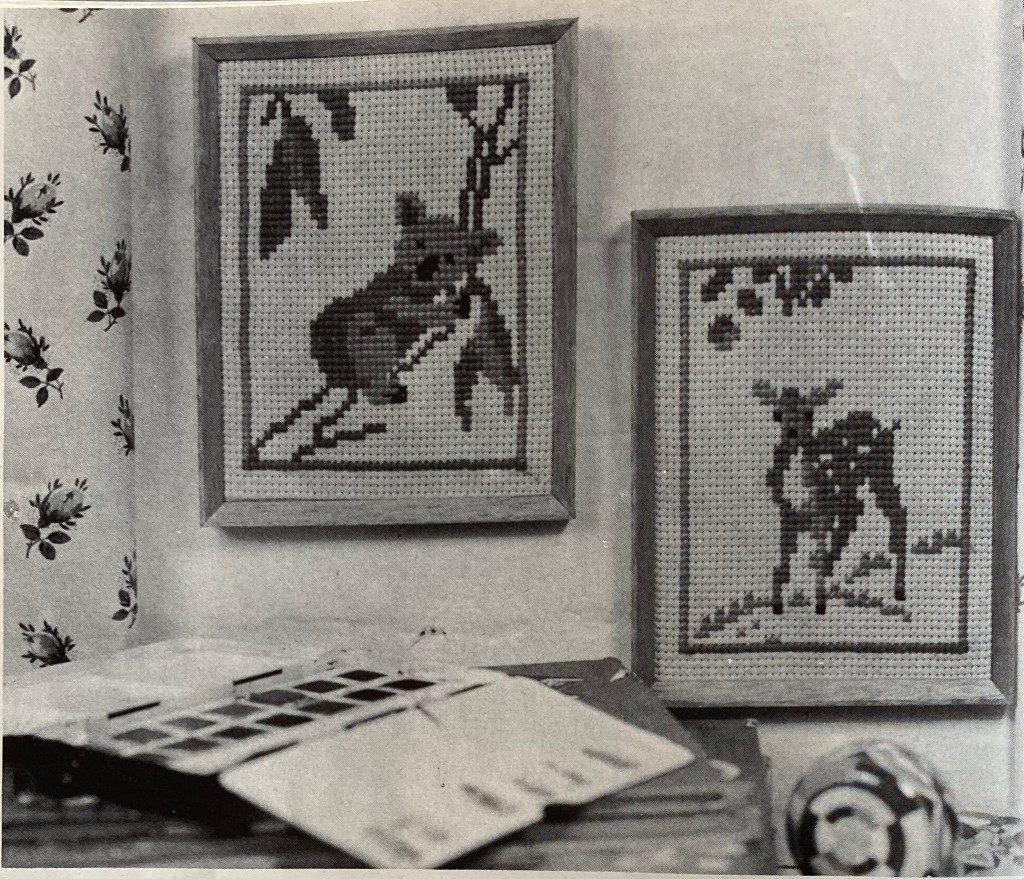
There’s a charming striped cardigan for a young girl, who could be encouraged to practice her budding handcraft skills on two miniature cross-stitch pictures — a deer and a koala bear. Embroidered on Bincarette mesh fabric (an older word for Binca fabric, roughly the same as Aida but slightly fewer threads per inch), the background is not filled in, so there are very few stitches to actually make and they could be easily done by a young child to hang in her room. More experienced “embroideresses” can make this densely-worked cushion, which combines cross-stitch with Holbein or double running stitch in a tessellated design.
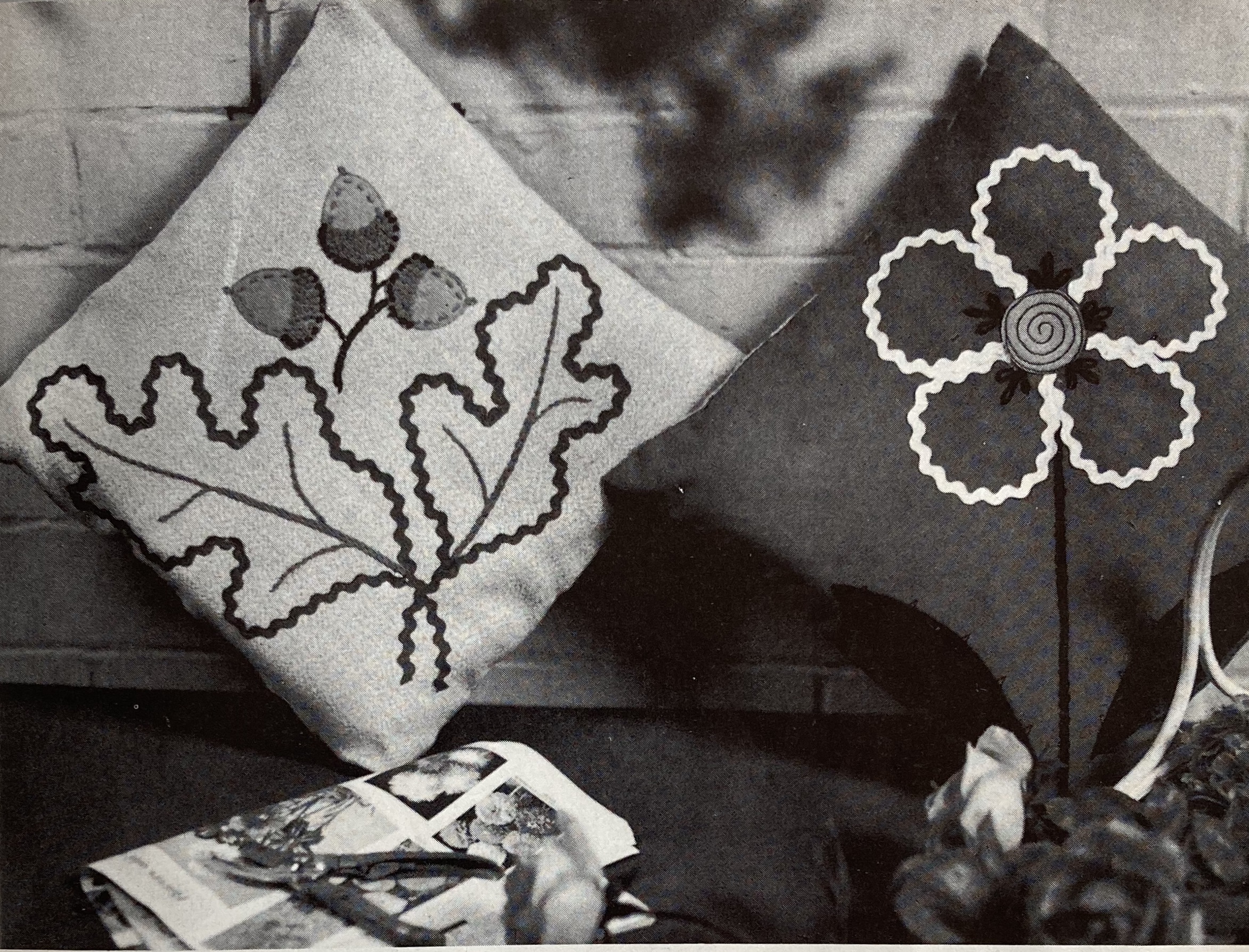
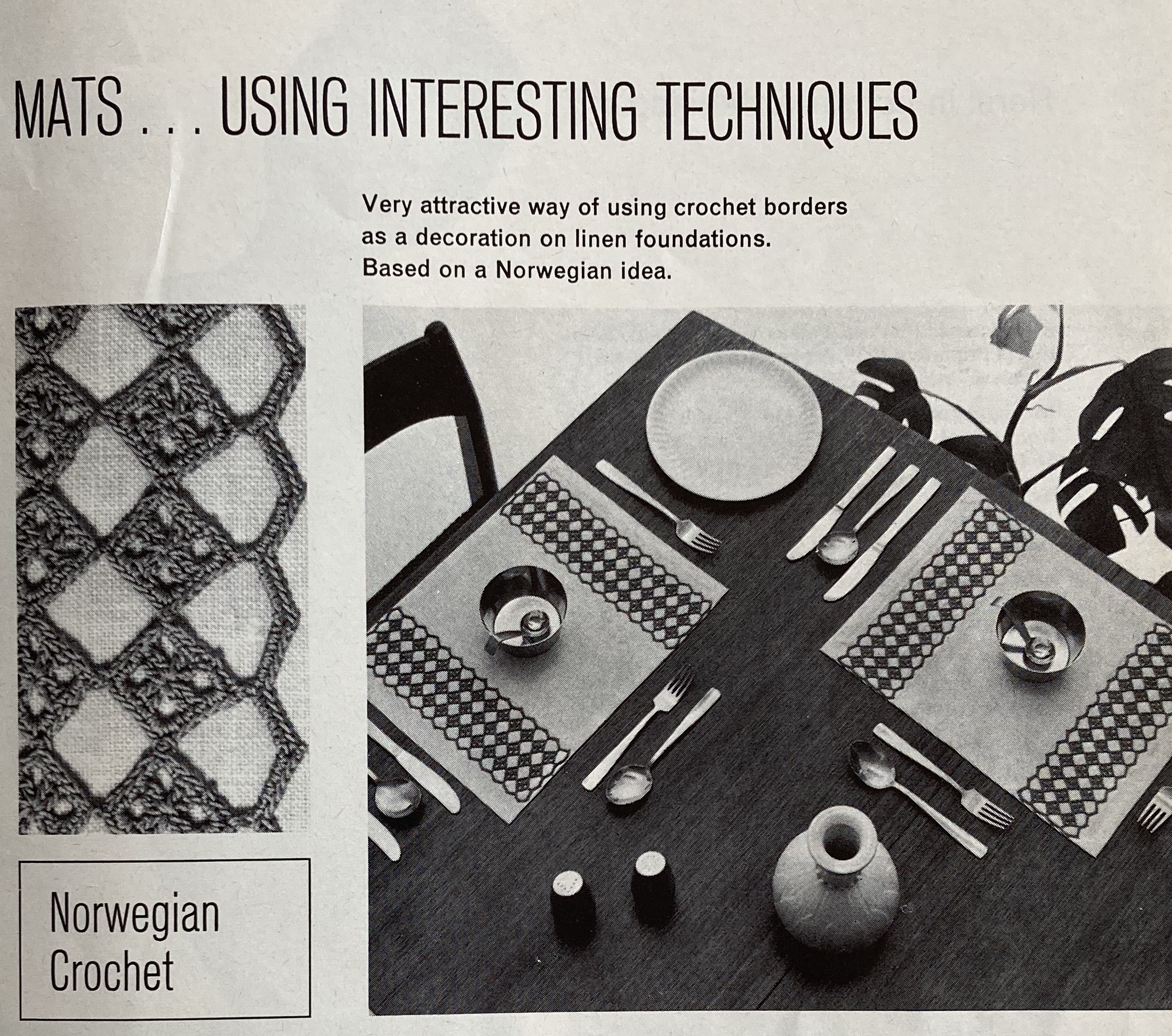
Continuing the homeware designs are two hard-wearing, but very easy to make, applique/embroidery cushions for the garden. Perfect for a staycation, they are made with strong sailcloth material and stuffed with foam clippings to repel moisture. Readers could set their garden table with interesting placemats made in blackwork or with appliquéd crocheted bands. Especially pious readers who prefer to spend their holiday doing church work can even make a kneeler, a Bible marker and/or a secular footstool cover in tapestry.
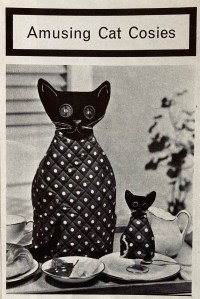
Oh yes, and in the is it-for-a-bazaar-or-is-it-just-bizarre category, here are some “amusing” coffee-pot and egg cosies in the form of sad, legless, eyes-follow-you-around-the room-quilted cats! Add them to your collection of murderous crocheted clowns, evil felt Father Christmases and disembodied-head egg cosies, or demand that your church sell them at their next bazaar in return for the lovely Bible marker you made for them.
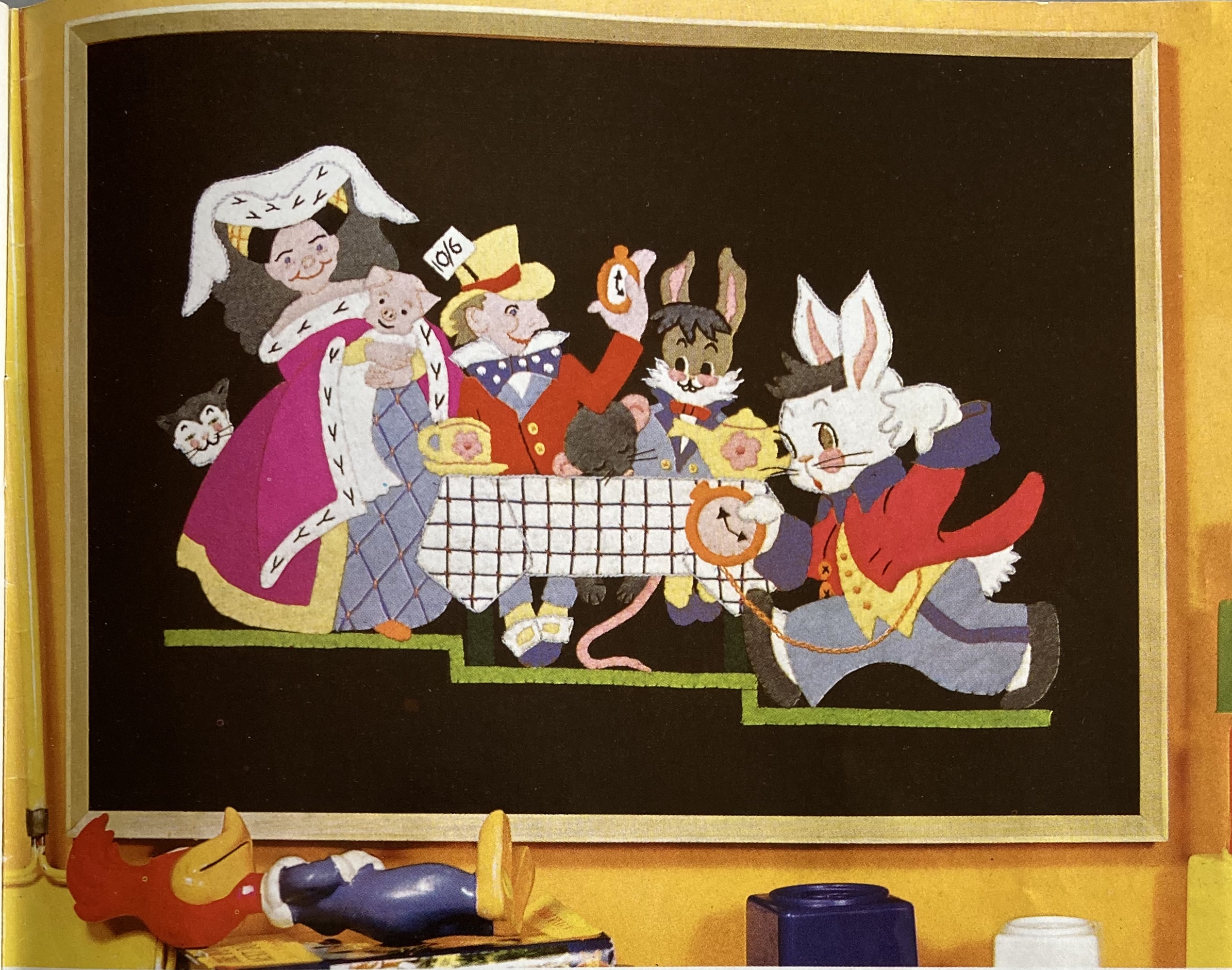
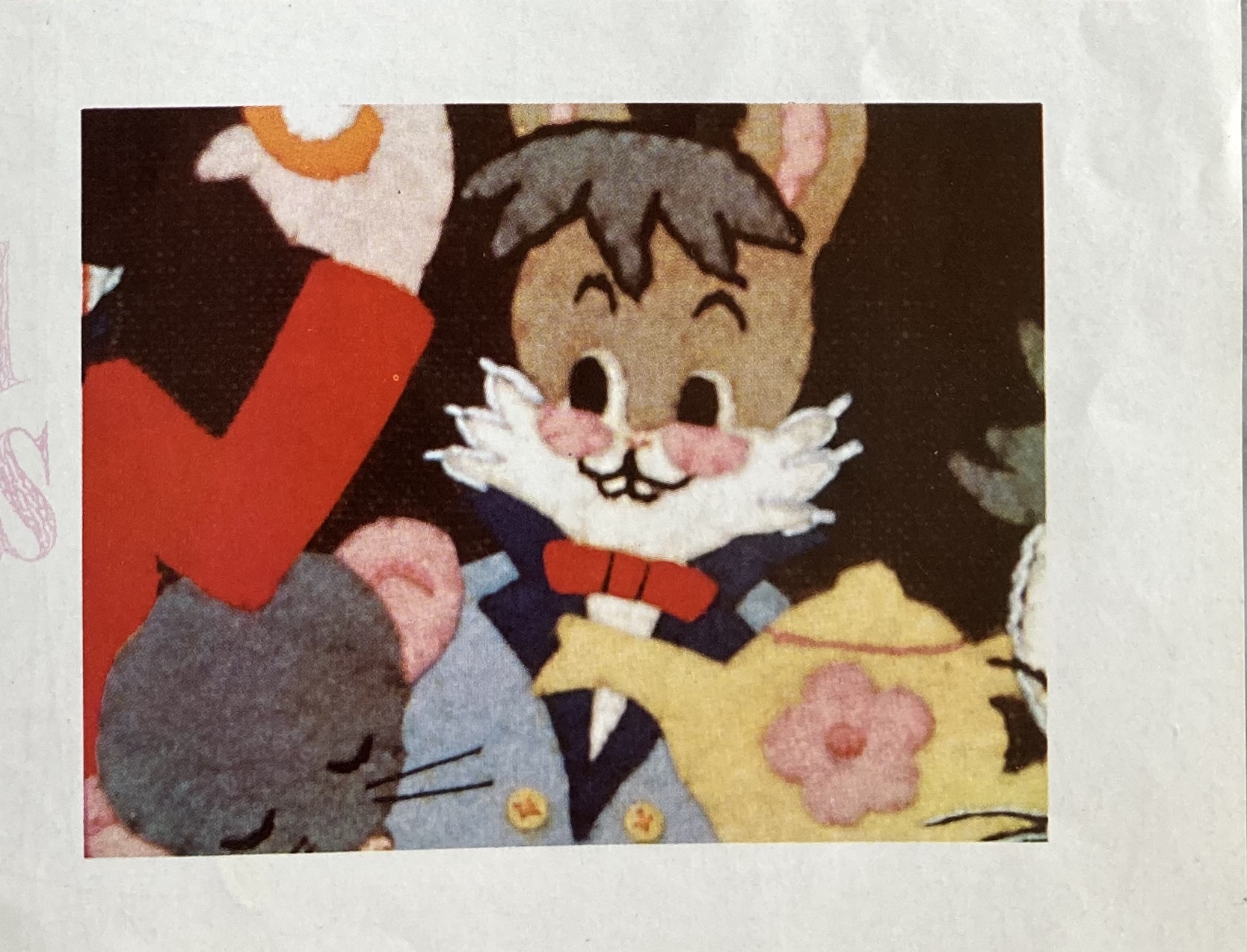
But wait, there’s more, and as always, the best comes last… Did I say that the homewares were easy, with one incredible exception? I am in awe of this large (16×22 inches) yet finely detailed appliqué wall hanging depicting the Mad Hatter’s Tea Party from Alice in Wonderland. It is the companion piece to the “Alice” wall hanging showing the Queen of Hearts and the gardeners from the August 1962 issue, and is designed so that both pictures can be fitted together to make a single panel. The stitch detail and precision required to make all those tiny felt pieces fit perfectly is amazing.
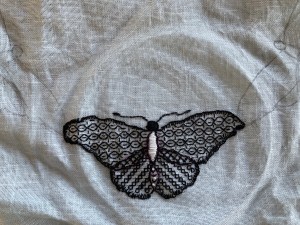
That wraps it up for our July 1963 issue! I will probably make the diamond-pattern jumper, since I have some more of the annoying un-plied cotton from the Hamburger Wollfabrik that I might as well use to make something with, and the long-line style will suit me well. I might, just might, also finish the blackwork butterfly cushion sometime soon. Happy Summer!
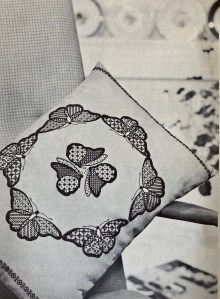
“For the embroideress who likes to tackle something different” came this amazing design from Stitchcraft‘s April 1963 issue. I am daunted by blackwork embroidery, having tried it only once until now with this cushion from the September 1960 issue. It’s fundamentally a form of counted embroidery, like cross-stitch, except that the stitch patterns aren’t crosses. The fillings are worked first using different geometrical counted patterns and the outlines and details are then added in (non-counted) crewel stitches like stem stitch, satin stitch, buttonhole, etc.
My biggest problem with all forms of counted embroidery is finding the proper ground fabric. The standard “Aida” fabric often used for cross-stitch is way too large, but furnishing linen, like the kind I mistakenly used for the fish cushion, is too tightly woven, making it impossible to count the holes properly and get the filling stitches to line up properly and look right. With the fish cushion I ended up just freehanding it, which is fine if you don’t look too closely but is obviously not the right procedure. I resolved to find the perfect-size linen this time!
… during a never-ending pandemic, where even if there were a shop nearby that sold all different sorts of embroidery fabrics, it would not be possible to go in and look at them to see how tightly woven they really are, as retail stores were closed in my area at the time. Of course, online shops give you information about the thread count and weight! Well… some give information about the weight, and some the number of threads per centimetre, and some just show a photo, which is utterly useless because who knows from how close it was taken?
The pattern is written for Glenshee Embroidery Fabric quality 212, a type of fabric that apparently does exist again after being unavailable for decades, but which seems to be available from exactly one distributor in two colours (beige and grey). At least I was able to find out what kind of thread count it had: 29 threads per inch, which converts to 11.6 threads per centimetre. I would be happy with anything between 11 and 12 and I wanted the fabric to be blue.
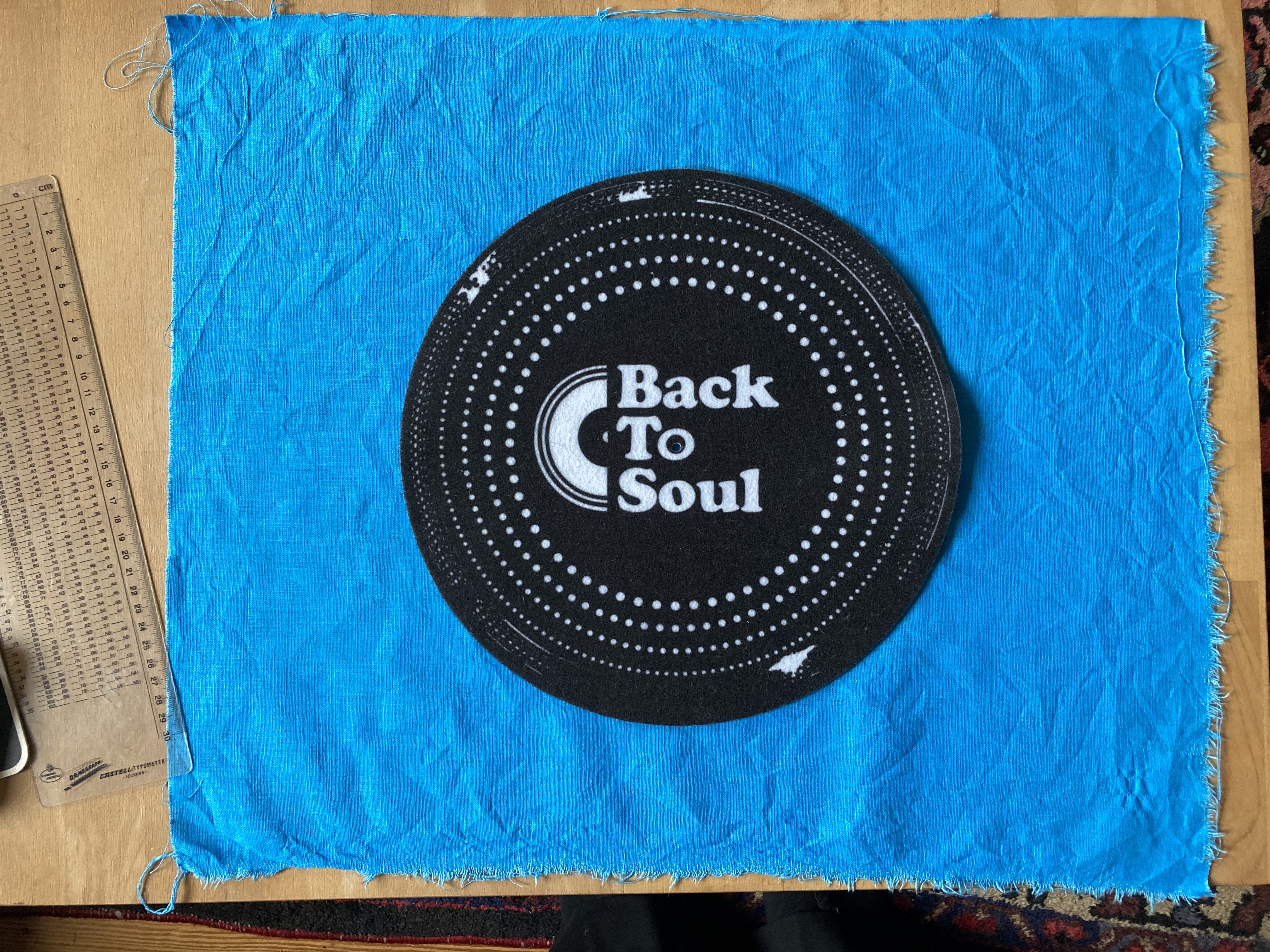
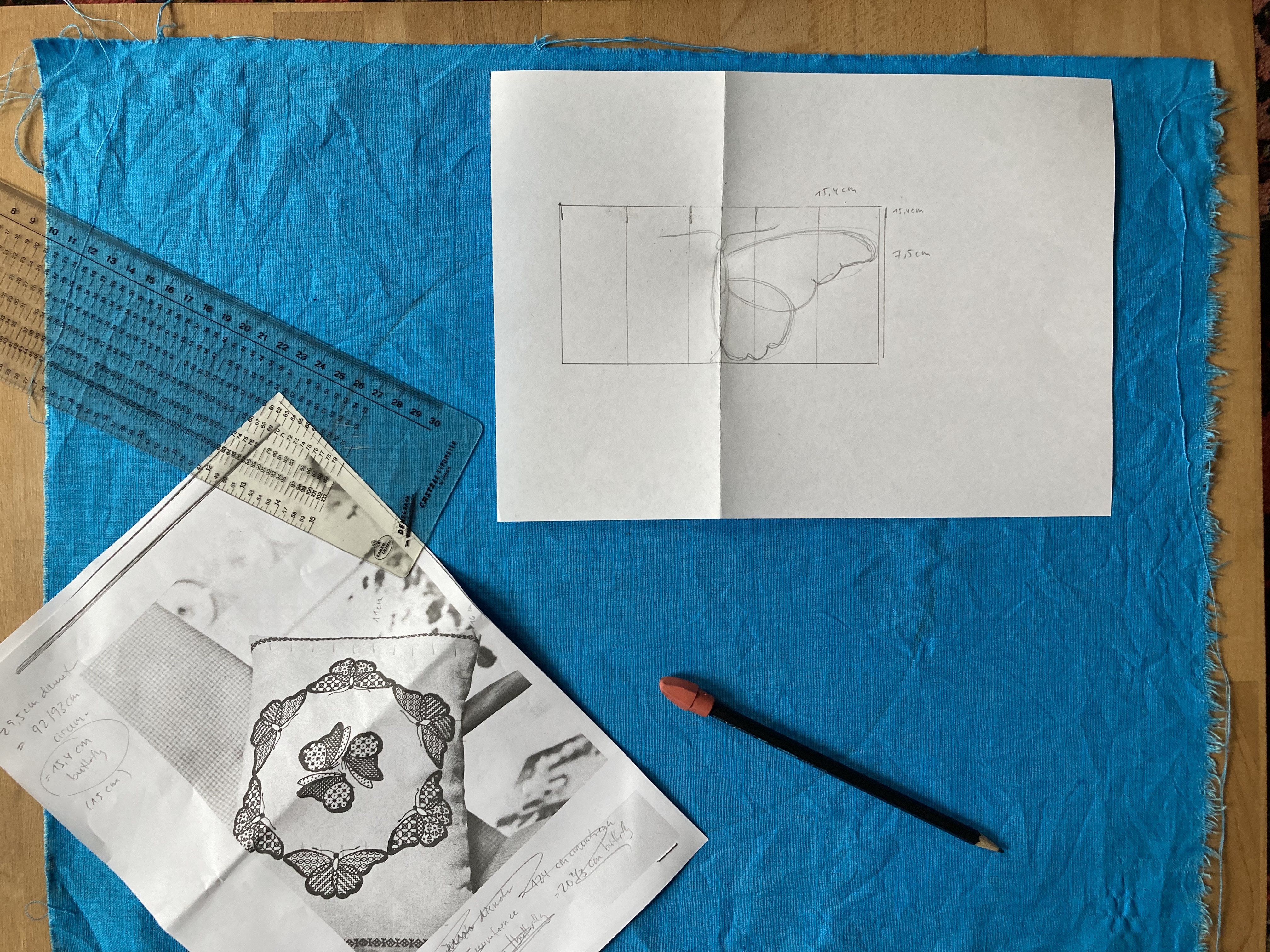
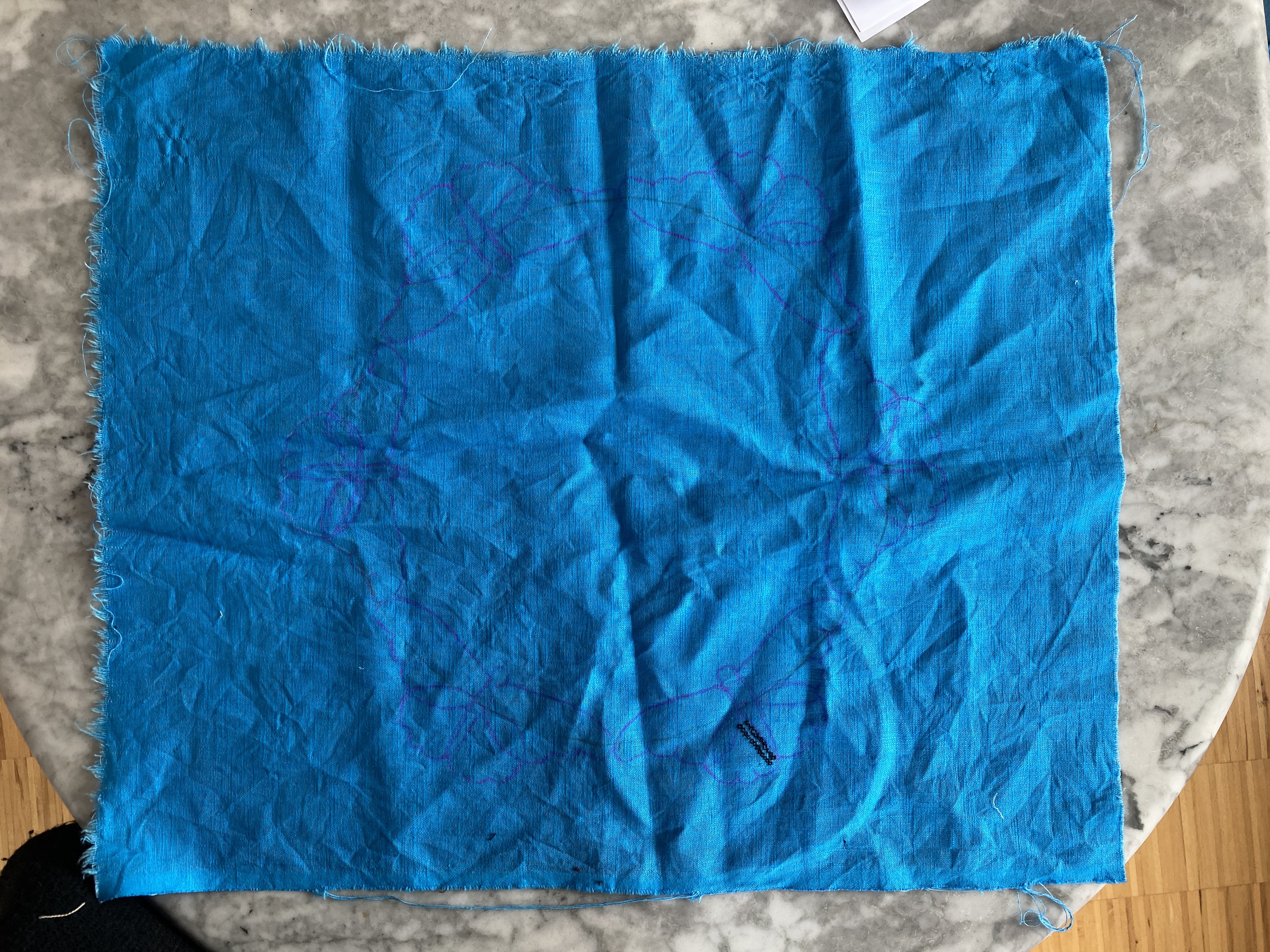
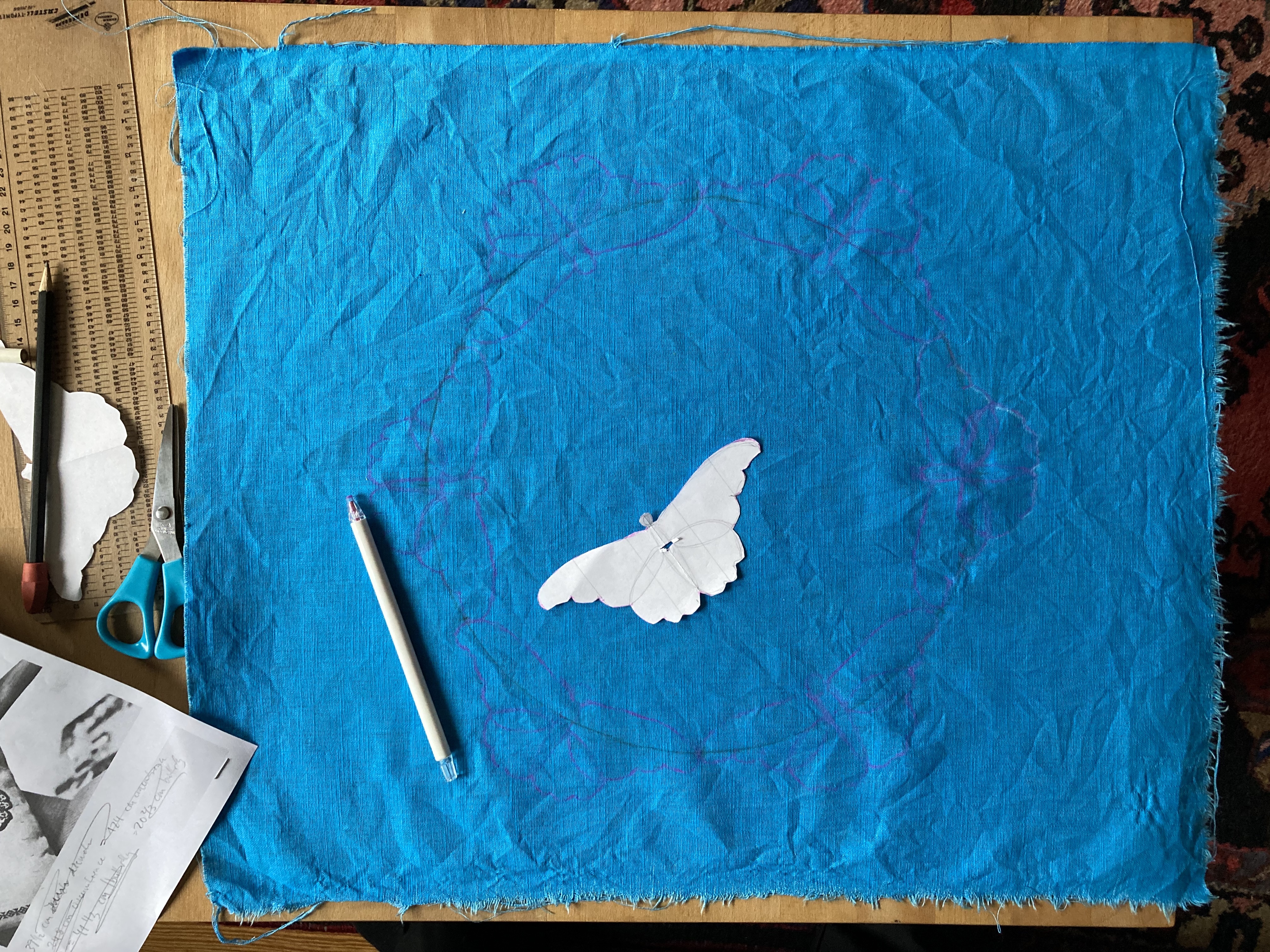
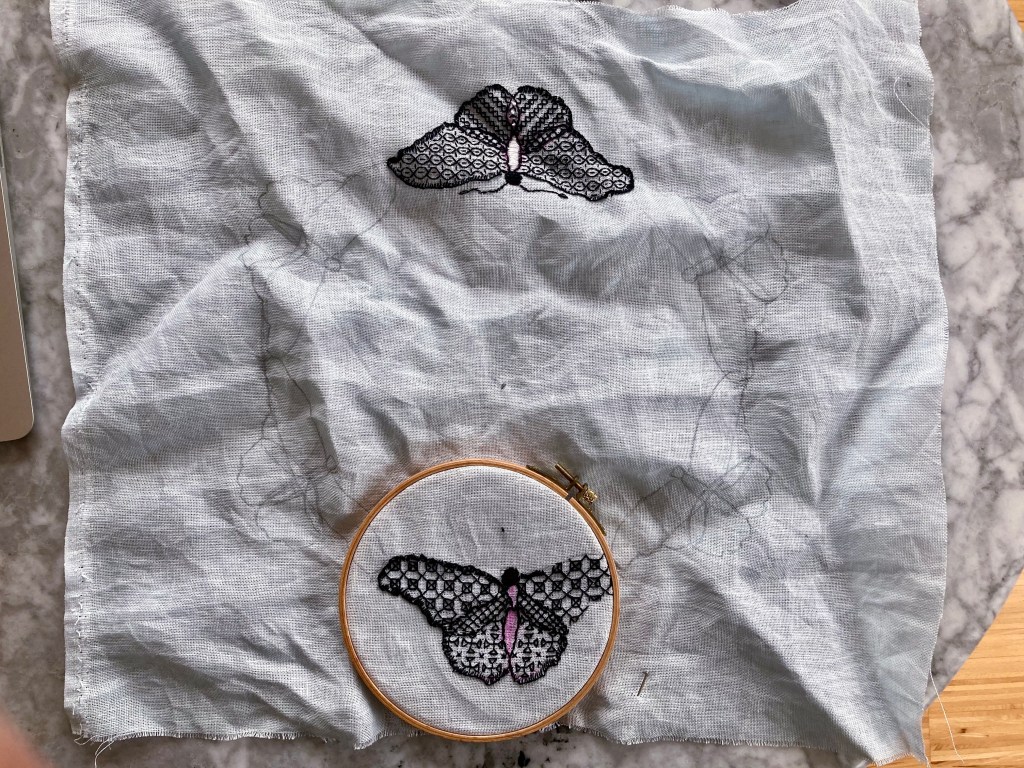
The first linen I bought was called something like “100% Linen Medium Blue” and I should have noticed right away that that meant it was regular furnishing linen, not specifically embroidery fabric — embroidery linens have special names according to their type and thread count. I loved the colour, though, and was determined to try. Of course I didn’t have a transfer, so I painstakingly calculated out the size of the circle for the main butterflies and from there, the size of each butterfly. I made a paper stencil for the butterflies and drew around a felt record-player cover (coincidentally the perfect size!) with a pencil to get the circle right. On starting the first butterfly, it was clear that the fabric was too tightly woven. It was pretty much the same type as the fish cushion. I was determined to make this project the right way, so after all the work I had put in marking the fabric and starting the pattern, back to the Internet I went and bought a few different kinds of embroidery fabric with a thread count between 11 and 12 threads per centimetre.
It is amazing how different fabrics can be that have the same or similar thread count!
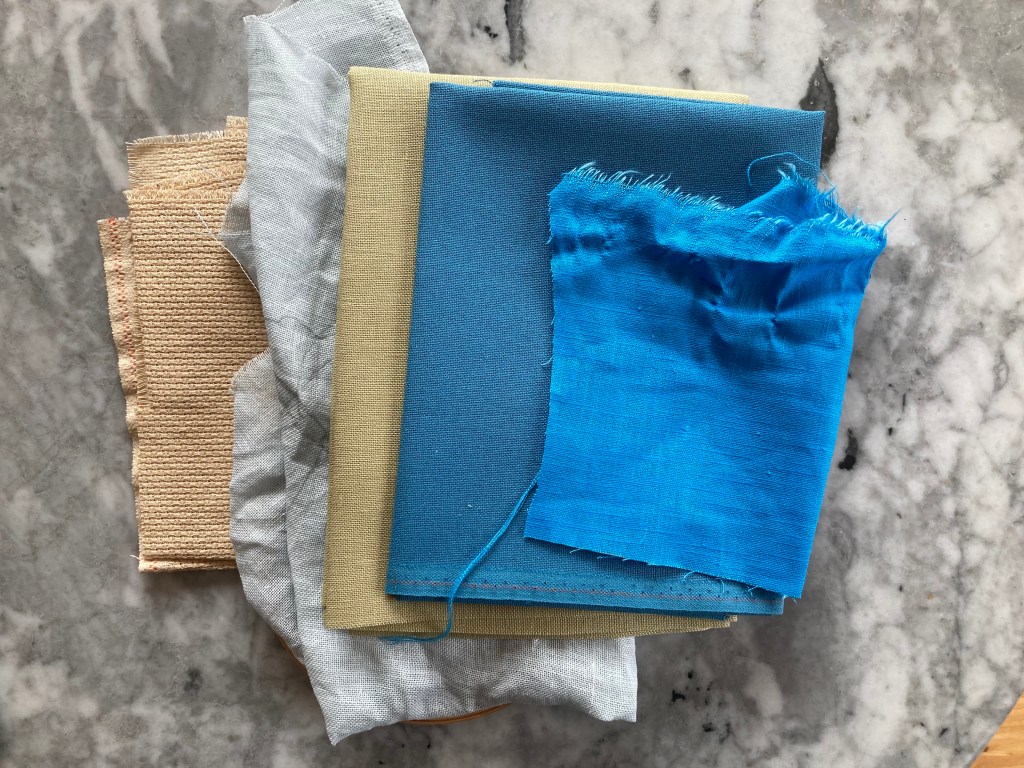
Here is a photo below. For comparison, the fabric on the far left is the normal “Aida” used for cross-stitch at 6.4 threads to the inch. The light grey-blue is “Permin”, which has 11 threads/cm and is very open, almost like netting. The beige-ish fabric next to it is “Belfast” with 12.6 threads/cm and perfect for this project, but wasn’t available in blue. Next to it is “Murano”, which also has 12.6 threads/cm and is a cotton/viscose mix, not 100% linen like the others and the blue they had was a bit too dark. On the far right is the furnishing linen I had originally bought, and the only one in the colour I wanted.
I wasn’t 100% happy with any of the the four options I had now bought, but I had spent a lot of time and money already and just wanted to get the project started in a way that I would be able to finish it. So I decided to use the Permin, which was not the perfect colour (a bit light, but I could try to dye it?) and very net-like (but at least it was easy to do the counted work).
The slight difference in thread count and the net-like aspect of the fabric made me decide to work with 3 strands of thread instead of 2 as in the pattern. Other than that, I followed the pattern as best I could. My buttonhole stitch outline is more like blanket stitch and not as thick as in the pattern, but that’s OK. After almost finishing the second butterfly, I decided to go against the instructions and work the outlines of the butterflies first, then fill them in with the counted work. The other way around probably works well if you used an iron-on transfer with easy-to-follow lines, but my pencil tracings are less accurate.
The pink is embroidery transfer pen and will wash out.
It was slow going, but there is something meditative about embroidering precise geometrical shapes.
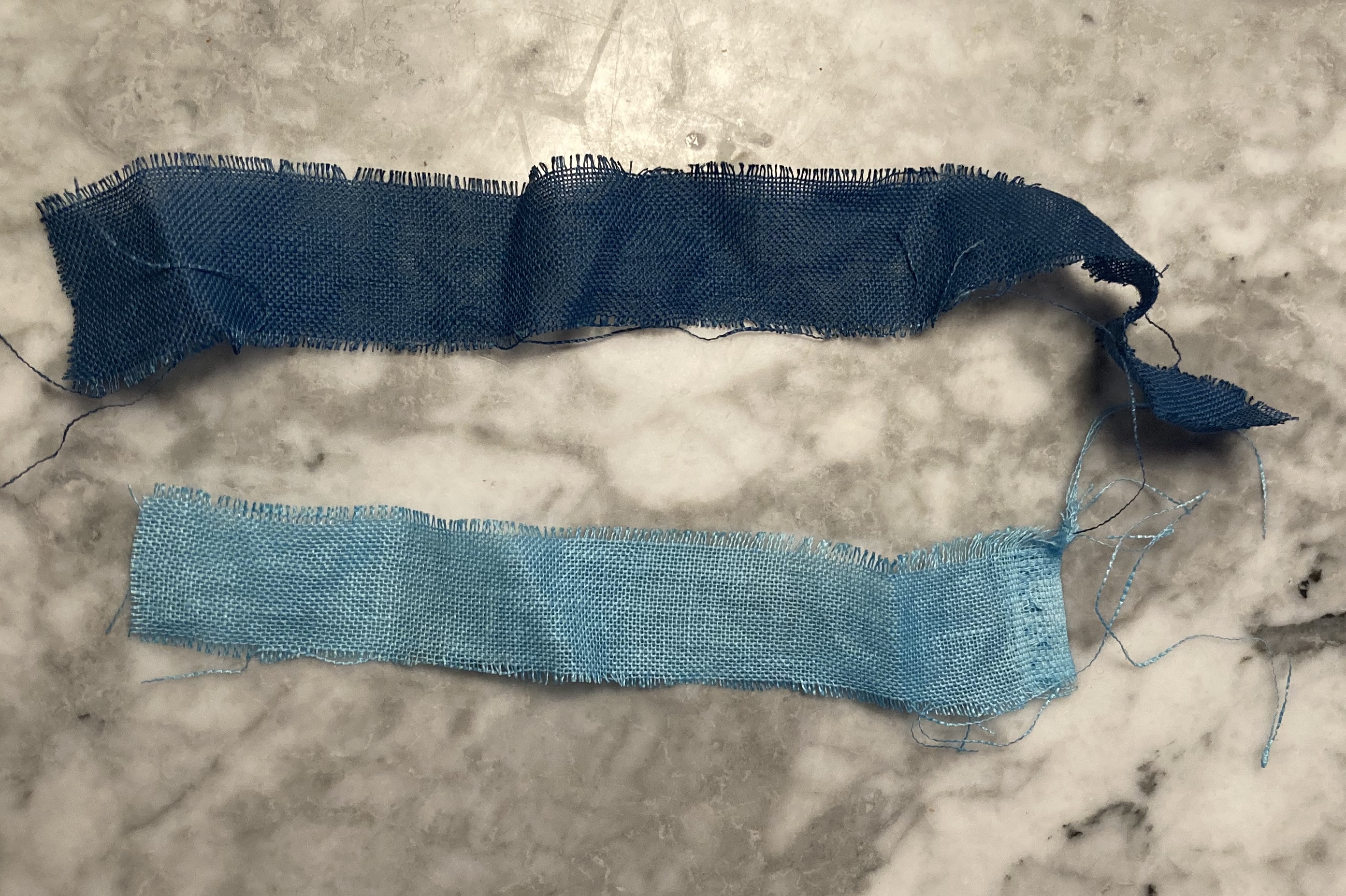
After embroidering two or three of the butterflies, I got my hands on some fabric dye and experimented with scraps of the cut fabric. “Deep Sea Green” (top) is actually blue, which was desired, but too dark and not vibrant enough. “South Sea Turquoise” (bottom) was the ideal colour, but I started liking the pale fabric more the more butterflies were embroidered. I decided to stick with the fabric as it was until the embroidery was complete, leaving off the white satin stitch body bits until after I dyed the fabric (or not).
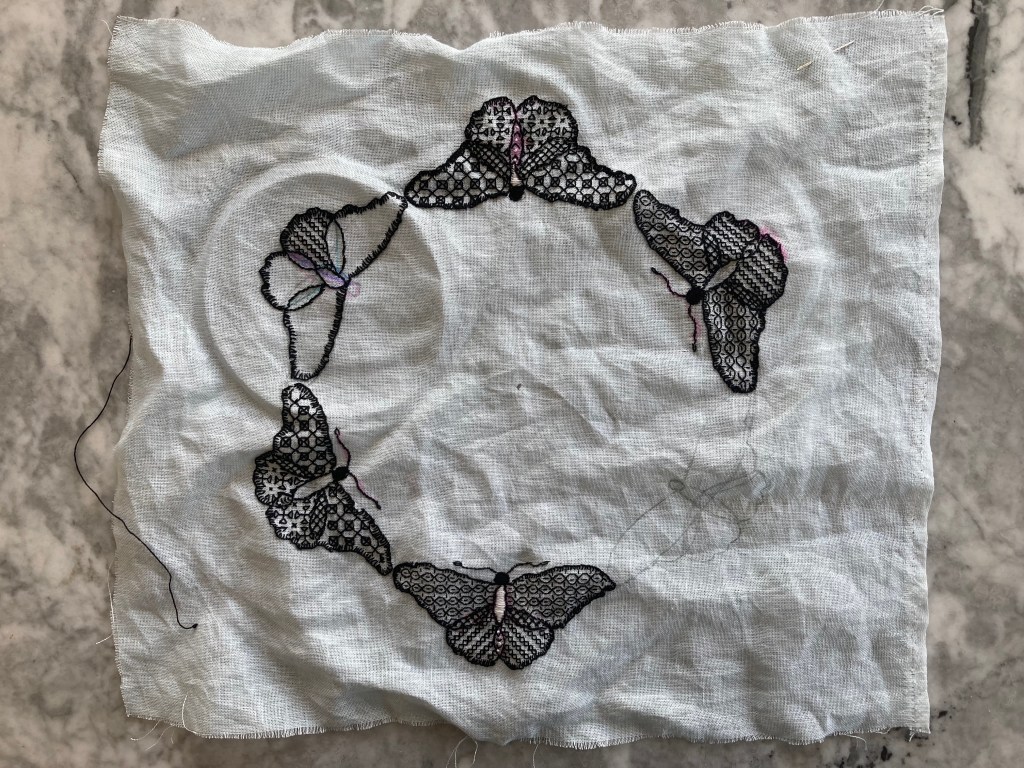
May 2021 passed very quickly and I hardly made progress on my May project, let alone this one. Here is a photo of my progress at the end of May:
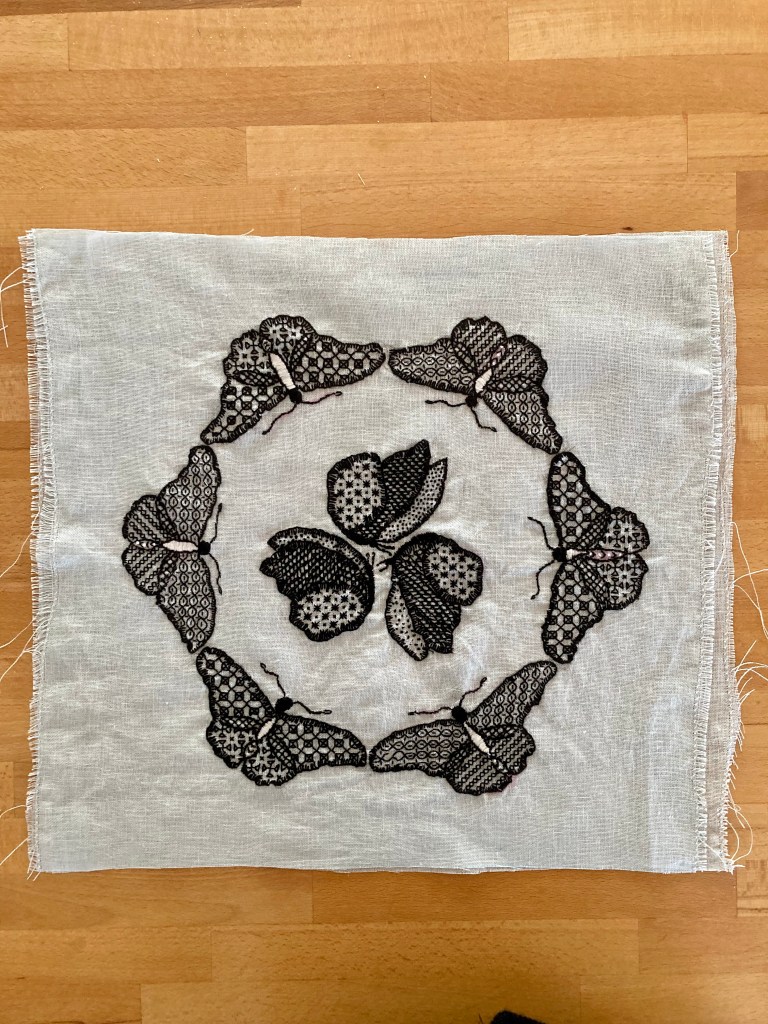
After leaving it for a while to work on other projects, I picked it up again and tried to work a little bit each day. Things got complicated in the autumn, as the days got shorter and darker – I realised I could only work in bright, natural daylight, otherwise I couldn’t see the threads well enough to count them, even with a good lamp. But I kept going and eventually, there it was!
Making it up into a cushion was easy. I made the cushion itself from an old white pillowcase that had been retired to the upcycling drawer, made the back from more of the net and added a zipper. I had left off the extra embroidered borders, since the design turned out more square than rectangular.
(The actual colour is somewhat less blue than the photo above, but more blue than the one below. I can’t get the colour correction to work properly on this device. )
The only problem was the transfer marker, which didn’t wash or iron out well. A tip in one of my old Stitchcrafts suggested using “solvent” if nothing else worked, Having no idea exactly what kind of solvent they meant, I tried alcohol, which didn’t work, and kitchen de-greaser, which worked somewhat. Any little bit left in will hopefully wash out in time.
Wow, it’s finished! I am really impressed with myself for getting this done, but I think it will be my last blackwork project for the time being.
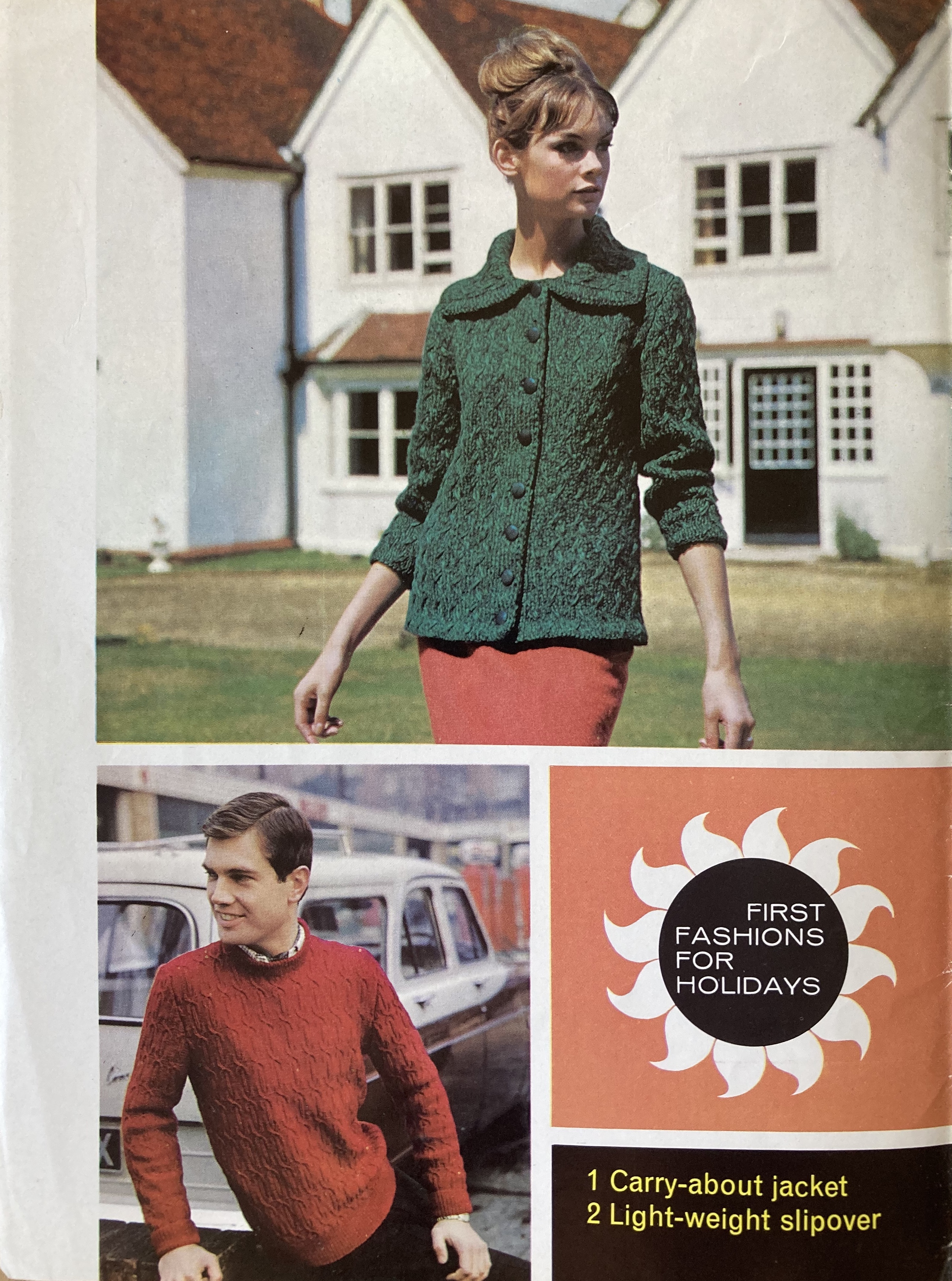
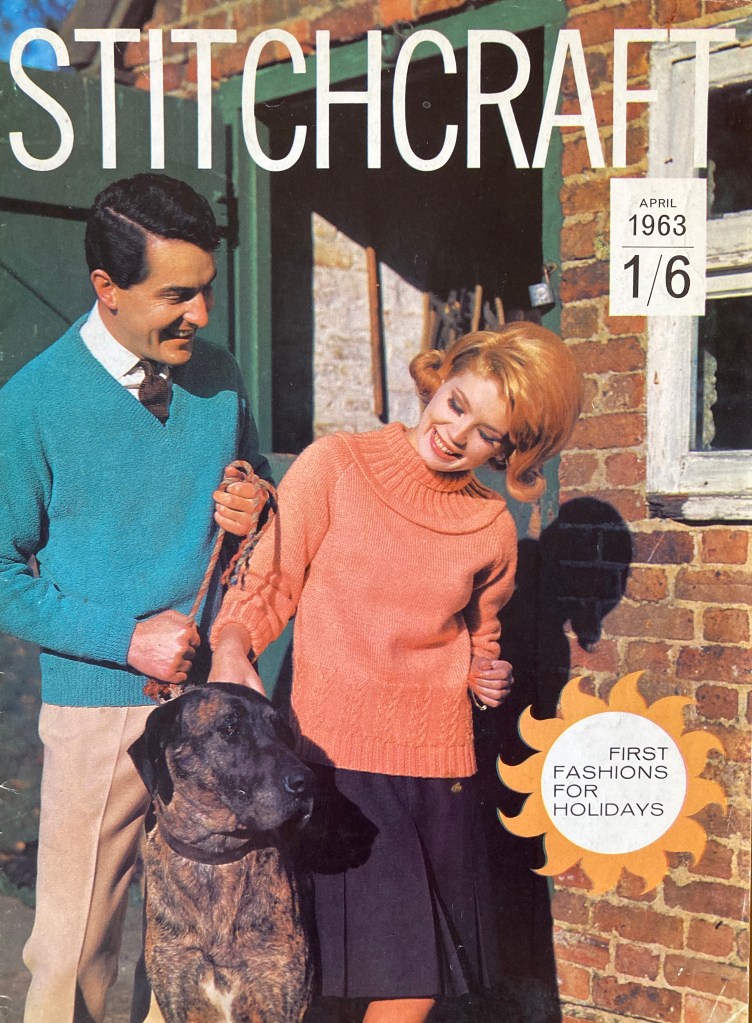
First Fashions for Holidays! It’s almost always some sort of holiday season in these vintage knitting magazines — in this case, Easter and preparations for the summer. As the British climate makes it possible to wear thick, warm wool sweaters pretty much any month of the year, “holiday / not holiday” is less a matter of warmth or season and more about casual, easy-care garments to wear while “strolling” and sight-seeing, or projects that are small and simple enough that you can work on them while lounging in your deck chair. Or, as the facing page title puts it, “Sweaters off-duty.”
Thick, collared pullovers and cardigan jackets that can be worn as outerwear make up the bulk (-y) of the garments in the first category, many of them made in Patons Big Ben wool at 3 1/2 stitches to the inch. The tweedy, dark green jacket on the inner front cover is a good example of this and features an intriguing wavy slip-stitch pattern. The “Italian” tunic on the inner back cover has a knitted-in border pattern made of beads. DK-weight wool is used for the women’s round-yoke sweater on the front cover. Hip-length is the fashion for everyone, wide collars continue to be in style and decorative borders near the hem are the new spring trend.
There are fashions in finer-weight wool as well, “for elegant summer wear”. The red men’s pullover on the inside cover and the women’s Nylox pullover both have interesting stitch patterns, though I feel like the placement of the inserts on the women’s pullover could go horribly wrong a little too easily. If your man finds cables too exciting, you can knit him a plain V-neck pullover in bouclet wool and match it to your own fluffy mohair-mix jacket, made in Patons’ best-ever-named wool, “Fuzzy-Wuzzy.” Colours are strong and bright, including some very springlike salmon and turquoise.
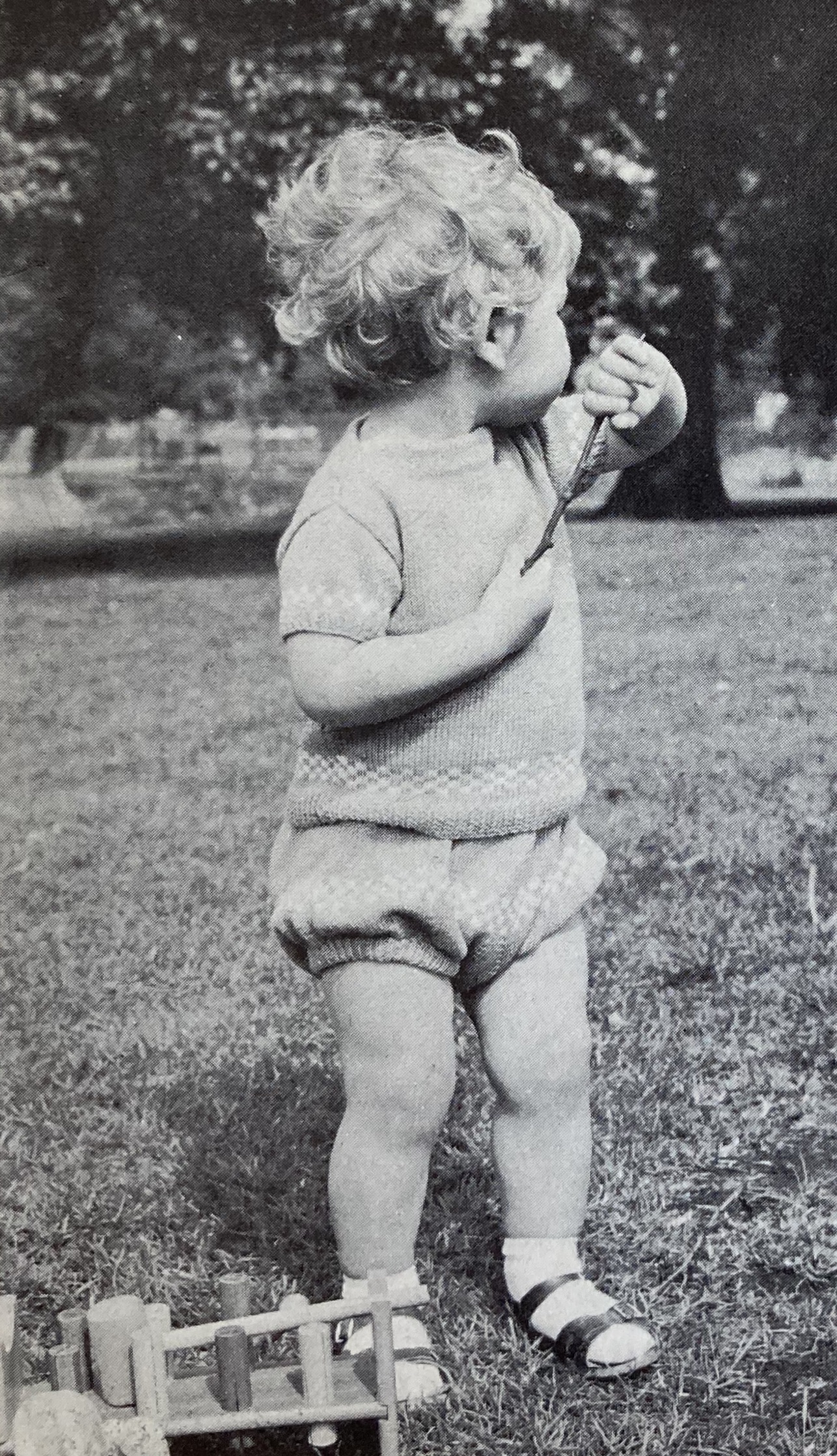
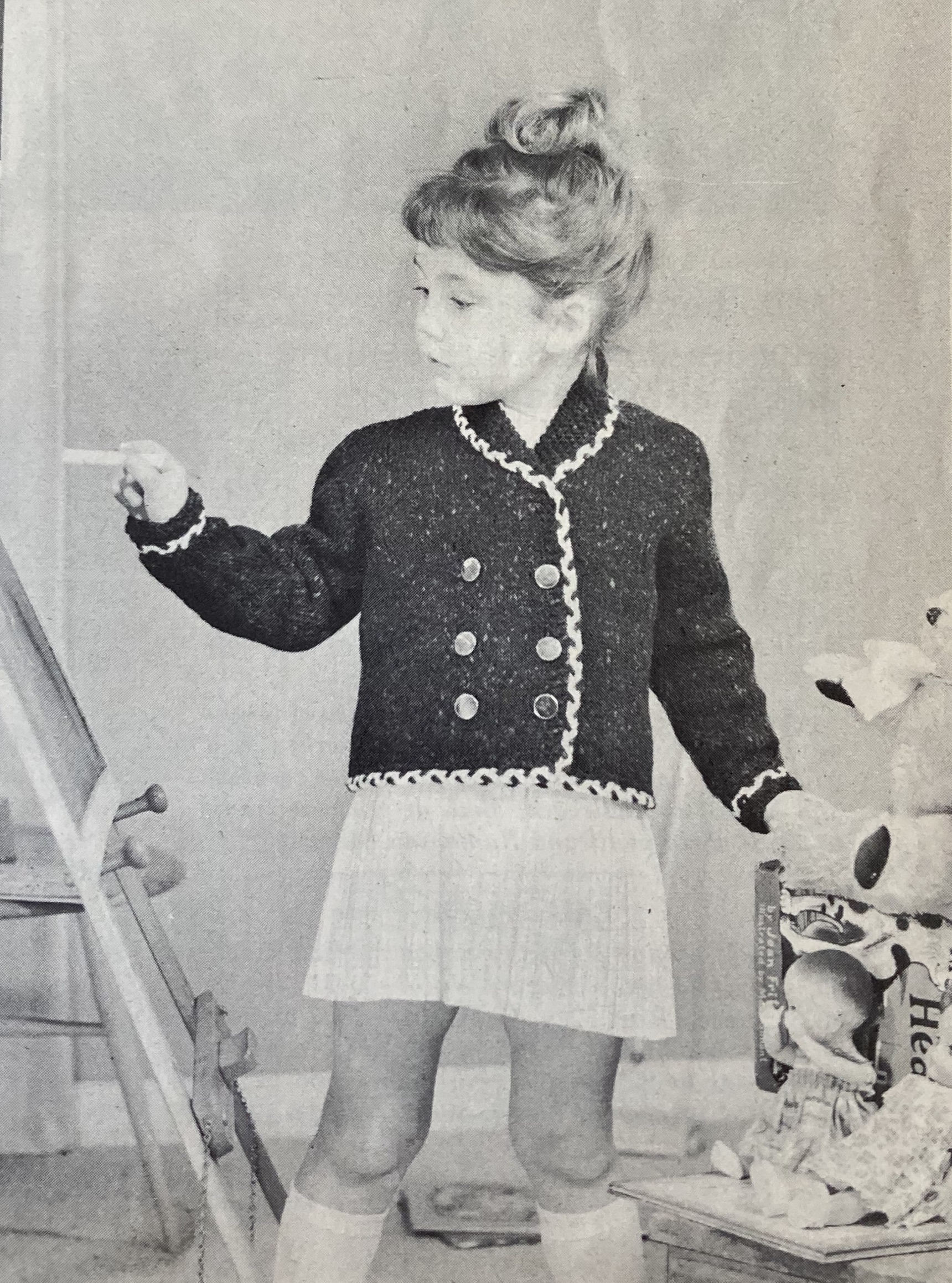
Fashions for the younger members of the family cover all age groups: a dolman cross-front cardigan for the baby, a play-set for the toddler, a “miniature Paris blazer” for small and medium-sized children (she’s painting a picture on a easel, so you know it’s Parisian!) and a quick-to-make “chunky” pullover for “sub-teens” which is easy enough for a bigger girl to make for herself. (I don’t think the young model in the photo actually knows how to knit, though.)
With all that pre-holiday prep knitting, the homewares in this issue are generally unspectacular. There are chair sets in counted cross-stitch, a crocheted cushion and rug for the older daughter to make for her room, and a tapestry tea-cosy. The two more interesting projects are these corded crochet mats and a wonderful cushion with a design of butterflies, made in blackwork embroidery. Unfortunately I’m not good enough at crocheting to really understand how the “corded” look on the mats is achieved, besides the fact that there are a lot of picots and crocheting many stitches into a ring. Oh, and there are embroidered table mats, too, featuring line drawings of famous parks. I like the white-on-black effect — something different.
That’s it for this issue! The ads are pretty normal and in the comic, Miss Muffet continues her adventures, getting magically shrunk down to the size of an insect in order to go flying with a nice beetle-lady. I’m afraid the dragonfly might have dropped her into the lake, though! Oh no! How will it end?
My project for this month will be the embroidered butterfly cushion. Happy Spring!
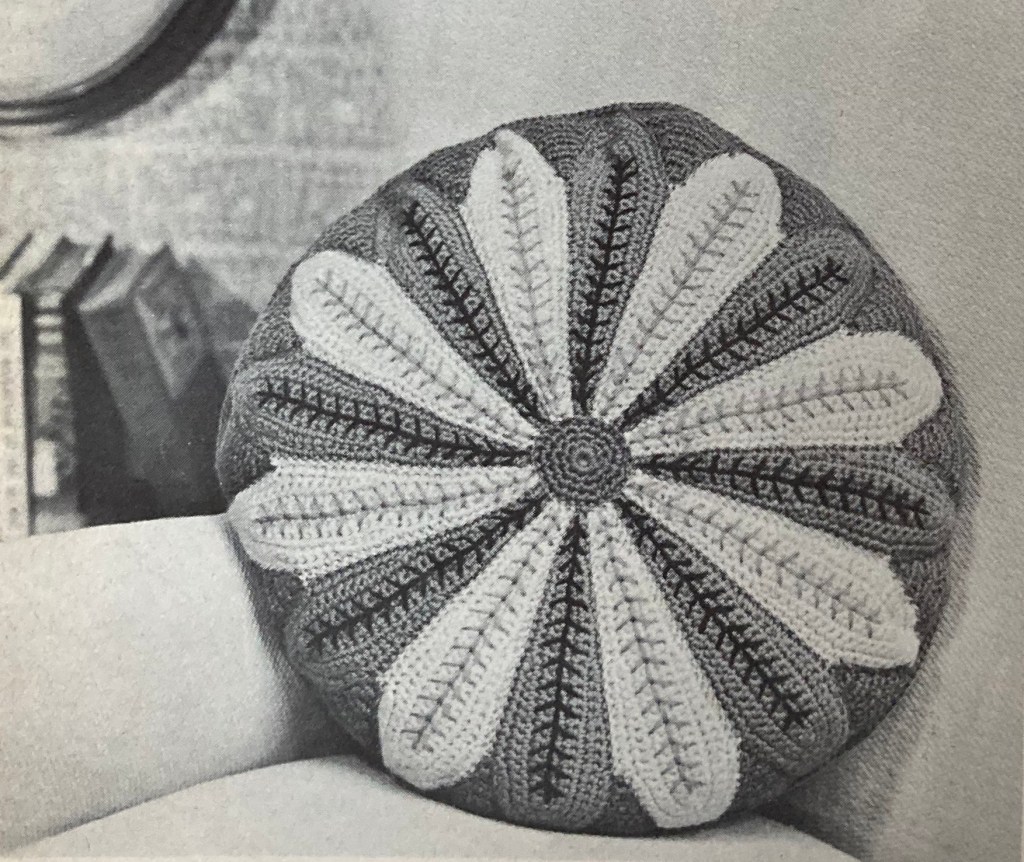
I have a huge backlog of unfinished projects and recently even got a commission to write a pattern for a new knitting and sewing magazine, so I needed the December project to be something quick and easy that I could make from stash. Behold, a very 1960s crocheted flower-petal cushion from this month’s issue! I love cheerful crocheted cushions and afghans — they have that fun, old-fashioned charm.
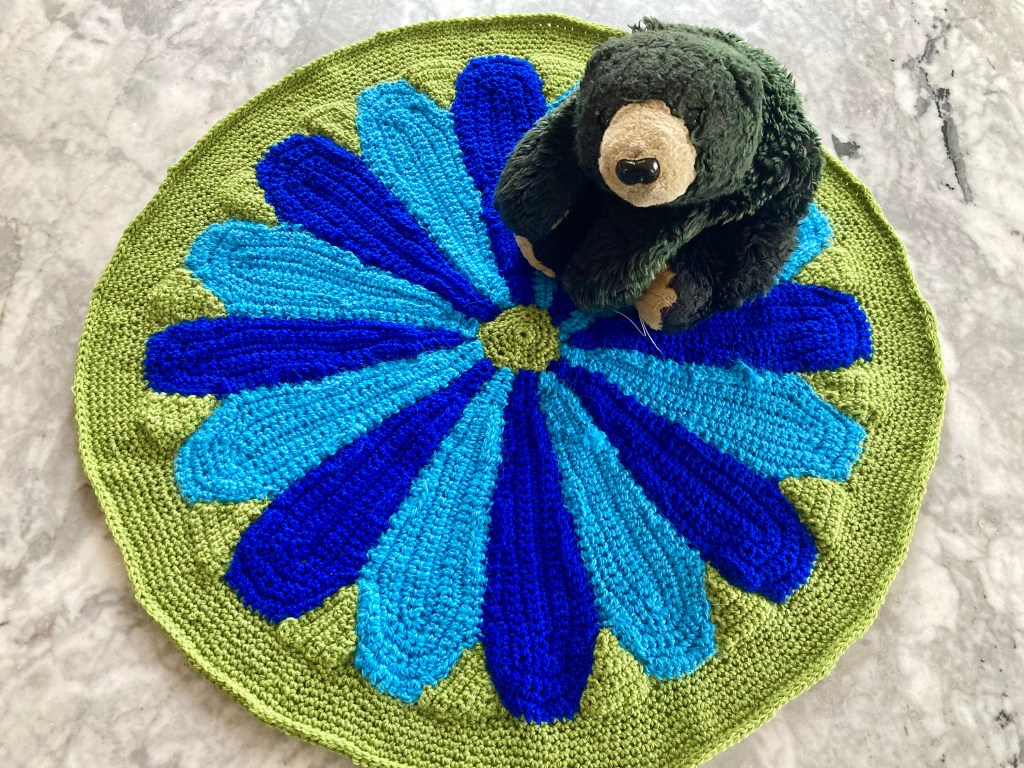
This one is made in double knitting, and I had two colours of blue and one of green to make a big, blue flower. I guess it’s a cornflower? Whatever, it’s cute and the colours looked good together. The dark blue is 100% acrylic (left over from this project and this project, which was patterned after this project — yes, I bought plenty of yarn), the light blue is 90% alpaca / 10% sheep wool (a gift from a very nice friend who brought it over from Chile!) and the green is a wool-acrylic blend last seen in this project from January 1960, so I was concerned that the finished item might behave inconsistently when washed or blocked, but I had no problems with that.
The size and scale, on the other hand… There was no tension given in the instructions, only a finished size of “approximately 17 inches diameter” and instructions to use double knitting wool and a No. 8 (5 mm) hook. The cushion is made in pieces — first the petals, then the triangular inserts at the top of the petals, then the center, then it gets sewn together, then you crochet the border and sew it onto fabric for the back side of the cushion — so it was hard to tell how big it was going to be. Also, the instructions very clearly say to make 12 petals and 12 insertions, but the accompanying photo very clearly shows a cushion with 16 petals and insertions. Patience Horne, you need a tech editor and a proofreader!
The result — once I had finished all 16 petals and 16 insertions, which was in fact the correct number to get the petals to form a circle, and sewn all the fiddly bits and pieces together — was huge. Granted, 17 inches in diameter is a fairly large cushion, but mine was 19 inches in diameter before I had even started crocheting the border, and the triangular insertions were also too big, making them pucker and wave a bit. I made a snap decision to just crochet the border larger and larger until all of the green wool was used up and have it be a baby blanket instead of a cushion, which would also spare me the trouble of figuring out how to make the back of the cushion, whether or not to make an inner cushion pad and have the crocheted part be a removable cover, etc. etc.
The border in the instructions only being a few rounds and me not being the world’s best crocheter, I searched for a formula to crochet something in rounds of double crochet that would have the right amount of increase per round to keep the circle flat. Though I found many amazing doily patterns and not-quite-fitting formulas, I didn’t find what I was looking for, so I just increased one stitch per petal each round and did a plain round in between every so often. There was much ripping back and doing over, but in the end it worked out fine. As for the still-puckery triangle inserts, I declared them a “design feature” and left it at that.
I wash-blocked the blanket, which evened it out some more, and only then realised that I had forgotten to embroider the lines down the center of each petal. In the end, I decided against it. The dark blue and green yarns were all used up, I didn’t have any other colour that looked right and I honestly thought it was fine the way it was. The finished size is 23 1/2 inches or 60 cm in diameter, which will fit a baby’s pram nicely. Not having a baby on hand, here it is with a teddy bear for scale:
It’s not perfect and it definitely has that “home-made charm”, but I think it will make any parents and baby happy.
It’s that time of year again, and Stitchcraft is getting into the festive season with their annual Christmas issue — though if it weren’t for the wreath on the door behind our cover model and the other model in the window holding a metallic tree and box of ornaments, I wouldn’t know it was the Christmas issue at all.
The suit on the cover is “The Suit for Spring ’63”, made in Bracken Tweed double knitting (colour: “Green Witch”! Great name) and trimmed with black braid, like the November 1961 suit from which I made the blazer last year. The December 1962 jacket has no buttons and more of a boxy “swing-line” shape, like the classic Chanel suits that were especially popular in the early 1960s. The simple pink blouse worn with the suit was made from a Vogue pattern which could be ordered via Stitchcraft, thus completing the outfit.
The other larger knitting projects are either warm, bulky and practical for the cold, or fancy, pretty things to wear to parties. In the first category, there’s a wonderful hooded coat for a toddler which keeps out “all the draughts” — except, of course, the ones traveling up her bare legs! I still feel sympathetically sad every time I see pictures of cold-weather children from pre-1970s eras with five layers of wool on their upper bodies but basically nothing on the bottom half.
There’s a zig-zag patterned sweater in Big Ben wool for a larger child or young teen (who is luckily old enough to wear trousers, as seen in another photo) and a stranded design in double knitting that fits into the same “harlequin” diamond-pattern idea (though the adult version makes me think of spiky eyes looking out at me). Also in double knitting is the cabled turtleneck “for the extra slim” (30-31 or 32-33 inch bust). Rounding out the warmer designs are two partner-look sweaters in bulky Ariel and an “Italian stitch” (stranded knitting and purling — that’s going to be really warm and bulky.) The “Continental” trend can be seen in the spiky-eyes sweater as well, which is apparently of Viennese (as per page 20) and/or Tyrolean (as per back cover) design.
Then there are the party clothes: a fluffy cardigan for a young girl and a beaded 2-ply blous with minimal shaping and a beaded crochet finish on the neckline. Holly green is always a hit in the winter designs and other than that, the preferred colour is white with bright contrasts in red, orange or turquoise. The cabled turtleneck is made in “Lipstick Red”.
Surprisingly, this month’s homewares are not particularly special. Our year of embroidered flowers has come to an end with a design of “Christmas roses” (really, they’re just roses) and readers could back-order any transfers they might have missed over the course of the year to make a tablecloth with all of the 12 flower designs on it. There are quick, easy cushions in darning or crochet and a cutwork design for another tablecloth.
The Christmas issues of Stitchcraft usually have a lot of very creative and sometimes bizarre ideas for knick-knacks, small gifts and other “novelties”, but this year seems to put more focus back on knit designs. There are a few small sewing projects that could work as gifts any time of the year — little aprons, a pincushion doll and a sewing case. The winter-motif mats for the Christmas table, a small tapestry scene and a felt Father Christmas wall panel that you can pin cards to are more appropriate to the holiday theme, and the back pages give readers a few traditional cross-stitch motifs to adapt to their own use and ideas for table trimmings. The table-trimming “trees” are made of sequinned tissue-paper trees stuck on top of empty sewing-thread spools and the “Berries and Twigs” are twiggy branches from a real tree, painted white and decorated with red wool pom-pom “berries” and foil leaves.
Christmas and any other large family get-together holidays are obviously not happening this year, but — good news! — as the blog year 1962 draws to a close, so too does the real-life year 2020, which I’m pretty sure most of us can agree was awful. I hope you all continue to get through it with minimal damage and enjoy the holiday season as much as possible in a pandemic-safe way. My project for this month will be the easy crocheted cushion, and finishing up all the unfinished projects.
July 1962’s issue didn’t have anything in it that particularly interested me, so I took the time to go back to the June 1961 issue, which had so many nice projects in it that it was hard for me to decide which to make. (I ended up making this lacy top and later, this child’s tunic-dress.)
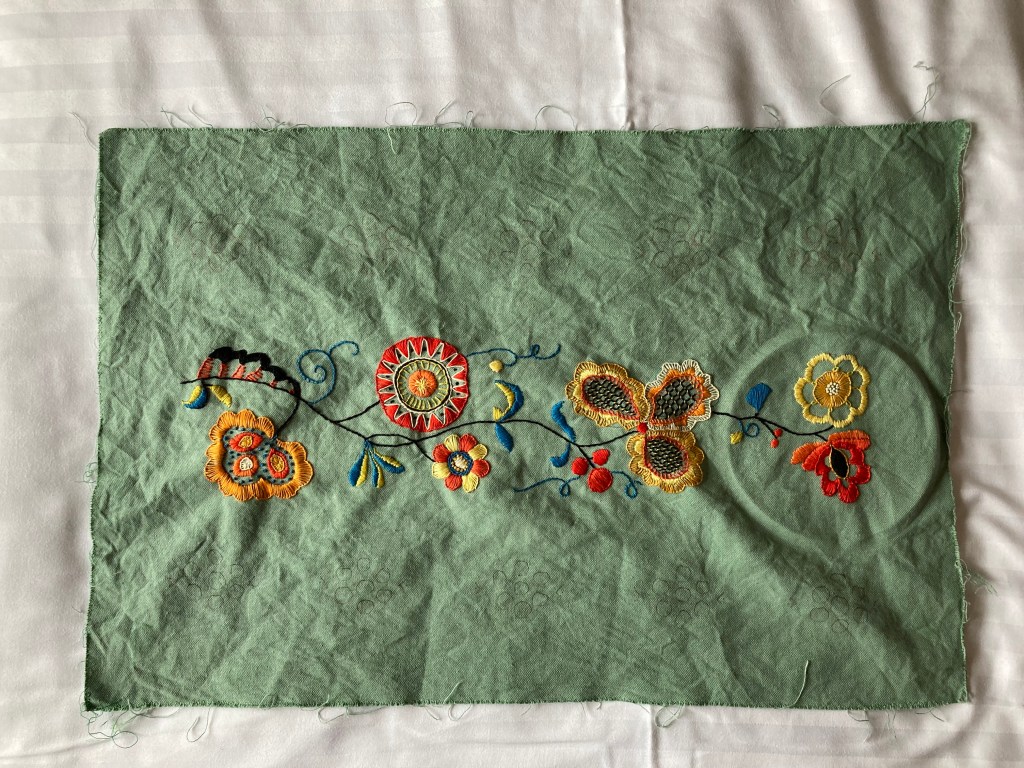
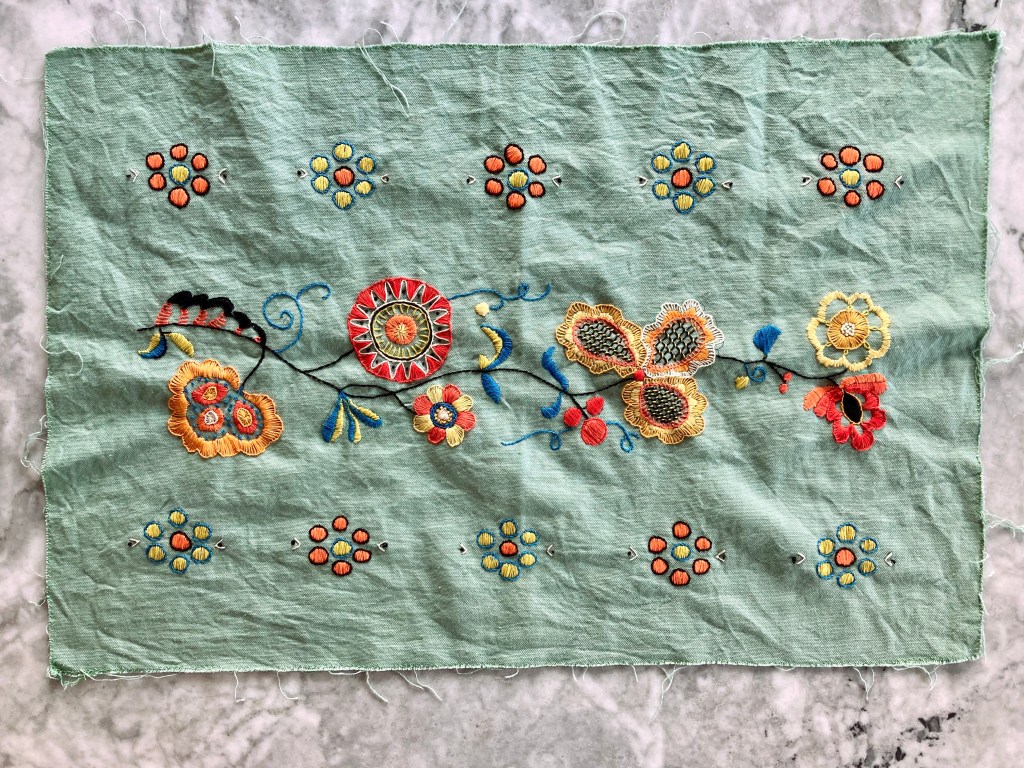
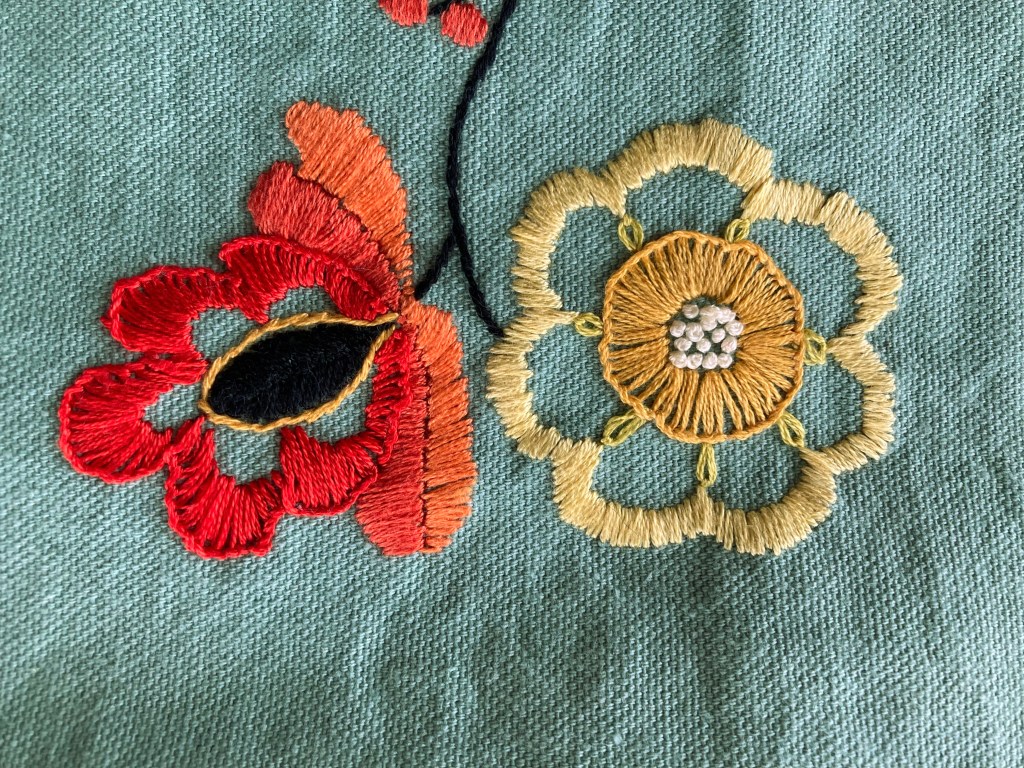
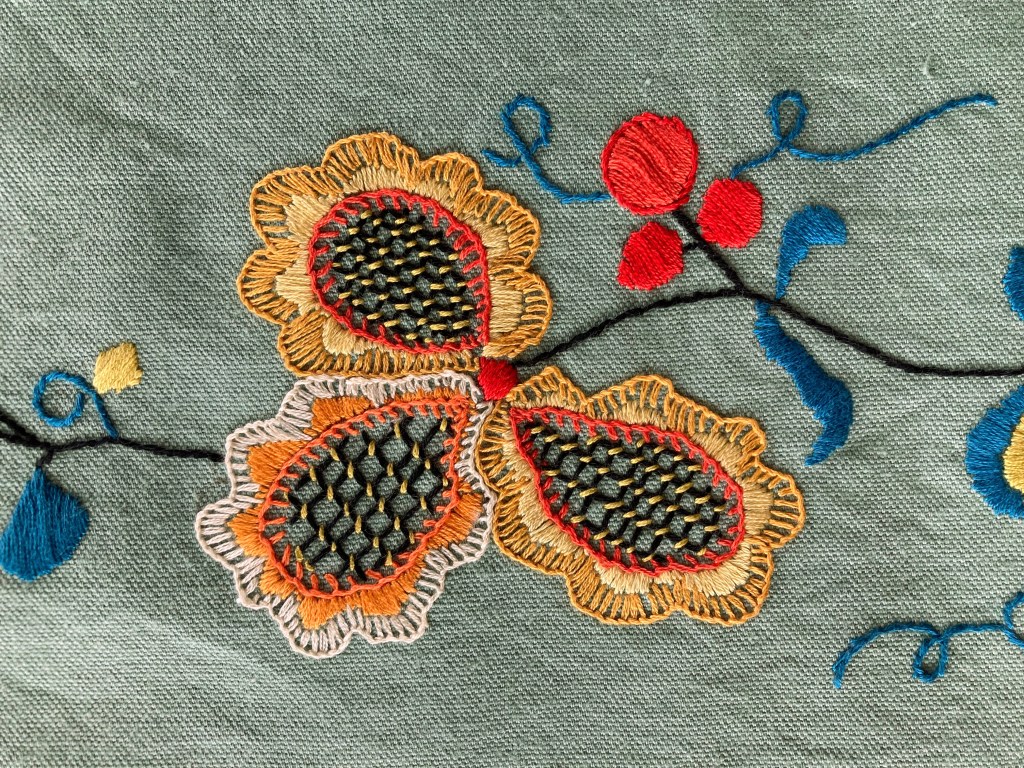
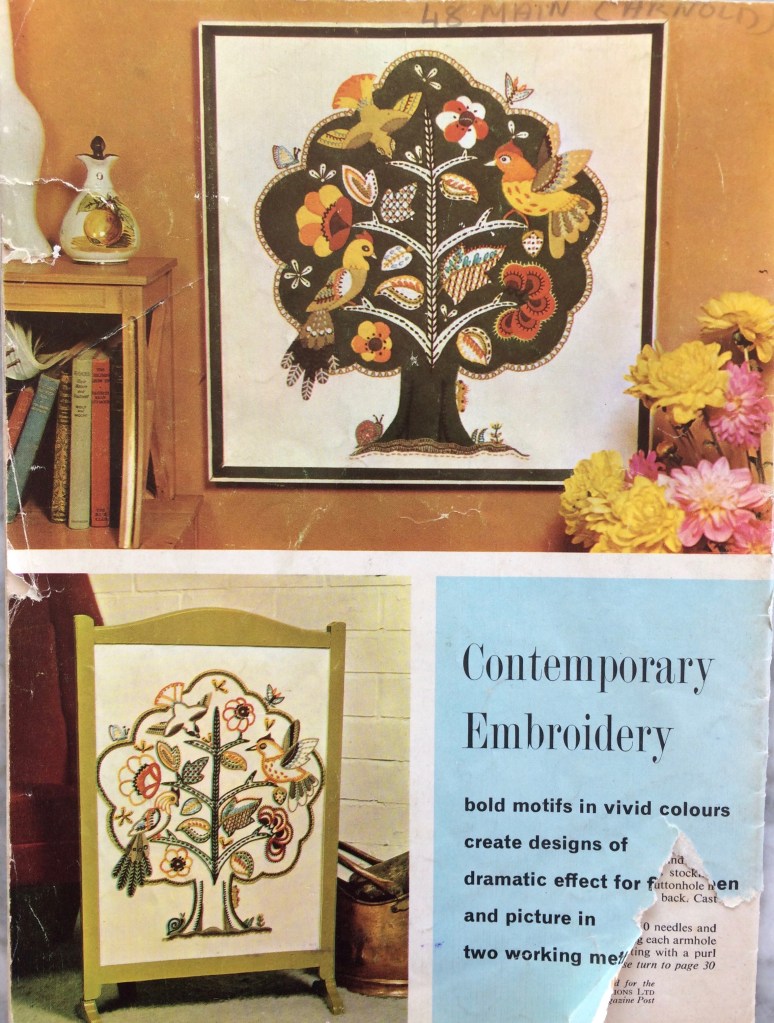
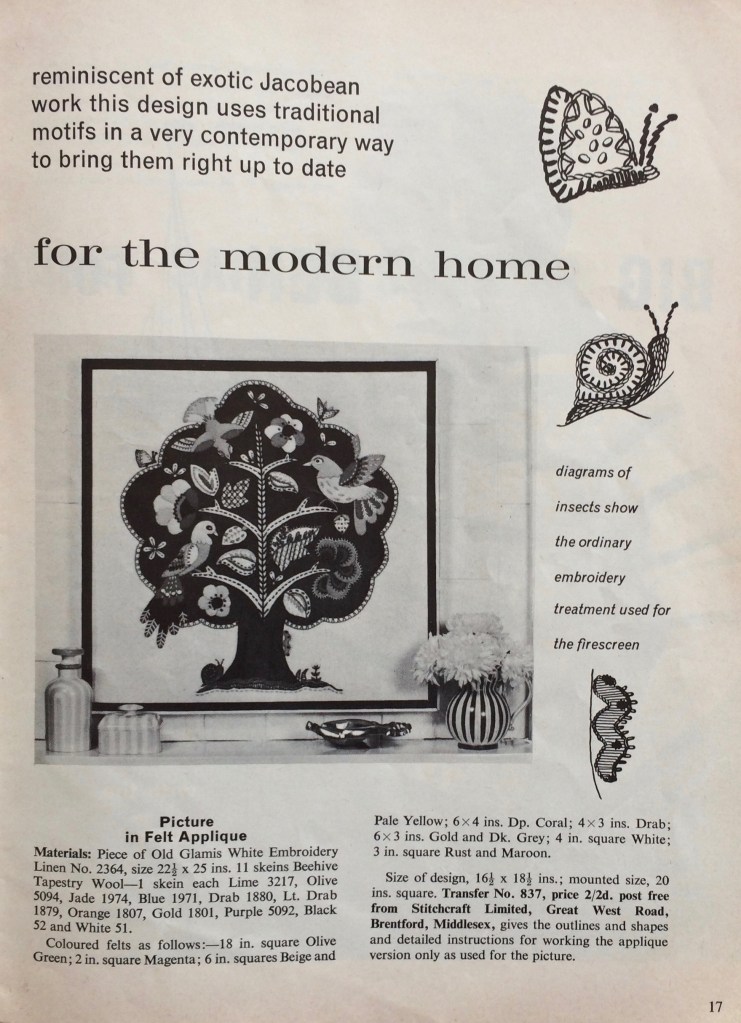
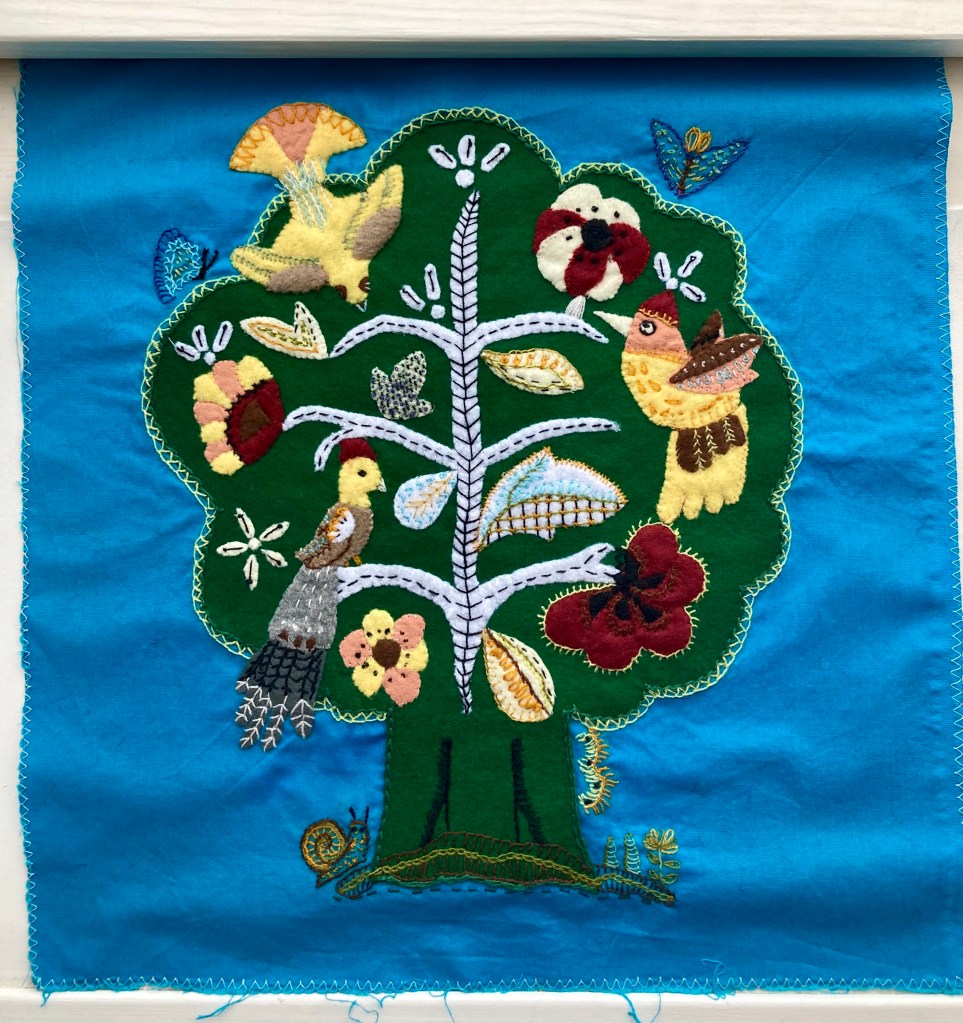
I loved the extremely complicated, heavily embroidered, faux-neo-Jacobean felt appliqué “birds in a tree” extravaganza featured in colour on the back cover, but it was too daunting. For one thing, of course I didn’t have the transfer or pattern for the appliqué pieces, since I would have had to have sent away for them via postal order in 1962. For another, there weren’t even any instructions in the magazine — the design was offered as either an embroidery or an appliqué project (see photo), and the instructions in the magazine only covered the embroidered version in any detail. The appliqué version just gave a list of materials, size of finished design, and the address where one could order the pattern and instructions. And when it comes right down to it, my appliqué and especially, embroidery skills are really not very well developed.
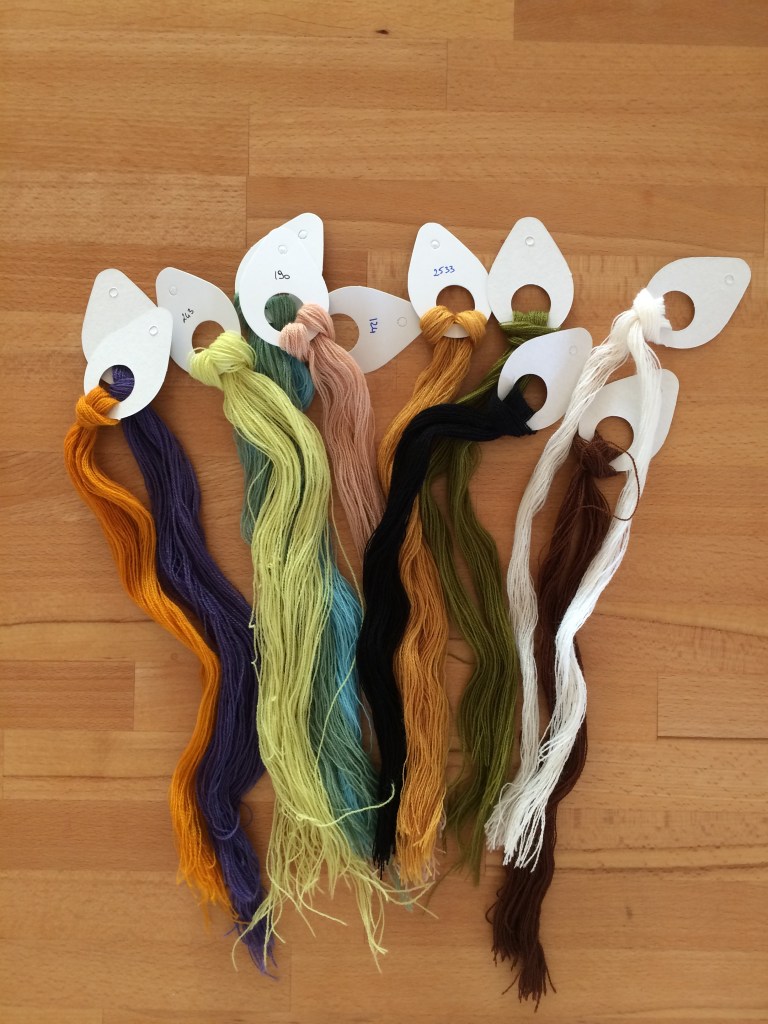
Oh yes, and while felt is easy enough to buy, the materials included tapestry wool for the embroidery, which is impossible to find in stores anywhere near me and even difficult to order online in the right weight (very fine)! Luckily, last year I happened to be in the one city I know that houses the one shop I know that actually specialises in tapestry and sells the right kind of wool, so I was able to get that, at least.
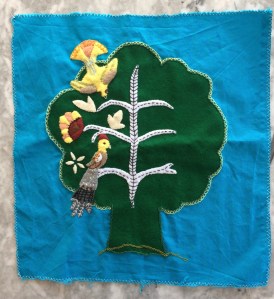
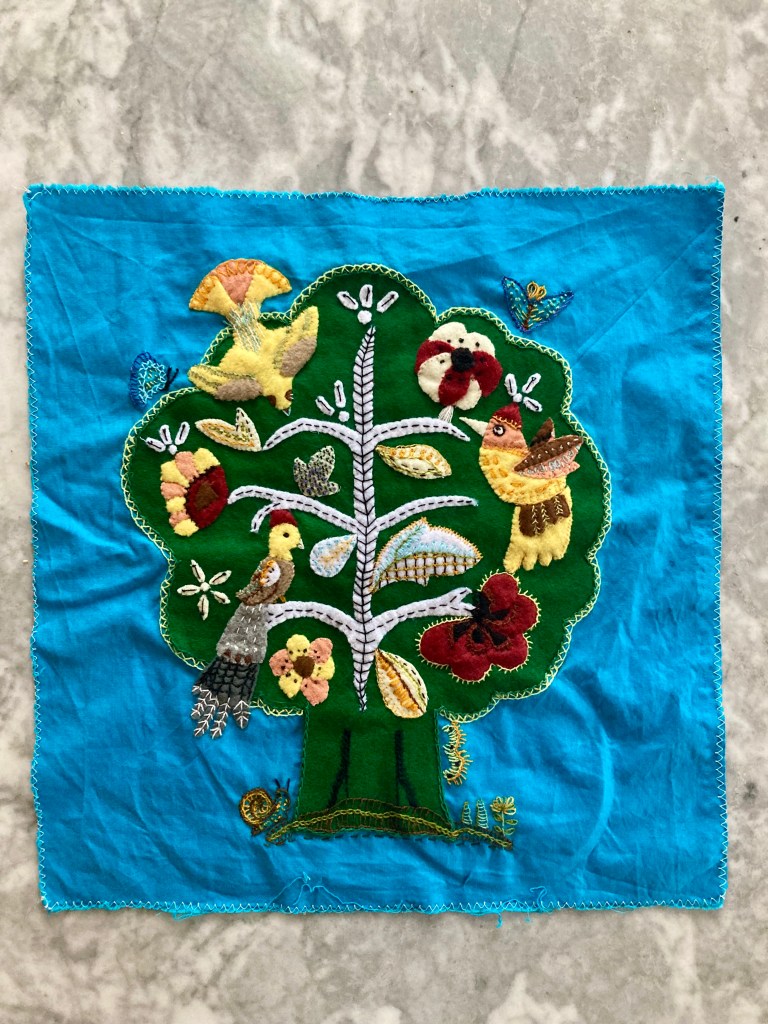
I decided to make it as a cushion, not a wall hanging. The background tree was easy enough. Technically, the white branches and leaves should have been made by cutting holes in the green tree felt and letting the (white/beige) background fabric show through, but since I chose a blue background fabric, I appliquéd them as well. It was predictably difficult to make and cut out my own patterns for the little bits of felt for the birds and leaves, and after making the first two birds, I realised it was easier to just cut the pieces freehand. Since there were no instructions to follow, I went from the photo and the instructions for the embroidered version, which obviously didn’t give much useful information.
Such a detailed project took forever, of course. It needed many tools and materials, so I could only work on it at home at a table, and not during the winter months, as I needed natural light for the fine work.
I made two of the birds on the left first, wasn’t really happy with them, and realised why after making the first flower on the left. I liked the way the flower turned out — it’s much simpler! The birds seemed overdone in comparison. I thought about changing the design and realised at some point that, of course, the who idea of this neo-Jacobean, embroidered and appliquéd extravaganza is that it is supposed to be over the top.
Before ironing…And after ironing
And so, slowly and painstakingly, it got done, one piece at a time. (It also spent a lot of time in the cupboard in between bursts of activity.) The embroidery directions in the magazine were often quite different from the appliqué version, so I did a lot of guesswork and adaptation based on the (rather small) colour photo on the back cover, from which the colours had changed and faded in the 50 years since its printing.
I was determined to get it done before the end of 2021, and I did (on December 31st.) It was a huge milestone for me in my appliqué / embroidery learning process, and I am really, really happy with the way it turned out.
The motto of the July 1961 issue is “Sew through the Summer” and indeed, there are a lot more sewing projects than one would normally find in Stitchcraft, summer being a time when many people do not want to hold wool in their hands or think about colder weather to come. There’s more emphasis on homewares and small, fun projects to make and use on holiday. The farm photos were taken in Hertfordshire and the boating photos in “the heart of London’s Little Venice”. Doesn’t that sound like fun? Let’s dive in!
Our cover photo, taken at the Hertfordshire farm, features a really pretty basketweave blouse with that V-neck-plus-collar design that we saw so much of in 1960 and the last years of the 1950s, not to mention just last month on the cover of the June 1961 issue. Personally, I love this style and I’m glad it stayed in fashion for so long. Except for the basketweave, this top is very similar to the blouse I made from the July 1960 issue, and probably not the last one of its kind that we’ll be seeing.
The other summer garments for adults are “cool in 3 and 4 ply” tops for women — one of them machine knit — and for boating or cooler outdoor nights, there’s a cardigan in double-knit Rimple, a little short-sleeved jacket in bulky Big Ben, or a man’s sweater in larger sizes in Totem double knitting. The cardigan “does duty as a sweater”.
This is a jumper.
This is a sweater.
This is a cardigan that does duty as a sweater.
This is a jacket.
This is a sweater.
On that note, a quick quiz:
What is the difference between a jumper and a sweater? (Hint: this is a British magazine that uses both terms, so “jumper is British and sweater is American” cannot be the only answer.)
If a jumper is a pullover in a lighter weight/more dressy style, and a sweater is bulkier/warmer/more casual, why is the elegant, fine-knit short-sleeved top on page 12 a jumper (top left photo above), the elegant, fine-knit short-sleeved top on page 13 a sweater and/or shirt (top right photo above), and many elegant, fine-knit short-sleeved tops from other issues considered to be blouses?
On that note: Why can a cardigan double as a sweater, but not a jumper?
Bonus question 1: What is the difference between a cardigan and a jacket? (Okay, this one is easier.)
Bonus question 2: Is the blue-and-white garment on the front cover a jumper, a sweater, or a blouse?
The answer to the first two questions is, as far as I can tell, that there is no answer. “Jumpers” per Stitchcraft tend to be long- or short-sleeved, fine-knit, elegant pullovers, while “sweaters” per Stitchcraft tend to be bulkier, more casual, long-sleeved and looser-fitting pullovers, but every time you think you’ve figured out the system, they use the word you wouldn’t expect. “Blouses” tend to be, logically enough, tops (either pullover or cardigan style) that one would wear with only undergarments underneath, and put a suit jacket or other overgarment over. Following that logic, I guess the cardigan on page 21 does duty as a sweater and not a jumper because it is warmer, heavier and meant to be worn outside without a coat and with a blouse or something underneath it. Still, there is no real consistency that I can see. I would love to be able to ask “editress” Patience Horne what system she used.
For the smaller members of the family, there’s this lovely baby’s dress, featuring the most absurd baby photo ever (previewed in the June 1961 issue). I still don’t understand just why I find this baby so goofy. She is utterly cute but somehow, her face is too old for her. That combination of lots of hair and the knowing, watchful look in her eyes makes her look like someone pasted a grandmother’s head on a baby’s body. Anyway, the dress is wonderful. Older girls get a striped jumper with a collar and “gay bobbles” to tie the neck. Let’s hear it for gay bobbles! I’m not sure what today’s 6-, 8- or 10-year-olds would think of the bobble ties, but I think it’s a cute jumper.
The emphasis of this issue is on easy-to-make, no-stress homewares, starting with felt place mats and coasters appliquéd and embroidered with traditional inn signs. Make them for your Pride celebration, for they are “as gay as possible”! Fans of easy embroidery on canvas can make a cushion with purple thistle flowers in cross-stitch or bathroom accessories featuring this month’s Zodiac sign, Cancer. I don’t know about you, but I don’t want to step on a crab, even if it’s only a cross-stitch picture of one on a bathmat.
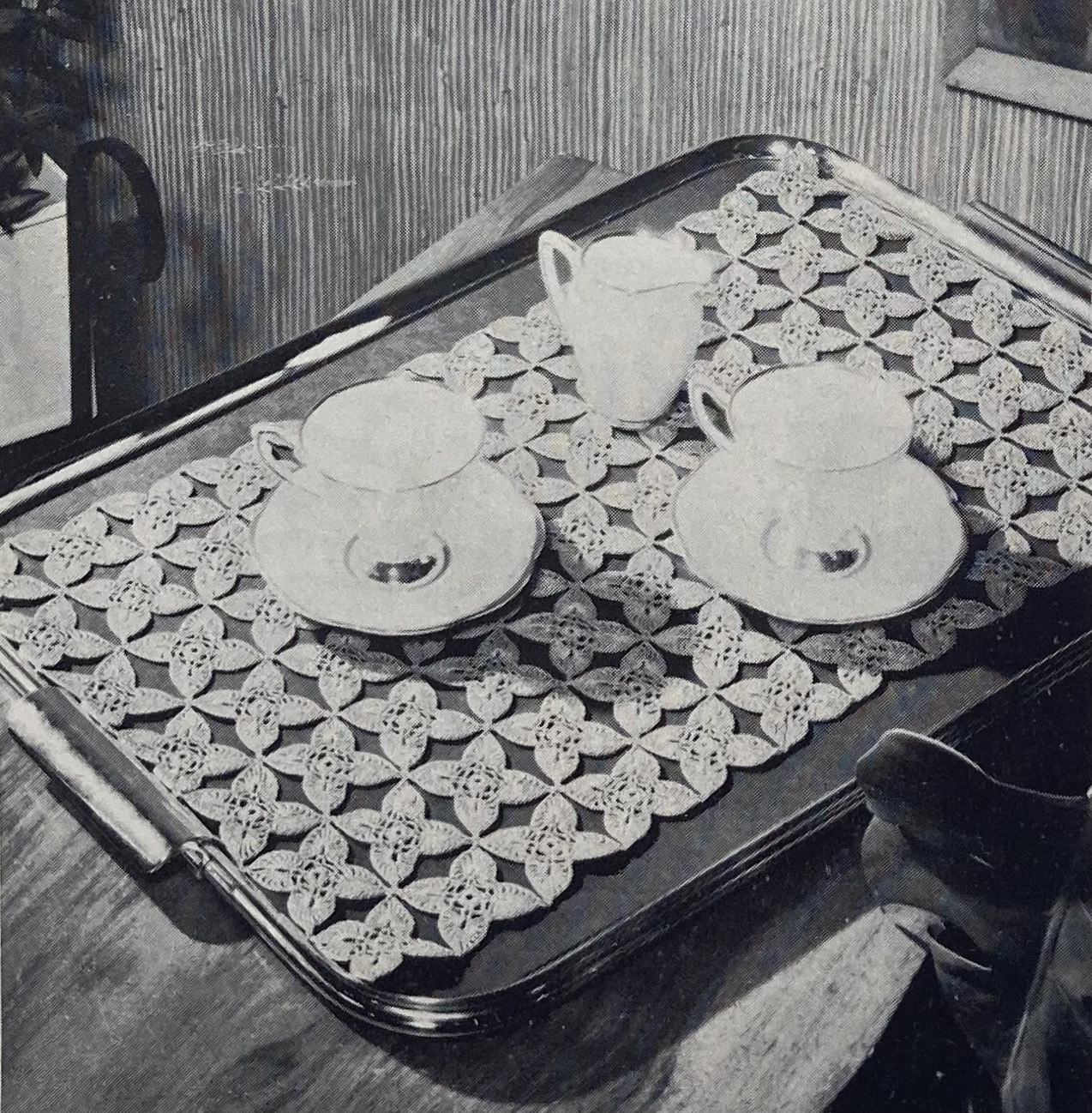
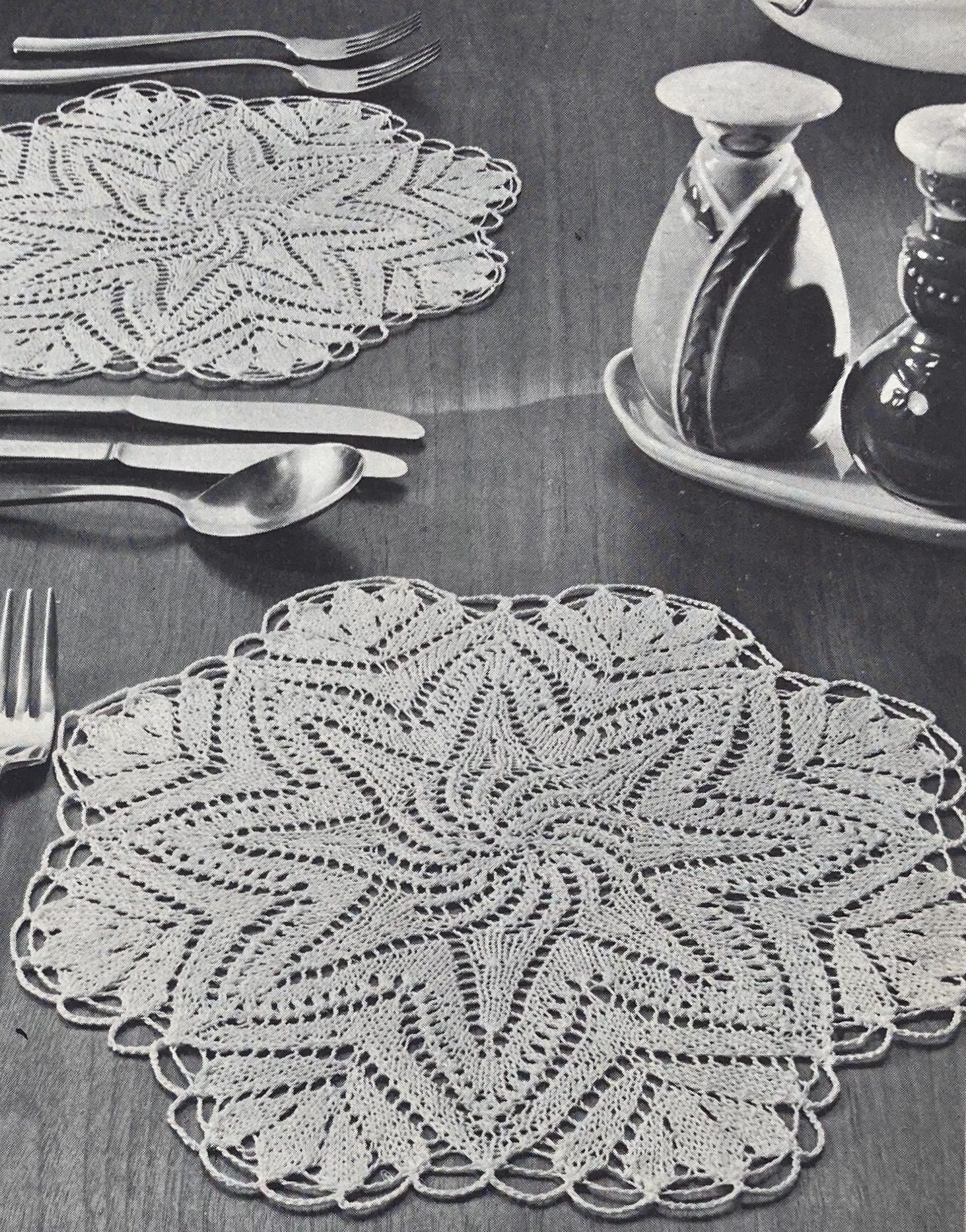
More ambitious embroiderers (I guess Stitchcraft would call them embroideresses) can make a really pretty fire screen with a modern vase-and-flower motif. I wish they had a colour photo. Even more ambitious knitters can make some beautiful lacy doily mats, and those who prefer to “sew through the Summer” can make a little laundry bag for used dusting cloths, or some easy items to sell at the “needlework stall”, church bazaar, etc. There’s a tea cosy that looks like a cottage, a beach bag with penguins, or an apron with a teakettle pocket.
I am woefully behind on projects, having not even finished my supposedly quick and easy blouse from June 1961, and with two other projects from that issue (the child’s beach dress and the embroidered-appliqué bird picture) still “in the queue”. But someone is always having a baby and that little dress is really sweet and should knit up quickly, so I’ll probably make that and try to work on the remaining June projects at the same time.
Bonus Answer 1: A cardigan definitely has buttons/fastenings and a knitted jacket often doesn’t. Unless it’s a suit jacket, then it does. Or whatever.
Bonus Answer 2: The garment on the front cover is a “cool, casual shirt-sweater”.



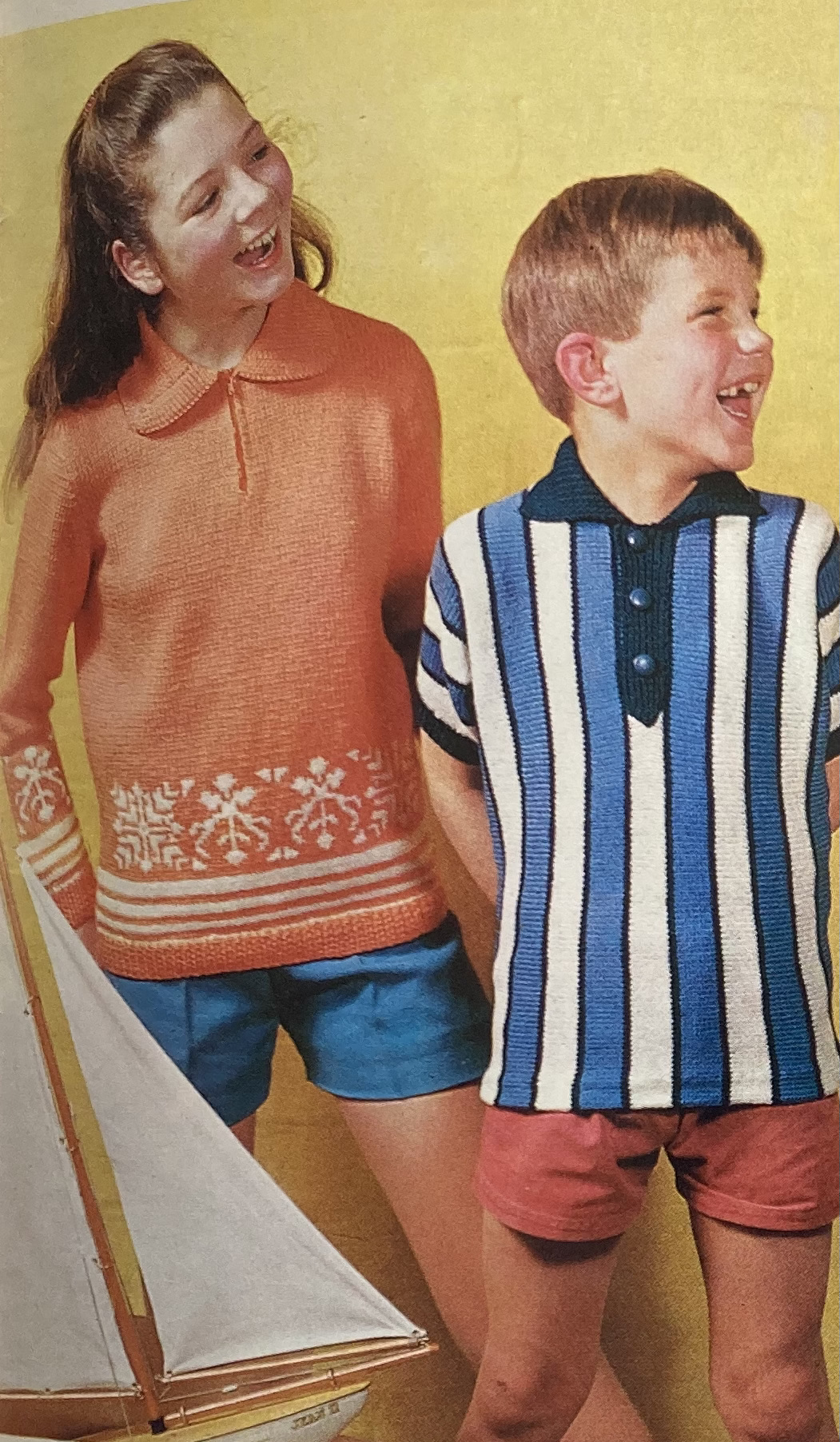
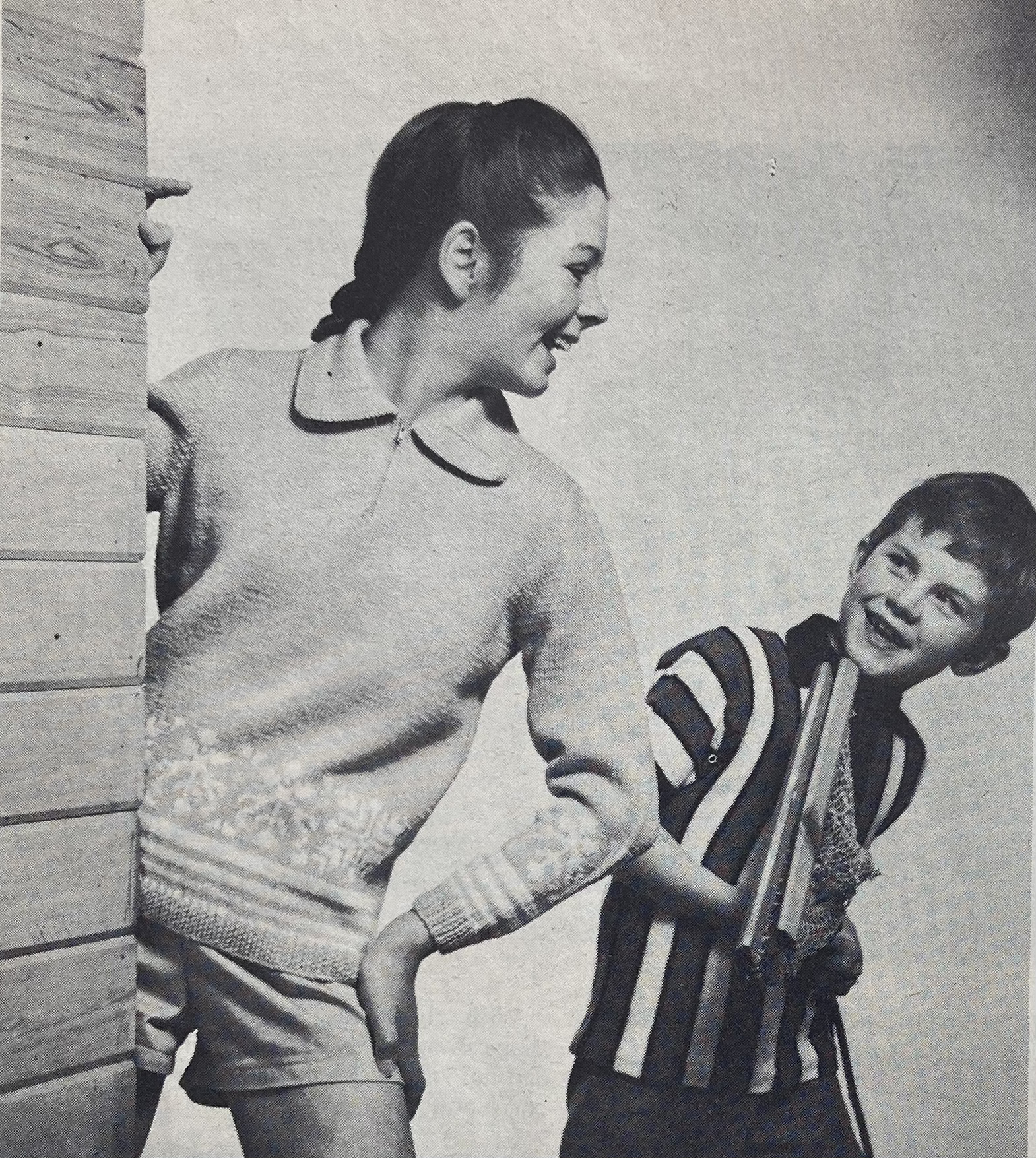
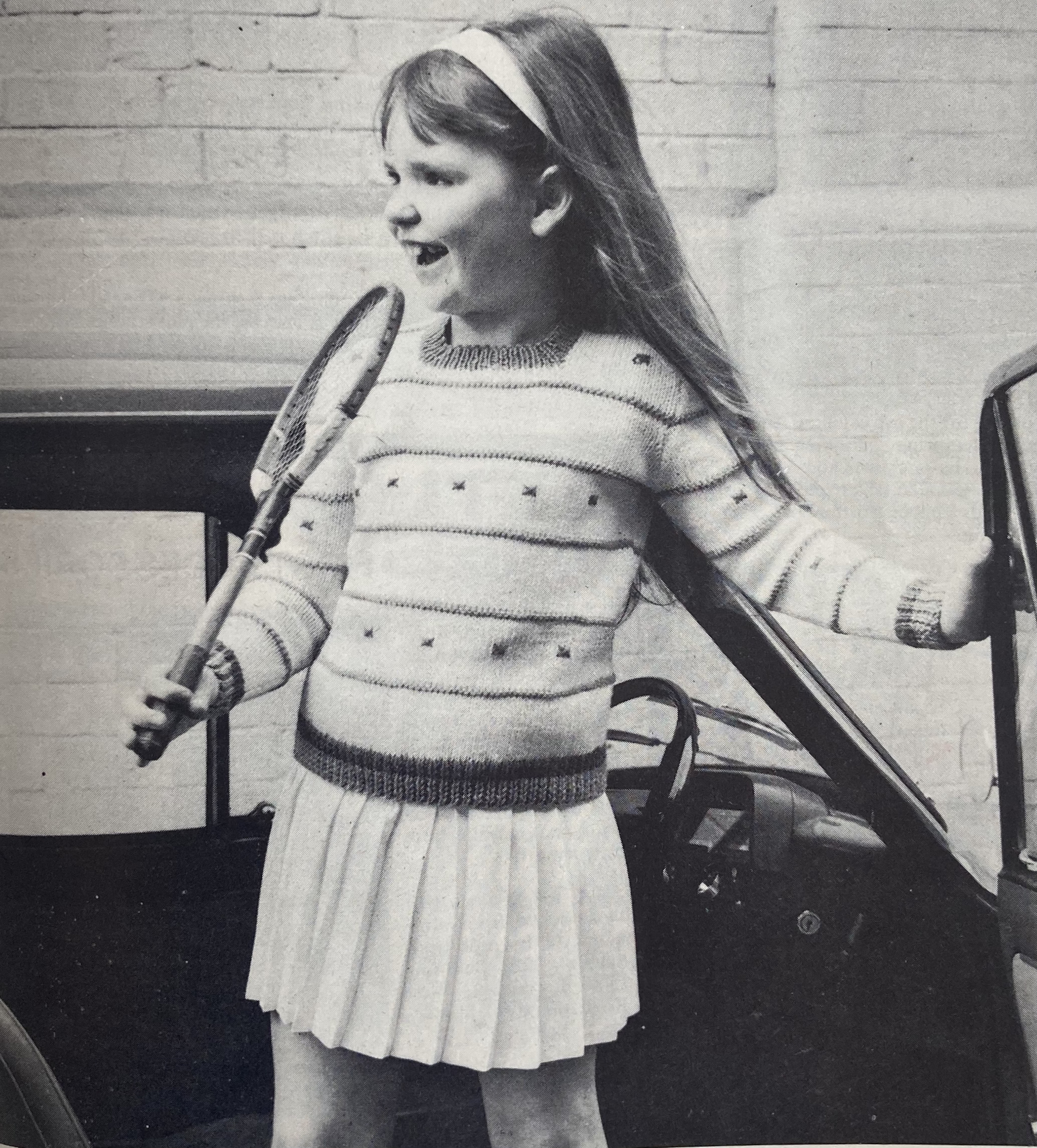
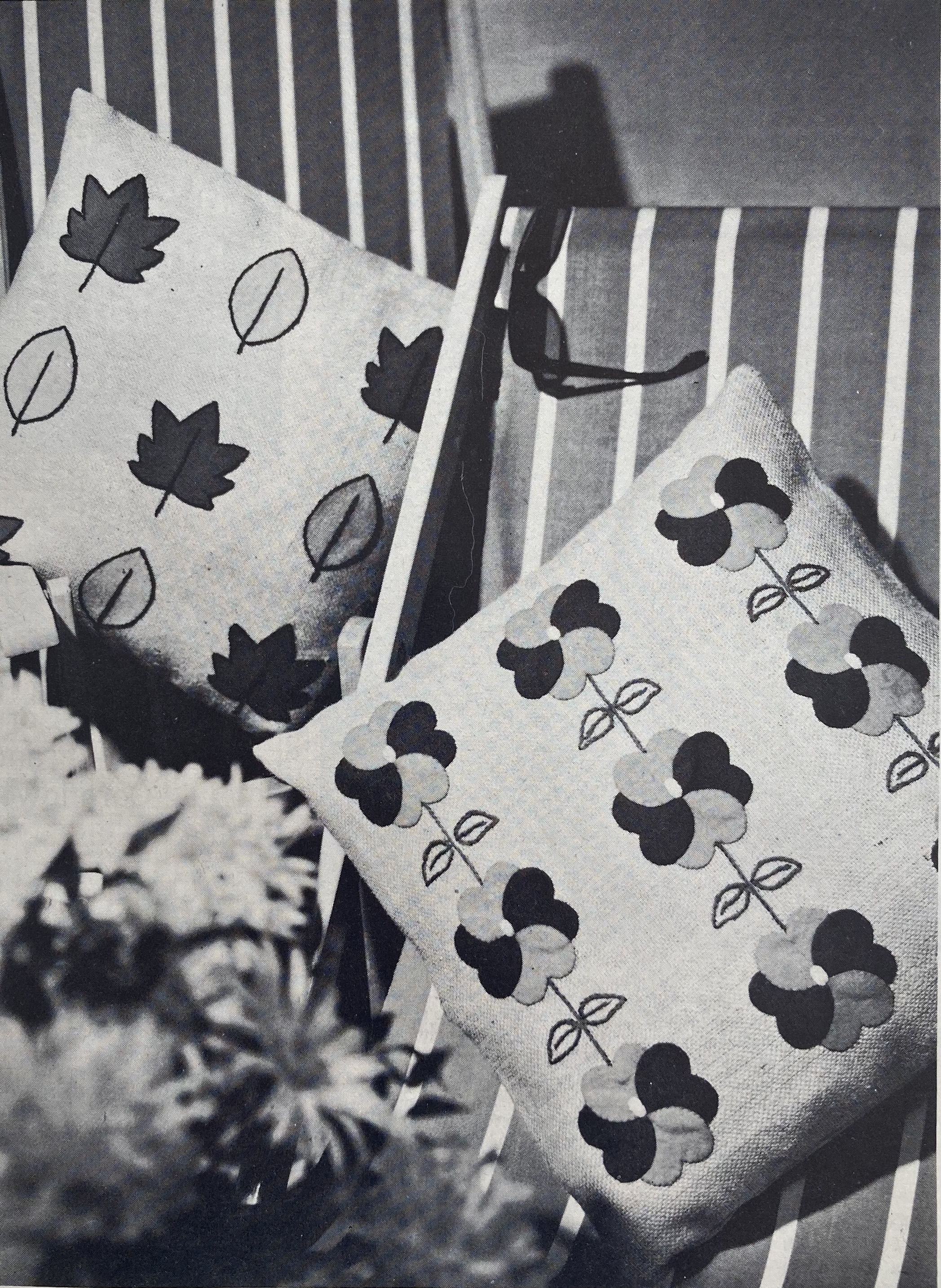










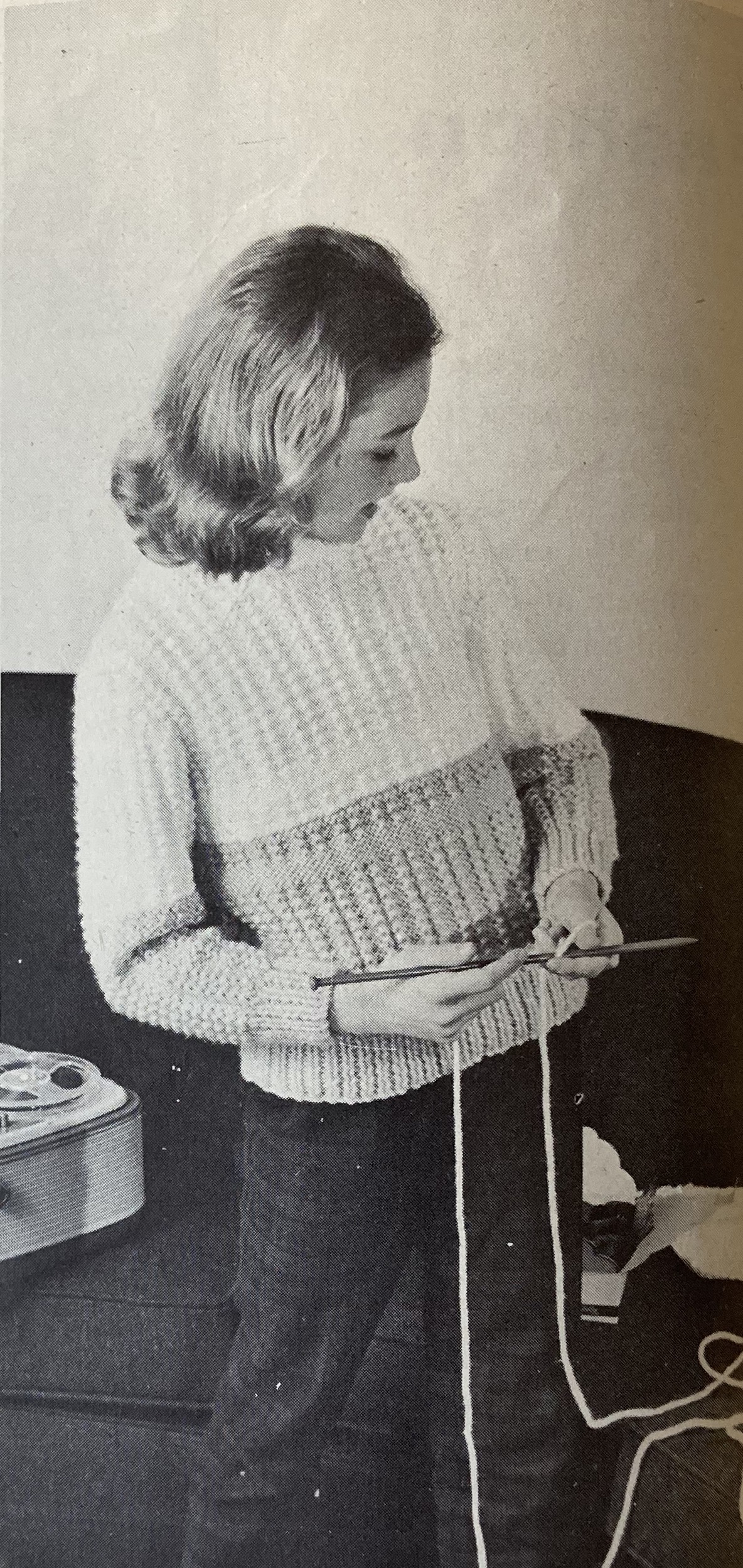
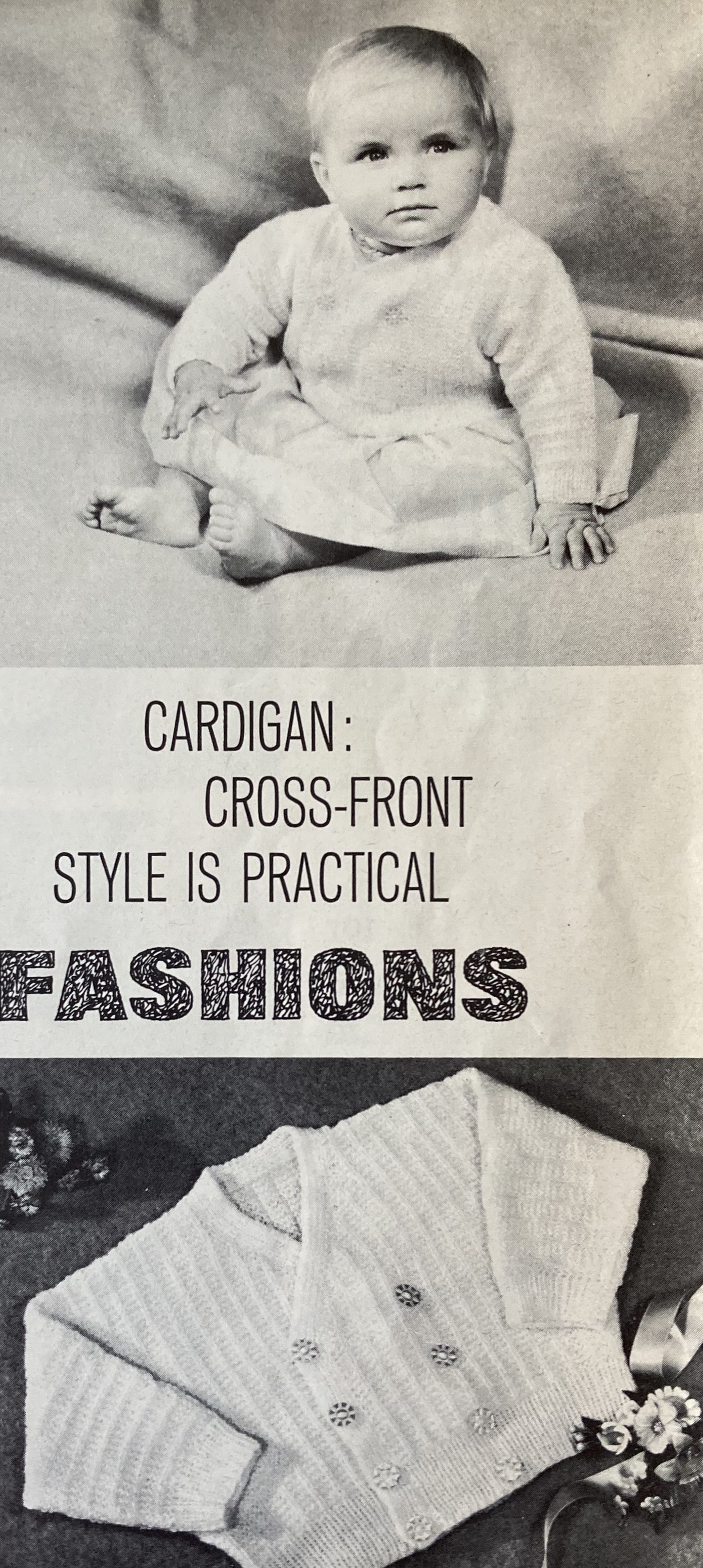
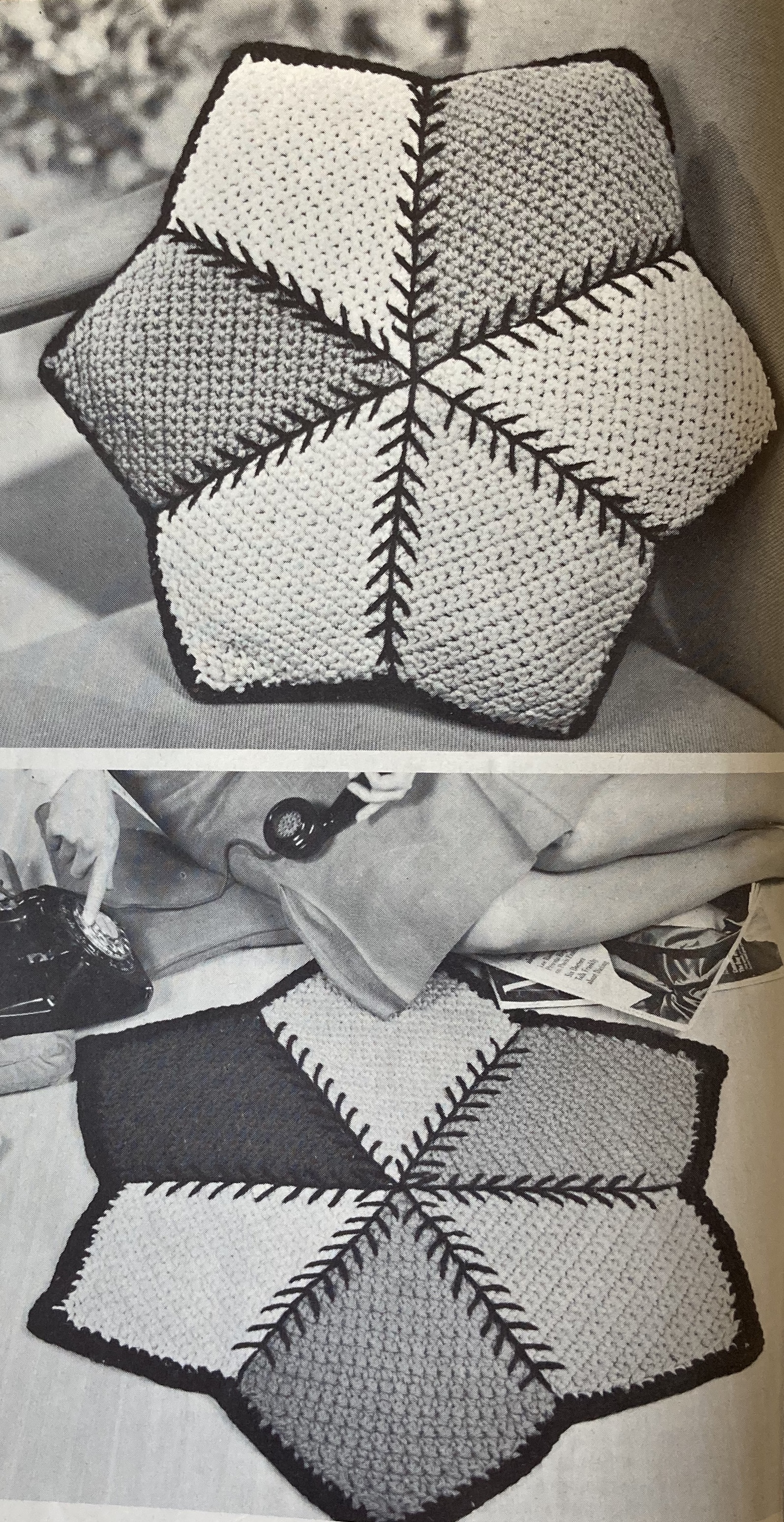
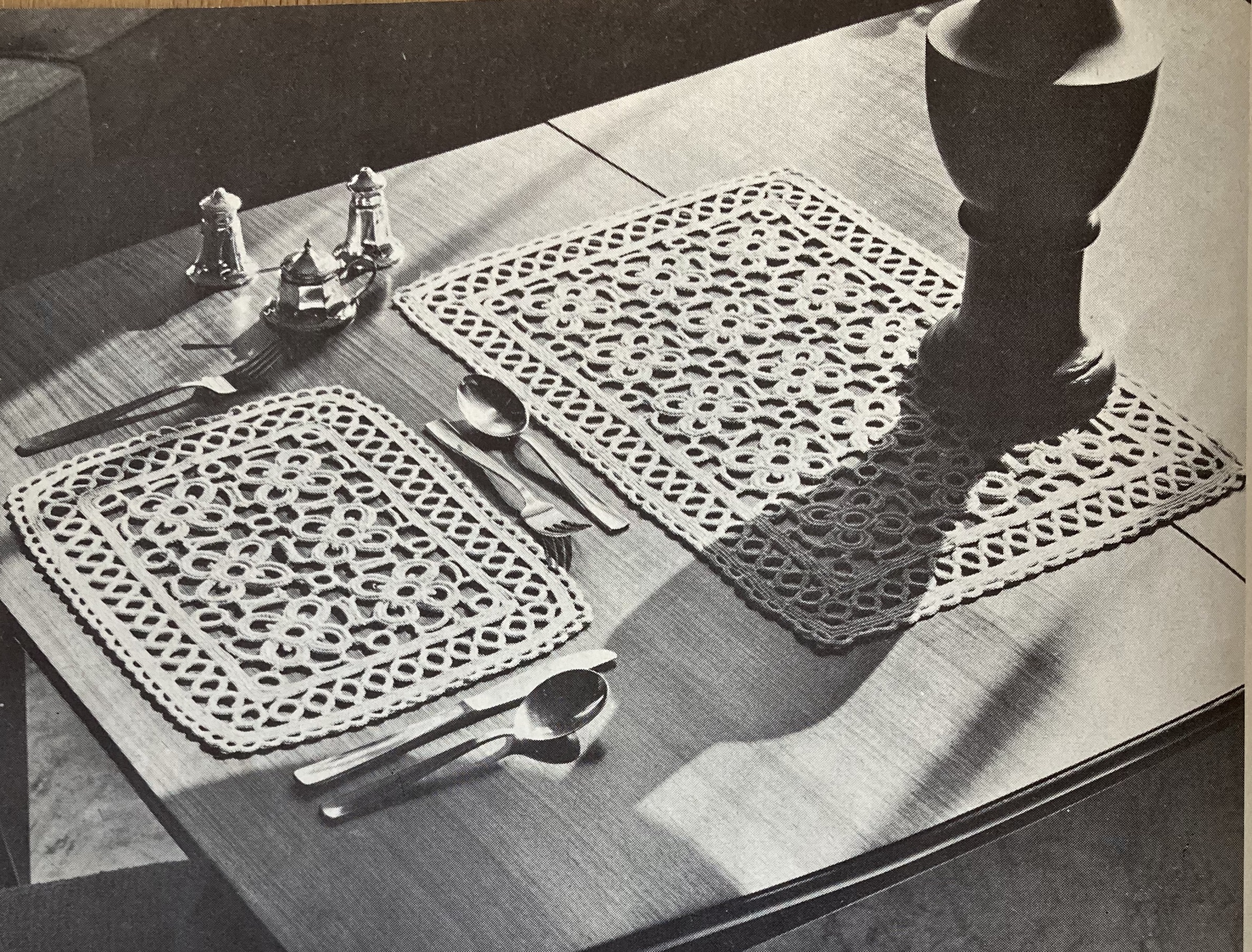






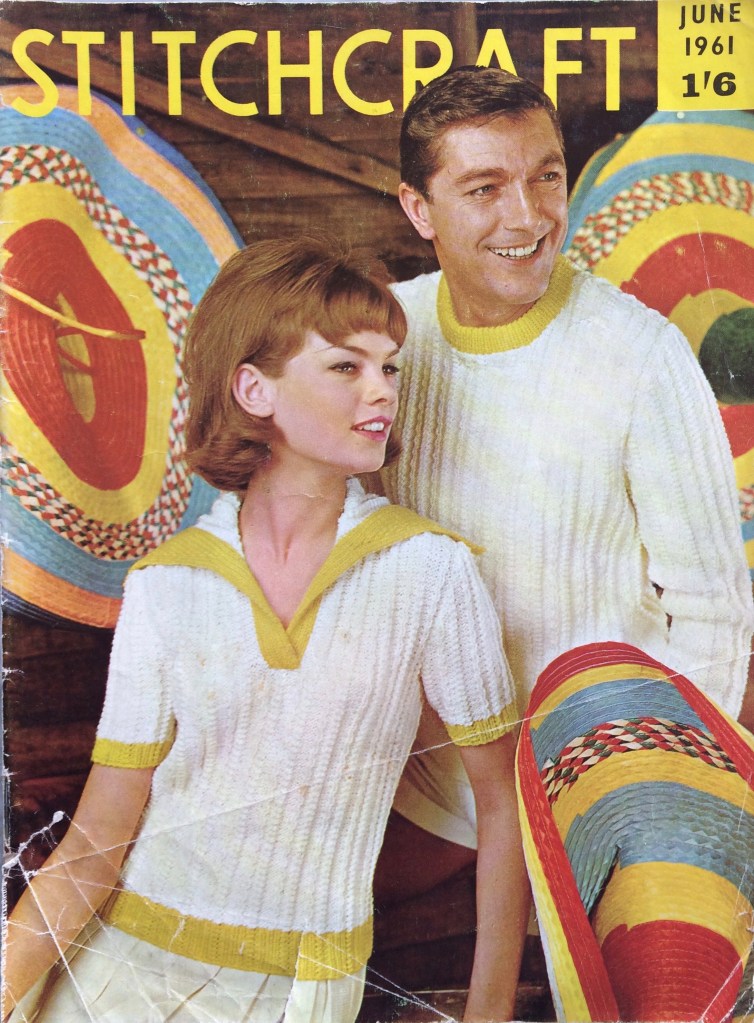

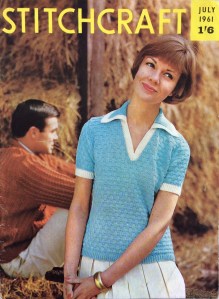 The motto of the July 1961 issue is “Sew through the Summer” and indeed, there are a lot more sewing projects than one would normally find in Stitchcraft, summer being a time when many people do not want to hold wool in their hands or think about colder weather to come. There’s more emphasis on homewares and small, fun projects to make and use on holiday. The farm photos were taken in Hertfordshire and the boating photos in “the heart of London’s Little Venice”. Doesn’t that sound like fun? Let’s dive in!
 a really pretty basketweave blouse with that V-neck-plus-collar design that we saw so much of in 1960 and the last years of the 1950s, not to mention just last month on the cover of the


 The Stitchcraft Sixties