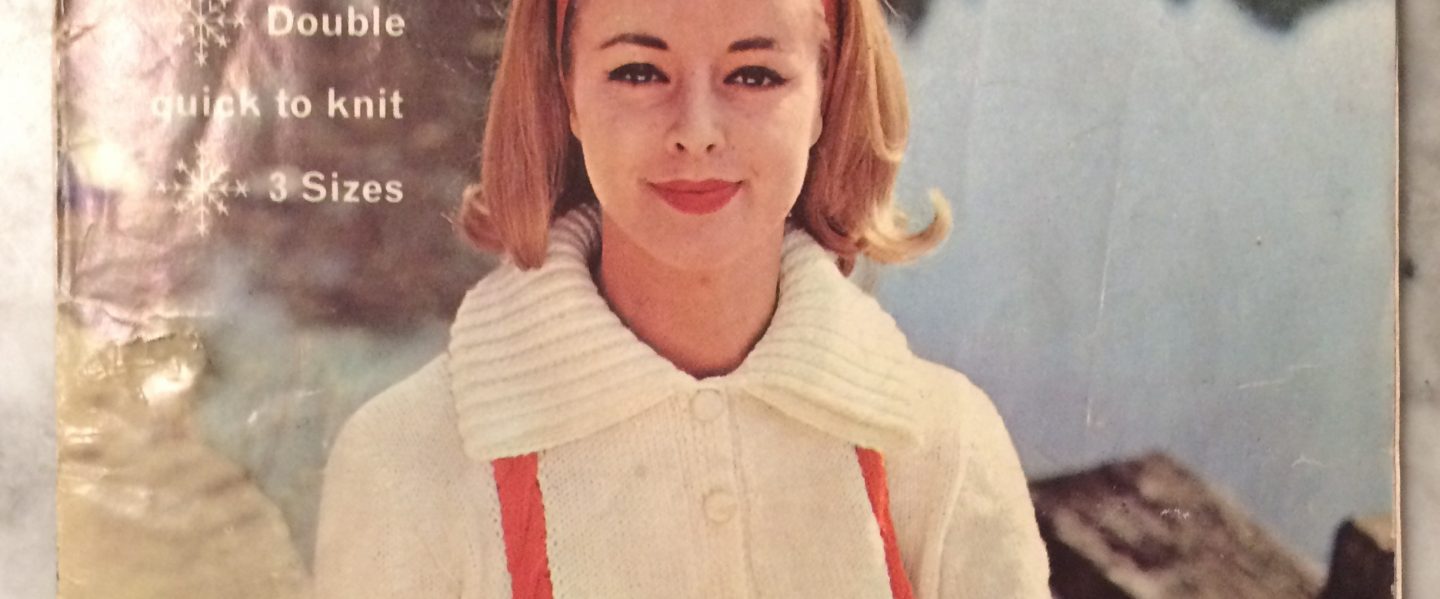
 “Knitting with an Autumn Theme” is the motto of this month’s Stitchcraft from September, 1961. Knowing that September is the month where many knitters take up their needles again after not wanting to handle wool in the hot summer, I would have expected a “bumper issue” with extra ideas, new fashions from Paris, more colour photographs and so on. Not the case! It has more or less the same mix of “chunky”, bulky garments and easy homewares that we saw in the summer issues.
Not that that’s bad, of course (though bulky is not and probably will never be my style). The kid’s coat looks cosy and fun to wear, and the “gay sweaters for him and her” in a Norwegian-style pattern are warm, practical and unisex. I imagine the boatneck collar on an unshaped front must scratch horribly across the neck, though.
There are more men’s garments than usual: a wide-collared “sports sweater” and an elegant crossed-front pullover with twisted-rib details on the pockets and borders. The former is meant to be worn for “golf, country walks and all the week-end jobs in the garden”. I’m guessing the plants in the garden will grow better if you wear a shirt and tie under your sweater while working on those week-end jobs, as it will make them feel important and worth dressing up for. Maybe I should try it — I’m terrible with plants.

Collars, V-necks and checked patterns are still in fashion, as seen on the comfortable, yet elegant cardigan suit and the cardigan in a familiar three-colour slip stitch pattern. Terry-towel-like Rimple is still going strong, featured here in a cardigan for larger sizes.


Babies get a bonnet and jacket in the same bramble stitch pattern as last month’s coat and July’s dress (“Part 3 of our Layette”) as well as a vest and pilch (underpants/diaper cover) and small children get machine-knit slacks to match the blazer. Hooray for warm legs, finally!


If all of that sounds underwhelming, we haven’t even gotten to the housewares… The knitting and crochet projects focus on using up scraps and “leftovers” to make either a cushion, a stuffed puppy toy or some utterly goofy egg cosies. Needlewomen (sadly, they don’t write “embroideresses”, which would be more entertaining) can make floral cutwork mats or a cushion, or a “Vintage Parade” of early-20th-century automobiles. There’s a tapestry hassock for church-goers and the last of the Zodiac-themed projects — this month’s sign is Virgo.


I almost gave up on this issue, as there just wasn’t anything that inspired me… but then there was this rug! This utterly 1960s, easy enough for me to crochet, fringed and polka-dotted rug that would look marvellous underneath my vintage, Danish Modern coffee table and, if made in the right colour, would perfectly match my embroidered cushion from the January 1960 issue. I love it! Rug wool in skeins isn’t really sold anywhere these days, but I’ve got a solution for that that I think will work.

Stay tuned for the result… and the “special bumper issues” with “extra features in colour” that are promised for October and November.
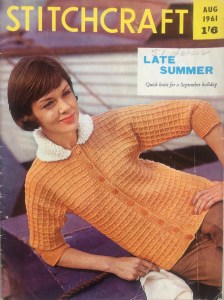 “August is an issue that needs special thought and planning” writes Stitchcraft‘s “editress”, Patience Horne, in the introduction to the August issue, pointing out that it is “rather an “in-between” month for needleworkers” — often too hot to want to wear or make heavy sweaters and too late in the year for fine-knits. At the same time, reminding people that “Autumn is around the corner” can be “a little depressing” to people enjoying their late-summer holiday.


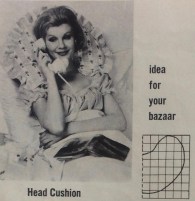 My favourite, though, is this sewing project: a head cushion that lets you recline charmingly in bed with your hair and makeup perfectly done, your satin nightie on, a book on your lap and your telephone on your ear. It’s glamorous leisure and lifestyle advertising personified, and though they say it’s an “idea for your bazaar”, I would bet the Stitchcraft readers who made this in 1961 did not make it to sell.
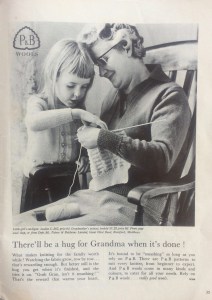 Apropos lifestyle advertising, the early 1960s Stitchcrafts show a rise in full-page ads for Patons and Baldwins wools. That’s obviously not surprising considering the magazine was published for the Patons wool company, but the full-page ads that “tell a story” are a new trend: the late 1950s and 1960s issues up to now had little celebrity testimonials. This one caters to grandmothers and the message is clear: Knitting is not only a rewarding pastime on its own, but earns you the love and affection of the grandchildren for whom you knit. (But only if the kid likes it, and that’s only guaranteed if you use P&B wools, of course.) The 1950s and 1960s saw a huge shift in advertising methods towards a psychologically-based system, which is a huge topic that I won’t start with here, but suffice to say there will be more of these ads, and that they are representative of changing advertising styles.
 This month’s project was a little bit different than usual. Instead of making something from the April 1961 issue, which didn’t have any projects that really spoke to me, I decided to finally make something I’ve been dreaming of ever since I made
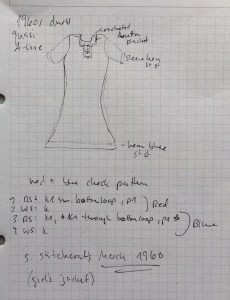
  I chose a typical basic construction with front, back and sleeves all made flat and separately from the bottom up and sewn together, and made a stockinette-stitch hem with the blue yarn. The dress shape is a modified A-line: flared at the hem and narrowed to the top waist, then increased slightly at the bust. I used another knit dress as a pattern, but had to deviate from it as the stitch pattern made the fabric behave differently. The sleeves are short, simple and set-in. The front piece is essentially the same as the back, but divided in half after the armhole cast-offs and rounded a bit at the neck. The button band is plain crochet.
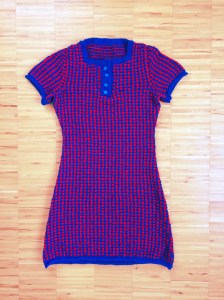 After it was all done, I realised that I liked the roll of the blue stockinette stitch hems, so I decided to just leave them as is. That means the bottom hem is a little bit narrow in the blue part where it should flare out. I may or may not fix that in time, depending on my laziness levels.

 Are you ready to “Rendez-vous with Spring”? I sure am! This month’s issue has a lovely extra “centerfold” spread in colour, showing off Spring 1961’s latest fashions.


 The ads are for the usual knitting machines and sewing fabrics… except for this one, for “Cooper’s moth proofer” spray, presumably made of
  This year (1960 or 2018, take your pick) draws to a close with Stitchcraft’s “Christmas Issue”, which, as you may expect, is full of holiday-themed novelties to decorate and give.


 Adult women, having hopefully embraced the “new length” (long) and “new sleeve style” (3/4 or 7/8) from last issue, can get ready for Paris’ “new necklines” — a high turn-down-and-rib combination or a buttoned-up turtle (polo) neck. No turn-down collars this time — are they on the way out? There’s a new yarn to go with them, Cameo Crepe, which is smooth and less “hairy” than other wools, for good stitch definition.


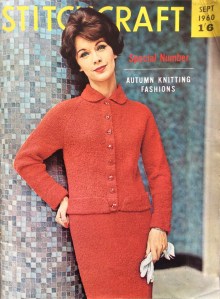 September 1960 is supposedly a “Special Number” of autumn knitting fashions. I’m not sure what exactly makes it so special, since it doesn’t seem to have any more, or particularly different, projects than the average issue. I guess it’s special in that September is finally a bit cooler weather-wise, so you can start to make some nice wool garments for the colder months — very appropriate in 2018, where we had the summer to end all summers. Things have cooled down a bit now, so I’m looking forward to wearing my (still unfinished) projects from July and August soon.


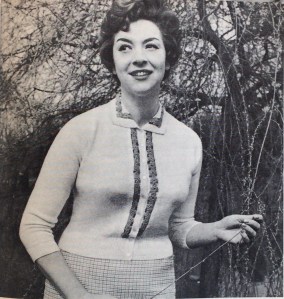 This “charming and unusual design for larger sizes” (37-38 or 39-41 inch bust) features narrow dolman sleeves, crochet insertions, and horizontal bust darts.
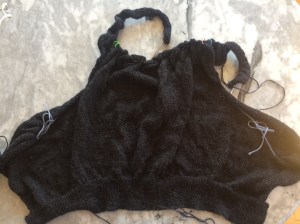 I was interested to see how it worked out with the dolman sleeves. When I think of “dolman sleeves”, I think of those 1950s, or worse, 1980s garments with a huge triangle of fabric under the arm, which must have been very uncomfortable and inconvenient to wear. But after my April 1960 blouse with the horizontal cap sleeves worked out so well, I was willing to give this one a try. And it turned out great! There is no more extra fabric under the arms than there would be with set-in sleeves, and the horizontal construction gives plenty of room in the upper chest/back area, where I am quite wide. I guess the secret lies with the number of stitches cast on for the sleeves per row — this one had 2×8 rows and then 10×16 rows, making the sleeves narrow and more horizontal, thus less triangle-like.
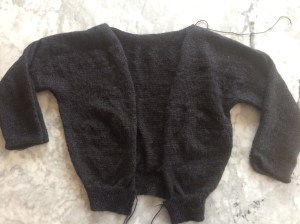 The knitting was slow-going at 7 stitches to the inch, but of course once the body was done, so were the sleeves. Seaming was a nightmare, as the yarn (Herriot Fine from
 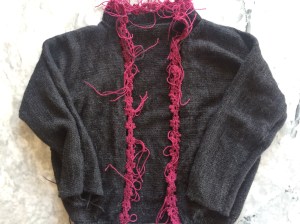 What took longer than expected was the whole crocheted edging-collar-button-band extravaganza. The crochet bands are extremely fiddly — they are crocheted onto each other as you go, it’s difficult to make them all exactly the same size, and each one needs its own, new piece of yarn. There are a total of 50 elements, so that’s 100 yarn ends to weave in right there. Then there’s the “inner” collar, the “outer” collar and the button bands, all of which are made separately and sewn on, and somehow need to end up symmetrical and fit properly on both sides. Of course, I sewed the collar on backwards the first time, forgot to switch the right and wrong sides at the collar fold, etc, etc. It all worked out in the end, though.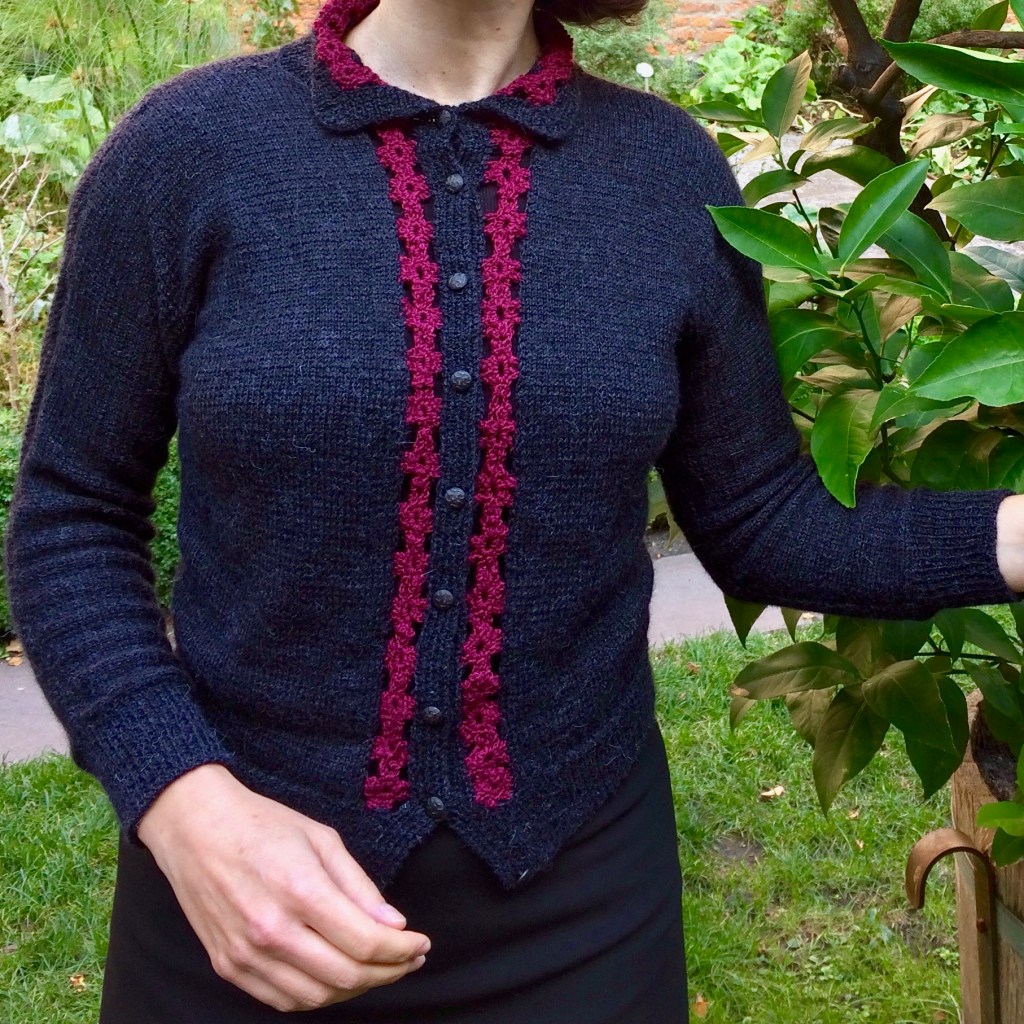
 February’s project was pretty simple: a crocheted cap and “mitts” with a cute bobble pattern. I couldn’t decide on the colour (lavender or purple) and didn’t have quite enough of either to make both cap and mitts, so I ended up making the cap twice and using up leftovers of both colours plus a little extra of a different purple yarn to finish the mittens.


 February 1960, the “Spring Knitting Number”, features an extra 16-page pull-out booklet with garments in Patons Rimple, a nubbly wool-with-a-bit-of-nylon yarn that looks like terrycloth toweling when worked up.
  The model, like all children of the 1960’s and earlier, must have very cold legs. Why children of earlier times didn’t wear trousers or warm stockings or tights is a mystery that an older person will have to explain to me someday. It’s particularly strange to see in a knitting magazine, as often the child will be wearing a thick wool jumper or even a wool pullover under a wool sleeveless dress with a knitted wool coat over it, plus a hat and mittens if outside… but nothing on their poor bare legs.


