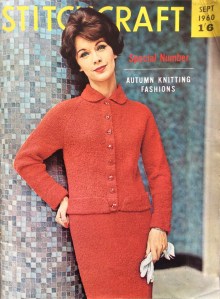
 September 1960 is supposedly a “Special Number” of autumn knitting fashions. I’m not sure what exactly makes it so special, since it doesn’t seem to have any more, or particularly different, projects than the average issue. I guess it’s special in that September is finally a bit cooler weather-wise, so you can start to make some nice wool garments for the colder months — very appropriate in 2018, where we had the summer to end all summers. Things have cooled down a bit now, so I’m looking forward to wearing my (still unfinished) projects from July and August soon.
But back to September 1960. “You must include some heavy-knits for the really cool days out of doors, but for the milder days, a fashion feature to note is the use of finer knitting,” Patience Horne tells us, and this month’s issue gives a good mix of finer and bulkier garments for adults and children. The 4-ply women’s sweaters (why sweaters and not jumpers? I still can’t figure out why they sometimes use one term and sometimes the other for the exact same type of garment) have those big square collars that we’ve seen on other 1960 designs, with or without buttons. The pink sweater is made in super-fine-ply Lucelle at 10 stitches to the inch! If hand-knitting in fine yarn is too time-consuming for you, you can make a lacy cardigan on your machine.


Moving up the bulkiness scale, we’ve got the lovely skirt suit on the cover, made in Rimple, a sweater in “overblouse style” and a “raglan golf sweater” for men in green plaid. Green checks continue to be in fashion! The “young sports fans” in the family get comfortable jackets in double knitting weight, “made to match for brother and sister.” Can you spot the difference between the boys’ and girls’ versions? (Do you remember those “can you spot the 10 differences between these pictures” puzzles in the kids’ comics section? Do they still have those?) If you can’t, I won’t tell you, but try buttoning a cardigan made for the “opposite” sex if you need a hint.


Fans of Big Ben bulky knitting can make a Viennese design with added-on embroidery in duplicate stitch, or a trio of crochet items in “crunchy Pineapple-stitch”. I love the pram cover, bound with blanket edging, but I wish I could see the bonnet from the front.


Homewares are well represented by a stool cover in Florentine tapestry, a great embroidered cushion in blackwork design, traditional and “modern” pile rugs and some interesting tablewares — tapestry table mats with pictures of “3 famous castles” and crocheted raffia drink mats for your cocktail party. Cheers, everyone! My September project will be the blackwork cushion, and I hope to finish up the knitted blouse from July and the cardigan from the August twin-set.


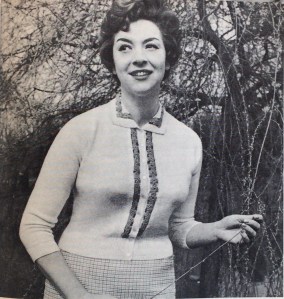 This “charming and unusual design for larger sizes” (37-38 or 39-41 inch bust) features narrow dolman sleeves, crochet insertions, and horizontal bust darts.
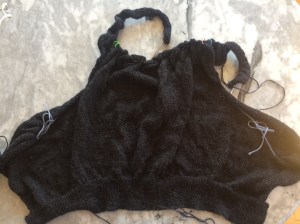 I was interested to see how it worked out with the dolman sleeves. When I think of “dolman sleeves”, I think of those 1950s, or worse, 1980s garments with a huge triangle of fabric under the arm, which must have been very uncomfortable and inconvenient to wear. But after my April 1960 blouse with the horizontal cap sleeves worked out so well, I was willing to give this one a try. And it turned out great! There is no more extra fabric under the arms than there would be with set-in sleeves, and the horizontal construction gives plenty of room in the upper chest/back area, where I am quite wide. I guess the secret lies with the number of stitches cast on for the sleeves per row — this one had 2×8 rows and then 10×16 rows, making the sleeves narrow and more horizontal, thus less triangle-like.
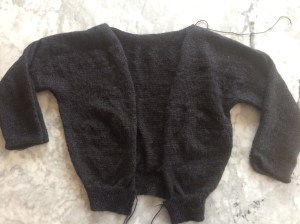 The knitting was slow-going at 7 stitches to the inch, but of course once the body was done, so were the sleeves. Seaming was a nightmare, as the yarn (Herriot Fine from
 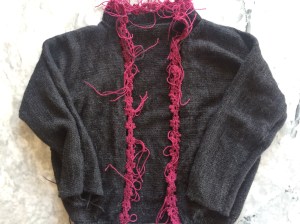 What took longer than expected was the whole crocheted edging-collar-button-band extravaganza. The crochet bands are extremely fiddly — they are crocheted onto each other as you go, it’s difficult to make them all exactly the same size, and each one needs its own, new piece of yarn. There are a total of 50 elements, so that’s 100 yarn ends to weave in right there. Then there’s the “inner” collar, the “outer” collar and the button bands, all of which are made separately and sewn on, and somehow need to end up symmetrical and fit properly on both sides. Of course, I sewed the collar on backwards the first time, forgot to switch the right and wrong sides at the collar fold, etc, etc. It all worked out in the end, though.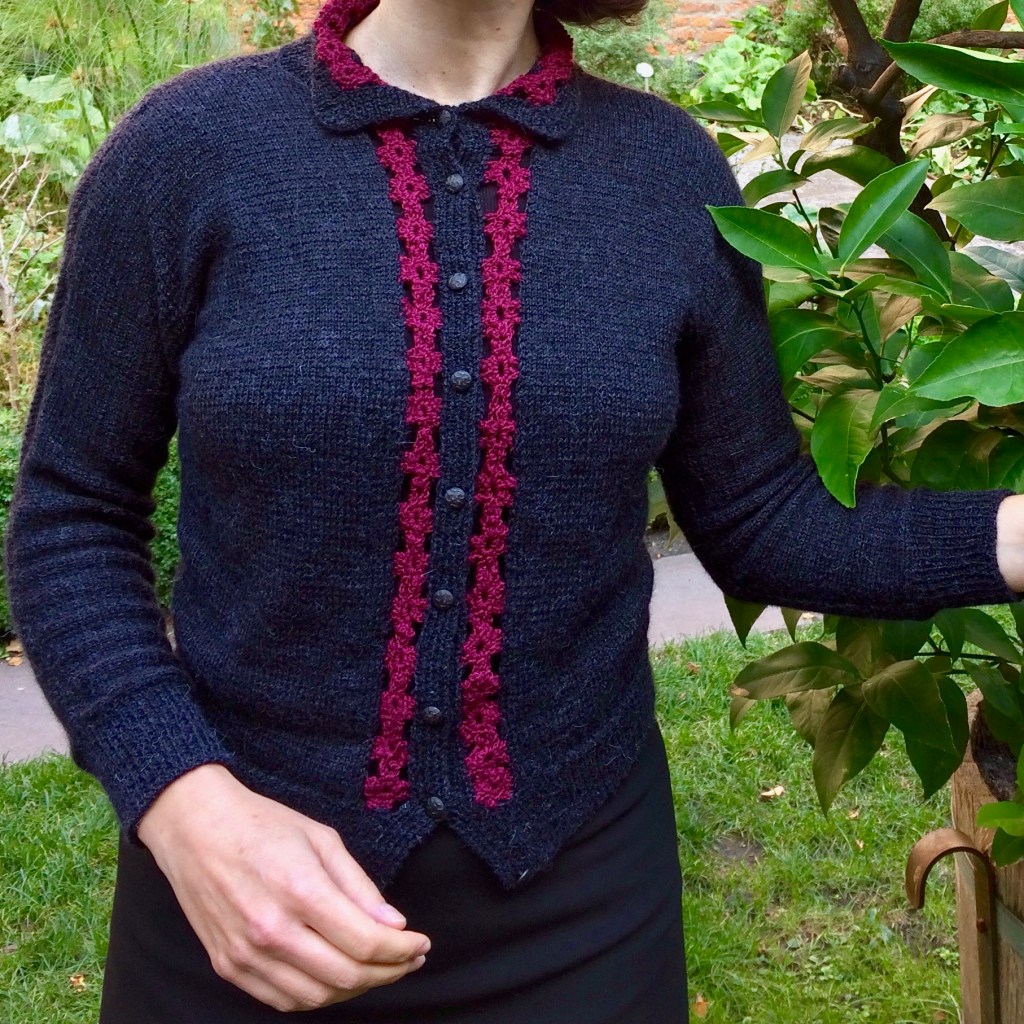
 February’s project was pretty simple: a crocheted cap and “mitts” with a cute bobble pattern. I couldn’t decide on the colour (lavender or purple) and didn’t have quite enough of either to make both cap and mitts, so I ended up making the cap twice and using up leftovers of both colours plus a little extra of a different purple yarn to finish the mittens.


 February 1960, the “Spring Knitting Number”, features an extra 16-page pull-out booklet with garments in Patons Rimple, a nubbly wool-with-a-bit-of-nylon yarn that looks like terrycloth toweling when worked up.
  The model, like all children of the 1960’s and earlier, must have very cold legs. Why children of earlier times didn’t wear trousers or warm stockings or tights is a mystery that an older person will have to explain to me someday. It’s particularly strange to see in a knitting magazine, as often the child will be wearing a thick wool jumper or even a wool pullover under a wool sleeveless dress with a knitted wool coat over it, plus a hat and mittens if outside… but nothing on their poor bare legs.


 The Stitchcraft Sixties