January 1966: Overview

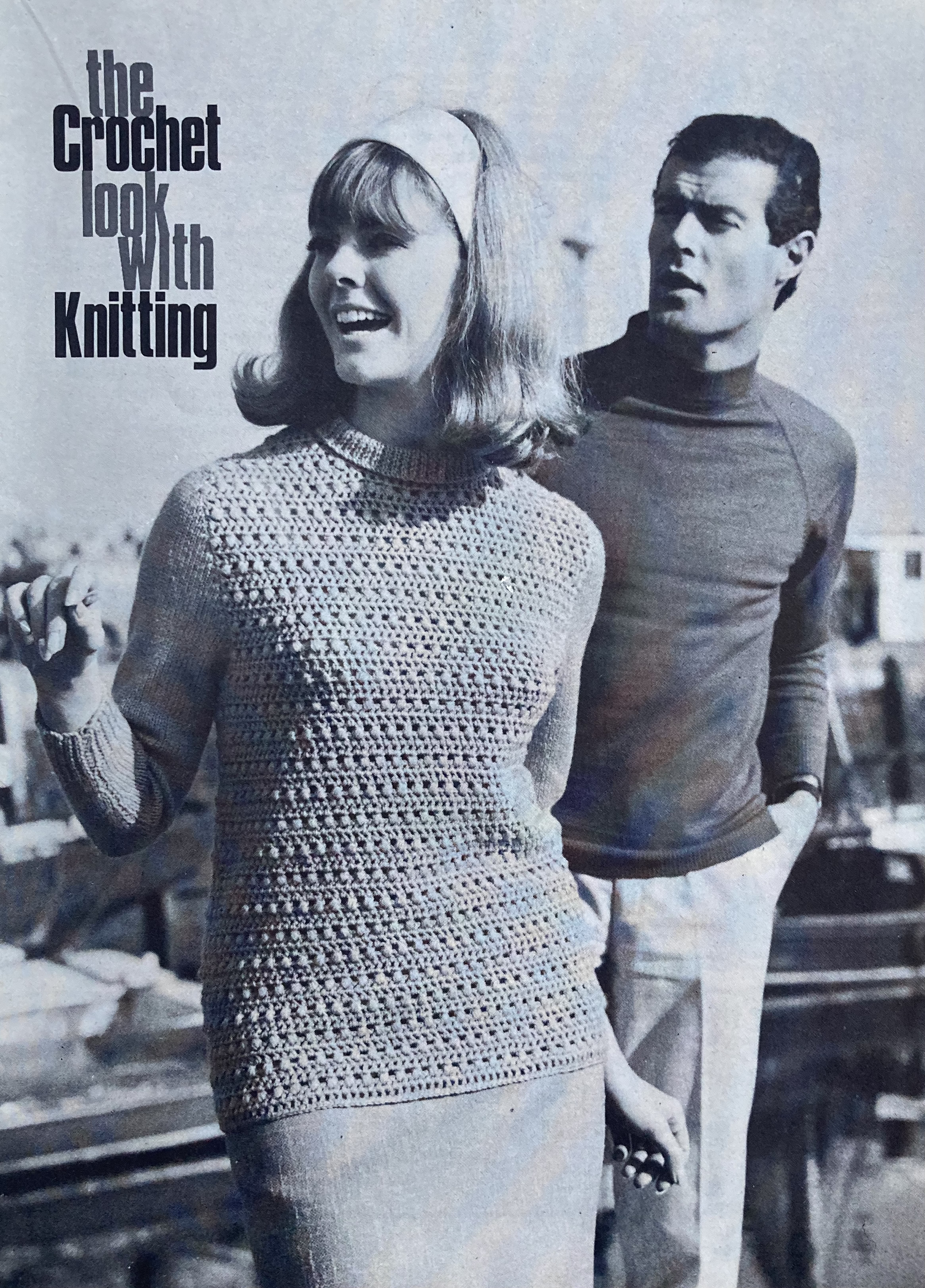
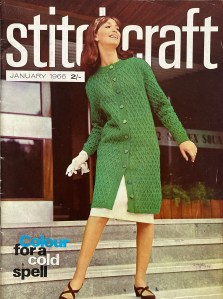
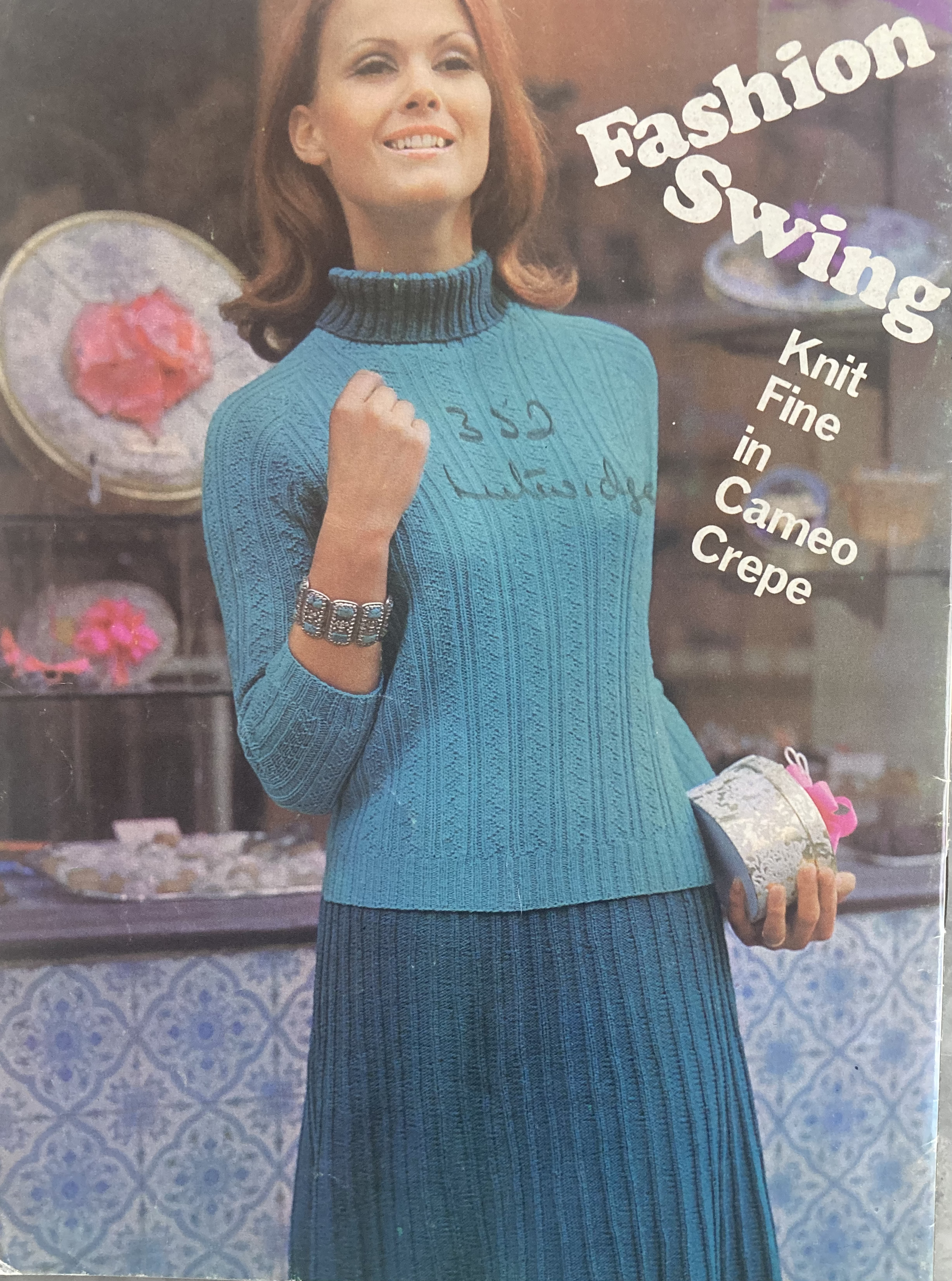
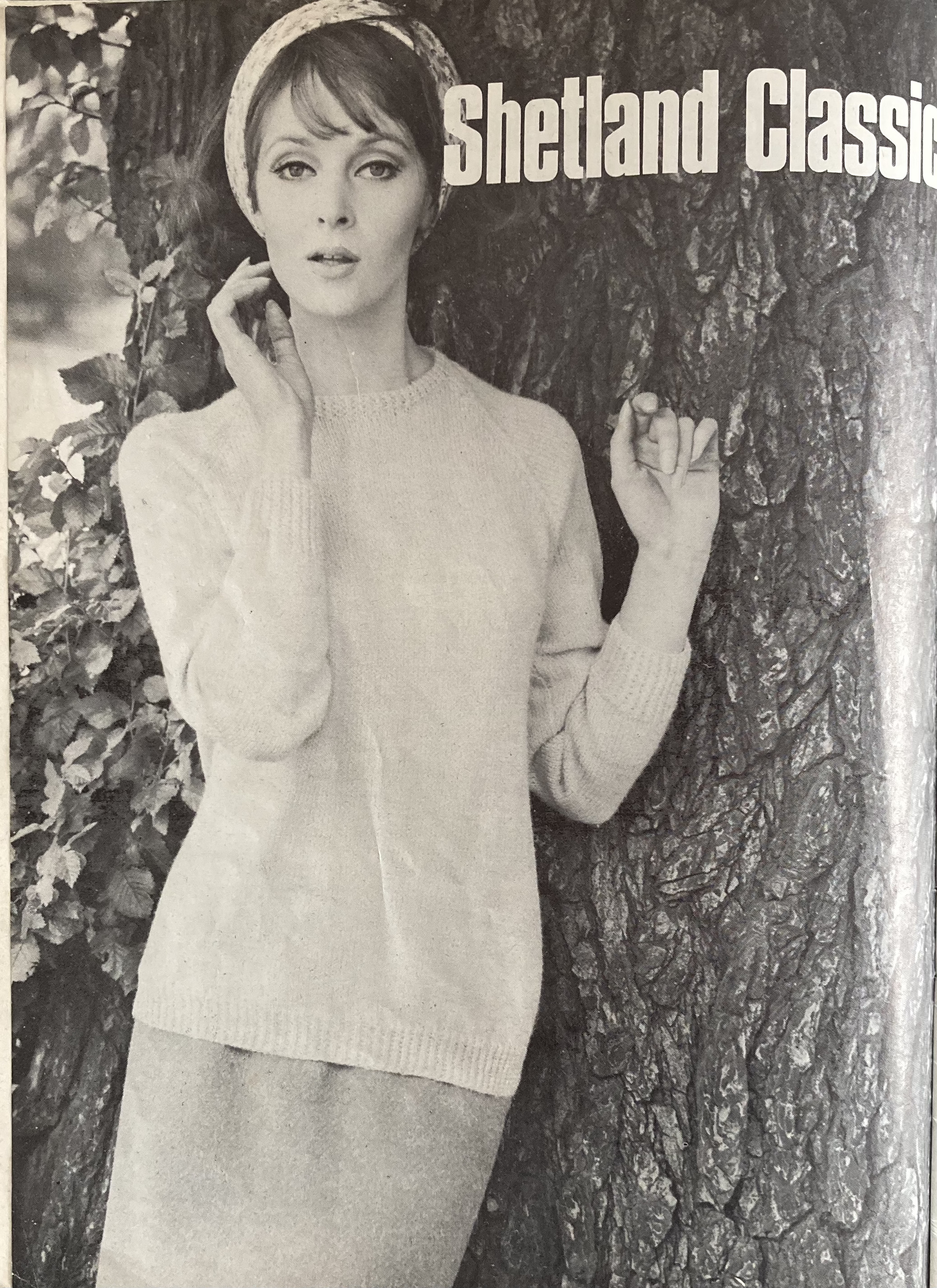
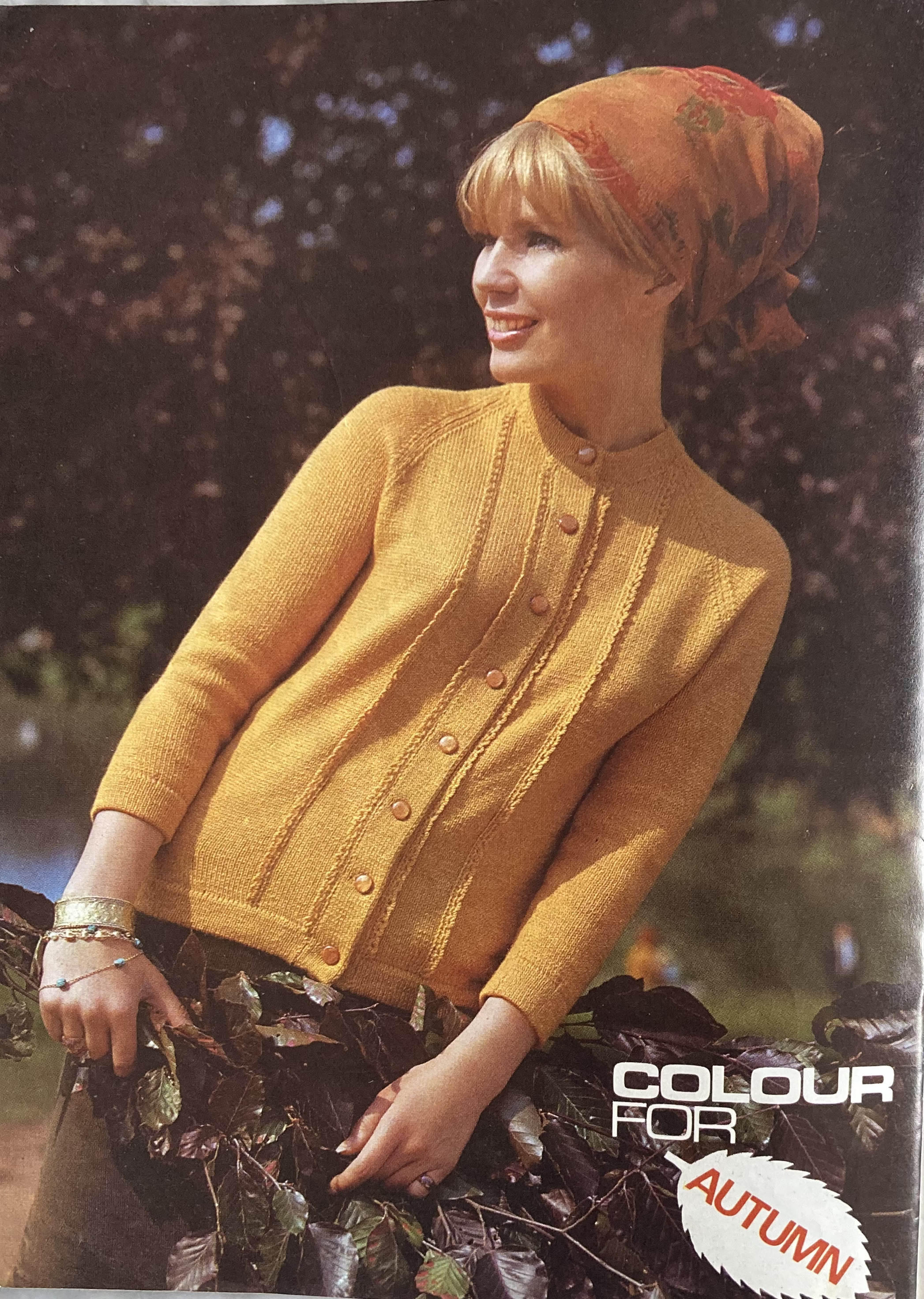
Happy New Year! It’s January 2024 in real time and January 1966 here at the blog. Get ready for shorter skirts (…finally. Stitchcraft is slow to catch up), horn-rimmed glasses, tweed bouclé and adventurous headwear. The theme of the January 1966 issue is “Colour for a Cold Spell”, with bright greens, redd and turquoise to carry everyone through the greyest month.

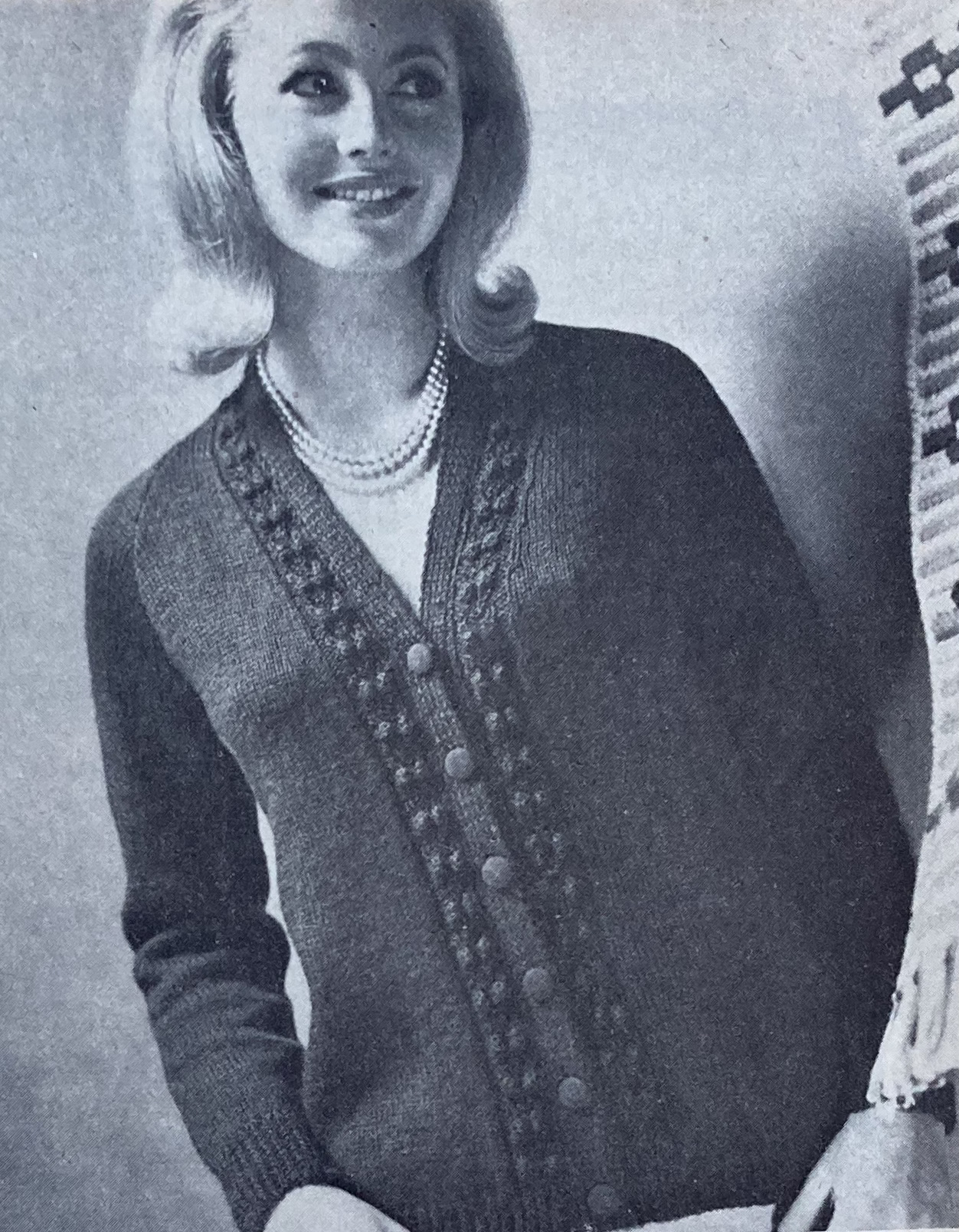
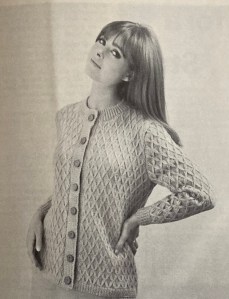
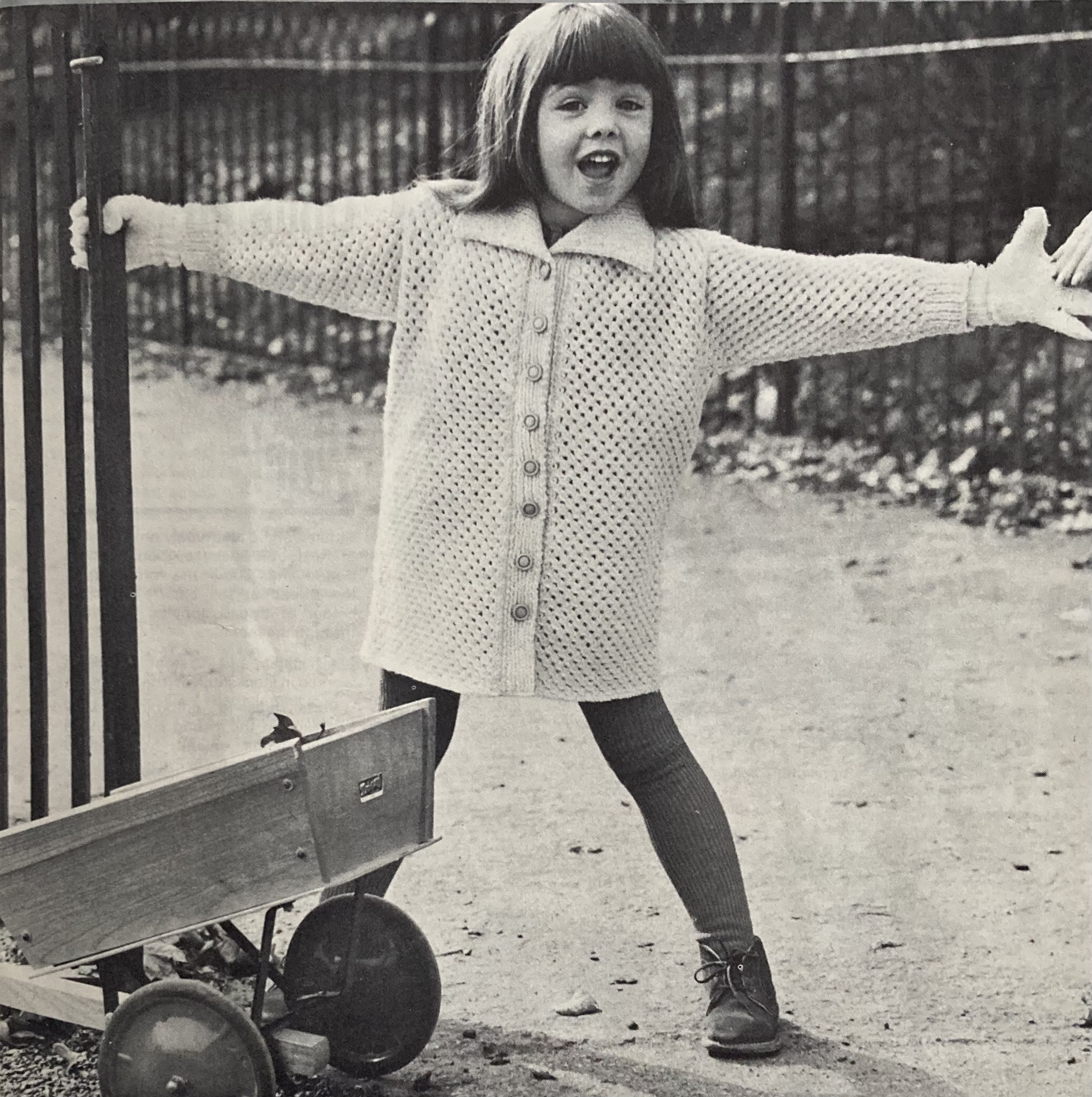
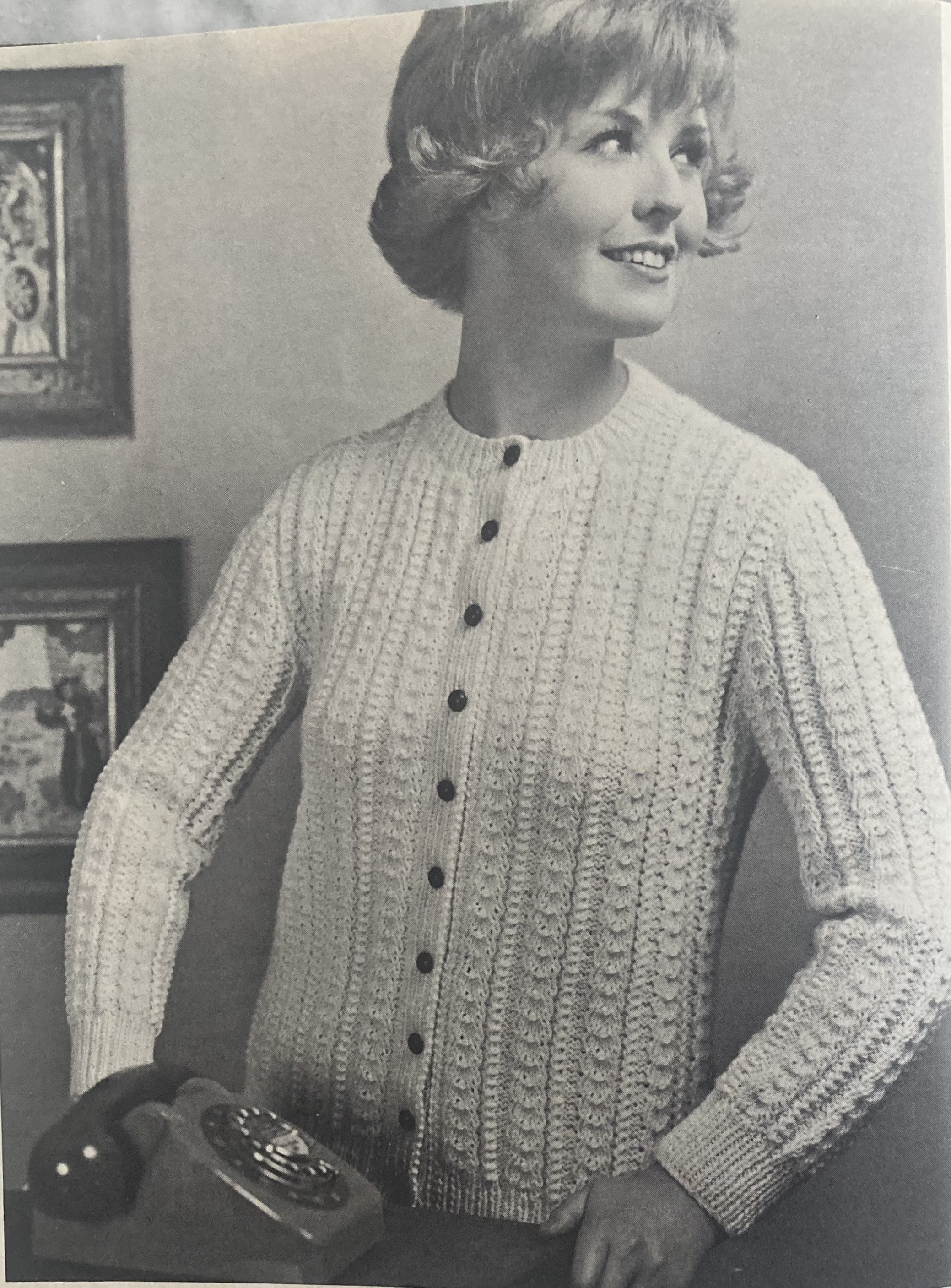
Our cover cardigan can be made long to wear as a coat as in the cover photo, or in fashionable hip-length. The trellis pattern is made by winding extra loops around the needle on the first row, then slipping this stitch on the next RS row to create a long loop stitch that is carried up via slip-stitches and knitted back in on row 7. The coat uses a whopping 28-33 ounces (ca. 750-900 g) of heavier-than-DK (modern worsted weight) “Flair”, so I would be wary about knitting this as it would presumably end up quite a bit longer than the 38-39 inches it should measure when finished. Love the pattern, though. I could imagine making the shorter cardigan in brown and embroidering it to look like flowers and plants climbing up a trellis.

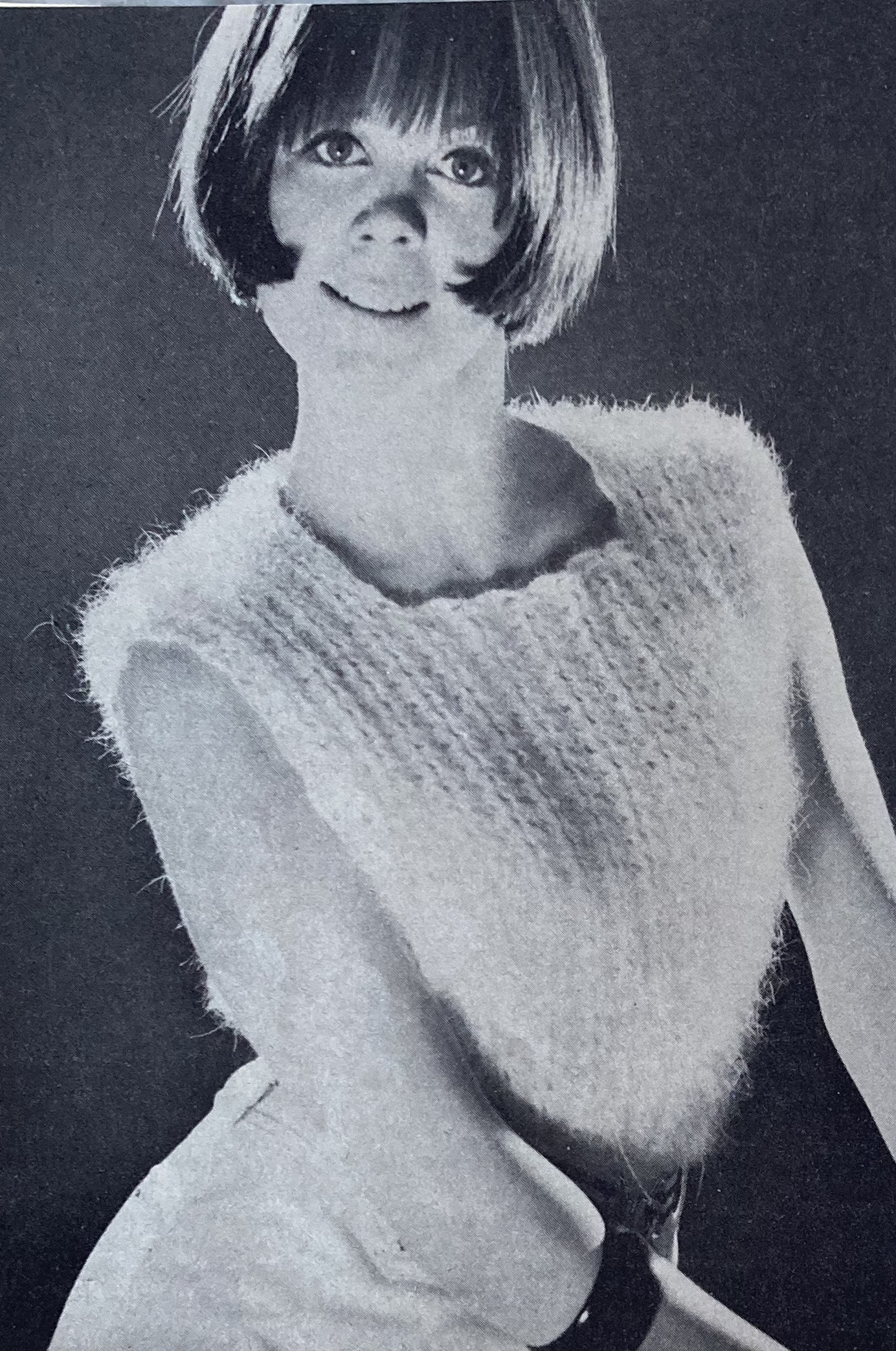
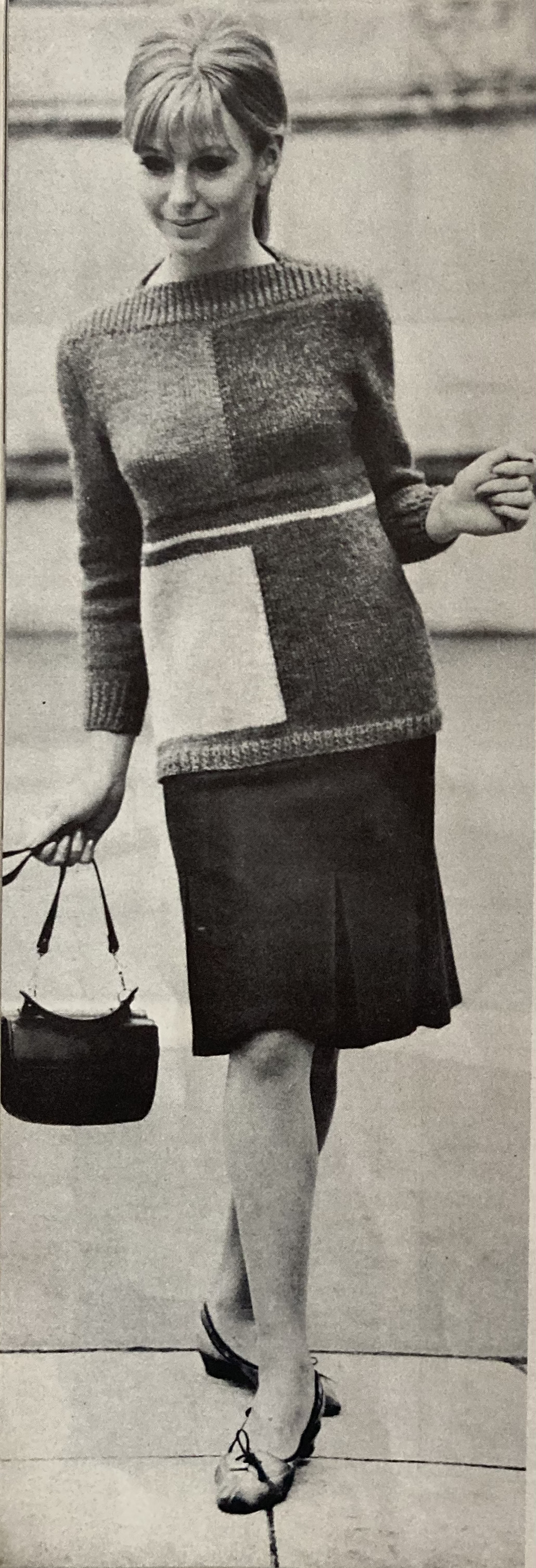
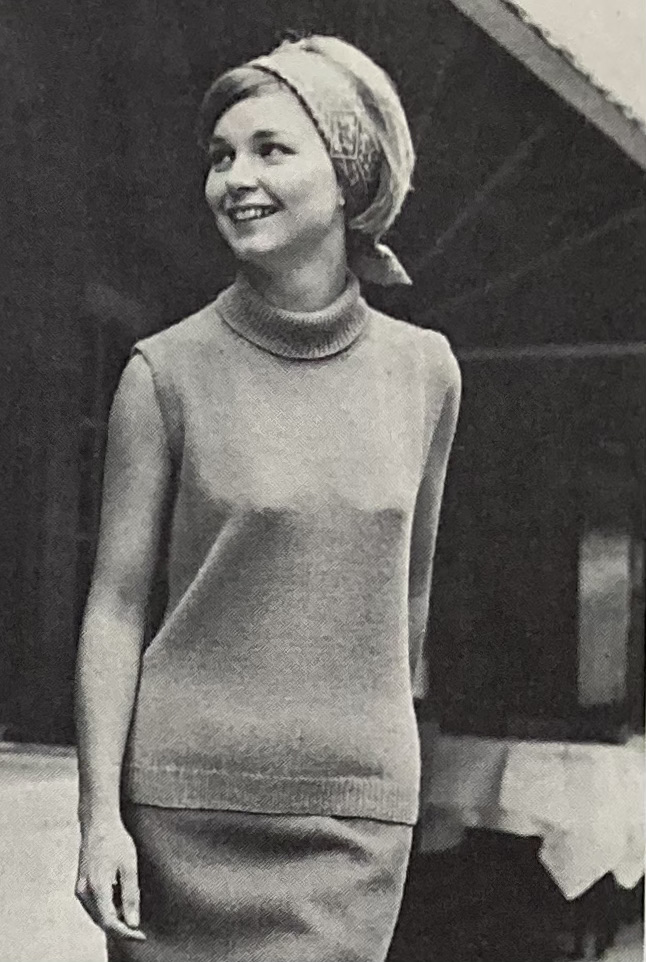
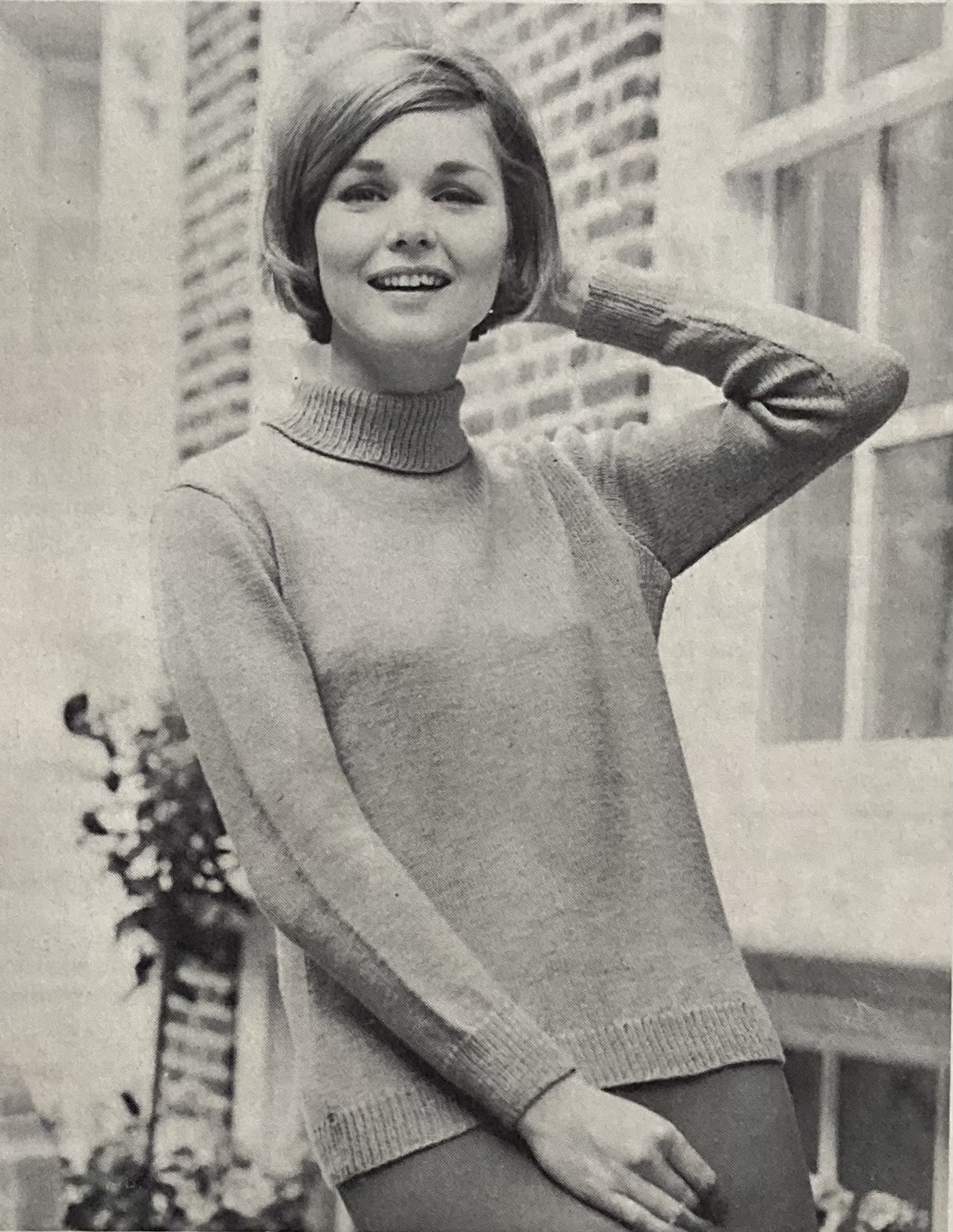
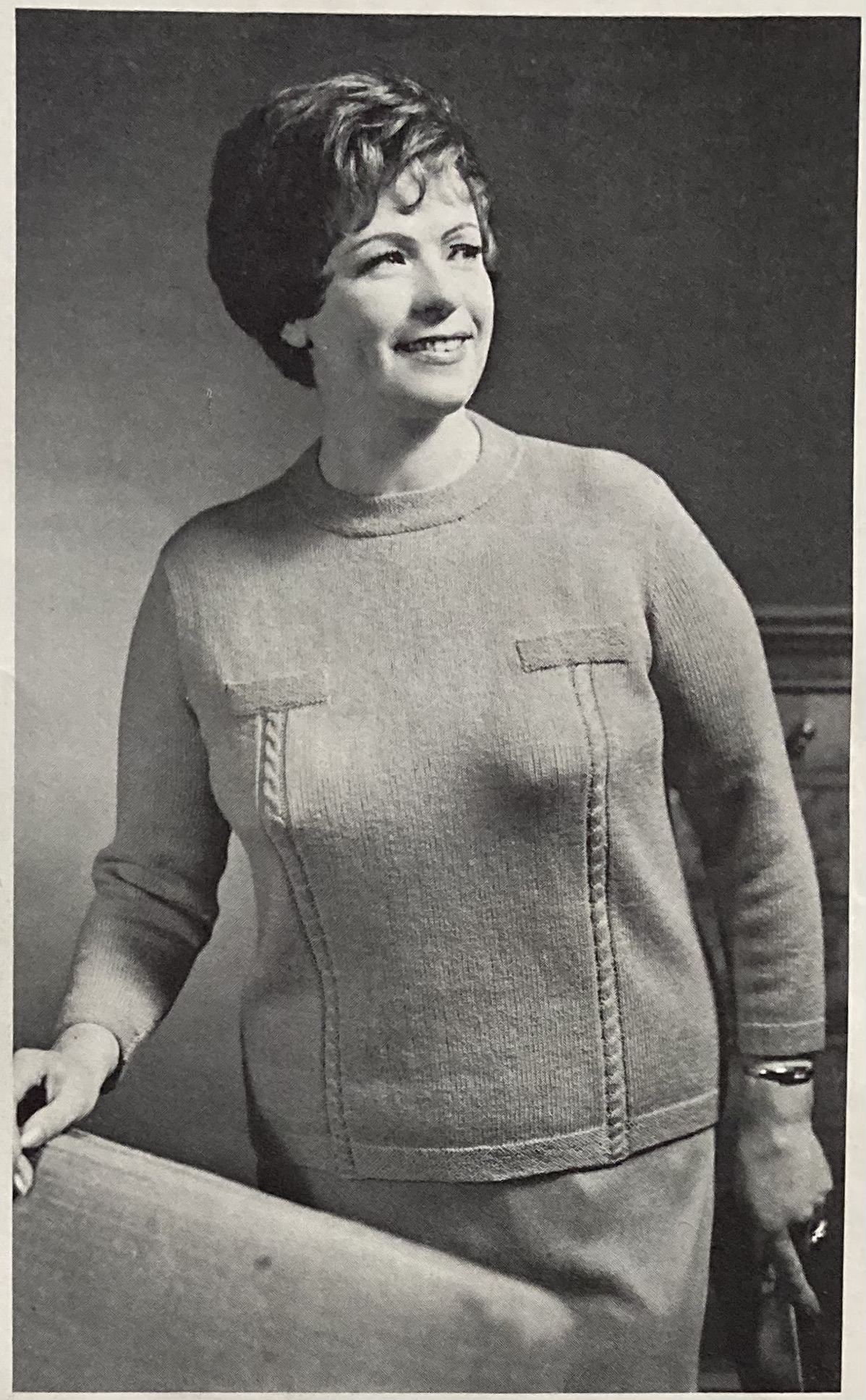
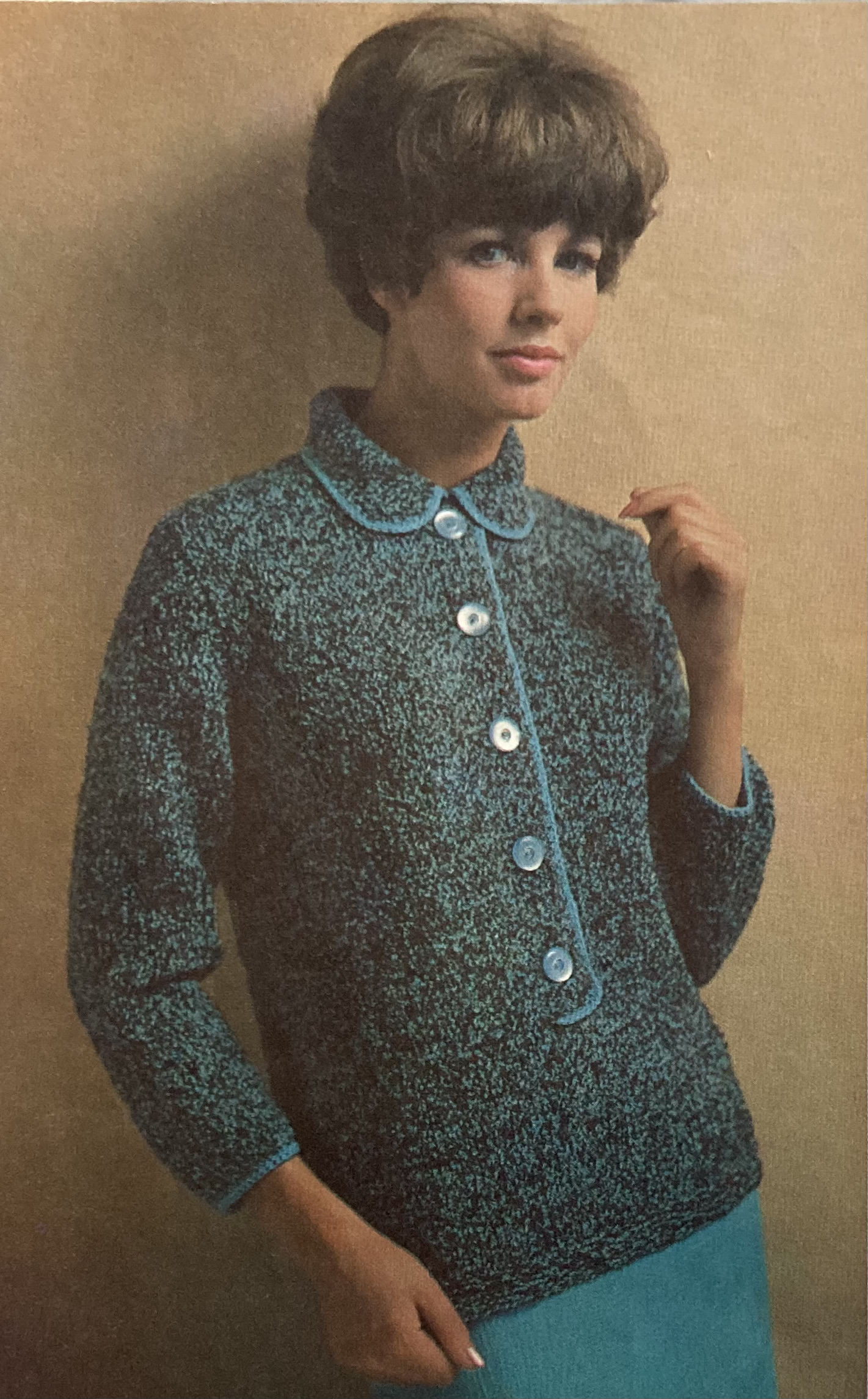
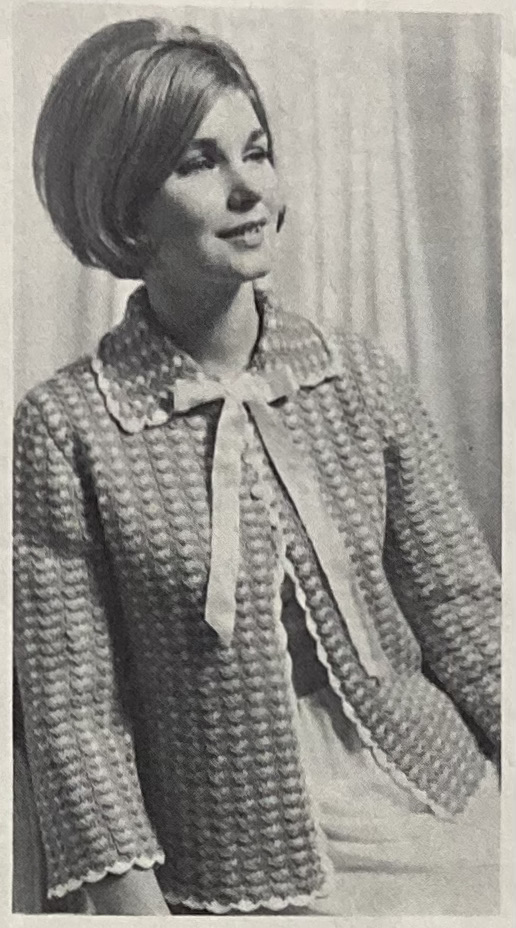
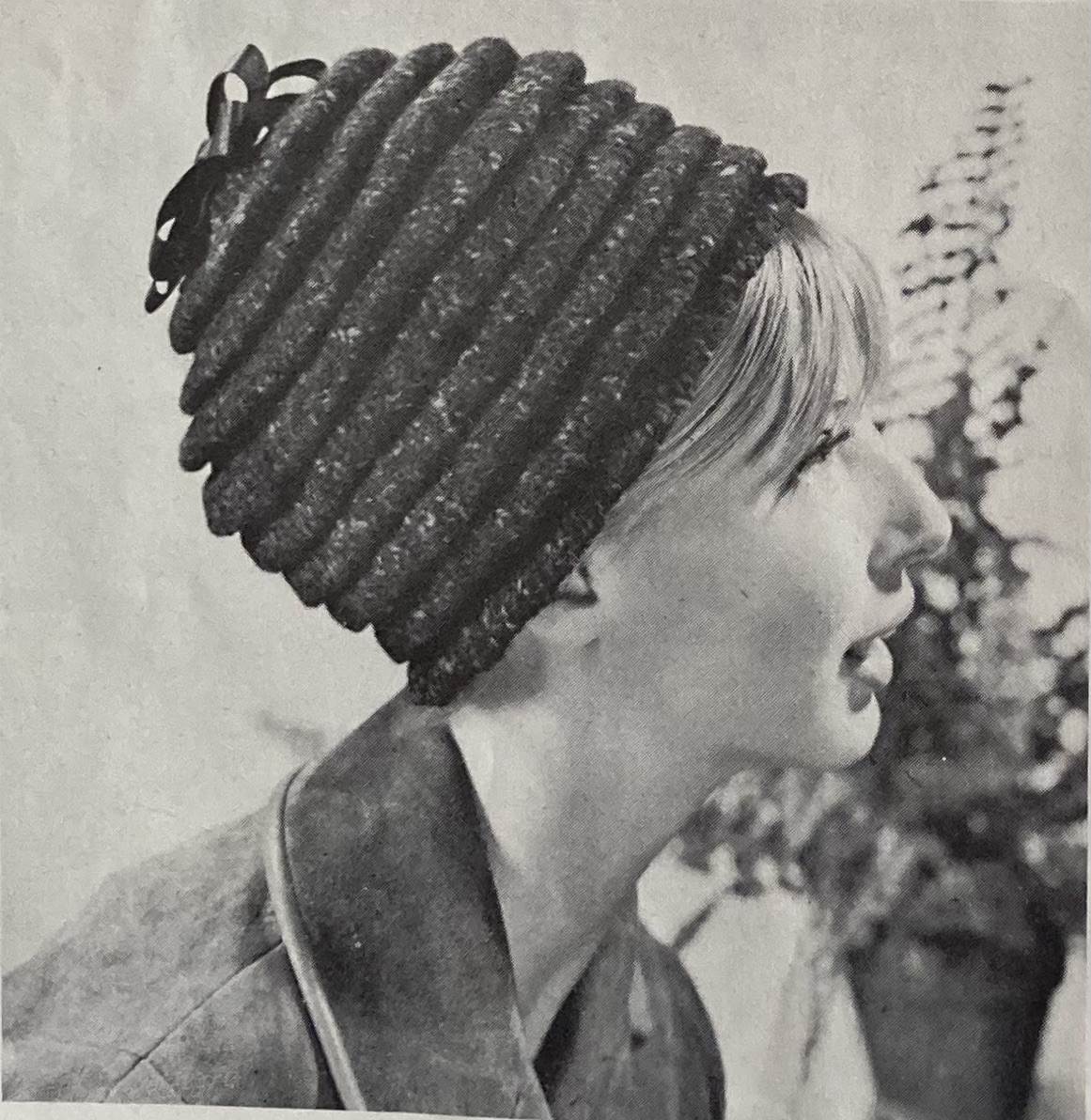
Other women’s fashions include a turquoise pullover with both a vertical pattern panel and a horizontal stranded border. The matching hat foreshadows the weird and wild and fun and goofy hat fashions of the next couple of years to come. The trend for bold colour blocks is mirrored in the long-line boatneck pullover with its matching “helmet”-style cap. There’s a plain white pullover in slip-stitch rib and a very cute bedjacket — look at that come-hither smile!

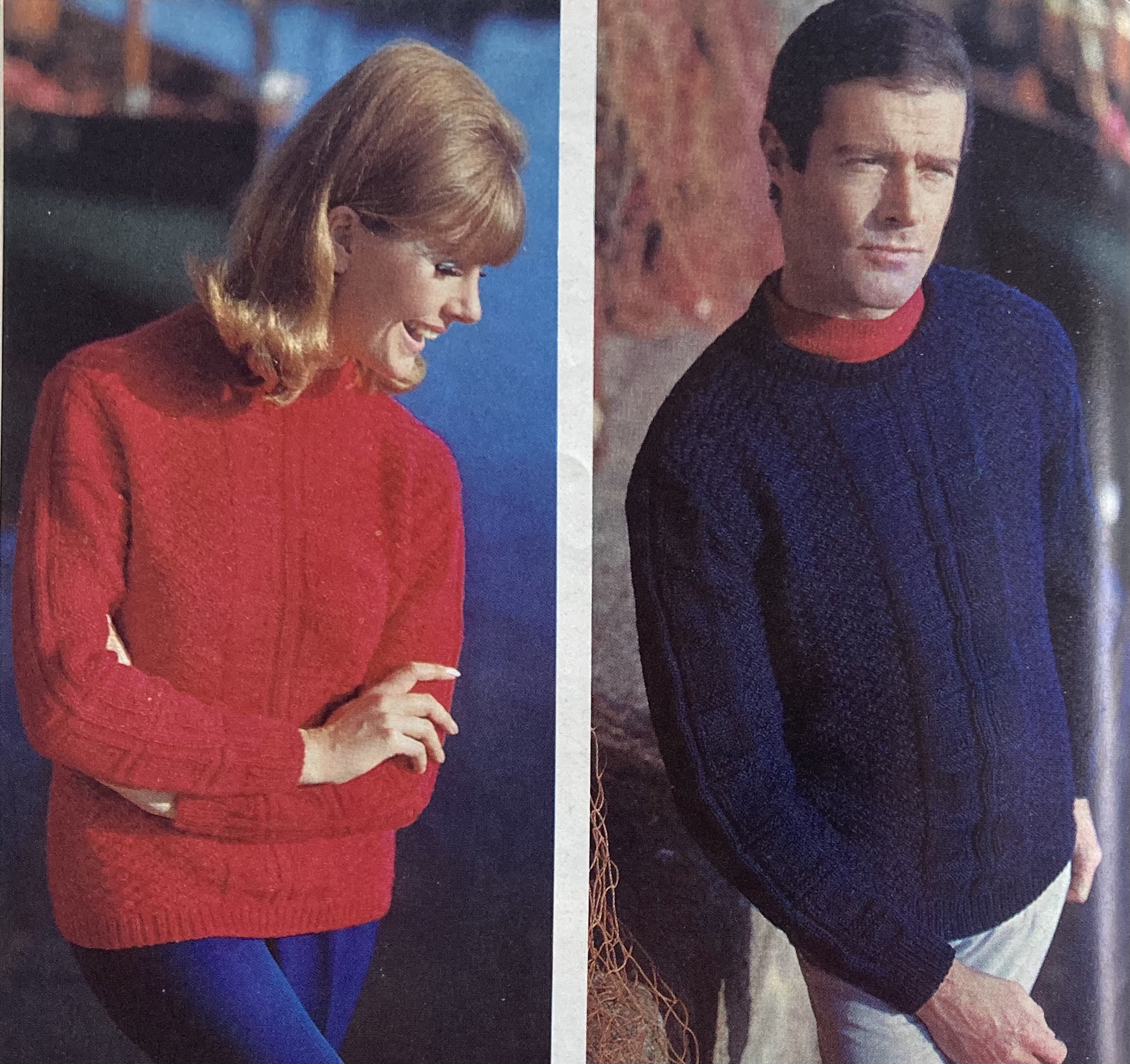
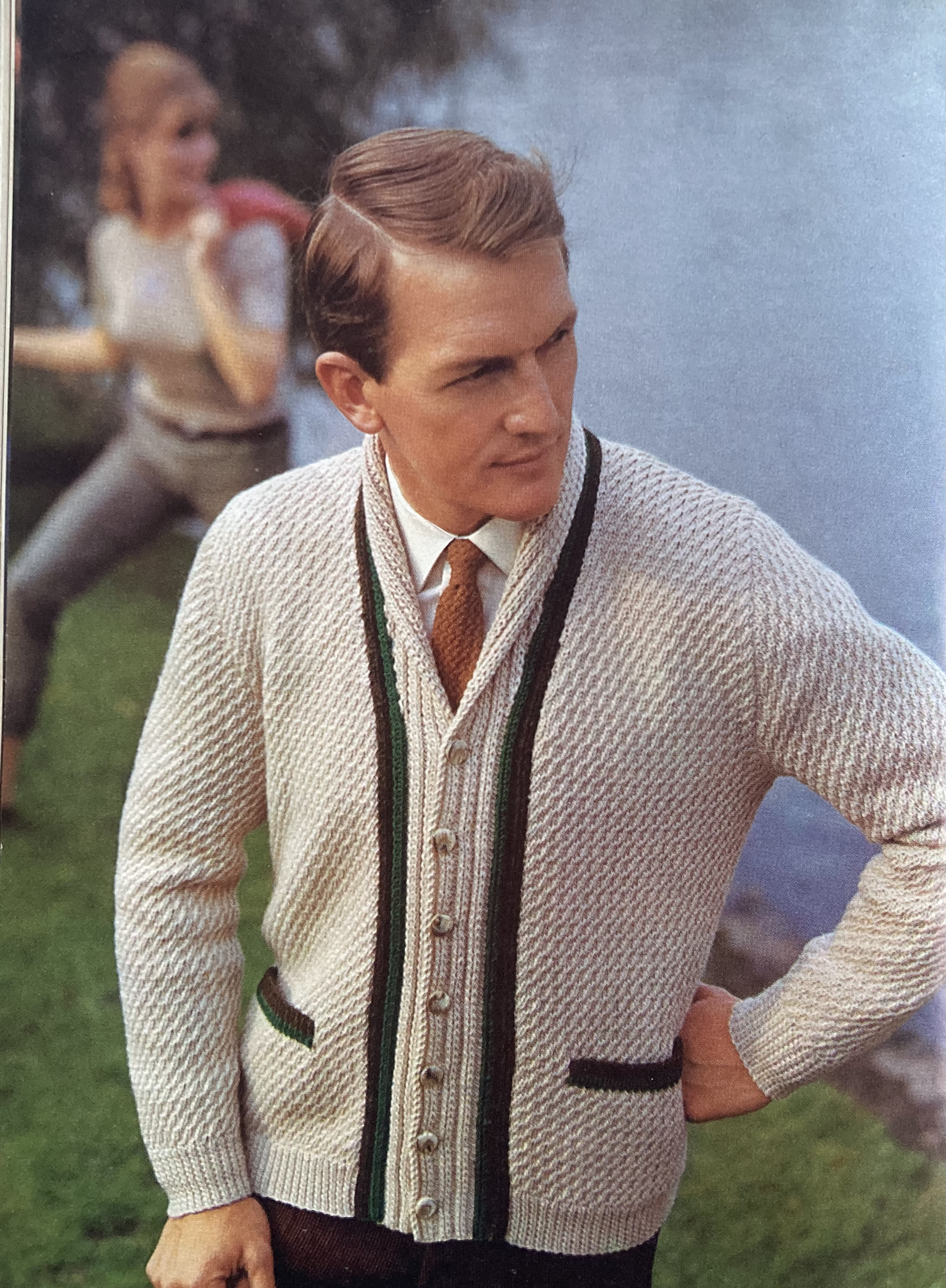
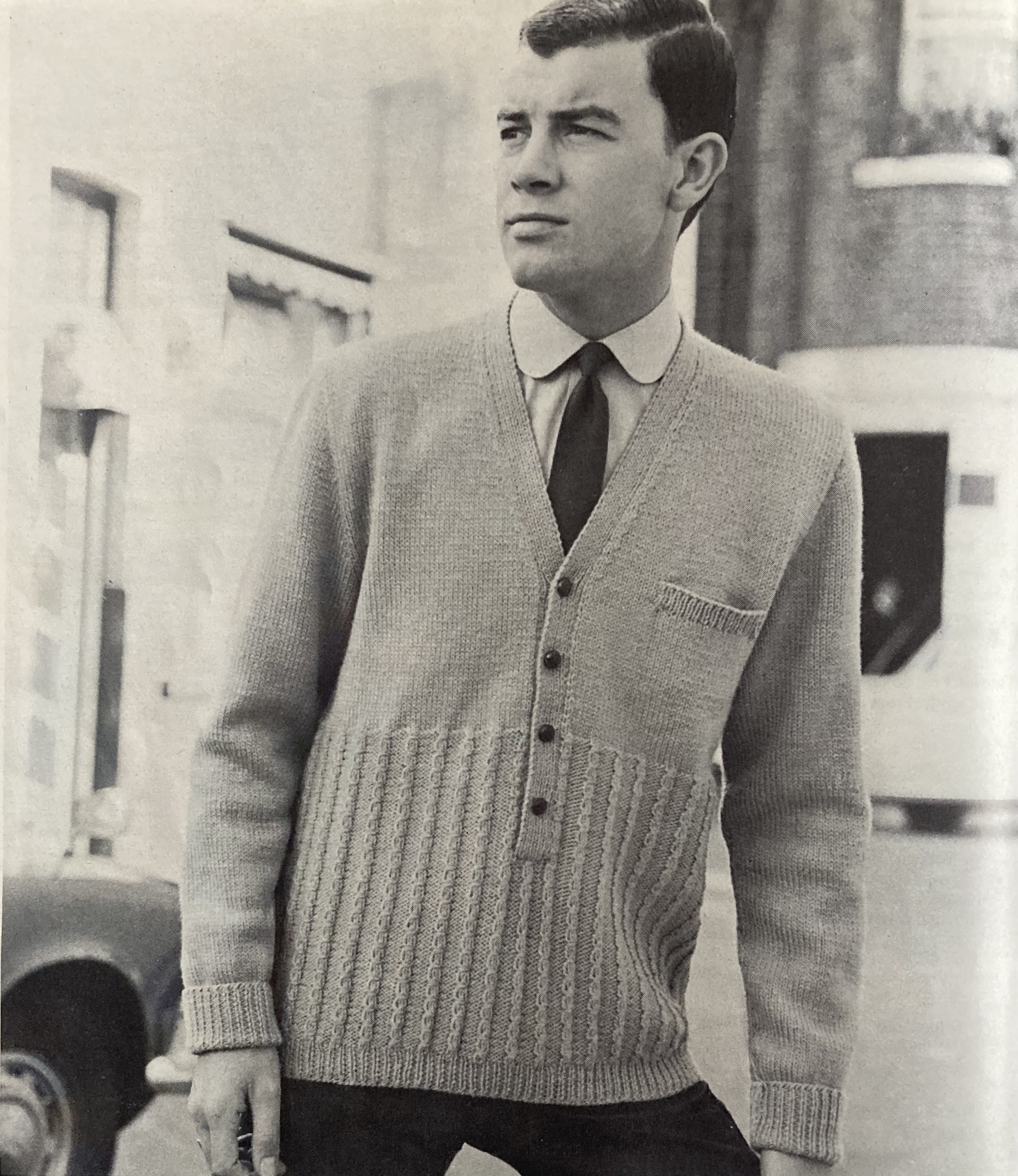
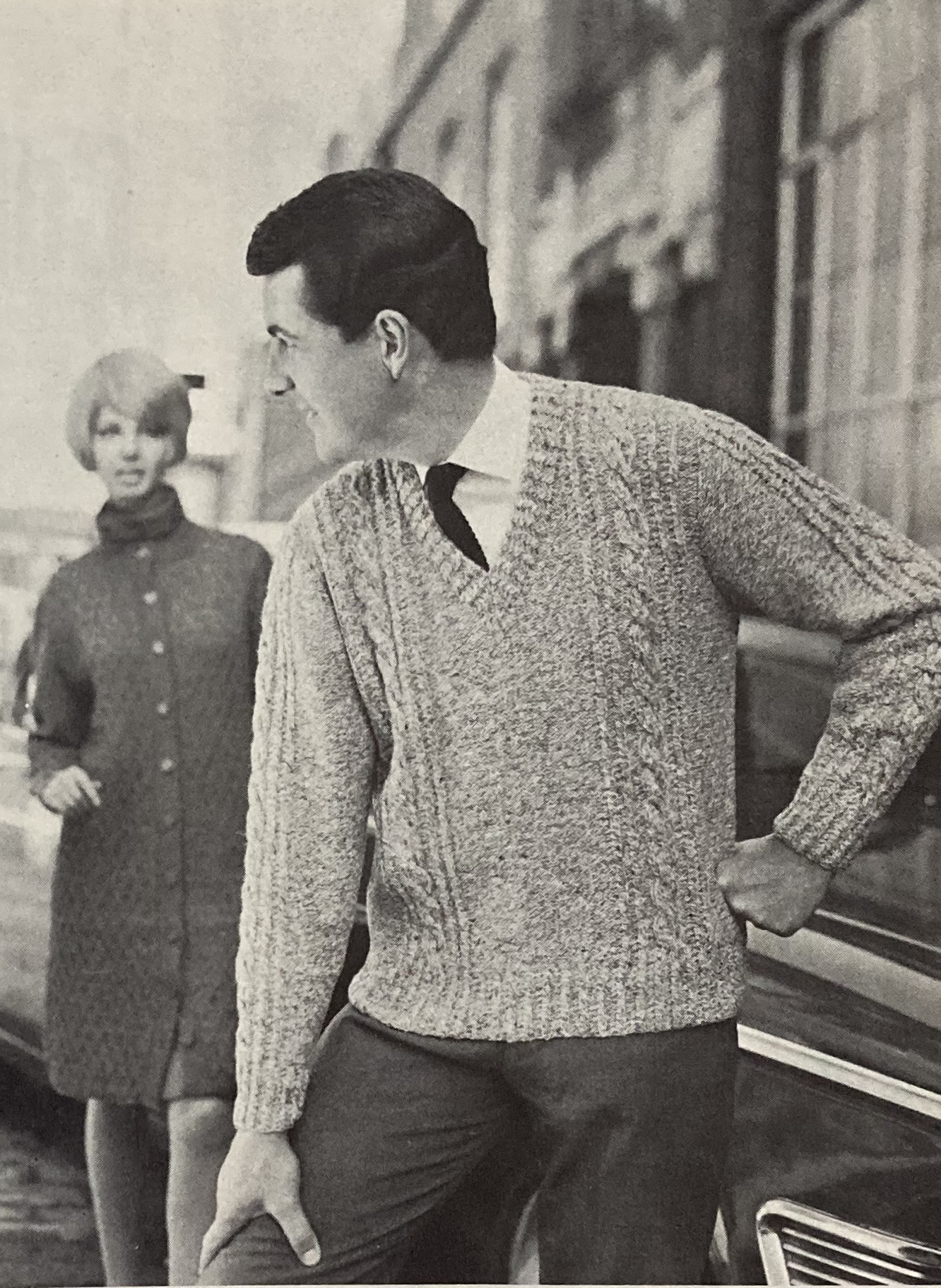
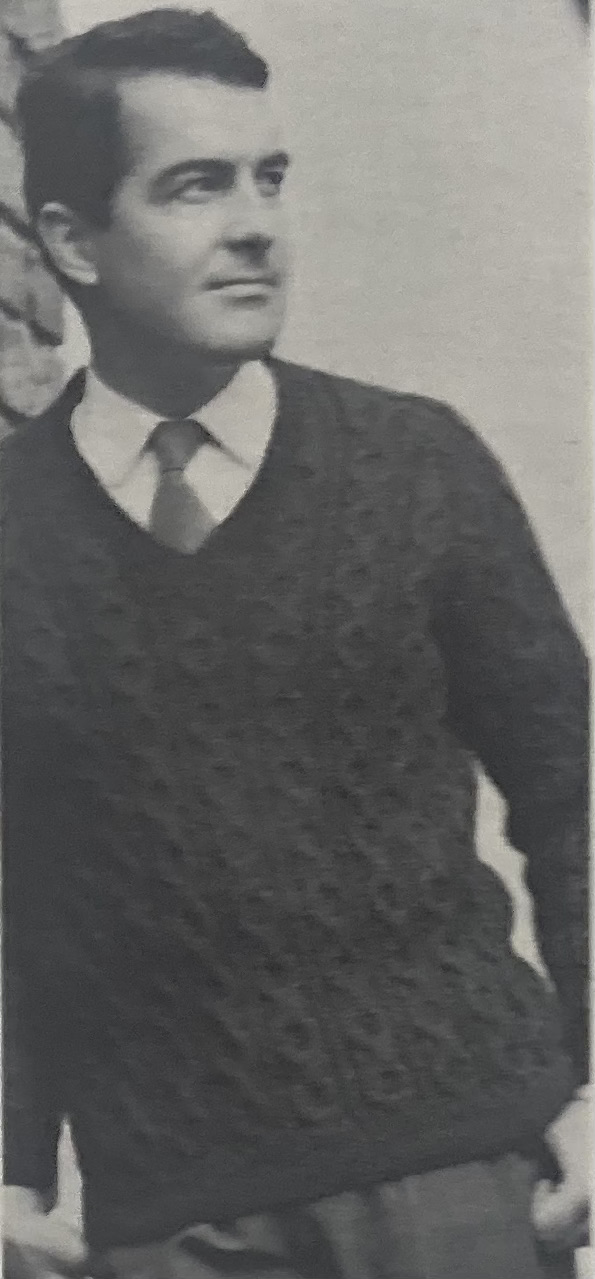
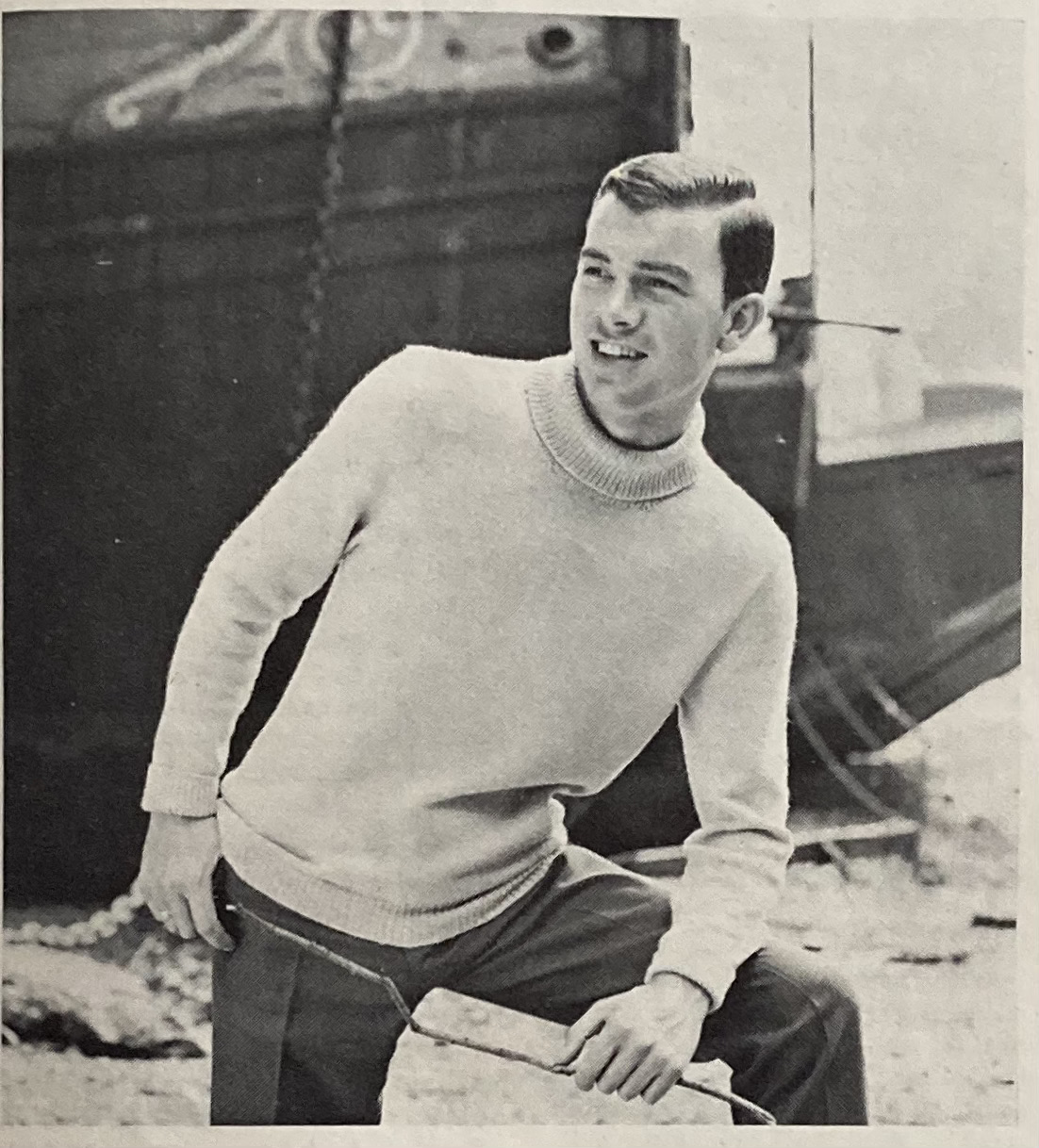
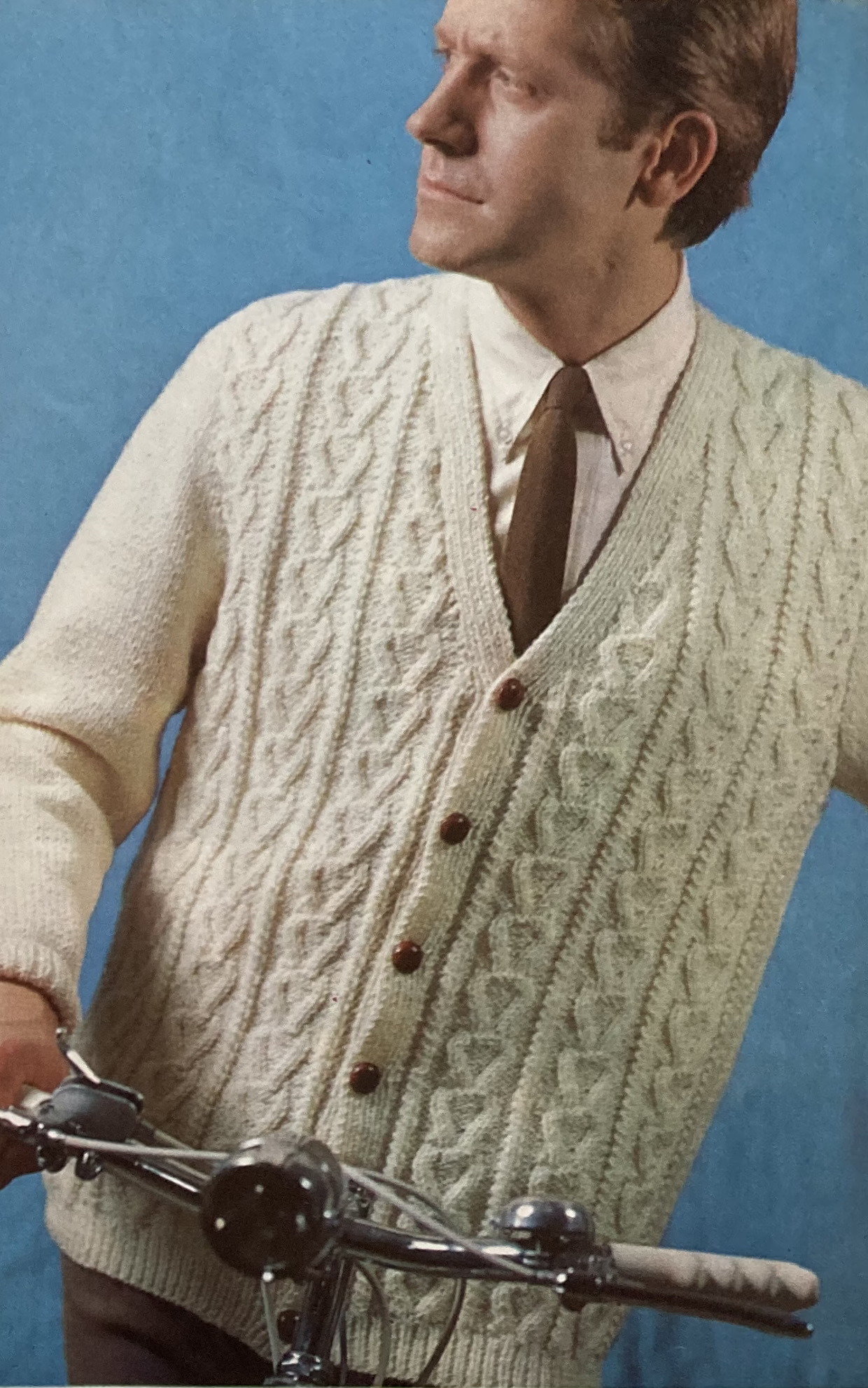
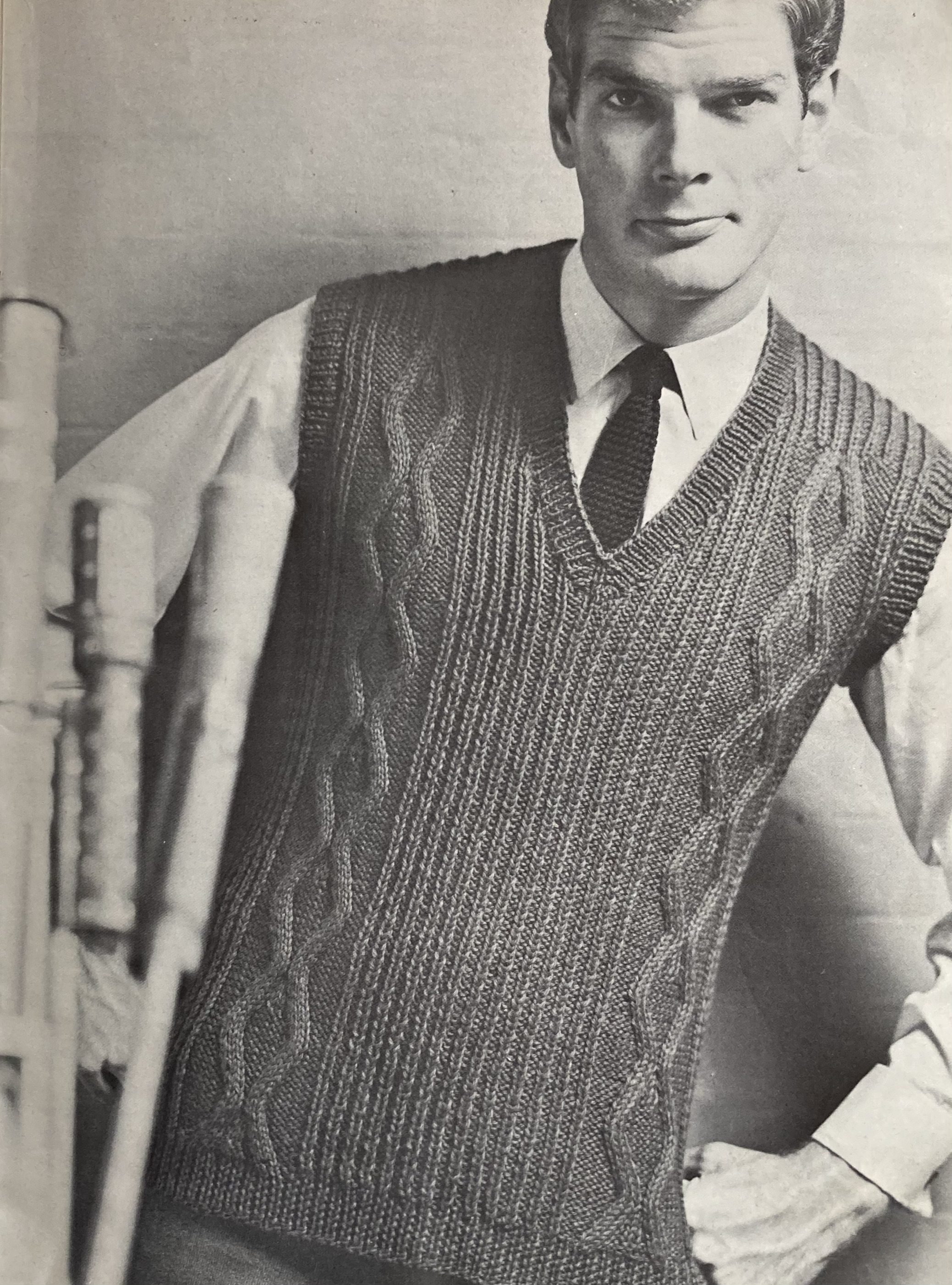
Men’s fashions are oversized and conservative, in spite of the “New Look” advertised for this V-neck half-cardigan. The classic V-neck pullover with cable stripes can be knit in tweedy marled or smooth, plain DK wool. I like that the magazine includes photos of both versions, so that you can see how much of a difference the colour and style of wool can make.

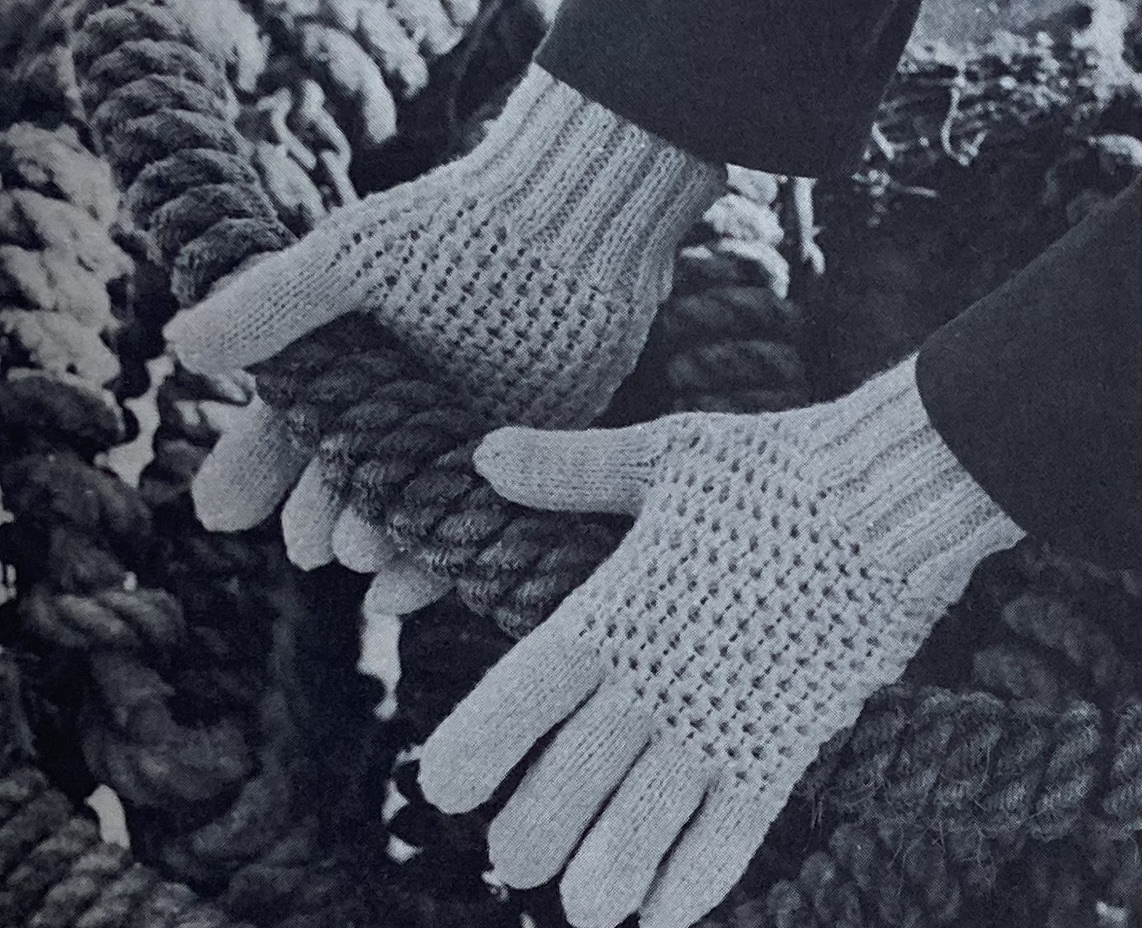
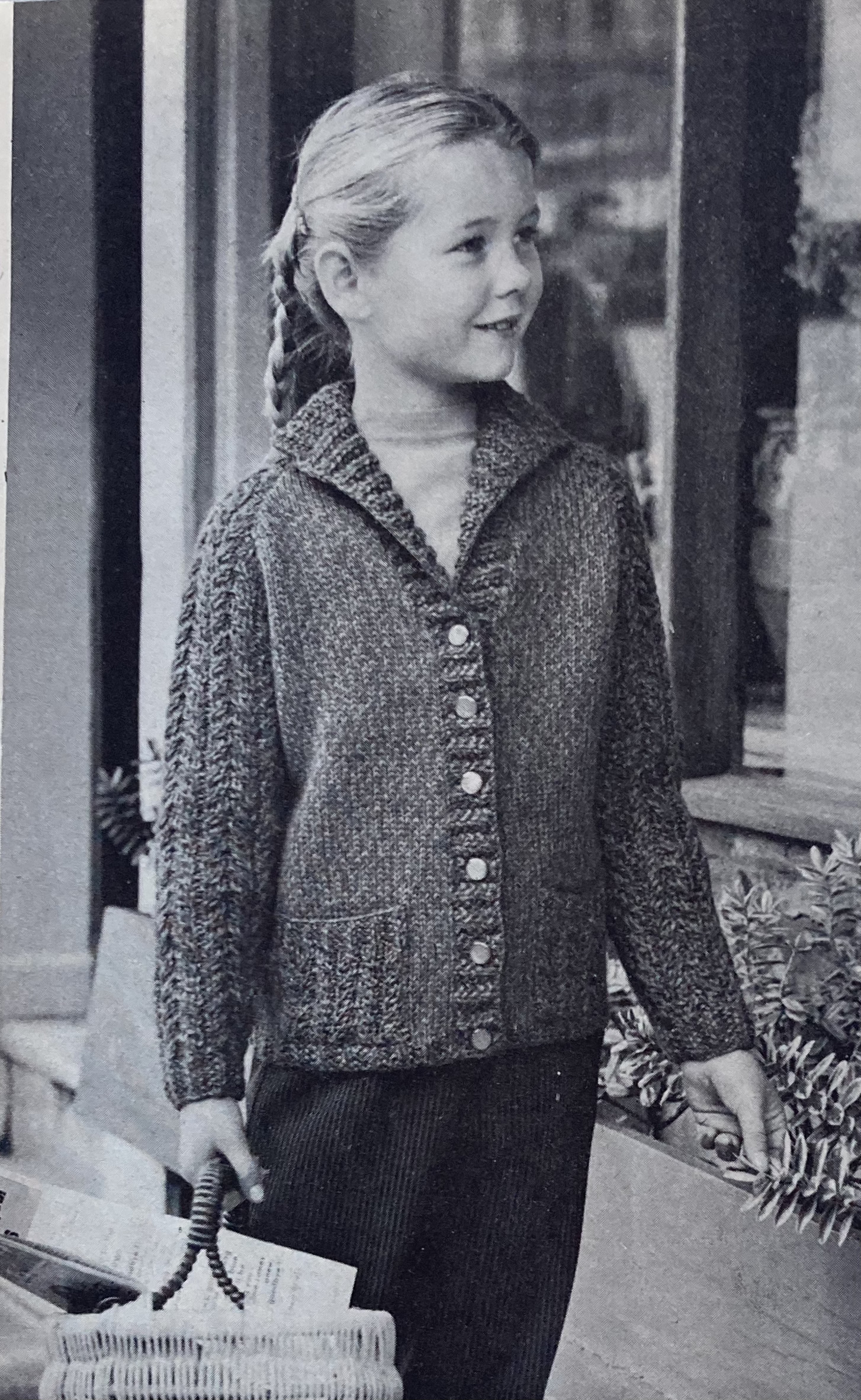
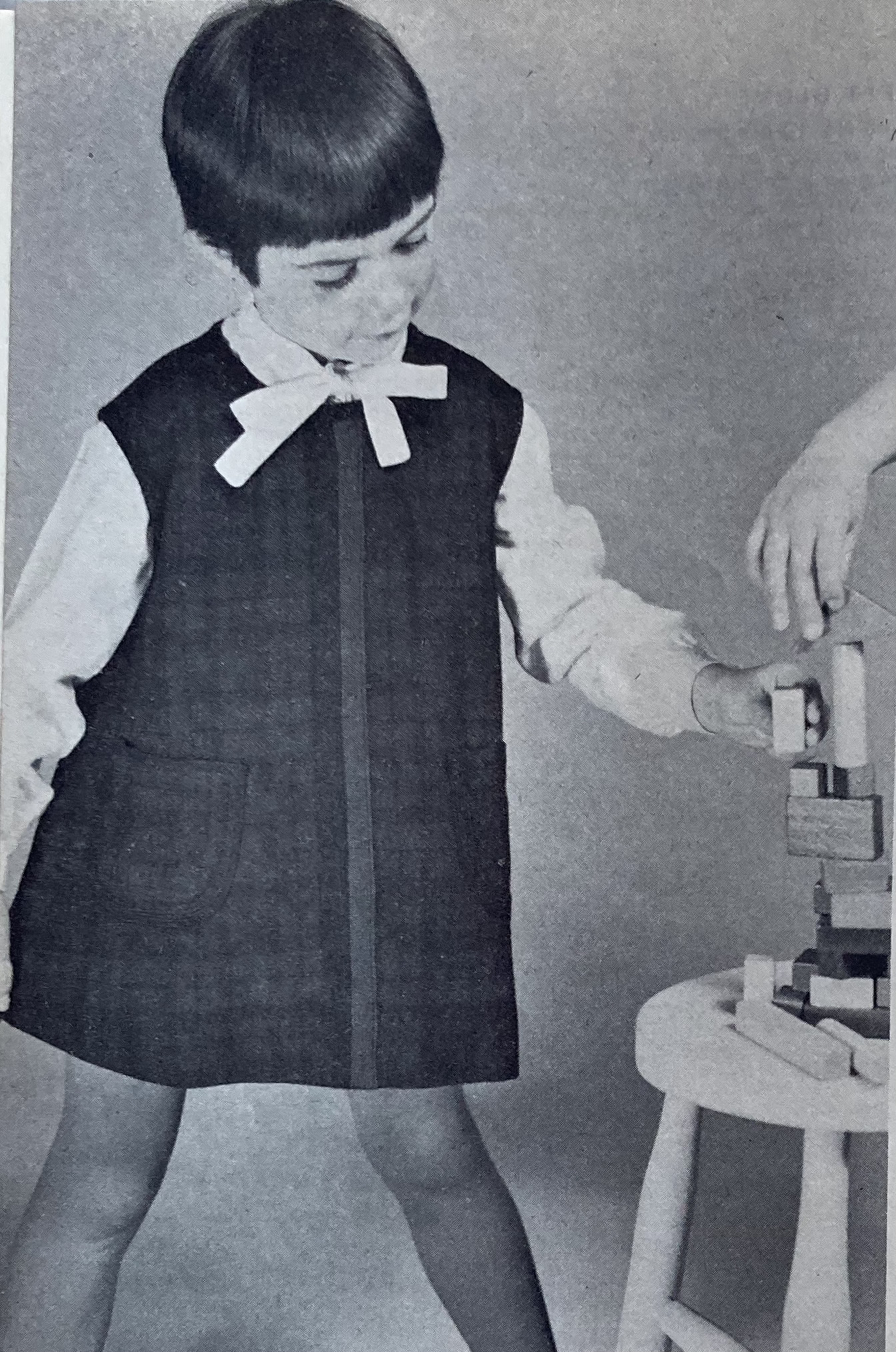
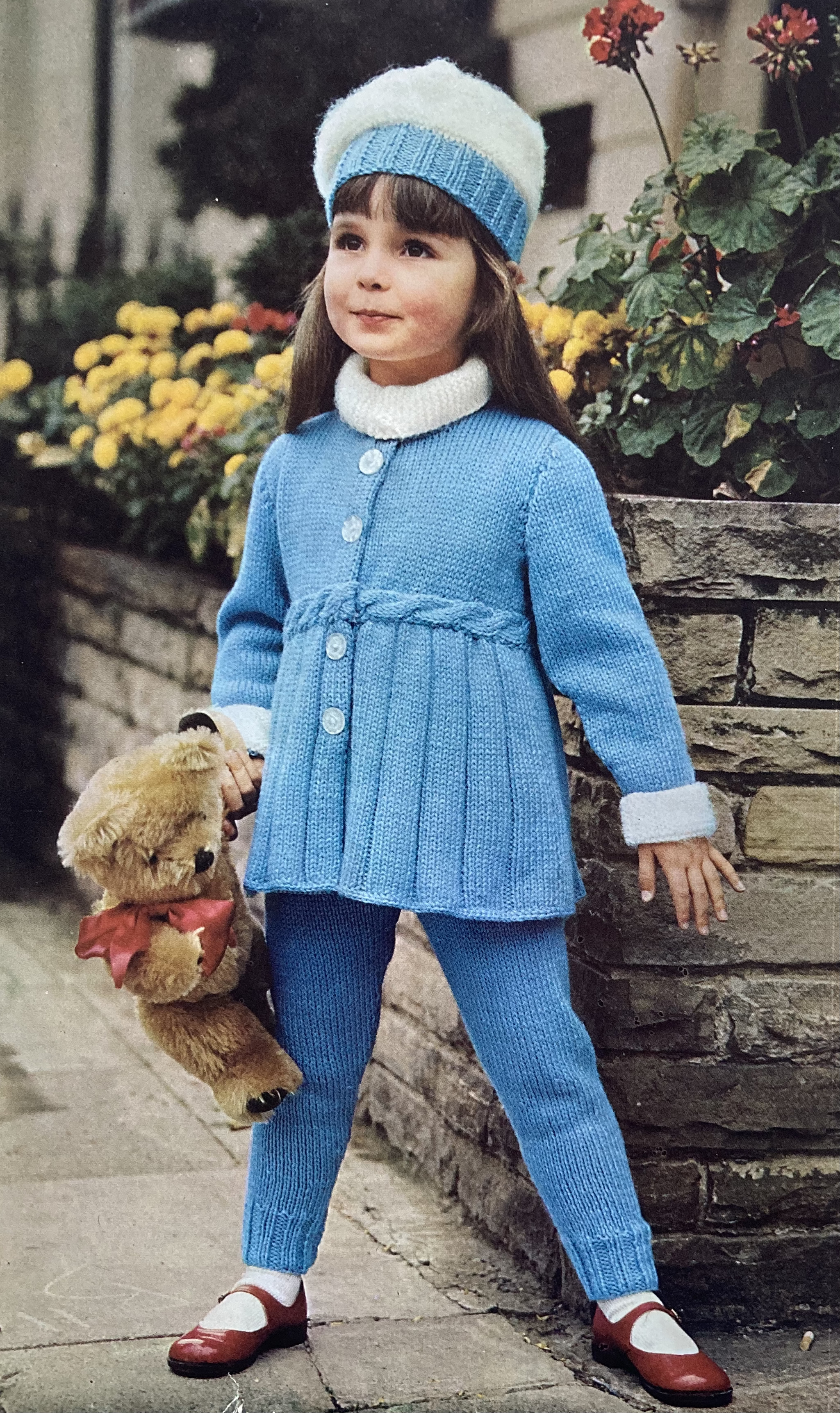
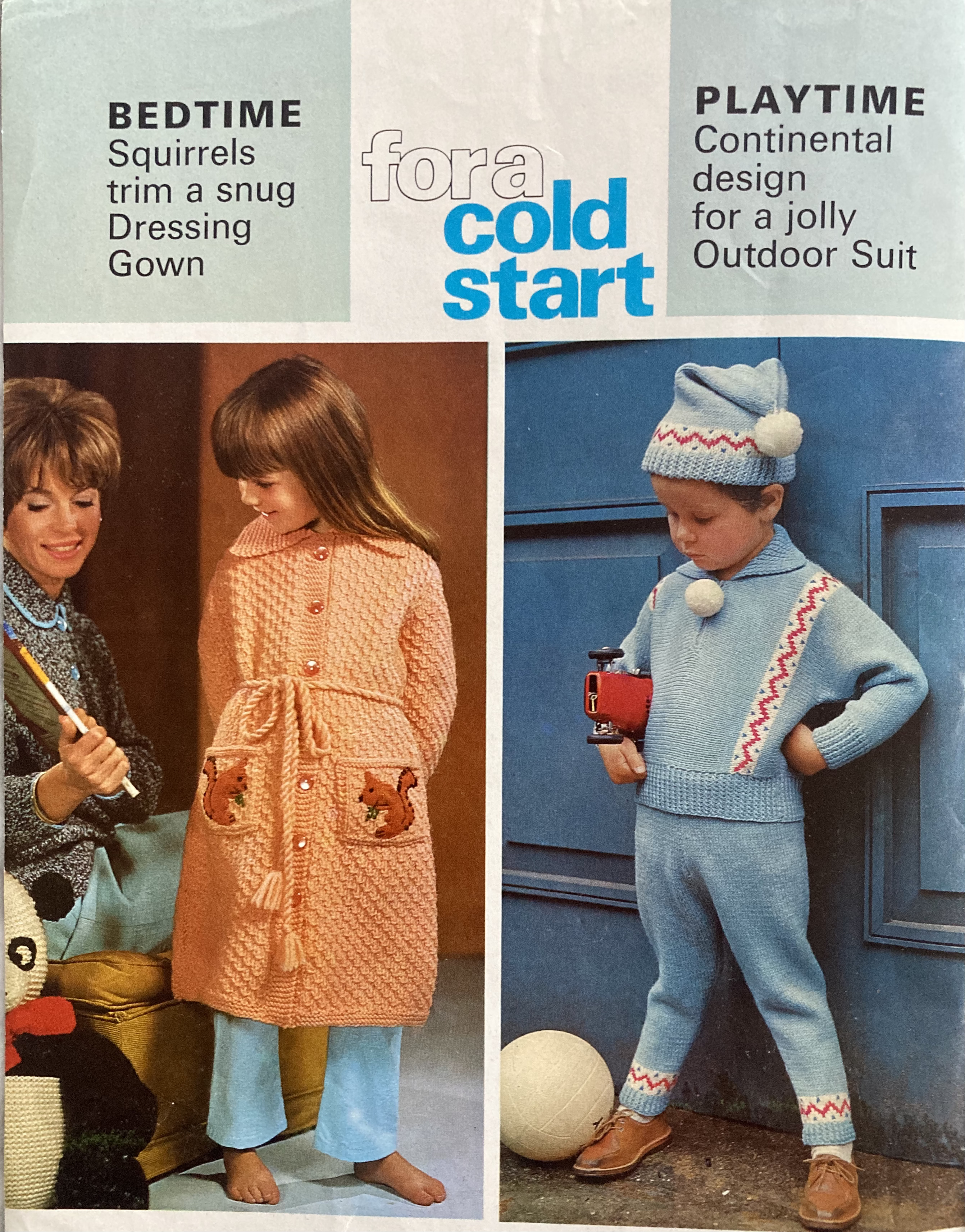
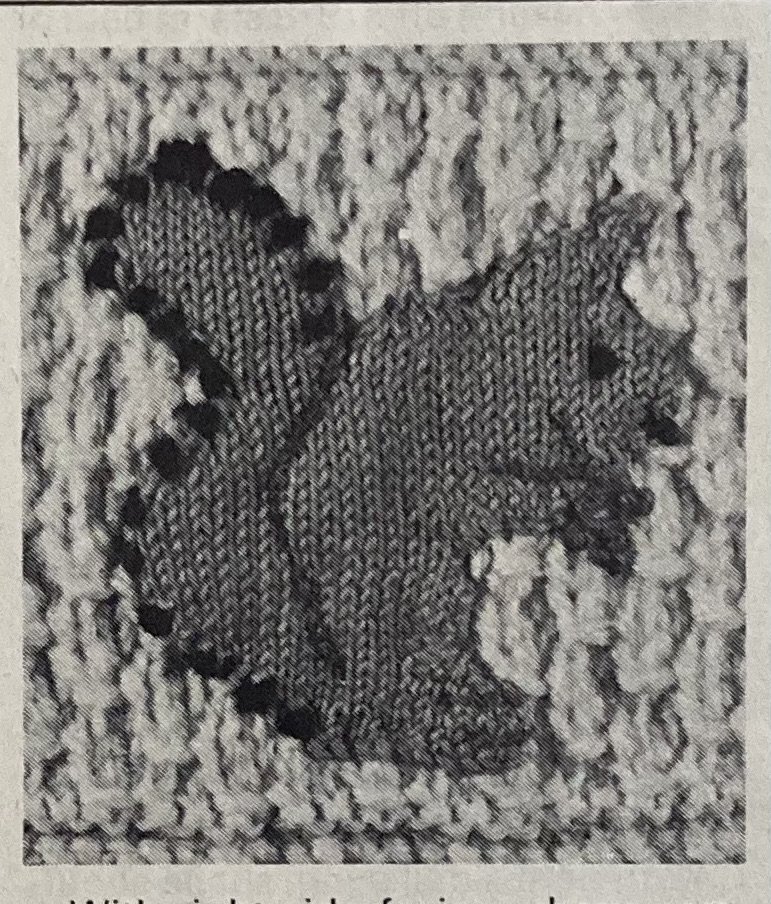
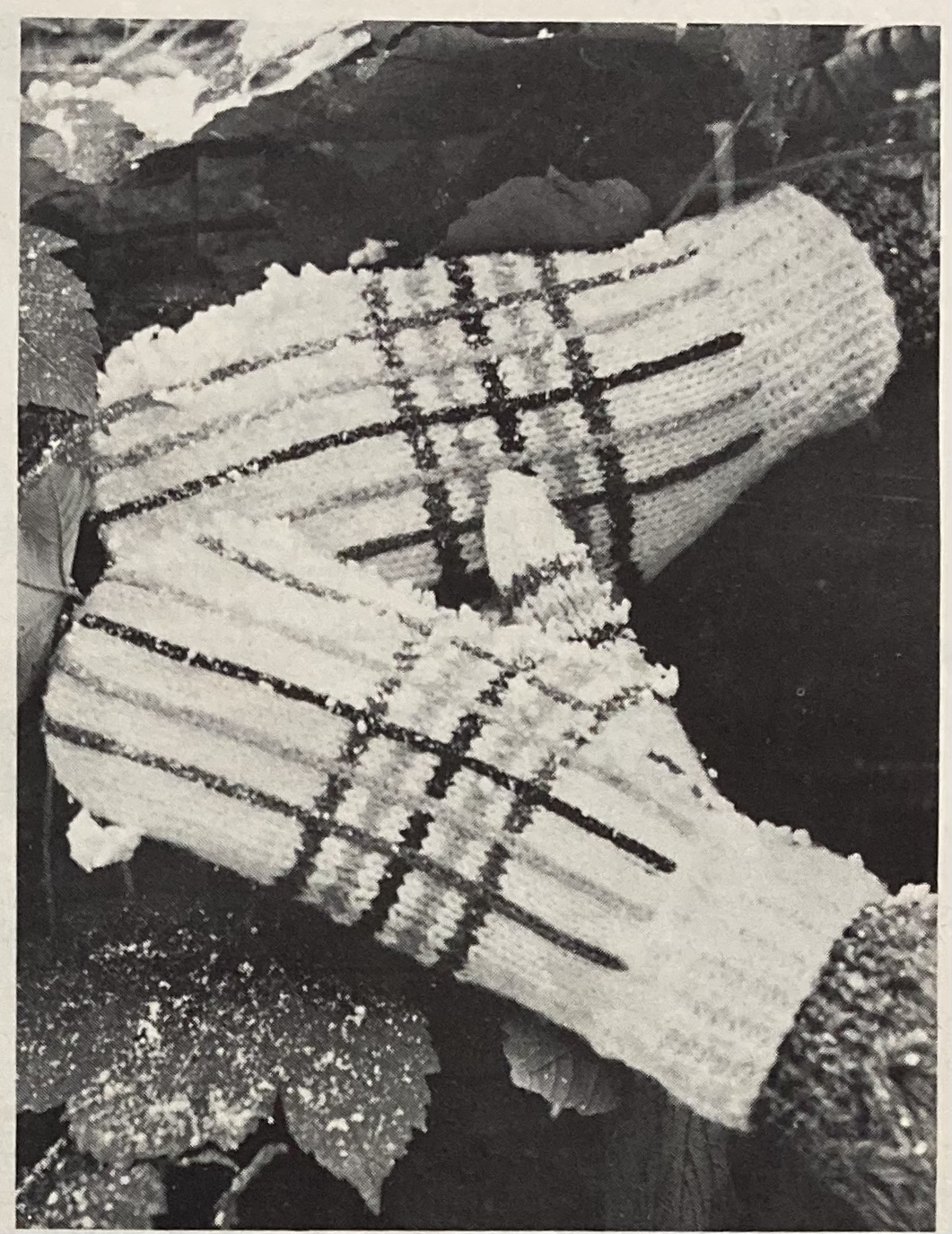
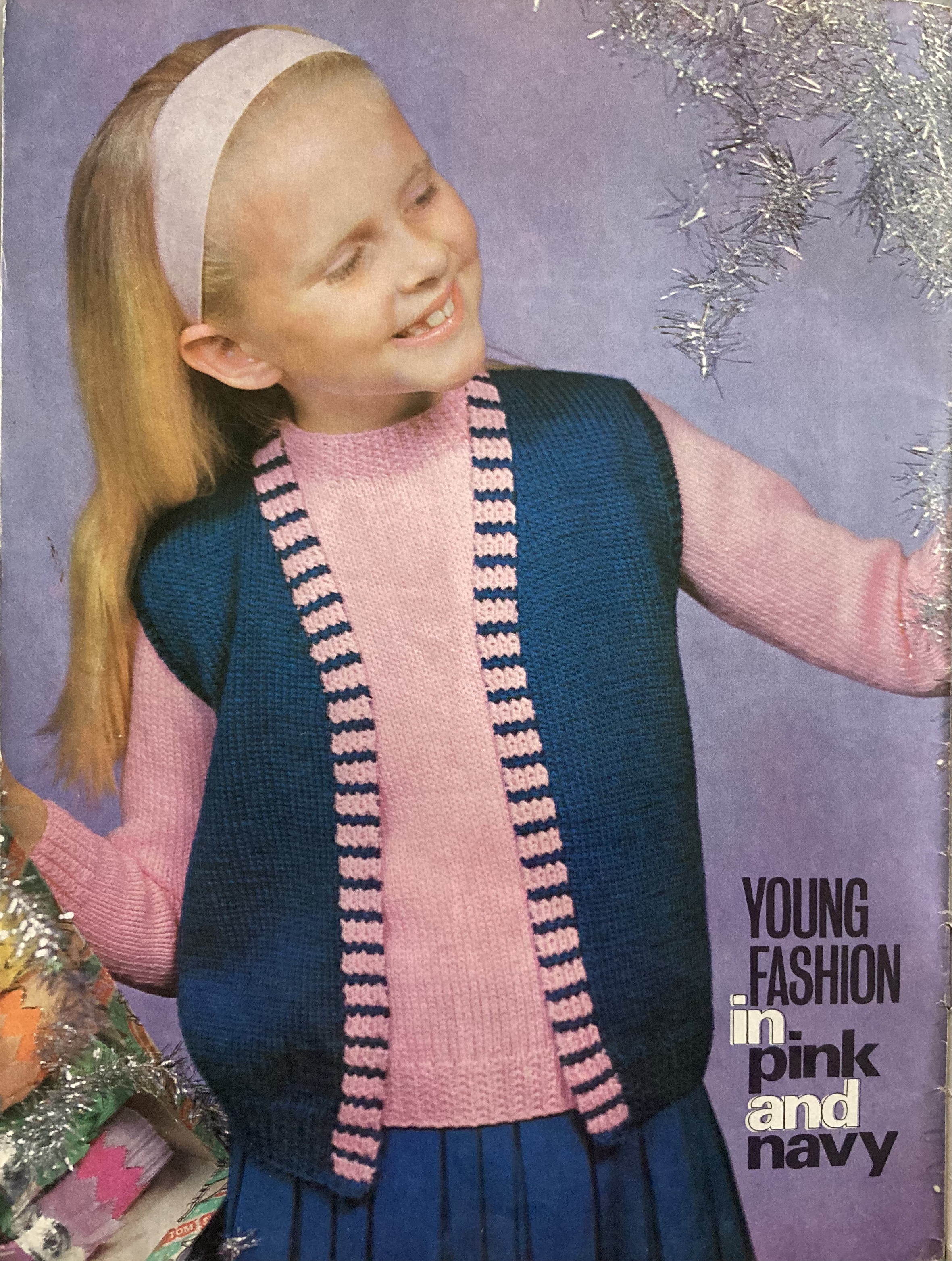
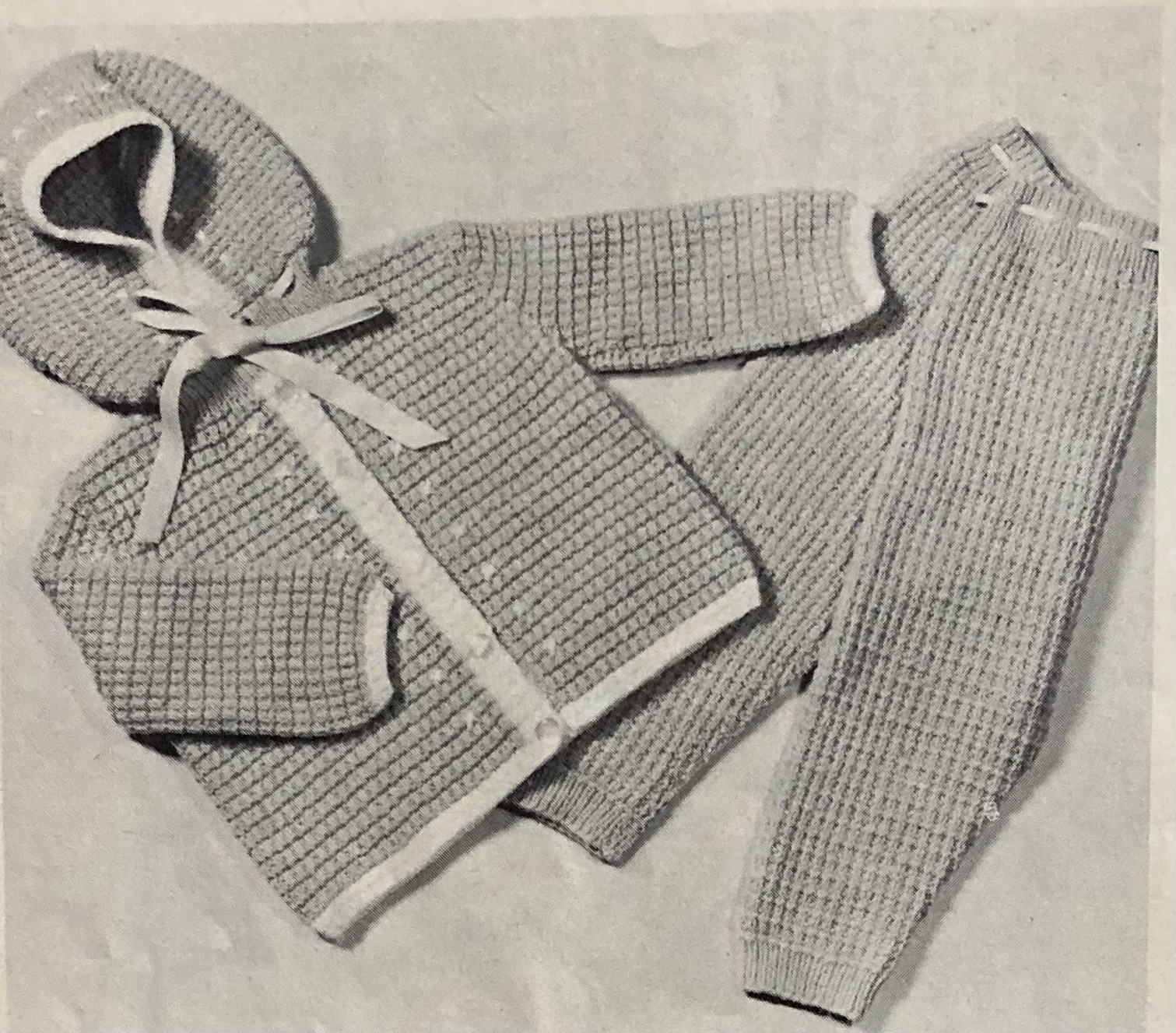
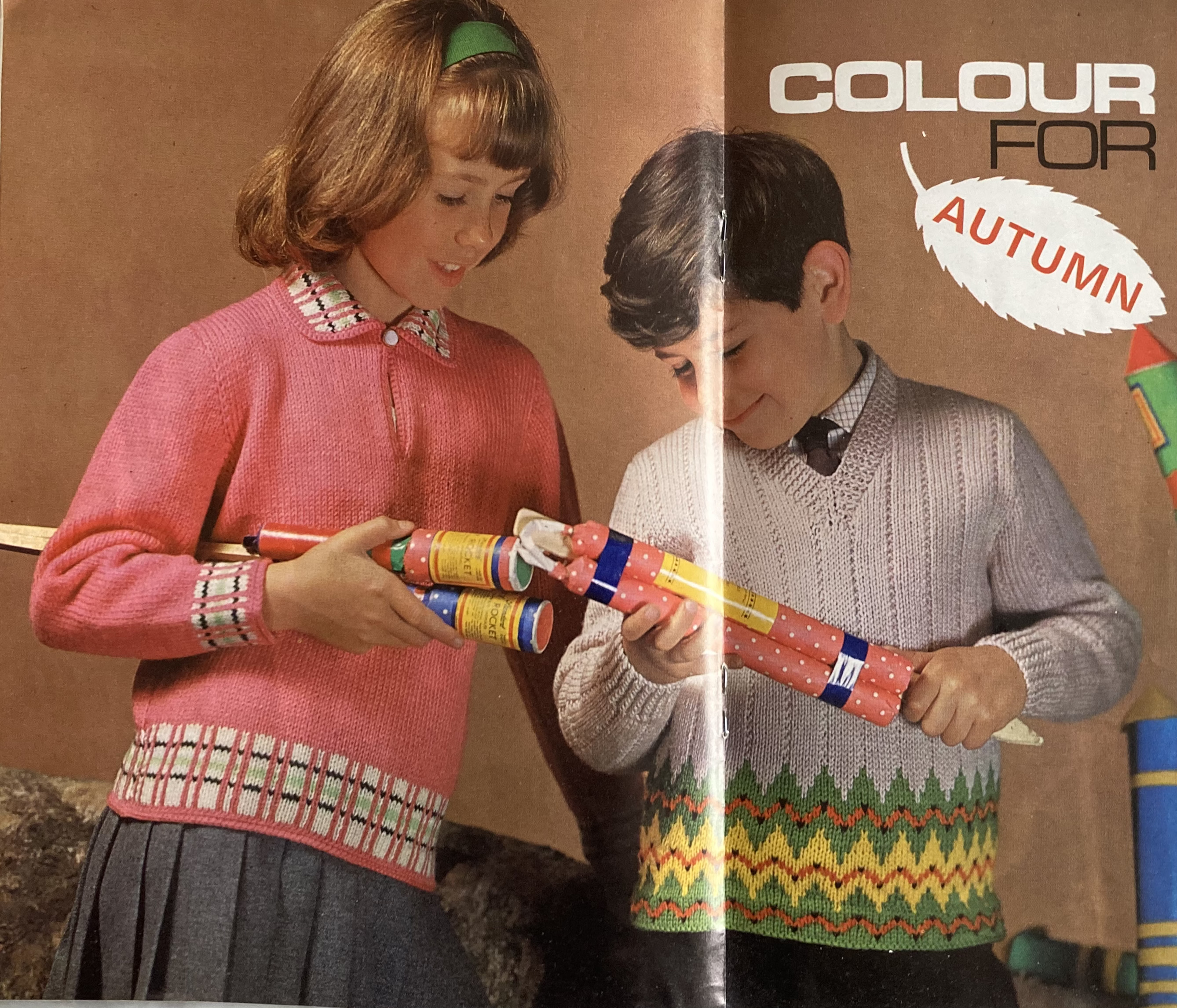
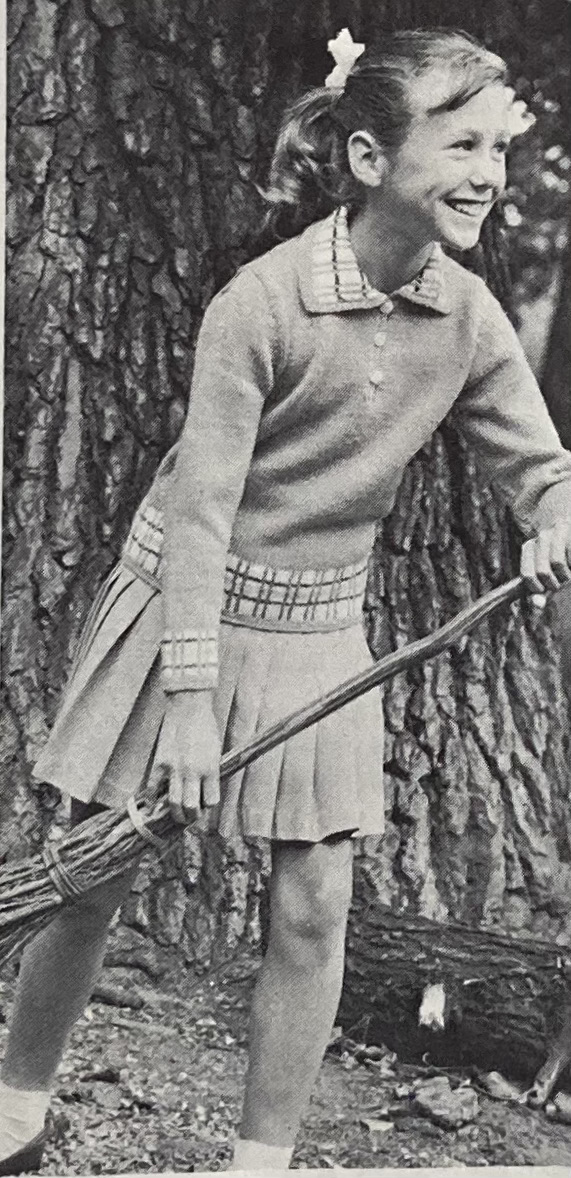
“Junior Fashions” include a wonderful warm dressing-gown with knitted squirrels appliquéd onto the pockets and embroidered — so cute — as well as a winter going-out set of leggings, pullover and hat and an oversized cardigan-jacket. The jacket claims to be windproof, which seems an odd claim to make about something knitted in an all-over eyelet pattern. In any case, all the children’s fashions are colourful and fun, and we will start to see the influence on adult women’s fashion as the 60s get swingier. Older children — or adults with small hands — can get a pair of warm mittens knitted flat and sewn together at the side. The plaid-like pattern is made by embroidering the vertical stripes in chain-stitch onto the finished mittens.

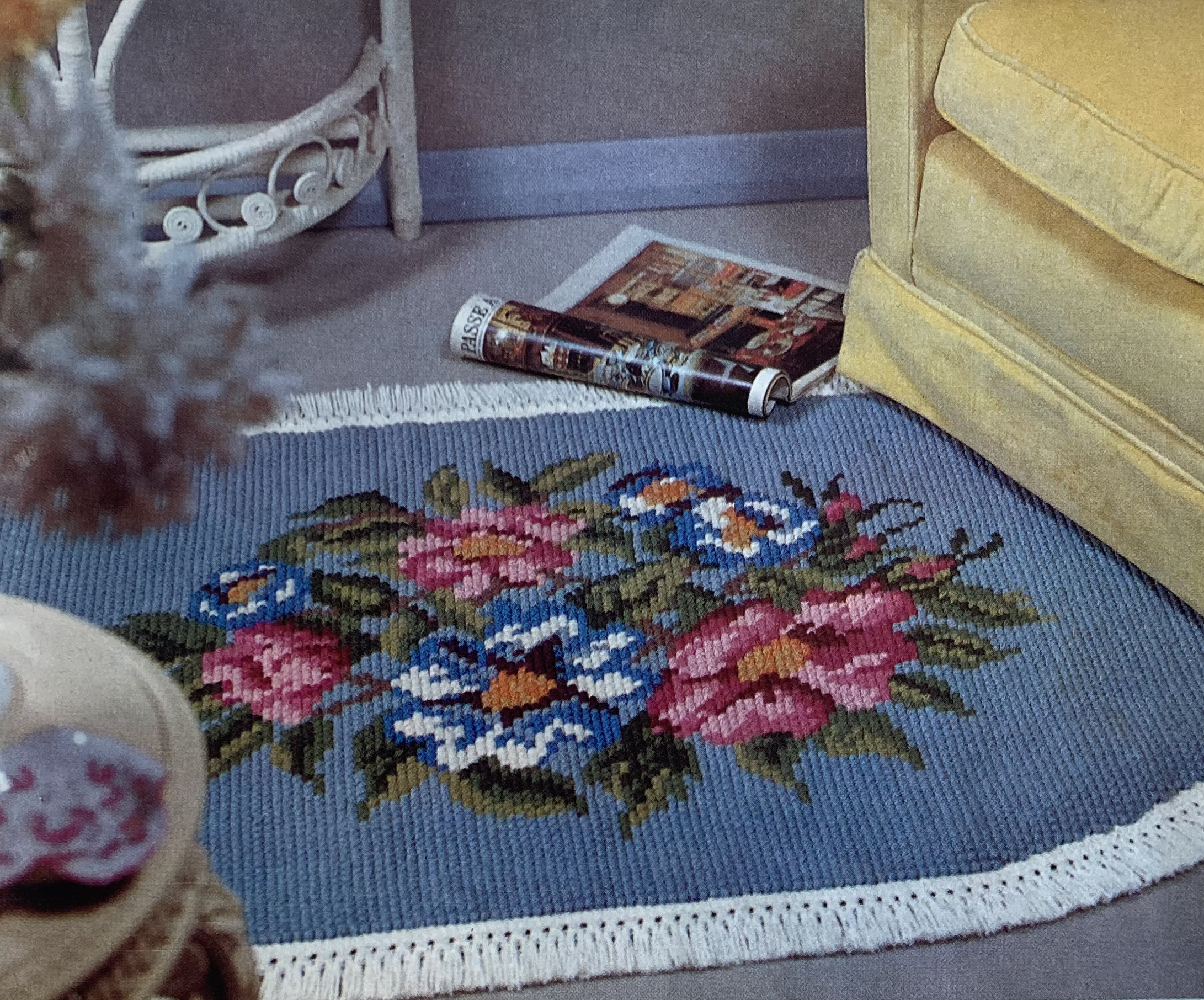
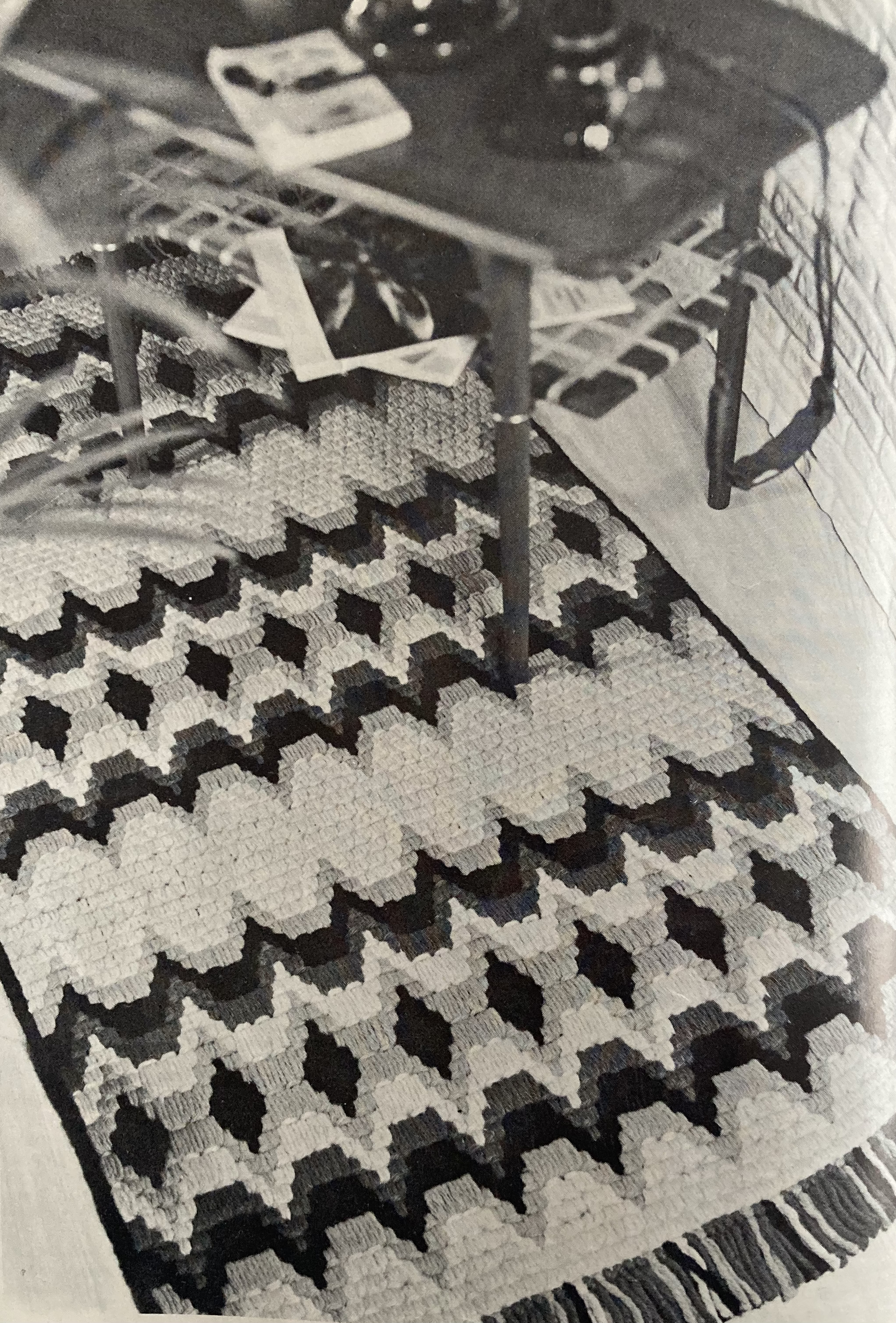
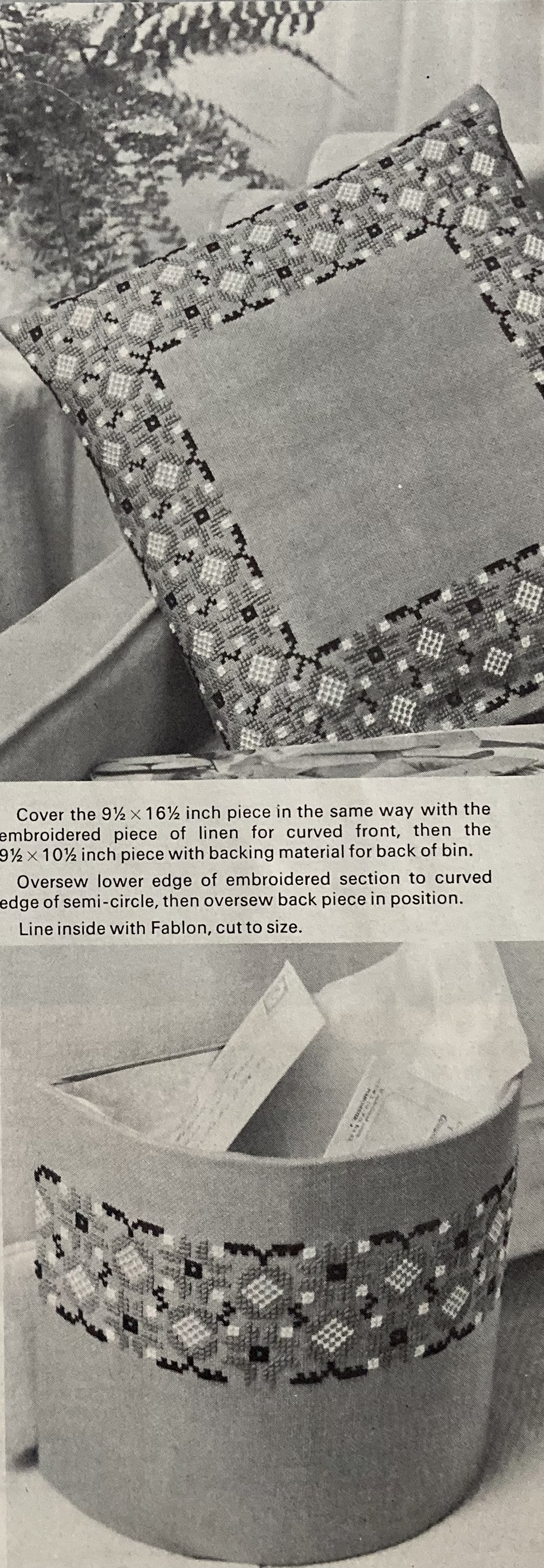
There are lots of homeware projects in this issue, January being a good month to stay inside and do needlework. The stitched rug is warm and sturdy, made in a Florentine stitch pattern that never really went out of fashion. You can knit a doll’s outfit complete with underwear and shoes, crochet a “tangerine” tea cosy with green felt for leaves, or make a cross-stitch border for a cushion or waste-paper basket.

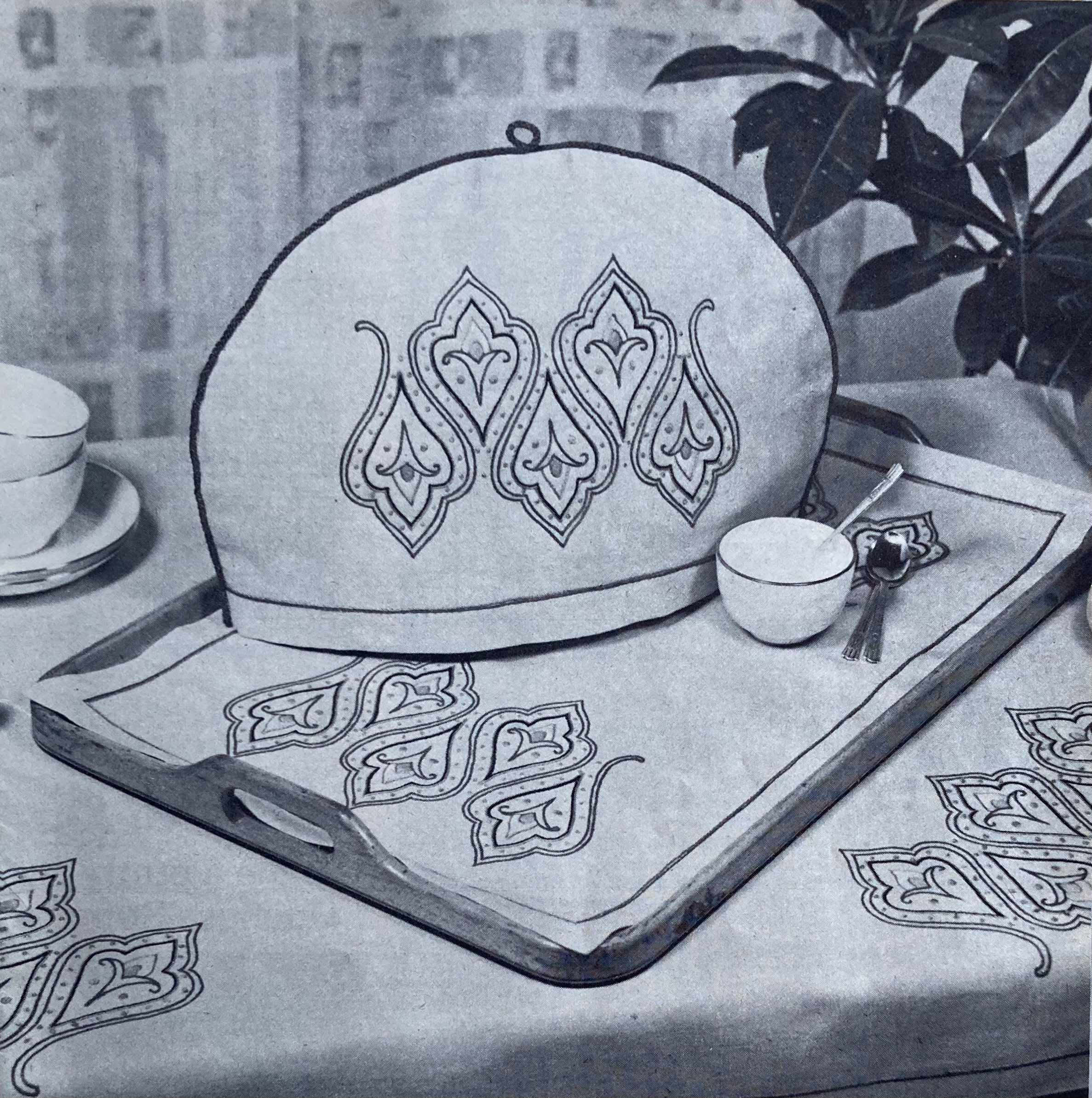
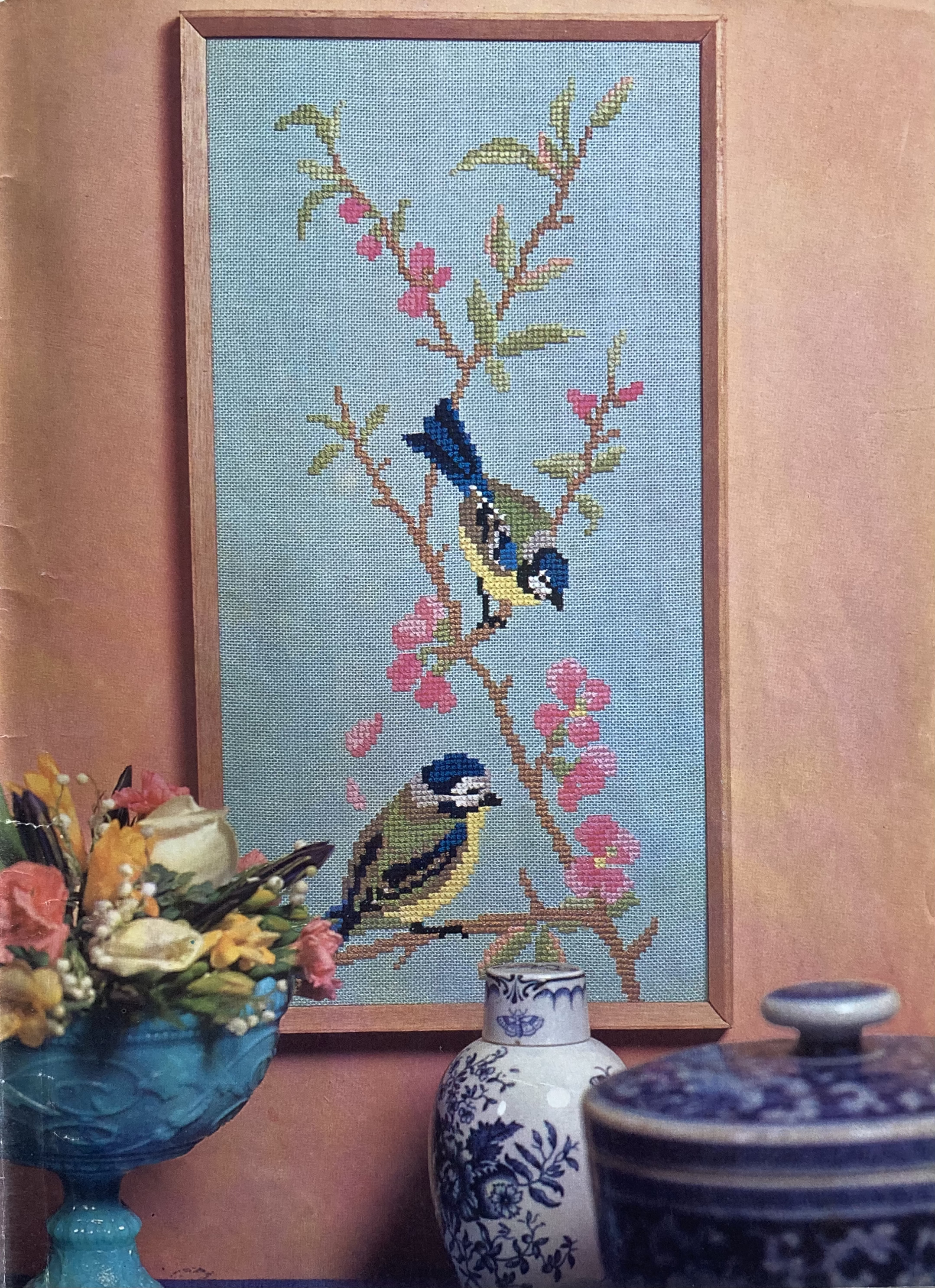
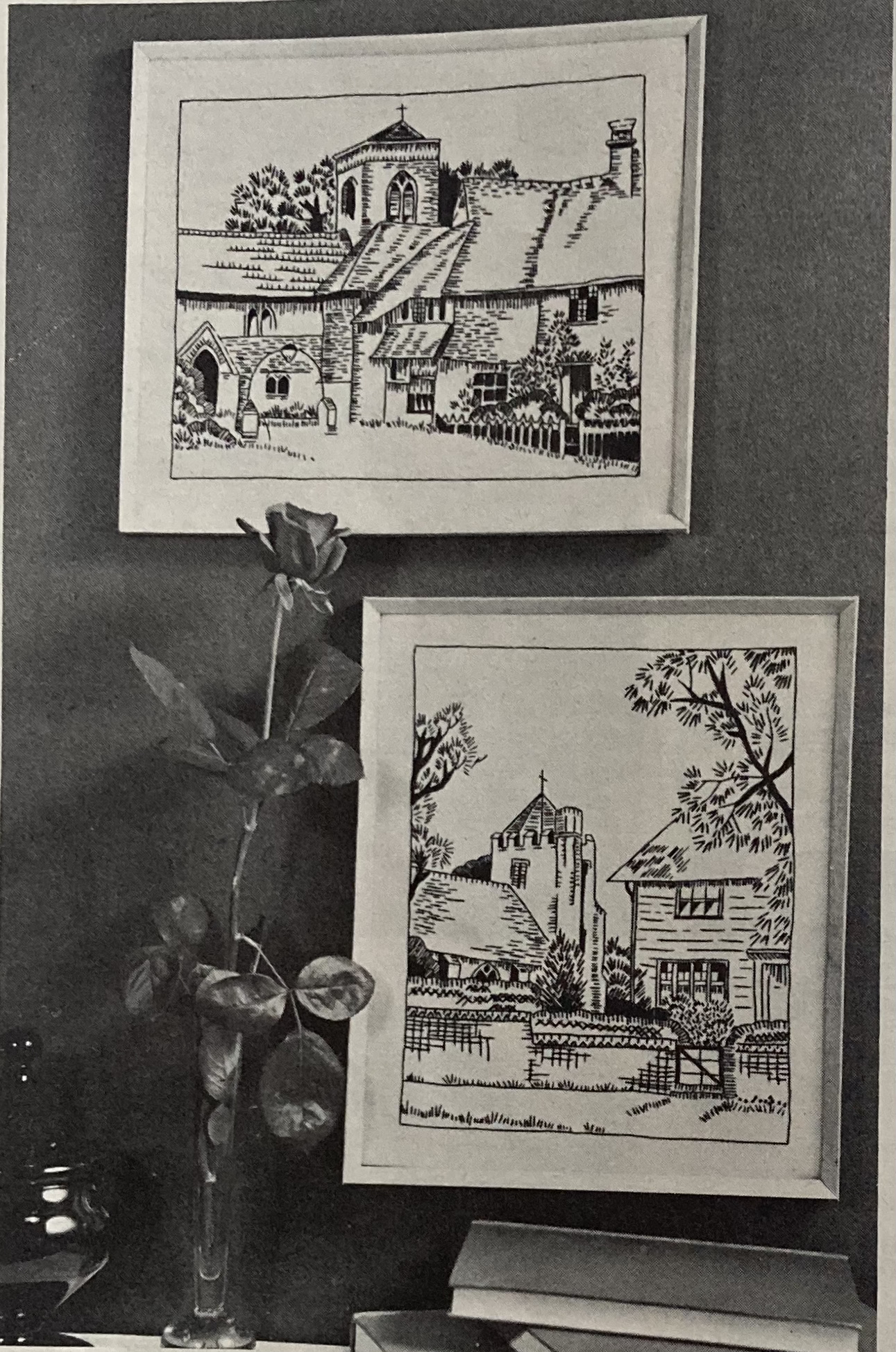
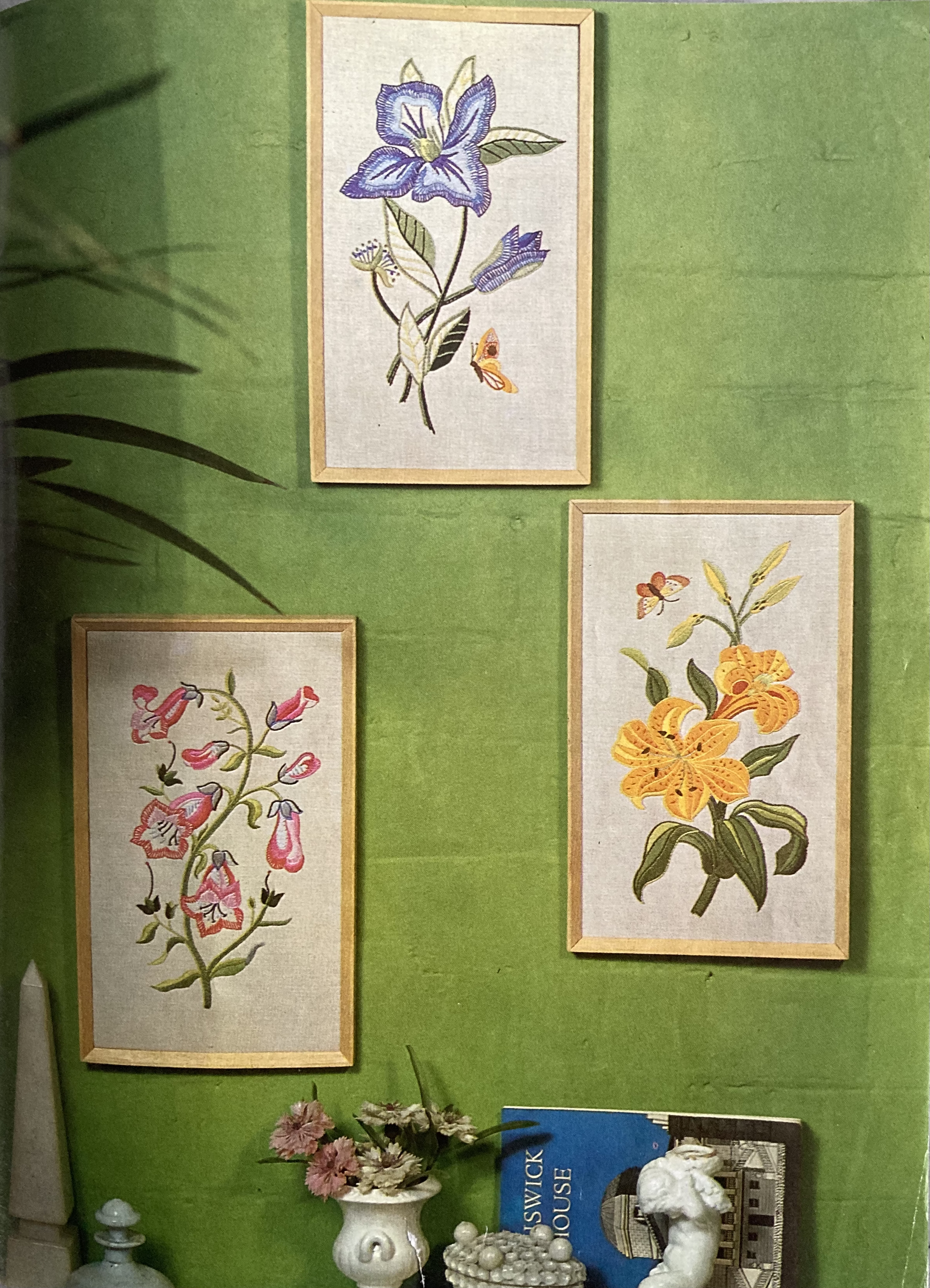
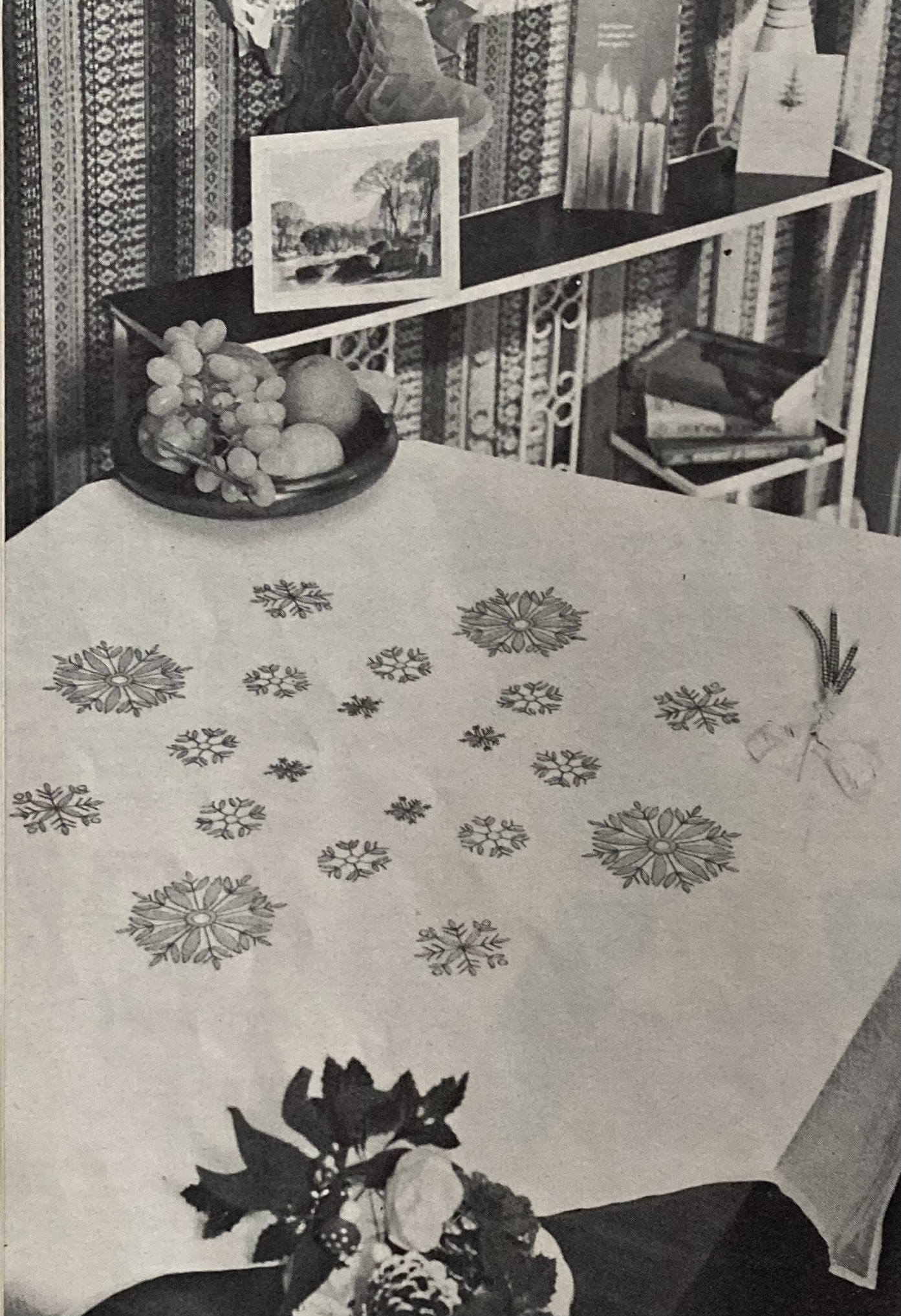
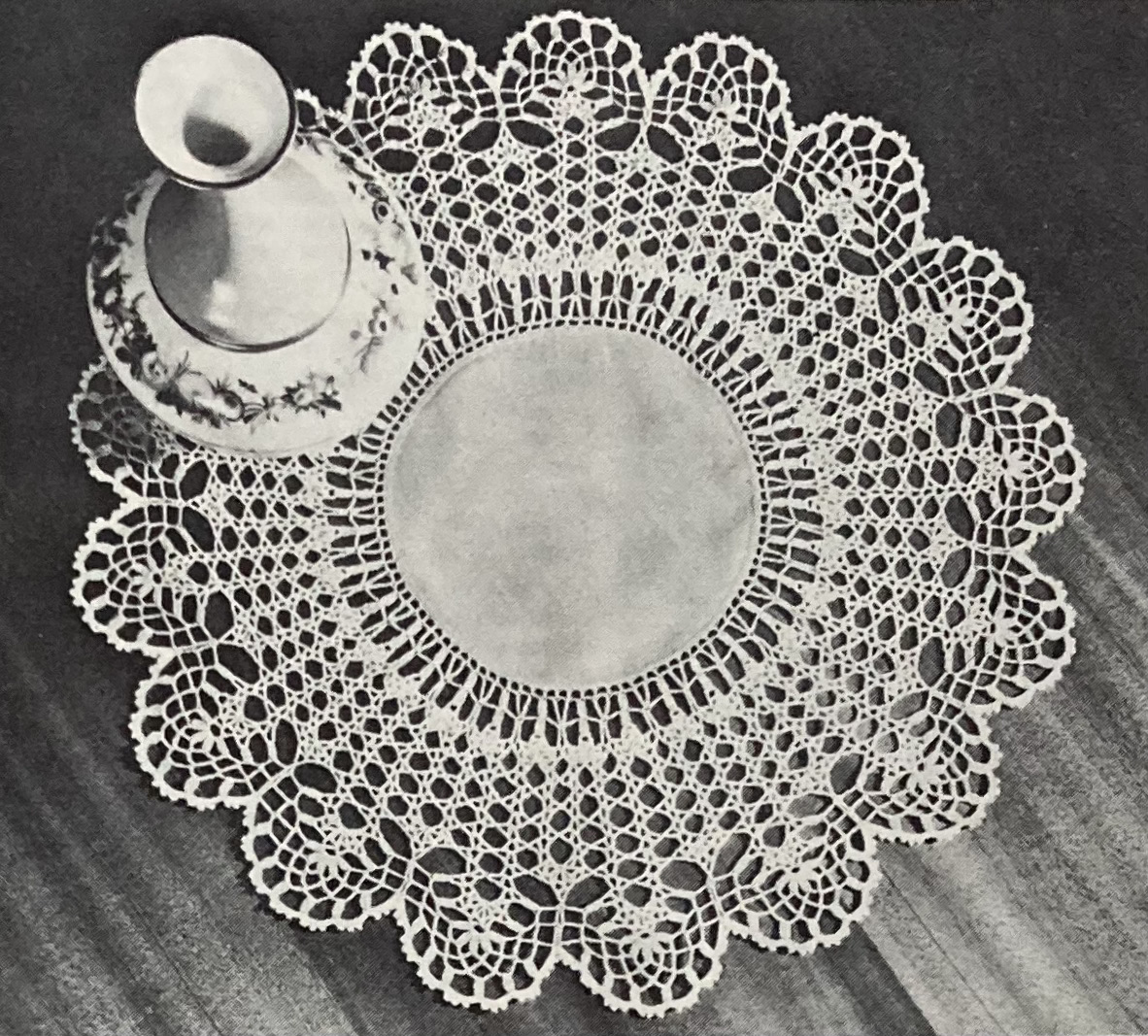
For advanced needleworkers, there are wall pictures of “needle etchings” (black-and-white pictures embroidered in stem-stitch to give the effect of a pen-and-ink drawing) of Sussex churches or colourful flower sprays, as well as a tablecloth in rare “shadow work”, where the thread carried on the back side deliberately shows through the filmy organdie backing fabric. (Personally, I dread the thought of the back side of my embroidery being visible, ever…). For expert crocheters, there’s a lovely lace doily with a linen centre.

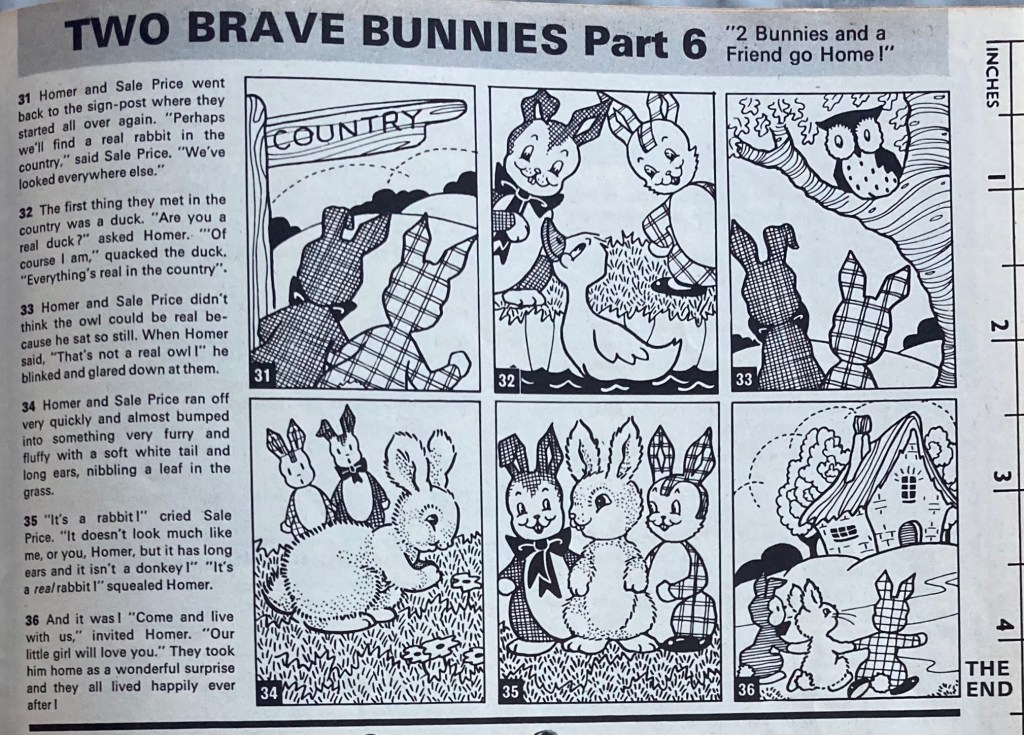
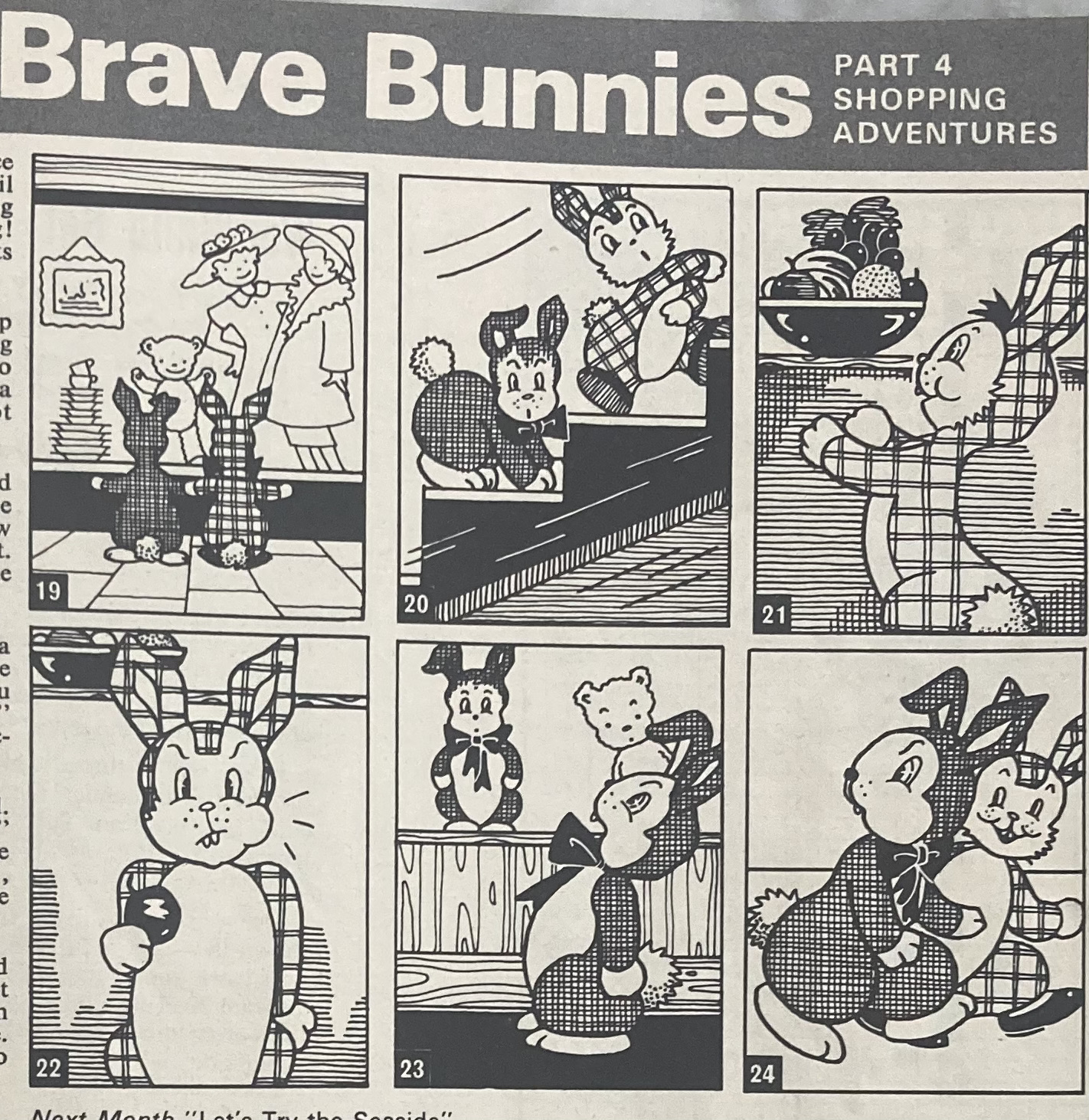
On to our children’s comic! The two brave bunnies (both plush toys) are still in search of a real live rabbit. Not having found one at the carousel, cinema or department store, they try the seaside, because why not? They have fun at the beach and think they find a rabbit — alas, it is only an inflatable sea-water toy! Will they ever complete their quest?

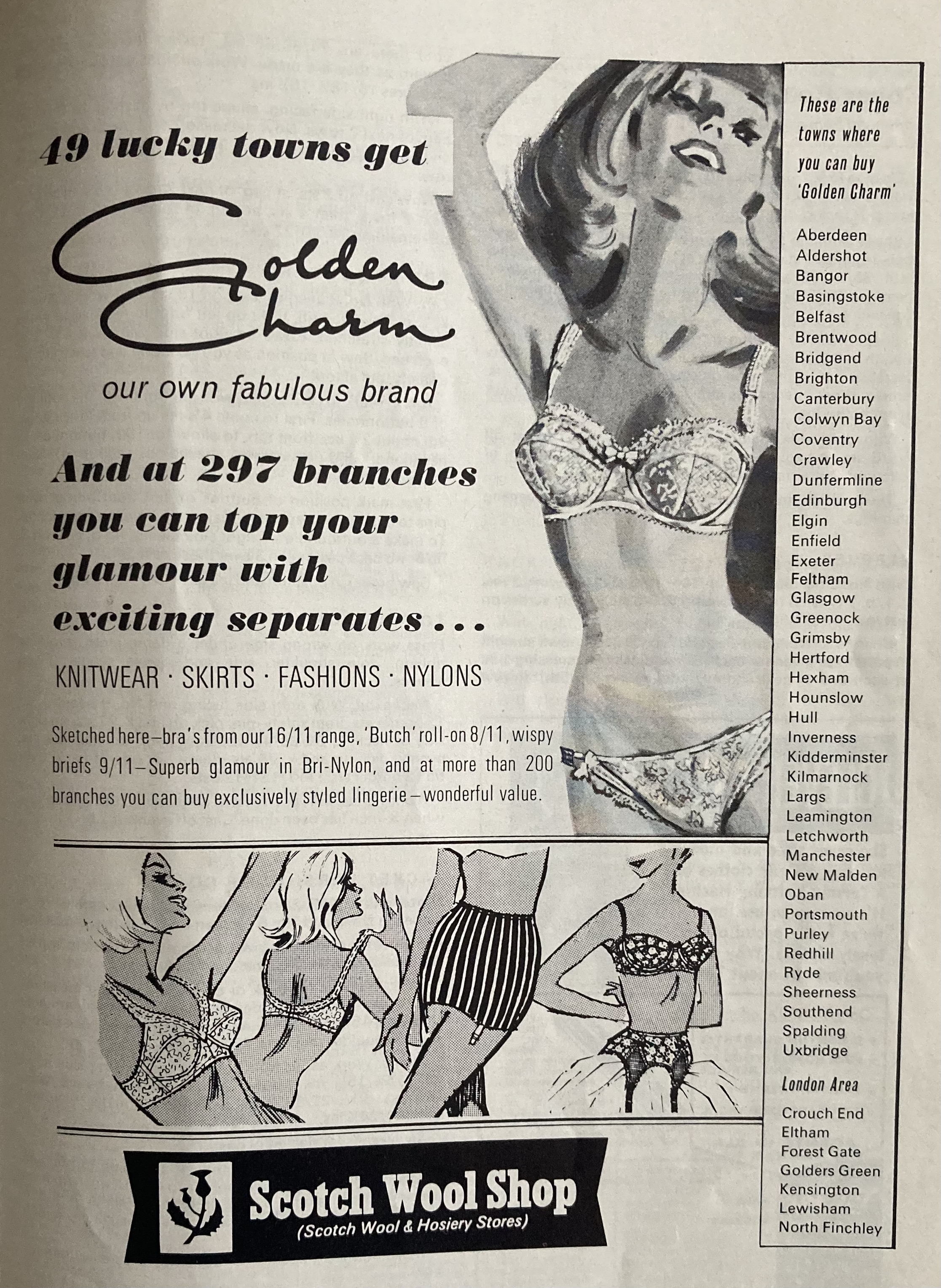
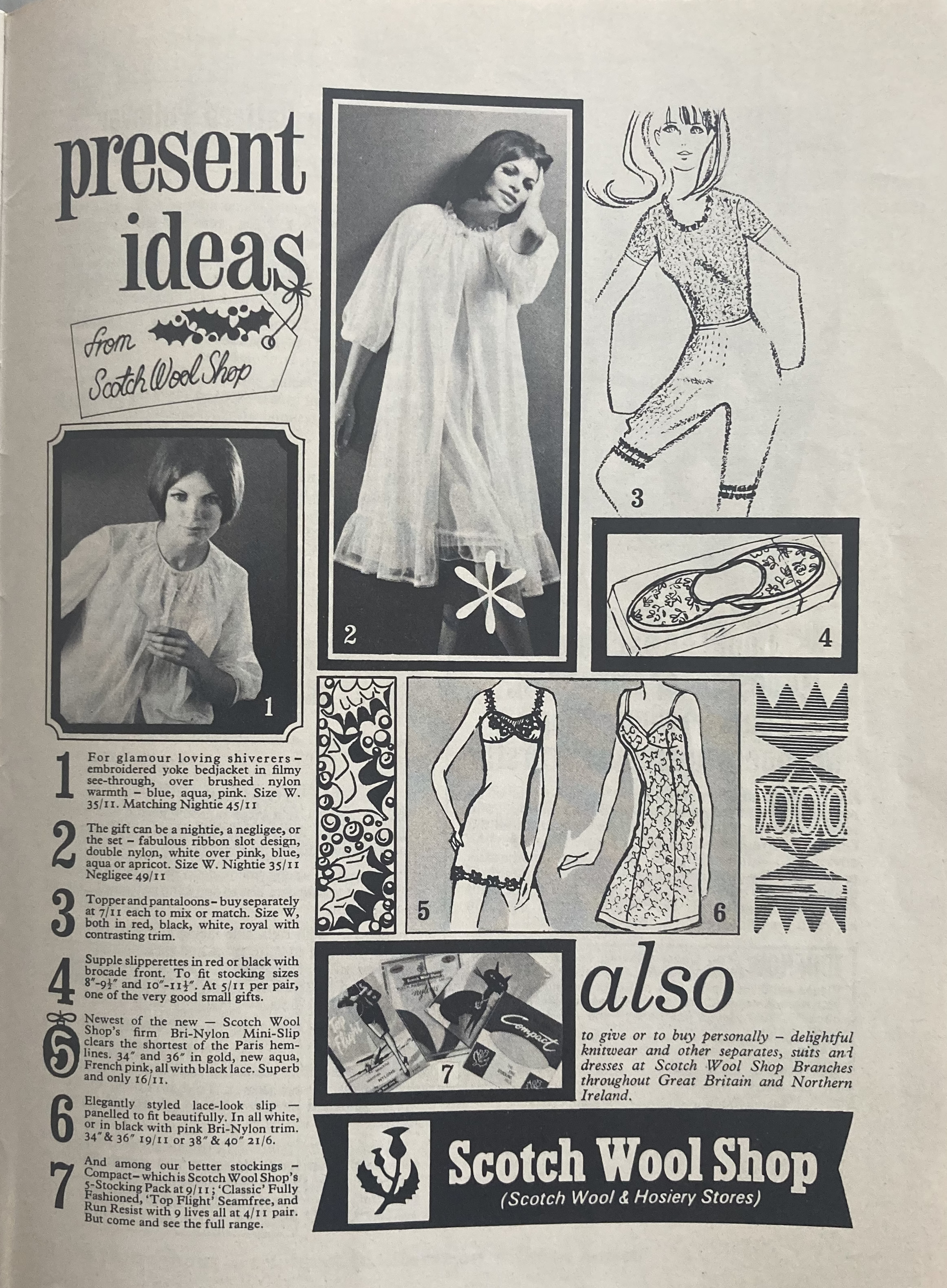
I will leave you with the latest wonderful ad from the Scotch Wool Shop, which had just launched its own line of very pretty underwear, “Golden Charm”. Available in 49 lucky towns! I hope your town and your 2024 are equally lucky. My project for this month will be the embroidered mittens.

December 1965: Overview

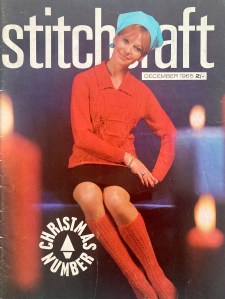
Here it is — the 1965 “Christmas Number”! December at Stitchcraft is always a month of “quick” holiday trimmings and small gifts, mixed with warm winter clothing and party ideas.

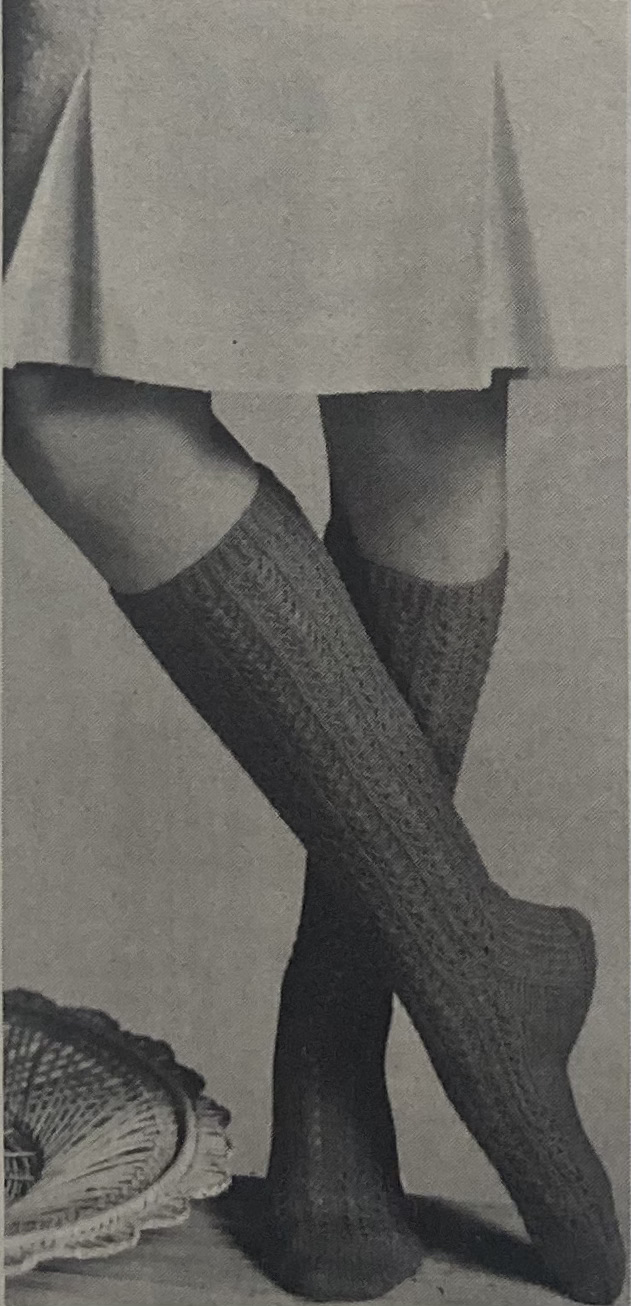
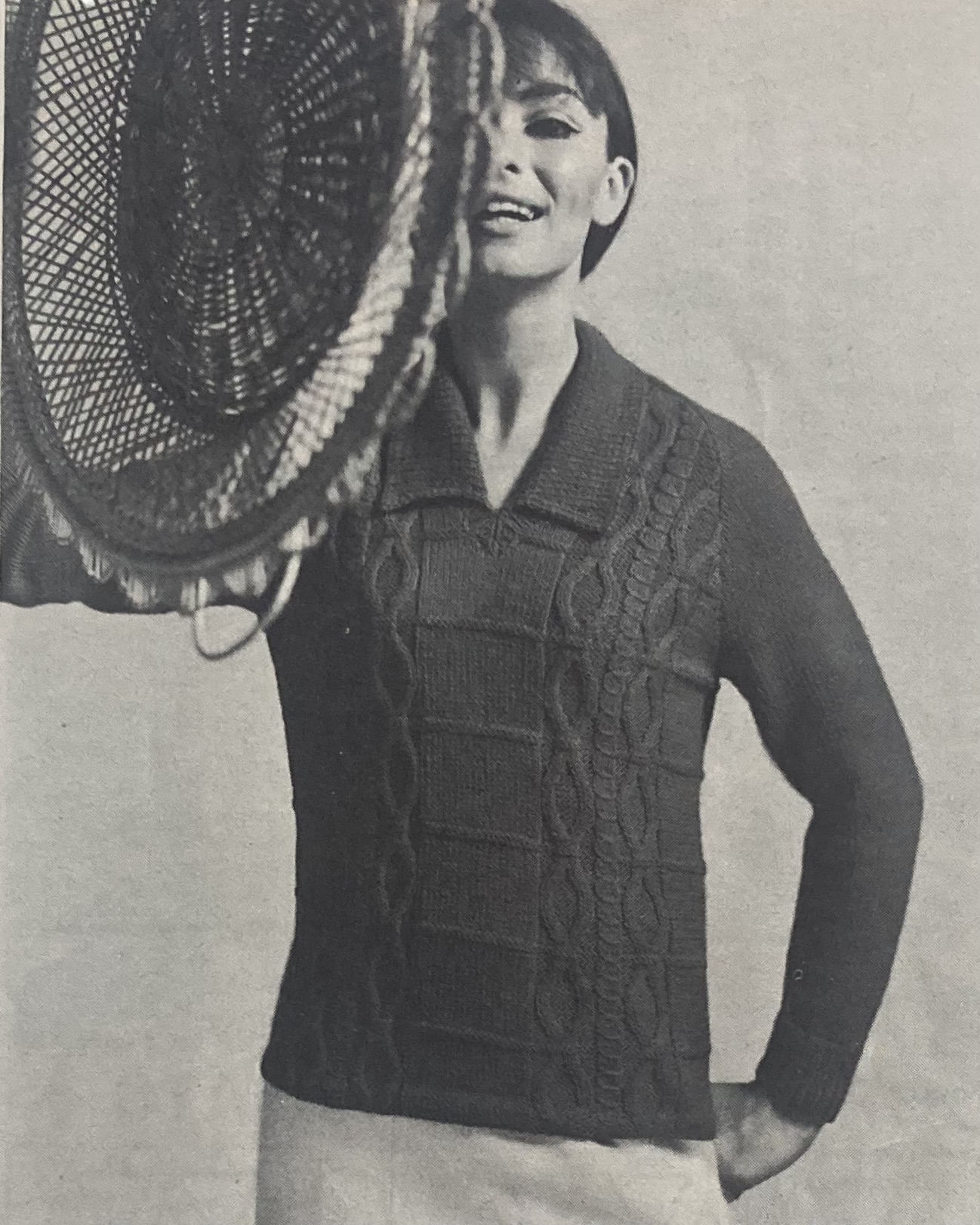
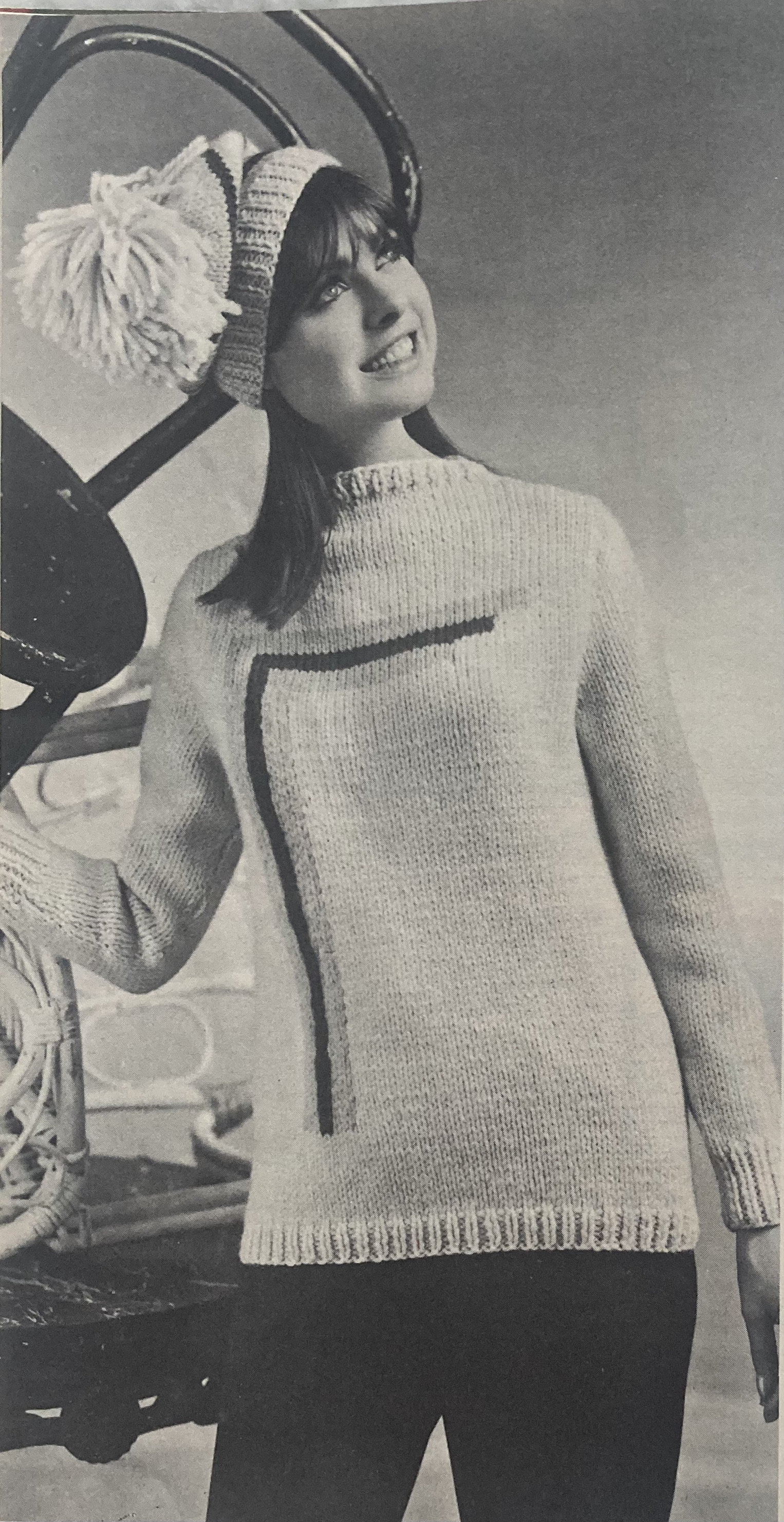
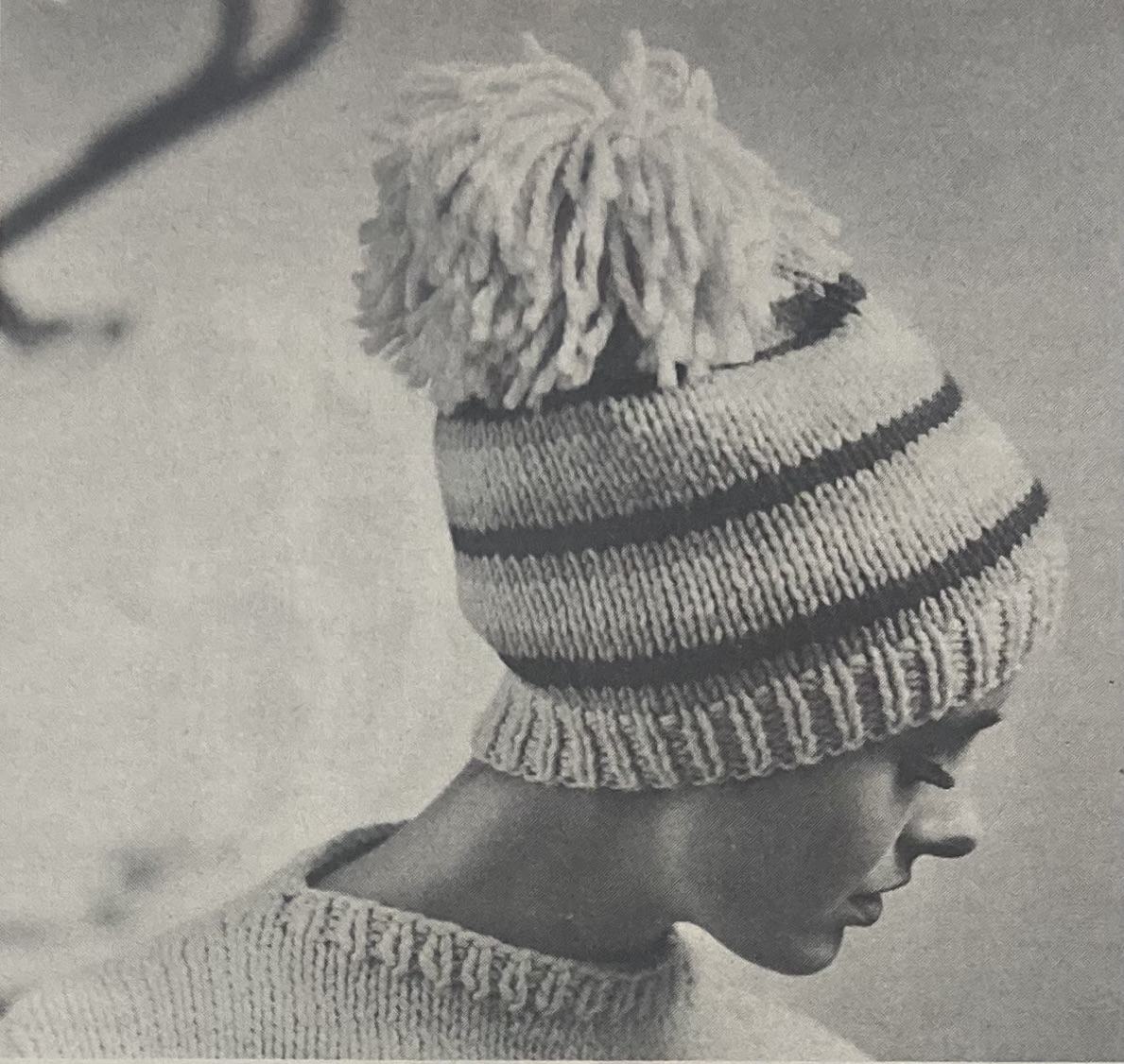
Our cover model is wearing a cable-block pullover (with non-crossing cables) in bright red double-knitting weight wool and matching knee-high socks in a lacy rib pattern. The caption on the pattern page is “Fashion feels Young” — Stitchcraft is finally getting into the children’s-fashions-for-adult-women idea that influenced so much of mid-60s fashion. Note the short skirt on the cover model, along with the knee-high socks, the playful kerchief and the big straw hat accessory in the black and white photo. It’s not quite Twiggy or Mary Quant (spoiler: Stitchcraft was never that fashion-forward), but it’s starting to show their influence. “Young Fashion” fun is reflected in the matching cap and pullover set as well. Look at the enormous pom-pom on the hat, outdone only by the model’s fake eyelashes!

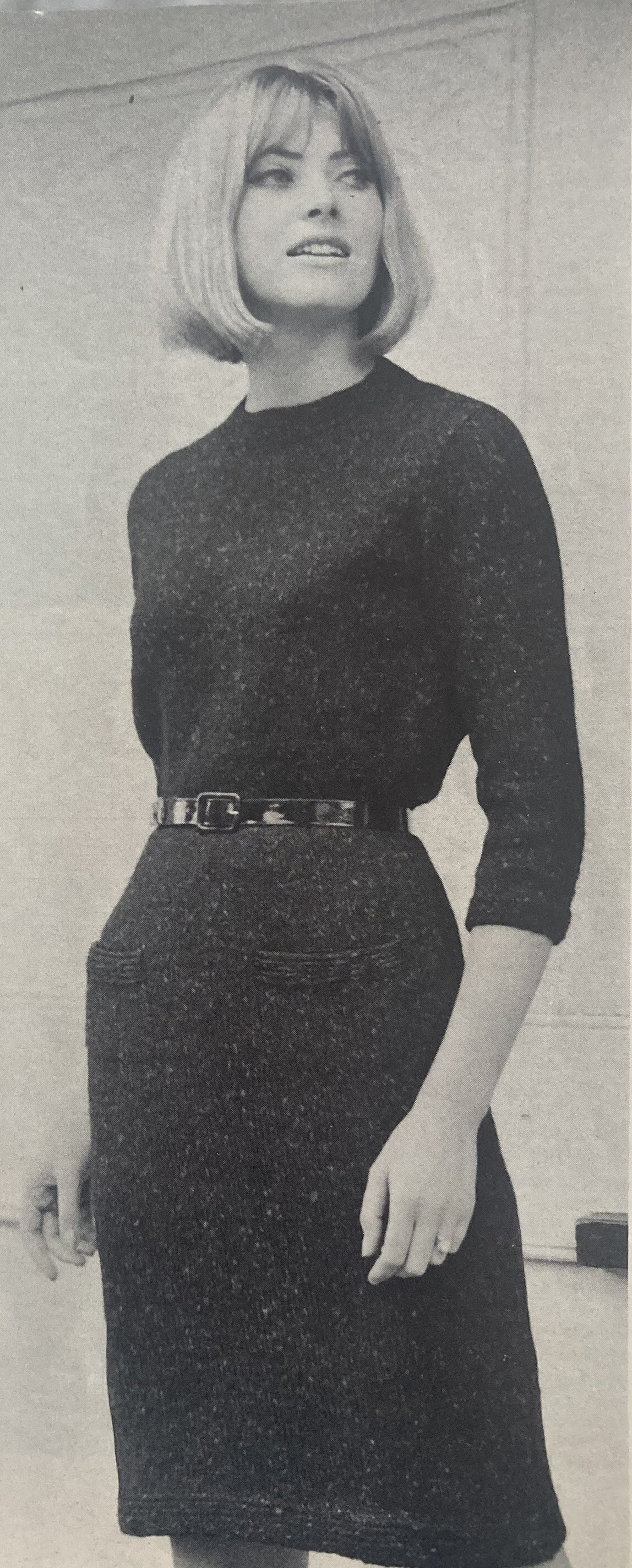
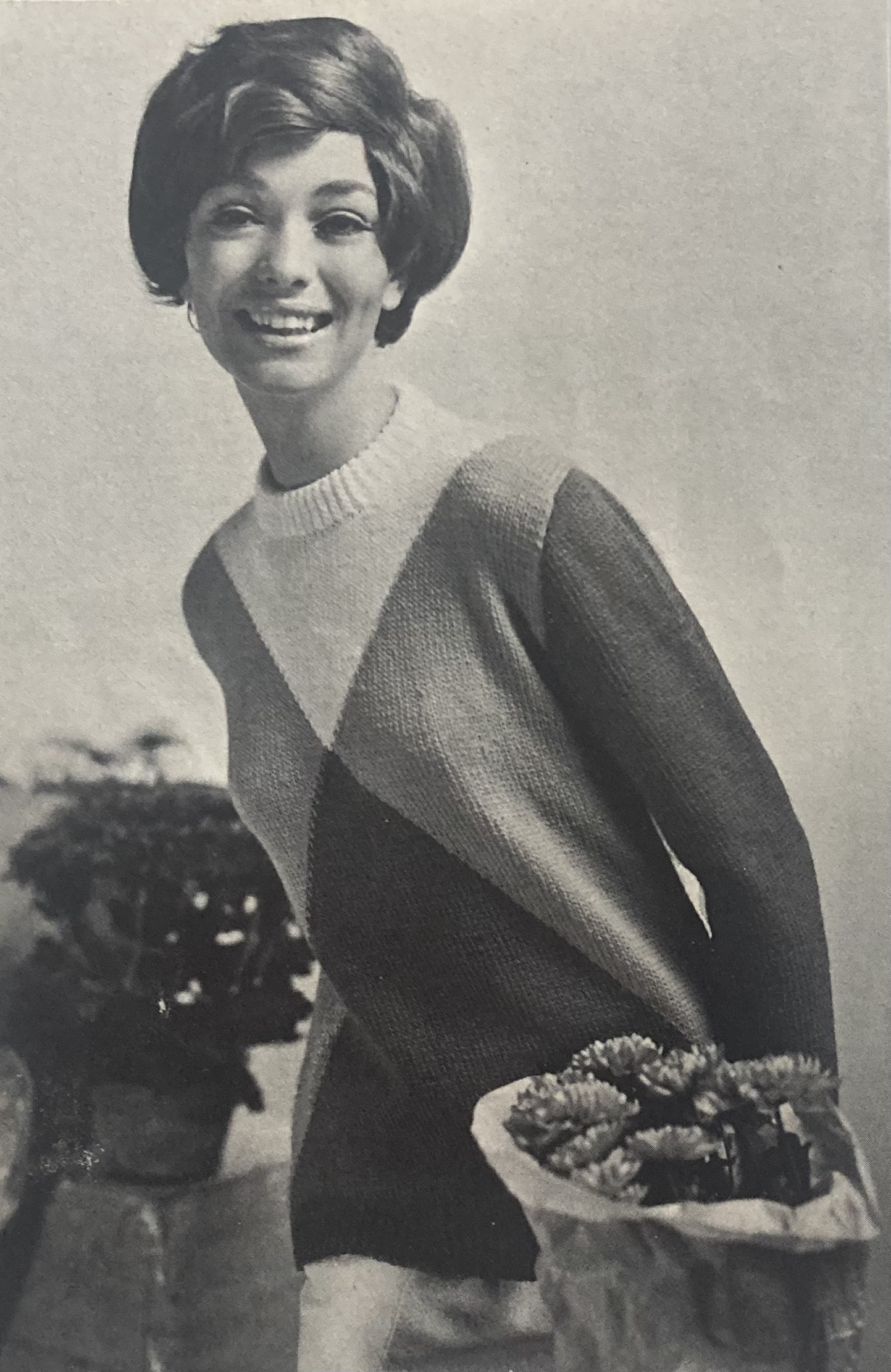
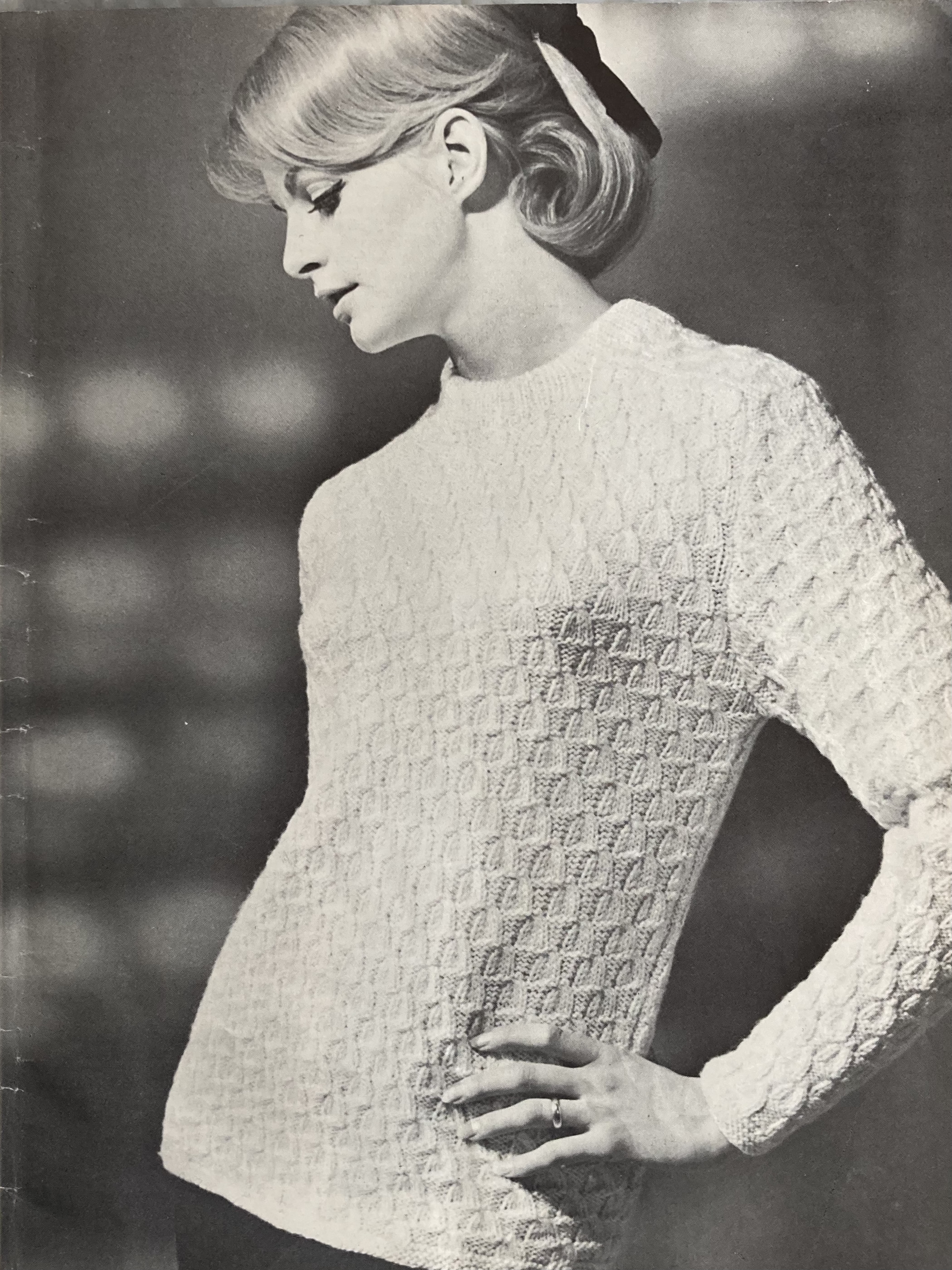
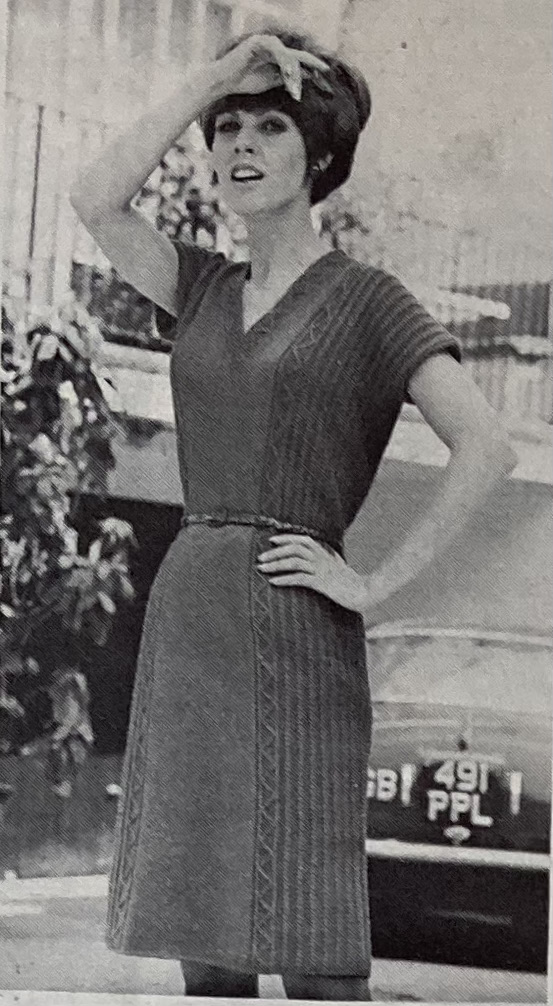
The other women’s fashions in this issue remain conservative: a warm tweed dress made in two parts sewn together at the waist (thus the obligatory belt), a cabled cardigan for larger sizes in thick, undyed “Capstan” wool, a lightweight wool jumper and swingy knee-length skirt in a “gay note” of blue or a “harlequin” pattern jumper in “bold” 1960s colours of white, gold and brown. I feel exactly the same way as the model in the colour photo when I finish a project and find that perfect gift on the same day.

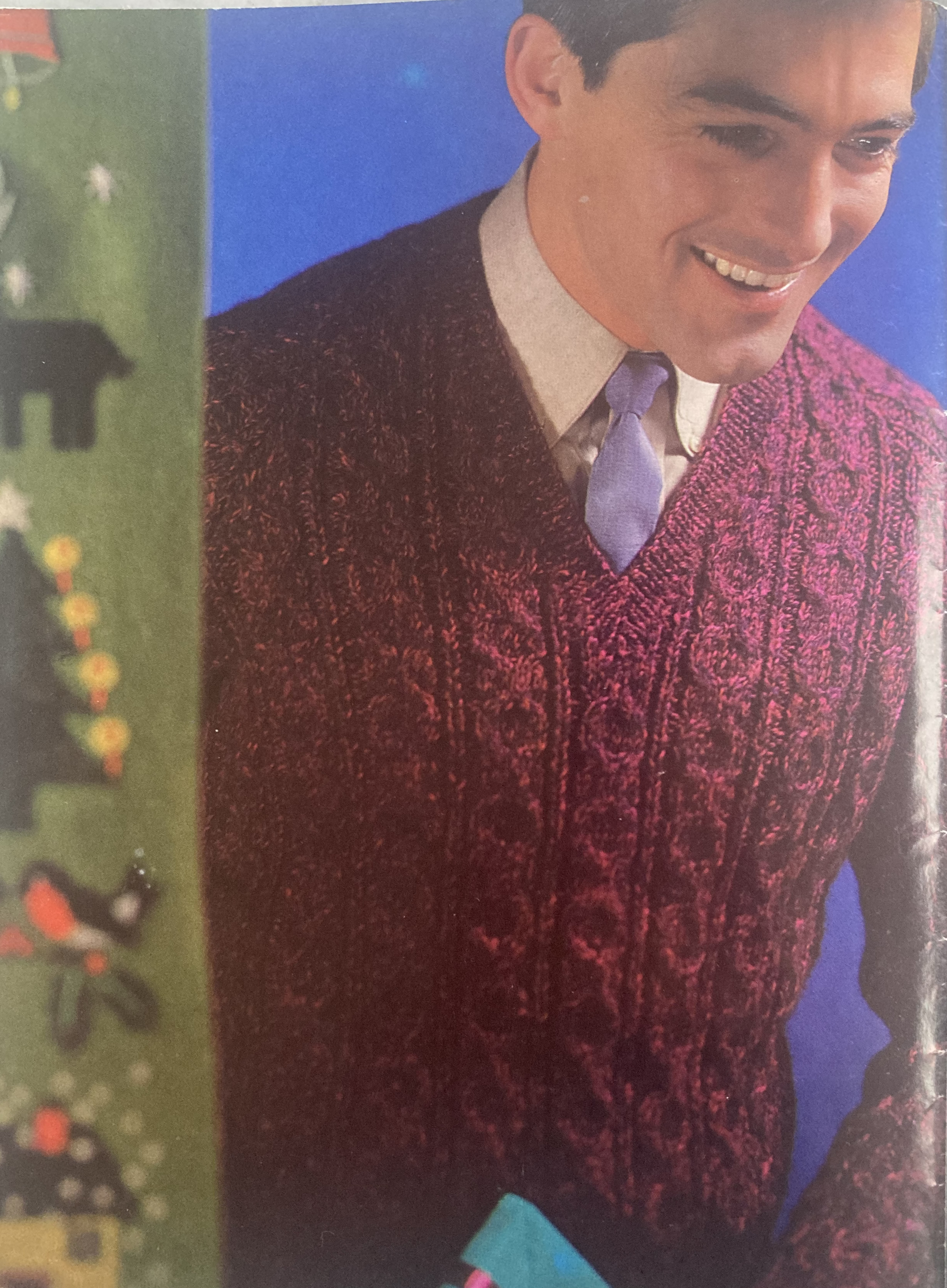
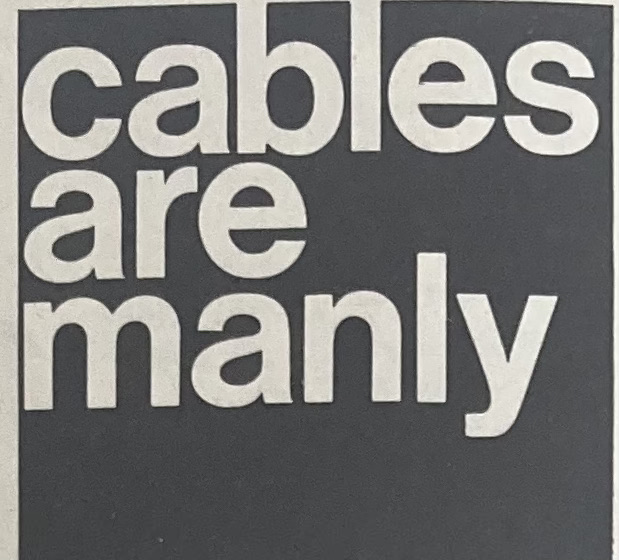
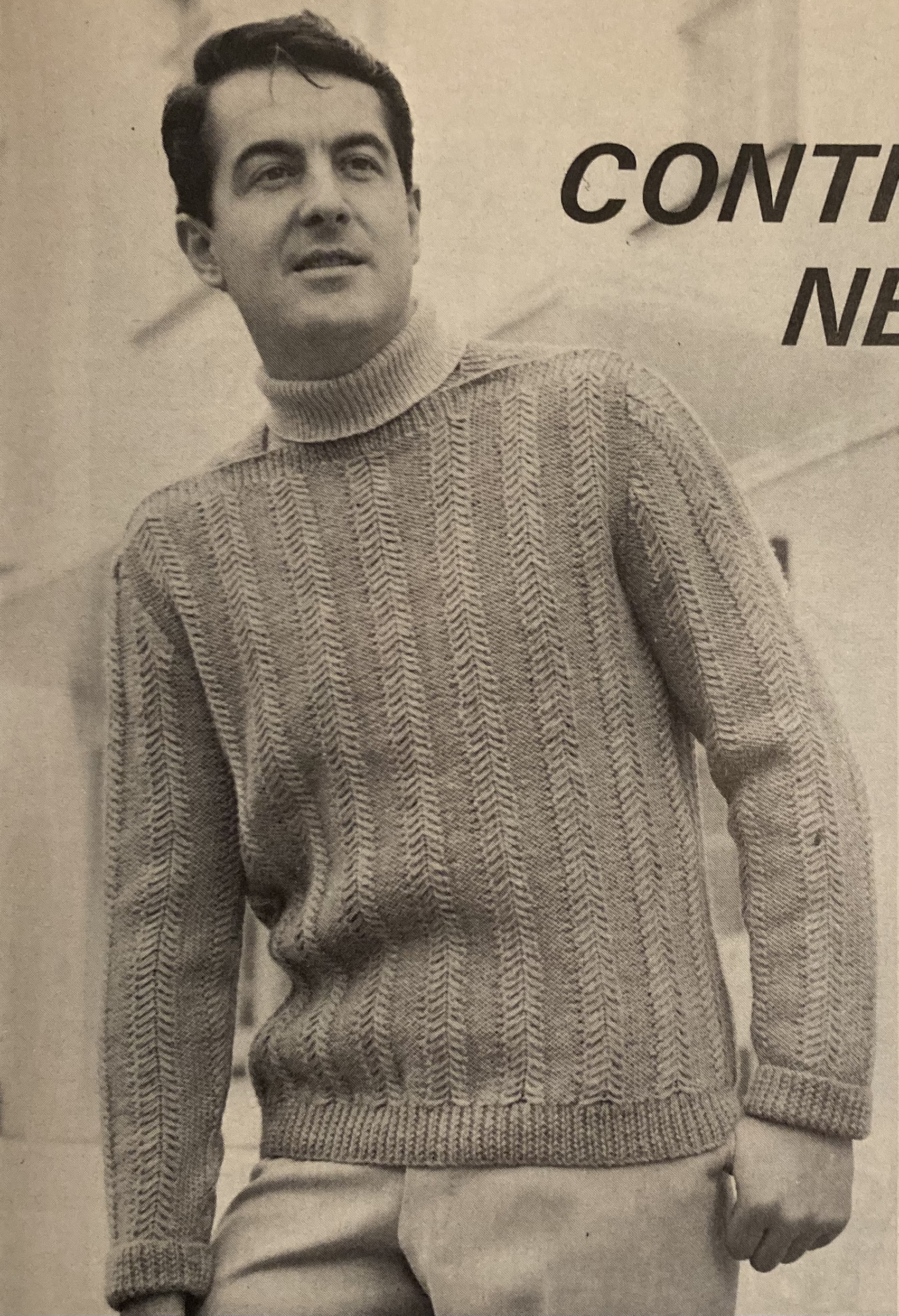
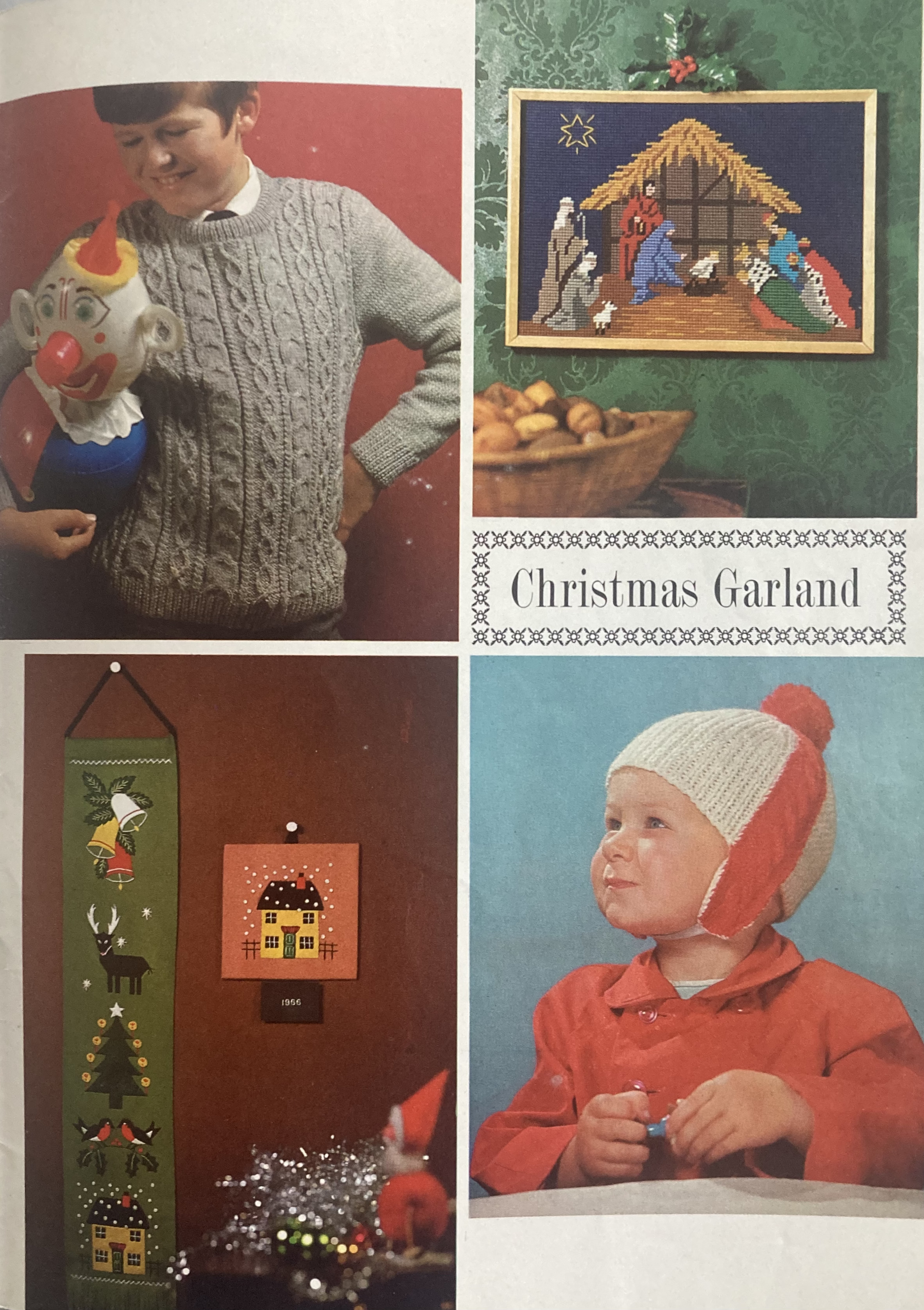
Men can get a cabled pullover in a glorious shade of purple tweed and the reassurance that cables are manly (like our model’s eyelashes, which are almost as impressive as his colleague’s with the pom-pom hat). There’s a boatneck pullover in herringbone stitch as well, meant to be worn over a simple polo- ( aka turtle-)neck jumper, for which a pattern was given in the previous issue.

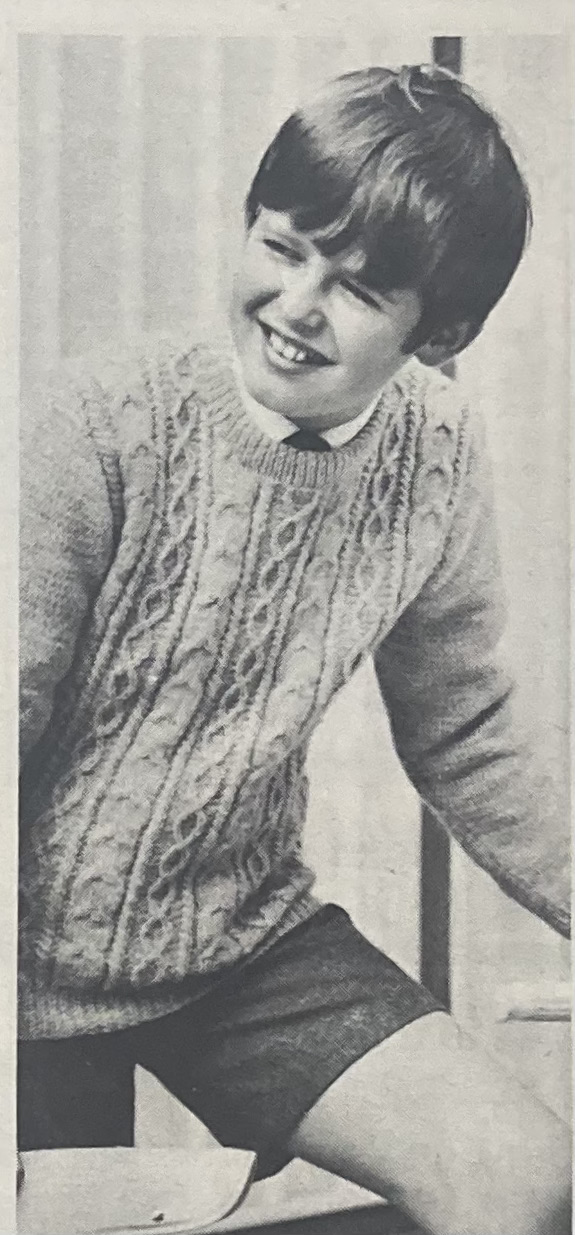
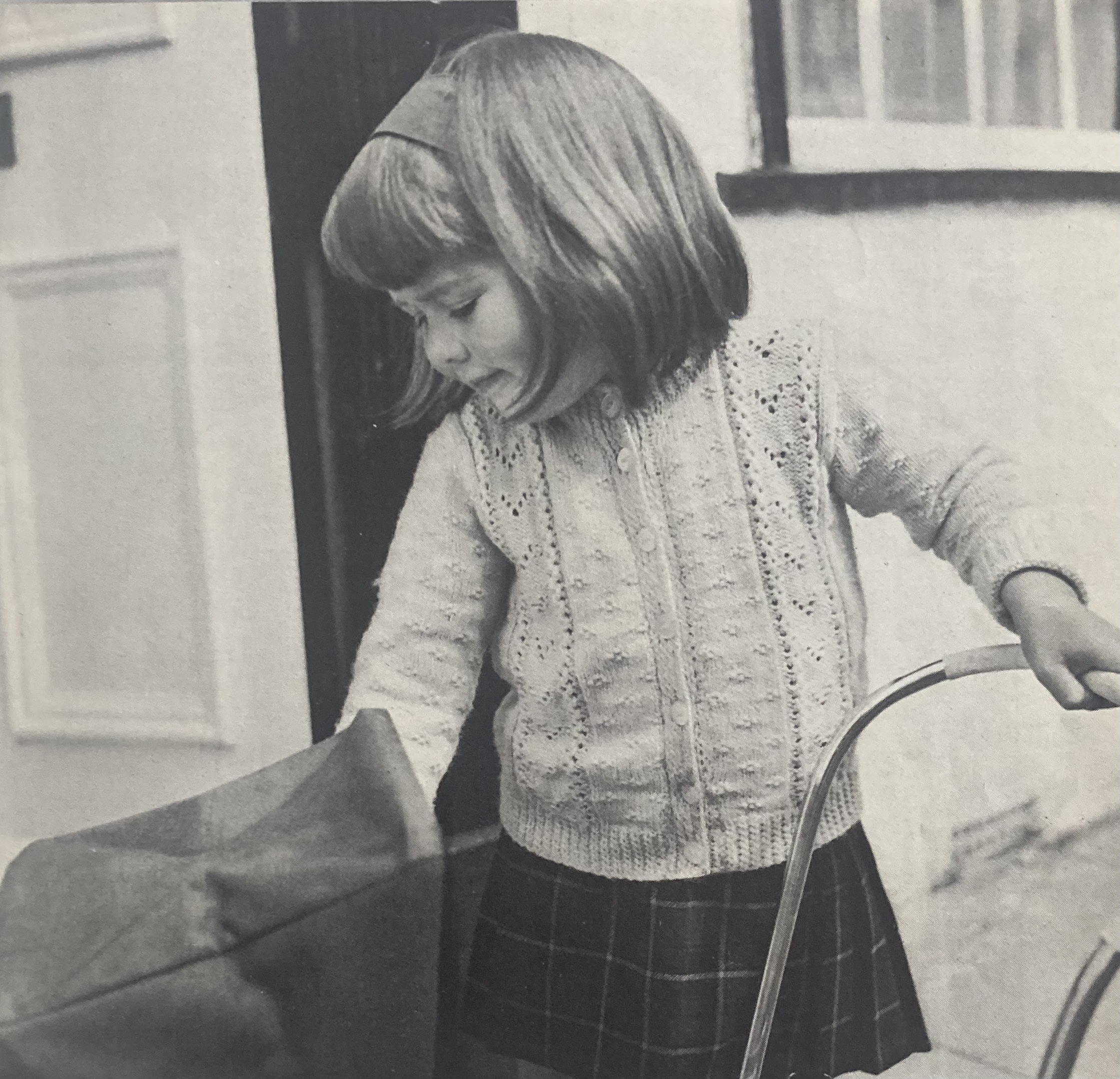
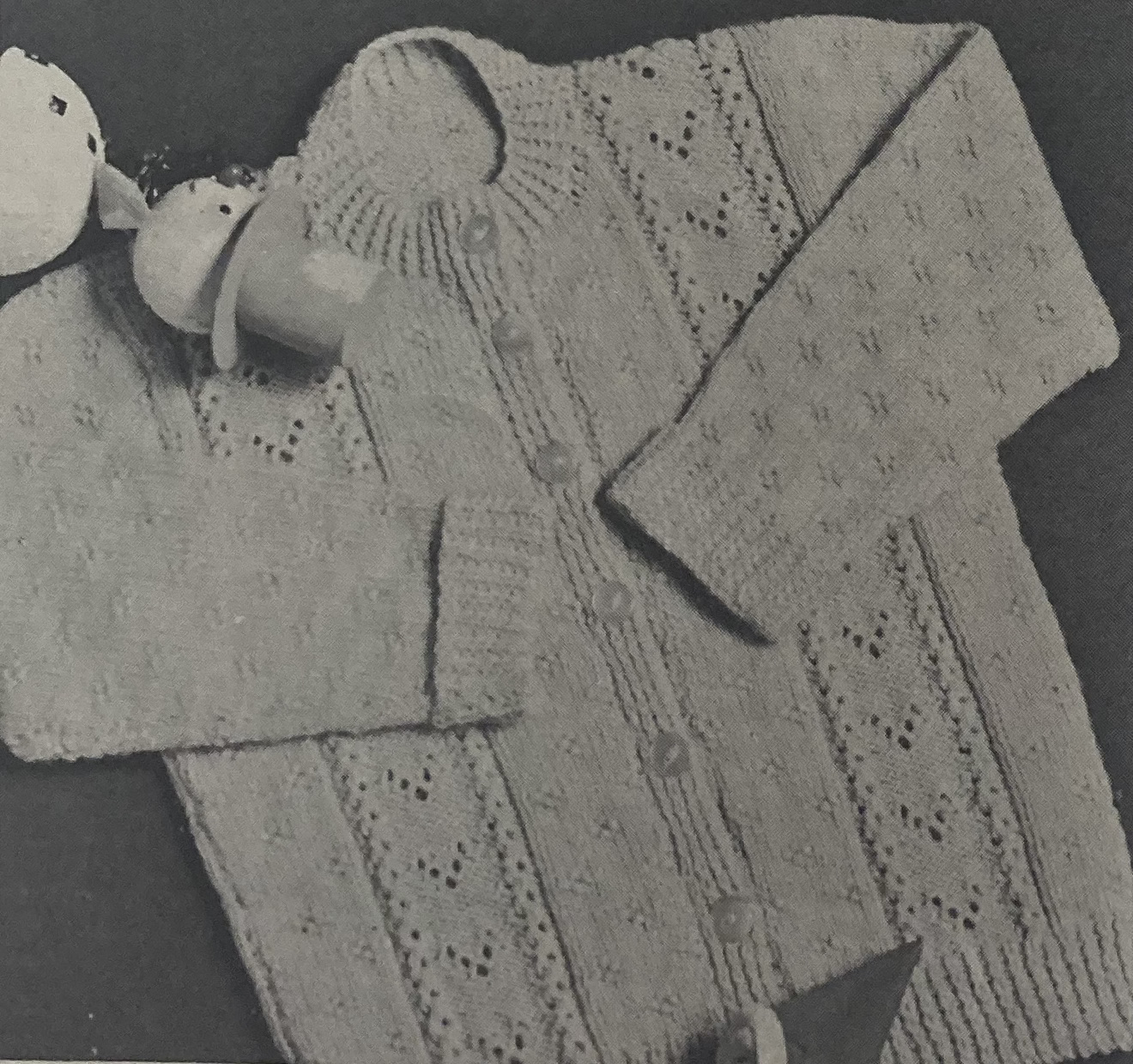
The manly-cable idea is continued on a lovely warm pullover for boys, and his younger sister can get a button-up cardigan in a frothy textured stitch pattern, made in synthetic-wool “Brilliante” for easy washing. Younger tots can enjoy warm ears with a chin-strap “helmet” hat that is guaranteed not to fall off or get lost.

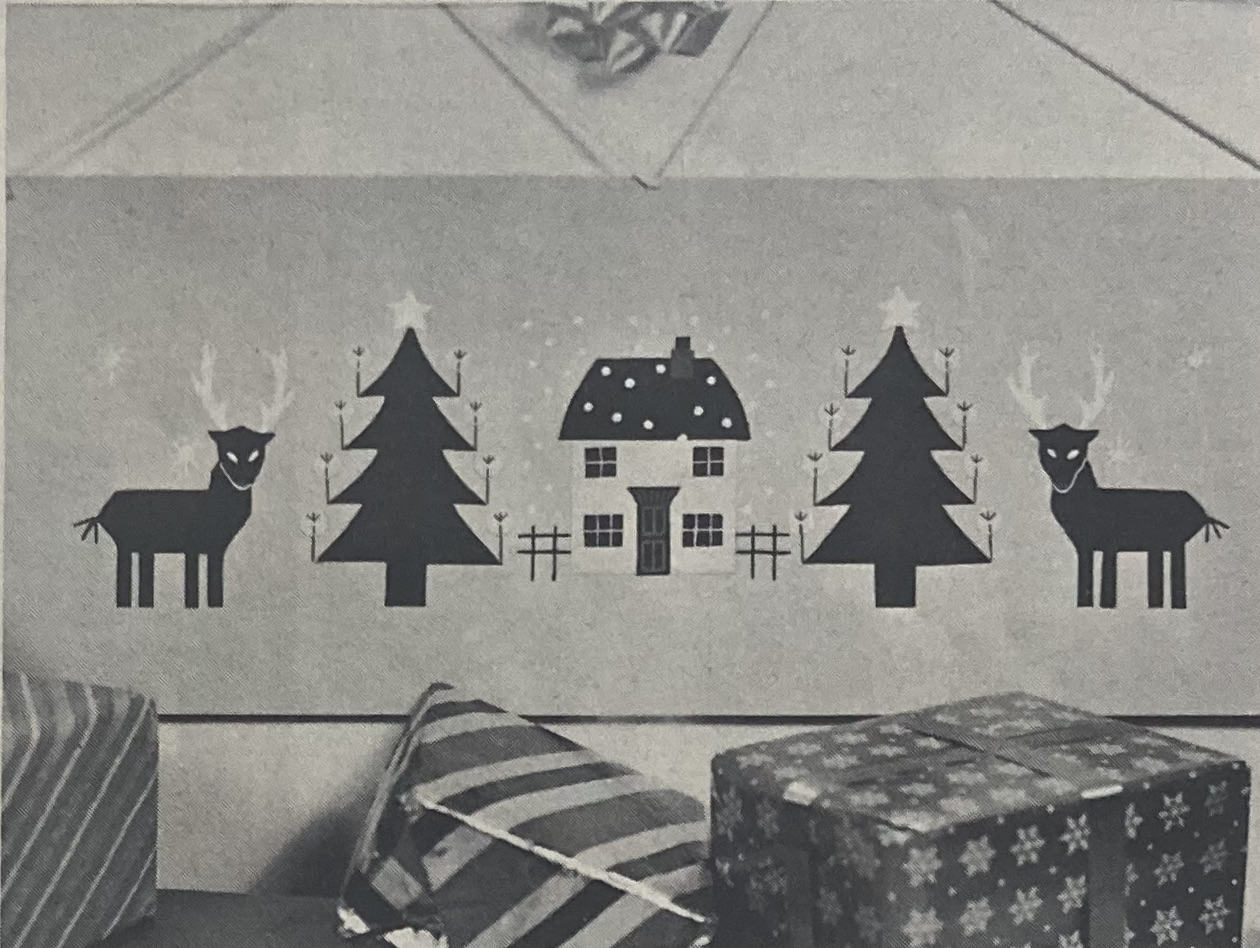
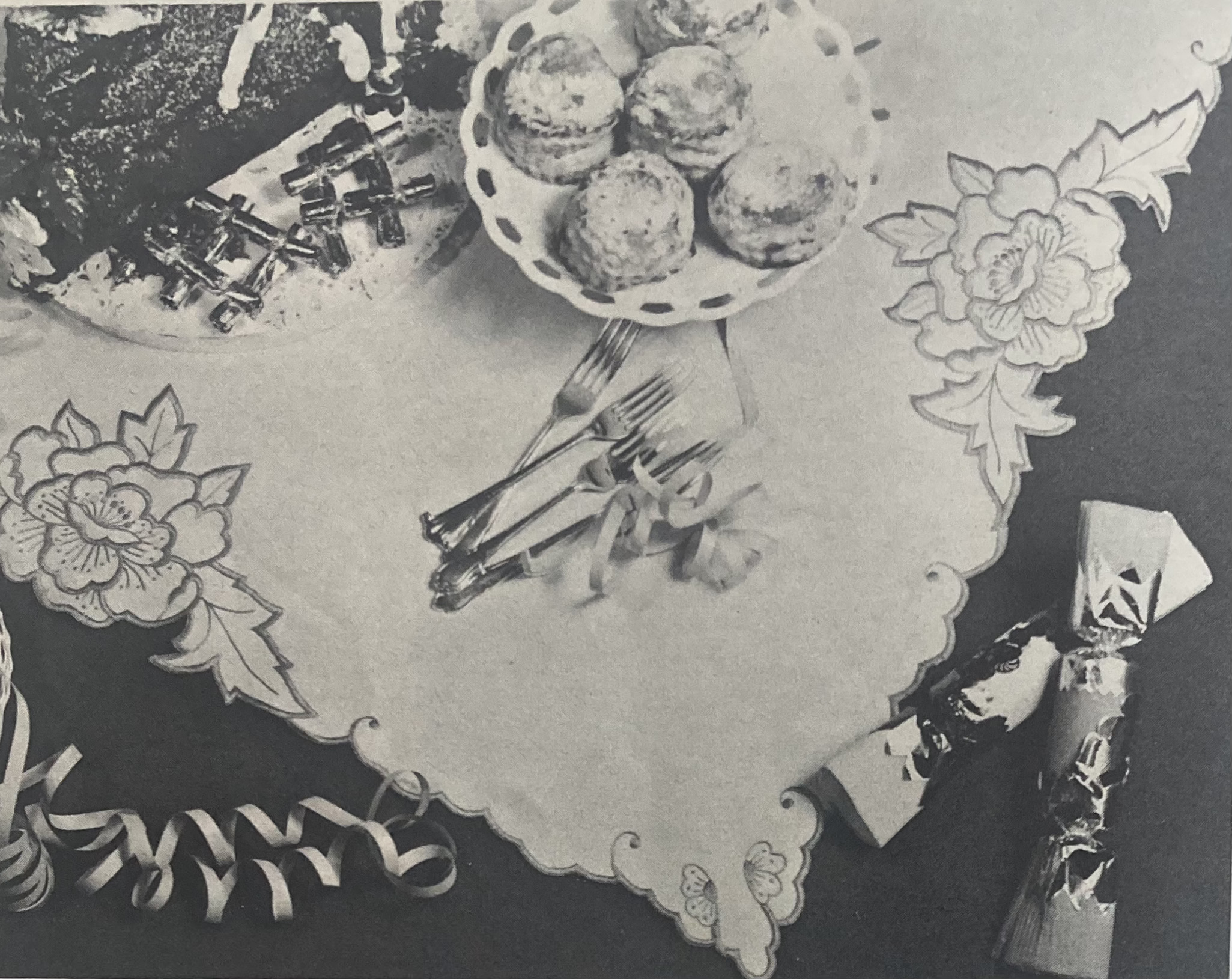
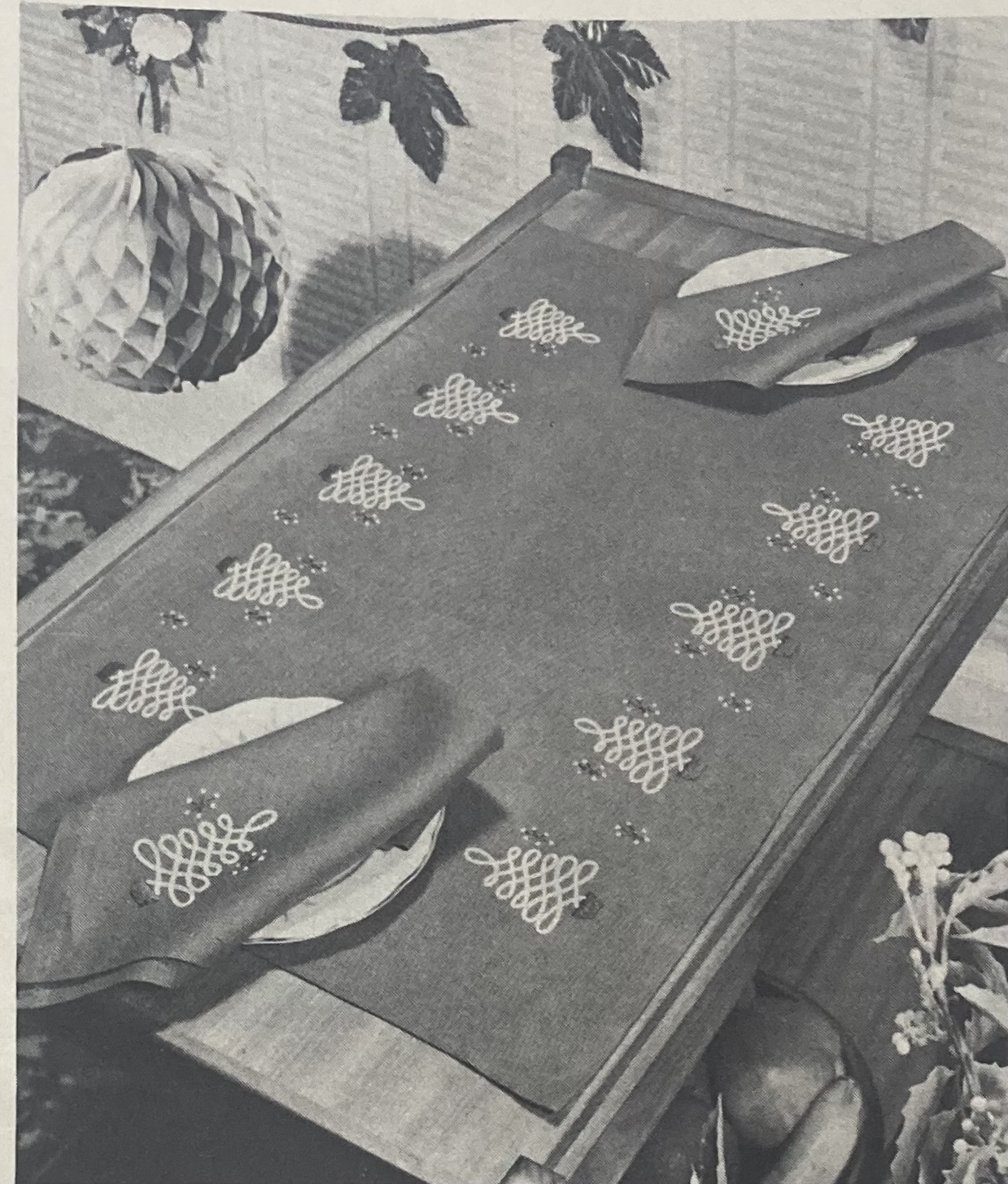
The real focus of the issue is of course, Christmas preparations. Felt appliqué makes a big appearance this year, with place mats and name cards for the holiday table as well a winter-scene wall hanging. The appliqués are quite simple and designed to be used with scraps, and the instructions give ideas on alternate uses such as glueing the felt pieces onto paper for home-made Christmas cards. The place markers have a butterfly motif, making them appropriate for any time of year. Cutwork and embroidery fans can make a tablecloth with peonies, or a Christmas-tree-themed trolley cloth and napkins embroidered in simple chain-stitch. More religiously-minded readers can make a tapestry wall hanging of a Nativity scene (colour photo on inside back cover).

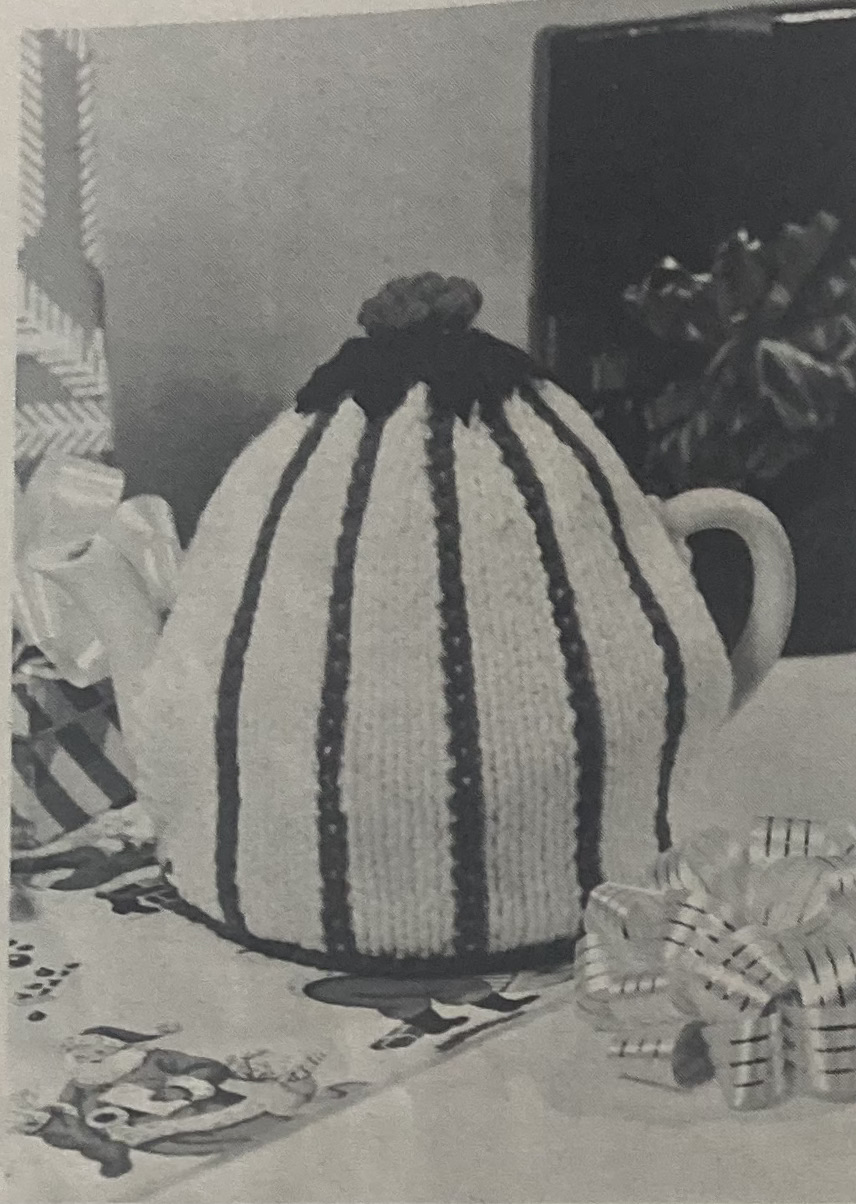
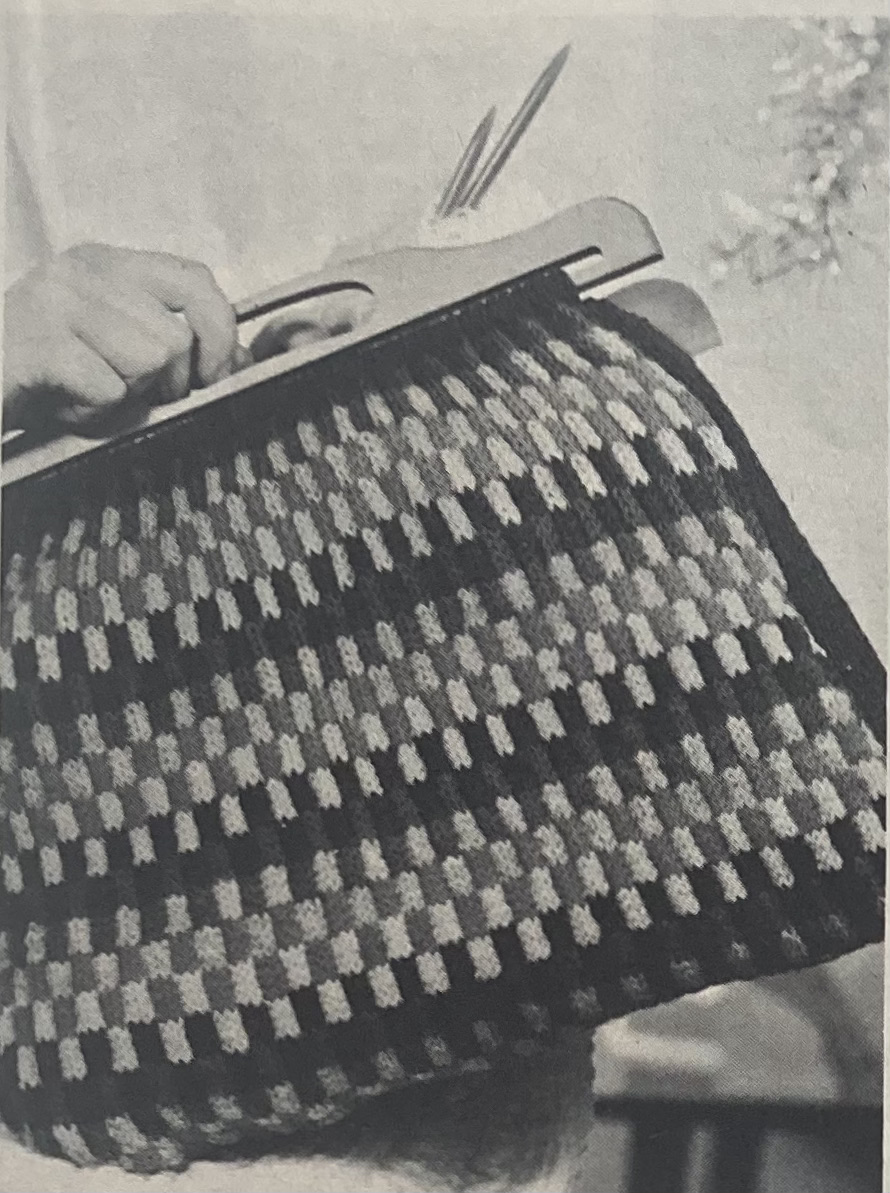
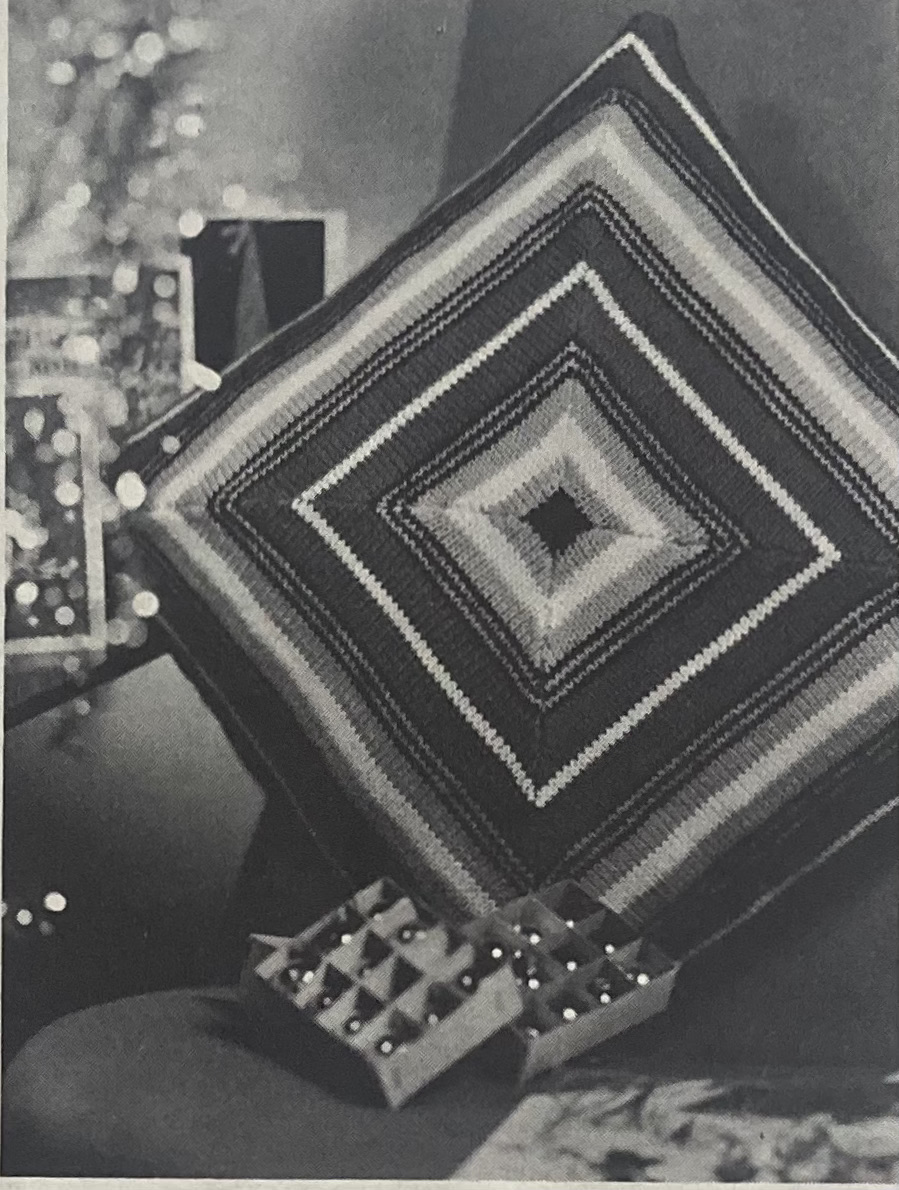
After dinner, it’s on to the gifts! The knitted tea cosy is supposed to represent a holly plant. The “workbag for a friend” is a fun way to use up leftover wool and I made one a couple of years ago. The “cushion for Granny” is a similar stash-buster. One would think it would be made in two squares either fron the center outwards or the edge inwards with raglan-type shaping, but no, you are supposed to make 4 identical triangle pieces for each side of the cushion and sew them together.

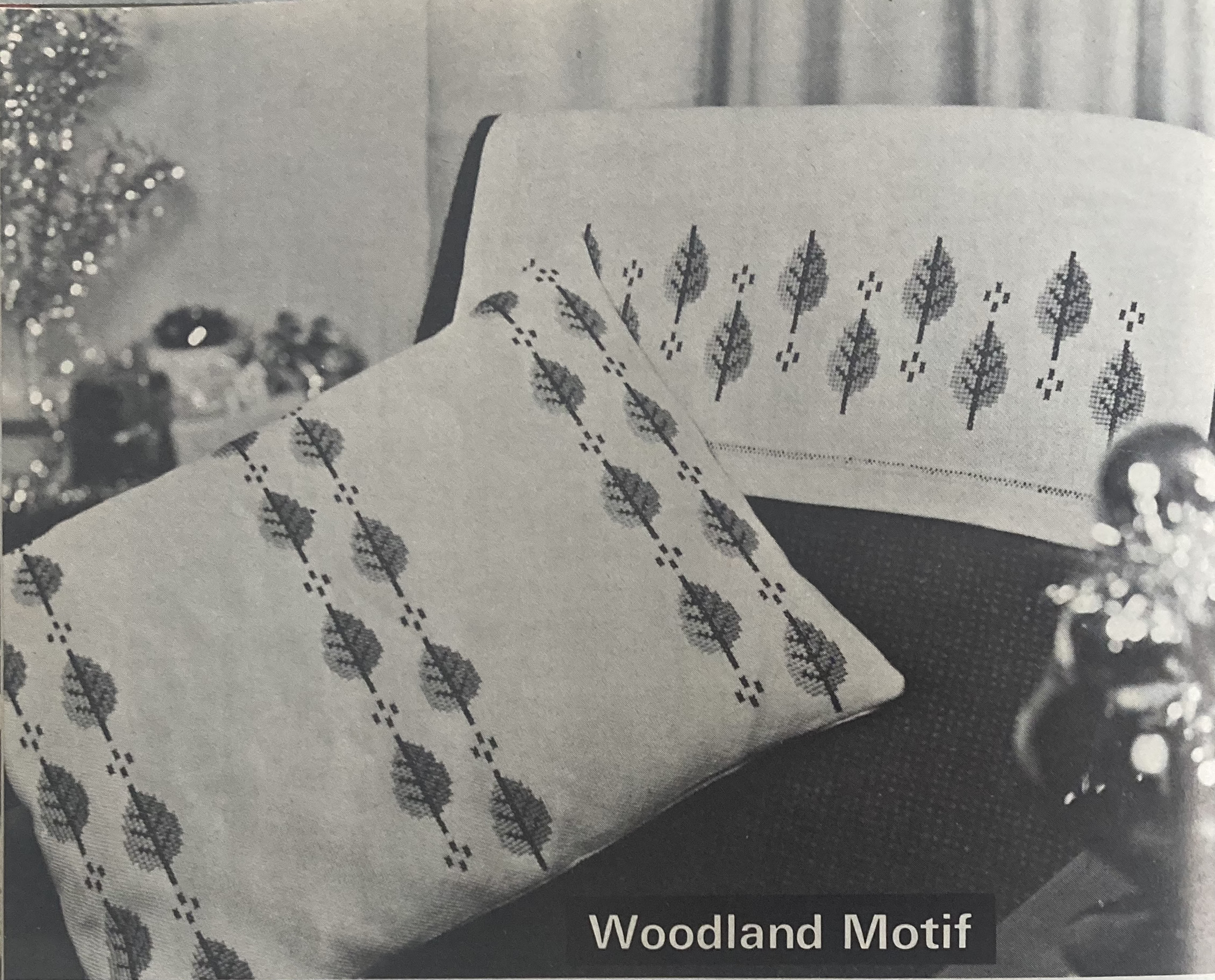
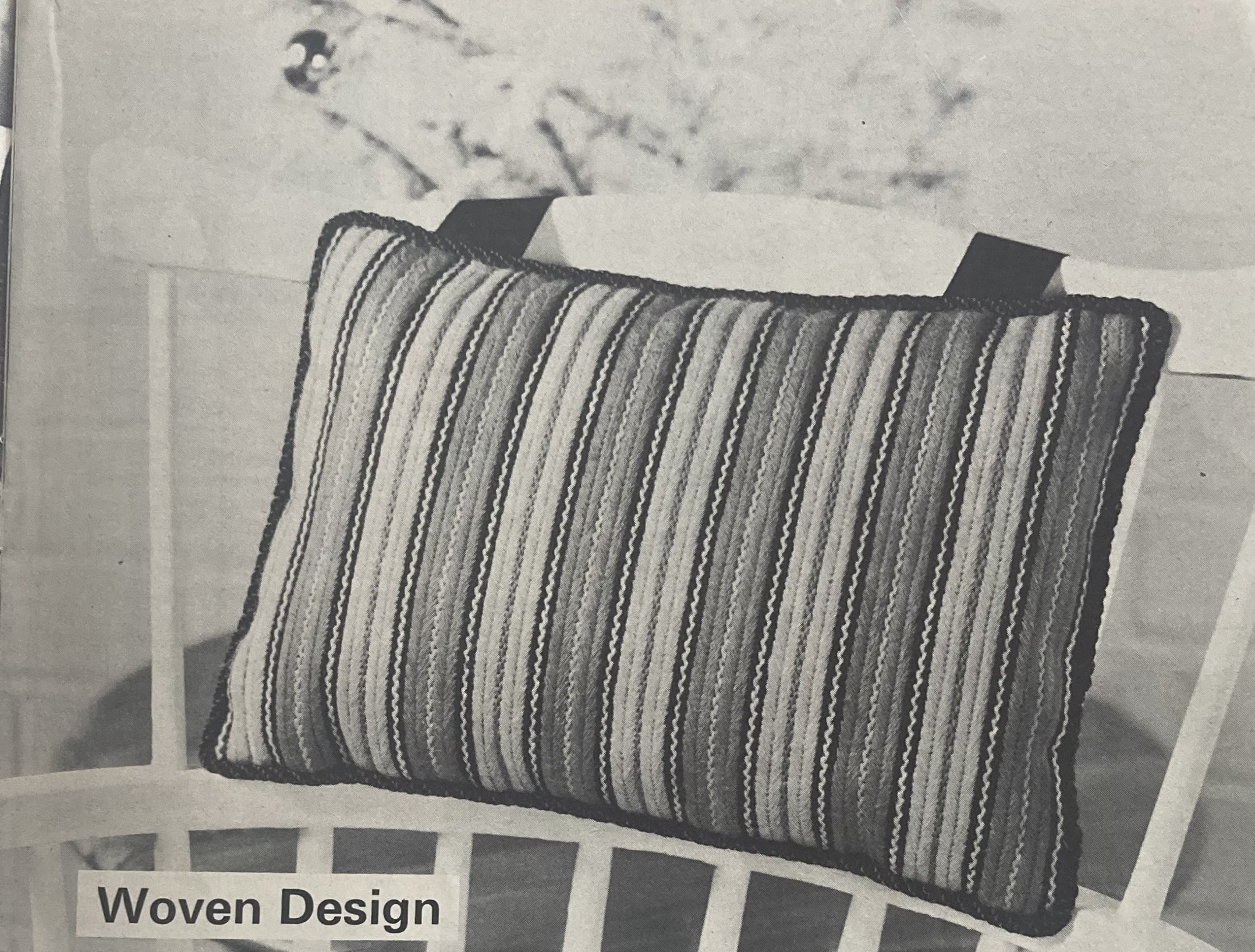
And let us not forget the other cushions: a simple cross-stitch number with a woodland design and a tough woven-tapestry chairback cushion in soumak and herringbone stitch. The colour scheme is brown with brown, with touches of orange and lime green for contrast. In the “just for fun” category, you can knit cosies for golf clubs.

Our two brave bunnies from the Readers Pages are still on their quest to find a real live rabbit. Thinking they might find one in a department store (why not), they get stuck on a moving staircase, try to eat a plastic apple, and find a stuffed rabbit who, unlike our co-protagonist Sale Price (also a stuffed rabbit), sadly cannot talk. Next month, they will try the seaside, which is not known for being home to very many rabbits, but I suppose a better chance than a department store, a movie theatre or a merry-go-round. Of course, around Christmas time, one of the surest places to find a real rabbit would be on the dinner table, ha ha. I guess that storyline might be considered inappropriate for a light-hearted children’s comic. At least our two toy rabbit protagonists aren’t in danger of being eaten.

Finally, there’s another wonderful advertisement from my favourite Stitchcraft-ad store, the Scotch Wool Shop. Here is a nice little article about a knitting book produced by the Fleming, Reid company, proprietors of the chain of shops. The ads always make me want to go out and buy things from the stores… which, sadly, no longer exist. These little gift ideas are marvellous.

That’s all for this issue — and this year! I don’t know what I will make from this issue, or if I will just write a post about the knitted workbag that I already made a while ago. I quite like the ribbed skirt, and could use one, but one look at the gigantic WIP pile discourages me from starting any long and boring project. Hopefully I’ll get a couple of those WIPs finished and can write about that for a 1965 / 2023 wrap-up. Until then, I leave you with this graphic from the December 1965 issue. Happy Holidays!

November 1965: Overview

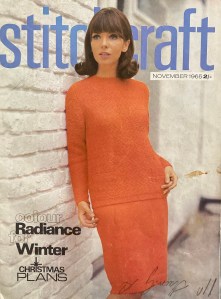
Colour Radiance for Winter and Christmas Plans! At Stitchcraft, it’s generally either preparing-for-Christmas time or spring-summer holidays. This month, they countered the cold, grey days of November with bright, cheerful colours and easy homewares. Let the festive preparation begin.

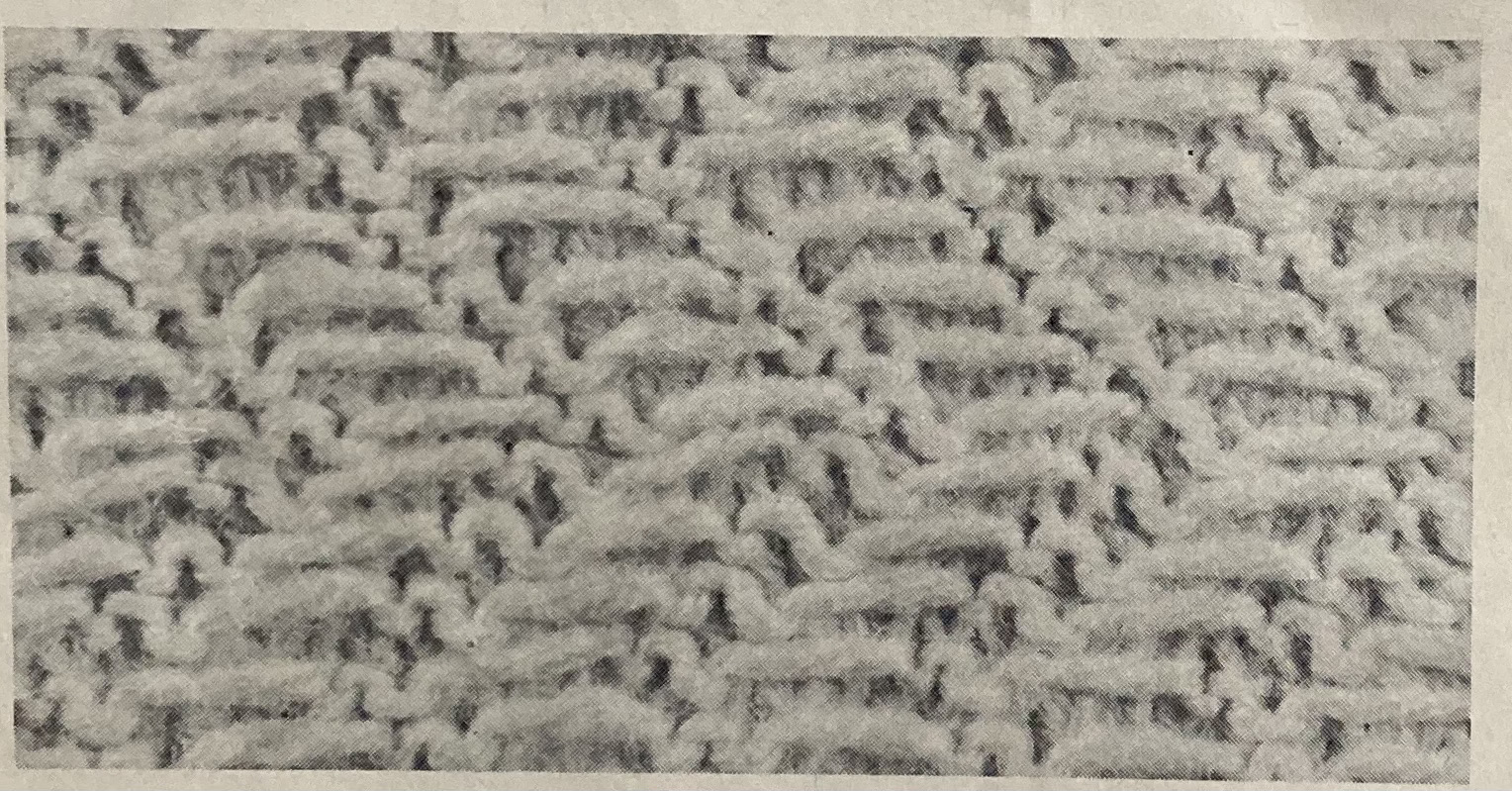
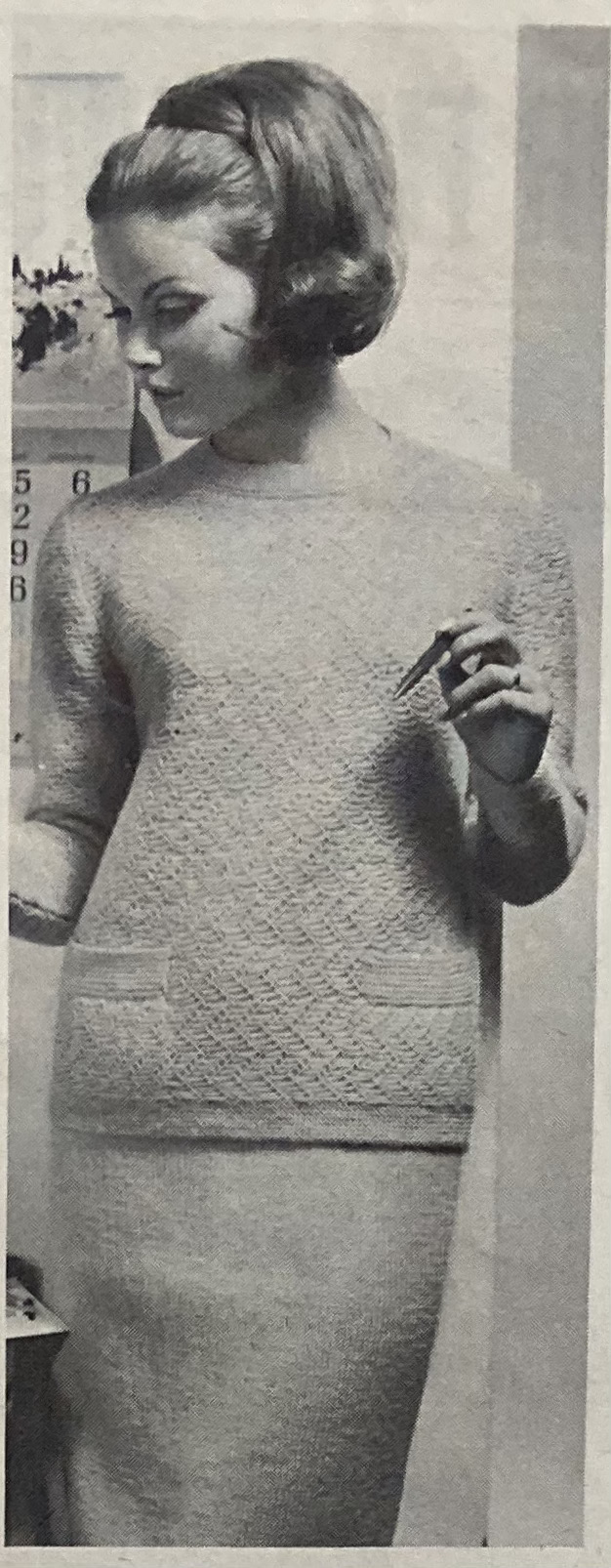
The knitted sweater suit on the cover is made in an intriguing pattern stitch designed to give “the look of woven texture.” There’s a helpful close-up photo of the stitch pattern as well. Essentially, it’s made by making a wool-forward (yarn over) on the right-side row and then slipping that stitch over a garter-stitch base to make a horizontal “line”. The placement of the slipped stitch is staggered, to make a diagonal herringbone-type effect. Made in DK wool, I’m guessing the finished result is quite warm. The matching skirt is made in plain stocking-stitch. Note that the mini-skirt, or even anything-above-knee-length skirt, still hasn’t caught on with Stitchcraft’s more conservative readership.

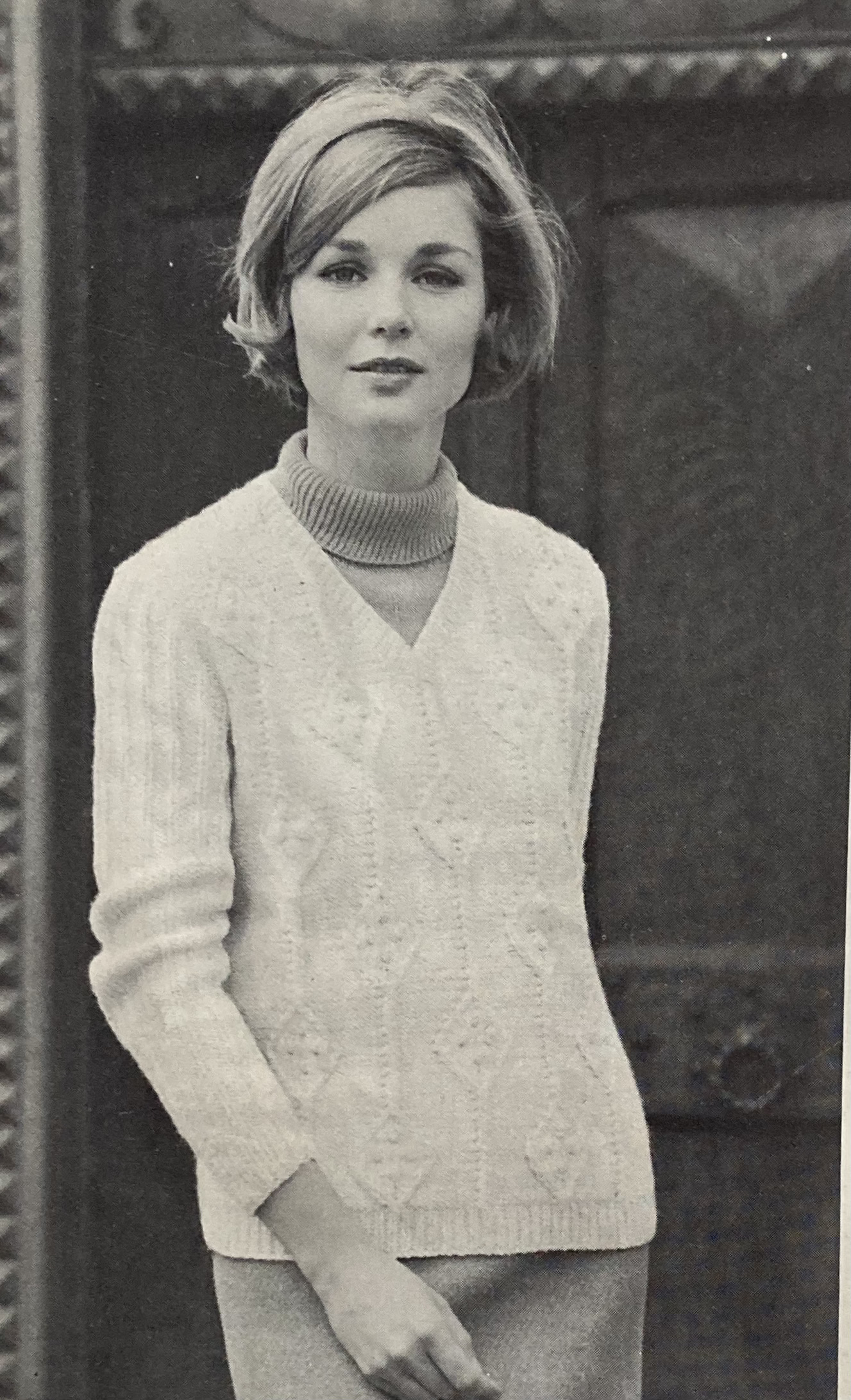
Other women’s fashions include a bobbly-cabley “overpull” in undyed “Capstan” wool, made to be worn over a roll-neck knitted underblouse with or without sleeves. The underblouse keeps up the warm colour trend with the suggested colour of “Old Gold”. I love the model’s hairstyle!

There’s also a jumper for larger sizes with very ill-thought-out decorations going right over the bust, and a collared almost-cardigan with a deep placket and Peter Pan collar. The collared number is made in tweedy “Glenora”, one of the multicolour wools gaining popularity at the time. Men get a corollary set to the women’s “overpull” and “underblouse” with a slightly oversized bobbly-cabley cardigan and a 4-ply polo-neck in the same “Nylox” wool as the ladies’ underblouse. The “colour radiance” theme apparently does not extend to the men’s garments, being made in undyed Capstan and “Oystershell” off-white, respectively. The photo backgrounds colours are nicely chosen, though, to set off the diagonal poses and camera angles.

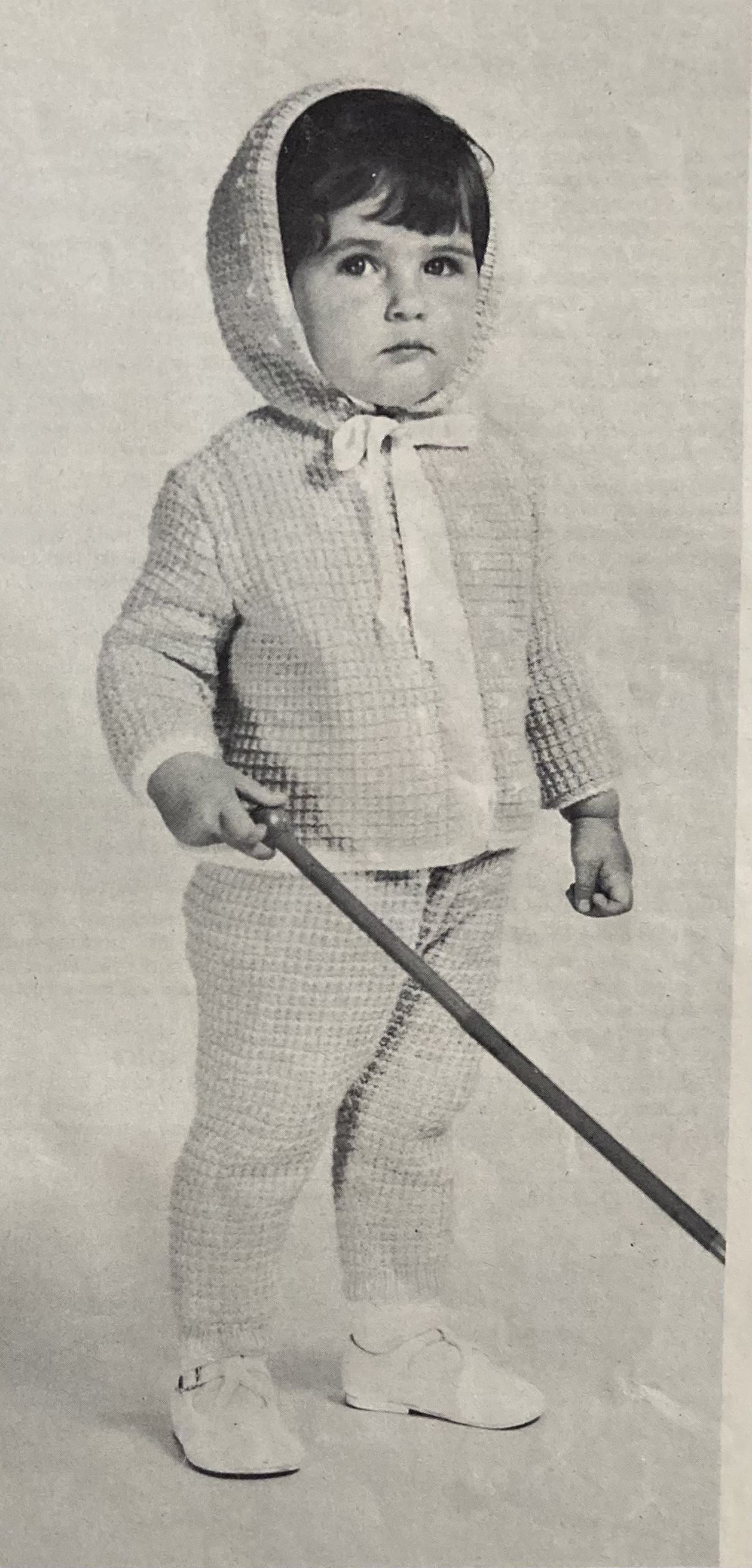
The photo of the girl’s twin set in the inside front cover photo also does a great job of harmonising the backdrop to the subject. Her set consists of a pullover with unbuttoned waistcoat in cheerful pink and blue. Her little brother or sister can go out in the pram or “toddling” in a warm set of hooded jacket and leggings. The child in the photo looks somewhat apprehensive, but the set looks quite snuggly.

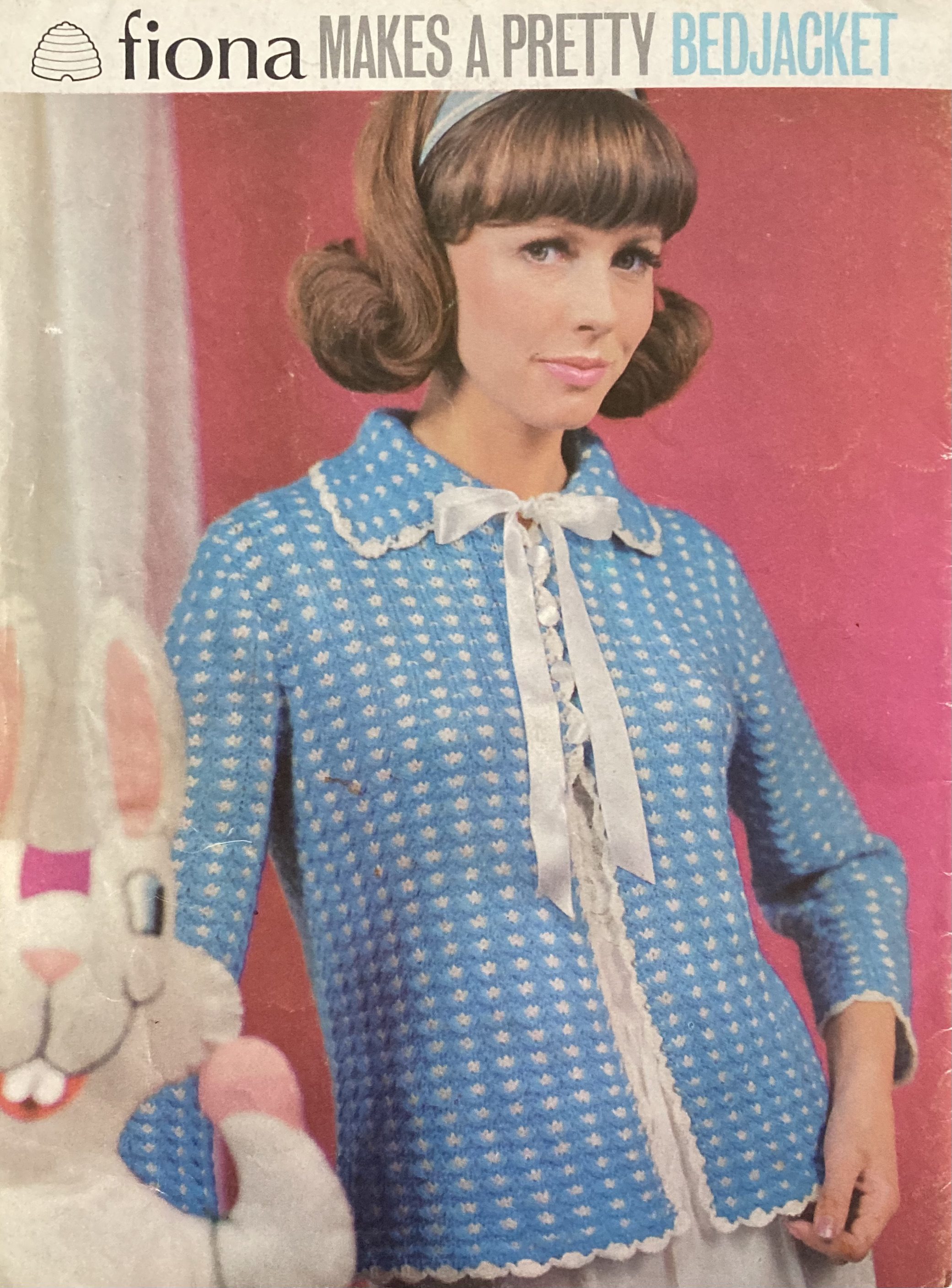
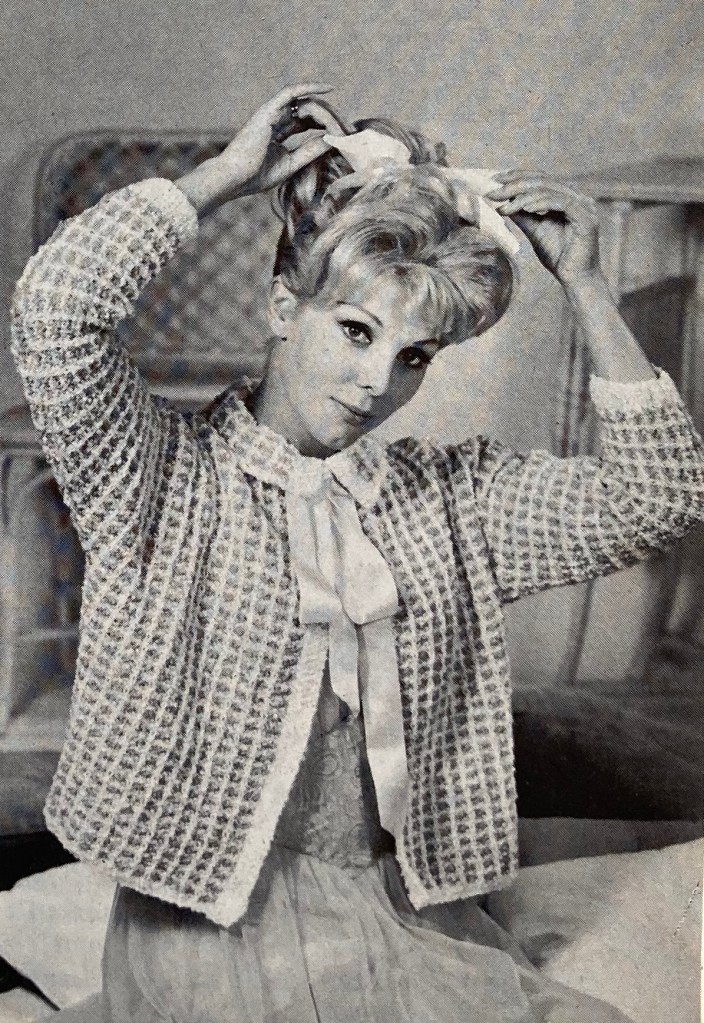
And can we have a moment of appreciation for this “special gift” of a bedjacket? I love it! I would make it without the ribbon at the neck and wear it as a normal cardigan. The two-colour pattern is made by working and then dropping yo’s to make a “long” stitch, which is then carried up through the slip-stitch background. I am guessing it is quite spongy and squishy, and was also nice and warm in those unheated 1960s bedrooms. Love the hairstyle in the colour photo, too!

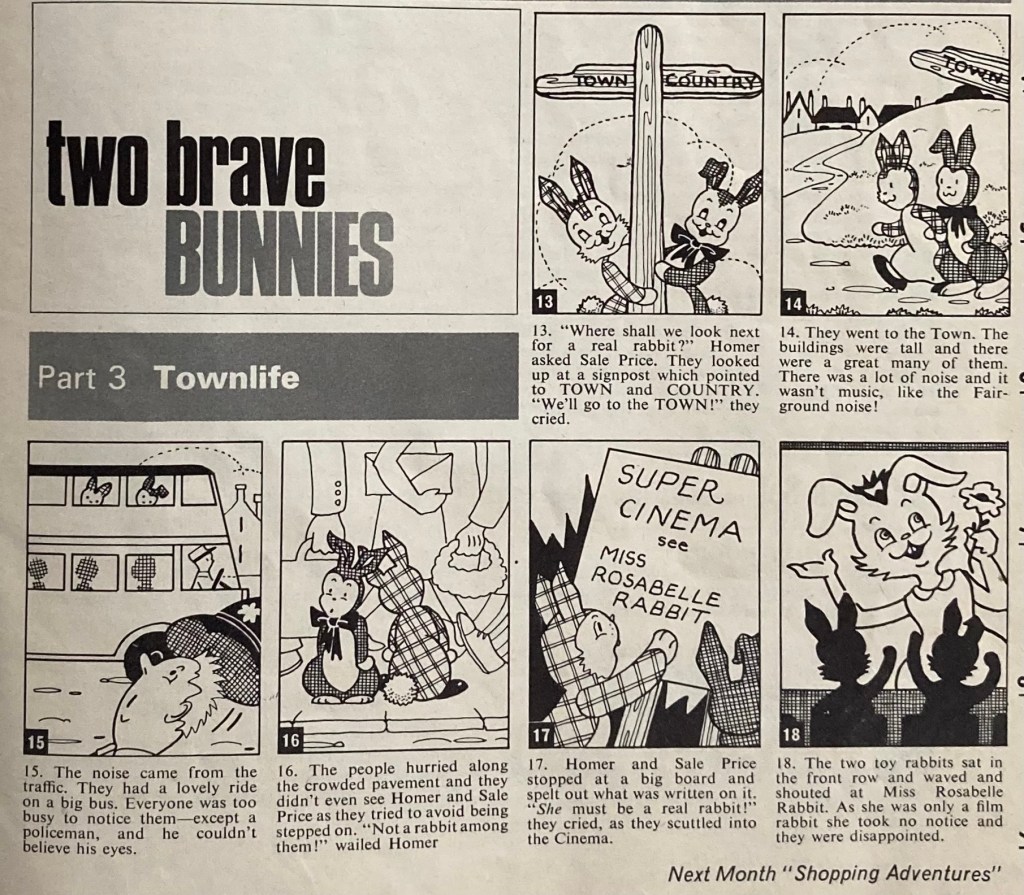
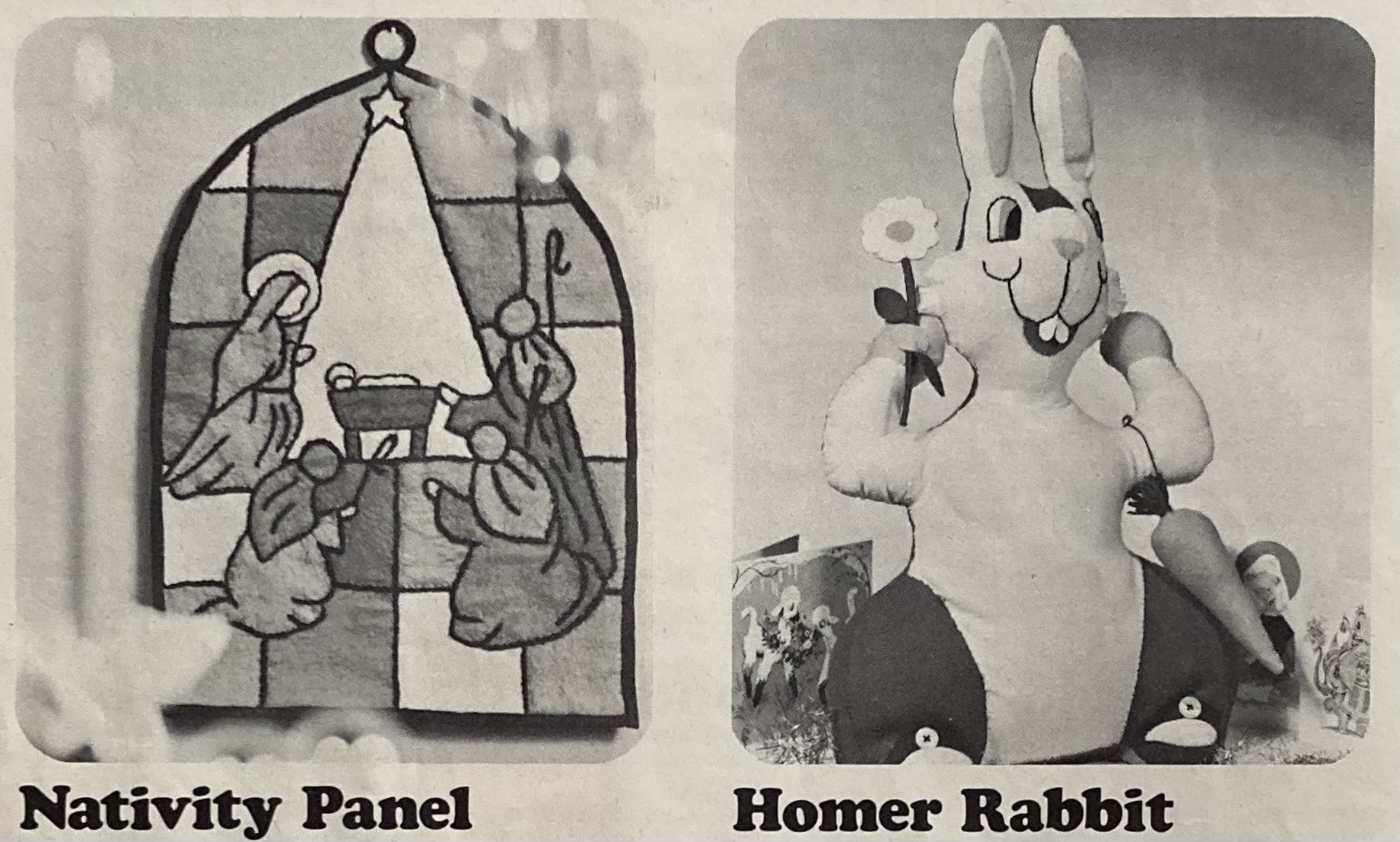
If the model on the left is looking a little suspicious, it’s probably because she was photo-bombed by Homer the Rabbit, star of our current children’s serial comic, “Two Brave Bunnies.” For the uninitiated: Homer (a home-made stuffed rabbit) and Sale Price (a store-bought stuffed rabbit) are on a quest to find a real live rabbit friend. So far, they have only met a merry-go-round rabbit, who assured them that he was not real, as he could carry children on his back. In this month’s episode, our two brave bunnies head to the Town, where they are eager to see “Miss Rosabelle Rabbit” on the cinema screen. Alas, she is only a film rabbit, so cannot communicate with our friends. No matter — they will persevere! Oh, right — and this month’s issue includes instructions on how to make your very own home-made Homer doll from felts.

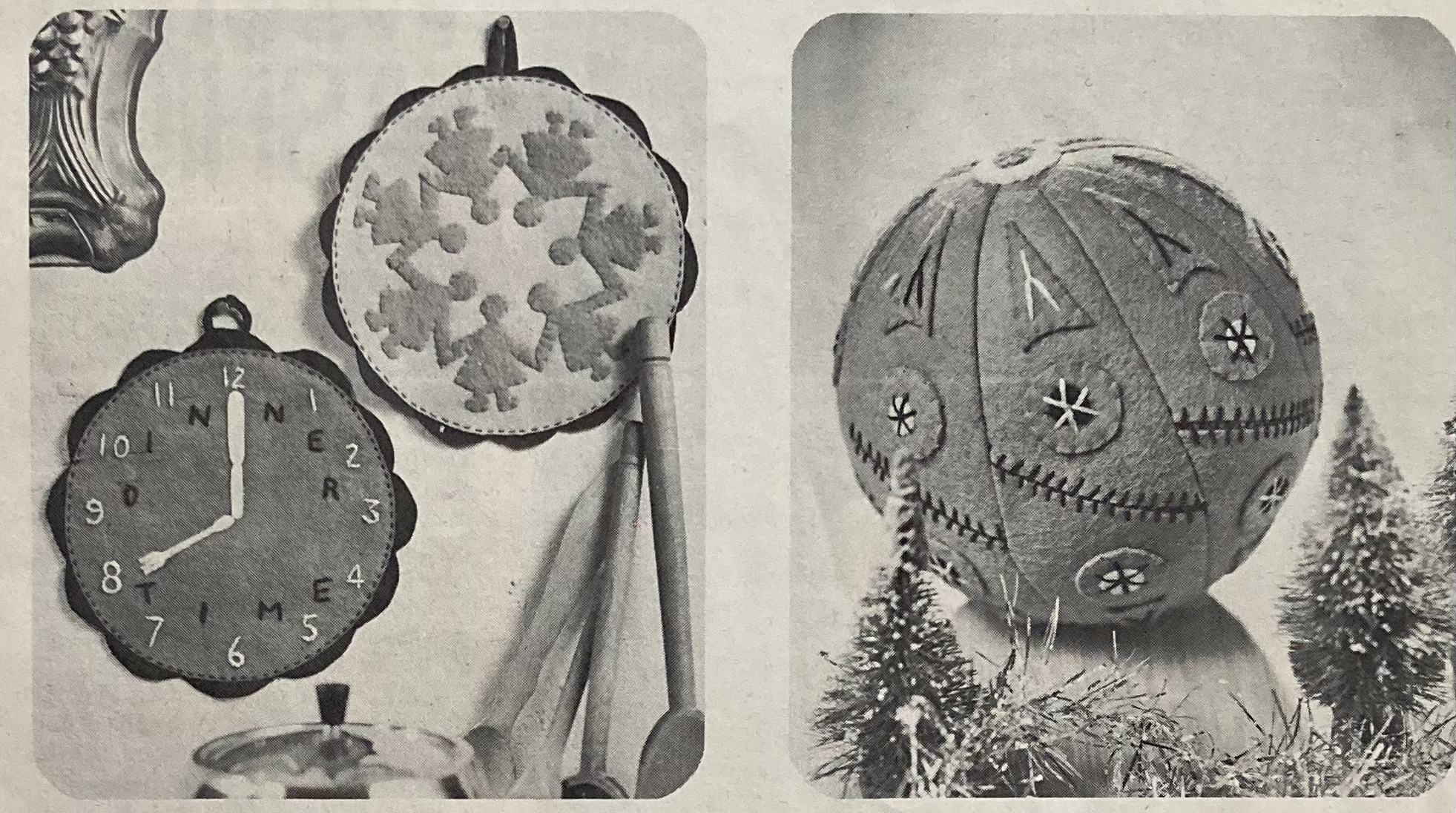
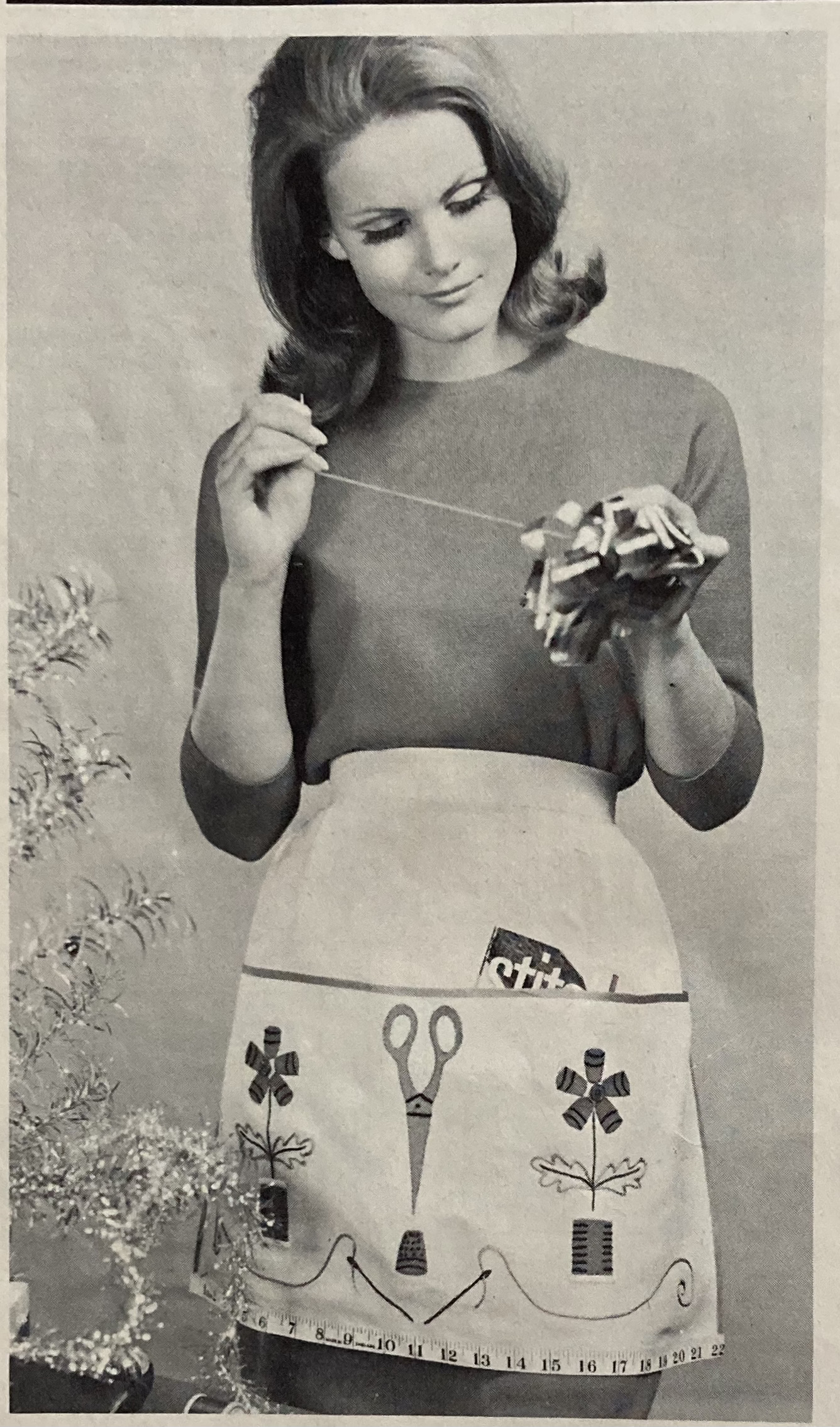
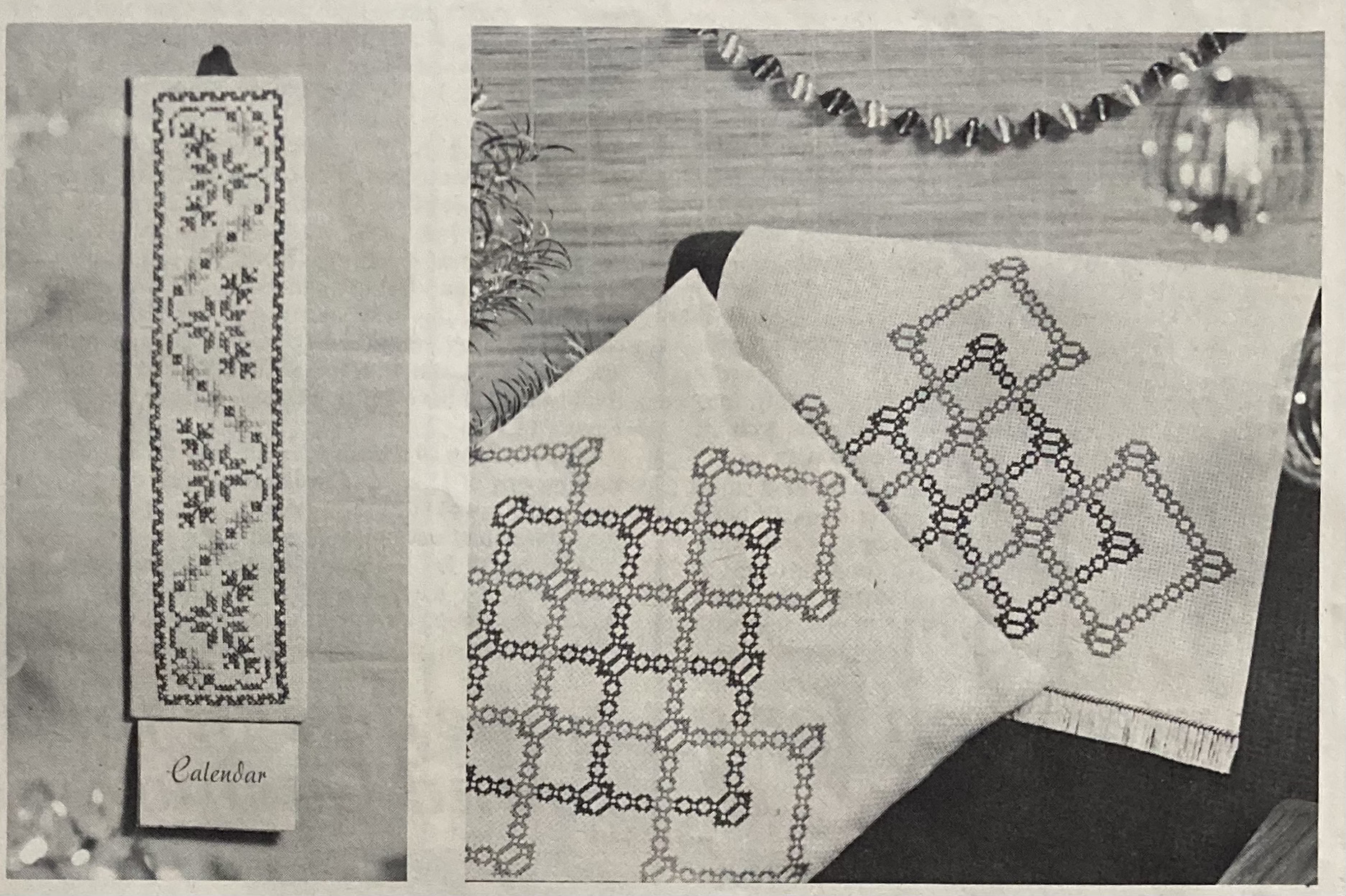
Home-made Homer is one of this issue’s many small, fun “colour novelty” gift and decoration ideas, along with a felt Nativity panel mimicking stained glass, a couple of pot holders and a colourful ball to use as decoration or a baby’s toy. Embroidered gift ideas include a whimsical sewing apron and a cross-stitch calendar and chairset. I don’t really understand the calendar — it seems to be just a vertical wall panel that you attach the (tear-off?) small calendar onto. OK, I guess, but maybe not necessary?

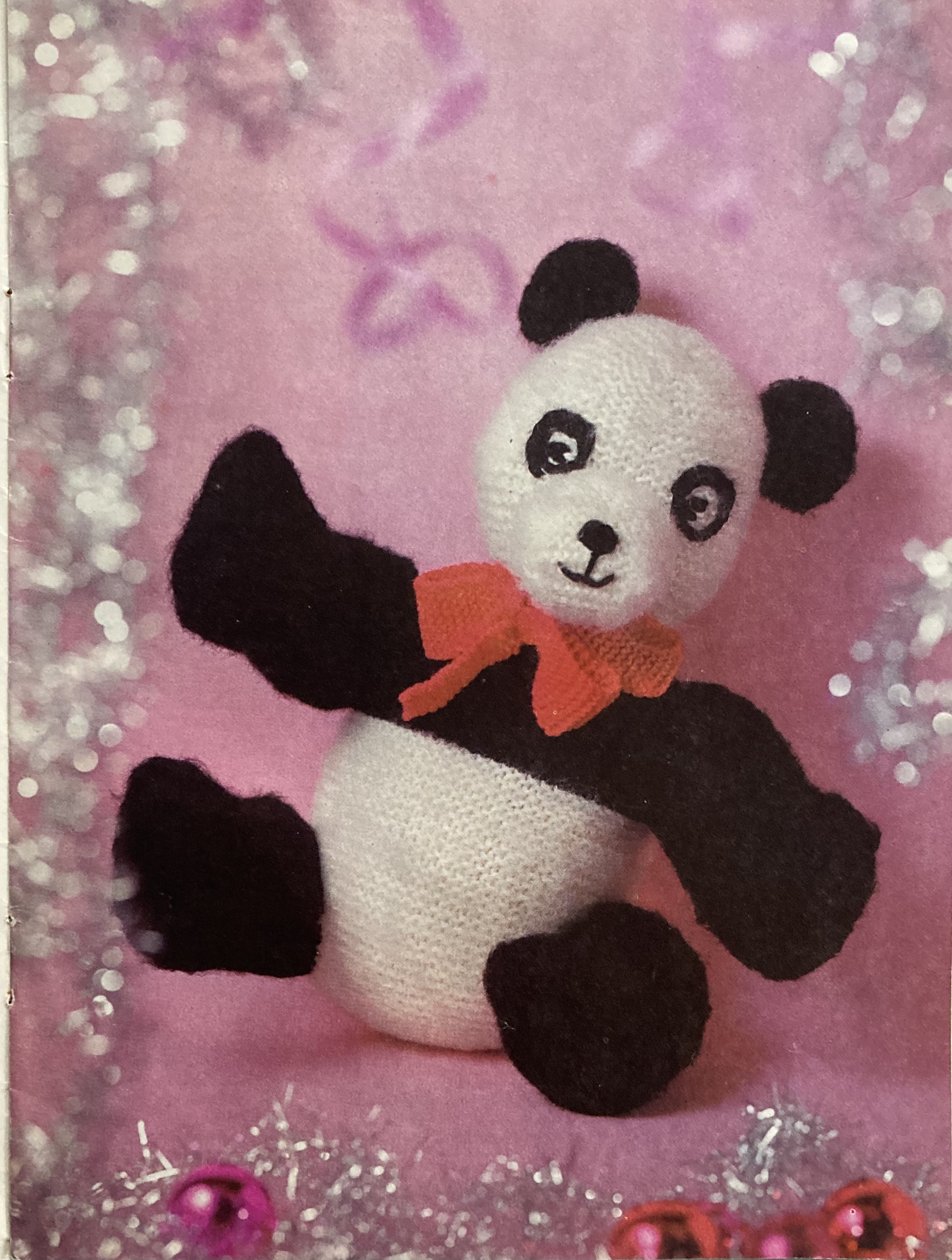
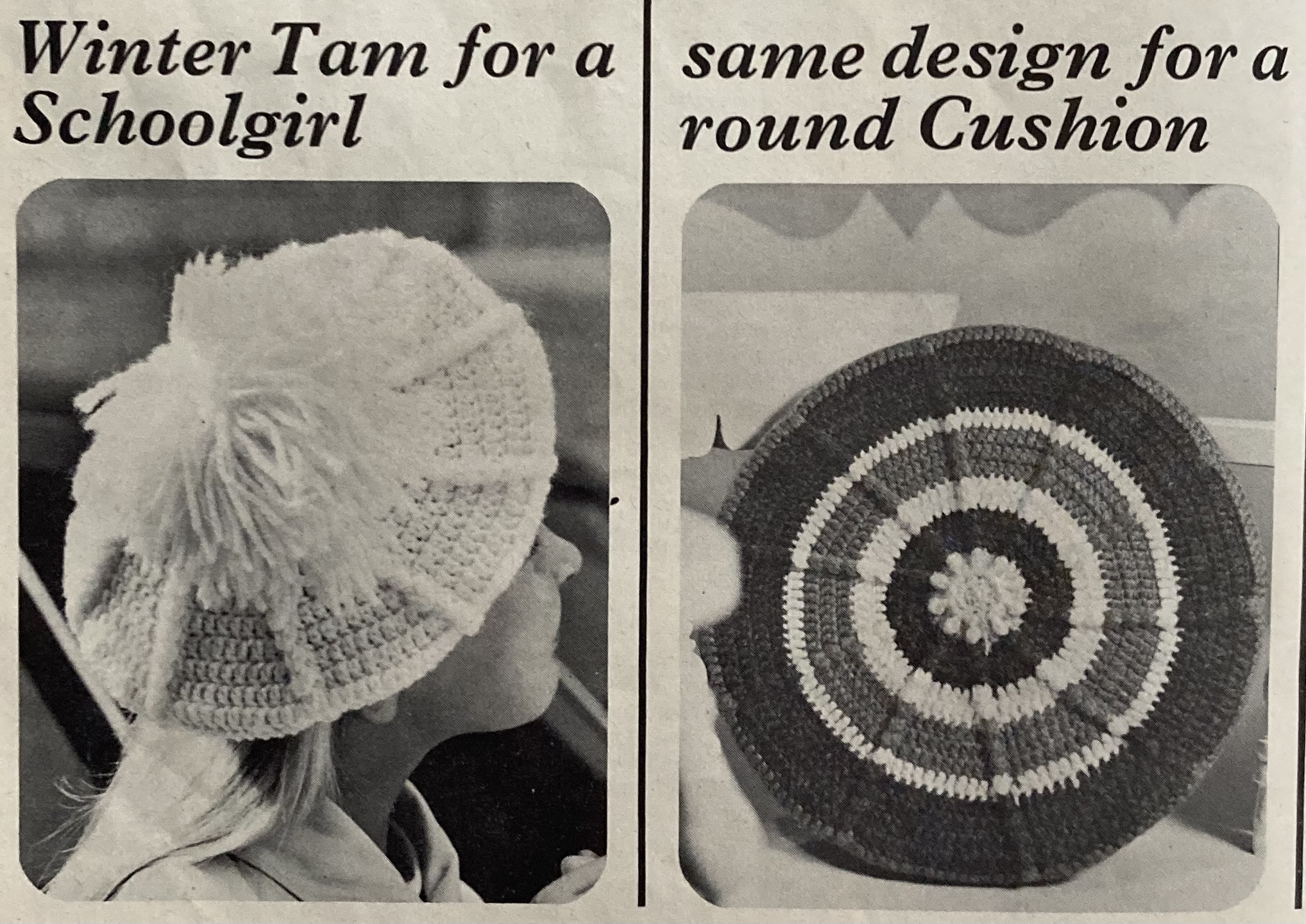
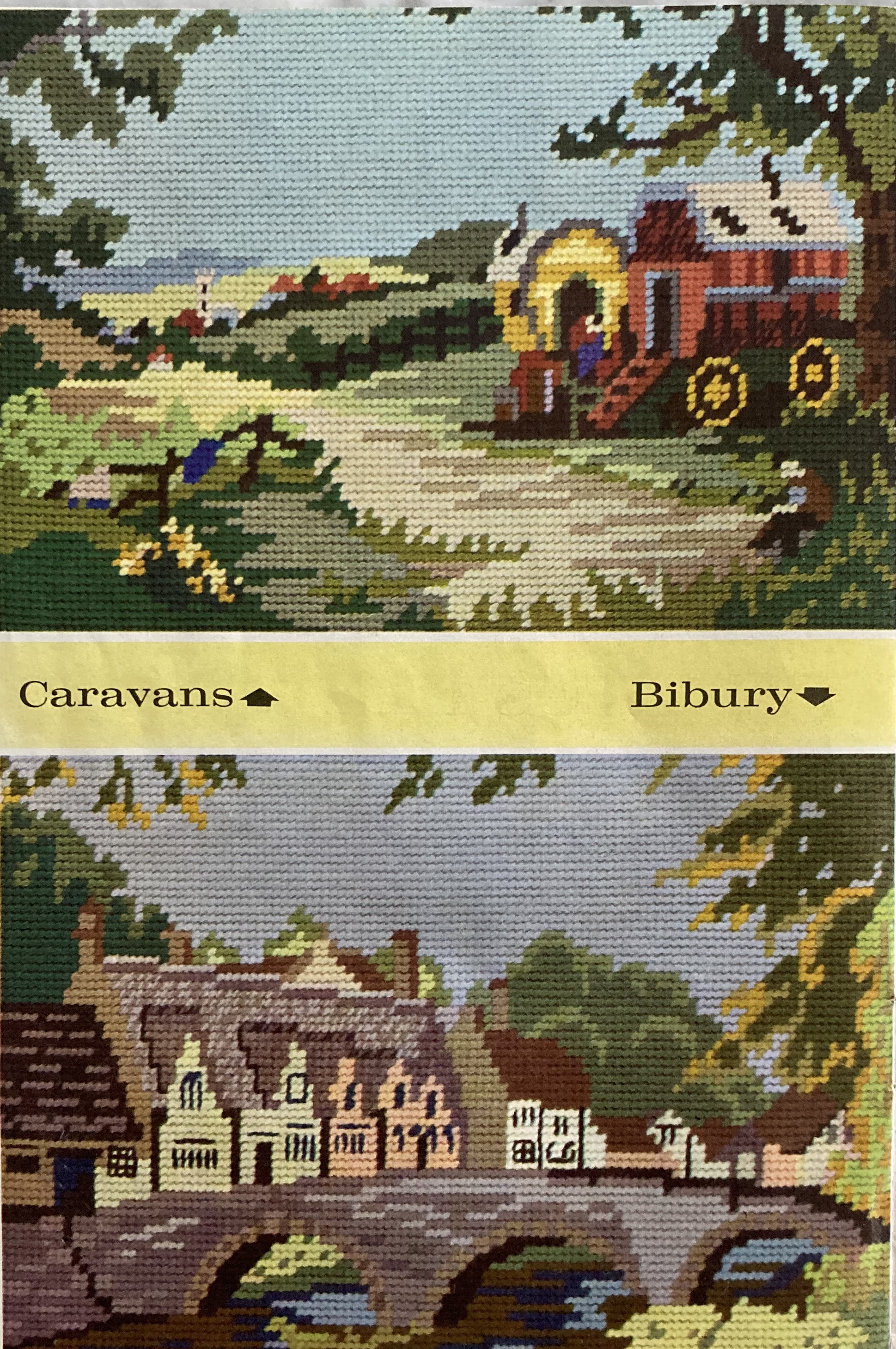
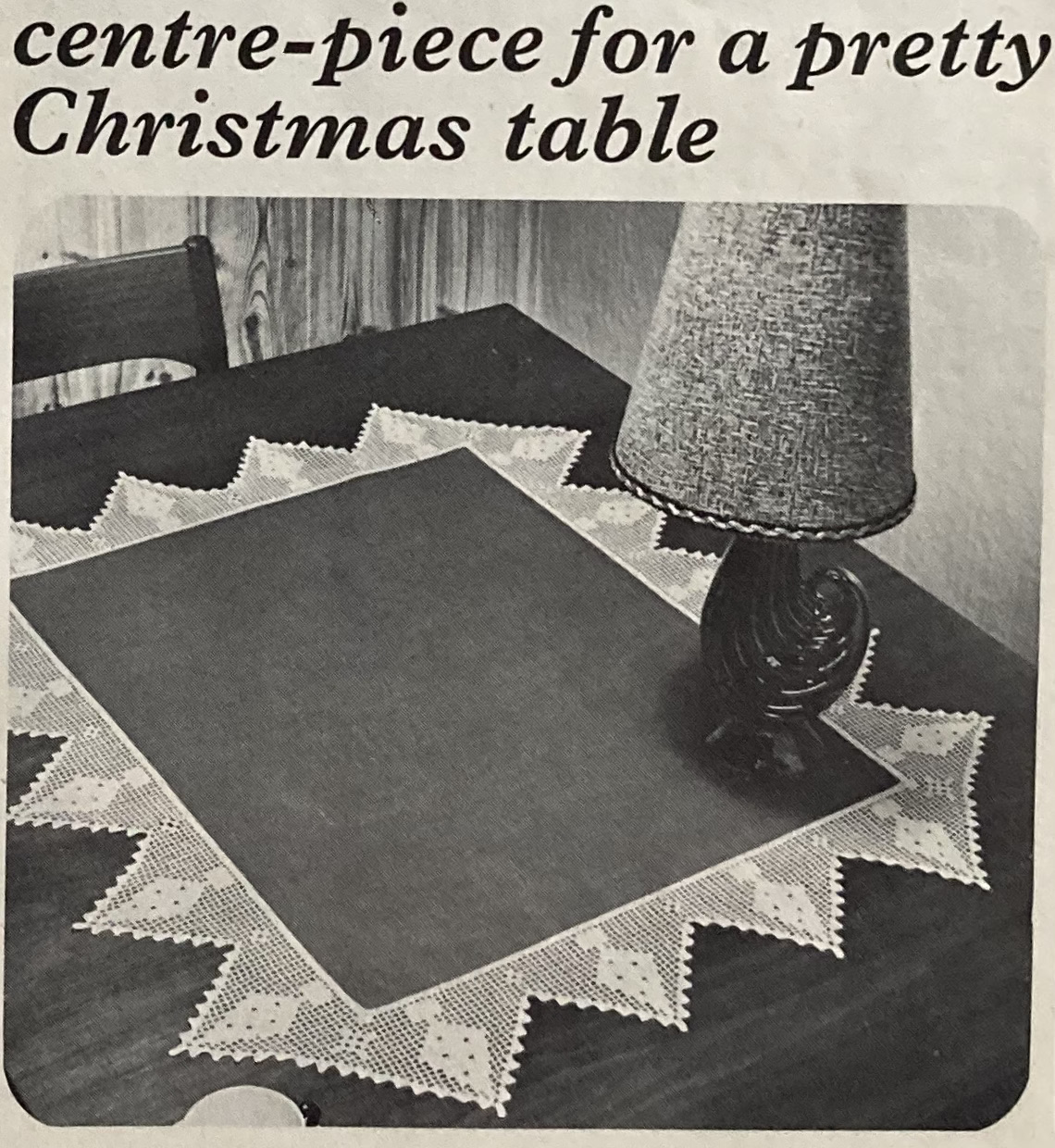
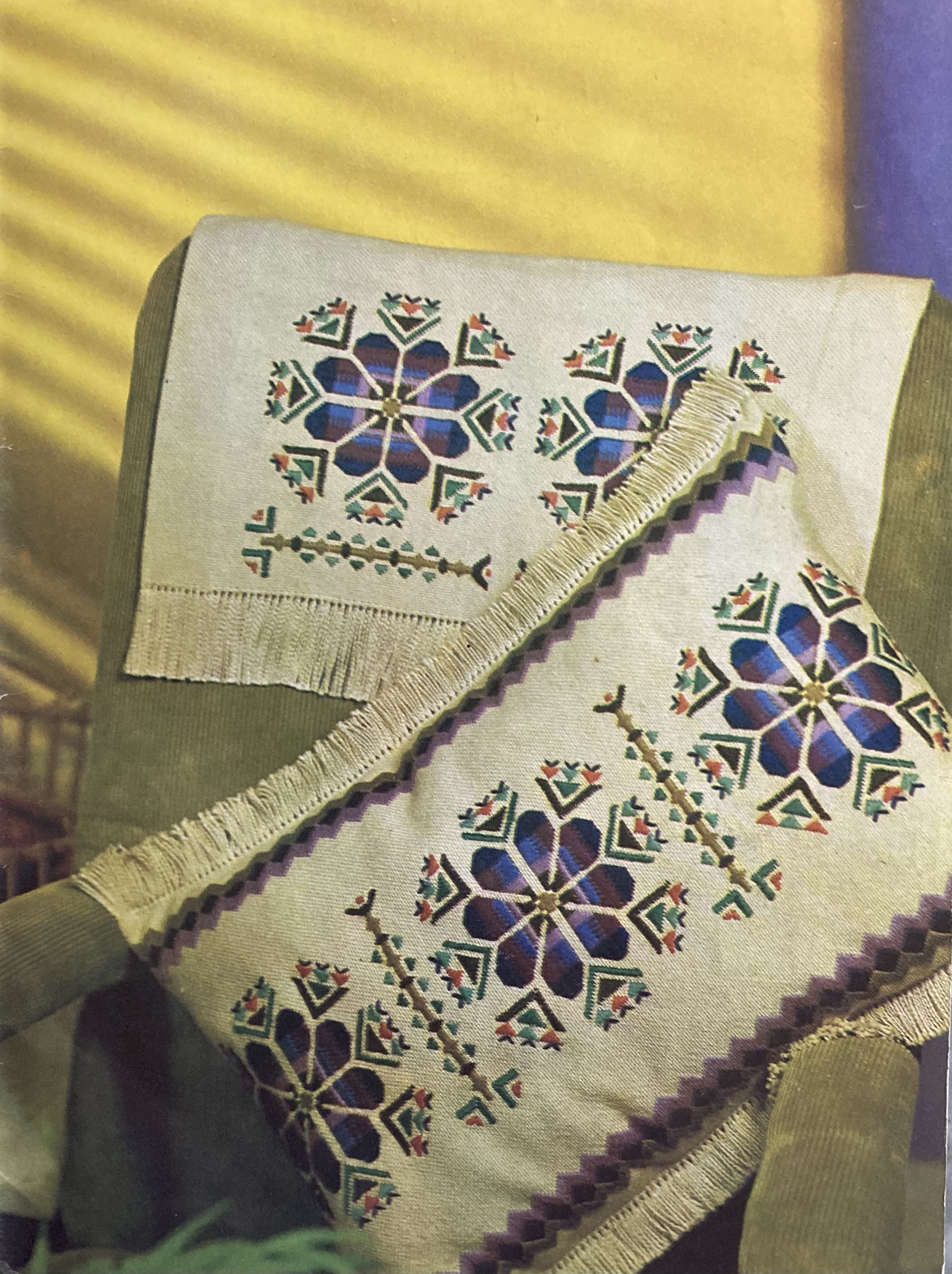
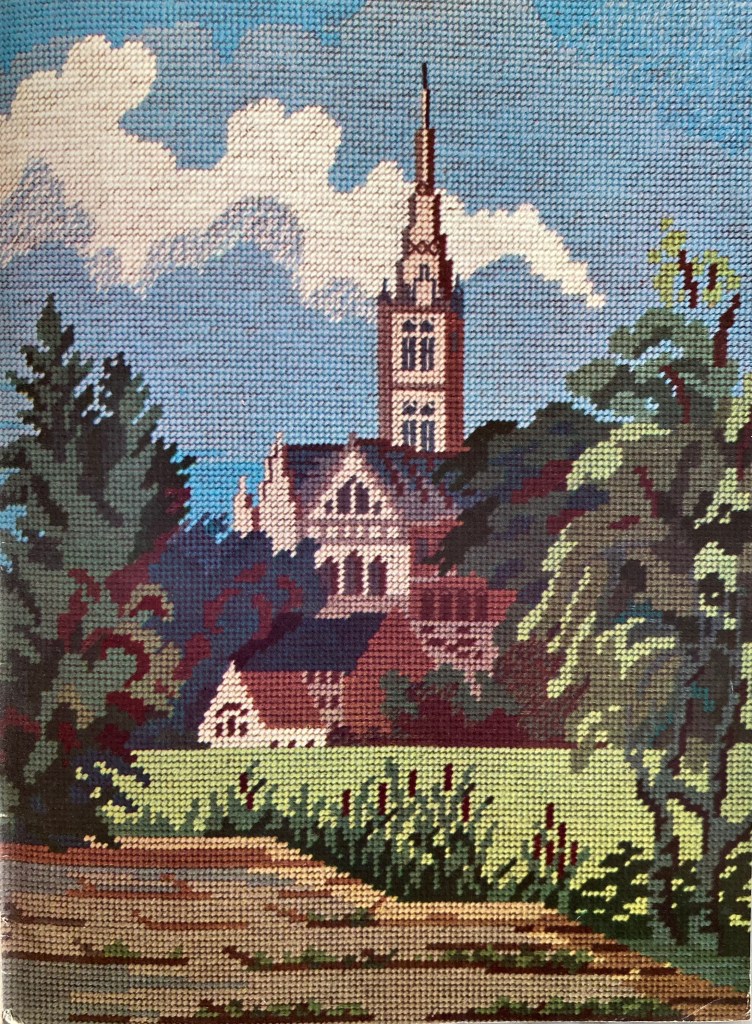
You can also knit a stuffed panda bear, a snowman, or a garter-stitch blanket rug, or crochet a round disc to be adapted into either a girl’s beret or a round cushion. There’s a filet crochet table centerpiece and tapestry wall pictures of caravans or Bibury. Last but not least, there’s a counted-embroidery cushion-and-chairback set with a vivid purple flower design.

I don’t know about you, but I feel cosier already. My design for this month will be the bedjacket! The October 1965 cardigan blouse is almost finished, too, and I’ll update that post soon.

October 1965: Overview

Colour and Tweed for Autumn! This is a “bumper” issue full of many beautiful designs for adults, children, homewares and “novelties”, all with an autumn theme. My apologies for the slightly late post — I was traveling last week with no computer.

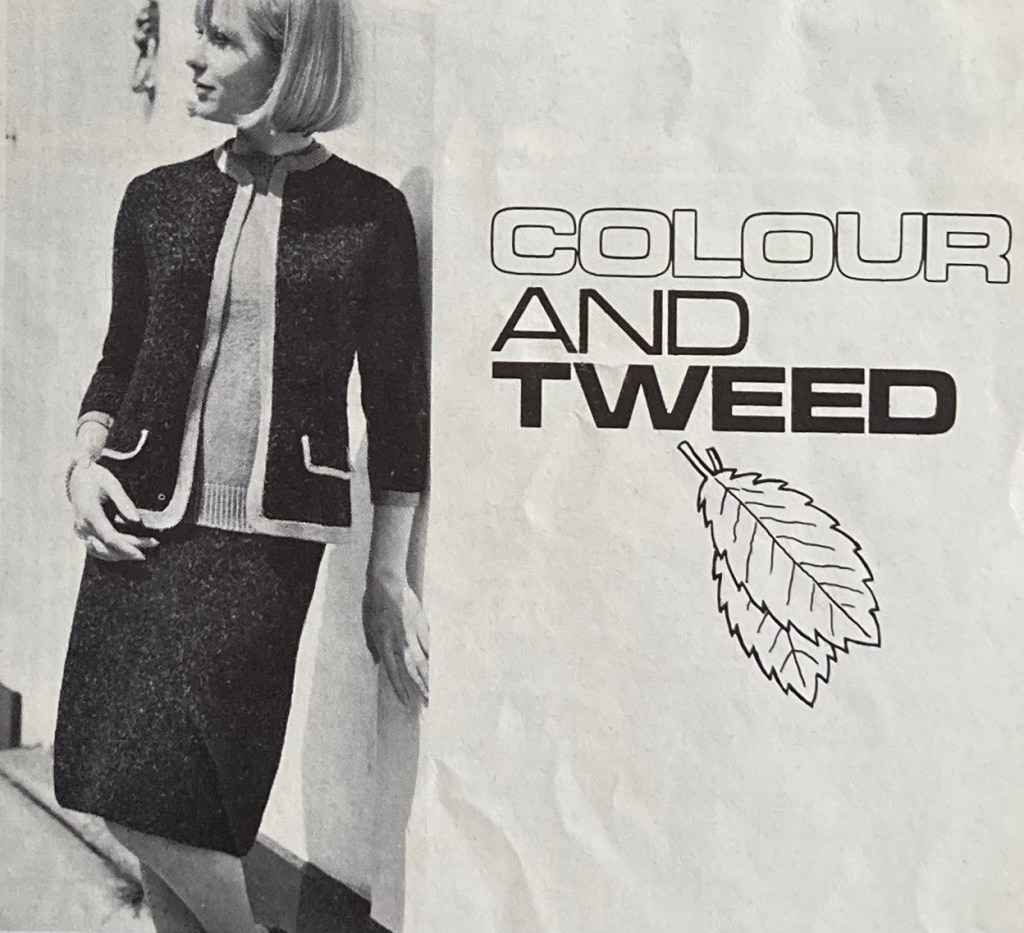
The cover photo is a “Chanel Style Suit” in Bracken Double Knitting tweed wool. 1965 was the heyday of Coco Chanel’s pioneer boxy, tweedy suit that was all the rage with celebrities and modern women. Her designs combined Scottish tweeds and multi-colour fabric patterns by Bernat Klein with her signature comfort, ease of movement and simple elegance to make a modern, essential wardrobe staple. Here is an excellent short introductory film about it (I’m sure readers of this blog will need no introduction; still, it’s great.) The knitted suit design in this issue of Stitchcraft is very true to the Chanel model, with its thick, tweedy wool, above-knee skirt and functional, square pockets in the jacket. There’s a short-sleeved knitted blouse in turquoise to match.

Other women’s garment designs include a brilliant red dress in Paton’s newest wool, Fiona; a “continental” pullover in a broken-cable design in regular Patons DK wool, a plain pullover with “new styling”, also in Fiona; and a fine-knit cardigan with crochet picot trim.

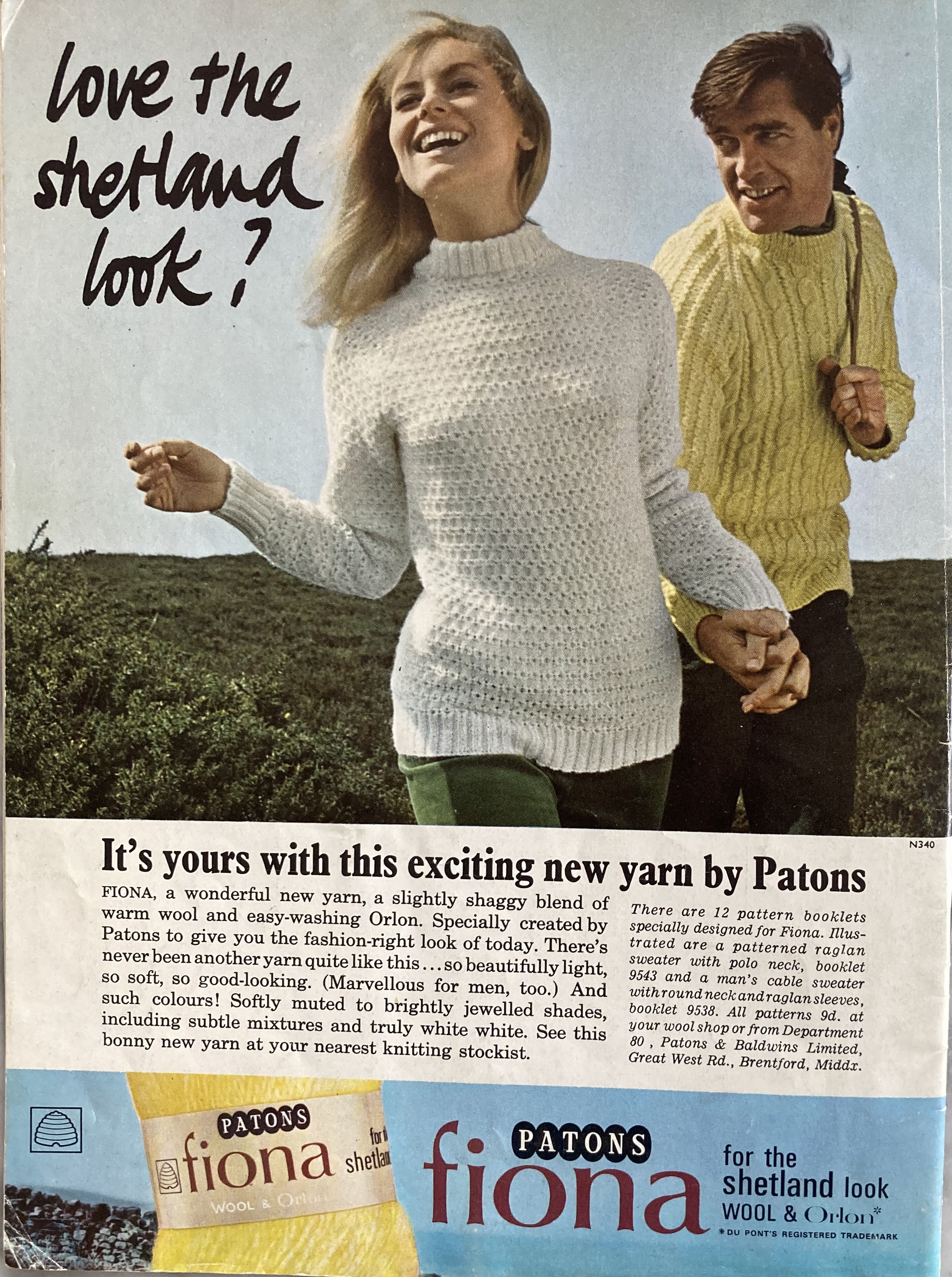
“Fiona” wool was a mix of Shetland wool and synthetic “Orlon”, made to combine the best qualities of both — warm, and lightweight like the wool, but easy-care and less scratchy. The “new styling” of the plain pullover means it is longer (23-24 inches) and looser-fitting than previous classic designs, and the raglan armholes are deeper, for an all-around casual fit. Colours are bright and snappy with yellows (“Maize”, “Celtic Gold” and “Inca Gold”) complementing the bright red of the dress. There’s a slipover for men as well, in bright “Peacock” shade and made in slightly thicker “Flair” — also a wool-synthetic mix. Cables of all sorts are popular, and the longer length can be seen in the Fiona advertisement as well as the garment photos.

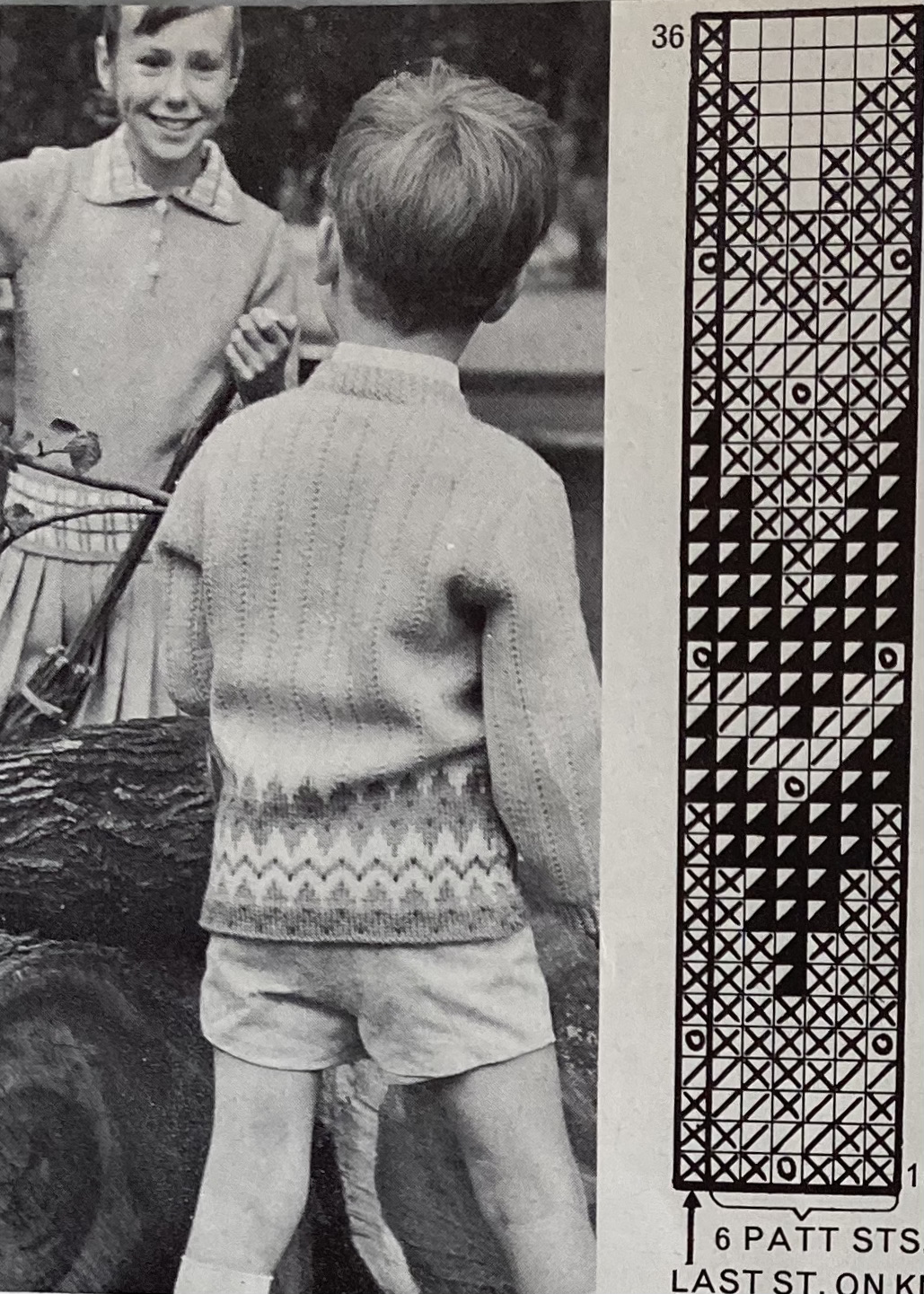
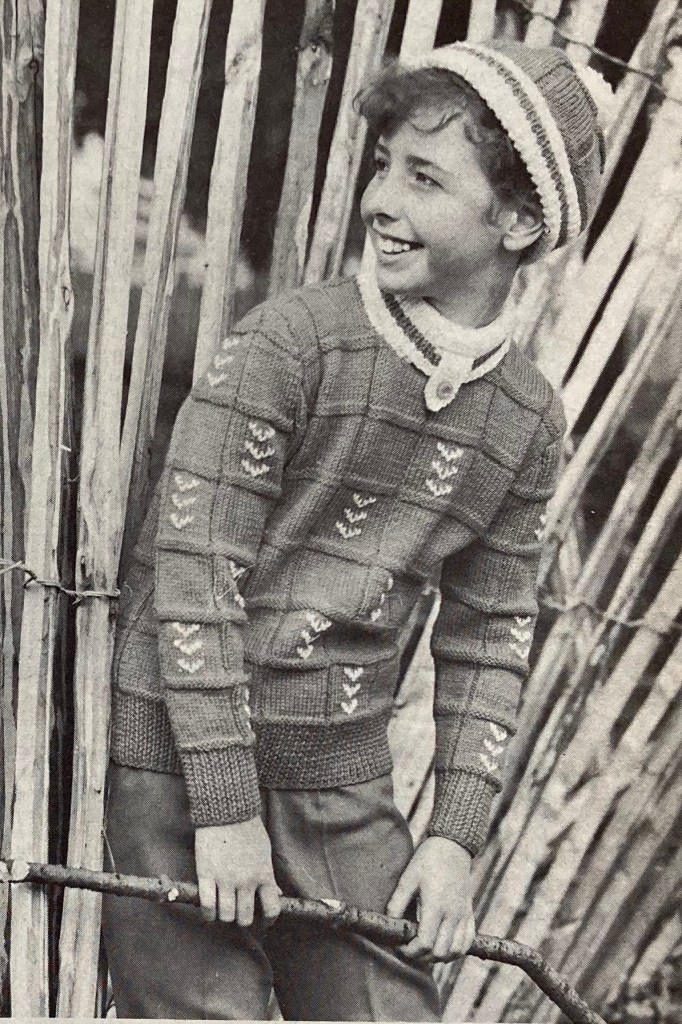
The accessories are limited to one hat — but what a hat! The “tucked” pattern is made by inserting a “life-line” type extra thread every 5 rows and then knitting those stitches together with the current row. I love it, though the model has an unfortunately ridiculous expression on her face in the photo. No designs for babies this issue, but two wonderful and colourful sweaters for children with stranded hem and yoke accents.

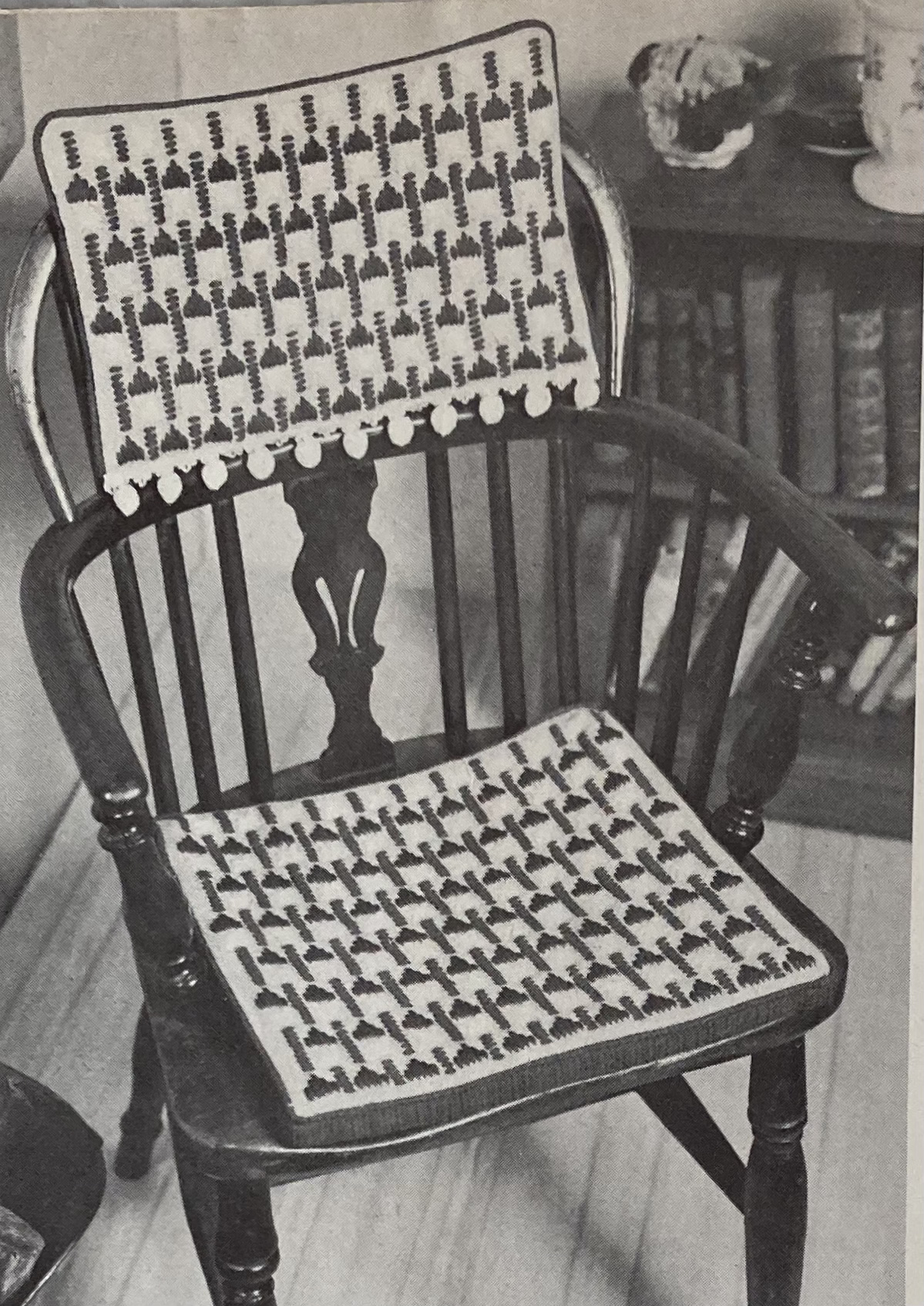
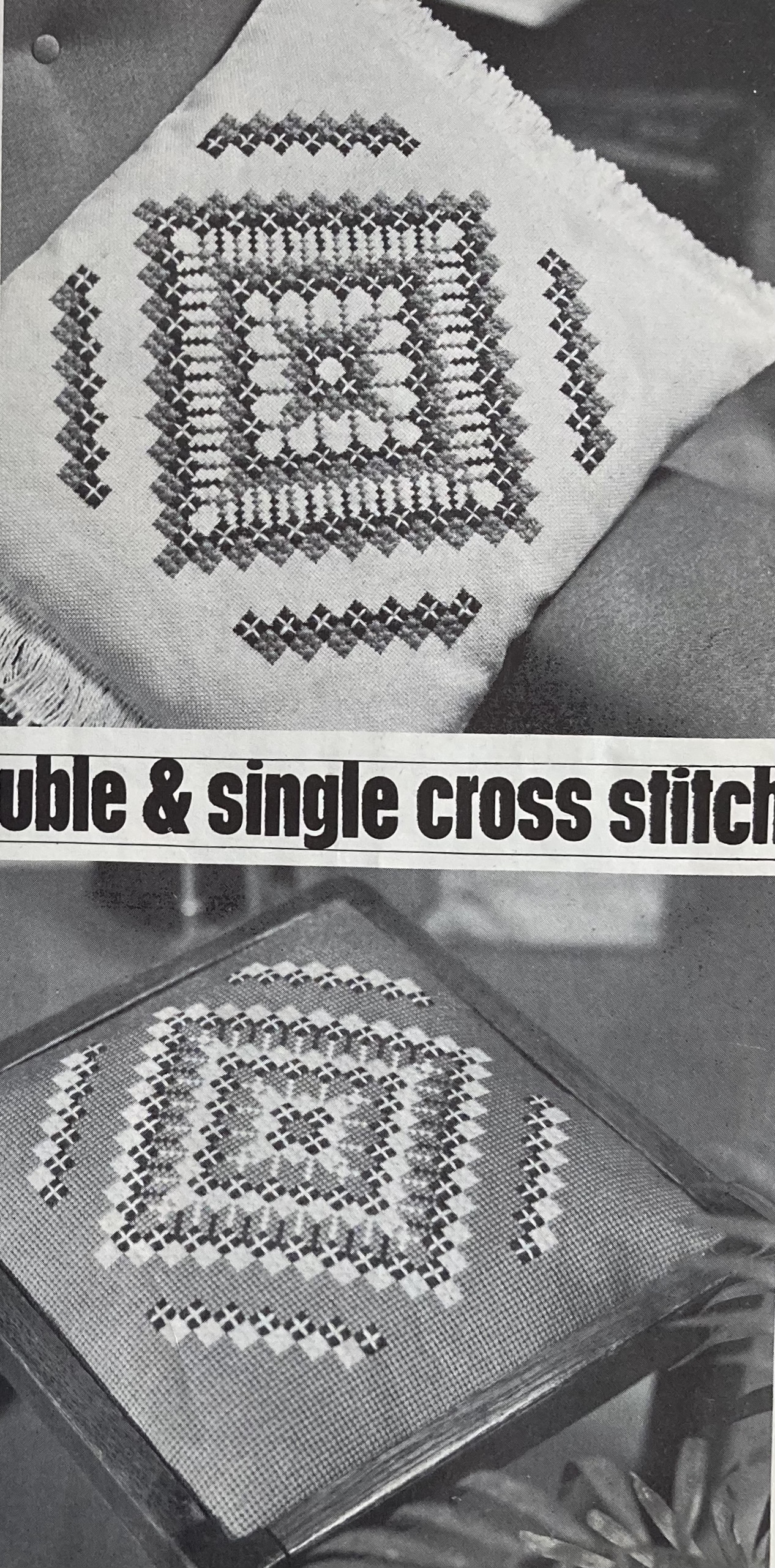
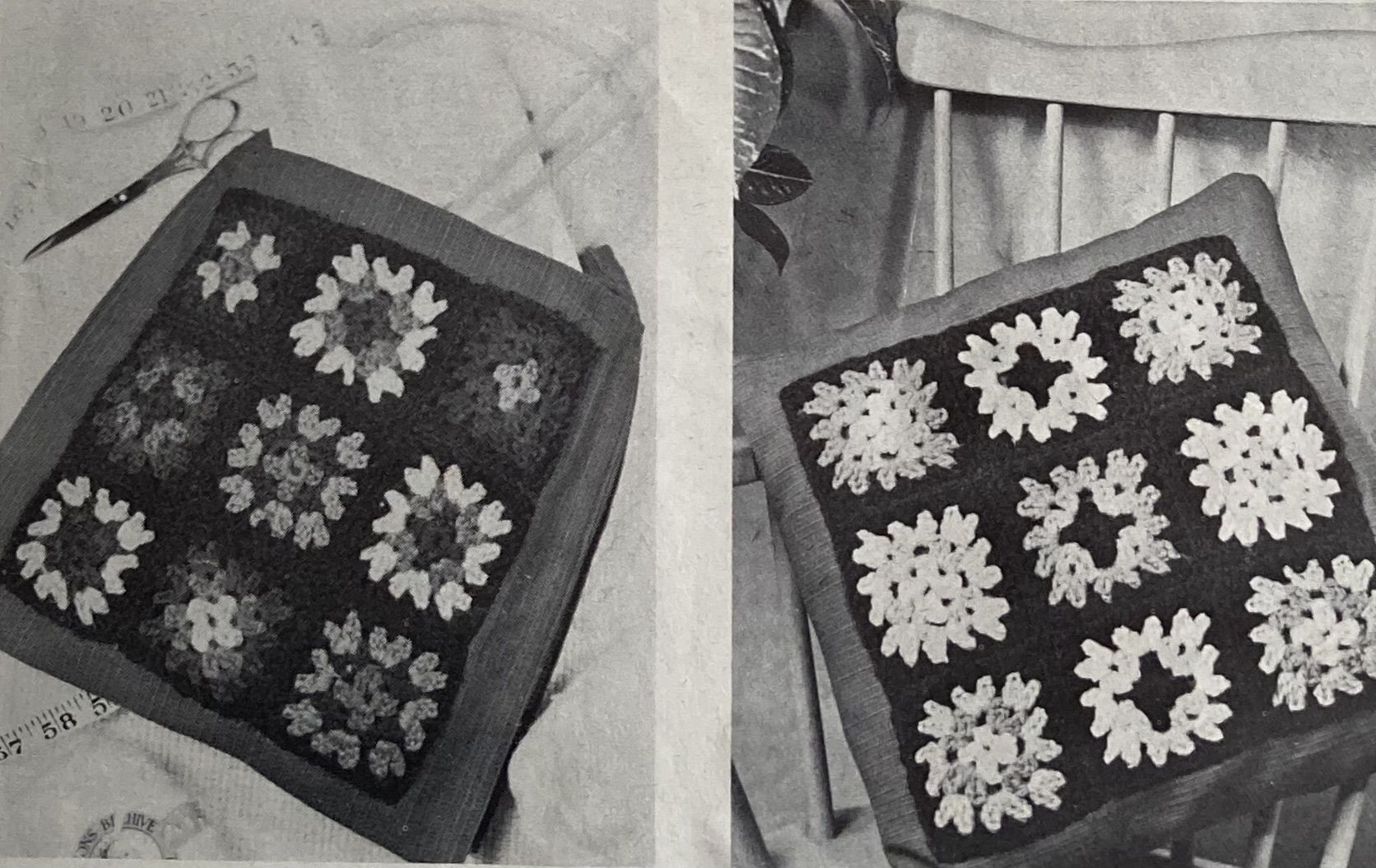
In the embroidery and homewares department, we have the usual designs for cushions, chair-backs and chair-seats, plus a granny-square crochet pattern to use up scrap wool that, backed with woven fabric, can be used to make a workbag or cushion. Like the garment designs, colours are bright and bold, with reds and blues prevailing, along with black and white.

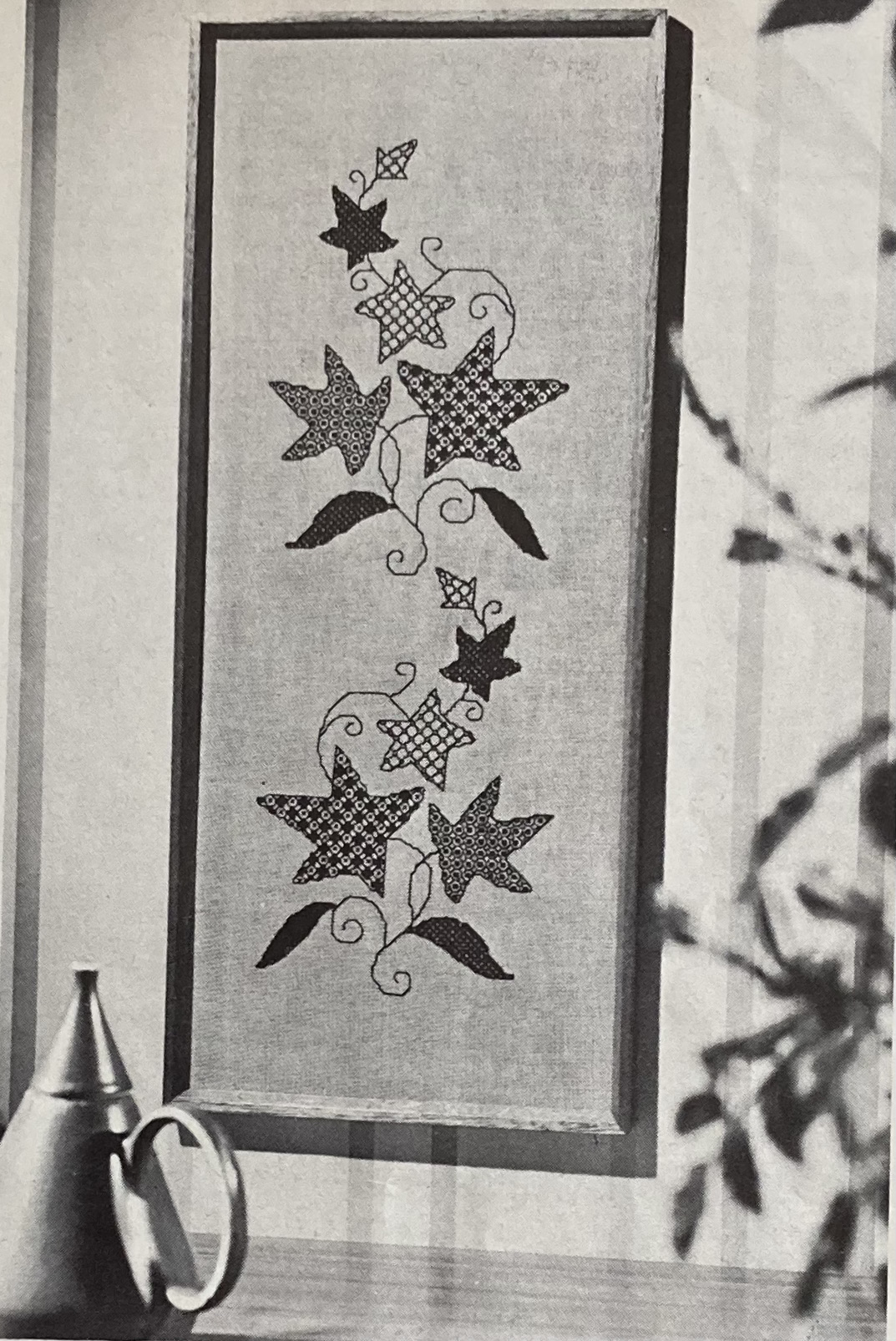
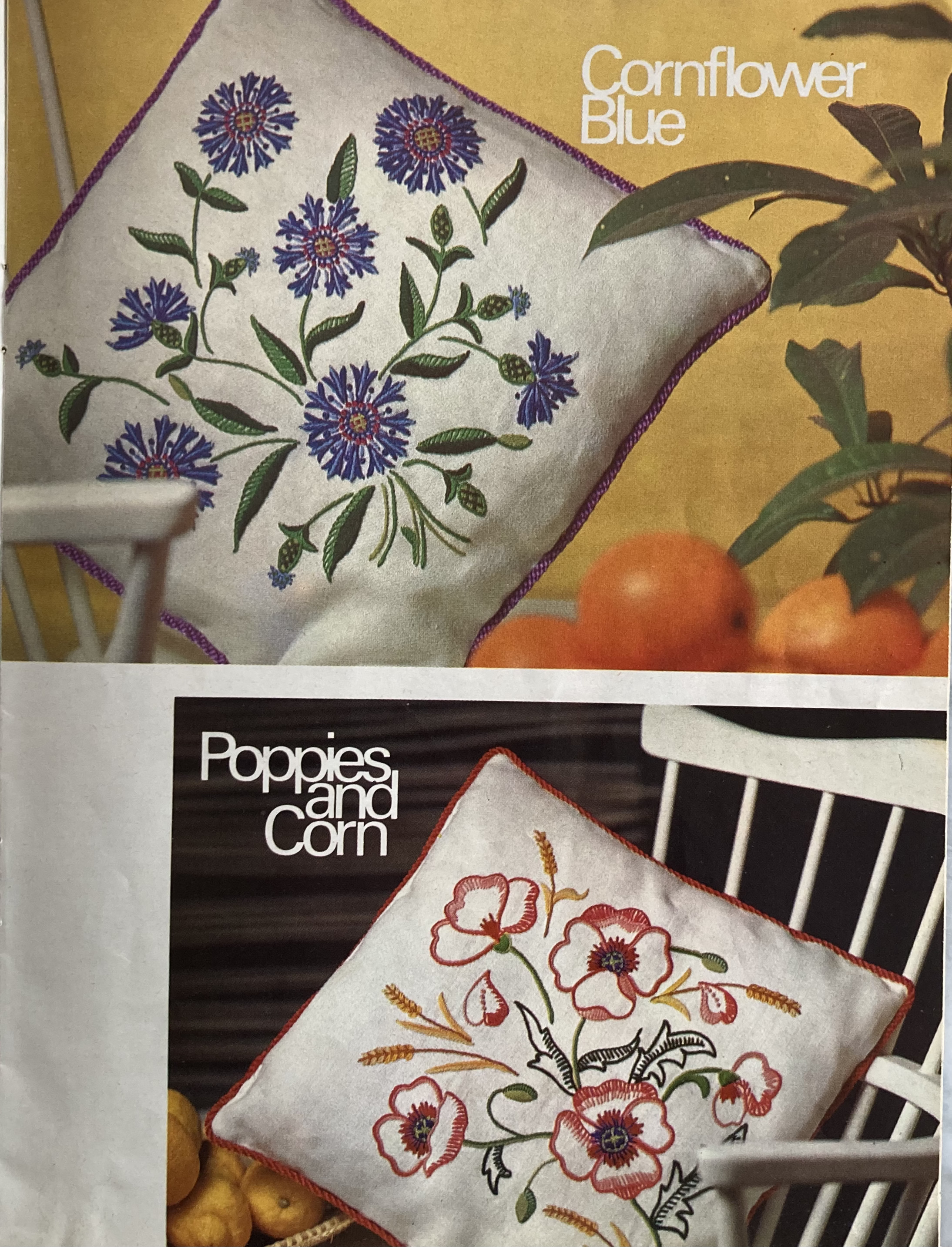
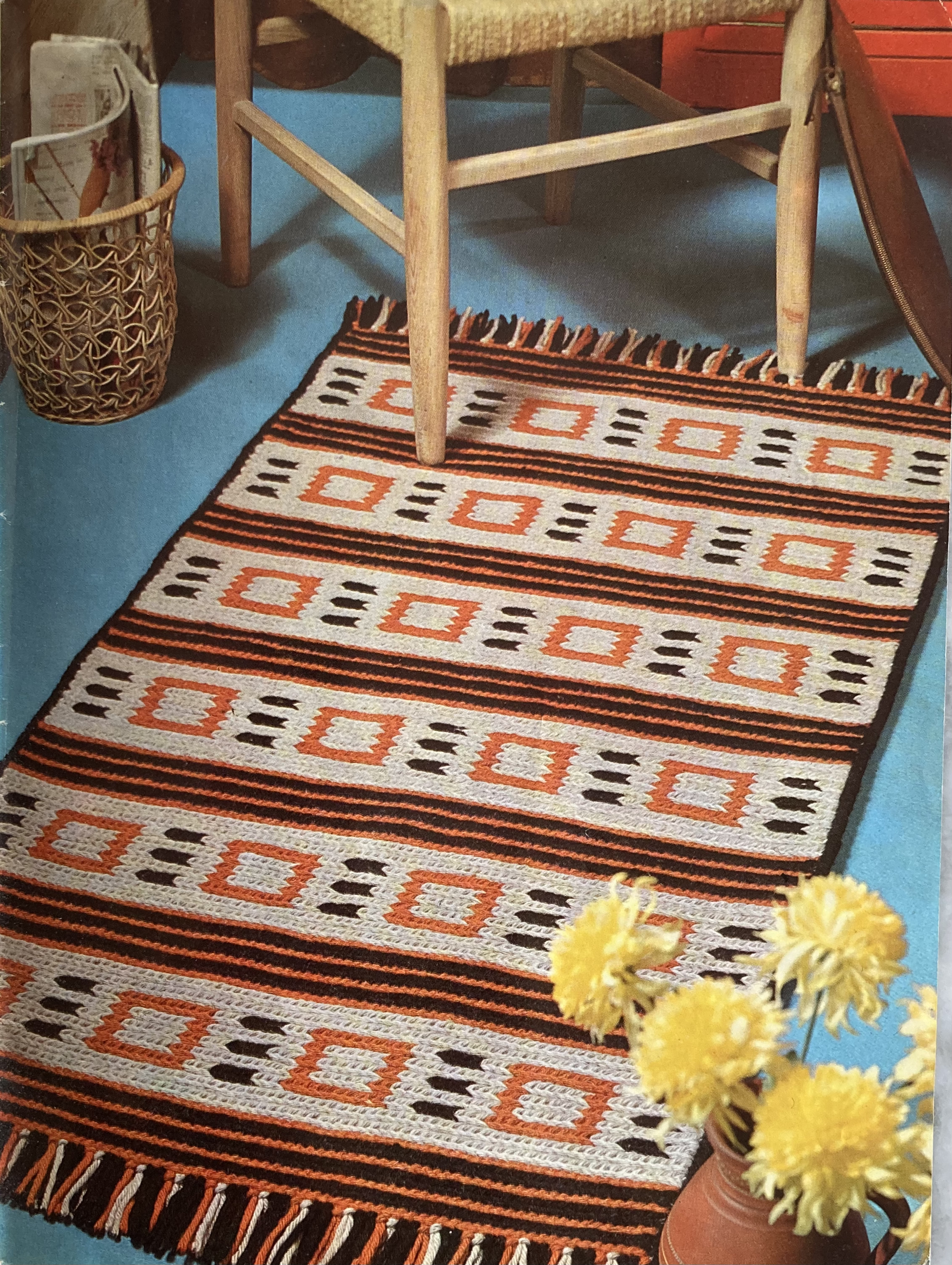
More advanced needleworkers can make a very pretty firescreen or a blackwork wall panel. Finally, there are embroidered cushions with flower designs — cornflower, corn not-flower-but-actual-corn, and red poppies. The loose, almost flowing style of the cushion designs looks ahead to later and even simpler patterns — complicated Jacobean work was on its way out. There’s a practical stitched rug in a geometric design as well.

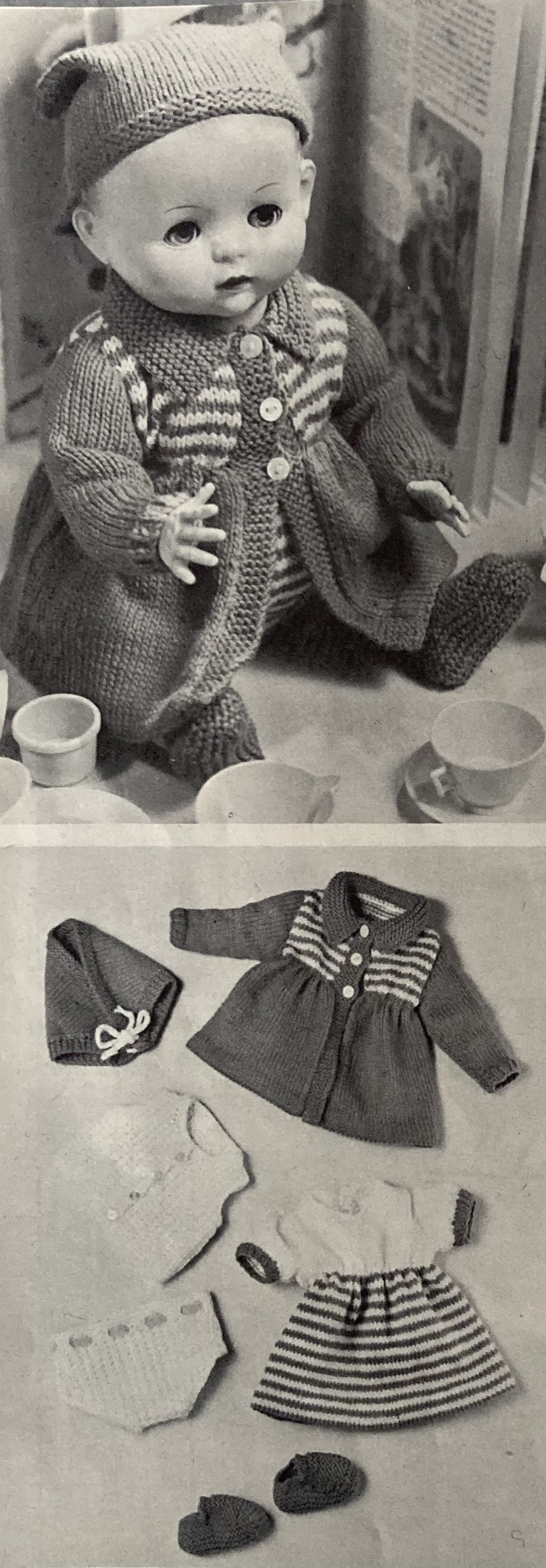
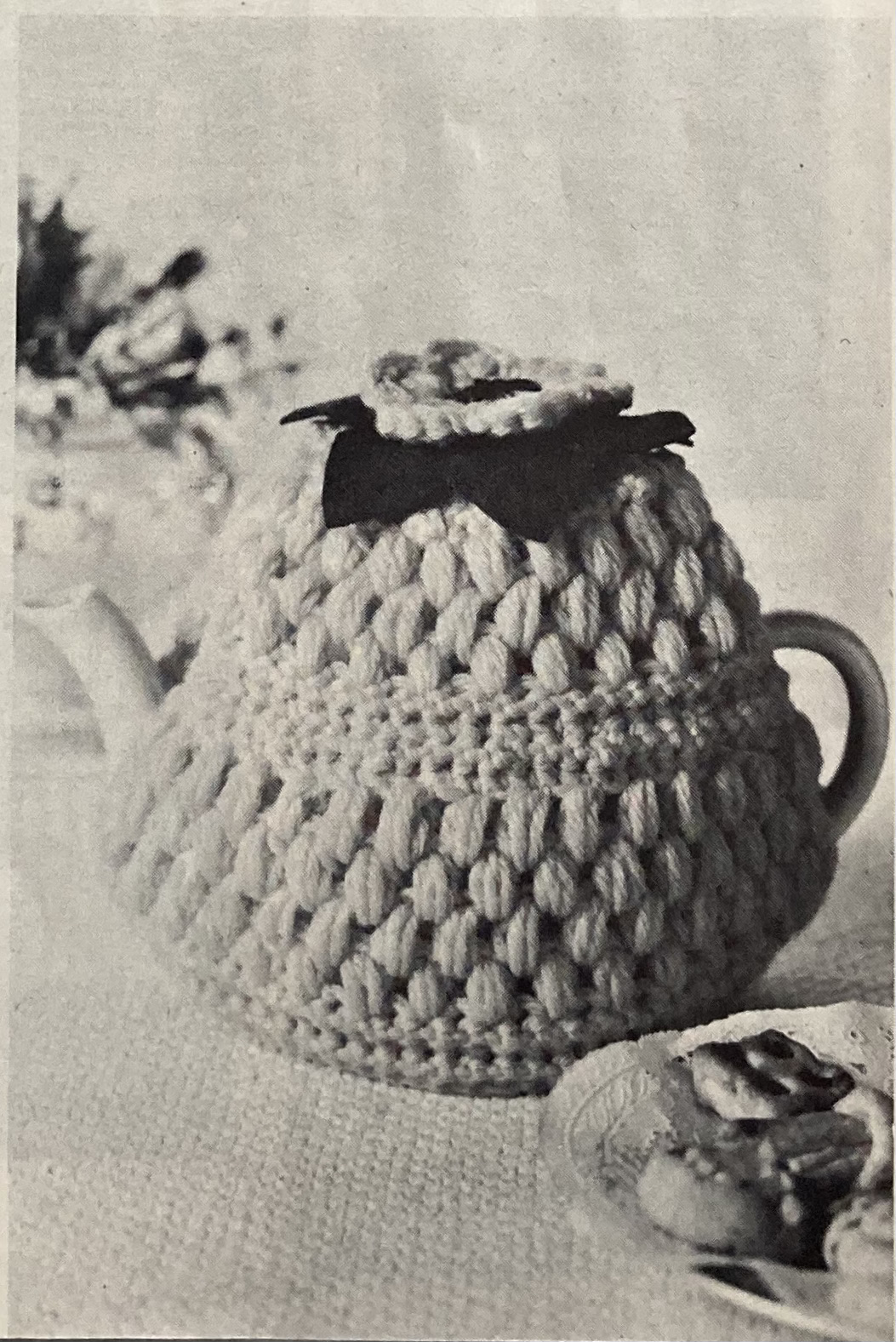
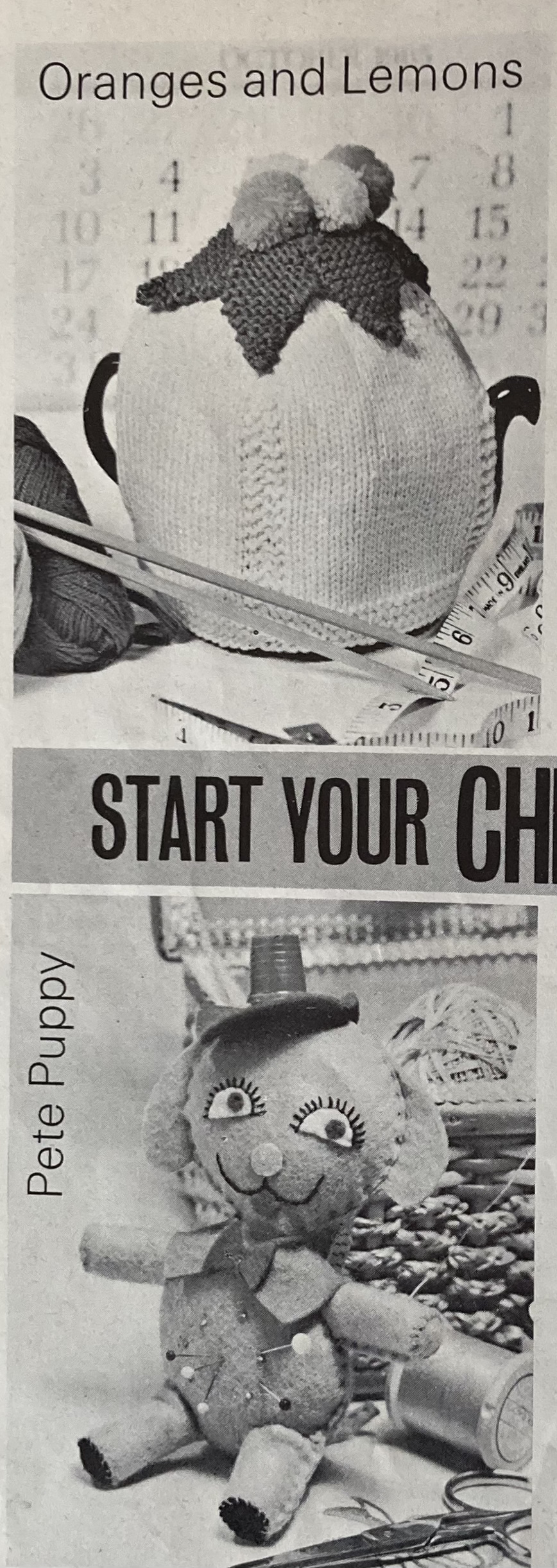
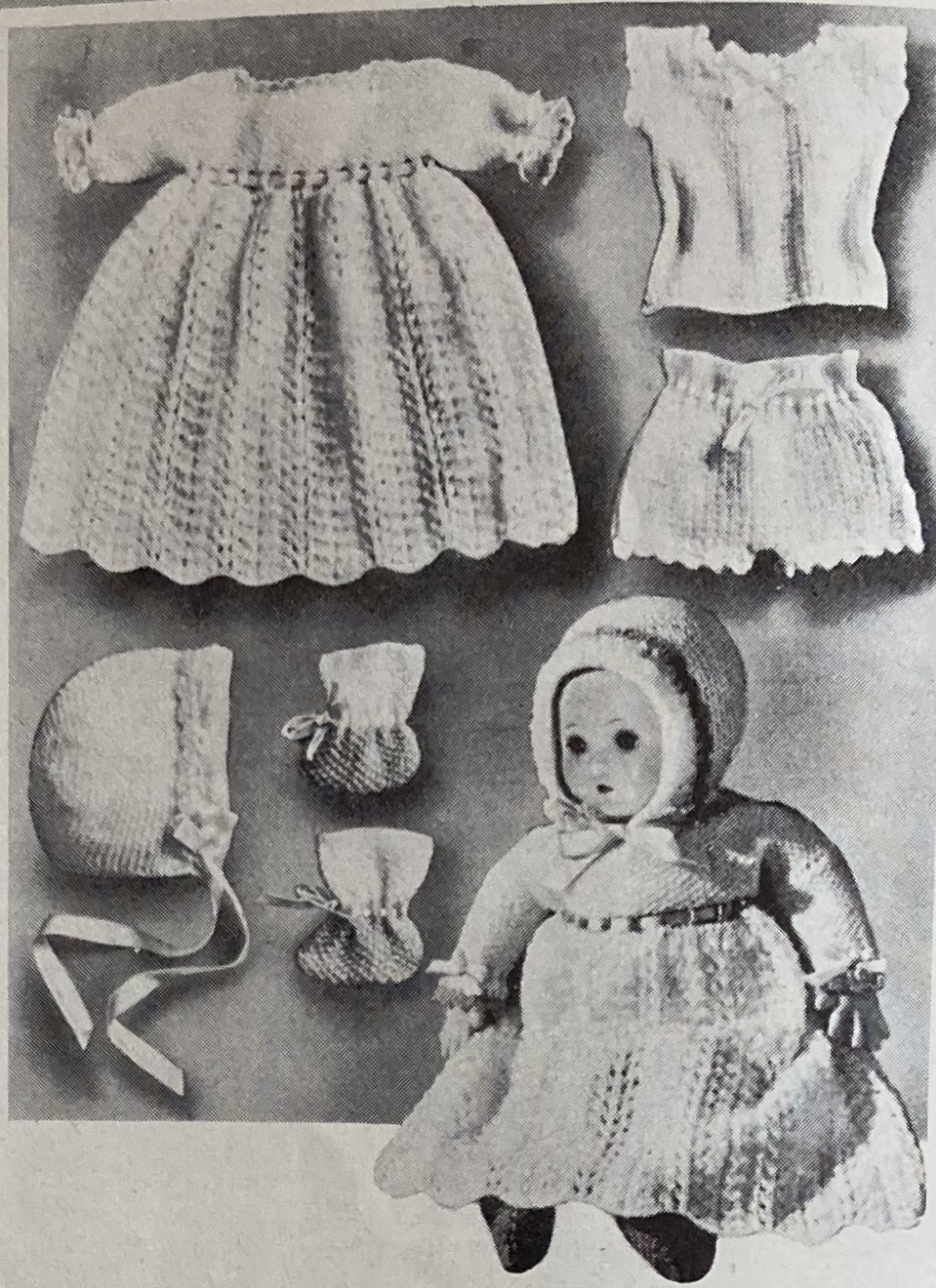
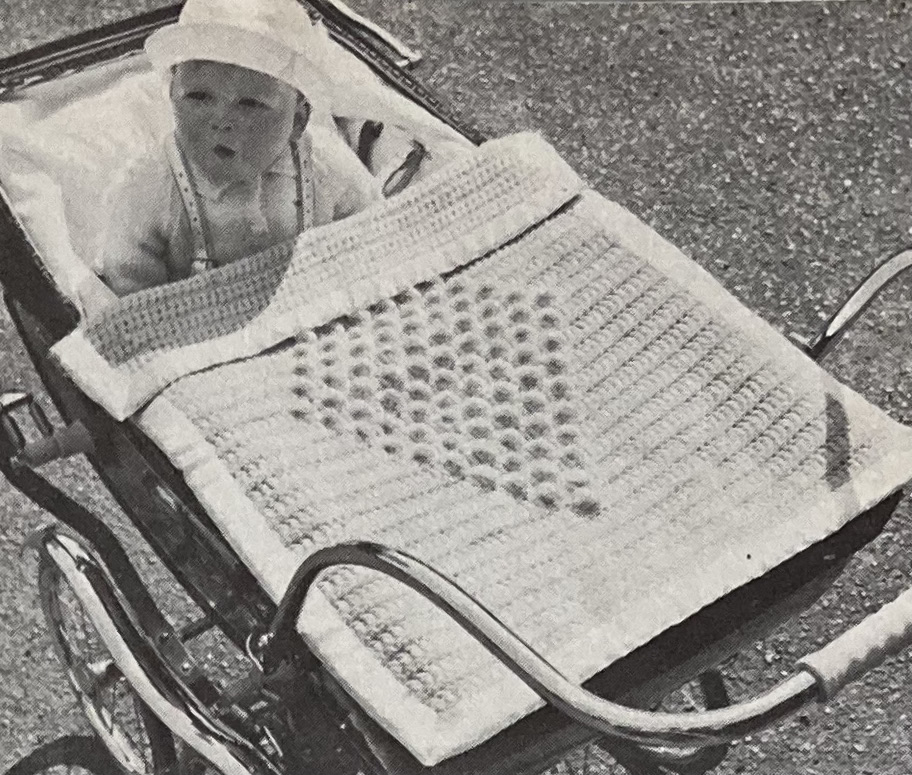
The bizarre-bazaar “novelties” never fail to amuse and wonder, and this month’s issue gives us a knitted tea cosy (festooned with pom-poms) that looks like a giant orange and/or lemon, and a crazy-eyed “Pete Puppy” doll in sewn and embroidered felt fabric that can be used for storing sewing implements — just poke those spare pins right into his belly like a voodoo doll. The “Readers Pages” offer some reprints of popular designs from earlier issues: a doll’s clothing set from November 1940 and a crocheted pram cover from … when was it exactly? It doesn’t say in the instructions and couldn’t find it in my previous posts, but I know I have seen it in another issue — possibly pre-1960.

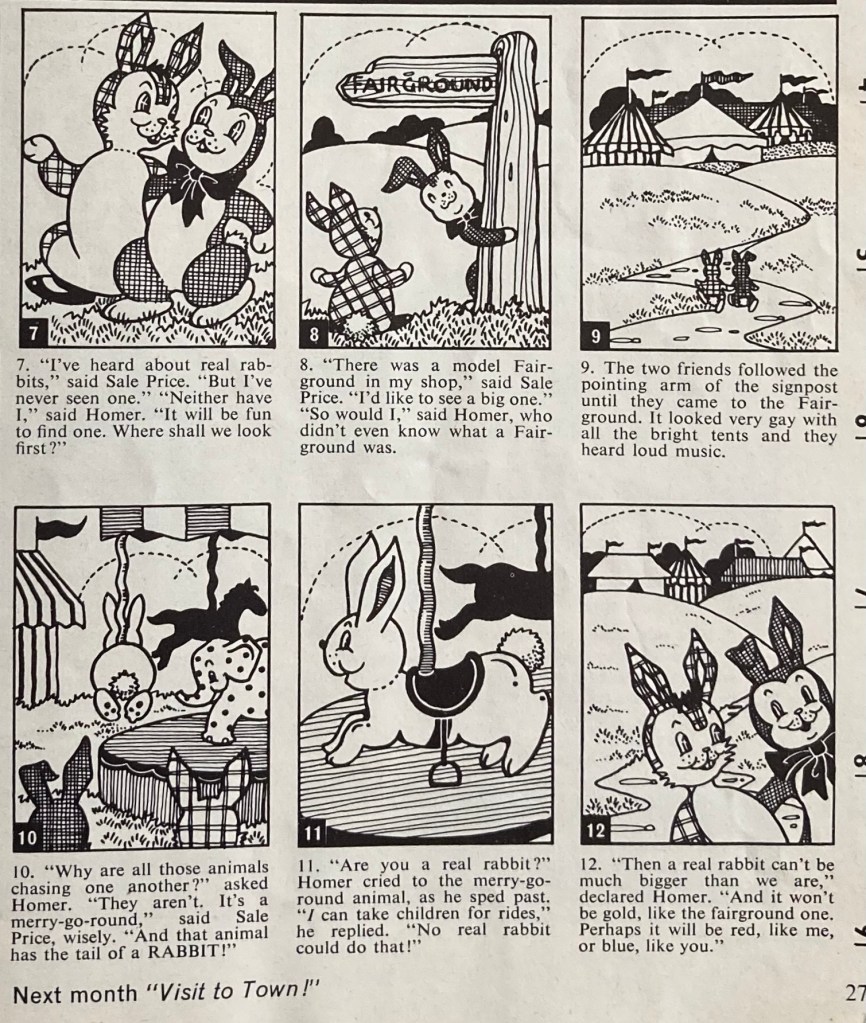
In the current comic (really, one of the best ones), homemade rabbit doll Homer (because he’s home-made, get it?) and his friend, the store-bought rabbit doll Sale Price (self-explanatory) go on a quest in search of a real, live rabbit. Here’s they find a rabbit on a merry-go-round, who explains to them (logically enough) that he cannot be a real rabbit, as he can take children for rides, which a real rabbit cannot. Pedagogical message for children: do not try to ride on a real rabbit! Alas, Homer and Sale price must look further, and will continue their adventures in next month’s issue.

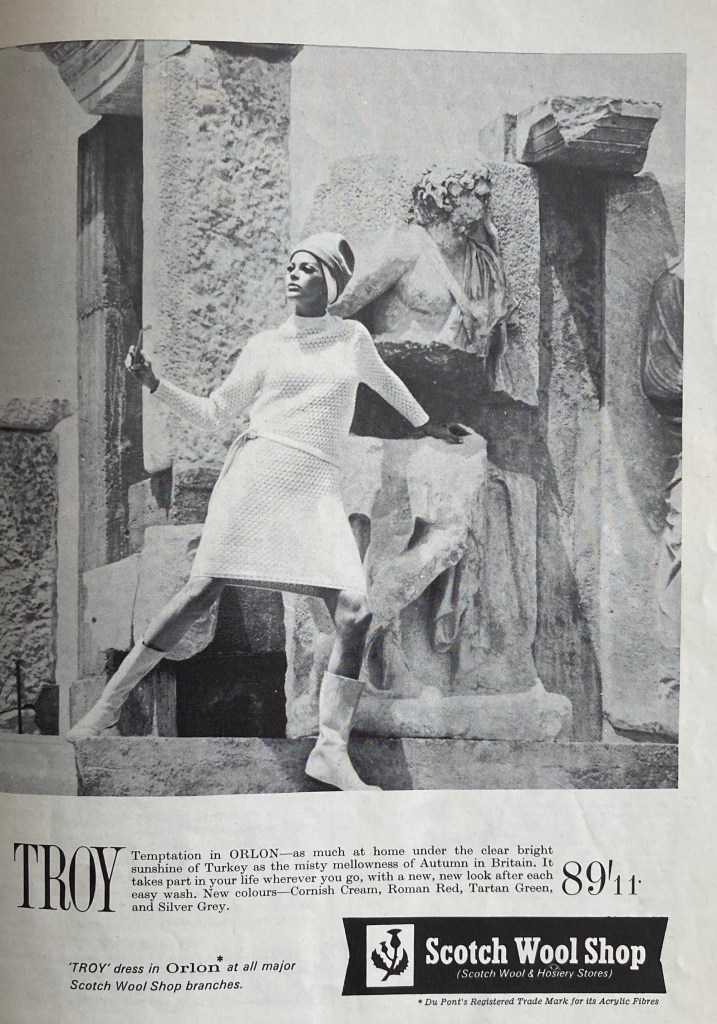
I will leave you with this ad for the Scotch Wool Shop, purveyors of knitting wool, stockings, underwear, and fashionable clothing for women. Always keeping up with the times, the ad shows a crocheted dress in Mary Quant style, named “Troy” and perfectly photographed for the Swinging Sixties.

That’s all for now! I have so, so many unfinished projects, but cannot resist the temptation to make the fine-knit cardigan blouse with picot crochet trim. It will definitely not be finished on time, but as always, I will update project posts when progress has been made.

September 1965: Overview

Autumn is here, and the September 1965 issue of Stitchcraft is, as promised by its editress, a “bumper” issue with more colour photos (to offset the price increase to 2s. per single issue) and a new yarn from Stitchcraft’s patron wool company, Patons. 

Called “Fiona”, it was DK-weight and made of 50% Shetland wool and 50% “Orlon” (one of the very first acrylic yarns). Shetland wool is beautifully warm and lightweight due to its being very lofty and “hairy”, and “Fiona” was marketed as combining these positive aspects with the easy-care, less scratchy and non-tangling qualities of synthetic yarn — a sort of “Shetland lite”, if you will. Real Shetland wool is excellent for traditional “Fair Isle” stranded colourwork patterns, since the hairs lock into each other in the stranding, but the “Fiona” designs in this issue employ smoother, textured stitch patterns. The cover cardigan-jacket has a bobbly lace pattern and the his-and-hers pullovers use a broken cable rib. 

The other two designs for adults are made in standard 100% wools: a “young-looking sweater” with really, really unfortunately placed bobbles (directly along the bustline) in Patons Double Knitting or Crepe, and an Aran-patterned jacket in bulkier “Capstan”. An older brother might get this “Husky polo style” pullover in Patons DK and a fun reversed stocking-stitch pattern with more (and better placed) bobbles. 

The trend for textured stitch patterns continues with garments for the younger set. The toddlers’ “walking-out set” of pullover, leggings and snug helmet-style cap (with more bobbles on the tie at the neck) is made in easy 2×2 ribbing in blue and white DK wool. Love the pre-Photoshop-era addition of a tree in the photo, to show you that he’s playing outside! His big brother gets a warm slipover in an easy zig-zag pattern, and tomboy sister, (with short hair and trousers) gets a set of cap and sweater in a fisherman’s rib pattern that is more complicated to do than it looks. You purl the RS rows and and on the WS rows, you *k1, purl into next st. but through loop of row below at the same time slipping st. above off left needle; rep from * to last st, k1. The vertical stripes are added later via Swiss darning aka duplicate stitch embroidery.

Above all, this is a bumper issue for homewares. There are multiple pages of easy projects for a “Sale of Work” stall at the church bazaar or what have you, including a “house” and “windmill”-themed apron, mat/cosy set and a “peg bag” for holding laundry pegs. Other quick novelties include a knitted scottie-dog toy and a cosy or cushion made out of odds and ends of wool. 

More ambitious needle-workers can decorate an entire room from top to bottom with designs from this issue, starting with a needle-etched picture of a steam engine — a throwback to the Victorian nostalgia of the late 1950s and early 1960s — or a tapestry picture of the seaside village of Clovelly to hang on the wall. 

For the furniture, there’s a beautiful “peasant” (their word, not mine) design for a cushion and chairback, made in embroidery wool on linen, and for the floor, a hand-made “Tartan” rug. It uses a latch-hook and the “Turkey knot” to make a soft, three-dimensional pile. Finally, church-goers can make a tapestry “kneeler” cushion in a pattern inspired by Gothic stonework. 

And there’s a new children’s comic serial in the Readers Pages! This is a really cute and creative story about Homer the plush rabbit (so called because he was home-made) and Sale Price, the store-bought plush rabbit, who go out into the big wide world to try and find a real rabbit to befriend. Will they find one? Stay tuned! Oh, and I bought this issue on Ebay, so received a special… bonus? picture of an embroidered Christmas tree with no transfer or pattern instructions (and not from Stitchcraft.). If anyone can identify it, I will be very impressed!

My project from this issue will be the knitted cushion, by special request from someone who works on the computer a lot and would like a soft underlay to rest their wrists on.

September 1964: Overview

It’s the start of the autumn knitting season, and this issue’s slogan is “Knitting in Full Swing”. There are practical garments for adults and various ages of children, as well as a new yarn: Patons Flair.

Flair” is somewhat heavier than DK weight — what is now often called “worsted” — and made of 60% wool and 40% “Courtelle“, a synthetic fibre pioneered in the late 1950s by the Courtaulds company. It features in the green cardigan and the yellow star-motif pullover on the cover. I love the cardigan, with its bright green colour and use of simple garter-stitch ribs and bobbles to decorate the fronts. The placement of the motifs on the yellow pullover is… interesting. I guess it works OK on a male figure, but I would not recommend it for a partner look! There’s also a plain, classic V-neck pullover for him and a “blister stitch” sweater for her on the back cover. Bright, cheerful colours are in fashion. (The men’s V-neck pullover colour name is “Sorrento” — anyone know what colour it is?)

The non-Flair adult garments are all made in DK weight yarn: a “country sweater” in a twisted-rib pattern with an oversized Vandyke collar, a complicated cable-and-stripe men’s shirt-style pullover, an elegant set of slim skirt and “overblouse” and a long, skinny sweater “for teens”. All of them feature interesting stitch textures, particularly twisted-rib patterns and bobbles, and interesting details like the fake “pocket” decorations on the front of the overblouse. The cable-and-stripe pattern is especially complex and uses separate lengths of wool for the vertical twisted ribs while stranding the stripe colours behind. Aside from the teen sweater in “Flamingo”, the colours are slightly subtler, with light “Cream Whip” and dark “Loganberry” for the base colours (sounds delicious) and accents of light blue, olive green and melon-orange.

For the younger members of the family, there’s a fun and cheerful five-piece set “for twins”, consisting of a skirt, shorts with braces, a short-sleeved jumper, cardigan and beret. They’re all made in DK wool in a similar bright, sunny yellow to the man’s pullover on the cover. Continuing the matching-set-for-babies look, this month’s issue has a dress and bootees for a six-month-old, to be followed by a matching matinee coat and bonnet in next month’s issue.

With all these lovely things to knit, it’s amazing that there are any homeware projects in the issue at all, but there are always a few utilitarian projects: here, an easy cushion / tray cloth or a thick rug or mat for kitchen or bathroom. For more ambitious embroideresses, there’s a tablecloth or cushion in bright “peasant” design (Stitchcraft‘s choice of word for traditional or folk designs from certain countries and not from others; I do wish they would just call them all “traditional designs” and leave it at that). The design, like the knitted garments, is big and bold and fun and colourful on the cushion, and slightly more subdued in red and blue for the tablecloth.

Though embroidery doesn’t feature big in the issue’s projects, it does have a place in the back pages: in the new children’s comic, “Anne and her Embroidery”, little Anne is bored on a rainy day and passes the time by learning to embroider pictures of the flowers in her window-box. Two pages later, there’s a full-page advertisement for a new tapisserie wool suitable for both tapestry and embroidery. Coincidence? I think not! The other interesting ad is for the new Patons Flair yarn, highlighting its easy care and washability.

That’s all for this issue! My project will be the embroidered cushion.

March 1964: Overview

Greetings from Kent from your March 1964 issue of Stitchcraft, featuring “Spring Into Summer Fashions” photographed in “some of your favourite spots around Canterbury and Tunbridge Wells” so that you can see the knitwear “in their own settings as you would wear them.” Shall we go?

“For our climate”, writes editress Patience Horne, the best outfit for the spring and early summer months is a sweater suit, quickly knitted in double knitting wool. Cool blues, salmon pink and yellow-green are the trendy colours, and pattern stitches are used sparingly as an accent on hems or collars, or as a single vertical stripe panel.

Our cover model is wearing a twin set with a trellis pattern accent on the cuffs, pockets and collar of the jacket and the hem of the short-sleeved jumper underneath. Here, again, we see how twin-set styles have changed since the 1940s — everything is long, loosely-fitting and unshaped. The “Golden Willow” sweater suit on the inside front cover is similarly unfitted, with a cable “V” pattern stripe. For “The Creamy Look”, there’s a a high-buttoning cardigan with a subtle diamond pattern on the fronts. All three models are made in “Double Quick” knitting.

“Double Quick” is also the featured wool for the men’s and women’s “sport sweaters” in the lovely full-color center photo. I’m not sure what makes those two garments more “sporty”, as they look equally as elegant as anything else in the issue. His sweater is worked in stranded technique from a chart included in the instructions, and hers is made in plain stripes with the diamond pattern embroidered on later in Swiss darning / duplicate stitch. If “Double Quick” is not bulky enough for you, there are matching sports sweaters for him and her made in bulky “Big Ben” at 3 1/2 stitches to the inch. The salmon-pink jumper (Stitchcraft calls is a “sweater blouse”), by contrast, is made in 4-ply wool in a classic shape, with pattern accent panels in an interesting mini-bobble stitch.

Babies get a wonderful pram set of footed leggings, coat and matching bonnet. It’s referred to in the index as a “four-piece” set, but I am at a loss to find a fourth piece anywhere in the instructions or photos. Maybe they planned to make matching mittens and then didn’t? Bigger children get a cute slipover with an argyle pattern on the front. The photo is very 1960s, with the girl freezing her legs off in a micro-mini skirt and the boy sporting a bow tie.

The homewares are fairly standard: a tea cosy, apron and tray set and a knitted kangaroo with baby for your bizarre/bazaar novelty needs (there’s also a reprint of a 1956 knitted ice-skating panda bear doll, if the kangaroo isn’t enough for you.) You can also cross-stitch a rug and pyjama case with square-headed dancing soldiers to haunt your small son’s dreams, or some flowered place mats, a cushion or wall hanging, or another cushion inspired from a traditional Greek star design.

In the “Readers Pages”, a new serial comic is starting: “Susan’s Sampler”, in which our heroine learns embroidery from a magic needle, and our back cover ad (for Patons Double Quick Knitting wool) shows yet another woman lovingly looking up at a man who has trapped her with her back to the wall in order to mansplain something to her. Feel free to give the photo some speech bubbles befitting a modern interpretation of this scenario!

That’s all for this issue. I’ll be making the child’s slipover and for once, I’m quite sure it will be done on time. Happy Spring!
December 1963: Overview

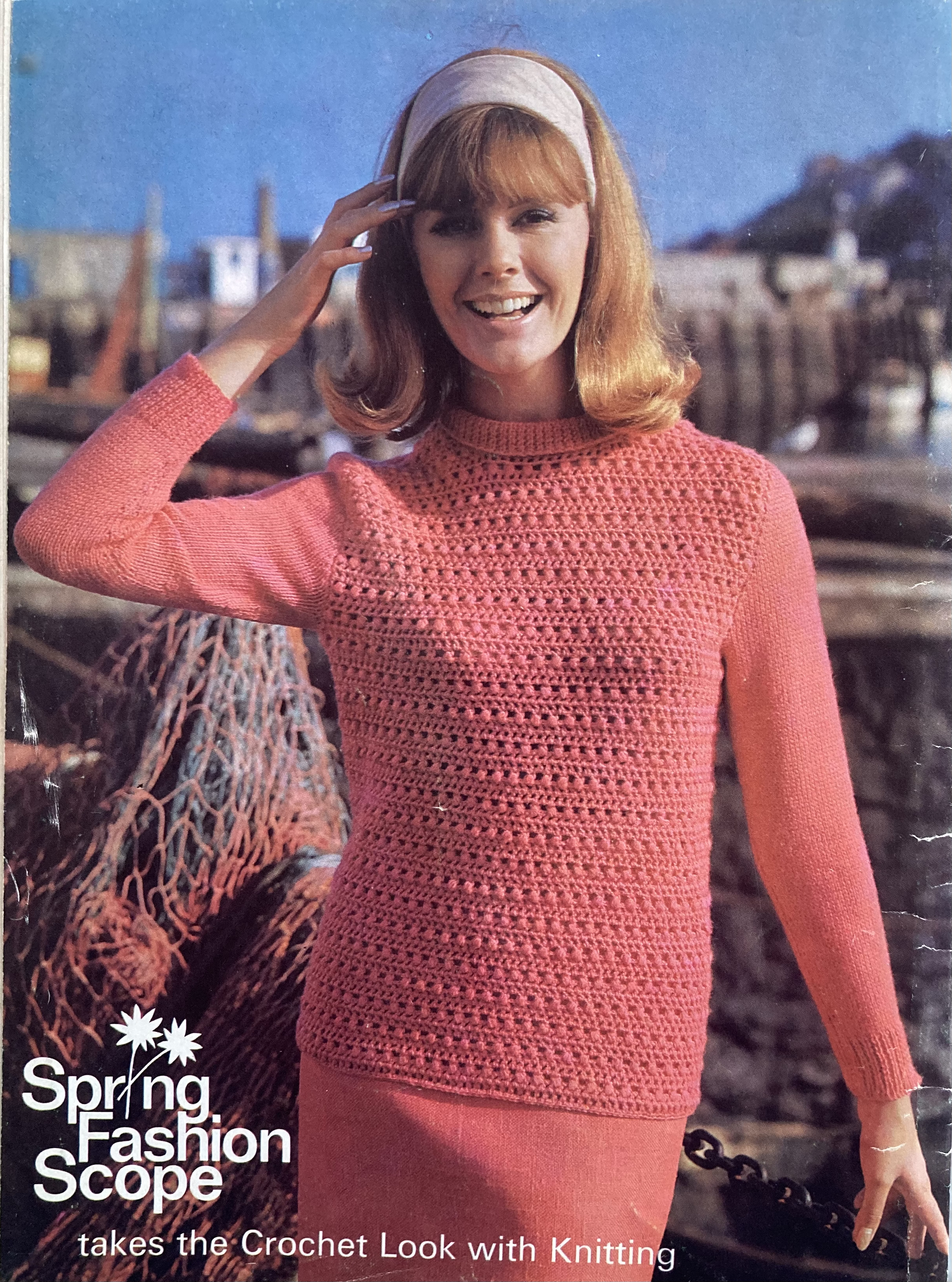
Cover photo from Stotchcraft magazine, number 360, December 1963

“Christmas is very nearly here” — where did the year go? As always, Stitchcraft‘s December issue is a mix of warm, bulky, quick-to-knit winter garments for the family and little handcrafts for presents and decorations.

Our cover model is wearing a hat in trendy “high-crowned” style with matching muffler. It uses “Glenora”, Patons new tweedy-multicolour wool. Unlike the “tufted” hat from last month’s issue, this one needs no millinery wire to keep it from flopping — the wool is relatively thick and is used double on the hat to make it really solid and windproof. The buttons are purely decorative and are made by covering button moulds with velvet cut from a strip of ribbon.

Other cold-weather accessories include these mitt(en)s, crocheted in a spiral to make the backs and fronts. Aside from the stripes on the fronts, they are almost identical to these mittens from February 1960. The full-size garments are all made of bulky wools for wamth and quicker knitting. There are pullovers for men and women in Big Ben or Ariel wools, a check-patterned pullover in double knitting weight and a cardigan “in larger sizes” (39-42 inch bust). Both of the bulky pullovers as well as the cardigan use variations on twisted or mock-cable stitch patterns, where you knit stitches in the “wrong order” in order to cross them. Big, pointy collars are still very much in fashion and the colours are bright and bold for winter: “Lipstick Red”, “Strawberry Ice” and “Royal Blue”.

Children get “Christmas sweaters” in holiday colours of red, green, and white, with bold snowflake motifs in stranded patterning.There’s a frilly bed jacket in lightweight 3-ply and a waistcoat variation on the men’s pullover, as well. They’re photographed in colour on the inside back cover. Funny that, with all the brightly coloured garments in the issue, they chose the one beige garment for the colour photo! You do see the tweed flecks better, though. That amazing creation at the top of the page is the Royal Pavilion in Brighton, reproduced in fine embroidery in felt appliqué. This isn’t the first huge, complicated wall panel project we’ve seen and I can only assume that Stitchcraft had a really good appliqué designer.

The other homeware/decoration projects are small and easy, intended for little gifts, holiday bazaar sales or to brighten up the festive table. You can knit a little puppy doll complete with its own fully dressed bed, or make some silly but nonetheless cute egg cosies (the human-looking one is supposed to be Friar Tuck.) There’s a “pinny” apron to sew for a child, party table mats with a star motif, and these stuffed and embroidered felt stars to hang on the tree. I made one of these last year and will probably make some more this year — they are quick to make and just the thing for a mini-present.

If you have a little more time (but don’t want to tackle the Brighton panel), you can knit a knitting bag, crochet a floor mat, or make a hard-wearing cushion in a standard “ribbon” needlepoint design. If you’ve really got some time on those long winter nights, you can make a set of dining-room chair seats in tapestry, or a large pile rug in a “Byzantine” design. (Beautiful leather satchel in that photo as well! It’s a just a prop, though, of course — Stitchcraft‘s crafts didn’t extend to leather-work.)

Then there’s this design for a little sewn bag with an embroidered horse named Archie on it. Archie, since you asked, is the horse in the children’s comic “The Smuggler’s Sack”, which has been running on the back pages of Stitchcraft for the past few months. It features children Joe and Jenny, who live in a waterfront town whose mystery pirate/smuggler treasure has never before been discovered. Will they be the ones to find it at last? As of yet, they’ve found a mysterious box … which has a false bottom … which contains a map and a key .. which leads them to .. an inn called “The Smuggler’s Sack.” They’re disappointed, but could the inn hold the clue they’ve been looking for? Shades of Daphne du Maurier!

“Archie” will in fact feature in my December project, where I will be embroidering him onto a modern soft case / traveling bag for a pocket synthesizer.

Happy Holidays, everyone!

March 1963: Overview

Cover photo, Stitchcraft magazine, March 1963

Start your engines and give that propeller a whirl! The theme of this month’s issue is “Fashion On The Go” and the photo team really outdid themselves in showcasing adventurous and enjoyable modes of transportation. “With the wonderful opportunities for travel”, writes “editress” Patience Horne, “you need clothes that are easy to wear and will carry you through the day without a lot of care and pressing.”

Travel opportunities definitely took off (pun intended) in the early 1960s. Passenger air travel, though still a luxury, became increasingly possible and affordable with the advent of jet aircraft. Ocean liners, challenged by the rise of air travel, revamped into cruise ships. The Eurail train pass was introduced in 1959. Huge improvements in automobile technology and design made the freedom of the open road more tempting and accessible than ever. Yearly sales of Vespa scooters doubled from 1956 to 1960. Of course there was very little, if any, concern for environmental factors, and the oil crises of the 1970s were far in the future. There was no better time to travel.

On the race-car track, our cover model is wearing her “Paris Flash Slimline Blazer” — a simple but elegant jacket in moss stitch — and her colleague is sporting a “Double Quick shirt waister” that promises to be “the perfect travelling dress”. In a lovely juxtaposition of modernity and history, the model in the photo next to her is posed in front of what looks like an old-fashioned, horse-drawn stage coach! Her twin-set is made in finer 4-ply wool and though you can’t see it in the photo, the jumper is made in normal stocking stitch and the cardigan in reversed stocking stitch. In a separate photo, you see her posed in front of a horse box — no doubt one of the horses who pull the coach. Train travel is covered with a beautiful photo of this tweedy green travelling coat. It looks very cosy, but as it is made from 60 ounces (!! 3 3/4 pounds or 1700 grams !!) of extra-bulky, extra-heavy Big Ben wool and unlined, I can only imagine how it will stretch and sag with time and wearing.

The centerfold photo showcases more glamorous nautical and aerial travel opportunities. (I am sorry to say that the photo is blurry in the magazine, not just in my photo.) The “boat-deck sweaters” are both in double knitting weight with plain stocking-stitch and collared-shirt form for him, fun nubbly Rimple wool and a welted front insertion with cute tied collar for her. Collars, in general, remain well in fashion, though they are not quite as large as in the last few seasons. The airplane enthusiasts in the right-hand photos sport a casual, oversized cabled cardigan in bulky Big Ben wool and a striped dolman-sleeve pullover in double knitting weight. The dolman pullover sits weirdly around the neck and looks like it would be awkward to wear.

For those who prefer more leisurely ways to travel, i.e. walking around town, here’s a “stroller sweater” in fluffy Ariel and a sort of diagonal basketweave stitch pattern. Even the children get a travel-themed photo, if only in the studio! While the little sister is very keen to drive her wooden locomotive, big brother is apparently tired of playing conductor (but still blocking the tracks…) They’ve both got wonderful things to wear. The two-tone pleated skirt is knitted sideways and the pleats sewn in with the making-up, and his light-weight pullover has another fun diagonal knit-and-purl pattern.

With all these wonderful things to knit, you would think the homewares would be less interesting, but there are still plenty of projects that are mostly small enough to pack with you on your travels. There are all sorts of cushions to embroider: darned and tufted in very 1960s colours (brown, biscuit, fawn, two shades of orange and two shades of rust), neon-on-black “peasant embroidery” in regular crewel work, and with a matching chair-back in Assisi embroidery — traditional Italian designs where the backgrounds and ornaments are filled in with cross-stitch, but the main motifs are left unworked. The Victorian-inspired tapestry chair seat and stitched bathroom rug are probably too unwieldy to pack, but the fine embroidered initials and baby outfit are easy and portable. Readers could order the pattern for the baby set along with the embroidery transfer.

The back pages feature the worst of the Patons & Baldwins “please your man” advertisements, in which a woman can’t even knit herself something for once or look nice in it without all of it being To Please Him. (And then she has to pretend to be interested in whatever boring mansplaining he’s doing with the book he’s showing her.) I can’t help thinking of that scene in Vertigo where James Stewart’s character is trying to get Kim Novak’s character to dye her hair… and she doesn’t want to… and he gets more and more frustrated before blurting out, “It can’t matter to you!” Alfred Hitchcock would have approved of this ad.

The “Children’s Features” continue the alternative telling of the Miss Muffet rhyme story, in which Miss Muffet, leaving the home of the kindly spider-lady, gets captured up by a grumpy beetle, saved by the first spider, and then in turn saves a captured beetle who promises her a present. What could it be? We will find out in next month’s issue!

None of the larger projects are begging me to make them and I’m still working through the WIP pile, so I’m going to use some of that fine embroidery on the vintage handkerchiefs I inherited from my grandmother.

February 1963: Overview

This month’s issue brings us on another lovely photographic journey, with “elegant settings for Spring Fashions” in and around historic Bath. Looking closer at the photos, it’s clear that some thought went into the combinations of outfit and setting. The “city” photos show models in elegant knitted dresses or suit-like separates, whilst the “country” photos highlight the continuing trend for casual, bulky garments that could theoretically be worn as outer garments instead of a coat in spring weather.

Our cover model starts off the “city” look with a fur-trimmed dress in “Ariel“, a bulky, yet airy triple-knit wool-acrylic blend. It’s advertised as being “light as thistledown” — the whole dress uses 14, 15 or 16 2-ounce balls of wool, which comes out to about 550 grams for the middle size stitch pattern. I’m guessing the diagonal slip-stitch herringbone pattern and ribbed, belted waistline also help control any sagging. The same yarn and same stitch pattern are used for a jumper-and-skirt set in a dramatic yellow and black colour combination. Look at that model’s hair! I always thought people with red hair should never wear yellow, but she looks amazing. Bobbles on ties feature in both the belt of the dress and the neckline of the jumper and skirts are still just below the knee.

Rounding out the elegant city category is a classic skirt set whose rectangular, unshaped form is made more elegant by the use of vertical lines on the cardigan. Bouclet wool in fingering weight keeps the effect sleek and light.

For casual country wear (a.k.a. “The Open-Air Look”), bulky Big Ben wool is still the first choice, or double knitting weight for a somewhat lighter look. Both the men’s and women’s garments are hip-length and unshaped and cardigans are mean to be worn buttoned. At the same time, interesting stitch patterns, textured wools and details like collars and pockets break up some of the shapeless-bulky effect. Even toddlers can join in on the fashion fun with a knitted bathrobe, which showcases many of the current trends (bulky “Ariel”, textured stitch pattern, contrasting collar and cuffs, and a bobble-tie belt) as well as being practical for chilly homes in February.

The homewares in this issue are mostly standard fare — cutwork or embroidered aprons, tablecloths or finger plates — but a couple of more creative ideas stand out. There’s a pile rug with a “modern” design, which I would have loved to have seen in a colour photo (note guitar and records — I did mention that the Beatles’ first album came out in 1963, right?) and a crocheted and cross-stitched bathmat that makes it very clear in which room it belongs (though I can’t help laughing when I think that this issue was also photographed in Bath — they could have had some absurd fun with the bath mat in front of the cathedral or one of the historic buildings…)

For tapestry fans, there’s a prayer book cover and kneeler “for an Easter bride” with a flowery cross pattern, using gold Lurex thread together with wool (kneeler) or silk (book cover) for extra luxury. There’s also a footstool made up of old tins! They used old stockings to pad and wrap the clean, empty tins, then stitched fabric around the bottom and sides and covered the top with the tapestry. The result is a bit oddly shaped, but I suppose it would be quite useful — strong and able to support a bit of weight, but still quite light — and I admire the creativity and the upcycling spirit.

There are no particularly interesting advertisements in this issue, but in the ongoing children’s retelling-of-fairy-tales comic series, Miss Muffet gets invited to the spider’s home, where Mrs. Spider shows her the lace curtains and tablecloths she has spun out of spider-silk and teaches her to spin a shawl. How sweet! Next month: “The Beetle-lady.” (Also: Note the ruler printed on the side of the page, to make it easy to check your knitting tension. It’s in every issue.)

I’m a bit at a loss as to what project to make from this issue. I love the “Ariel” cover dress and yellow sweater, but I have serious stash overflow and so, so many unfinished projects, so I would prefer to make something small and easy. I am not religious and would probably not have much use for a prayer-book cover or kneeling pad even if I were, but the flower tapestry design without the cross would be pretty and versatile, and I still have tapestry wool and backing fabric from an earlier failed project. The question is, what should I make out of it? A clutch purse? Coin purse? Cell phone cosy?? I already have so many little zippered bags for knitting tools and sewing notions and general “stuff”. I’ll give it some thought and let you know. If it’s easy enough, I will hopefully be able to finish up and edit some of the WIPs lying dormant in the blog. Stay tuned!

January 1963: Overview

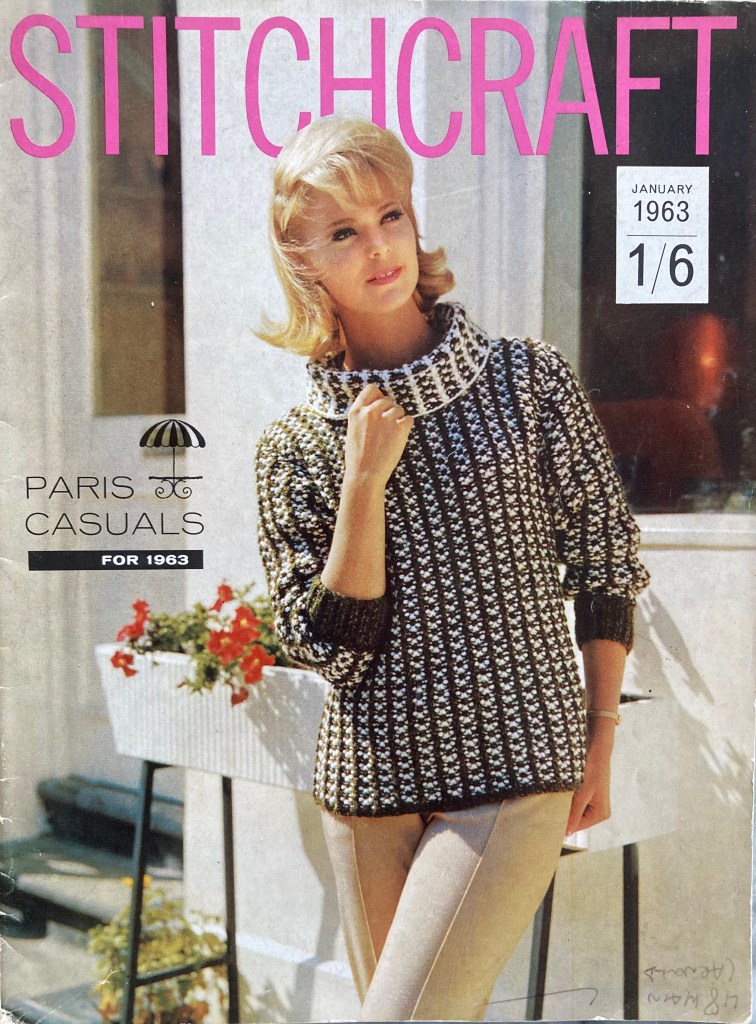
Happy New Year, everyone! It’s 2021 in the real world and 1963 in the Stitchcraft Sixties blog world. The real-life 1963 was a turbulent year: the Cold War escalated, as did the war in Vietnam; the civil rights movement in the US both gained ground and suffered violent setbacks; John F. Kennedy was assassinated; the Second Vatican council entered a new phase. In England, scandals abounded in the wake of the Profumo affair and the divorce of the Duke and Duchess of Argyll. On a happier note, the Beatles recorded their first album, Please Please Me, kicking off Beatlemania around the world, and women in Iran gained the right to vote. Also, the smiley-face symbol was invented. 🙂

Of course, none of this — not even the Beatles or the smiley face — had any direct influence on Stitchcraft (certainly not in the January issue, before any of it happened…). What we think of as “1960s fashion” — the miniskirt, the “space age” look, the shift dress, the Mod look, the hippie-bohemian styles of the later years of the decade — was just gearing up around 1963, and Stitchcraft was a fashion-conservative magazine. That said, holdover fashions from the 1950s like fitted, waist-length cardigans and wide, swingy skirts have disappeared completely by now; the female models often wear trousers or “slacks” and casual, bulky-knit sweaters are ubiquitous.

So what does January 1963 have in store for us? The theme of the January 1963 issue is “Paris Casuals” and resolves to start with “a bumper all-round family number.” For adults, that means warm, comfortable jumpers and cardigans in a range of wool weights with V-necks or interesting collars and textured stitch patterns. The cover garment epitomises all the trends: made in bulky Big Ben wool in a two-colour slip stitch pattern, it sports “this season’s Paris collar choice and longer line.” The textured raglan cardigan is a similar look, as is the man’s casual cardigan on the back cover. The bouclet cardigan gives a nod to earlier fashions with its choice of fine wool and classic shape, but here too it is longer and looser-fitting than previous classic bouclet garments. A simple collared jumper in double knitting with attractive fine details rounds out the adult garment selection.

There are great winter fashions for children, first and foremost the girl’s skating set of skirt and collared pullover. Unfortunately, I suspect something went wrong with the sample knit, as both pictures show the model turned 3/4 away from the camera and it’s not clear how it is supposed to look from the front. (Also, could someone please give her some warm tights to wear before she goes out onto the ice.) Toddlers get a cute “buster suit” with a design of cherries on the jumper, and older children get a wonderful hoodie (to use the modern term) and jumper-cap set to wear while playing in the snow. (Or in the photo studio — check out the snowman and snowball made of wool and/or cushion stuffing fluff!). Crisp, wintery colours of blue and red with white are trending. Notice also that the girl model is wearing trousers, the hooded sweater is unisex, and the model wearing the red outfit in the black and white photo is allowed to be active and tomboyish for once. I wouldn’t even have known she was a girl if the sweater weren’t (for whatever reason) considered specifically a girls’ garment. Slowly, very slowly, roles are changing.

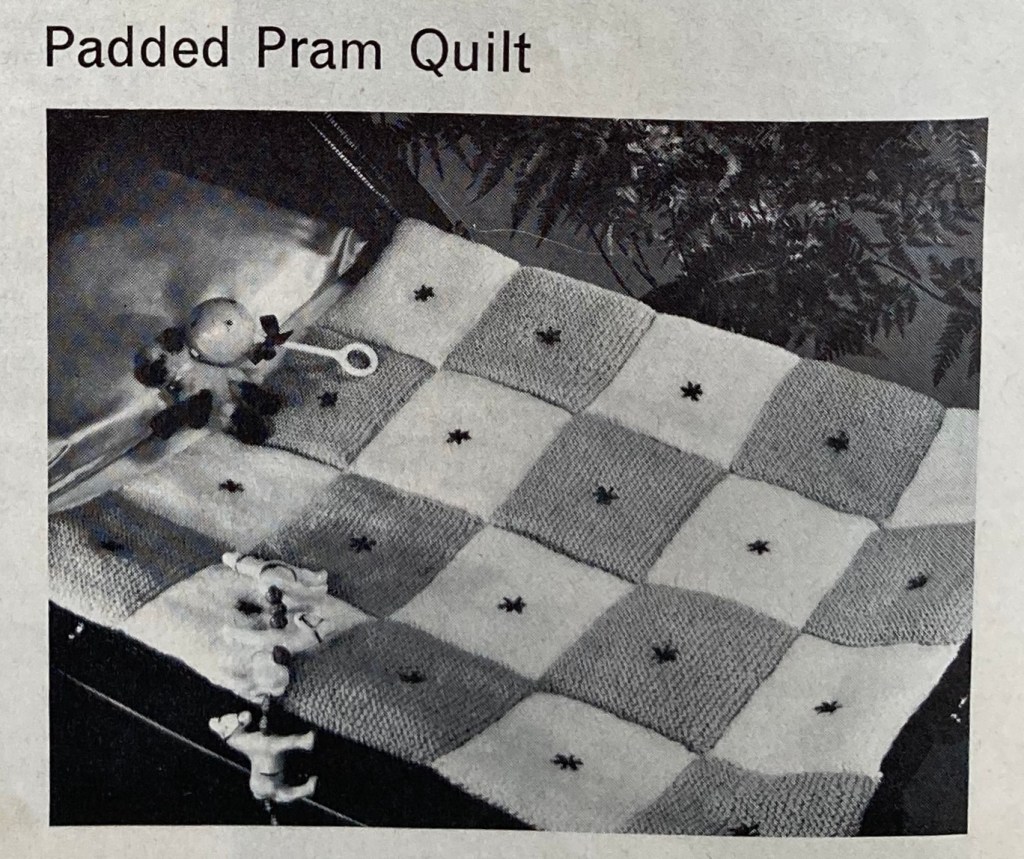
Babies get a pram cover instead of a garment this time — padded and quilted to be extra warm — and there’s a cute bedjacket and fantastic “tower” hat that is perfectly in fashion. (Side note: The caption, “PARIS HAT”, makes me think of that line “If a Harris pat means a Paris hat, Bébé… ooh la la!” in “Always True To You In My Fashion” from the musical Kiss Me, Kate. In true Cole Porter style, it’s an upbeat love song… in which the singer explains to her boyfriend that her dalliances with other men for gifts and money — basically sex work, though of course not explicitly described in those terms — shouldn’t count as infidelity, since she’s only doing it for the financial benefits and is true to him in her heart. Ah, romance! Anyway, the hat is great.)

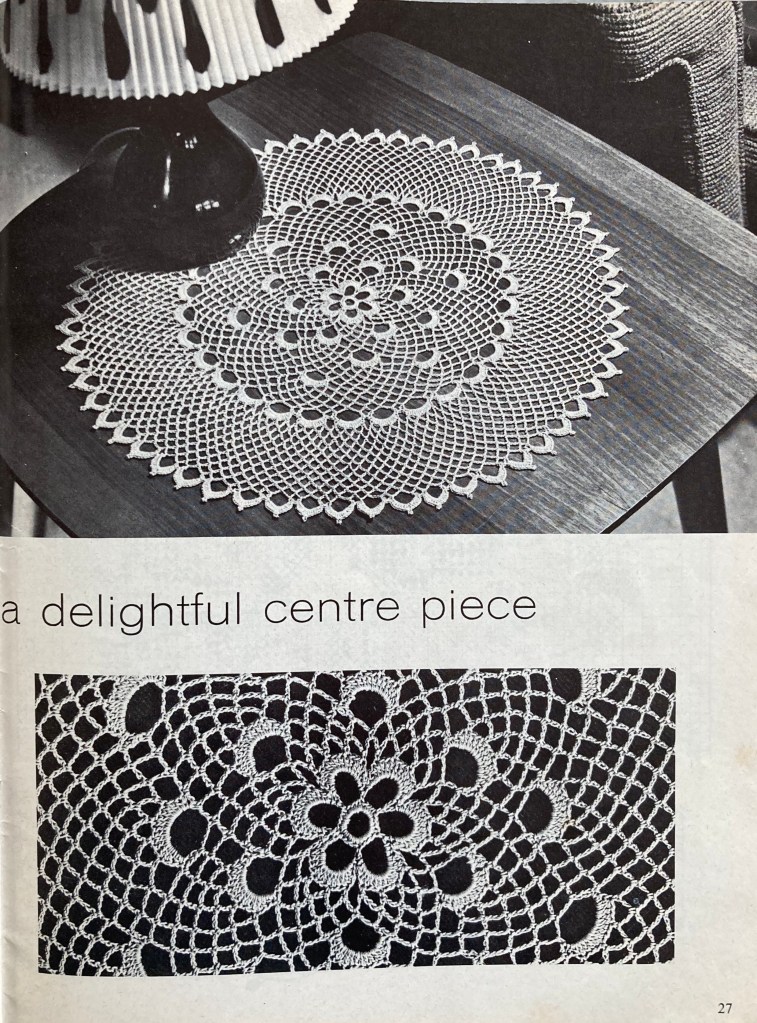
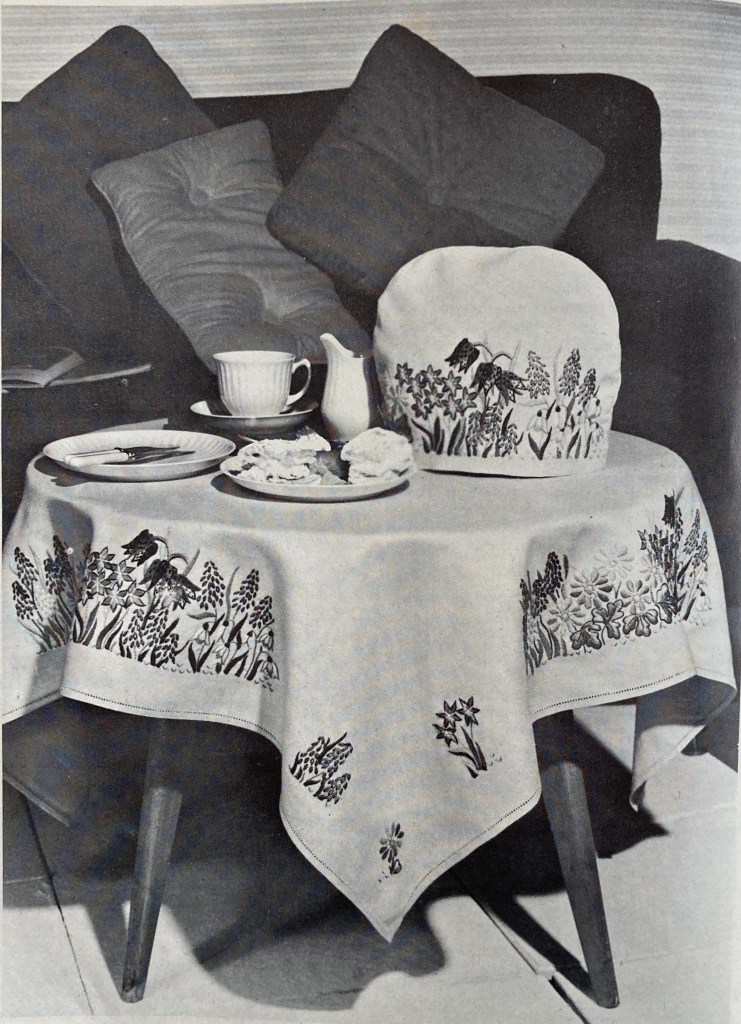
With all the great knitted items, home fashions are pretty standard this month. There are rugs and cushions, a lovely embroidered tablecloth and tea-cosy set, a tapestry picture, a cutwork table set, a very impressive crocheted doily and a hassock or kneeling cushion for church-goers.

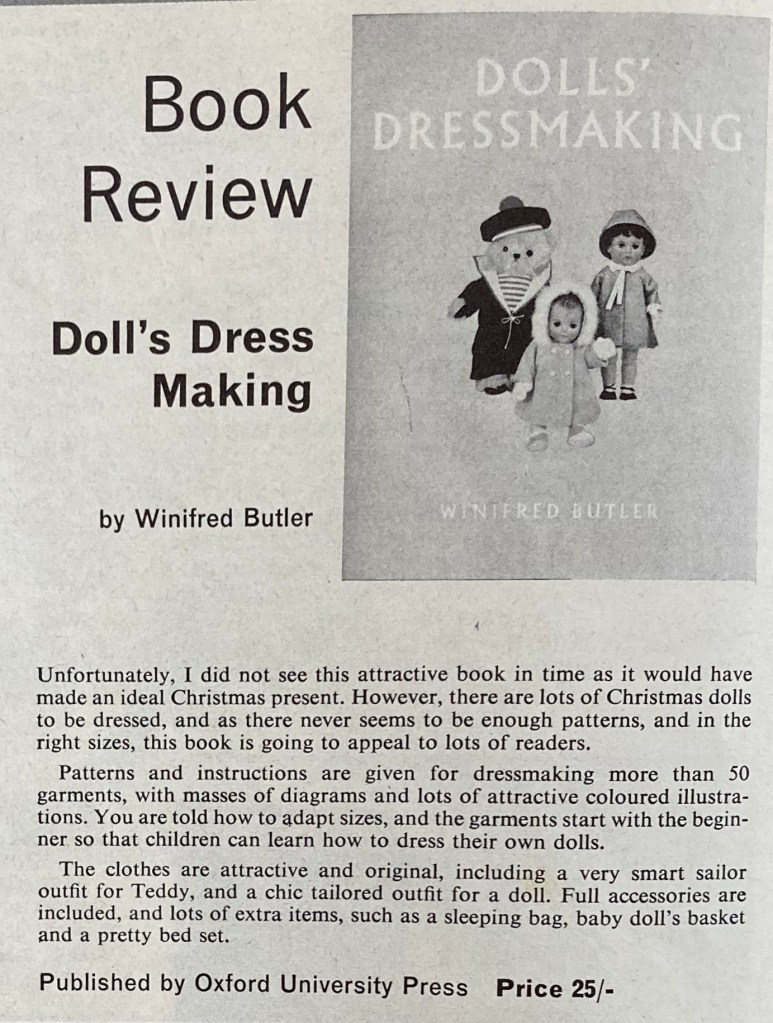
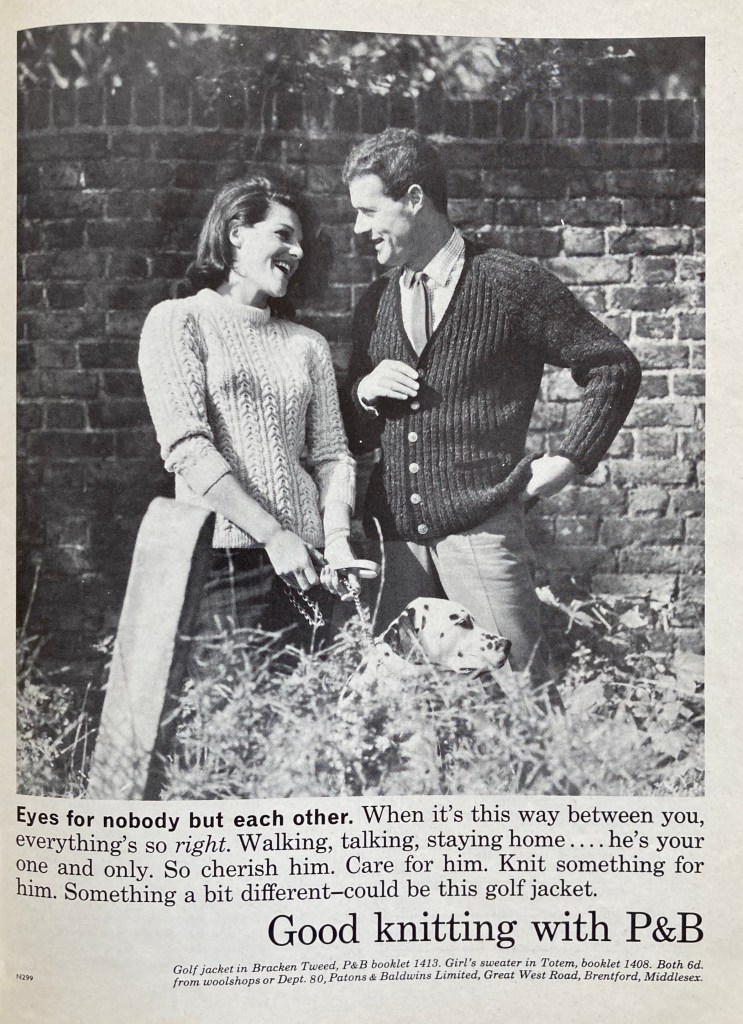
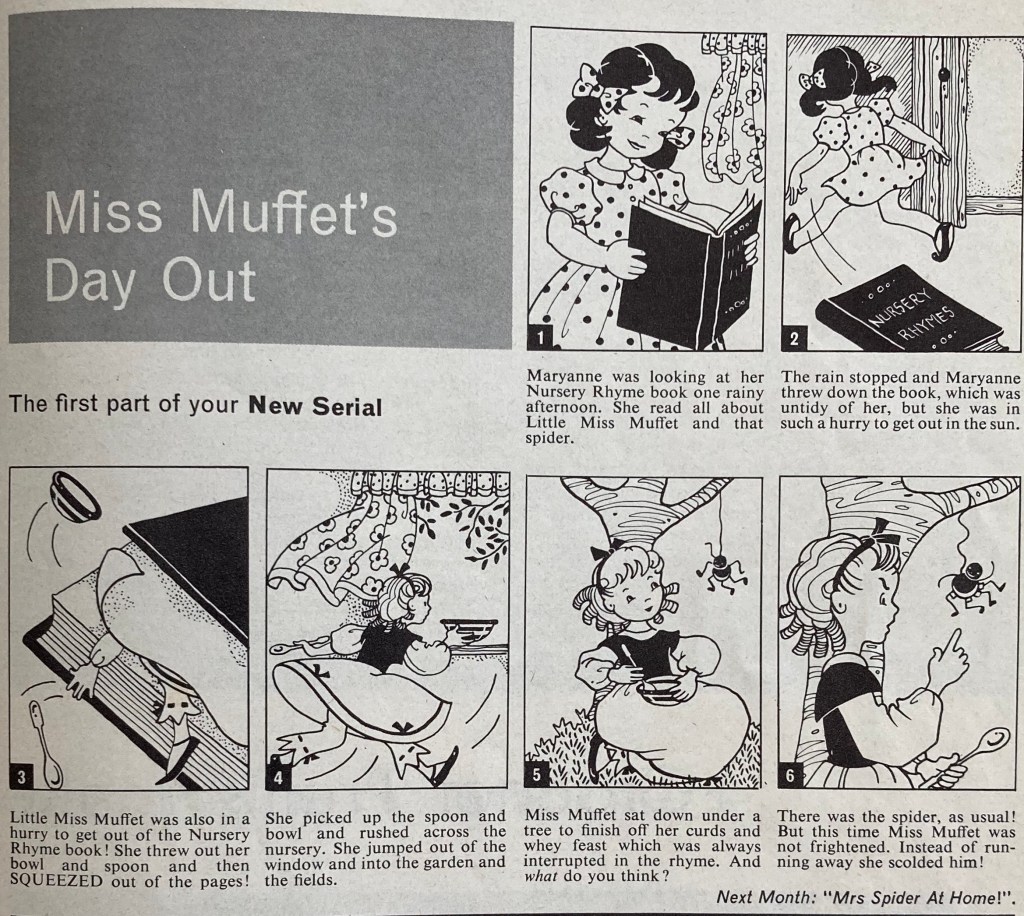
The “readers’ pages” have a review of what was probably a very interesting book on dressmaking for dolls, and –bucking the “single girl” trend of the early 1960s — we’ve got another “stand by your man and knit him something” ad for P&B wools (though this one is really quite sweet and romantic, unlike the “you only exist to be pretty for him” ad seen in other issues). There’s also a new cartoon serial for children: a re-telling of the “Little Miss Muffet” nursery rhyme, where Miss Muffet is not at all afraid of the spider. I’m sure, when she grows up, she will be not at all afraid to suggest to her man that he knit something for her for once.

My project from this issue will probably be a scaled-down version of one of the children’s sweaters for a smaller child. Stay tuned!

April 1961: Overview

IMG_2438April showers bring May flowers, or so they say. I’ll just say that, after the last couple of weeks of March, that umbrella on the cover of this month’s issue looks really familiar. As does the model on the right — she was featured (with a more flattering haircut)  in many issues throughout the 1950s.

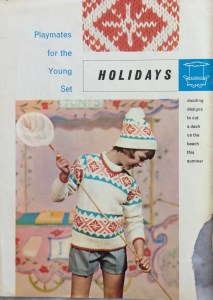
April’s theme is “Holidays Ahead” and if you are planningIMG_2440 to spend your holiday in April or May on the British isles or the North Sea coast, you will definitely want to wear one of the warm, bulky wool garments from this issue. “Jenny”‘s thick, double-knit Norwegian-style jumper and hat, described as “dazzling designs to cut a dash on the beach this summer”, tells you everything you need to know about that.

The adult garments continue the warm, bulky and casual trend with a men’s “crochet-knit shirt” and “country-style cardigan” in double knitting weight. Knitting pattern stitches that look like crochet crop up every once in a while and it’s certainly an intriguing idea. That said, I don’t think this jumper particularly looks like crochet — it’s yo, k2tog on every right-side row and purl on the wrong side in staggered rows, which is just a simple lace pattern. I’m guessing they thought the word “lace” was not manly enough… The cardigan is made in three-colour slip stitch and is probably very warm and “squishy”. I like the neat, almost hidden pockets and the narrow edging band.

The women’s garments offer two more elegant, but still casual blouses, the two jumpers with fun collar details featured on the front cover and a relaxed “holiday cardigan” in double knitting. Patons “Totem” crepe wool appears in 4-ply (the blouses) or in double knitting weight (the cardigan). “Crepe” in this case meant that the wool was spun very smooth and tightly plied to minimise “fuzziness” and give raised stitch patterns a crisp, precise look. The jumpers from the cover are designed for ever-popular Rimple wool, a crinkly wool-synthetic blend intended to look like towelling fabric. Fans of truly bulky knitting can make this his-n-hers set (well, not really a “set” as they are two completely different designs, but featured together in the photo spread). Her sweater is made in fisherman’s rib stitch and if it looks that bulky on the petite, fine-boned model, I can only imagine it would make anyone else look elephantine — but good for sailing and/or April beachwear, I guess.

Housewares include the continuation of the “Zodiac” theme with an Aries motif, a traycloth in cross-stitch, a cross-stitch and pile rug, “amusing” aprons for the whole family (the father looks utterly un-amused at having to participate in the washing-up), a village townscape needle etching, a cross-stitch cushion… i.e. the usual fare. You can also make a toy “Wag” puppy for fans of the children’s comic from the last few issues, “Wendy and Wag in Wallpaper Land.” I don’t mind telling you that it had a happy ending for everyone. And with that, happy April and see you next time!

P.S. There wasn’t any project in this issue that really called to me, so I’m going to finish up a project of my own design that was inspired by this Stitchcraft children’s jacket from March 1960 that I made last year and write about that. Stay tuned…


January 1961: Overview

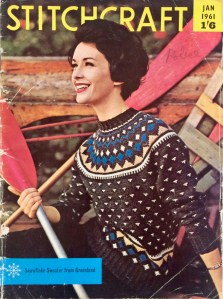
IMG_2256Happy New Year 2019! Or 1961, if you prefer. January 1961’s issue “starts with a swing” with “lots of colour” and “tip-top designs” like the gorgeous Greenlandic-style sweater on the cover.

Looking through the issue, I feel like this is the point in time where the 1960s started, fashion-wise. The closely-fitted, fine-knit, waist-length jumpers of the 1950s have made way for bulky, quick-to-knit garments, and nylon-mix wools like Rimple are more common.  Skirts are still long and hairstyles modest — we’re not in the “Swinging Sixties” yet — but colours are bolder and the whole look seems fresher, somehow.

The little girl’s outfit on the inside cover definitely embodies the new look. Yes, her legs are still going to freeze, poor child, but her little red Rimple outfit is swingy and fun. And look at that wonderful cap and muff! The decorations are made by cutting the bobbles out of a length of bobble fringe and sewing them onto a crochet chain made in contrasting green or red wool, then sewing the bobble chain onto the cap and muff. Mum and daughter can both sport the latest in “Paris Hat News”, which seems to be a sort of turret tower worn on top of your head. The loops on the bottom part of the adult hat are made by pulling loops through the knitting ridges with a bodkin or blunt tapestry needle and holding them in place with your thumb until they are all made and the wool fastened off.

Women’s and men’s fashions feature loose-fitting garments in bulky wools, either hip-length and unshaped like the Greenlandic sweater or the embroidered Viennese cardigan on the inside back cover, or “cropped and bulky” like the “slick jacket” made in thick Big Ben wool. For a more elegant look, you can knit a suit in double knitting weight and top it with a detachable fur collar.

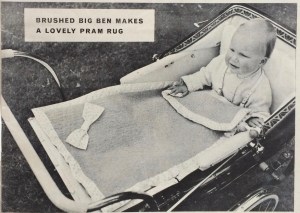
In addition to the little girl’s sets, babies and children can enjoy a warm cape or dressing gown in Rimple yarn, or a pram blanket in brushed, bulky Big Ben wool. The brushing felts the wool for a true blanket effect. It was done with a teasel, which is a metal brush that breaks up the fibres and lifts the nap of the fabric. Readers are instructed to send the finished blanket to Patons and Baldwins in Scotland, who will brush the blanket for you “at a very reasonable charge.”

IMG_2263

Jacobean embroidery, stitched hall rugs, and Victorian-style chair seat tapestry remain steadily in fashion, or you can embroider pictures of a kitten and puppy to hang on your wall. I don’t know about you, but to me they look kind of melancholic! This month’s Zodiac sign is Capricorn, and you can use it to decorate a pyjama case. In the children’s features, Wag and Wendy have tea with a toadstool fairy and kids can sew a simple tea-cosy set for their mother’s birthday.

My project will be the fabulous sweater from the front cover. I’ll be modifying the fit, though, as big and bulky is not my style. Thanks for joining me for the first year of this blog, and best wishes for 1961 — er, 2019!

November 1960: Overview

IMG_2168Brrrr! November 1960’s Special Bumper Issue” brings us “Colour for the Cold Days” and an extra 16-page pull-out booklet of baby woollies. Sadly, so sadly, the booklet from my copy of this issue has been pulled out long ago and is missing.

There are still plenty of lovely cold-weather fashions and interesting homewares to make, starting with the comfortable, matching “his and hers” sweaters from the front cover. Green checks continue to be in fashion, this time made with a complicated slip-drop-and-pick-up-later stitch pattern in two colours of Rimple. The idea of the “partner look” is just starting now, but will carry on throughout the 1960s into the androgynous 1970s and even the oversized-sweaters-for-everyone 1980s. Both fashion and gender roles were still quite rigidly stratified in 1960, but I see a parallel between the gradual softening of gender-based norms and the increased interest in gender-neutral “partner” garments that both started around this time. The two sweaters in this issue are both loosely-fitted, shaped (or not shaped, as is the case) the same, and available in overlapping sizes. The only proportional differences are in the shoulder width and sleeve/overall length, and the only cosmetic difference is the collar.

IMG_2170

Women’s fashions without men’s versions include a “sports” sweater with coloured lines made from a bobbled two-colour stitch pattern and added embroidery, a “top-fashion” jacket with a wide collar, a belted jumper and a cute hat with a buckled brim. Waist-length and closely fitted is definitely out, and the long-line with minimal shaping and a collar is definitely in. Men’s fashions are similarly long and loose-fitting, with dolman sleeves and interesting yoke details, and there’s a fantastic twin-set for young girls aged 5-9.

IMG_2172Homewares are still in a weird phase. The working woman or baby-boom mum (and those were overlapping categories, then as now) of 1960 didn’t have the time or patience to make too many elaborate Jacobean embroidery pieces or huge, detailed tapestries, especially not right before the great rush to get Christmas presents under the tree, so the focus is on quick, easy-to-make novelties for gifts. The aesthetic sense does seem to get lost a bit, though, if you ask me.

Of course, if you do have the time and leisure, you can go ahead and make a piano-stool and cushion set in Victorian-style tapestry, or a large room-divider screen with colourful parrots. Truly modern and up-to-date novelty lovers can continue the Zodiac series with a Scorpio motif for cushions, chairbacks or waste-paper baskets.

IMG_2178(I notice that Word Press does not recognise the word “chairback”. They have been out of fashion for too many years, I guess, having fallen victim to cheaper furniture, more frequent hair-washings and less Brylcreem. Pity that no one likes them now, as they do seem kind of fun.)

In the back pages, Jill Browne is still happily endorsing Patons Big Ben wool, and a lovely new children’s serial, “Wendy and Wag in Wallpaper Land” has started. Note the printed ruler at the side of the page, included in each issue as an easy way to measure your tension swatch. Also, there’s a rug reprint, a toy pig made of pink felt, a panda-bear motif and gay pot holders. What more could you want? My project will be the cloche hat, and I’ll consider the belted jumper if I have more time.


July 1960: Overview

IMG_1879“Free and easy” is this month’s motto. Summer is here and nobody really feels like handling warm wool, so the emphasis is on “travel knits” (lightweight), “casual knits” (not too complicated) and “stroller styles” (loose and oversized). There is more embroidery and needlework than knitwear, and some easy sewing projects. Shall we relax and take a look?

The combination of dark and light green continues to be in fashion: we saw it in the great houndstooth jumper from January 1960 and it’s here again in this “casual car coat” and and the loose-fitting men’s checked shirt style on the inside back cover — “suitable for golf or to wear with beach shorts.”

IMG_1898I have to take a moment here to quote one of my favourite Roald Dahl stories, “The Boy Who Talked With Animals.” It’s about a little boy who saves a giant tortoise from the soup kettle, and Dahl’s description of the tourists waiting on the beach for the caught tortoise to be hauled in has, for some reason, stayed with me through the years:

The men were wearing those frightful Bermuda shorts that came down to the knees, and their shirts were bilious with pinks and oranges and every other clashing color you could think of. The women had better taste, and were dressed for the most part in pretty cotton dresses. Nearly everyone carried a drink in one hand.

I would hope Stitchcraft readers and their men would have had better taste, but I’m not always sure.

The other “free and easy” knits are mostly nice without being really special: a pretty cardigan with knitted-in pearls, nubbly Rimple, a short-sleeved blouse and some cute tops for teenage girls.


The “plus-size” (37-40 inch bust) cardigan blouse is really elegant, though, and has a feature that I have honestly never seen in any other mid-century patterns: short-row horizontal bust darts. But unlike modern methods of short-rowing where the turning stitches are wrapped or otherwise bound up with the stitch next to it, you just cast off the stitches and cast them on again, sewing the dart up afterwards as you would a sewn blouse.  IMG_1895

For the little ones, there’s a sun-suit, a fluffy top, and a waistcoat to sew and embroider. The waistcoat is a tie-in with the current comic, “The Magic Needle”, in which our tailor hero’s magic needle has just made a lovely embroidered waistcoat for Mouser the cat. In addition to the waistcoat, you can sew a stuffed toy Mouser, and while you’re at the sewing machine you can make this adorable gingham skirt to wear “over a frothy petticoat” and an amusing apron “for the needlework stall” (Stitchcraft often gives ideas for inexpensive projects that can be sold at church bazaars or other “sale of work” opportunities.)


IMG_1881You can also embroider a tablecloth, make tea-towels in huckaback, or attempt this fabulous tea cosy and/or evening bag in faux eighteenth-century tapestry. I so, so want to make this evening bag! I would love it and use it all the time. But I am too overwhelmed by the idea of trying to make a chart based solely on the photos — the design is fairly intricate — and having never before attempted tapestry work, I fear it would just be too much for a rank beginner. I will definitely file it away for future days when I know how to approach it better.
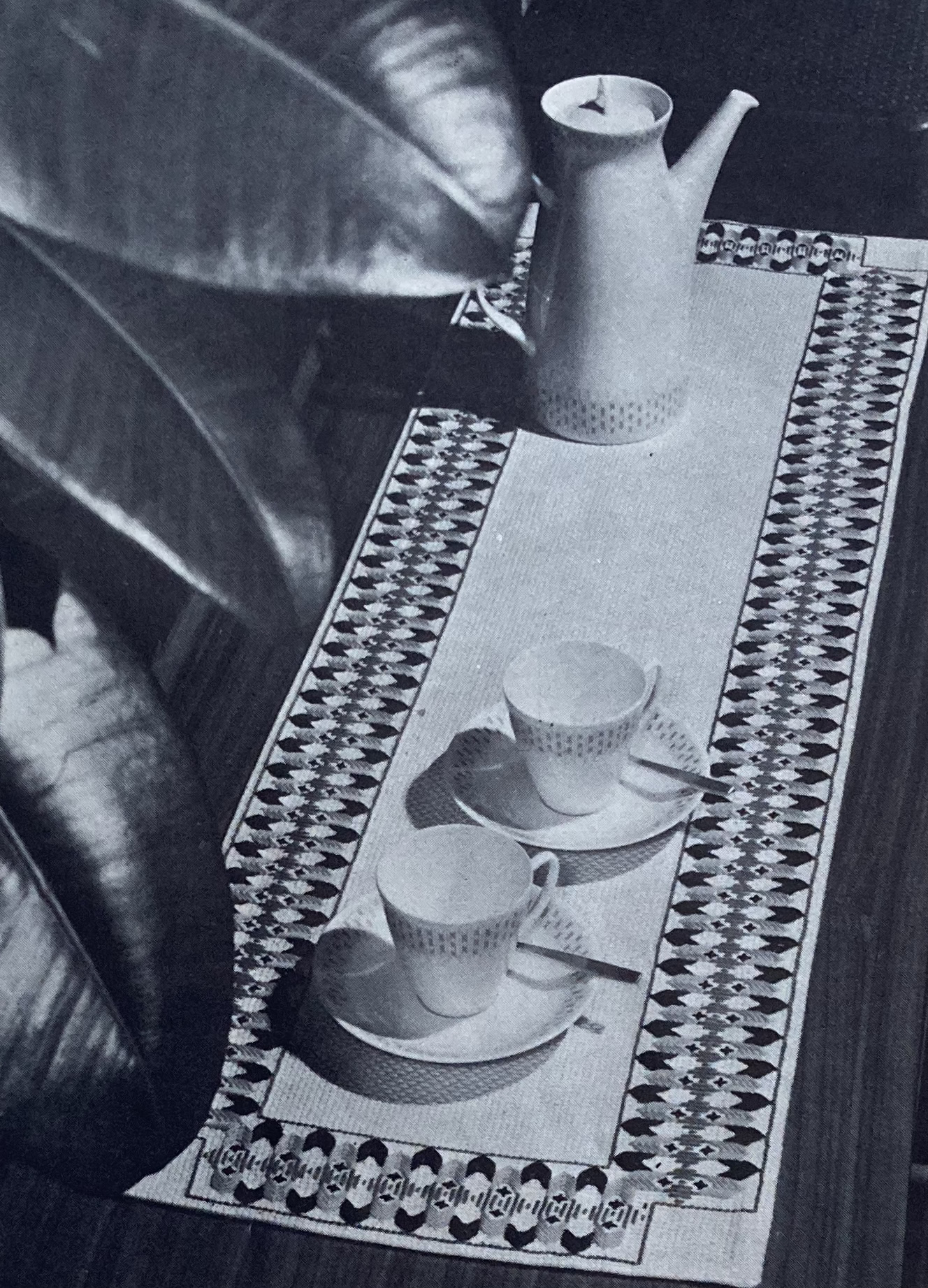
That’s it for free-and-easy July 1960! I’ll leave you with a parade of well-dressed cats, courtesy of Mr. Tuckett’s magic needle. My project from this month’s issue will be the lovely bust-darted cardigan blouse, and I’ll try to finish up the projects from April (!) and June.