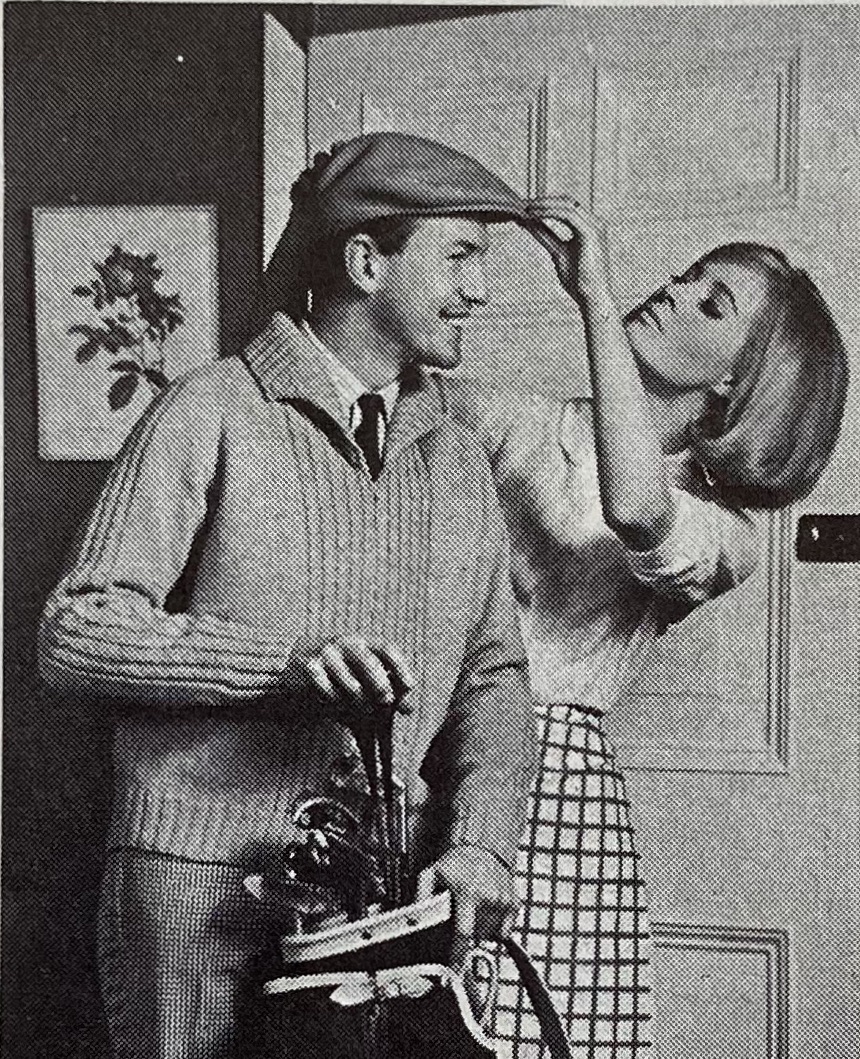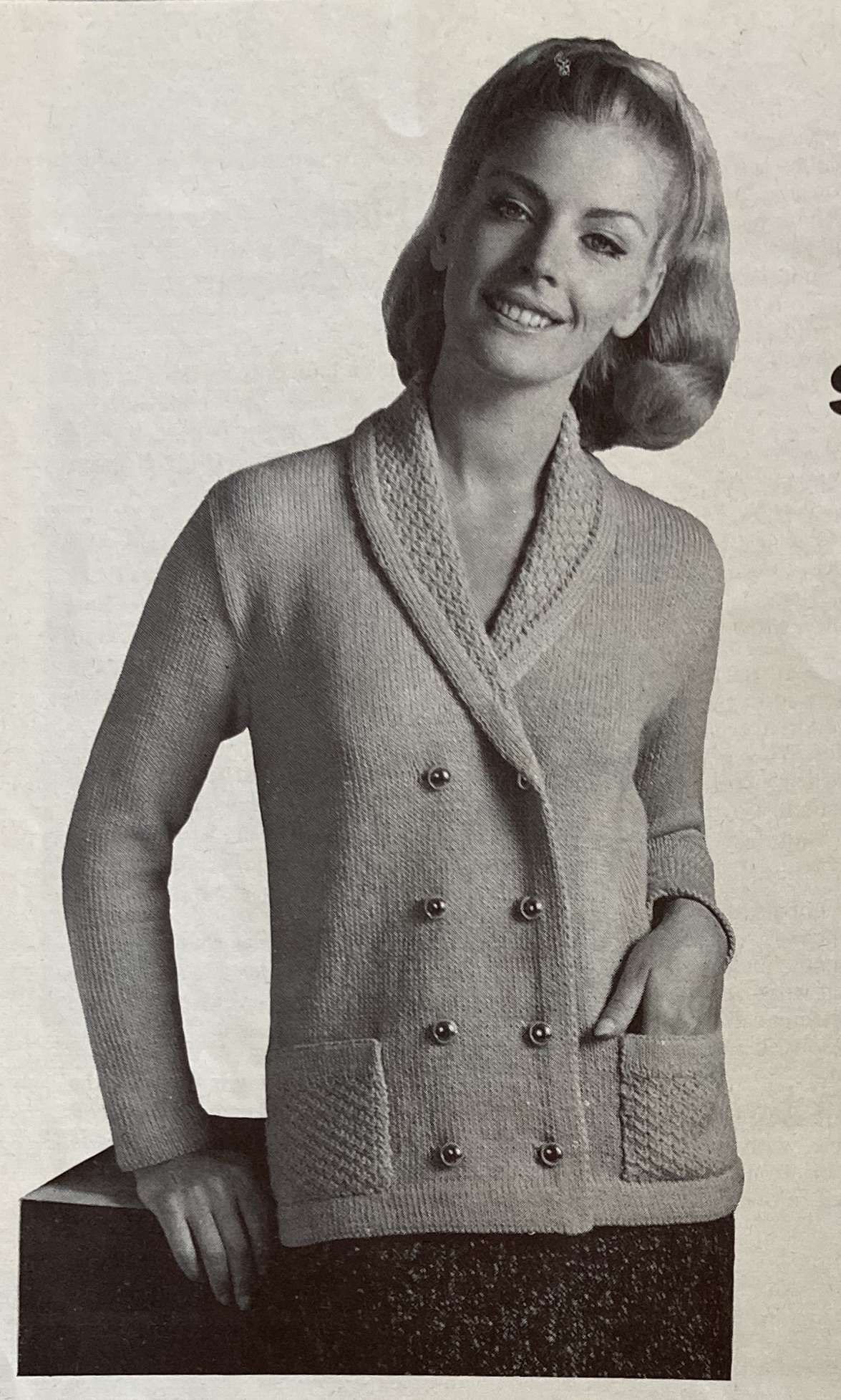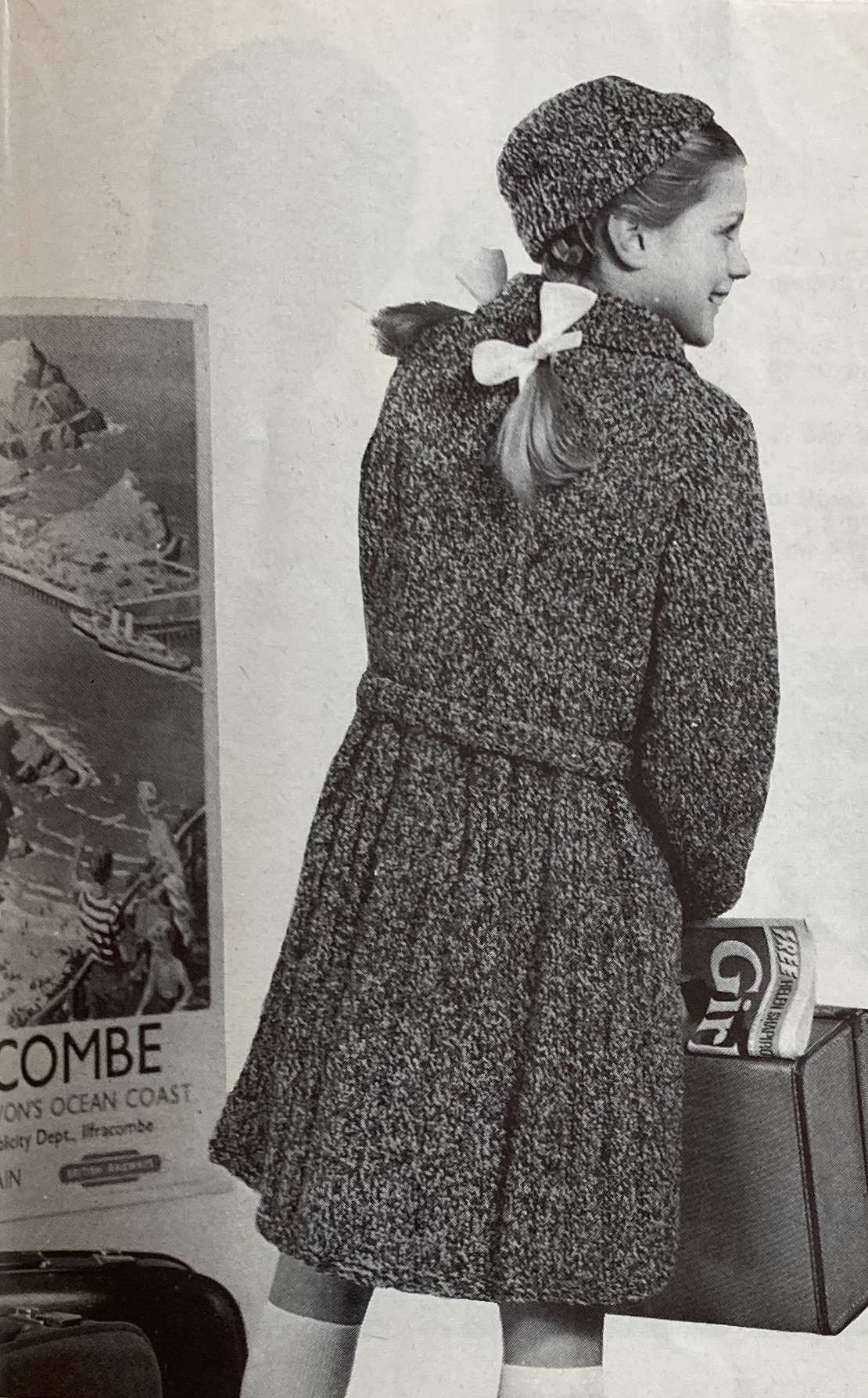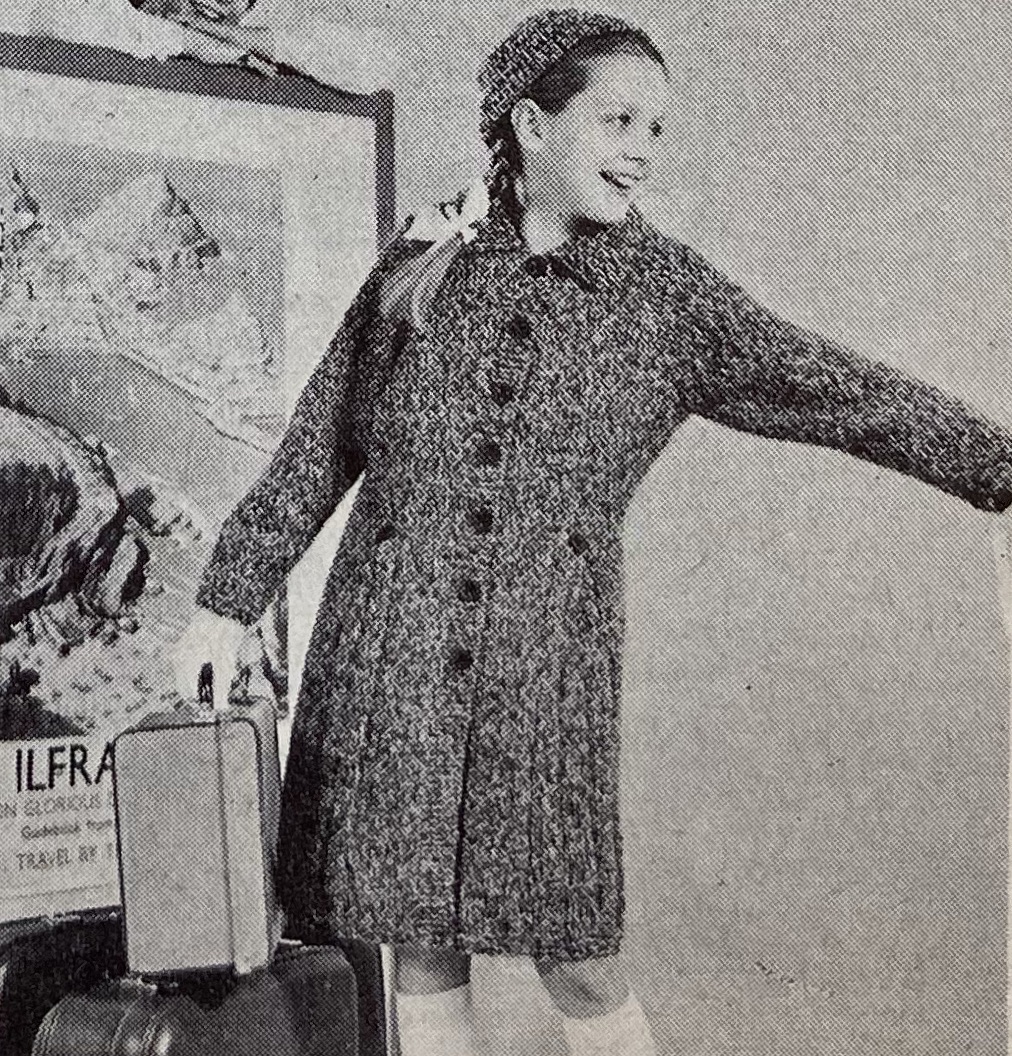
August 1965: Overview

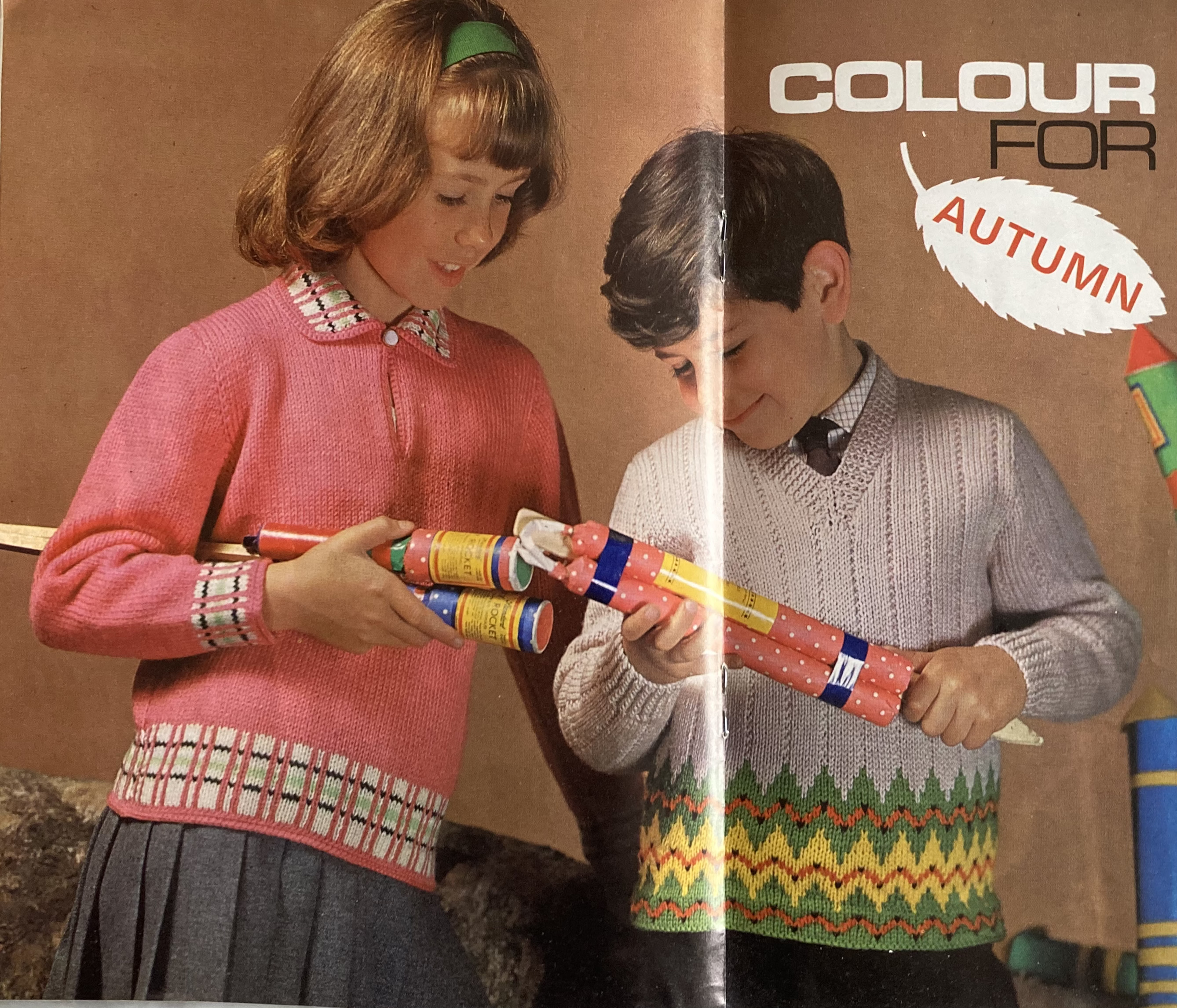
It’s “late summer” over at Stitchcraft magazine, and this month’s designs are still summery-looking, but warmer, with an eye towards the coming autumn and cooler weather. Also, production costs were apparently increasing, so readers were informed that as of September 1965, the price for individual issues would be raised to 2s. 0d. The increase to the current subscription rate of £1 8 s 0d for one year or 14s for six months, post-free to any part of the world (!) was scheduled to be explained in the September issue, with existing subscriptions running out at the old price.
To make up for the price increase…

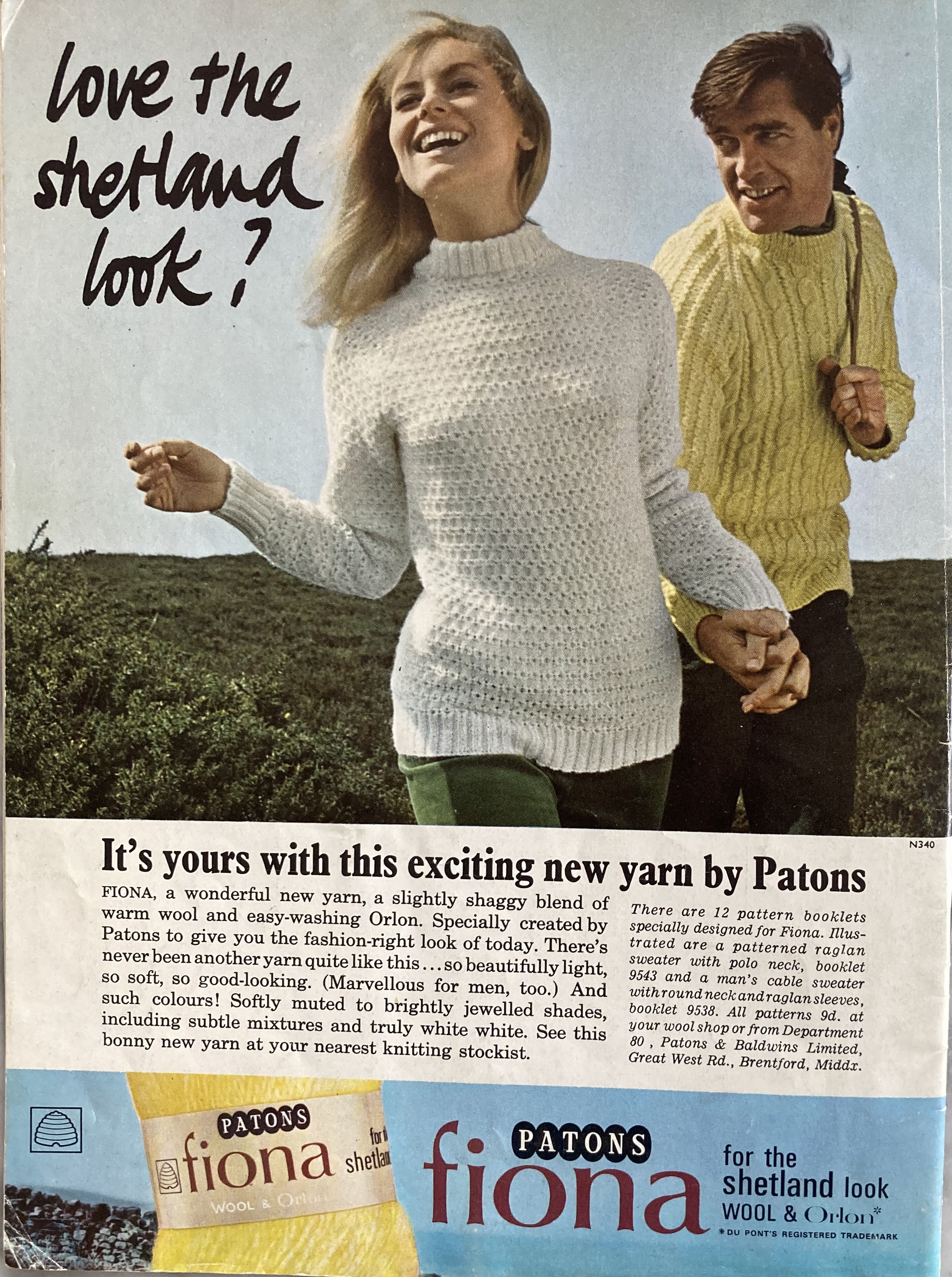
How much was that in today’s currency? I cannot vouch for the accuracy or lack thereof from either of these sources, but the currency converter website of the National Archives tells me that a year’s subscription at the old price would be the equivalent of £24.67 in 2017 (the latest year the website calculates to), so quite inexpensive for 12 issues. A six-month subscription would cost £12.33, so pretty much exactly half (if you round up a penny, since a six-month subscription certainly wouldn’t have cost less than half of the yearly price.) A single issue at the new price would cost £1.76. According to this inflation calculator (again, take all of this with a grain of salt as such converters are always approximate), in 2023 prices that would come out to £2.21 for a single issue at the new price and £31.01 for a year’s subscription at the old price — again, quite reasonable, if the converters are at all accurate. Stitchcraft was published by Condé Nast as an independent publication, but of course was a co-product of Patons / Patons and Baldwins / at this point the company had been merged with J&P. Coats / yarn company, so served as an advertisement for their wools. As was common for knitting magazines at the time as well as today.
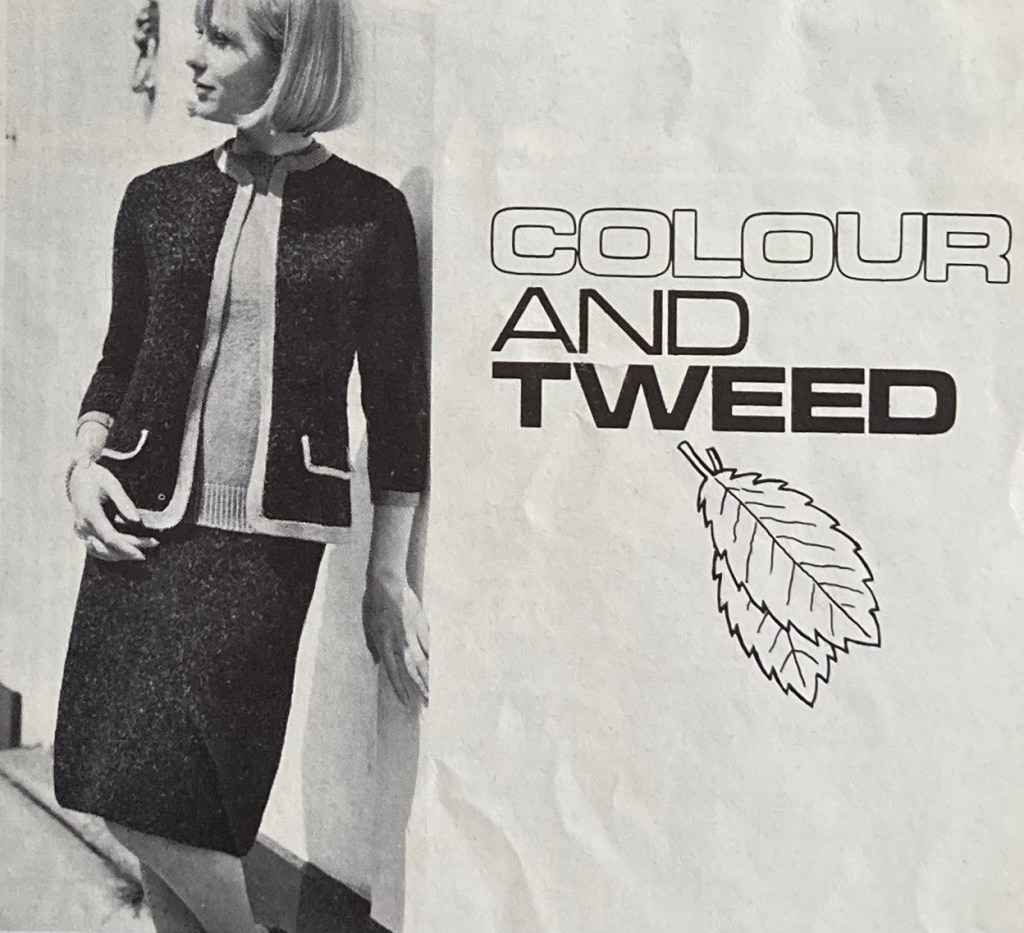
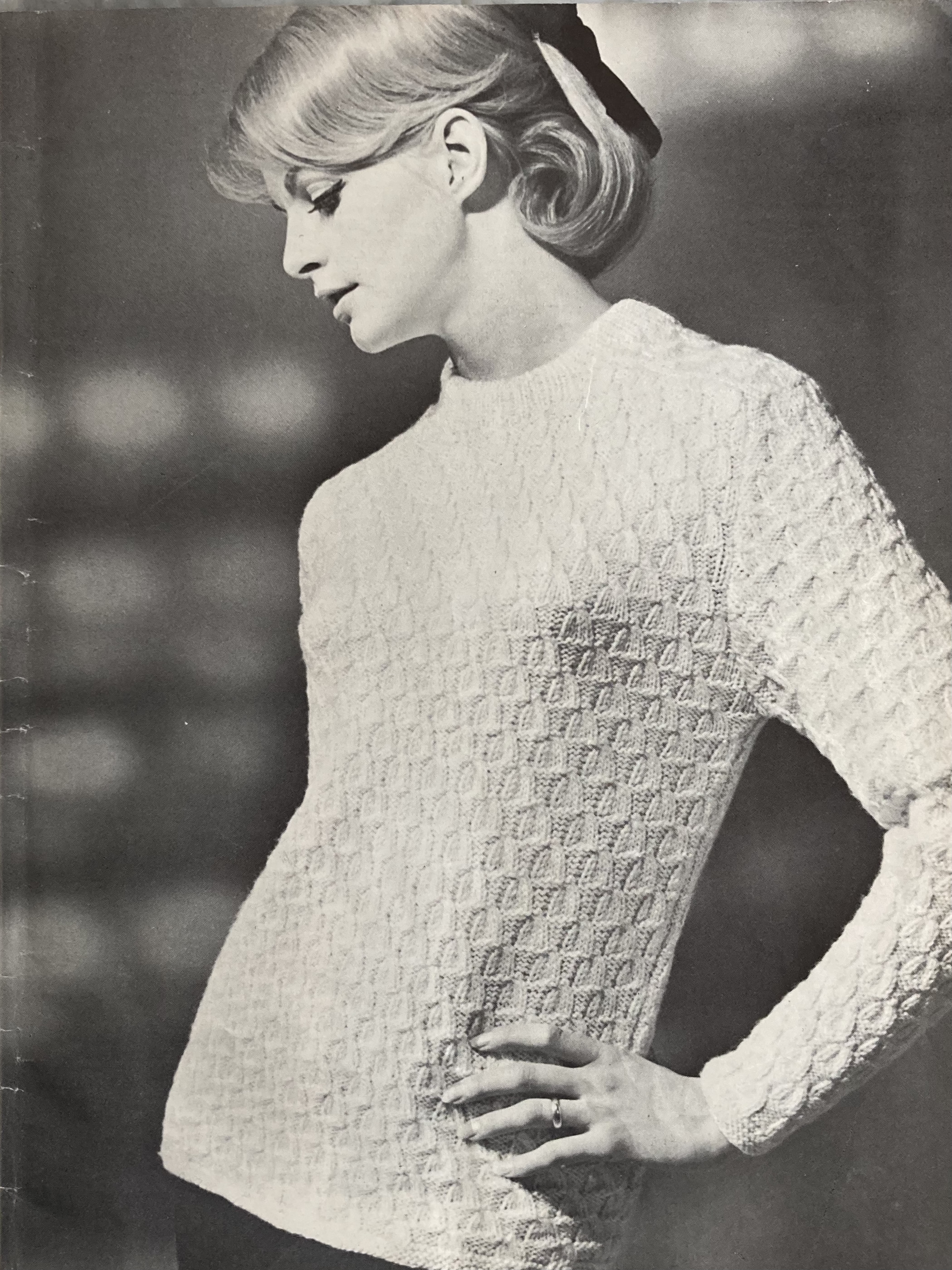
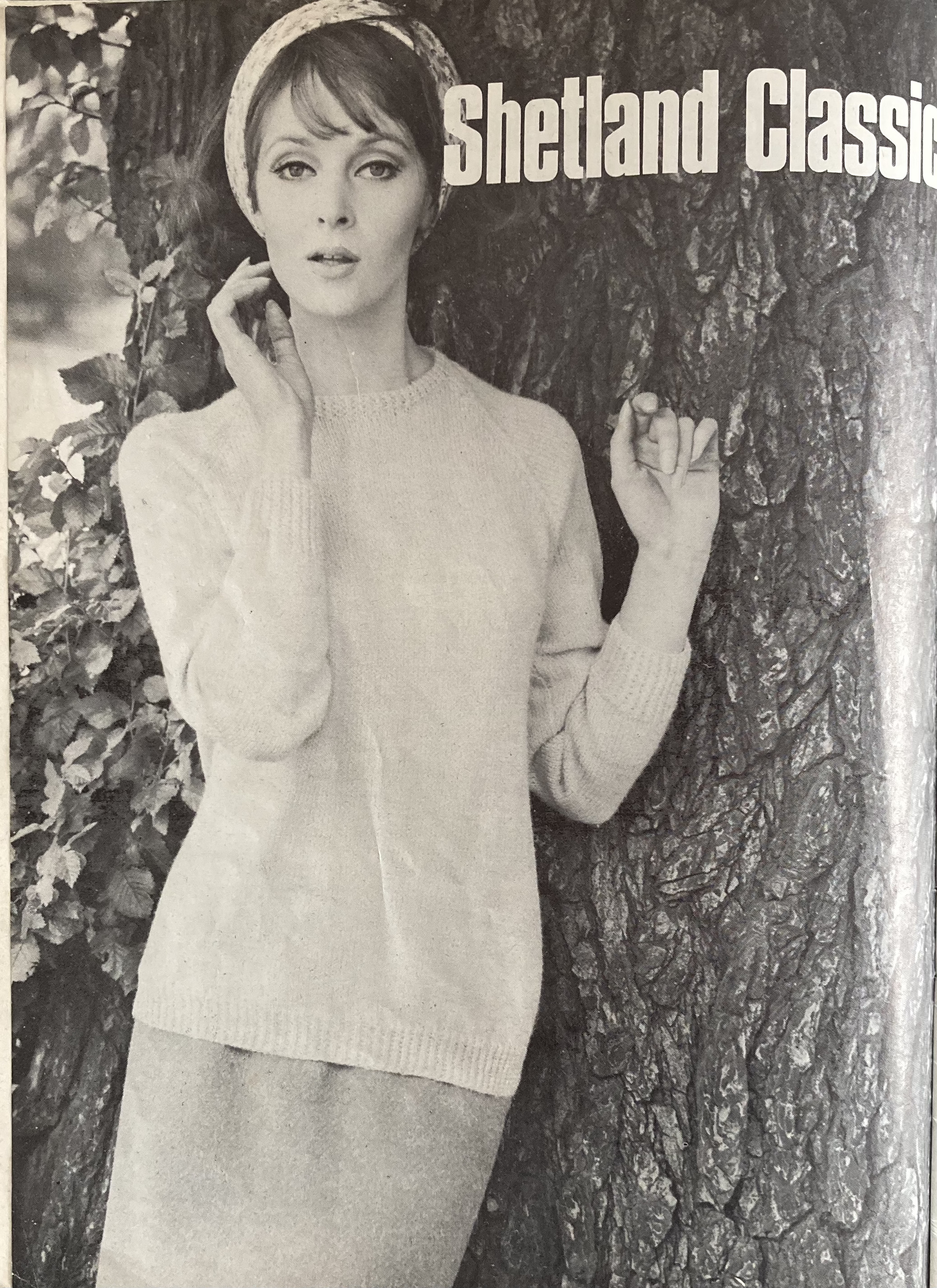
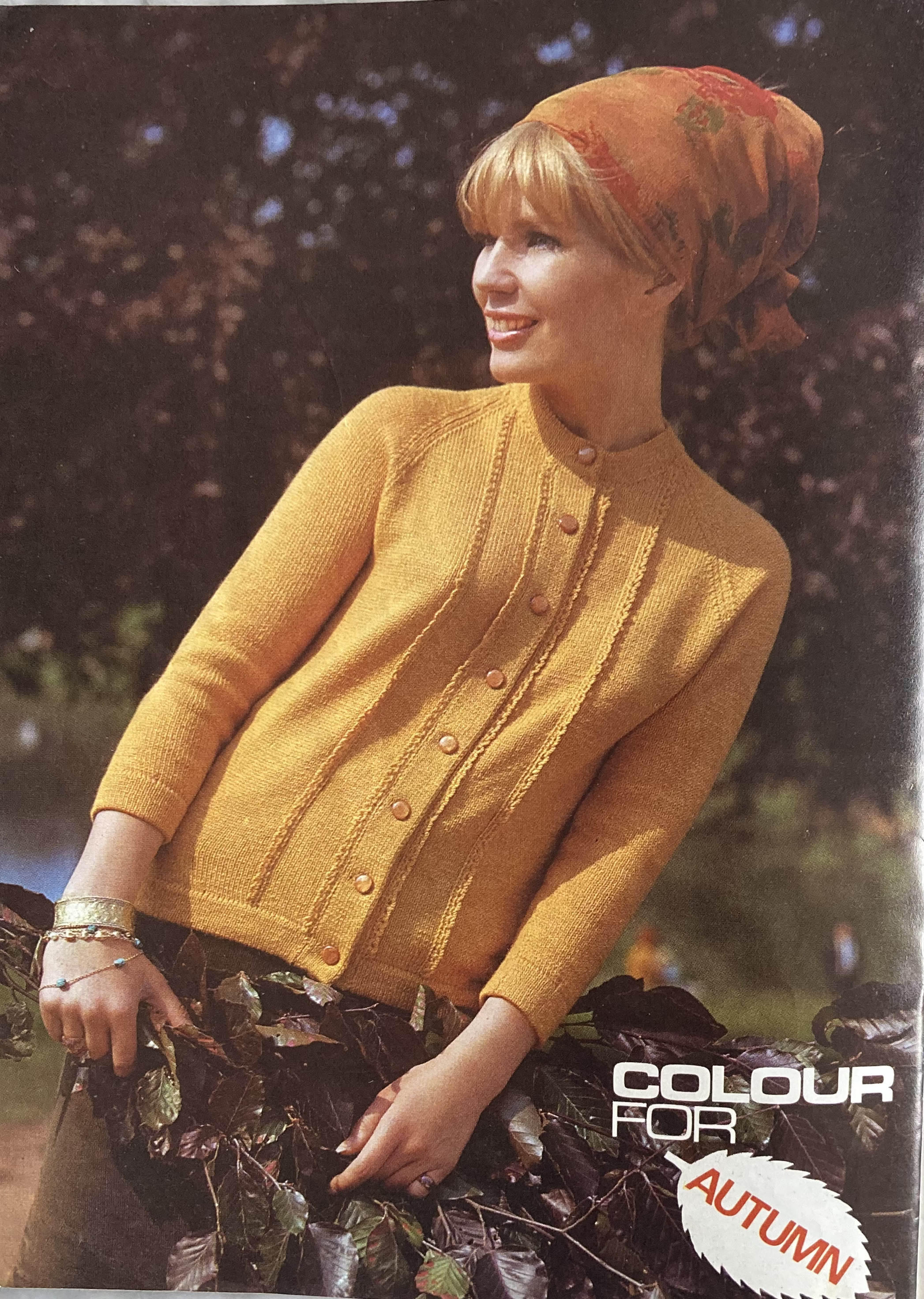
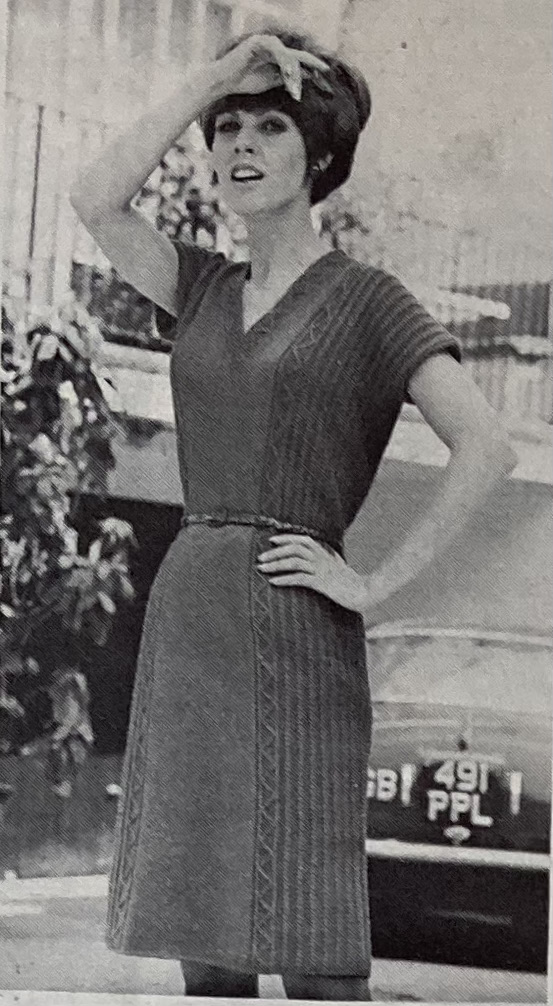
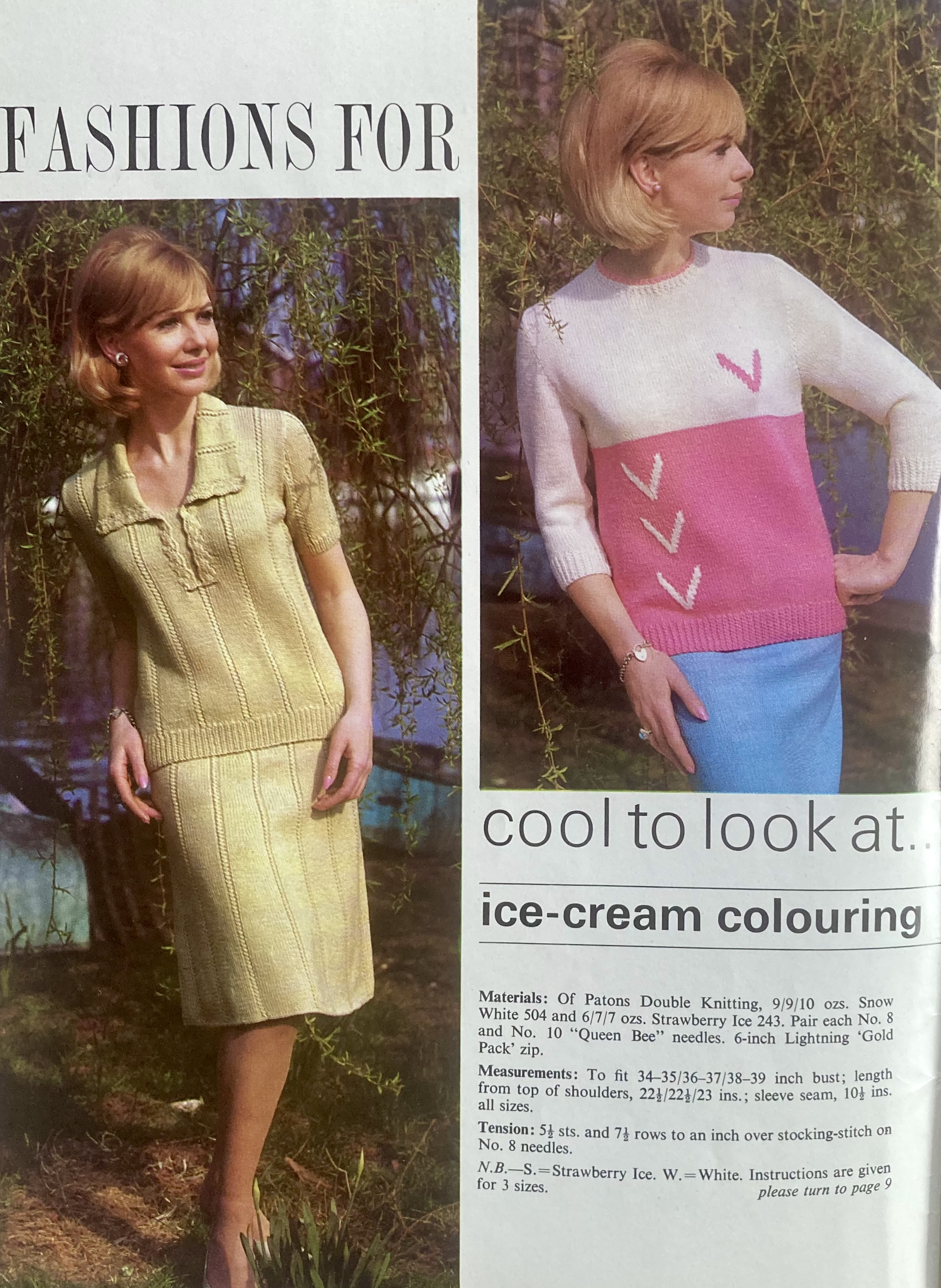
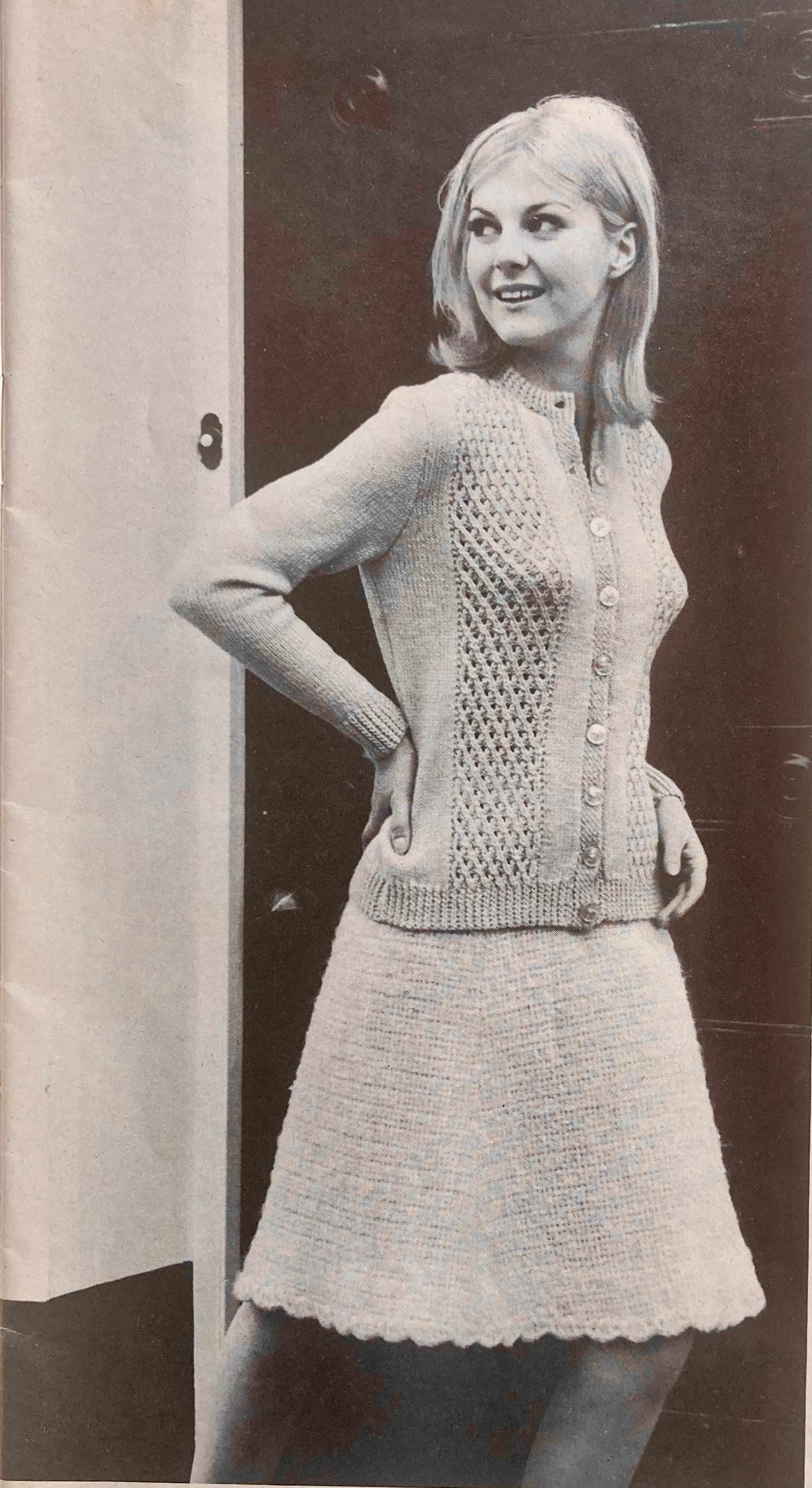
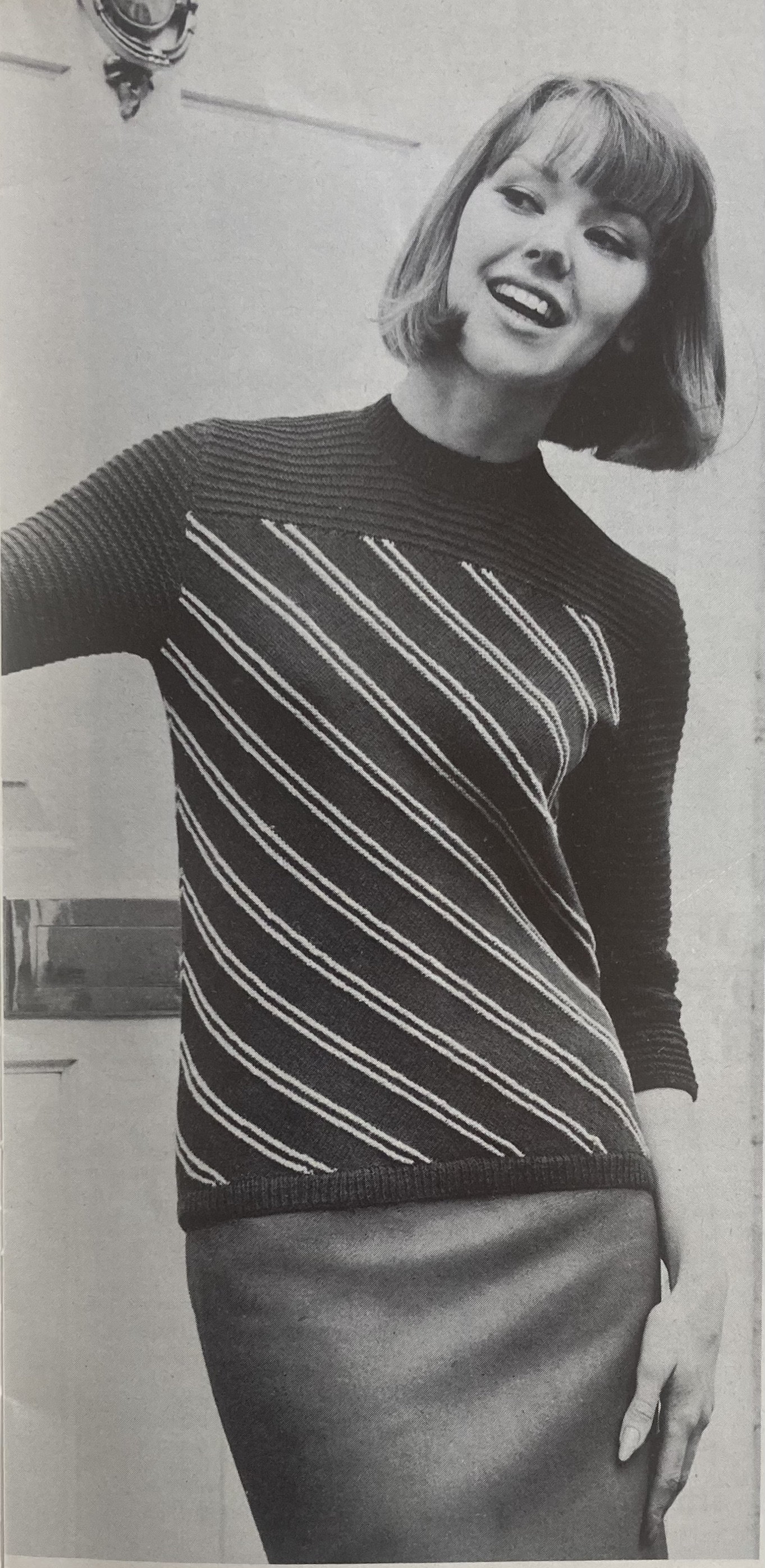
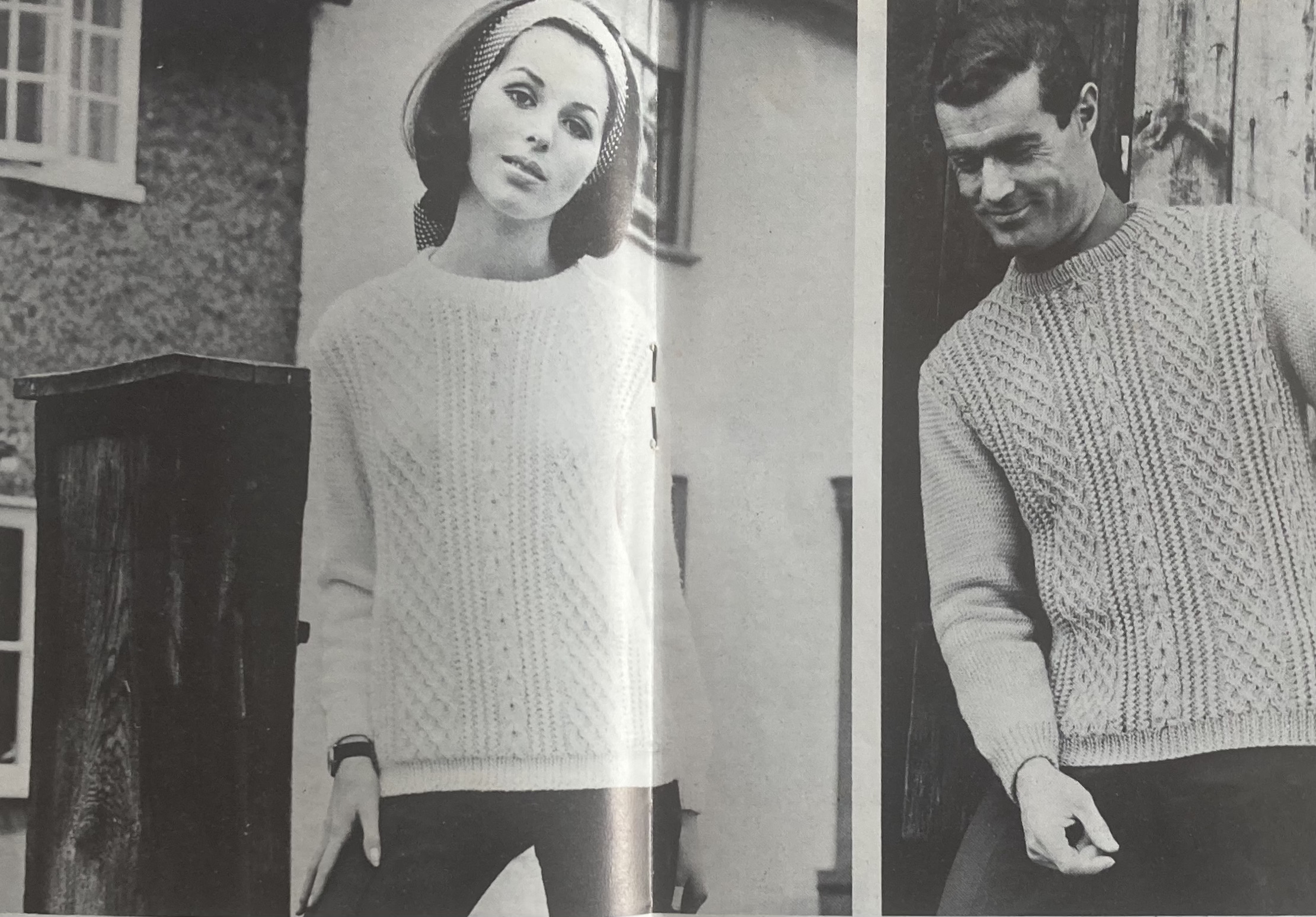
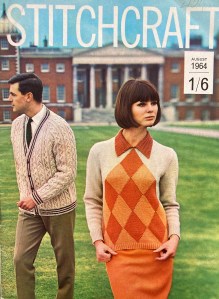
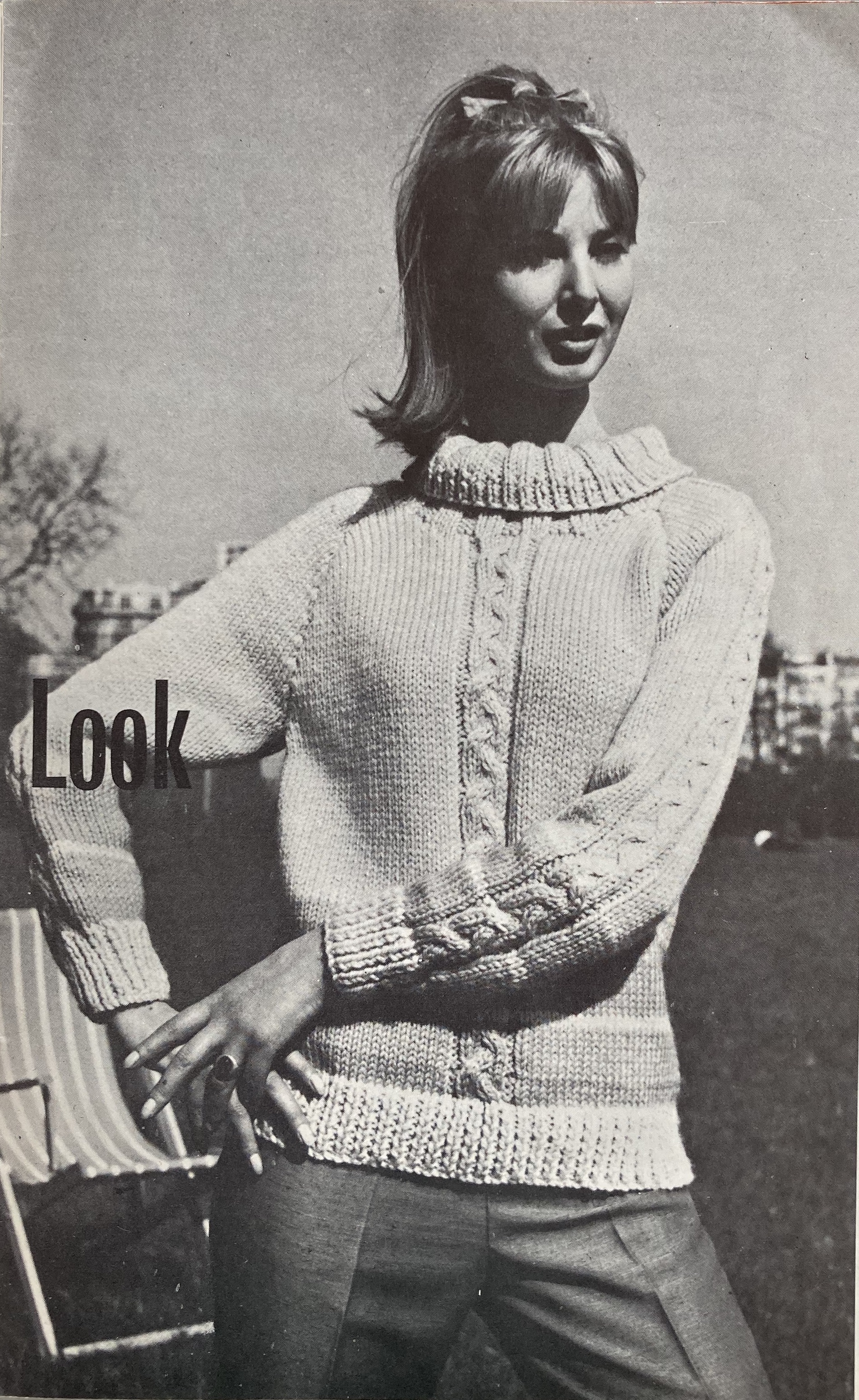
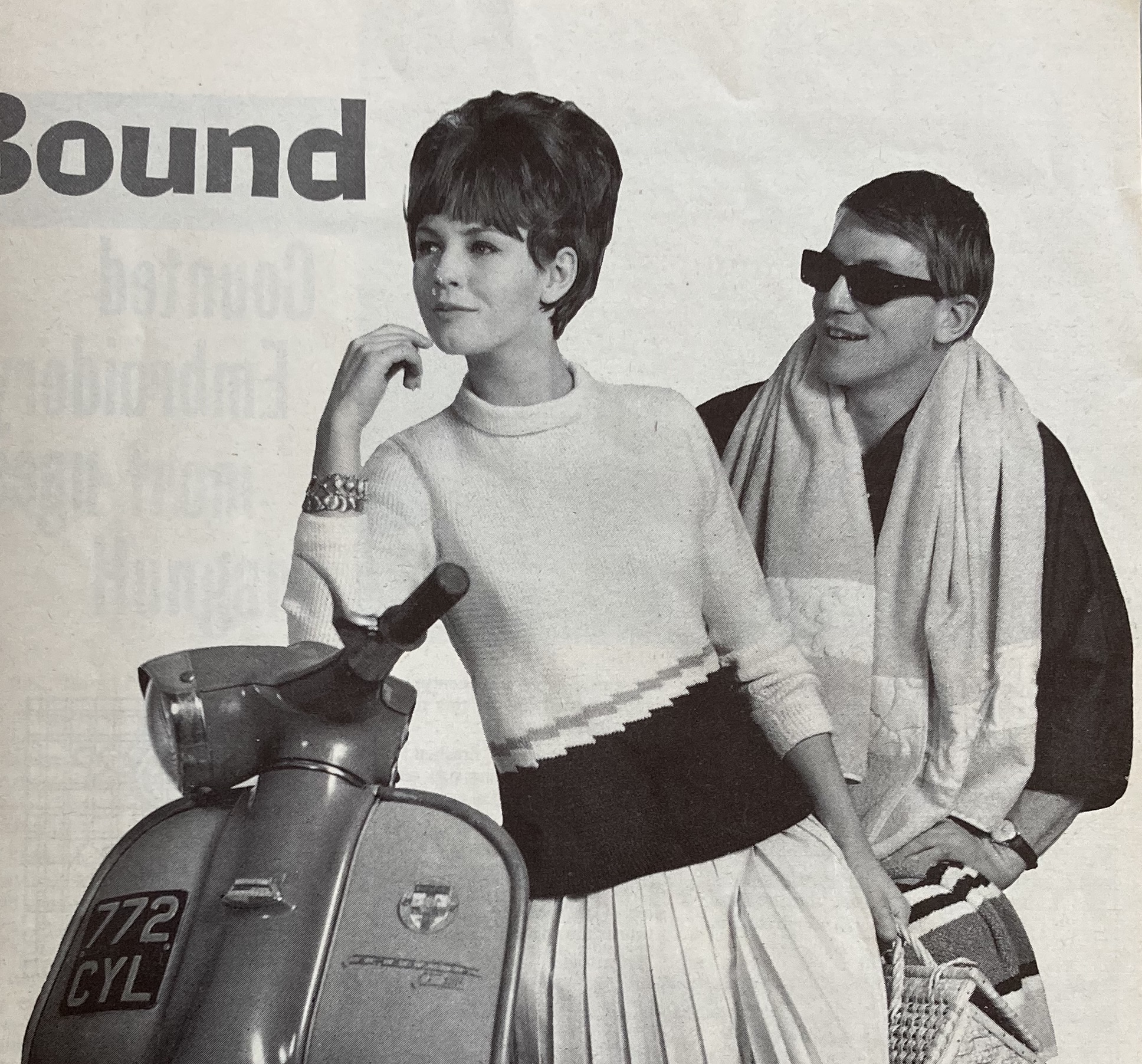
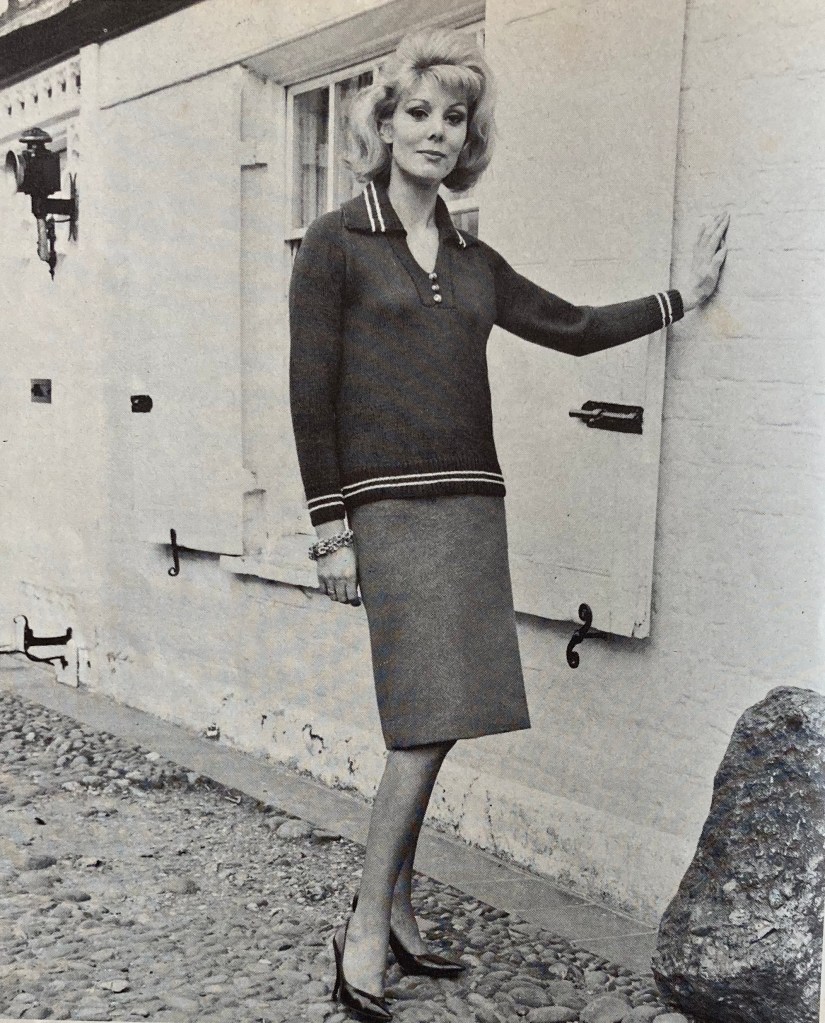
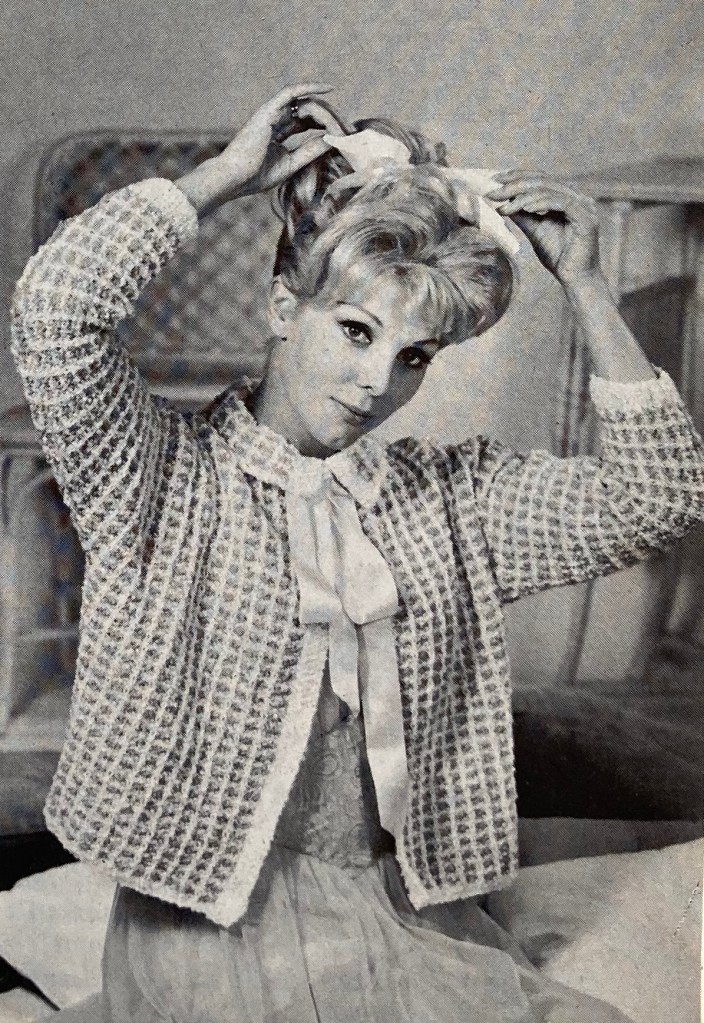
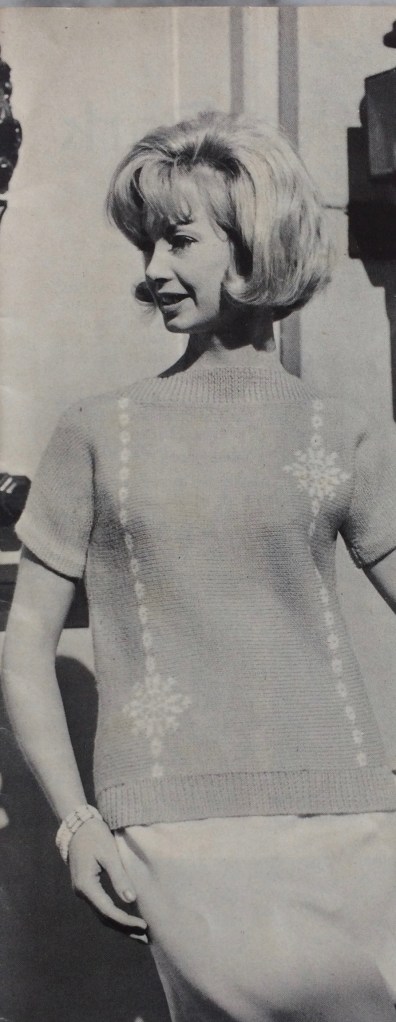
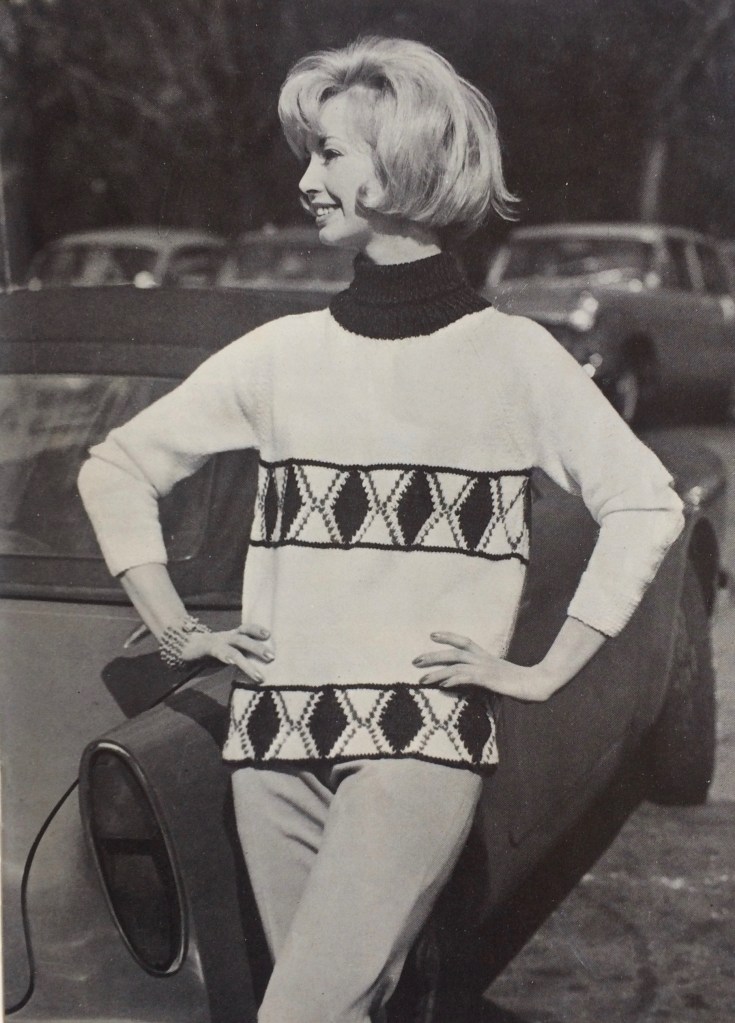
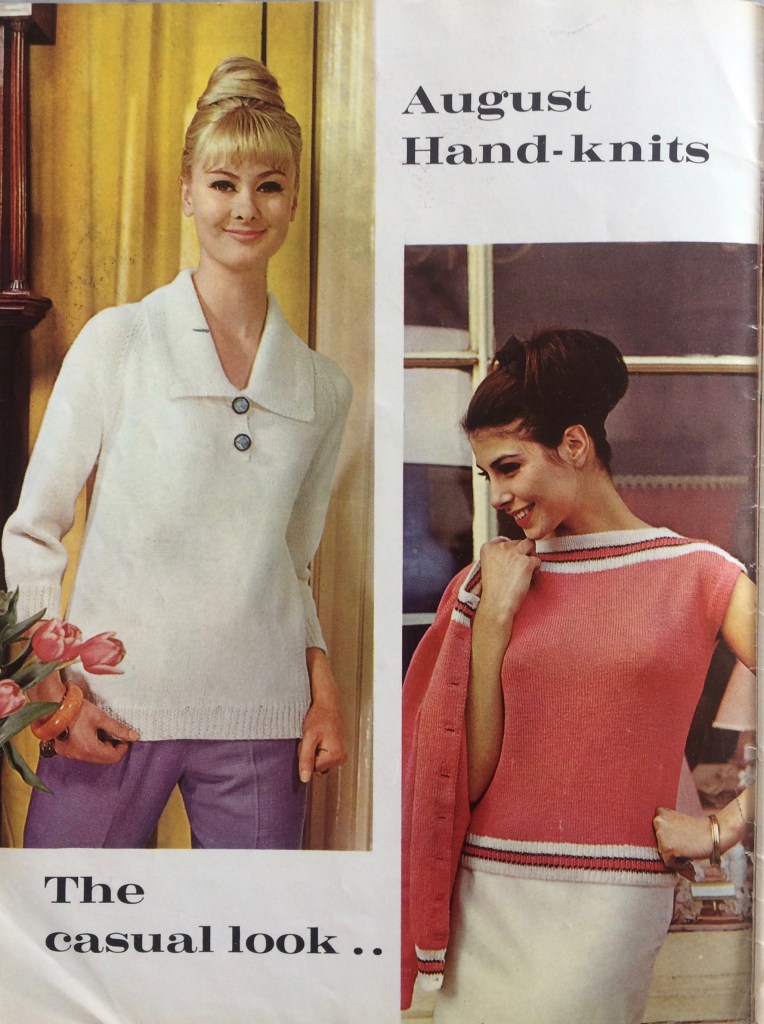
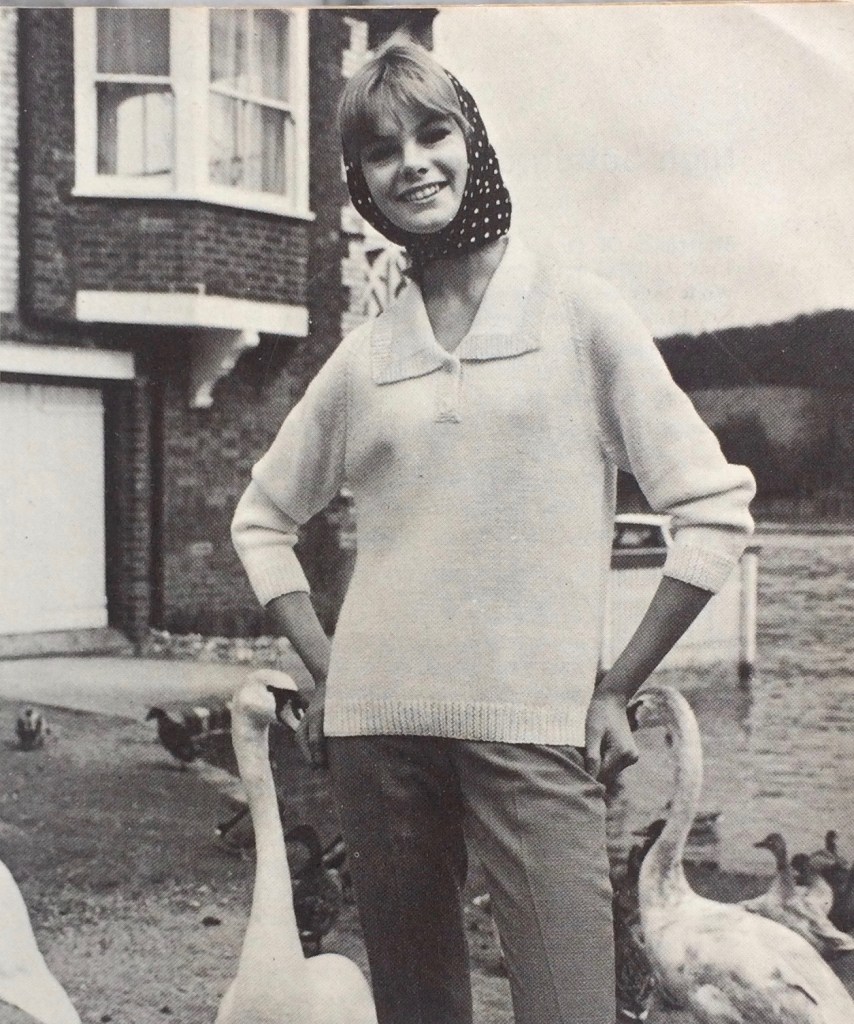
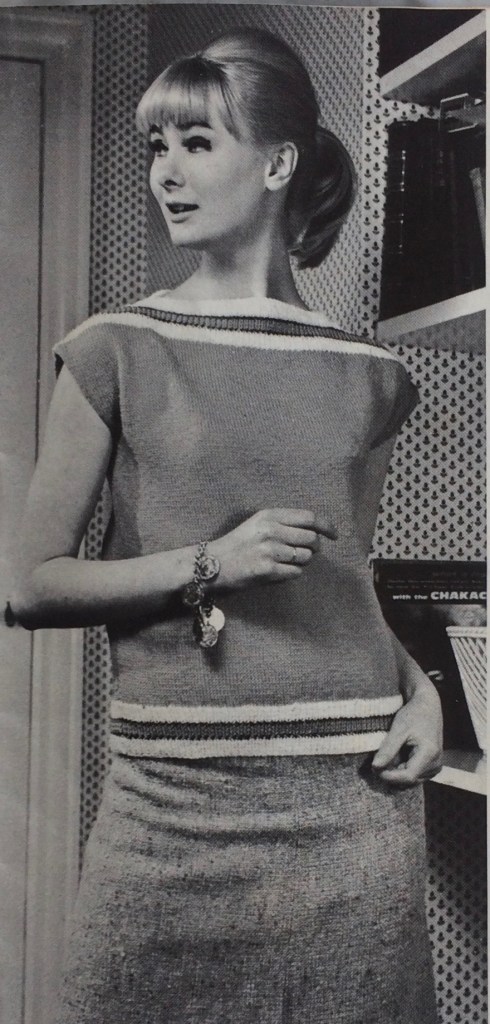
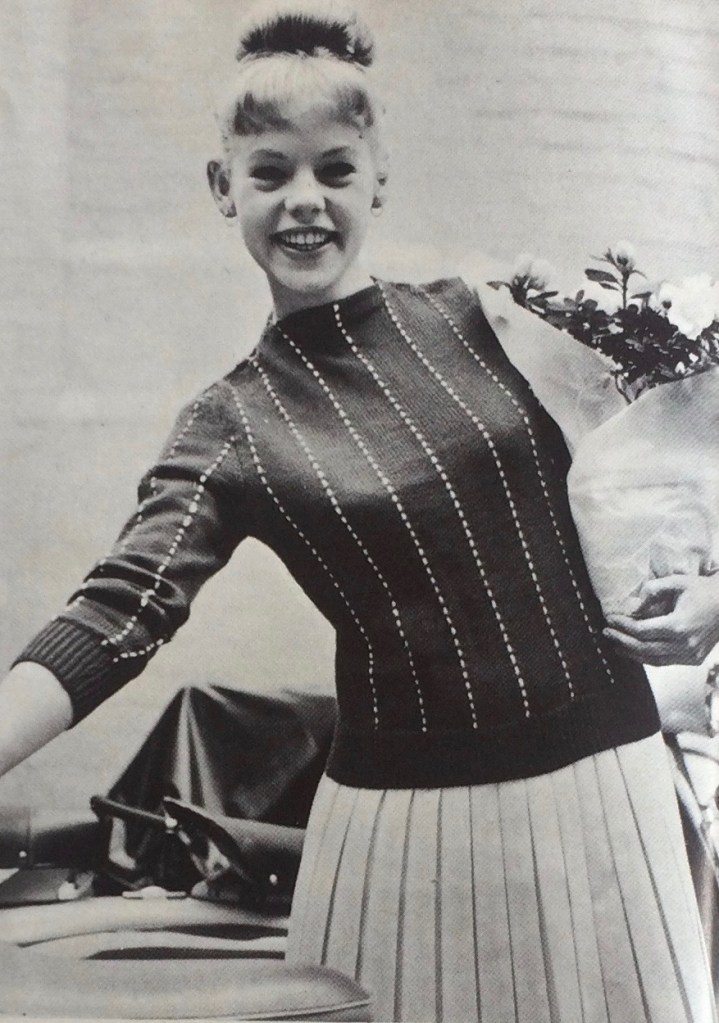
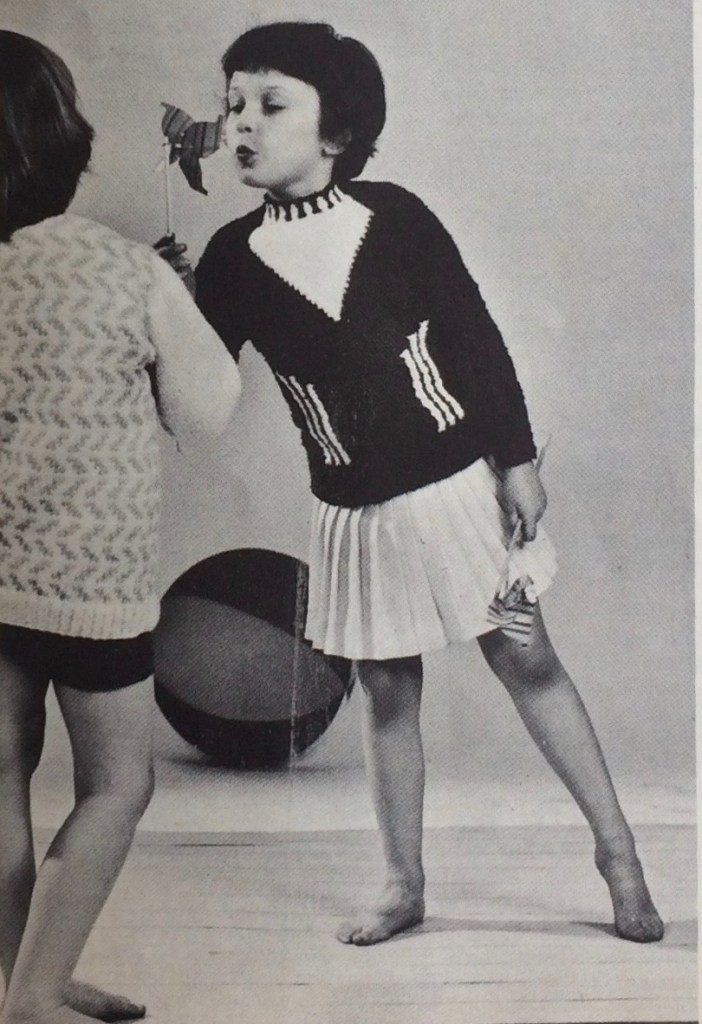
But I digress! The cover photo shows Aran sweaters in the partner-look for him and her, made in slightly-heavier-than-DK “Flair”, a wool-synthetic mix. Other fashions for women strike a balance between “cool to look at… warmer to wear” and include a two-piece DK dress with a short-sleeved top or a DK sweater in “ice-cream” colours of bubblegum pink and white. For the coming autumn days days, there’s a DK cardigan made warmer and heavier by the use of trellis-stitch panels on the front and back, or for a lighter touch, there’s a 4-ply jumper with diagonal stripes, knit diagonally — basically two rectangles for front and back, then picking up stitches for the vertically-knit yoke, and separate sleeves. The colour scheme is definitely still summery, with the striped jumper in navy blue and white and the trellis cardigan in light “Beau Blue”.

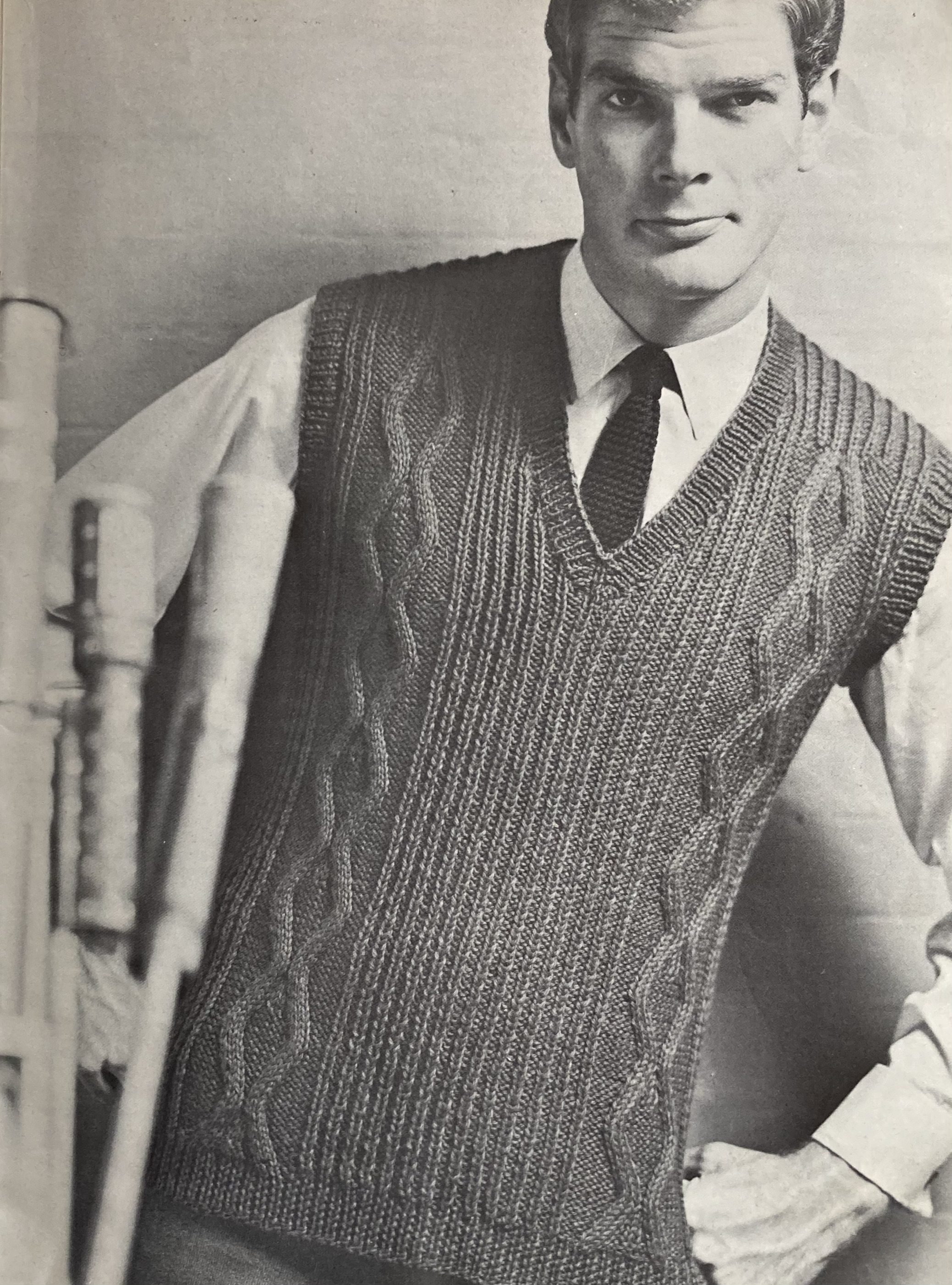
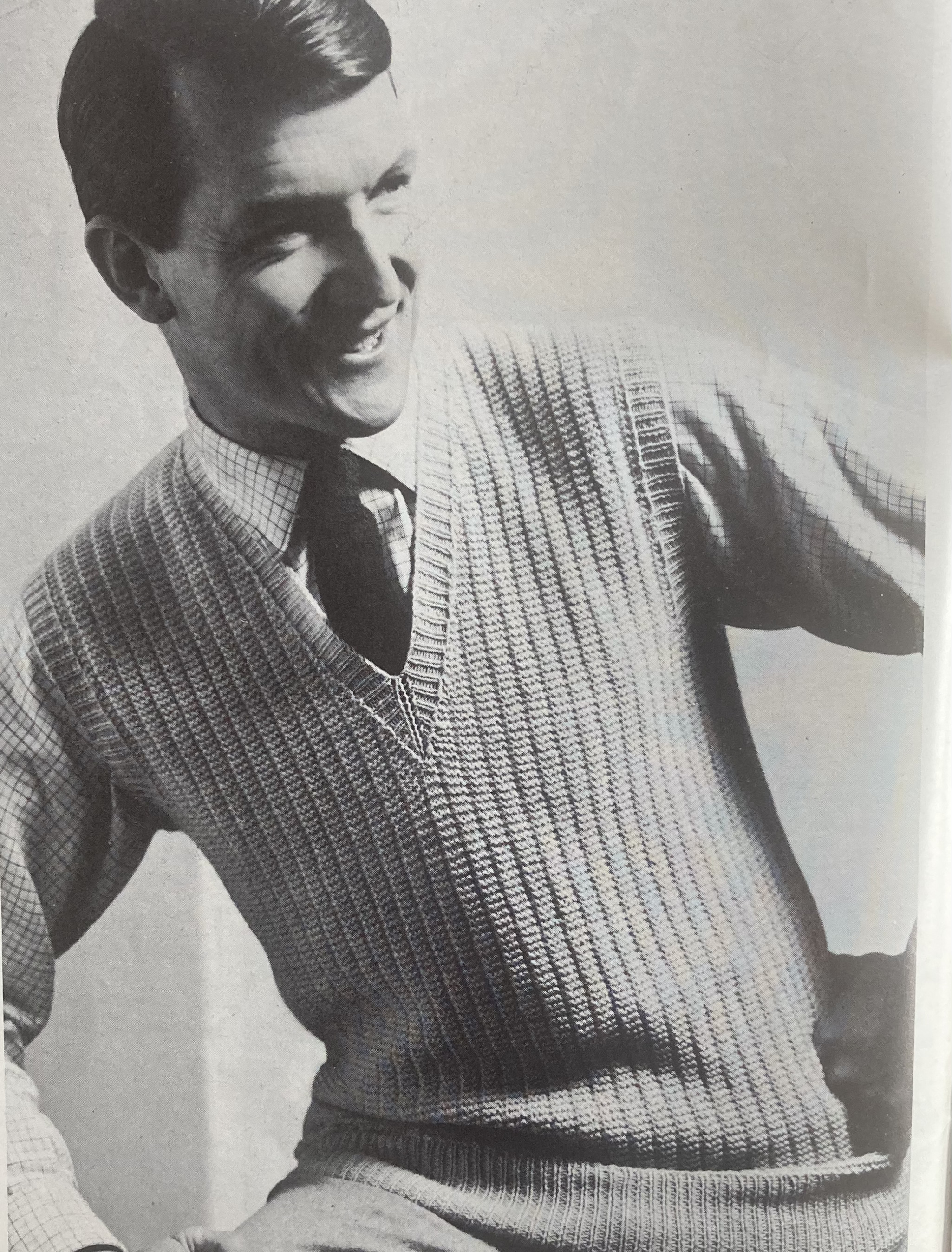
For men, in addition to the Aran-pattern sweater on the front cover, there’s a nice 4-ply slipover, made warmer by the use of a sort of broken garter stitch pattern: every 4th stitch is knit through the back on the RS rows and purled on the WS rows to create a pseudo-ribbing effect.

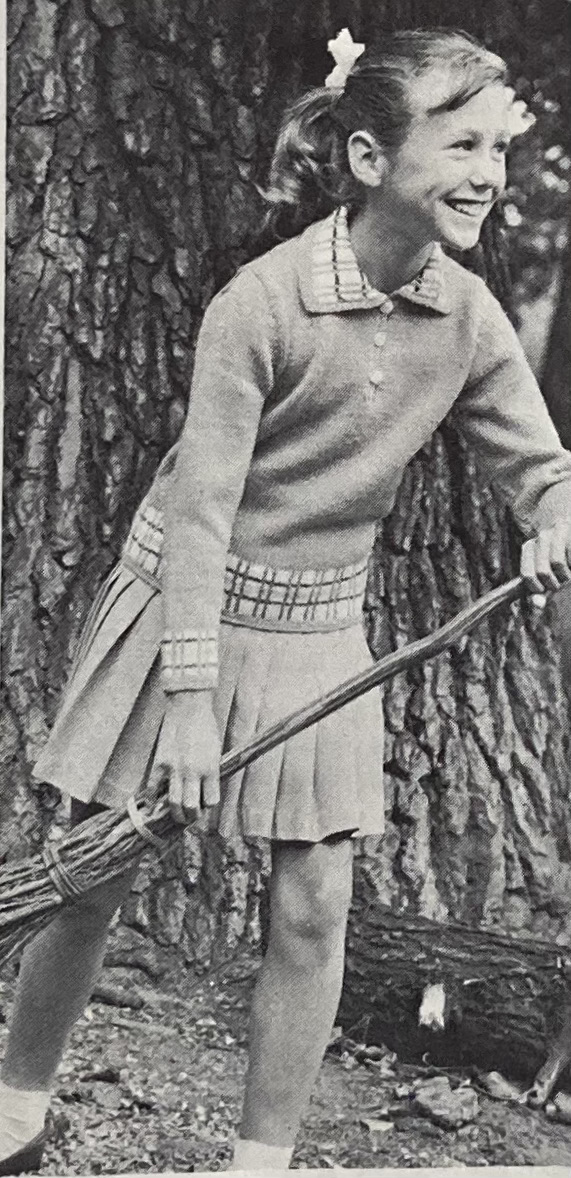
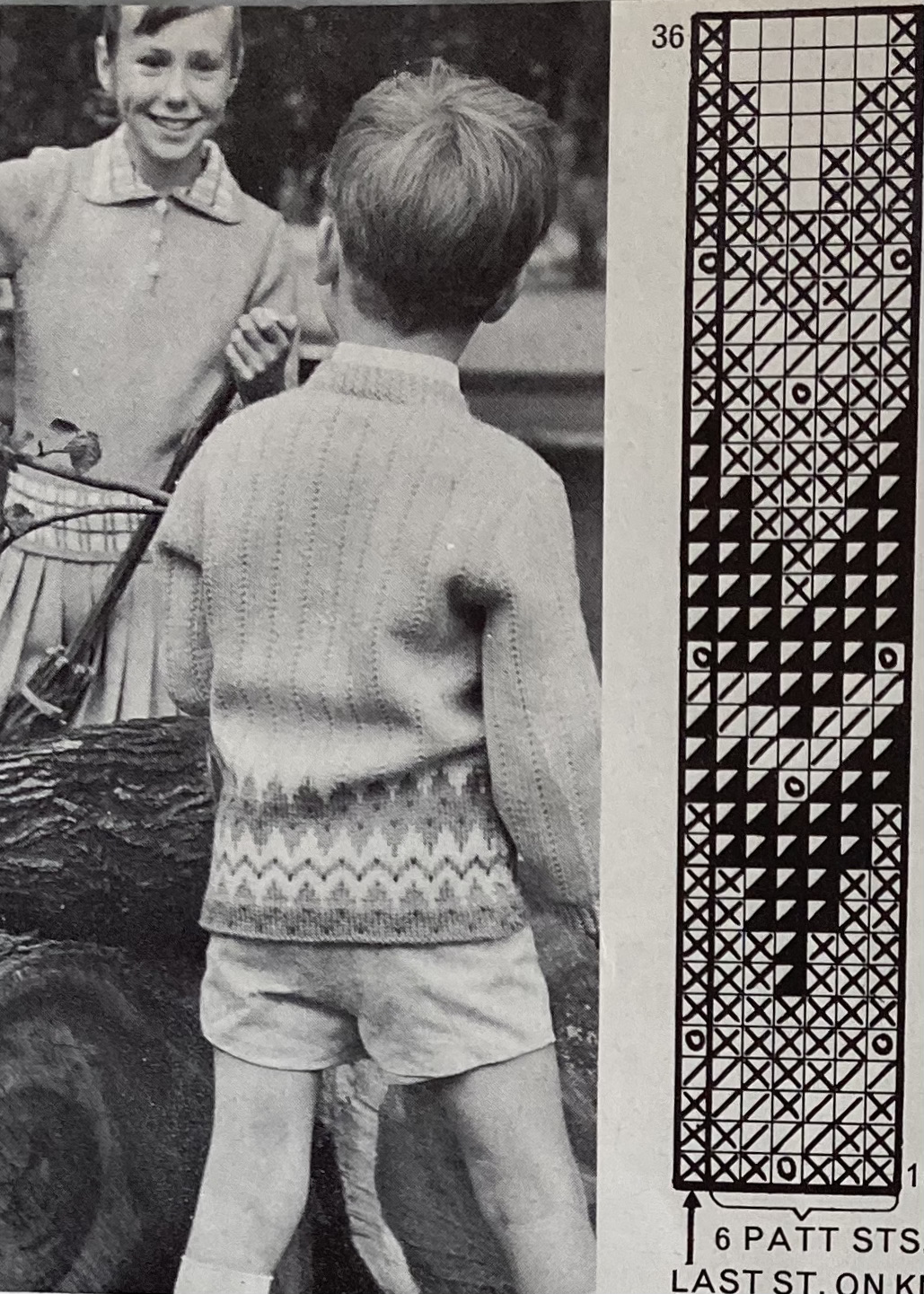
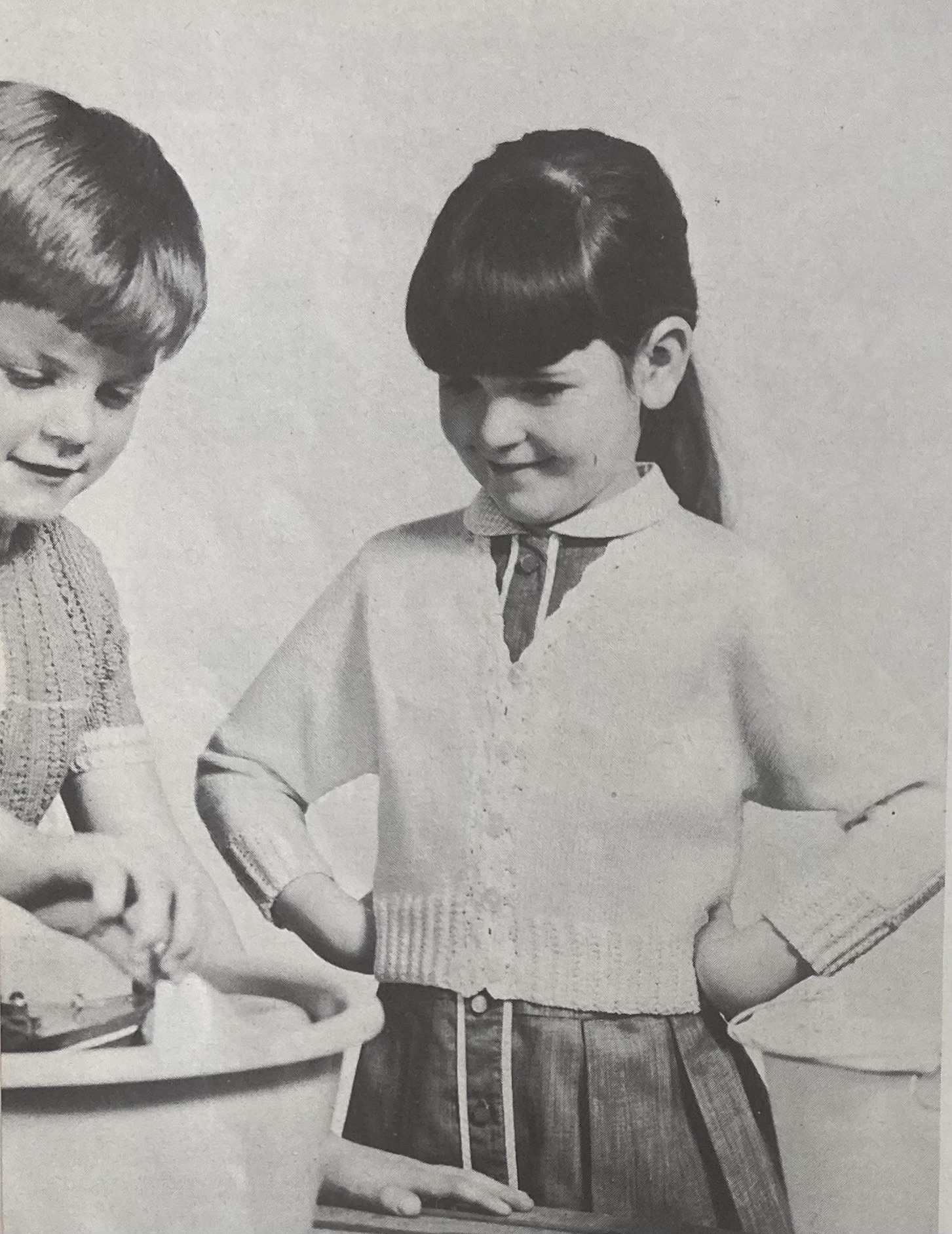
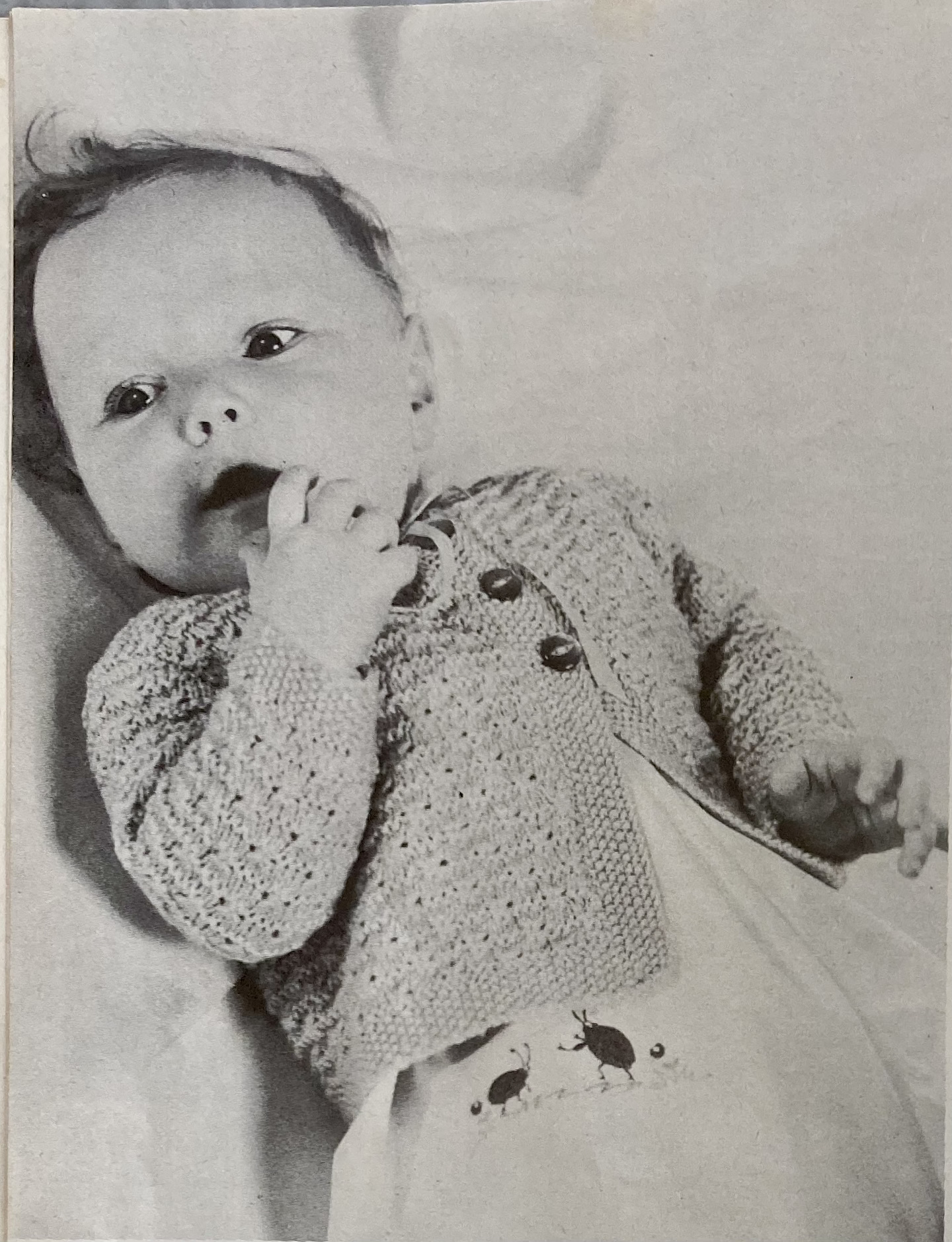
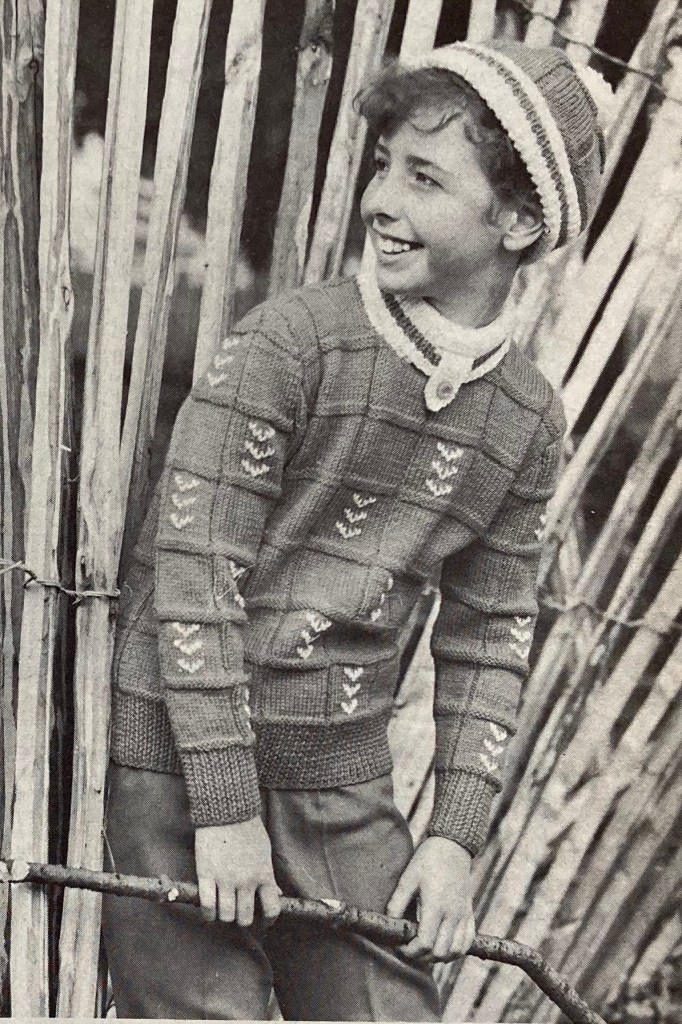
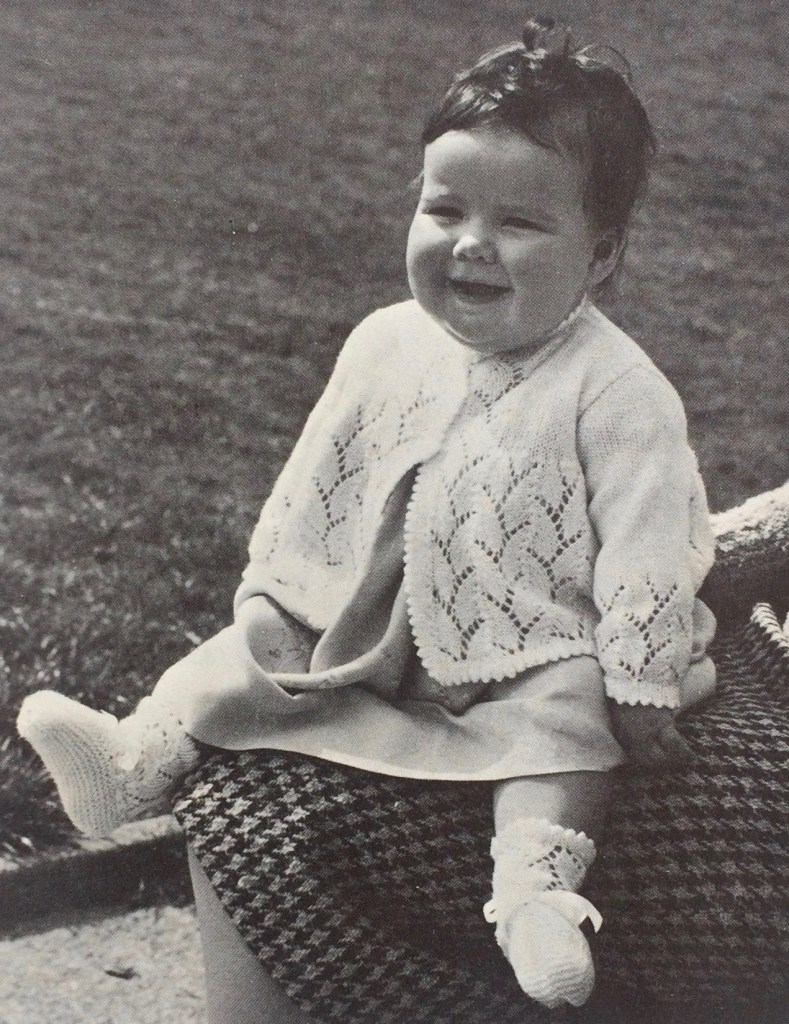
This month, we once again have children’s fashions for all ages. There’s a dolman cardigan for girls up to a 29 inch chest and a cute unisex “play shirt” up to 28 inch chest, all in sunny colours of gold, white, “Gay Turquoise” and “Sunglint”. Baby’s turquoise “extra jacket” is worked in one piece up to the armholes in a stitch pattern that looks a bit like the one for the man’s slipover, but is more complicated:

  • 1st row: WS facing, knit.
  • 2nd row: *k3, k3 tog and leave on needle, then k. 1st st again, then k tog the other 2 sts and slip off needle, k 3*, rpt to last 3 sts, k3 tog and leave on needle, k 1st st again, then k tog the other 2 sts and slip off needle
  • 3rd row: purl
  • 4th row: knit
  • 5th row: knit
  • 6th row: *k3 tog and leave on needle, then k. 1st st again, then k tog the other 2 sts and slip off needle, k 3*, rpt to last 3 sts, k3 tog and leave on needle, k 1st st again, then k tog the other 2 sts and slip off needle
  • 7th row: purl
  • 8th row: knit

I’ve never seen this stitch before — does anyone know it, or know if it has a name?

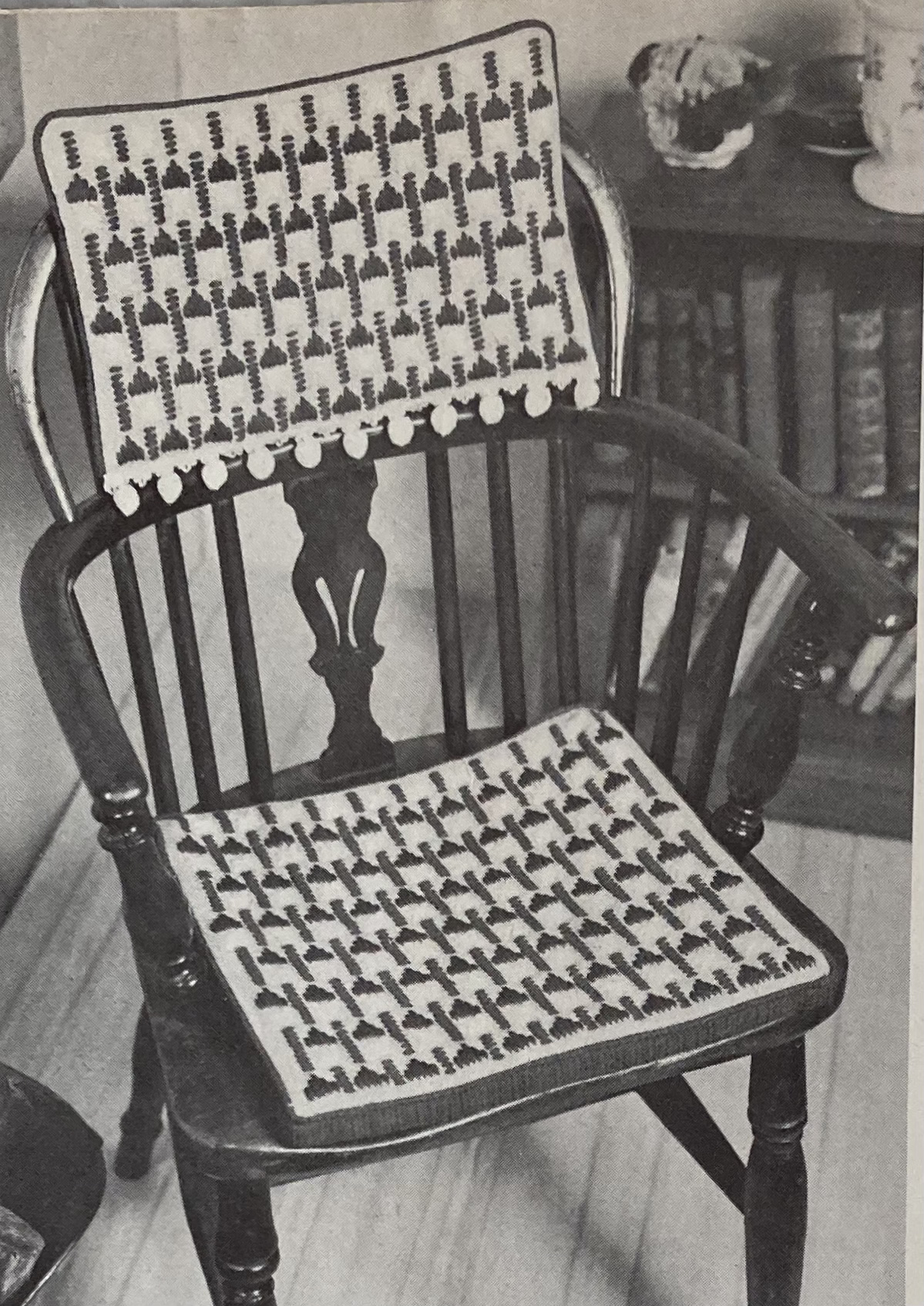
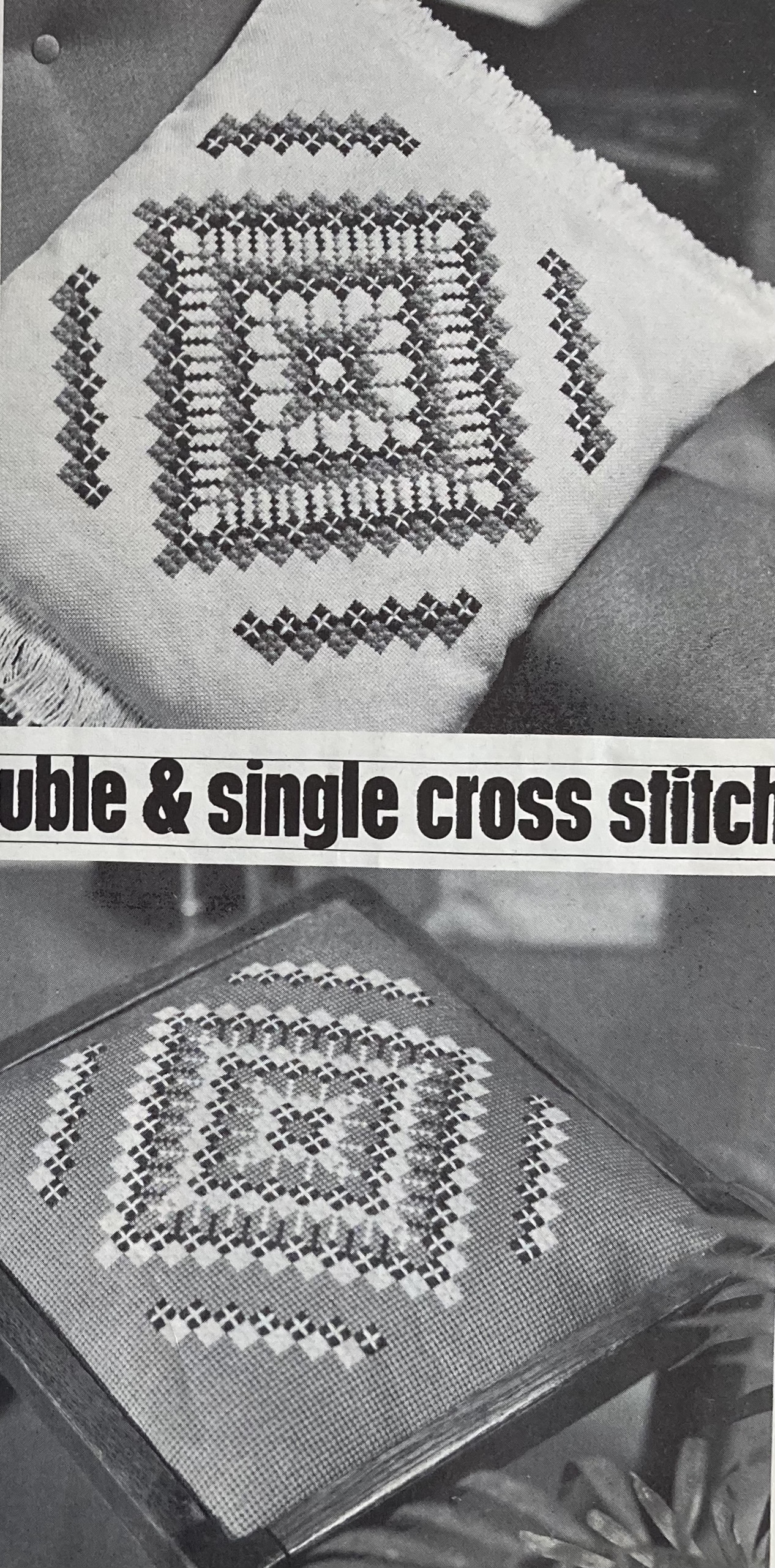
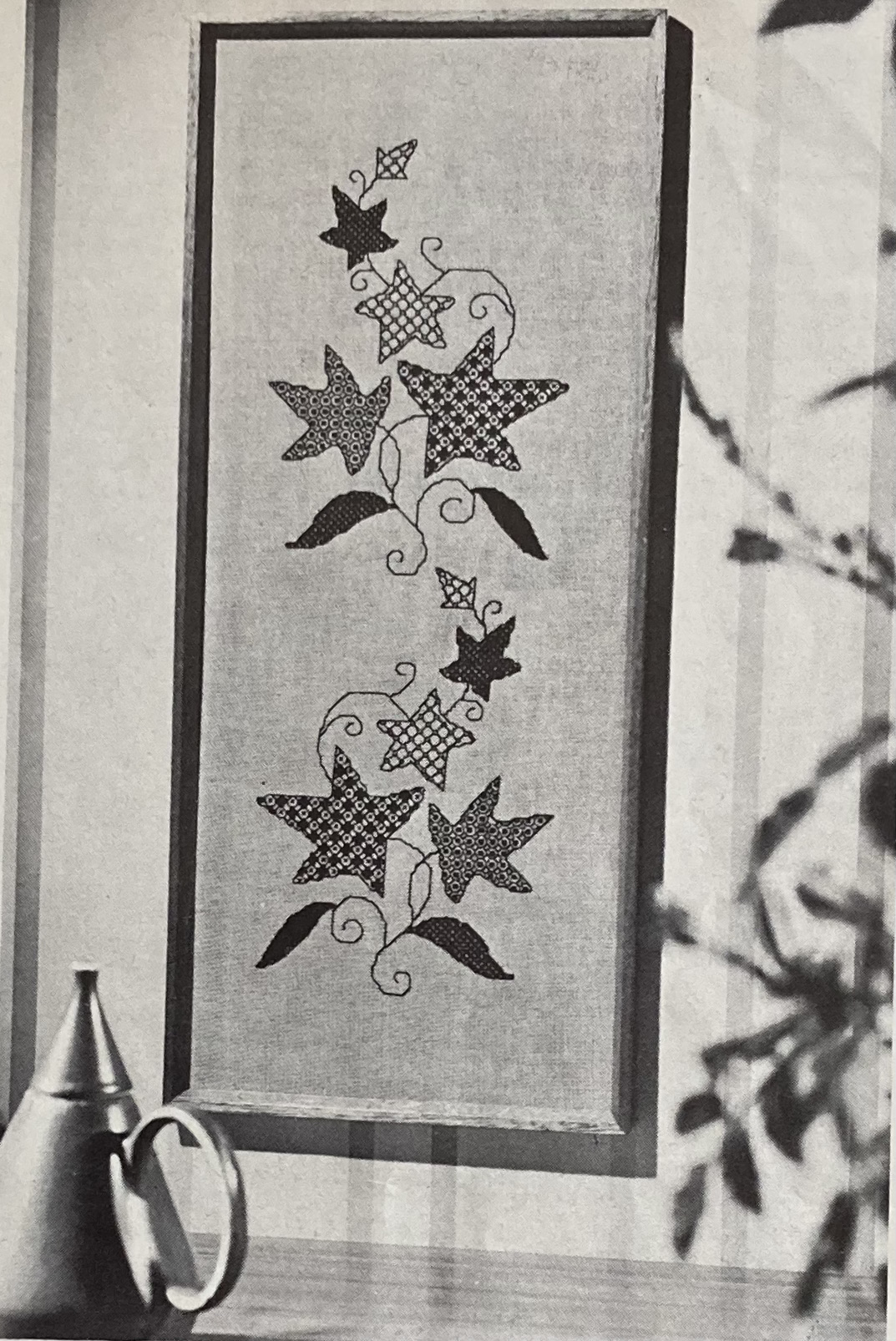
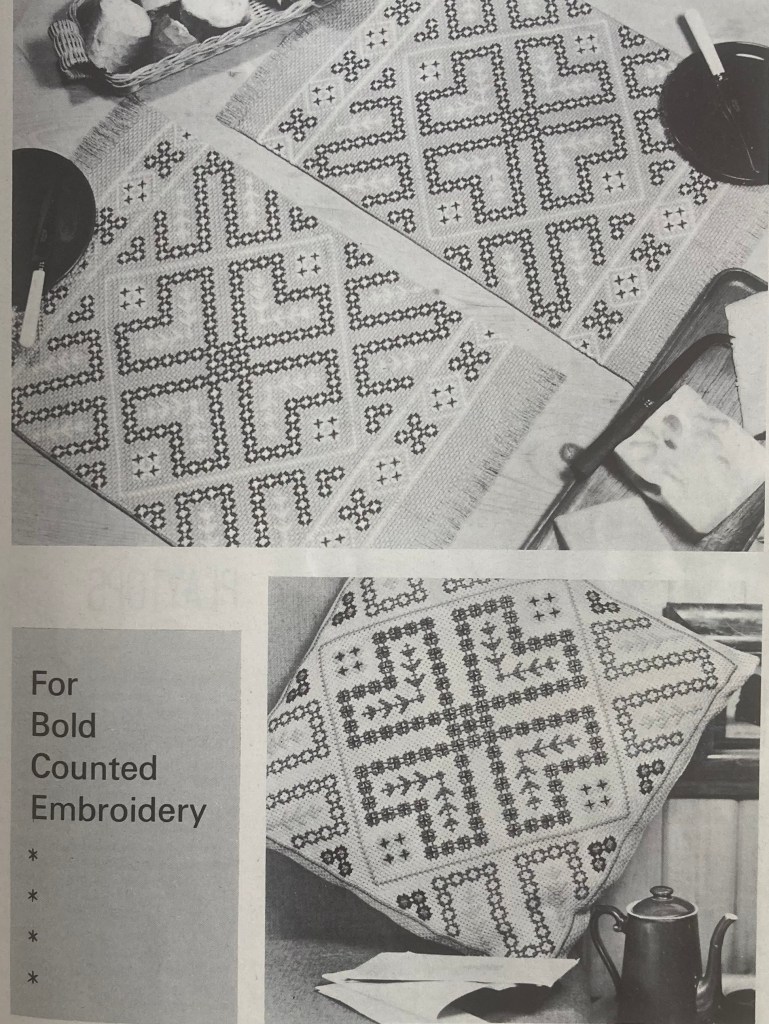
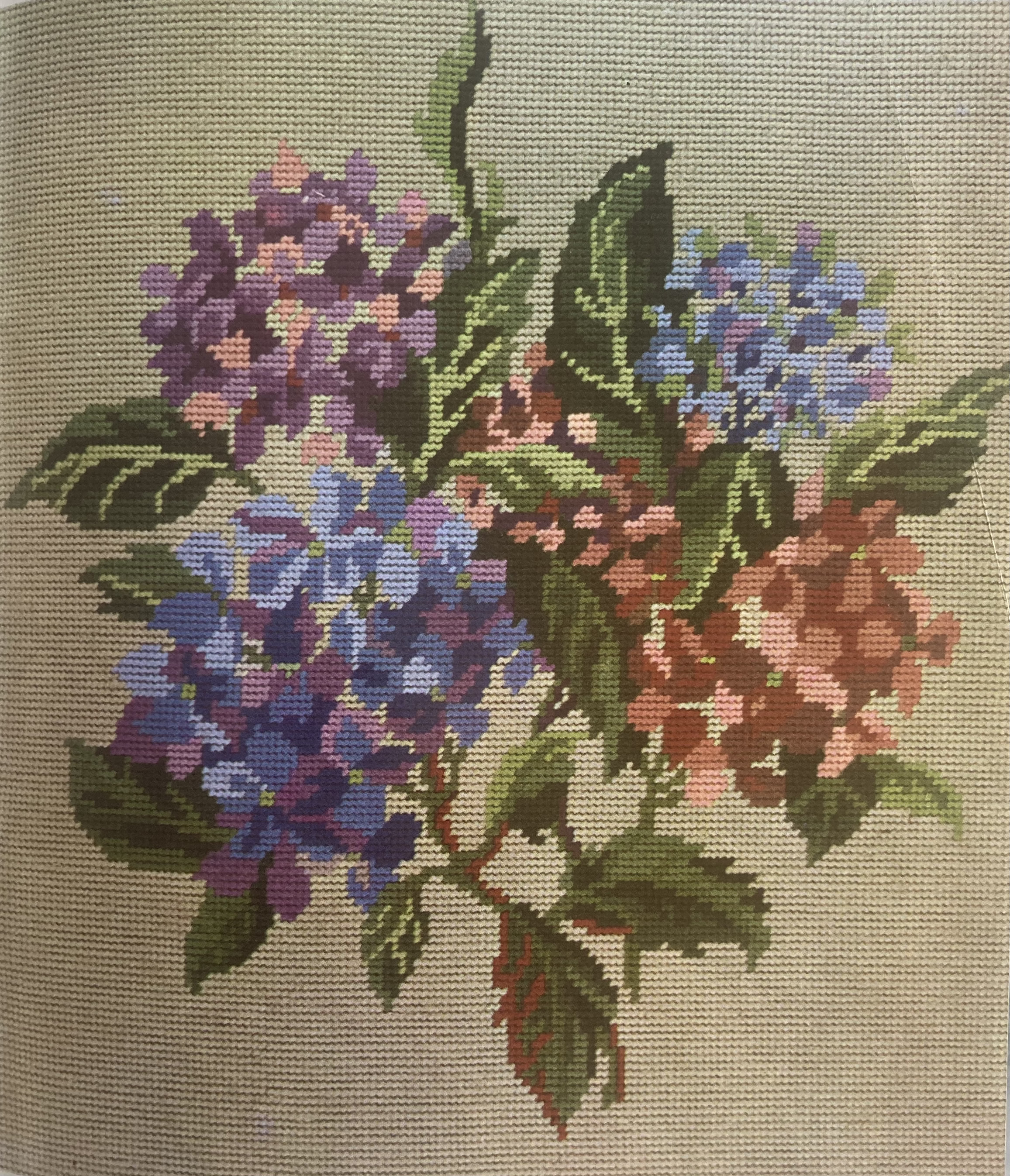
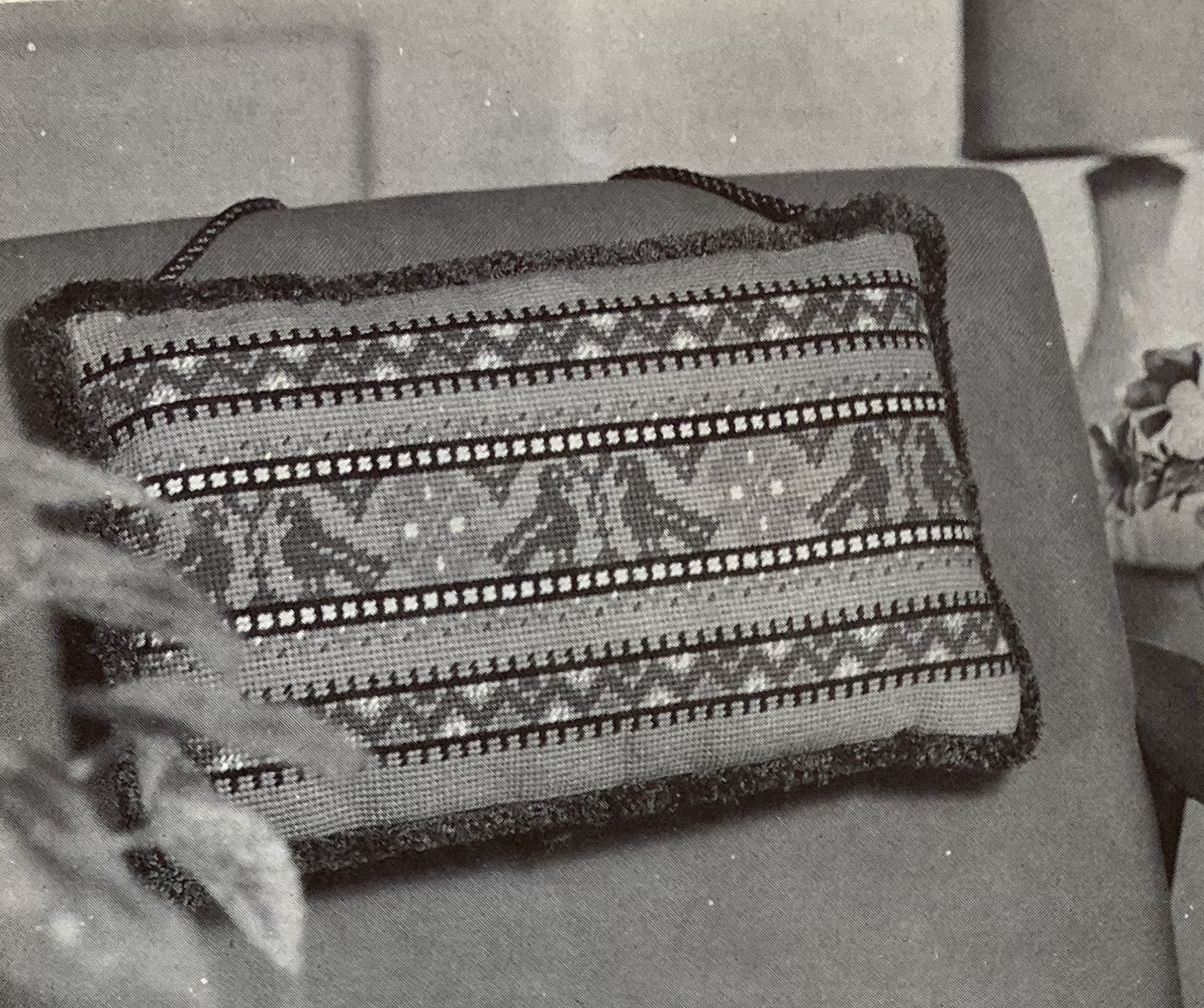
In the homewares department, we have the usual selection of versatile designs for different items and uses. The cross-stitch ivy border, for example, is suggested for “cushions, table mats and chair-backs, or as a border for curtains” , the wavy “design from Greece” is featured on a chair-back, cushion and rug, and the Swedish-inspired design “for bold counted embroidery” works on table mats as well as cushions. Even the tapestry hydrangeas can be used as a wall picture or fire-screen.

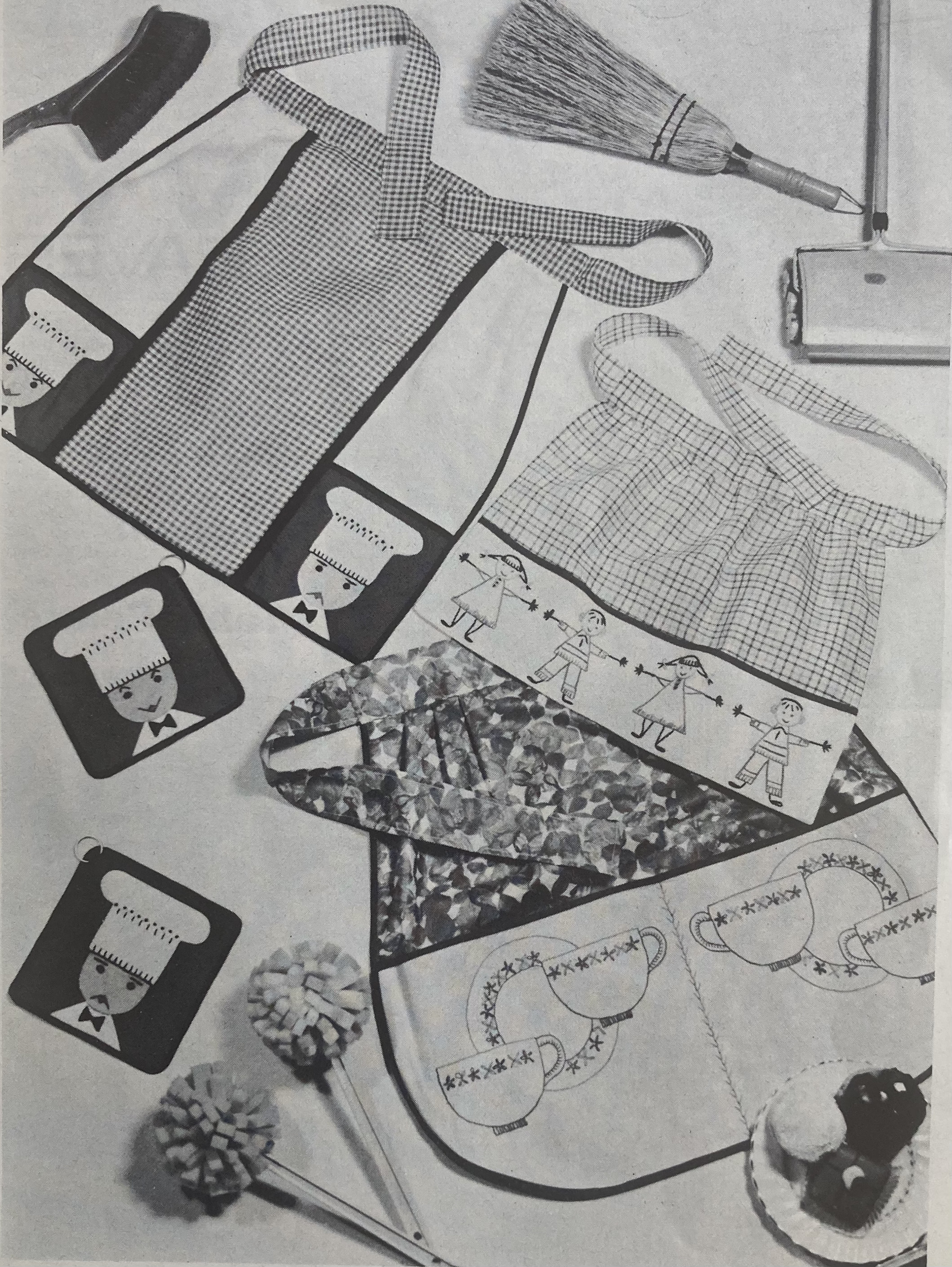
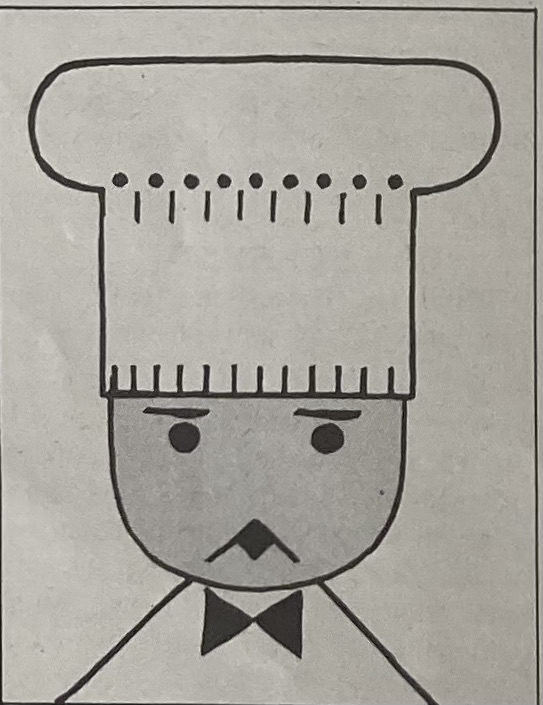
It wouldn’t be a proper issue of Stitchcraft without bizarre-bazaar ideas, though these are not nearly as weird as some of the items that we’ve seen in the past. The theme is clearly “kitchen” this time, with embroidered or appliquéd aprons and pot holders. Sometimes the chef looks happy with the food, and sometimes he definitely has l’air déçu!

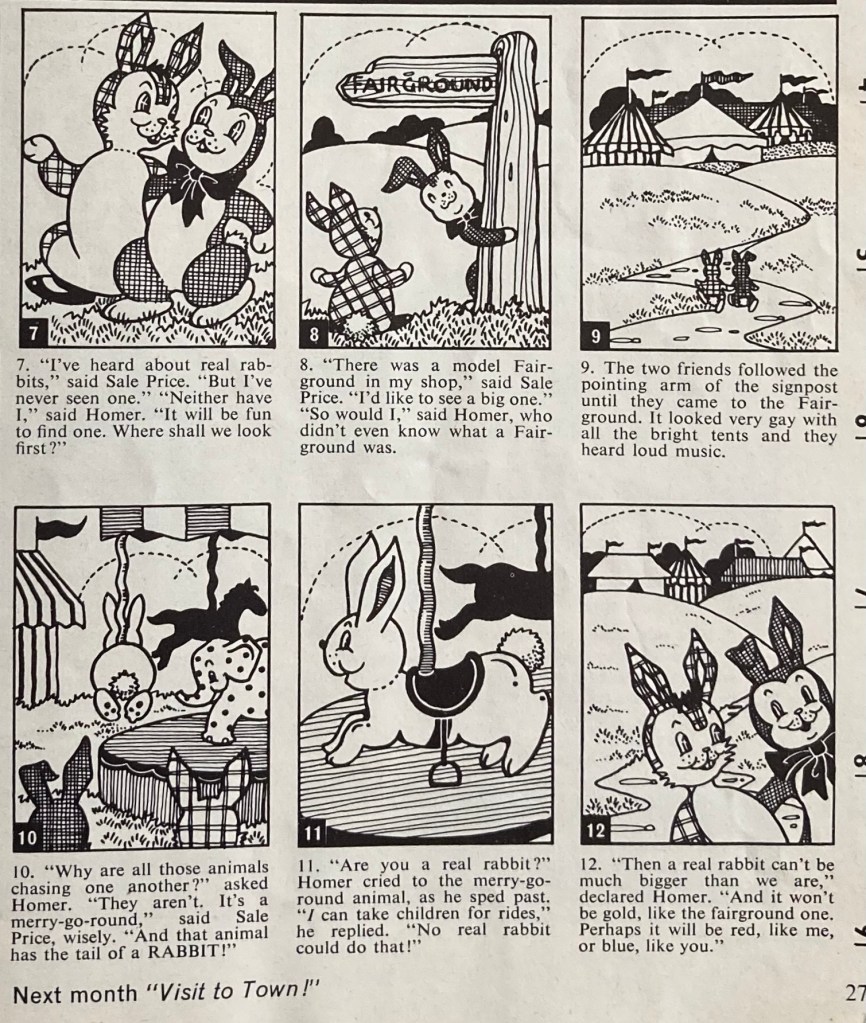
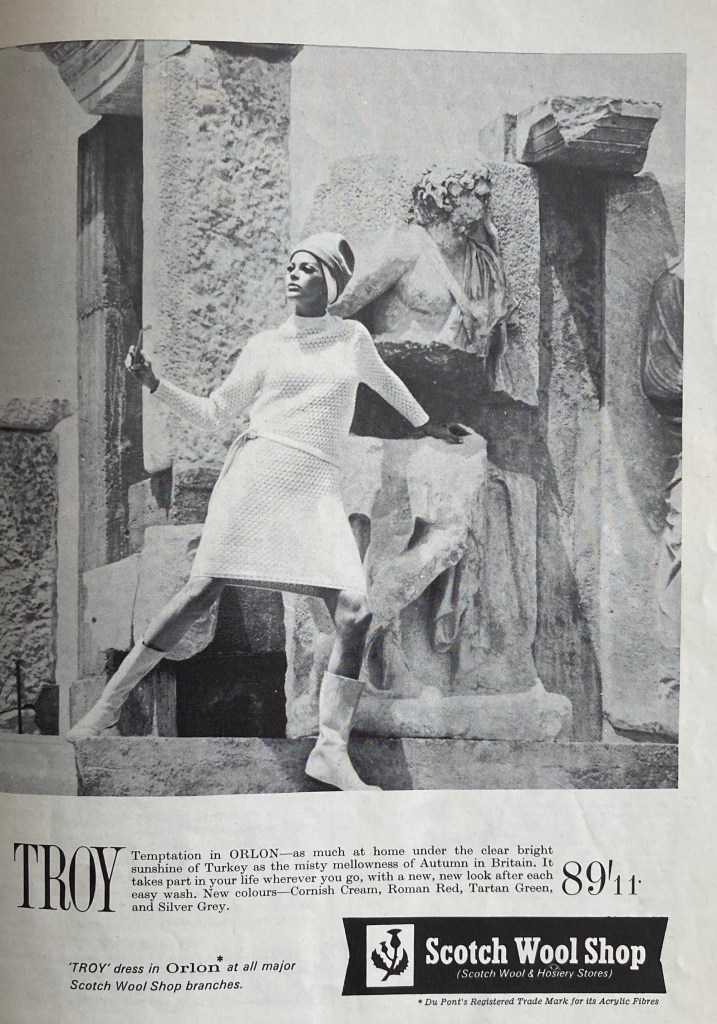
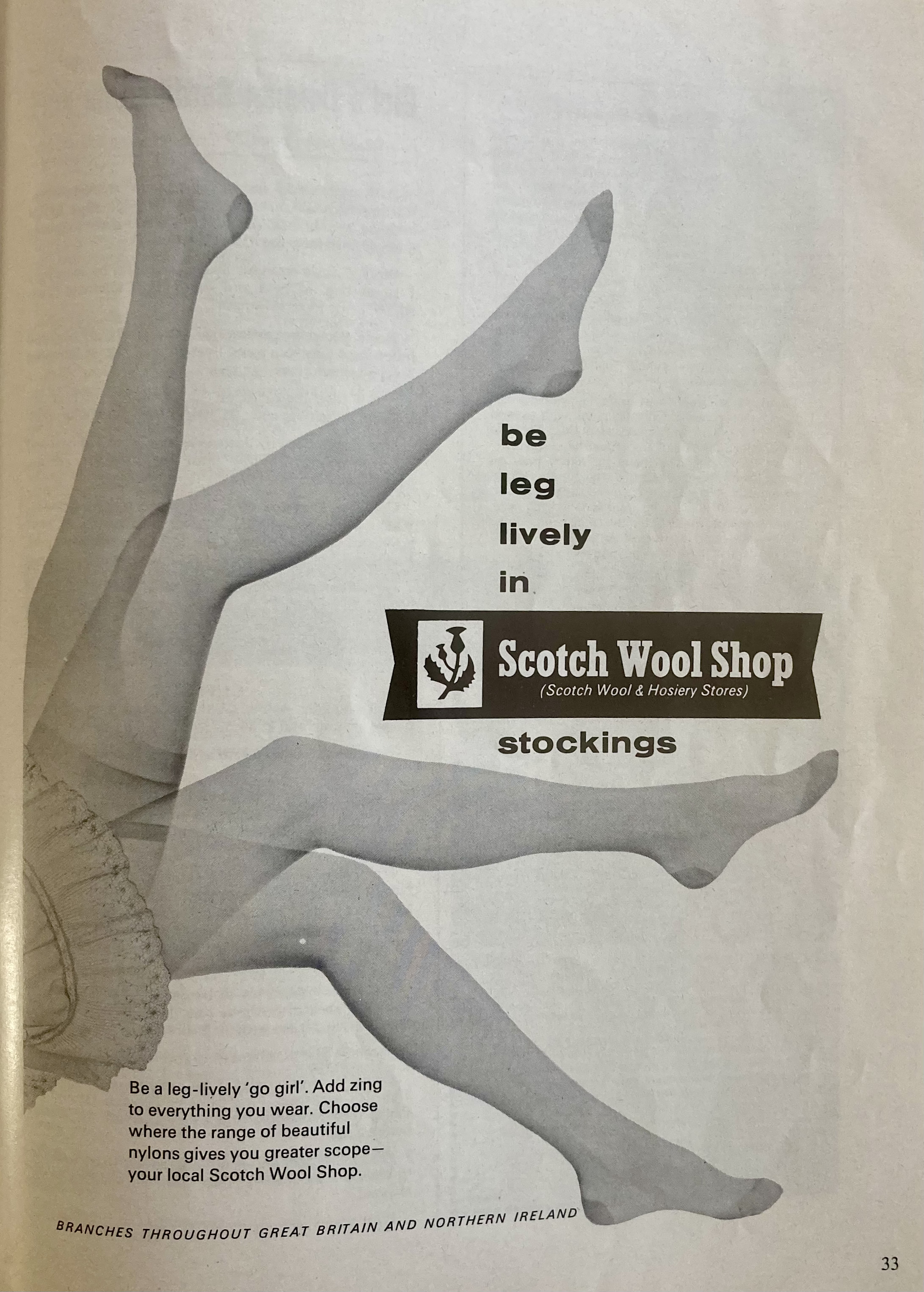
The back pages feature a “special request” tatted doily edging, a great “leg lively” ad for nylon stockings from the Scotch Wool Shop. In the final chapter of the current children’s serial comic, “The Lost Stitch”, Jill and her brother James fall back through the magic portal that appeared in a dropped stitch, to find themselves back at home with the stitch magically mended. May all your dropped stitches heal this way!

There isn’t a specific design that I like enough to make from this issue, so my August project will be another non-Stitchcraft “Blast From the Past.” Happy late summer and if it’s still too hot where you live, enjoy that ad for Lightning zips that promises to keep you cool as a cucumber in your summer cottons.

November 1964: Overview

“Winter Fashions and Christmas Plans” is the theme of Stitchcraft‘s November 1964 issue, with practical clothing for the family as well as gift ideas and a couple of glamorous items for parties.

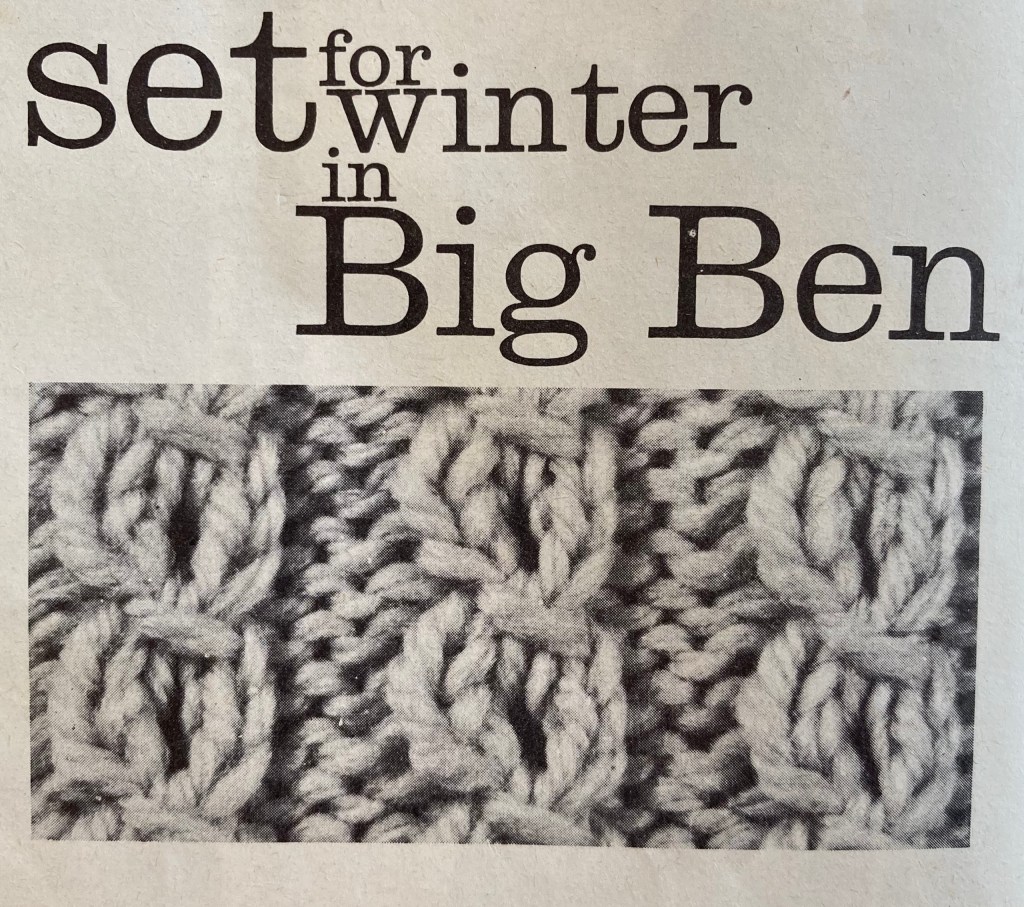
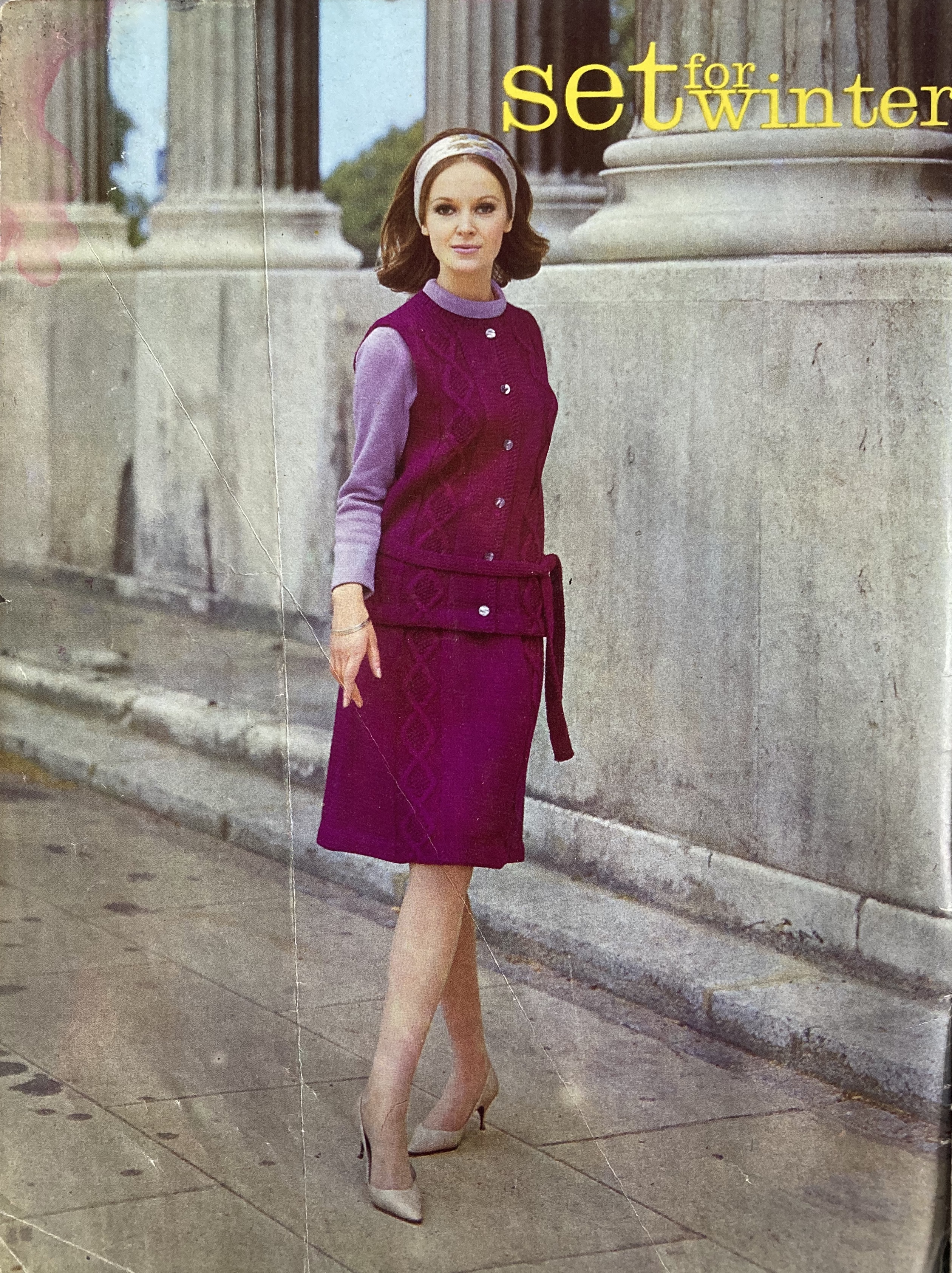
You will be “set for winter” in the cardigan on the cover, knitted in bulky “Big Ben” wool at 3 1/2 stitches to the inch, with all-over mock-cables, a warm collar and practical pockets. The mock-cable pattern involves “losing” a stitch in the 3rd row with a sl1-k2-psso, then getting it back with a yo on row 4, making a “bar” and then a little hole for the mock-cable effect. There’s a handy close-up photo of the stitch pattern, so you can make sure you did it right.

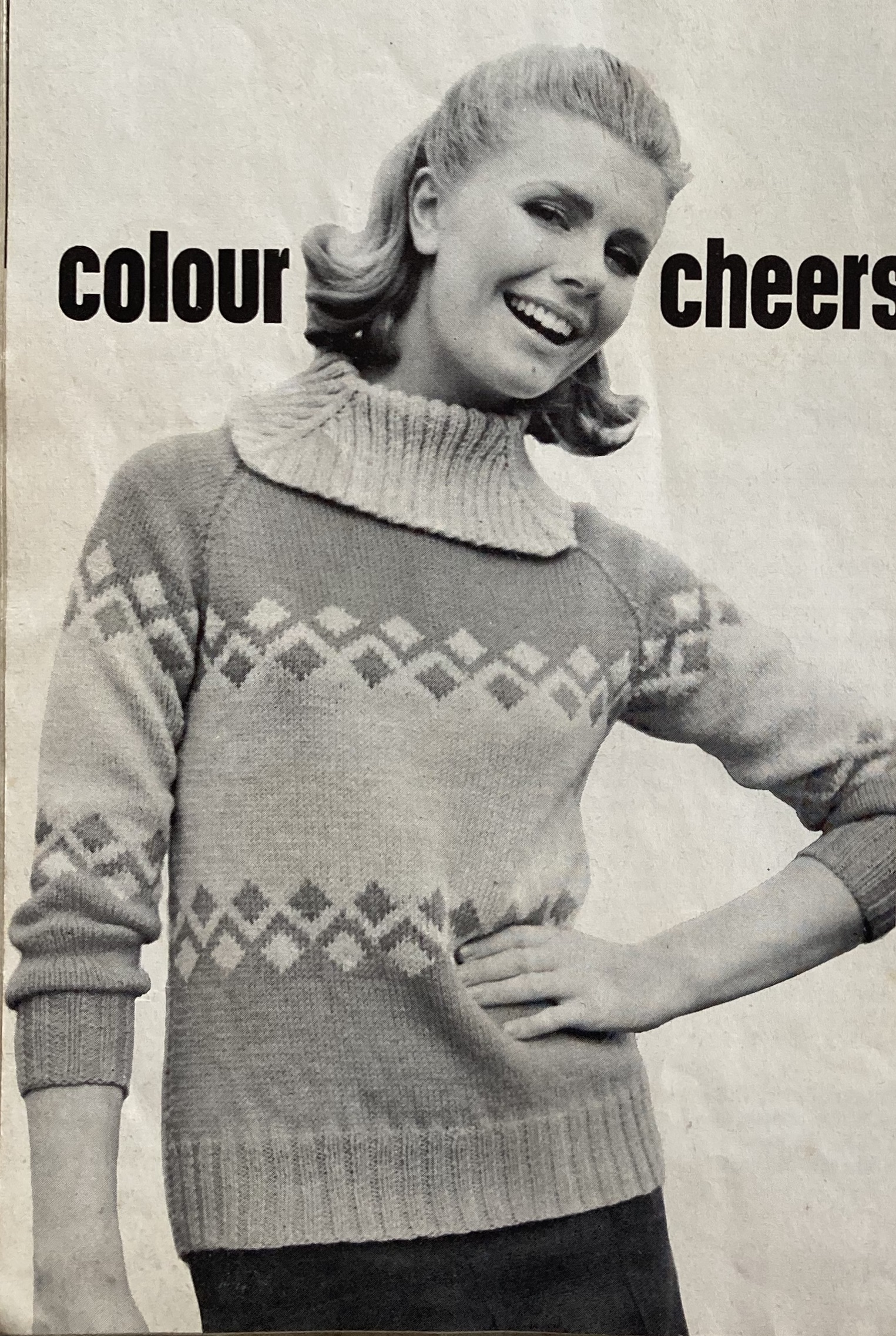
The caption continues the use of a bit of word-play on the word “set”, which we saw in the October 1964 issue. There, the theme was “set to flatter”, whereby some of the items were part of an actual set, and some weren’t. Some of the other garments in the November issue really are a set, in that sense: this waistcoat suit in glowing fuchsia, for example. Rounding out the everyday women’s garments are a plain 4-ply jumper, a bright colour-motif sweater and a comfortable tweed jacket for larger sizes. I love that brooch on the jumper — it looks like Star Trek insignia.

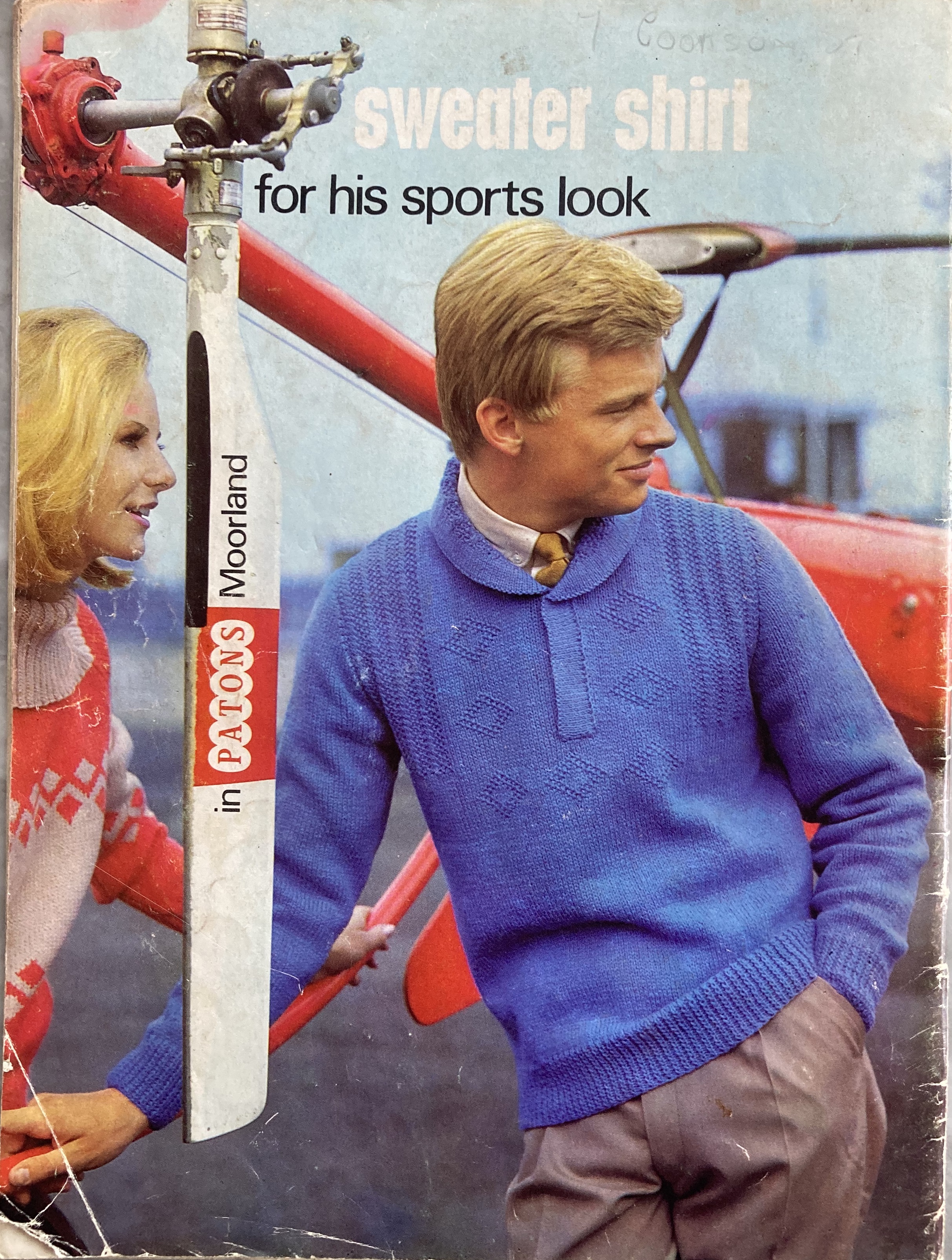
The trend for textured patterns, big collars, zig-zag designs and bold colours continues with the men’s garments: he too will be “set for winter” in a textured pullover for larger sizes or a sport-weight “sweater-shirt” (they didn’t use the word “henley” at the time) that utilises many fashionable features. You get a glimpse of the women’s colour-motif sweater in the back cover photo, as well.

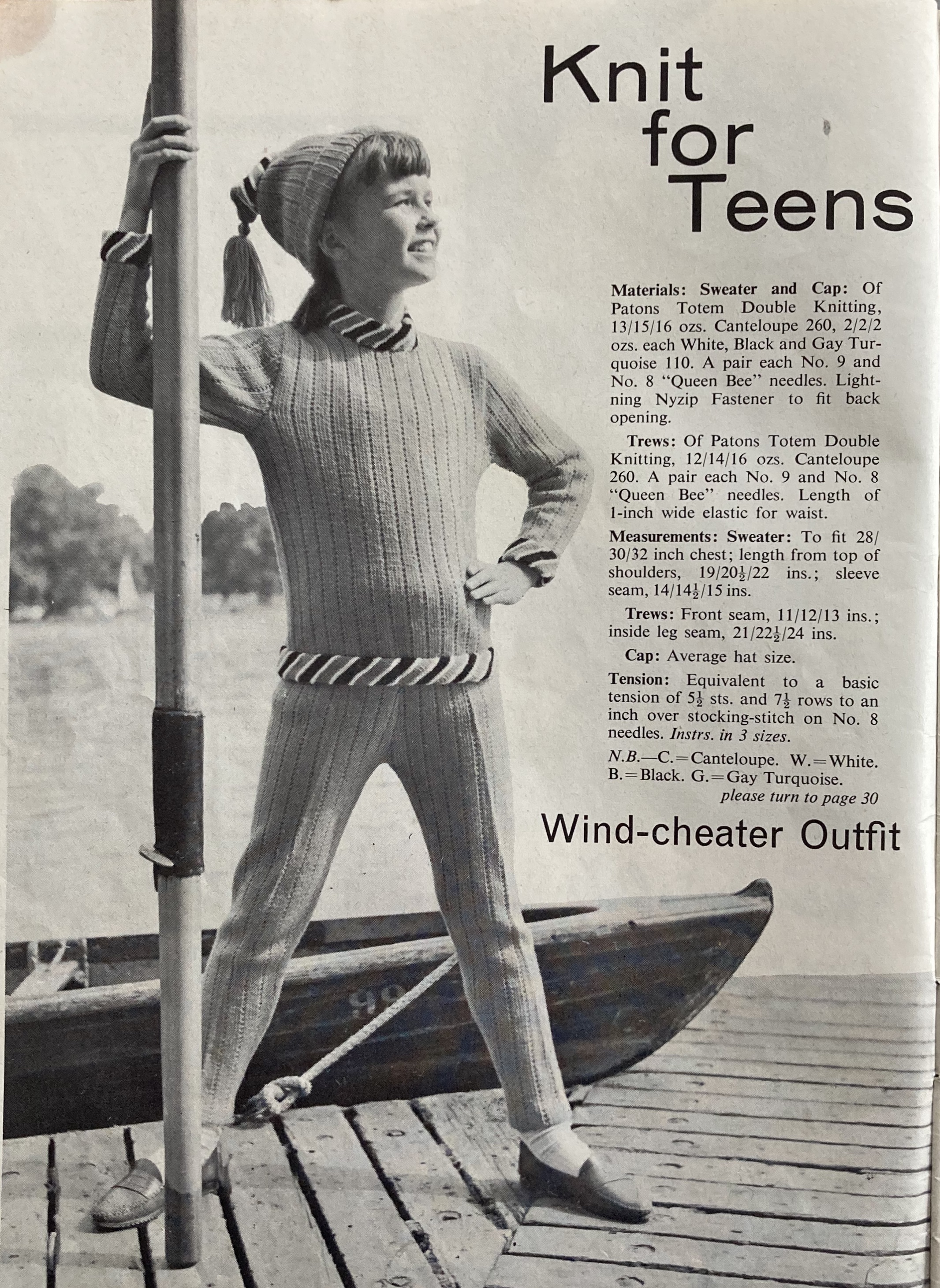
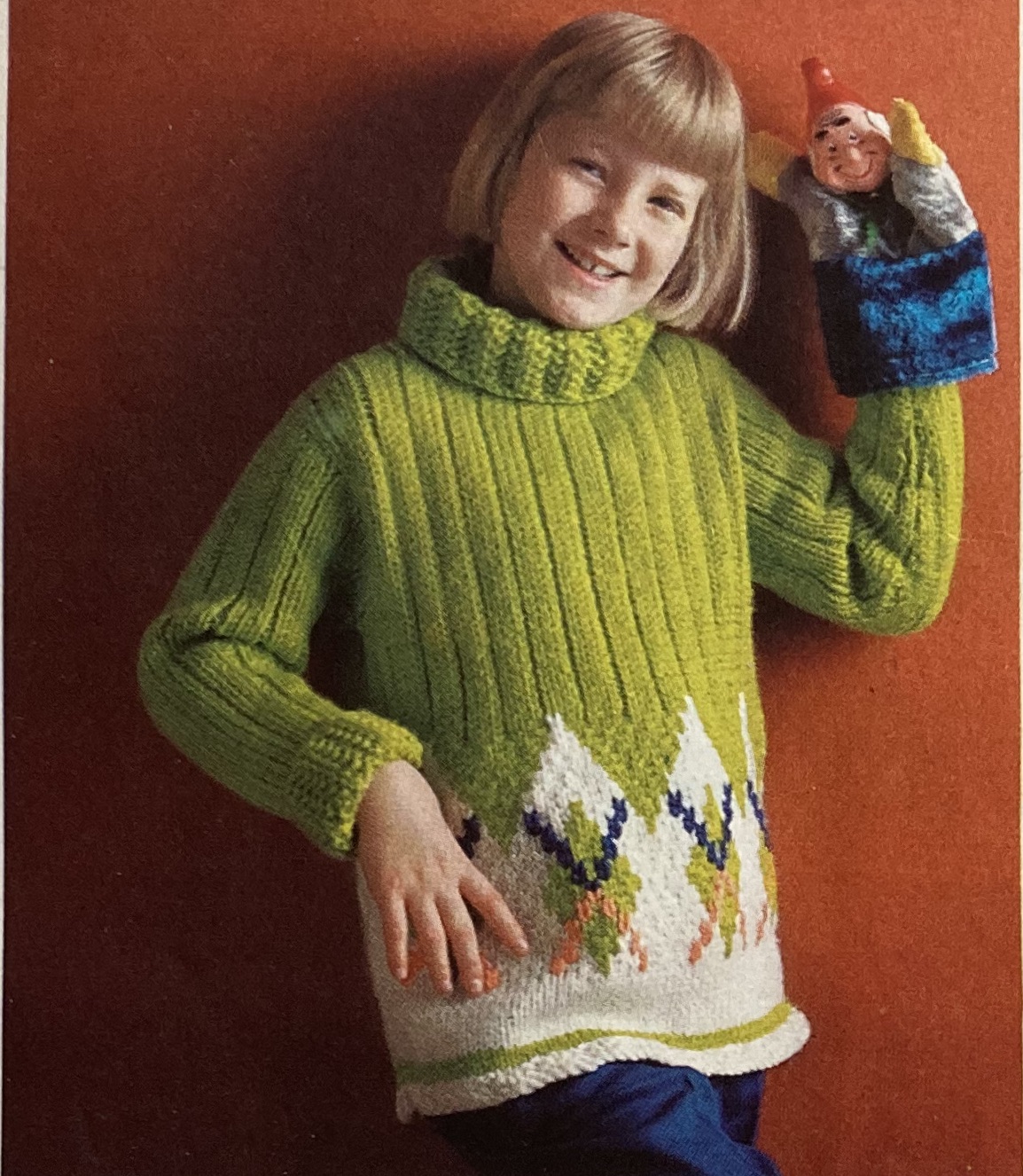
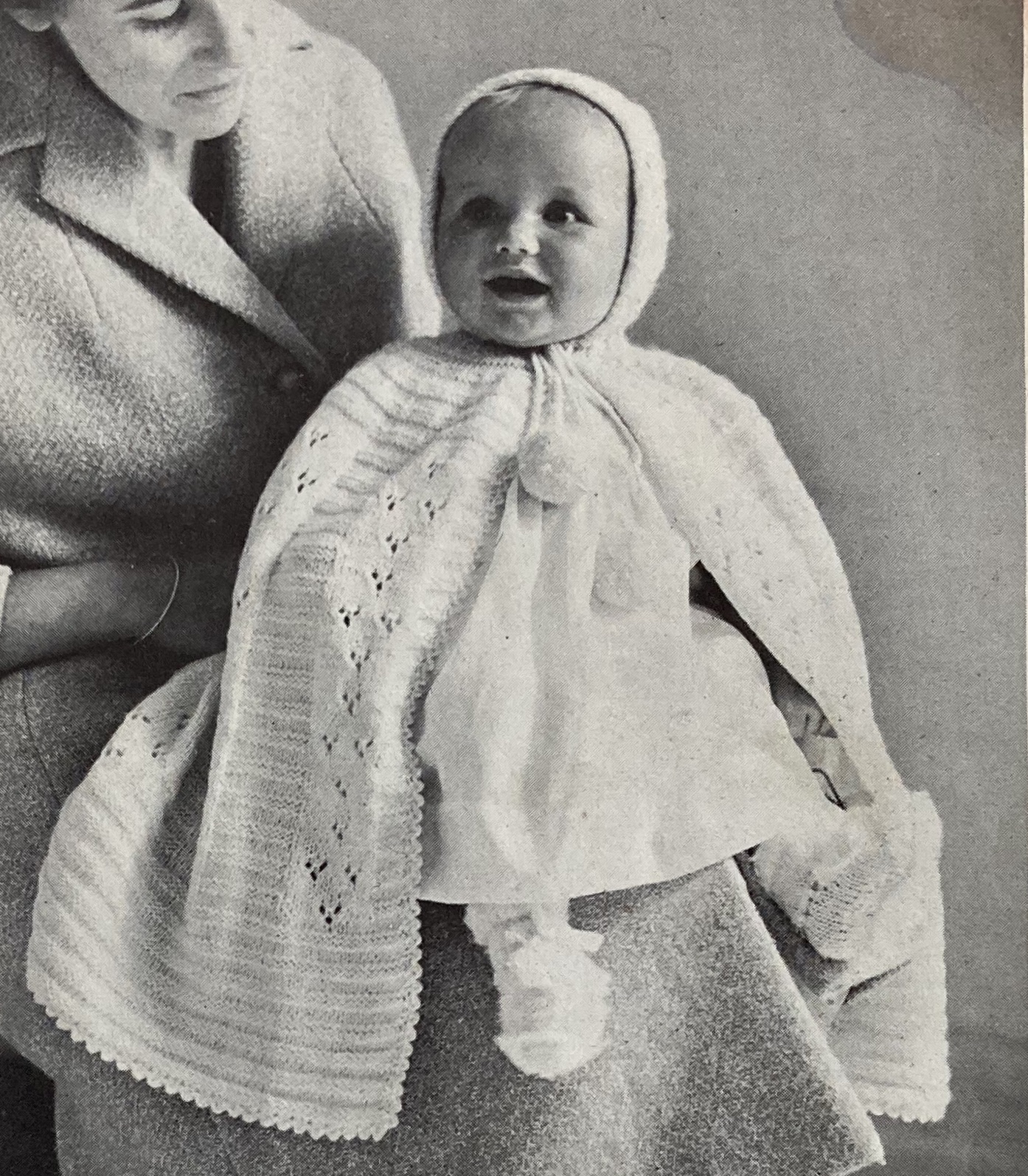
In the “Teens and Babies” department, there’s a wonderful winter “wind-cheater outfit” set (actually a set, this time) of sweater, leggings and hat, as well as a thick, warm jersey for a young girl (our model is quite possibly not a teenager yet, but the pattern is in three sizes up to 32 inch chest to fit older girls as well), and a continuation of the baby set (also an actual set) that was started a few issues ago with matinee coat, dress, etc.: this last instalment is a lacy one-size-fits-all hooded cape to go over all the other garments. I love the photo of the girl standing on the dock next to her boat, looking like a proud sailor! Last month’s issue, if we remember, touted “the Feminine Look”, meaning girls had to look pretty and not really do very much, so it’s nice to see our young sailor looking active and happy in her autumn sport set. The diagonally-striped hem and cuffs are knitted separately and sewn on later.

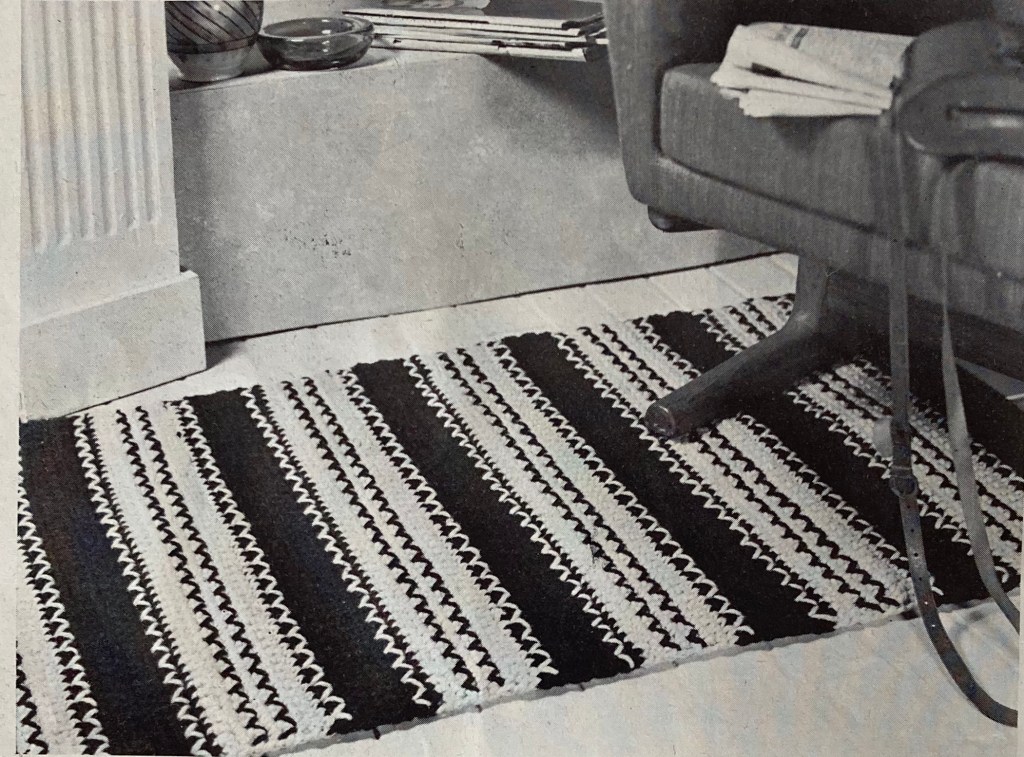
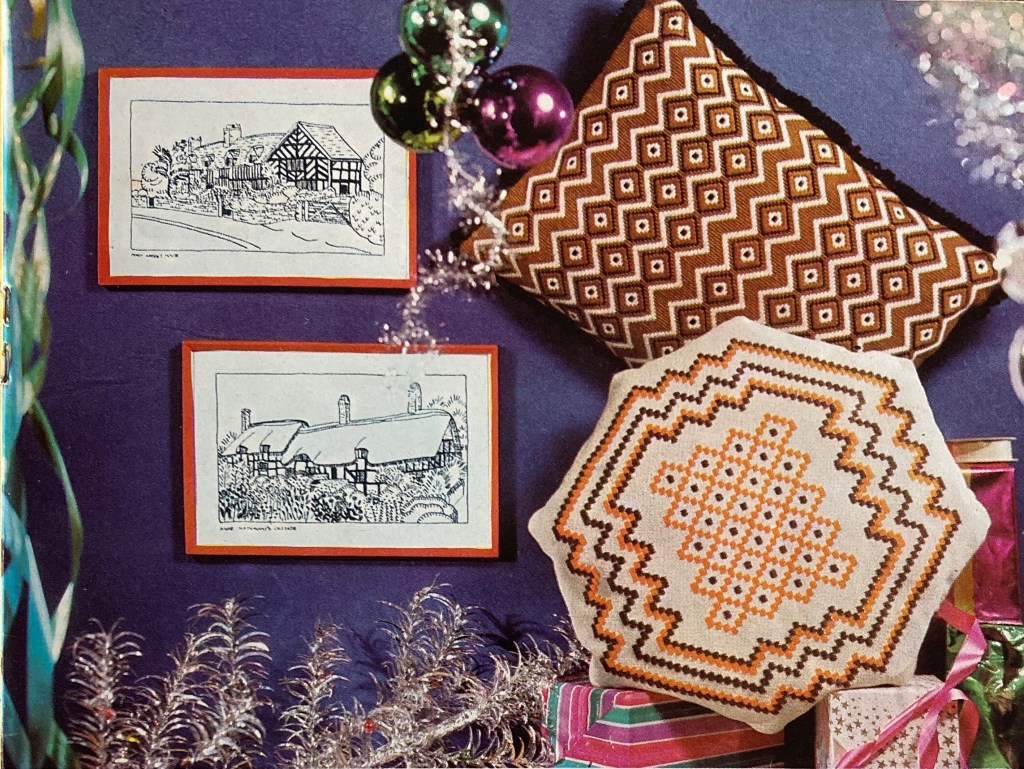
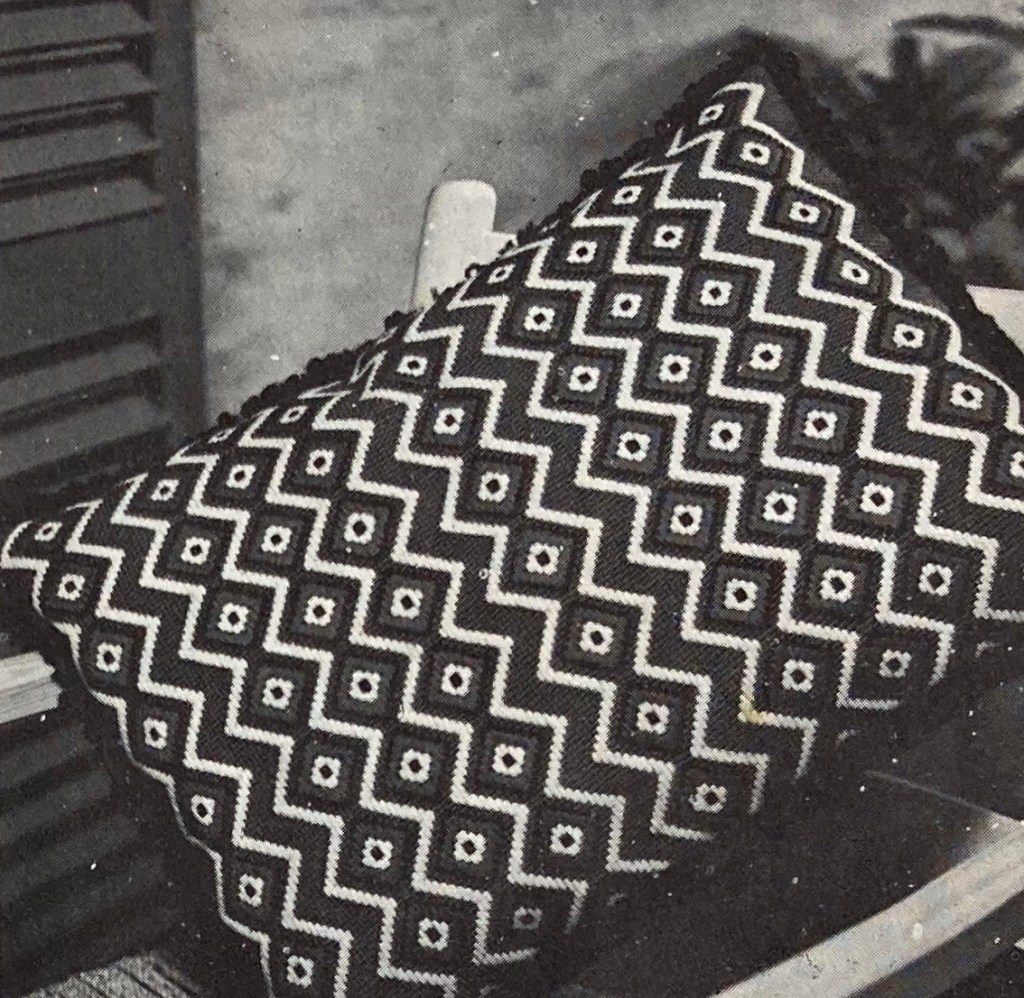
The non-Christmas-themed housewares continue the zig-zag / geometric trend with a crocheted rug, diamond-pattern cushion and wacky zig-zag chairback and cushion set (yay, another set).

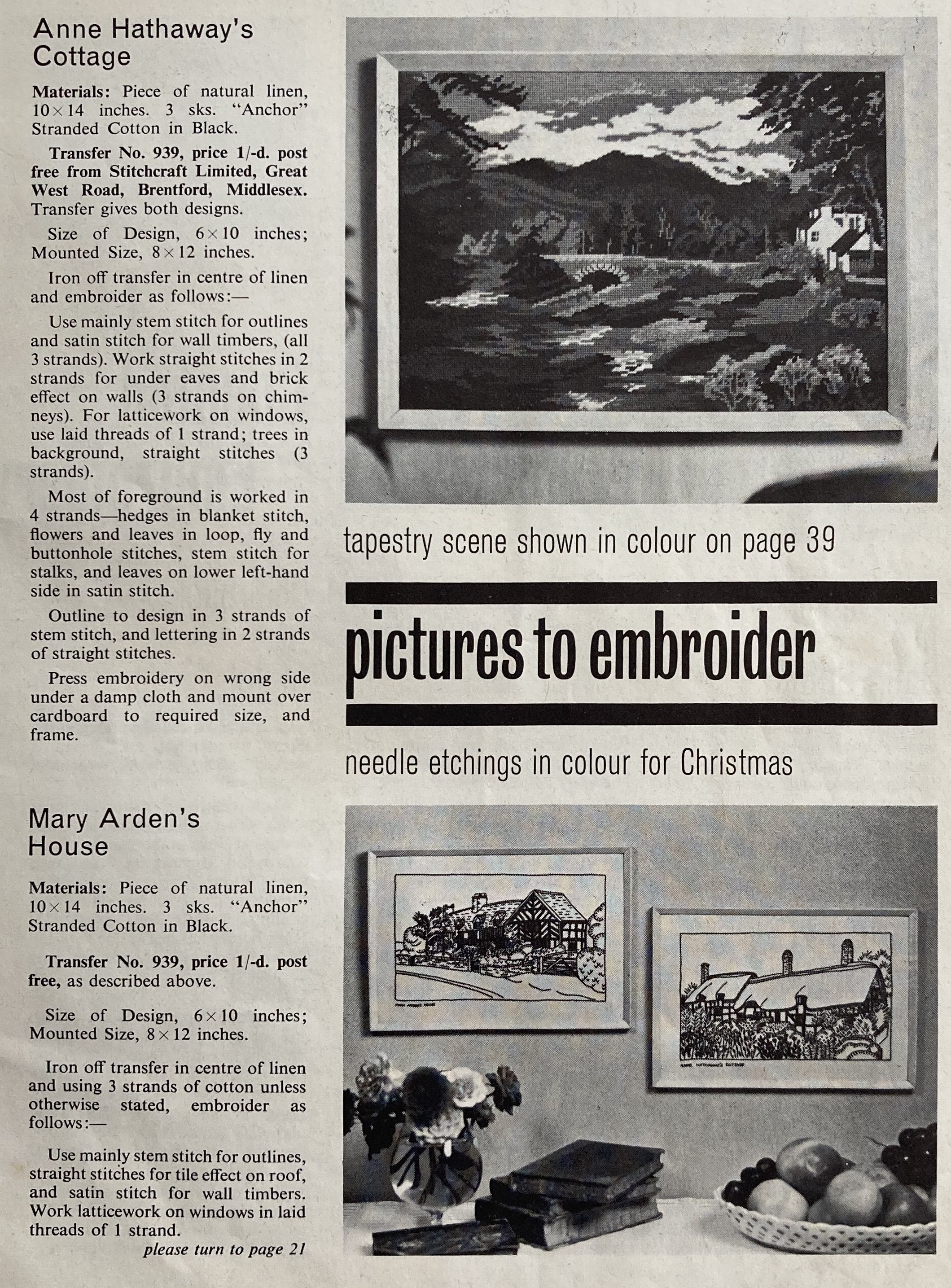
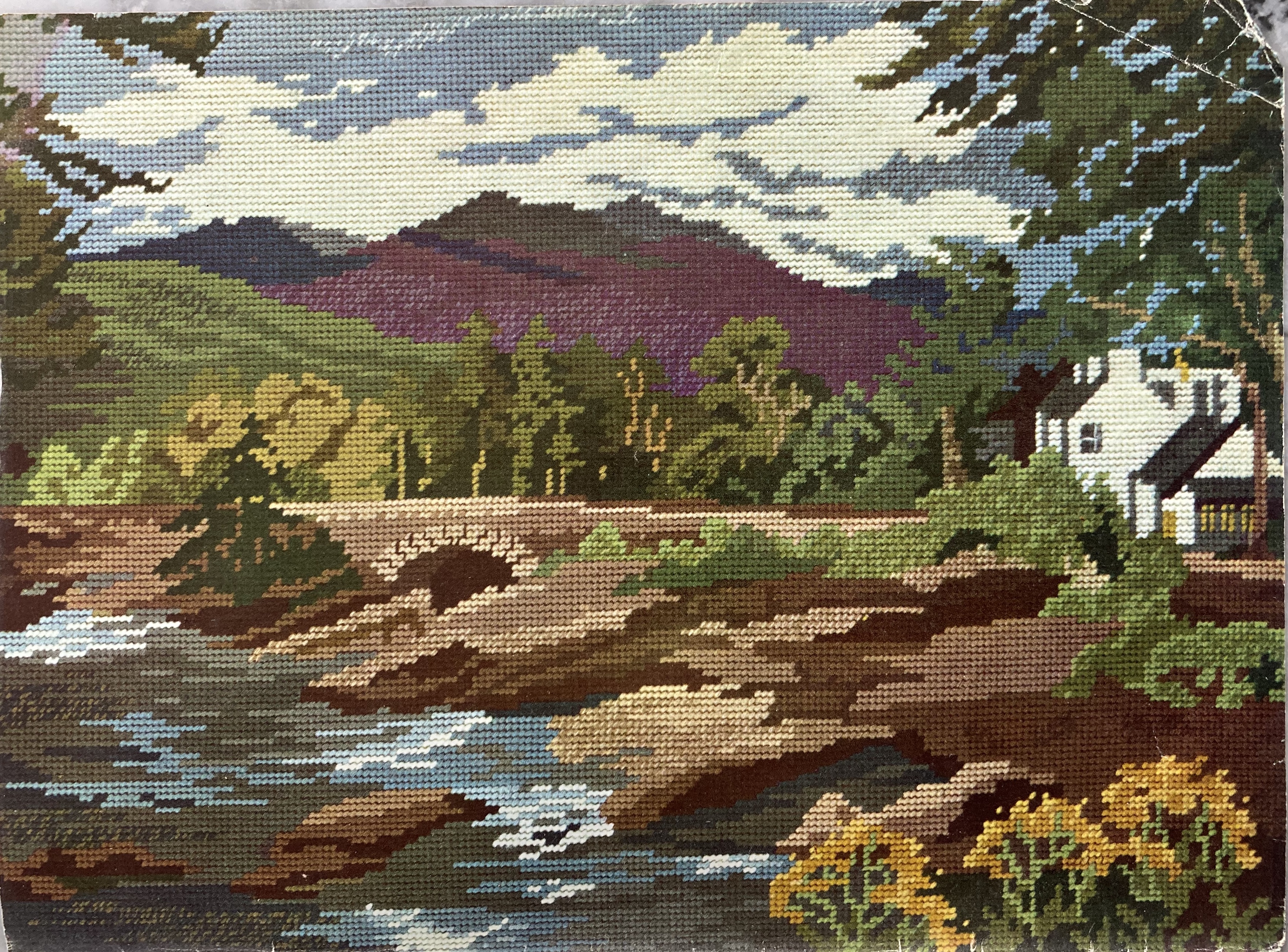
There are tapestry and “needle etching” embroidered pictures that draw inspiration from Shakespeare’s family: “Anne Hathaway’s cottage” (Shakespeare’s wife, not the modern actress…) and “Mary Arden’s House” (Shakespeare’s mother, not Lady Arden of Heswall.)

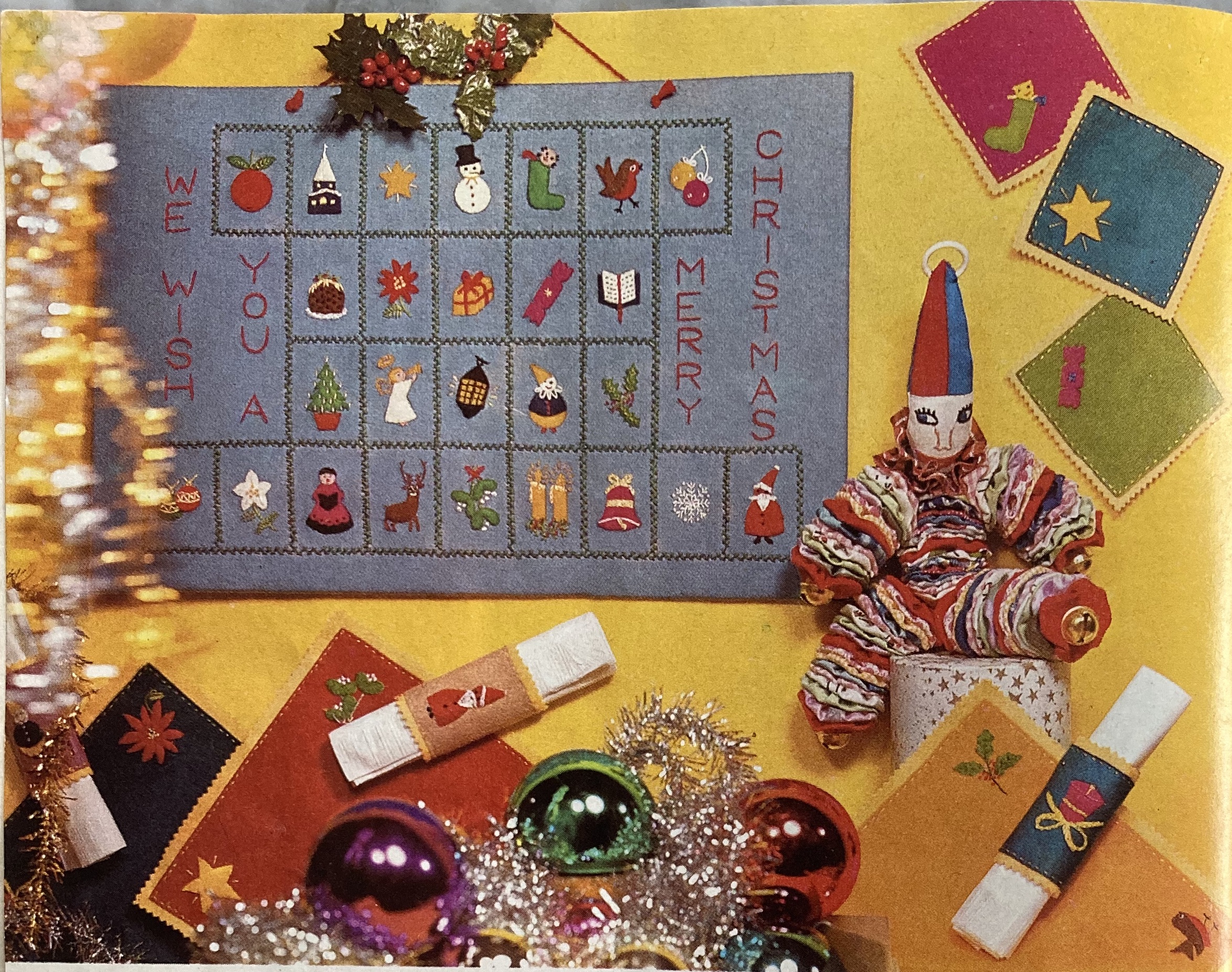
But finally… it’s time for the pre-Christmas decorations! The wacky “novelties” and bizarre-bazaar items! I know you have been waiting for this and I promise you will not be disappointed. You may, however be scared out of your wits, if you happen to have a clown phobia, in which case I caution you to skip over the next few photos.

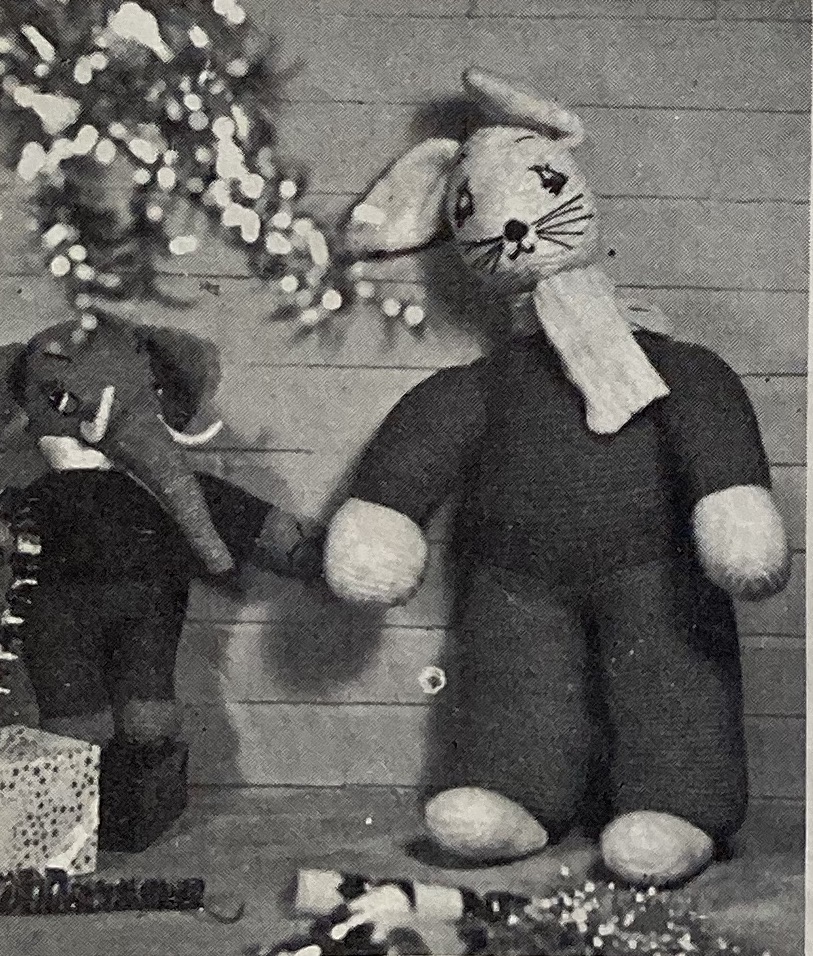
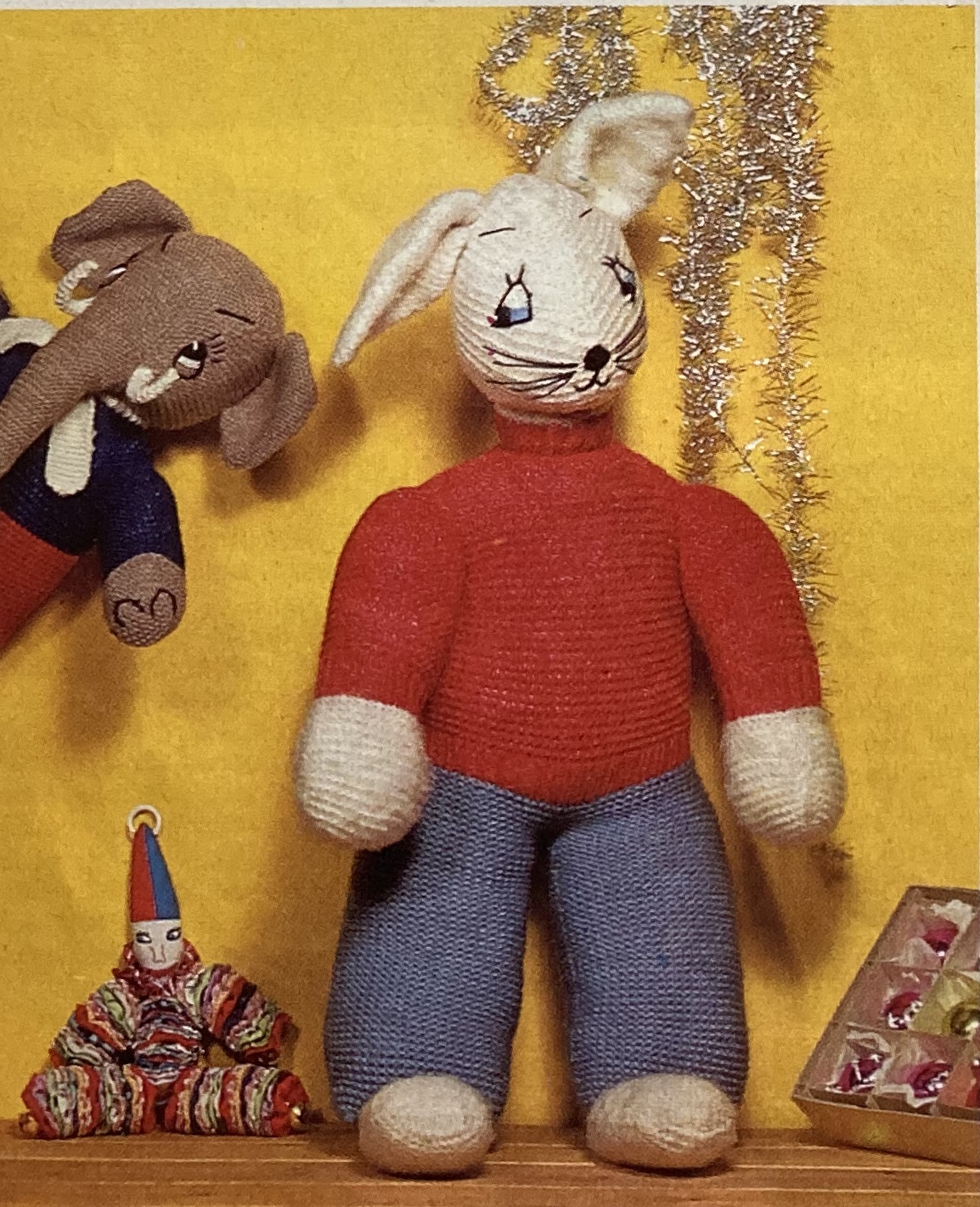
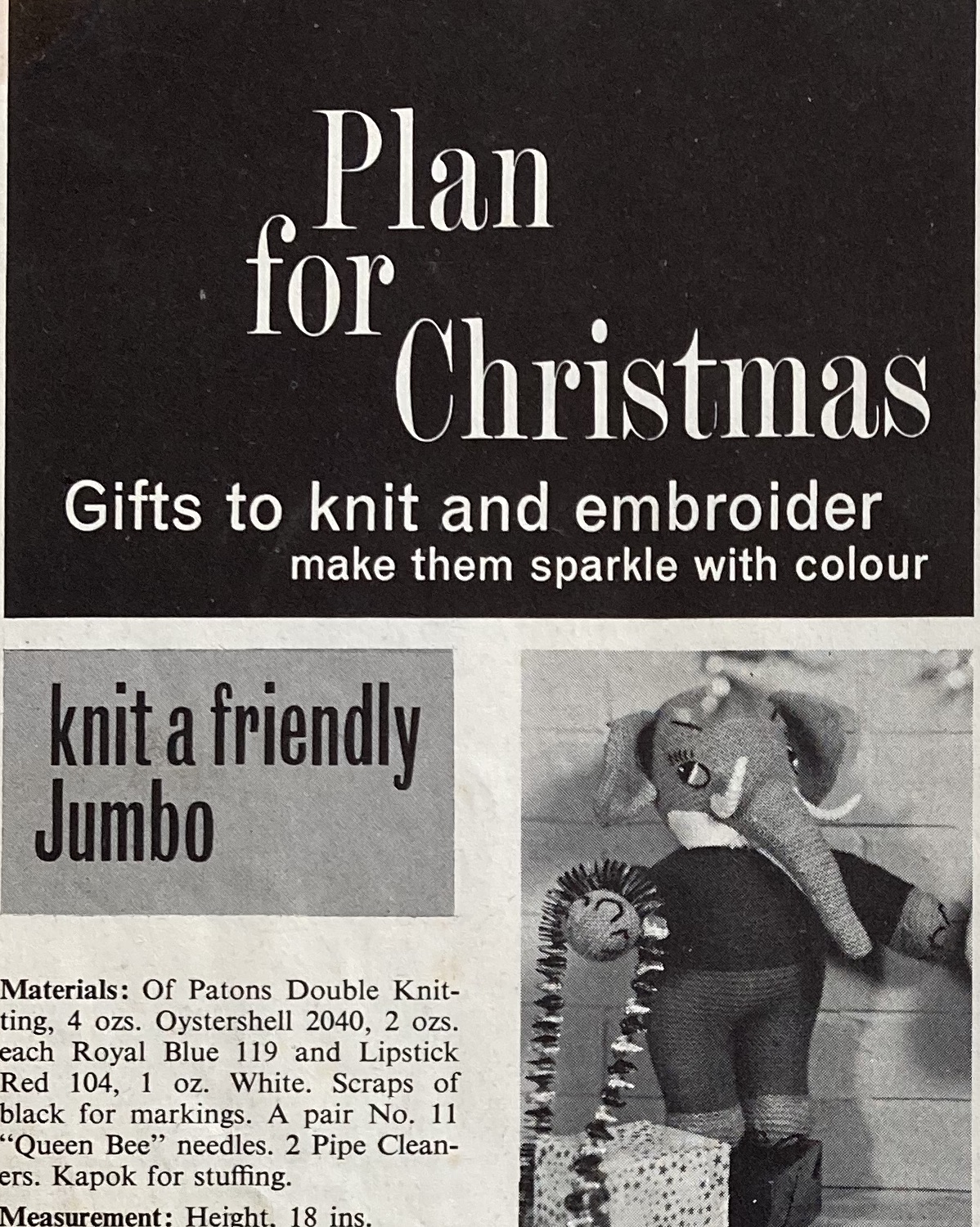
Starting with the melancholic stuffed animals, you can knit a “friendly” Jumbo the elephant, who seems to be rolling his eyes at the happy child who just pulled him out of their Christmas stocking, or a sad “bunny with a twinkle”. The table decorations are quite cute and easy to make: felt place-mats, napkin-holders and an Advent wall panel with wintery and Christmas-y appliqué motifs.

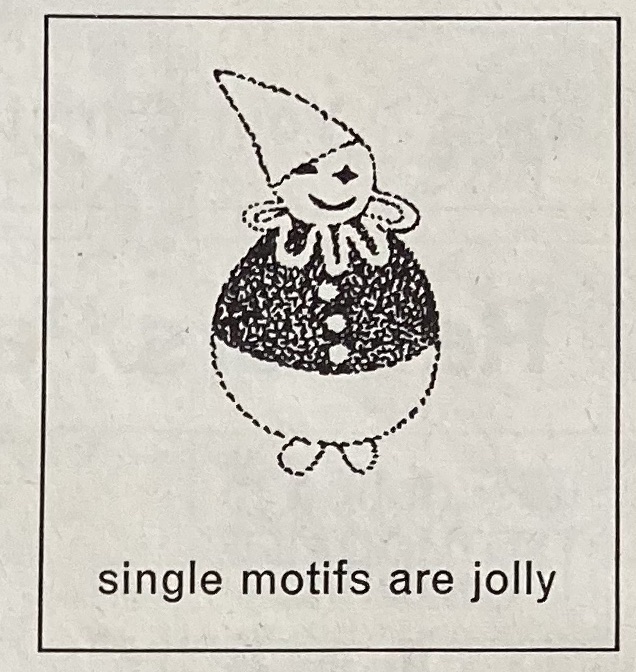
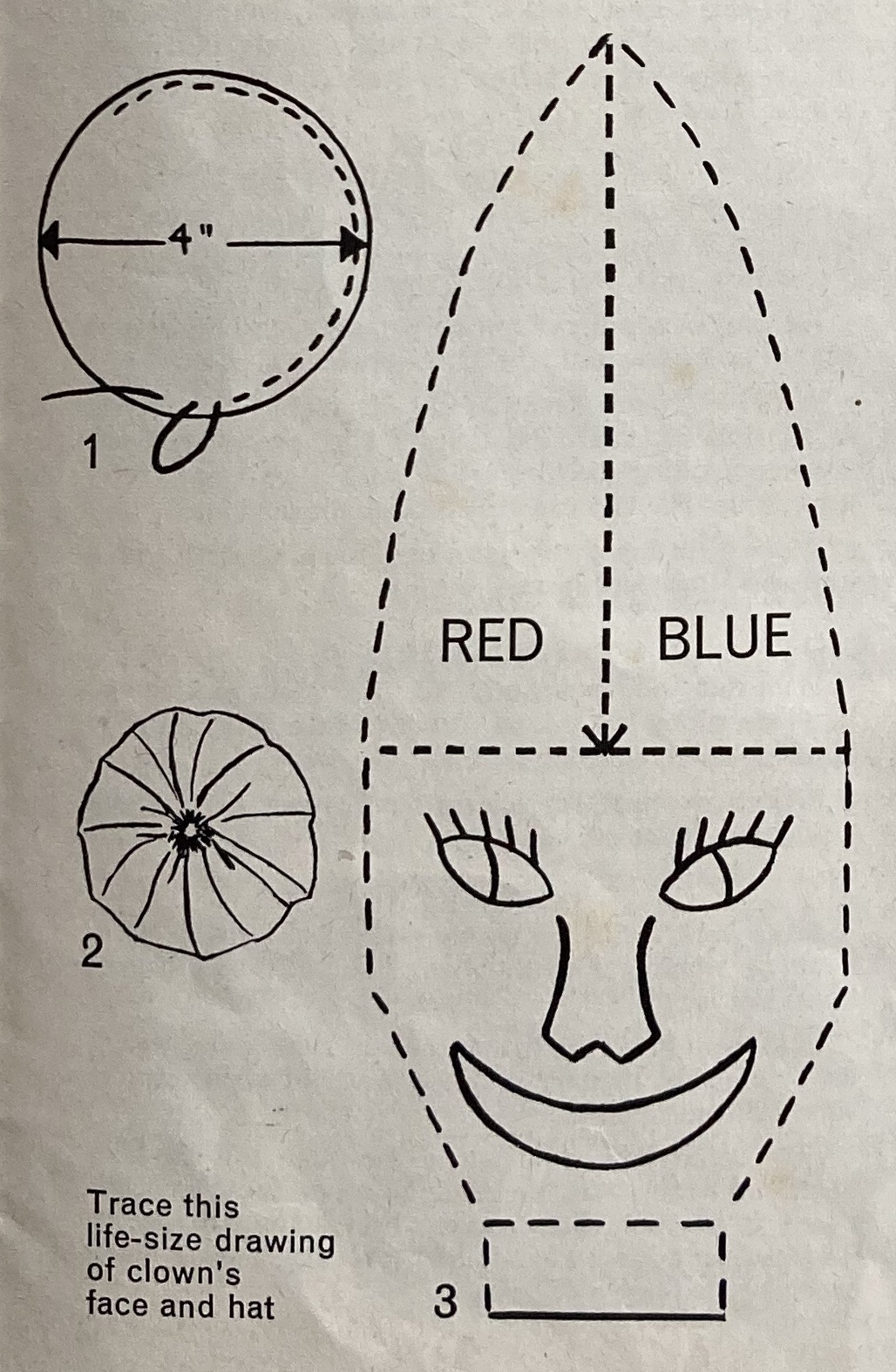
But that clown! The “Musical clown for a tot”! What in the world is going on with that clown? Even the bunny is giving it the side-eye. The construction is actually pretty interesting and a fun way to use up fabric scraps: you cut 4-inch diameter circles of fabric, gather them up with a gathering thread to make little poufs and then sew them on top of each other to make the arms, legs and body. Then all you need to do is sew and stuff a pointy head and cap and embroider a terrifying face onto it. Don’t worry, it has bells instead of hands and feet, so you can hear it coming.

EDIT November 12, 2022: I was browsing around on UK Ebay and someone is selling an FO of this clown! Unbelievable! I am not going to buy it but maybe one of you will

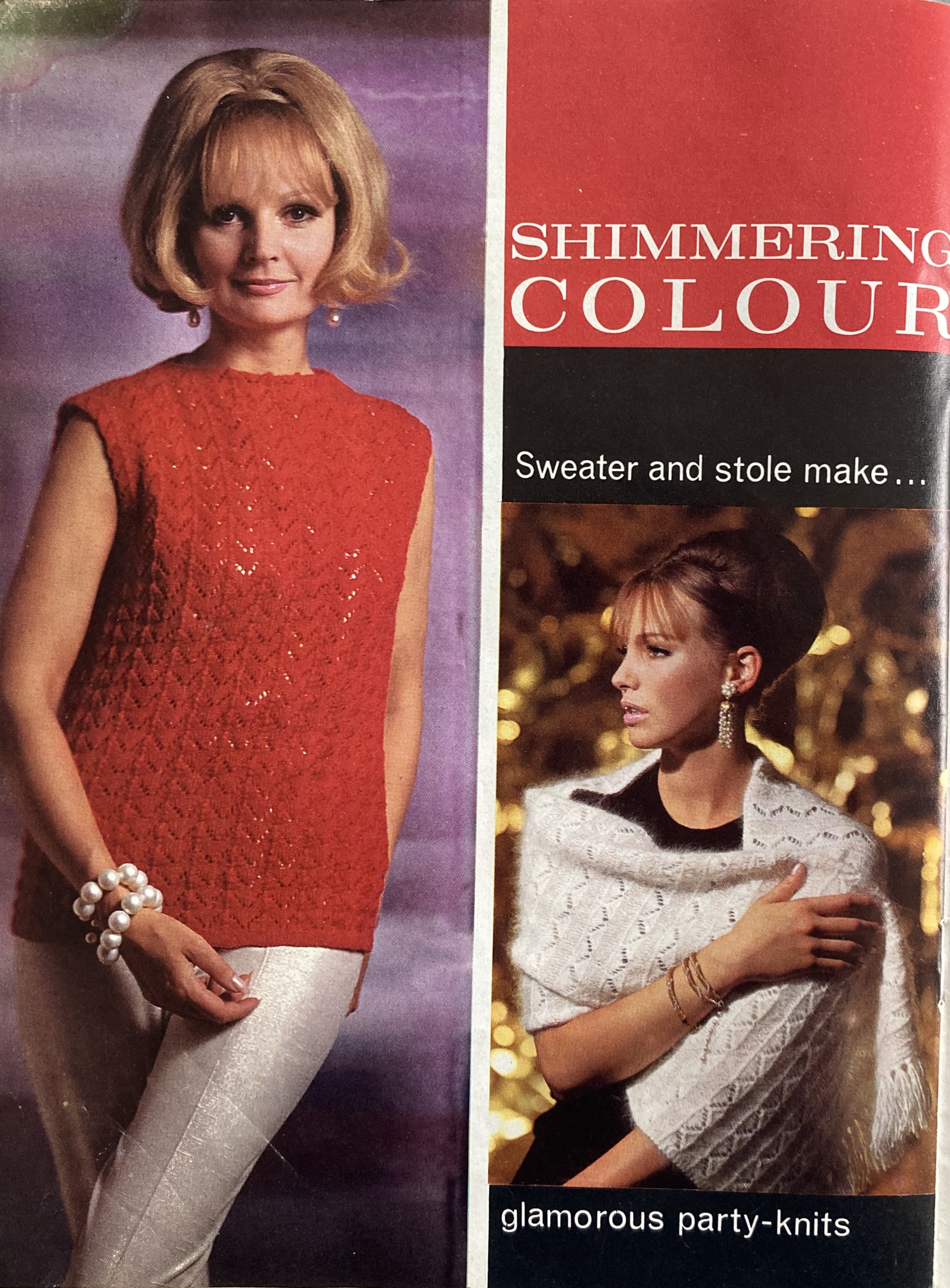
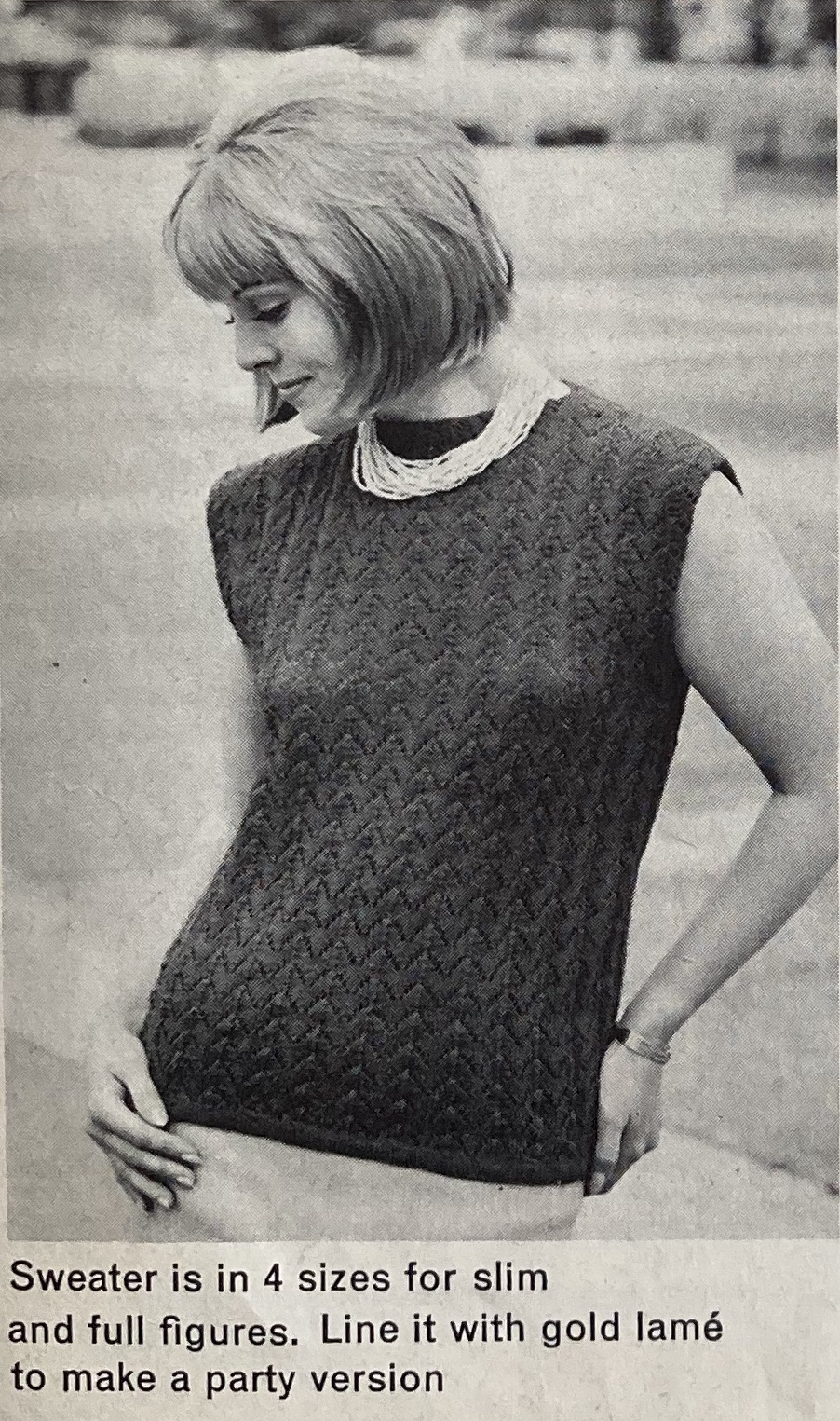
To clear your mind of those images, here is a lovely lacy party top and fluffy “luxury stole” knitted with Lurex for holiday party glamour. The top can be lined with gold lamé for extra sparkle.

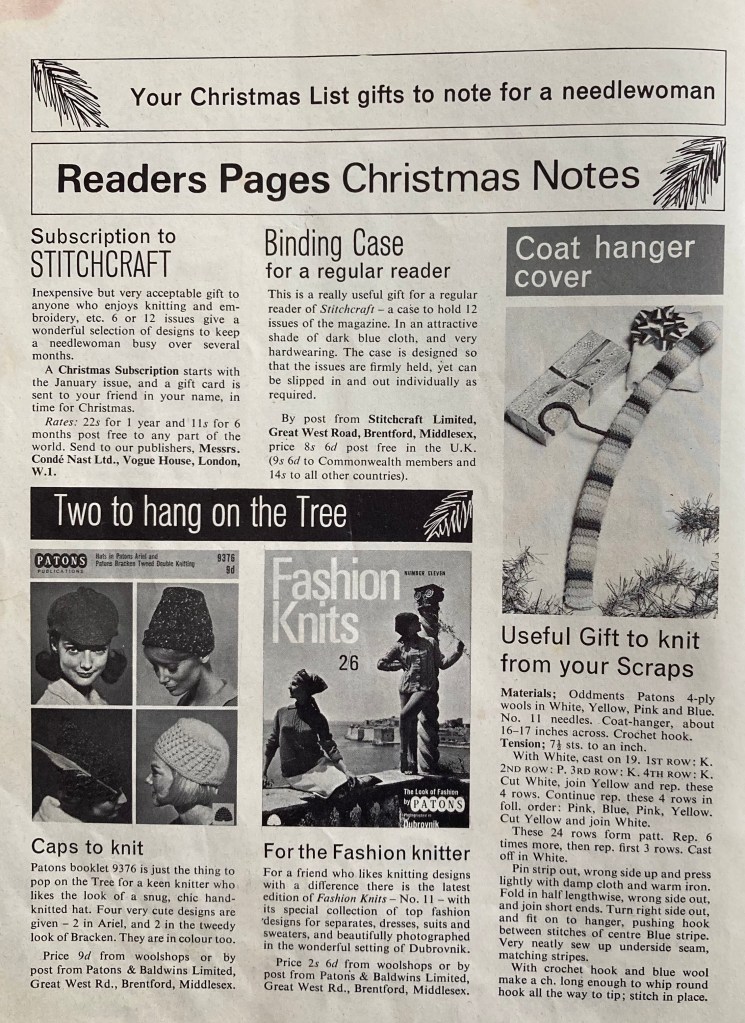
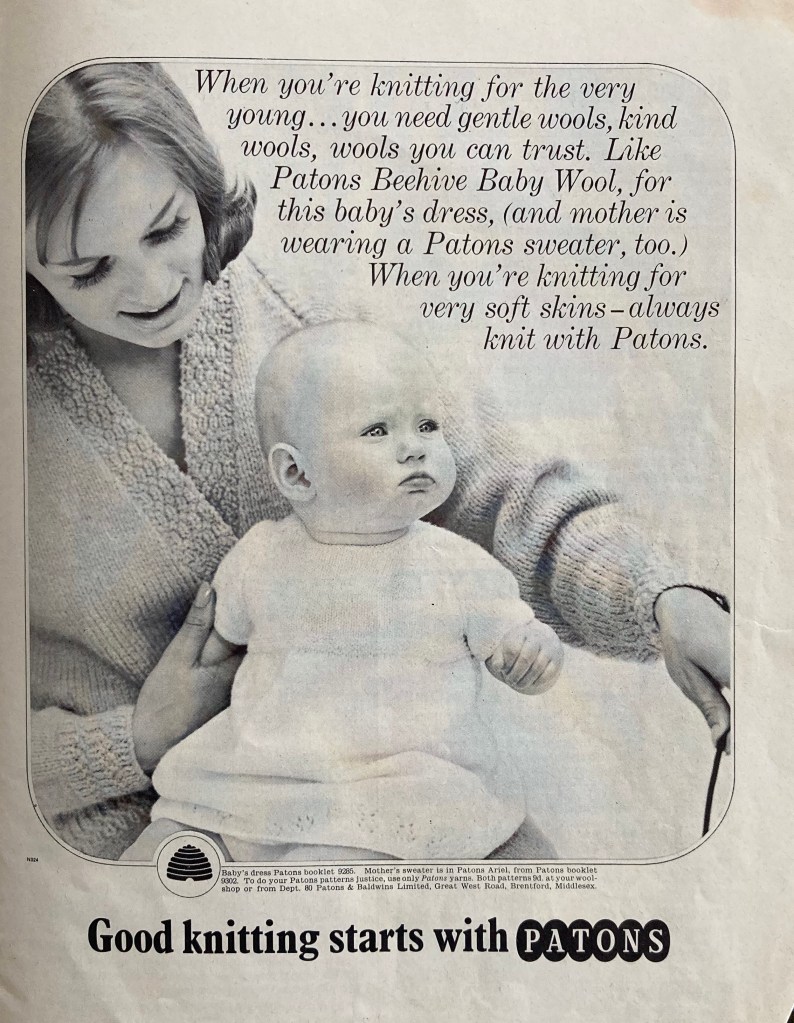
Rounding out this bumper issue are the “Readers Pages”, featuring Stitchcraft and Patons-inspred gift ideas (a yearly subscription, binding cases for past issues, knitting patterns…) and a fun way to use up wool scraps: a coat hanger cover to keep delicate items from creasing or stretching at the shoulders. The ads use babies to sell Lux soap flakes and Patons wool.

The only project that really called to me from this issue was (laugh if you want) the coat hanger cover, which could make a cute little gift for a friend or be useful in my own closet, as well as being quick and easy and a way to use up some of those mystery scraps in the stash drawer. The October 1964 dress is almost finished, so I’ll update that post soon as well.

September 1964: Overview

It’s the start of the autumn knitting season, and this issue’s slogan is “Knitting in Full Swing”. There are practical garments for adults and various ages of children, as well as a new yarn: Patons Flair.

Flair” is somewhat heavier than DK weight — what is now often called “worsted” — and made of 60% wool and 40% “Courtelle“, a synthetic fibre pioneered in the late 1950s by the Courtaulds company. It features in the green cardigan and the yellow star-motif pullover on the cover. I love the cardigan, with its bright green colour and use of simple garter-stitch ribs and bobbles to decorate the fronts. The placement of the motifs on the yellow pullover is… interesting. I guess it works OK on a male figure, but I would not recommend it for a partner look! There’s also a plain, classic V-neck pullover for him and a “blister stitch” sweater for her on the back cover. Bright, cheerful colours are in fashion. (The men’s V-neck pullover colour name is “Sorrento” — anyone know what colour it is?)

The non-Flair adult garments are all made in DK weight yarn: a “country sweater” in a twisted-rib pattern with an oversized Vandyke collar, a complicated cable-and-stripe men’s shirt-style pullover, an elegant set of slim skirt and “overblouse” and a long, skinny sweater “for teens”. All of them feature interesting stitch textures, particularly twisted-rib patterns and bobbles, and interesting details like the fake “pocket” decorations on the front of the overblouse. The cable-and-stripe pattern is especially complex and uses separate lengths of wool for the vertical twisted ribs while stranding the stripe colours behind. Aside from the teen sweater in “Flamingo”, the colours are slightly subtler, with light “Cream Whip” and dark “Loganberry” for the base colours (sounds delicious) and accents of light blue, olive green and melon-orange.

For the younger members of the family, there’s a fun and cheerful five-piece set “for twins”, consisting of a skirt, shorts with braces, a short-sleeved jumper, cardigan and beret. They’re all made in DK wool in a similar bright, sunny yellow to the man’s pullover on the cover. Continuing the matching-set-for-babies look, this month’s issue has a dress and bootees for a six-month-old, to be followed by a matching matinee coat and bonnet in next month’s issue.

With all these lovely things to knit, it’s amazing that there are any homeware projects in the issue at all, but there are always a few utilitarian projects: here, an easy cushion / tray cloth or a thick rug or mat for kitchen or bathroom. For more ambitious embroideresses, there’s a tablecloth or cushion in bright “peasant” design (Stitchcraft‘s choice of word for traditional or folk designs from certain countries and not from others; I do wish they would just call them all “traditional designs” and leave it at that). The design, like the knitted garments, is big and bold and fun and colourful on the cushion, and slightly more subdued in red and blue for the tablecloth.

Though embroidery doesn’t feature big in the issue’s projects, it does have a place in the back pages: in the new children’s comic, “Anne and her Embroidery”, little Anne is bored on a rainy day and passes the time by learning to embroider pictures of the flowers in her window-box. Two pages later, there’s a full-page advertisement for a new tapisserie wool suitable for both tapestry and embroidery. Coincidence? I think not! The other interesting ad is for the new Patons Flair yarn, highlighting its easy care and washability.

That’s all for this issue! My project will be the embroidered cushion.

August 1964: Overview

The August issues of Stitchcraft are always a mix of styles and seasons. The summer holidays are winding down, and knitters will want to start work on warmer garments for the autumn. At the same time, it’s still summer, and it may well be too hot to want to hold wool in your hands, not to mention wear that bulky wool pullover. Stitchcraft’s solution is to offer a range of casual “country” knits that can be worn as outer garments on cooler summer days and be useful for indoor-outdoor wear as autumn approaches.

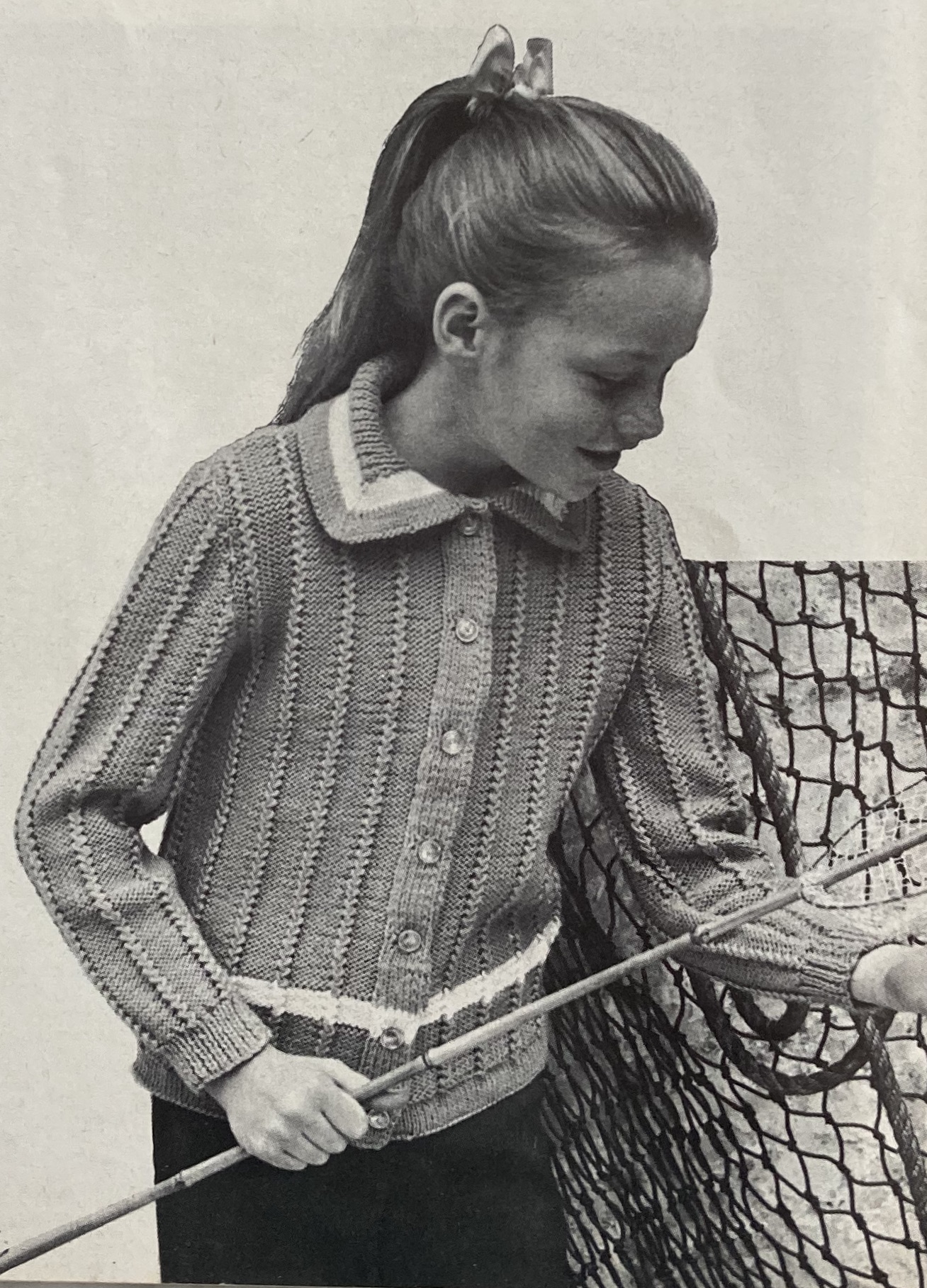
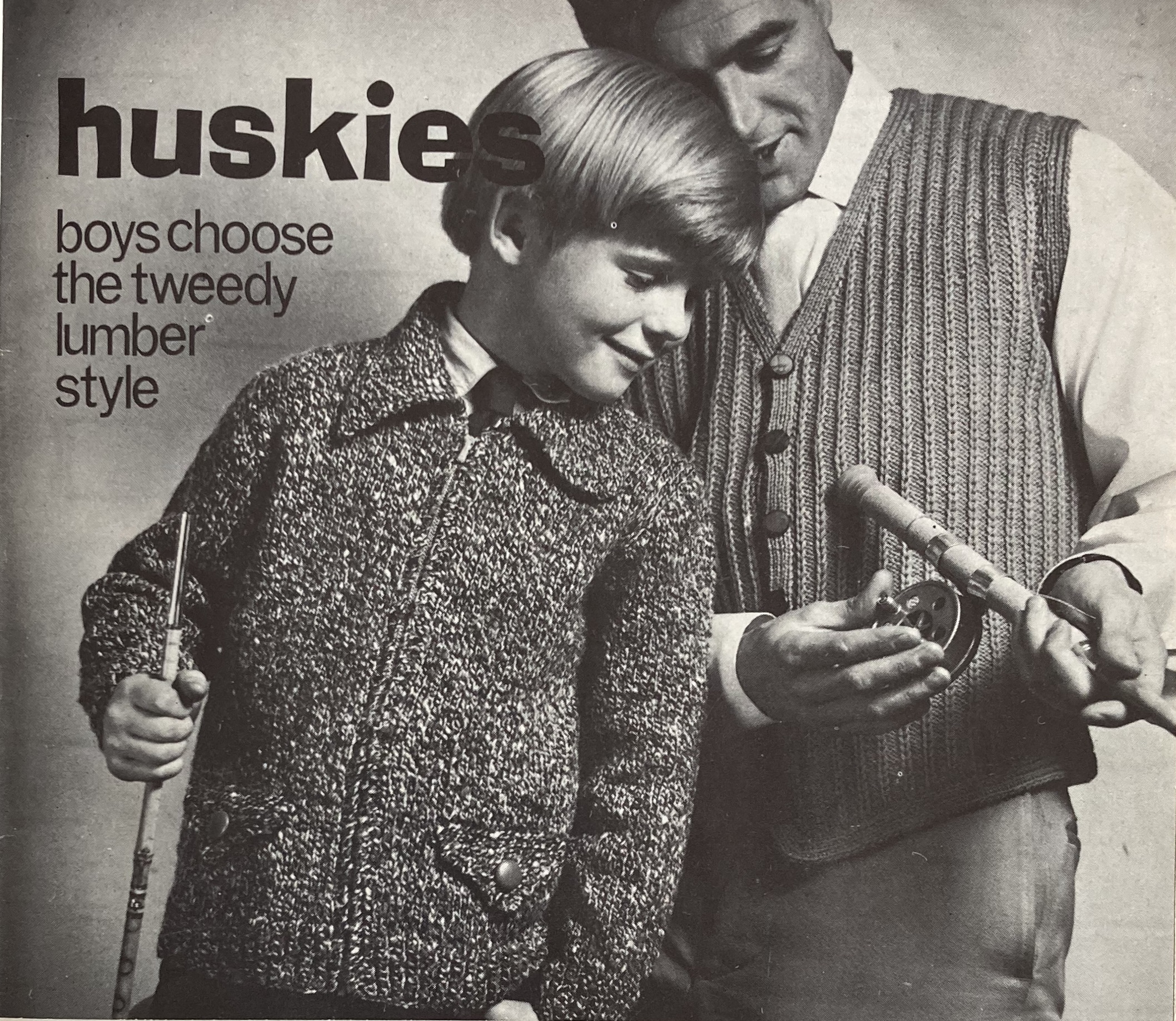
“Junior Knits” have a special prominence in this issue: heavier, loose-fitting pullovers and cardigans for older schoolchildren or teenagers (or smaller-size adult women) that are versatile enough to be worn on holiday, back to school, under a coat in later months etc. They are casual, but stylish, with interesting stitch-pattern details, and a mix of cheerful and neutral colours. The girl’s cardigan is made in DK wool with a twisted-stitch rib pattern and the pullover in bulky “Big Ben” wool can be made up to 34-35 inch bust size. The boys’ “lumber jacket” zipped cardigan is also made in a bulkier, quick-knitting wool: Bracken Tweed. The colour is “Marble”, perhaps a darkish grey? (The “father” in the photo is wearing the waistcoat from the July 1964 issue.)

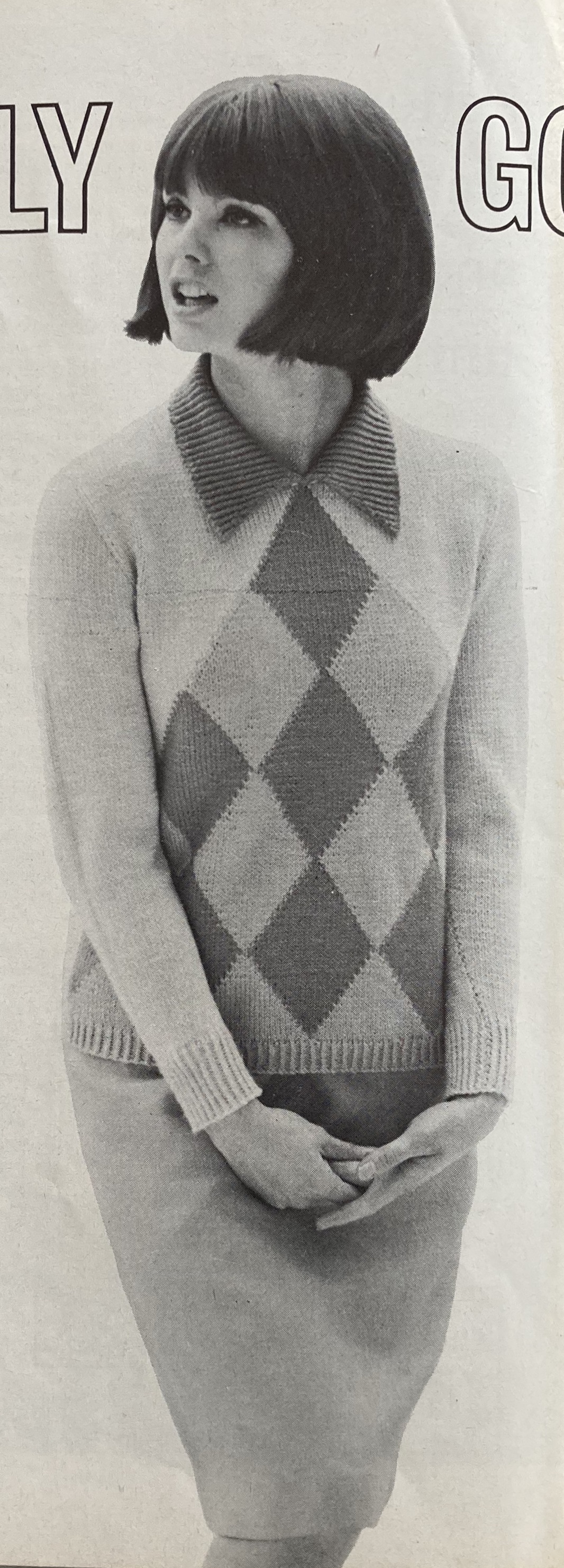
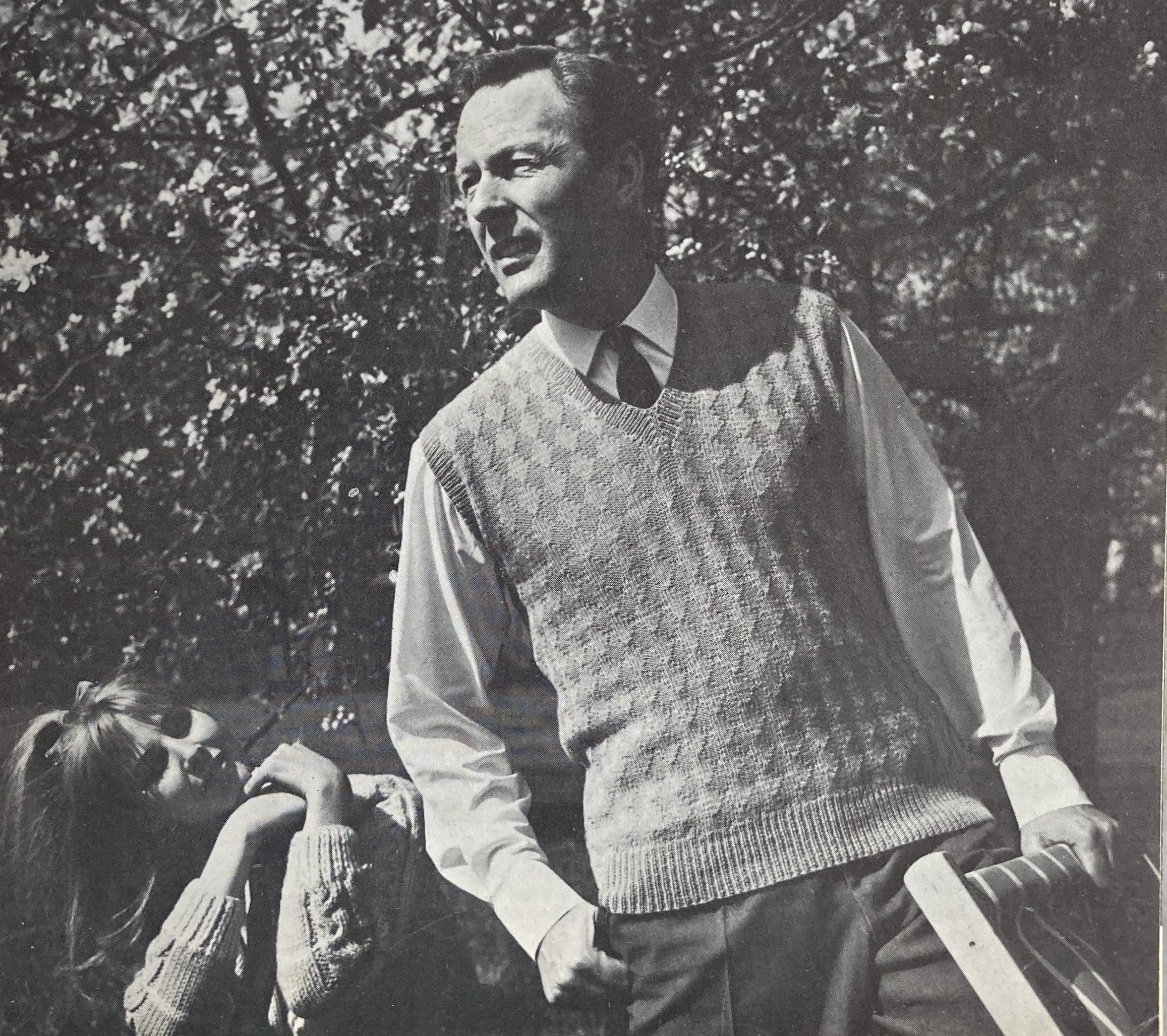
The adult-size garments are a mix of casual, bulky holiday outerwear and more refined garments for a dressy holiday outing or the return to work and daily life in September. For women, there’s a striped, sleeveless top, knitted sideways and belted and made in DK wool to be warm under a jacket or cardigan, or the wonderful “harlequin” diamond-pattern pullover in the cover, or a sleek 4-ply sweater suit with pleated skirt for autumn wear. Men get a thick zigzag-cable cardigan for “driving and all-casual wear” as well as an elegant 4-ply slipover in a diamond pattern. With the exception of the skirt suit, neutral cream colours with ice-cream peach and orange contrasts prevail. Cables, zigzag and diamond patterns are still on trend, as are large , pointy or polo/turtle-neck collars.

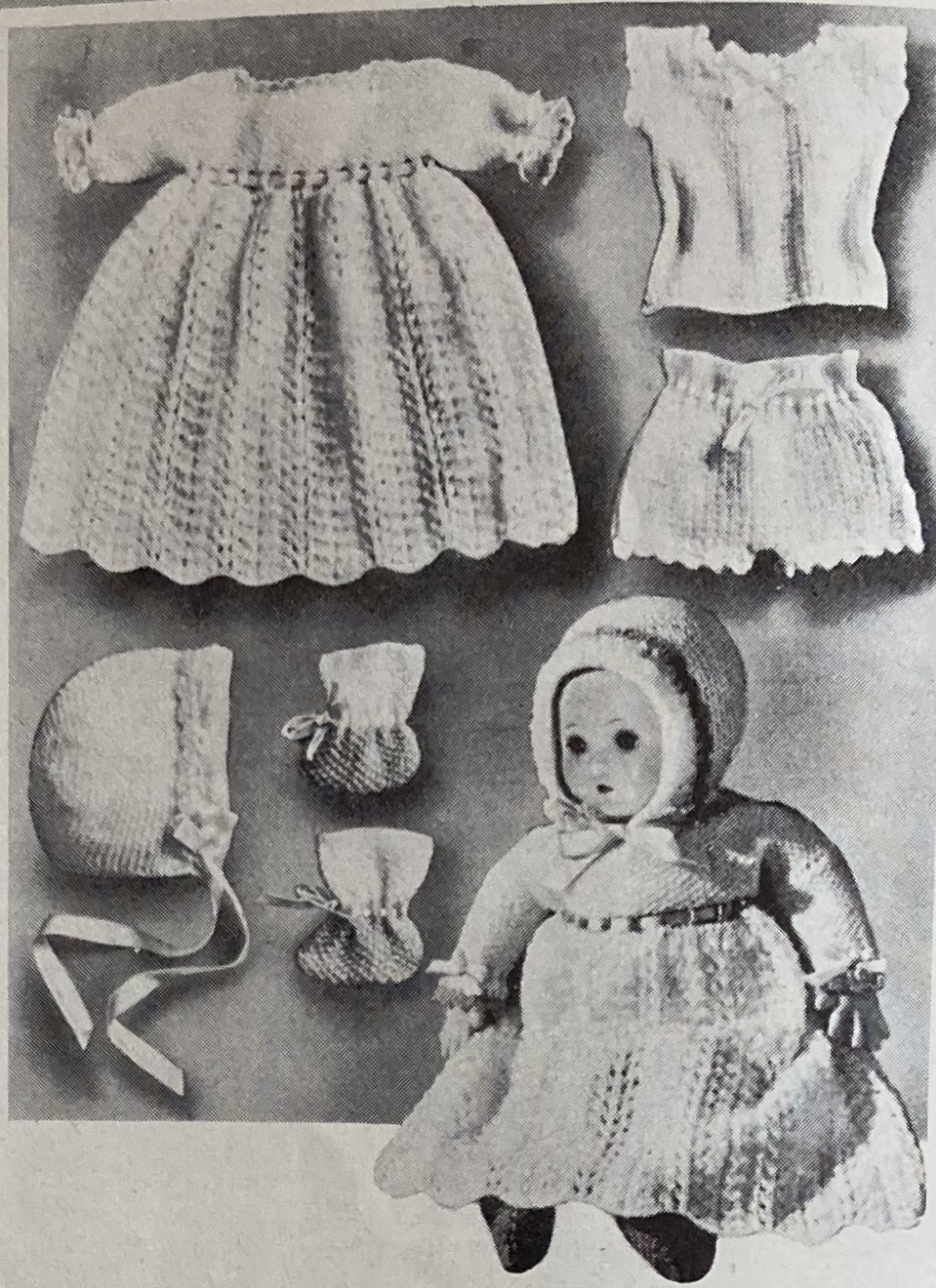
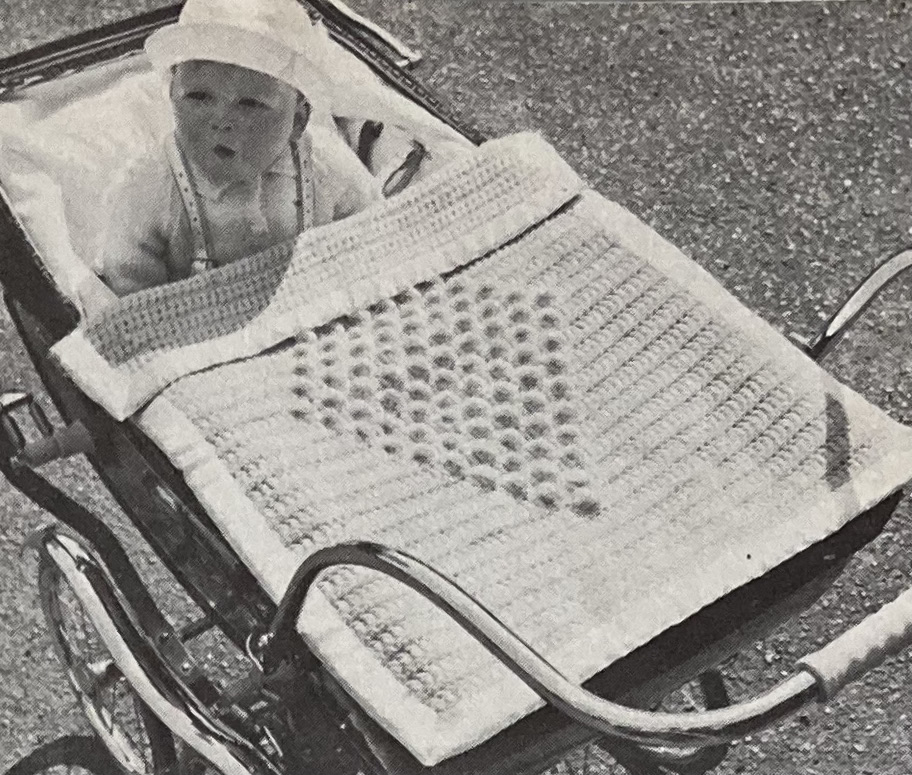
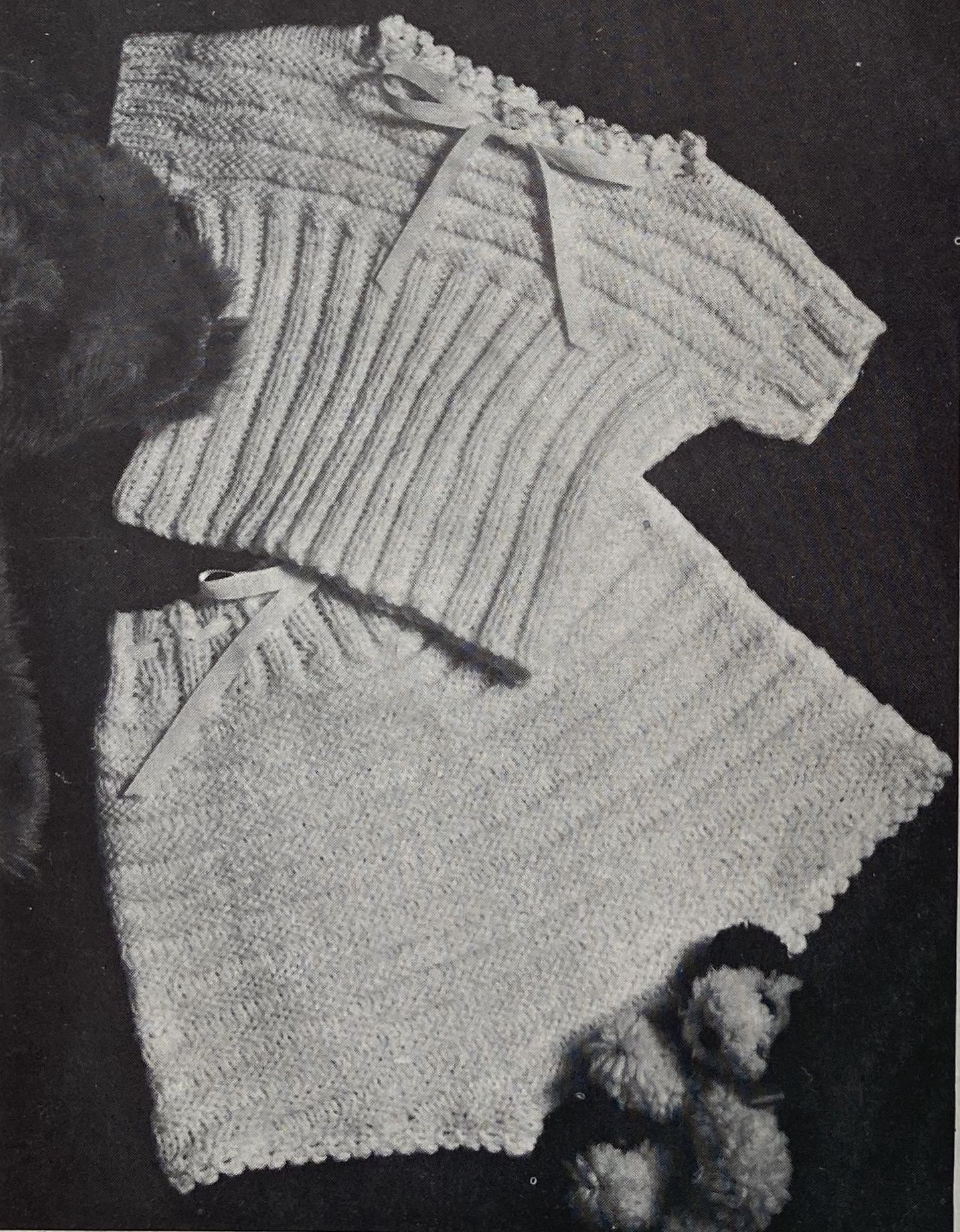
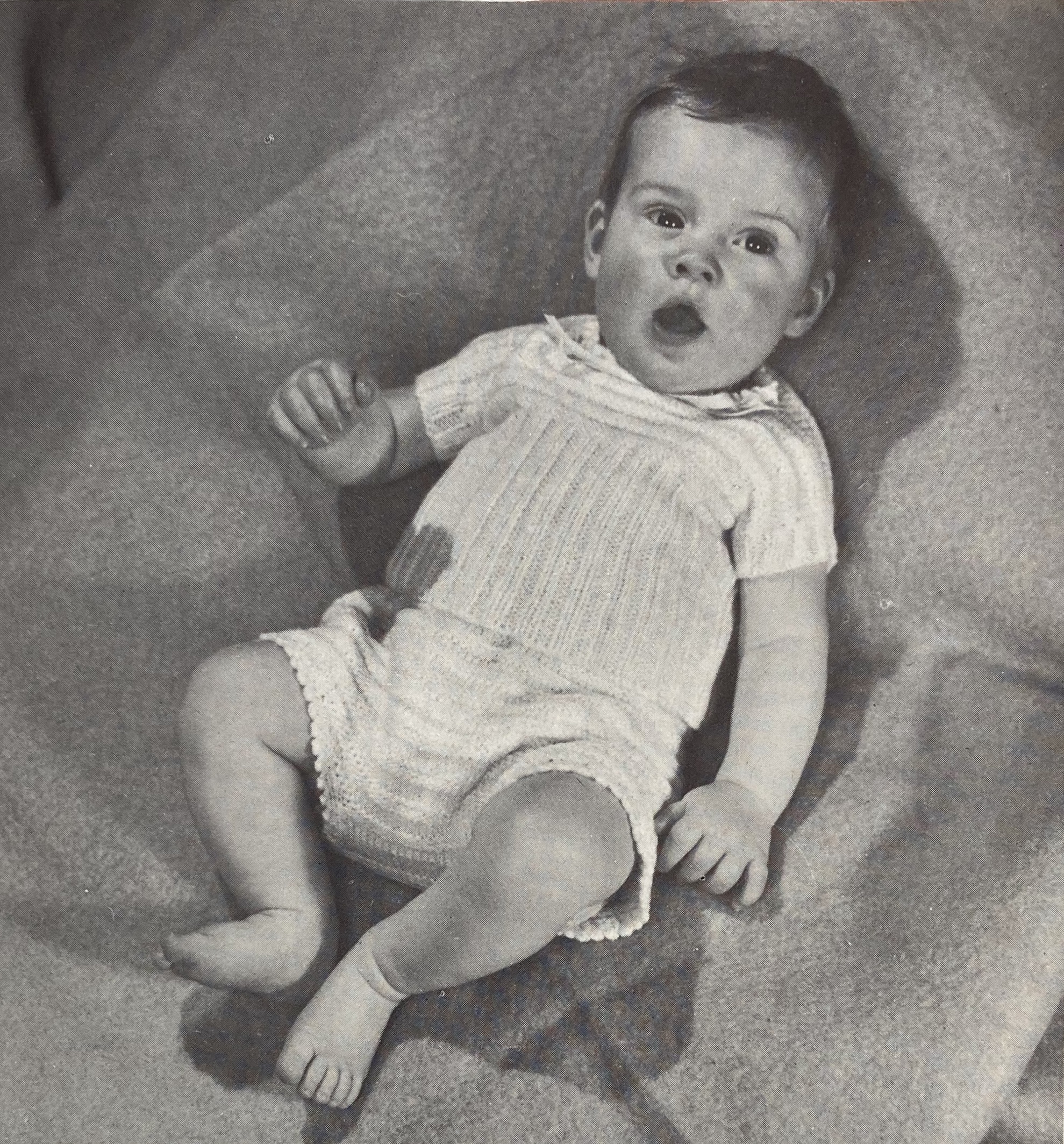
The baby layette series continues with a second-size (ca. 6 months) “pilch” (shorts) and vest in an easy vertical and horizontal rib pattern. The vest is made in a simple T-shape. There’s also a reprint of a baby blanket pattern from 1958 in the back pages. Sitchcraft apparently got many requests for reprints of popular patterns and many of them appear in issues from the mid- and late 1960s.

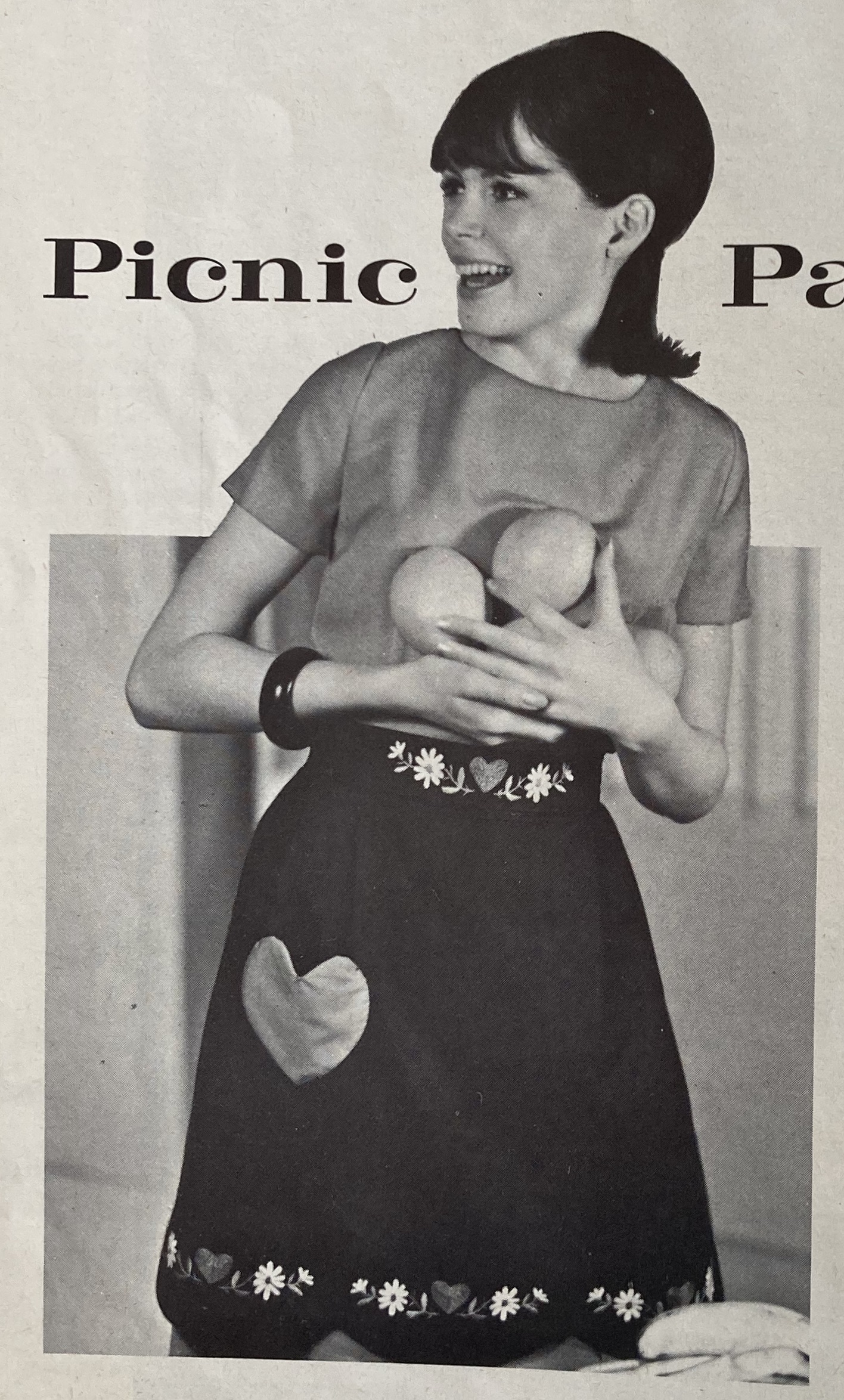
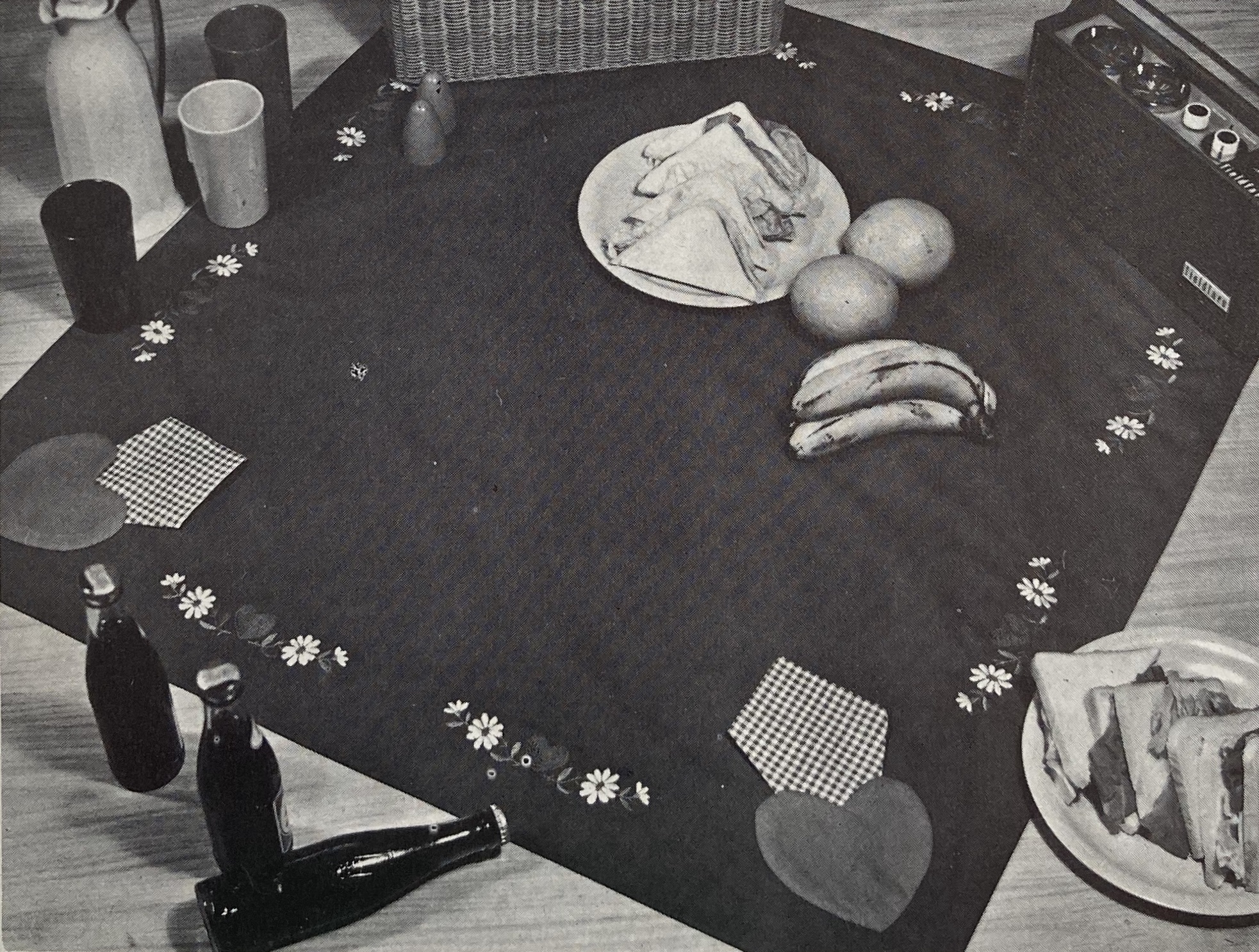
Homewares are a mix of smaller, easy projects that one could take along or use on a late August holiday, and larger at-home projects to work on for the autumn. In the first category, there’s a charming, easy embroidered apron and cloth set for a summer picnic, with appliquéd hearts as pockets in both the apron and (for napkins, how cute!) picnic cloth, an easy cushion embroidered on Bincarette and simple woven table mats suitable for patio use.

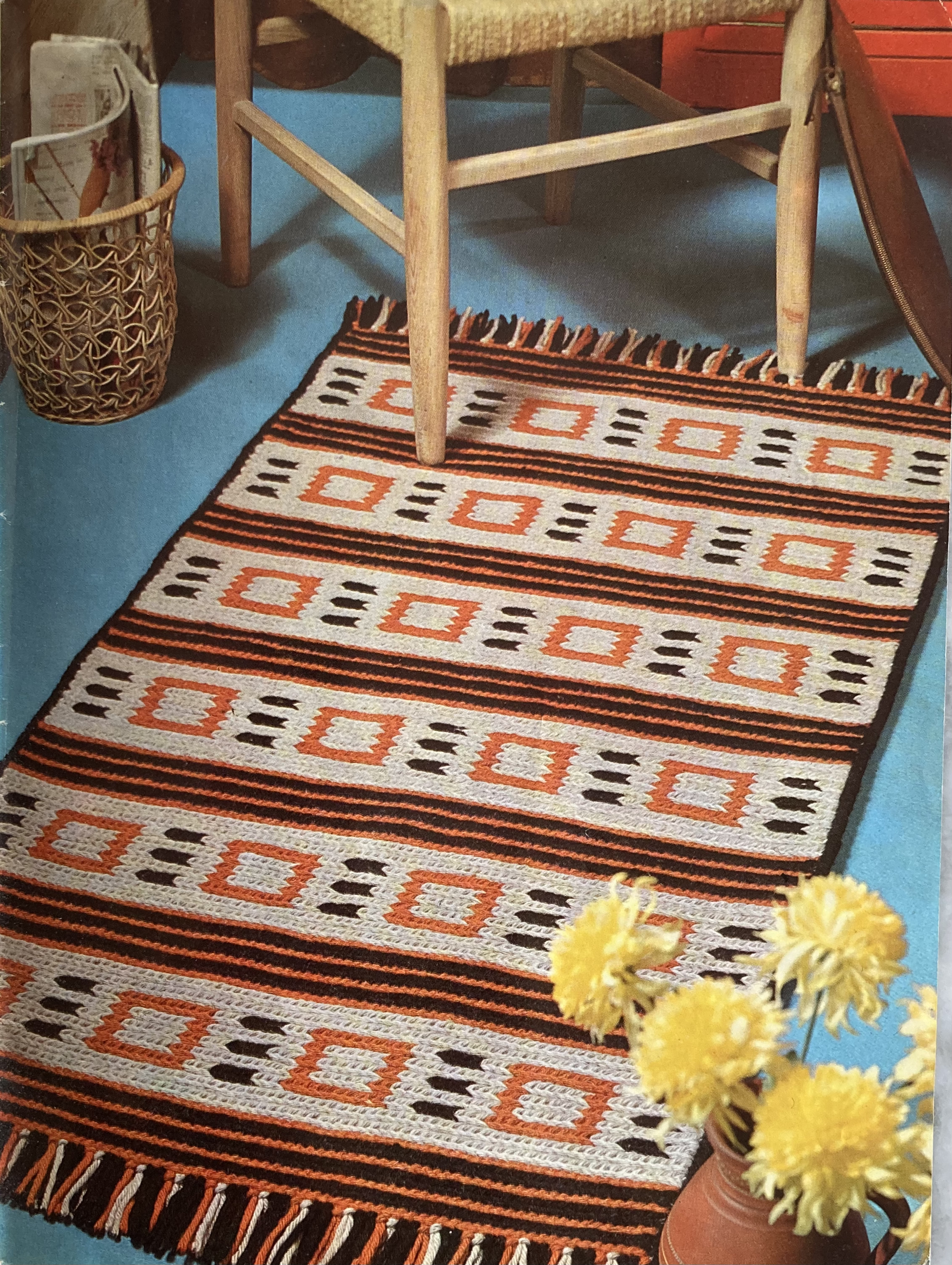
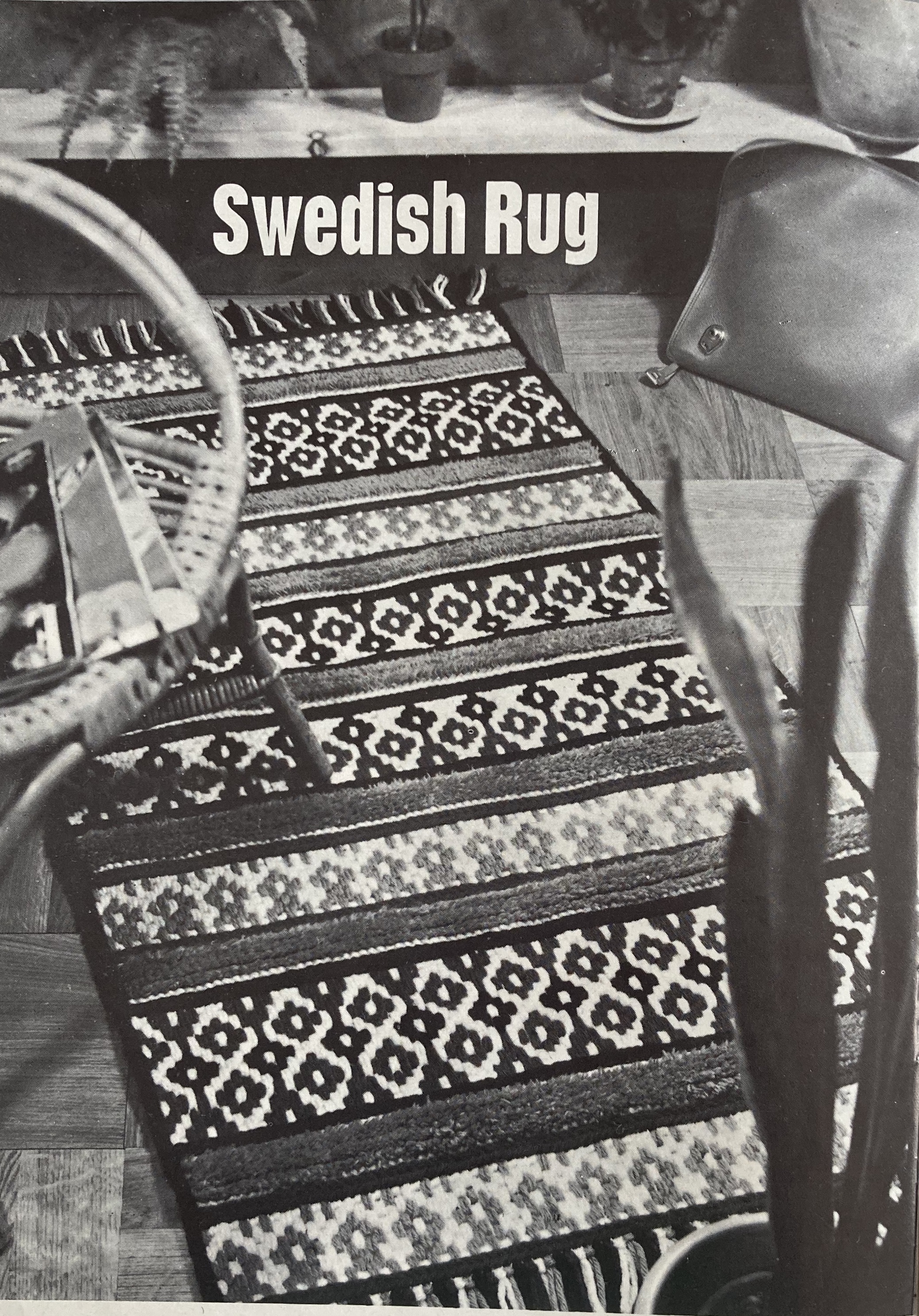
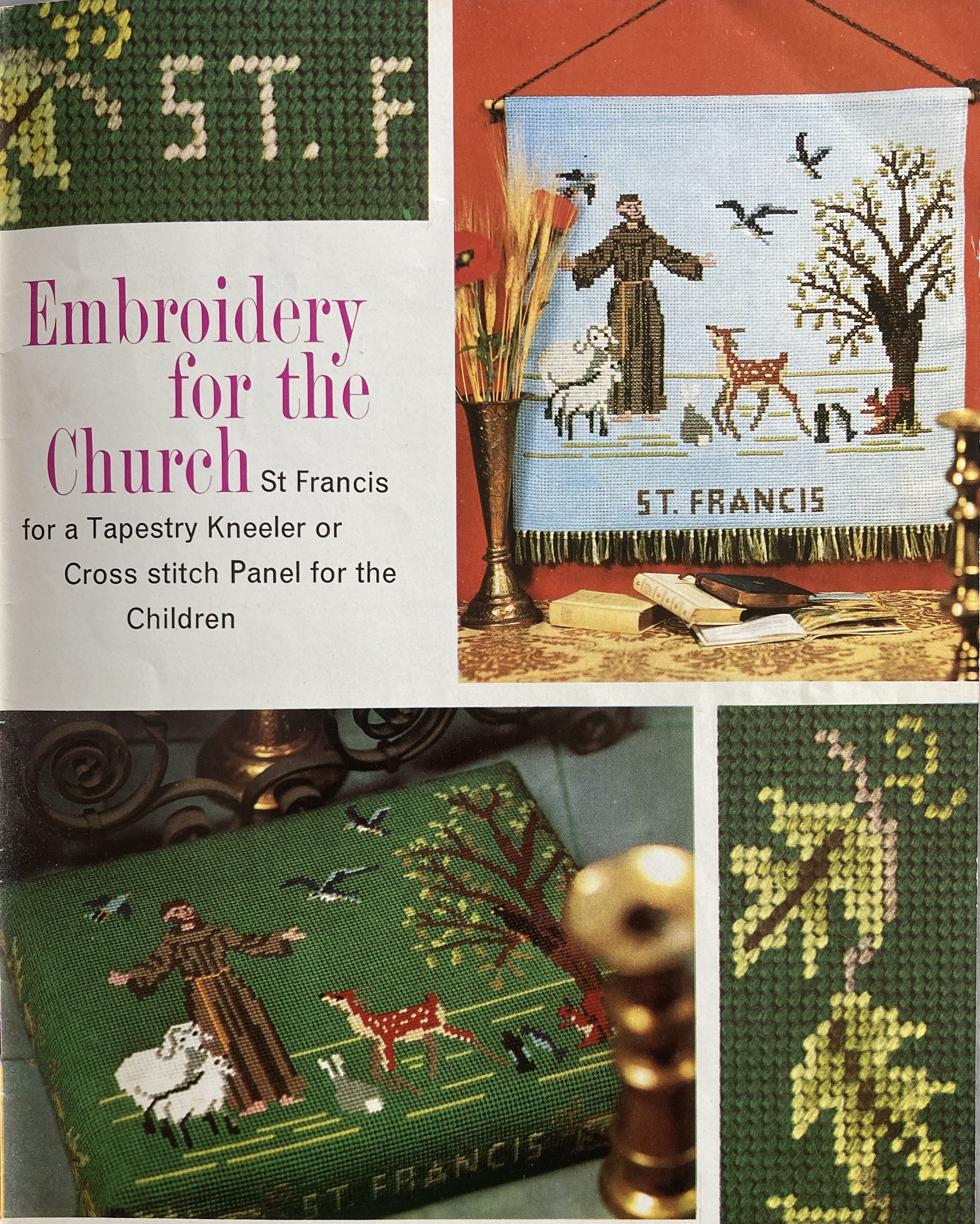
In the second category, there’s a complicated “Swedish” rug with both pattern weaving and tufting and for churchgoers, a cross stitch panel or kneeler featuring a scene of St. Francis with various animals.

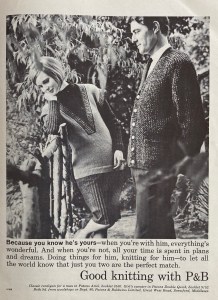
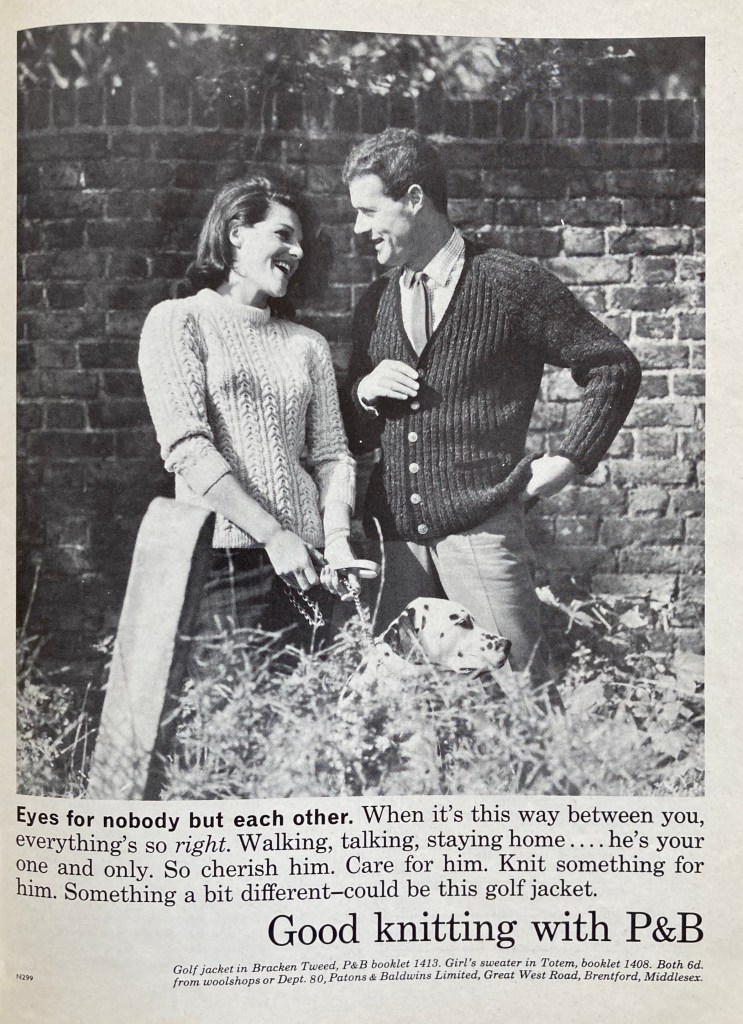
The Patons wool ad is weird and sexist, as usual. When you’re not with your man, naturally all your time is spent doing things for him and knitting for him — but if the photo is any indication, you’re not even happy about it? Here is the beloved man smugly lording it over his wife, who looks sad and embarrassed in spite of having knitted a lovely comfortable cardigan for him as well as a gorgeous outfit for herself. Be proud of yourself, skilled knitter, and remind your man that he would die of starvation and cold if you didn’t cook for him three times a day and knit him warm things!

As nice as many of the projects in this issue are, there’s nothing that catches my fancy enough to want to make it except perhaps the baby items (but I don’t know any babies that age at the moment, or anyone who’s expecting one right now.) I have so many WIPs and one of them is from a 1967 issue of Stitchcraft, so I’ll try to finish that up and make another “Fast Forward” post about it. My July ersatz project should get finished this week, so I’ll update that post soon as well.

May 1964: Overview

Cover photo from Stitchcraft magazine, May 1964, showing a woman in a pink knitted cardigan

Stitchcraft‘s May 1964 issue promises a “May Merry-Go-Round” of “a wide choice of Summer Knits for leisure, holidays, travel and all the warmer weather activities.” Time flies so fast that I feel like I’m on a merry-go-round even without knitting — but let’s see what this issue has in store for us.

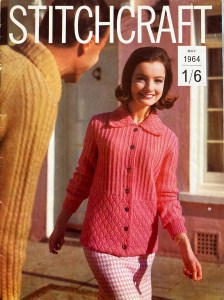
Our cover feature is a high-buttoned cardigan with a deep “pineapple stitch” hem and collar. It’s made in DK weight wool, but the pineapple stitch and slip-stitch rib make it quite heavy (20 oz.) and presumably warm and sturdy. There’s a less bulky design in DK wool on the facing page; no collar and a plain twisted stocking-stitch make it require only 12-14 ounces of wool. Patterns that utilise texture and lines, especially diagonal lines, are still very much in fashion, as are high necklines and collars.

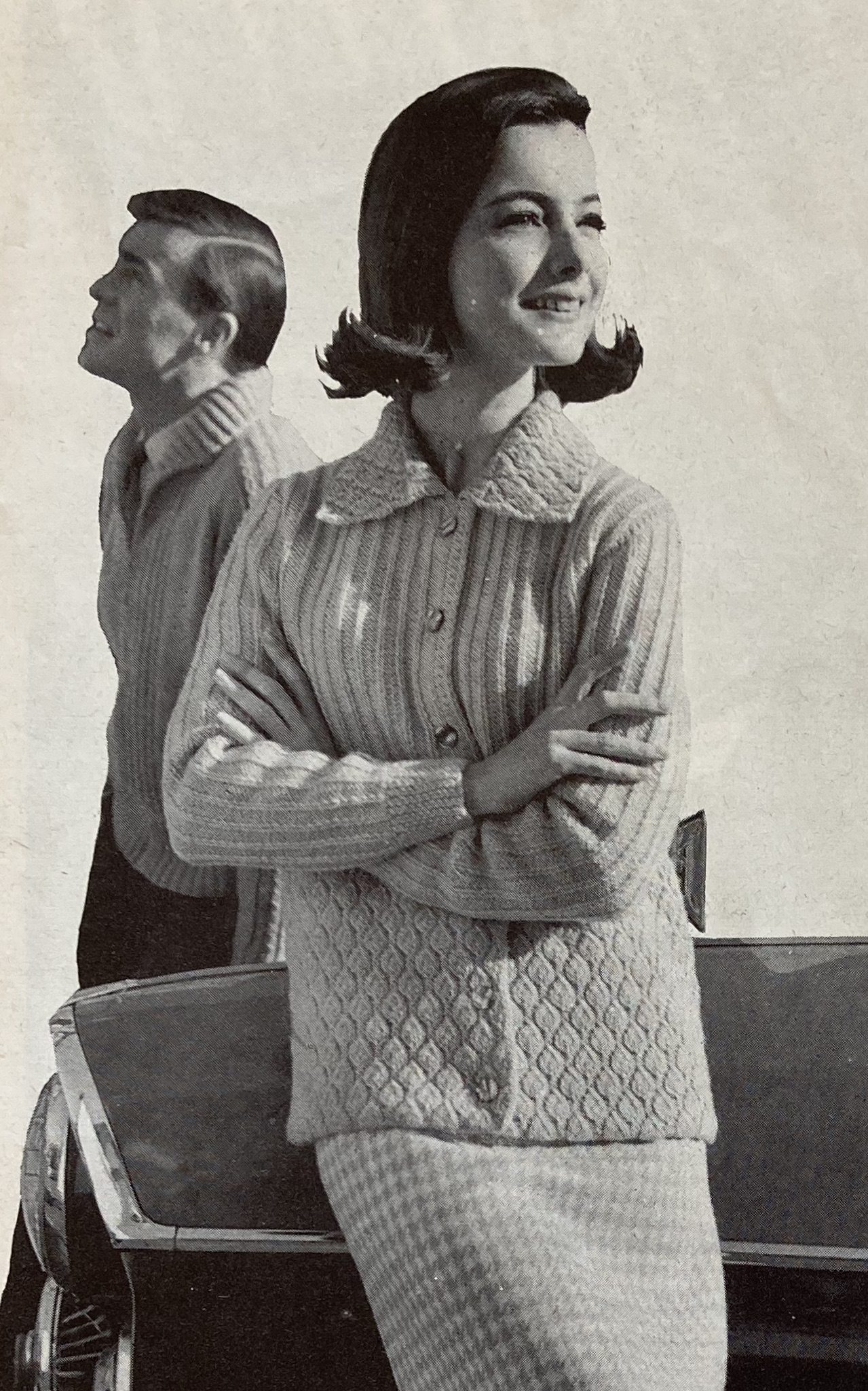
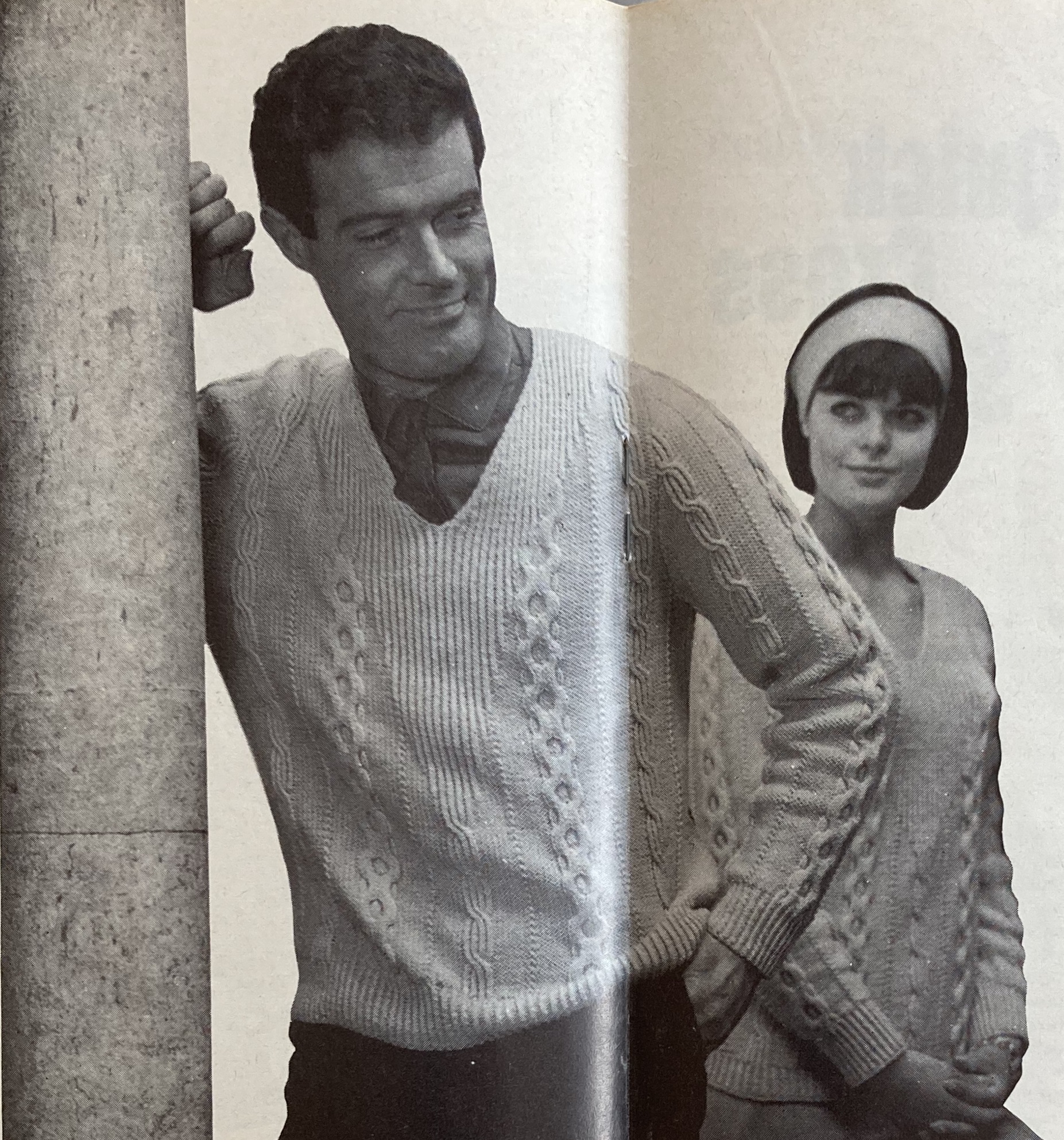
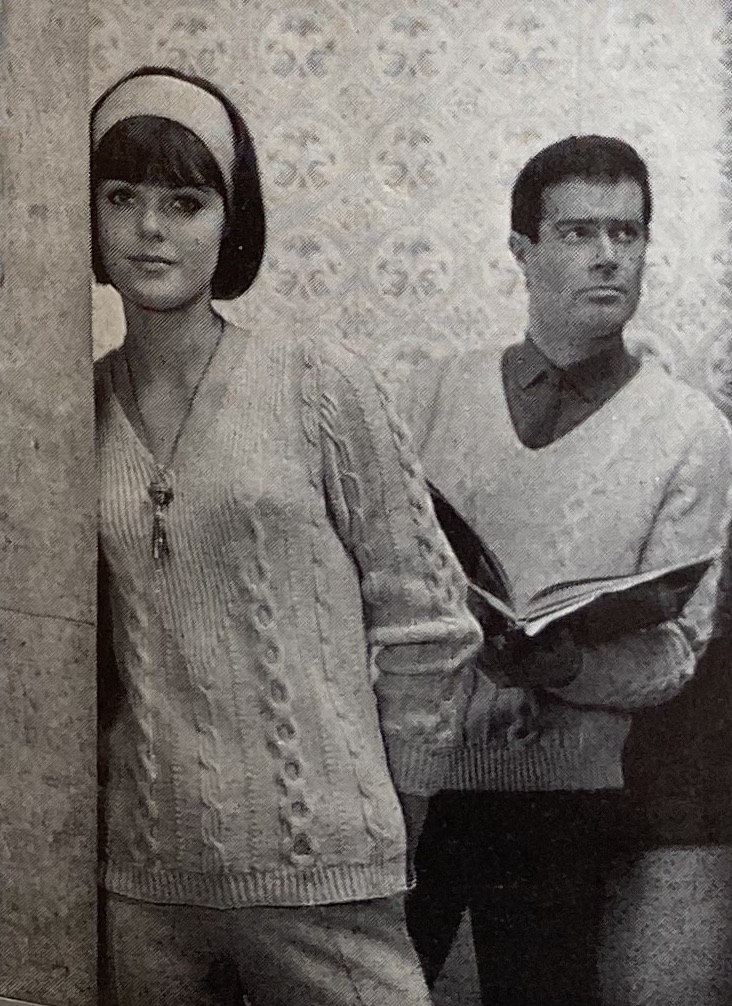
The back cover shows off the latest in partner-look sweaters, this time with a V-neck. It’s not what you would call a traditional Aran-pattern design, but it combines some of the typical cable elements with textured ribbing for a sleek, modern twist on the traditional look. The sweaters are made in light colours with Patons Totem Double Crepe, a very smooth yarn with a tight (“crepe”) twist, to make the pattern stand out.

(Side note: This issue is visually one of the most fun I have encountered, thanks to multiple photographs of the same garments and models in different poses, and the liberal use of illustrations. I particularly like the one with our male model looking up out of his book (travel atlas?), apparently quite concerned, while the female model looks calmly into the distance. Feel free to suggest captions!)

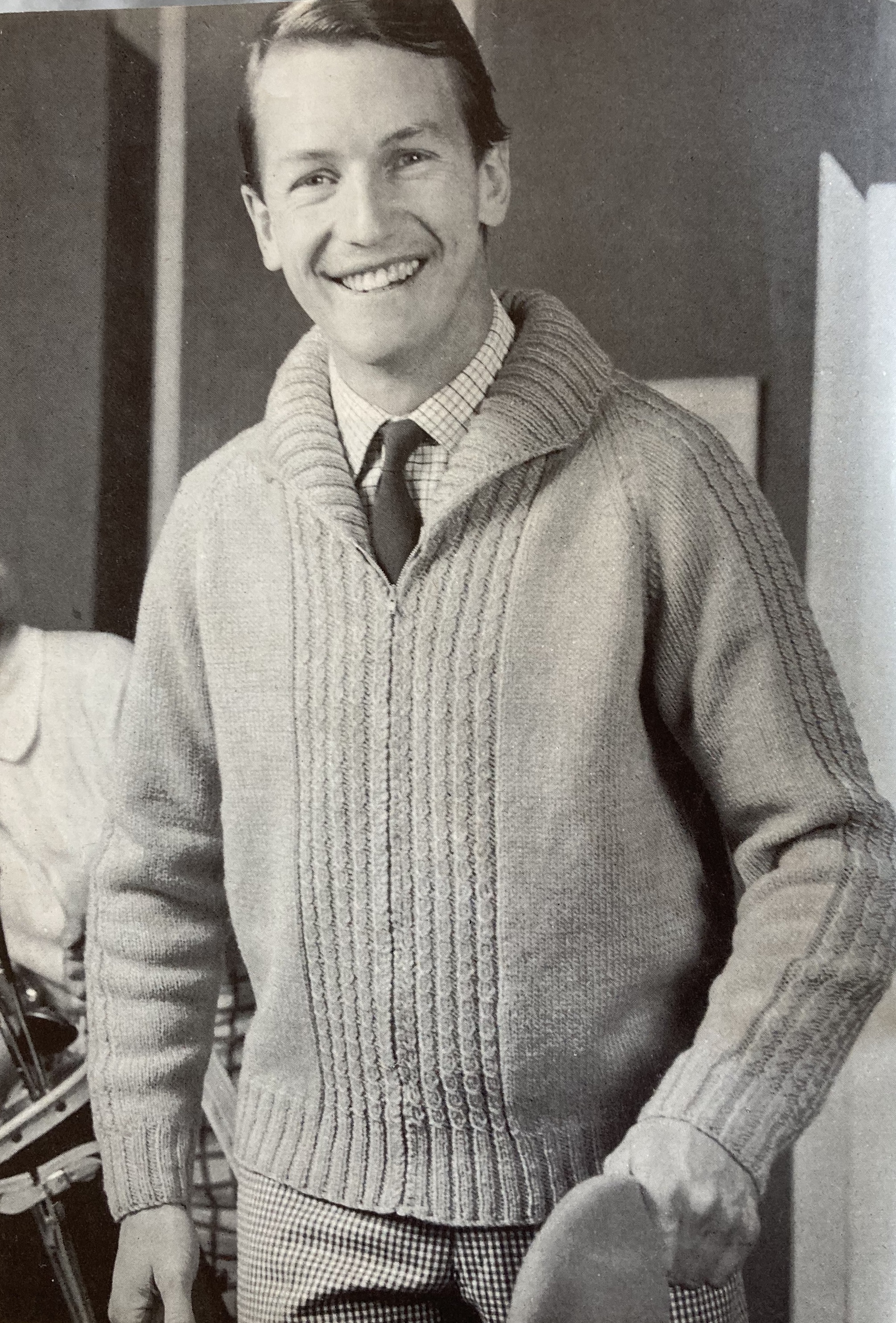
“Finer-knit fans need not feel neglected” by all these bulky, loose-fitting overgarments, promises our “editress” in the facing-page notes: here’s a cute blouse-cardigan in 4-ply wool with the same use of vertical lines, textured pattern and collar, but all in a more refined and elegant look. It’s made in Nylox, a wool-synthetic blend much like modern 4-ply sock wool, and promises to be “very pretty and feminine worn with a pastel skirt.” The man of the family sticks with DK-weight wool, though, and gets a “best of all golfer style” zipped cardigan with classic shawl collar and mock cable detail. I’m only sorry that they chose the normal pose for the full-page photo and relegated the fun one to the facing page.

A cardigan jacket for indoor-outer wear is practical for summer travelling, so this month’s issue offers us a structured, yet comfortable “Blazer for Globe-Trotting” in DK weight as well as a belted coat with pleated swing back for the teenage daughter. The coat has a matching cap, as well, and is made in tweedy, bulkier “Glenora” wool. Here, again, there are multiple photos, so you can get a sense of the coat in its entirety.

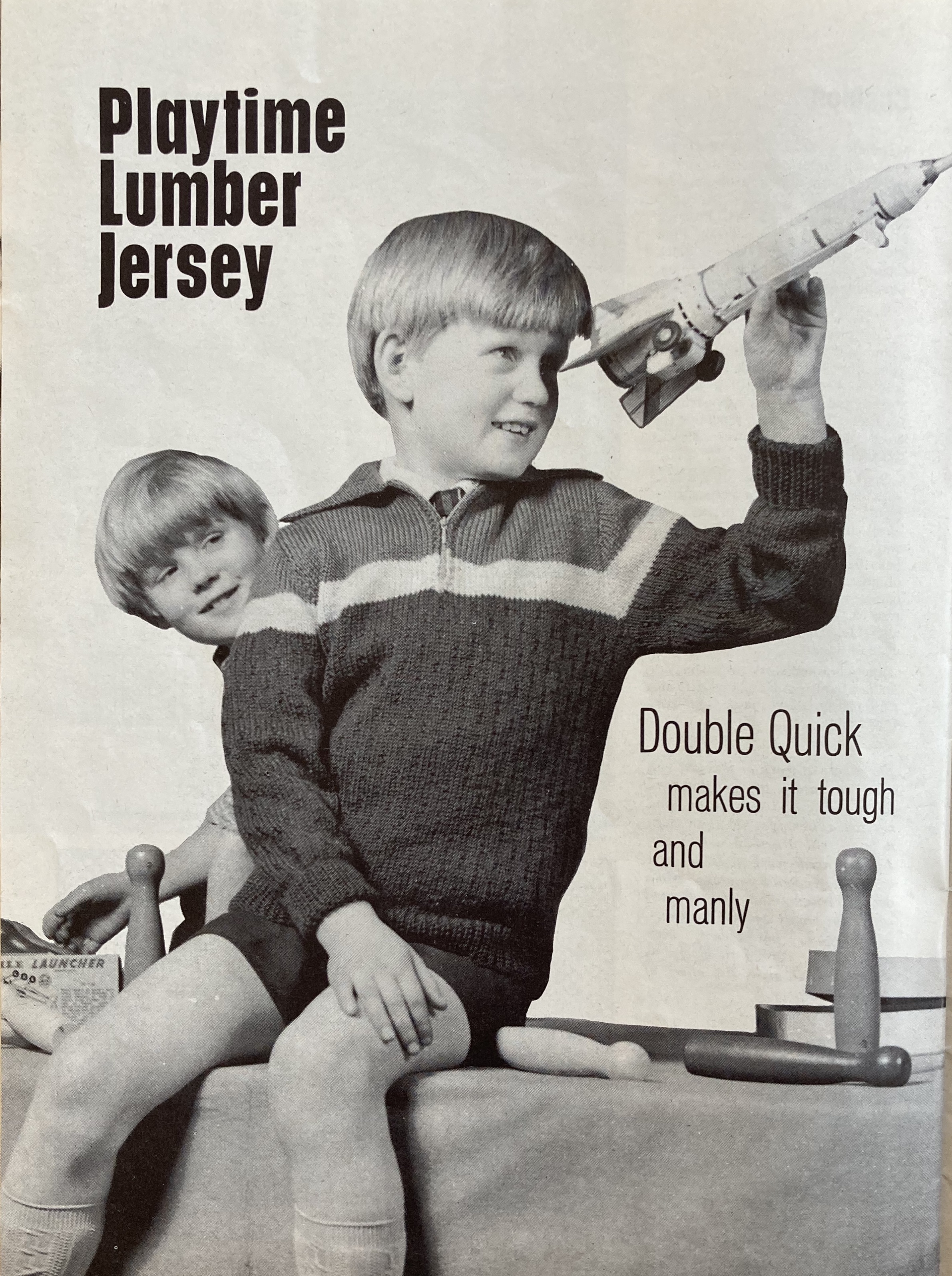
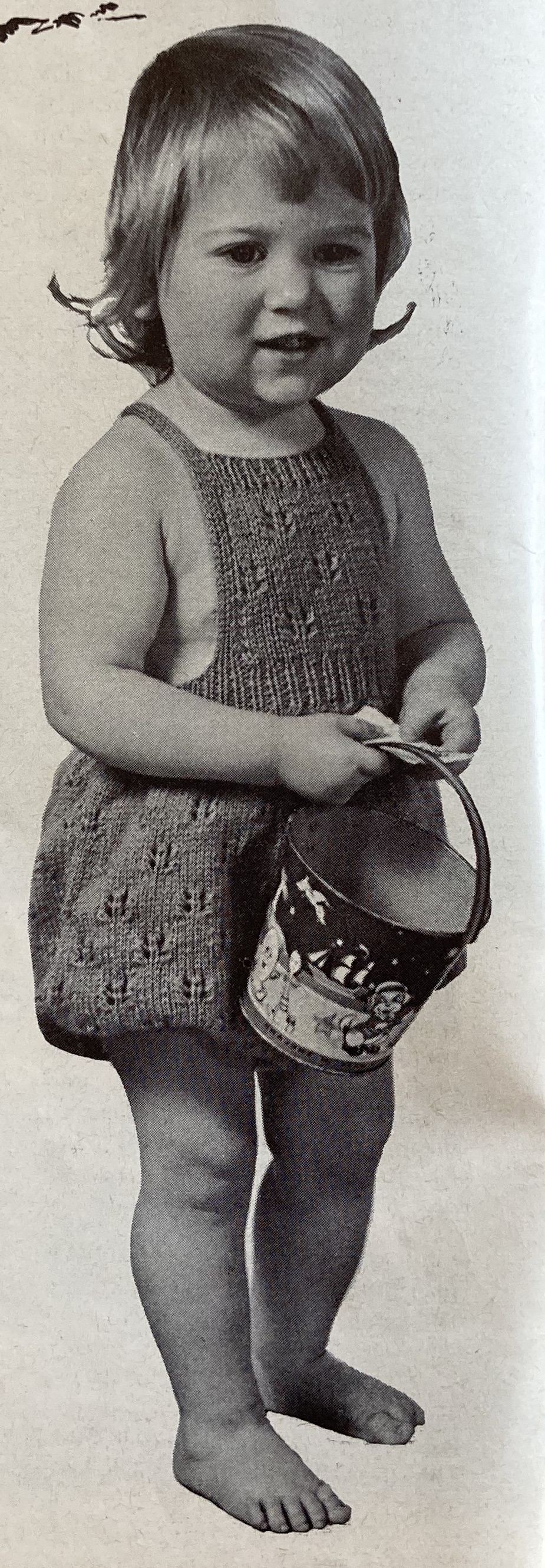
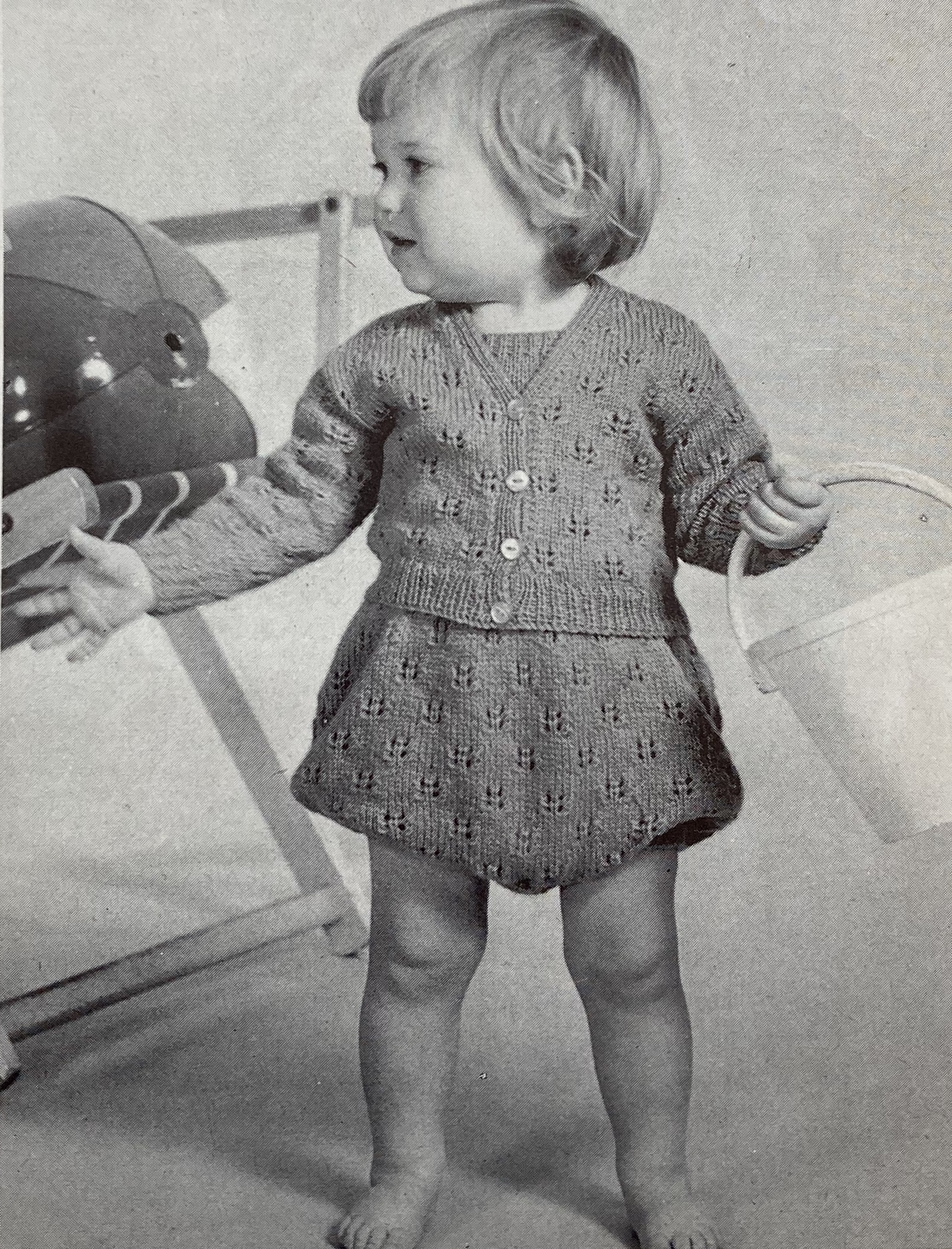
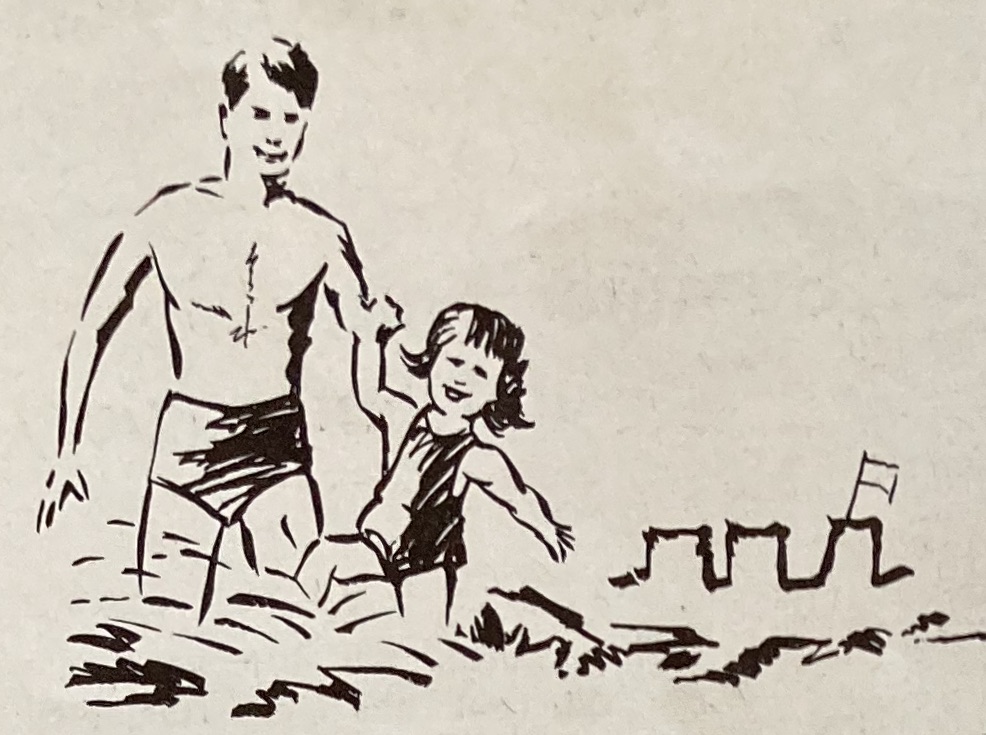
Younger children can enjoy their holidays in hand-knits as well: the boy’s zip-neck jersey promises to be “tough and manly” for the future rocket scientist of the family and makes nice use of stripes and a more subtle textured pattern. (The colours, from neck to waist, are “Breton Red”, “Magnolia” and “Woodland Green”.) Toddlers can go “splashing and paddling” at the beach in a cute romper with a matching cardigan to cover up when it gets chilly. And here’s another great illustration, showing our little model splashing and paddling with her father, sand castle in the background.

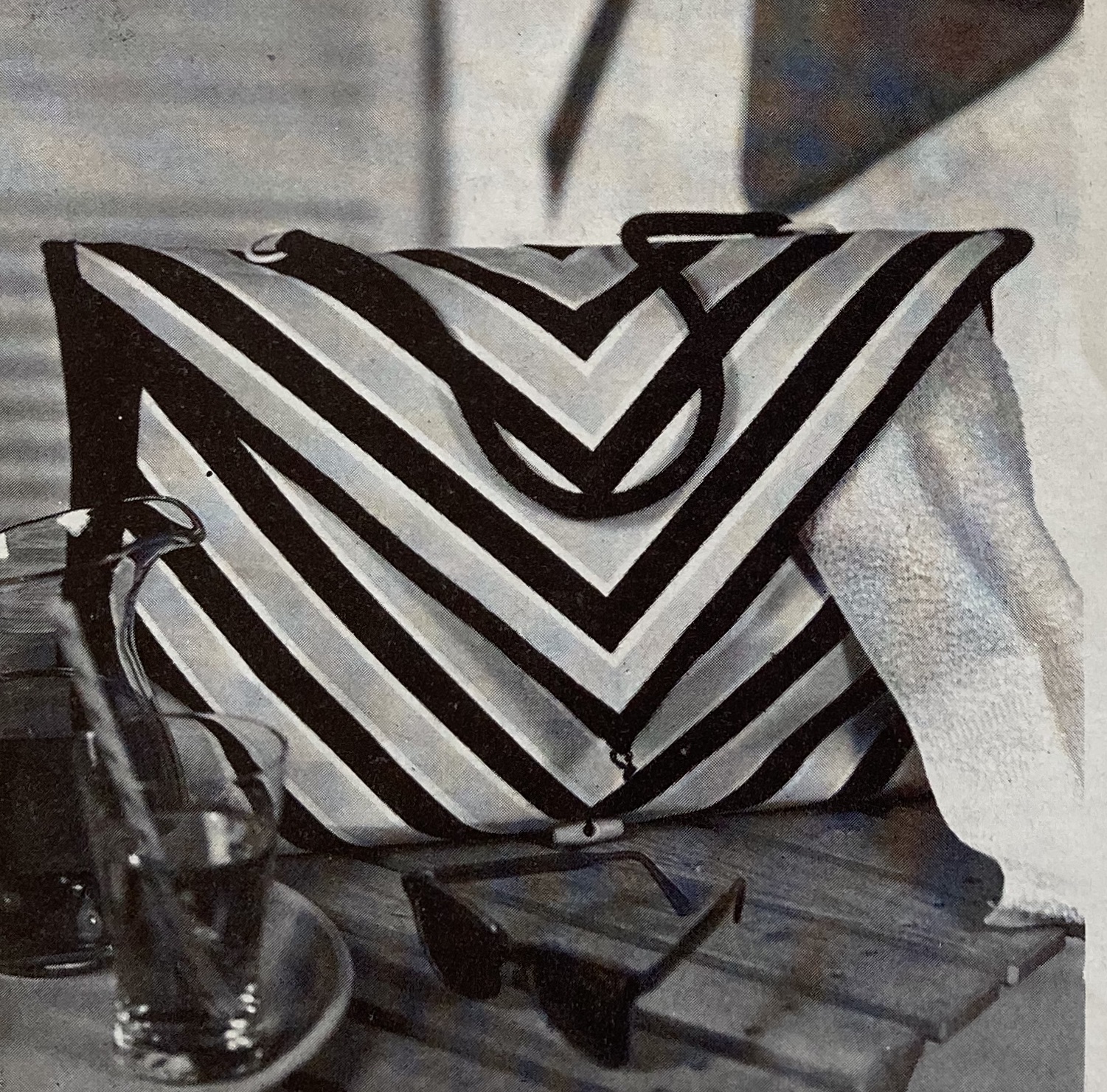
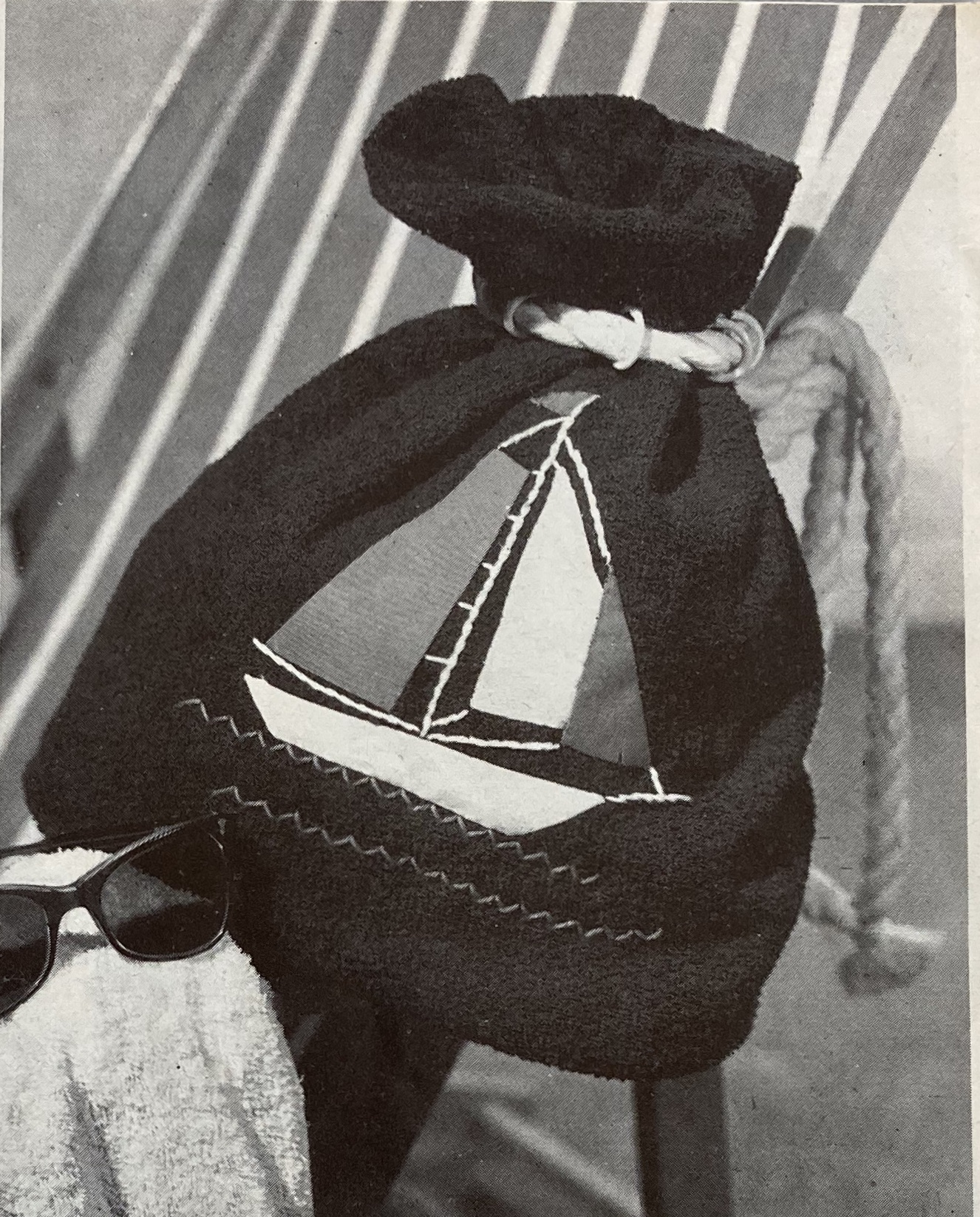
Speaking of beach holidays, how are you going to transport your (possibly wet) swimsuit, sunglasses, towel and whatever else you need back and forth? In a chic, yet practical home-made kit bag, of course. Here are two designs to sew yourself: an “envelope type” made out of tough deck-chair canvas, or a drawstring bag made out of towelling material lined with plastic and decorated with a sailboat motif in appliqué and embroidery.

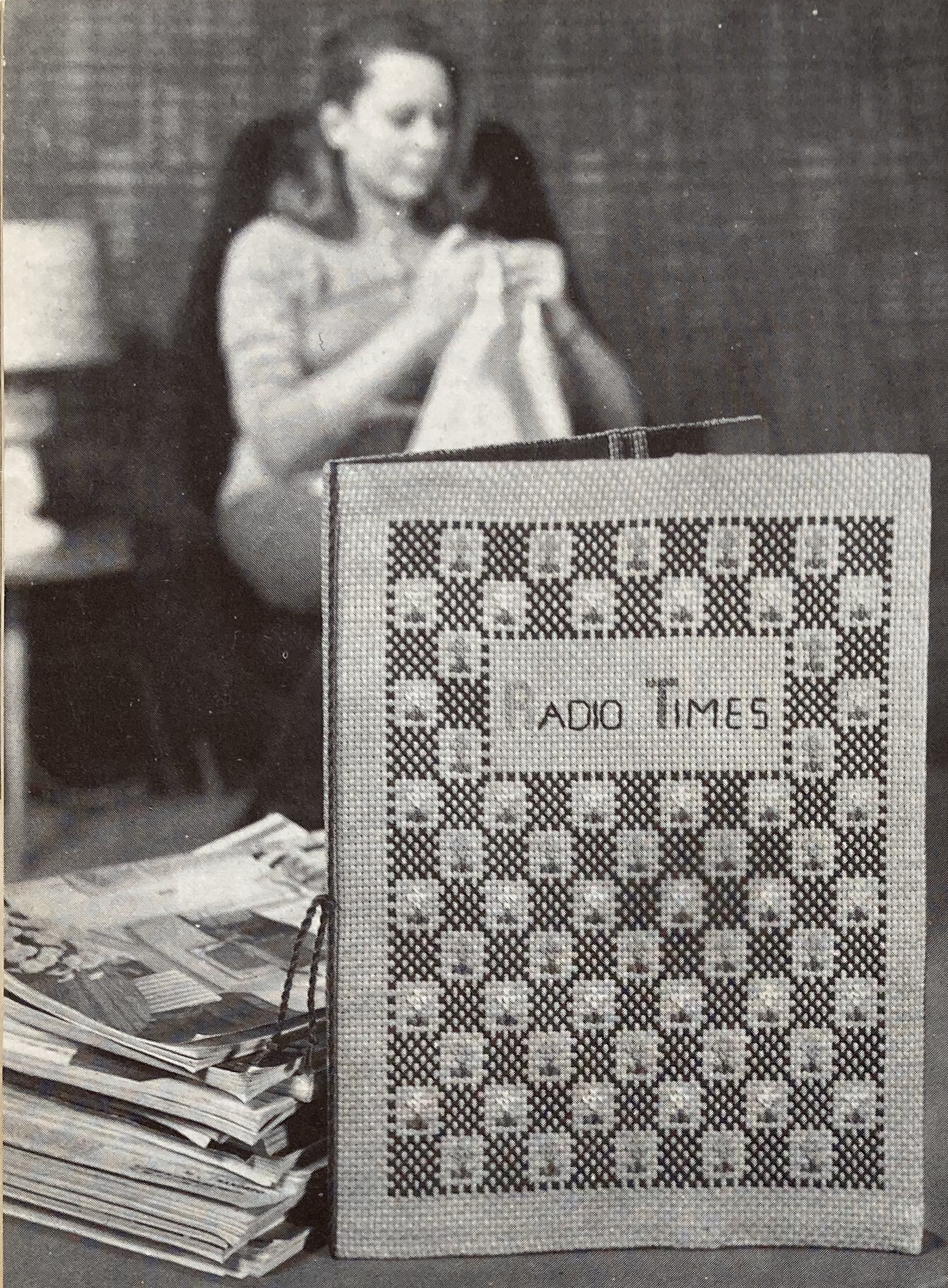
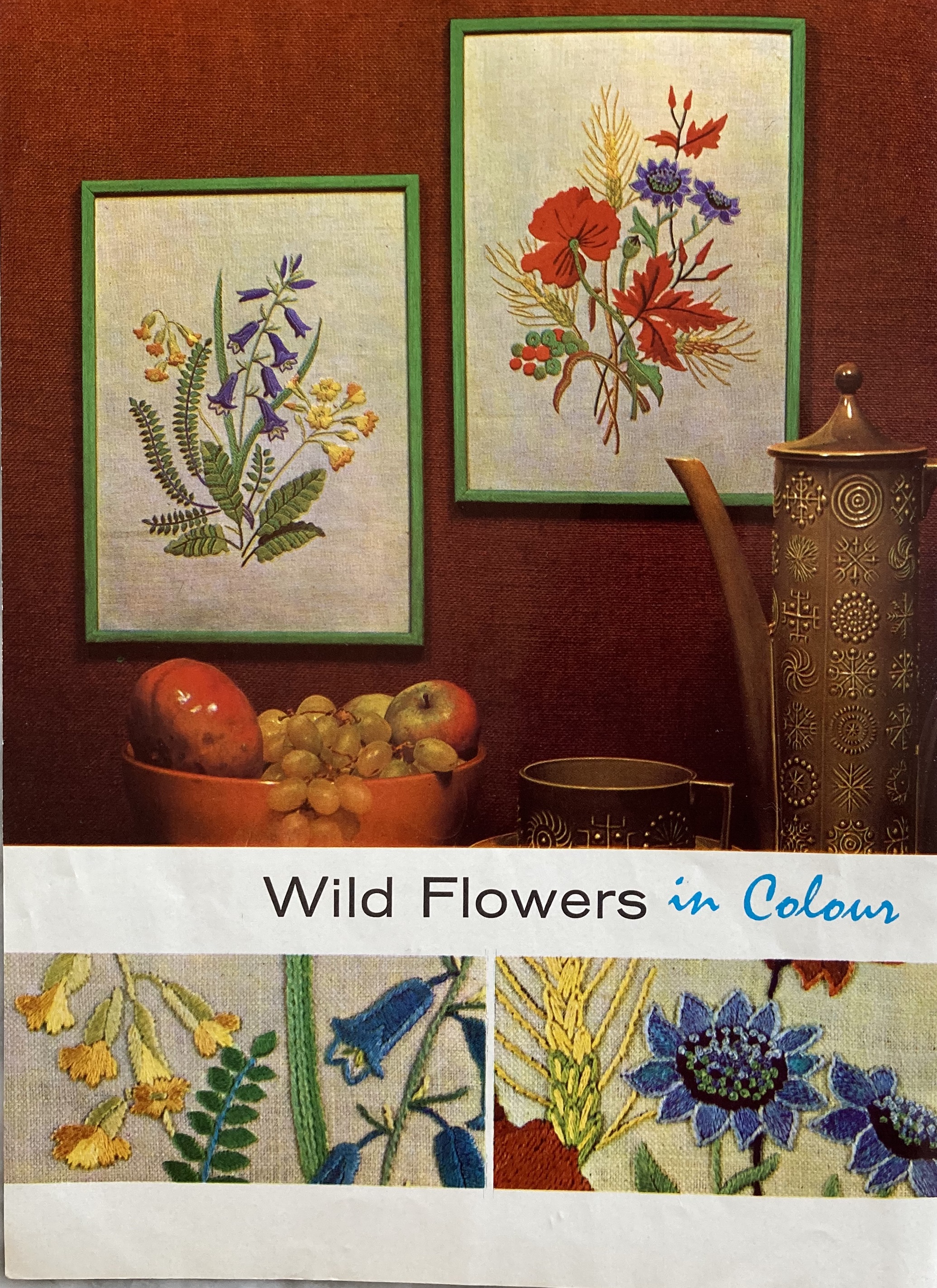
There’s regular embroidery for the home, too (to work on which sunning in your deck-cair, perhaps): an easy cross-stitch book jacket for the Radio Times, another traditional chair-back/cushion design, and some more intricate wall panels with colourful wildflowers.

Speaking of intricate wall panels: if all that weren’t enough, there’s another amazing felt appliqué wall panel, this one featuring characters from “favourite books.” That is, if your favourite author is Charles Dickens, which, why not, I suppose? There’s Barnaby Rudge and Oliver Twist from their namesake novels, Peggoty, Little Emily and David Copperfield from his namesake novel, Mr Pickwick from his namesake novel (‘s papers) and Grandfather and Little Nell from… (OK, I admit I had to resort to Wikipedia for this one) The Old Curiosity Shop, one of Dickens’ books which I have heard of, but never read. Anyway, the appliqué is fantastic — just look at the detail photo on Mr Pickwick’s face.

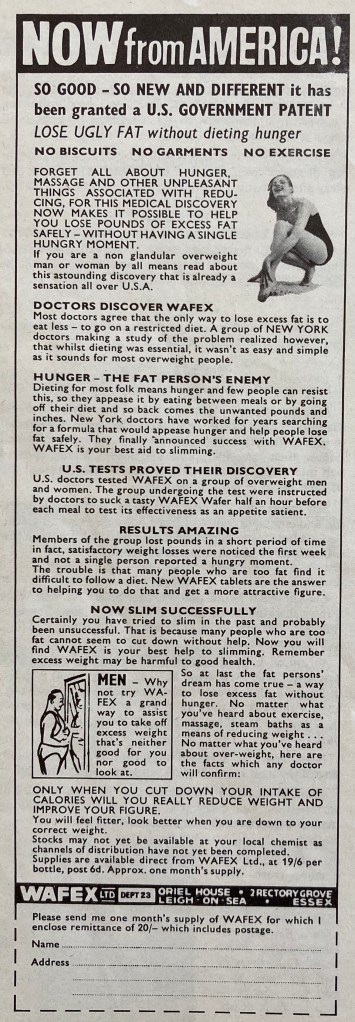
That brings us to the end of our issue, and by the way, if you suffer from unwanted weight gain as a result of all your holiday leisure, why not try sucking on a tasty “WAFEX” wafer half an hour before each meal? I’m suuuuuure it’s not only extremely effective, but also perfectly safe. After all, it’s “SO GOOD — SO NEW AND DIFFERENT that it has been granted a U.S. GOVERNMENT PATENT” ! (Note: I do not actually know what was in these appetite suppressant wafers, but seeing as it was 1964, they could contain anything from sugar to amphetamines to absolutely nothing. Please do not take medical advice from me, or from 1960s knitting-magazine advertisements.)

I would love to make the 4-ply cardigan blouse, but it will take a while, as I have so many unfinished larger projects on the needles at the moment. Until then, enjoy your Spring, Summer, holidays, travel or whatever else May has in store for you.

March 1964: Overview

Greetings from Kent from your March 1964 issue of Stitchcraft, featuring “Spring Into Summer Fashions” photographed in “some of your favourite spots around Canterbury and Tunbridge Wells” so that you can see the knitwear “in their own settings as you would wear them.” Shall we go?

“For our climate”, writes editress Patience Horne, the best outfit for the spring and early summer months is a sweater suit, quickly knitted in double knitting wool. Cool blues, salmon pink and yellow-green are the trendy colours, and pattern stitches are used sparingly as an accent on hems or collars, or as a single vertical stripe panel.

Our cover model is wearing a twin set with a trellis pattern accent on the cuffs, pockets and collar of the jacket and the hem of the short-sleeved jumper underneath. Here, again, we see how twin-set styles have changed since the 1940s — everything is long, loosely-fitting and unshaped. The “Golden Willow” sweater suit on the inside front cover is similarly unfitted, with a cable “V” pattern stripe. For “The Creamy Look”, there’s a a high-buttoning cardigan with a subtle diamond pattern on the fronts. All three models are made in “Double Quick” knitting.

“Double Quick” is also the featured wool for the men’s and women’s “sport sweaters” in the lovely full-color center photo. I’m not sure what makes those two garments more “sporty”, as they look equally as elegant as anything else in the issue. His sweater is worked in stranded technique from a chart included in the instructions, and hers is made in plain stripes with the diamond pattern embroidered on later in Swiss darning / duplicate stitch. If “Double Quick” is not bulky enough for you, there are matching sports sweaters for him and her made in bulky “Big Ben” at 3 1/2 stitches to the inch. The salmon-pink jumper (Stitchcraft calls is a “sweater blouse”), by contrast, is made in 4-ply wool in a classic shape, with pattern accent panels in an interesting mini-bobble stitch.

Babies get a wonderful pram set of footed leggings, coat and matching bonnet. It’s referred to in the index as a “four-piece” set, but I am at a loss to find a fourth piece anywhere in the instructions or photos. Maybe they planned to make matching mittens and then didn’t? Bigger children get a cute slipover with an argyle pattern on the front. The photo is very 1960s, with the girl freezing her legs off in a micro-mini skirt and the boy sporting a bow tie.

The homewares are fairly standard: a tea cosy, apron and tray set and a knitted kangaroo with baby for your bizarre/bazaar novelty needs (there’s also a reprint of a 1956 knitted ice-skating panda bear doll, if the kangaroo isn’t enough for you.) You can also cross-stitch a rug and pyjama case with square-headed dancing soldiers to haunt your small son’s dreams, or some flowered place mats, a cushion or wall hanging, or another cushion inspired from a traditional Greek star design.

In the “Readers Pages”, a new serial comic is starting: “Susan’s Sampler”, in which our heroine learns embroidery from a magic needle, and our back cover ad (for Patons Double Quick Knitting wool) shows yet another woman lovingly looking up at a man who has trapped her with her back to the wall in order to mansplain something to her. Feel free to give the photo some speech bubbles befitting a modern interpretation of this scenario!

That’s all for this issue. I’ll be making the child’s slipover and for once, I’m quite sure it will be done on time. Happy Spring!

February 1964: Overview

Cover photo from Stitchcraft magazine, February 1964

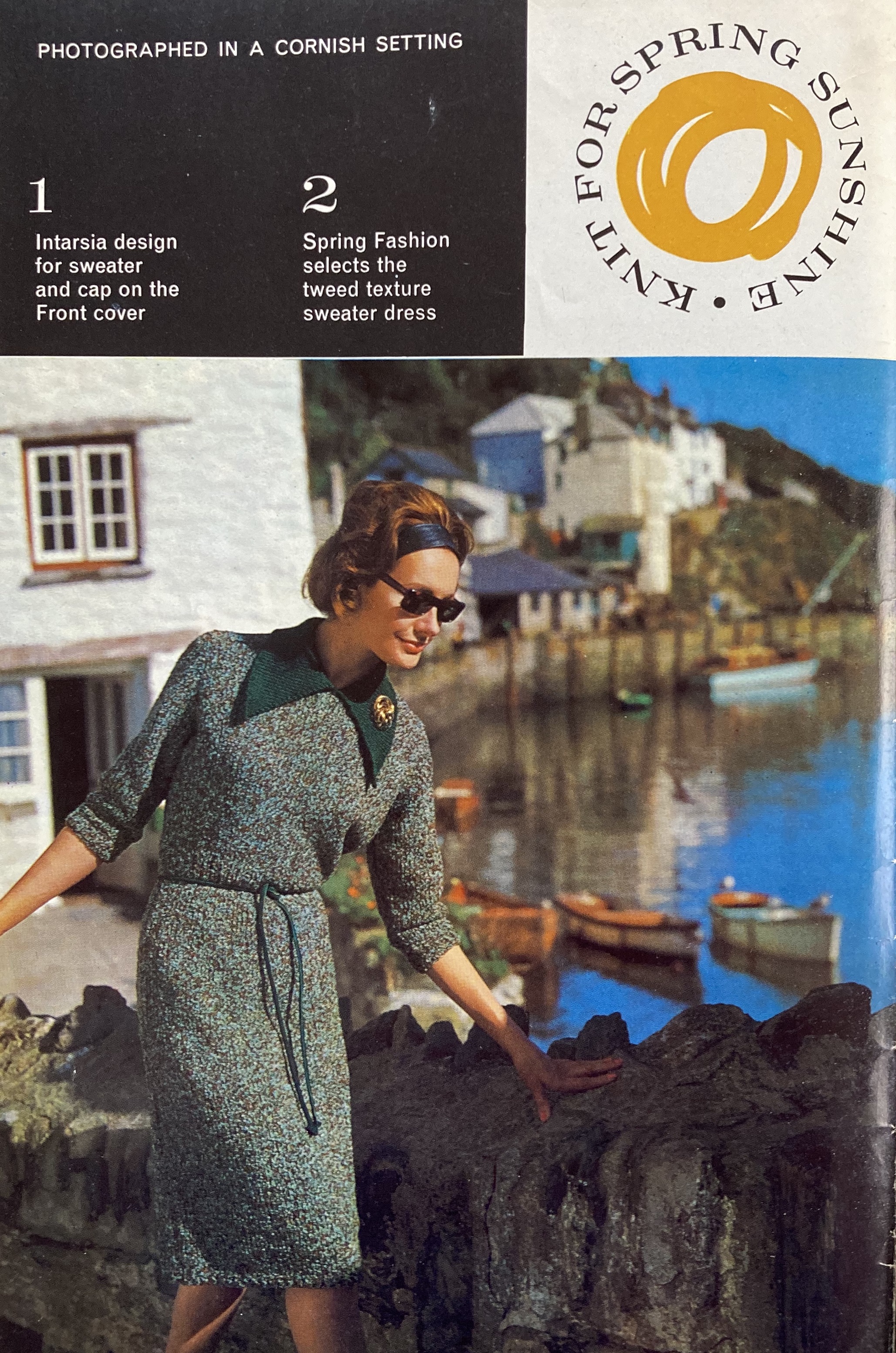
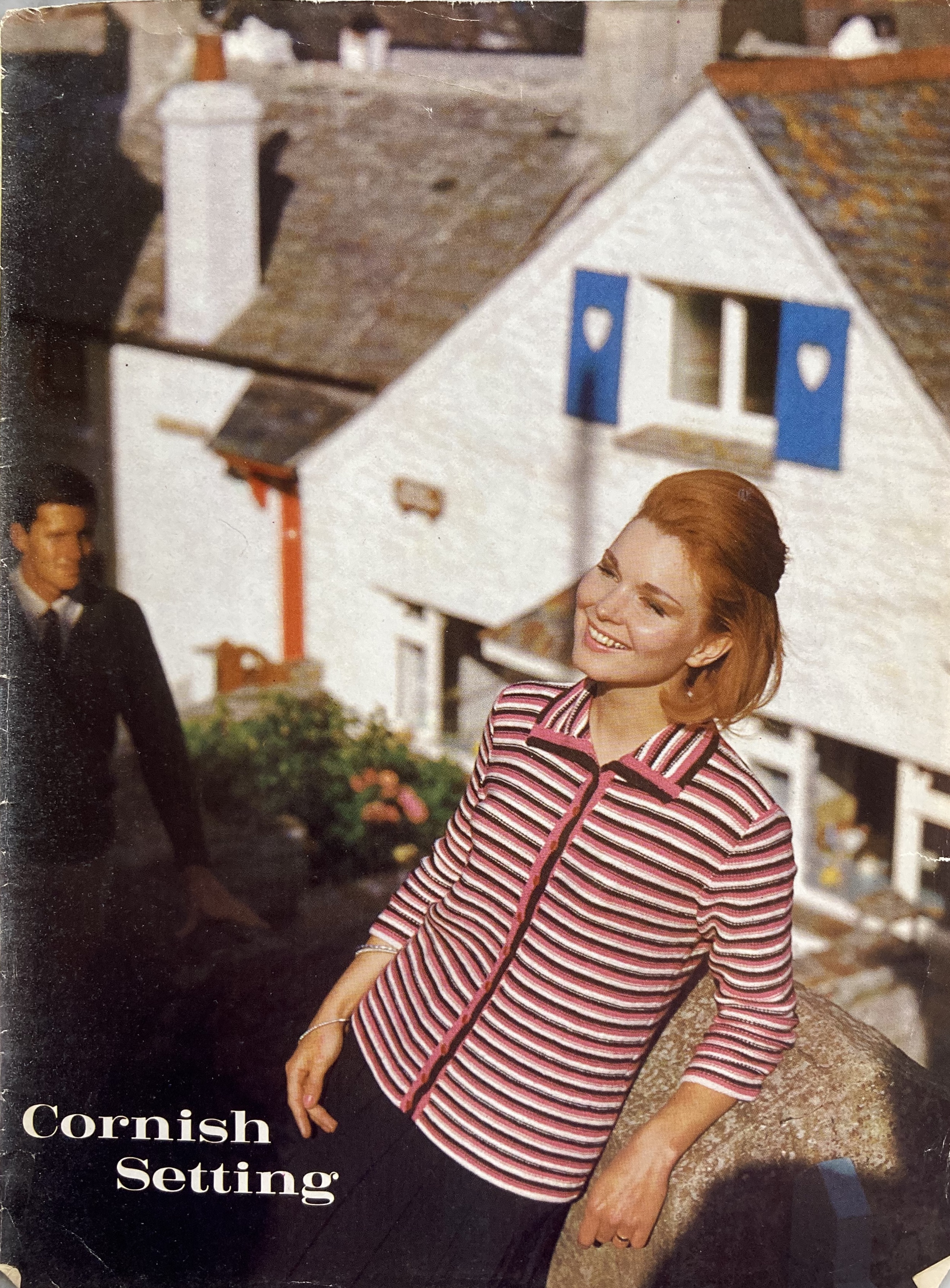
Knit for Spring Sunshine! It’s four o’clock in the afternoon here on February 1st, 2022, getting dark, raining sleet and there has not been a single minute of today where I was able to do anything without turning on the lights, so I am especially happy to dream of modelling beautiful handknits in sunny Polperro in Cornwall, where this issue was photographed.

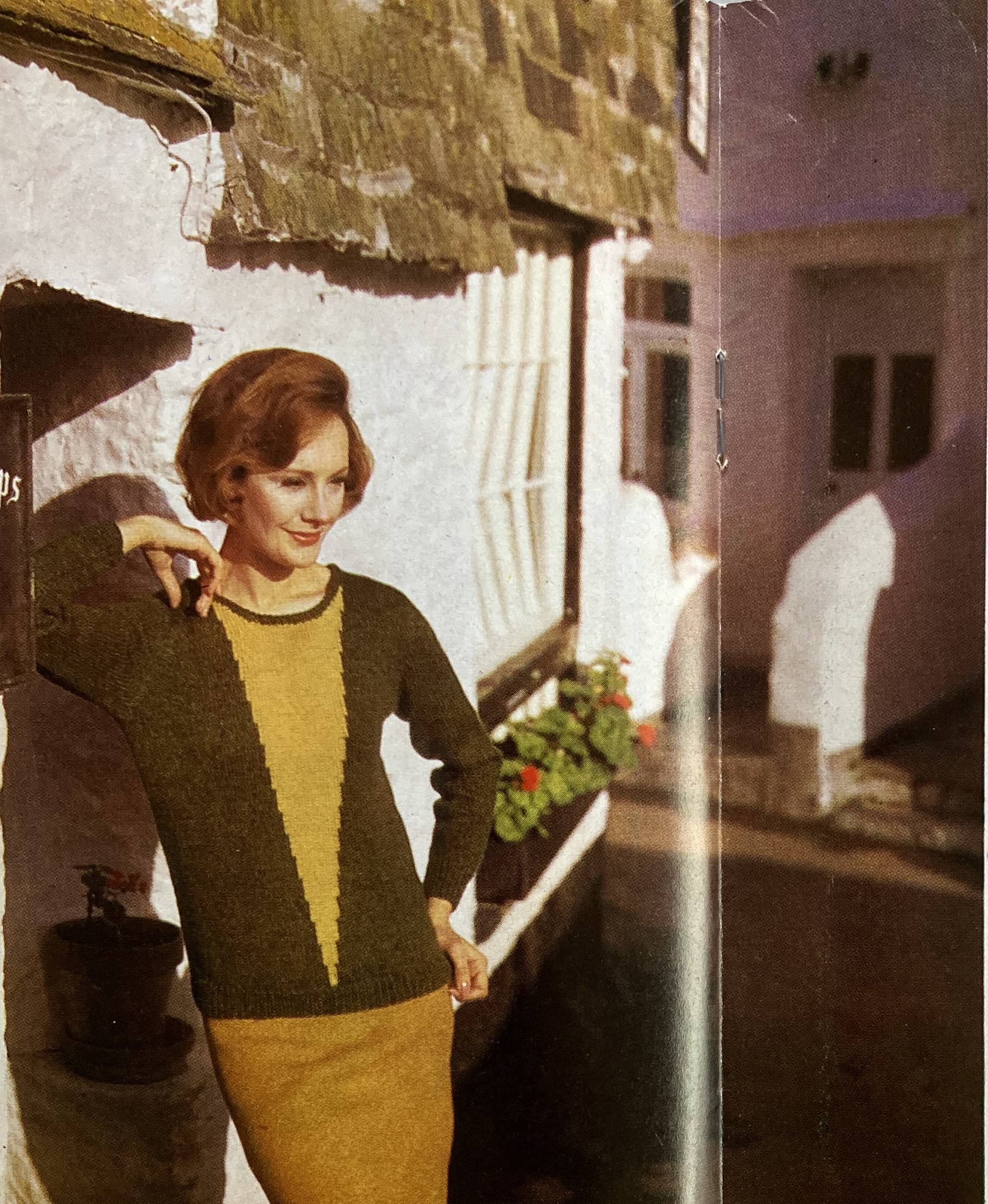
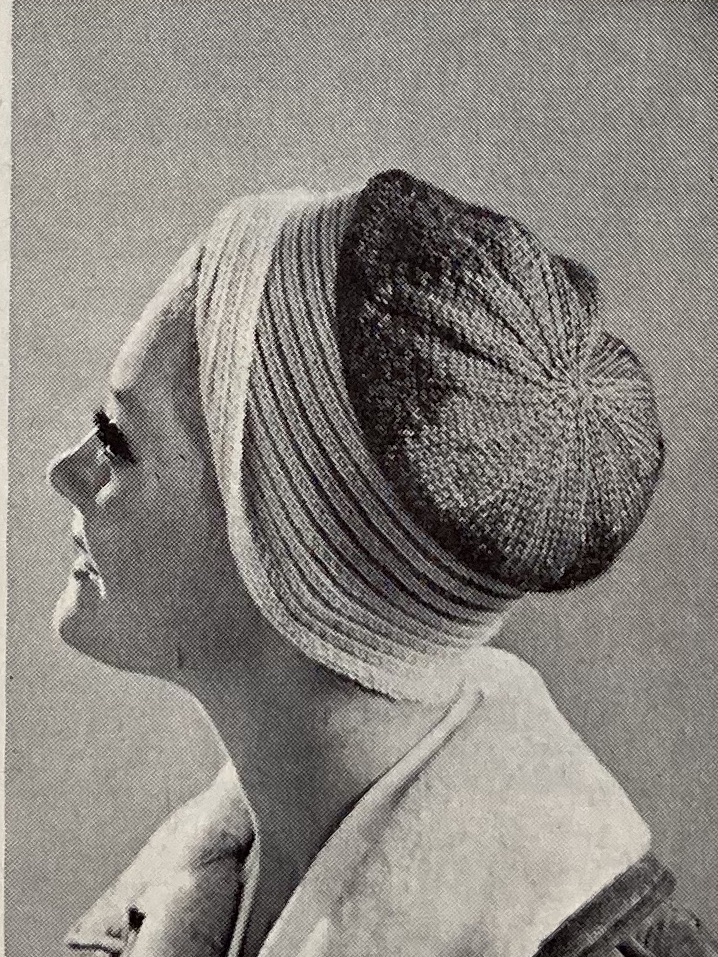
Colour variations are a big theme this month, be it tweedy new multicolour yarns, stripes or classic stranded colourwork and intarsia. Our cover model shows off the gradient look in a fun diamond-pattern sweater with a matching tie and cap. Both cap and sweater are knitted in intarsia technique with the different colours of wool wound onto bobbins, but strangely, I can’t see the diamond pattern on the cap at all. I guess it’s because the top part of the cap only uses the two darker colours, and they don’t show up well in a black and white photo (see close-up of the cap below).

Collars and ties make an appearance in the tweed dress from the inside front cover, made in multicolour “Glenora” wool, and there’s a sparkly tweed suit in purple Bracken Tweed wool as well. Men get a classic raglan V-neck, also in Glenora tweed. Deep jewel tones (I’m guessing the colour “Trossach” from the men’s pullover is a sort of deep fenny green, named after the Trossachs area in the Scottish Highlands) are in fashion as well as gold, featured in two pullovers on the inside pages. A loose, casual fit with no shaping remains the preferred silhouette (or lack thereof).

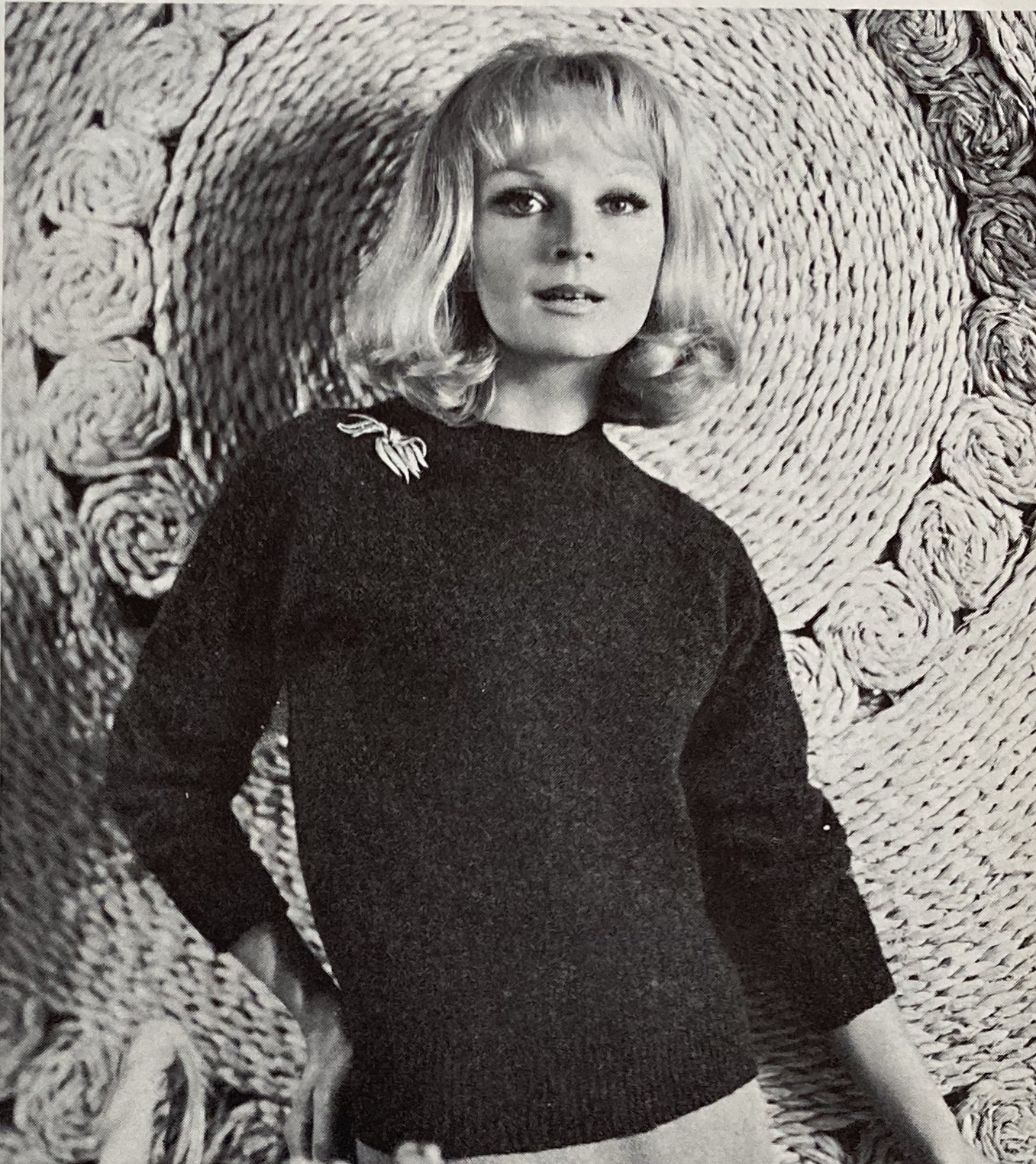
For contrast, there’s a classic, lightweight jumper in 4-ply wool bouclet. The jumper style would be right at home in other decades, but the photo style is as 60s as you will ever find, with an extreme close-up of a round braided place mat used as a backdrop. I’m almost waiting for it to start swirling! Finishing off the adult garments is a cheerful striped cardigan in 4-ply Nylox (wool/nylon blend).

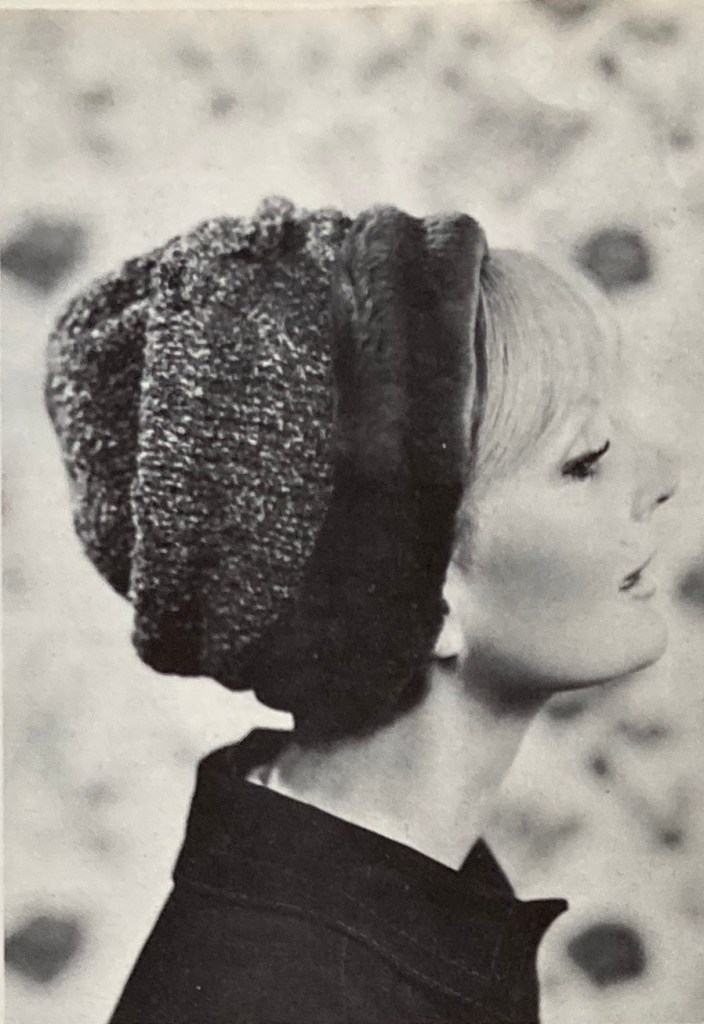
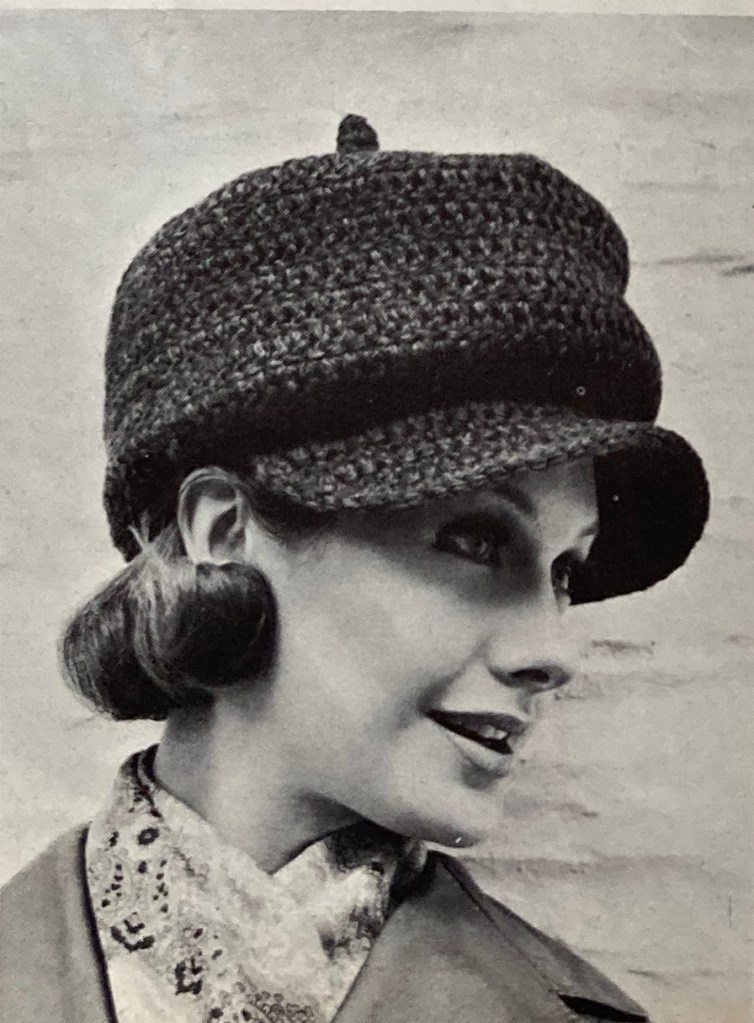
The accessories match the garments well, using the same wools and in similar casual, oversized style. Besides the diamond cap, there’s a knitted cap in Glenora with fur trim and a “baker boy” cap to crochet.

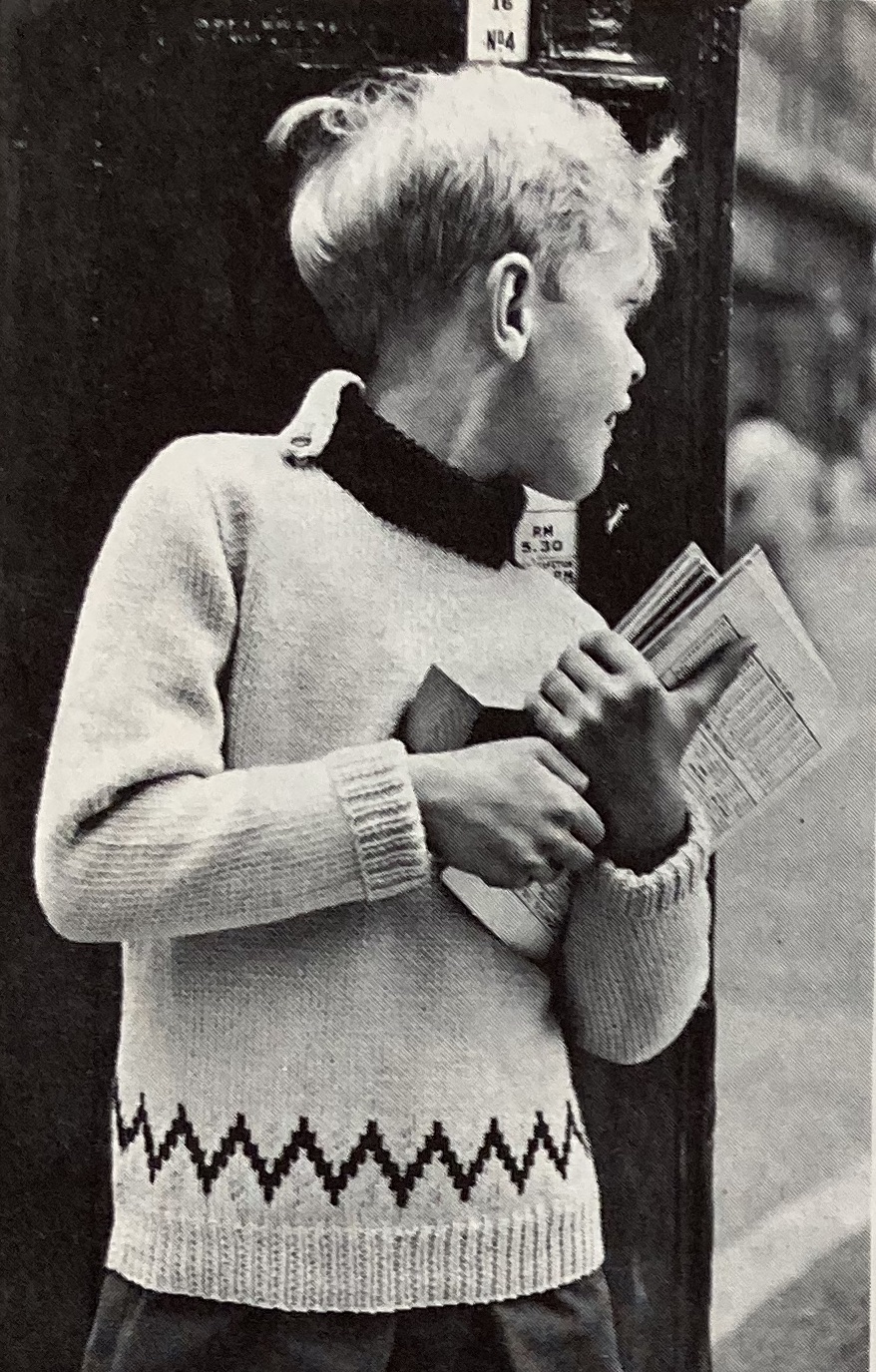
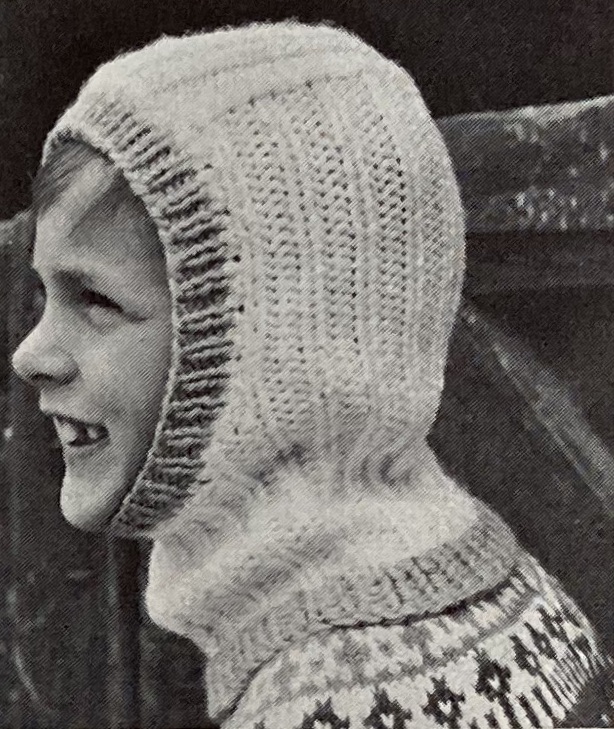
There’s nothing for babies or very young children in this issue, but older kids can get some very nice new additions to their wardrobe, like this wonderful dress in blue Bracken Tweed with contrasting checked collar and cuffs, or a sweater for boys with in intriguing tab collar and colour detail at the hem. There’s also a balaclava-style “helmet” to keep out any March winds.

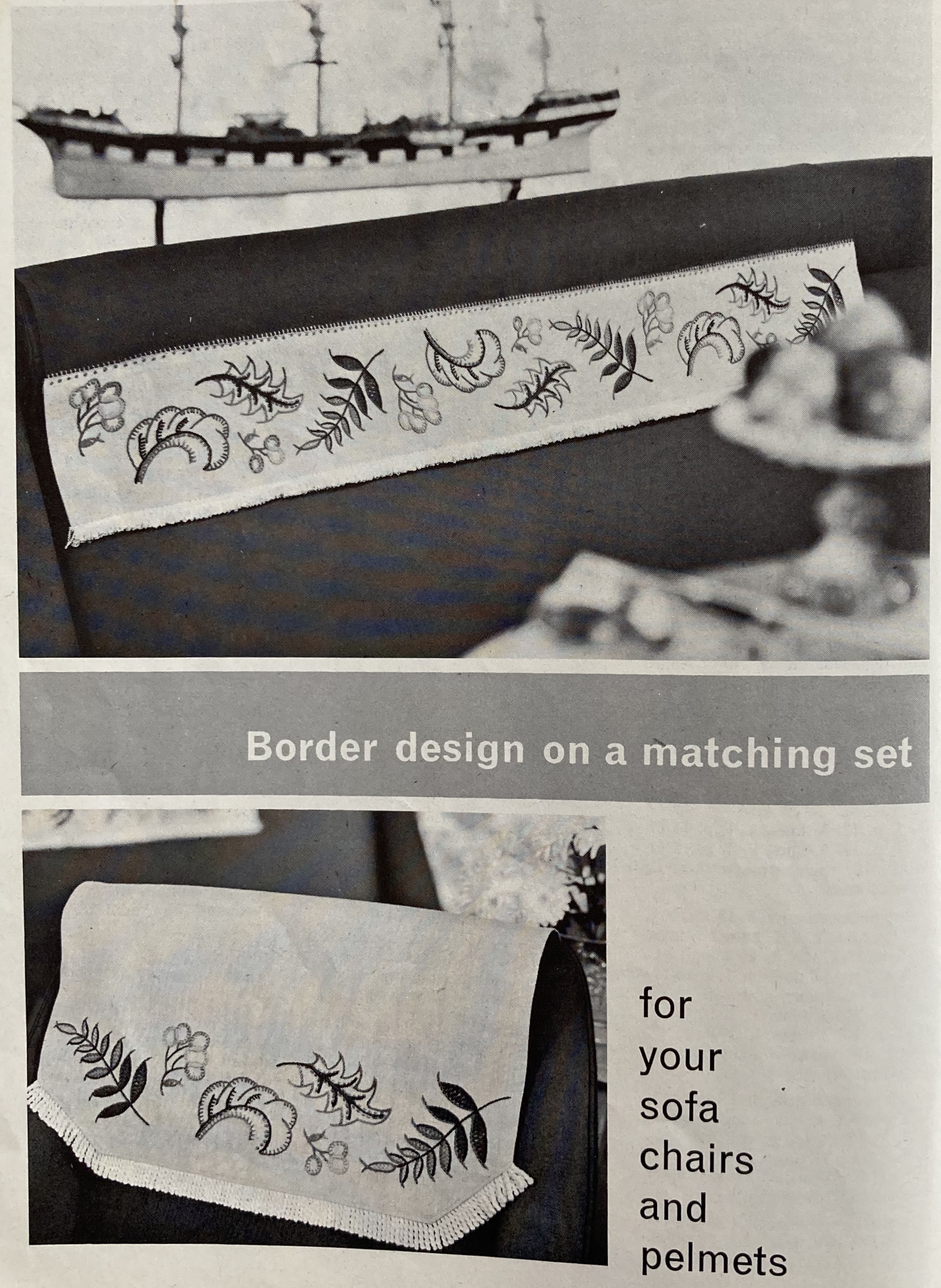
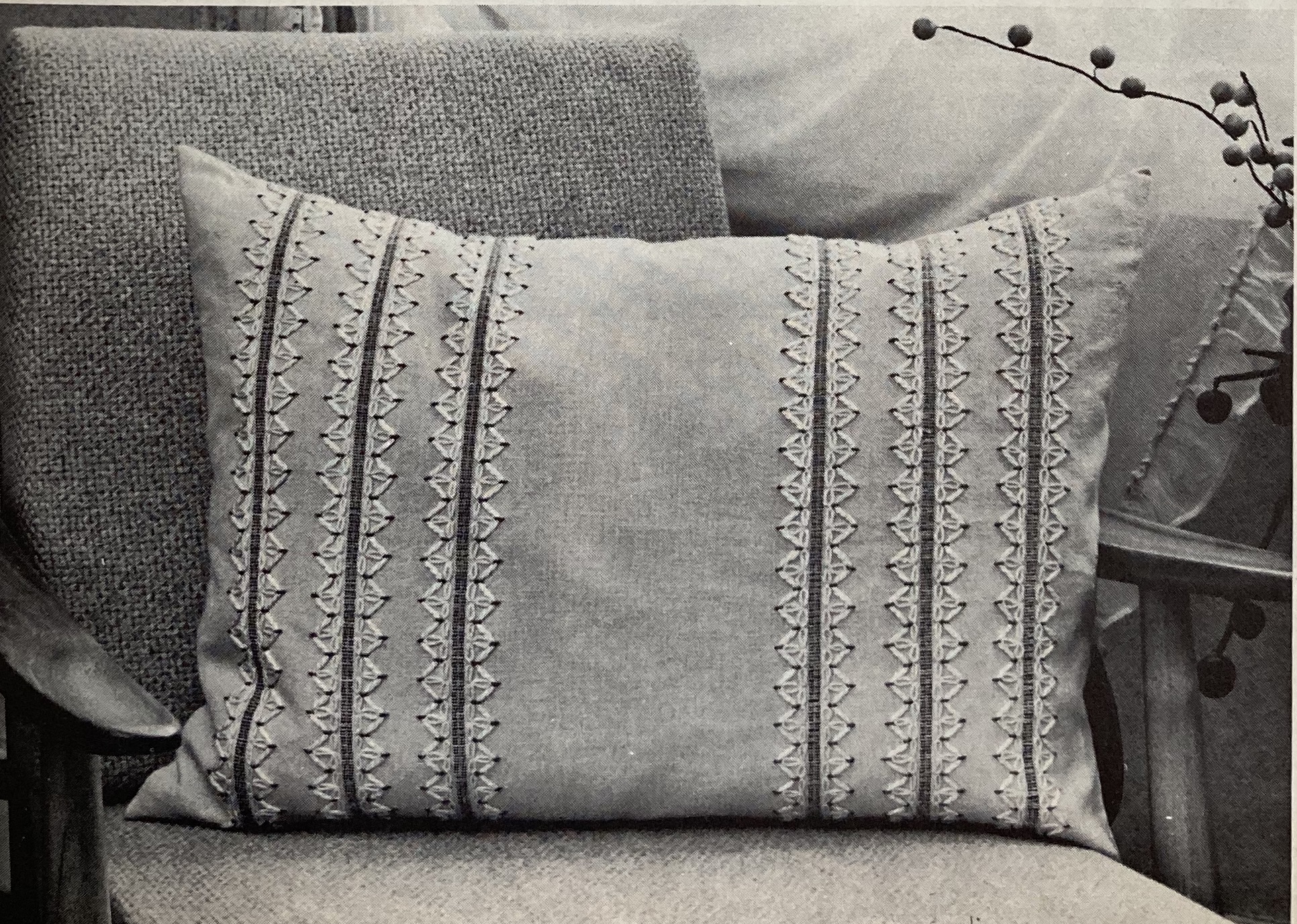
With all these larger projects to knit, it’s no wonder that the homewares are less than spectacular this month. There are embroidery projects for sofas, chair backs and pelmets (N.B. if you, like me, are not familiar with the last word, it’s that strip of fabric at the top of old-fashioned curtains, that hides the curtain rings / mechanism.) There’s a cushion and/or fire screen in a traditional Yugoslavian pattern, a stitched bathroom rug, a tapestry picture and dressing-table mats in cutwork embroidery. The cushion in “Continental laced stitch” is the most interesting of the projects, to me — it’s made by drawing threads and stitching around the resulting rows of holes, then putting the cover over a contrasting-colour cushion.

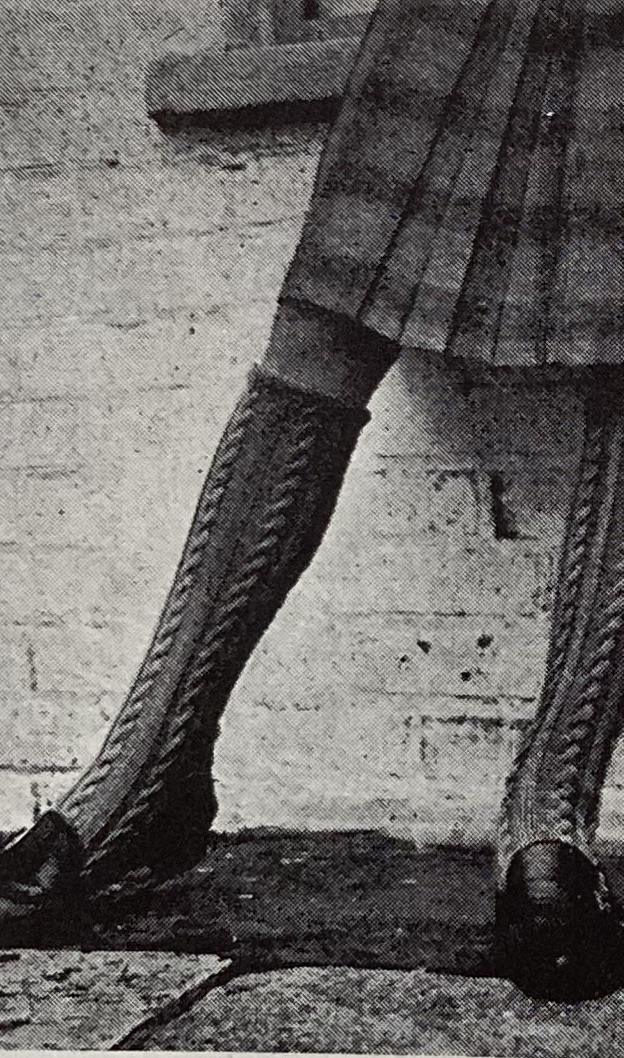
There is no children’s comic this time (how sad!) but the “Readers Pages” offer a reprint of a 1955 pattern for knee-high cabled socks, instructions on how to make a wool daisy and a magnificent “flower basket” teapot cosy featuring those wool daisies. If you’re on Ravelry and search projects for “flower basket” tea cosies, you will find many similar examples — this seems to be a popular item in modern times as well! The Patons wool advertisement shows a happy baby whose grandmother has knit him something pretty, and the back-cover Lightning Zip ad has a very practical dress pattern laid out. I’m tempted to copy it large and sew it up.

That’s all for this issue. My project will be the (faux) fur-trimmed tweed hat. See you soon and until then, let’s dream of spring sunshine!

March 1963: Overview

Cover photo, Stitchcraft magazine, March 1963

Start your engines and give that propeller a whirl! The theme of this month’s issue is “Fashion On The Go” and the photo team really outdid themselves in showcasing adventurous and enjoyable modes of transportation. “With the wonderful opportunities for travel”, writes “editress” Patience Horne, “you need clothes that are easy to wear and will carry you through the day without a lot of care and pressing.”

Travel opportunities definitely took off (pun intended) in the early 1960s. Passenger air travel, though still a luxury, became increasingly possible and affordable with the advent of jet aircraft. Ocean liners, challenged by the rise of air travel, revamped into cruise ships. The Eurail train pass was introduced in 1959. Huge improvements in automobile technology and design made the freedom of the open road more tempting and accessible than ever. Yearly sales of Vespa scooters doubled from 1956 to 1960. Of course there was very little, if any, concern for environmental factors, and the oil crises of the 1970s were far in the future. There was no better time to travel.

On the race-car track, our cover model is wearing her “Paris Flash Slimline Blazer” — a simple but elegant jacket in moss stitch — and her colleague is sporting a “Double Quick shirt waister” that promises to be “the perfect travelling dress”. In a lovely juxtaposition of modernity and history, the model in the photo next to her is posed in front of what looks like an old-fashioned, horse-drawn stage coach! Her twin-set is made in finer 4-ply wool and though you can’t see it in the photo, the jumper is made in normal stocking stitch and the cardigan in reversed stocking stitch. In a separate photo, you see her posed in front of a horse box — no doubt one of the horses who pull the coach. Train travel is covered with a beautiful photo of this tweedy green travelling coat. It looks very cosy, but as it is made from 60 ounces (!! 3 3/4 pounds or 1700 grams !!) of extra-bulky, extra-heavy Big Ben wool and unlined, I can only imagine how it will stretch and sag with time and wearing.

The centerfold photo showcases more glamorous nautical and aerial travel opportunities. (I am sorry to say that the photo is blurry in the magazine, not just in my photo.) The “boat-deck sweaters” are both in double knitting weight with plain stocking-stitch and collared-shirt form for him, fun nubbly Rimple wool and a welted front insertion with cute tied collar for her. Collars, in general, remain well in fashion, though they are not quite as large as in the last few seasons. The airplane enthusiasts in the right-hand photos sport a casual, oversized cabled cardigan in bulky Big Ben wool and a striped dolman-sleeve pullover in double knitting weight. The dolman pullover sits weirdly around the neck and looks like it would be awkward to wear.

For those who prefer more leisurely ways to travel, i.e. walking around town, here’s a “stroller sweater” in fluffy Ariel and a sort of diagonal basketweave stitch pattern. Even the children get a travel-themed photo, if only in the studio! While the little sister is very keen to drive her wooden locomotive, big brother is apparently tired of playing conductor (but still blocking the tracks…) They’ve both got wonderful things to wear. The two-tone pleated skirt is knitted sideways and the pleats sewn in with the making-up, and his light-weight pullover has another fun diagonal knit-and-purl pattern.

With all these wonderful things to knit, you would think the homewares would be less interesting, but there are still plenty of projects that are mostly small enough to pack with you on your travels. There are all sorts of cushions to embroider: darned and tufted in very 1960s colours (brown, biscuit, fawn, two shades of orange and two shades of rust), neon-on-black “peasant embroidery” in regular crewel work, and with a matching chair-back in Assisi embroidery — traditional Italian designs where the backgrounds and ornaments are filled in with cross-stitch, but the main motifs are left unworked. The Victorian-inspired tapestry chair seat and stitched bathroom rug are probably too unwieldy to pack, but the fine embroidered initials and baby outfit are easy and portable. Readers could order the pattern for the baby set along with the embroidery transfer.

The back pages feature the worst of the Patons & Baldwins “please your man” advertisements, in which a woman can’t even knit herself something for once or look nice in it without all of it being To Please Him. (And then she has to pretend to be interested in whatever boring mansplaining he’s doing with the book he’s showing her.) I can’t help thinking of that scene in Vertigo where James Stewart’s character is trying to get Kim Novak’s character to dye her hair… and she doesn’t want to… and he gets more and more frustrated before blurting out, “It can’t matter to you!” Alfred Hitchcock would have approved of this ad.

The “Children’s Features” continue the alternative telling of the Miss Muffet rhyme story, in which Miss Muffet, leaving the home of the kindly spider-lady, gets captured up by a grumpy beetle, saved by the first spider, and then in turn saves a captured beetle who promises her a present. What could it be? We will find out in next month’s issue!

None of the larger projects are begging me to make them and I’m still working through the WIP pile, so I’m going to use some of that fine embroidery on the vintage handkerchiefs I inherited from my grandmother.

January 1963: Overview

Happy New Year, everyone! It’s 2021 in the real world and 1963 in the Stitchcraft Sixties blog world. The real-life 1963 was a turbulent year: the Cold War escalated, as did the war in Vietnam; the civil rights movement in the US both gained ground and suffered violent setbacks; John F. Kennedy was assassinated; the Second Vatican council entered a new phase. In England, scandals abounded in the wake of the Profumo affair and the divorce of the Duke and Duchess of Argyll. On a happier note, the Beatles recorded their first album, Please Please Me, kicking off Beatlemania around the world, and women in Iran gained the right to vote. Also, the smiley-face symbol was invented. 🙂

Of course, none of this — not even the Beatles or the smiley face — had any direct influence on Stitchcraft (certainly not in the January issue, before any of it happened…). What we think of as “1960s fashion” — the miniskirt, the “space age” look, the shift dress, the Mod look, the hippie-bohemian styles of the later years of the decade — was just gearing up around 1963, and Stitchcraft was a fashion-conservative magazine. That said, holdover fashions from the 1950s like fitted, waist-length cardigans and wide, swingy skirts have disappeared completely by now; the female models often wear trousers or “slacks” and casual, bulky-knit sweaters are ubiquitous.

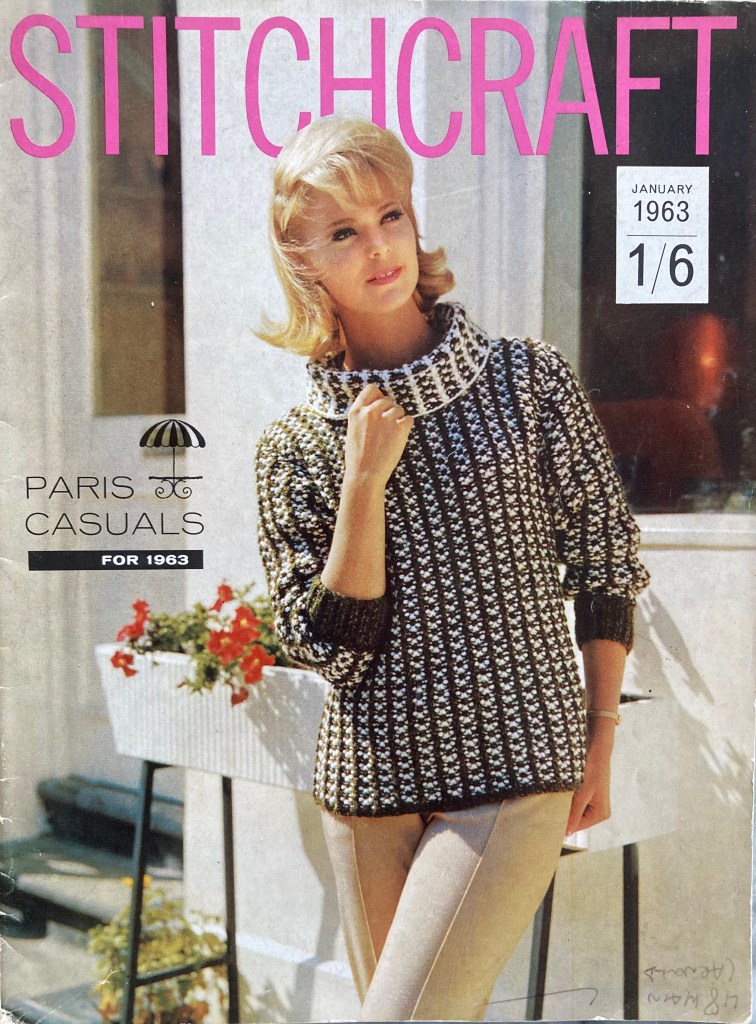
So what does January 1963 have in store for us? The theme of the January 1963 issue is “Paris Casuals” and resolves to start with “a bumper all-round family number.” For adults, that means warm, comfortable jumpers and cardigans in a range of wool weights with V-necks or interesting collars and textured stitch patterns. The cover garment epitomises all the trends: made in bulky Big Ben wool in a two-colour slip stitch pattern, it sports “this season’s Paris collar choice and longer line.” The textured raglan cardigan is a similar look, as is the man’s casual cardigan on the back cover. The bouclet cardigan gives a nod to earlier fashions with its choice of fine wool and classic shape, but here too it is longer and looser-fitting than previous classic bouclet garments. A simple collared jumper in double knitting with attractive fine details rounds out the adult garment selection.

There are great winter fashions for children, first and foremost the girl’s skating set of skirt and collared pullover. Unfortunately, I suspect something went wrong with the sample knit, as both pictures show the model turned 3/4 away from the camera and it’s not clear how it is supposed to look from the front. (Also, could someone please give her some warm tights to wear before she goes out onto the ice.) Toddlers get a cute “buster suit” with a design of cherries on the jumper, and older children get a wonderful hoodie (to use the modern term) and jumper-cap set to wear while playing in the snow. (Or in the photo studio — check out the snowman and snowball made of wool and/or cushion stuffing fluff!). Crisp, wintery colours of blue and red with white are trending. Notice also that the girl model is wearing trousers, the hooded sweater is unisex, and the model wearing the red outfit in the black and white photo is allowed to be active and tomboyish for once. I wouldn’t even have known she was a girl if the sweater weren’t (for whatever reason) considered specifically a girls’ garment. Slowly, very slowly, roles are changing.

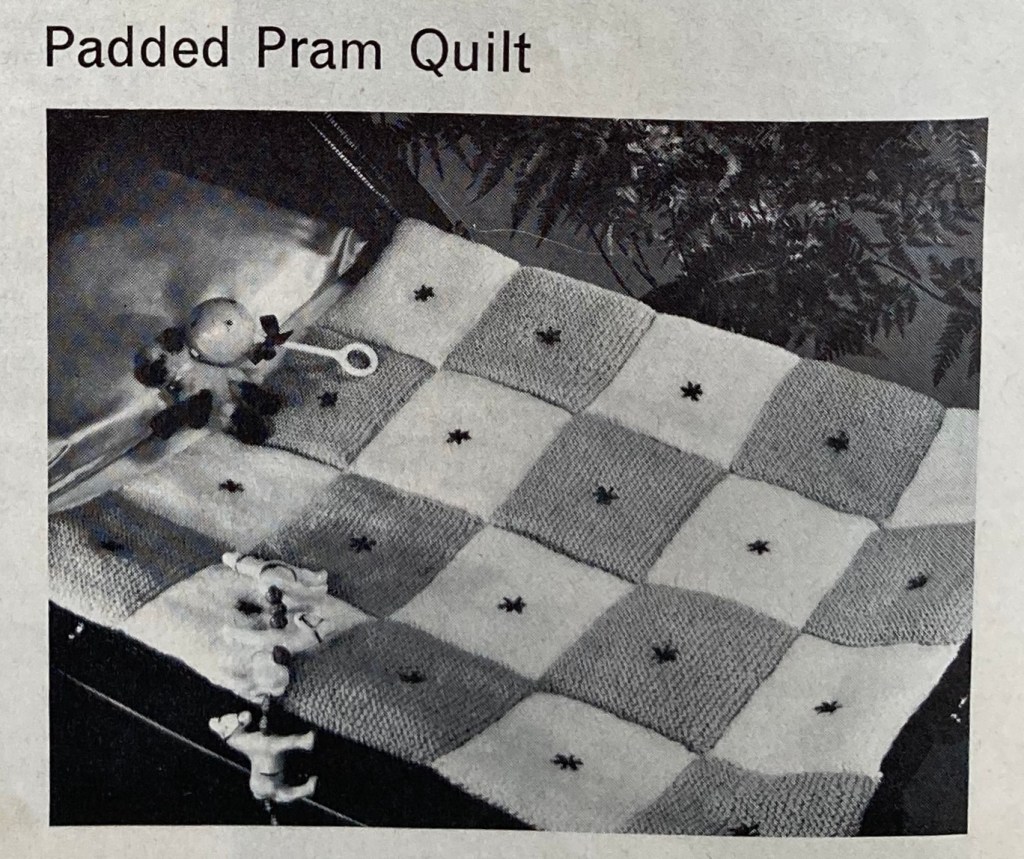
Babies get a pram cover instead of a garment this time — padded and quilted to be extra warm — and there’s a cute bedjacket and fantastic “tower” hat that is perfectly in fashion. (Side note: The caption, “PARIS HAT”, makes me think of that line “If a Harris pat means a Paris hat, Bébé… ooh la la!” in “Always True To You In My Fashion” from the musical Kiss Me, Kate. In true Cole Porter style, it’s an upbeat love song… in which the singer explains to her boyfriend that her dalliances with other men for gifts and money — basically sex work, though of course not explicitly described in those terms — shouldn’t count as infidelity, since she’s only doing it for the financial benefits and is true to him in her heart. Ah, romance! Anyway, the hat is great.)

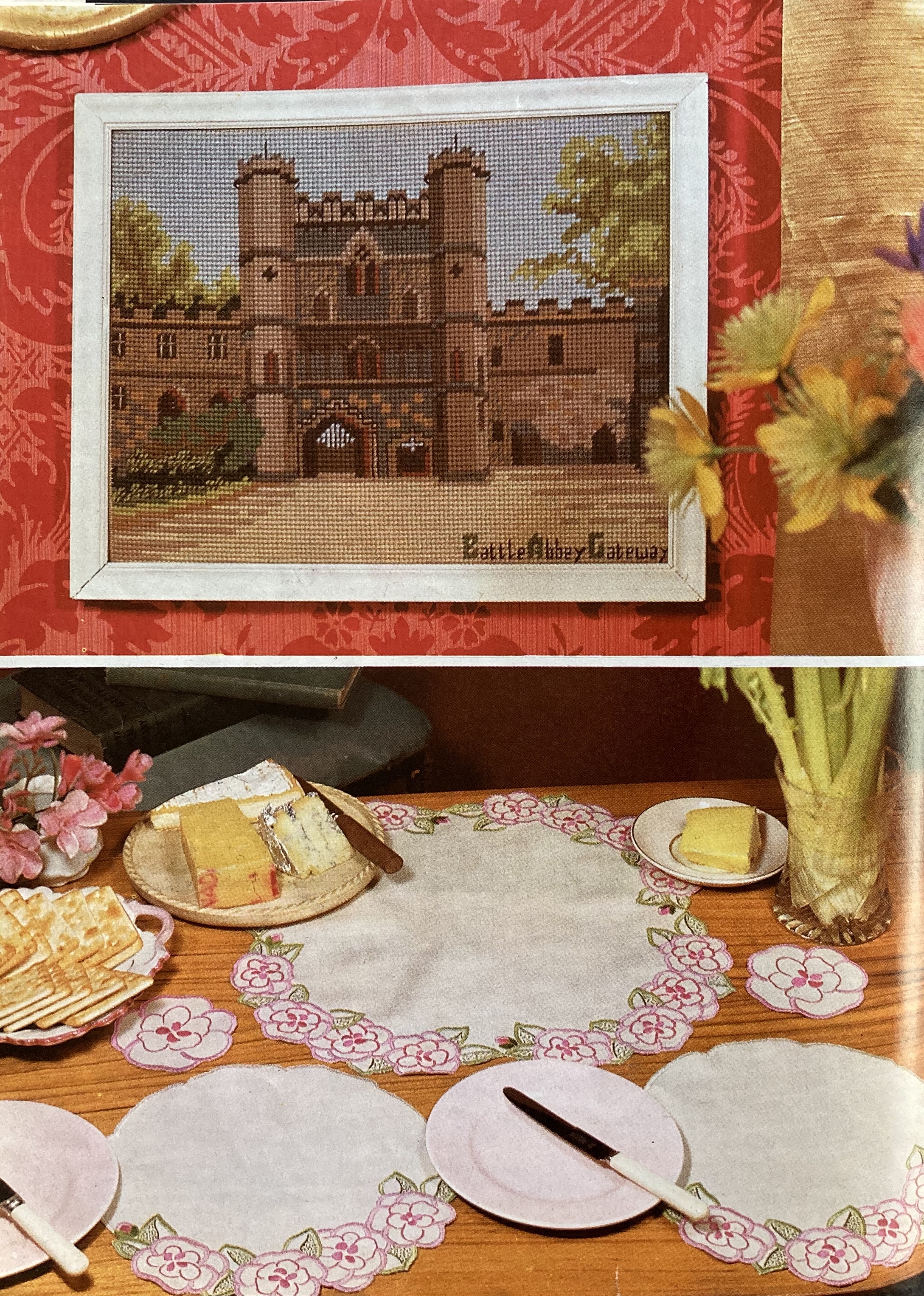
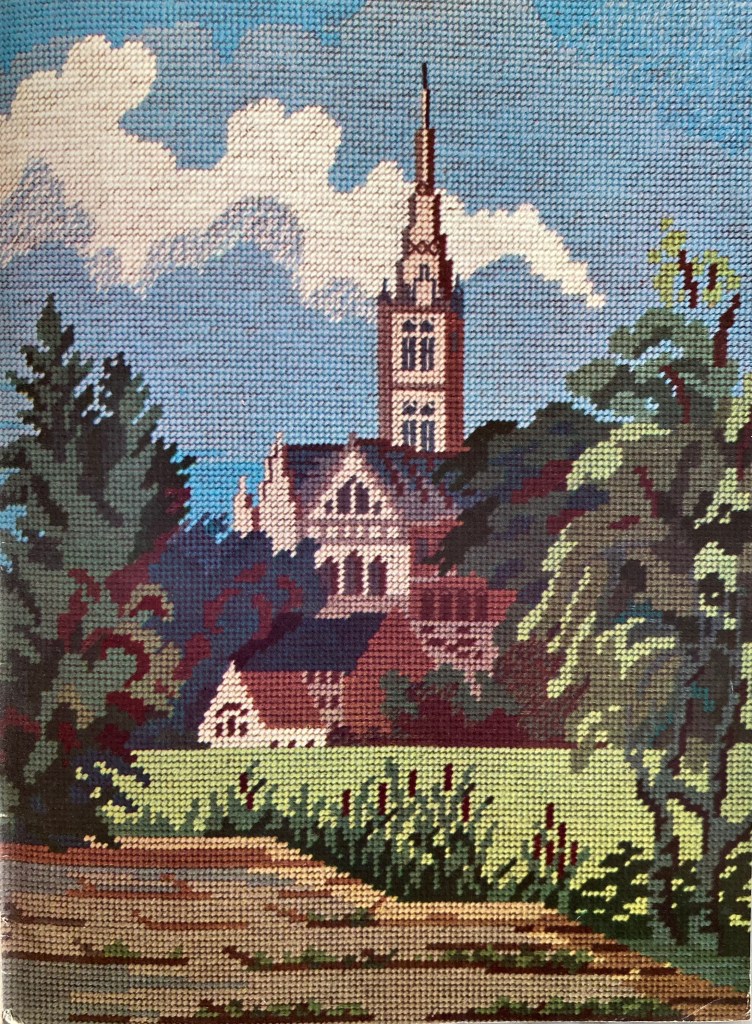
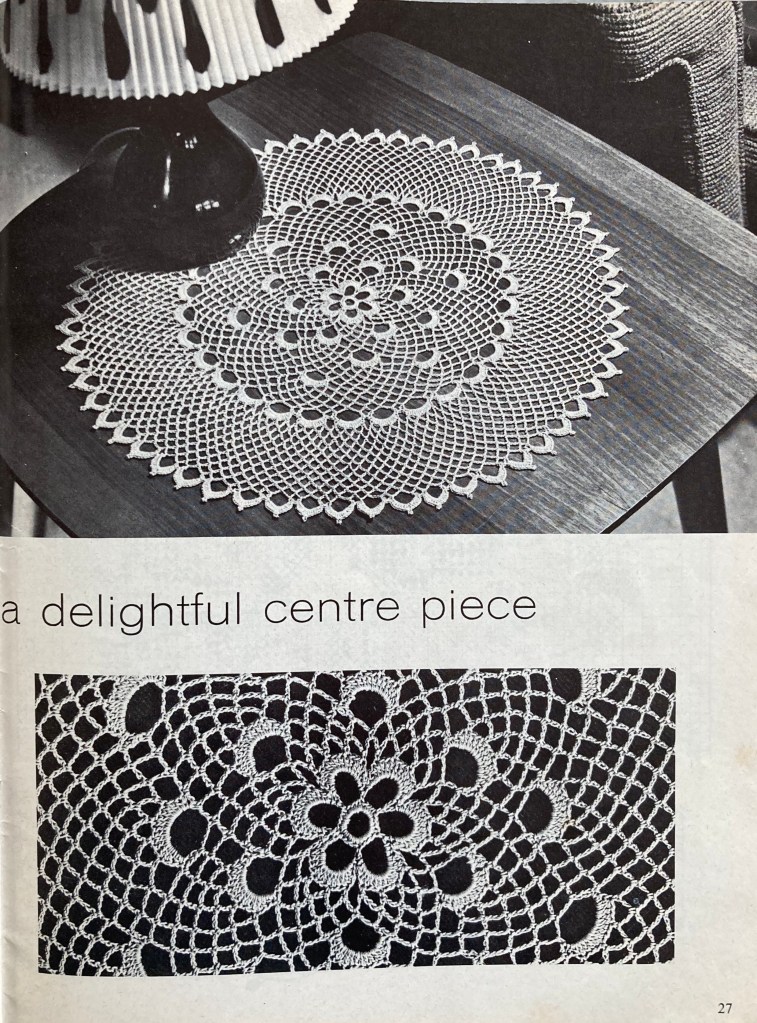
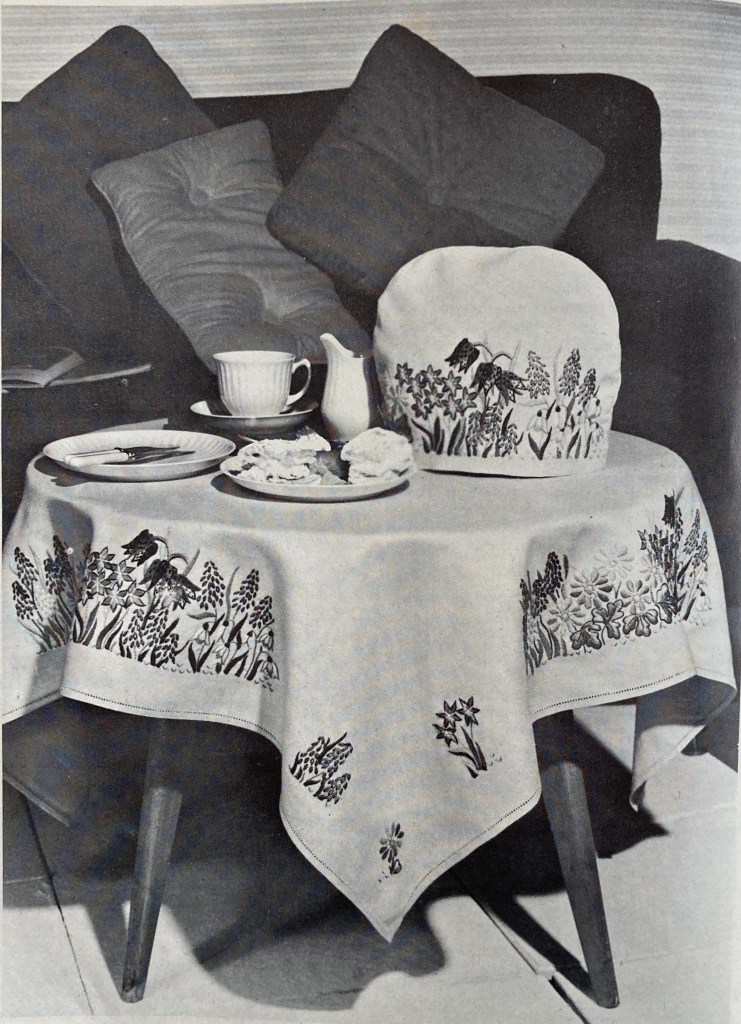
With all the great knitted items, home fashions are pretty standard this month. There are rugs and cushions, a lovely embroidered tablecloth and tea-cosy set, a tapestry picture, a cutwork table set, a very impressive crocheted doily and a hassock or kneeling cushion for church-goers.

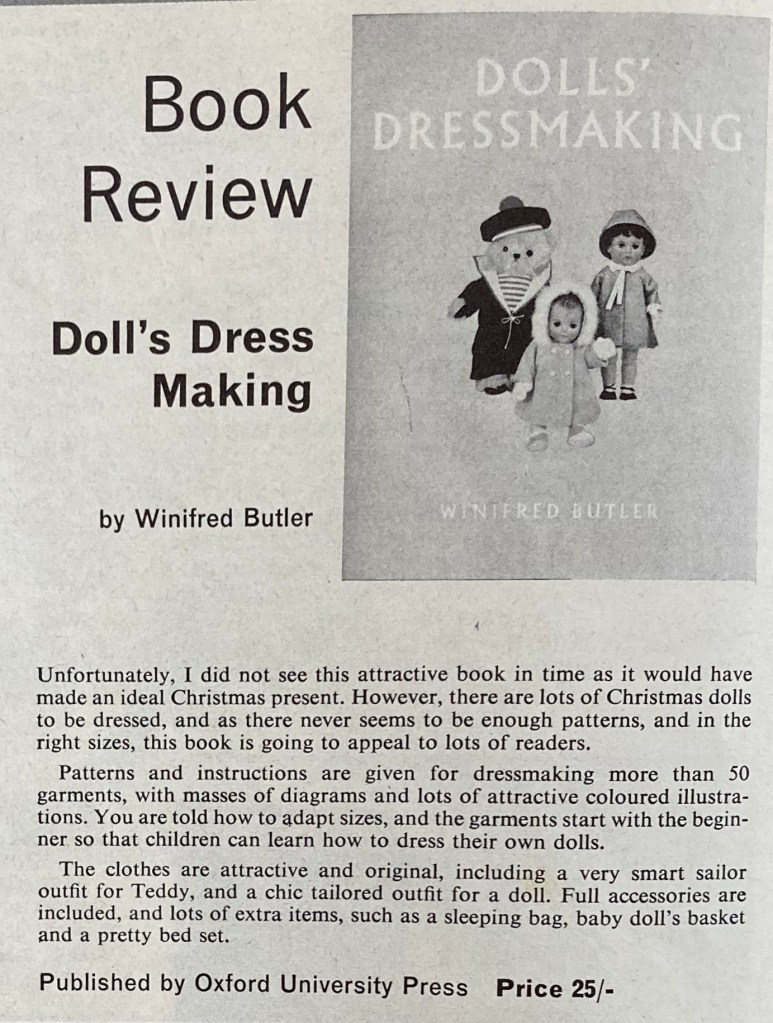
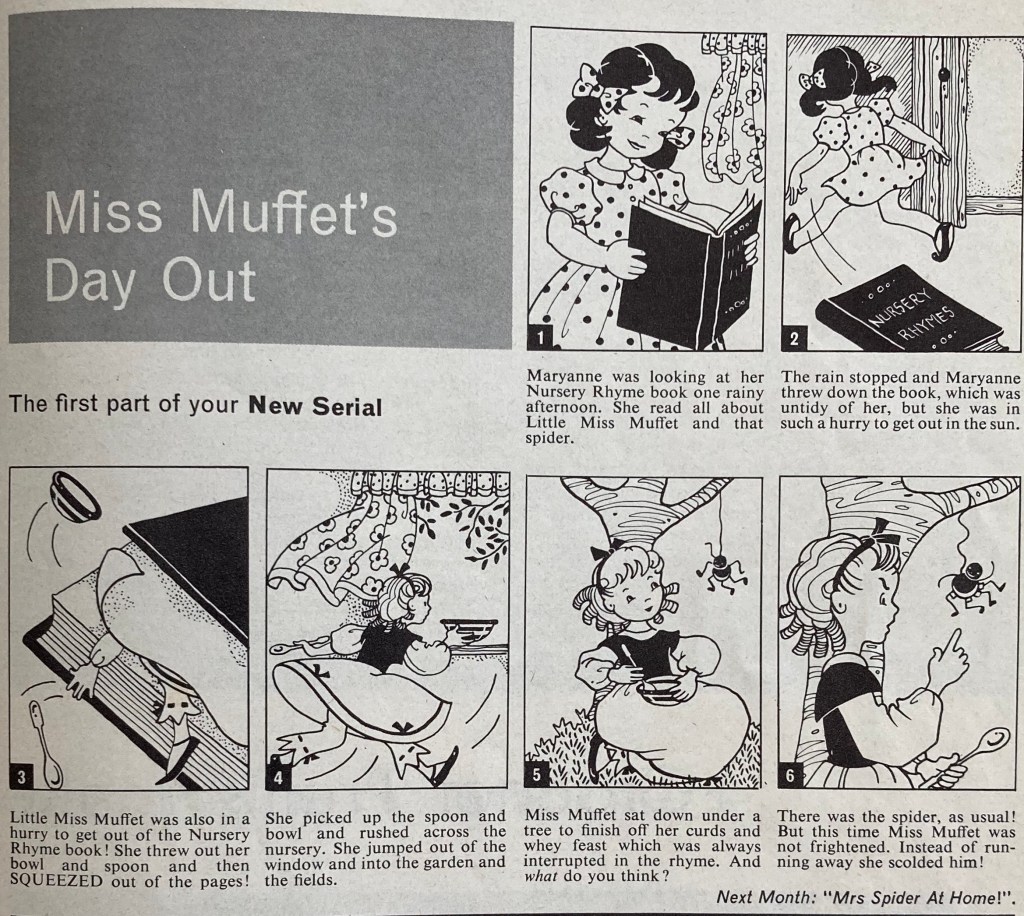
The “readers’ pages” have a review of what was probably a very interesting book on dressmaking for dolls, and –bucking the “single girl” trend of the early 1960s — we’ve got another “stand by your man and knit him something” ad for P&B wools (though this one is really quite sweet and romantic, unlike the “you only exist to be pretty for him” ad seen in other issues). There’s also a new cartoon serial for children: a re-telling of the “Little Miss Muffet” nursery rhyme, where Miss Muffet is not at all afraid of the spider. I’m sure, when she grows up, she will be not at all afraid to suggest to her man that he knit something for her for once.

My project from this issue will probably be a scaled-down version of one of the children’s sweaters for a smaller child. Stay tuned!

September 1962: Overview

Autumn is the nicest season for knitting, and 1960s Stitchcraft usually gave it a little push with extra pull-out supplements, extra colour photo pages, or “bumper issues” full of the latest developments in home-knitting fashion. The September 1962 issue doesn’t have any of these extra features, but it does have a wide variety of designs in mid-weight and warmer wools, starting with the chunky twisted-bobble sweater on the cover. Made in bulky Big Ben wool, it weighs in at a whopping 38 (for the smallest of three sizes, 35-36 inch bust), 40 or 42 ounces (the largest size, for 39-40 inch bust), i.e. about two and a half pounds or 1190 grams. I am guessing the model is quite slender and even she looks bulky in it!

The dresses and separates, made with the same loose fit but in double knitting wool, show a smoother look with minimal patterning. The orange dress in the colour photo and the charcoal-grey dress with the colour-pattern border (“for those who like something really eye-catching”) are the same design, but the pattern-border version is only available in one size, “for the younger girl.” I guess that pattern was just too exciting for doddering middle-aged matrons! The blue and white ensemble, also made in double knitting weight, has three pieces: a simple sleeveless blouse in white k2, p2 rib, a plain blue skirt and a back-fastening cardigan with white vertical stripes on the front. Tops continue to be hipbone-length and hemlines are firmly anchored just below the knee.

Other garments feature interesting colour and texture effects: the man’s “smart weekend sweater” has been treated with a teasel brush to achieve a fuzzy, felted effect. The knitter was not expected to do the brushing herself, but was instructed to “take all pieces at this stage [after knitting all the separate pieces, but before making the garment up] to your usual wool shop who can arrange to quote a price and send them away to be brushed for you.”

There’s also a striped jumper for “young and carefree” women with a fringed collar and hem, similar to the one in the February 1962 issue (yes, it is more or less the same pattern in different colours and with a split collar) and a pullover in an intriguing striped and dotted slip-stitch pattern. Stripes and/or slip-stitches also feature in the three-colour pullover for older children and the toddlers’ dungarees. Colours are navy blue or charcoal grey contrasted with white and neutral pastels, as we saw with the patterned-hem dress and three-piece ensemble.

There is the usual variety of homeware designs, mostly with floral patterns: this month’s flower is the dahlia, or you can sew and embroider and apron with lilac sprays. The leftover gingham fabric from “your” workaday apron can be used for cute animal appliqués on aprons for the children (unsurprisingly, Father seems to be exempted from the washing-up.) There’s also the usual floral cutwork tablecloth and tray cloth and a coffeepot set made in Hardanger embroidery.

Needlepoint fans can make a stool top or a whimsical cross-stitch rug and/or wall panel for the nursery, featuring characters from nursery rhymes. The motifs are separate and interchangeable and can be adapted for different sizes and purposes.

In the children’s serial comic, Peter the puppet has been freed from his marionette strings and is traveling throughout the countryside writing a play about his adventures. Cyril the squirrel helps out by painting illustrations, using his tail as a brush. (But how will Peter get home?) There’s the usual advertisement for Lux washing soap, guaranteed to leave your woollies soft and fluffy, and the latest instalment of the Patons and Baldwins’ “knit to please your man” series of ads, junior version: a teenage girl knits a “nice, husky sweater” for her boyfriend with her own loving hands to show everyone that he’s the “special one.” The young woman on the back cover ad is presumably also trying to catch a man, but she looks more polished in her snappy red dress and white gloves. You can really see 1960s style coming into its own in the straight or A-line sleeveless dress with low contrasting belt, the bobbed and fringed hairstyle and the edgy, off-angle mirror pose. Compared to the designs in this issue, it also shows how fashion-conservative Stitchcraft is.

I’m not sure what I want to make from this issue. I imagine the embroidered dahlias would make a great design for a laptop or tablet sleeve, but I already have a fine home-made laptop cover, not to mention this wonderful gay-geese-in-space tablet cosy. Also, I have probably done enough embroidery for the time being and still haven’t made much progress on this appliqué masterpiece that I started in July. The knit projects are all so bulky and loose-fitting, which is not my style, and I’m not sure I know an appropriately-aged child for the interesting slip-stitch pullover. There was also a perfectly nice, if not exciting baby cardigan (not pictured) in the issue which I could make quickly from stash, which would be useful enough (somebody’s always having a baby) and maybe the best choice for my uninspired mood. Stay tuned and find out!

August 1962: Overview

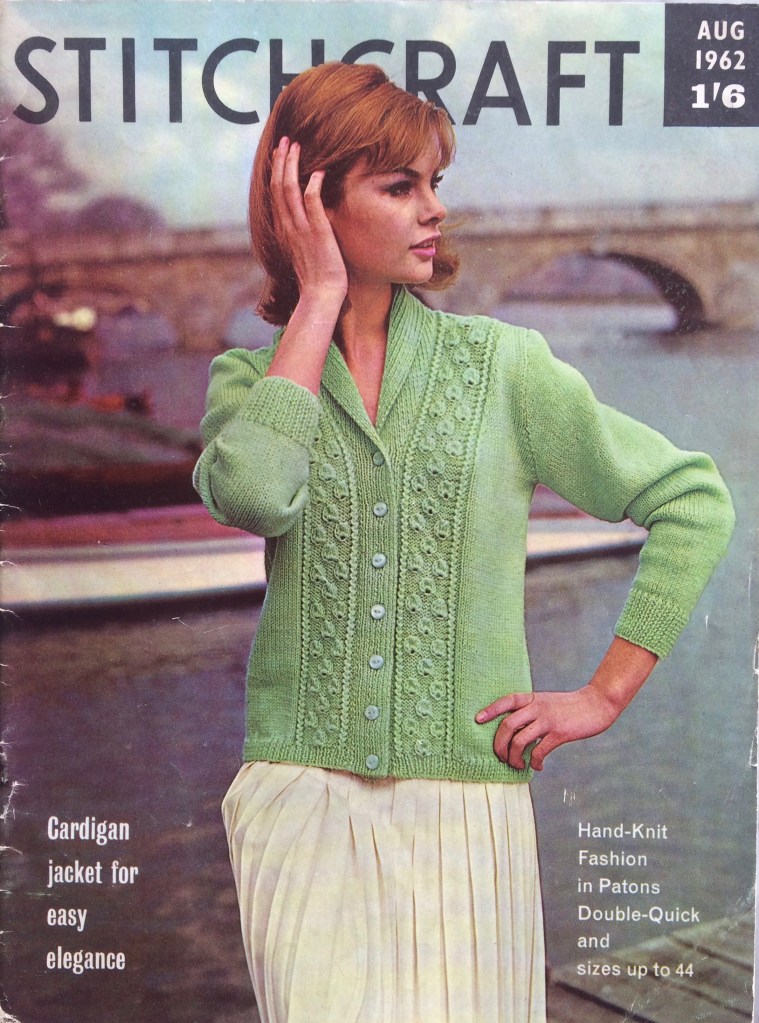
August is the end of the holiday season at Stitchcraft, featuring transitional styles for the cooler days of September as well as a few more small, easy projects that can be worked on from the deck chair or picnic table. The “Contents” column on the facing page divides the adult garment patterns into the categories “First Autumn Fashions” and “Continental Designs”.

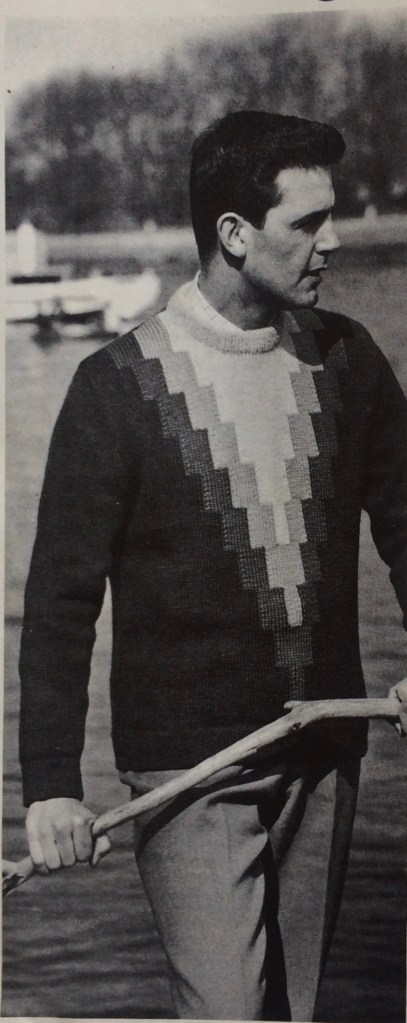
The “Continental Designs” comprise a colour-block pullover for men “from Vienna” in graded shades of green, a simple cap-sleeve, T-shirt-style jumper with a little Norwegian motif, and an “Italian design for late Summer” with bands of red and black intarsia in a diamond pattern. I wish they had used these for the colour photos instead of the bland white pullover on the inside front cover!

Loose-fitting, casual shapes and light, sunny colours dominate, exemplified by the apple-green cardigan, collared shirt-sweater and boatneck twin-set on the front and inside covers. Notice how much less fitted the August 1962 twin set is than, for example, this one from August 1960, not to mention earlier twin-sets from the 1940s and 1950s. The concept lives on, but the line has changed completely. Everything is hipbone-length with no or hardly any shaping.

Babies get a standard, but very pretty, lacy matinee coat and bootees, the “smart teenager” has a machine-knit pullover, and her little sister gets a “gay Rimple design” in the still-popular knitted terry-cloth look, so the whole family is taken care of.

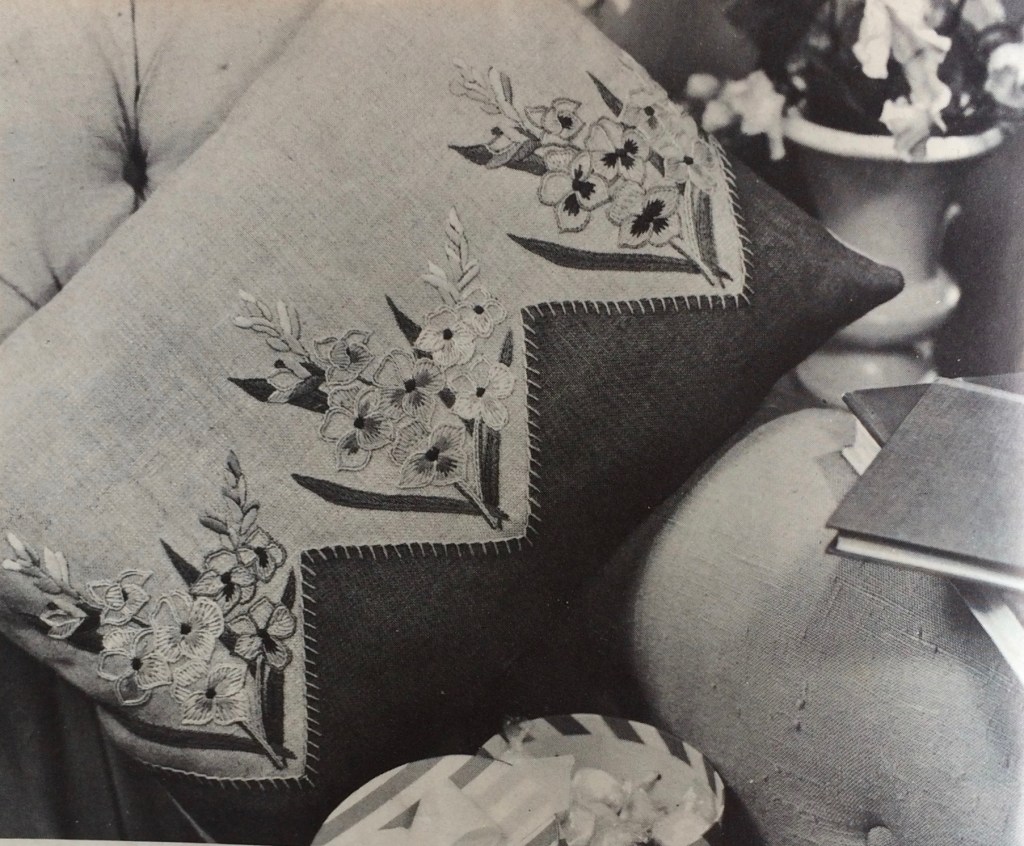
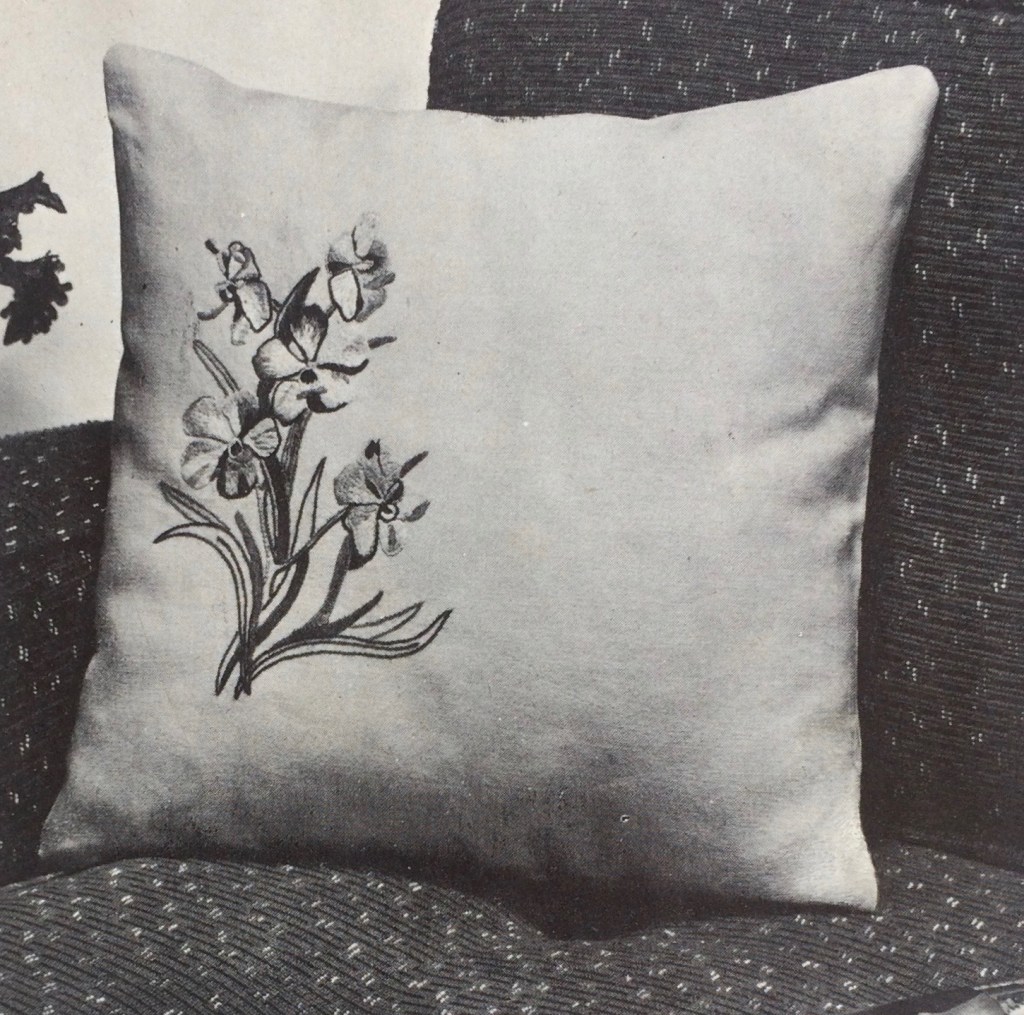
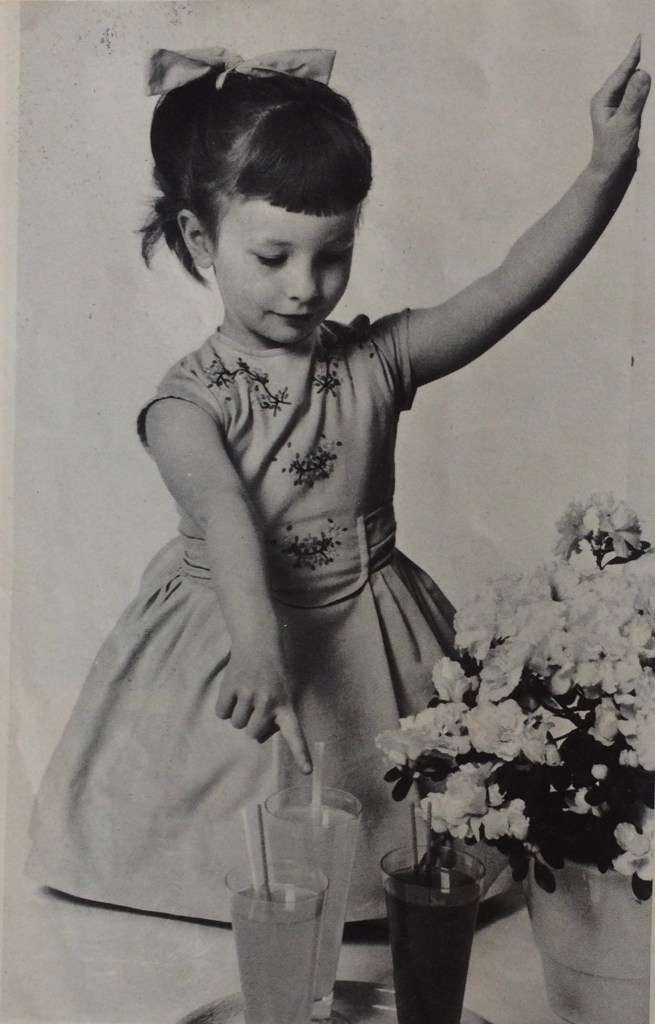
Homewares are always big in the summer months, when many readers understandably didn’t want to hold bulky warm wool in their hands in hot weather. The bedside rug is obviously an at-home project, but the smaller projects could easily be taken along on a holiday. This month’s flower in the gladiolus, but there’s also an orchid spray and some forget-me-nots, along with two sewing patterns to embroider them on: a round baby shawl or this wonderful little girl’s dress. For once, you don’t even have to send away for the patterns, as they are geometrically quite simple — the shawl is just a circle, drawn directly onto the fabric with a pencil held on a length of string, and the dress is made up of rectangles with measurements given. I would love to make the dress! I just don’t think it would get worn, since it would only be for “dress-up” occasions, of which there aren’t going to be any for a while.

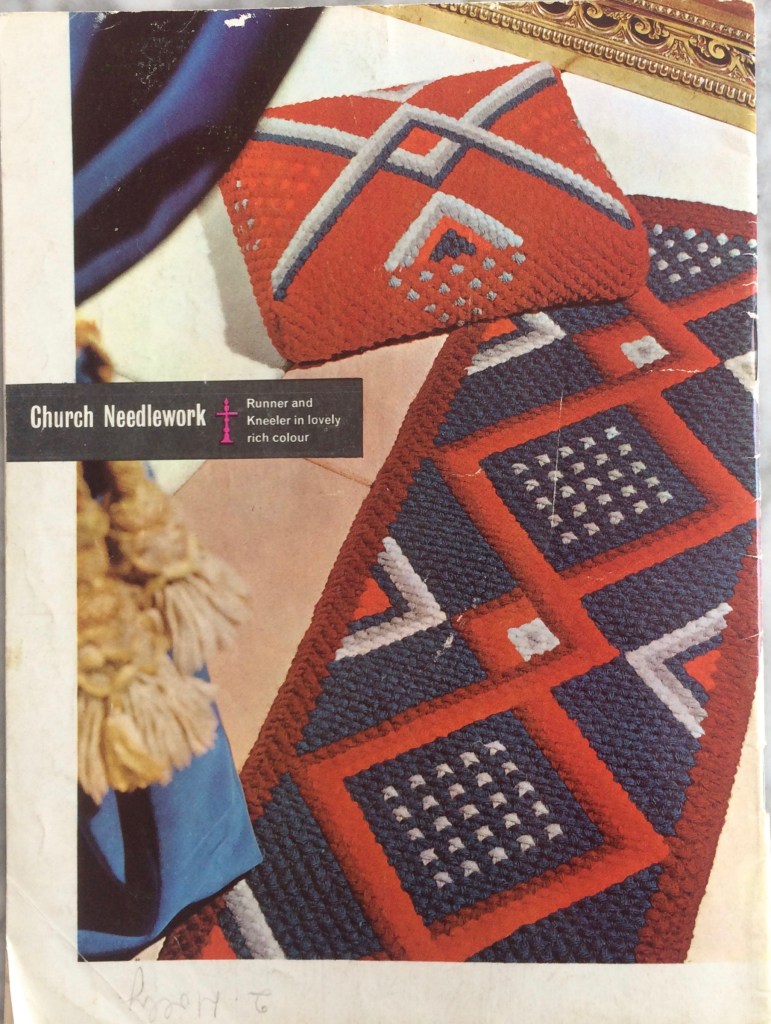
The back cover shows an interesting feature which took shape in the early 1960s issues: tapestry projects specifically for church use. In this case, there’s a runner and kneeler in shades of red and blue. If anyone happens to know why or if these colours or this pattern are significant in whatever type of Christian tradition, please feel free to tell me, as I don’t know anything about it. The rug, especially, does not say “church use” to me in any way that I can recognise and I could just as easily see it in a normal hallway.

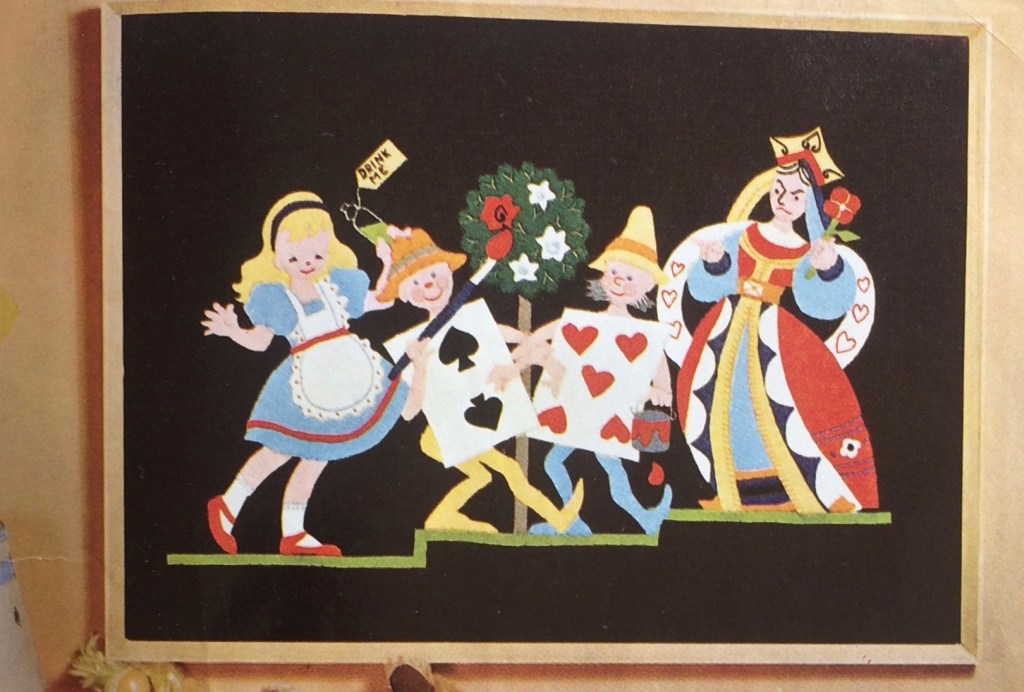
This issue doesn’t stop! The “Readers’ Pages” offer two more very simple projects: a reprint of a young man’s waistcoat from 1957 and a stash-busting baby blanket from double crochet hexagons. And just when you think you’ve come to the end of the issue, here’s this incredible Alice in Wonderland-themed wall hanging in felt appliqué and embroidery:

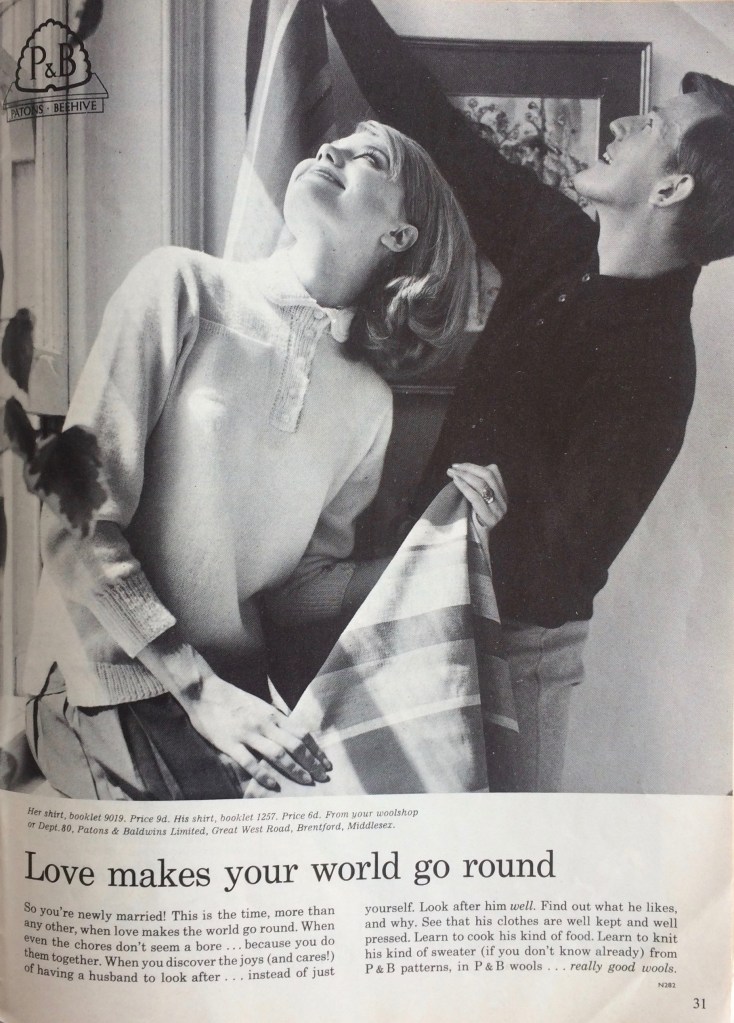
I’ll close with this full-page ad for Patons & Baldwins wools, showing a newly married couple decorating their home. The happy bride is instructed to

Look after him well. Find out what he likes, and why. See that his clothes are well kept and well pressed. Learn to cook his kind of food. Learn to knit his kind of sweater…

While I’m certainly not surprised that a 1962 advertisement would speak to women like that, I do find it interesting to compare the early and mid-1960s ads — which take on this type of “you exist to please your man” language more and more throughout the years — with those from the 1950s issues, with their much more independent picture of womanhood. Many of the knitting patterns in the earlier issues are explicitly designed “for the office” and most of the advertisements portray women living active, interesting lives in their comfortable shoes and unbreakable skirt zippers. In the wonderful tampon ads (that sadly disappear around the late 1950s), they don’t even let “problem days” stop them from doing anything! In contrast, the full-page P&B ads starting up around this time always feature a man or child with the woman in question and the text is inevitably some variation on “you must do this to please your man.” I had always thought of the 1950s as being a much more repressive time for women that the 1960s, when roles began to change, but judging from Stitchcraft (which, to be fair, is quite conservative both fashion- and otherwise), the earlier part of the decade is more of a backlash than a progression.

I don’t know what project to make from this issue and I still have so many WIPs, both for this blog and otherwise. Maybe a nice, easy flower embroidery on a vegetable bag?

July 1962: Overview

Cover photo from the magazine showing two women and a male waiter drinking cocktails.

Holiday and party seasons are both in full swing in Stitchcraft’s July 1962 issue and the more I look at this cover photo, the more I love it. Note how the foreground model is staring off into the distance while sitting on a table with a compass printed on it, as if fantasising about her faraway holiday (though, if she’s on holiday already, as the picture is implying, does that mean she can’t wait to get home?). Meanwhile, it’s a good thing that our flirty tuxedoed waiter’s drinks tray is empty, with that precarious balancing act. If anyone feels inspired to creatively augment this photo with speech- and thought-bubble captions, please do and share it with us!

Colour photo from the magazine showing a modeled, knitted ensemble and blouse

In keeping with the easy-going, summer holiday theme, the knitting projects are simple and quick to make. The two illustrated on the cover have no sleeves, minimal shaping and patterning, and are made in quick double knitting wool. Although pictured as stand-alone tops, they could easily be layered over a blouse on cooler days. There’s also a simple blue blouse with loopy flower details on the collar and a striped, sleeveless tunic-blouse with matching skirt, all in 4-ply wool. Our waiter from the cover photo has found another holiday-goer to flirt with, and sports a “Casual Italian design sweater” in the same colour as her skirt: “Water Green.” (Holiday tip: if the water actually is that colour, don’t drink it.) Speaking of Italy, doesn’t that beautiful model in the collared blouse look like she just stepped out of a Fellini film?

For cooler days, there are cardigans in “golfer” or classic, slightly bobbled styles, both made in double knitting. The golfer takes her sport very seriously! Knitters who are really in a hurry to get packing can make some simple, bulky pullovers for the kids in the family (shown here building a lovely British castle out of cardboard and sand in the Patons photo studio — I am guessing everyone had a lot of fun on this issue’s photo shoots) or a fine-knit slipover in honeycomb pattern, written for a home knitting machine.

The embroidered homewares are mostly easy and predictable: a chairback with this month’s flower, the carnation; a quickly-made “gay garden cushion” (Happy Pride!), and place mats with heat-resistant cork inserts. There’s a tapestry stool and/or project bag in Florentine pattern, knitted or crocheted cushions, some fancy knitted doilies and a trolley cloth from crocheted motifs. I didn’t photograph all of them, since they’re pretty standard fare.

For those who like to immortalise their holiday paradise in tapestry, there’s a wall hanging of the village of St. Etienne de Bougary in the lovely French Pyrenées. For your outing to that very inviting-looking lake, you can sew you own beach bags and/or an appliquéd blanket-towel-baby’s-playmat for outdoor lounging. The beach bags feature adhesive plastic lining to keep wet bathing suits from leaking into the bag. Smart and easy, indeed.

I’m kind of ambivalent about making a project from this issue. The only thing I could really use is the bobbly cardigan, but it’s not exactly necessary, and the only design that I find exceptional is this crocheted blouse (worn by my favorite Stitchcraft model, who featured in a lot of the mid-and late 1950s issues). Model and blouse are both beautiful, but the blouse is way beyond my limited crochet skills. I wish I had the “Traditional Norwegian Designs” booklets from this ad! I think I’ll take the time to finish up another long-standing WIP instead.

Blast from the Past: February 1947

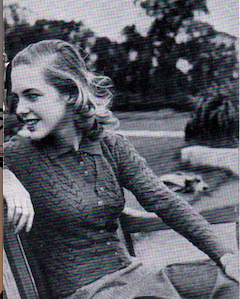
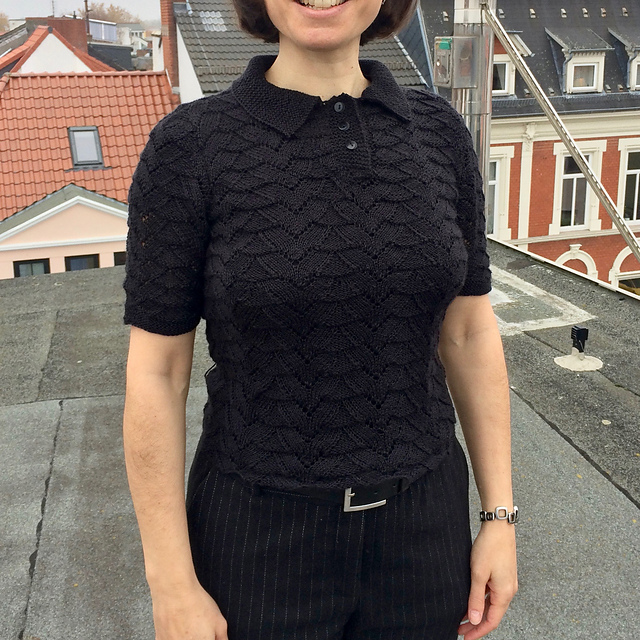
The June 1962 issue didn’t have any projects that appealed to me enough to make them, so I used the time to finish up a project that I’ve been working on off and on for the last few years: a “4-coupon” twin set from Stitchcraft‘s February 1947 issue.

The “4-coupon” title refers to the clothing coupons used when purchasing rationed items during and after World War II. Rationing began for many food products in January of 1940 and extended to clothing in 1941, whereby clothing coupons could also be used for household textiles or wool. The Wikipedia article on rationing in the United Kingdom during World War II gives a sense of the coupons’ comparative value:

There were 66 points for clothing per year; in 1942 it was cut to 48, in 1943 to 36, and in 1945 to 24. This system operated through a “points” system… [ ] …Clothing rationing points could also be used for wool, cotton and household textiles… [ ] … The number of points that each piece of clothing would be valued at was determined by not only how much labor went into making it, but also how much material was used. A dress could run someone 11 coupons, whereas a pair of stockings only cost 2. Similarly, Men’s shoes cost 7 tickets, whiles women’s cost only 5. In 1945, an overcoat (wool and fully lined) was 18 coupons; a man’s suit, 26–29 (according to lining); Children aged 14–16 got 20 more coupons.

The twin-set uses 8 ounces of wool, so apparently one coupon could get you two ounces of (2-ply) knitting wool. (Just to be clear, one also had to pay for the items; the coupons only limited the amount people were allowed to buy, regardless of how much money they had at their disposal.)

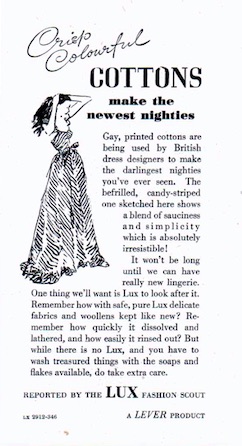
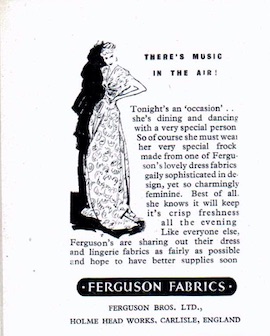
The influence of rationing can be seen in almost every aspect of 1940s issues of Stitchcraft: occasionally titles of designs, such as this one, but more often in recipes and advertisements. These two, from the pages of the 4-coupon pattern, promise that the company in question is “sharing out their dress and lingerie fabrics as fairly as possible” and reassure that “it won’t be long until we can have really new lingerie” (lace and frills were banned, and nylon was needed for parachutes et. al., hence the plain, home-sewn cotton nightgowns).

Many products remained rationed after the war, including clothes rationing, which lasted until March 1949. It was only in 1954 that the last rationing measures were lifted. Since then, the only product that has been subject to rationing in the UK was petrol, briefly, during the Suez crisis of 1956-57. And yet, as the global Covid-19 pandemic continues to rage around us, there have been discussions in many countries — including wealthy countries with excellent medical infrastructures — regarding the rationing of personal protective equipment, ventilators and medical supplies. The past is not as far away as we might think.

Booklet photo, February 1947

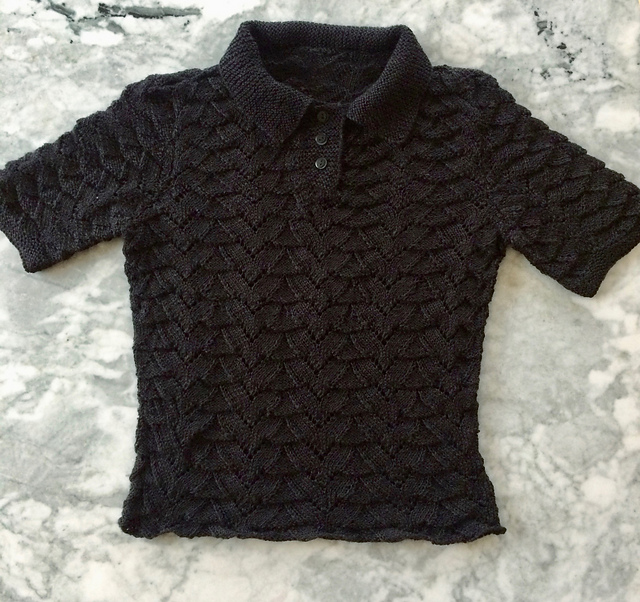
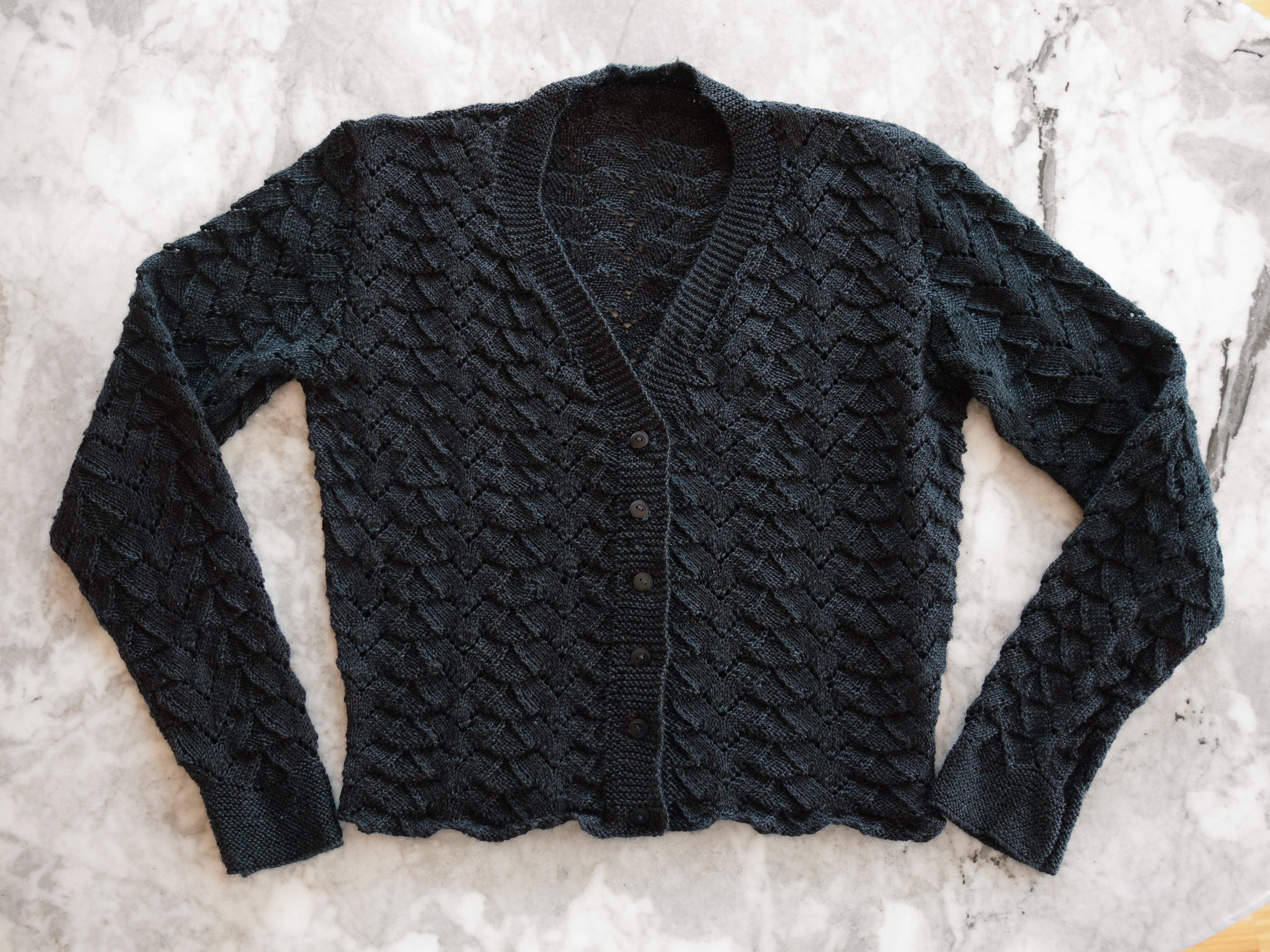
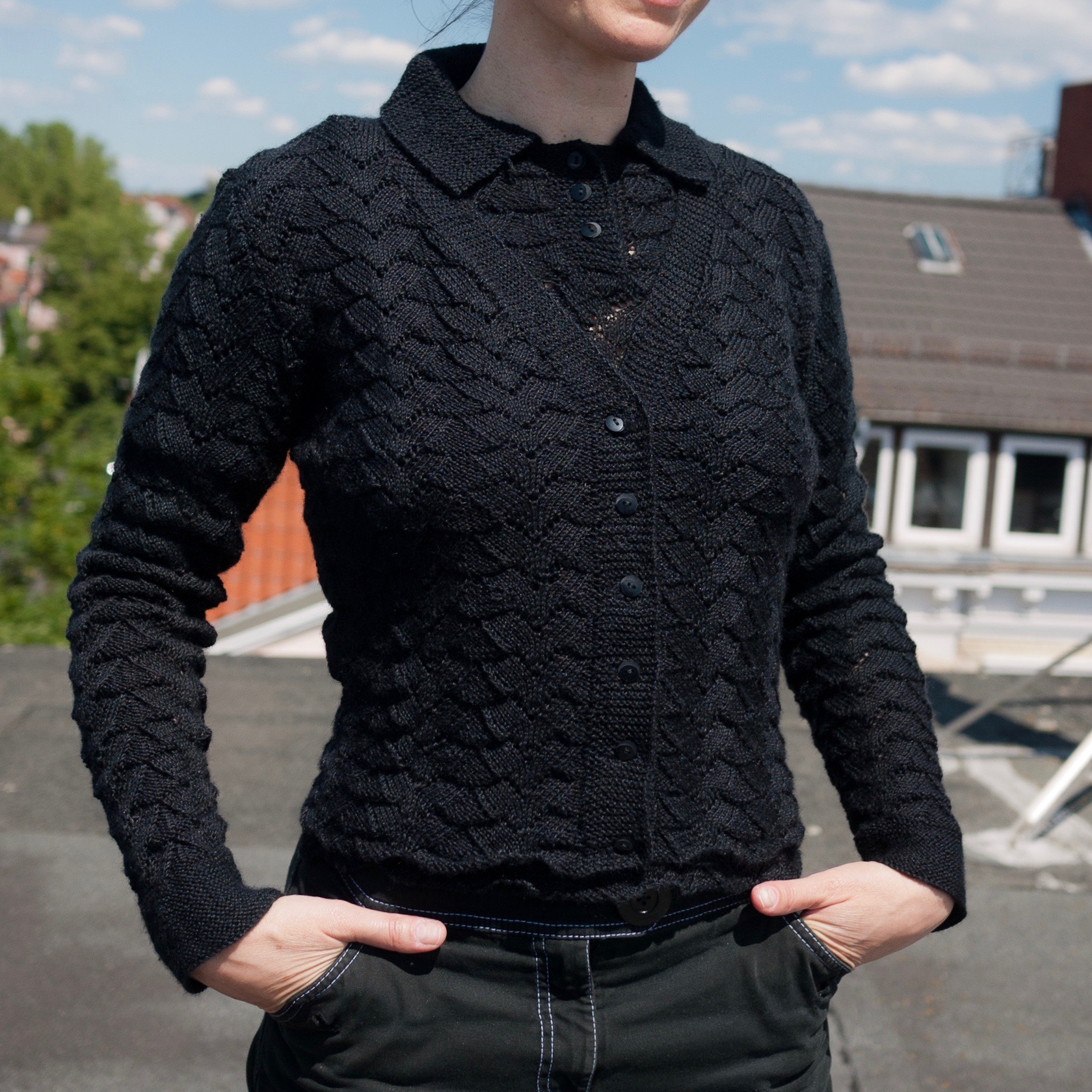
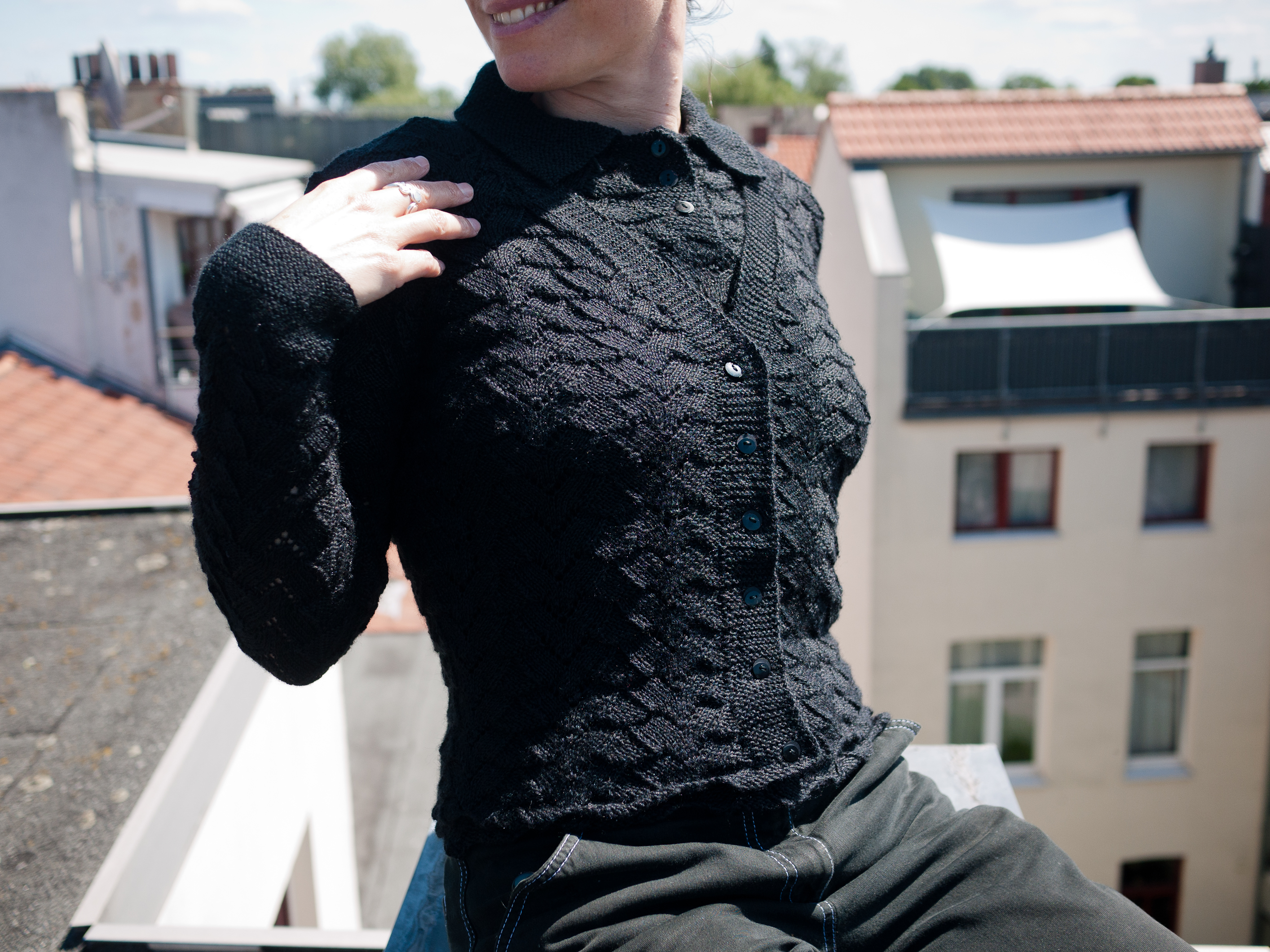
I had plenty of time to ruminate on that while finishing this project, which I started as a “home away from home” project in 2016 (a year in which I effectively lived in two different places) and finished in home isolation in 2020. The wool — Onion Nettle Sock — is a mixture of 70% sheep wool and 30% nettle fibre. I would never have thought to knit with nettle fibre, but it works very well! It is smooth and somewhat shiny and the textured lace pattern shows up very well with it. Also, it reminds me of various fairy tales involving our heroine knitting shirts for her brothers out of nettle plants (or aster flowers, depending on the version and translation), like Die Sechs Schwäne (The Six Swans) by the brothers Grimm, or De vilde svaner (The Wild Swans) by Hans Christian Andersen.

As always, I am larger than the 34-inch-bust size for which the pattern is written, but also get a looser gauge, so it worked out for me to make the pattern almost exactly as written. I made the sleeves and the body of the jumper in the round, adjusted for length and changed the sleeve cap slightly for less puffiness, but otherwise I didn’t need to change anything. Of course, the lace pattern is stretchy and can be blocked tighter or looser.

Said pattern was the first one I had worked with that increased and decreased in the course of the pattern repetition, and I was at a loss to deal with the side-seam and sleeve increases and decreases at first. The pattern, like all vintage patterns from this period, assumes you know what you are doing, and there are no charts in any case. I learned a lot and I can see that the side increases on the cardigan are much nicer than on the jumper! (Carefully photographed as to be unnoticeable, but believe me.)

My buttonhole spacing on the cardigan was off, so I ended up sewing most of the holes closed ad carefully cutting new ones after backing the bands with ribbon (a common practice at the time, especially on tight-fitting cardigans, to keep the bands from stretching out and gapping across the chest.)

All in all, this is a wonderful design and very flattering to the figure. Nota bene, my upper body is broad and flat and I am not exactly model-thin, but this ensemble somehow manages to make me look both svelte and curvy. The wool/nettle fingering weight is perfect for fall and spring. I love the buttoned placket and collar of the jumper. Knitting this was definitely worth all the time and hard work and it will be getting a lot of wear for years to come.

March 1962: Overview

IMG_3126There are three seasons in the Stitchcraft year: autumn, Christmas and “holidays”, which start in March and continue until about September. Of course, most people take their holidays in the summer, but the beauty of knitting (or editing a knitting magazine) is that you can technically be knitting for them any time of the year, if you knit slowly enough. And so, the March 1962 issue of Stitchcraft, (motto: “Knit for Spring”) can already promise us “the fun of holidays to plan for.”

Spring is also “the time of year to wear smart two-piece suits and dresses, which you can now knit so quickly and easily” — a nod to the double-knitting and bulkier-weight wools now available and in fashion, relieving knitters of the earlier boredom of making dresses and long-skirted suits at 8 stitches to the inch. Here is a skirt set in nubbly Rimple DK. Top-fashion colours of dull green and beige-gold (or as Stitchcraft calls them, “mustard and pheasant” — sounds delicious!) are repeated in a finer-knit bouclet sweater.

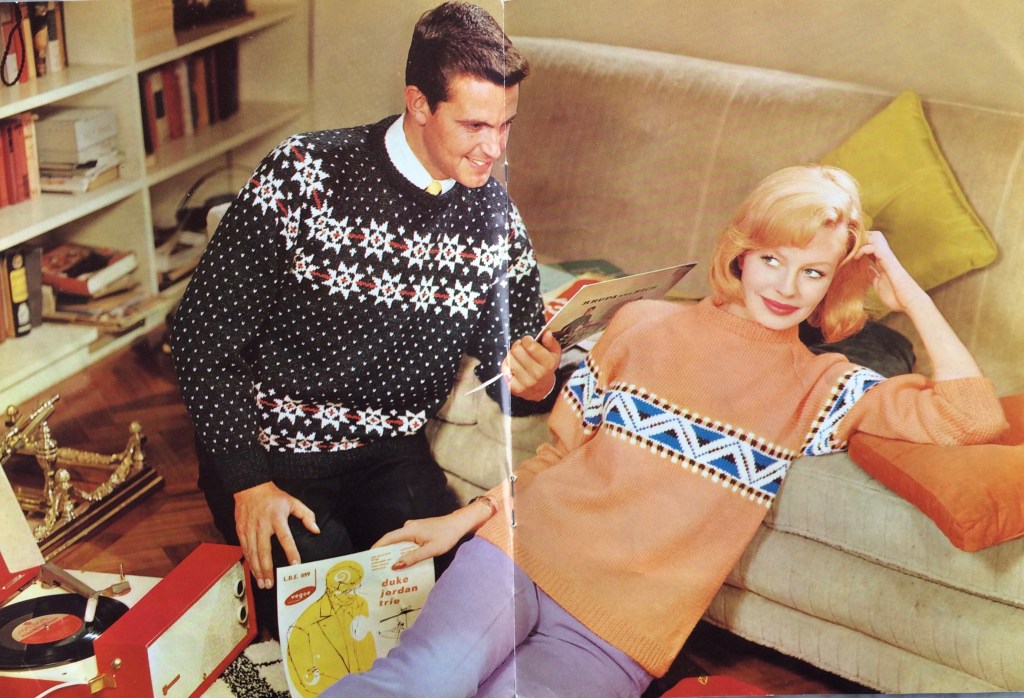
Interesting textures and colour blends are key: in addition to the Rimple and bouclet offerings, the cover jumper is made in Bracken Tweed, one of the newer marled/flecked wools. Stranded colourwork is featured in a Norwegian-style pullover for men and, in more subtle form, in a bright band across a warm women’s raglan sweater. Look at that perfect 1962 “lifestyle” photo of our knitter lounging in her beige-coloured living room and smiling seductively at her man while listening to jazz!

IMG_3136

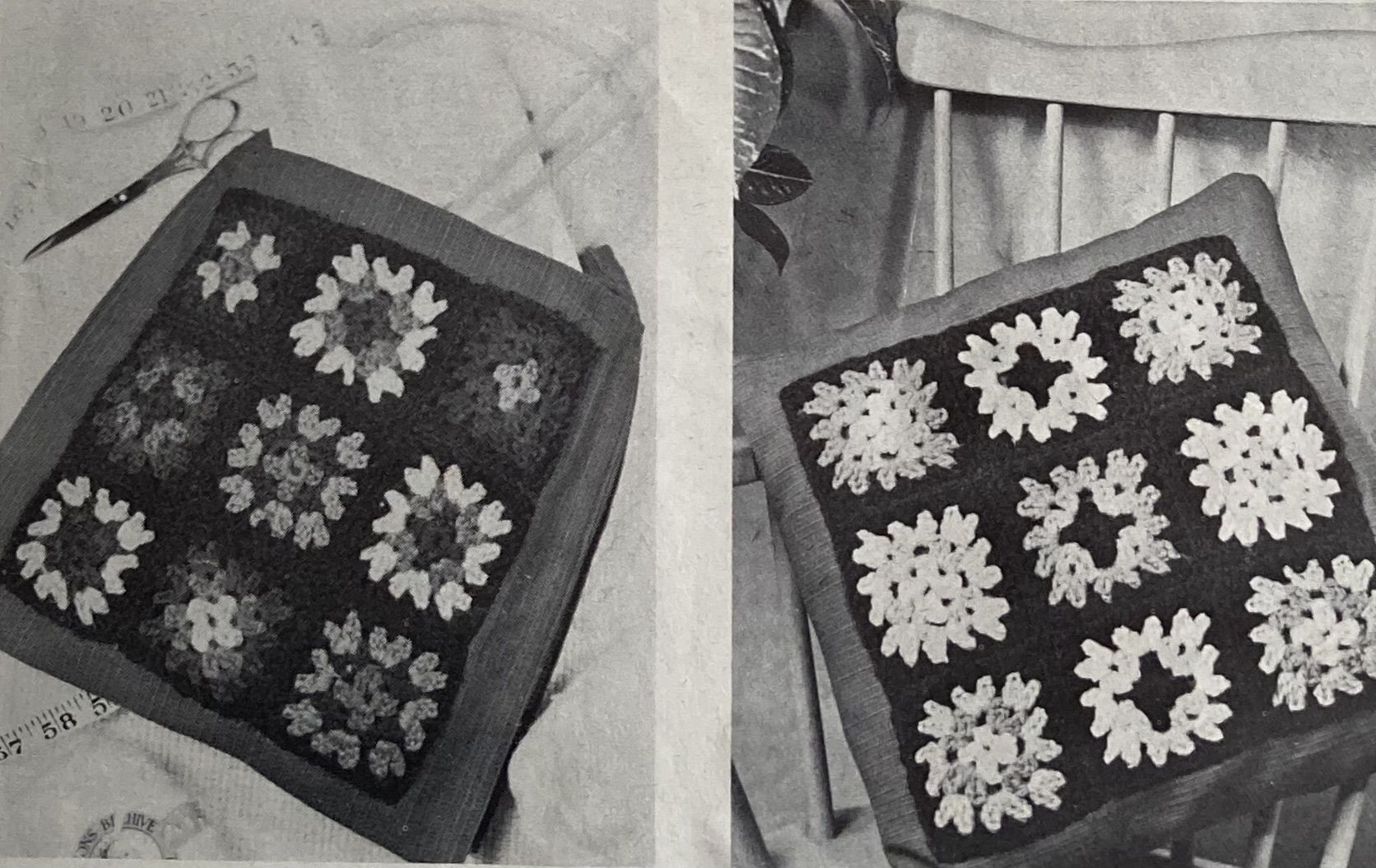
“Informal sweaters” that combine colour and texture elements, as well as a lovely little twin-set for a child and granny-square bonnet and mittens for a toddler round out the collection. The homewares are varied, but predictable: another tapestry town scene, a Florentine rug (pity they didn’t get a colour photo of that), traditional cross-stitch designs and a daffodial embroidery transfer for a coffee-pot cosy or night-dress case.

And of course it wouldn’t be Stitchcraft without “novelties”, in this case, matching “boy” and “girl” egg cosies made to look like nightcaps — I’m guessing somebody must have found the egg holders with painted-on faces and had an inspiration. The back cover is another fun, if slightly “uncanny valley”, advertisement for Escorto “Gold Seal” fabrics — “easy” due to being 100% synthetic material.

My March project will be the jumper from the girl’s twin-set as well as another “blast from the past” which I have been working on for literally years and will hopefully finally finish soon. Happy Spring!

November 1961: Overview

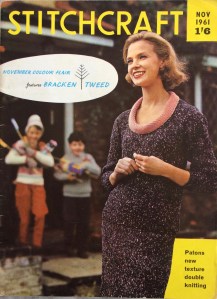
IMG_2927November is such a grey month, so it’s nice to see that Stitchcraft‘s November 1961 issue has the theme “Colour Flair”, featuring speckled yarns and a center page in colour. The issue showcases “Bracken Tweed”, Patons’ new double knitting wool. Bracken Tweed was one of the early multicolour yarns, mixing flecks of a lighter colour in with main strands of a darker colour to achieve a tweed effect. At its debut in 1961, it was 100% wool;  with the change from ounces to grams in the late 1960s, the fiber content was changed to 60% wool and 40% acrylic.
IMG_2931The Bracken two-piece dress on the cover is one of two ideas for “Separates with the BOUTIQUE LOOK”; the other is this wonderful suit, made with regular Patons Double Knitting and familiar nubbly Rimple. Note the deliberately too-short sleeves, designed to show off your gloves and bracelets! The slip-stitch pattern gives it a firm texture for more shape.


Then we’ve got “Colour Flair” from Vienna (a fancifully patterned pullover in brown and yellow) and Paris (a shirt-style pullover with front buttons). Large collars are still in, but are tending towards rounder shapes, as can be seen in the Vienna pullover and the rolled collar of the Bracken outfit. Bracken is also featured in the “young-style look” pullover with a cute bobble tie, while “his colour-panel pullover” is made in Moorland Double Knitting, also a tweedy-flecked wool.

Younger girls get their own “Continental Look” with a bright blue and red outfit of skirt, cardigan and stockings. Finally, warm legs! Tights would be better, of course, but at least her poor legs aren’t bare in the November cold. Babies get bootee slippers and a lovely lace shawl. With the exception of the baby shawl, all the garments in the issue are designed for double-knitting weight wool, so that everyone can be warm and get their Christmas presents on time.

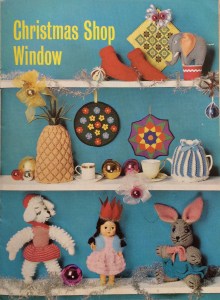
With that in mind, the colour page insert shows a “Display of Gifts to make yourself” — quick, easy-to-make toys and small household items for family and friends. The baby’s slippers are on the top shelf, along with a “Circus Jumbo” stuffed felt elephant and a cross-stitch pot holder (?) that I cannot find anywhere in this issue. There’s a crocheted tea cosy and a magnificent knitted coffee-pot cosy made to look like a pineapple, as well as two felt pot holders on the second shelf. The bottom shelf has knitted poodle and bunny toys and doll clothes (the bunny is also dress-able). Not pictured in the colour photo are a calendar cover and waste-paper bin cover in felts, with a Swedish design of trees and reindeer.

IMG_2942

With all of that, the regular homewares in this issue are not particularly exciting — standard chairsets in counted darning and cutwork. There is one impressive larger project: this cross-stitch rug and stool top in a Victorian design, also printed in colour.

IMG_2943

Finally, the back cover has a fabulous advertisement for “fabulous Pfaff” sewing machines — I love the expressions on the models’ faces! May all your homes be well-dressed.

IMG_2946

My project for this month will be the jacket from the checked suit.

August 1961: Overview

IMG_2709“August is an issue that needs special thought and planning” writes Stitchcraft‘s “editress”, Patience Horne, in the introduction to the August issue, pointing out that it is “rather an “in-between” month for needleworkers” — often too hot to want to wear or make heavy sweaters and too late in the year for fine-knits. At the same time, reminding people that “Autumn is around the corner” can be “a little depressing” to people enjoying their late-summer holiday.

I get this! It’s one of the … hazards? “joys”? features? of living in a temperate/oceanic climate zone like the UK: August, and in fact the entire summer, can be so hot that you can’t even imagine holding wool in your hands or performing any excess movement (thus the small, easy embroidery projects in cotton thread on linen), or 10 degrees Celsius with unending rain (just ask Edinburgh, or the Bretagne), or anywhere in between.

Stitchcraft‘s answer is to offer casual, “all-year-round” knit styles that could work either on a (cold, wet…) holiday or back home in the autumn and lots of little needlepoint and embroidery projects that fit in a suitcase and can be done easily in the heat. The adult garments are thick and warm and serve as outerwear on a summer evening or Atlantic boat trip: the cardigan on the cover, “chunky” pullovers for women (one knitted, one crocheted), and a man’s pullover in “that typical man-appeal style which will make it a winner.” All are made in double knitting-weight or bulky Big Ben wool and both the knitted pullover and cover cardigan feature slip-stitch patterns which make the finished garment that much thicker and warmer. Golden or orange tones and white continue to be popular colours.


There are sleeker, finer-knit short-sleeve tops for girls in their “early teens” (the models seem to be young, slender adults, but OK) with high necklines and an interesting mitred collar on one. Smaller girls (or boys, I guess? this garment doesn’t seem to be heavily socially gendered, but the instructions only have options for buttons on the “girl’s side”) get a fine-knit cardigan with a border of “Scotties chatting to a friendly Cockerel.” Babies get the newest addition to their “Stitchcraft Layette” with a matinee coat and bootees in bramble-stitch to match last month’s dress.


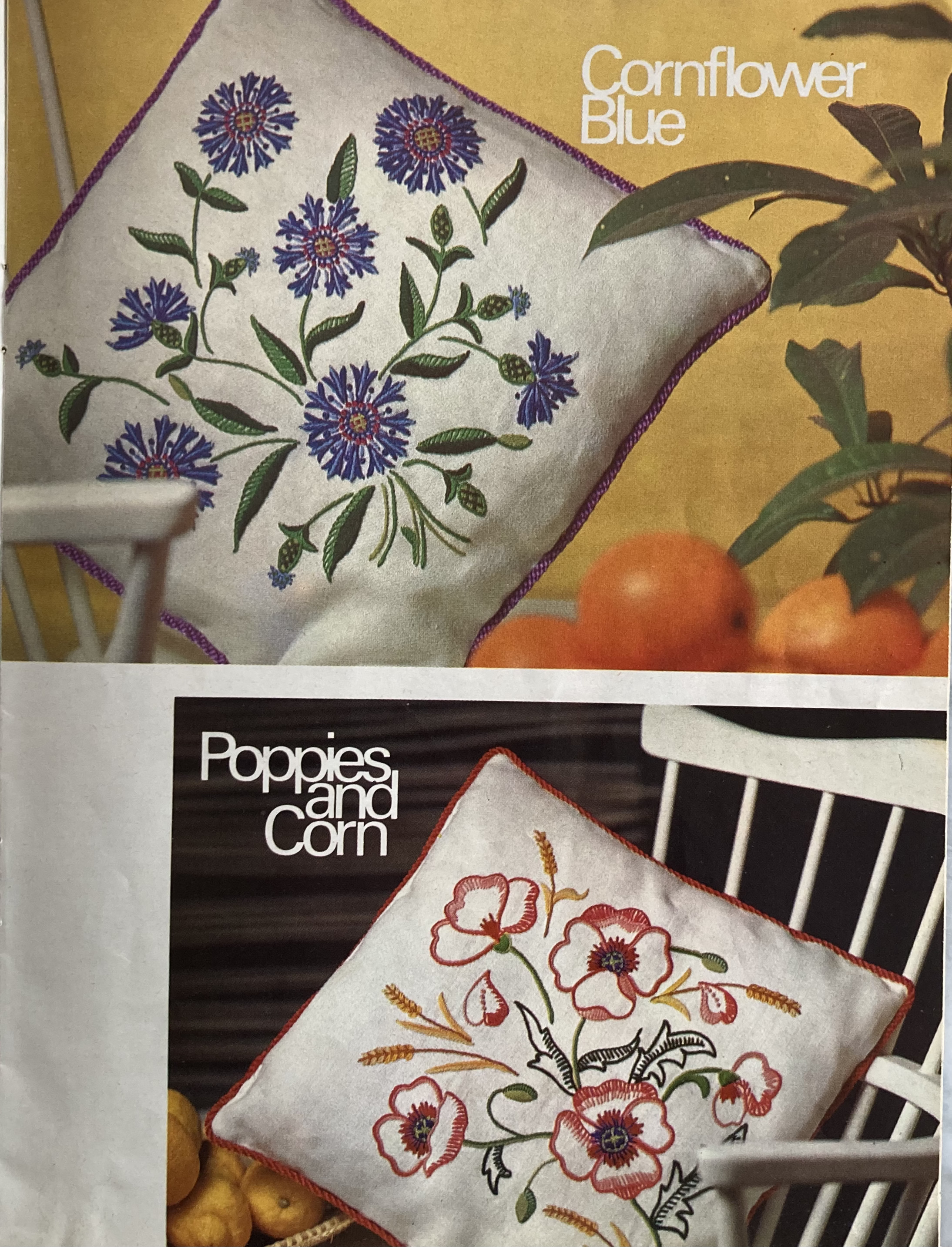
The real fun is in the homewares, where there is a huge selection of projects and needlecrafts to choose from: embroidered ivy borders for tablecloths, traycloths or cushions, a tapestry footstool or “needle etching” picture of a “typical Cornish quayside”, a crocheted rug, blue rose sprigs to embroider on a cushion or a fringed lampshade, a weird crocheted and embroidered tea cosy in Turabast (which I can’t imagine would have good insulating properties), or “Fluff”, a somewhat psychotic-looking, yet endearing knitted kitten. Also, I thought the Zodiac year theme had to be finished by now but no, it’s Leo the lion’s month.


IMG_2723My favourite, though, is this sewing project: a head cushion that lets you recline charmingly in bed with your hair and makeup perfectly done, your satin nightie on, a book on your lap and your telephone on your ear. It’s glamorous  leisure and lifestyle advertising personified, and though they say it’s an “idea for your bazaar”, I would bet the Stitchcraft readers who made this in 1961 did not make it to sell.

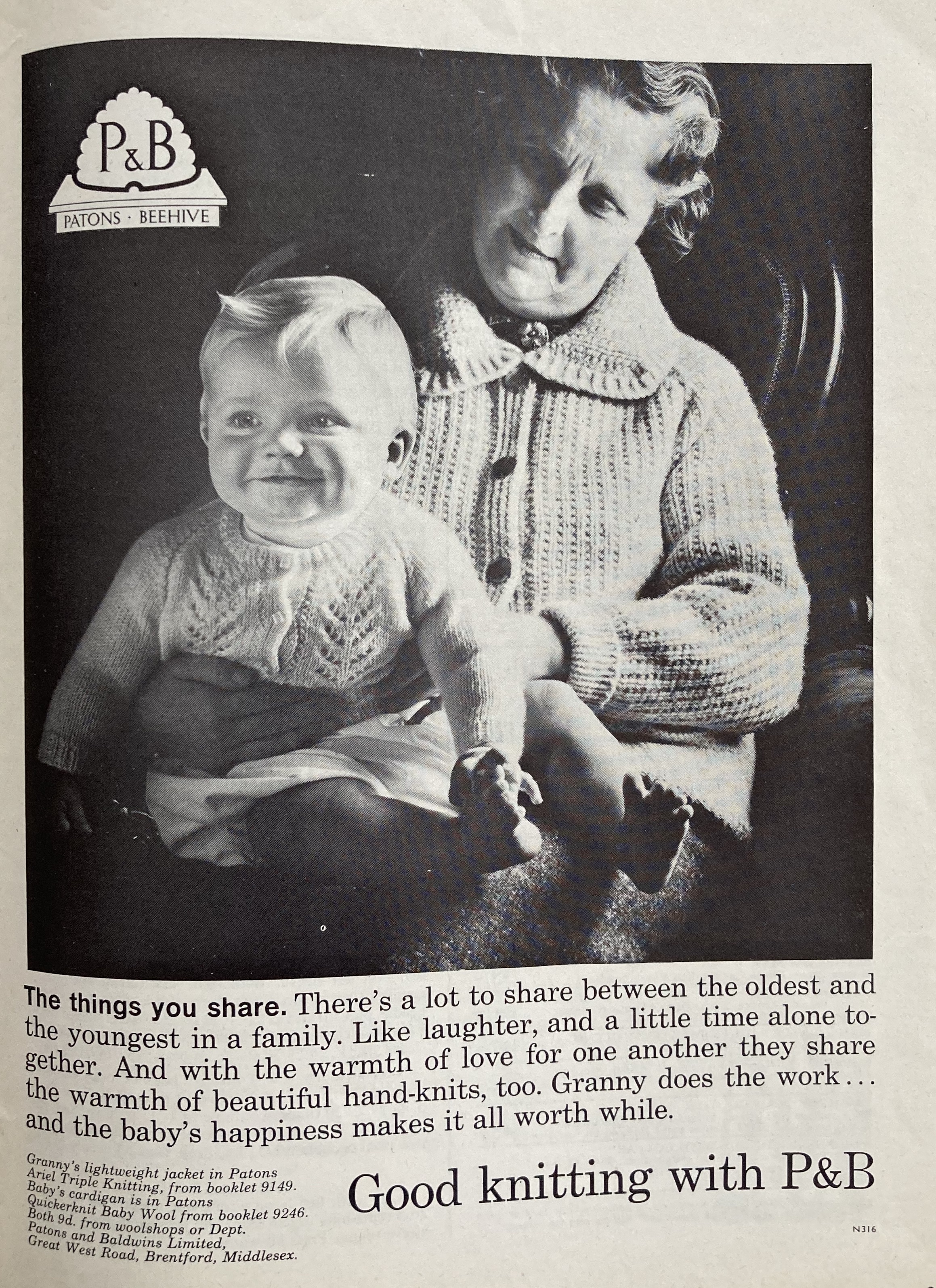
IMG_2725Apropos lifestyle advertising, the early 1960s Stitchcrafts show a rise in full-page ads for Patons and Baldwins wools. That’s obviously not surprising considering the magazine was published for the Patons wool company, but the full-page ads that “tell a story” are a new trend: the late 1950s and 1960s issues up to now had little celebrity testimonials. This one caters to grandmothers and the message is clear: Knitting is not only a rewarding pastime on its own, but earns you the love and affection of the grandchildren for whom you knit. (But only if the kid likes it, and that’s only guaranteed if you use P&B wools, of course.) The 1950s and 1960s saw a huge shift in advertising methods towards a psychologically-based system, which is a huge topic that I won’t start with here, but suffice to say there will be more of these ads, and that they are representative of changing advertising styles.

That’s it for today! I have lots of unfinished projects lying around, so my August project will be something small, definitely not the Turabast tea cosy, but very probably the blue rose sprigs on a little bag, or tablet cosy, or something.