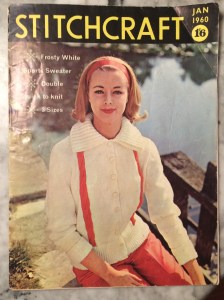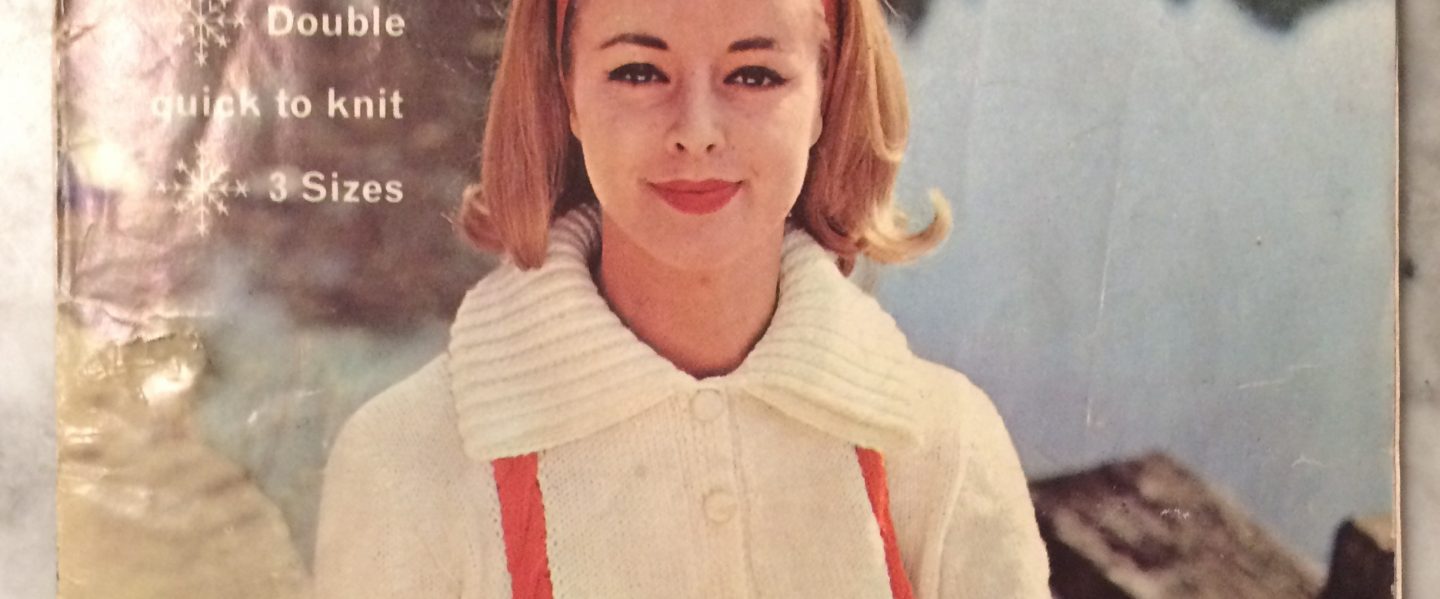
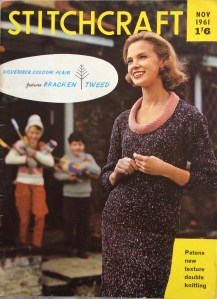
 November is such a grey month, so it’s nice to see that Stitchcraft‘s November 1961 issue has the theme “Colour Flair”, featuring speckled yarns and a center page in colour. The issue showcases “Bracken Tweed”, Patons’ new double knitting wool. Bracken Tweed was one of the early multicolour yarns, mixing flecks of a lighter colour in with main strands of a darker colour to achieve a tweed effect. At its debut in 1961, it was 100% wool; with the change from ounces to grams in the late 1960s, the fiber content was changed to 60% wool and 40% acrylic.
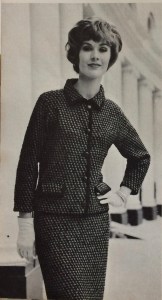 The Bracken two-piece dress on the cover is one of two ideas for “Separates with the BOUTIQUE LOOK”; the other is this wonderful suit, made with regular Patons Double Knitting and familiar nubbly Rimple. Note the deliberately too-short sleeves, designed to show off your gloves and bracelets! The slip-stitch pattern gives it a firm texture for more shape.
Then we’ve got “Colour Flair” from Vienna (a fancifully patterned pullover in brown and yellow) and Paris (a shirt-style pullover with front buttons). Large collars are still in, but are tending towards rounder shapes, as can be seen in the Vienna pullover and the rolled collar of the Bracken outfit. Bracken is also featured in the “young-style look” pullover with a cute bobble tie, while “his colour-panel pullover” is made in Moorland Double Knitting, also a tweedy-flecked wool.


Younger girls get their own “Continental Look” with a bright blue and red outfit of skirt, cardigan and stockings. Finally, warm legs! Tights would be better, of course, but at least her poor legs aren’t bare in the November cold. Babies get bootee slippers and a lovely lace shawl. With the exception of the baby shawl, all the garments in the issue are designed for double-knitting weight wool, so that everyone can be warm and get their Christmas presents on time.


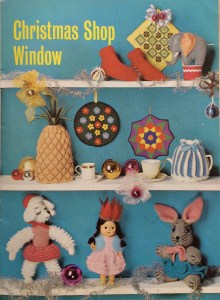
With that in mind, the colour page insert shows a “Display of Gifts to make yourself” — quick, easy-to-make toys and small household items for family and friends. The baby’s slippers are on the top shelf, along with a “Circus Jumbo” stuffed felt elephant and a cross-stitch pot holder (?) that I cannot find anywhere in this issue. There’s a crocheted tea cosy and a magnificent knitted coffee-pot cosy made to look like a pineapple, as well as two felt pot holders on the second shelf. The bottom shelf has knitted poodle and bunny toys and doll clothes (the bunny is also dress-able). Not pictured in the colour photo are a calendar cover and waste-paper bin cover in felts, with a Swedish design of trees and reindeer.
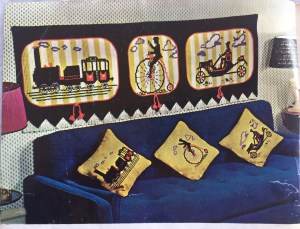
With all of that, the regular homewares in this issue are not particularly exciting — standard chairsets in counted darning and cutwork. There is one impressive larger project: this cross-stitch rug and stool top in a Victorian design, also printed in colour.

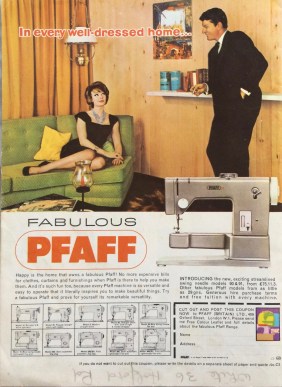
Finally, the back cover has a fabulous advertisement for “fabulous Pfaff” sewing machines — I love the expressions on the models’ faces! May all your homes be well-dressed.
My project for this month will be the jacket from the checked suit.
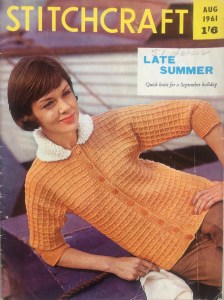 “August is an issue that needs special thought and planning” writes Stitchcraft‘s “editress”, Patience Horne, in the introduction to the August issue, pointing out that it is “rather an “in-between” month for needleworkers” — often too hot to want to wear or make heavy sweaters and too late in the year for fine-knits. At the same time, reminding people that “Autumn is around the corner” can be “a little depressing” to people enjoying their late-summer holiday.


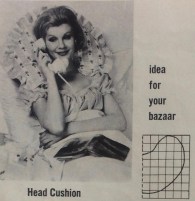 My favourite, though, is this sewing project: a head cushion that lets you recline charmingly in bed with your hair and makeup perfectly done, your satin nightie on, a book on your lap and your telephone on your ear. It’s glamorous leisure and lifestyle advertising personified, and though they say it’s an “idea for your bazaar”, I would bet the Stitchcraft readers who made this in 1961 did not make it to sell.
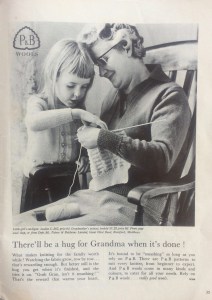 Apropos lifestyle advertising, the early 1960s Stitchcrafts show a rise in full-page ads for Patons and Baldwins wools. That’s obviously not surprising considering the magazine was published for the Patons wool company, but the full-page ads that “tell a story” are a new trend: the late 1950s and 1960s issues up to now had little celebrity testimonials. This one caters to grandmothers and the message is clear: Knitting is not only a rewarding pastime on its own, but earns you the love and affection of the grandchildren for whom you knit. (But only if the kid likes it, and that’s only guaranteed if you use P&B wools, of course.) The 1950s and 1960s saw a huge shift in advertising methods towards a psychologically-based system, which is a huge topic that I won’t start with here, but suffice to say there will be more of these ads, and that they are representative of changing advertising styles.
 Are you ready to “Rendez-vous with Spring”? I sure am! This month’s issue has a lovely extra “centerfold” spread in colour, showing off Spring 1961’s latest fashions.


 The ads are for the usual knitting machines and sewing fabrics… except for this one, for “Cooper’s moth proofer” spray, presumably made of
 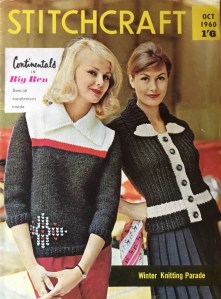 October and November are really the best months for knitting. The weather has gotten cold enough that you really want to wear and make warm, woolly things, and there’s the nice “surprise” of packing the winter clothes out of storage, and so remembering what nice hand-knitted pieces you made in other years. At least, that’s my experience.


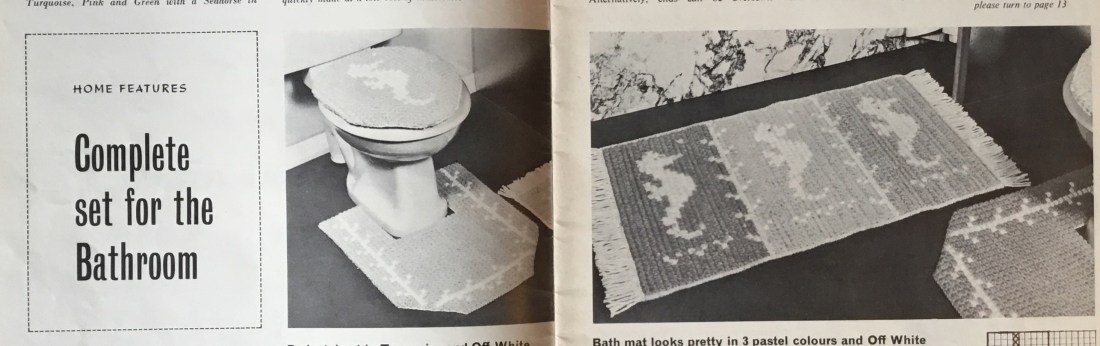


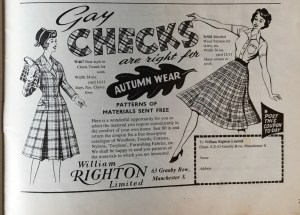
 August is a weird month for knitting, as it’s often too hot to hold wool in your hands and hard to believe that autumn is around the corner. Appropriately, this month’s issue features easy embroidery and homewares, and seems to have fewer items than the average winter or “spring holiday” issue. But before we get into the contents, can we stop to admire this beautiful twinset on the front cover? I have been looking forward to making it since I started this blog! So much that I don’t care if the heat wave ever ends, or if I won’t be able to wear it until January. I am going to make it and love it.


 “Already there is talk of holidays” says the introduction to the April 1960 issue, “and whether it’s to be the sea, country, sight-seeing or sailing, you can’t go without your holiday hand-knits.” At the same time, spring and April mean Easter, with lots of opportunities for hand-made accessories and knickknacks.


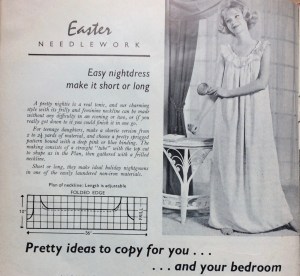
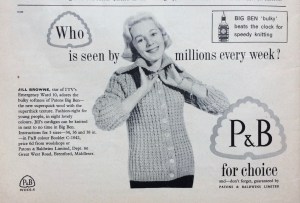


 I will be making two children’s designs: the fabulous checkered coat for a toddler, and “John’s new pullover” for a soon-to-be six-year-old.