Progress on actual projects has been going slowly this month, but here’s a fun extra: a video about the connections between performing early music and knitting from vintage patterns, written, directed by and starring yours truly.
In “real life” (i.e. what I do for a living when I am not knitting) I’m a professional concert and opera singer, and as you all may imagine, work has been more or less non-existent since the pandemic hit. Among other upheavals, my friends and colleagues Yonit Kosovske and Vlad Smishkewych had to first postpone, then completely overhaul the launch of their new organisation for early music, H.I.P.S.T.E.R. (Historically Informed Performance Series, Teaching, Education and Research). Being the creative people that they are, they re-imagined part of the launch as a new video series exploring connections between music and artisanry, called WAVE~LINKS.
Many of us professional musicians perform or engage with other artistic genres, and the idea behind WAVE~LINKS was to showcase those “other” passions and serve as a platform to discuss and reflect upon the shared spaces between (early) music and other artistic disciplines. And we are a very creative bunch! The online H.I.P.S.T.E.R. launch on November 7th, 2020 featured videos from creative artists around the globe sharing their insights into links between music and poetry, painting, pottery, photography, dance, knitting, weaving, fermentation, wood working, and more.
My video is about knitting, obviously, and the similarities that I find between historical performance practice as it relates to singing early music, and historical “knitting practice” as it relates to working with and from vintage pattern sources. I hope it is interesting to musicians and knitters alike.
Enjoy it, and if you like it, check out the other WAVE~LINKS videos on the H.I.P.S.T.E.R. web site, their Facebook page or their YouTube channel. I can especially recommend the video by Rosemary Heredos, a fellow singer and knitter whose video explores the connections between singing, knitting and spinning wool.
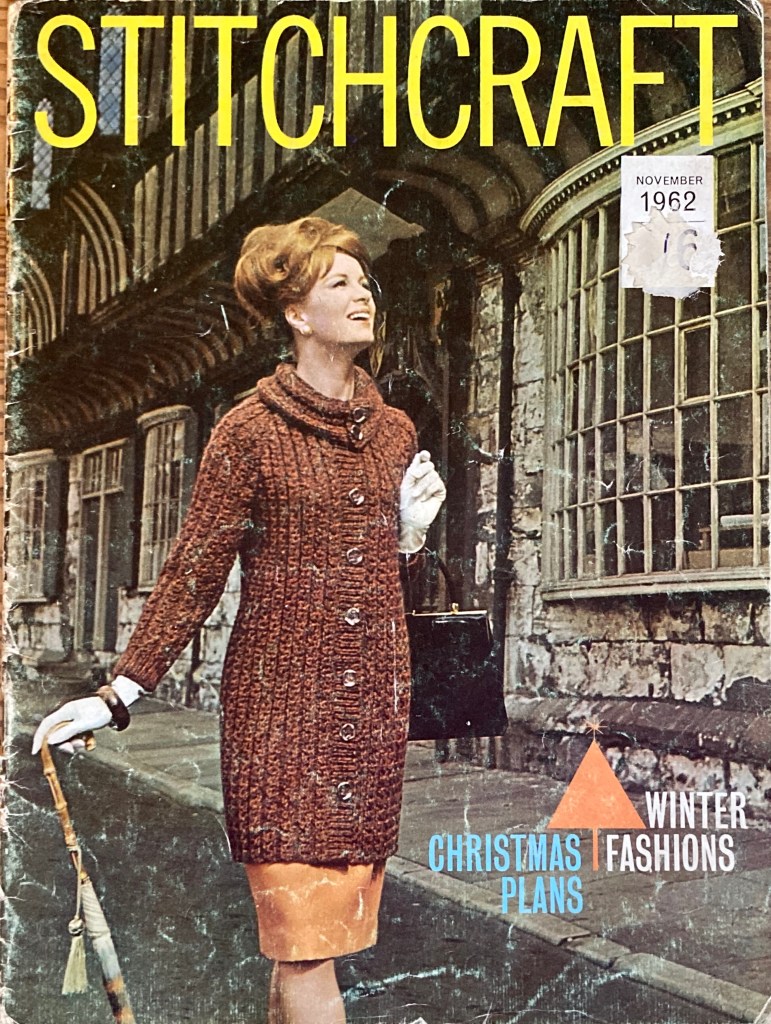
For 1960s Stitchcraft readers, November means holiday planning, so this month’s issue is full of quick homewares for decorating and small, easy projects for gift-giving. The garments are warm and bulky, featuring Patons’ new “Ariel” wool. Warm autumn tones of brown and orange as well as bright, cheerful holiday reds and blues are the colours of the season. Christmas Plans and Winter Fashions ahoy!
Our cover garment is a bulky, yet elegant coat in Big Ben wool, weighing in at a hefty 52-56 ounces (up to 3 1/2 pounds, or about 1500 grams). The mock cable/twisted rib pattern certainly won’t curl at the bottom edge, which is why I guess it’s designed without a hem or ribbing, but at that weight and in that pattern, I suspect the coat would grow ever longer and ever narrower (just in time for holiday weight gain). Still, it looks lovely! I especially like the buttoned collar. Also, I just might try to re-create the model’s hairdo with my long lockdown hair.
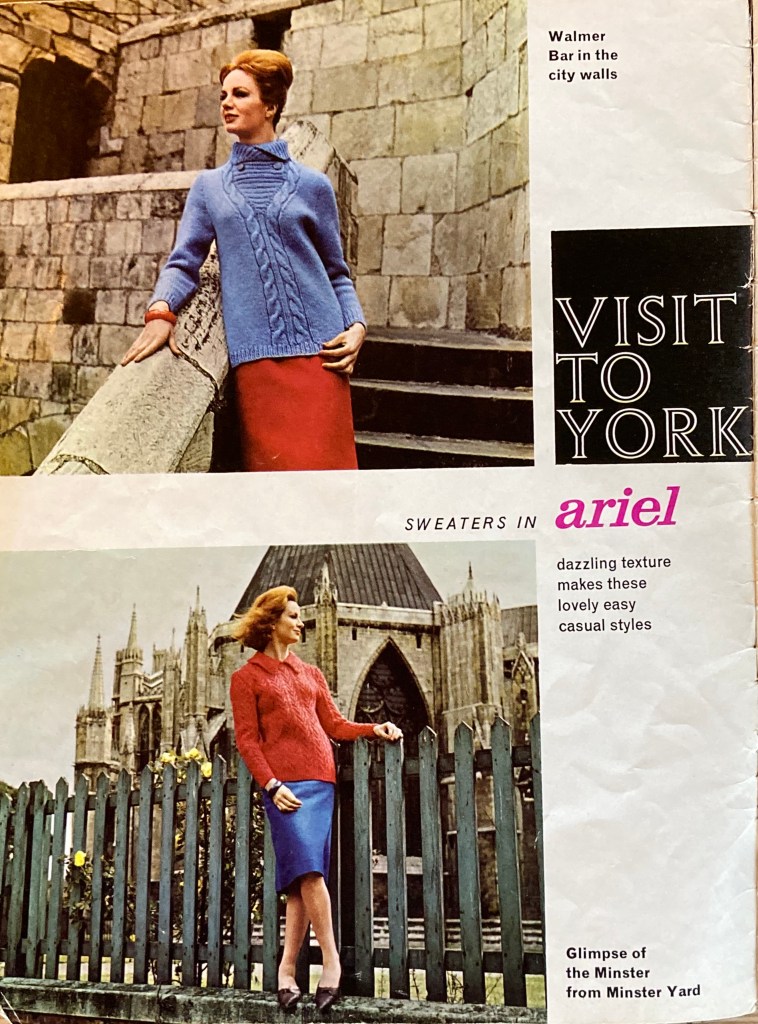
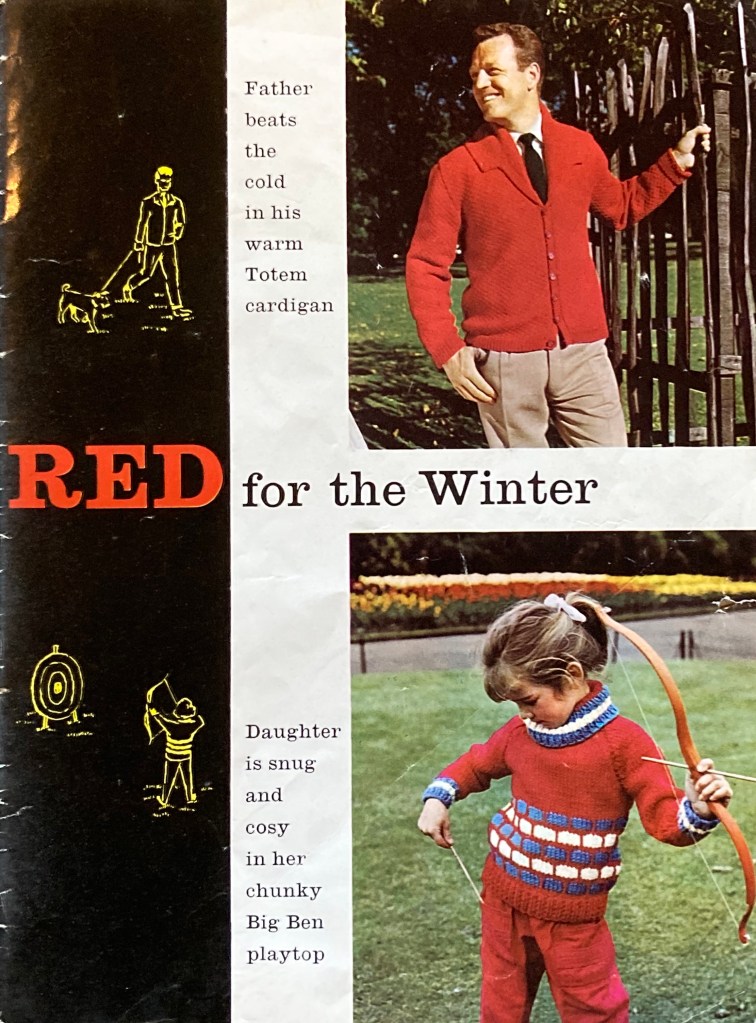
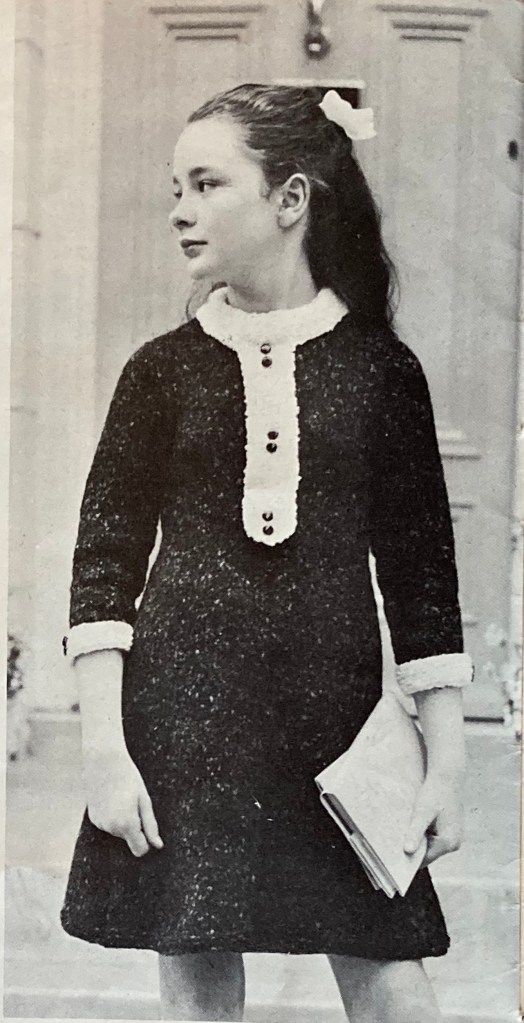
The outdoor photography was taken near historical buildings in York, whose grey-beige stone walls give a nice background to the bright red and blue sweaters made with “Ariel” a bulky, yet “feather-light” (well… 20-24 ounces for a sweater, so lighter than Big Ben, at least) wool-synthetic mix. I really like the red chevron sweater and it doesn’t look bulky at all to me, just fluffy and cosy. Father and daughter also get warm, cheerful garments, and look at this amazing mini-dress for a young miss! That is going on my list of patterns to adapt for myself.
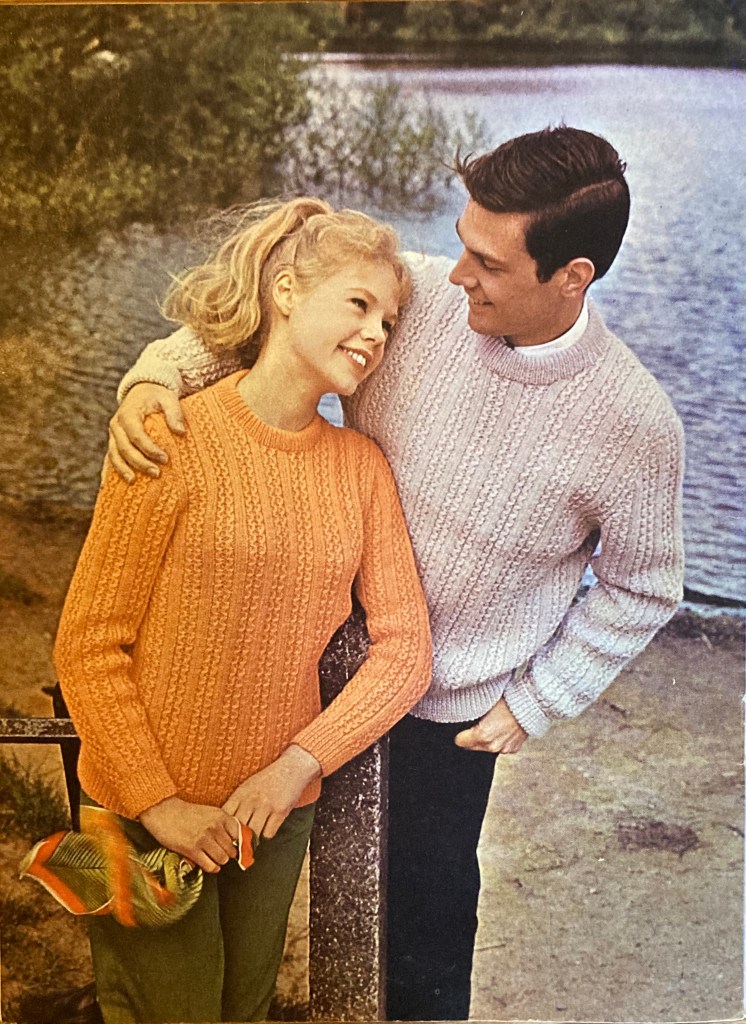
Older teens and young lovers can make “the ‘sweater-match’ theme with girl-friend and boy-friend” – classic pullovers with cable ribs in double-knitting weight and identical except for slightly different shoulder width and back length proportions. That’s all for the knitted garments in this issue, since the real focus is on Christmas preparations with little gifts and housewares.
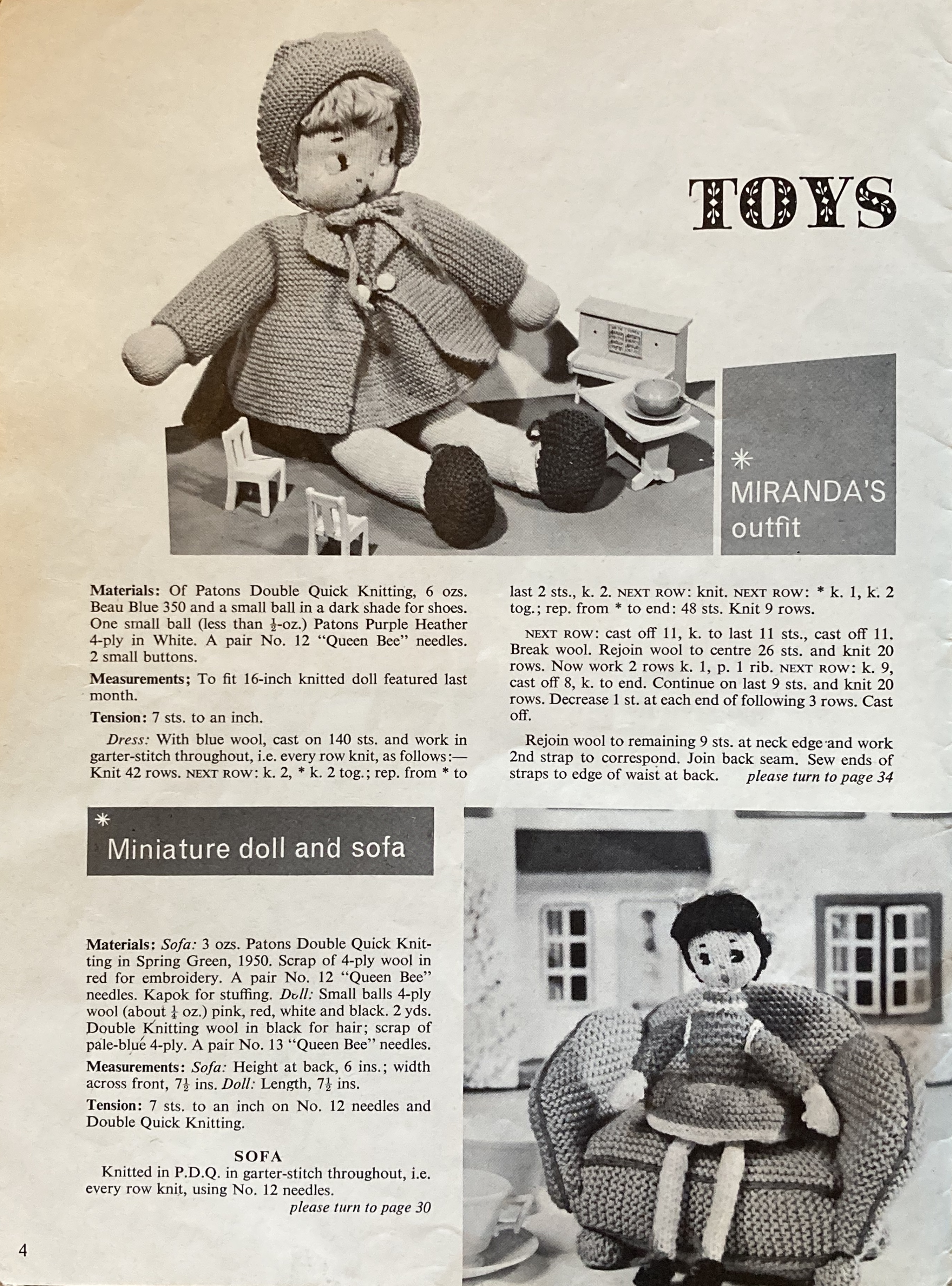
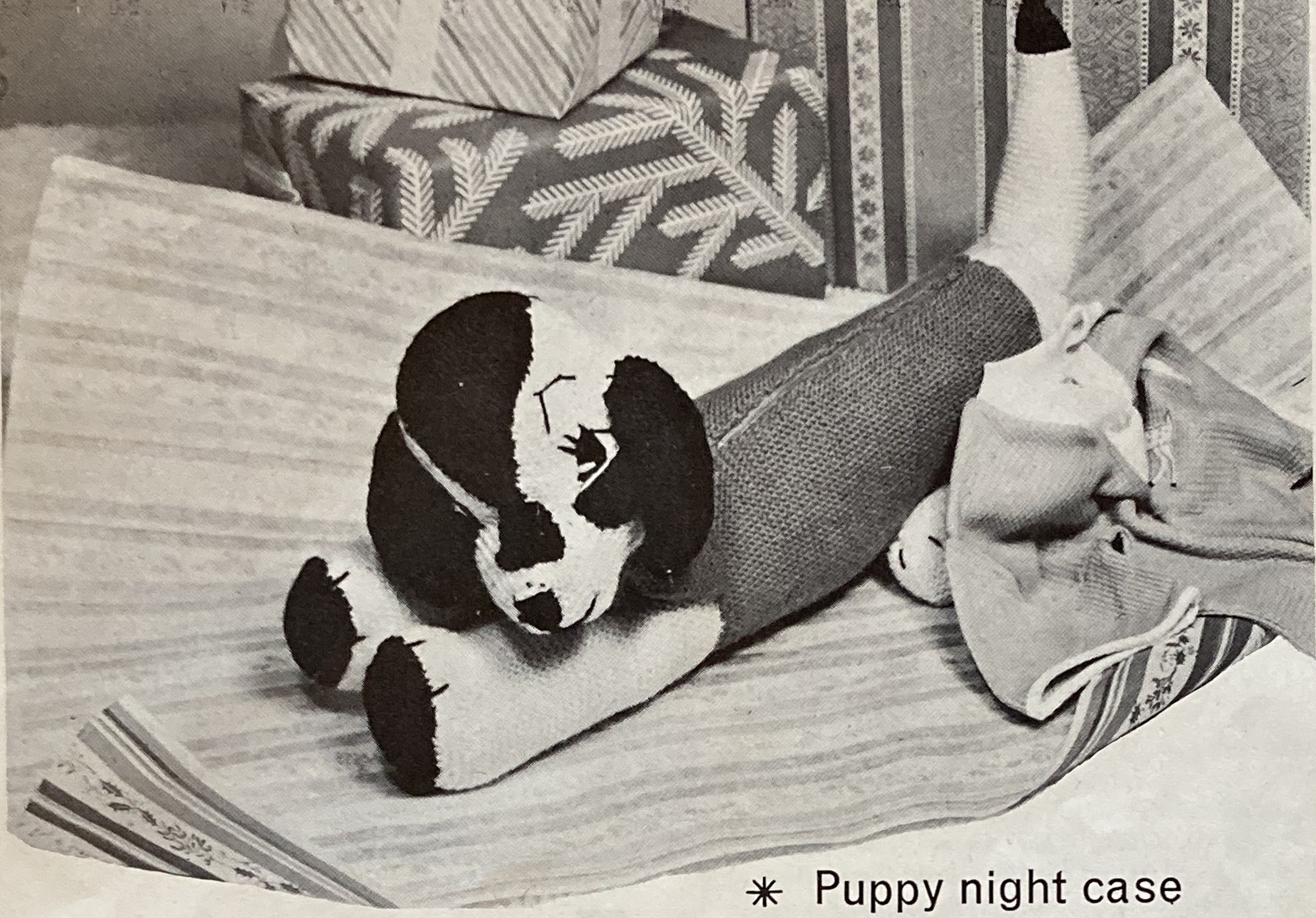
For children’s gifts, there’s a doll, clothes for another doll (pattern in last month’s issue), and a night case in the form of a puppy. This last was especially popular around the late 1950s and early 1960s – I have a different magazine with a poodle nightcase on the cover, and Stitchcraft also had some kind of poodle nightcase in the later 1950s. Poodle or puppy or not, I don’t know why a person would want to put their nightgown in a special case in or on the bed. If you don’t want other people who might be using the room to see your nightdress lying around, you could just… put it under the pillow?
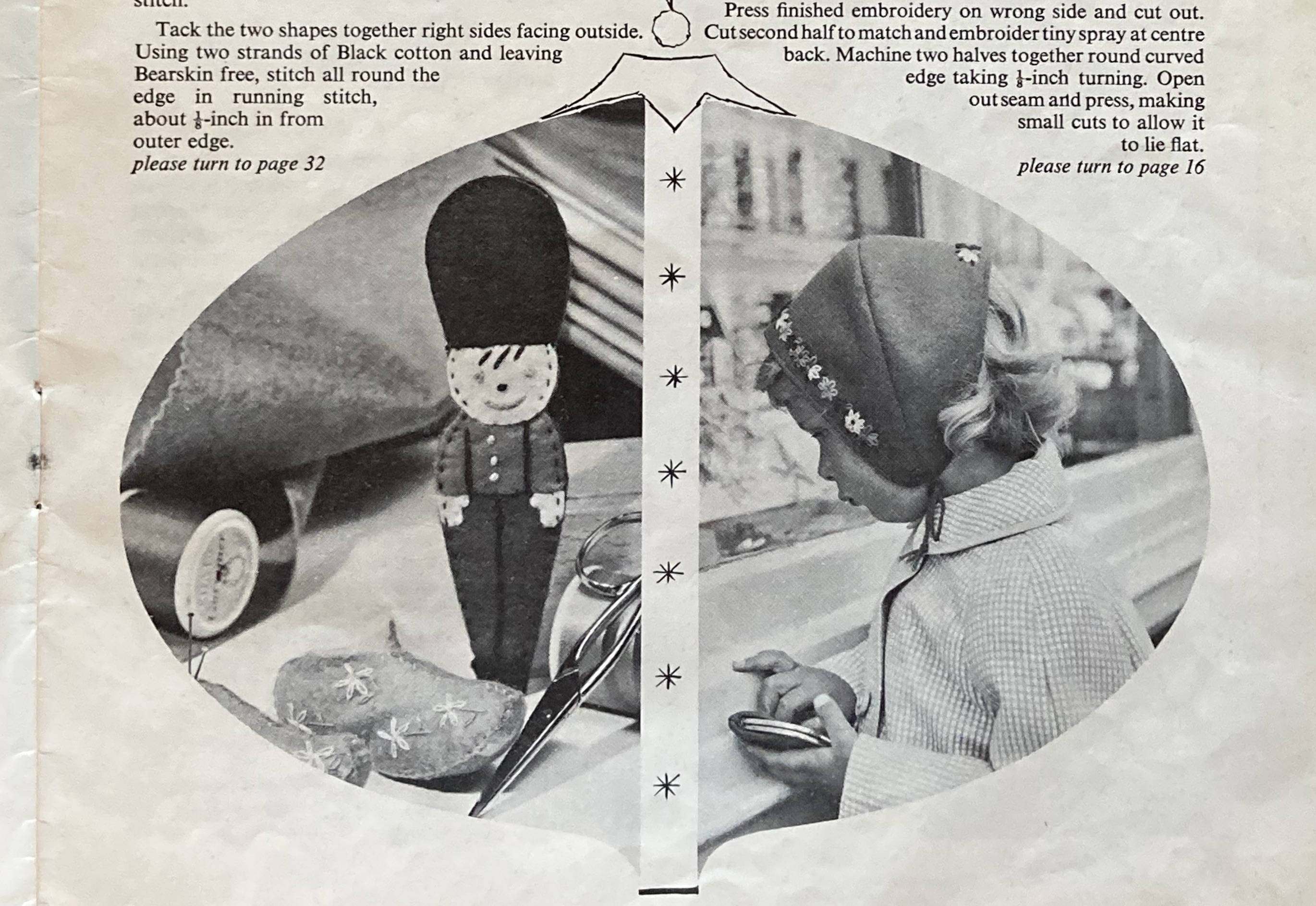
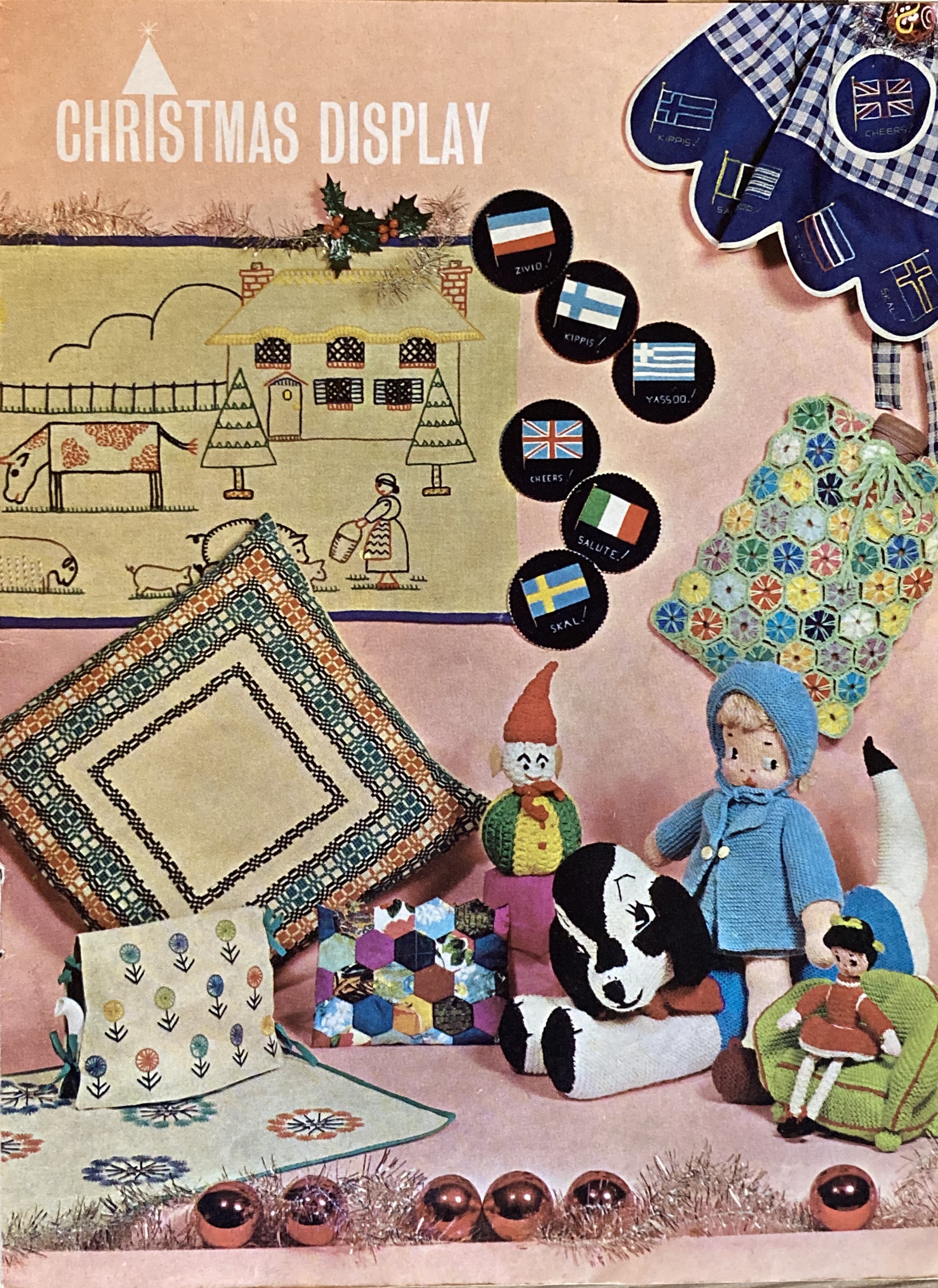
There’s an intriguing “Byzantine” cushion, a firescreen with this month’s embroidered flower (chrysanthemum) and some little gifts sewn in felt, but the more interesting projects are displayed nicely in the large colour photo in the middle of the issue. We’ve got an embroidered farm scene for the nursery wall, a “hostess set” of apron and coasters featuring international drinking mottos, the usual cross-stitch cushion, and a tray cloth/tea cosy design that I would love to adapt to an iPad/tablet cover. Crocheters can use up all their scraps with medallions or a … cute? eerie? not sure what to say about it? pixie doll and patchwork fans, generally ignored by Stitchcraft, finally have a little bag as a starter project.
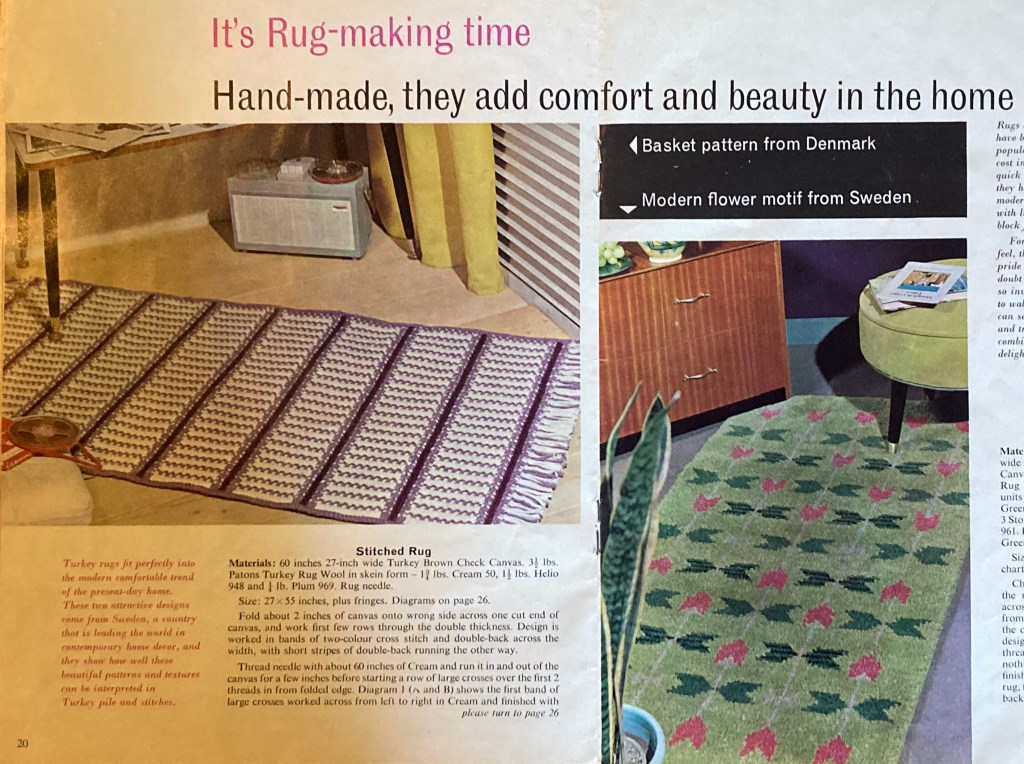
There are even rugs in Scandinavian designs (is that basket pattern from Denmark or from Sweden?), one stitched, the other done with a latch-hook.
What an issue! There are so many projects I would like to make from it: the girl’s dress in my size, an embroidered tea-cosy for the digitalised world, the little girl’s bulky red sweater, even the green latch-hook rug. Sadly, pandemic and lockdown have thrown a monkey wrench into my current knitting plans, it’s hard to get supplies, and I’m trying to finish or even start multiple other large projects that were planned or promised or have been lying in the WIP pile for ever. One of those WIPs was a (non-vintage) garment that I will have to frog anyway (ran out of wool and can’t make it work), so the plan is to frog that project and use the wool to make “Father’s cardigan” from this issue. Said project and I are geographically separated at the moment, though, so long story short: I do not know when I will be able to post a November project. Take heart, though: there will be some more Stitchcraft cooking fun in December as well as a special surprise next week.
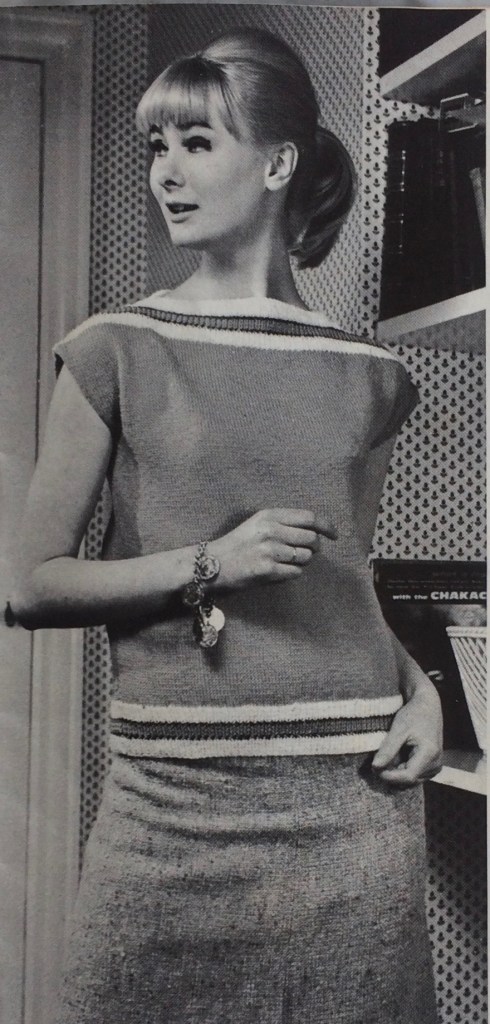
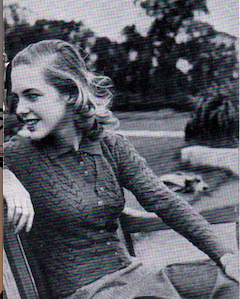
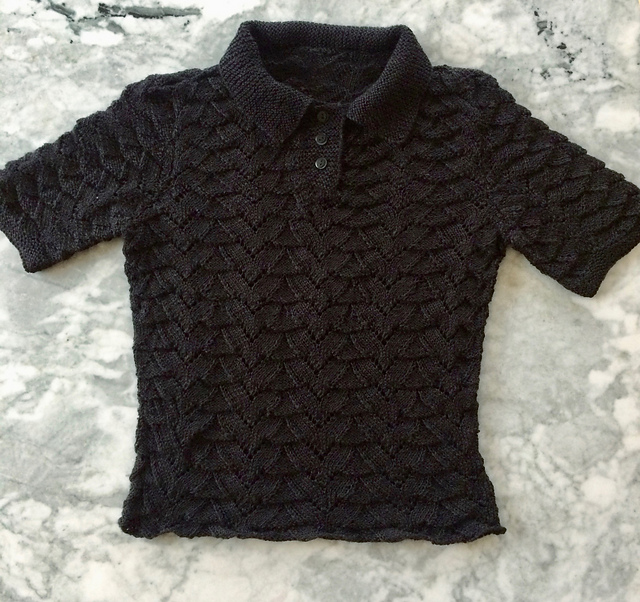
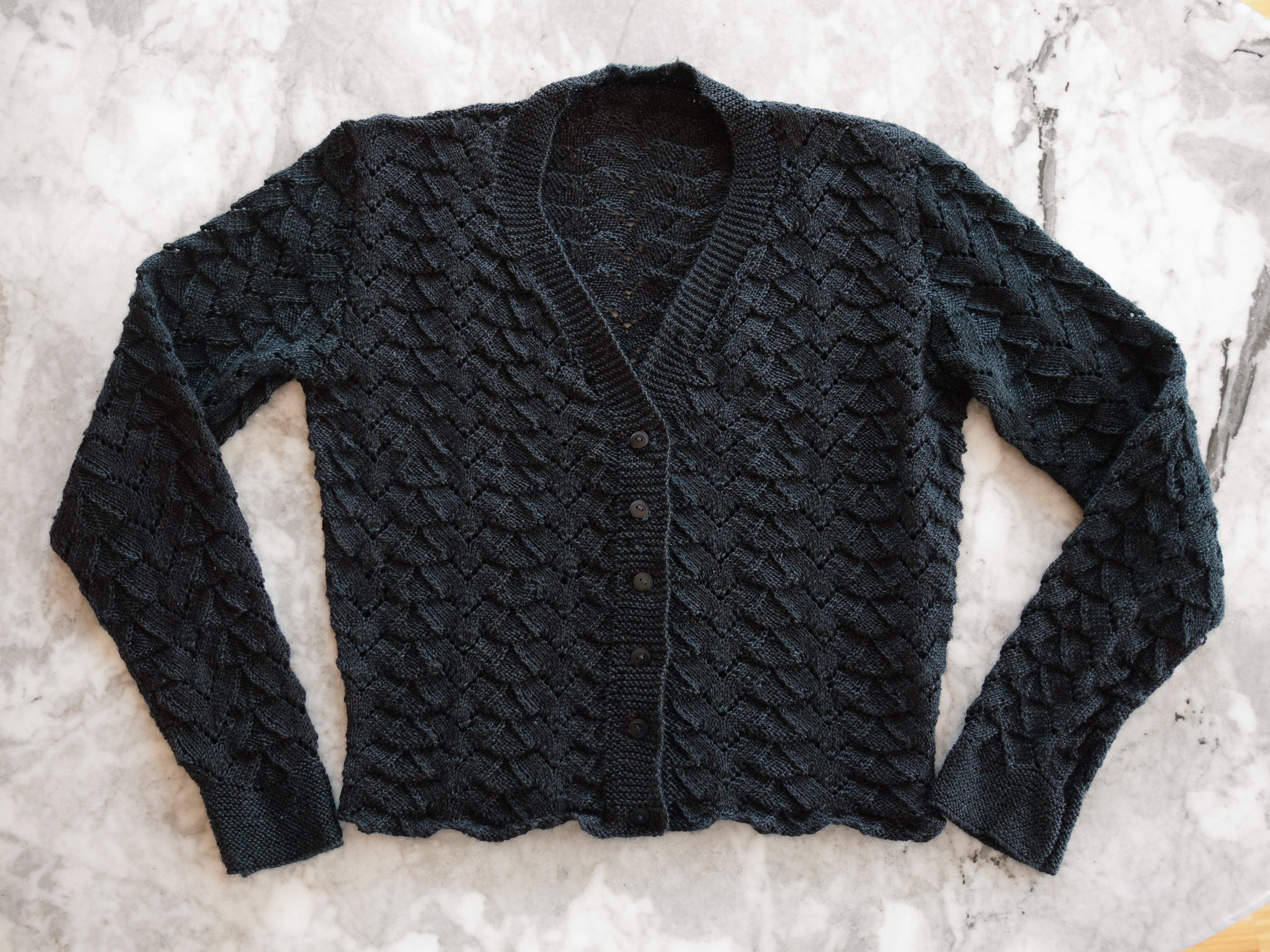
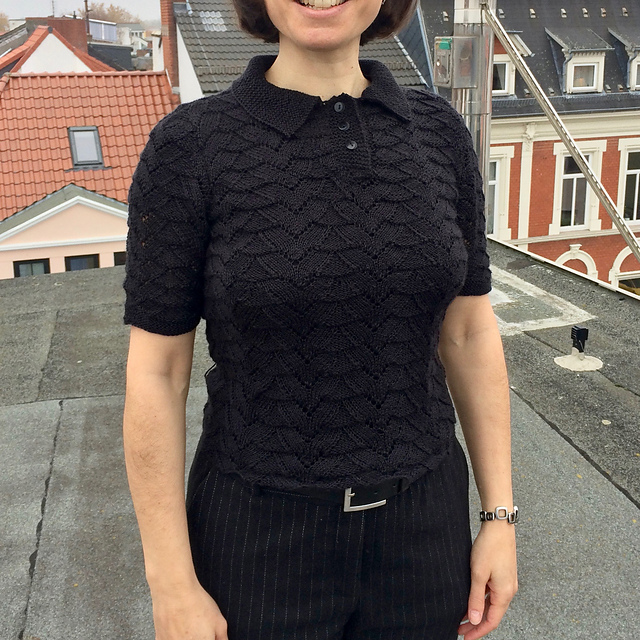
It was very difficult to get a project going this month. The October 1962 issue of Stitchcraft didn’t have any designs that interested me and I had been trying to finish up some larger, non-vintage projects in time for the cold-weather season. But inspiration came from a good friend of mine, who politely reminded me that, way back when I made this “charming blouse”, I had casually offered to knit one for her if she ever wanted one, and wouldn’t this be a good time to make it for her? I agreed! So this month’s project echoed the one I made then. Here are photos from that issue and the finished project:
The original blouse, from the July 1960 issue, was designed for “larger”, curvier figures (37-38 or 39-41 inch bust) and featured horizontal bust darts, which was very unusual for knitting patterns of the time. I was intrigued to see how the bust darts would turn out, since I don’t usually make them on garments for myself. As I probably could have guessed, the bust darts were not only unnecessary for me, but actually negatively impacted the fit — since I am not busty enough to fill out the darts, the front of the blouse was too long compared to the back. That didn’t particularly bother me, but I did note it for future projects.
My friend has a more suitable figure for this design, and her version turned out even better. I used the same wool (Juniper Moon Farm Herriot Fine) in a lovely tweedy green colour, and (by request) without a collar or contrasting colour bands along the front.
It turned out perfectly and we were both very happy with the result. Since we’re not meeting indoors and it was still too cold for her to wear just a blouse outside (even a warm knitted one), I’ve only got her selfies for now, so I’m sorry if it’s hard to tell what the finished product looks like. When it’s warm enough to do a socially distanced outdoor photo shoot, we can hopefully get some better photos! According to her it fits perfectly, and it’s obviously a fantastic colour for her.
My friend, by the way, is the wonderful opera and concert singer Andrea Lauren Brown. We have all been out of work for a solid year now due to the pandemic, but you can definitely still buy her CDs, which I heartily recommend to all of you who love classical music. Seriously, she’s amazing.
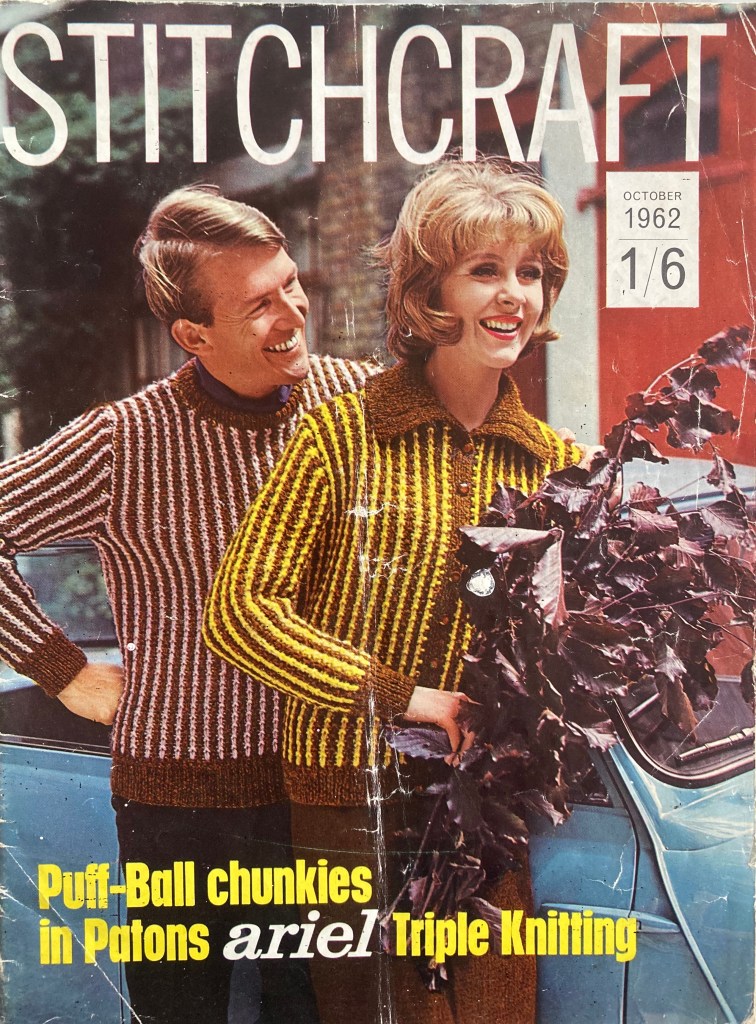
“There are several “special” things about this issue” writes Stitchcraft’s “editress” on the facing page, and I’m glad she put the word “special” in quotes, because this month’s issue is definitely a mixed bag. On the plus side, it has extra pages in colour and introduces a new yarn: Patons Ariel, designed to be “triple-knit” bulky and therefore quick to knit, but still lightweight. On the minus side… we’ll get to that later in the post.
The new wool, Ariel, is listed on Ravelry as bulky weight (97 yards in a 2-ounce ball) and composed of 80% wool and 20% “other” (synthetic fibres). According to the person who wrote the Ravelry entry, it may or may not have been waterproof! It appears to be quite fluffy, thus the name and the “light as a feather” claim. It’s used for the two-colour, slip-stitch-patterned garments in the cover photo as well as the identical boatneck pullovers for men or women. The partner-look idea is still going strong.
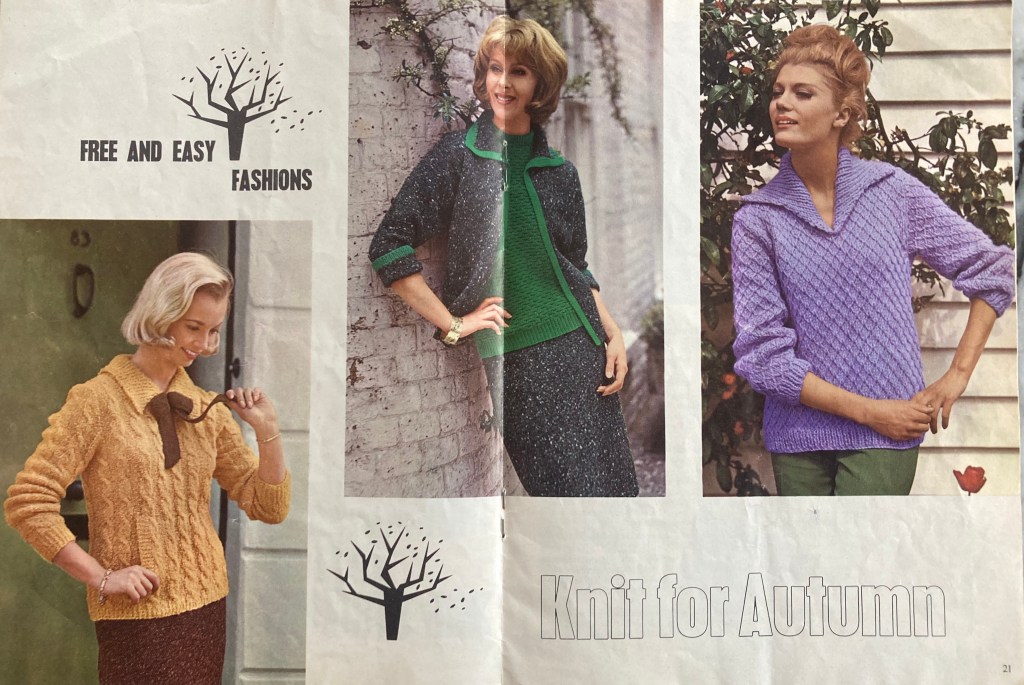
Tweed looks and suits are always popular in the fall, and this month’s issue gives us a loose-fitting suit with a short-sleeved jumper to wear underneath, all in double knitting weight. Nubbly Rimple yarn is also DK weight and still a fashionable choice for this sweater with a contrasting bow-tie. The purple pullover with the big collar (still in fashion after two years!) is made in bulky Big Ben wool. Greens, browns and yellows dominate the colour palette and go with the autumn theme.
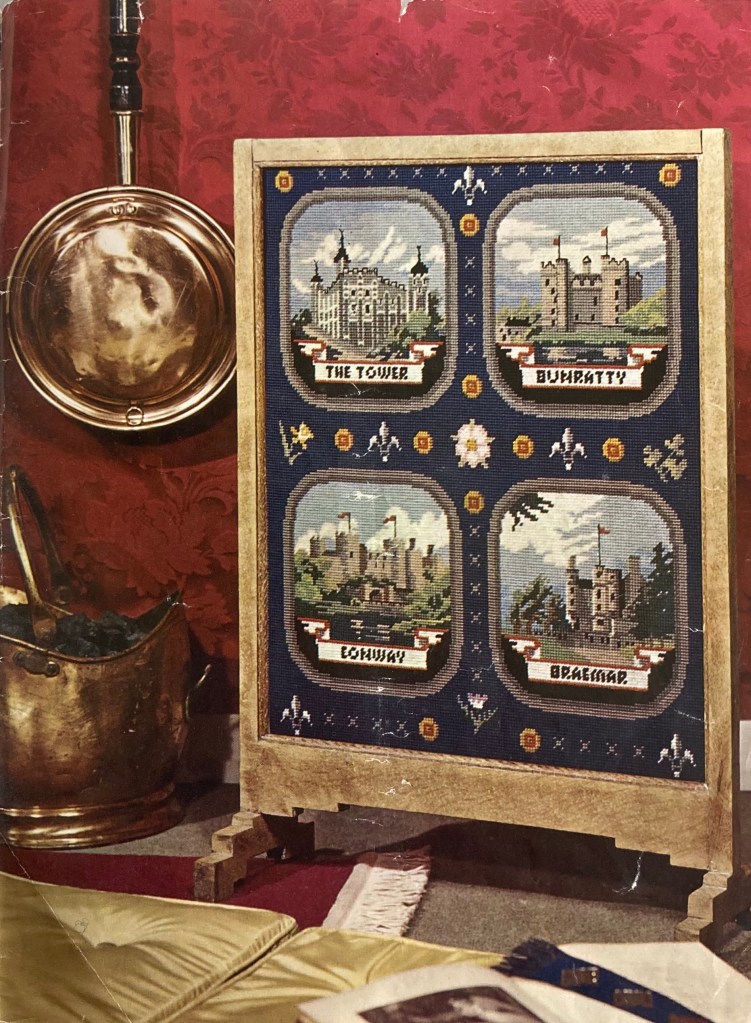
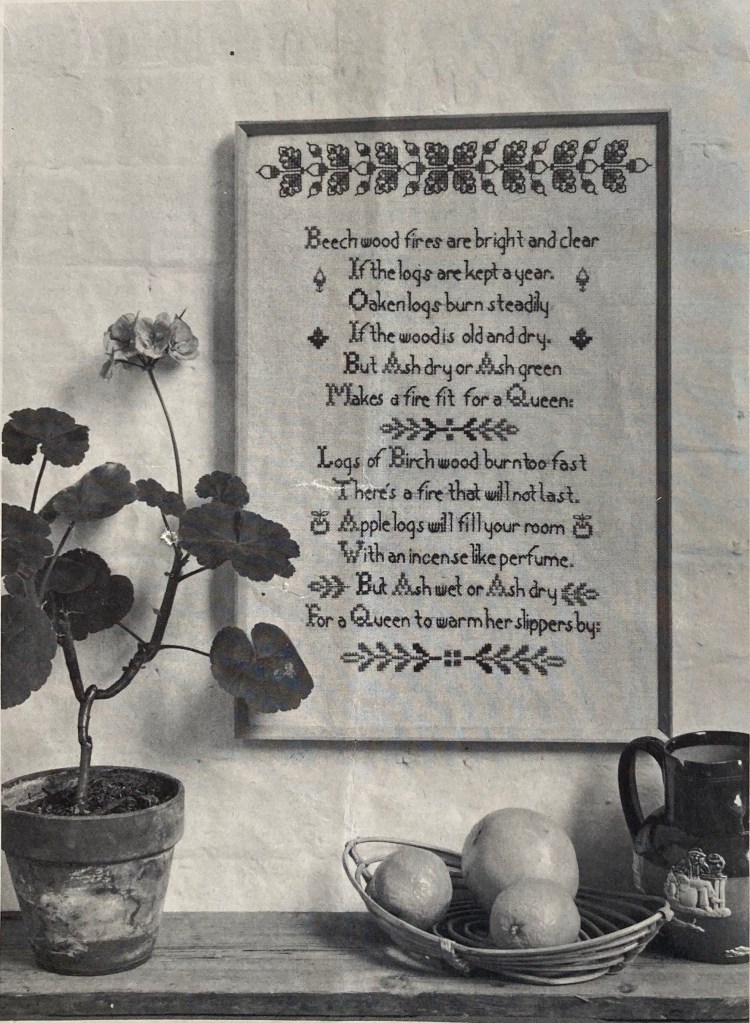
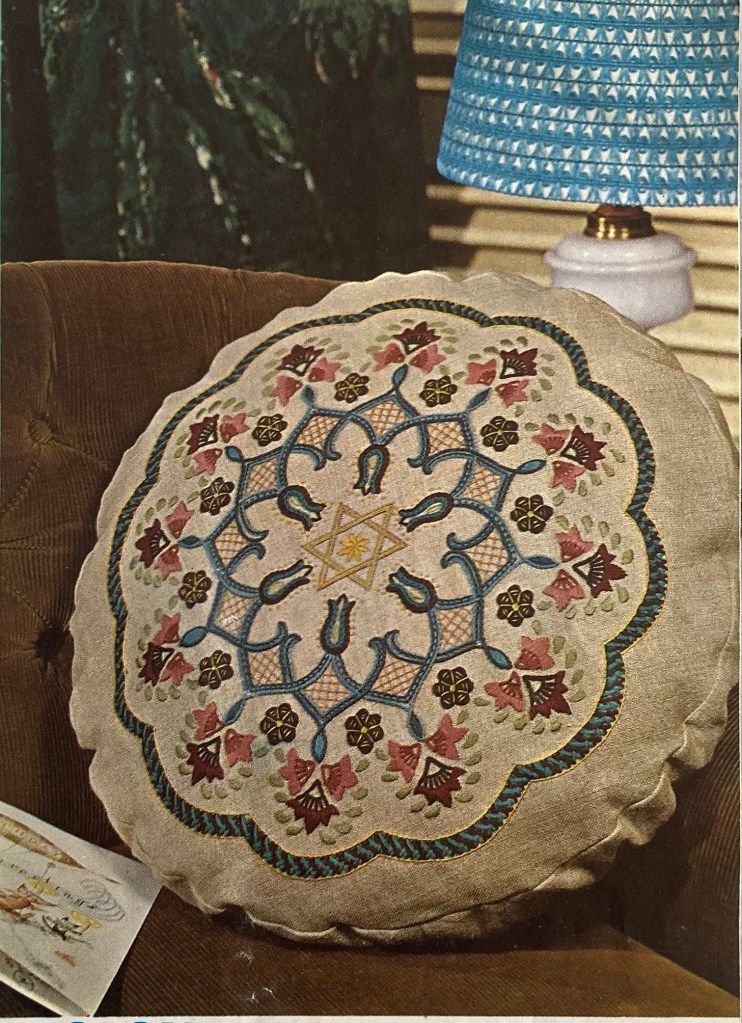
Embroidery and tapestry take a backseat to the autumn knits in this issue, with typical floral chair-back, apron, and traycloth designs. There’s a tapestry of four famous castles, a cross-stitch wall hanging with a poem about what type of wood to burn in a fireplace (I had never heard this rhyme, have any of you?) and a more complexly embroidered cushion of “Indian design”. I cannot vouch for its cultural authenticity, but the woven and latticed stitches are certainly striking and effective.
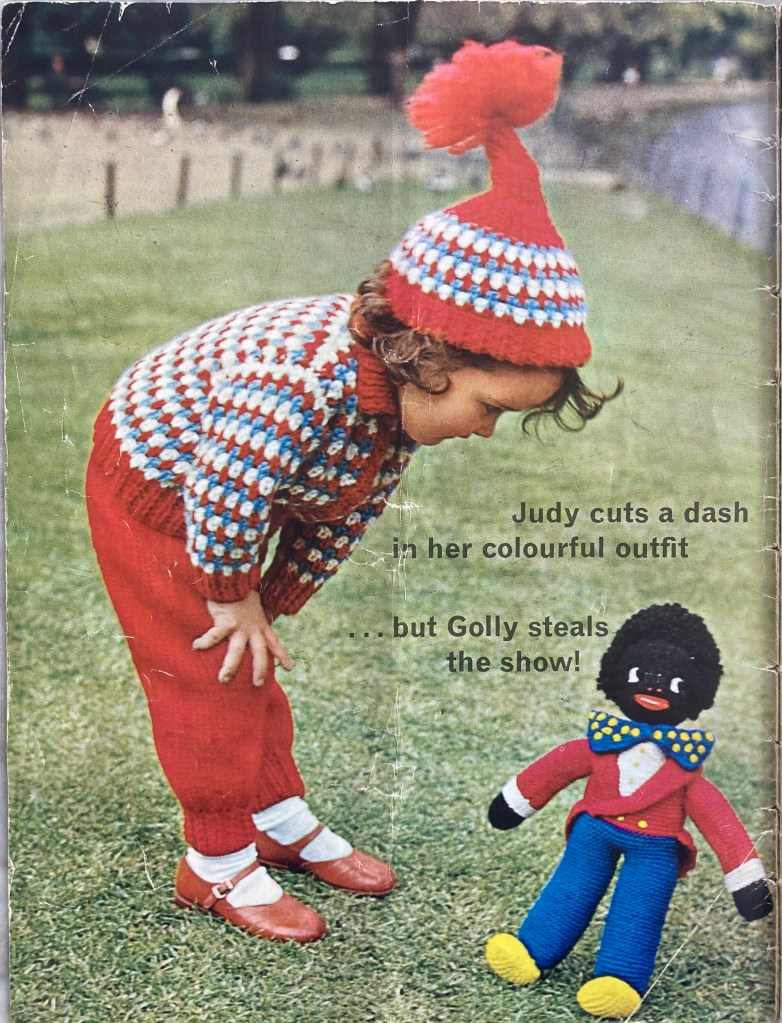
Speaking of cultural history, remember our little model Judy with her “trim Outfit” from 1960? (Of course you don’t, and I wouldn’t have recognised her either if her name weren’t in the caption.) Here she is, two years older, cutting a dash in her warm 3-piece play suit and all set to play with…
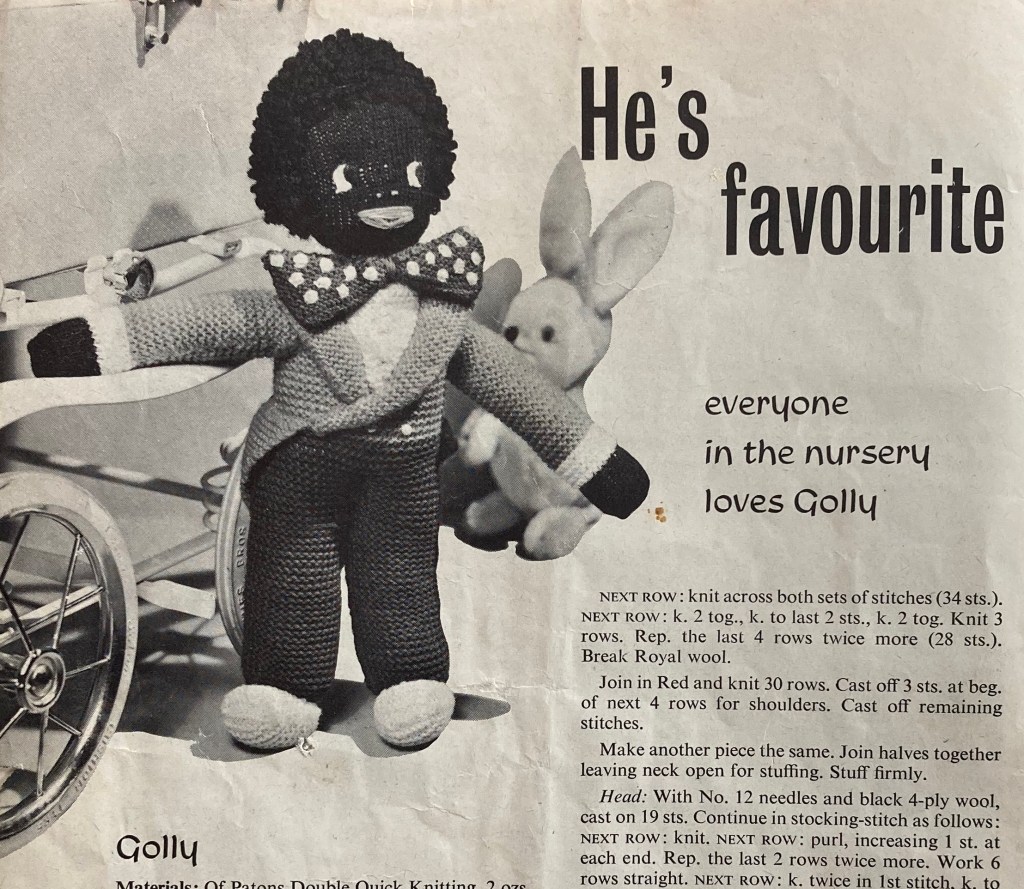
Ah, right. Her “Golly”, who “steals the show” and whom readers can also knit from a pattern in this issue. “He’s favourite”, writes our editress, and “everyone in the nursery loves Golly.” Who is he?
In 1895, the English-American cartoonist and illustrator Florence Kate Upton produced her first children’s book, titled The Adventures of Two Dutch Dolls and a Golliwogg. Over the next fourteen years, she and her mother Bertha collaborated on twelve more books starring the same characters. The books, and particularly the “Golliwog” character, enjoyed enormous popularity for at least sixty years afterwards and “Golly” dolls and toys as well as “golliwog” images on brand names and household products were practically ubiquitous in popular culture — particularly children’s culture — in the UK and elsewhere throughout the 1950s and 1960s.
Though Upton intended the Golliwog(g) to be a positive character and the hero of the story, it can’t be denied that his representation is a racist caricature born of the blackface minstrel tradition in the United States. According to Upton herself, her inspiration for the character was a Black minstrel doll found in her house, and typical “Golly” representations show him with exaggerated, distorted features and wearing an outfit typical of minstrel performers in the early 20th century. Later literary and cultural depictions of “golliwogs” often portrayed them as animalistic, uncultured or criminal, thus reflecting and perpetuating negative racial stereotypes about Black people. Over time, the word “golliwog” and shortened forms of it became used and recognised as demeaning racial slurs.
Though many white Britons, Americans and Australians who grew up with golliwog dolls continue to claim that they are inoffensive (and capitalise on their popularity via Internet auctions and collectors’ organisations), it should be pretty obvious that they, and their related imagery, are problematic. For a more in-depth understanding of why, I encourage further reading, starting with this excellent article from the Jim Crow Museum of Racist Memorabilia at Ferris State University in Michigan (US).
It’s not the first or only time that Stitchcraft (like just about every other knitting/craft publication of its time) has featured patterns for toys or dolls that reflect stereotypes of particular ethnic groups or portray them as an “exotic Other”, even if those representations are supposed to be positive. Many patterns from the 1940s and 1950s are particularly offensive (take my word for it, I don’t want to show them here), as is the use, up until the late 1950s in some cases, of racial slurs as colour names for certain shades of wool (ditto). By the way, I have issues of Stitchcraft and many other vintage knitting magazines up to the mid-1970s and nowhere, in any of them, have I ever seen a model who was not white — the caricatures were also the only representation to be found. Let’s remember that, for all their fantastic fashions, the mid-century decades were definitely not the “good old days”.
On top of all that, there’s no pattern in this issue that I particularly want to make, so I’ll either embroider some anemones on a vegetable bag or finish up something from the WIP pile.
“The most welcome present you can give to a mother-to-be is something warm and hand-knitted for the layette,” wrote Stitchcraft’s “editress”, Patience Horne, in the September 1962 issue, and it’s still true! If I can’t decide on a project, if I don’t feel like making a full-size adult garment, if I have bits of wool that want to be used up in a useful way, I make a baby jacket. Someone, somewhere is having a baby soon, and I always have a couple of finished objects on hand in case I didn’t know that a colleague or acquaintance was “expecting”.
That was the case this month, funnily enough in my own weekly knitting group. We have been “meeting” via Zoom since March due to the pandemic, and I dropped out for a while due to being ill myself, so by the time I came back I had apparently missed some happy news — one of my fellow knitters will be having a baby this winter. What better time to make this cute and easy first size raglan cardigan?
I had 3-ply wool left over from this jumper, so I was even able to achieve the tiny gauge of 8 stitches to the inch. Only… it turned out I did not have enough of this wool, so the raglan yoke part is leftover mystery purple 4-ply. I’m not quite convinced that it’s going to work; the harsh colour line seems weird at the moment.
I don’t know the name of the stitch pattern, but it’s a lovely easy sort of herringbone:
Row 1: knit
Row 2: k1, p3
Row 3: knit
Row 4: p2, *k1, p3*
Except… I decided to make the yoke in one piece, because I didn’t want to sew raglan seams, and the raglan decreases change the pattern at the armholes. I knew that would happen, but was too lazy to work out mathematically exactly what the decreases would do. It turned out that the fronts and back stay in the proper pattern and both sleeves end up in k3, p1 rib. OK, it’s symmetrical and doesn’t looks terrible, so I decided to live with it.
But… then I ran out of the mystery purple wool as well! And had to make the last bit of collar ribbing in another mystery purple-ish wool that was also thicker. Well, at least the colours didn’t clash too much? And I had cute, matching, vintage buttons in the button box!
… except that I somehow utterly failed to sew them on evenly spaced? I could add one more in the gap near the top — there’s a buttonhole there — but somehow the buttonhole in the lower gap got sewn shut while I was weaving in ends or sewing on the front bands. I have enough buttons, but can’t decide whether to cut a new lower buttonhole and add two more buttons or just give up and leave it as it is. At least the gaps are vertically symmetric.
Not my best work, but it will keep a baby warm and clothed. Perhaps I’ll make something else for my knitting friend’s baby — a fellow knitter deserves a more successful project!
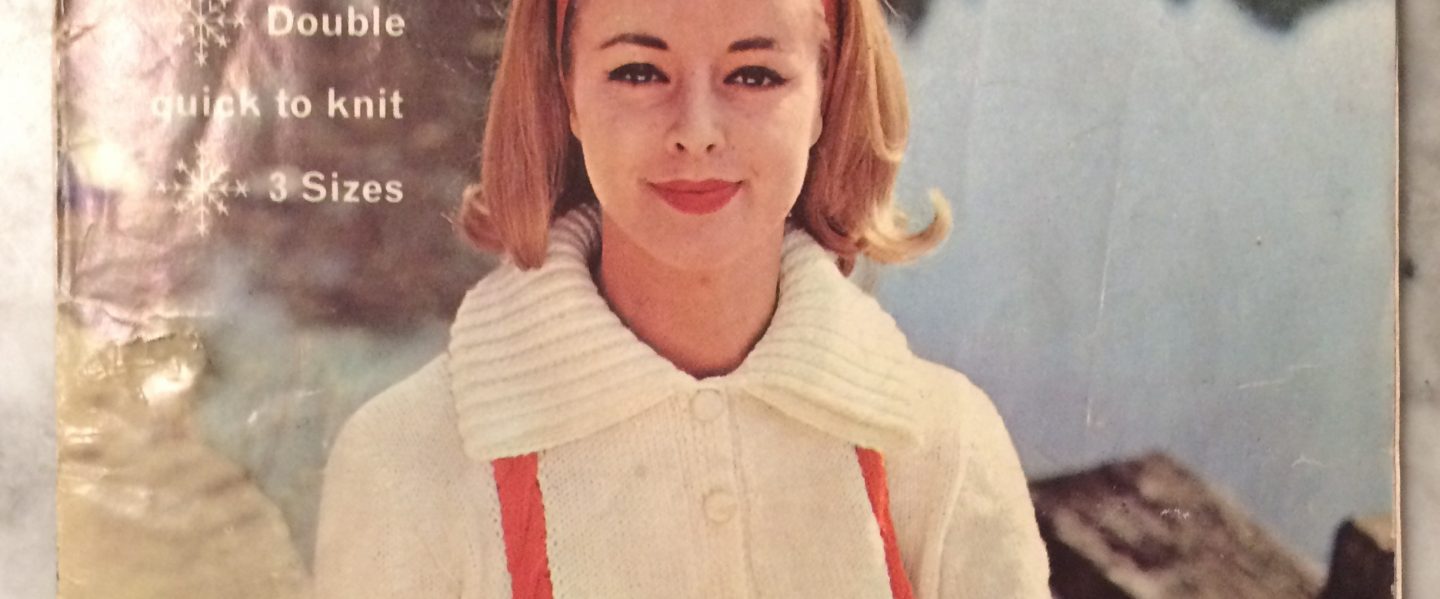
Autumn is the nicest season for knitting, and 1960s Stitchcraft usually gave it a little push with extra pull-out supplements, extra colour photo pages, or “bumper issues” full of the latest developments in home-knitting fashion. The September 1962 issue doesn’t have any of these extra features, but it does have a wide variety of designs in mid-weight and warmer wools, starting with the chunky twisted-bobble sweater on the cover. Made in bulky Big Ben wool, it weighs in at a whopping 38 (for the smallest of three sizes, 35-36 inch bust), 40 or 42 ounces (the largest size, for 39-40 inch bust), i.e. about two and a half pounds or 1190 grams. I am guessing the model is quite slender and even she looks bulky in it!
The dresses and separates, made with the same loose fit but in double knitting wool, show a smoother look with minimal patterning. The orange dress in the colour photo and the charcoal-grey dress with the colour-pattern border (“for those who like something really eye-catching”) are the same design, but the pattern-border version is only available in one size, “for the younger girl.” I guess that pattern was just too exciting for doddering middle-aged matrons! The blue and white ensemble, also made in double knitting weight, has three pieces: a simple sleeveless blouse in white k2, p2 rib, a plain blue skirt and a back-fastening cardigan with white vertical stripes on the front. Tops continue to be hipbone-length and hemlines are firmly anchored just below the knee.
Other garments feature interesting colour and texture effects: the man’s “smart weekend sweater” has been treated with a teasel brush to achieve a fuzzy, felted effect. The knitter was not expected to do the brushing herself, but was instructed to “take all pieces at this stage [after knitting all the separate pieces, but before making the garment up] to your usual wool shop who can arrange to quote a price and send them away to be brushed for you.”
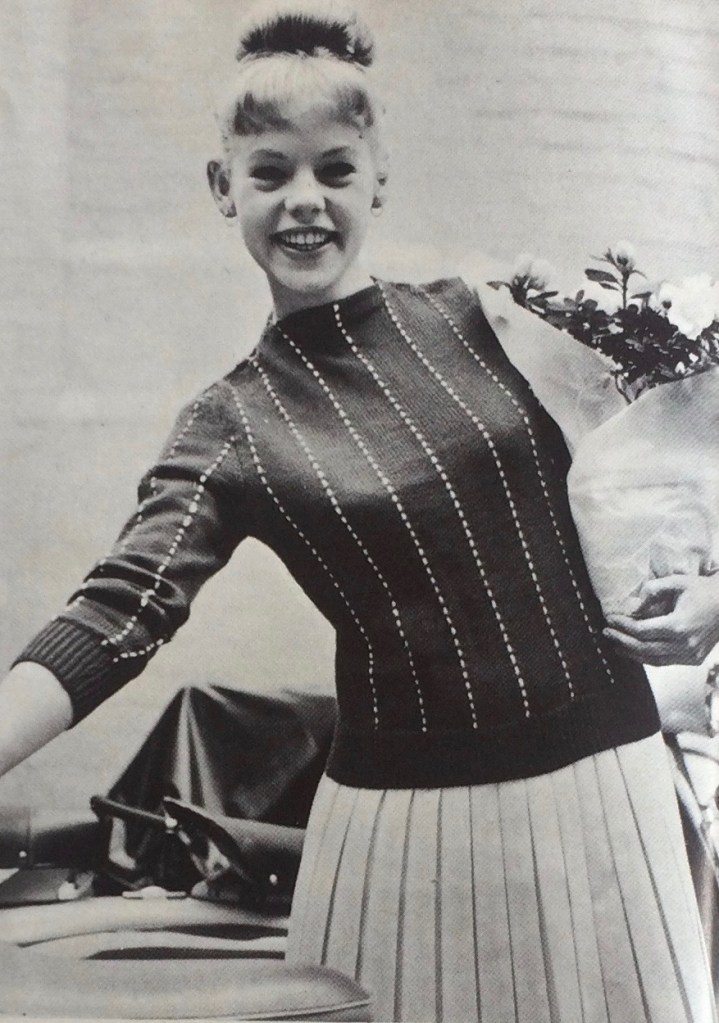
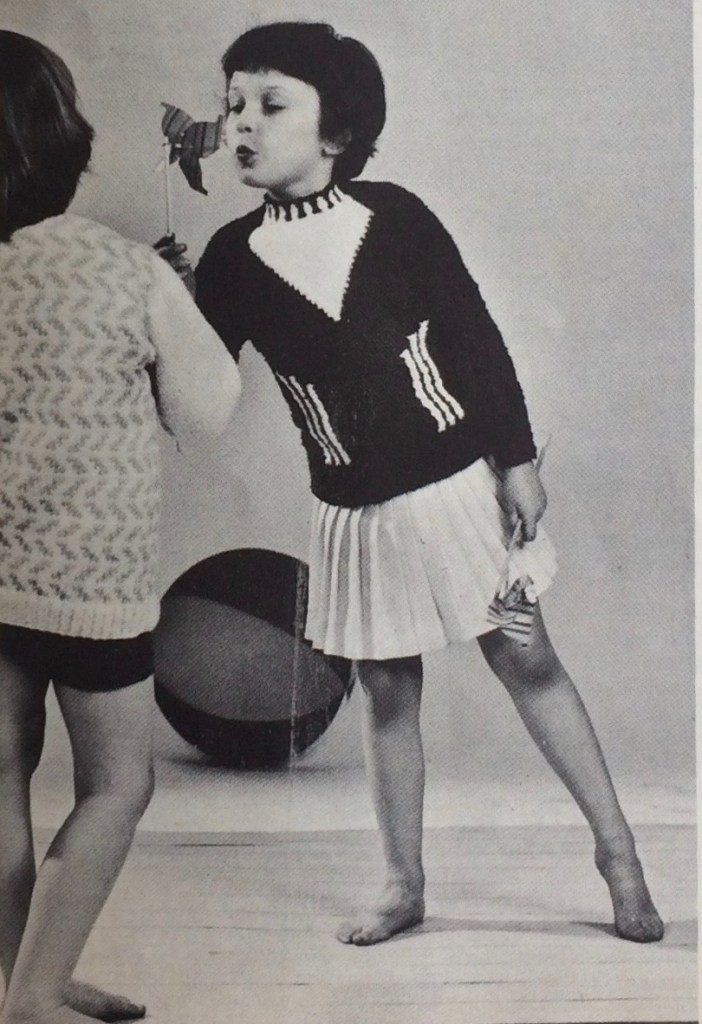
There’s also a striped jumper for “young and carefree” women with a fringed collar and hem, similar to the one in the February 1962 issue (yes, it is more or less the same pattern in different colours and with a split collar) and a pullover in an intriguing striped and dotted slip-stitch pattern. Stripes and/or slip-stitches also feature in the three-colour pullover for older children and the toddlers’ dungarees. Colours are navy blue or charcoal grey contrasted with white and neutral pastels, as we saw with the patterned-hem dress and three-piece ensemble.
There is the usual variety of homeware designs, mostly with floral patterns: this month’s flower is the dahlia, or you can sew and embroider and apron with lilac sprays. The leftover gingham fabric from “your” workaday apron can be used for cute animal appliqués on aprons for the children (unsurprisingly, Father seems to be exempted from the washing-up.) There’s also the usual floral cutwork tablecloth and tray cloth and a coffeepot set made in Hardanger embroidery.
Needlepoint fans can make a stool top or a whimsical cross-stitch rug and/or wall panel for the nursery, featuring characters from nursery rhymes. The motifs are separate and interchangeable and can be adapted for different sizes and purposes.
In the children’s serial comic, Peter the puppet has been freed from his marionette strings and is traveling throughout the countryside writing a play about his adventures. Cyril the squirrel helps out by painting illustrations, using his tail as a brush. (But how will Peter get home?) There’s the usual advertisement for Lux washing soap, guaranteed to leave your woollies soft and fluffy, and the latest instalment of the Patons and Baldwins’ “knit to please your man” series of ads, junior version: a teenage girl knits a “nice, husky sweater” for her boyfriend with her own loving hands to show everyone that he’s the “special one.” The young woman on the back cover ad is presumably also trying to catch a man, but she looks more polished in her snappy red dress and white gloves. You can really see 1960s style coming into its own in the straight or A-line sleeveless dress with low contrasting belt, the bobbed and fringed hairstyle and the edgy, off-angle mirror pose. Compared to the designs in this issue, it also shows how fashion-conservative Stitchcraft is.
I’m not sure what I want to make from this issue. I imagine the embroidered dahlias would make a great design for a laptop or tablet sleeve, but I already have a fine home-made laptop cover, not to mention this wonderful gay-geese-in-space tablet cosy. Also, I have probably done enough embroidery for the time being and still haven’t made much progress on this appliqué masterpiece that I started in July. The knit projects are all so bulky and loose-fitting, which is not my style, and I’m not sure I know an appropriately-aged child for the interesting slip-stitch pullover. There was also a perfectly nice, if not exciting baby cardigan (not pictured) in the issue which I could make quickly from stash, which would be useful enough (somebody’s always having a baby) and maybe the best choice for my uninspired mood. Stay tuned and find out!
August was a pretty blah month this year, what with the never-ending Covid-19 pandemic and associated long-term isolation, illness and unemployment. My knitting motivation is sub-par and the August 1962 issue of Stitchcraft didn’t have any projects in it that really inspired me. Still, I’ve been trying to turn the situation into an “opportunity” to save money and free up space by finishing WIPS and making new projects from stash.
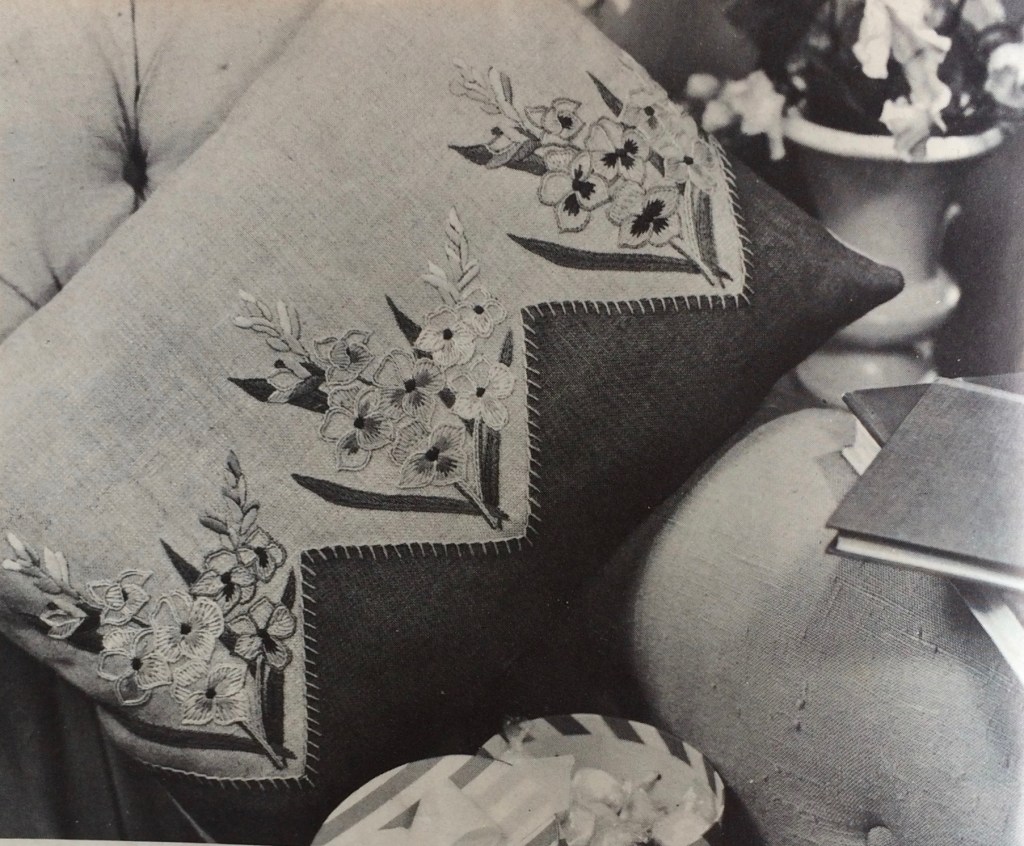
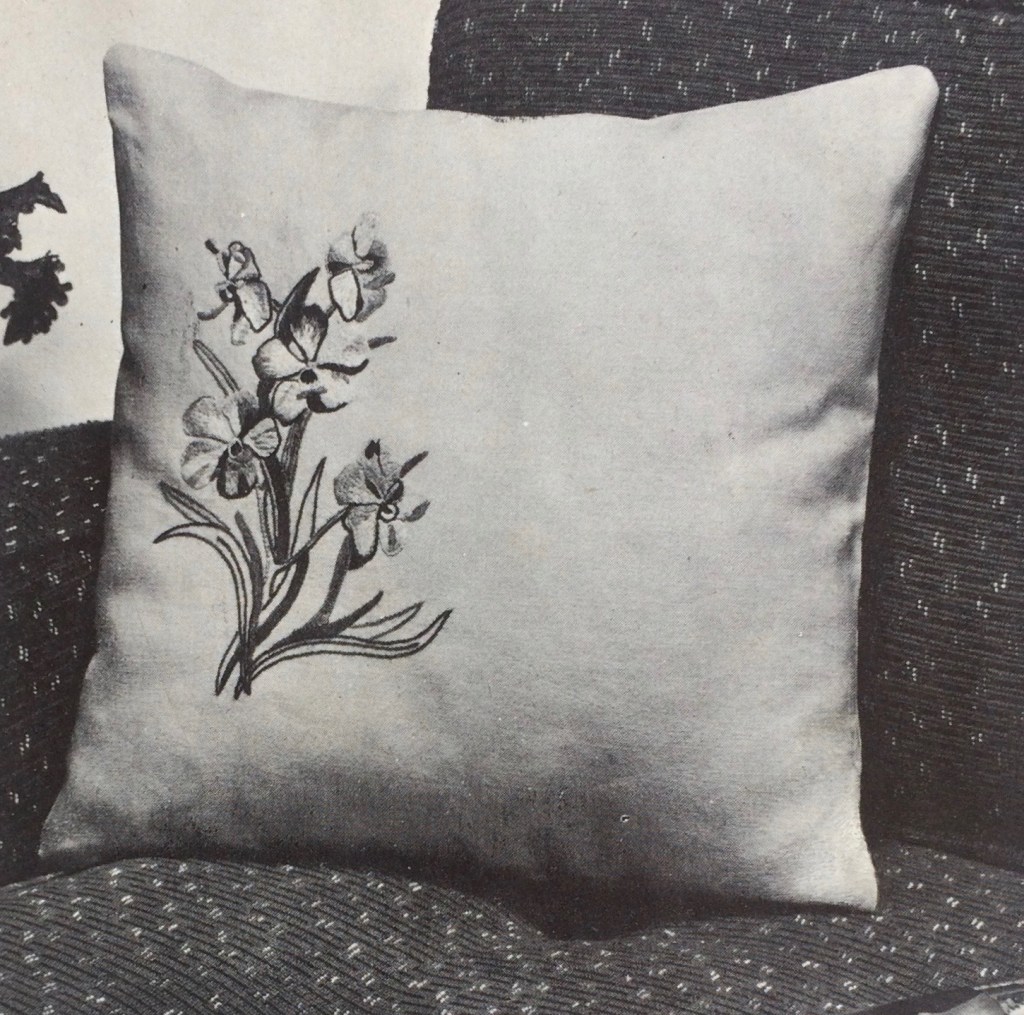
This month’s embroidery flower was the gladiolus, with a special extra design of wild orchids. I chose the gladioli and embroidered them on another one of the recycled moneybags that I bought at an antique market last year. They really do make excellent sturdy little bags for buying small amounts of potatoes, mushrooms or other vegetable items, and with a zipper on the top they would even be good for buying and storing things like beans and lentils in bulk. They also work well as small project bags — I kept this WIP in the bag that I made in December.
The colours that I had in the embroidery-thread scrap box were more or less accurate to the pattern (mauve, mid-mauve, violet, yellow, gold, dark green and light green.) Also, the stitches are technically not very hard to do: the petals are long-and-short buttonhole (blanket) stitch outlined in stem stitch with straight-stitch center lines and satin stitch centres, the buds are satin stitch, the stems are stem stitch and the leaves are fishbone stitch. I like the effect of the dainty flower embroidery on the rough burlap fabric, too.
On the critical side… I am really not that great at embroidery, especially when I don’t have a transfer and I’m working with fabric like this, on which I can’t draw a design outline very well. I drew a few straight lines and dots with a pencil and improvised from there. Also, since the fabric is already made up into a bag, it’s difficult to use a hoop properly or work on the lower edge. The buttonhole/blanket stitch is a strange choice for the flowers, if you ask me — they look very scraggly! (Just like my real plants at home, ha ha.)
I left the top edge unfinished for now, as I couldn’t decide whether to make a simple button closure like on the other embroidered money bag, a fold-over buttoned closure, or a drawstring. (I don’t have a zipper of the right length on hand and I’d like to stay on the “no-buy” wagon for as long as possible, but it would be the most practical solution.)
I still have plenty more of the bags, so I can keep making one every time a little embroidery project presents itself.
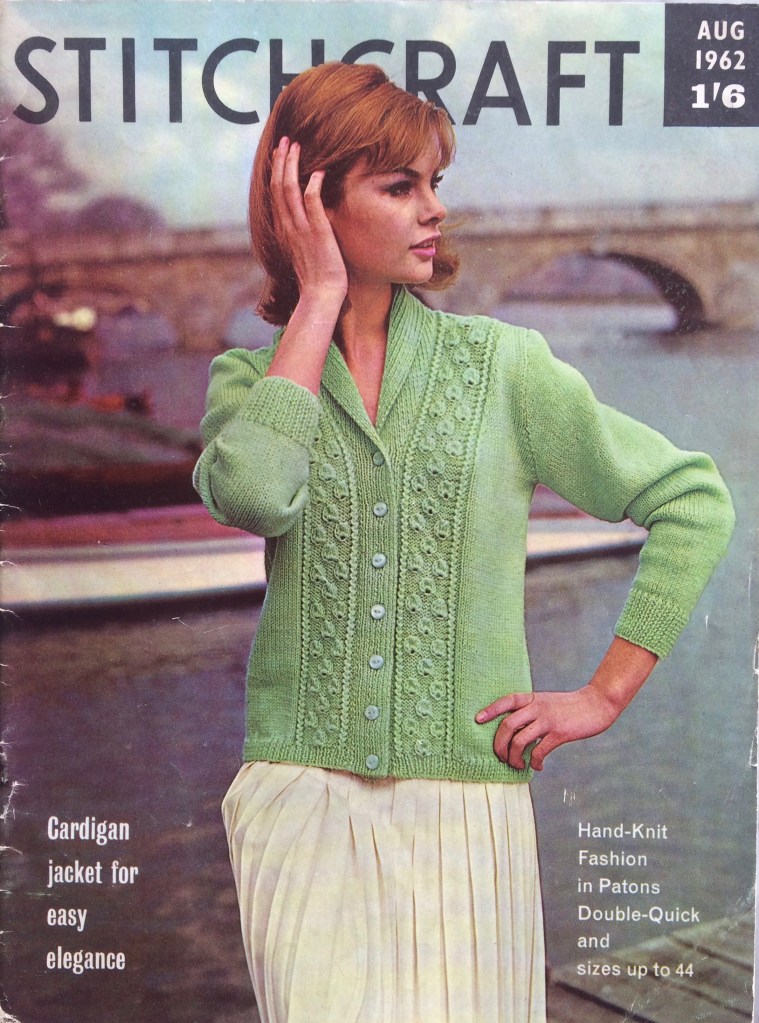
August is the end of the holiday season at Stitchcraft, featuring transitional styles for the cooler days of September as well as a few more small, easy projects that can be worked on from the deck chair or picnic table. The “Contents” column on the facing page divides the adult garment patterns into the categories “First Autumn Fashions” and “Continental Designs”.
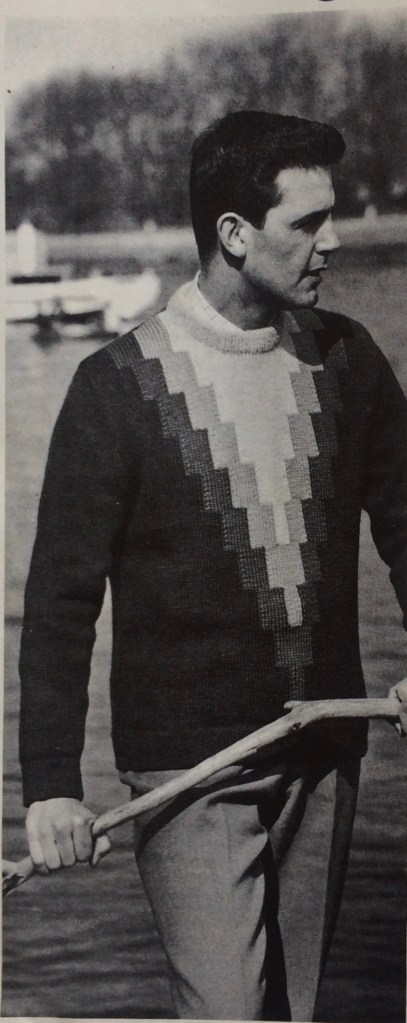
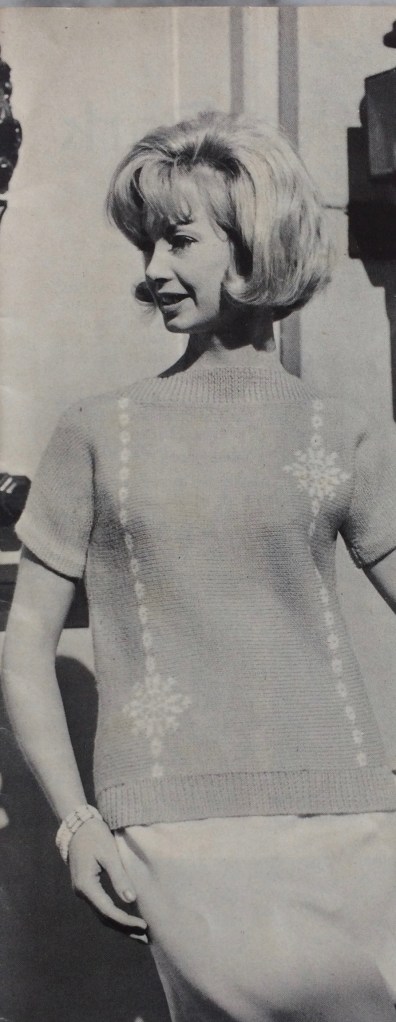
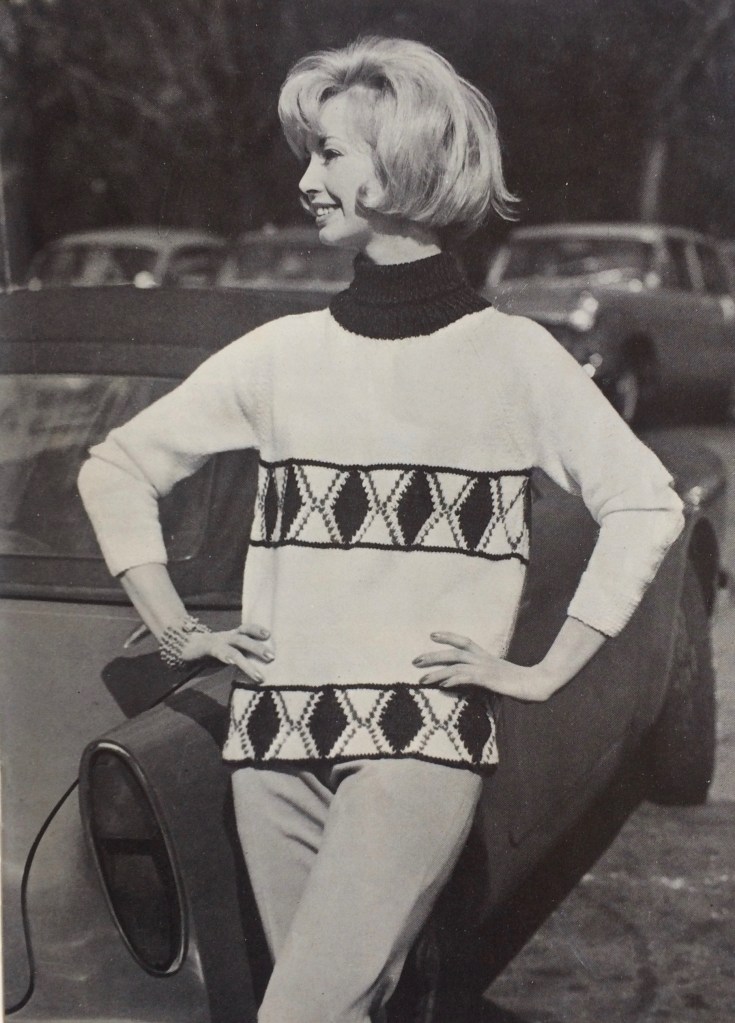
The “Continental Designs” comprise a colour-block pullover for men “from Vienna” in graded shades of green, a simple cap-sleeve, T-shirt-style jumper with a little Norwegian motif, and an “Italian design for late Summer” with bands of red and black intarsia in a diamond pattern. I wish they had used these for the colour photos instead of the bland white pullover on the inside front cover!
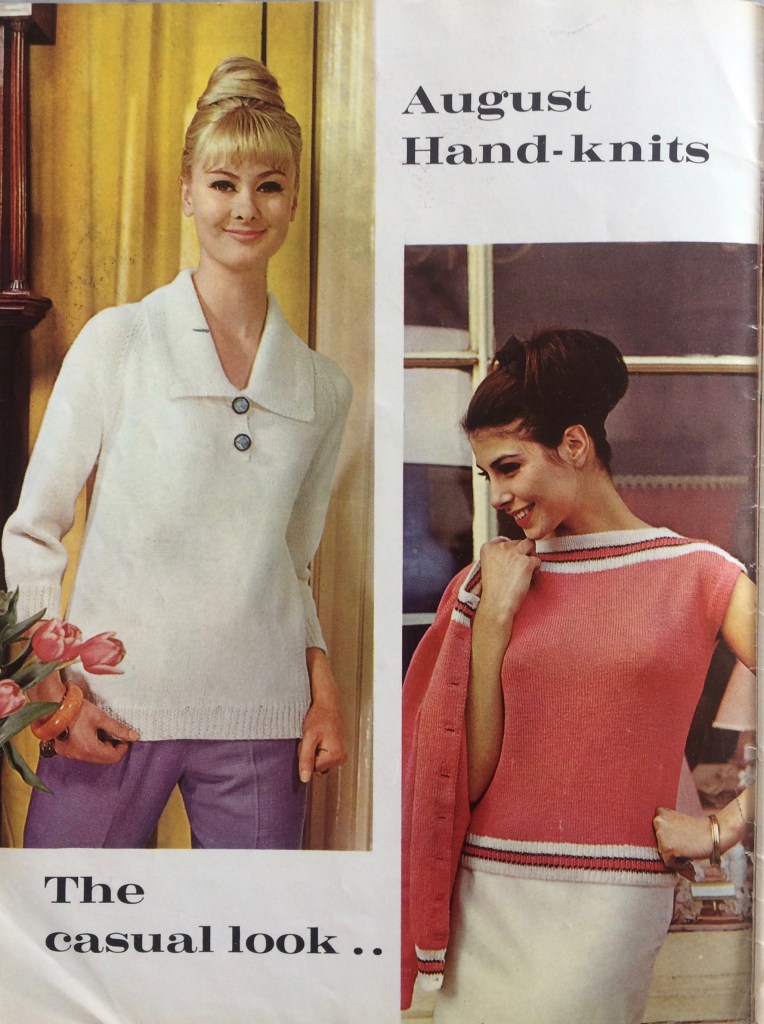
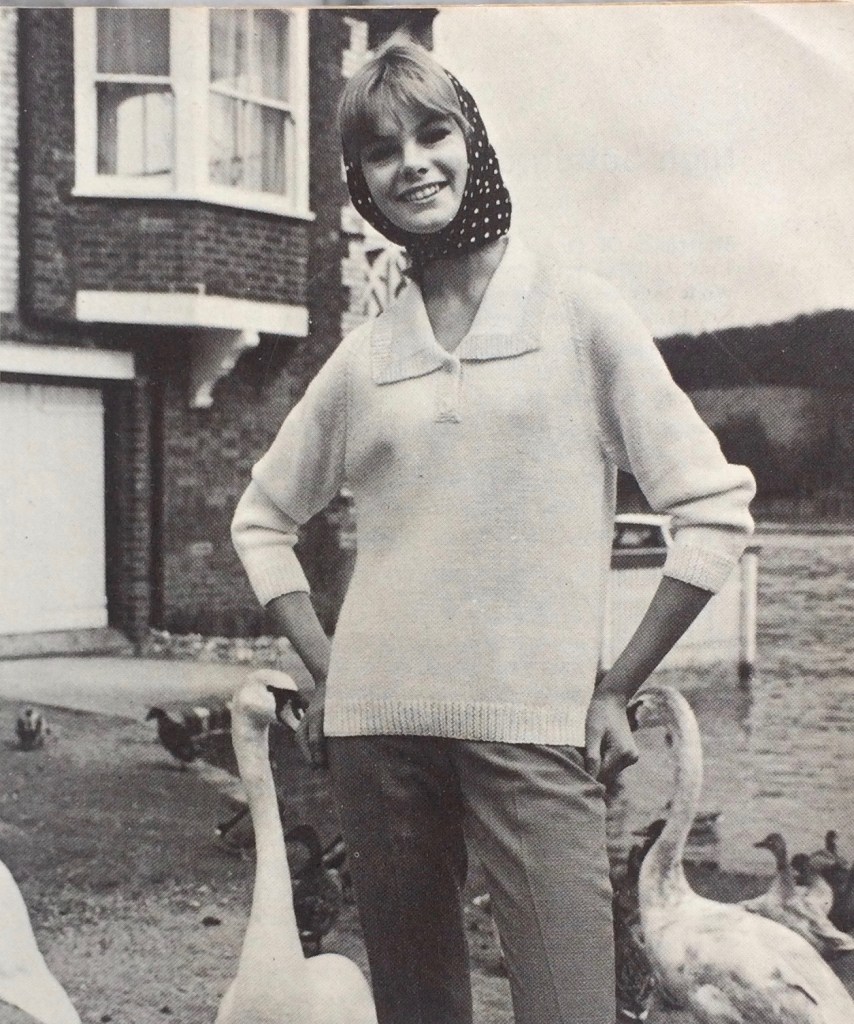
Loose-fitting, casual shapes and light, sunny colours dominate, exemplified by the apple-green cardigan, collared shirt-sweater and boatneck twin-set on the front and inside covers. Notice how much less fitted the August 1962 twin set is than, for example, this one from August 1960, not to mention earlier twin-sets from the 1940s and 1950s. The concept lives on, but the line has changed completely. Everything is hipbone-length with no or hardly any shaping.
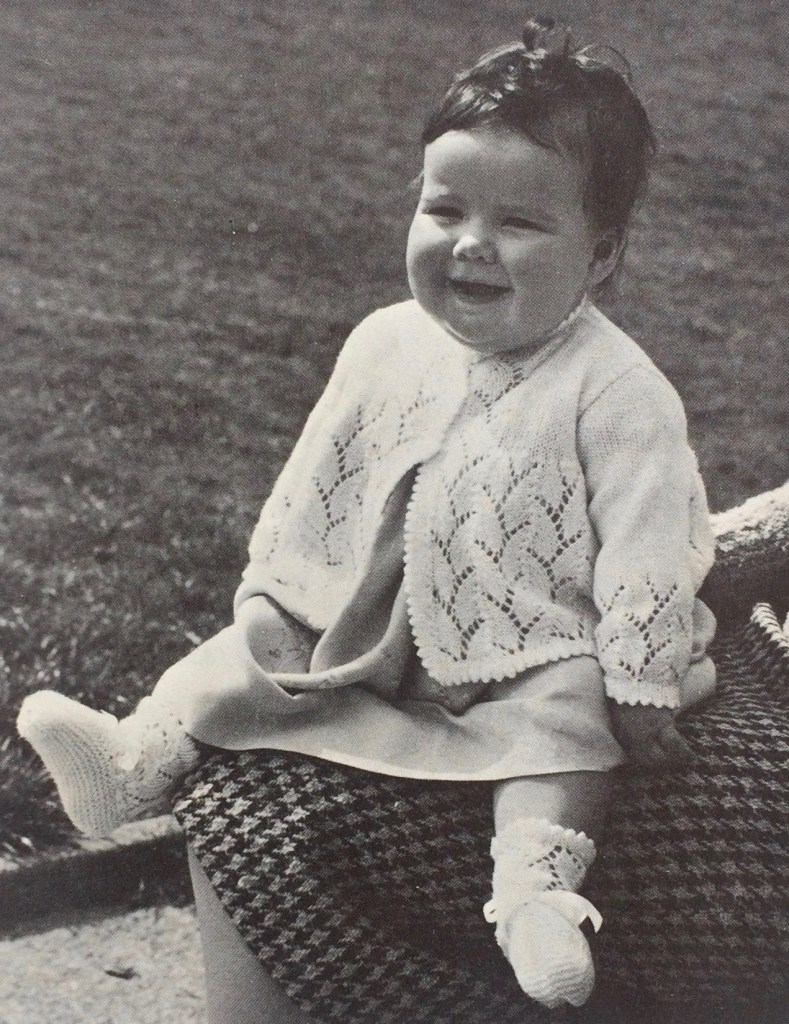
Babies get a standard, but very pretty, lacy matinee coat and bootees, the “smart teenager” has a machine-knit pullover, and her little sister gets a “gay Rimple design” in the still-popular knitted terry-cloth look, so the whole family is taken care of.
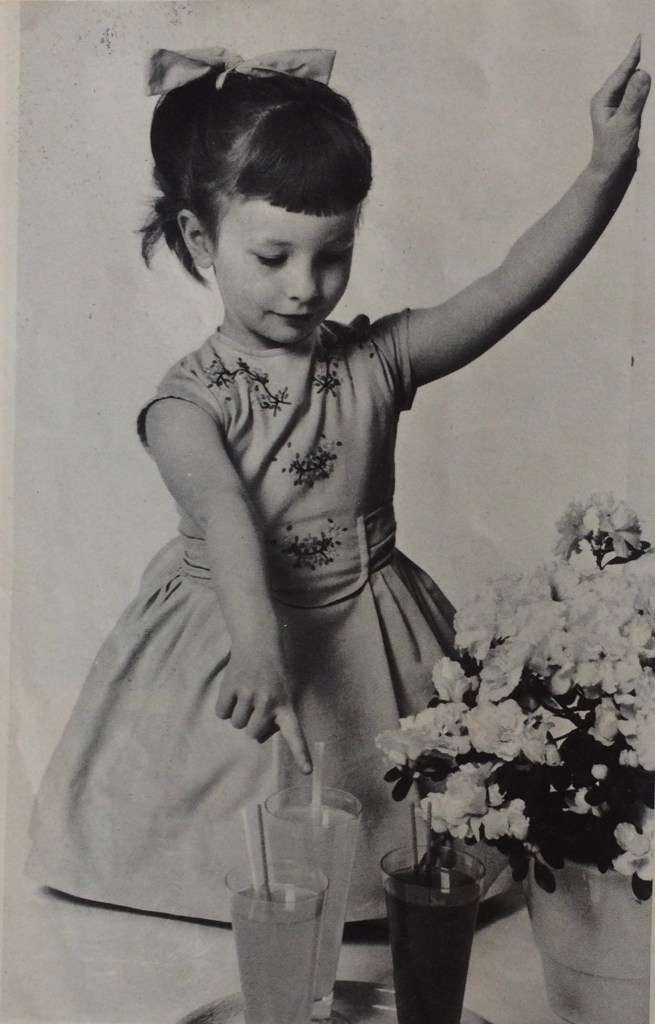
Homewares are always big in the summer months, when many readers understandably didn’t want to hold bulky warm wool in their hands in hot weather. The bedside rug is obviously an at-home project, but the smaller projects could easily be taken along on a holiday. This month’s flower in the gladiolus, but there’s also an orchid spray and some forget-me-nots, along with two sewing patterns to embroider them on: a round baby shawl or this wonderful little girl’s dress. For once, you don’t even have to send away for the patterns, as they are geometrically quite simple — the shawl is just a circle, drawn directly onto the fabric with a pencil held on a length of string, and the dress is made up of rectangles with measurements given. I would love to make the dress! I just don’t think it would get worn, since it would only be for “dress-up” occasions, of which there aren’t going to be any for a while.
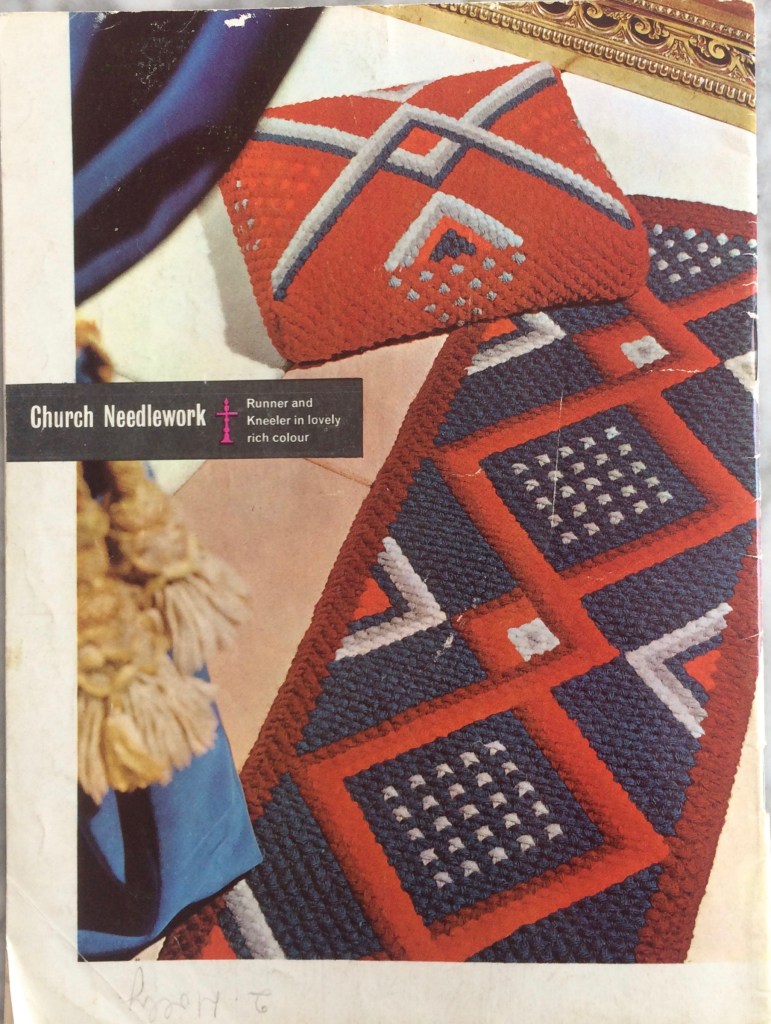
The back cover shows an interesting feature which took shape in the early 1960s issues: tapestry projects specifically for church use. In this case, there’s a runner and kneeler in shades of red and blue. If anyone happens to know why or if these colours or this pattern are significant in whatever type of Christian tradition, please feel free to tell me, as I don’t know anything about it. The rug, especially, does not say “church use” to me in any way that I can recognise and I could just as easily see it in a normal hallway.
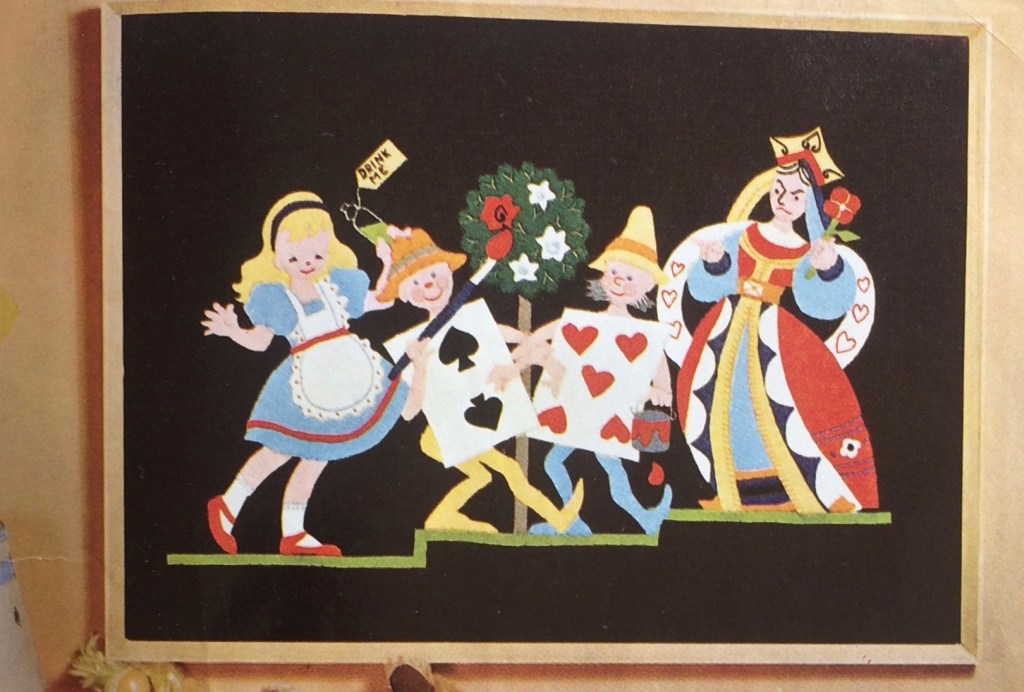
This issue doesn’t stop! The “Readers’ Pages” offer two more very simple projects: a reprint of a young man’s waistcoat from 1957 and a stash-busting baby blanket from double crochet hexagons. And just when you think you’ve come to the end of the issue, here’s this incredible Alice in Wonderland-themed wall hanging in felt appliqué and embroidery:
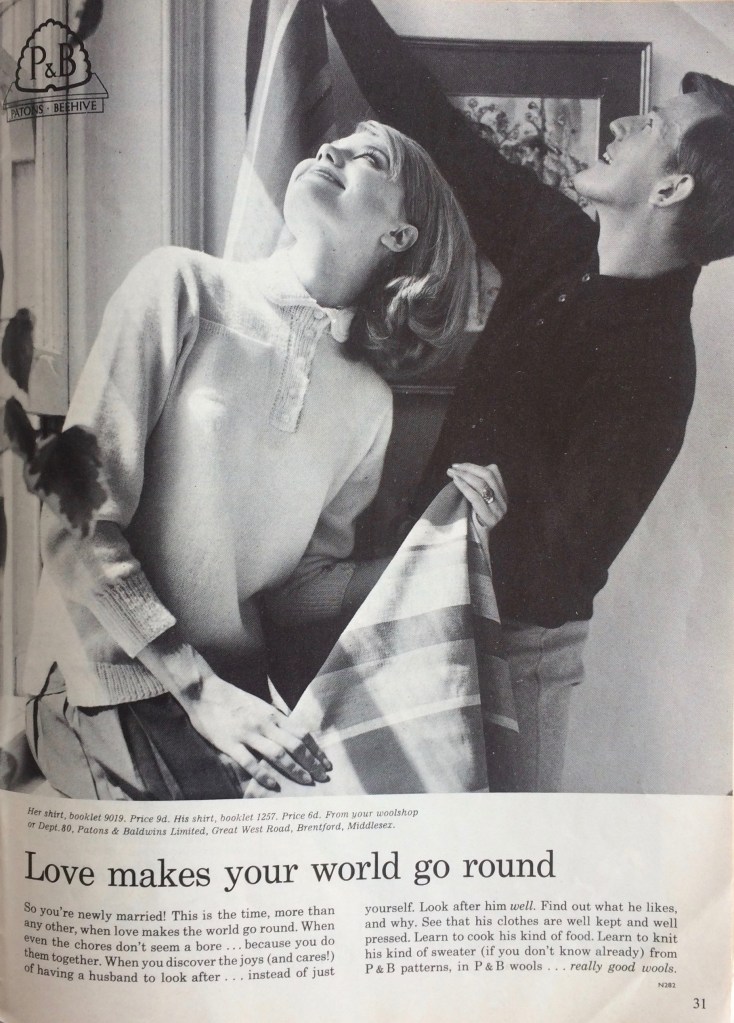
I’ll close with this full-page ad for Patons & Baldwins wools, showing a newly married couple decorating their home. The happy bride is instructed to
Look after him well. Find out what he likes, and why. See that his clothes are well kept and well pressed. Learn to cook his kind of food. Learn to knit his kind of sweater…
While I’m certainly not surprised that a 1962 advertisement would speak to women like that, I do find it interesting to compare the early and mid-1960s ads — which take on this type of “you exist to please your man” language more and more throughout the years — with those from the 1950s issues, with their much more independent picture of womanhood. Many of the knitting patterns in the earlier issues are explicitly designed “for the office” and most of the advertisements portray women living active, interesting lives in their comfortable shoes and unbreakable skirt zippers. In the wonderful tampon ads (that sadly disappear around the late 1950s), they don’t even let “problem days” stop them from doing anything! In contrast, the full-page P&B ads starting up around this time always feature a man or child with the woman in question and the text is inevitably some variation on “you must do this to please your man.” I had always thought of the 1950s as being a much more repressive time for women that the 1960s, when roles began to change, but judging from Stitchcraft (which, to be fair, is quite conservative both fashion- and otherwise), the earlier part of the decade is more of a backlash than a progression.
I don’t know what project to make from this issue and I still have so many WIPs, both for this blog and otherwise. Maybe a nice, easy flower embroidery on a vegetable bag?
July 1962’s issue didn’t have anything in it that particularly interested me, so I took the time to go back to the June 1961 issue, which had so many nice projects in it that it was hard for me to decide which to make. (I ended up making this lacy top and later, this child’s tunic-dress.)
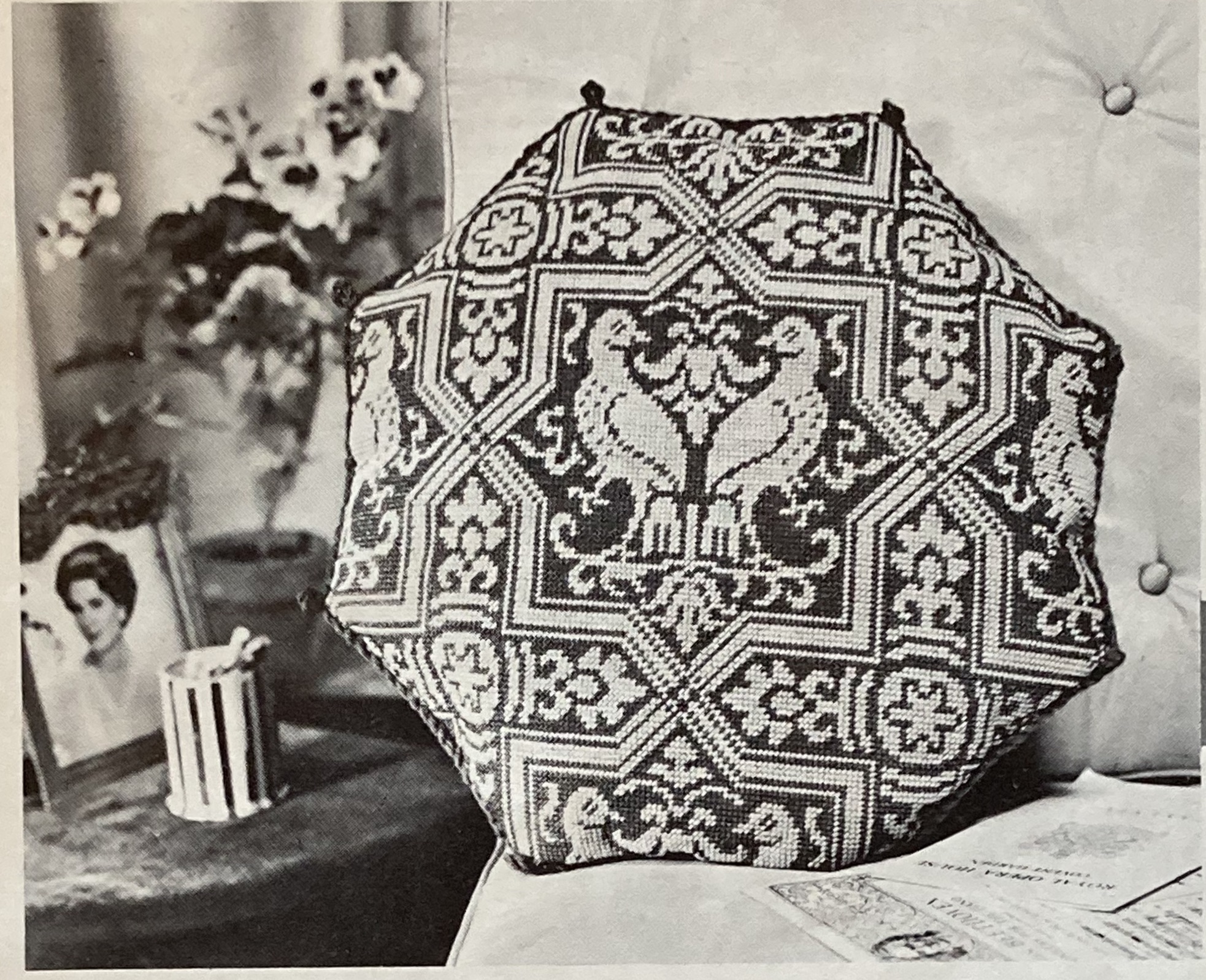
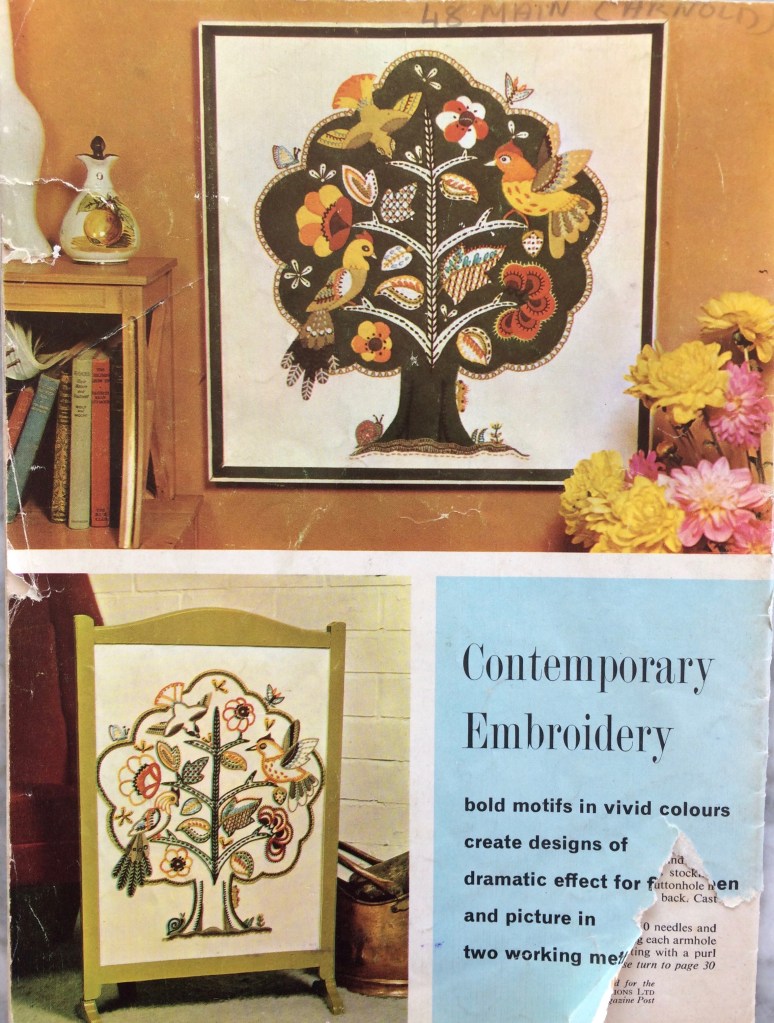
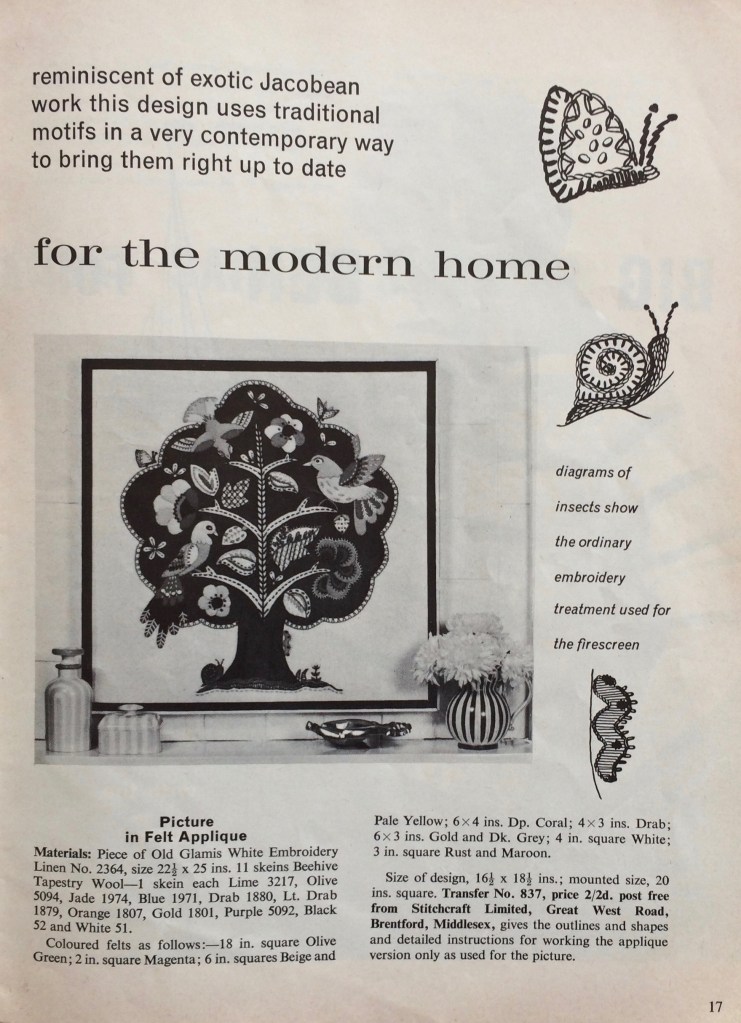
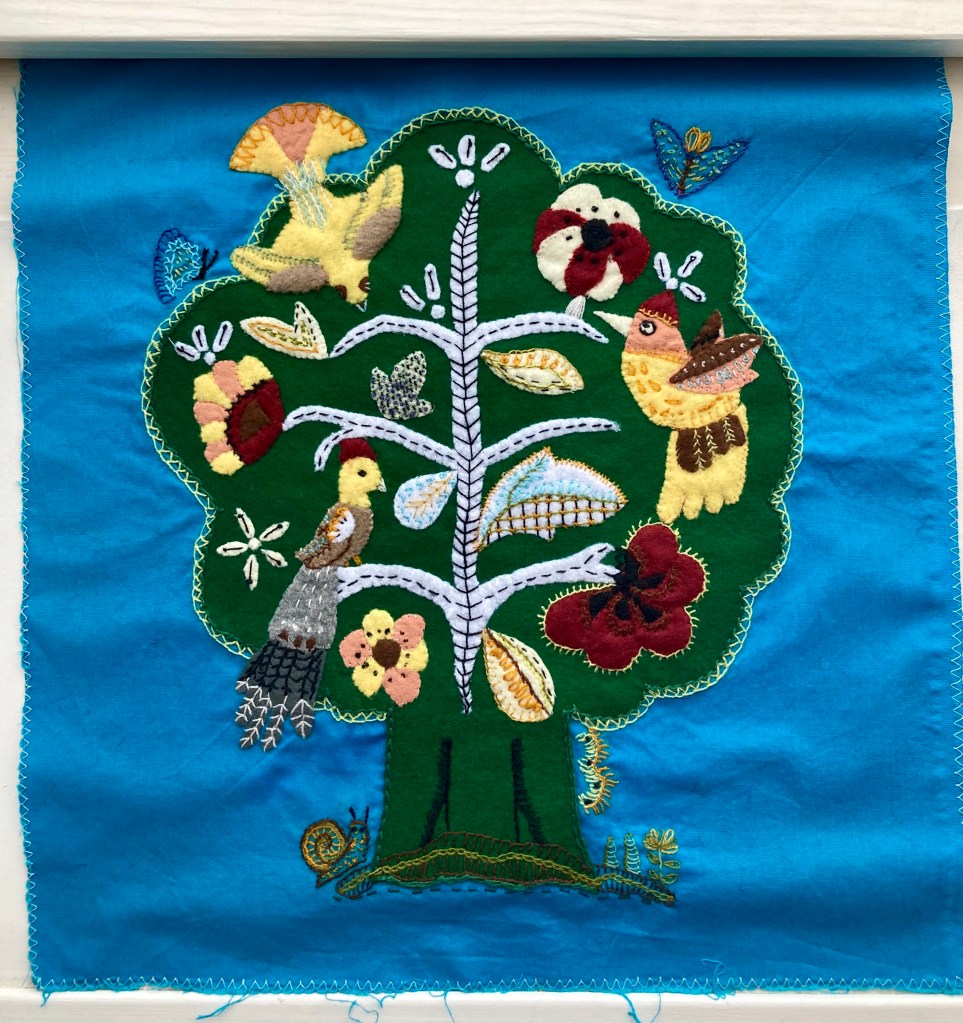
I loved the extremely complicated, heavily embroidered, faux-neo-Jacobean felt appliqué “birds in a tree” extravaganza featured in colour on the back cover, but it was too daunting. For one thing, of course I didn’t have the transfer or pattern for the appliqué pieces, since I would have had to have sent away for them via postal order in 1962. For another, there weren’t even any instructions in the magazine — the design was offered as either an embroidery or an appliqué project (see photo), and the instructions in the magazine only covered the embroidered version in any detail. The appliqué version just gave a list of materials, size of finished design, and the address where one could order the pattern and instructions. And when it comes right down to it, my appliqué and especially, embroidery skills are really not very well developed.
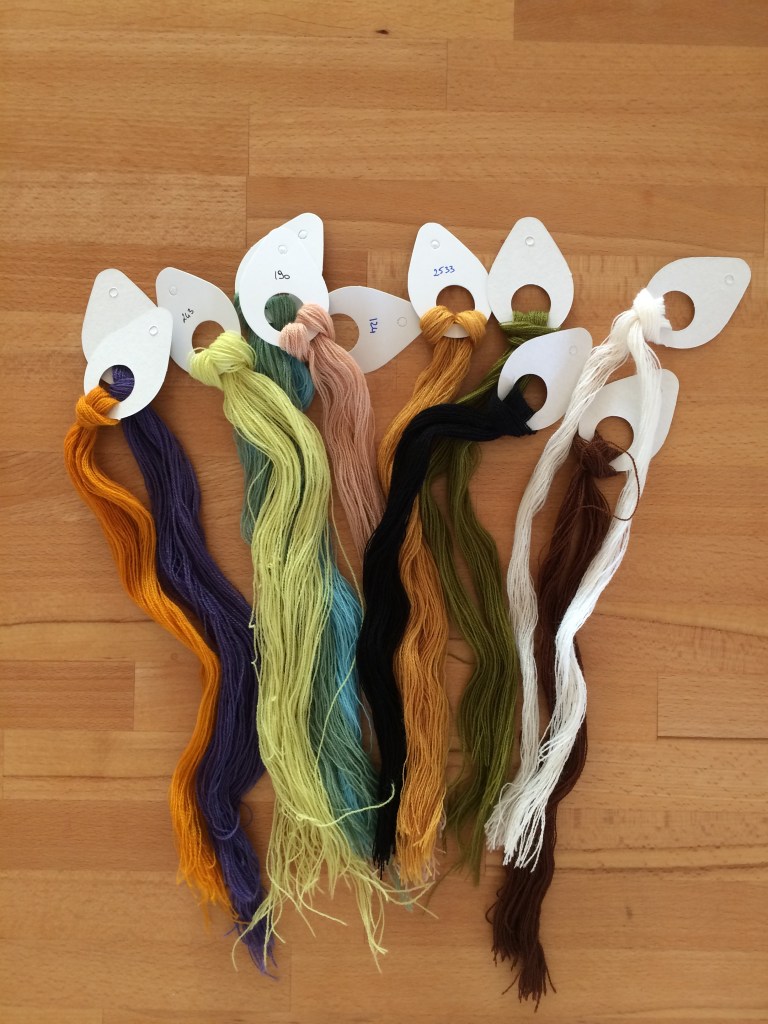
Oh yes, and while felt is easy enough to buy, the materials included tapestry wool for the embroidery, which is impossible to find in stores anywhere near me and even difficult to order online in the right weight (very fine)! Luckily, last year I happened to be in the one city I know that houses the one shop I know that actually specialises in tapestry and sells the right kind of wool, so I was able to get that, at least.
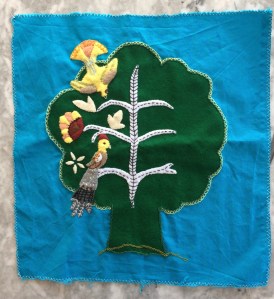
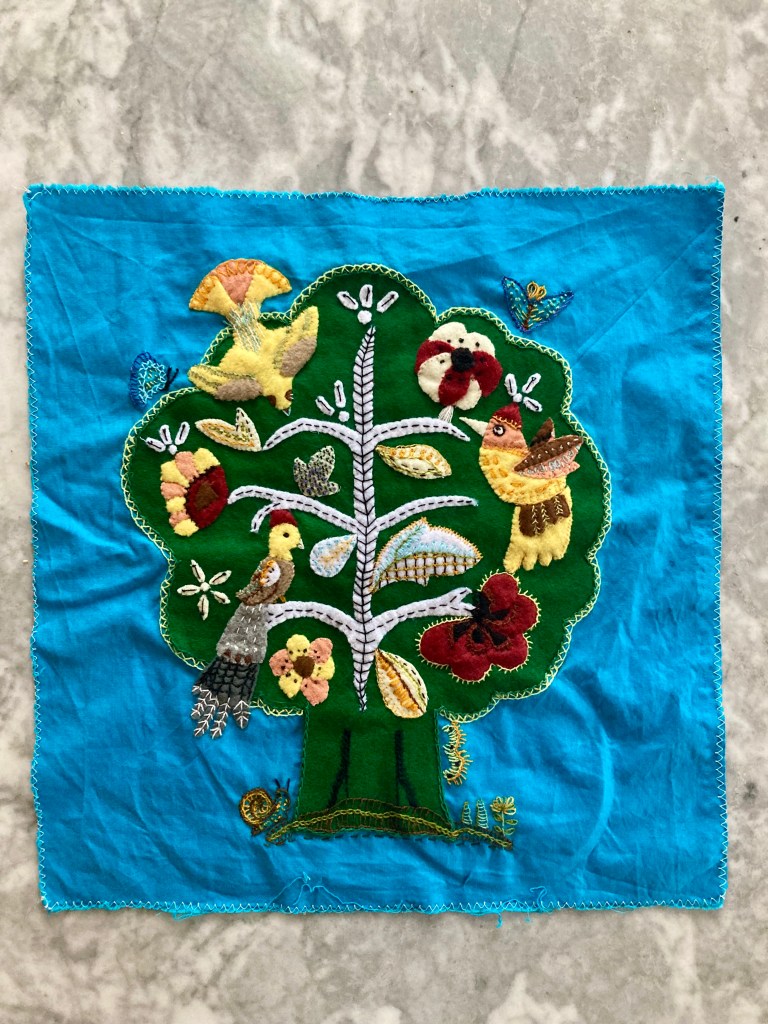
I decided to make it as a cushion, not a wall hanging. The background tree was easy enough. Technically, the white branches and leaves should have been made by cutting holes in the green tree felt and letting the (white/beige) background fabric show through, but since I chose a blue background fabric, I appliquéd them as well. It was predictably difficult to make and cut out my own patterns for the little bits of felt for the birds and leaves, and after making the first two birds, I realised it was easier to just cut the pieces freehand. Since there were no instructions to follow, I went from the photo and the instructions for the embroidered version, which obviously didn’t give much useful information.
Such a detailed project took forever, of course. It needed many tools and materials, so I could only work on it at home at a table, and not during the winter months, as I needed natural light for the fine work.
I made two of the birds on the left first, wasn’t really happy with them, and realised why after making the first flower on the left. I liked the way the flower turned out — it’s much simpler! The birds seemed overdone in comparison. I thought about changing the design and realised at some point that, of course, the who idea of this neo-Jacobean, embroidered and appliquéd extravaganza is that it is supposed to be over the top.
Before ironing…And after ironing
And so, slowly and painstakingly, it got done, one piece at a time. (It also spent a lot of time in the cupboard in between bursts of activity.) The embroidery directions in the magazine were often quite different from the appliqué version, so I did a lot of guesswork and adaptation based on the (rather small) colour photo on the back cover, from which the colours had changed and faded in the 50 years since its printing.
I was determined to get it done before the end of 2021, and I did (on December 31st.) It was a huge milestone for me in my appliqué / embroidery learning process, and I am really, really happy with the way it turned out.
Holiday and party seasons are both in full swing in Stitchcraft’s July 1962 issue and the more I look at this cover photo, the more I love it. Note how the foreground model is staring off into the distance while sitting on a table with a compass printed on it, as if fantasising about her faraway holiday (though, if she’s on holiday already, as the picture is implying, does that mean she can’t wait to get home?). Meanwhile, it’s a good thing that our flirty tuxedoed waiter’s drinks tray is empty, with that precarious balancing act. If anyone feels inspired to creatively augment this photo with speech- and thought-bubble captions, please do and share it with us!
In keeping with the easy-going, summer holiday theme, the knitting projects are simple and quick to make. The two illustrated on the cover have no sleeves, minimal shaping and patterning, and are made in quick double knitting wool. Although pictured as stand-alone tops, they could easily be layered over a blouse on cooler days. There’s also a simple blue blouse with loopy flower details on the collar and a striped, sleeveless tunic-blouse with matching skirt, all in 4-ply wool. Our waiter from the cover photo has found another holiday-goer to flirt with, and sports a “Casual Italian design sweater” in the same colour as her skirt: “Water Green.” (Holiday tip: if the water actually is that colour, don’t drink it.) Speaking of Italy, doesn’t that beautiful model in the collared blouse look like she just stepped out of a Fellini film?
For cooler days, there are cardigans in “golfer” or classic, slightly bobbled styles, both made in double knitting. The golfer takes her sport very seriously! Knitters who are really in a hurry to get packing can make some simple, bulky pullovers for the kids in the family (shown here building a lovely British castle out of cardboard and sand in the Patons photo studio — I am guessing everyone had a lot of fun on this issue’s photo shoots) or a fine-knit slipover in honeycomb pattern, written for a home knitting machine.
The embroidered homewares are mostly easy and predictable: a chairback with this month’s flower, the carnation; a quickly-made “gay garden cushion” (Happy Pride!), and place mats with heat-resistant cork inserts. There’s a tapestry stool and/or project bag in Florentine pattern, knitted or crocheted cushions, some fancy knitted doilies and a trolley cloth from crocheted motifs. I didn’t photograph all of them, since they’re pretty standard fare.
For those who like to immortalise their holiday paradise in tapestry, there’s a wall hanging of the village of St. Etienne de Bougary in the lovely French Pyrenées. For your outing to that very inviting-looking lake, you can sew you own beach bags and/or an appliquéd blanket-towel-baby’s-playmat for outdoor lounging. The beach bags feature adhesive plastic lining to keep wet bathing suits from leaking into the bag. Smart and easy, indeed.
I’m kind of ambivalent about making a project from this issue. The only thing I could really use is the bobbly cardigan, but it’s not exactly necessary, and the only design that I find exceptional is this crocheted blouse (worn by my favorite Stitchcraft model, who featured in a lot of the mid-and late 1950s issues). Model and blouse are both beautiful, but the blouse is way beyond my limited crochet skills. I wish I had the “Traditional Norwegian Designs” booklets from this ad! I think I’ll take the time to finish up another long-standing WIP instead.
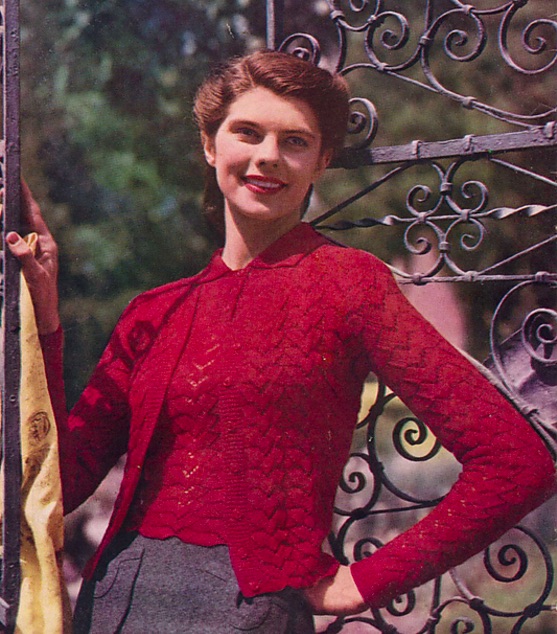
The June 1962 issue didn’t have any projects that appealed to me enough to make them, so I used the time to finish up a project that I’ve been working on off and on for the last few years: a “4-coupon” twin set from Stitchcraft‘s February 1947 issue.
The “4-coupon” title refers to the clothing coupons used when purchasing rationed items during and after World War II. Rationing began for many food products in January of 1940 and extended to clothing in 1941, whereby clothing coupons could also be used for household textiles or wool. The Wikipedia article on rationing in the United Kingdom during World War II gives a sense of the coupons’ comparative value:
There were 66 points for clothing per year; in 1942 it was cut to 48, in 1943 to 36, and in 1945 to 24. This system operated through a “points” system… [ ] …Clothing rationing points could also be used for wool, cotton and household textiles… [ ] … The number of points that each piece of clothing would be valued at was determined by not only how much labor went into making it, but also how much material was used. A dress could run someone 11 coupons, whereas a pair of stockings only cost 2. Similarly, Men’s shoes cost 7 tickets, whiles women’s cost only 5. In 1945, an overcoat (wool and fully lined) was 18 coupons; a man’s suit, 26–29 (according to lining); Children aged 14–16 got 20 more coupons.
The twin-set uses 8 ounces of wool, so apparently one coupon could get you two ounces of (2-ply) knitting wool. (Just to be clear, one also had to pay for the items; the coupons only limited the amount people were allowed to buy, regardless of how much money they had at their disposal.)
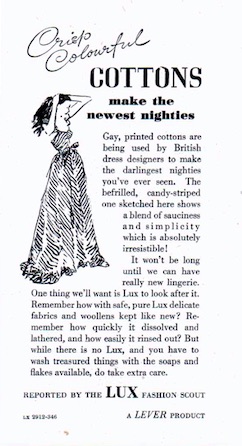
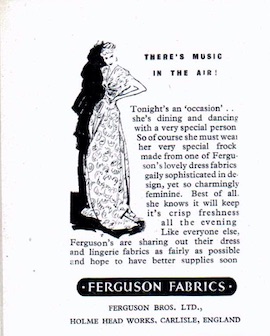
The influence of rationing can be seen in almost every aspect of 1940s issues of Stitchcraft: occasionally titles of designs, such as this one, but more often in recipes and advertisements. These two, from the pages of the 4-coupon pattern, promise that the company in question is “sharing out their dress and lingerie fabrics as fairly as possible” and reassure that “it won’t be long until we can have really new lingerie” (lace and frills were banned, and nylon was needed for parachutes et. al., hence the plain, home-sewn cotton nightgowns).
Many products remained rationed after the war, including clothes rationing, which lasted until March 1949. It was only in 1954 that the last rationing measures were lifted. Since then, the only product that has been subject to rationing in the UK was petrol, briefly, during the Suez crisis of 1956-57. And yet, as the global Covid-19 pandemic continues to rage around us, there have been discussions in many countries — including wealthy countries with excellent medical infrastructures — regarding the rationing of personal protective equipment, ventilators and medical supplies. The past is not as far away as we might think.
Booklet photo, February 1947
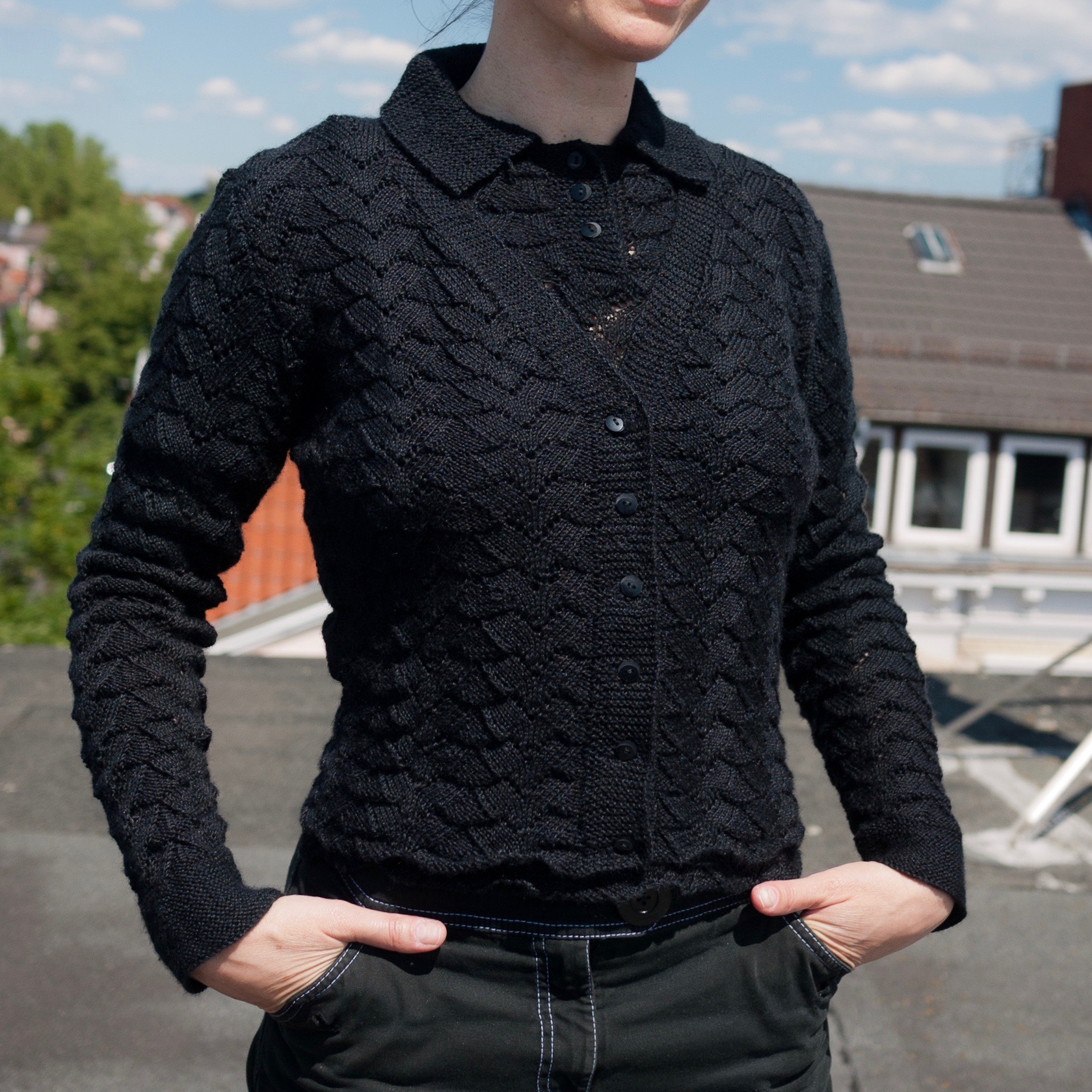
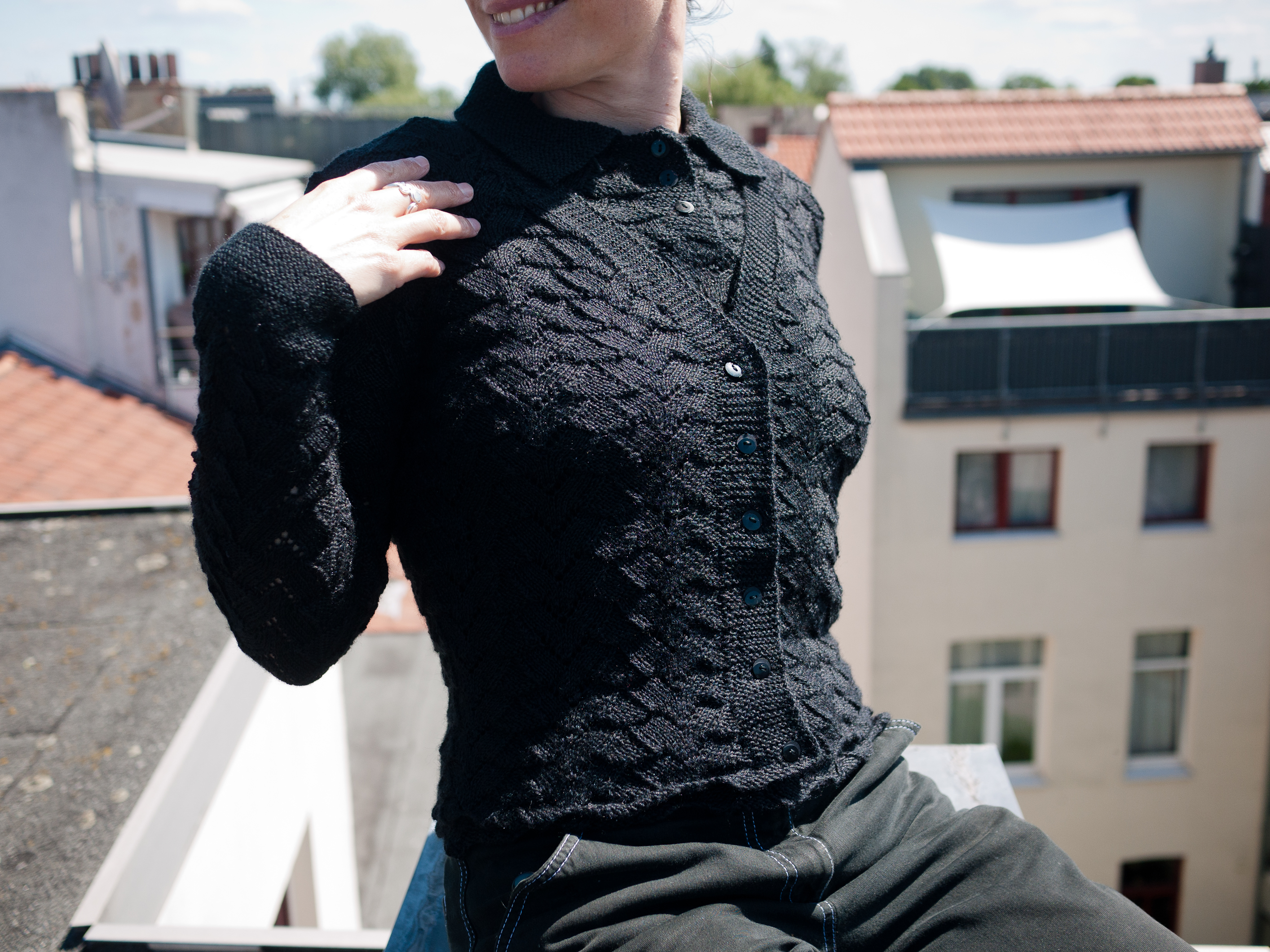
I had plenty of time to ruminate on that while finishing this project, which I started as a “home away from home” project in 2016 (a year in which I effectively lived in two different places) and finished in home isolation in 2020. The wool — Onion Nettle Sock — is a mixture of 70% sheep wool and 30% nettle fibre. I would never have thought to knit with nettle fibre, but it works very well! It is smooth and somewhat shiny and the textured lace pattern shows up very well with it. Also, it reminds me of various fairy tales involving our heroine knitting shirts for her brothers out of nettle plants (or aster flowers, depending on the version and translation), like Die Sechs Schwäne (The Six Swans) by the brothers Grimm, or De vilde svaner (The Wild Swans) by Hans Christian Andersen.
As always, I am larger than the 34-inch-bust size for which the pattern is written, but also get a looser gauge, so it worked out for me to make the pattern almost exactly as written. I made the sleeves and the body of the jumper in the round, adjusted for length and changed the sleeve cap slightly for less puffiness, but otherwise I didn’t need to change anything. Of course, the lace pattern is stretchy and can be blocked tighter or looser.
Said pattern was the first one I had worked with that increased and decreased in the course of the pattern repetition, and I was at a loss to deal with the side-seam and sleeve increases and decreases at first. The pattern, like all vintage patterns from this period, assumes you know what you are doing, and there are no charts in any case. I learned a lot and I can see that the side increases on the cardigan are much nicer than on the jumper! (Carefully photographed as to be unnoticeable, but believe me.)
My buttonhole spacing on the cardigan was off, so I ended up sewing most of the holes closed ad carefully cutting new ones after backing the bands with ribbon (a common practice at the time, especially on tight-fitting cardigans, to keep the bands from stretching out and gapping across the chest.)
All in all, this is a wonderful design and very flattering to the figure. Nota bene, my upper body is broad and flat and I am not exactly model-thin, but this ensemble somehow manages to make me look both svelte and curvy. The wool/nettle fingering weight is perfect for fall and spring. I love the buttoned placket and collar of the jumper. Knitting this was definitely worth all the time and hard work and it will be getting a lot of wear for years to come.
Holiday season is in full swing in this month’s issue, with featured photos taken in pretty villages in and around Buckinghamshire and Kent. All the projects are easy and fairly quick to make, and even the fit is relaxed: the close-fitting, waist-length jumpers that were still more or less in fashion in 1960 and 1961 have now completely given way to loose-fitting, hip-length sweaters and blouses. I could use some relaxation, couldn’t you? Let’s dive in… gently.
The cover sweaters check all the 1962 trend boxes: loose, easy pullovers for “him and her” in sunny lemon yellow with interesting stitch textures and contrasting collar-and-cuff accents. Soft yellows, pastel shades and white show up again in the more glamorous “holiday sweaters” made with Patons’ Fuzzy-Wuzzy yarn (55% angora, 45% wool), as well as the women’s 4-ply “golfer style” cardigan (in “gay turquoise” and white 4-ply) and men’s “shirt-style” pullover in presumably light beige “Palomino” colour with contrasting collar.
The other garments are all photographed in black and white, but the yellow/pastel/white and contrasting accent trends are clear from the colour names of the yarns: the pretty “Junior Miss” cardigan is knitted in 4-ply Nylox “Sunglint” (the same colour as the cover sweaters), the “afternoon style” blouse is “Bois de Rose” pink and the bulky, textured Big Ben sweater is “Spring Green” with a white collar.
The smaller children of the family need something fun and easy for holidays too, of course, so here are some “seashore sets for toddlers in the swim.” They’re made in Nylox (80% wool, 20% nylon) and I don’t think they would be suitable for actual swimming, but definitely cute for playing around on the beach and splashing around.
With all these lovely things to knit, it’s not surprising that the homewares section is a little boring. Fittingly enough for June, this month’s flower is the rose, featured in a pattern for a “finger panel” to attach to a door. Readers, you have been so helpful in the past with solving mysteries for me, so i ask you: Why a finger panel? It seems to be used to keep the door clean from grubby handprints, which I can certainly understand in a family home, but I don’t see why it would be easier, or preferable, to wipe those grubby prints from an embroidery panel mounted under acrylic glass than to just wipe them off of the door. What do you think? Am I missing something here?
Otherwise, we’ve got some Scandinavian tapestry cushions, a “modern” (geometric and also Scandinavian design-inspired) hall runner rug, a more complex cross-stitch tablecloth (white and green on yellow linen, to match your yellow sweaters), some unspectacular oven mitts and some genuinely cute table mats in appliquéd and embroidered felt.
I feel more relaxed already, don’t you? There’s nothing from this issue that particularly inspires me and I have many WIPs to finish up, so my June project will be a “Blast from the Past” featuring a wonderful twin-set from a 1947 issue of Stitchcraft.
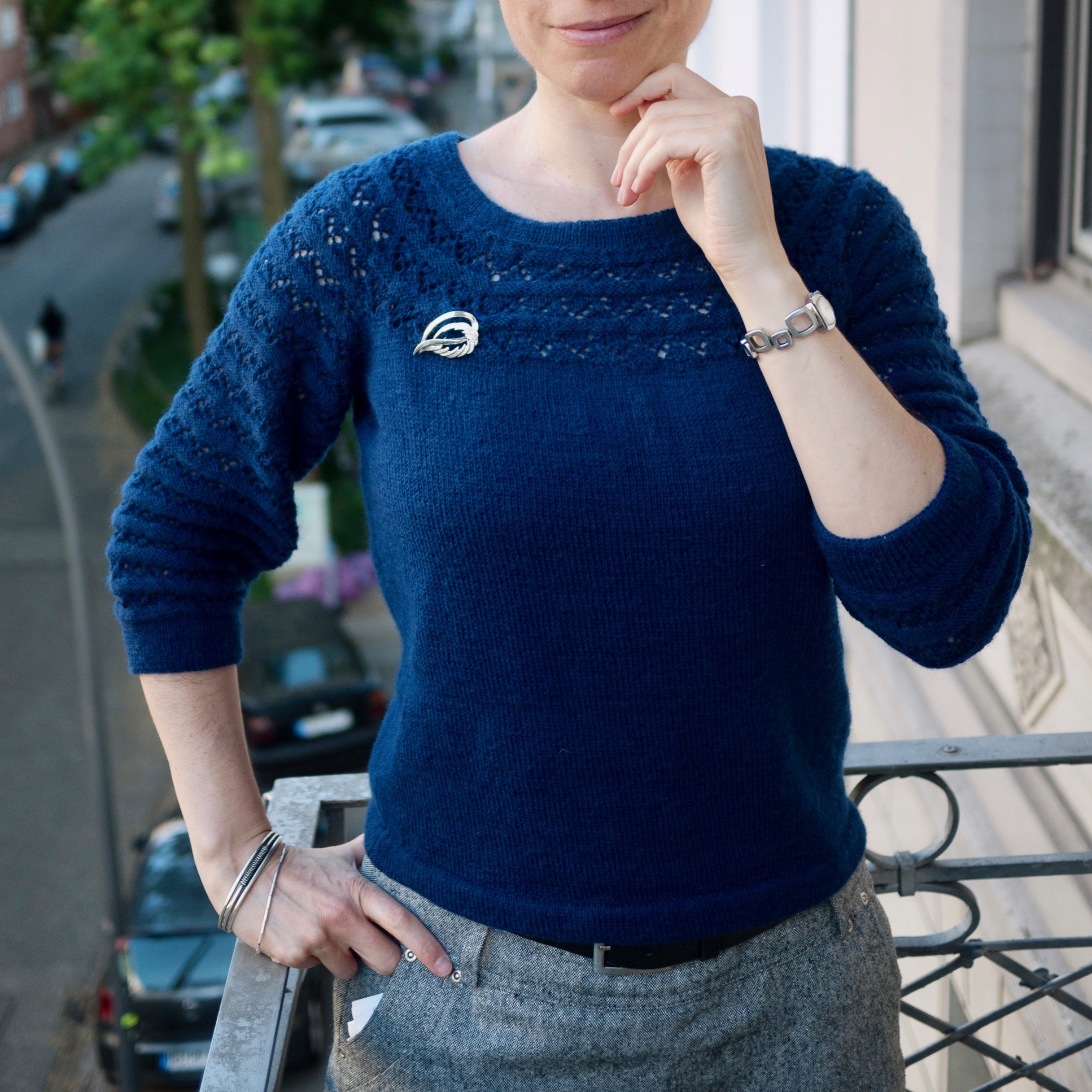
May 2020 went quickly and is already over, but (spoiler…) my May 1962 project didn’t get finished until June. It was a lightweight pullover in 3-ply wool with three-quarter sleeves and a lacy yoke, simple, elegant and “in a cooler trend for summer.”
I bought the wool — Regia 3-ply, which has long been discontinued — from a wonderful little wool shop in my town that used to sell and maintenance hand knitting machines as well. It was a tiny, one-woman operation with unpredictable business hours, whose elderly owner lived in the apartment above the shop. She often had vintage second-hand knitting machines for sale and I always meant to buy one, but the times when she had one available and the times when I was able to actually find the store open never seemed to coincide, and sadly, she passed away last year. There were no knitting machines left in the close-out inventory sale, but still plenty of fine-ply wool, which is almost impossible to find in normal wool shops these days. RIP lovely little store and lovely lady who ran it! I will think of you whenever I wear this jumper.
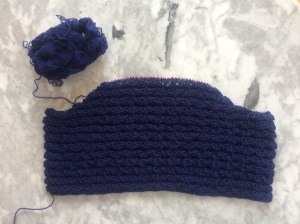
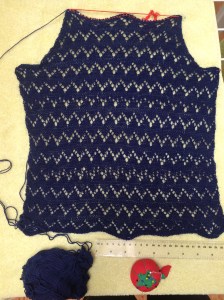
In spite of the fine wool and small needles (2.5 mm), I was unable to get the required tension of 8 stitches and 10 rows to an inch, so I adapted and made the smallest size, which should come out to fit me. I say “should” because the lace pattern used on the sleeves and yoke bunches together quite a lot before blocking. I blocked both sleeves on the needles to try and measure it out (see photos…) but I still wasn’t sure if they would fit properly onto the yoke. They did, with no further alterations.
The only real alteration that I made (besides making the body in the round to save time and seaming) was to alter the decreases on the front and back after the armhole bind-offs and before the beginning of the yoke. The pattern is written with identical back and front pieces, but I wanted the yoke to hang down further on the neck on the front than on the back, so I make the back pre-yoke part longer and the front pre-yoke part shorter by decreasing more or less frequently than in the pattern.
The lace stitch refused to block out flat, no matter what I did. I wash-blocked, stretched and pinned both sleeves before making the yoke (see photo above) and they had bunched up again by the time I was done knitting. I wash-blocked, stretched and pinned the whole garment after completion and the sleeves bunched up again five minutes after I unpinned it (dry). I pinned the sleeves and steamed them, then ironed them with the same result. Did I mention that this yarn is 75% wool and 25% acrylic, which normally blocks for good when any kind of heat is applied? Well, no matter what I did, it didn’t take. The yoke stretches out naturally while worn, but the sleeves bunch up. Since they are supposed to be below-elbow-length anyway, I decided to call it a design feature and live with it.
On the whole, I’m quite happy with it, and it’s the perfect weight for cooler summer days.
Handknits For Your Holiday! If you are planning on taking a holiday in 1962, that is. In that case, I would recommend going to the Algarve in southern Portugal, which, based on the pattern of the window shutters and blanket in the background, is where I am guessing this magnificent cover photo was taken. Sadly, my time machine is out of order and May 2020’s motto is (Lots Of ) Handknits For No Holidays This Year Or Probably Anytime Soon.
I bought my copy of this issue on Ebay, but apparently it originally came from “The Knitting Centre” on Field End Road in Eastcote near London. I actually checked to see if it still existed but sadly, it seems to not be there anymore, nor is there any other knitting or craft shop in the area as far as Ravelry and the digital map can tell me. It would have been fun to be able to trace a 50+-year-old knitting magazine issue back to its origin!
Like most of the late-spring or summer issues, this one has a mix of quick, warm, bulky sweaters for holidays in northern climes and some finer, dressier items for that special going-out evening. “The boy friend” can get wild in a colourful, oversized mid-weight sweater, while “you” enjoy your evening in a bobbled jumper. For casual outings, there’s a raglan polo-neck and the “latest look in twin sets” — a short-sleeved jumper in lighter-weight wool with a heavier V-neck top worn over it. (The donkey seems to like it.)
The “cooler trend for summer” includes a pretty short-sleeved blouse and a fine-knit jumper with a lacy yoke as well as a cute dress and cardigan for a small child, made in terry-cloth Rimple yarn with fluffy appliquéd chicks.
Older children get their own holiday hand knits and nothing says “1962” like this little girl sporting a spectacular up-do, thick warm cardigan, knee socks and basically nothing else on her body. How is she supposed to play badminton in a skirt that doesn’t even cover her bottom when she’s standing still? Her tomboy sister gets a much better deal in her knitted shirt and shorts. White and pale colours are always on point for summer and lemon yellow is the new colour trend.
The homewares department is quite boring this time, but there is a reason for that, as “editress” Patience Horne explains on the facing page:
After our end-of-the-year check through our embroidery and tapestry features, it is clear that designs of the more traditional type head the list — others in a modern style are way down and definitely have more limited appeal. I think this is because more traditional designs never date and seem to fit in well with most homes, whereas a completely contemporary design requires almost its own special setting.
Well, there you have it. Readers usually had to send away for the embroidery transfers, so it must have been easy enough to determine which designs were most popular, and the most popular embroidery designs of 1961 and the most popular embroidery design of 1960 were “peasant motifs” and two Jacobean cushions, so we can expect more of the same. The May 1962 Jacobean cushion is certainly very pretty and there’s also a cutwork tablecloth, other table linens and a “Chippendale” tapestry stool.
There’s also a “cushion for the car” with the cryptic motif “II3LMF” on it. I assume it must be a reference to some sort of gearstick / gearknob / automobile part code, but I can’t interpret it and Internet searches for vintage gearsticks led me nowhere. Are there any vintage car aficionados out there who can tell me what it means? EDIT: Gretchen aka Stashdragon solved the mystery for me in her comment below. The centre panel is a customisable area for the car’s registration/license plate number and the chart gives you all the letters and numbers you might need to personalise it. Guess I should have read the pattern text! Thanks, Gretchen!
That’s all for now. My May project will be the 3-ply jumper with the lacy yoke. Get well and stay well!
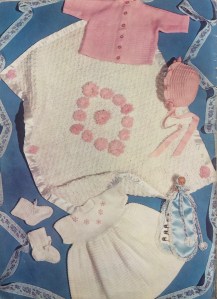
My April project was the cardigan jacket, a.k.a. “matinee coat” from Stitchcraft’s April 1962 layette set “for an Easter baby.” The set included a dress, the jacket, bootees, a bonnet and a blanket to use as a pram cover, plus a sewn “pin-tidy” made out of a tiny baby doll with flannel and satin “skirts” to hold the safety pins for baby’s cloth nappies. The pin-tidy is a bit “uncanny valley” for my taste, but the knitted items are all lovely.
My knitting group has a gift exchange game every December and my prize this last year was 100 grams of Opal “Beautiful World” 4-ply sock yarn, 75% wool, 25% polyamide, multicoloured. I don’t like multicoloured yarns, but hey, a gift is a gift and I knew I would find a use for it! Sock yarn works well for baby things, being washable and non-felting, and 100 grams was the perfect amount for the jacket. The colour is unusually dark for a baby garment, but I don’t this the friend whose baby-to-be I knit it for will mind — they wear a lot of black themselves. (Side note: I did make an all-black baby cardigan for a black-clothed metal fan father-to-be friend once, and he was thrilled, because he knew he would never find one in a store. Take note, baby clothing designers — there is a market out there!)
The construction is a simple dolman, made in pieces from the bottom up with cast-on sleeves. The button band is made with a slip-stitch hem and the stitch pattern in the lower part is an easy broken welt:
Row 1: (RS) knit
Row 2: *k2, p 6* to last 2 sts, k2
Rows 3 and 4: knit
I even found seven buttons — one extra! — in my stash that fit the buttonholes and the style really well (my local stores are still closed).
My only worry is that the neck is too tight. It looks awfully small. Of course, they can just leave the top button open if they have to.
The baby will arrive in June and I will “see” my friend next week (i.e. non-contact delivery of present, perhaps we will literally see each other through a window or something). I hope everything works out for them as well as this project did for me!
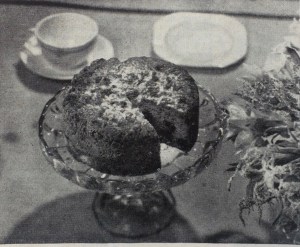
“Someone coming to tea, nothing much in the house and you are short of materials? Here are three recipes that don’t need much in the way of ingredients, don’t take long to mix and are delicious to eat.”
I’m obviously not going to have anyone over for tea anytime soon, since Covid-19 social distancing and isolation restrictions are still in full force. Not being able to go out to buy groceries very often if at all and having to use many non-perishable items that had been lingering in the back of cupboards did make me think of those recipes in earlier Stitchcraft issues, though. In Great Britain, many items were rationed even years after World War II ended, and easy, economical recipes in women’s magazines from the late 1940s reflected that situation.
Previously, I had made a “nut pie” from a recipe in Stitchcraft‘s December 1949 issue, and having found cashews, walnuts and almonds in the cupboard, I made it again last week. It was delicious, came out perfectly and I can really recommend that recipe with whatever combination of nuts you have on hand. Today, I felt like baking something sweet and found these recipes for a date-and-ginger cake, cheese scones and “oat crunchies” on the cooking page of the September 1949 issue. I didn’t have dates but I did have oats, margarine and dark sugar beet syrup (black treacle / molasses), so oat crunchies it was.
The recipe is simple: 3 ounces lard and 3 ounces margarine, softened in the oven and mixed with 14 tablespoons oats, 3 tablespoons syrup and 1/2 teaspoon “bi-carbonate soda” (baking soda), then baked in a greased tin, cooled and cut into squares. What could be easier? I don’t cook with lard, but I did actually have two kinds of margarine, so that was the only substitution, and I made a half recipe to try it out. The consistency of the mixture before baking should have been “fairly stiff” but it was surprisingly liquid. I guessed the margarine had softened too much, i.e. melted, so I added more oats. Then I baked it at “Regulo 4, or 375” (190 C) for 30 minutes as specified.
NAILED IT!
Oh, dear.
It bubbled up and sort of exploded in the oven while baking, burning a little on the top but still staying quite liquid throughout. It has cooled down by now and solidified slightly, but is still nowhere near “crunchy” territory — more like mushy granola. The recipe did say 3 ounces lard and 3 ounces margarine — maybe it should have been 3 ounces total? (I did remember to halve all the measures, so I definitely didn’t use twice as much fat as I should have.) It tastes absolutely delicious, though, as you might expect from something that is essentially fat mixed with sugar and a few oats!
Moral of the story: I probably won’t make this recipe again, definitely wouldn’t serve it to company (if anybody is allowed to visit ever again), but if anyone needs some fat- and sugar-packed lockdown comfort food that can be made without leaving the house for supplies, and doesn’t need to photograph said food for a blog or be seen eating it out of the baking pan with a spoon (ahem), this will probably fit the bill.









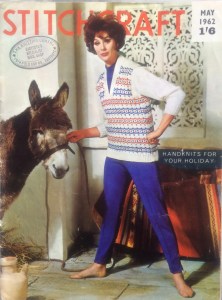 Handknits For Your Holiday! If you are planning on taking a holiday in 1962, that is. In that case, I would recommend going to the Algarve in southern Portugal, which, based on the pattern of the window shutters and blanket in the background, is where I am guessing this magnificent cover photo was taken. Sadly, my time machine is out of order and May 2020’s motto is (Lots Of ) Handknits For No Holidays This Year Or Probably Anytime Soon.


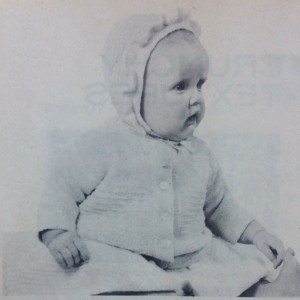 My April project was the cardigan jacket, a.k.a. “matinee coat” from Stitchcraft’s April 1962 layette set “for an Easter baby.” The set included a dress, the jacket, bootees, a bonnet and a blanket to use as a pram cover, plus a sewn “pin-tidy” made out of a tiny baby doll with flannel and satin “skirts” to hold the safety pins for baby’s cloth nappies. The pin-tidy is a bit “uncanny valley” for my taste, but the knitted items are all lovely.
 The colour is unusually dark for a baby garment, but I don’t this the friend whose baby-to-be I knit it for will mind — they wear a lot of black themselves. (Side note: I did make an all-black baby cardigan for a black-clothed metal fan father-to-be friend once, and he was thrilled, because he knew he would never find one in a store. Take note, baby clothing designers — there is a market out there!)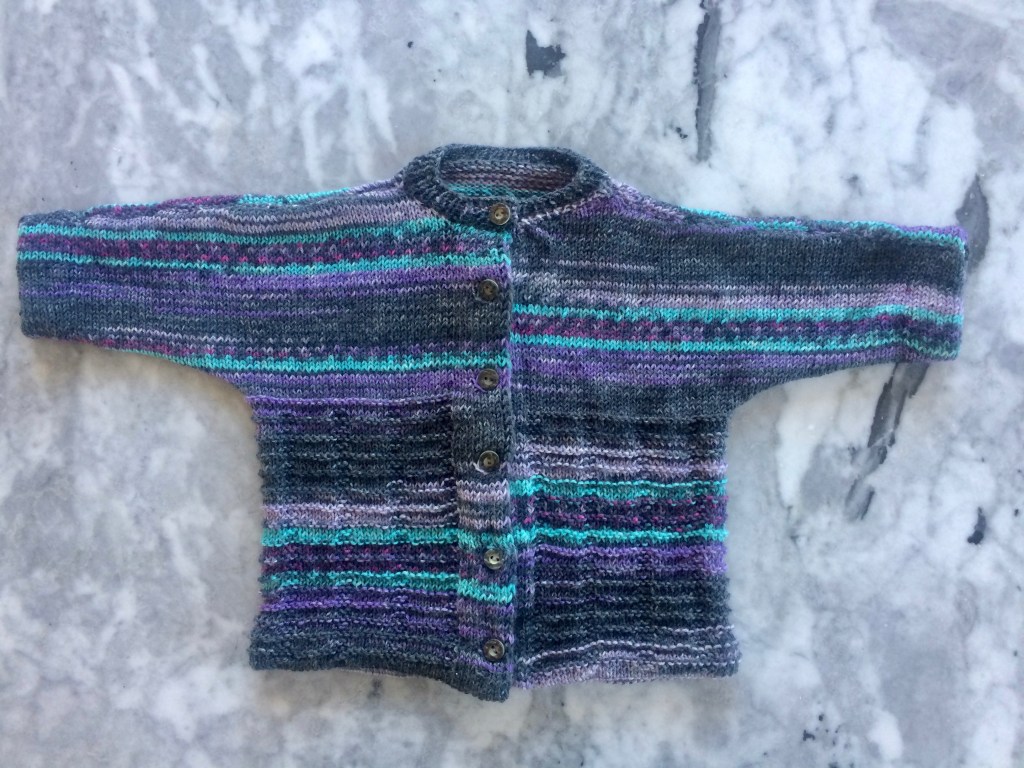
 “Someone coming to tea, nothing much in the house and you are short of materials? Here are three recipes that don’t need much in the way of ingredients, don’t take long to mix and are delicious to eat.”
 Previously, I had made a “


 The Stitchcraft Sixties