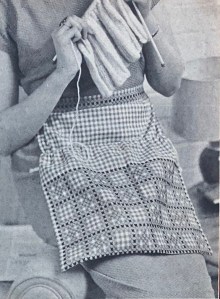
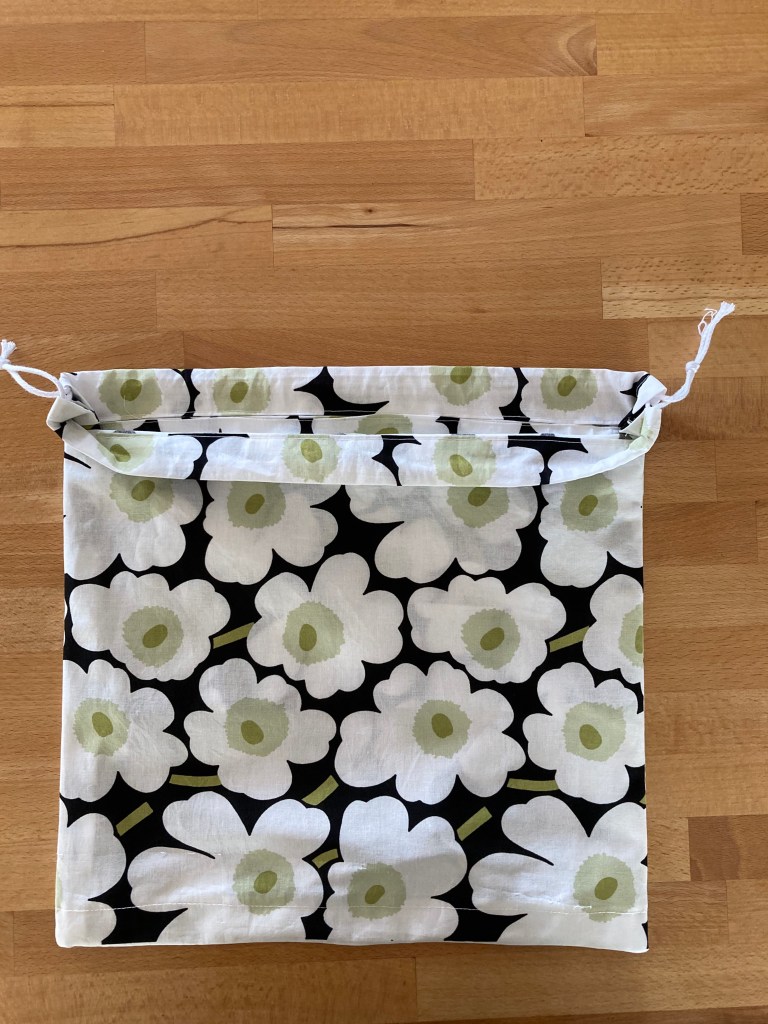
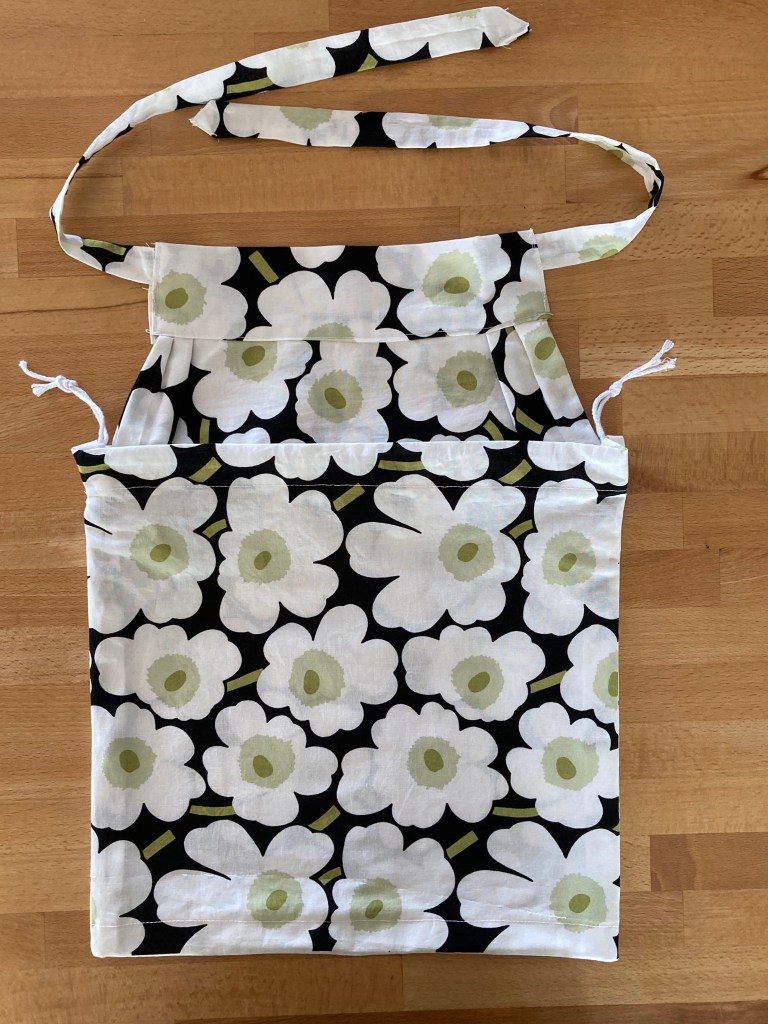
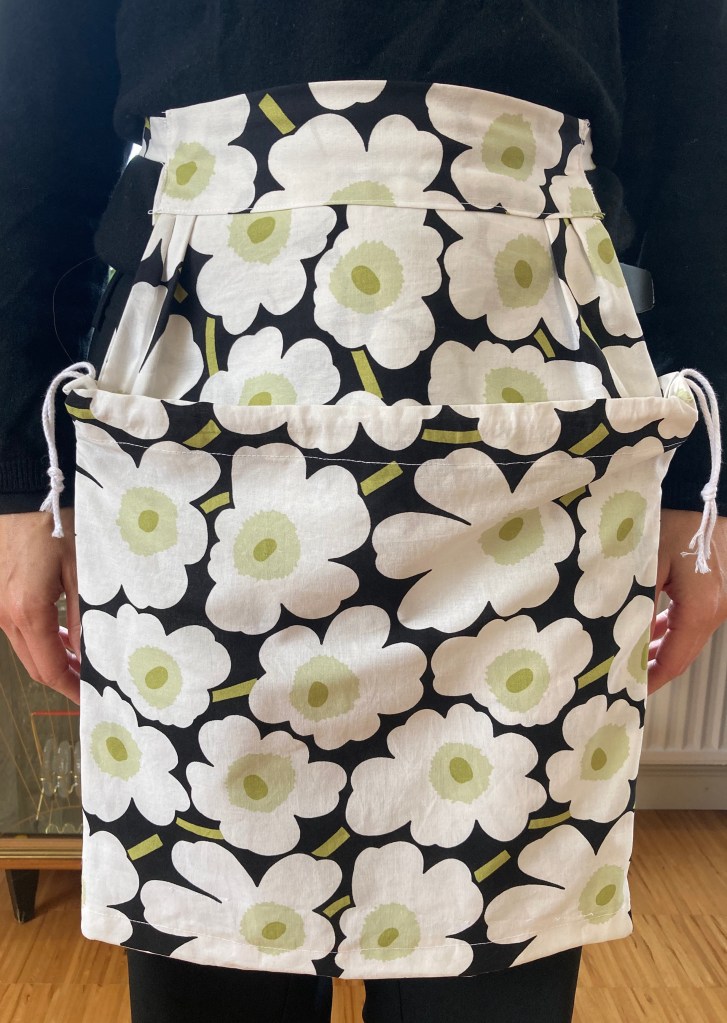
This month’s project was, as its name suggests, a knitting workbag with an apron-style top, allowing you to “tie it on and keep your wool in your pocket as you work.” Brilliant idea! I actually have a vintage, embroidered apron that I inherited from my grandmother that I use as a tie-on knitting bag, but this Stitchcraft project goes one better in that the apron top folds down into the bag when not being worn, allowing you to close the bag with drawstrings so that nothing falls out in transport.
It’s supposed to be made with gingham fabric and embroidered with cross-stitches in the gingham squares, but I have so many unfinished embroidery projects that I went ahead and made this one plain, using a nice cotton print from Marimekko.
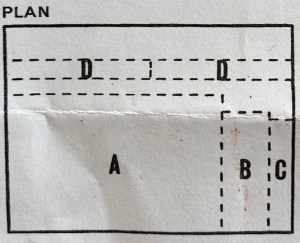
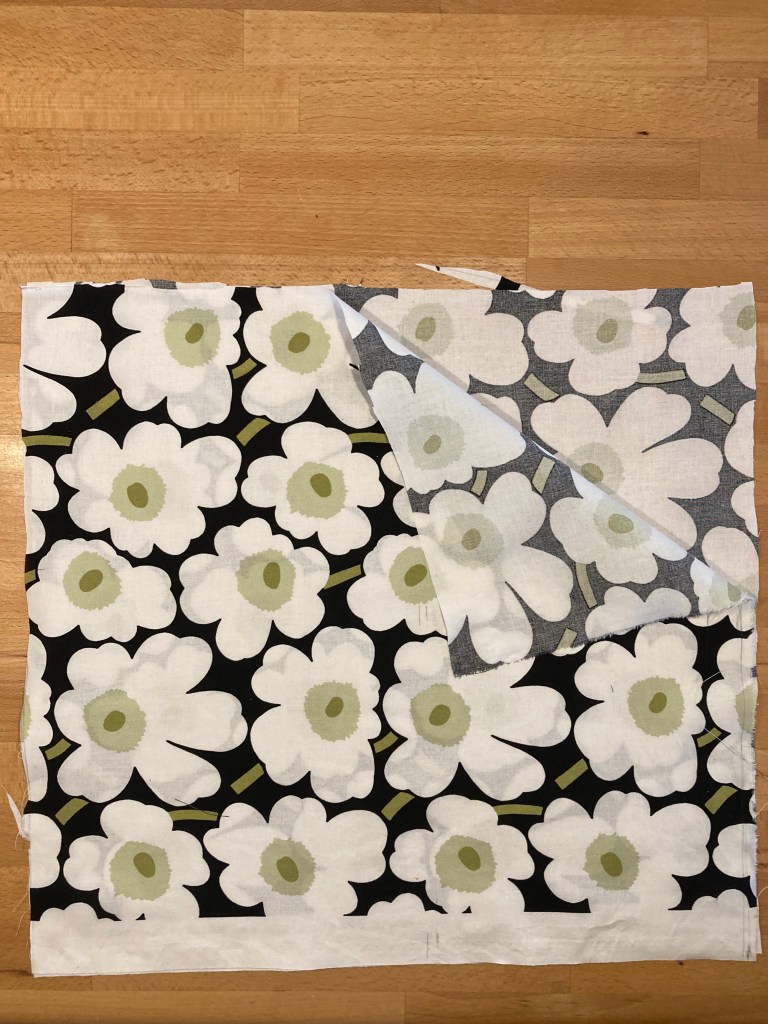
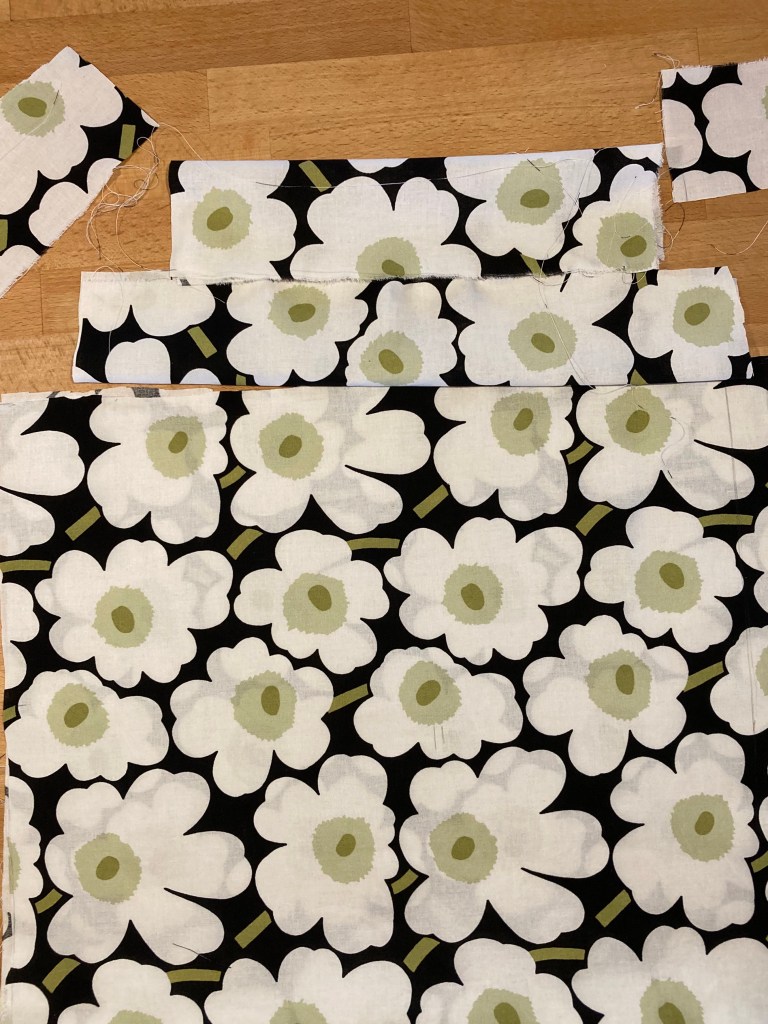
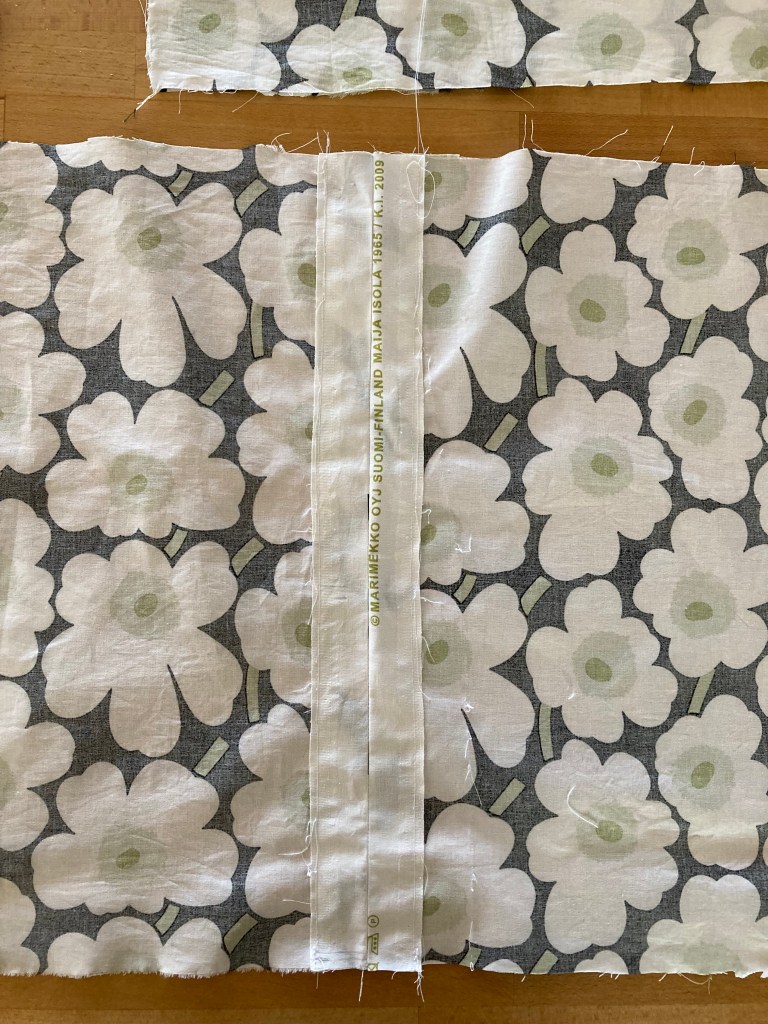
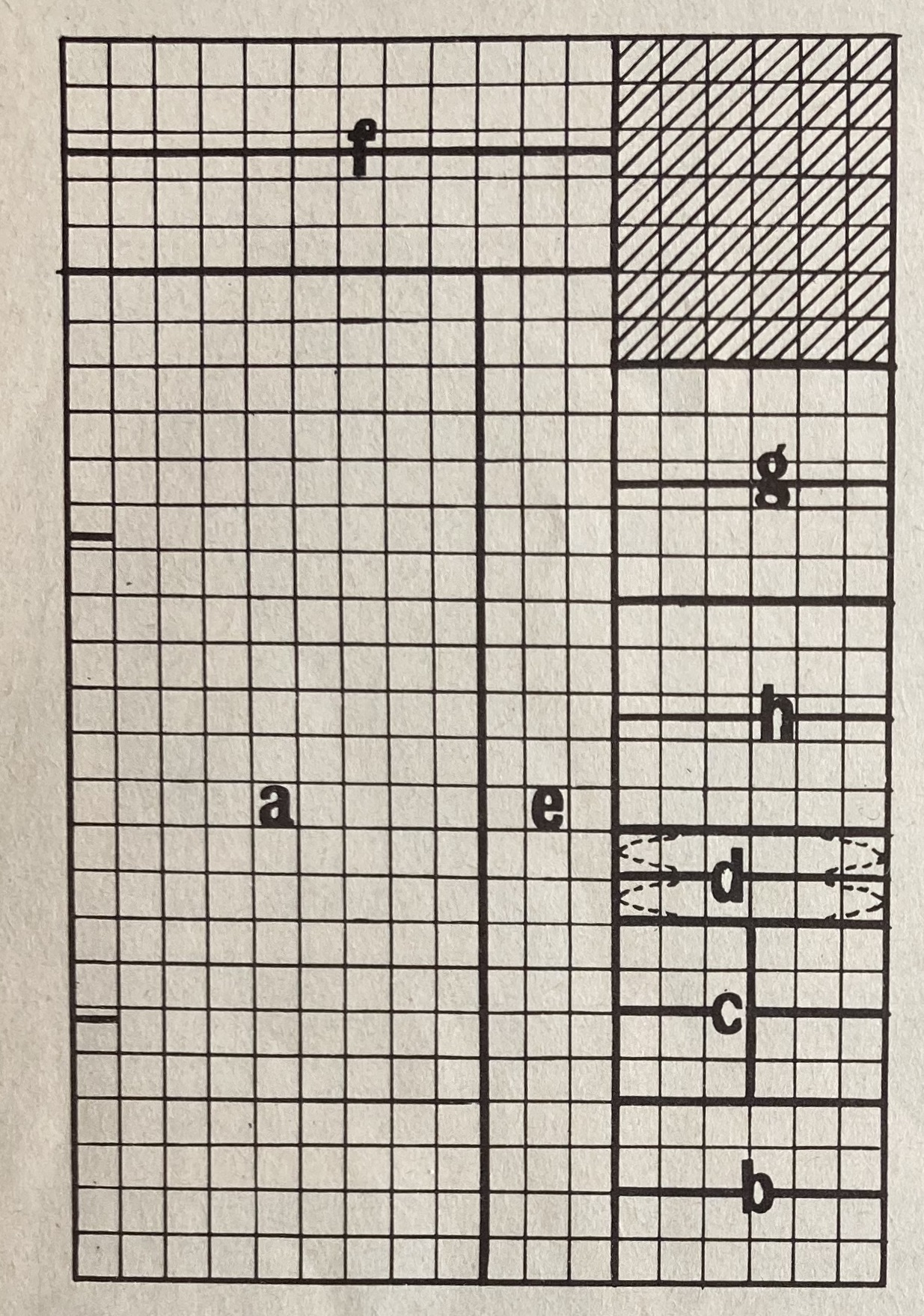
Since the “pattern pieces” are all just squares and rectangles, there’s a little chart showing how to divide up the fabric to get piece A (bag), B (apron top), C (waistband), and D (tie strings). After cutting out all the pieces (why are straight lines the hardest to cut?) I was suddenly confused: The bag, piece A, was 18×17 inches. That’s pretty big, and in fact looks just about that size in the photo, but a bag has a front and a back… Was I supposed to cut it on the fold? Or cut two pieces? The waistband is obviously folded in half, and the instructions for hemming the apron top make it clear that only one, unfolded piece was needed. Huh?
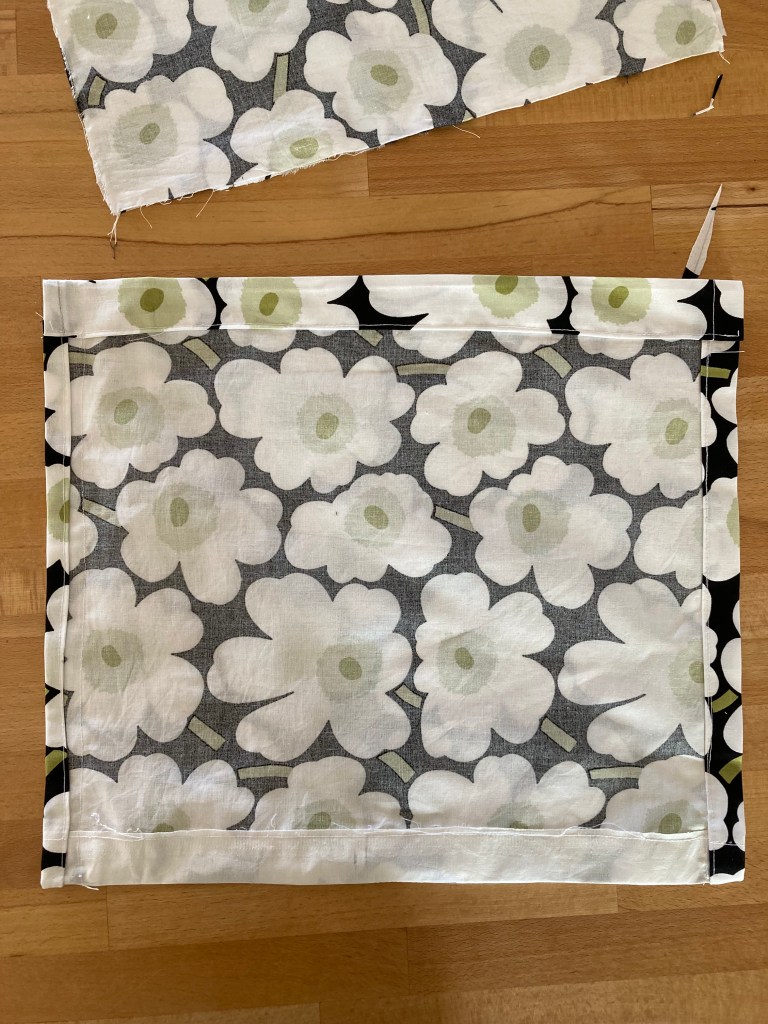
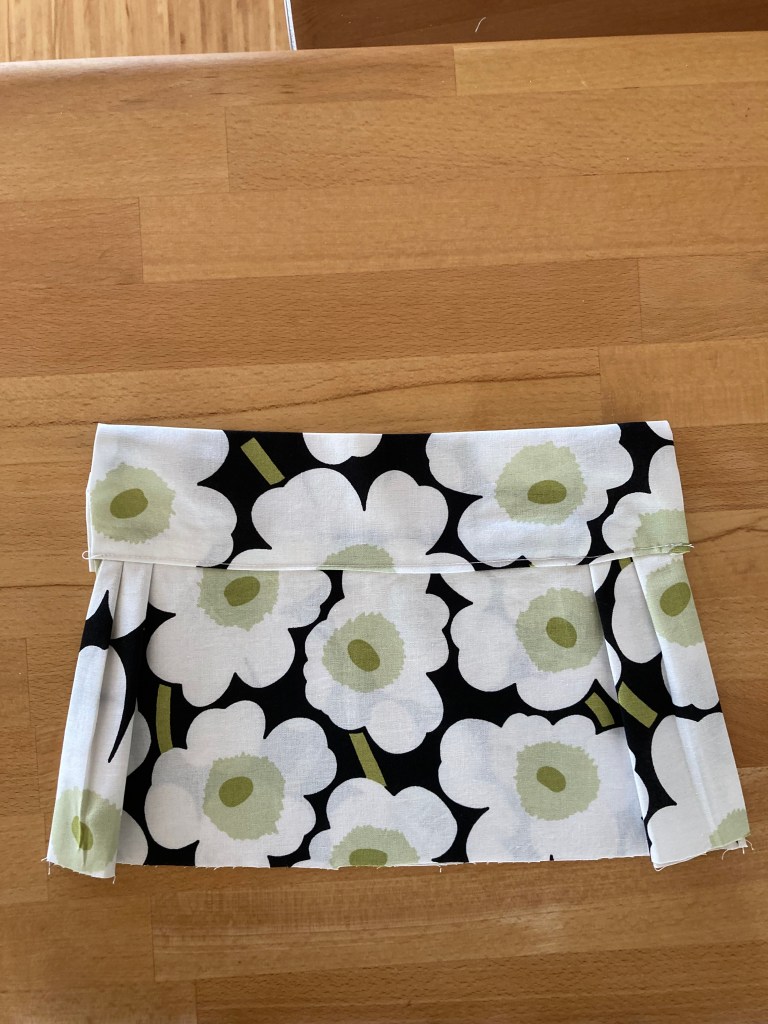
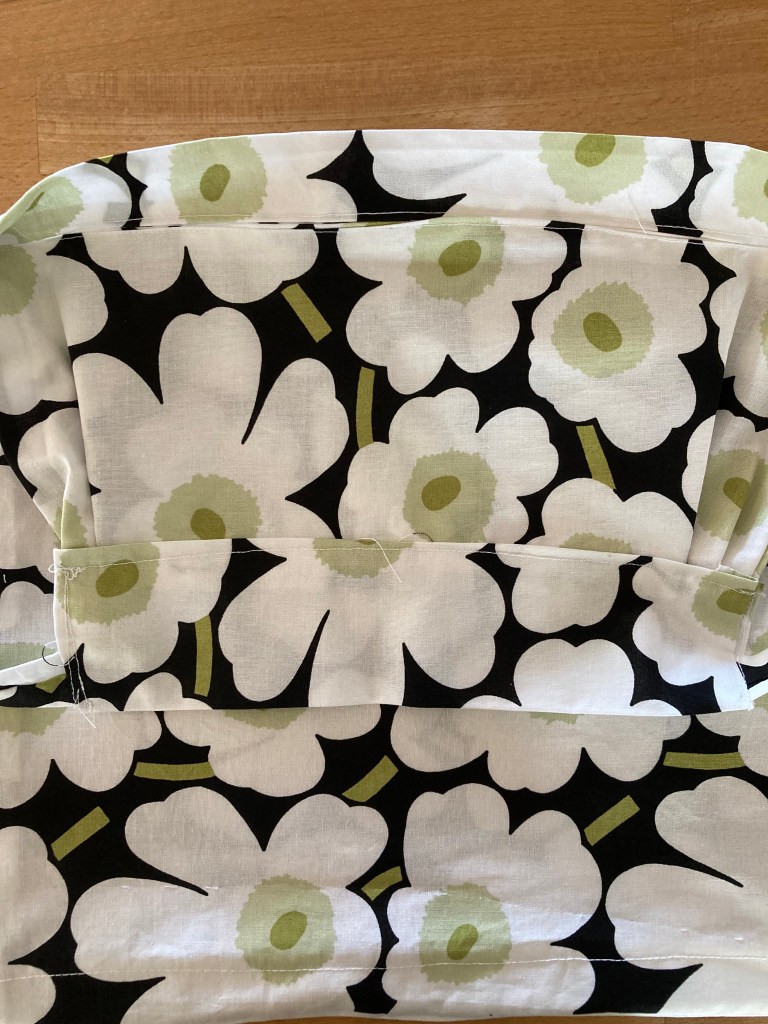
I cut another identical piece for the bag and decided to also cut another identical piece for the apron top, so the hems could be neater and the fabric stronger. I cut the two bag pieces with the selvedge on the bottom edge to make a very wide seam allowance, which I could then open up and sew down to make a really sturdy bag bottom. Similarly, I hemmed the side edges before making the side seams instead of zig-zagging the raw edges. This made everything very sturdy and very neat.The apron top is made with a couple of little pleats on the sides to bridge the width difference between bag top and waistband. Before it was sewn on, it looked like a little doll miniskirt!
The apron top is sewn into the back part of the bag, so that it folds down into the bag when not in use. I was really glad I had made the apron top double, as it makes the seams even neater and everything looks very smartly finished from every angle, inside and out. (I am a sloppy sewer, so always impressed with myself when lines are straight or seams are not ragged.)
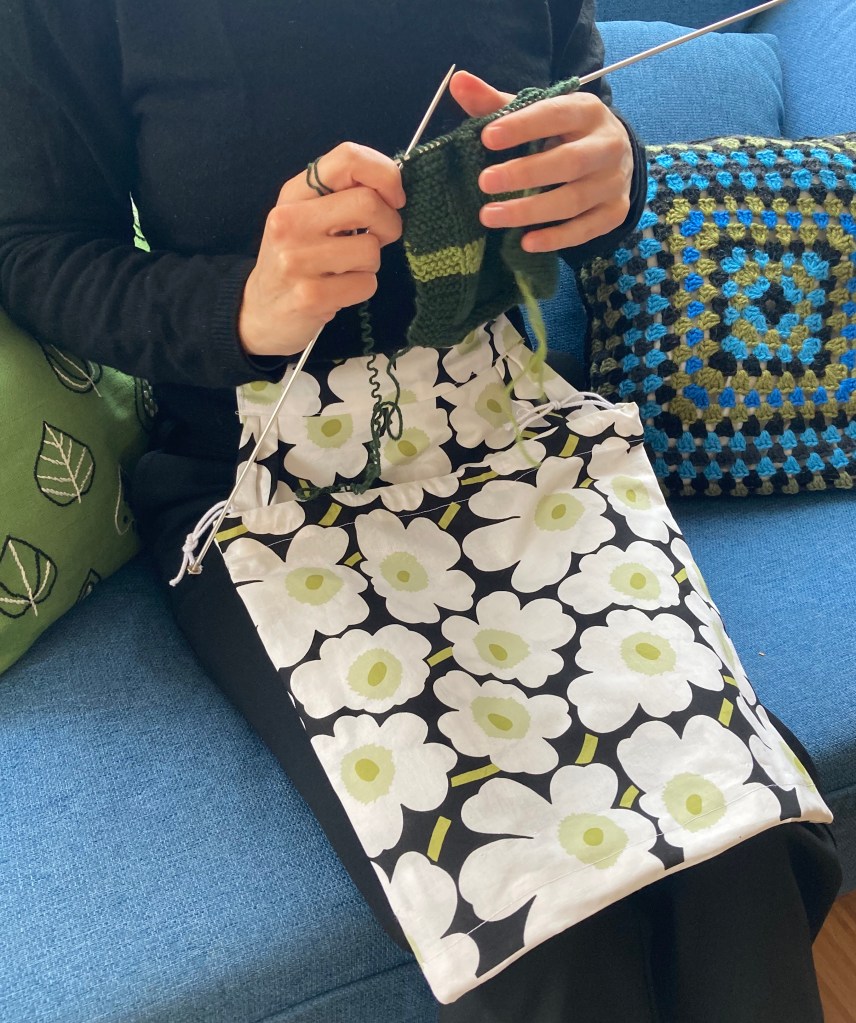
That was it! I finished the whole thing in three hours. It works perfectly and I can use it to knit while standing, walking, sitting in the train, etc. without worrying that my yarn will roll away, and it packs up in a flash. The bag part is quite large — if I made it again, I would make it slightly smaller. Other than that, it’s perfect. I imagine it would be a lot of fun to make in felt, with an embroidered front part, and that I could adapt a lot of the typical Stitchcraft designs for embroidered chairbacks, cushions, tea cosies etc. to make more of these.
This month’s project was a crocheted cushion “to use up your wool left-overs.” It was promised to be “very quickly and easily made”, and it was! Nota bene, today is September 5th, I started this project on the evening of September 1st, and it is already finished, including blocking and photographing. I don’t think I have ever made any project, no matter how small, that went this fast.
It’s designed for DK wool and the original colours are black, flamingo pink, silver and white. Of course, I used leftovers of DK wool that I had in stash, and they happened to be more in the blue and green spectrum. The black is Jamieson’s Double Knitting left over from this blazer, the dark grey and turquoise are Reginella wool-alpaca mix from Chile left over from a non-vintage project, the more blue-blue is lovely Schoeller&Stahl left over from swatch knitting, the slightly darker green is Drops Lima left over from another non-vintage project and the lighter green is not technically a left-over, but hand-dyed wool from a knitting colleague. Yay, I used up some leftovers! The pattern is a standard granny-square shell stitch which just continues around to make… two giant granny squares.
I worked on both squares (front and back of cushion cover) at the same time in alternatum and was glad I did, because I ran out of some colours sooner than expected and had to adjust the colour scheme accordingly. I like how the colours turned out. The finished size in the pattern is 13 inches square, but I happened to have a cover-less cushion in the sewing drawer that was about 15 inches square, so I added another colour pattern repeat to make it fit. I considered dyeing the cushion turquoise, since I had some fabric dye and the crochet is fairly hole-y, but in the end I thought the white cushion showing through gave the dark colours in the crochet work a bit more pop. The edges of the two squares are crocheted together on the right side.
What more is there to say? I now have time to finish all those WIPs, so stay tuned for progress on the August 1963 cardigan… and the April 1963 embroidered blackwork cushion… and the I-don’t-even-remember-when-I-started-it-it’s-been-so-long epic Jacobean appliqué cushion. So many cushions, not enough sofas! Here’s one, at least.
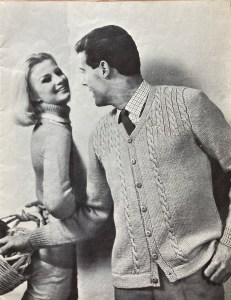
The August 1963 issue had some nice projects in it, most of them pretty labor-intensive. None of the women’s garments spoke to me and while I liked some of the embroidery projects, I still hadn’t finished my blackwork butterfly cushion (From April. April !!) and was not going to start on a huge tablecloth. I loved this cabled men’s cardigan, though! It has a nice classic form and just enough detailing to keep the knitting interesting. And it’s made in DK weight wool, so it should go fast… right?
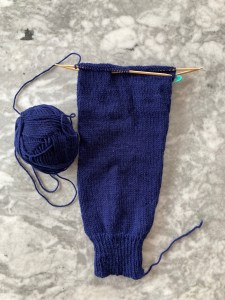
Ha ha. No, of course it did not go that fast. I had been trying to finish up a lot of other wips (not necessarily vintage or Stitchcraft-related) and the pandemic had eased enough in my corner of the world that my work started up again, so the cardigan was not nearly finished at the time of the first draft of this post. As of August, I had knitted one sleeve completely and was quite a ways on the other sleeve and that was all.
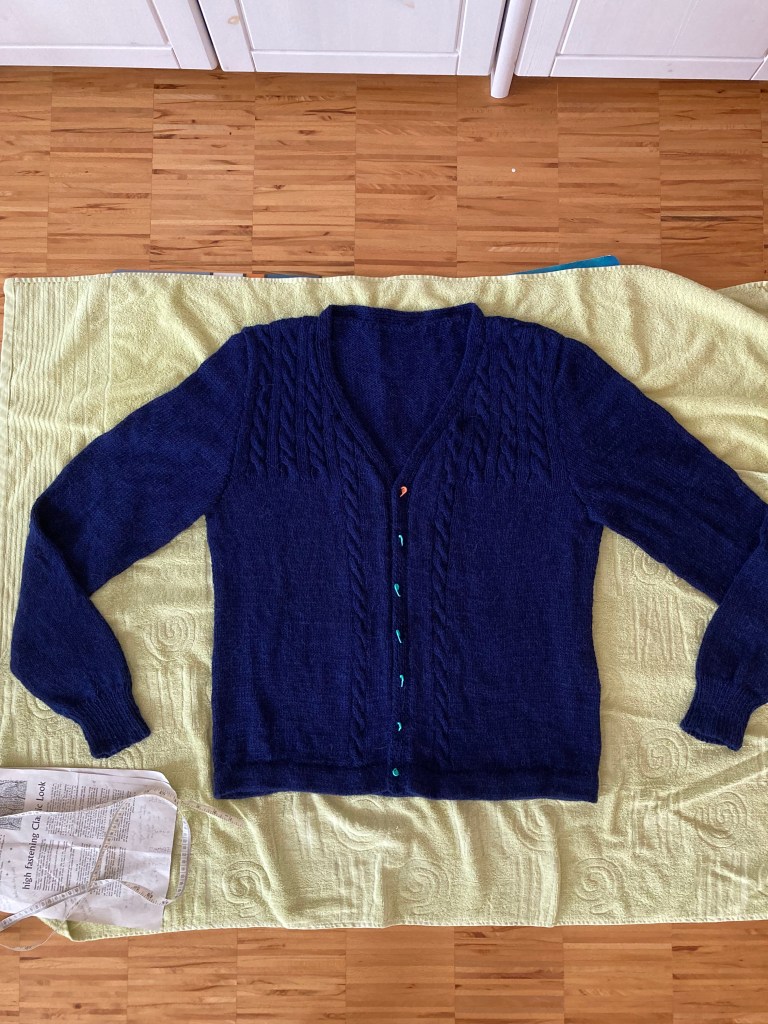
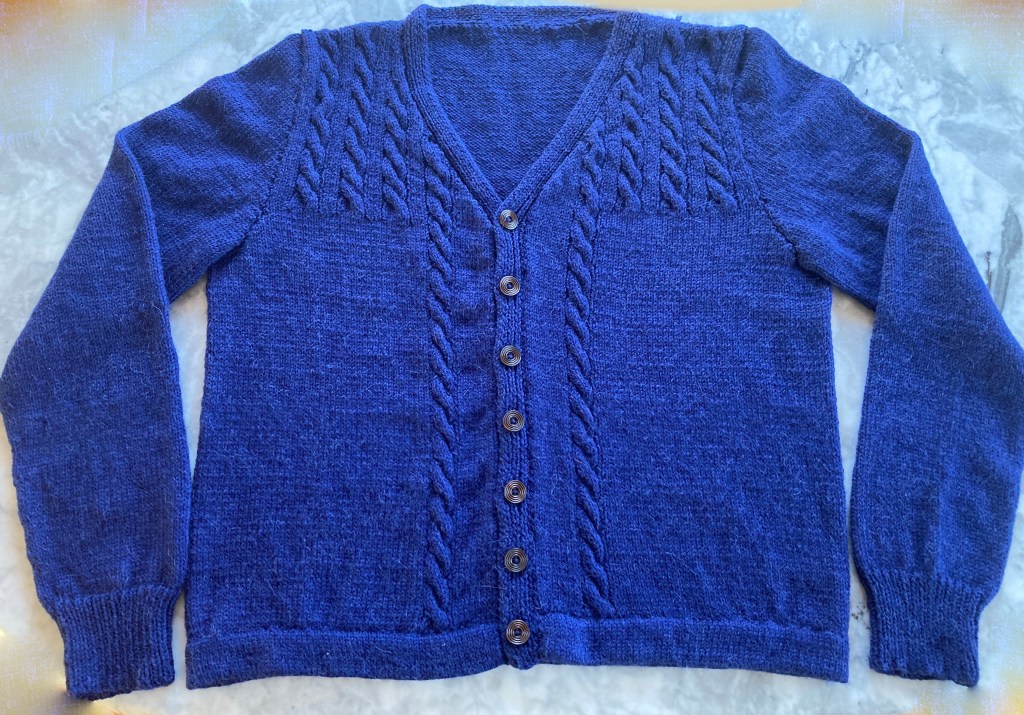
I would be happy to wear this design myself and could have juggled the proportions and made it in a smaller size for me. At the same time, I have so many clothes and a close family member who would love to have a nice hand-knitted cardigan has a “big” birthday coming up later this year. At his request, I made making the cardigan in a lovely shade of deep blue in lovely Drops Garnstudio Lima (65% wool, 35% alpaca.) He hasn’t seen the design (that part will be the surprise).
The sleeves are quite straightforward stocking stitch, so not much to report. I really loved the wool.
I made the body in one piece to avoid having to seam more than necessary (likewise, I made the sleeves in the round). The cable pattern is quite standard, but used here in an effective and interesting way to narrow the top yoke. The hem at the bottom is neat and tidy and does not flip up.
The intended recipient is slightly bigger than the largest size given in the pattern, so I made the cardigan on 4 mm needles for a bit looser gauge. Recipient is also more square-shaped than the “rectangular” model in the photo, but it will fit him with the same amount of ease.
That’s pretty much all there is to say! It came out perfectly and will be delivered on time for the big birthday. I’ll also definitely keep this pattern around to maybe make another one for myself some time.
My July project was this sleeveless jumper with contrasting colour accents on the collar, upper bust and hem.
It’s written for Patons Cameo Crepe wool, but I thought a summer top like this would be more practical in cotton. Sadly, it is nearly impossible to find a truly fingering-weight, non-mercerised cotton yarn. Crochet cotton is always mercerised and I don’t like the stiff and shiny look and feel. Non-mercerised cotton is generally DK weight i.e. too thick. The only company I know that makes a nice, soft, pretty much fingering-weight cotton is Mayflower and I can’t get their yarn anywhere at the moment. Also, it’s summer, and cotton yarns, especially seem to be only available in “summer colours” of white, neutral and pastel, which I do not like or wear. What to do?
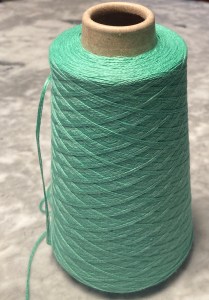
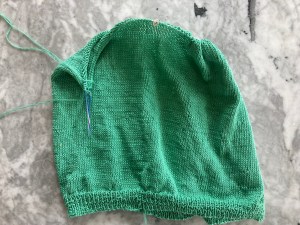
Well, remember my May project — the child’s T-shirt made with cotton from the Hamburger Wollfabrik? (Again, city, not food…)When ordering the yarn for that project, I went ahead and ordered 250 grams of the same cotton 4-ply yarn in a slightly darker colour, thinking that I would probably want to make a summer cotton top for myself at some point. That was good forward thinking… only, after making the May project, I realised I really didn’t like the yarn, as it was un-plied and therefore splitty and difficult to work with. The green colour I chose for myself was also still too “cold” — not dark enough or green enough for my taste. But since I didn’t know what else to do with it, I went ahead and used it for this month’s project.
The pattern is basically stocking stitch with “lines” of purl stitches to make a just-slightly-like-ribbing, geometric effect. It has a hemmed bottom edge, which was very much in fashion for knitted garments in 1963. As far as hems are concerned, I should probably have learned a lesson from this jumper from last year, which was also lightweight and hemmed, and has continually gotten shorter and wider with time — the hem neither weighs enough nor cinches in enough to keep the sideways expansion in check, thus ruining the “long-line” effect and making me look short and dumpy in it. At this point I am convinced that hems do not belong on knitted garments unless they are heavy enough and really need to be flared at the bottom, e.g. an A-line coat, but of course I didn’t have the foresight to think about that before starting and replace the hem with ribbing. We’ll see how it turns out.
The knitting itself was boring and slow. The intarsia diamonds were fun, at least. (I used bits of leftover black merino for the contrast colour parts.)
The sleeves are finished with simple ribbing that is supposed to be turned in and hemmed, like the bottom edge, but I decided it looked better with just ribbing. The collar is made, in typical 1960s style, without short-rows as one would probably make it these days — there are increases and decreases at the front “corners” to make the shaping. The black edge of the collar is also hemmed and then the collar is sewn on.
This will probably never be my favourite project, but it turned out better than expected. The colour is not the best for my skin tone, but it looks much better now that I have pink hair! Also, I should have made the larger size. It fits OK, but a bit longer and wider would be more in keeping with the way it is supposed to fit. Also, the neckline is very tight — I can hardly get it over my head and definitely not over a bouffant hairdo. (And a top should always fit over your bouffant hairdo.) But it’s comfortable and fun — and best of all, it’s finished!
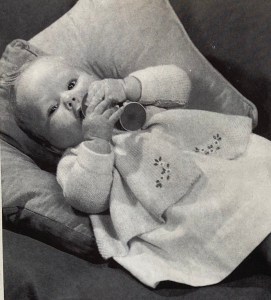
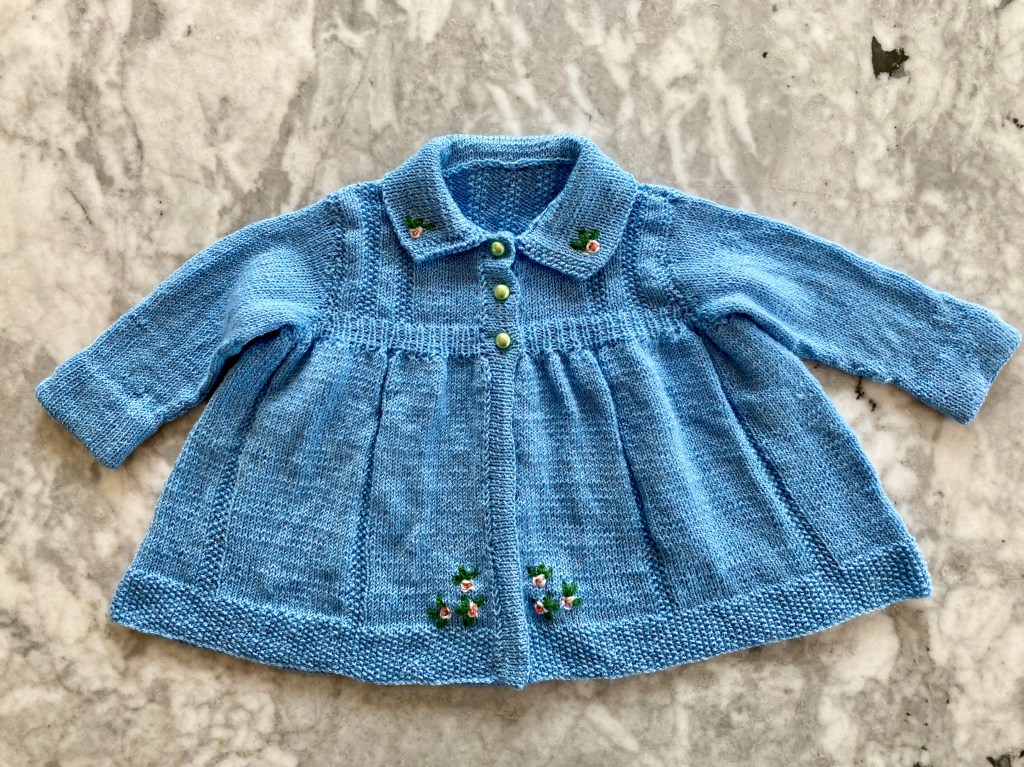
My June 1963 project was a lovely (if not quite as practical as the title suggests) “matinee coat” for a baby. Two styles are given in the pattern, “for a girl” (long coat with ribbing at the waistline, flared skirt and collar) or “for a boy” (straight up and down, basic cardigan styling.) Both styles have dainty flower embroidery as decorative accents. Not wanting to inflict 1960s gender roles on a modern baby and also not having a personal preference, I asked one of the child’s parents which style they liked more, and the answer was “the long coat”, so the long coat it was.
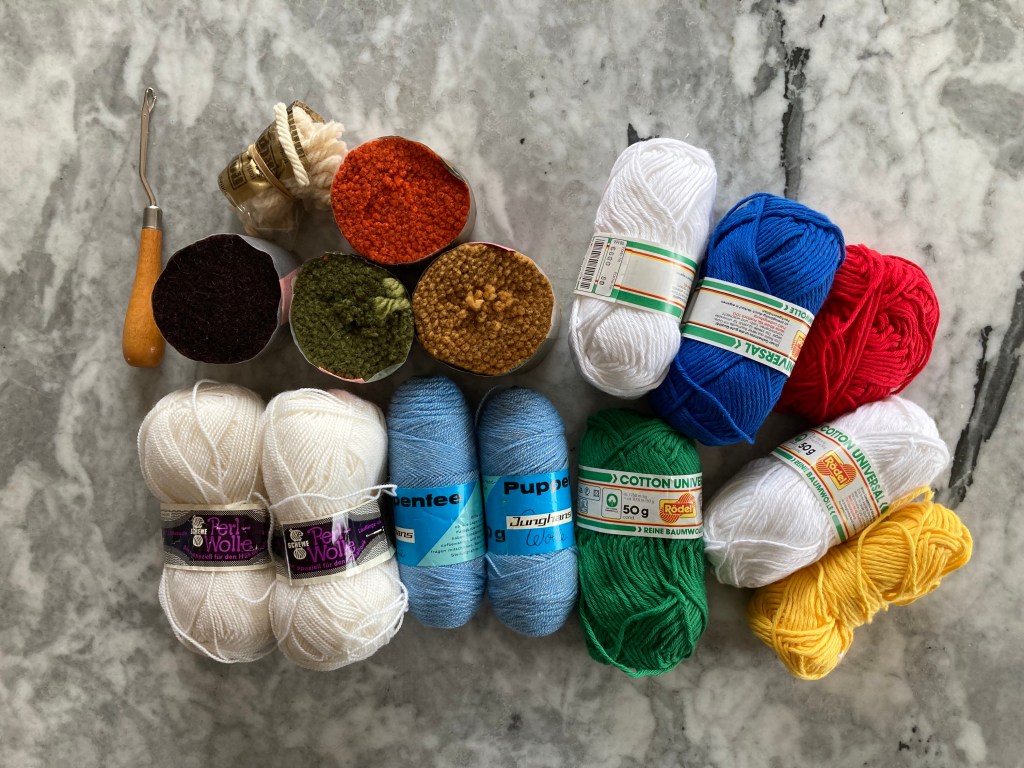
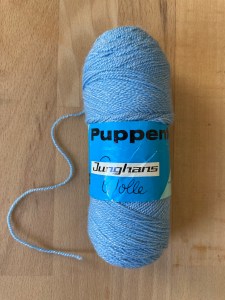
As for the wool, last year another colleague of mine, who knows that I like to knit from vintage patterns, came into a rather large stash of yarn when an elderly relative moved into a care home. Apparently, she (the relative) had liked to crochet and make latch-hook rugs, and when the younger generation of non-crafters cleared out her house, my colleague knew who would give the yarn a good home. There was some great stuff! In addition to a latch hook and some cut rug yarn in very 1960s shades of brown, tan, rust, beige and olive green, there was enough bright cotton to make a crocheted baby blanket, some nice, soft, plain white wool that would be great for baby clothes, and 400 grams of light blue “Puppenfee”, a yarn made by the German Junghans Wolle company in the 1960s? 1970s? which combines light 4-ply wool with a shimmery, presumably nylon or Lurex “Effektfaden”.
Just a selection — there was a lot more of each type of yarn!
The base colour is light blue, and the nylon strand makes the knitting softly sparkly and also very elastic — perfect for a baby cardigan. Happily, light blue was also the parents’ preferred colour, I had plenty of it and the tension and size in the pattern were perfect for this one-year old infant.
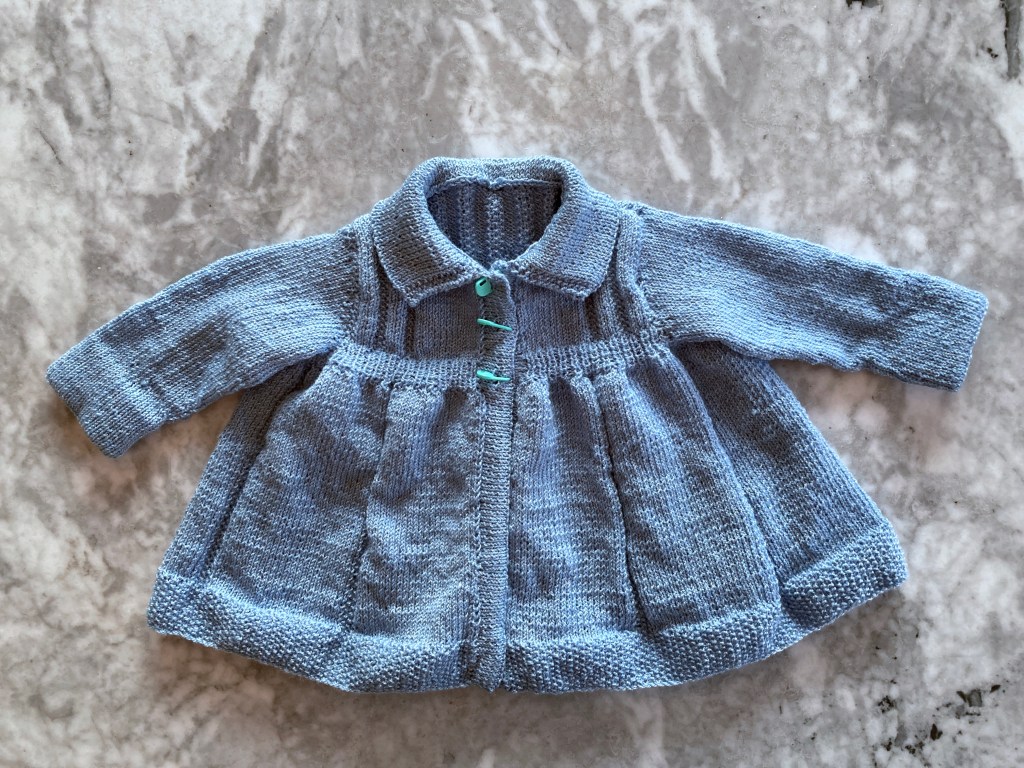
The coat is made in one piece from the moss-stitch lower border to the armholes, and the moss-stitch is carried up throughout the stocking-stitch skirt part in narrow vertical bands that make the skirt pleat prettily after the waist is gathered in with decreases and ribbing. Then the fronts and back are continued separately. I made the sleeves in the round from the top down, since that was faster, and made them a little longer than the pattern called for, as the baby is on the tall and thin side and will presumably get longer in the arms before it gets wider in the middle. (Though you never know with babies, but the cardigan is big enough to hopefully fit for a while in any case.)
Both the sleeve edges and interestingly, the collar are hemmed — in the case of the collar, that means stitches are picked up around the neckline as usual, then the collar is knitted in stocking stitch the “wrong way out” i.e. the inner side would be facing once the collar was opened down, then you make a purl ridge for the fold line and knit stocking-stitch for the depth of the collar back again and then sew it together. The result is very neat and crisp. There’s a narrow band of moss stitch (just 3 stitches) at the front corners of the collar to tie it together with the bands in the skirt.
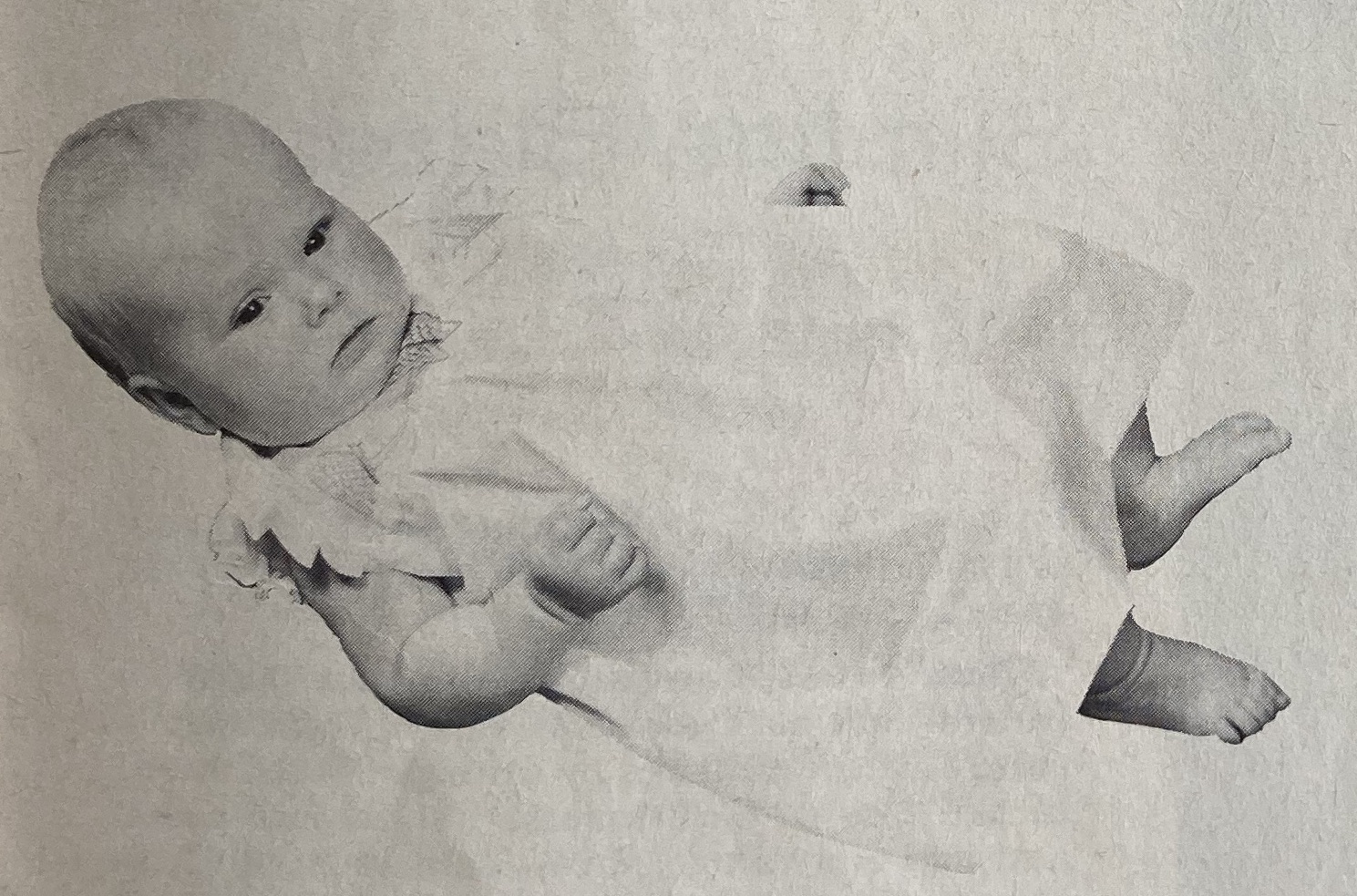
The rosebud embroidery was very easy, no transfers, just a sketch in the pattern and colour choice suggestion. I used bits of leftover Jamieson & Smith Shetland wool in pink, white and green as suggested and finished everything off with three little buttons from stash. Do the buttons look familiar? They are the same ones I used on this “Sunday Best Dress” project from March 1963 / March 2021. And yes, it is even for the same lucky baby! Maybe, with the parents’ permission, we can even re-create the pattern photo. Until then, here it is without the baby — I actually got a project done on time for once!
I am very happy with the finished coat and I hope the baby and parents are as well.
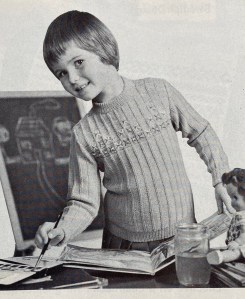
My May project was this jumper “from a Viennese design” for a young relative whose birthday was in May. Spoiler: unfortunately, the jumper was not ready in time for the birthday. May went by so quickly and I feel like I hardly made progress on any of my multiple unfinished projects. Let’s hope the kid doesn’t have a growth spurt before I finally get this done.
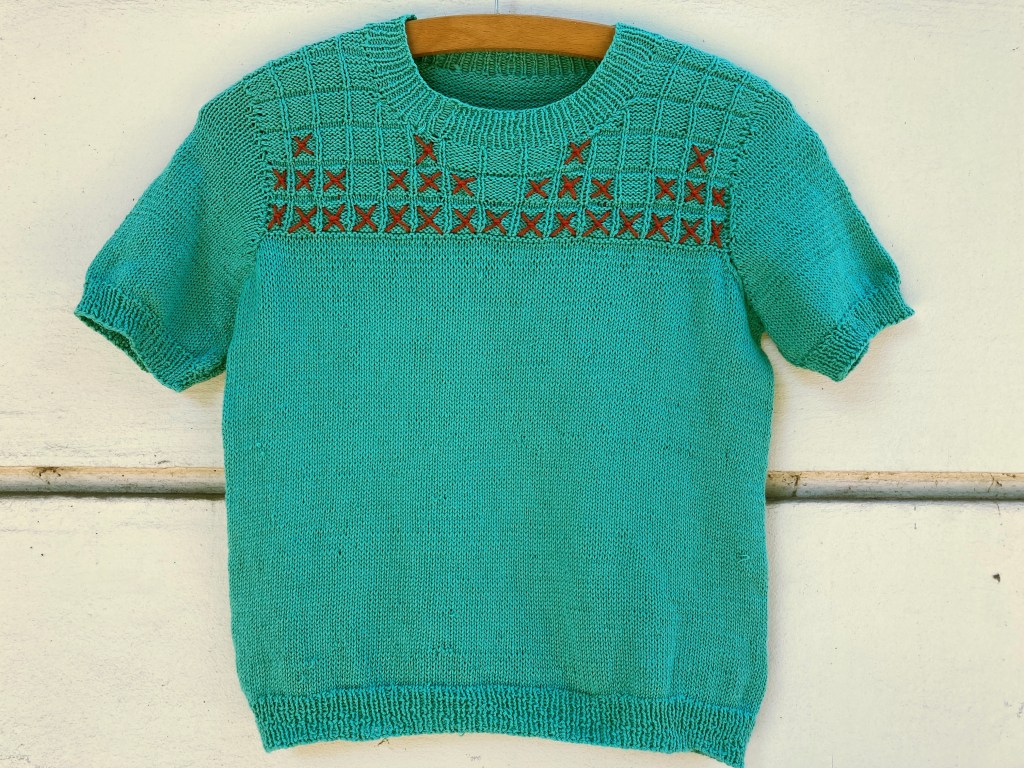
The jumper is written in a narrow reverse-rib pattern and the interesting stitch design on the yoke is embroidered on later. The recipient of this project was not opposed to the embroidery but very adamant about wanting the garment to have a “smooth texture”, i.e. stocking stitch. I aim to please, so stocking stitch it was, except for the yoke.
Said relative lives in a warm climate and is somewhat sensitive to wool at the moment, so I decided to make it in fine cotton. The tension according to pattern is 14 1/2 stitches in 2 inches, which is as much as I can ever accomplish even with very fine yarn and tiny needles, so finding cotton that works for me at that gauge is difficult — most cotton yarns are mercerised DK weight for making dishcloths, accessories, amigurumi, etc. Of course, there is always fine crochet cotton, but that is usually also mercerised (I don’t like the shininess of mercerised cotton.) Mayflower DK makes a lovely fine-gauge cotton that is hard to find in stores and can’t be ordered from their (Danish-language only) website. Yarn stores were still closed in my area in any case when I started this project and I didn’t have anything appropriate in stash. Luckily, the wonderful Hamburger Wollfabrik spinning mill company (as in, the German city of Hamburg, not the food! I realise that name sounds funny when you read it in English…), which was closed for a long time after a burst pipe caused severe water damage a while ago, is back up and running online with a brand new website and a beautiful selection of yarns of different fibres and weights. I chose the super-combed cotton in a 4-ply weight and a spearmint green colour.
I was happy with the weight and colour of the yarn but unpleasantly surprised to see that it was completely un-plied! Nowhere on the website does it say what kind of twist they use, nor is there an option to select what you want, but the yarn in the sample colour photos definitely looks plied and my yarn was utterly not. It is really, really hard to work with un-plied cotton, as it just splits everywhere. I guess I should call them next time I order from them and ask about that.
It is also very lightweight, which is lovely. I used that to my advantage by making the finished garment short-sleeved, making it a fancy knitted T-shirt and not a jumper. but the finished garment will be more like a T-shirt than a jumper. I tried a couple of combinations for the yoke and decided to make it in the pattern stitch with the large contrasting cross-stitch “pyramid” design in bright orange.
It blocked out kind of uneven, as I didn’t have a clothes dryer. Strange to have a knitted item that should not be dried flat! But I think this cotton needs the evening-out and fluffing-up effect of a dryer.
The combination of boring stocking stitch and un-plied yarn made progress very slow, but I got it finished by the middle of June, at least. Let’s hope the kid likes it!
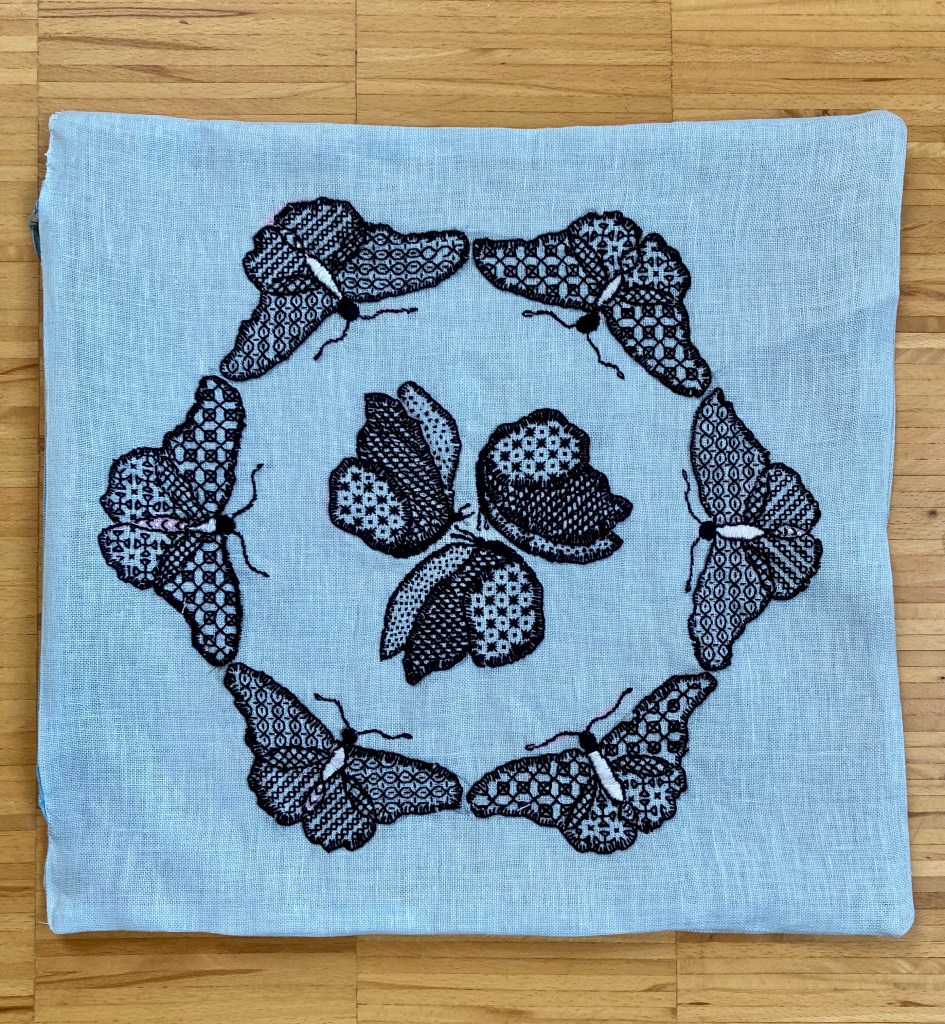
“For the embroideress who likes to tackle something different” came this amazing design from Stitchcraft‘s April 1963 issue. I am daunted by blackwork embroidery, having tried it only once until now with this cushion from the September 1960 issue. It’s fundamentally a form of counted embroidery, like cross-stitch, except that the stitch patterns aren’t crosses. The fillings are worked first using different geometrical counted patterns and the outlines and details are then added in (non-counted) crewel stitches like stem stitch, satin stitch, buttonhole, etc.
My biggest problem with all forms of counted embroidery is finding the proper ground fabric. The standard “Aida” fabric often used for cross-stitch is way too large, but furnishing linen, like the kind I mistakenly used for the fish cushion, is too tightly woven, making it impossible to count the holes properly and get the filling stitches to line up properly and look right. With the fish cushion I ended up just freehanding it, which is fine if you don’t look too closely but is obviously not the right procedure. I resolved to find the perfect-size linen this time!
… during a never-ending pandemic, where even if there were a shop nearby that sold all different sorts of embroidery fabrics, it would not be possible to go in and look at them to see how tightly woven they really are, as retail stores were closed in my area at the time. Of course, online shops give you information about the thread count and weight! Well… some give information about the weight, and some the number of threads per centimetre, and some just show a photo, which is utterly useless because who knows from how close it was taken?
The pattern is written for Glenshee Embroidery Fabric quality 212, a type of fabric that apparently does exist again after being unavailable for decades, but which seems to be available from exactly one distributor in two colours (beige and grey). At least I was able to find out what kind of thread count it had: 29 threads per inch, which converts to 11.6 threads per centimetre. I would be happy with anything between 11 and 12 and I wanted the fabric to be blue.
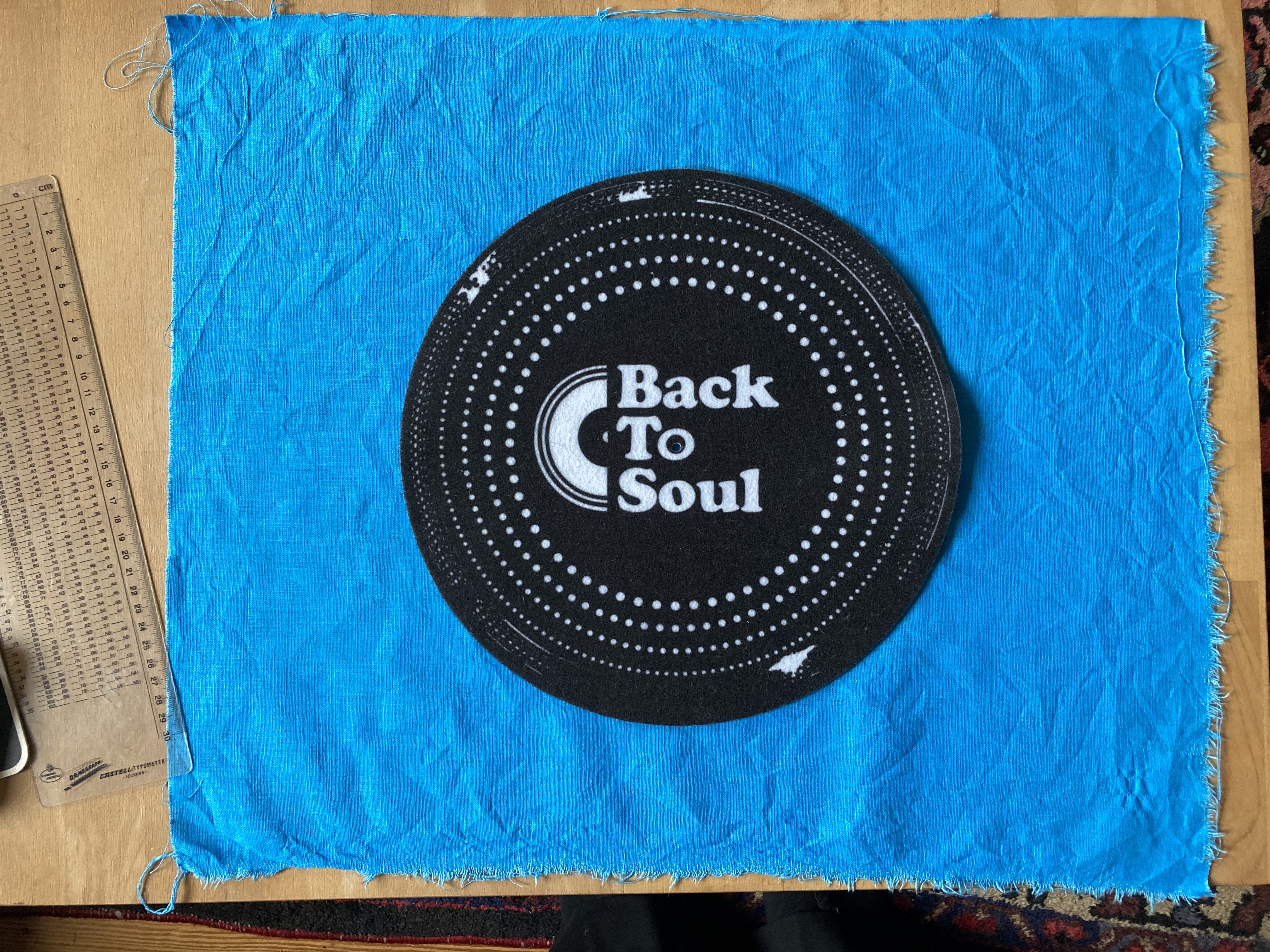
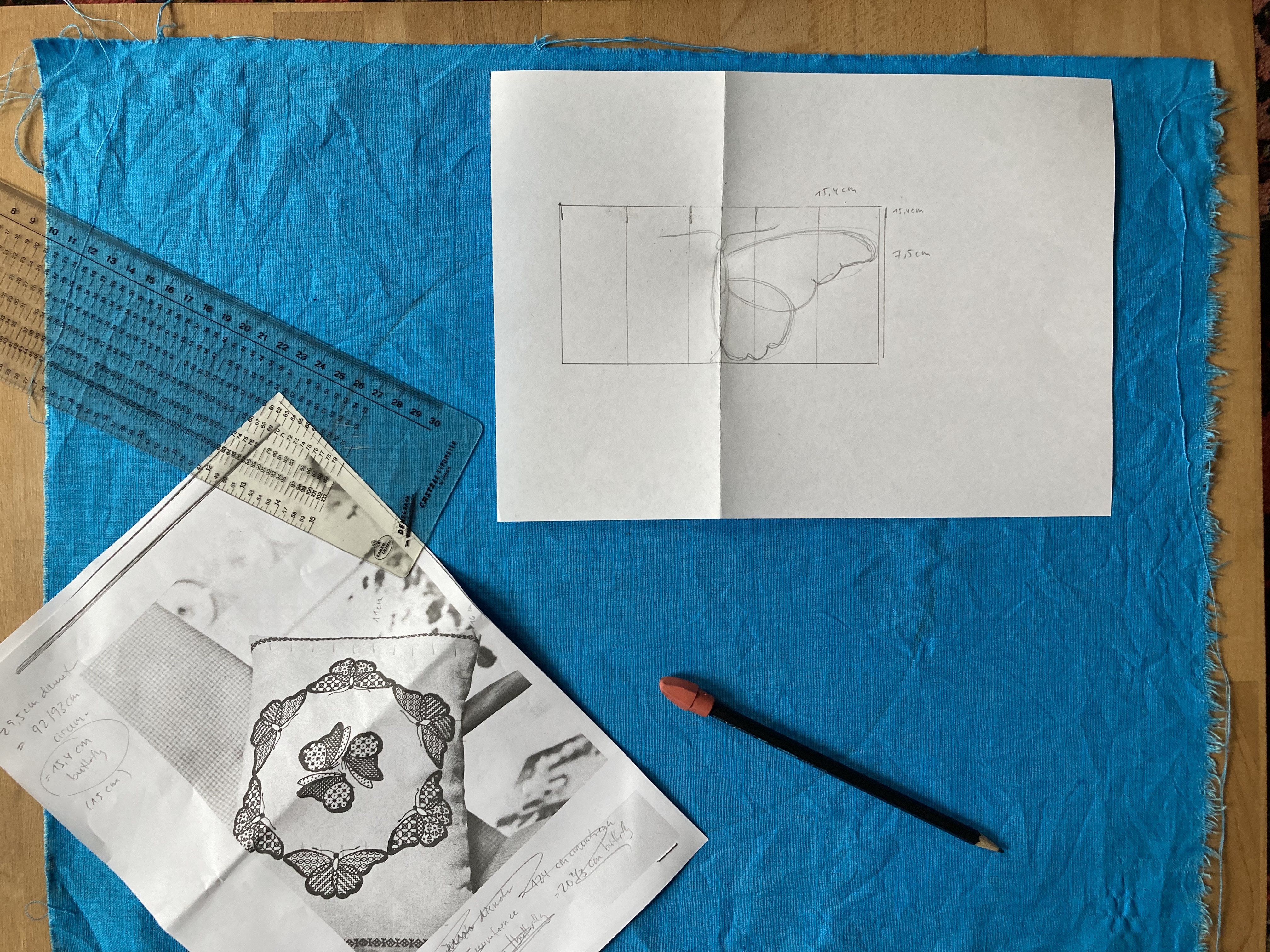
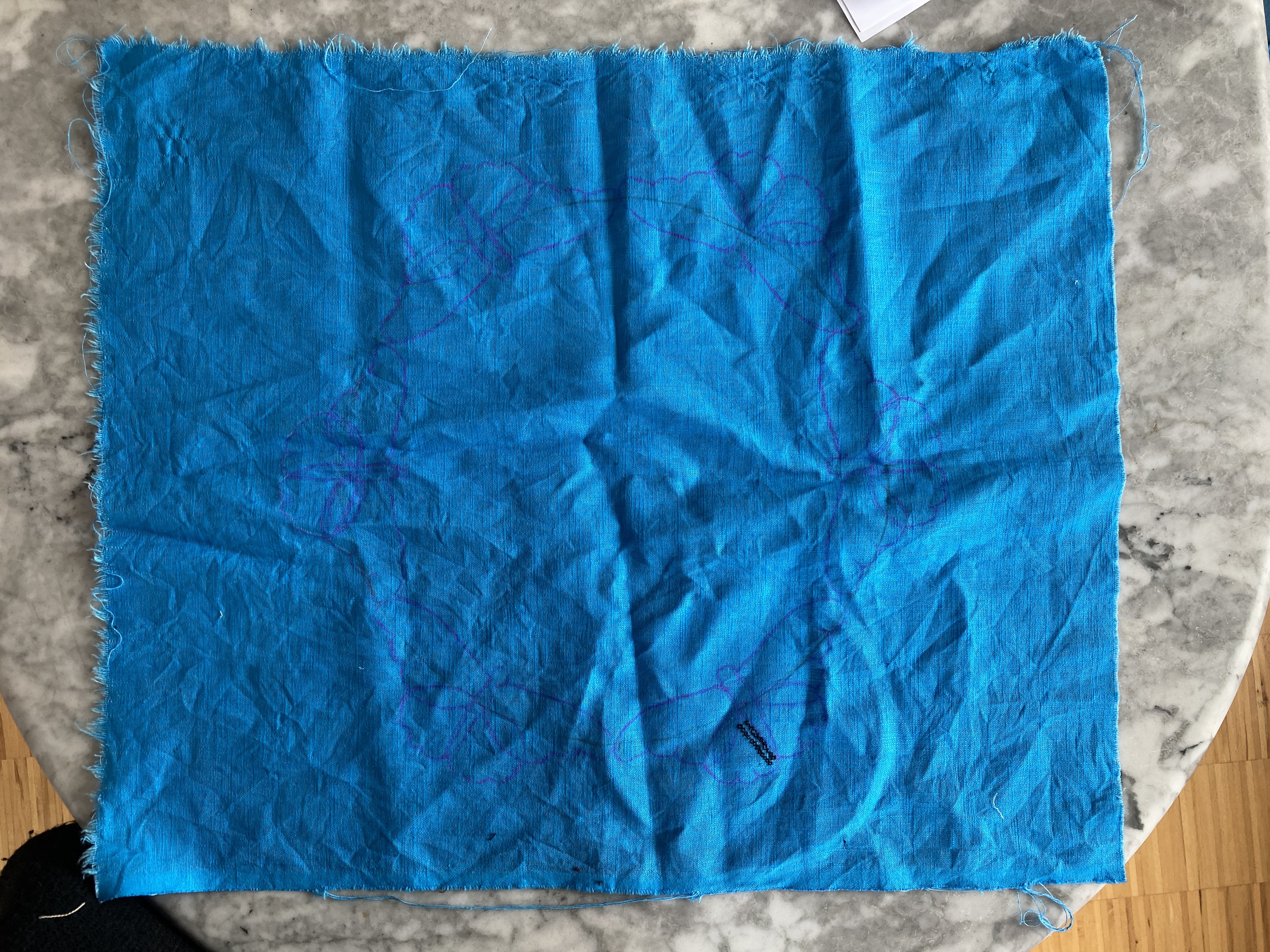
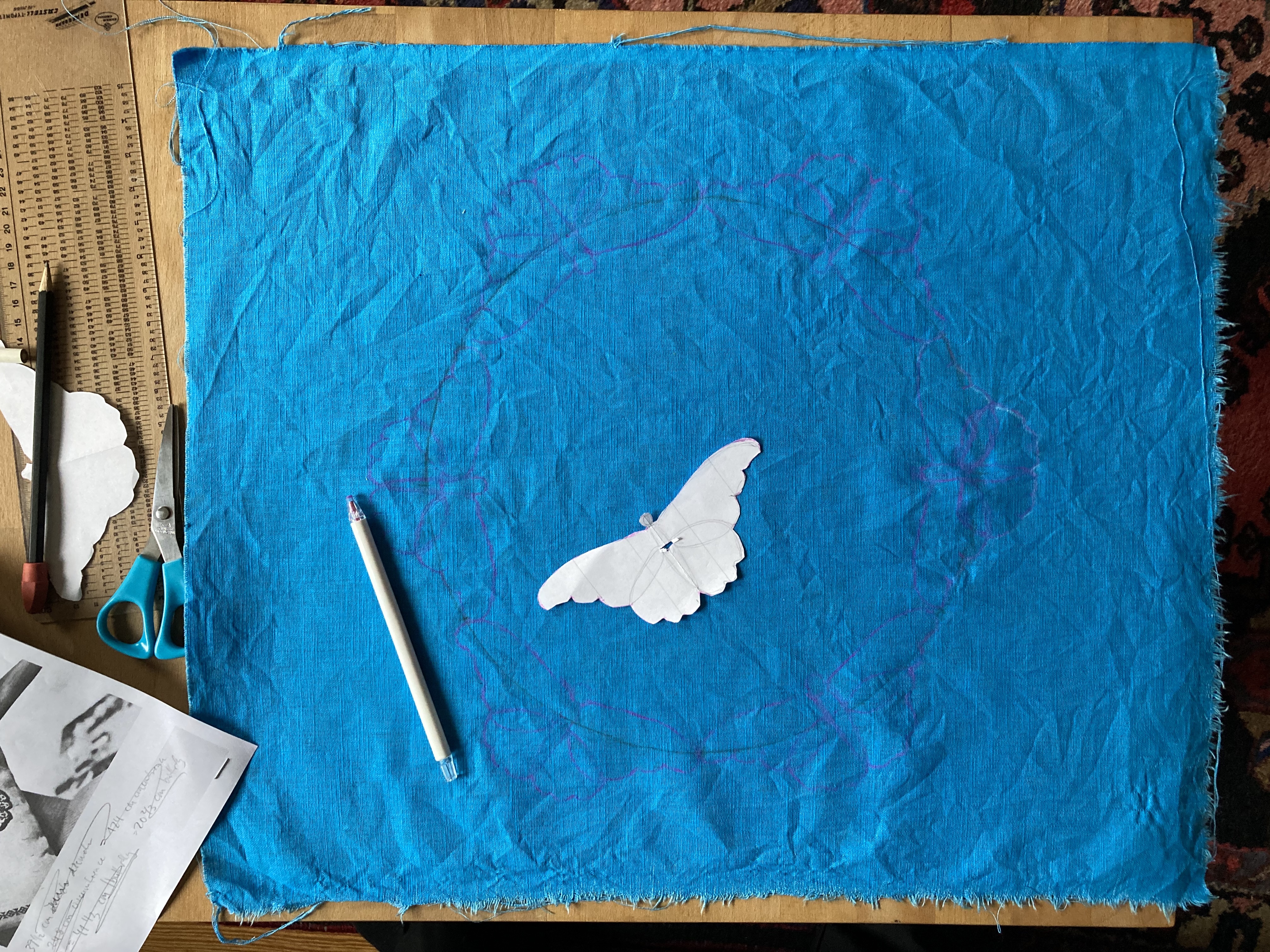
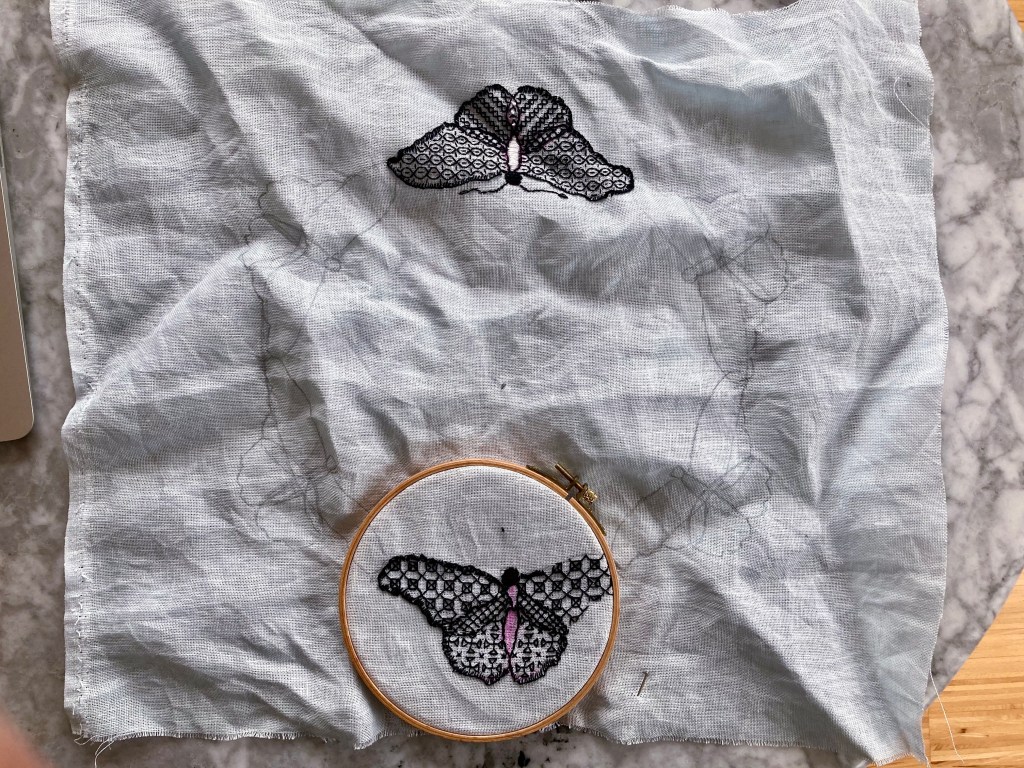
The first linen I bought was called something like “100% Linen Medium Blue” and I should have noticed right away that that meant it was regular furnishing linen, not specifically embroidery fabric — embroidery linens have special names according to their type and thread count. I loved the colour, though, and was determined to try. Of course I didn’t have a transfer, so I painstakingly calculated out the size of the circle for the main butterflies and from there, the size of each butterfly. I made a paper stencil for the butterflies and drew around a felt record-player cover (coincidentally the perfect size!) with a pencil to get the circle right. On starting the first butterfly, it was clear that the fabric was too tightly woven. It was pretty much the same type as the fish cushion. I was determined to make this project the right way, so after all the work I had put in marking the fabric and starting the pattern, back to the Internet I went and bought a few different kinds of embroidery fabric with a thread count between 11 and 12 threads per centimetre.
It is amazing how different fabrics can be that have the same or similar thread count!
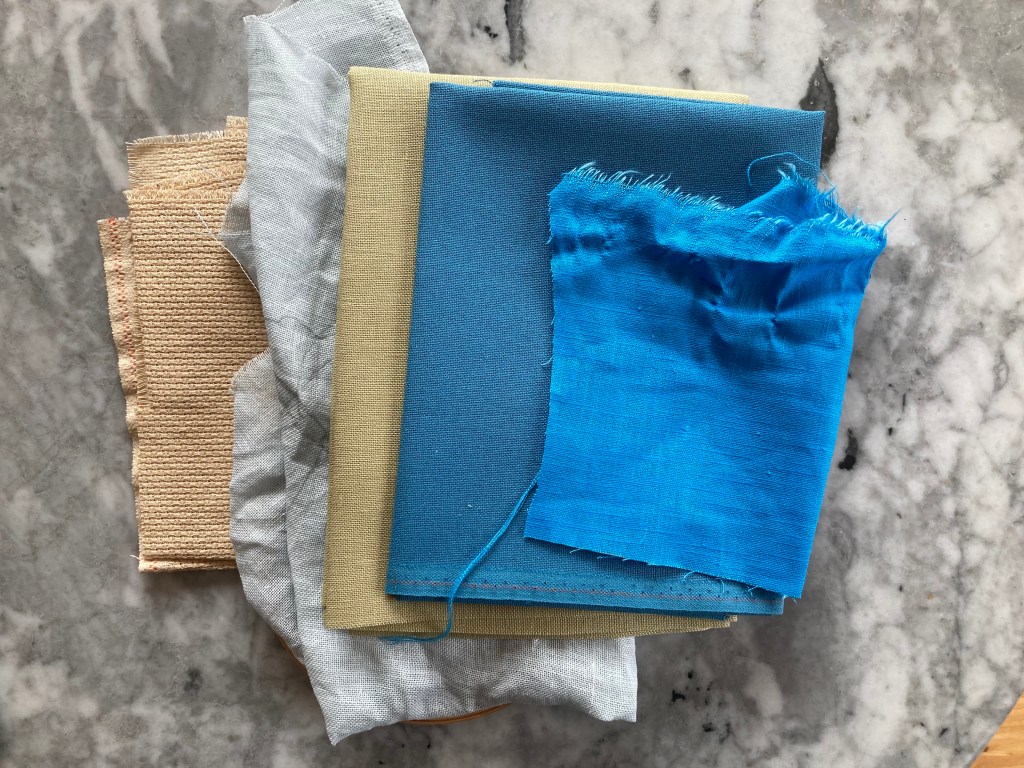
Here is a photo below. For comparison, the fabric on the far left is the normal “Aida” used for cross-stitch at 6.4 threads to the inch. The light grey-blue is “Permin”, which has 11 threads/cm and is very open, almost like netting. The beige-ish fabric next to it is “Belfast” with 12.6 threads/cm and perfect for this project, but wasn’t available in blue. Next to it is “Murano”, which also has 12.6 threads/cm and is a cotton/viscose mix, not 100% linen like the others and the blue they had was a bit too dark. On the far right is the furnishing linen I had originally bought, and the only one in the colour I wanted.
I wasn’t 100% happy with any of the the four options I had now bought, but I had spent a lot of time and money already and just wanted to get the project started in a way that I would be able to finish it. So I decided to use the Permin, which was not the perfect colour (a bit light, but I could try to dye it?) and very net-like (but at least it was easy to do the counted work).
The slight difference in thread count and the net-like aspect of the fabric made me decide to work with 3 strands of thread instead of 2 as in the pattern. Other than that, I followed the pattern as best I could. My buttonhole stitch outline is more like blanket stitch and not as thick as in the pattern, but that’s OK. After almost finishing the second butterfly, I decided to go against the instructions and work the outlines of the butterflies first, then fill them in with the counted work. The other way around probably works well if you used an iron-on transfer with easy-to-follow lines, but my pencil tracings are less accurate.
The pink is embroidery transfer pen and will wash out.
It was slow going, but there is something meditative about embroidering precise geometrical shapes.
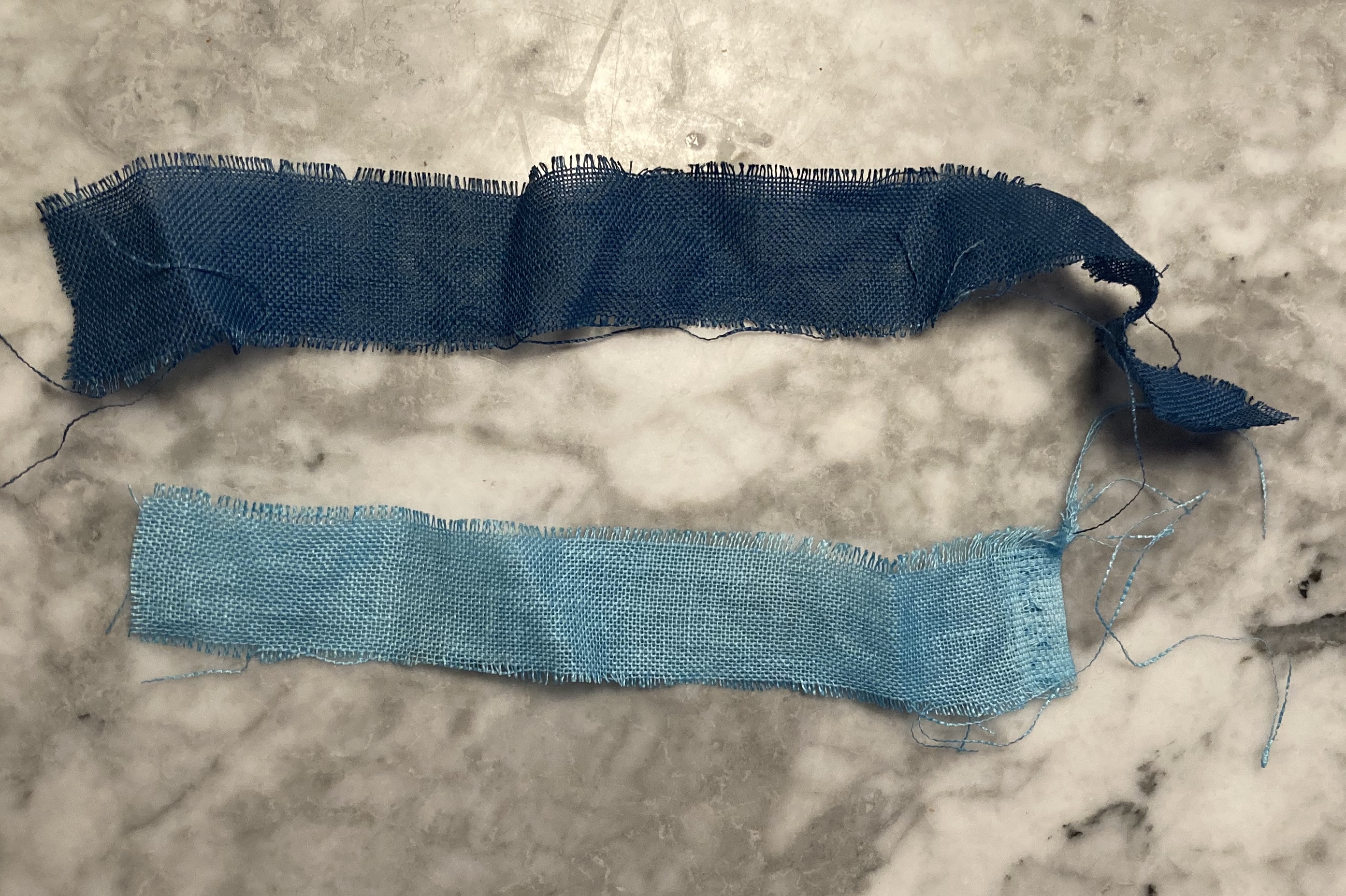
After embroidering two or three of the butterflies, I got my hands on some fabric dye and experimented with scraps of the cut fabric. “Deep Sea Green” (top) is actually blue, which was desired, but too dark and not vibrant enough. “South Sea Turquoise” (bottom) was the ideal colour, but I started liking the pale fabric more the more butterflies were embroidered. I decided to stick with the fabric as it was until the embroidery was complete, leaving off the white satin stitch body bits until after I dyed the fabric (or not).
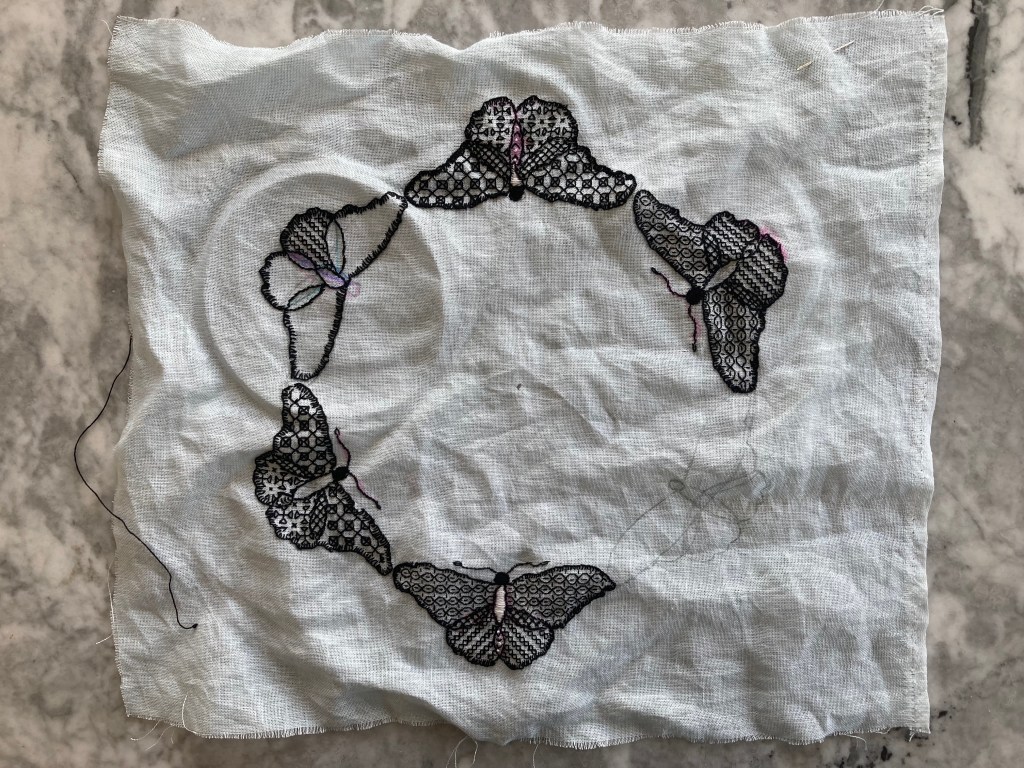
May 2021 passed very quickly and I hardly made progress on my May project, let alone this one. Here is a photo of my progress at the end of May:
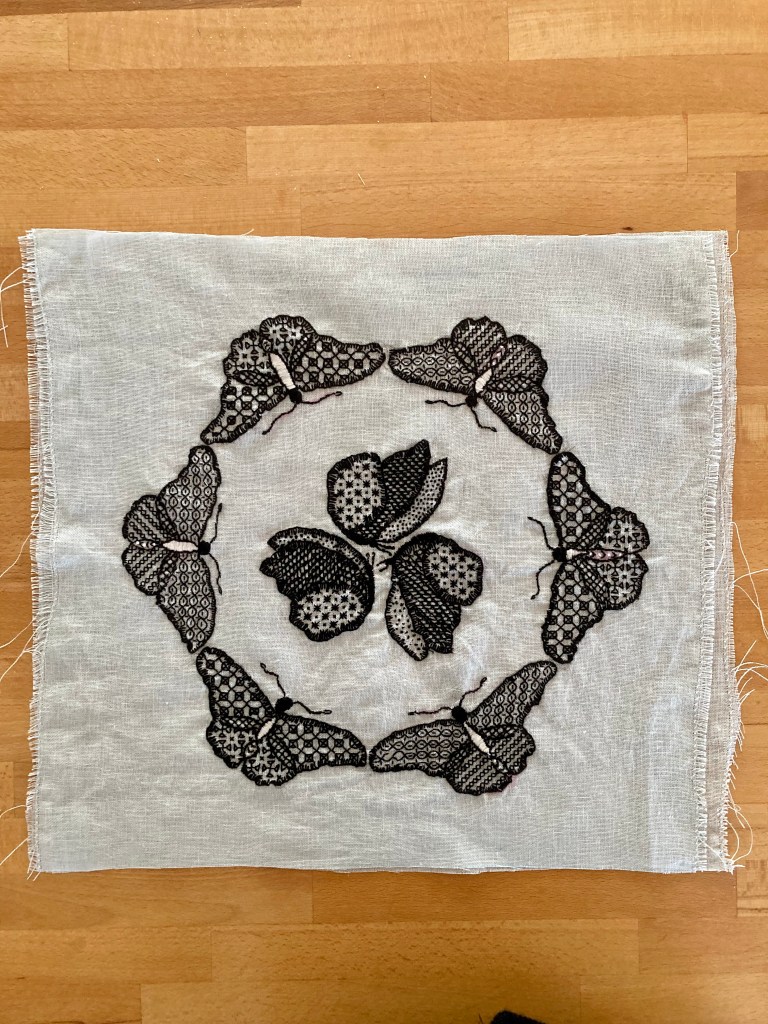
After leaving it for a while to work on other projects, I picked it up again and tried to work a little bit each day. Things got complicated in the autumn, as the days got shorter and darker – I realised I could only work in bright, natural daylight, otherwise I couldn’t see the threads well enough to count them, even with a good lamp. But I kept going and eventually, there it was!
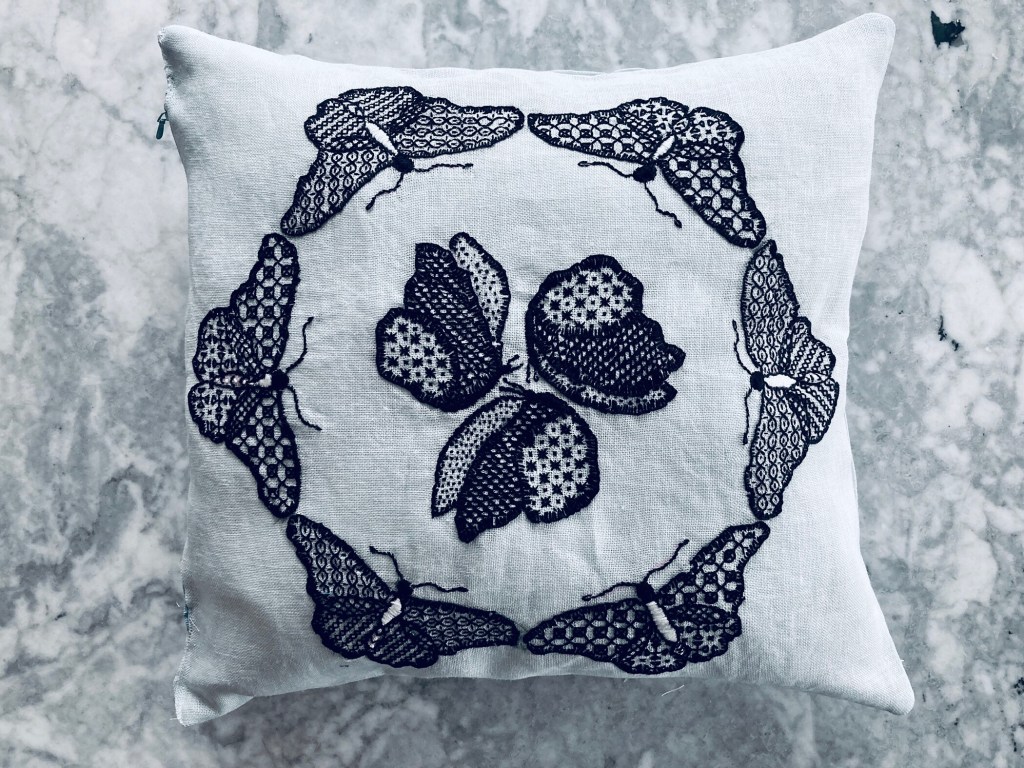
Making it up into a cushion was easy. I made the cushion itself from an old white pillowcase that had been retired to the upcycling drawer, made the back from more of the net and added a zipper. I had left off the extra embroidered borders, since the design turned out more square than rectangular.
(The actual colour is somewhat less blue than the photo above, but more blue than the one below. I can’t get the colour correction to work properly on this device. )
The only problem was the transfer marker, which didn’t wash or iron out well. A tip in one of my old Stitchcrafts suggested using “solvent” if nothing else worked, Having no idea exactly what kind of solvent they meant, I tried alcohol, which didn’t work, and kitchen de-greaser, which worked somewhat. Any little bit left in will hopefully wash out in time.
Wow, it’s finished! I am really impressed with myself for getting this done, but I think it will be my last blackwork project for the time being.
My March project featured sewing, for a change. I can sew, both by hand and with the machine, and I have sewn quite a few things in my time (even worked in the costume department of various community theatres as a teenager/young adult), but I do not enjoy sewing, nor am I particularly good at it, to be honest. (My costume shop work involved mostly either “pulling” outfits from storage, or doing fittings and alterations, or sewing things that someone else, i.e. the head designer had cut out. For that reason, I never learned to cut things to fit properly and am surprisingly bad at working from bought patterns.) Years of knitting have also made me very inexact about perfect measurements and straight lines, which is obviously sub-optimal for sewing. But I gave it another try to make this embroidered “Sunday best dress” for a baby from the March 1963 issue.
For once, you didn’t have to send away for the sewing pattern; since all the pieces were basically rectangles, they just printed a little scaled-down plan for cutting the material on a graph, with each square being equivalent to 2 inches. It was designed for silk or crepe fabric. I had bought a large remnant of beautiful light-grey viscose (rayon) some time ago, of which I used a small amount for the lining of February 1963’s needlepoint bag and had plenty left over. Rayon fabric has been around for more than a hundred years and was (and still is) used as “artificial silk” throughout the 20th century, so my fabric was quite period-accurate even though modern. I didn’t have silk floss to do the embroidery and just took the opportunity to use up some small scraps of normal cotton floss in pastel colours.
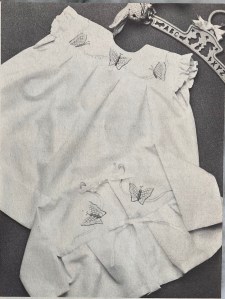
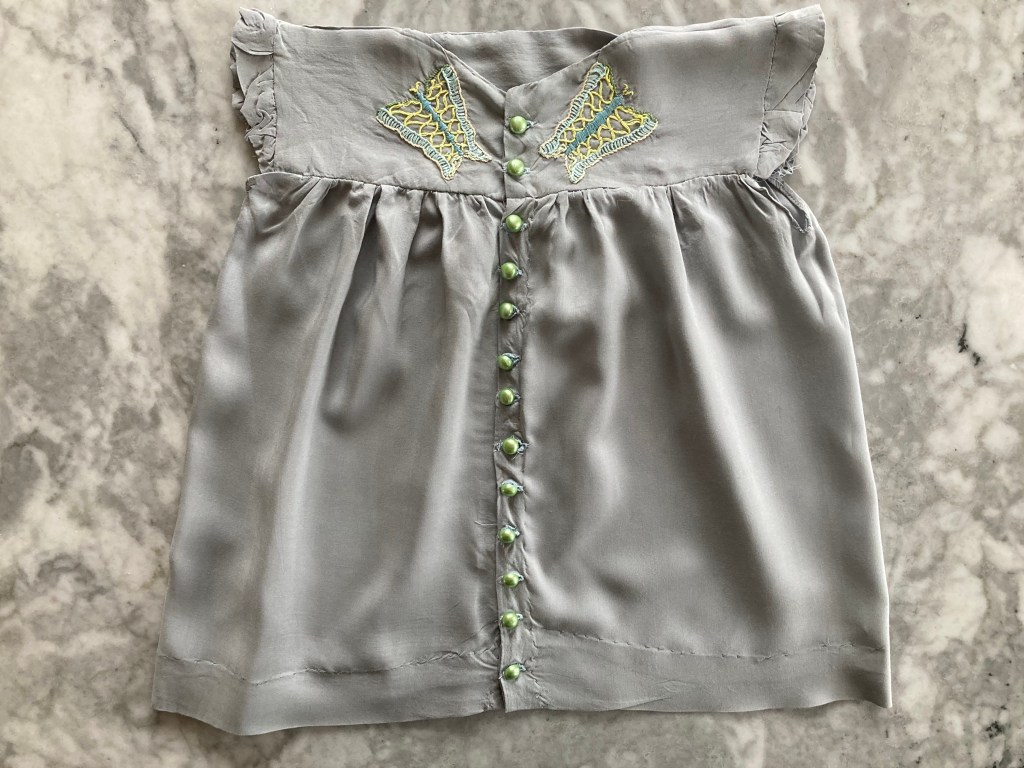
The dress was supposed have three embroidered butterflies on the front and close in the back with a couple of buttons. I didn’t have all that much embroidery thread and I did have quite a lot of lovely vintage buttons in a perfect pearly-green colour (thank you, kind seller on Ebay!), so I changed it around to fasten in the front, using the two-butterfly design from the coat (which I didn’t make).
The butterfly design was easy enough to copy without a transfer and features laid stitches on the wings — something new for me. My embroidery skills are still far from professional, but improving. The sewing work was interesting because I am not always in the same place as my sewing machine due to pandemic chaos — but also didn’t want to wait until I was — so I sewed everything except the buttonholes and waist strengthening zigzag at the end by hand. Including the gathers, buttonhole band, frilled sleevelets etc. Now I know why Marilla from the Anne of Green Gables books had to stop sewing in her later years to preserve her eyesight! Everything was tiny and took forever and my fingers, which are actually quite long and thin and nimble, felt like elephant feet.
I did the buttonholes on the machine when I could, because I was definitely not going to try to sew buttonhole stitch by hand on thirteen tiny buttonholes. My machine-sewed buttonholes look messy enough that they could pass for hand work, ha ha. I am surprised that it turned out even vaguely even (yes I know, the hem in the front is a mess.) But in spite of its obvious imperfections, I’m quite happy with the result and proud of myself for making it work. I know a one-year-old baby who would fit in it perfectly and the parents will be very happy to have it as an Easter dress for her, so in my mind, it’s a success.
Meanwhile, the “naughty pile” of unfinished projects is slowly diminishing and I’m looking forward to getting back to knitting.
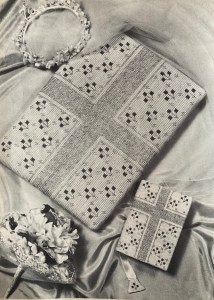
I was a bit uninspired by the February 1963 issue, which had several nice garments that were either too bulky for my taste or would just take too long to finish. I’m also trying to work from stash as much as possible. With that in mind, I adapted this “Prayer book cover and kneeler for a bride” tapestry design for a small, simple needlepoint bag.
My first, and until now, only tapestry/needlepoint project (what is the difference, anyway? Stitchcraft always uses the word “tapestry”and often qualifies it with gros point or petit point, but I see “needlepoint” used just as often in other sources) was this unfinished failure from the May 1961 issue. I still had the wool and enough canvas to make a smaller bag using the flower part of the design from the prayer-book cover.
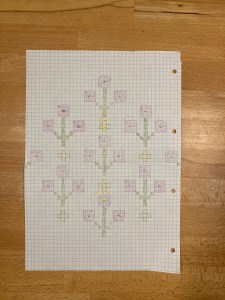
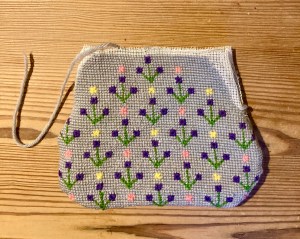
Since the original chart was not printed in the magazine but had to be ordered via post, I had to recreate it myself on graph paper, which wasn’t too difficult. The basic stitch is a half cross stitch, which works much better with this combination of wool thickness and canvas density than the earlier project, which was all in cross-stitch. The flower heads are made with eye stitch — 8 stitches all going into the same center hole. The stems of the flowers and the little hash marks between them in the original are supposed to be embroidered over the tapestry using gold Lurex thread, but I changed that to add some little pink and yellow blossom-like accents and just worked the stems in green wool.
So far, so good. I ordered a little bag clasp, marked out the approximate area of the needlepoint and started on the first half. In the middle of the large piece of canvas. Obviously that was a bad move, because a bag has to be worked symmetrically along the bottom fold line, no? The canvas was just large enough to divide it into two parts, but obviously it would have been better to work the whole thing in one mirrored piece and not have to sew a seam on the fraying bottom edge.
Once that problem was solved, I found the actual work to be relaxing, if somewhat boring (lots and lots of grey background). Also, I just barely squeaked through with enough grey wool to finish both pieces. The hard part came when fitting the finished tapestry into the clasp frame and dealing with the lining. The tapestry was… strangely twisted? The two sides of the bag did not lie flat over each other even though both pieces were perfectly identical and perfectly mirrored. I steamed the life out of it with the steam iron and managed to get it flatter, but… why? How? Things only got worse when I added the lining. I hate sewing and I hate linings. No matter how carefully I cut out a lining to the correct size and pin it and mark it and all the other boring things you are supposed to do, it never, ever comes out to the right size, or lies flat, or looks neat and deliberate. (I did manage to get the lining into the bag with a nice neat edge at the top… then realised it made no difference, as the top edge was going to be sewn to the metal clasp.)
The clasp has holes in it to sew the bag and lining in on the top and sides, and it was clear enough how that should be done, but theory was easier than practice and there was much clenching of teeth and growling. Also, a lot of that nice neat edge needed to be painstakingly ripped out to fit it over the clasp rim, reducing the nice neatness considerably. Did I mention how much I hate sewing? In the end, the edge was quite messy on the inside and not perfectly aligned on the outside. Both the needlepoint and the lining are oddly twisted and uneven and steaming it didn’t help anymore.
My take from this project: Needlepoint is fine, but not as much fun as knitting. Some older issues of Stitchcraft give an address where you can send tapestry projects in to be professionally made up into a bag or cosy or whatever “for a reasonable price” and if that service still existed, I would definitely take advantage of it! I have to make up the project myself, it is not worth it.
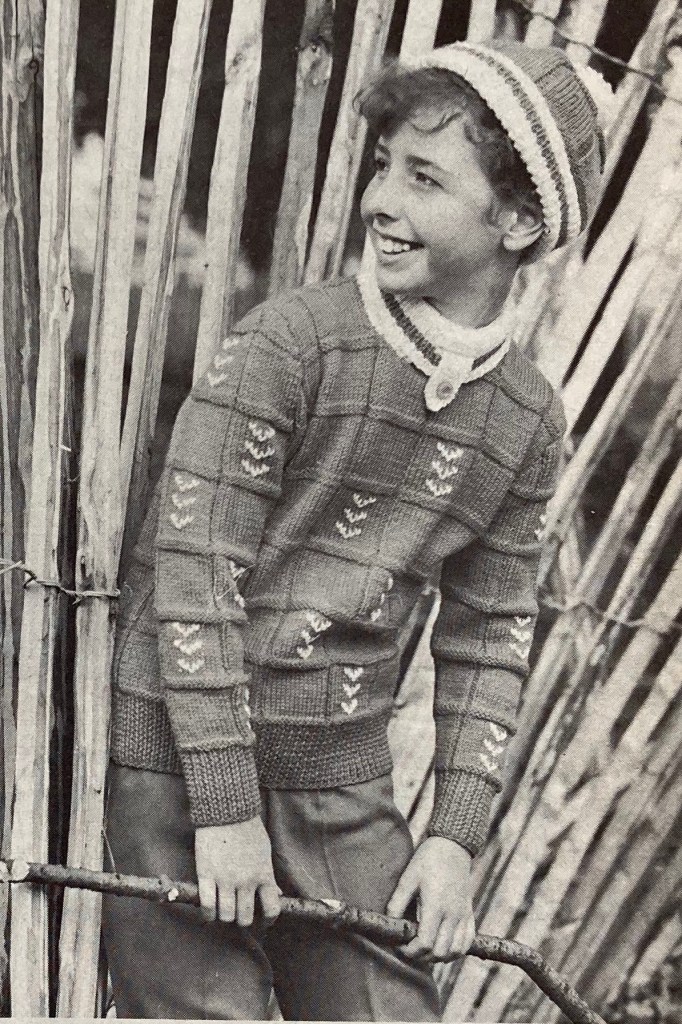
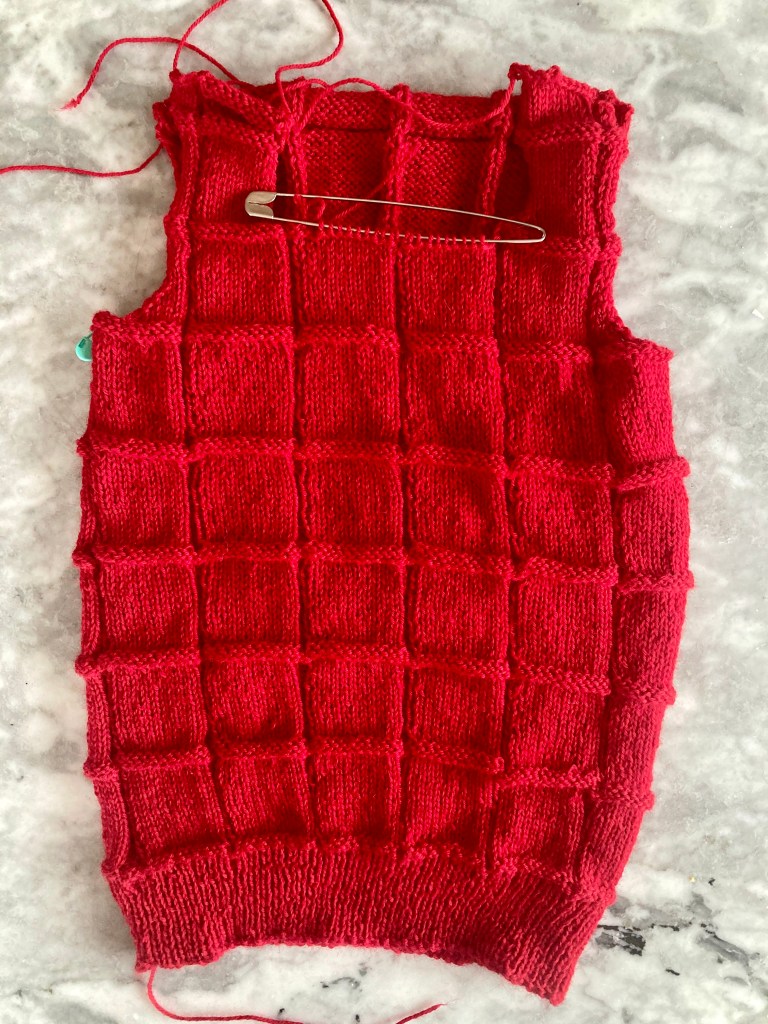
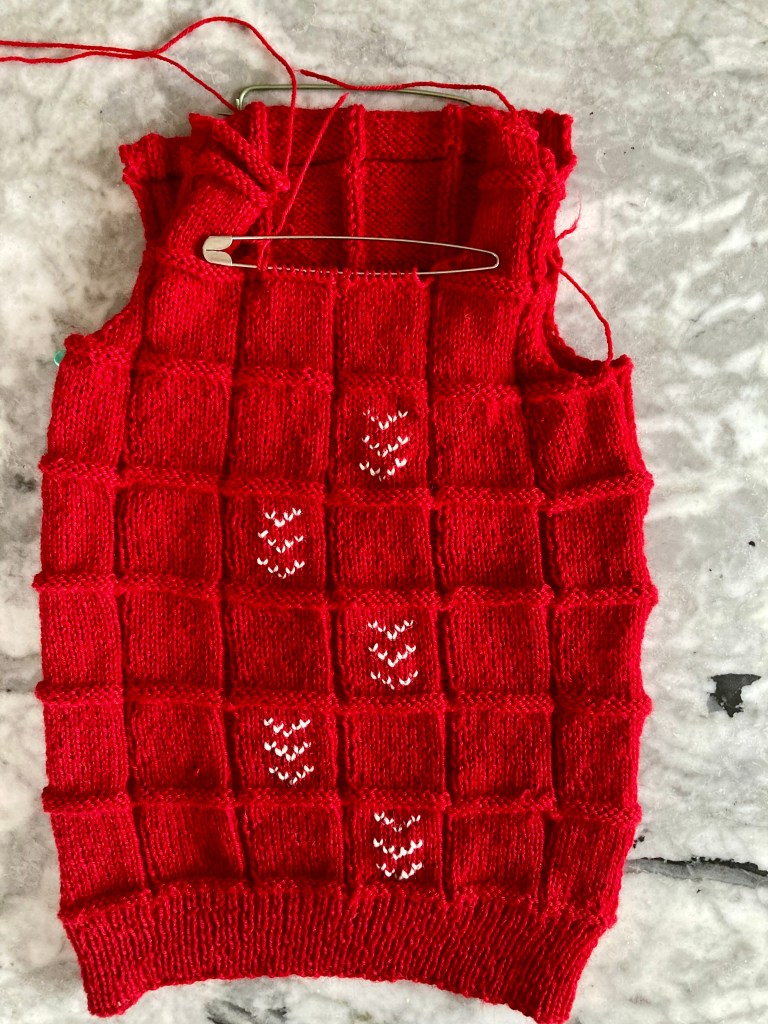
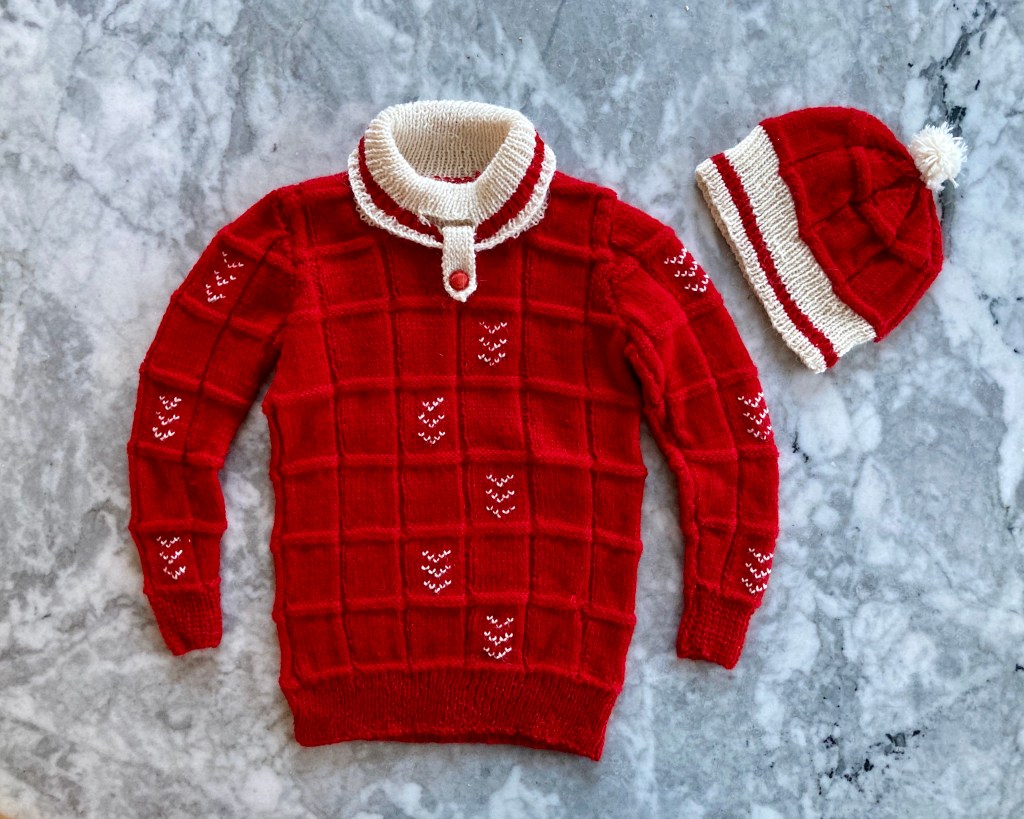
This month’s issue had a wonderful winter pullover for a larger child, featuring white “Swiss darning” (a.k.a. duplicate stitch embroidery) on a brilliant red background. I had also promised a friend to knit something for her toddler, whose favourite colour is red. Perfect!
Well, not quite perfect, since the toddler in question has a 22 inch chest and the pattern is written for children with 28, 30 or 32 inch chests. But it’s also written for DK weight wool and it was easy enough to find a lighter-weight wool to convert the pattern down into a smaller size. DROPS Garnstudio “Nord” (45% alpaca, 30% polyamide, 25% wool) gives 26-27 stitches in 4 inches and is soft and easy to care for. It’s also inexpensive and the red colour is beautiful. The white is just subtly off-white, which I like better than pure white for pairing with a really strong colour like the red.
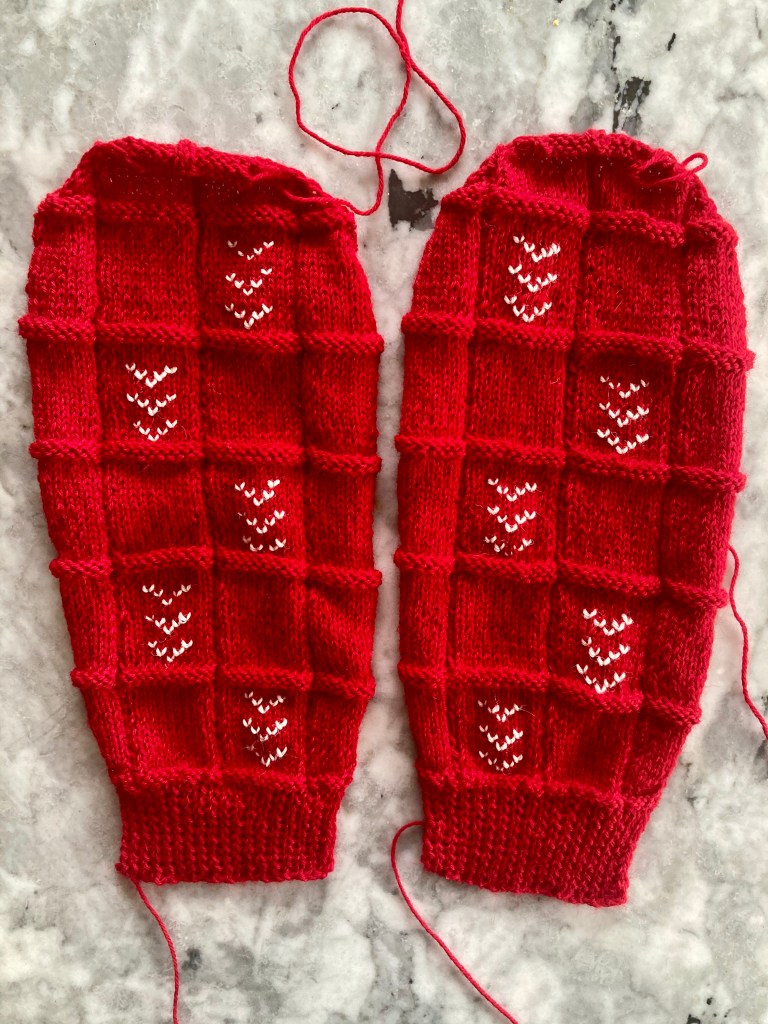
The pattern uses stocking stitch and reverse stocking stitch to make square-ish pattern “blocks”, which are embroidered with white wool in duplicate stitch after everything is finished. Duplicate stitch or “Swiss darning” as it was often called in vintage magazines, is made by threading a length of contrasting colour yarn around stitches that have already been made. I had seen it on garments and in many vintage patterns (all kinds of embroidery on knitting was quite popular in the 1950s and early 1960s), but I had never tried it myself until now. It is pretty easy in principle, but tricky to get the stitches to look even — in this smooth yarn, any pulling of the thread made the embroidered stitches disappear. But it worked and it really peps up an otherwise simple pattern!
I made the body in the round to save time, but correctly guessed that it would be easier to embroider the sleeves if I made them flat.
This was fun and easy to make and I actually finished it on time for once! I have plenty of yarn left, so I think I’ll go ahead and make the hat before I give both to my friend. EDIT: I made the hat! Here is an updated photo.
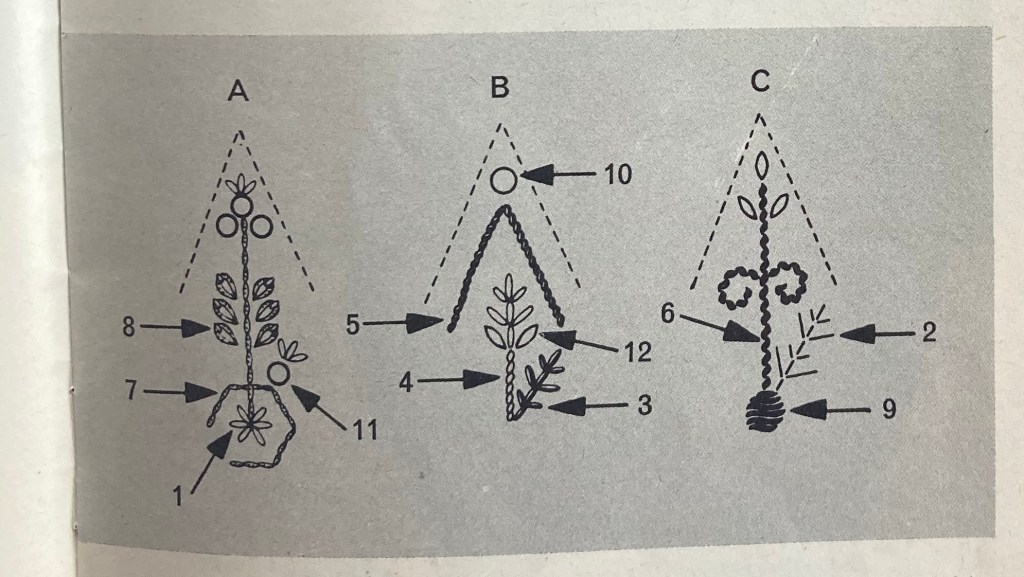
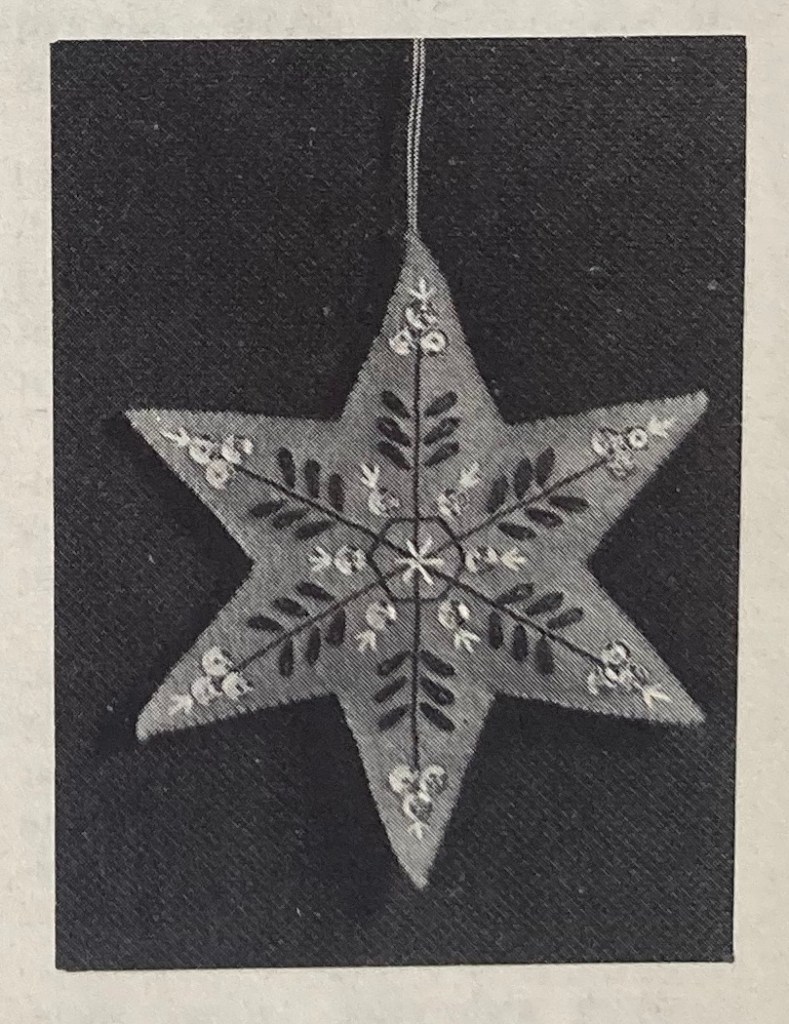
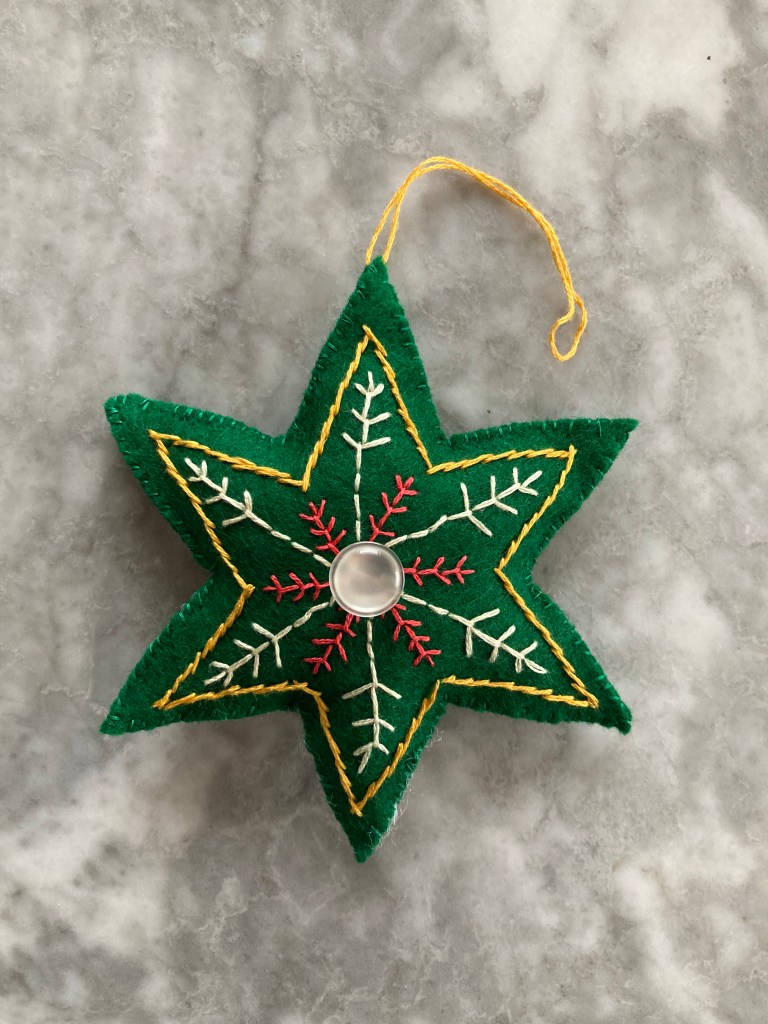
2020 has been a bad year for many things, but a good year for little home-made presents made from stash. I used a lot of cotton fabric for pandemic masks (with an added inner layer of fabric cut from an upcycled duvet cover made of special hypoallergenic tight-weave, dust-mite-proof fabric) and a big piece of green felt went to this iPad cosy, but I still had plenty of large scraps of all kinds of materials and the usual box full of odd buttons and leftover embroidery floss. Meanwhile, the holiday season was upon us, all the stores were closed and I wanted to be frugal with money but still be able to leave some mini-presents in friends’ mailboxes with a card and some cookies. These little felt stars from the December 1963 issue of Stitchcraft were the perfect choice.
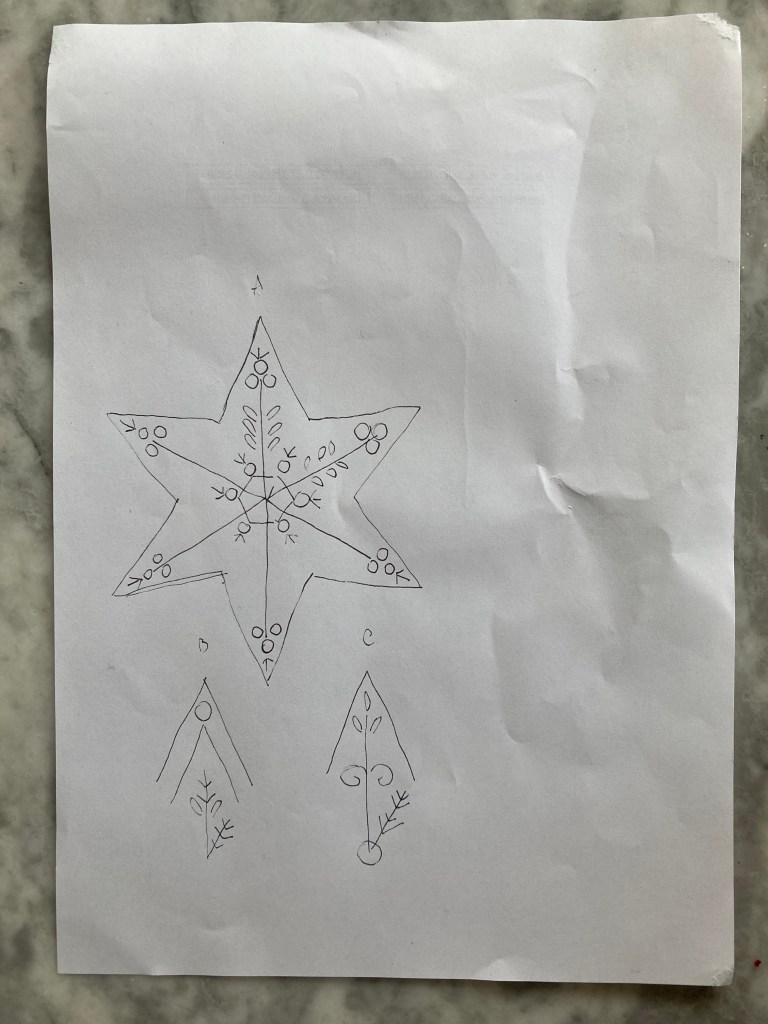
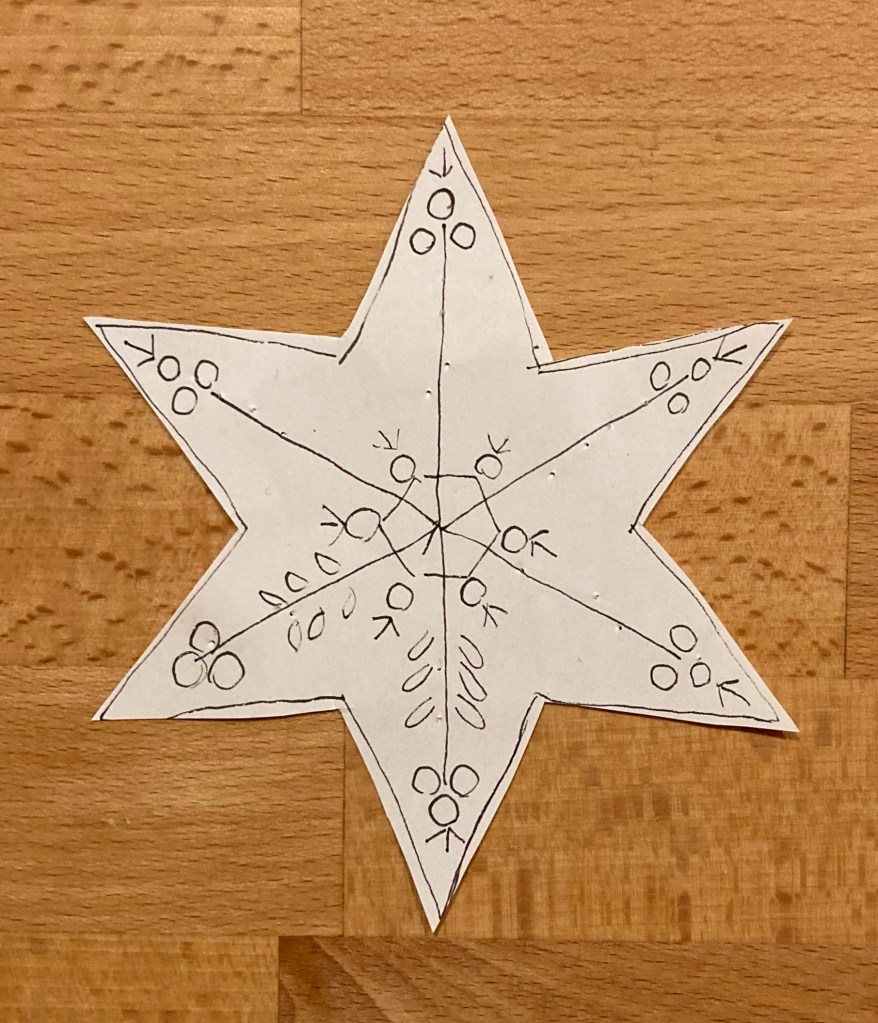
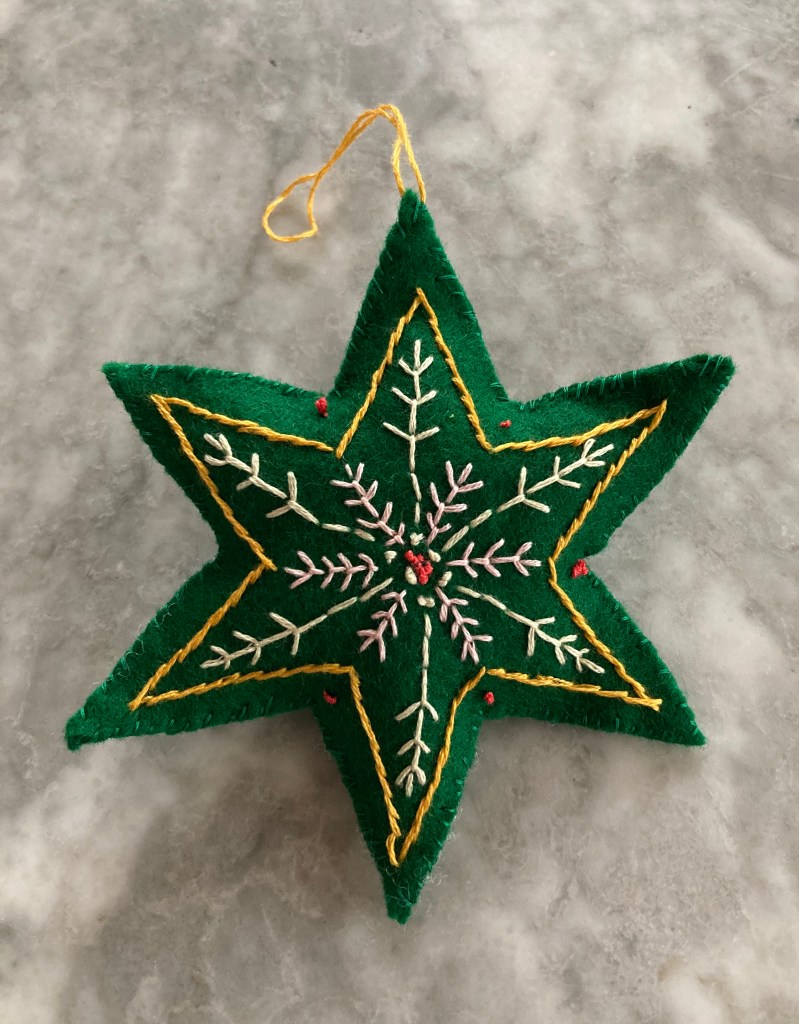
There was a life-size transfer in the magazine to trace (or photocopy and cut out — I’m lucky to have a printer at home that is also a scanner and single-page copier) with samples of the three star designs to copy onto the points of the star. I traced it onto the felt with chalk, cut out two stars, picked my favourite design, and embroidered away. (Technically I should have first traced the design onto the fabric, then embroidered it and then cut out the stars, but it worked anyway.)
I had neither sequins nor pearls, so I just did everything in embroidery and added a button for the center on one side. I overstitched the edges to make a little cushion, added a loop for hanging on a tree and stuffed it with polyester fluff. Wonderful! The first star went to a fellow knitter from my now-online knitting meetup — we did a Zoom version of our usual “secret Santa” wool gifting party — and by then I was so involved in getting people’s knitted gifts finished that I ended up not making any more this year. Now that I know how it works, and that it works, I can make more next time.
Merry Christmas, if that’s your holiday, and happy New Year to all of you.
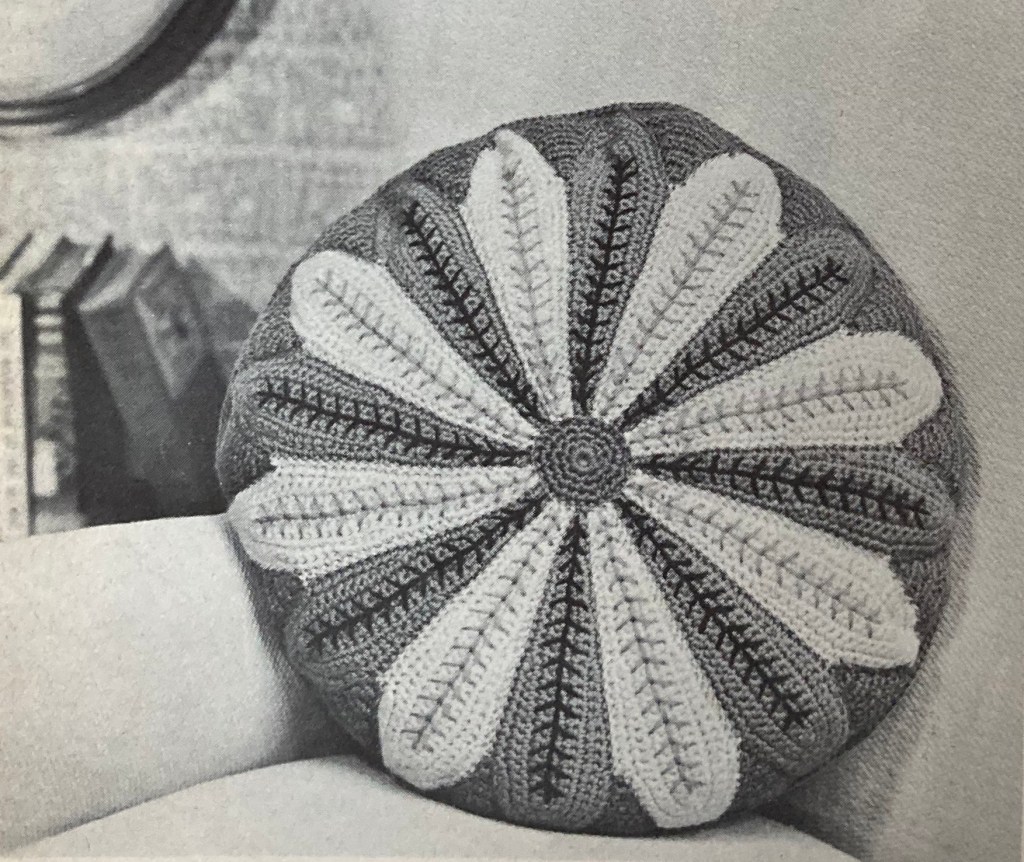
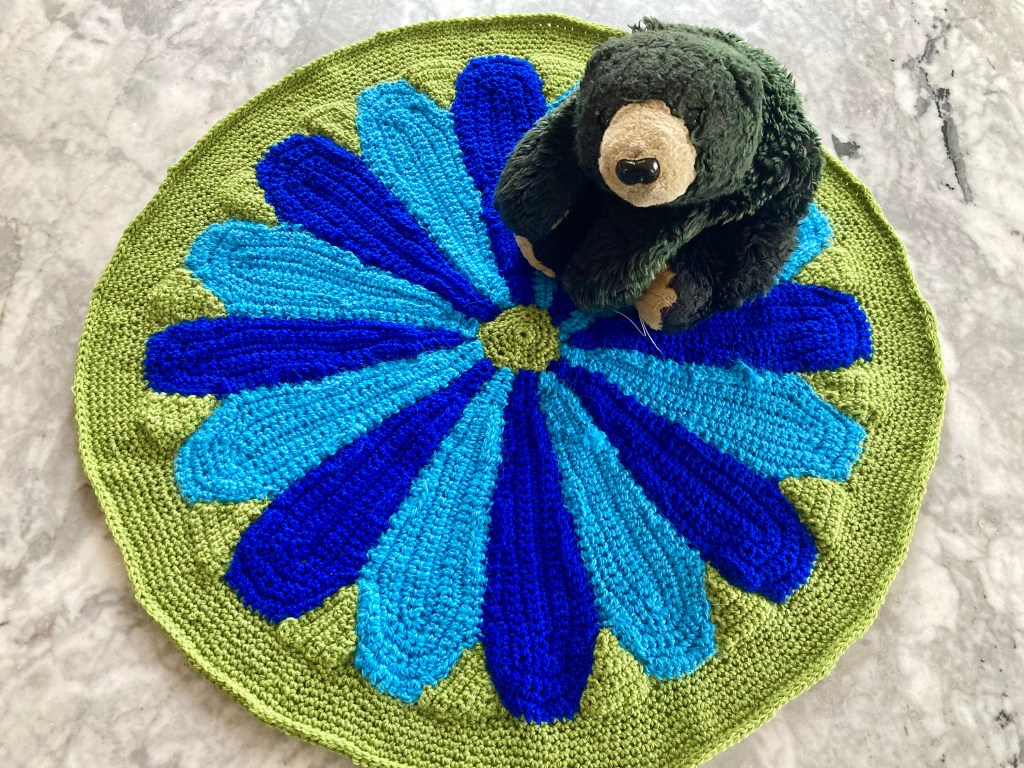
I have a huge backlog of unfinished projects and recently even got a commission to write a pattern for a new knitting and sewing magazine, so I needed the December project to be something quick and easy that I could make from stash. Behold, a very 1960s crocheted flower-petal cushion from this month’s issue! I love cheerful crocheted cushions and afghans — they have that fun, old-fashioned charm.
This one is made in double knitting, and I had two colours of blue and one of green to make a big, blue flower. I guess it’s a cornflower? Whatever, it’s cute and the colours looked good together. The dark blue is 100% acrylic (left over from this project and this project, which was patterned after this project — yes, I bought plenty of yarn), the light blue is 90% alpaca / 10% sheep wool (a gift from a very nice friend who brought it over from Chile!) and the green is a wool-acrylic blend last seen in this project from January 1960, so I was concerned that the finished item might behave inconsistently when washed or blocked, but I had no problems with that.
The size and scale, on the other hand… There was no tension given in the instructions, only a finished size of “approximately 17 inches diameter” and instructions to use double knitting wool and a No. 8 (5 mm) hook. The cushion is made in pieces — first the petals, then the triangular inserts at the top of the petals, then the center, then it gets sewn together, then you crochet the border and sew it onto fabric for the back side of the cushion — so it was hard to tell how big it was going to be. Also, the instructions very clearly say to make 12 petals and 12 insertions, but the accompanying photo very clearly shows a cushion with 16 petals and insertions. Patience Horne, you need a tech editor and a proofreader!
The result — once I had finished all 16 petals and 16 insertions, which was in fact the correct number to get the petals to form a circle, and sewn all the fiddly bits and pieces together — was huge. Granted, 17 inches in diameter is a fairly large cushion, but mine was 19 inches in diameter before I had even started crocheting the border, and the triangular insertions were also too big, making them pucker and wave a bit. I made a snap decision to just crochet the border larger and larger until all of the green wool was used up and have it be a baby blanket instead of a cushion, which would also spare me the trouble of figuring out how to make the back of the cushion, whether or not to make an inner cushion pad and have the crocheted part be a removable cover, etc. etc.
The border in the instructions only being a few rounds and me not being the world’s best crocheter, I searched for a formula to crochet something in rounds of double crochet that would have the right amount of increase per round to keep the circle flat. Though I found many amazing doily patterns and not-quite-fitting formulas, I didn’t find what I was looking for, so I just increased one stitch per petal each round and did a plain round in between every so often. There was much ripping back and doing over, but in the end it worked out fine. As for the still-puckery triangle inserts, I declared them a “design feature” and left it at that.
I wash-blocked the blanket, which evened it out some more, and only then realised that I had forgotten to embroider the lines down the center of each petal. In the end, I decided against it. The dark blue and green yarns were all used up, I didn’t have any other colour that looked right and I honestly thought it was fine the way it was. The finished size is 23 1/2 inches or 60 cm in diameter, which will fit a baby’s pram nicely. Not having a baby on hand, here it is with a teddy bear for scale:
It’s not perfect and it definitely has that “home-made charm”, but I think it will make any parents and baby happy.
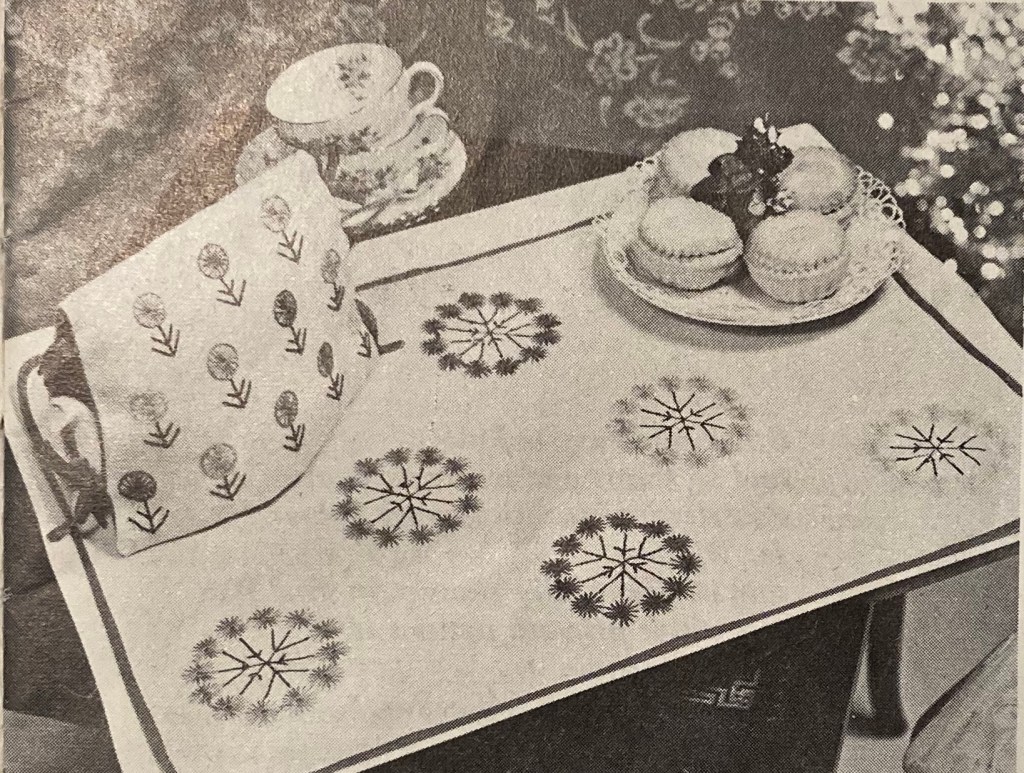
The November 1962 issue had so many exciting projects that I wanted to make, but as I am woefully behind on so many other projects, I settled for a modern version of the cute embroidered tea cosy from this “star motif” cosy-and-tray-cloth set. The star design only really comes out on the tray cloth, where flowers with spiky leaf bases are embroidered in circles. The tea cosy has the flowers arranged individually in lines.
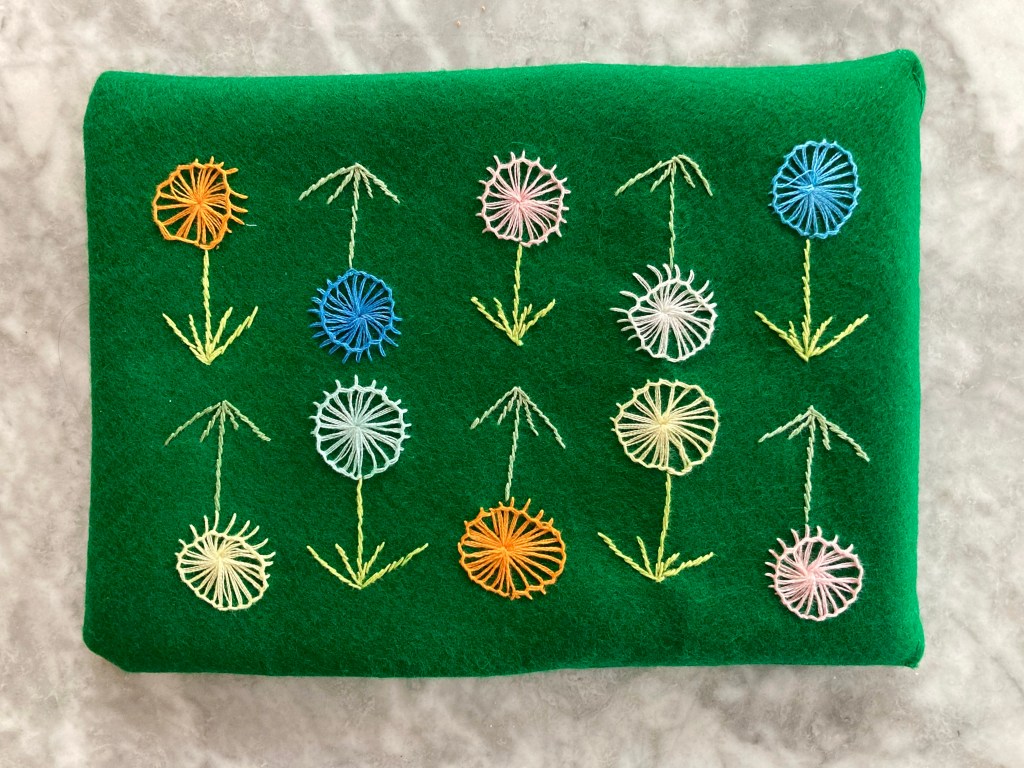
Since I don’t use tea cosies, I adapted the design as an iPad / tablet cosy, like I did with the “Gay Goslings” design from April 1960 and the “Posies for Cosies” from March 1961. I had plenty of green felt left over from the not-so-successful October 1960 “No Fun Fuchsia” project and enough scraps of embroidery floss in fitting colours to make everything from stash.
Obviously I didn’t have a transfer, but luckily this design is so simple that I was able to just draw around a coin with chalk for the flower heads and add in the stems freehand. I say “simple” and “just”, but the felt material was of a nature that chalk does not stick to it for more than a minute and the colour is too dark to draw on with a pencil or embroidery marking pen. My continuing incompetence in drawing, cutting or embroidering straight lines came back to haunt me! Oh well, that’s how you know it’s handmade.
The tea cosy has three rows of flowers: three in the top row, four in the second and five in the third. Not sure exactly how to scale the design for a tablet cosy, I started by embroidering two rows of flowers with three flowers in the top row and two in the bottom row. I didn’t like the asymmetry, so I filled in the gaps with more flowers aligned upside down.
Making it up into a bag was straightforward enough (except for the not being able to cut in straight lines thing, even using a ruler and template) and I finished it off with a vintage fabric-covered button from the button box. I’m quite happy with the result, even if the design is not entirely even and the buttonhole stitch pulls to the center of some of the flowers (not sure how to correct that.) And it went so fast! I did the embroidery last night and made it up into a bag this afternoon.
It looks very 1960s!
Since I still use and love my “gay gosling” iPad cover, I will send this one to a friend as a birthday/Christmas present.
It was very difficult to get a project going this month. The October 1962 issue of Stitchcraft didn’t have any designs that interested me and I had been trying to finish up some larger, non-vintage projects in time for the cold-weather season. But inspiration came from a good friend of mine, who politely reminded me that, way back when I made this “charming blouse”, I had casually offered to knit one for her if she ever wanted one, and wouldn’t this be a good time to make it for her? I agreed! So this month’s project echoed the one I made then. Here are photos from that issue and the finished project:
The original blouse, from the July 1960 issue, was designed for “larger”, curvier figures (37-38 or 39-41 inch bust) and featured horizontal bust darts, which was very unusual for knitting patterns of the time. I was intrigued to see how the bust darts would turn out, since I don’t usually make them on garments for myself. As I probably could have guessed, the bust darts were not only unnecessary for me, but actually negatively impacted the fit — since I am not busty enough to fill out the darts, the front of the blouse was too long compared to the back. That didn’t particularly bother me, but I did note it for future projects.
My friend has a more suitable figure for this design, and her version turned out even better. I used the same wool (Juniper Moon Farm Herriot Fine) in a lovely tweedy green colour, and (by request) without a collar or contrasting colour bands along the front.
It turned out perfectly and we were both very happy with the result. Since we’re not meeting indoors and it was still too cold for her to wear just a blouse outside (even a warm knitted one), I’ve only got her selfies for now, so I’m sorry if it’s hard to tell what the finished product looks like. When it’s warm enough to do a socially distanced outdoor photo shoot, we can hopefully get some better photos! According to her it fits perfectly, and it’s obviously a fantastic colour for her.
My friend, by the way, is the wonderful opera and concert singer Andrea Lauren Brown. We have all been out of work for a solid year now due to the pandemic, but you can definitely still buy her CDs, which I heartily recommend to all of you who love classical music. Seriously, she’s amazing.
“The most welcome present you can give to a mother-to-be is something warm and hand-knitted for the layette,” wrote Stitchcraft’s “editress”, Patience Horne, in the September 1962 issue, and it’s still true! If I can’t decide on a project, if I don’t feel like making a full-size adult garment, if I have bits of wool that want to be used up in a useful way, I make a baby jacket. Someone, somewhere is having a baby soon, and I always have a couple of finished objects on hand in case I didn’t know that a colleague or acquaintance was “expecting”.
That was the case this month, funnily enough in my own weekly knitting group. We have been “meeting” via Zoom since March due to the pandemic, and I dropped out for a while due to being ill myself, so by the time I came back I had apparently missed some happy news — one of my fellow knitters will be having a baby this winter. What better time to make this cute and easy first size raglan cardigan?
I had 3-ply wool left over from this jumper, so I was even able to achieve the tiny gauge of 8 stitches to the inch. Only… it turned out I did not have enough of this wool, so the raglan yoke part is leftover mystery purple 4-ply. I’m not quite convinced that it’s going to work; the harsh colour line seems weird at the moment.
I don’t know the name of the stitch pattern, but it’s a lovely easy sort of herringbone:
Row 1: knit
Row 2: k1, p3
Row 3: knit
Row 4: p2, *k1, p3*
Except… I decided to make the yoke in one piece, because I didn’t want to sew raglan seams, and the raglan decreases change the pattern at the armholes. I knew that would happen, but was too lazy to work out mathematically exactly what the decreases would do. It turned out that the fronts and back stay in the proper pattern and both sleeves end up in k3, p1 rib. OK, it’s symmetrical and doesn’t looks terrible, so I decided to live with it.
But… then I ran out of the mystery purple wool as well! And had to make the last bit of collar ribbing in another mystery purple-ish wool that was also thicker. Well, at least the colours didn’t clash too much? And I had cute, matching, vintage buttons in the button box!
… except that I somehow utterly failed to sew them on evenly spaced? I could add one more in the gap near the top — there’s a buttonhole there — but somehow the buttonhole in the lower gap got sewn shut while I was weaving in ends or sewing on the front bands. I have enough buttons, but can’t decide whether to cut a new lower buttonhole and add two more buttons or just give up and leave it as it is. At least the gaps are vertically symmetric.
Not my best work, but it will keep a baby warm and clothed. Perhaps I’ll make something else for my knitting friend’s baby — a fellow knitter deserves a more successful project!
August was a pretty blah month this year, what with the never-ending Covid-19 pandemic and associated long-term isolation, illness and unemployment. My knitting motivation is sub-par and the August 1962 issue of Stitchcraft didn’t have any projects in it that really inspired me. Still, I’ve been trying to turn the situation into an “opportunity” to save money and free up space by finishing WIPS and making new projects from stash.
This month’s embroidery flower was the gladiolus, with a special extra design of wild orchids. I chose the gladioli and embroidered them on another one of the recycled moneybags that I bought at an antique market last year. They really do make excellent sturdy little bags for buying small amounts of potatoes, mushrooms or other vegetable items, and with a zipper on the top they would even be good for buying and storing things like beans and lentils in bulk. They also work well as small project bags — I kept this WIP in the bag that I made in December.
The colours that I had in the embroidery-thread scrap box were more or less accurate to the pattern (mauve, mid-mauve, violet, yellow, gold, dark green and light green.) Also, the stitches are technically not very hard to do: the petals are long-and-short buttonhole (blanket) stitch outlined in stem stitch with straight-stitch center lines and satin stitch centres, the buds are satin stitch, the stems are stem stitch and the leaves are fishbone stitch. I like the effect of the dainty flower embroidery on the rough burlap fabric, too.
On the critical side… I am really not that great at embroidery, especially when I don’t have a transfer and I’m working with fabric like this, on which I can’t draw a design outline very well. I drew a few straight lines and dots with a pencil and improvised from there. Also, since the fabric is already made up into a bag, it’s difficult to use a hoop properly or work on the lower edge. The buttonhole/blanket stitch is a strange choice for the flowers, if you ask me — they look very scraggly! (Just like my real plants at home, ha ha.)
I left the top edge unfinished for now, as I couldn’t decide whether to make a simple button closure like on the other embroidered money bag, a fold-over buttoned closure, or a drawstring. (I don’t have a zipper of the right length on hand and I’d like to stay on the “no-buy” wagon for as long as possible, but it would be the most practical solution.)
I still have plenty more of the bags, so I can keep making one every time a little embroidery project presents itself.













 The Stitchcraft Sixties