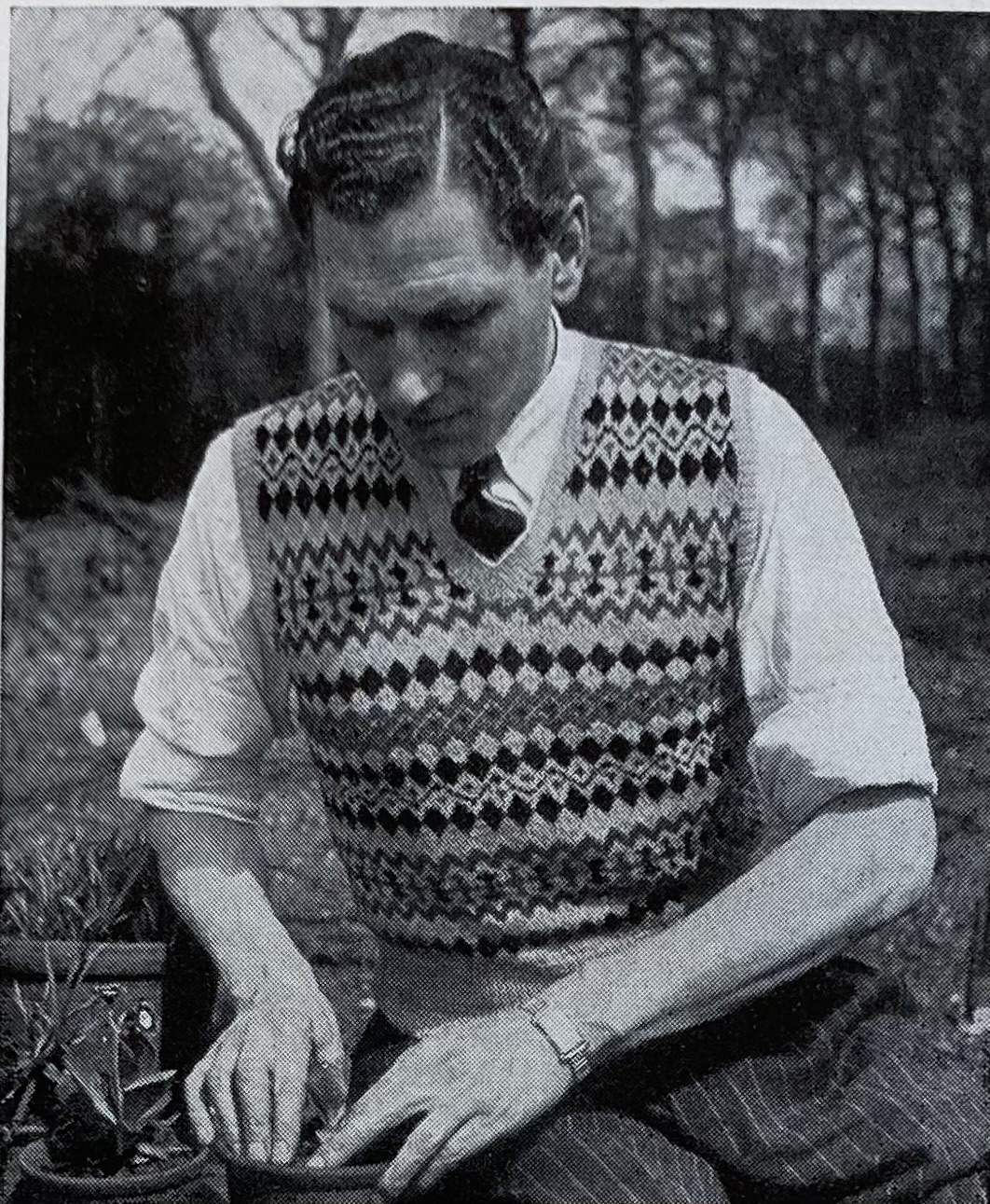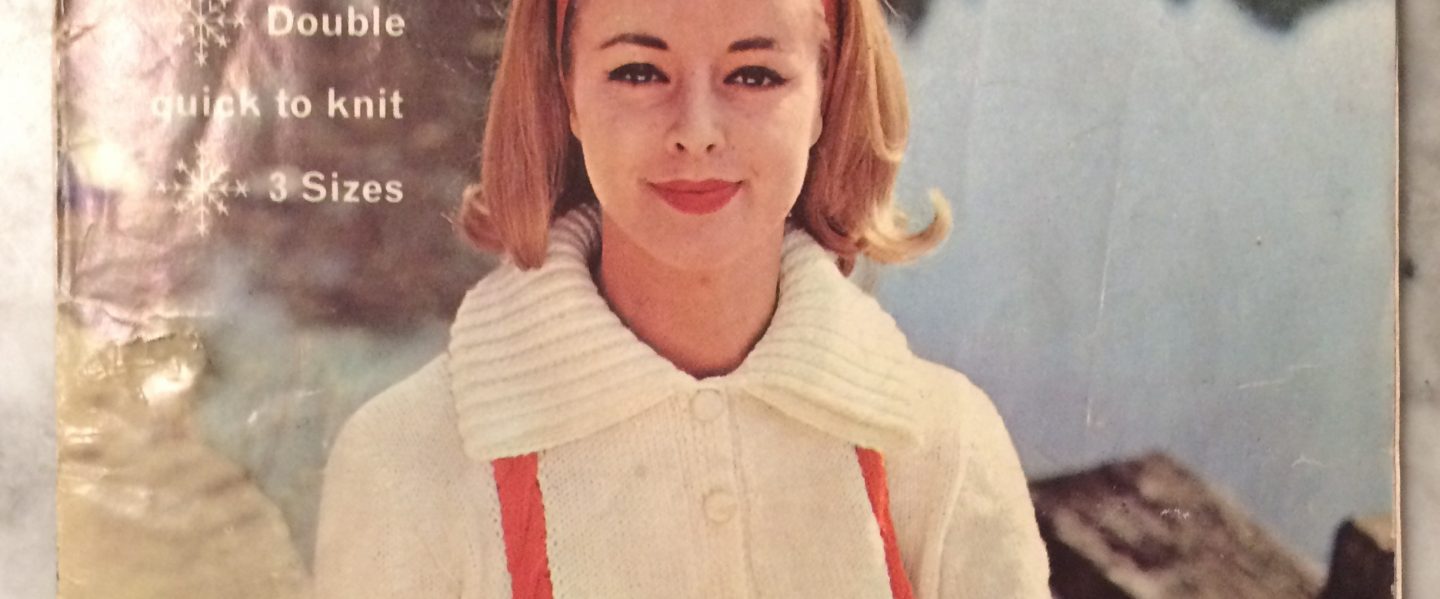
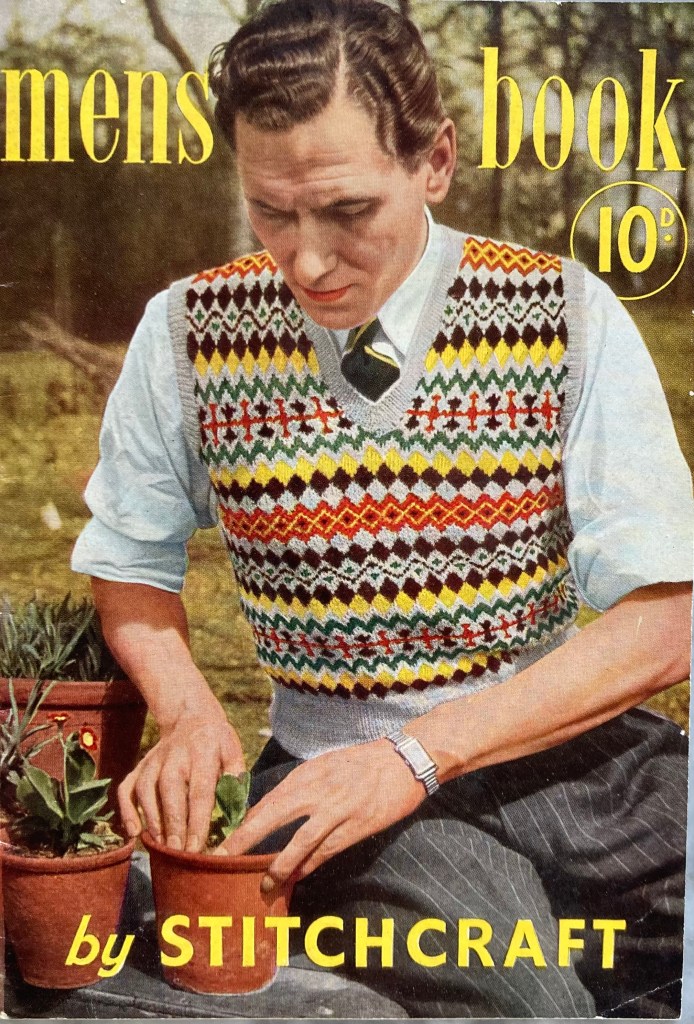
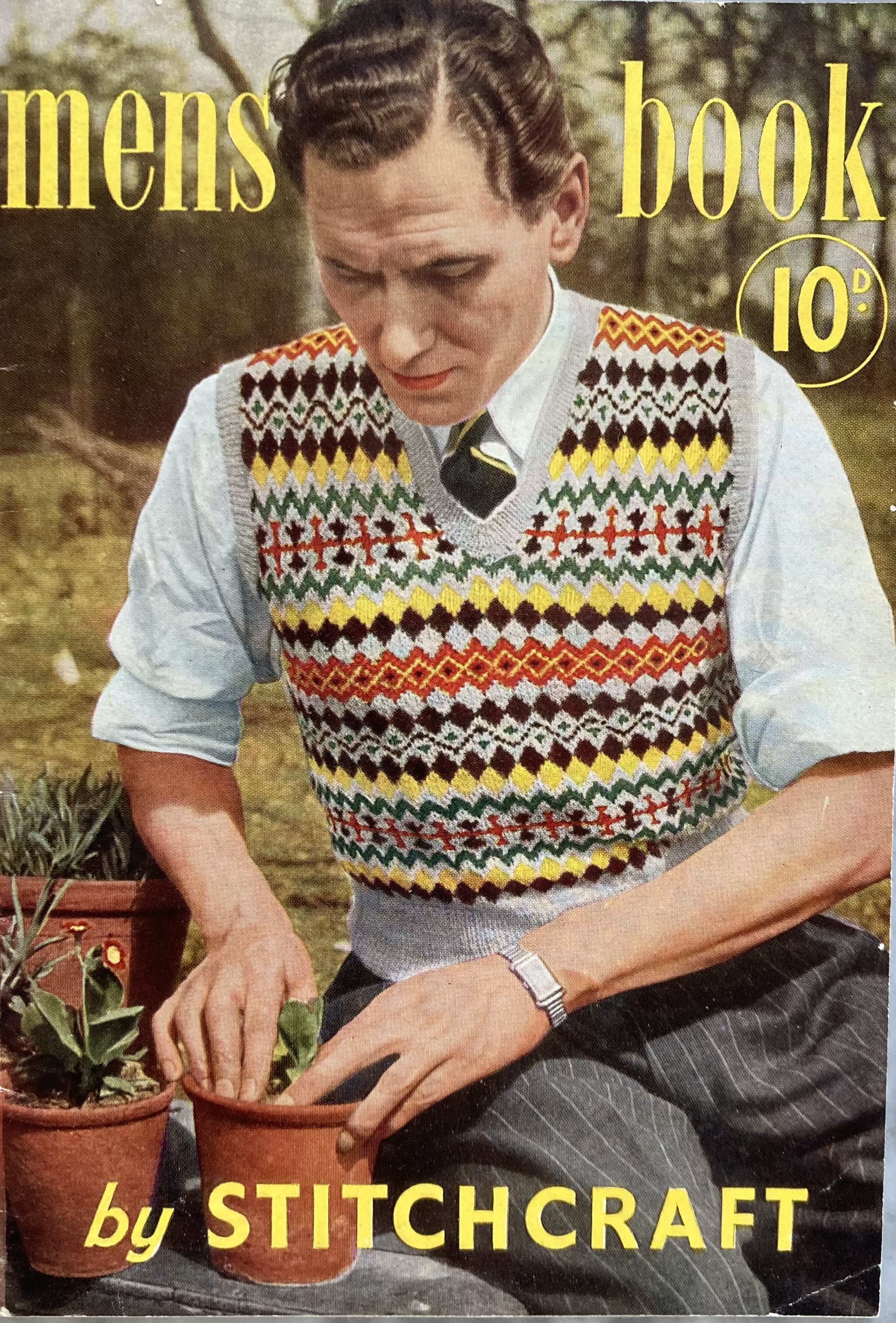
Every once in a in a while, a pattern is so popular that it gets reprinted… and reprinted again… and again… finding a new audience with every generation. Such was the case with this stranded Fair Isle design, first published in the regular September 1947 issue of Stitchcraft, then reprinted in the 1948 Stitchcraft “Mens Book”, then with a slightly altered colour scheme and a groovy new photo in a 1969 booklet of Purple Heather 4-Ply patterns (Patons 6185), and finally reaching classic status with its re-publication in Patons retro-chic “All Time Greats” pamphlet from 1974. As of 2026, it has 22 finished projects on Ravelry, with 74 more knitters holding in in the queue.
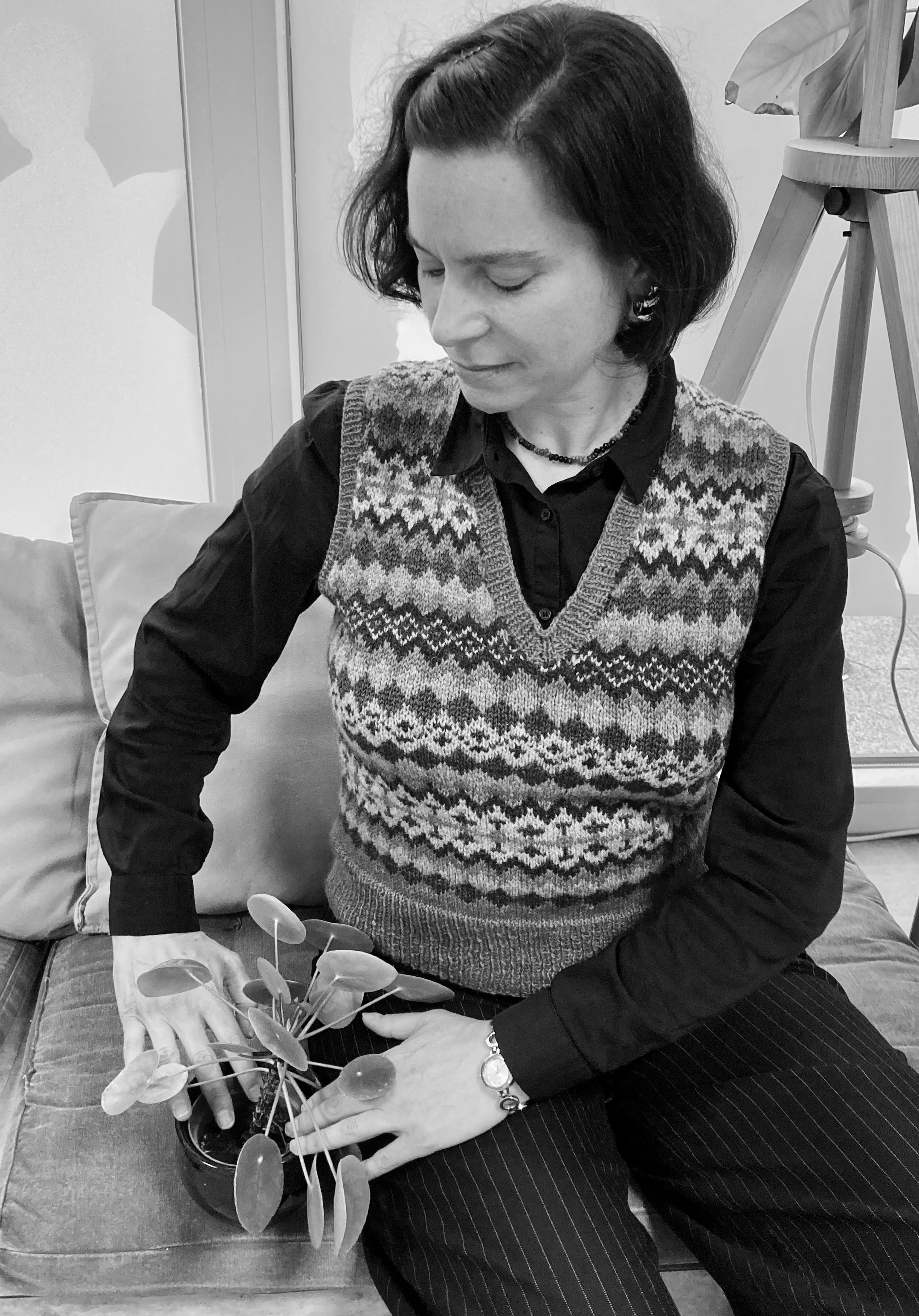
My version is adapted slightly from the original design as reprinted in the 1948 Mens Book. I don’t remember where or when or from whom exactly I bought it or it was given to me, but I assume it was in a packet with these other Weldons and P&B menswear booklets. They are all undated, but judging from the style presumably 1940s, and the non-Mens Book pamphlets all contain one or two patterns for the same type of sleeveless knitted upper-body garment.
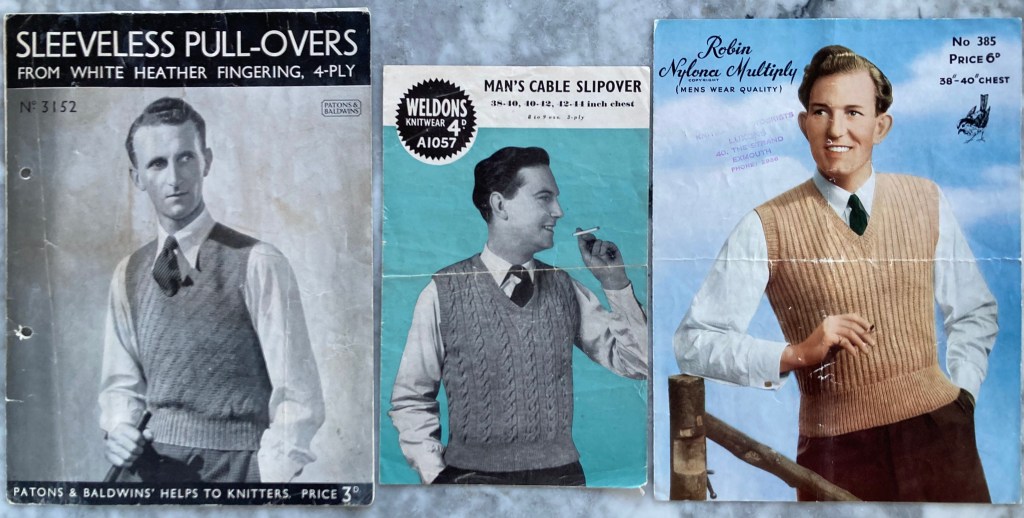
(On that note… this type of garment has the widest variety of names that I have ever encountered in one language. British patterns of the time call it a slipover, pullover or pull-over interchangeably, later British patterns usually call it a slipover or over-pull, and American patterns call it a vest (as opposed to the British vest i.e. a usually sleeveless under-shirt) or sweater vest. Technically, it shouldn’t be called a waistcoat, because waistcoats have buttons, but I’ve seen non-buttoned garments of this type called waistcoats as well. The Mens Book calls it a pullover, but I will call it a slipover here so as not to confuse it with a non-buttoned knitted upper-body garment with sleeves.)
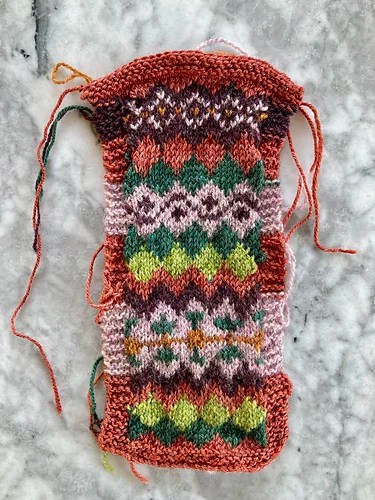
Anyway, I had bought 400 grams of rust-orange and 200 grams of dark green “Doolin” wool from the amazing AppleOak Fibre Works dyers when I was in Ireland a few years ago, meaning to make a twin set or “something” out of it. It’s 70% wool, 30% ramie, hand-dyed with all natural plant dyes, neither crepe-smooth nor Shetland-hairy but somewhere in between, and has a very pleasant wooliness and structure. With the rust-orange as the main colour (the original design main colour is cream, but I don’t wear light colours) and the dark green as the main contrast, I had more than enough for the stranded slipover plus a cardigan that might use some elements of the same design (on the sleeves? Yoke? Bottom edge?)
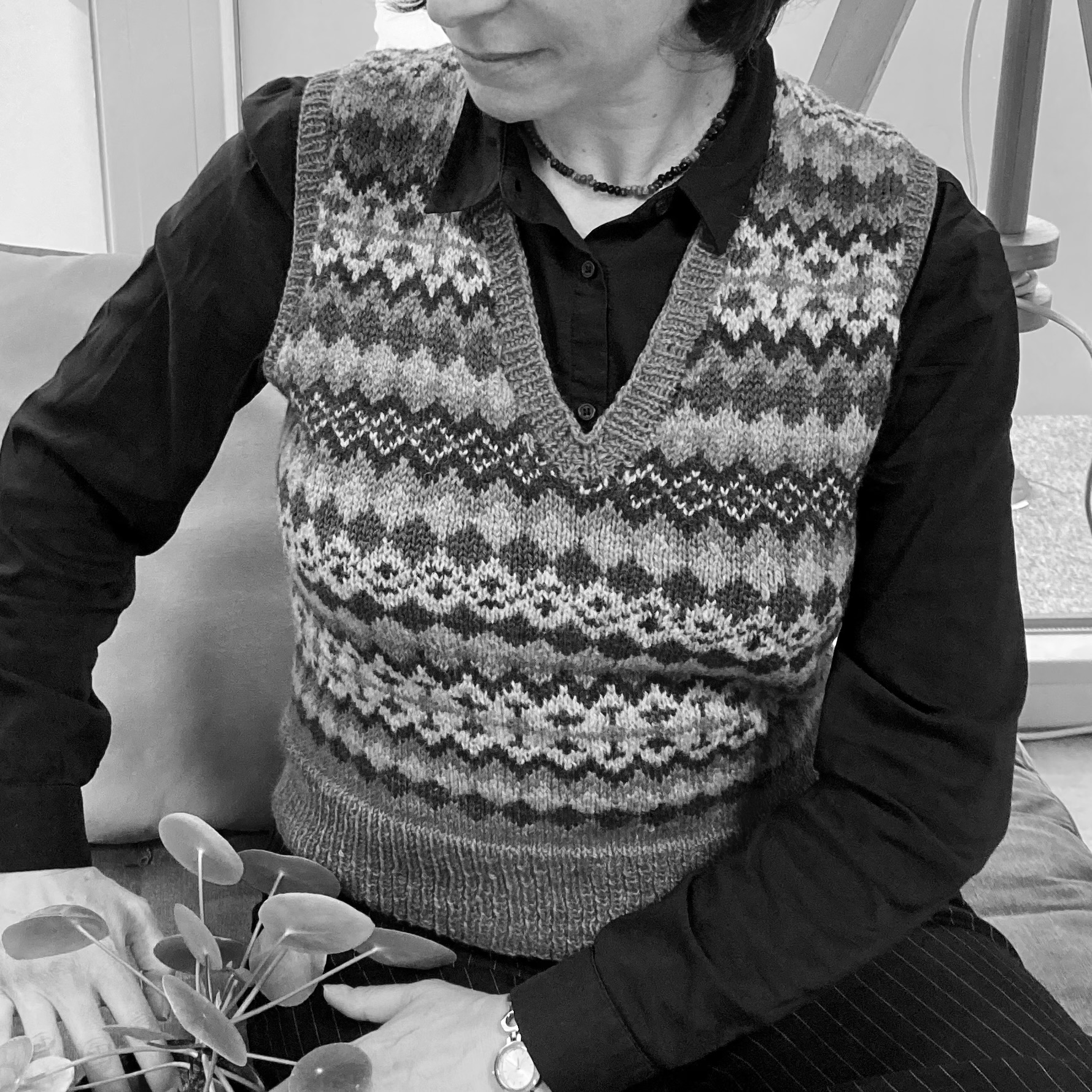
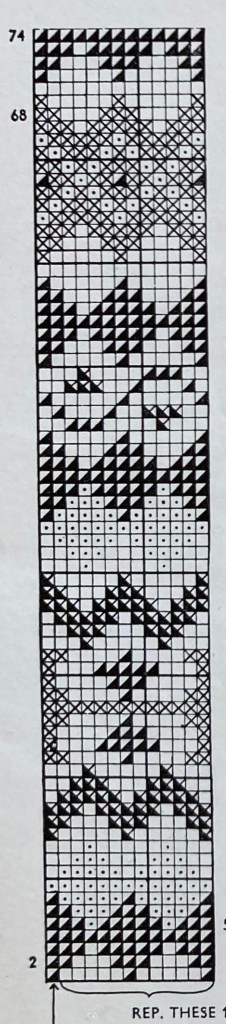
The AppleOak yarn colours are my favourites, but quite muted and earthy, and needed another contrast to perk them up. I seem to always have some kind of light green wool in the stash/leftover drawer, and experimented with small amounts of more wildly contrasting colours like yellows, pink and purple. As for the design itself, the original has several rows with 3 colours in each row, which I don’t like knitting and which was also a bit bulky in this wool (more sport than fingering), so I made some small changes in order to keep to only 2 colours in each row. I also made it in the round up to the armholes (without steeks, since I had to adjust the tension and wanted to be able to try it on in progress.) So a few adaptive measures, but keeping closely to the original.
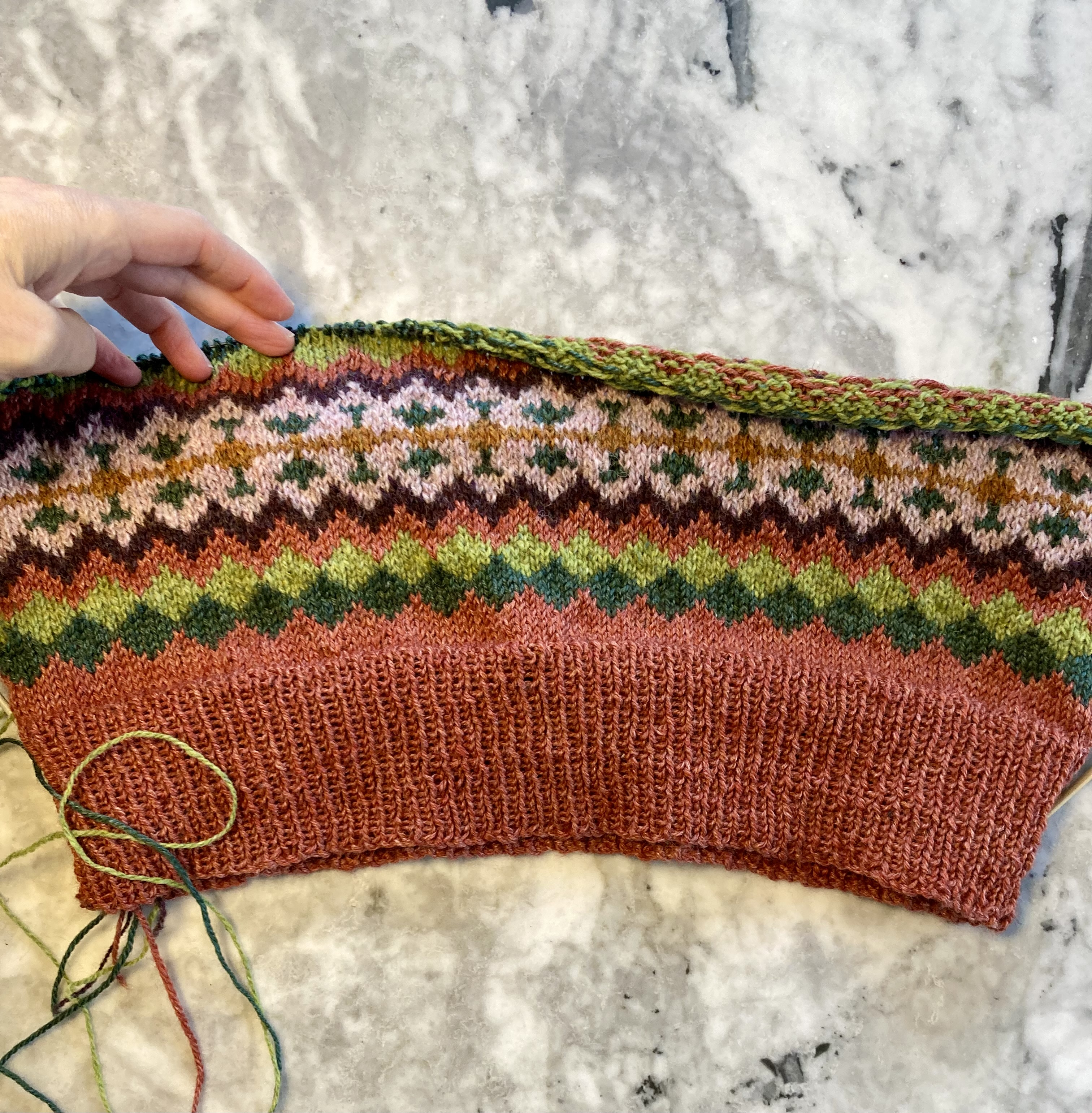
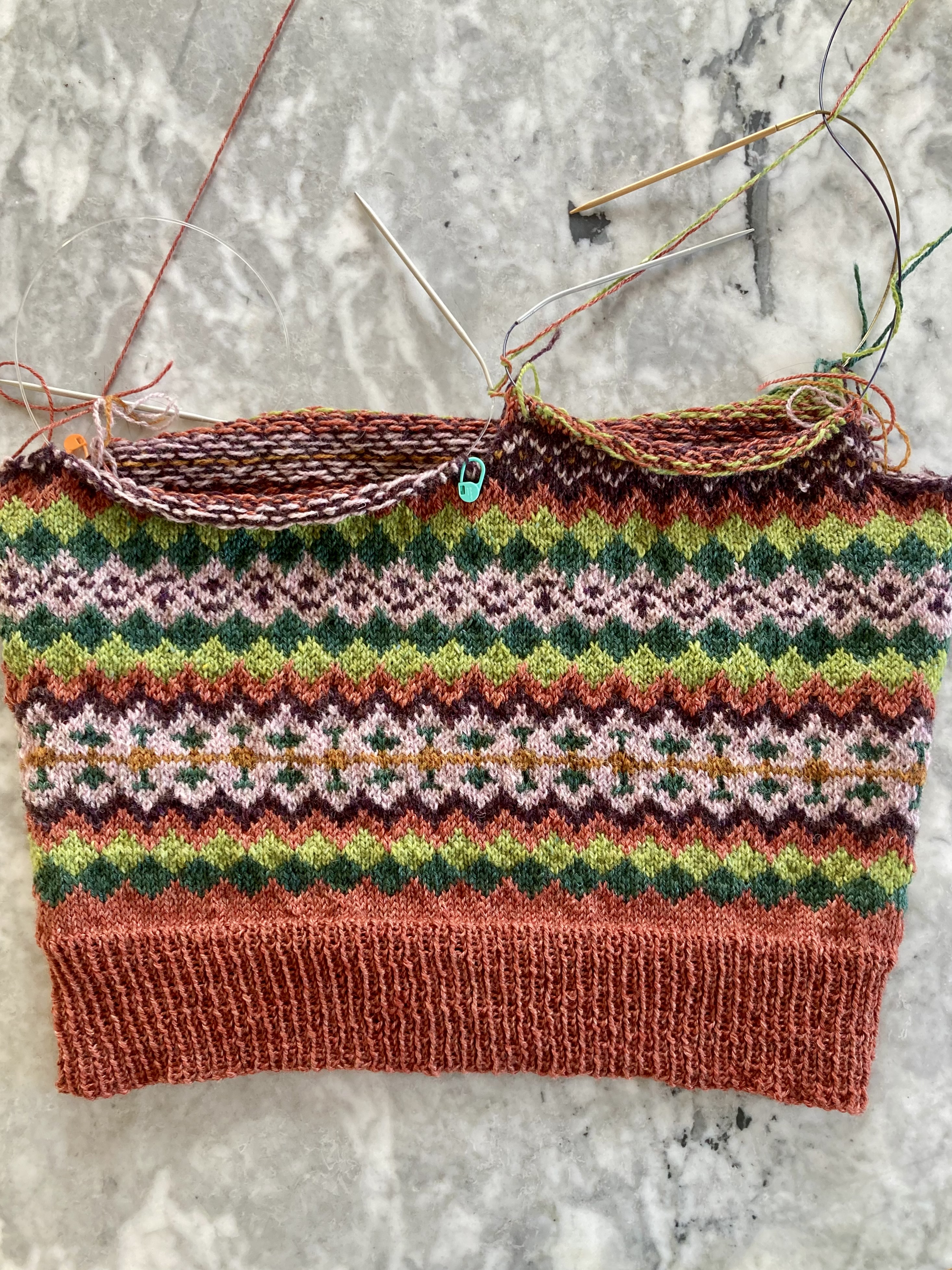
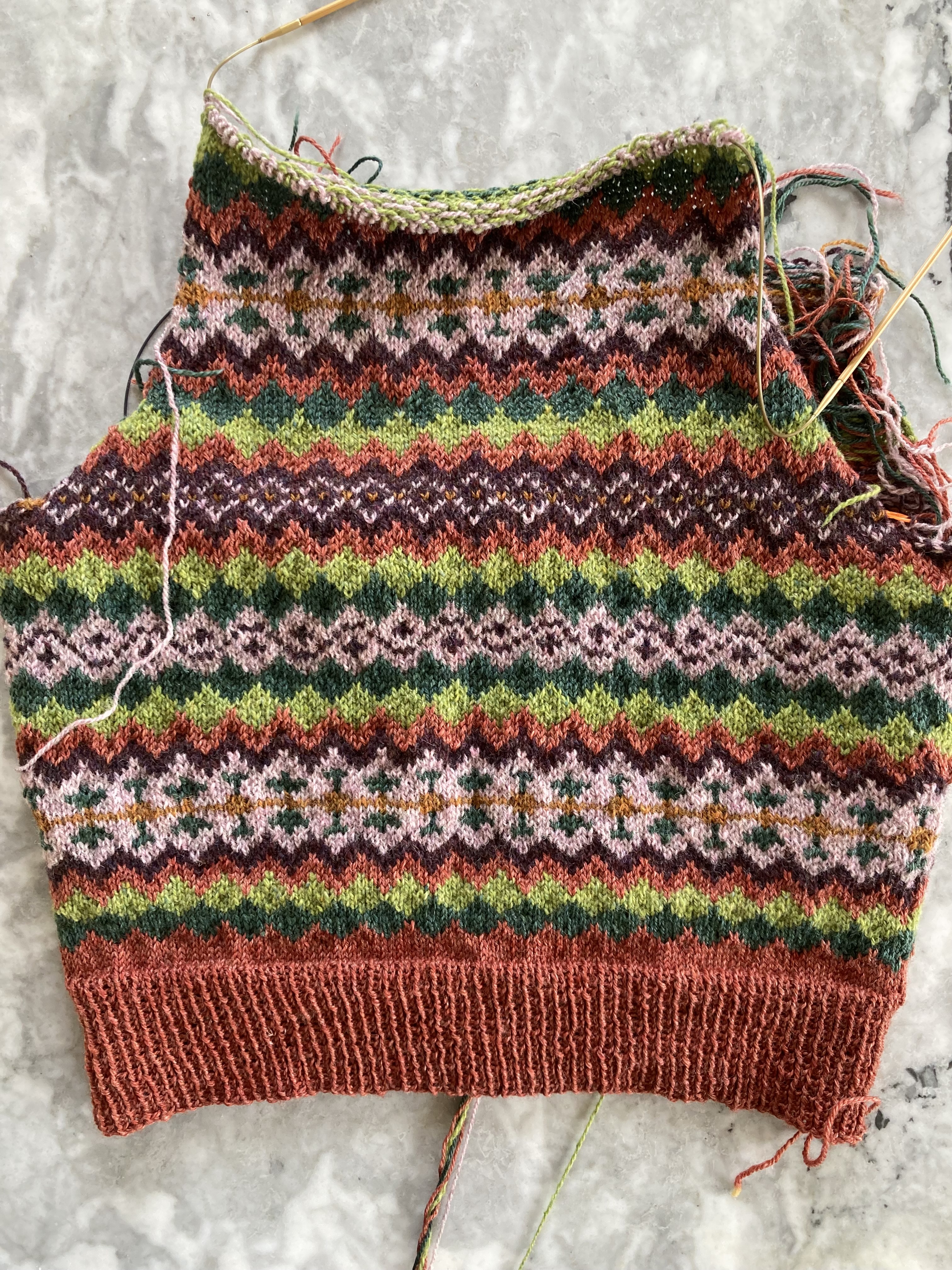
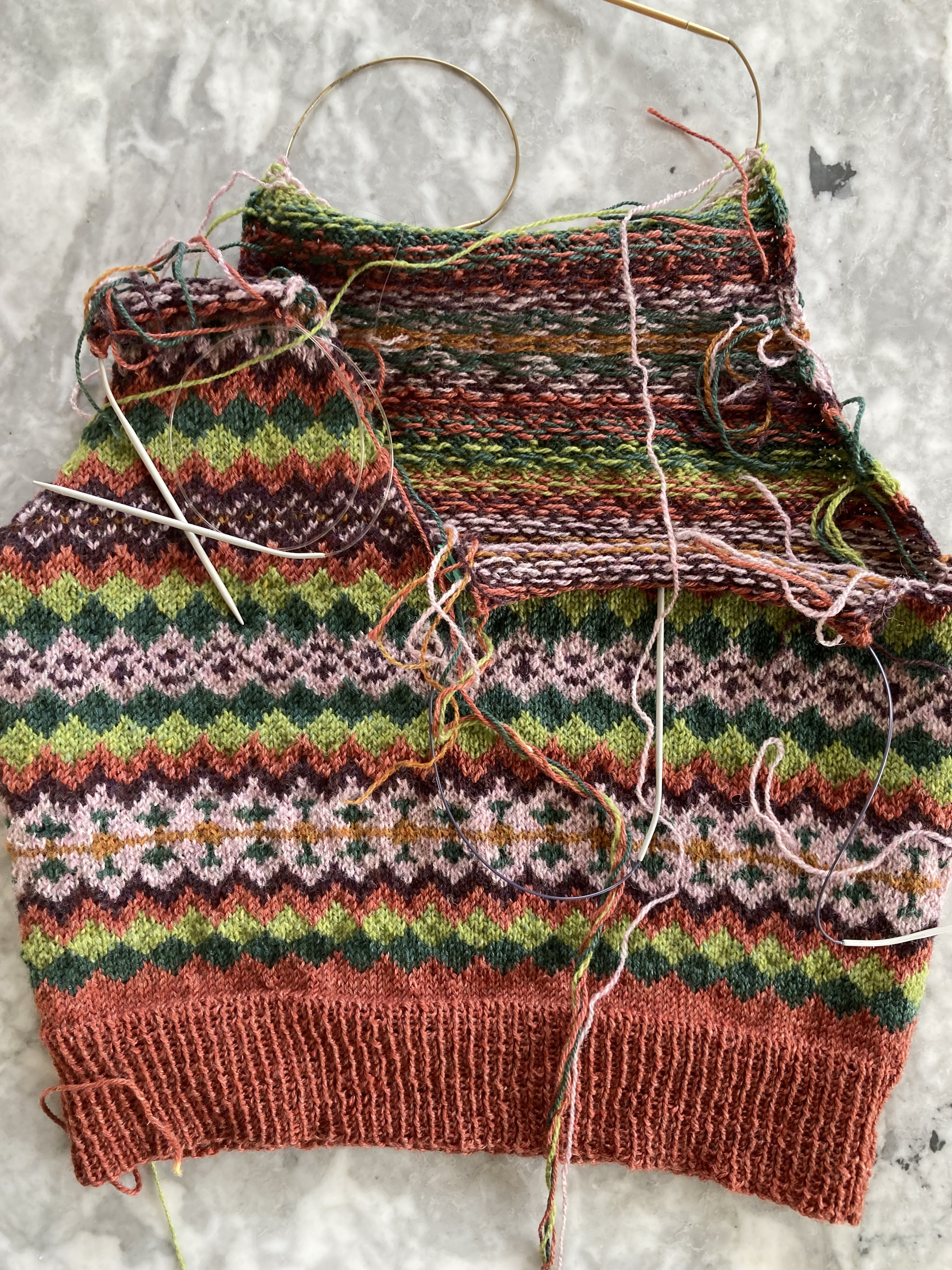
Speaking of adjusting the tension… that was the main reason it took forever for the project to get off the ground, as the wool expanded width-wise after a few inches, but then contracted back again as the piece grew in weight. The original is knitted at 7.5 stitches to the inch, not a possibility with the wool I was using, and I got around 6.5, but had to frog and restart more than once as it was too wide, then too narrow. My final version (co 114 each side, do not increase after ribbing but do change from 2.5 to 3 mm needles, change to 3.5 mm needles for the colourwork when it starts but use 3 mm needles on the plain rows, start increasing 1 st e side e 8 rnds at rib height until 120 sts e of front and back) worked well.
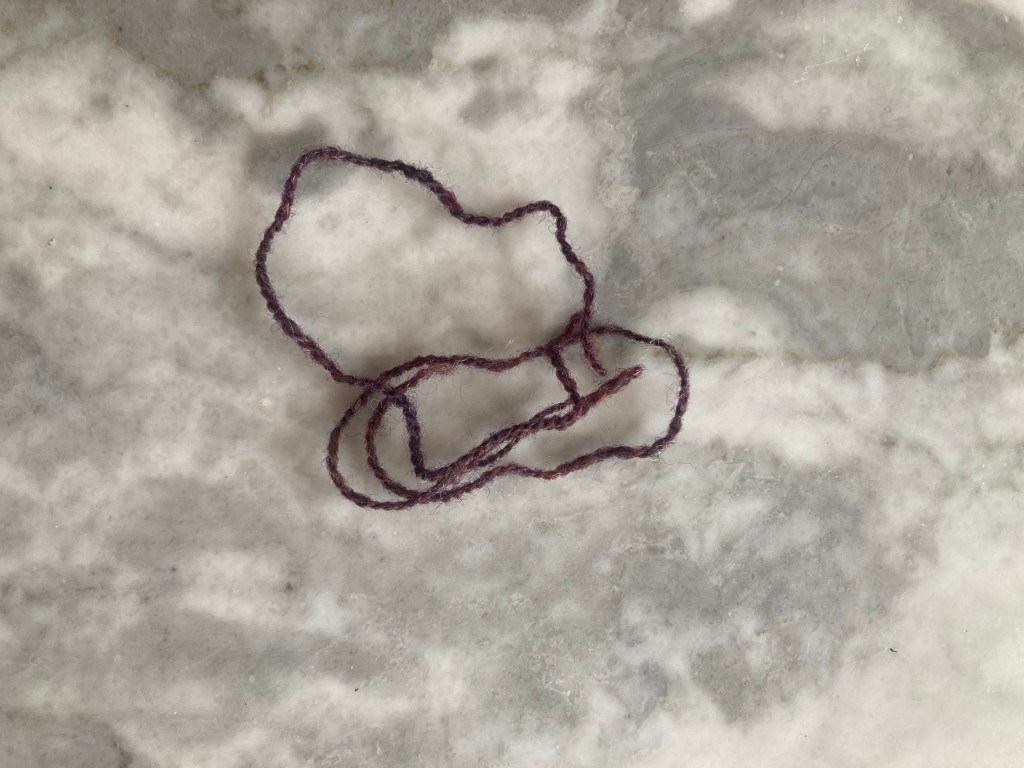
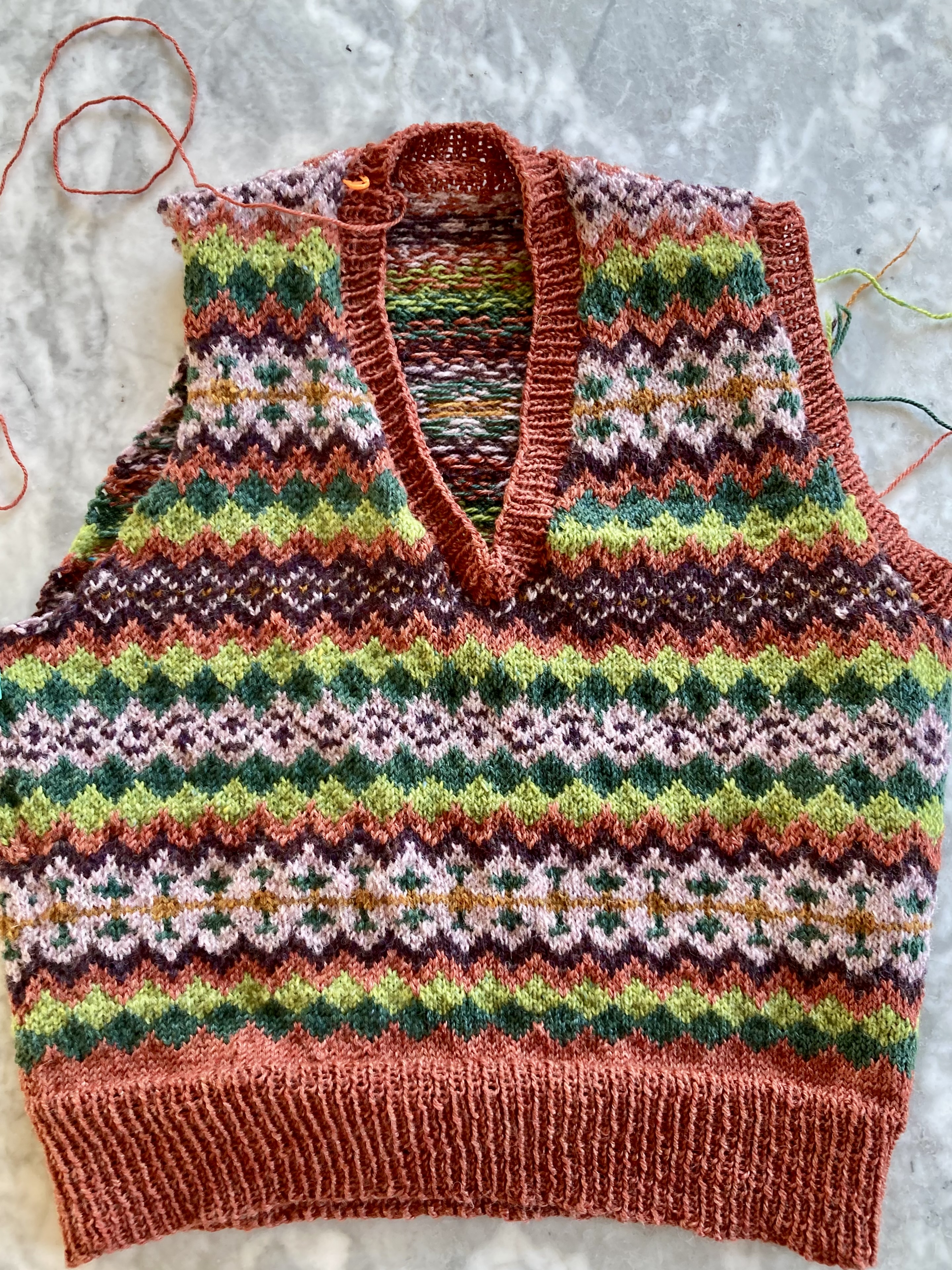
I adapted the armhole openings from the tension in the pattern and it worked well enough, but soom another problem loomed: I was not going to have enough dark purple yarn. Or would I? Let the game of yarn chicken begin! At this point, the half-finished slipover had lain in the wip cabinet for many months. I started again slowly, working a bit on the back, a bit on the right front and a bit on the left front, to see when the purple yarn would give out and if I would have to cannibalise the swatch. I changed the pattern colours around a little more right up near the shoulder and voilà, the purple yarn was exactly enough without frogging the swatch! And when I say exactly, I mean exactly… this little scrap was all that was left of it.
The back neck ended up a bit high and a bit narrow, but I was able to block it a little wider. The rest of the fit was perfect in length, width and ease. Good things come to those who let a project wait! I am glad I was so patient.
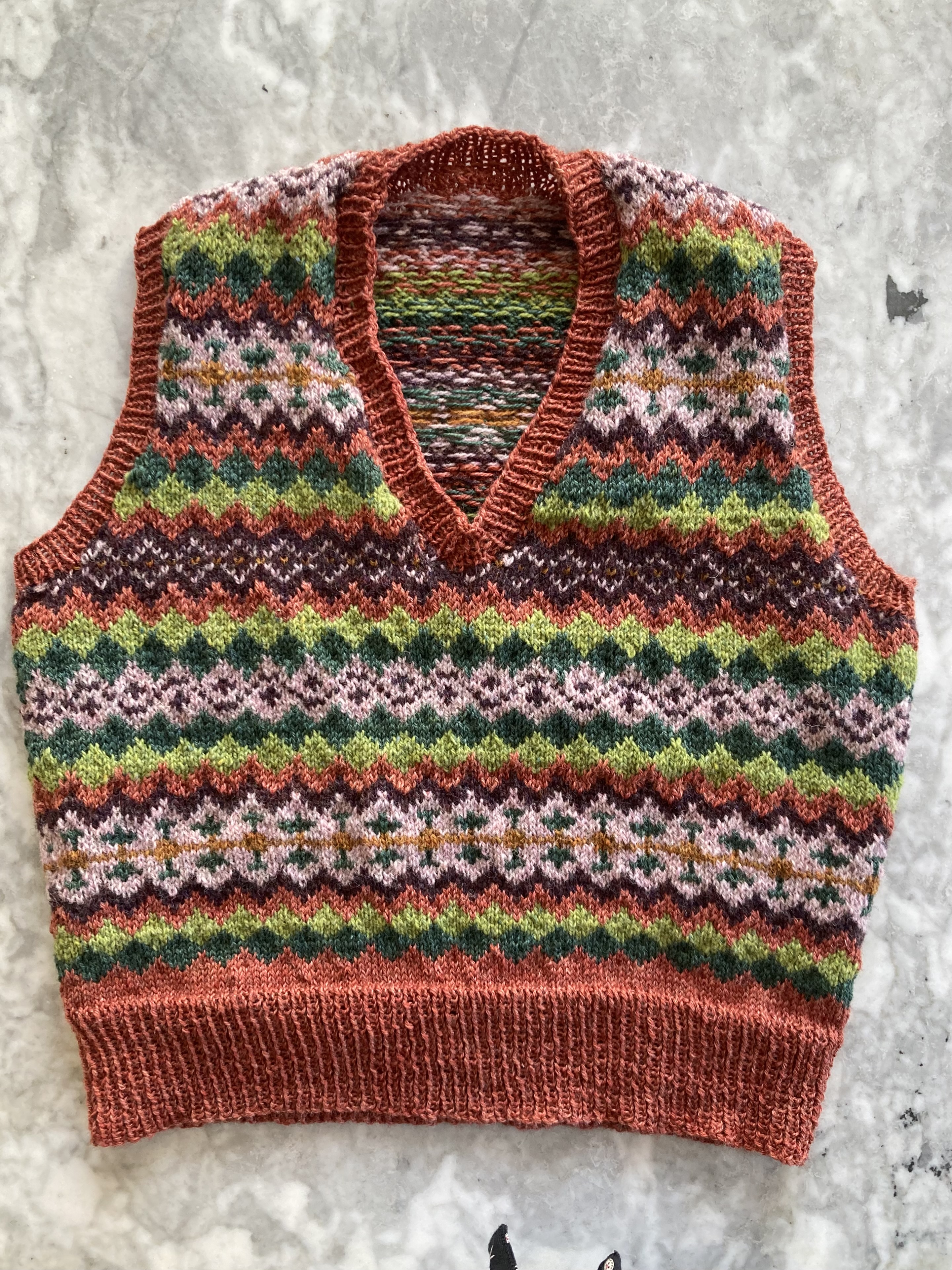
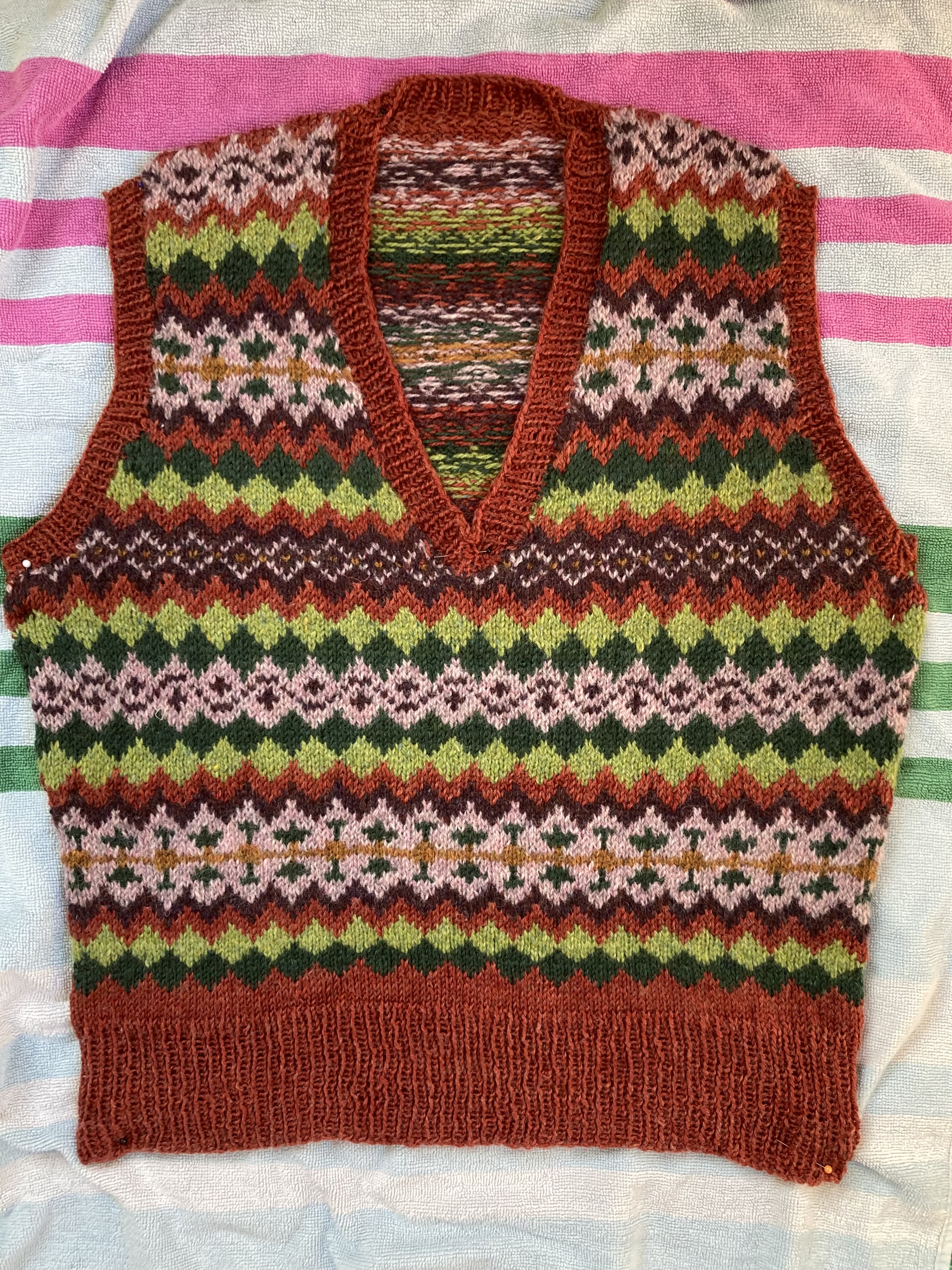
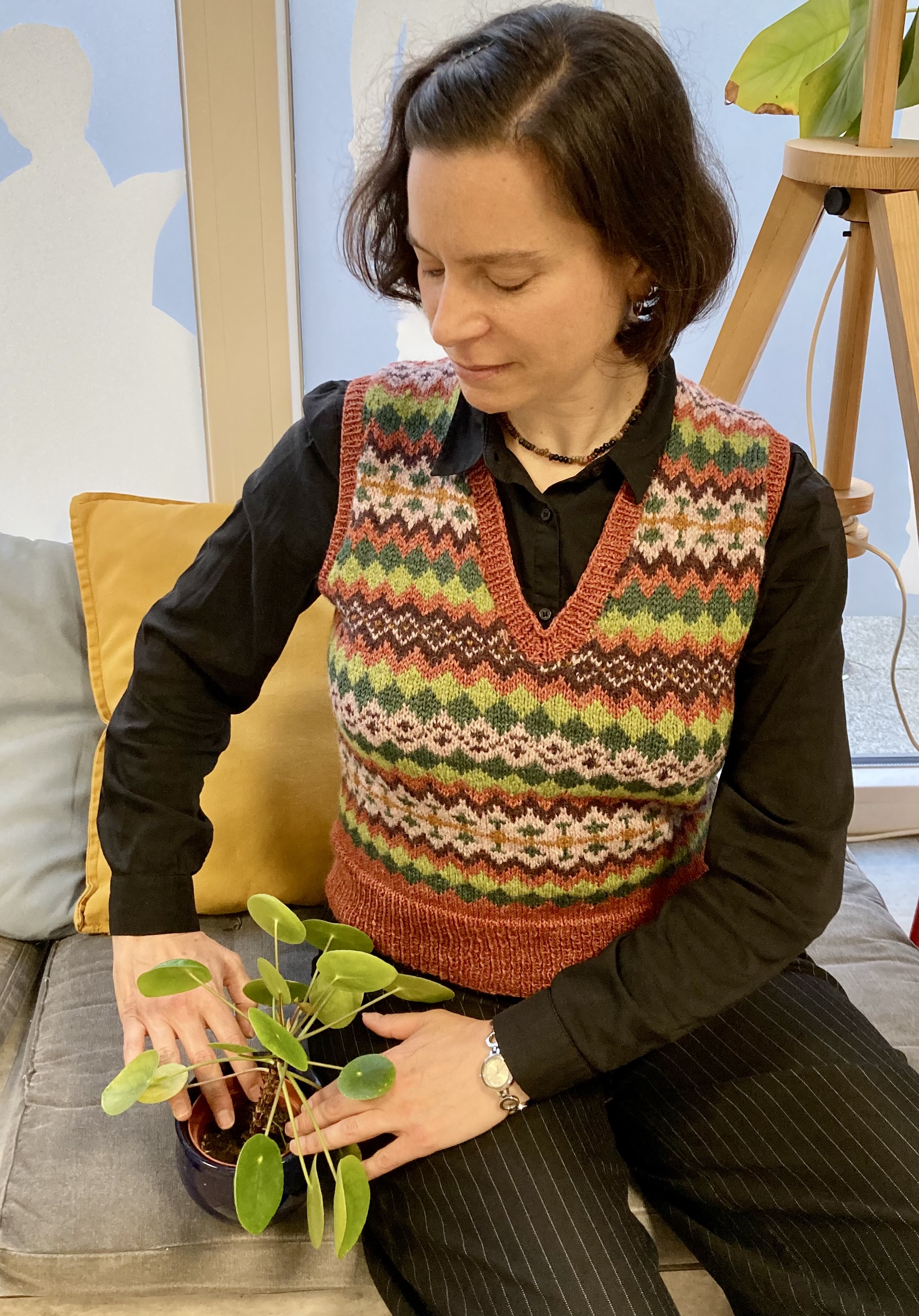
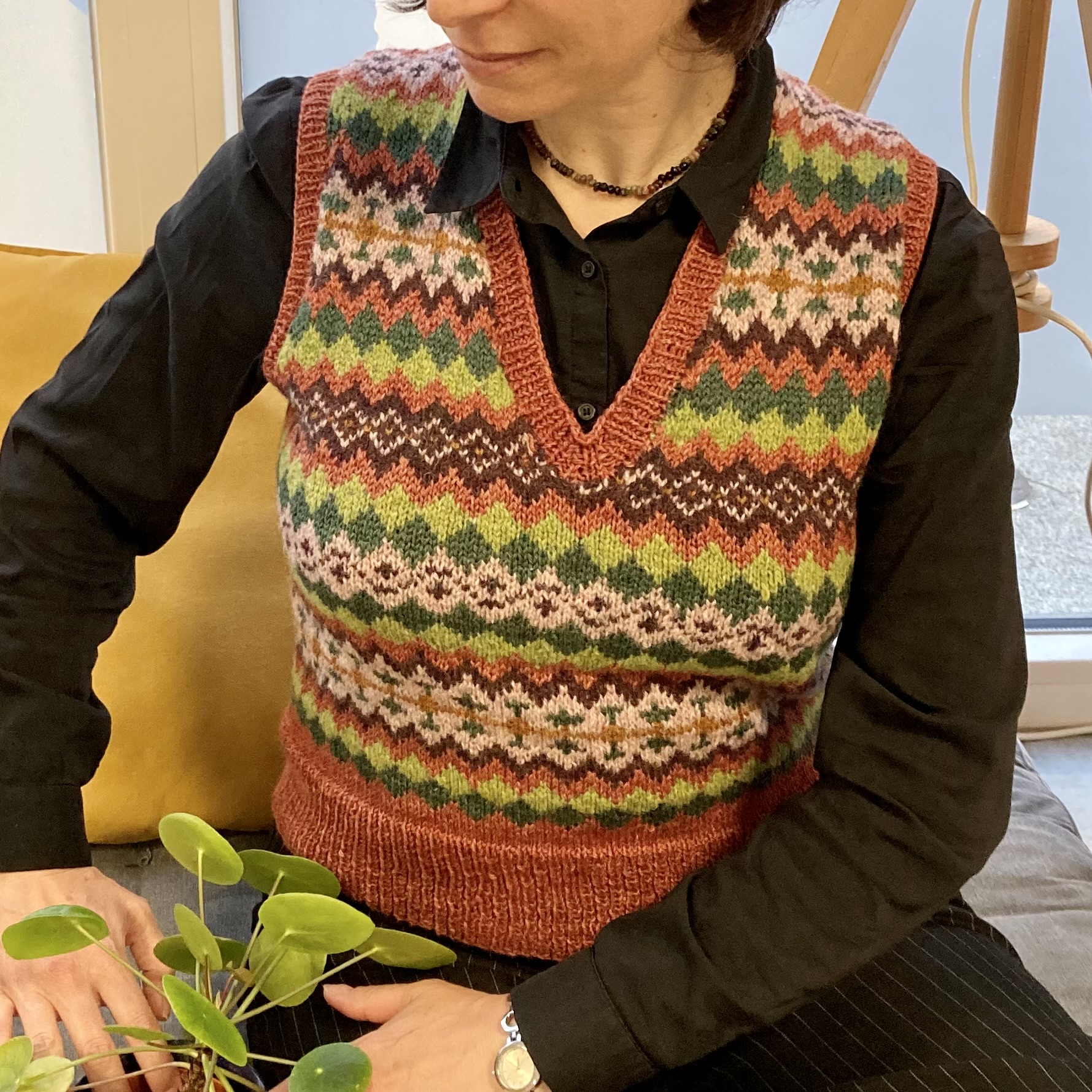
The finished project is perfect for Autumn in both warmth and colour choice. Not having a garden handy, we took the picture inside, and my little phone camera picked up the warmth of the green plants and the yellow cushion behind me — the colour photo “reproduction” you see here is without a filter or colour correction.
As for the cardigan, I’ll wait and think about it. There is no more purple and not enough pink, but I could try to use a reduced version of the colour pattern with just the dark and light green diamonds on a rust background. I still have at least 250 grams of the rust-orange and about 150 of the dark green, so anything is possible.