September 1965: Overview

Autumn is here, and the September 1965 issue of Stitchcraft is, as promised by its editress, a “bumper” issue with more colour photos (to offset the price increase to 2s. per single issue) and a new yarn from Stitchcraft’s patron wool company, Patons. 

Called “Fiona”, it was DK-weight and made of 50% Shetland wool and 50% “Orlon” (one of the very first acrylic yarns). Shetland wool is beautifully warm and lightweight due to its being very lofty and “hairy”, and “Fiona” was marketed as combining these positive aspects with the easy-care, less scratchy and non-tangling qualities of synthetic yarn — a sort of “Shetland lite”, if you will. Real Shetland wool is excellent for traditional “Fair Isle” stranded colourwork patterns, since the hairs lock into each other in the stranding, but the “Fiona” designs in this issue employ smoother, textured stitch patterns. The cover cardigan-jacket has a bobbly lace pattern and the his-and-hers pullovers use a broken cable rib. 

The other two designs for adults are made in standard 100% wools: a “young-looking sweater” with really, really unfortunately placed bobbles (directly along the bustline) in Patons Double Knitting or Crepe, and an Aran-patterned jacket in bulkier “Capstan”. An older brother might get this “Husky polo style” pullover in Patons DK and a fun reversed stocking-stitch pattern with more (and better placed) bobbles. 

The trend for textured stitch patterns continues with garments for the younger set. The toddlers’ “walking-out set” of pullover, leggings and snug helmet-style cap (with more bobbles on the tie at the neck) is made in easy 2×2 ribbing in blue and white DK wool. Love the pre-Photoshop-era addition of a tree in the photo, to show you that he’s playing outside! His big brother gets a warm slipover in an easy zig-zag pattern, and tomboy sister, (with short hair and trousers) gets a set of cap and sweater in a fisherman’s rib pattern that is more complicated to do than it looks. You purl the RS rows and and on the WS rows, you *k1, purl into next st. but through loop of row below at the same time slipping st. above off left needle; rep from * to last st, k1. The vertical stripes are added later via Swiss darning aka duplicate stitch embroidery.

Above all, this is a bumper issue for homewares. There are multiple pages of easy projects for a “Sale of Work” stall at the church bazaar or what have you, including a “house” and “windmill”-themed apron, mat/cosy set and a “peg bag” for holding laundry pegs. Other quick novelties include a knitted scottie-dog toy and a cosy or cushion made out of odds and ends of wool. 

More ambitious needle-workers can decorate an entire room from top to bottom with designs from this issue, starting with a needle-etched picture of a steam engine — a throwback to the Victorian nostalgia of the late 1950s and early 1960s — or a tapestry picture of the seaside village of Clovelly to hang on the wall. 

For the furniture, there’s a beautiful “peasant” (their word, not mine) design for a cushion and chairback, made in embroidery wool on linen, and for the floor, a hand-made “Tartan” rug. It uses a latch-hook and the “Turkey knot” to make a soft, three-dimensional pile. Finally, church-goers can make a tapestry “kneeler” cushion in a pattern inspired by Gothic stonework. 

And there’s a new children’s comic serial in the Readers Pages! This is a really cute and creative story about Homer the plush rabbit (so called because he was home-made) and Sale Price, the store-bought plush rabbit, who go out into the big wide world to try and find a real rabbit to befriend. Will they find one? Stay tuned! Oh, and I bought this issue on Ebay, so received a special… bonus? picture of an embroidered Christmas tree with no transfer or pattern instructions (and not from Stitchcraft.). If anyone can identify it, I will be very impressed!

My project from this issue will be the knitted cushion, by special request from someone who works on the computer a lot and would like a soft underlay to rest their wrists on.

December 1964: Overview

Stitchcraft sends good wishes for Christmas 1964! Yes, another year has gone by in a flash. Luckily, this issue is full of ideas for quick last-minute gifts, as well as warm clothing for the family.

The bulky partner-look cardigans on the front cover are timeless and modern – apart from the 1960s styling and lighting, and the man wearing a shirt and tie, this could be a modern advertisement for ready-to-wear knitwear. The jackets are made in „Big Ben“ bulky wool at 3.5 stitches to the inch, so they might just be finished in time for a winter cold snap. Similarly bulky, but lighter-weight „Ariel“ wool is featured in a vertically-striped („adds to the slimming look“) cardigan for somewhat larger women‘s sizes up to 42 inch bust, and there‘s a warm cabled „Cardigan for Driving“ for him with practical pockets and a big collar.

The women‘s fashions are more sleek, with classic straight lines and unfussy crew necks. A simple ridge-welt pattern can be knit from the bottom up with dolman sleeves for a horizontal stripe, or as a cardigan knitted sideways edge-to-edge for a vertical stripe effect. There‘s also a classic jumper with a twisted-stitch rib panel and a lacy sheath dress for parties.

„Juniors and Tots“ will stay warm in a fun stranded half-cardigan (zip opening from neck to waist – this is called a „Troya“ style where I live but Stitchcraft just calls it a jersey) with matching cap. Therre‘s another cap with cables running around horizontally, as well. „Tots“ from ages 1-4 get a sewn pinafore romper with a cross-stitch squirrel motif or a knitted tunic to wear over a jumper and tights (thank goodness, our child model can have warm legs for once.) Colours are warm and earthy — orange, brown and „Inca Gold“ for the adult and children’s garments and emerald green for the toddler‘s tunic.

The most important, and sometimes most entertaining, part of the December issue is the gifts, of course, and this one is full of „Last minute ideas“ — you can allegedly „make them all in an evening or two.“ Well, evenings are longer in the winter… There‘s a startled- looking owl to sew from felt pieces, and felt table mars with appliquéd butterflies. Felt is used for the draught-stopping caterpillar snake (with pipe cleaner feelers) as well, and cotton embroidered baby bibs shaped like a kitten and bunny rabbit complete the craft menagerie.

Other quick gifts include a knitted ball for a baby, a knitted and a tapestry tea cosy, and a knitted cushion — all good ways to use up scraps of wool. The „Ping the Peke“ stuffed dog looks a bit more time-consuming, and it’s probably difficult to achieve a really professional look with it.

Experienced embroideresses who have efficiently provided all of their Christmas gifts already and are not scrambling to get last-minute gifts finished can make a beautiful and very Christmas-y blue and green cross-stitch tablecloth based on a Rumanian motif. (For once, they didn‘t call a design from Eastern Europe „peasant“ embroidery! Progress.) Those looking for a simpler project can make a pretty dressing table set with flower motifs, or for the whimsically minded, there‘s a cross-stitch cushion „gift for a motorist“ with a picture of a prototype automobile on it.

The Readers Pages are full of ideas of things to buy (Stitchcraft subscriptions et. al.) plus an entire knitting pattern for a child‘s hoodie (2nd time reprint from 1954 — this must have been a very popular pattern) and instructions for an easy appliquéd spectacle case that a child could make „for Granny.“

My project will be the classic jumper with the twisted-stitch panel, in the same fun orange colour as the photo. Happy Holidays!

February 1962: Overview

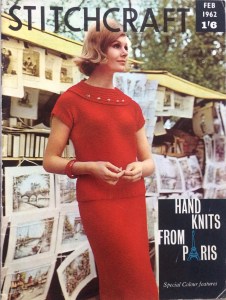
IMG_3048Put on your best traveling suit, pack your Aeros and have your Kodak Instamatic in hand, because it’s February 1962 and Stitchcraft is going to Paris! This month’s issue  features Paris-inspired designs (whatever that means) and extra pages in colour to show off the latest knitwear against a backdrop of Parisian tourist classics.

Travel from London to Paris in the early 1960s was, of course, not on the speedy Eurostar or even quicker cheap flight of our modern times. Commercial air travel was a luxury for the well-to-do and the only way to cross the Channel by train was on the Night Ferry, which ran from London Victoria to Paris Gare du Nord and back. The overnight journey took 11 hours, of which three were spent on the water;  the entire train was loaded onto a ferry for the Channel crossing. I really recommend clicking on the link, which leads to the Wikipedia article. There’s a lot more information about the Night Ferry there, and even a short list of books and films set on or inspired by it.

So what does Paris fashion 1962 have in store for us? Dresses, strong dark colours and smooth crepe wools are all “in”, with a special trend for fringes and bobbles. The two-piece dress on the cover is made in fine bouclet wool and photographed against one of the little bookselling stands that still line the roads along the Seine today. Fine, red crepe wool is the choice for the similar two-piece outfit with fringey bobbles on the front of the jumper, photographed in Montmartre. Are the bobbles supposed to suggest the legs of the painter’s tripod, or an upside-down Eiffel Tower? The dress on the facing page (Sacre-Coeur in the background) is also made in smooth crepe wool, this time in somewhat thicker Totem Double Knitting.

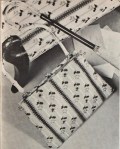
Fringe makes additional appearances in a lemon-yellow jumper with the newly fashionable high neckline and extra collar (Place de l’Opéra) and in the dark green and black plaid-effect longline jumper on the inside front cover (which appears to have been photographed in a Métro station, though I can’t immediately place which one.) Even without fringe, large collars are still going strong, as seen in the belted Rimple jacket. “Chunky” bulky wool makes an appearance in the beret and oversized handbag set (Capucines). The bag is reinforced with strips of cardboard along the top edges and a woven fabric lining to prevent otherwise inevitable sagging.

With all these lovely large projects and the special Parisian focus, it’s not surprising that the rest of the designs in the issue are unspectacular. There are some easy knitted classics for men and children, the usual “Victorian” and “Jacobean” tapestries for the home, and some fun little crafty projects like these “mats with hats” coasters. In the “Little Bobby” serial comic, John and Jane both have a cold. That’s February for you!

I have so many unfinished projects, including the January 1962 jumper, that my February project will be something small and easy. Maybe not the mats with hats, but probably a little embroidered lilac sprig (flower of the month) on a vegetable or project bag. In the meantime, watch for updates on the January project — it’s knitting along quite quickly — and a special 1950s “blast from the past” post.

May 1961: Tapestry Handbag

Version 2My project from the May 1961 issue of Stitchcraft was a charming tapestry handbag with a Victorian-inspired flower ribbon design. The magazine gives directions for either the handbag or a piano-stool top. As much as I would love to have a handbag that matched my piano stool, I’m just making the bag for now.
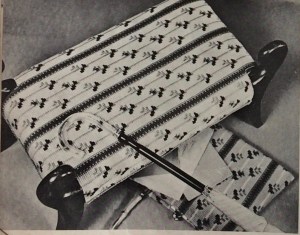
I’ve never worked in tapestry before, but for this project it’s really just IMG_2521counted cross-stitch done on tapestry net canvas with tapestry wool. The hardest part was getting all the components together! The  original pattern calls for Beehive Tapestry Canvas No. 27 and Beehive Tapestry Wool, which as far as I can see do not exist anymore — and if they did, they could very well be quite different from the same canvas and wools manufactured in 1961. Unlike cross-stitch fabric, there’s no indication of holes per inch, so I had to sort of guess from the photo of the bag (3 purple stripes across and 3 or 4 flowers vertically in the stripes) and the number of stitches in one repeat of the chart and factor in the size that I wanted the bag to be (a little smaller than the 9 inches deep and 11 inches wide given in the pattern) and the size of the modern handles.
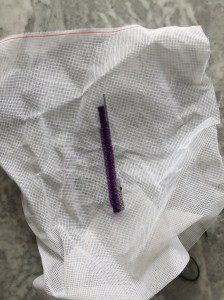
IMG_2558I found some net that seemed about right, but tapestry wool is not to be found in a craft, knitting, wool, fabric, or notions store anywhere near me. So I had to order it online… from a mail-order Internet store whose address is in my own city, but does not have an actual brick-and-mortar store. So I couldn’t see the wool before buying and they had to ship it to me, when I could and would have gladly just gone over and picked it up. And seen it beforehand… because it is really thick! About as thick as double knitting wool. It would have been so much easier to match the size of the wool to the size of the net if I could have found both of them in the same place. It’s usable with the net I bought, but I think the bag will be rather stiff.
The handles were similarly difficult. My great knitting/notions store down the street has catalogues from a company that makes knitting needles and all sorts of related knitty-crafty stuff, including a huge selection of handles and straps and whatnot for making bags. I ordered a nice (I think?) set of handles through the store and nothing happened for weeks. Then I got a message that the handles, in fact all of the handles in that catalogue from that company, were no longer available. Now I’ve ordered some more online. We’ll see what arrives!

Modern technology is lovely and all, but I would love to be able to go to an actual store IMG_2622and buy all of this stuff together. It works for knitting, sewing and embroidery, but I guess tapestry is such an unfashionable hobby that it’s not worth using store space for the materials. I should probably be glad that they’re still manufactured at all.
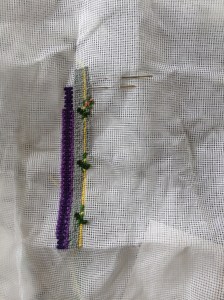
The work itself is not difficult, but I have to admit, it’s a bit boring. I do like the way it’s turning out, though. May 2019 is almost over, but this project is nowhere near being finished, so I’ll update this post when I have something more to show.

Edit a few months later: This project did not work out. The yarn is too thick for the fabric, the handles are too big for the bag, I hate counting tiny holes in tiny fabric and not being able to fix mistakes, and I really don’t know what I am doing as far as tapestry is concerned in general. Maybe I should take a class or something until I try it again. Until then, this project is permanently on hold. Better luck next time!

May 1961: Overview

IMG_2509Time for the Summer Forecast! “Editress” Patience Horne writes that it is “a lovely sunny day in March” as they go to press for the May issue. It’s freezing cold and pouring rain where I am on May 2nd, so my summer forecast feelings have been literally dampened.

Still, there is a lovely assortment of projects in this month’s issue, of which the prettiest (in my opinion) is featured in colour on the back cover: this beautiful summer twin-set in   “Nylox” (a synthetic, Bri-Nylon yarn) with a diagonal stripe pattern on the sleeveless top that is repeated on the lapels of the solid-colour cardigan. I love the pairing of the elegant line with the fun pattern, which reminds me of colourful rows of paper bunting strung diagonally.

Our front cover has two more of the classic, bulky, rather plain casual pullovers made in Big Ben (super-bulky) of Rimple (nubbly double knitting). For men, there’s also a classic “tennis sweater” in white with blue stripes, made fancy with a different sort of cable pattern that I don’t think I have ever seen before. It seems quite easy, as the cables never travel far and also never actually cross (so maybe technically not a “cable” pattern, but I don’t know what else to call it — you do use a cable needle to move the stitches out of line and back again.) Our model is very happy with his sweater, and his tennis game.

Besides the twin-set and the cover pullover, women’s fashions include a little short-sleeved jacket in double knitting and a cute cap in Big Ben, plus a “longline” jumper and buttoned cardigan in 4-ply wools. I love the way the pockets are integrated into the striped ribbing of the cardigan. Wide collars, shawl collars and V-necks continue to be popular.

Stitchcraft doesn’t usually have sewing patterns, but this month they’ve teamed up with Vogue to offer a flared or full-circle skirt of the type that was ubiquitous in the later 1950s and reached the end of its popularity around this time. Readers can order the Vogue pattern via Stitchcraft in their preferred size. The flared version is embroidered with “Tyrolean motifs” which can also be embroidered onto “pretty summer aprons”. How cute! Just don’t try to play the violin the way our little Tyrolean motif fiddler is doing it, or you and the instrument will both be unhappy.

(Nota bene: some folk-fiddle traditions, as well as European medieval and Renaissance vielle/violin technique, do involve holding the instrument under the shoulder on the upper chest or upper arm instead of under the chin as in modern classical violin playing. Still different from what is going on here, though.)

School-age children get some nice, basic pullovers and cardigans in washable Nylox or fun Rimple. I don’t know what’s going on with the Humpty Dumpty giant egg doll, but this seems to be a theme with Stitchcraft — I remember seeing more than one knitted or sewn or crocheted giant Humpty Dumpty mascot pattern somewhere in my collection. Check out the cute illustrations and the little castle in the air on the top right of the painted backdrop.

Homewares tend towards the fun and easy, with a “Victorian” floral ribbon design for an embroidered cushion, tapestry cushion or tapestry handbag as well as some assorted cross-stitch or drawn-thread table mats and traycloths. Oh, and also some “his and hers” bath mats. May’s Zodiac sign is Taurus the bull, which you can cross-stitch onto a fluffy-fringed lampshade. I would love to see a picture of a Stitchcraft living room with all twelve Zodiac-themed designs in one place — the lampshade, the chairbacks, the waste-paper basket cover, et cetera (spoiler: sadly, we’re not going to get one.)

That about wraps it up for May! I would love to make the twin-set, but I have such a backlog of projects that I know I won’t have time to get it done, so my project will be the tapestry handbag. I’m very excited to work with tapestry for the first time.See you soon!

Version 3


January 1961: Overview

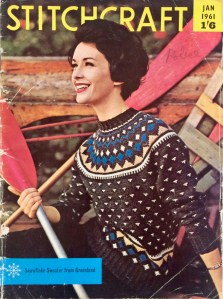
IMG_2256Happy New Year 2019! Or 1961, if you prefer. January 1961’s issue “starts with a swing” with “lots of colour” and “tip-top designs” like the gorgeous Greenlandic-style sweater on the cover.

Looking through the issue, I feel like this is the point in time where the 1960s started, fashion-wise. The closely-fitted, fine-knit, waist-length jumpers of the 1950s have made way for bulky, quick-to-knit garments, and nylon-mix wools like Rimple are more common.  Skirts are still long and hairstyles modest — we’re not in the “Swinging Sixties” yet — but colours are bolder and the whole look seems fresher, somehow.

The little girl’s outfit on the inside cover definitely embodies the new look. Yes, her legs are still going to freeze, poor child, but her little red Rimple outfit is swingy and fun. And look at that wonderful cap and muff! The decorations are made by cutting the bobbles out of a length of bobble fringe and sewing them onto a crochet chain made in contrasting green or red wool, then sewing the bobble chain onto the cap and muff. Mum and daughter can both sport the latest in “Paris Hat News”, which seems to be a sort of turret tower worn on top of your head. The loops on the bottom part of the adult hat are made by pulling loops through the knitting ridges with a bodkin or blunt tapestry needle and holding them in place with your thumb until they are all made and the wool fastened off.

Women’s and men’s fashions feature loose-fitting garments in bulky wools, either hip-length and unshaped like the Greenlandic sweater or the embroidered Viennese cardigan on the inside back cover, or “cropped and bulky” like the “slick jacket” made in thick Big Ben wool. For a more elegant look, you can knit a suit in double knitting weight and top it with a detachable fur collar.

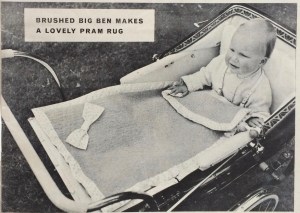
In addition to the little girl’s sets, babies and children can enjoy a warm cape or dressing gown in Rimple yarn, or a pram blanket in brushed, bulky Big Ben wool. The brushing felts the wool for a true blanket effect. It was done with a teasel, which is a metal brush that breaks up the fibres and lifts the nap of the fabric. Readers are instructed to send the finished blanket to Patons and Baldwins in Scotland, who will brush the blanket for you “at a very reasonable charge.”

IMG_2263

Jacobean embroidery, stitched hall rugs, and Victorian-style chair seat tapestry remain steadily in fashion, or you can embroider pictures of a kitten and puppy to hang on your wall. I don’t know about you, but to me they look kind of melancholic! This month’s Zodiac sign is Capricorn, and you can use it to decorate a pyjama case. In the children’s features, Wag and Wendy have tea with a toadstool fairy and kids can sew a simple tea-cosy set for their mother’s birthday.

My project will be the fabulous sweater from the front cover. I’ll be modifying the fit, though, as big and bulky is not my style. Thanks for joining me for the first year of this blog, and best wishes for 1961 — er, 2019!

February 1960: Overview

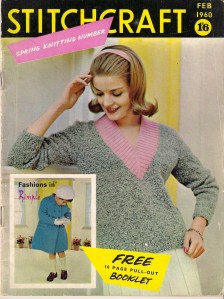
Feb1960_coverFebruary 1960, the “Spring Knitting Number”, features an extra 16-page pull-out booklet with garments in Patons Rimple, a nubbly wool-with-a-bit-of-nylon yarn that looks like terrycloth toweling when worked up. The Ravelry yarn database has more information with pictures and modern projects. The wool itself gives so much texture that it would be pointless to knit intricate patterns or multi-colour pieces with it, so the “zippy designs” in the supplement are made on very classic lines: V-neck pullovers, a plain cardigan, a child’s cap and mittens.
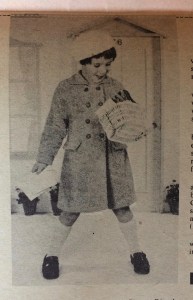
The only slightly more ambitious design is this double-breasted A-line coat for a child.IMG_1488 The model, like all children of the 1960’s and earlier, must have very cold legs. Why children of earlier times didn’t wear trousers or warm stockings or tights is a mystery that an older person will have to explain to me someday. It’s particularly strange to see in a knitting magazine, as often the child will be wearing a thick wool jumper or even a wool pullover under a wool sleeveless dress with a knitted wool coat over it, plus a hat and mittens if outside… but nothing on their poor bare legs.

The non-Rimple knitted garments are long, like this “Fashionable Dress” in 4-ply fingering at 7 stitches to the inch, or the long coat in a two-colour slip stitch pattern. Even the dolman cardigan is hip-length. The embroidery and needlepoint projects cover various traditional styles with a Victorian ribbon-band pattern for a stool top, a cushion with Tudor-inspired pears and acorns, and a very zig-zaggy “modern” Swedish rug and cushion set. The Swedish rug has a neat three-dimensional effect thanks to tufting.


As the focus of the issue is the Rimple supplement, the other projects in the issue are fairly basic: cardigans for men and boys, a crocheted cap and mitts, an embroidered wall panel and counted-stitch cushions. The ads are for fabric, knitting and sewing machines, and “Cow and Gate” baby formula — all standards — and the two teddy bears in the comic are heading off on Magic Way in their enchanted toy village.

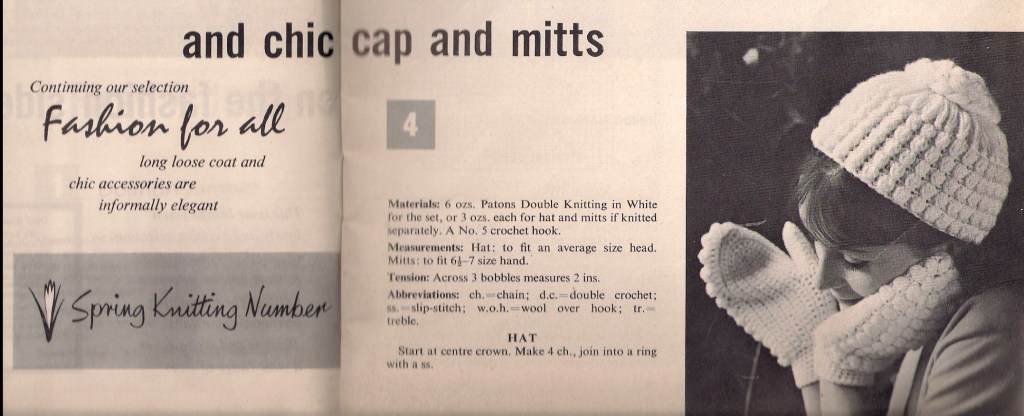
Rimple is not my style, so I’ll be making a small project this month: the crocheted cap and mitts with an intriguing bobble pattern and plaited crown.Feb1960_2


January 1960: Overview

jan1960cover

January 1960 wishes us a Happy New Year with designs for “fashion” and “casual” knitting, a machine-knitted jumper, children’s and baby clothing to knit, a matching rug and cushion, and “something completely different in embroidery” — cushions and wall hangings with Victorian-era train, carriage and bicycle motifs.  I find it strangely appropriate that Stitchcraft started a new and, one would expect, exciting decade with a look to an even more conservative past — the magazine was not exactly innovative, and its readership enjoyed patterns that give a nod to current styles without being all too forward-thinking.

victorian
Dashing away!

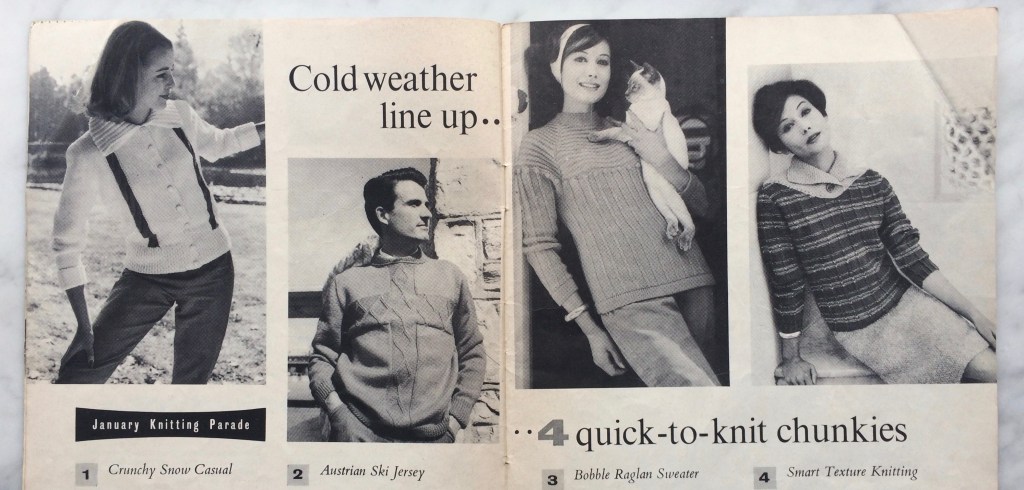
The jumpers (or sweaters: Stitchcraft appears to use the two words interchangeably) continue the trend for somewhat thicker yarn — as Patience Horne writes in the introduction to this issue, “we all seem to get busier and busier these days” and the 9-stitches-to-an-inch creations of the 40s and 50s were slowly getting rarer. Five of the eight adult garments in this issue use double knitting yarn.

coldweatherlineup


On the embroidery front, there is a lovely design for a glass-topped coffee table, an adaptable Jacobean design in colour on the back cover, and a simple “leaf” cushion.


The Victorian cushions are “gay”, as are the children’s gloves. One of Stitchcraft‘s endearing qualities is its use of the word “gay” to mean charming, colourful, sprightly et. al. long after the word’s more modern meaning eclipsed its original one. It’s not yet quite so funny in 1960, but the word still appears in post-Stonewall issues up into the early 1970s. Yet another sign that Stitchcraft did not move with the times! I love all things gay no matter what sense of the word, so will be sure to point out this charming feature whenever it appears.

The ads feature Lux soap flakes, Wearwell facing ribbon and a Tru-Matic knitting machine  — all repeat customers.  There is always a little comic for the kiddies, and we’re already at part 3 of this one, “A Tale of Two Bears.”

I will be making the leaf cushion and the “green check jumper”, shown in colour on the inside back cover.