
Stitchcraft sends good wishes for Christmas 1964! Yes, another year has gone by in a flash. Luckily, this issue is full of ideas for quick last-minute gifts, as well as warm clothing for the family.
The bulky partner-look cardigans on the front cover are timeless and modern – apart from the 1960s styling and lighting, and the man wearing a shirt and tie, this could be a modern advertisement for ready-to-wear knitwear. The jackets are made in „Big Ben“ bulky wool at 3.5 stitches to the inch, so they might just be finished in time for a winter cold snap. Similarly bulky, but lighter-weight „Ariel“ wool is featured in a vertically-striped („adds to the slimming look“) cardigan for somewhat larger women‘s sizes up to 42 inch bust, and there‘s a warm cabled „Cardigan for Driving“ for him with practical pockets and a big collar.


The women‘s fashions are more sleek, with classic straight lines and unfussy crew necks. A simple ridge-welt pattern can be knit from the bottom up with dolman sleeves for a horizontal stripe, or as a cardigan knitted sideways edge-to-edge for a vertical stripe effect. There‘s also a classic jumper with a twisted-stitch rib panel and a lacy sheath dress for parties.


„Juniors and Tots“ will stay warm in a fun stranded half-cardigan (zip opening from neck to waist – this is called a „Troya“ style where I live but Stitchcraft just calls it a jersey) with matching cap. Therre‘s another cap with cables running around horizontally, as well. „Tots“ from ages 1-4 get a sewn pinafore romper with a cross-stitch squirrel motif or a knitted tunic to wear over a jumper and tights (thank goodness, our child model can have warm legs for once.) Colours are warm and earthy — orange, brown and „Inca Gold“ for the adult and children’s garments and emerald green for the toddler‘s tunic.


The most important, and sometimes most entertaining, part of the December issue is the gifts, of course, and this one is full of „Last minute ideas“ — you can allegedly „make them all in an evening or two.“ Well, evenings are longer in the winter… There‘s a startled- looking owl to sew from felt pieces, and felt table mars with appliquéd butterflies. Felt is used for the draught-stopping caterpillar snake (with pipe cleaner feelers) as well, and cotton embroidered baby bibs shaped like a kitten and bunny rabbit complete the craft menagerie.

Other quick gifts include a knitted ball for a baby, a knitted and a tapestry tea cosy, and a knitted cushion — all good ways to use up scraps of wool. The „Ping the Peke“ stuffed dog looks a bit more time-consuming, and it’s probably difficult to achieve a really professional look with it.

Experienced embroideresses who have efficiently provided all of their Christmas gifts already and are not scrambling to get last-minute gifts finished can make a beautiful and very Christmas-y blue and green cross-stitch tablecloth based on a Rumanian motif. (For once, they didn‘t call a design from Eastern Europe „peasant“ embroidery! Progress.) Those looking for a simpler project can make a pretty dressing table set with flower motifs, or for the whimsically minded, there‘s a cross-stitch cushion „gift for a motorist“ with a picture of a prototype automobile on it.


The Readers Pages are full of ideas of things to buy (Stitchcraft subscriptions et. al.) plus an entire knitting pattern for a child‘s hoodie (2nd time reprint from 1954 — this must have been a very popular pattern) and instructions for an easy appliquéd spectacle case that a child could make „for Granny.“
My project will be the classic jumper with the twisted-stitch panel, in the same fun orange colour as the photo. Happy Holidays!
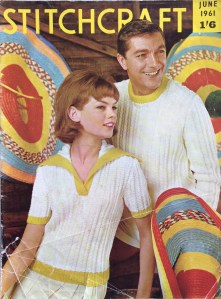 I love this cover. The yellow stripes on the hats, the yellow trim on the sweaters and the yellow sans-serif lettering all harmonise perfectly with the off-white garments in the center focus. Even the models’ hair colour looks like it was chosen to match the wooden wall. And we can see that typical 1960s hairdo coming into fashion, with more volume on the top and curled ends.
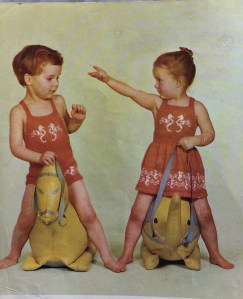 elephant! The dress is totally cute and definitely on my project list for this month, for my friend’s kid who just turned three. Those are seahorses, in case that wasn’t clear (the ones on the front panel of the dress and matching sunsuit look weird to me — I think I’ll fill in the bodies to make the shape more clear.) The sunsuit and dress are made in wool-nylon blend
  (Speaking of tiny children in goofy poses, am I the only one who finds this advertisement for next month’s Stitchcraft strangely funny? What is it about this baby that comes off looking so weird? Too much hair? The quasi-adult-looking face? The indescribable expression?)


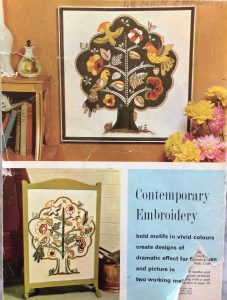 And then there’s this incredible birds-in-a-tree number, to be worked either in wool on linen for a firescreen or in felt appliqué with wool embroidery on linen for a picture. I’m normally not so crazy about 1950s and 1960s neo-Jacobean designs, but I love this one and definitely want to make the felt appliqué version as a cushion (with a more greeny green for the tree and not quite so much brown-orange-yellow in the appliqué work.) I imagine it might be tough without a transfer, but they gave us two very clear photographs including one in full colour, so what could go wrong?
 Last but not least, there’s a lovely, elegant two-piece suit in nubbly Rimple double knitting wool, featured in the most magnificent photo I have ever seen in any magazine, ever. If I remember correctly, I saw it in one of those Internet lists of “best/worst/weirdest knitting pattern photos” long before I started collecting vintage patterns. It’s definitely at the top of my list and if you haven’t seen it yet, you saw it here first!
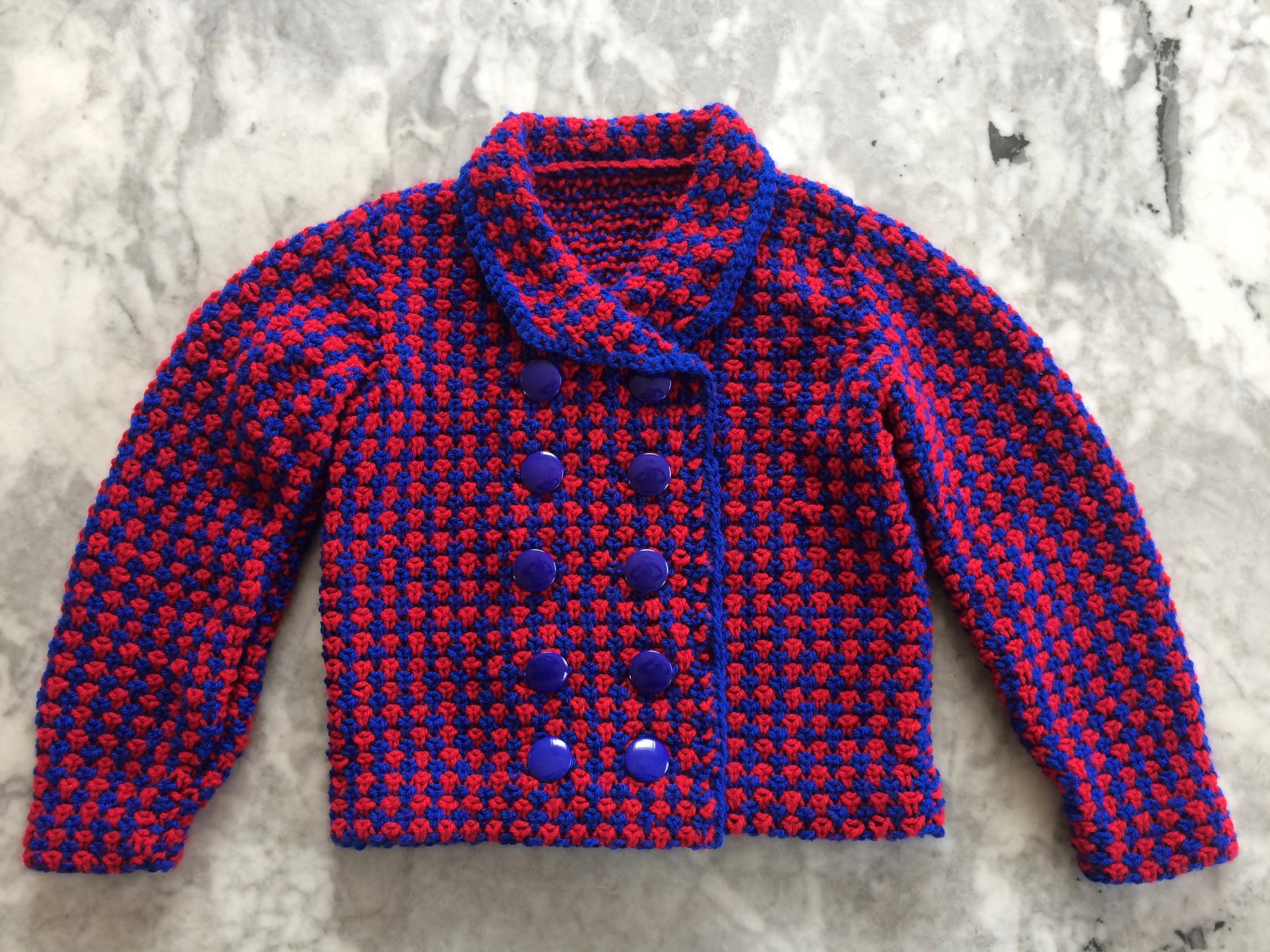
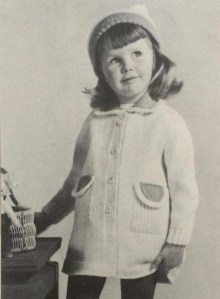 I do have a project from the May 1961 issue and will post about it soon, but it won’t be done by the end of May. In the meantime, I made a very cute coat for a friend’s child from the January 1976 issue of Stitchcraft, using the leftover yarn from the
 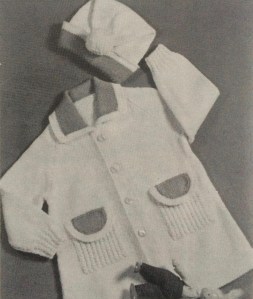 As usual, you’re supposed to make everything in separate pieces, and for once, I almost did! That is to say, I made the back, fronts and sleeves up to the raglan underarm join in pieces, then made the raglan yoke all in one piece working back and forth. Sewn raglans always look so messy (when I make them…), so it was worth it for that, and making the rest in pieces gave the sides some stabilising seams and didn’t take any longer than making the body in one piece working back and forth would have done.
 I noticed that it wasn’t quite going to work out with the total amount of yarn in the proper colour scheme, so I played with the amounts of red and blue and ended up just perfectly using up the rest of the red with a few metres left over should the coat ever need repairing. Of course, that meant I couldn’t make the hat. The project was fast and fun, though, so who knows, maybe I’ll make another one when January 1967… wait, when will that be again… January 2025 ?!? comes around. If we’re all still here! Hang in there and stick around.
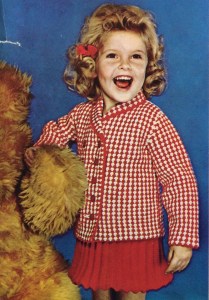 First project for March: this charming jacket from the jacket-and-skirt set titled “Spring Magic in Judy’s trim Outfit”. What a great title! And what a great photo in the booklet. I’m glad today’s girls don’t generally get their hair tortured into curls like litte Judy’s in the picture, but she certainly looks happy enough holding hands with her gigantic teddy bear.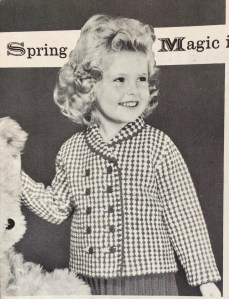
 The Stitchcraft Sixties