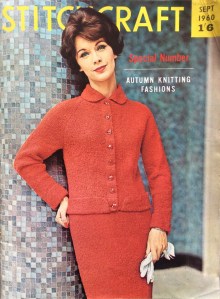
 September 1960 is supposedly a “Special Number” of autumn knitting fashions. I’m not sure what exactly makes it so special, since it doesn’t seem to have any more, or particularly different, projects than the average issue. I guess it’s special in that September is finally a bit cooler weather-wise, so you can start to make some nice wool garments for the colder months — very appropriate in 2018, where we had the summer to end all summers. Things have cooled down a bit now, so I’m looking forward to wearing my (still unfinished) projects from July and August soon.
But back to September 1960. “You must include some heavy-knits for the really cool days out of doors, but for the milder days, a fashion feature to note is the use of finer knitting,” Patience Horne tells us, and this month’s issue gives a good mix of finer and bulkier garments for adults and children. The 4-ply women’s sweaters (why sweaters and not jumpers? I still can’t figure out why they sometimes use one term and sometimes the other for the exact same type of garment) have those big square collars that we’ve seen on other 1960 designs, with or without buttons. The pink sweater is made in super-fine-ply Lucelle at 10 stitches to the inch! If hand-knitting in fine yarn is too time-consuming for you, you can make a lacy cardigan on your machine.


Moving up the bulkiness scale, we’ve got the lovely skirt suit on the cover, made in Rimple, a sweater in “overblouse style” and a “raglan golf sweater” for men in green plaid. Green checks continue to be in fashion! The “young sports fans” in the family get comfortable jackets in double knitting weight, “made to match for brother and sister.” Can you spot the difference between the boys’ and girls’ versions? (Do you remember those “can you spot the 10 differences between these pictures” puzzles in the kids’ comics section? Do they still have those?) If you can’t, I won’t tell you, but try buttoning a cardigan made for the “opposite” sex if you need a hint.


Fans of Big Ben bulky knitting can make a Viennese design with added-on embroidery in duplicate stitch, or a trio of crochet items in “crunchy Pineapple-stitch”. I love the pram cover, bound with blanket edging, but I wish I could see the bonnet from the front.


Homewares are well represented by a stool cover in Florentine tapestry, a great embroidered cushion in blackwork design, traditional and “modern” pile rugs and some interesting tablewares — tapestry table mats with pictures of “3 famous castles” and crocheted raffia drink mats for your cocktail party. Cheers, everyone! My September project will be the blackwork cushion, and I hope to finish up the knitted blouse from July and the cardigan from the August twin-set.


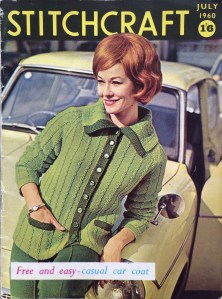 “Free and easy” is this month’s motto. Summer is here and nobody really feels like handling warm wool, so the emphasis is on “travel knits” (lightweight), “casual knits” (not too complicated) and “stroller styles” (loose and oversized). There is more embroidery and needlework than knitwear, and some easy sewing projects. Shall we relax and take a look?
 I have to take a moment here to quote one of my favourite Roald Dahl stories, “The Boy Who Talked With Animals.” It’s about a little boy who saves a giant tortoise from the soup kettle, and Dahl’s description of the tourists waiting on the beach for the caught tortoise to be hauled in has, for some reason, stayed with me through the years:


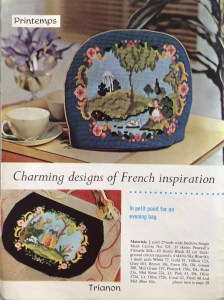 You can also embroider a tablecloth, make tea-towels in huckaback, or attempt this fabulous tea cosy and/or evening bag in faux eighteenth-century tapestry. I so, so want to make this evening bag! I would love it and use it all the time. But I am too overwhelmed by the idea of trying to make a chart based solely on the photos — the design is fairly intricate — and having never before attempted tapestry work, I fear it would just be too much for a rank beginner. I will definitely file it away for future days when I know how to approach it better.


 June, the month of leisure! Or at least, leisure knits — “Fashions for Sun and Sea.” Stitchcraft’s “editress”, Patience Horne, reminds us that it’s important to have something to knit or sew while on holiday, as “it helps us to relax”, and points out that “A lot of knitting and embroidery is done in the deck-chair by busy housewives who never get time at home, and find it difficult to ease off suddenly.”
 1950s and 1960s… meaning the housewife/mother of the family had to shop, cook and keep the tent or living space tidy just as she did at home, but in worse conditions (rain, mud, no proper grocery stores, camp stove, having to fetch water for cooking and washing up). Doesn’t sound much like leisure time to me! Of course, if you were rich enough to stay in a nice hotel and eat out for meals you might well have some time for handcrafts, but that wasn’t a possibility for all families, and Stitchcraft‘s target audience was more working-to-middle-class.


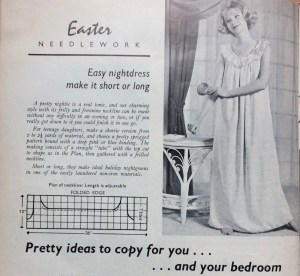
 “Already there is talk of holidays” says the introduction to the April 1960 issue, “and whether it’s to be the sea, country, sight-seeing or sailing, you can’t go without your holiday hand-knits.” At the same time, spring and April mean Easter, with lots of opportunities for hand-made accessories and knickknacks.


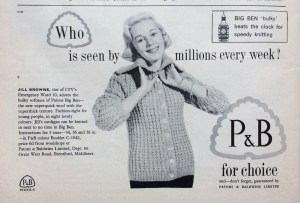


 I will be making two children’s designs: the fabulous checkered coat for a toddler, and “John’s new pullover” for a soon-to-be six-year-old.

