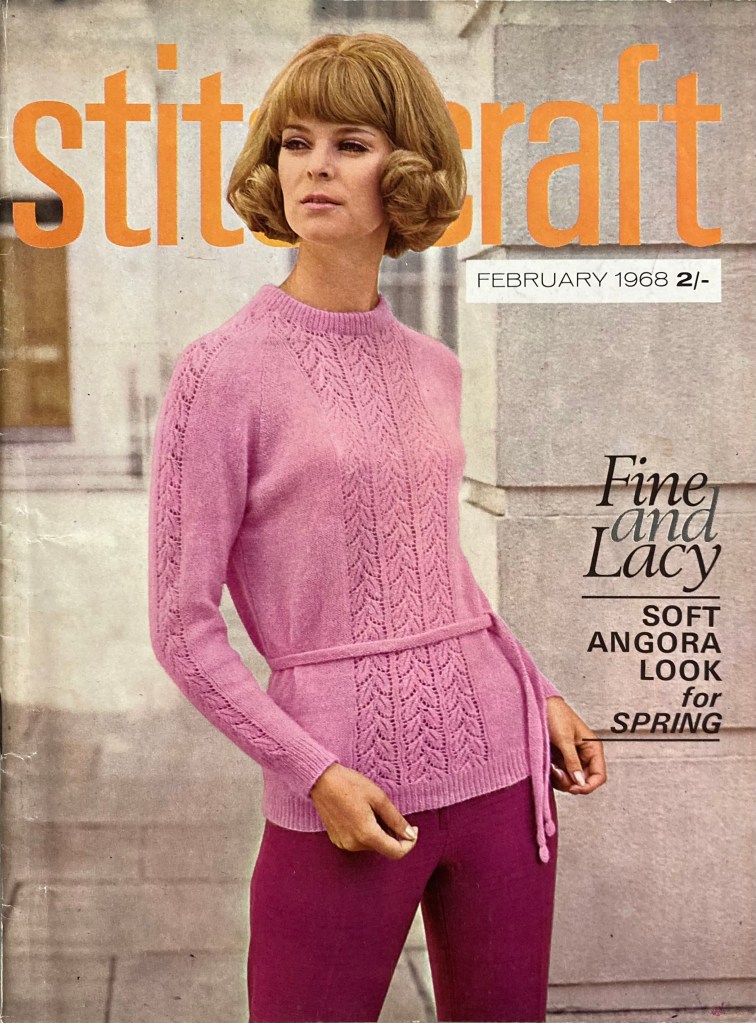
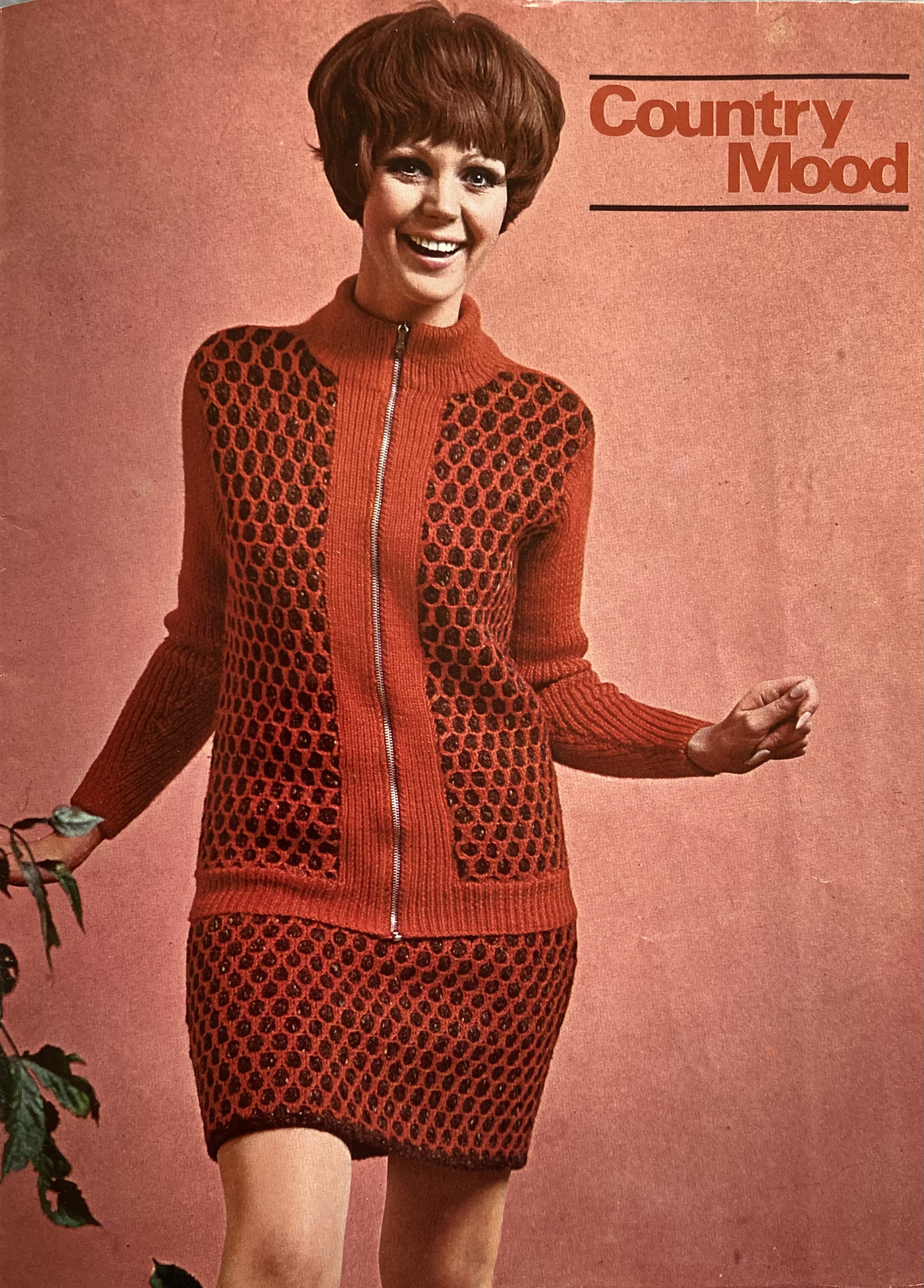
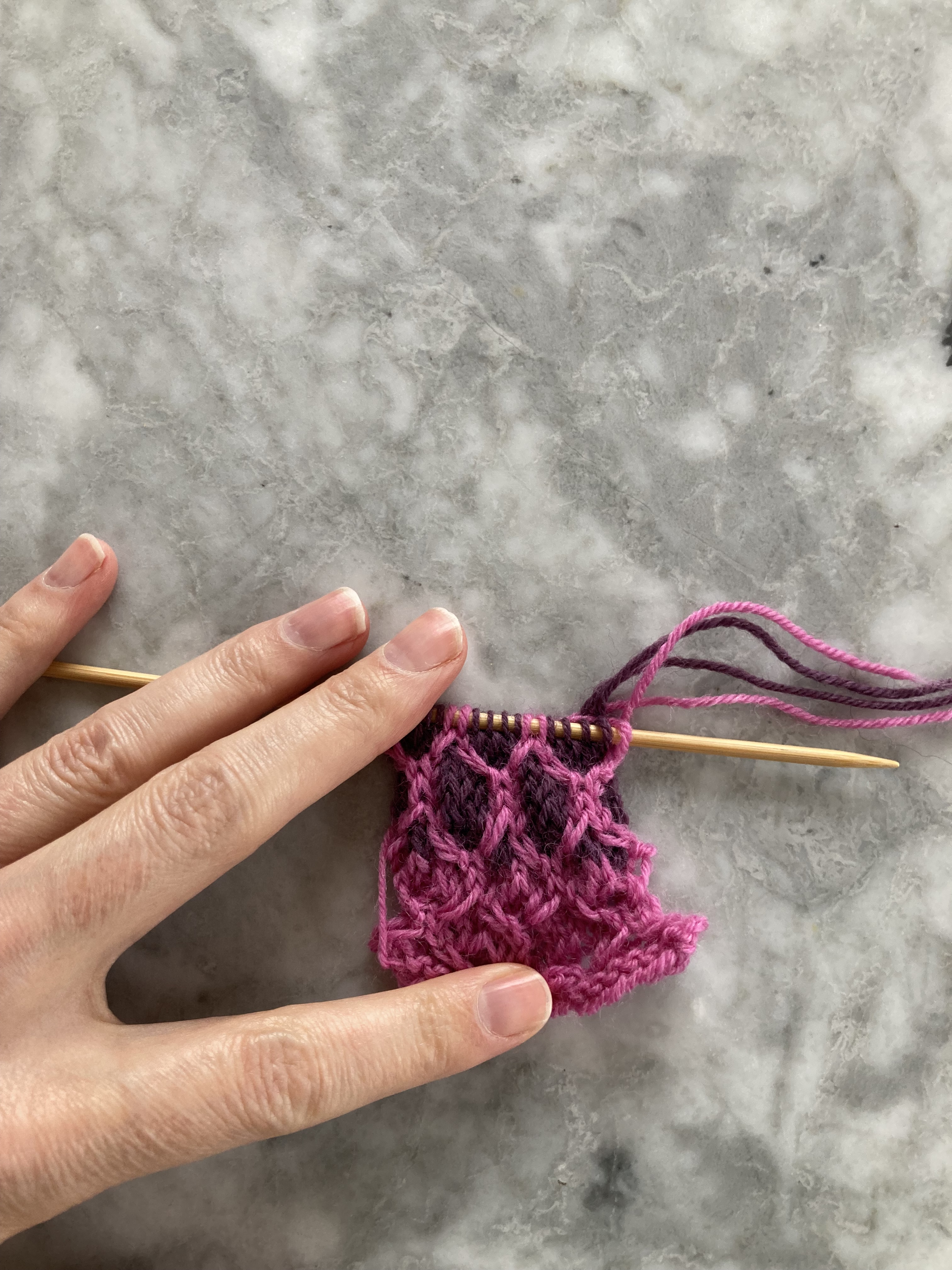
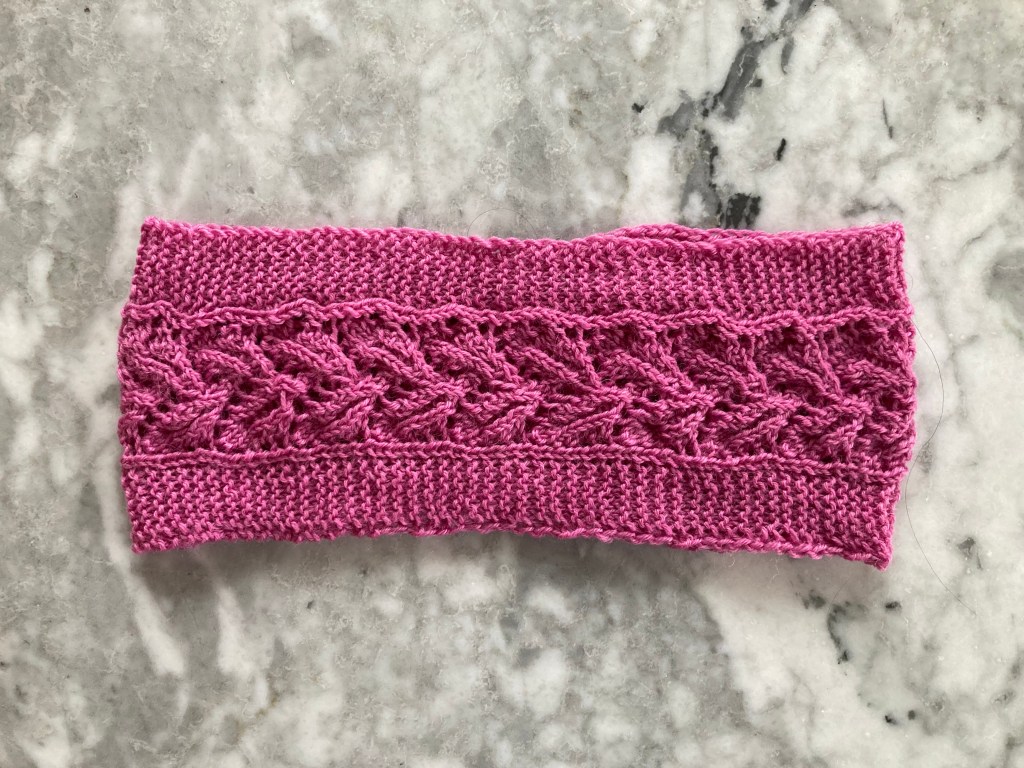
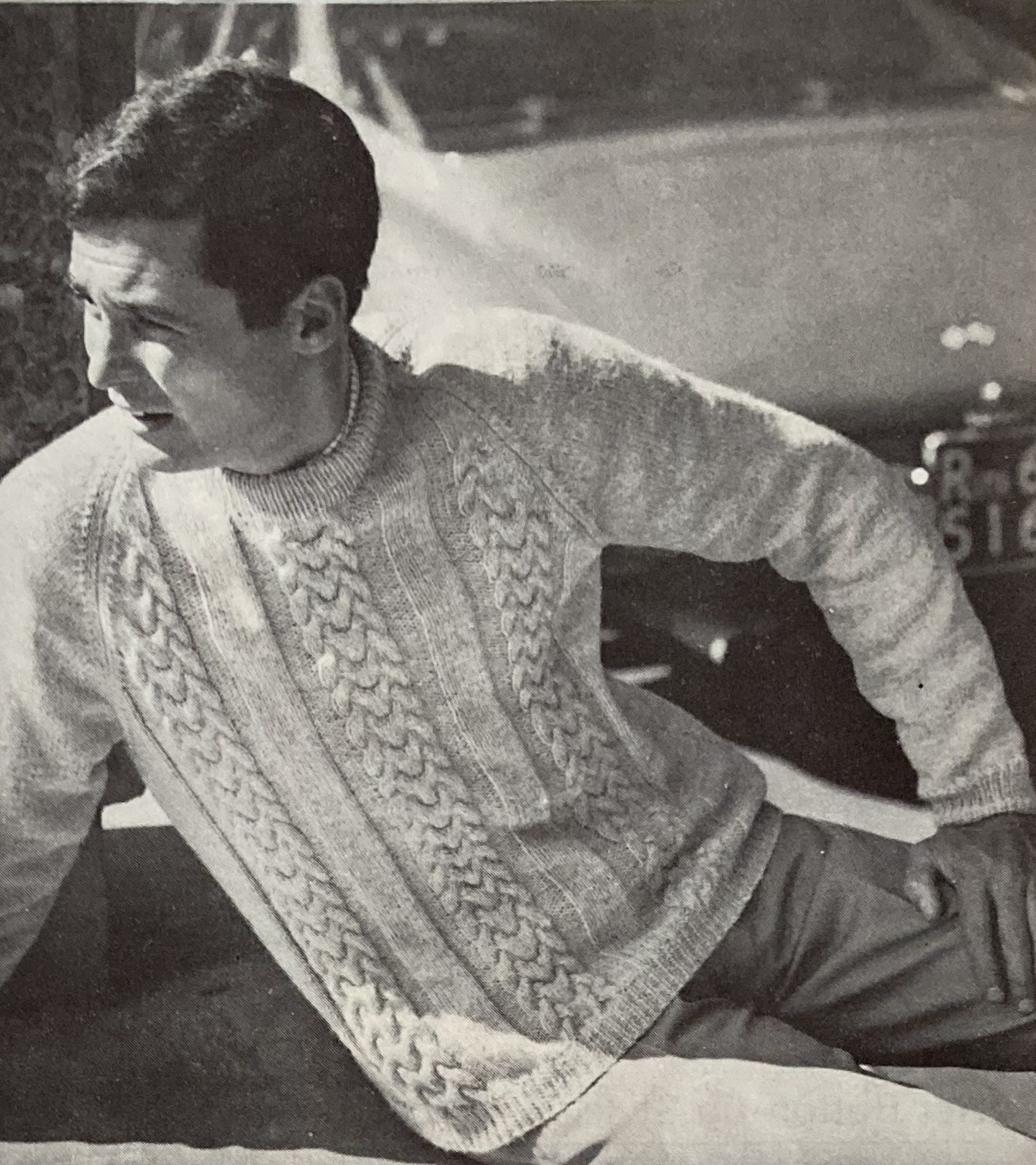
The February 1968 issue of Stitchcraft didn’t have any projects in it that immediately called to me, but a good friend had requested a pink headband for keeping her ears warm without wearing an entire hat, so decided to make an adaptation.
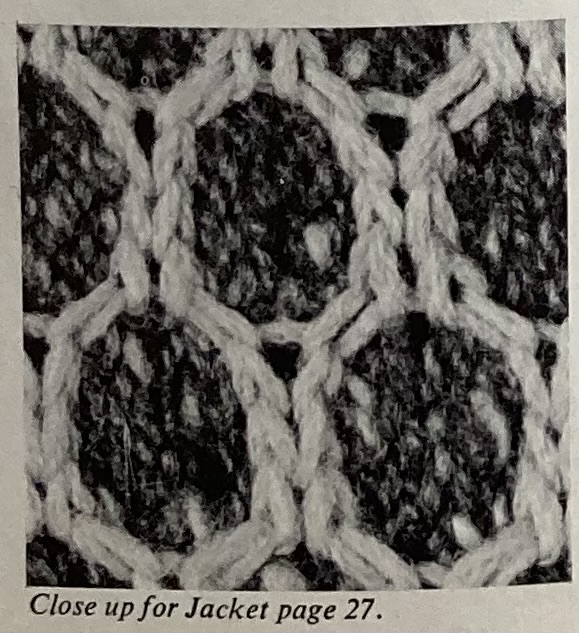
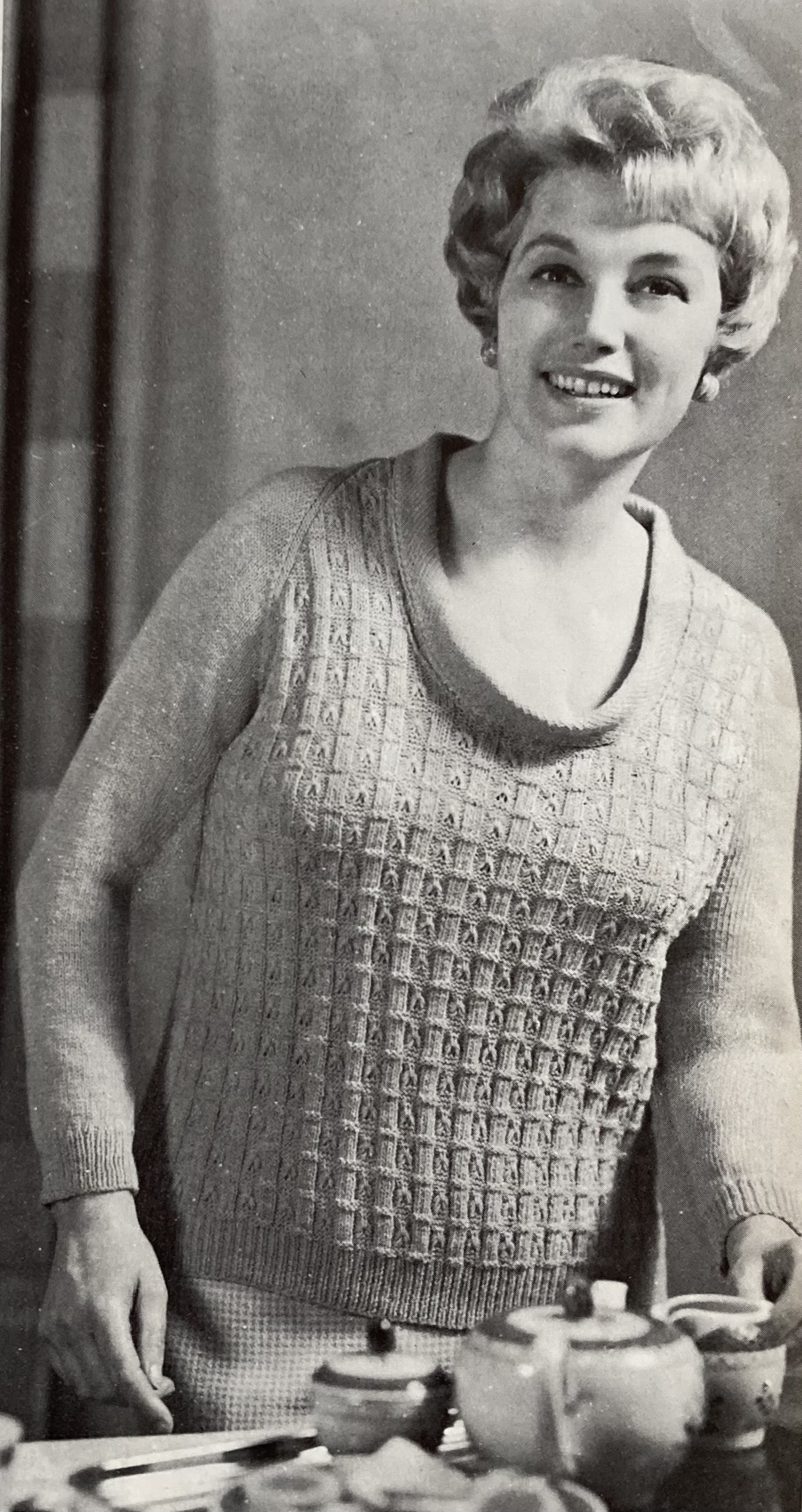
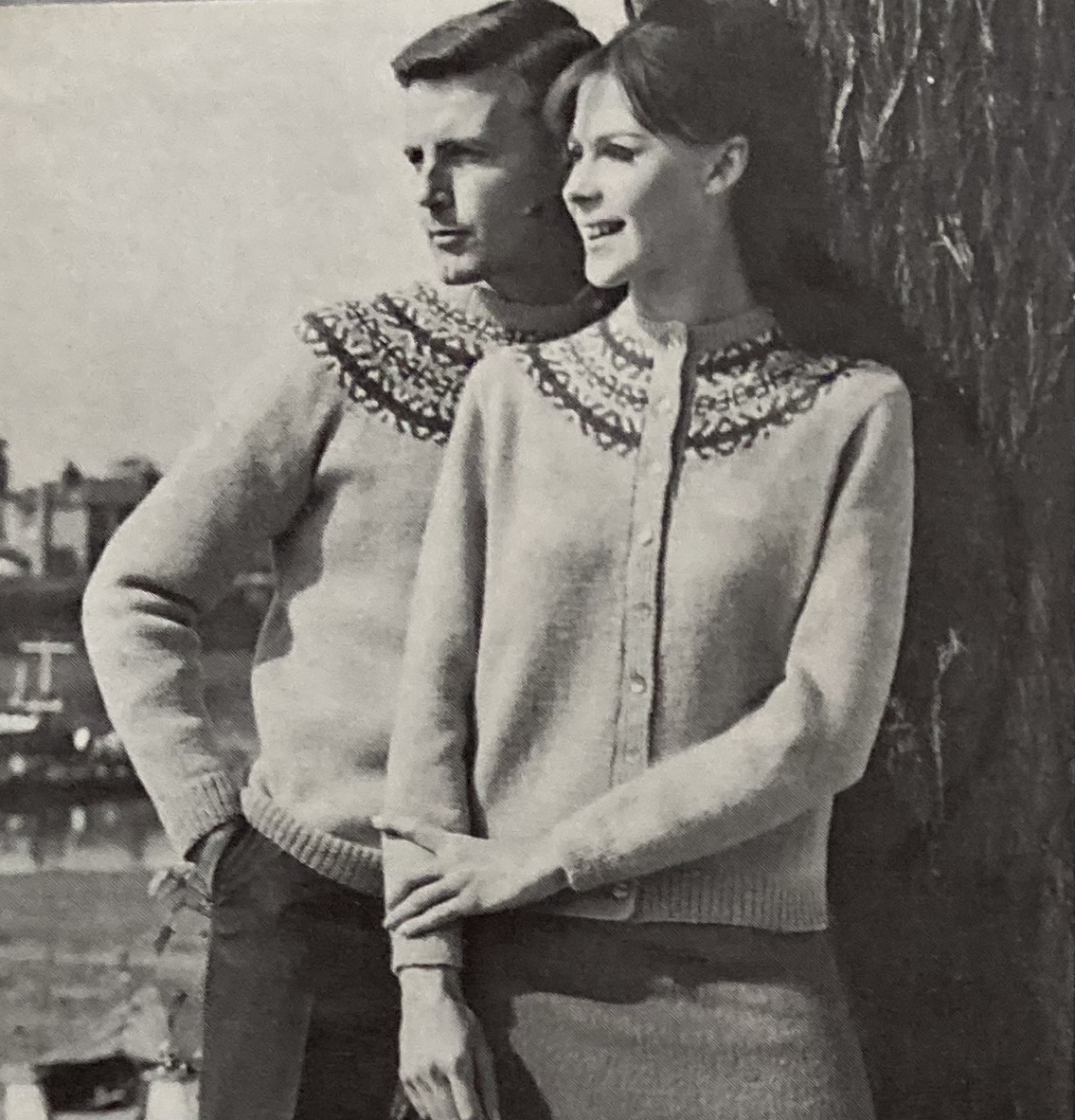
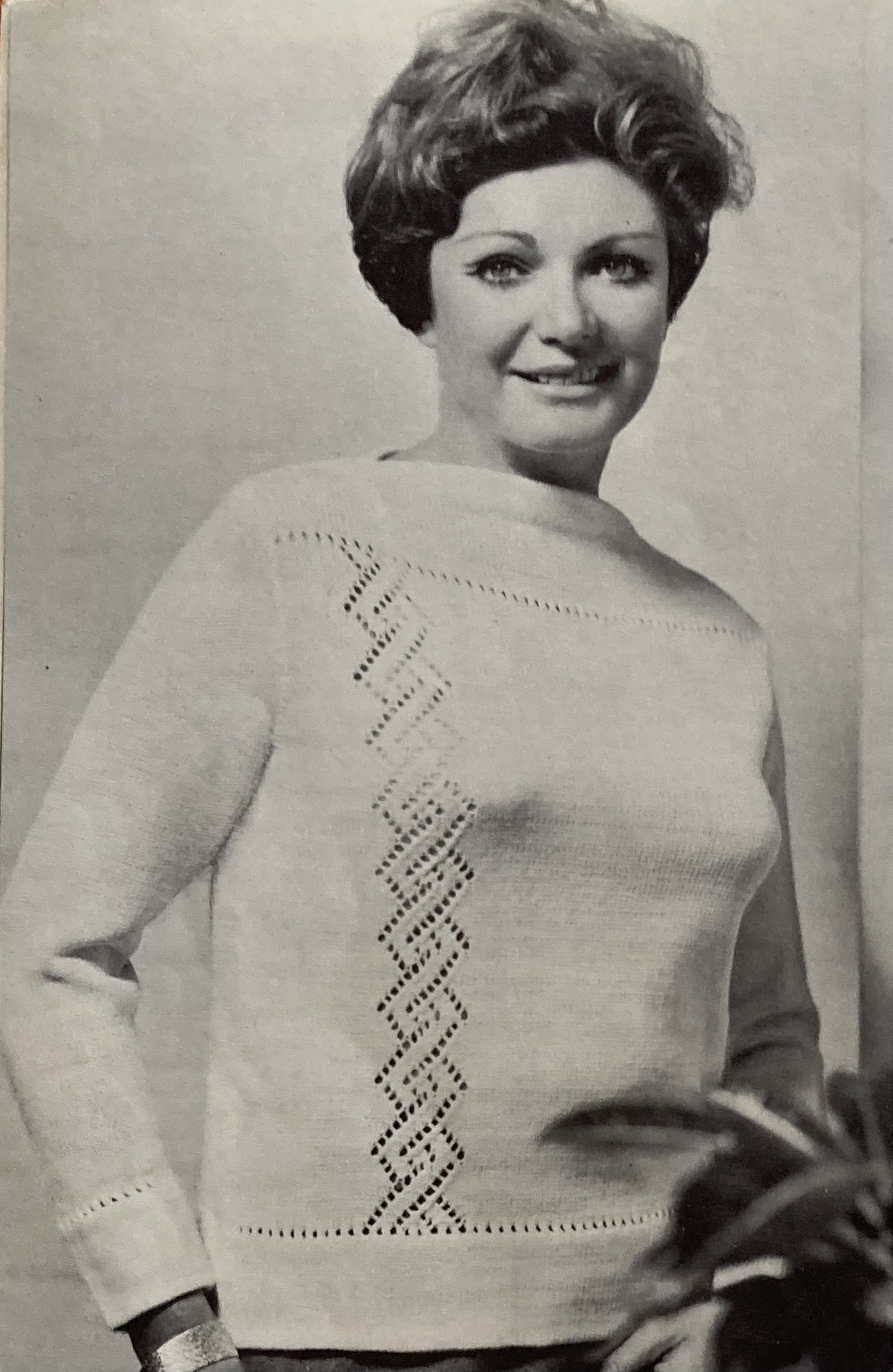
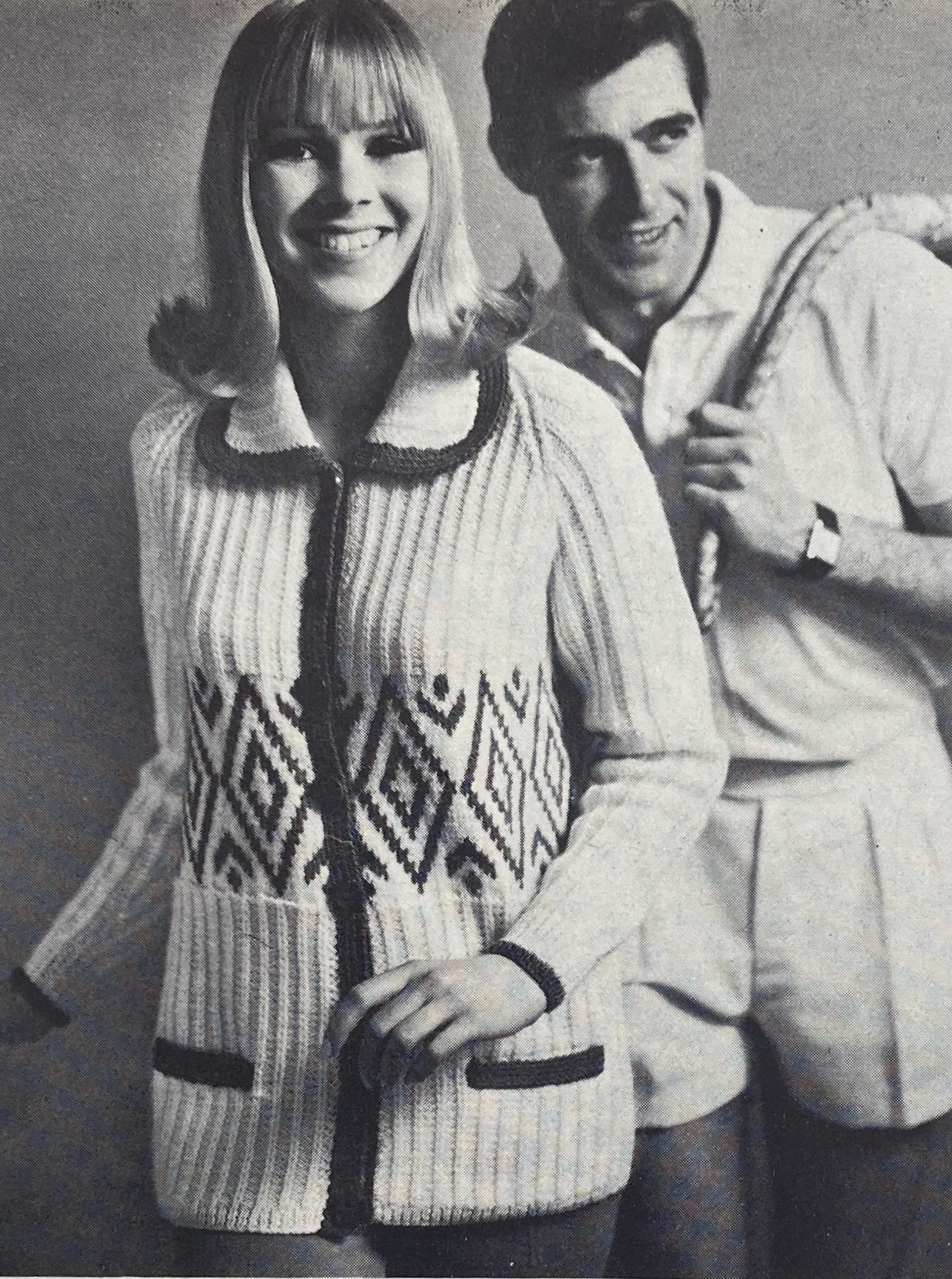
I first tried the two-colour pattern from the amazing cardigan set on the inside back cover. It’s made using a combination of stranded two-colour knitting and twisted stitches and makes a great trellis-like effect. It needs to be made in two colours to actually have an effect, though, so I switched to the fern-y lace pattern on the panel of the jumper on the front cover.
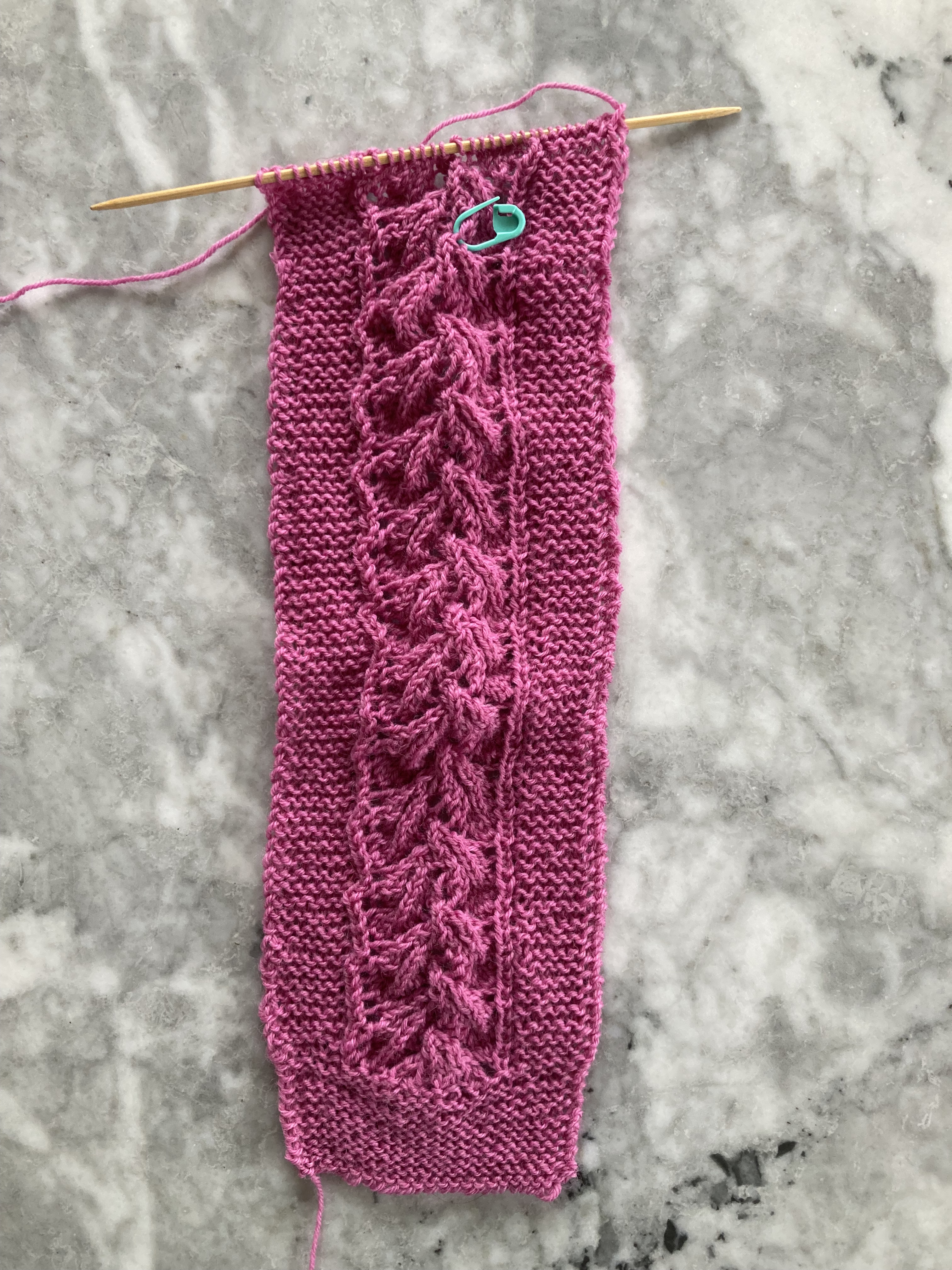
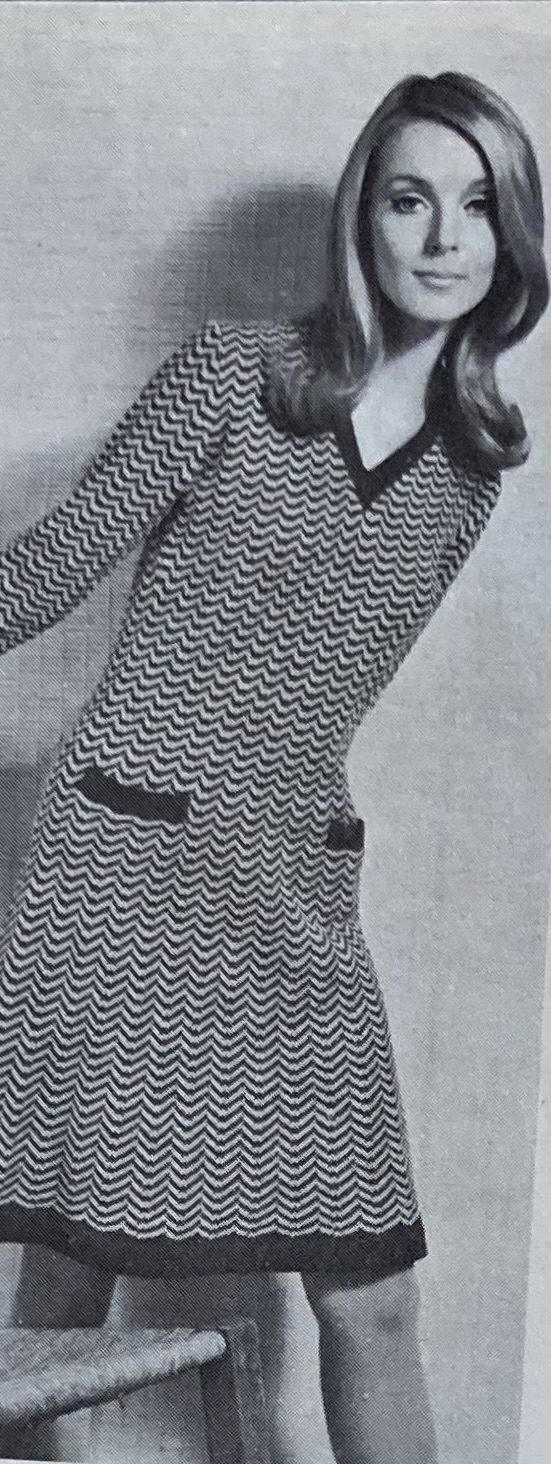
I had a decent amount of pink Drops Fabel sock wool left over from the April 1967 chevron-pattern dress, which was coincidentally almost the same shade as the Stitchcraft jumper. The pattern is made using standard knit and purl, k2tog / k3 tog, and yarn overs. The pattern repeat is 16 stitches + 1, worked on a stocking-stitch background i.e. the even-numbered rows are mostly purl. I added 6 stitches of garter stitch and a selvedge stitch on each side of the panel to get a good width and avoid curl. The pattern was surprisingly boring to knit! I didn’t even bother to make a chart, just used the written instructions straight out of the magazine.
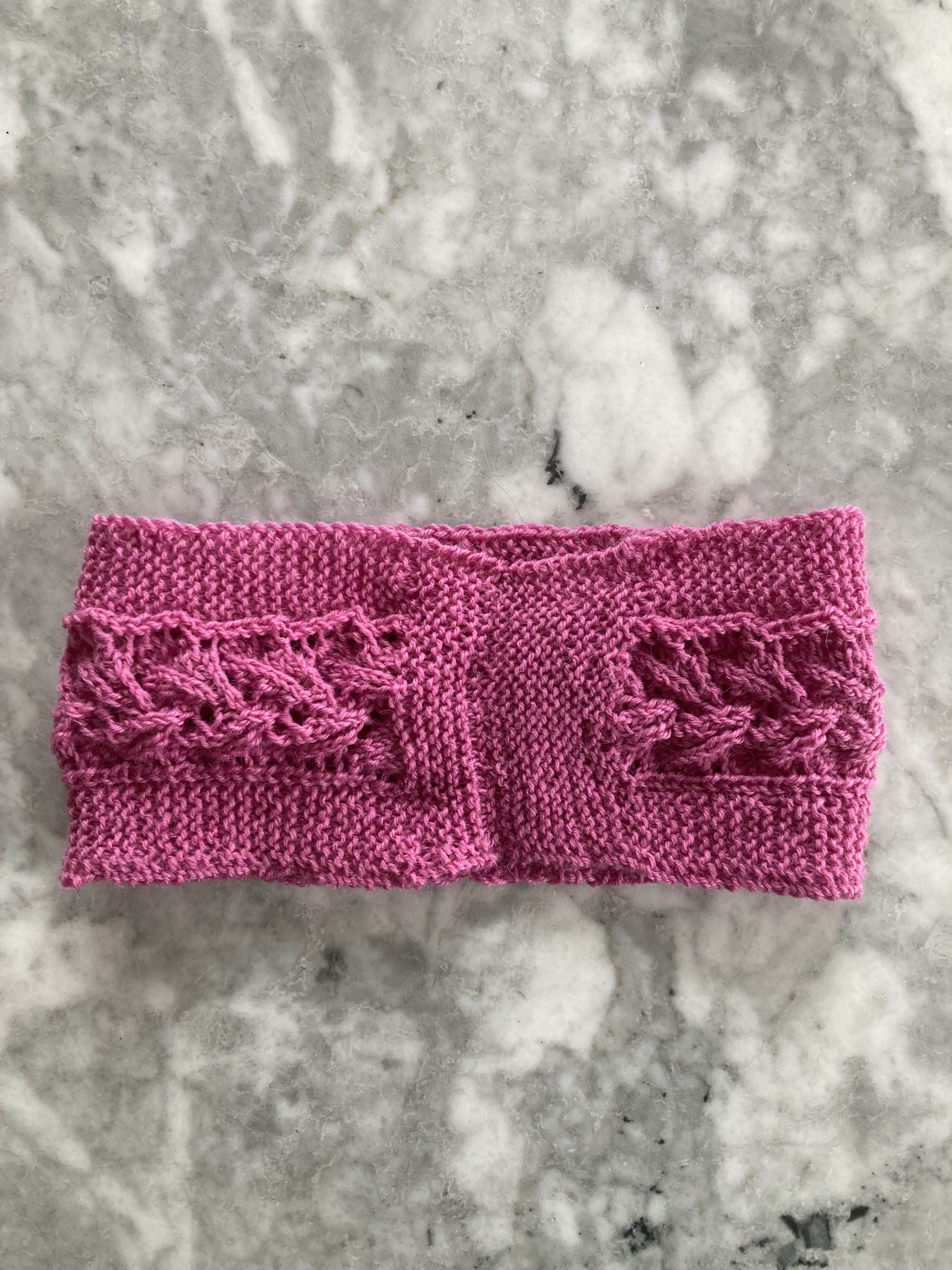
I started and ended with a bit of plain garter stitch, increasing up to the total number of stitches to make the headband a bit narrower at the nape-of neck and create an elastic band effect to keep it snug. I wasn’t sure how big to make it — I have a big head and very flat hair, my friend has a presumably average-site head and very fluffy curly hair. After blocking, it ended up a little loose on me. If it’s too loose, I can always undo some of the garter stitch connecting bit on the underside.
It looks pretty and I like the pattern a lot, but I’m not sure if fingering-weight sock yarn was the best choice for a headband that should keep the ears warm. I’m afraid it won’t be warm enough. in which case, I could line it with fleece?
Not 100% happy with this project, but hopefully my friend will be.
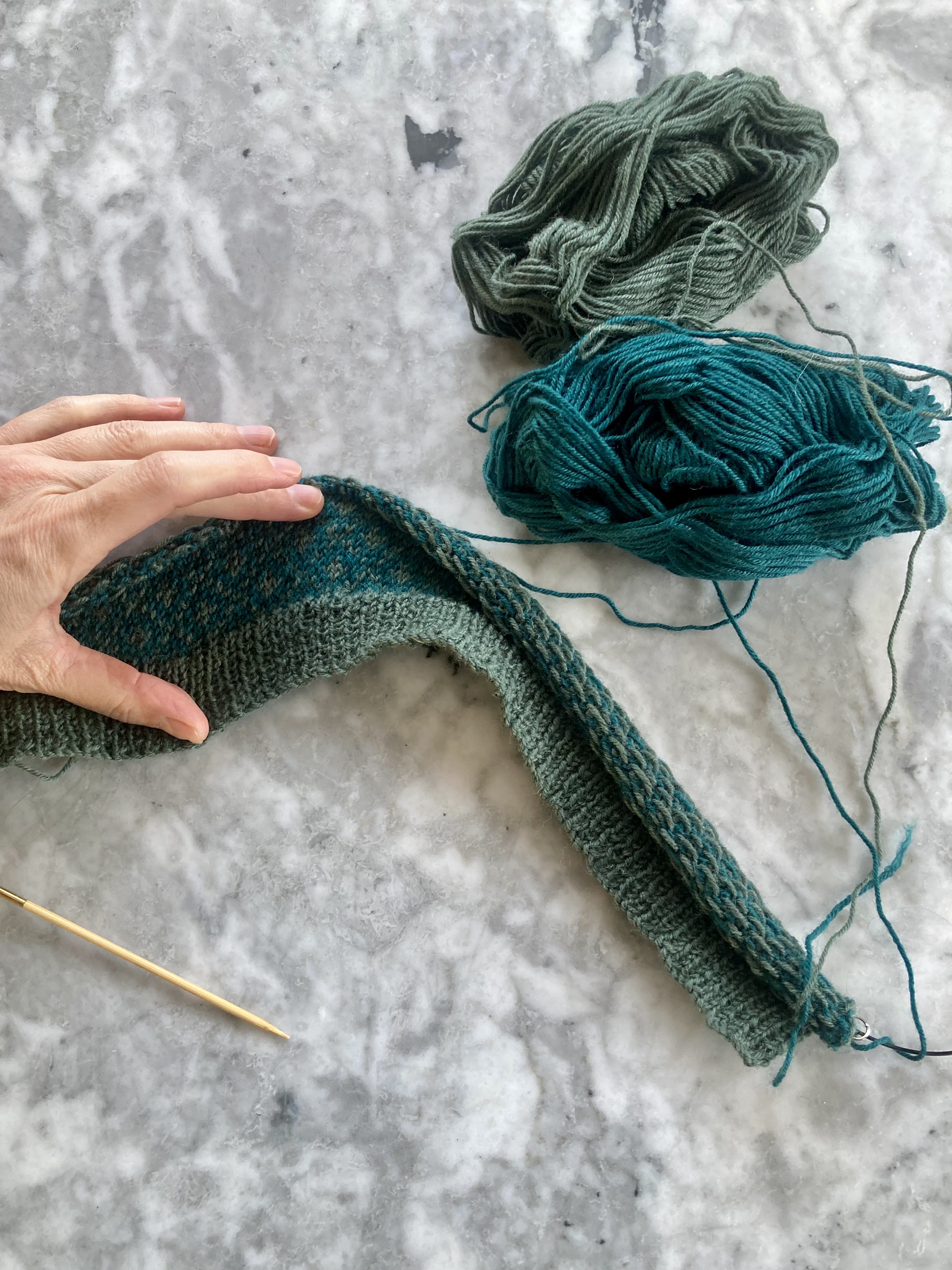
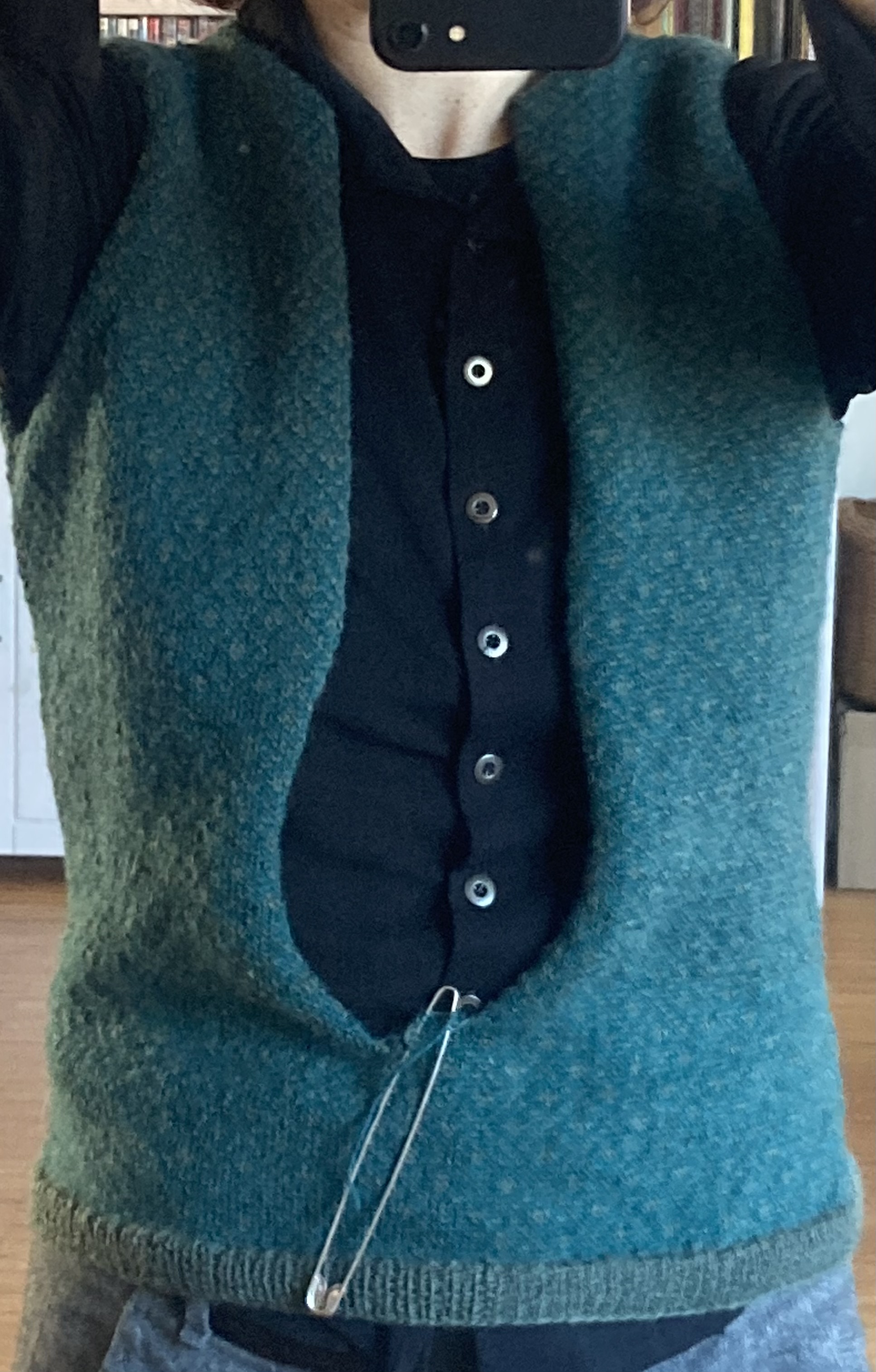
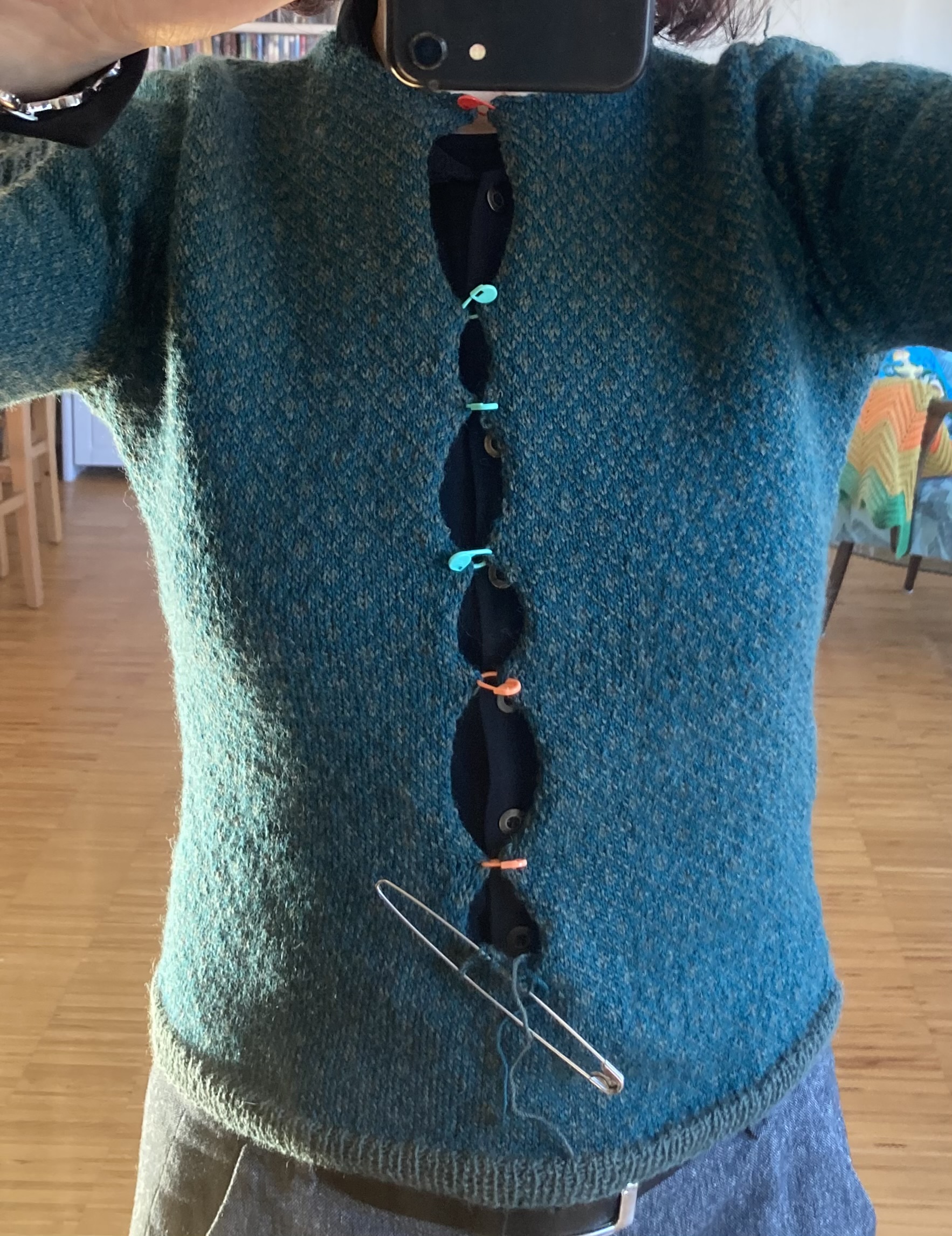
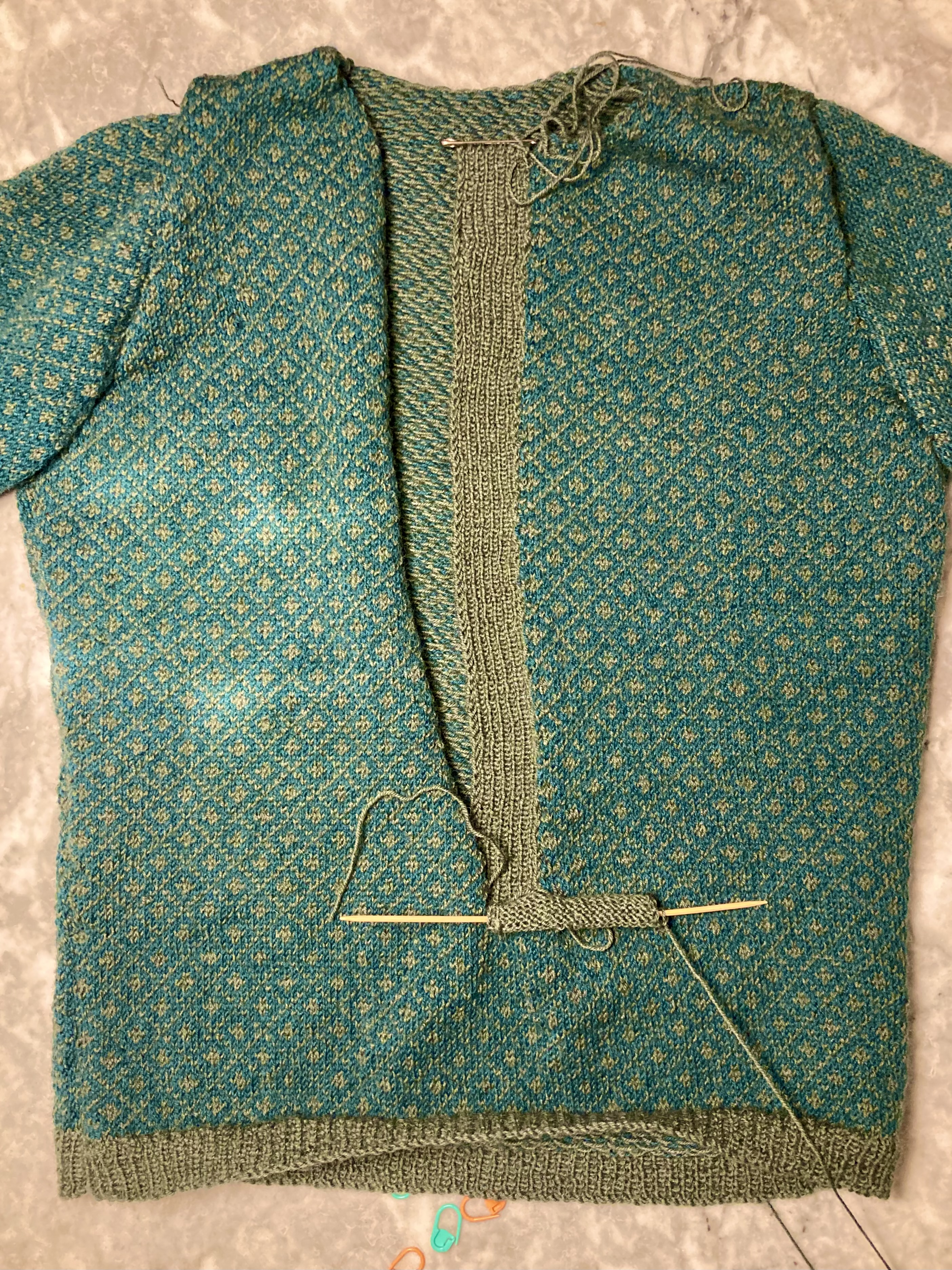
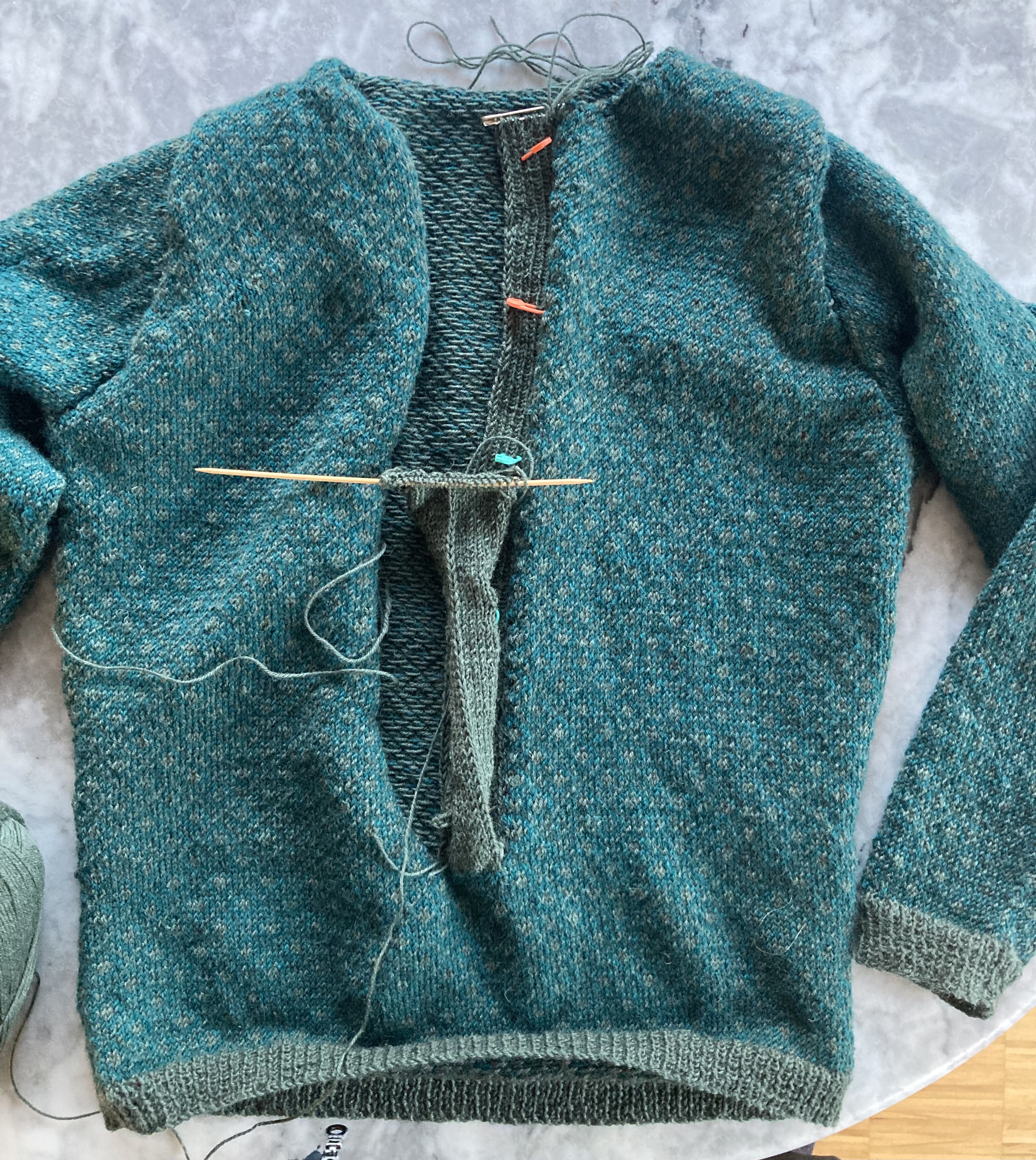
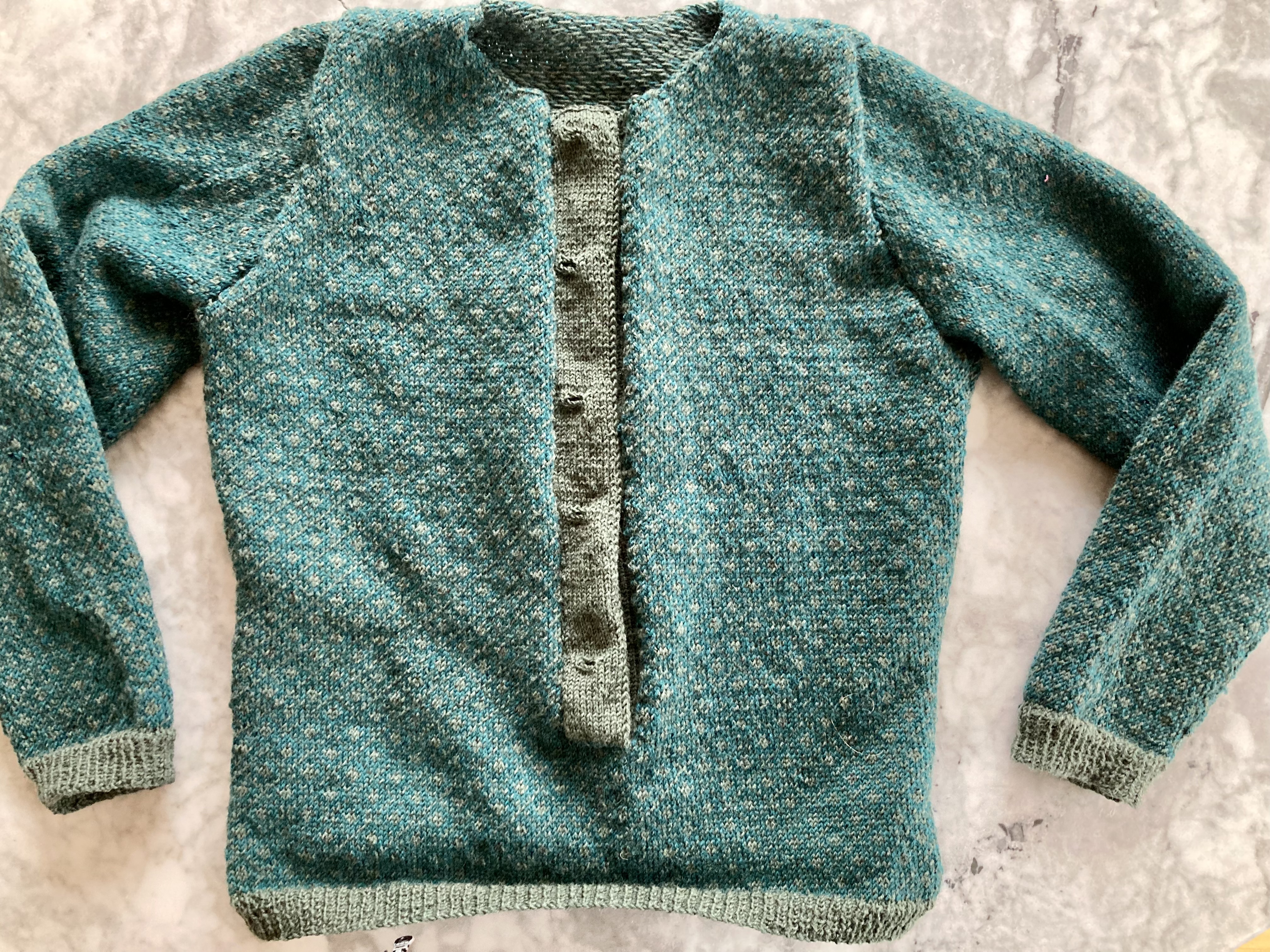
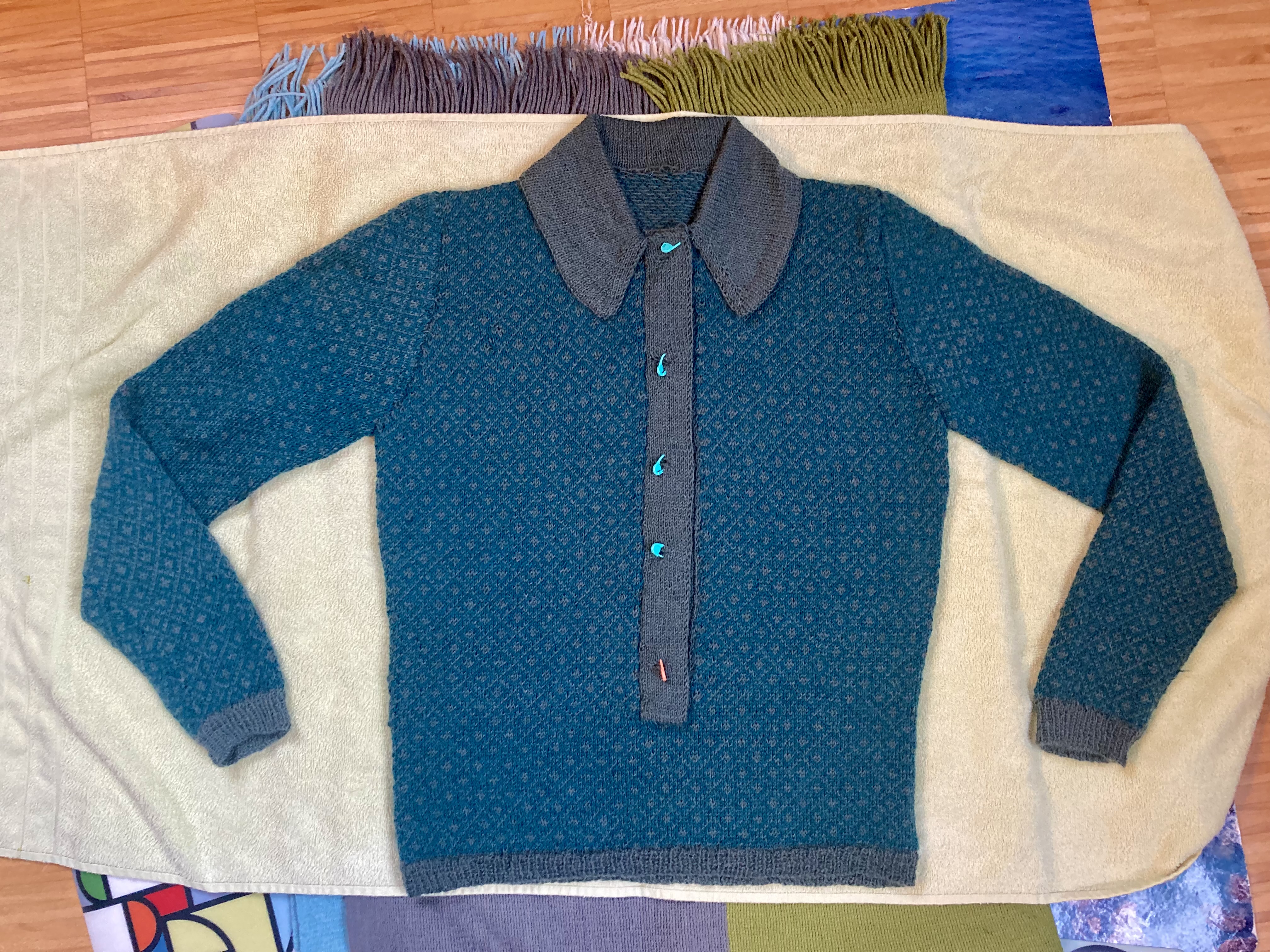
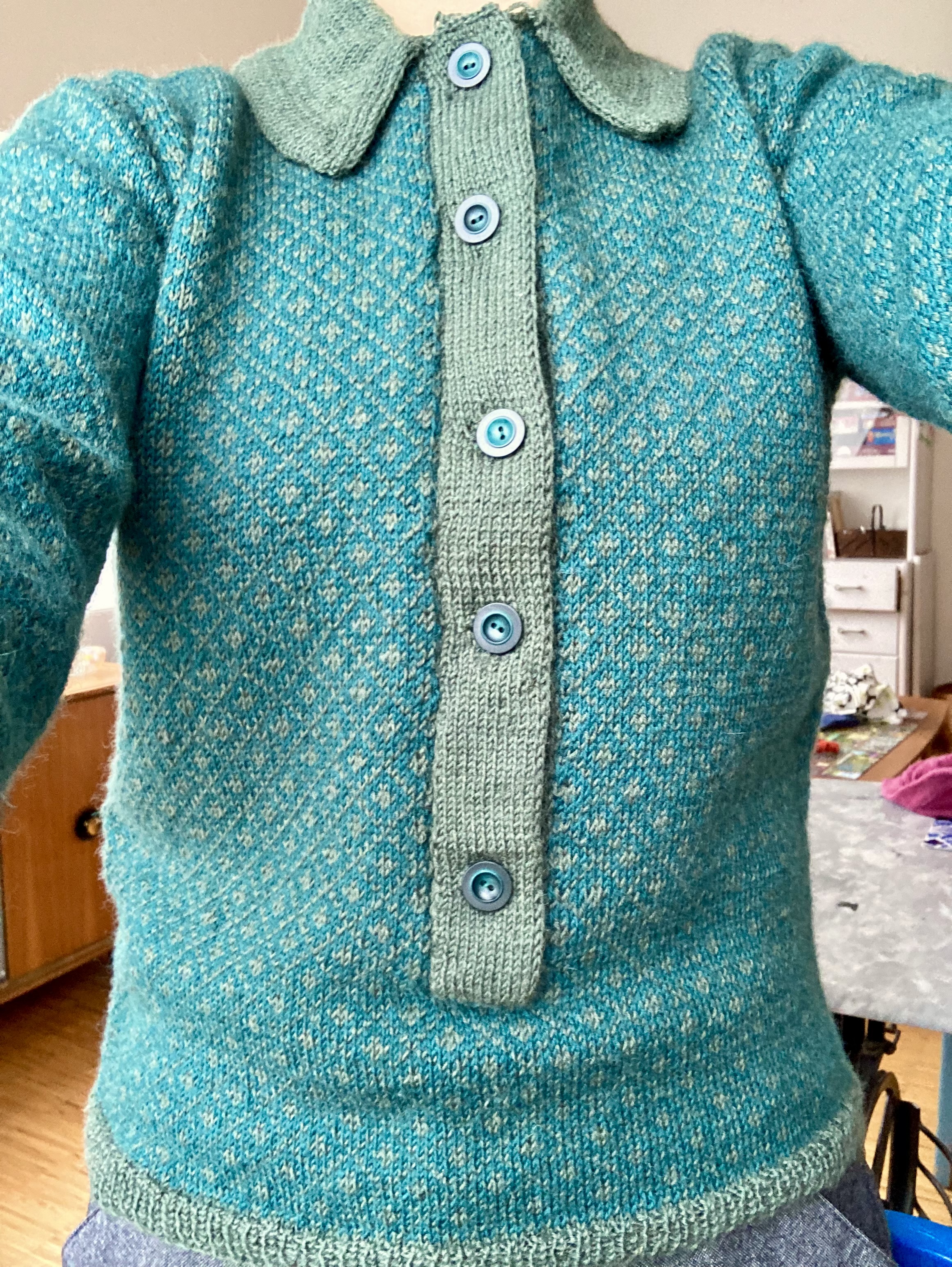
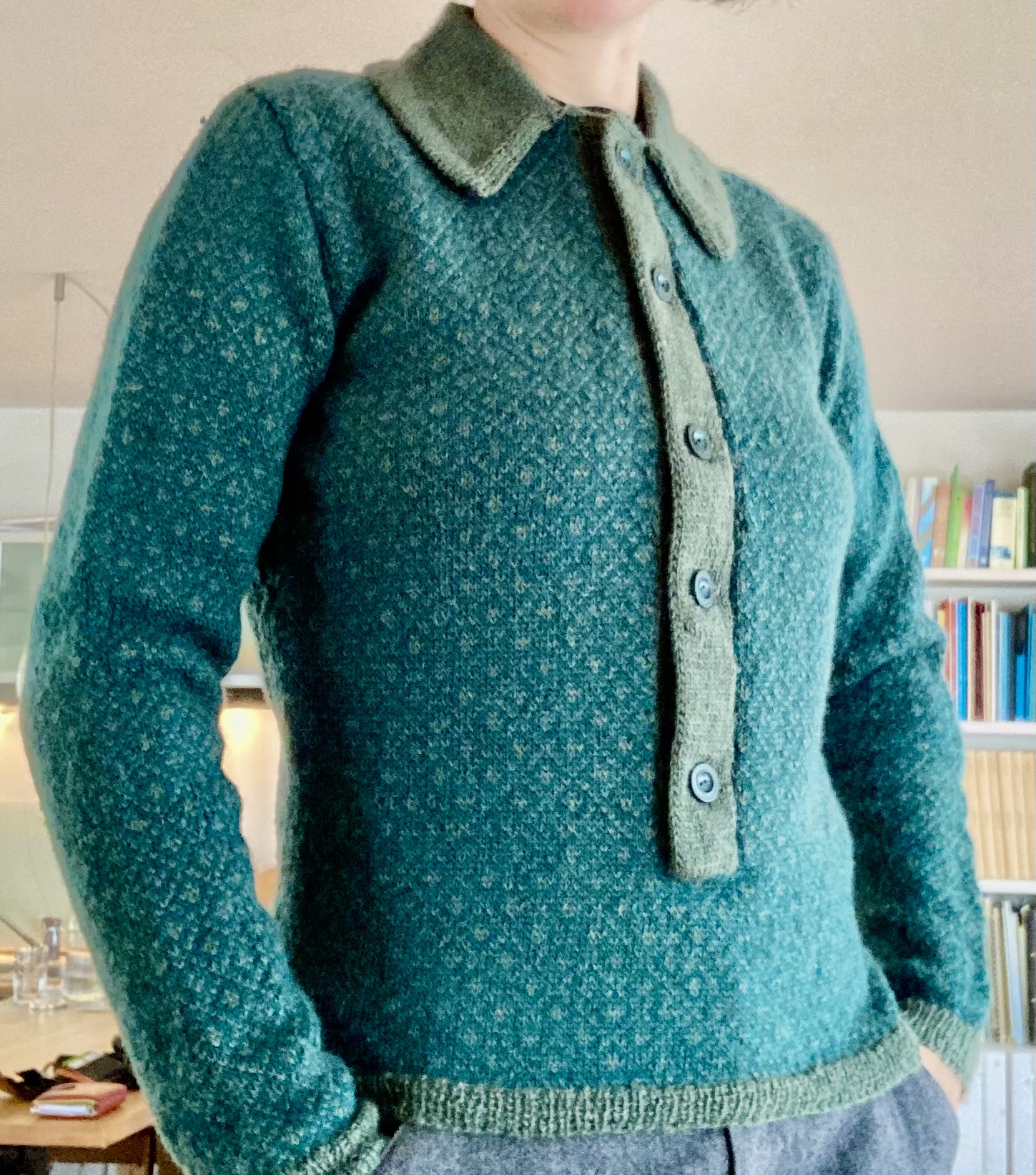
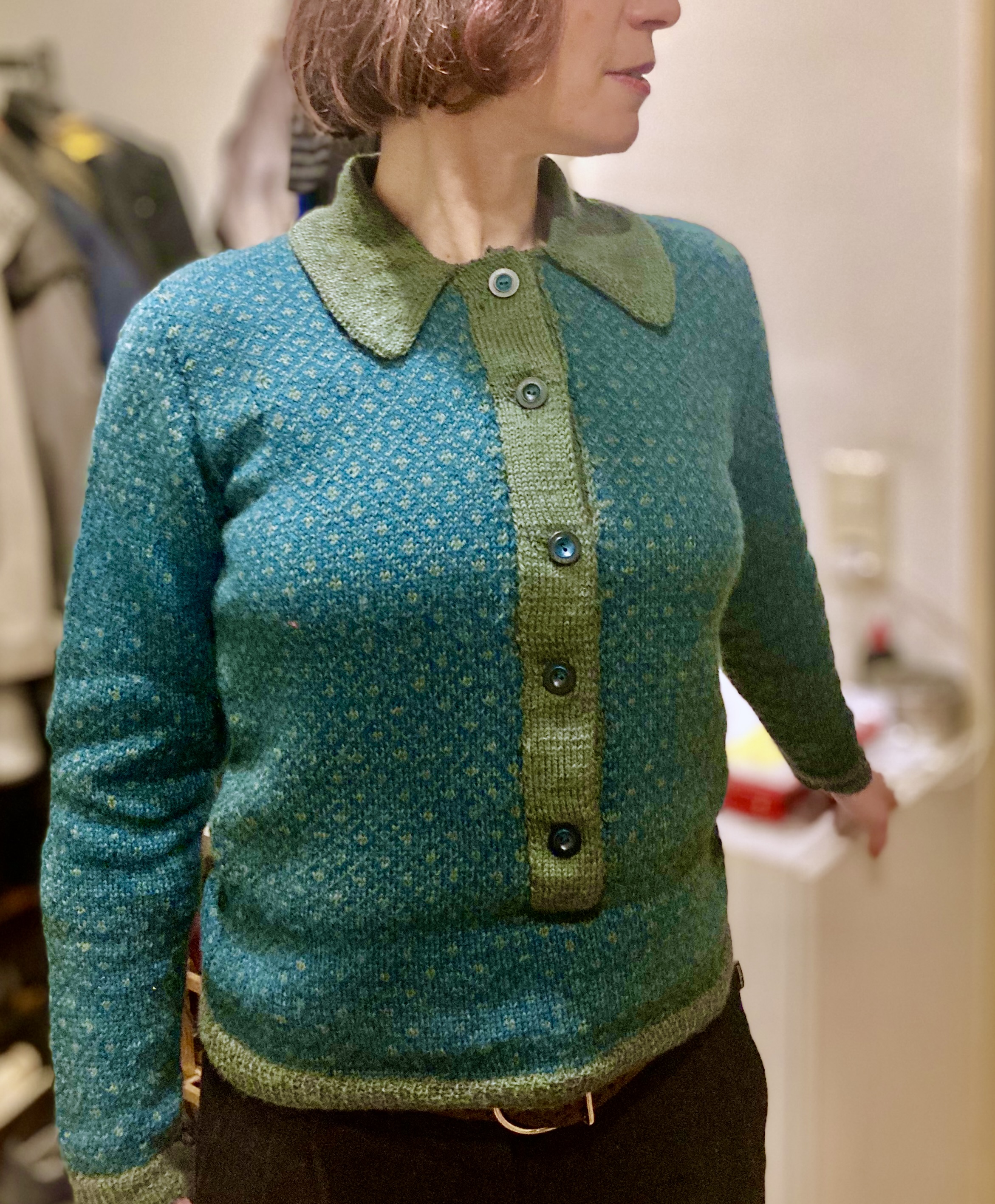
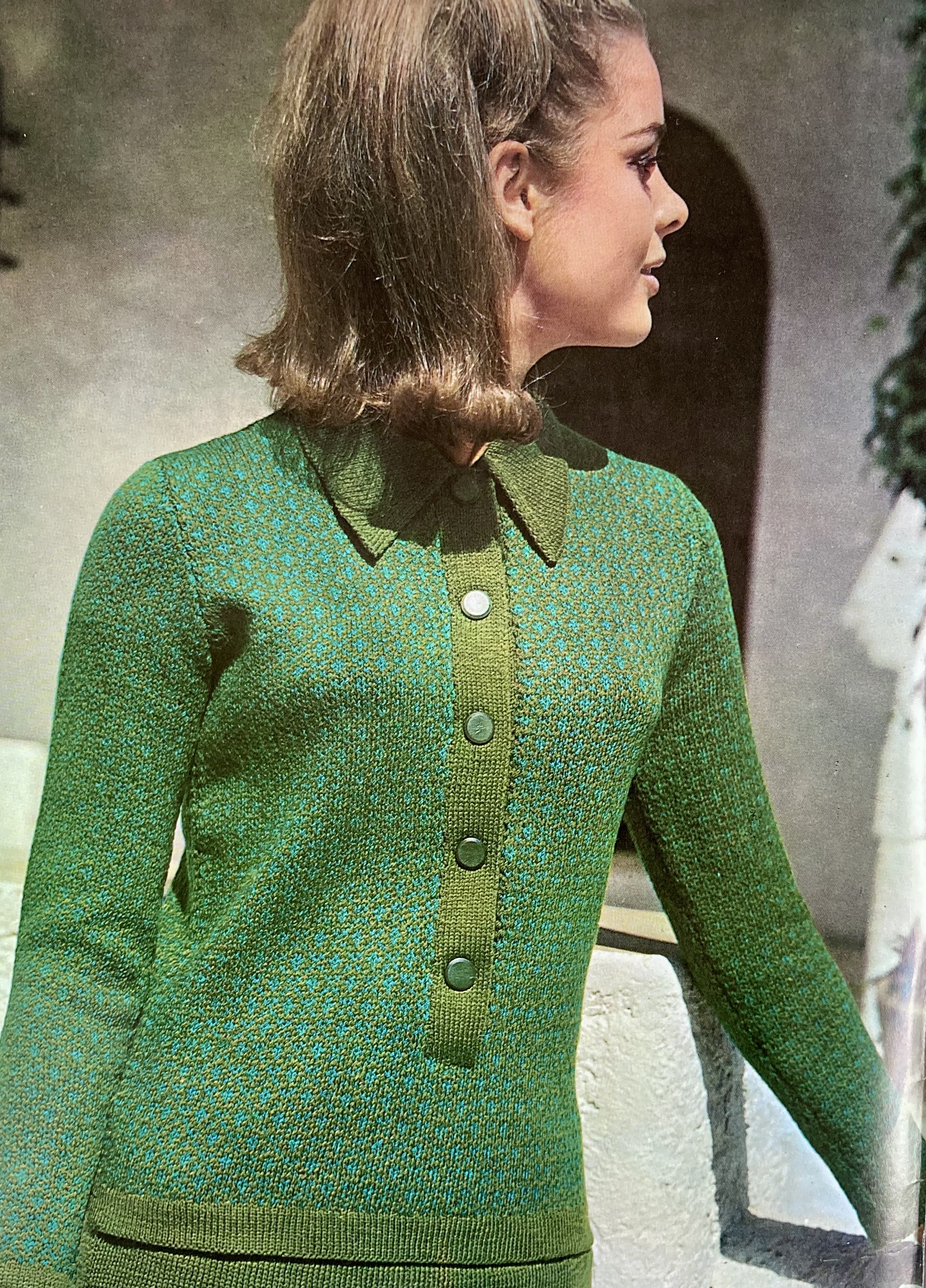
My November 2025 project was the jumper from a “Jaquard Pattern Jumper Suit” from the November 1967 issue of Stitchcraft.
It’s written for Patons Cameo Crepe, a smooth, fine, worsted-twist wool. I decided to make my version in sock yarn, which is smooth and fine but not 100% wool — mine was Lana Grossa Meilenweit, which is 80% wool and 20% polyamide. I prefer not to use synthetic yarns for environmental reasons, but it is also surprisingly difficult to find smooth, “normal” 4ply/ fingering-weight 100% wool in a variety of colours. It’s either too bulky, too hairy, or a mixture of fibres, or variegated colours. Or baby wool, which has a limited pastel colour range.
I was happy with my colour choices. My olive green was a little more grey than the Stitchcraft version, and my jade green more blue (but still a little more green than it looks in the photo). I was not prepared for how very blue it looks when knitted up in pattern, but it’s fine with me.
The stranded jaquard pattern is quite easy and has the advantage of having very short stretches of one colour — no more than three stitches ever — so it makes a very evenly worked wrong side and there was no need to weave in floats. It’s a subtle pattern with not much contrast, but that’s how the original looks as well. I started with the sleeves, to check for size, and made them in the round for speed and ease. I also decided to make a normal ribbed cuff instead of a hem.
I started the sleeve the first time with the hem as written, and didn’t like it — the transition from hem to pattern wasn’t smooth. I started over and got to halfway up the arm while wondering why it was so narrow. Suprise, I had been doing the increases wrong. Started over and did them right, and the fit was perfect.
I decided to make the body with ribbing as well, and in two separate pieces worked back-and-forth instead of in the round. I thought about making it in the round with a steek for the placket, but then I thought a steek might be too bulky (the fabric is nice and flexible in spite of the close stranding) and I could adjust for fit more easily by working the back and front separately.
On the subject of fit, I made the sleeves in the regular second size, for 36-37 inch bust, and 17 inches to underarm instead of 16. The body of these late 60s, unshaped garments always looks well-fitted on the model in the photo, but like a huge floppy sack on me. My calculations tell me that the back piece, even knitted in the smallest size (for 34-35 inch bust) would be 19 inches wide the whole time, from hem to underarm, and anything that wide around the hip/waist area is just going to look awful on me. The question was: should I start off as in the pattern, decrease for waist shaping and then increase up to the bust, or start smaller to keeop the waist narrower from the beginning and just start increasing after the waist?
Since I had decided to make the bottom edge ribbed instead of hemmed, like the sleeves, I went for the second option. Started the back according to the first size and increased up to the second size for the back, and the second size for the front. That will give a different shape than intended, but it will look a lot better on me.
It still went very slowly, and unfortunately I was quite badly ill for much of November and December, so that on many days I didn’t even have the energy to knit. Also, the pattern, yarn and needles were all very small and fine. But eventually, it took shape. I decreased down to the first size again for the shoulders and back neck to get a nice fitted look.
The front bands are interesting: the inside one, where the buttons are, is made in 1×1 rib, and the outside one with the buttonholes is made in stocking-stitch with a facing and double buttonholes. The collar is also made in stocking-stitch, with facings on the bottom and front edges. I thought the facings wouldn’t be enough to stop the stocking-stitch curl, but was pleasantly surprised — the collar lay perfectly. I found some nice, possibly vintage buttons in my stash.
Before blocking, it was quite snug and the sleeves were a bit short (16 1/2 inches). It stretched the right amount in width with a loose block (no pins or stretching) but also stretched out so much lengthwise! I did not expect that from a jaquard pattern. The sleeves stretched from 16 1/2 to 18 1/2 inches, making them just a little bit too long, and the body stretched from 21 to 23 inches, which is about an inch too long. Next time, I’ll try washing it in the machine and putting it in the dryer on gentle cycle for at least a few minutes, which works with every other superwash wool I know.
This project was worth the wait and I’m very happy with the way it turned out. The photos are suboptimal this time, since we’ve been having a lot of snow and it’s hard to get out anywhere during daylight hours where we could get a perfect re-creation of the magazine photo. This was the best light we could get at five o’clock in the evening inside! I’ll try to take some more after the jumper has been washed and blocked again and we have a little more daylight.
The September 1967 issue of Stitchcraft had three fantastic projects in it that were all too time- and labor-intensive to finish (or possibly even start…) in September, so I concentrated on finishing up this cardigan from the January 1967 issue.
This was one of the projects that I had been looking forward to for years, since I have a 1960s vintage dress from my grandmother that would match it perfectly in colour and style as pictured in the magazine. But for some reason, this project was cursed.
It started with the wool — I wanted to be authentically Fair Isle and make in in Shetland wool, and Jamieson’s of Shetland has a DK wool in a perfectly matching shade of turquoise. There’s a yarn store in a nearby city to me that carries Jamieson’s, so I wrote them an email to order… only to get a phone call saying that the wool couldn’t be ordered at the moment due to international customs negotiations (Damn you, Brexit!). So I thanked them and asked them to cancel the order, ordered some Rauma 3-ply from a different supplier instead, which was fine, and started with that. I chose a more rust-orange instead of “Red Hackle” for the stranded yoke, along with natural white and anthracite.
The cardigan is meant to be knitted in pieces from the bottom up and has a very interesting sleeve and shoulder construction: set-in sleeves but with a round yoke over only the yoke part of the front and back (not a true round yoke as one would find on a “real” Shetland-style garment.) Interestingly, the men’s pullover version of the same design has a traditional round yoke. In any case, I started with the sleeves, to check how the tension and pliability (Rauma 3-ply is sturdy, but can be rather stiff) would work out. It seemed fine.
Then it was time for the fronts and back, which I made in one piece back-and-forth (no steeks, since the only stranding is on the yoke.) I was concerned that the straight-up-and-down, oversized style would look dumpy on me, so made it a size smaller than indicated for my bust measurement and added in some waist shaping. Also, I made the button bands along with the fronts even though they are supposed to be made on a smaller needle, since I hate making vertical button bands and sewing them on afterwards.
It was very boring knitting and mostly sat around in the cabinet while I worked on more exciting projects. (On that note, please excuse the wall of text — I never though to take photos of the work in progress, since nothing interesting happened.) Then, somewhere around this time, I got a call from the yarn shop in the nearby city. “Your order of Jamieson’s DK has arrived!” What? I thought it wasn’t possible to order it? It turned out there was a misunderstanding and they hadn’t cancelled my order, just put it on “pending” until whatever regulations were changed. Well, you can never have too much yarn, I guess…
Back to the cardigan… It seemed fine while knitting, but it was hard to check for fit, and I couldn’t shake the feeling that the wool, although pleasantly lightweight, seemed to stretch more and more width-wise the longer the body got. The real problem came with the yoke. Because of the weird set-in-sleeve-plus-stranded-yoke construction, the stranded work starts a few inches in from the shoulder seam. The seam is unavoidably a bit bulky (DK wool…) and the way the stranded work starts resulted in a weird tension difference that made the shoulder seam stand out in an ugly way and also made the sleeves “balloon” at the top for an almost Victorian leg-o-mutton look. Not a good look for me! Not at all! Also, the stranded part is too long and the neckline very high, making the shoulders too wide. And the rest of the fit wasn’t good either — it continued to stretch width-wise and even having made a smaller size, it was all just huge and baggy. Even the sleeves were too long. To top it all off, in spite of making the button bands along with the body, I didn’t get the spacing right. (I did find nice buttons, at least.)
I tried blocking it into shape, but there was only so much that that could accomplish, and now I don’t really know what to do with it. I thought about removing the sleeves and re-positioning the shoulder seam as one would with a sewn garment, and just cutting down the sides and sewing side-seams, then getting rid of the excess fabric. That would be pretty brutal, and also a lot of work, and I don’t like machine-sewing and cutting hand-knitted garments. I thought about giving it to a friend who has wider shoulders and a larger size than me. I thought about wearing it in the winter and just living with the oversized style, even though it is not my style. I made a matching tam while I was contemplating all of this, and even the tam turned out too big. I considered putting the tam through the washing machine and/or dryer to see what happened (would it felt too much, or just get smaller) and if successful, doing the same with the cardigan.
As of this post, I have still not decided what to do, but if it fits my friend, I think I will give it to her and knit myself another version from the Jamieson’s wool. Perhaps with pink instead of rust for the contrast yoke colour, and not following the pattern, but just making it in a size that fits me the way I want it to fit, and with a traditional round yoke. We’ll see! I do still love the design.
EDIT May 26, 2025: Finished! I had to wait for the photos but it was worth it. Scroll down to see…
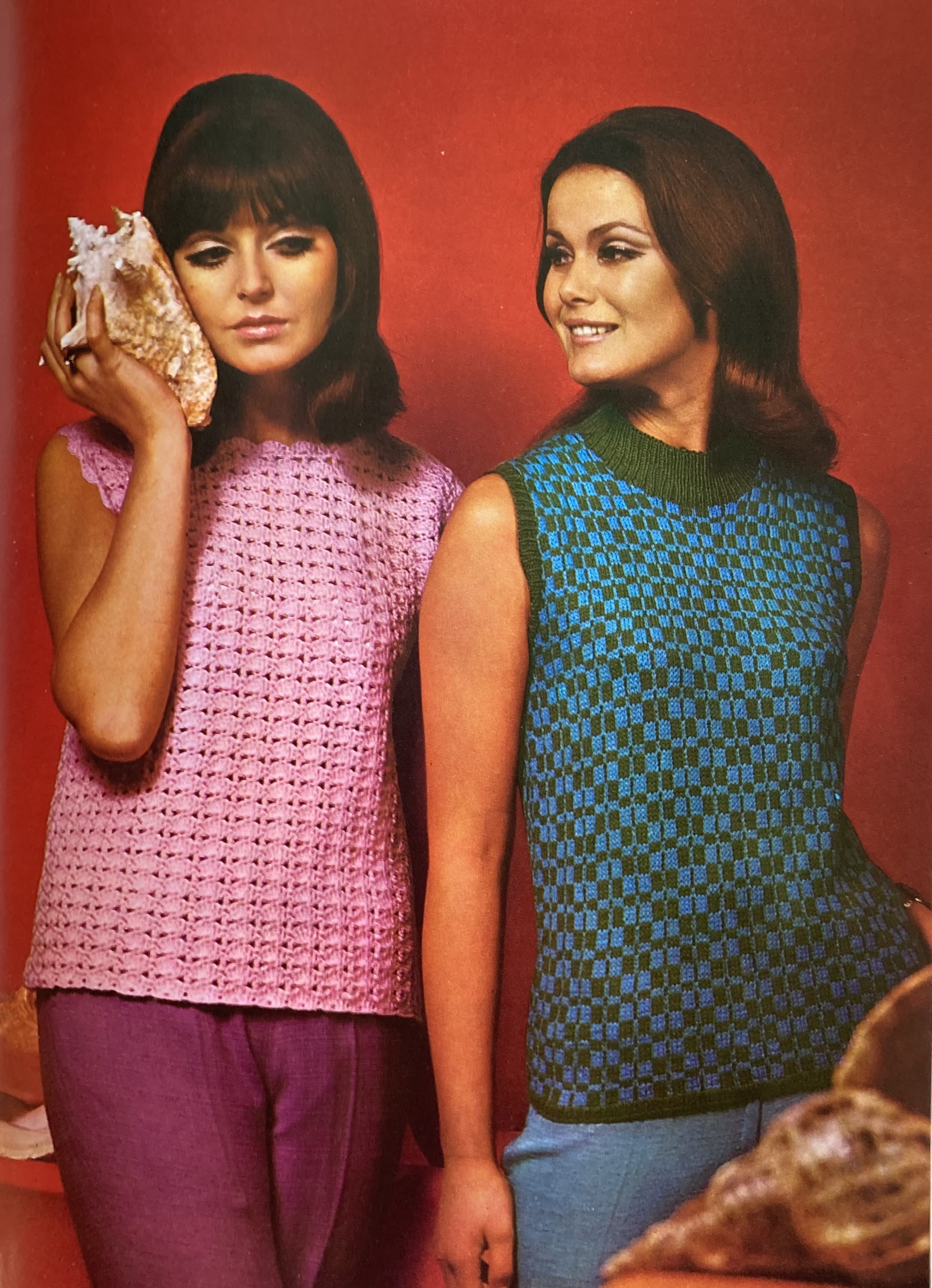
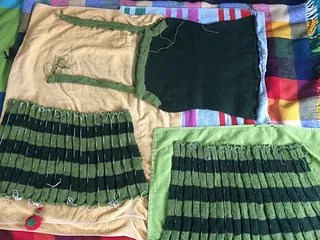
My April 2025 project was this “shell” (sleeveless top) in a stranded chequerboard pattern — one of three “summer shell” patterns in the April 1967 issue of Stitchcraft, along with a polo-neck bouclet and a crochet lacework design. (And shells. Listening to shells, because shell, get it? Yes, we got it, thanks.)
The wool in the pattern is Patons Cameo Crepe, a very smooth, twisted fingering-weight wool. I chose Lana Grossa Ecopuno, which I used for this “shaded blouse” and this sleeveless cardigan a couple of years ago. Though not as smooth as a crepe-twist yarn, it’s soft, light and not too warm, and available in many very pretty colours. I chose a dark green and pale, slightly seafoam-tinged blue, similar to the original colours but with more contrast.
The tension in the pattern is 8 stitches to the inch in pattern, which I can’t get even with fine yarn, so I made the smallest size (for 32-33 inch bust) to fit me (38 inch bust) and calculated that it would come out with around 36 inches in the bust, i.e. two inches of negative ease instead of the 1-2 inches of positive ease in the pattern. I hear you out there saying “Never, ever knit a stranded pattern with negative ease!!!” but it can and should sometimes be done! The yarn is loose and drapey, even in a non-diagonal stranded pattern like this one, and even two inches of negative ease doesn’t look the least bit tight.
Which brings us to the shaping question: all three “shells” in the issue show the new longline silhouette — hipbone length and unshaped from hem to bust. If you look closely at the photos, you will notice that the poses often involve a hand on the back waist, a hand on the back, arm behind the back, elbow pointing at waist level… the things you do to make you look like you have a waist in your long, unshaped garment! I never make unshaped tops for precisely this reason — they look like a sack on me, as they tend to do on all but the skinniest or curviest figures. Having had good experiences with longer tops shaped from hip to bust, I started the top with even fewer stitches at the hip and increased up to the number in the small pattern size after the waist. I also made the top in the round from hem to armhole shapings.
To test the check pattern, I made a little phone cosy in a different wool (DK weight), Since the pattern has no diagonal lines, I was afraid it would pull together awkwardly . That was a concern with the DK sample, so I was very careful to strand loosely with the Ecopuno (another reason for sizing down) and had no problems. I did, however, make a mistake in the pattern, to be fixed with duplicate stitch because I’m too lazy to rip back that far.
It went wonderfully up until the front part above the armholes, where in spite of my careful calculations, I ran out of the light blue yarn. No problem, I had bought it at my local wool shop right in my neighbourhood, so popped over to buy another ball… But no! The shop is changing management and has been selling off all the inventory before the first of May! They still had some Ecopuno, but not in the right colour, so I had to order more online. Argh!
The new wool arrived and I finished the top easily enough. Of course, the new wool was a different dye lot and the one time it makes a difference… and it was on the front piece, too. The change line got less noticeable after blocking and letting dry. Also, the pattern tricks the eye into not seeing it.
My knit-night friends and I recreated the magazine photos. Here’s the black-and-white one:
And here is the magnum opus, where one knitting colleague photoshopped me into the original photos. Is it me, or is it the model?
I am very, very happy with this project — and the photos!
“Spring into Summer” with the April 1967 issue of Stitchcraft — one of my favourites. According to “editress” Patience Horne, the latest fashion trends include longer-bodied “skinny” sweaters (i.e. slightly less bulky than the previous oversized look), “still figure-fitting” (they aren’t, though) and “belts with everything” (none of the models in the photos are wearing belts.) Make what you will of that. “Fashion is very dashing — still young and gay in ideas — but slanted to a feminine look — pretty and flattering.” In other words, whatever you want it to be! Colours are definitely bright and fun, with interesting textured stitch patterns and colourwork.
Our cover design picks up the trend for the retro-1930s look which will really take off around 1970 (could Stitchcraft actually be fashion-forward?) in bright, 1967 shades of pink and purple. The brilliantly orange pullover on the inside cover has an intriguing “pineapple” pattern. The summer “shells” (sleeveless tops) strike a nice balance between bold colour and crochet-lace patterning and more subtle, neutral bouclet. Love how they’re listening to shells in the photos! (Though sadly, the crochet model looks like she’s getting bad news.) Rounding out the adult women’s fashions is an understated and elegant fine-knit crepe blouse for larger sizes.
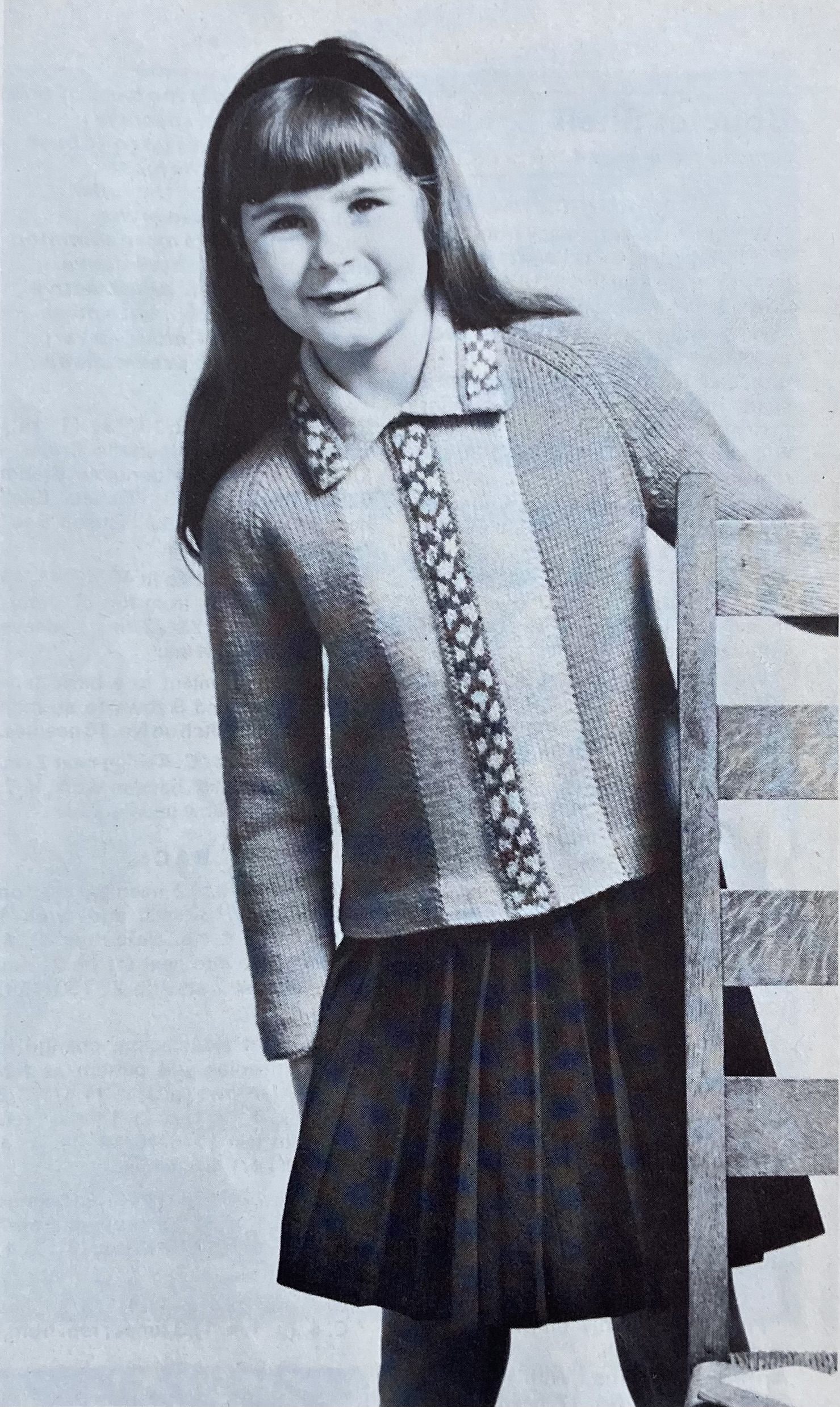
This issue has some great designs for school-aged children, starting with this “outdoor cardigan for rough-and-tumble wear” for a girl. Who is wearing leggings! That cover her legs and which she can actually move around in without flashing the neighbourhood! Finally! The model looks like she’s about to have a great time, too. Our more feminine model sports a pretty panelled pullover that looks like a buttoned-up cardigan. It’s just as practical as the more rustic design, but with elegant details. Her little sister gets a tunic top with a striped yoke and cuffs.
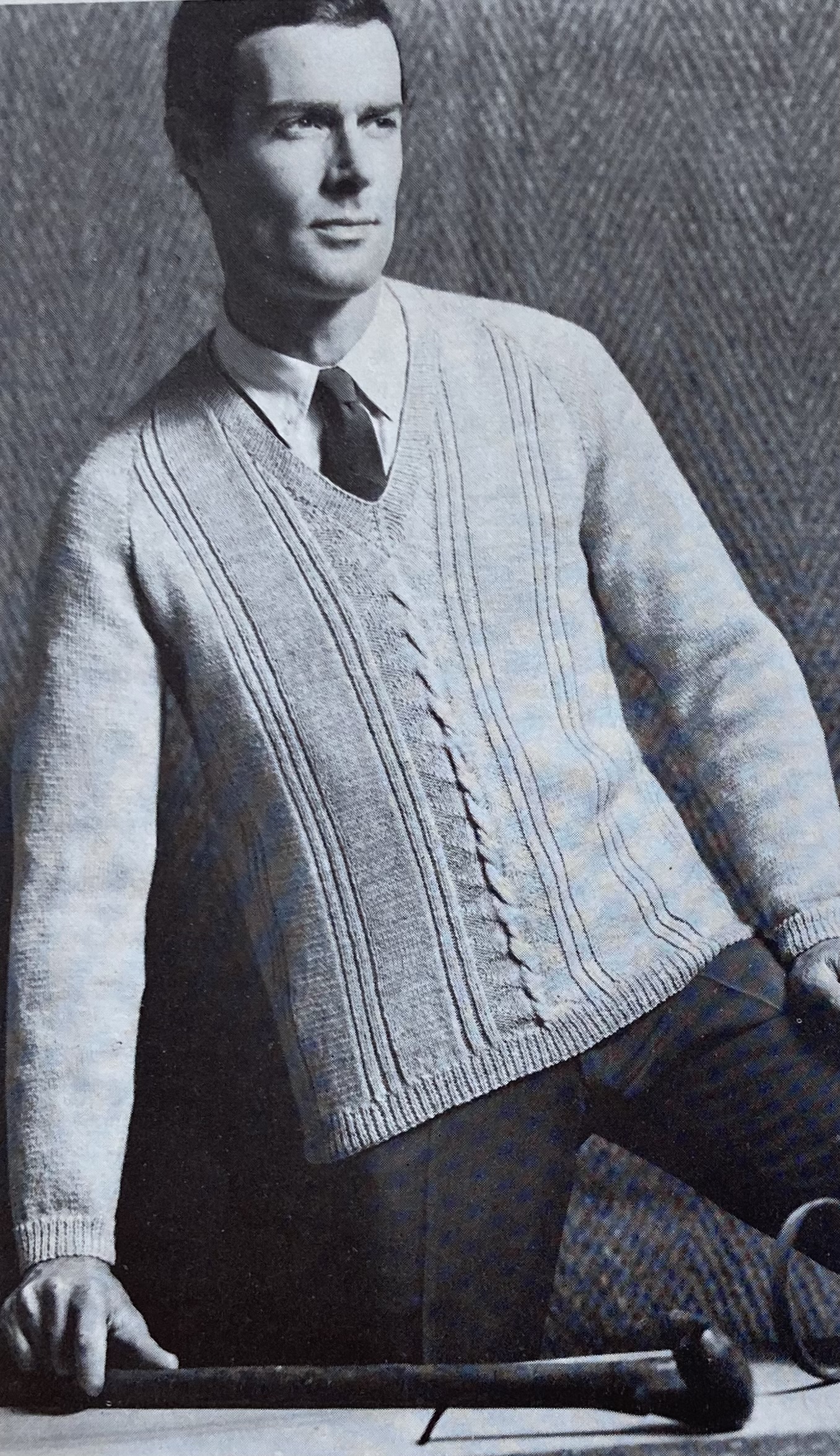
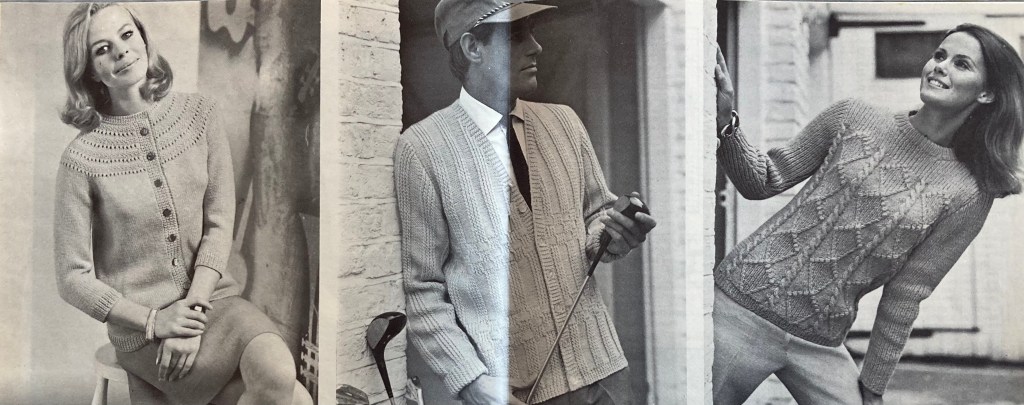
Oversized garments in neutral colours and vertical cablework patterns are still on trend for men’s fashions, represented here with a V-neck pullover in cable-and-rib pattern and a “country cardigan” in undyed “Capstan” wool with a crunchy Aran pattern on the fronts only.
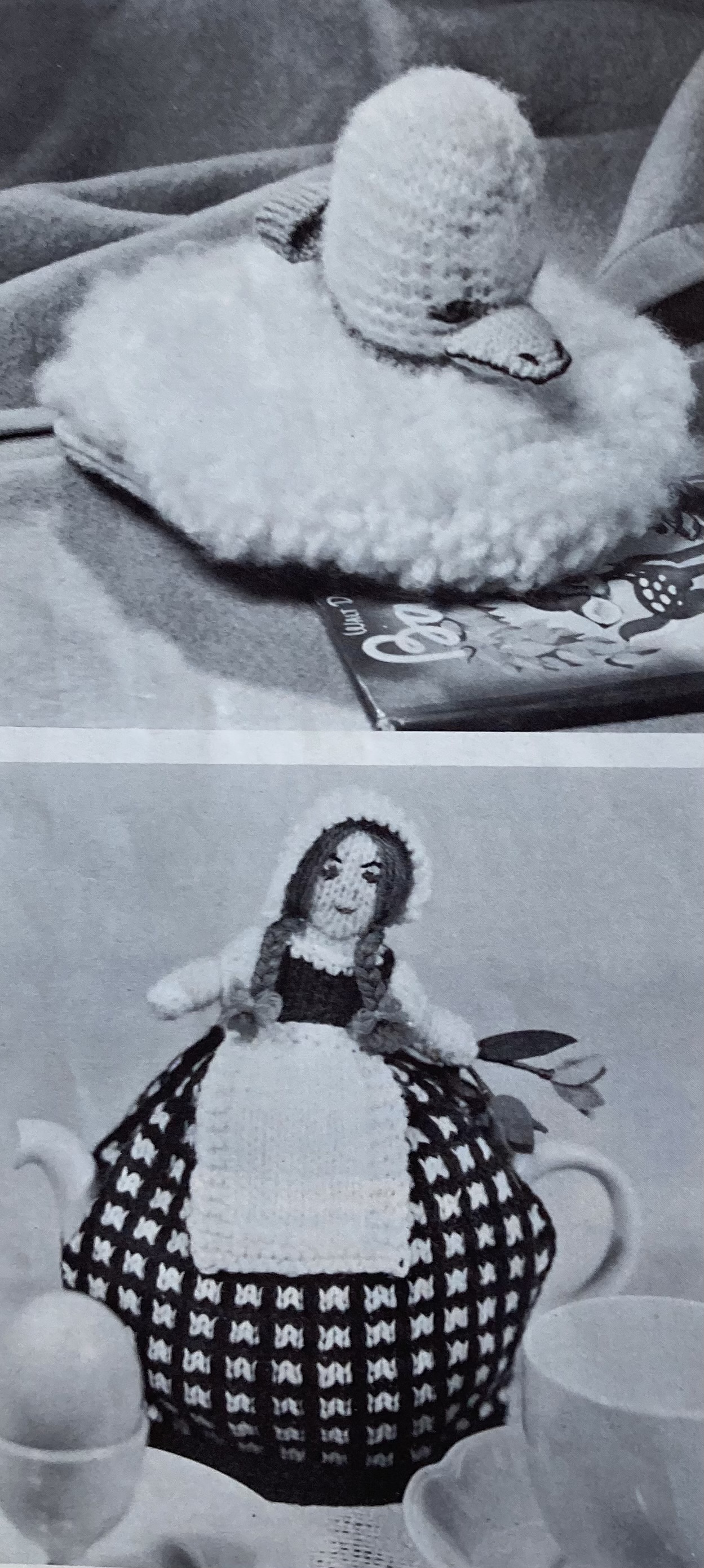
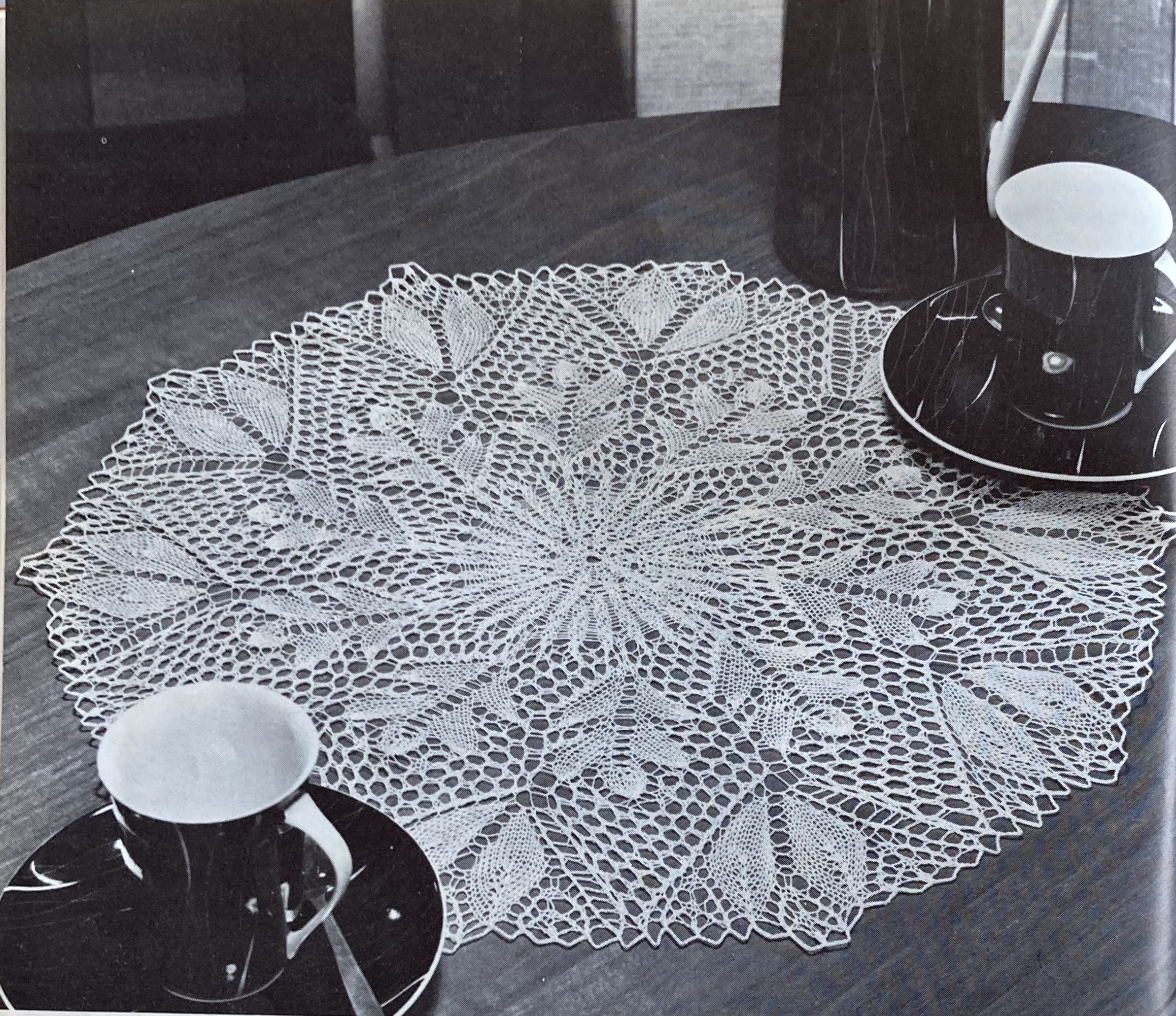
It wouldn’t be Stitchcraft without “Bazaar items”, and the ones in this issue are actually really cool. There’s a knitted nightcase that looks like a fluffy duck thanks to a loop-stitch pattern that is then brushed with a teasle brush to felt and fluff it up. The knitted doily is quite intricate and the “Dutch girl” tea cosy (holding a cluster of felted tulips!) is amazing.
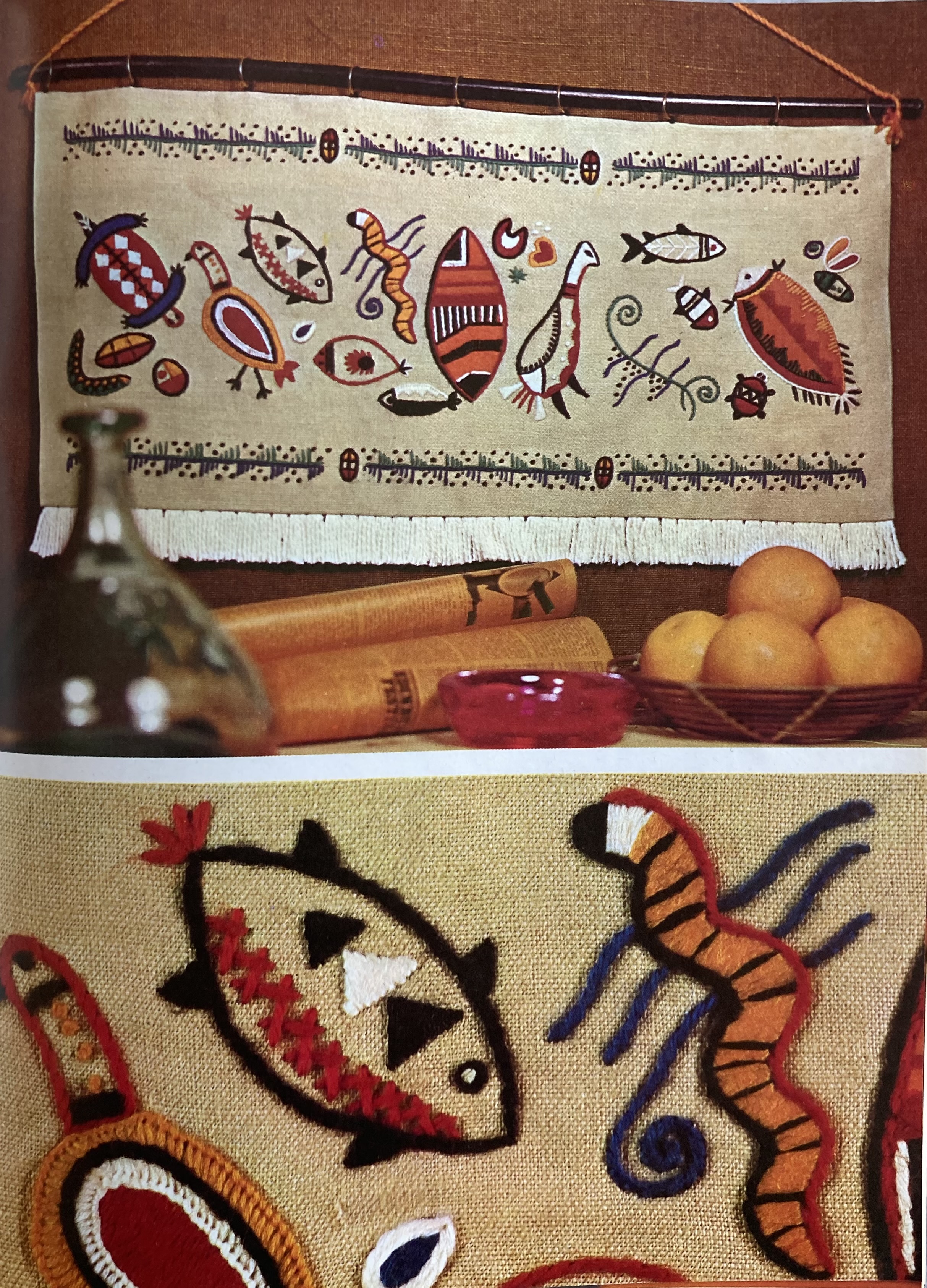
The regular homewares are also more creative than usual. Check out this embroidered “tropical fish” wall panel! (In non-tropical 1967 colours of brown, rust, and burnt orange.) I love it. The fantasy-animal theme continues with a tablecloth and/or table mats and/or cushion in Assisi design. The Victorian stool or cushion ribbon design is quite normal in comparison.
The back pages have the usual ads another nice one from the Scotch Wool shop, but not as dramatic as in the previous issues. in the “Children of other Lands” serial comic, Fifi the French girl takes a baguette home under her arm, only to have it eaten by birds on the way home. I told you this wasn’t the best comic of the Stitchcraft collection… Then there’s a nice extra pattern for a crocheted collar and cuffs in “bell” pattern to perk up your plain dresses.
I’ll be making two larger projects from this issue — the cover dress and the check-patterned “shell”. Neither of them will get done in April, but I’ll post something and update it with progress. Happy Spring!
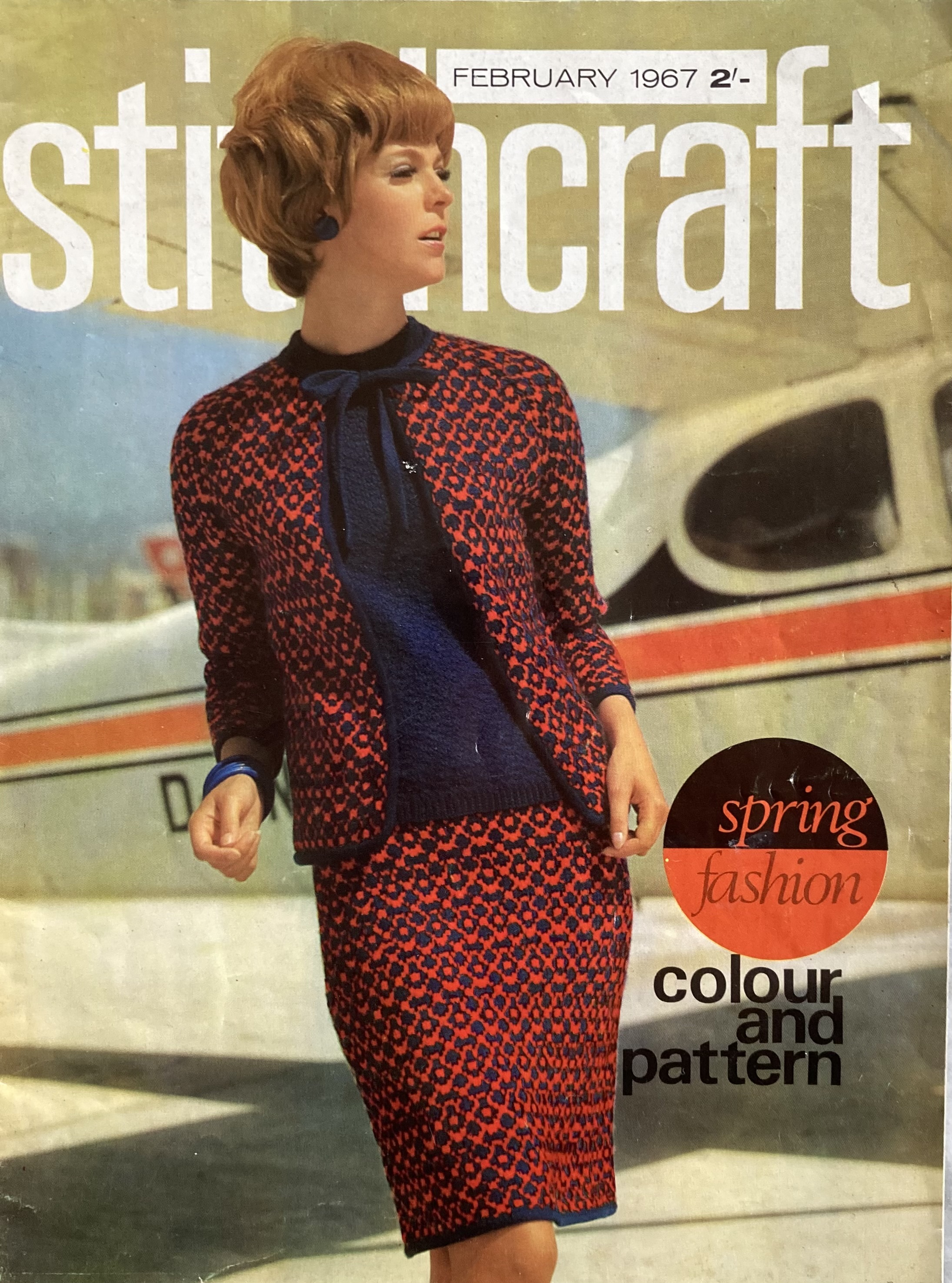
Spring Fashion is ready for take-off in the February 1967 issue of Stitchcraft, with its theme of “colour and pattern”. Fair-isle/stranded garments continue to “hold the scene”, along with a fun mix of non-stranded colour and texture designs. Colour and pattern of household items are influenced by spring and Easter (March 26th in 1967), with pastel florals and “novelties” for church bazaars.
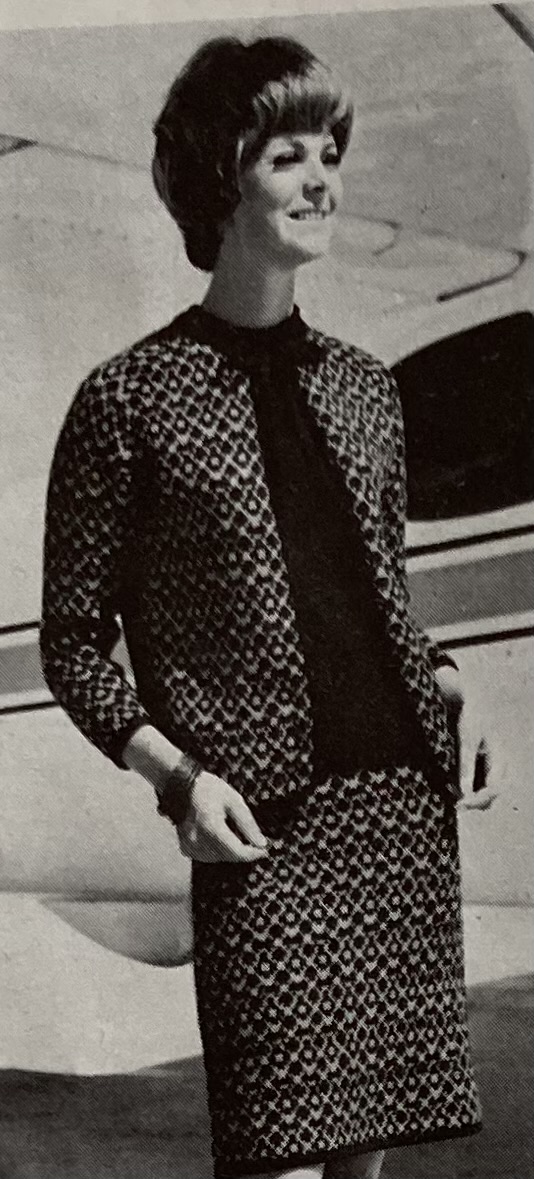
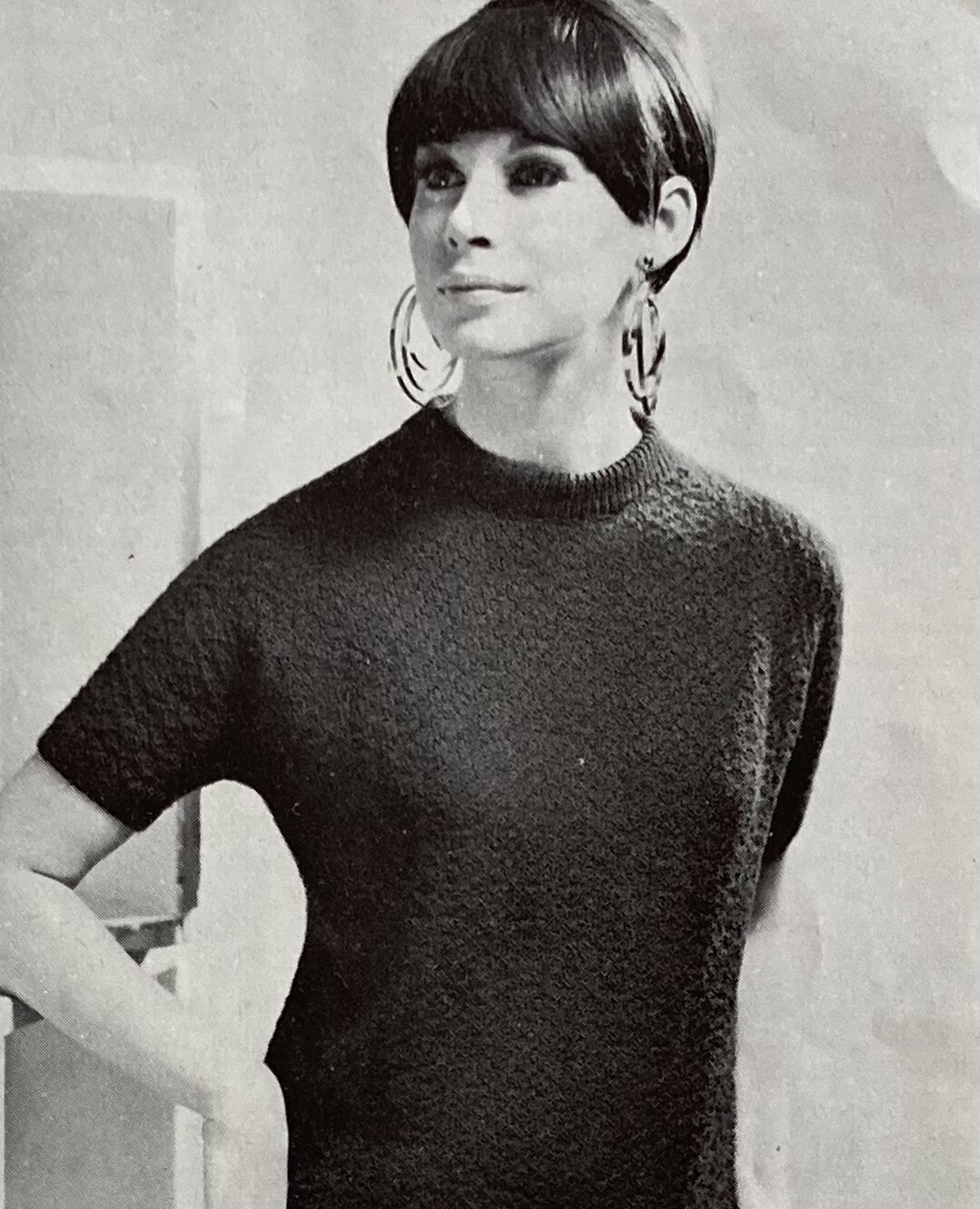
Our cover model sports an elegant “traveling suit” (don’t think it’s quite appropriate for flying in the tiny 2-seater plane in the background, but great photo) with an all-over stranded design in red and blue, paired with a short-sleeved knitted blouse. The suit is made in double-knitting weight wool with knitted bias binding in 4-ply Nylox (wool-nylon blend). The same Nylox wool is then used to make the blouse, which cleverly translates the stranded colour pattern into a single-shade textured pattern using knit and purl stitches. It’s a lovely and very well-coordinated ensemble.
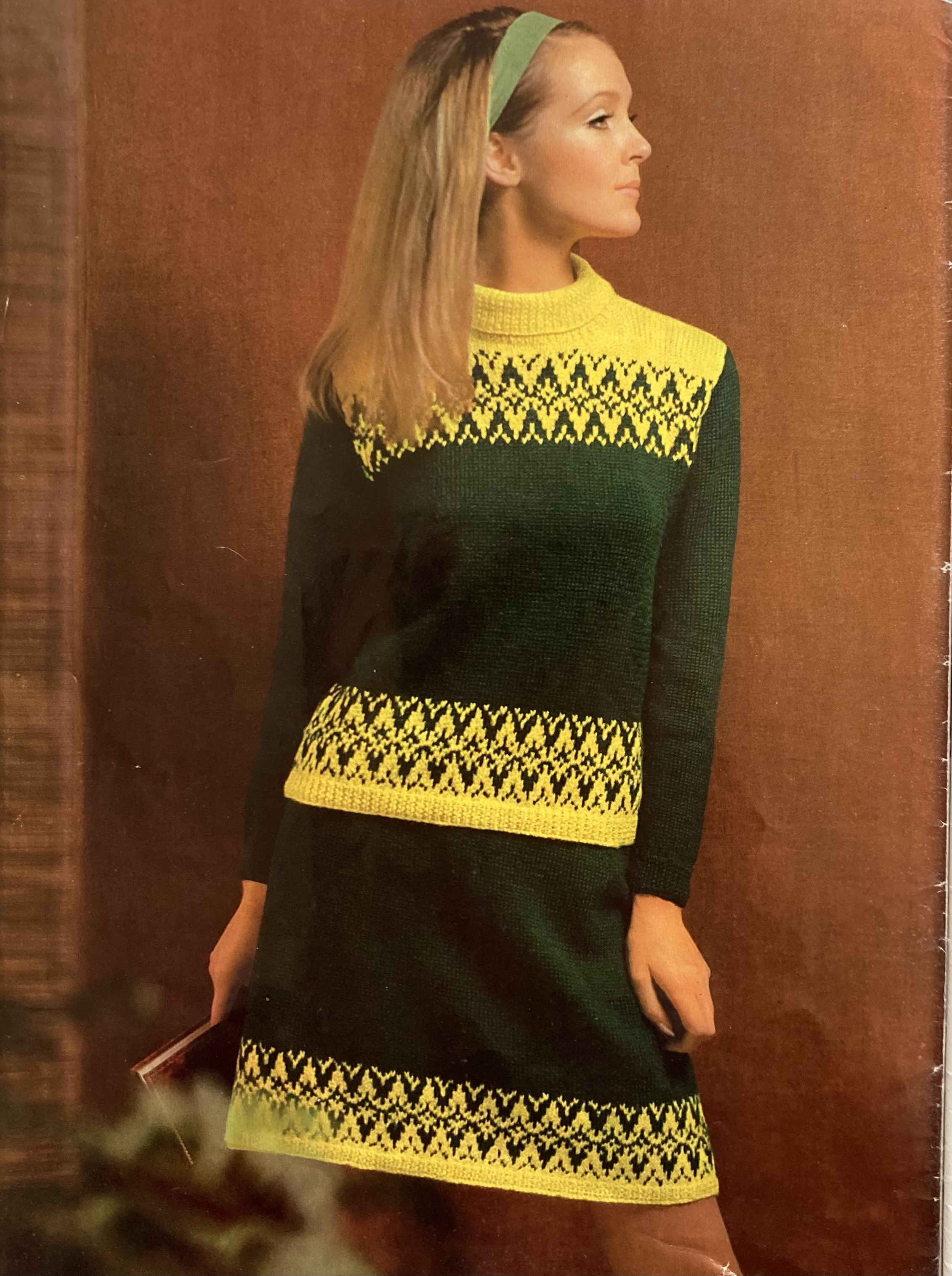
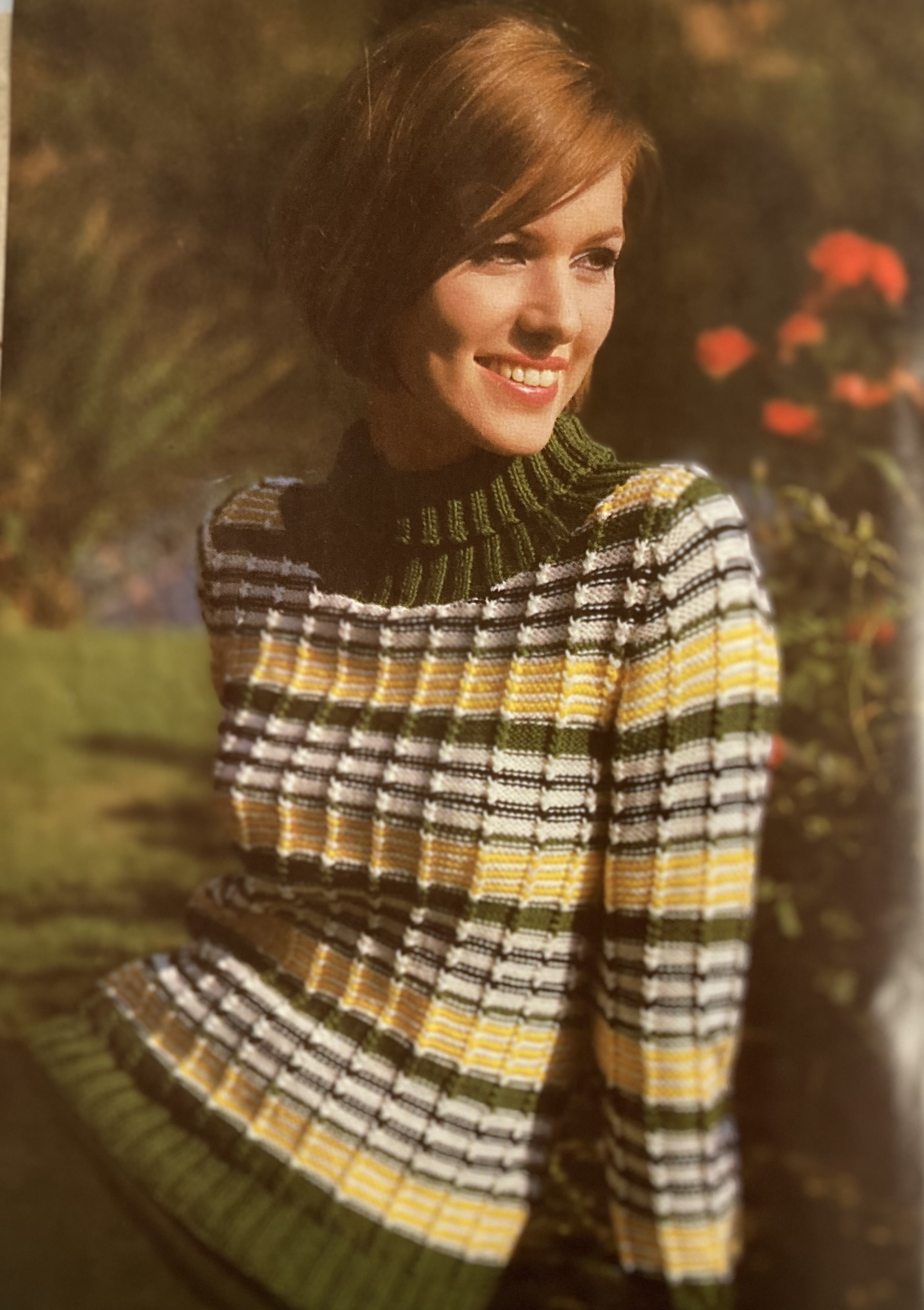
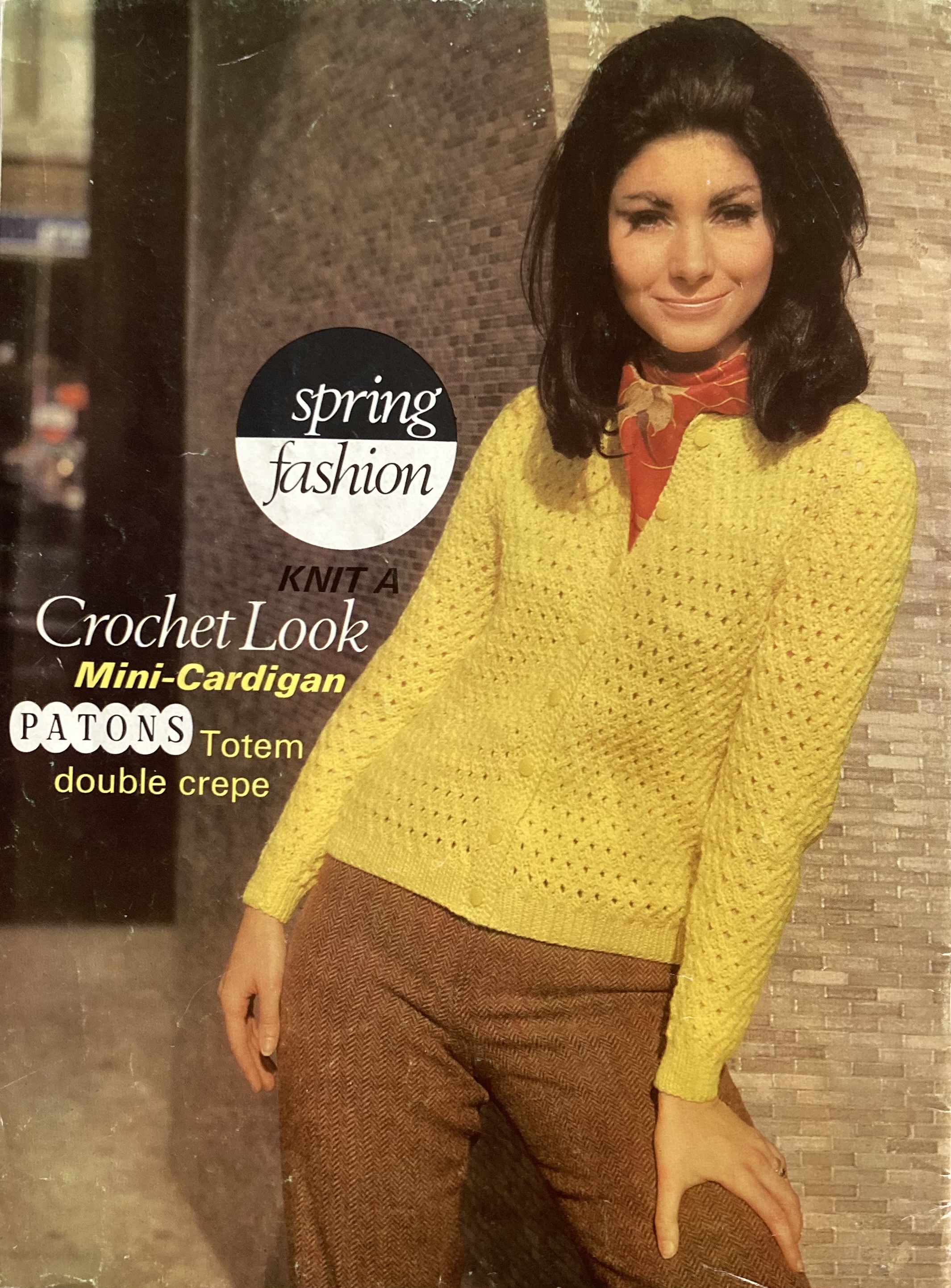
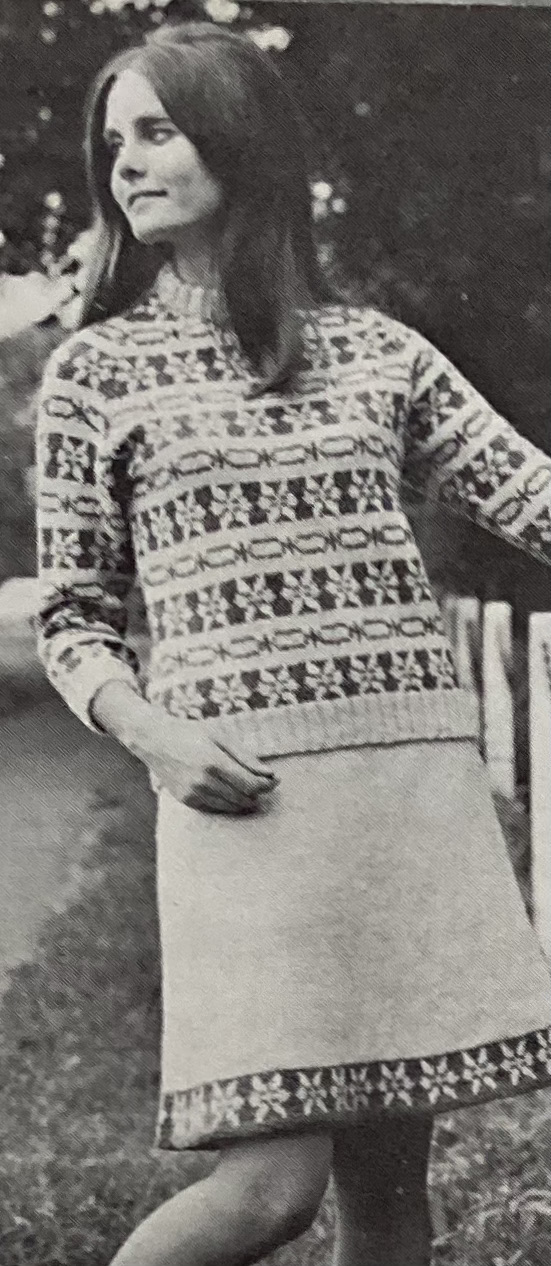
Fair Isle knitting (I know the Fair isle purists will remind us that not all stranded knitting uses traditional Shetland/Fair Isle designs or techniques, but Stitchcraft is not that picky, so I won’t be either…) features in the inside-cover sweater-suit design as well, with patterned borders on both skirt and sweater. Whereas the cover suit falls to just barely above the knee, this outfit is not afraid to go mini. More variations on colour and pattern can be seen in the striped and ribbed “country sweater” or the knitted mini-cardigan in “crochet look” — a nubbly twisted-stitch pattern. Larger ladies can make a very pretty blouse in a delicate feather-check pattern. The checked part is simple block ribbing with rows of garter stitch and the feather stitches are made by dropping a stitch down 5 rows and then working it together with the 5 stitches above it. Bright colours are trending (the blouse is turquoise) with yellow and green at the top of the list.
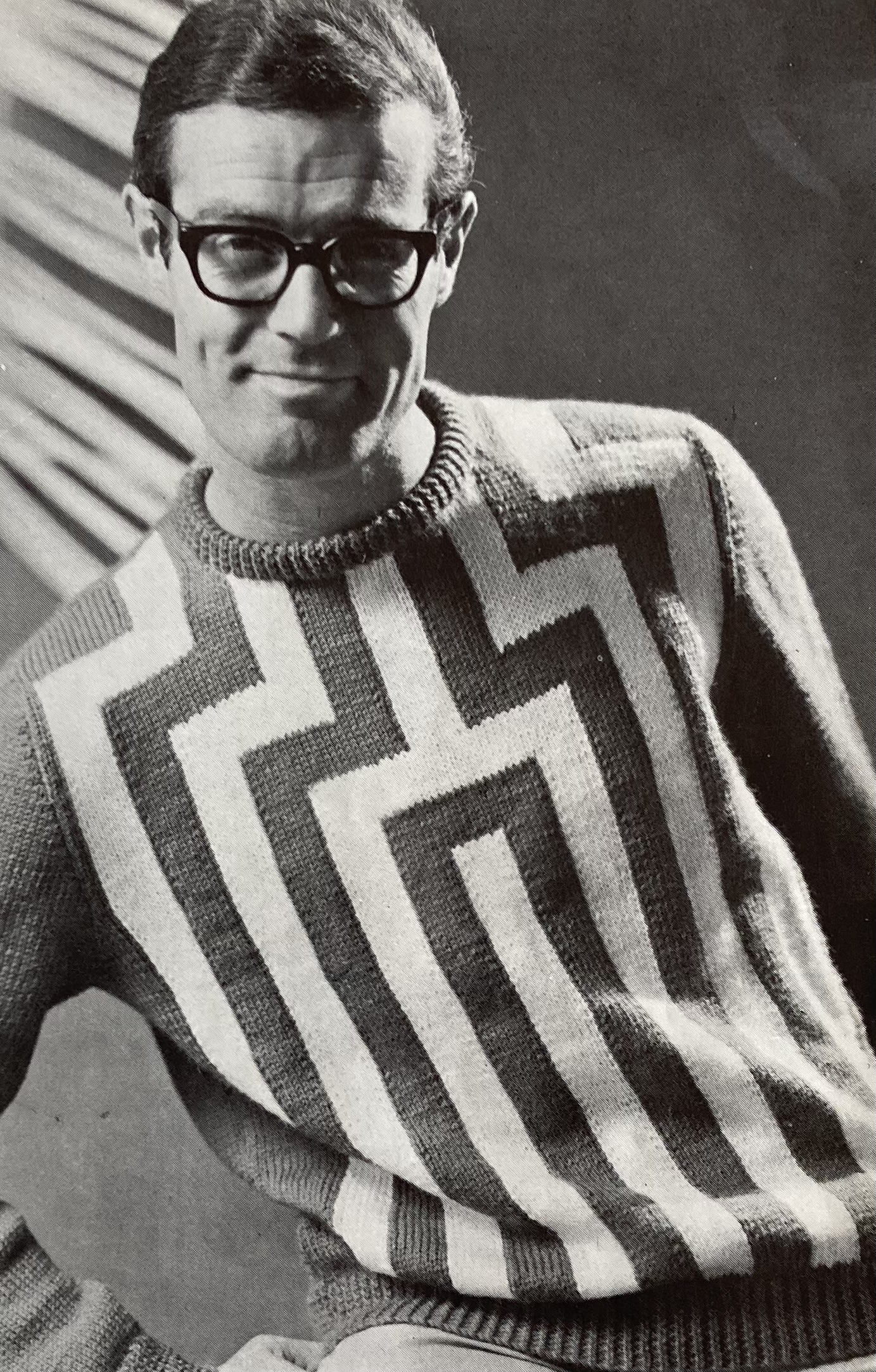
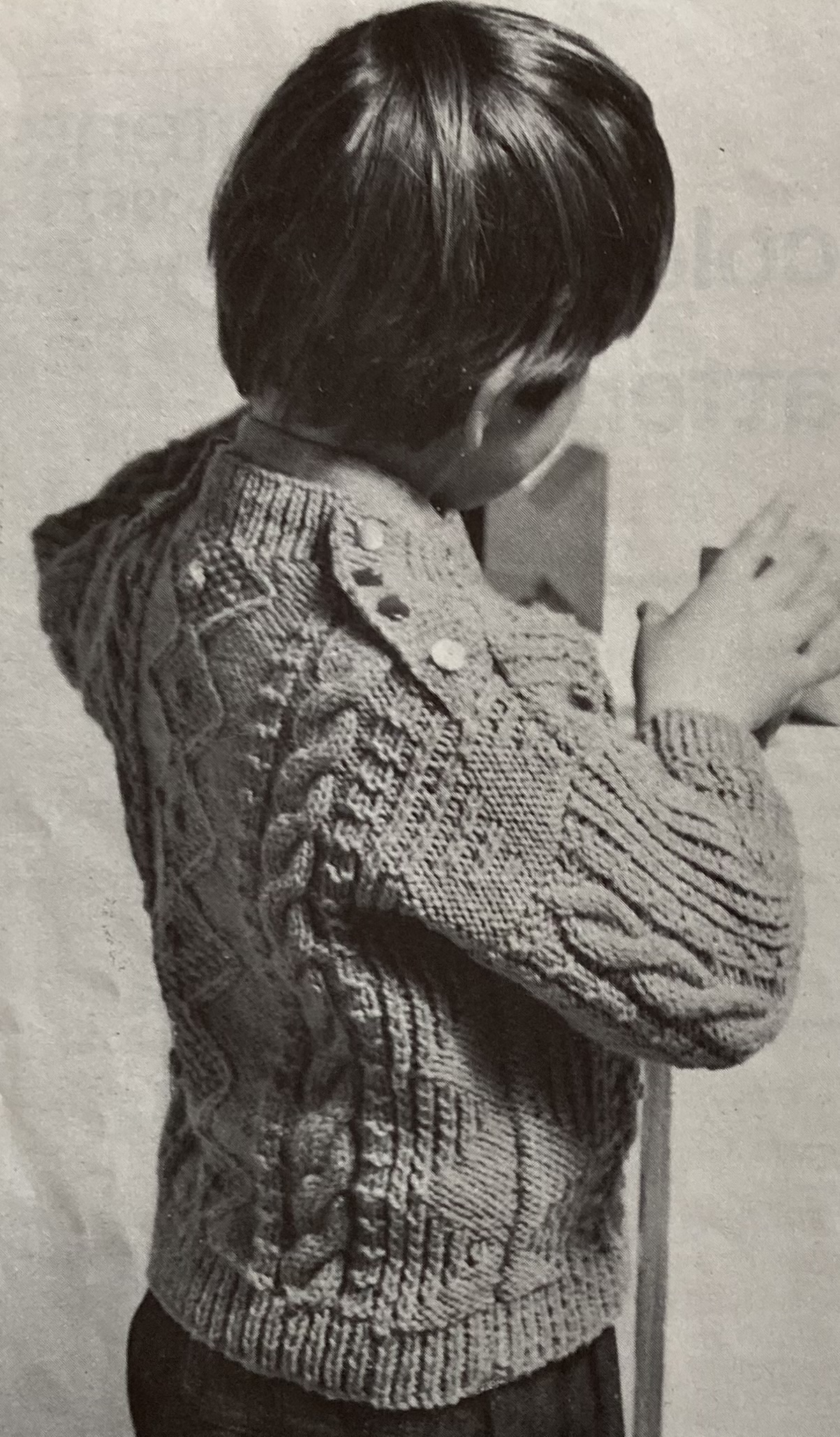
There are great patterns for the rest of the family, too: the man’s “Italian design” sweater is quintessentially 60s, and it’s not Stitchcraft‘s fault that the pattern looks like the glyph from the “White Bear” episode of Black Mirror. Little boys get a fun Aran-patterned sweater with practical buttons on the shoulder. Daughter “Melanie” gets a much less practical pinafore dress with polo sweater to go underneath, and the baby of the family can get dressed up for a special occasion in a shell-patterned dress and matinee coat ensemble.
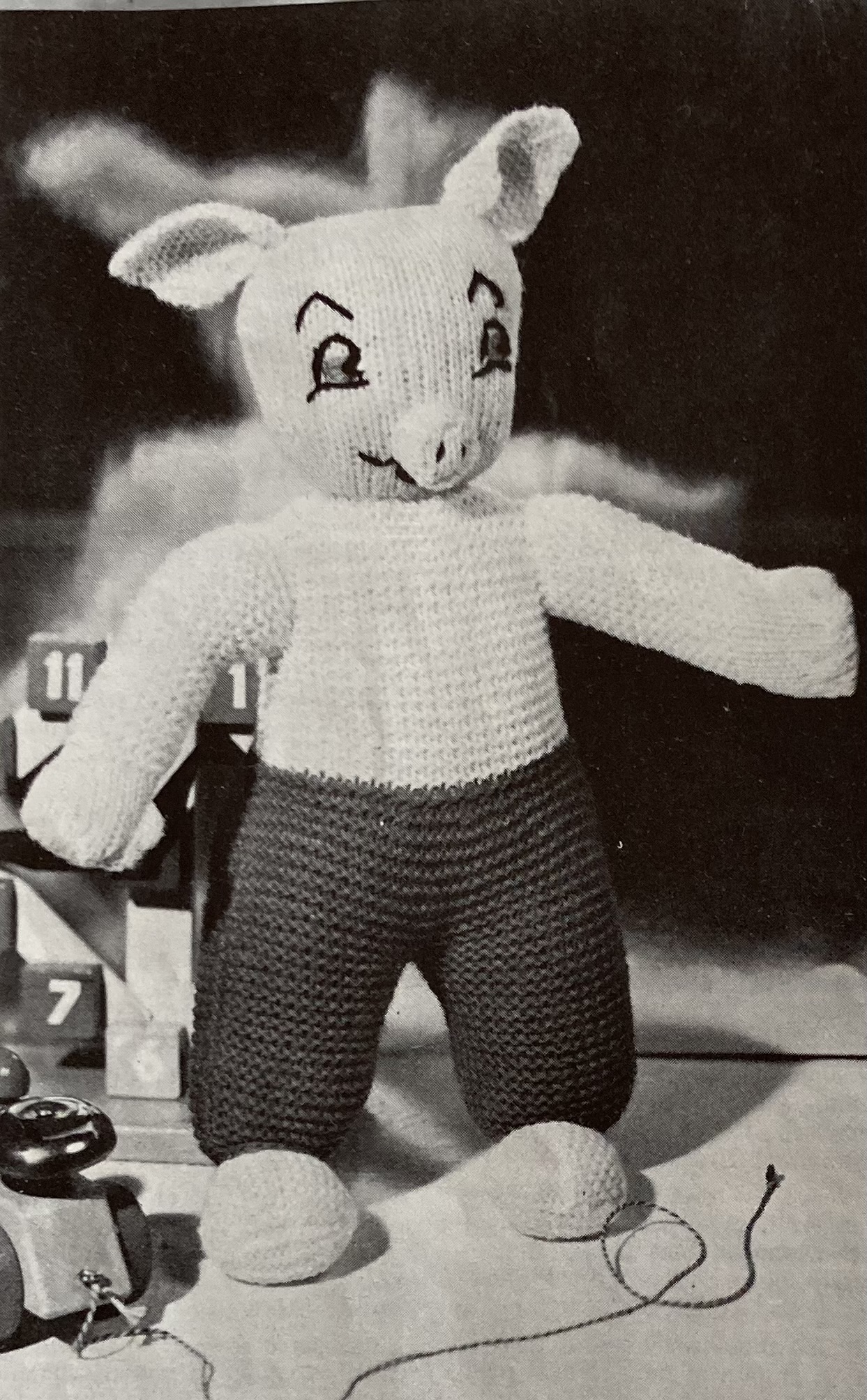
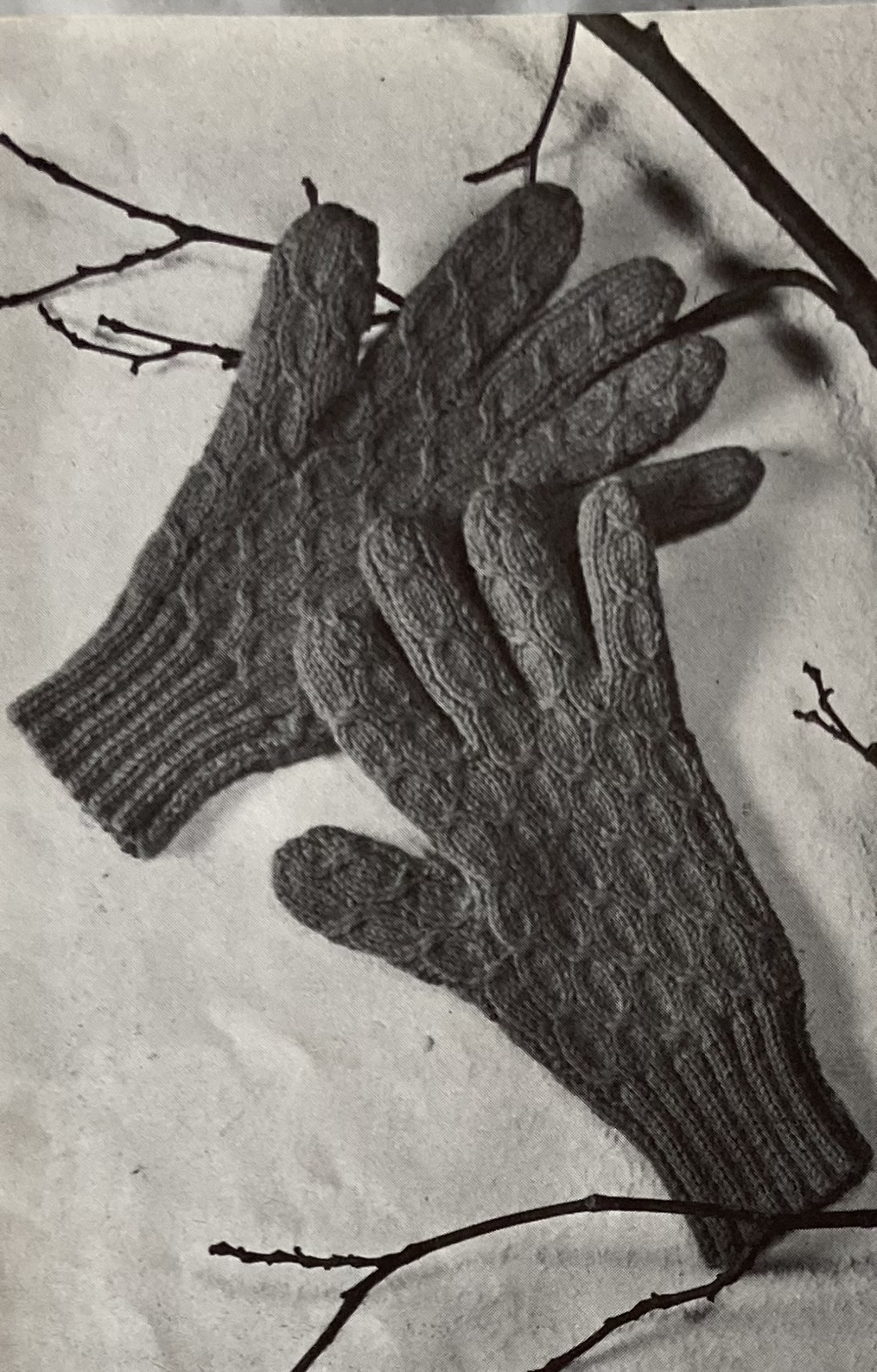
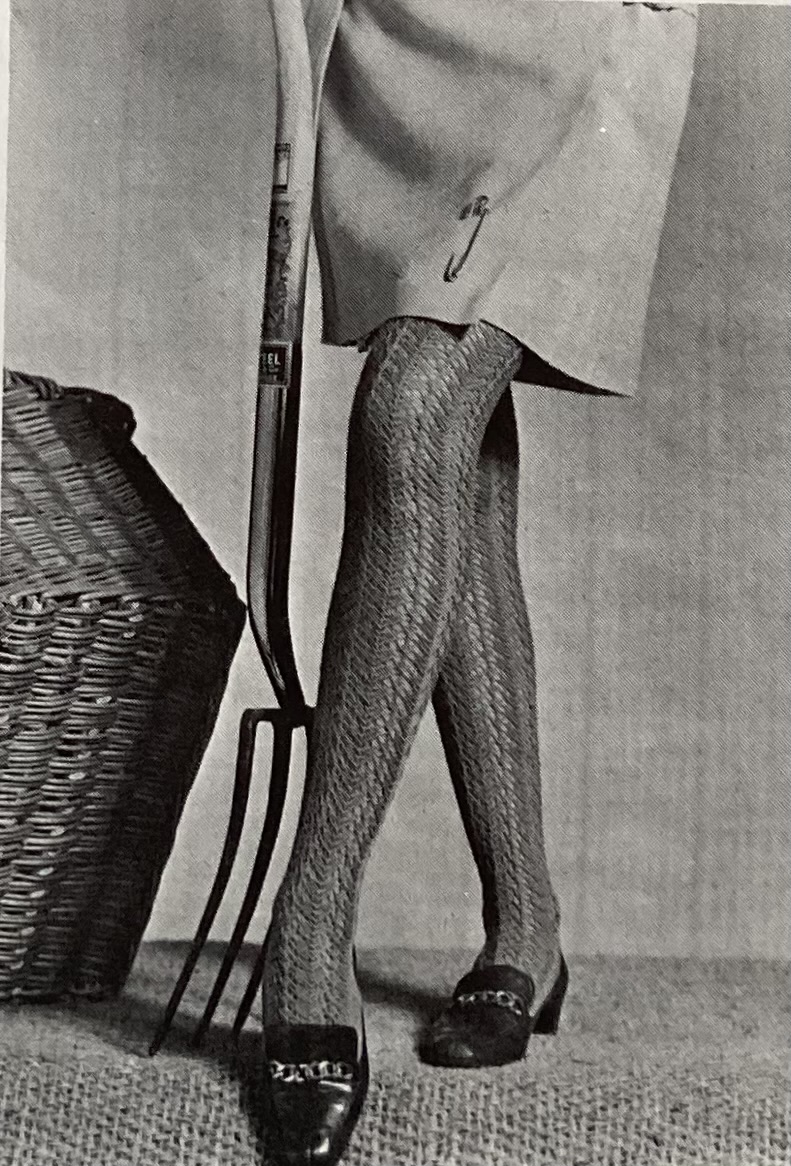
There are toys for the children as well: a knitted “Higgledy Piggledy” stuffed animal to go with the comic in the Readers Pages, and “Tracy the Knitted Doll”, interestingly not a “dress-up” doll like most of the dolls in Stitchcraft — her cap and scarf are knitted separately and removable, but shirt and leggings are integral to her body. “Country” accessories for adults round out the list of smaller items: warm cabled gloves for him and feather-pattern knee socks or stockings for her.
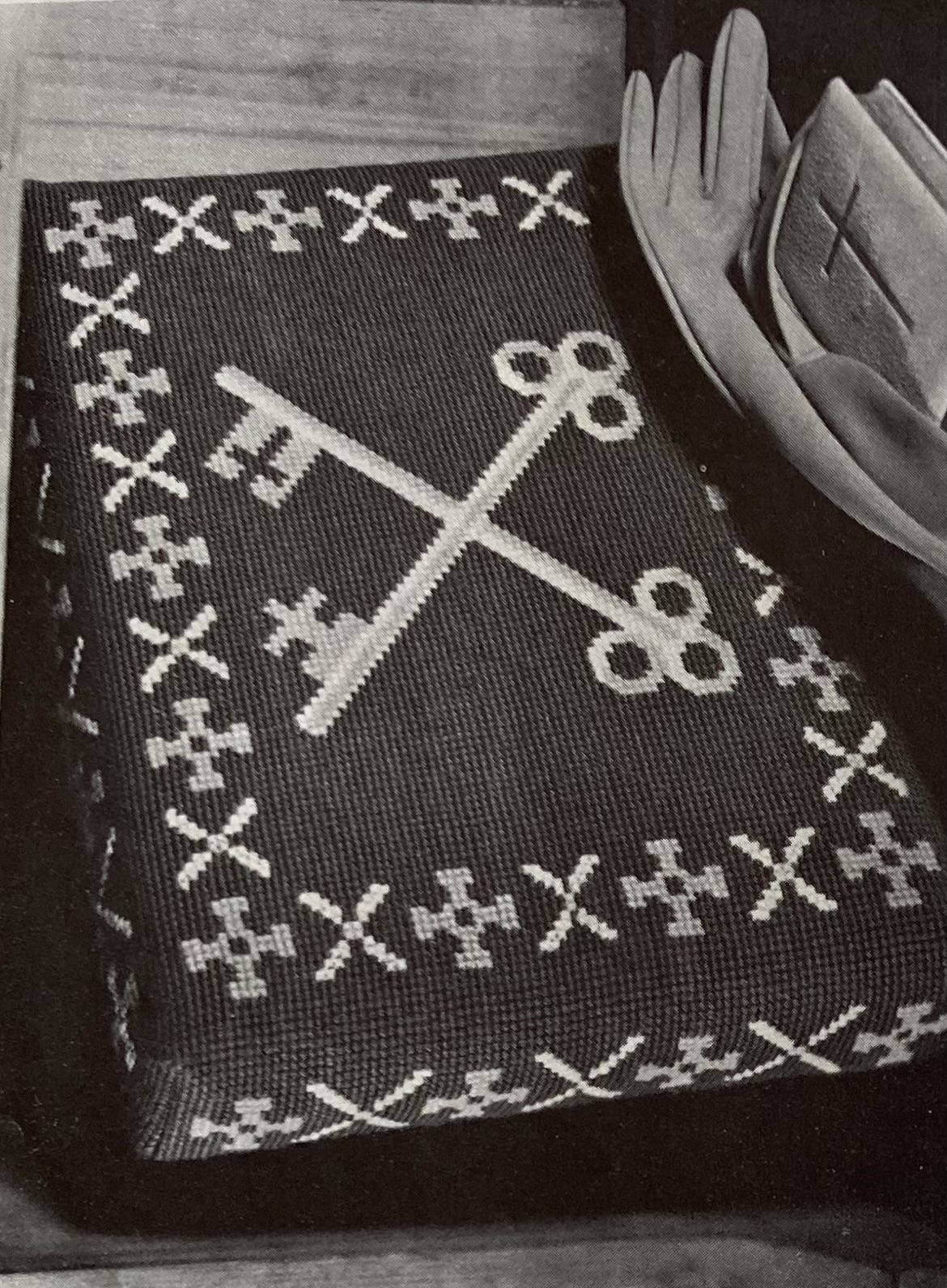
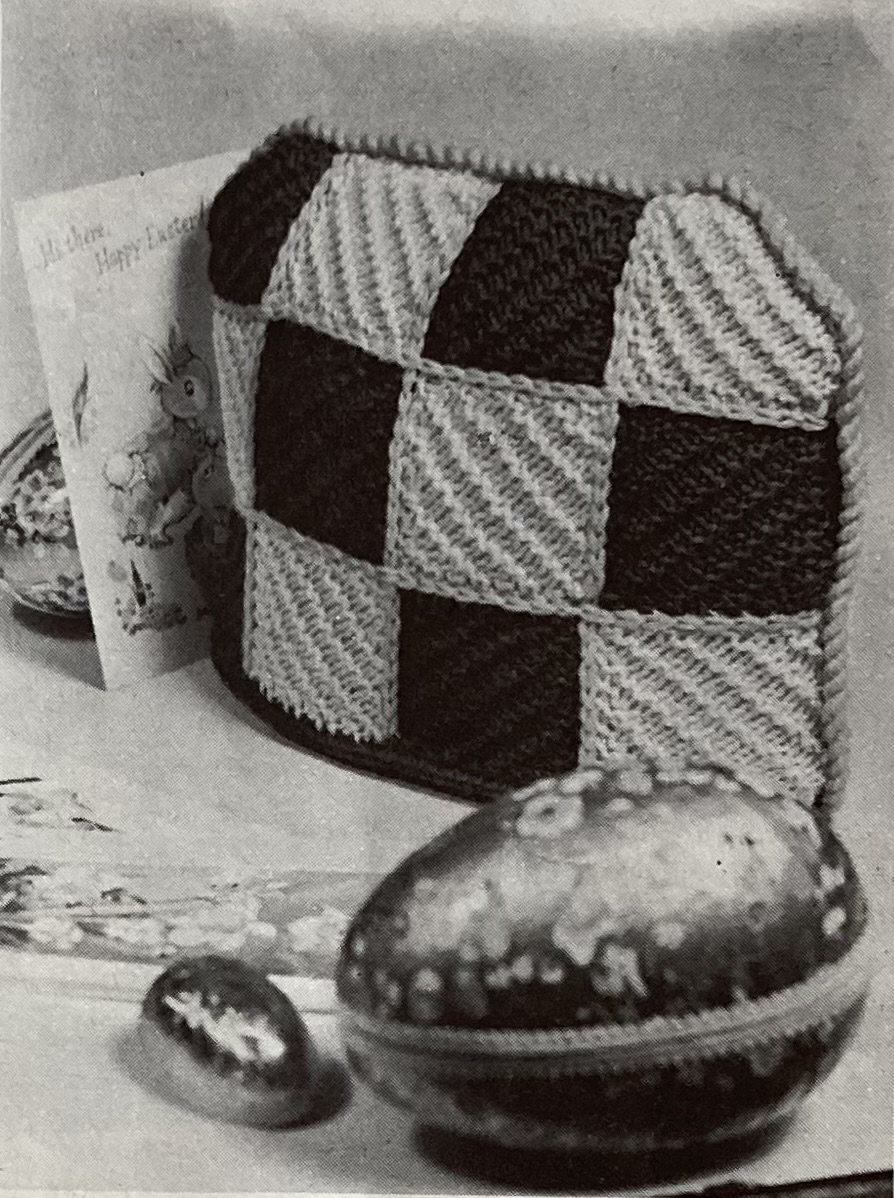
Homewares and “novelties” are themed for spring and Easter, starting with a tapestry church kneeler with church-key design. There’s a cushion and/or tea cosy in knitted patchwork, which is not particularly Easter-themed but would fit with an Easter brunch or church bazaar.
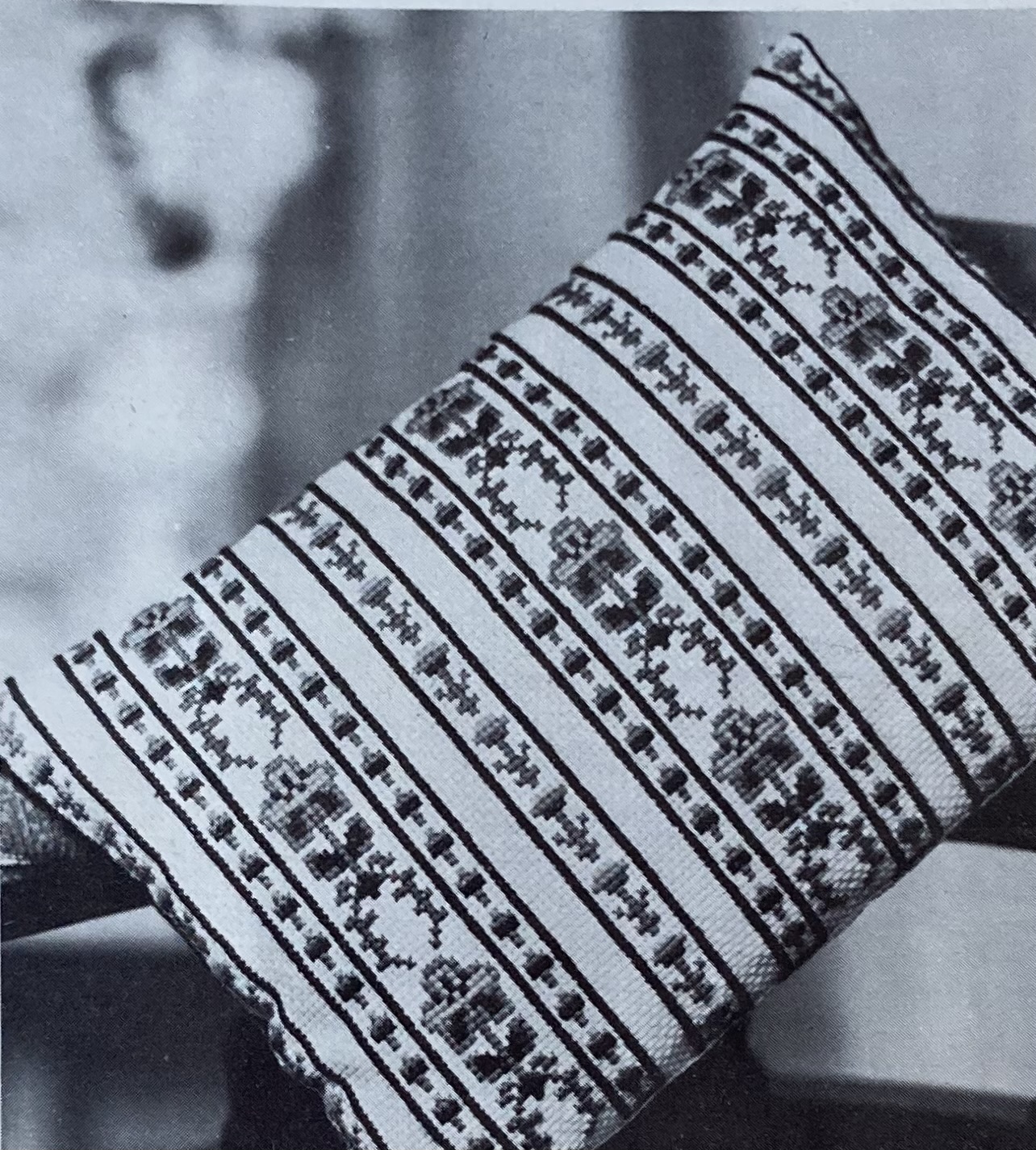
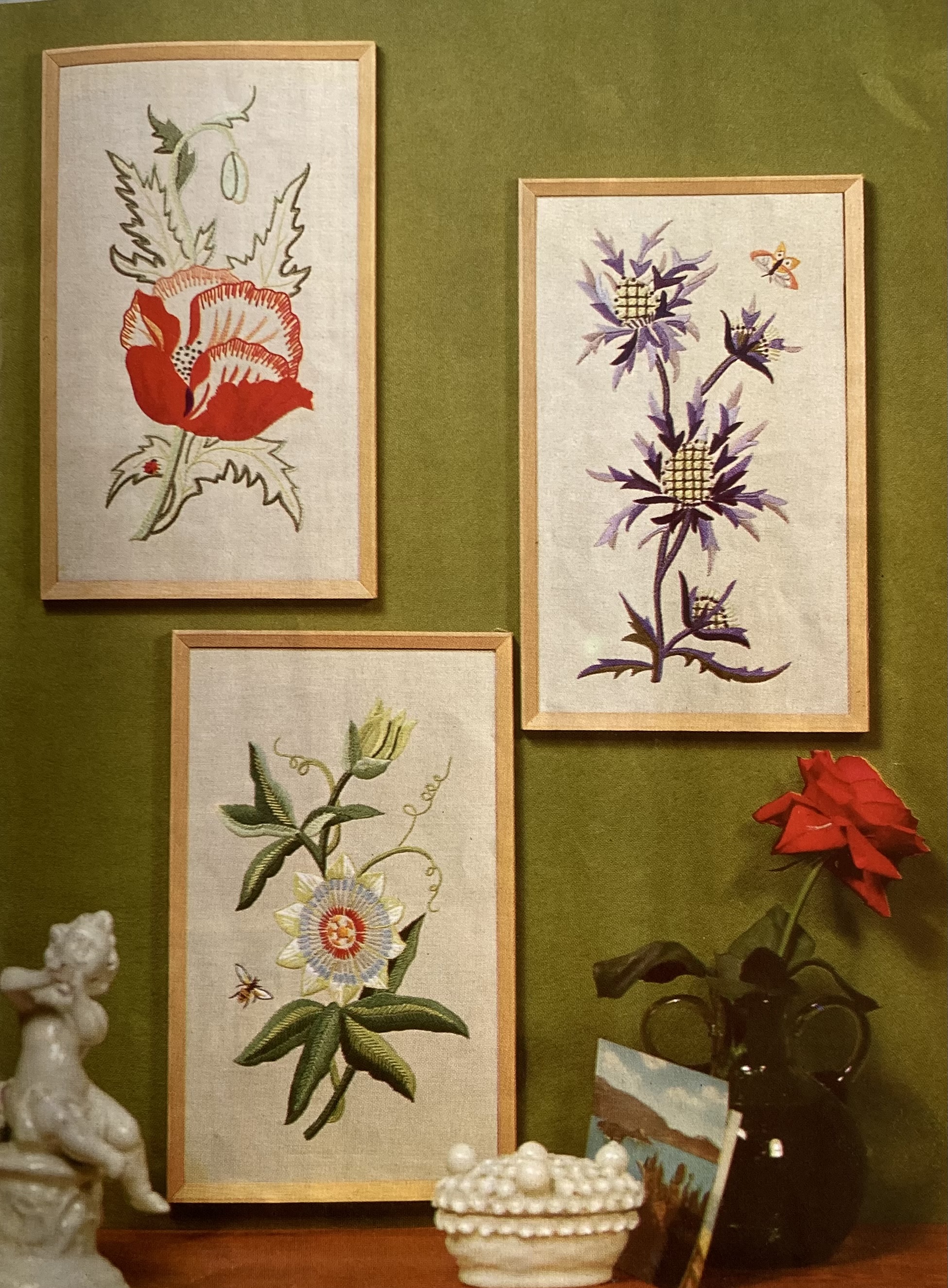
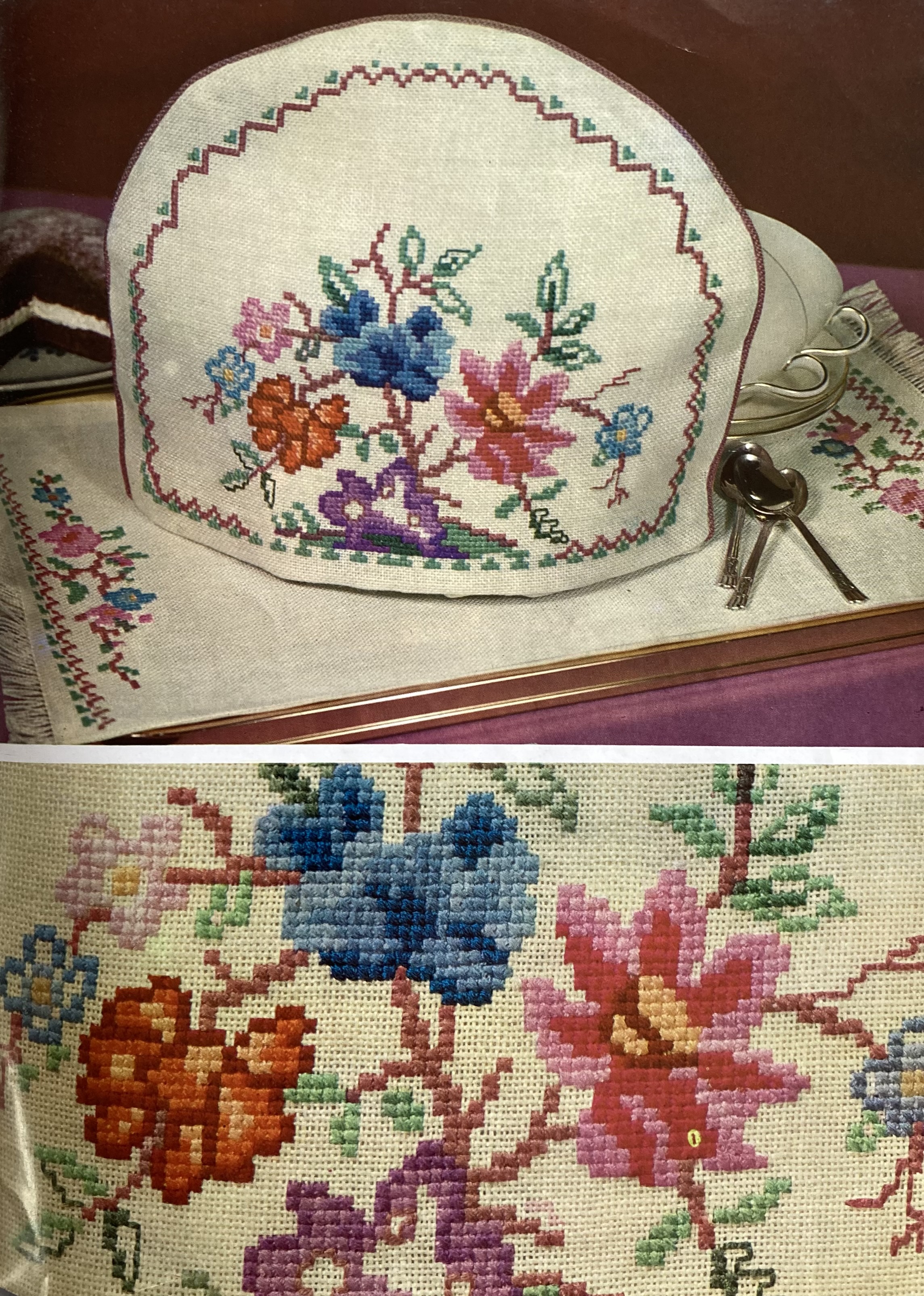
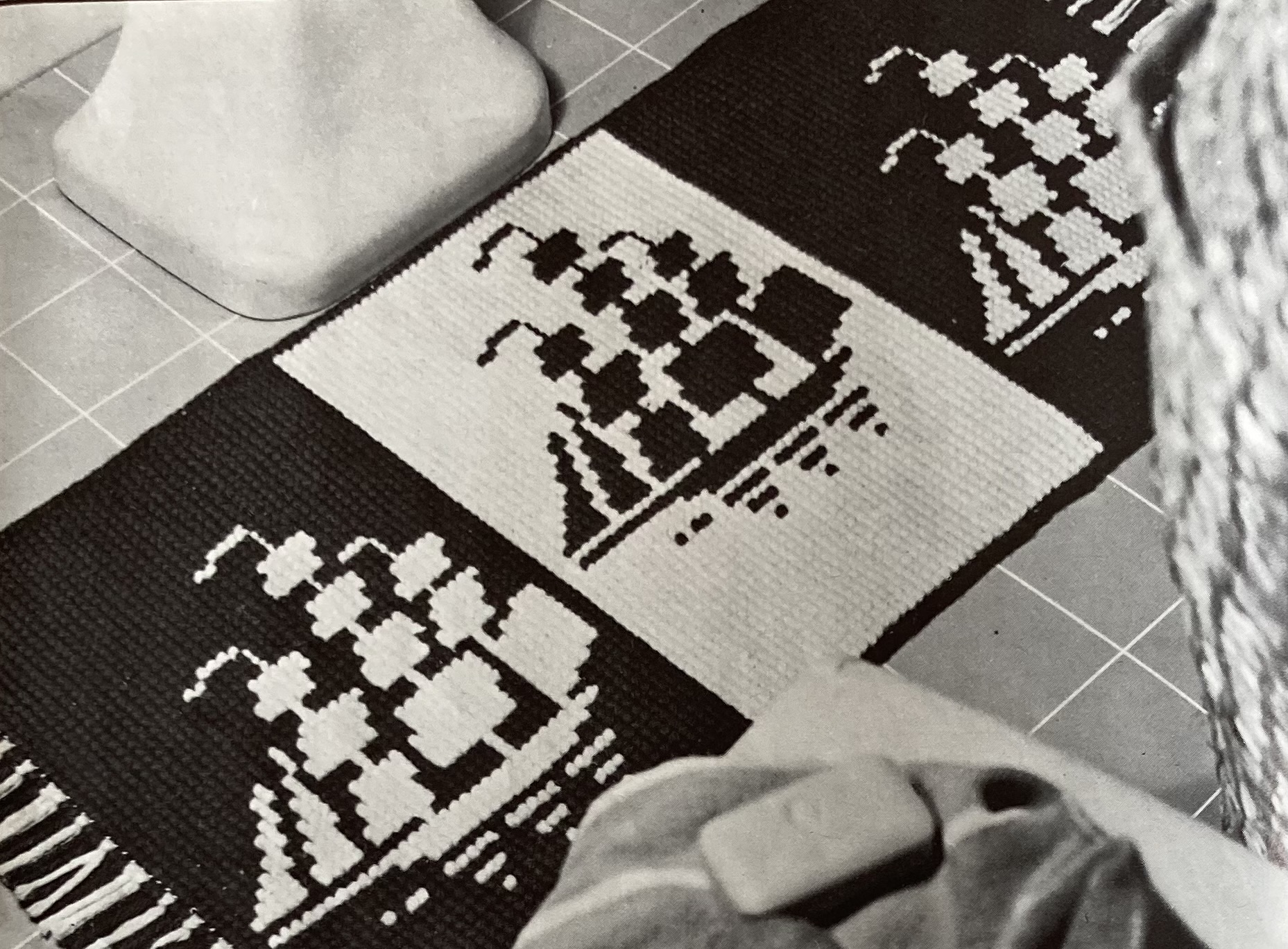
Spring flowers make an appearance in both a set of embroidered framed pictures and a cross-stitch traycloth and cosy. Finally, three cheerful sailing boats decorate a panelled rug for the bathroom.
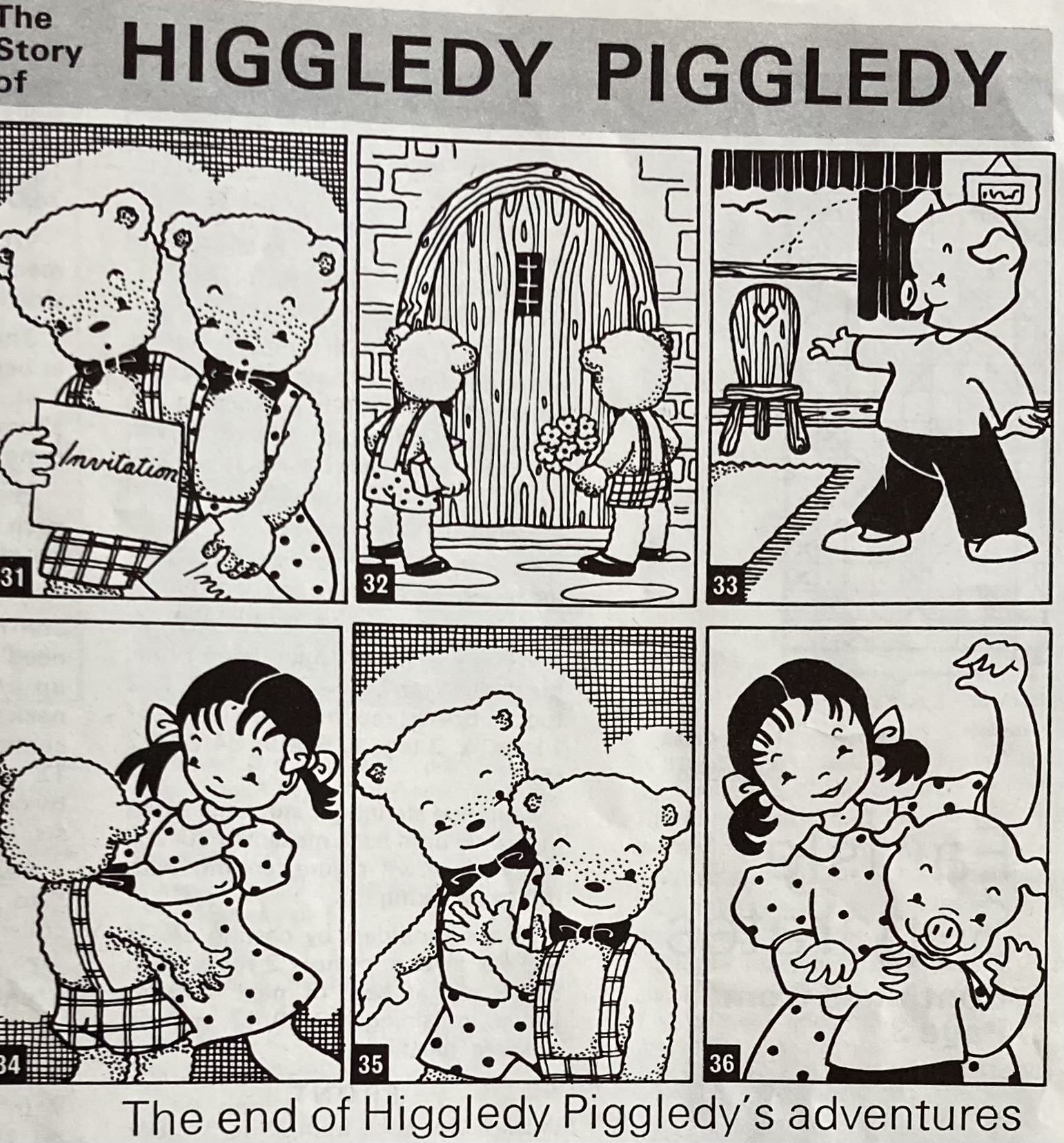
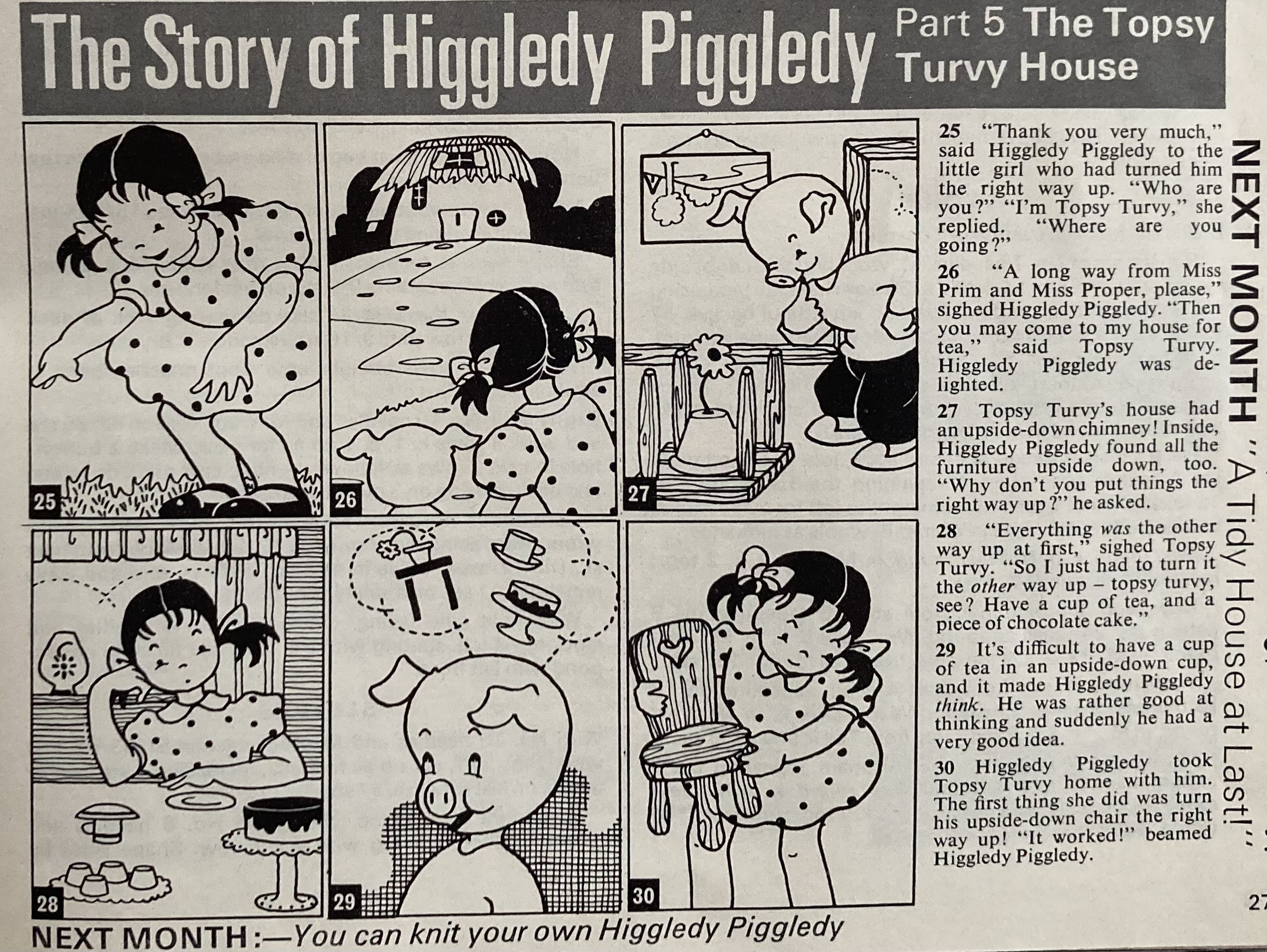
In the children’s comic, untidy piglet Higgledy Piggledy’s adventures come to an end when he moves in with Topsy Turvy, who likes to put right-side-up things upside-down and vice versa. So Higgledy Piggledy makes everything untidy and she tidies it up. Isn’t that grand? Doesn’t she just love constantly picking up after a messy male? Of course she does, it’s 1967. The End! Any girls who are too busy having fun on their own to be picking up after a husband (yet) can treat themselves to sexy underwear, courtesy of the Scotch Wool Shop. I love everything about this ad — the underwear, the art design and the copywriting.
My project for this month will be the mini-cardigan in “crochet look” and possibly at a future point, the knitted socks/stockings (over-knee socks in my version.) Plus the cardigan I was going to make from the January 1967 issue… plus another non-Stitchcraft cardigan that’s been a WIP for a while… all in the shortest month of the year, so we’ll see what actually gets finished. In any case, it’s going to be a well-knitted Spring.
Happy New Year, everybody! It’s 2025 in the modern world and 1967 at the Stitchcraft Sixties. What does our first issue of the year have to offer?
1967 was the year that Stitchcraft finally started to get just a little bit fashion-forward, albeit in a slow and conservative way. It starts with the title fonts, which keep getting bigger and more sans-serif (graphic designers, please excuse my layperson’s vocabulary — I’m sure there’s a better word for what I’m trying to say, but I don’t know it.) The skirt and dress designs are finally just barely above the knee — three years after Mary Quant introduced the “mini” in her shop in London — and a sense of fun and “swing” is slowly but surely creeping into the aesthetic.
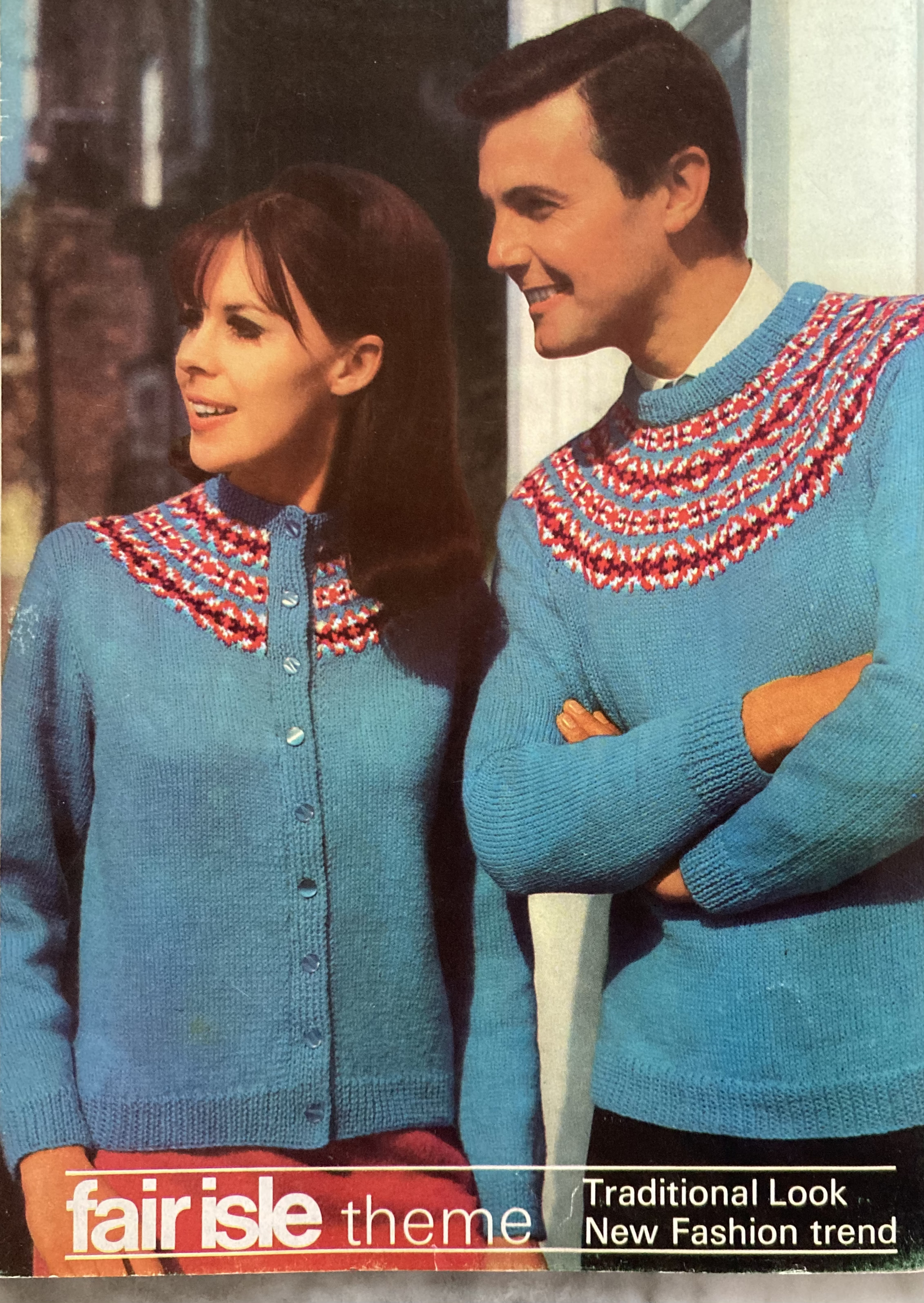
The January 1967 issue features a “fair isle theme” of stranded colourwork, starting with the sweater-suit on the cover. It’s made with Patons “Fiona” wool, a blend of Shetland wool and synthetic. Fiona was also one of the first Patons wools to be sold in 2-oz balls — a precursor to the metric transition in the early 1970s, after which yarn was sold in 50g balls. The sweater has typical Fair Isle border patterns, of which the flower pattern is repeated near the skirt hem. There’s a his- (pullover) and-hers (round-yoke cardigan) Fair Isle set as well, also in “Fiona” wool. The knitting techniques are not at all traditional Shetland-style, as all the garments are knitted flat, back-and-forth in pieces and sewn together. Even the round yoke is only picked up after the front(s), back and sleeves are made separately and worked flat for a few inches above the armholes.
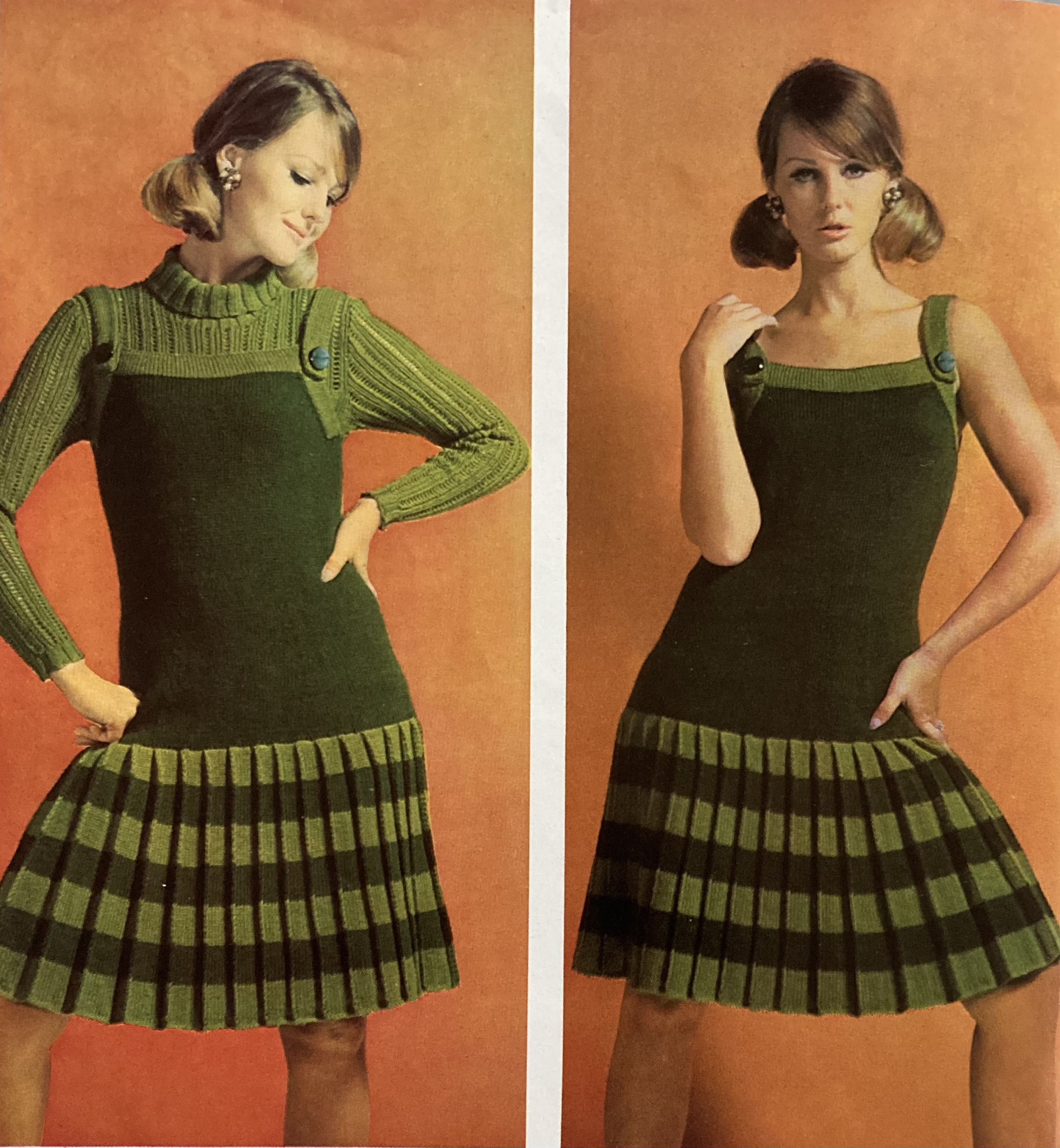
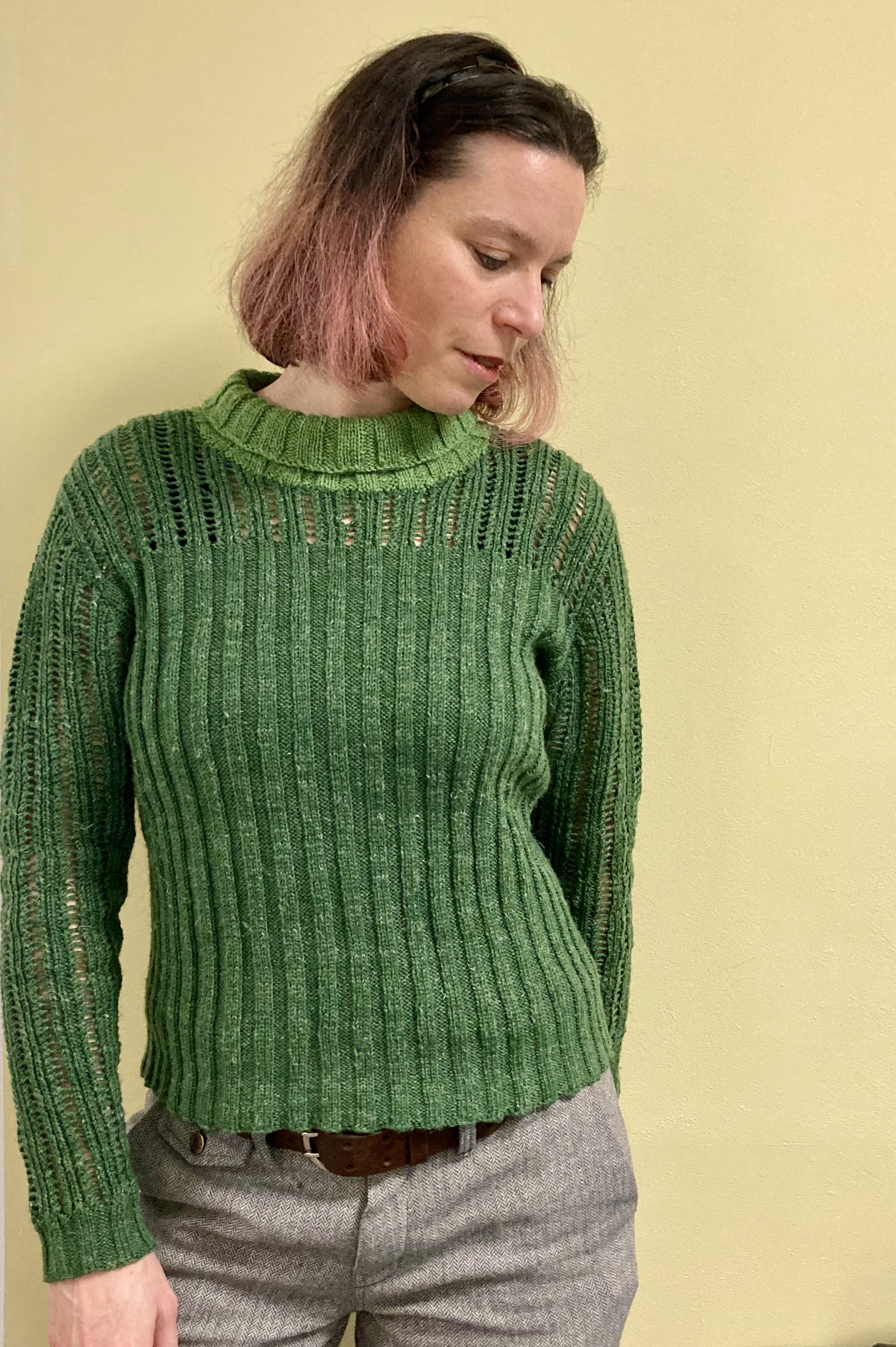
Non-stranded patterns include a swingy “pinafore” dress, to be worn with or without a tight-fitting ribbed pullover underneath. I tried to make this dress and it was a failure! The pleated skirt, in DK wool, was extremely heavy and stretched the stocking-stitch top part uncontrollably. I ended up frogging it. A few years later, I made the ribbed pullover and wrote about it in this post on the blog. That turned out fine at first, bit the wool was too lightweight and not 100% wool (part linen), so that even the rib pattern couldn’t save it from getting shorter and wider. How I love wool that keeps its shape! Sadly, it was not the case with either of these projects.
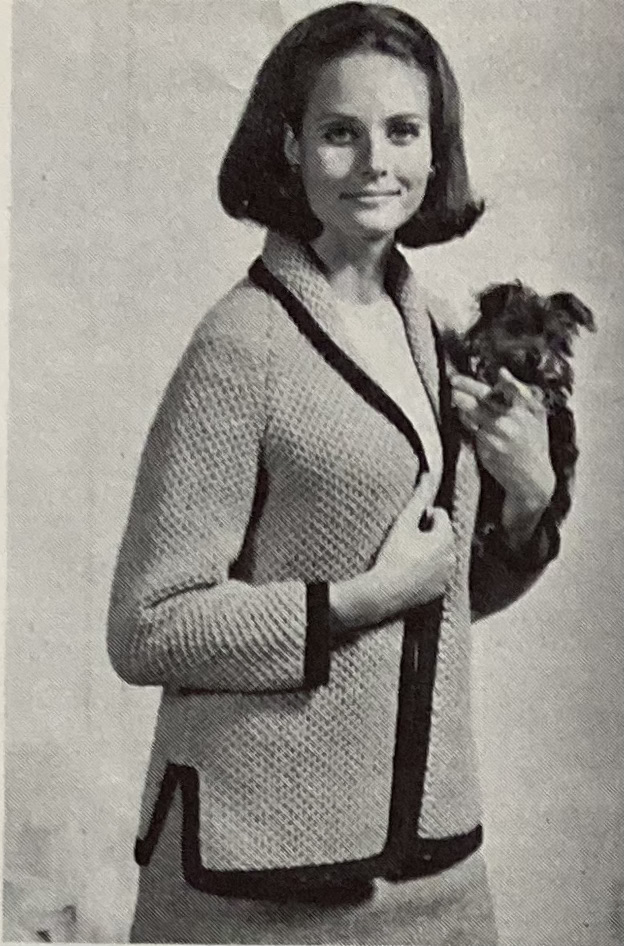
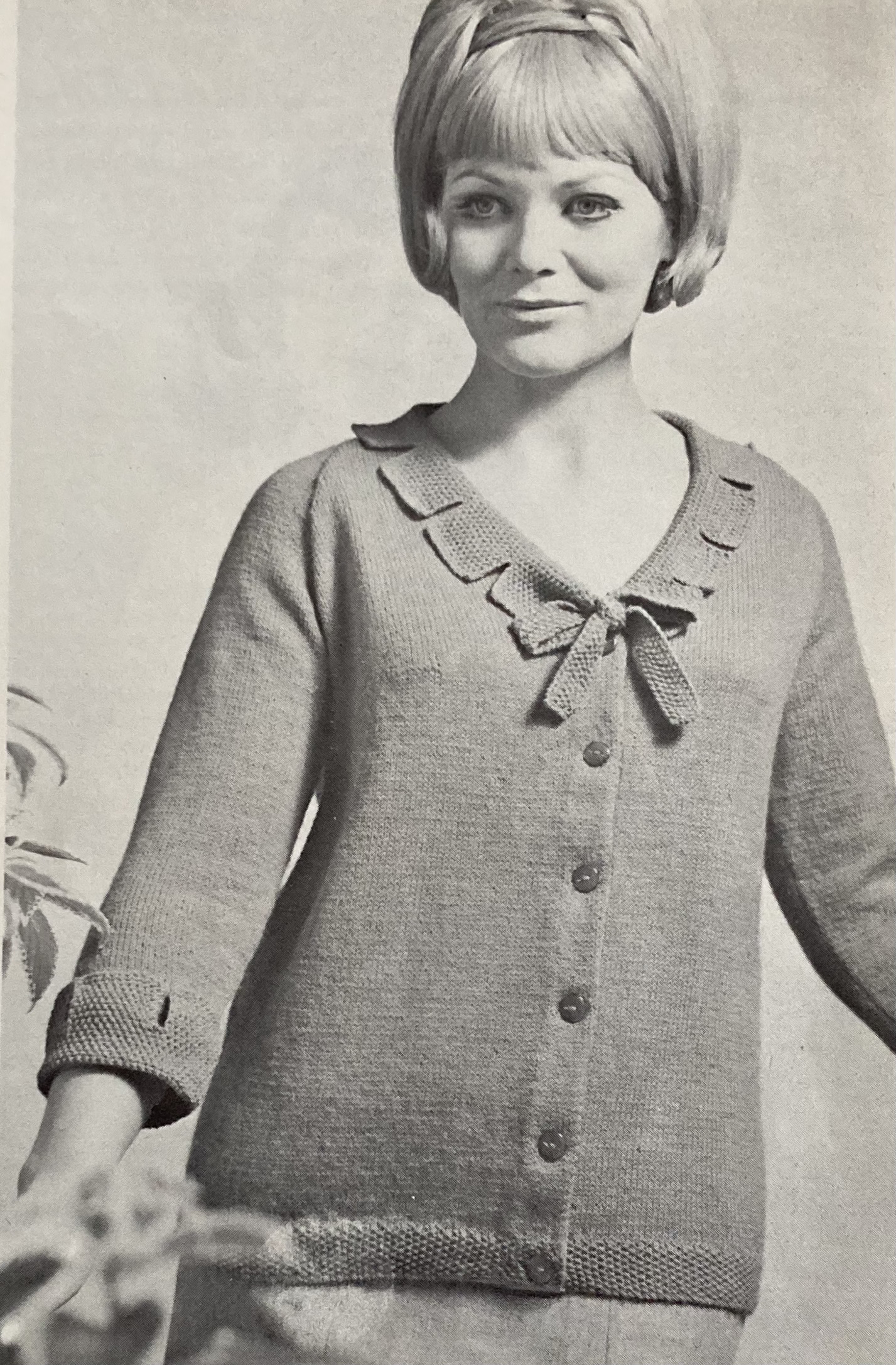
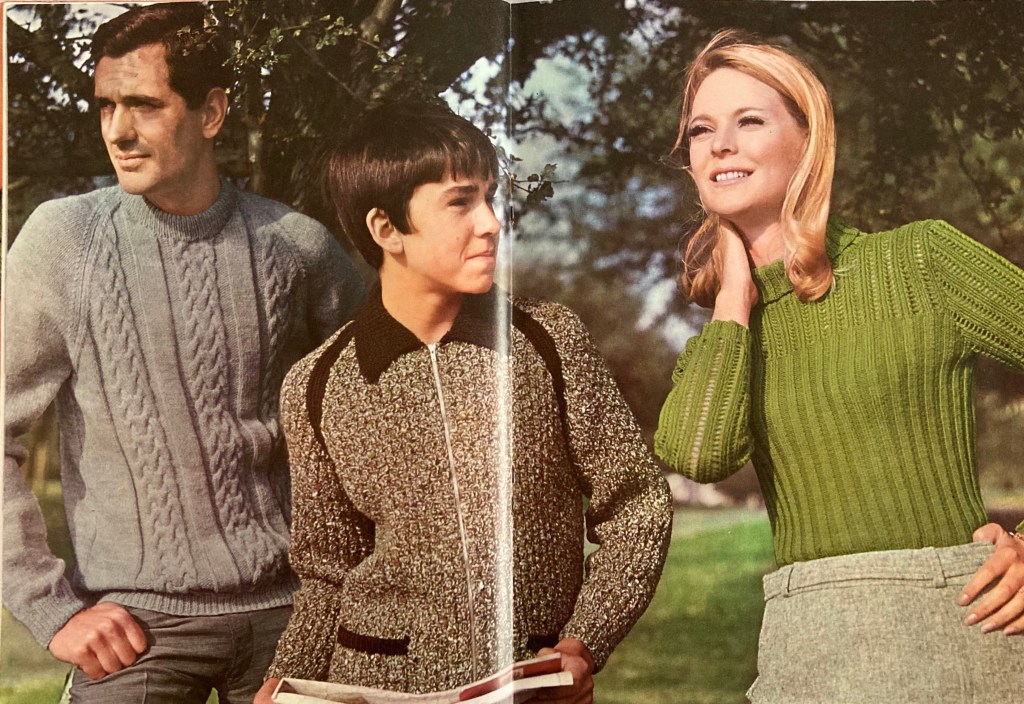
Other designs include a slip-stitch cardigan jacket which you are supposed to “slip on when the January winds make you chilly”, even though it doesn’t have buttons or any kind of fastening in the front, so I think the wind would get in pretty easily. For larger-sized ladies (up to 46-inch bust, which is pretty size-inclusive for 1967 standards), there’s a machine-knit jumper with a lace panel and a simple cardigan blouse with a pretty “petal” edging on the neckline. Men get a classic raglan crew-neck pullover with cables in Courtelle synthetic DK wool.
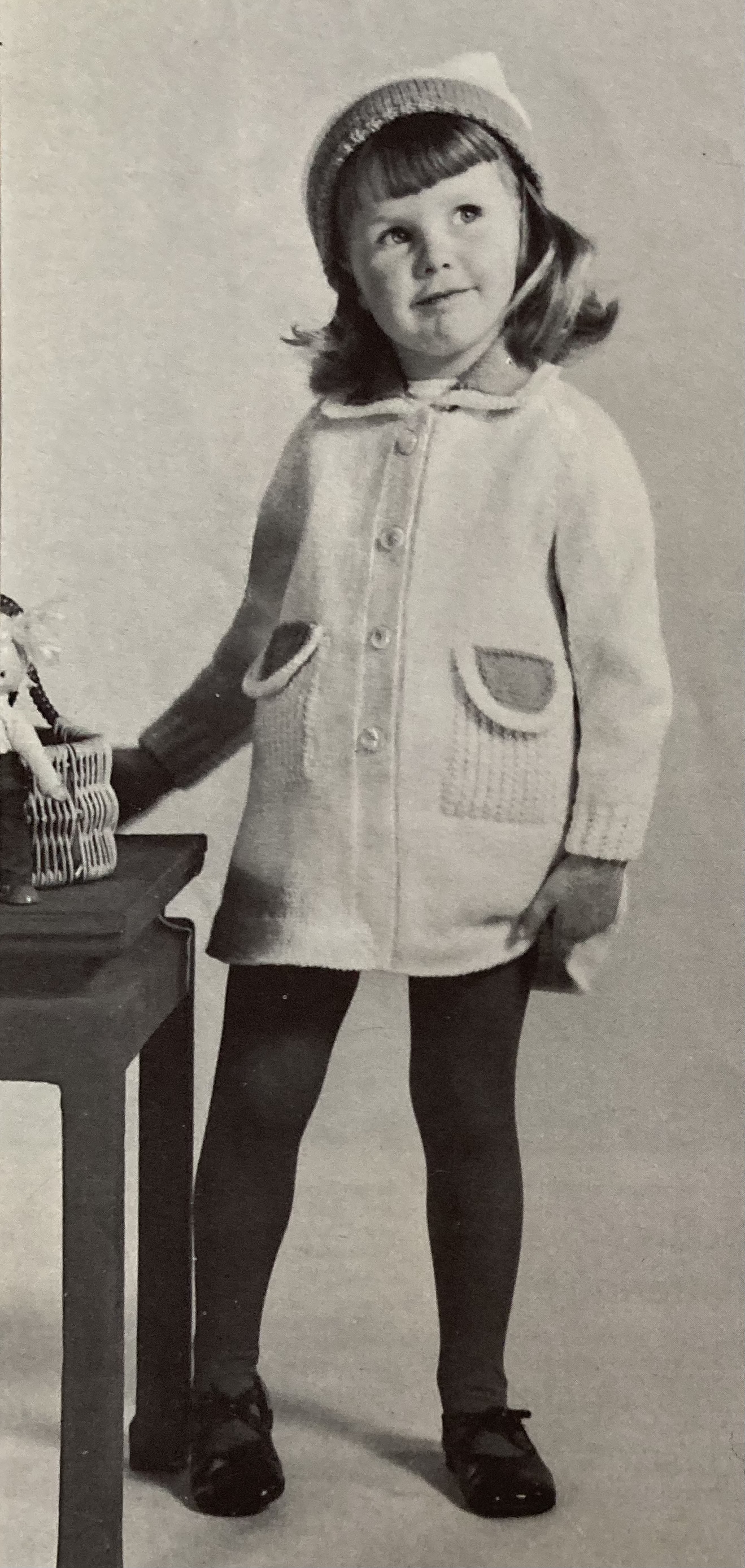
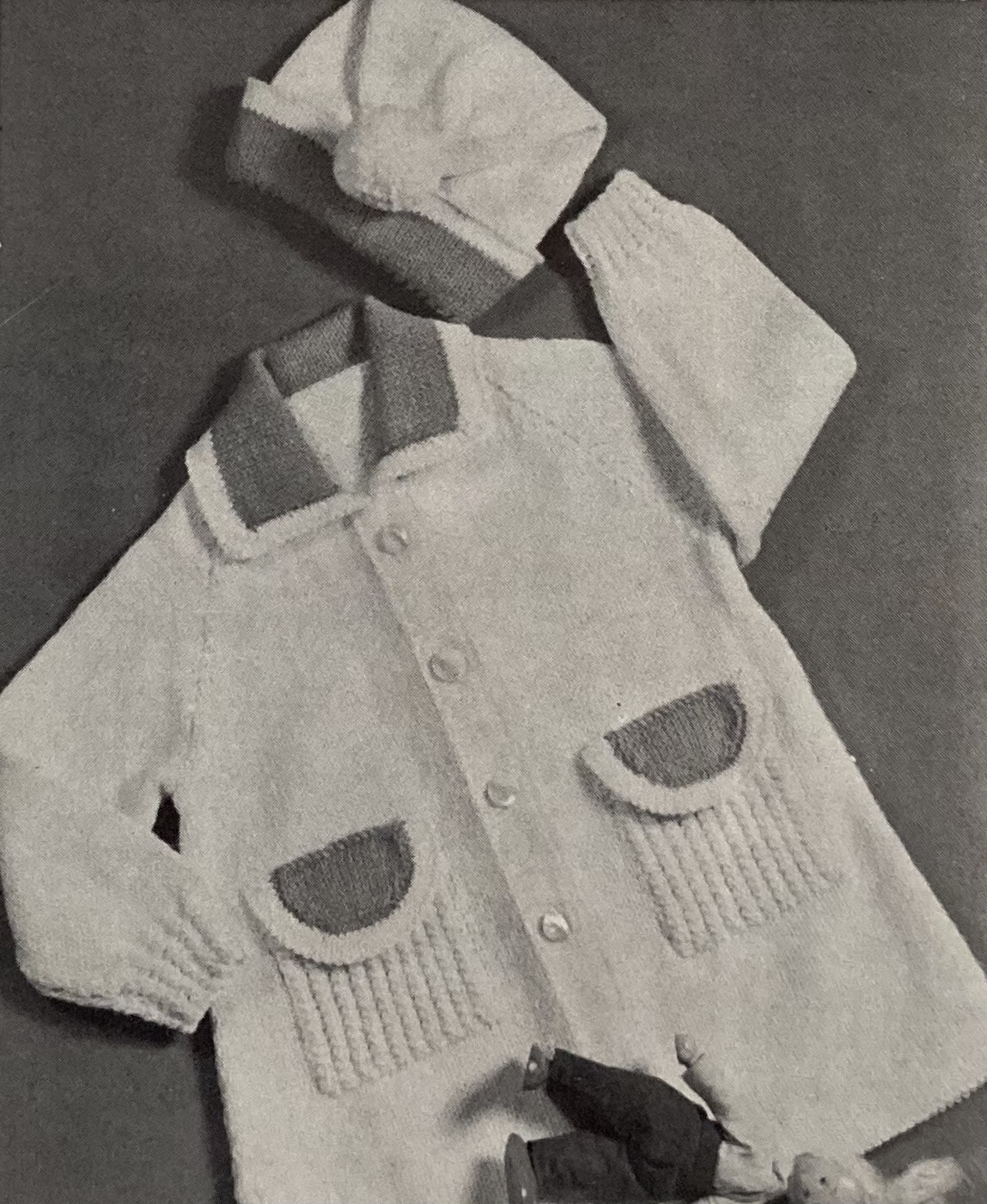
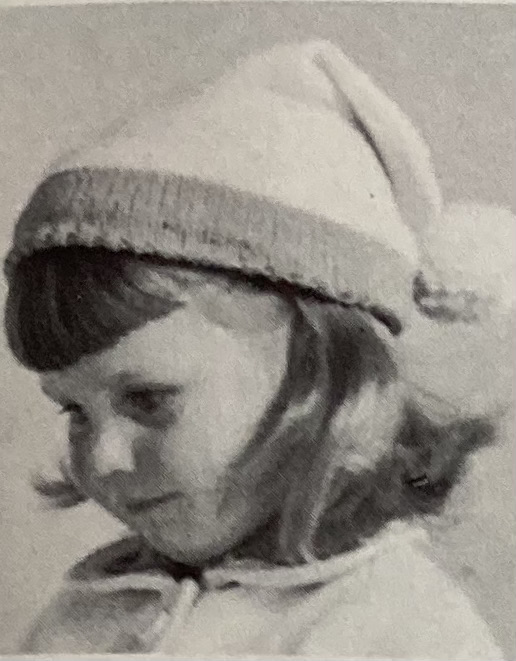
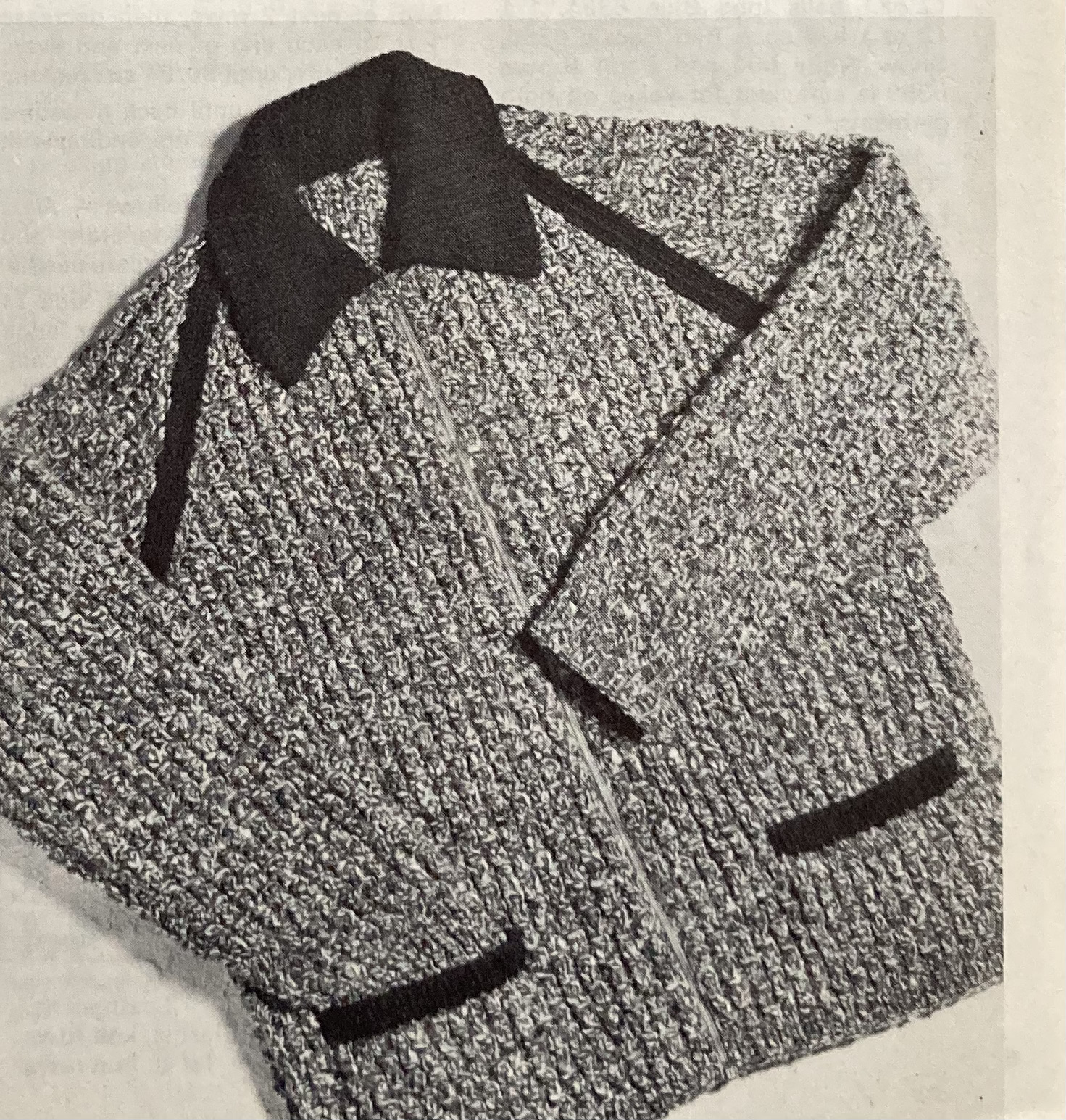
“Fashion for tots” gives us this wonderful tunic-coat and hat for 3- to 6-year-olds, which I also made and wrote about here on the blog. Older boys get a cardigan as well, in tough “Bracken” wool with a practical zip and contrasting collar and details.
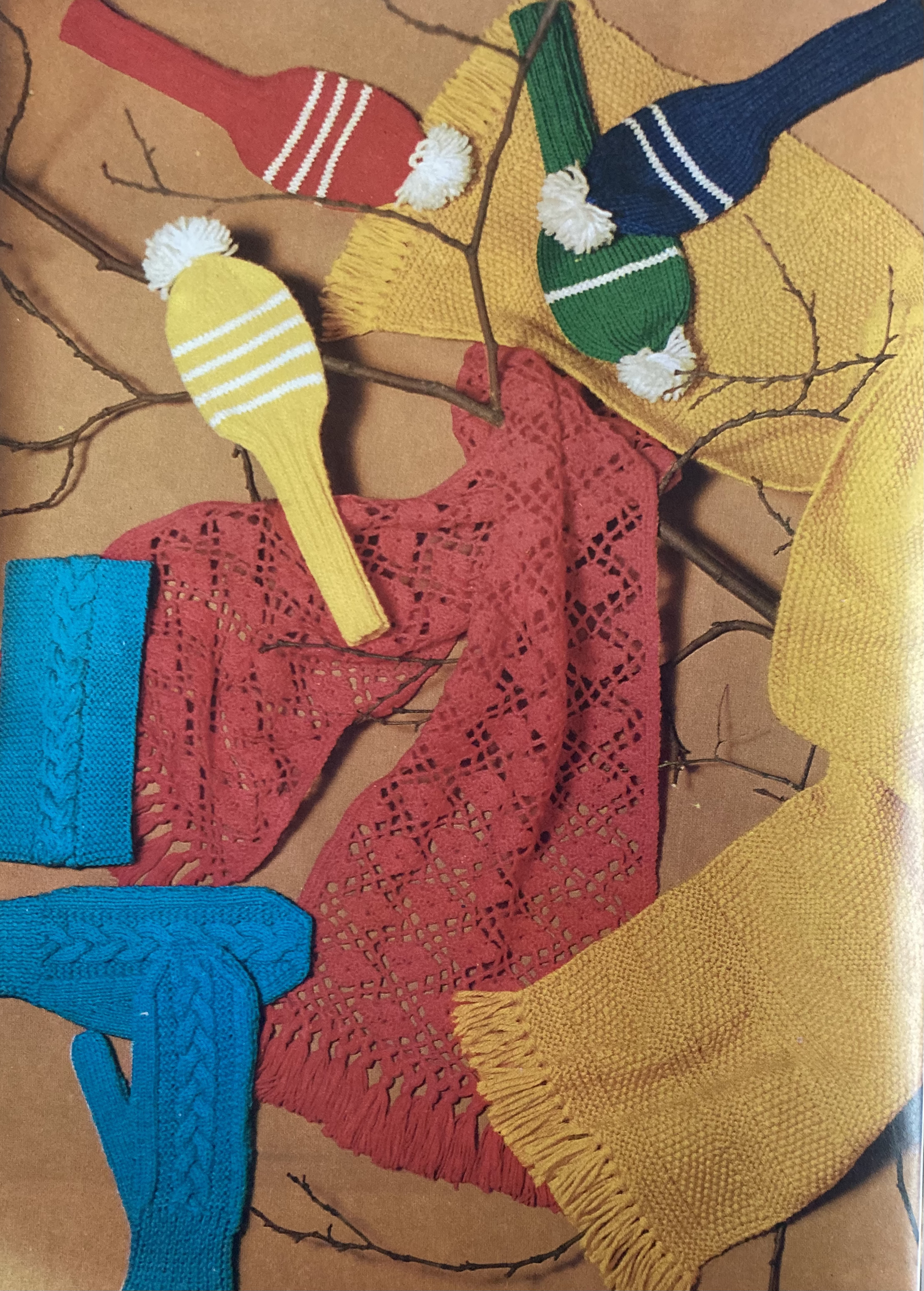
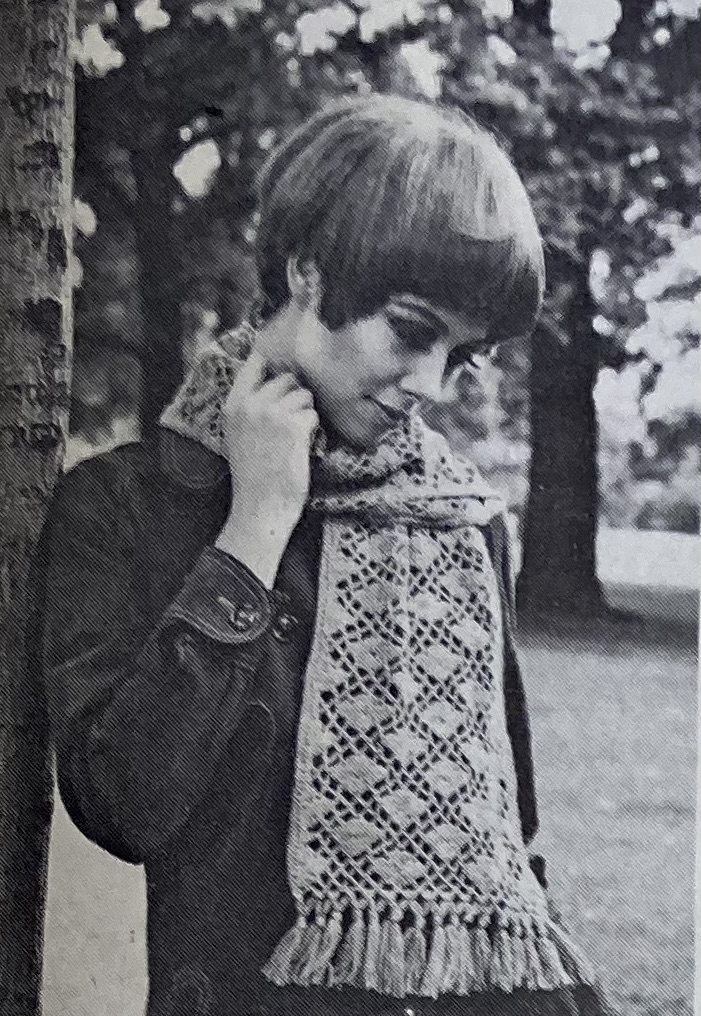
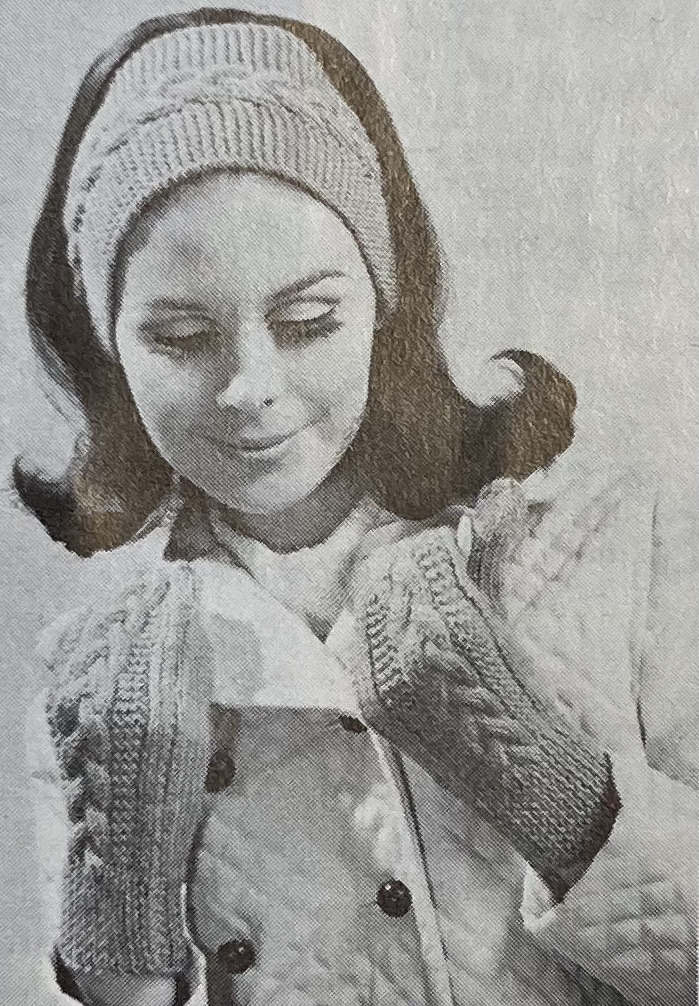
There’s a whole page of lovely winter accessories: a lacy, fringed crocheted scarf, a classic moss-stitch scarf, and a set of headband and mittens with a cable-and-moss pattern. Plus golf club covers! I guess you could consider them to be hats, in their way. If any golfers read this blog, please tell me why golf clubs need covers? Is it so they don’t get scratched? (I would think they would get more scratched up from hitting a golf ball all the time than by being stored somewhere, but I have never played golf and wouldn’t know.)
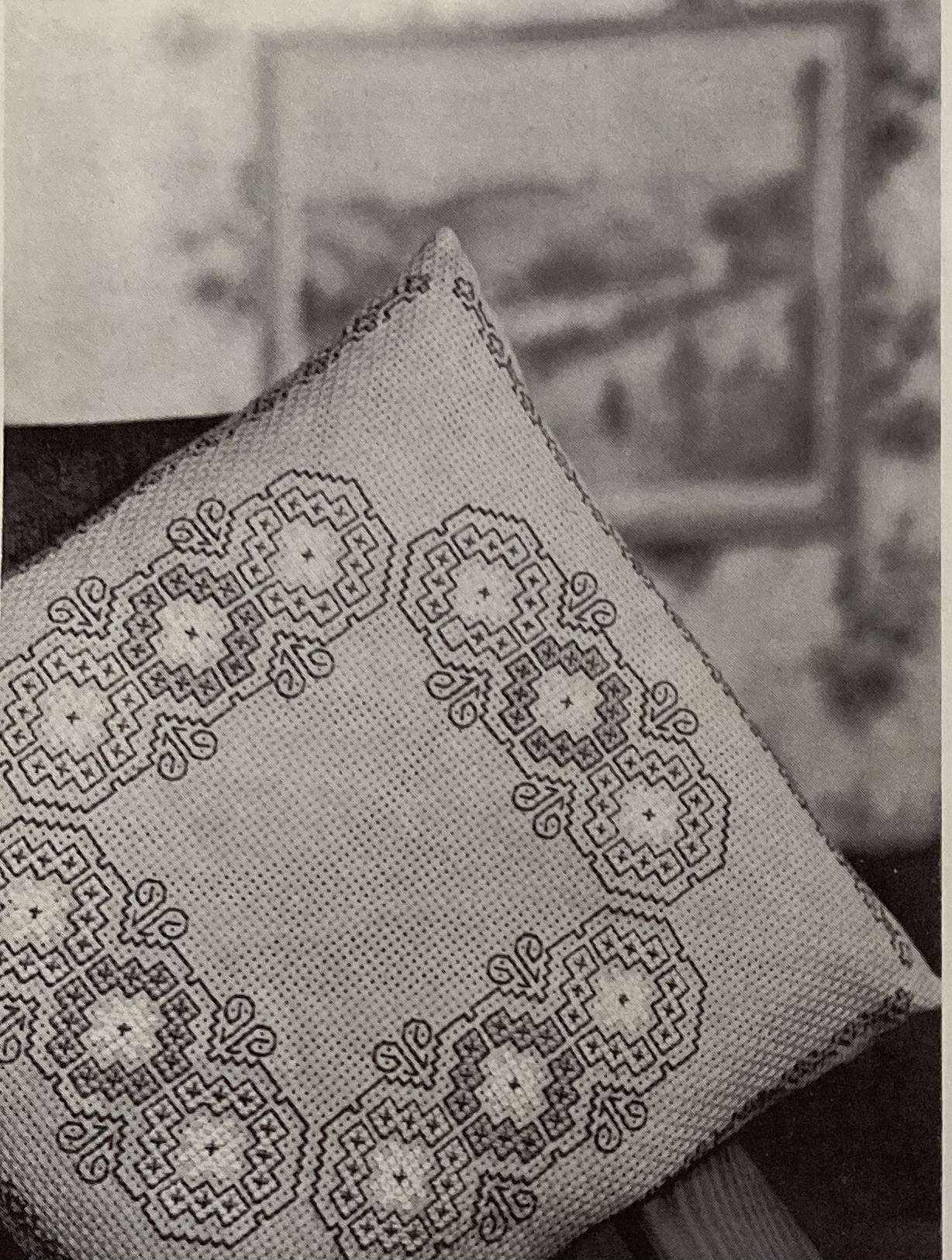
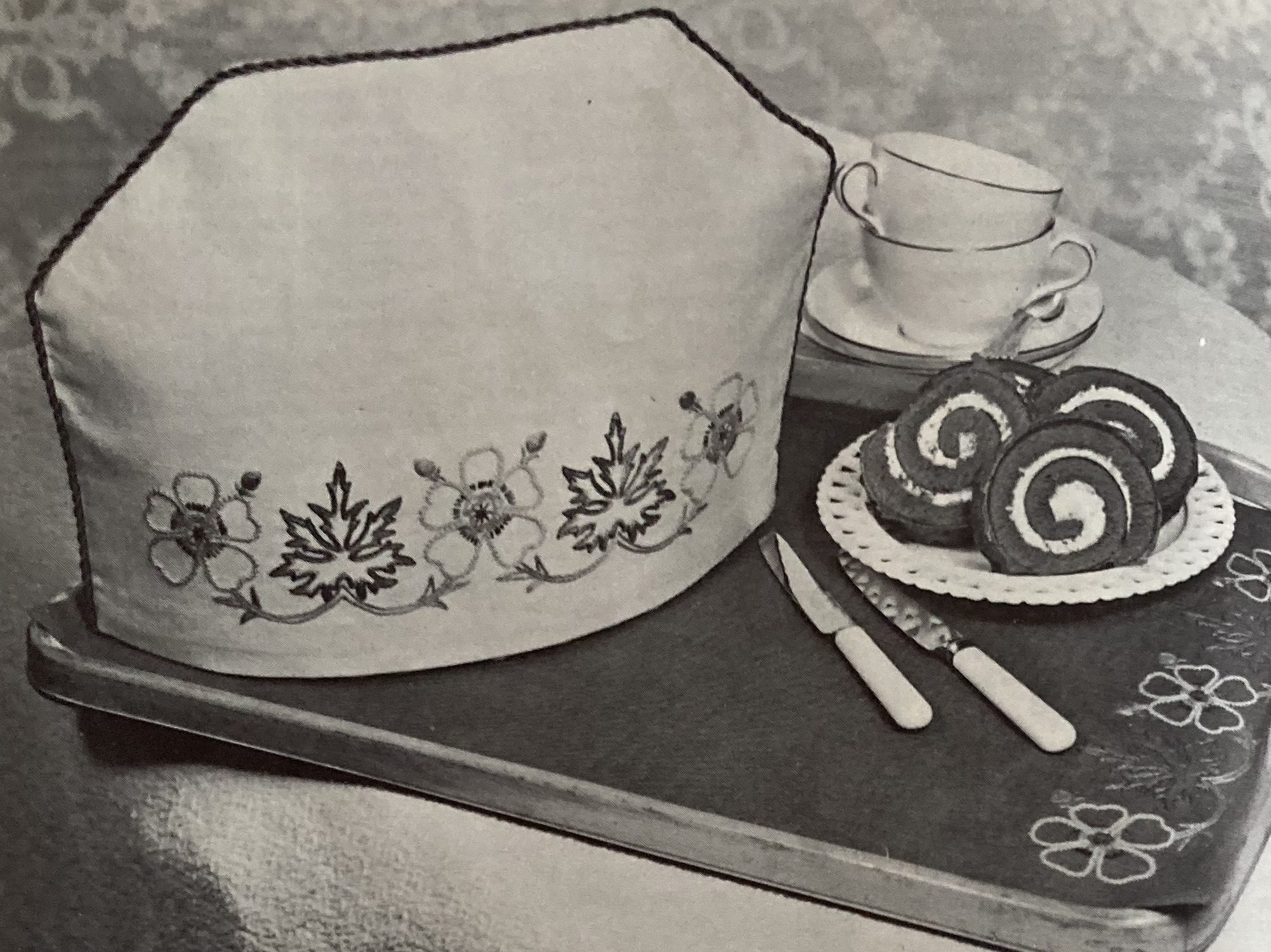
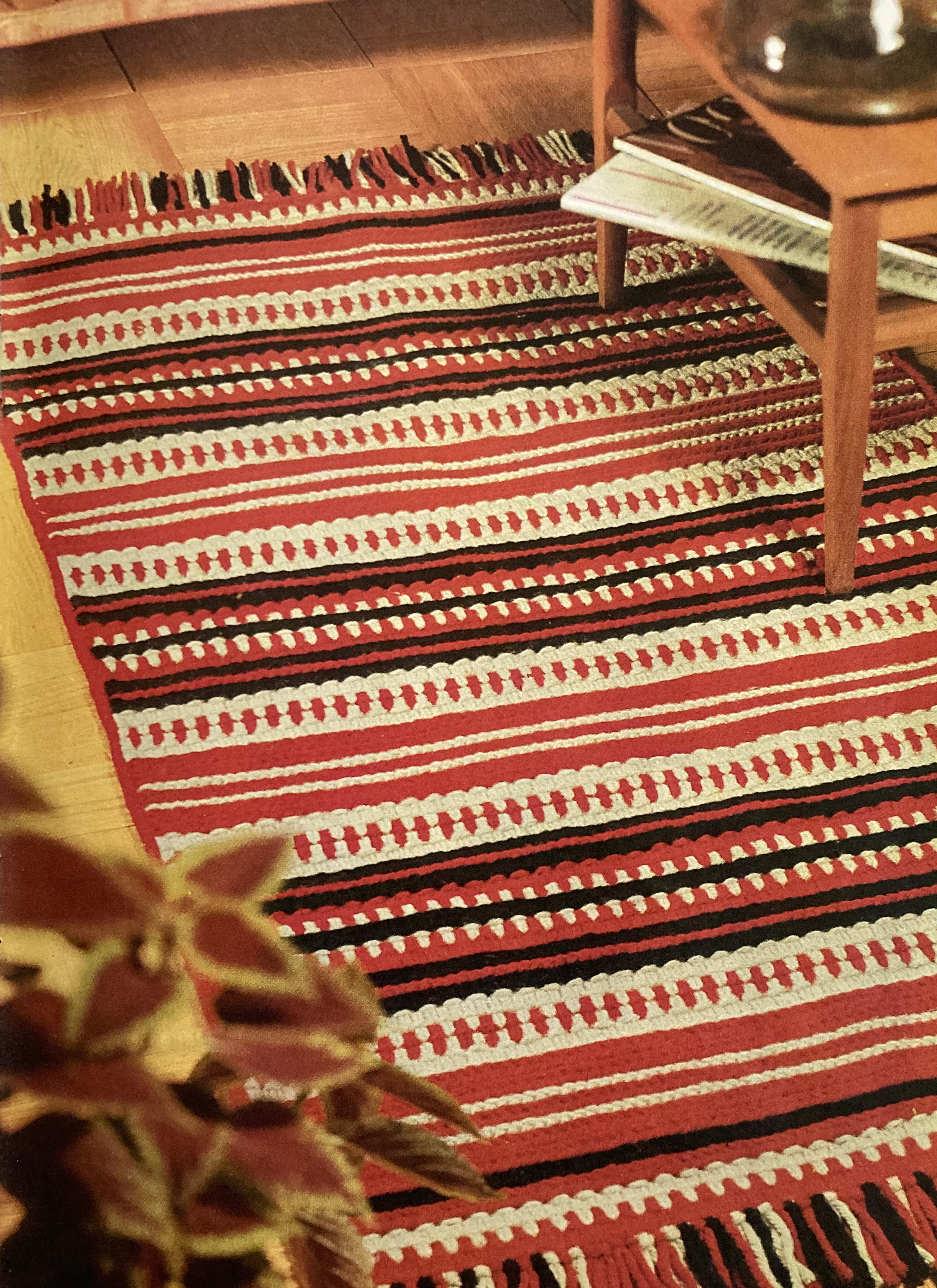
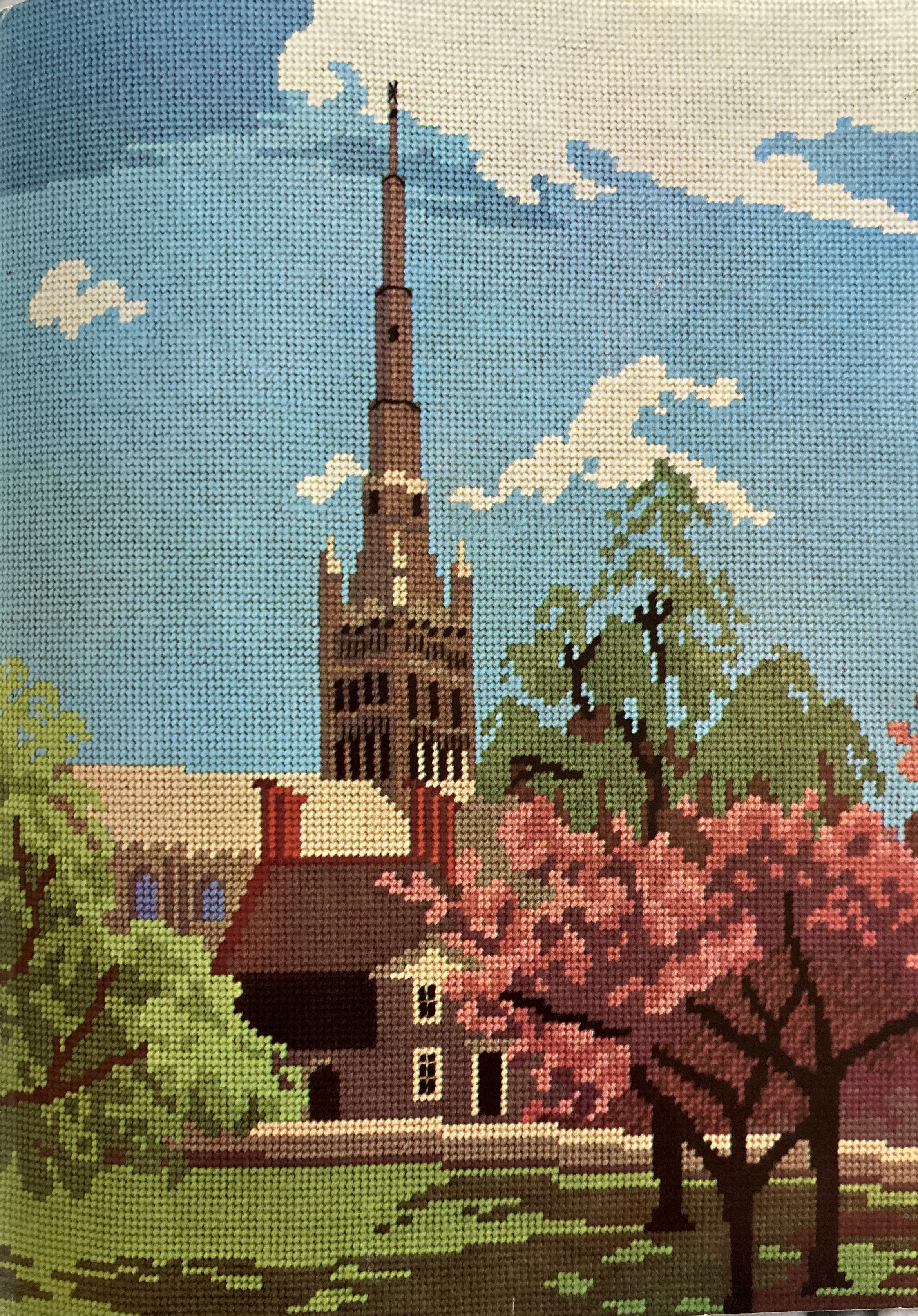
Homewares are unspectacular in this issue: place-mats or a cushion with easy cross-stitch on Binca cloth, or flowers embroidered on a tea cosy or tray-cloth. There’s a stitched rug in bright wintry colours, or a fireplace screen with the church of Norwich worked in wool tapestry.
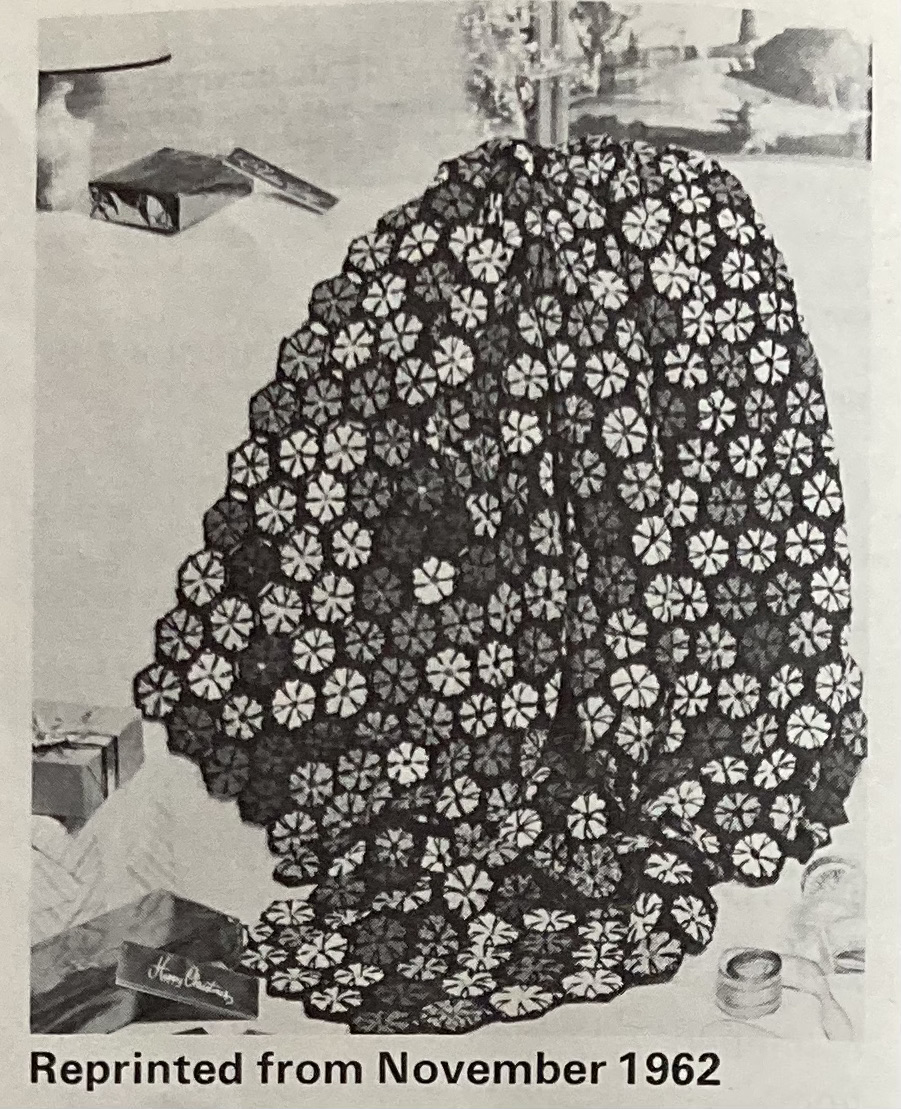
The Readers Pages give us a reprint of a crocheted afghan from the November 1962 issue, tips for knitting in stranded technique, and the continuing adventures of the untidy piglet, Higgledy Piggledy. In this instalment, he has run away from his tutors, Miss Prim and Miss Proper, to find refuge in a house with a girl named Topsy Turvy who turns everything that is upside-down, right-side-up, and everything that is right-side-up, upside-down. I am reminded of a colleague who claims to turn straight people gay, and gay people straight. Anyway, that’s it for this issue!
There are so many good projects in this issue that I’m glad I’ve made a few of them already. My project for this time will be the turquoise Fair Isle cardigan, but it might have to wait a while because I want to make it in Jamieson’s DK wool, which I have to order through a wool shop in the next city over from me, and that will take a while to happen before I can even start knitting. In the meantime, I’ll either skip ahead to the February 1967 issue, which also has some great larger projects, or make one of the smaller accessories (not the golf club covers). Stay tuned!
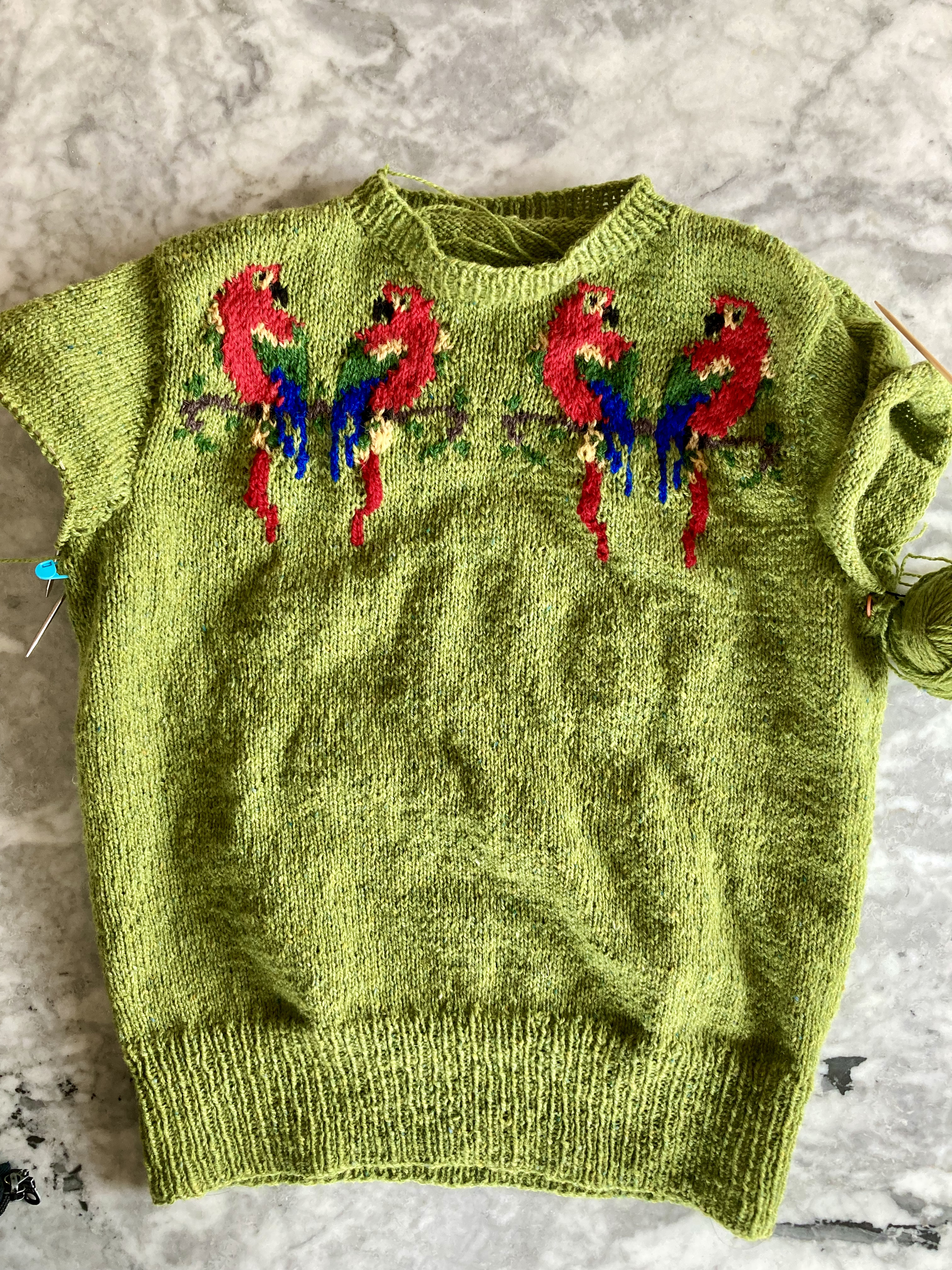
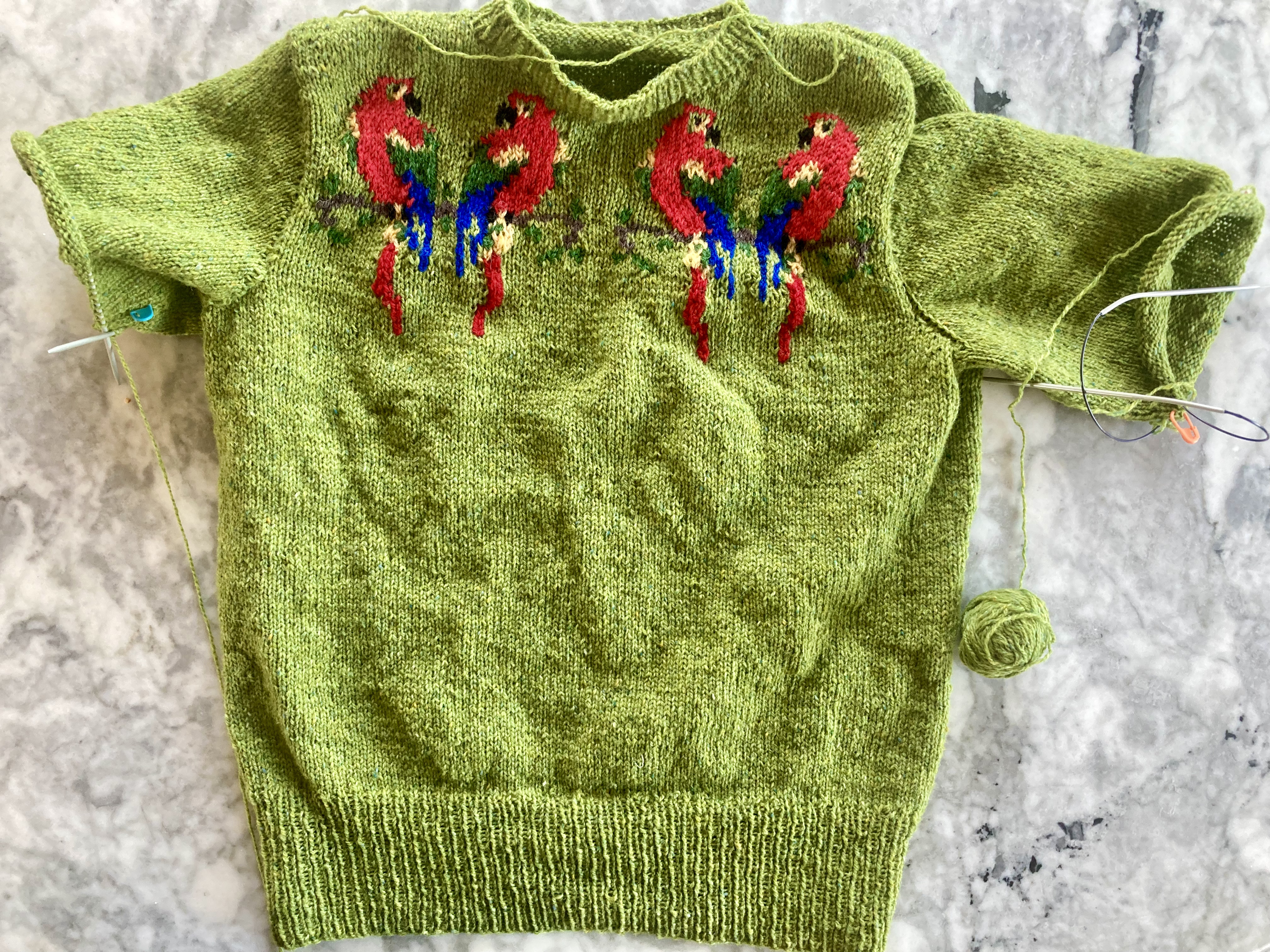
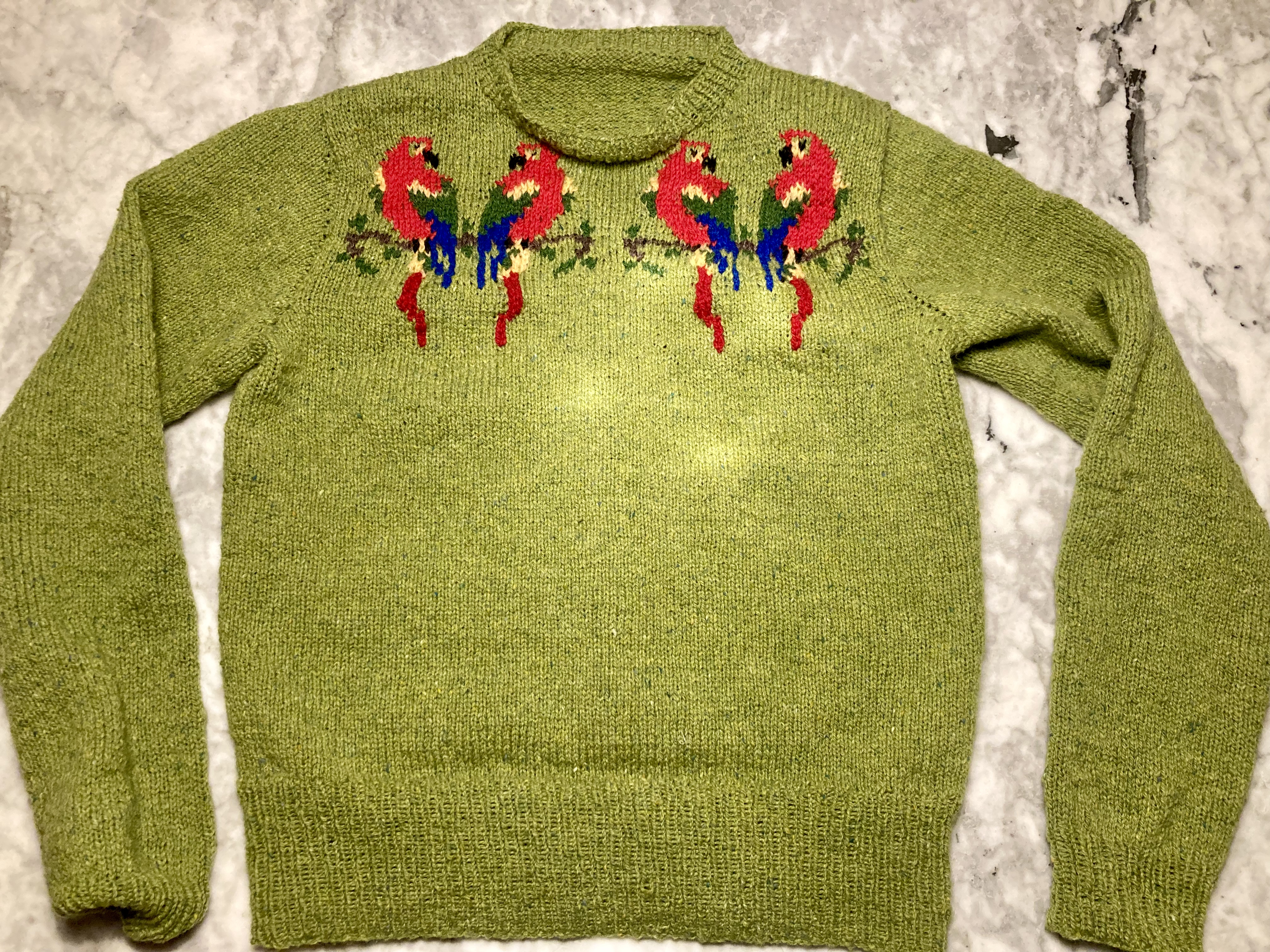
The November 1966 issue of Stitchcraft was perfectly nice, but the projects in it that interested me were either too much of an undertaking (i.e. an entire suit) or something I would like to knit later when I have more time to plan it out (the top-down round-yoke cardigan). I decided instead to make a project whose pattern and wool had been sitting around for a long time waiting for me to use them: the Bestway A2063 “Love Bird” jumper.
The booklet isn’t dated, but presumably from the 1940s. I got the pattern as a PDF from the wonderful Subversive Femme website. A few years ago during the horrible wildfires in Australia, Bex, who runs the site, offered a free pattern to anyone who donated to the fire relief fund. I did, and was very kindly given this pattern as a thank-you. The wool is “Darnie” by Studio Donegal, a fingering-weight lambswool in the perfect shade of green, which I bought in Galway while on a work trip to Ireland.
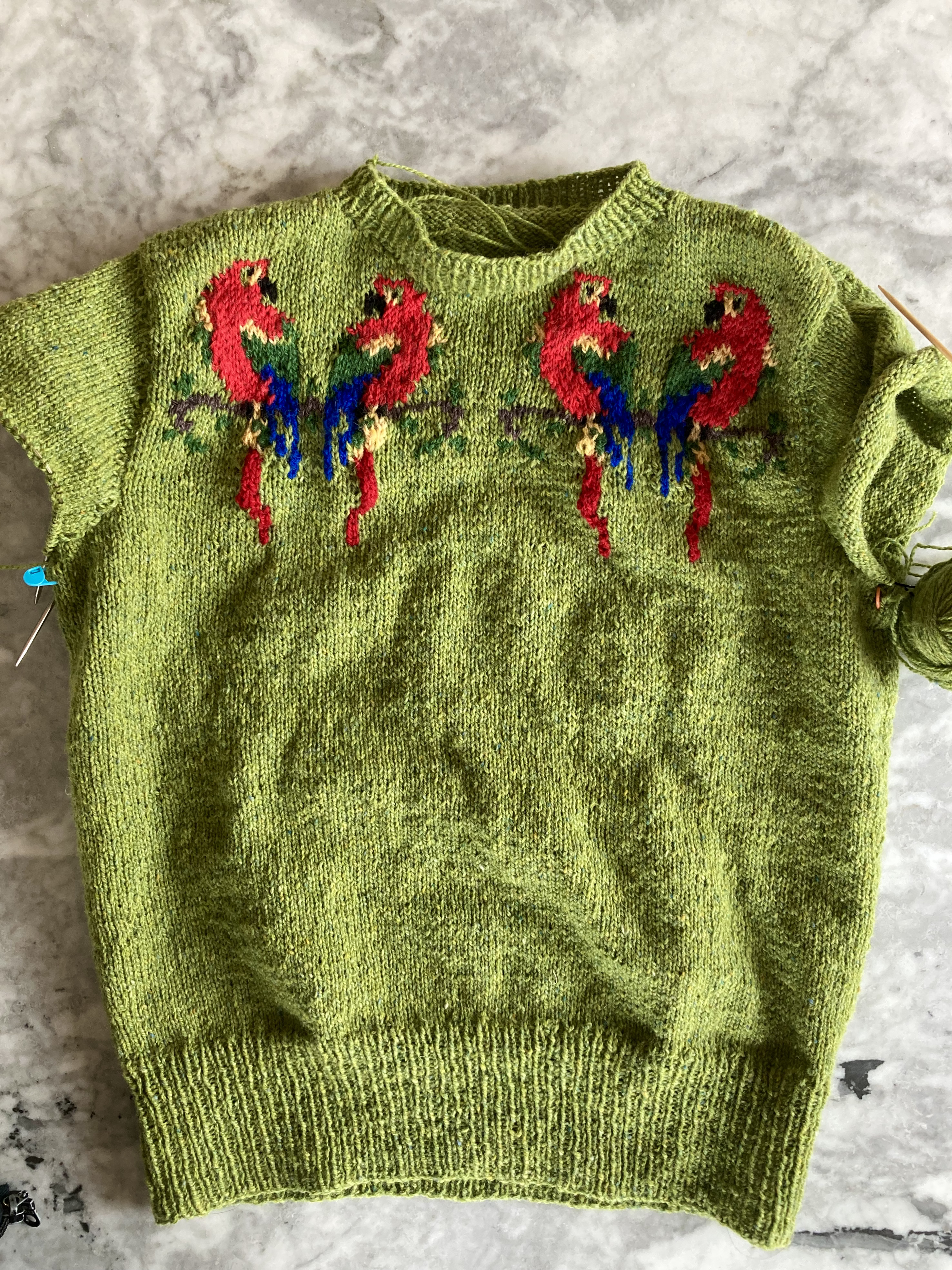
The original pattern has a tension of 8 sts/inch, which I don’t get even with the finest of wools and smallest of needles, but I am also larger than the 34 inch/stretch to fit 36 inch bust finished size. I have had good results in the past with making 8 sts/inch, 34-inch jumpers at 7 sts to the inch with the original stitch counts and just adding an inch or two to the waist-to-armhole length, but that didn’t work here. I love the wool — it’s quite soft and not at all scratchy, and the little bits of tweed catch the light beautifully — but it was impossible to calculate the tension even with a good-sized, blocked swatch. The wool is so lightweight that it stretches more in width the longer it gets in length, so the tension is variable even when knitted closely and evenly. So at some point around rib height, I had to rip back quite a lot and adjust the waist-to-armhole increases. I tried to keep it close to the original proportions, but make it fit me. That worked out pretty well, though I hoped it wouldn’t shrink or stretch too much in blocking.
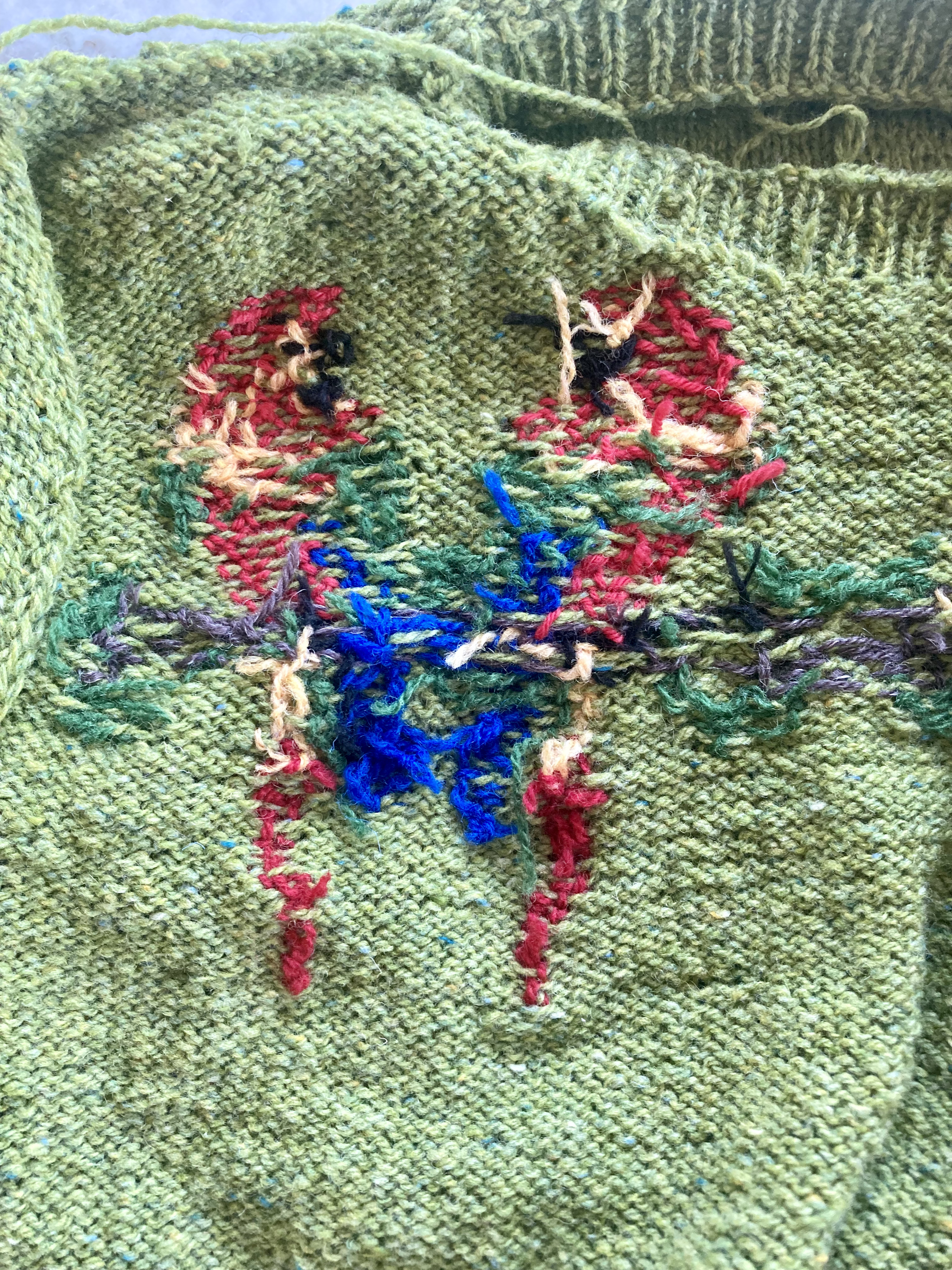
The birds are worked in stranded intarsia, i.e. you use different short lengths of the colours for the four birds, and strand the light green main colour behind. I am very good at stranded work and not bad with intarsia, but I found the combination of the two very tricky! The yarns bulk up at the back and/or leave holes (in spite of twisting together and weaving in) and it is hard to gauge whether the strands are too tight or too loose. There are a hundred ends to weave in and they are all in roughly the same spot, so the back side is very “full” and doesn’t lie down flat easily. Presumably, it should block out?? Also, I should have used a larger needle for the bird section — too late!
Not to mention that the bird tails start BEFORE the armhole decreases, and since I didn’t read ahead (I know…), I had already finished the body to the armholes in the round and the entire back part above the armholes before I realised it. Yes, I should probably read ahead and also think ahead! Yes, I am also too lazy to rip everything back, especially since I had to re-do the upper back once already to get the sizing right. Oh yeah, and I also forgot, twice, to make an opening in the back neck to accommodate the close, high neck, AND since I started the birds at the armhole instead of below, the neck was even higher and tighter than it should have been. Sigh.
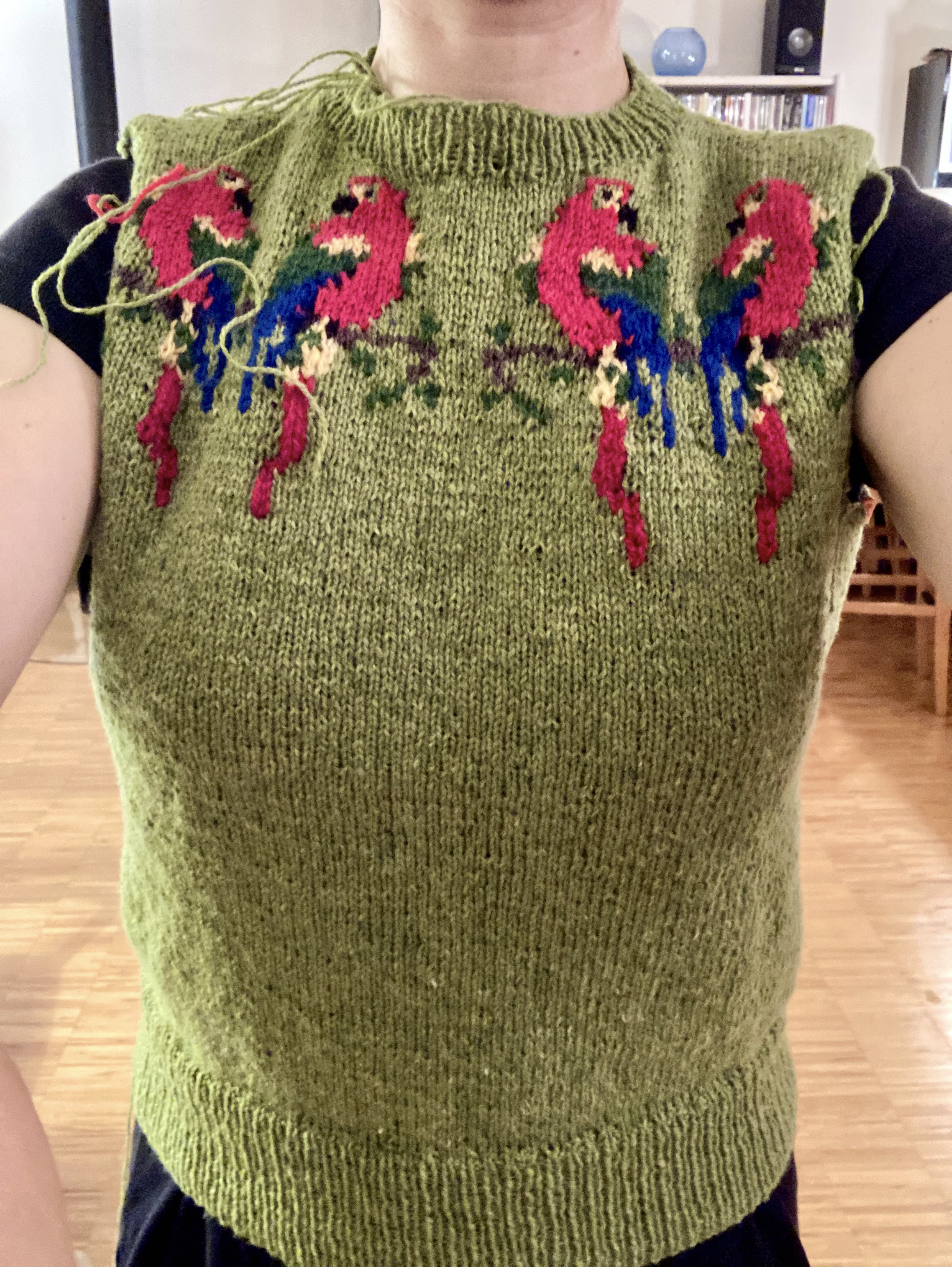
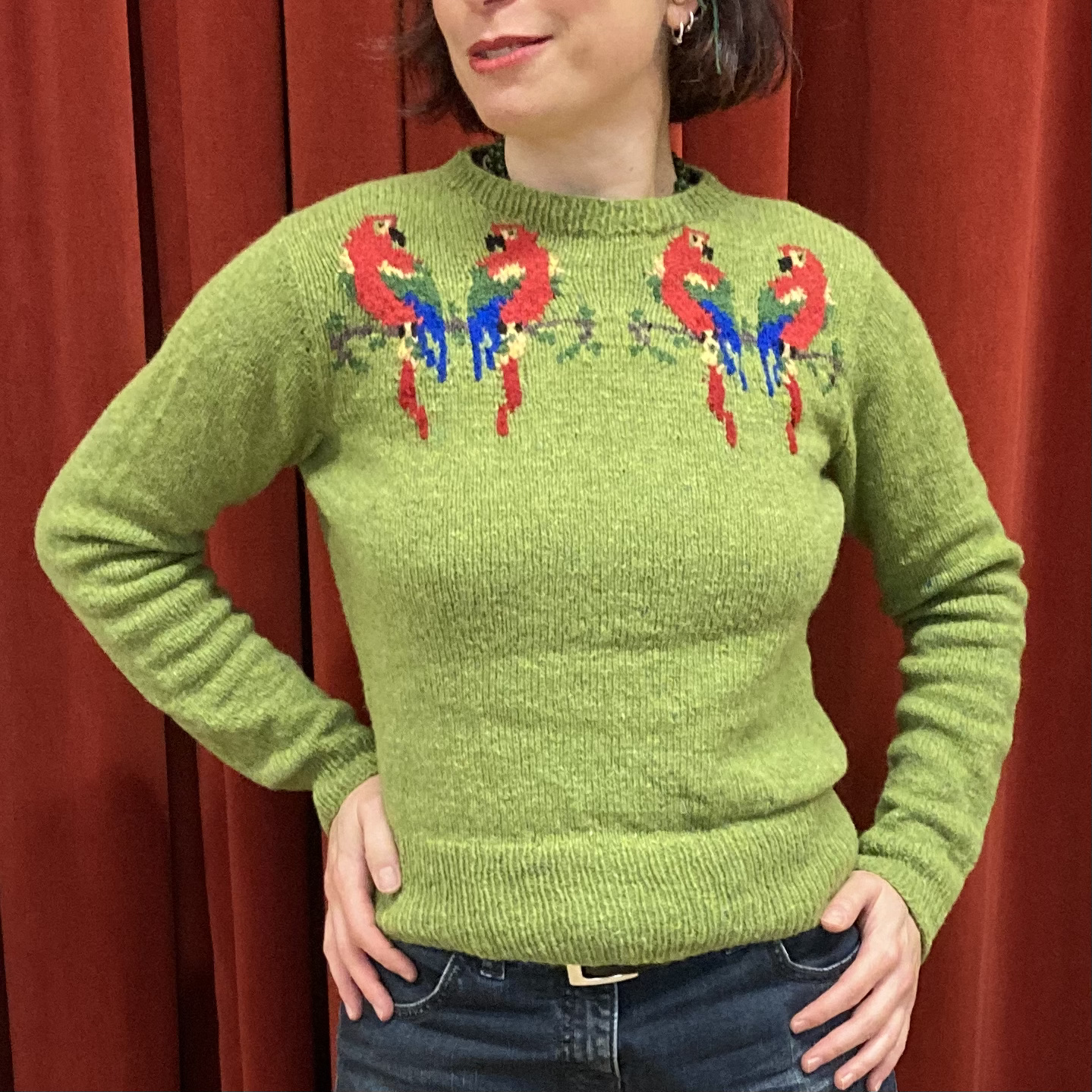
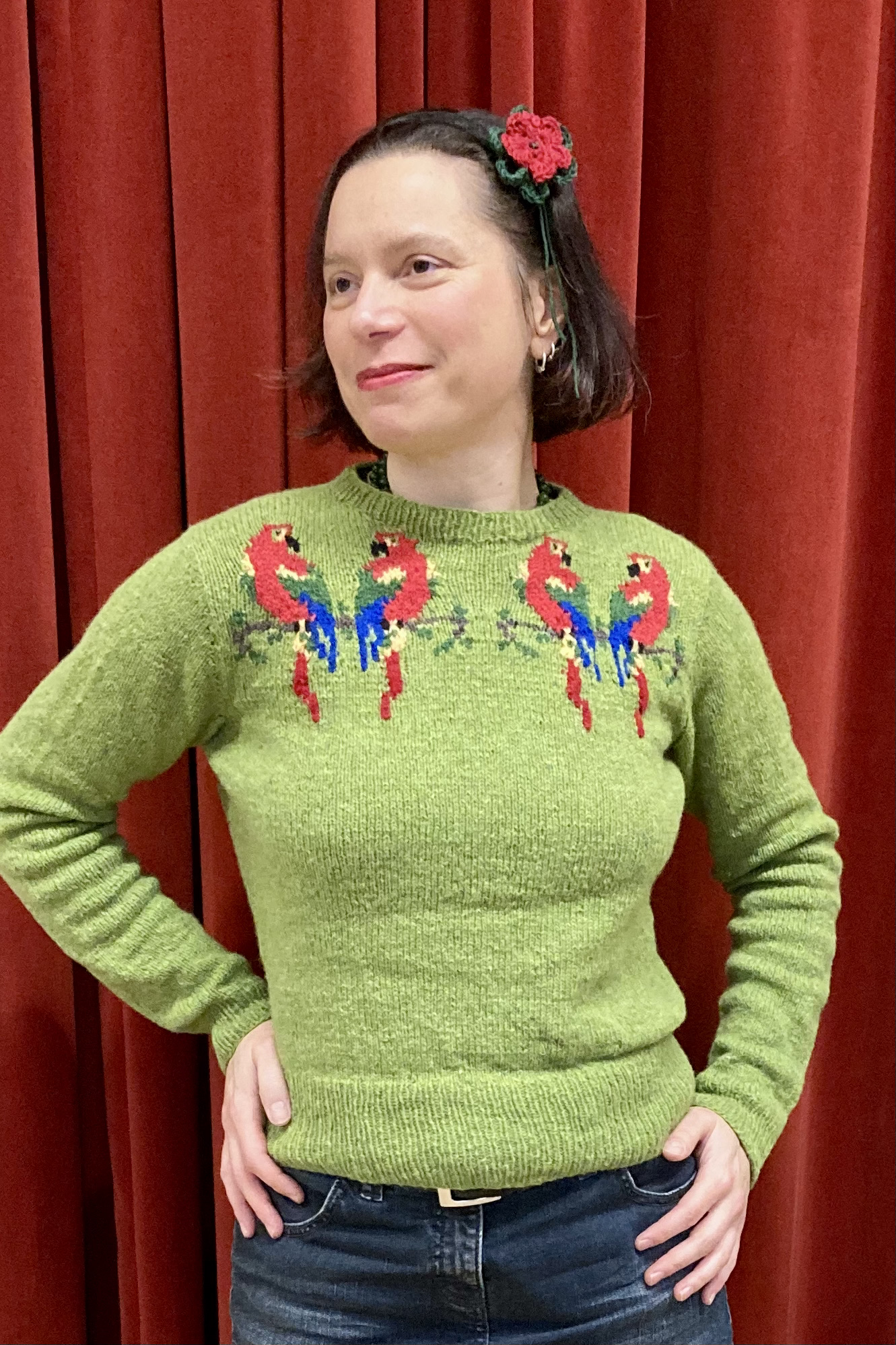
In spite of all of that, it looked good (even before blocking) and fit great (ditto). It does fit over my head and I don’t think it’s a problem that the birds sit a little higher than they should. I made the sleeves from the top down, picking up stitches around the armhole, and only had to restart them twice to get the decreases right.
It was so worth it, though! It blocked to exactly the knitted proportions without shrinking or stretching, and the birds flattened out well enough. (The tails, which I made in a different, slightly thicker red wool than the bird bodies, are still bulkier than the background. I will call it a “3-D effect” design feature.)
I am very happy with this jumper and it has gotten a lot of compliments already. Didn’t get the pose quite right for the photo re-creation — head tilted the wrong way! — but I thought the red curtain made a nice background.
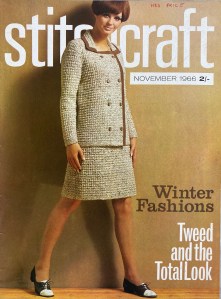
Tweed, Crepe and the Total Look! The November 1966 issue of Stitchcraft brings together contrasting styles of nubbly tweed and smooth crepe wool as well as an entirely coordinated knitted outfit including hand-knitted stockings.
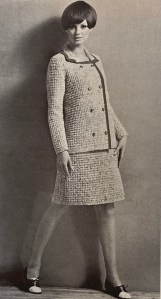
The cover design is not quite “total” (no stockings or accessories) but combines tweed “Bracken” wool with smooth “Cameo Crepe” for the edgings to make that boxy, double-breasted suit that everybody copied from Chanel. The pattern is very easy: k one row, single rib one row, purl one row, single rib one row. I imagine it gives a nice firm fabric that won’t sag too terribly in the skirt.
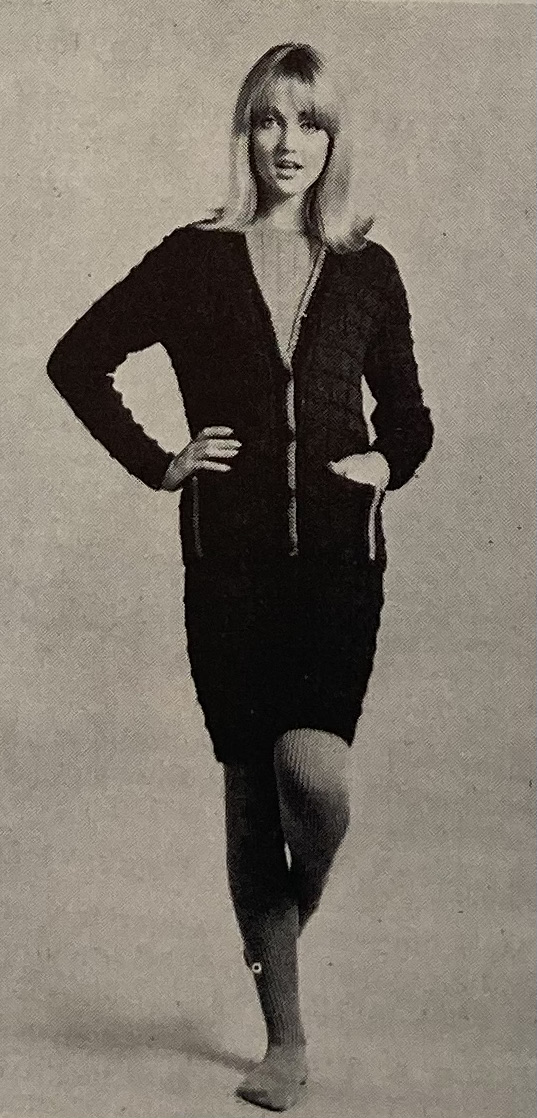
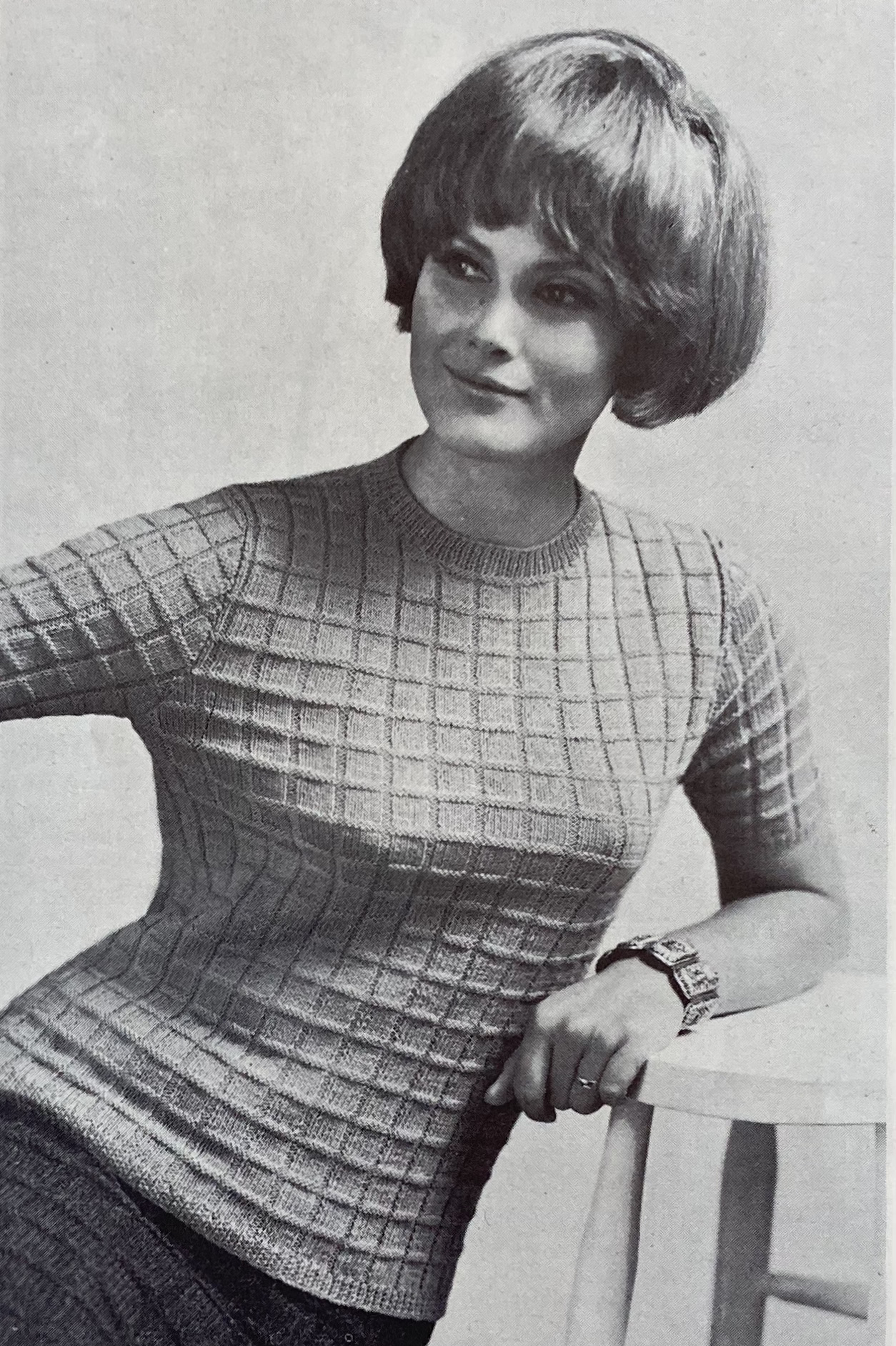
The “Total Look” is best exemplified by the other suit design: a square-patterned cardigan suit with jumper and stockings to match, in two shades of Double Knitting for the suit as well as lightweight Cameo Crepe for the jumper and stretchy, hard-wearing Nylox for the stockings.
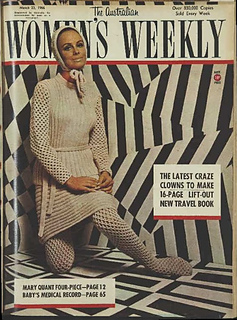
The idea of complete coordination came into handknit fashion around this time and continued into the early 1970s. Mary Quant, for example, designed a four-piece outfit (jumper, skirt, stockings and “bonnet” cap) for the Australian Women’s Weekly in March 1966, using Patons Courtelle wool. There was originally an entire supplement in this month’s issue of Stitchcraft with more “Total Look” fashions in the same 101 Courtelle, but sadly, it was no longer there when I acquired it. If anyone happens to have this supplement, please let me know and/or post about it here! I would love to know what was in it.
The other fashions for adult men and women feature textured stitches in heavier wools for winter and a round-yoke cardigan knit from the top down in one piece. Although quite common today, that was still a very unusual construction method in the 1960s and was captioned as an “interesting design for the knitter who likes something different.” The men’s cardigan has a “Continental Pattern” made quite easily by combining knit, purl and knit-through-the-back stitches, and the women’s pullover has a unique cable-and-bobble pattern that makes a pretty shell design.
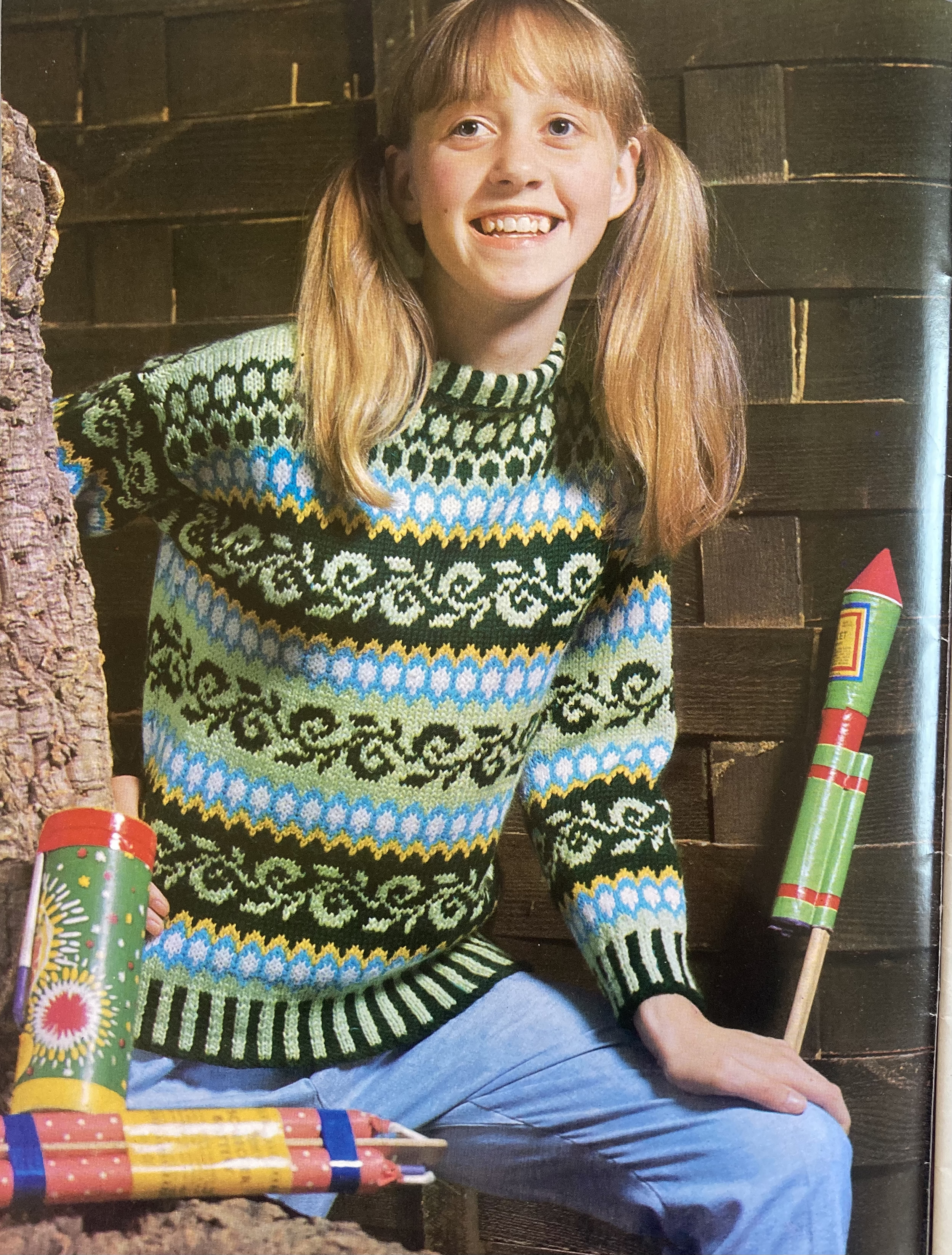
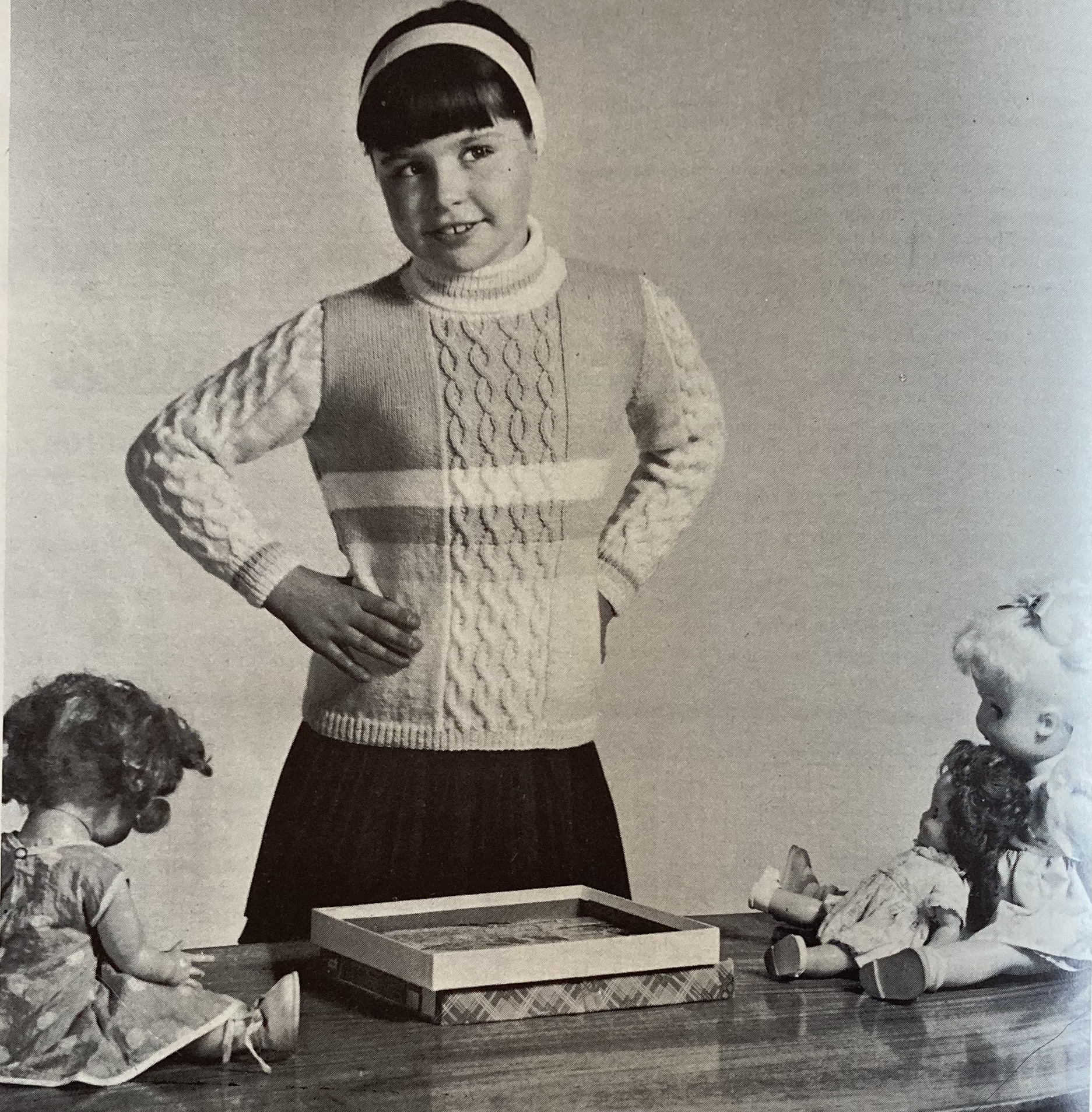
The “Junior Fashions” for girls consist of a bright, fun “Viennese Sports Sweater” in a bold Fair Isle pattern and a cabled and colour-blocked pullover in soft tones of white, blue and rose. The older girl has her fireworks ready, perhaps for Guy Fawkes Night on November 5th, while the younger one is content to play with her dolls.
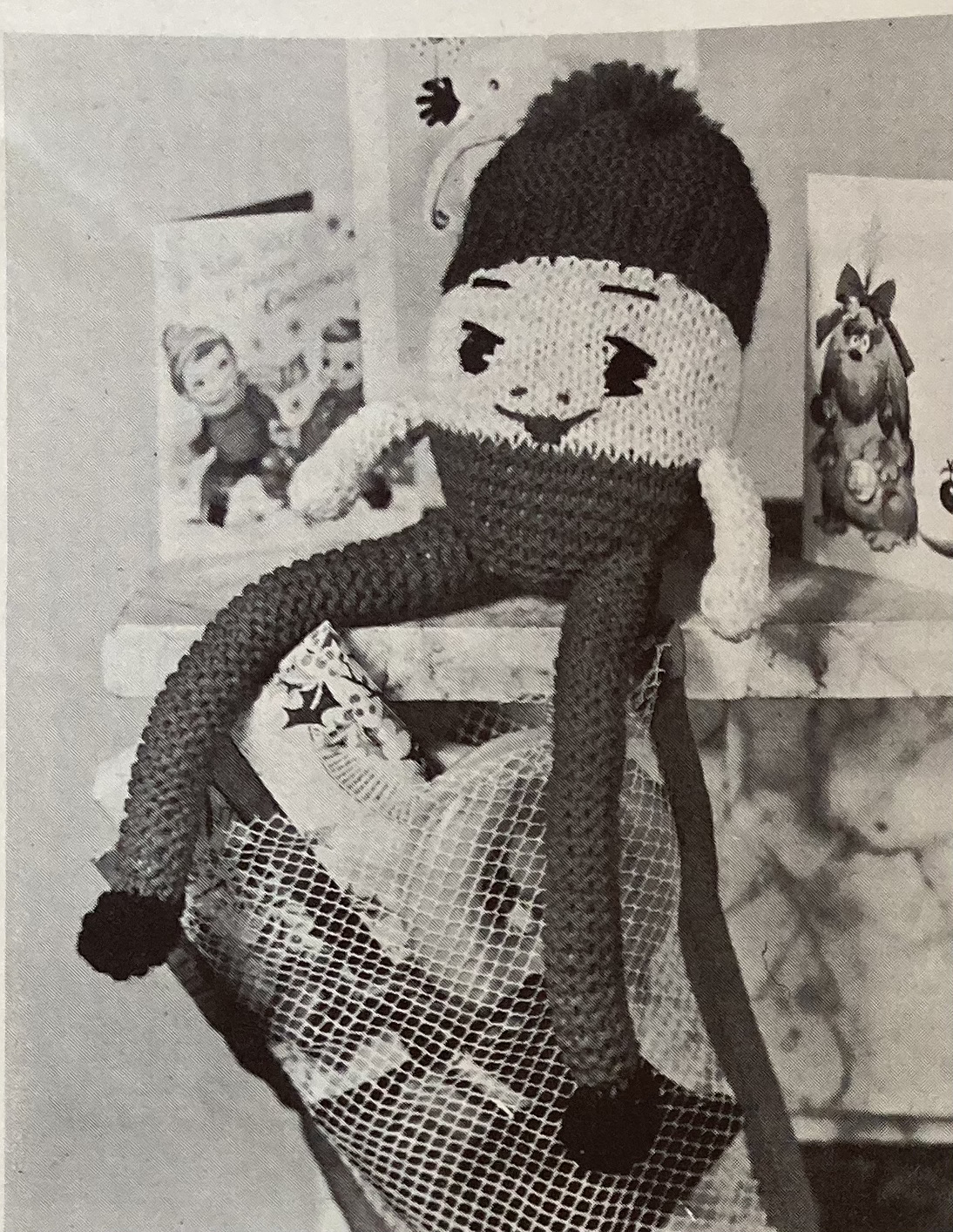
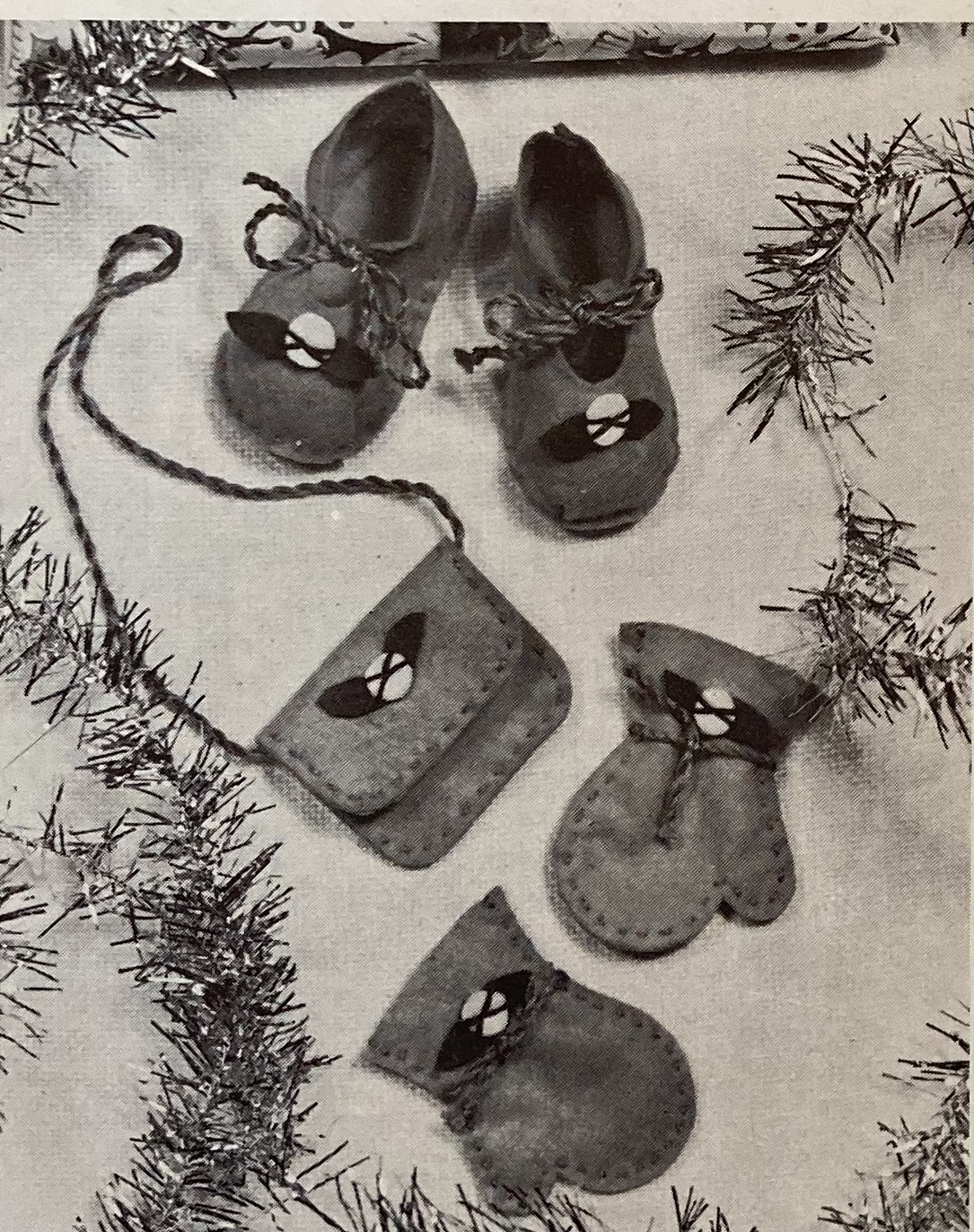
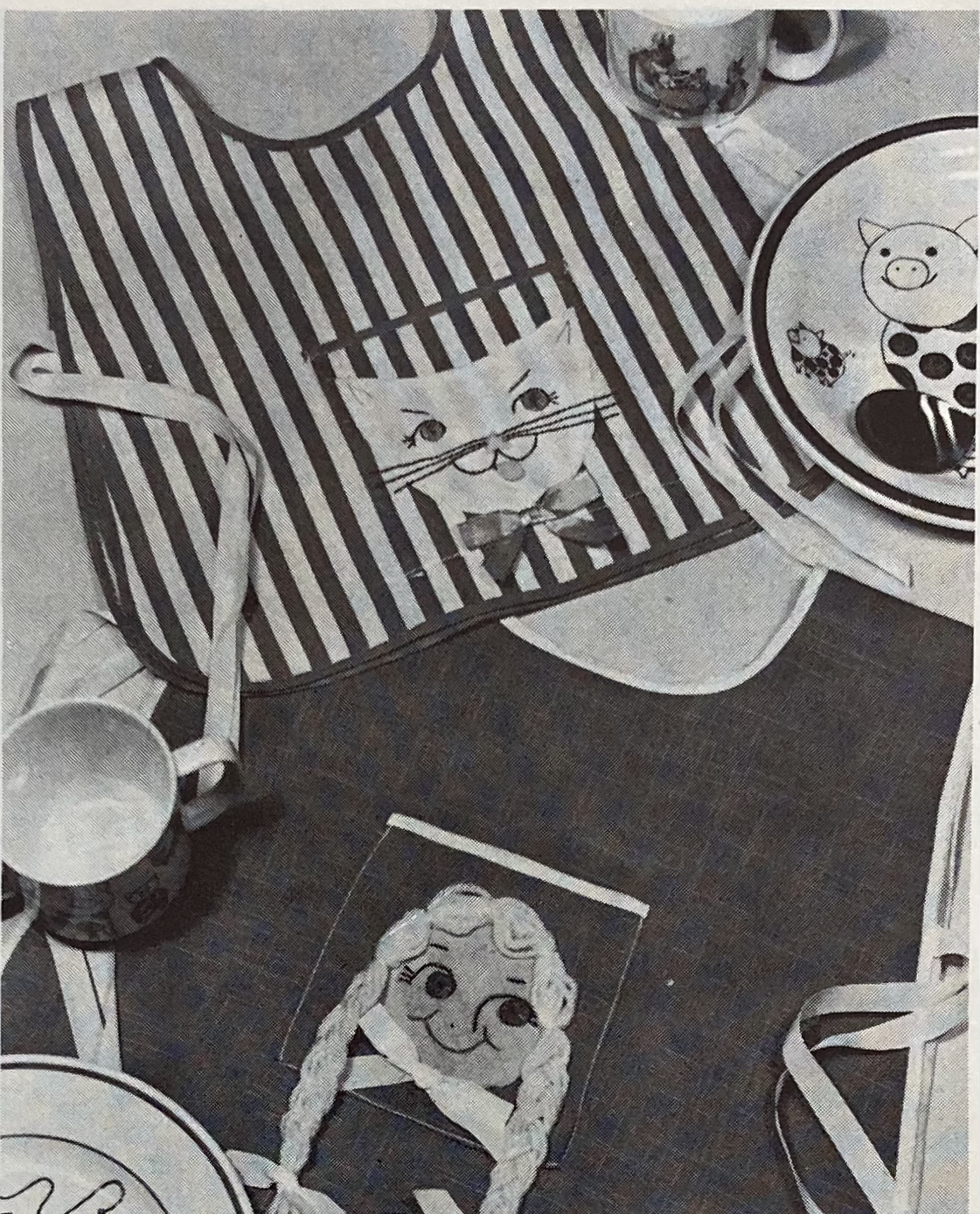
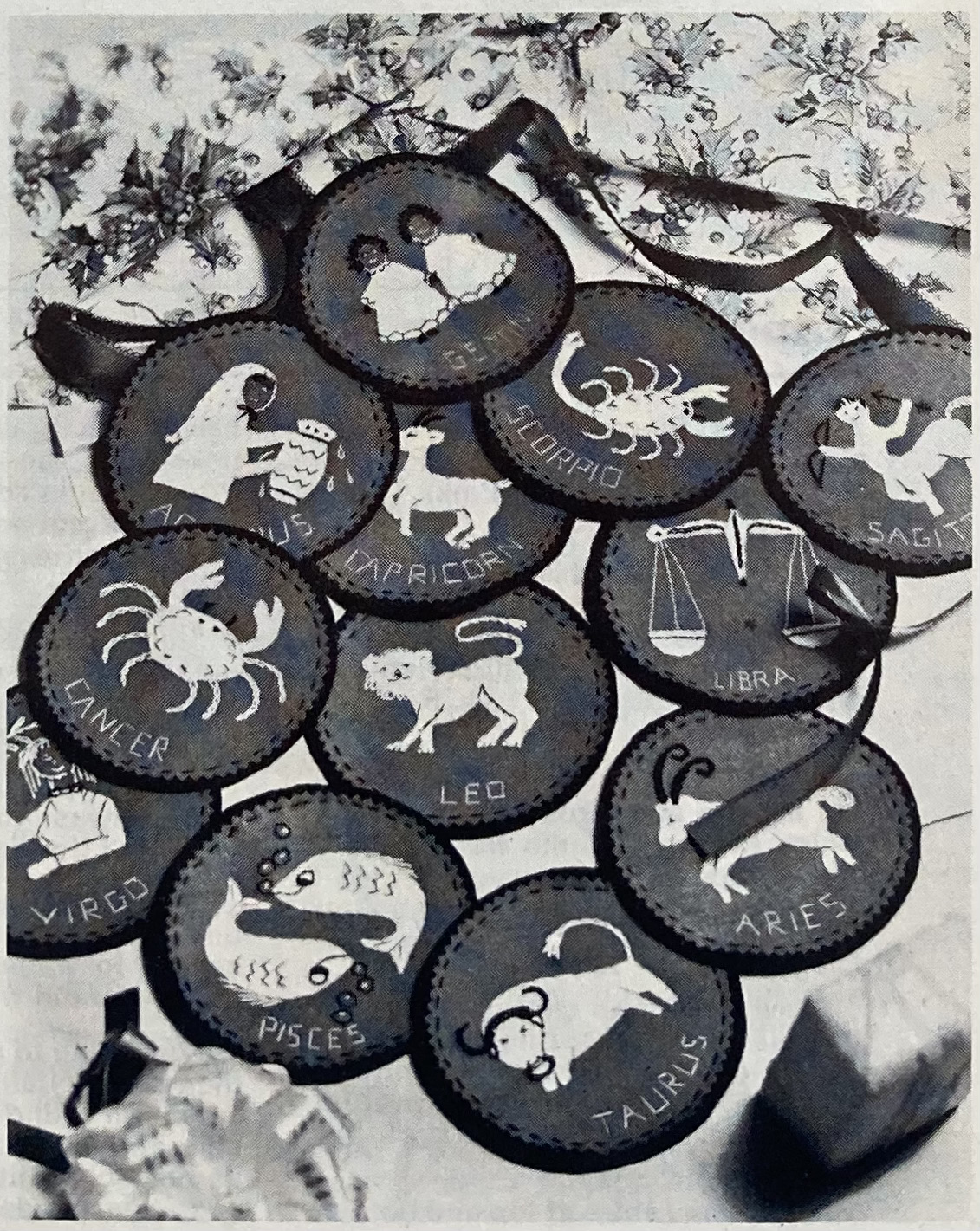
Gearing up for the Christmas season, we have a double page of weird and/or wonderful little gifts to knit, sew or embroider. For some reason, Stitchcraft really likes Humpty Dumpty, who appears in many forms as a toy, puppet, doll etc. over the years. Here, he “tops a stocking”. There are tiny felt accessories for a doll, sewn and decorated pinafore bibs for a baby or toddler, or coasters with the signs of the Zodiac in embroidered felt appliqué.
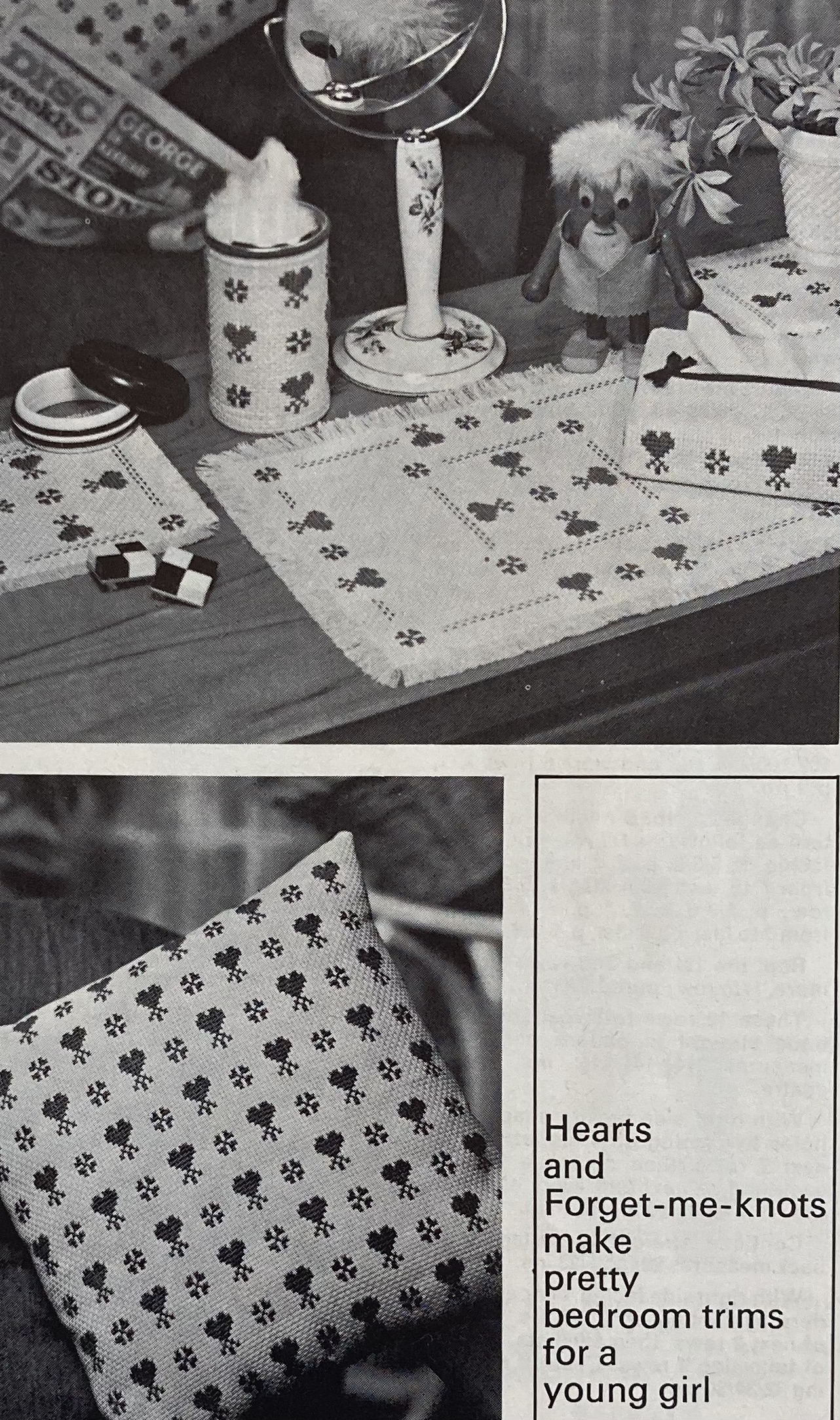
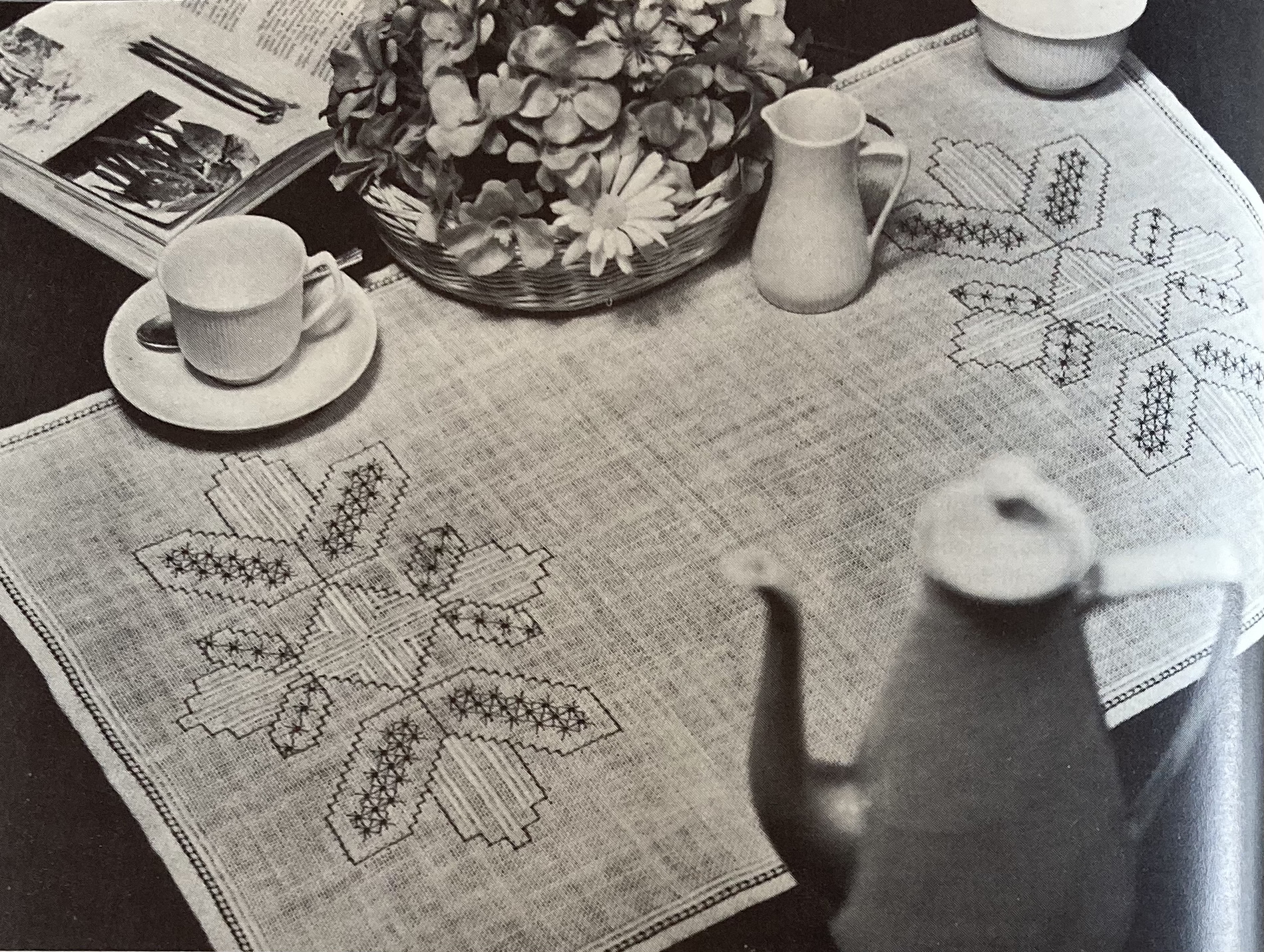
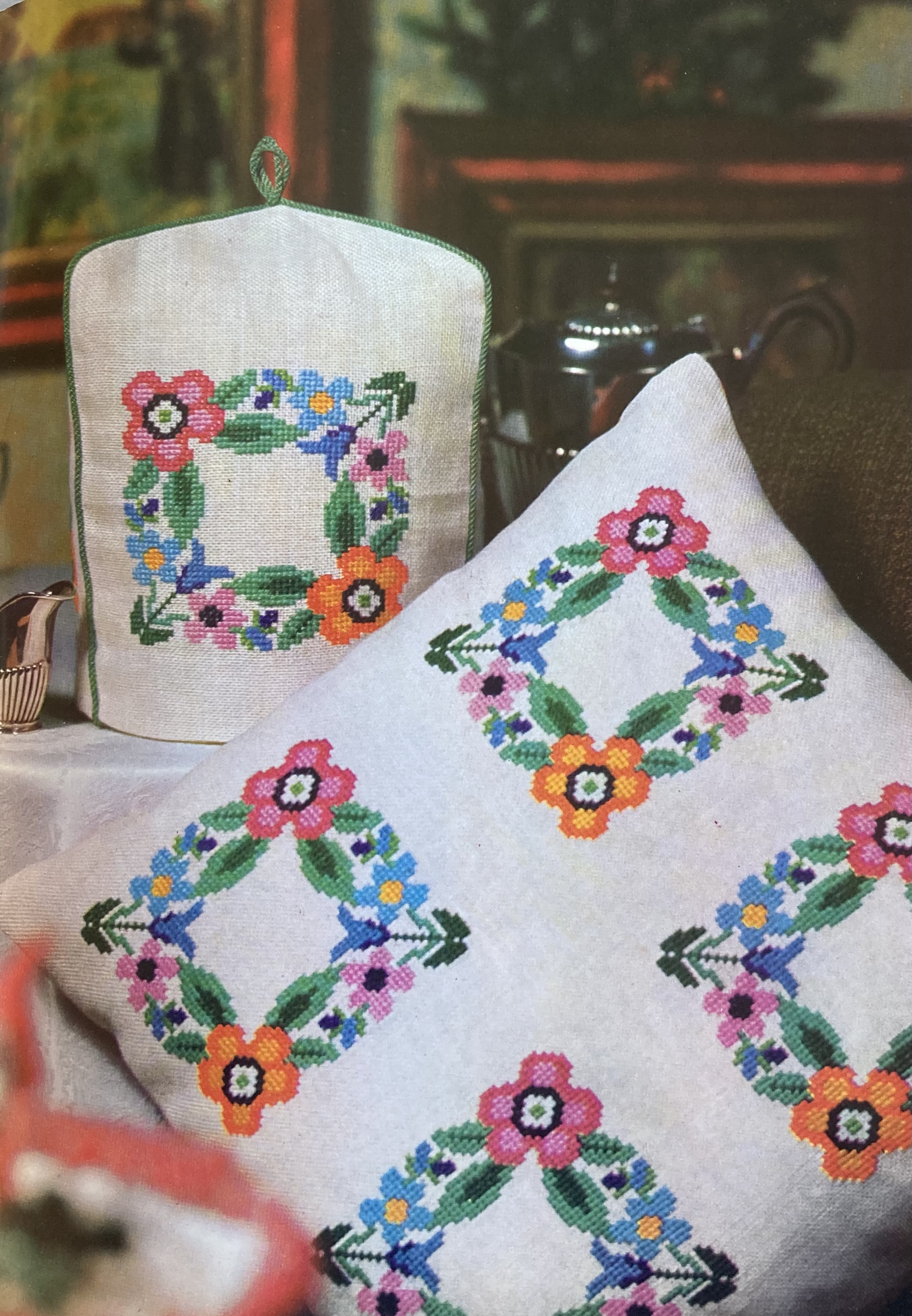
Larger tapestry and embroidery projects include a tapestry evening bag in rosebud pattern, mats and cushion in counted stitch for a girl’s bedroom, drawn-fabric table linens or a cushion and matching tea cosy in a bright floral cross-stitch pattern. I seem to remember the rosebud bag from an earlier project in 1961 that had a similar design. (That project didn’t work out and I don’t think I’ll be making another tapestry handbag anytime soon.)
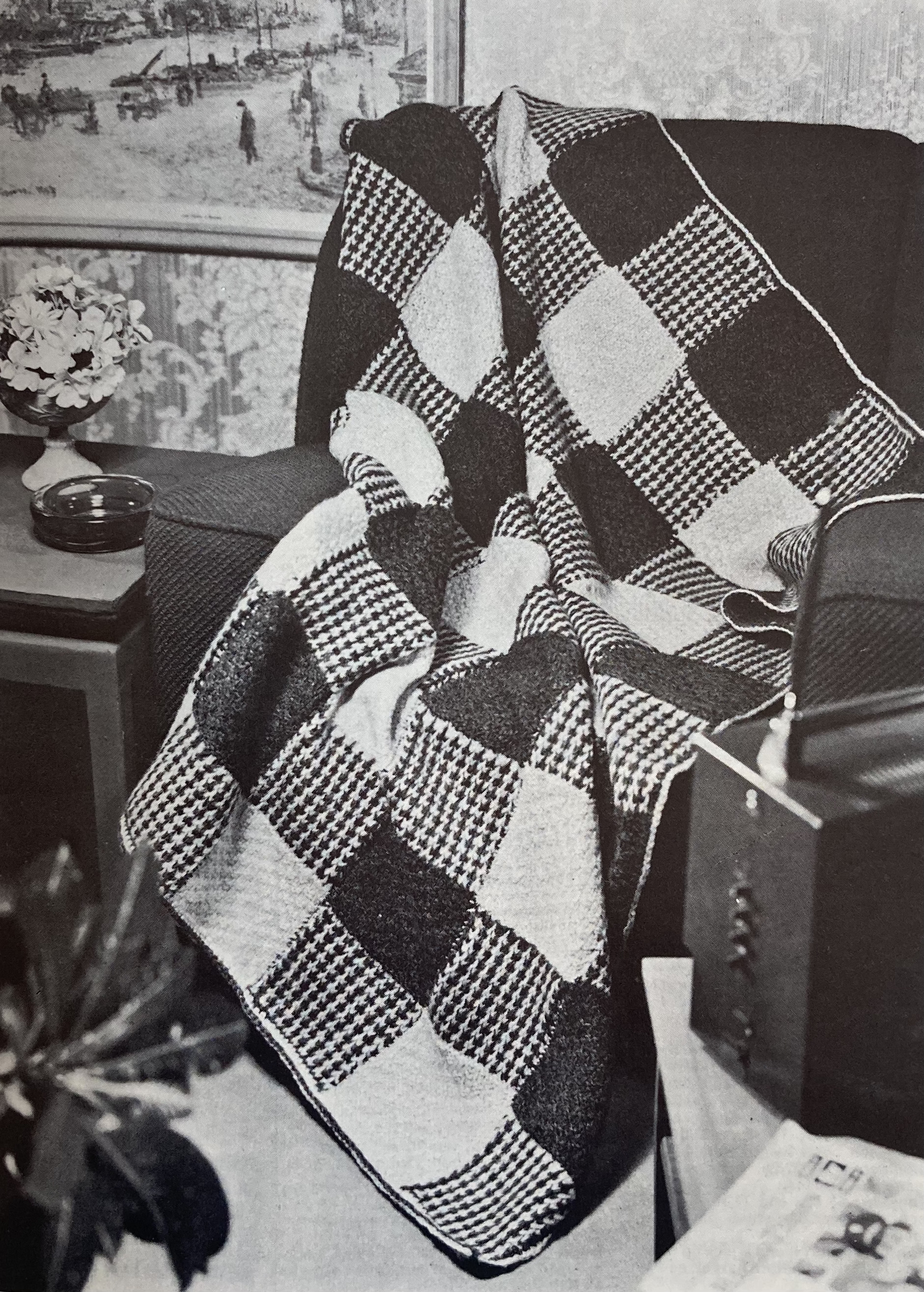
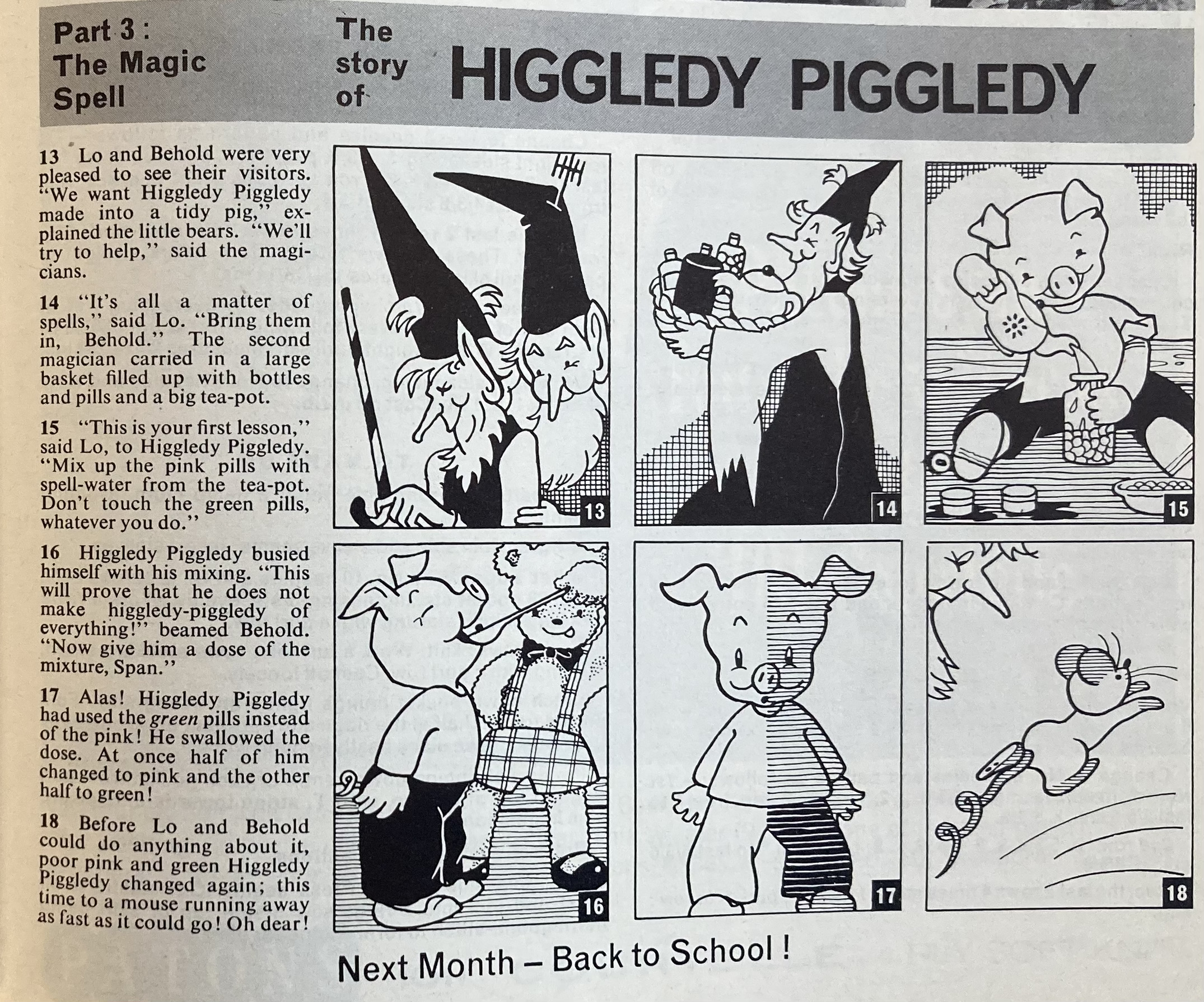
To finish it all off, you can knit a warm afghan for the coming winter evenings by the fireside, or crochet a practical potholder as many of us did in school. In the children’s comic, untidy piglet Higgledy Piggledy ignores the instructions given to him by the magicians who are supposed to change him into a tidy clean piglet, mixes the wrong potion and turns into a pink and green mouse. Good for him, I say! I am a neat and tidy person myself, but I have to admit I am rooting for Higgledy Piggledy in this comic. Will Higgledy Mouse escape the authoritarian rule of cleanliness? Tune in next time to find out!
This month‘s project was another modern adaptation of a 1960s homeware object. In this case, the original design was for a knitted „comfortable cushion” in a use-up-your-scraps striped slip-stitch pattern. I had plenty of scraps to use up and a request to make a little wrist cushion for someone who works a lot on the computer and had been padding their wrists with a folded scarf. The yarns I used were some more of the lovely Slow Wool Lino from Lana Grossa with bits of leftover sock wool for the contrast colours.
The original cushion measures 15×12 inches using a cast-on of 83 stitches of DK wool. I wanted a 14×4 inch cushion in fingering weight and calculated that out at 79 stitches in width. The stripes are made in slip 1, knit 3 pattern in alternating colours.
Everything worked out out fine on the first cushion piece. The width was perfect and three rows of stripes with 6 plain rows at beginning and end were a good height. The pattern was so very, very 1960s! Especially in the brown and brown and grayish brown and blue colour scheme (by request from the intended recipient.)
It was, in fact, a bit too authentically 1960s for the recipient, who requested a different pattern to use on the other side of the cushion. How about Space Invaders monsters? (i.e. hipster 80s retro instead of grandpa‘s 60s retro.) Space Invaders it was! I adjusted the number of blank rows on the Space Invaders piece, since the slip-stitch pattern pulls the knitting together even more than stranded work.
Then I made two more smaller squares in the same design, to make a pad for when the recipient might want to hold their wrists farther apart. All of the pieces curl a lot, as you would expect from stranded and/or slip-stitch patterns worked flat, but when I uncurled them, they seemed to be just the right size.
I wash-blocked the pieces, which flattened out both patterns admirably, and realised that I had made the Space Invaders piece too narrow. Not wanting to knit it again, I made two little strips to sew onto the sides — not elegant, but it fit.
I sewed up three sides and tacked 2 layers of quilt wadding to each of the insides, then turned around and sewed up the fourth side.
It’s… OK, I guess? The slip-stitch side definitely looks like a brown-on-brown 1960s home-made pillow, so you could call it authentic. But it’s not really one of my more interesting or beautiful projects. It should be useful, at least.
July is still “holiday” season over at Stitchcraft, but this summery issue is already looking towards cooler autumn temperatures and the return to post-holiday life. For women’s fashions, this means a “revival of the more feminine line” (as if there were ever a fashion for “the masculine line” in 1960s women’s fashions.) I guess they mean a slightly closer-fitting silhouette, or a little more shaping of upper-body garments between hem and bust. At the same time, “quick and easy yarns” or “easy-to-wear loose front styling” jackets are still in fashion, emphasising comfort and wearability.
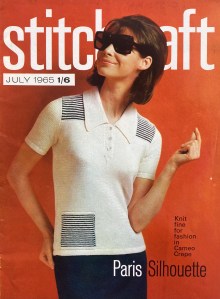
Our cover model sports a white blouse made in 4-ply “Cameo Crepe” wool and twisted stocking-stitch for a little more texture. The navy blue accents on shoulder and pocket match the knitted skirt, which is just below-knee length. That may seem surprising if you associate mid-1960s fashions with miniskirts, but it took a while for the ideas of cutting-edge designers like Mary Quant or André Courrèges to trickle down to the general public, and hand-knitting magazines, even the more fashionable / aspirational ones, were oriented towards designs that “regular people” could wear in everyday life . The dresses and skirts in Vogue Knitting’s 1965 Spring/Summer issue, for example, all fall between just-barely-above and solidly-below knee-length — and Stitchcraft was a more conservative magazine than Vogue Knitting. We won’t be seeing miniskirts here for a while yet.
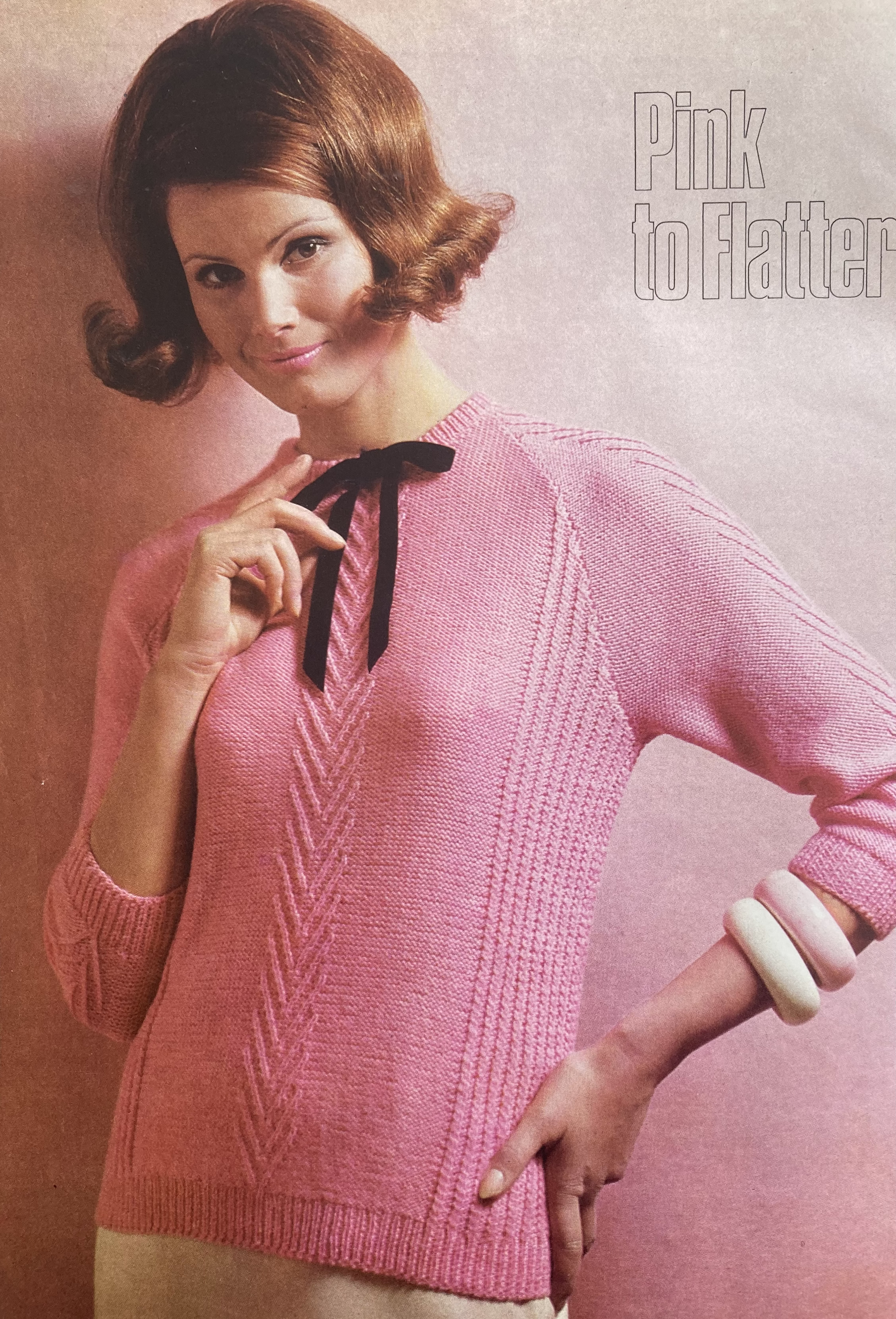
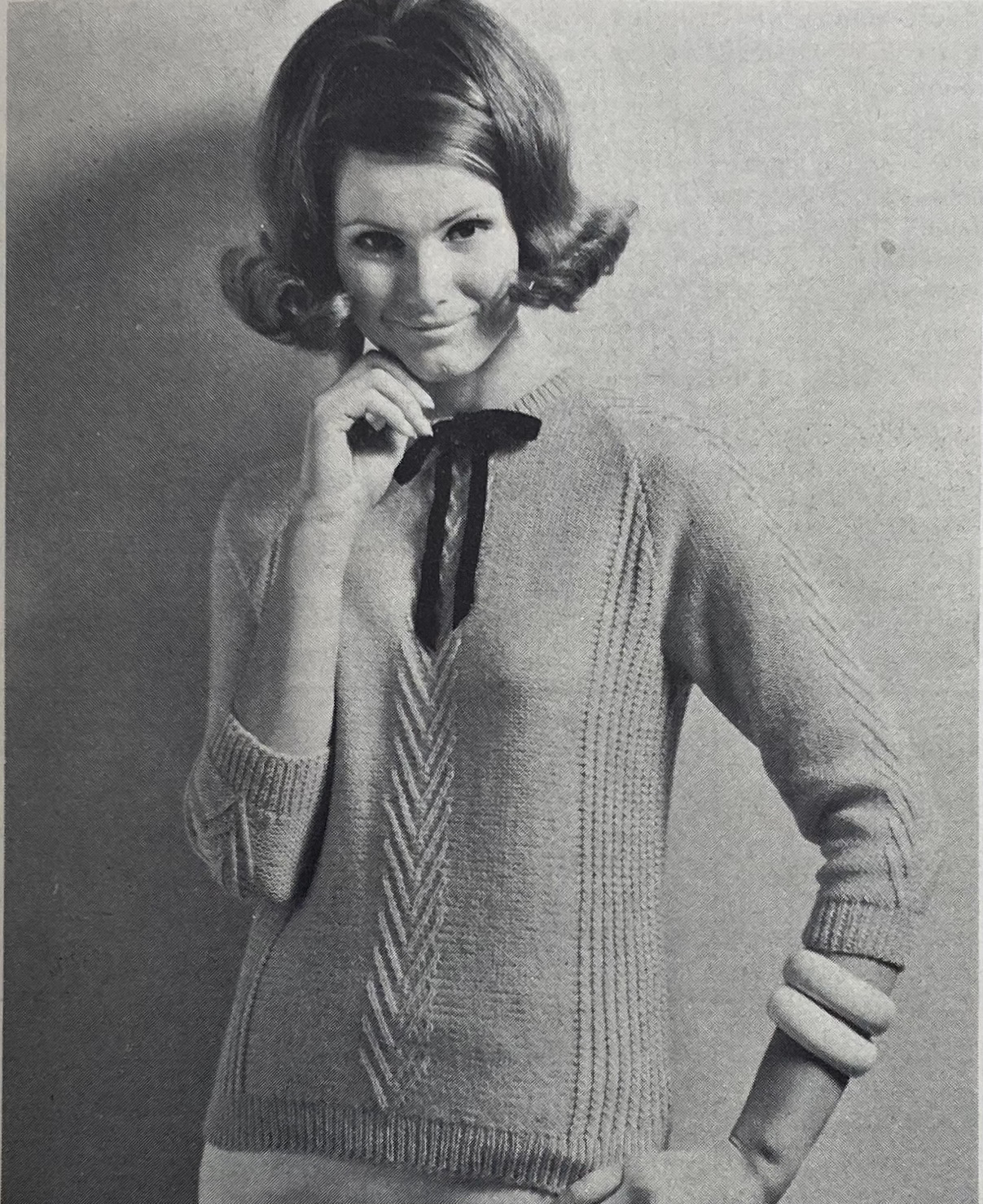
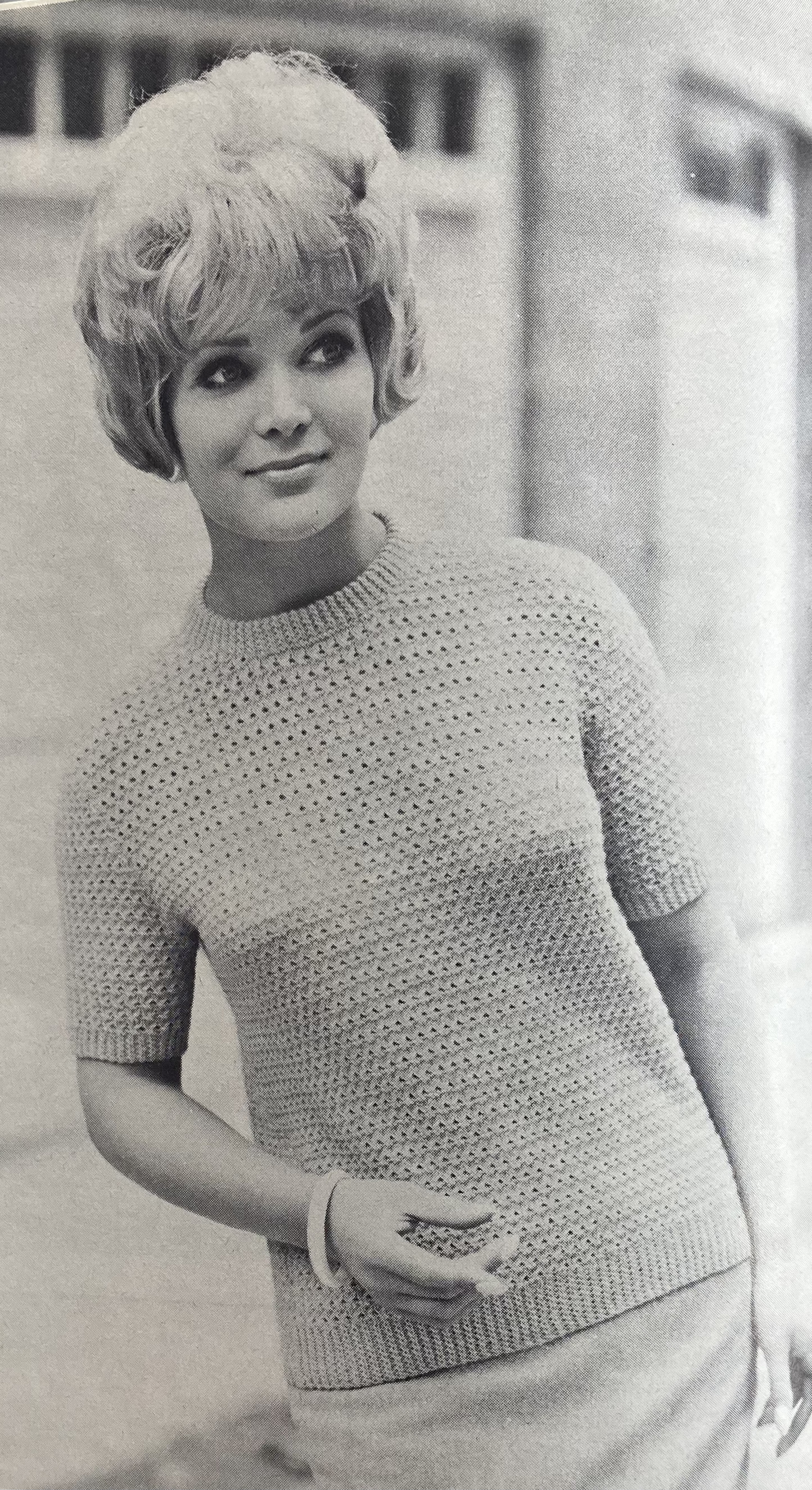
The upper-body fashions for women show, if not an extreme “revival of the feminine line”, a definite attention to cute colour and pattern details, particularly in the use of twisted stitches or ribbing variants. The pink raglan pullover on the inside front cover combines a sort of twisted rib on the sides with a “v” pattern, also made by twisting stitches, up the front and back midline and on the sleeves, and tops ot off with a black necktie bow. Nice touch to put it on a red-haired model! The combination of colour detail and ribbing variant (here: stranded panel and narrow slip-stitch rib) is also used on the warm blue-and-white cardigan. The “knitting that looks like crochet” trend continues in a short-sleeved blouse for larger sizes in 4-ply wool and a textured-lace pattern.
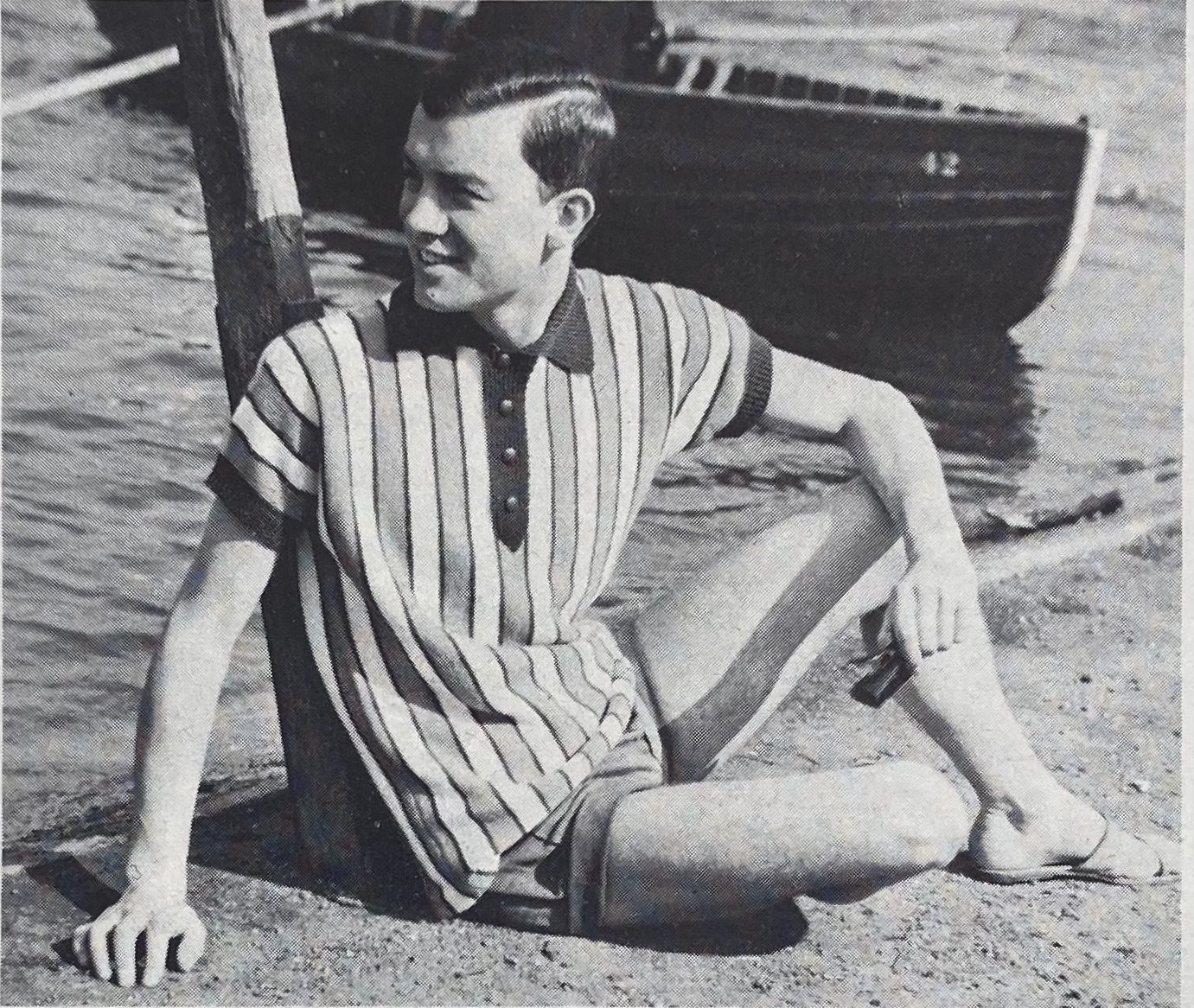
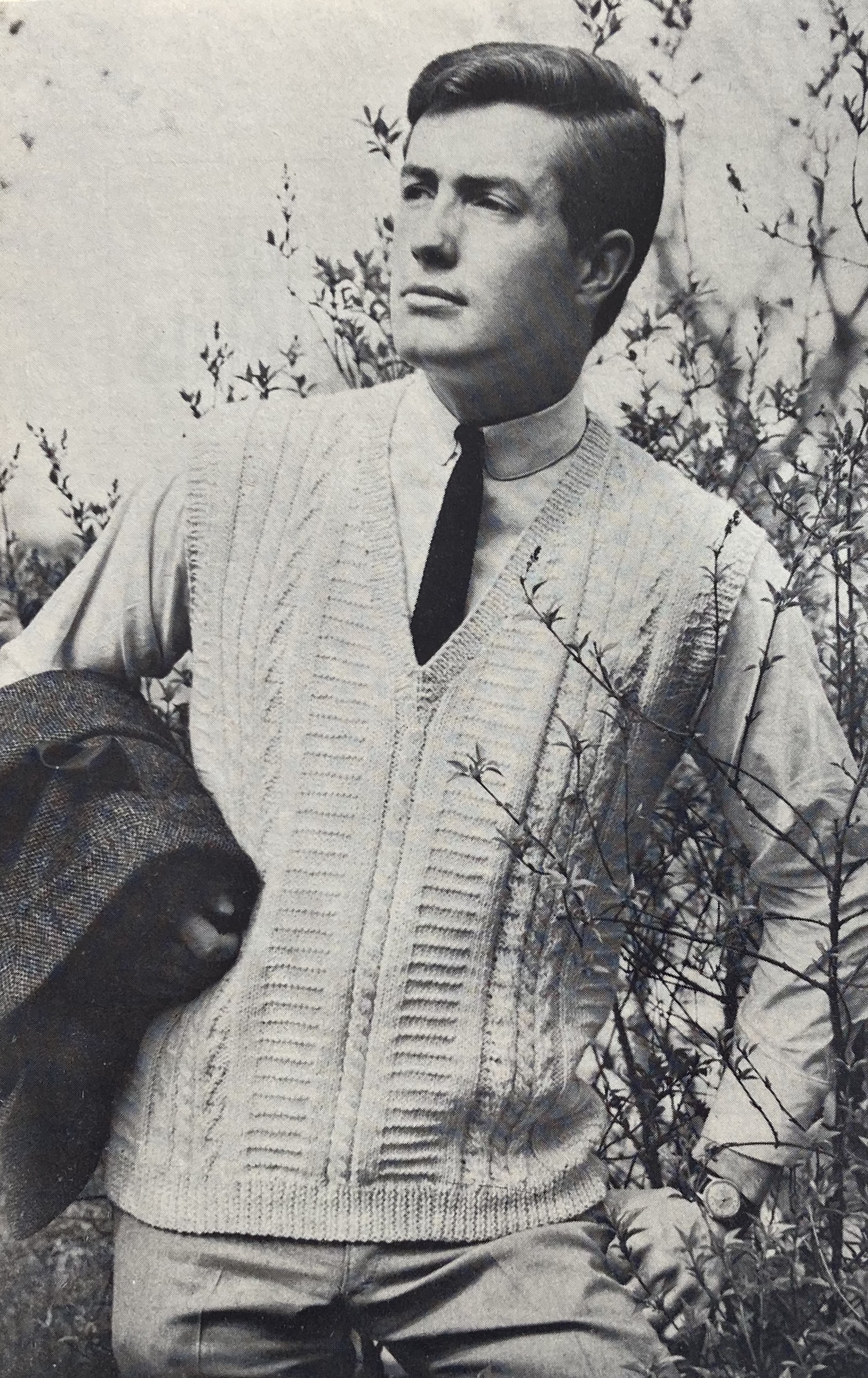
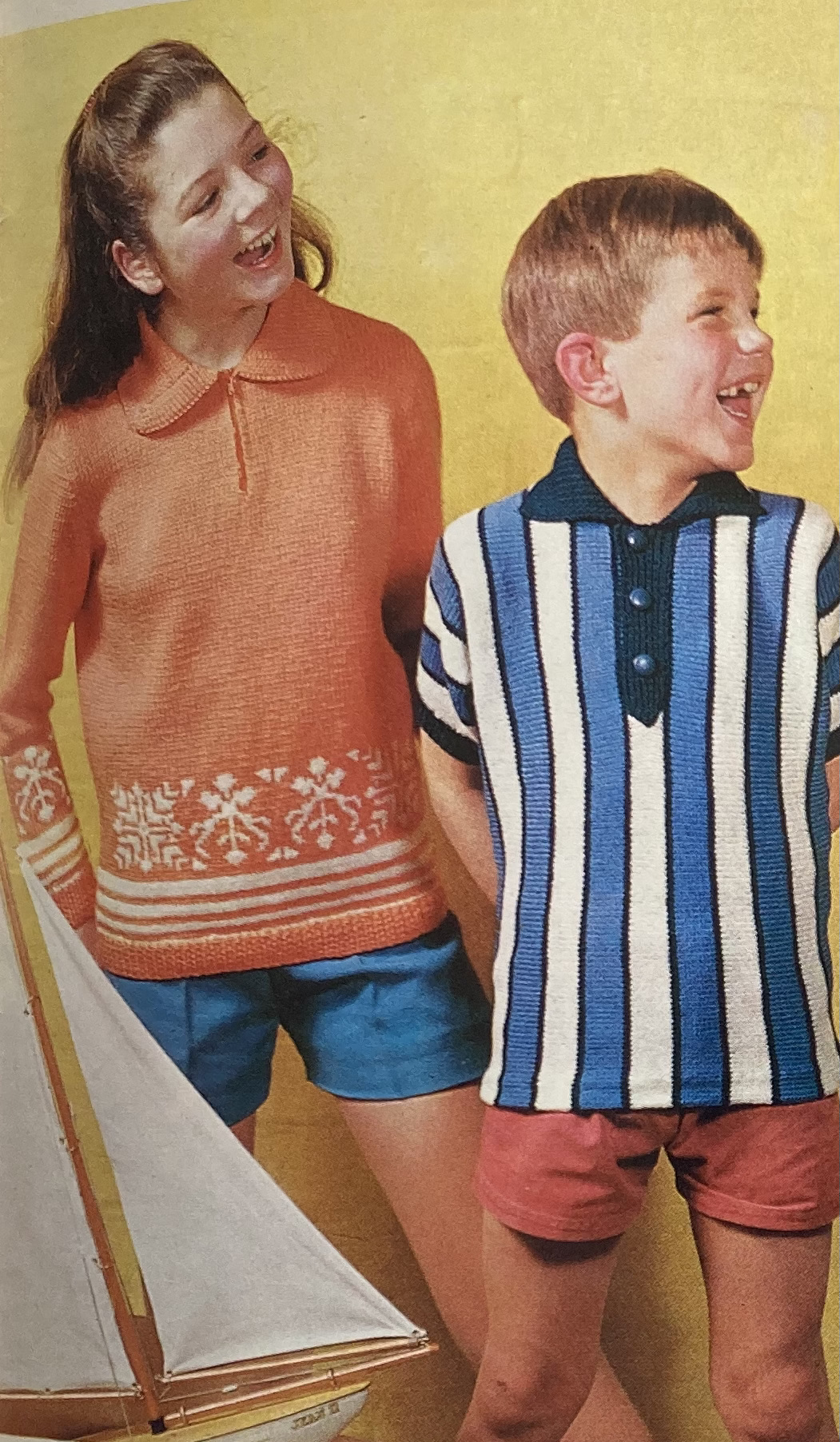
The men’s fashions use a predictably less dainty, but no less interesting use of colour and pattern: there’s a loose.fitting, sideways-knit and vertically-striped dolman-sleeve shirt for beach wear in “father and son” sizes for adults and children (though the “adult” model in the photo looks hardly older than a teenager himself) and a slipover in an Aran-style pattern of cables, ridges and zig-zags.
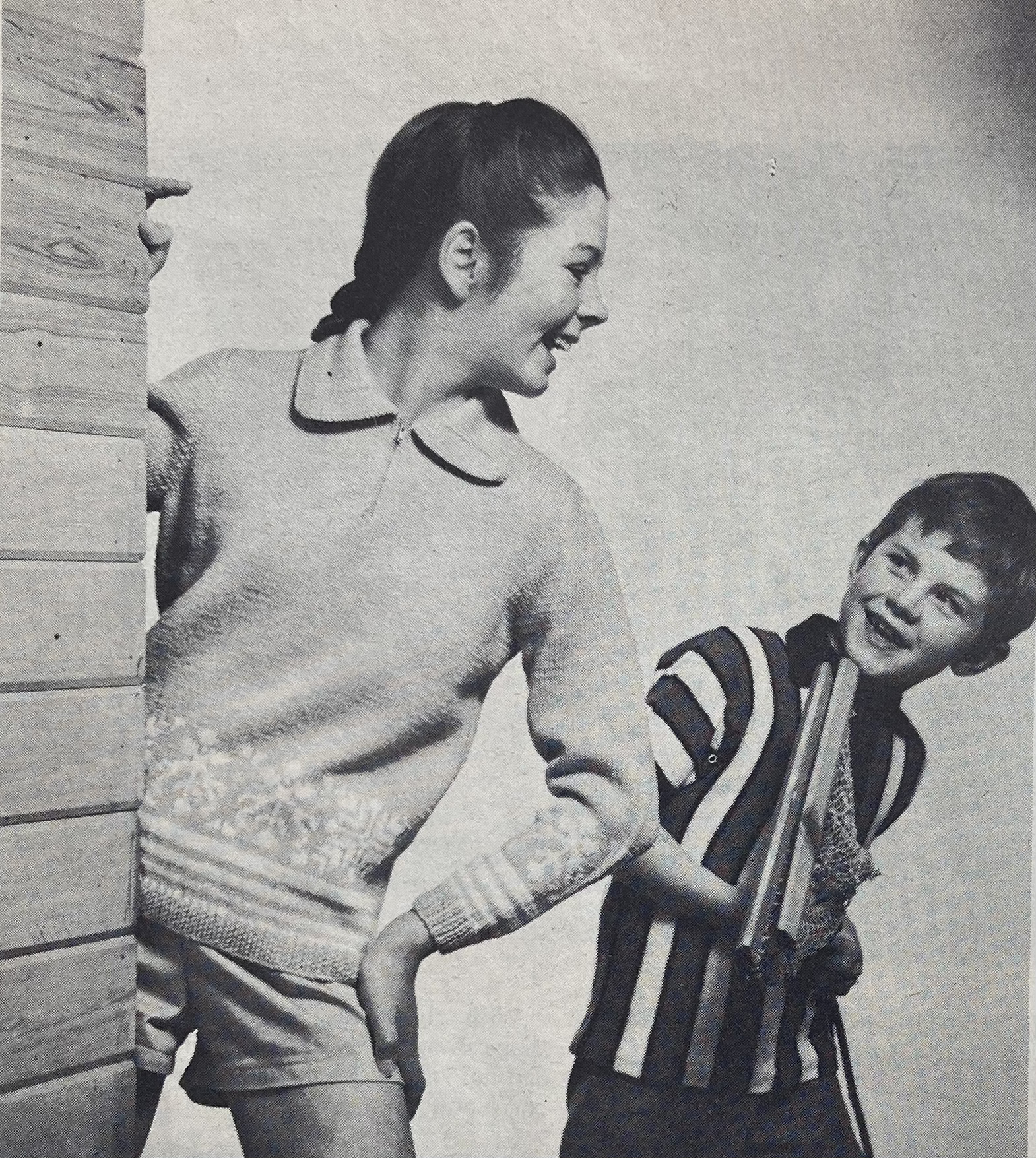
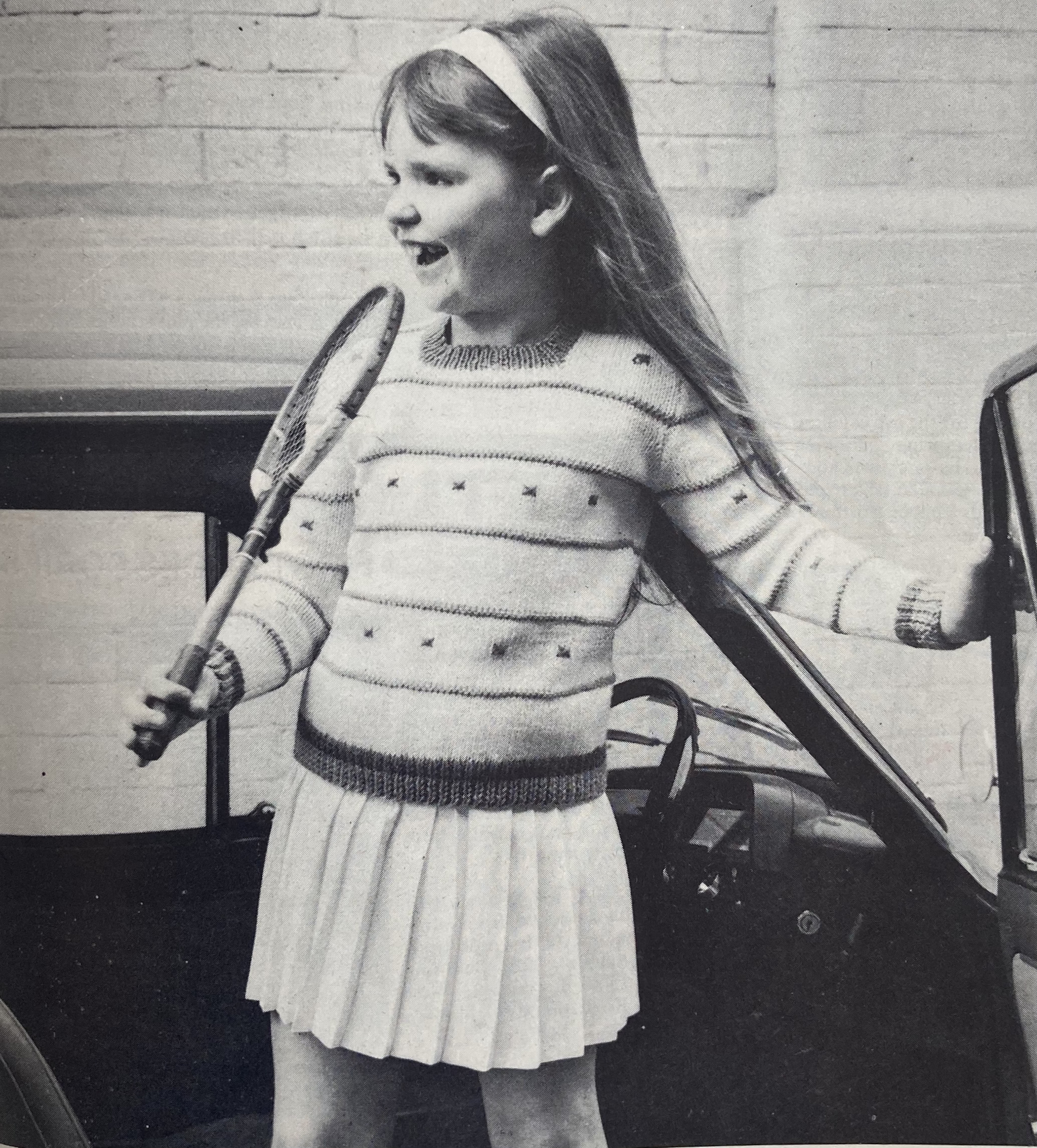
The kids’ designs utilise the same fashion features as the adults: the boys’ striped shirt is the exact same pattern as “Father’s”, and there’s a zip-neck pullover for girls with a stranded border reminiscent of the panel in the womens’ jacket. For younger girls, there’s a quick and easy, slightly striped pullover whose pattern details are embroidered on after knitting. Nautical white and blue, pretty pink and sunny yellow make up the summer colour palette.
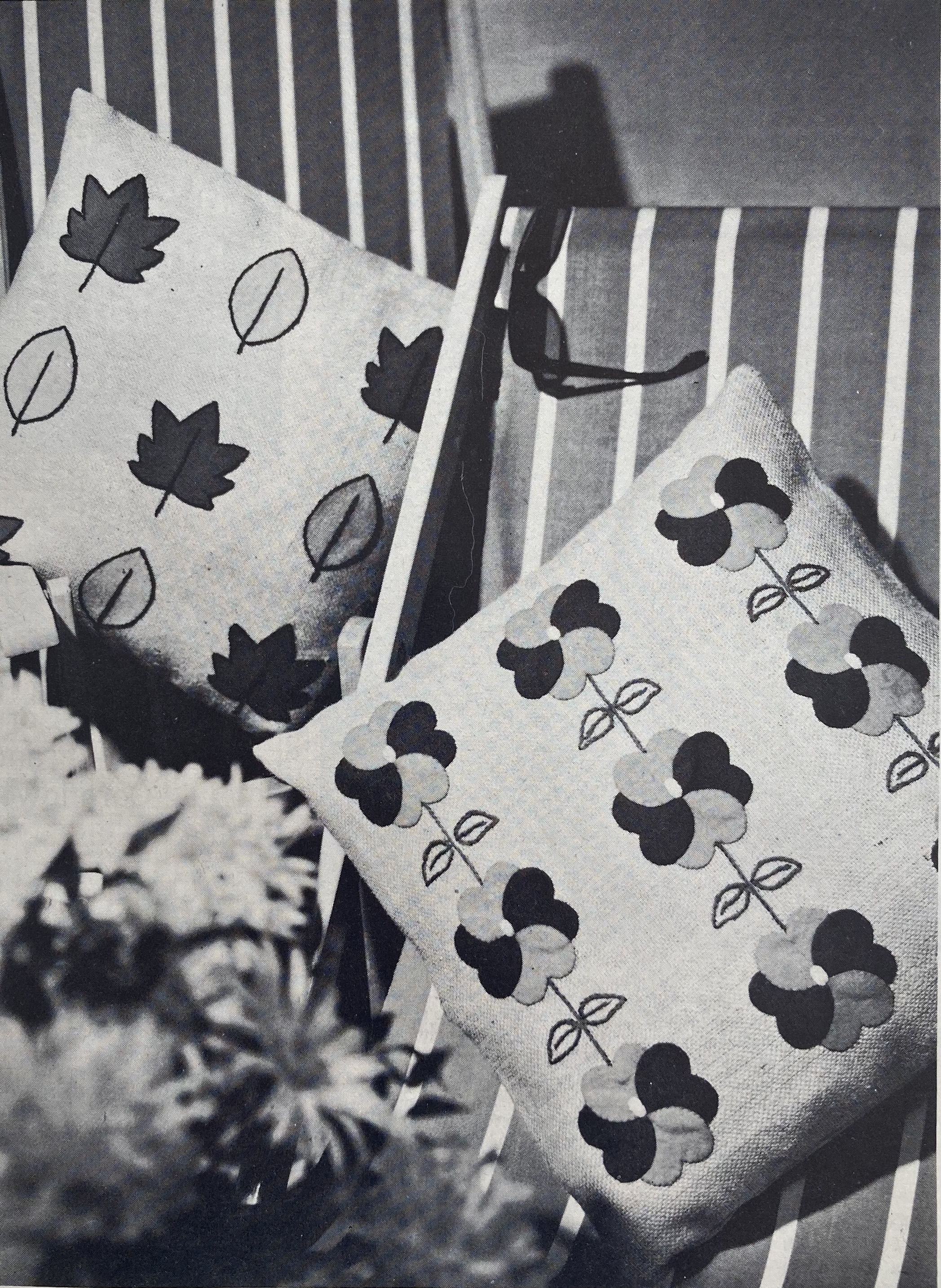
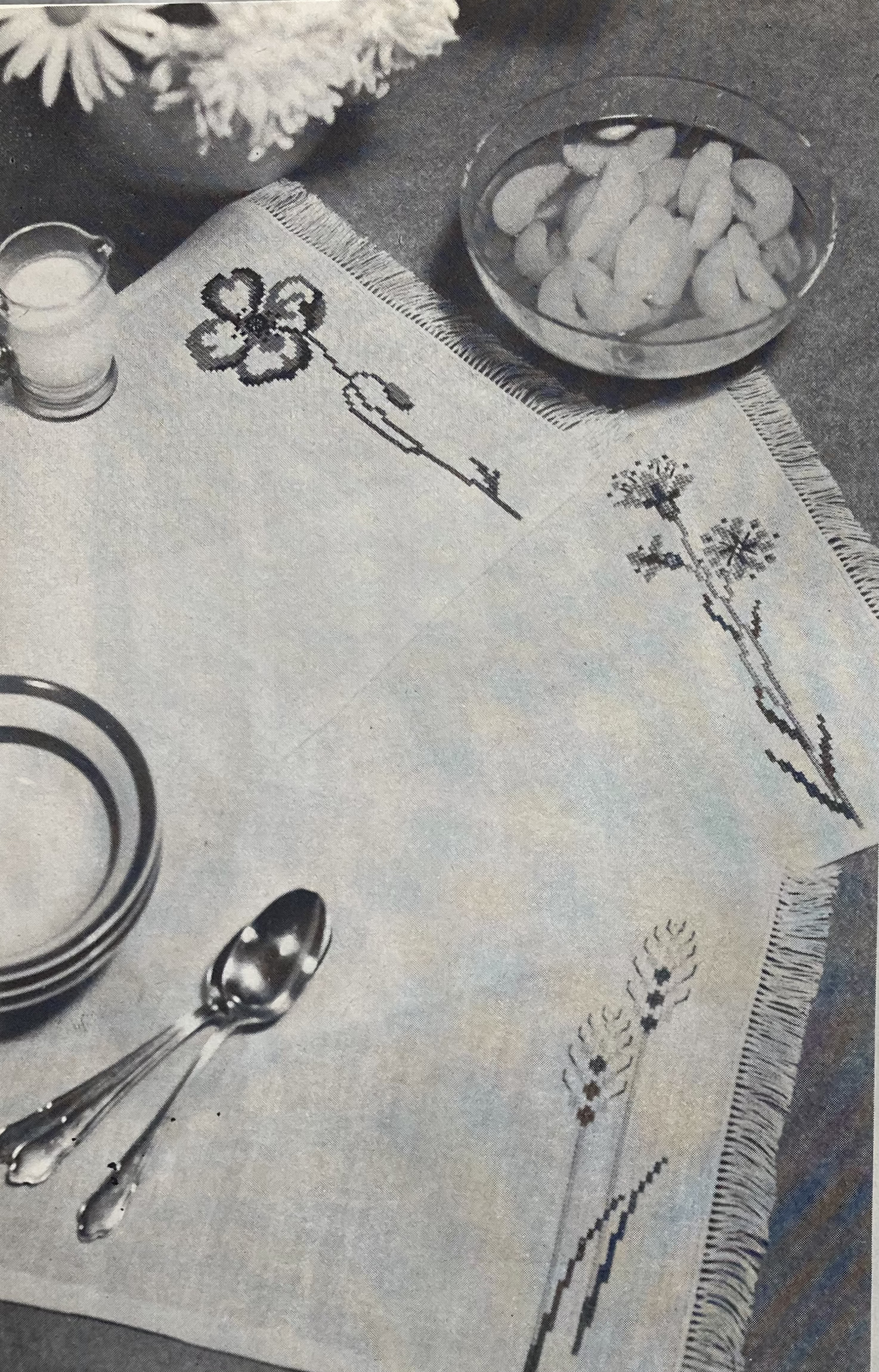
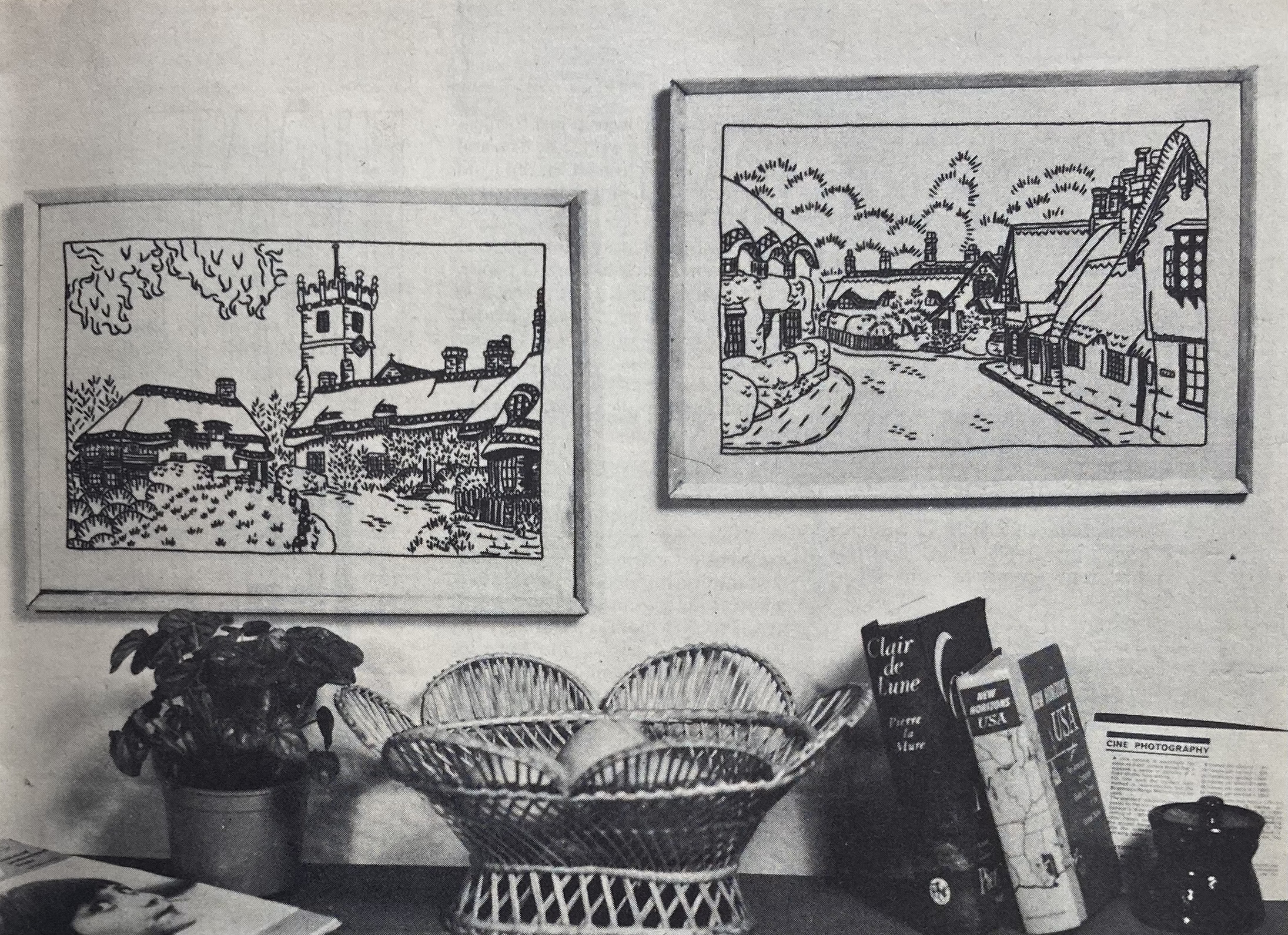
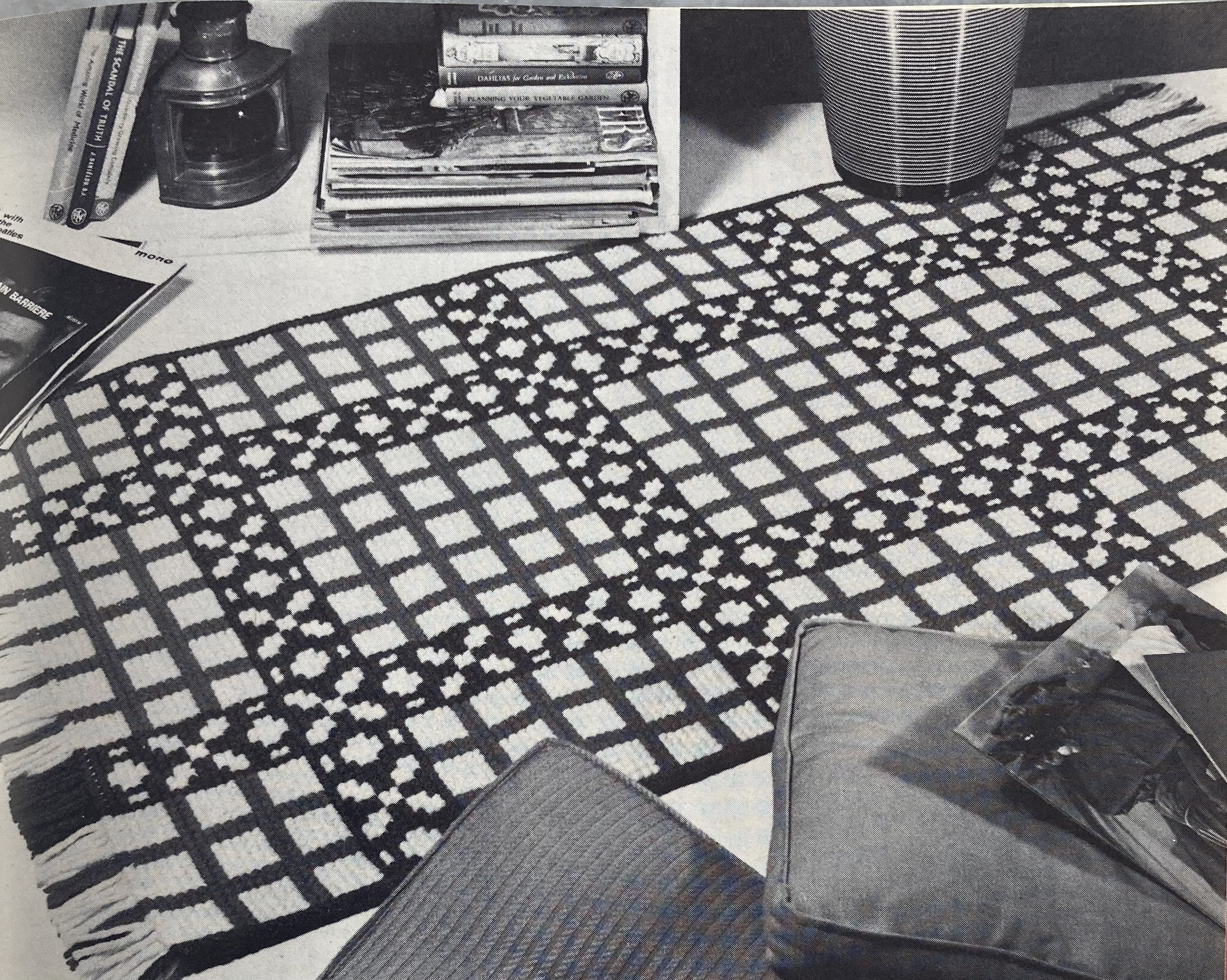
There’s a good selection of easy homeware and embroidery projects: appliquéd garden cushions in “hardwearing hessian” fabric, single flowers cross-stitched on place mats “for an outdoor supper party”, embroidered “needle etchtings” of village scenes (Godshill and Shanklin Old Village on the Isle of Wight), or an easy stitched rug.
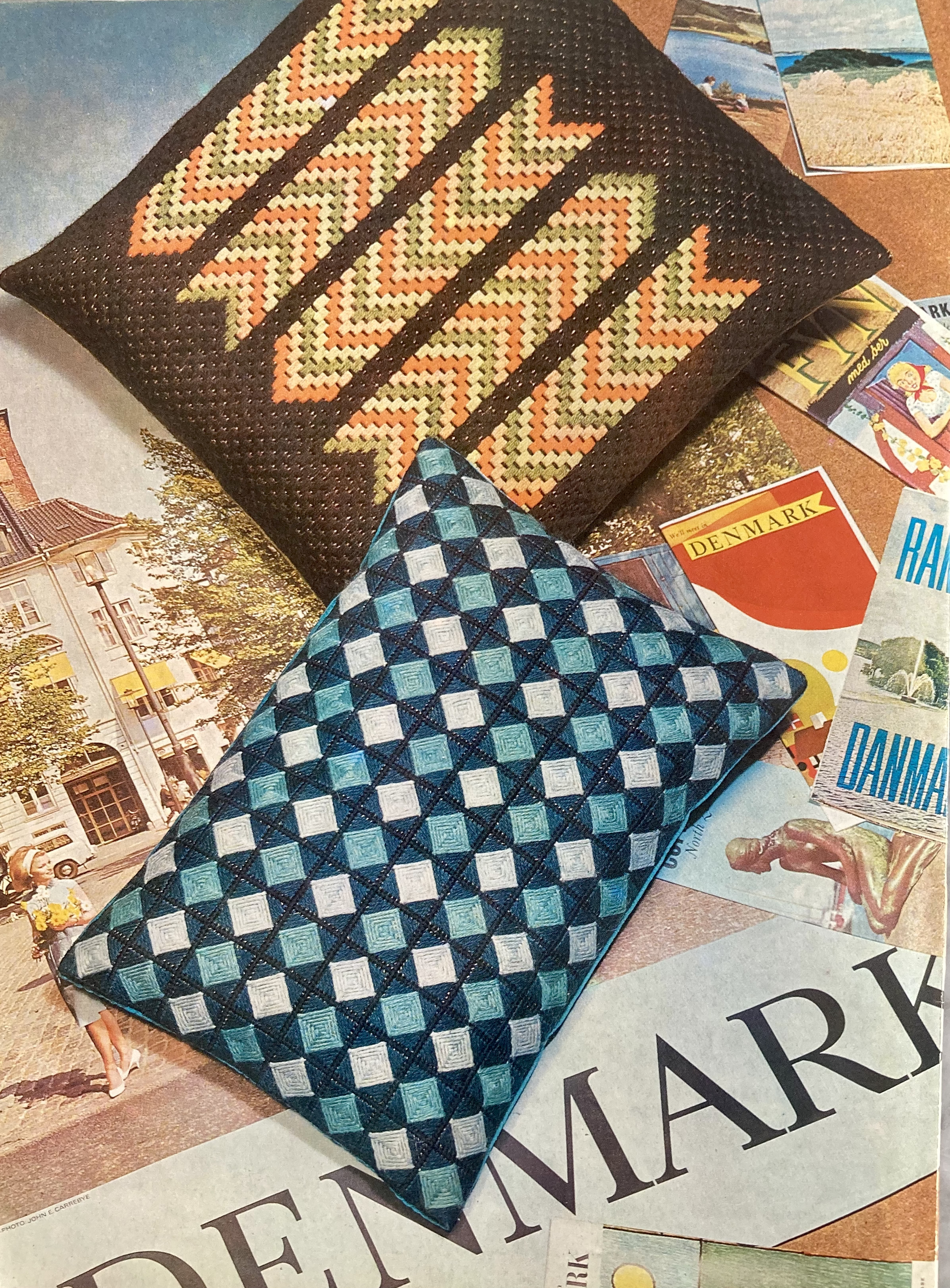
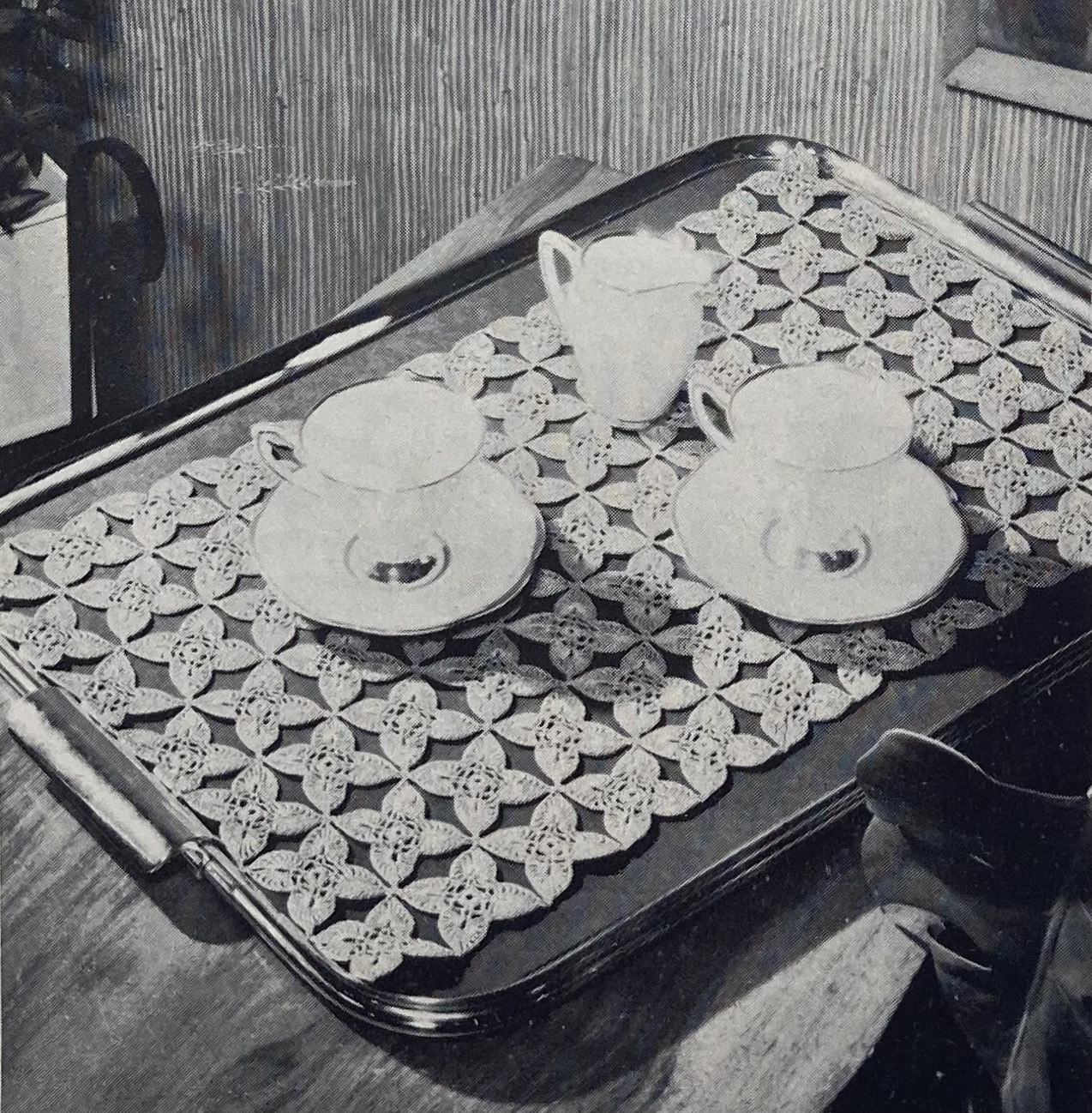
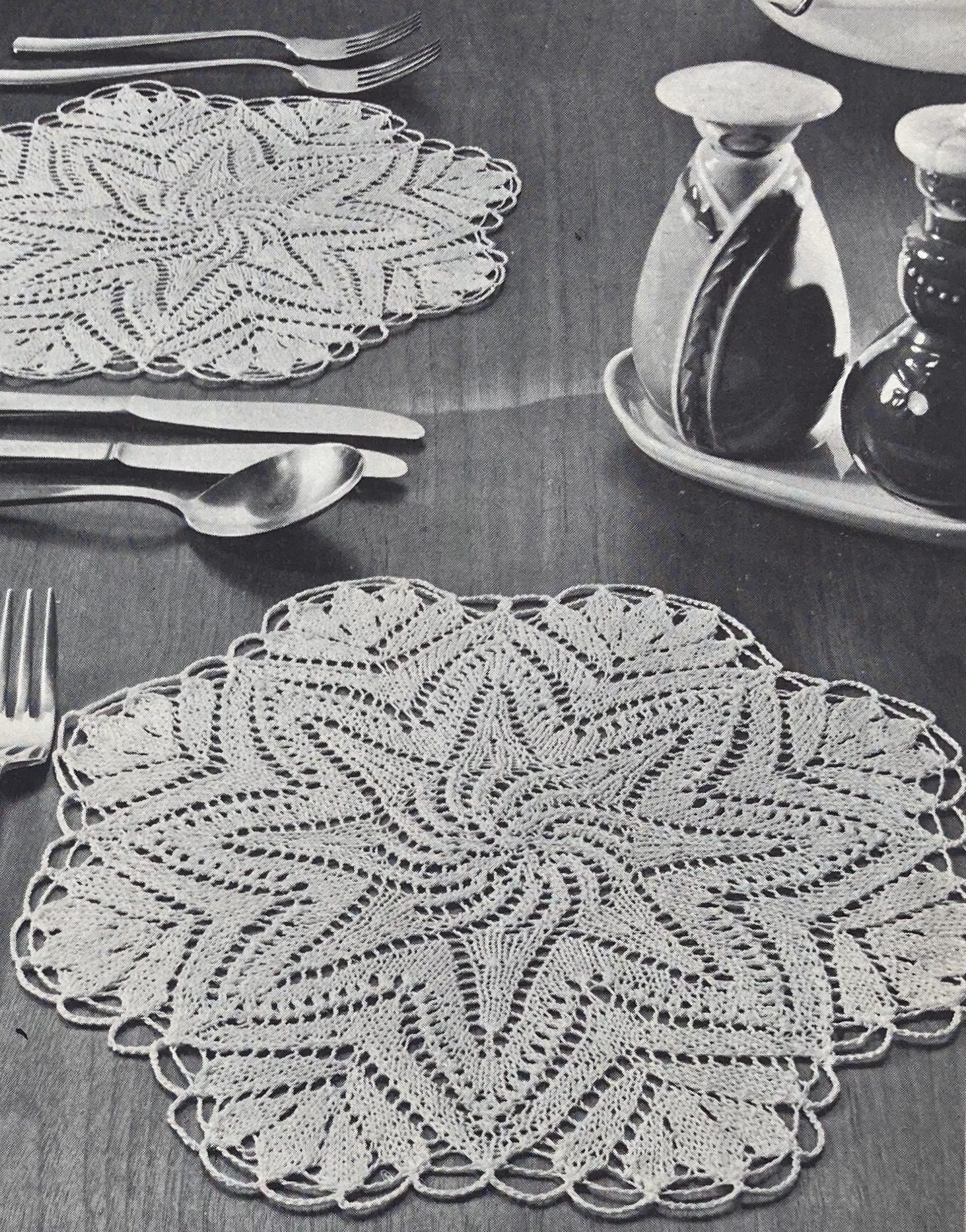
The Danish-design tapestry cushions look more complicated than they are, but are also more complicated than the usual tapestry cushions. Fans of finer work in cotton can make doilies or a traycloth, or pretty trims for bed pillows.
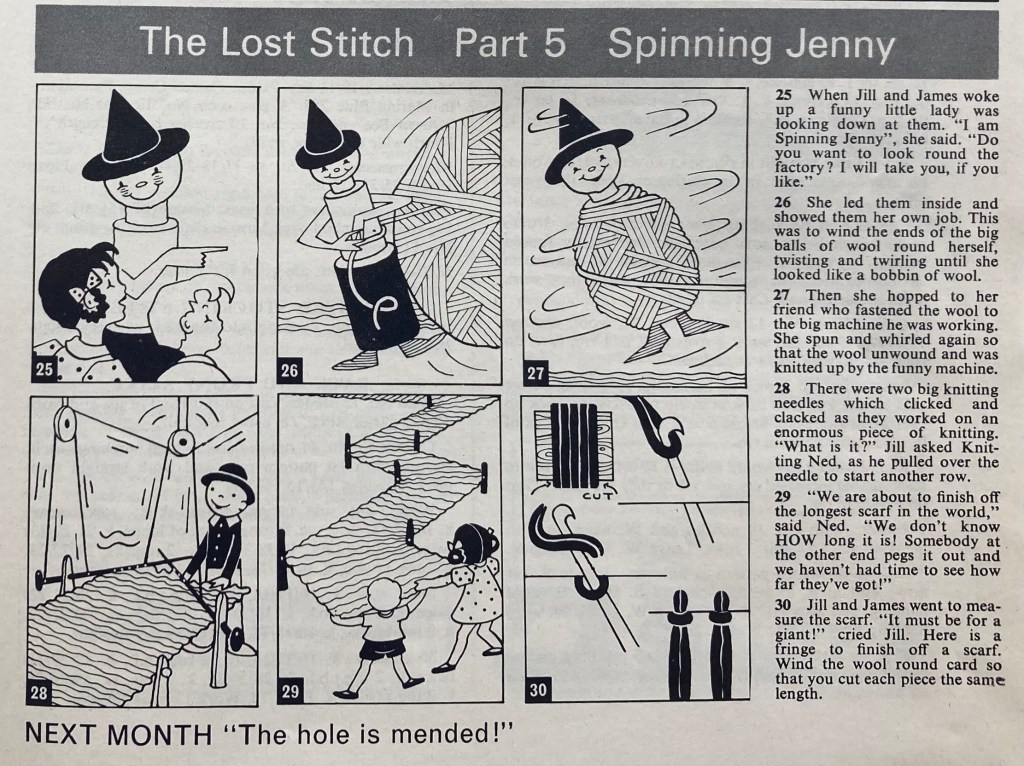
The ads are quite usual: Singer sewing machines, Patons yarns, and a swirly nightgown and negligée from the Scotch Wool Shop. Not to forget: the Turmix knitting machine, Stitchcraft binding cases to store a year’s worth of magazines, and order houses for wools, fabric remnants, etc. The children’s comic follows the adventures of Jill and James searching for a lost stitch and encountering interesting characters such as Spinning Jenny, who shows them how a spinning machine works.
That’s all for this issue! My project will be the appliquéd flower cushion.
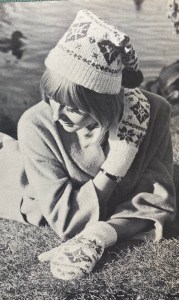
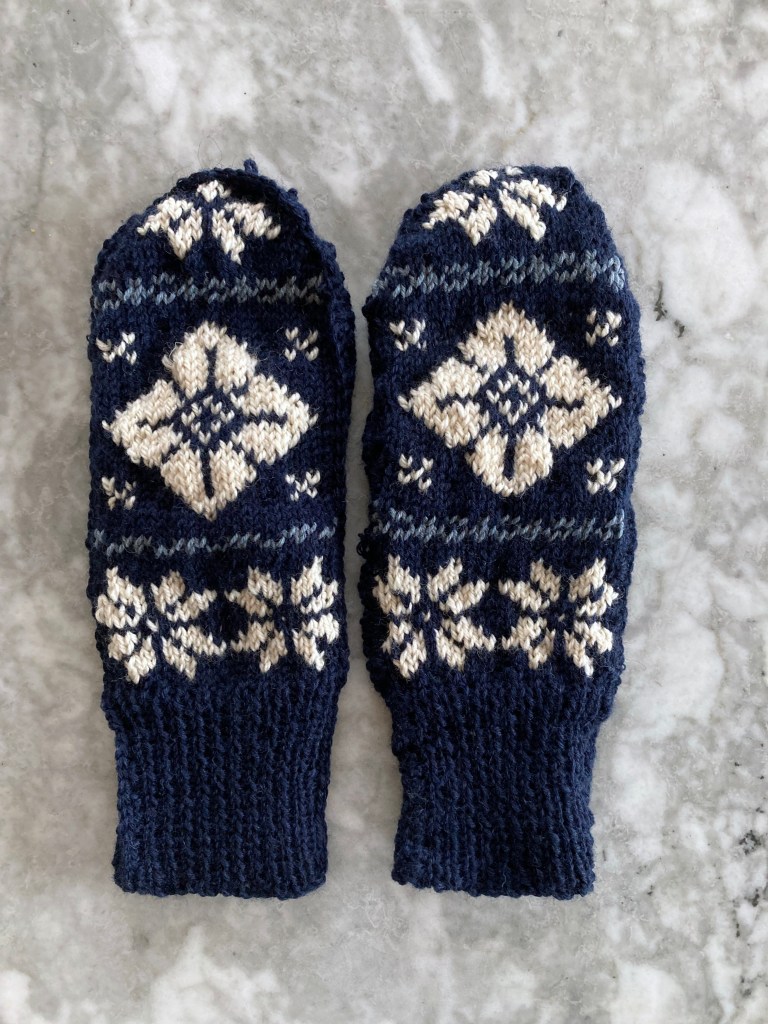
I had long admired this cap and mitten set and was very happy to arrive at this issue in order to knit it.
… That is, until I actually took a better look at the pattern and made it! The snowflake pattern and folded stocking-cap design looks great in the photo, but the pretty setting and pose detract from some of the design flaws, which became glaringly apparent once I started work on it.
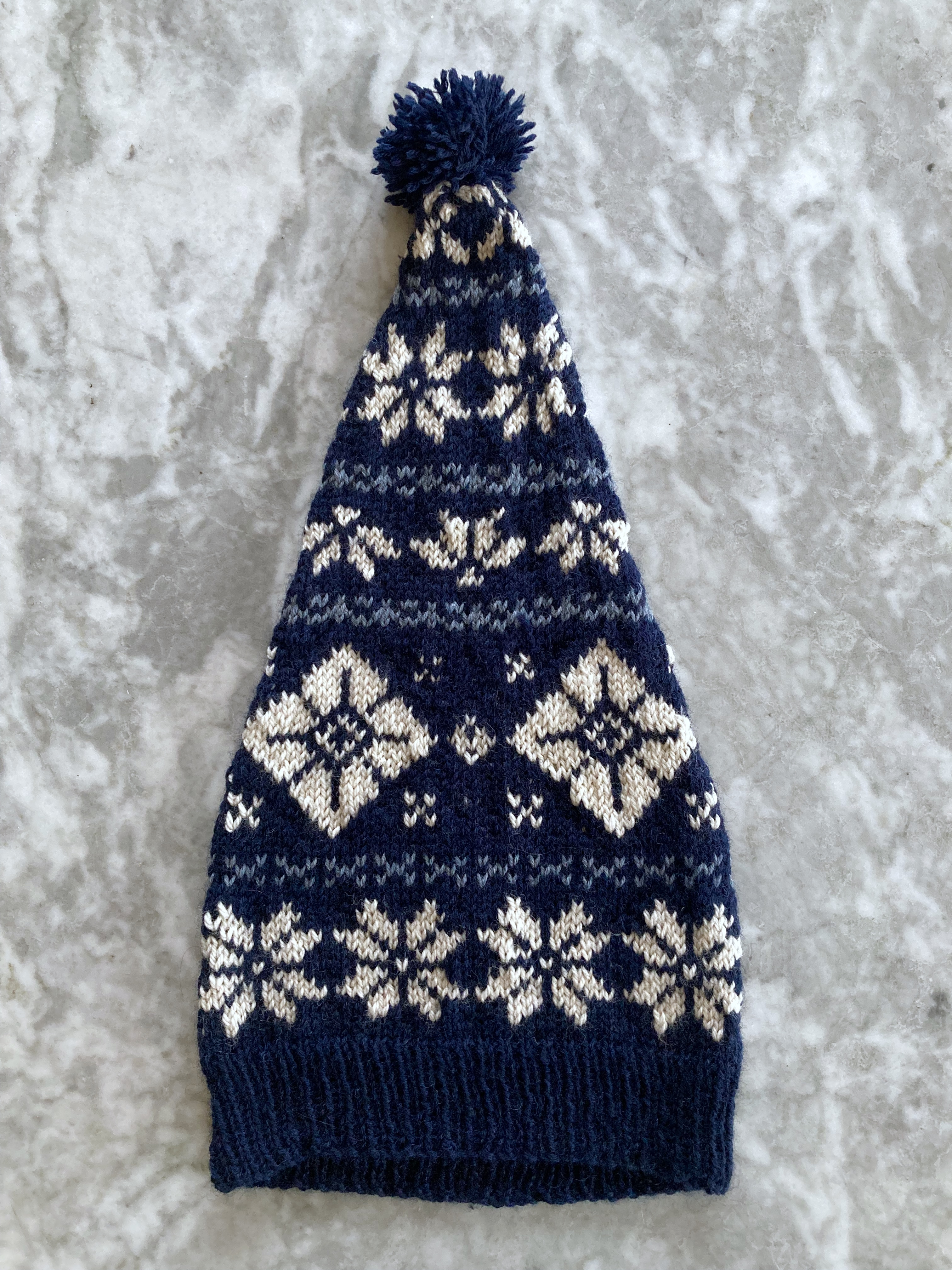
But first things first: It’s written for Patons DK yarn, 100% wool, in white with “Lipstick Red” pattern. I have a good stash of leftover DK wool from other projects and decided on a dark blue background (Schachenmayr Regia 6-ply sock wool) with the pattern in white (Wolle Rödel Soft Merino) and blue-grey (Lana Grossa Cool Wool Big Mélange) to really bring out the snowflakes. The written pattern gives no row gauge and assumes a tension of 6.5 stitches to the inch over the stranded pattern on No. 10 (3.25 mm) needles for the mittens, and 6 stitches to the inch on No. 8 (4 mm) needles for the hat.
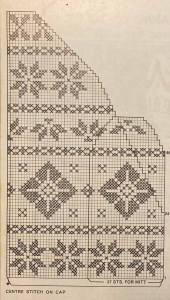
6 and especially 6.5 stitches to the inch is quite tight for DK wool, but I did my best on 3.5 needles (I don’t have 3.25 needles — the pattern is written for old UK sizes) and started with the hat. I noticed it was meant to be knitted flat and seamed up the back, but no worries, I could just make it in the round. There was even a chart (not a given with vintage patterns), so everything seemed fine.
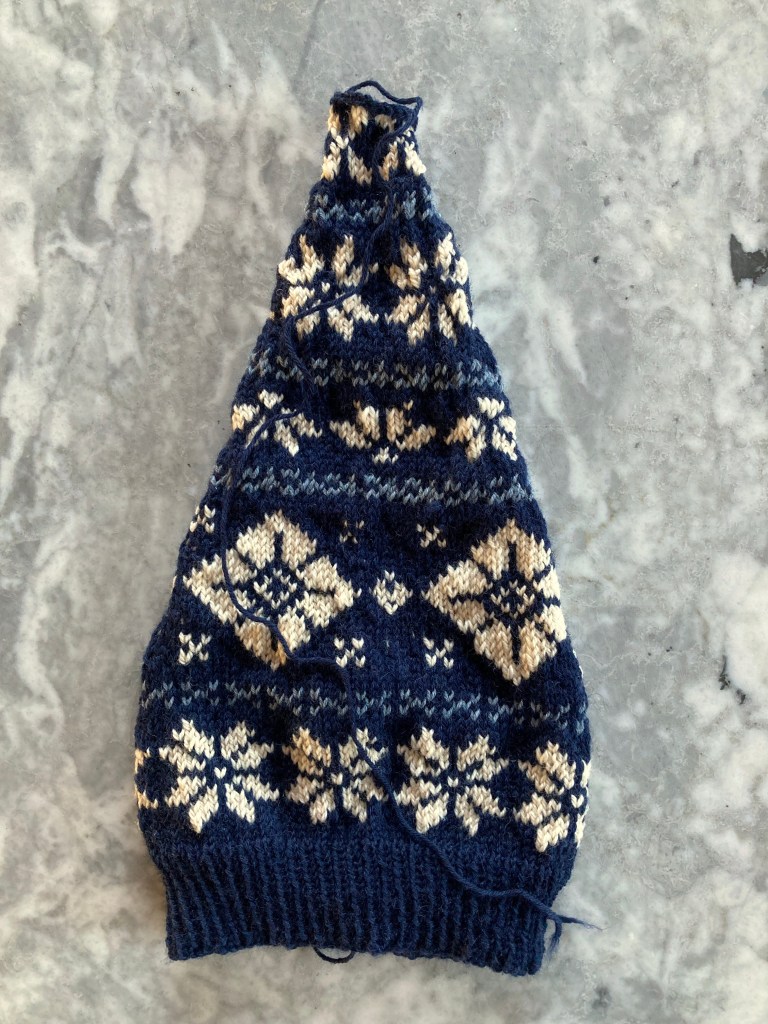
Well — after the first snowflake, it was clear that this hat would not fit any adult head, even that of the friend it was intended for, whose head is quite small. Knitting stranded DK that tightly just made it impossible to stretch, as well. Looking back at the photo, I noticed that the finished hat is just sort of perched on the of the model’s head, not pulled down over her forehead like one would normally wear a hat…! Yeah, 6 stitches to the inch is too tight. So I started over with 4 mm needles for the pattern and 3.5 mm for the ribbing.
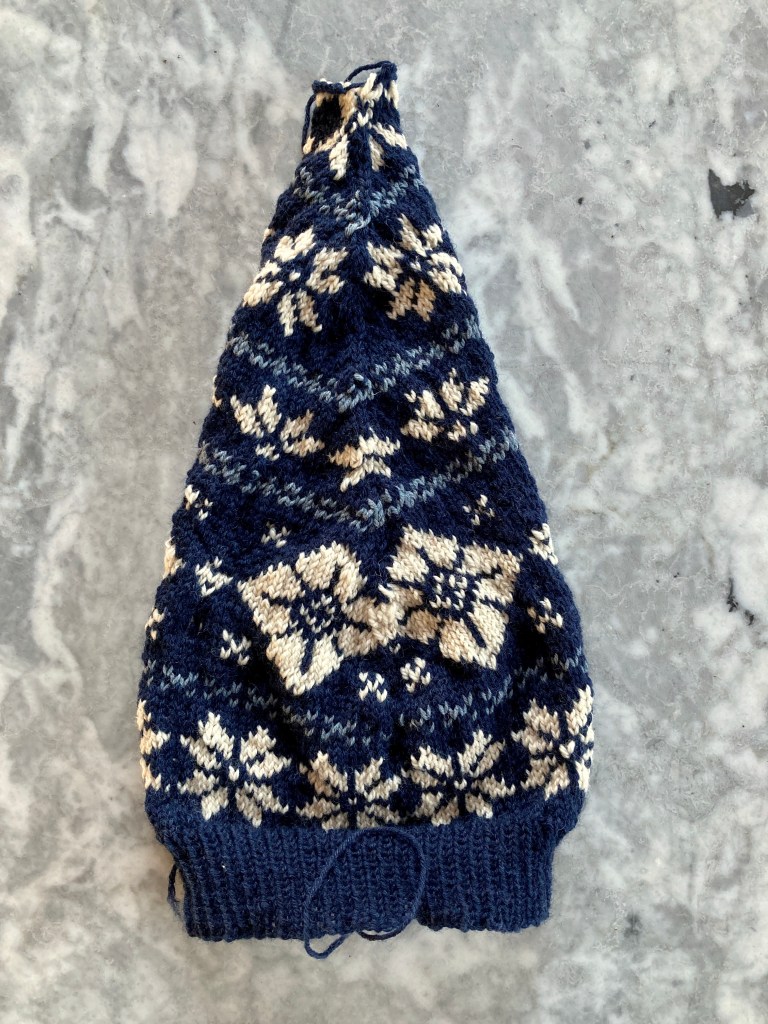
That solved the first problem, but as soon as the large diamond pattern started, I noticed how badly designed the colourwork pattern was. There were huge gaps between colour changes, necessitating weaving-in the wool constantly, and even then, the white wool showed in the gaps. I can’t imagine how this would have worked with stranding bright red behind white! Even worse, the pattern doesn’t match up in any way at the “seam” / round change. The large diamonds just get swallowed into each other like in of all those Netflix opening credits that use mirror effects. I was able to finesse it on the smaller snowflake and the repeat of the medium-size snowflake at the top of the hat, and the back “seam” does get covered by the long upper part of the hat when it fold over, but still, it looks messy.
Starting on the mittens, it became obvious why the hat pattern was so badly designed: The mitten pattern is perfectly centered and balanced and looks fine. There’s no problem with patterns bleeding into each other because the decreases only happen at the top of the fingers, and no big problem with weaving in across the back, because the back-of-the-hand and palm pieces are knitted flat and separately and there is no patterning on the palm, so the pattern motifs are made in sort of stranded intarsia. It seems the designer designed a pattern for mittens and, when instructed to make a matching hat, just extended the pattern out to hat size without much though about pattern placement or correct sizing.
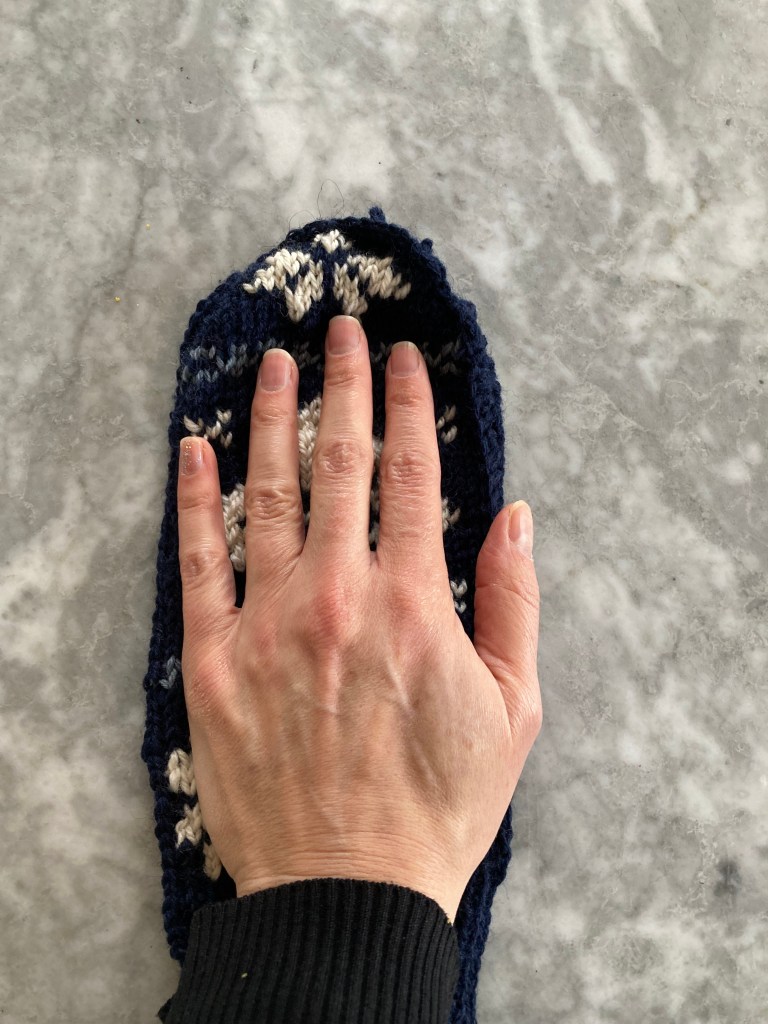
Speaking of sizing, though… The finished mittens were way too long! I have size 8 hands and really long fingers, but even they look stubby on this photo, simply because the mitten length is out of all proportion. Looking at the magazine photo again, I think they are too long for the model’s hands as well. Yes, I should have checked it as I went along, but of course I didn’t, so I only noticed the problem after all the pieces were made and seamed together. (Using a crochet seam as directed in the pattern.) I thought I could block them shorter… Erreur fatal! Blocking not only made no difference in the size, it cemented that crocheted seam so solidly that it was not possible to undo it in order to frog and re-knit the mitten tops in a better size. By the time I was finished “undoing” the first mitten seam, the whole mitten looked like it had been mangled by a dog.
I will give the hat to my friend as intended, as it turned out OK and the weaving-in blotches mostly disappeared after blocking. It does look cute, especially with a pompom on the tip. As for the mittens, I consigned them to the upcycling drawer, as I just didn’t want to deal with them any more.
This project was no fun to knit, but I will call it a learning experience and move on. And I do think my friend will like the hat, at least.
Since the June 1964 issue of Stitchcraft didn’t have any projects that I really wanted to make, I thought I would share another non-Stitchcraft, non-1960s “blast from the past” project that I recently completed.
A little back story: for the last couple of years, one of the wonderful mods from the “All Things Vintage” group on Ravelry has been transcribing serial stories from 1920s newspapers and posting them, one chapter a day. She supplements them with posts of photos or postcards from the era, as well as clippings from the same newspapers with advertisements, fashion advice, and all kinds of details that give context to the stories. The stories themselves are often quite hare-brained in terms of plot (the authors had to keep readers interested through 100+ chapters, so cliffhangers and ridiculous plot twists abound) but thoroughly entertaining, and give a lot of insight into social mores and lifestyles of the time.
As you might expect, we (the group’s members) enjoy these stories immensely and add to the entertainment by guessing the outcome or the next plot twist, making insightful or humorous comments on the characters and action, or adding our own spin-off ideas to the story (one member even re-wrote a chapter in the style of a post from the popular moral-advice-seeking “AITA” subreddit.) Out of all this fun, the idea was born to have a Knit-Along / Crochet-Along relating to the current story, where participants could make an item of clothing that one of the characters might have worn, and explain how the item would fit that character’s personality.
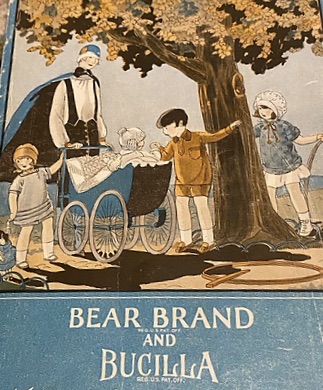
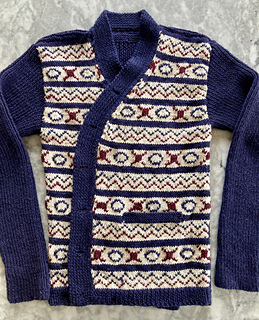
For my part, I love the stories but don’t usually knit items from the 1920s — unshaped, flowing upper-body garments make me look like I am wearing a sack. I do like the Fair Isle patterns which were enjoying a renaissance at the time, so looked for some of those, thinking I might make a slipover/vest/waistcoat for myself. Then a fellow All Things Vintage member helped me find the pattern shown above, which I knew would perfectly suit a friend of mine who is a huge 1920s fashion aficionado. Isn’t it dashing?
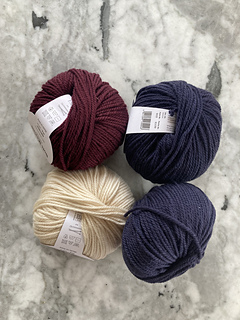
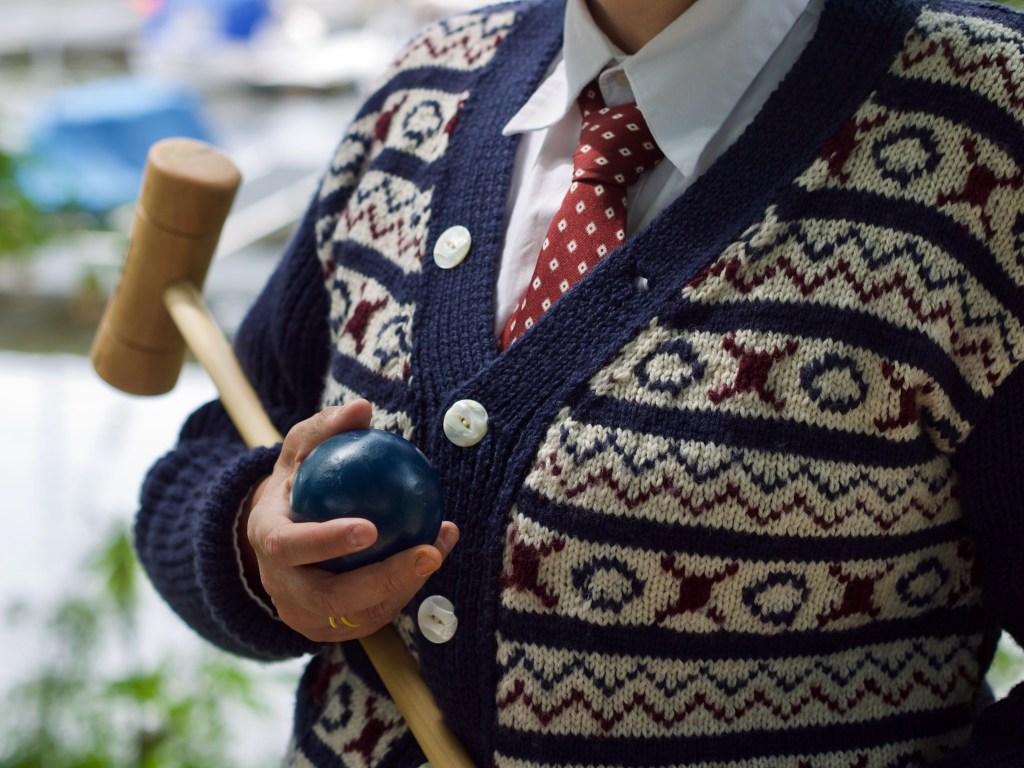
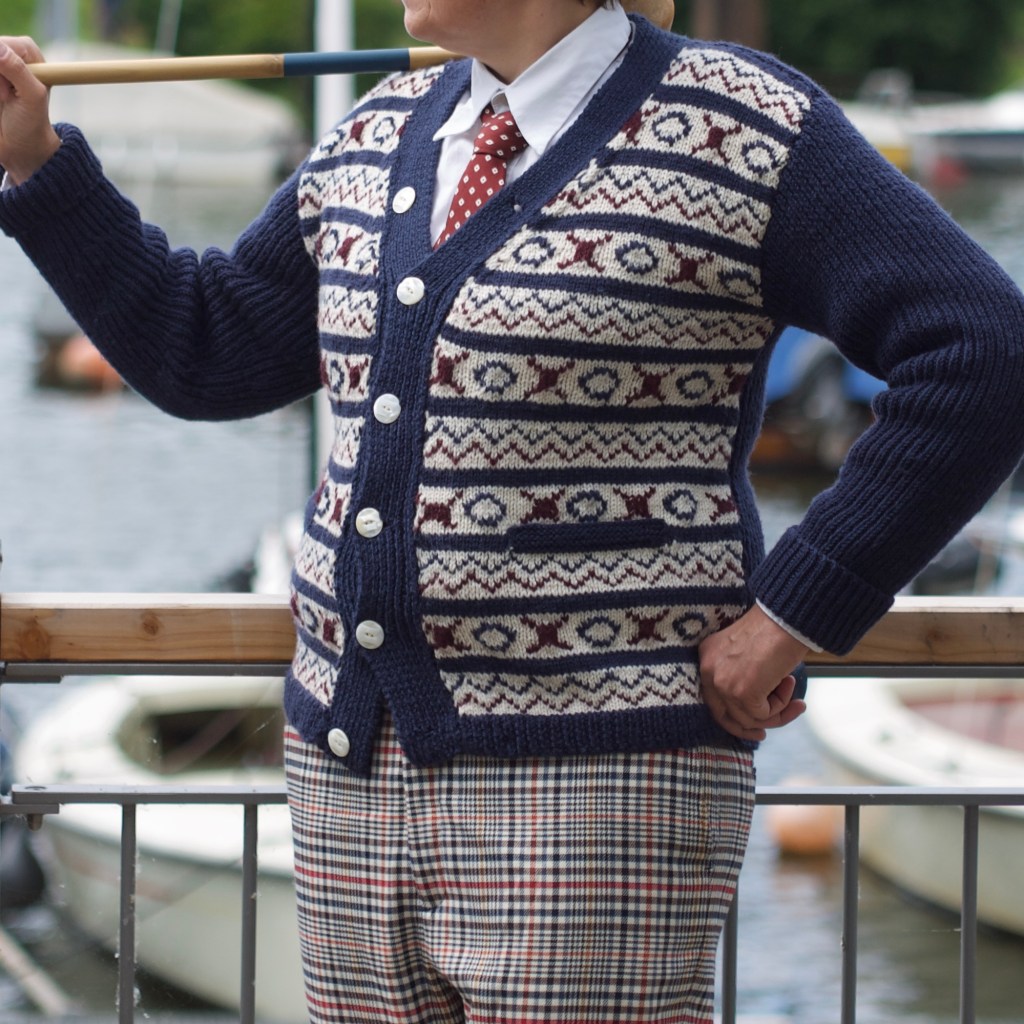
The pattern, from 1923, is written for Bear Brand Bucilla wool in stripes of fawn and brown, with additional contrast motifs in “Henna”. My friend did not want a beige and brown cardigan but did want a period-appropriate colour scheme, so we settled on navy blue and white with burgundy-red contrast, a popular “sport” combination of the time. My yarn was “Soft Merino” by Wolle Rödel, a very normal, easy-to-knit-and-care-for DK 100% wool.
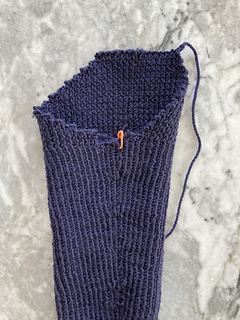
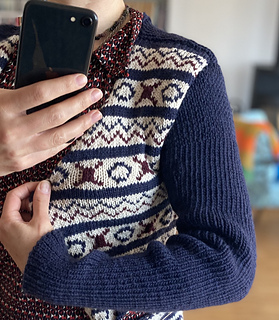
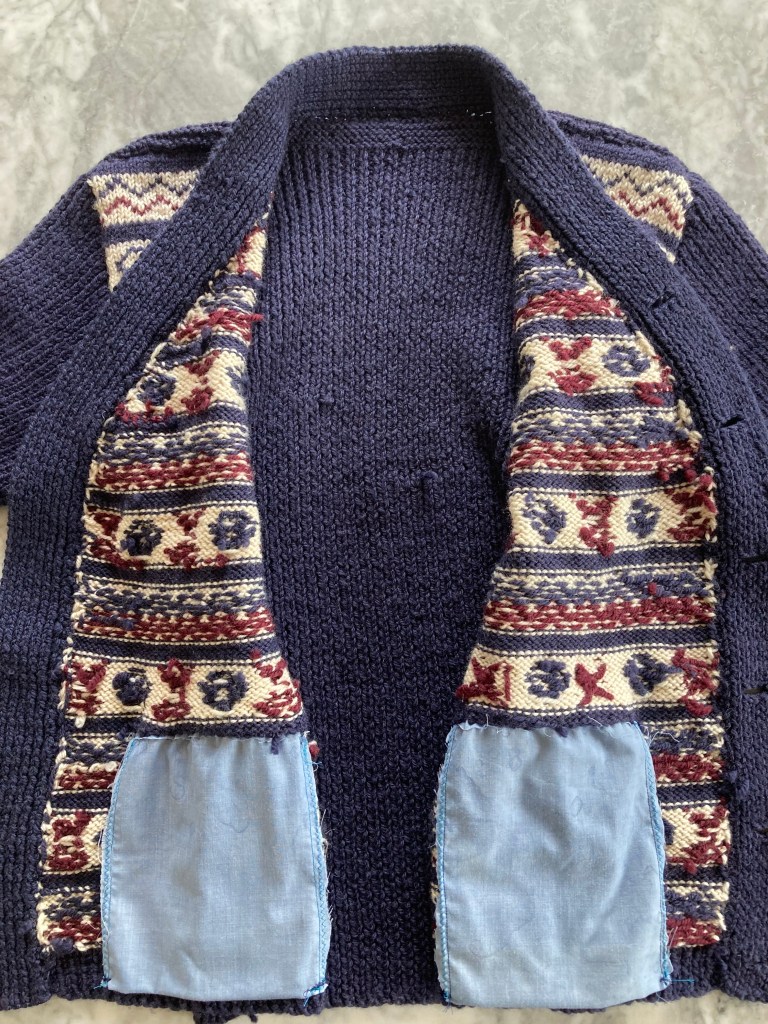
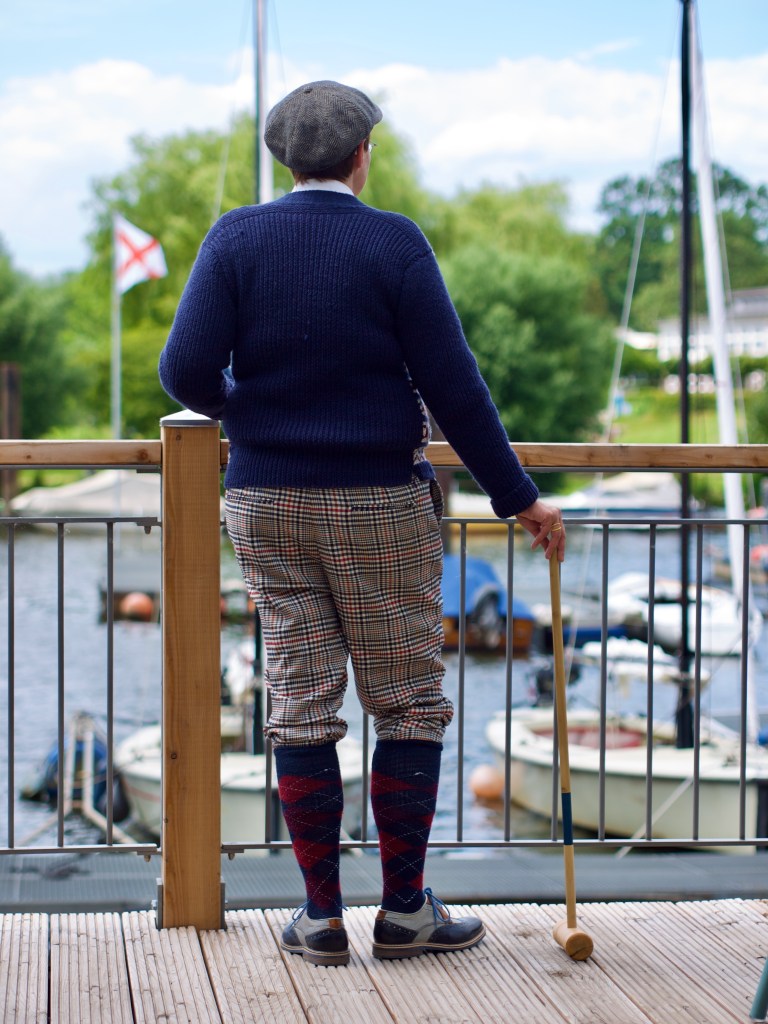
The pattern was full of surprises, starting with the back, which is knit entirely in single-colour 1×1 ribbing. It is consequently very narrow, much more so than the wearer’s back, but stretches with movement. I was convinced it would make the cardigan too tight, or make the bands gap too much in the front, but the ribbing has enough “give” that it works out perfectly with the flat-knit Fair Isle fronts. The overall effect is sleek and slim-fitting, but allows for plenty of easy movement — I can see why it was intended to be worn for playing golf or other sports with lots of upper-body movement.
Speaking of those Fair Isle fronts, though… a closer read-through of the pattern revealed that they are not supposed to be knit in stranded Fair Isle technique. You are supposed to knit them in plain stripes and them embroider the motifs on later using Swiss darning aka duplicate stitch! I was truly flabbergasted to see that, as I had assumed the 1920s interest in stranded knitting designs extended to stranded knitting technique. Not so — in fact, as I learned, many other “Fair Isle” designs of the time were also produced via duplicate stitch embroidery.
I like embroidery on knitwear in moderation, but all the motifs on both fronts of the entire jacket was too much for my liking. I experimented with different techniques on the first couple of stripes — should I strand all three strands across the whole row (bulky and the dark colours show through the white background)? Not strand at all, but make each motif in intarsia using separate short lengths of wool (so many ends to weave in)? Strand the colour for one set of motifs across the row and embroider the other (worst of both worlds?) Interestingly, making all the motifs in intarsia technique and weaving in the ends turned out to be the least amount of effort, so that was my choice.
The sleeve cap construction was fascinating. Because the back is done entirely in ribbing and the front in flat colourwork, the front and back pieces have a naturally different shape above the armhole even though the bind-offs and decreases are symmetrical. The sleeve cap accounts for this by casting off three stitches every other row on the front-facing sleeve side and one on the back sleeve side. That made a very lopsided sleeve cap which fit perfectly into the lopsided armhole. Wow. I would never have thought of designing a sleeve cap like that, but it makes perfect sense and produces a very neat, squared-off shoulder.
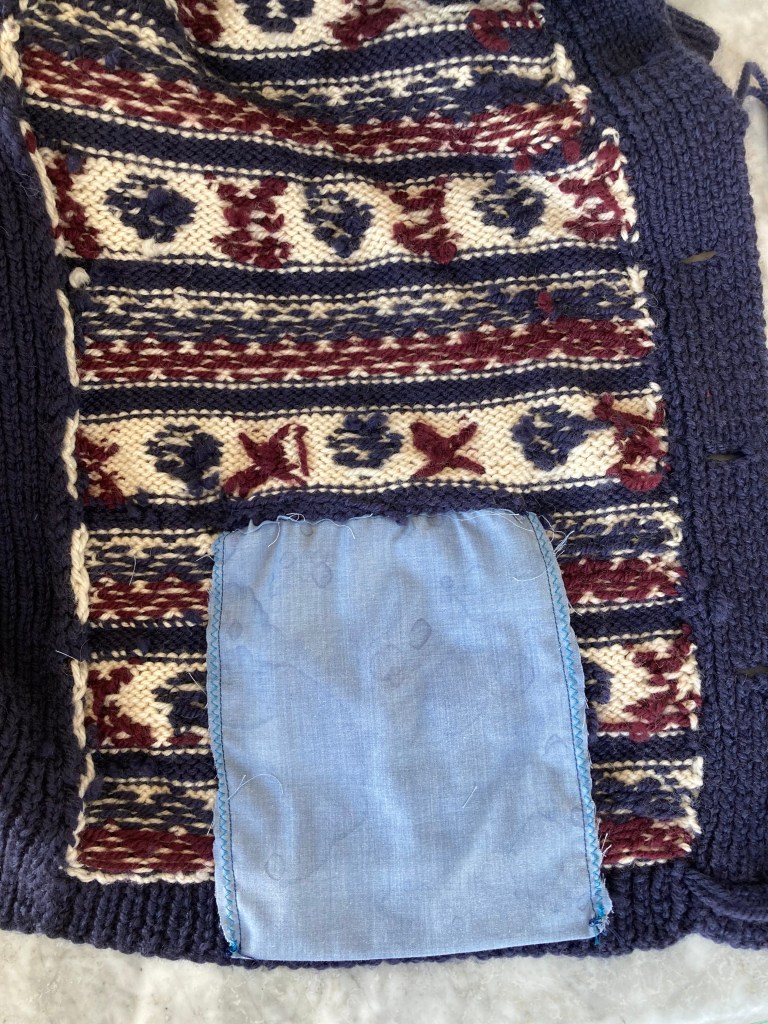
For a final surprise, the pockets are not knitted, as I am familiar with from 1950s and 1960s pocketed garments, but made of “some strong fabric” and sewn in. Thinking along with the sportswear theme, that makes sense if you are going to put a heavy golf ball in your pocket — a knitted pocket would sag under the weight, but the woven fabric (I used a bit of cotton-poly ex-pillowcase from the upcycling drawer) keeps its shape nicely. The pockets were made extra large by request and it was surprisingly difficult to sew them in place, but they turned out fine.
And that was that! The story, by the way, was “The Involuntary Vamp” by Mildred K. Barbour, published in 1921 in the Washington Herald, and concerns itself with the adventures of young Diana Langley, who was “cursed” by her aunt Marjorie with the “gift” of “lure” — all the men are after her, but the only one she really wants (Stephen Dale, an older friend of the family) cannot marry her, as insanity runs in his family. So she marries another man out of spite, jumps off her honeymoon train in the southwestern U.S. desert with a different man, gets semi-kidnapped by yet another man, gets away and finds sanctuary with yet another man (and his sister) who we later find out is responsible for the whole hereditary insanity situation… or non-situation, as it turns out (did I mention that the plots of these stories are often ridiculous, but thoroughly entertaining?) and then has more adventures before being united with Stephen Dale, who is actually quite mentally healthy and was in love with her the whole time. Diana’s first-husband-out-of-spite has meanwhile conveniently died, leaving the happy couple free to marry!
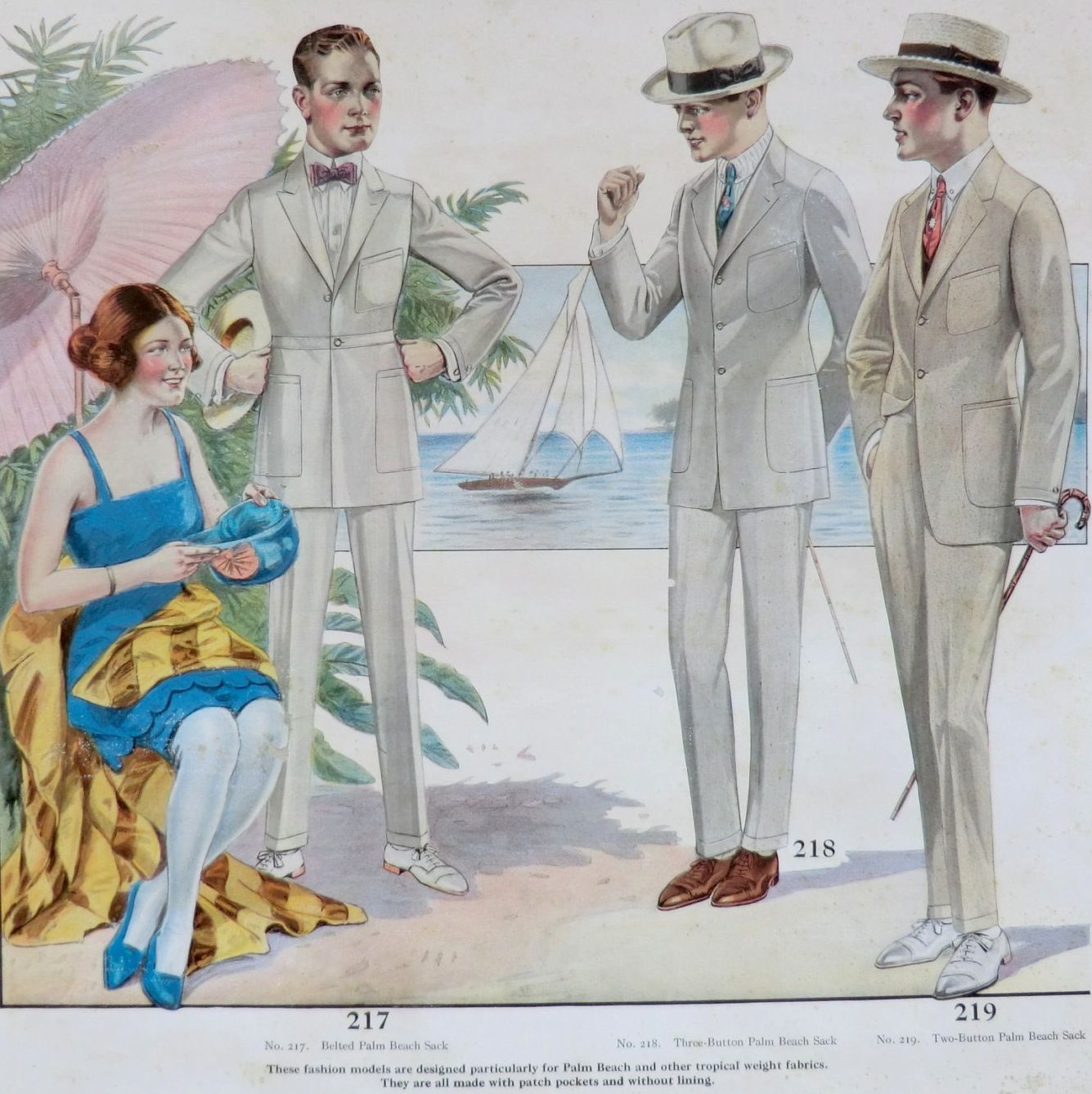
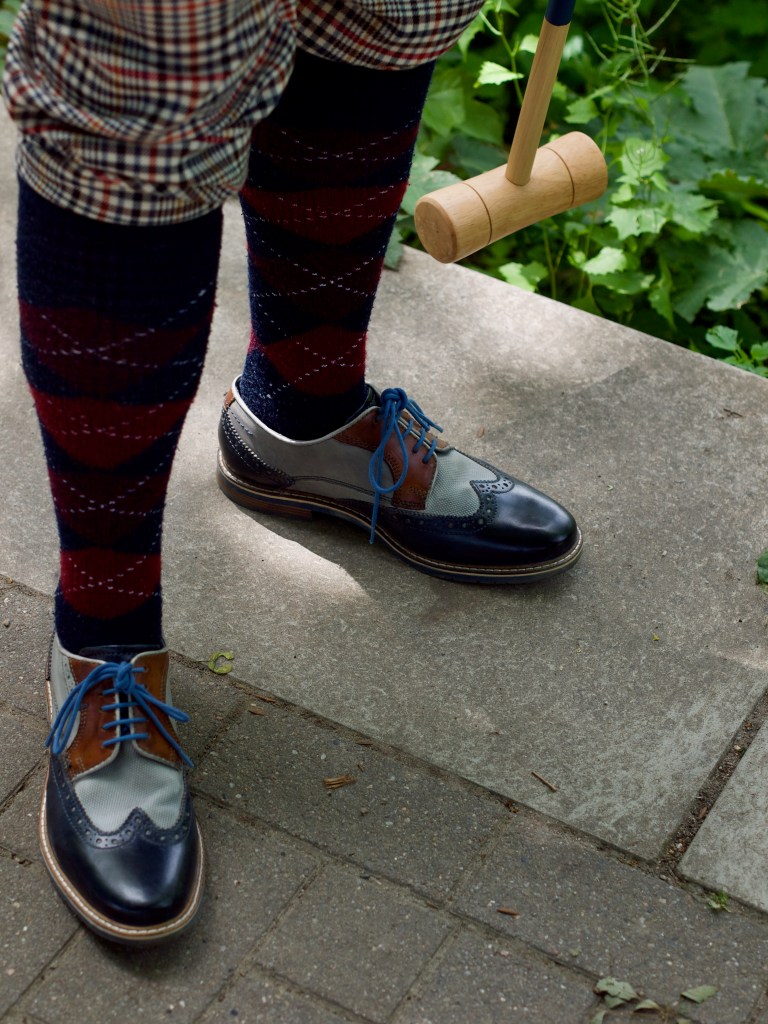
The Stephen Dale in the story is quite rich (of course), has a yacht and participates in all the usual 1920s upper-class sports, so here is my “Stephen Dale” wearing his all-purpose sport cardigan to play a round of croquet on a lovely leisurely Sunday afternoon:
There are such nice details in the cardigan, from the turned-up ribbed sleeves to the neat pocket flaps. The buttons are real mother-of-pearl, vintage buttons from the 1920s.
And with that, they boated off into the tropical sunset! May all your adventures have such a happy ending.
“Knitting Time starts with a Sparkle” is Stitchcraft’s motto for the September 1963 issue, and the editress’ note assures us that “this is going to be a particularly interesting Autumn-Winter knitting season.” What does that mean for us? Lots of interesting use of bolder colours in traditional or not-so-traditional stranded and geometric patterns as well as subtler use of colour variation in tweeds and toning changes.
1963 was the year when variegated yarns, so beloved by modern knitters, first came into fashion (hence the “sparkle”), and although Patons doesn’t yet offer a truly colour-variegated yarn, here’s one from the competition: Bernat Klein No. 1, as featured in this stunning eight-page advertisement in Vogue Knitting Book No. 62 from 1963:
(The Lux and Opti-lon ads should look familiar to Stitchcraft enthusiasts as well.)
The tweedy look starts with the three-piece suit from the cover photo, consisting of a skirt, long-sleeved jumper and high-buttoning cardigan with stripe accents to bring out the lighter blue tweed flecks. Apropos “fleck”, that’s the name of the yarn: Totem Fleck. The jumper is made in the lighter, solid blue color with ribbing accents in the tweed shade. It seems to be a “switch-around” ensemble, i.e. you are not intended to wear the cardigan over the jumper as you would with a twin-set. Bracken Tweed, the somewhat bulkier tweed wool of the season (Totem Fleck is DK and Bracken is more like Aran-weight at 18 sts to the inch), is featured in this blazer “for young men who like comfortable clothes”. You know, the kind of clothes you can play ball sports in: a button-up shirt with tie, short wool trousers and a hand-knitted tweed blazer. Of course.
The other adult or teen garments feature bolder colours and interesting stranded or textured designs, like this intriguing dolman sweater with the stranded stripe running horizontally across the yoke and down the sleeves. I feel like this use of colour would look terrible on me (wide chest and long arms), but I love the idea! The man’s sweater uses a more traditional placement of the colour bands, but in contrasting green and orange tones and a spiky geometric diamond design (continuing the trend from summer 1963). The sweaters on the inside back cover have a more muted colour palette and subtle diamond texture pattern. Textured patterns make a showing in the other women’s garments as well: a bobbled raglan pullover, mock-cable cardigan and nubbly “Rimple” jumper. I want those glasses! The diamond-shape trend shows itself here in more subtle form via V-neck openings and pointy collars.
This issue also starts a new layette set for the youngest members of the family, starting with a warm dress, hat and bootees. Next month’s issue promises a matching matinee coat and cosy “helmet” cap. The caption for the modelled photo reads, “Jonathan is just 2 months” and reminds us that babies of both sexes wore lacy dresses with both pink and blue embroidery on them. 1963 was definitely a more sexist era, but also a more practical one in some ways.
There’s an interesting selection of Autumn-themed homewares as well, like a leafy fender-stool and chair-seat set, some blackwork finger-plates for the door (reminding me that I still have not finished my blackwork butterfly cushion from April…) a cushion and runner with Chinese motifs (I cannot vouch for any kind of authenticity — the motifs look very similar to the traditional European “Jacobean” designs to me, but what do I know), a pair of crochet-appliqué trolley cloths and a crochet-motif cushion.
And then there’s this “practical idea” — cover an old box (they used a wooden margarine box of about 16×12 inches and 8 inches deep, which sounds like a lot of margarine ha ha) with embroidered Binca canvas, cushion the lid with foam rubber under the embroidery and strengthen it with a piece of wood on the under-side and voilà: a “magazine tidy” which can also be used as a little stool to sit on. Very practical indeed and reduces clutter. I like it.
That’s all for this issue! I’ll be making the quick ! easy ! uses up leftovers ! crochet cushion. How quick and easy is it, you ask? I’ll tell you: it is so quick and easy that I started working on it last night, September 1st, and am already more than half finished: (Working on both halves of the cushion cover alternately so as to gauge how much wool I have of each colour.)
So there will definitely by a finished project in September, and hopefully this will give me some time to finish up the rest of the WIPs. I did also complete a retro-themed jumper of my own design which is not technically from Stitchcraft, but I’ll post about it anyway, because it was fun.



































 The Stitchcraft Sixties