This month‘s project was another modern adaptation of a 1960s homeware object. In this case, the original design was for a knitted „comfortable cushion” in a use-up-your-scraps striped slip-stitch pattern. I had plenty of scraps to use up and a request to make a little wrist cushion for someone who works a lot on the computer and had been padding their wrists with a folded scarf. The yarns I used were some more of the lovely Slow Wool Lino from Lana Grossa with bits of leftover sock wool for the contrast colours.
The original cushion measures 15×12 inches using a cast-on of 83 stitches of DK wool. I wanted a 14×4 inch cushion in fingering weight and calculated that out at 79 stitches in width. The stripes are made in slip 1, knit 3 pattern in alternating colours.
Everything worked out out fine on the first cushion piece. The width was perfect and three rows of stripes with 6 plain rows at beginning and end were a good height. The pattern was so very, very 1960s! Especially in the brown and brown and grayish brown and blue colour scheme (by request from the intended recipient.)
It was, in fact, a bit too authentically 1960s for the recipient, who requested a different pattern to use on the other side of the cushion. How about Space Invaders monsters? (i.e. hipster 80s retro instead of grandpa‘s 60s retro.) Space Invaders it was! I adjusted the number of blank rows on the Space Invaders piece, since the slip-stitch pattern pulls the knitting together even more than stranded work.
Then I made two more smaller squares in the same design, to make a pad for when the recipient might want to hold their wrists farther apart. All of the pieces curl a lot, as you would expect from stranded and/or slip-stitch patterns worked flat, but when I uncurled them, they seemed to be just the right size.
I wash-blocked the pieces, which flattened out both patterns admirably, and realised that I had made the Space Invaders piece too narrow. Not wanting to knit it again, I made two little strips to sew onto the sides — not elegant, but it fit.
I sewed up three sides and tacked 2 layers of quilt wadding to each of the insides, then turned around and sewed up the fourth side.
It’s… OK, I guess? The slip-stitch side definitely looks like a brown-on-brown 1960s home-made pillow, so you could call it authentic. But it’s not really one of my more interesting or beautiful projects. It should be useful, at least.
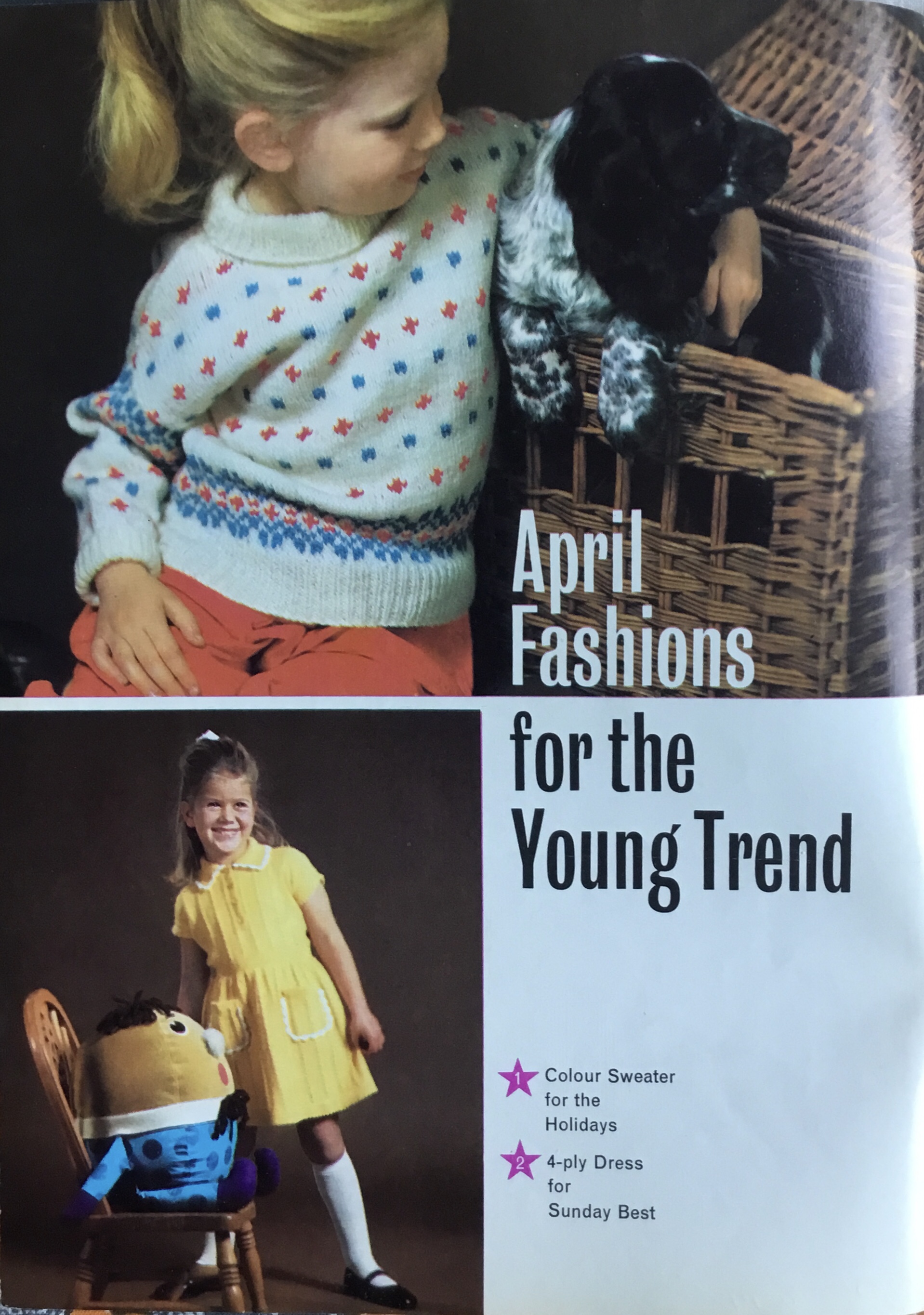
Like March April weather, Stitchcraft‘s „Spring Lineup“ from March April 1964 has a little bit of everything to offer. (No, that was not an April Fool’s joke — I have apparently lost track of time. Thank you Gretchen for noticing!!) There are warmer garments to wear on a spring ramble or for summer sailing, knitted cardigan jackets to take the place of outerwear, some slightly dressier separates for a going-out ensemble, and easy homewares that can be packed and taken along on your coming holiday.
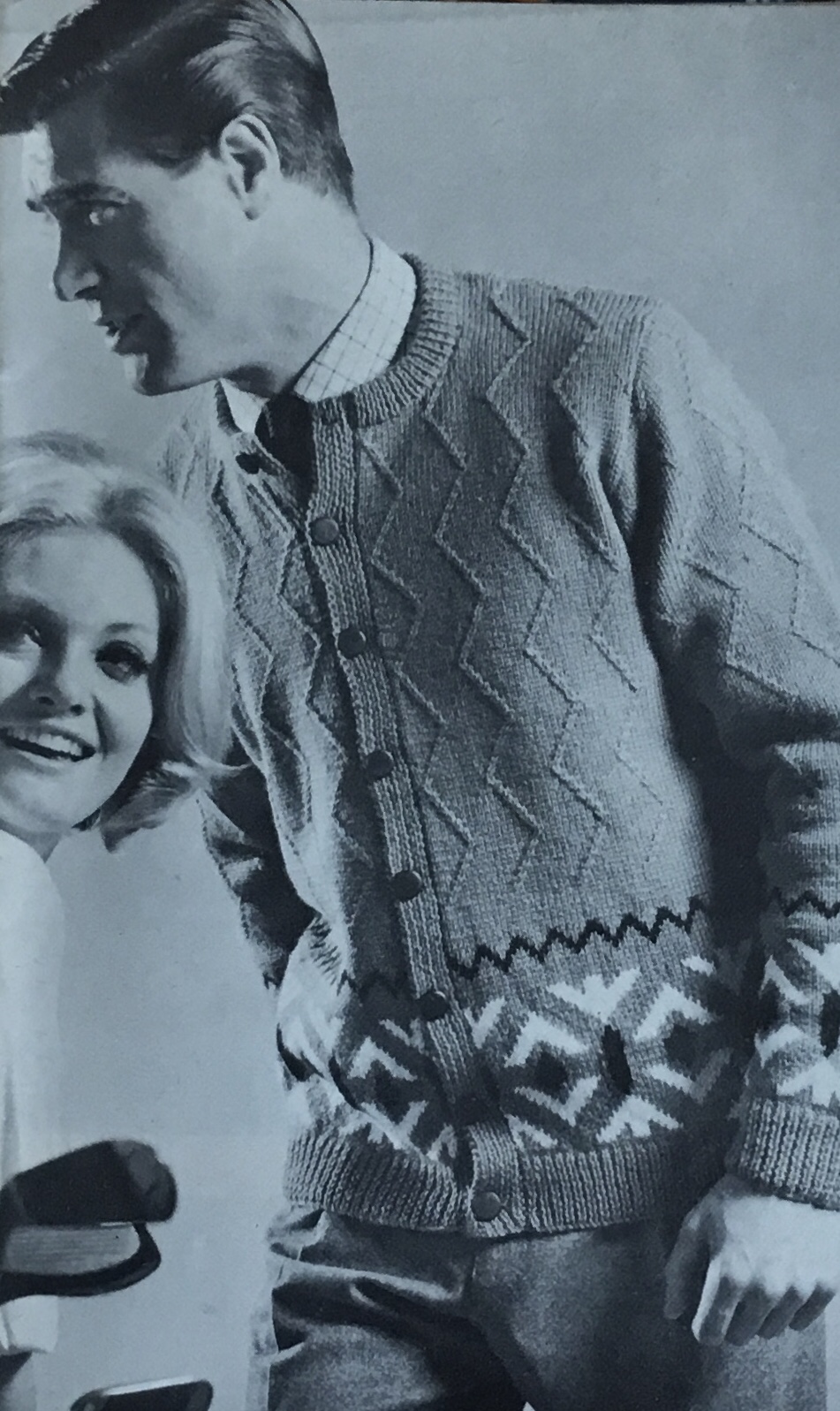
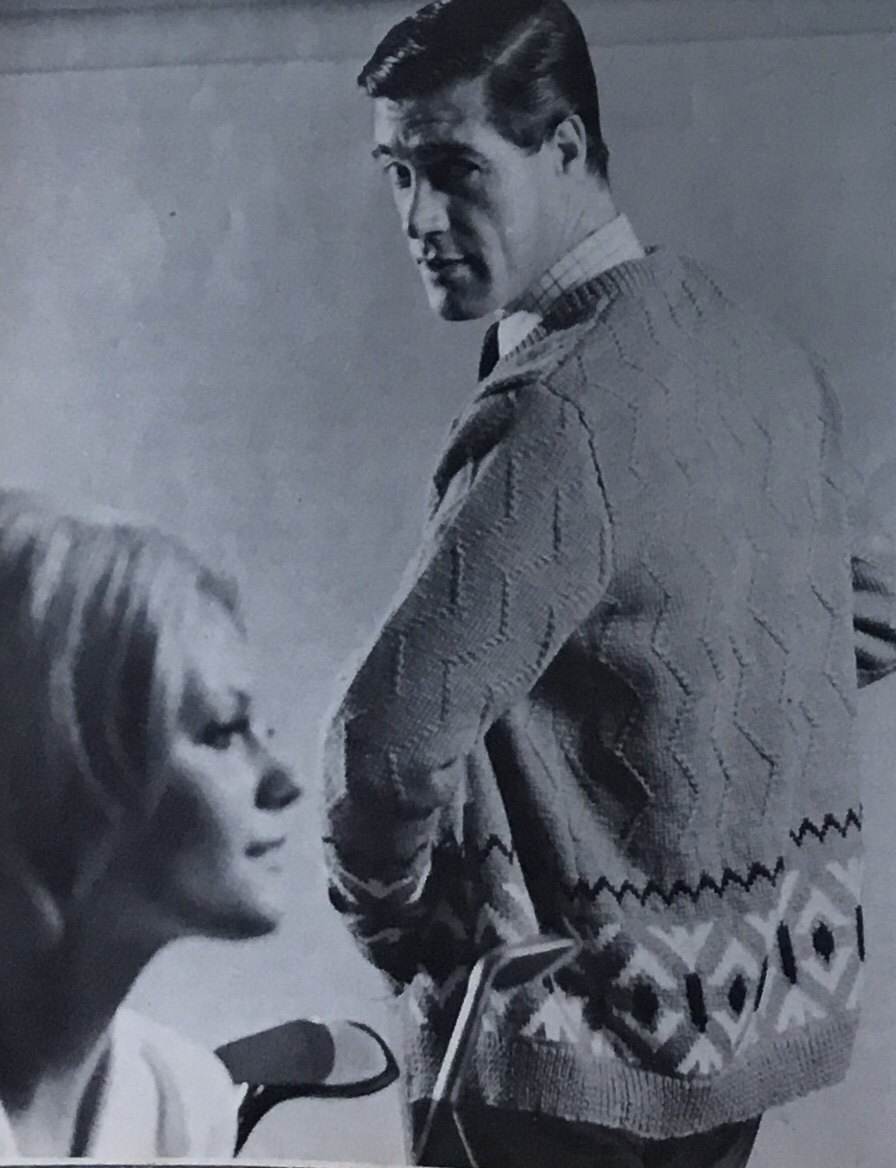
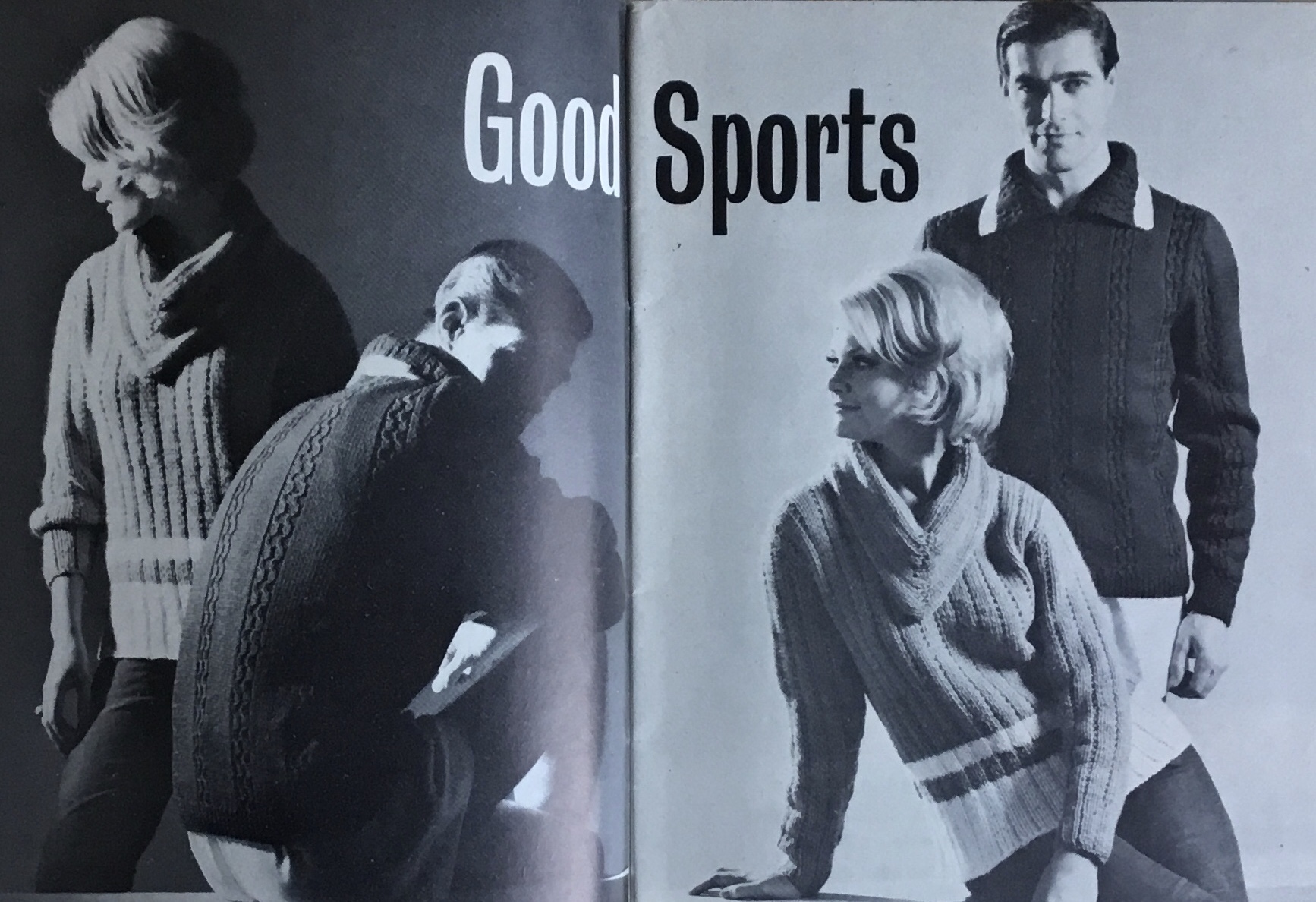
Our cover model is wearing a knitted jacket whose texture almost gives the appearance of being woven, thanks to a very firm three-colour slip-stitch pattern made by moving the working wool back and forth and so „wrapping“ the slipped stitches on each row. It‘s made in Totem Double Crepe and is intended to be worn as outerwear — as well as being „ideal for the car.“ Men get an outerwear-cardigan as well, this time with a combined texture and colour pattern and classic shape, and anyone can wear these casual, loose-fitting „sports sweaters“ while sailing or otherwise out in cooler maritime weather.
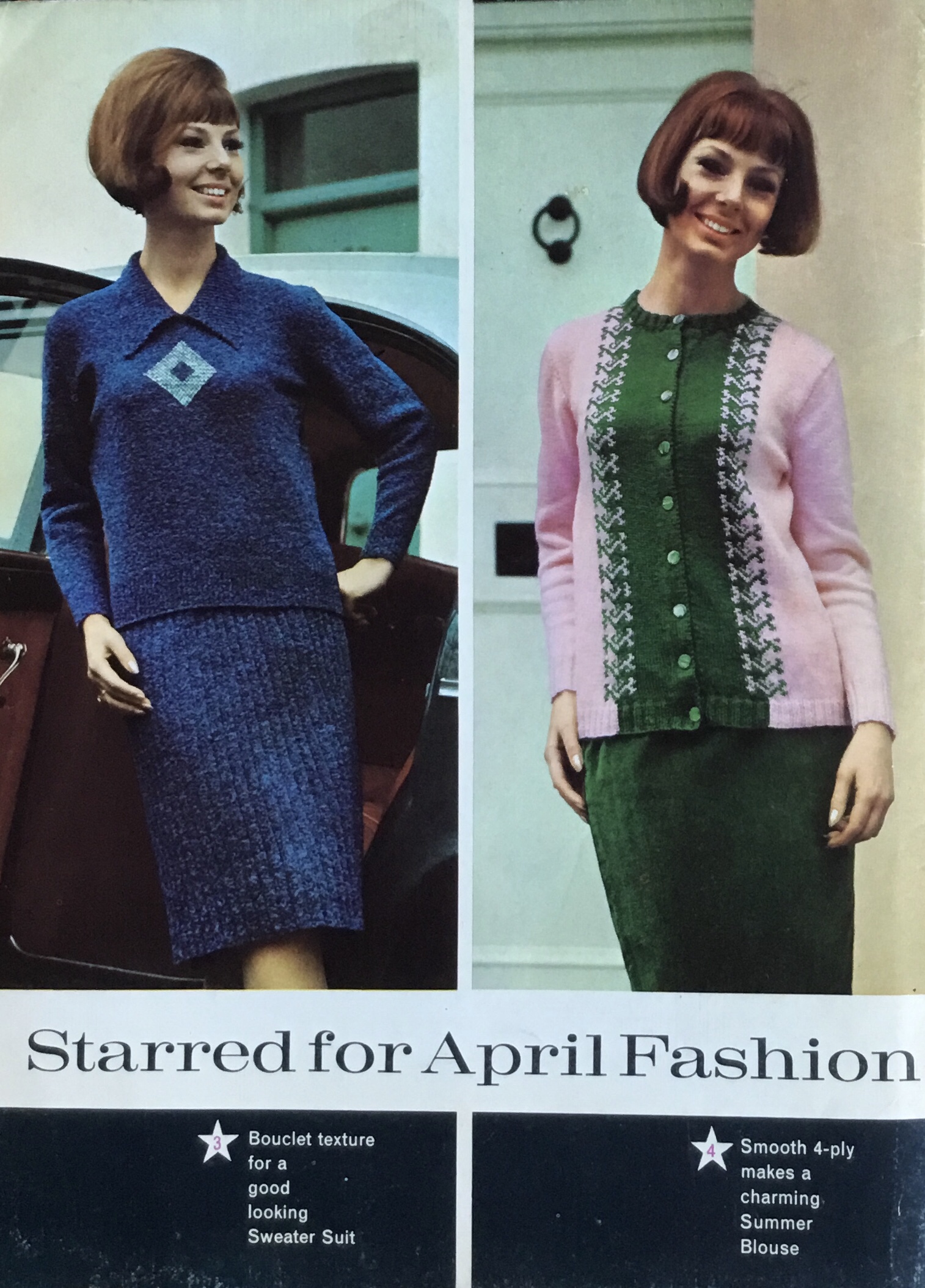
For more dressier occasions, there‘s a two-colour fancy cardigan in 4-ply fingering weight, or a jumper with matching pleated skirt in 4-ply bouclet. You can also make an „overblouse“ in double knitting to wear over a short-sleeved, lightweight jumper in a new twist on the twin-set theme. Zig-zag patterns, whether worked in colour or texture, and large collars continue to be popular.
In the „Junior Knitting Fashions“ department, there‘s both a warm Scandinavian-style sweater in a typical snowflake pattern, or a wonderful „Sunday best“ dress.
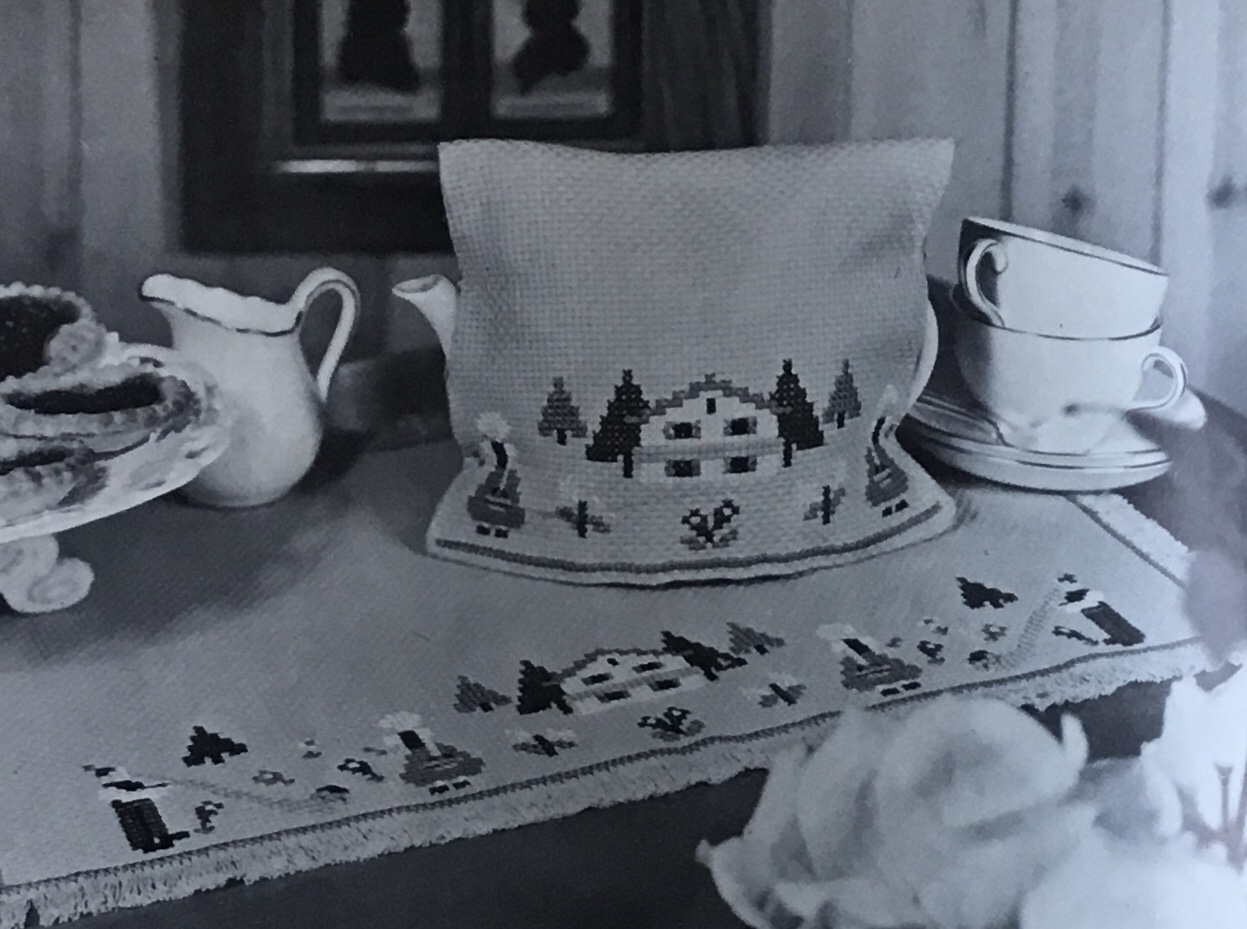
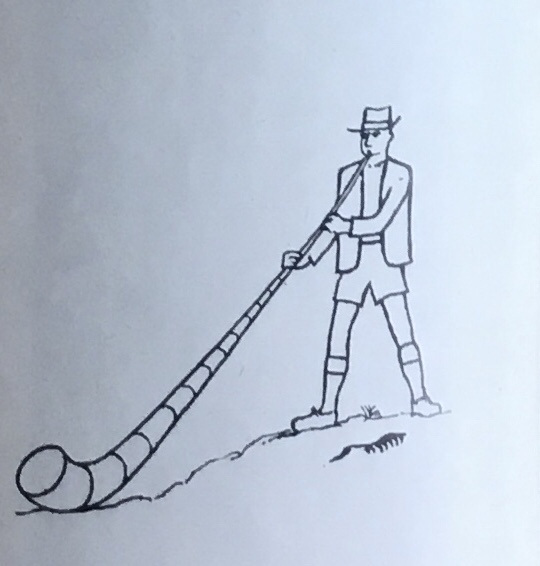
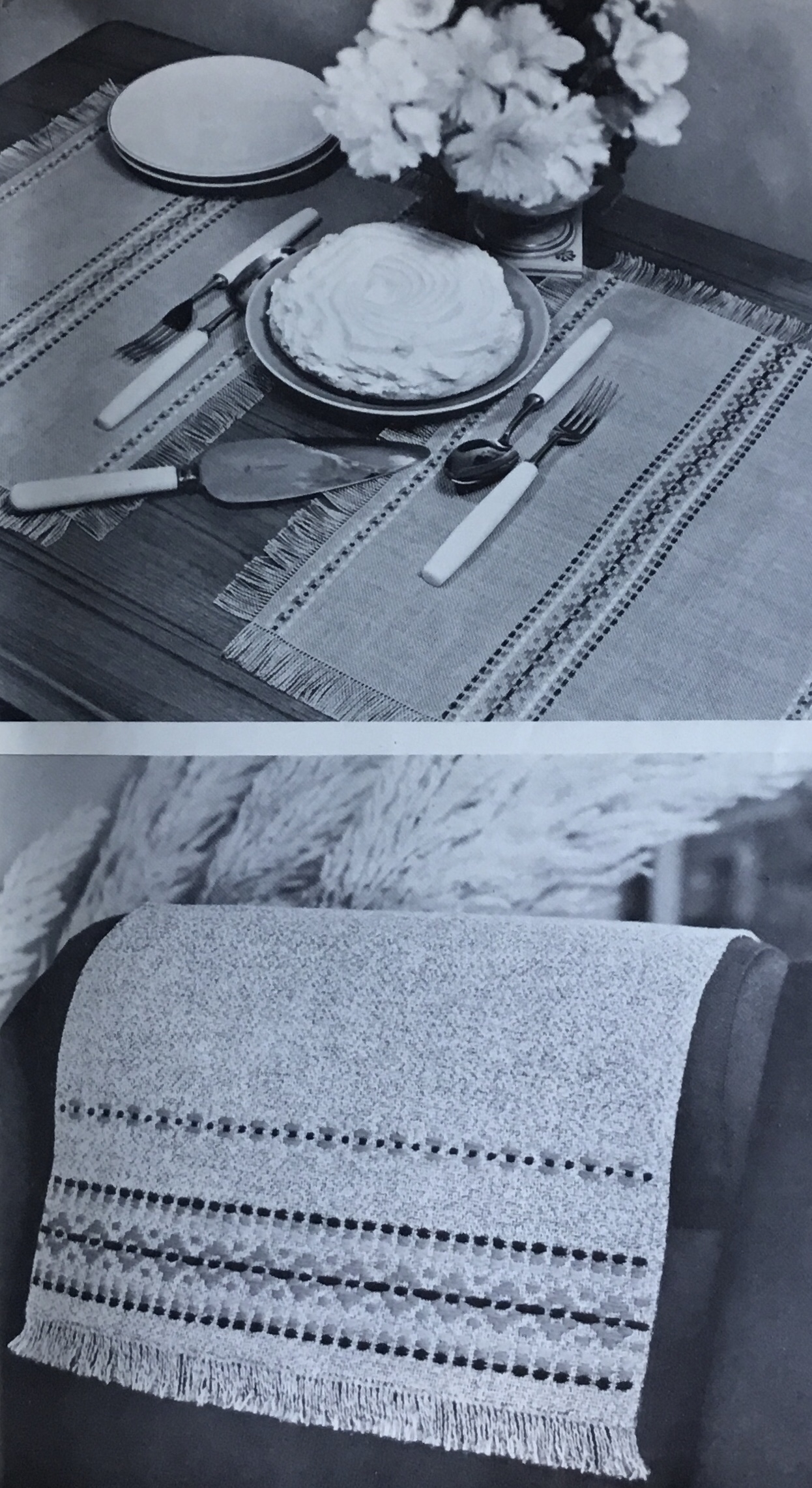
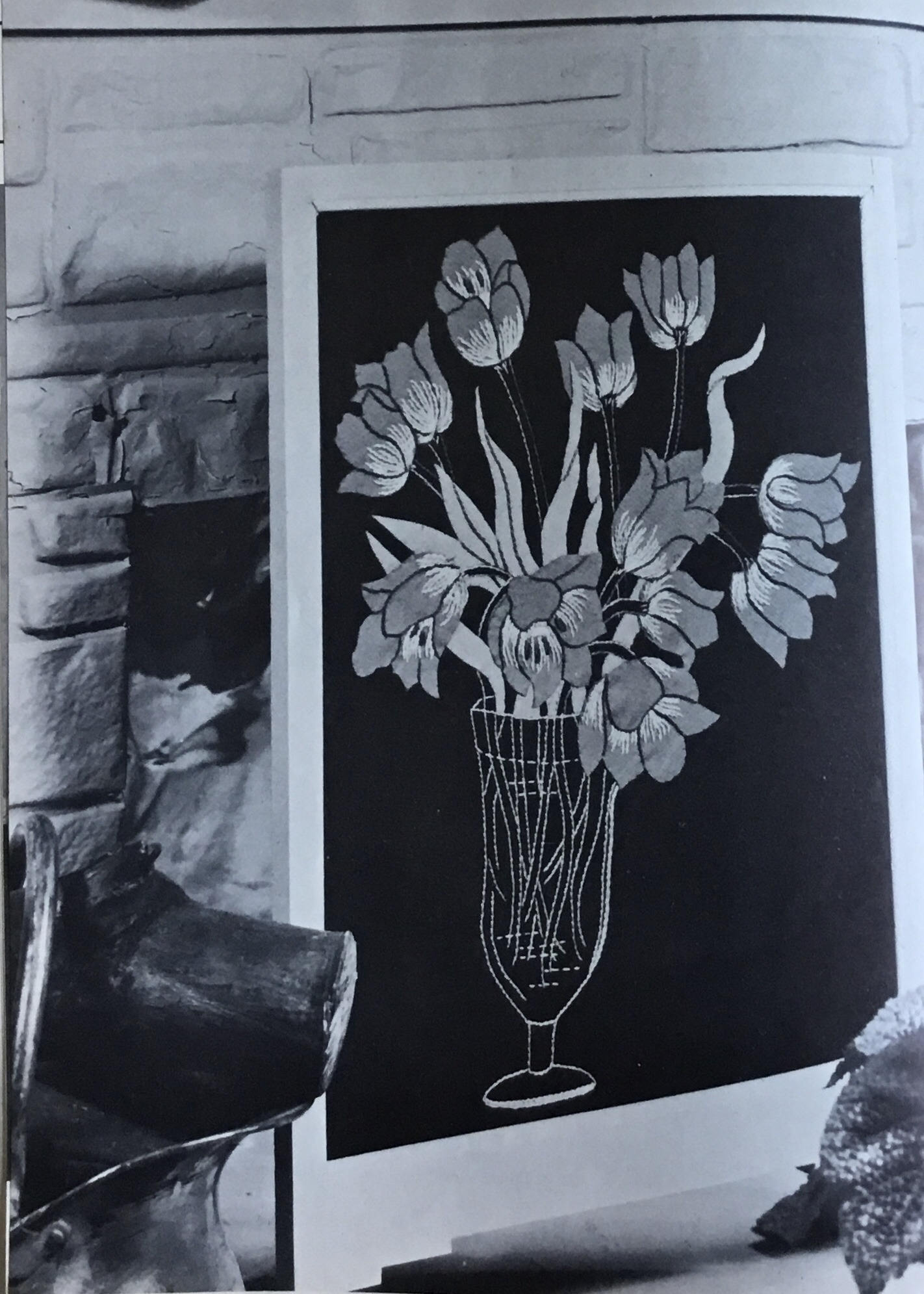
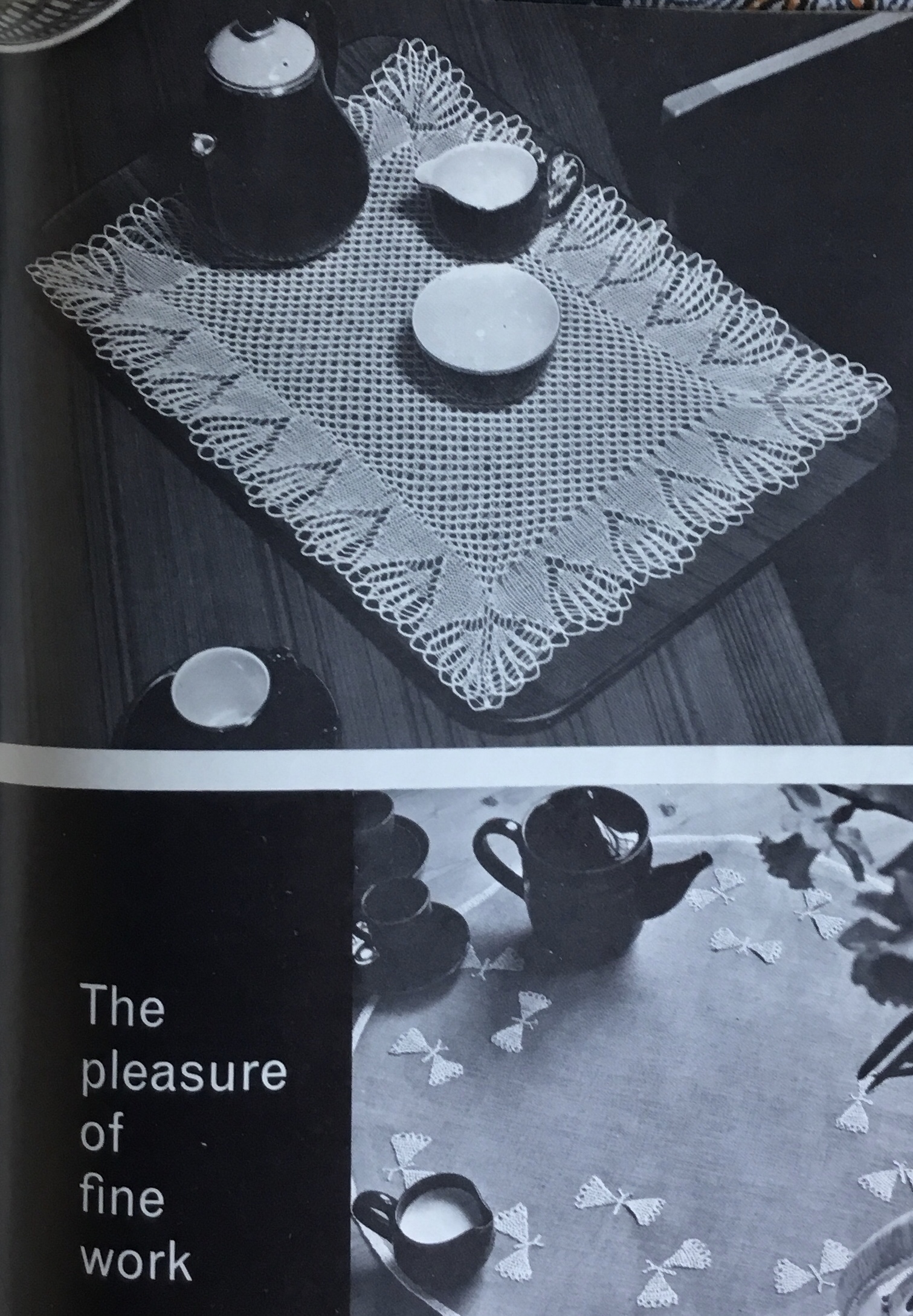
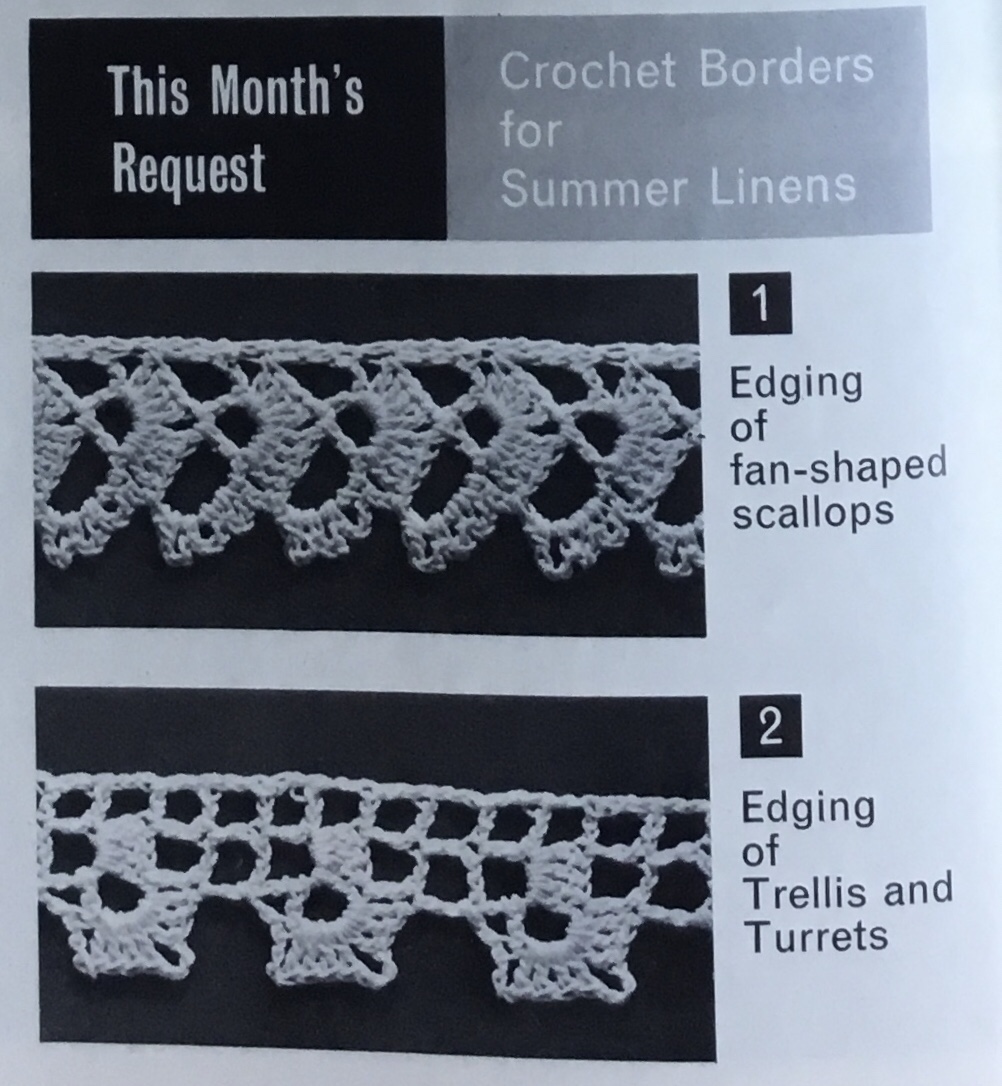
Homeware project ideas are plentiful, but not out of the ordinary. Embroidery fans can make a lovely apron with a traditional Romanian design, or cross-stitch a kitschy „Swiss border“ (nice illustration of an Alphorn player!), or work a counted darning pattern on placemats or a chair back. There‘s a fire screen with appliquéd tulips, a tapestry chair seat, a fancy knitted lace traycloth and a mat with appliquéd crocheted butterflies. You can also crochet lace borders to trim linens or whatever else you like. Truly, there is something for everyone!
I would love to make the child‘s dress, but don‘t necessarily know a child who wants one. Maybe I should size it up for myself? I would wear it! Otherwise, the embroidered apron is really nice. Maybe too nice to get splattered with food… but it would make a great knitting apron as well. We‘ll see!
P.S. Sorry for the lousy formatting. The WordPress editor does not work well on a tablet.
Tweed! Remember last month’s post with the advertisement for variegated-colour yarn? This month’s issue presents Patons’ new variegated wool, “Glenora Tweed”, a slightly thicker DK-weight wool with dark tweedy flecks. It appears to have been made up of 80% wool and 20% synthetic fibre. The twelve colours were chosen to be as vibrant as tweed can be (and very 1960s…) with rich shades of red, green, orange and yellow.
As it knits up fast at about 4 stitches to the inch (but promises to still give a “beautifully firm crunchy texture” i.e. hopefully not sag too much under its own weight), it is showcased with larger garments — the “pinafore-style” over-dress and men’s cardigan shown on the cover and two two-piece suits for women. There’s also a pinafore-style overdress with pleated skirt for a older girl and a boatneck sweater for men, both in similar Bracken Tweed wool. In keeping with the newer, looser and more square-shaped style, the garments have minimal or no shaping (except the girl’s outfit) and the skirts come to just above the knee. To me, the women’s Glenora garments look so similar that I had to check twice to assure myself that the pinafore dress on the cover (with high scoop neck) and the two-piece set with skirt and “overblouse” (V-neck) were in fact different designs.
There is a matching 4-ply (women’s) or DK-weight (girl’s) jumper to go underneath the pinafore looks or the overblouse, which, combined with the thick over-garments, must have been suitably warm for outdoors or poorly heated rooms in October. (The girl, of course, is going to have cold legs all the same.) For those who resist the tweed craze, there’s also a bright, fun colour-block sweater in a three-colour slip stitch pattern. I love the matching orange head scarf!
There’s also a fun 4-ply jumper for a child with some easy stranded colourwork blocks at the waist and yoke. The accessories continue the bulky, easy-to-knit trend, with a cap and scarf in Big Ben wool and a big, cosy scarf for men in an intriguing reversible cable-moss pattern.
Rounding out the family’s fall wardrobe is a matinee coat and “helmet”-style cap for a baby, matching the dress from the September issue. The November issue promises a warm shawl to match again, thus rounding out the set. Judging from the photo, “dear little baby Alicia” seems to have realised that the purpose of a helmet-style cap is to prevent the baby from removing it and flinging it around the room, and is suitably disappointed. It’s a great design, though, with the sides and chin strap done in garter stitch to accommodate movement and growing heads.
The homewares are plentiful and here again, there are some larger projects to be tackled at home during the colder Autumn days. The bright red rug in Soumak stitch and traditional design is vivid and cheerful, as is the Jacobean cushion “for the skilled needlewoman” which I would love to make if I didn’t already have two unfinished embroidered cushions in the WIP pile. (Not to mention that I am not skilled enough to make that elaborate a design, especially without a transfer.) The Autumn-themed acorn cushion is definitely easier. There’s a Regency ribbon design for tapestry or cross-stitch, too.
For those who want a quicker, easier homeware project or are already getting started on the Christmas presents, there are more embroidered acorns on cutwork mats and some knitted and crocheted goodies: a “Scottie-dog” night-case, a crocheted bag, and… a hippo, yes, a friendly knitted hippo stuffed animal. Well, why not? It’s cute. An older child might embroider her own Little Miss Muffet picture in cross-stitch.
The very last project in the issue, tucked way back in the “Readers’ Pages”, is the one I will make. In fact, I have been waiting for this issue to come up specifically so that I can make it! It is a very simply constructed and embroidered “Apron-cum-Knitting-Bag” where the front panel and waist ties of the apron fold into the bag part along with your knitting. Pull the drawstrings closed and carry the bag around, then when it’s time to knit you can undo the strings, pull the apron part out of the bag and tie it around your waist, Presto, you are ready to knit in any situation, standing or sitting, and your ball of wool will not fall down and roll about the room. Stay tuned for a project that will actually get finished on time, as well as progress on those projects that didn’t.
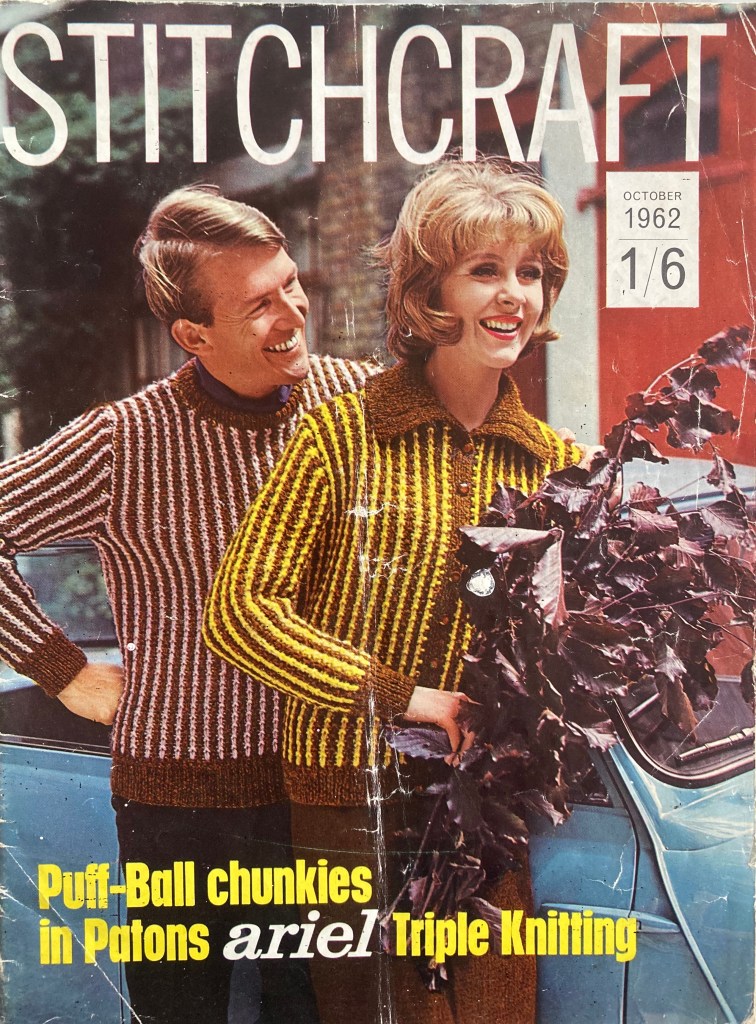
“There are several “special” things about this issue” writes Stitchcraft’s “editress” on the facing page, and I’m glad she put the word “special” in quotes, because this month’s issue is definitely a mixed bag. On the plus side, it has extra pages in colour and introduces a new yarn: Patons Ariel, designed to be “triple-knit” bulky and therefore quick to knit, but still lightweight. On the minus side… we’ll get to that later in the post.
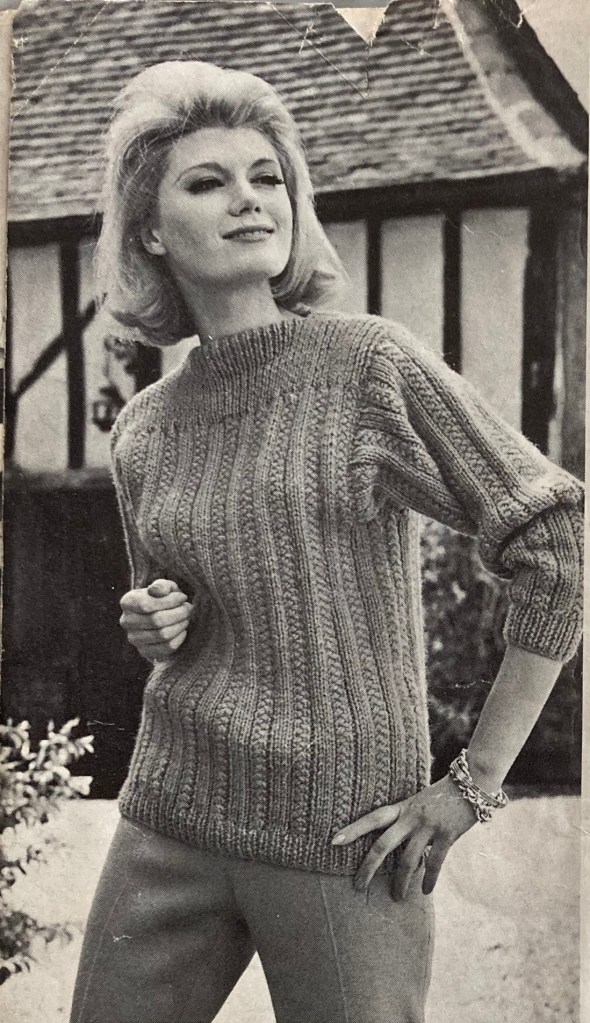
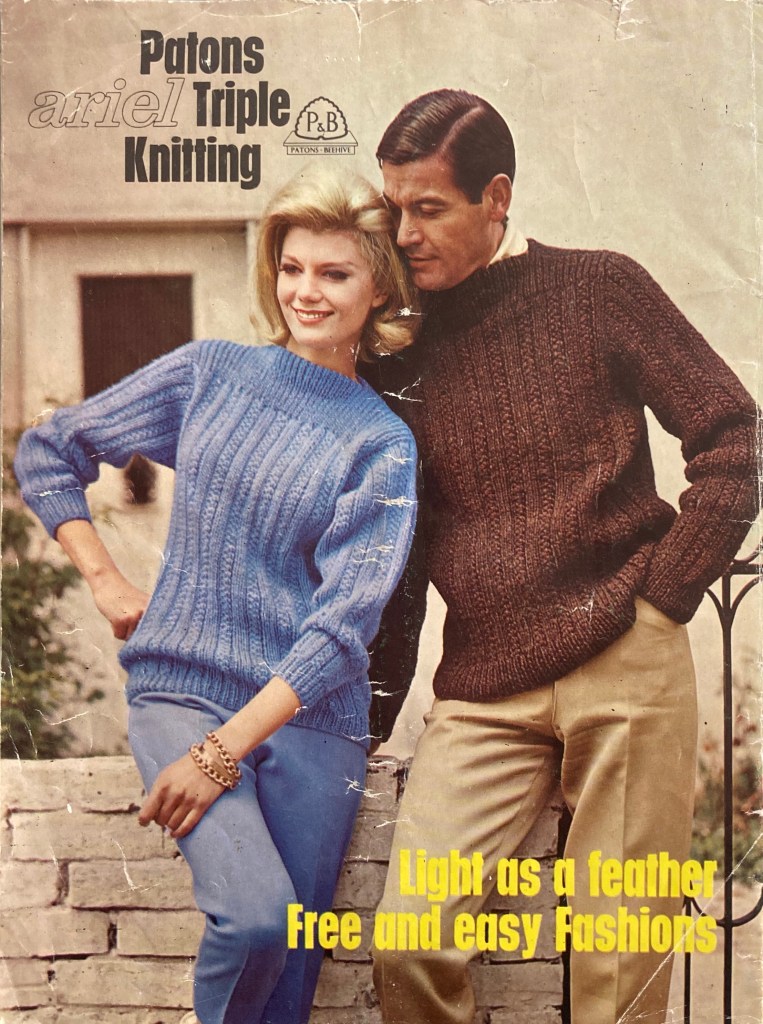
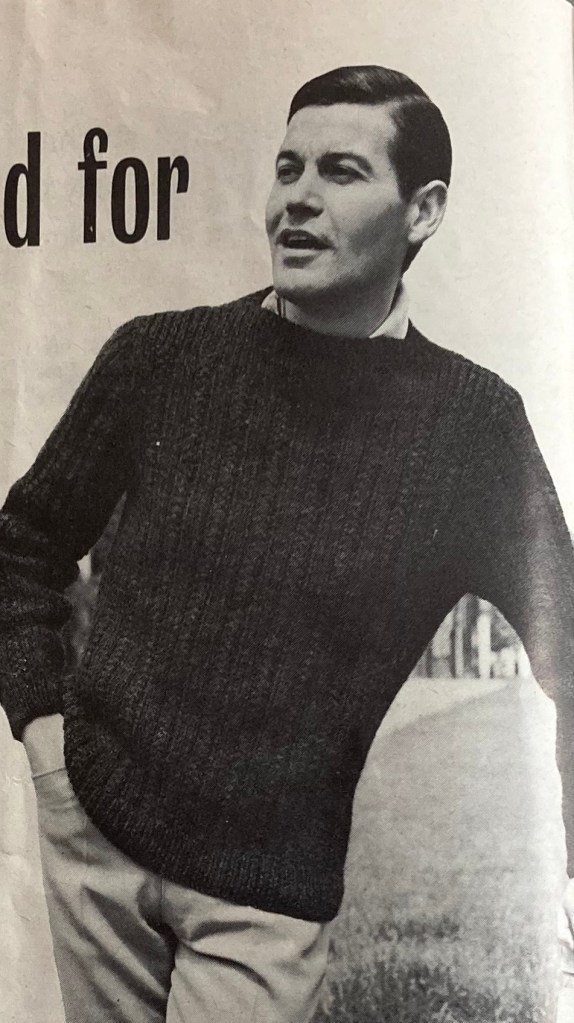
The new wool, Ariel, is listed on Ravelry as bulky weight (97 yards in a 2-ounce ball) and composed of 80% wool and 20% “other” (synthetic fibres). According to the person who wrote the Ravelry entry, it may or may not have been waterproof! It appears to be quite fluffy, thus the name and the “light as a feather” claim. It’s used for the two-colour, slip-stitch-patterned garments in the cover photo as well as the identical boatneck pullovers for men or women. The partner-look idea is still going strong.
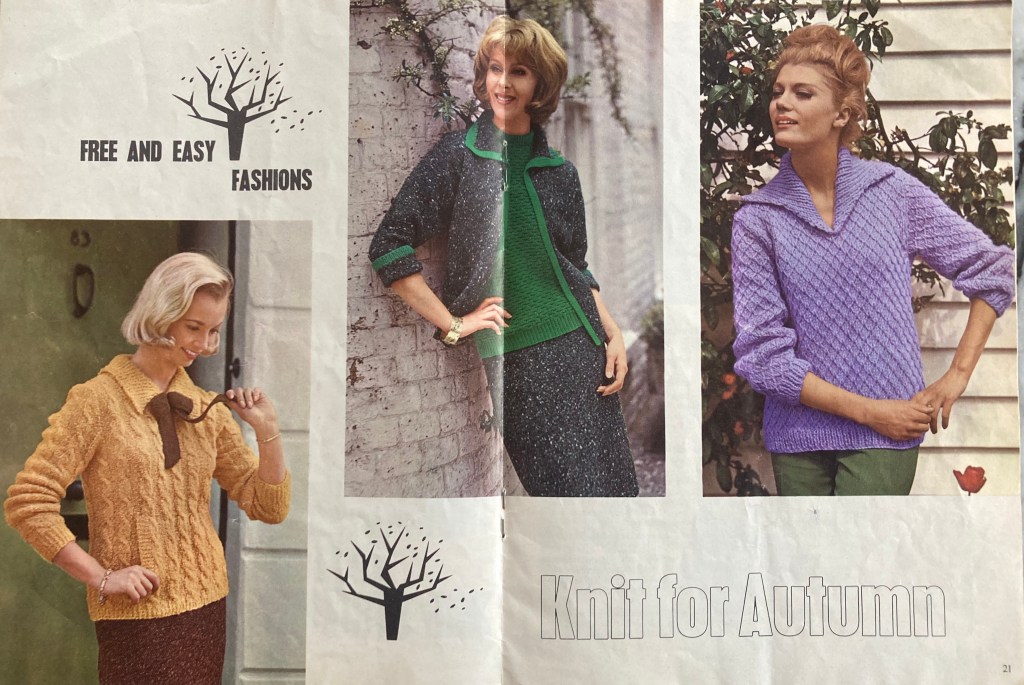
Tweed looks and suits are always popular in the fall, and this month’s issue gives us a loose-fitting suit with a short-sleeved jumper to wear underneath, all in double knitting weight. Nubbly Rimple yarn is also DK weight and still a fashionable choice for this sweater with a contrasting bow-tie. The purple pullover with the big collar (still in fashion after two years!) is made in bulky Big Ben wool. Greens, browns and yellows dominate the colour palette and go with the autumn theme.
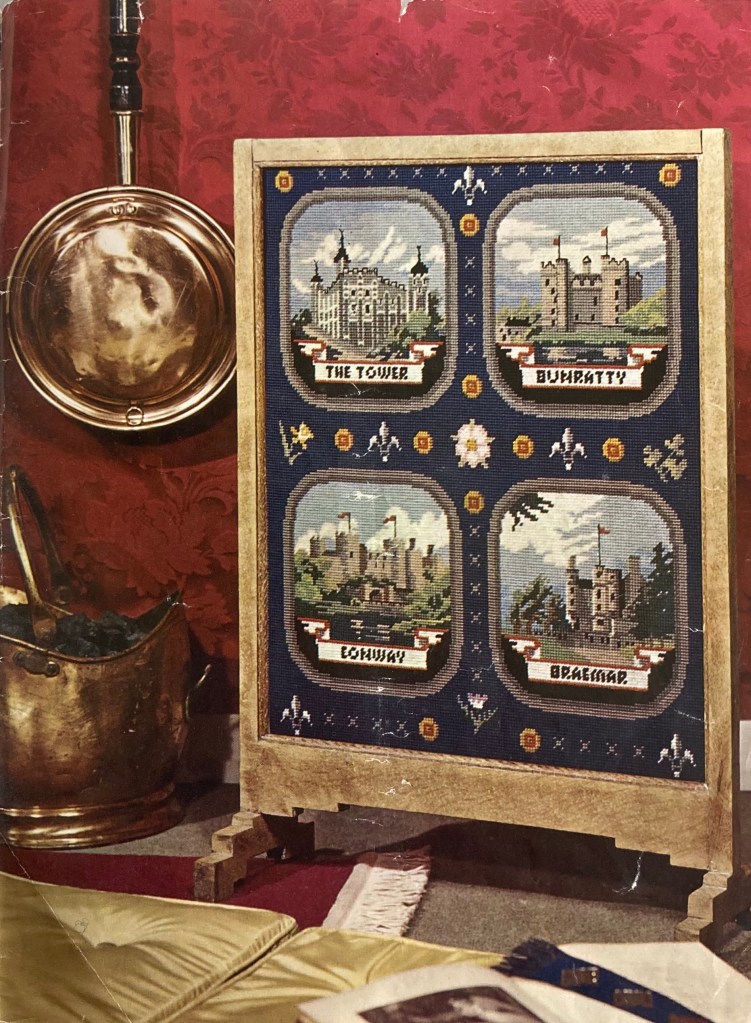
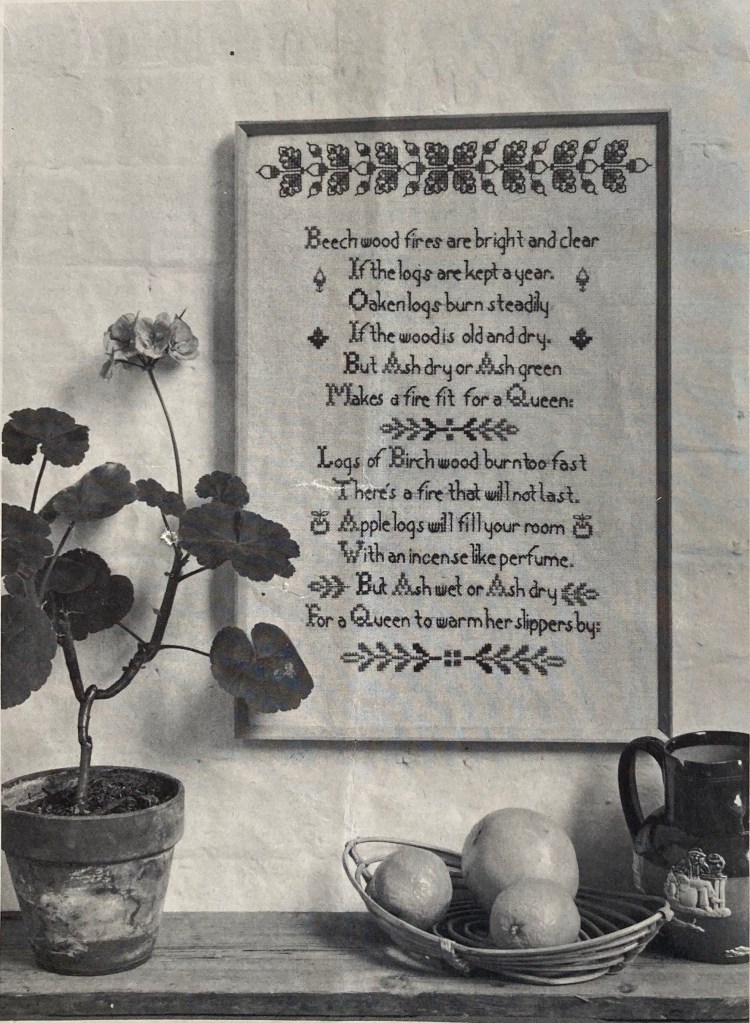
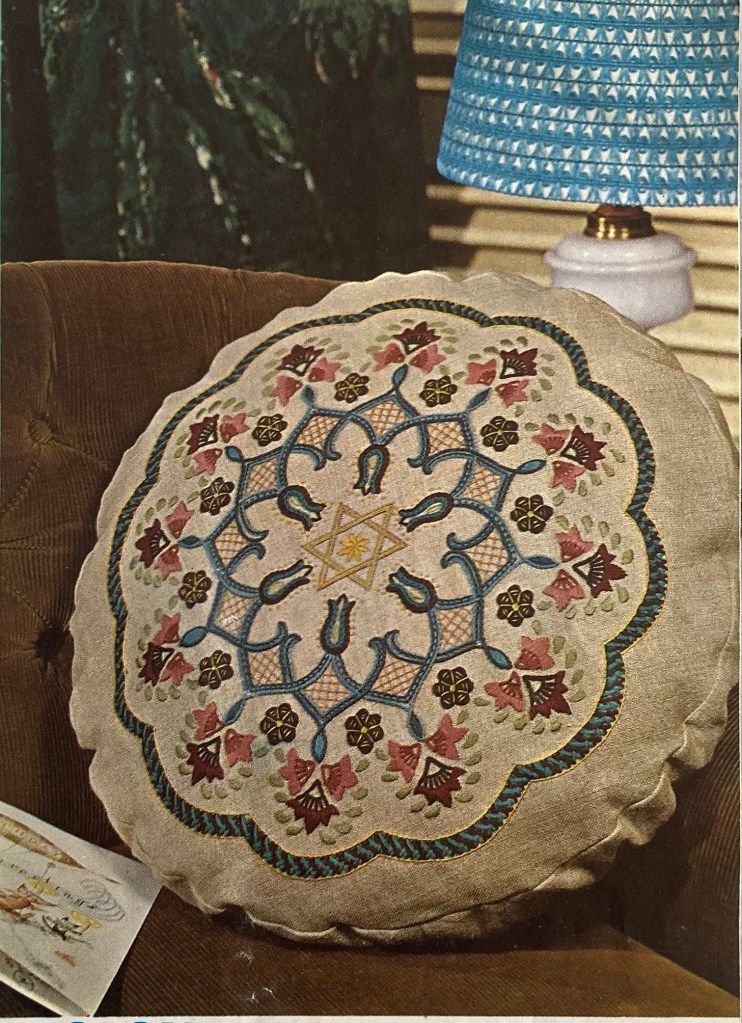
Embroidery and tapestry take a backseat to the autumn knits in this issue, with typical floral chair-back, apron, and traycloth designs. There’s a tapestry of four famous castles, a cross-stitch wall hanging with a poem about what type of wood to burn in a fireplace (I had never heard this rhyme, have any of you?) and a more complexly embroidered cushion of “Indian design”. I cannot vouch for its cultural authenticity, but the woven and latticed stitches are certainly striking and effective.
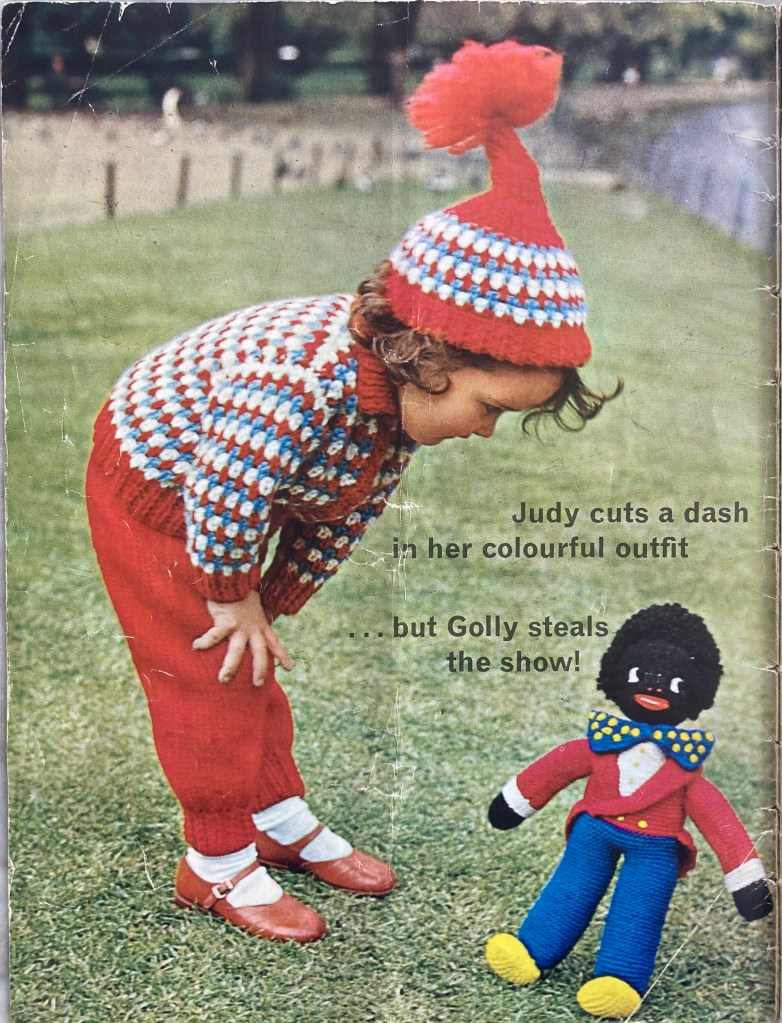
Speaking of cultural history, remember our little model Judy with her “trim Outfit” from 1960? (Of course you don’t, and I wouldn’t have recognised her either if her name weren’t in the caption.) Here she is, two years older, cutting a dash in her warm 3-piece play suit and all set to play with…
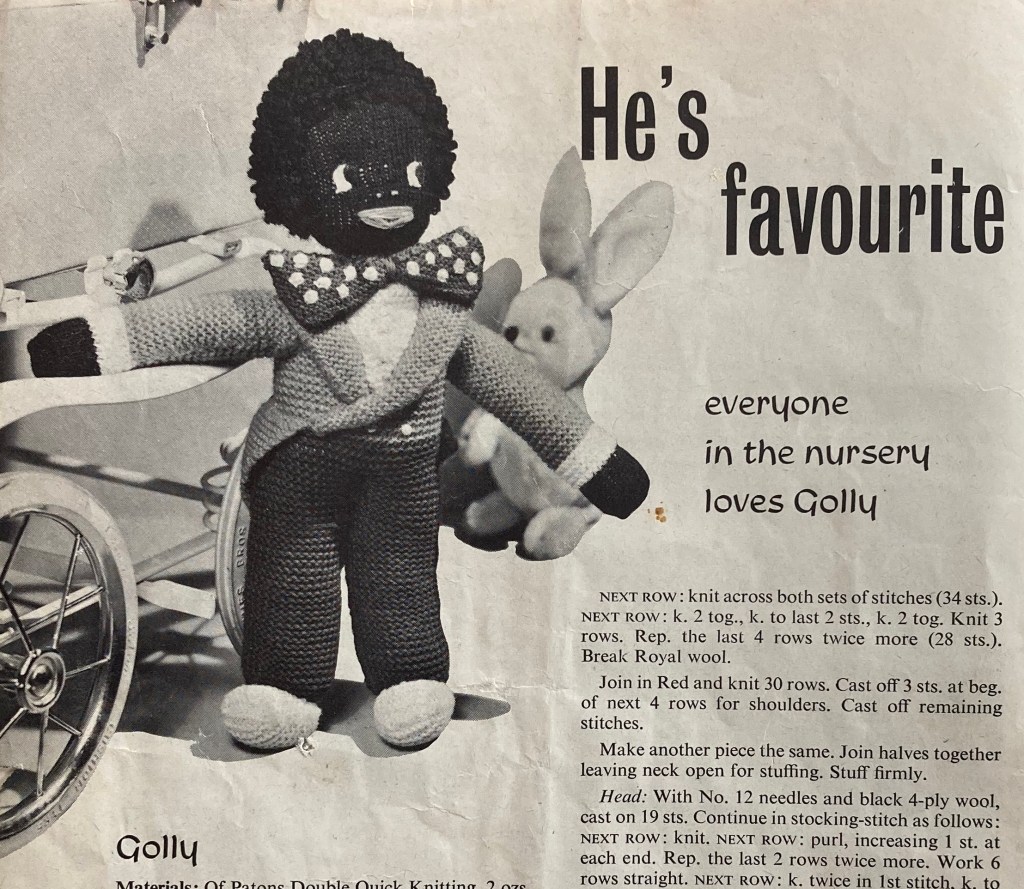
Ah, right. Her “Golly”, who “steals the show” and whom readers can also knit from a pattern in this issue. “He’s favourite”, writes our editress, and “everyone in the nursery loves Golly.” Who is he?
In 1895, the English-American cartoonist and illustrator Florence Kate Upton produced her first children’s book, titled The Adventures of Two Dutch Dolls and a Golliwogg. Over the next fourteen years, she and her mother Bertha collaborated on twelve more books starring the same characters. The books, and particularly the “Golliwog” character, enjoyed enormous popularity for at least sixty years afterwards and “Golly” dolls and toys as well as “golliwog” images on brand names and household products were practically ubiquitous in popular culture — particularly children’s culture — in the UK and elsewhere throughout the 1950s and 1960s.
Though Upton intended the Golliwog(g) to be a positive character and the hero of the story, it can’t be denied that his representation is a racist caricature born of the blackface minstrel tradition in the United States. According to Upton herself, her inspiration for the character was a Black minstrel doll found in her house, and typical “Golly” representations show him with exaggerated, distorted features and wearing an outfit typical of minstrel performers in the early 20th century. Later literary and cultural depictions of “golliwogs” often portrayed them as animalistic, uncultured or criminal, thus reflecting and perpetuating negative racial stereotypes about Black people. Over time, the word “golliwog” and shortened forms of it became used and recognised as demeaning racial slurs.
Though many white Britons, Americans and Australians who grew up with golliwog dolls continue to claim that they are inoffensive (and capitalise on their popularity via Internet auctions and collectors’ organisations), it should be pretty obvious that they, and their related imagery, are problematic. For a more in-depth understanding of why, I encourage further reading, starting with this excellent article from the Jim Crow Museum of Racist Memorabilia at Ferris State University in Michigan (US).
It’s not the first or only time that Stitchcraft (like just about every other knitting/craft publication of its time) has featured patterns for toys or dolls that reflect stereotypes of particular ethnic groups or portray them as an “exotic Other”, even if those representations are supposed to be positive. Many patterns from the 1940s and 1950s are particularly offensive (take my word for it, I don’t want to show them here), as is the use, up until the late 1950s in some cases, of racial slurs as colour names for certain shades of wool (ditto). By the way, I have issues of Stitchcraft and many other vintage knitting magazines up to the mid-1970s and nowhere, in any of them, have I ever seen a model who was not white — the caricatures were also the only representation to be found. Let’s remember that, for all their fantastic fashions, the mid-century decades were definitely not the “good old days”.
On top of all that, there’s no pattern in this issue that I particularly want to make, so I’ll either embroider some anemones on a vegetable bag or finish up something from the WIP pile.
Autumn is the nicest season for knitting, and 1960s Stitchcraft usually gave it a little push with extra pull-out supplements, extra colour photo pages, or “bumper issues” full of the latest developments in home-knitting fashion. The September 1962 issue doesn’t have any of these extra features, but it does have a wide variety of designs in mid-weight and warmer wools, starting with the chunky twisted-bobble sweater on the cover. Made in bulky Big Ben wool, it weighs in at a whopping 38 (for the smallest of three sizes, 35-36 inch bust), 40 or 42 ounces (the largest size, for 39-40 inch bust), i.e. about two and a half pounds or 1190 grams. I am guessing the model is quite slender and even she looks bulky in it!
The dresses and separates, made with the same loose fit but in double knitting wool, show a smoother look with minimal patterning. The orange dress in the colour photo and the charcoal-grey dress with the colour-pattern border (“for those who like something really eye-catching”) are the same design, but the pattern-border version is only available in one size, “for the younger girl.” I guess that pattern was just too exciting for doddering middle-aged matrons! The blue and white ensemble, also made in double knitting weight, has three pieces: a simple sleeveless blouse in white k2, p2 rib, a plain blue skirt and a back-fastening cardigan with white vertical stripes on the front. Tops continue to be hipbone-length and hemlines are firmly anchored just below the knee.
Other garments feature interesting colour and texture effects: the man’s “smart weekend sweater” has been treated with a teasel brush to achieve a fuzzy, felted effect. The knitter was not expected to do the brushing herself, but was instructed to “take all pieces at this stage [after knitting all the separate pieces, but before making the garment up] to your usual wool shop who can arrange to quote a price and send them away to be brushed for you.”
There’s also a striped jumper for “young and carefree” women with a fringed collar and hem, similar to the one in the February 1962 issue (yes, it is more or less the same pattern in different colours and with a split collar) and a pullover in an intriguing striped and dotted slip-stitch pattern. Stripes and/or slip-stitches also feature in the three-colour pullover for older children and the toddlers’ dungarees. Colours are navy blue or charcoal grey contrasted with white and neutral pastels, as we saw with the patterned-hem dress and three-piece ensemble.
There is the usual variety of homeware designs, mostly with floral patterns: this month’s flower is the dahlia, or you can sew and embroider and apron with lilac sprays. The leftover gingham fabric from “your” workaday apron can be used for cute animal appliqués on aprons for the children (unsurprisingly, Father seems to be exempted from the washing-up.) There’s also the usual floral cutwork tablecloth and tray cloth and a coffeepot set made in Hardanger embroidery.
Needlepoint fans can make a stool top or a whimsical cross-stitch rug and/or wall panel for the nursery, featuring characters from nursery rhymes. The motifs are separate and interchangeable and can be adapted for different sizes and purposes.
In the children’s serial comic, Peter the puppet has been freed from his marionette strings and is traveling throughout the countryside writing a play about his adventures. Cyril the squirrel helps out by painting illustrations, using his tail as a brush. (But how will Peter get home?) There’s the usual advertisement for Lux washing soap, guaranteed to leave your woollies soft and fluffy, and the latest instalment of the Patons and Baldwins’ “knit to please your man” series of ads, junior version: a teenage girl knits a “nice, husky sweater” for her boyfriend with her own loving hands to show everyone that he’s the “special one.” The young woman on the back cover ad is presumably also trying to catch a man, but she looks more polished in her snappy red dress and white gloves. You can really see 1960s style coming into its own in the straight or A-line sleeveless dress with low contrasting belt, the bobbed and fringed hairstyle and the edgy, off-angle mirror pose. Compared to the designs in this issue, it also shows how fashion-conservative Stitchcraft is.
I’m not sure what I want to make from this issue. I imagine the embroidered dahlias would make a great design for a laptop or tablet sleeve, but I already have a fine home-made laptop cover, not to mention this wonderful gay-geese-in-space tablet cosy. Also, I have probably done enough embroidery for the time being and still haven’t made much progress on this appliqué masterpiece that I started in July. The knit projects are all so bulky and loose-fitting, which is not my style, and I’m not sure I know an appropriately-aged child for the interesting slip-stitch pullover. There was also a perfectly nice, if not exciting baby cardigan (not pictured) in the issue which I could make quickly from stash, which would be useful enough (somebody’s always having a baby) and maybe the best choice for my uninspired mood. Stay tuned and find out!
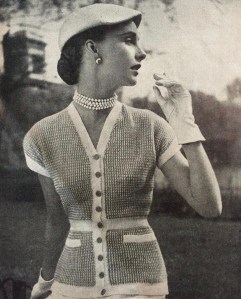
I hang out a lot in the “All Things Vintage” forum on Ravelry and try to participate in the make-alongs when I can. Usually, there are two of them per year, and last year’s July-December KAL/CAL (that’s “knit along”/ “crochet along” for anyone not familiar with the abbreviations) had the theme “Fabulous Fifties.” The 1950s were indeed a fabulous time for fashion and I have a small selection of 1950s knitting magazines, including some very nice issues of Stitchcraft, so the most difficult part was choosing a pattern! I went with this “Elegant jerkin for summer wear” from April 1952.
Portrait of Sir Walter Raleigh (wearing a jerkin) by William Segar, 1598. National Gallery of Ireland. Public domain.
First of all, I hear most of you asking: What is a jerkin? I’m glad you asked. Originally, it was a short, close-fitting, buttoned or otherwise fastened jacket with short or no sleeves, worn in the Renaissance over a doublet. It was often nipped in at the waist. Modern versions of the jerkin were revived for military use in the 20th century, and Stitchcraft as well as other mid-century patterns often use the word for a women’s waistcoat with cap sleeves to wear over a blouse, or a knitted blouse-like garment such as this one, which plays off of the historical jerkin shape.
The four-row stitch pattern was quite easy (knit 1, slip 1 on the right-side rows, knit 1, purl 1 on the wrong-side rows in one colour, then slip 1, purl one on the RS and purl 1, knit 1 on the WS in the other colour) but because of the colour change with the slip stitches, it was amazingly difficult to “read” the work and get back on track. At the same time, if just one stitch was wrong, it was immediately visible in the pattern. Of course, I had to pick blue and black, two colours that didn’t offer much contrast and which, I found, only look different in natural light. As a result, I could only work on this project during daylight hours… in the winter, which is pretty dark.
Adding to the frustration: as always, no matter how small the needles or how thin the wool, I could not knit tightly enough to get the minuscule gauge, which itself was only given as a “life-size” photograph in the pattern. Of course, I am also larger than the 34-35 inch bust given in the pattern, but how much larger the garment, calibrated for how much larger the gauge? Right, lots of calculations, estimations, measurements upon measurements, and just plain guesswork. Plus the thing pulled together either more or less, horizontally or vertically, as it got larger — my gauge swatch (a pocket lining) was utterly useless. I had to start three times.
Before sewing
When I finally got it done (too late for the KAL deadline but whatever), it fit perfectly! I was so proud of myself! Then I wash-blocked it and the wool stretched about six inches in width and at least two or three in length above the waist. In desperation, I reached out to the good people of Ravelry, who told me that the yarn I used (Lang Merino 200 Bébé) was superwash and I should put it in the clothes dryer to shrink it back into shape. I did that and it actually did shrink it down, but it still ballooned a bit in the torso, so I sewed side seams into it. At the moment they are just sewn down with yarn, but the next time I get the sewing machine out, I will probably sew them down properly and (aaaaaggggh!!) cut the excess fabric away to reduce bulk
Also, I sewed that moss-stitch bottom band on twice and it still pulls in a little bit. Oh right, and the tour through the dryer dinged up the buttons, even though I turned the garment inside out.
All in all, this jerkin was a jerk. It was jerkin me around! It looks OK though, I guess, and better under a blazer. You will have to take my word for it when I tell you that I look less dumpy in it in real life than in the photo. It was an interesting project in terms of construction and stitch pattern and I’m sure I will wear it, but sadly, in the end I don’t think it was worth all the frustration.
Stay tuned for the update on the really, truly, almost finished January 1962 project and the embroidered chicken squirrel (yes) that will be my February 1962 experimentcatastrophe vegetable bag.
It’s that time of year again and December 1961’s issue has a lovely festive cover photo featuring matching father-son jumpers and a freshly-cut-down Christmas tree with holly branches. The jumpers are meant to be made in flat pieces with only the yoke worked in the round, but everything about them other than that is in the traditional Norwegian style, with a small snowflake pattern on the body and sleeves and a round yoke with tree and star patterns. I like that the jumpers’ pattern theme and colour choice are not so very specifically Christmas-y that they couldn’t be worn at any other time, or by people in our more diverse and modern times who don’t celebrate or don’t care much for Christmas and would just like a nice warm jumper with a wintery flair.
1961 Stitchcraft, of course, celebrates Christmas in a big way. Most of the projects are either glamorous party-wear for the ladies or gifts of all sizes and sorts for family and friends, while the fashionable housewife can do her Christmas shopping in a flecked-tweed cardigan suit similar to the ones in the November 1961 issue, or keep warm on casual days with bulkier sweaters. Tweed and contrasting polo-neck collars are in fashion all around.
For those fancy parties and evenings out, there’s a cocktail jumper in popcorn stitch, an angora stole, and an embroidered and sequinned evening bag. The jumper is knitted with wool and Lurex yarn held together, giving it a bit of sparkle. The stole is absolutely timeless and modern as well as easy to make (a rectangle in simple lace pattern with garter-stitch borders) and probably quite warm and cosy to wear over your strapless evening gown at the theatre. The bag is fancy, yet inexpensive to make, with a very 1960s “modern” look. Even after the party and the night out are over, you can still look glamorous in a knitted pink bedcape.
Children of all ages can look forward to practical, yet stylish winter garments — a knitted outdoor play-suit for toddlers in warm, bulky Big Ben, a smart fine-knit twin-set for girls of varying ages (sizes from 26-30 inch chest) and a wonderful knitted dress in a two-colour slip-stitch pattern that fits right into the tweed trend. The photo caption claims that Alison (the young model) is “warm as toast” but of course, her legs are going to be cold! She still seems pretty happy, though.
For me, the best, and sometimes goofiest, projects of every December Stitchcraft issue are the homewares and “novelty gifts”. This year, some are quite normal, like the snowflake-pattern table mats “for a supper party” pictured above, a cutwork tablecloth, or the tapestry stool cover in a diagonal Florentine pattern. Some are specifically winter- or Christmas-themed, such as the knitted cushion and a framed tapestry picture of angels. Two are very classic and beautiful and have nothing to do with “the season” — a typical Jacobean chairback and a very pretty tray cloth embroidered with anemones. They are all quite nice, if not particularly special.
And then there are the novelty gift ideas, or, as they are titled here, “gay mascots.”
The knitted teddy bear is nice enough, but looks quite stern with its unsmiling mouth and sharp, downward-pointing eyebrows. The snowman egg cosy… well, if you really feel the need to use an egg cosy, fine, it looks cheerful enough. Ivy-leaf pincushion, OK. The bear cub, though, looks like it’s about to attack! Something about its half-smile and the glint in its eye makes it look malicious. And the Father Christmas egg cosy… it’s hard for me to express exactly what’s wrong with it, but if I woke up on Christmas morning and found him on my breakfast place, I would expect to be getting coal in my stocking. Give me a gay mascot any day, but maybe not exactly these ones?!?
I guess it shows just how difficult it is to embroider faces.
Our “Readers’ Pages” have the usual ads for fabric remnants and sewing machines as well as an extra pattern for a little knitted and embroidered scarf, some traditional Swedish pattern motifs and review of the exhibition of Swedish embroidery recently held at the Embroiderers’ Guild, and a comic in which Little Bobby gets a skiing lesson from a friendly snowman.
Merry Christmas to all of you who celebrate it and happy winter days to all! My December project will be to finish some of the many WIPs lying around (including the November blazer, I swear it is almost done) and use the evening-bag embroidery motifs on something fun and small like dinner napkins or a vegetable bag.
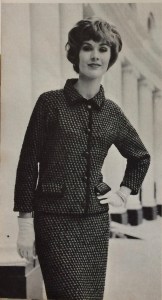
November 2019’s project was the blazer from this wonderful tweed check suit in the November 1961 issue. As it says in the description, “separates in the height of fashion illustrate why hand-knitting is chosen for today’s couture look.” The blazer, especially, is really a timeless, classic piece.
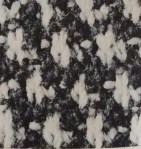
The stitch pattern is very clever and simple: k 1, sl 1, p 1 on the right-side rows, moved one stitch to the left every time, and purl back on the wrong side rows, with 2 rows in each colour. This makes a firm, structured fabric with minimal curling at the edges (which are finished with wool braid binding).
The pattern calls for Patons Rimple DK (nubbly wool with synthetic) in black and Patons Totem DK (smooth “crepe” wool) in “Oakapple”. I admit I had never heard of an an oak apple before and looking at the black-and-white photo, it’s it’s hard to tell what exact colour was used — but it’s obviously some kind of whitish-beige. Which, as it turns out, is pretty much the colour of at least some kind of real oak apple, which, as it also turns out, is not any kind of apple at all, but a wasp gall. My choice of wool, Jamieson’s Double Knitting, was clear from the beginning and I was lucky enough to be able to buy it “in person” at the wonderful Shetland Wool Week. Both the “black” (Mirrydancers) and “white” (Sand) yarns are ever so subtly tweedy, which gives a beautiful depth to the colour.
Why did I even bother?
Calculating the amounts was a nightmare, though. I had thought ahead and written it all out on paper: how many yards of Totem and Rimple there were in an ounce (thank you, Ravelry, for listing discontinued yarns with useful information about them), how many yards I would then need for each colour if making just the blazer, just the skirt or both, then comparing that with the number of metres per gram of Jamieson’s DK, dividing for number of 25 gram skeins, checking it all through and of course adding at least a few skeins of each colour for swatching, making full-length sleeves, extra security, and knowing that I wouldn’t be in Shetland again anytime soon. It was just barely enough! As I learned the other way around while making the green crocheted rug a little while ago, you can calculate all you want, (even with the help of a professional mathematician who knows extra-special secret formulas with Greek letters), or weight your swatches or whatever, but the only real way to know how much wool you are going to need is by making the thing. Argh.
The knitting itself was a dream, though — so nice to work in DK after the fingering-weight projects of recent months past. It knitted up fast and easily and the fabric feels good in the hands. The pattern is quite clear and simple. Even the set-in pockets with flaps and the buttonholes (such a nightmare, always) were successful and the buttonholes evenly spaced. (I used the method that Stitchcraft always suggests: make the side without buttonholes first, then mark the button positions with pins and make the buttonholes to correspond. With a repeating pattern like this one, you can count the rows between buttonholes quite accurately.)
I added a bit of waist shaping for a more tailored look, using a well-fitting blazer from my closet for a guide. I also made full-length sleeves. Originally I thought to make the sleeves from the top down for a better sleeve-cap fit and to make sure I didn’t run out of yarn, but I realised that that would reverse the direction of the diagonal pattern and I wasn’t sure if that would be a problem or not. I made them in the normal way from the cuff up, but made them narrower.
After putting it together and blocking, the back piece had stretched width-wise, the sleeves had stretched length-wise and the sleeve cap didn’t fit well. Also, the shoulders were too wide. What to do? I didn’t want to cut the knitted fabric, nor do everything over. My solution: I re-sewed the sleeve caps in where the shoulder and sleeve line should have fallen, then tucked the resulting extra fabric in towards the neck on the front piece to make a sort of built-in shoulder pad. I normally hate shoulder pads and rip them out of everything I buy, but in this case it turned the droopy, sloppy-looking shoulder into a crisp, tailored-looking one. I’m so sorry I forgot to take a “before” picture — the change was pretty dramatic.
To fix the back width, I added two vertical darts. That wasn’t as elegant as it could have been if I had knitted them in, but it was fine. The sleeve-cap changes pulled the sleeves in a little shorter, so I just finished the cuffs with the same binding that I used for the rest. The buttons are modern, but aren’t they perfect? I even remembered to buy a few extra.
It took a lot of finicky finishing work, but in the end, I was very happy. The blazer is warm, elegant, comfortable and fun to wear. It looks good as part of a retro-style outfit or a modern one. What more could I want? I don’t feel the need to make the skirt. I’m just happy with my blazer the way it is.








 I hang out a lot in the “All Things Vintage” forum on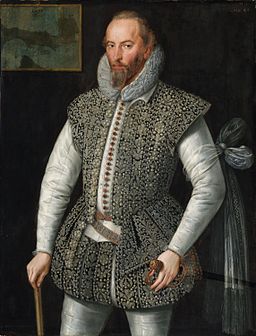
 Adding to the frustration: as always, no matter how small the needles or how thin the wool, I could not knit tightly enough to get the minuscule gauge, which itself was only given as a “life-size” photograph in the pattern. Of course, I am also larger than the 34-35 inch bust given in the pattern, but how much larger the garment, calibrated for how much larger the gauge? Right, lots of calculations, estimations, measurements upon measurements, and just plain guesswork. Plus the thing pulled together either more or less, horizontally or vertically, as it got larger — my gauge swatch (a pocket lining) was utterly useless. I had to start three times.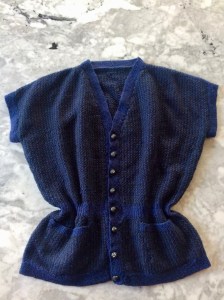

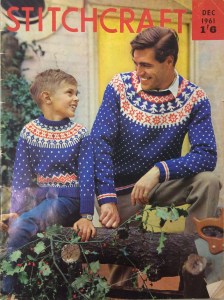 It’s that time of year again and December 1961’s issue has a lovely festive cover photo featuring matching father-son jumpers and a freshly-cut-down Christmas tree with holly branches. The jumpers are meant to be made in flat pieces with only the yoke worked in the round, but everything about them other than that is in the traditional Norwegian style, with a small snowflake pattern on the body and sleeves and a round yoke with tree and star patterns. I like that the jumpers’ pattern theme and colour choice are not so very specifically Christmas-y that they couldn’t be worn at any other time, or by people in our more diverse and modern times who don’t celebrate or don’t care much for Christmas and would just like a nice warm jumper with a wintery flair.


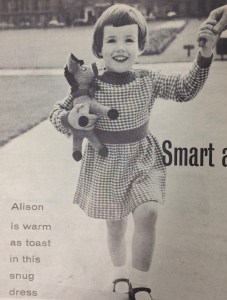 Children of all ages can look forward to practical, yet stylish winter garments — a knitted outdoor play-suit for toddlers in warm, bulky Big Ben, a smart fine-knit twin-set for girls of varying ages (sizes from 26-30 inch chest) and a wonderful knitted dress in a two-colour slip-stitch pattern that fits right into the tweed trend. The photo caption claims that Alison (the young model) is “warm as toast” but of course, her legs are going to be cold! She still seems pretty happy, though.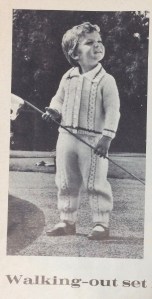


 Post updated on December 28, 2019: Finished!
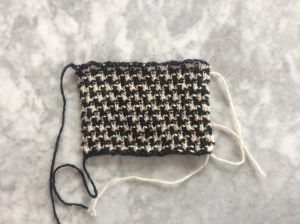 The pattern calls for Patons Rimple DK (nubbly wool with synthetic) in black and Patons Totem DK (smooth “crepe” wool) in “Oakapple”. I admit I had never heard of an an oak apple before and looking at the black-and-white photo, it’s it’s hard to tell what exact colour was used — but it’s obviously some kind of whitish-beige. Which, as it turns out, is pretty much the colour of at least some kind of real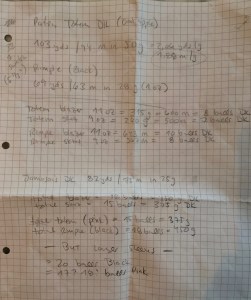
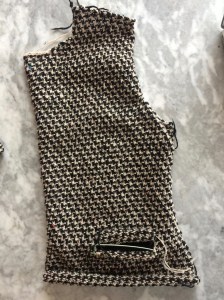 The knitting itself was a dream, though — so nice to work in DK after the fingering-weight projects of recent months past. It knitted up fast and easily and the fabric feels good in the hands. The pattern is quite clear and simple. Even the set-in pockets with flaps and the buttonholes (such a nightmare, always) were successful and the buttonholes evenly spaced. (I used the method that Stitchcraft always suggests: make the side without buttonholes first, then mark the button positions with pins and make the buttonholes to correspond. With a repeating pattern like this one, you can count the rows between buttonholes quite accurately.)
 After putting it together and blocking, the back piece had stretched width-wise, the sleeves had stretched length-wise and the sleeve cap didn’t fit well. Also, the shoulders were too wide. What to do? I didn’t want to cut the knitted fabric, nor do everything over. My solution: I re-sewed the sleeve caps in where the shoulder and sleeve line should have fallen, then tucked the resulting extra fabric in towards the neck on the front piece to make a sort of built-in shoulder pad. I normally hate shoulder pads and rip them out of everything I buy, but in this case it turned the droopy, sloppy-looking shoulder into a crisp, tailored-looking one. I’m so sorry I forgot to take a “before” picture — the change was pretty dramatic.
 To fix the back width, I added two vertical darts. That wasn’t as elegant as it could have been if I had knitted them in, but it was fine. The sleeve-cap changes pulled the sleeves in a little shorter, so I just finished the cuffs with the same binding that I used for the rest. The buttons are modern, but aren’t they perfect? I even remembered to buy a few extra.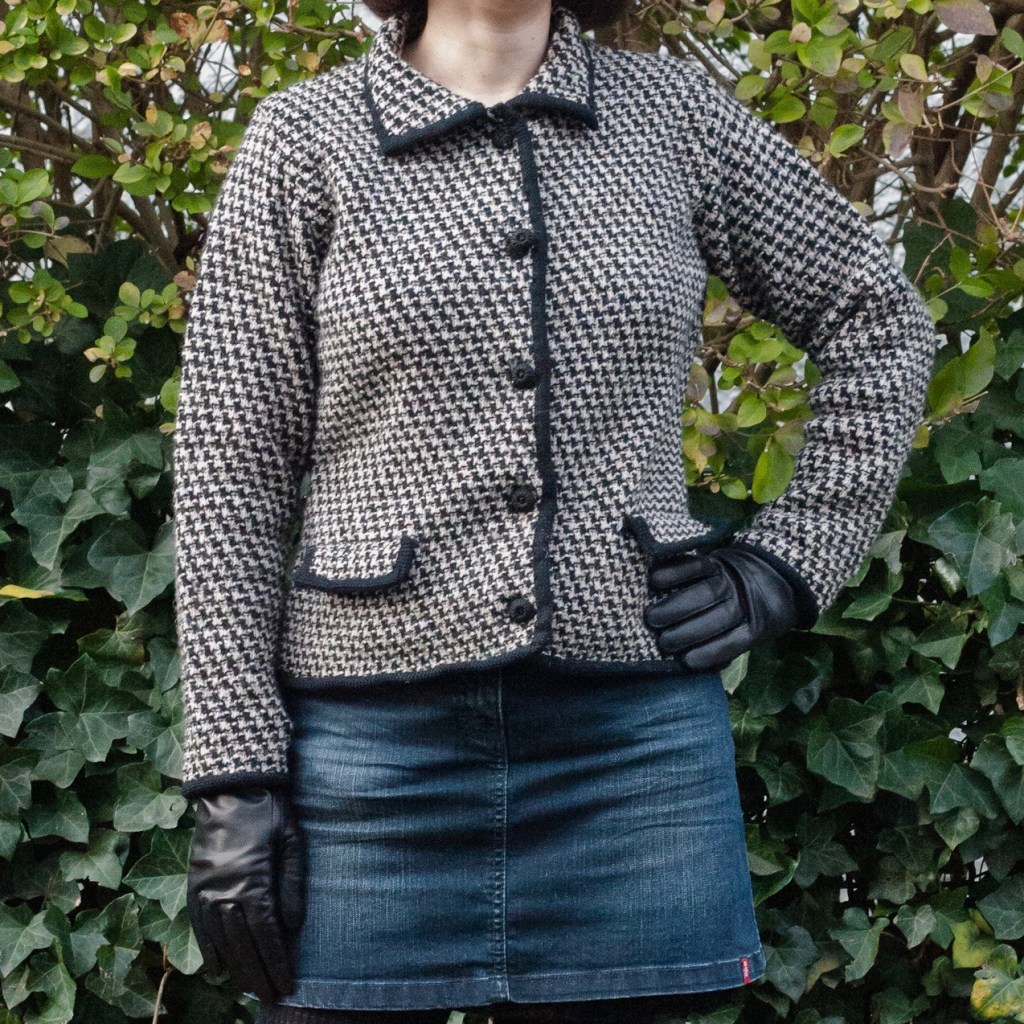
 The Stitchcraft Sixties