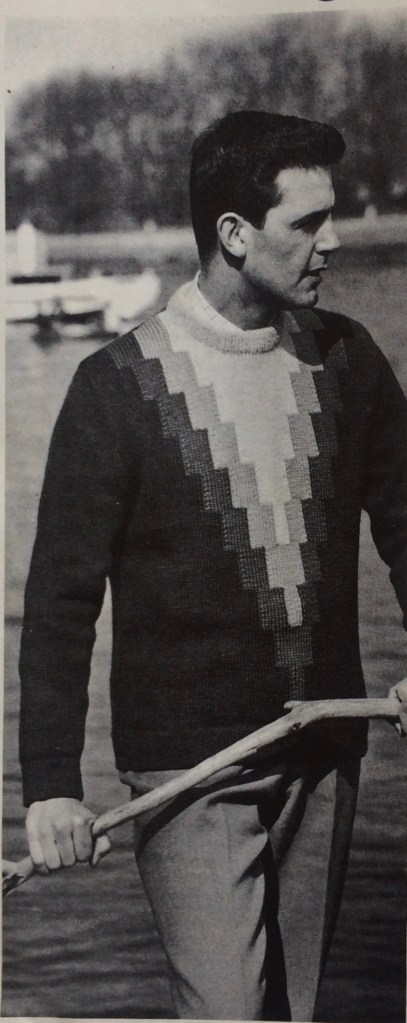
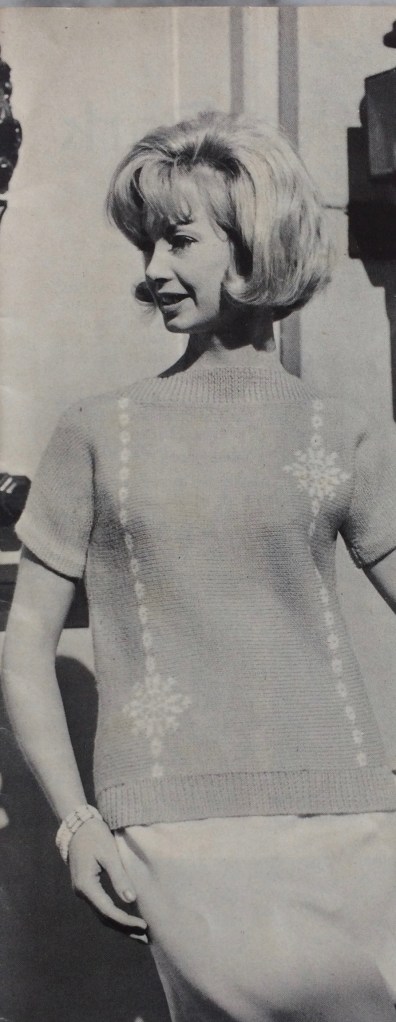
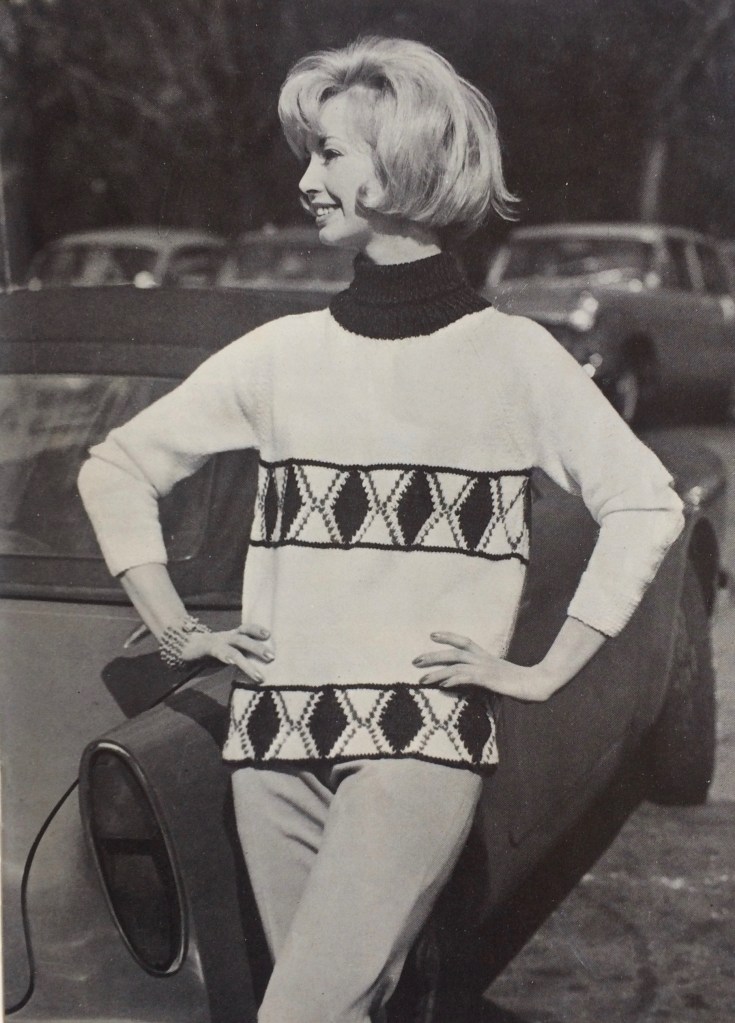
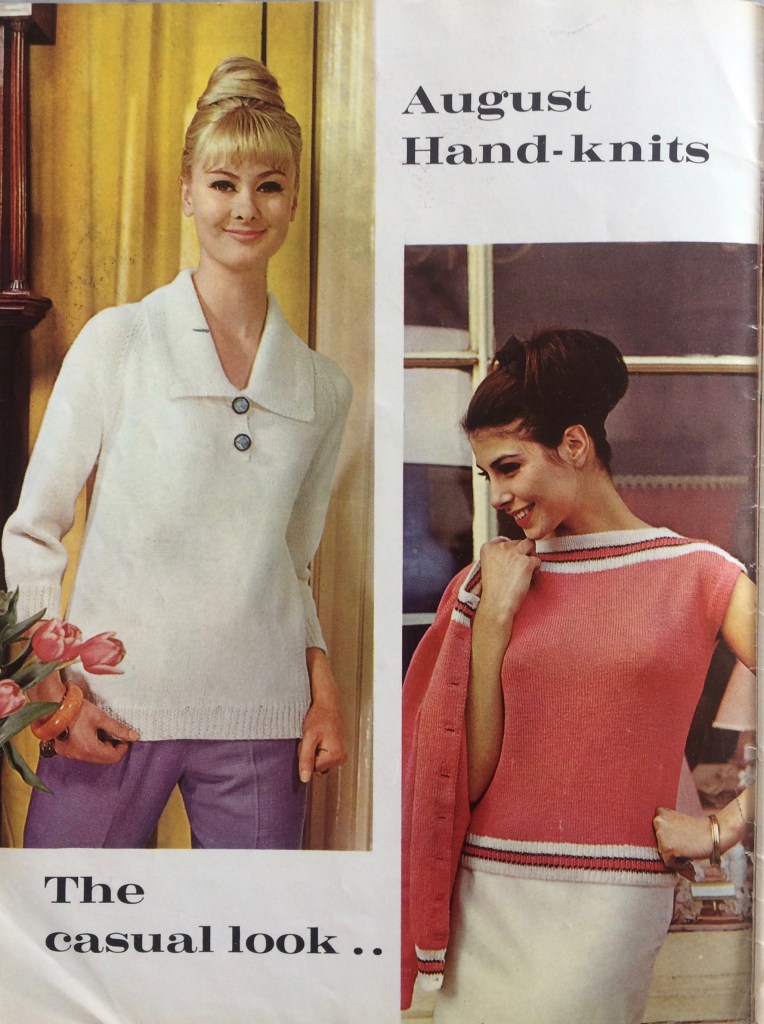
September 1967: Overview

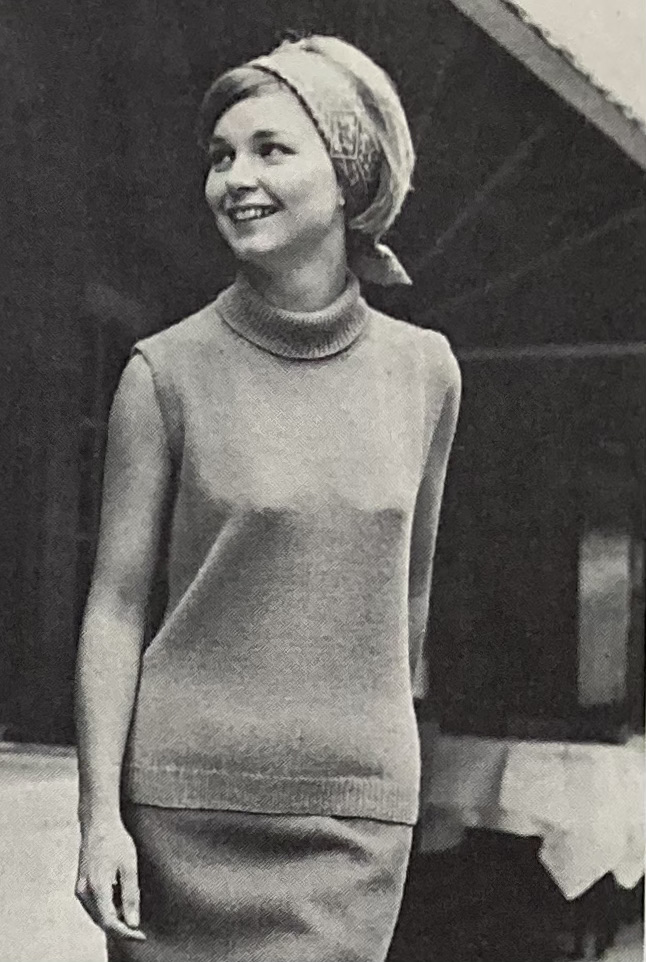
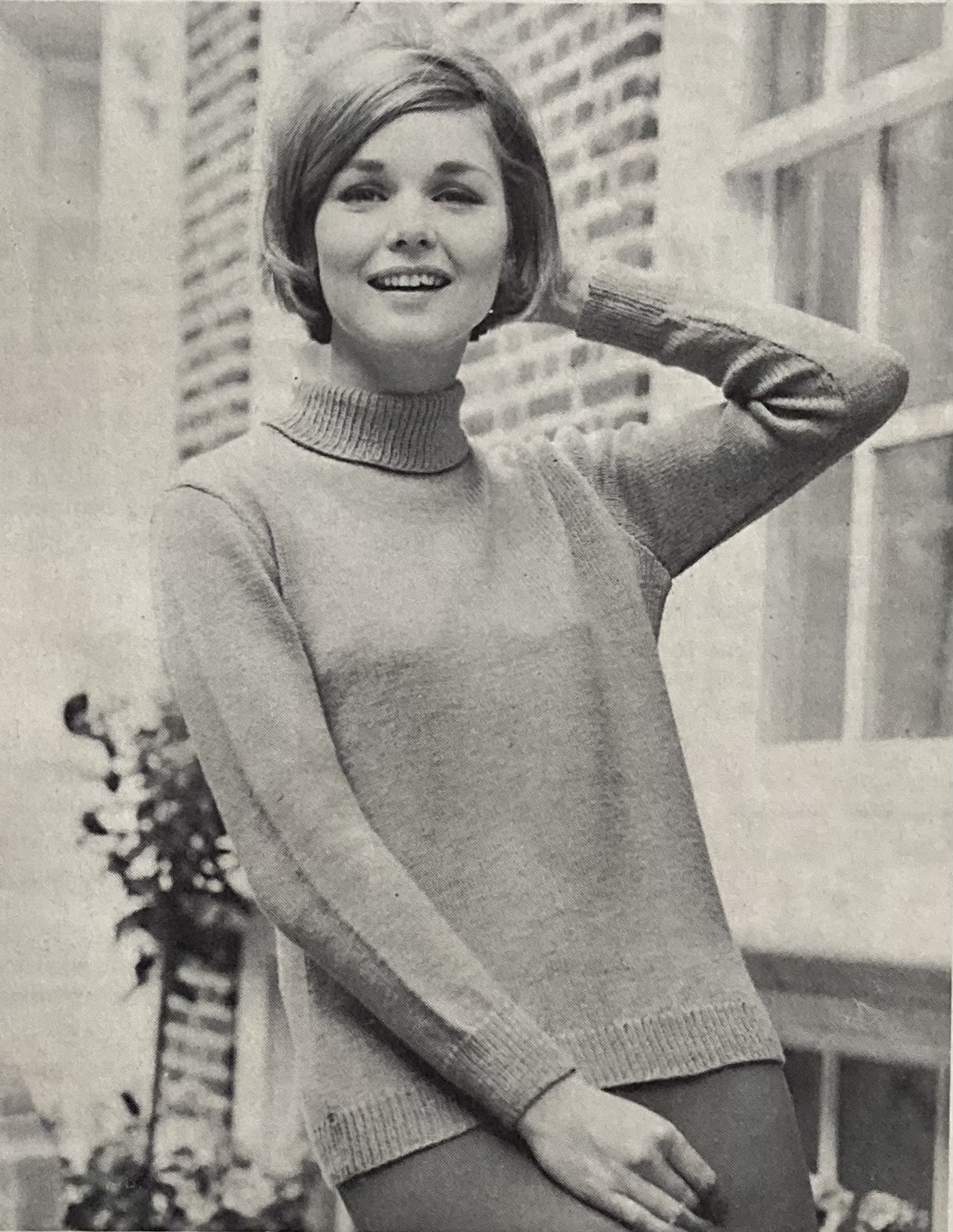
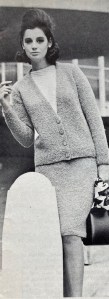
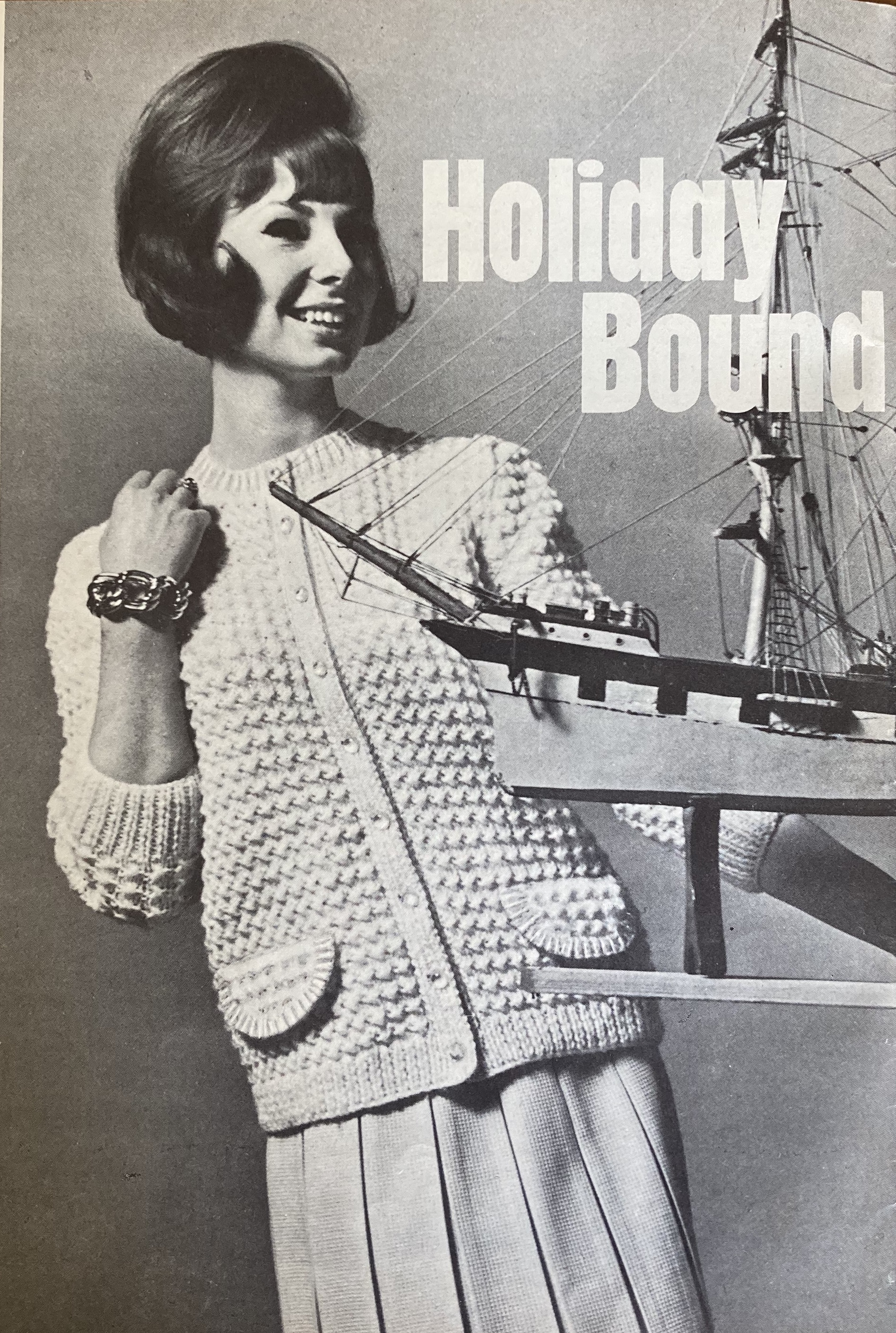
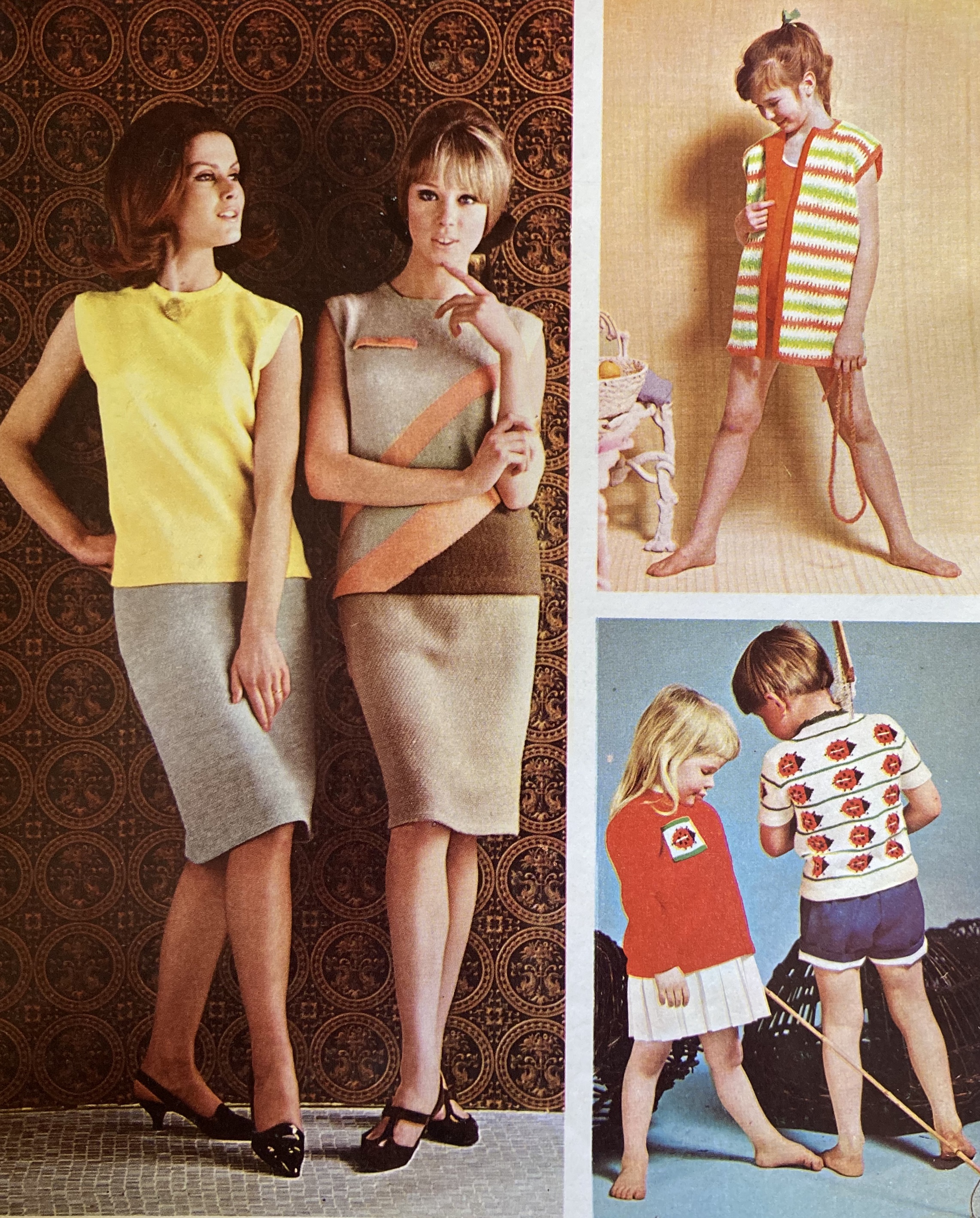
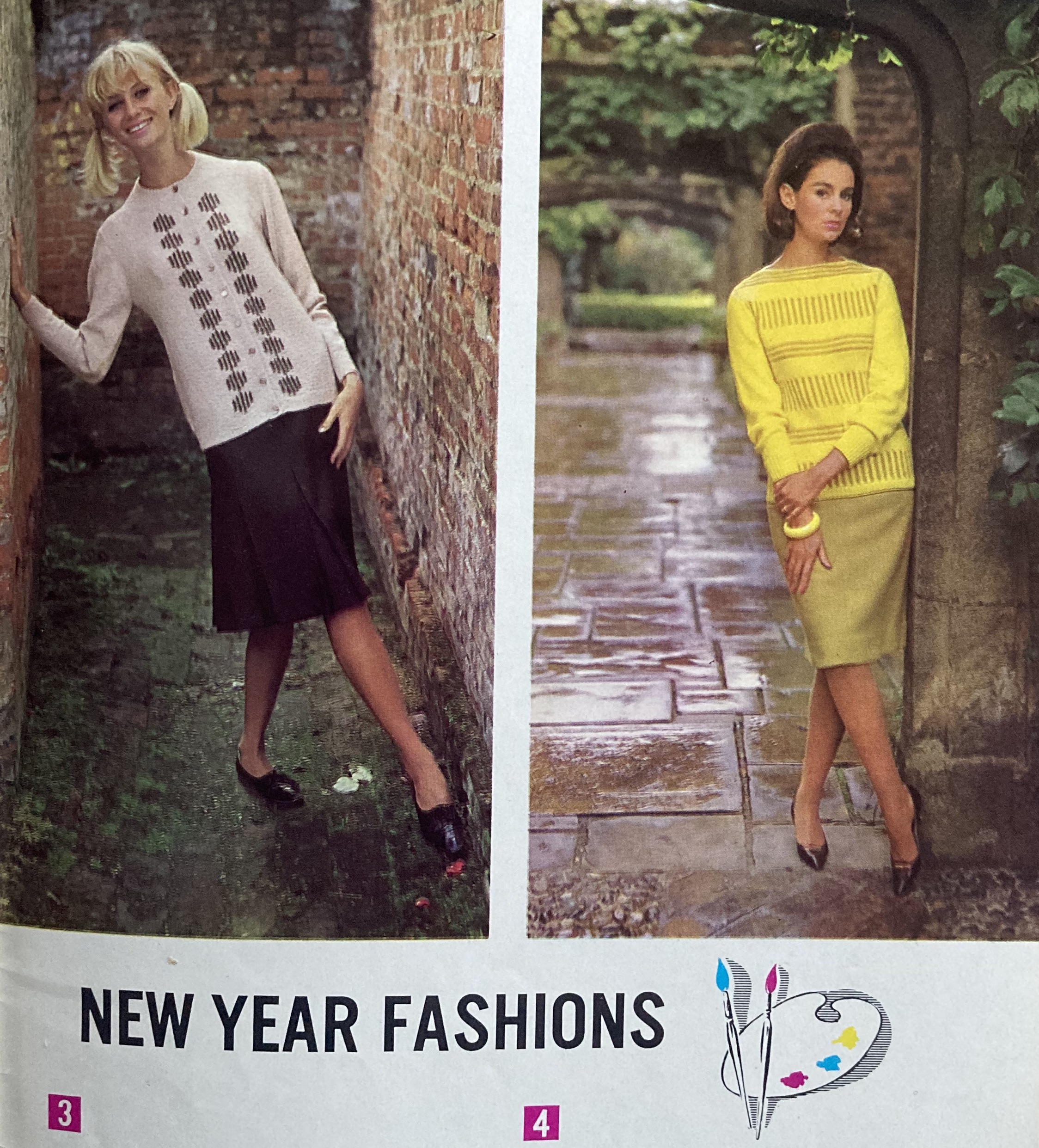
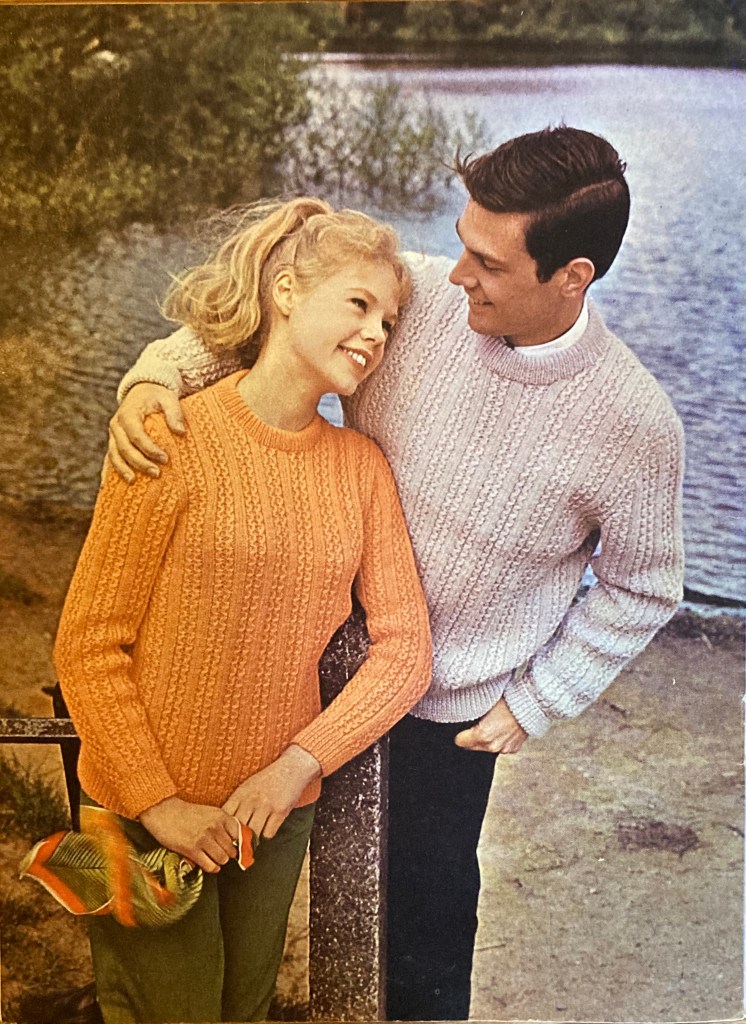
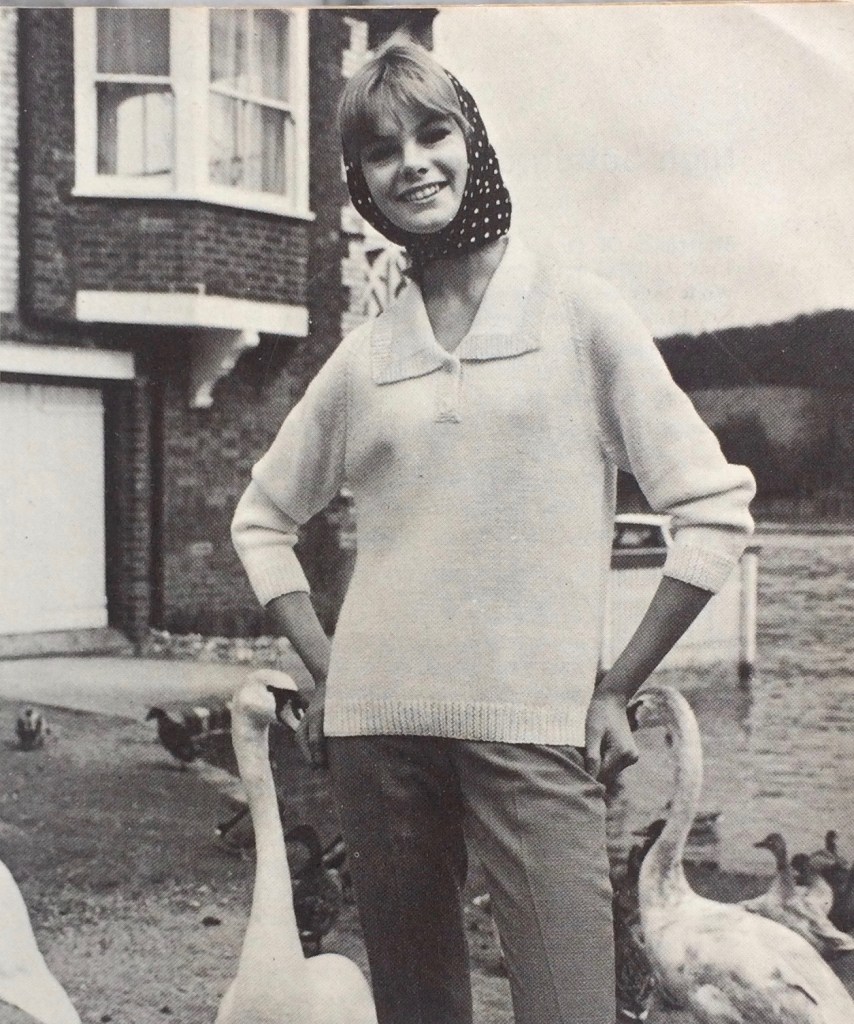
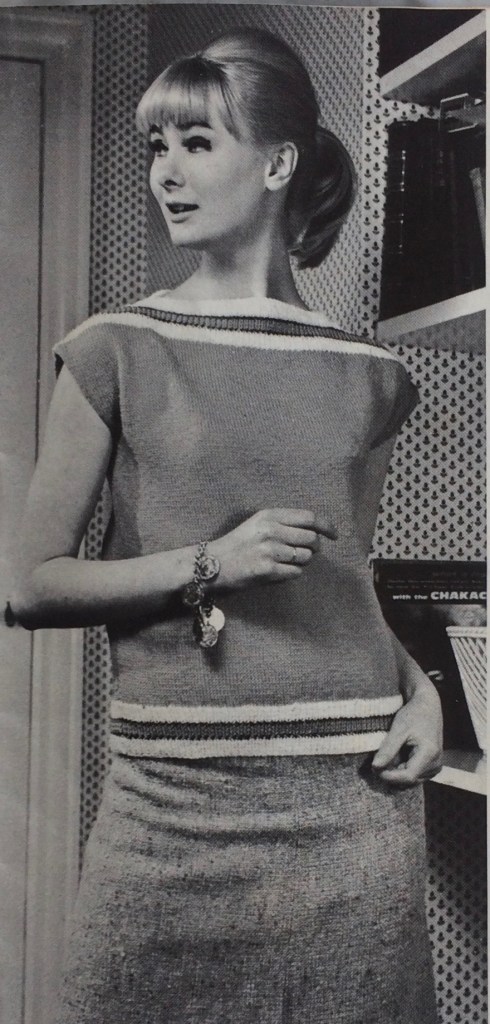
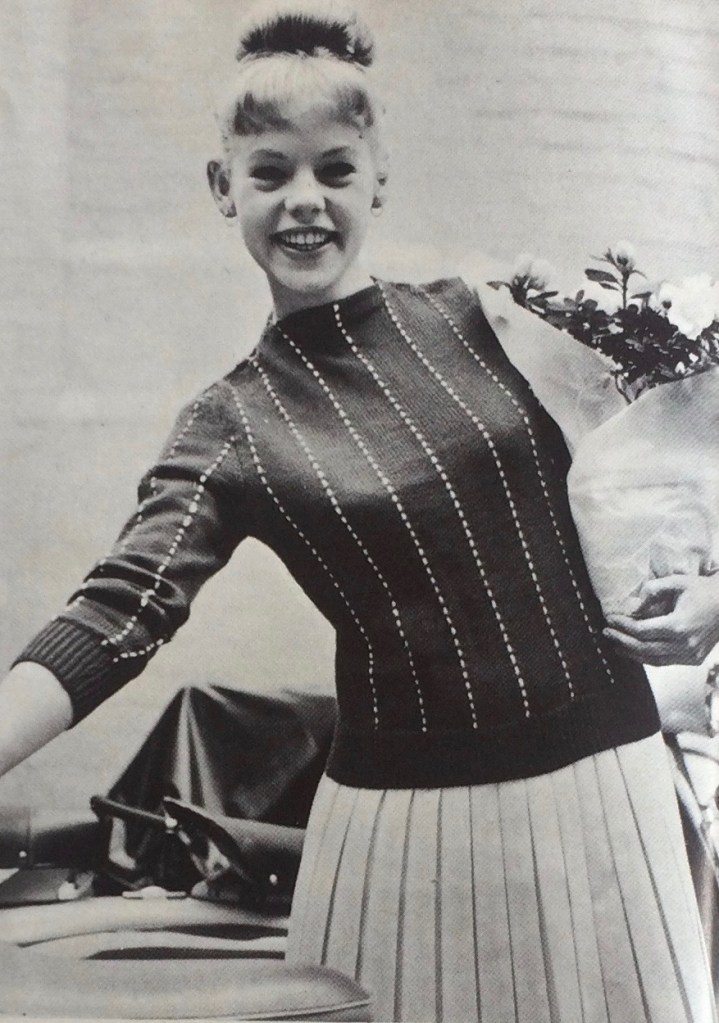
It’s time for a “Fashion Switch” over at Stitchcraft! 1967 is the year where knitted dresses really start to feature, and as far as I can tell, the “switch” part means you can either make a dress or a skirt combo and mix and match. The cover designs fit in well with the trend: high necks, short skirts, deep raglan armholes, A-line shaping and big patch pockets. Note, too, the huge hats — they will only get bigger in the months to come.

The centrefold photo shows a slinky variation on the theme with a dress and/or skirt combo featuring a pretty beaded and textured design. Like the chevron dress from April 1967, the designs pick up some elements of 1920s and 30s fashion, while keeping a distinctly late-60s shape.

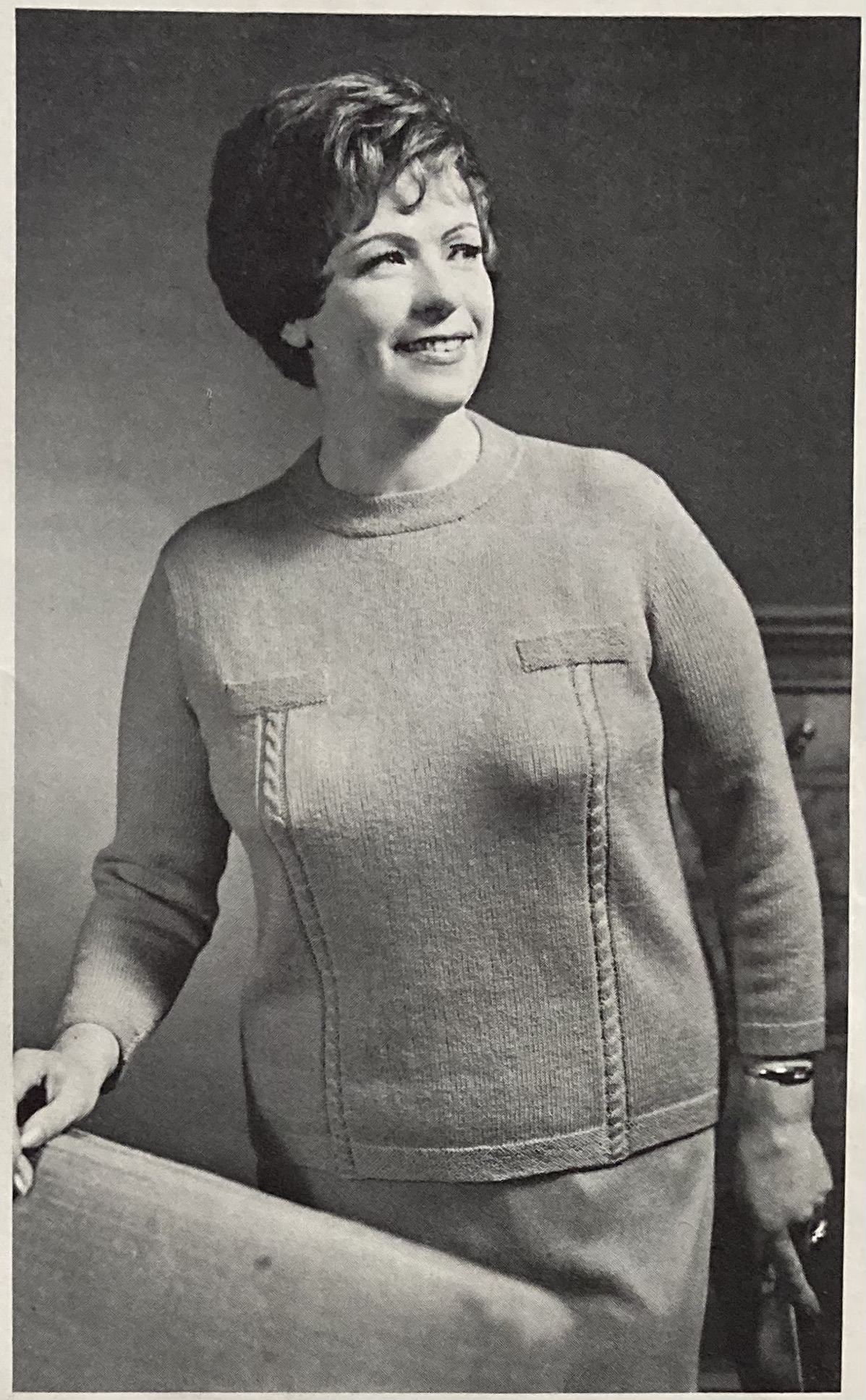
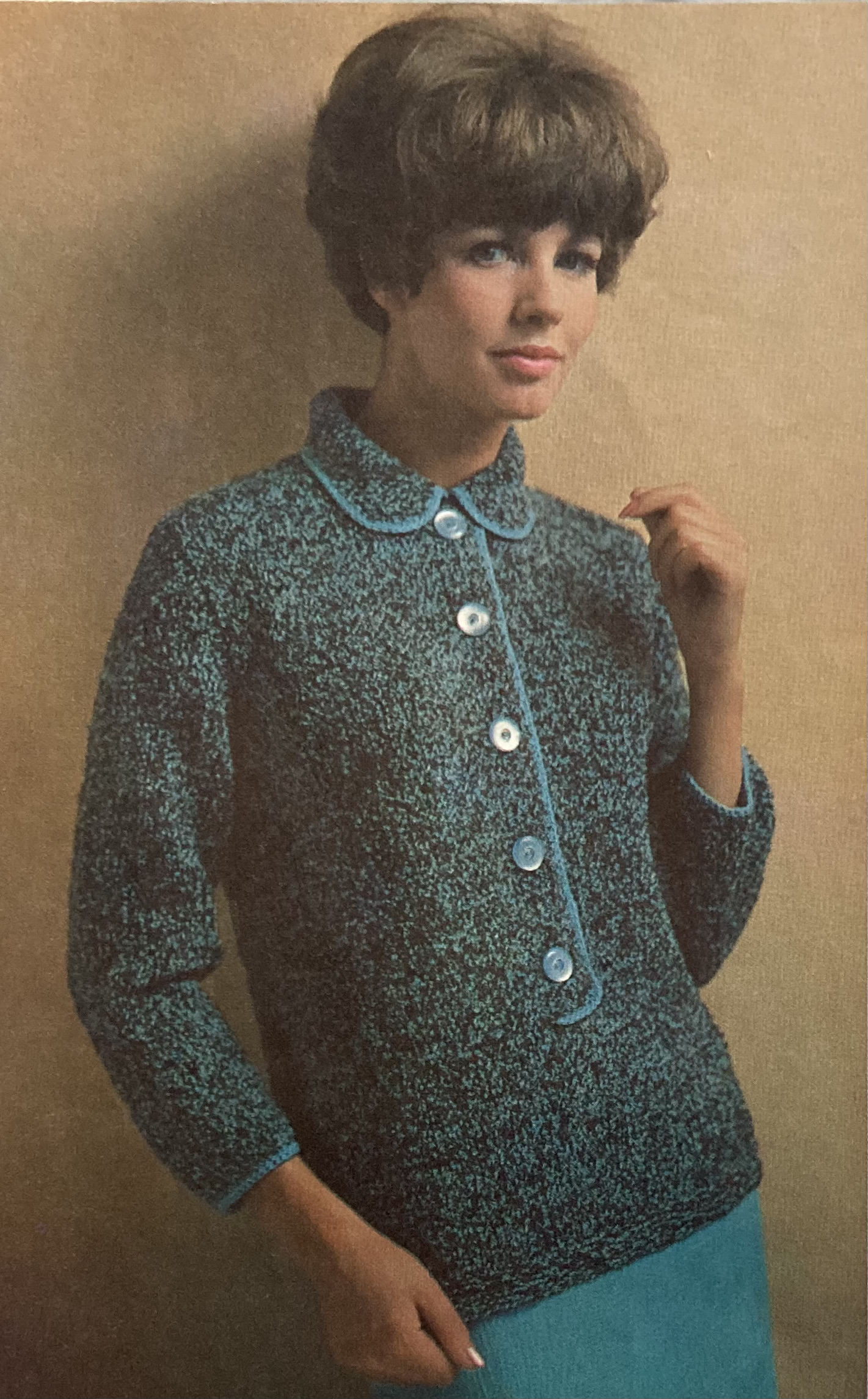
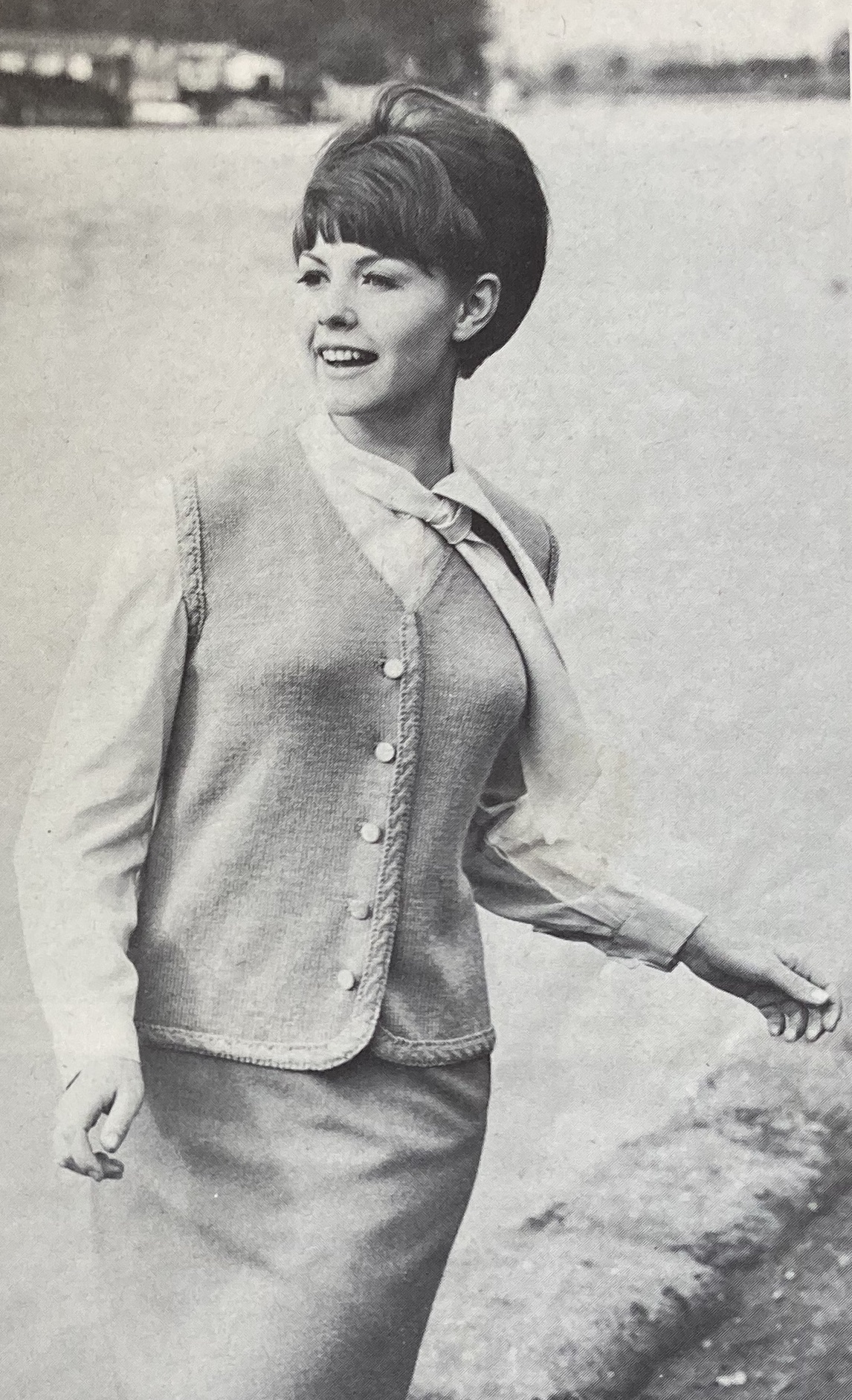
Other women’s knits include a bouclet blouse for the fuller figure with a very neat and pretty “soft-roll” neckline, a casually elegant afternoon suit with cable trims, a striped skirt combo in “colour brilliance” (tangerine and violet!), and a “Golden Glow” bright yellow pullover.

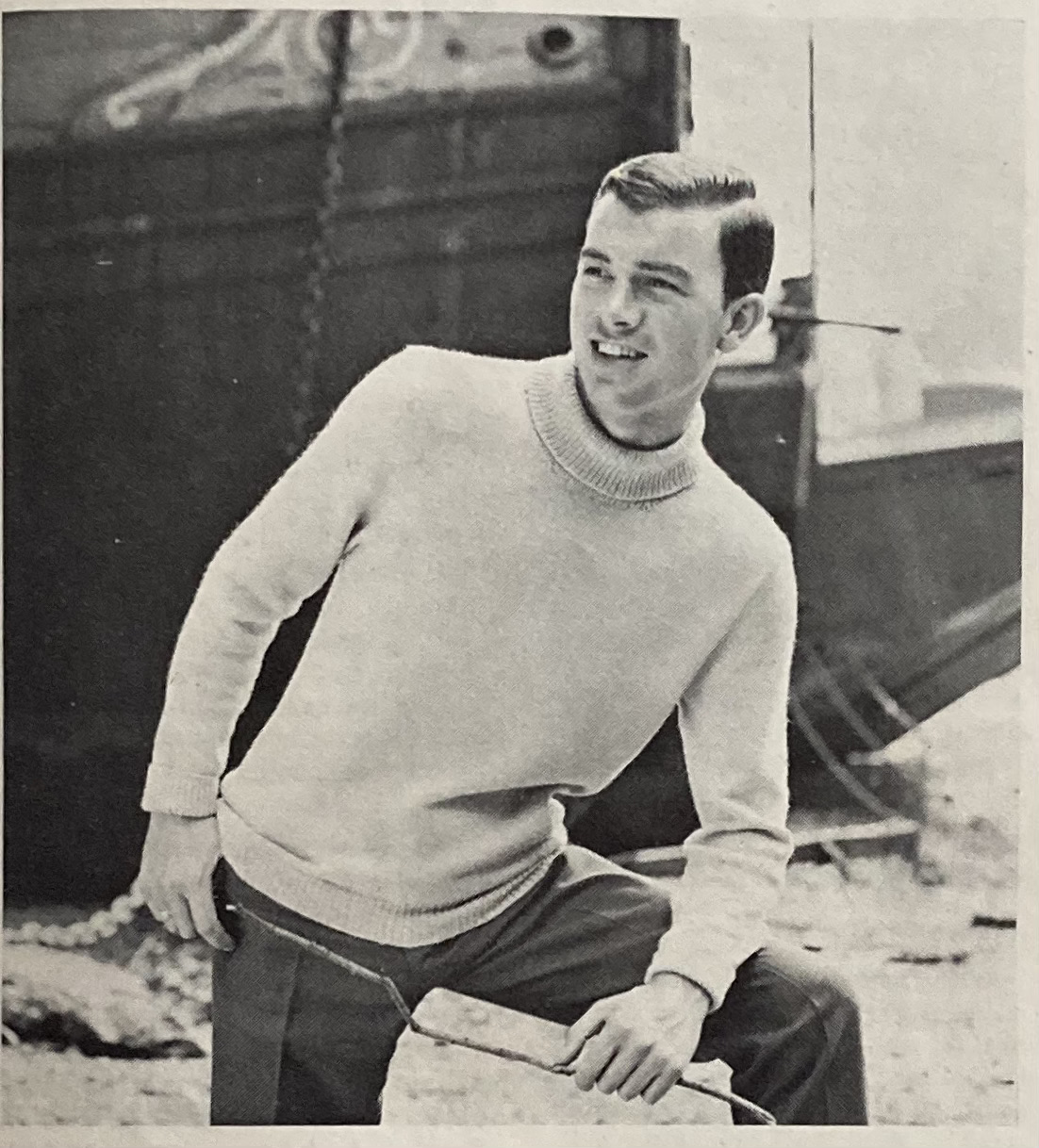
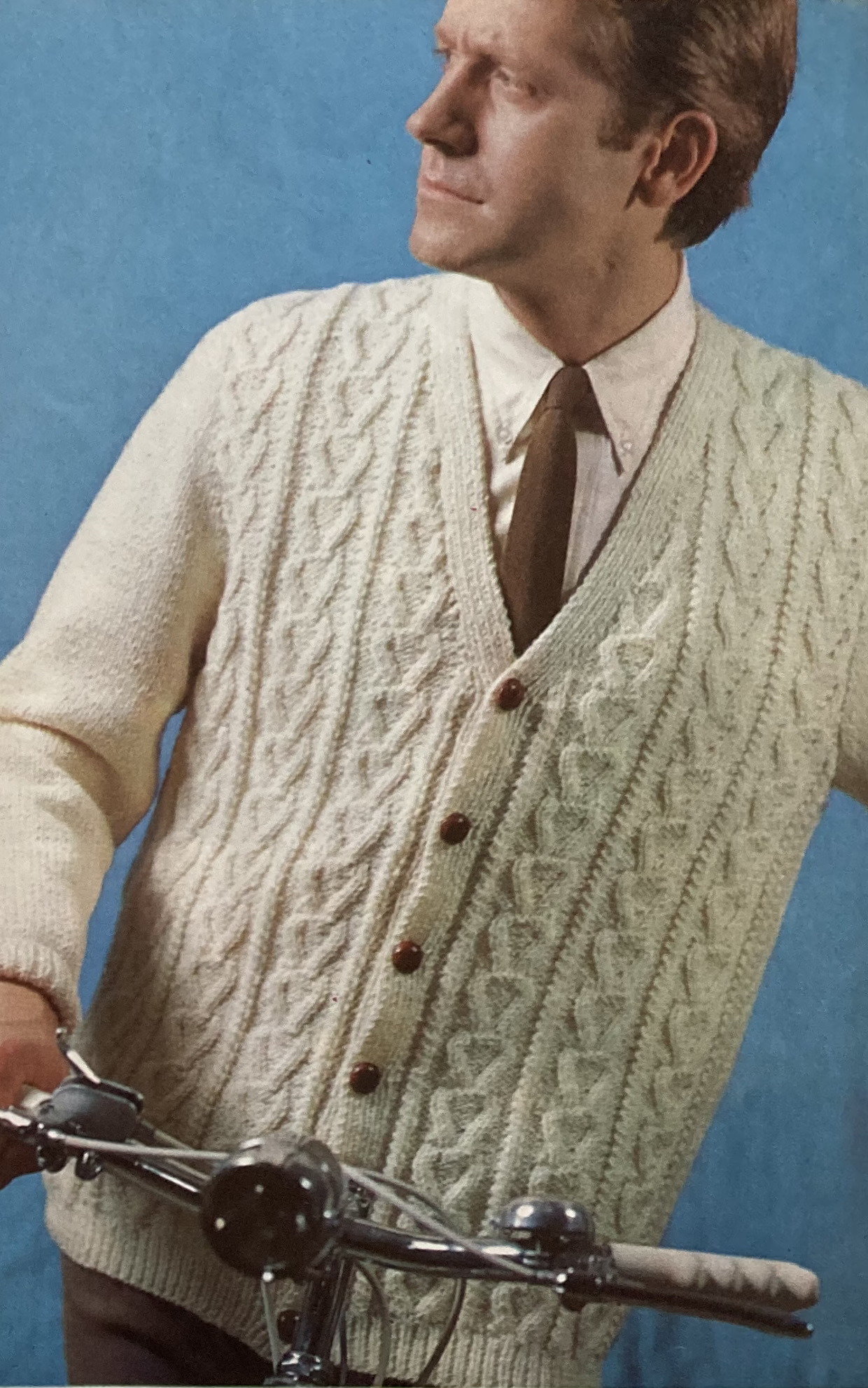
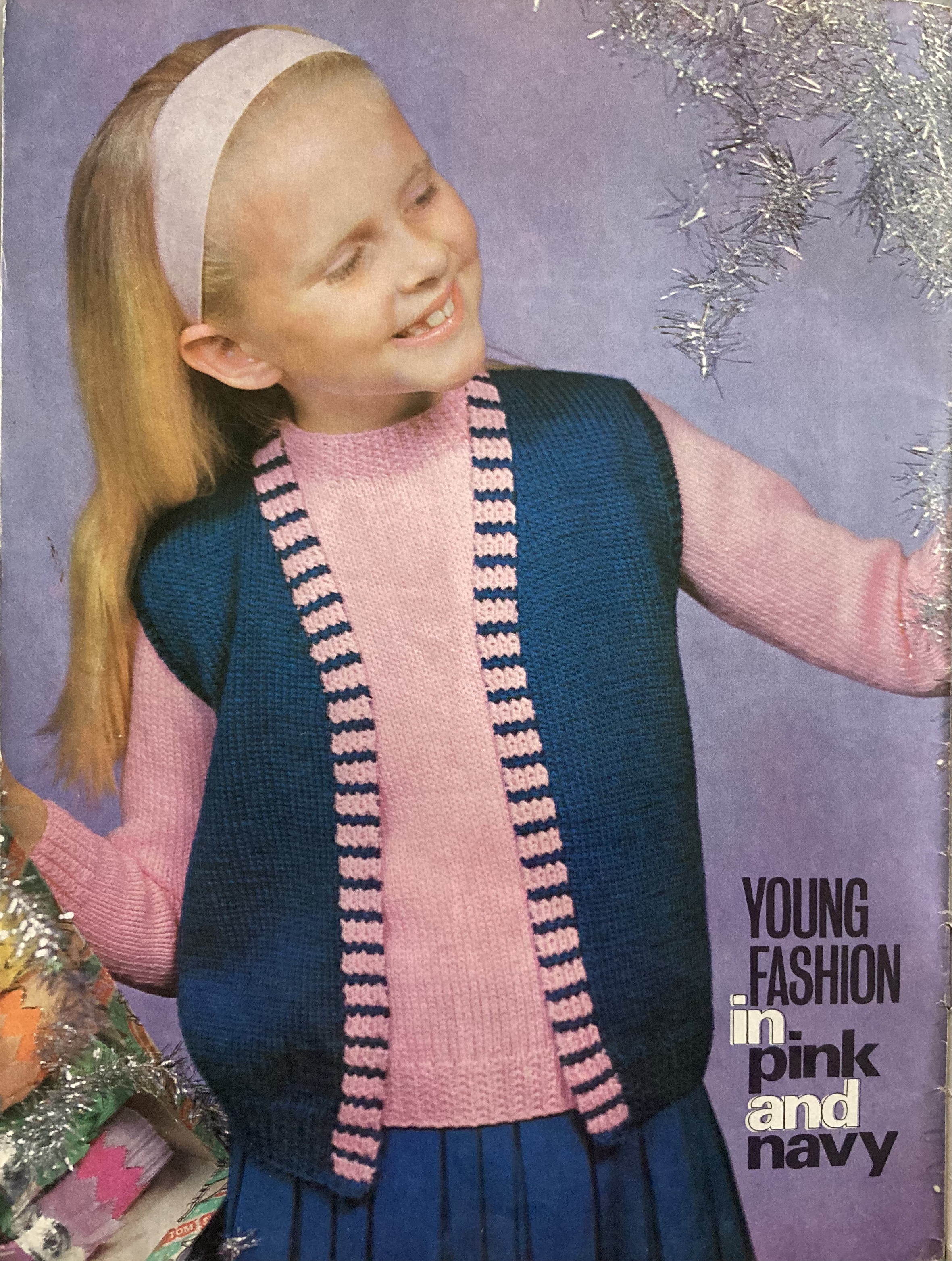
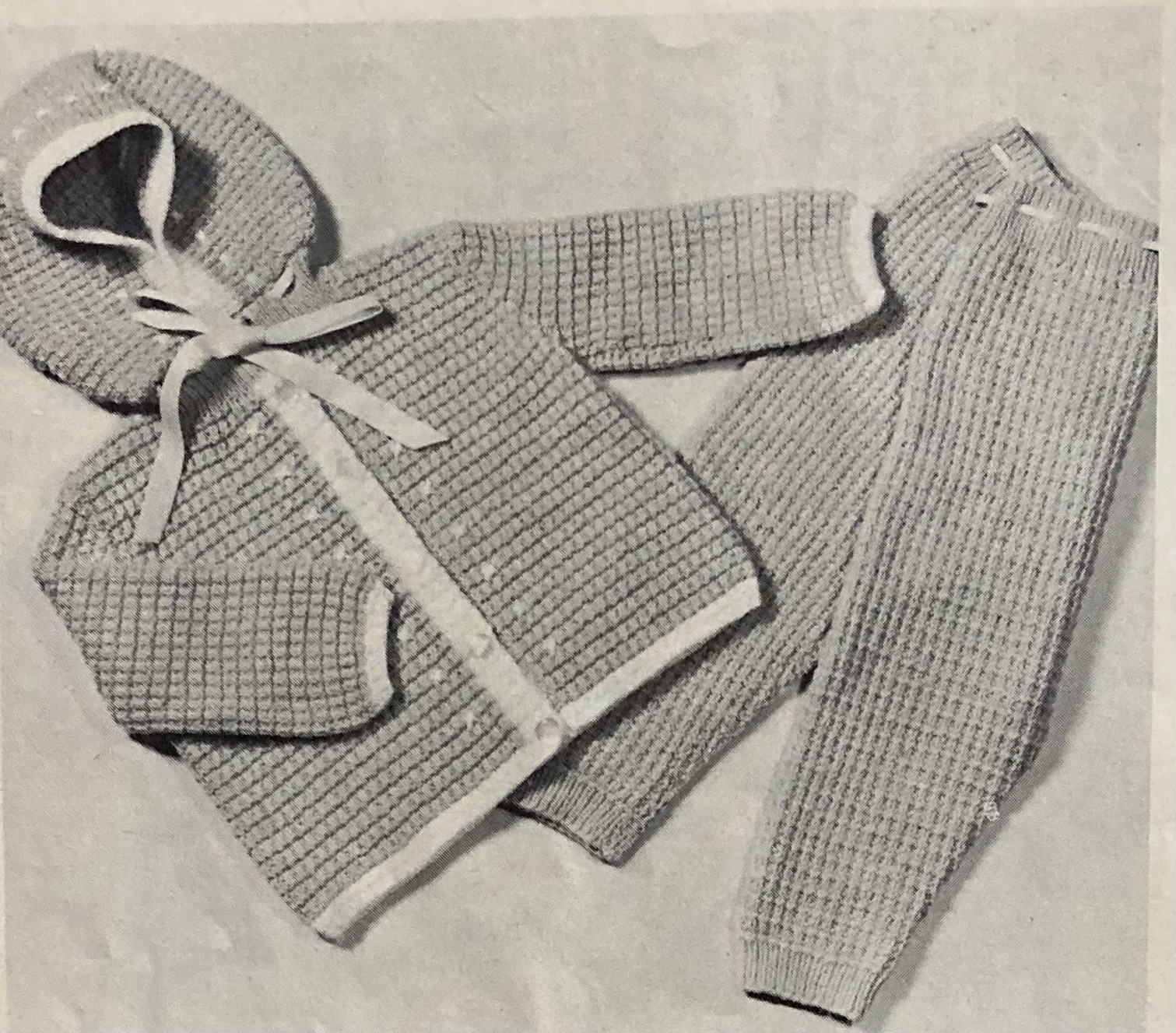
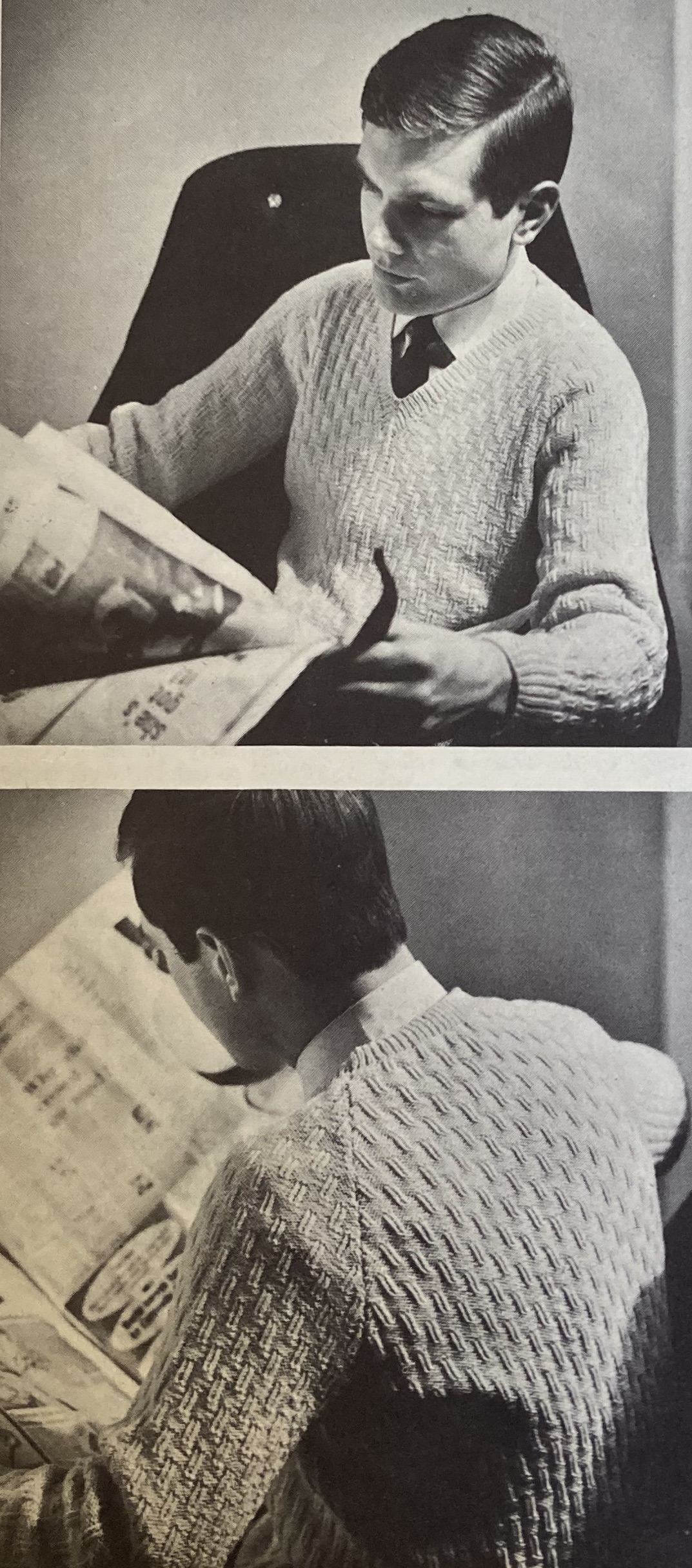
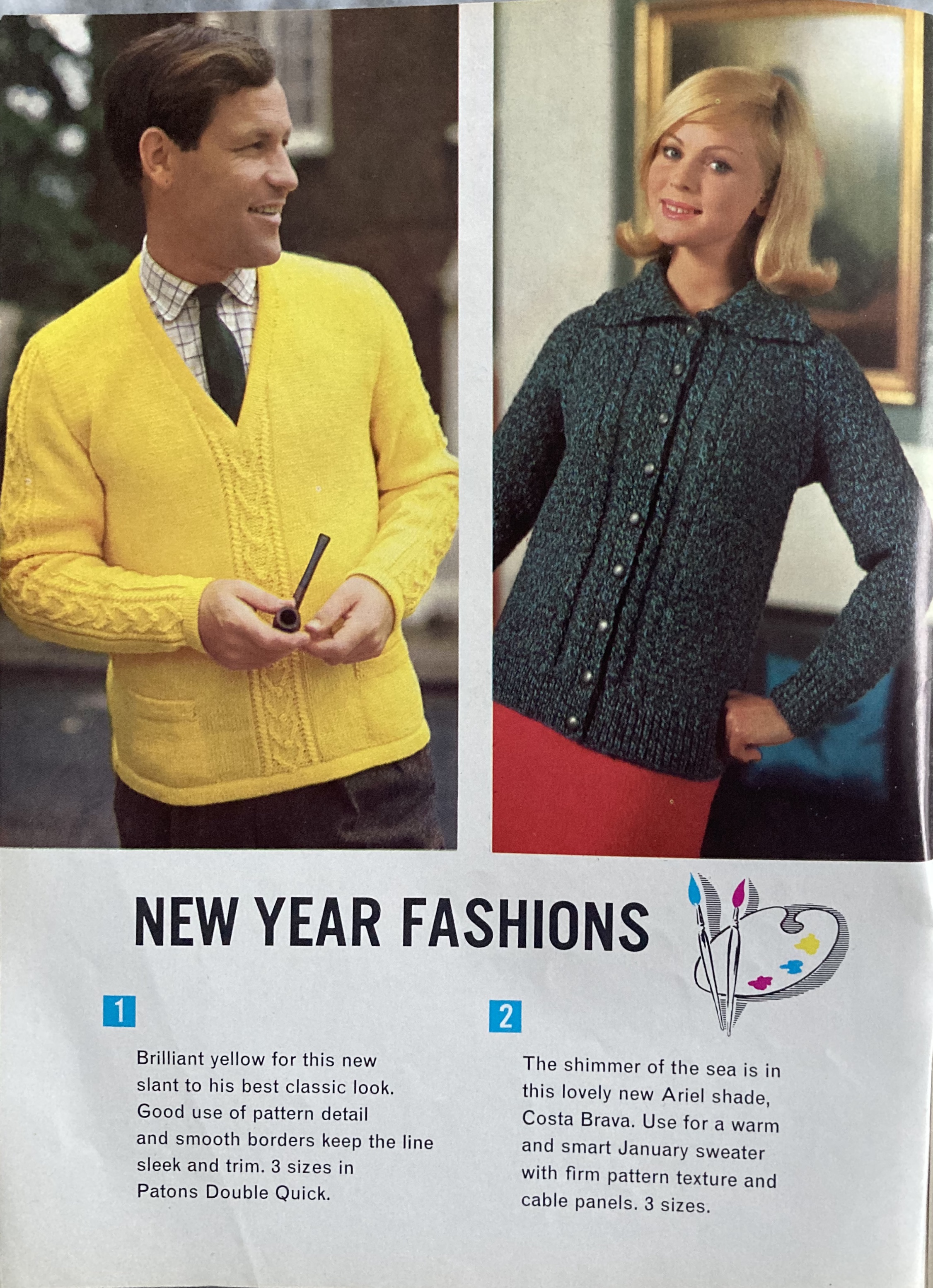
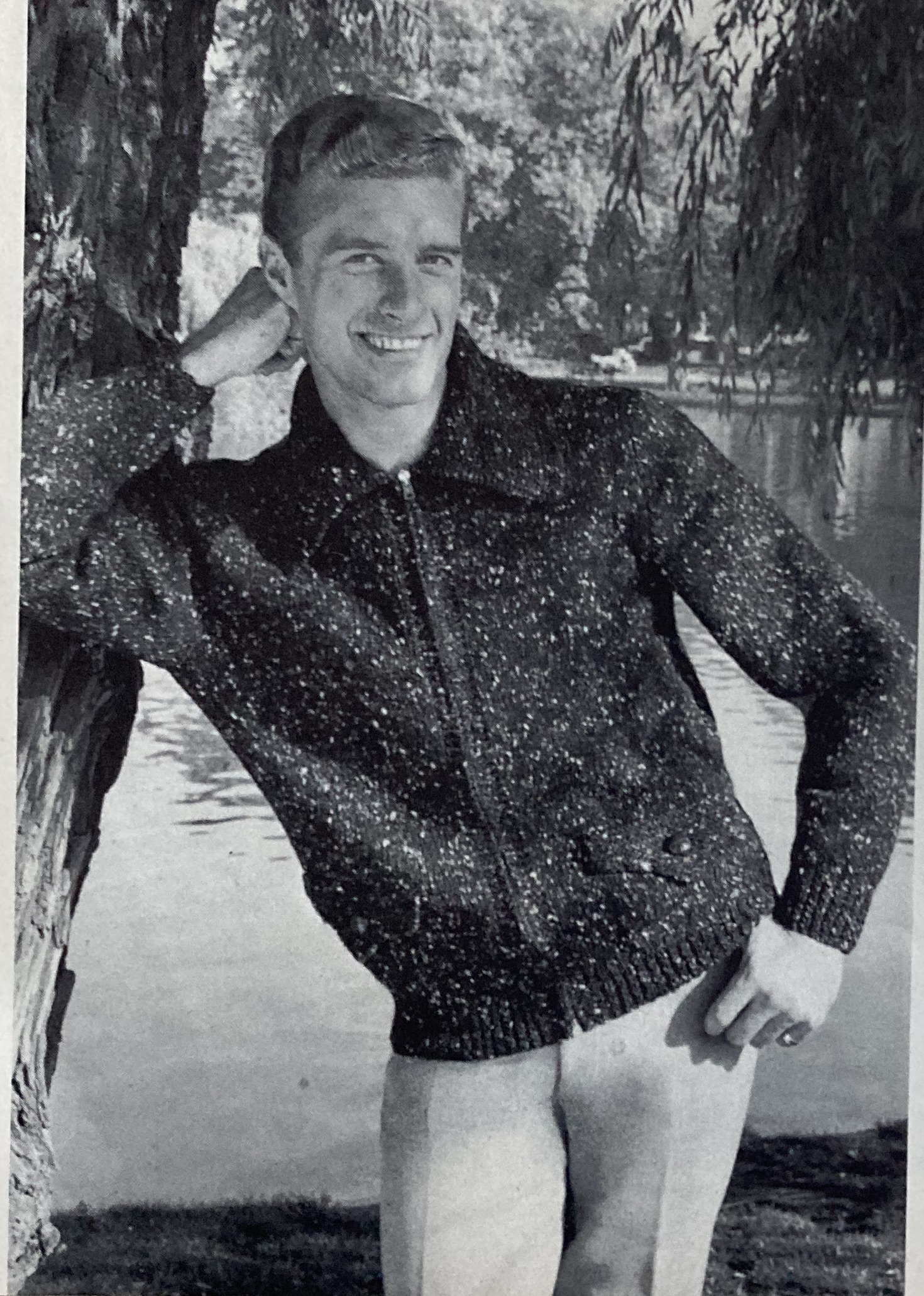
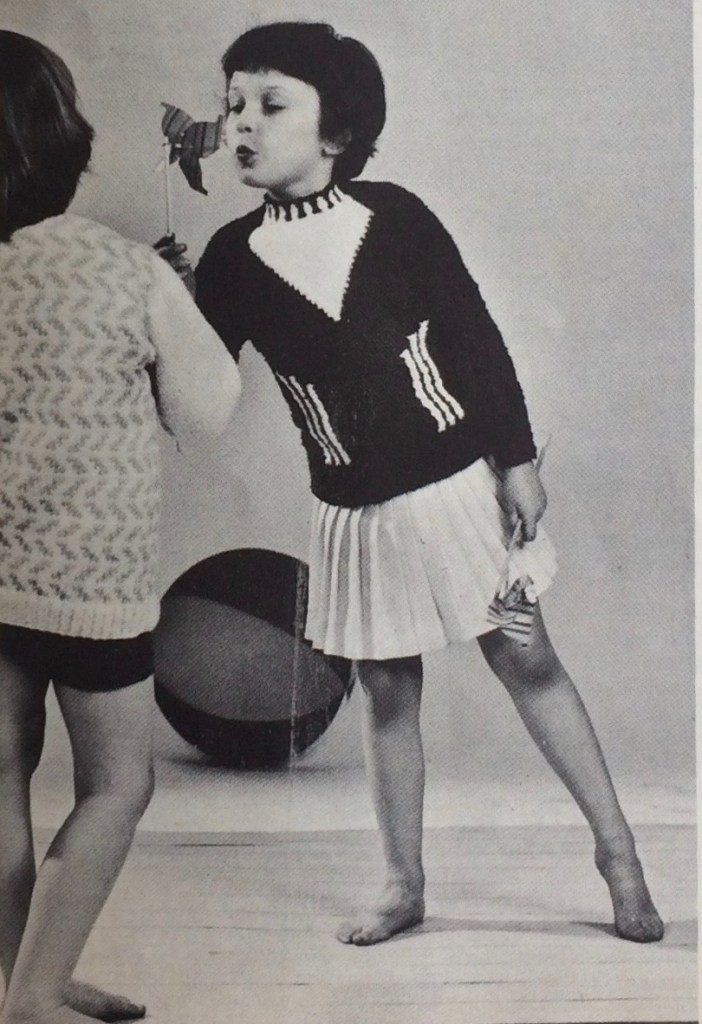
“Colour brilliance” applies to men’s fashions too, for once, and this green and yellow slip-stitch cardigan is a masterpiece. The model looks a bit like a colleague of mine — should I knit it for him? The other men’s garment, a chunky but streamlined pullover, echoes some of the design features of the women’s “fashion switch” combos. like the big patch pocket and contrasting-pattern sleeves. The photo is black-and-white, but the suggested colour is “Curry”, which I assume will be some kind of dark gold-brown-orange (so 60s). For children, there are two nice, sturdy, basic raglan pullovers in a more classic colour scheme — dark charcoal with red trim for the boy’s and “Cloud-dust Pink” with “Aztec Gold” trim for the girl’s.

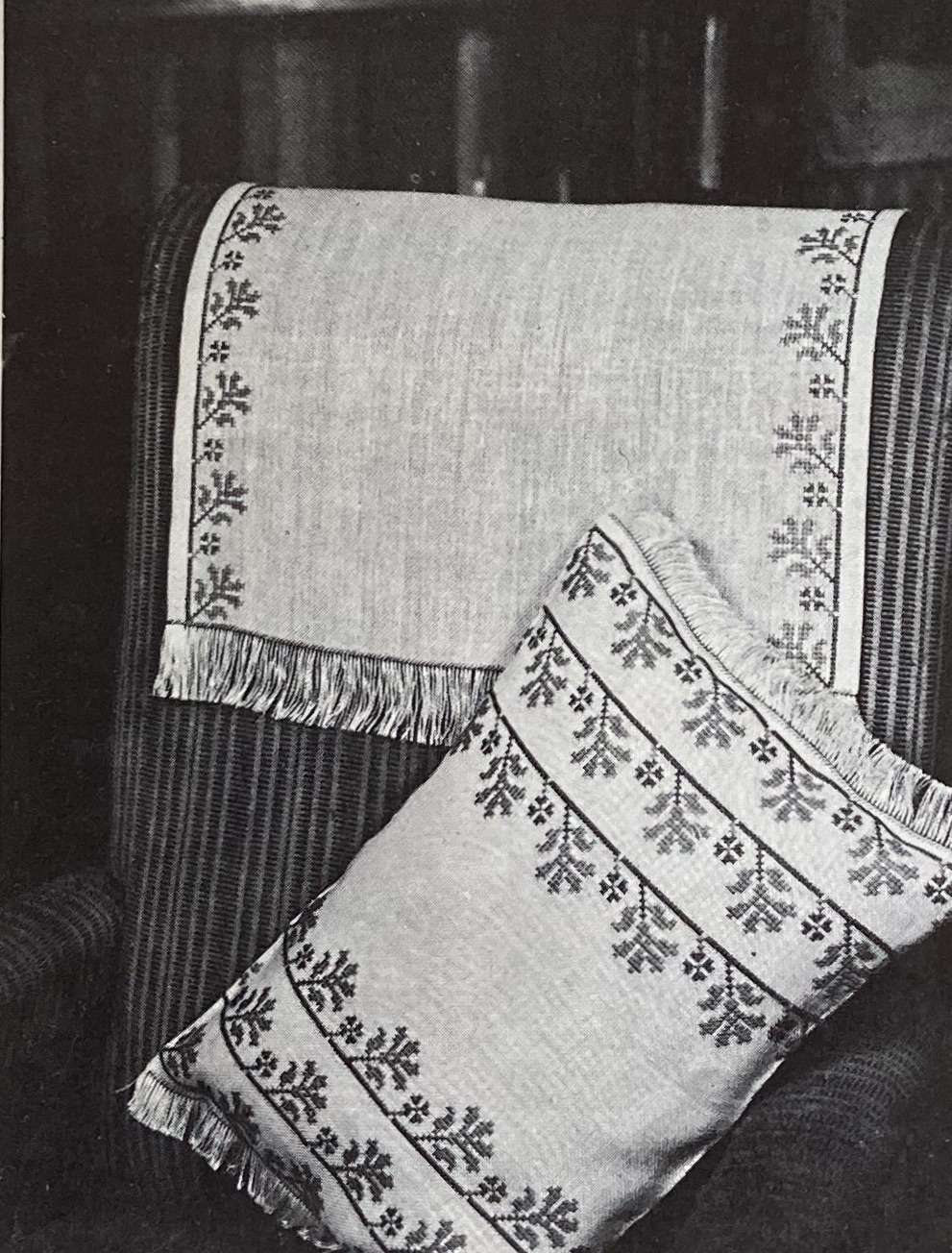
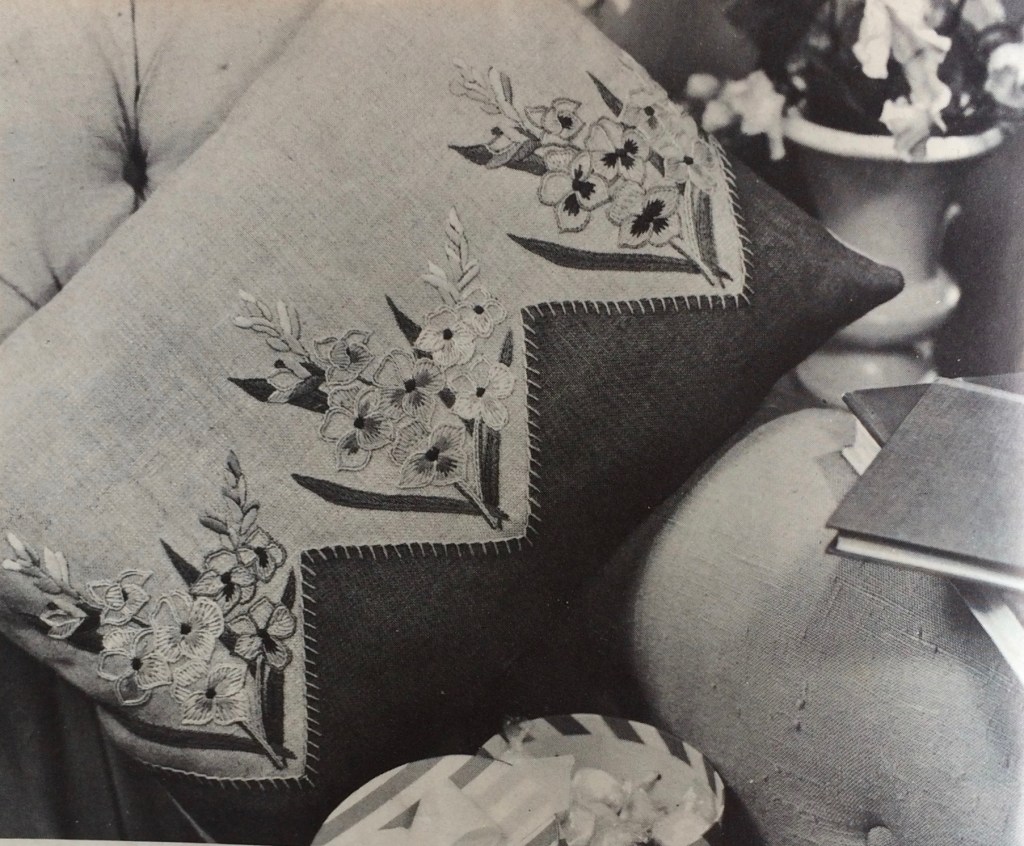
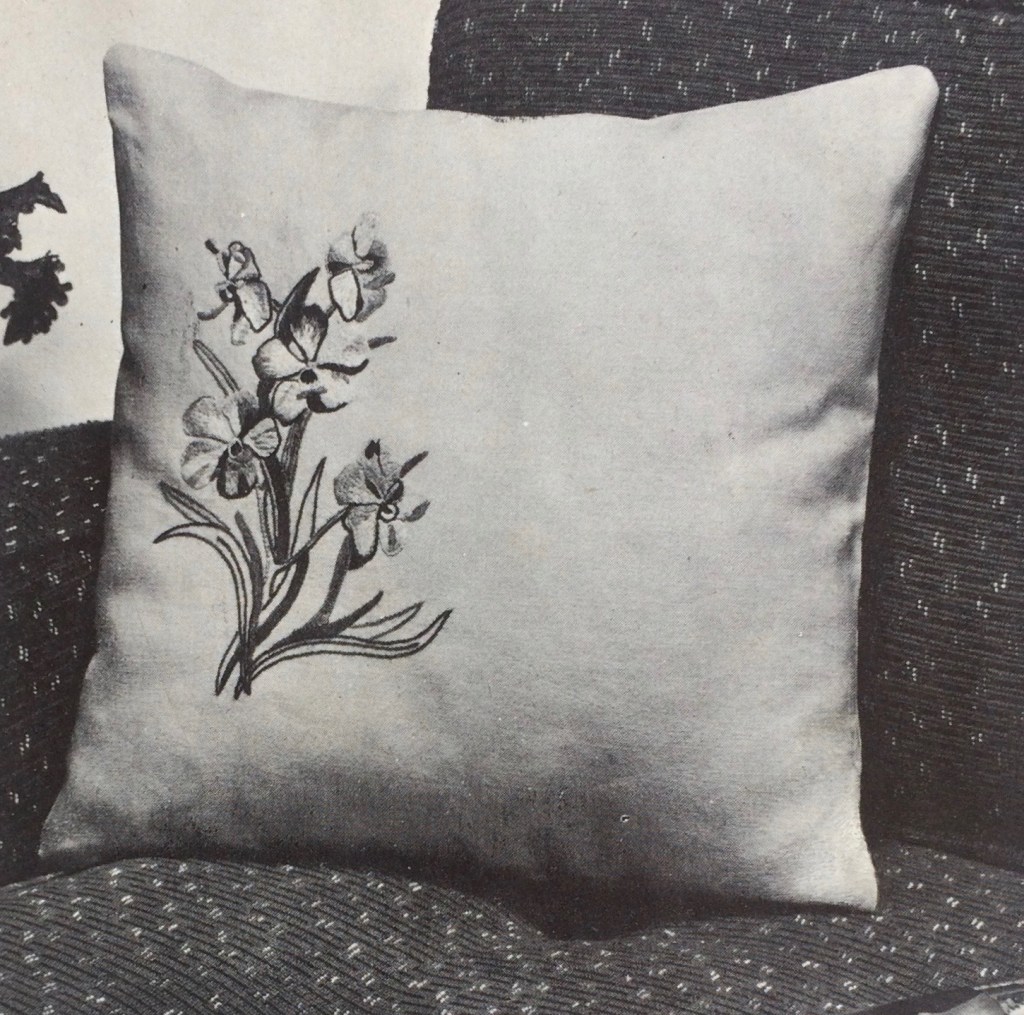
There are some fun homewares for all styles and abilities, starting with some very easy sewn and embroidered aprons with whimsical kitchen designs. I’m not interested in the aprons, but I love the top that the “teatime” model is wearing! You can make a tapestry panel of an Irish homestead in Rosguill, Donegal or a cushion or chair-back in a gorgeous traditional-inspired design updated “for a modern setting”. Both are done in tapestry wool on furnishing linen.

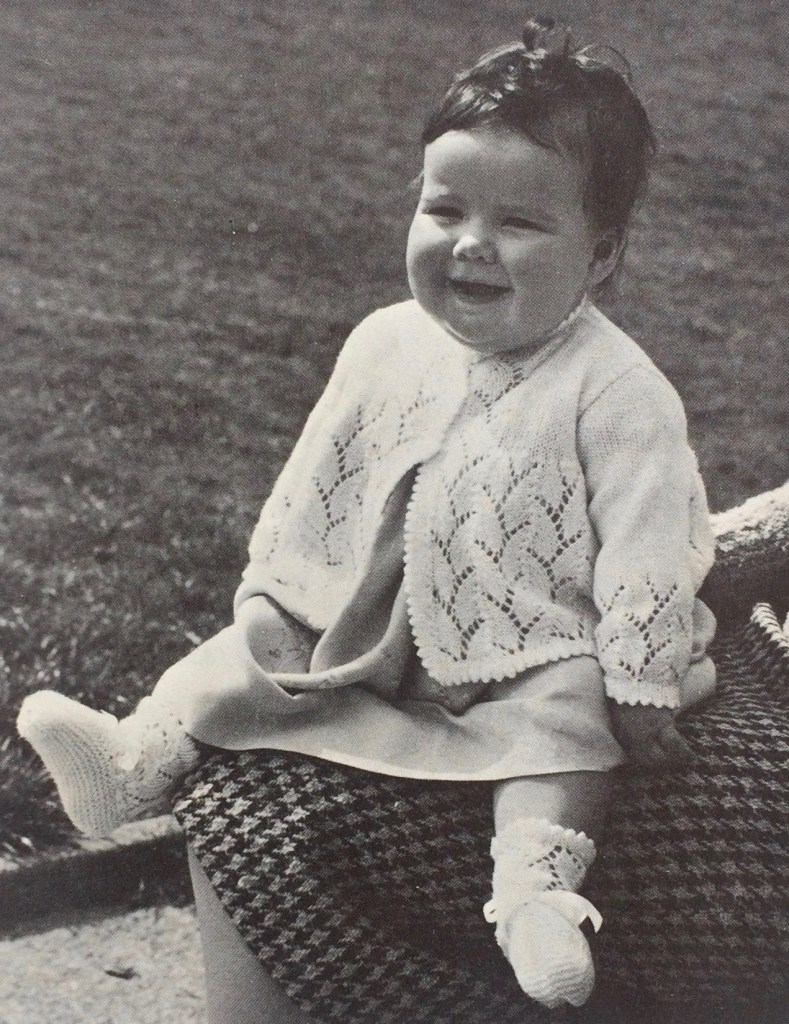
It’s not too early to start on little gifts for Christmas, and here’s a little bag “for a friend” and a knitted tortoise toy “for a toddler.” Baby gets a thick, squishy pram cover in fluffy “Ariel” wool and a raised cable trellis design.

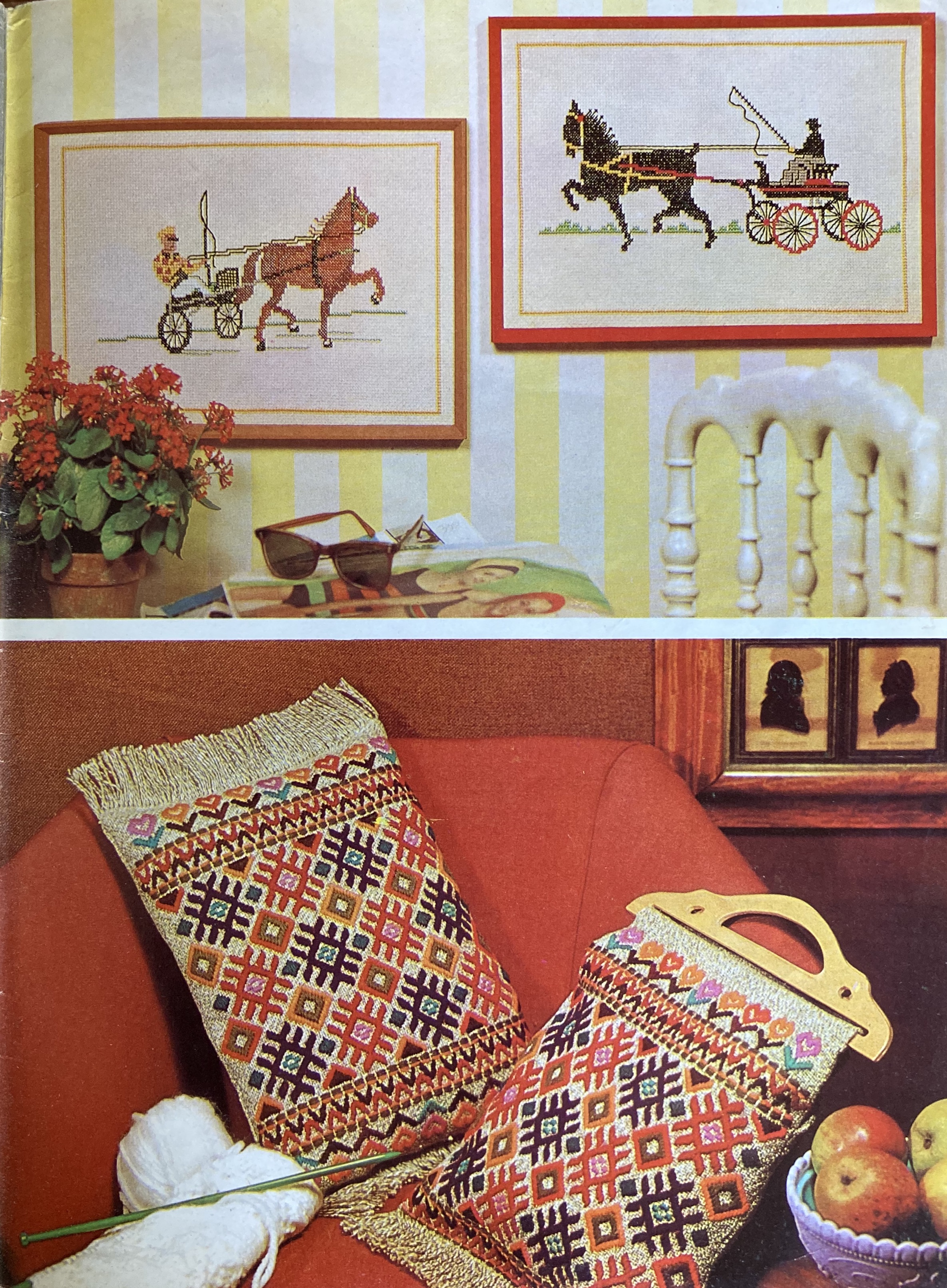
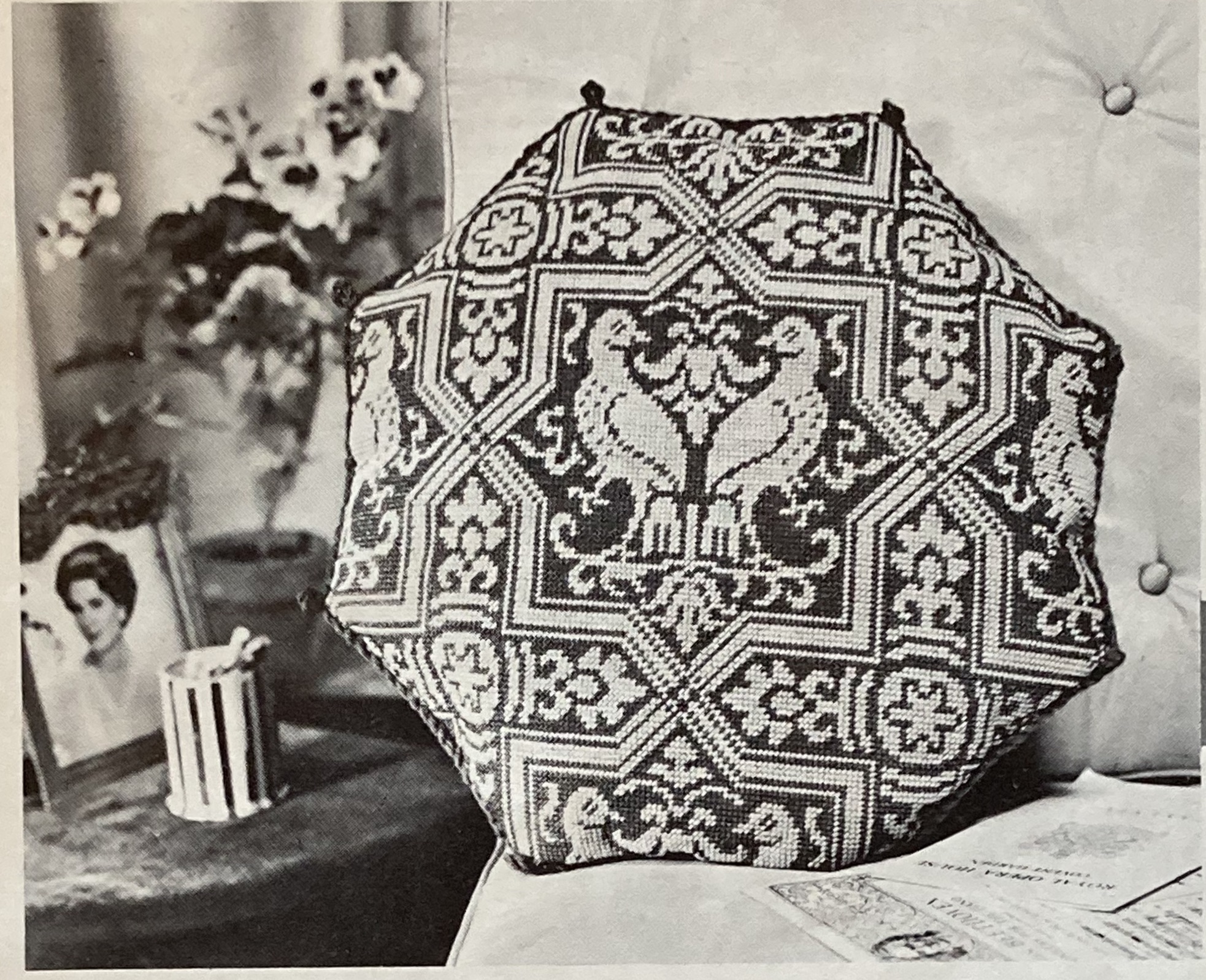
Or you can make a Florentine-pattern workbag or cushion for yourself. The colours — gold, green, and yellow — will match nicely with a lot of the knitted designs from this month.

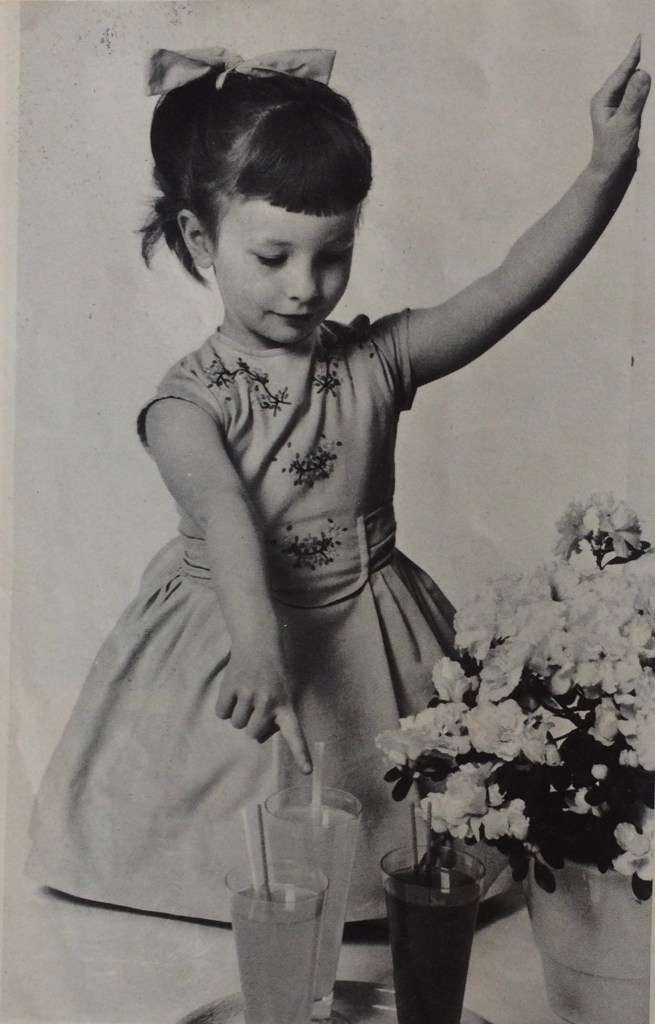
In the “Readers Pages”, we finall have a new comic: Sue and Samuel Squirrel run the Woodland Wool Shop. Their adventures start when Sue finds a loose thread of yarn in the woods and winds it up — only to find that she has unraveled an elephant’s vest and needs to knit it all up again! Poor Sue. The only full-page advert is for Bri-Nylon. I imagine the dress in the photo is quite hot and impractical, especially if knitted in synthetic nylon wool, but what a lovely photo.

That’s it for this month! There are so many great projects that it’s hard to choose, especially since the ones that call to me are all big projects and I just finished the chevron dress from April 1967. I love the orange cover dress and the men’s slip-stitch cardigan, particularly, as well as the fancy embroidery design, which I think would look lovely going around the hem of a full black skirt. Or maybe even the Florentine needlepoint? I don’t have much time in September to knit, though, and even less to adapt an embroidery or tapestry pattern. We’ll see!

September 1966: Overview

The September 1966 issue of Stitchcraft doesn’t have an introductory paragraph by “editress” Patience Horne, but it does have a lot of looks: the “Crepe Look”, the “Country Look”, “Carefree Sweaters for a gay look” (you would think that by 1966, they would have noticed that the meaning was changing), and my personal favourite, a “Fuzzy Look for a Party Extra”. Let’s take a look!

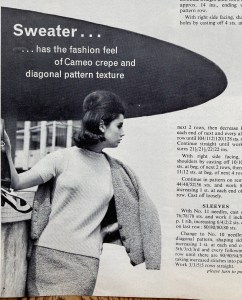
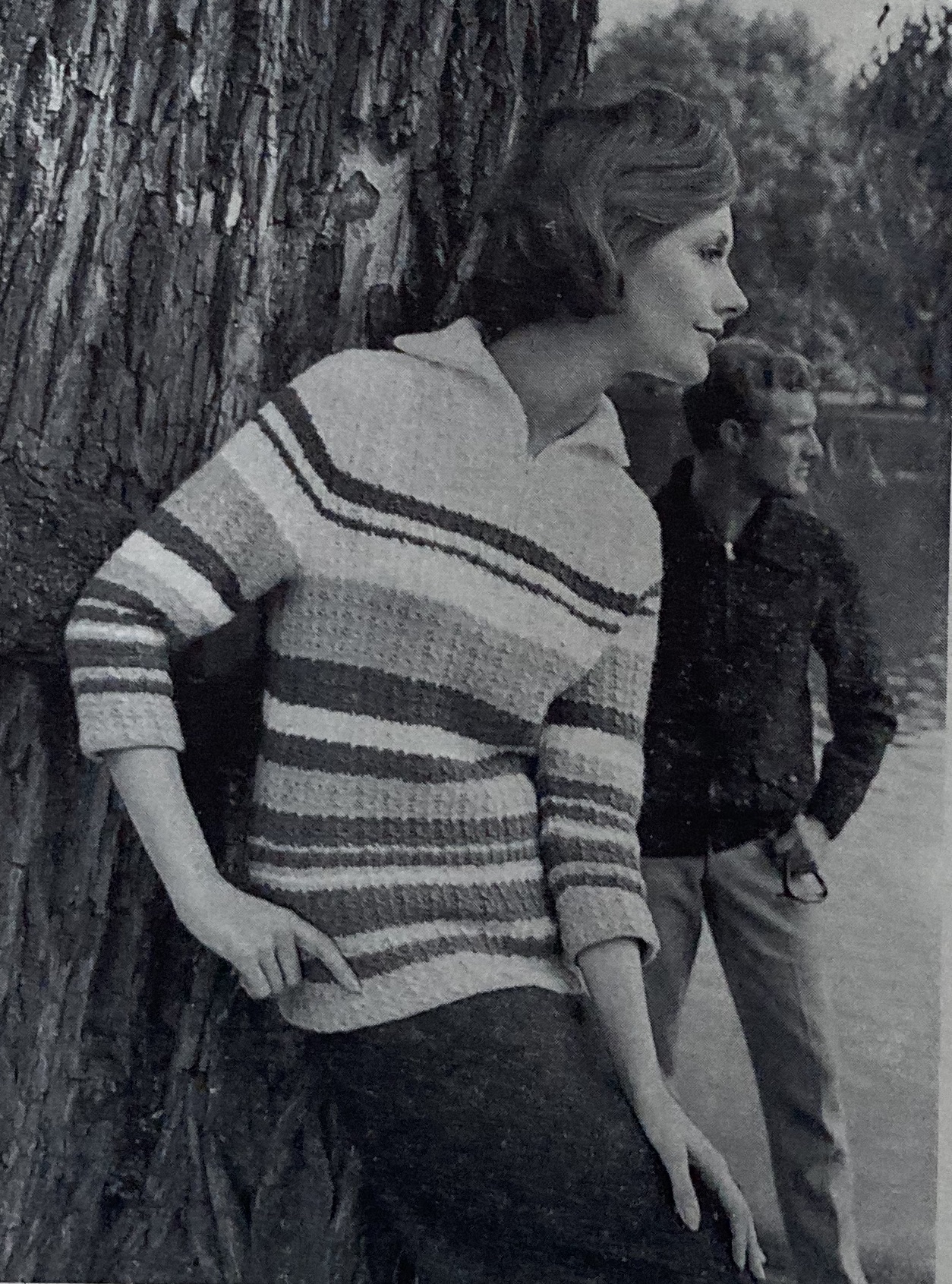
The “Crepe Look” is the smooth finish and good stitch definition that you get when you knit with a tightly-plied and/or long-fibre yarn. In this case, the yarn in question is Patons 101 Courtelle Double Crepe, a 100% acrylic yarn in DK weight. It’s used to make the cover cardigan, which is part of a twin-set, as well as a men’s pullover, a men’s cardigan, and a women’s pullover. The twin-set and the men’s garments make use of the good stitch definition with twisted stitches, cables and ribs. The women’s pullover (pictured two paragraphs down) is knitted in plain stocking-stitch, but sideways for easy placement of the vertical stripes. Cool and neutral colours are back: beige, grey, and white, with blues and browns for the colour accents. The only exception is the bright red jumper of the twin-set.

The “Country Look” features sturdy and tweedy garments for indoor and outdoor wear, with textures inspired by Aran and/or alpine knitting styles. The tweed suit on the inside cover is made in multicoloured “Glenora” wool and the Aran jacket in undyed “Capstan“. Capstan in the UK at this time was 100% wool; I’m not sure if Glenora was wool or a wool-synthetic mix. The boxy suit styling with collars and pockets shows the Chanel/Bernat influence, but dressed down a bit for “country living”. Those who want a little more fashion in their country life could make a trellis-and-rib pattern cardigan in Shetland-mix “Flair“.

Those who want even more fashion fun can knit one of the “Carefree Sweaters for a gay look” — like a fringed DK pullover in “Rose Petal” pink double knitting wool. Unlike many of the designs around this time, it’s shaped from the hem to the waist and the waist to the bust. The fringed edging is made by knitting a 9-stitch wide strip to go around the neckline, then casting off 7 stitches and frogging the remaining two stitches down the length of the long side, leaving loops. Then the strip is sewn into place to prevent further loss of stitches. That certainly sounds faster an easier than any other method I could think of! The other carefree, gay sweater is the sideways-knit pullover in “crepe look”. (Why limit yourself to just one look? The man’s twisted-stitch pullover is also both “crepe look” and “country look.”) Of course, your “Look” doesn’t have to fit in a category at all. It can just be a fun, nice design, like this “Charleston style” dress in emerald-green double knitting, or these absolutely wonderful children’s outfits in bright red with white bunny motifs.

The “Fuzzy Look for a Party Extra” design is also for a child — a fluffy vest made in “Fuzzy-Wuzzy” wool-angora mix. Best Patons yarn name ever! Speaking of party planning, how about a handmade hobby horse as a child’s birthday present? It’s made of felt stuffed with kapok, mounted on a broom handle and trimmed with ric-rac braid and fringe. The rings in the harness are curtain rings.

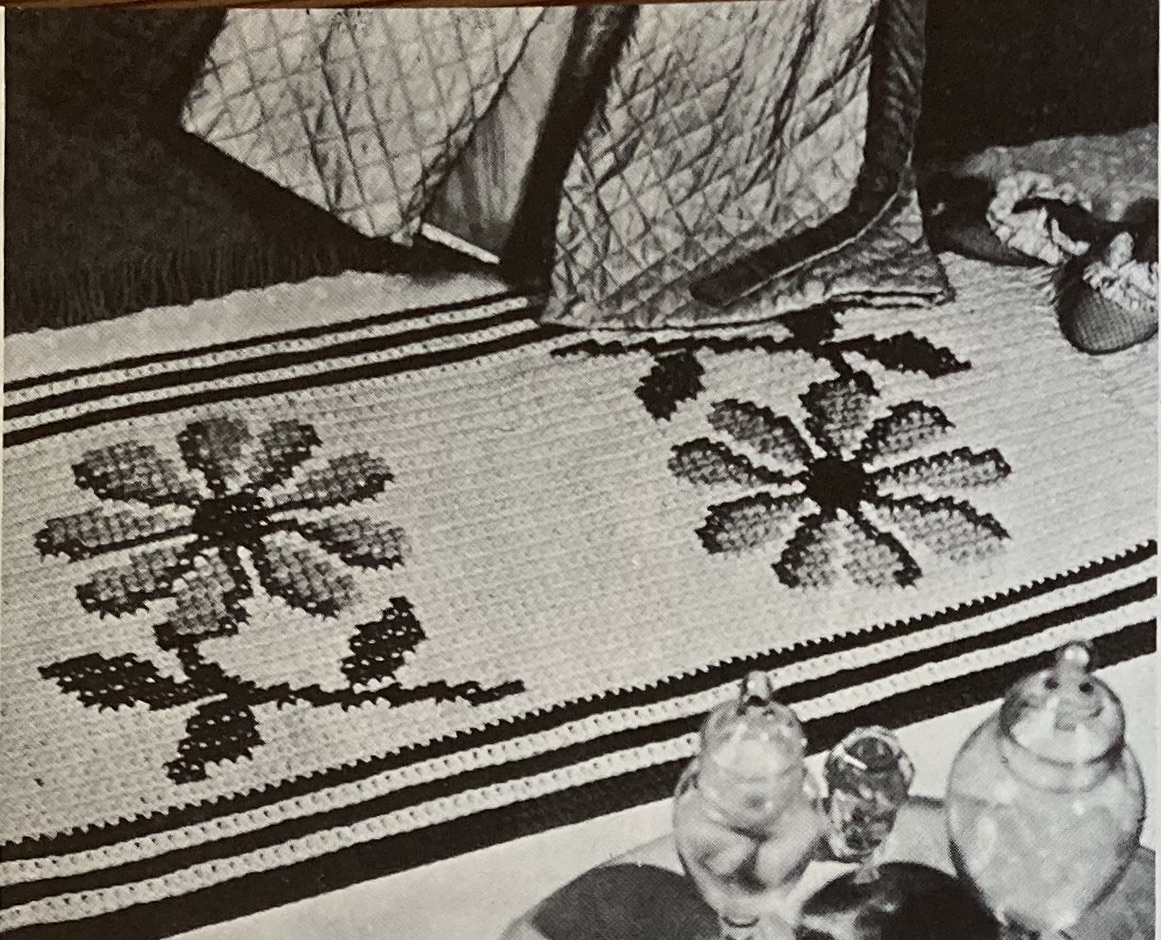
With that, we’ve moved on to the housewares, which are standard, but also showing a more modern flair. There are rugs in Soumak stitch or cross-stitch, or a somewhat abstract “sun” design for a cross-stitch cushion and chairback. The sun pattern doesn’t stand out much in a black-and-white photo, but I can imagine it would be very striking if made in the colours in the pattern: yellow, gold, olive, red, orange, black, scarlet and green. Even more striking (and continuing the yellow-orange-green colour scheme) is the felt appliqué wall panel commemorating the 900th anniversary of the Battle of Hastings. Love the photo styling — they really went all out finding the perfectly colour-coordinated wall and accessories.

The “Readers Pages” give us a reprint of a little tapestry handbag from May 1961. I tried to make this handbag. Spoiler: it was not a success, and made me realise that I don’t like doing tapestry as much as I think I should. We’ve also got a new comic, “The Story of Higgeldy-Piggeldy” in which we are introduced to two very neat and tidy teddy bears who are going to get the shock of their life in the next issue, when they meet an untidy bear in a house that is all higgeldy-piggeldy! Oh no! Whatever will they do?

The ads are fun — you can tell the Scotch Wool Shop has been working with a modern advertising agency lately, with that swinging singer-songwriter and the slightly goofy copywriting. The “Fabrics & Threads” book makes reference to those new synthetic fabrics, and the ad for Patons 101 Courtelle shows the “Crepe Look” in a well-styled photo.

This is a wonderful issue. There’s more than one project I would like to make — the bunny jumpers, the “Charleston” dress — but I would like a new cardigan most of all, so I’ll be making the one on the cover from the “Crepe Look” twin-set. Just the cardigan this time — I feel like I have enough short-sleeve jumpers at the moment, and I don’t see the point of a thick, warm DK jumper with short sleeves. I’ve already started (cheating, I know), so maybe it will be done by the end of the month? Who knows? Stay tuned and find out.

November 1965: Overview

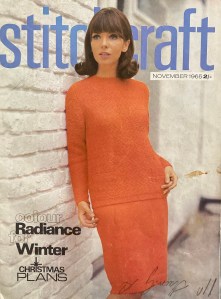
Colour Radiance for Winter and Christmas Plans! At Stitchcraft, it’s generally either preparing-for-Christmas time or spring-summer holidays. This month, they countered the cold, grey days of November with bright, cheerful colours and easy homewares. Let the festive preparation begin.

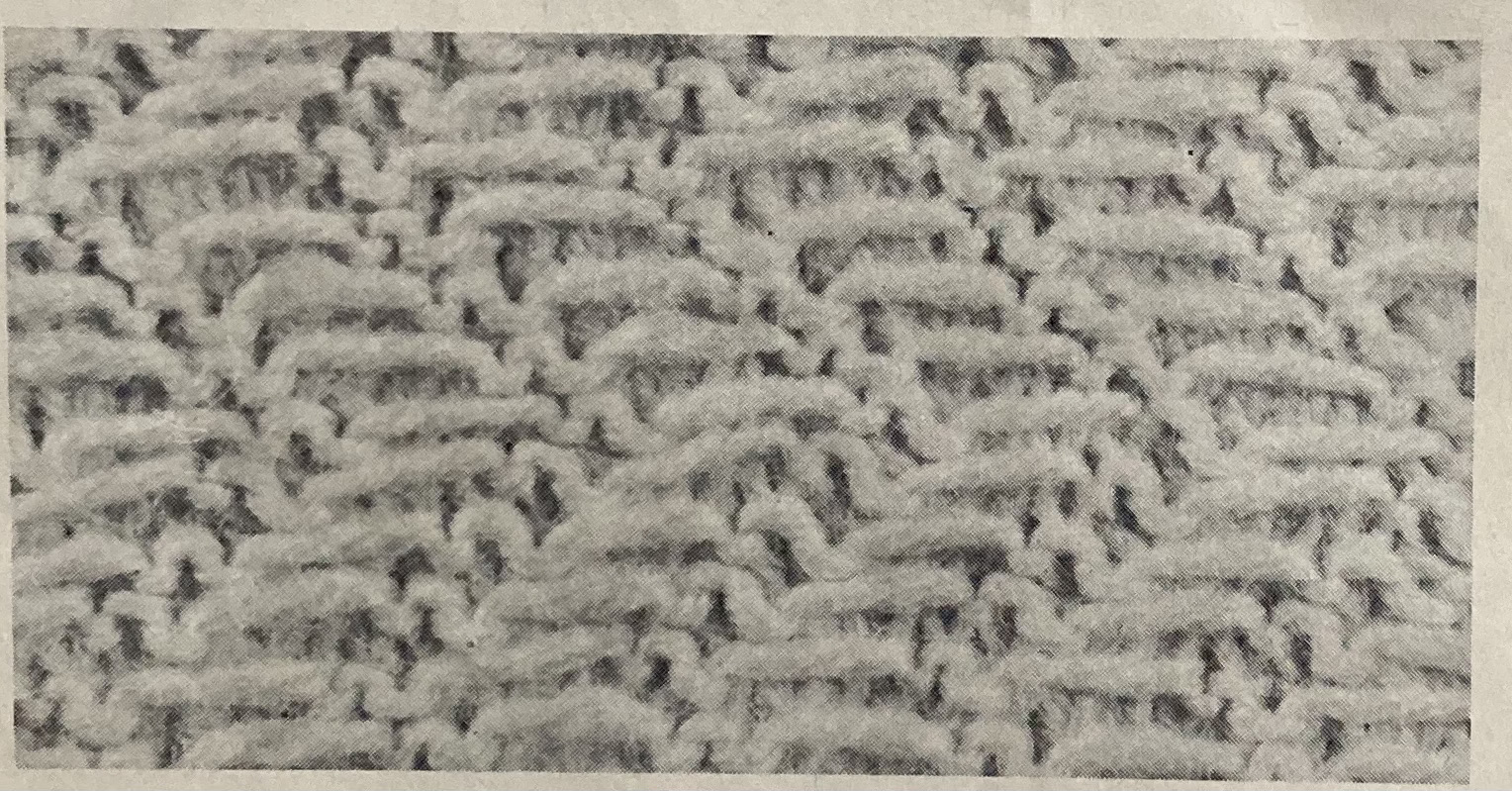
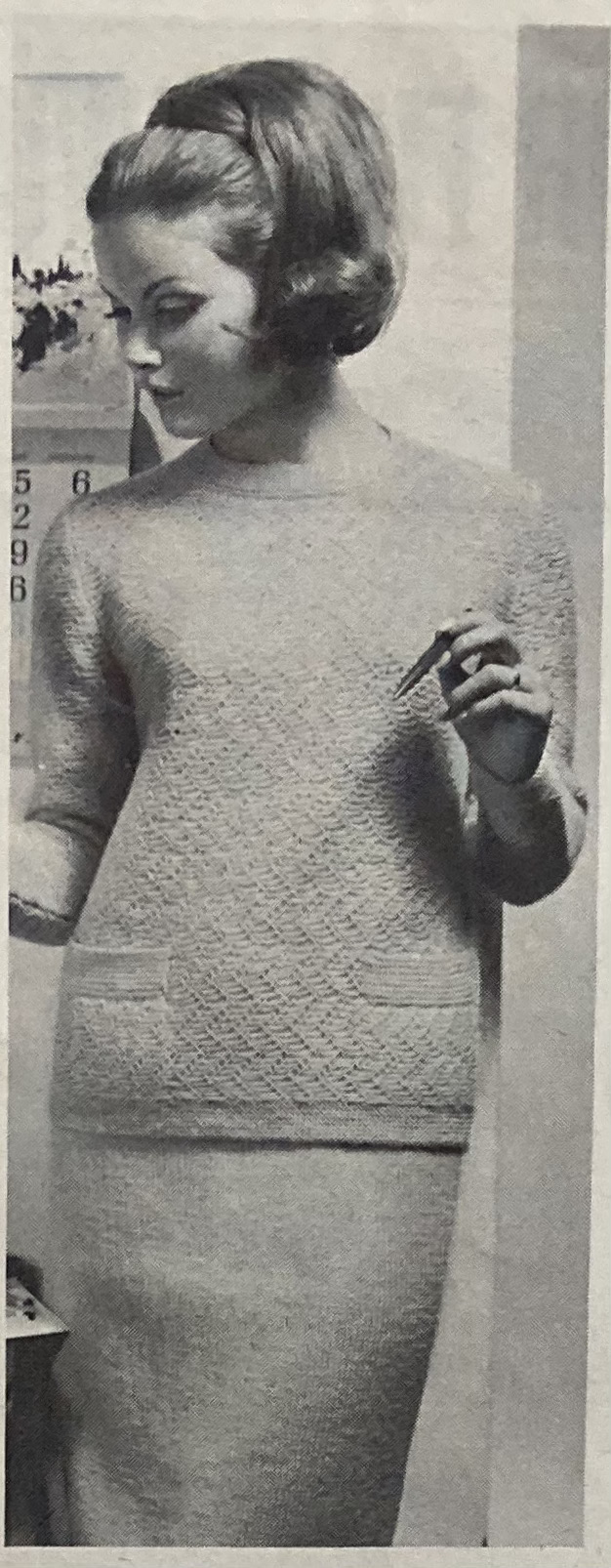
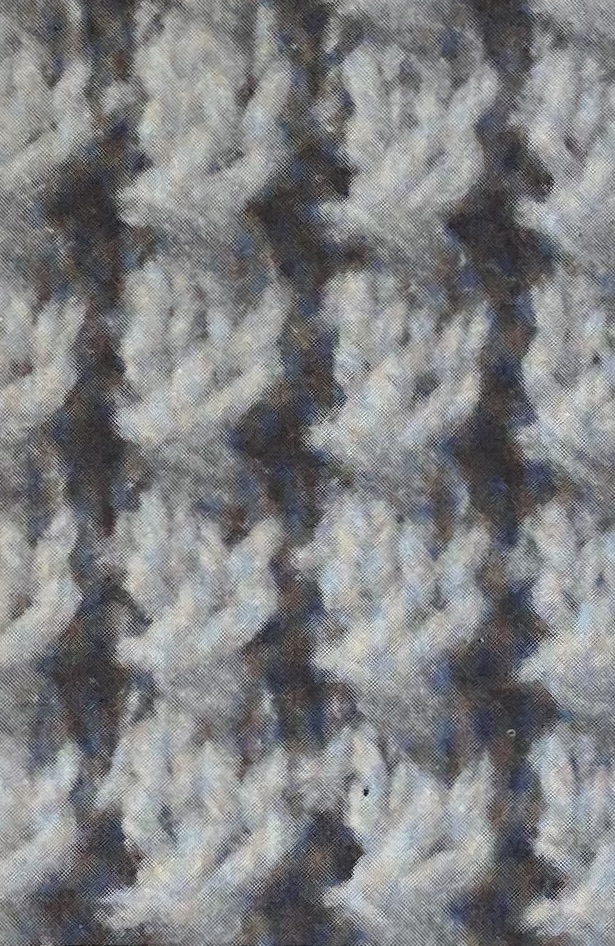
The knitted sweater suit on the cover is made in an intriguing pattern stitch designed to give “the look of woven texture.” There’s a helpful close-up photo of the stitch pattern as well. Essentially, it’s made by making a wool-forward (yarn over) on the right-side row and then slipping that stitch over a garter-stitch base to make a horizontal “line”. The placement of the slipped stitch is staggered, to make a diagonal herringbone-type effect. Made in DK wool, I’m guessing the finished result is quite warm. The matching skirt is made in plain stocking-stitch. Note that the mini-skirt, or even anything-above-knee-length skirt, still hasn’t caught on with Stitchcraft’s more conservative readership.

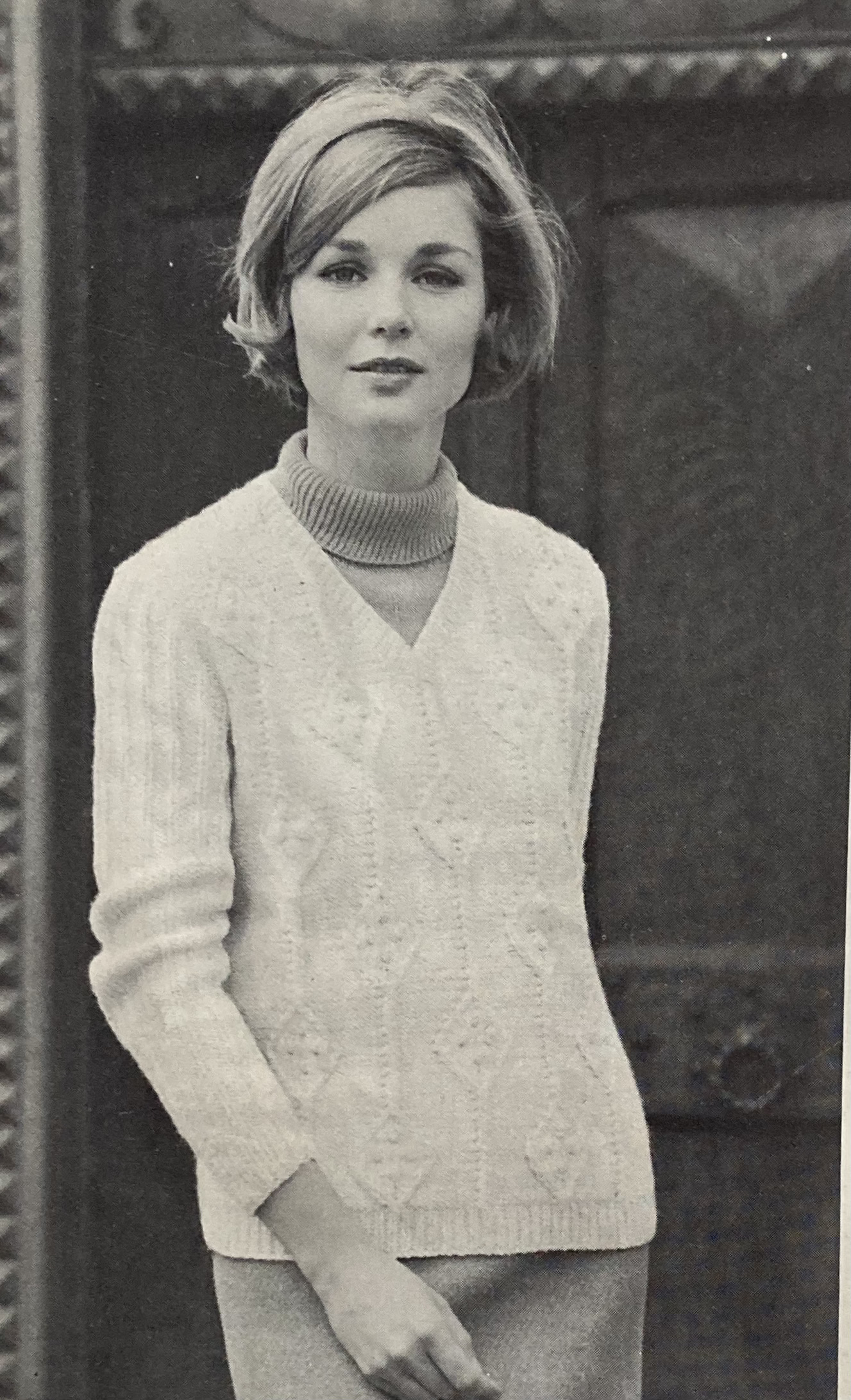
Other women’s fashions include a bobbly-cabley “overpull” in undyed “Capstan” wool, made to be worn over a roll-neck knitted underblouse with or without sleeves. The underblouse keeps up the warm colour trend with the suggested colour of “Old Gold”. I love the model’s hairstyle!
There’s also a jumper for larger sizes with very ill-thought-out decorations going right over the bust, and a collared almost-cardigan with a deep placket and Peter Pan collar. The collared number is made in tweedy “Glenora”, one of the multicolour wools gaining popularity at the time. Men get a corollary set to the women’s “overpull” and “underblouse” with a slightly oversized bobbly-cabley cardigan and a 4-ply polo-neck in the same “Nylox” wool as the ladies’ underblouse. The “colour radiance” theme apparently does not extend to the men’s garments, being made in undyed Capstan and “Oystershell” off-white, respectively. The photo backgrounds colours are nicely chosen, though, to set off the diagonal poses and camera angles.

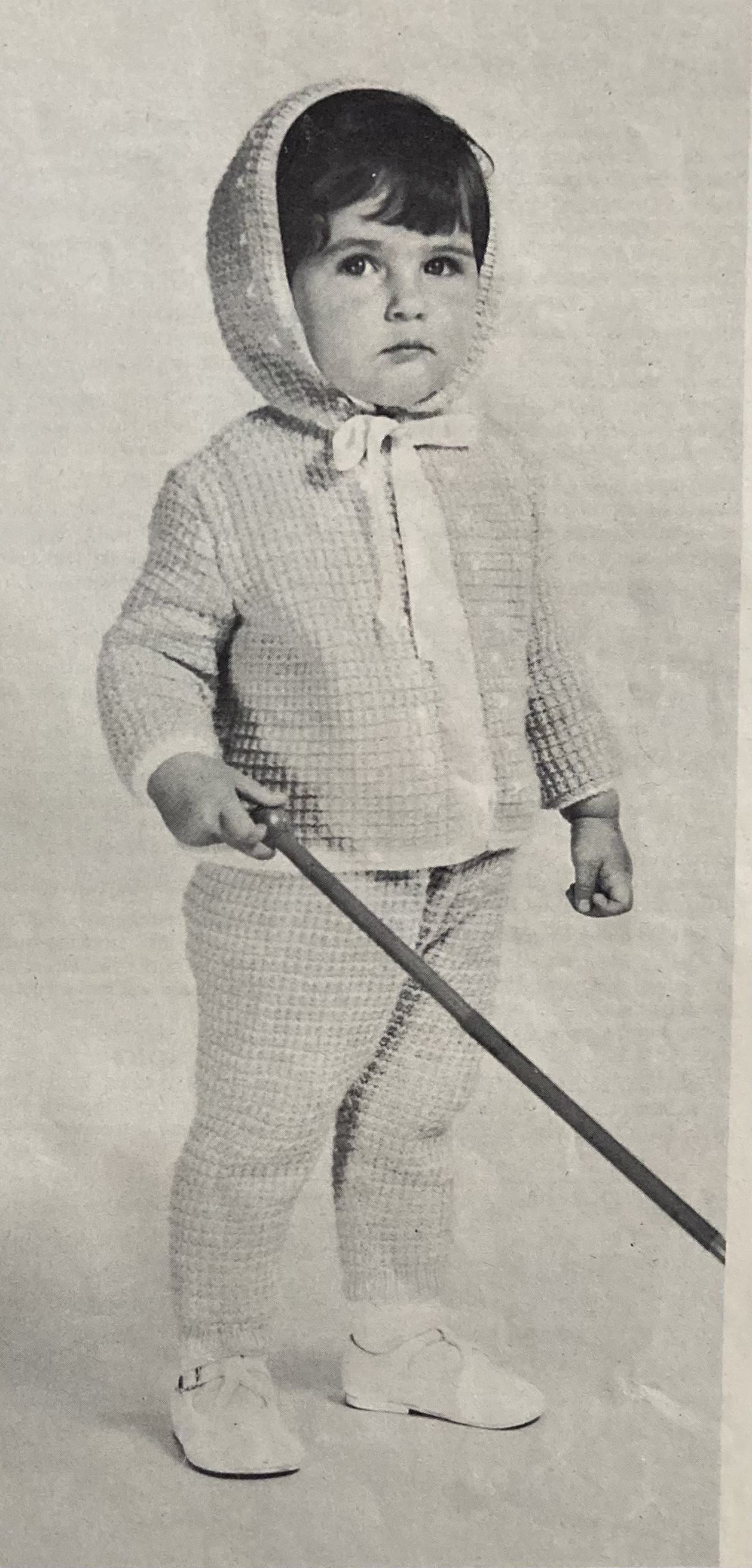
The photo of the girl’s twin set in the inside front cover photo also does a great job of harmonising the backdrop to the subject. Her set consists of a pullover with unbuttoned waistcoat in cheerful pink and blue. Her little brother or sister can go out in the pram or “toddling” in a warm set of hooded jacket and leggings. The child in the photo looks somewhat apprehensive, but the set looks quite snuggly.

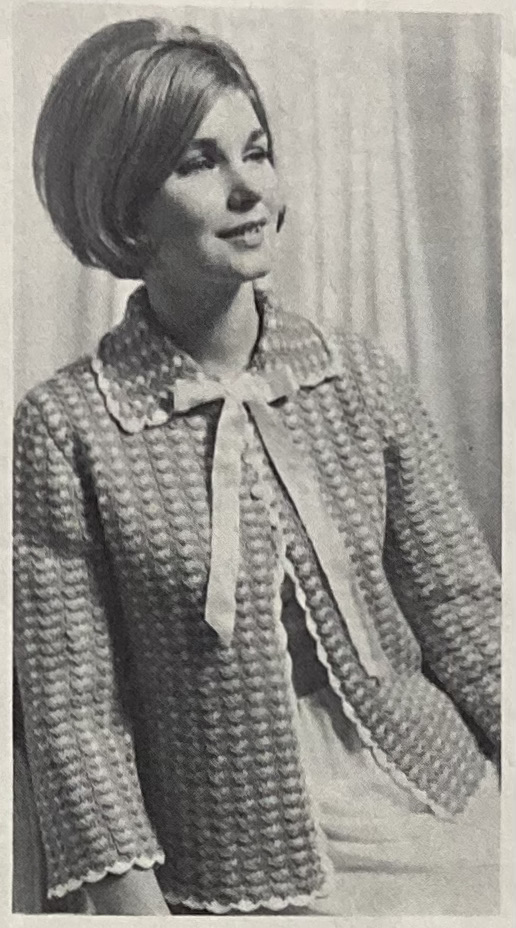
And can we have a moment of appreciation for this “special gift” of a bedjacket? I love it! I would make it without the ribbon at the neck and wear it as a normal cardigan. The two-colour pattern is made by working and then dropping yo’s to make a “long” stitch, which is then carried up through the slip-stitch background. I am guessing it is quite spongy and squishy, and was also nice and warm in those unheated 1960s bedrooms. Love the hairstyle in the colour photo, too!
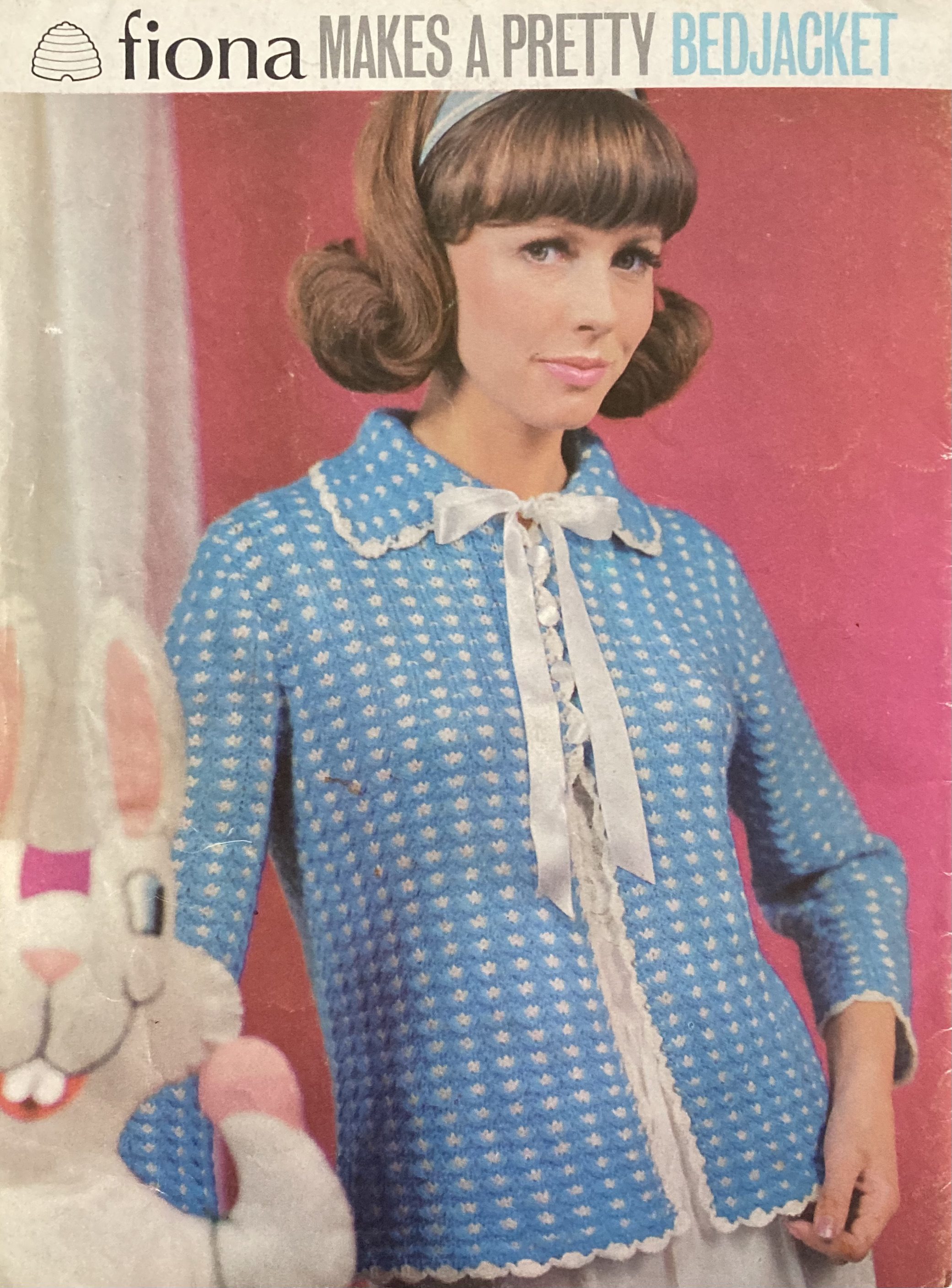
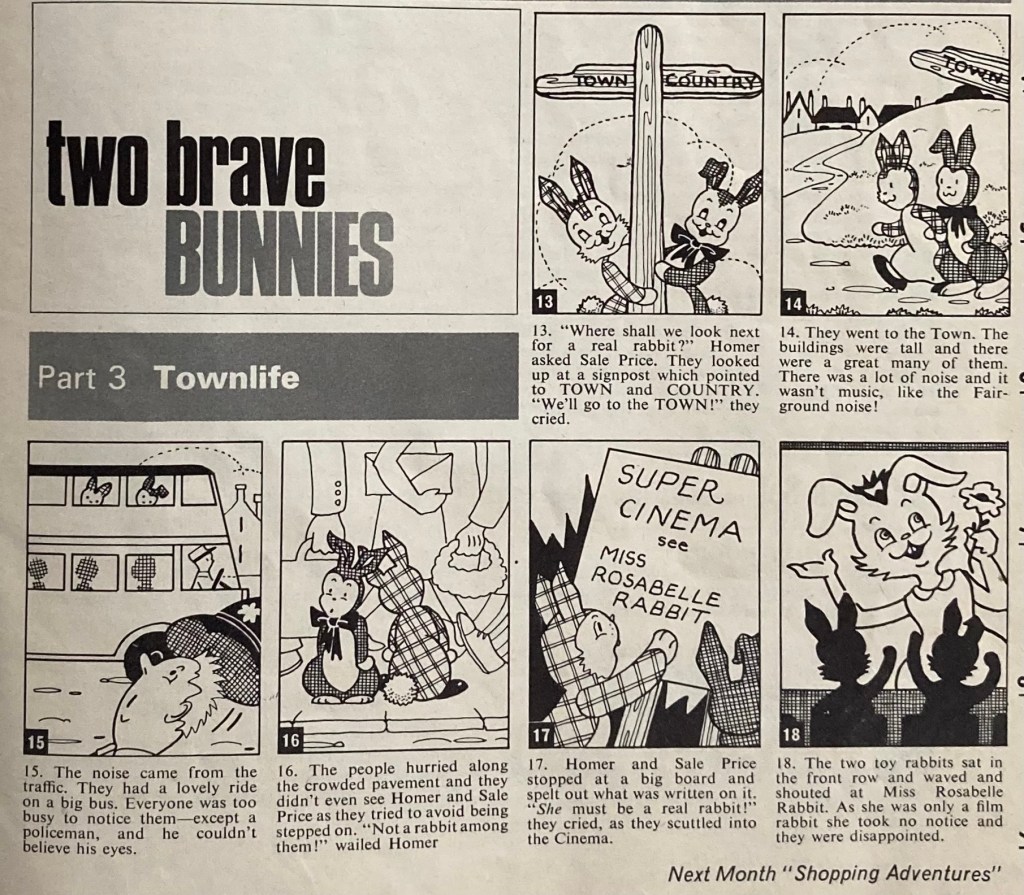
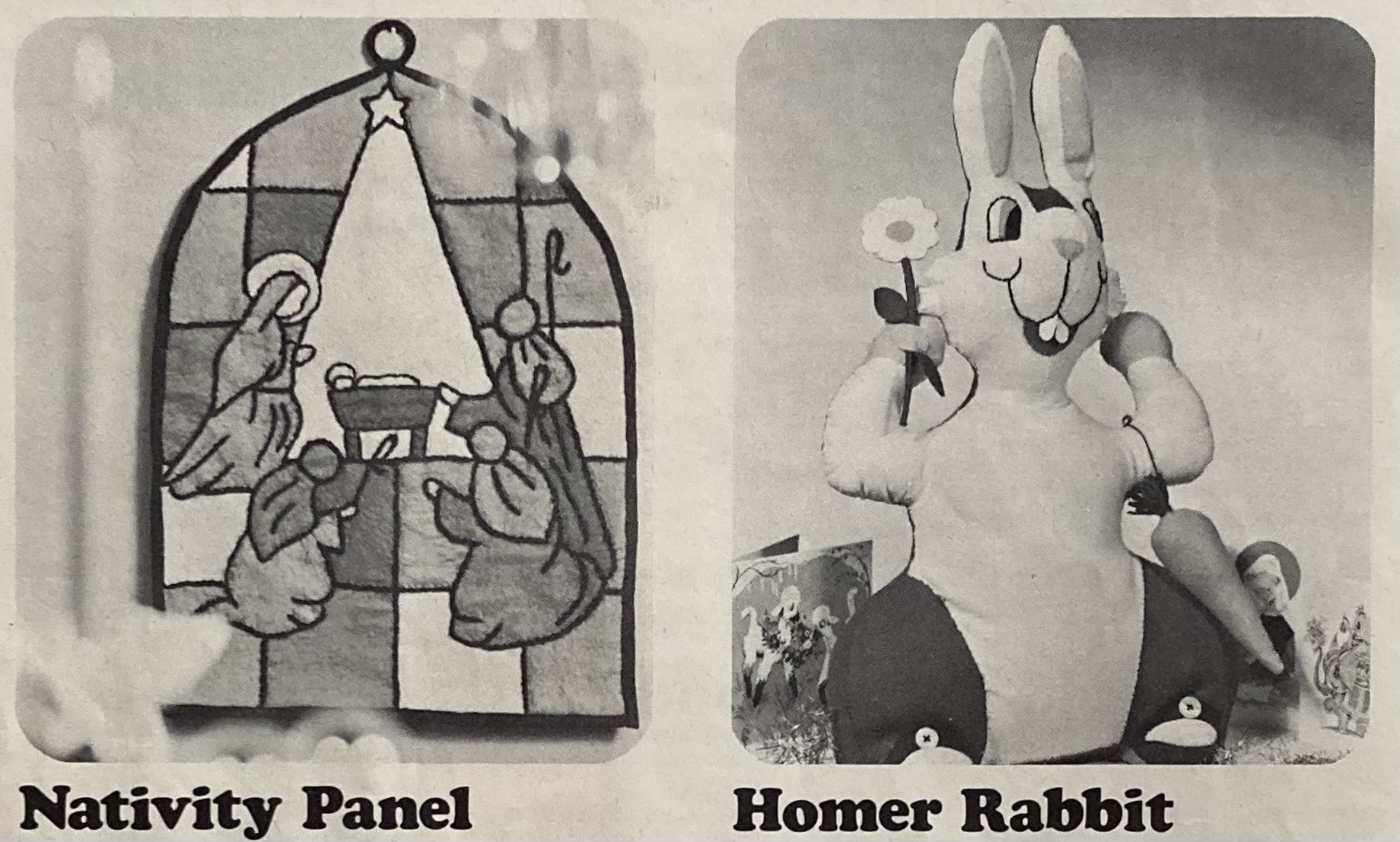
If the model on the left is looking a little suspicious, it’s probably because she was photo-bombed by Homer the Rabbit, star of our current children’s serial comic, “Two Brave Bunnies.” For the uninitiated: Homer (a home-made stuffed rabbit) and Sale Price (a store-bought stuffed rabbit) are on a quest to find a real live rabbit friend. So far, they have only met a merry-go-round rabbit, who assured them that he was not real, as he could carry children on his back. In this month’s episode, our two brave bunnies head to the Town, where they are eager to see “Miss Rosabelle Rabbit” on the cinema screen. Alas, she is only a film rabbit, so cannot communicate with our friends. No matter — they will persevere! Oh, right — and this month’s issue includes instructions on how to make your very own home-made Homer doll from felts.
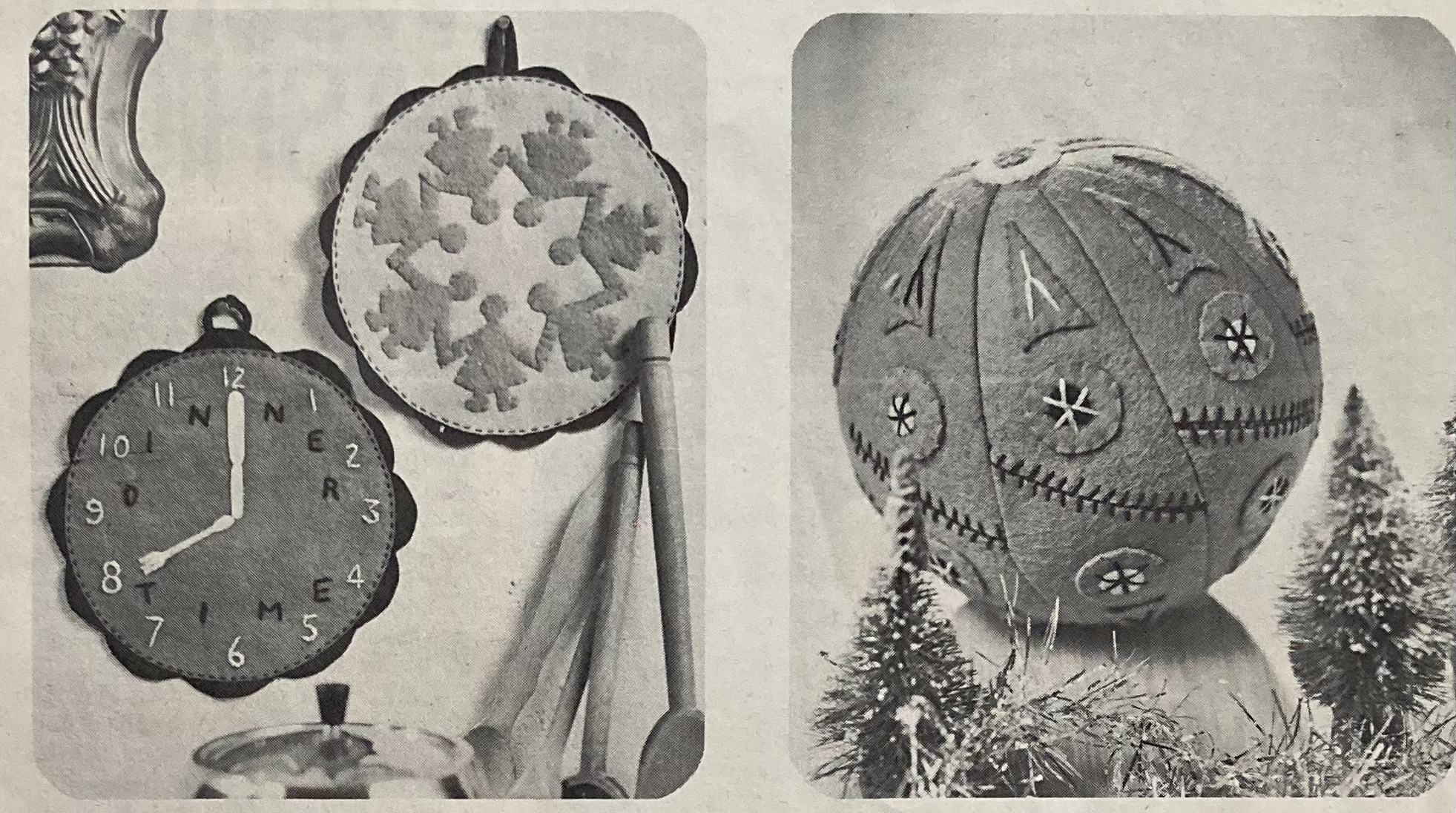
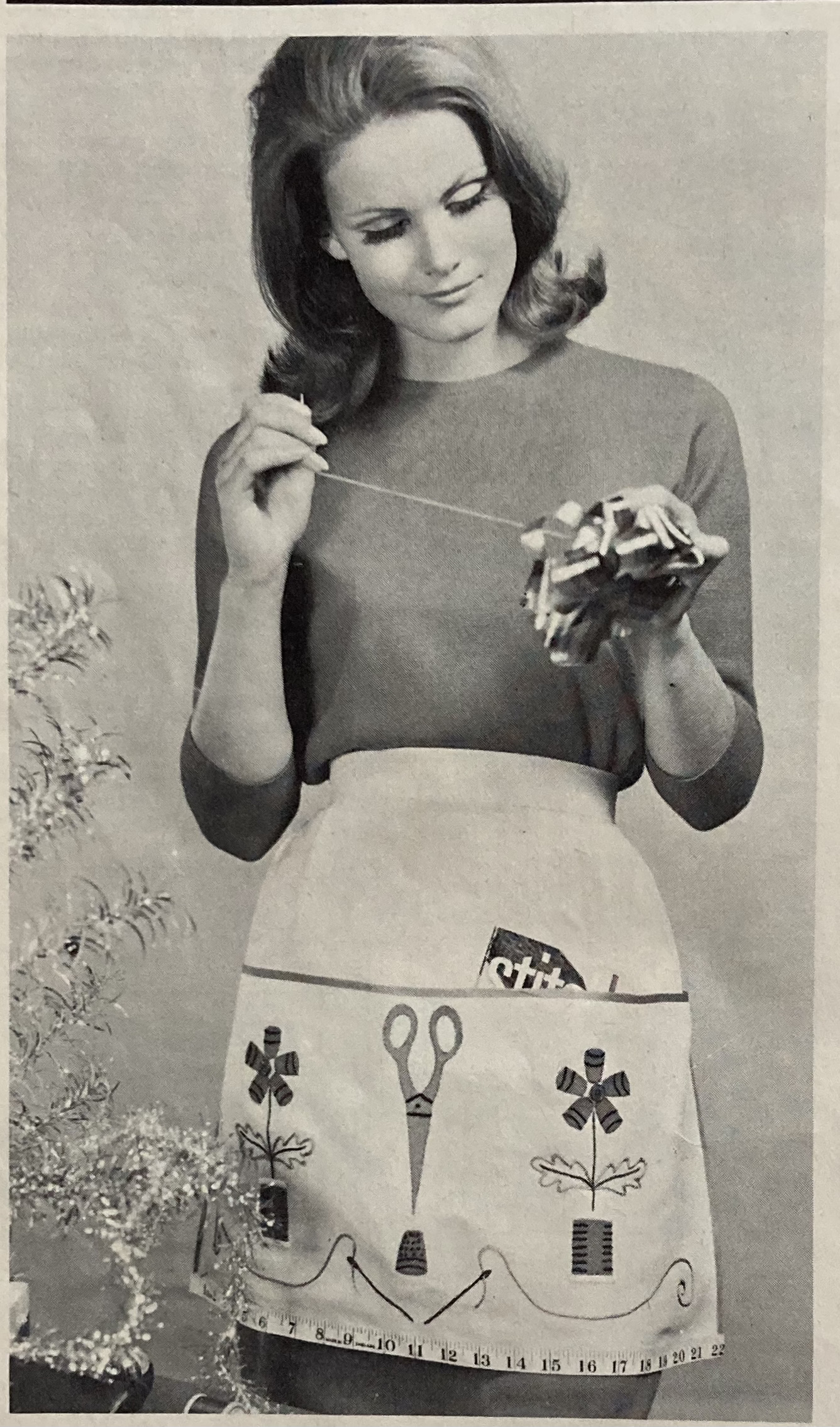
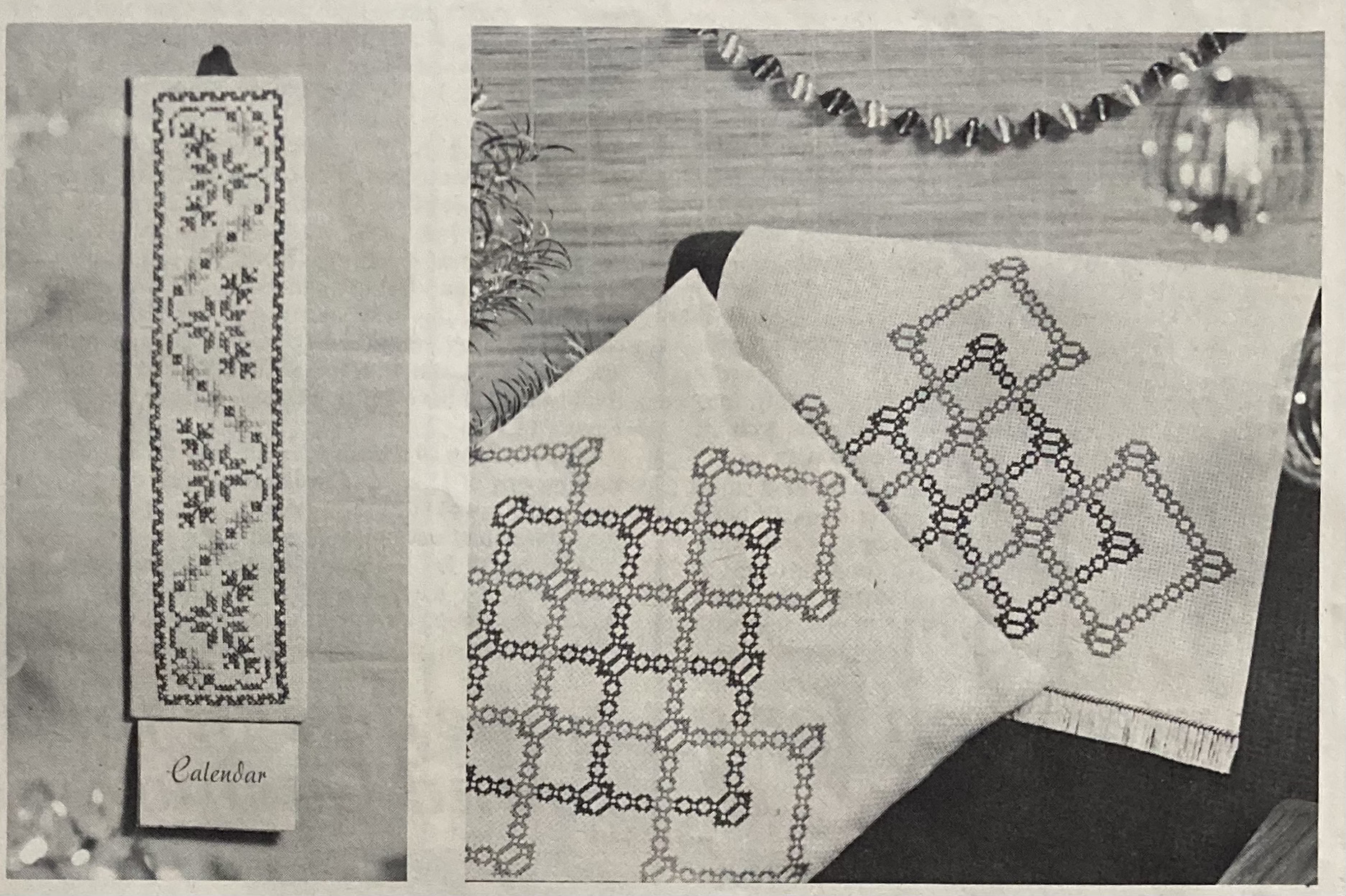
Home-made Homer is one of this issue’s many small, fun “colour novelty” gift and decoration ideas, along with a felt Nativity panel mimicking stained glass, a couple of pot holders and a colourful ball to use as decoration or a baby’s toy. Embroidered gift ideas include a whimsical sewing apron and a cross-stitch calendar and chairset. I don’t really understand the calendar — it seems to be just a vertical wall panel that you attach the (tear-off?) small calendar onto. OK, I guess, but maybe not necessary?

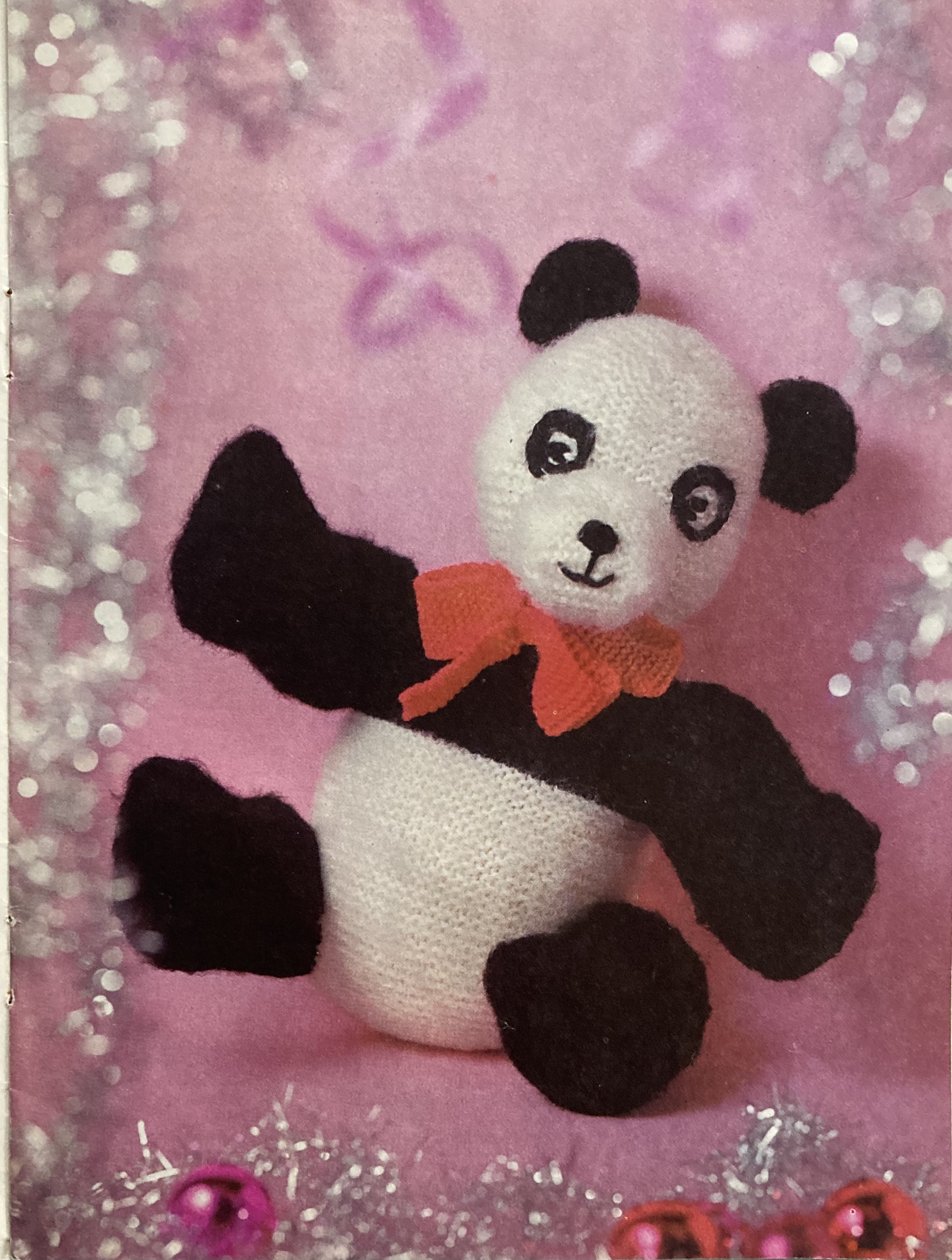
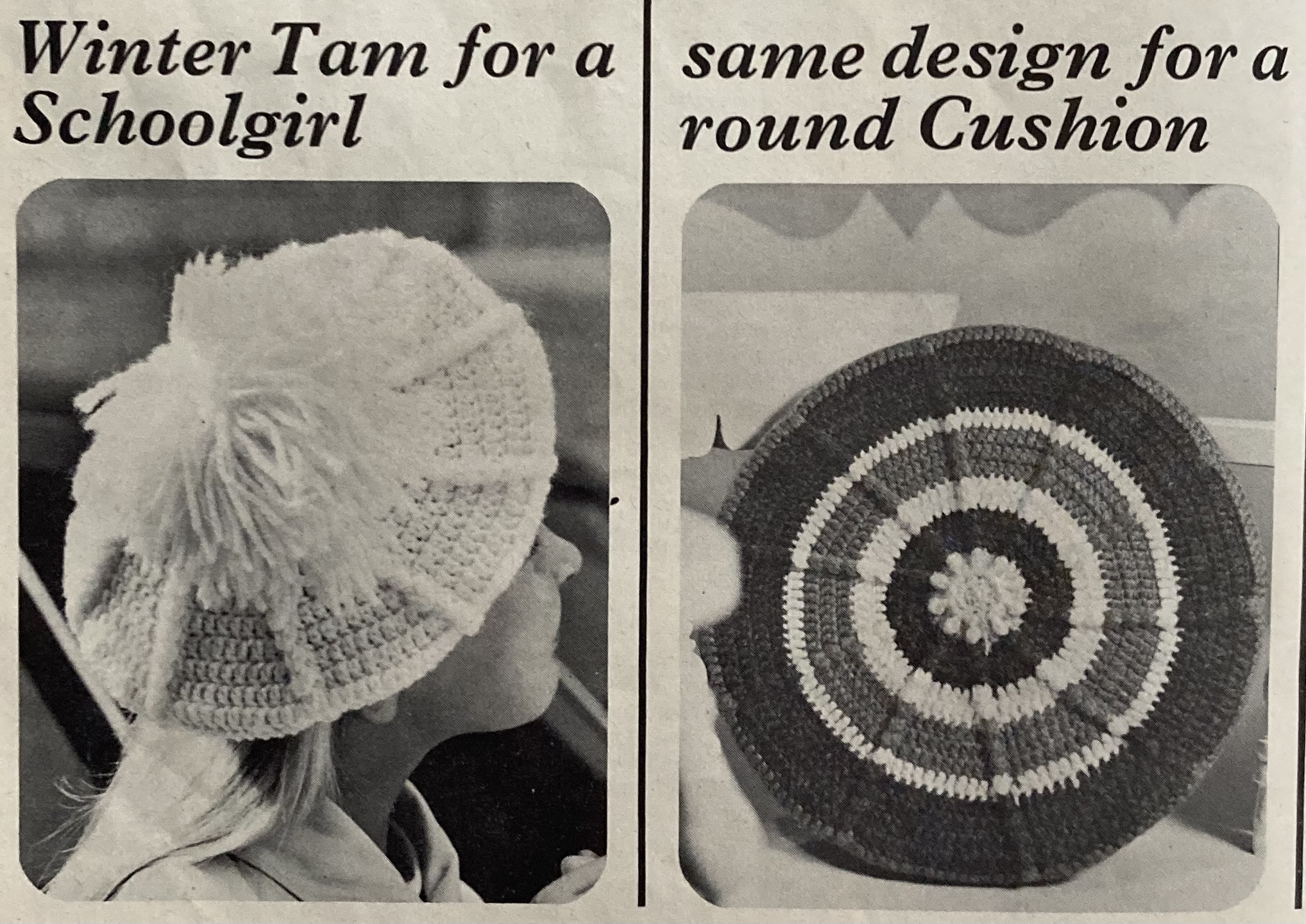
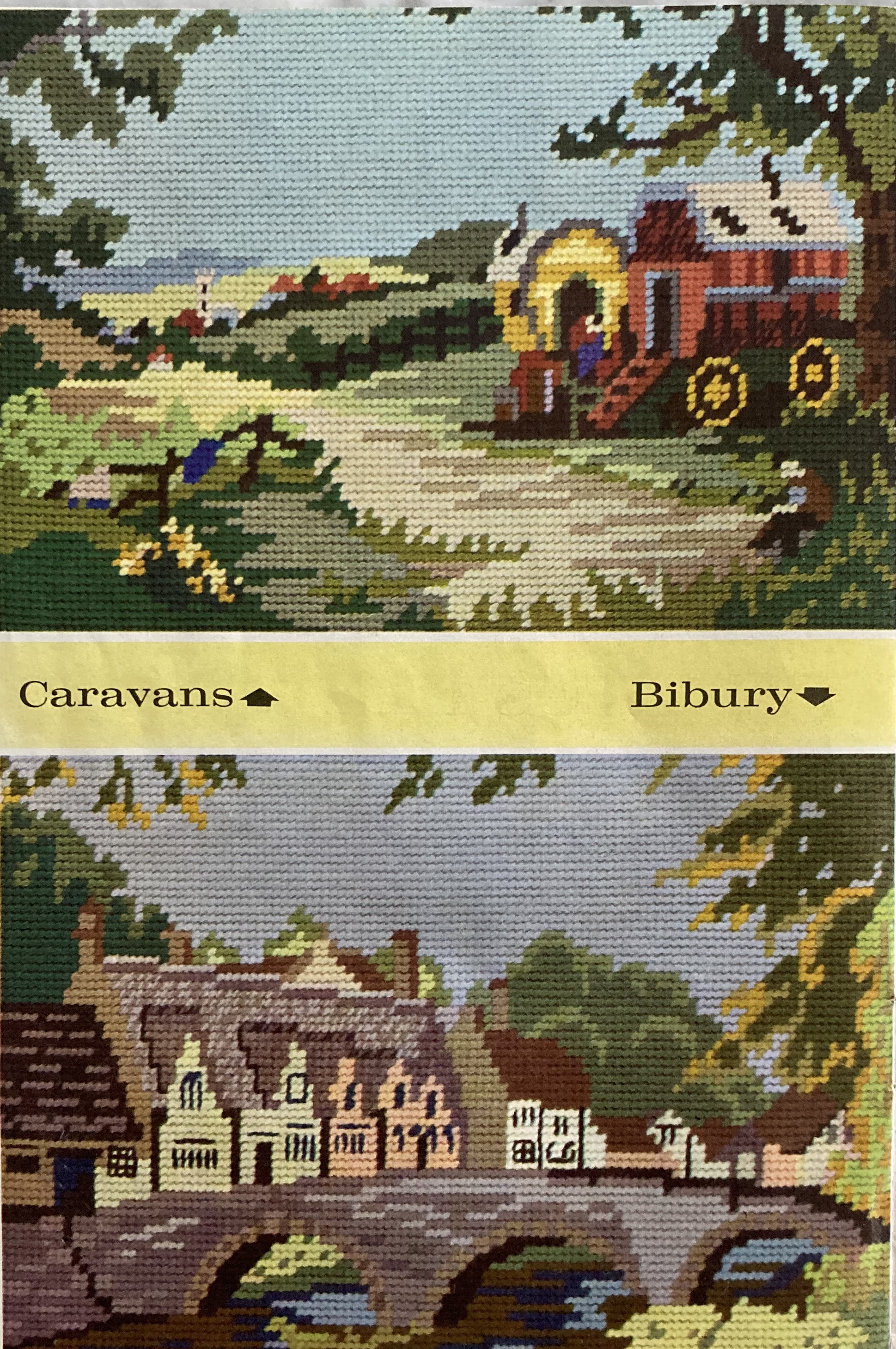
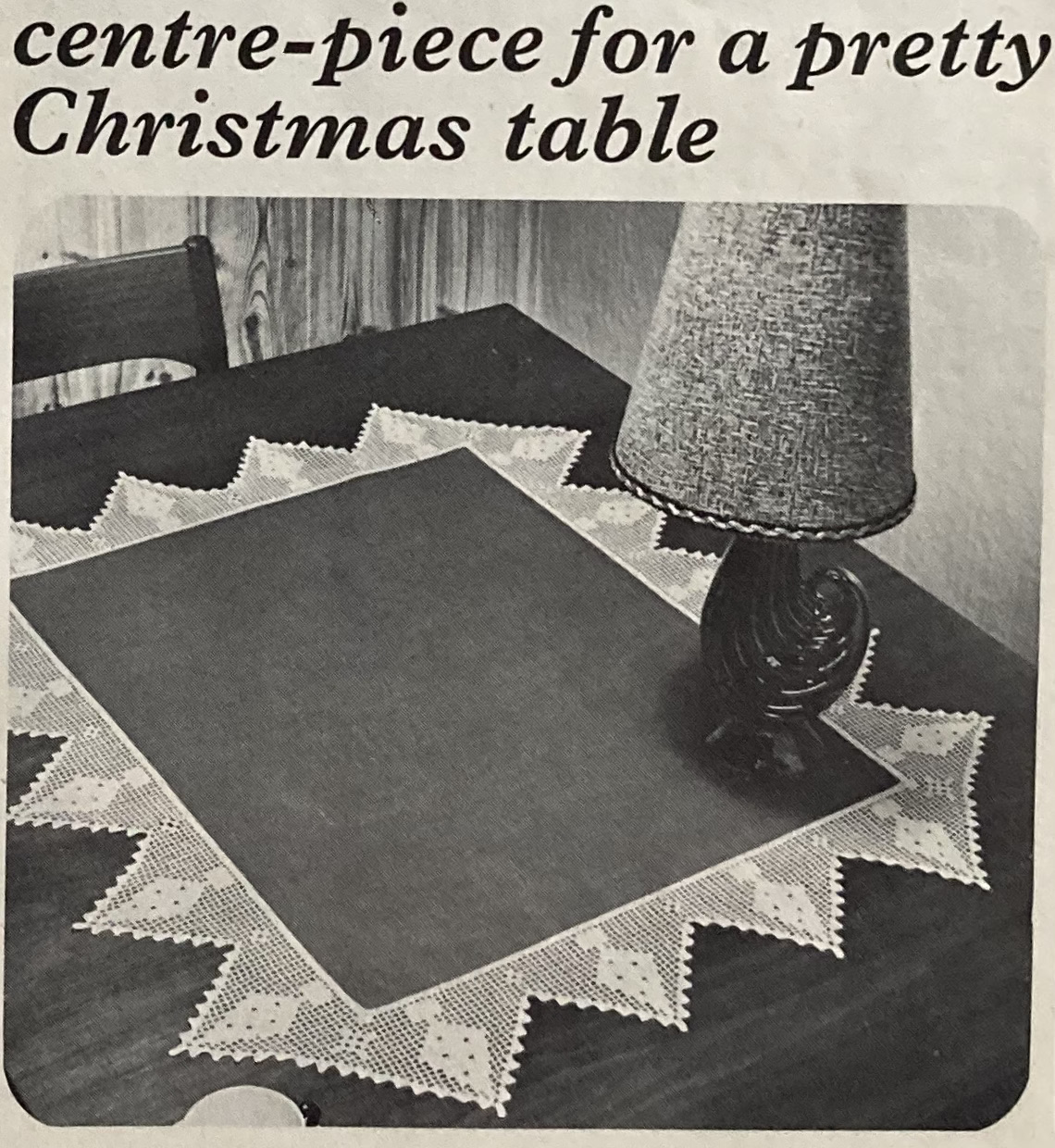
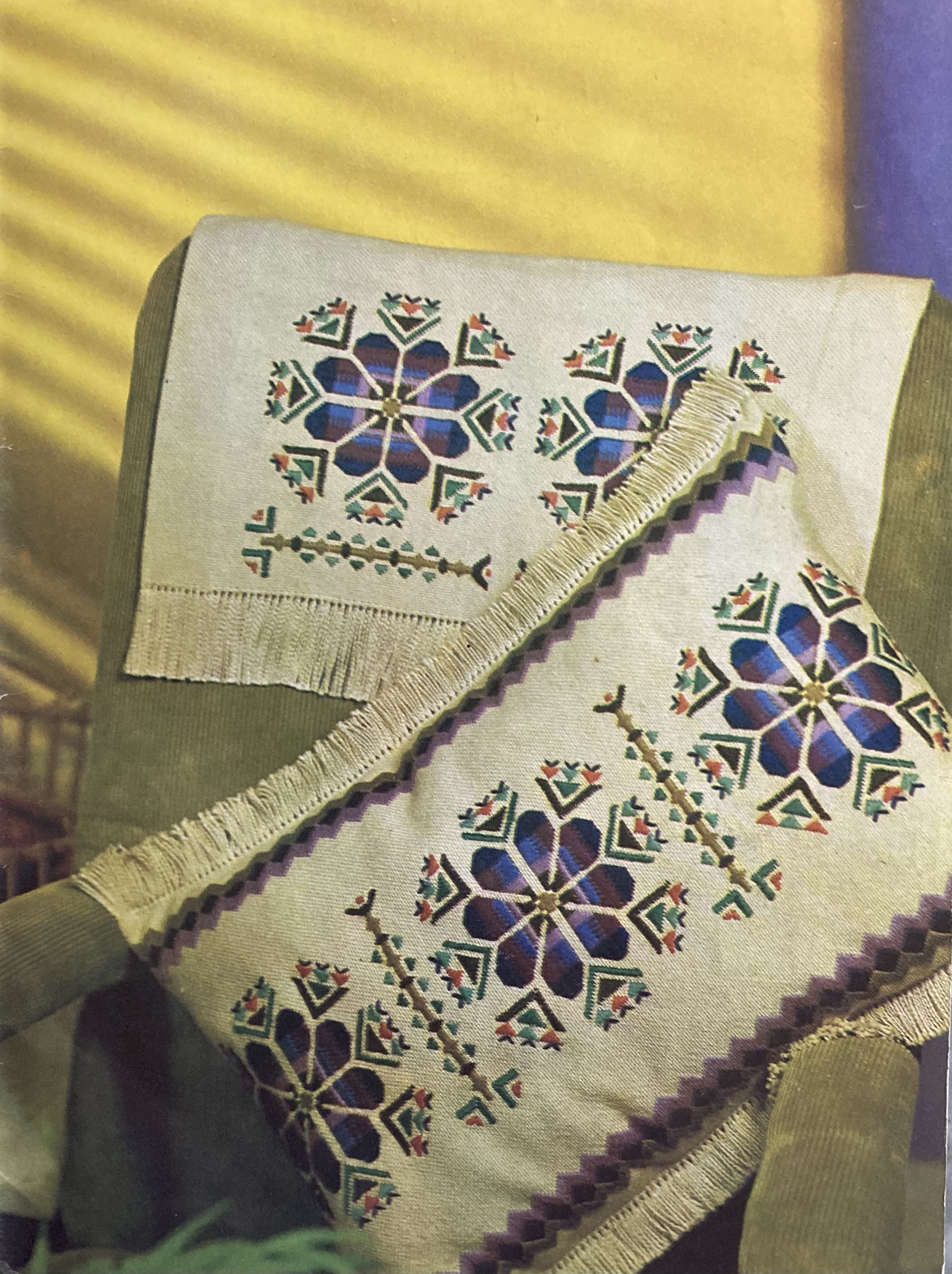
You can also knit a stuffed panda bear, a snowman, or a garter-stitch blanket rug, or crochet a round disc to be adapted into either a girl’s beret or a round cushion. There’s a filet crochet table centerpiece and tapestry wall pictures of caravans or Bibury. Last but not least, there’s a counted-embroidery cushion-and-chairback set with a vivid purple flower design.

I don’t know about you, but I feel cosier already. My design for this month will be the bedjacket! The October 1965 cardigan blouse is almost finished, too, and I’ll update that post soon.
September 1965: Overview

Autumn is here, and the September 1965 issue of Stitchcraft is, as promised by its editress, a “bumper” issue with more colour photos (to offset the price increase to 2s. per single issue) and a new yarn from Stitchcraft’s patron wool company, Patons. 

Called “Fiona”, it was DK-weight and made of 50% Shetland wool and 50% “Orlon” (one of the very first acrylic yarns). Shetland wool is beautifully warm and lightweight due to its being very lofty and “hairy”, and “Fiona” was marketed as combining these positive aspects with the easy-care, less scratchy and non-tangling qualities of synthetic yarn — a sort of “Shetland lite”, if you will. Real Shetland wool is excellent for traditional “Fair Isle” stranded colourwork patterns, since the hairs lock into each other in the stranding, but the “Fiona” designs in this issue employ smoother, textured stitch patterns. The cover cardigan-jacket has a bobbly lace pattern and the his-and-hers pullovers use a broken cable rib. 

The other two designs for adults are made in standard 100% wools: a “young-looking sweater” with really, really unfortunately placed bobbles (directly along the bustline) in Patons Double Knitting or Crepe, and an Aran-patterned jacket in bulkier “Capstan”. An older brother might get this “Husky polo style” pullover in Patons DK and a fun reversed stocking-stitch pattern with more (and better placed) bobbles. 

The trend for textured stitch patterns continues with garments for the younger set. The toddlers’ “walking-out set” of pullover, leggings and snug helmet-style cap (with more bobbles on the tie at the neck) is made in easy 2×2 ribbing in blue and white DK wool. Love the pre-Photoshop-era addition of a tree in the photo, to show you that he’s playing outside! His big brother gets a warm slipover in an easy zig-zag pattern, and tomboy sister, (with short hair and trousers) gets a set of cap and sweater in a fisherman’s rib pattern that is more complicated to do than it looks. You purl the RS rows and and on the WS rows, you *k1, purl into next st. but through loop of row below at the same time slipping st. above off left needle; rep from * to last st, k1. The vertical stripes are added later via Swiss darning aka duplicate stitch embroidery.

Above all, this is a bumper issue for homewares. There are multiple pages of easy projects for a “Sale of Work” stall at the church bazaar or what have you, including a “house” and “windmill”-themed apron, mat/cosy set and a “peg bag” for holding laundry pegs. Other quick novelties include a knitted scottie-dog toy and a cosy or cushion made out of odds and ends of wool. 

More ambitious needle-workers can decorate an entire room from top to bottom with designs from this issue, starting with a needle-etched picture of a steam engine — a throwback to the Victorian nostalgia of the late 1950s and early 1960s — or a tapestry picture of the seaside village of Clovelly to hang on the wall. 

For the furniture, there’s a beautiful “peasant” (their word, not mine) design for a cushion and chairback, made in embroidery wool on linen, and for the floor, a hand-made “Tartan” rug. It uses a latch-hook and the “Turkey knot” to make a soft, three-dimensional pile. Finally, church-goers can make a tapestry “kneeler” cushion in a pattern inspired by Gothic stonework. 

And there’s a new children’s comic serial in the Readers Pages! This is a really cute and creative story about Homer the plush rabbit (so called because he was home-made) and Sale Price, the store-bought plush rabbit, who go out into the big wide world to try and find a real rabbit to befriend. Will they find one? Stay tuned! Oh, and I bought this issue on Ebay, so received a special… bonus? picture of an embroidered Christmas tree with no transfer or pattern instructions (and not from Stitchcraft.). If anyone can identify it, I will be very impressed!

My project from this issue will be the knitted cushion, by special request from someone who works on the computer a lot and would like a soft underlay to rest their wrists on.

December 1964: Overview

Stitchcraft sends good wishes for Christmas 1964! Yes, another year has gone by in a flash. Luckily, this issue is full of ideas for quick last-minute gifts, as well as warm clothing for the family.

The bulky partner-look cardigans on the front cover are timeless and modern – apart from the 1960s styling and lighting, and the man wearing a shirt and tie, this could be a modern advertisement for ready-to-wear knitwear. The jackets are made in „Big Ben“ bulky wool at 3.5 stitches to the inch, so they might just be finished in time for a winter cold snap. Similarly bulky, but lighter-weight „Ariel“ wool is featured in a vertically-striped („adds to the slimming look“) cardigan for somewhat larger women‘s sizes up to 42 inch bust, and there‘s a warm cabled „Cardigan for Driving“ for him with practical pockets and a big collar.

The women‘s fashions are more sleek, with classic straight lines and unfussy crew necks. A simple ridge-welt pattern can be knit from the bottom up with dolman sleeves for a horizontal stripe, or as a cardigan knitted sideways edge-to-edge for a vertical stripe effect. There‘s also a classic jumper with a twisted-stitch rib panel and a lacy sheath dress for parties.

„Juniors and Tots“ will stay warm in a fun stranded half-cardigan (zip opening from neck to waist – this is called a „Troya“ style where I live but Stitchcraft just calls it a jersey) with matching cap. Therre‘s another cap with cables running around horizontally, as well. „Tots“ from ages 1-4 get a sewn pinafore romper with a cross-stitch squirrel motif or a knitted tunic to wear over a jumper and tights (thank goodness, our child model can have warm legs for once.) Colours are warm and earthy — orange, brown and „Inca Gold“ for the adult and children’s garments and emerald green for the toddler‘s tunic.

The most important, and sometimes most entertaining, part of the December issue is the gifts, of course, and this one is full of „Last minute ideas“ — you can allegedly „make them all in an evening or two.“ Well, evenings are longer in the winter… There‘s a startled- looking owl to sew from felt pieces, and felt table mars with appliquéd butterflies. Felt is used for the draught-stopping caterpillar snake (with pipe cleaner feelers) as well, and cotton embroidered baby bibs shaped like a kitten and bunny rabbit complete the craft menagerie.

Other quick gifts include a knitted ball for a baby, a knitted and a tapestry tea cosy, and a knitted cushion — all good ways to use up scraps of wool. The „Ping the Peke“ stuffed dog looks a bit more time-consuming, and it’s probably difficult to achieve a really professional look with it.

Experienced embroideresses who have efficiently provided all of their Christmas gifts already and are not scrambling to get last-minute gifts finished can make a beautiful and very Christmas-y blue and green cross-stitch tablecloth based on a Rumanian motif. (For once, they didn‘t call a design from Eastern Europe „peasant“ embroidery! Progress.) Those looking for a simpler project can make a pretty dressing table set with flower motifs, or for the whimsically minded, there‘s a cross-stitch cushion „gift for a motorist“ with a picture of a prototype automobile on it.

The Readers Pages are full of ideas of things to buy (Stitchcraft subscriptions et. al.) plus an entire knitting pattern for a child‘s hoodie (2nd time reprint from 1954 — this must have been a very popular pattern) and instructions for an easy appliquéd spectacle case that a child could make „for Granny.“

My project will be the classic jumper with the twisted-stitch panel, in the same fun orange colour as the photo. Happy Holidays!

October 1964: Overview

October is the start of the best season for knitting, and the October 1964 issue of Stitchcraft rose to the occasion with multiple themes and more colour pages than ever before (photographed in the villages of Great Waltham and Stebbing in Essex). There are knit designs for “him and her” as well as for different ages of babies and children, embroidery, tapestry, rugmaking and appliqué projects, “novelties” and even a few extra tidbits in the back “Readers’ Pages.” Shall we… fall in?

Our first Autumn theme is “The Feminine Look”, which cracks me up, for when has Stitchcraft or any handcraft magazine ever promoted the “masculine look” for women? It goes without saying that they would never advertise the feminine look for men… As far as I can see, the designs don’t look any more feminine than the designs from any other issue. Maybe it’s meant in contrast to the “partner-look” designs from previous fashion trends.

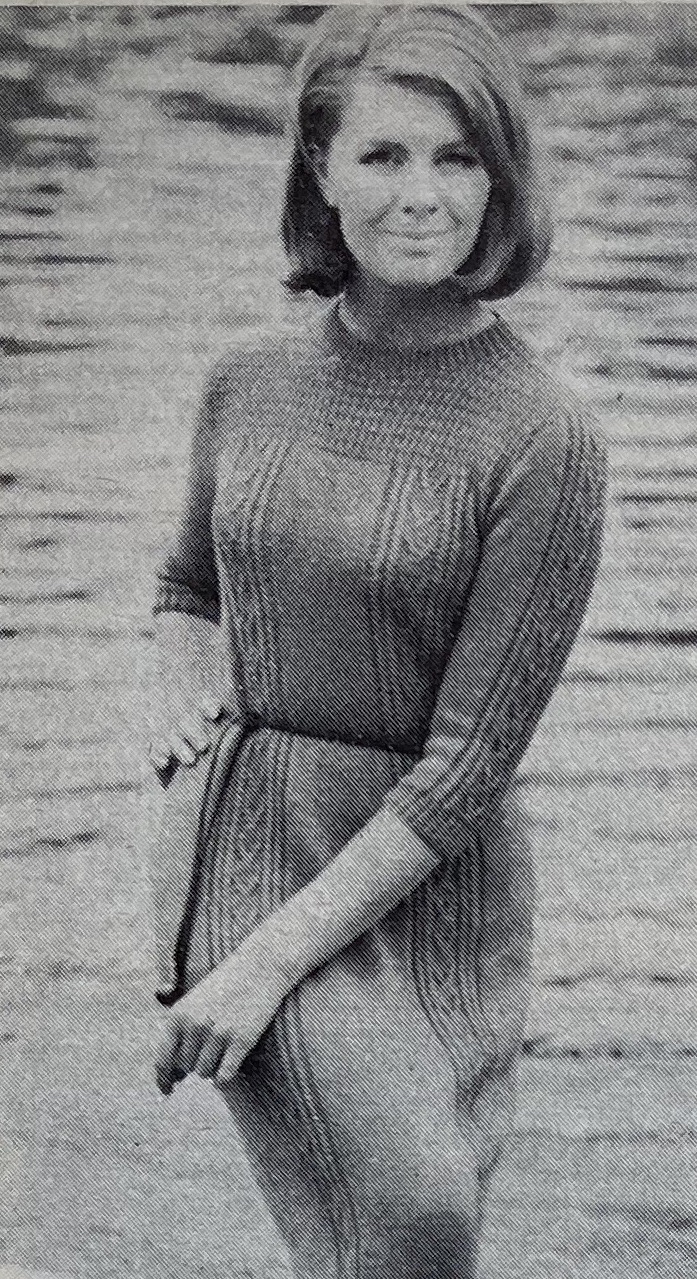
In any case, the cover-photo suit with coordinating jumper for underneath is simple and elegant, and probably quite comfortable to wear. It’s made in still-popular nubbly Rimple wool in DK weight and a slightly tweedy shade of light blue. The jumper is made in fingering weight and has a diagonal pattern.

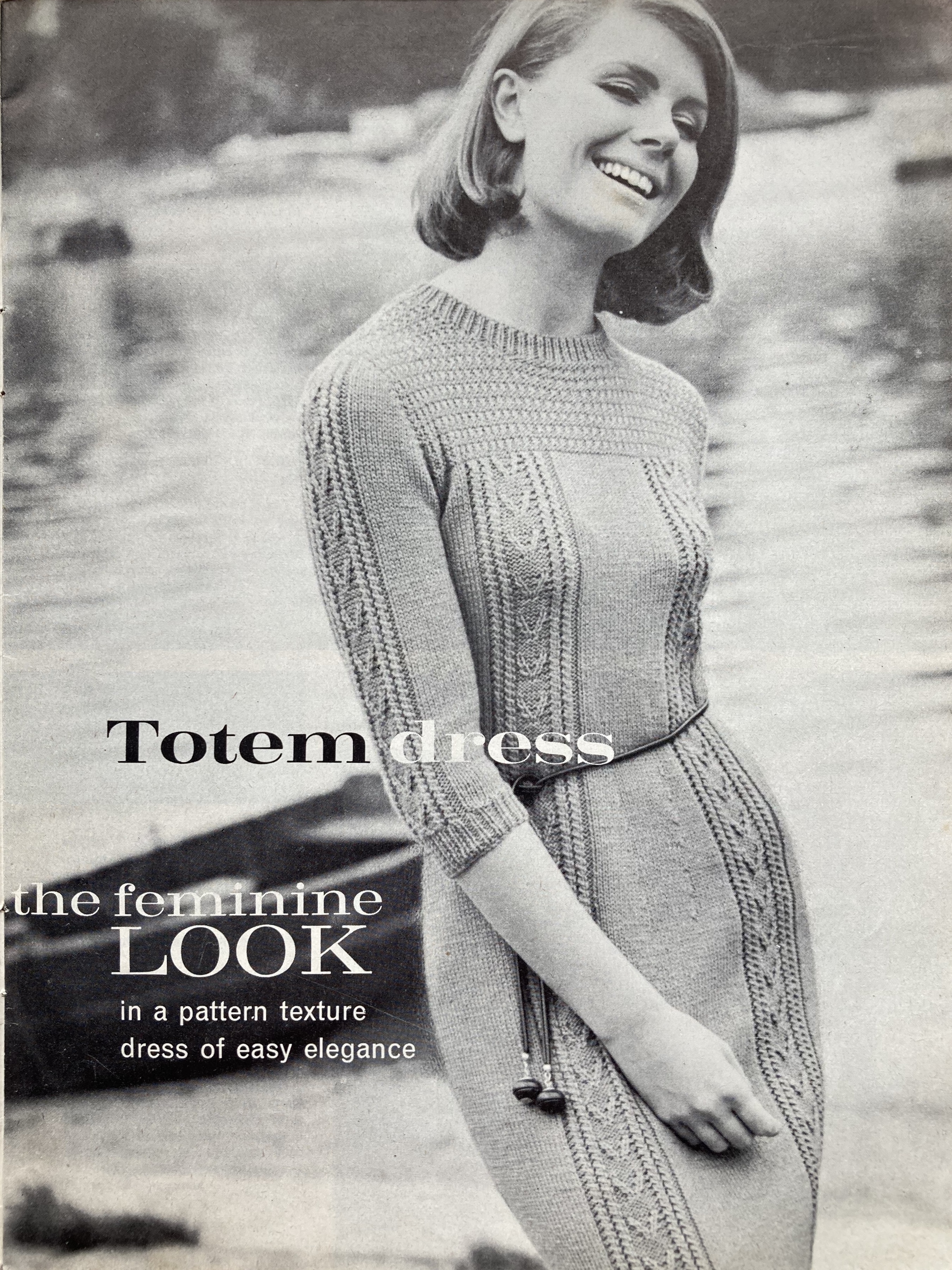
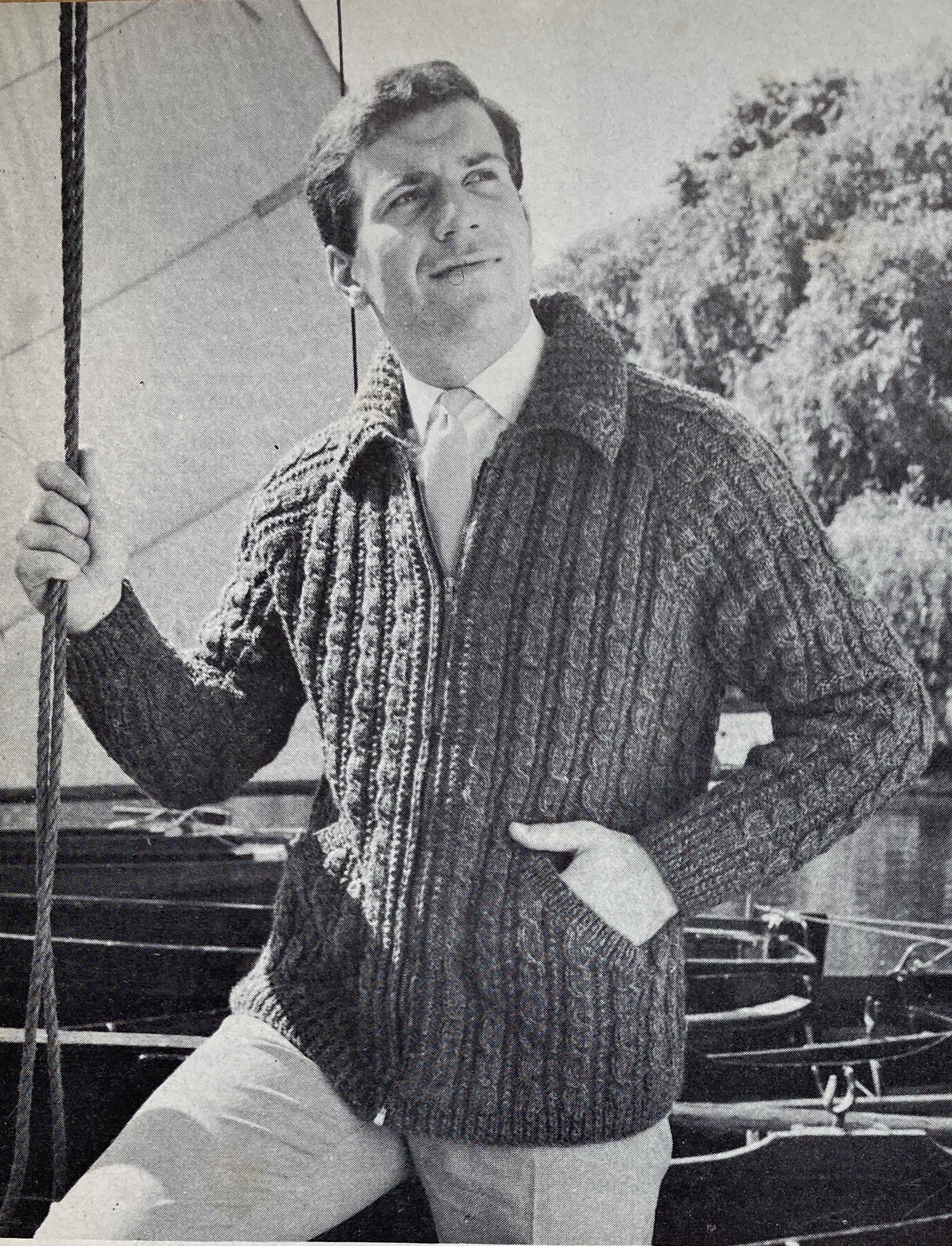
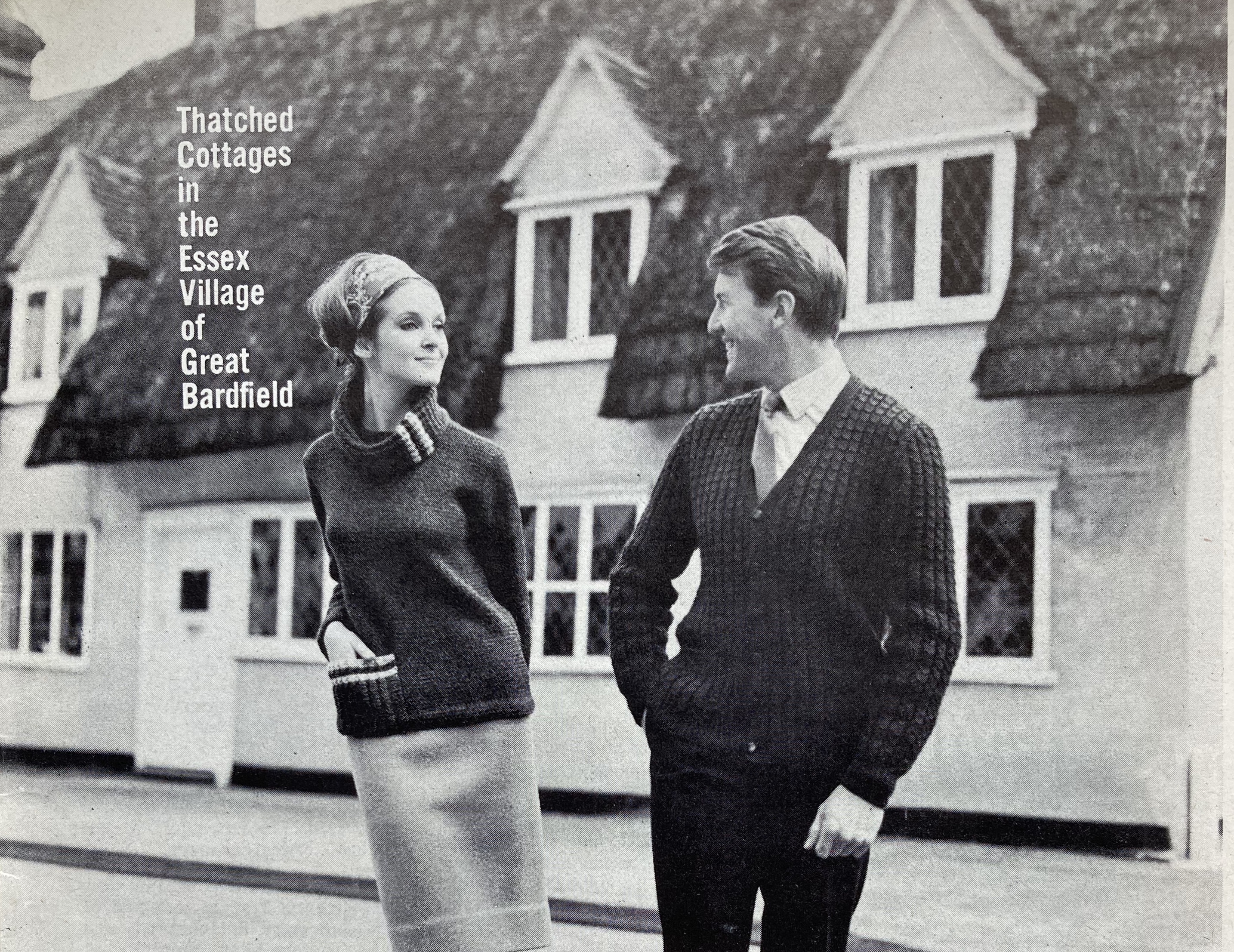
The women’s “feminine” fashions include a great cable-pattern dress as well, in smooth, DK weight Totem wool, and a less “feminine”, but probably very cosy, roll-collar pullover with an aysmmetrically-placed pocket. The mock-cable pattern on the pocket and collar is used as an all-over pattern on a man’s classic V-neck cardigan, and there’s another man’s cardigan as well in a very similar design, with “real” cables, a zip fastening and in bulky Ariel wool.

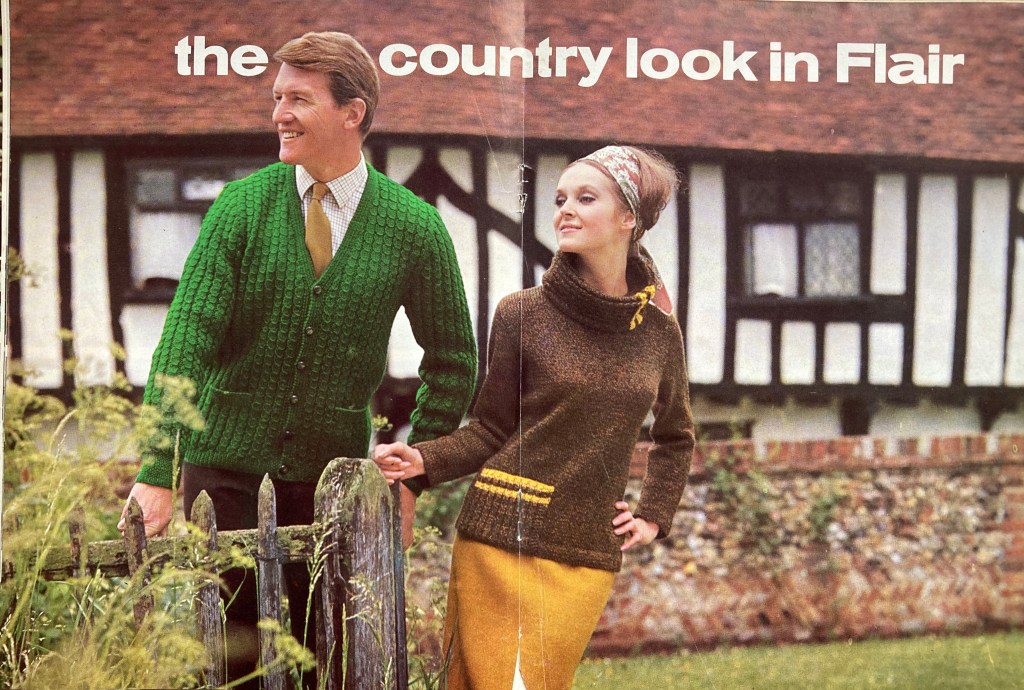
The cable cardigan and women’s pullover are shown off in a gorgeous full-colour centrefold photo where the green, yellow and brown of the knitwear harmonise perfectly with the country setting. As the caption says, both garments are made in “Flair”, a somewhat heavier wool-acrylic blend.

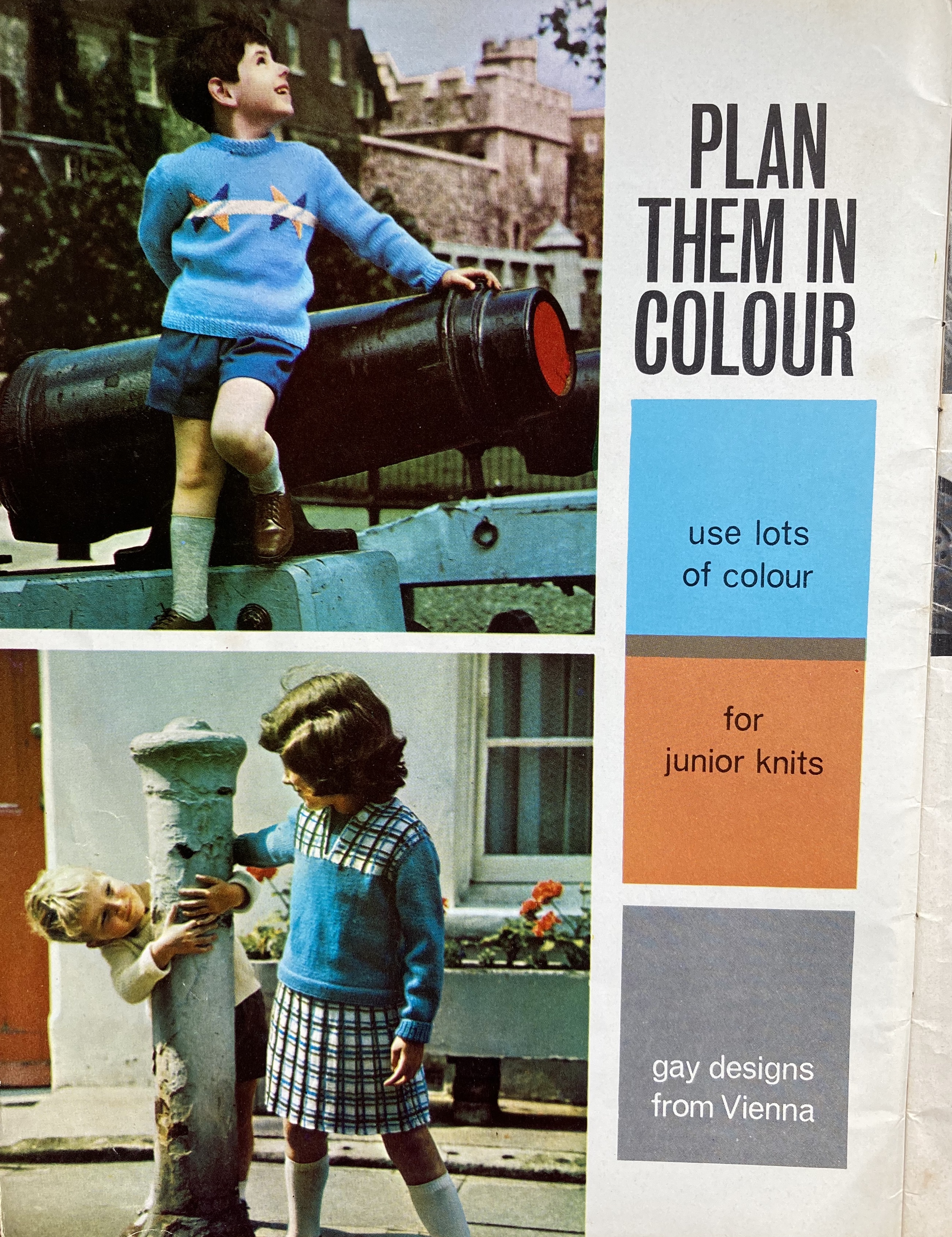
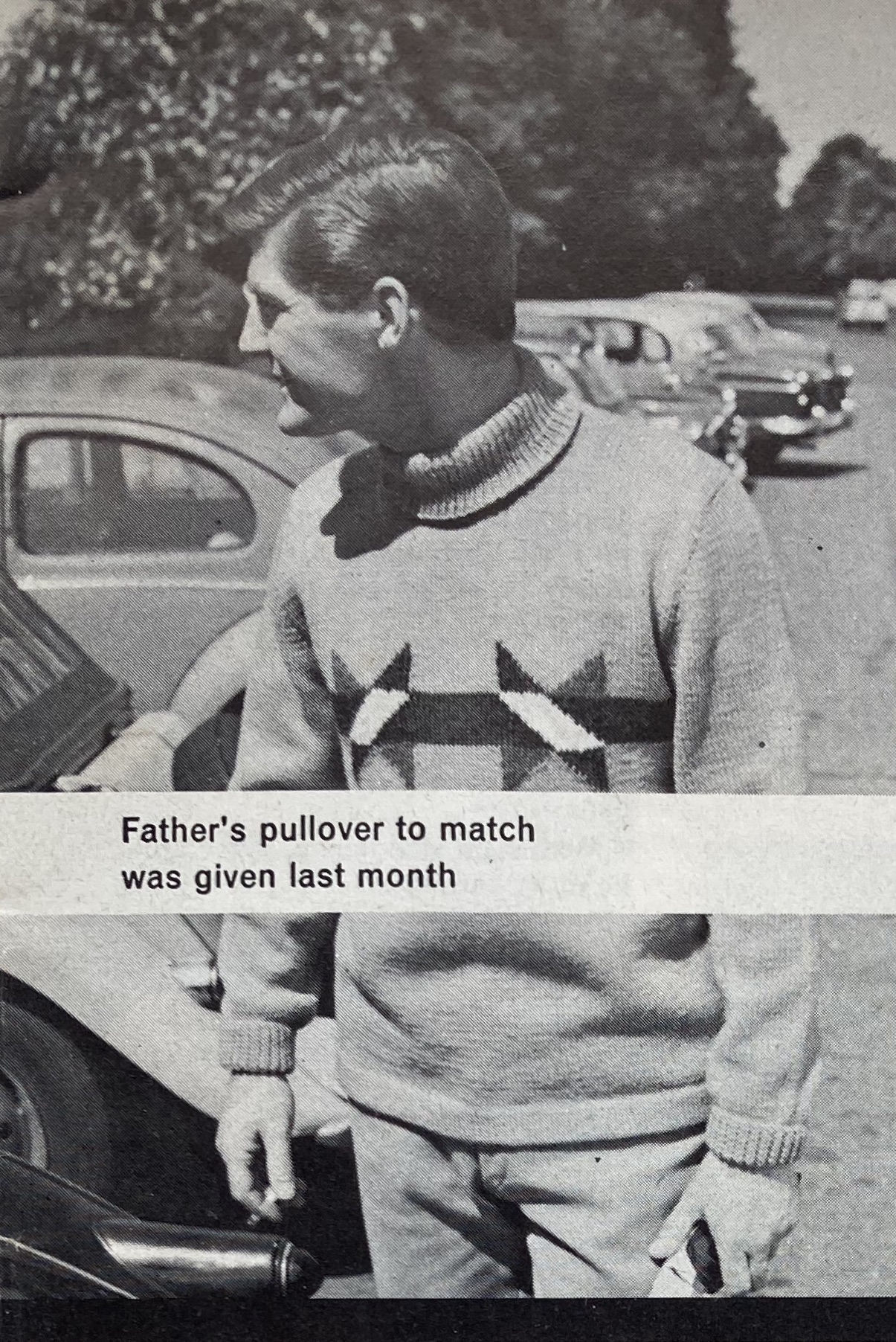
For the children, there’s a boys’ version of a men’s pullover from last month’s issue… the one that would not be a good choice for most women to wear. I personally think the placement of the star motifs is a bit odd even on a flat-chested body (they could have placed the band near the hem, or in a round yoke), but Stitchcraft liked it enough to offer a smaller-sized version in blue. Girls get a jumper suit in a plaid-trimmed “gay design from Vienna”. The colour palette for both the adult and children’s fashion is bright — blues, green, yellow, chocolate brown and “Flamenco” (I’m guessing red?), the patterns are bold and clear and collars and pockets are big and conspicuous.

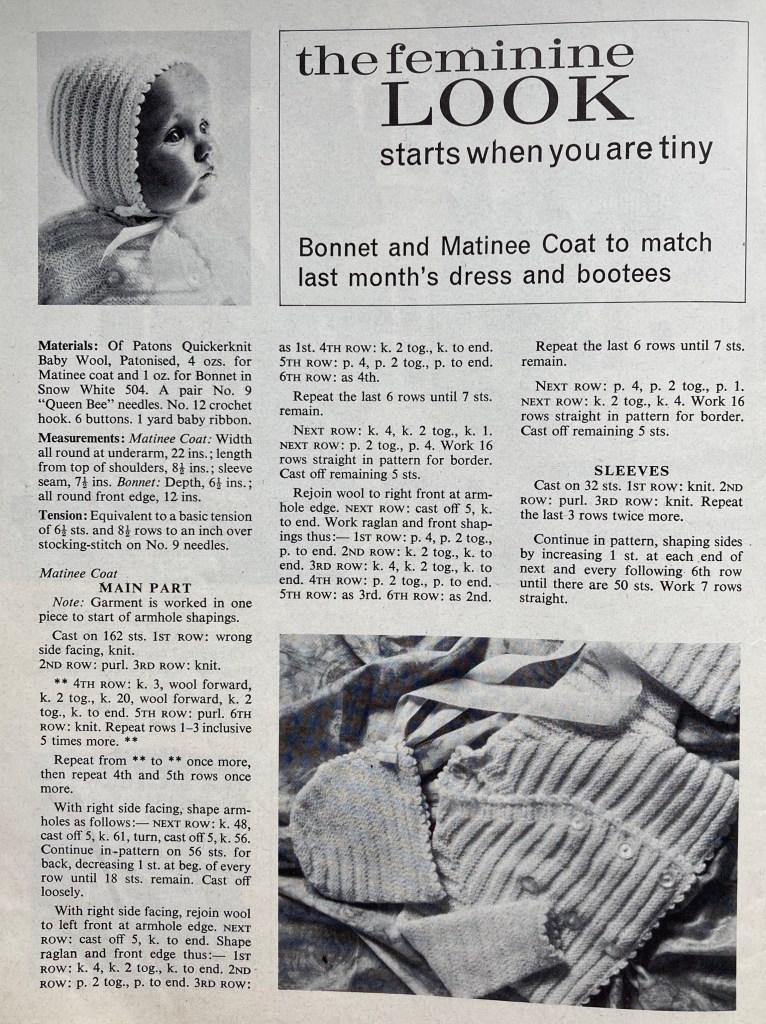
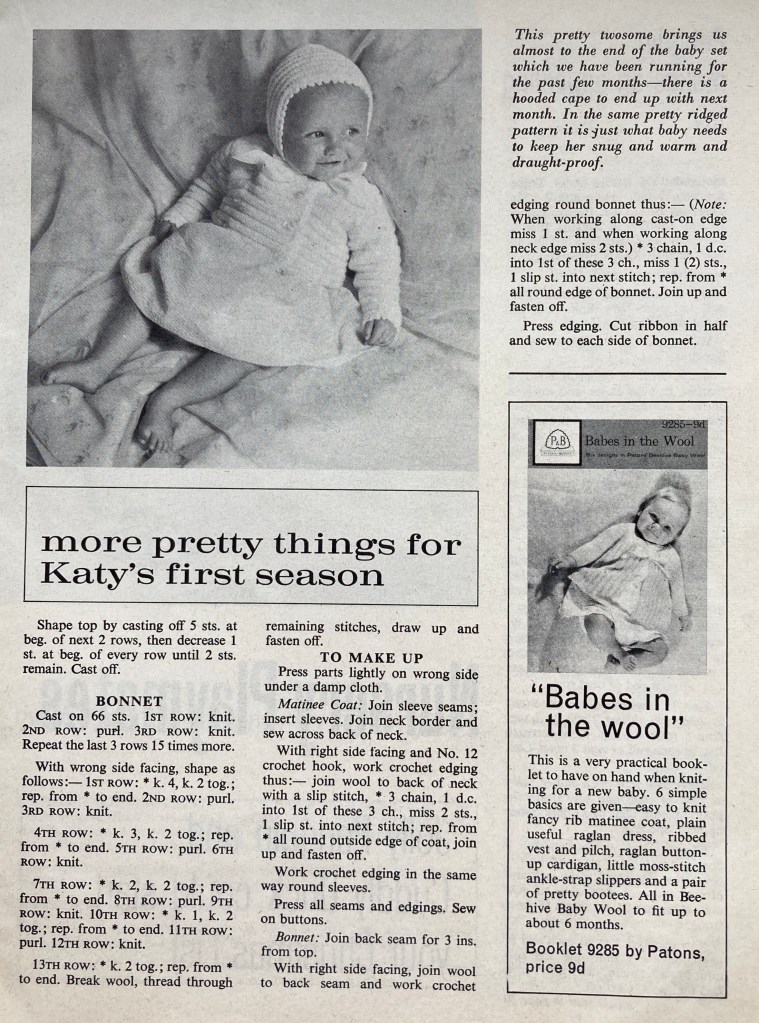
Continuing the baby-outfit series from the previous months’ issues, the (girl) baby of the family gets a bonnet and matinée coat. “The feminine LOOK starts when you are tiny” — i.e. get used to having cold legs now! The set is certainly pretty, and there’s a very practically placed ad for a Patons’ baby-pattern booklet, “Babes in the Wool” on the page as well.

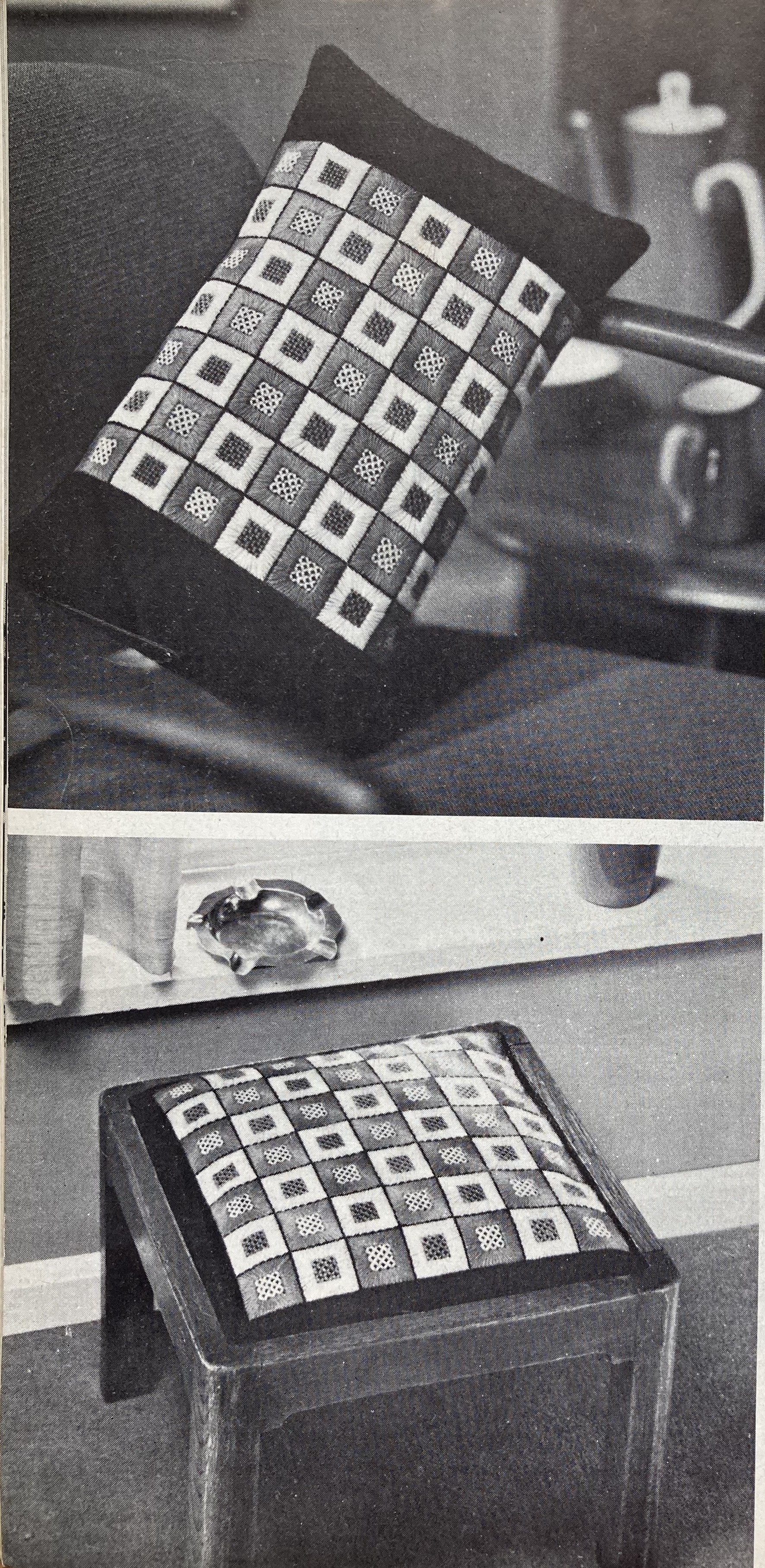
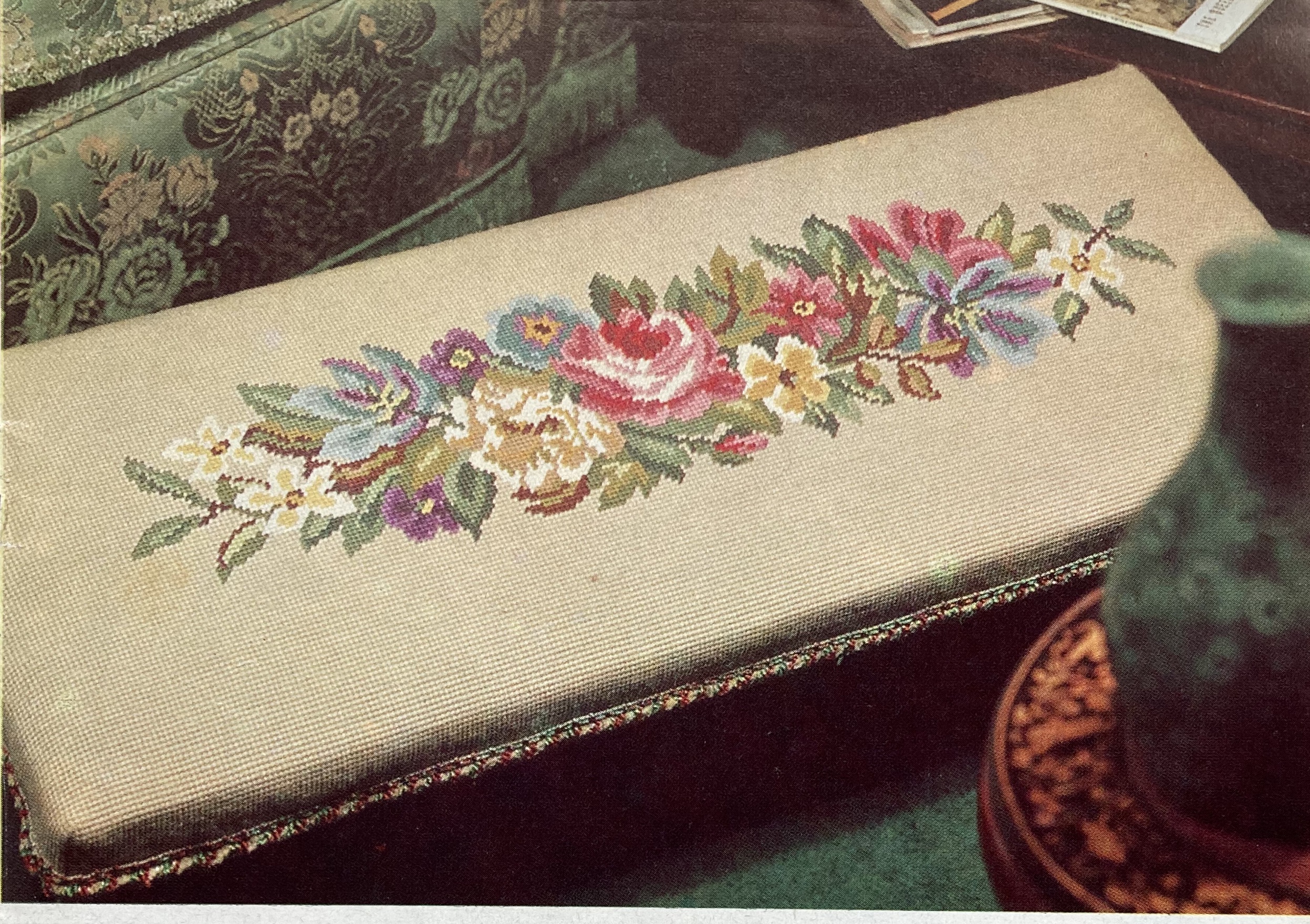
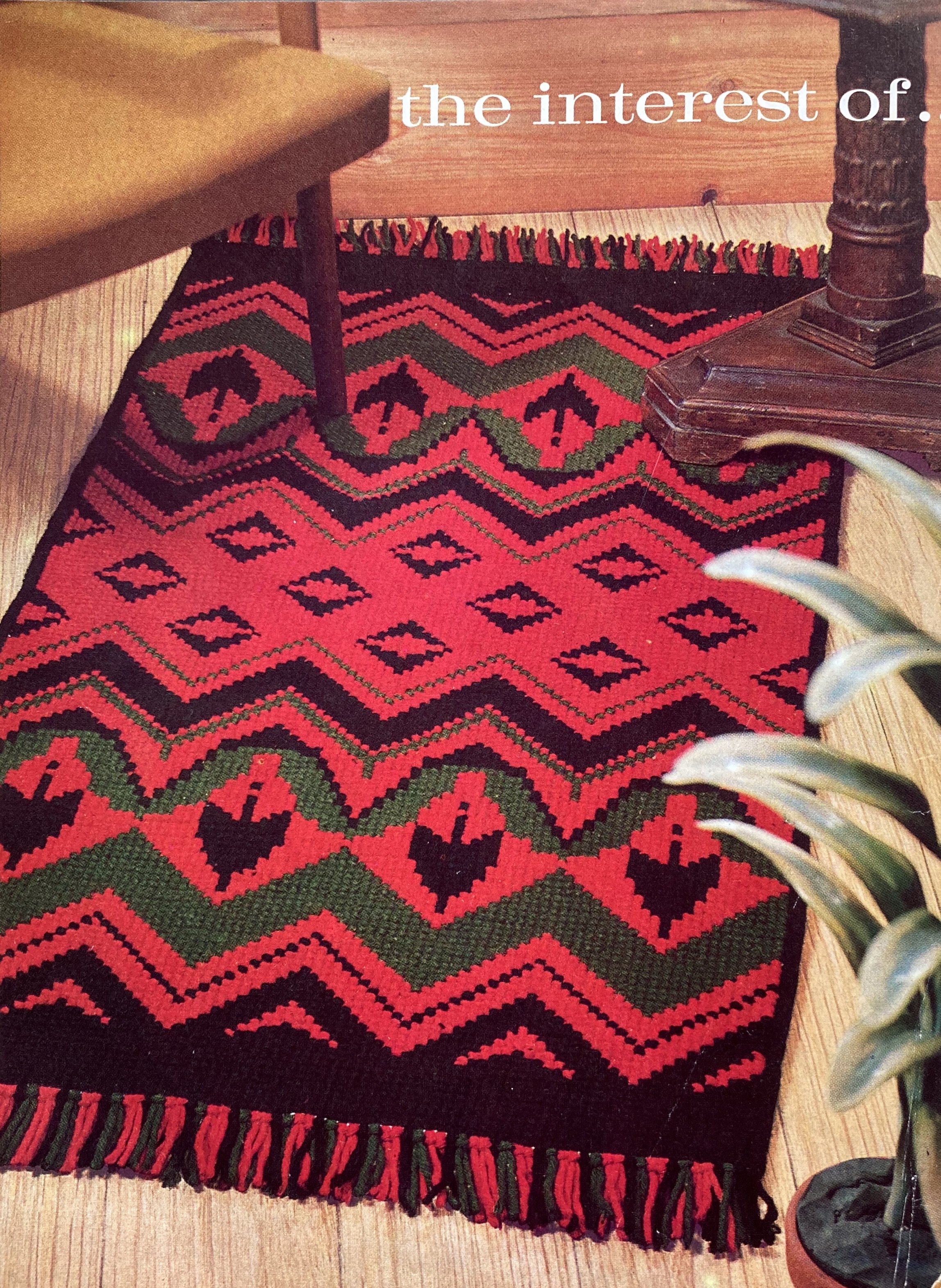
With all these great knitting designs, you’d think the homewares department would be skimpy, but they really went all-out on this issue: in addition to the usual cushions, stool-tops and chairbacks in huckaback work or tapestry, there’s a bold red-and-green “traditional Austrian” rug photographed in colour (notice how a traditional Austrian design is not called “peasant”, interesting…)

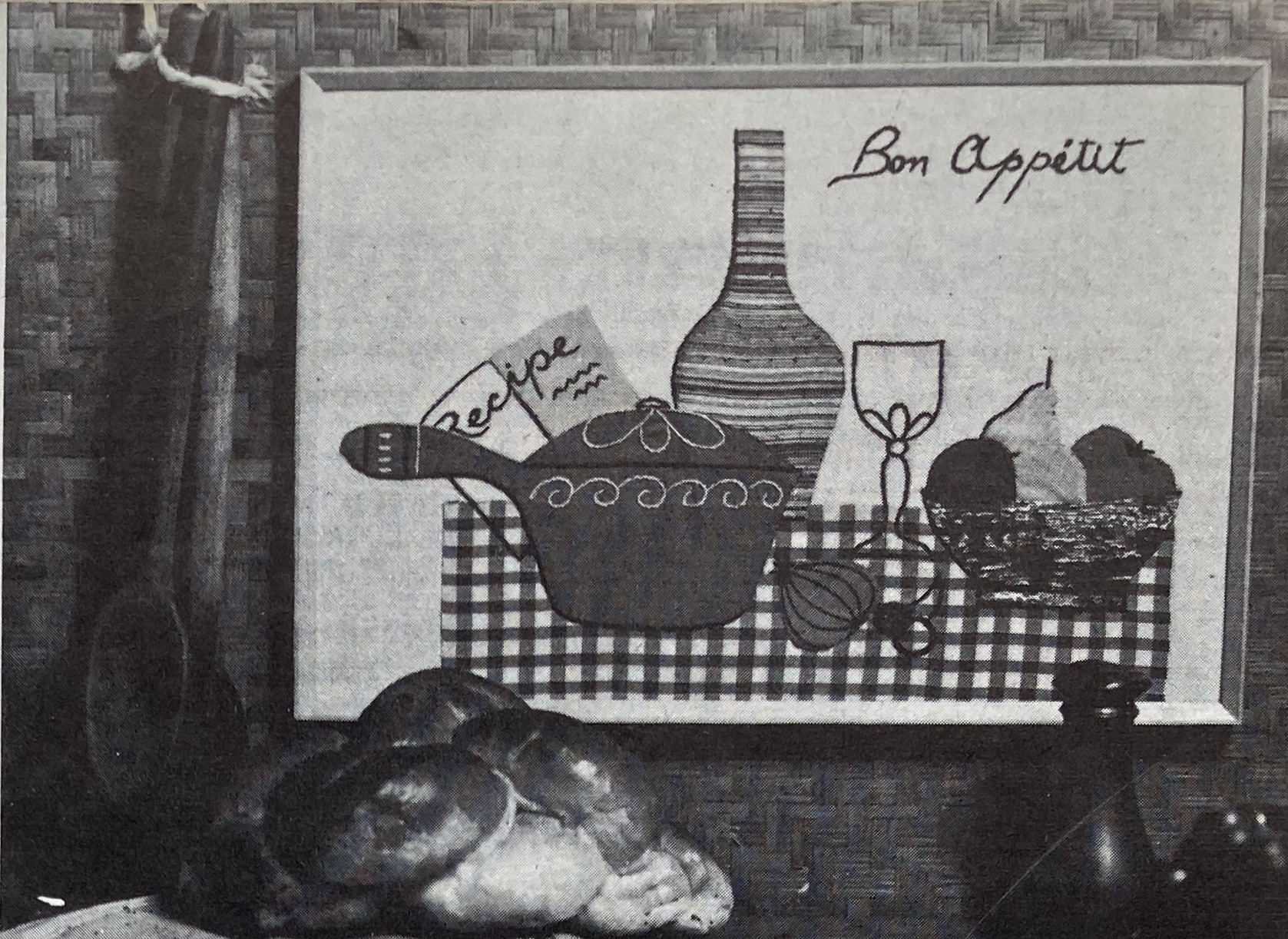
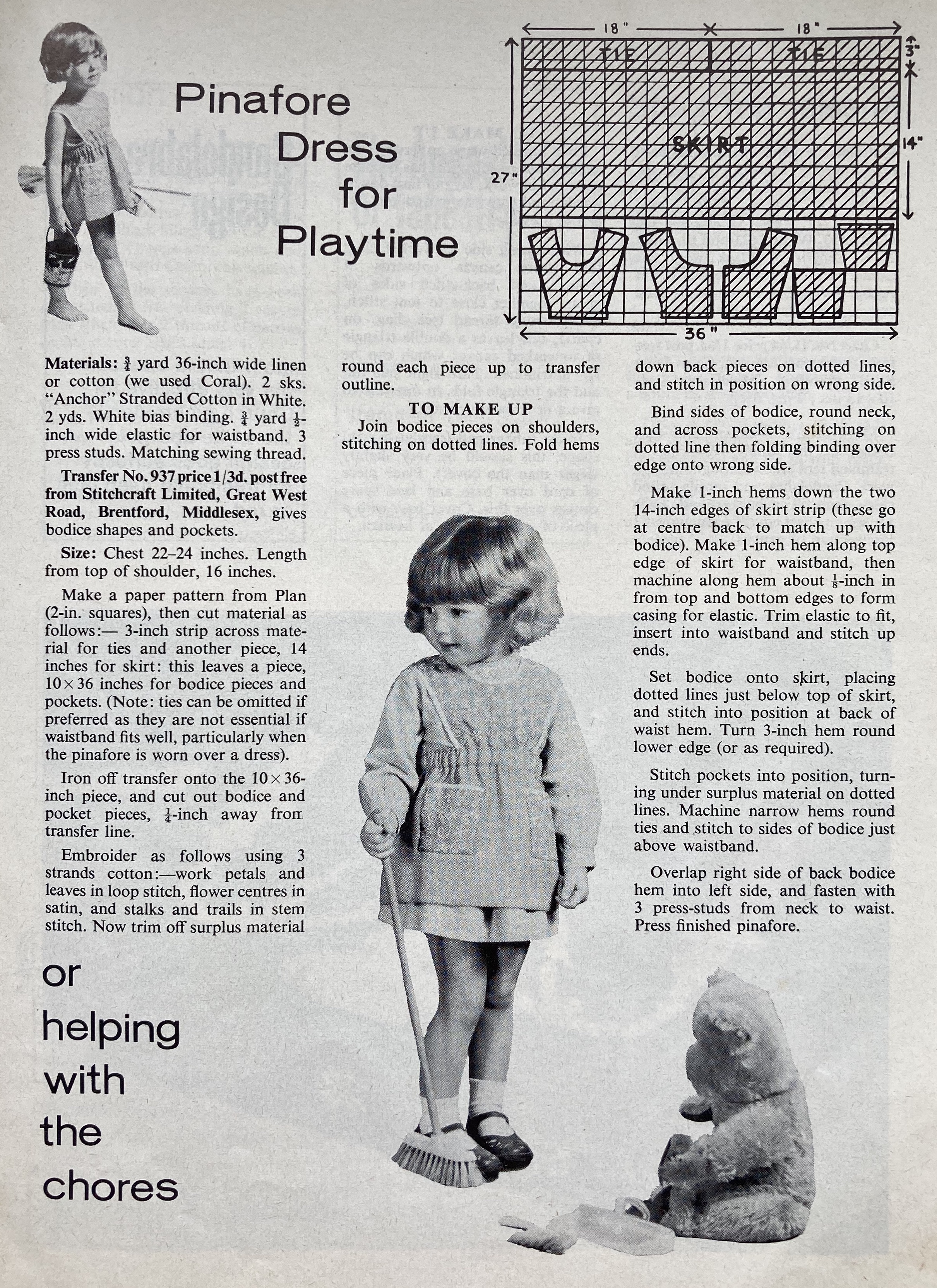
… and an appliquéd wall picture with a “kitchen”-themed design. Do I have terrible taste if I admit that I love this wall hanging? It’s utterly kitschy and very 1960s! There’s a little sewing design as well, for a child’s pinafore smock… “for playtime or helping with the chores.” Beware, little girl, that feminine look comes with its own designated activities.

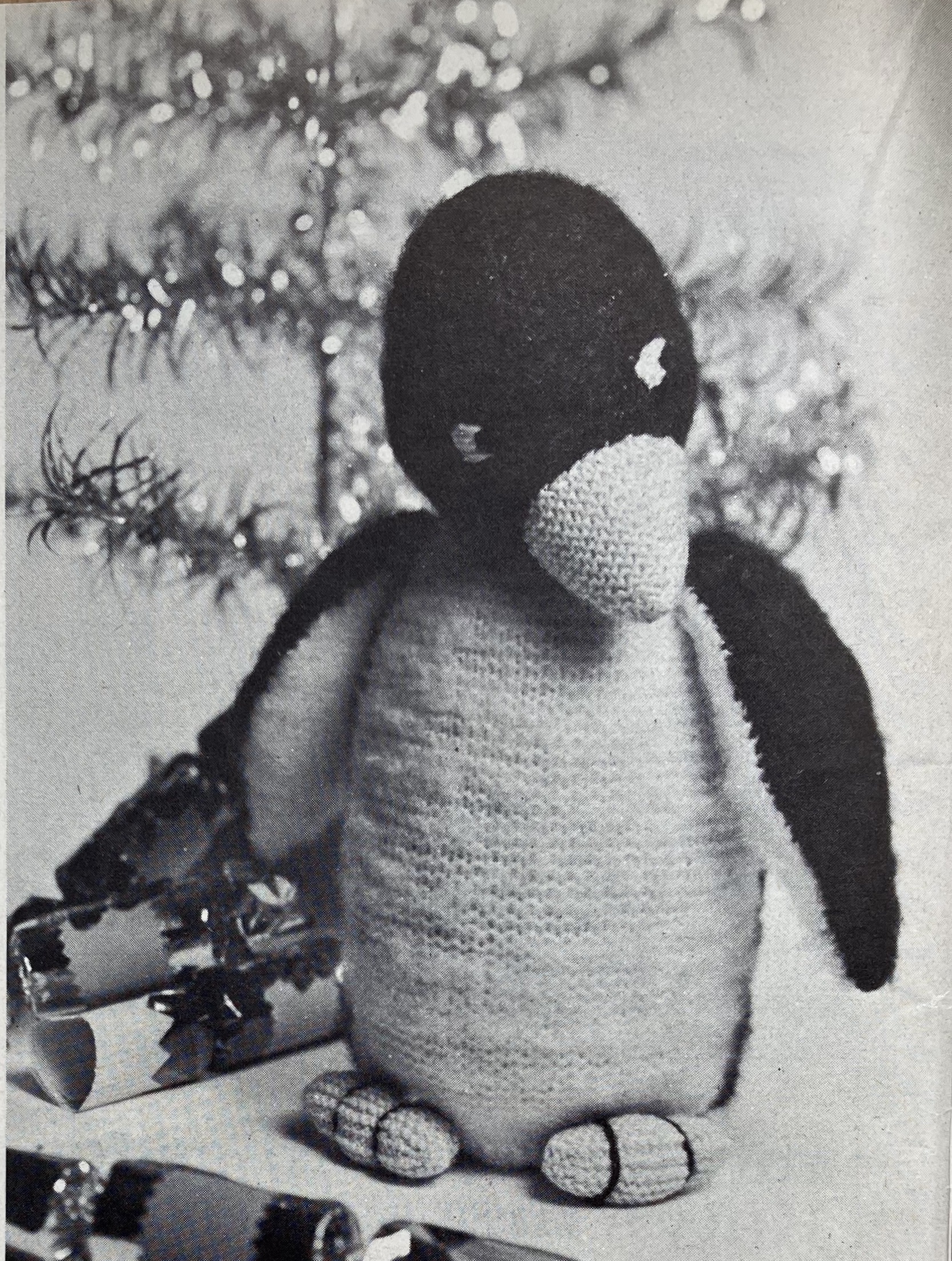
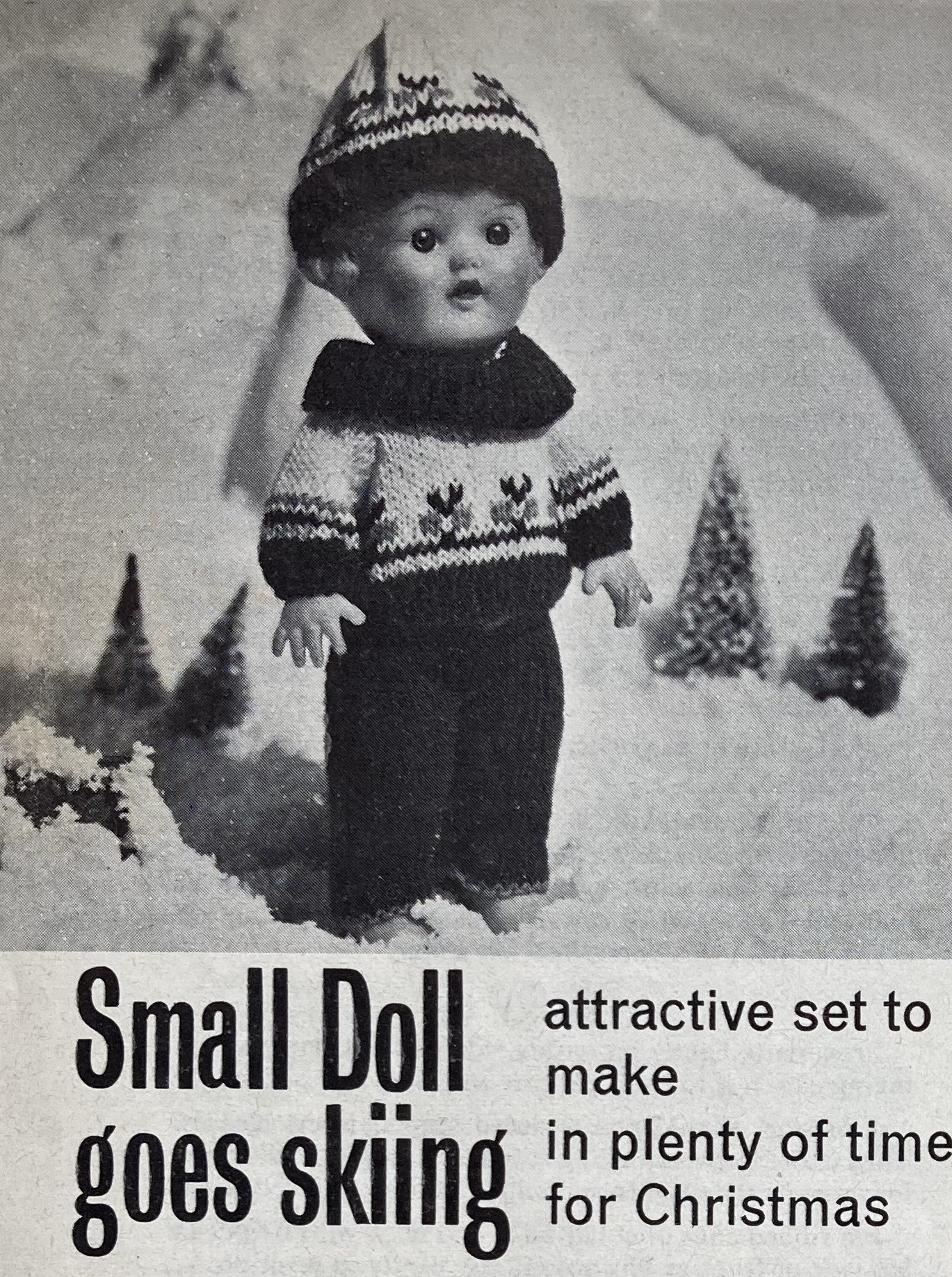
And don’t forget the “novelties”, which are not quite as weird in this month’s issue as we have seen in other issues. There’s a little stuffed penguin toy with very funny feet, and a night-case in the shape of a knitted duck. There’s also a winter ski set for a doll, with ski-pants and a warm stranded pullover and cap. (If the doll looks a little worried and not quite warm and comfortable, it’s probably because it’s standing barefoot in the snow.)

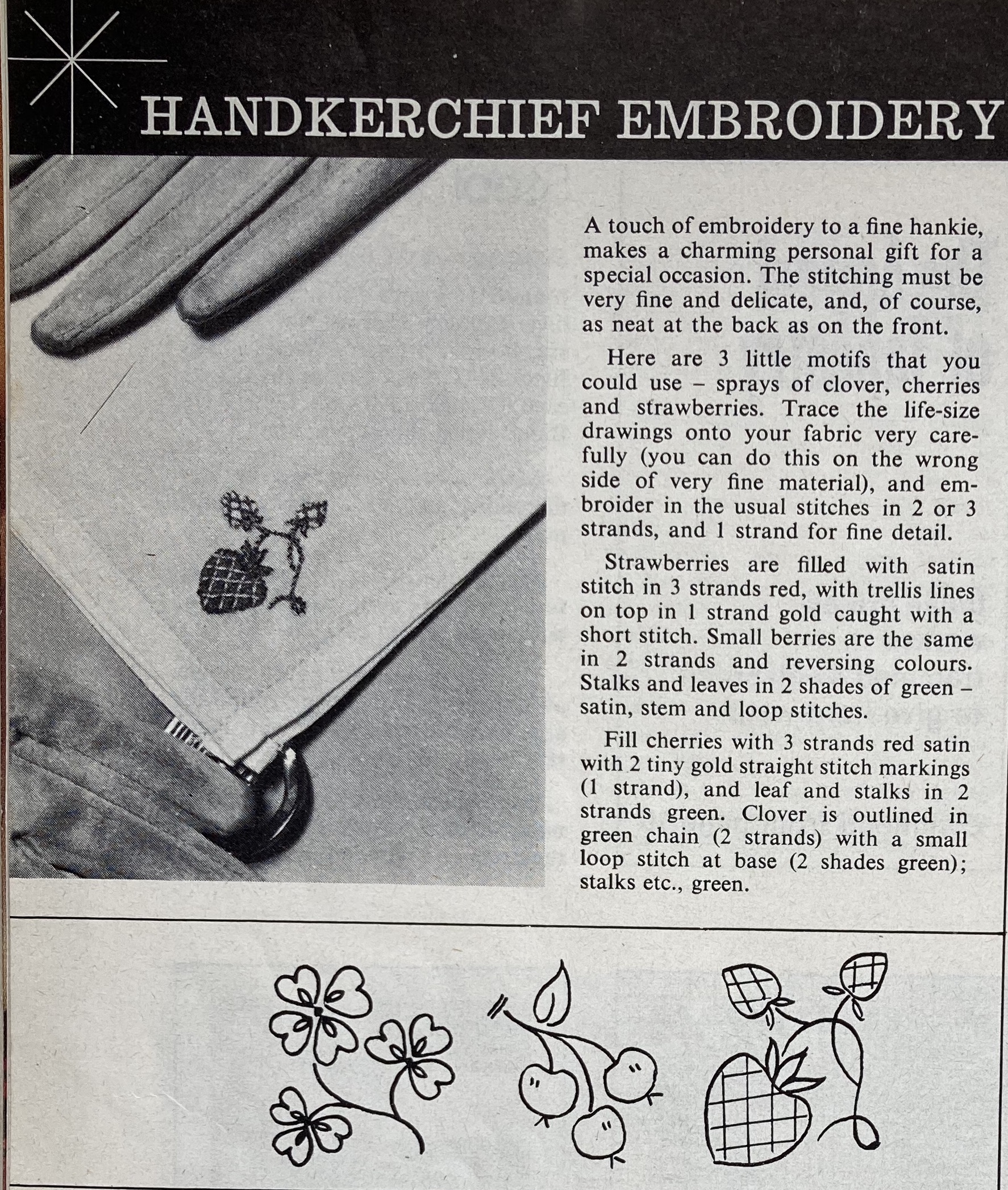
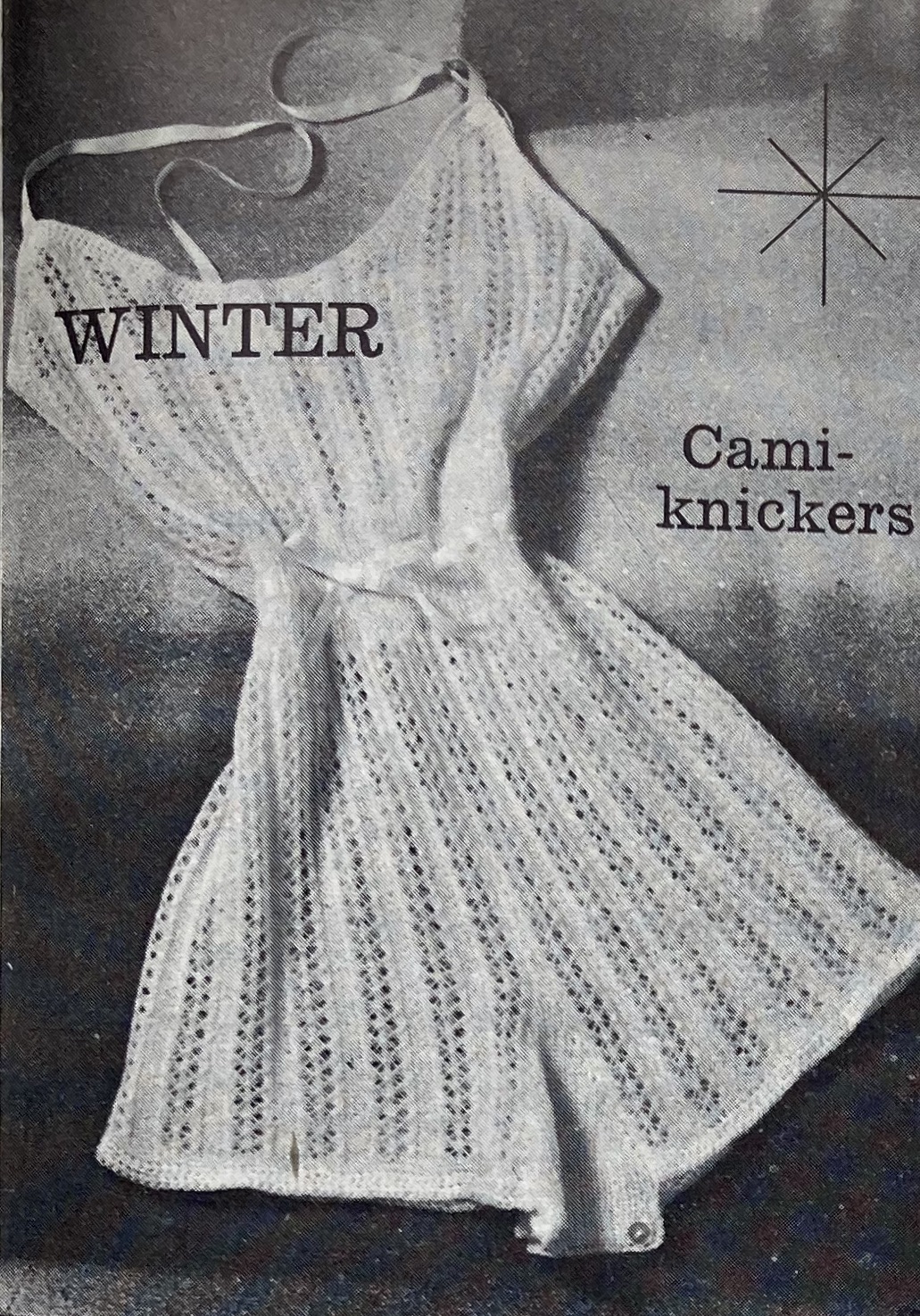
But that’s not all! In addition to the usual comic (Anne learns how to embroider an owl and a swallow using different embroidery stitches), the “Readers’ Pages” in the back of the magazine have a reprint of a 1944 knitting pattern for warm “cami-knickers” underwear, and some dainty stencils to embroider onto handkerchiefs. I love embroidered handkerchiefs, having inherited some beautiful ones from my grandmother and occasionally bought more on ebay. If I ever find any plain new ones to buy (shouldn’t be that difficult), I could try my hand at embroidering them myself.

The handkerchiefs, cami-knickers and even the cheesy appliqué picture all appeal to me, but I love the cabled knit dress most of all, so that will be my October project. I can’t imagine it will be done by the end of October, but I have already bought wool and made a swatch and am just starting casting on, so I’ll post about it soon when there’s something to see and write about.

Till then, happy Autumn!

June 1964: Overview

Welcome to the official start of the Stitchcraft holiday season! The June 1964 issue gives us a mix of elegant 4-ply designs, casual bulky knits to wear as outerwear, beach clothes for the kiddies and easy homeware projects that can be packed up and worked from a deck chair.

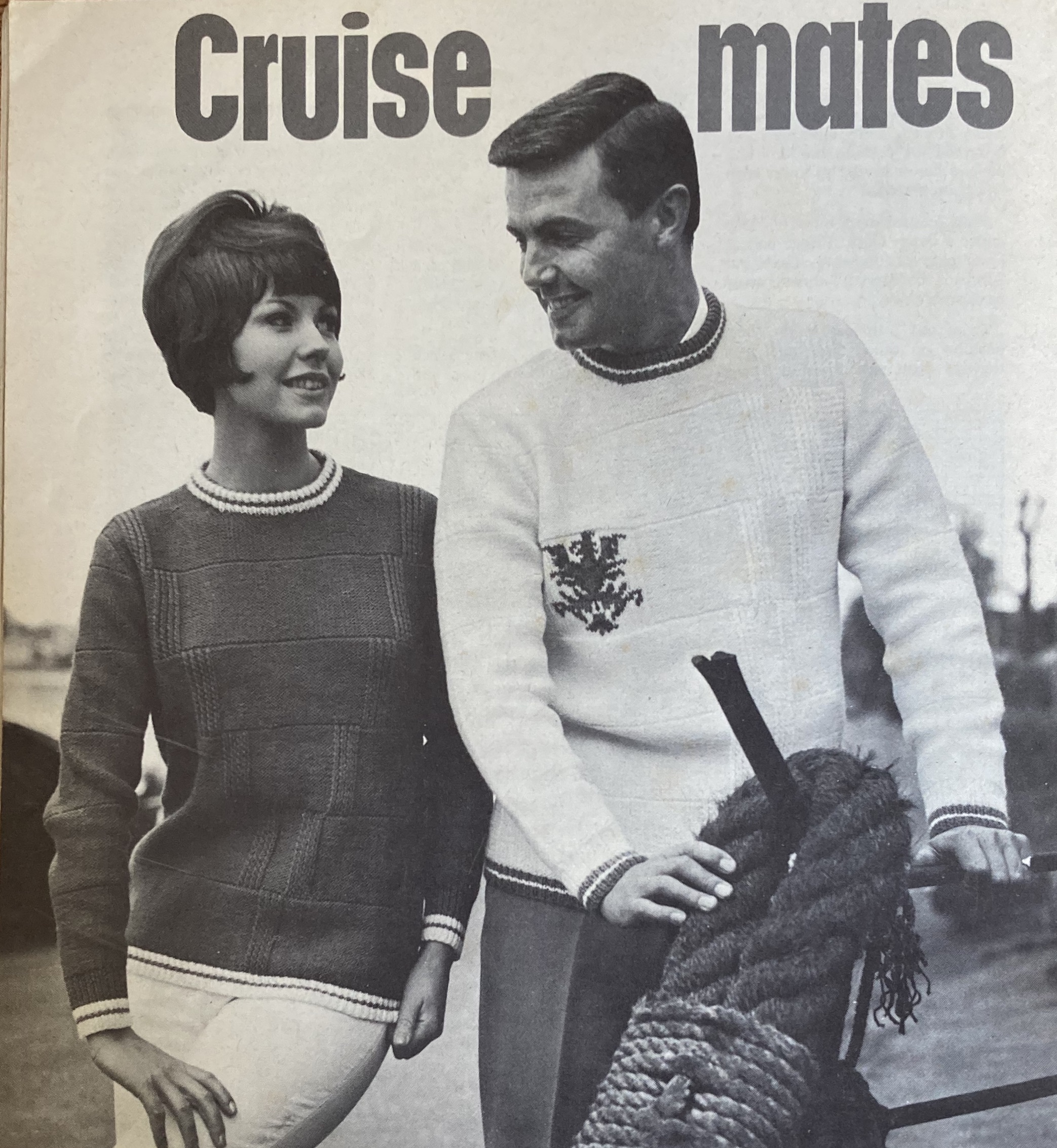
Our cover models are just returning from the weekend market, where they have secured a basket of nectarines. They’re wearing an “easy-line sport pair” of “cruise mates” in complementary colours and the same basic block-and-rib pattern. The ribs are made with p1, k1tbl to give them a more textured look, and the men’s version has an eagle motif, because it is “manly for him.” I wonder if both versions were originally designed with a motif until the designer realised that it would fall in an awkward place on the women’s version?

Nautical navy blue and white with red accents never goes out of style for summer casuals, and we see it in this bulky, yet “featherweight” (18-20 ounces of Patons Ariel, so make of that what you will) white cardigan. I can believe Stitchcraft when they say that the wool is lightweight, considering its bulk, since the twisted-rib pattern eats up a lot of wool.

Ona different note, we see simple, yet elegant knitwear separates in 4-ply that are suitable for the office of a more dressy casual situation. The basic skirt and plain or diagonal-striped top are knit in muted pastel shades and meant to be interchangeable — “Basic skirt with a change of top” is the headline for this well-coordinated set. There’s also a waistcoat for her that would match the skirt when worn with a blouse, and a fine-knit raglan pullover for him. The waiscoat and pullover are both in this season’s trendy yellow tones of “Spun Gold” and “French Mustard”.

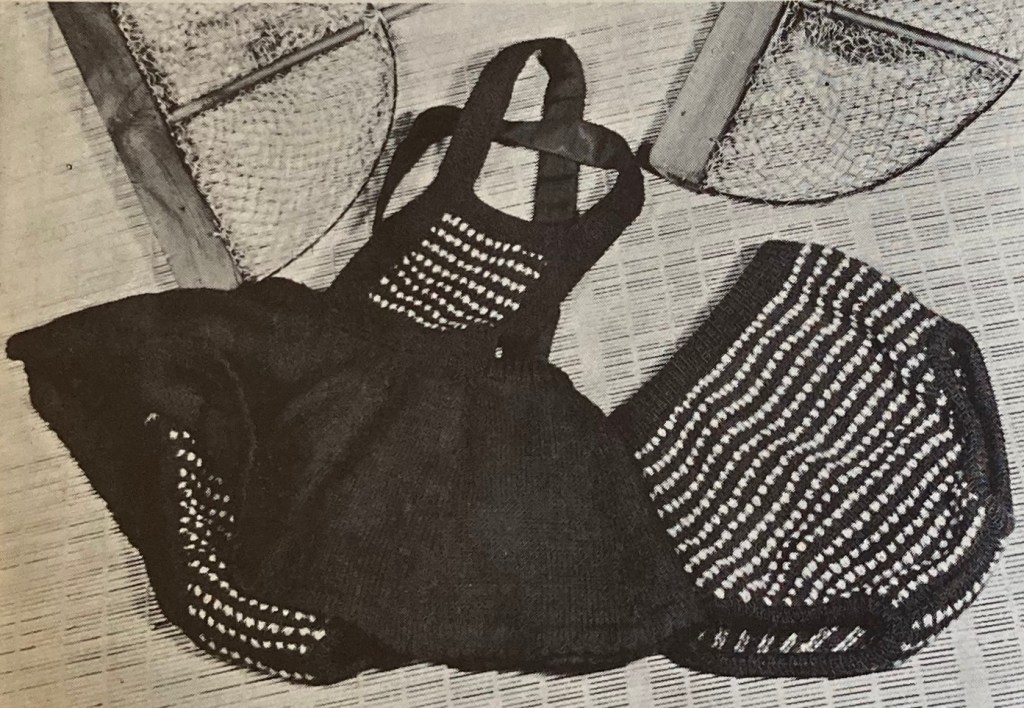
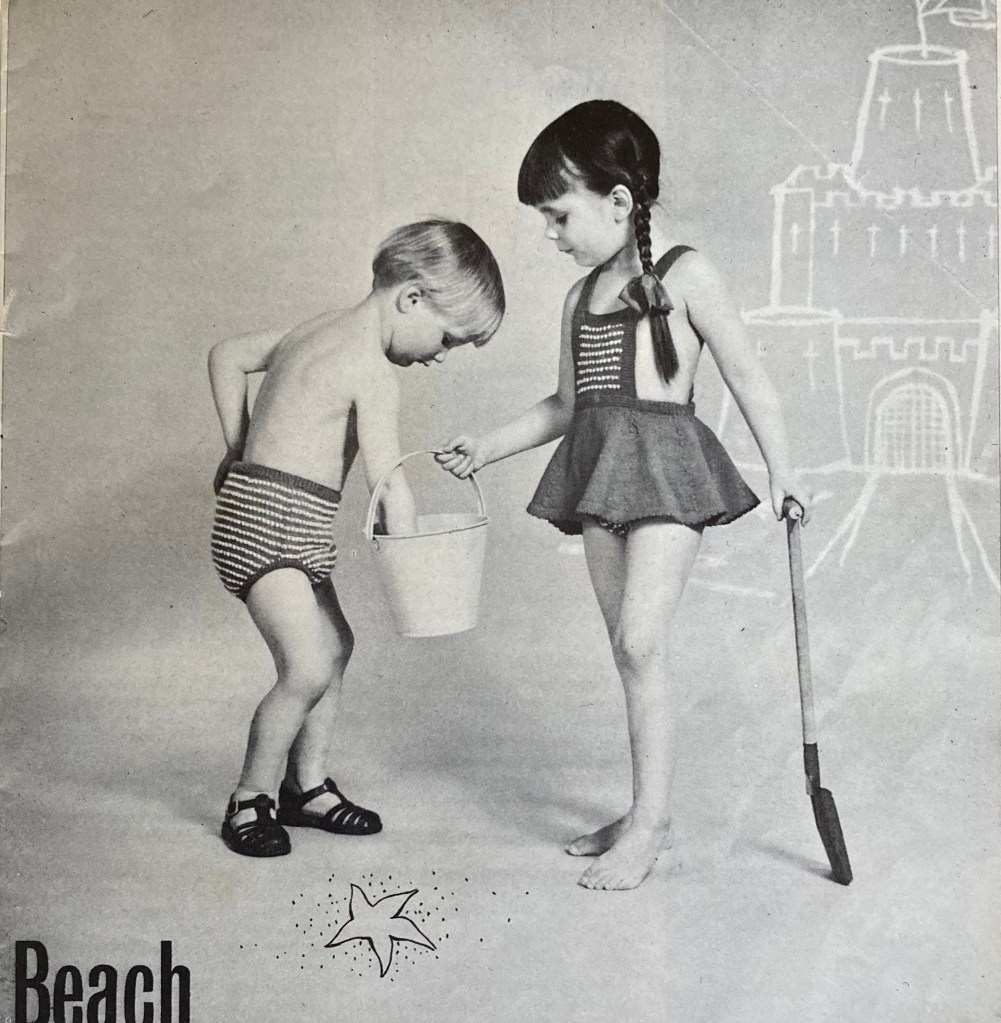
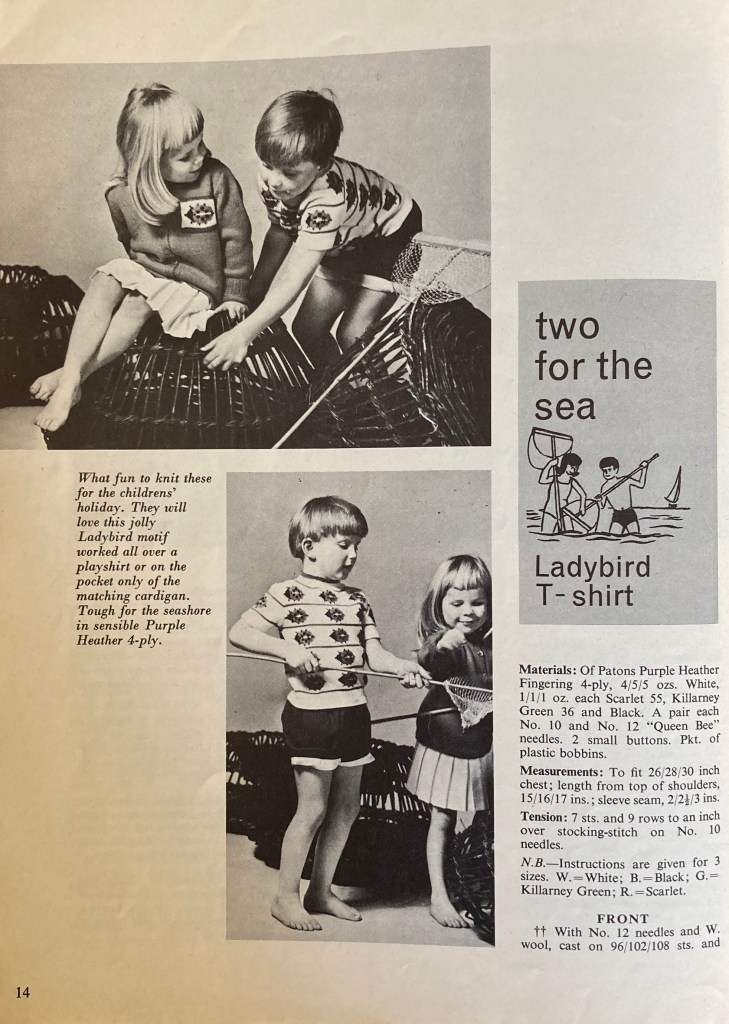
Children can enjoy splashing around at the beach in their trunks and sundress (the girl’s trunks are sewn into the sundress to prevent wardrobe malfunctions, definitely necessary with a micro-mini tunic skirt.) Here again, traditional red and white or navy blue and white are the chosen Somewhat older children have a choice of short-sleeved jumper and/or cardigan with a Ladybird motif (more about that in the next issue…!), continuing the red and white theme. On a completely different colour note, you can make a beach cover-up coat in crinkly “Rimple” wool lined with towelling — a brilliant idea for drying off and staying warm after a swim in cold northern waters. It’s quite easy to make, consisting of literally three rectangles for fronts and back, with garter-stitch borders and then lined with the towelling.

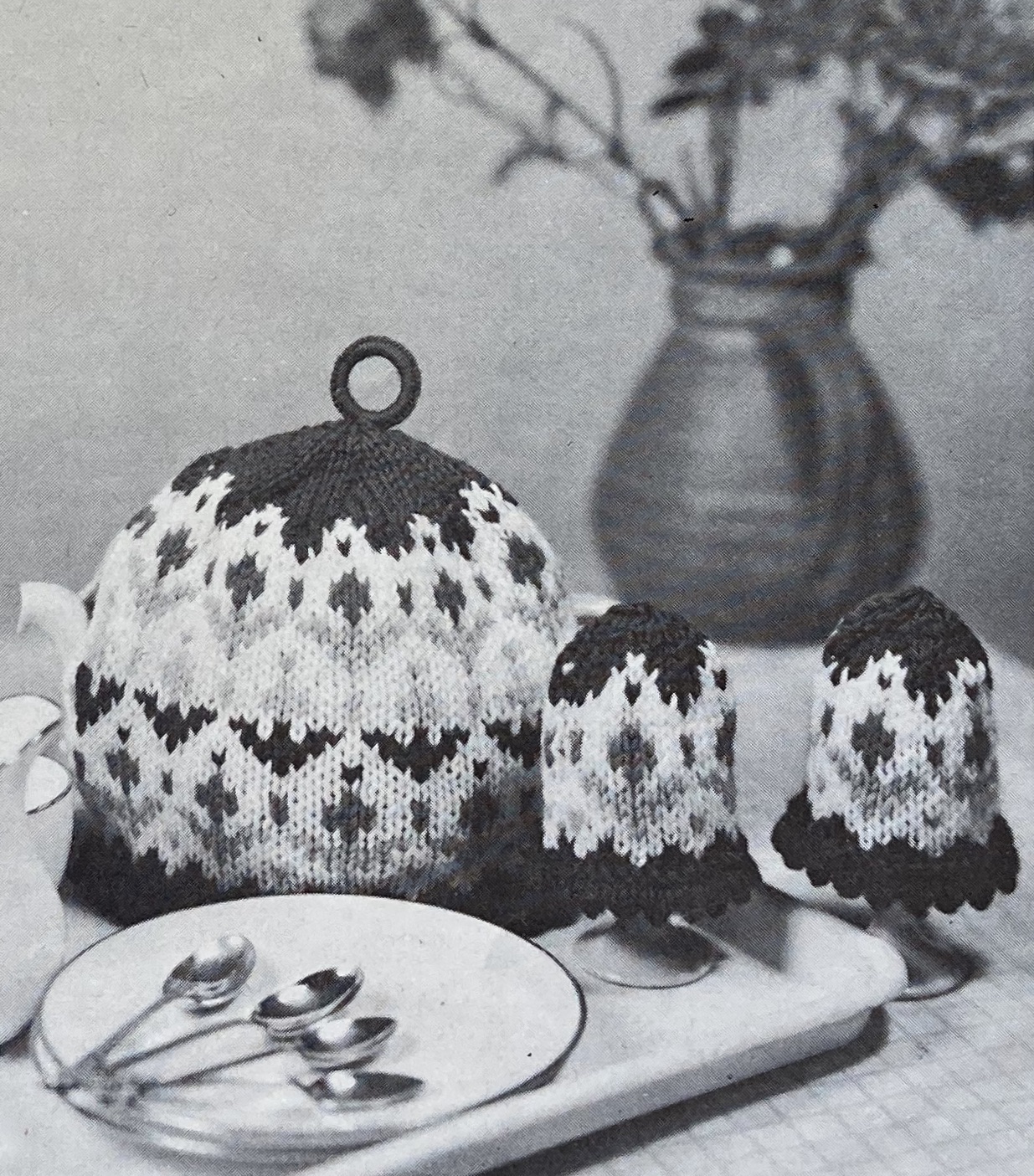
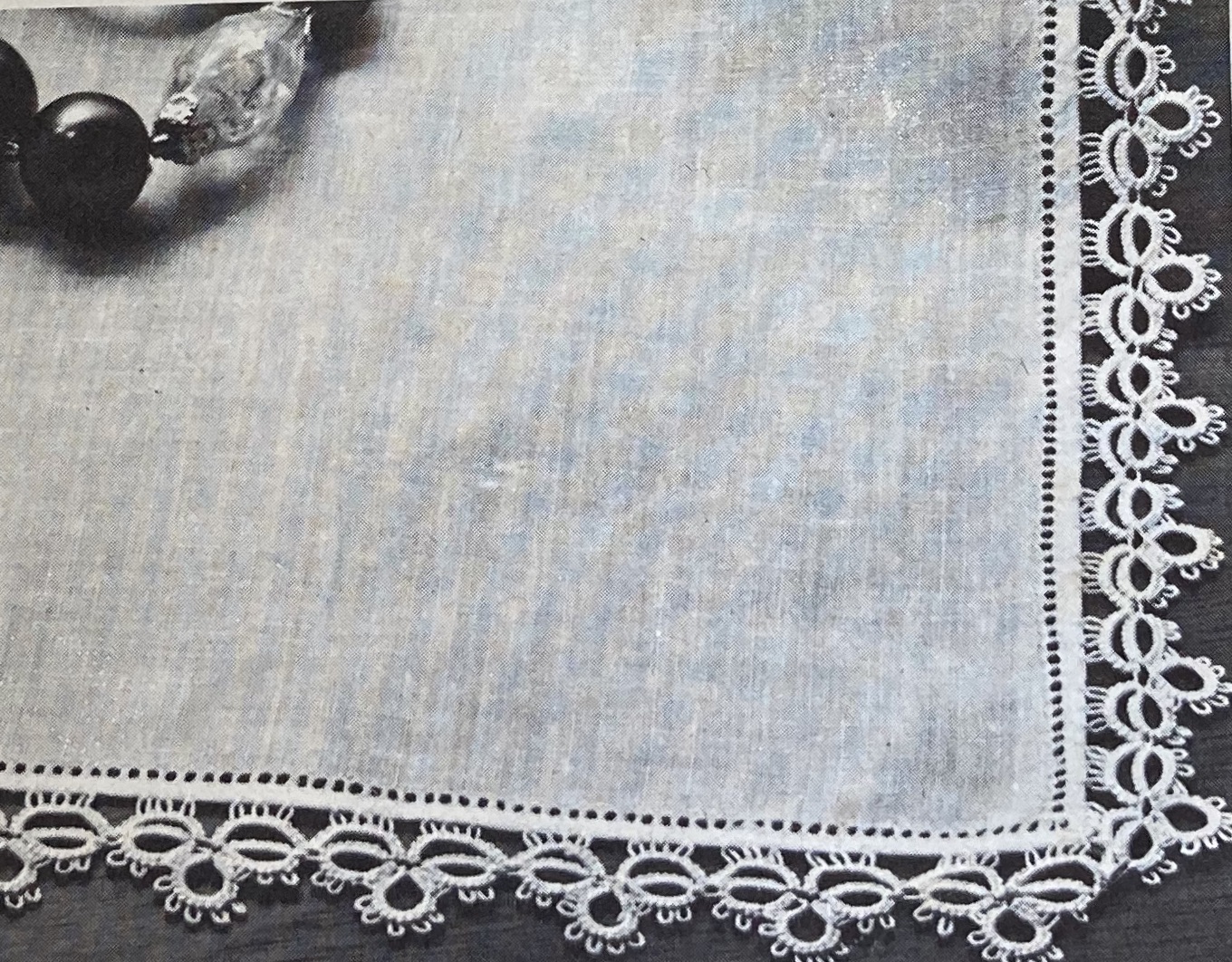
While sitting and sunning at the beach, you can work on an easy homeware project, such as a cross-stitch cushion, a knitted tea or egg cosy, or a tatted lace edging for handkerchiefs or pillowcases. Even the workbag in Turkish darning would be easy enough to work on while on holiday, though the Victorian-esque horse-and-buggy cross stitch picture, the needle etching, and the crocheted rug are presumably easier to work on at home.

That’s it! Summer issues are usually less exciting than autumn and winter, as many people (understandably) don’t like to hold wool in their hands in hot weather. As with many of the mid-1960s issues, there’s nothing in here that particularly speaks to me, so my June project will be another “excursion”, this time all the way back to the 1920s. The project is almost finished (unlike my April and May blog projects…) so I’ll be able to put out a finished project post in time for once, even if it’s neither from Stitchcraft nor from the 1960s. Think of it as a holiday from the usual blog theme.

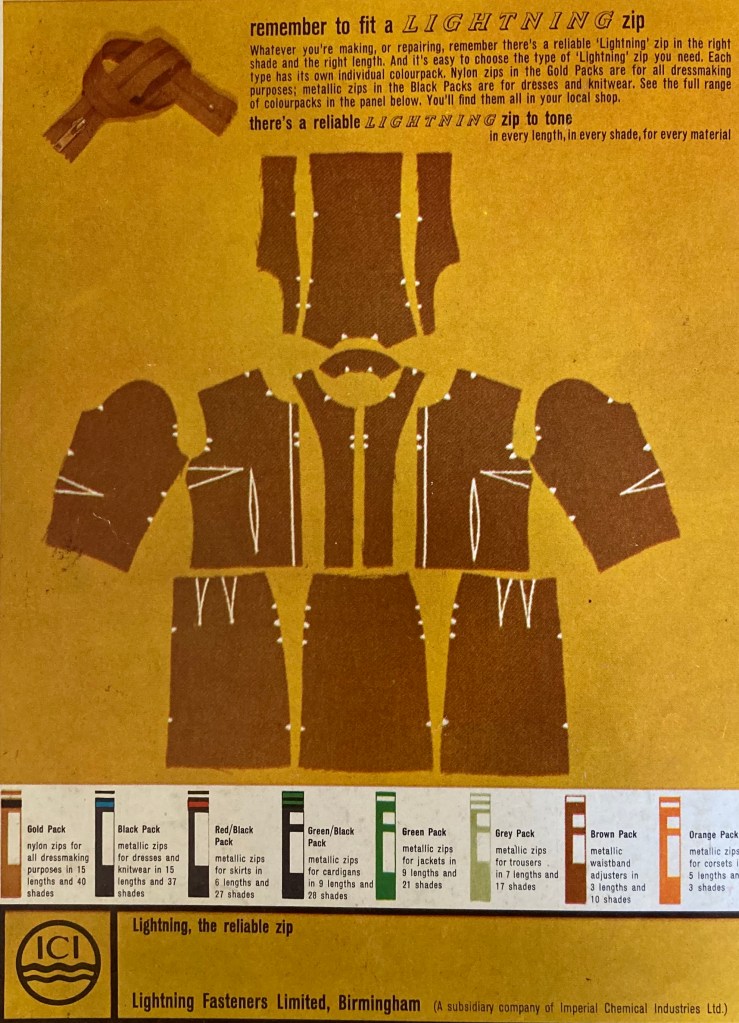
P.S. The back cover is a full-page ad for “Lightning” brand zips and and is illustrated with a very professional-looking pattern for a suit! I am tempted to size it up and sew it. Here it is for any readers who would like to try their hand at it.

January 1964: Overview

Happy New Year! It’s 1964 in the Stitchcraft blog world. “Busy as we all are,” writes “editress” Patience Horne in the issue notes, “it is surprising how many things needlewomen manage to make in a year.” Well, it’s my New Year’s handcraft resolution to finish up WIPs and reduce yarn stash, so let’s see how many new things I will manage to make.

(Apropos finishing up WIPs, I finally finished two very detailed and extravagant cushions: these blackwork butterflies and this amazing neo-Jacobean embroidered felt appliqué extravaganza, so be sure to check out the updated posts.)

Back to January 1964, what does the New Year have in store for us, fashion-wise? At first glance, it doesn’t look much different from the trends of 1963. Garments are warm, bulky, tweedy and textured, and homewares are traditional and floral. The Swinging Sixties have not swung through the pages of fashion-conservative Stitchcraft yet. Still, the designs are fun and easy-going, the bulky items quick to make.

Our cover design is a sweater suit in in plain DK and tweedy Patons “Glenora” wool. There’s an equally tweedy cardigan in bulky Ariel for women as well as garments with fun colour motifs and textured stripes. The colours are warm and vibrant, with deep pinks and yellows prevailing. Men get a very yellow pullover with nice cable details and a zip-up cardigan for the casual “country look” (with a coquettish smile from our handsome model.)

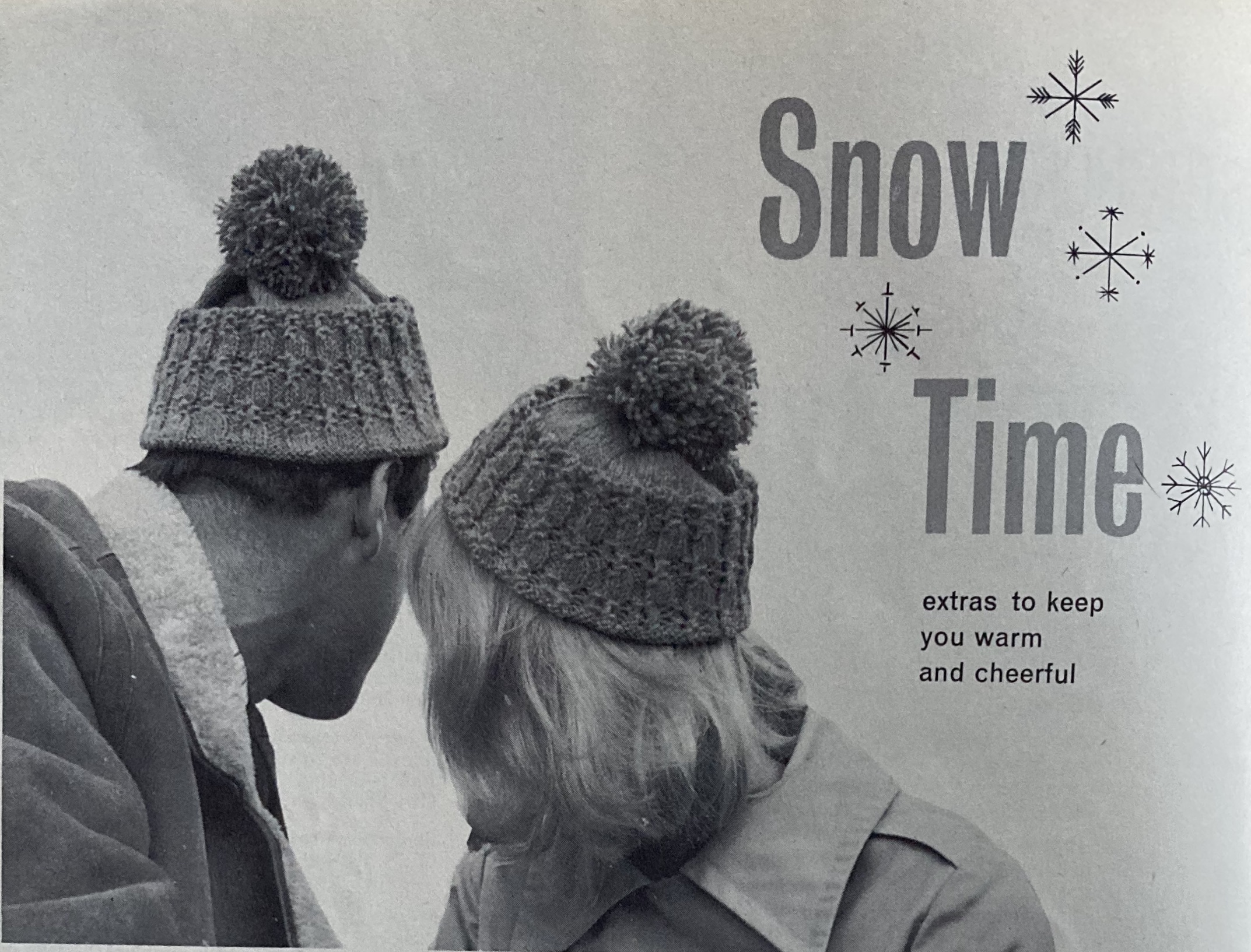
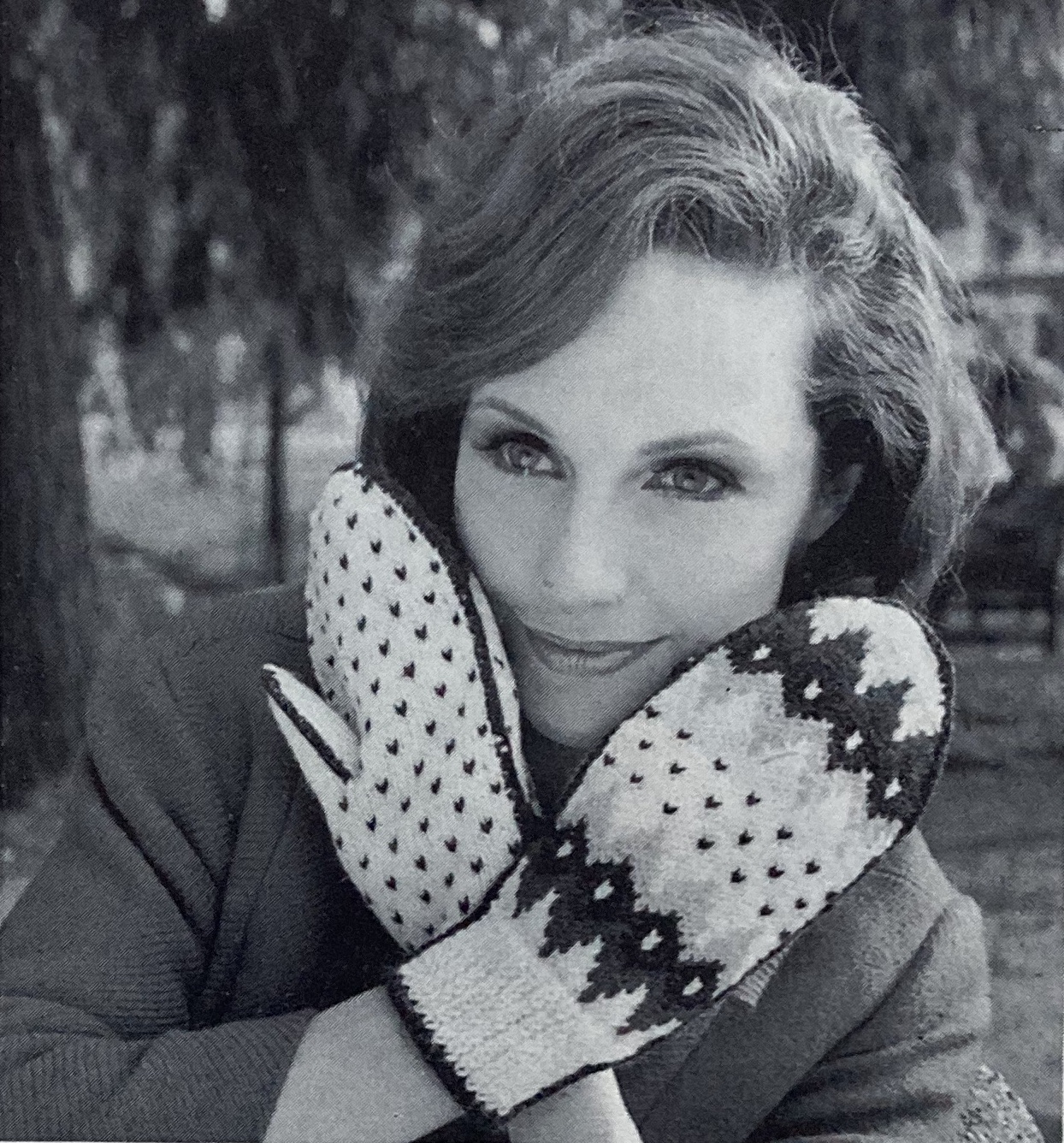
Appropriately enough for January, the accessories are warm and practical: cheerful hats in an interesting tied-loop stitch for “him and her” and warm mittens in stranded colourwork. As usual for this time, the stranded patterns, even for gloves, are worked back and forth, with front and back pieces worked separately and crocheted together.

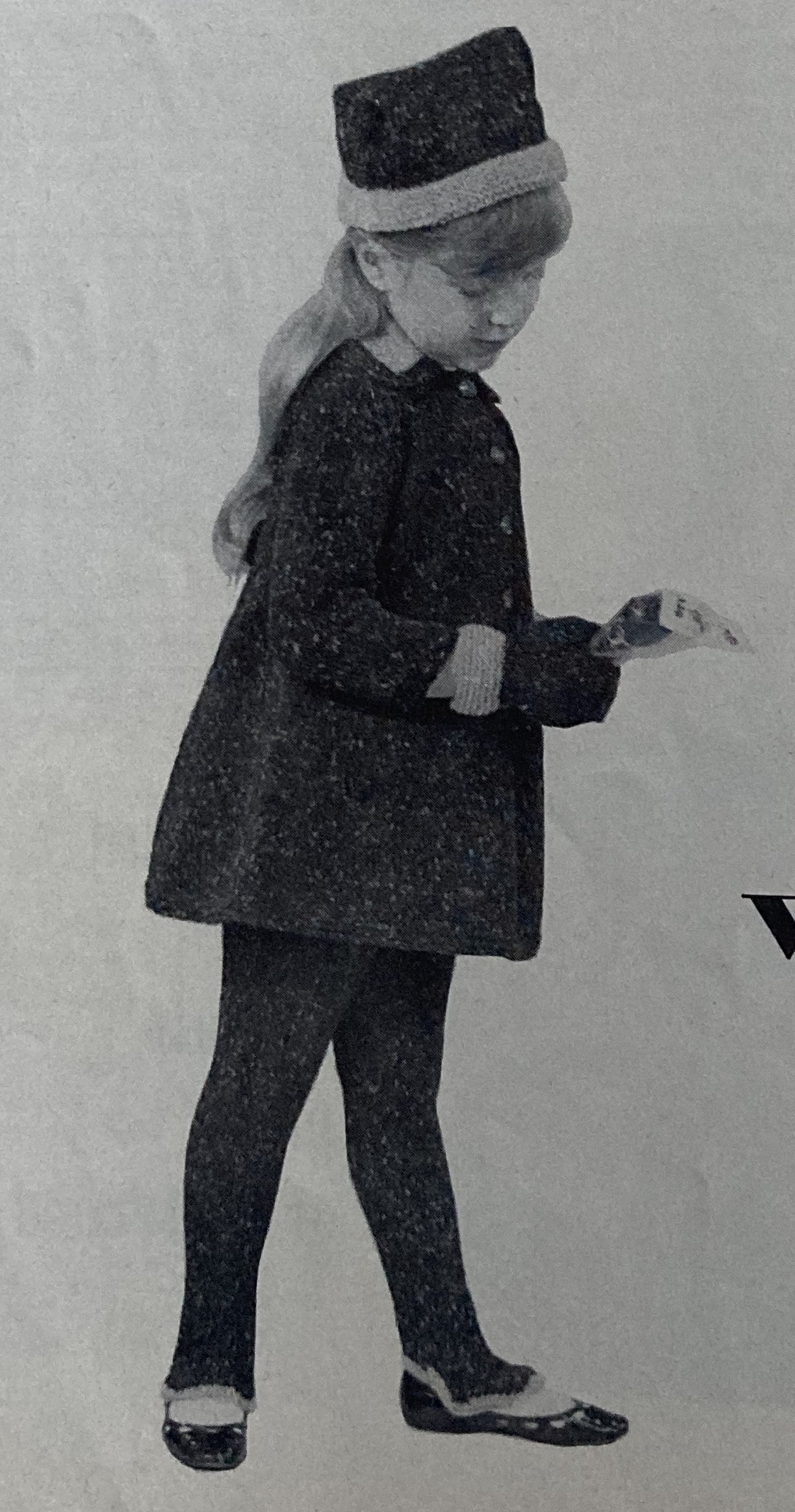
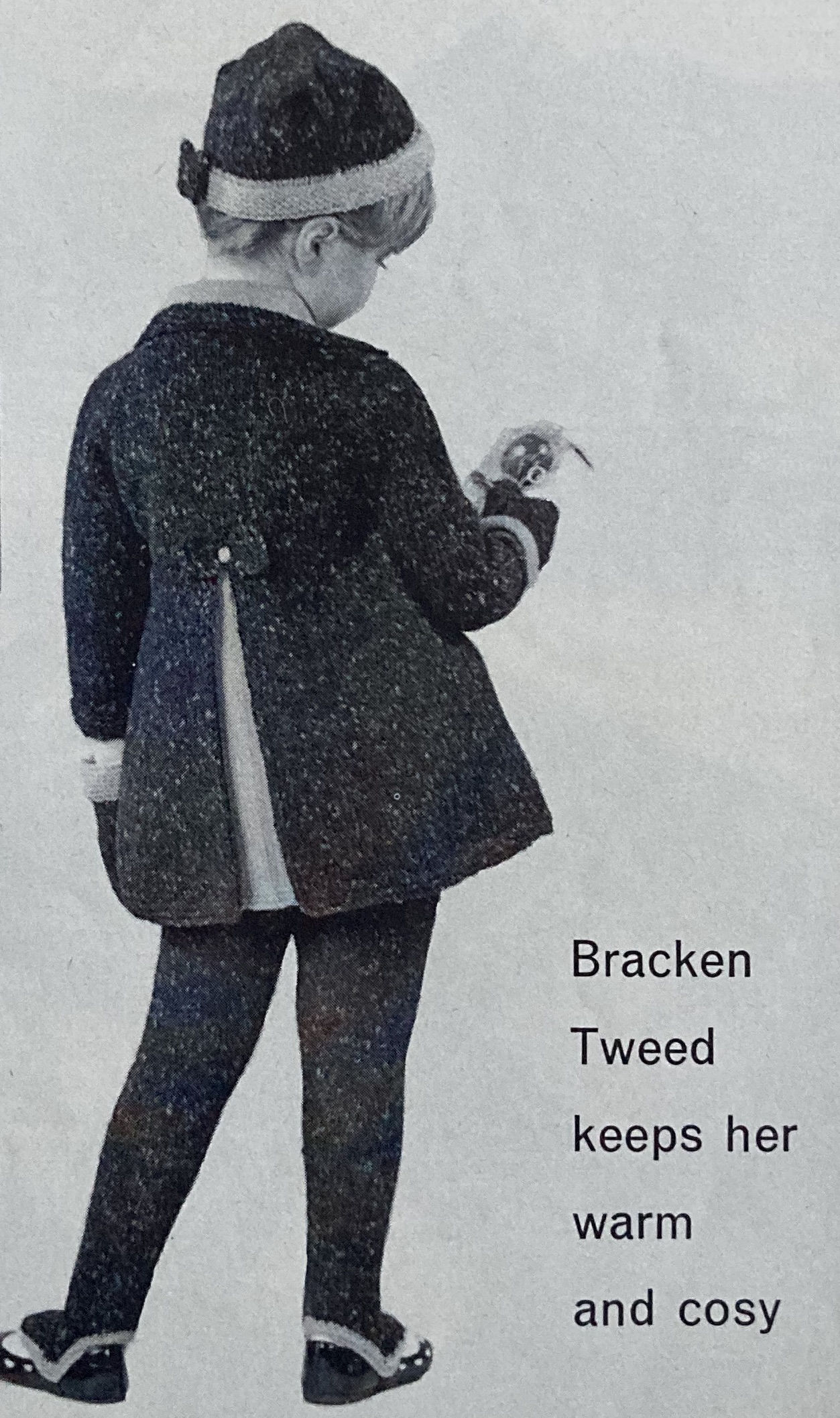
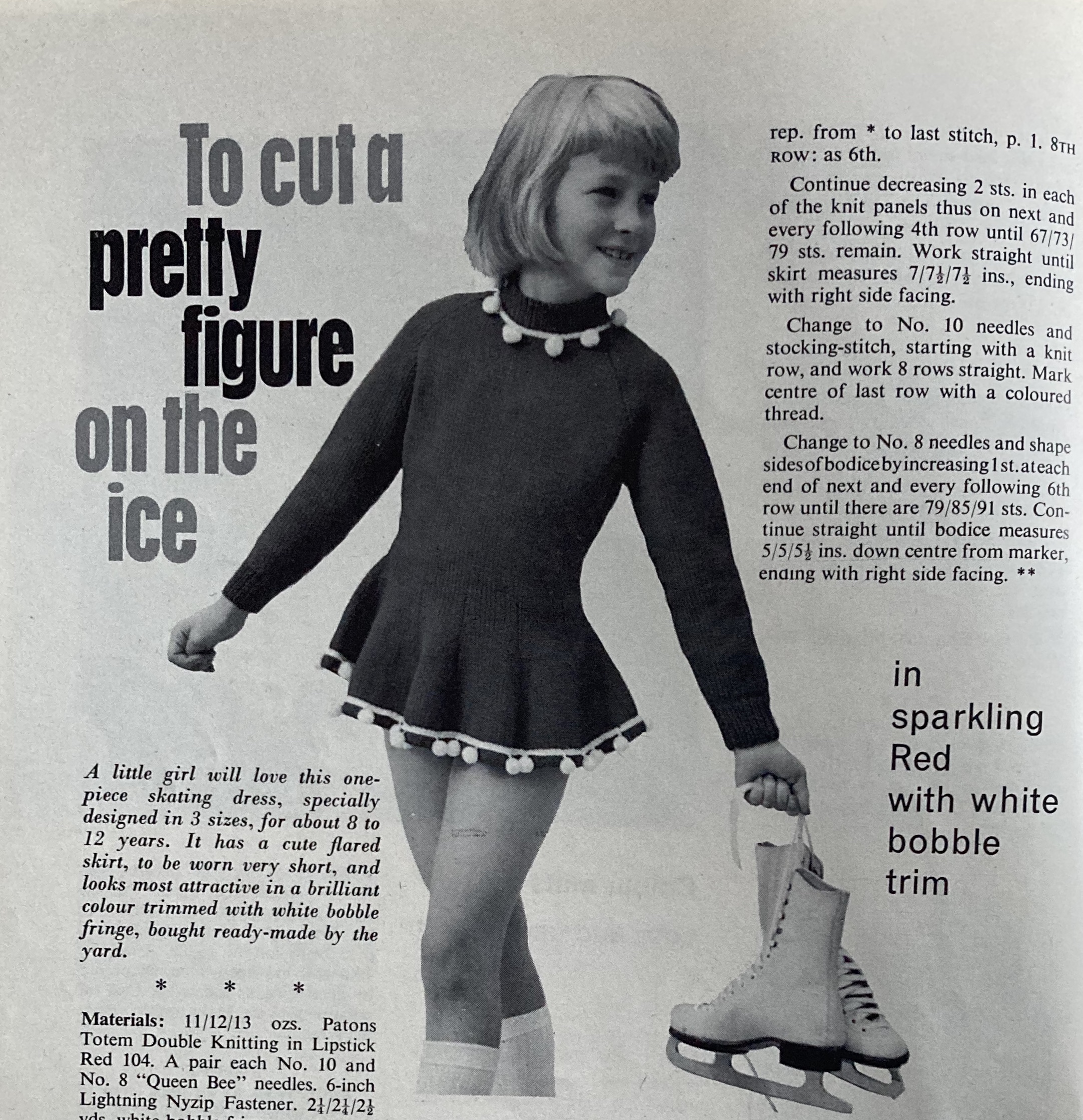
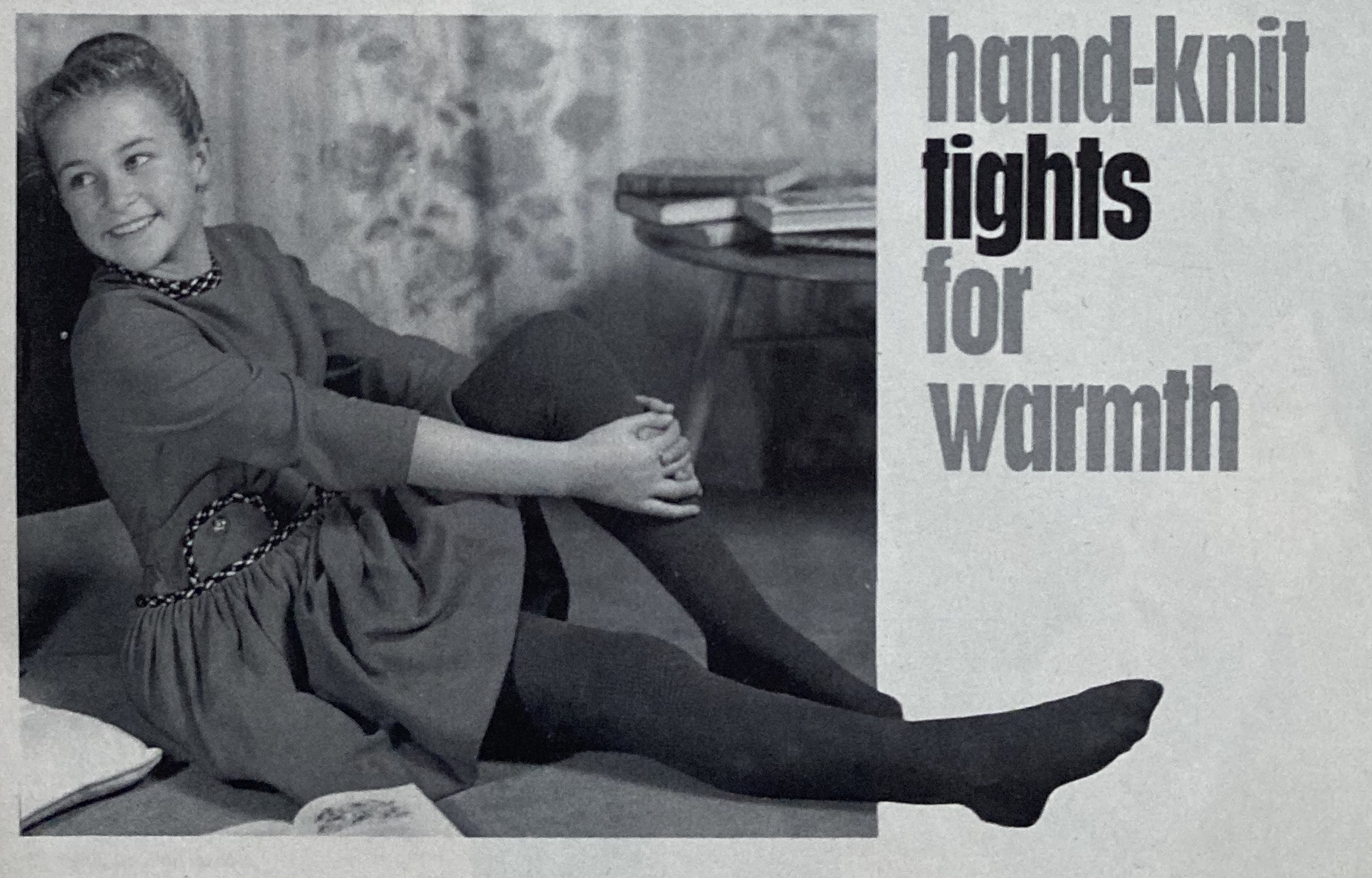
There are three fantastic designs for a young girl in this issue: a wonderful “walking set” for a toddler, a warm wool dress for an ice-skater and — at long last! — hand-knitted tights to keep a girl’s legs warm. (Strangely, our skating model is not wearing the tights, though you think she would need them out on the ice more than the young model pictured in an indoor setting!) I love the toddler’s outfit, with its contrasting colour in the flared back seam of the coat and ribbing on the hat, mittens and leggings. I like the seated girl’s dress too, as well, though it’s neither knitted nor one of the magazine’s designs.

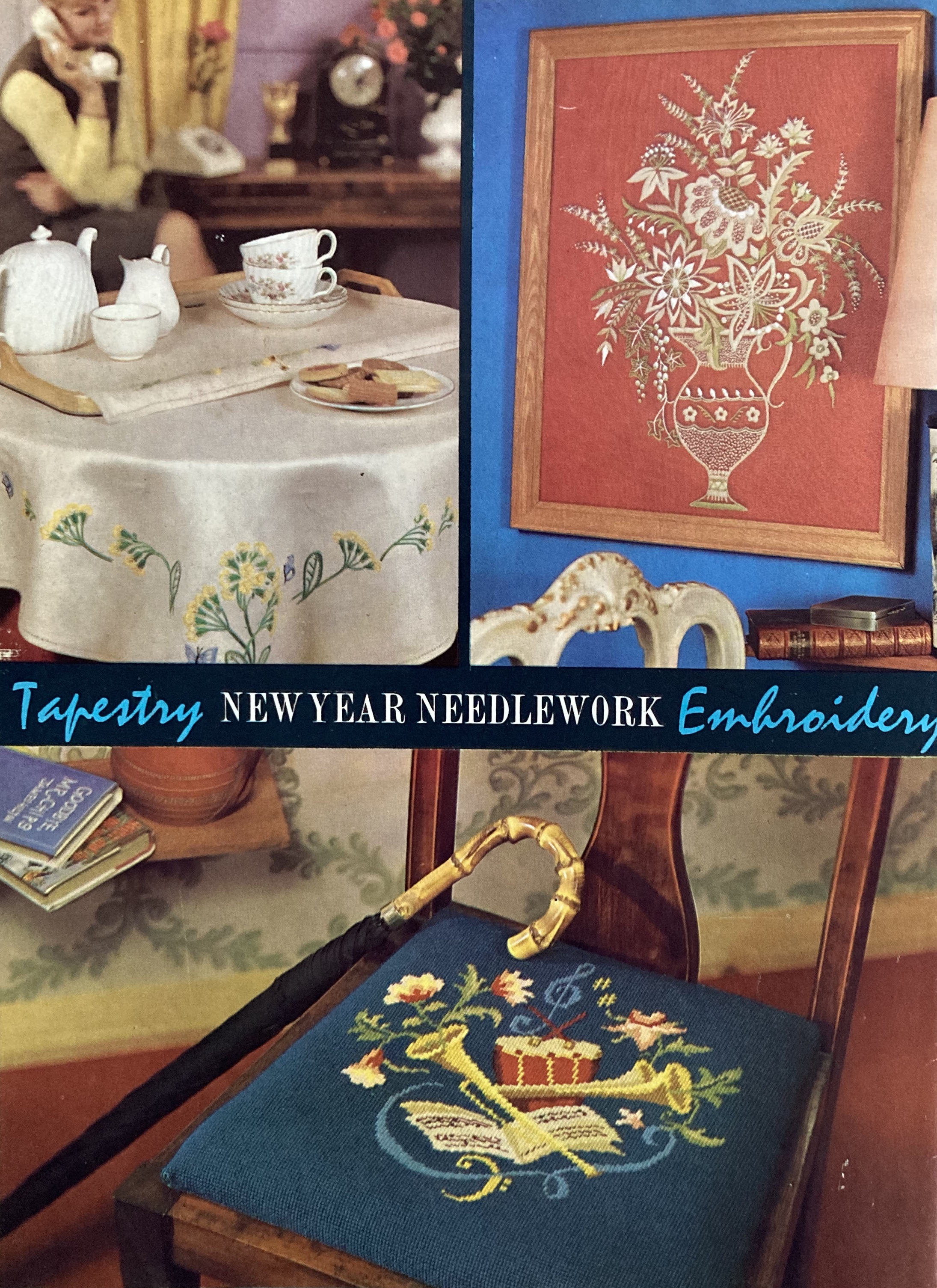
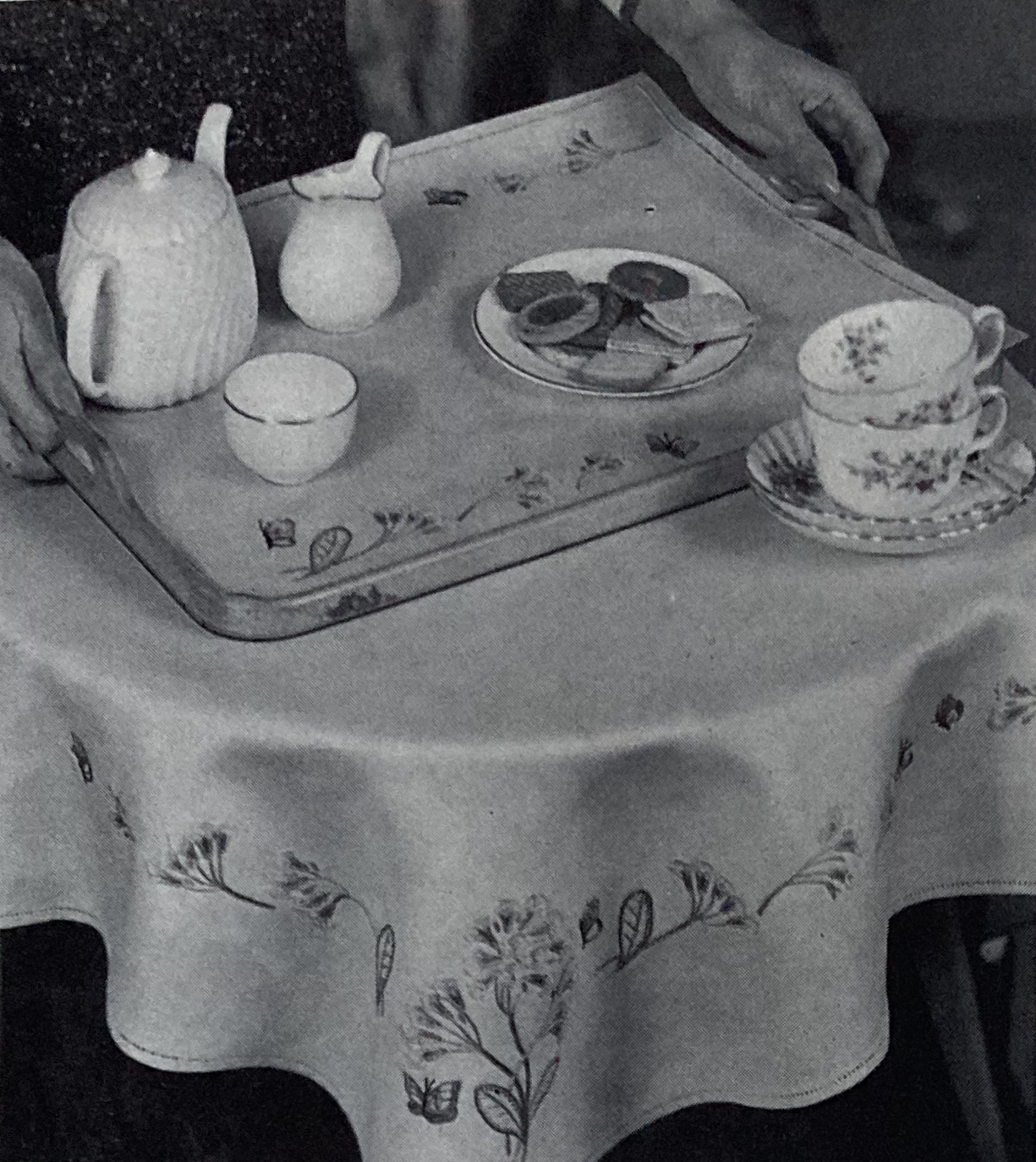
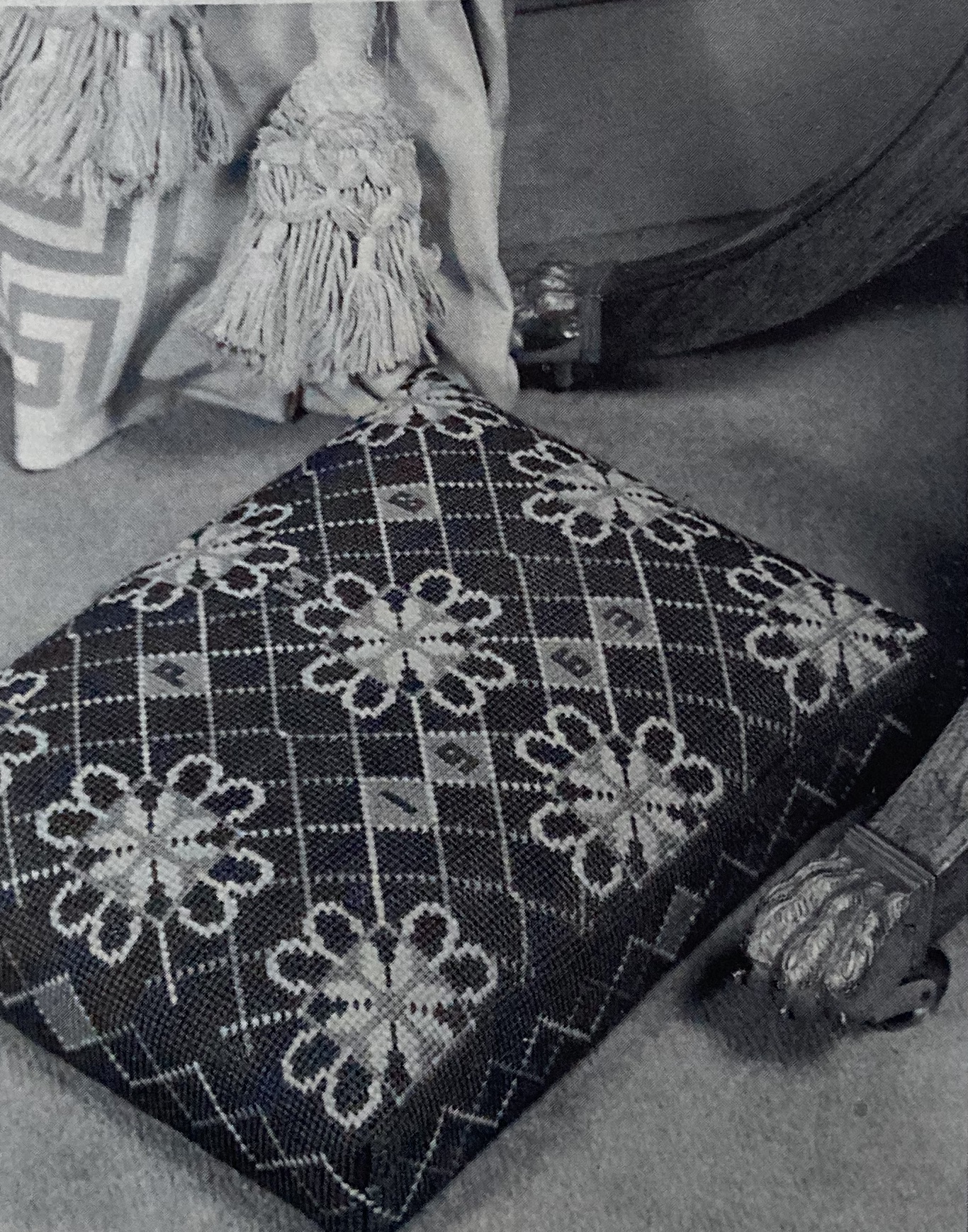
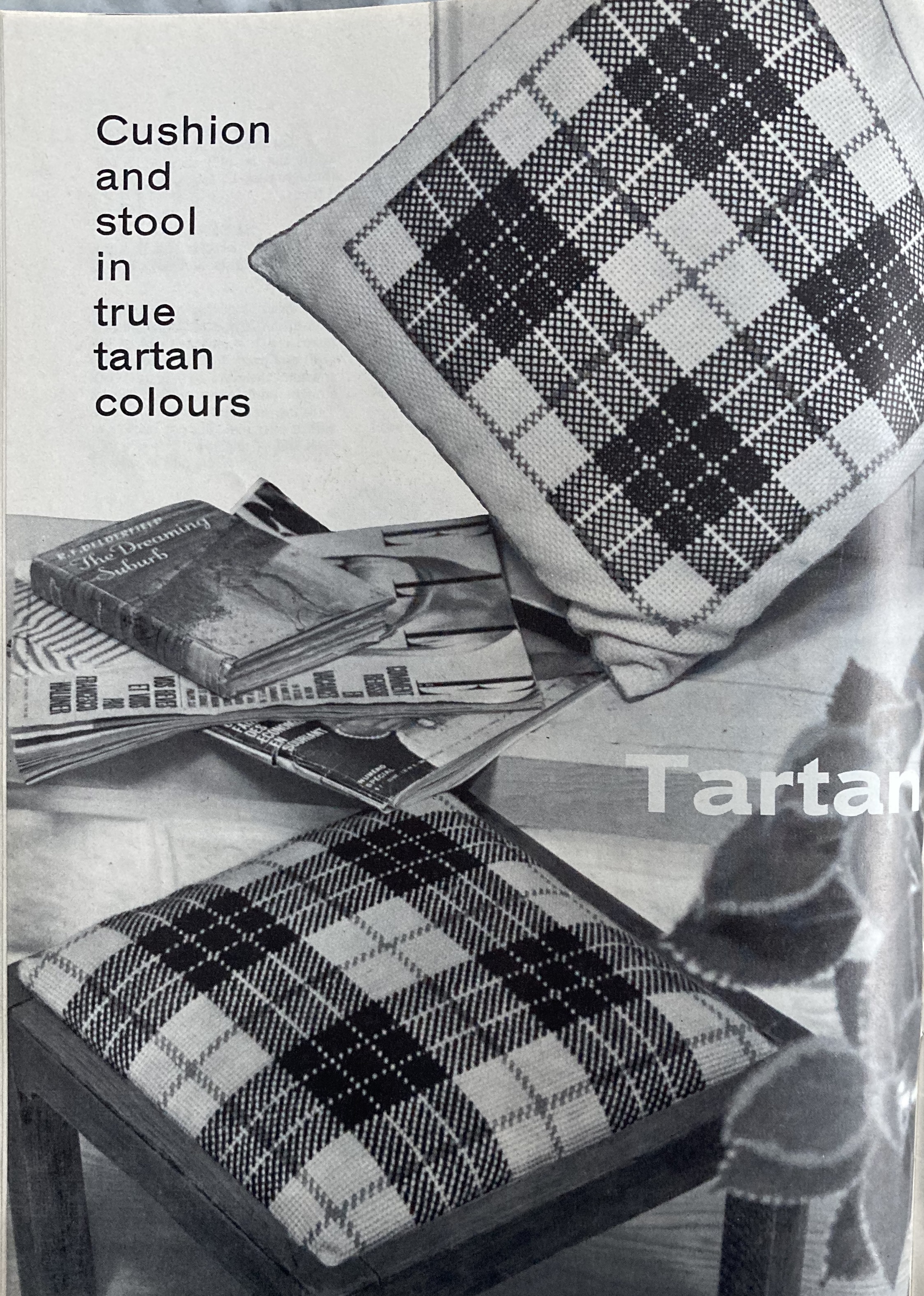
The homeware projects are fairly standard: a floral tablecloth, a tartan tapestry chair seat, a decorative panel with a white vase worked on a red background. The “music” tapestry motif is quite classic, as is the tapestry kneeler for church use.

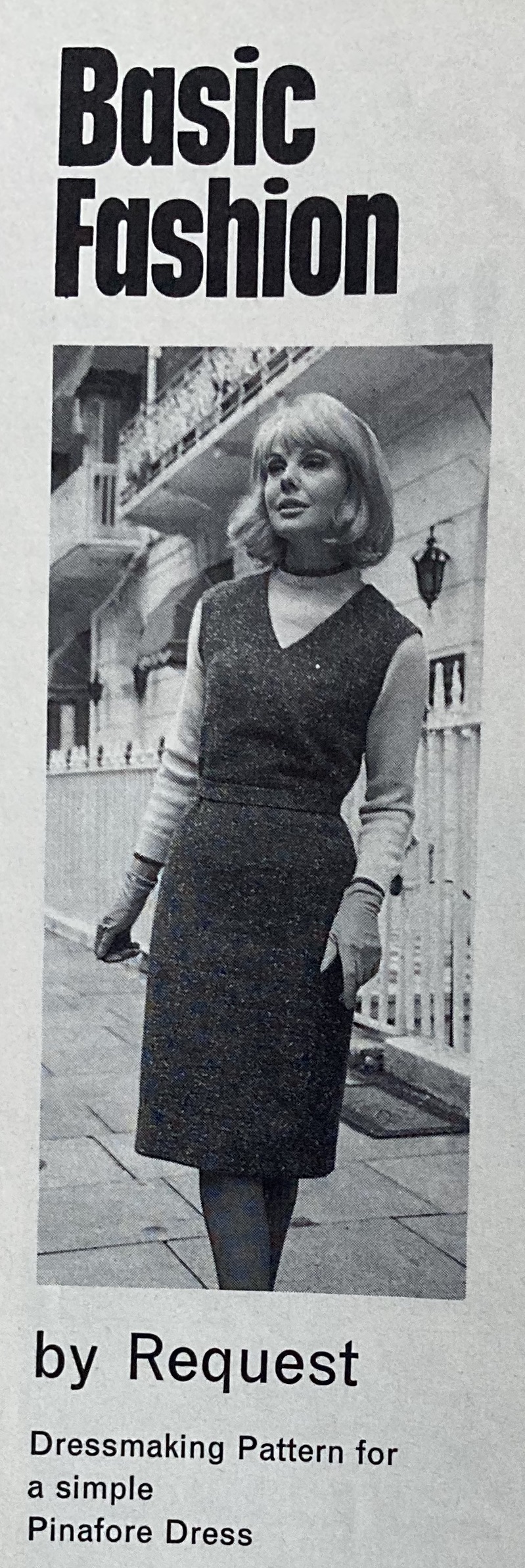
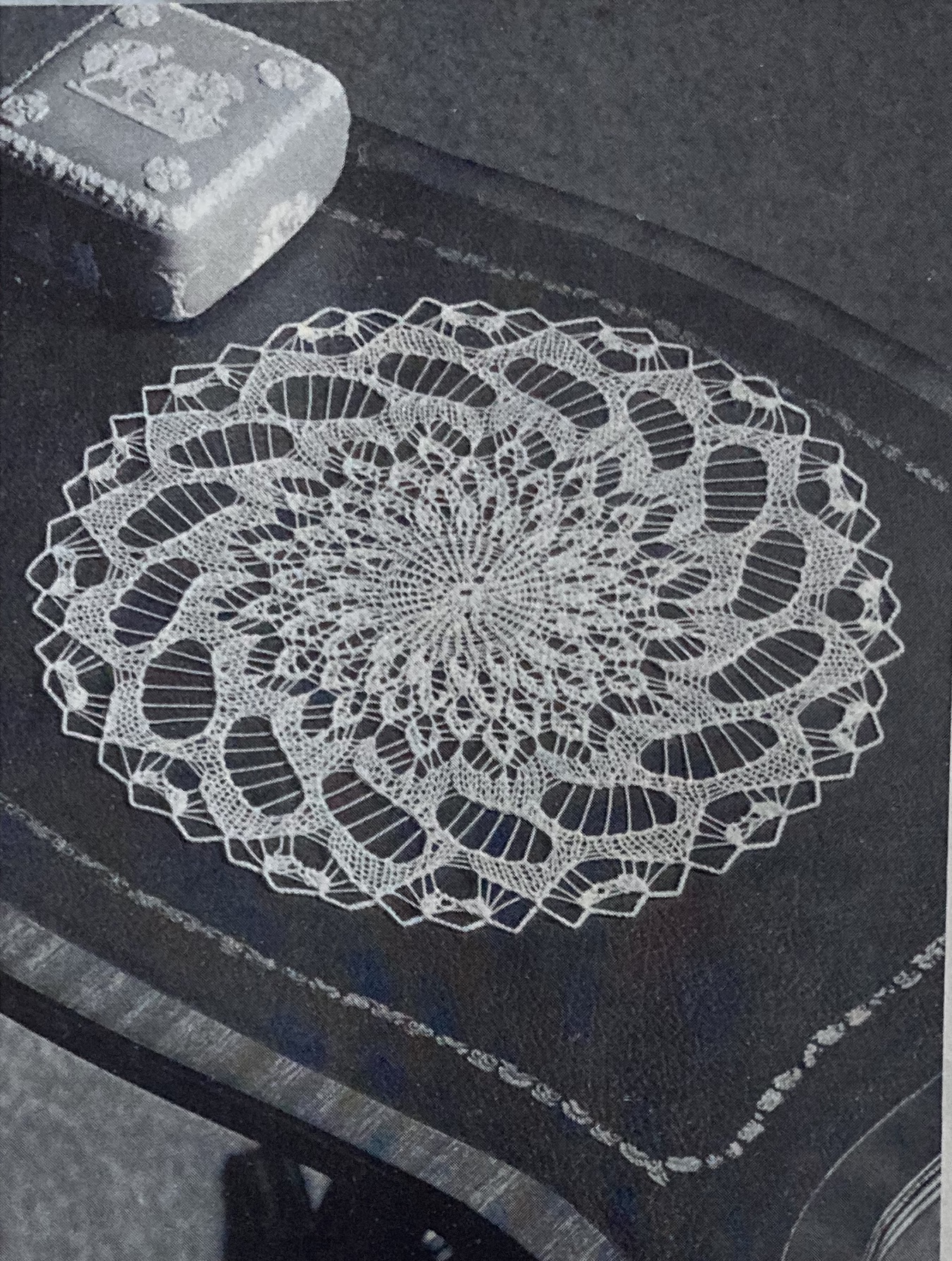
As always, some of the most interesting features are tucked away in the back pages. I would love to be able to send away for this sewing design, offered by Vogue patterns in cooperation with Stitchcraft. It’s a simple, sewn woolen “pinafore dress” that could be worn over a blouse or lightweight jumper, with a blazer for a suit effect, etc. Unfortunately, I can’t sew well enough to reverse-engineer a no-longer-existent sewing pattern from a photo. Also, what a beautiful knitted doily.

As much as I would love to make the toddler’s walking outfit, I don’t currently know a child of the right age, and starting another huge project seems daunting at the moment. I’ll probably skip ahead or back a few years to find a project from another issue that will help me de-stash. Stay tuned for details, and happy New Year!

October 1963: Knitting Apron

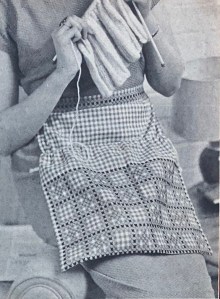
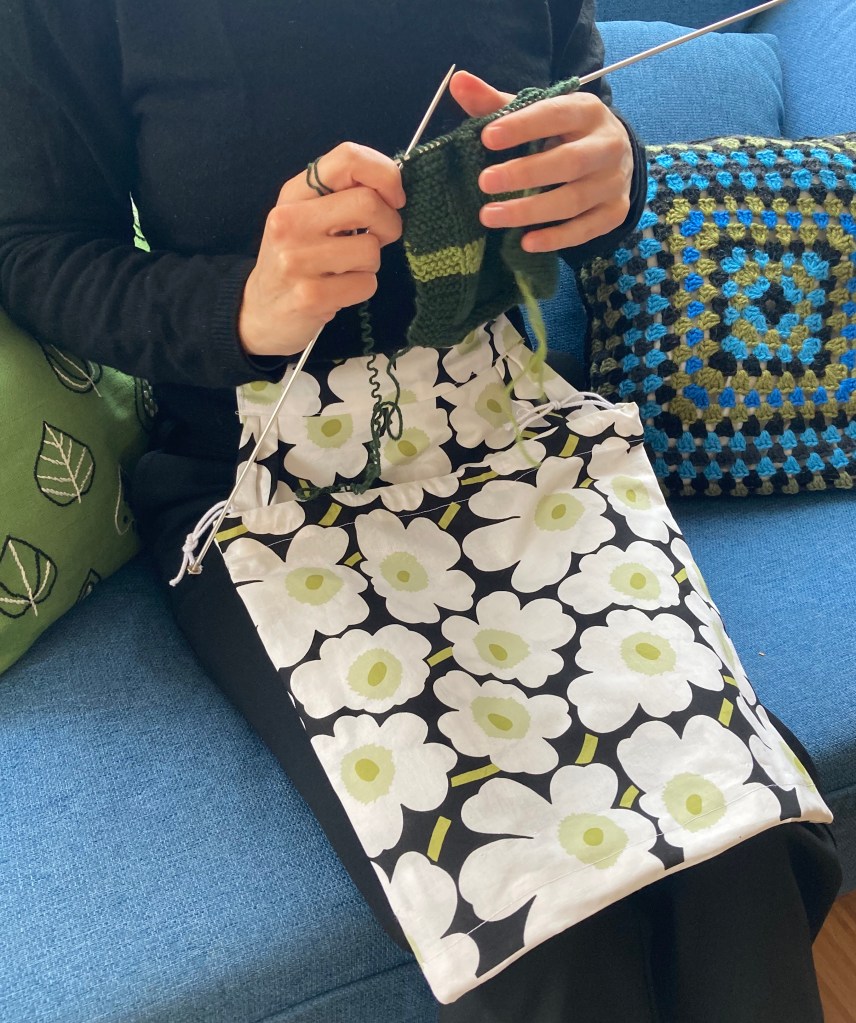
Photo of a woman wearing a knitting apron and knitting, Stitchcraft magazine, October 1963

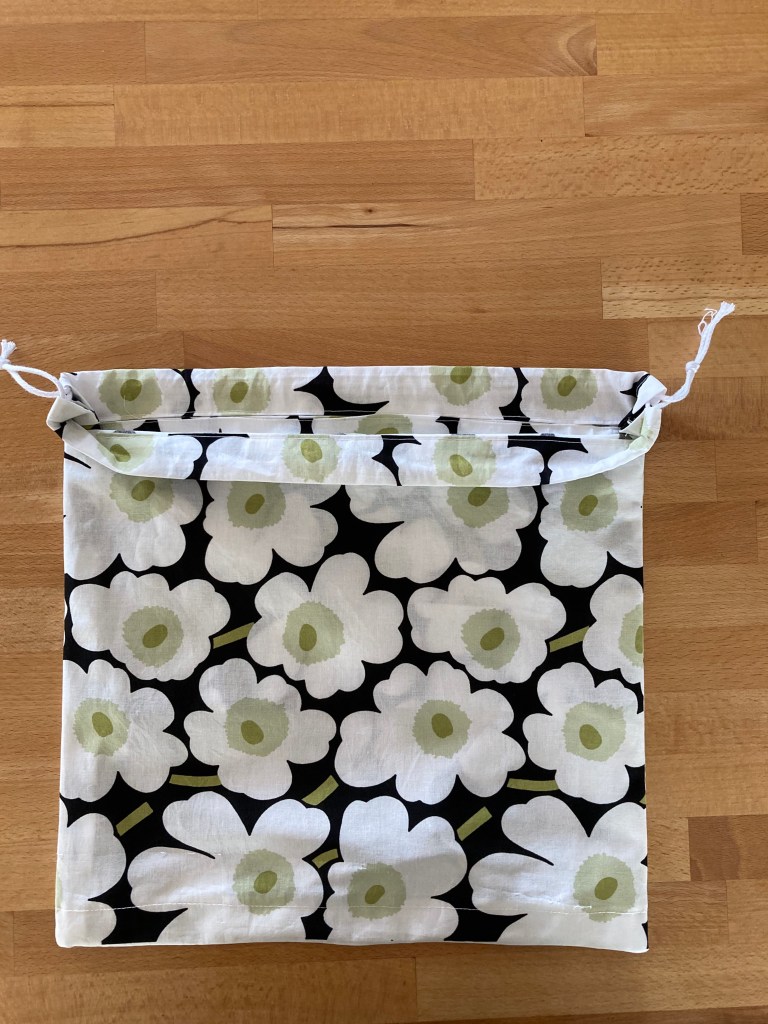
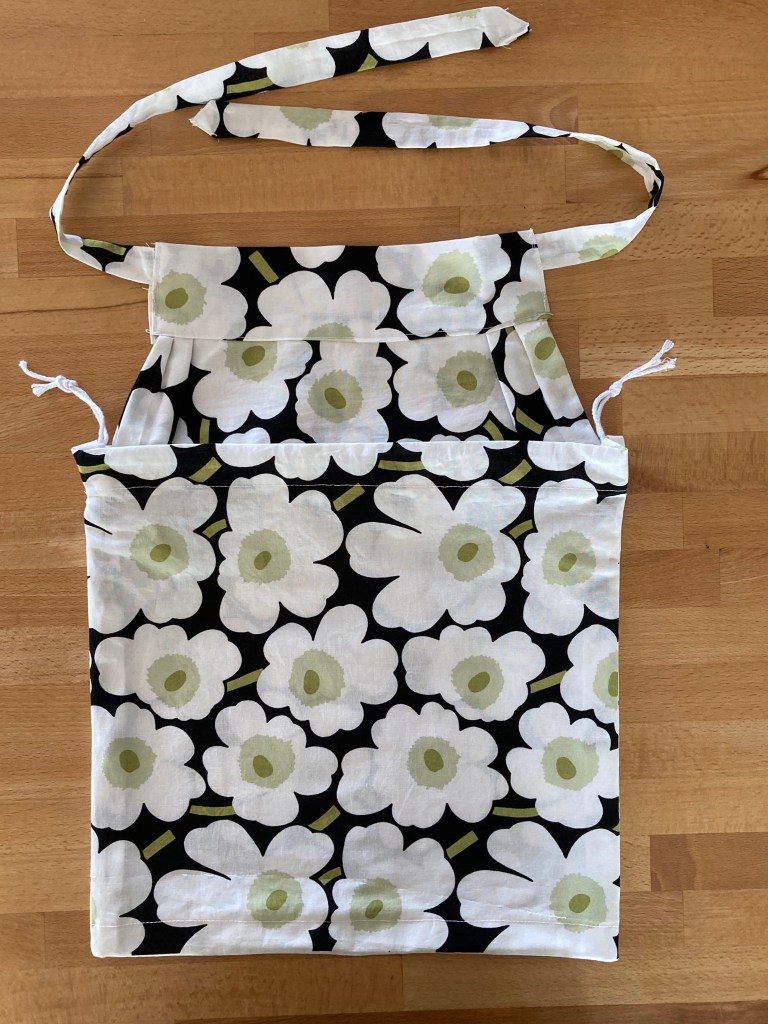
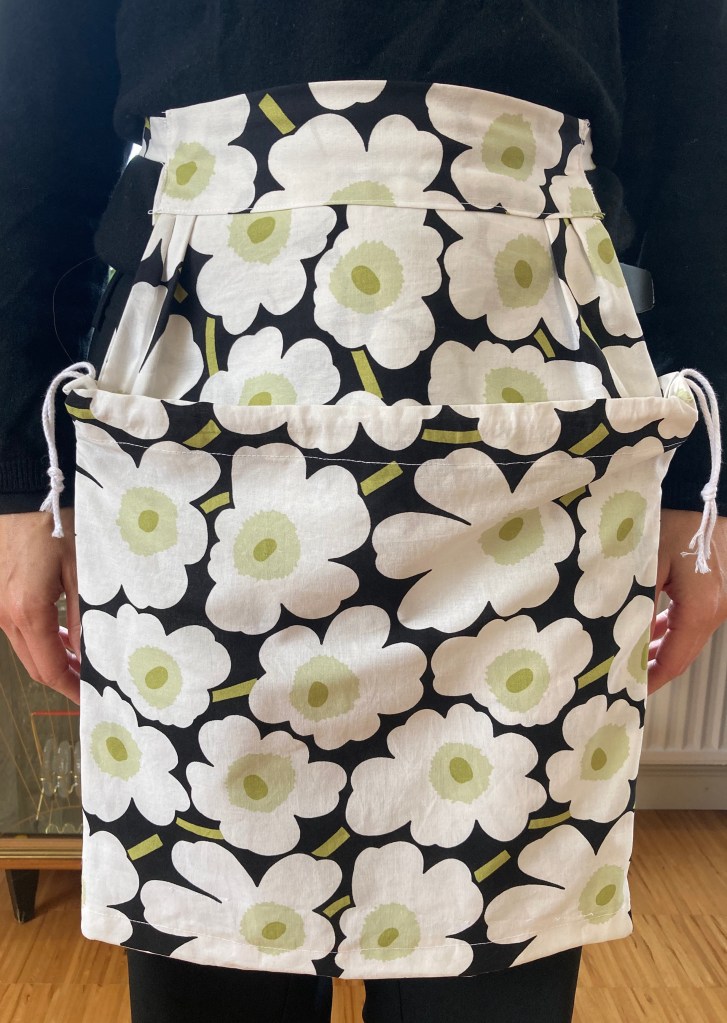
This month’s project was, as its name suggests, a knitting workbag with an apron-style top, allowing you to “tie it on and keep your wool in your pocket as you work.” Brilliant idea! I actually have a vintage, embroidered apron that I inherited from my grandmother that I use as a tie-on knitting bag, but this Stitchcraft project goes one better in that the apron top folds down into the bag when not being worn, allowing you to close the bag with drawstrings so that nothing falls out in transport.

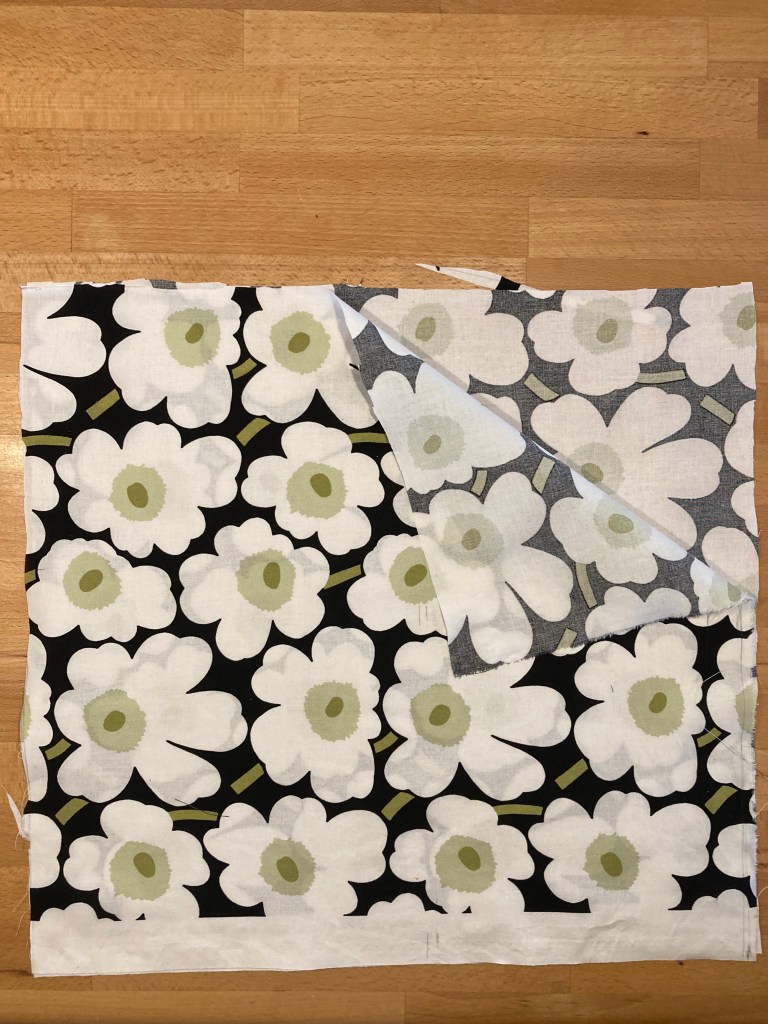
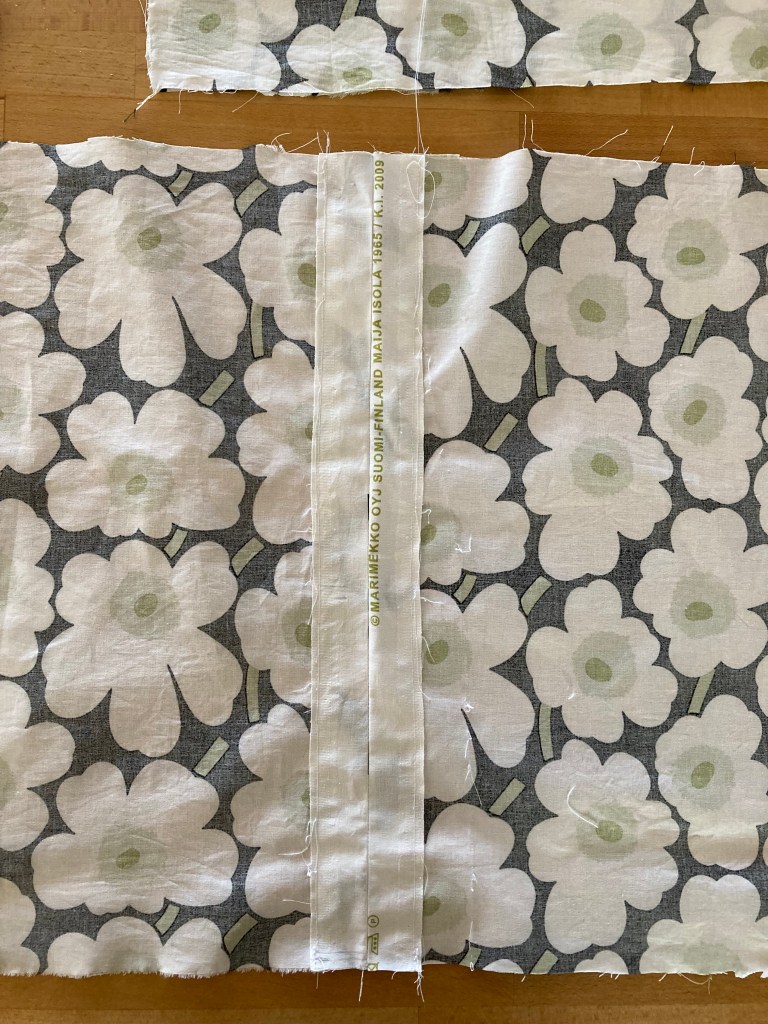
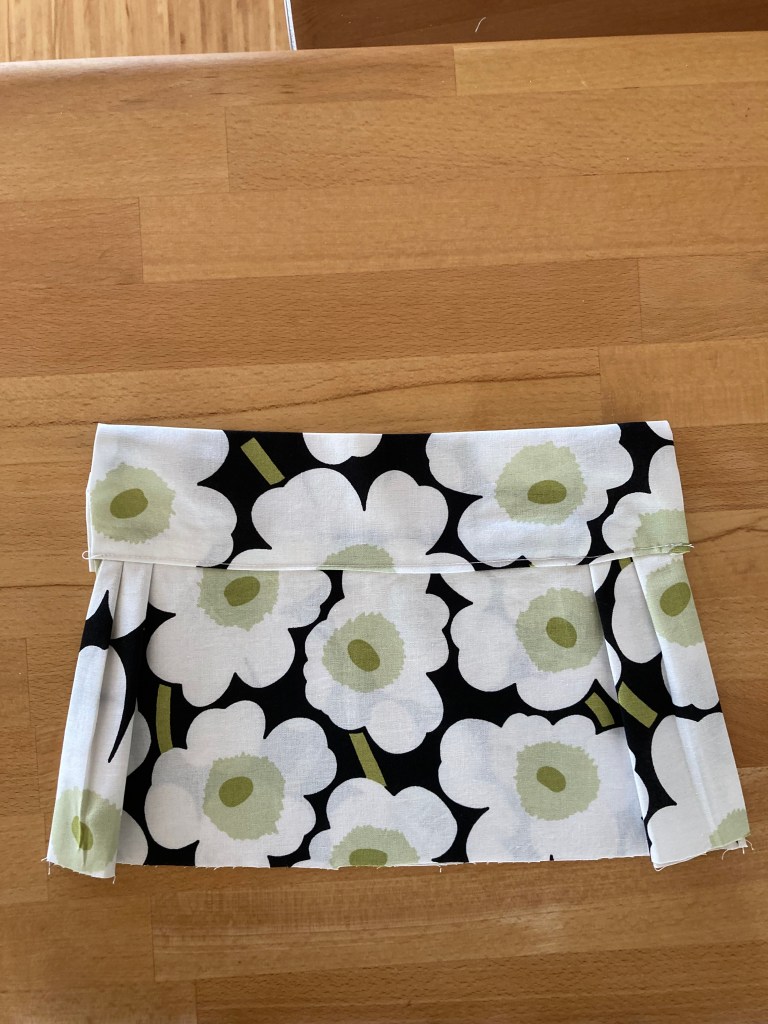
It’s supposed to be made with gingham fabric and embroidered with cross-stitches in the gingham squares, but I have so many unfinished embroidery projects that I went ahead and made this one plain, using a nice cotton print from Marimekko.

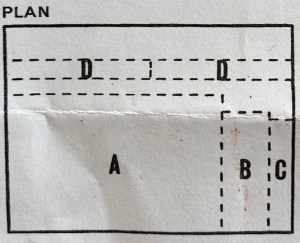
Fabric cutting plan

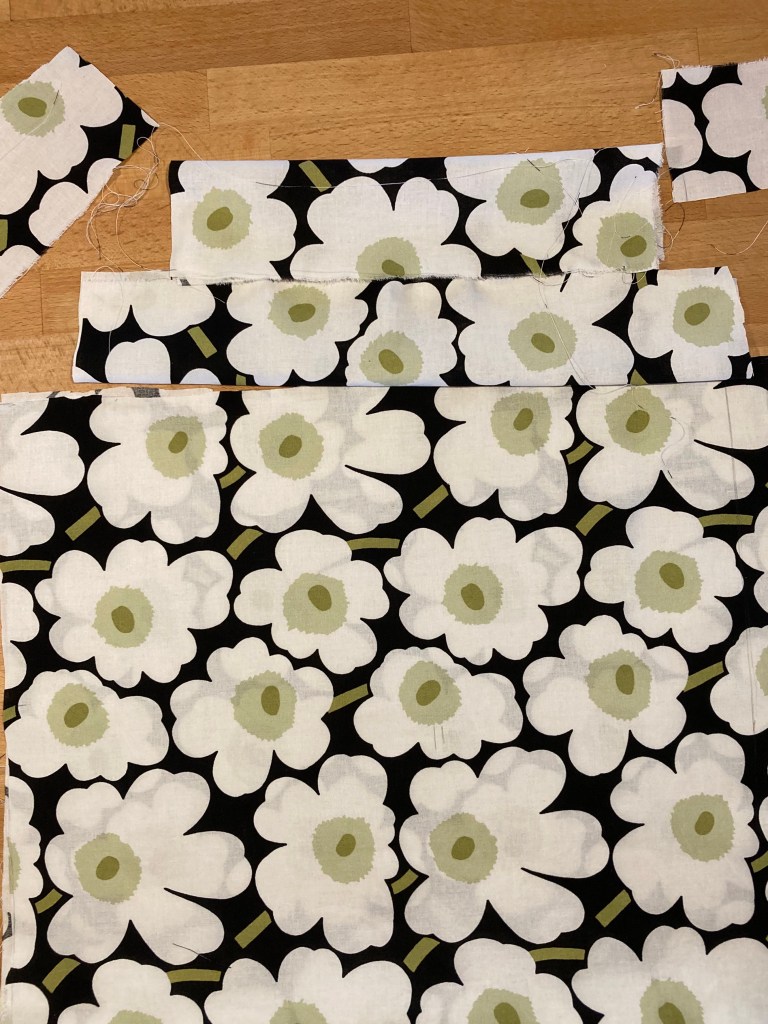
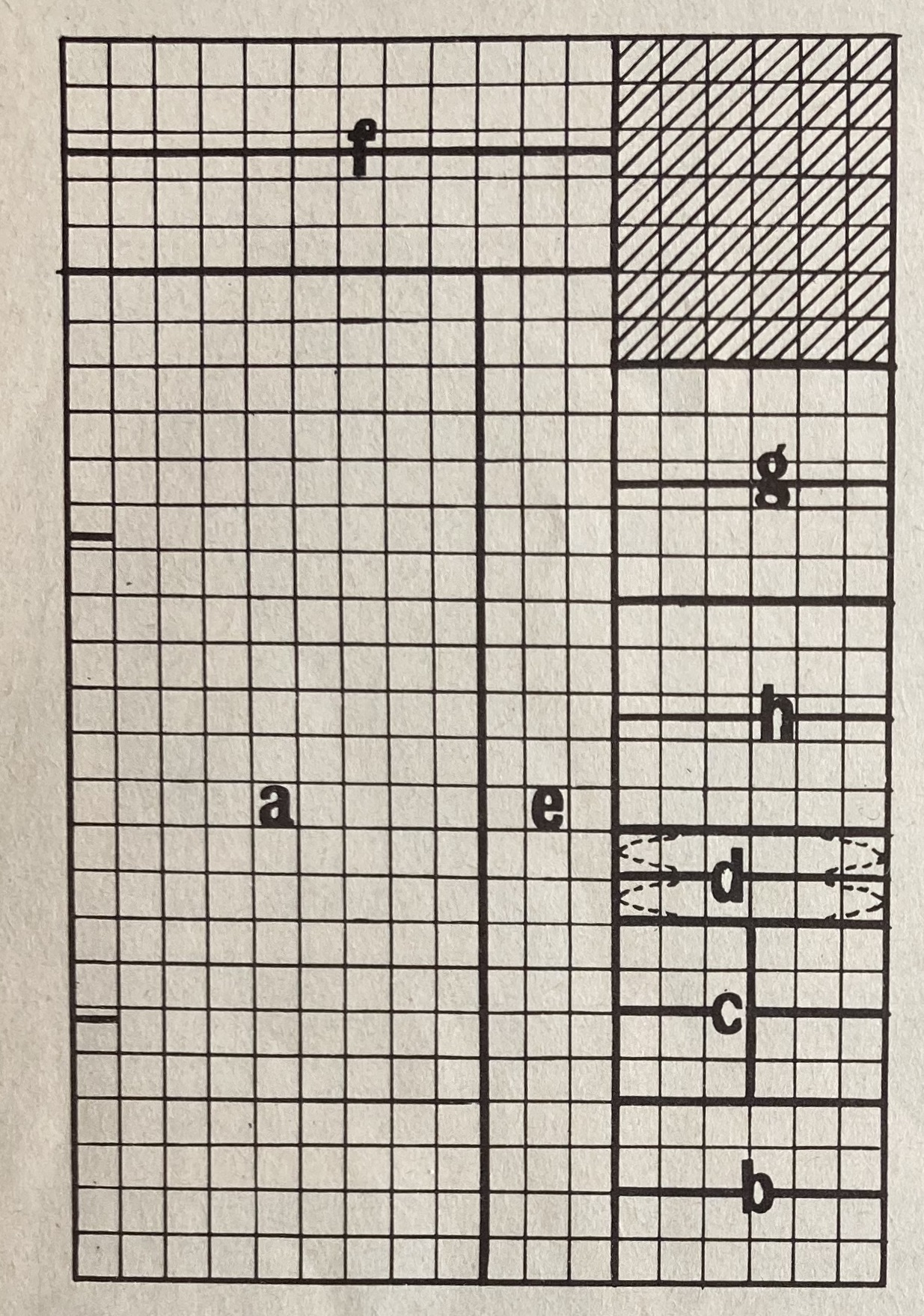
Since the “pattern pieces” are all just squares and rectangles, there’s a little chart showing how to divide up the fabric to get piece A (bag), B (apron top), C (waistband), and D (tie strings). After cutting out all the pieces (why are straight lines the hardest to cut?) I was suddenly confused: The bag, piece A, was 18×17 inches. That’s pretty big, and in fact looks just about that size in the photo, but a bag has a front and a back… Was I supposed to cut it on the fold? Or cut two pieces? The waistband is obviously folded in half, and the instructions for hemming the apron top make it clear that only one, unfolded piece was needed. Huh?

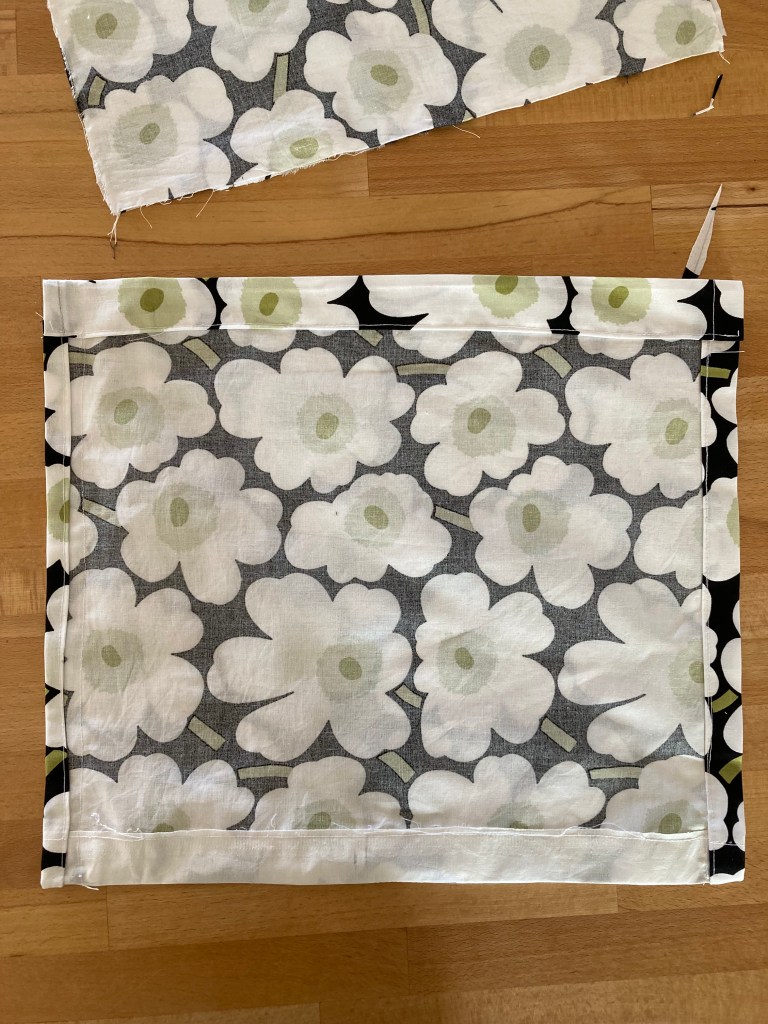
I cut another identical piece for the bag and decided to also cut another identical piece for the apron top, so the hems could be neater and the fabric stronger. I cut the two bag pieces with the selvedge on the bottom edge to make a very wide seam allowance, which I could then open up and sew down to make a really sturdy bag bottom. Similarly, I hemmed the side edges before making the side seams instead of zig-zagging the raw edges. This made everything very sturdy and very neat.The apron top is made with a couple of little pleats on the sides to bridge the width difference between bag top and waistband. Before it was sewn on, it looked like a little doll miniskirt!

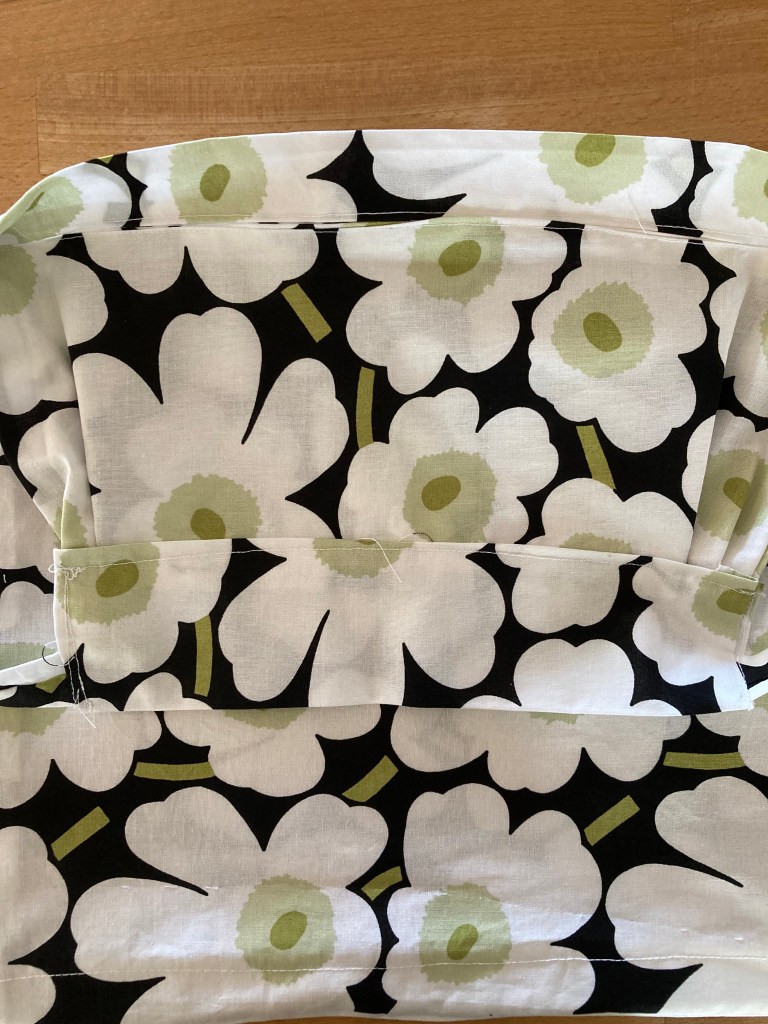
The apron top is sewn into the back part of the bag, so that it folds down into the bag when not in use. I was really glad I had made the apron top double, as it makes the seams even neater and everything looks very smartly finished from every angle, inside and out. (I am a sloppy sewer, so always impressed with myself when lines are straight or seams are not ragged.)

That was it! I finished the whole thing in three hours. It works perfectly and I can use it to knit while standing, walking, sitting in the train, etc. without worrying that my yarn will roll away, and it packs up in a flash. The bag part is quite large — if I made it again, I would make it slightly smaller. Other than that, it’s perfect. I imagine it would be a lot of fun to make in felt, with an embroidered front part, and that I could adapt a lot of the typical Stitchcraft designs for embroidered chairbacks, cushions, tea cosies etc. to make more of these.

Design Extra: The Valiant Tailoress

This has nothing to do with Stitchcraft, neither is it vintage, but I had a design published in a brand-new magazine and just wanted to share that with all of you.

The Valiant Tailoress takes its name from the Grimm Brothers’ fairy tale “The Valiant Tailor” (or “the Gallant Tailor” or “Brave Little Tailor”, original title Das tapfere Schneiderlein) and combines sewing, knitting and crochet to create outfits that look great together. The theme of the first edition is “The Enchanted Forest” and was, fittingly, photographed in the beautiful Black Forest area of Germany.

I hesitate to call it a “magazine” because it is really a book — 260 pages long on glossy paper, with articles on unusual fibres, traditional hat-making, different techniques for lining a sleeveless dress, and pages and pages of gorgeous photos. Seriously, even if you don’t knit, crochet or sew, you could use it as a coffee-table book — it’s that beautiful. The knit/crochet patterns are excellently tech edited with full charts, schematics etc. and the sewing patterns are printed on real paper.

My design was a long, lacy cardigan called “Lemon Leaves” and was paired perfectly with a floral bustier dress.

As an only semi-professional designer (I’ve had one other pattern published until now, a stranded tam and mitts set in Knit Now magazine), I was really honoured that my design was chosen to be part of this project. And I love the idea of combining sewing and knitting/crochet in one publication! In a way it does tie back to vintage publications like Stitchcraft that combined knitting and crochet with embroidery, tapestry, rug-making, etc.

The Valiant Tailoress is available to purchase in print form from their website, www.valiant-tailoress.com. It’s published in Switzerland (in English) and can be shipped around the world.

May 1963: Overview

Cover image from Stitchcraft magazine, May 1963

“Fashion At Ease” is the motto of the May 1963 Stitchcraft issue, in keeping with both the beginning summer holiday season and the fashion for casual, loose-fitting, bulky-knit garments. Our cover model is getting the picnic chairs ready in a cardigan made of “Ariel” yarn — a synthetic mix that is bulky but somewhat lighter-weight. (It’s always described as “light-as-a-feather”, “feather-weight” and so on, but the cardigan uses 9 or 10 2-ounce balls, which comes out to 18/20 ounces or about 510/560 grams in the basket rib and slip stitch patterns. That may be a bit lighter than the same type of garment made in bulky-weight 100% wool, but “feather-light” it is not.)

Other than that, the women’s garments are very similar: hip-length, made in plain, smooth stocking-stitch with V-necks and somewhat smaller pointy collars. The pullover of the green suit on the inside cover photo looks so similar to the raglan-sleeved “overpull” a few pages later that I had to check twice to make sure they were two separate designs and not a continuation of one pattern on a different page with another picture. The 4-ply collared pullover is also very plain (it’s even listed in the contents as “Plain 4-ply sweater”) and has gentle raglan sleeves and a similar small collar. There will be no rocking of the boats on this holiday, fashion-wise!

There’s a little more design interest in the “Italian” boatneck pullover with a stranded colour stripe across the hips as well as the wonderful “Tyrolean” cardigan and “Viennese” pullover for children. The use of different countries’ names in the descriptions seems more a way to highlight the international “continental” travel-holiday theme than any reference to traditional or regional design elements. I certainly don’t associate the stranded knitting pattern with Italy, as it’s much closer to traditional Fair Isle/Scandinavian/Baltic/northern stranded patterns. The children’s garments claim to be a “design from the Tyrol” and “From a Viennese design”, but you can make of that what you will. They are definitely cute and probably fun to wear.

Rounding out the knitting designs are a “crunchy” men’s pullover in Bracken Tweed, one of the early multicolour/tweed-flecked wools that became popular with hand-knitters in the early- and mid-1960s as well as an interesting hybrid cardigan featuring “waistcoat styling” — the front and back are knitted in plain stocking-stitch and the sleeves in a slip-and-drop textured stitch pattern in a lighter shade of the same DK wool. I’m not sure the look is successful, but it is an interesting idea.

There are plenty of ideas for housewares, starting with a coordinated latch-hook rug and cross-stitched floor mat for a child’s room. The puppy and kitten are quite cute and (not coincidentally) look a lot like the characters in some of the children’s comics printed in the back pages of the magazine. They are intended to be easy enough to make that “your young daughter” (only the daughter, of course) could help make it and thus expand or improve her handwork techniques. For any children who don’t have to help with housework (guess that would mean the boys eh), our happy housewife can make a felt bag for dirty linen shaped like a postbox, complete with a helpful embroidered sign with collection times (9:30 am Monday to Friday, no collection on Saturday or Sunday). There’s also a purely decorative Punch and Judy wall hanging and a nightdress case shaped like a tortoise. (I will never understand the point of a nightdress case, but I love the tortoise design.)

Going with the international/holiday theme, there are embroidery patterns for a chairback and tablecloth inspired by traditional Scandinavian designs, a flowery cross-stitch cushion and table mats and a very interesting tapestry pattern for a stool top. There’s also a knitted doily and — unusual for Stitchcraft — a design for a patchwork cushion with some very well-written basic instructions for doing patchwork with the paper piecing method. For the unacquainted: you cut out pieces of paper from a cardboard template in the desired shape, stitch the pieces of fabric around these paper pieces, then stitch the fabric pieces together at the side to make the larger patches. The paper pieces are then removed and re-used. The advantage of this method is that you don’t have to cut the fabric to perfectly accurate shapes or pay too much attention to the seam allowance.

That wraps it up for May 1963! The ads are the usual and in the alternative-nursery-rhyme children’s comic, Miss Muffet has shrunk to insect size and made friends with the very nice spider, who helps her get out of a flower and gives her a ride on a floating leaf. That sounds like fun.

My project for this month will be the “Viennese” child’s pullover, made for a young relative. Said child was adamant about wanting a “smooth texture” on the pullover and not the reverse-stocking-stitch-rib in the pattern. I am also making it for summer wear in a very lightweight cotton, so the finished result may or may not look anything like the original design, but we’ll see. Also: many WIPs to finish. Happy Spring!

March 1963: Sunday Best Dress

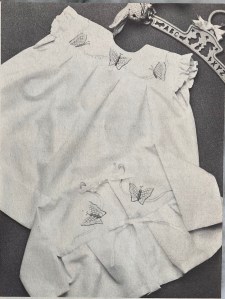
baby dress and coat, image from Stitchcraft magazine, March 1963

My March project featured sewing, for a change. I can sew, both by hand and with the machine, and I have sewn quite a few things in my time (even worked in the costume department of various community theatres as a teenager/young adult), but I do not enjoy sewing, nor am I particularly good at it, to be honest. (My costume shop work involved mostly either “pulling” outfits from storage, or doing fittings and alterations, or sewing things that someone else, i.e. the head designer had cut out. For that reason, I never learned to cut things to fit properly and am surprisingly bad at working from bought patterns.) Years of knitting have also made me very inexact about perfect measurements and straight lines, which is obviously sub-optimal for sewing. But I gave it another try to make this embroidered “Sunday best dress” for a baby from the March 1963 issue.

For once, you didn’t have to send away for the sewing pattern; since all the pieces were basically rectangles, they just printed a little scaled-down plan for cutting the material on a graph, with each square being equivalent to 2 inches. It was designed for silk or crepe fabric. I had bought a large remnant of beautiful light-grey viscose (rayon) some time ago, of which I used a small amount for the lining of February 1963’s needlepoint bag and had plenty left over. Rayon fabric has been around for more than a hundred years and was (and still is) used as “artificial silk” throughout the 20th century, so my fabric was quite period-accurate even though modern. I didn’t have silk floss to do the embroidery and just took the opportunity to use up some small scraps of normal cotton floss in pastel colours.

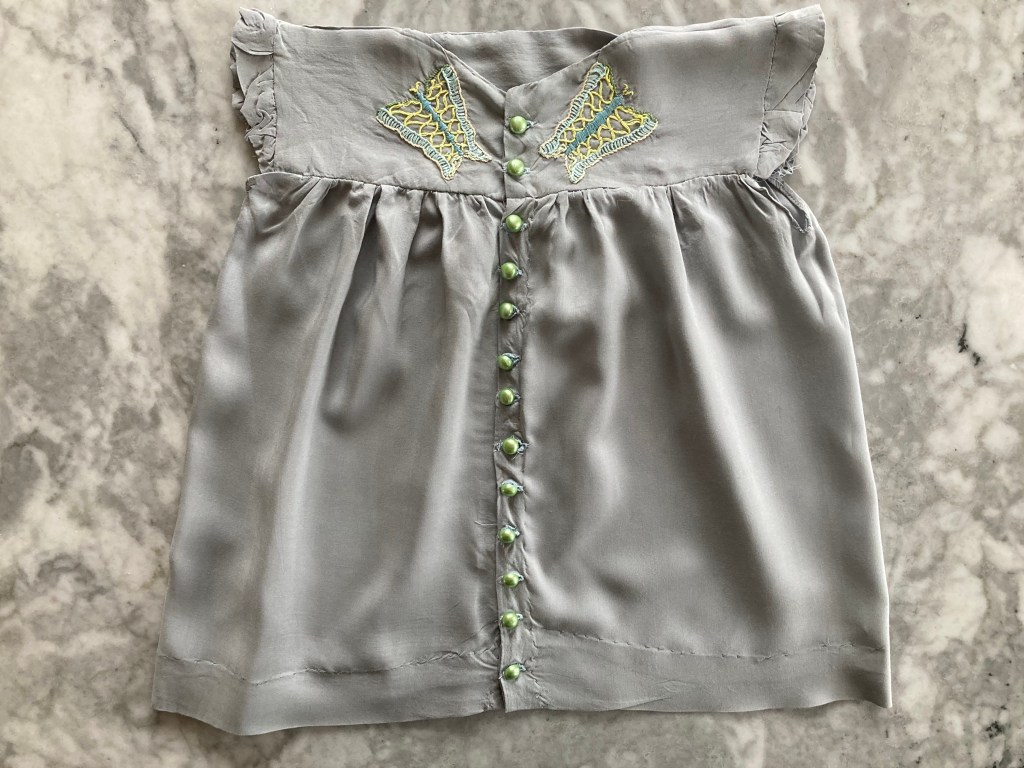
The dress was supposed have three embroidered butterflies on the front and close in the back with a couple of buttons. I didn’t have all that much embroidery thread and I did have quite a lot of lovely vintage buttons in a perfect pearly-green colour (thank you, kind seller on Ebay!), so I changed it around to fasten in the front, using the two-butterfly design from the coat (which I didn’t make).

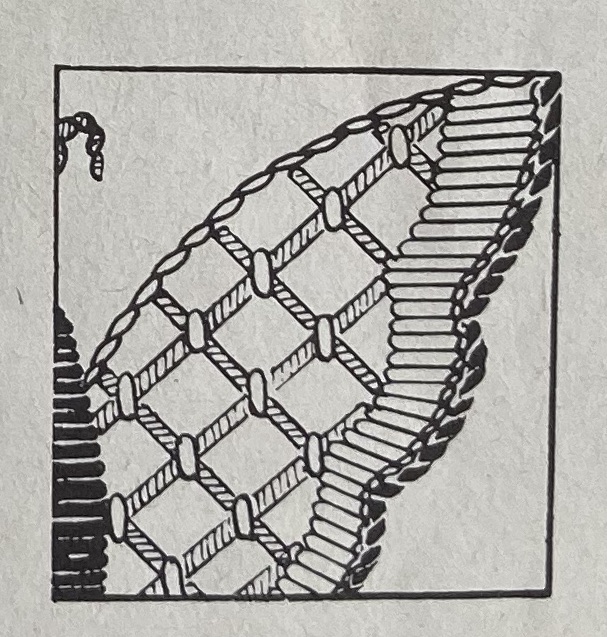
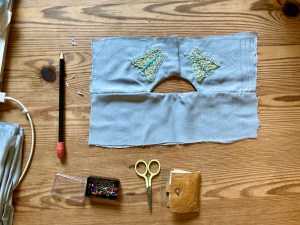
The butterfly design was easy enough to copy without a transfer and features laid stitches on the wings — something new for me. My embroidery skills are still far from professional, but improving. The sewing work was interesting because I am not always in the same place as my sewing machine due to pandemic chaos — but also didn’t want to wait until I was — so I sewed everything except the buttonholes and waist strengthening zigzag at the end by hand. Including the gathers, buttonhole band, frilled sleevelets etc. Now I know why Marilla from the Anne of Green Gables books had to stop sewing in her later years to preserve her eyesight! Everything was tiny and took forever and my fingers, which are actually quite long and thin and nimble, felt like elephant feet.

Photo of sewing work-in-progress with various sewing tools

I did the buttonholes on the machine when I could, because I was definitely not going to try to sew buttonhole stitch by hand on thirteen tiny buttonholes. My machine-sewed buttonholes look messy enough that they could pass for hand work, ha ha. I am surprised that it turned out even vaguely even (yes I know, the hem in the front is a mess.) But in spite of its obvious imperfections, I’m quite happy with the result and proud of myself for making it work. I know a one-year-old baby who would fit in it perfectly and the parents will be very happy to have it as an Easter dress for her, so in my mind, it’s a success.

Finished sewing project: embroidered dress for a baby

Meanwhile, the “naughty pile” of unfinished projects is slowly diminishing and I’m looking forward to getting back to knitting.

November 1962: Overview

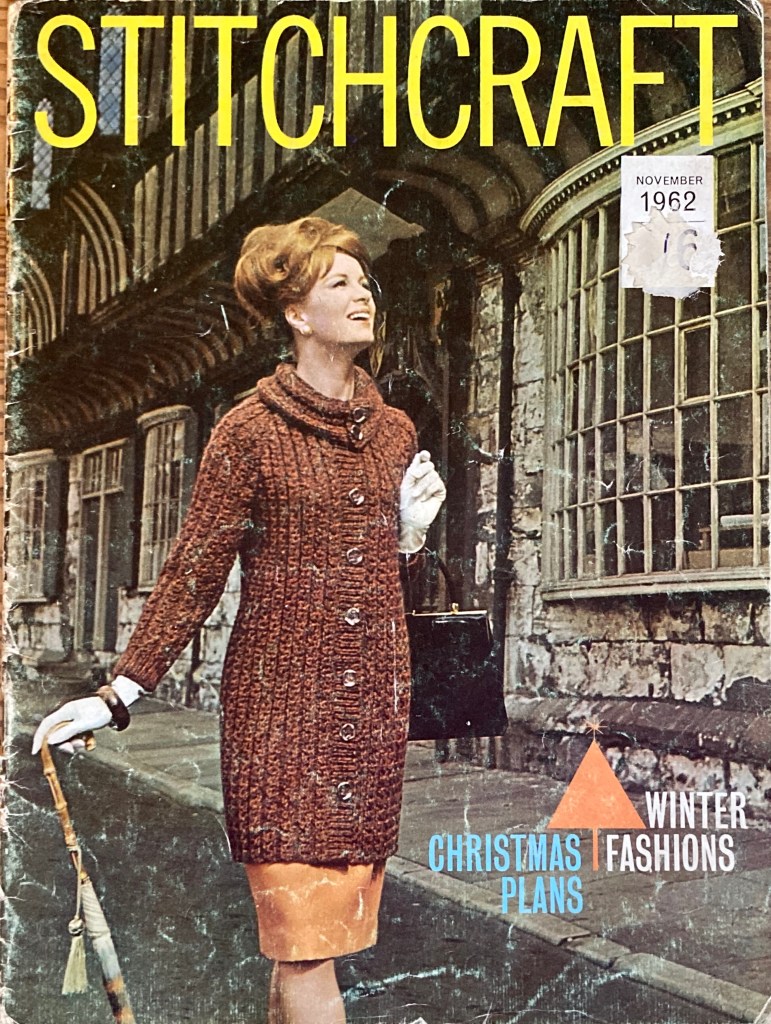
For 1960s Stitchcraft readers, November means holiday planning, so this month’s issue is full of quick homewares for decorating and small, easy projects for gift-giving. The garments are warm and bulky, featuring Patons’ new “Ariel” wool. Warm autumn tones of brown and orange as well as bright, cheerful holiday reds and blues are the colours of the season. Christmas Plans and Winter Fashions ahoy!

Our cover garment is a bulky, yet elegant coat in Big Ben wool, weighing in at a hefty 52-56 ounces (up to 3 1/2 pounds, or about 1500 grams). The mock cable/twisted rib pattern certainly won’t curl at the bottom edge, which is why I guess it’s designed without a hem or ribbing, but at that weight and in that pattern, I suspect the coat would grow ever longer and ever narrower (just in time for holiday weight gain). Still, it looks lovely! I especially like the buttoned collar. Also, I just might try to re-create the model’s hairdo with my long lockdown hair.

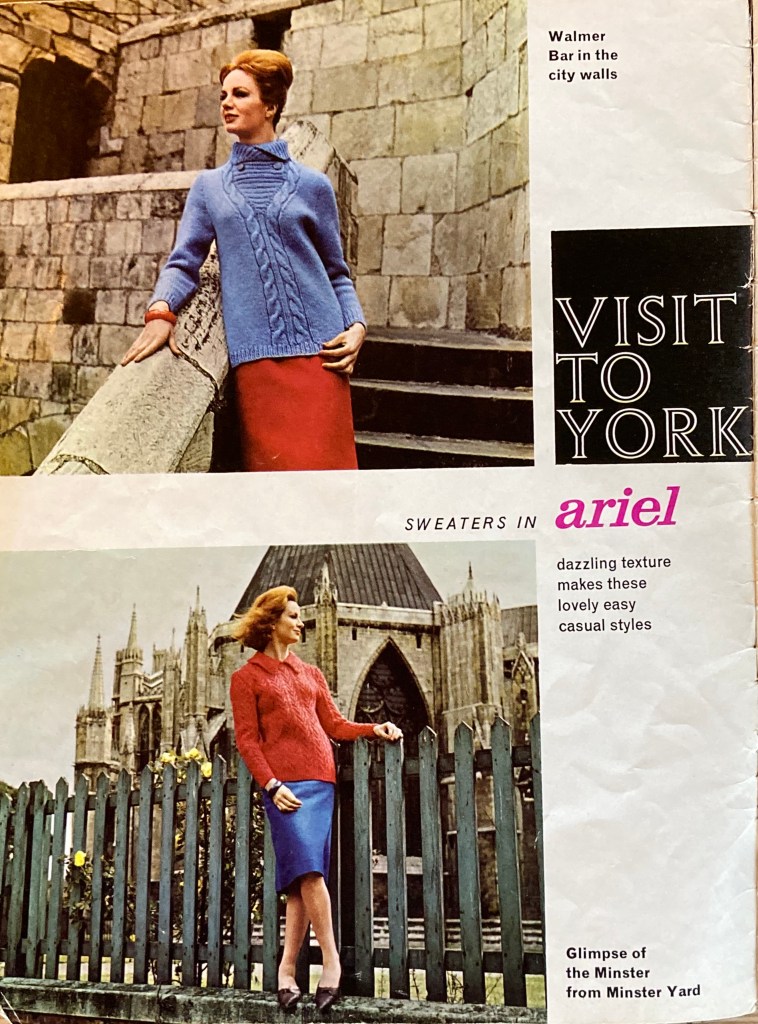
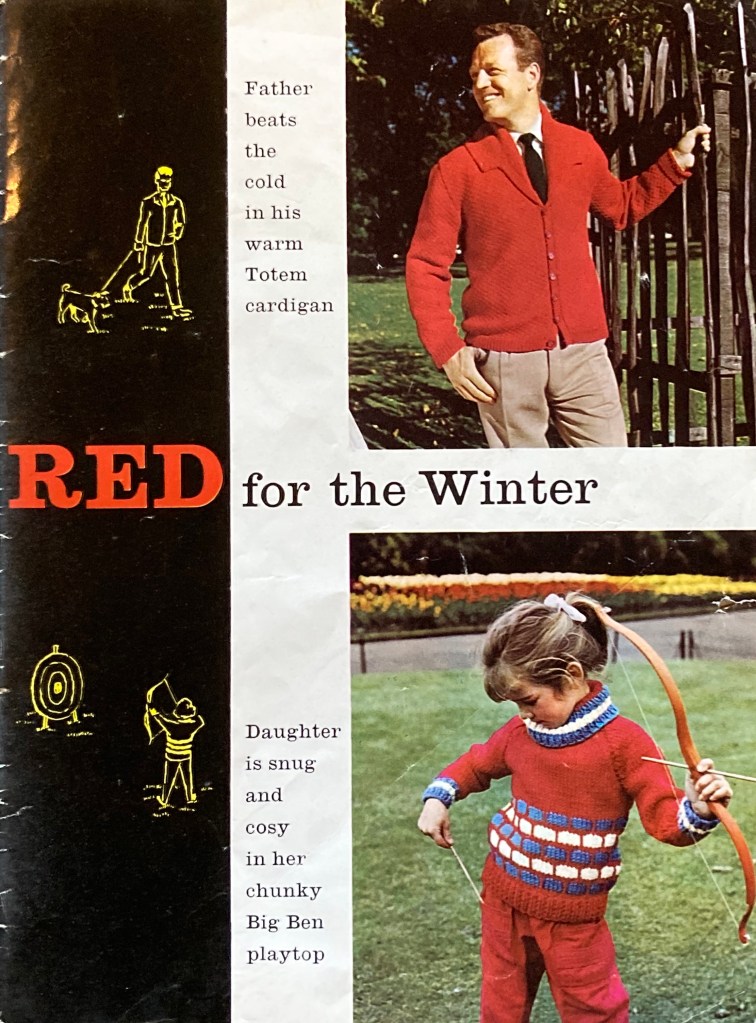
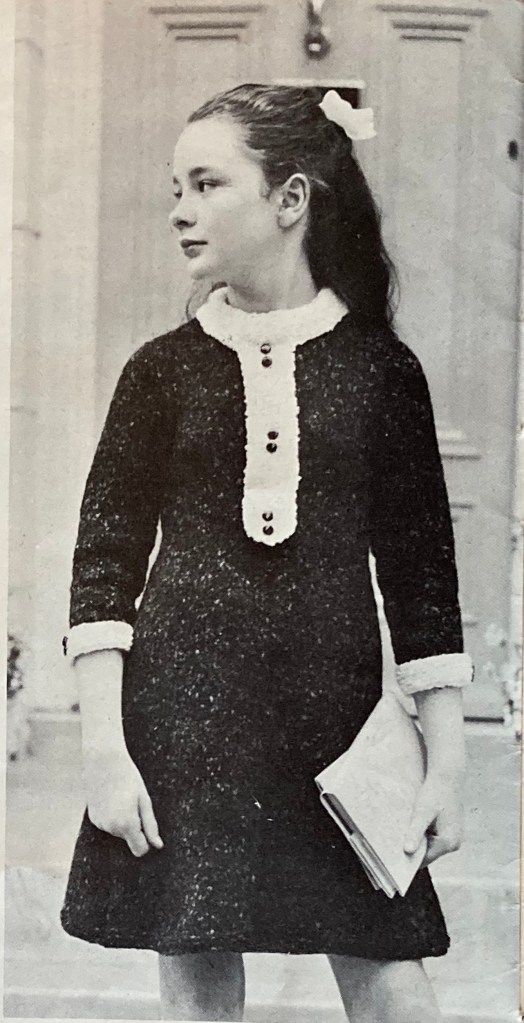
The outdoor photography was taken near historical buildings in York, whose grey-beige stone walls give a nice background to the bright red and blue sweaters made with “Ariel” a bulky, yet “feather-light” (well… 20-24 ounces for a sweater, so lighter than Big Ben, at least) wool-synthetic mix. I really like the red chevron sweater and it doesn’t look bulky at all to me, just fluffy and cosy. Father and daughter also get warm, cheerful garments, and look at this amazing mini-dress for a young miss! That is going on my list of patterns to adapt for myself.

Older teens and young lovers can make “the ‘sweater-match’ theme with girl-friend and boy-friend” – classic pullovers with cable ribs in double-knitting weight and identical except for slightly different shoulder width and back length proportions. That’s all for the knitted garments in this issue, since the real focus is on Christmas preparations with little gifts and housewares.

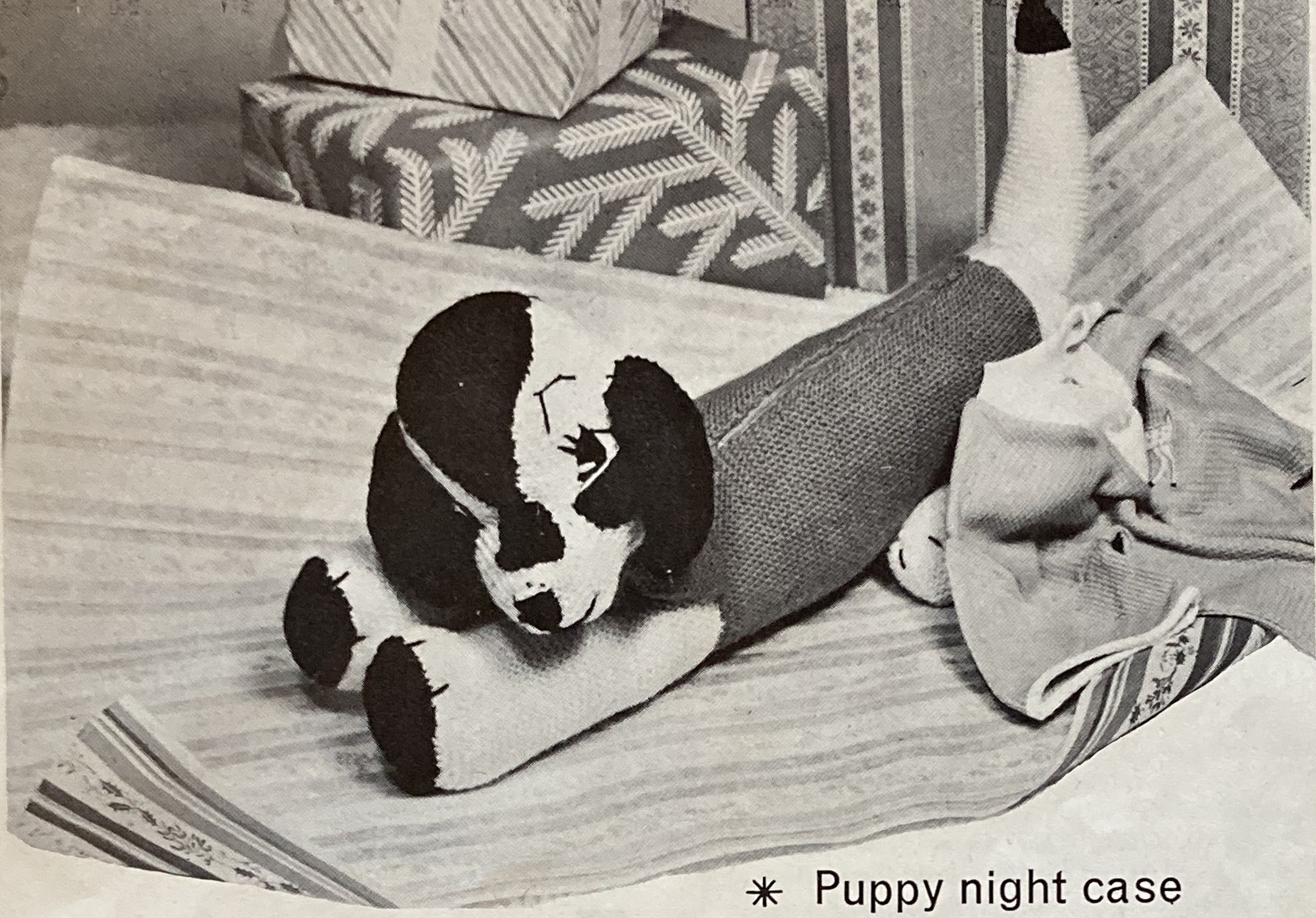
For children’s gifts, there’s a doll, clothes for another doll (pattern in last month’s issue), and a night case in the form of a puppy. This last was especially popular around the late 1950s and early 1960s – I have a different magazine with a poodle nightcase on the cover, and Stitchcraft also had some kind of poodle nightcase in the later 1950s. Poodle or puppy or not, I don’t know why a person would want to put their nightgown in a special case in or on the bed. If you don’t want other people who might be using the room to see your nightdress lying around, you could just… put it under the pillow?

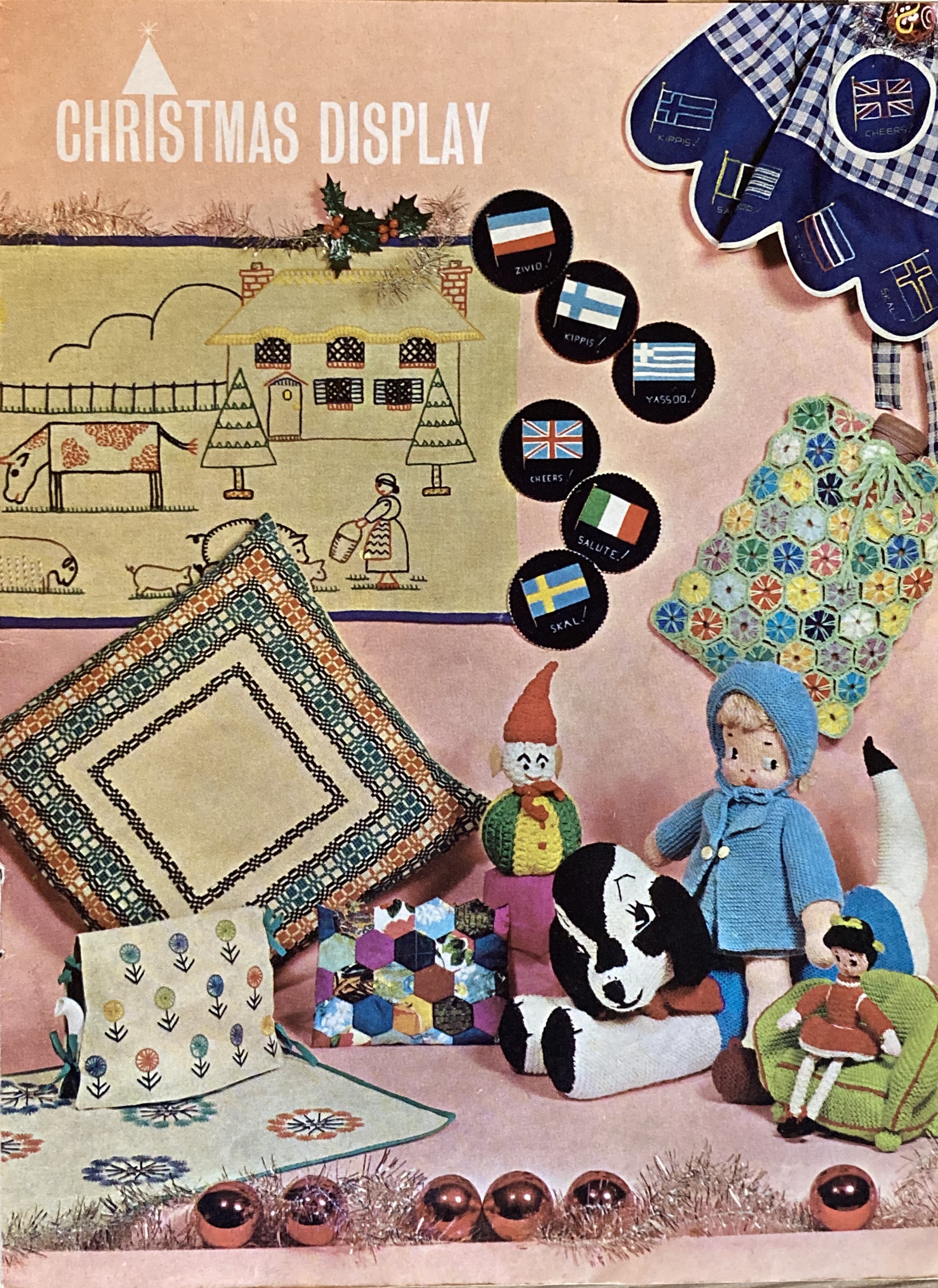
There’s an intriguing “Byzantine” cushion, a firescreen with this month’s embroidered flower (chrysanthemum) and some little gifts sewn in felt, but the more interesting projects are displayed nicely in the large colour photo in the middle of the issue. We’ve got an embroidered farm scene for the nursery wall, a “hostess set” of apron and coasters featuring international drinking mottos, the usual cross-stitch cushion, and a tray cloth/tea cosy design that I would love to adapt to an iPad/tablet cover. Crocheters can use up all their scraps with medallions or a … cute? eerie? not sure what to say about it? pixie doll and patchwork fans, generally ignored by Stitchcraft, finally have a little bag as a starter project.

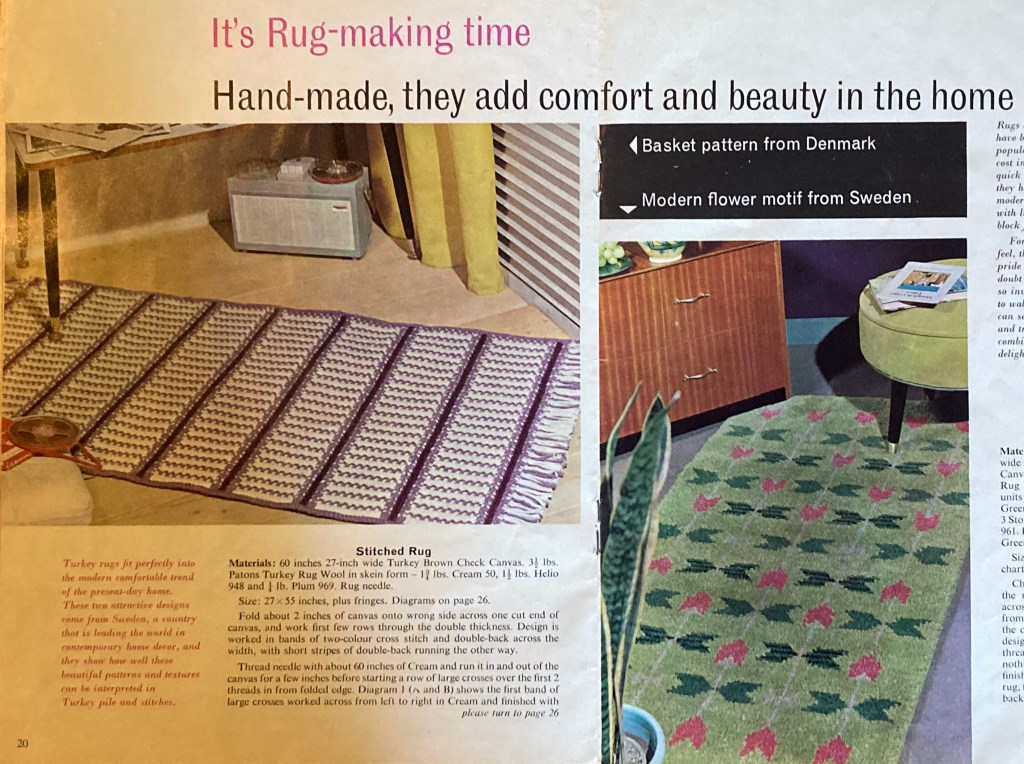
There are even rugs in Scandinavian designs (is that basket pattern from Denmark or from Sweden?), one stitched, the other done with a latch-hook.

What an issue! There are so many projects I would like to make from it: the girl’s dress in my size, an embroidered tea-cosy for the digitalised world, the little girl’s bulky red sweater, even the green latch-hook rug. Sadly, pandemic and lockdown have thrown a monkey wrench into my current knitting plans, it’s hard to get supplies, and I’m trying to finish or even start multiple other large projects that were planned or promised or have been lying in the WIP pile for ever. One of those WIPs was a (non-vintage) garment that I will have to frog anyway (ran out of wool and can’t make it work), so the plan is to frog that project and use the wool to make “Father’s cardigan” from this issue. Said project and I are geographically separated at the moment, though, so long story short: I do not know when I will be able to post a November project. Take heart, though: there will be some more Stitchcraft cooking fun in December as well as a special surprise next week.

September 1962: Overview

Autumn is the nicest season for knitting, and 1960s Stitchcraft usually gave it a little push with extra pull-out supplements, extra colour photo pages, or “bumper issues” full of the latest developments in home-knitting fashion. The September 1962 issue doesn’t have any of these extra features, but it does have a wide variety of designs in mid-weight and warmer wools, starting with the chunky twisted-bobble sweater on the cover. Made in bulky Big Ben wool, it weighs in at a whopping 38 (for the smallest of three sizes, 35-36 inch bust), 40 or 42 ounces (the largest size, for 39-40 inch bust), i.e. about two and a half pounds or 1190 grams. I am guessing the model is quite slender and even she looks bulky in it!

The dresses and separates, made with the same loose fit but in double knitting wool, show a smoother look with minimal patterning. The orange dress in the colour photo and the charcoal-grey dress with the colour-pattern border (“for those who like something really eye-catching”) are the same design, but the pattern-border version is only available in one size, “for the younger girl.” I guess that pattern was just too exciting for doddering middle-aged matrons! The blue and white ensemble, also made in double knitting weight, has three pieces: a simple sleeveless blouse in white k2, p2 rib, a plain blue skirt and a back-fastening cardigan with white vertical stripes on the front. Tops continue to be hipbone-length and hemlines are firmly anchored just below the knee.

Other garments feature interesting colour and texture effects: the man’s “smart weekend sweater” has been treated with a teasel brush to achieve a fuzzy, felted effect. The knitter was not expected to do the brushing herself, but was instructed to “take all pieces at this stage [after knitting all the separate pieces, but before making the garment up] to your usual wool shop who can arrange to quote a price and send them away to be brushed for you.”

There’s also a striped jumper for “young and carefree” women with a fringed collar and hem, similar to the one in the February 1962 issue (yes, it is more or less the same pattern in different colours and with a split collar) and a pullover in an intriguing striped and dotted slip-stitch pattern. Stripes and/or slip-stitches also feature in the three-colour pullover for older children and the toddlers’ dungarees. Colours are navy blue or charcoal grey contrasted with white and neutral pastels, as we saw with the patterned-hem dress and three-piece ensemble.

There is the usual variety of homeware designs, mostly with floral patterns: this month’s flower is the dahlia, or you can sew and embroider and apron with lilac sprays. The leftover gingham fabric from “your” workaday apron can be used for cute animal appliqués on aprons for the children (unsurprisingly, Father seems to be exempted from the washing-up.) There’s also the usual floral cutwork tablecloth and tray cloth and a coffeepot set made in Hardanger embroidery.

Needlepoint fans can make a stool top or a whimsical cross-stitch rug and/or wall panel for the nursery, featuring characters from nursery rhymes. The motifs are separate and interchangeable and can be adapted for different sizes and purposes.

In the children’s serial comic, Peter the puppet has been freed from his marionette strings and is traveling throughout the countryside writing a play about his adventures. Cyril the squirrel helps out by painting illustrations, using his tail as a brush. (But how will Peter get home?) There’s the usual advertisement for Lux washing soap, guaranteed to leave your woollies soft and fluffy, and the latest instalment of the Patons and Baldwins’ “knit to please your man” series of ads, junior version: a teenage girl knits a “nice, husky sweater” for her boyfriend with her own loving hands to show everyone that he’s the “special one.” The young woman on the back cover ad is presumably also trying to catch a man, but she looks more polished in her snappy red dress and white gloves. You can really see 1960s style coming into its own in the straight or A-line sleeveless dress with low contrasting belt, the bobbed and fringed hairstyle and the edgy, off-angle mirror pose. Compared to the designs in this issue, it also shows how fashion-conservative Stitchcraft is.

I’m not sure what I want to make from this issue. I imagine the embroidered dahlias would make a great design for a laptop or tablet sleeve, but I already have a fine home-made laptop cover, not to mention this wonderful gay-geese-in-space tablet cosy. Also, I have probably done enough embroidery for the time being and still haven’t made much progress on this appliqué masterpiece that I started in July. The knit projects are all so bulky and loose-fitting, which is not my style, and I’m not sure I know an appropriately-aged child for the interesting slip-stitch pullover. There was also a perfectly nice, if not exciting baby cardigan (not pictured) in the issue which I could make quickly from stash, which would be useful enough (somebody’s always having a baby) and maybe the best choice for my uninspired mood. Stay tuned and find out!

August 1962: Overview

August is the end of the holiday season at Stitchcraft, featuring transitional styles for the cooler days of September as well as a few more small, easy projects that can be worked on from the deck chair or picnic table. The “Contents” column on the facing page divides the adult garment patterns into the categories “First Autumn Fashions” and “Continental Designs”.

The “Continental Designs” comprise a colour-block pullover for men “from Vienna” in graded shades of green, a simple cap-sleeve, T-shirt-style jumper with a little Norwegian motif, and an “Italian design for late Summer” with bands of red and black intarsia in a diamond pattern. I wish they had used these for the colour photos instead of the bland white pullover on the inside front cover!

Loose-fitting, casual shapes and light, sunny colours dominate, exemplified by the apple-green cardigan, collared shirt-sweater and boatneck twin-set on the front and inside covers. Notice how much less fitted the August 1962 twin set is than, for example, this one from August 1960, not to mention earlier twin-sets from the 1940s and 1950s. The concept lives on, but the line has changed completely. Everything is hipbone-length with no or hardly any shaping.

Babies get a standard, but very pretty, lacy matinee coat and bootees, the “smart teenager” has a machine-knit pullover, and her little sister gets a “gay Rimple design” in the still-popular knitted terry-cloth look, so the whole family is taken care of.

Homewares are always big in the summer months, when many readers understandably didn’t want to hold bulky warm wool in their hands in hot weather. The bedside rug is obviously an at-home project, but the smaller projects could easily be taken along on a holiday. This month’s flower in the gladiolus, but there’s also an orchid spray and some forget-me-nots, along with two sewing patterns to embroider them on: a round baby shawl or this wonderful little girl’s dress. For once, you don’t even have to send away for the patterns, as they are geometrically quite simple — the shawl is just a circle, drawn directly onto the fabric with a pencil held on a length of string, and the dress is made up of rectangles with measurements given. I would love to make the dress! I just don’t think it would get worn, since it would only be for “dress-up” occasions, of which there aren’t going to be any for a while.

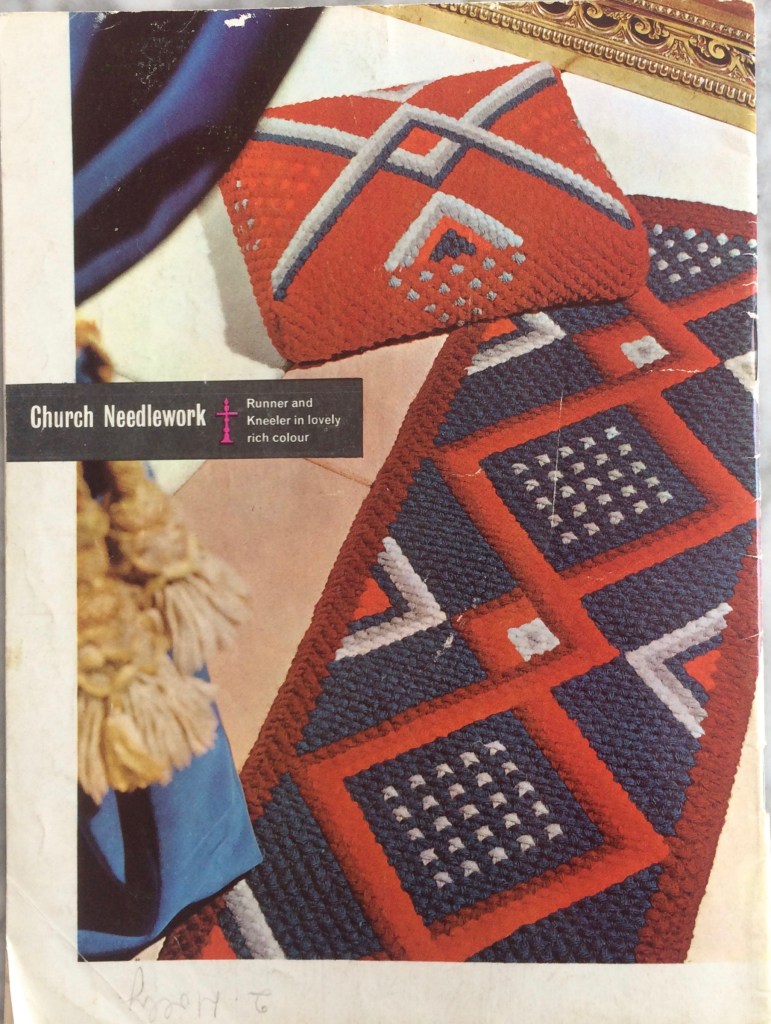
The back cover shows an interesting feature which took shape in the early 1960s issues: tapestry projects specifically for church use. In this case, there’s a runner and kneeler in shades of red and blue. If anyone happens to know why or if these colours or this pattern are significant in whatever type of Christian tradition, please feel free to tell me, as I don’t know anything about it. The rug, especially, does not say “church use” to me in any way that I can recognise and I could just as easily see it in a normal hallway.

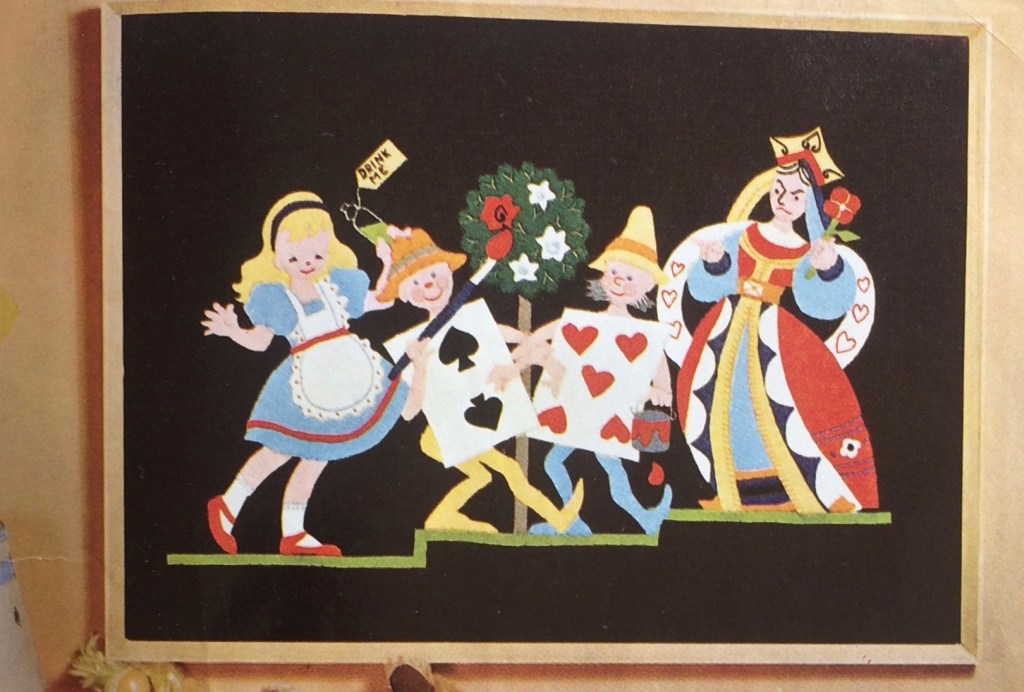
This issue doesn’t stop! The “Readers’ Pages” offer two more very simple projects: a reprint of a young man’s waistcoat from 1957 and a stash-busting baby blanket from double crochet hexagons. And just when you think you’ve come to the end of the issue, here’s this incredible Alice in Wonderland-themed wall hanging in felt appliqué and embroidery:

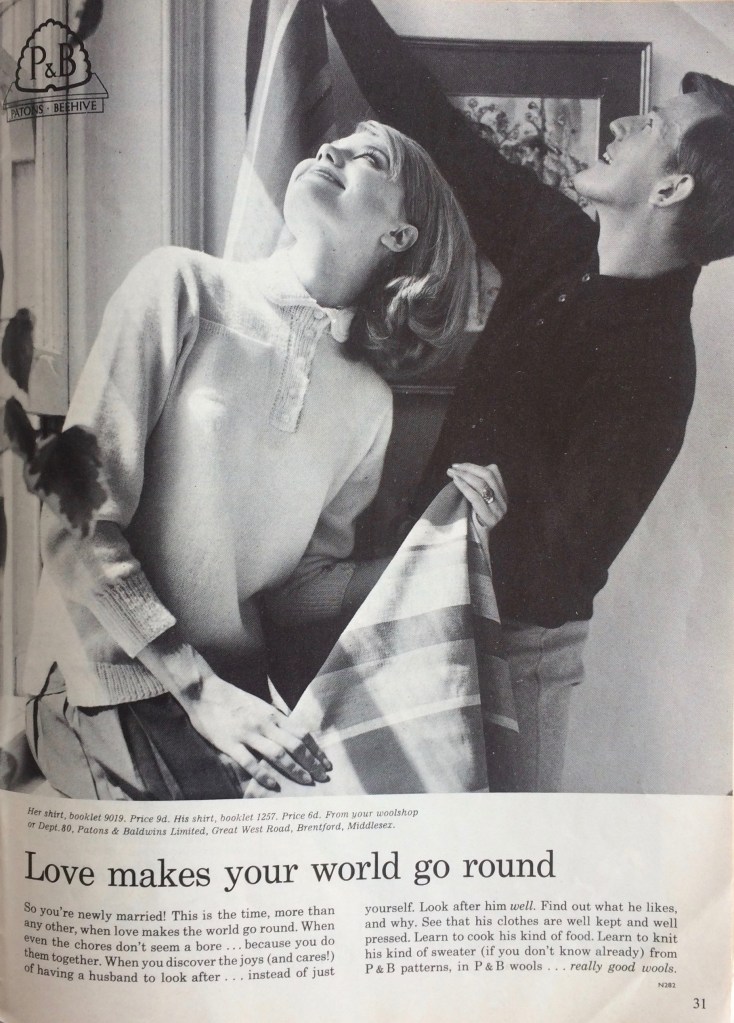
I’ll close with this full-page ad for Patons & Baldwins wools, showing a newly married couple decorating their home. The happy bride is instructed to

Look after him well. Find out what he likes, and why. See that his clothes are well kept and well pressed. Learn to cook his kind of food. Learn to knit his kind of sweater…

While I’m certainly not surprised that a 1962 advertisement would speak to women like that, I do find it interesting to compare the early and mid-1960s ads — which take on this type of “you exist to please your man” language more and more throughout the years — with those from the 1950s issues, with their much more independent picture of womanhood. Many of the knitting patterns in the earlier issues are explicitly designed “for the office” and most of the advertisements portray women living active, interesting lives in their comfortable shoes and unbreakable skirt zippers. In the wonderful tampon ads (that sadly disappear around the late 1950s), they don’t even let “problem days” stop them from doing anything! In contrast, the full-page P&B ads starting up around this time always feature a man or child with the woman in question and the text is inevitably some variation on “you must do this to please your man.” I had always thought of the 1950s as being a much more repressive time for women that the 1960s, when roles began to change, but judging from Stitchcraft (which, to be fair, is quite conservative both fashion- and otherwise), the earlier part of the decade is more of a backlash than a progression.

I don’t know what project to make from this issue and I still have so many WIPs, both for this blog and otherwise. Maybe a nice, easy flower embroidery on a vegetable bag?

July 1962: Overview

Cover photo from the magazine showing two women and a male waiter drinking cocktails.

Holiday and party seasons are both in full swing in Stitchcraft’s July 1962 issue and the more I look at this cover photo, the more I love it. Note how the foreground model is staring off into the distance while sitting on a table with a compass printed on it, as if fantasising about her faraway holiday (though, if she’s on holiday already, as the picture is implying, does that mean she can’t wait to get home?). Meanwhile, it’s a good thing that our flirty tuxedoed waiter’s drinks tray is empty, with that precarious balancing act. If anyone feels inspired to creatively augment this photo with speech- and thought-bubble captions, please do and share it with us!

Colour photo from the magazine showing a modeled, knitted ensemble and blouse

In keeping with the easy-going, summer holiday theme, the knitting projects are simple and quick to make. The two illustrated on the cover have no sleeves, minimal shaping and patterning, and are made in quick double knitting wool. Although pictured as stand-alone tops, they could easily be layered over a blouse on cooler days. There’s also a simple blue blouse with loopy flower details on the collar and a striped, sleeveless tunic-blouse with matching skirt, all in 4-ply wool. Our waiter from the cover photo has found another holiday-goer to flirt with, and sports a “Casual Italian design sweater” in the same colour as her skirt: “Water Green.” (Holiday tip: if the water actually is that colour, don’t drink it.) Speaking of Italy, doesn’t that beautiful model in the collared blouse look like she just stepped out of a Fellini film?

For cooler days, there are cardigans in “golfer” or classic, slightly bobbled styles, both made in double knitting. The golfer takes her sport very seriously! Knitters who are really in a hurry to get packing can make some simple, bulky pullovers for the kids in the family (shown here building a lovely British castle out of cardboard and sand in the Patons photo studio — I am guessing everyone had a lot of fun on this issue’s photo shoots) or a fine-knit slipover in honeycomb pattern, written for a home knitting machine.

The embroidered homewares are mostly easy and predictable: a chairback with this month’s flower, the carnation; a quickly-made “gay garden cushion” (Happy Pride!), and place mats with heat-resistant cork inserts. There’s a tapestry stool and/or project bag in Florentine pattern, knitted or crocheted cushions, some fancy knitted doilies and a trolley cloth from crocheted motifs. I didn’t photograph all of them, since they’re pretty standard fare.

For those who like to immortalise their holiday paradise in tapestry, there’s a wall hanging of the village of St. Etienne de Bougary in the lovely French Pyrenées. For your outing to that very inviting-looking lake, you can sew you own beach bags and/or an appliquéd blanket-towel-baby’s-playmat for outdoor lounging. The beach bags feature adhesive plastic lining to keep wet bathing suits from leaking into the bag. Smart and easy, indeed.

I’m kind of ambivalent about making a project from this issue. The only thing I could really use is the bobbly cardigan, but it’s not exactly necessary, and the only design that I find exceptional is this crocheted blouse (worn by my favorite Stitchcraft model, who featured in a lot of the mid-and late 1950s issues). Model and blouse are both beautiful, but the blouse is way beyond my limited crochet skills. I wish I had the “Traditional Norwegian Designs” booklets from this ad! I think I’ll take the time to finish up another long-standing WIP instead.