 April showers bring May flowers, or so they say. I’ll just say that, after the last couple of weeks of March, that umbrella on the cover of this month’s issue looks really familiar. As does the model on the right — she was featured (with a more flattering haircut) in many issues throughout the 1950s.
April’s theme is “Holidays Ahead” and if you are planning to spend your holiday in April or May on the British isles or the North Sea coast, you will definitely want to wear one of the warm, bulky wool garments from this issue. “Jenny”‘s thick, double-knit Norwegian-style jumper and hat, described as “dazzling designs to cut a dash on the beach this summer”, tells you everything you need to know about that.
The adult garments continue the warm, bulky and casual trend with a men’s “crochet-knit shirt” and “country-style cardigan” in double knitting weight. Knitting pattern stitches that look like crochet crop up every once in a while and it’s certainly an intriguing idea. That said, I don’t think this jumper particularly looks like crochet — it’s yo, k2tog on every right-side row and purl on the wrong side in staggered rows, which is just a simple lace pattern. I’m guessing they thought the word “lace” was not manly enough… The cardigan is made in three-colour slip stitch and is probably very warm and “squishy”. I like the neat, almost hidden pockets and the narrow edging band.


The women’s garments offer two more elegant, but still casual blouses, the two jumpers with fun collar details featured on the front cover and a relaxed “holiday cardigan” in double knitting. Patons “Totem” crepe wool appears in 4-ply (the blouses) or in double knitting weight (the cardigan). “Crepe” in this case meant that the wool was spun very smooth and tightly plied to minimise “fuzziness” and give raised stitch patterns a crisp, precise look. The jumpers from the cover are designed for ever-popular Rimple wool, a crinkly wool-synthetic blend intended to look like towelling fabric. Fans of truly bulky knitting can make this his-n-hers set (well, not really a “set” as they are two completely different designs, but featured together in the photo spread). Her sweater is made in fisherman’s rib stitch and if it looks that bulky on the petite, fine-boned model, I can only imagine it would make anyone else look elephantine — but good for sailing and/or April beachwear, I guess.


Housewares include the continuation of the “Zodiac” theme with an Aries motif, a traycloth in cross-stitch, a cross-stitch and pile rug, “amusing” aprons for the whole family (the father looks utterly un-amused at having to participate in the washing-up), a village townscape needle etching, a cross-stitch cushion… i.e. the usual fare. You can also make a toy “Wag” puppy for fans of the children’s comic from the last few issues, “Wendy and Wag in Wallpaper Land.” I don’t mind telling you that it had a happy ending for everyone. And with that, happy April and see you next time!


P.S. There wasn’t any project in this issue that really called to me, so I’m going to finish up a project of my own design that was inspired by this Stitchcraft children’s jacket from March 1960 that I made last year and write about that. Stay tuned…
 Are you ready to “Rendez-vous with Spring”? I sure am! This month’s issue has a lovely extra “centerfold” spread in colour, showing off Spring 1961’s latest fashions.


 The ads are for the usual knitting machines and sewing fabrics… except for this one, for “Cooper’s moth proofer” spray, presumably made of
 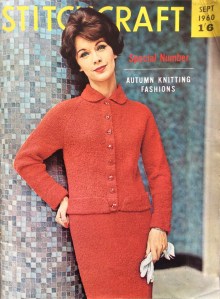 September 1960 is supposedly a “Special Number” of autumn knitting fashions. I’m not sure what exactly makes it so special, since it doesn’t seem to have any more, or particularly different, projects than the average issue. I guess it’s special in that September is finally a bit cooler weather-wise, so you can start to make some nice wool garments for the colder months — very appropriate in 2018, where we had the summer to end all summers. Things have cooled down a bit now, so I’m looking forward to wearing my (still unfinished) projects from July and August soon.


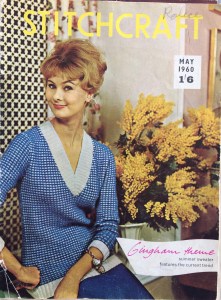 Is it already May? Nothing makes time fly like writing monthly blog posts! May 1960 is a “Roundabout of Holiday Knitting” (complete with a little circus-fair logo that fills up any little dead space in the page formatting, how cute) where in “today’s story”, “no one thinks of going away without 2 or 3 brand-new woollies packed away in their luggage.” So let’s get started…
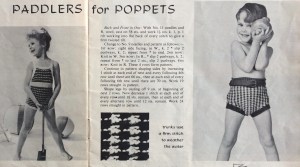 I am quite sure no small child wants to swim in hand-knitted wool trunks with a belt these days, but I imagine the sun-suit on the opposite page would be fun and practical for beach wear if made in cotton. The baby and older girls of the family get pretty cardigans or a tunic “to wear with her jeans.” I’m glad to see activewear for girls, since generally one is assumed to make pretty, decorative stuff for girls and strong, “manly” stuff for boys — sexism that is not surprising in 1960, but which always depresses me to see in today’s knitwear patterns for children.




 I will be making two children’s designs: the fabulous checkered coat for a toddler, and “John’s new pullover” for a soon-to-be six-year-old.
 The Stitchcraft Sixties