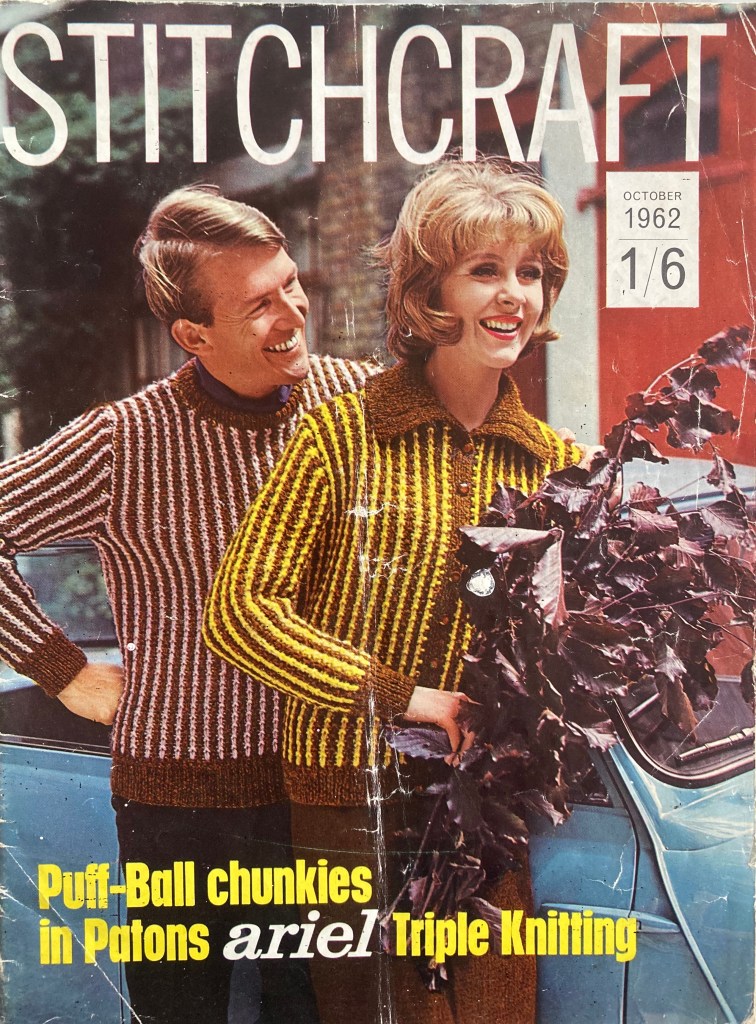
“There are several “special” things about this issue” writes Stitchcraft’s “editress” on the facing page, and I’m glad she put the word “special” in quotes, because this month’s issue is definitely a mixed bag. On the plus side, it has extra pages in colour and introduces a new yarn: Patons Ariel, designed to be “triple-knit” bulky and therefore quick to knit, but still lightweight. On the minus side… we’ll get to that later in the post.
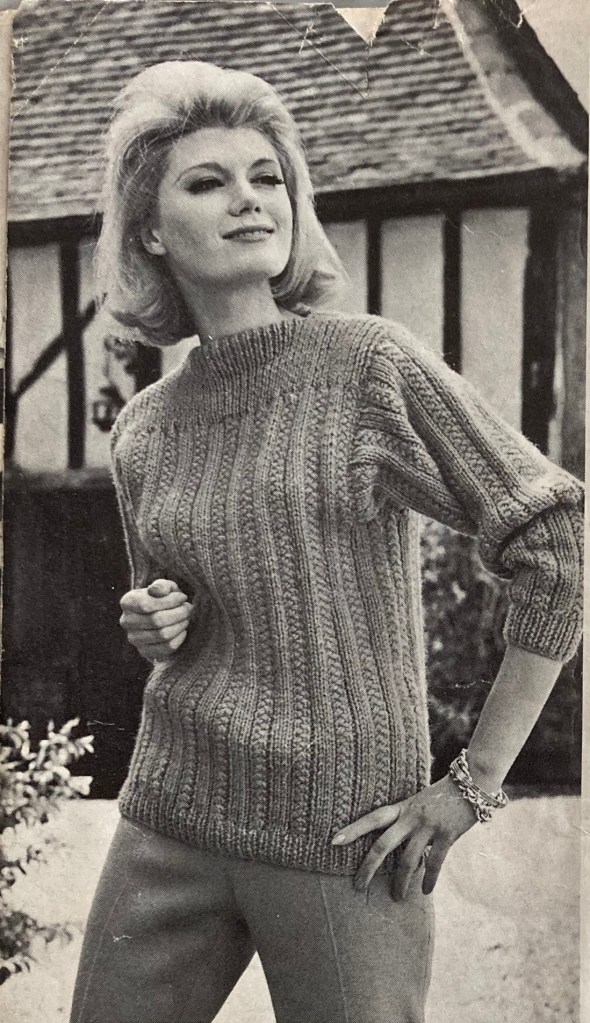
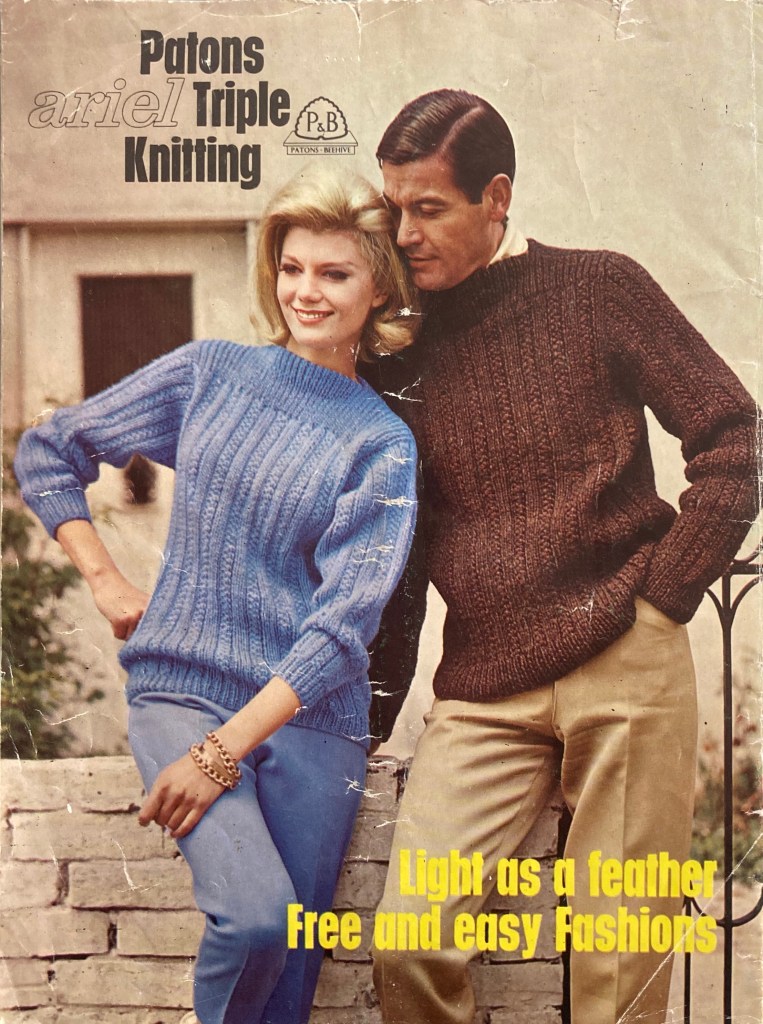
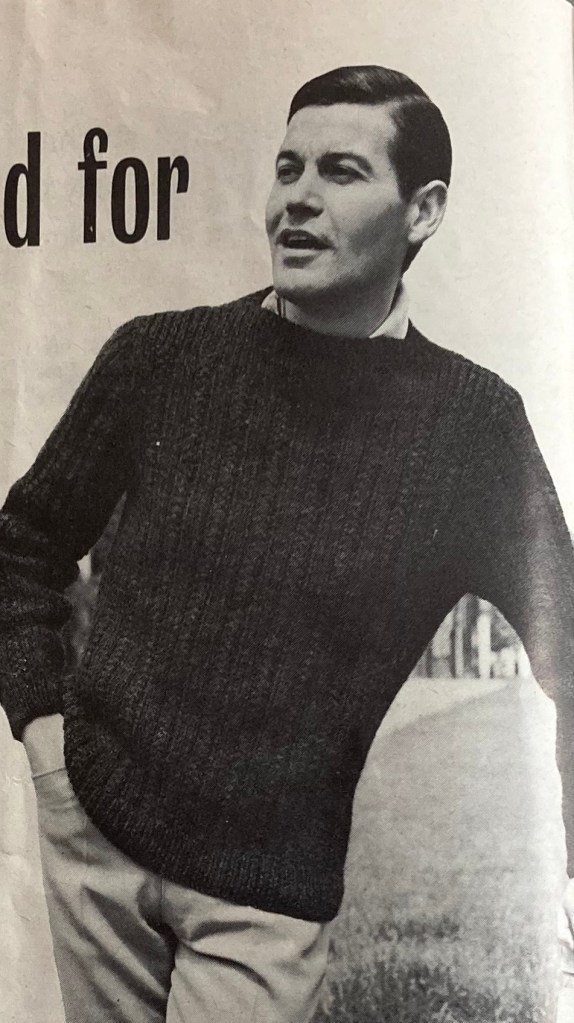
The new wool, Ariel, is listed on Ravelry as bulky weight (97 yards in a 2-ounce ball) and composed of 80% wool and 20% “other” (synthetic fibres). According to the person who wrote the Ravelry entry, it may or may not have been waterproof! It appears to be quite fluffy, thus the name and the “light as a feather” claim. It’s used for the two-colour, slip-stitch-patterned garments in the cover photo as well as the identical boatneck pullovers for men or women. The partner-look idea is still going strong.
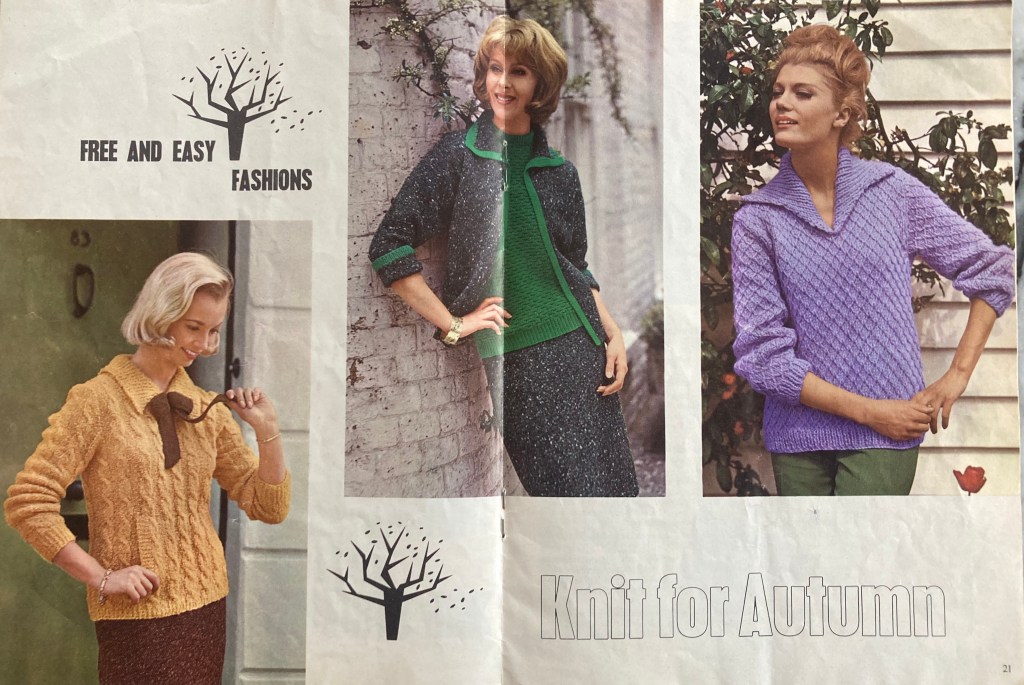
Tweed looks and suits are always popular in the fall, and this month’s issue gives us a loose-fitting suit with a short-sleeved jumper to wear underneath, all in double knitting weight. Nubbly Rimple yarn is also DK weight and still a fashionable choice for this sweater with a contrasting bow-tie. The purple pullover with the big collar (still in fashion after two years!) is made in bulky Big Ben wool. Greens, browns and yellows dominate the colour palette and go with the autumn theme.
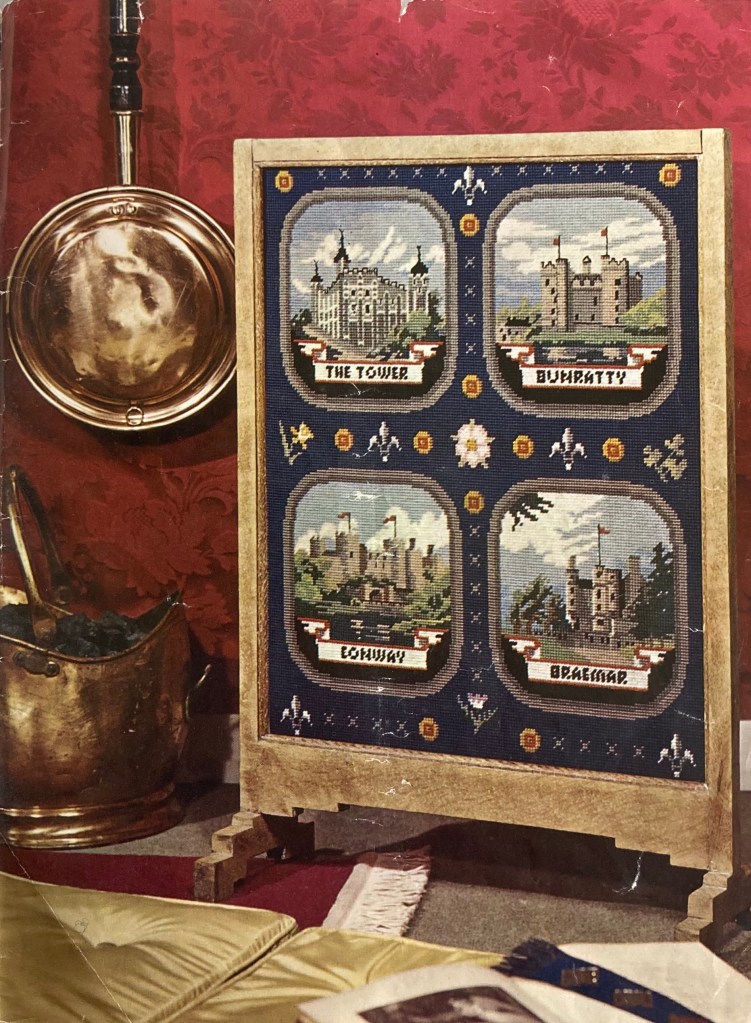
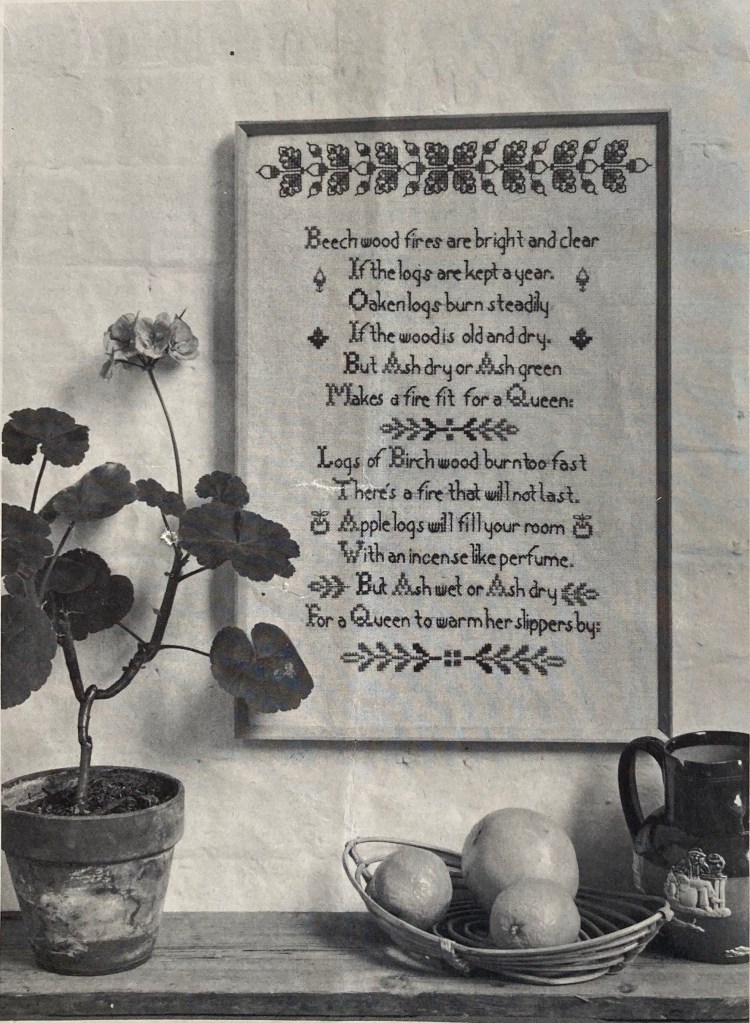
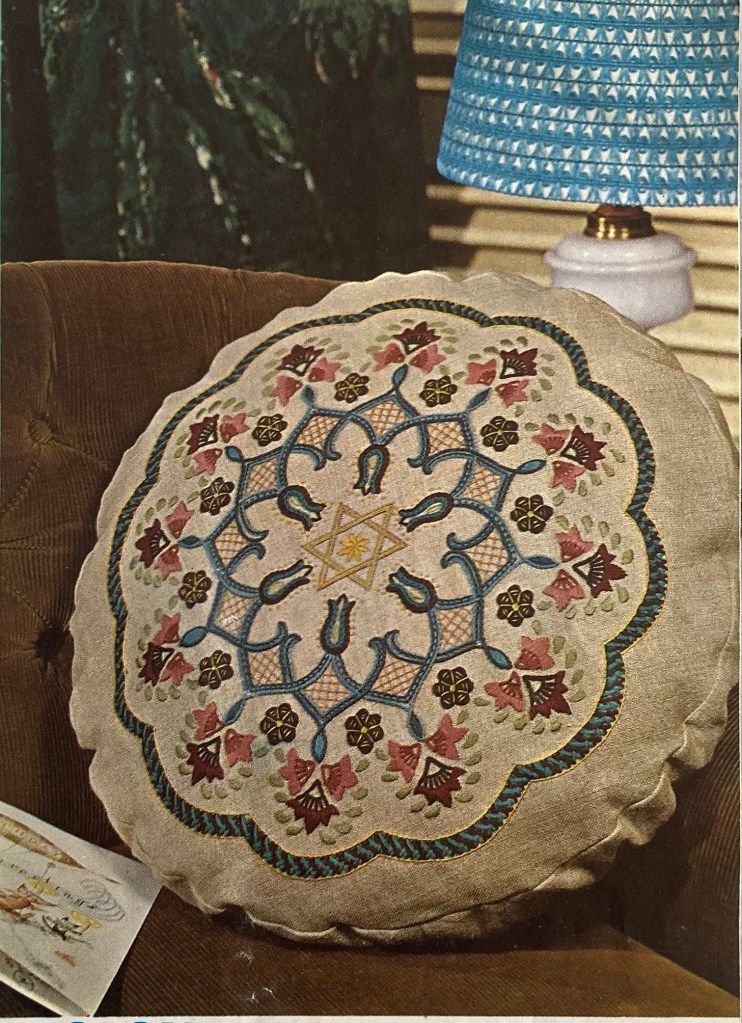
Embroidery and tapestry take a backseat to the autumn knits in this issue, with typical floral chair-back, apron, and traycloth designs. There’s a tapestry of four famous castles, a cross-stitch wall hanging with a poem about what type of wood to burn in a fireplace (I had never heard this rhyme, have any of you?) and a more complexly embroidered cushion of “Indian design”. I cannot vouch for its cultural authenticity, but the woven and latticed stitches are certainly striking and effective.
Speaking of cultural history, remember our little model Judy with her “trim Outfit” from 1960? (Of course you don’t, and I wouldn’t have recognised her either if her name weren’t in the caption.) Here she is, two years older, cutting a dash in her warm 3-piece play suit and all set to play with…
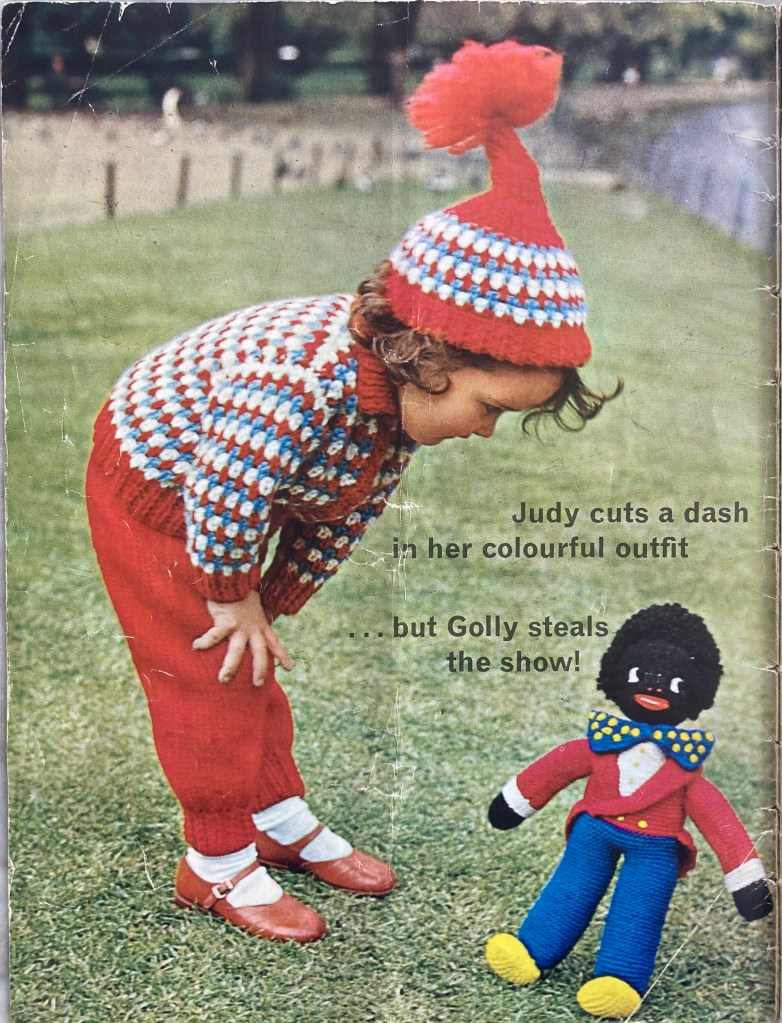
Ah, right. Her “Golly”, who “steals the show” and whom readers can also knit from a pattern in this issue. “He’s favourite”, writes our editress, and “everyone in the nursery loves Golly.” Who is he?
In 1895, the English-American cartoonist and illustrator Florence Kate Upton produced her first children’s book, titled The Adventures of Two Dutch Dolls and a Golliwogg. Over the next fourteen years, she and her mother Bertha collaborated on twelve more books starring the same characters. The books, and particularly the “Golliwog” character, enjoyed enormous popularity for at least sixty years afterwards and “Golly” dolls and toys as well as “golliwog” images on brand names and household products were practically ubiquitous in popular culture — particularly children’s culture — in the UK and elsewhere throughout the 1950s and 1960s.
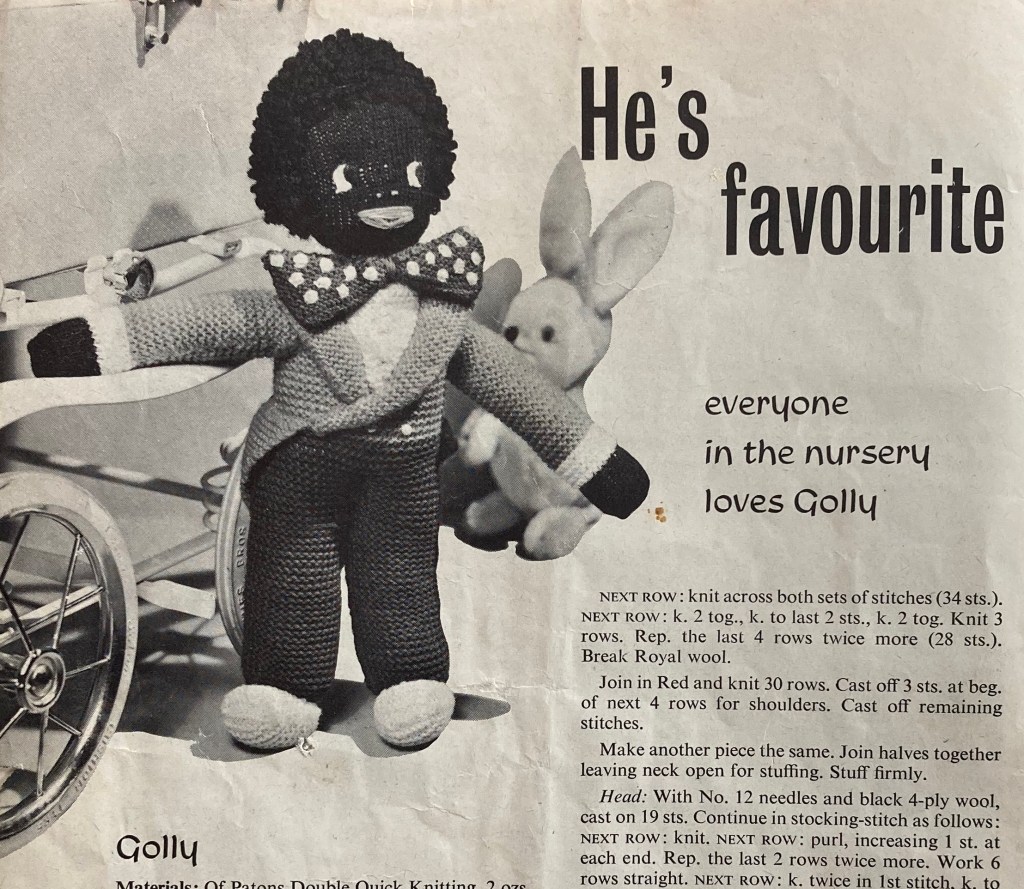
Though Upton intended the Golliwog(g) to be a positive character and the hero of the story, it can’t be denied that his representation is a racist caricature born of the blackface minstrel tradition in the United States. According to Upton herself, her inspiration for the character was a Black minstrel doll found in her house, and typical “Golly” representations show him with exaggerated, distorted features and wearing an outfit typical of minstrel performers in the early 20th century. Later literary and cultural depictions of “golliwogs” often portrayed them as animalistic, uncultured or criminal, thus reflecting and perpetuating negative racial stereotypes about Black people. Over time, the word “golliwog” and shortened forms of it became used and recognised as demeaning racial slurs.
Though many white Britons, Americans and Australians who grew up with golliwog dolls continue to claim that they are inoffensive (and capitalise on their popularity via Internet auctions and collectors’ organisations), it should be pretty obvious that they, and their related imagery, are problematic. For a more in-depth understanding of why, I encourage further reading, starting with this excellent article from the Jim Crow Museum of Racist Memorabilia at Ferris State University in Michigan (US).
It’s not the first or only time that Stitchcraft (like just about every other knitting/craft publication of its time) has featured patterns for toys or dolls that reflect stereotypes of particular ethnic groups or portray them as an “exotic Other”, even if those representations are supposed to be positive. Many patterns from the 1940s and 1950s are particularly offensive (take my word for it, I don’t want to show them here), as is the use, up until the late 1950s in some cases, of racial slurs as colour names for certain shades of wool (ditto). By the way, I have issues of Stitchcraft and many other vintage knitting magazines up to the mid-1970s and nowhere, in any of them, have I ever seen a model who was not white — the caricatures were also the only representation to be found. Let’s remember that, for all their fantastic fashions, the mid-century decades were definitely not the “good old days”.
On top of all that, there’s no pattern in this issue that I particularly want to make, so I’ll either embroider some anemones on a vegetable bag or finish up something from the WIP pile.
 The Stitchcraft Sixties