November 1967: Overview

Autumn is officially here, winter is around the corner, and Stitchcraft‘s November 1967 issue presents “the GOLDEN LOOK for winter sparkle”, with warm garments, warm colours, fun textures, and matching his-and-hers outfits to chase away the cold, grey days of November.

Our cover models sport matching polo- (aka turtle-) neck sweaters in “Flair” wool and a suitably golden colour called “Musk.” There are only two sizes given: 35-37 or 40-42 inch bust, so intended as a one-size-fits-most, basically unisex pattern. The textured pattern is made entirely with knit and purl stitches. Our other partner-look models wear polo-neck pullovers as well, with a simple stranded chevron border at the hem. They seem to be designed for somewhat younger and thinner folks, with three sizes from 32-33 to 38-39 inch bust. There’s one more design just for men: a “country cardigan” in blue wool and a fern-like textured pattern.

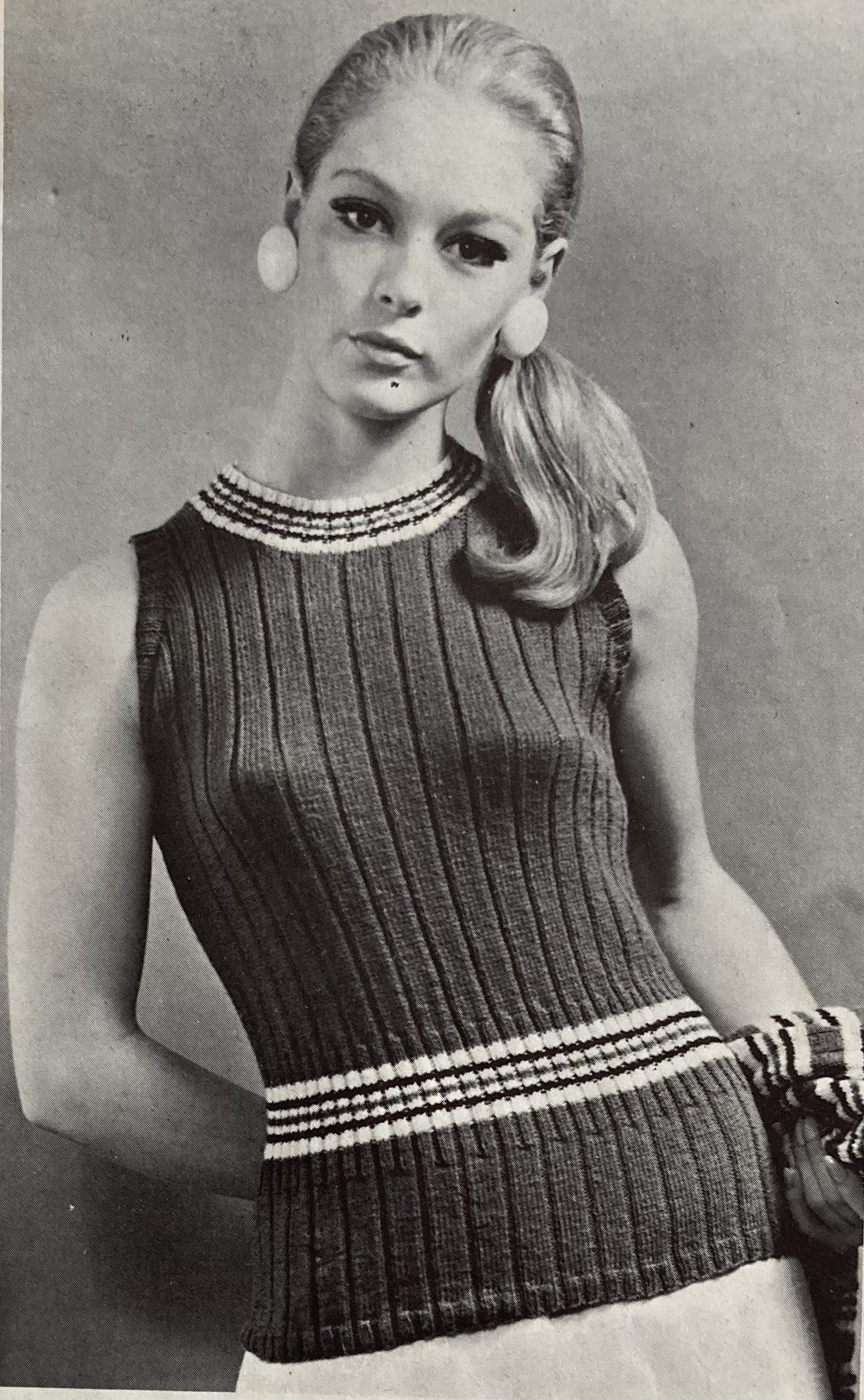
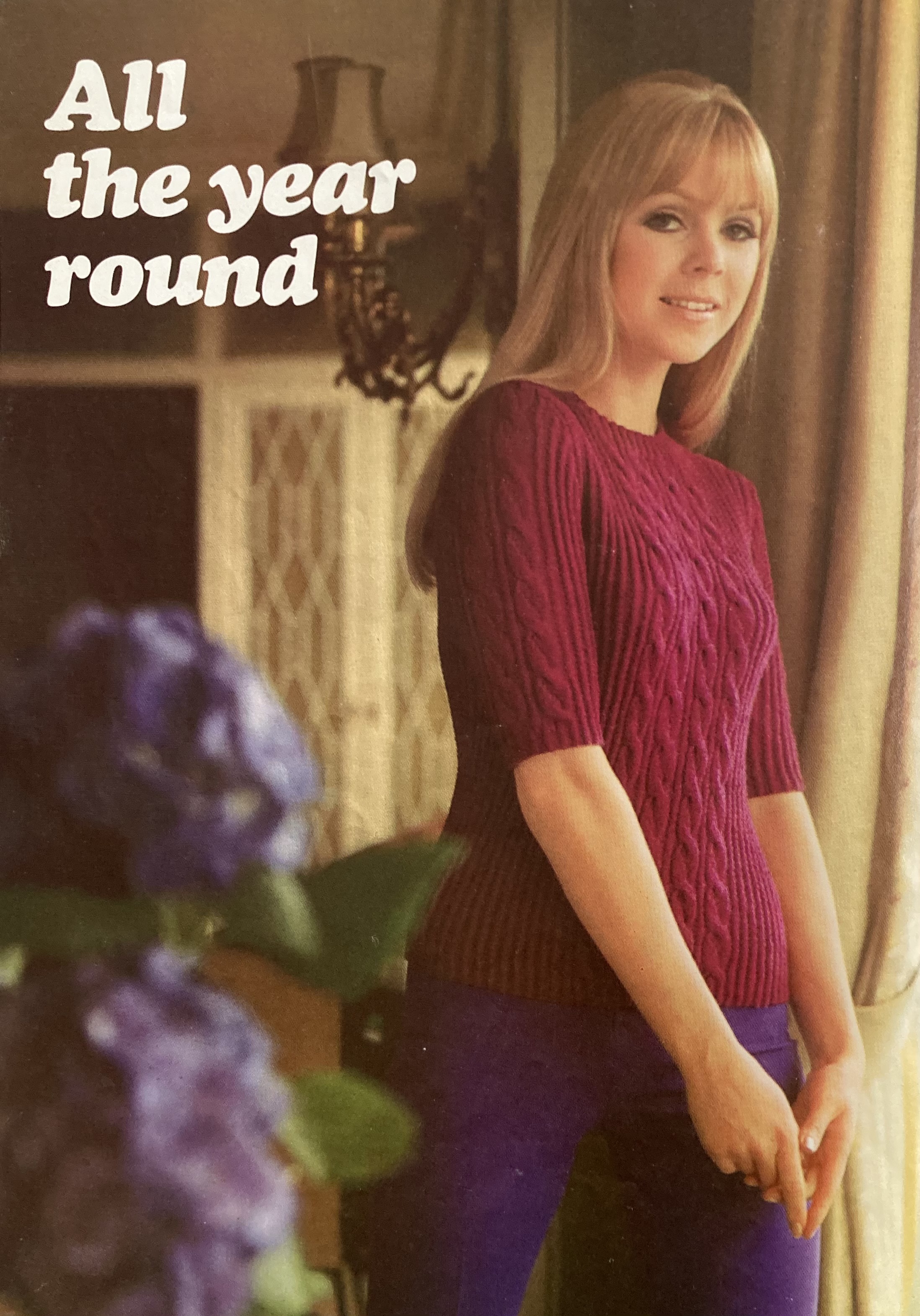
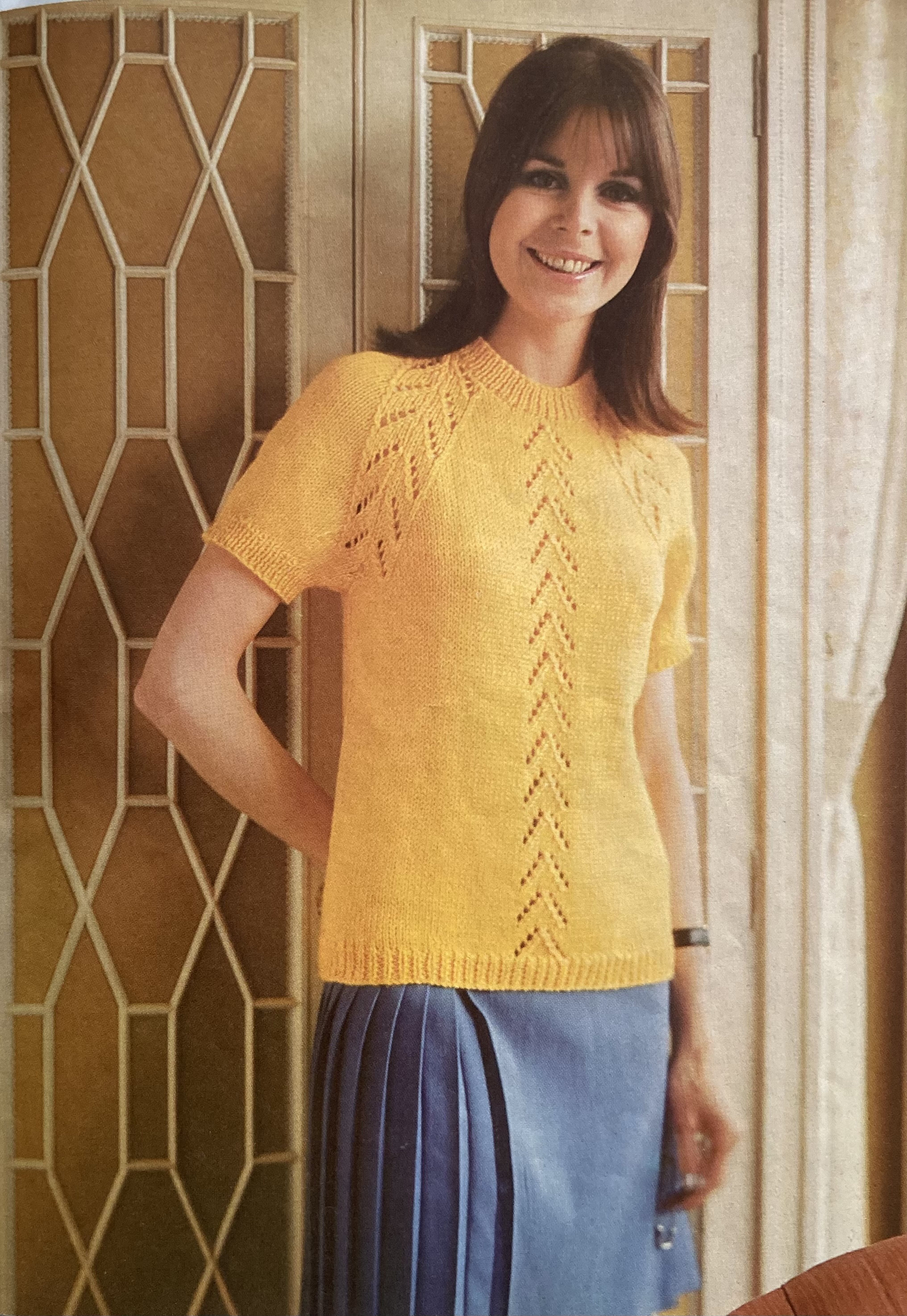
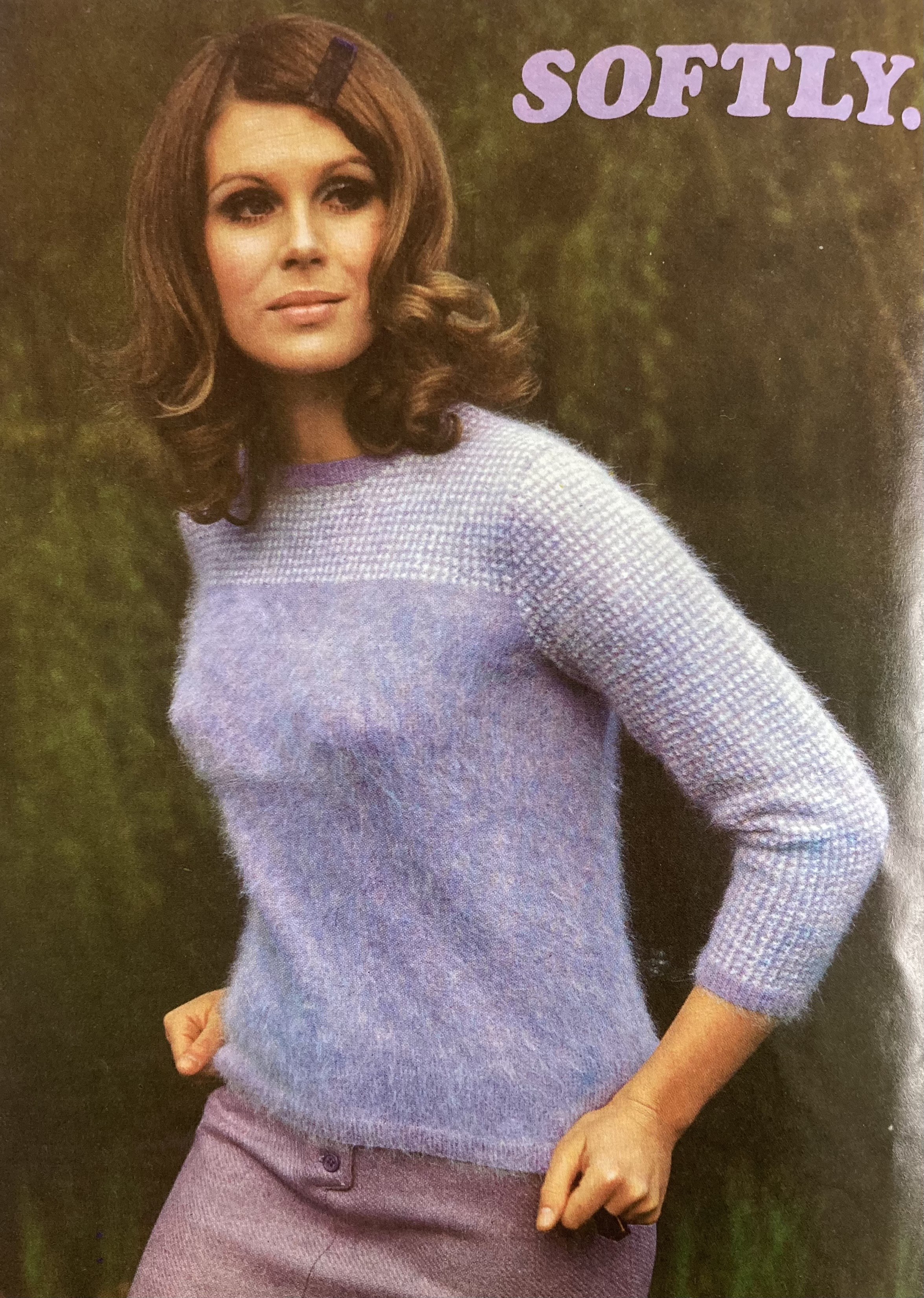
The women’s designs include a rich green jumper suit, with a buttoned pullover in low-contrast stranded diamond pattern and a plain olive-green skirt; a hooded jacket in a chunky bobble-like pattern made with twisted stitches; a delicate jumper in soft, fuzzy “Princess” wool with a contrasting colour yoke; a polo-neck pullover in colourful “rainbow” chevron pattern; and a bright blue cabled jumper for larger sizes (40-45 inch bust).

With all these great designs for adults, it’s not surprising that there’s only one children’s pattern in this issue, a tunic for girls age ca. 4 to 7. It’s knitted sideways in pieces, starting at the left side edge of the back, then the fronts separately, then the sleeves separately, which are also knit sideways. I’m glad to see the girl model wearing tights, for once! The children’s comic in the “Readers Pages”, titled “The Woodland Wool Shop”, tells the story of Daisy Lamb, who wants to learn cross-stitch, but doesn’t want to be cross about it.

The homewares and “novelties” are all designed with an eye towards December gift-giving, and most of them are featured in a single, big colour photograph. There are lots of things to make in felts: holiday-themed potholders and party mats, a night-case patterned after the nursery rhyme about the old woman who lived in a shoe, some racist “Golliwog” puppet mitts (unfortunately, still a thing), giraffes to appliqué onto an apron, coffee cosy or apron, and another truly terrifying clown intended for use as a string dispenser — yes, you put a roll of string in its head and pull the string out through its mouth. Stephen King was already 20 years old when this issue of Stitchcraft came out (and lived in another country), but if he grew up with things like this in the 50s, it’s not hard to see where he got the inspiration for It. Just saying.

You can also embroider sprays of holly on place mats or another apron, or make a cross-stitch rug or cushion in a Norwegian pattern, or a different cushion in a Florentine pattern. More advanced tapestry aficionados can make a tray-cloth or yet another cushion based on a design from a Chinese tapestry. On the simpler side, you can sew a little doll and dress her in traditional Dutch clothing, or knit a little stuffed toy set of a mother and baby fox. Many, many gift ideas in this issue. Oh, and another rug, in cross stitch!

The ideas keep coming, with two little cross-stitch pictures symbolising “Autumn” and “Winter” (to match the “Spring” and “Summer” pictures in the last issue). And how could I not mention the best gift idea of all: the bed-jacket in loop-stitch, modeled by my favourite model, who seems to have been hired by Stitchcraft exclusively to model bed-jackets with a sexy come-hither smile. I have to admit, the loop-pattern spoils the sexiness for me, but we all have our own preferences… Love the pink-on-pink photograph, though.

That’s all for this issue! My project will be the buttoned pullover from the jaquard jumper suit (just the jumper for now.) May your November be bright and golden.
August 1967: Overview

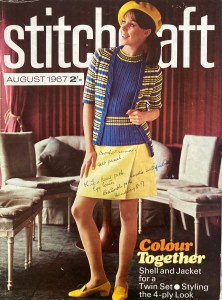
“The LAST of the SUN” is the headline of the introductory page of Stitchcraft’s August 1967 issue, and there is no blurb about the latest fashions or designs: just the subtitle “fashion for late holidays and the first smoky days.” (That the first cooler days of the year were called “smoky” is presumably meant quite literally, seeing that a good portion of family homes in the UK were still heated with coal fires in 1967.) The late-summer fashions in this issue are warmer, but still sunny and colourful, with layered and mid-weight garments that can be worn indoors or out.

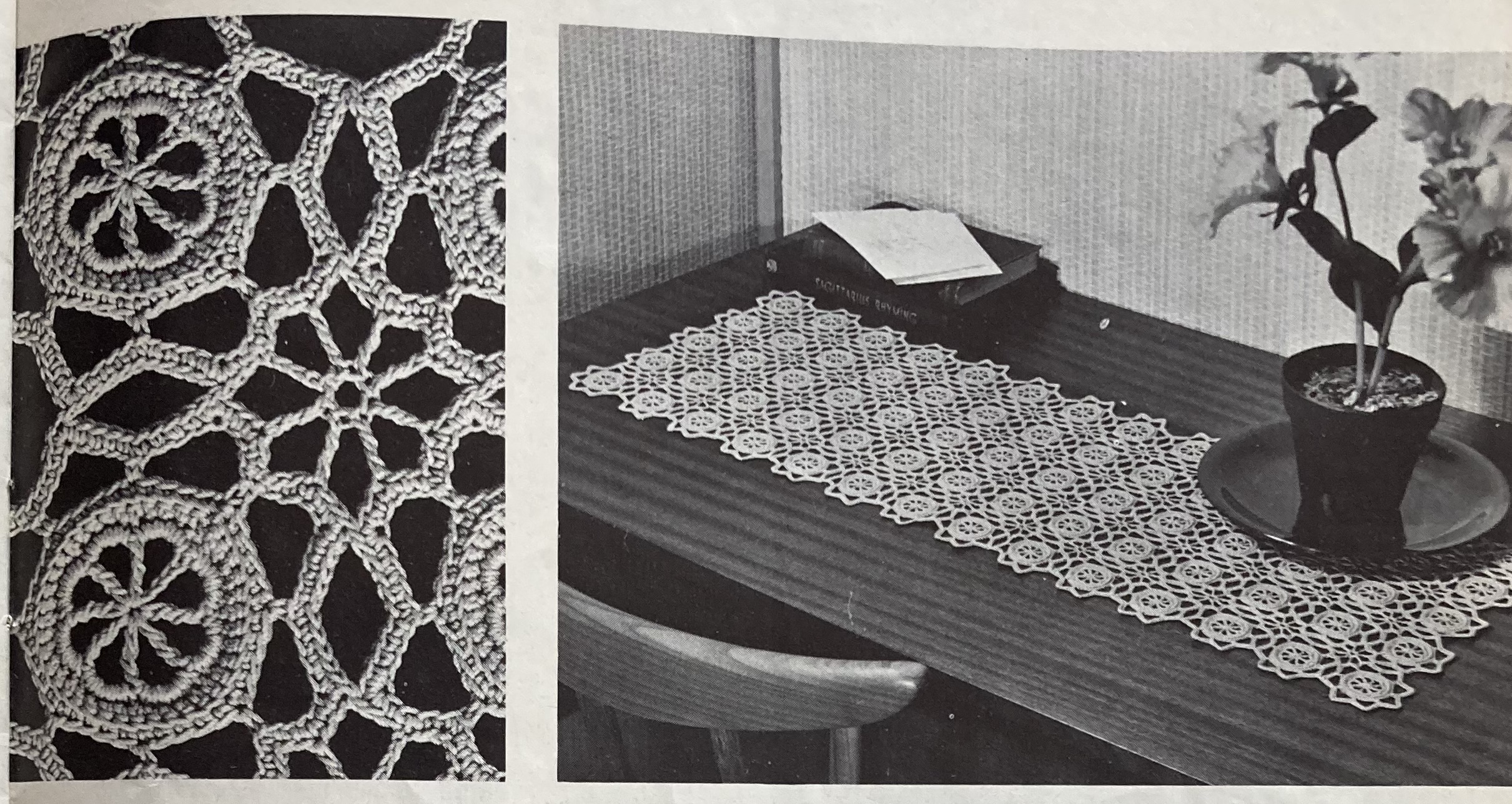
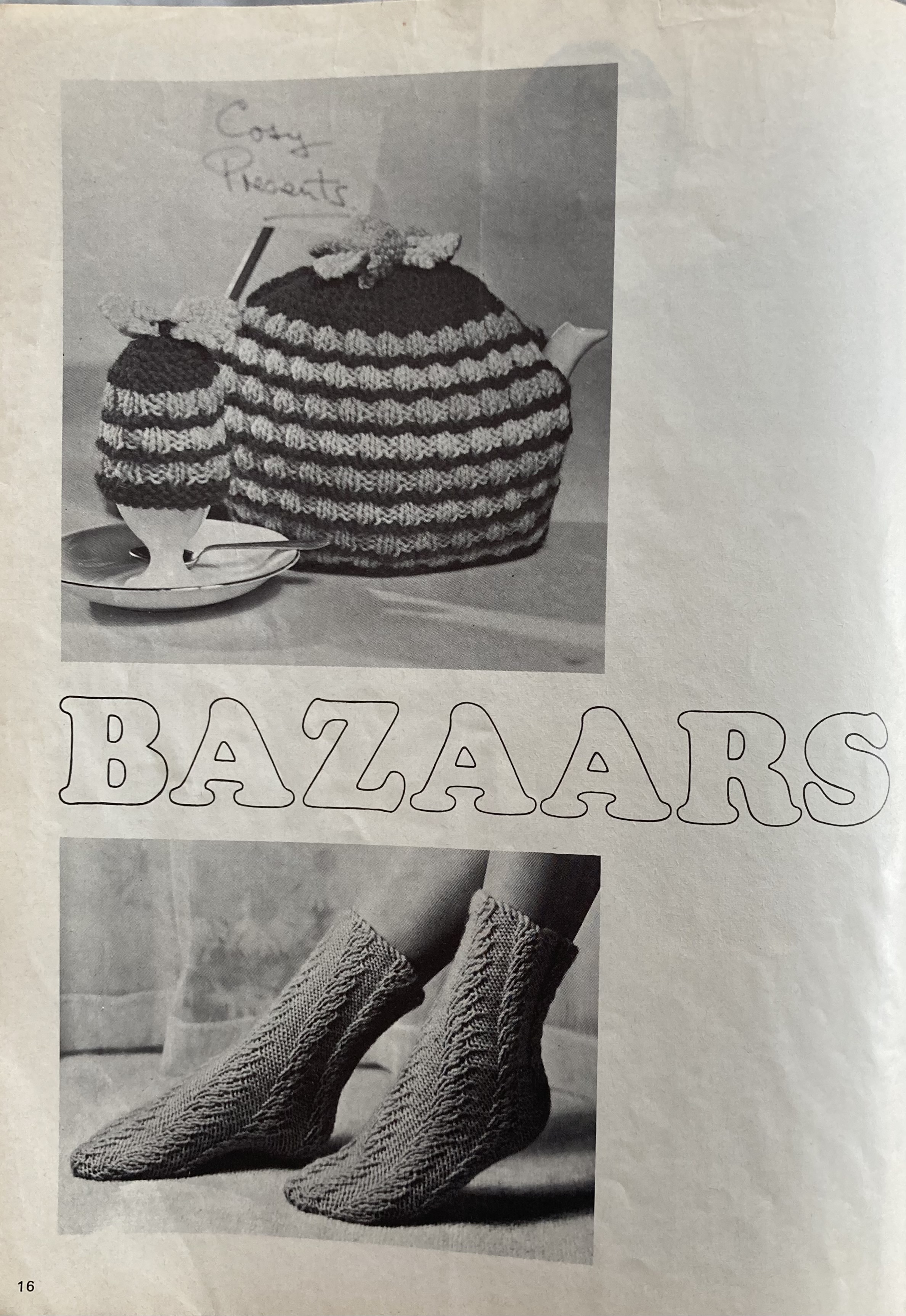
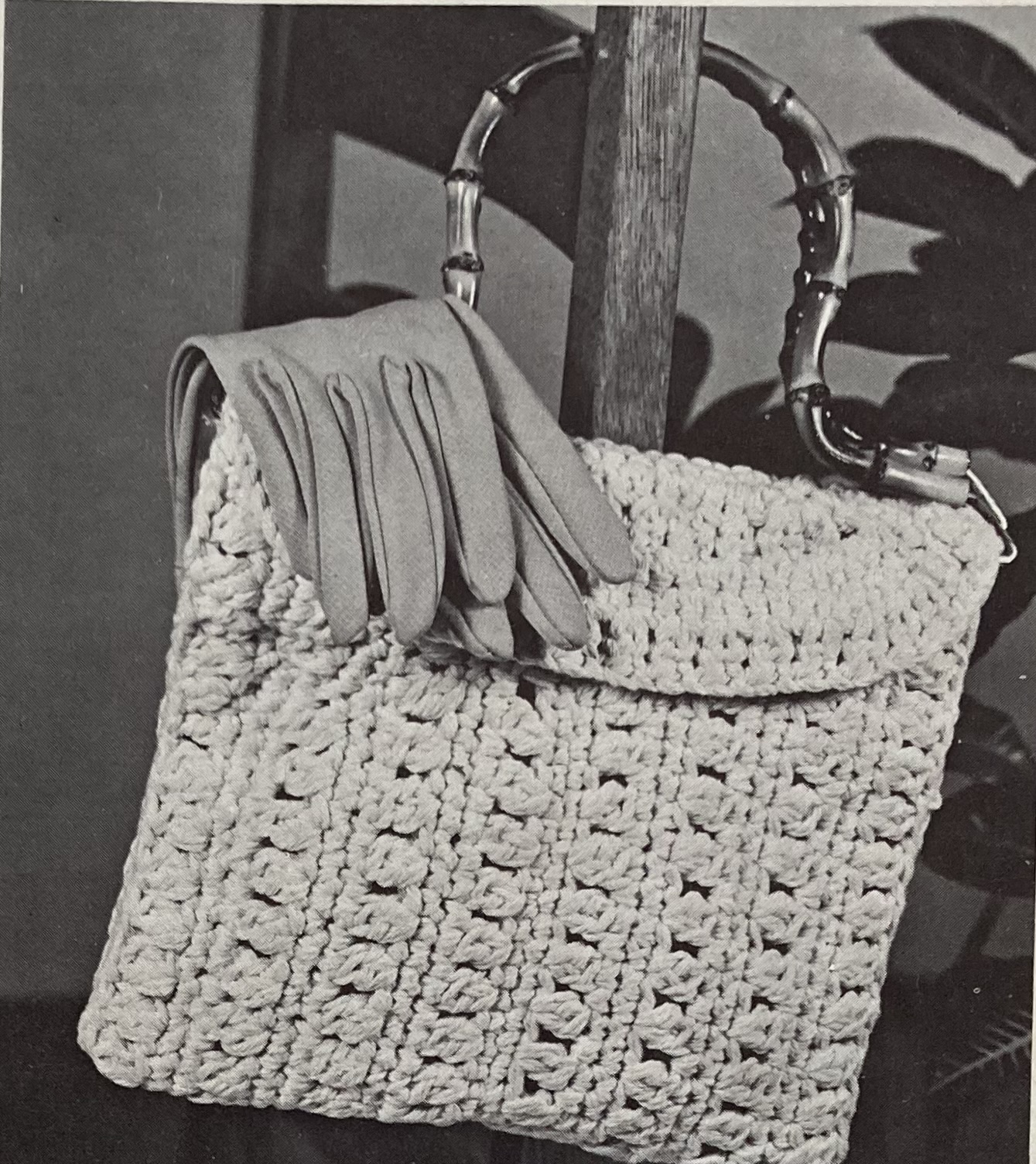
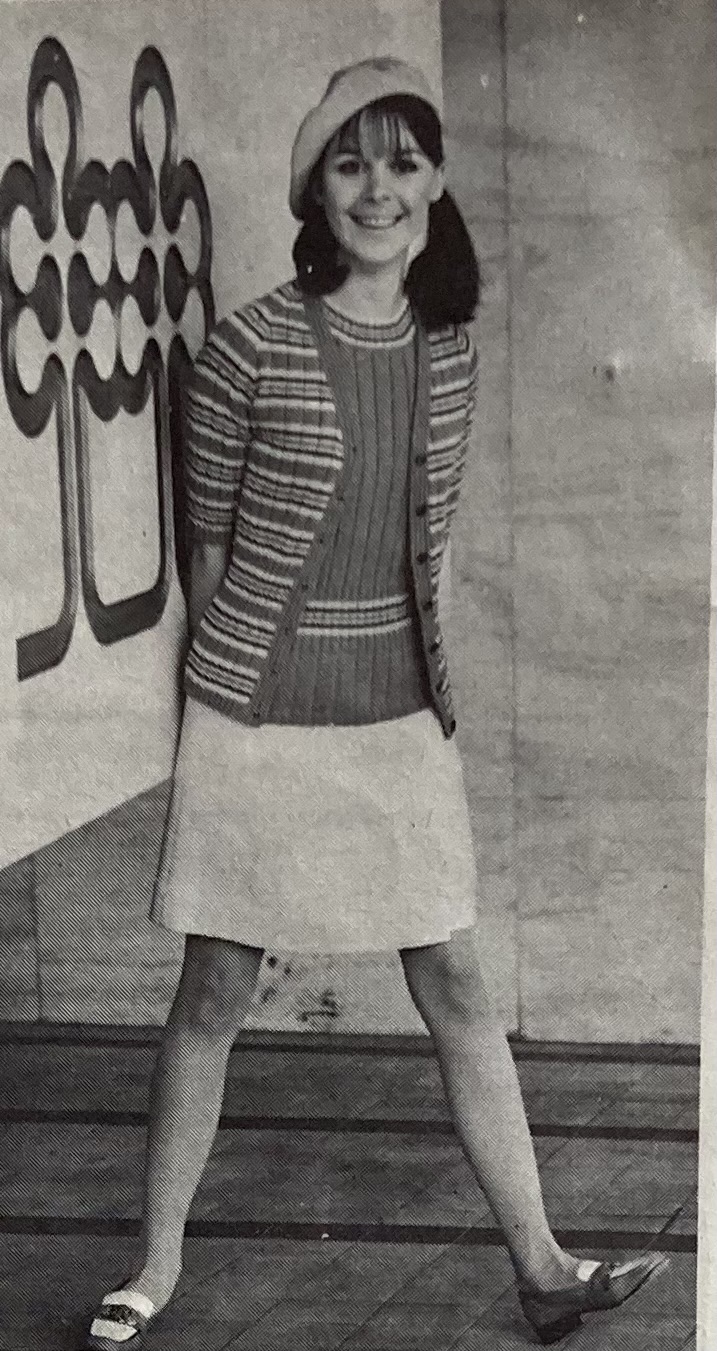
Case in point: the cover design, a twin-set of sleeveless “shell” and lightweight cardigan with elbow sleeves in cheerful, sunny yellow and blue. Note how short skirts have gotten! I think this might be the first Stitchcraft cover photo that features a true miniskirt. My copy of this issue was clearly used — according to the handwritten notes on the cover, the previous owner was interested in the crochet runner, the felt panel, the knitted tea cosy, egg cosies, and bed socks on page 16, and the handbag on page 17.

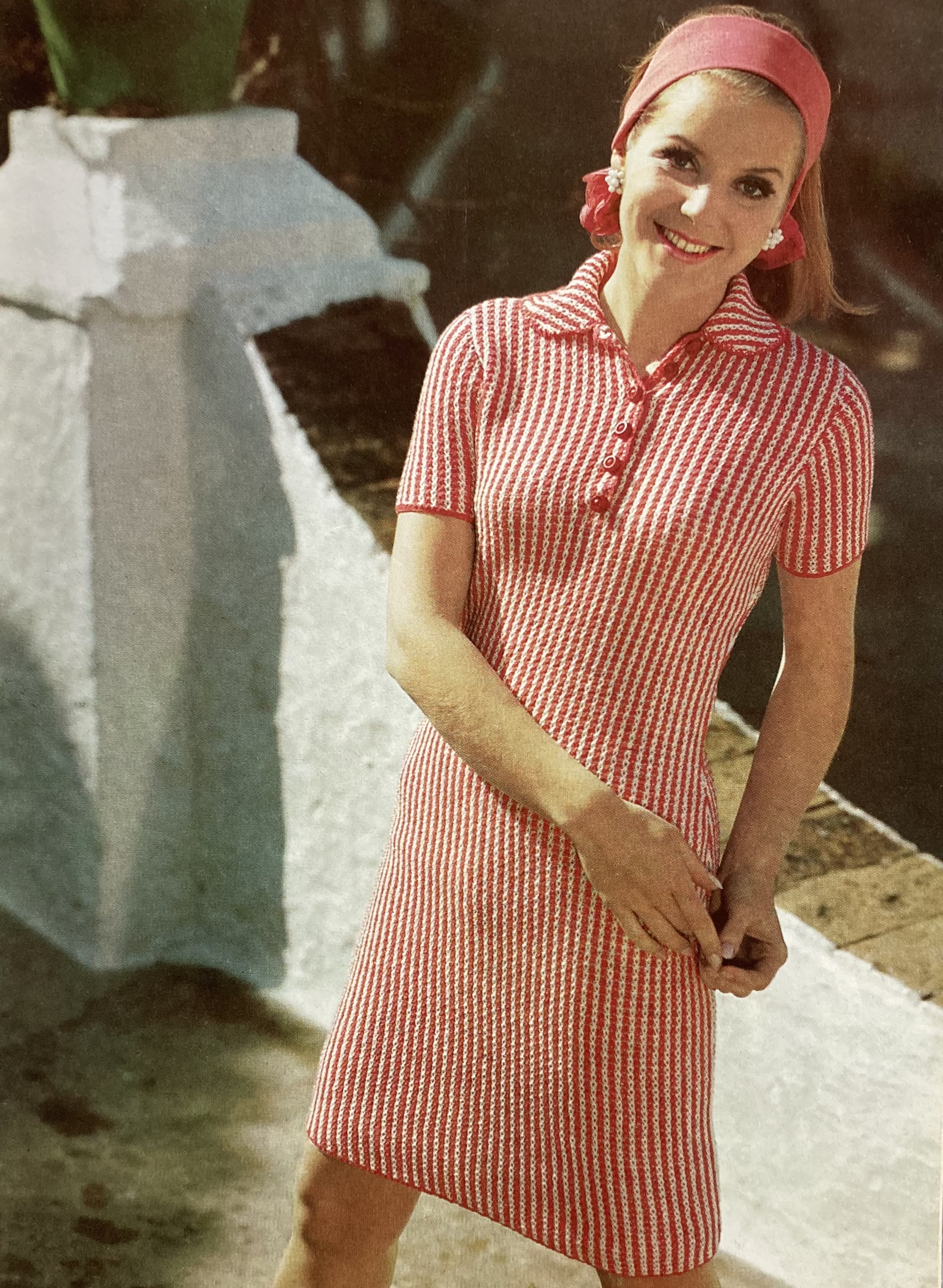
The other women’s fashions include a lacy top in larger sizes (to fit 42/44/46 inch bust), a two-colour shirtdress in a slip-stitch pattern, two short-sleeved knitted jumpers, and a heavier saddle-shoulder cardigan to work as a jacket on those cooler days. With the exception of the larger-sizes jumper in pastel “Camelia” pink, bold colours prevail: yellow, pink, red, or blue tones. (The saddle-shoulder cardigan is navy blue with white.) There are more colour photos in this issue than in previous issues.

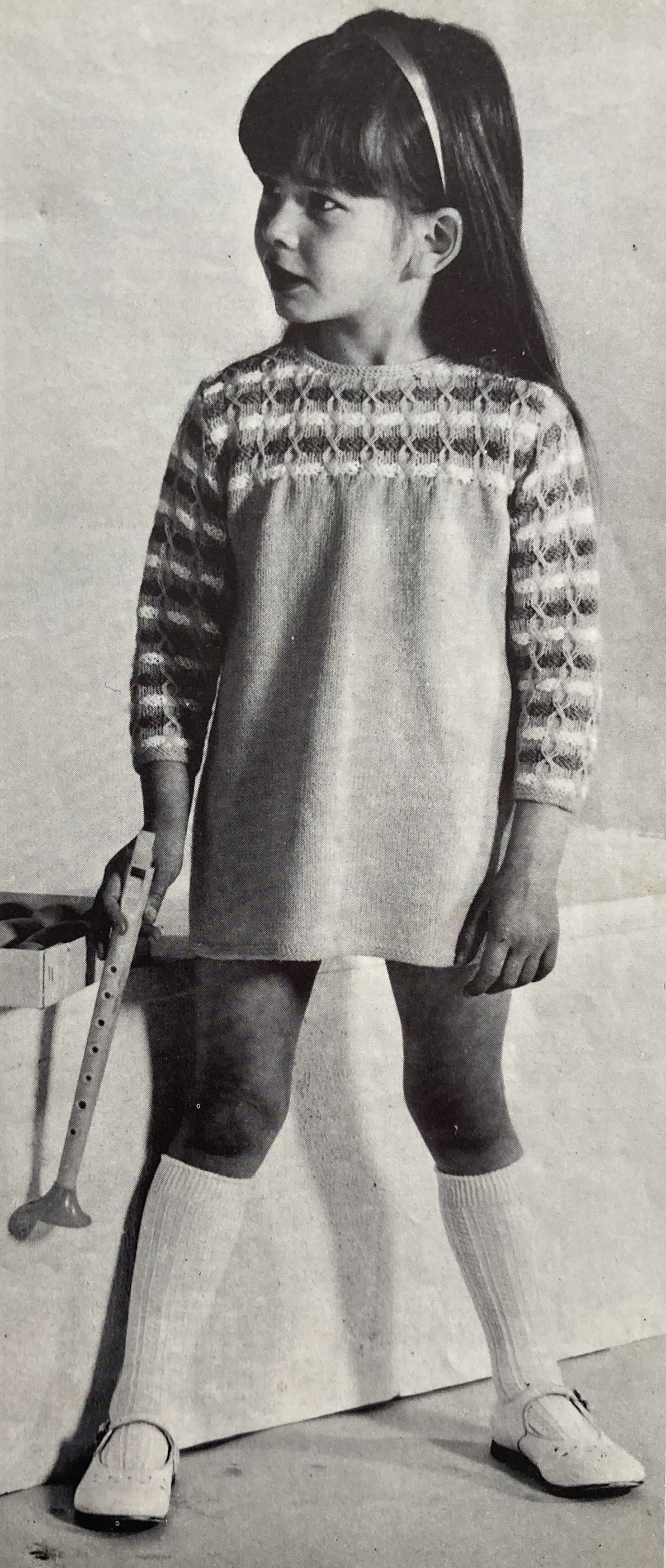
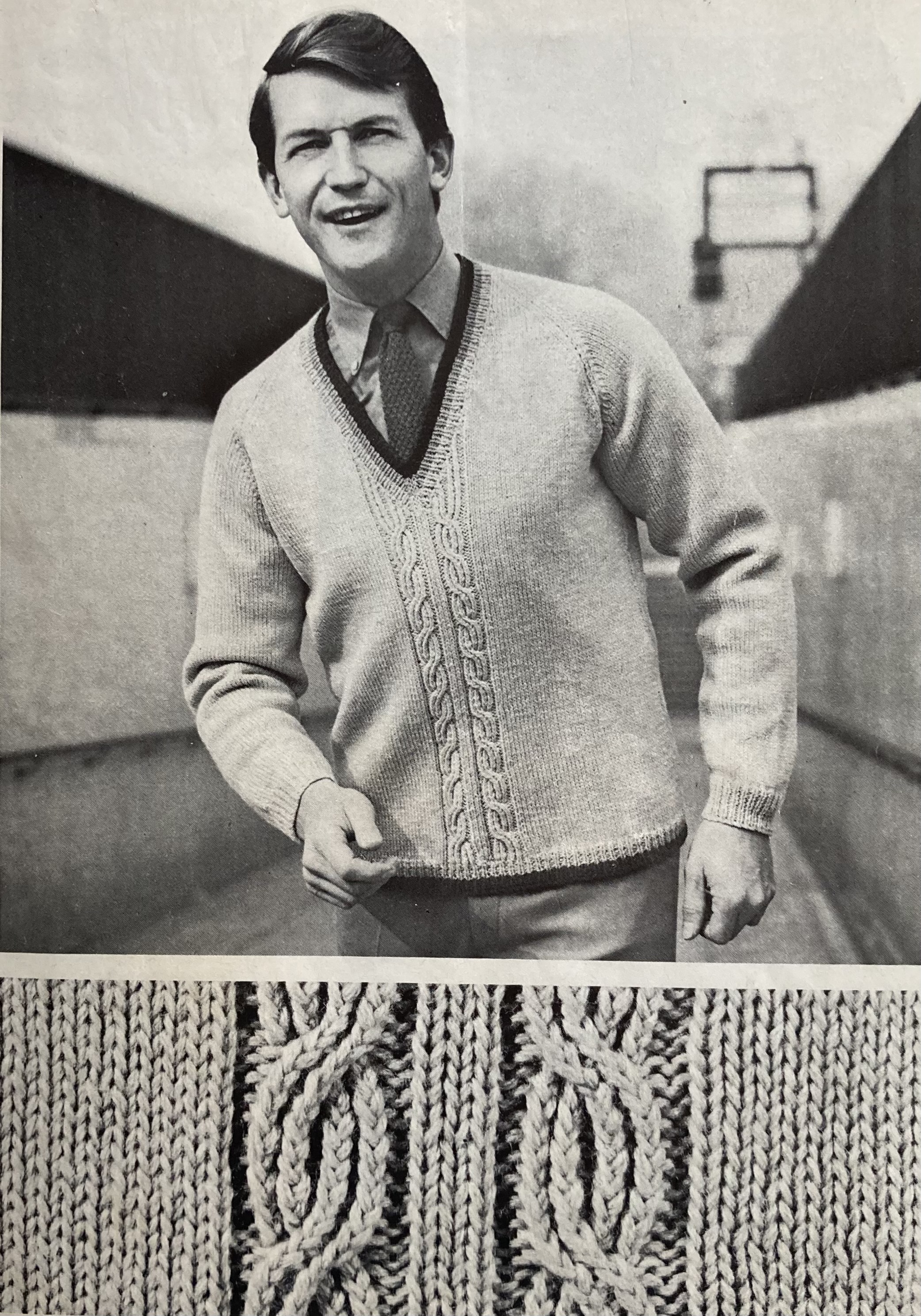
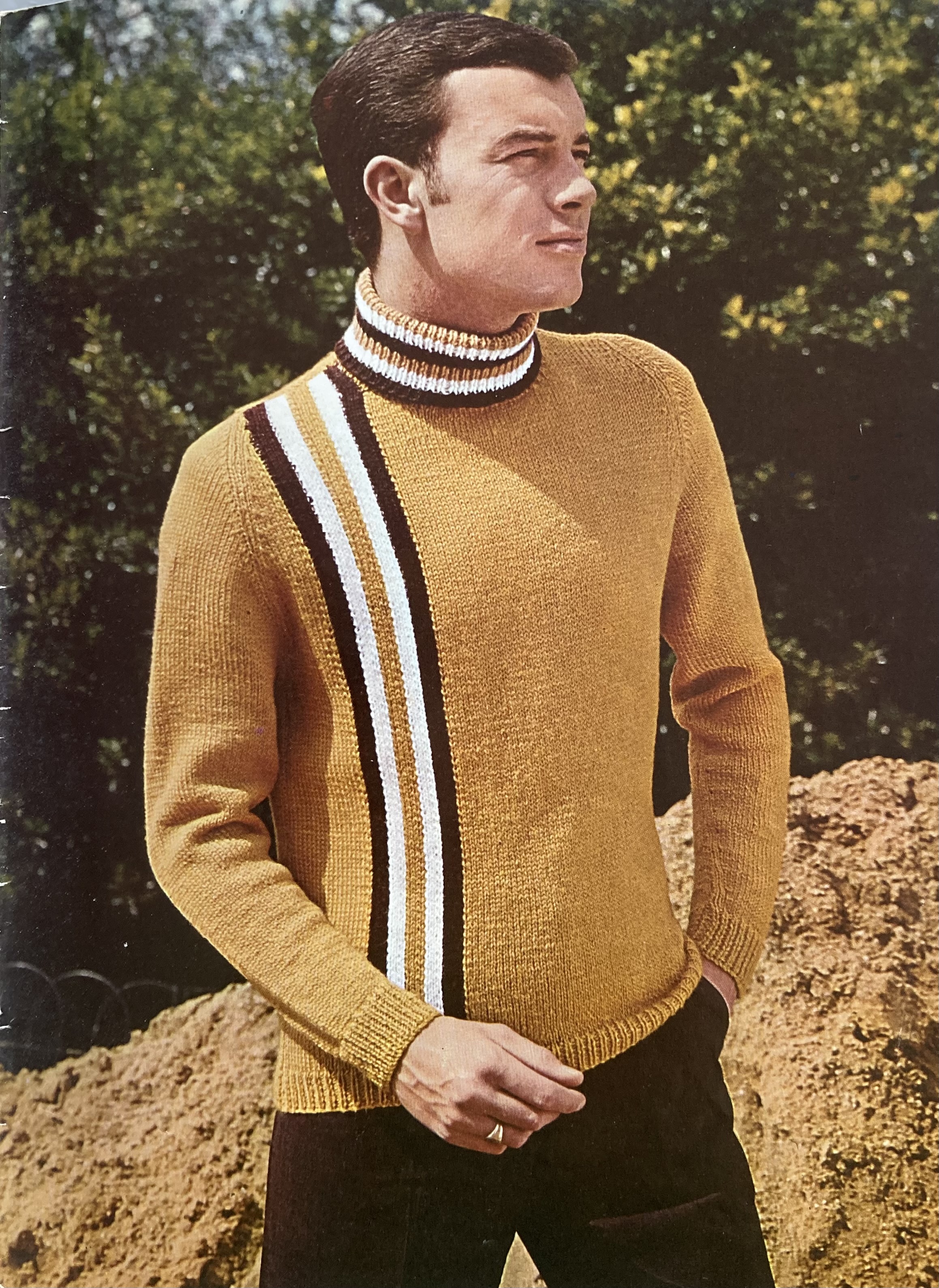
A micro-trend for contrasting yokes that encompass the sleeves and the upper bust area can be seen in both the “Fuzzy-Wuzzy” (that is the name of the wool, an angora blend) jumper for adult women and the little girl’s way-too-short-to-actually-play-in tunic dress featuring a smocked effect made by dropping an extra-long stitch and then picking it up a few rows later and a few stitches over. It is designed to be made in the very 1960s colours of “Spark Gold” with “French Mustard” and white. Men are unusually well served in this month’s issue with both an “Autumn Stroller” V-neck pullover with cable panel and a “rugged for the outdoor life” racing-stripe pullover “designed for slim chaps”. Here as well, late-60s brown and gold tones are on trend.

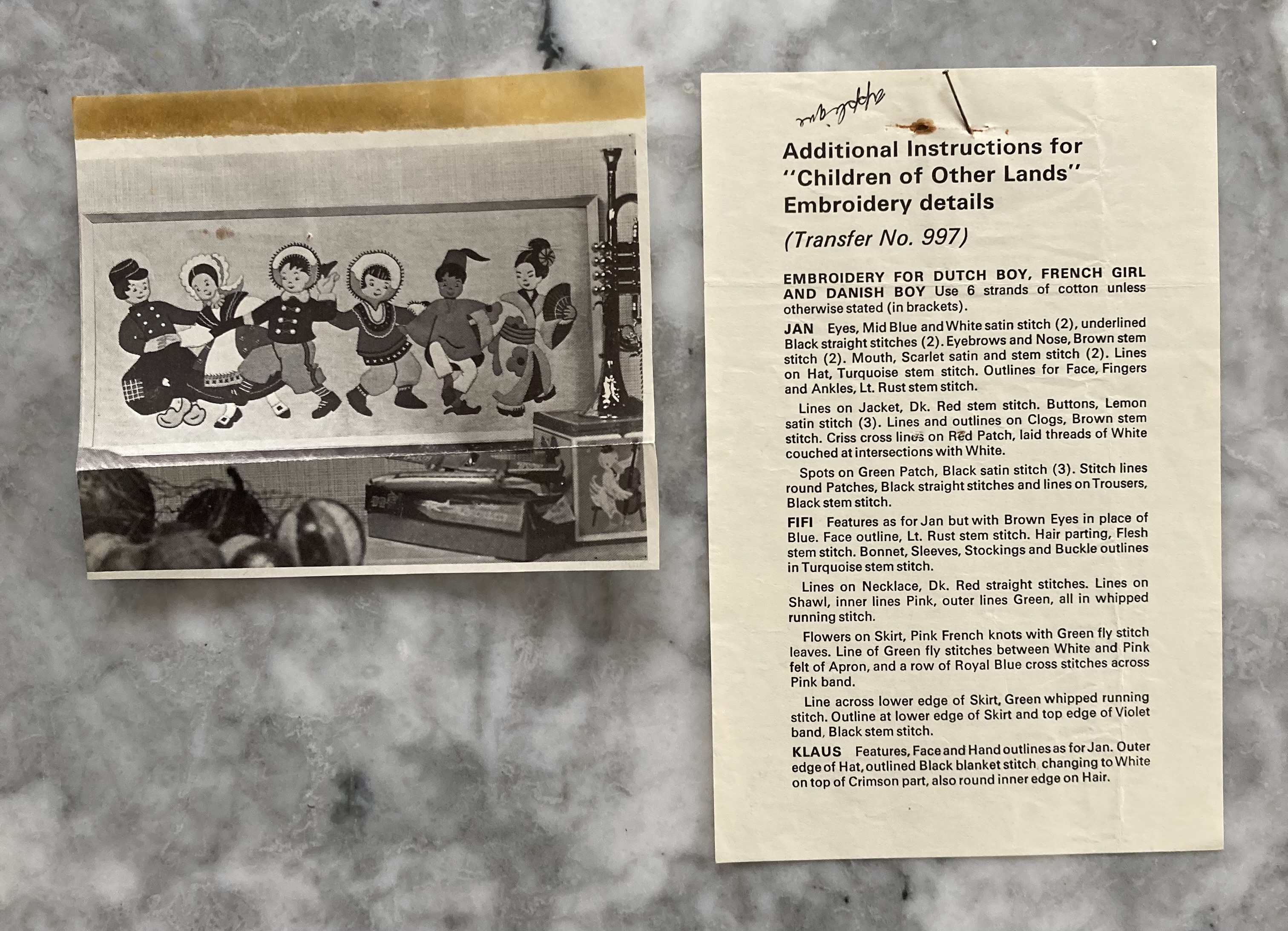
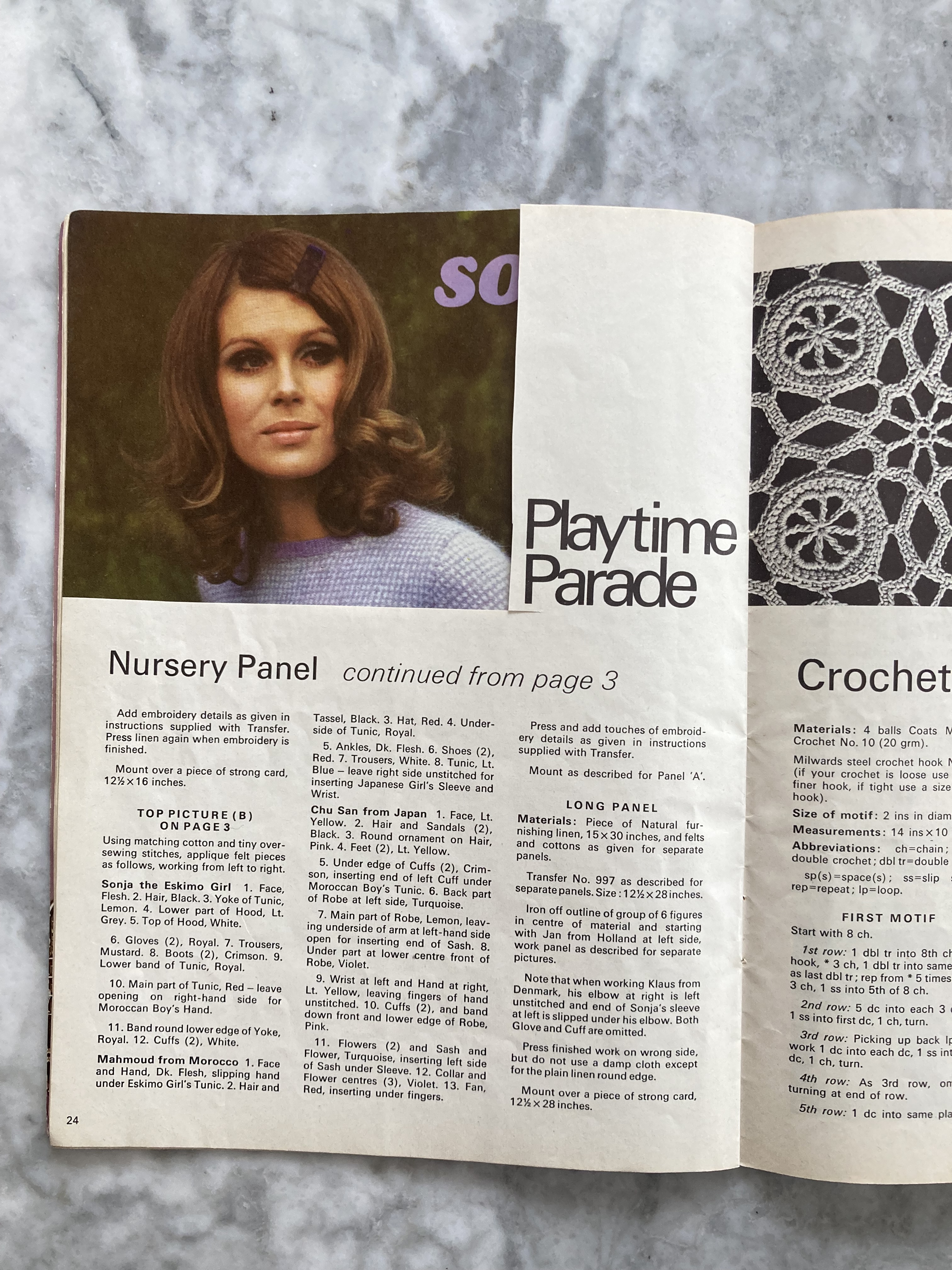
Housewares are either quite complex or easy enough to dash off quickly for a church bazaar or quick gift. On the more complicated and difficult side, there’s a large wall panel made in felt appliqué, designed after the “Children of Other Lands” serial comic that winds up in this month’s issue. Like the comics, the wall panel is sweet and well-meant (and well-designed from a technical standpoint) and the fictional children are not portrayed negatively in any way, but of course their depictions and their comic stories draw very, very heavily on outdated stereotypes. The previous owner of my copy of this issue seemd to be a fan and presumably made the wall panel: she cut out the extra photo of the finished panel from another page in the magazine and pinned a small page with additional instructions into the first page of the pattern. I’m guessing the additional instructions came with the embroidery transfer, which readers had to send away for by post.

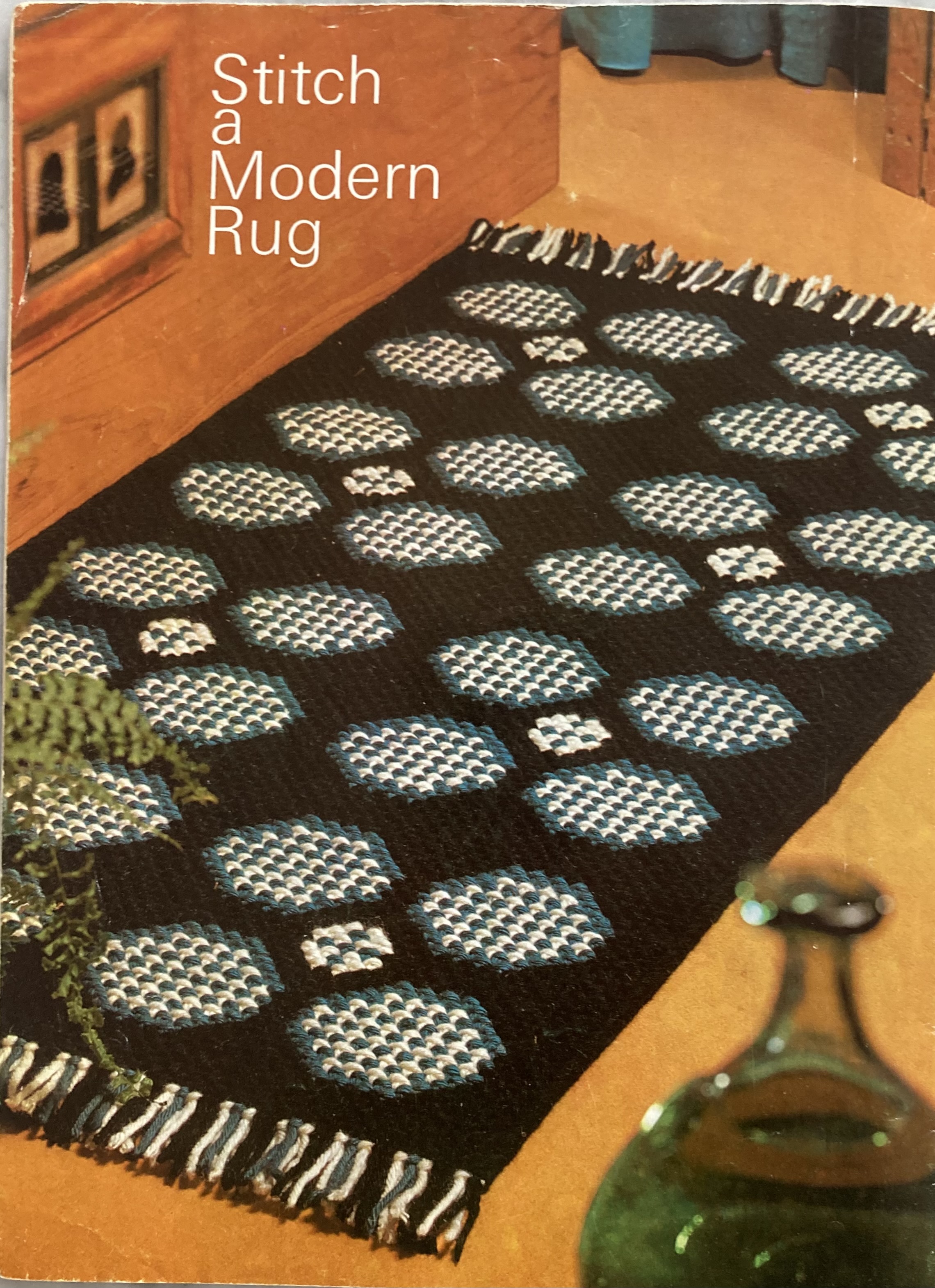
There’s an ambitious stitched rug in a very modern pattern, and a crocheted table runner (also on the list that the previous owner wanted to make) that looks quite intricate to me.

The cutwork chair set and breakfast tray set with Celtic-inspired design elements seem to be of average difficulty. Finally, there are quick and easy cosies and a crocheted handbag that promise to be “easy knitters” and “top sellers” at your next church or charity bazaar.

That’s all for this issue! I have to admit that there is nothing in it that particularly inspires me, so I will use this month to hopefully finish up the spectacular chevron-striped dress from April 1967 and the “Fair Isle Country Cardigan” from January 1967. I should be prepared for any kind of late-summer weather then.

March 1967: Overview

The March 1967 issue of Stitchcraft promises us „new fashion looks for Spring knitting“. March weather being notably unpredictable, there are warm, bulky knits for colder days (or to wear as sporty outerwear) and finer knits for Spring. The former are mostly made in „Big Ben“ to knit up quickly and warmly, but slightly less bulky in shape than before, the latter in smooth crepe wool with or without glittery accents. The „skinny“ „mini“ jumper makes an appearance as an alternative to the bulky look for young folks, and the crochet look in knitwear is still trending.

Our cover duo sports (heh) matching bulky V-necks in Big Ben wool, knitting up quickly at 3 1/2 stitches per inch. The cable panels down the front give it a little bit of vertical line to counteract the bulk. The cable-and-V-neck combination show up in a slightly less heavy-knit casual cardigan for larger sizes. The „Sweater with flower trims“ on the inside cover looks bulky, but is merely oversized and actually knitted in fine Cameo Crepe at 8 stitches to an inch. The flowers are made with intarsia with crocheted motif centres sewn on and the buttons are covered in fabric knitted from the same wool as the sweater — a cute extra touch. The crochet look in knitting continues with a high-buttoned cardigan in a sort of arrowhead-shaped slip-stitch pattern. It too is knitted in fine crepe wool, but looks bulky due to the oversized design and three-dimensional stitch pattern.

Teenage girls can knit themselves a „Little Shetland“ cardigan or pullover with an easy stranded pattern at the yoke or hem, or a fine-knit „skinny rib top“ which would be just as much in fashion nowadays as then. Whatever the girl behind the skinny rib top model is wearing is not part of this issue and will remain a mystery.

Finally, there‘s a glamourous sleeveless cocktail dress with matching jacket. The lacy pattern panels get a little extra glitz from knitting with the base wool (Cameo Crepe) and Lurex thread held together.

There are so many women‘s fashions in this issue that there apparently wasn‘t much room for men‘s or kid‘s designs. What there is is great, though: a three-piece baby set for spring outings in the pram and a hard-wearing cabled Aran pullover for a school-age boy.

The homewares in this issue are less interesting than usual and feature versatile designs that can be adapted to different furnishing needs: a woven design for a rug or cushion, grapes and leaves to embroider on an apron, mats or cushion, etc. Ambitious crafters could make an entire set for a room that way.

There‘s a cute breakfast set for a child‘s Easter morning and a crocheted mat for the adult‘s afternoon coffee table. Really ambitious embroideresses could make an elaborate and very pretty flowered tablecloth.

There‘s a new comic series in the Readers Pages which is cute and well-meant, but also fairly eyeroll-y for modern sensibilities: „Children of Other Lands“, featuring well-trodden clichés about cultural practices etc. in non-British countries. This month features Jan, a Dutch boy whose wooden shoes get stolen by mice, who use them as a boat on the canal. You get the idea. The ad for the Scotch Wool shop manages to be at least as much fun without any stereotypes.

That‘s all for this issue! I don‘t know what to make. I love the cocktail dress combo, but the ratio of time and effort in making / actual use I would get out of it doesn‘t add up. The larger-sizes cardigan is practical and nice, but I have multiple larger projects on the needles and don‘t want to start a warm cardigan in Spring. I might make another project from the January 1967 (the Fair Isle cardigan! Finally bought the wool for it!) or February 1967 (Lacy knee socks!) issue instead, or start ahead on the April project (chevron striped dress.) I promise to get something done sometime. Happy Spring!

March 1961: Overview

IMG_2399Are you ready to “Rendez-vous with Spring”? I sure am! This month’s issue has a lovely extra “centerfold” spread in colour, showing off Spring 1961’s latest fashions.
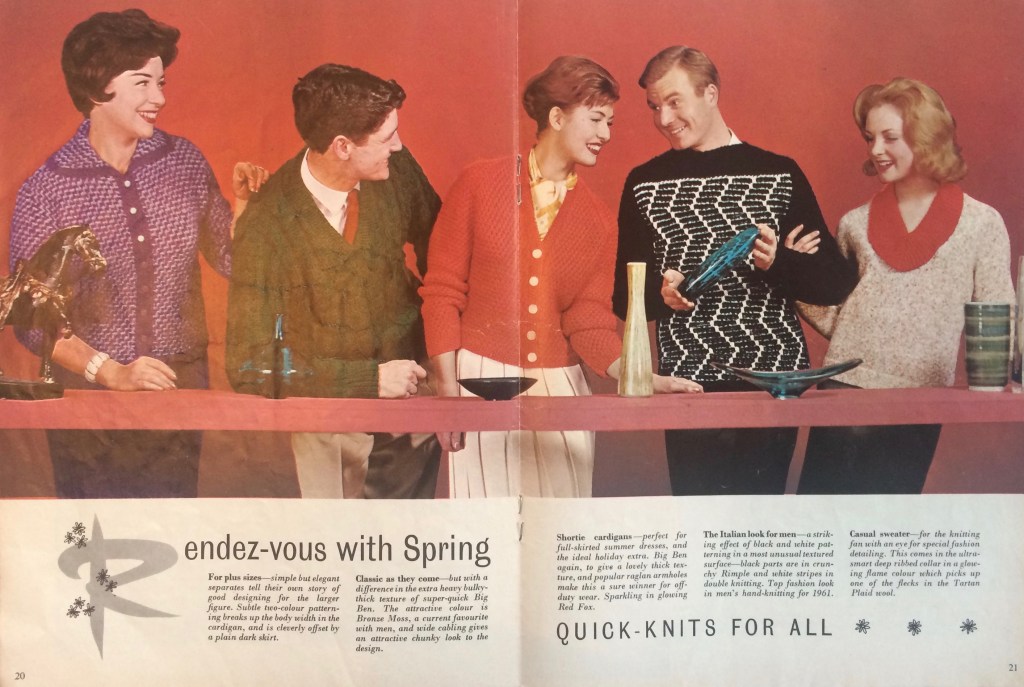
That said, no especially new looks, wools or techniques are introduced. The partner look is still going strong, as you can see from the his-n-hers Aran sweaters on the cover. They both have boatnecks, popular for a little while in the late 1950s and showing up again here. They are not shaped at the front neck at all, so I imagine them to be uncomfortable and awkward to wear.

Nubbly Rimple and thick, bulky Big Ben wools continue to be popular, featuring in almost all of this month’s adult garments. Big collars are still in, but one jumper utilises a contrast collar design in a different wool, with an interesting shape and ribbed texture. For larger sizes, there’s a cardigan skirt suit in purple plaid — bold colours and jewel tones are in fashion for all sizes and make a great centerfold picture all lined up together.

IMG_2418

In the homewares department, we’ve got another beautiful “peasant” design (they really love that word) for a cushion, a decorative wall tapestry with pictures of chipmunks, some flower embroideries for cushions or a tray cloth, this month’s Zodiac symbol to embroider on whatever you want (Pisces), and a really difficult-looking crocheted cushion cover.

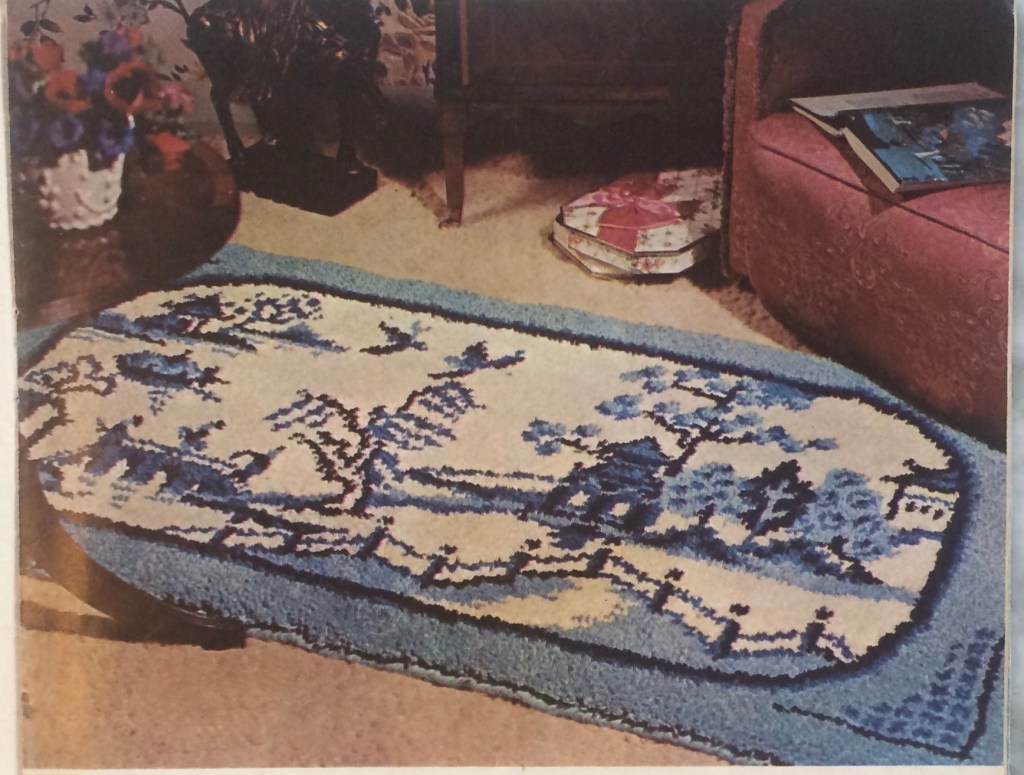
The highlight of the homewares patterns has got to be this incredible “Willow pattern” latch-hook rug. I had heard of “willow-ware” porcelain (remember that scene from one of the Anne of Green Gables books, where Anne or Davy or someone accidentally breaks Aunt Josephine’s blue and white willow-ware platter, then Anne sees a similar one in someone’s house, climbs up on the roof of the barn or something to look at it through the window, then falls through the roof and gets stuck, having to wait in a rainstorm until the owner gets home and then explain the situation?) and I have seen this type of pattern on porcelain china, but never knew that the one was referring to the other.

IMG_2417

Stitchcraft‘s description of the rug refers to “the 3 figures in the Willow Pattern story.” I had also never heard of any Willow Pattern story, but my good friend Wikipedia told me all about the history of the Willow pattern and the associated legend (spoiler: the “legend”, like the pattern, was a 100% British invention made up to sell more porcelain goods, not any kind of authentic Chinese folk tale). Both the pattern and the associated story served as inspiration for further literary, media and commercial works. You can read all about it here.

Finally, it would not be Stitchcraft without a page of little items “for sale-of-work” at church bazaars etc., or to surprise your family on Easter morning. The continuation of Belinda the doll’s knitted outfit is quite cute, but what on earth were they thinking with these egg cosies?!? They look positively psychotic. If I were a child and my mother served my Easter morning Easter egg in one of those things, I would be surprised all right… and probably wouldn’t sleep for a week.

IMG_2424 2

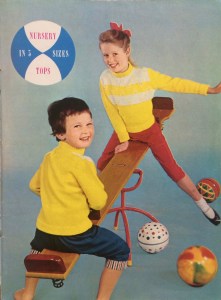
Speaking of children, here are some who weren’t scared off by their egg cosies and were rewarded with bright, sunny “play sweaters from Vienna” in spring colours of lemon yellow and white. The caption on the page opposite is “Gay as a See-Saw!” I’m sure there are a lot of jokes one could make about gay and see-saws, but I won’t. The kid’s comic in the back pages has the usual continuing story — Wendy and her dog Wag are having some fun adventures in Wallpaper Land.

IMG_2423The ads are for the usual knitting machines and sewing fabrics… except for this one, for “Cooper’s moth proofer” spray, presumably made of DDT  or some other extremely toxic insecticide that kills “ants, beetles… these and other crawling insects die on contact — even months after spraying.” Just the thing to use in your enclosed, airless closet space!
With that, I wish you all a lovely, non-toxic, gay as a see-saw rendez-vous with spring. My March project will be some version of the flower embroidery.


July 1960: Charming blouse

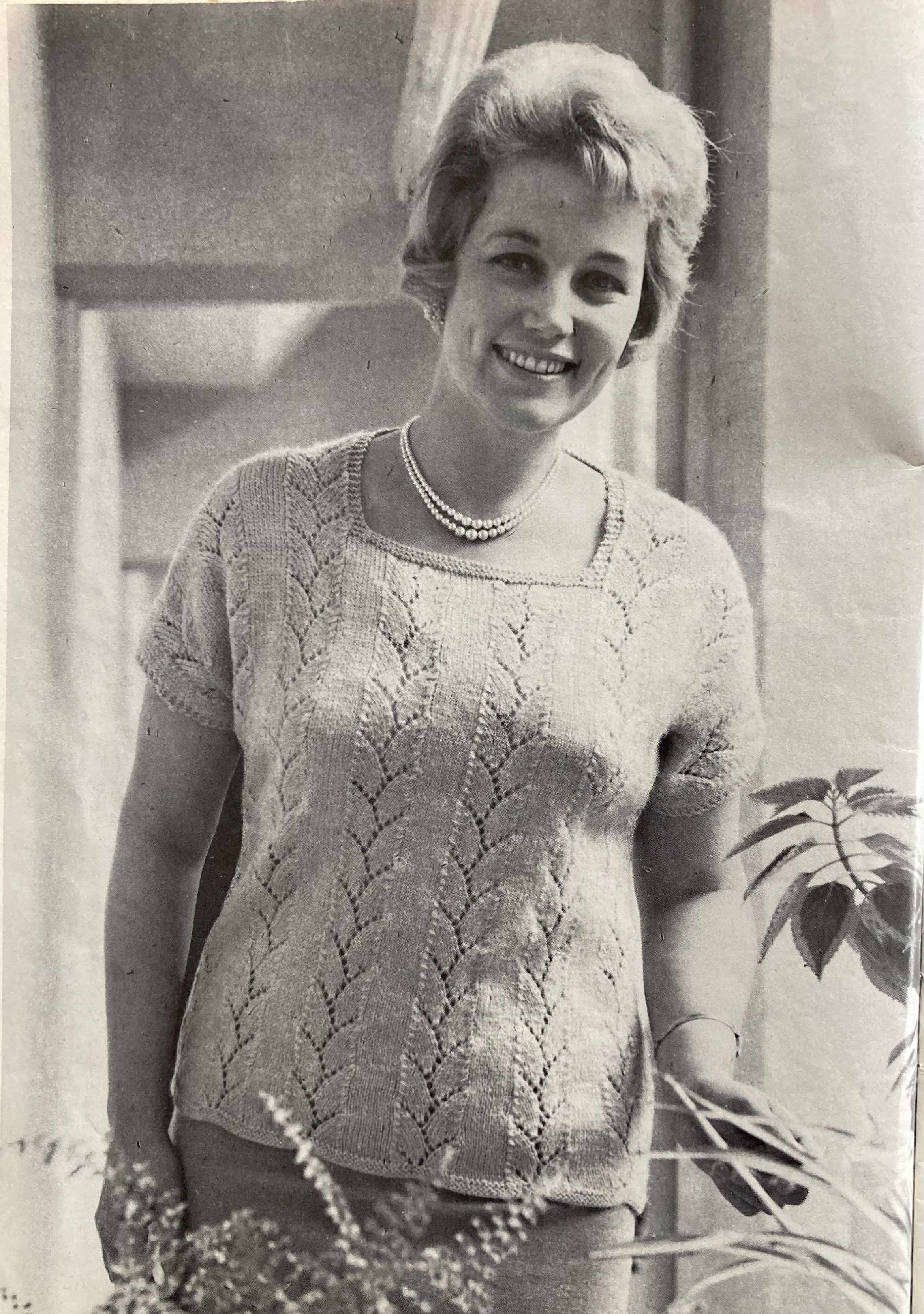
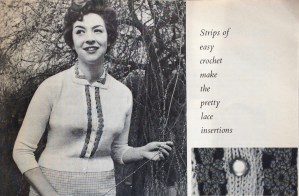
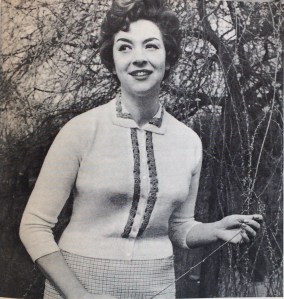
IMG_1894This “charming and unusual design for larger sizes” (37-38 or 39-41 inch bust) features narrow dolman sleeves, crochet insertions, and horizontal bust darts.
I was intrigued by its construction, having made tops with bust darts from modern patterns or while working without a pattern, but never having seen vintage patterns with them. Oddly, instead of making short rows, you are supposed to cast off stitches, cast them back on again, and then sew up a seam! I guess that makes it look more like sewn fabric? Or the “editress” thought short rows would be too difficult? I can’t imagine that, though, since patterns from this time regularly call for short-rows to shape the back side of baby rompers and leggings. In any case, I made the bust darts with short rows to avoid having to make a seam. I also made the back and fronts up to the armhole shapings in one piece, again, to avoid seaming more than necessary.

IMG_1936I was interested to see how it worked out with the dolman sleeves. When I think of “dolman sleeves”, I think of those 1950s, or worse, 1980s garments with a huge triangle of fabric under the arm, which must have been very uncomfortable and inconvenient to wear. But after my April 1960 blouse with the horizontal cap sleeves worked out so well, I was willing to give this one a try. And it turned out great! There is no more extra fabric under the arms than there would be with set-in sleeves, and the horizontal construction gives plenty of room in the upper chest/back area, where I am quite wide. I guess the secret lies with the number of stitches cast on for the sleeves per row — this one had 2×8 rows and then 10×16 rows, making the sleeves narrow and more horizontal, thus less triangle-like.
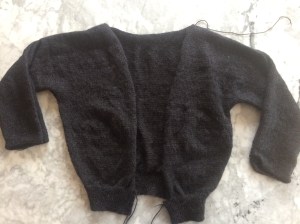
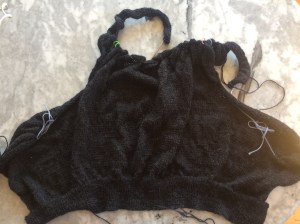
IMG_2075The knitting was slow-going at 7 stitches to the inch, but of course once the body was done, so were the sleeves. Seaming was a nightmare, as the yarn (Herriot Fine from Juniper Moon Farm) curls more severely than stockinette stitch in other yarns and I had to block it well to even find the edge to sew. I was willing to put up with that, though, because the yarn is absolutely fantastic. It is warm, soft, weighs practically nothing (300 grams made the blouse with about 20 grams to spare) and it is the only alpaca I have ever worked with that I can wear directly next to my skin. It is the perfect, ideal wool for this type of knitted blouse.
(On that note, why on earth did knitted blouses go out of style? They are wonderful! The perfect garment for autumn days in a damp, chilly climate. Note to self: make more.)

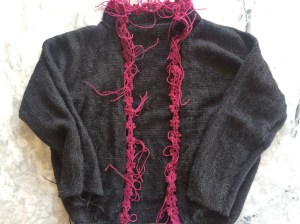
IMG_2086What took longer than expected was the whole crocheted edging-collar-button-band extravaganza. The crochet bands are extremely fiddly — they are crocheted onto each other as you go, it’s difficult to make them all exactly the same size, and each one needs its own, new piece of yarn. There are a total of 50 elements, so that’s 100 yarn ends to weave in right there. Then there’s the “inner” collar, the “outer” collar and the button bands, all of which are made separately and sewn on, and somehow need to end up symmetrical and fit properly on both sides. Of course, I sewed the collar on backwards the first time, forgot to switch the right and wrong sides at the collar fold, etc, etc. It all worked out in the end, though.
My only modification (besides the short-row darts) was to make the sleeve ribbing 3 inches long, like the waist ribbing, instead of 1 1/2. The sleeves are still not full-length, nor are they supposed to be. I don’t like the idea of 3/4 or 7/8 sleeves, but it worked out better in practice than in theory.

To sum it up: Pattern was wonderful, yarn was wonderful, knitted blouses are the coolest thing ever and I am 100% satisfied with this project.

Version 2

July 1960: Overview

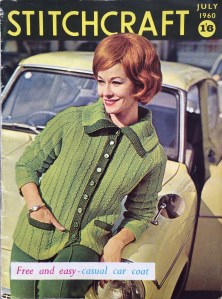
IMG_1879“Free and easy” is this month’s motto. Summer is here and nobody really feels like handling warm wool, so the emphasis is on “travel knits” (lightweight), “casual knits” (not too complicated) and “stroller styles” (loose and oversized). There is more embroidery and needlework than knitwear, and some easy sewing projects. Shall we relax and take a look?
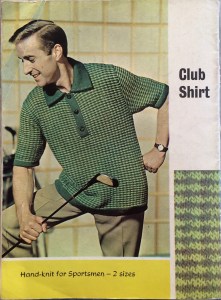
The combination of dark and light green continues to be in fashion: we saw it in the great houndstooth jumper from January 1960 and it’s here again in this “casual car coat” and and the loose-fitting men’s checked shirt style on the inside back cover — “suitable for golf or to wear with beach shorts.”

IMG_1898I have to take a moment here to quote one of my favourite Roald Dahl stories, “The Boy Who Talked With Animals.” It’s about a little boy who saves a giant tortoise from the soup kettle, and Dahl’s description of the tourists waiting on the beach for the caught tortoise to be hauled in has, for some reason, stayed with me through the years:

The men were wearing those frightful Bermuda shorts that came down to the knees, and their shirts were bilious with pinks and oranges and every other clashing color you could think of. The women had better taste, and were dressed for the most part in pretty cotton dresses. Nearly everyone carried a drink in one hand.

I would hope Stitchcraft readers and their men would have had better taste, but I’m not always sure.

The other “free and easy” knits are mostly nice without being really special: a pretty cardigan with knitted-in pearls, nubbly Rimple, a short-sleeved blouse and some cute tops for teenage girls.


The “plus-size” (37-40 inch bust) cardigan blouse is really elegant, though, and has a feature that I have honestly never seen in any other mid-century patterns: short-row horizontal bust darts. But unlike modern methods of short-rowing where the turning stitches are wrapped or otherwise bound up with the stitch next to it, you just cast off the stitches and cast them on again, sewing the dart up afterwards as you would a sewn blouse.  IMG_1895

For the little ones, there’s a sun-suit, a fluffy top, and a waistcoat to sew and embroider. The waistcoat is a tie-in with the current comic, “The Magic Needle”, in which our tailor hero’s magic needle has just made a lovely embroidered waistcoat for Mouser the cat. In addition to the waistcoat, you can sew a stuffed toy Mouser, and while you’re at the sewing machine you can make this adorable gingham skirt to wear “over a frothy petticoat” and an amusing apron “for the needlework stall” (Stitchcraft often gives ideas for inexpensive projects that can be sold at church bazaars or other “sale of work” opportunities.)


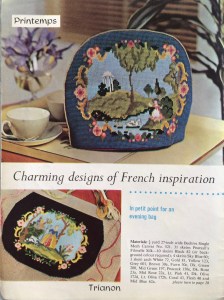
IMG_1881You can also embroider a tablecloth, make tea-towels in huckaback, or attempt this fabulous tea cosy and/or evening bag in faux eighteenth-century tapestry. I so, so want to make this evening bag! I would love it and use it all the time. But I am too overwhelmed by the idea of trying to make a chart based solely on the photos — the design is fairly intricate — and having never before attempted tapestry work, I fear it would just be too much for a rank beginner. I will definitely file it away for future days when I know how to approach it better.

That’s it for free-and-easy July 1960! I’ll leave you with a parade of well-dressed cats, courtesy of Mr. Tuckett’s magic needle. My project from this month’s issue will be the lovely bust-darted cardigan blouse, and I’ll try to finish up the projects from April (!) and June.