September 1967: Overview

It’s time for a “Fashion Switch” over at Stitchcraft! 1967 is the year where knitted dresses really start to feature, and as far as I can tell, the “switch” part means you can either make a dress or a skirt combo and mix and match. The cover designs fit in well with the trend: high necks, short skirts, deep raglan armholes, A-line shaping and big patch pockets. Note, too, the huge hats — they will only get bigger in the months to come.

The centrefold photo shows a slinky variation on the theme with a dress and/or skirt combo featuring a pretty beaded and textured design. Like the chevron dress from April 1967, the designs pick up some elements of 1920s and 30s fashion, while keeping a distinctly late-60s shape.

Other women’s knits include a bouclet blouse for the fuller figure with a very neat and pretty “soft-roll” neckline, a casually elegant afternoon suit with cable trims, a striped skirt combo in “colour brilliance” (tangerine and violet!), and a “Golden Glow” bright yellow pullover.

“Colour brilliance” applies to men’s fashions too, for once, and this green and yellow slip-stitch cardigan is a masterpiece. The model looks a bit like a colleague of mine — should I knit it for him? The other men’s garment, a chunky but streamlined pullover, echoes some of the design features of the women’s “fashion switch” combos. like the big patch pocket and contrasting-pattern sleeves. The photo is black-and-white, but the suggested colour is “Curry”, which I assume will be some kind of dark gold-brown-orange (so 60s). For children, there are two nice, sturdy, basic raglan pullovers in a more classic colour scheme — dark charcoal with red trim for the boy’s and “Cloud-dust Pink” with “Aztec Gold” trim for the girl’s.

There are some fun homewares for all styles and abilities, starting with some very easy sewn and embroidered aprons with whimsical kitchen designs. I’m not interested in the aprons, but I love the top that the “teatime” model is wearing! You can make a tapestry panel of an Irish homestead in Rosguill, Donegal or a cushion or chair-back in a gorgeous traditional-inspired design updated “for a modern setting”. Both are done in tapestry wool on furnishing linen.

It’s not too early to start on little gifts for Christmas, and here’s a little bag “for a friend” and a knitted tortoise toy “for a toddler.” Baby gets a thick, squishy pram cover in fluffy “Ariel” wool and a raised cable trellis design.

Or you can make a Florentine-pattern workbag or cushion for yourself. The colours — gold, green, and yellow — will match nicely with a lot of the knitted designs from this month.

In the “Readers Pages”, we finall have a new comic: Sue and Samuel Squirrel run the Woodland Wool Shop. Their adventures start when Sue finds a loose thread of yarn in the woods and winds it up — only to find that she has unraveled an elephant’s vest and needs to knit it all up again! Poor Sue. The only full-page advert is for Bri-Nylon. I imagine the dress in the photo is quite hot and impractical, especially if knitted in synthetic nylon wool, but what a lovely photo.

That’s it for this month! There are so many great projects that it’s hard to choose, especially since the ones that call to me are all big projects and I just finished the chevron dress from April 1967. I love the orange cover dress and the men’s slip-stitch cardigan, particularly, as well as the fancy embroidery design, which I think would look lovely going around the hem of a full black skirt. Or maybe even the Florentine needlepoint? I don’t have much time in September to knit, though, and even less to adapt an embroidery or tapestry pattern. We’ll see!

April 1964: Overview

Like March April weather, Stitchcraft‘s „Spring Lineup“ from March April 1964 has a little bit of everything to offer. (No, that was not an April Fool’s joke — I have apparently lost track of time. Thank you Gretchen for noticing!!) There are warmer garments to wear on a spring ramble or for summer sailing, knitted cardigan jackets to take the place of outerwear, some slightly dressier separates for a going-out ensemble, and easy homewares that can be packed and taken along on your coming holiday.

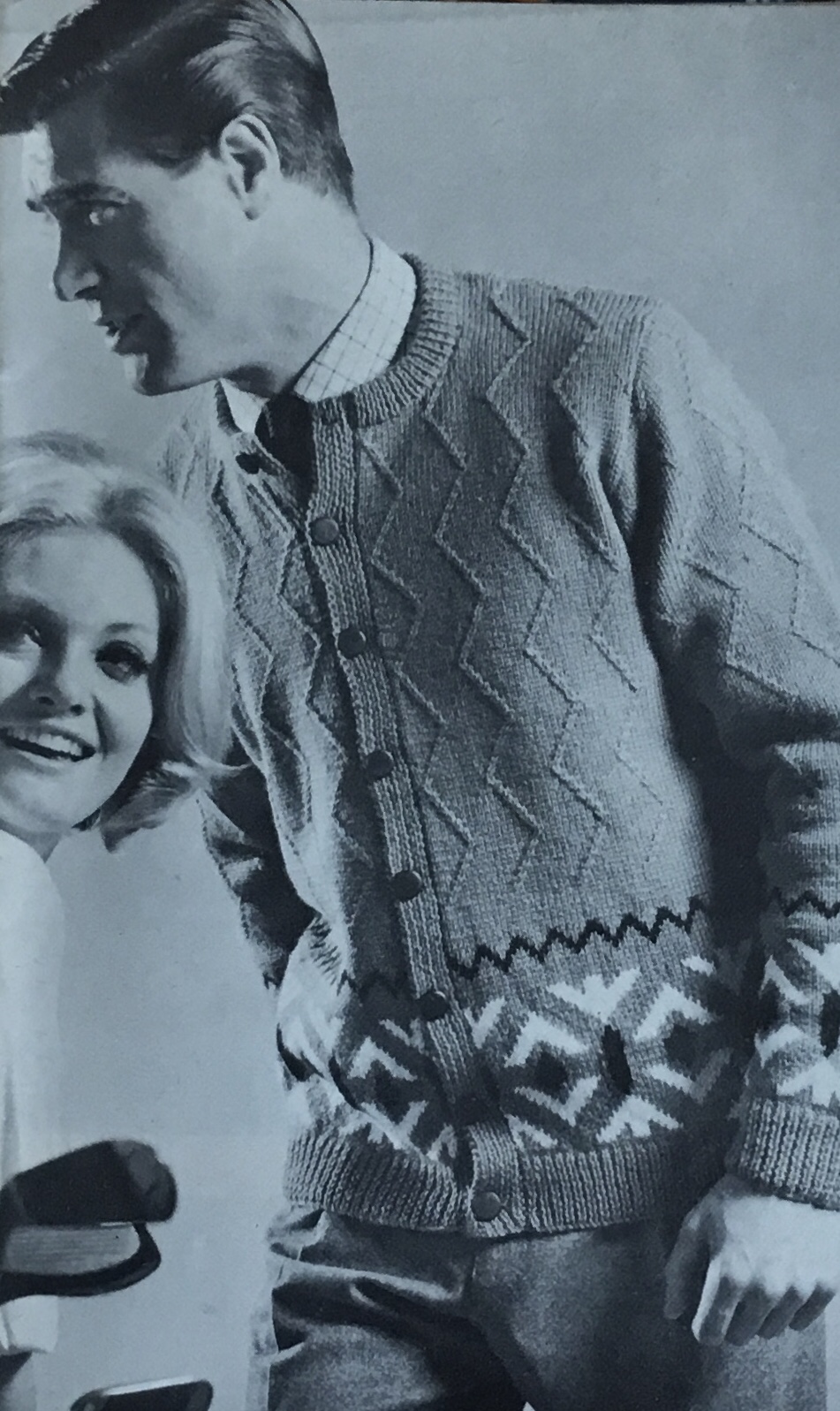
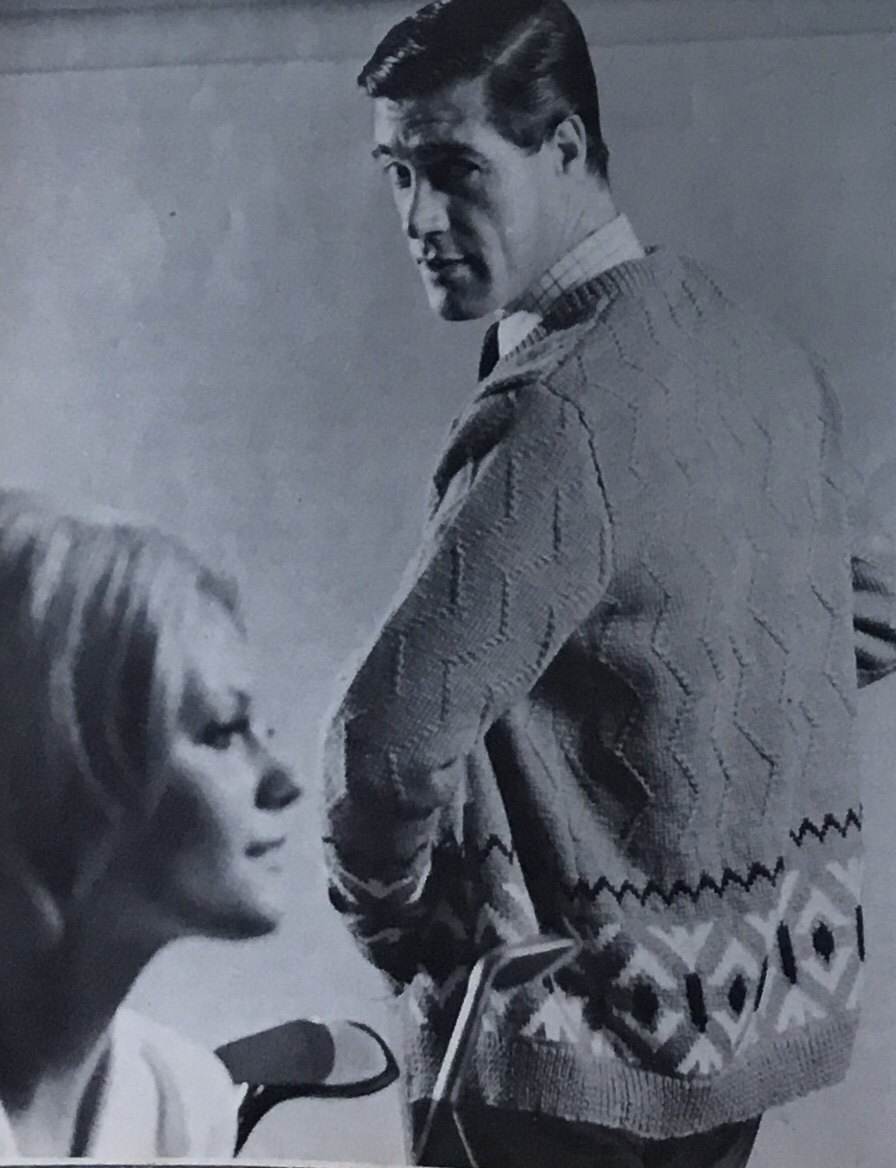
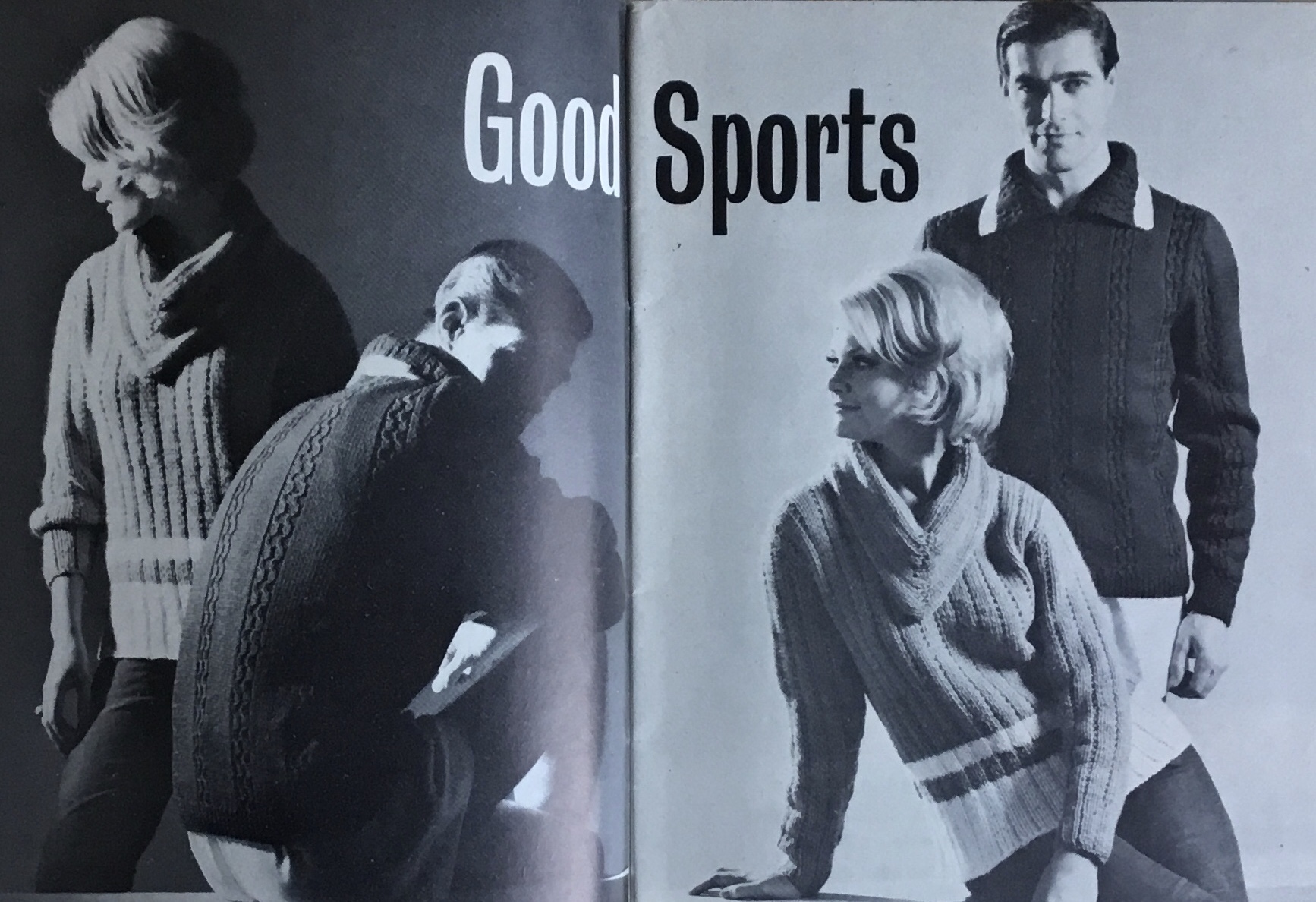
Our cover model is wearing a knitted jacket whose texture almost gives the appearance of being woven, thanks to a very firm three-colour slip-stitch pattern made by moving the working wool back and forth and so „wrapping“ the slipped stitches on each row. It‘s made in Totem Double Crepe and is intended to be worn as outerwear — as well as being „ideal for the car.“ Men get an outerwear-cardigan as well, this time with a combined texture and colour pattern and classic shape, and anyone can wear these casual, loose-fitting „sports sweaters“ while sailing or otherwise out in cooler maritime weather.

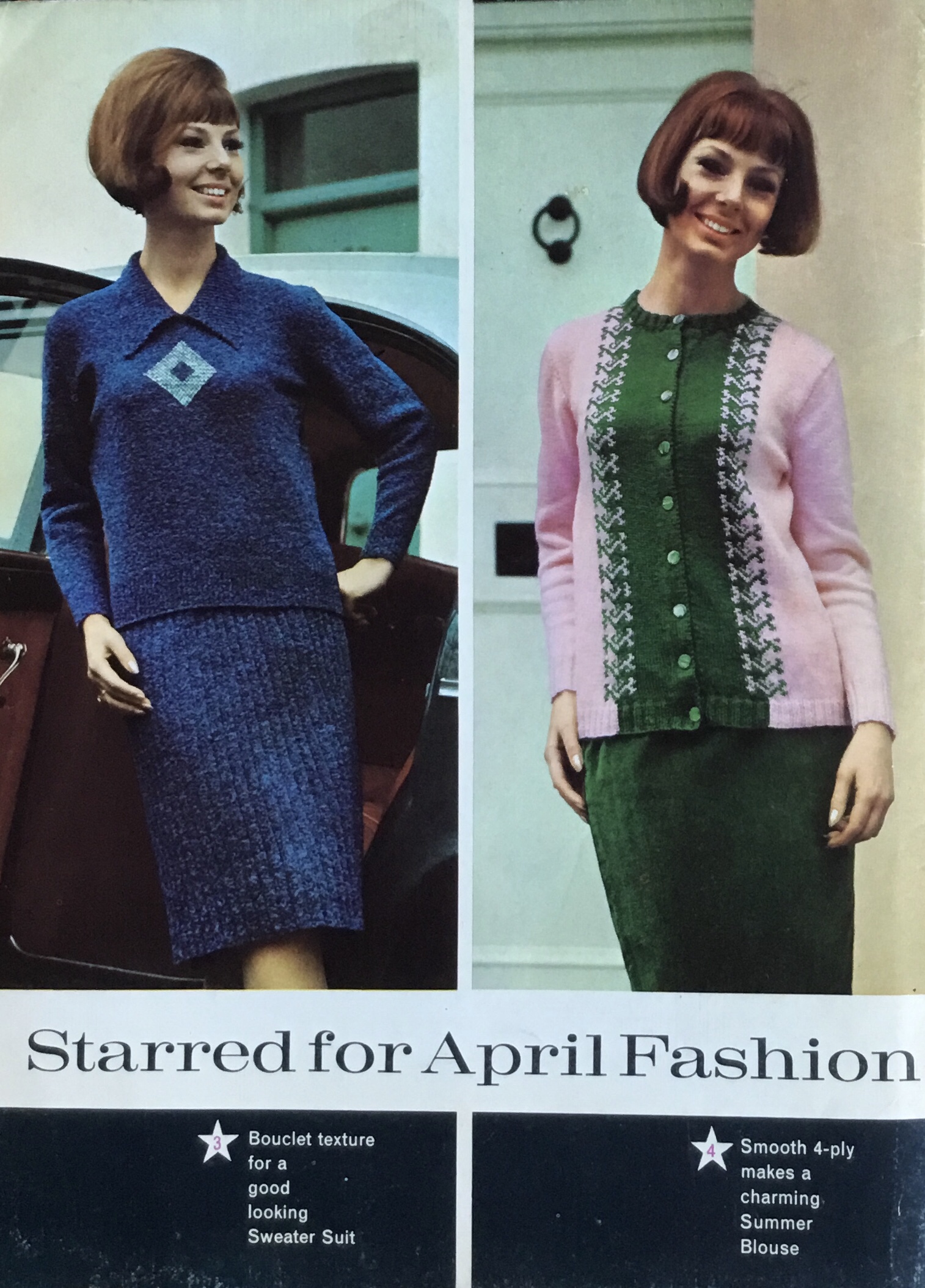
For more dressier occasions, there‘s a two-colour fancy cardigan in 4-ply fingering weight, or a jumper with matching pleated skirt in 4-ply bouclet. You can also make an „overblouse“ in double knitting to wear over a short-sleeved, lightweight jumper in a new twist on the twin-set theme. Zig-zag patterns, whether worked in colour or texture, and large collars continue to be popular.

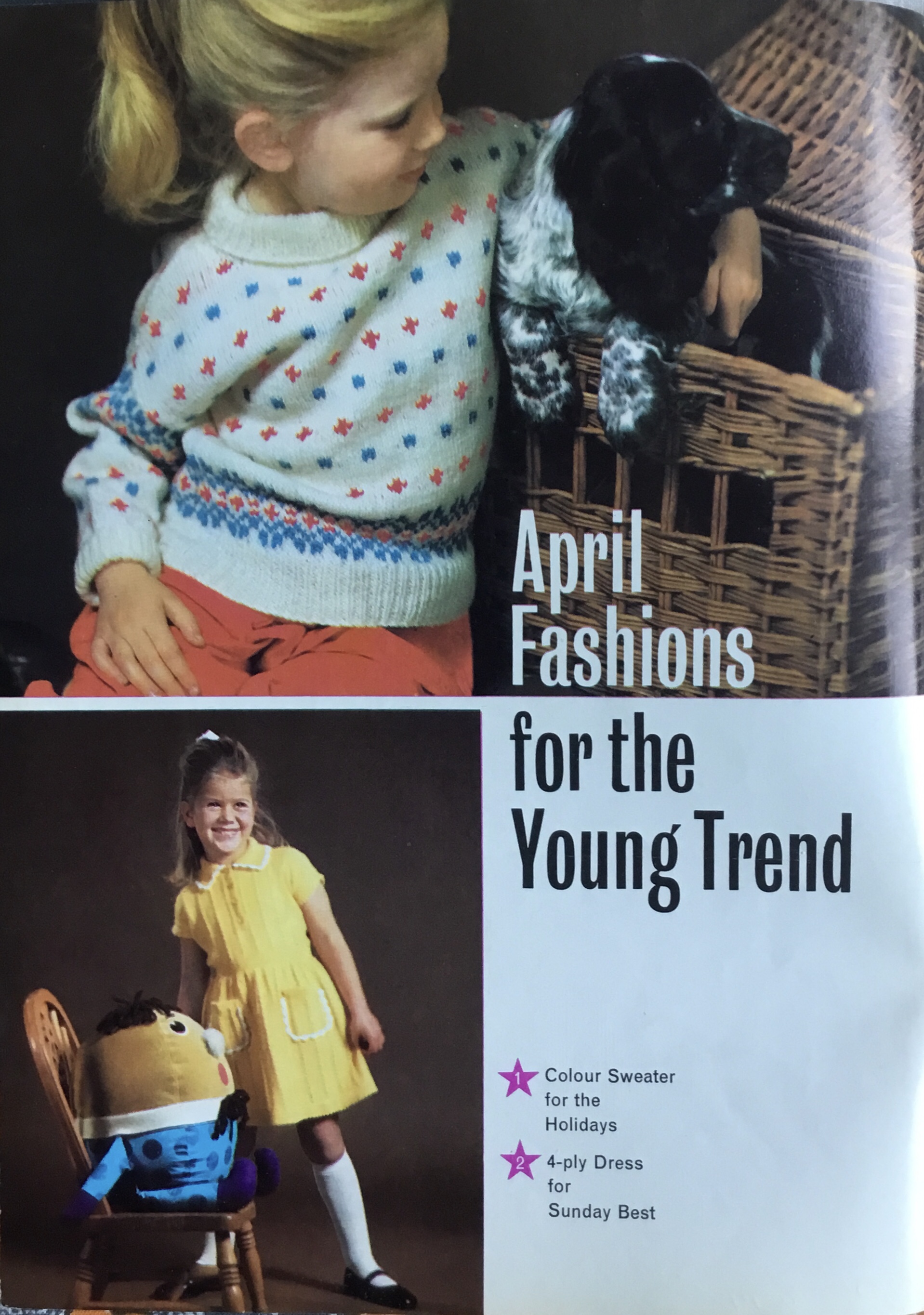
In the „Junior Knitting Fashions“ department, there‘s both a warm Scandinavian-style sweater in a typical snowflake pattern, or a wonderful „Sunday best“ dress.

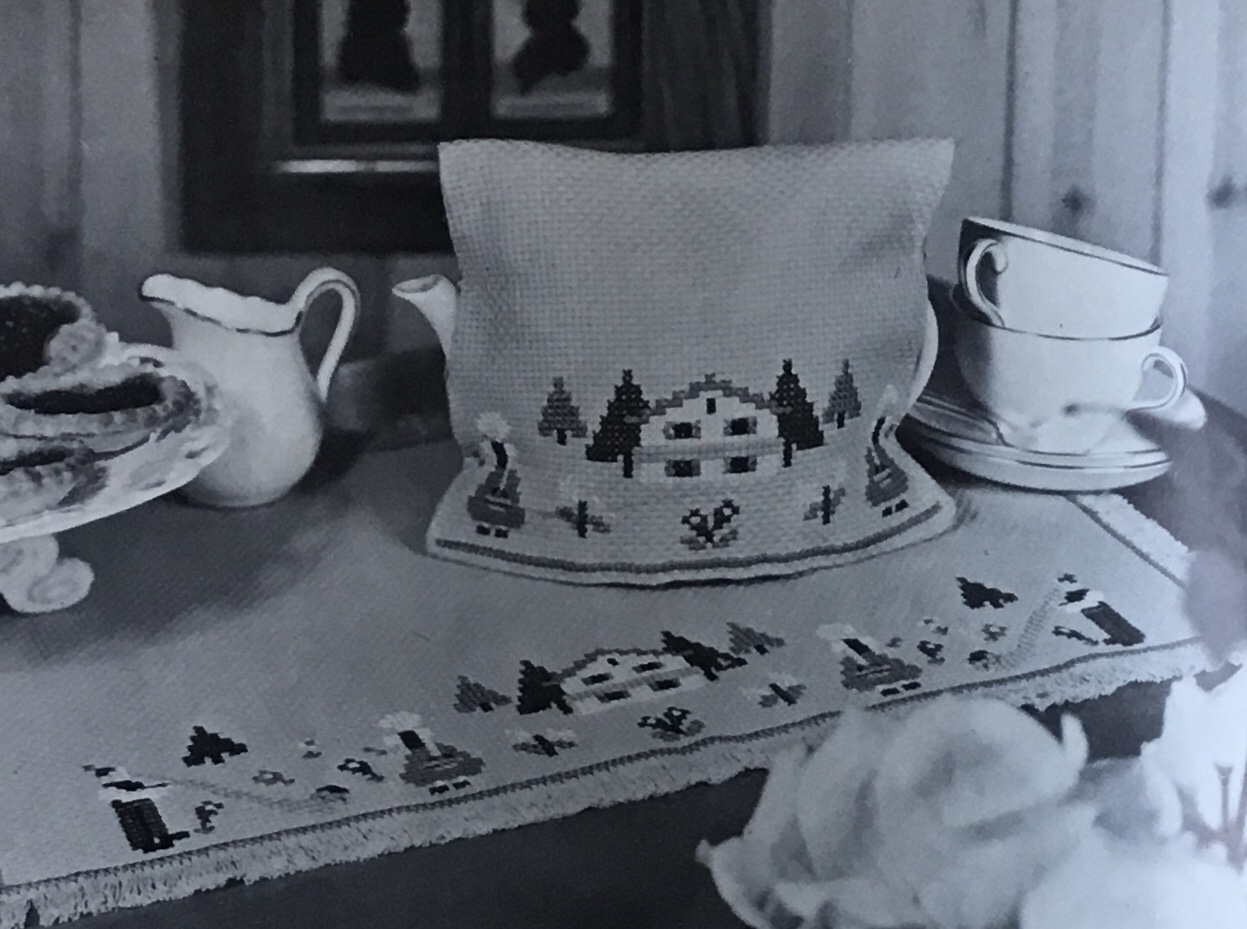
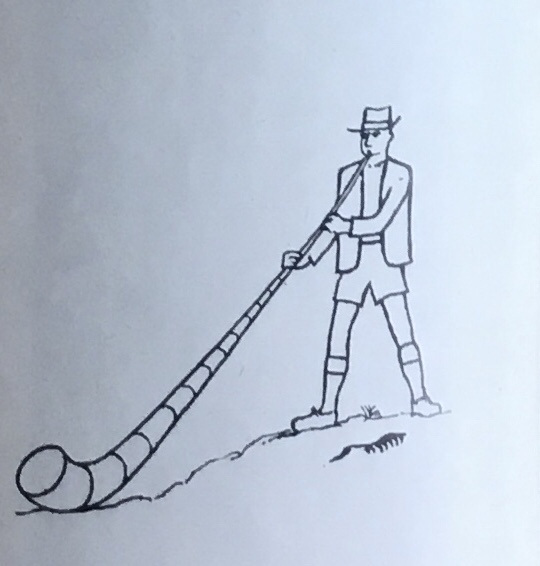
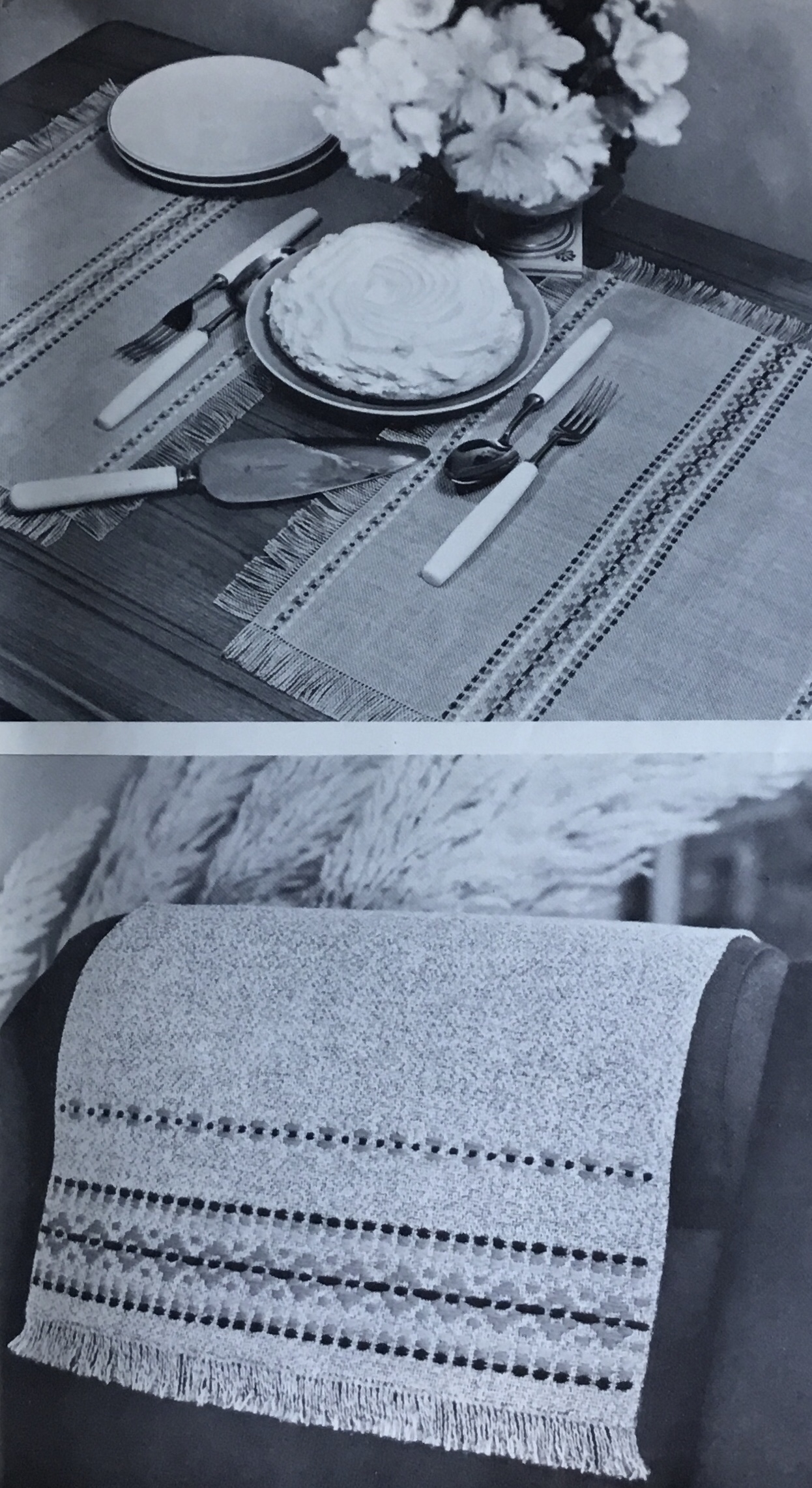
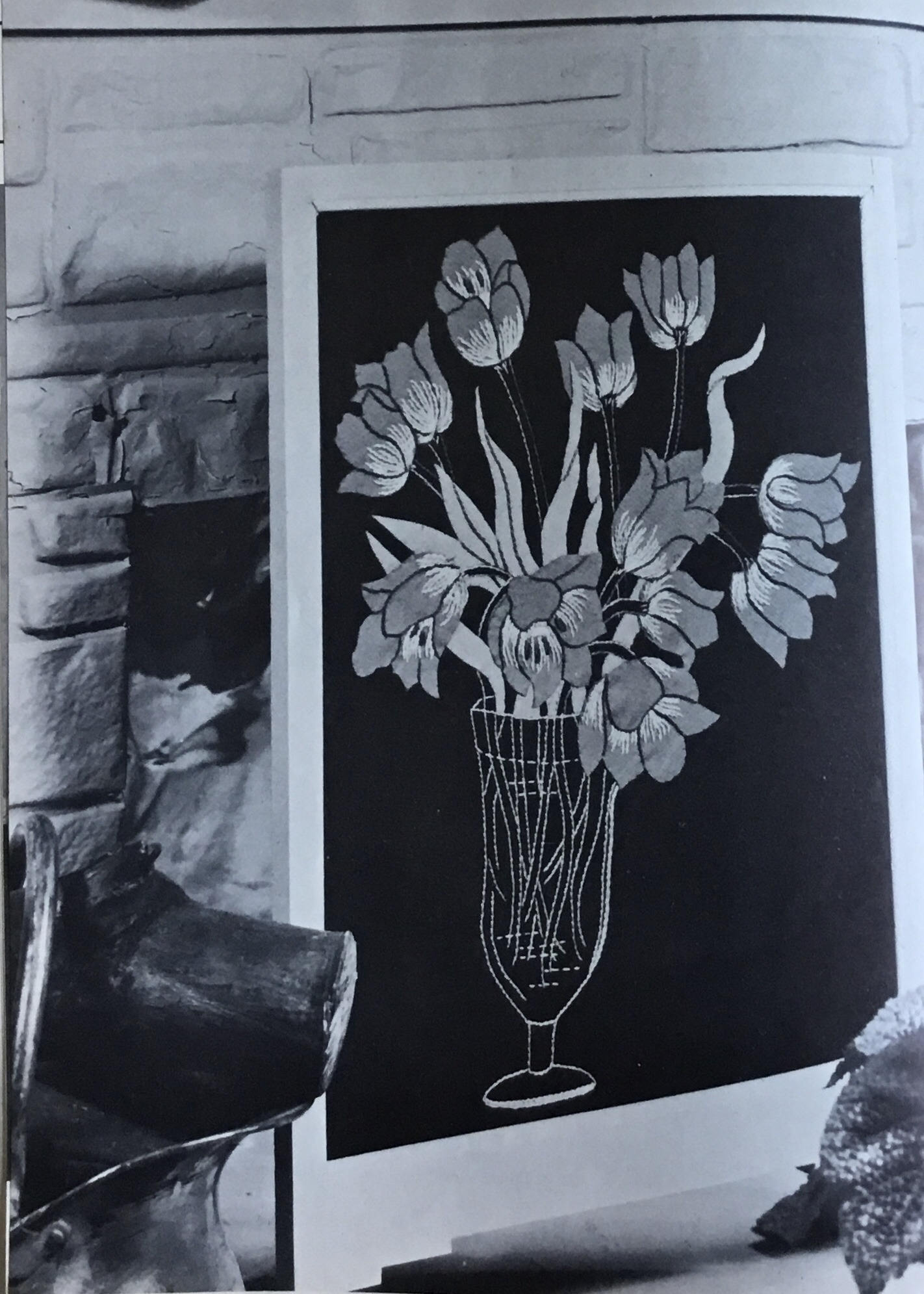
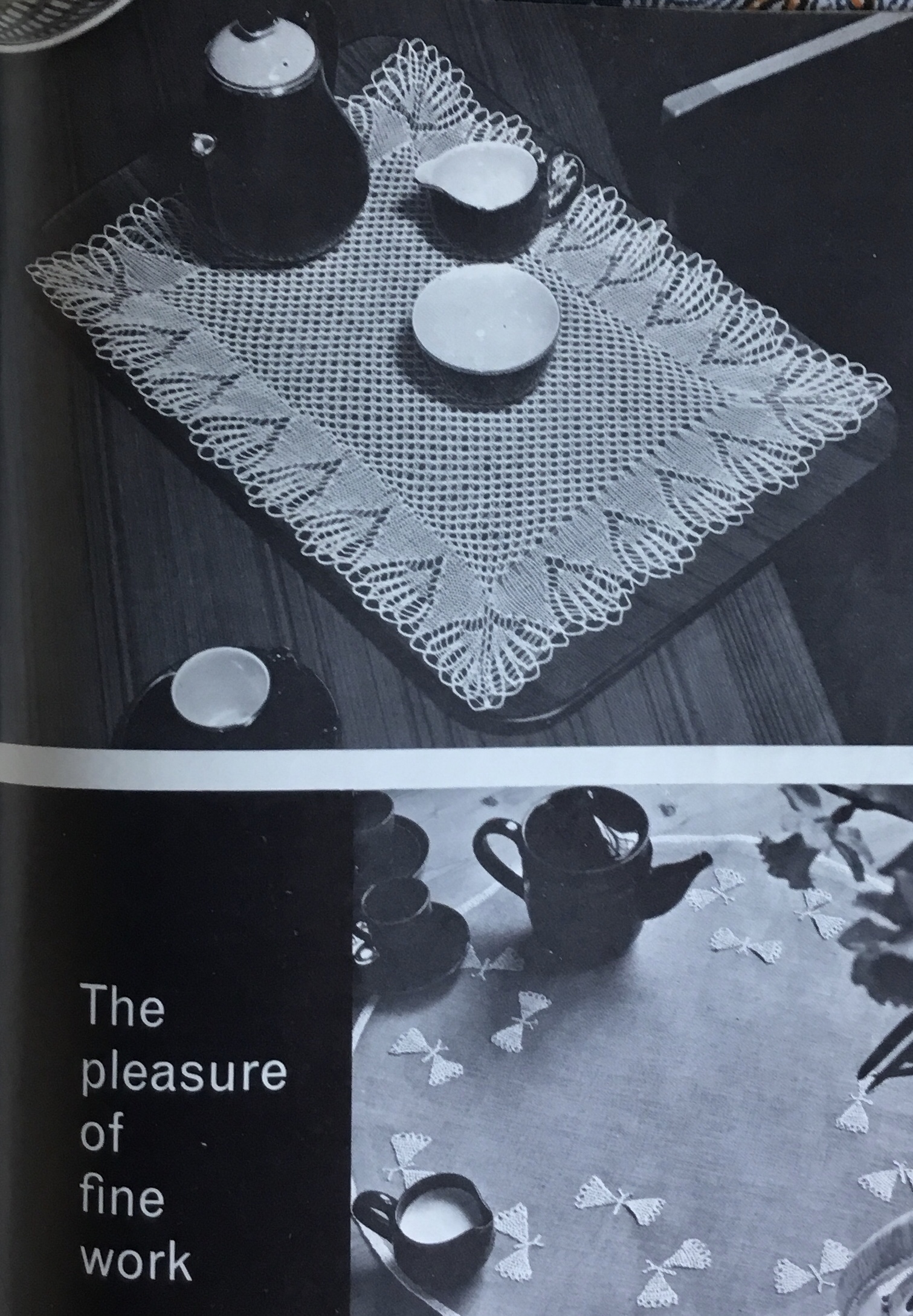
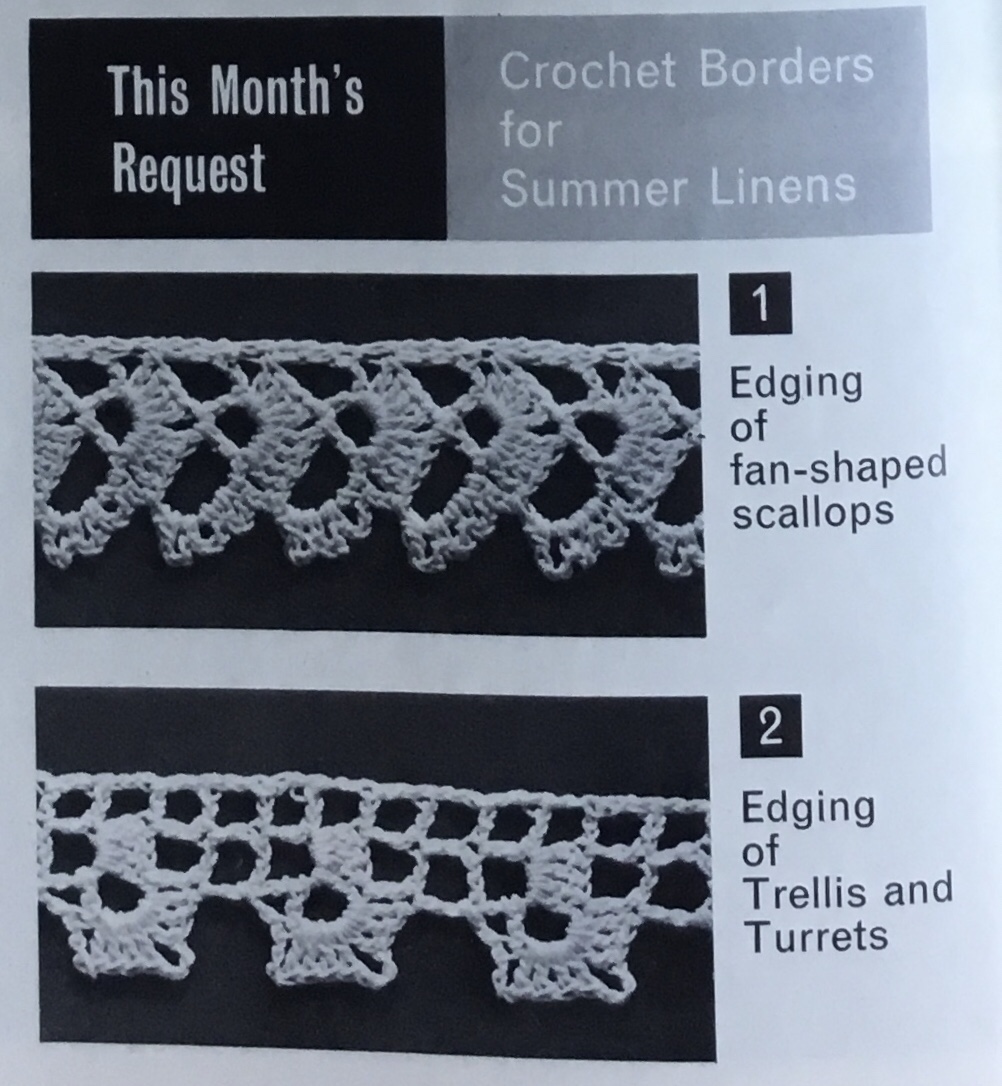
Homeware project ideas are plentiful, but not out of the ordinary. Embroidery fans can make a lovely apron with a traditional Romanian design, or cross-stitch a kitschy „Swiss border“ (nice illustration of an Alphorn player!), or work a counted darning pattern on placemats or a chair back. There‘s a fire screen with appliquéd tulips, a tapestry chair seat, a fancy knitted lace traycloth and a mat with appliquéd crocheted butterflies. You can also crochet lace borders to trim linens or whatever else you like. Truly, there is something for everyone!

I would love to make the child‘s dress, but don‘t necessarily know a child who wants one. Maybe I should size it up for myself? I would wear it! Otherwise, the embroidered apron is really nice. Maybe too nice to get splattered with food… but it would make a great knitting apron as well. We‘ll see!

P.S. Sorry for the lousy formatting. The WordPress editor does not work well on a tablet.

February 1963: Needlepoint Bag

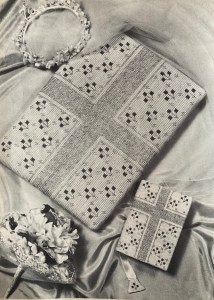
Magazine photo of a needlepoint church kneeler and prayer book (1963)

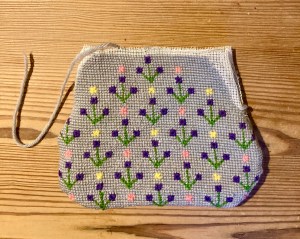
I was a bit uninspired by the February 1963 issue, which had several nice garments that were either too bulky for my taste or would just take too long to finish. I’m also trying to work from stash as much as possible. With that in mind, I adapted this “Prayer book cover and kneeler for a bride” tapestry design for a small, simple needlepoint bag.

My first, and until now, only tapestry/needlepoint project (what is the difference, anyway? Stitchcraft always uses the word “tapestry”and often qualifies it with gros point or petit point, but I see “needlepoint” used just as often in other sources) was this unfinished failure from the May 1961 issue. I still had the wool and enough canvas to make a smaller bag using the flower part of the design from the prayer-book cover.

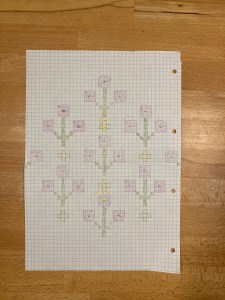
Since the original chart was not printed in the magazine but had to be ordered via post, I had to recreate it myself on graph paper, which wasn’t too difficult. The basic stitch is a half cross stitch, which works much better with this combination of wool thickness and canvas density than the earlier project, which was all in cross-stitch. The flower heads are made with eye stitch — 8 stitches all going into the same center hole. The stems of the flowers and the little hash marks between them in the original are supposed to be embroidered over the tapestry using gold Lurex thread, but I changed that to add some little pink and yellow blossom-like accents and just worked the stems in green wool.

Needlepoint chart drawn on graph paper with coloured pencils

So far, so good. I ordered a little bag clasp, marked out the approximate area of the needlepoint and started on the first half. In the middle of the large piece of canvas. Obviously that was a bad move, because a bag has to be worked symmetrically along the bottom fold line, no? The canvas was just large enough to divide it into two parts, but obviously it would have been better to work the whole thing in one mirrored piece and not have to sew a seam on the fraying bottom edge.

Once that problem was solved, I found the actual work to be relaxing, if somewhat boring (lots and lots of grey background). Also, I just barely squeaked through with enough grey wool to finish both pieces. The hard part came when fitting the finished tapestry into the clasp frame and dealing with the lining. The tapestry was… strangely twisted? The two sides of the bag did not lie flat over each other even though both pieces were perfectly identical and perfectly mirrored. I steamed the life out of it with the steam iron and managed to get it flatter, but… why? How? Things only got worse when I added the lining. I hate sewing and I hate linings. No matter how carefully I cut out a lining to the correct size and pin it and mark it and all the other boring things you are supposed to do, it never, ever comes out to the right size, or lies flat, or looks neat and deliberate. (I did manage to get the lining into the bag with a nice neat edge at the top… then realised it made no difference, as the top edge was going to be sewn to the metal clasp.)

Needlepoint bag without lining or clasp

The clasp has holes in it to sew the bag and lining in on the top and sides, and it was clear enough how that should be done, but theory was easier than practice and there was much clenching of teeth and growling. Also, a lot of that nice neat edge needed to be painstakingly ripped out to fit it over the clasp rim, reducing the nice neatness considerably. Did I mention how much I hate sewing? In the end, the edge was quite messy on the inside and not perfectly aligned on the outside. Both the needlepoint and the lining are oddly twisted and uneven and steaming it didn’t help anymore.

My take from this project: Needlepoint is fine, but not as much fun as knitting. Some older issues of Stitchcraft give an address where you can send tapestry projects in to be professionally made up into a bag or cosy or whatever “for a reasonable price” and if that service still existed, I would definitely take advantage of it! I have to make up the project myself, it is not worth it.

September 1962: Overview

Autumn is the nicest season for knitting, and 1960s Stitchcraft usually gave it a little push with extra pull-out supplements, extra colour photo pages, or “bumper issues” full of the latest developments in home-knitting fashion. The September 1962 issue doesn’t have any of these extra features, but it does have a wide variety of designs in mid-weight and warmer wools, starting with the chunky twisted-bobble sweater on the cover. Made in bulky Big Ben wool, it weighs in at a whopping 38 (for the smallest of three sizes, 35-36 inch bust), 40 or 42 ounces (the largest size, for 39-40 inch bust), i.e. about two and a half pounds or 1190 grams. I am guessing the model is quite slender and even she looks bulky in it!

The dresses and separates, made with the same loose fit but in double knitting wool, show a smoother look with minimal patterning. The orange dress in the colour photo and the charcoal-grey dress with the colour-pattern border (“for those who like something really eye-catching”) are the same design, but the pattern-border version is only available in one size, “for the younger girl.” I guess that pattern was just too exciting for doddering middle-aged matrons! The blue and white ensemble, also made in double knitting weight, has three pieces: a simple sleeveless blouse in white k2, p2 rib, a plain blue skirt and a back-fastening cardigan with white vertical stripes on the front. Tops continue to be hipbone-length and hemlines are firmly anchored just below the knee.

Other garments feature interesting colour and texture effects: the man’s “smart weekend sweater” has been treated with a teasel brush to achieve a fuzzy, felted effect. The knitter was not expected to do the brushing herself, but was instructed to “take all pieces at this stage [after knitting all the separate pieces, but before making the garment up] to your usual wool shop who can arrange to quote a price and send them away to be brushed for you.”

There’s also a striped jumper for “young and carefree” women with a fringed collar and hem, similar to the one in the February 1962 issue (yes, it is more or less the same pattern in different colours and with a split collar) and a pullover in an intriguing striped and dotted slip-stitch pattern. Stripes and/or slip-stitches also feature in the three-colour pullover for older children and the toddlers’ dungarees. Colours are navy blue or charcoal grey contrasted with white and neutral pastels, as we saw with the patterned-hem dress and three-piece ensemble.

There is the usual variety of homeware designs, mostly with floral patterns: this month’s flower is the dahlia, or you can sew and embroider and apron with lilac sprays. The leftover gingham fabric from “your” workaday apron can be used for cute animal appliqués on aprons for the children (unsurprisingly, Father seems to be exempted from the washing-up.) There’s also the usual floral cutwork tablecloth and tray cloth and a coffeepot set made in Hardanger embroidery.

Needlepoint fans can make a stool top or a whimsical cross-stitch rug and/or wall panel for the nursery, featuring characters from nursery rhymes. The motifs are separate and interchangeable and can be adapted for different sizes and purposes.

In the children’s serial comic, Peter the puppet has been freed from his marionette strings and is traveling throughout the countryside writing a play about his adventures. Cyril the squirrel helps out by painting illustrations, using his tail as a brush. (But how will Peter get home?) There’s the usual advertisement for Lux washing soap, guaranteed to leave your woollies soft and fluffy, and the latest instalment of the Patons and Baldwins’ “knit to please your man” series of ads, junior version: a teenage girl knits a “nice, husky sweater” for her boyfriend with her own loving hands to show everyone that he’s the “special one.” The young woman on the back cover ad is presumably also trying to catch a man, but she looks more polished in her snappy red dress and white gloves. You can really see 1960s style coming into its own in the straight or A-line sleeveless dress with low contrasting belt, the bobbed and fringed hairstyle and the edgy, off-angle mirror pose. Compared to the designs in this issue, it also shows how fashion-conservative Stitchcraft is.

I’m not sure what I want to make from this issue. I imagine the embroidered dahlias would make a great design for a laptop or tablet sleeve, but I already have a fine home-made laptop cover, not to mention this wonderful gay-geese-in-space tablet cosy. Also, I have probably done enough embroidery for the time being and still haven’t made much progress on this appliqué masterpiece that I started in July. The knit projects are all so bulky and loose-fitting, which is not my style, and I’m not sure I know an appropriately-aged child for the interesting slip-stitch pullover. There was also a perfectly nice, if not exciting baby cardigan (not pictured) in the issue which I could make quickly from stash, which would be useful enough (somebody’s always having a baby) and maybe the best choice for my uninspired mood. Stay tuned and find out!

July 1960: Overview

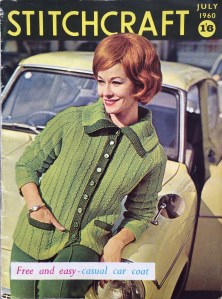
IMG_1879“Free and easy” is this month’s motto. Summer is here and nobody really feels like handling warm wool, so the emphasis is on “travel knits” (lightweight), “casual knits” (not too complicated) and “stroller styles” (loose and oversized). There is more embroidery and needlework than knitwear, and some easy sewing projects. Shall we relax and take a look?

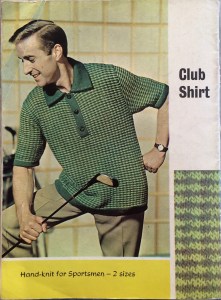
The combination of dark and light green continues to be in fashion: we saw it in the great houndstooth jumper from January 1960 and it’s here again in this “casual car coat” and and the loose-fitting men’s checked shirt style on the inside back cover — “suitable for golf or to wear with beach shorts.”

IMG_1898I have to take a moment here to quote one of my favourite Roald Dahl stories, “The Boy Who Talked With Animals.” It’s about a little boy who saves a giant tortoise from the soup kettle, and Dahl’s description of the tourists waiting on the beach for the caught tortoise to be hauled in has, for some reason, stayed with me through the years:

The men were wearing those frightful Bermuda shorts that came down to the knees, and their shirts were bilious with pinks and oranges and every other clashing color you could think of. The women had better taste, and were dressed for the most part in pretty cotton dresses. Nearly everyone carried a drink in one hand.

I would hope Stitchcraft readers and their men would have had better taste, but I’m not always sure.

The other “free and easy” knits are mostly nice without being really special: a pretty cardigan with knitted-in pearls, nubbly Rimple, a short-sleeved blouse and some cute tops for teenage girls.


The “plus-size” (37-40 inch bust) cardigan blouse is really elegant, though, and has a feature that I have honestly never seen in any other mid-century patterns: short-row horizontal bust darts. But unlike modern methods of short-rowing where the turning stitches are wrapped or otherwise bound up with the stitch next to it, you just cast off the stitches and cast them on again, sewing the dart up afterwards as you would a sewn blouse.  IMG_1895

For the little ones, there’s a sun-suit, a fluffy top, and a waistcoat to sew and embroider. The waistcoat is a tie-in with the current comic, “The Magic Needle”, in which our tailor hero’s magic needle has just made a lovely embroidered waistcoat for Mouser the cat. In addition to the waistcoat, you can sew a stuffed toy Mouser, and while you’re at the sewing machine you can make this adorable gingham skirt to wear “over a frothy petticoat” and an amusing apron “for the needlework stall” (Stitchcraft often gives ideas for inexpensive projects that can be sold at church bazaars or other “sale of work” opportunities.)


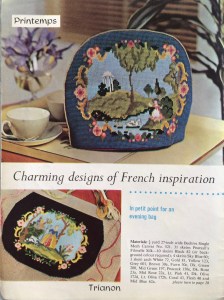
IMG_1881You can also embroider a tablecloth, make tea-towels in huckaback, or attempt this fabulous tea cosy and/or evening bag in faux eighteenth-century tapestry. I so, so want to make this evening bag! I would love it and use it all the time. But I am too overwhelmed by the idea of trying to make a chart based solely on the photos — the design is fairly intricate — and having never before attempted tapestry work, I fear it would just be too much for a rank beginner. I will definitely file it away for future days when I know how to approach it better.

That’s it for free-and-easy July 1960! I’ll leave you with a parade of well-dressed cats, courtesy of Mr. Tuckett’s magic needle. My project from this month’s issue will be the lovely bust-darted cardigan blouse, and I’ll try to finish up the projects from April (!) and June.


April 1960: Overview

coverapr60“Already there is talk of holidays” says the introduction to the April 1960 issue, “and whether it’s to be the sea, country, sight-seeing or sailing, you can’t go without your holiday hand-knits.” At the same time, spring and April mean Easter, with lots of opportunities for hand-made accessories and knickknacks.

For knitters, there is a larger variety of wool weights and styles than in the last couple of issues. Houndstooth and checked patterns are still going strong — look at that great jacket on the front cover! — but lace and Rimple designs are offered too, and garments for babies, toddlers, and adult men and women.

For the patient, there is a cute 3-ply top and a shirt in cotton crochet yarn at 12 stitches to the inch. (This is the only type of cotton yarn I’ve ever seen featured in Stitchcraft, but usually it’s used for making doilies or other fine crochet items.)

For those who prefer to actually get their garment finished before the summer holidays start, there are “partner look” sailing sweaters, the houndstooth jacket on the cover, and pullovers in Rimple and Big Ben yarns. Rimple will continue to not be my taste in terms of texture, but isn’t the model cute?

Easter embroidery is big, and around this time, Stitchcraft started to include designs for church accessories — hassocks and kneelers in tapestry or cross-stitch. For those for whom Easter is less of a religious experience, there are some great “Easter novelties” (cosies for teapots and toilets) and who could resist those gay kitchen ideas? Standard needlework ideas for the home include a fitted chairback and a lovely Persian-inspired cushion.

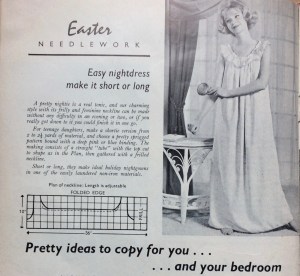
One thing that is really different in this issue is a sewing pattern, common in 1940s and 50s Stitchcraft but rare in the 1960s. It’s a very simple nightdress (for Easter and/or your holidays, of course) that is recommended to be made in “one of the easily laundered non-iron materials”, i.e. nylon or early synthetics.

nightdress

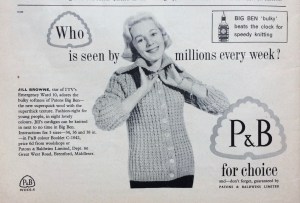
April’s celebrity “plug” is given to us by Jill Browne, the actress who played Nurse Carole Young on the soap opera Emergency – Ward 10, which aired on ITV from 1957 to 1967.  I have to admit I have never seen it, but it seems to have been quite progressive for its time, with Joan Hooley playing a female surgeon in an interracial relationship that was sealed with a kiss onscreen.

starad

On the back pages, it is the end of adventures for Good Teddy Bear and Naughty Teddy Bear, but they got two gay jerseys knitted for them in the end, so I think everyone was happy. Plus you can make your very own teddy bear to commemorate the series! The ads are for the usual things, except for this gem of a potty-training stool called “Bambino”, appearing for the first time.

My projects from this issue will be the 3-ply top and the appliqué goslings on a tea cosy. Happy Spring, everyone!


March 1960: Overview

IMG_1544

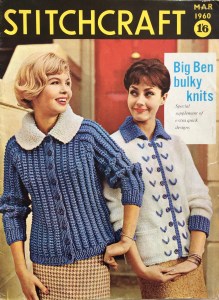
March 1960 promises “Spring Magic” and a special pull-out supplement with designs in “Big Ben”, Patons’ new Aran-weight wool that promises to knit up especially quickly, so you can have your thick, warm woolies finished in time for the summer holidays. (Anyone who lives in Northern Europe or who has taken a holiday on the northern Atlantic or North Sea coast will understand perfectly.) Fine-gauge knitting is right out: the designs not written for Big Ben, like the excellent yellow pullover and sleeveless waistcoat for men, the “Young Style Designs” for teenage girls, or the fabulous checkered coat for a toddler, are all in DK-weight wool. The only exception is “John’s new pullover” in 4-ply.


The embroidery and homecraft projects focus on springtime and Easter, with a floral tablecloth and a cushion and chairback in traditional Hungarian design. It’s a pity nobody uses chairbacks these days, as they are a nice decoration and certainly prolong the life and cleanliness of a chair or sofa. The stitched rug is a “quick and easy modern design” and there are tapestry and needle-etching pictures of quaint-looking English town streets.


In comic land, Good Ted and Naughty Ted (two teddy bears) and their human friends Beth and Bill take a balloon ride to Magic Way, where a fairy turns Beth and Bill into animals in order for them to visit Noah’s Ark. As usual, the ads are for Lux soap, Opti-Lon zippers, Cow & Gate baby formula and various sewing and knitting machines.


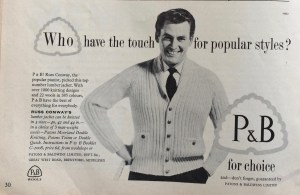
One older style of ad is the Patons and Baldwin’s testimonial, in which a famous personage shows off their favorite hand-knit garment made from P&B wool. Here we have Russ Conway, the popular music pianist, at the peak of his career and wearing a lumber jacket in “man-weight wool”. Russ Conway was a multi-talented, self-taught piano player and composer who enjoyed enormous success, producing multiple No.1 hits and playing in a distinctive “honky-tonk” style. Though plagued by serious health conditions, he continued to compose, produce, and fund-raise for charity until his death in 2000 at the age of 75. You can read more about his life and career and hear some of his music on his tribute website .

IMG_1560I will be making two children’s designs: the fabulous checkered coat for a toddler, and “John’s new pullover” for a soon-to-be six-year-old.
February 1960: Overview

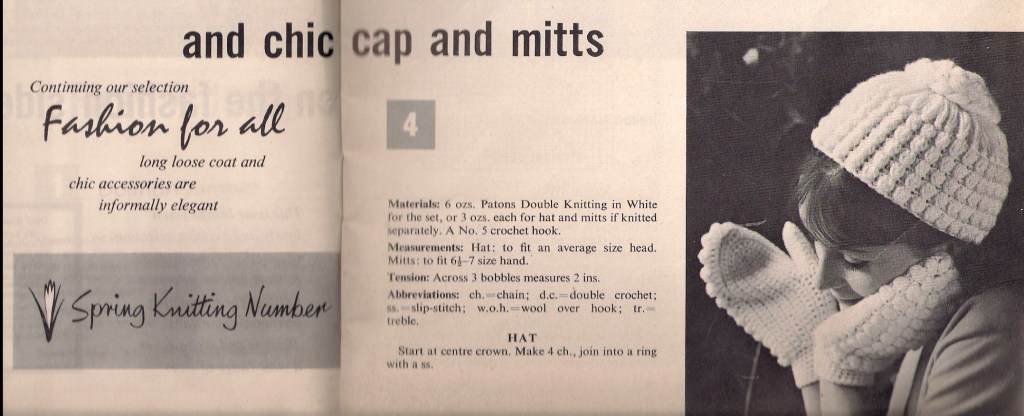
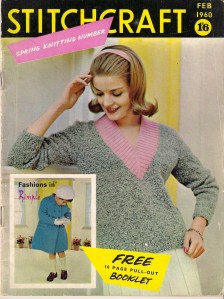
Feb1960_coverFebruary 1960, the “Spring Knitting Number”, features an extra 16-page pull-out booklet with garments in Patons Rimple, a nubbly wool-with-a-bit-of-nylon yarn that looks like terrycloth toweling when worked up. The Ravelry yarn database has more information with pictures and modern projects. The wool itself gives so much texture that it would be pointless to knit intricate patterns or multi-colour pieces with it, so the “zippy designs” in the supplement are made on very classic lines: V-neck pullovers, a plain cardigan, a child’s cap and mittens.
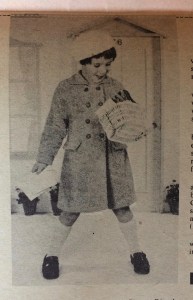
The only slightly more ambitious design is this double-breasted A-line coat for a child.IMG_1488 The model, like all children of the 1960’s and earlier, must have very cold legs. Why children of earlier times didn’t wear trousers or warm stockings or tights is a mystery that an older person will have to explain to me someday. It’s particularly strange to see in a knitting magazine, as often the child will be wearing a thick wool jumper or even a wool pullover under a wool sleeveless dress with a knitted wool coat over it, plus a hat and mittens if outside… but nothing on their poor bare legs.

The non-Rimple knitted garments are long, like this “Fashionable Dress” in 4-ply fingering at 7 stitches to the inch, or the long coat in a two-colour slip stitch pattern. Even the dolman cardigan is hip-length. The embroidery and needlepoint projects cover various traditional styles with a Victorian ribbon-band pattern for a stool top, a cushion with Tudor-inspired pears and acorns, and a very zig-zaggy “modern” Swedish rug and cushion set. The Swedish rug has a neat three-dimensional effect thanks to tufting.


As the focus of the issue is the Rimple supplement, the other projects in the issue are fairly basic: cardigans for men and boys, a crocheted cap and mitts, an embroidered wall panel and counted-stitch cushions. The ads are for fabric, knitting and sewing machines, and “Cow and Gate” baby formula — all standards — and the two teddy bears in the comic are heading off on Magic Way in their enchanted toy village.

Rimple is not my style, so I’ll be making a small project this month: the crocheted cap and mitts with an intriguing bobble pattern and plaited crown.Feb1960_2