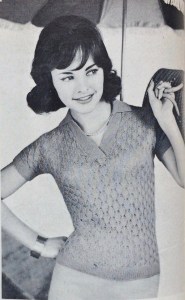
 My second project for April (obviously not finished before the end of the month, seeing that I started it two days before) was this cute lace blouse with a “Popular neckline.” I do love the neckline, and the leaf pattern.
The pattern is written for wool, of course, but I made it in cotton for summer. It is very, very difficult for me to find any kind of yarn, especially cotton, that is fine enough to get the pattern gauge of 8 stitches to the inch in stockinette stitch. I can hardly even get 8 stitches to the inch on lace-weight wool on 2 mm needles! But crochet cotton thread would be too thin, and I don’t think I’ve ever seen it in black. So I found a cotton that gets me 7 stitches to the inch on 2 – 2 1/2 mm needles and fiddled with making the middle size and having it come out as the large size.
 The biggest problem was making the side-seam increases. The lace pattern has a repeat of 12 stitches, but a sort of varying number of edge stitches. I honestly had no idea where to fit in the extra stitches, or how to keep them in pattern when the increases and decreases within the pattern are broadly spaced. Time to hit the Ravelry forums! I did try charting it out (the pattern has written instructions only) and at first it made it easier to “read” the knitting, but didn’t give me any fundamental technical answers. I realised I had to chart out not just the pattern itself but all of the increases and decreases, with the changes that had to be made row by row. That worked, but by then I had already made the back piece, so those increases on the sides weren’t perfect. But everything else was!


The fit is incredible. I was wary of the horizontal cap sleeves, which are really just made by casting on extra stitches instead of decreasing under the arms. I thought it would make a lot of baggy fabric under the arms, like those 1950s (or 1980s) dolman-sleeve fashions that must be extremely inconvenient to wear. But no! The armholes are snug without being too tight, and I appreciated the extra width and give in the upper chest and back, where I am quite wide.
All in all, it is wonderful and I am very happy. Here I am having fun “recreating” the original picture. The bag is from a Stitchcraft pattern, too!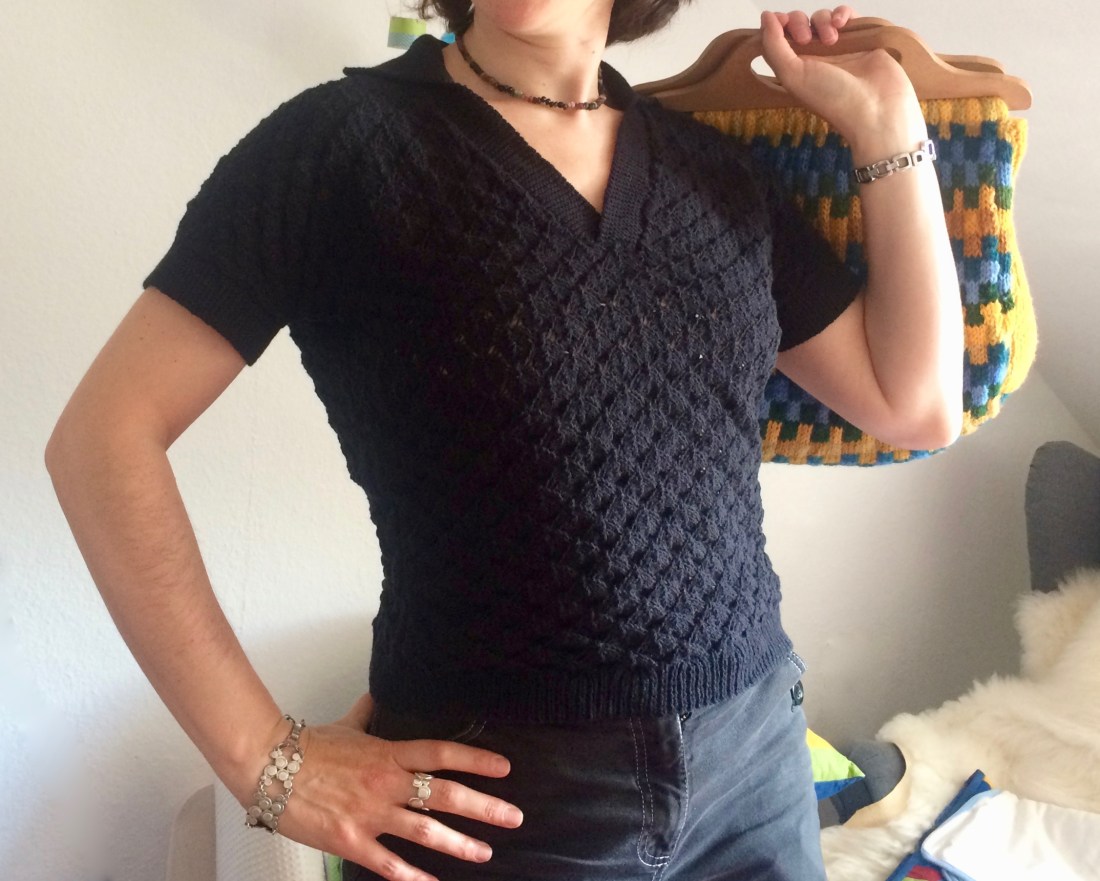
 “Already there is talk of holidays” says the introduction to the April 1960 issue, “and whether it’s to be the sea, country, sight-seeing or sailing, you can’t go without your holiday hand-knits.” At the same time, spring and April mean Easter, with lots of opportunities for hand-made accessories and knickknacks.




 My second project for March — though it wasn’t finished by the end of the month — was a young boy’s pullover with a cute stripe-and-dot pattern.


 First project for March: this charming jacket from the jacket-and-skirt set titled “Spring Magic in Judy’s trim Outfit”. What a great title! And what a great photo in the booklet. I’m glad today’s girls don’t generally get their hair tortured into curls like litte Judy’s in the picture, but she certainly looks happy enough holding hands with her gigantic teddy bear.


 I will be making two children’s designs: the fabulous checkered coat for a toddler, and “John’s new pullover” for a soon-to-be six-year-old.
 February 1960, the “Spring Knitting Number”, features an extra 16-page pull-out booklet with garments in Patons Rimple, a nubbly wool-with-a-bit-of-nylon yarn that looks like terrycloth toweling when worked up.
  The model, like all children of the 1960’s and earlier, must have very cold legs. Why children of earlier times didn’t wear trousers or warm stockings or tights is a mystery that an older person will have to explain to me someday. It’s particularly strange to see in a knitting magazine, as often the child will be wearing a thick wool jumper or even a wool pullover under a wool sleeveless dress with a knitted wool coat over it, plus a hat and mittens if outside… but nothing on their poor bare legs.


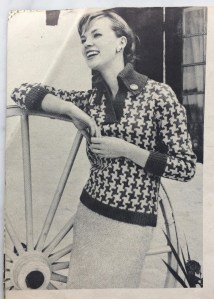
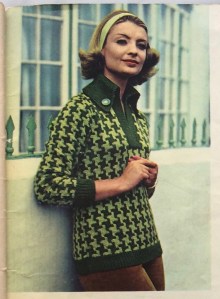 My knitting project from this issue was a houndstooth-check jumper, made in double knitting wool in two shades of green. Large checked patterns of this type were popular this year, which is presumably why Stitchcraft categorized this jumper as “fashion knitting” rather than “casual knitting”.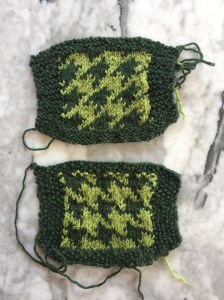


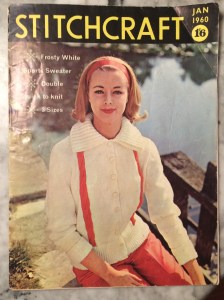


 The Stitchcraft Sixties