December 1960: Baby’s Special Outfit

IMG_2217My December project was a warm winter dress for a baby, part of the “Baby’s Special Outfit” of dress, bootees and mittens that continued the baby set started in the November 1960 issue.

The dress has a smocked top, which I had never worked in knitting before. Of course, knit smocking is not like sewing smocking, where you gather the fabric up in regular pleats and embroider over it. Here, it’s pretty easy to do and involves taking out a long loop and knitting it back in a few stitches later — almost like cabling without a cable needle. The base pattern is 2×2 rib, which gives the same effect as gathered fabric.

dec60wipI used a lovely 100% wool that was hand-dyed by a fellow knitter in my local knitting group. She uses natural dyes from plants in her garden, or the bits of food items that are normally not eaten: walnut shells, onion skins, and so on. This green-melange wool was dyed with red onion skins! She did explain to me how that worked, but please don’t ask me, because I forgot the answer already. Anyway, it’s very nice. I was worried that it might be too scratchy for sensitive baby skin, but wash-blocking it and rinsing with hair conditioner softened it up quite a bit.

I only had 100 grams of the wool, so had to make the dress a bit smaller than in the pattern. The original pattern was for a baby up to one year or more, had a long, full skirt, measured 22 inches at the chest and had sleeves. The baby I made this for is 6 months old but still quite small, and my version of the dress measures 21 inches at the wide part of the chest, has a shorter and narrower skirt and no sleeves. In a way, that’s more practical, since it can be worn over a t-shirt and leggings and taken off if the baby gets too warm. It also won’t touch her skin, so scratchiness won’t be a problem. It buttons in the back.

And with that, I have completed one whole year of Stitchcraft projects! Goodbye 1960 and 2018, and hello 1961 and 2019. Stay tuned, and happy New Year!


December 1960: Overview

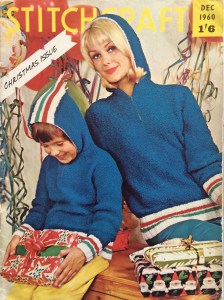
IMG_2214This year (1960 or 2018, take your pick) draws to a close with Stitchcraft’s “Christmas Issue”, which, as you may expect, is full of holiday-themed novelties to decorate and give.
That said, the hoodies on the cover are surprisingly modern and not “Christmas sweaters” in the sense we usually think of them at all. If I just saw a photo of them without the festive vintage backdrop, or the “DEC 1960” in the cover corner, I would be hard-pressed to say from what decade they came from. You could sell them in a regular modern store today and nobody would think they were a vintage design! I love the little tuft on the kid’s hood, too. They are made in nubbly Rimple yarn, still a hit and always featured somewhere in each issue.

IMG_2216

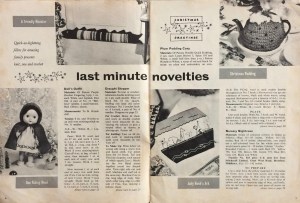
There are “gay ideas” for festive party table decorations of all types: a floral tablecloth for  a tea party, a merry-go-round tea cosy for the “Nursery Party” and table sets with playing cards as napkin holders for the grown-ups. “The last minute novelties” take on a fairy-tale theme, with a Red Riding Hood doll, a Noah’s Ark nightcase, a friendly draught-stopping snake and — for your holiday Dickens bedtime reading — a tea cosy that looks like a plum pudding, complete with attached crocheted plate! More pious readers can make an appliqué wall hanging of the Three Wise Men and heathens can make an embroidered wastebasket cosy with a Sagittarius theme (this month’s astrological sign).

Of course, one never has enough time in the holiday season to make everything perfectly,  so if you are “really stumped for time” you can make the wall hanging “in bright, shiny papers” (instead of felt), “cutting out the shapes and sticking them down, then adding cut-out strips, etc., for the finishing touches.”

For those who have the time, or don’t go all-out for holiday decorations, there are the usual assortment of knitting projects, starting with a lovely warm dress-booties-mittens set for a baby. I do admire her elegant mitts, but I’m guessing that in real life, they don’t stay on a baby any longer than it takes to take a photo. Older kids can get a striped jumper in a fantastic, very modern colour combination.

Teenagers haven’t been forgotten either, and can enjoy these Italian-inspired colour designs with added embroidery on the young woman’s jumper. I really like both of these designs! The young man’s jumper is fun without being too flashy, and with a little tweaking, would work well on a woman’s figure, with the dark colour band starting just under the bust line. There’s even a little extra “how-to” lesson on embroidering knits, which is still perennially in fashion at this time.

IMG_2219Adult women, having hopefully embraced the “new length” (long) and “new sleeve style” (3/4 or 7/8) from last issue, can get ready for Paris’ “new necklines” — a high turn-down-and-rib combination or a buttoned-up turtle (polo) neck. No turn-down collars this time — are they on the way out? There’s a new yarn to go with them, Cameo Crepe, which is smooth and less “hairy” than other wools, for good stitch definition.

All this new fashion detailing can be admired in the two-colour twin set from the inside back cover, and to go under it all, why not knit yourself a lovely warm woollen vest (camisole)? I don’t mean that sarcastically — they are really the best! I made a woollen lace under-dress (slip) last year and it is heaven in a cold, damp climate.

It’s hard to decide what to make from this issue. Lots of the items are cute and fun, but nothing jumps out at me that I absolutely have to make. The plum pudding cosy is so silly that it’s cool, but I don’t use tea cosies and it would be a lot of work for a gag. The snake is cute and useful, but I don’t have odds and ends of double knitting at the moment and I do  in fact already have a stuffed snake who occasionally gets put to work plugging a “leaky” window. I also have plenty of jumpers and even wollen underclothes (s. above), so don’t need more. I do have a hundred grams of very nice, hand-dyed green fingering wool in search of a project, so maybe I’ll make the baby dress.

In the meantime, Happy Holidays to all my readers! May everything you celebrate be jolly and festive.


November 1960: Cloche Cap

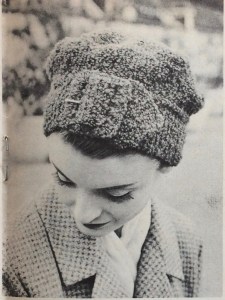
IMG_2176November’s project was a little cloche hat, made out of leftover wool from July’s Charming blouse. I loved the little buckled brim and the sort of mushroom shape, though I found that the hat looks better if I pull it down over my forehead like a 1920s cloche hat. Either the picture in the magazine, taken from an angle over the model’s head, doesn’t really give a true impression, or our heads are differently shaped, or both.
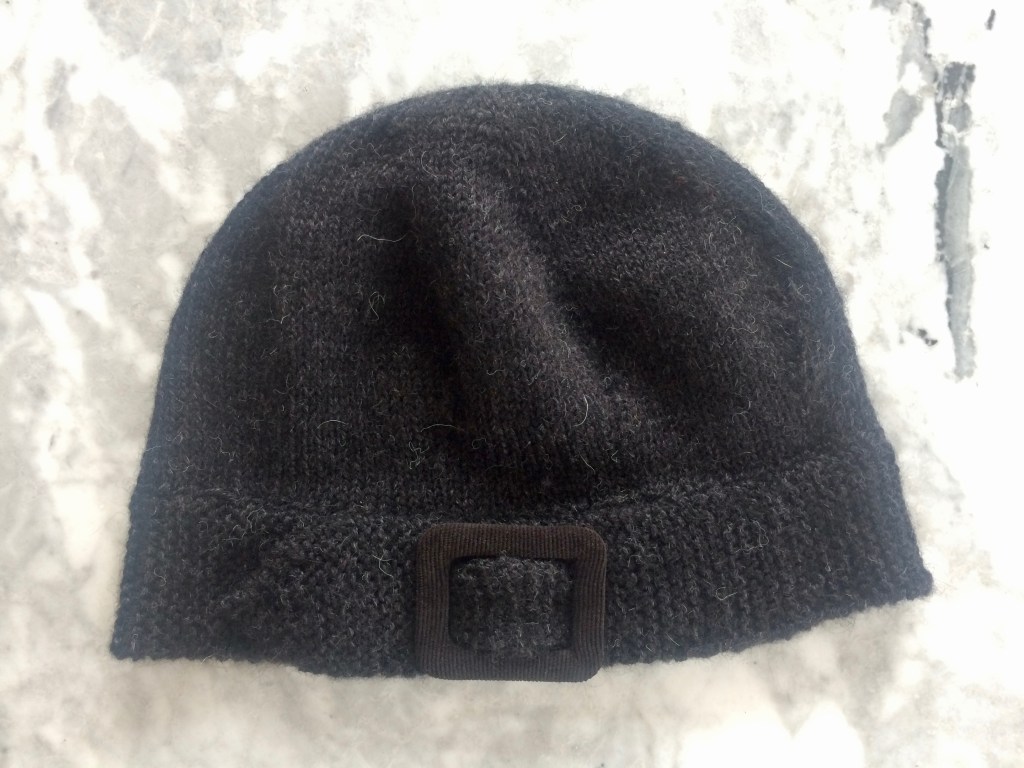
Speaking of differently shaped, the hat is meant for an “average hat size”. That’s… not very specific. I do have a bigger head than average for modern days, but the wool (Juniper Moon Farms’ Herriot Fine) is mostly alpaca, so stretchier than the synthetic Rimple that the pattern is written for. To be safe, I made the buckle strip for the brim a little longer, but in the end that wouldn’t have been necessary. The buckle brim band (good name for a band!) is made in garter stitch, which is really not the most suitable for hat brims, as it stretches too much and doesn’t hold the hat on your head. Though of course, if you pull a hat down over your forehead, it’s not going to go anywhere.

Not that I need any more hats, but it’s cute and warm, so I’m happy.

IMG_2185

November 1960: Overview

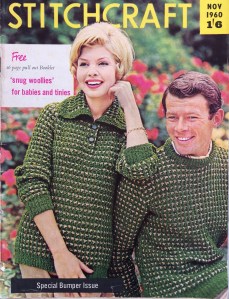
IMG_2168Brrrr! November 1960’s Special Bumper Issue” brings us “Colour for the Cold Days” and an extra 16-page pull-out booklet of baby woollies. Sadly, so sadly, the booklet from my copy of this issue has been pulled out long ago and is missing.

There are still plenty of lovely cold-weather fashions and interesting homewares to make, starting with the comfortable, matching “his and hers” sweaters from the front cover. Green checks continue to be in fashion, this time made with a complicated slip-drop-and-pick-up-later stitch pattern in two colours of Rimple. The idea of the “partner look” is just starting now, but will carry on throughout the 1960s into the androgynous 1970s and even the oversized-sweaters-for-everyone 1980s. Both fashion and gender roles were still quite rigidly stratified in 1960, but I see a parallel between the gradual softening of gender-based norms and the increased interest in gender-neutral “partner” garments that both started around this time. The two sweaters in this issue are both loosely-fitted, shaped (or not shaped, as is the case) the same, and available in overlapping sizes. The only proportional differences are in the shoulder width and sleeve/overall length, and the only cosmetic difference is the collar.

IMG_2170

Women’s fashions without men’s versions include a “sports” sweater with coloured lines made from a bobbled two-colour stitch pattern and added embroidery, a “top-fashion” jacket with a wide collar, a belted jumper and a cute hat with a buckled brim. Waist-length and closely fitted is definitely out, and the long-line with minimal shaping and a collar is definitely in. Men’s fashions are similarly long and loose-fitting, with dolman sleeves and interesting yoke details, and there’s a fantastic twin-set for young girls aged 5-9.

IMG_2172Homewares are still in a weird phase. The working woman or baby-boom mum (and those were overlapping categories, then as now) of 1960 didn’t have the time or patience to make too many elaborate Jacobean embroidery pieces or huge, detailed tapestries, especially not right before the great rush to get Christmas presents under the tree, so the focus is on quick, easy-to-make novelties for gifts. The aesthetic sense does seem to get lost a bit, though, if you ask me.

Of course, if you do have the time and leisure, you can go ahead and make a piano-stool and cushion set in Victorian-style tapestry, or a large room-divider screen with colourful parrots. Truly modern and up-to-date novelty lovers can continue the Zodiac series with a Scorpio motif for cushions, chairbacks or waste-paper baskets.

IMG_2178(I notice that Word Press does not recognise the word “chairback”. They have been out of fashion for too many years, I guess, having fallen victim to cheaper furniture, more frequent hair-washings and less Brylcreem. Pity that no one likes them now, as they do seem kind of fun.)
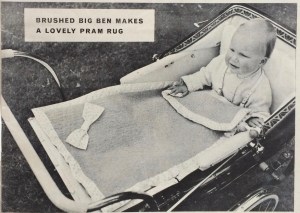
In the back pages, Jill Browne is still happily endorsing Patons Big Ben wool, and a lovely new children’s serial, “Wendy and Wag in Wallpaper Land” has started. Note the printed ruler at the side of the page, included in each issue as an easy way to measure your tension swatch. Also, there’s a rug reprint, a toy pig made of pink felt, a panda-bear motif and gay pot holders. What more could you want? My project will be the cloche hat, and I’ll consider the belted jumper if I have more time.


October 1960: Overview

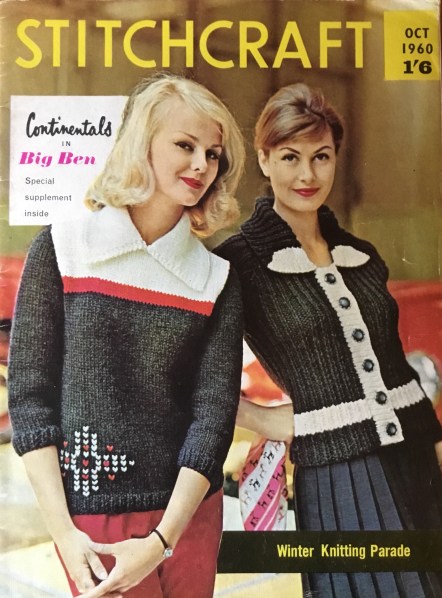
0E56629B-4509-4599-B9F4-63679CA72DCCOctober and November are really the best months for knitting. The weather has gotten cold enough that you really want to wear and make warm, woolly things, and there’s the nice “surprise” of packing the winter clothes out of storage, and so remembering what nice hand-knitted pieces you made in other years. At least, that’s my experience.

Stitchcraft also knows that knitters like to start more projects in the fall, so this month’s “bumper” issue has lots of warm clothing for adults and children as well as Christmas presents for home and family (for those who like to think ahead). And in the middle of the magazine is a special supplement of fashions in “Big Ben” — bulky triple-weight wool.

Women’s fashion features the “new length” of 23-25 inches in all jumpers, with minimal or no waist shaping, a sign that the era of waist-length sweaters and knitted blouses so popular in the 1950s is coming to an end. The sleeves have a new length, too — the “smart bracelet length” i.e. 3/4 length. I guess it lets you show off your bracelets, but I get cold forearms! Two are in 4-ply and one in an interesting “Italian waffle” slip-stitch pattern in double knitting.

There are some great fashions for men, as well, both in the regular magazine and the supplement. The long socks and lined scarf in ever-fashionable green checks are definitely cosy and “would make very acceptable presents for a grown-up son or special boy-friend“. The jumper features a shawl collar, here referred to as a „reefer neck“. Reefer neck? When I think of the 1950s or 1960s and „reefer“, a shawl-collared jumper is not what comes to mind. Perhaps that grown-up son or special boy-friend has special recreational plans to wear that sweater for? In an case, it‘s attractive and warm-looking, as is the model.


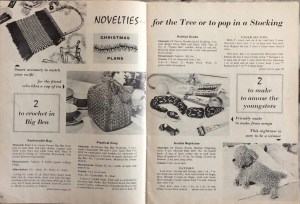
There are plenty of little trinkets to make for the home, „for your Church Bazaar“ or for Christmas gifts. Looking at some of them, I think more bizarre than bazaar — Peter the Pup has a very weird look in his eyes and you don’t really mentally associate an igloo with the idea of keeping tea warm, right? (Though I know, I know, the thick ice walls of real igloos make excellent insulation.)

Homewares are always fun and this month has a bathroom set with seahorses for those who like a hand-made woolly toilet seat cover (makes me think of my great-aunt, who even made those woolly extra-toilet-paper-roll covers).

A7780FA8-D51D-4E8B-B746-87CDC99D50A6

There’s also a landscape tapestry, a cushion embroidered with sprays of fuchsia and a „Chippendale“ chair seat. In home-wears, there‘s a bed-jacket that‘s pretty enough to wear as a cardigan and the start of a new embroidery series with signs of the Zodiac. I always though the interest in astrology was a 1970s phenomenon, but here we have an entire year of zodiac-themed home accessories in 1960. I personally have no interest in astrological signs, but I do absolutely love her dress — check out that lovely lacing in the front. (And be sure to wear your frilliest petticoat while ironing.)

And we haven‘t even gotten to the Big Ben supplement! It truly is a bumper issue. The Big Ben offerings are under the signs of „Continental“ and „Italian“ styling: a long, slim, mostly unshaped silhouette with square collars and nubbly stitch patterns. Toddlers get a classic „lumber style“ jacket with pockets. The Norwegian „playtops“ aren‘t from the Big Ben supplement, but they are awfully nice.

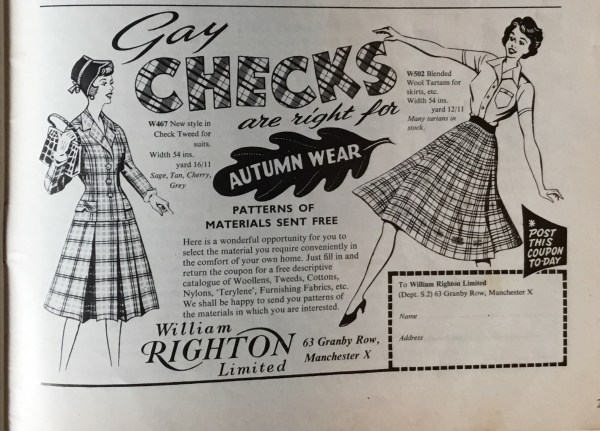
Last but not least, you can order yourself some sewing fabric from the advertisements in the back pages, and what could be better for autumn wear than gay checks? I wholeheartedly approve… and want that suit that the lady on the left is wearing. My October project will be a variation of the fuchsia embroidery. Happy autumn knitting parade, everybody!

AFBB9680-EB48-4119-AADE-8D7F92D38520

September 1960: Overview

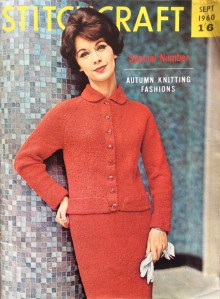
IMG_2045September 1960 is supposedly a “Special Number” of autumn knitting fashions. I’m not sure what exactly makes it so special, since it doesn’t seem to have any more, or particularly different, projects than the average issue. I guess it’s special in that September is finally a bit cooler weather-wise, so you can start to make some nice wool garments for the colder months — very appropriate in 2018, where we had the summer to end all summers. Things have cooled down a bit now, so I’m looking forward to wearing my (still unfinished) projects from July and August soon.

But back to September 1960. “You must include some heavy-knits for the really cool days out of doors, but for the milder days, a fashion feature to note is the use of finer knitting,” Patience Horne tells us, and this month’s issue gives a good mix of finer and bulkier garments for adults and children. The 4-ply women’s sweaters (why sweaters and not jumpers? I still can’t figure out why they sometimes use one term and sometimes  the other for the exact same type of garment) have those big square collars that we’ve seen on other 1960 designs, with or without buttons. The pink sweater is made in super-fine-ply Lucelle at 10 stitches to the inch! If hand-knitting in fine yarn is too time-consuming for you, you can make a lacy cardigan on your machine.

Moving up the bulkiness scale, we’ve got the lovely skirt suit on the cover, made in Rimple, a sweater in “overblouse style” and a “raglan golf sweater” for men in green plaid. Green checks continue to be in fashion!  The “young sports fans” in the family get comfortable jackets in double knitting weight, “made to match for brother and sister.” Can you spot the difference between the boys’ and girls’ versions? (Do you remember those “can you spot the 10 differences between these pictures” puzzles in the kids’ comics section? Do they still have those?) If you can’t, I won’t tell you, but try buttoning a cardigan made for the “opposite” sex if you need a hint.

Fans of Big Ben bulky knitting can make a Viennese design with added-on embroidery in duplicate stitch, or a trio of crochet items in “crunchy Pineapple-stitch”. I love the pram cover, bound with blanket edging, but I wish I could see the bonnet from the front.

Homewares are well represented by a stool cover in Florentine tapestry, a great embroidered cushion in blackwork design, traditional and “modern” pile rugs and some interesting tablewares — tapestry table mats with pictures of “3 famous castles” and crocheted raffia drink mats for your cocktail party. Cheers, everyone! My September project will be the blackwork cushion, and I hope to finish up the knitted blouse from July and the cardigan from the August twin-set.


August 1960: Twin-set returns

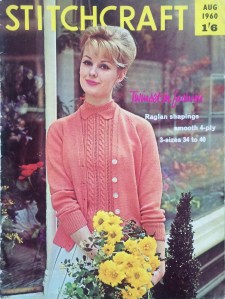
IMG_1942I loved this twinset at first sight. I loved the short raglan sleeves on the pullover, the cable-and-mesh panel on the front and the very original mock-turtleneck-meets-peter-pan collar.  It’s one of the reasons I started this whole long-term Stitchcraft blog project, so I’m thrilled to have it come to life.
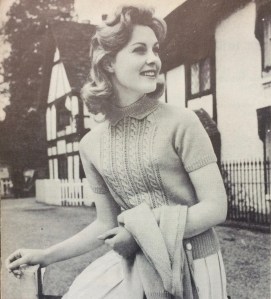
The yarn I used was ideal in terms of wearability: Lang Merino Bébé which is extremely soft and smooth and can be worn next to the skin with no problems at all. It is a little thicker than Patons Beehive Fingering, for which the pattern is written, so I had to work with a modified gauge (6 1/2 stitches per inch instead of 7) and ended up making a combination of the small (34-35 inch bust) and medium (36-37 inch bust) sizes to get a slightly larger size in the end. I guess in terms of actual measurements, I ended up with the second size, which fits fine.IMG_2033

Of course, the pattern is written to make in pieces and sew together, but I love making raglan-sleeve garments in one piece and working them together without seaming. It was a fun challenge to integrate the different decrease speeds of this compound raglan (the sleeves decrease every 4 rounds for quite a long time whilst the front and back decrease every other round), as the instructions are on different pages.


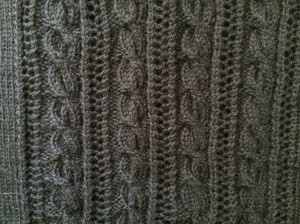
IMG_1994The cables have an interesting twist — literally. You put four stitches on the cable needle, knit the other four and then give the cable needle an extra 360 degree clockwise twist before knitting the stitches off of it. This gives them a cool extra definition. I forgot to do it once and it was almost unnoticeable — almost — but I didn’t want to rip back that far, so when everything was done I looped a little tiny thread around one of the cable stitches and just pulled it over more to the side and tacked it down by tying the thread ends in a knot on the wrong side. Look at the close-up picture above — can you tell which cable it was? I can’t on the finished garment. Good to know.


The collar is knitted separately in two pieces that are then knitted onto the picked-up stitches around the neckline, sort of like a three-needle bind off only without the binding off. Then you continue for an inch of mock turtleneck. The back of the pullover is open and you are supposed to put in a zipper, but I went for the keyhole effect and just added a button with a little crochet chain loop for a buttonhole. The final result is comfortable and pretty.

IMG_2081The cardigan is somewhat more plain, as it doesn’t have the cables, but it makes such a lovely set with the pullover — not to mention it’s an excellent “everyday” cardigan to go with lots of other outfits. The sleeves came out a bit long — I was obviously over-compensating for my long arms and the fact that I always have to lengthen the arms a bit — but it looks just as good with the cuffs turned back, and I can turn them down for extra warmth under a coat and gloves. I hadn’t expected the raglan sleeves to have so much armhole depth. I thought about adding facing ribbon to the button bands, but it turned out to not be necessary, as the cardigan fits fine whether buttoned or unbuttoned. In short, I am thrilled with my new twin-set and it will surely get a lot of use this winter.


August 1960: Overview

IMG_1942August is a weird month for knitting, as it’s often too hot to hold wool in your hands and hard to believe that autumn is around the corner. Appropriately, this month’s issue features easy embroidery and homewares, and seems to have fewer items than the average winter or “spring holiday” issue. But before we get into the contents, can we stop to admire this beautiful twinset on the front cover? I have been looking forward to making it since I started this blog! So much that I don’t care if the heat wave ever ends, or if I won’t be able to wear it until January. I am going to make it and love it.

We’ve got a few pieces in bulky Big Ben wool, which seems an odd choice to me for summer since it must be quite heavy and hot, even with September and October around the corner. The “slippy” is theoretically good for sailing, though, I’ll admit. A couple of casual sweaters for women, men and children round out the selections, plus a cute little bolero and baby dress for the little ones. Apart from the twinset, it’s basic fare.

The homeware pieces are more whimsical and probably a lot of fun to make. The three different aprons to sew and embroider are styled and decorated so differently that at first glance you would never notice that they are all made from the same fabric pattern. It’s quite a clever design, with a deep pocket in the middle. I imagine it would be just as useful as a “knitting apron” (where you put the working ball of wool in the pocket) as for sewing or kitchen work. The “charming novelty design” with little sewing birds (which remind me of the helpful birds in the Disney Cinderella movie) and the gingham “Briar Rose” are touted as “good bazaar items” and the third option can be made “from oddments”, so they are easy and useful all around.

Little mats for dining, dressing and living room tables can be very easy to make (a simple  hardanger table set with tea and egg cosy, or table mats made of raffia), a bit more elegant (cutwork for the dressing table), or finely knitted (“for the expert, but well worth the time and effort”). There’s a chairback in Assisi work and cushions with traditional designs from Czechoslovakia (still one country in 1960) done in cross-stitch or pattern darning.

The best bits are often in the back pages, and there is a great, short how-to article about making your own embroidery sampler in the “Readers’ Pages” which gives good, concise beginner’s advice on choosing motifs, calculating gauge and placement and choosing stitches. Also, there’s an advertisement for Turabast, which was a brand of ribbon straw popular from the 1950’s to 1970’s. You could knit it up into a stiff, crinkly skirt that was probably very inconvenient to sit in, but had that perfect petticoat look without the petticoat. Ribbon straw is still perfectly available in modern times, but these days people use it for crocheted flowers or home decorations. I haven’t seen anyone wearing an actual garment made from it, but I might try it someday.

My project for this month will be the wonderful twin set from the front cover.


July 1960: Charming blouse

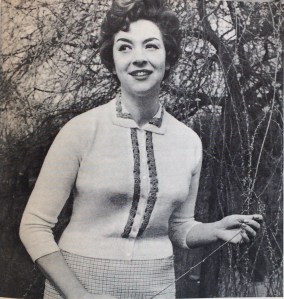
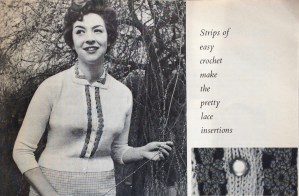
IMG_1894This “charming and unusual design for larger sizes” (37-38 or 39-41 inch bust) features narrow dolman sleeves, crochet insertions, and horizontal bust darts.
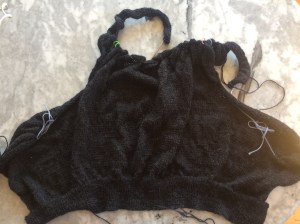
I was intrigued by its construction, having made tops with bust darts from modern patterns or while working without a pattern, but never having seen vintage patterns with them. Oddly, instead of making short rows, you are supposed to cast off stitches, cast them back on again, and then sew up a seam! I guess that makes it look more like sewn fabric? Or the “editress” thought short rows would be too difficult? I can’t imagine that, though, since patterns from this time regularly call for short-rows to shape the back side of baby rompers and leggings. In any case, I made the bust darts with short rows to avoid having to make a seam. I also made the back and fronts up to the armhole shapings in one piece, again, to avoid seaming more than necessary.

IMG_1936I was interested to see how it worked out with the dolman sleeves. When I think of “dolman sleeves”, I think of those 1950s, or worse, 1980s garments with a huge triangle of fabric under the arm, which must have been very uncomfortable and inconvenient to wear. But after my April 1960 blouse with the horizontal cap sleeves worked out so well, I was willing to give this one a try. And it turned out great! There is no more extra fabric under the arms than there would be with set-in sleeves, and the horizontal construction gives plenty of room in the upper chest/back area, where I am quite wide. I guess the secret lies with the number of stitches cast on for the sleeves per row — this one had 2×8 rows and then 10×16 rows, making the sleeves narrow and more horizontal, thus less triangle-like.
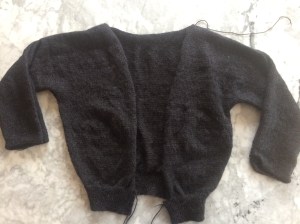
IMG_2075The knitting was slow-going at 7 stitches to the inch, but of course once the body was done, so were the sleeves. Seaming was a nightmare, as the yarn (Herriot Fine from Juniper Moon Farm) curls more severely than stockinette stitch in other yarns and I had to block it well to even find the edge to sew. I was willing to put up with that, though, because the yarn is absolutely fantastic. It is warm, soft, weighs practically nothing (300 grams made the blouse with about 20 grams to spare) and it is the only alpaca I have ever worked with that I can wear directly next to my skin. It is the perfect, ideal wool for this type of knitted blouse.
(On that note, why on earth did knitted blouses go out of style? They are wonderful! The perfect garment for autumn days in a damp, chilly climate. Note to self: make more.)

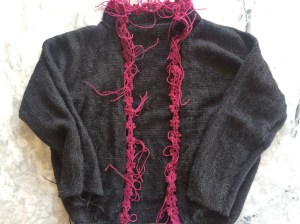
IMG_2086What took longer than expected was the whole crocheted edging-collar-button-band extravaganza. The crochet bands are extremely fiddly — they are crocheted onto each other as you go, it’s difficult to make them all exactly the same size, and each one needs its own, new piece of yarn. There are a total of 50 elements, so that’s 100 yarn ends to weave in right there. Then there’s the “inner” collar, the “outer” collar and the button bands, all of which are made separately and sewn on, and somehow need to end up symmetrical and fit properly on both sides. Of course, I sewed the collar on backwards the first time, forgot to switch the right and wrong sides at the collar fold, etc, etc. It all worked out in the end, though.
My only modification (besides the short-row darts) was to make the sleeve ribbing 3 inches long, like the waist ribbing, instead of 1 1/2. The sleeves are still not full-length, nor are they supposed to be. I don’t like the idea of 3/4 or 7/8 sleeves, but it worked out better in practice than in theory.

To sum it up: Pattern was wonderful, yarn was wonderful, knitted blouses are the coolest thing ever and I am 100% satisfied with this project.

Version 2

July 1960: Overview

IMG_1879“Free and easy” is this month’s motto. Summer is here and nobody really feels like handling warm wool, so the emphasis is on “travel knits” (lightweight), “casual knits” (not too complicated) and “stroller styles” (loose and oversized). There is more embroidery and needlework than knitwear, and some easy sewing projects. Shall we relax and take a look?
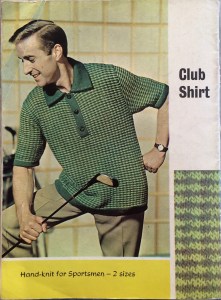
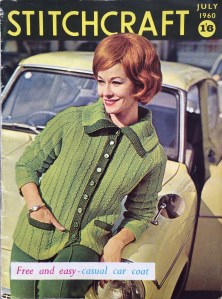
The combination of dark and light green continues to be in fashion: we saw it in the great houndstooth jumper from January 1960 and it’s here again in this “casual car coat” and and the loose-fitting men’s checked shirt style on the inside back cover — “suitable for golf or to wear with beach shorts.”

IMG_1898I have to take a moment here to quote one of my favourite Roald Dahl stories, “The Boy Who Talked With Animals.” It’s about a little boy who saves a giant tortoise from the soup kettle, and Dahl’s description of the tourists waiting on the beach for the caught tortoise to be hauled in has, for some reason, stayed with me through the years:

The men were wearing those frightful Bermuda shorts that came down to the knees, and their shirts were bilious with pinks and oranges and every other clashing color you could think of. The women had better taste, and were dressed for the most part in pretty cotton dresses. Nearly everyone carried a drink in one hand.

I would hope Stitchcraft readers and their men would have had better taste, but I’m not always sure.

The other “free and easy” knits are mostly nice without being really special: a pretty cardigan with knitted-in pearls, nubbly Rimple, a short-sleeved blouse and some cute tops for teenage girls.


The “plus-size” (37-40 inch bust) cardigan blouse is really elegant, though, and has a feature that I have honestly never seen in any other mid-century patterns: short-row horizontal bust darts. But unlike modern methods of short-rowing where the turning stitches are wrapped or otherwise bound up with the stitch next to it, you just cast off the stitches and cast them on again, sewing the dart up afterwards as you would a sewn blouse.  IMG_1895

For the little ones, there’s a sun-suit, a fluffy top, and a waistcoat to sew and embroider. The waistcoat is a tie-in with the current comic, “The Magic Needle”, in which our tailor hero’s magic needle has just made a lovely embroidered waistcoat for Mouser the cat. In addition to the waistcoat, you can sew a stuffed toy Mouser, and while you’re at the sewing machine you can make this adorable gingham skirt to wear “over a frothy petticoat” and an amusing apron “for the needlework stall” (Stitchcraft often gives ideas for inexpensive projects that can be sold at church bazaars or other “sale of work” opportunities.)


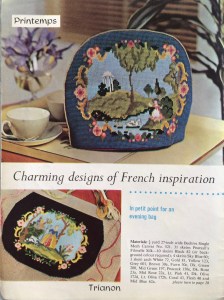
IMG_1881You can also embroider a tablecloth, make tea-towels in huckaback, or attempt this fabulous tea cosy and/or evening bag in faux eighteenth-century tapestry. I so, so want to make this evening bag! I would love it and use it all the time. But I am too overwhelmed by the idea of trying to make a chart based solely on the photos — the design is fairly intricate — and having never before attempted tapestry work, I fear it would just be too much for a rank beginner. I will definitely file it away for future days when I know how to approach it better.

That’s it for free-and-easy July 1960! I’ll leave you with a parade of well-dressed cats, courtesy of Mr. Tuckett’s magic needle. My project from this month’s issue will be the lovely bust-darted cardigan blouse, and I’ll try to finish up the projects from April (!) and June.


June 1960: Overview

IMG_1805June, the month of leisure! Or at least, leisure knits — “Fashions for Sun and Sea.” Stitchcraft’s “editress”, Patience Horne,  reminds us that it’s important to have something to knit or sew while on holiday, as “it helps us to relax”, and points out that “A lot of knitting and embroidery is done in the deck-chair by busy housewives who never get time at home, and find it difficult to ease off suddenly.”

Honestly, I always had the impression that busy housewives were the ones who never got any time off, even when the family was on holiday. I guess it depends on where you went, what you planned on doing and what accommodations you had, but if I recall correctly, camping was quite popular in the IMG_18081950s and 1960s… meaning the housewife/mother of the family had to shop, cook and keep the tent or living space tidy just as she did at home, but in worse conditions (rain, mud, no proper grocery stores, camp stove, having to fetch water for cooking and washing up). Doesn’t sound much like leisure time to me! Of course, if you were rich enough to stay in a nice hotel and eat out for meals you might well have some time for handcrafts, but that wasn’t a possibility for all families, and Stitchcraft‘s target audience was more working-to-middle-class.

But knitting magazines have to be sold in the summer months as well, and there are some very nice things to make in this issue, cleverly categorised by activity. “Sun-seekers” can make pretty sleeveless tops (in wool or nylon) and one of the patterns has a cute fringed shoulder poncho thingy to change “from beach to promenade.” Two other tops are a bit dressier, in case you want to change again for tea. Obviously, the tops need to be lightweight, so all are made in 2- to 4-ply wool at 7 to 8 1/2 stitches per inch.

For “the young sailing fan” — or horseback riding fan — there’s the child’s cardigan pictured in the inside front cover and a horse-motif pullover, both in somewhat thicker Rimple Double Knitting. Though I don’t think the head in the riding motif looks much like a horse’s head — is it supposed to be a fox? These days, you could knit it in silver-gray with neon green eyes and call it an alien, if you wanted to. Rimple is also featured in a classic V-neck pullover for women and a stole, “for a touch of glamour.”

For “Tennis and Rowing” — the manly sports, I guess, since the girls sail and ride horses and the housewives are all too tired to do anything but sit in the deck chair and knit — there’s a pullover in double knitting with crew neck, sunglass pockets, and colour pennants where the knitter can use the wearer’s club colours. Bulky Big Ben wool makes an appearance in a slipover for men and a little cap for women.

If that’s not enough to keep you busy on your supposed holiday, you can embroider some cushions quickly in thick thread, make an intriguing circular table cloth with a peacock motive, sew a little dress for a toddler, or make lunch mats with holiday scenes on them in fantastic shades of yellow and purple. There are tapestry designs for a footstool, screen, book cover or “finger plate” as well.

Wait — what on earth is a finger plate? It looks like something you put on a door — but why? Wikipedia came to my rescue:

“A fingerplate is a plate that is fixed to a door near the handle or keyhole. It can be made of metal, plastic, ceramic or glass. It purpose is to prevent people’s fingers from smudging the door.”

This makes no sense to me, as I would think it would be easier to wipe off the door once in a while than to take a framed tapestry off of the door, wash and re-mount it, but OK.

Speaking of “what is this” and “OK” — you can also embroider a “novelty bathroom mat” where “suitable expressions” on the taps register hot or cold, and in the “Suggestions from Readers” column, we are informed that Mrs Ross of Berkhamsted cleverly adapted the tapestry townscape of Finchingfield “to bring in her husband’s interest in aeroplanes.” Behold, the Comet jet careening over Finchingfield, apparently about to make an emergency landing in the town square!

Let’s hope things end well for everyone involved.

My June project wasn’t pictured here, as it is just a little “extra” design element offered in the back pages — a little parakeet (budgie) motif for cross-stitch or knitting. I’ll turn it into something cute for two friends who are getting married in August.


May 1960: Dear little matinee coat

baby2My first project for May was a “matinee coat” for a 6-month old baby. The baby I knit it for hadn’t been born yet, but I always like to make a six-month size for a newborn. Of course it will be too big at first, but eventually the coat will fit.

Don’t you love the positioning of the baby in the photo? “I’m 6 months and almost sitting up!” means it was probably pretty difficult to get any sort of picture of the baby wearing the coat in a way that you could see it, not to mention without crying, flailing around, spitting up, etc. I have a real respect for anyone who can get a decent photograph of a small baby, especially one where you want to see what it is wearing. Sadly, there is no colour photo.

The coat is made in one piece from the top down with raglan armholes. This kind of construction was pretty rare in mid-century knitting patterns — most baby clothes, like almost all adult clothes, were meant to be made in pieces and seamed. This garment does have seams, though — after the division for the fronts/sleeves/back at the underarm, you are supposed to work each bit flat and then sew the side and sleeve seams.

IMG_1753 I actually did just that, because the written pattern was very difficult to follow on the first few rows after the underarm divide. The raglan increases at the top are done with eyelets and make-1 increases on a each side of a bit of moss stitch, and after the underarm divide, the same type of increase is done on the fronts and back to make a flared skirt. That all makes perfect sense, but the way the pattern was written made it difficult to find the placement of the increases if making the fronts and back all in one. So I just went ahead and followed the pattern exactly. Except for the sleeves, which are supposed to be long, but I ran out of yarn.

As with many early baby things, the tension/gauge was 8 stitches to the inch — on No. 11 (3 mm) needles — much smaller than I can ever manage to get no matter how small the needles or how thin the yarn. I used Lang Merino 200 Bébé, which is wonderful, but my gauge was too big even on 2 1/2 mm needles. No matter, the coat will be a little bit bigger and hopefully fit a little while longer.

matineeblockIf you are looking at the first picture and wondering what went wrong, let me assure you that it was NOT a tangled mess! As long as the sleeve stitches were on holders, there was no way to make the thing sit down flat for a photo. Kind of the same problem with the baby, if you think about it… Here’s a picture during blocking (at left) and here’s a picture of the finished garment. I am very happy with it!

matinee_fo

P.S. Yes, it is supposed to have long sleeves. I ran out of yarn.

May 1960: Overview

Apr1960coverIs it already May? Nothing makes time fly like writing monthly blog posts! May 1960 is a “Roundabout of Holiday Knitting” (complete with a little circus-fair logo that fills up any little dead space in the page formatting, how cute) where in “today’s story”, “no one thinks of going away without 2 or 3 brand-new woollies packed away in their luggage.”  So let’s get started…

Check patterns are still in, this time in a “gingham” (two-colour slip stitch) pattern for the woman’s jumper on the cover and a “firm stitch to weather the water” (also two-colour slip stitch) for a toddler boy’s swim trunks. totsbeachI am quite sure no small child wants to swim in hand-knitted wool trunks with a belt these days, but I imagine the sun-suit on the opposite page would be fun and practical for beach wear if made in cotton. The baby and older girls of the family get pretty cardigans or a tunic “to wear with her jeans.” I’m glad to see activewear for girls, since generally one is assumed to make pretty, decorative stuff for girls and strong, “manly” stuff for boys — sexism that is not surprising in 1960, but which always depresses me to see in today’s knitwear patterns for children.

For adults, there is a “Trio of Summer Fashions” (“Two to look pretty and one for sports”) and a great cable pullover in bright yellow.  The “sports” pullover is machine-knitted.

There’s still plenty of stuff to make for the home, too (just in case your holidays are too relaxing). Table mats to match your willow-ware platter are actually really cute, and look at that beautiful appliqué tea cosy! Cross-stitch is popular as always for chair-backs and tea-tray ideas, or you can crochet yourself a bedside mat. But what on earth is this “contemporary screen” that uses your scraps?

In the comics pages, we are introduced to Mr. Tuckett, a tailor who receives a magic needle from his friend the wizard. What will the magic needle do? Stay tuned…

roundabout

My projects for this month will be the baby’s jacket and a modified version of the tea cosy.

Enjoy your holiday roundabouts!


April 1960: Popular neckline

Version 2My second project for April (obviously not finished before the end of the month, seeing that I started it two days before) was this cute lace blouse with a “Popular neckline.” I do love the neckline, and the leaf pattern.

The pattern is written for wool, of course, but I made it in cotton for summer. It is very, very difficult for me to find any kind of yarn, especially cotton, that is fine enough to get the pattern gauge of 8 stitches to the inch in stockinette stitch. I can hardly even get 8 stitches to the inch on lace-weight wool on 2 mm needles! But crochet cotton thread would be too thin, and I don’t think I’ve ever seen it in black. So I found a cotton that gets me 7 stitches to the inch on 2 – 2 1/2 mm needles and fiddled with making the middle size and having it come out as the large size.

popneck_wipThe biggest problem was making the side-seam increases. The lace pattern has a repeat of 12 stitches, but a sort of varying number of edge stitches. I honestly had no idea where to fit in the extra stitches, or how to keep them in pattern when the increases and decreases within the pattern are broadly spaced. Time to hit the Ravelry forums! I did try charting it out (the pattern has written instructions only) and at first it made it easier to “read” the knitting, but didn’t give me any fundamental technical answers. I realised I had to chart out  not just the pattern itself but all of the increases and decreases, with the changes that had to be made row by row. That worked, but by then I had already made the back piece, so those increases on the sides weren’t perfect. But everything else was!

The fit is incredible. I was wary of the horizontal cap sleeves, which are really just made by casting on extra stitches instead of decreasing under the arms. I thought it would make a lot of baggy fabric under the arms, like those 1950s (or 1980s) dolman-sleeve fashions that must be extremely inconvenient to wear. But no! The armholes are snug without being too tight, and I appreciated the extra width and give in the upper chest and back, where I am quite wide.

All in all, it is wonderful and I am very happy. Here I am having fun “recreating” the original picture. The bag is from a Stitchcraft pattern, too!IMG_1929

April 1960: Overview

coverapr60“Already there is talk of holidays” says the introduction to the April 1960 issue, “and whether it’s to be the sea, country, sight-seeing or sailing, you can’t go without your holiday hand-knits.” At the same time, spring and April mean Easter, with lots of opportunities for hand-made accessories and knickknacks.

For knitters, there is a larger variety of wool weights and styles than in the last couple of issues. Houndstooth and checked patterns are still going strong — look at that great jacket on the front cover! — but lace and Rimple designs are offered too, and garments for babies, toddlers, and adult men and women.

For the patient, there is a cute 3-ply top and a shirt in cotton crochet yarn at 12 stitches to the inch. (This is the only type of cotton yarn I’ve ever seen featured in Stitchcraft, but usually it’s used for making doilies or other fine crochet items.)

For those who prefer to actually get their garment finished before the summer holidays start, there are “partner look” sailing sweaters, the houndstooth jacket on the cover, and pullovers in Rimple and Big Ben yarns. Rimple will continue to not be my taste in terms of texture, but isn’t the model cute?

Easter embroidery is big, and around this time, Stitchcraft started to include designs for church accessories — hassocks and kneelers in tapestry or cross-stitch. For those for whom Easter is less of a religious experience, there are some great “Easter novelties” (cosies for teapots and toilets) and who could resist those gay kitchen ideas? Standard needlework ideas for the home include a fitted chairback and a lovely Persian-inspired cushion.

One thing that is really different in this issue is a sewing pattern, common in 1940s and 50s Stitchcraft but rare in the 1960s. It’s a very simple nightdress (for Easter and/or your holidays, of course) that is recommended to be made in “one of the easily laundered non-iron materials”, i.e. nylon or early synthetics.

nightdress

April’s celebrity “plug” is given to us by Jill Browne, the actress who played Nurse Carole Young on the soap opera Emergency – Ward 10, which aired on ITV from 1957 to 1967.  I have to admit I have never seen it, but it seems to have been quite progressive for its time, with Joan Hooley playing a female surgeon in an interracial relationship that was sealed with a kiss onscreen.

starad

On the back pages, it is the end of adventures for Good Teddy Bear and Naughty Teddy Bear, but they got two gay jerseys knitted for them in the end, so I think everyone was happy. Plus you can make your very own teddy bear to commemorate the series! The ads are for the usual things, except for this gem of a potty-training stool called “Bambino”, appearing for the first time.

My projects from this issue will be the 3-ply top and the appliqué goslings on a tea cosy. Happy Spring, everyone!


March 1960: John’s new pullover

IMG_1550My second project for March — though it wasn’t finished by the end of the month — was a young boy’s pullover with a cute stripe-and-dot pattern.

Sadly, there is no colour photo in the magazine, the two contrasting colours look very similar in the black-and-white photo, and the little chart for the dot pattern doesn’t mention which colour should be used for which row of dots, so it’s not entirely clear what order the dot stripes go in. The main colour is “Moonstone”, the bottom stripe is stripe is “Horizon Blue” and the second stripe “Camel”, so I figured the bottom row of dots is also blue and the second row camel.

In any case, my colour scheme was different, as very light-colored garments for young active children are bound to get grubby, so I picked a sort of heathery grey-beige for the main colour. Camel as a contrast to that didn’t look so great, so I picked a nice shade of plum and a heathery blue. The yarn is plain Regia sock yarn — superwash wool with a bit of nylon for support.

IMG_1588

I though the skeins looked great together but somehow, as I started to knit it up, the colour combination reminded me of jogging clothes from the 1980s. I don’t know why, exactly, but it’s something about that exact combination. I wholeheartedly hate 1980s fashion and am very disappointed to see it having come back in during the last few years, so I wish I had picked something different! On the other hand, nobody else is going to be bothered by it — a young kid won’t be prejudiced and the parents will probably think it amusing if they even make the connection.IMG_1591

The stranding is easy and the main pattern is just stockinette stitch with an extra purl ridge row (K on the right side) every 6th row.

At 7 stitches to the inch, it took a while, and I had to restart once as my gauge was too loose, but I do love the finished look and I hope the wearer will too. I reassured him that he doesn’t need to wear a button-up shirt, tie and shorts with it. Again, if anyone can explain to me why boys of bygone decades had to wear shorts until they were teenagers, no matter how cold outside or how warmly they were dressed on the top half of their bodies, I will be grateful!

pulli_fo