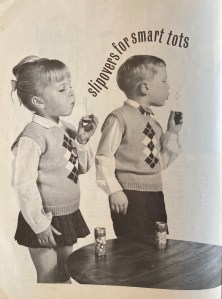
My March project was a cute slipover (vest, sweater-vest, tank top, pullover or whatever you call a knitted over-shirt garment with no sleeves and no front opening) for “tots with a fashion sense.” The tots in the photo definitely look very smart and very 1960s, with the little girl in her tiny micro-miniskirt and the boy sporting a bow tie.
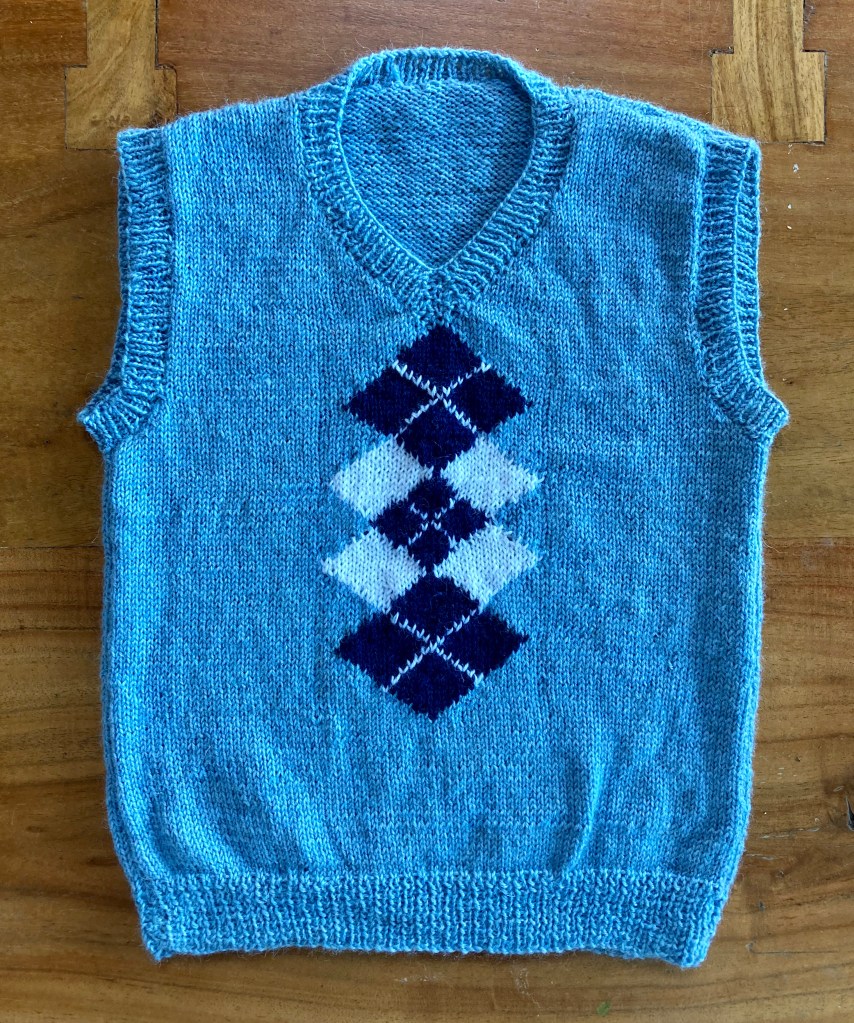
The design (“from Vienna”) features a high V-neck and a simple, but effective argyle-type diamond pattern on the front. It’s written for Patons Nylox Knitting in 4-ply (fingering) weight. Nylox was a wool-nylon blend, fairly new on the market at the time and marketed for hand-knit garments that needed to stand up to lots of washing and wearing, so especially suitable for children’s clothes.
I used modern sock yarn (Meilenweit by Lana Grossa), an 80% wool / 20% polyamide mix which comes pretty close to the original Nylox yarn, and kept the original colour scheme of light blue with the diamond motif in white and navy, so this project was quite authentic to the original. The only change I made was to lengthen the body somewhat to fit the intended wearer, who is on the taller side for his age.
I don’t often work with intarsia designs, so this was a fun change and something new. It went quite quickly, as the pattern is easy and clearly written, so there’s not too much to say about it! I do think it will be well appreciated by the smart tot it was knitted for, as well as his parents.
There are some great children’s designs coming up in the next few months’ issues, so stay tuned for more well-dressed kids.
My July project was this sleeveless jumper with contrasting colour accents on the collar, upper bust and hem.
It’s written for Patons Cameo Crepe wool, but I thought a summer top like this would be more practical in cotton. Sadly, it is nearly impossible to find a truly fingering-weight, non-mercerised cotton yarn. Crochet cotton is always mercerised and I don’t like the stiff and shiny look and feel. Non-mercerised cotton is generally DK weight i.e. too thick. The only company I know that makes a nice, soft, pretty much fingering-weight cotton is Mayflower and I can’t get their yarn anywhere at the moment. Also, it’s summer, and cotton yarns, especially seem to be only available in “summer colours” of white, neutral and pastel, which I do not like or wear. What to do?
Well, remember my May project — the child’s T-shirt made with cotton from the Hamburger Wollfabrik? (Again, city, not food…)When ordering the yarn for that project, I went ahead and ordered 250 grams of the same cotton 4-ply yarn in a slightly darker colour, thinking that I would probably want to make a summer cotton top for myself at some point. That was good forward thinking… only, after making the May project, I realised I really didn’t like the yarn, as it was un-plied and therefore splitty and difficult to work with. The green colour I chose for myself was also still too “cold” — not dark enough or green enough for my taste. But since I didn’t know what else to do with it, I went ahead and used it for this month’s project.
The pattern is basically stocking stitch with “lines” of purl stitches to make a just-slightly-like-ribbing, geometric effect. It has a hemmed bottom edge, which was very much in fashion for knitted garments in 1963. As far as hems are concerned, I should probably have learned a lesson from this jumper from last year, which was also lightweight and hemmed, and has continually gotten shorter and wider with time — the hem neither weighs enough nor cinches in enough to keep the sideways expansion in check, thus ruining the “long-line” effect and making me look short and dumpy in it. At this point I am convinced that hems do not belong on knitted garments unless they are heavy enough and really need to be flared at the bottom, e.g. an A-line coat, but of course I didn’t have the foresight to think about that before starting and replace the hem with ribbing. We’ll see how it turns out.
The knitting itself was boring and slow. The intarsia diamonds were fun, at least. (I used bits of leftover black merino for the contrast colour parts.)
The sleeves are finished with simple ribbing that is supposed to be turned in and hemmed, like the bottom edge, but I decided it looked better with just ribbing. The collar is made, in typical 1960s style, without short-rows as one would probably make it these days — there are increases and decreases at the front “corners” to make the shaping. The black edge of the collar is also hemmed and then the collar is sewn on.
This will probably never be my favourite project, but it turned out better than expected. The colour is not the best for my skin tone, but it looks much better now that I have pink hair! Also, I should have made the larger size. It fits OK, but a bit longer and wider would be more in keeping with the way it is supposed to fit. Also, the neckline is very tight — I can hardly get it over my head and definitely not over a bouffant hairdo. (And a top should always fit over your bouffant hairdo.) But it’s comfortable and fun — and best of all, it’s finished!


 The Stitchcraft Sixties