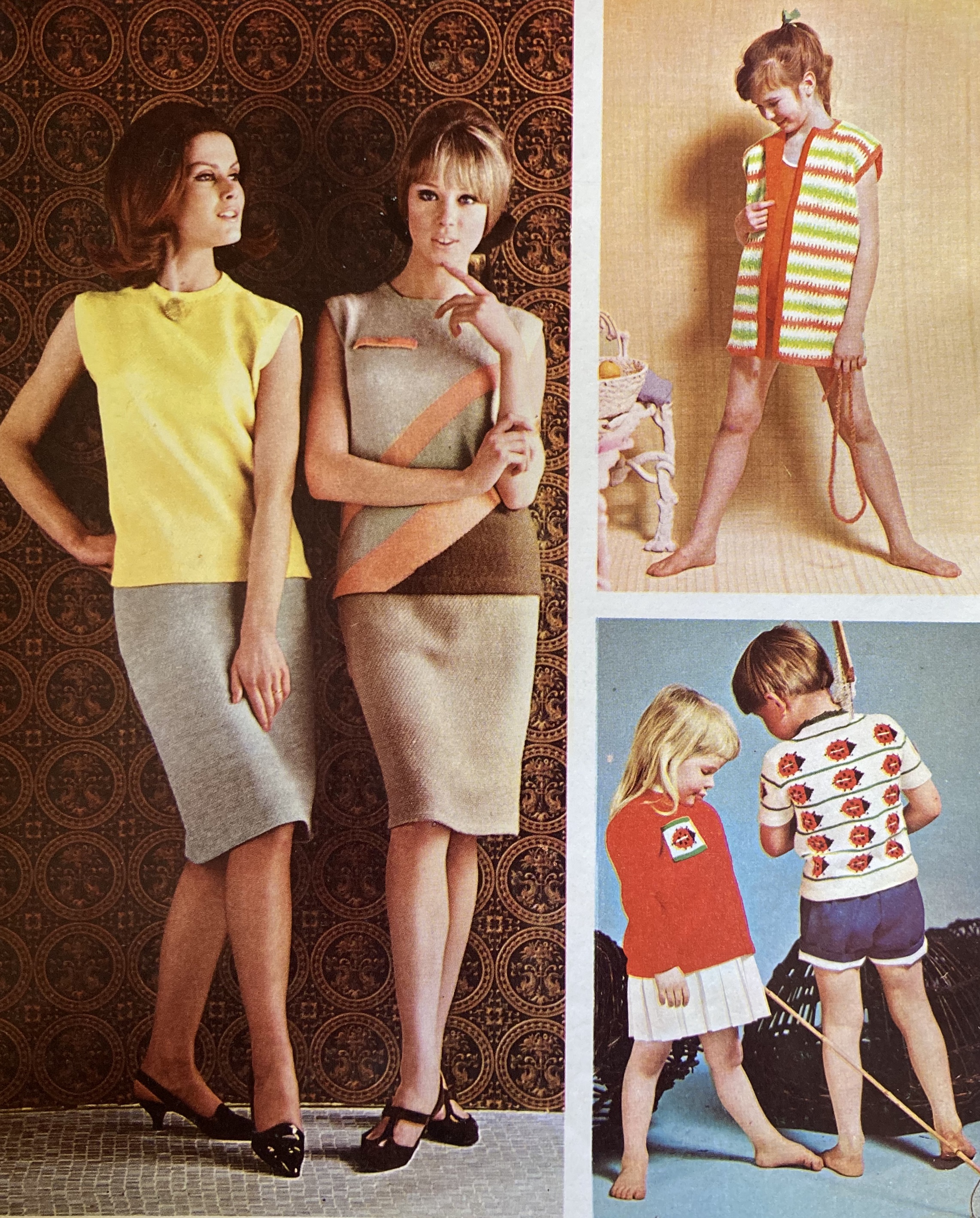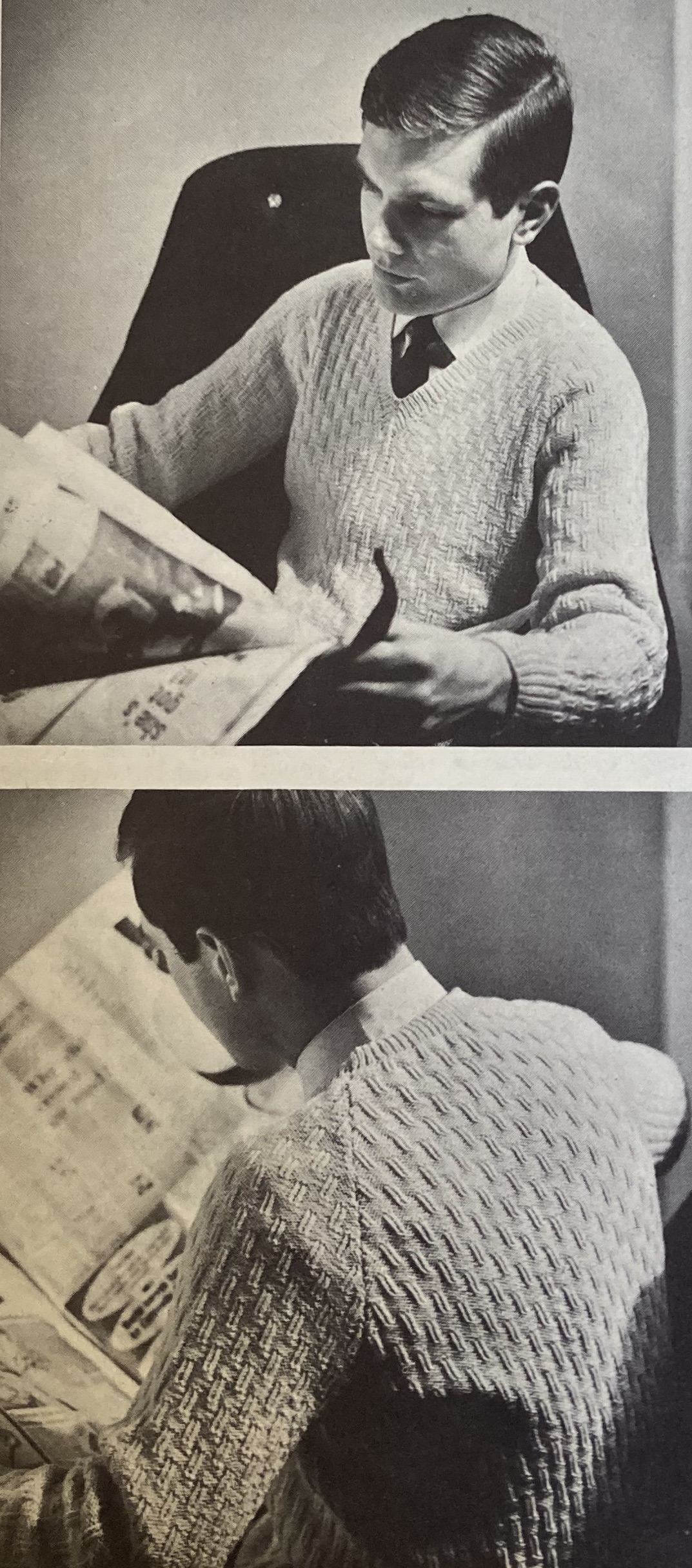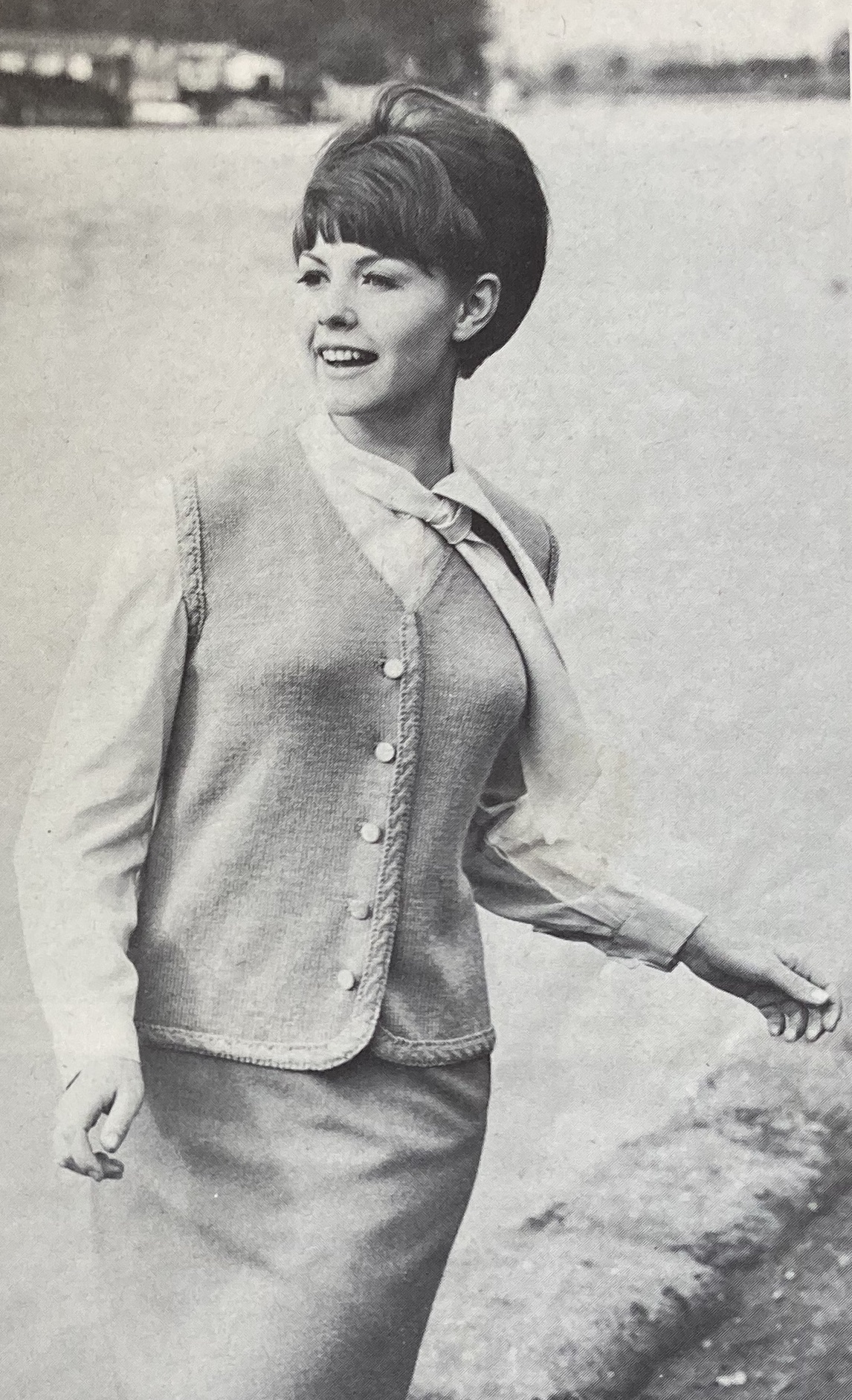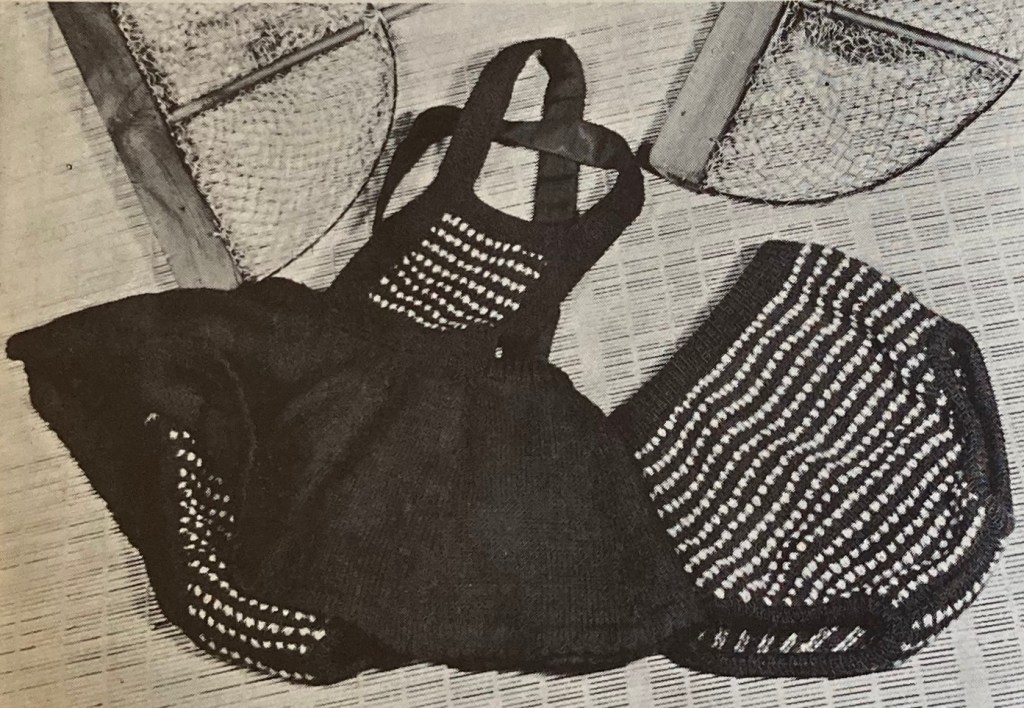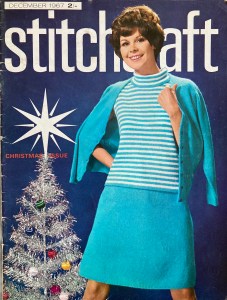
December 1967: Overview

It’s here! The December 1967 Stitchcraft Christmas issue is a “bumper number to help with last-minute ideas for your Christmas giving, and suggestions for your winter handicrafts.”

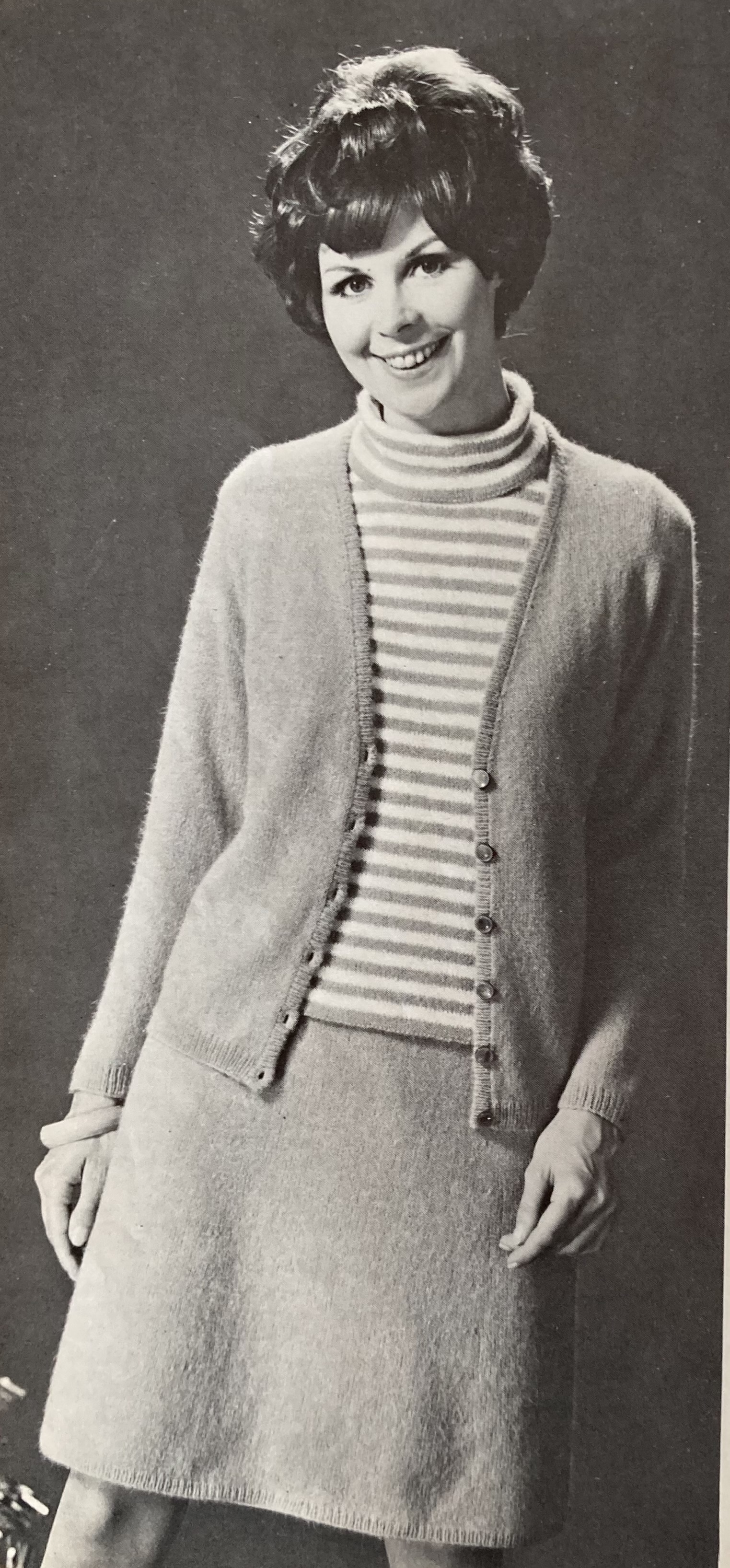
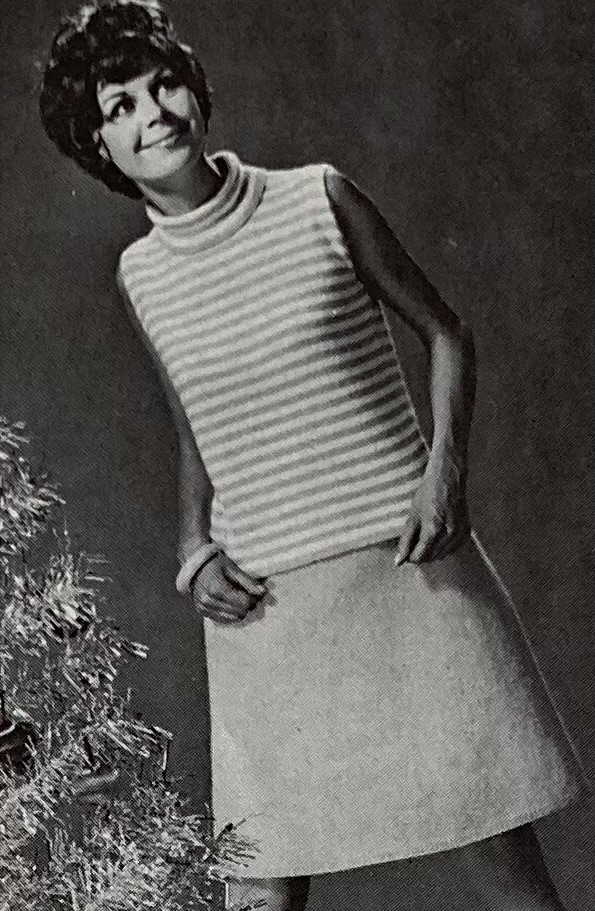
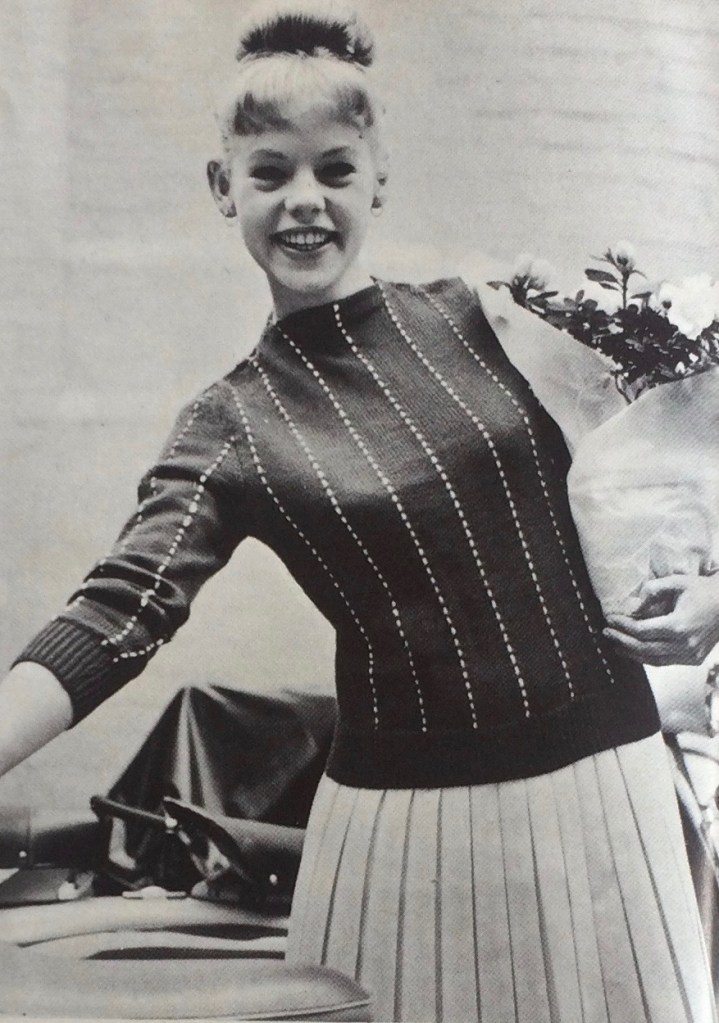
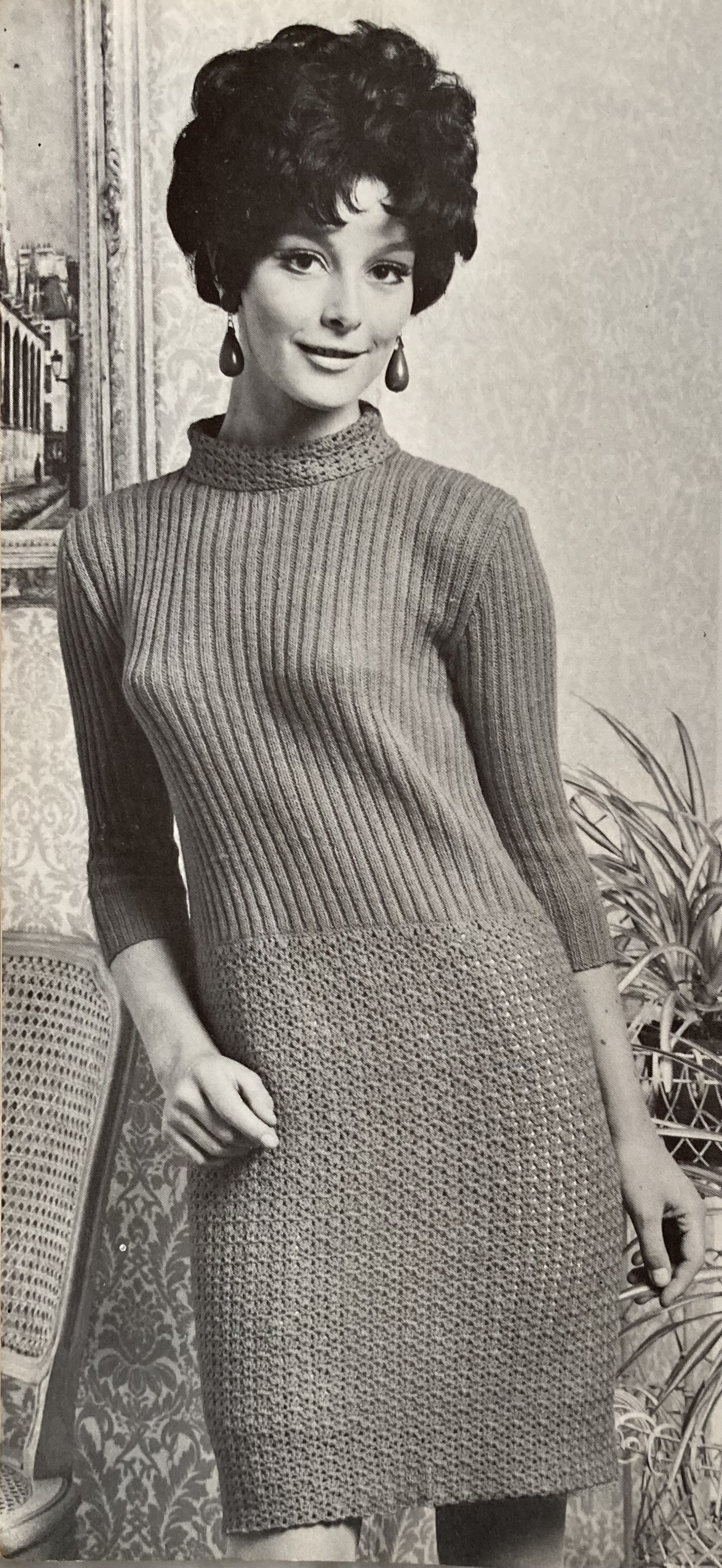
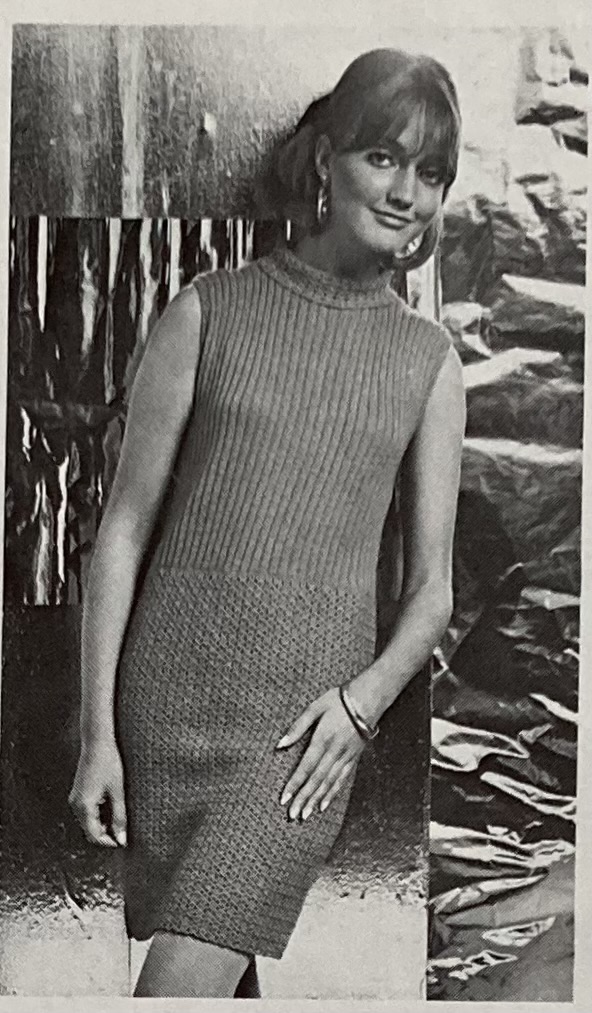
The cover photo went with a wintery blue, white and silver colour scheme to set off the featured 3-piece skirt suit. It’s knitted in Patons “Princess”, a light, fluffy yarn made of 80% wool and 20% angora. At 8 stitches to the inch on No 11 (3.0 mm) needles, I imagine it won’t get finished by Christmas. The striped top is sleeveless, and the skirt shorter than knee-length without being “mini”: this is an outfit intended for the respectable suburban mother of the family. A more fun-loving adult woman can make a party dress with or without sleeves, that combines knitting and crochet. Looking at the second picture, you can see why all the models pose with their spines in that corkscrew S-curve — it’s to hide the fact that the unshaped, unbelted dress will look like a sack on them otherwise. Must be hard to hold the pose for the whole party…
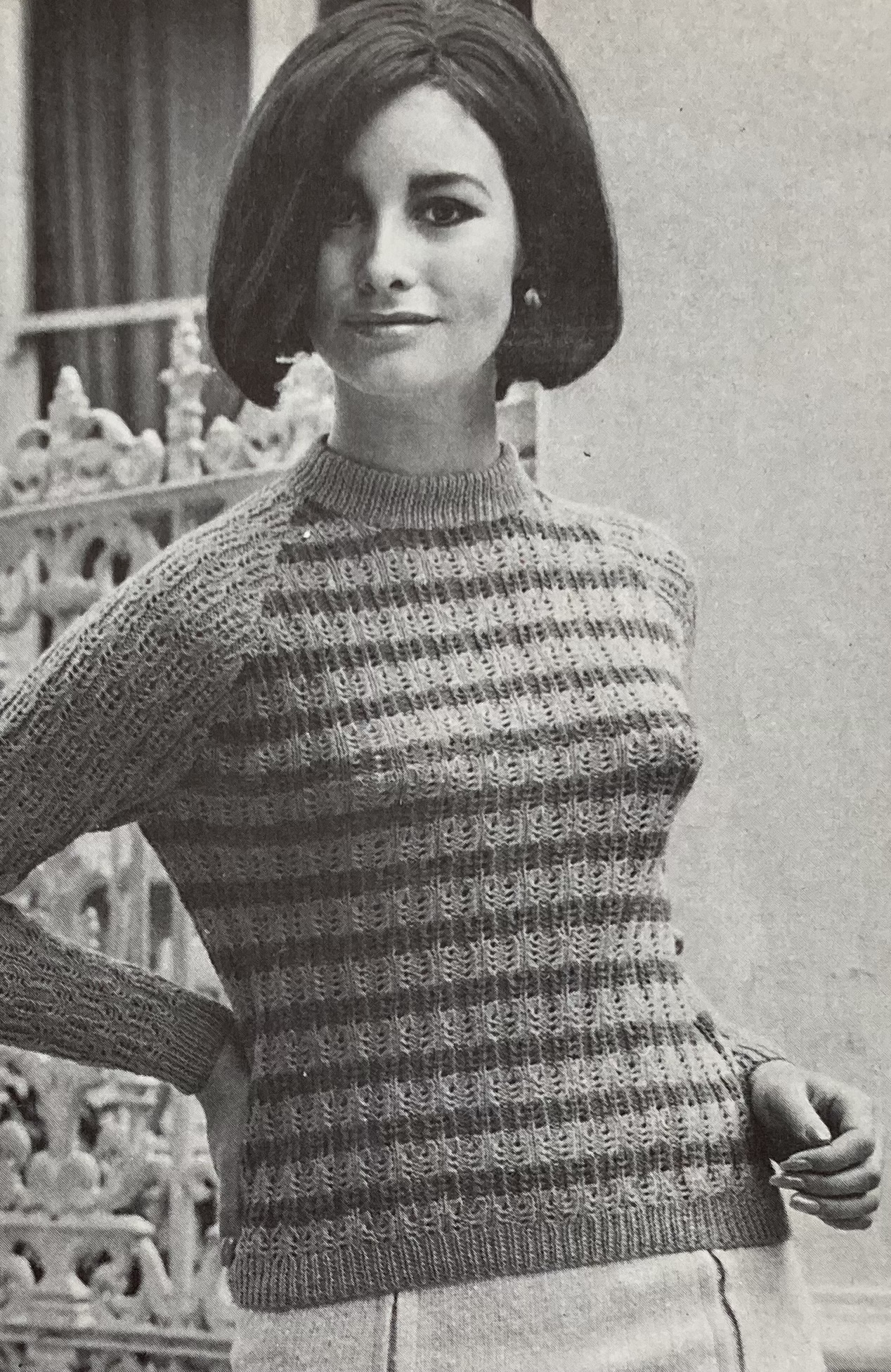
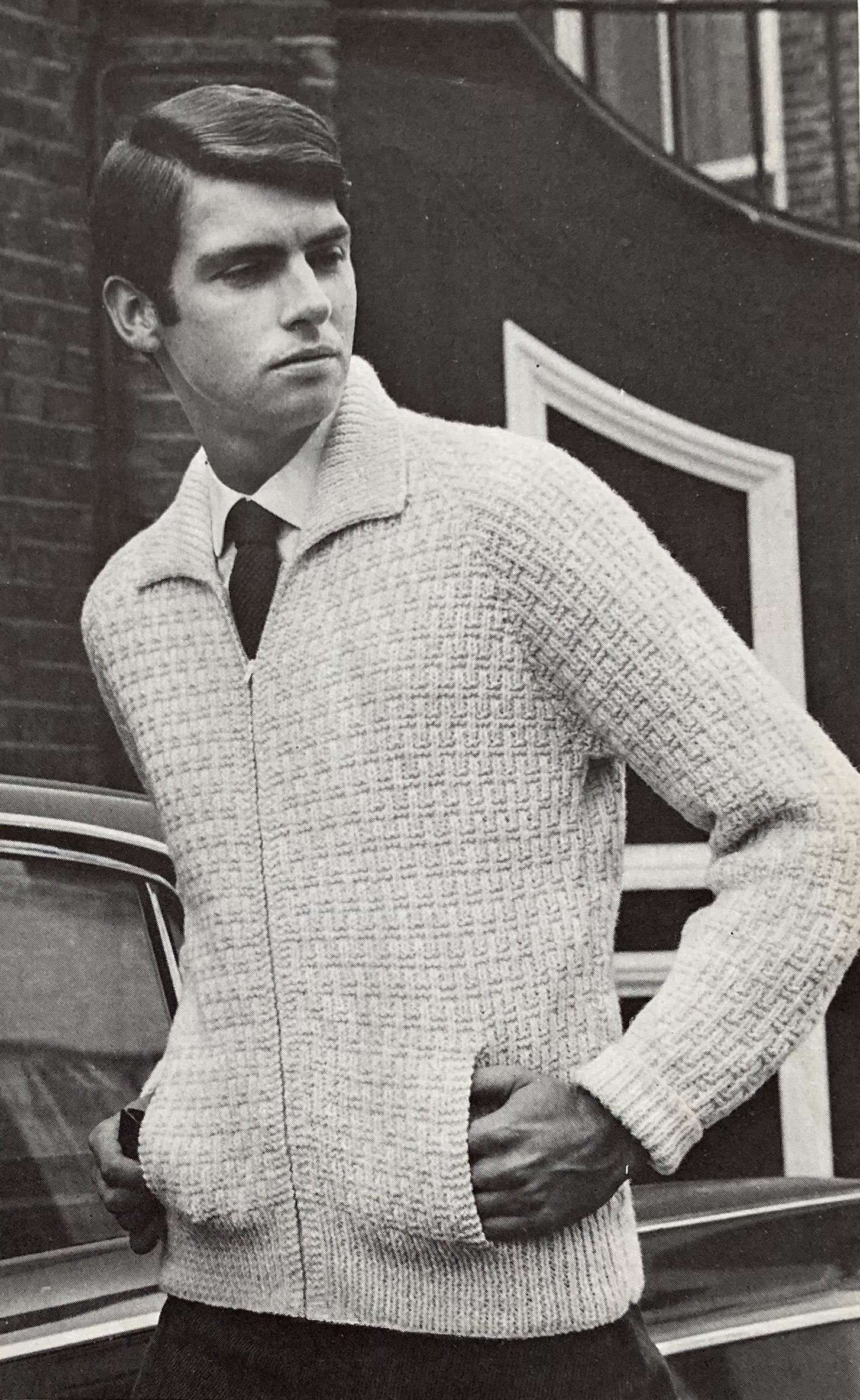
As for the “young team”, they “love to match”, according to Stitchcraft, and can knit themselves (who am I kidding, the girl will knit for both of them) some warm pullovers in a fun two-colour basketweave pattern with ribbed sleeves. The colour pattern is made with slip stitches. Other adult garments include a “lumber style” mens’ zipped cardigan, two practical jumper-blouses to “go with suits and skirts” and a classic cardigan for larger sizes.
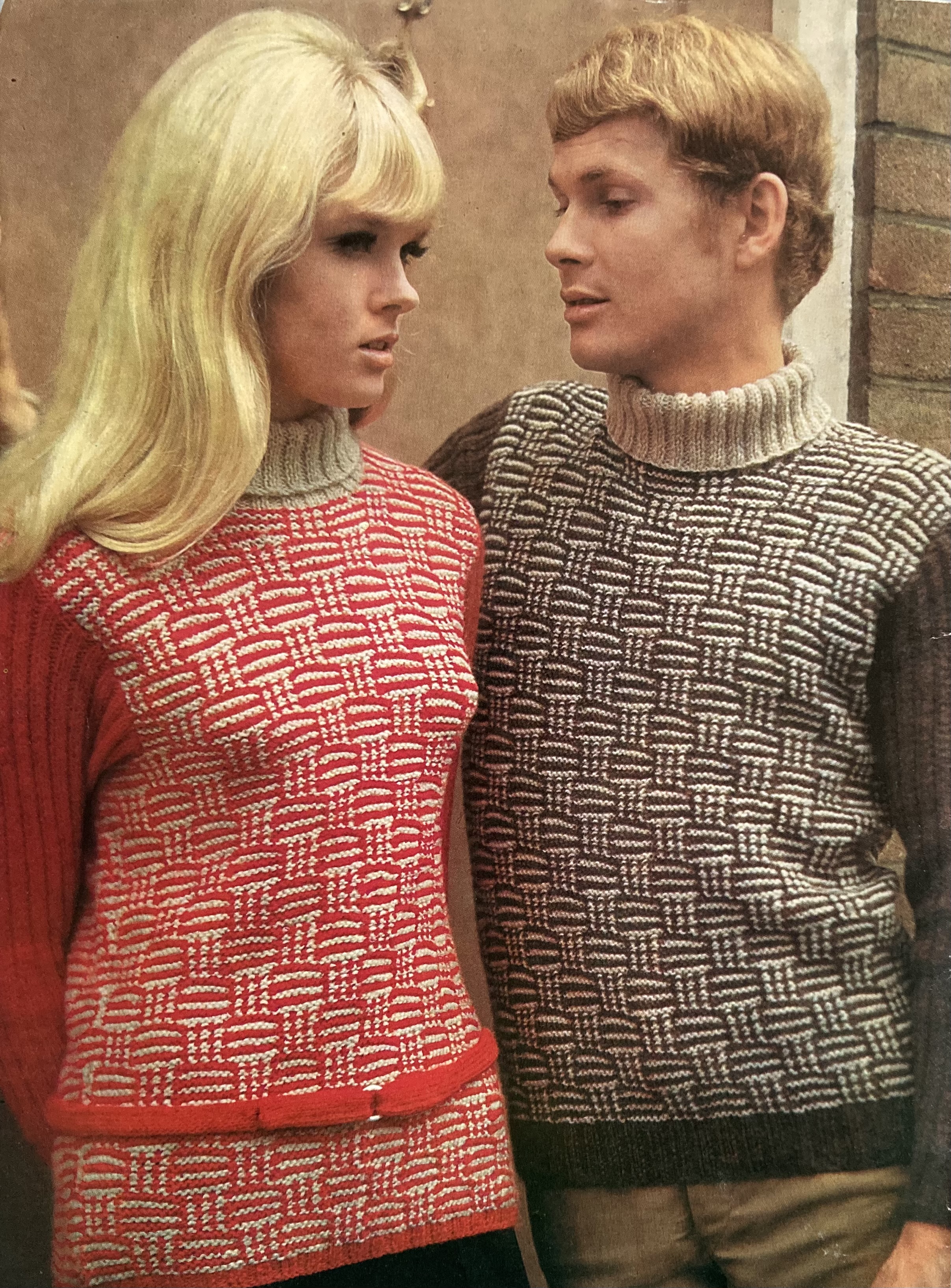
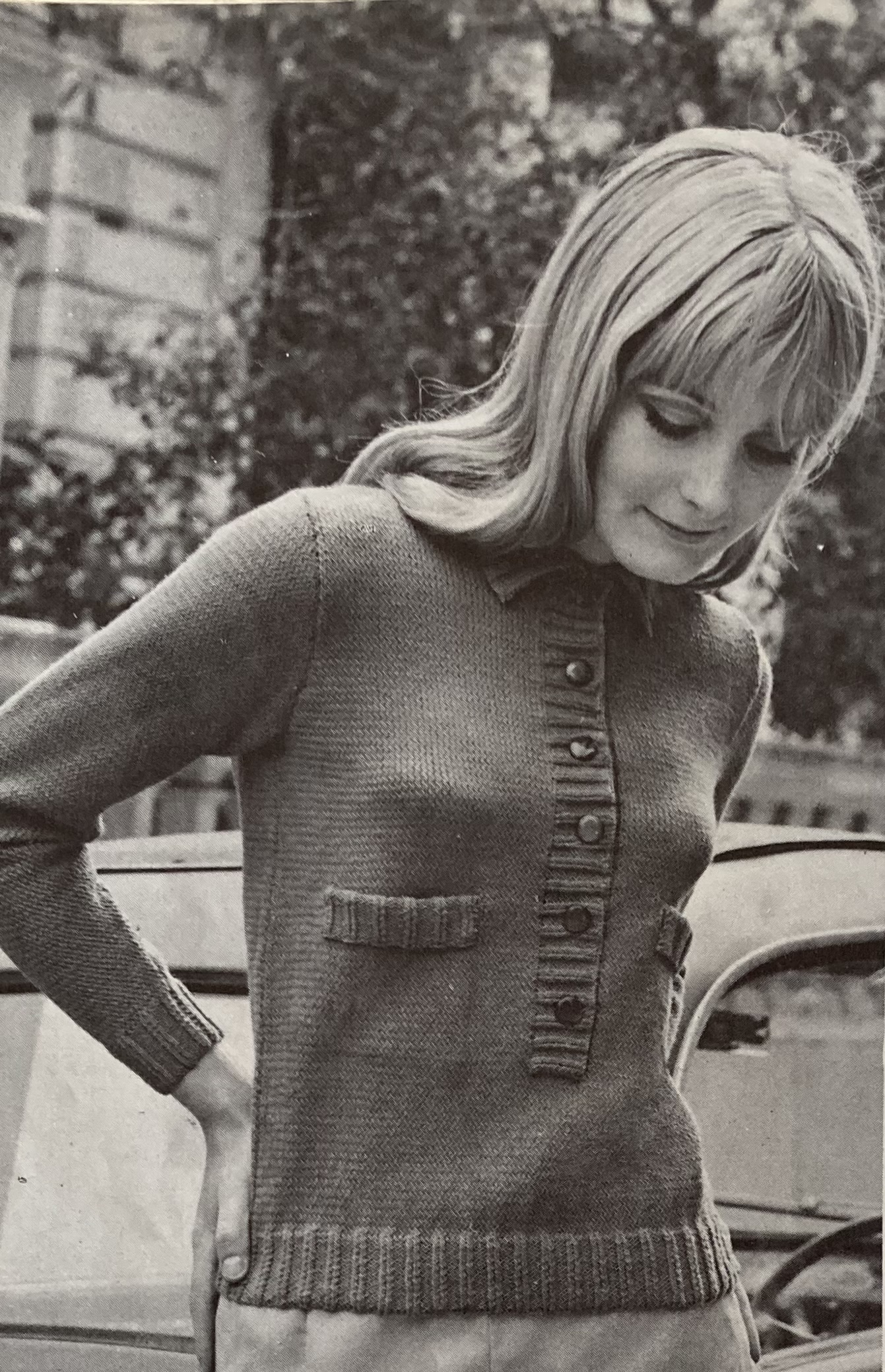
Cables and basketweave textures are on trend, and the colours are not particularly Christmas-oriented — strong, cool colours and neutrals. The mens’ basketweave cardigan is made in cream-coloured, undyed “Capstan” wool and the two suit-skirt jumpers in “Planet Jade” and “Bracken Gold” with “Brandy Snap” contrast. Only the knit-crochet party dress is in holiday “Hawthorn Red”.
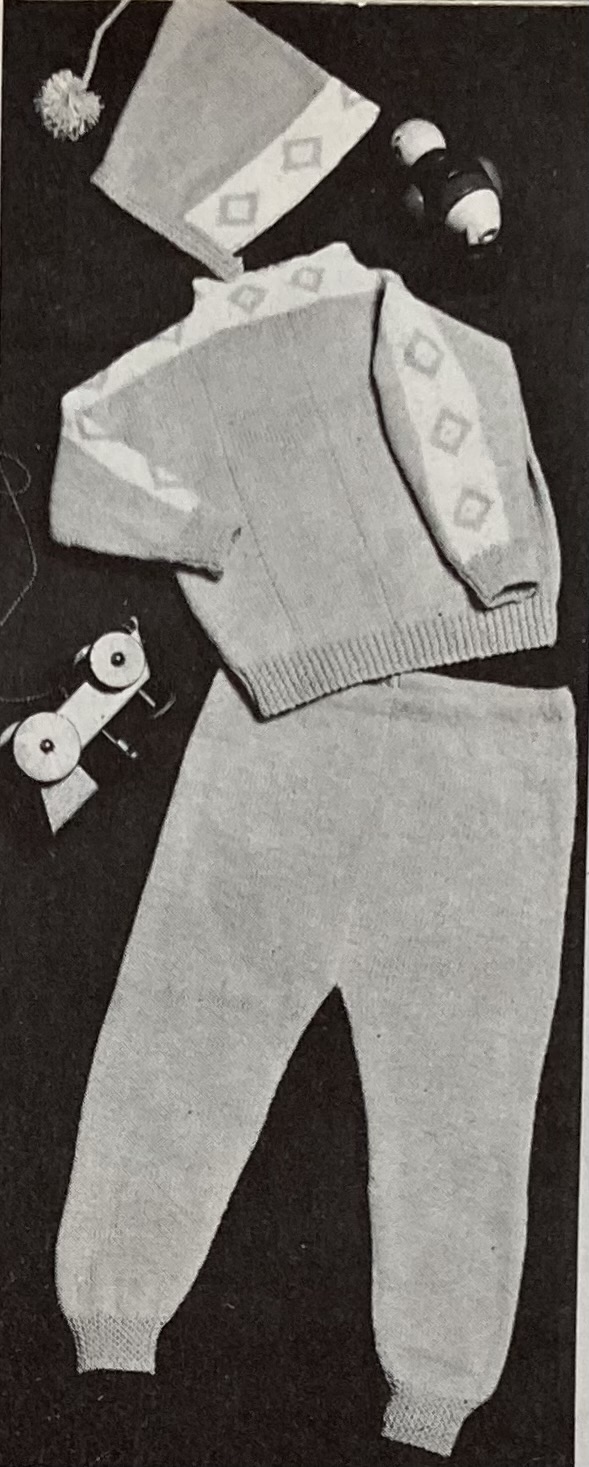
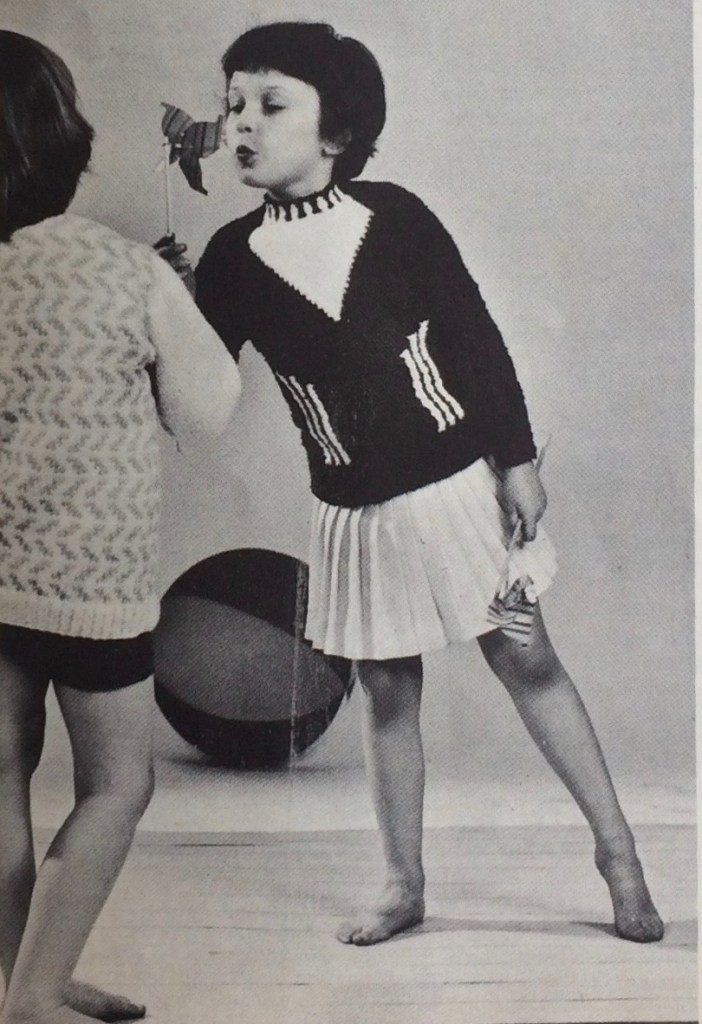
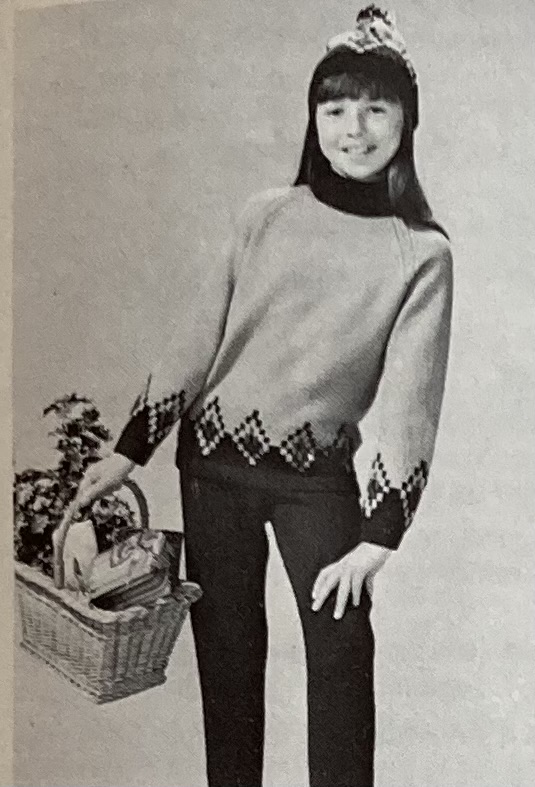
There are some great fashions for children in this issue that could theoretically be finished by Christmas morning: a warm set of jumper, leggings and hat for a little one, a dress-and-cardigan set for a school-age girl and another jumper, leggings and hat set for a pre-teen. On second thought, you would have to be an extremely fast knitter to get any of those sets finished in time… Here too, cool, bright colours prevail, and stripes, slip-stitch lines, and diamond patterns are trending.
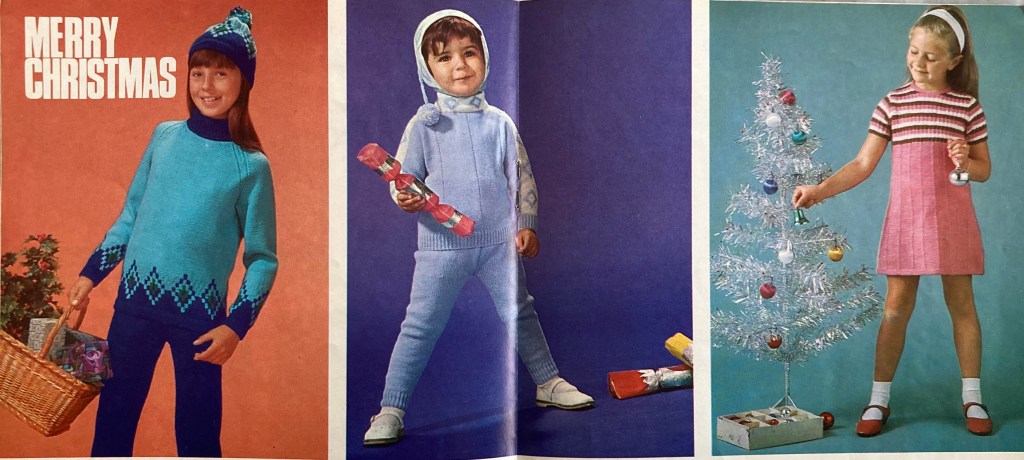
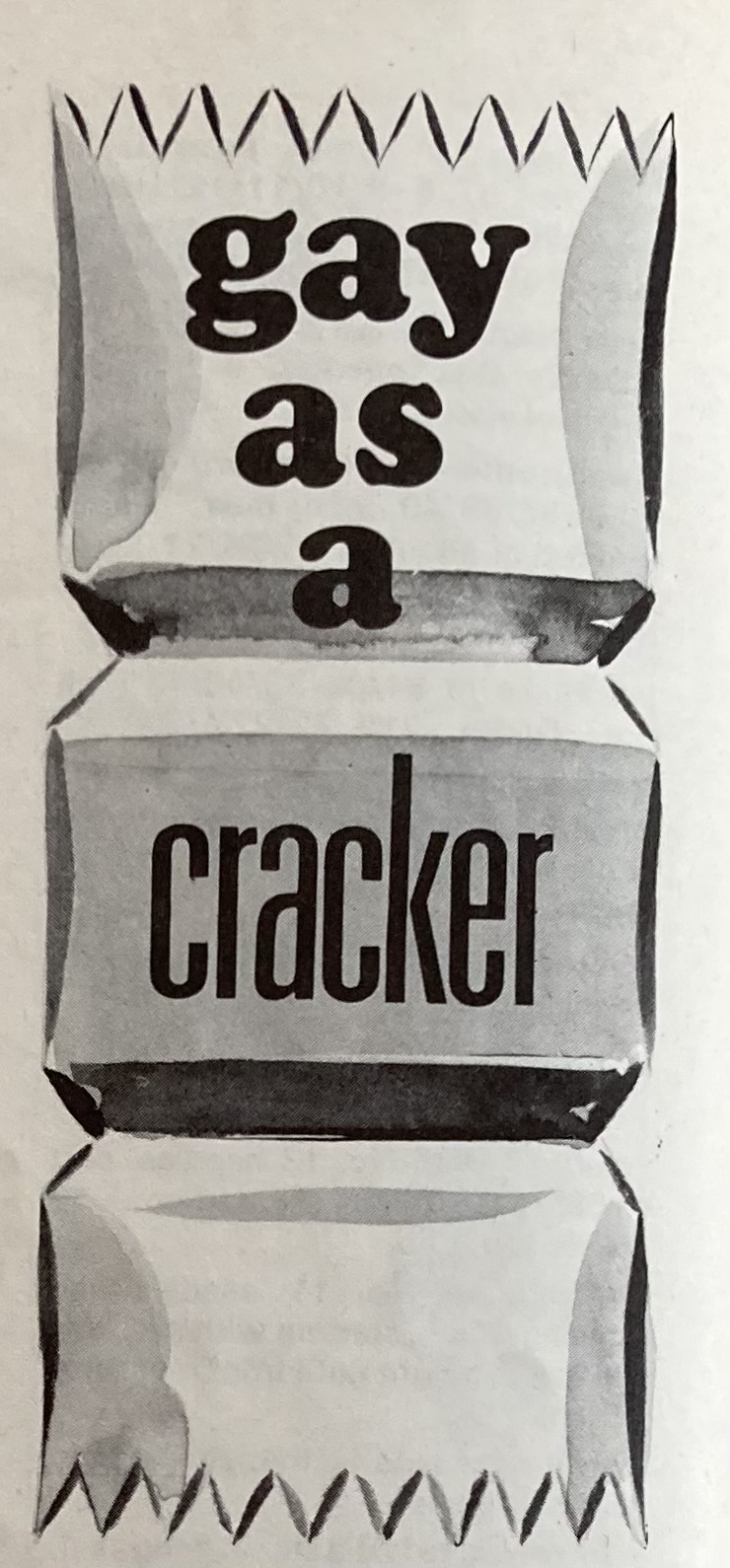
(On another note, the slogan that Stitchcraft chose to describe all of these children’s patterns is “Gay as a Cracker”. I do understand that they mean the outfits are as bright, fun and festive as a Christmas cracker that you pull across the table and get a little prize and a paper hat out of, but that did not age well.)
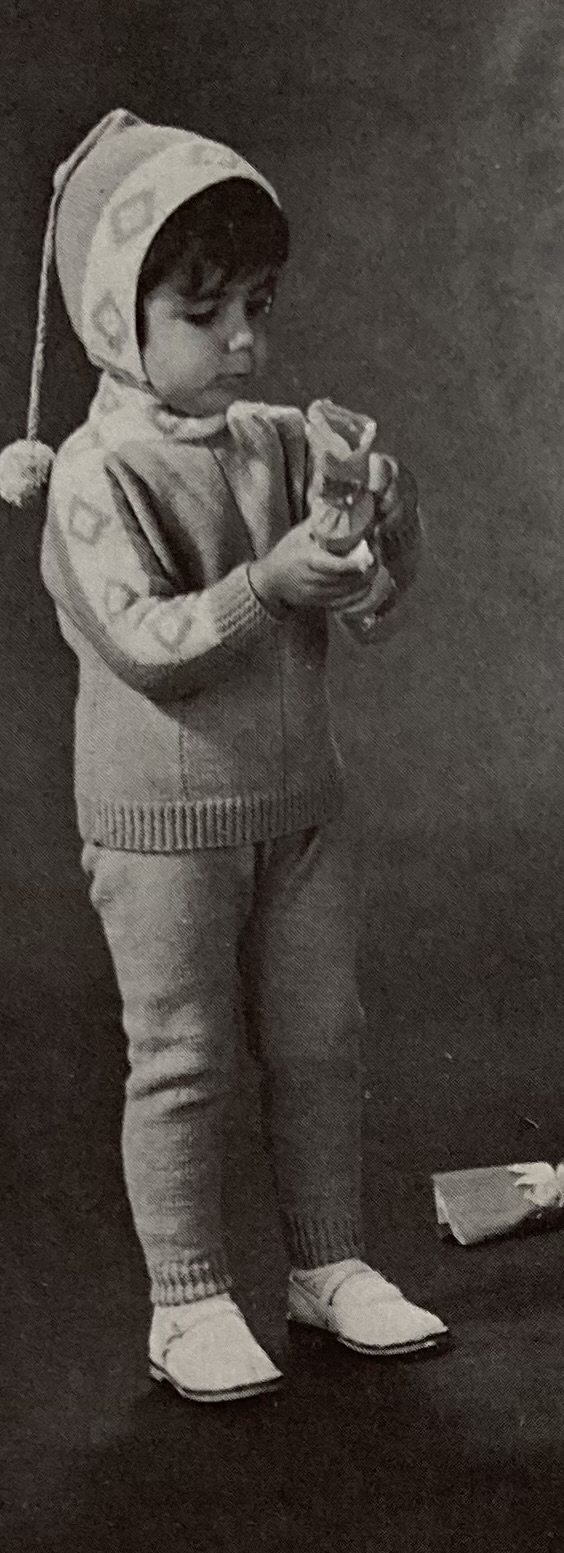
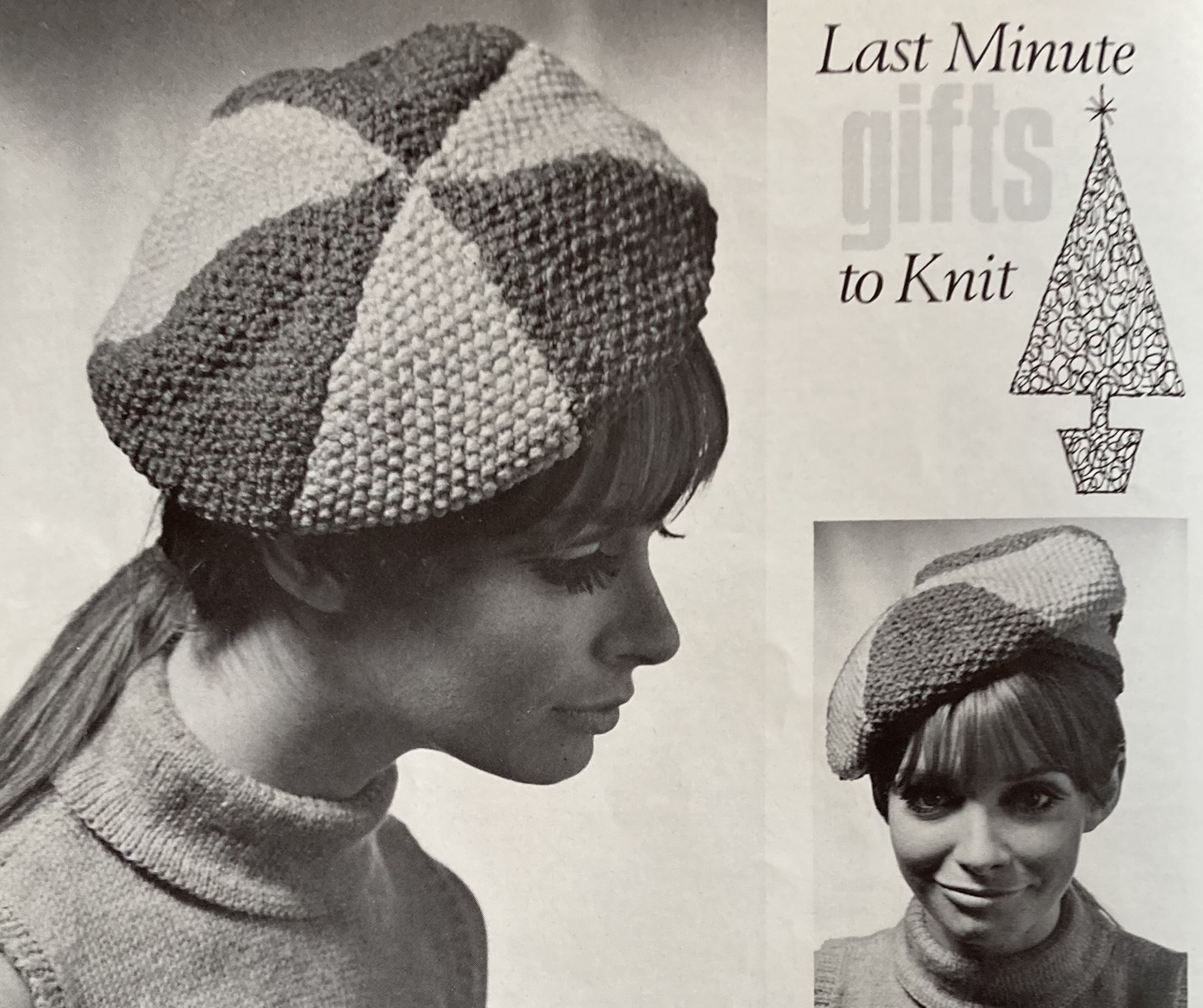
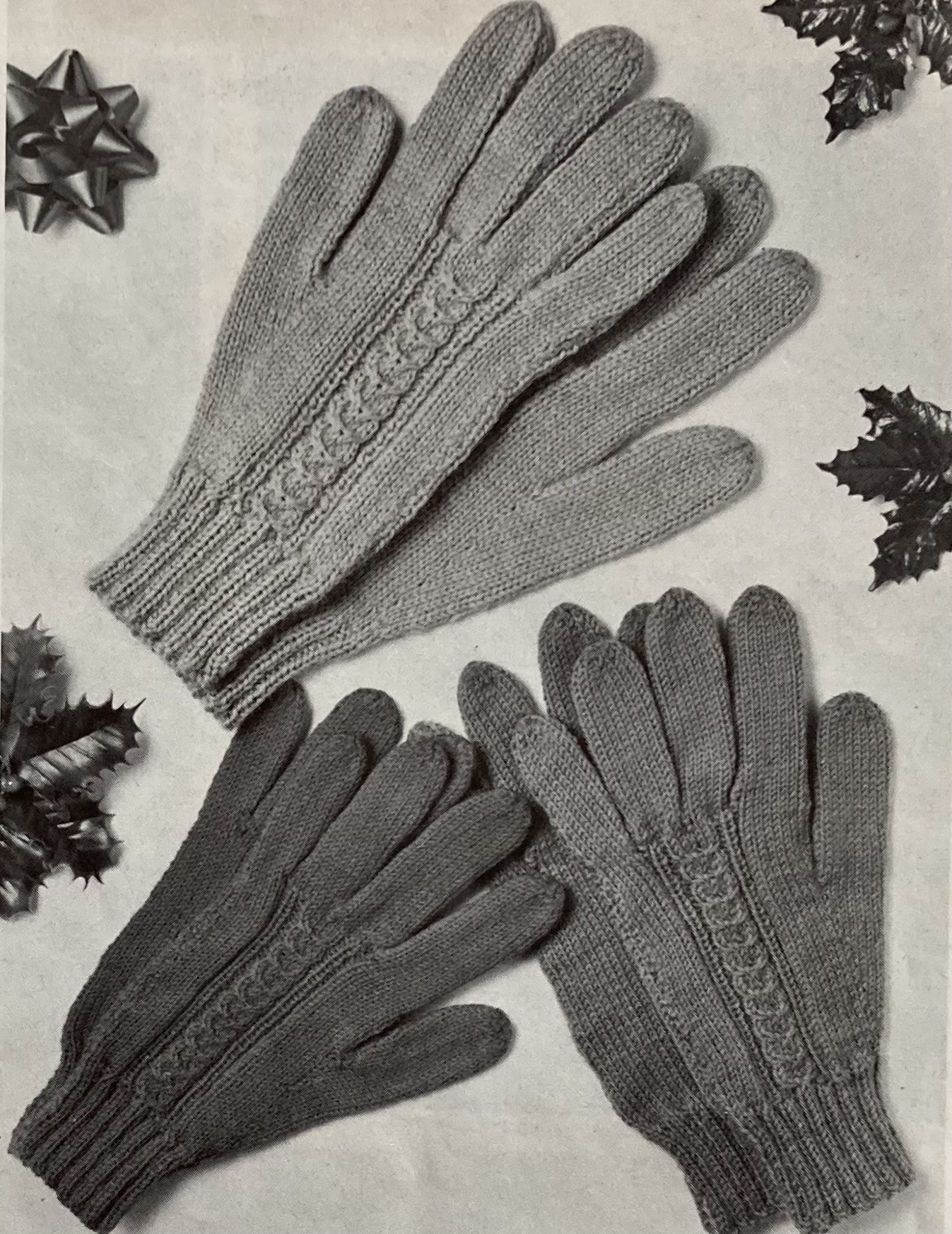
For quick gifts that have to be finished on time, you can make a “tweedy” (actually moss-stitch, but OK) beret or cleverly designed gloves for the whole family. The gloves are all made from the same pattern, using double knitting-weight wool for the large/men’s size, 4-ply for the medium/women’s size, or 3-ply for the small/child’s size. You can also make a very easy crochet cushion, and it even matches the hat!
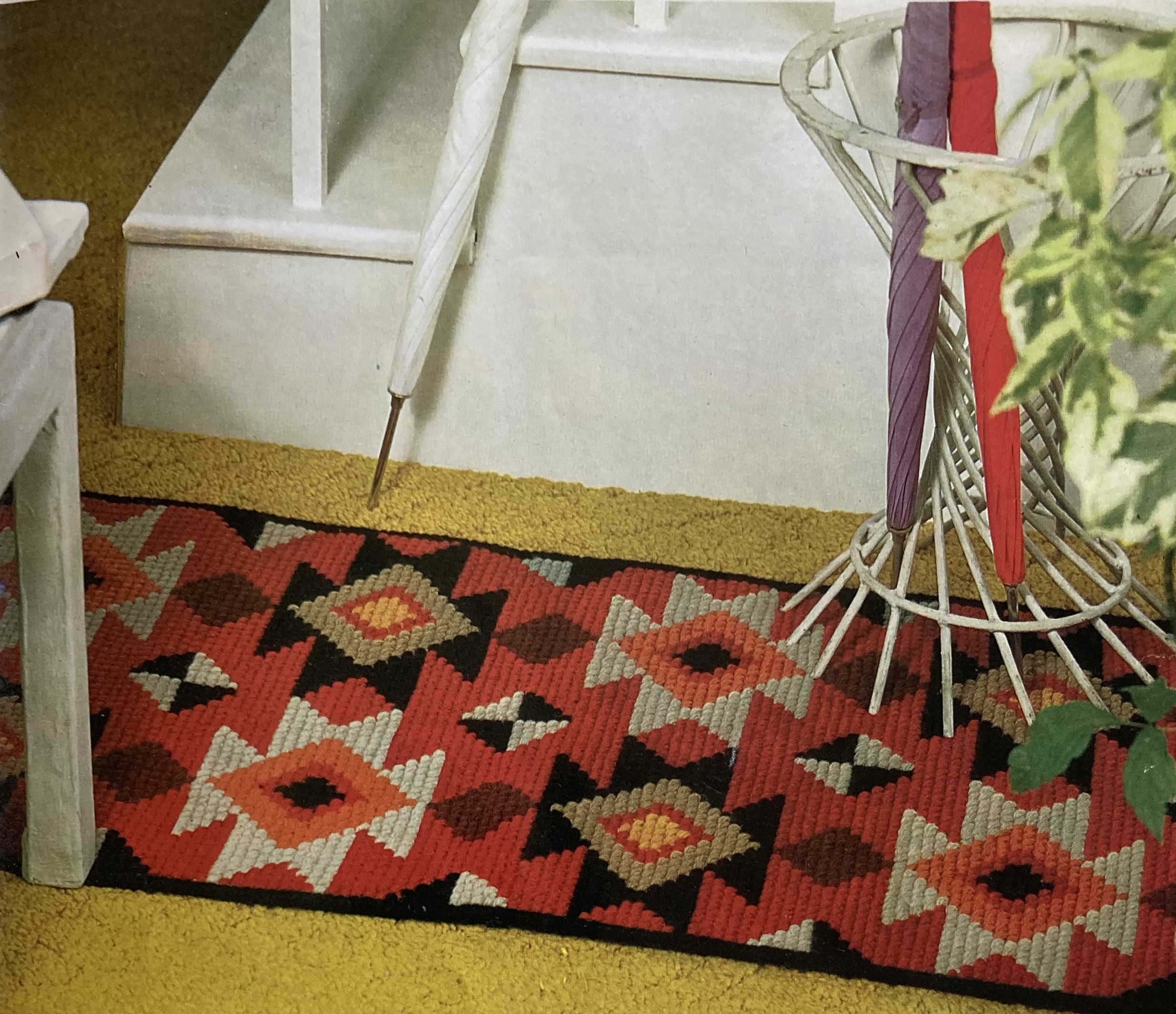
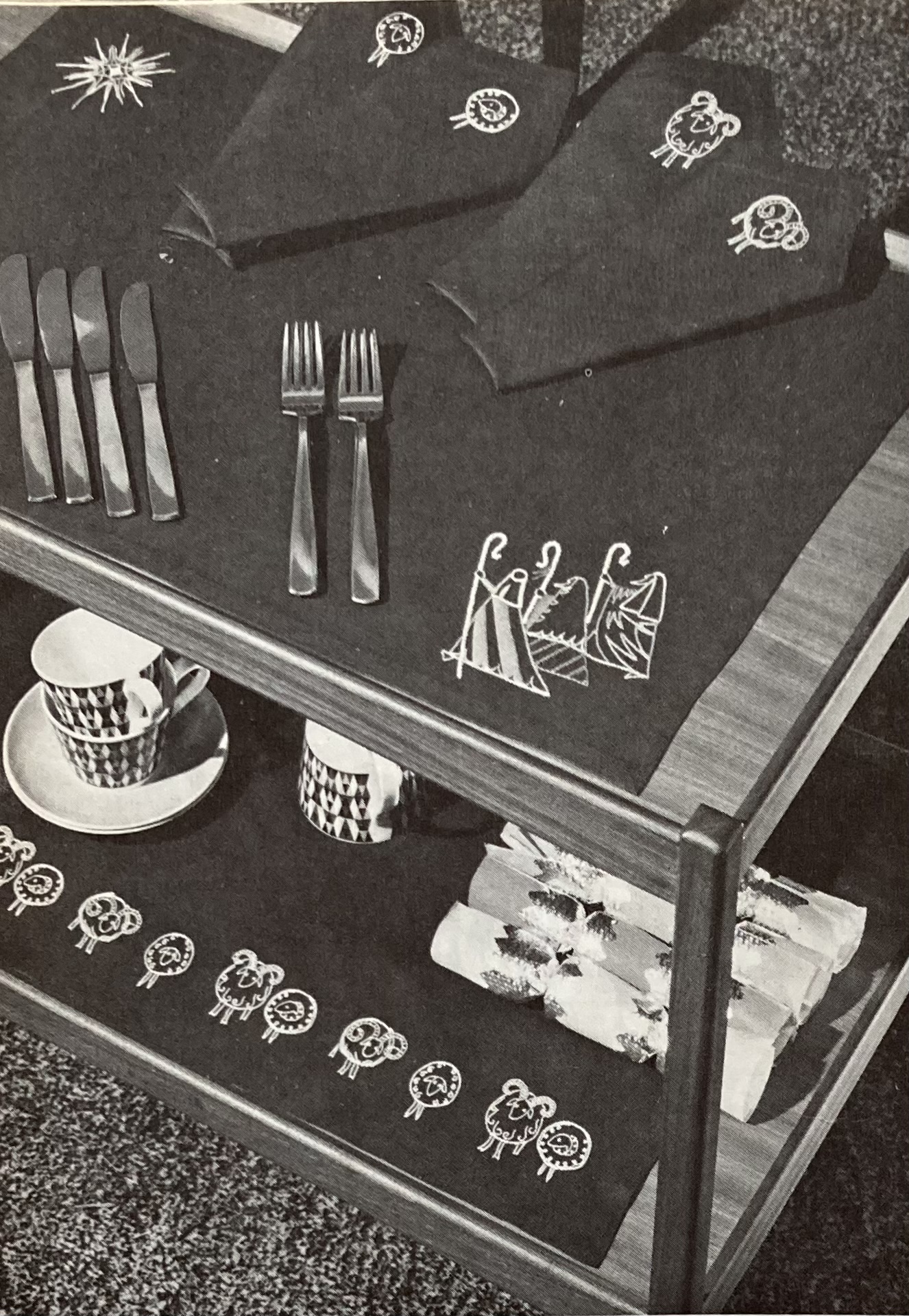
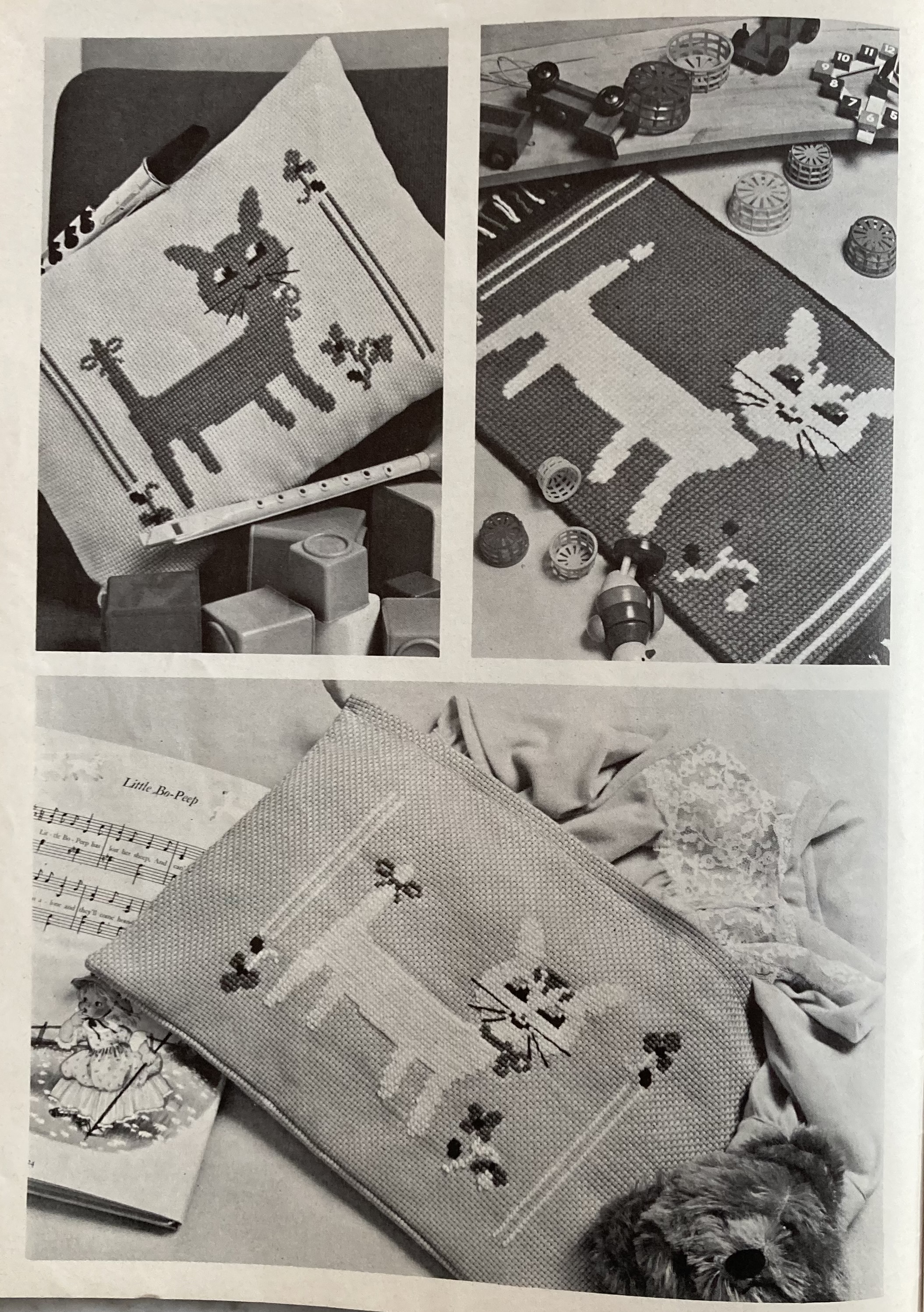
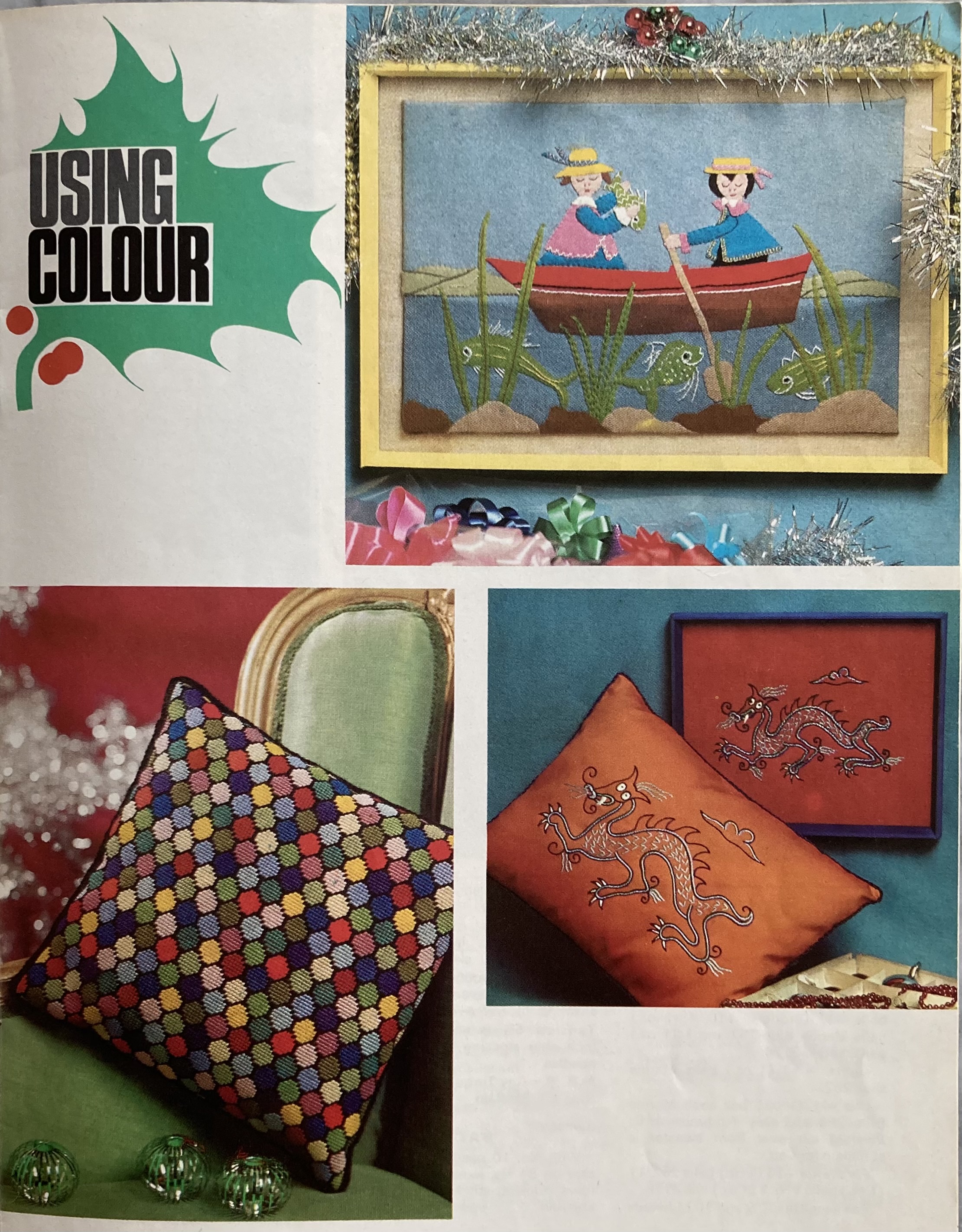
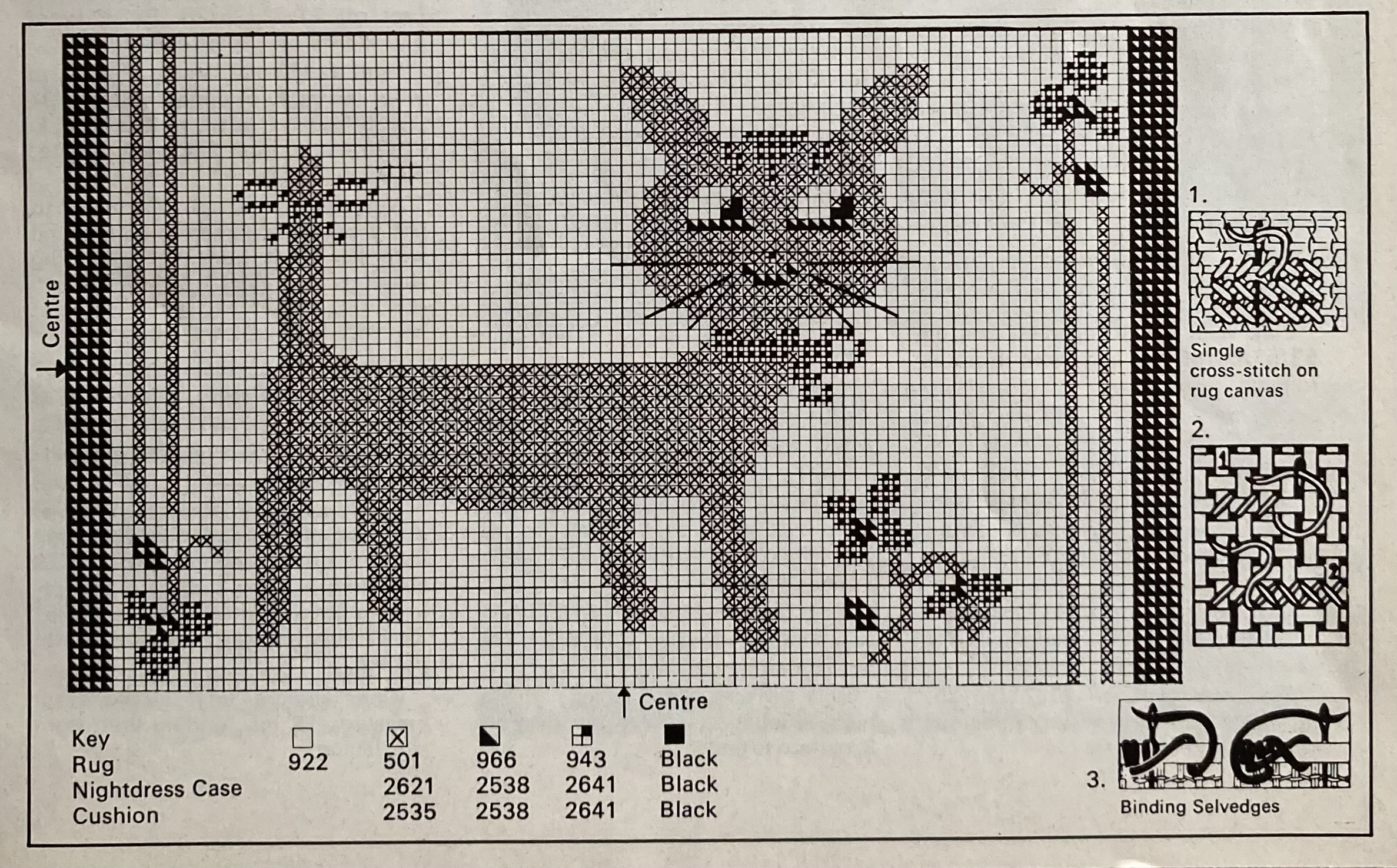
There are plenty of embroidery and tapestry projects for those long winter evenings. My favourite is the cross-stitch cat that can be made into a cushion, rug, and/or nightcase. (I have not yet understood the point of putting your pajamas or nightgown in a zippered case during the day. Were any of you readers children of the time and can tell me about it?) According to Stitchcraft, cross-stitch cats are lucky! I could use it. There’s also an appliqué picture of a boy and girl rowing, an embroidered dragon cushion or wall panel (that dragon is definitely high on something, cheers), an opportunity to turn leftover tapestry wool scraps into a tea-cosy or cushion, and a cross-stitch rug to use as a hall runner. The only specifically Christmas-themed project (in the entire issue, really) is an embroidered serving set of table cloth and/or trolley mats with somewhat abstract renditions of shepherds, sheep and a star.
In the children’s comic, “The Woodland Wool Shop”, Mrs Olive Owl starts knitting a long strip of fabric with no plan about what to do with it (been there) and realises that it would make a great coat for Daniel Dachshund. Isn’t that nice? I hope all your projects turn out to be equally useful and make someone (including you) equally happy.

My project will be something small, probably the gloves. I do love the lucky cross-stitch cat, though. Merry Christmas to those of you who celebrate it, and happy December holidays to all.
May 1967: Overview

Ahoy! It’s May 1967 here at the Stitchcraft Sixties, where “Cruise Mates feature the fashion for Crepe”, and we are “Holiday Bound.”

What fashions come to mind when you think of spring and summer holidays? Light and lacy tops? Airy dresses? Halter tops and swimsuits? If so, you obviously don’t live in a Northern European maritime climate. Stitchcraft knows what British “cruise mates” need on their summer holidays: multiple layers of thick, damp-repellent wool! Our cover ensemble of nautical blazer and striped “shell” top to go underneath will keep even the foggiest cruise mates warm, dry and fashionable. The double-breasted blazer (“from Paris”, which is not particularly near any large body of water, and also quite a bit warmer than coastal areas, just saying) is made in Totem Cameo DK wool with metal buttons, knitting piping trim and big patch pockets. The sleeveless top is made in the finer version of the same wool, Cameo Crepe. The “crepe twist” (tightly worsted-spun) in the wool makes for smooth, even knitting and good wearablility. You can cover it all up with a gigantic traveling coat made in thick, undyed “Capstan” wool.

Onshore fashions include a sleeveless mini-dress in DK-weight wool (“perfect for holidays”), a short-sleeved jumper in a cables-and-lace pattern, two more sleeveless “shells” for warmer days or layering, and a “classic sporty sweater” in a simple, but effective striped slip-stitch rib pattern. The light green “shell” has a slip-stitch pattern, too, and horizontal texture lines appear more subtly in the easy ridge pattern on the yoke of the dress.

It’s a good issue for menswear too, with a lightweight slipover in a reversible (!) textured pattern. I thought the stitch pattern would be some sort of fisherman’s rib, but it is is utterly simple: knit 1 row, then k1b, p1 for one row. It looks like fairly normal 1×1 ribbing from the “right side” and a sort of starry waffleboard pattern from the “wrong side”. How lovely to never have to worry about putting something on inside-out! The “Continental pullover”, on the other hand, is too wide and the cables on the lower half give a strange “skirted” effect. Perhaps they knitted the wrong size, or should have put it on a larger-bellied model.

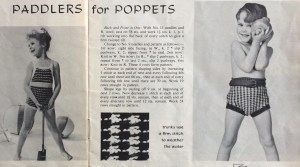
There are some wonderful garments for children of various ages in this issue, starting with a comfortable bobble-trimmed top for a school-age girl and a warm sweater for a boy (make sure he’s wearing a proper shirt and tie to go under it while sailing his wooden boats at the beach.) Here too, the stitch pattern looks more complicated than it is: k1, p3 for one row, then p1, k3 back makes a interesting offset rib with minimal effort. Little kids can “paddle and splash” in a tunic, t-shirt top and/or shorts for beach wear. The horizontal stripes are knitted in and the vertical stripes are crocheted on later with chain-stitch. A note in the tunic pattern says, “We have allowed 1-inch extra in length on back and front of dress as chain-stitching tends to contract the work.” Smart!

Rouding out this excellent issue are some wonderful homeware designs, starting with a set of garden cushions in a seaside “fish” and “crab” design. Love the use of pinking shears to illustrate the fish’s scales and the crab’s pincers! Way back in the “Readers Pages” is another, versatile appliqué design, this time with crocheted flowers instead of felt cut-outs.

For cross-stitch enthusiasts, there’s a coffee-tray set with matching deep-pocketed apron, or a tea cosy featuring wool stitching on tapestry canvas. Beginning rugmakers can make an easy runner in chain and soumak stitch.

The most magnificent design, though, is this Chippendale-inspired rug and piano-stool set, rightly featured in full colour over the two centrefold pages. The stool cover is worked in tapestry using tapisserie wool in trammed tent stitch and the 36×62 inch rug is worked in cross-stitch in Turkey Rug Wool.

Even the ads are great in this issue! The model wearing Patons Fiona is happy rain or shine and look at those amazing swimsuits from the Scotch Wool Shop! I would wear either of them today. And don’t you love the Singer sewing machine that can be folded down into its own practical storage cabinet when not in use? Did any of you have one of these? I think it’s brilliant and would have loved to have one.

My projects from this issue will be the garden cushions and the crochet appliqué on a useful-for-whatever little bag. I somehow have lived my entire adult life without a garden or even a balcony, but I know people who have those things and would love to have a fun cushion as a gift.

Happy Spring!

December 1966: Overview

Hooray, it’s the Christmas issue! Our cover model from the December 1966 issue of Stitchcraft sports a holiday-red knitted dress with a jaunty black velvet bow in her hair. Bright, cheerful colours, fun ideas for gifts and holiday parties, and the “Total Look” of a complete knitted outfit in one colour theme light up the pages.

The cover dress is made in Shetland-blend “Fiona” yarn and a diagonal criss-cross pattern that looks like cables, but is actually made entirely out of normal increases and decreases (yo, sl-k-psso, k2tog). The skirt is plain stocking-stitch and amazingly for 1966, still falls just above the knee. The two-colour suit with stranded “key” pattern in yoke and skirt hem is similarly demure. The two colours of lightweight “Cameo Crepe” wool are “Pearl Frost”, which I assume is the lighter one, and “Mastic” — I have no idea what colour “Mastic” is supposed to be. (I can only think of Mastix cosmetic glue, used for sticking on fake beards etc., which of course has no colour at all.) As an alternative, the magazine suggests to use Patons Beehive 4-ply in “Mink” and “Magnolia”, so I guess “Mastic” is a medium brown and the magnolia is white. Or the magnolia is dark pink and the mink has got its winter coat on. By the way, Stitchcraft‘s “editress” Patience Horne promises us in the notes to this issue that starting in January 1967, there will be more colour photos, so there may be less guesswork in the future.

The other patterns for adults include a lacy bedjacket, also in “Fiona”, that is pretty enough to wear as a cardigan, as well as a party jacket with Lurex metallic thread held together with the main crepe wool on the borders for extra holiday sparkle. There’s also practical heavy cardigan in reverse stocking-stitch with cable panels.

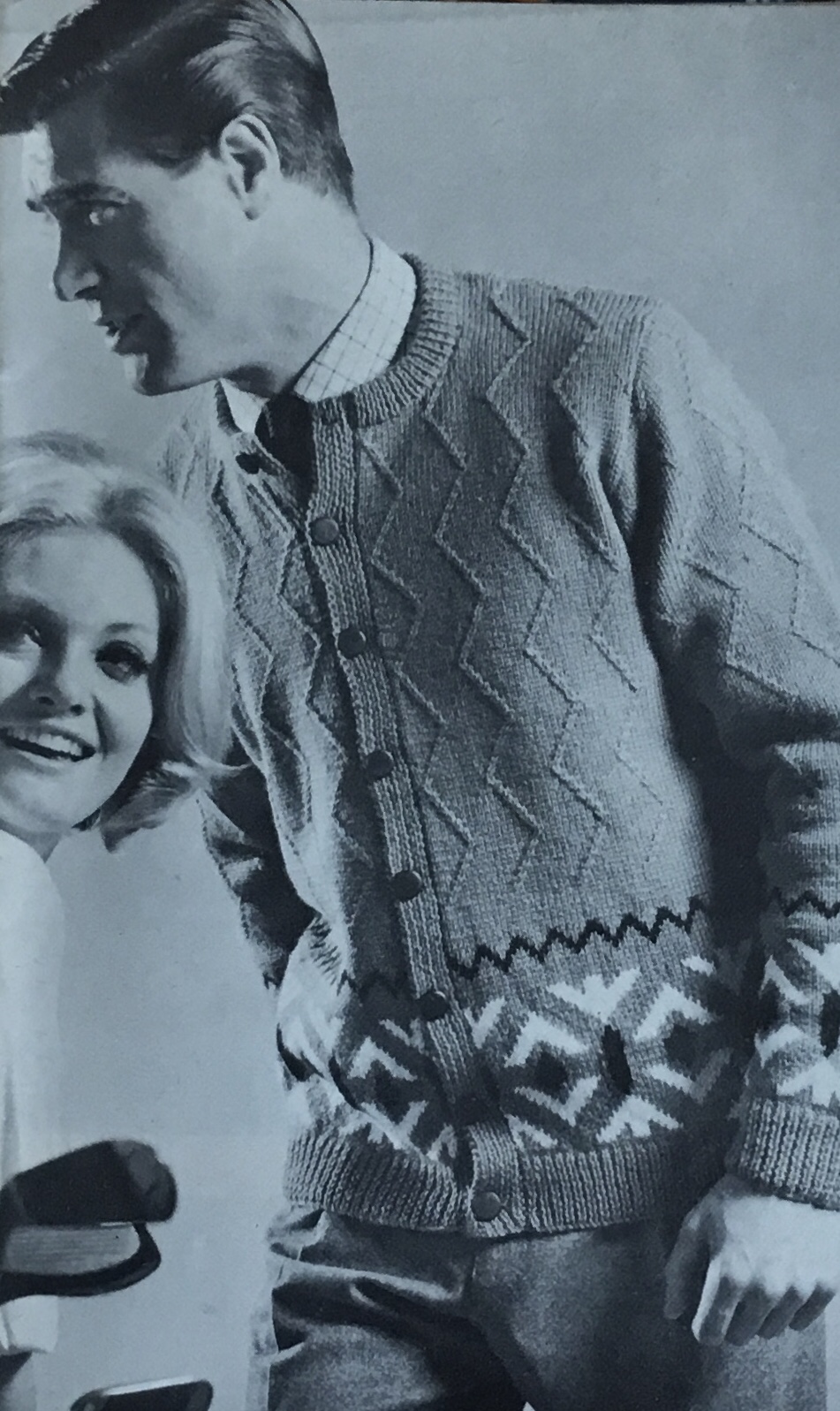
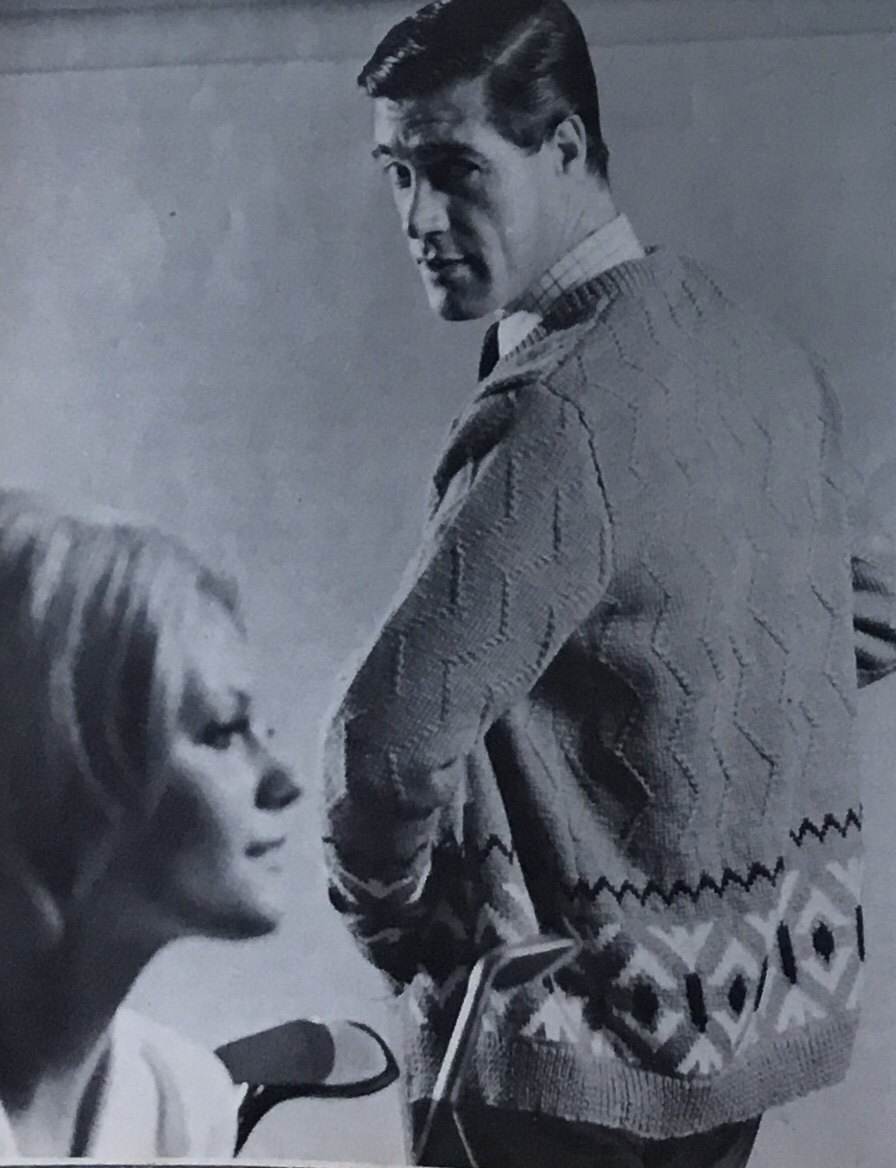
For the man in the family, an oversized shirt-sweater with angular pattern lines. Or you can make a his-and-hers set of “snow sweaters” in a typical all-over tiled Fair Isle pattern. Diagonal lines are a clear theme in this issue, whether made via texture, colour, or with angular cables.

For the kids, there’s a cute, warm 3-piece outfit of leggings, jumper and cardigan that is good for winter playtime (and finally, a girl can have warm legs and move around without worrying about where her skirt is flying. Look how happy she is!). The boys’ slipover features elements of the cable pattern and blocks of ribbing that we saw on the women’s cardigan. Finally, a bigger girl can enjoy the “Total Look” of tunic, tights and floppy pom-pom-trimmed hat, all coordinated in bright shades of “Lipstick Red” and “Strawberry Ice” double knitting. I’m glad they used a colour photo for this one!

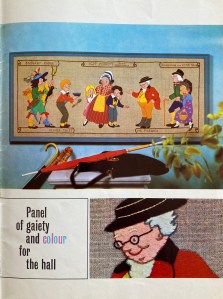
The usual embroidery patterns for cross-stitch borders and easy cushions are supplemented by another big, fun appliqué wall panel: “Widdicombe Fair.” (Spelled with two “d”‘s in Stitchcraft.) I admit, I did not grow up in the UK and wasn’t familiar with it. For others who also weren’t in the know: it’s a traditional agricultural/livestock market fair that has developed into a more social gathering for traditional events, arts and crafts, and rural activities. Have any of you readers been there? Do they have knitting? Tell us about it in the comments! The wall panel shows a scene of happy (and presumably quite tipsy) fair-goers riding home on a pony after the fair. It is comic-like in style, but actually quite intricately worked, with close-fitted felt pieces embroidered and decorated after the appliqué is done.

And of course, it wouldn’t be Christmas without little handmade gifts and Christmas “novelties.” You can knit a hot-water-bottle cover and address it in embroidery to “Miss Miranda” in “Dreamland” (presumably other names and addresses would work as well) or knit some fireside slippers in an easy bobbly-lace pattern. While you’re knitting, make some cabled gloves with a contrasting-colour cable on palm and back of hand for “Father” and a kangaroo with baby for your littlest one. A crocheted hall runner is a “practical gift for the Home.”

The Christmas novelties run the gamut from elegant (an appliquéd panel of a poppy flower from which you can hang a tiny calendar), to cute and wintry (felt table mats with appliquéd stars, a “Father Christmas” sack to fill with gifts), to cute and silly (a knitting snowman made of cardboard, with the “snow” effect made by just pasting cotton wool onto the cardboard), to “what even is it” (little “mascots” made from the scraps of felt left over from the other projects. Apparently, they represent “amusing Bongle people”. I was very afraid to find out what that meant, but they seem to be a sort of fairytale gnome that have recently made a modern comeback in the video game Baldur’s Gate? Either that, or a slang term for copyright protection, lol. I’m guessing the Stitchcraft mascots are the fairytale gnome kind.)

The Readers’ Pages have a great little pattern for a potholder with a crocheted robin sitting on the handle of an embroidered spade. In the comic, schoolmarms Miss Prim and Miss Proper try to teach untidy piglet Higgledy Piggledy how to be neat and clean, but he is not having any of it. It’s the schoolmarms’ fault that he flies out the window, though, since they sat down too hard on the other end of the bench he was sitting on. To finish off the issue, there’s a thoroughly groovy ad for “Stop Red” and “So Dotty” lingerie from the Scotch Wool Shop.

That’s all for this issue! I have no idea what project I will make. Stay tuned, and happy holidays.

June 1964: Overview

Welcome to the official start of the Stitchcraft holiday season! The June 1964 issue gives us a mix of elegant 4-ply designs, casual bulky knits to wear as outerwear, beach clothes for the kiddies and easy homeware projects that can be packed up and worked from a deck chair.

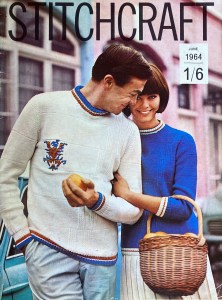
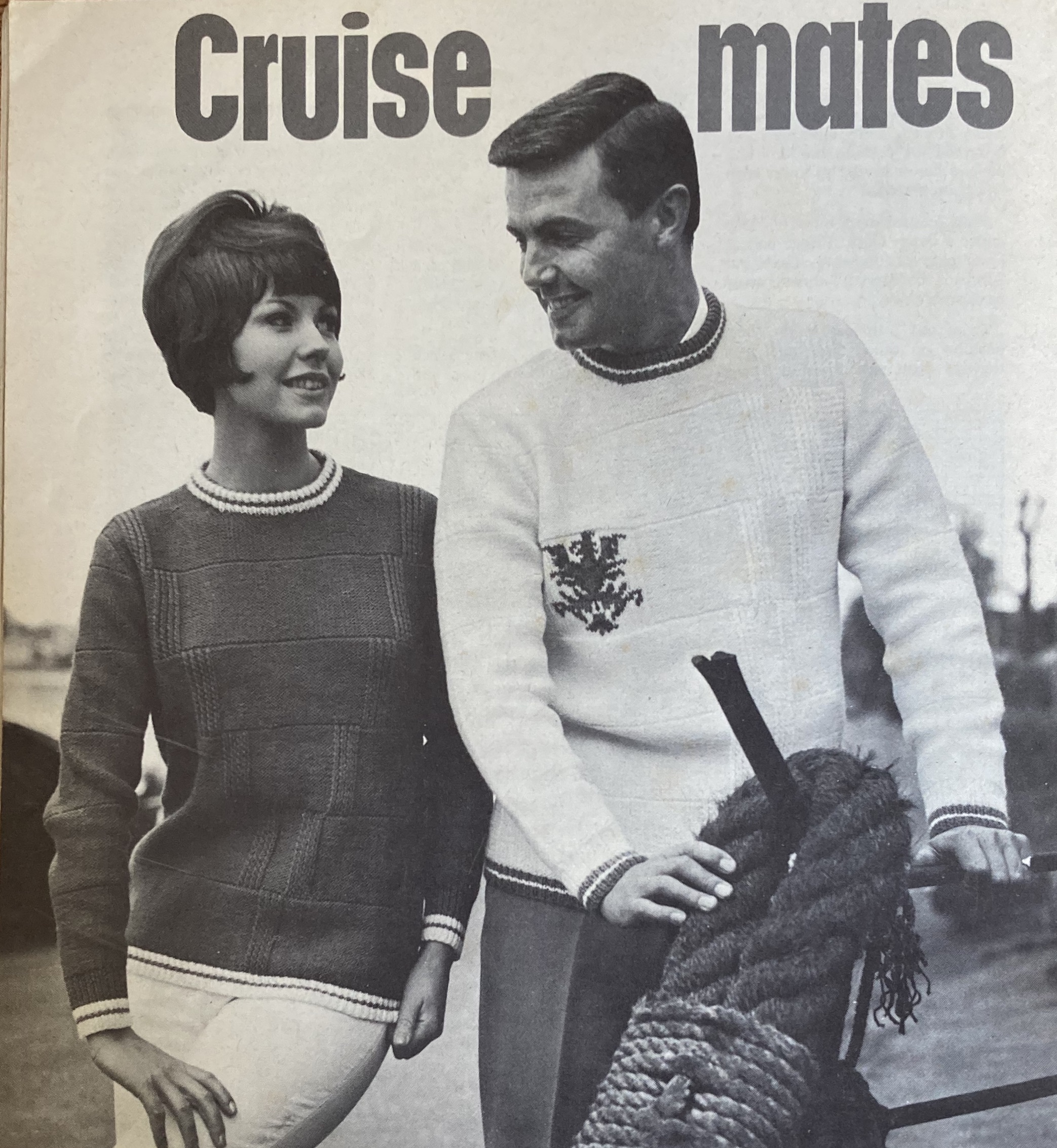
Our cover models are just returning from the weekend market, where they have secured a basket of nectarines. They’re wearing an “easy-line sport pair” of “cruise mates” in complementary colours and the same basic block-and-rib pattern. The ribs are made with p1, k1tbl to give them a more textured look, and the men’s version has an eagle motif, because it is “manly for him.” I wonder if both versions were originally designed with a motif until the designer realised that it would fall in an awkward place on the women’s version?

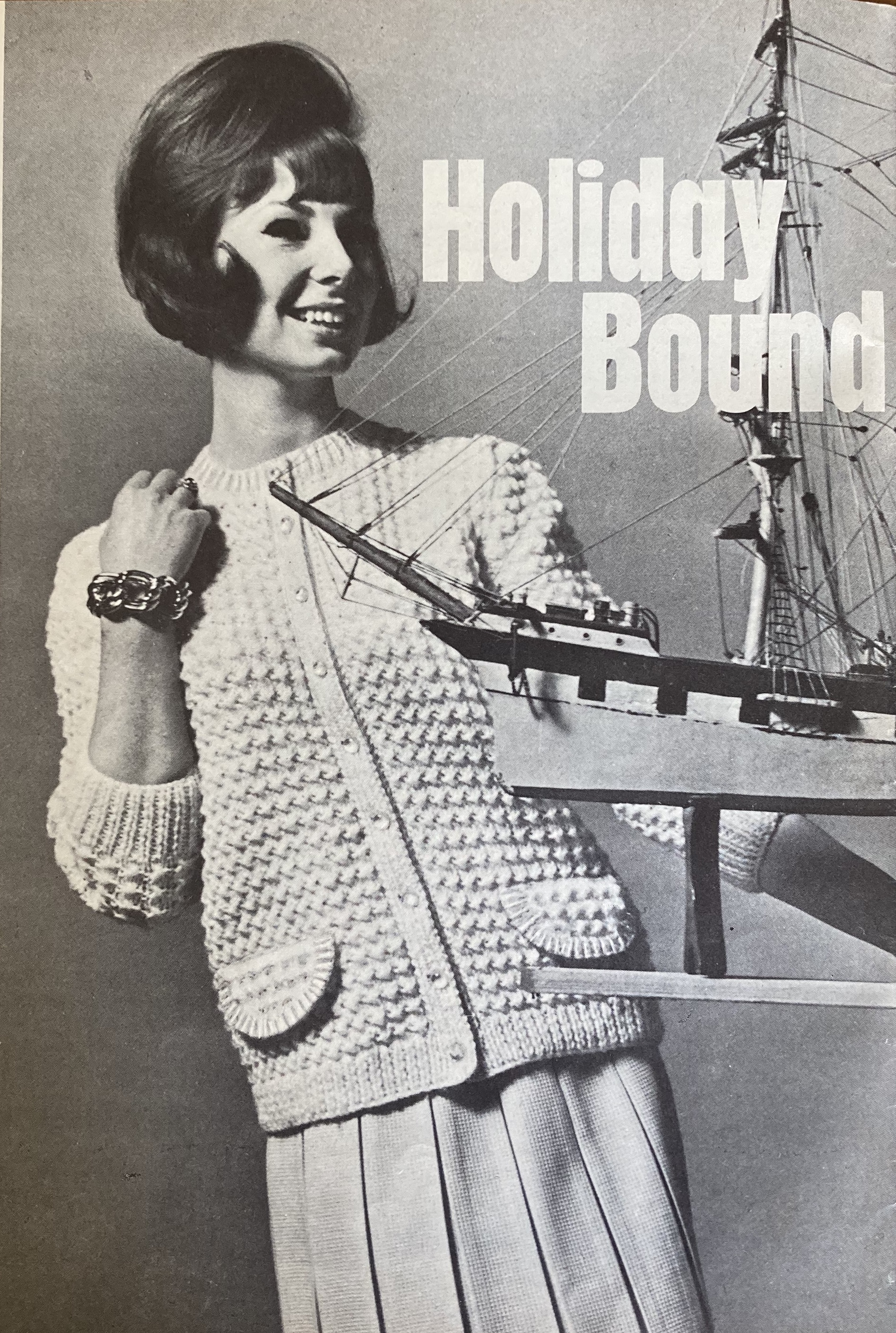
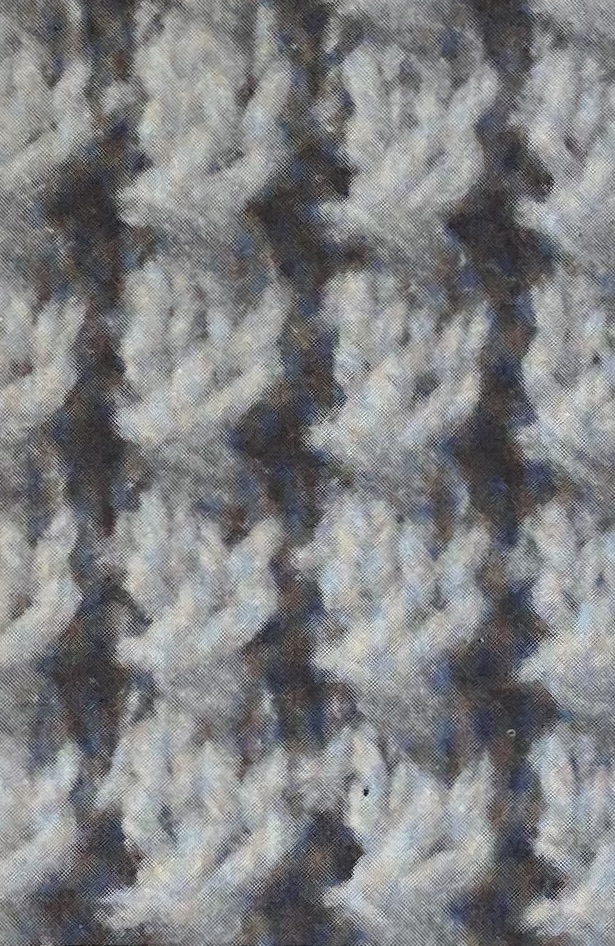
Nautical navy blue and white with red accents never goes out of style for summer casuals, and we see it in this bulky, yet “featherweight” (18-20 ounces of Patons Ariel, so make of that what you will) white cardigan. I can believe Stitchcraft when they say that the wool is lightweight, considering its bulk, since the twisted-rib pattern eats up a lot of wool.

Ona different note, we see simple, yet elegant knitwear separates in 4-ply that are suitable for the office of a more dressy casual situation. The basic skirt and plain or diagonal-striped top are knit in muted pastel shades and meant to be interchangeable — “Basic skirt with a change of top” is the headline for this well-coordinated set. There’s also a waistcoat for her that would match the skirt when worn with a blouse, and a fine-knit raglan pullover for him. The waiscoat and pullover are both in this season’s trendy yellow tones of “Spun Gold” and “French Mustard”.

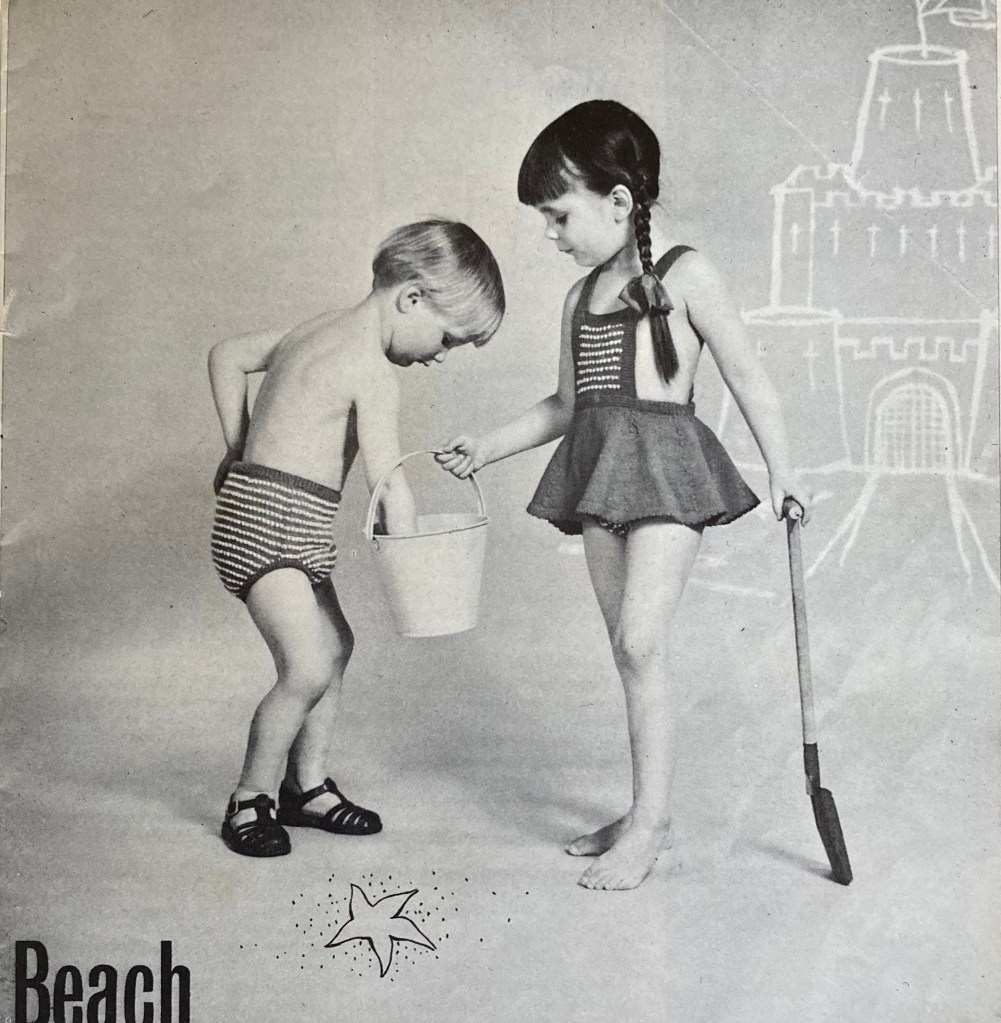
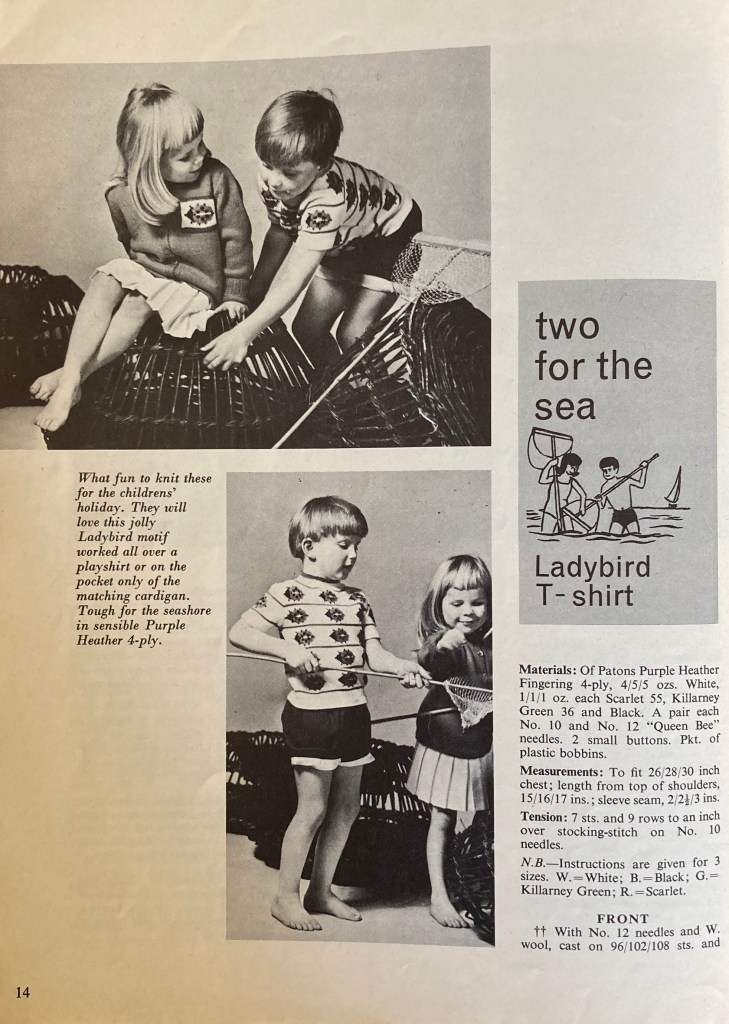
Children can enjoy splashing around at the beach in their trunks and sundress (the girl’s trunks are sewn into the sundress to prevent wardrobe malfunctions, definitely necessary with a micro-mini tunic skirt.) Here again, traditional red and white or navy blue and white are the chosen Somewhat older children have a choice of short-sleeved jumper and/or cardigan with a Ladybird motif (more about that in the next issue…!), continuing the red and white theme. On a completely different colour note, you can make a beach cover-up coat in crinkly “Rimple” wool lined with towelling — a brilliant idea for drying off and staying warm after a swim in cold northern waters. It’s quite easy to make, consisting of literally three rectangles for fronts and back, with garter-stitch borders and then lined with the towelling.

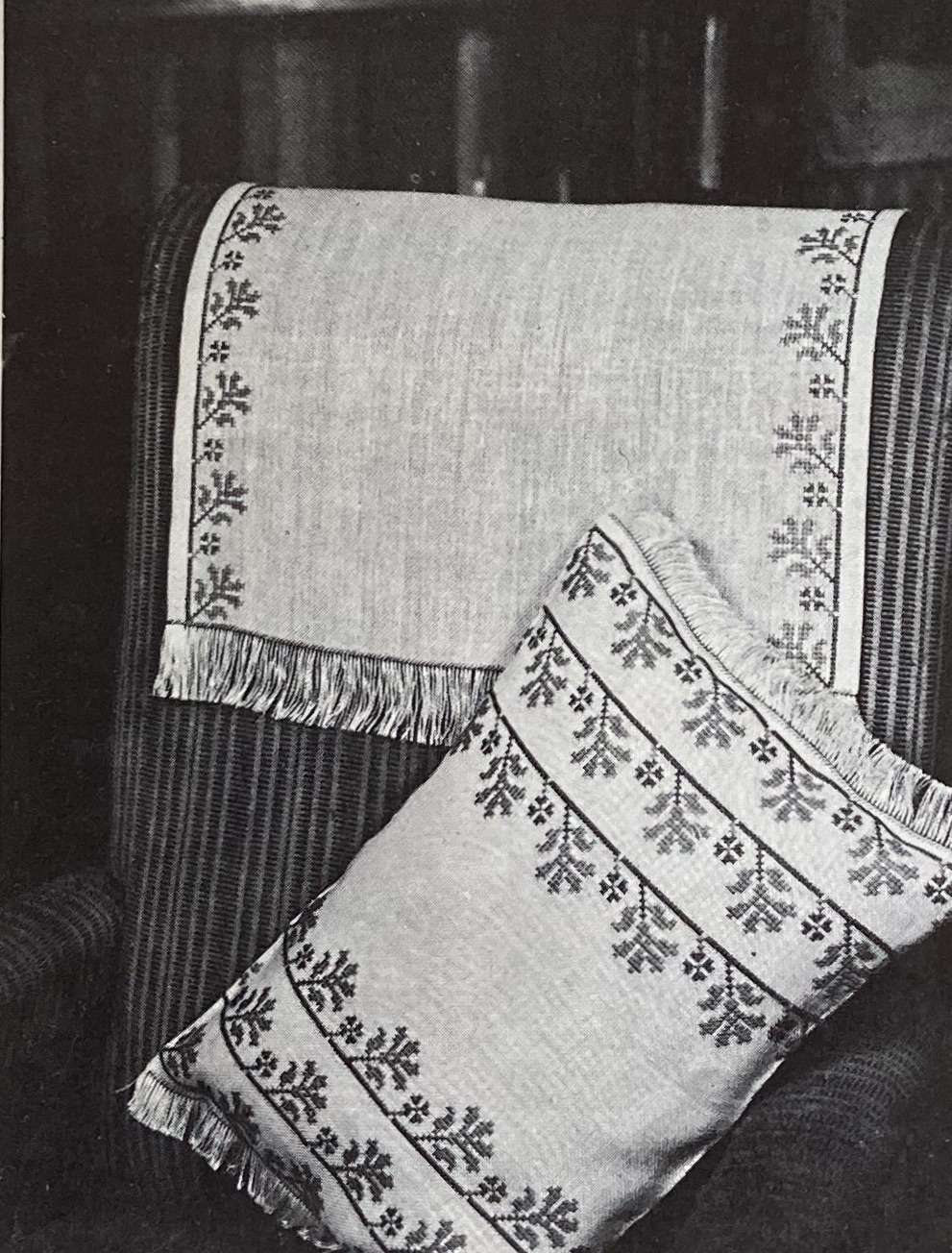
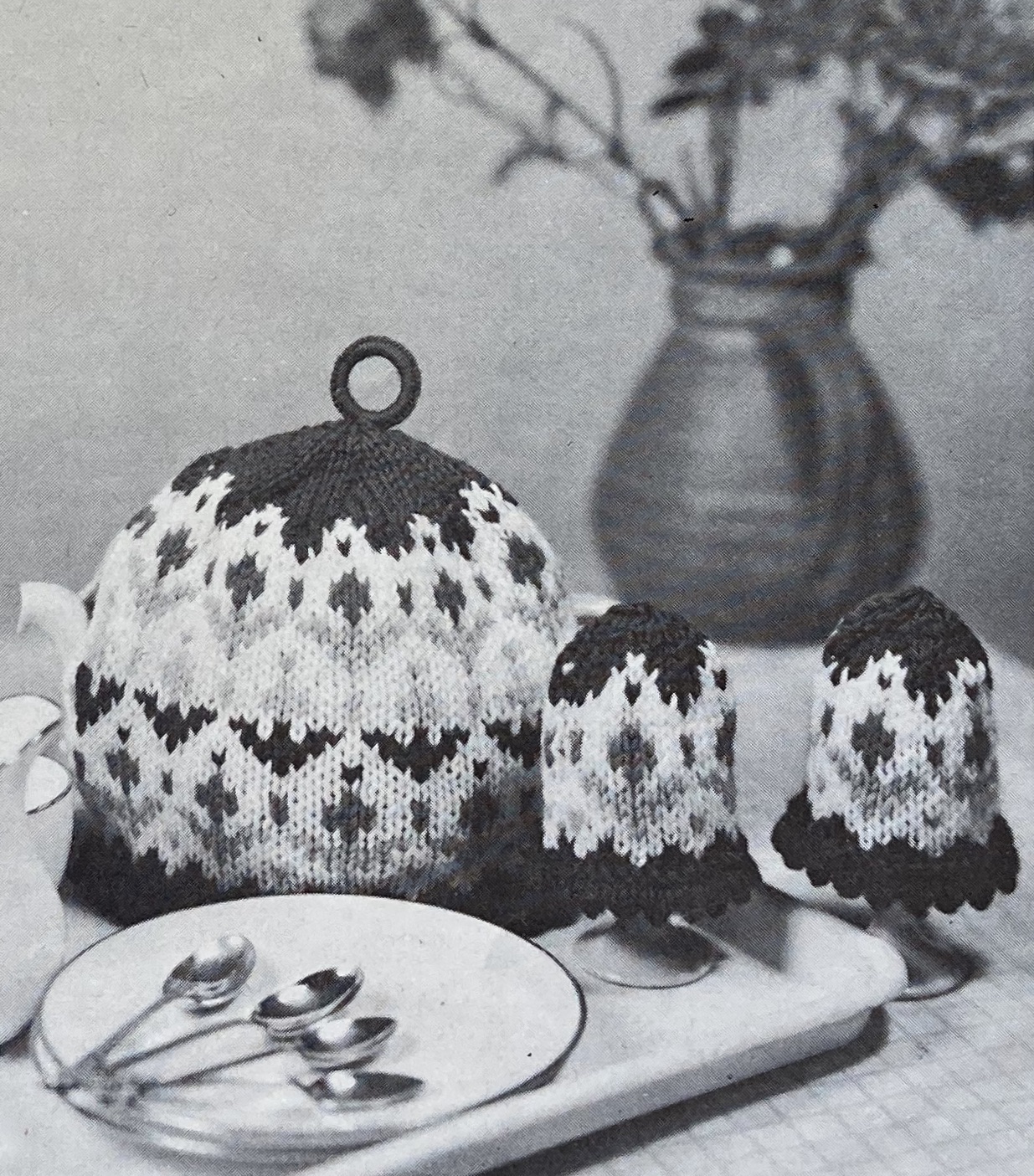
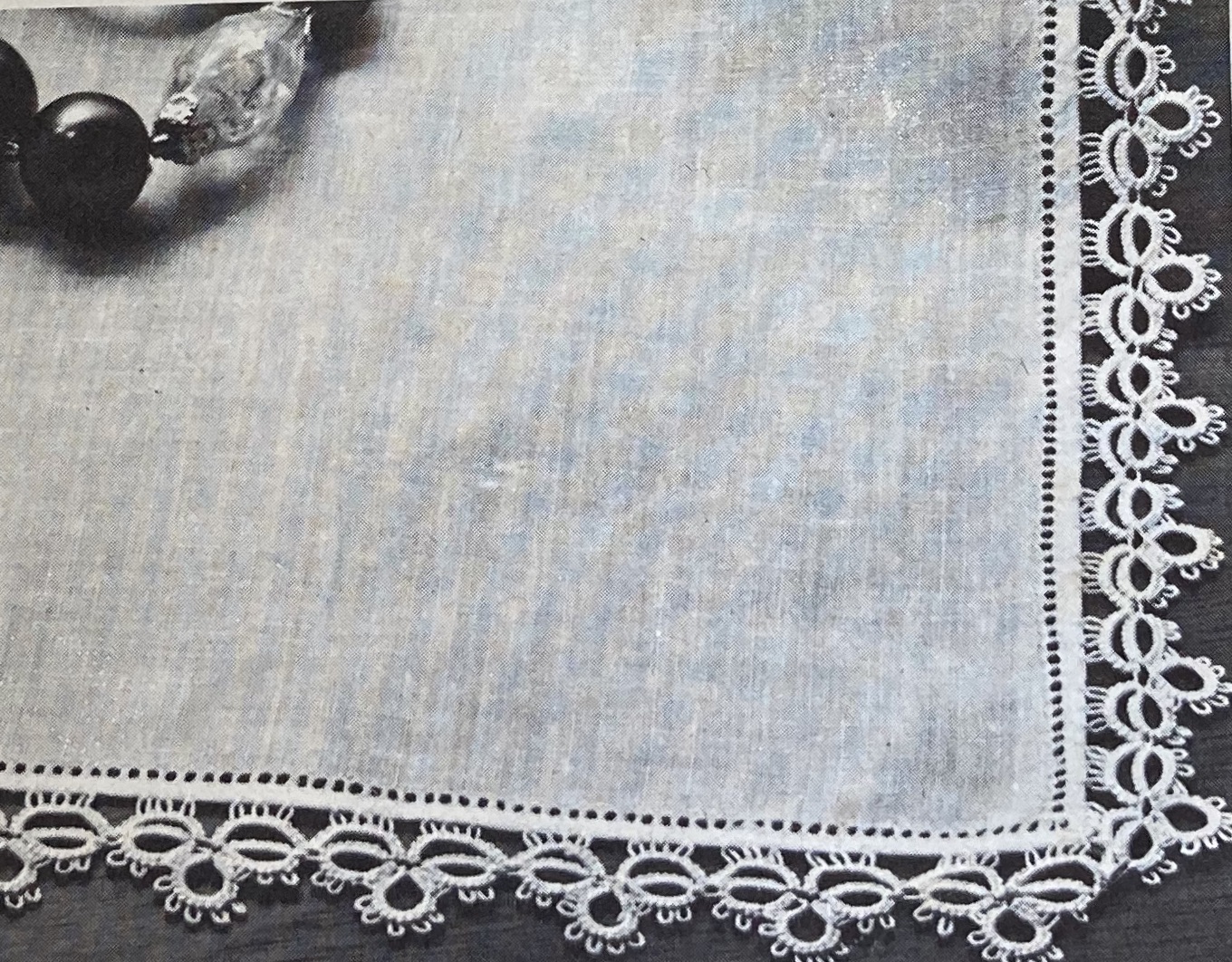
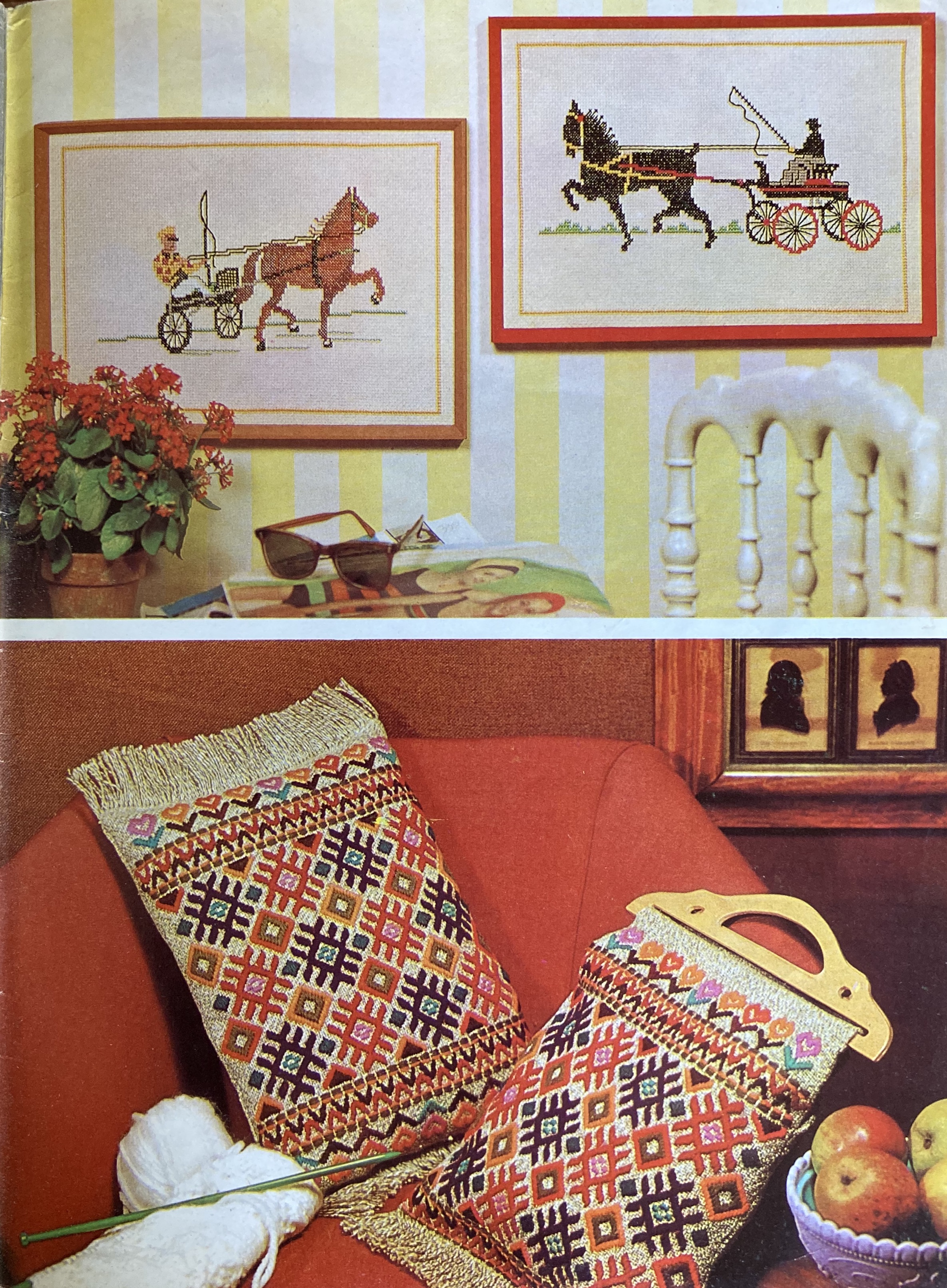
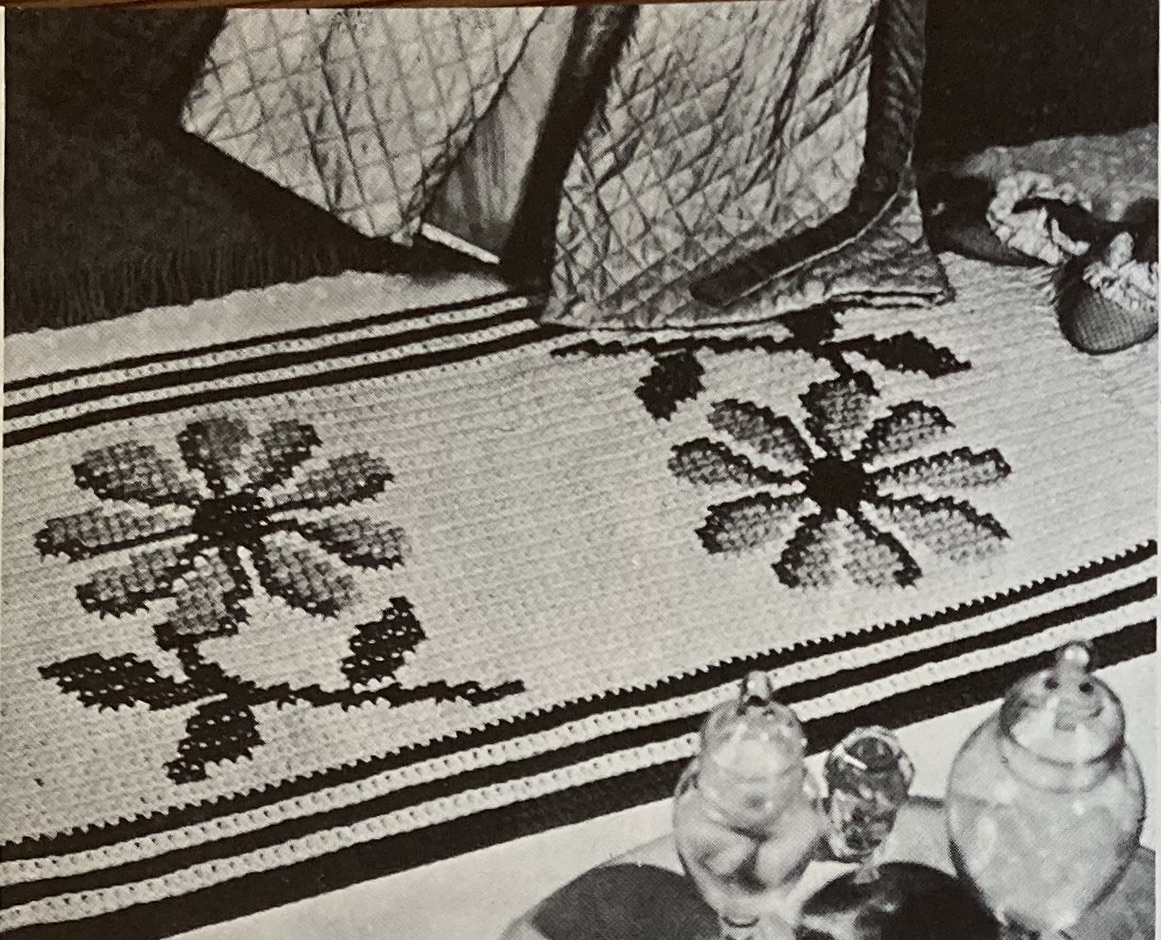
While sitting and sunning at the beach, you can work on an easy homeware project, such as a cross-stitch cushion, a knitted tea or egg cosy, or a tatted lace edging for handkerchiefs or pillowcases. Even the workbag in Turkish darning would be easy enough to work on while on holiday, though the Victorian-esque horse-and-buggy cross stitch picture, the needle etching, and the crocheted rug are presumably easier to work on at home.

That’s it! Summer issues are usually less exciting than autumn and winter, as many people (understandably) don’t like to hold wool in their hands in hot weather. As with many of the mid-1960s issues, there’s nothing in here that particularly speaks to me, so my June project will be another “excursion”, this time all the way back to the 1920s. The project is almost finished (unlike my April and May blog projects…) so I’ll be able to put out a finished project post in time for once, even if it’s neither from Stitchcraft nor from the 1960s. Think of it as a holiday from the usual blog theme.

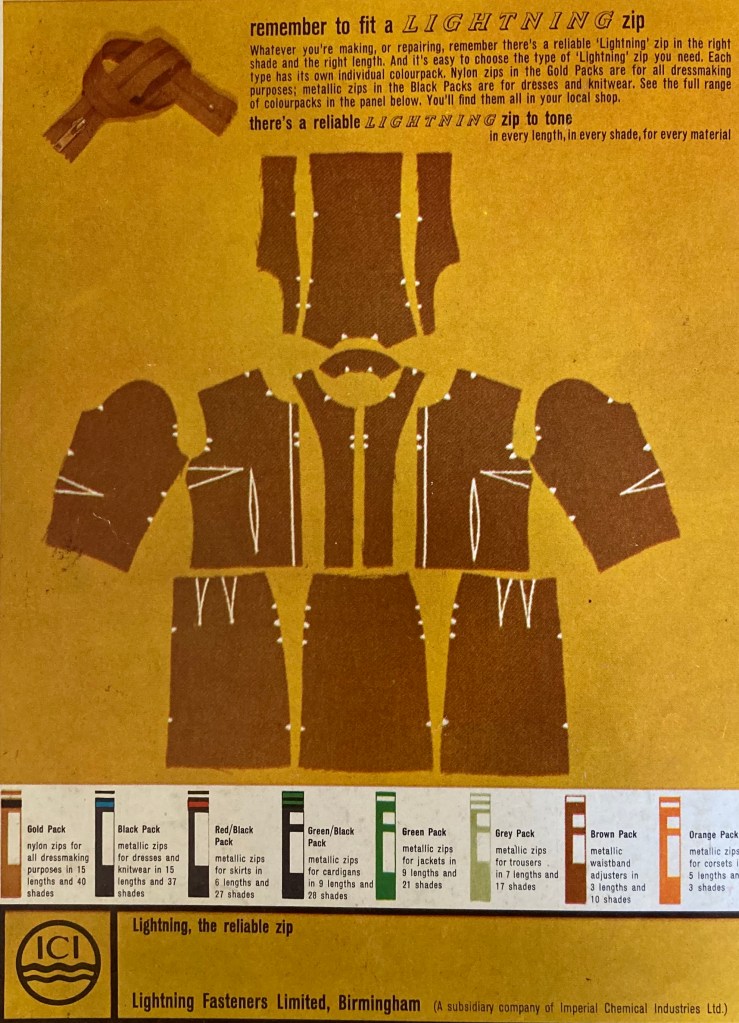
P.S. The back cover is a full-page ad for “Lightning” brand zips and and is illustrated with a very professional-looking pattern for a suit! I am tempted to size it up and sew it. Here it is for any readers who would like to try their hand at it.

May 1964: Overview

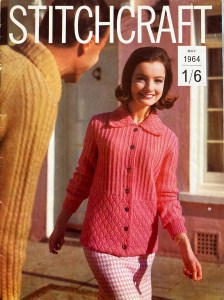
Cover photo from Stitchcraft magazine, May 1964, showing a woman in a pink knitted cardigan

Stitchcraft‘s May 1964 issue promises a “May Merry-Go-Round” of “a wide choice of Summer Knits for leisure, holidays, travel and all the warmer weather activities.” Time flies so fast that I feel like I’m on a merry-go-round even without knitting — but let’s see what this issue has in store for us.

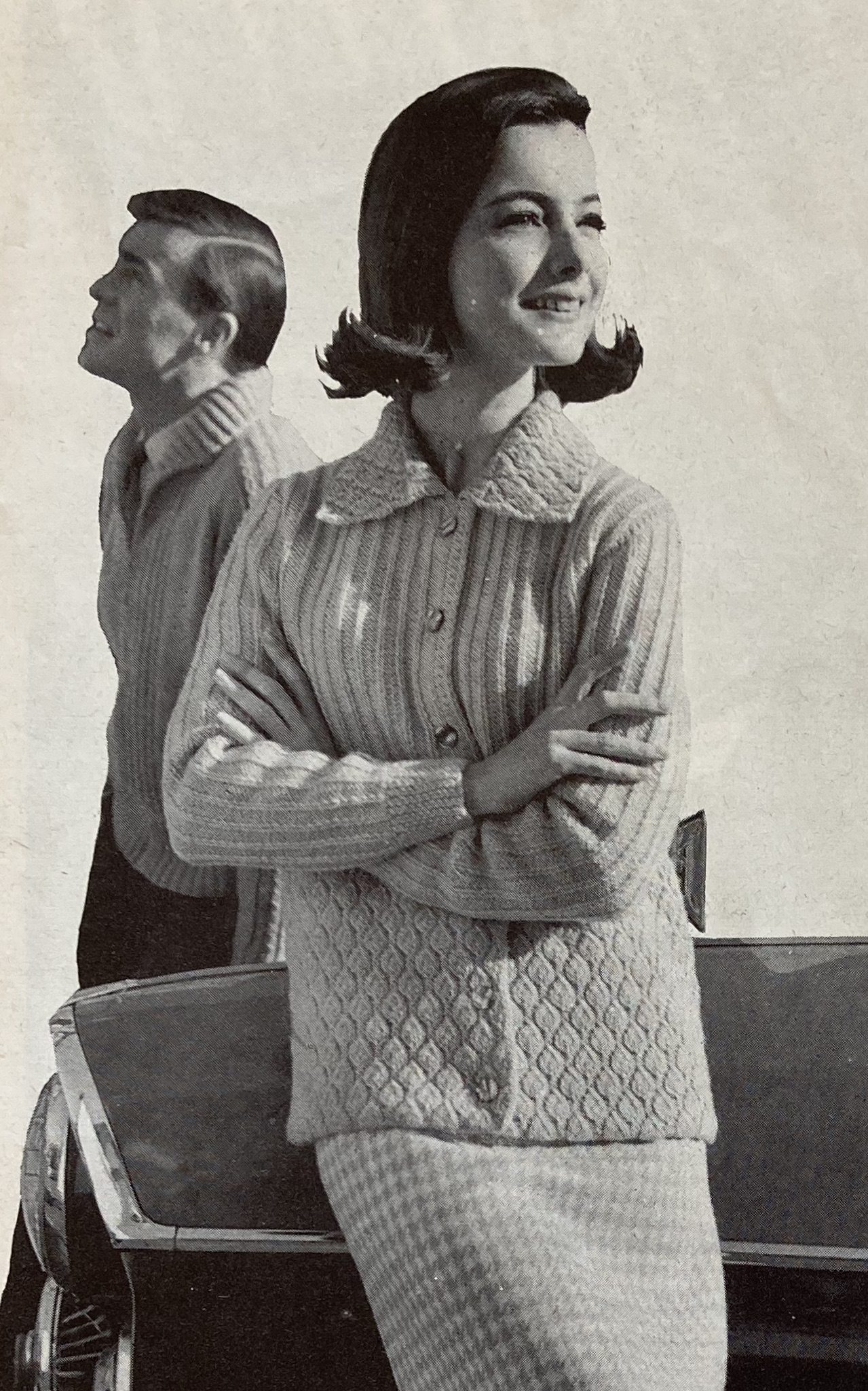
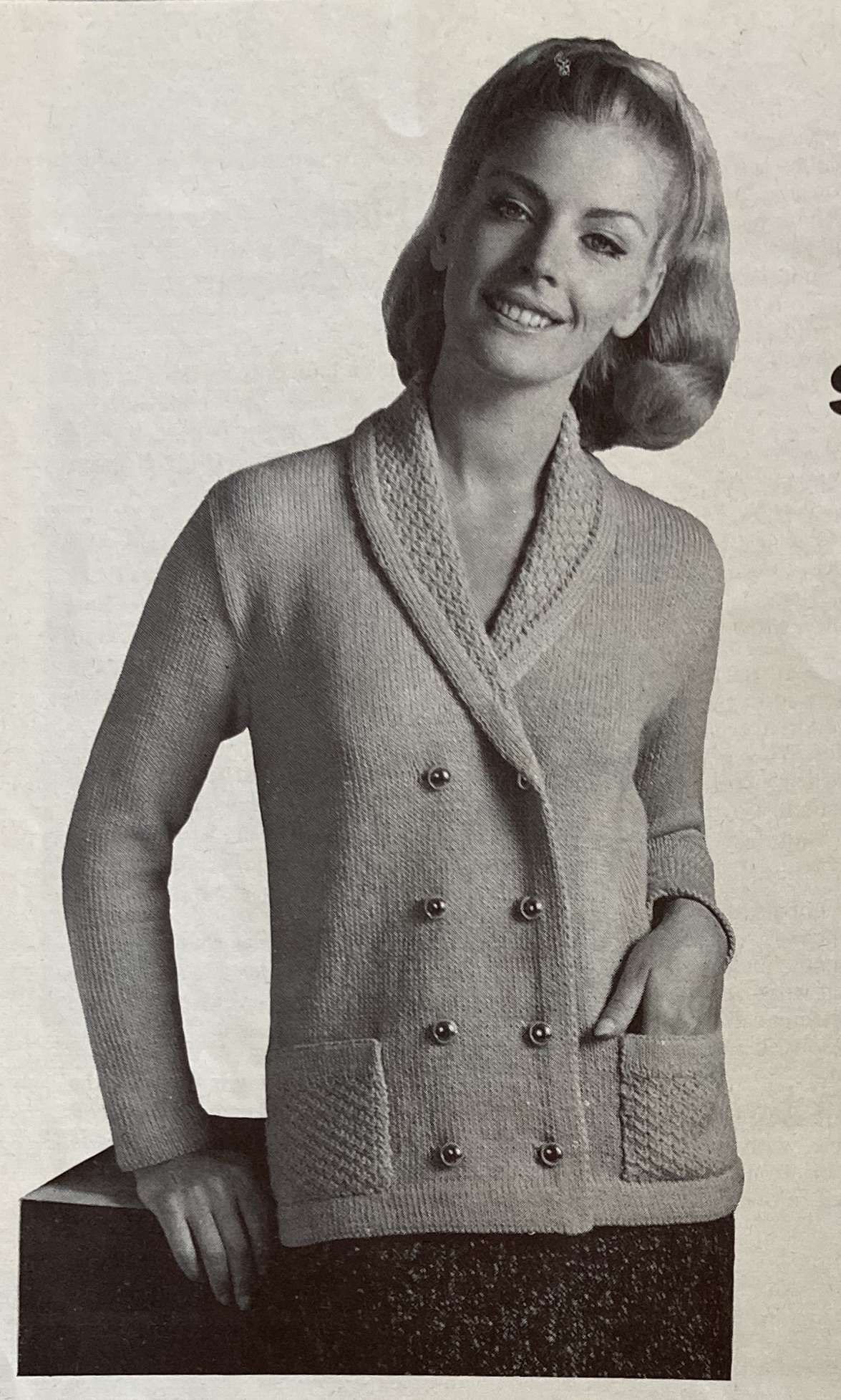
Our cover feature is a high-buttoned cardigan with a deep “pineapple stitch” hem and collar. It’s made in DK weight wool, but the pineapple stitch and slip-stitch rib make it quite heavy (20 oz.) and presumably warm and sturdy. There’s a less bulky design in DK wool on the facing page; no collar and a plain twisted stocking-stitch make it require only 12-14 ounces of wool. Patterns that utilise texture and lines, especially diagonal lines, are still very much in fashion, as are high necklines and collars.

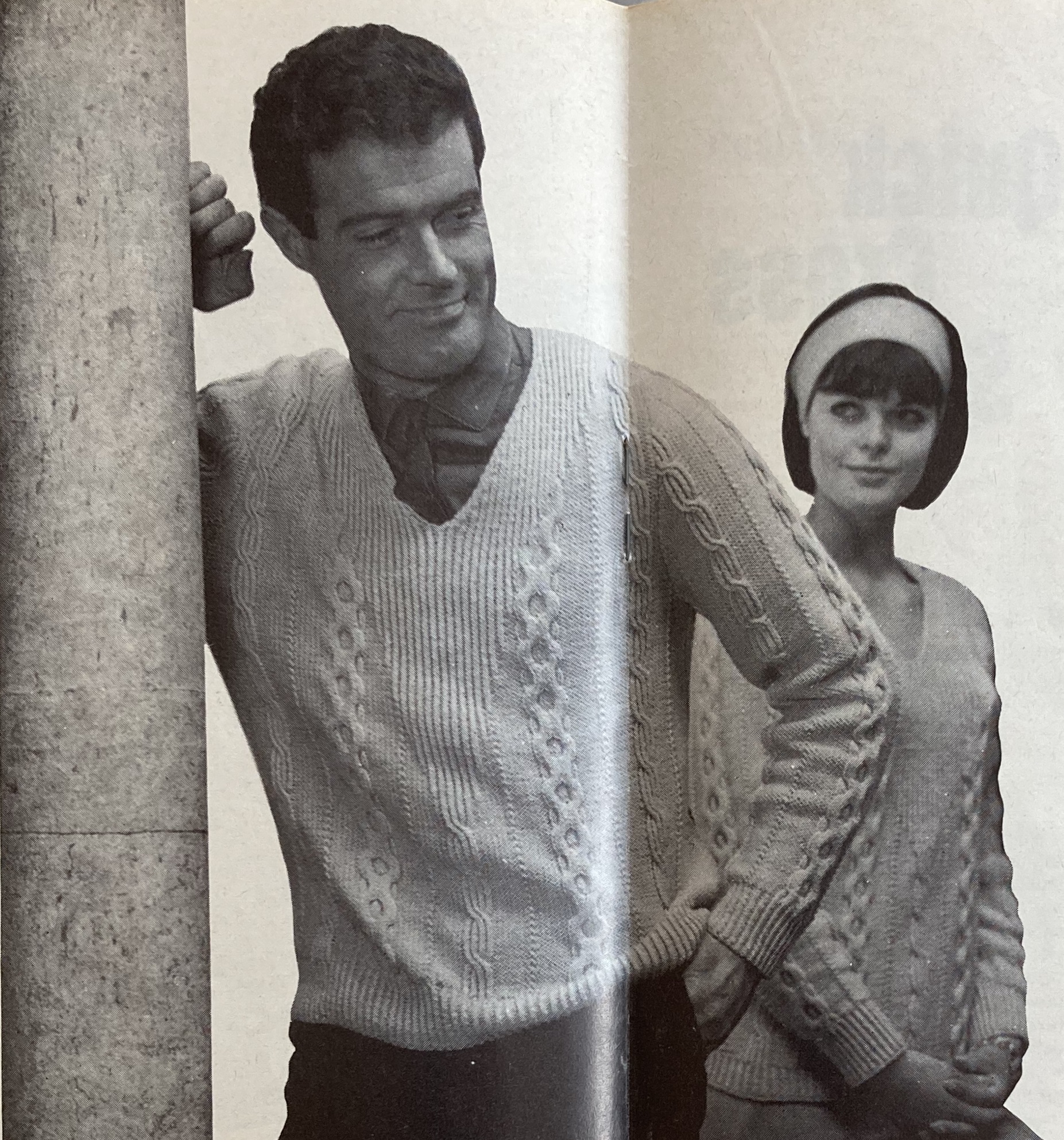
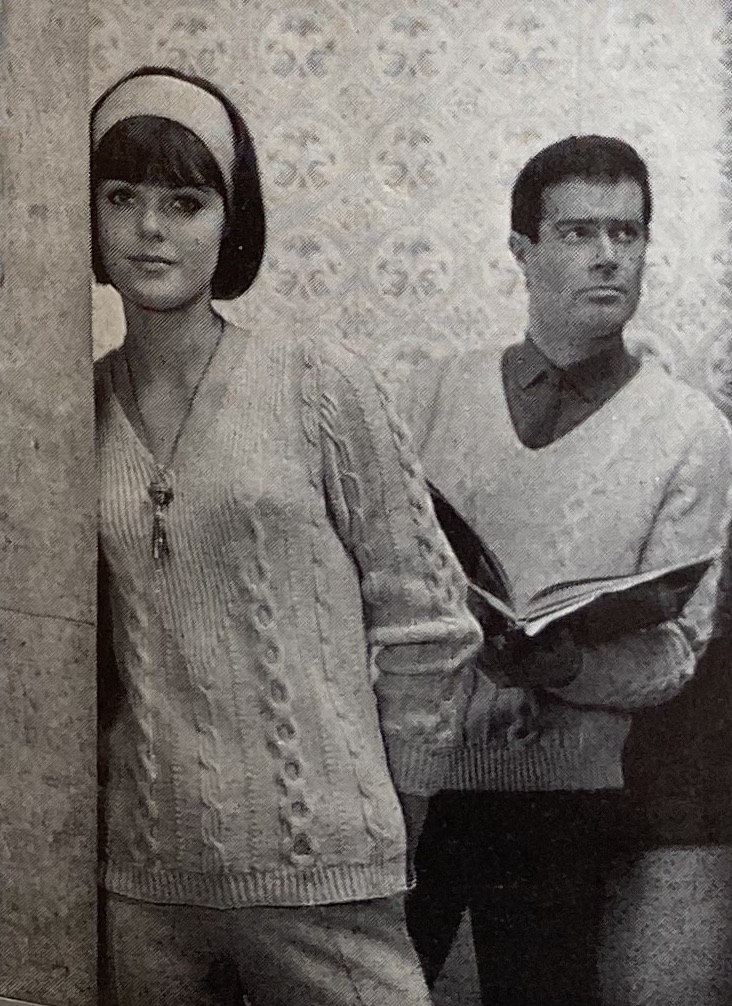
The back cover shows off the latest in partner-look sweaters, this time with a V-neck. It’s not what you would call a traditional Aran-pattern design, but it combines some of the typical cable elements with textured ribbing for a sleek, modern twist on the traditional look. The sweaters are made in light colours with Patons Totem Double Crepe, a very smooth yarn with a tight (“crepe”) twist, to make the pattern stand out.

(Side note: This issue is visually one of the most fun I have encountered, thanks to multiple photographs of the same garments and models in different poses, and the liberal use of illustrations. I particularly like the one with our male model looking up out of his book (travel atlas?), apparently quite concerned, while the female model looks calmly into the distance. Feel free to suggest captions!)

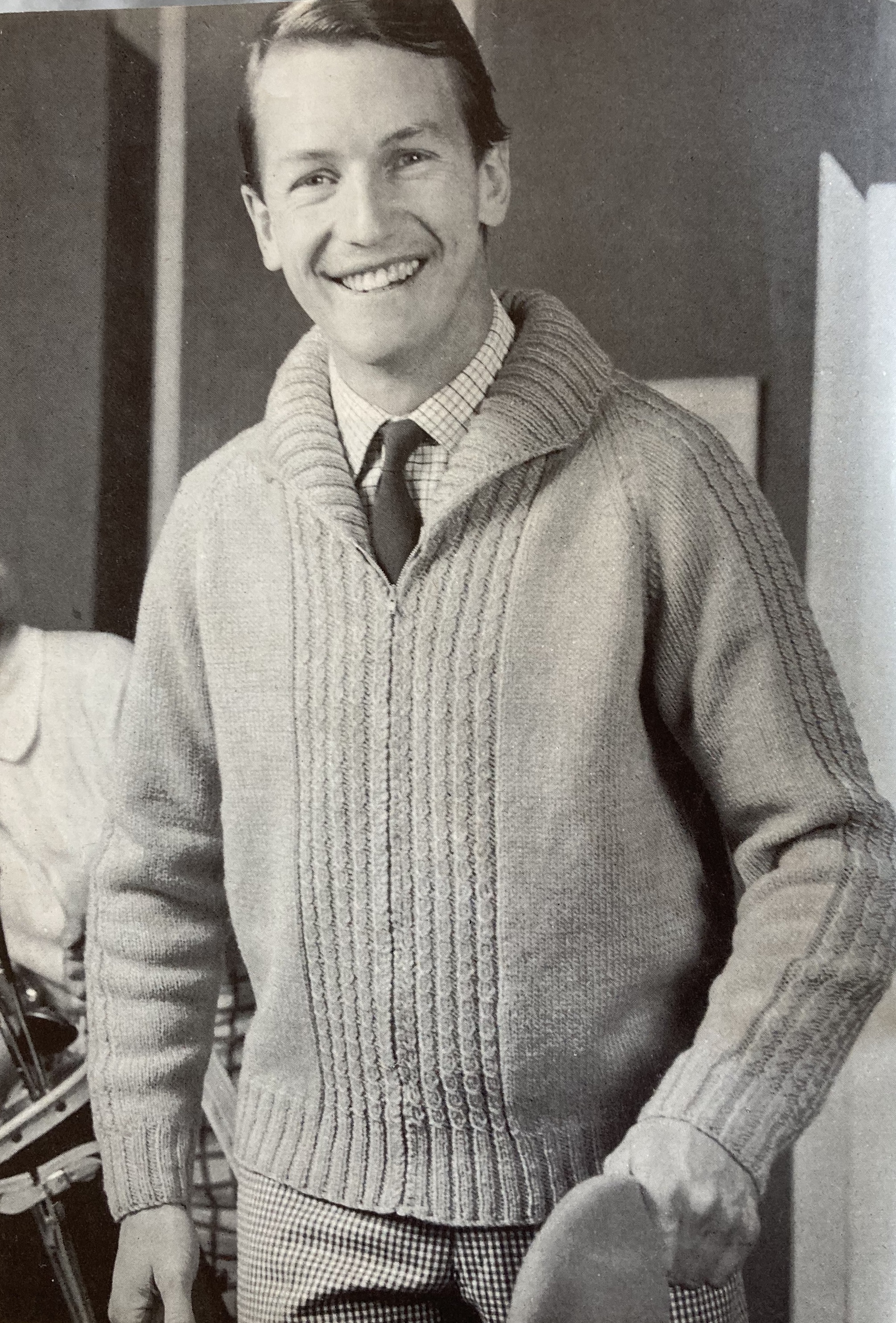
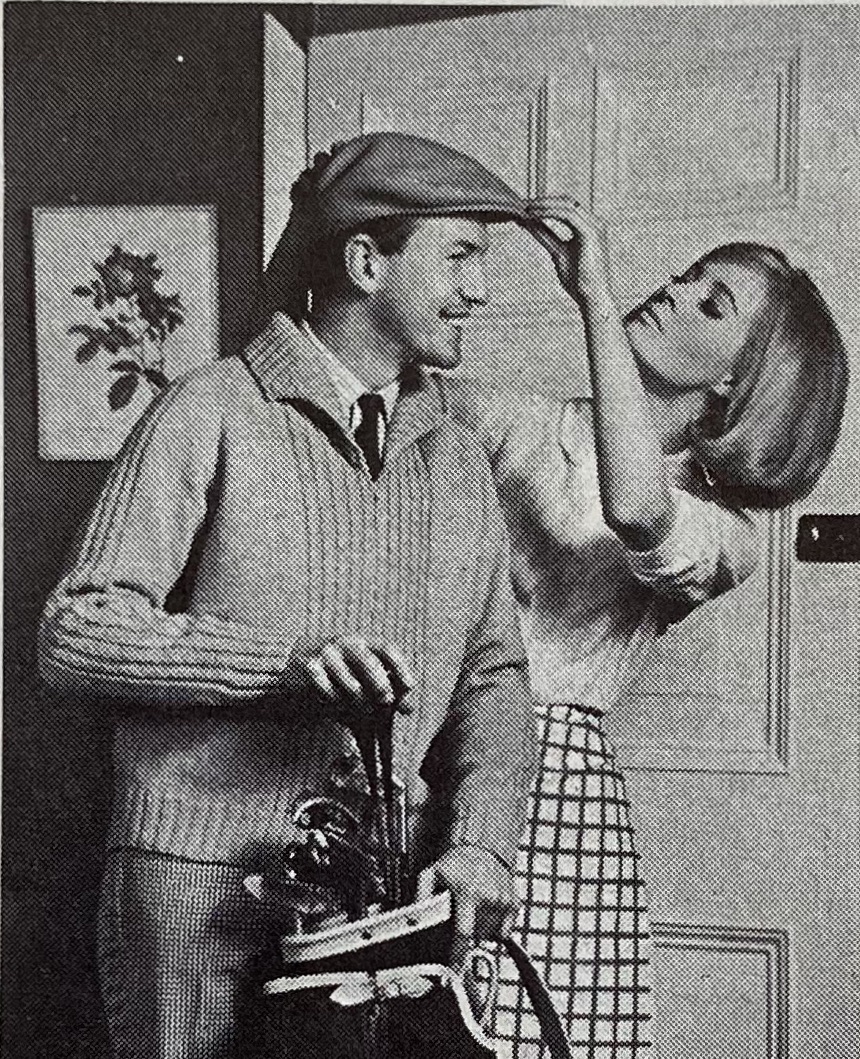
“Finer-knit fans need not feel neglected” by all these bulky, loose-fitting overgarments, promises our “editress” in the facing-page notes: here’s a cute blouse-cardigan in 4-ply wool with the same use of vertical lines, textured pattern and collar, but all in a more refined and elegant look. It’s made in Nylox, a wool-synthetic blend much like modern 4-ply sock wool, and promises to be “very pretty and feminine worn with a pastel skirt.” The man of the family sticks with DK-weight wool, though, and gets a “best of all golfer style” zipped cardigan with classic shawl collar and mock cable detail. I’m only sorry that they chose the normal pose for the full-page photo and relegated the fun one to the facing page.

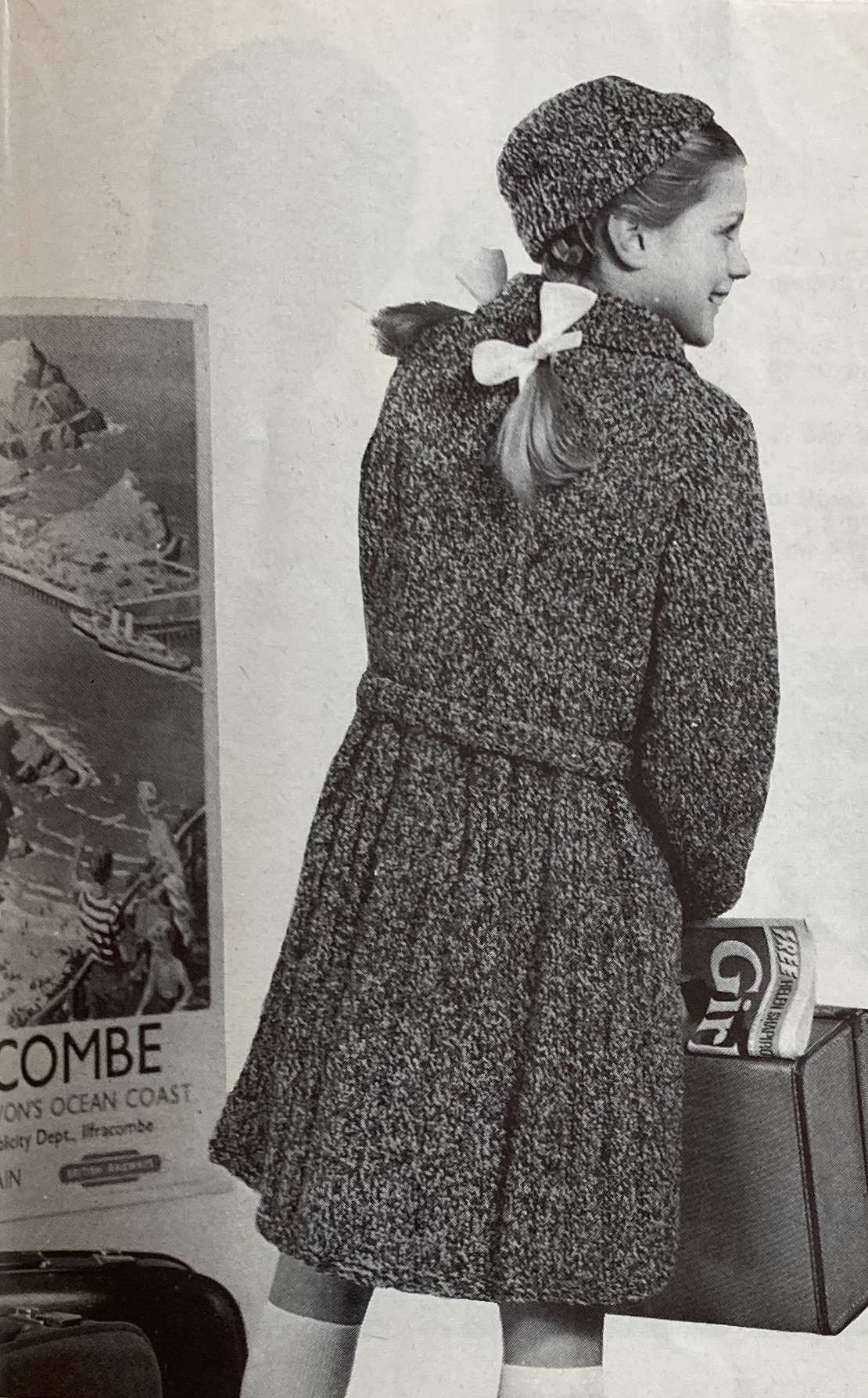
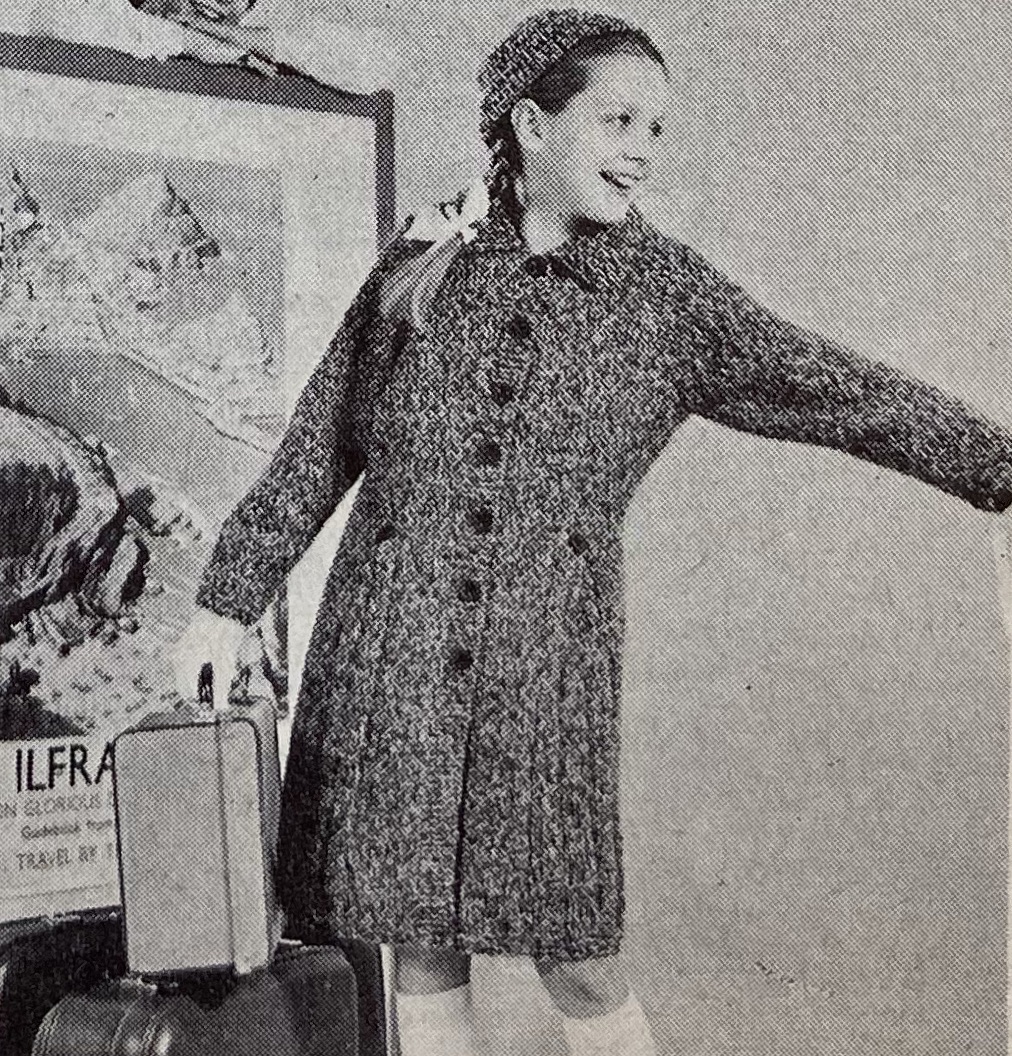
A cardigan jacket for indoor-outer wear is practical for summer travelling, so this month’s issue offers us a structured, yet comfortable “Blazer for Globe-Trotting” in DK weight as well as a belted coat with pleated swing back for the teenage daughter. The coat has a matching cap, as well, and is made in tweedy, bulkier “Glenora” wool. Here, again, there are multiple photos, so you can get a sense of the coat in its entirety.

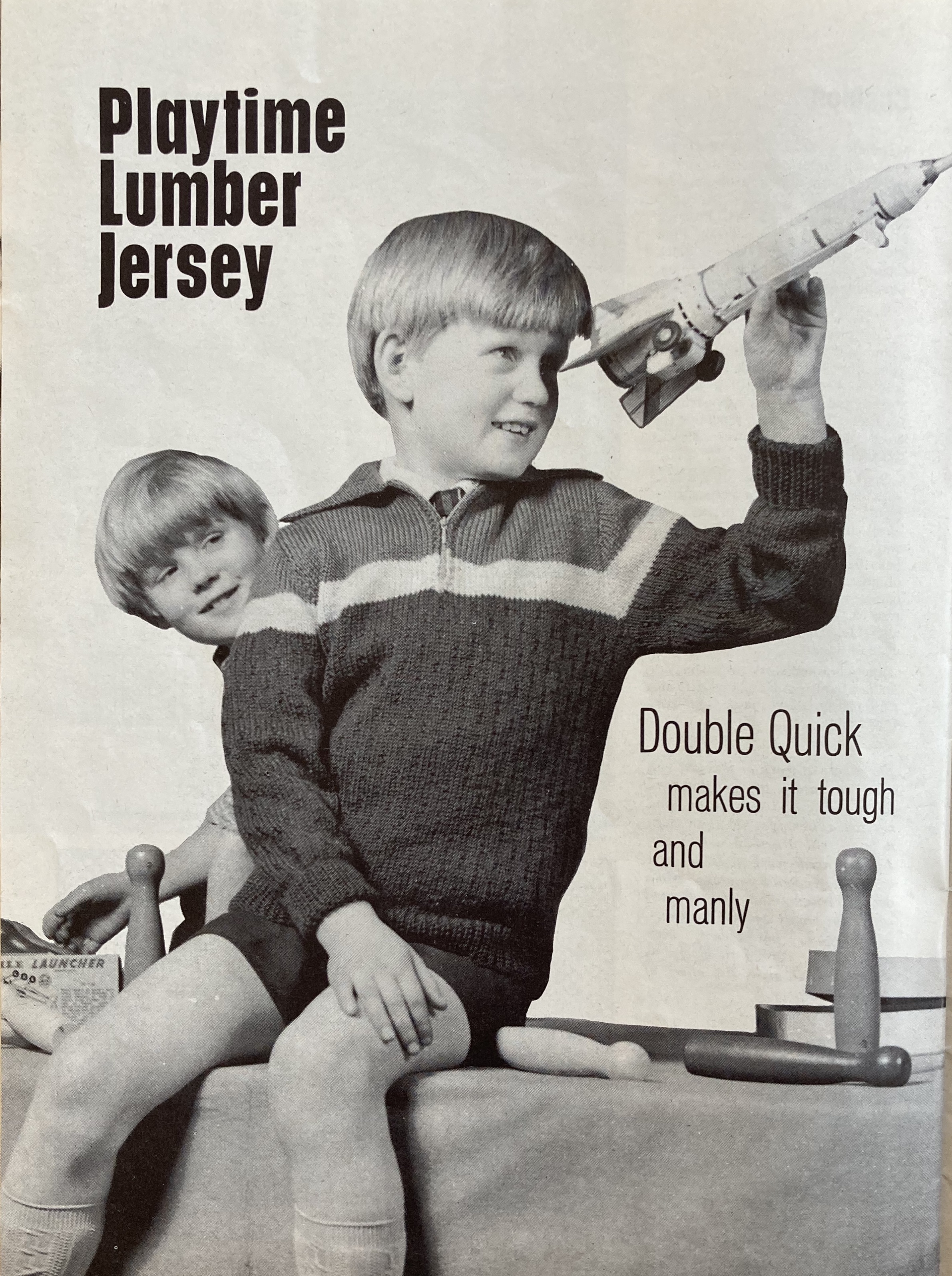
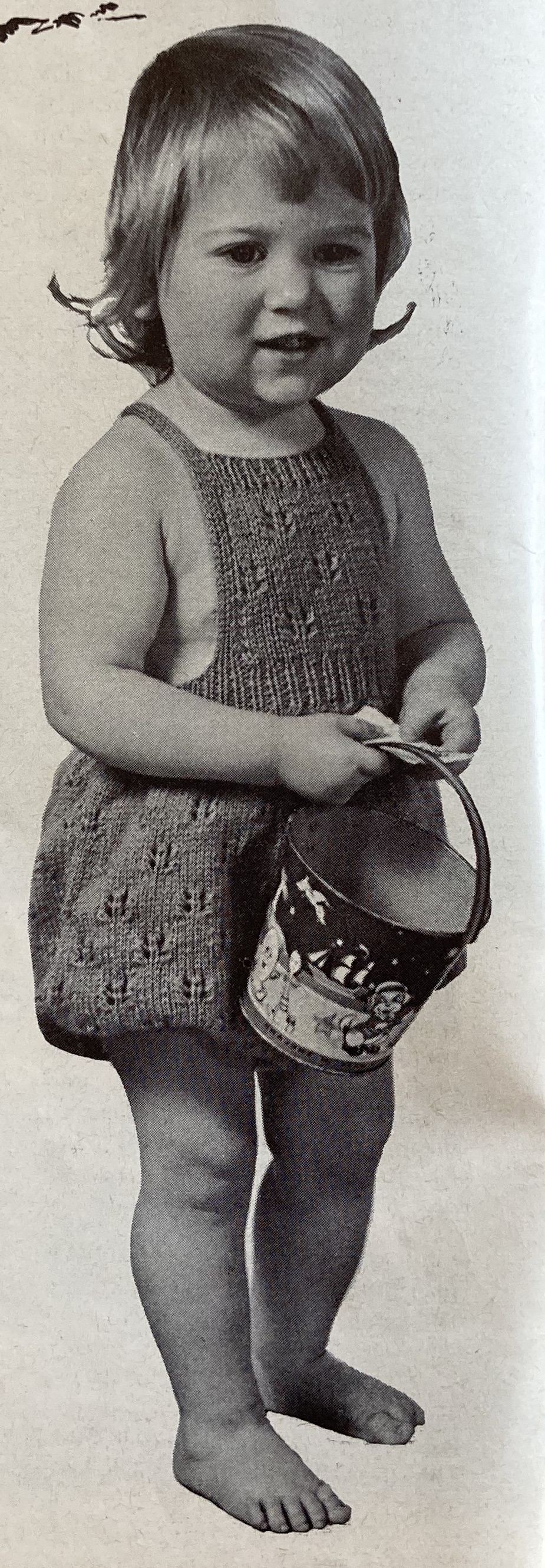
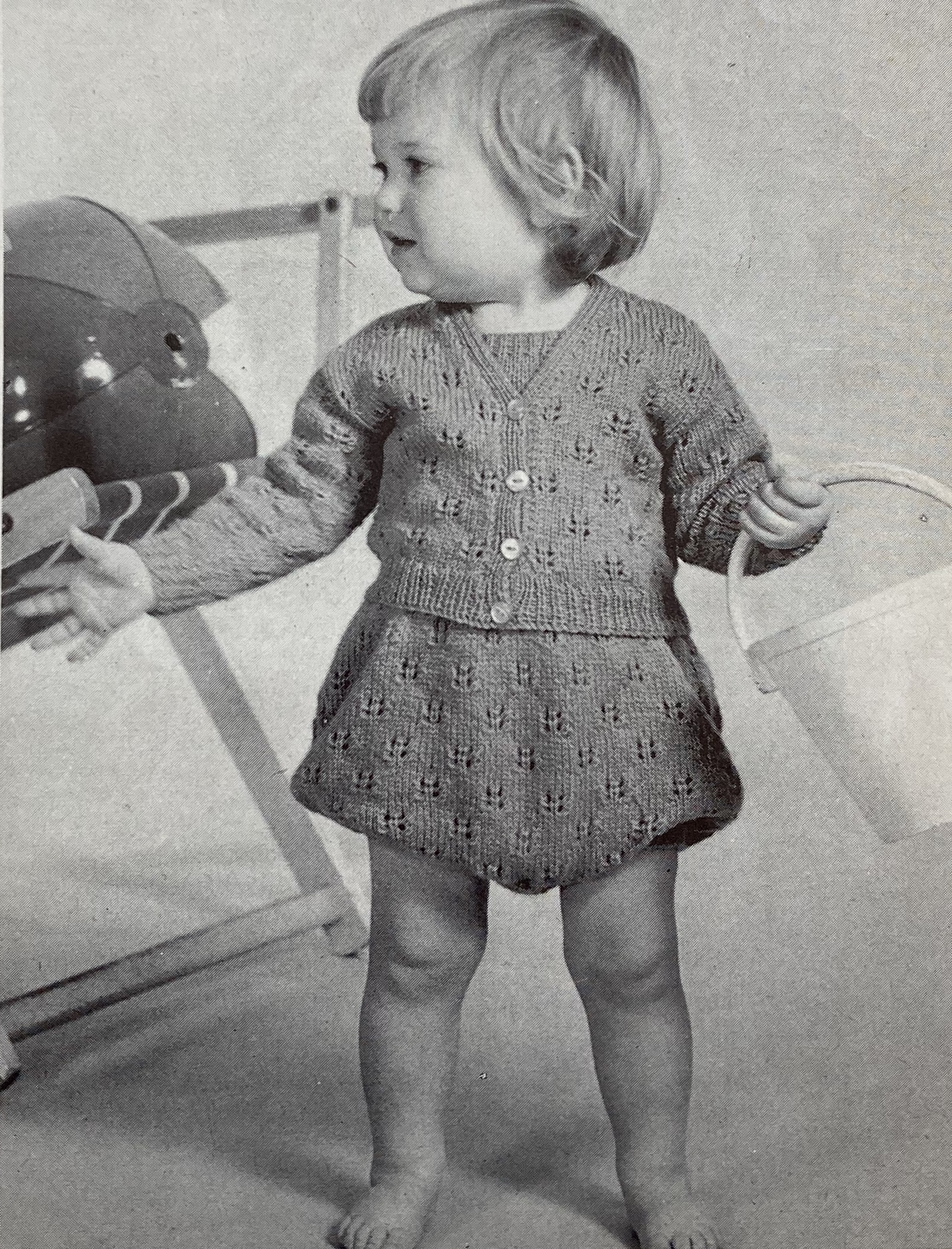
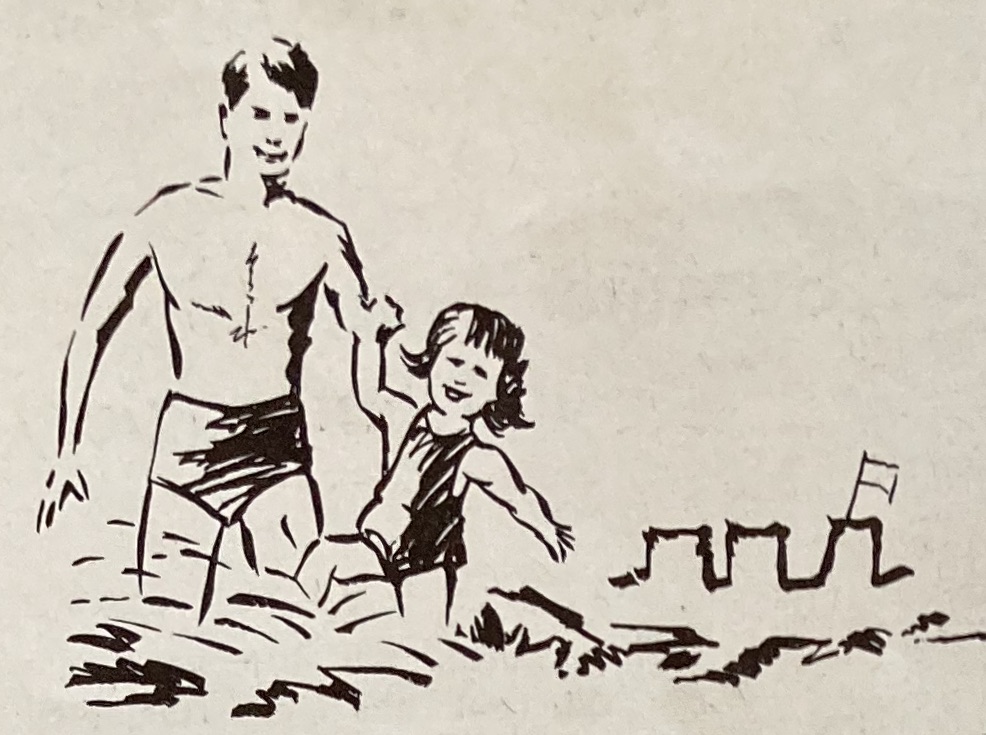
Younger children can enjoy their holidays in hand-knits as well: the boy’s zip-neck jersey promises to be “tough and manly” for the future rocket scientist of the family and makes nice use of stripes and a more subtle textured pattern. (The colours, from neck to waist, are “Breton Red”, “Magnolia” and “Woodland Green”.) Toddlers can go “splashing and paddling” at the beach in a cute romper with a matching cardigan to cover up when it gets chilly. And here’s another great illustration, showing our little model splashing and paddling with her father, sand castle in the background.

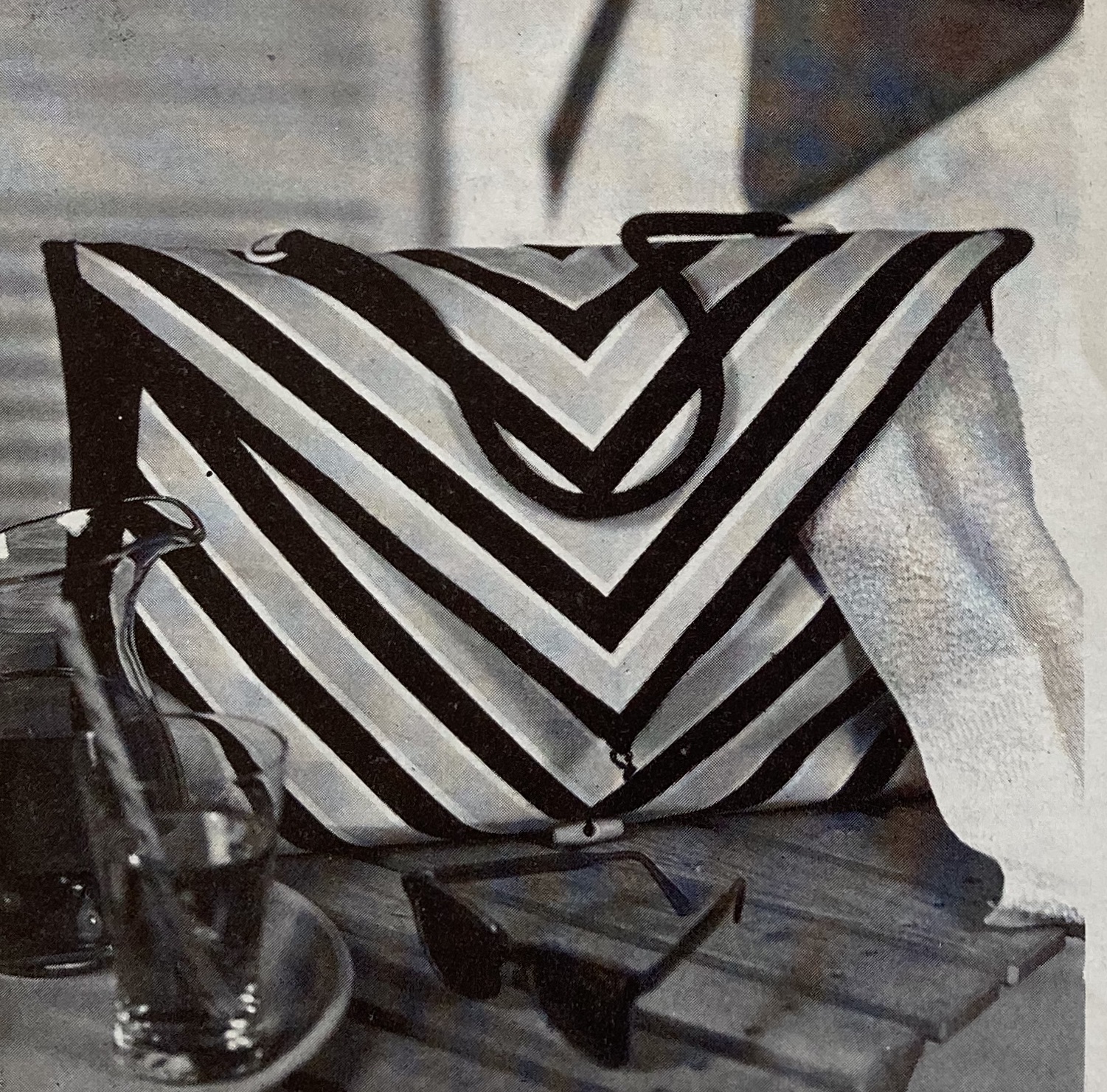
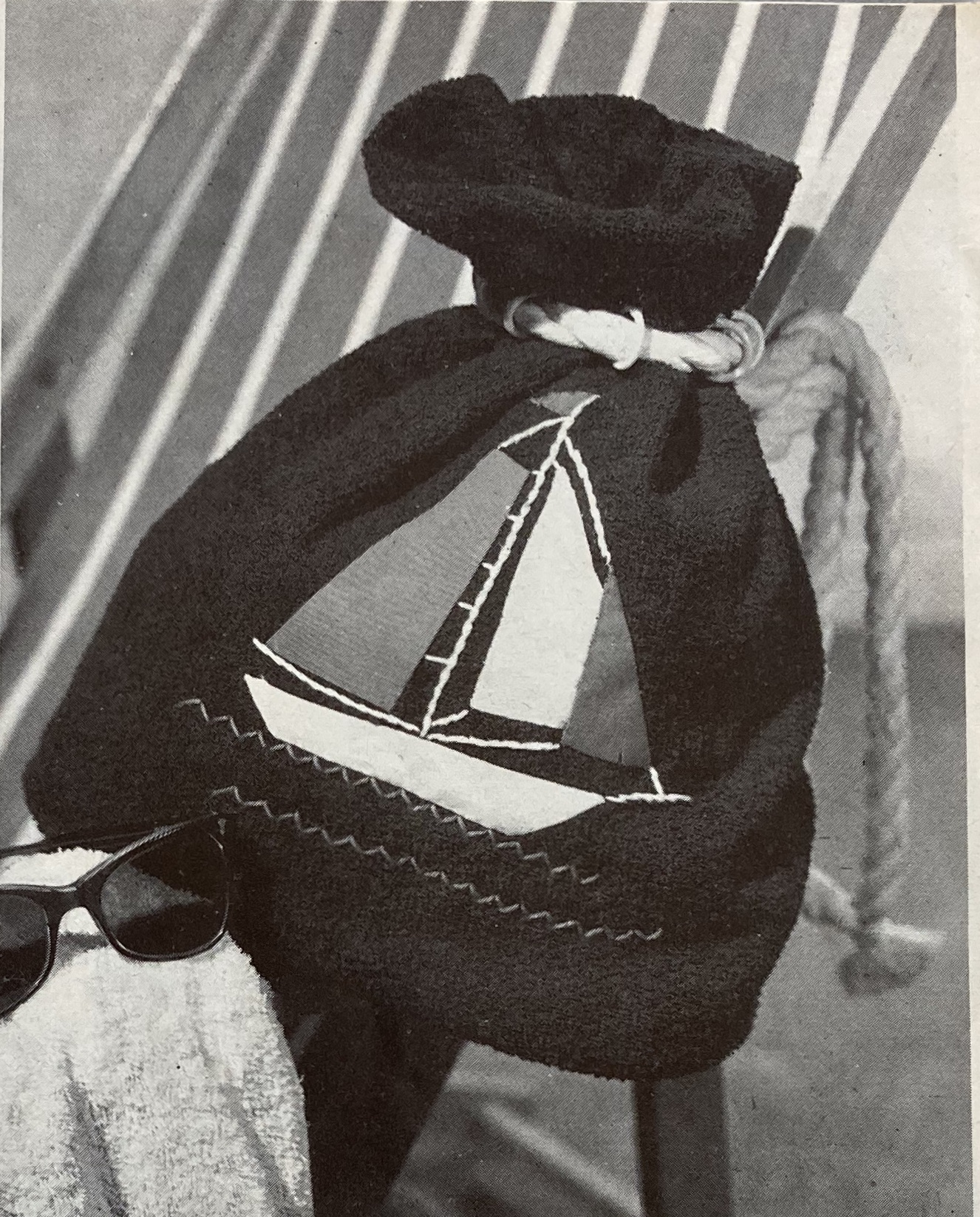
Speaking of beach holidays, how are you going to transport your (possibly wet) swimsuit, sunglasses, towel and whatever else you need back and forth? In a chic, yet practical home-made kit bag, of course. Here are two designs to sew yourself: an “envelope type” made out of tough deck-chair canvas, or a drawstring bag made out of towelling material lined with plastic and decorated with a sailboat motif in appliqué and embroidery.

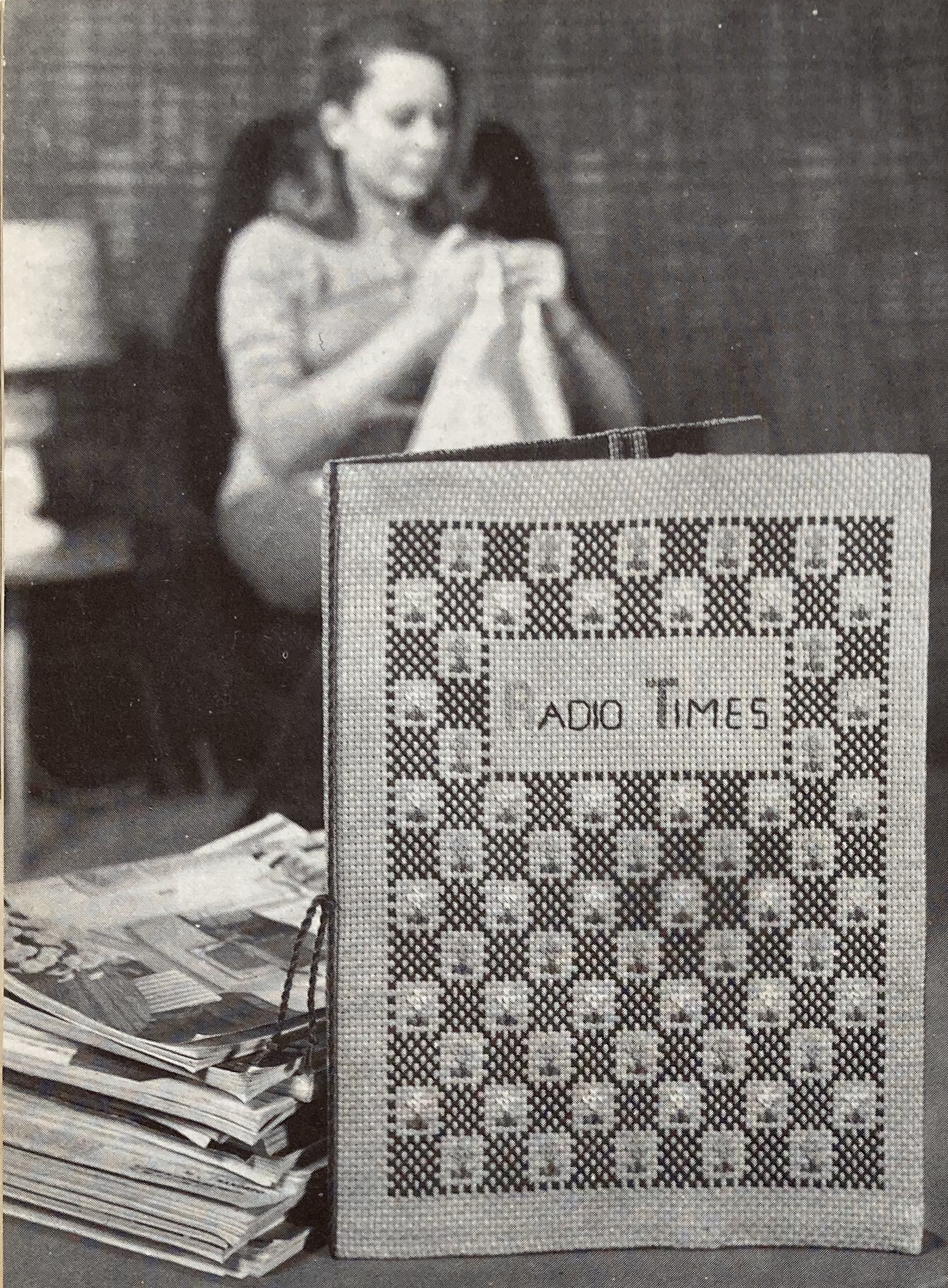
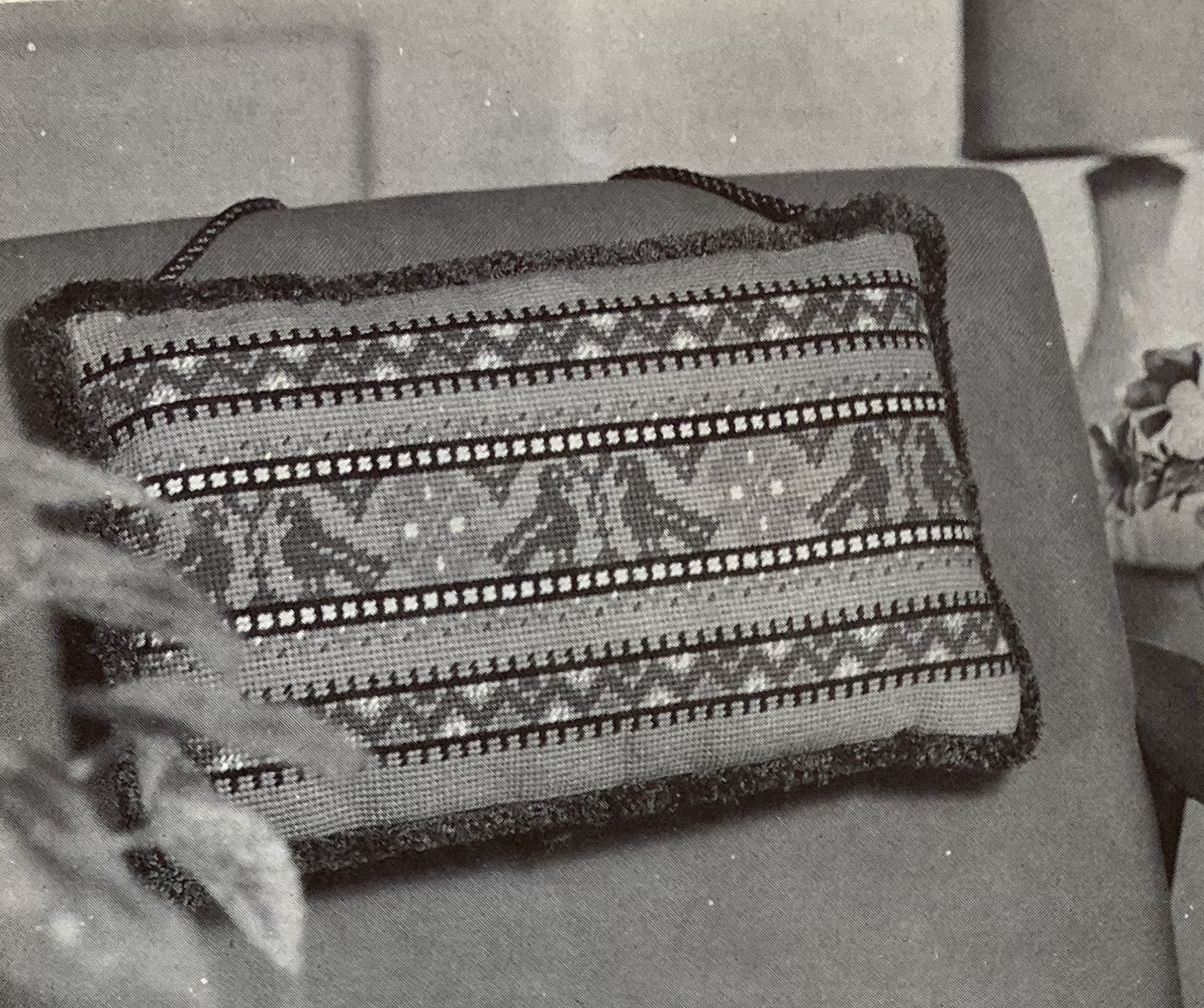
There’s regular embroidery for the home, too (to work on which sunning in your deck-cair, perhaps): an easy cross-stitch book jacket for the Radio Times, another traditional chair-back/cushion design, and some more intricate wall panels with colourful wildflowers.

Speaking of intricate wall panels: if all that weren’t enough, there’s another amazing felt appliqué wall panel, this one featuring characters from “favourite books.” That is, if your favourite author is Charles Dickens, which, why not, I suppose? There’s Barnaby Rudge and Oliver Twist from their namesake novels, Peggoty, Little Emily and David Copperfield from his namesake novel, Mr Pickwick from his namesake novel (‘s papers) and Grandfather and Little Nell from… (OK, I admit I had to resort to Wikipedia for this one) The Old Curiosity Shop, one of Dickens’ books which I have heard of, but never read. Anyway, the appliqué is fantastic — just look at the detail photo on Mr Pickwick’s face.

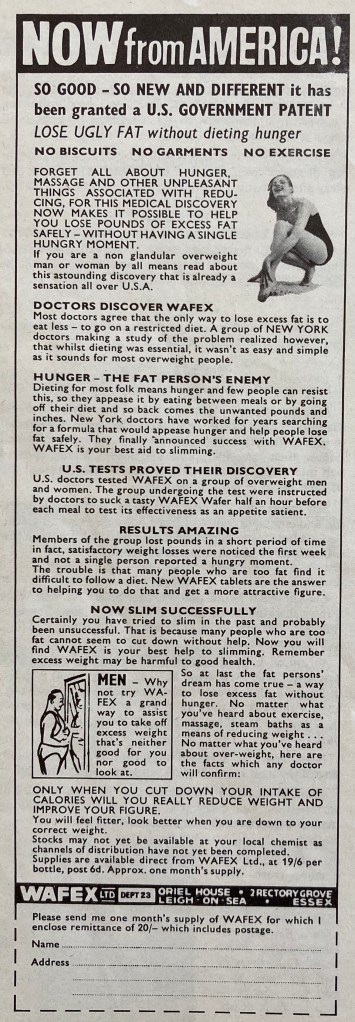
That brings us to the end of our issue, and by the way, if you suffer from unwanted weight gain as a result of all your holiday leisure, why not try sucking on a tasty “WAFEX” wafer half an hour before each meal? I’m suuuuuure it’s not only extremely effective, but also perfectly safe. After all, it’s “SO GOOD — SO NEW AND DIFFERENT that it has been granted a U.S. GOVERNMENT PATENT” ! (Note: I do not actually know what was in these appetite suppressant wafers, but seeing as it was 1964, they could contain anything from sugar to amphetamines to absolutely nothing. Please do not take medical advice from me, or from 1960s knitting-magazine advertisements.)

I would love to make the 4-ply cardigan blouse, but it will take a while, as I have so many unfinished larger projects on the needles at the moment. Until then, enjoy your Spring, Summer, holidays, travel or whatever else May has in store for you.

April 1964: Overview

Like March April weather, Stitchcraft‘s „Spring Lineup“ from March April 1964 has a little bit of everything to offer. (No, that was not an April Fool’s joke — I have apparently lost track of time. Thank you Gretchen for noticing!!) There are warmer garments to wear on a spring ramble or for summer sailing, knitted cardigan jackets to take the place of outerwear, some slightly dressier separates for a going-out ensemble, and easy homewares that can be packed and taken along on your coming holiday.

Our cover model is wearing a knitted jacket whose texture almost gives the appearance of being woven, thanks to a very firm three-colour slip-stitch pattern made by moving the working wool back and forth and so „wrapping“ the slipped stitches on each row. It‘s made in Totem Double Crepe and is intended to be worn as outerwear — as well as being „ideal for the car.“ Men get an outerwear-cardigan as well, this time with a combined texture and colour pattern and classic shape, and anyone can wear these casual, loose-fitting „sports sweaters“ while sailing or otherwise out in cooler maritime weather.

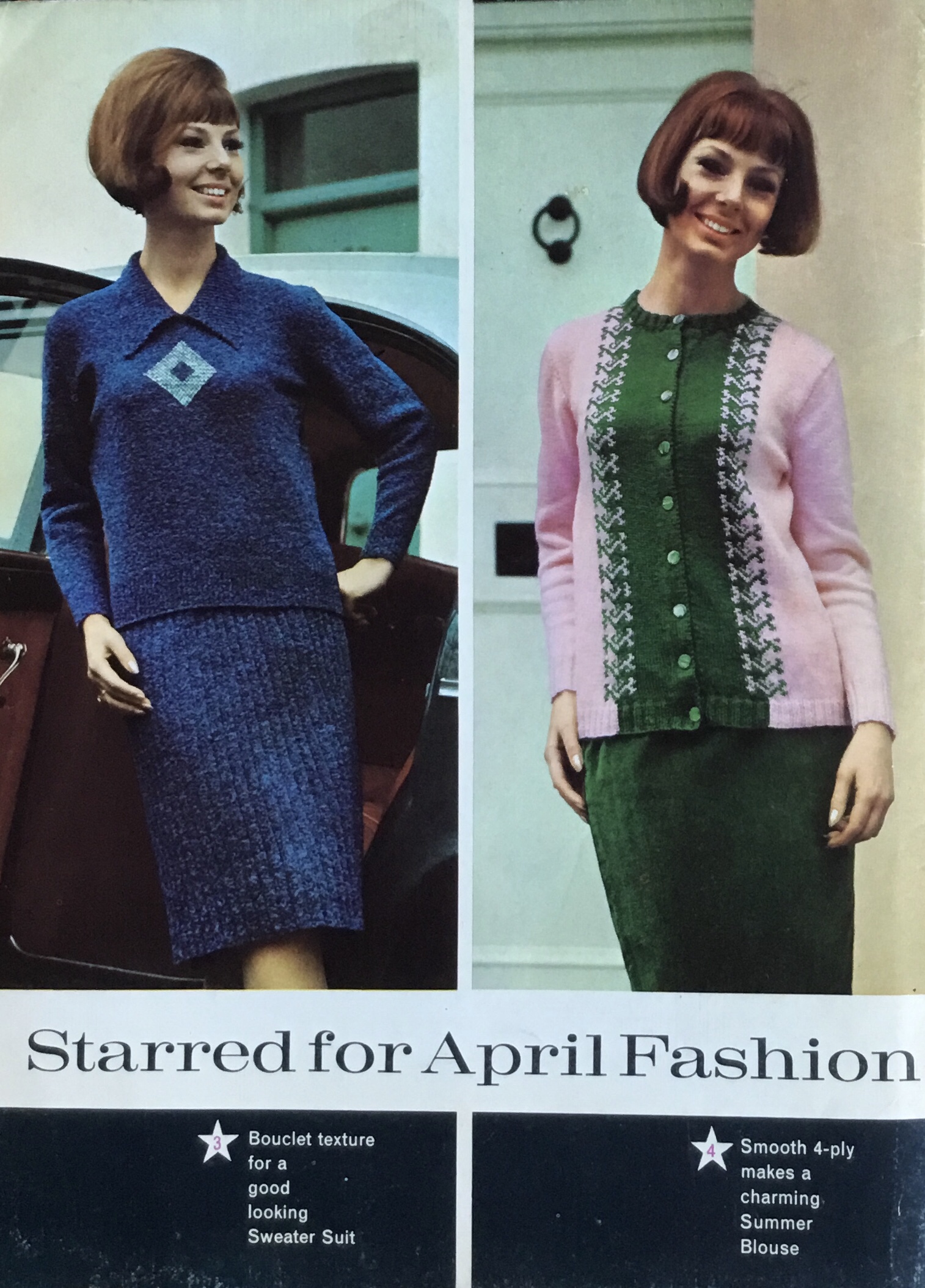
For more dressier occasions, there‘s a two-colour fancy cardigan in 4-ply fingering weight, or a jumper with matching pleated skirt in 4-ply bouclet. You can also make an „overblouse“ in double knitting to wear over a short-sleeved, lightweight jumper in a new twist on the twin-set theme. Zig-zag patterns, whether worked in colour or texture, and large collars continue to be popular.

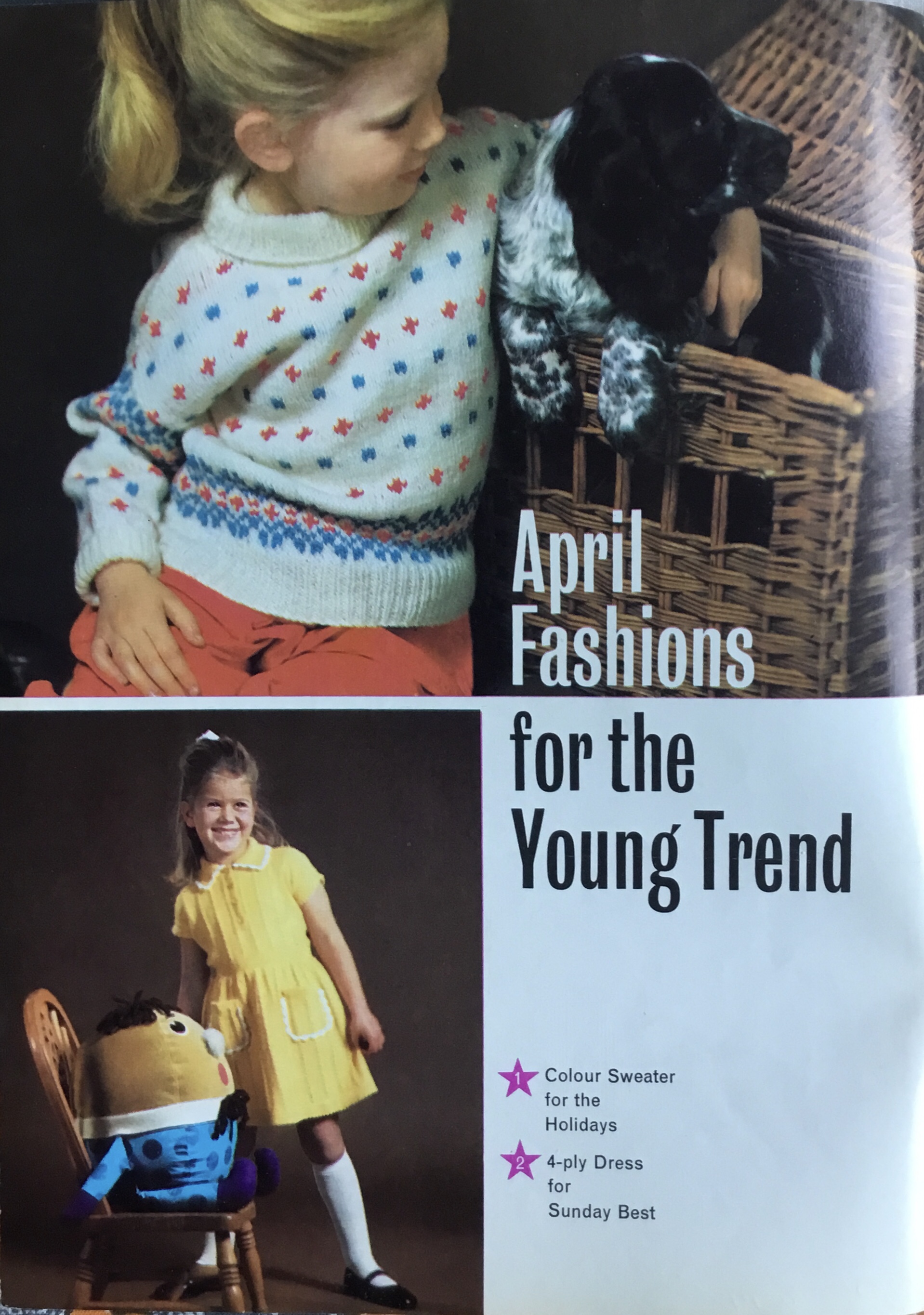
In the „Junior Knitting Fashions“ department, there‘s both a warm Scandinavian-style sweater in a typical snowflake pattern, or a wonderful „Sunday best“ dress.

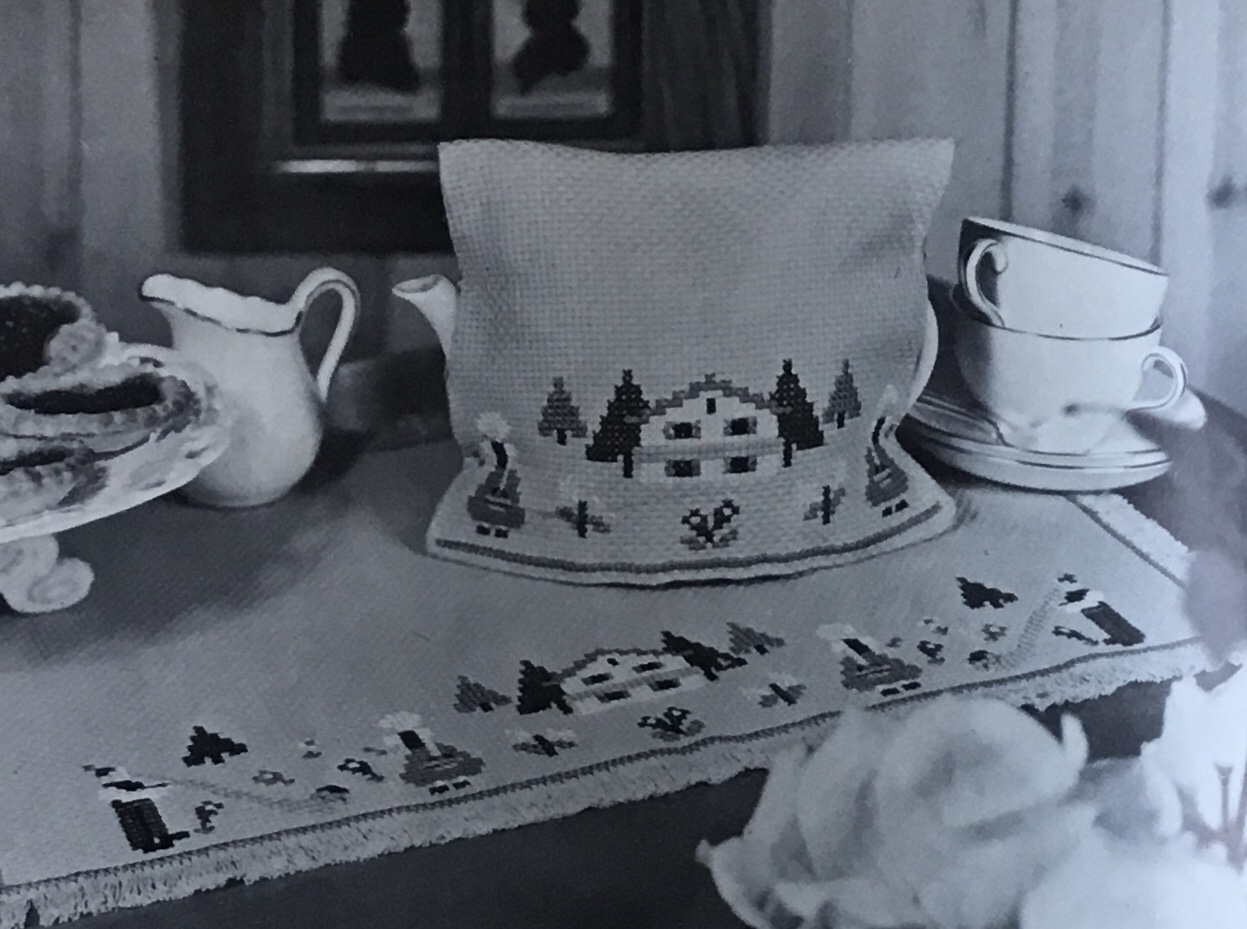
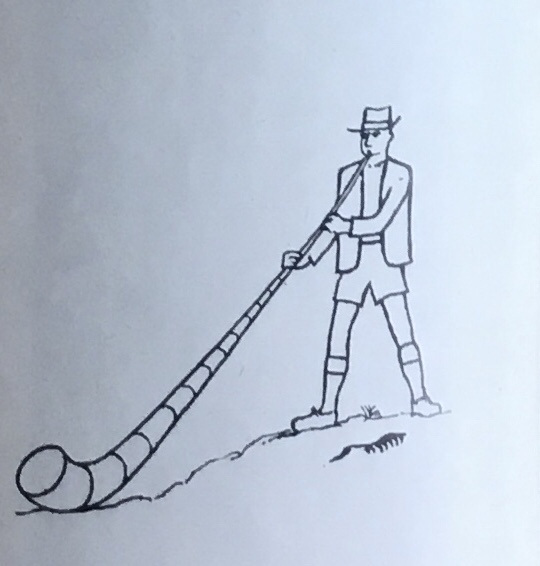
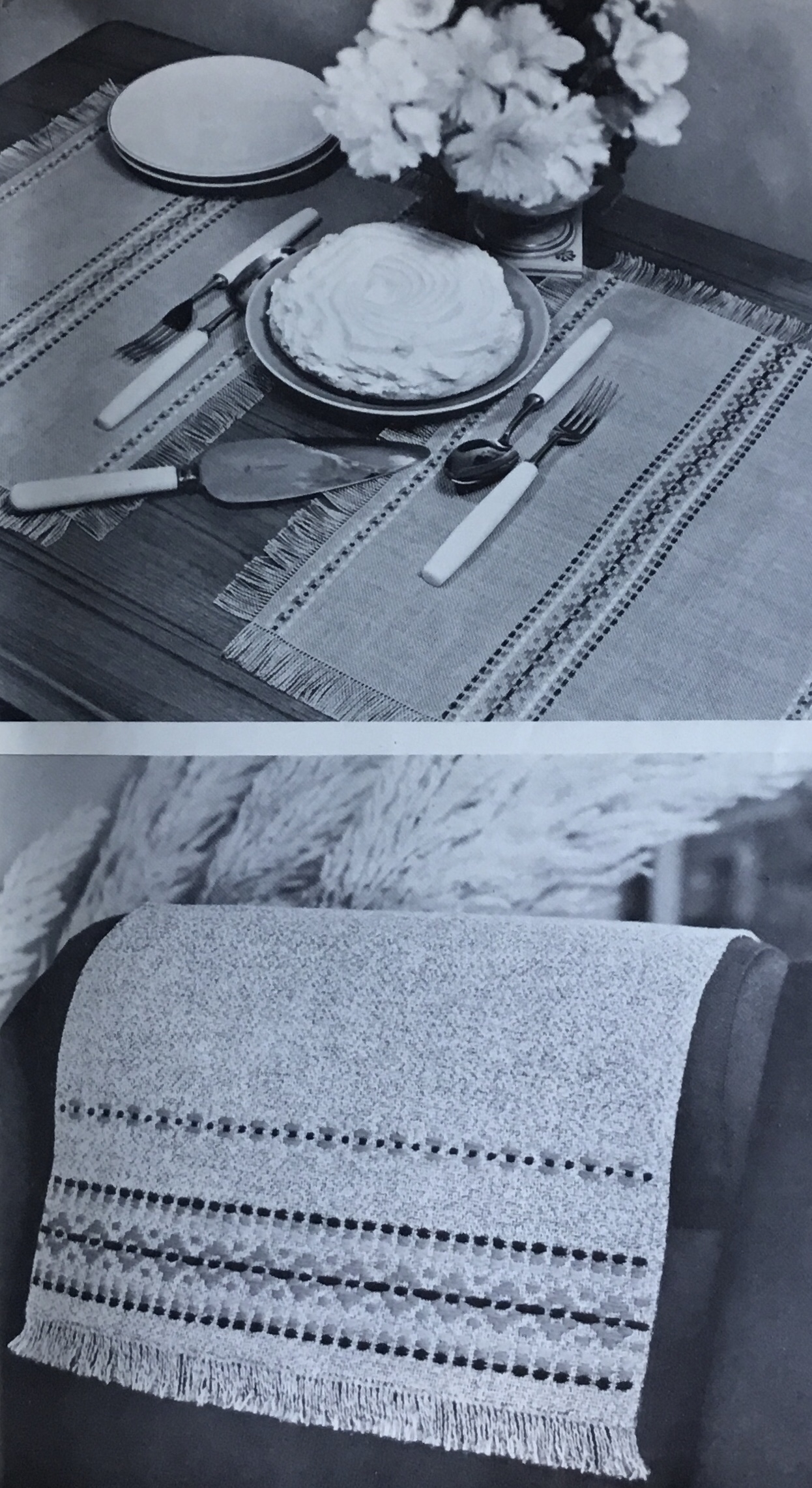
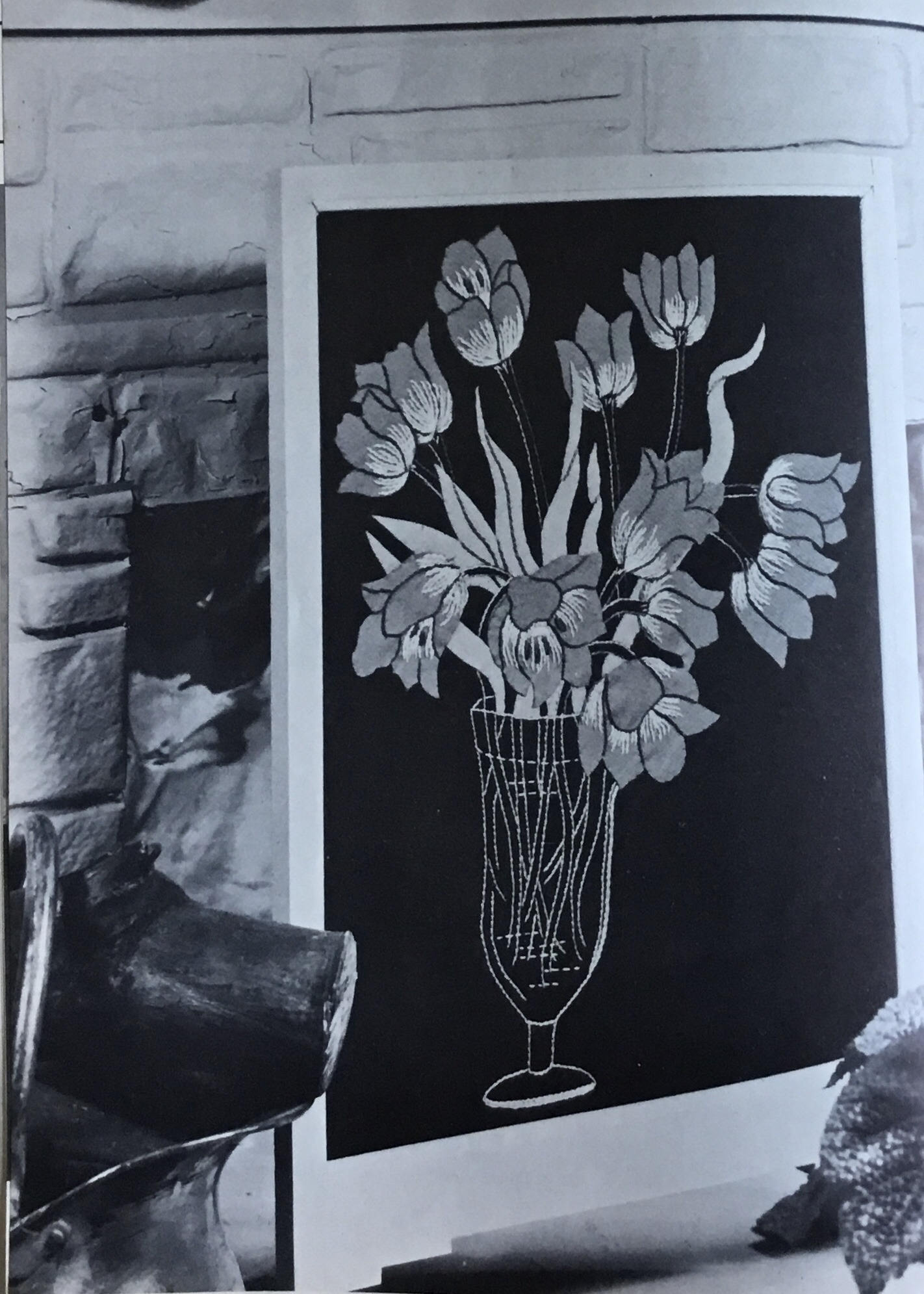
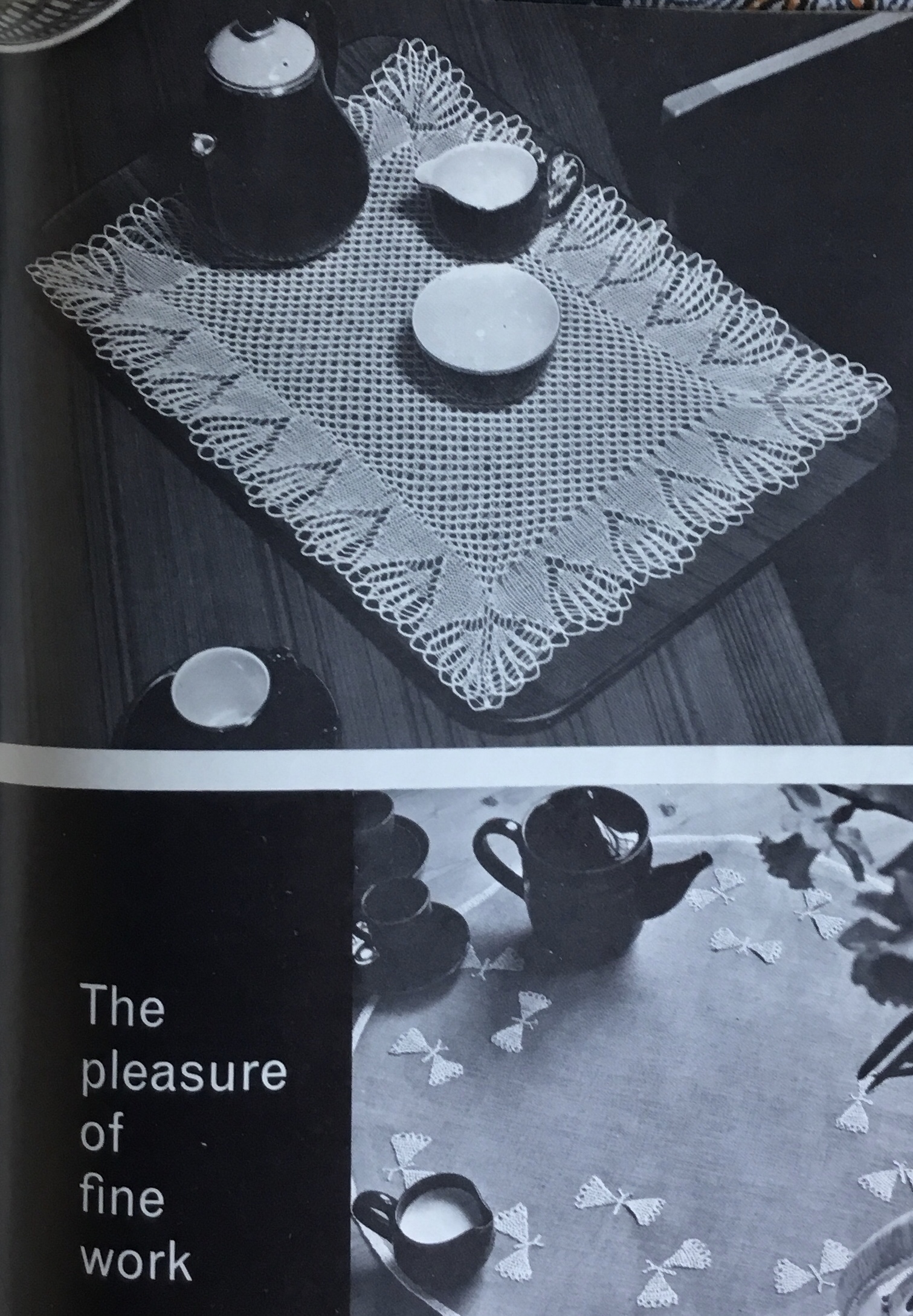
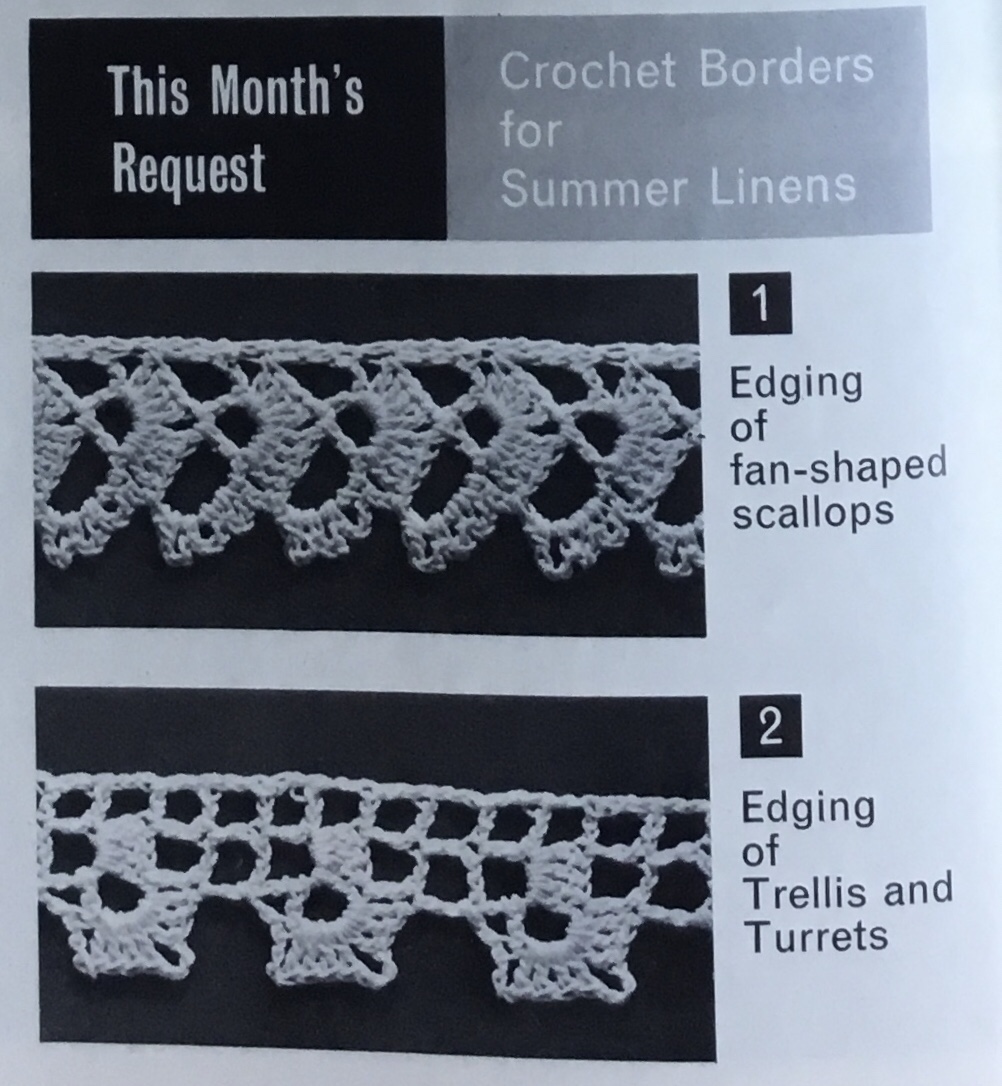
Homeware project ideas are plentiful, but not out of the ordinary. Embroidery fans can make a lovely apron with a traditional Romanian design, or cross-stitch a kitschy „Swiss border“ (nice illustration of an Alphorn player!), or work a counted darning pattern on placemats or a chair back. There‘s a fire screen with appliquéd tulips, a tapestry chair seat, a fancy knitted lace traycloth and a mat with appliquéd crocheted butterflies. You can also crochet lace borders to trim linens or whatever else you like. Truly, there is something for everyone!

I would love to make the child‘s dress, but don‘t necessarily know a child who wants one. Maybe I should size it up for myself? I would wear it! Otherwise, the embroidered apron is really nice. Maybe too nice to get splattered with food… but it would make a great knitting apron as well. We‘ll see!

P.S. Sorry for the lousy formatting. The WordPress editor does not work well on a tablet.

June 1963: Overview

Cover photo from Stitchcraft magazine, June 1963

“Light & Airy” is the theme of the June 1963 issue, with short-sleeved 4-ply knits as well as bulky items made in fluffy, lighter wool/synthetic blends. June is also the beginning of the holiday season, “where the emphasis to-day is so much on the active side and casual look — sailing, rambling and of course, so much travelling” (Patience Horne, “Editress”). Accordingly, many of the projects are easy, quick and/or small, to be finished before the travelling starts or suitable for working from your deck-chair.

In her introduction to this issue, Editress Horne also has a “special word for older readers”:

Remember that top models all come in the young age groups, but many of our designs, though often photographed on young models, are very suitable for older women, and often, a sweater with a long line, can be shortened without difficulty, for the more mature figure.

Graphic of a dandelion with the words "Light & Airy"

The 1940s and 1950s issues of Stitchcraft did have older models from time to time, usually modelling the designs intended for those “mature figures”. The 1960s issues often have plus-size designs and models, but they are indeed all on the younger side. I assume this had to do with the target demographic slowly moving from young working women and older matrons after the war, to young(ish) mothers of future Baby Boomers in the later 1950s and 1960s.

Anyway, on to the designs! The happy holidaying couple can make matching cardigan jackets in lightweight-but-bulky “Ariel” yarn when they play tennis or go “strolling and sight-seeing.” Diamond and zig-zag patterns make a showing in stranded colourwork patterns (the cover blouse), textured stitch patterns (the panelled 4-ply jumper and short-sleeved cardigan blouse) or Swiss darning (the colourblock “playtime sweater” worn by our young drummer.) The same Swiss darning (a.k.a. duplicate stitch) embroidery is used for tiny accents on a casual, collared cardigan.

The youngest of the family get a cute “matinee coat” and/or jacket decorated with regular embroidery, or a sun-suit with matching short-sleeved cover-up. Embroidery is definitely a trend! Collars and neckline finishings can be subtle, non-existent or big and bold, as seen on the woman’s cardigan and this men’s casual, tweedy shawl-collar number.

The homeware projects are all fairly simple and versatile, one design being suitable for different types of project, but some are too large to want to take along on holiday. There’s a tablecloth and/or chairback with cutwork ivy design, a rose motif apron and/or cushion, and a Victorian-inspired cushion and/or stool seat in tapestry and/or cross-stitch. Pick your combination!

The outdoor cushions with sea motifs are a good summer-themed project, or you can preserve your holiday memories in a needlepoint picture of Lynmouth. There’s also a cross-stitch rug for a larger, at-home project.

With so many interesting ideas to choose from, I’m sure nobody’s holiday will be too relaxing, ha ha. I am undecided about what project to make. I am so far behind and have so many unfinished projects! At the same time, there are too many projects from this issue that I would like to make. I could genuinely use a new cardigan and the embroidered one with the big collar is just my style… but where will I find the time to make another full-size adult garment? The same goes for the short-sleeved cardigan blouse and the panelled diamond-stitch jumper. The baby coat or cardigan would be practical for using up stash and might actually be done quickly enough, so that might be the best choice. Stay tuned!

August 1962: Overview

August is the end of the holiday season at Stitchcraft, featuring transitional styles for the cooler days of September as well as a few more small, easy projects that can be worked on from the deck chair or picnic table. The “Contents” column on the facing page divides the adult garment patterns into the categories “First Autumn Fashions” and “Continental Designs”.

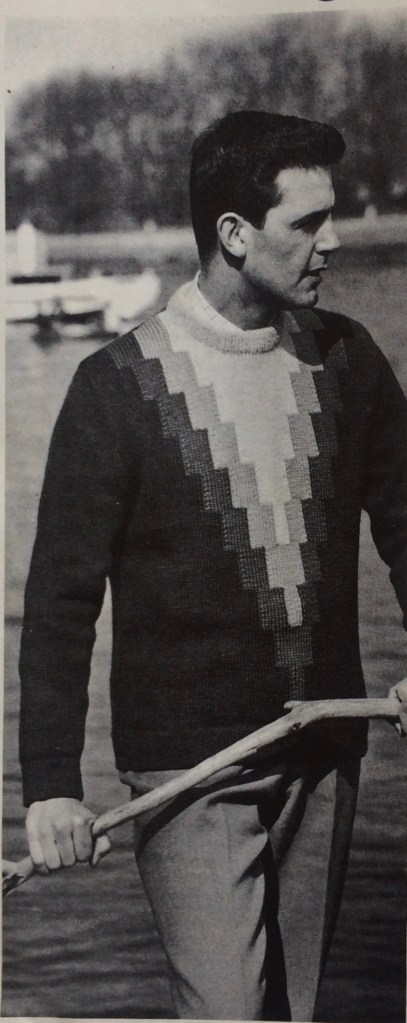
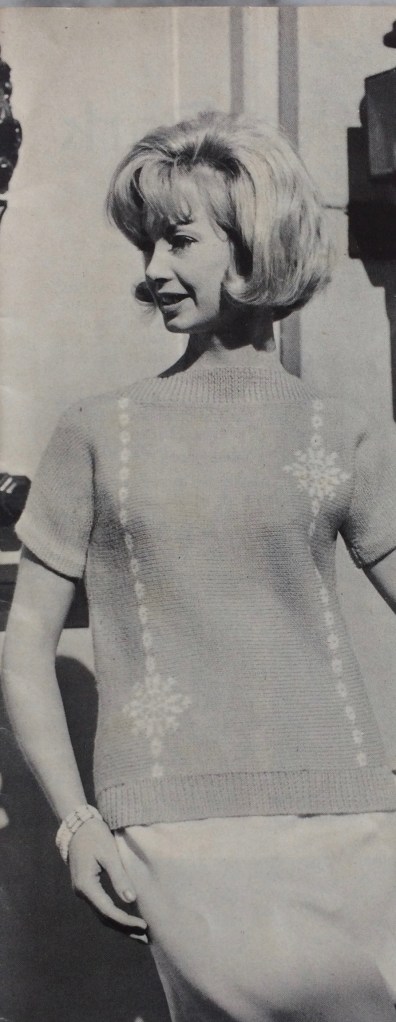
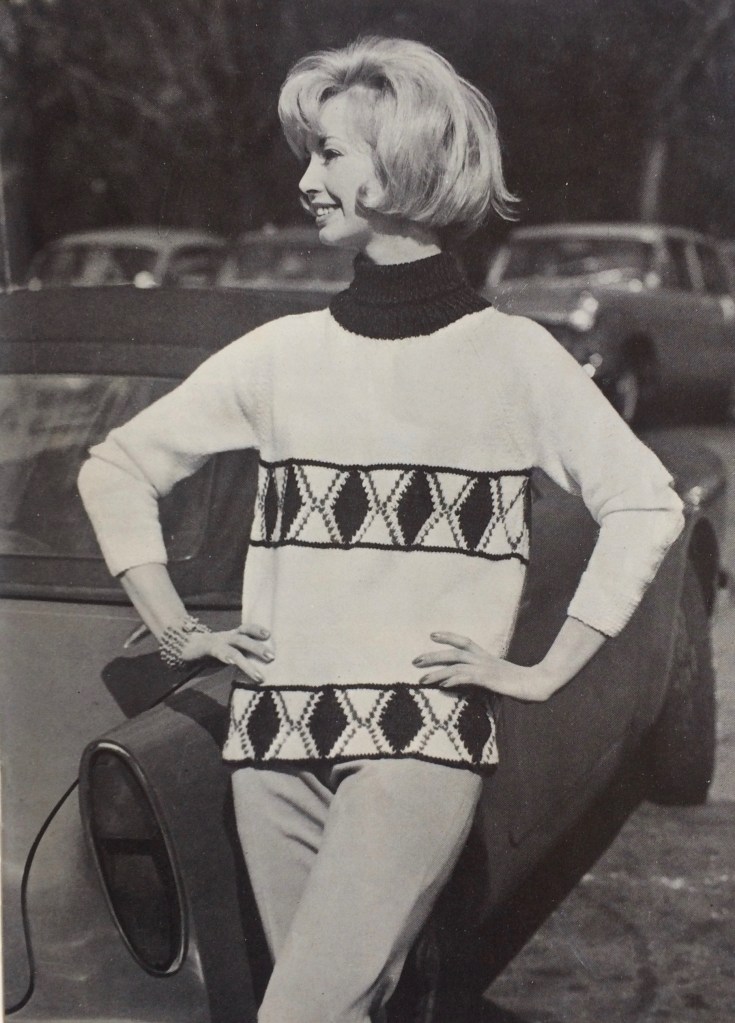
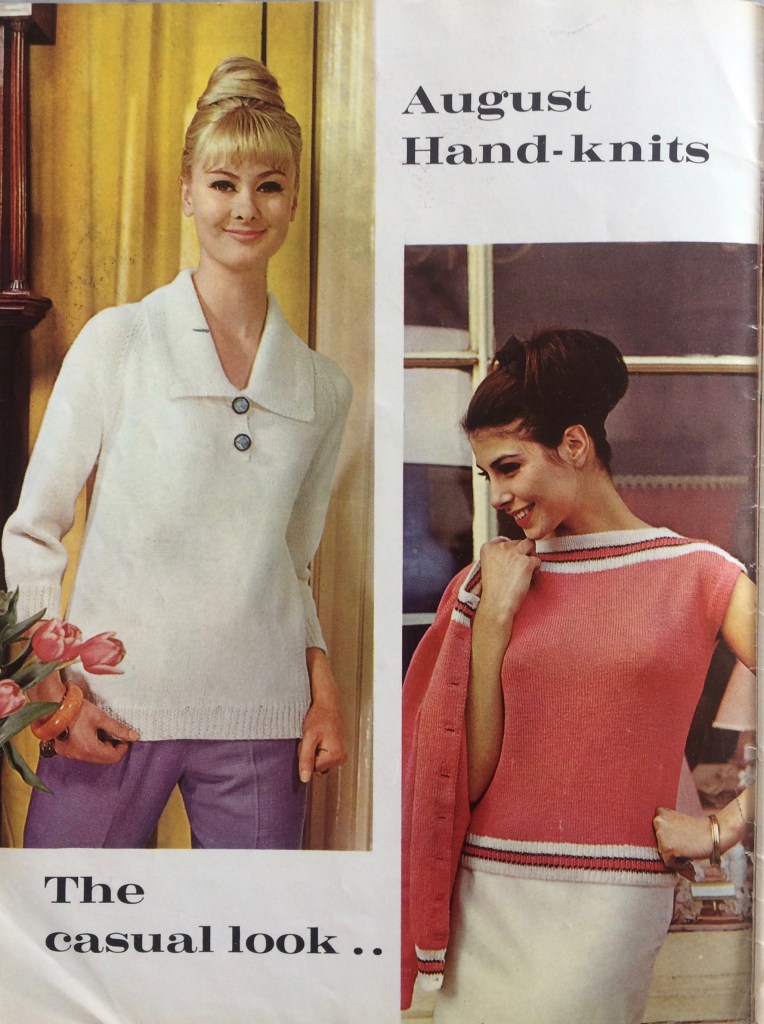
The “Continental Designs” comprise a colour-block pullover for men “from Vienna” in graded shades of green, a simple cap-sleeve, T-shirt-style jumper with a little Norwegian motif, and an “Italian design for late Summer” with bands of red and black intarsia in a diamond pattern. I wish they had used these for the colour photos instead of the bland white pullover on the inside front cover!

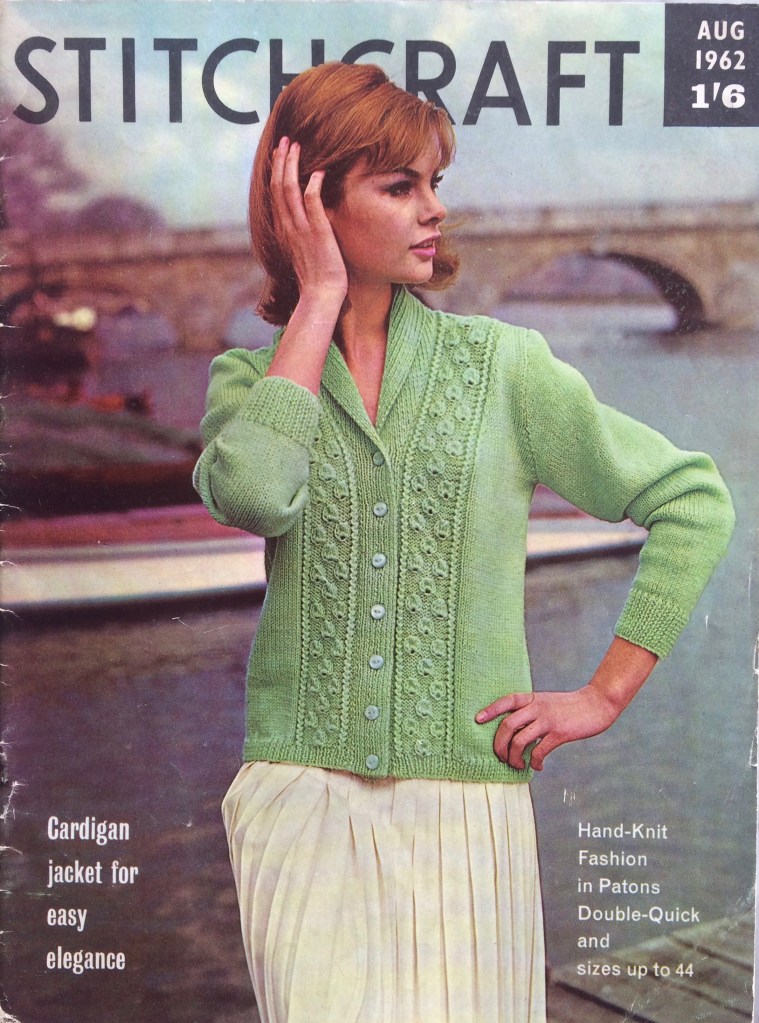
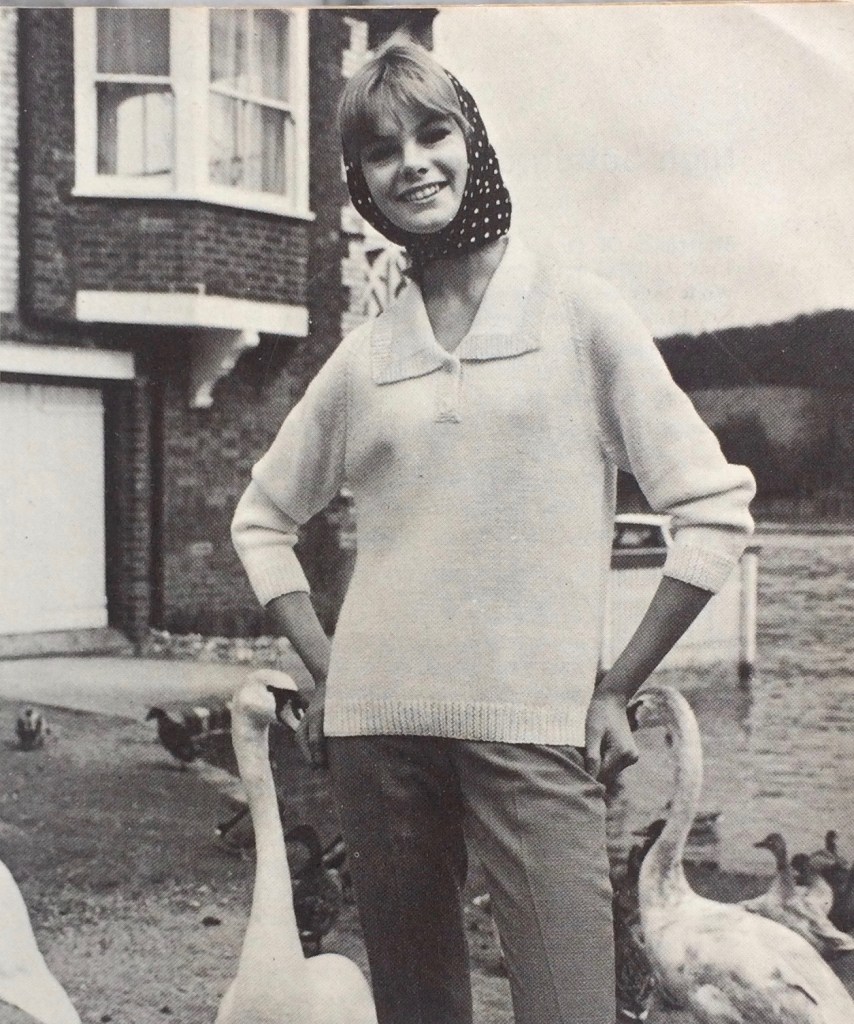
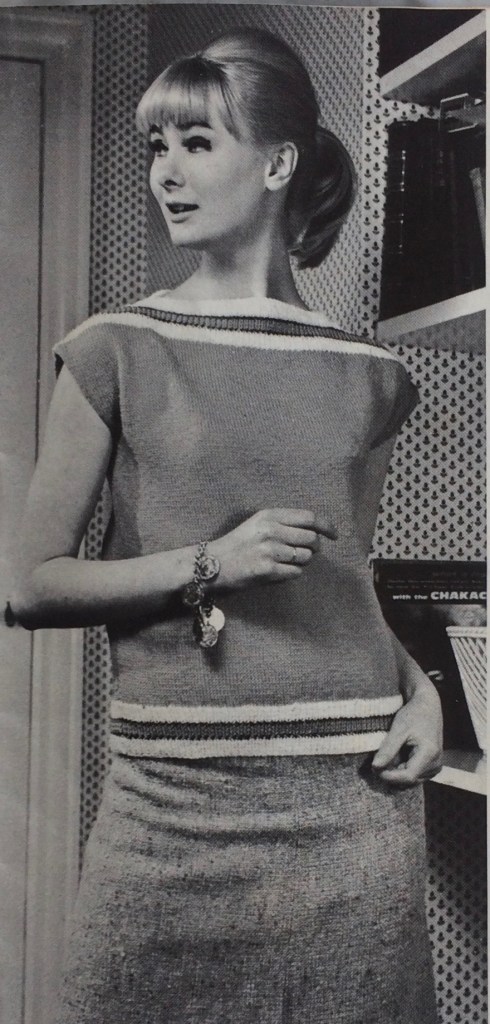
Loose-fitting, casual shapes and light, sunny colours dominate, exemplified by the apple-green cardigan, collared shirt-sweater and boatneck twin-set on the front and inside covers. Notice how much less fitted the August 1962 twin set is than, for example, this one from August 1960, not to mention earlier twin-sets from the 1940s and 1950s. The concept lives on, but the line has changed completely. Everything is hipbone-length with no or hardly any shaping.

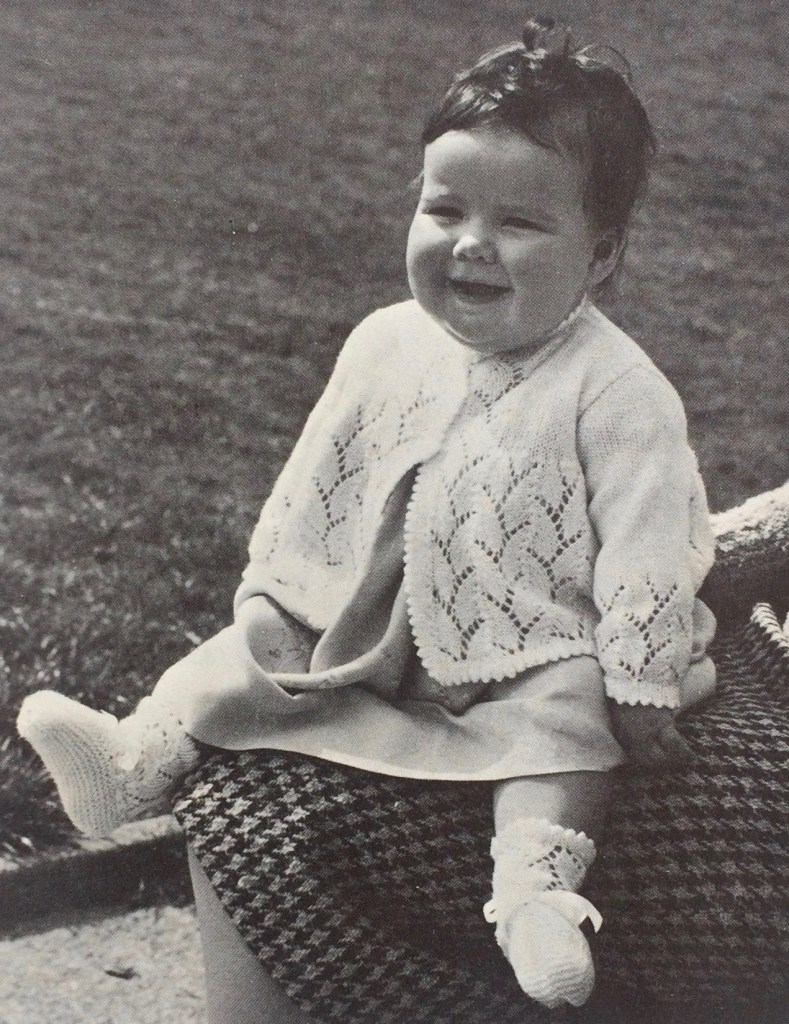
Babies get a standard, but very pretty, lacy matinee coat and bootees, the “smart teenager” has a machine-knit pullover, and her little sister gets a “gay Rimple design” in the still-popular knitted terry-cloth look, so the whole family is taken care of.

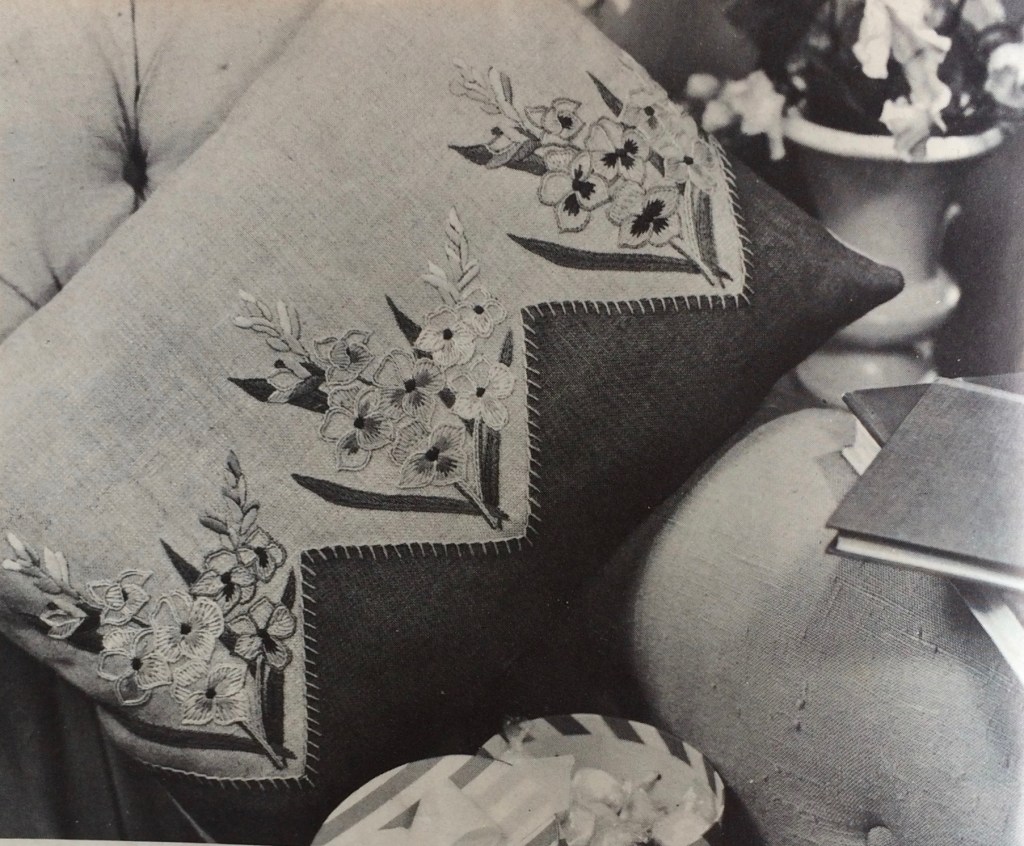
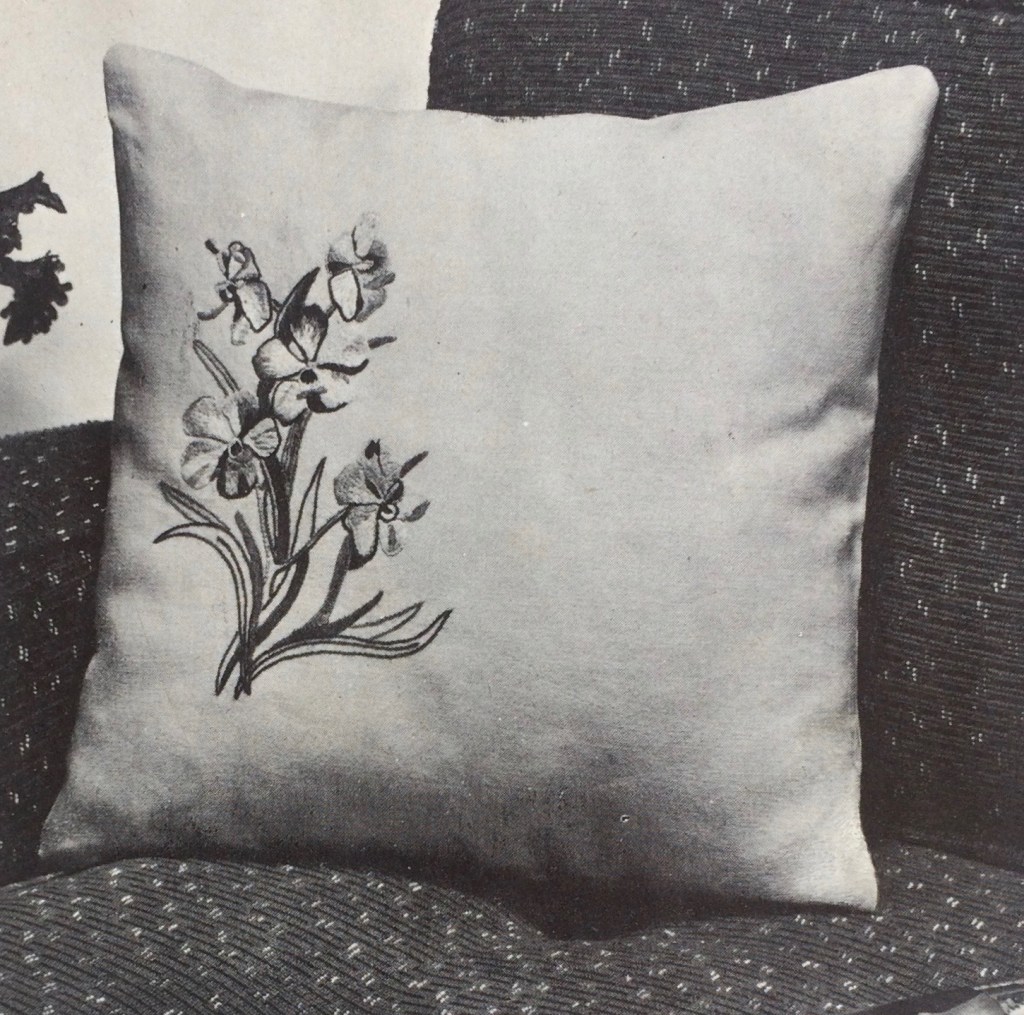
Homewares are always big in the summer months, when many readers understandably didn’t want to hold bulky warm wool in their hands in hot weather. The bedside rug is obviously an at-home project, but the smaller projects could easily be taken along on a holiday. This month’s flower in the gladiolus, but there’s also an orchid spray and some forget-me-nots, along with two sewing patterns to embroider them on: a round baby shawl or this wonderful little girl’s dress. For once, you don’t even have to send away for the patterns, as they are geometrically quite simple — the shawl is just a circle, drawn directly onto the fabric with a pencil held on a length of string, and the dress is made up of rectangles with measurements given. I would love to make the dress! I just don’t think it would get worn, since it would only be for “dress-up” occasions, of which there aren’t going to be any for a while.

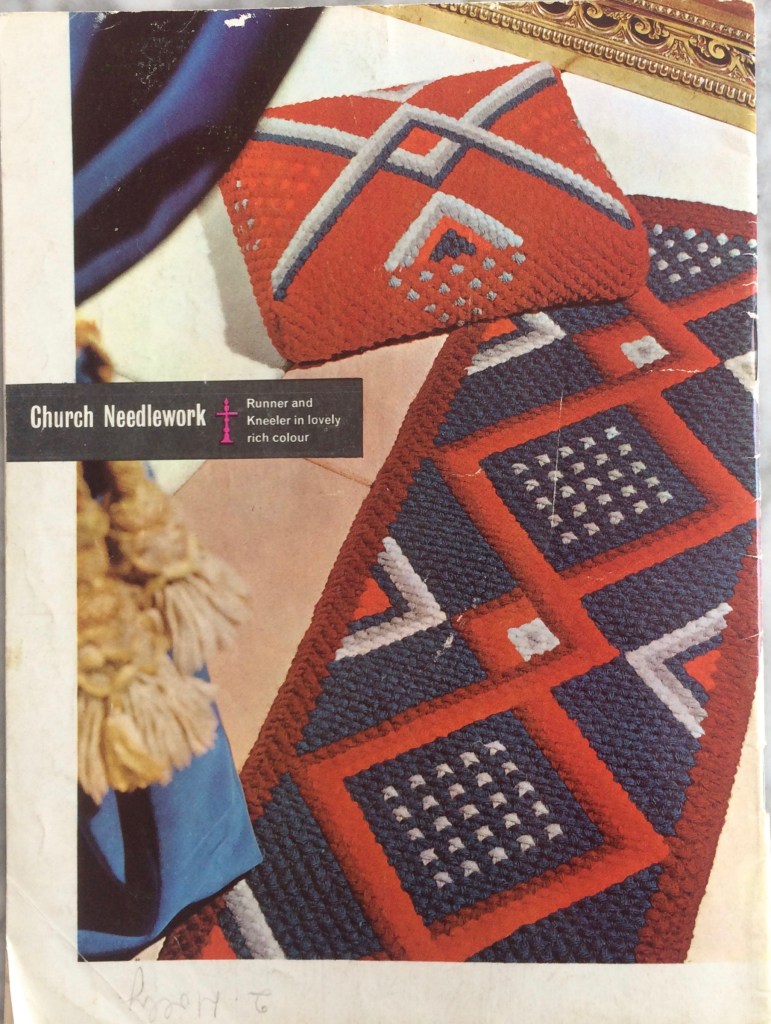
The back cover shows an interesting feature which took shape in the early 1960s issues: tapestry projects specifically for church use. In this case, there’s a runner and kneeler in shades of red and blue. If anyone happens to know why or if these colours or this pattern are significant in whatever type of Christian tradition, please feel free to tell me, as I don’t know anything about it. The rug, especially, does not say “church use” to me in any way that I can recognise and I could just as easily see it in a normal hallway.

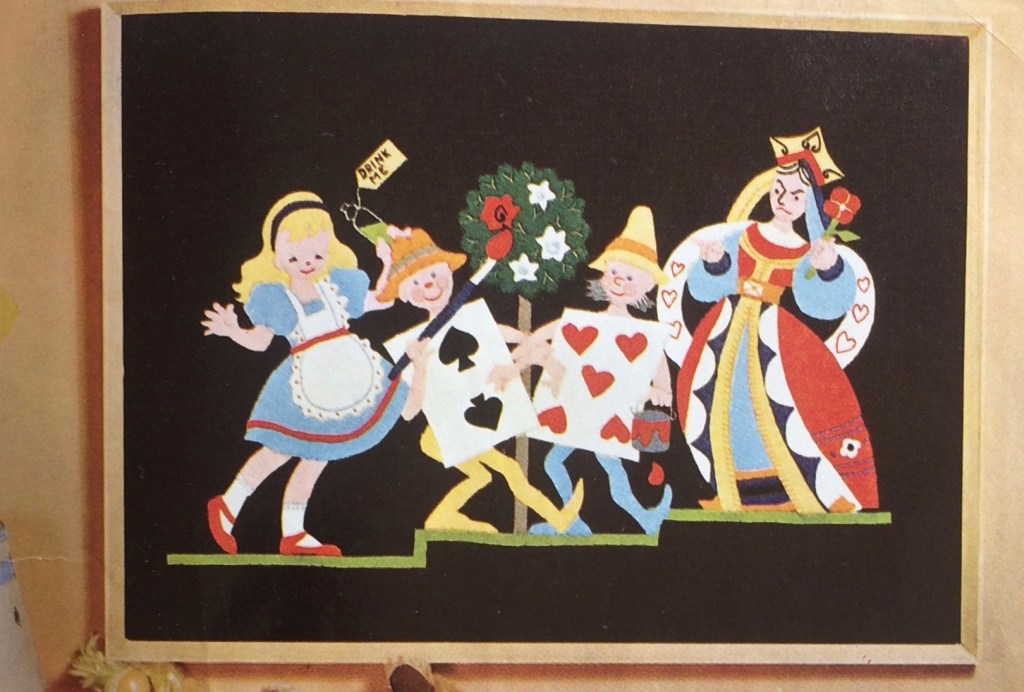
This issue doesn’t stop! The “Readers’ Pages” offer two more very simple projects: a reprint of a young man’s waistcoat from 1957 and a stash-busting baby blanket from double crochet hexagons. And just when you think you’ve come to the end of the issue, here’s this incredible Alice in Wonderland-themed wall hanging in felt appliqué and embroidery:

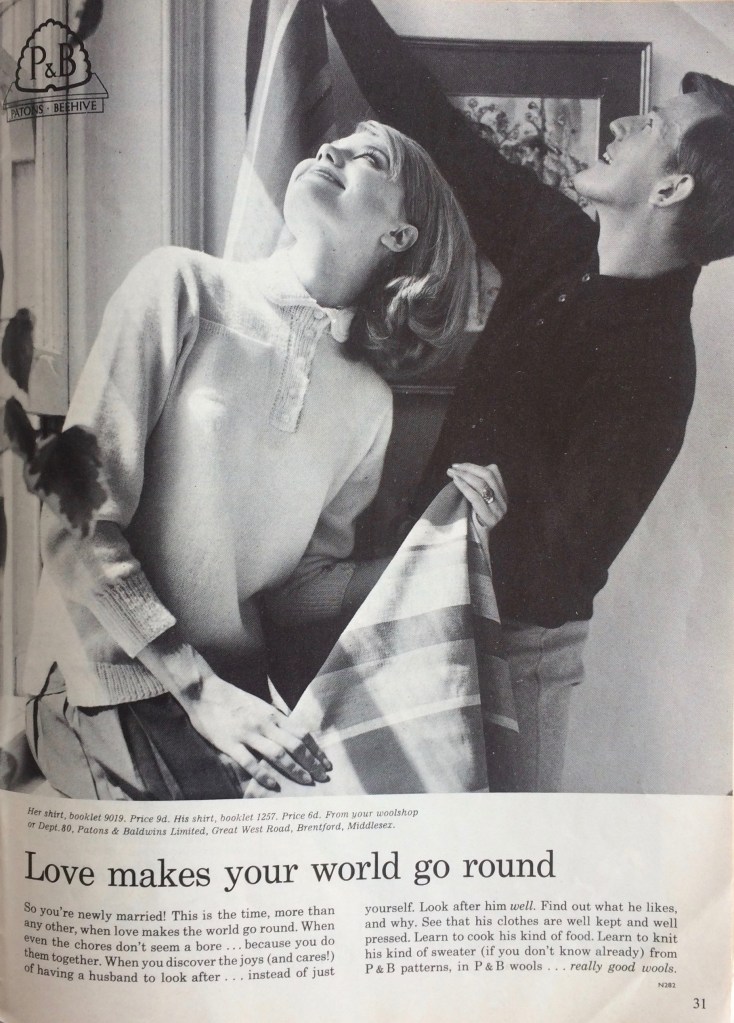
I’ll close with this full-page ad for Patons & Baldwins wools, showing a newly married couple decorating their home. The happy bride is instructed to

Look after him well. Find out what he likes, and why. See that his clothes are well kept and well pressed. Learn to cook his kind of food. Learn to knit his kind of sweater…

While I’m certainly not surprised that a 1962 advertisement would speak to women like that, I do find it interesting to compare the early and mid-1960s ads — which take on this type of “you exist to please your man” language more and more throughout the years — with those from the 1950s issues, with their much more independent picture of womanhood. Many of the knitting patterns in the earlier issues are explicitly designed “for the office” and most of the advertisements portray women living active, interesting lives in their comfortable shoes and unbreakable skirt zippers. In the wonderful tampon ads (that sadly disappear around the late 1950s), they don’t even let “problem days” stop them from doing anything! In contrast, the full-page P&B ads starting up around this time always feature a man or child with the woman in question and the text is inevitably some variation on “you must do this to please your man.” I had always thought of the 1950s as being a much more repressive time for women that the 1960s, when roles began to change, but judging from Stitchcraft (which, to be fair, is quite conservative both fashion- and otherwise), the earlier part of the decade is more of a backlash than a progression.

I don’t know what project to make from this issue and I still have so many WIPs, both for this blog and otherwise. Maybe a nice, easy flower embroidery on a vegetable bag?

July 1962: Overview

Cover photo from the magazine showing two women and a male waiter drinking cocktails.

Holiday and party seasons are both in full swing in Stitchcraft’s July 1962 issue and the more I look at this cover photo, the more I love it. Note how the foreground model is staring off into the distance while sitting on a table with a compass printed on it, as if fantasising about her faraway holiday (though, if she’s on holiday already, as the picture is implying, does that mean she can’t wait to get home?). Meanwhile, it’s a good thing that our flirty tuxedoed waiter’s drinks tray is empty, with that precarious balancing act. If anyone feels inspired to creatively augment this photo with speech- and thought-bubble captions, please do and share it with us!

Colour photo from the magazine showing a modeled, knitted ensemble and blouse

In keeping with the easy-going, summer holiday theme, the knitting projects are simple and quick to make. The two illustrated on the cover have no sleeves, minimal shaping and patterning, and are made in quick double knitting wool. Although pictured as stand-alone tops, they could easily be layered over a blouse on cooler days. There’s also a simple blue blouse with loopy flower details on the collar and a striped, sleeveless tunic-blouse with matching skirt, all in 4-ply wool. Our waiter from the cover photo has found another holiday-goer to flirt with, and sports a “Casual Italian design sweater” in the same colour as her skirt: “Water Green.” (Holiday tip: if the water actually is that colour, don’t drink it.) Speaking of Italy, doesn’t that beautiful model in the collared blouse look like she just stepped out of a Fellini film?

For cooler days, there are cardigans in “golfer” or classic, slightly bobbled styles, both made in double knitting. The golfer takes her sport very seriously! Knitters who are really in a hurry to get packing can make some simple, bulky pullovers for the kids in the family (shown here building a lovely British castle out of cardboard and sand in the Patons photo studio — I am guessing everyone had a lot of fun on this issue’s photo shoots) or a fine-knit slipover in honeycomb pattern, written for a home knitting machine.

The embroidered homewares are mostly easy and predictable: a chairback with this month’s flower, the carnation; a quickly-made “gay garden cushion” (Happy Pride!), and place mats with heat-resistant cork inserts. There’s a tapestry stool and/or project bag in Florentine pattern, knitted or crocheted cushions, some fancy knitted doilies and a trolley cloth from crocheted motifs. I didn’t photograph all of them, since they’re pretty standard fare.

For those who like to immortalise their holiday paradise in tapestry, there’s a wall hanging of the village of St. Etienne de Bougary in the lovely French Pyrenées. For your outing to that very inviting-looking lake, you can sew you own beach bags and/or an appliquéd blanket-towel-baby’s-playmat for outdoor lounging. The beach bags feature adhesive plastic lining to keep wet bathing suits from leaking into the bag. Smart and easy, indeed.

I’m kind of ambivalent about making a project from this issue. The only thing I could really use is the bobbly cardigan, but it’s not exactly necessary, and the only design that I find exceptional is this crocheted blouse (worn by my favorite Stitchcraft model, who featured in a lot of the mid-and late 1950s issues). Model and blouse are both beautiful, but the blouse is way beyond my limited crochet skills. I wish I had the “Traditional Norwegian Designs” booklets from this ad! I think I’ll take the time to finish up another long-standing WIP instead.

June 1962: Overview

Holiday season is in full swing in this month’s issue, with featured photos taken in pretty villages in and around Buckinghamshire and Kent. All the projects are easy and fairly quick to make, and even the fit is relaxed: the close-fitting, waist-length jumpers that were still more or less in fashion in 1960 and 1961 have now completely given way to loose-fitting, hip-length sweaters and blouses. I could use some relaxation, couldn’t you? Let’s dive in… gently.

The cover sweaters check all the 1962 trend boxes: loose, easy pullovers for “him and her” in sunny lemon yellow with interesting stitch textures and contrasting collar-and-cuff accents. Soft yellows, pastel shades and white show up again in the more glamorous “holiday sweaters” made with Patons’ Fuzzy-Wuzzy yarn (55% angora, 45% wool), as well as the women’s 4-ply “golfer style” cardigan (in “gay turquoise” and white 4-ply) and men’s “shirt-style” pullover in presumably light beige “Palomino” colour with contrasting collar.

The other garments are all photographed in black and white, but the yellow/pastel/white and contrasting accent trends are clear from the colour names of the yarns: the pretty “Junior Miss” cardigan is knitted in 4-ply Nylox “Sunglint” (the same colour as the cover sweaters), the “afternoon style” blouse is “Bois de Rose” pink and the bulky, textured Big Ben sweater is “Spring Green” with a white collar.

The smaller children of the family need something fun and easy for holidays too, of course, so here are some “seashore sets for toddlers in the swim.” They’re made in Nylox (80% wool, 20% nylon) and I don’t think they would be suitable for actual swimming, but definitely cute for playing around on the beach and splashing around.

With all these lovely things to knit, it’s not surprising that the homewares section is a little boring. Fittingly enough for June, this month’s flower is the rose, featured in a pattern for a “finger panel” to attach to a door. Readers, you have been so helpful in the past with solving mysteries for me, so i ask you: Why a finger panel? It seems to be used to keep the door clean from grubby handprints, which I can certainly understand in a family home, but I don’t see why it would be easier, or preferable, to wipe those grubby prints from an embroidery panel mounted under acrylic glass than to just wipe them off of the door. What do you think? Am I missing something here?

Otherwise, we’ve got some Scandinavian tapestry cushions, a “modern” (geometric and also Scandinavian design-inspired) hall runner rug, a more complex cross-stitch tablecloth (white and green on yellow linen, to match your yellow sweaters), some unspectacular oven mitts and some genuinely cute table mats in appliquéd and embroidered felt.

I feel more relaxed already, don’t you? There’s nothing from this issue that particularly inspires me and I have many WIPs to finish up, so my June project will be a “Blast from the Past” featuring a wonderful twin-set from a 1947 issue of Stitchcraft.

July 1961: Overview

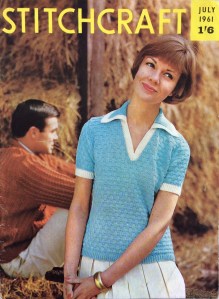
IMG_2650The motto of the July 1961 issue is “Sew through the Summer” and indeed, there are a lot more sewing projects than one would normally find in Stitchcraft, summer being a time when many people do not want to hold wool in their hands or think about colder weather to come. There’s more emphasis on homewares and small, fun projects to make and use on holiday. The farm photos were taken in Hertfordshire and the boating photos in “the heart of London’s Little Venice”. Doesn’t that sound like fun? Let’s dive in!

Our cover photo, taken at the Hertfordshire farm, featuresIMG_2654 a really pretty basketweave blouse with that V-neck-plus-collar design that we saw so much of in 1960 and the last years of the 1950s, not to mention just last month on the cover of the June 1961 issue. Personally, I love this style and I’m glad it stayed in fashion for so long. Except for the basketweave, this top is very similar to the blouse I made from the July 1960 issue, and probably not the last one of its kind that we’ll be seeing.

The other summer garments for adults are “cool in 3 and 4 ply” tops for women — one of them machine knit — and for boating or cooler outdoor nights, there’s a cardigan in double-knit Rimple, a little short-sleeved jacket in bulky Big Ben, or a man’s sweater in larger sizes in Totem double knitting. The cardigan “does duty as a sweater”.

On that note, a quick quiz:

  • What is the difference between a jumper and a sweater? (Hint: this is a British magazine that uses both terms, so “jumper is British and sweater is American” cannot be the only answer.)
  • If a jumper is a pullover in a lighter weight/more dressy style, and a sweater is bulkier/warmer/more casual, why is the elegant, fine-knit short-sleeved top on page 12 a jumper (top left photo above), the elegant, fine-knit short-sleeved top on page 13 a sweater and/or shirt (top right photo above), and many elegant, fine-knit short-sleeved tops from other issues considered to be blouses?
  • On that note: Why can a cardigan double as a sweater, but not a jumper?
  • Bonus question 1: What is the difference between a cardigan and a jacket? (Okay, this one is easier.)
  • Bonus question 2: Is the blue-and-white garment on the front cover a jumper, a sweater, or a blouse?

The answer to the first two questions is, as far as I can tell, that there is no answer. “Jumpers” per Stitchcraft tend to be long- or short-sleeved, fine-knit, elegant pullovers, while “sweaters” per Stitchcraft tend to be bulkier, more casual, long-sleeved and looser-fitting pullovers, but every time you think you’ve figured out the system, they use the word you wouldn’t expect. “Blouses” tend to be, logically enough, tops (either pullover or cardigan style) that one would wear with only undergarments underneath, and put a suit jacket or other overgarment over. Following that logic, I guess the cardigan on page 21 does duty as a sweater and not a jumper because it is warmer, heavier and meant to be worn outside without a coat and with a blouse or something underneath it. Still, there is no real consistency that I can see. I would love to be able to ask “editress” Patience Horne what system she used.

For the smaller members of the family, there’s this lovely baby’s dress, featuring the most absurd baby photo ever (previewed in the June 1961 issue). I still don’t understand just why I find this baby so goofy. She is utterly cute but somehow, her face is too old for her. That combination of lots of hair and the knowing, watchful look in her eyes makes her look like someone pasted a grandmother’s head on a baby’s body. Anyway, the dress is wonderful. Older girls get a striped jumper with a collar and “gay bobbles” to tie the neck. Let’s hear it for gay bobbles! I’m not sure what today’s 6-, 8- or 10-year-olds would think of the bobble ties, but I think it’s a cute jumper.

The emphasis of this issue is on easy-to-make, no-stress homewares, starting with felt place mats and coasters appliquéd and embroidered with traditional inn signs. Make them for your Pride celebration, for they are “as gay as possible”! Fans of easy embroidery on canvas can make a cushion with purple thistle flowers in cross-stitch or bathroom accessories featuring this month’s Zodiac sign, Cancer. I don’t know about you, but I don’t want to step on a crab, even if it’s only a cross-stitch picture of one on a bathmat.

More ambitious embroiderers (I guess Stitchcraft would call them embroideresses) can make a really pretty fire screen with a modern vase-and-flower motif. I wish they had a colour photo. Even more ambitious knitters can make some beautiful lacy doily mats, and those who prefer to “sew through the Summer” can make a little laundry bag for used dusting cloths, or some easy items to sell at the “needlework stall”, church bazaar, etc. There’s a tea cosy that looks like a cottage, a beach bag with penguins, or an apron with a teakettle pocket.

I am woefully behind on projects, having not even finished my supposedly quick and easy blouse from June 1961, and with two other projects from that issue (the child’s beach dress and the embroidered-appliqué bird picture) still “in the queue”. But someone is always having a baby and that little dress is really sweet and should knit up quickly, so I’ll probably make that and try to work on the remaining June projects at the same time.

  • Bonus Answer 1: A cardigan definitely has buttons/fastenings and a knitted jacket often doesn’t. Unless it’s a suit jacket, then it does. Or whatever.
  • Bonus Answer 2: The garment on the front cover is a “cool, casual shirt-sweater”.


April 1961: Overview

IMG_2438April showers bring May flowers, or so they say. I’ll just say that, after the last couple of weeks of March, that umbrella on the cover of this month’s issue looks really familiar. As does the model on the right — she was featured (with a more flattering haircut)  in many issues throughout the 1950s.

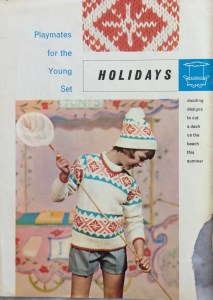
April’s theme is “Holidays Ahead” and if you are planningIMG_2440 to spend your holiday in April or May on the British isles or the North Sea coast, you will definitely want to wear one of the warm, bulky wool garments from this issue. “Jenny”‘s thick, double-knit Norwegian-style jumper and hat, described as “dazzling designs to cut a dash on the beach this summer”, tells you everything you need to know about that.

The adult garments continue the warm, bulky and casual trend with a men’s “crochet-knit shirt” and “country-style cardigan” in double knitting weight. Knitting pattern stitches that look like crochet crop up every once in a while and it’s certainly an intriguing idea. That said, I don’t think this jumper particularly looks like crochet — it’s yo, k2tog on every right-side row and purl on the wrong side in staggered rows, which is just a simple lace pattern. I’m guessing they thought the word “lace” was not manly enough… The cardigan is made in three-colour slip stitch and is probably very warm and “squishy”. I like the neat, almost hidden pockets and the narrow edging band.

The women’s garments offer two more elegant, but still casual blouses, the two jumpers with fun collar details featured on the front cover and a relaxed “holiday cardigan” in double knitting. Patons “Totem” crepe wool appears in 4-ply (the blouses) or in double knitting weight (the cardigan). “Crepe” in this case meant that the wool was spun very smooth and tightly plied to minimise “fuzziness” and give raised stitch patterns a crisp, precise look. The jumpers from the cover are designed for ever-popular Rimple wool, a crinkly wool-synthetic blend intended to look like towelling fabric. Fans of truly bulky knitting can make this his-n-hers set (well, not really a “set” as they are two completely different designs, but featured together in the photo spread). Her sweater is made in fisherman’s rib stitch and if it looks that bulky on the petite, fine-boned model, I can only imagine it would make anyone else look elephantine — but good for sailing and/or April beachwear, I guess.

Housewares include the continuation of the “Zodiac” theme with an Aries motif, a traycloth in cross-stitch, a cross-stitch and pile rug, “amusing” aprons for the whole family (the father looks utterly un-amused at having to participate in the washing-up), a village townscape needle etching, a cross-stitch cushion… i.e. the usual fare. You can also make a toy “Wag” puppy for fans of the children’s comic from the last few issues, “Wendy and Wag in Wallpaper Land.” I don’t mind telling you that it had a happy ending for everyone. And with that, happy April and see you next time!

P.S. There wasn’t any project in this issue that really called to me, so I’m going to finish up a project of my own design that was inspired by this Stitchcraft children’s jacket from March 1960 that I made last year and write about that. Stay tuned…


July 1960: Overview

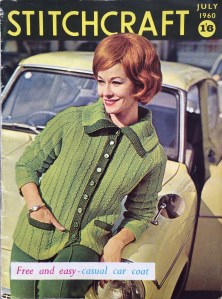
IMG_1879“Free and easy” is this month’s motto. Summer is here and nobody really feels like handling warm wool, so the emphasis is on “travel knits” (lightweight), “casual knits” (not too complicated) and “stroller styles” (loose and oversized). There is more embroidery and needlework than knitwear, and some easy sewing projects. Shall we relax and take a look?

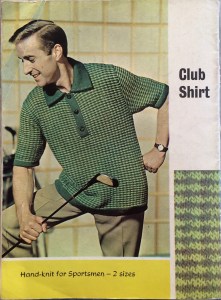
The combination of dark and light green continues to be in fashion: we saw it in the great houndstooth jumper from January 1960 and it’s here again in this “casual car coat” and and the loose-fitting men’s checked shirt style on the inside back cover — “suitable for golf or to wear with beach shorts.”

IMG_1898I have to take a moment here to quote one of my favourite Roald Dahl stories, “The Boy Who Talked With Animals.” It’s about a little boy who saves a giant tortoise from the soup kettle, and Dahl’s description of the tourists waiting on the beach for the caught tortoise to be hauled in has, for some reason, stayed with me through the years:

The men were wearing those frightful Bermuda shorts that came down to the knees, and their shirts were bilious with pinks and oranges and every other clashing color you could think of. The women had better taste, and were dressed for the most part in pretty cotton dresses. Nearly everyone carried a drink in one hand.

I would hope Stitchcraft readers and their men would have had better taste, but I’m not always sure.

The other “free and easy” knits are mostly nice without being really special: a pretty cardigan with knitted-in pearls, nubbly Rimple, a short-sleeved blouse and some cute tops for teenage girls.


The “plus-size” (37-40 inch bust) cardigan blouse is really elegant, though, and has a feature that I have honestly never seen in any other mid-century patterns: short-row horizontal bust darts. But unlike modern methods of short-rowing where the turning stitches are wrapped or otherwise bound up with the stitch next to it, you just cast off the stitches and cast them on again, sewing the dart up afterwards as you would a sewn blouse.  IMG_1895

For the little ones, there’s a sun-suit, a fluffy top, and a waistcoat to sew and embroider. The waistcoat is a tie-in with the current comic, “The Magic Needle”, in which our tailor hero’s magic needle has just made a lovely embroidered waistcoat for Mouser the cat. In addition to the waistcoat, you can sew a stuffed toy Mouser, and while you’re at the sewing machine you can make this adorable gingham skirt to wear “over a frothy petticoat” and an amusing apron “for the needlework stall” (Stitchcraft often gives ideas for inexpensive projects that can be sold at church bazaars or other “sale of work” opportunities.)


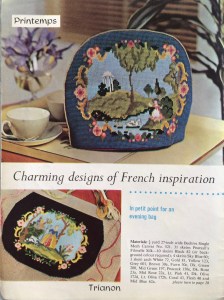
IMG_1881You can also embroider a tablecloth, make tea-towels in huckaback, or attempt this fabulous tea cosy and/or evening bag in faux eighteenth-century tapestry. I so, so want to make this evening bag! I would love it and use it all the time. But I am too overwhelmed by the idea of trying to make a chart based solely on the photos — the design is fairly intricate — and having never before attempted tapestry work, I fear it would just be too much for a rank beginner. I will definitely file it away for future days when I know how to approach it better.

That’s it for free-and-easy July 1960! I’ll leave you with a parade of well-dressed cats, courtesy of Mr. Tuckett’s magic needle. My project from this month’s issue will be the lovely bust-darted cardigan blouse, and I’ll try to finish up the projects from April (!) and June.


June 1960: Overview

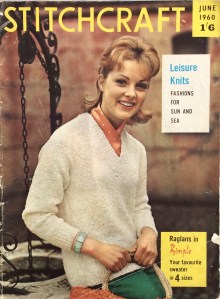
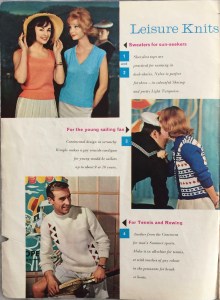
IMG_1805June, the month of leisure! Or at least, leisure knits — “Fashions for Sun and Sea.” Stitchcraft’s “editress”, Patience Horne,  reminds us that it’s important to have something to knit or sew while on holiday, as “it helps us to relax”, and points out that “A lot of knitting and embroidery is done in the deck-chair by busy housewives who never get time at home, and find it difficult to ease off suddenly.”

Honestly, I always had the impression that busy housewives were the ones who never got any time off, even when the family was on holiday. I guess it depends on where you went, what you planned on doing and what accommodations you had, but if I recall correctly, camping was quite popular in the IMG_18081950s and 1960s… meaning the housewife/mother of the family had to shop, cook and keep the tent or living space tidy just as she did at home, but in worse conditions (rain, mud, no proper grocery stores, camp stove, having to fetch water for cooking and washing up). Doesn’t sound much like leisure time to me! Of course, if you were rich enough to stay in a nice hotel and eat out for meals you might well have some time for handcrafts, but that wasn’t a possibility for all families, and Stitchcraft‘s target audience was more working-to-middle-class.

But knitting magazines have to be sold in the summer months as well, and there are some very nice things to make in this issue, cleverly categorised by activity. “Sun-seekers” can make pretty sleeveless tops (in wool or nylon) and one of the patterns has a cute fringed shoulder poncho thingy to change “from beach to promenade.” Two other tops are a bit dressier, in case you want to change again for tea. Obviously, the tops need to be lightweight, so all are made in 2- to 4-ply wool at 7 to 8 1/2 stitches per inch.

For “the young sailing fan” — or horseback riding fan — there’s the child’s cardigan pictured in the inside front cover and a horse-motif pullover, both in somewhat thicker Rimple Double Knitting. Though I don’t think the head in the riding motif looks much like a horse’s head — is it supposed to be a fox? These days, you could knit it in silver-gray with neon green eyes and call it an alien, if you wanted to. Rimple is also featured in a classic V-neck pullover for women and a stole, “for a touch of glamour.”

For “Tennis and Rowing” — the manly sports, I guess, since the girls sail and ride horses and the housewives are all too tired to do anything but sit in the deck chair and knit — there’s a pullover in double knitting with crew neck, sunglass pockets, and colour pennants where the knitter can use the wearer’s club colours. Bulky Big Ben wool makes an appearance in a slipover for men and a little cap for women.

If that’s not enough to keep you busy on your supposed holiday, you can embroider some cushions quickly in thick thread, make an intriguing circular table cloth with a peacock motive, sew a little dress for a toddler, or make lunch mats with holiday scenes on them in fantastic shades of yellow and purple. There are tapestry designs for a footstool, screen, book cover or “finger plate” as well.
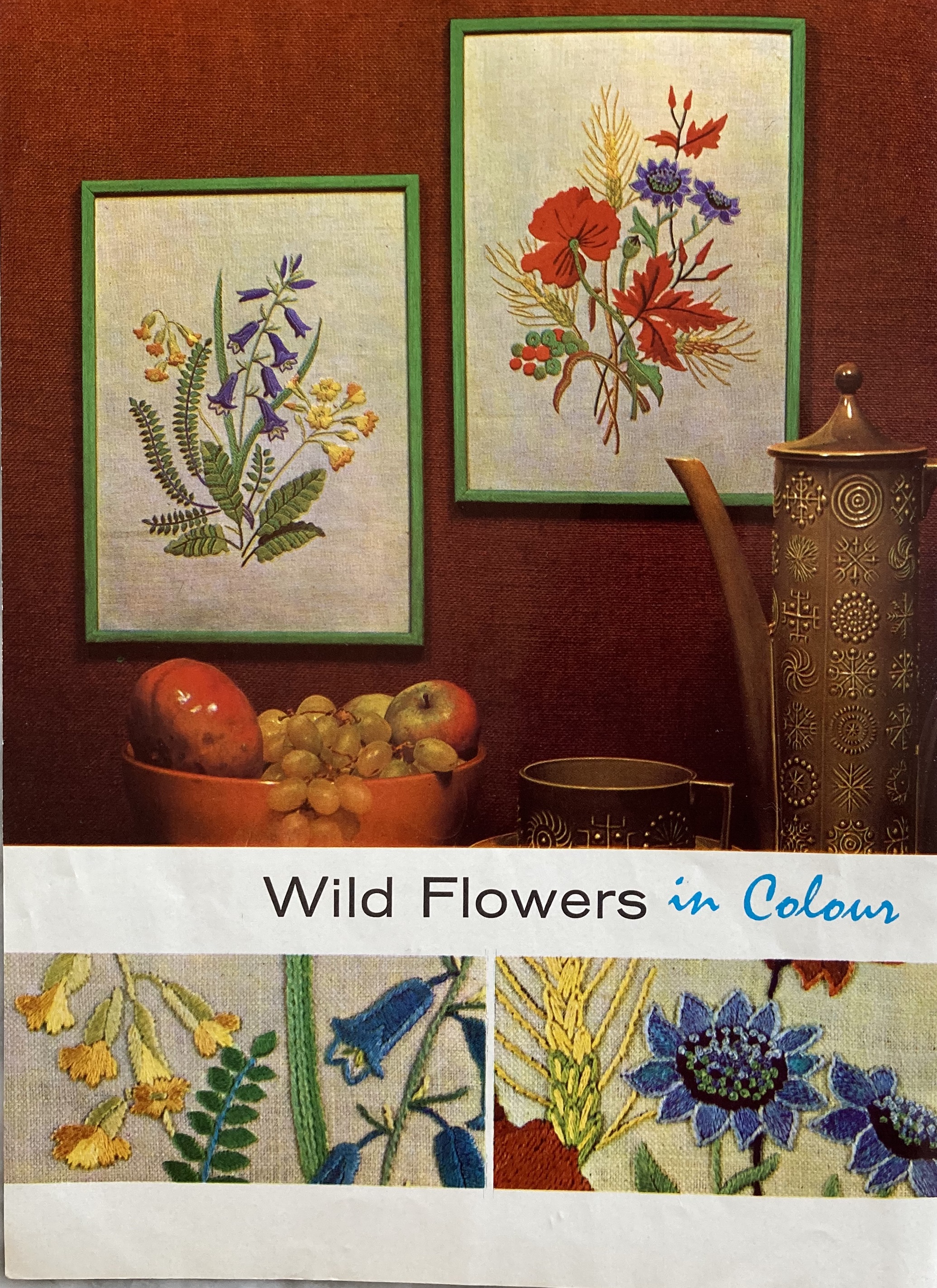
Wait — what on earth is a finger plate? It looks like something you put on a door — but why? Wikipedia came to my rescue:

“A fingerplate is a plate that is fixed to a door near the handle or keyhole. It can be made of metal, plastic, ceramic or glass. It purpose is to prevent people’s fingers from smudging the door.”
This makes no sense to me, as I would think it would be easier to wipe off the door once in a while than to take a framed tapestry off of the door, wash and re-mount it, but OK.

Speaking of “what is this” and “OK” — you can also embroider a “novelty bathroom mat” where “suitable expressions” on the taps register hot or cold, and in the “Suggestions from Readers” column, we are informed that Mrs Ross of Berkhamsted cleverly adapted the tapestry townscape of Finchingfield “to bring in her husband’s interest in aeroplanes.” Behold, the Comet jet careening over Finchingfield, apparently about to make an emergency landing in the town square!

Let’s hope things end well for everyone involved.

My June project wasn’t pictured here, as it is just a little “extra” design element offered in the back pages — a little parakeet (budgie) motif for cross-stitch or knitting. I’ll turn it into something cute for two friends who are getting married in August.


May 1960: Overview

Apr1960coverIs it already May? Nothing makes time fly like writing monthly blog posts! May 1960 is a “Roundabout of Holiday Knitting” (complete with a little circus-fair logo that fills up any little dead space in the page formatting, how cute) where in “today’s story”, “no one thinks of going away without 2 or 3 brand-new woollies packed away in their luggage.”  So let’s get started…
Check patterns are still in, this time in a “gingham” (two-colour slip stitch) pattern for the woman’s jumper on the cover and a “firm stitch to weather the water” (also two-colour slip stitch) for a toddler boy’s swim trunks. totsbeachI am quite sure no small child wants to swim in hand-knitted wool trunks with a belt these days, but I imagine the sun-suit on the opposite page would be fun and practical for beach wear if made in cotton. The baby and older girls of the family get pretty cardigans or a tunic “to wear with her jeans.” I’m glad to see activewear for girls, since generally one is assumed to make pretty, decorative stuff for girls and strong, “manly” stuff for boys — sexism that is not surprising in 1960, but which always depresses me to see in today’s knitwear patterns for children.

For adults, there is a “Trio of Summer Fashions” (“Two to look pretty and one for sports”) and a great cable pullover in bright yellow.  The “sports” pullover is machine-knitted.

There’s still plenty of stuff to make for the home, too (just in case your holidays are too relaxing). Table mats to match your willow-ware platter are actually really cute, and look at that beautiful appliqué tea cosy! Cross-stitch is popular as always for chair-backs and tea-tray ideas, or you can crochet yourself a bedside mat. But what on earth is this “contemporary screen” that uses your scraps?

In the comics pages, we are introduced to Mr. Tuckett, a tailor who receives a magic needle from his friend the wizard. What will the magic needle do? Stay tuned…

roundabout

My projects for this month will be the baby’s jacket and a modified version of the tea cosy.

Enjoy your holiday roundabouts!


April 1960: Overview

coverapr60“Already there is talk of holidays” says the introduction to the April 1960 issue, “and whether it’s to be the sea, country, sight-seeing or sailing, you can’t go without your holiday hand-knits.” At the same time, spring and April mean Easter, with lots of opportunities for hand-made accessories and knickknacks.

For knitters, there is a larger variety of wool weights and styles than in the last couple of issues. Houndstooth and checked patterns are still going strong — look at that great jacket on the front cover! — but lace and Rimple designs are offered too, and garments for babies, toddlers, and adult men and women.

For the patient, there is a cute 3-ply top and a shirt in cotton crochet yarn at 12 stitches to the inch. (This is the only type of cotton yarn I’ve ever seen featured in Stitchcraft, but usually it’s used for making doilies or other fine crochet items.)

For those who prefer to actually get their garment finished before the summer holidays start, there are “partner look” sailing sweaters, the houndstooth jacket on the cover, and pullovers in Rimple and Big Ben yarns. Rimple will continue to not be my taste in terms of texture, but isn’t the model cute?

Easter embroidery is big, and around this time, Stitchcraft started to include designs for church accessories — hassocks and kneelers in tapestry or cross-stitch. For those for whom Easter is less of a religious experience, there are some great “Easter novelties” (cosies for teapots and toilets) and who could resist those gay kitchen ideas? Standard needlework ideas for the home include a fitted chairback and a lovely Persian-inspired cushion.

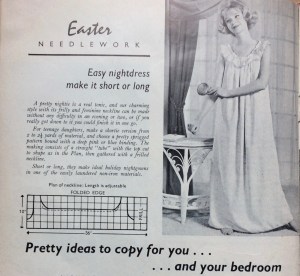
One thing that is really different in this issue is a sewing pattern, common in 1940s and 50s Stitchcraft but rare in the 1960s. It’s a very simple nightdress (for Easter and/or your holidays, of course) that is recommended to be made in “one of the easily laundered non-iron materials”, i.e. nylon or early synthetics.

nightdress

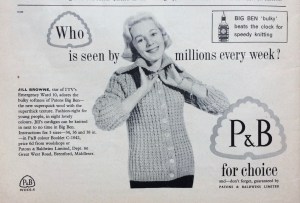
April’s celebrity “plug” is given to us by Jill Browne, the actress who played Nurse Carole Young on the soap opera Emergency – Ward 10, which aired on ITV from 1957 to 1967.  I have to admit I have never seen it, but it seems to have been quite progressive for its time, with Joan Hooley playing a female surgeon in an interracial relationship that was sealed with a kiss onscreen.

starad

On the back pages, it is the end of adventures for Good Teddy Bear and Naughty Teddy Bear, but they got two gay jerseys knitted for them in the end, so I think everyone was happy. Plus you can make your very own teddy bear to commemorate the series! The ads are for the usual things, except for this gem of a potty-training stool called “Bambino”, appearing for the first time.

My projects from this issue will be the 3-ply top and the appliqué goslings on a tea cosy. Happy Spring, everyone!