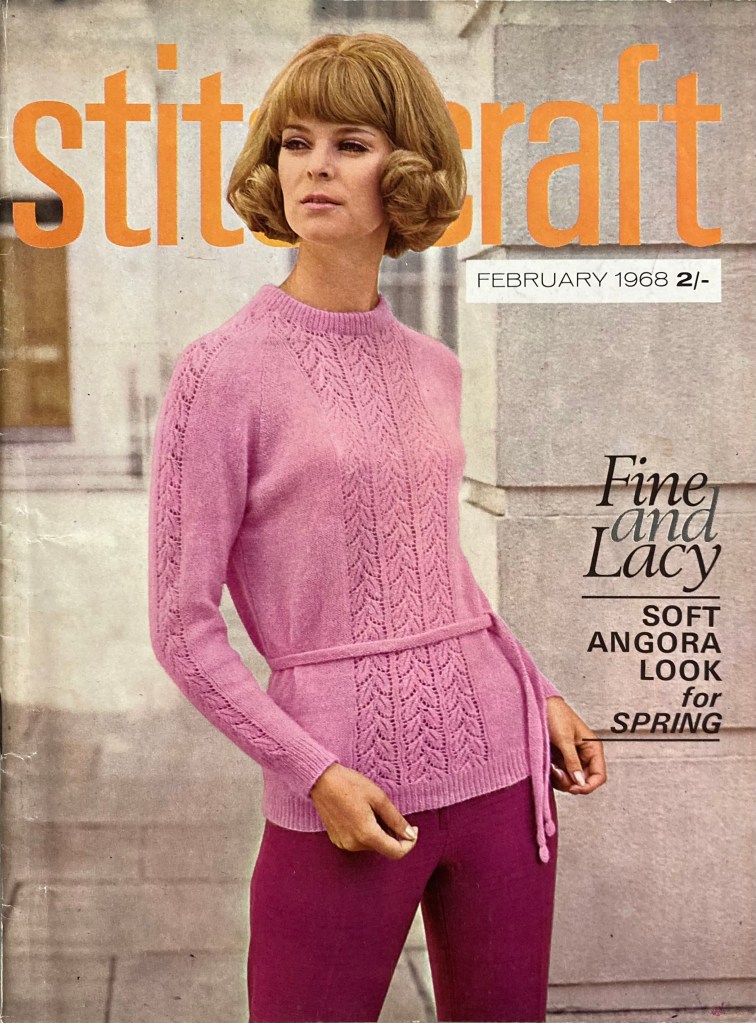
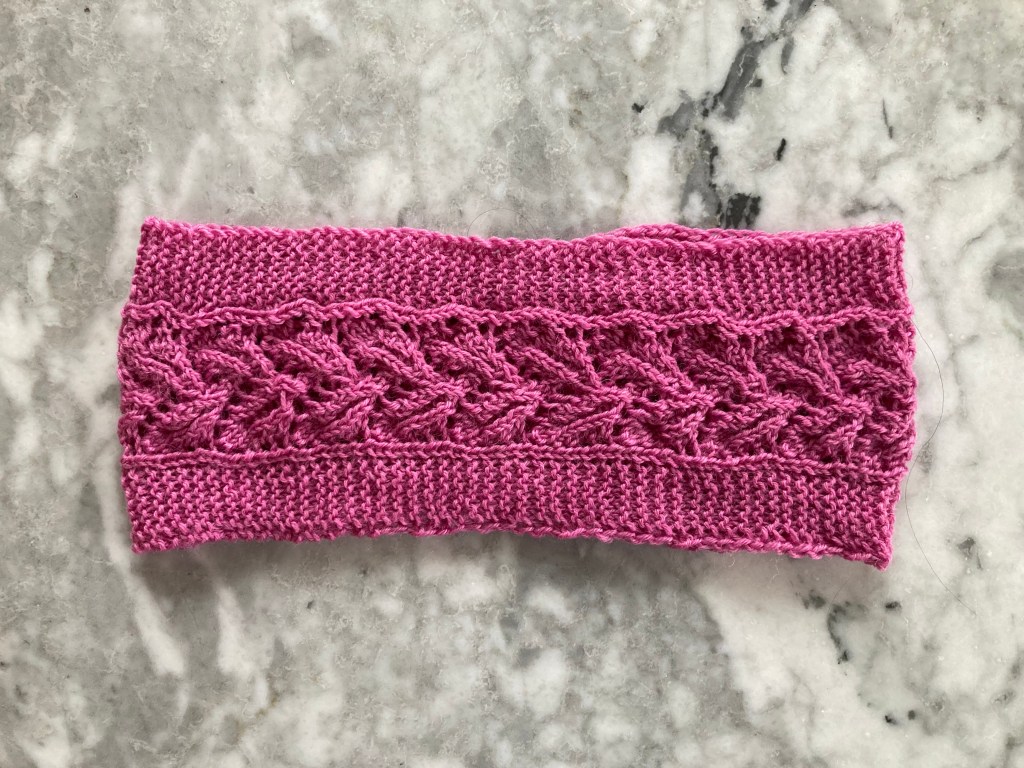
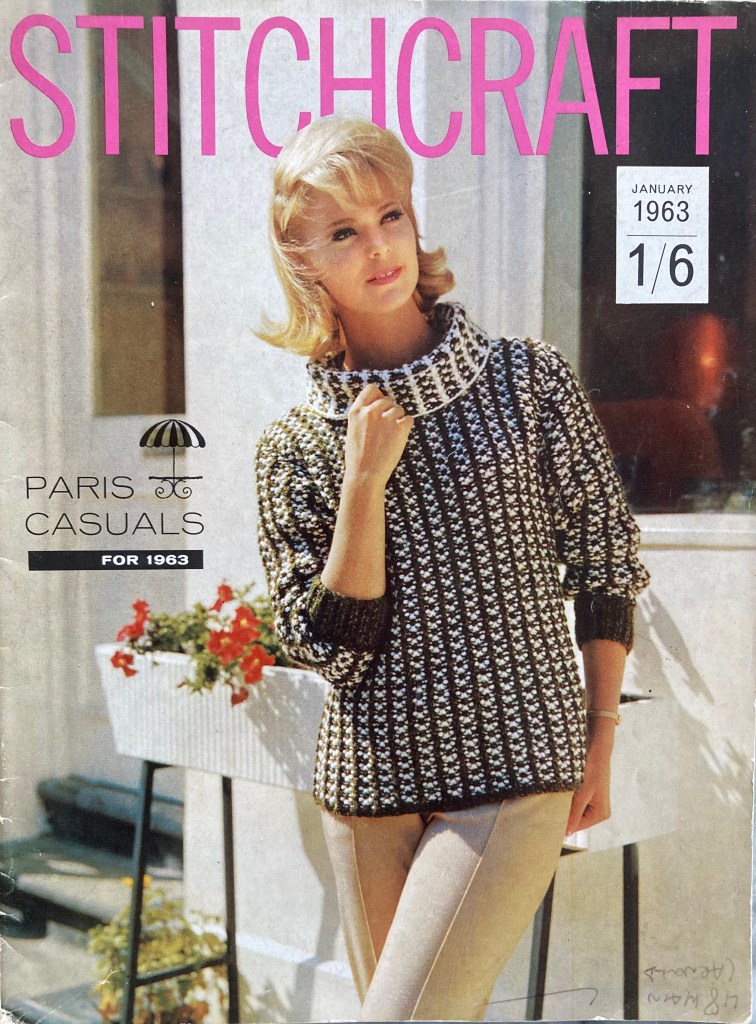
The February 1968 issue of Stitchcraft didn’t have any projects in it that immediately called to me, but a good friend had requested a pink headband for keeping her ears warm without wearing an entire hat, so decided to make an adaptation.
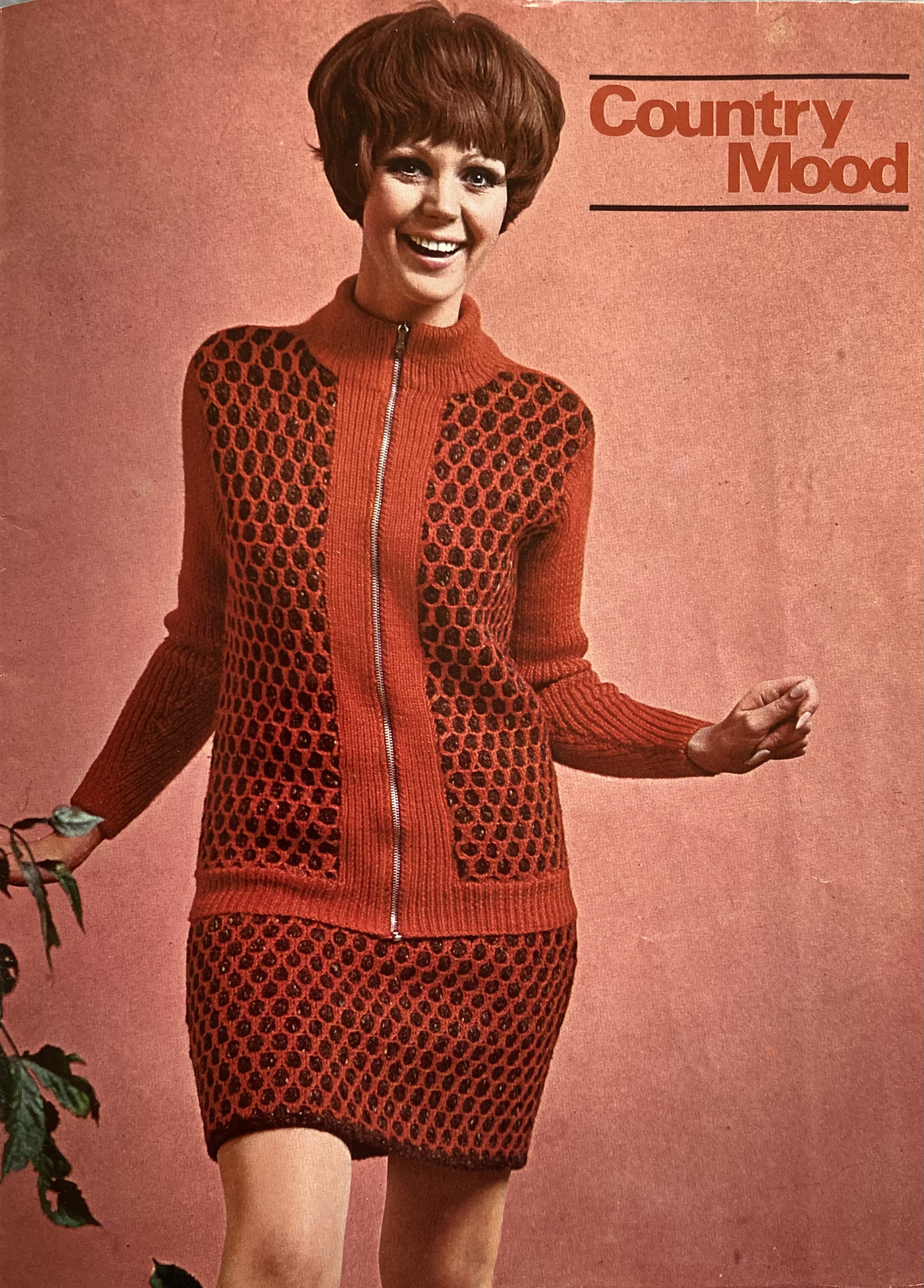
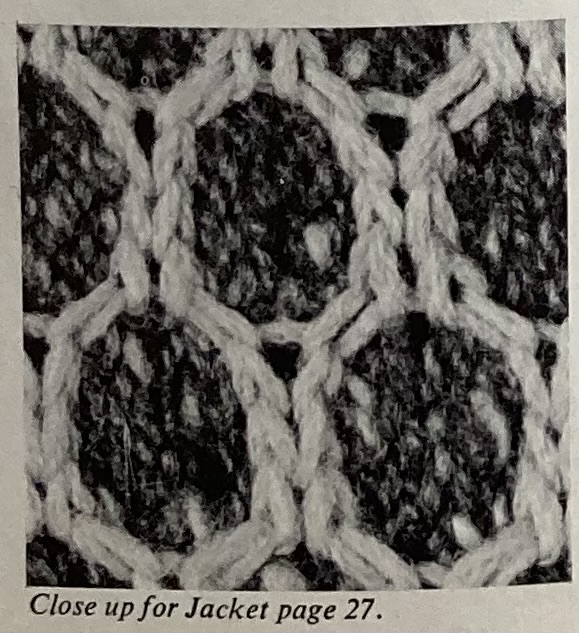
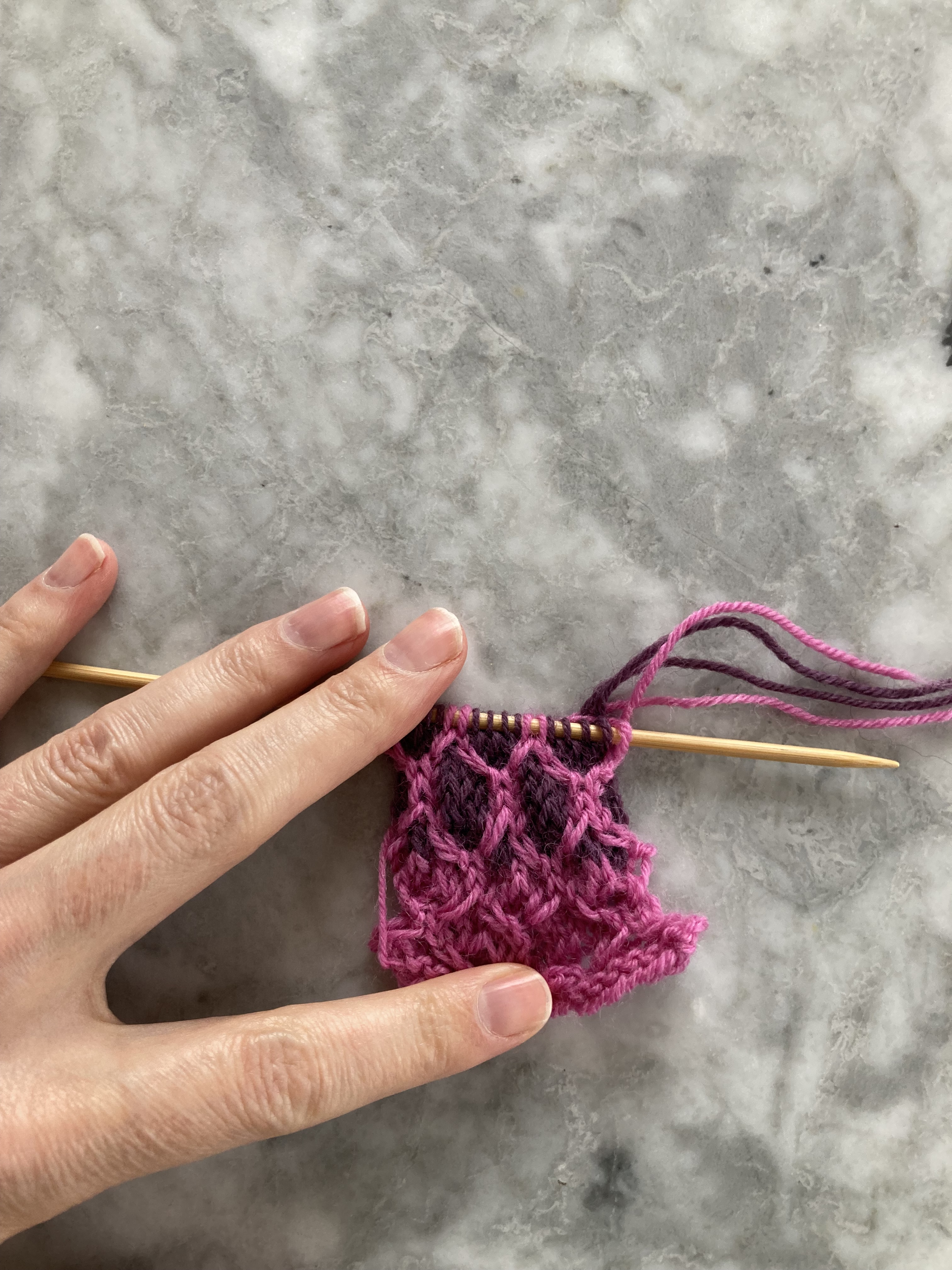
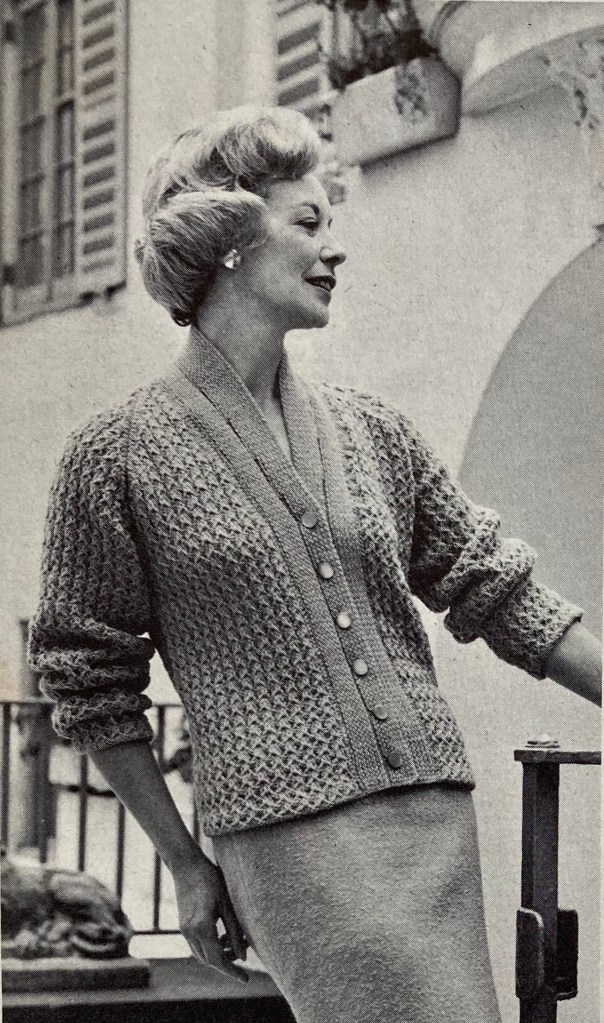
I first tried the two-colour pattern from the amazing cardigan set on the inside back cover. It’s made using a combination of stranded two-colour knitting and twisted stitches and makes a great trellis-like effect. It needs to be made in two colours to actually have an effect, though, so I switched to the fern-y lace pattern on the panel of the jumper on the front cover.
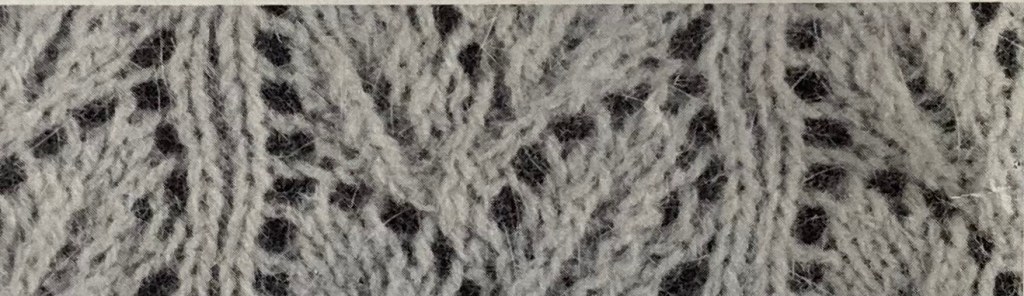
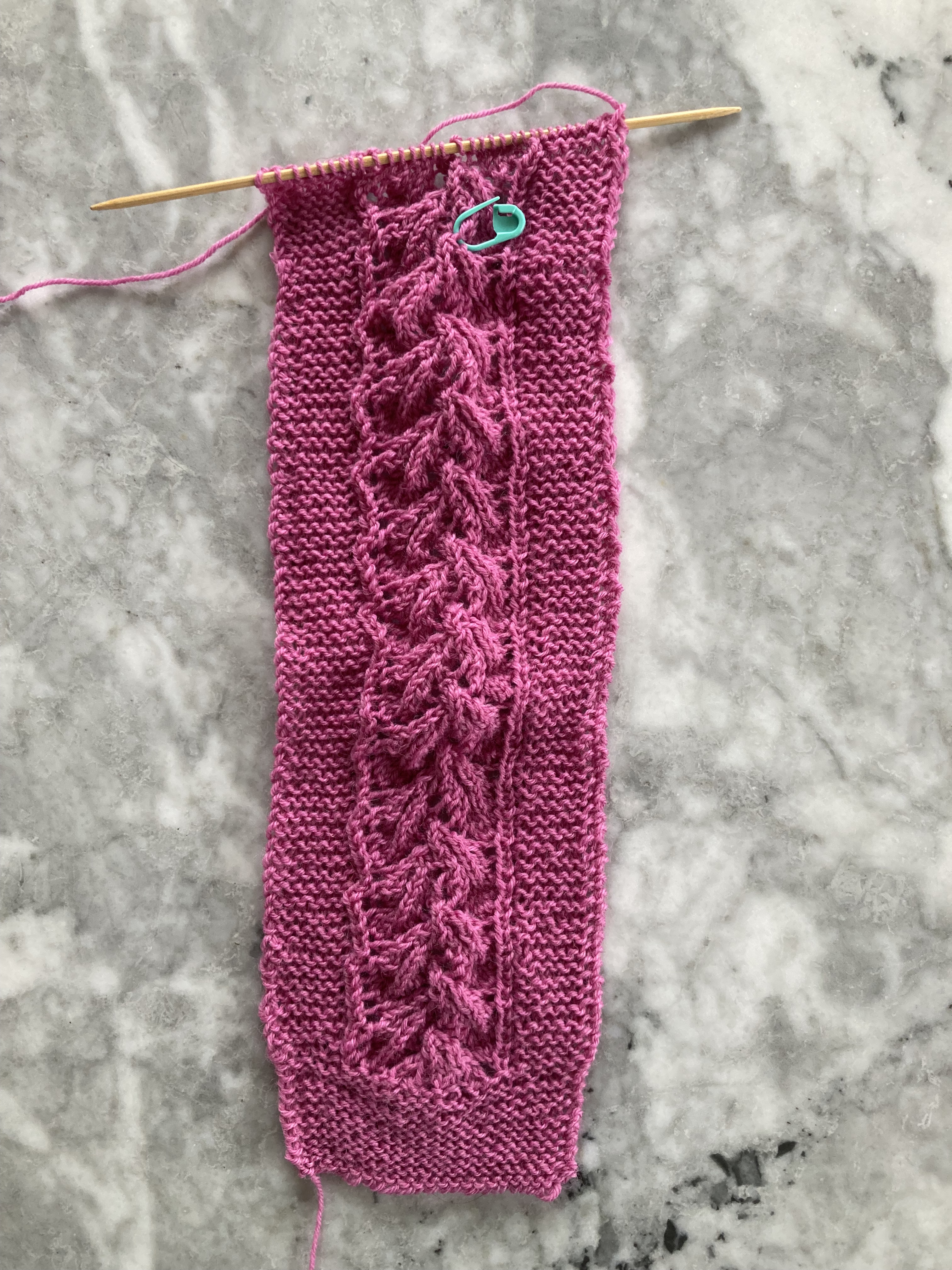
I had a decent amount of pink Drops Fabel sock wool left over from the April 1967 chevron-pattern dress, which was coincidentally almost the same shade as the Stitchcraft jumper. The pattern is made using standard knit and purl, k2tog / k3 tog, and yarn overs. The pattern repeat is 16 stitches + 1, worked on a stocking-stitch background i.e. the even-numbered rows are mostly purl. I added 6 stitches of garter stitch and a selvedge stitch on each side of the panel to get a good width and avoid curl. The pattern was surprisingly boring to knit! I didn’t even bother to make a chart, just used the written instructions straight out of the magazine.
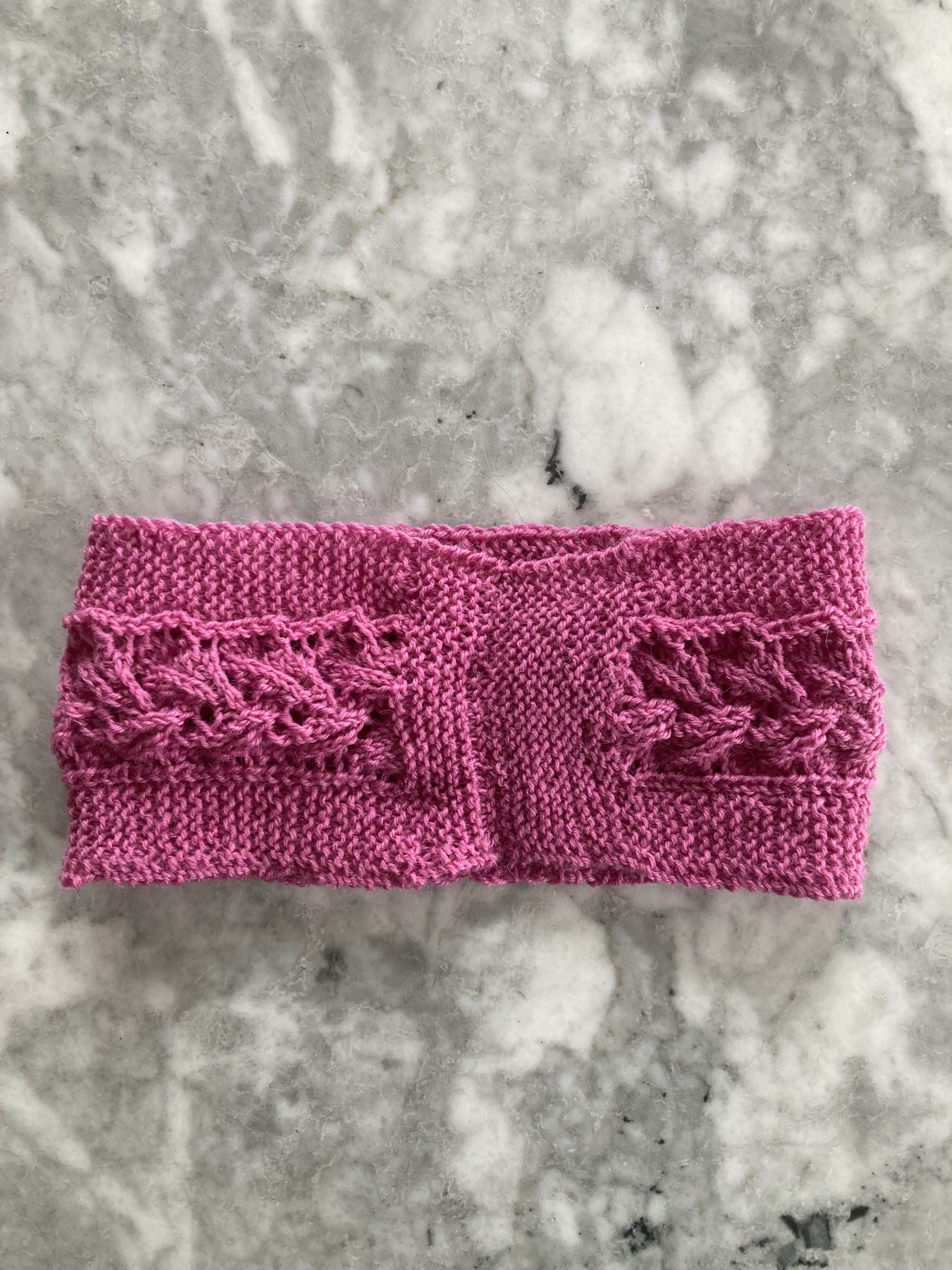
I started and ended with a bit of plain garter stitch, increasing up to the total number of stitches to make the headband a bit narrower at the nape-of neck and create an elastic band effect to keep it snug. I wasn’t sure how big to make it — I have a big head and very flat hair, my friend has a presumably average-site head and very fluffy curly hair. After blocking, it ended up a little loose on me. If it’s too loose, I can always undo some of the garter stitch connecting bit on the underside.
It looks pretty and I like the pattern a lot, but I’m not sure if fingering-weight sock yarn was the best choice for a headband that should keep the ears warm. I’m afraid it won’t be warm enough. in which case, I could line it with fleece?
Not 100% happy with this project, but hopefully my friend will be.
Colour for High Summer! The trending colour in Stitchcraft’s June 1966 issue is turquoise, and “High Summer” means casual, easy knitwear in washable synthetic yarns for holiday travel. Let’s dive in!
The knitted fashions are high-necked but loose-sleeved, knitted mostly without shaping in textured stitch patterns. Our cover cardigan is made in turquoise “Courtelle” synthetic wool with a pattern made by increasing and decreasing in the same stitch to create a sort of flattened bobble over multiple rows. There’s a white pullover with a bold intarsia turquoise flower, a his-and-hers white cabled rib for seafaring holidays, or sporty numbers for playing tennis in a dress shirt and tie. The colourwork pullover is also made in turquoise and white, and the sleeveless men’s tennis top in blue.
For warmer days, there’s a heavy-knit, but sleeveless and lacy, “jaunty beach top”, or a choice of two pretty T-shirt tops. The basketweave-patterned top is also blue, and the diamond-patterned top in “Banana Cream” beige — the colour trends are very clear. The last two tops are made in finer, 3- or 4-ply wool, but also make use of synthetic yarns like the wool-nylon “Nylox” three-ply used for the basketweave top. You can complete the outfit with one of two crocheted hats: pillbox style or with a corded brim, both in heavy “Capstan” wool.
Children can enjoy their holiday in a striped play-shirt with matching “overpull” or a bobbled cardigan and pleated skirt (though the skirt, like so many fashions for little girls, is quite impractical for any kind of actual playtime.) The cardigan features an interesting two-colour pattern made by dropping a yellow stitch down three rows and picking it back up together with three white loops. Interestingly, the children’s patterns feature neither turquoise nor blue of any kind, but are made in bright yellow and white or more subdued stripes of grey and light red.
Homewares are fun and easy, starting with a knitted “World Cup Willie” car rug. The 1966 FIFA World Cup football (soccer) tournament was held in England in July 1966, and “World Cup Willie” was its official mascot. England won the trophy that year, beating West Germany in the final match 4-2, so I guess Willie was indeed a bringer of good luck. Personally, I am much more interested in the Stitchcraft model’s dress, hat and shoes than Willie or the World Cup — I want that entire outfit! The rug is made in heavy “Big Ben” wool and a sturdy moss-stitch pattern, with the “Willie” motifs worked in intarsia technique from a chart included in the magazine issue.
Moving on, there’s an embroidered wall panel to commemorate the 900th (plus a year) anniversary of the consecration of Westminster Abbey — we haven’t had a commemorative wall panel for a while, so that’s a nice plus. As always, there are chair-accessories and cushions, this time with delicate embroidered satin-stitch poppies in wool on linen, or a very 1960s happy smiling sun worked in felt on Hessian/burlap fabric for tough use in the garden.
You can also make a beach bag from towelling material gathered with “Rufflette” curtain tape, or sew an easy sundress for a small child — basically a big rectangle of fabric gathered and sewn at the shoulders — and embroider a lucky fish on the pocket. Speaking of lucky fish, how about this masterpiece of 1960s advertising copywriting that accompanies a photo of a woman “caught” in a fish net? It’s all happening at your local Scotch Wool Shop.
That’s all for high summer! My project will be the sunny garden cushion, and possibly also the basketweave top.
We had a terribly cold April where I live, with rain and gloom and the sense that spring would never come. I had switched out my winter and summer clothing as part of spring cleaning last week and it all felt wrong. Then, all at once, two days ago, winter ended, the sun came out, and temperatures doubled. Perfect timing for the “Summer Plans” in the May 1966 issue of Stitchcraft!
The May to August issues always have lots of projects for travel and holidays: little summer tops, quick bulky jackets and sweaters for cooler weather or sailing holidays (aka normal summer in a temperate/maritime climate) and easy homewares to make in a deck chair while lounging about. The pullover on the cover is made in DK wool, so relatively warm, but with a lacy front to keep it airy. The photo is also almost an exact copy of the March 1966 cover photo! Apparently yellow is still trending.
Other women’s garments include a ribbed and a plain polo-neck jumper designed on “skinny lines” — the ribbed number is a special design for extra-slim Twiggy figures with a 30, 32 or 34 inch bust. For “figure-plus” sizes, there’s a summer blouse in bouclet wool with a wide, rolled collar and chequerboard lace pattern. There’s a plain DK cardigan in a range of average sizes to round out the tops, and an easy crochet dress with “practically no shapings”. High necks and clean lines are in, and stitch patterning is kept to a minimum in favour of little details of colour and finishing — see the smock-like embroidery on the “skinny” jumper, or the twists of colour on the collar and cuffs of the polo-neck. Colours are light but bold — light blue, white, green, yellow and pink.
The other members of the family are well served in this issue too. There’s a men’s “country pullover” in a zig-zag stitch pattern, as well as a bouclet “tennis shirt”, both in neutral colours of “Alabaster” and “Brandy” — even the names of the colours fit the image of 1960s masculinity. The “young fashion” set can have fun in a striped and belted mini-dress. Stitchcraft informs us that the “Young Colour Choice is mid grey and white”, which is interesting, considering that the adult women’s fashions are all quite a bit more colourful. Younger tots can make “Seaside Plans” in a t-shirt-and-trunks set for a boy or a little knitted dress and head scarf for a girl. (Why no trunks for the girl, whose dress is going to fly up over her as soon as she starts digging in the sand with that bucket?)
There are some nice child-appropriate homeware designs as well, starting with a thick, warm pram blanket in blue and yellow (to match the mother’s jumper!) The pattern is a herringbone tweed alternated with cable panels and the finished blanket is edged with satin ribbon. Then there are some wonderful decorations “for the nursery” featuring friendly animals and flowers. You can work them in felt appliqué on a wall panel, or in wool embroidery on a cushion. The animals are so cute! I love how the cat is both guarding its mouse and disdainfully looking away from the dog on the cushion. Whoever designed this obviously had a cat.
The normal homeware items are, well, normal: two different flower tapestries for a wall panel, the smaller of which can be used for a spectacles case; a tapestry chair seat, a stitched rug and waste-paper bin cover in an easy geometric pattern, a beach bag with beachy motifs (anchor, shell, beach grass) to embroider, or, for people who don’t like to relax on their holiday, a pair of intricately crocheted trolley cloths in a star design.
Saving the best for last, there are designs for two oversized, tall hats. The knitting itself is very easy, but the making-up is complicated, with lots of stiffening in the lining to make the hats stand up off of the head. It feels like Stitchcraft is finally getting into the “fashion fun” era of the 60s, albeit a little late and still pretty conservative.
In the back pages, there’s a teddy-bear motif to knit or embroider and instructions on how to make a pom-pom (two cardboard circles). Eustace the elephant from the children’s comic has eaten delicious buns for tea and helps a mother duck encourage her son to learn how to swim. Finally, “Slip Into Orbit” with these “deliciously private-eye-catching” undergarments from the Scotch Wool Shop! The space age has arrived and we are going to celebrate by wearing pretty underwear.
My project this month will probably be some variant on the animal/flower appliqué or embroidery. Enjoy the Spring!
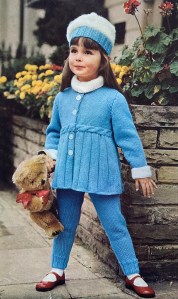
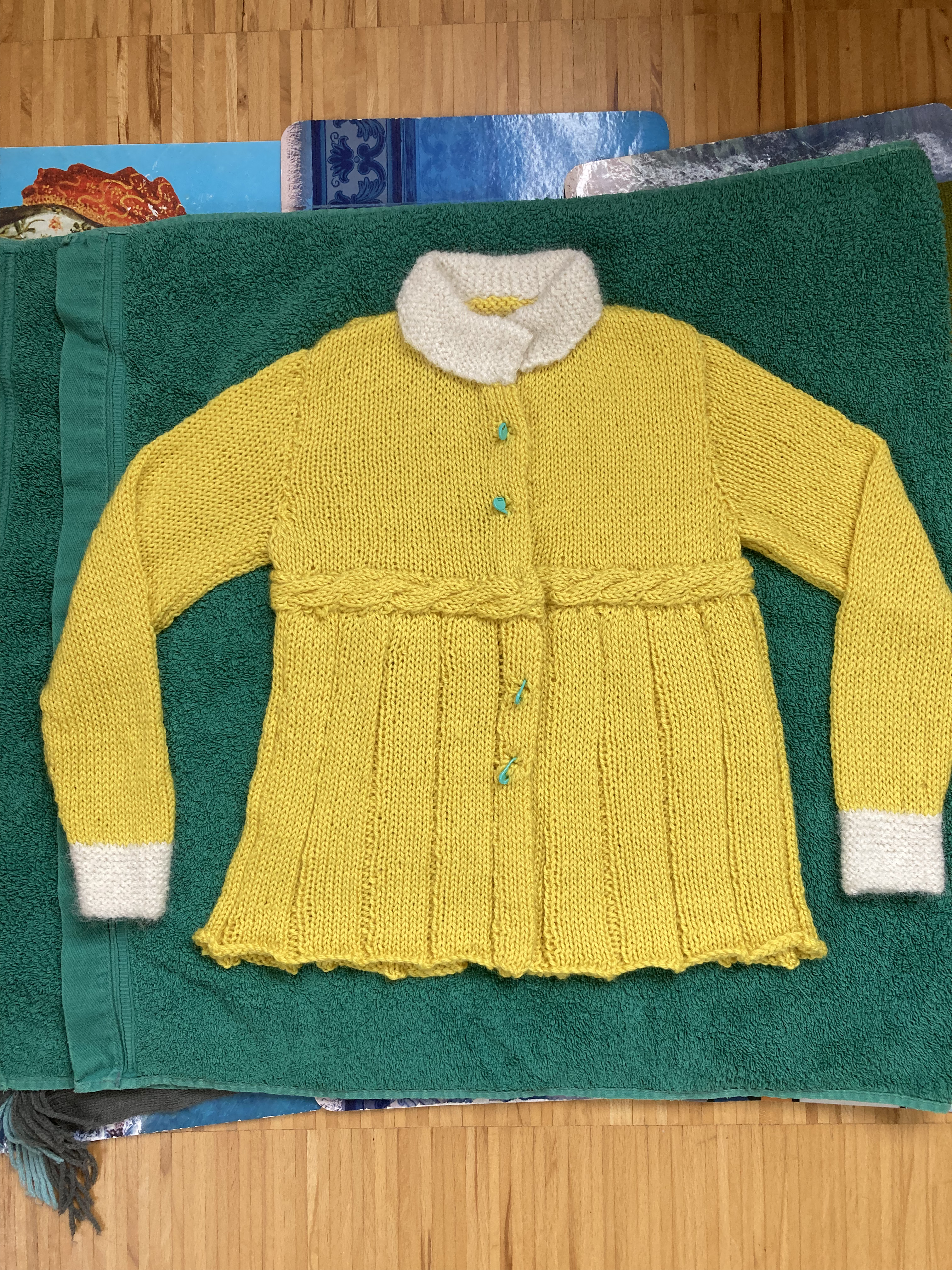
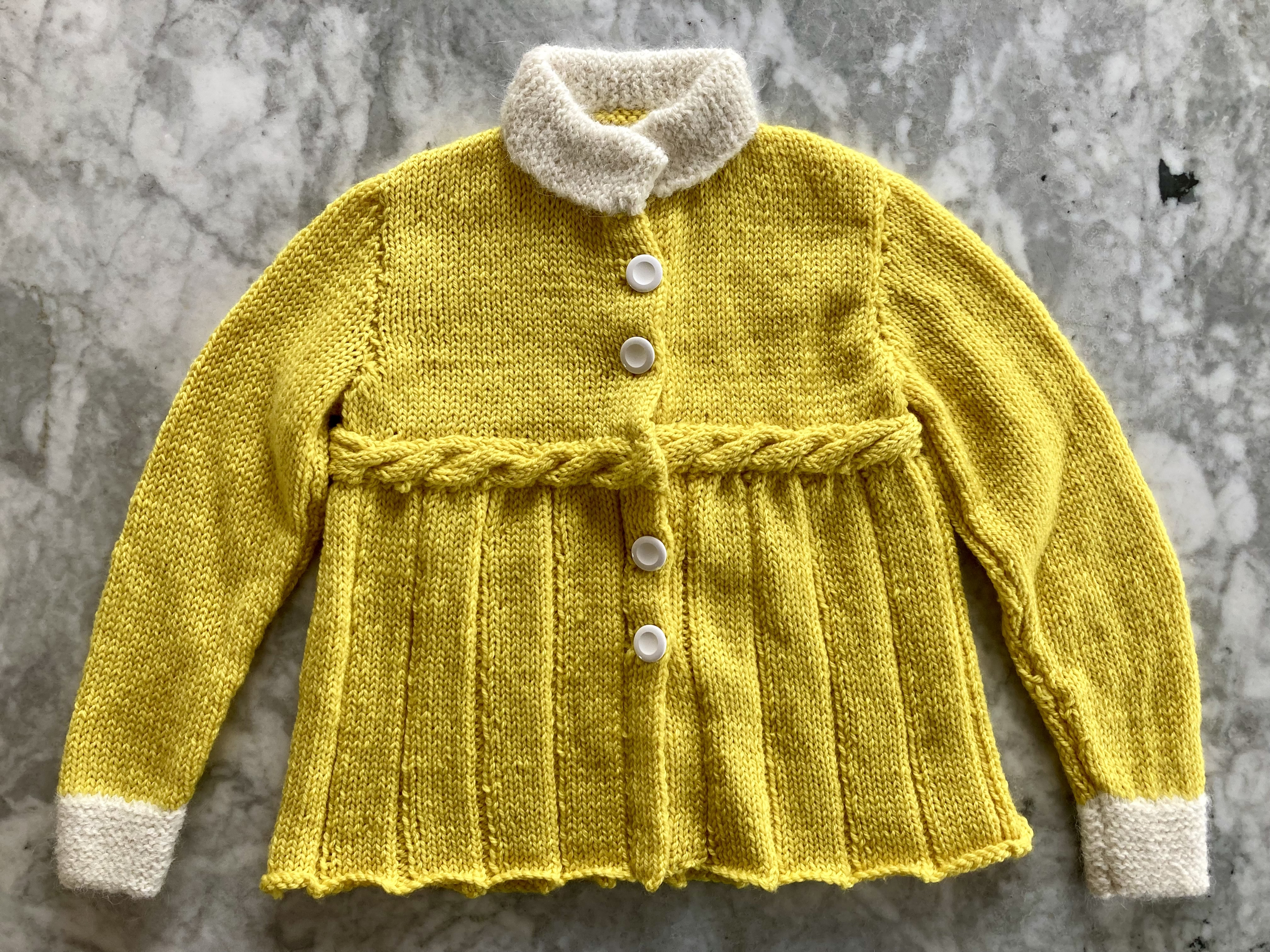
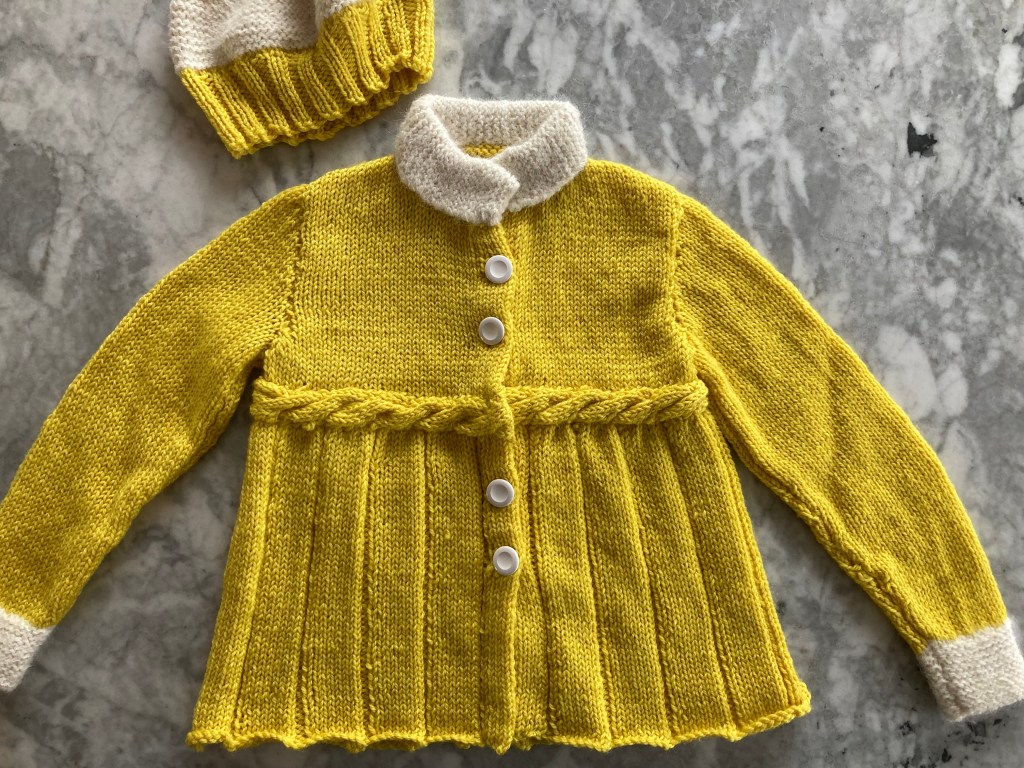
My February project (So glad 2024 is a leap year! It gave me one more day to get this blog post in on time) was this wonderful “Flair for Tots” set for a little girl. I made the coat-jacket and hat, but not the leggings.
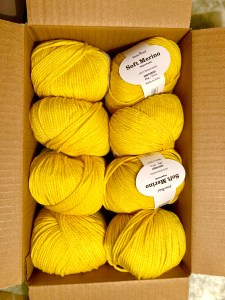
The set certainly has plenty of flair, and “Flair” is also the name of the slightly heavier-than-DK wool-synthetic mix yarn that it is written for. I decided to use Soft Merino by Wolle Rödel, which is 100% wool, quite soft, and give me the correct tension of 19 stitches in 4 inches on 5 mm needles. The intended recipient (the daughter of a nice colleague, for whom I had already made both this “Practical coat” and this “Sunday Best Dress“) requested yellow and it looks like she was perfectly on trend — as soon as I bought the wool and started knitting, I started noticing how many people I saw in the course of a day were wearing a similar bright canary yellow.
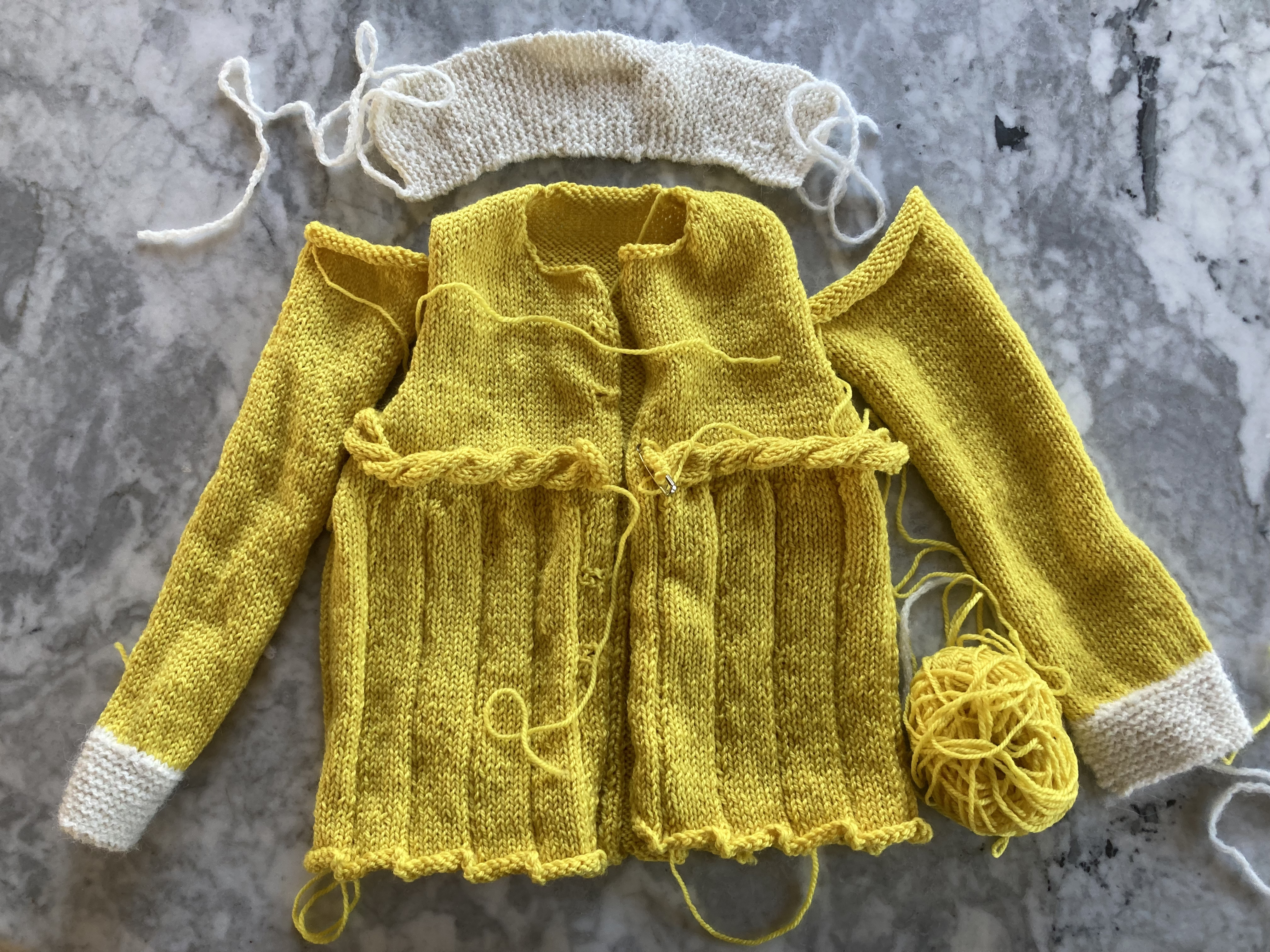
The jacket pattern starts at the hem with a k7, p1 flattened rib. I made the back and fronts in one piece to avoid seams. The pattern switches to stocking-stitch a couple of inches before the armhole openings to make room for the belt (a simple strip of 6-stitch cable knit separately and sewn on later). The front bands are knitted along with the fronts and are exactly the width of one flattened rib, doubled over with a slip stitch fold line and double buttonholes.
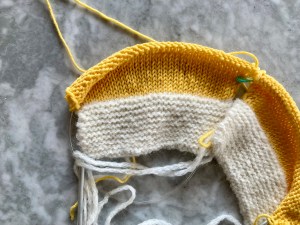
In the pattern, the white wool trim at the collar (made separately and sewn on later) and cuffs is the same “Flair” wool used to make the rest of the set, but fluffed up by brushing with a teazle (aka teasel, teasle) brush. It’s a brush with metal tines for back-combing wool the same way you might tease your hair with a rat-tail comb, and with the same effect: it breaks and felts some of the fibres, creating a fluffy-blanket effect. Occasionally, there’s a pattern in an older Stitchcraft for brushed wool items (usually a baby blanket), and, there, readers are advised to send their finished knitting to a special service to get it brushed “for a very reasonable price.” By 1966, I guess anyone could buy a teazle brush and do their own brushing on the knitted trims.
All well and good, but these days one can also just buy fluffy yarn, and I saved myself some time and trouble by doing that. The white contrast yarn is Luxury Alpaca by Rico Design, a 63% alpaca, 37% polyamide mix that confusingly has both the terms “Superfine” and “Aran” in its name and knits up, like the Soft Merino, a bit bigger than DK on 4.5 or 5 mm needles.
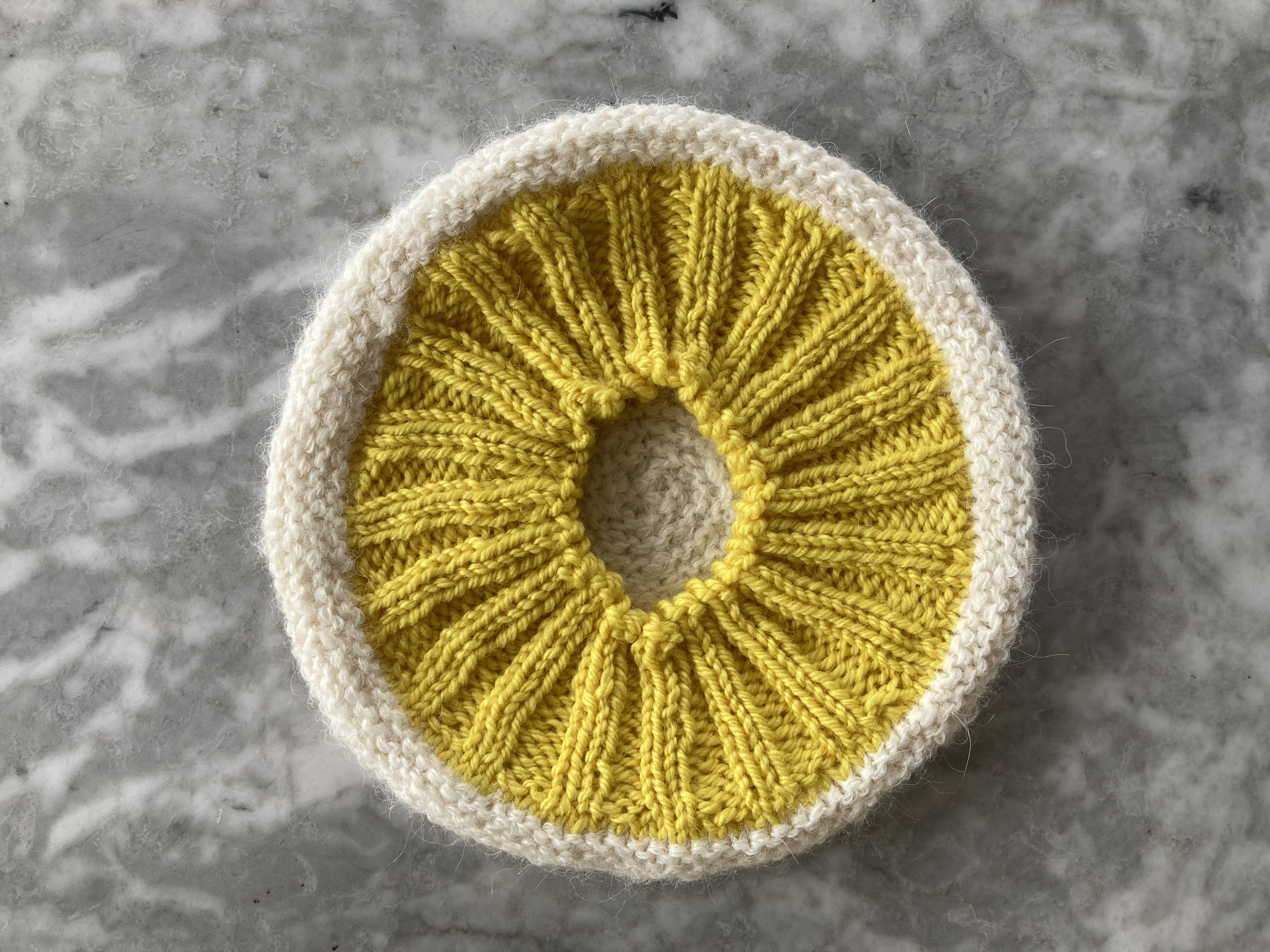
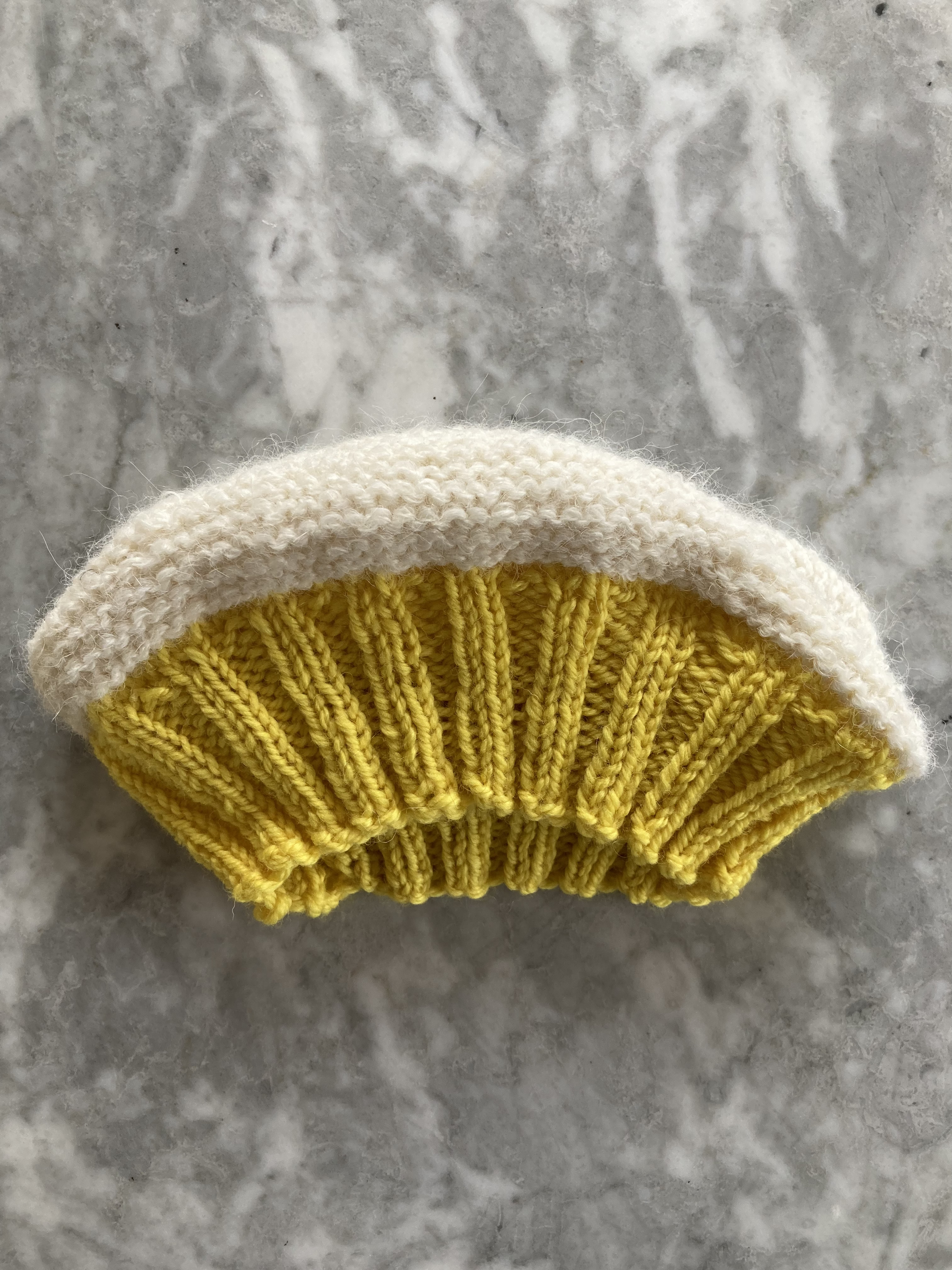
The belt and collar are knitted separately and sewn on. The collar has a nice sort of crescent shape made with short rows. It is supposed to have double buttonholes to button up very high on the neck, but although I made the collar perfectly according to pattern and it fit fine on the jacket neck edge, the double buttonholes didn’t line up anywhere near each other. No worries — I don’t think any child would enjoy having something tightly buttoned around their neck, the collar stands up on its own anyway, and I didn’t even have to sew the buttonholes together, since the wool is so fluffy. Similarly, I saw no need to add a snap fastener to the neckline above the last button, as called for in the pattern, but I did add a snap fastener at the waist as indicated.
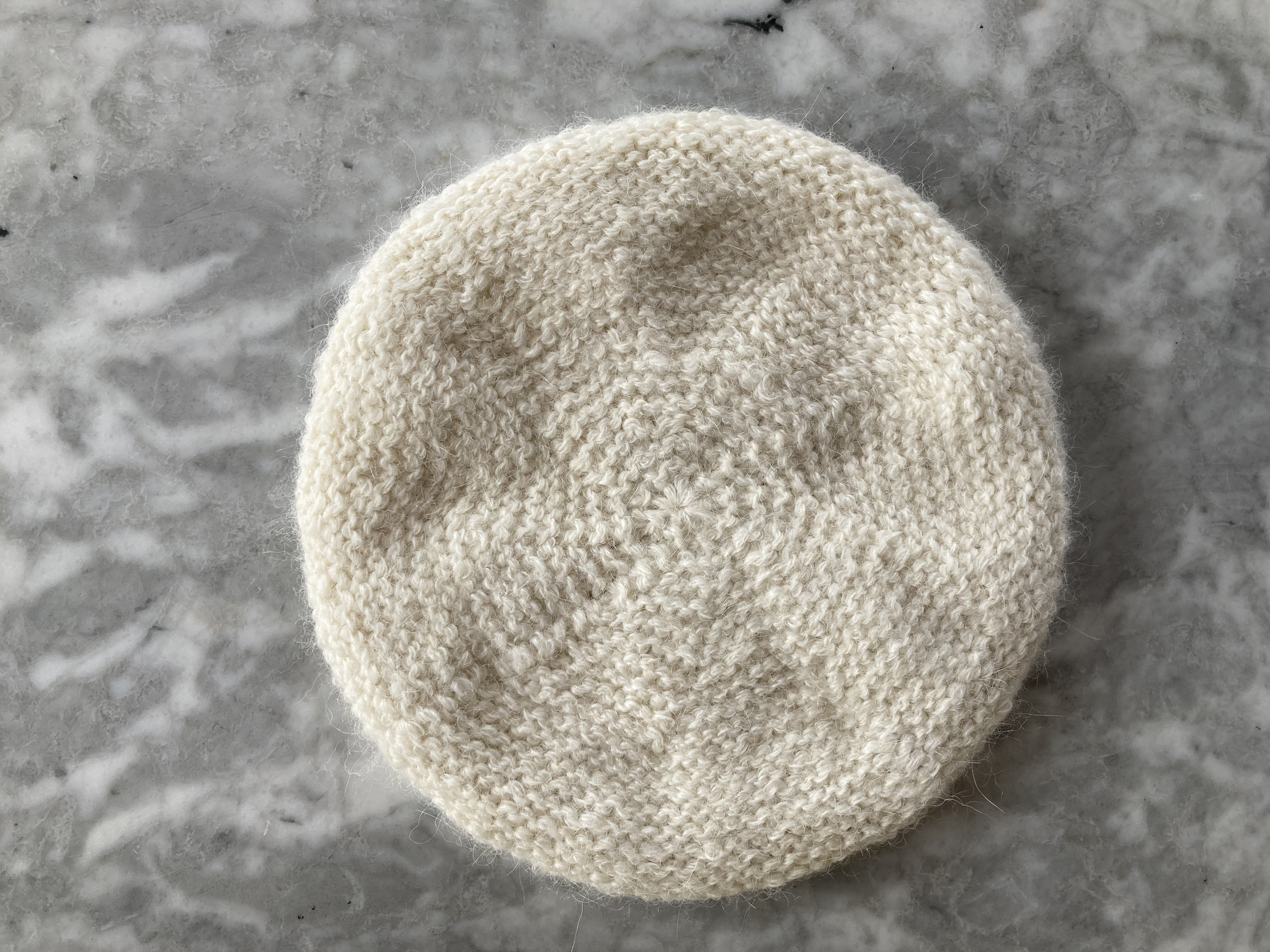
The hat is a simple modified beret, intended to be knit flat, but I made it in the round. The crown has a nice, easy decrease pattern: from 108 stitches, you k10, k2tog for 1 row (round), then 1 row straight, then k9, k2 tog, one row straight, then k8, k2tog and so on.
That’s it! I had a fun time knitting this set and was very glad to know someone to knit it for. I hope she likes it!
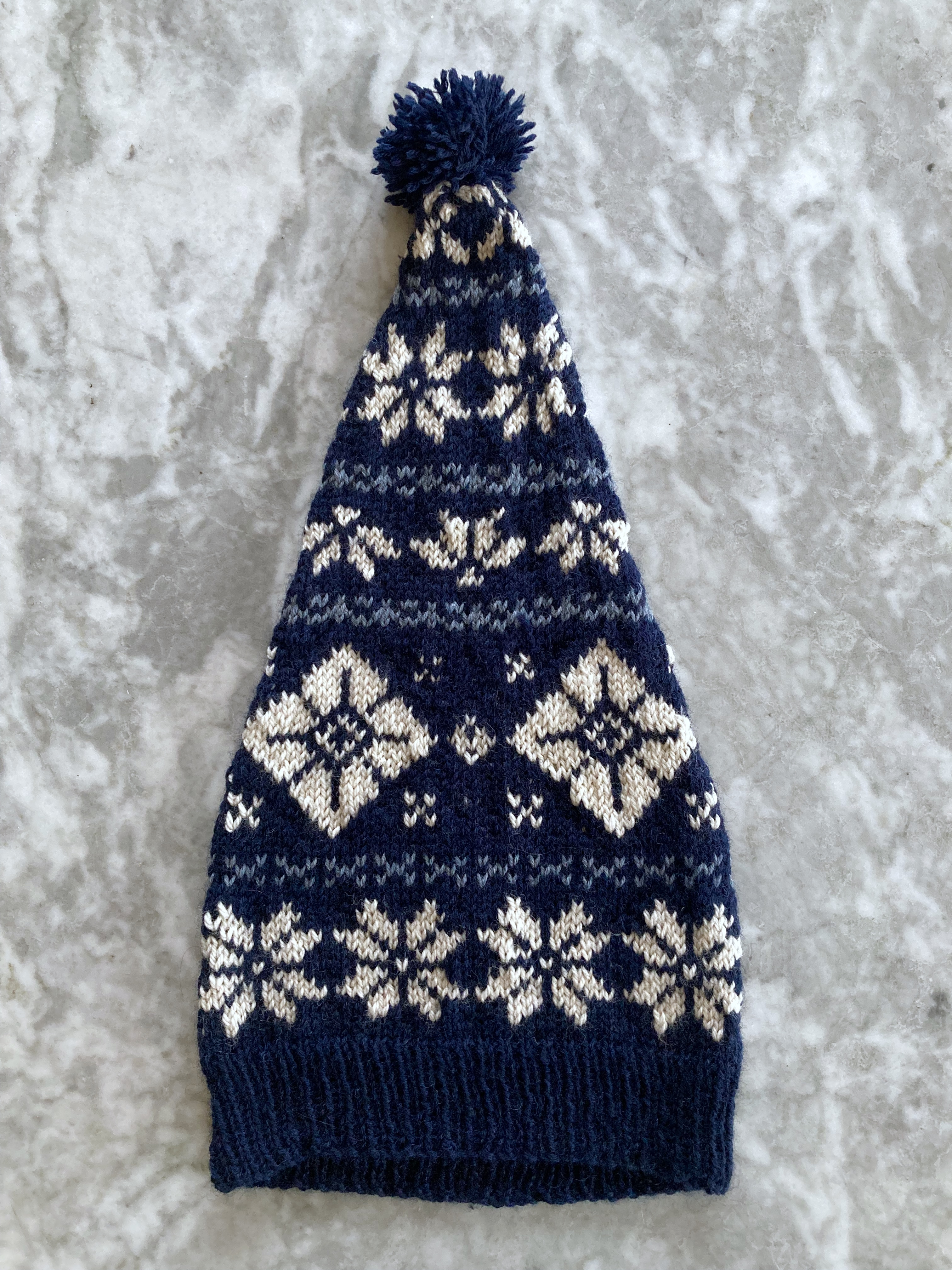
I had long admired this cap and mitten set and was very happy to arrive at this issue in order to knit it.
… That is, until I actually took a better look at the pattern and made it! The snowflake pattern and folded stocking-cap design looks great in the photo, but the pretty setting and pose detract from some of the design flaws, which became glaringly apparent once I started work on it.
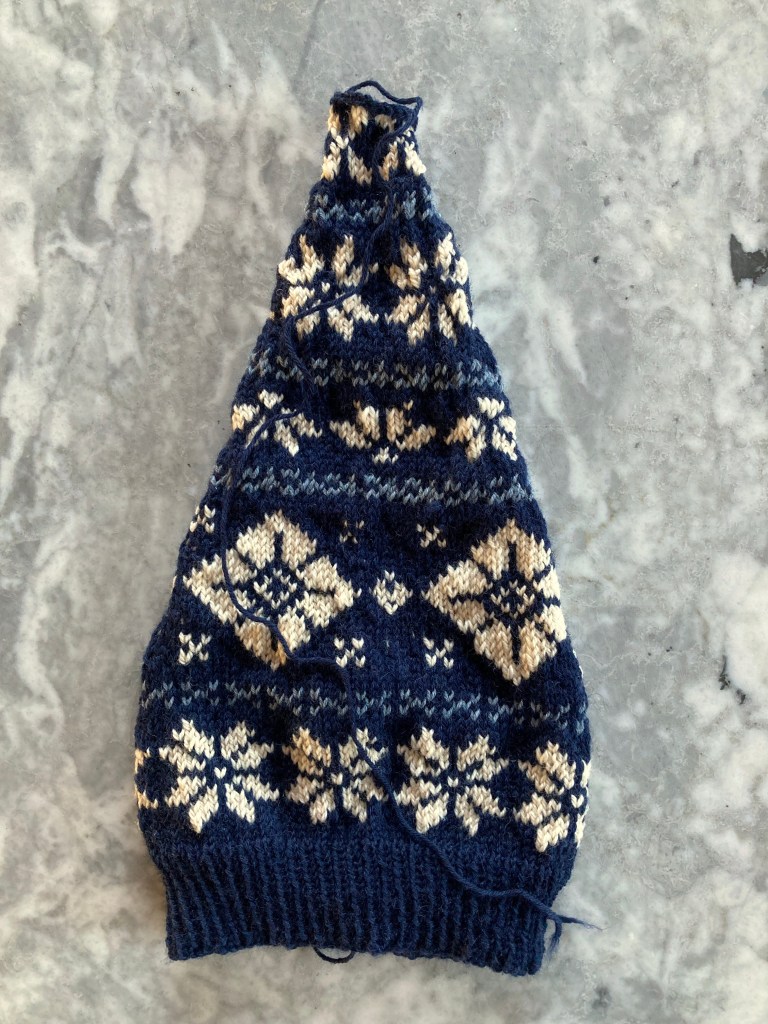
But first things first: It’s written for Patons DK yarn, 100% wool, in white with “Lipstick Red” pattern. I have a good stash of leftover DK wool from other projects and decided on a dark blue background (Schachenmayr Regia 6-ply sock wool) with the pattern in white (Wolle Rödel Soft Merino) and blue-grey (Lana Grossa Cool Wool Big Mélange) to really bring out the snowflakes. The written pattern gives no row gauge and assumes a tension of 6.5 stitches to the inch over the stranded pattern on No. 10 (3.25 mm) needles for the mittens, and 6 stitches to the inch on No. 8 (4 mm) needles for the hat.
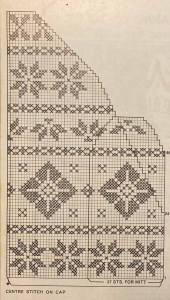
6 and especially 6.5 stitches to the inch is quite tight for DK wool, but I did my best on 3.5 needles (I don’t have 3.25 needles — the pattern is written for old UK sizes) and started with the hat. I noticed it was meant to be knitted flat and seamed up the back, but no worries, I could just make it in the round. There was even a chart (not a given with vintage patterns), so everything seemed fine.
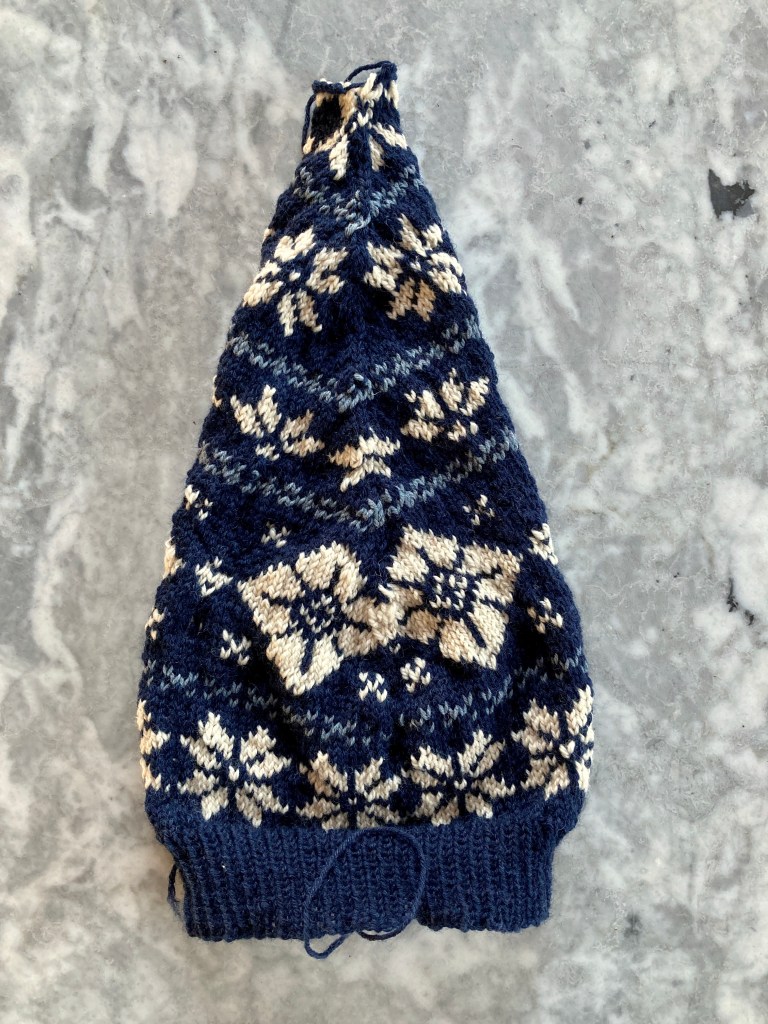
Well — after the first snowflake, it was clear that this hat would not fit any adult head, even that of the friend it was intended for, whose head is quite small. Knitting stranded DK that tightly just made it impossible to stretch, as well. Looking back at the photo, I noticed that the finished hat is just sort of perched on the of the model’s head, not pulled down over her forehead like one would normally wear a hat…! Yeah, 6 stitches to the inch is too tight. So I started over with 4 mm needles for the pattern and 3.5 mm for the ribbing.
That solved the first problem, but as soon as the large diamond pattern started, I noticed how badly designed the colourwork pattern was. There were huge gaps between colour changes, necessitating weaving-in the wool constantly, and even then, the white wool showed in the gaps. I can’t imagine how this would have worked with stranding bright red behind white! Even worse, the pattern doesn’t match up in any way at the “seam” / round change. The large diamonds just get swallowed into each other like in of all those Netflix opening credits that use mirror effects. I was able to finesse it on the smaller snowflake and the repeat of the medium-size snowflake at the top of the hat, and the back “seam” does get covered by the long upper part of the hat when it fold over, but still, it looks messy.
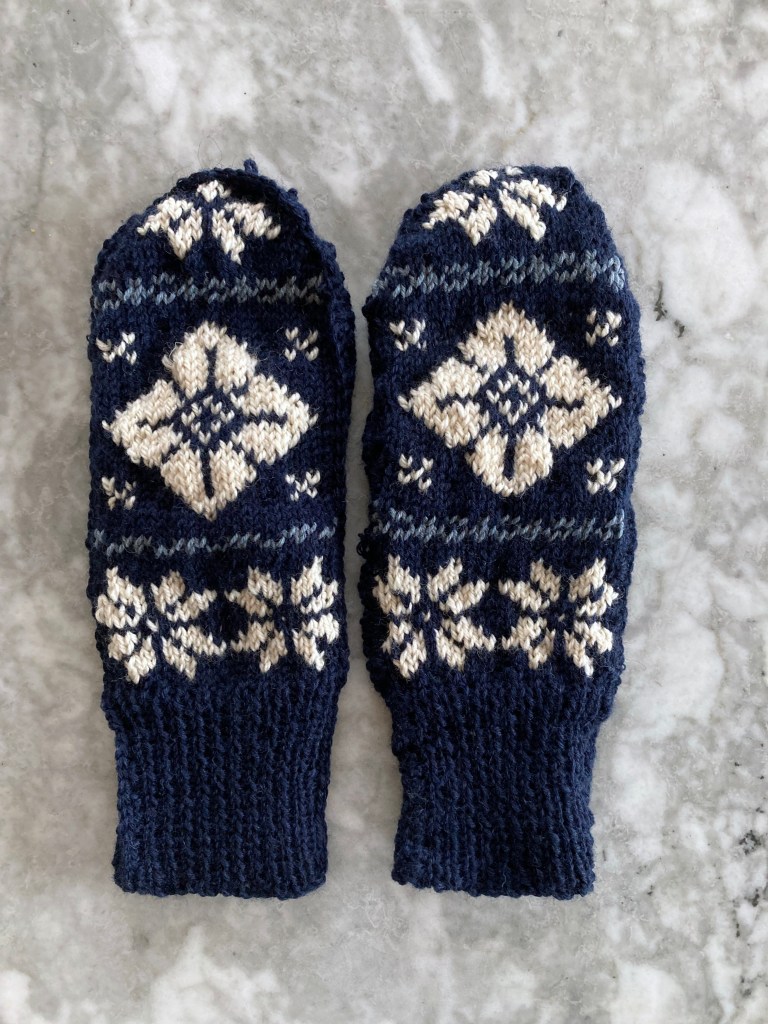
Starting on the mittens, it became obvious why the hat pattern was so badly designed: The mitten pattern is perfectly centered and balanced and looks fine. There’s no problem with patterns bleeding into each other because the decreases only happen at the top of the fingers, and no big problem with weaving in across the back, because the back-of-the-hand and palm pieces are knitted flat and separately and there is no patterning on the palm, so the pattern motifs are made in sort of stranded intarsia. It seems the designer designed a pattern for mittens and, when instructed to make a matching hat, just extended the pattern out to hat size without much though about pattern placement or correct sizing.
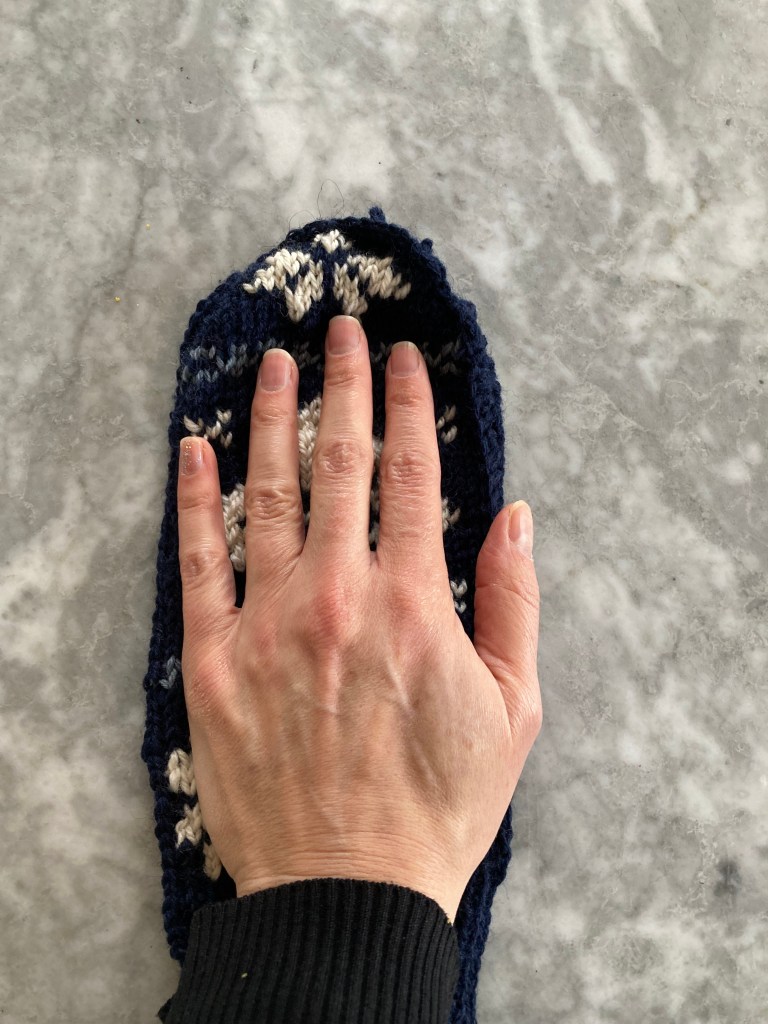
Speaking of sizing, though… The finished mittens were way too long! I have size 8 hands and really long fingers, but even they look stubby on this photo, simply because the mitten length is out of all proportion. Looking at the magazine photo again, I think they are too long for the model’s hands as well. Yes, I should have checked it as I went along, but of course I didn’t, so I only noticed the problem after all the pieces were made and seamed together. (Using a crochet seam as directed in the pattern.) I thought I could block them shorter… Erreur fatal! Blocking not only made no difference in the size, it cemented that crocheted seam so solidly that it was not possible to undo it in order to frog and re-knit the mitten tops in a better size. By the time I was finished “undoing” the first mitten seam, the whole mitten looked like it had been mangled by a dog.
I will give the hat to my friend as intended, as it turned out OK and the weaving-in blotches mostly disappeared after blocking. It does look cute, especially with a pompom on the tip. As for the mittens, I consigned them to the upcycling drawer, as I just didn’t want to deal with them any more.
This project was no fun to knit, but I will call it a learning experience and move on. And I do think my friend will like the hat, at least.
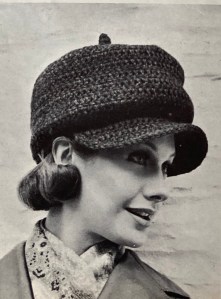
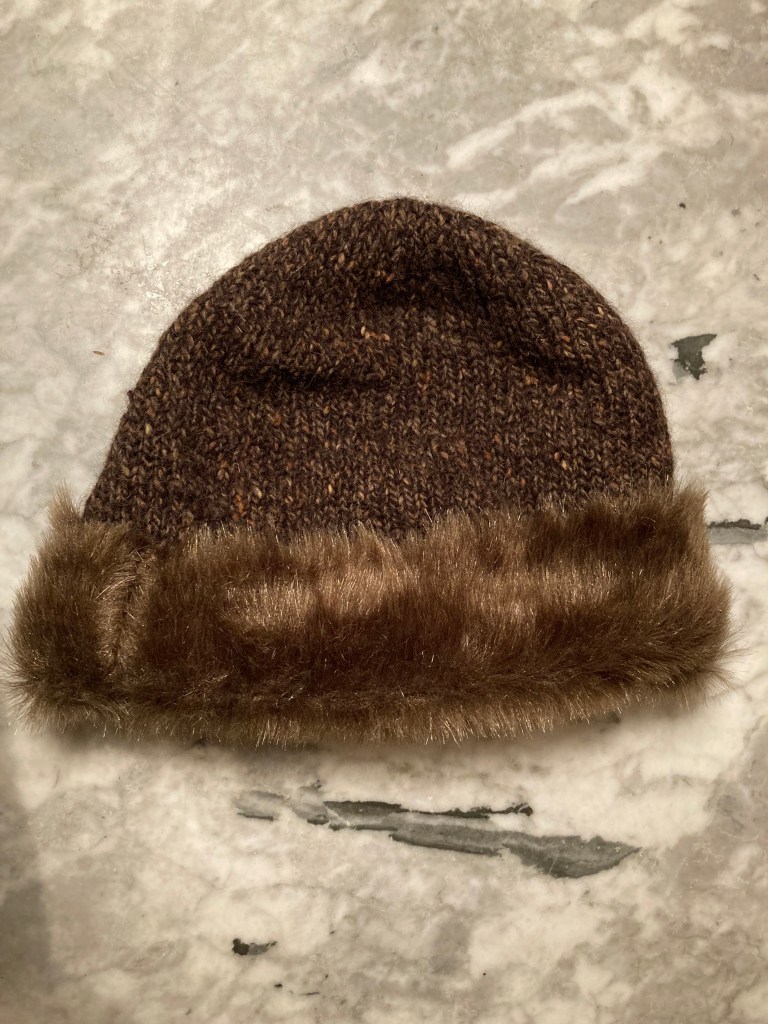
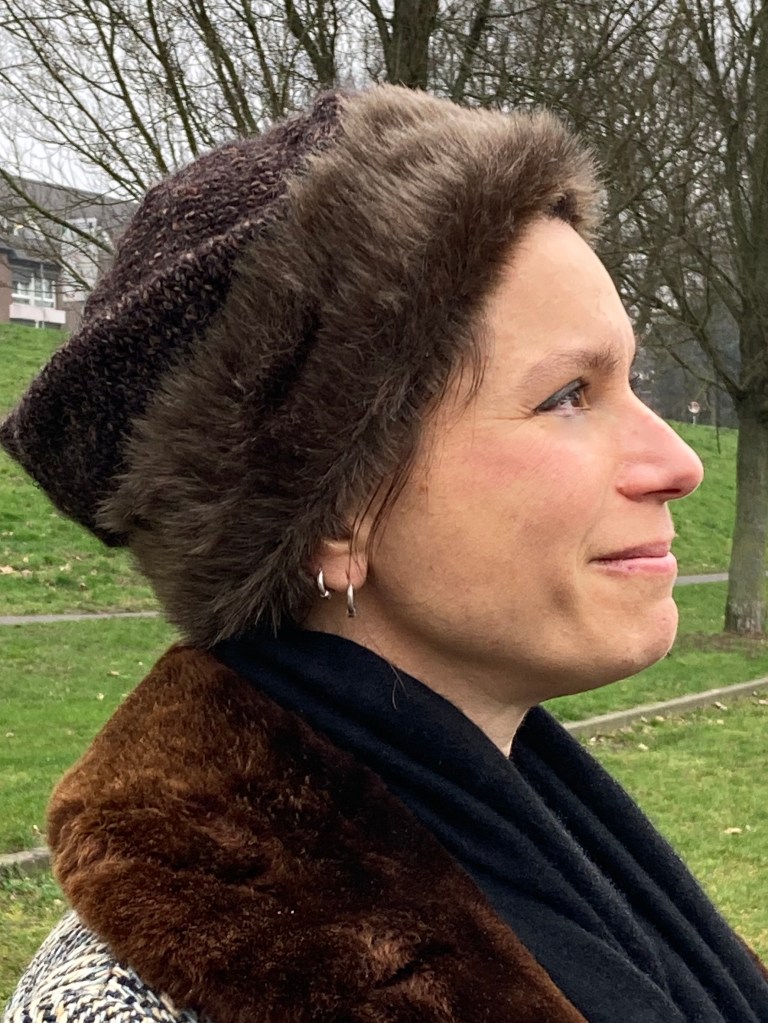
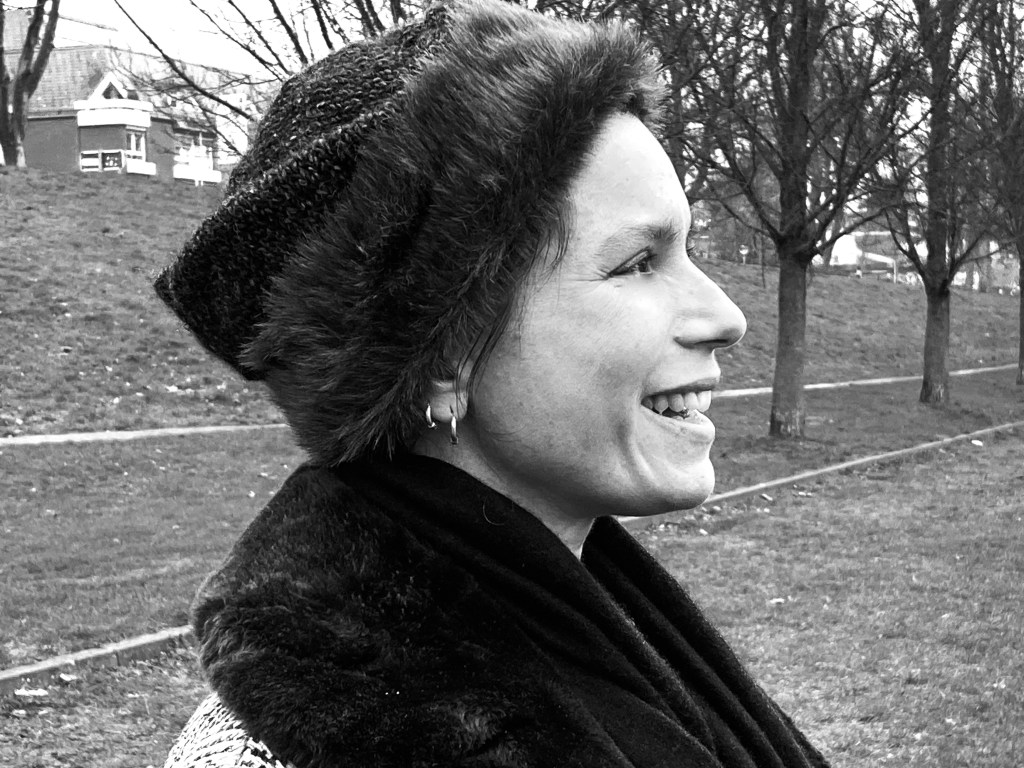
February’s project was this wonderful fur-trimmed hat. Fur or fur-brimmed hats were all the rage in the mid-1960s (my grandmother had a hat very much like this one with real fur — but too small for my head). Also, hats were big – wide-brimmed or with wide bands around the front, and often with a crown that was much higher than the wearer’s head, like the “baker boy” style crocheted cap from the same February 1964 issue, so this item is perfectly on trend.
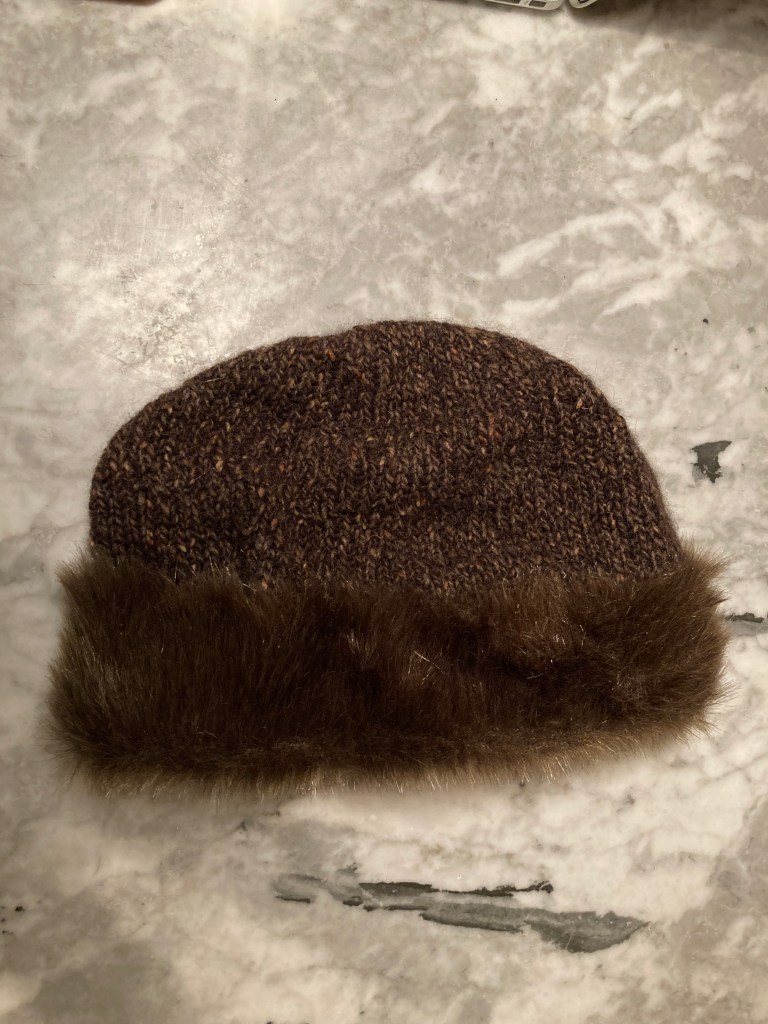
This pattern was written to knit in Patons “Glenora”, a medium-bulky tweed yarn. (It appears to be a wool-synthetic mix, but if anyone has more detailed information, I would love to know.) The hat part is knitted and a fur strip is then sewn onto the front band. I used Lana Grossa “Fashion Tweed” (71% merino wool, 17% alpaca wool, 12% synthetic), which is lovely to work with — soft, fluffy and lightweight even at a tension of 4-4.5 stitches to the inch.
Like almost all 1960s patterns (even for hats and many gloves and mittens), this one is written to knit back-and-forth with a seam. I made it in the round. It took one evening of Netflix to knit and one evening to cut and sew the fur band and do the finishing touches. The fur in my version is fake, and was very interesting to cut: when I bought it, the saleslady wasn’t sure if she should cut into it and rip as customary when buying fabric, or cut it with scissors, since the synthetic fur is quite thick and has a slightly stretchy woven base. Ripping it took some effort, but had the advantage that the edge curled in slightly and didn’t ravel. Experiments on scraps at home showed that cutting this fake fur makes a less neat edge and lots of tiny bits of fur everywhere.
After knitting, blocking and sewing on the fake-fur band, the hat is pleated at the front edge and tucked at the crown to give the shape seen in the magazine photo. There’s a little decorative tie at the front edge too, just above the band, that is hard to see in the photos. The tie is made by knitting a strip in stocking stitch and then letting it naturally roll into a narrow tube. I suppose the modern version would be to knit some i-cord, but this worked just as well. The tuck and pleat, on the other hand, didn’t work quite as well in the wool I chose, since it is less bulky and thus has less intrinsic shape than Glenora. Still, the effect is about the same.
I made this hat for a friend’s daughter, but I would gladly make another for myself. It’s warm and fun and looks very, very 60s. I wore it for the photo with a coat inherited from my grandmother which also features a dramatic plush “fur” trim. (Sadly, the sleeves are way too short for me. They are also plain wool, and every year I search for a plush fake fur that matches the collar, so that I can make matching cuffs. I never, ever find this right colour and degree of plushness, but am considering using the same fake fur from this project, since it’s the closest I’ve ever found).
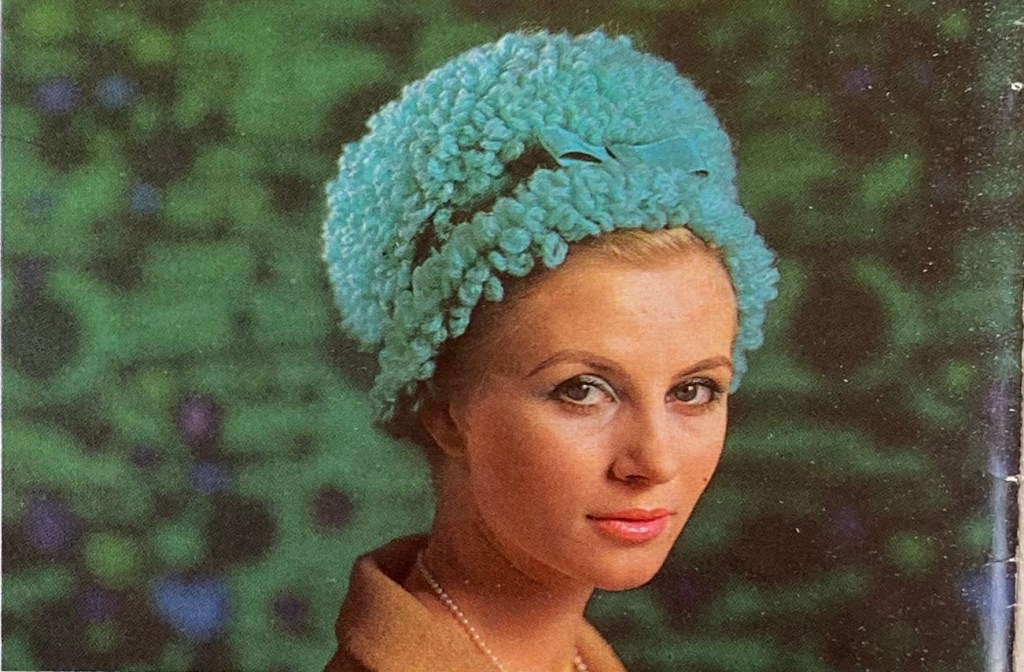
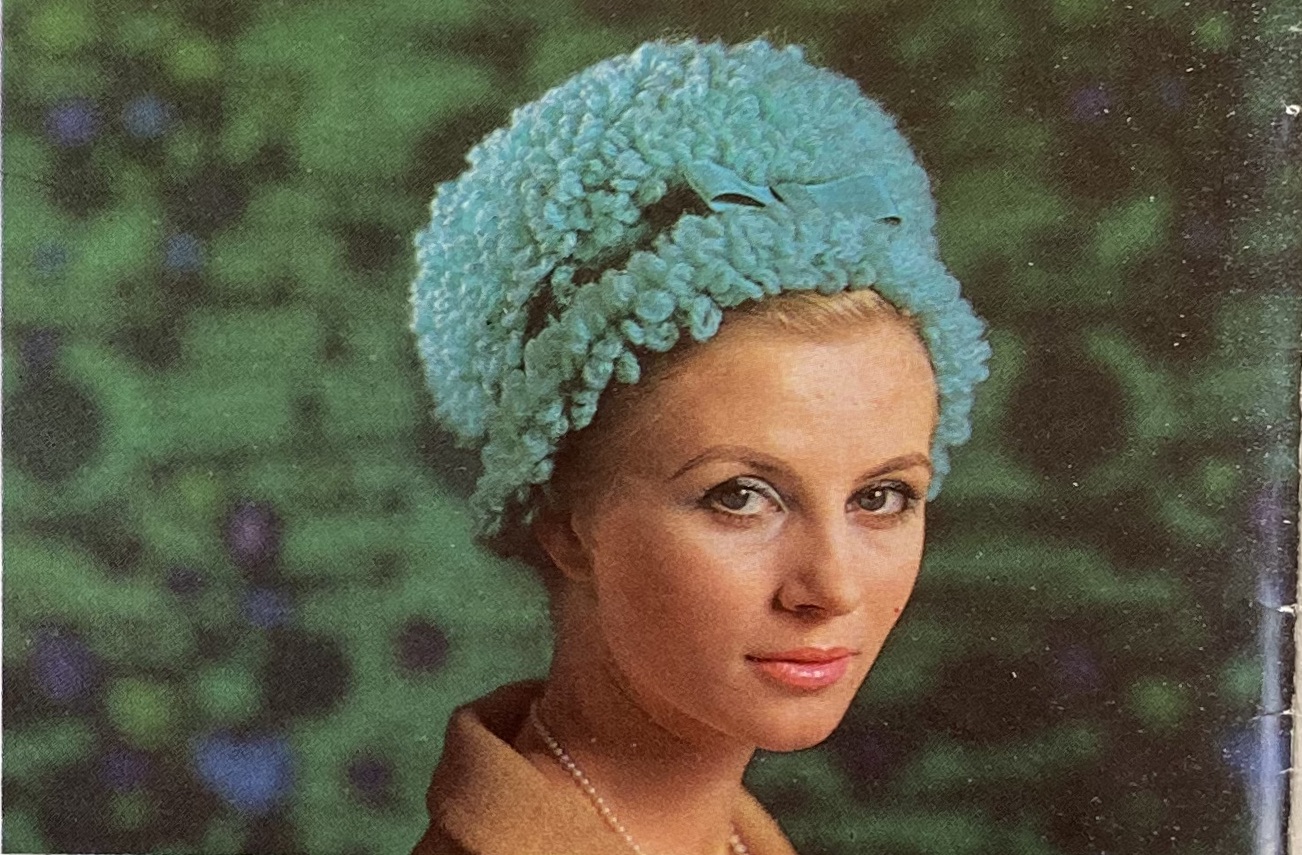
Once upon a time, there was a top hat that fell in love with a mop. Or was it a poodle? Either way, they had a child and it was… this hat. This amazing “tufted” hat made in crocheted loop stitch, “snug and gay” and shown here in a glowing shade of “Blue Lagoon” turquoise.*
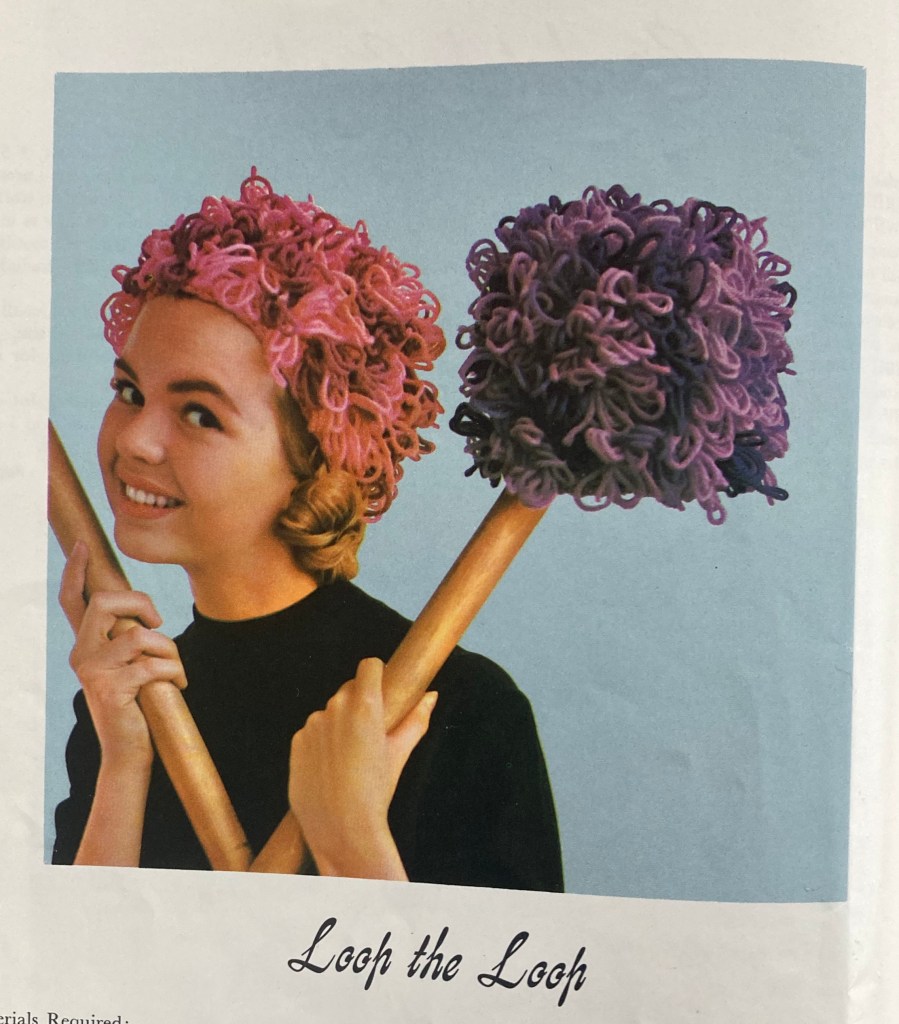
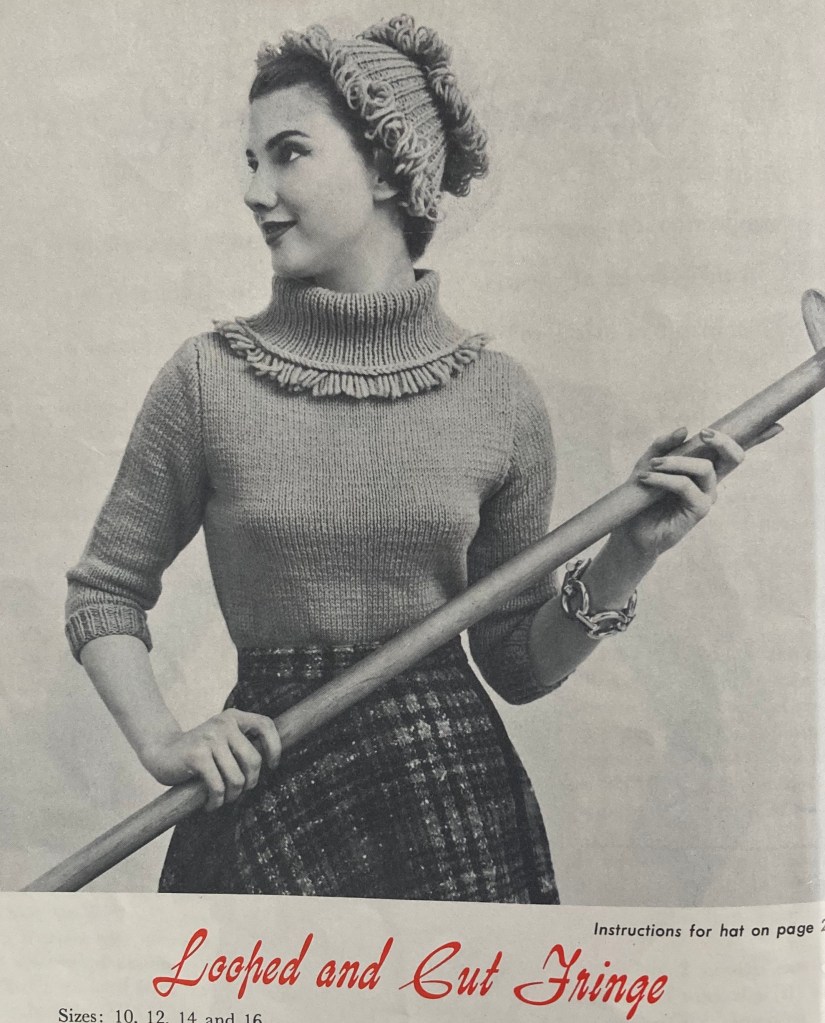
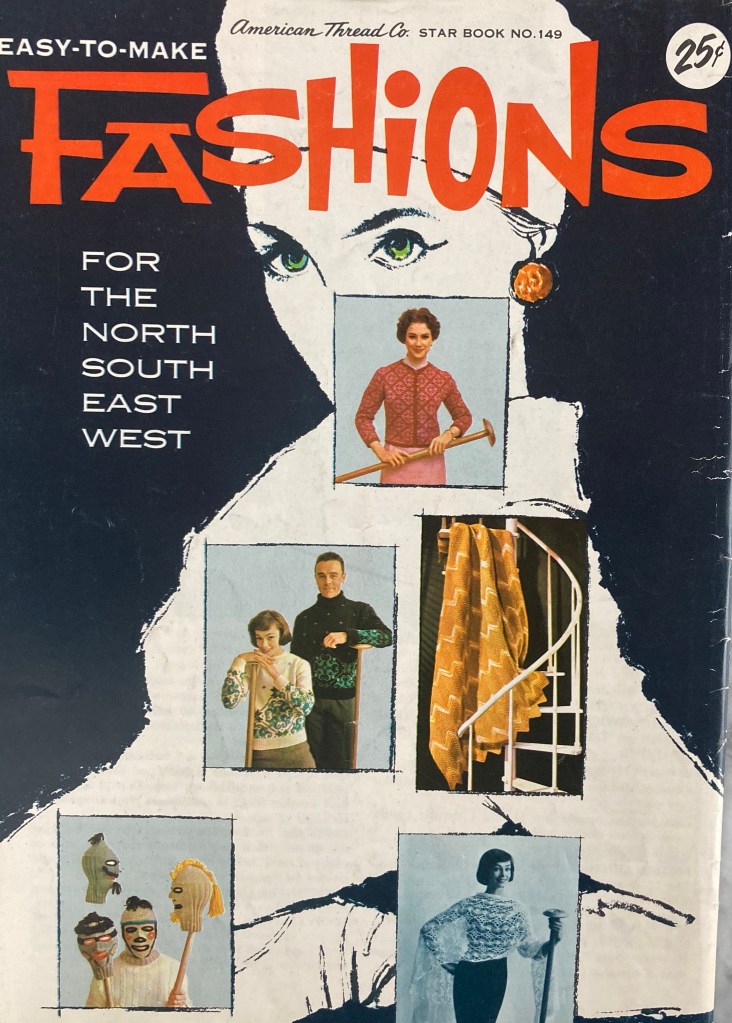
Loop-stitched accessories (knit or crocheted) enjoyed a trend in the early 1960s, and some of the designs were even more over-the-top than this one. Here are some examples from a 1959 American Thread Co. magazine book, “Fashions for the North South East West” for a “Loop the Loop” knitted hat as well as a knitted, looped-and-cut fringe hat and sweater. (The thing the model is holding the “Loop the Loop” on is supposed to be an oversized knitting-needle pole, but it just makes the hat look more mop-like.)
My first challenge with the crocheted Stitchcraft hat was finding the right wool. It’s written for “Ariel”, a wool-synthetic mix which is described as “triple knitting” but also “feather-light” and has between 15 and 19 stitches to 4 inches in stocking stitch, depending on the design. It seems to be normally plied and just slightly fuzzy. I had a hard time finding modern yarn in the right thickness (DK is usually 22 sts in 4 inches, and the bulky yarns I could find were more in the 12-16 stitch range.) Ultimately, I settled on Schachenmayer “Boston”, which is technically too bulky for this project, but which gave a great loop effect. I figured I could always make the hat a little smaller. It’s acrylic, which, I know, not great from an environmental standpoint, but very vintage-appropriate (not to mention probably waterproof).
I am not the world’s best crocheter and the loop stitch was a new technique for me, so it took a bit of getting used to. The word-for-word instructions are “insert hook into next stitch, place first finger of left hand behind hook and take wool anti-clockwise under finger and over hook then under finger again, (put wool clockwise over hook and draw through two loops) twice.” And true enough, if you follow those instructions exactly, it works, but requires a certain dexterity of brain as well as fingers. (1963 was a long way from the age of video tutorials…)
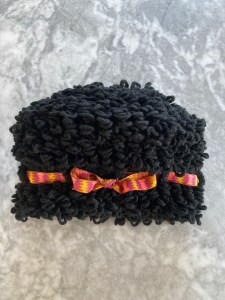
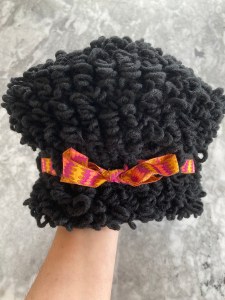
The finished hat has a loop of millinery wire in the crown to keep it from collapsing (and make it fit over your bouffant) and a ribbon to give it some shape. I had a bit of ribbon in stash with a very psychedelic pattern (so actually a few years too late in terms of 60s fashion — Stitchcraft has definitely not gone psychedelic yet — but it’s what I had.)
My colour choice was basic black, which I realised halfway through was maybe not a great idea. On the plus side, the loop fabric looks uncannily like those Persian lamb coats that were quite popular in the the mid-century years, and the hat would make the perfect matching accessory. You could even go all out and crochet yourself a modern faux-Persian-lamb coat in vegetarian-friendly synthetic yarn! Any vegans out there who have guilty dreams of vintage Persian lamb, this is your answer! I don’t have a Persian lamb coat though, nor do I particularly want one, and though I see the appeal of making a faux one, I don’t want it enough to put in the time and effort to design and make one. (Billie from the Show and Tell podcast suggested making long cuffs for a cloth coat in loop stitch to match the hat — that’s a really good idea.)
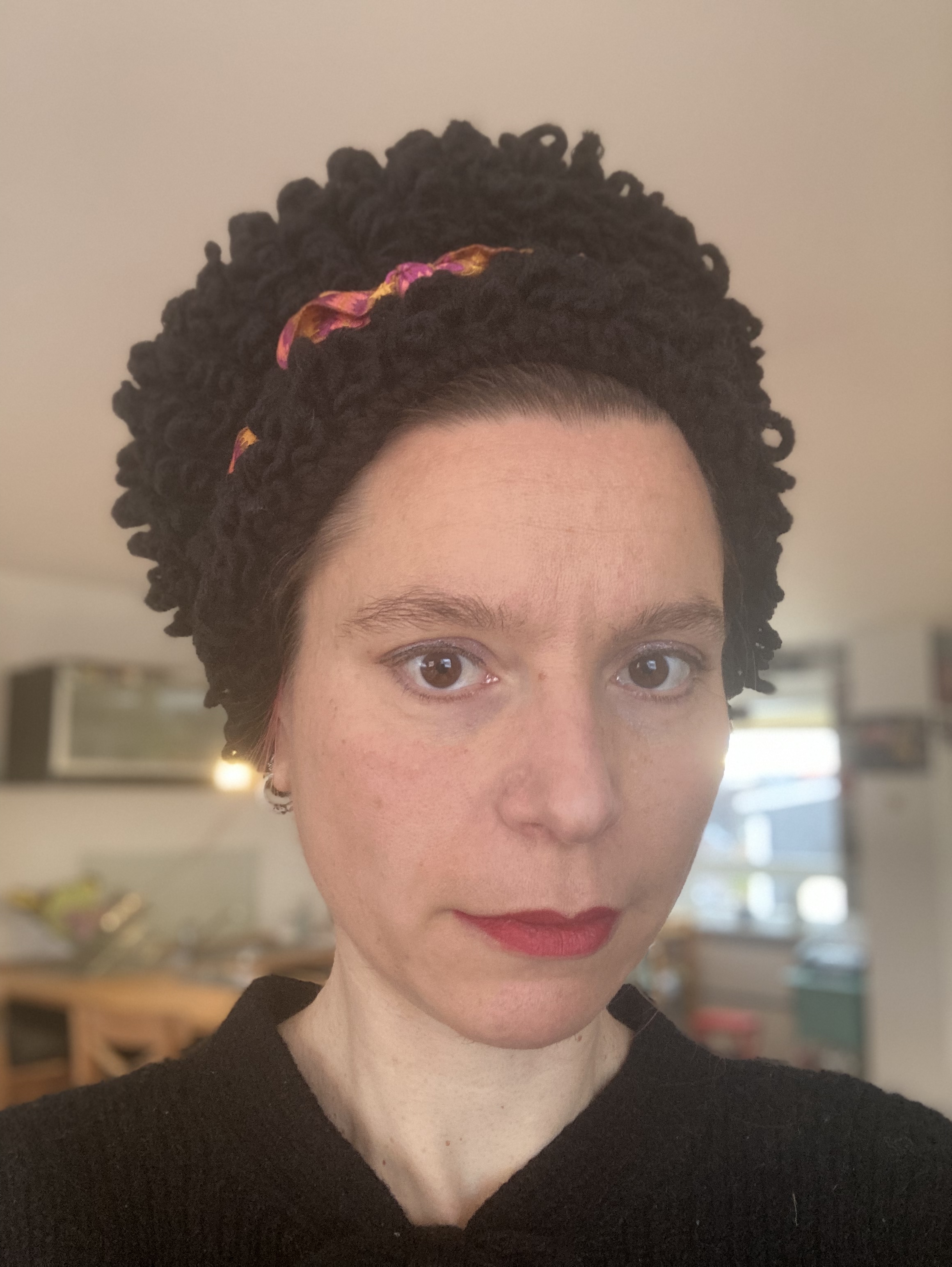
On the down side, I realised that this particular design in black had a high probability of making me look like either a recently groomed poodle or a white person in an Afro wig, neither of which are looks that I am trying to cultivate.
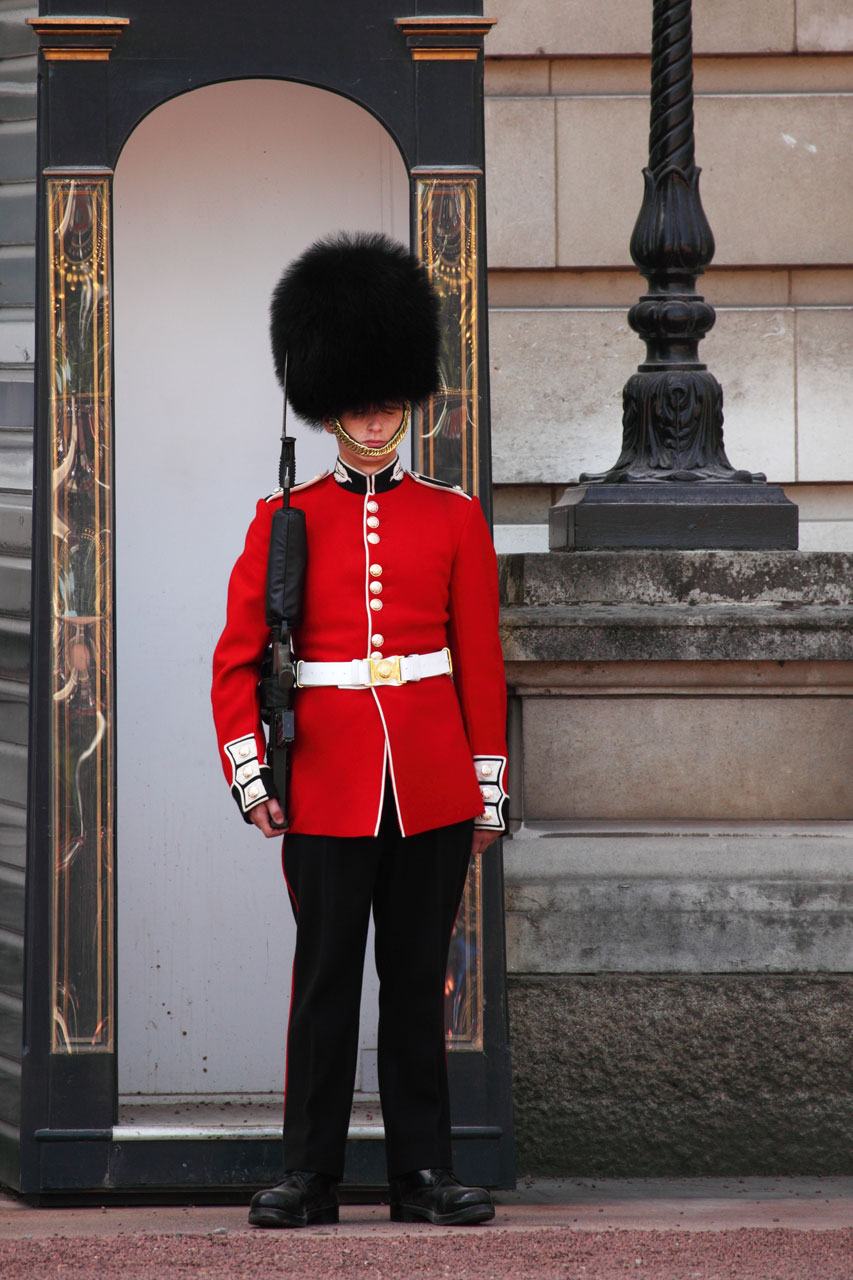
It ended up looking quite accurate, so you could say it turned out well, but I have to say, I am not convinced. The photo doesn’t do justice to the sheer ridiculous size of this thing, and the mop/poodle association is strong. If I wear it on top of my head, it looks like I am trying to join the Buckingham Palace guards.
If I push it back behind my hairline like the Stitchcraft model in the photo, it has the right basic shape and looks very 1960s, but it is still huge — the photo doesn’t do justice to the sheer size and mass of it. As always, I tried to recreate the magazine photo, and now I understand why the model looks less than overjoyed.
I don’t know what I am going to do with this hat, but I had fun making it and learned a new crochet technique, so I’m satisfied.
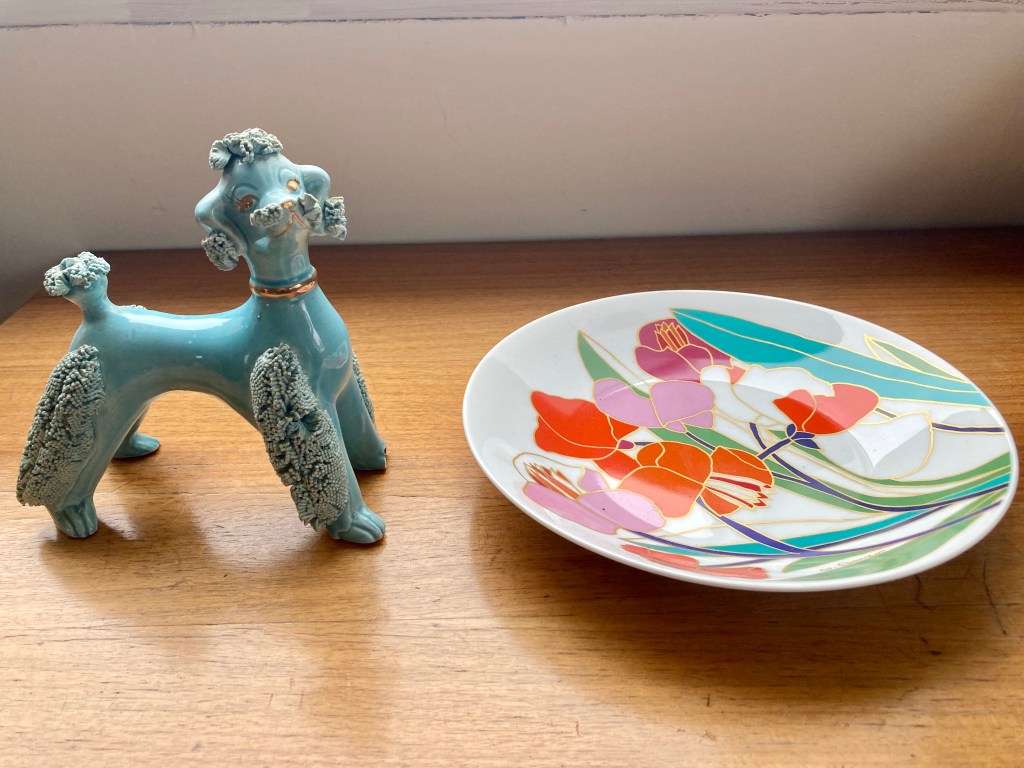
*For anyone thinking, “Turquoise poodles don’t exist”, may I present this amazing knick-knack that I inherited from my grandmother? (With historically appropriate plate.)
The autumn months are always the best for knitting magazines, with a mixture of heavy garments for colder days, easy-to-make holiday gifts, warm accessories and a few glamorous items for parties. Stitchcraft‘s November 1963 issue puts the focus on “warm family fashions… with the emphasis on colour and attractive textures that are interesting to knit and very becoming to wear”. There’s something for family members of every age and “for the petite to the not-so-slim.” The homewares and little projects are quick and fun to be finished in time for holiday decorating and/or gift-giving.
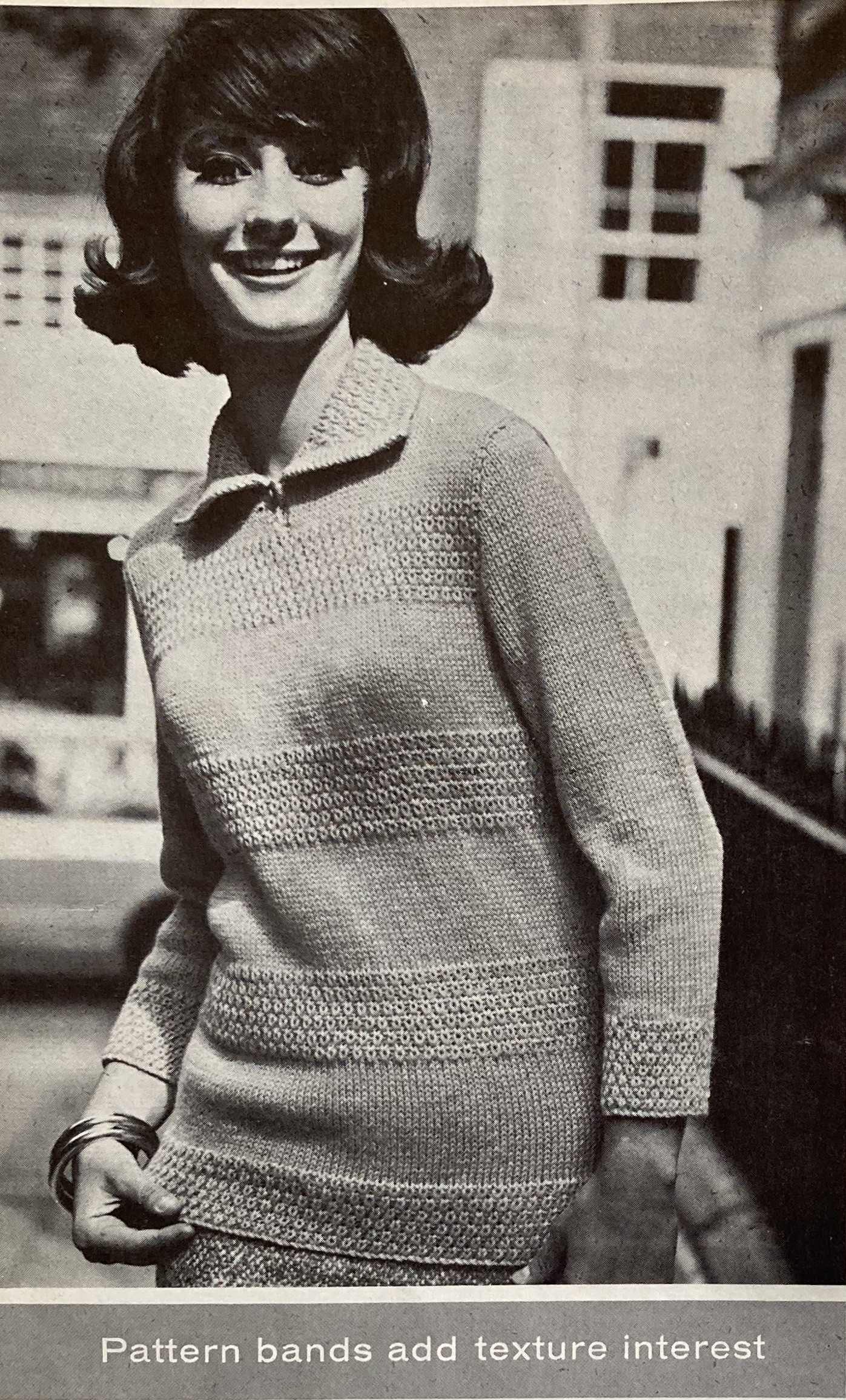
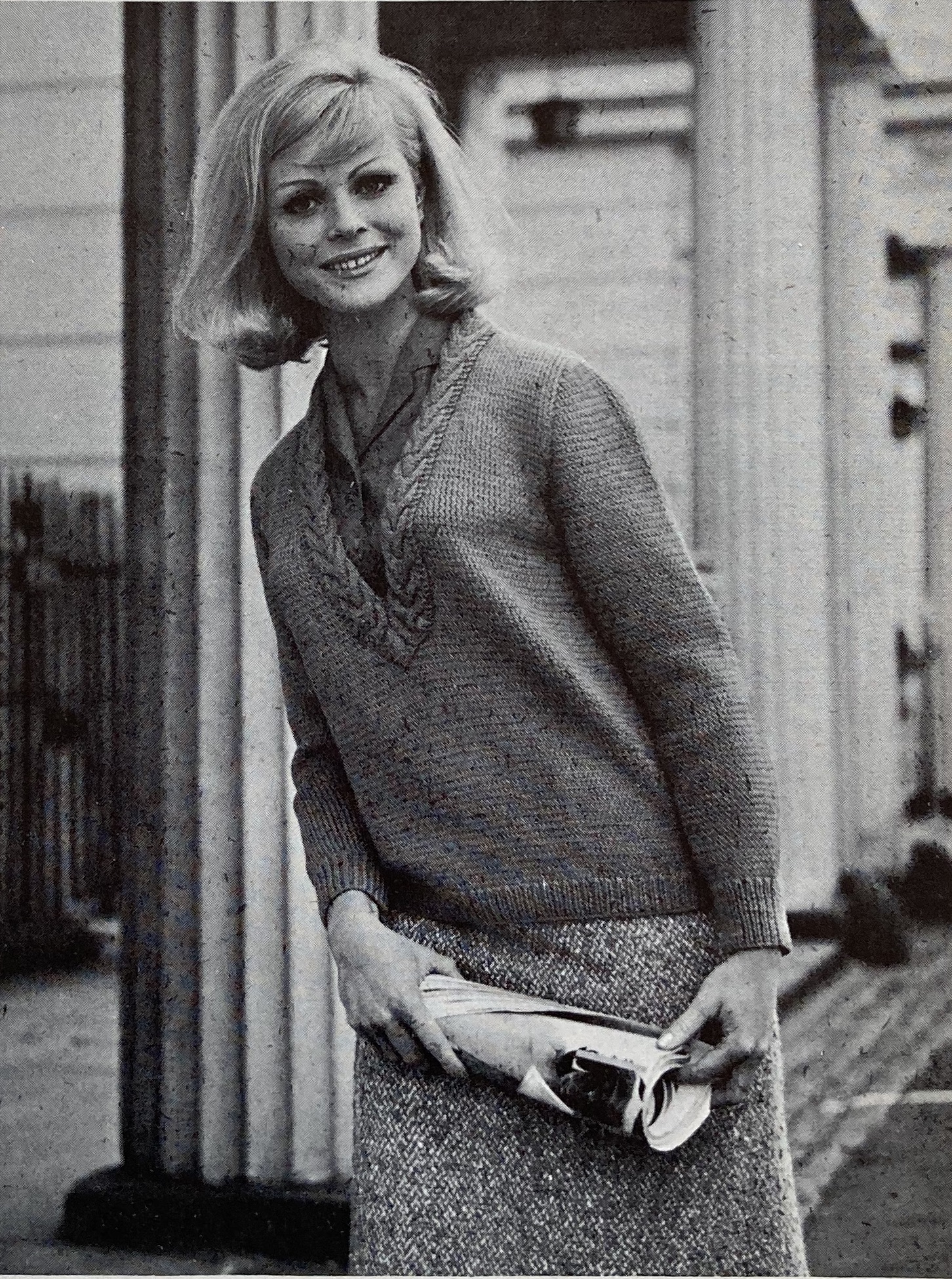
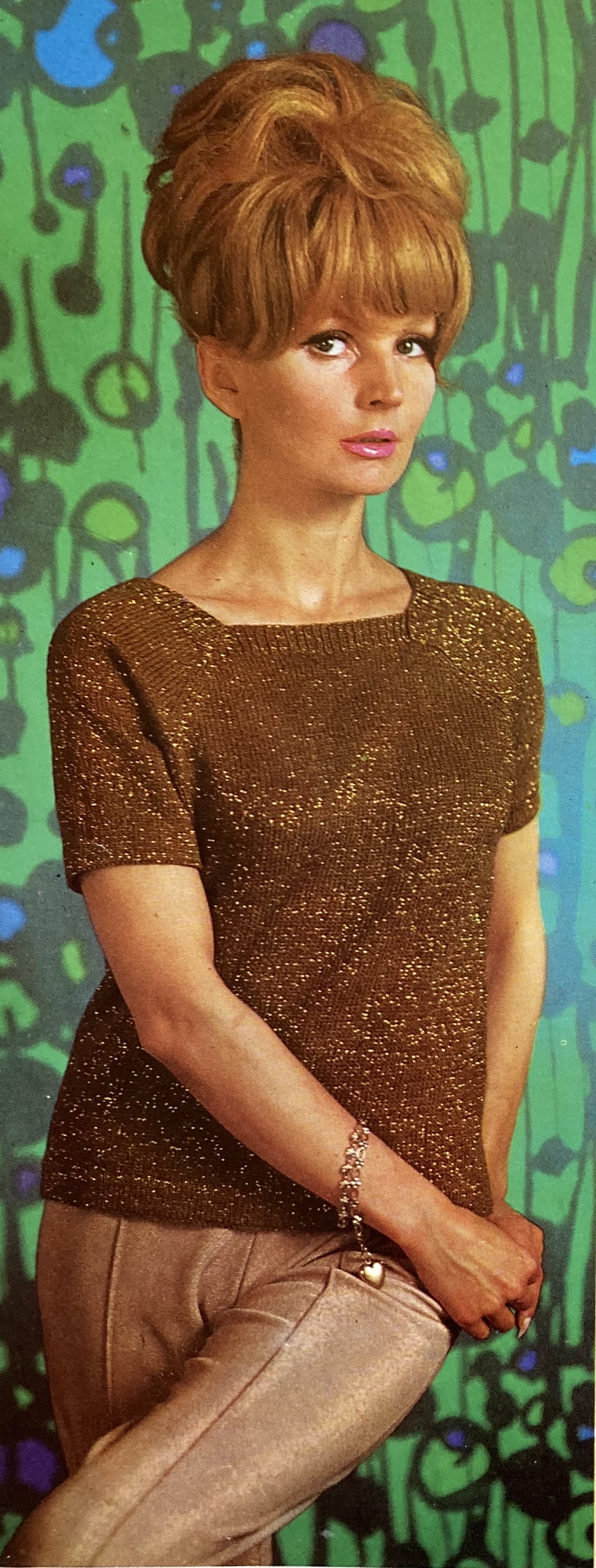
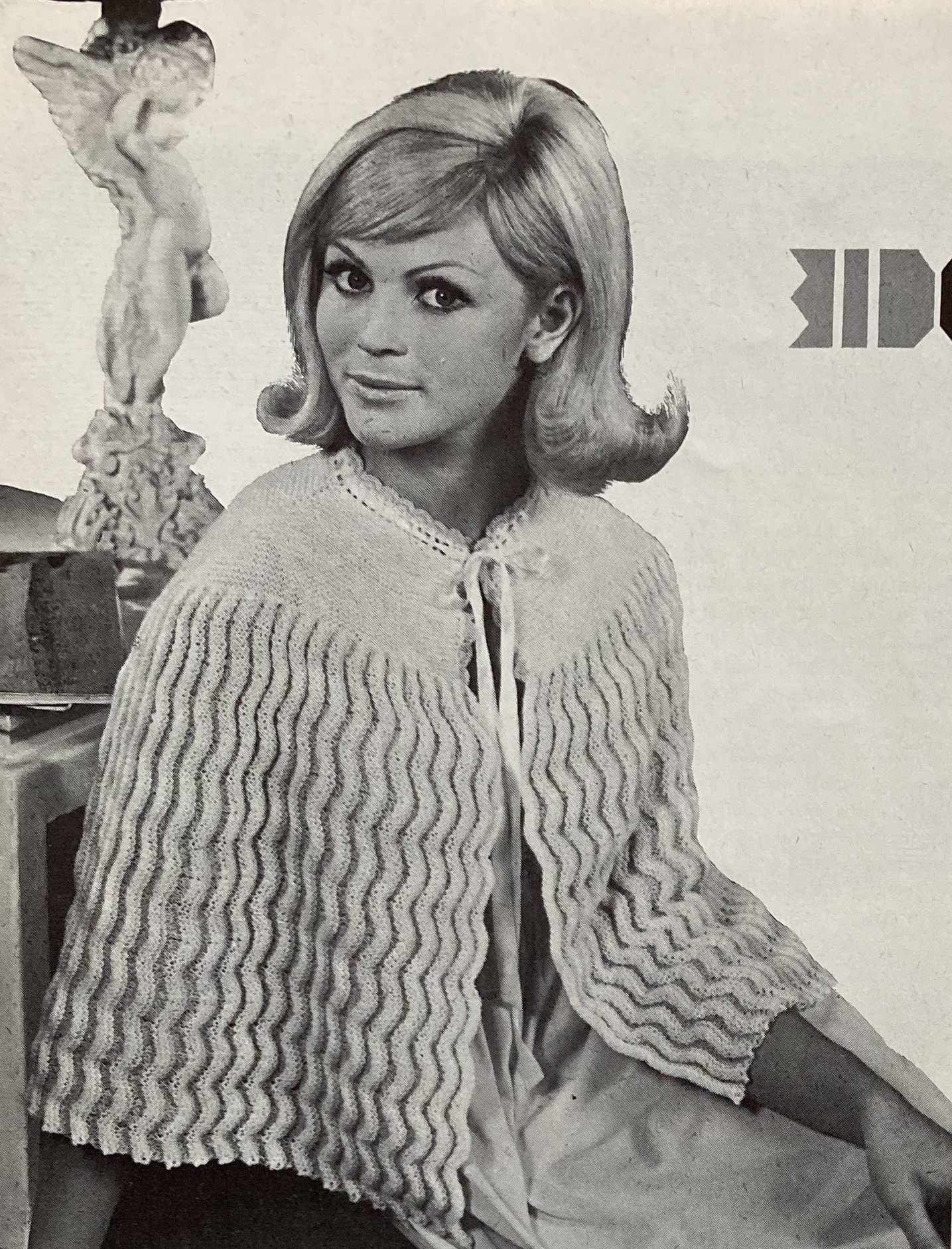
The “country jacket” on the cover continues the tweedy, variegated colour effect in fashion this fall, using Bracken Tweed wool for the main body and Totem DK for the collar and cuffs. I finally know what colour Totem “Oakapple” is! The other women’s outdoor-wear fashions include a zip-neck sweater with textured pattern bands in turquoise, an “overpull” with cabled neckline in flecked “Cantaloupe” colour (sadly, no colour photo, I have no idea how it looked in real life) and a simple brown top made glamorous by knitting the wool (Cameo Crepe 4-ply) together with a strand of sparkly Lurex thread. There’s also a warm, soft cape for winter reading in bed, knitted sideways in an easy zig-zag pattern. Aside from the green and white bedcape, shades of autumn brown as well as bold blues and red are the season’s trendy colours. Stripes, zig-zags and textures complete the Autumn 1963 look.
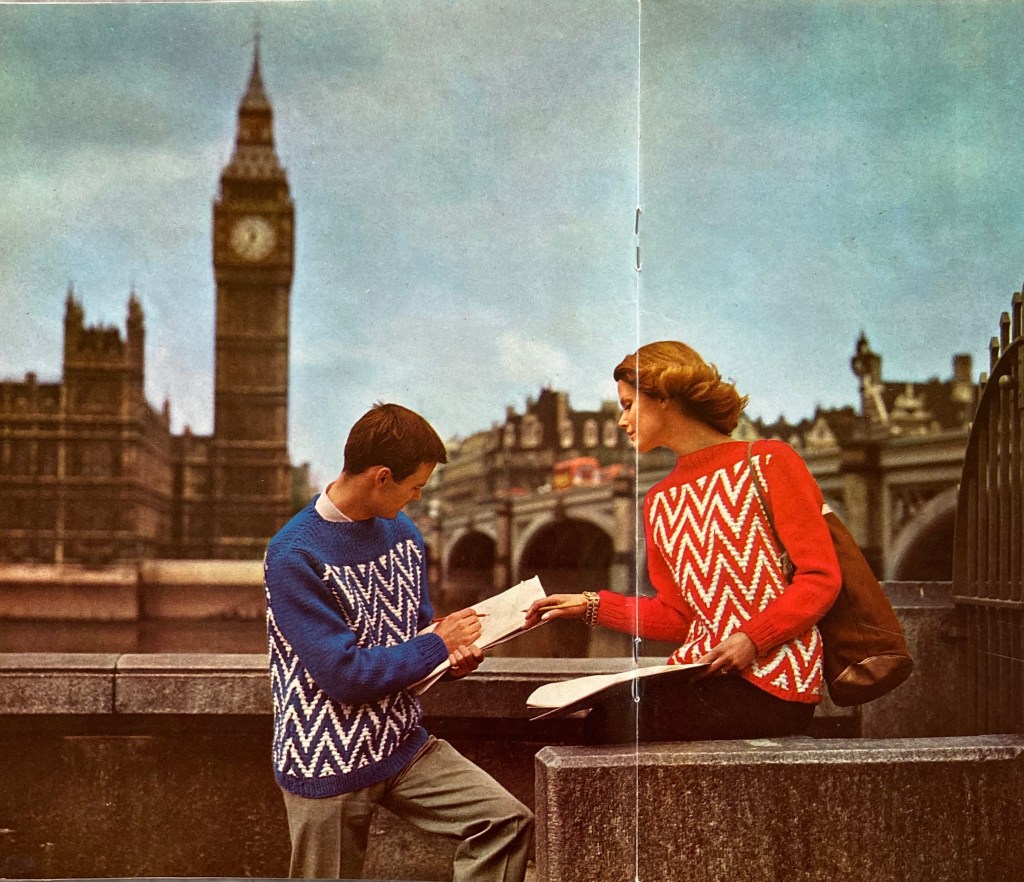
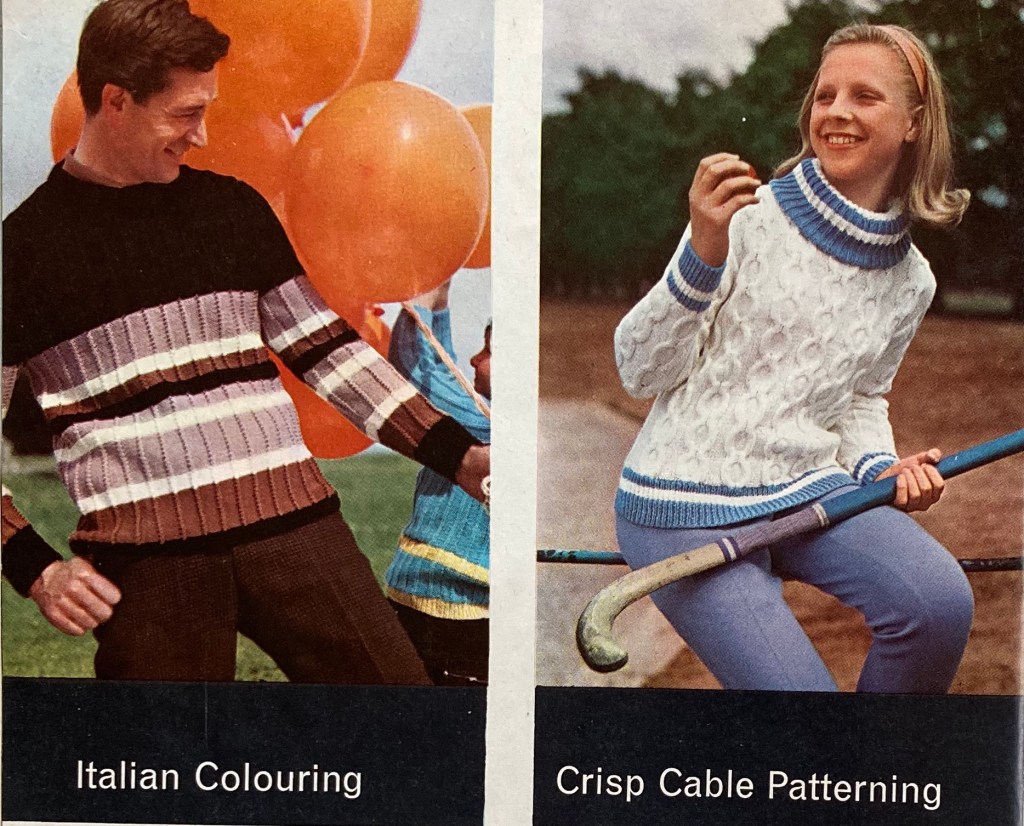
Men’s fashions are just as colourful as the women’s, or even more so (less use of plain brown…) and show more of the zig-zag trend. Here are some bold designs for “him and her” using bulky Big Ben wool (and photographed in front of…). The construction is the same for both, with the smaller design for bust sizes 33-35 inches and the larger for 39-41 inches, with the advice that “Plumper girls could follow his size”. The man’s pullover in “Italian colouring” uses stripes and textures, toned down by the use of more neutral colours. The blue-and-white cabled sweater in the photo next to it is for teenagers.
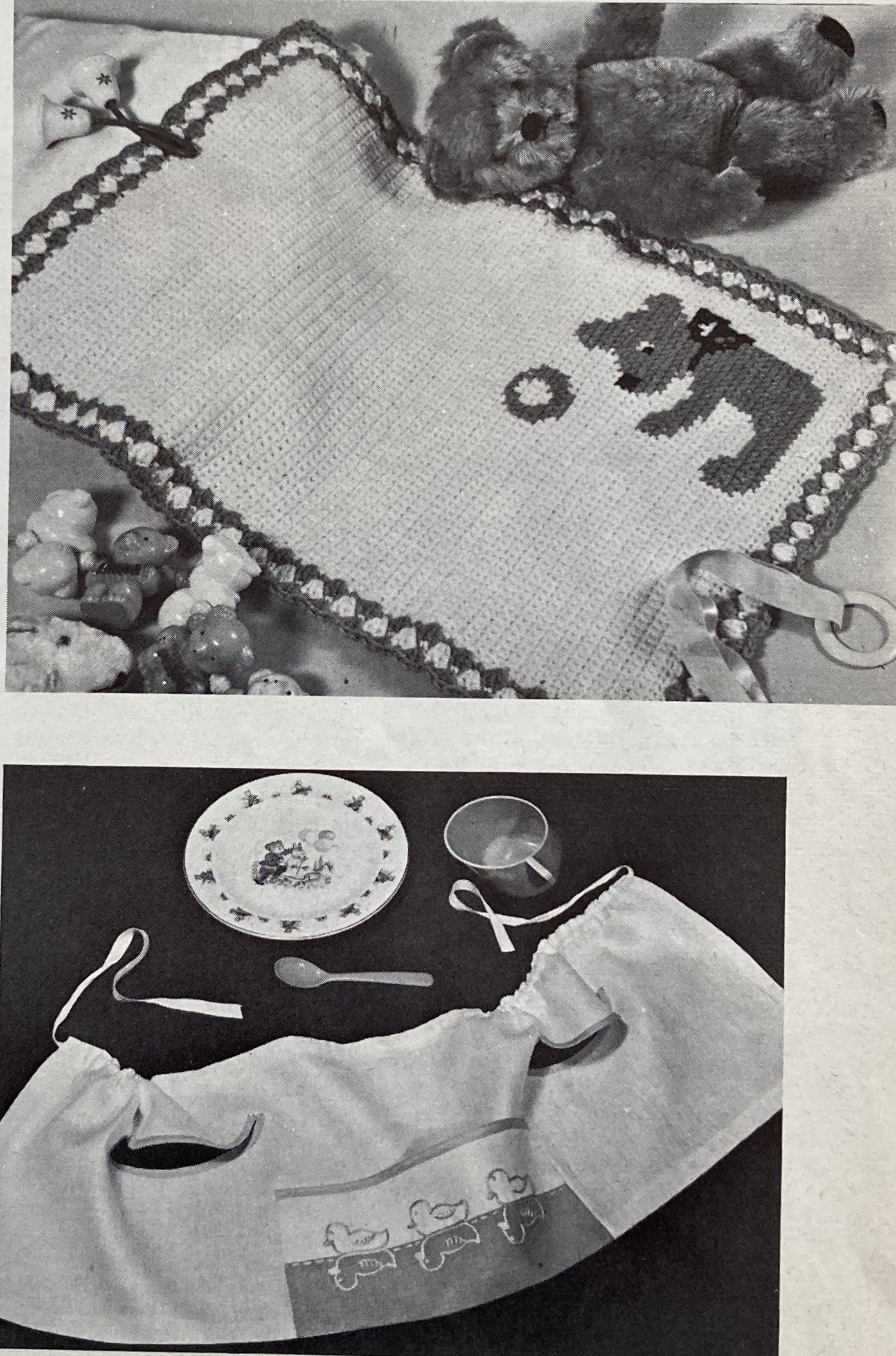
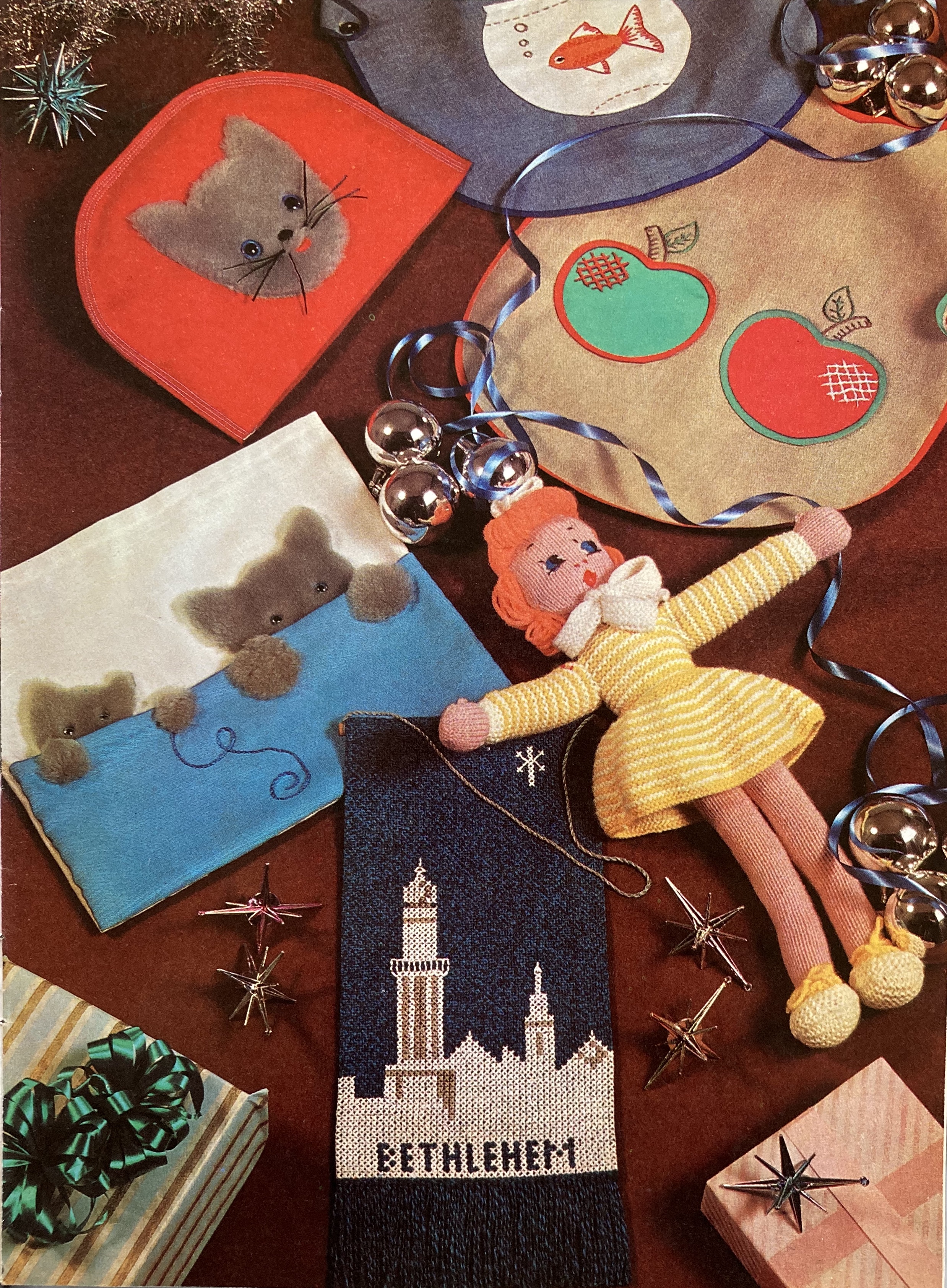
School-age children get their own “tough, tomboy sweaters” in Bracken Tweed wool. The suggested colours are “Black Olive” or “Gorse Heath”, which I assume is a sort of green-yellow tweed (no colour photo). Babies get a lovely shawl to match the layette from the September and October issues. It’s easy to knit, as the centre and borders are made separately. The other baby/nursery-age items are crocheted, sewn or stitched: a pram cover with a teddy-bear motif, a little nightcase with fluffy appliquéd kittens, a knitted doll, an embroidered “feeder”, sewn and appliquéd pinafore smocks…
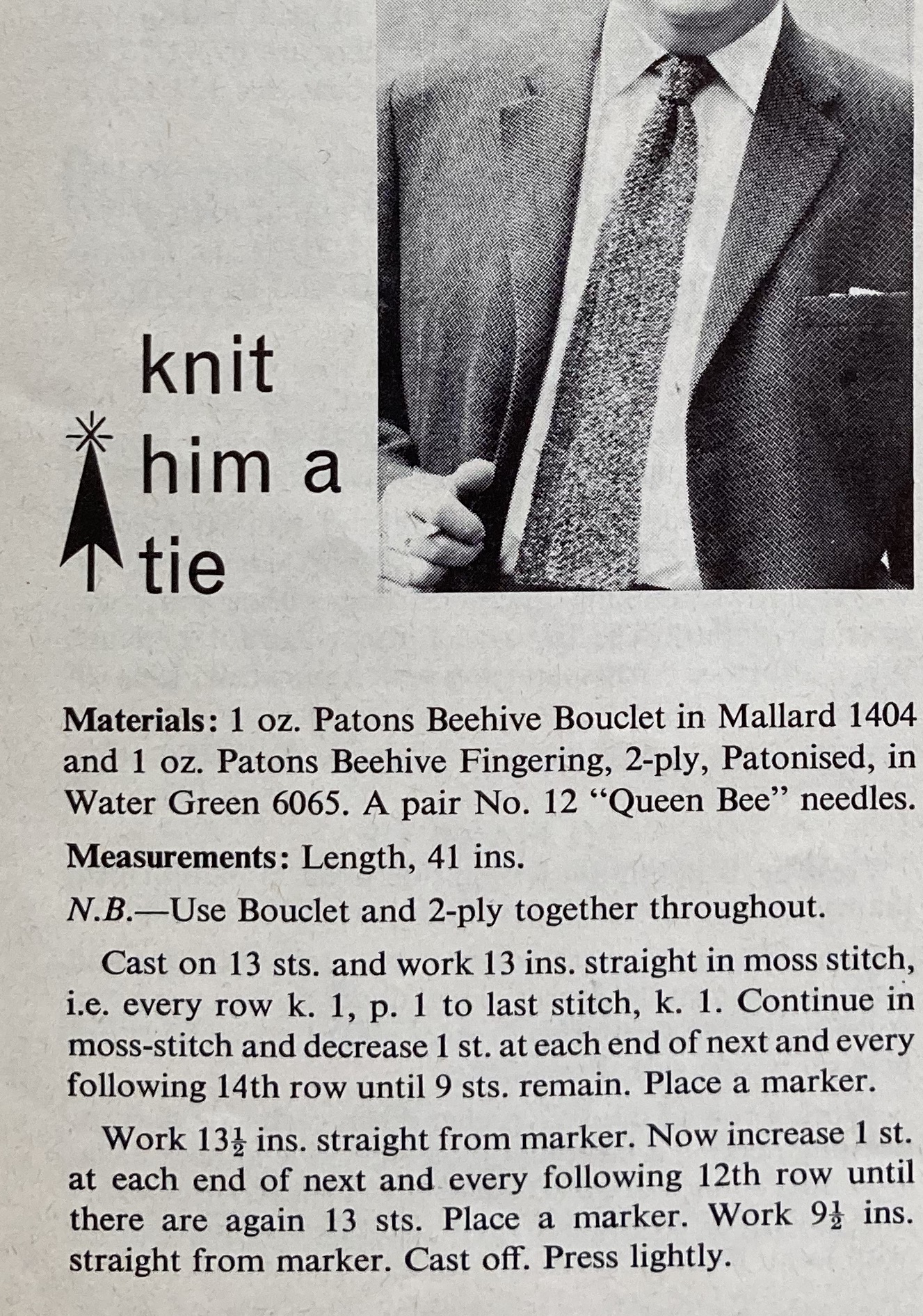
There are fewer designs for accessories, but the utter fabulousness of this loop-stitch crocheted hat makes up for anything else that could be missing. The model in the photo features in many issues from this time period and always looks either quite sad or has that alluring Mona Lisa smile that’s she’s sporting here. (Am I mean, or wrong, to assume that she probably had bad teeth?) I would smile widely if wearing that hat, and I hope everyone who saw me in it would too. Also, knit your man a tie!
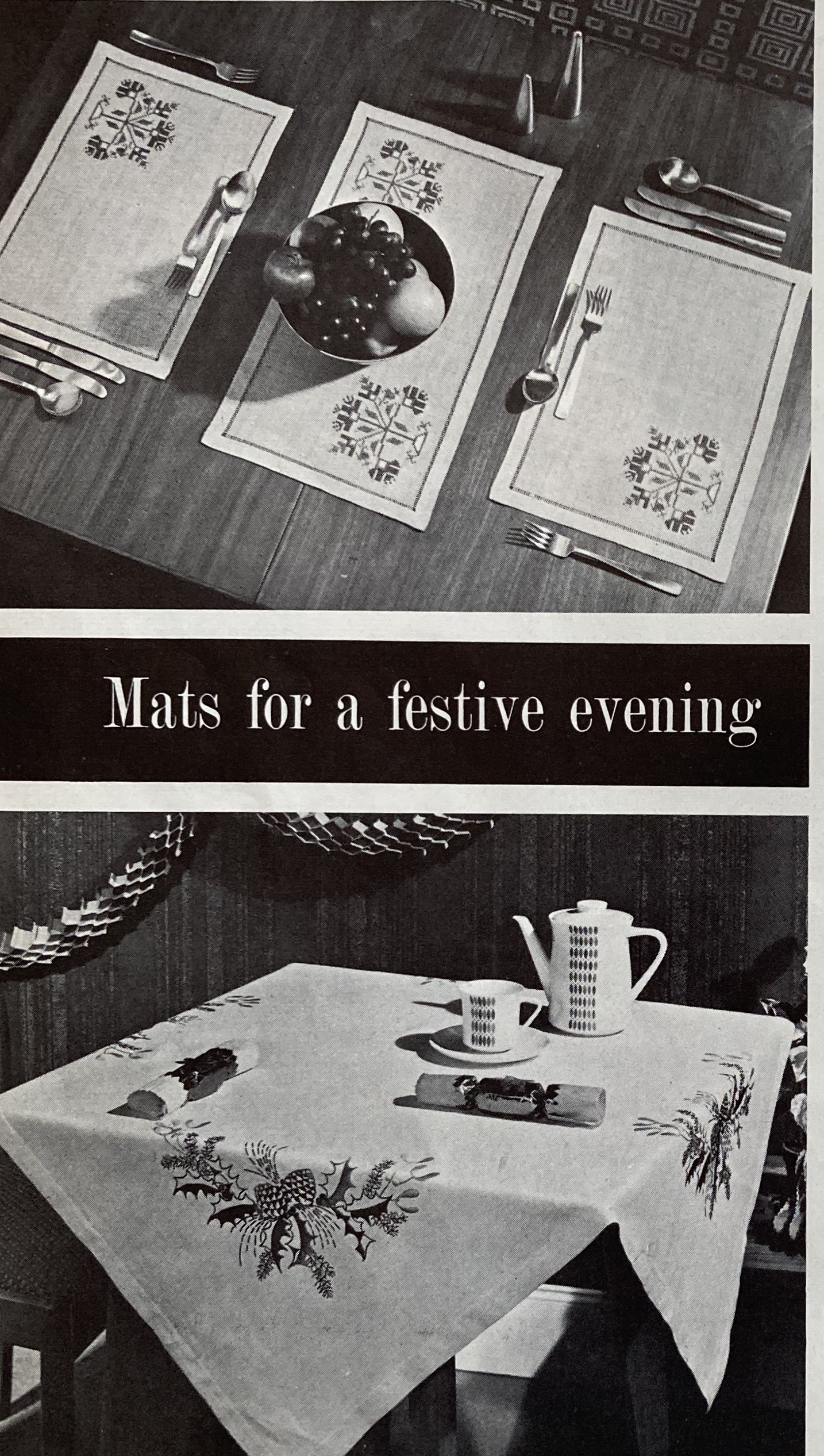
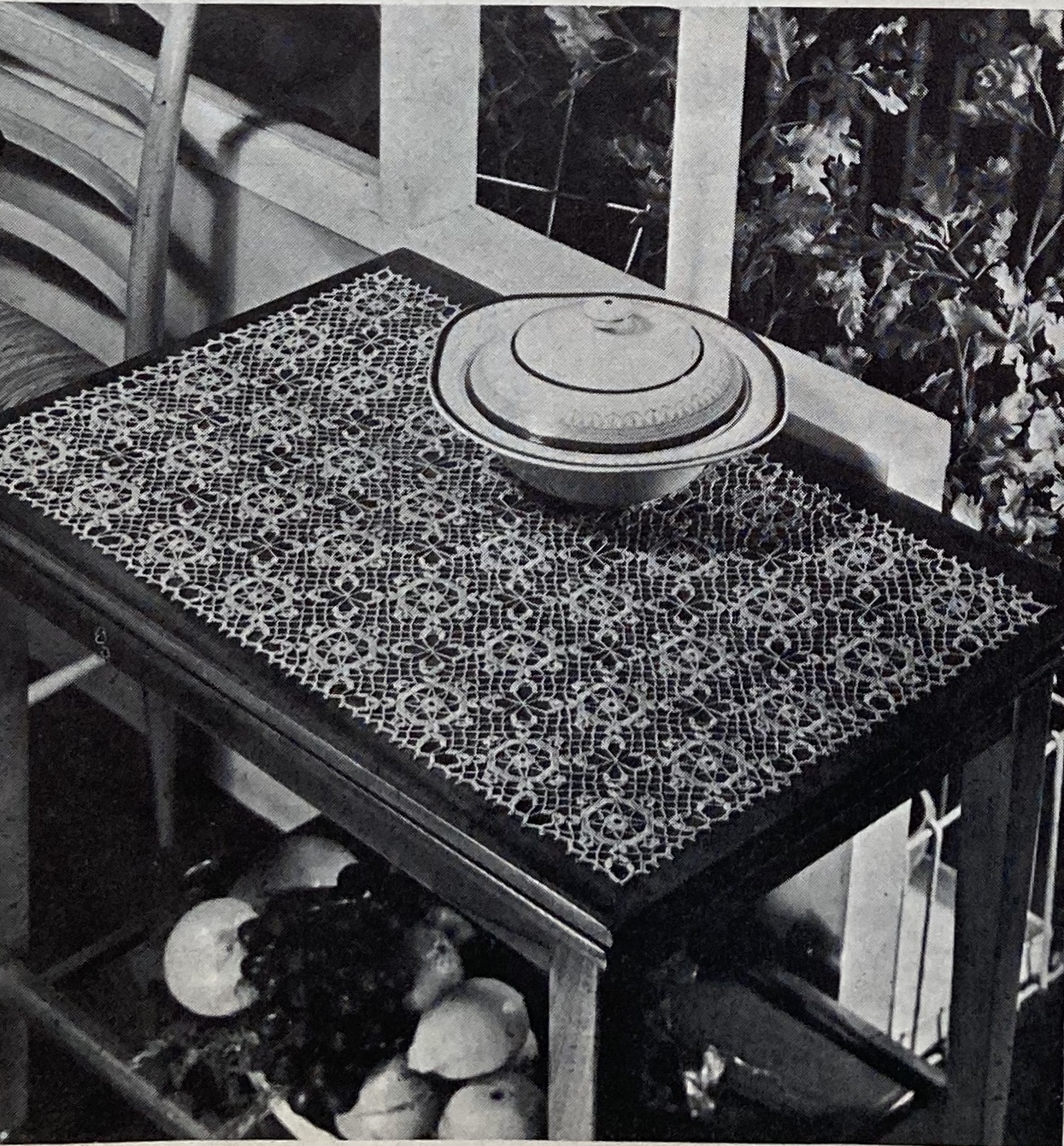
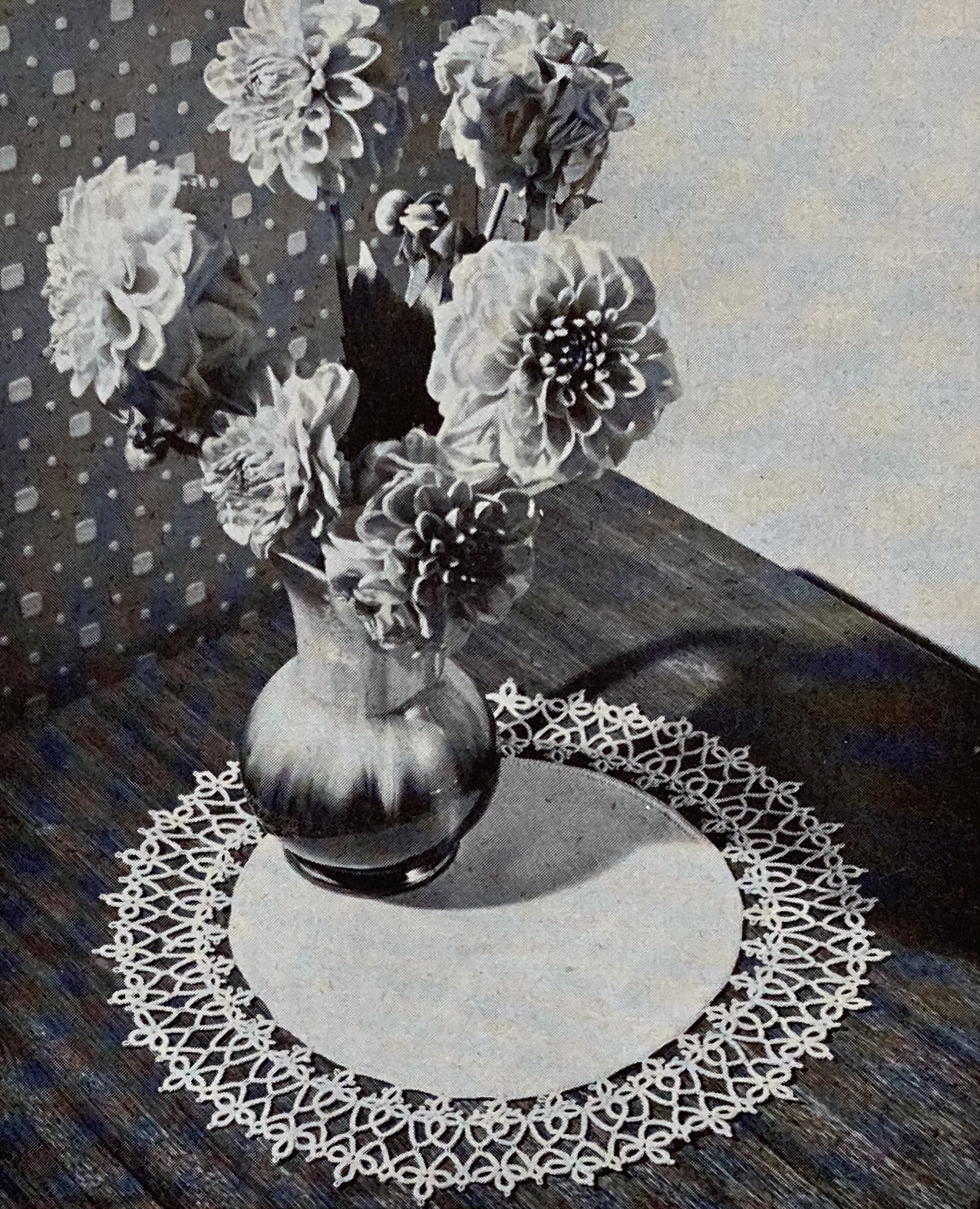
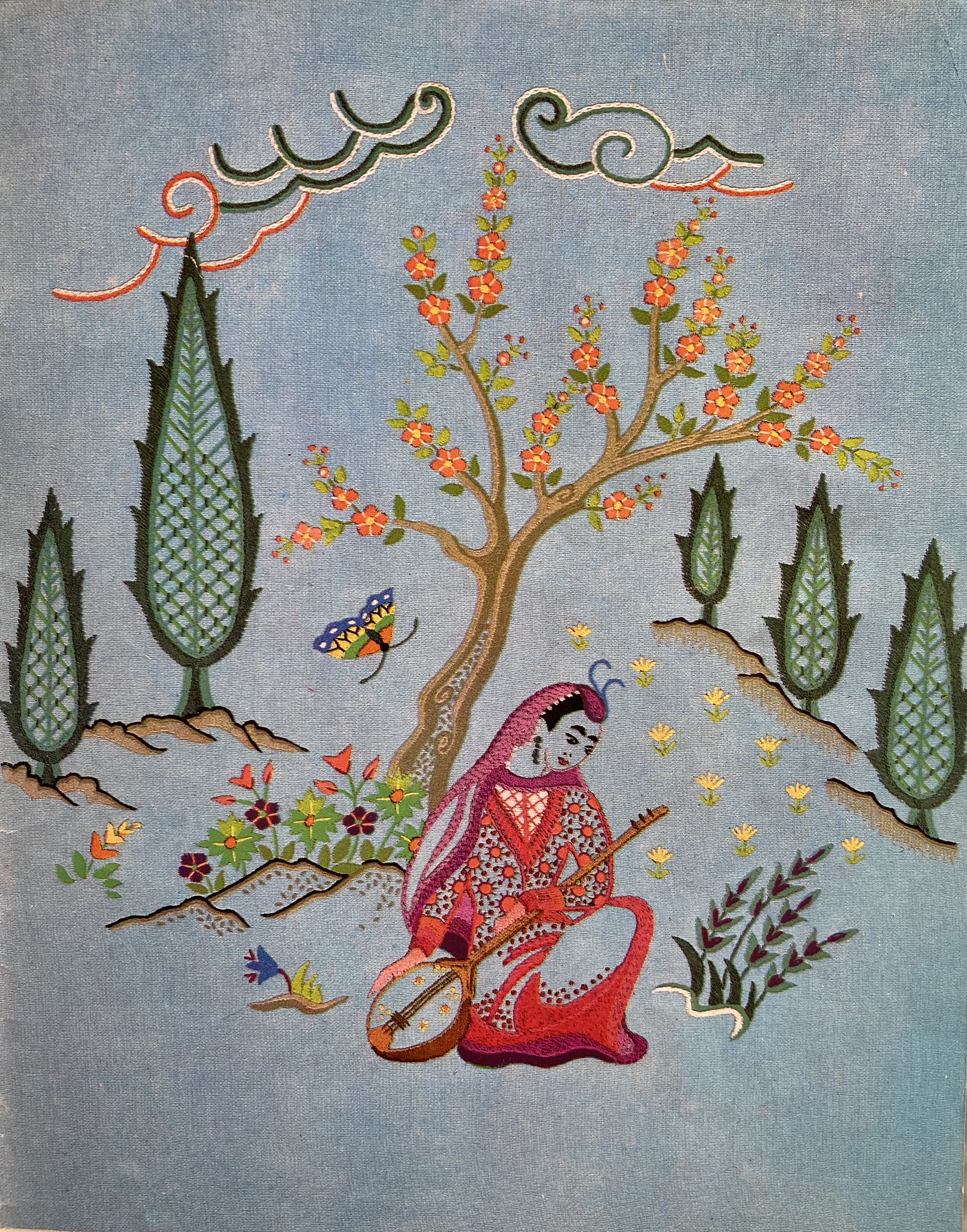
With all this bounty, the homewares are mostly standard: embroidered table mats and a Christmas-design tablecloth, a decorative panel with the Star of Bethlehem for more religiously-minded households, and a very impressive tatted doily and crocheted trolley-mat. The show-stopper is a lovely decorative panel “taken from a book of Oriental designs” embroidered in Filoselle silk on linen. (The design is allegedly of Persian origin, though of course neither Stitchcraft nor its typical readers of the time gave much thought to questions of authenticity, nomenclature, exoticism or any related issues that we would regard and discuss today.) It is a pretty picture in any case, and was probably not too difficult to embroider, consisting mostly of standard seed and straight stitches, French knots, and so on.
That’s all for this issue! I am going to make that wonderfully ridiculous hat.
Happy New Year, everyone! It’s 2021 in the real world and 1963 in the Stitchcraft Sixties blog world. The real-life 1963 was a turbulent year: the Cold War escalated, as did the war in Vietnam; the civil rights movement in the US both gained ground and suffered violent setbacks; John F. Kennedy was assassinated; the Second Vatican council entered a new phase. In England, scandals abounded in the wake of the Profumo affair and the divorce of the Duke and Duchess of Argyll. On a happier note, the Beatles recorded their first album, Please Please Me, kicking off Beatlemania around the world, and women in Iran gained the right to vote. Also, the smiley-face symbol was invented. 🙂
Of course, none of this — not even the Beatles or the smiley face — had any direct influence on Stitchcraft (certainly not in the January issue, before any of it happened…). What we think of as “1960s fashion” — the miniskirt, the “space age” look, the shift dress, the Mod look, the hippie-bohemian styles of the later years of the decade — was just gearing up around 1963, and Stitchcraft was a fashion-conservative magazine. That said, holdover fashions from the 1950s like fitted, waist-length cardigans and wide, swingy skirts have disappeared completely by now; the female models often wear trousers or “slacks” and casual, bulky-knit sweaters are ubiquitous.
So what does January 1963 have in store for us? The theme of the January 1963 issue is “Paris Casuals” and resolves to start with “a bumper all-round family number.” For adults, that means warm, comfortable jumpers and cardigans in a range of wool weights with V-necks or interesting collars and textured stitch patterns. The cover garment epitomises all the trends: made in bulky Big Ben wool in a two-colour slip stitch pattern, it sports “this season’s Paris collar choice and longer line.” The textured raglan cardigan is a similar look, as is the man’s casual cardigan on the back cover. The bouclet cardigan gives a nod to earlier fashions with its choice of fine wool and classic shape, but here too it is longer and looser-fitting than previous classic bouclet garments. A simple collared jumper in double knitting with attractive fine details rounds out the adult garment selection.
There are great winter fashions for children, first and foremost the girl’s skating set of skirt and collared pullover. Unfortunately, I suspect something went wrong with the sample knit, as both pictures show the model turned 3/4 away from the camera and it’s not clear how it is supposed to look from the front. (Also, could someone please give her some warm tights to wear before she goes out onto the ice.) Toddlers get a cute “buster suit” with a design of cherries on the jumper, and older children get a wonderful hoodie (to use the modern term) and jumper-cap set to wear while playing in the snow. (Or in the photo studio — check out the snowman and snowball made of wool and/or cushion stuffing fluff!). Crisp, wintery colours of blue and red with white are trending. Notice also that the girl model is wearing trousers, the hooded sweater is unisex, and the model wearing the red outfit in the black and white photo is allowed to be active and tomboyish for once. I wouldn’t even have known she was a girl if the sweater weren’t (for whatever reason) considered specifically a girls’ garment. Slowly, very slowly, roles are changing.
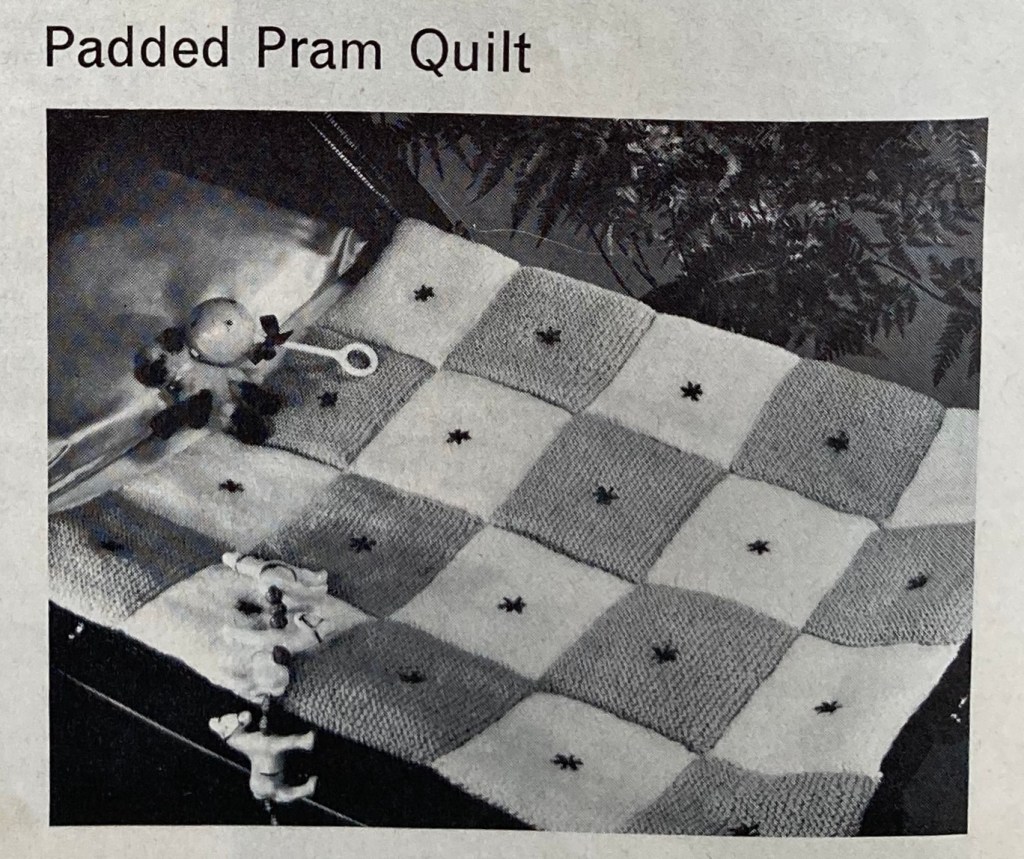
Babies get a pram cover instead of a garment this time — padded and quilted to be extra warm — and there’s a cute bedjacket and fantastic “tower” hat that is perfectly in fashion. (Side note: The caption, “PARIS HAT”, makes me think of that line “If a Harris pat means a Paris hat, Bébé… ooh la la!” in “Always True To You In My Fashion” from the musical Kiss Me, Kate. In true Cole Porter style, it’s an upbeat love song… in which the singer explains to her boyfriend that her dalliances with other men for gifts and money — basically sex work, though of course not explicitly described in those terms — shouldn’t count as infidelity, since she’s only doing it for the financial benefits and is true to him in her heart. Ah, romance! Anyway, the hat is great.)
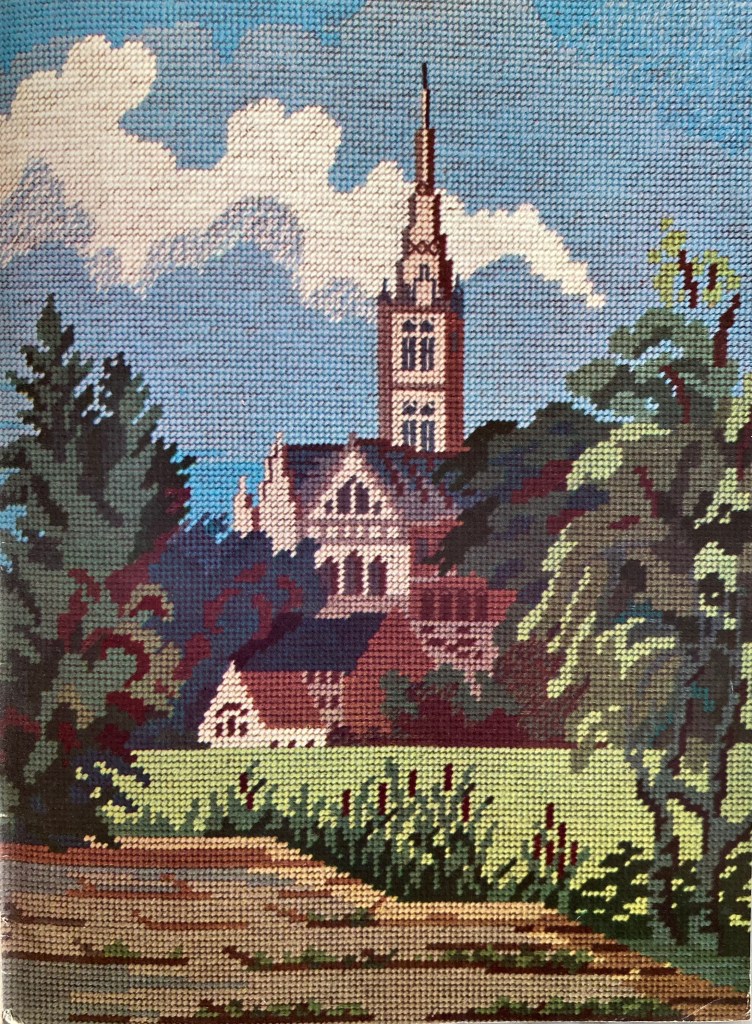
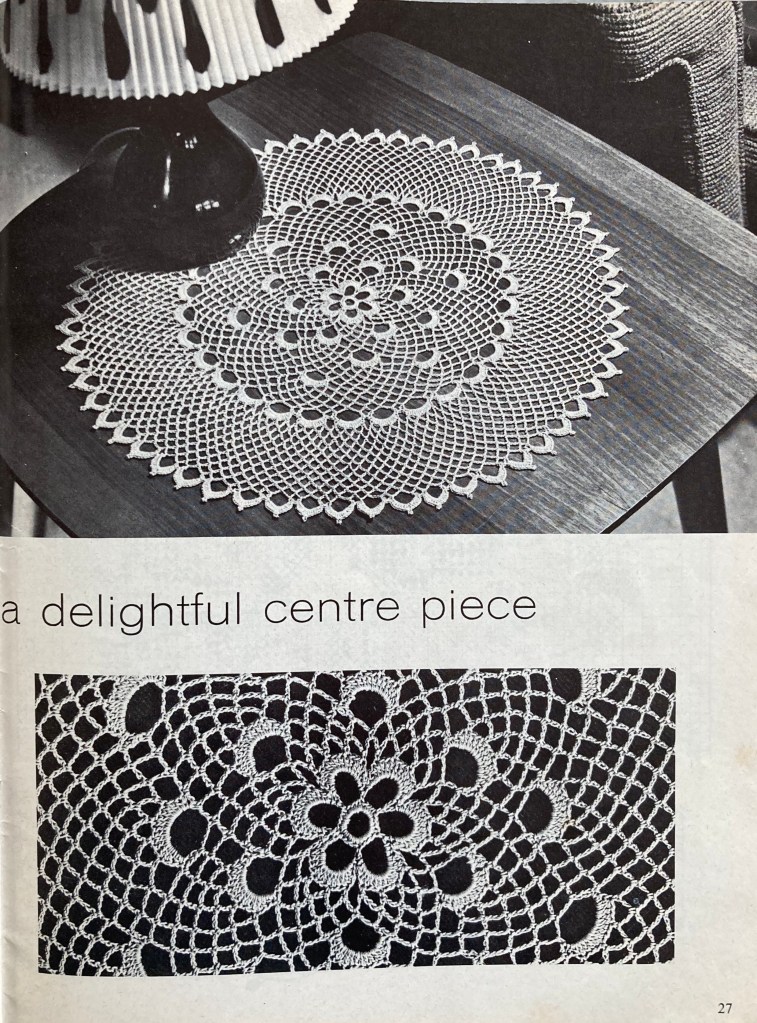
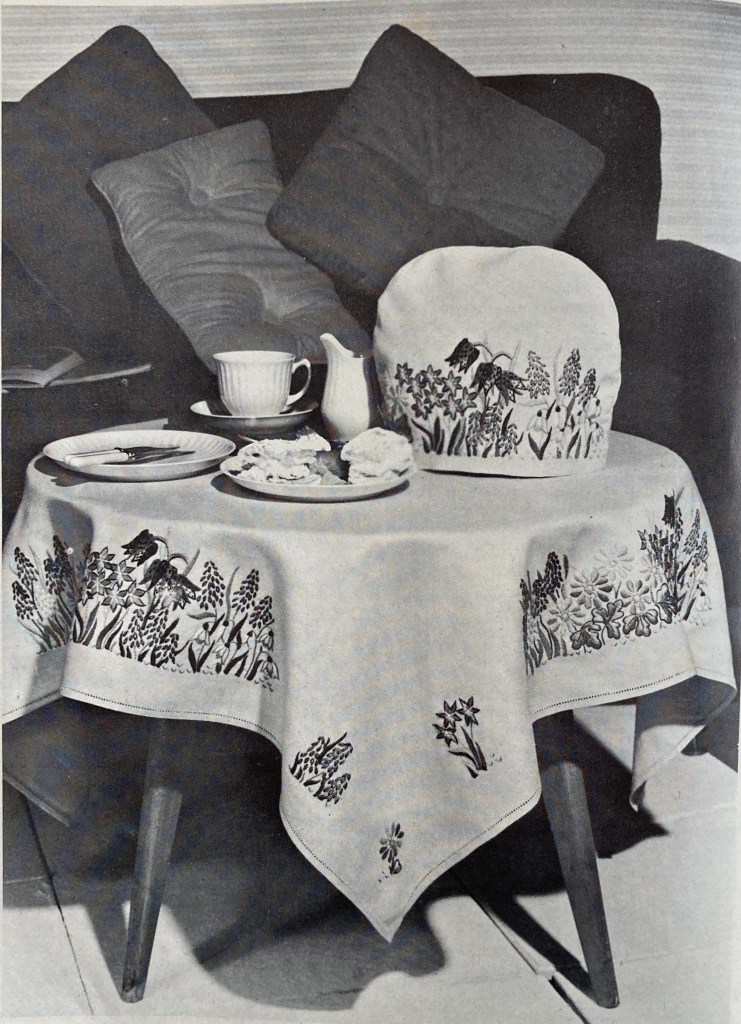
With all the great knitted items, home fashions are pretty standard this month. There are rugs and cushions, a lovely embroidered tablecloth and tea-cosy set, a tapestry picture, a cutwork table set, a very impressive crocheted doily and a hassock or kneeling cushion for church-goers.
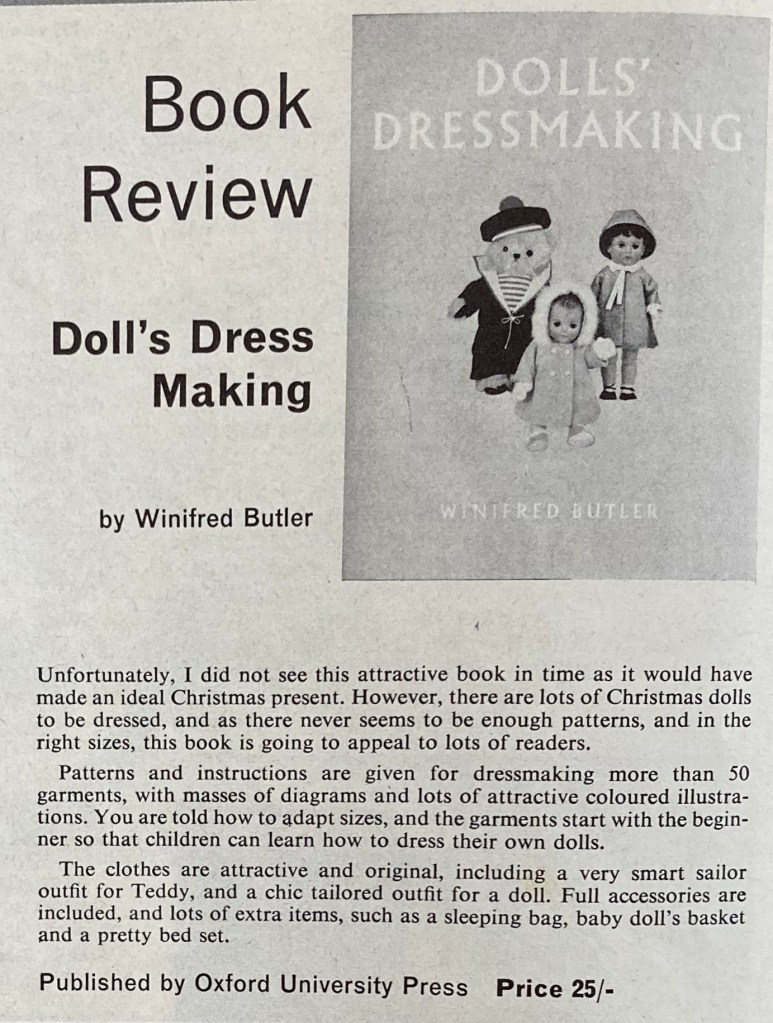
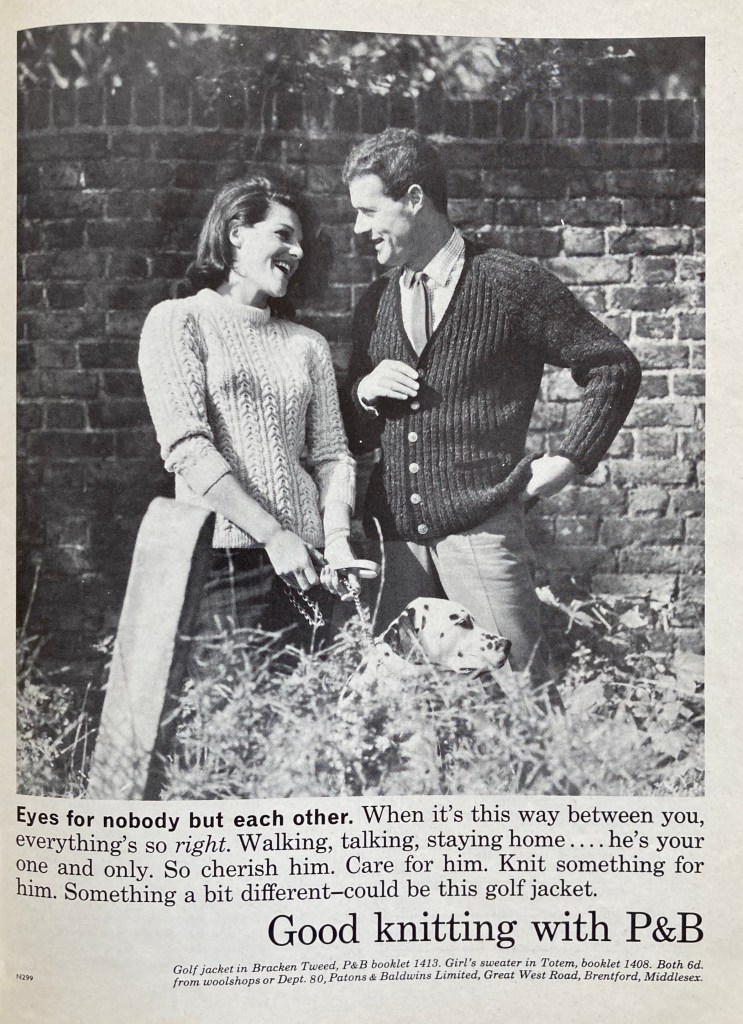
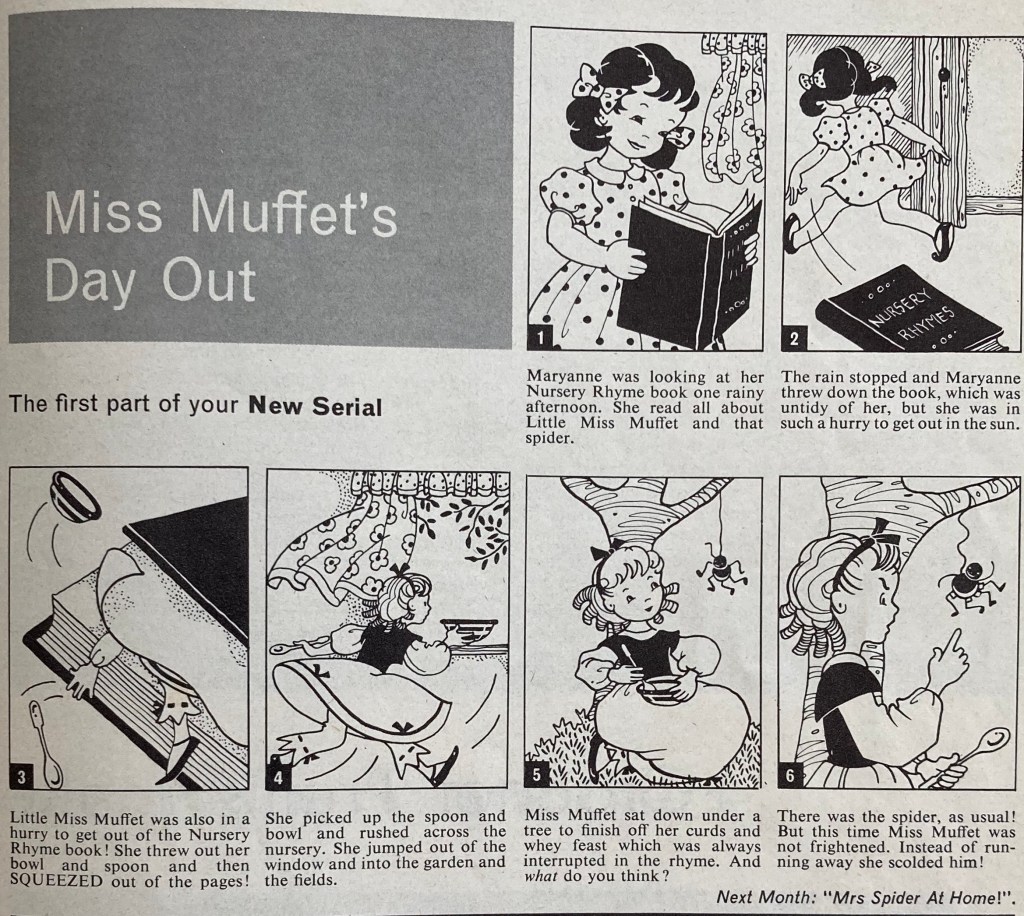
The “readers’ pages” have a review of what was probably a very interesting book on dressmaking for dolls, and –bucking the “single girl” trend of the early 1960s — we’ve got another “stand by your man and knit him something” ad for P&B wools (though this one is really quite sweet and romantic, unlike the “you only exist to be pretty for him” ad seen in other issues). There’s also a new cartoon serial for children: a re-telling of the “Little Miss Muffet” nursery rhyme, where Miss Muffet is not at all afraid of the spider. I’m sure, when she grows up, she will be not at all afraid to suggest to her man that he knit something for her for once.
My project from this issue will probably be a scaled-down version of one of the children’s sweaters for a smaller child. Stay tuned!
Around Christmas time, I was looking through my Stitchcraft collection to see what the new year had in store for me, and realised that the February 1961 issue was missing! Not that I had lost it, but it was one of the very few issues from the 1960s that I had not managed to find before starting this project. I buy the magazines on ebay and it is fascinating to see how some issues pop up again and again in multiple auctions, and others just never appear. But I was in luck – after searching so many times, there was February 1961, just when I needed it! Thank you, nice seller on ebay, who got this issue to me quickly and in beautiful condition.
There’s a “Special Colour Feature” of extra colour-print pages in the middle of the issue, promising “Fashion Harmony” for “You and the Home.” With that in mind, it’s kind of a pity that they chose a neutral gray-beige melange for the three-piece outfit on the cover.
Thicker, bulky wools and quicker knits continue to dominate the knitting patterns, with Big Ben playing a prominent role. There’s a little waist-length jacket in an interesting pull-up-a-slipped-stitch-some-rows-later stitch pattern, a bulky cardigan or DK- weight pullover in diamond or rib pattern, and a his-n-hers Aran pullover set. Neutral colours of brown, beige and tweedy gray prevail.
The his-n-hers, unisex design idea shows up in the children’s patterns as well (how nice, for once!) with some warm, lightly colour-patterned pullovers. It’s nice to see a girl wearing trousers and doing something active in her sweater.
(Side note: As I was typing that sentence and got to “it’s nice to see a girl wearing”, the auto-suggest on my tablet offered me “makeup.” So yes, as nice as it is to see one single non-sexist knitting pattern in 1961, don’t be fooled — things haven’t changed nearly as much as they should. Also, spoiler: the rest of Stitchcraft has plenty of “boys need to be active! girls like to be pretty!” patterns and photo layouts in store for us.)
On that note, there are patterns for a complete set of doll clothes, as well, in case readers worried that their girl child playing with a ball once in her life might, I don’t know, make her grow up to direct a bank someday, or something.
But back to this month’s issue! Babies get a fluffly cardigan with the same twisted ribbing as January’s snowflake sweater as well as a lovely lace shawl. Fine-knitting fans can make an elegant, classic jumper at 8 1/2 stitches to the inch or a lace-panel blouse for larger sizes up to a 45 inch bust.
Embroidery experts can make a floral fireplace panel or a tablecloth with a “peasant” motif (not the most flattering wording, I know), a rug or a crocheted handbag. The Zodiac handcraft theme has entered the month, if not the Age, or Aquarius. Also, the turret tower look is still all the rage for hats.
And that about wraps it up! Seeing as there was so little actual colour in the designs from the special colour feature, here’s the back cover advertisement for Escorto Gold Seal striped and checked fabrics. My project will be the baby cardigan. Have a colourful February!
Happy New Year 2019! Or 1961, if you prefer. January 1961’s issue “starts with a swing” with “lots of colour” and “tip-top designs” like the gorgeous Greenlandic-style sweater on the cover.
Looking through the issue, I feel like this is the point in time where the 1960s started, fashion-wise. The closely-fitted, fine-knit, waist-length jumpers of the 1950s have made way for bulky, quick-to-knit garments, and nylon-mix wools like Rimple are more common. Skirts are still long and hairstyles modest — we’re not in the “Swinging Sixties” yet — but colours are bolder and the whole look seems fresher, somehow.
The little girl’s outfit on the inside cover definitely embodies the new look. Yes, her legs are still going to freeze, poor child, but her little red Rimple outfit is swingy and fun. And look at that wonderful cap and muff! The decorations are made by cutting the bobbles out of a length of bobble fringe and sewing them onto a crochet chain made in contrasting green or red wool, then sewing the bobble chain onto the cap and muff. Mum and daughter can both sport the latest in “Paris Hat News”, which seems to be a sort of turret tower worn on top of your head. The loops on the bottom part of the adult hat are made by pulling loops through the knitting ridges with a bodkin or blunt tapestry needle and holding them in place with your thumb until they are all made and the wool fastened off.
Women’s and men’s fashions feature loose-fitting garments in bulky wools, either hip-length and unshaped like the Greenlandic sweater or the embroidered Viennese cardigan on the inside back cover, or “cropped and bulky” like the “slick jacket” made in thick Big Ben wool. For a more elegant look, you can knit a suit in double knitting weight and top it with a detachable fur collar.
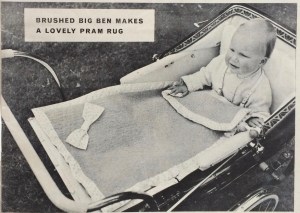
In addition to the little girl’s sets, babies and children can enjoy a warm cape or dressing gown in Rimple yarn, or a pram blanket in brushed, bulky Big Ben wool. The brushing felts the wool for a true blanket effect. It was done with a teasel, which is a metal brush that breaks up the fibres and lifts the nap of the fabric. Readers are instructed to send the finished blanket to Patons and Baldwins in Scotland, who will brush the blanket for you “at a very reasonable charge.”
Jacobean embroidery, stitched hall rugs, and Victorian-style chair seat tapestry remain steadily in fashion, or you can embroider pictures of a kitten and puppy to hang on your wall. I don’t know about you, but to me they look kind of melancholic! This month’s Zodiac sign is Capricorn, and you can use it to decorate a pyjama case. In the children’s features, Wag and Wendy have tea with a toadstool fairy and kids can sew a simple tea-cosy set for their mother’s birthday.
My project will be the fabulous sweater from the front cover. I’ll be modifying the fit, though, as big and bulky is not my style. Thanks for joining me for the first year of this blog, and best wishes for 1961 — er, 2019!
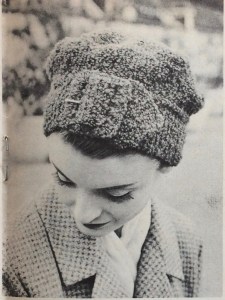
November’s project was a little cloche hat, made out of leftover wool from July’s Charming blouse. I loved the little buckled brim and the sort of mushroom shape, though I found that the hat looks better if I pull it down over my forehead like a 1920s cloche hat. Either the picture in the magazine, taken from an angle over the model’s head, doesn’t really give a true impression, or our heads are differently shaped, or both.
Speaking of differently shaped, the hat is meant for an “average hat size”. That’s… not very specific. I do have a bigger head than average for modern days, but the wool (Juniper Moon Farms’ Herriot Fine) is mostly alpaca, so stretchier than the synthetic Rimple that the pattern is written for. To be safe, I made the buckle strip for the brim a little longer, but in the end that wouldn’t have been necessary. The buckle brim band (good name for a band!) is made in garter stitch, which is really not the most suitable for hat brims, as it stretches too much and doesn’t hold the hat on your head. Though of course, if you pull a hat down over your forehead, it’s not going to go anywhere.
Not that I need any more hats, but it’s cute and warm, so I’m happy.
February’s project was pretty simple: a crocheted cap and “mitts” with a cute bobble pattern. I couldn’t decide on the colour (lavender or purple) and didn’t have quite enough of either to make both cap and mitts, so I ended up making the cap twice and using up leftovers of both colours plus a little extra of a different purple yarn to finish the mittens.
Apropos “mitts” and “mittens”… Stitchcraft calls them mitts, though I guess these days most people would call them mittens. What we now call mitts, i.e. fingerless gloves, were not in fashion in the mid-20th century.
The cap is made in the round from the top down with double crochet and bobbles, then stranded with fringe around the crown, which in turn is held down by a plait (braid). The crocheting was easy even for a non-crocheter like me, but the fringe was really difficult to hold in place with the proper tension.
The mitt(ens) have a really interesting construction — back and palm done separately from the middle out. You make a chain and work on both sides of it, back and forth and back and forth until it is wide enough. The thumb is a sort of loop of chain stitch added on and worked in double crochet with the rest of the palm, then sewn up.
I used contrasting dark purple wool for the wrist and the making-up (the lavender was used up) and crocheted palm and back together on the right side for a decorative effect.
Here are the finished caps — both slightly different, both fairly imperfect, but I think the intended wearer will like them. Modeled photo to come when she receives them!


















 Happy New Year 2019! Or 1961, if you prefer. January 1961’s issue “starts with a swing” with “lots of colour” and “tip-top designs” like the gorgeous Greenlandic-style sweater on the cover.




 November’s project was a little cloche hat, made out of leftover wool from July’s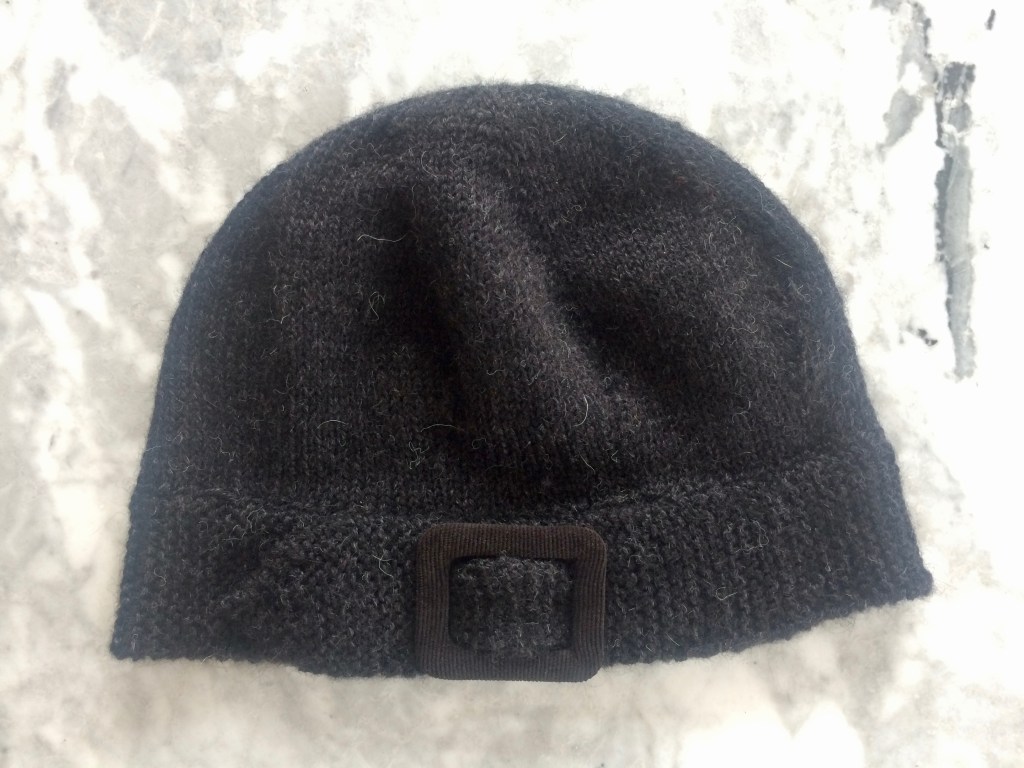
 February’s project was pretty simple: a crocheted cap and “mitts” with a cute bobble pattern. I couldn’t decide on the colour (lavender or purple) and didn’t have quite enough of either to make both cap and mitts, so I ended up making the cap twice and using up leftovers of both colours plus a little extra of a different purple yarn to finish the mittens.


 The Stitchcraft Sixties