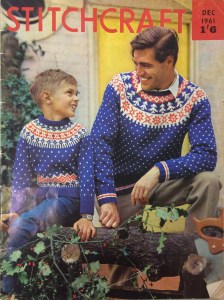
 It’s that time of year again and December 1961’s issue has a lovely festive cover photo featuring matching father-son jumpers and a freshly-cut-down Christmas tree with holly branches. The jumpers are meant to be made in flat pieces with only the yoke worked in the round, but everything about them other than that is in the traditional Norwegian style, with a small snowflake pattern on the body and sleeves and a round yoke with tree and star patterns. I like that the jumpers’ pattern theme and colour choice are not so very specifically Christmas-y that they couldn’t be worn at any other time, or by people in our more diverse and modern times who don’t celebrate or don’t care much for Christmas and would just like a nice warm jumper with a wintery flair.
1961 Stitchcraft, of course, celebrates Christmas in a big way. Most of the projects are either glamorous party-wear for the ladies or gifts of all sizes and sorts for family and friends, while the fashionable housewife can do her Christmas shopping in a flecked-tweed cardigan suit similar to the ones in the November 1961 issue, or keep warm on casual days with bulkier sweaters. Tweed and contrasting polo-neck collars are in fashion all around.


For those fancy parties and evenings out, there’s a cocktail jumper in popcorn stitch, an angora stole, and an embroidered and sequinned evening bag. The jumper is knitted with wool and Lurex yarn held together, giving it a bit of sparkle. The stole is absolutely timeless and modern as well as easy to make (a rectangle in simple lace pattern with garter-stitch borders) and probably quite warm and cosy to wear over your strapless evening gown at the theatre. The bag is fancy, yet inexpensive to make, with a very 1960s “modern” look. Even after the party and the night out are over, you can still look glamorous in a knitted pink bedcape.


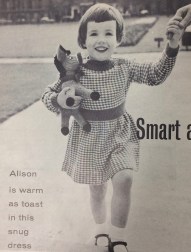 Children of all ages can look forward to practical, yet stylish winter garments — a knitted outdoor play-suit for toddlers in warm, bulky Big Ben, a smart fine-knit twin-set for girls of varying ages (sizes from 26-30 inch chest) and a wonderful knitted dress in a two-colour slip-stitch pattern that fits right into the tweed trend. The photo caption claims that Alison (the young model) is “warm as toast” but of course, her legs are going to be cold! She still seems pretty happy, though.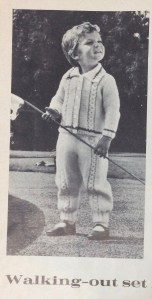
For me, the best, and sometimes goofiest, projects of every December Stitchcraft issue are the homewares and “novelty gifts”. This year, some are quite normal, like the snowflake-pattern table mats “for a supper party” pictured above, a cutwork tablecloth, or the tapestry stool cover in a diagonal Florentine pattern. Some are specifically winter- or Christmas-themed, such as the knitted cushion and a framed tapestry picture of angels. Two are very classic and beautiful and have nothing to do with “the season” — a typical Jacobean chairback and a very pretty tray cloth embroidered with anemones. They are all quite nice, if not particularly special.


And then there are the novelty gift ideas, or, as they are titled here, “gay mascots.”
The knitted teddy bear is nice enough, but looks quite stern with its unsmiling mouth and sharp, downward-pointing eyebrows. The snowman egg cosy… well, if you really feel the need to use an egg cosy, fine, it looks cheerful enough. Ivy-leaf pincushion, OK. The bear cub, though, looks like it’s about to attack! Something about its half-smile and the glint in its eye makes it look malicious. And the Father Christmas egg cosy… it’s hard for me to express exactly what’s wrong with it, but if I woke up on Christmas morning and found him on my breakfast place, I would expect to be getting coal in my stocking. Give me a gay mascot any day, but maybe not exactly these ones?!?

I guess it shows just how difficult it is to embroider faces.
Our “Readers’ Pages” have the usual ads for fabric remnants and sewing machines as well as an extra pattern for a little knitted and embroidered scarf, some traditional Swedish pattern motifs and review of the exhibition of Swedish embroidery recently held at the Embroiderers’ Guild, and a comic in which Little Bobby gets a skiing lesson from a friendly snowman.
Merry Christmas to all of you who celebrate it and happy winter days to all! My December project will be to finish some of the many WIPs lying around (including the November blazer, I swear it is almost done) and use the evening-bag embroidery motifs on something fun and small like dinner napkins or a vegetable bag.
 “Knitting with an Autumn Theme” is the motto of this month’s Stitchcraft from September, 1961. Knowing that September is the month where many knitters take up their needles again after not wanting to handle wool in the hot summer, I would have expected a “bumper issue” with extra ideas, new fashions from Paris, more colour photographs and so on. Not the case! It has more or less the same mix of “chunky”, bulky garments and easy homewares that we saw in the summer issues.
 probably will never be my style). The kid’s coat looks cosy and fun to wear, and the “gay sweaters for him and her” in a Norwegian-style pattern are warm, practical and unisex. I imagine the boatneck collar on an unshaped front must scratch horribly across the neck, though.


 The motto of the July 1961 issue is “Sew through the Summer” and indeed, there are a lot more sewing projects than one would normally find in Stitchcraft, summer being a time when many people do not want to hold wool in their hands or think about colder weather to come. There’s more emphasis on homewares and small, fun projects to make and use on holiday. The farm photos were taken in Hertfordshire and the boating photos in “the heart of London’s Little Venice”. Doesn’t that sound like fun? Let’s dive in!
 a really pretty basketweave blouse with that V-neck-plus-collar design that we saw so much of in 1960 and the last years of the 1950s, not to mention just last month on the cover of the


 Are you ready to “Rendez-vous with Spring”? I sure am! This month’s issue has a lovely extra “centerfold” spread in colour, showing off Spring 1961’s latest fashions.


 The ads are for the usual knitting machines and sewing fabrics… except for this one, for “Cooper’s moth proofer” spray, presumably made of
  Brrrr! November 1960’s Special Bumper Issue” brings us “Colour for the Cold Days” and an extra 16-page pull-out booklet of baby woollies. Sadly, so sadly, the booklet from my copy of this issue has been pulled out long ago and is missing.


 Homewares are still in a weird phase. The working woman or baby-boom mum (and those were overlapping categories, then as now) of 1960 didn’t have the time or patience to make too many elaborate Jacobean embroidery pieces or huge, detailed tapestries, especially not right before the great rush to get Christmas presents under the tree, so the focus is on quick, easy-to-make novelties for gifts. The aesthetic sense does seem to get lost a bit, though, if you ask me.


 (I notice that Word Press does not recognise the word “chairback”. They have been out of fashion for too many years, I guess, having fallen victim to cheaper furniture, more frequent hair-washings and less
 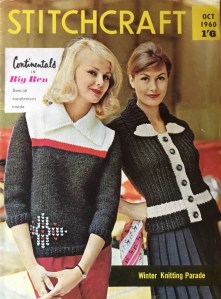 October and November are really the best months for knitting. The weather has gotten cold enough that you really want to wear and make warm, woolly things, and there’s the nice “surprise” of packing the winter clothes out of storage, and so remembering what nice hand-knitted pieces you made in other years. At least, that’s my experience.




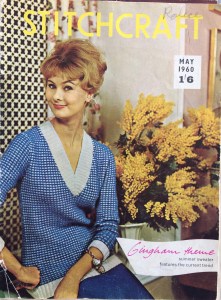 Is it already May? Nothing makes time fly like writing monthly blog posts! May 1960 is a “Roundabout of Holiday Knitting” (complete with a little circus-fair logo that fills up any little dead space in the page formatting, how cute) where in “today’s story”, “no one thinks of going away without 2 or 3 brand-new woollies packed away in their luggage.” So let’s get started…
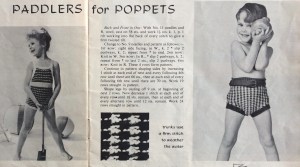 I am quite sure no small child wants to swim in hand-knitted wool trunks with a belt these days, but I imagine the sun-suit on the opposite page would be fun and practical for beach wear if made in cotton. The baby and older girls of the family get pretty cardigans or a tunic “to wear with her jeans.” I’m glad to see activewear for girls, since generally one is assumed to make pretty, decorative stuff for girls and strong, “manly” stuff for boys — sexism that is not surprising in 1960, but which always depresses me to see in today’s knitwear patterns for children.


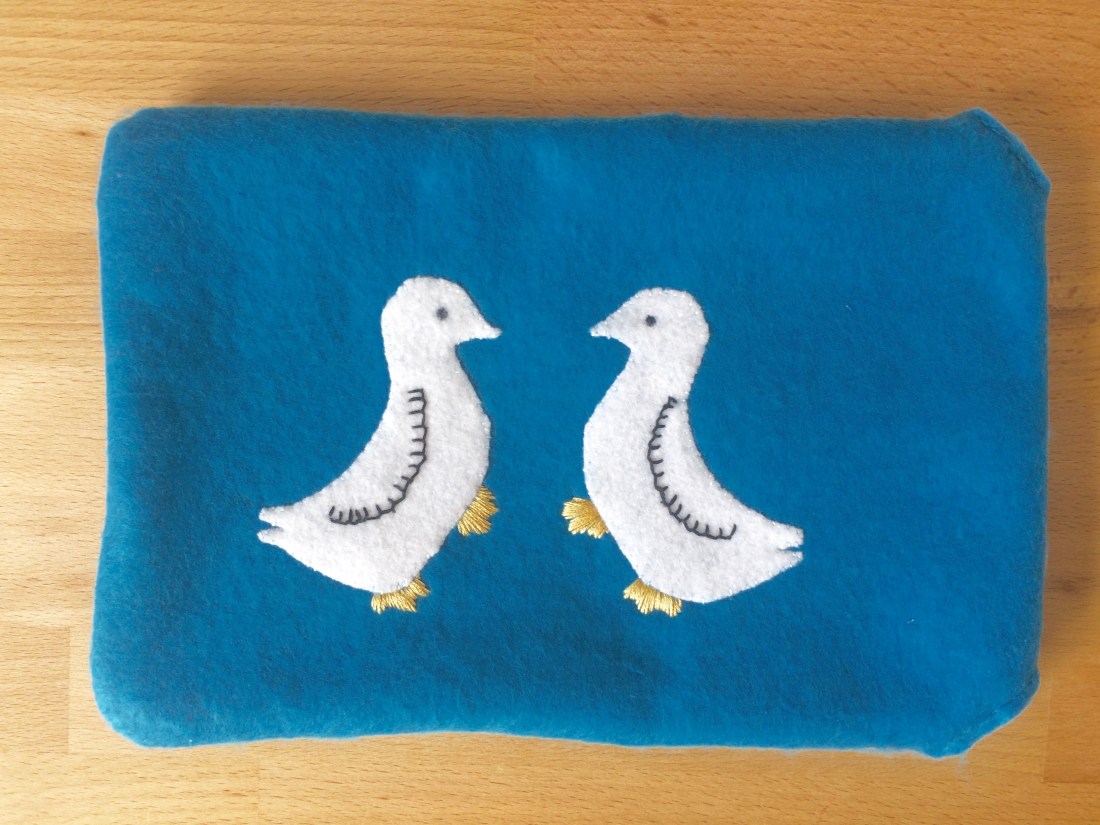
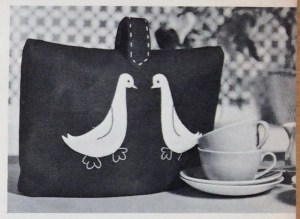 “Cheerful goslings make gay kitchen ideas” — who could resist? There are patterns for a serving glove and a felt tea cosy, neither of which I particularly needed, but the tea-cosy pattern is just about the right size for an iPad case. So this became the modern version.


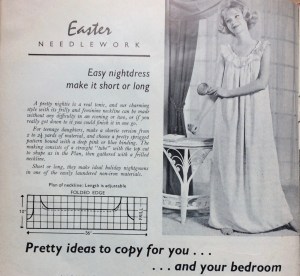
 “Already there is talk of holidays” says the introduction to the April 1960 issue, “and whether it’s to be the sea, country, sight-seeing or sailing, you can’t go without your holiday hand-knits.” At the same time, spring and April mean Easter, with lots of opportunities for hand-made accessories and knickknacks.






 The Stitchcraft Sixties