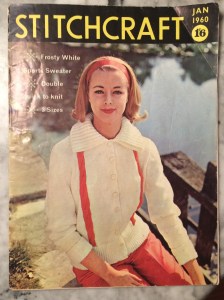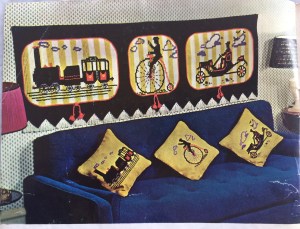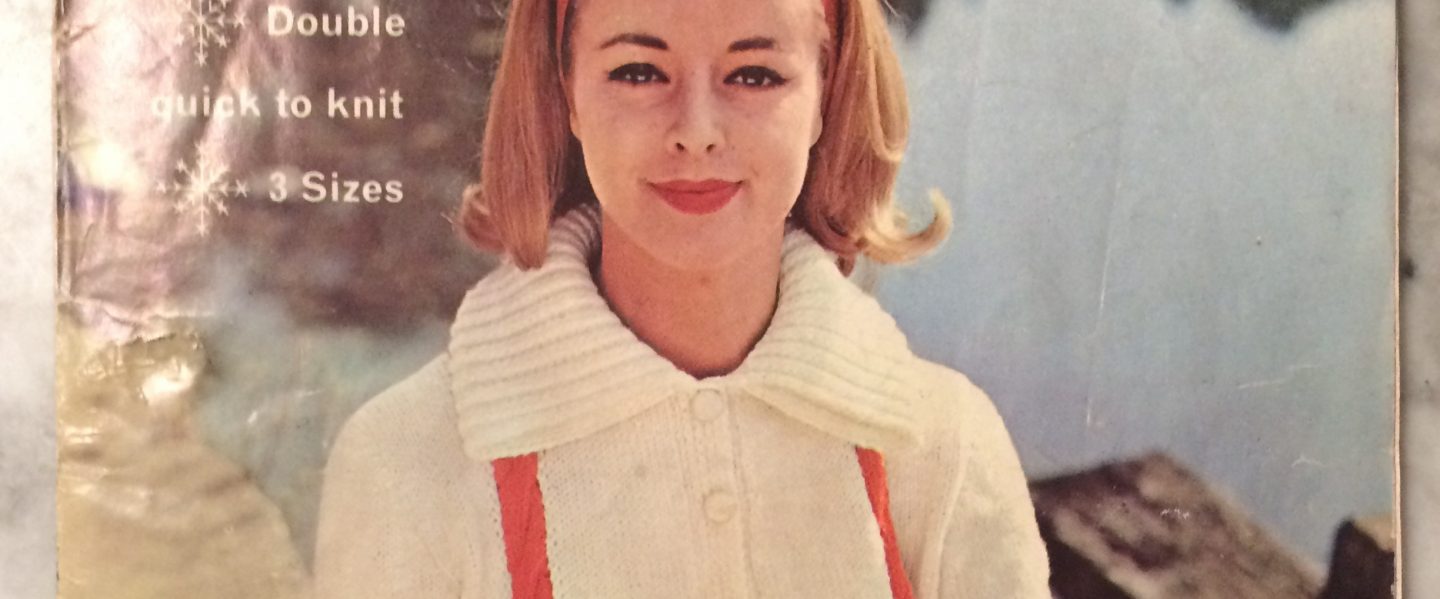
 June, the month of leisure! Or at least, leisure knits — “Fashions for Sun and Sea.” Stitchcraft’s “editress”, Patience Horne, reminds us that it’s important to have something to knit or sew while on holiday, as “it helps us to relax”, and points out that “A lot of knitting and embroidery is done in the deck-chair by busy housewives who never get time at home, and find it difficult to ease off suddenly.”
Honestly, I always had the impression that busy housewives were the ones who never got any time off, even when the family was on holiday. I guess it depends on where you went, what you planned on doing and what accommodations you had, but if I recall correctly, camping was quite popular in the  1950s and 1960s… meaning the housewife/mother of the family had to shop, cook and keep the tent or living space tidy just as she did at home, but in worse conditions (rain, mud, no proper grocery stores, camp stove, having to fetch water for cooking and washing up). Doesn’t sound much like leisure time to me! Of course, if you were rich enough to stay in a nice hotel and eat out for meals you might well have some time for handcrafts, but that wasn’t a possibility for all families, and Stitchcraft‘s target audience was more working-to-middle-class.
But knitting magazines have to be sold in the summer months as well, and there are some very nice things to make in this issue, cleverly categorised by activity. “Sun-seekers” can make pretty sleeveless tops (in wool or nylon) and one of the patterns has a cute fringed shoulder poncho thingy to change “from beach to promenade.” Two other tops are a bit dressier, in case you want to change again for tea. Obviously, the tops need to be lightweight, so all are made in 2- to 4-ply wool at 7 to 8 1/2 stitches per inch.


For “the young sailing fan” — or horseback riding fan — there’s the child’s cardigan pictured in the inside front cover and a horse-motif pullover, both in somewhat thicker Rimple Double Knitting. Though I don’t think the head in the riding motif looks much like a horse’s head — is it supposed to be a fox? These days, you could knit it in silver-gray with neon green eyes and call it an alien, if you wanted to. Rimple is also featured in a classic V-neck pullover for women and a stole, “for a touch of glamour.”


For “Tennis and Rowing” — the manly sports, I guess, since the girls sail and ride horses and the housewives are all too tired to do anything but sit in the deck chair and knit — there’s a pullover in double knitting with crew neck, sunglass pockets, and colour pennants where the knitter can use the wearer’s club colours. Bulky Big Ben wool makes an appearance in a slipover for men and a little cap for women.
If that’s not enough to keep you busy on your supposed holiday, you can embroider some cushions quickly in thick thread, make an intriguing circular table cloth with a peacock motive, sew a little dress for a toddler, or make lunch mats with holiday scenes on them in fantastic shades of yellow and purple. There are tapestry designs for a footstool, screen, book cover or “finger plate” as well.


Wait — what on earth is a finger plate? It looks like something you put on a door — but why? Wikipedia came to my rescue:
“A fingerplate is a plate that is fixed to a door near the handle or keyhole. It can be made of metal, plastic, ceramic or glass. It purpose is to prevent people’s fingers from smudging the door.”
This makes no sense to me, as I would think it would be easier to wipe off the door once in a while than to take a framed tapestry off of the door, wash and re-mount it, but OK.
Speaking of “what is this” and “OK” — you can also embroider a “novelty bathroom mat” where “suitable expressions” on the taps register hot or cold, and in the “Suggestions from Readers” column, we are informed that Mrs Ross of Berkhamsted cleverly adapted the tapestry townscape of Finchingfield “to bring in her husband’s interest in aeroplanes.” Behold, the Comet jet careening over Finchingfield, apparently about to make an emergency landing in the town square!


Let’s hope things end well for everyone involved.
My June project wasn’t pictured here, as it is just a little “extra” design element offered in the back pages — a little parakeet (budgie) motif for cross-stitch or knitting. I’ll turn it into something cute for two friends who are getting married in August.
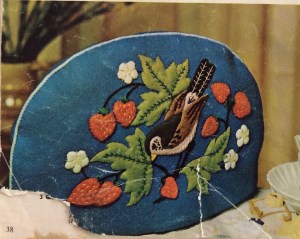 This is definitely a “cosy of unusual charm”! (Despite the ripped corner on the back cover photo.) It features appliqué and embroidery with different designs on each side and instructions to make it up into either a regular cosy to put over the teapot, or a “nest” to put the teapot into.


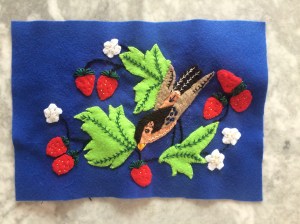 bit of herringbone and the tiny straight stitches in the strawberries. Still, it was more ambitious than any embroidery I have tried up until now. It doesn’t look quite like the picture and I did take a little bit of licence, but on the whole I was pretty satisfied… except for the legs. Oh dear, oh my, oh no, the legs. I did them three times and they still look weird. Either the angle is wrong, or the thickness, or I don’t know what, but I figured doing it again would only chew up the fabric more, so it is what it is.


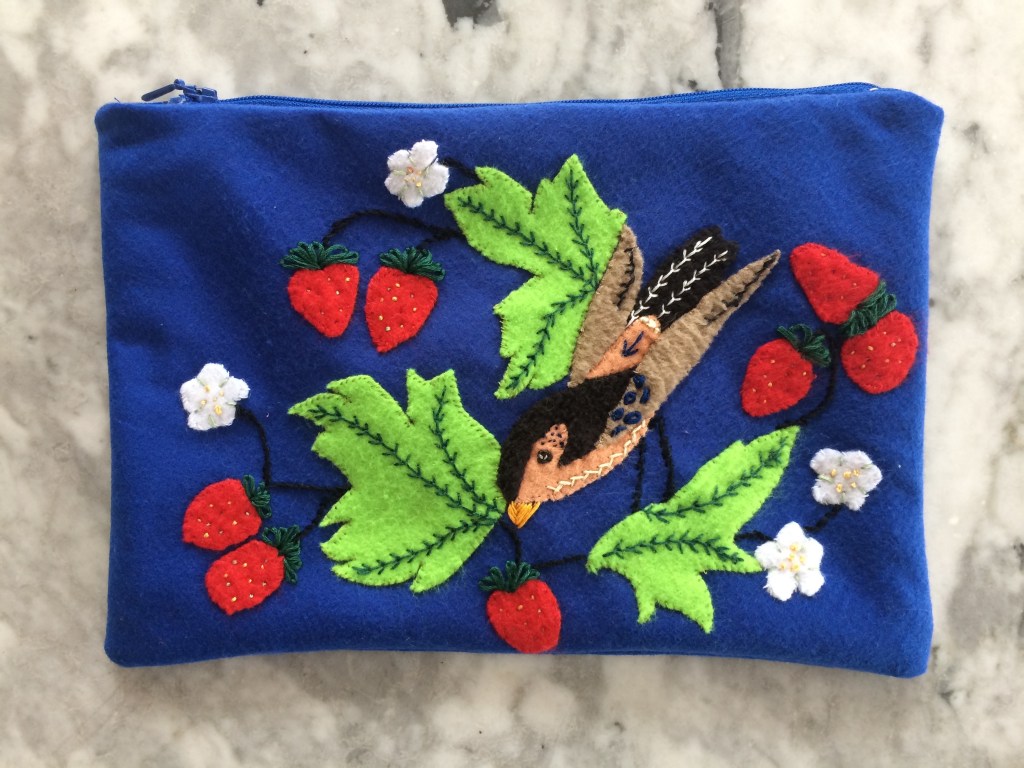
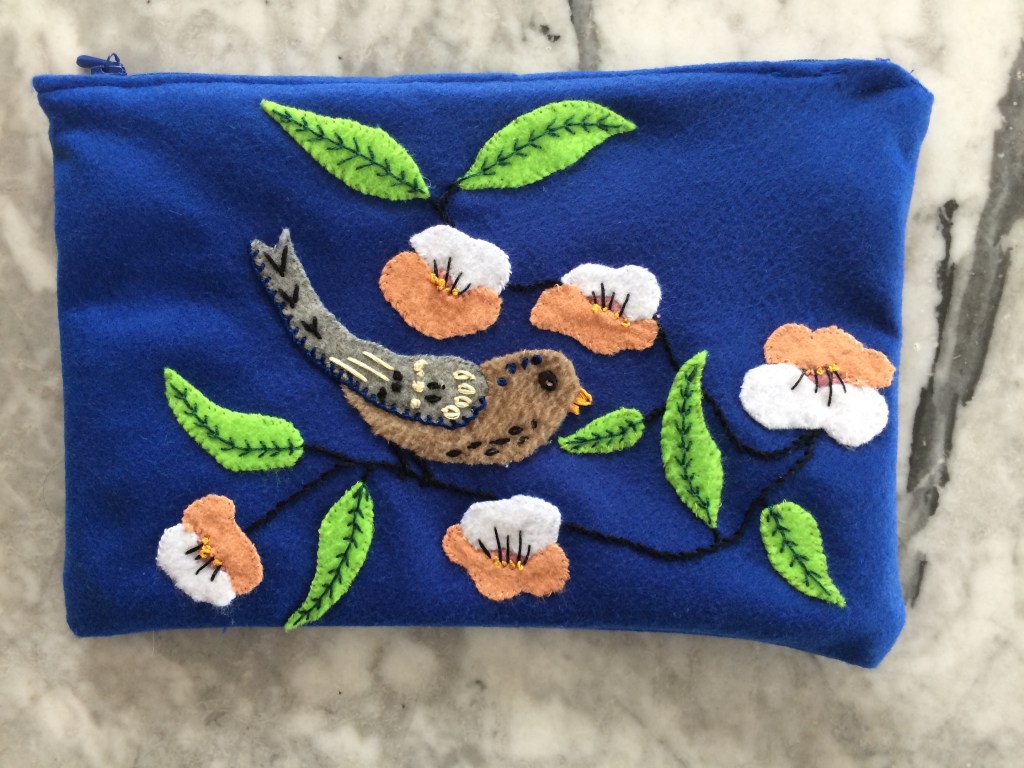
 Is it already May? Nothing makes time fly like writing monthly blog posts! May 1960 is a “Roundabout of Holiday Knitting” (complete with a little circus-fair logo that fills up any little dead space in the page formatting, how cute) where in “today’s story”, “no one thinks of going away without 2 or 3 brand-new woollies packed away in their luggage.” So let’s get started…
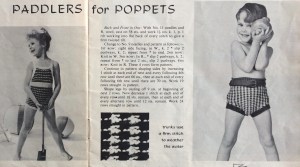 I am quite sure no small child wants to swim in hand-knitted wool trunks with a belt these days, but I imagine the sun-suit on the opposite page would be fun and practical for beach wear if made in cotton. The baby and older girls of the family get pretty cardigans or a tunic “to wear with her jeans.” I’m glad to see activewear for girls, since generally one is assumed to make pretty, decorative stuff for girls and strong, “manly” stuff for boys — sexism that is not surprising in 1960, but which always depresses me to see in today’s knitwear patterns for children.


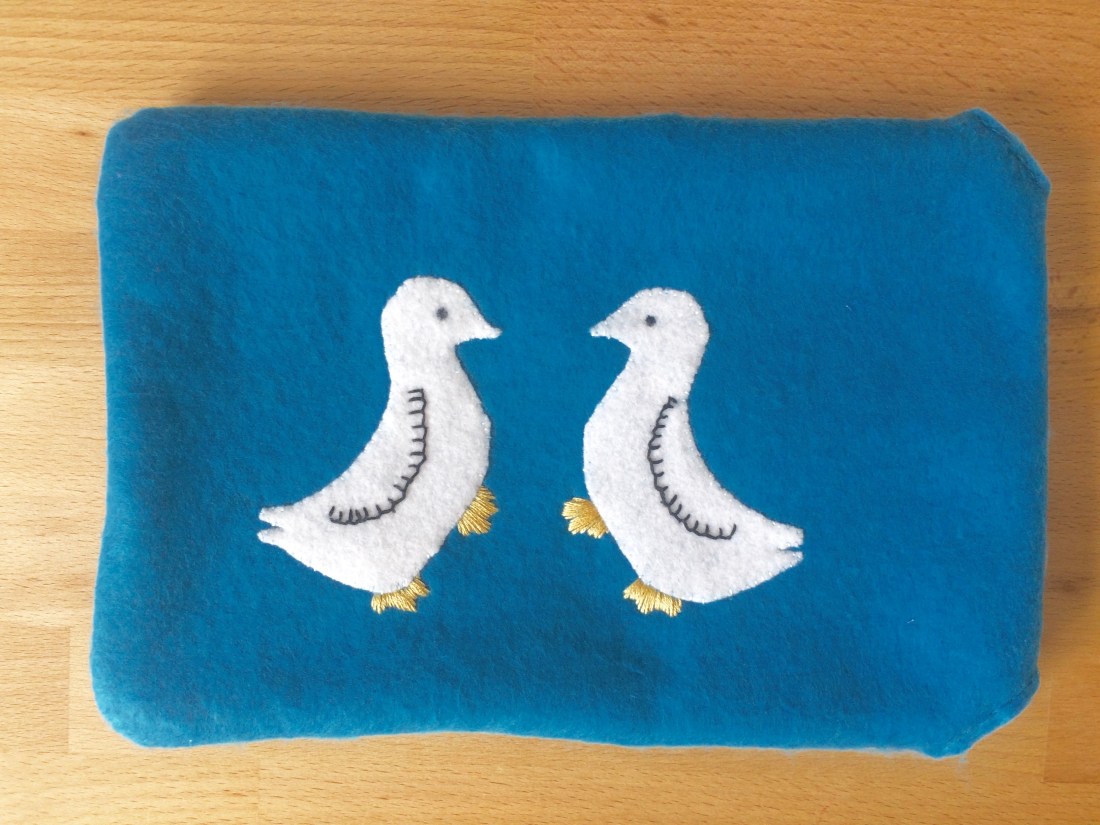
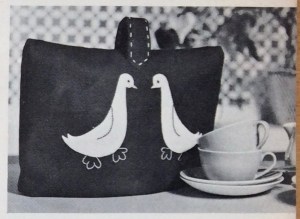 “Cheerful goslings make gay kitchen ideas” — who could resist? There are patterns for a serving glove and a felt tea cosy, neither of which I particularly needed, but the tea-cosy pattern is just about the right size for an iPad case. So this became the modern version.


 “Already there is talk of holidays” says the introduction to the April 1960 issue, “and whether it’s to be the sea, country, sight-seeing or sailing, you can’t go without your holiday hand-knits.” At the same time, spring and April mean Easter, with lots of opportunities for hand-made accessories and knickknacks.




 I will be making two children’s designs: the fabulous checkered coat for a toddler, and “John’s new pullover” for a soon-to-be six-year-old.
 February 1960, the “Spring Knitting Number”, features an extra 16-page pull-out booklet with garments in Patons Rimple, a nubbly wool-with-a-bit-of-nylon yarn that looks like terrycloth toweling when worked up.
 The model, like all children of the 1960’s and earlier, must have very cold legs. Why children of earlier times didn’t wear trousers or warm stockings or tights is a mystery that an older person will have to explain to me someday. It’s particularly strange to see in a knitting magazine, as often the child will be wearing a thick wool jumper or even a wool pullover under a wool sleeveless dress with a knitted wool coat over it, plus a hat and mittens if outside… but nothing on their poor bare legs.


 My second project from January 1960 was a sewn and embroidered cushion featuring “black and white leaves on bright red fabric”. One is encouraged to “keep to the black and white embroidery but choose background linen to match your room” and I chose a medium green. (The fact that it matches the houndstooth jumper is just a happy coincidence.)