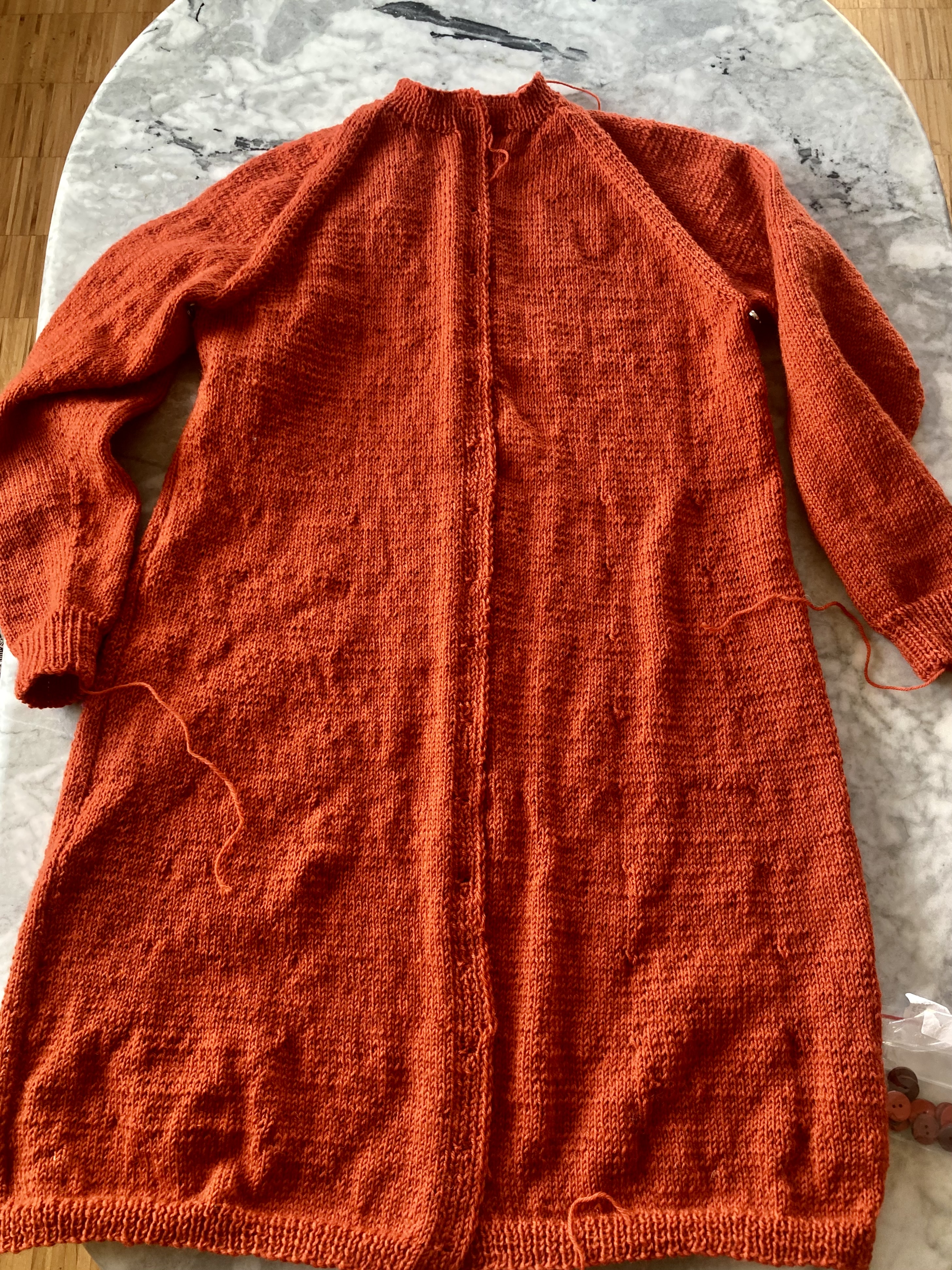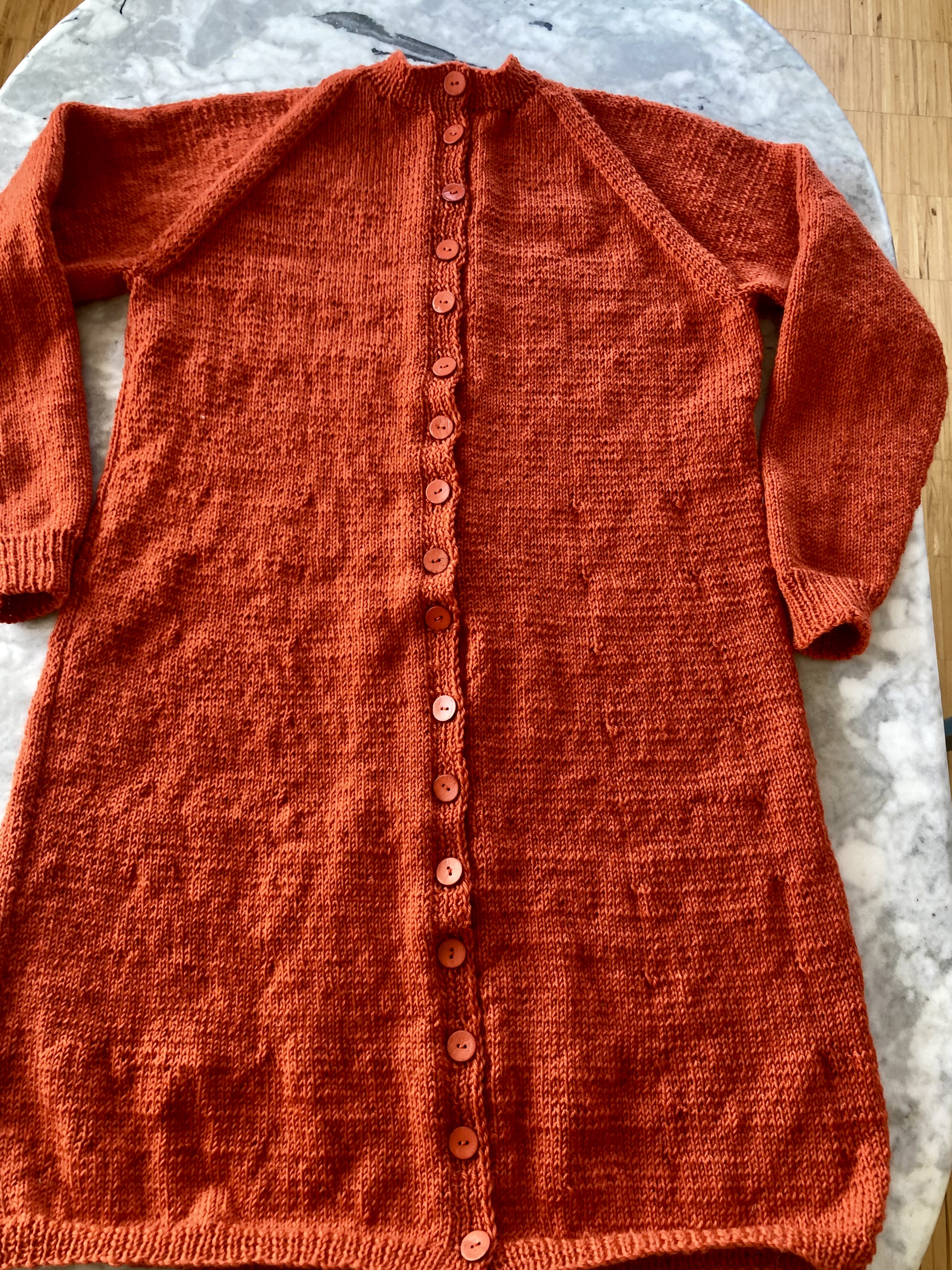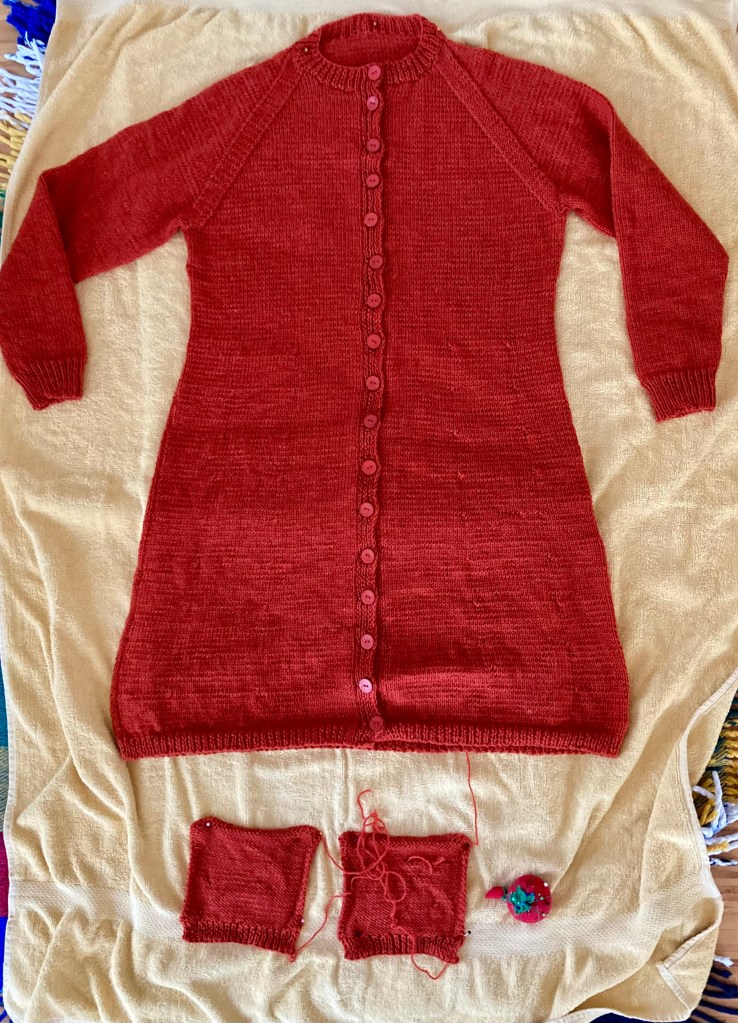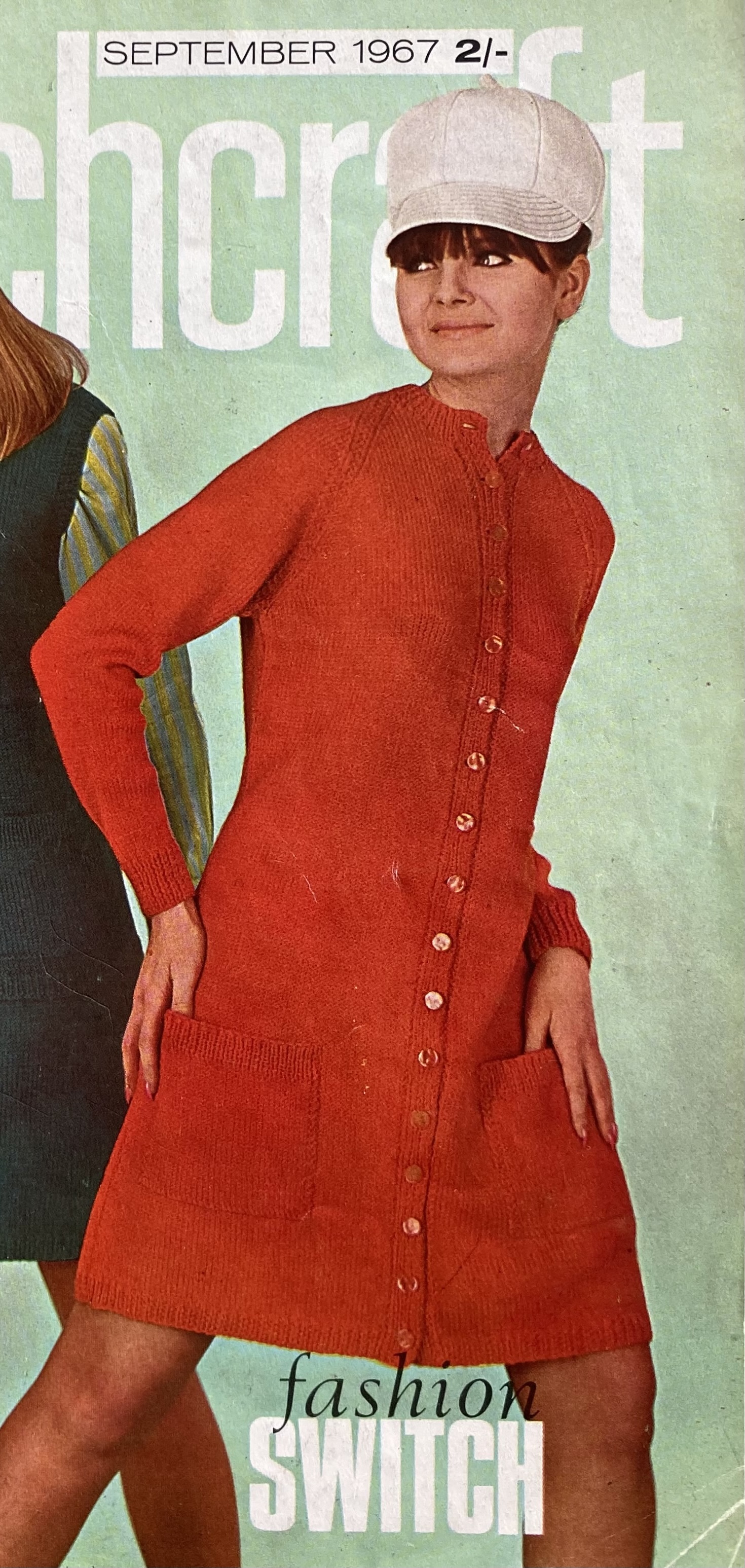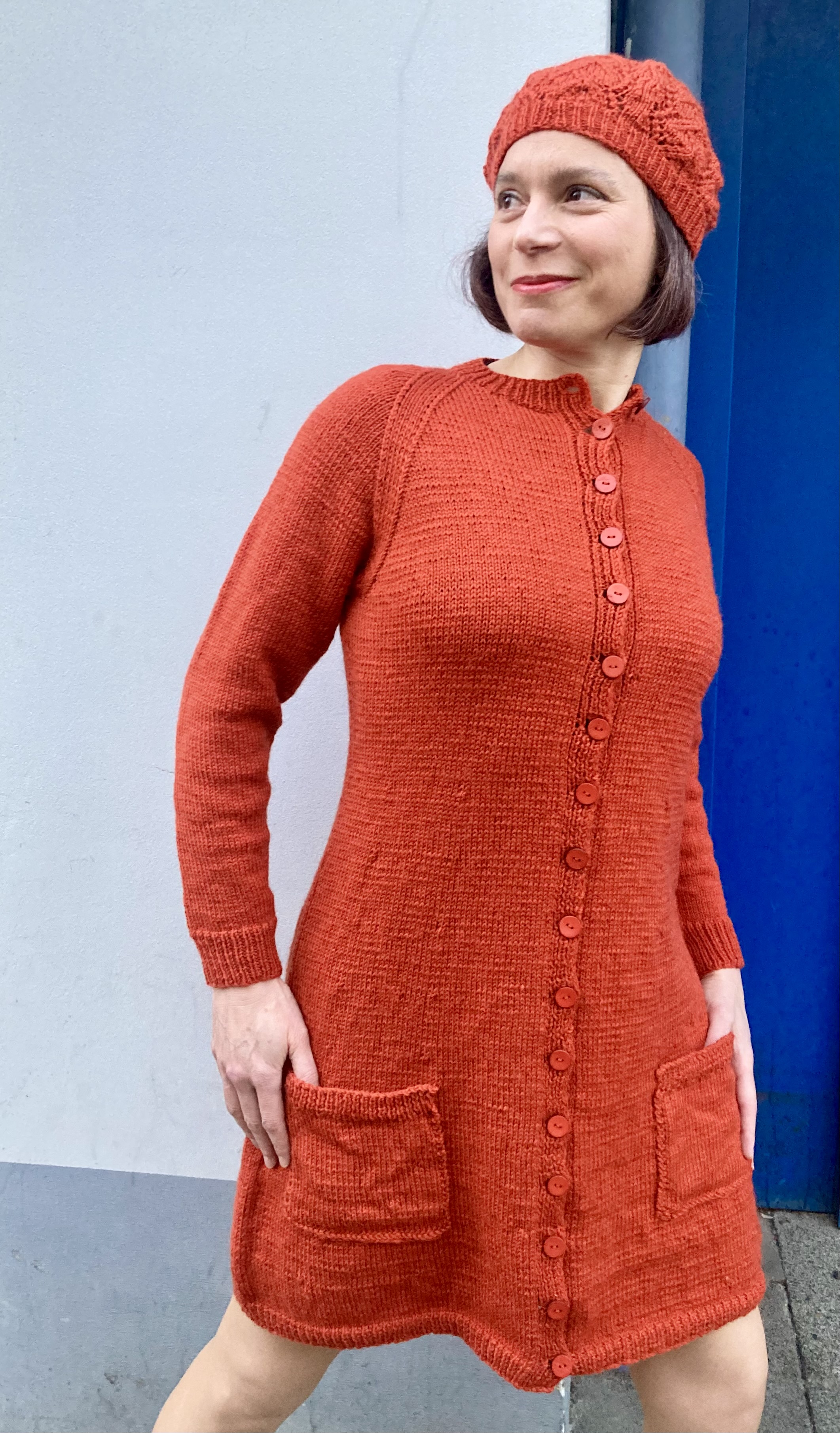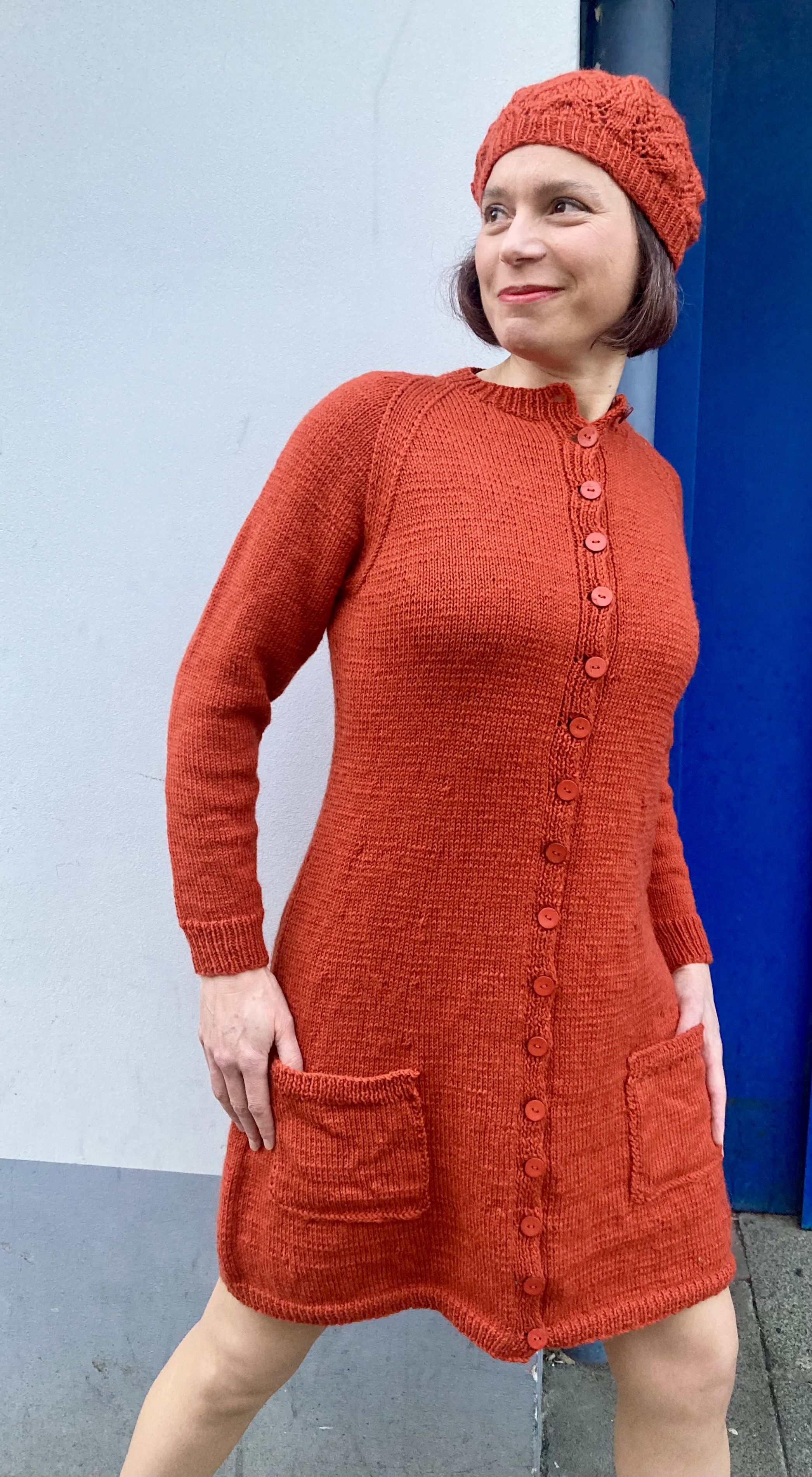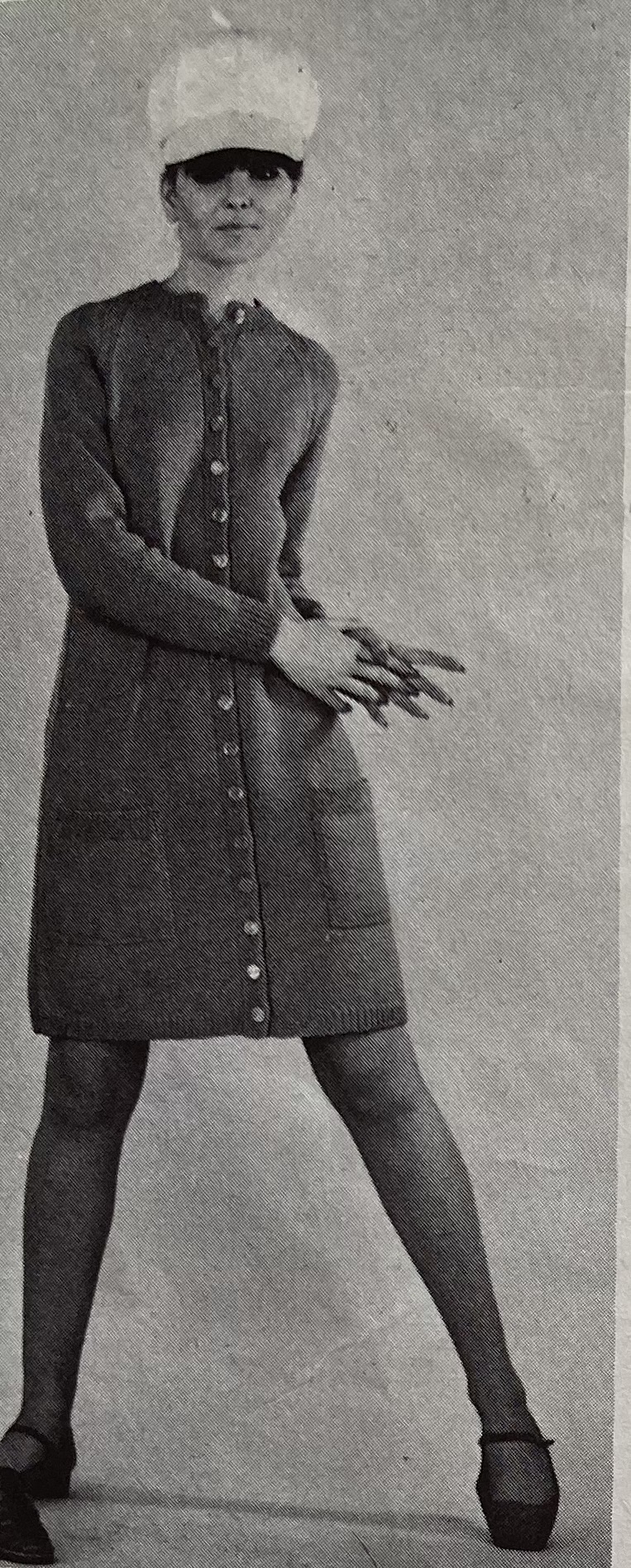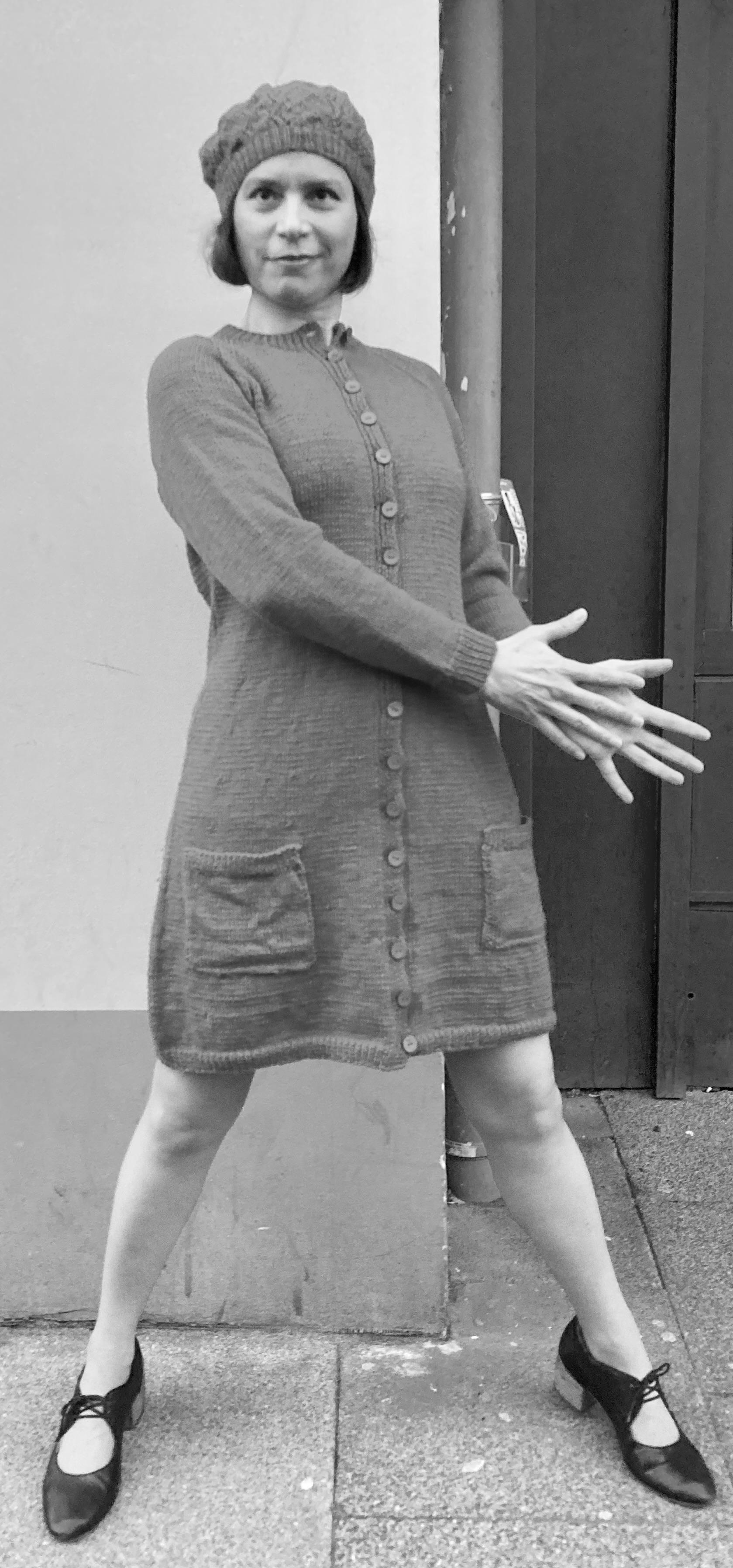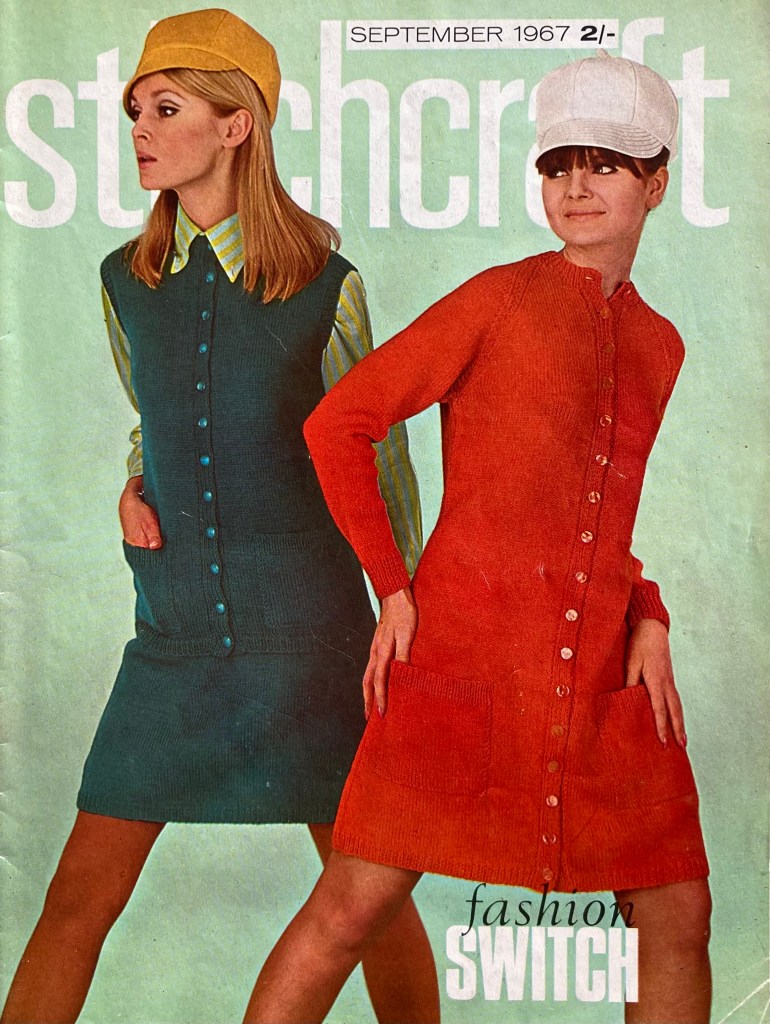
Out of Order: Chevron Dress from April 1967

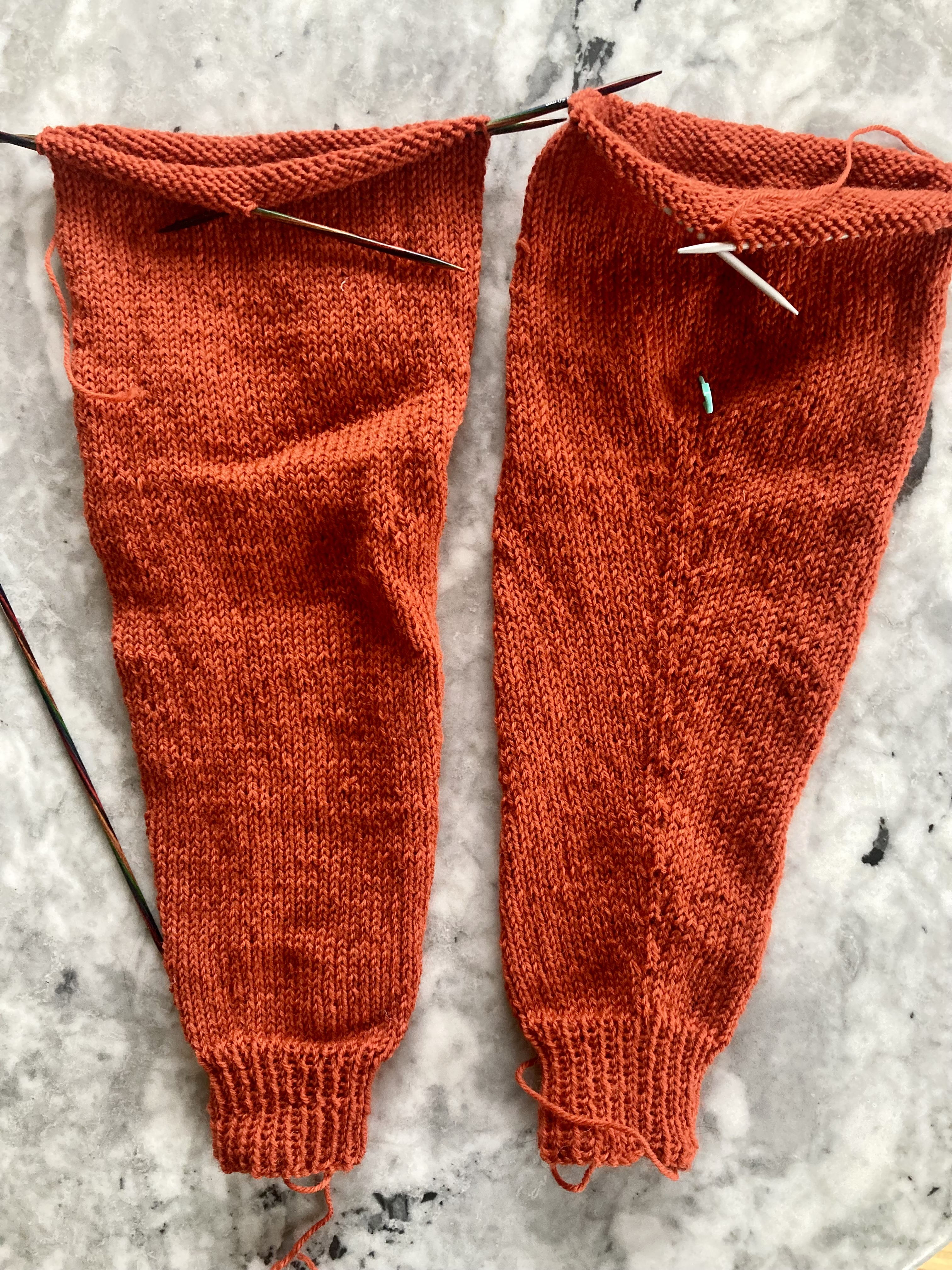
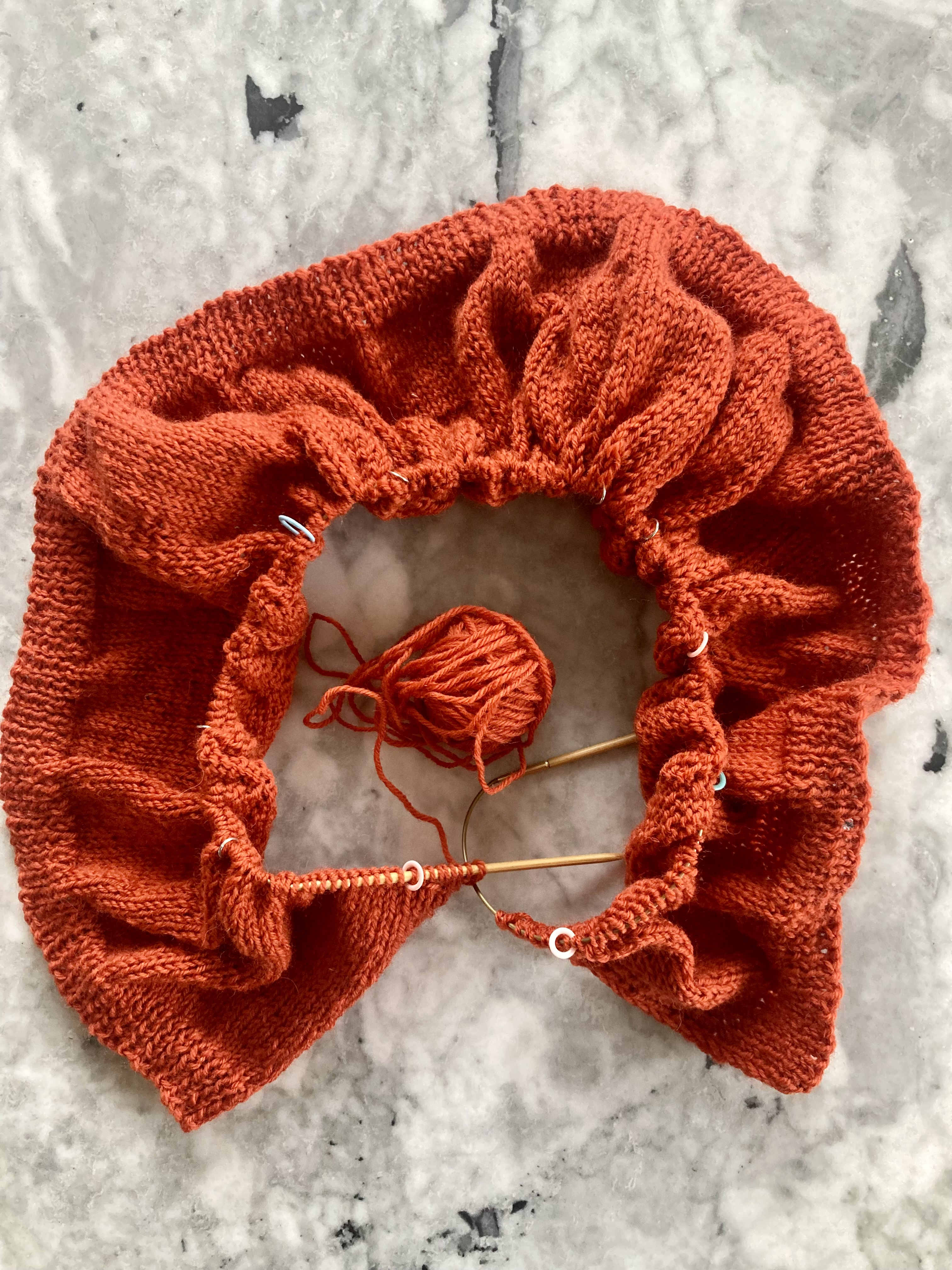
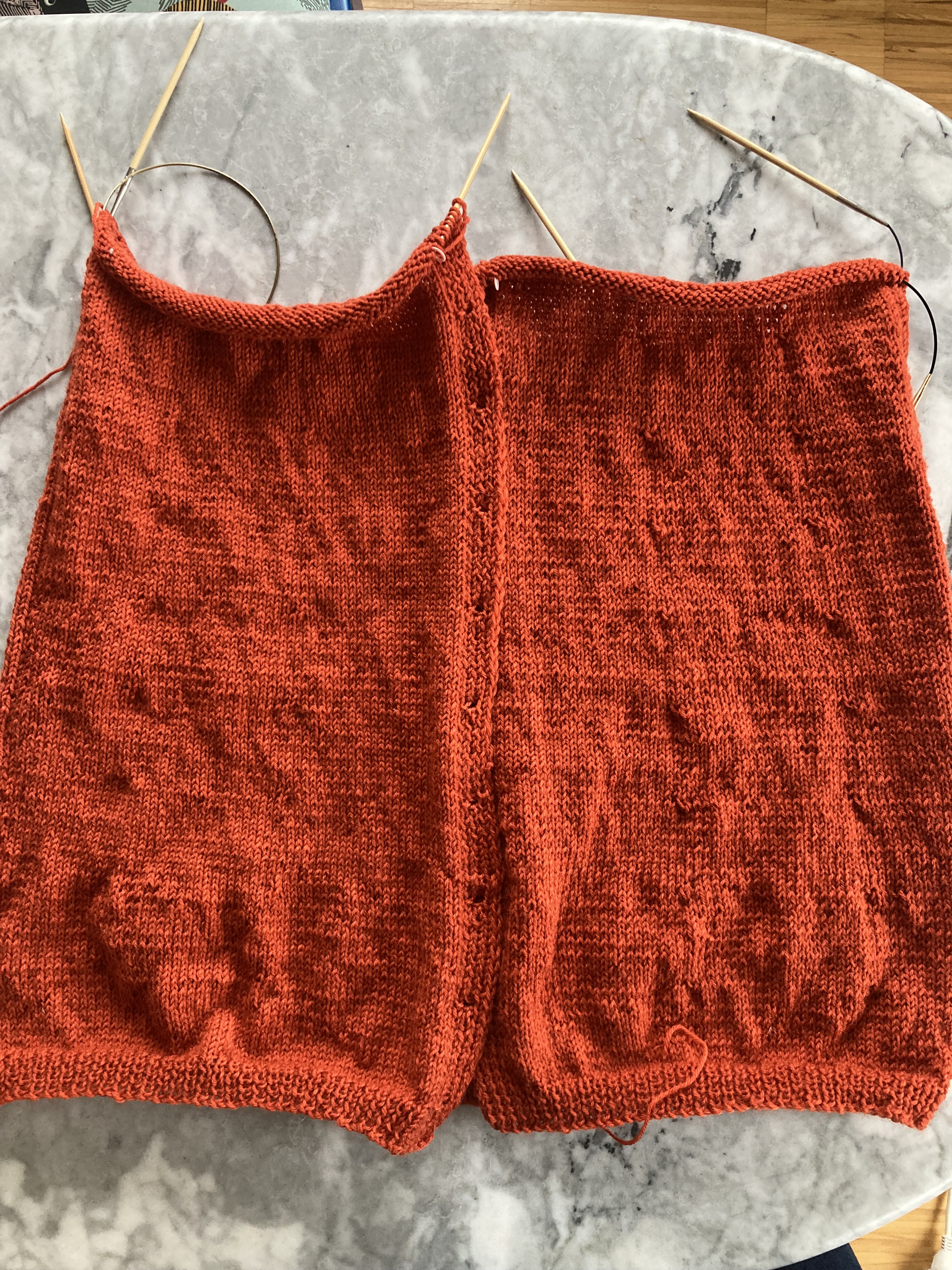
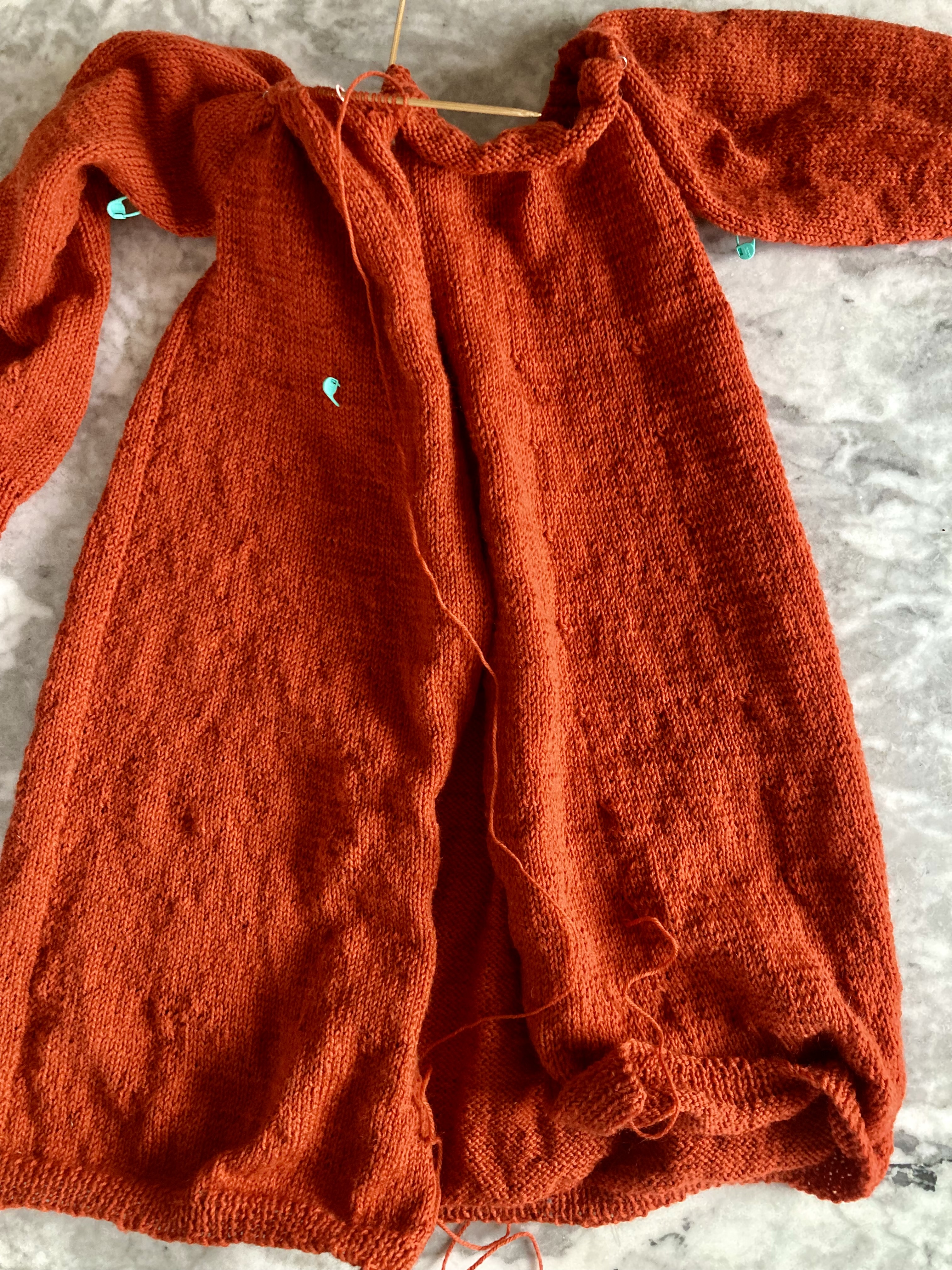
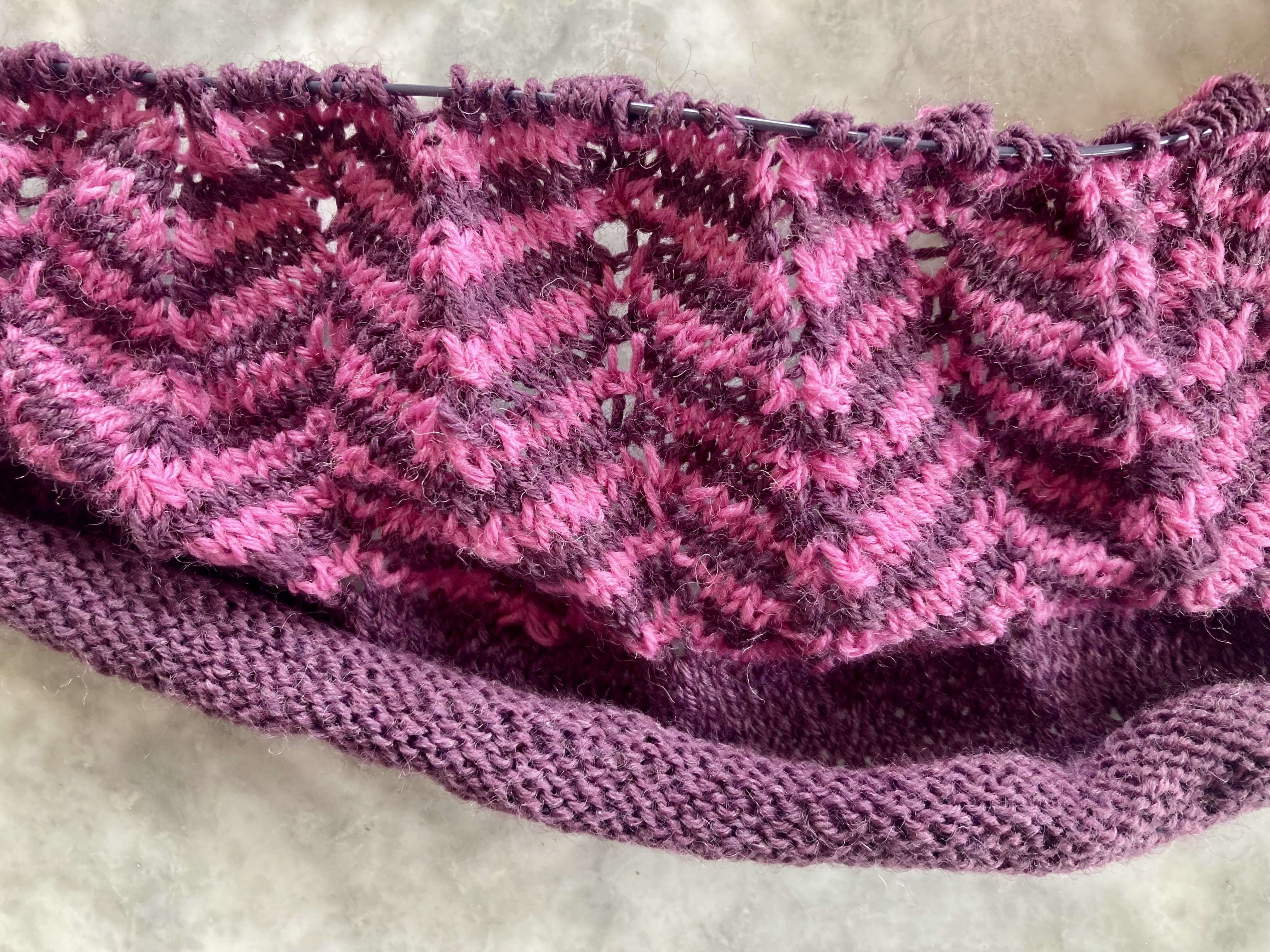
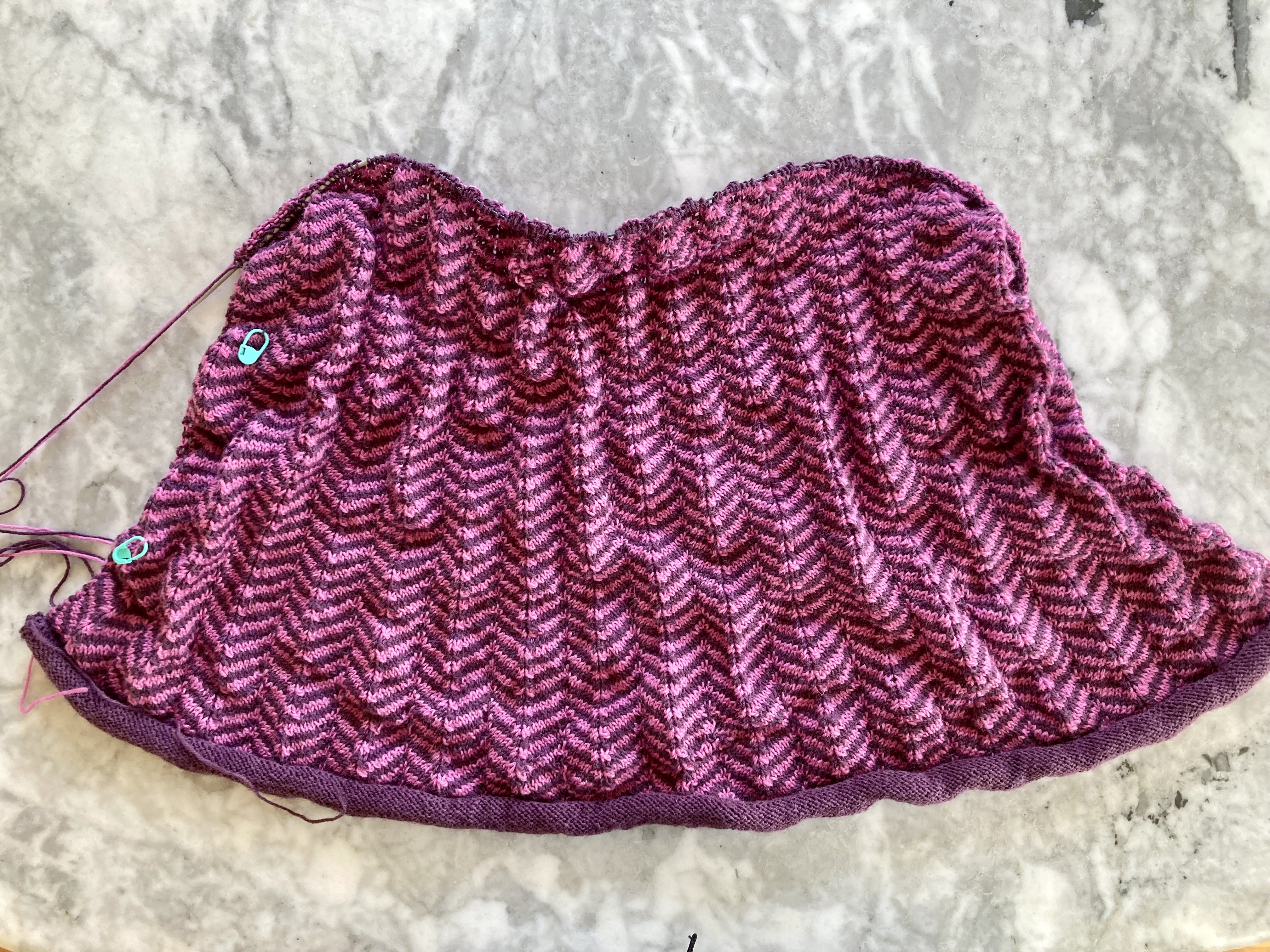
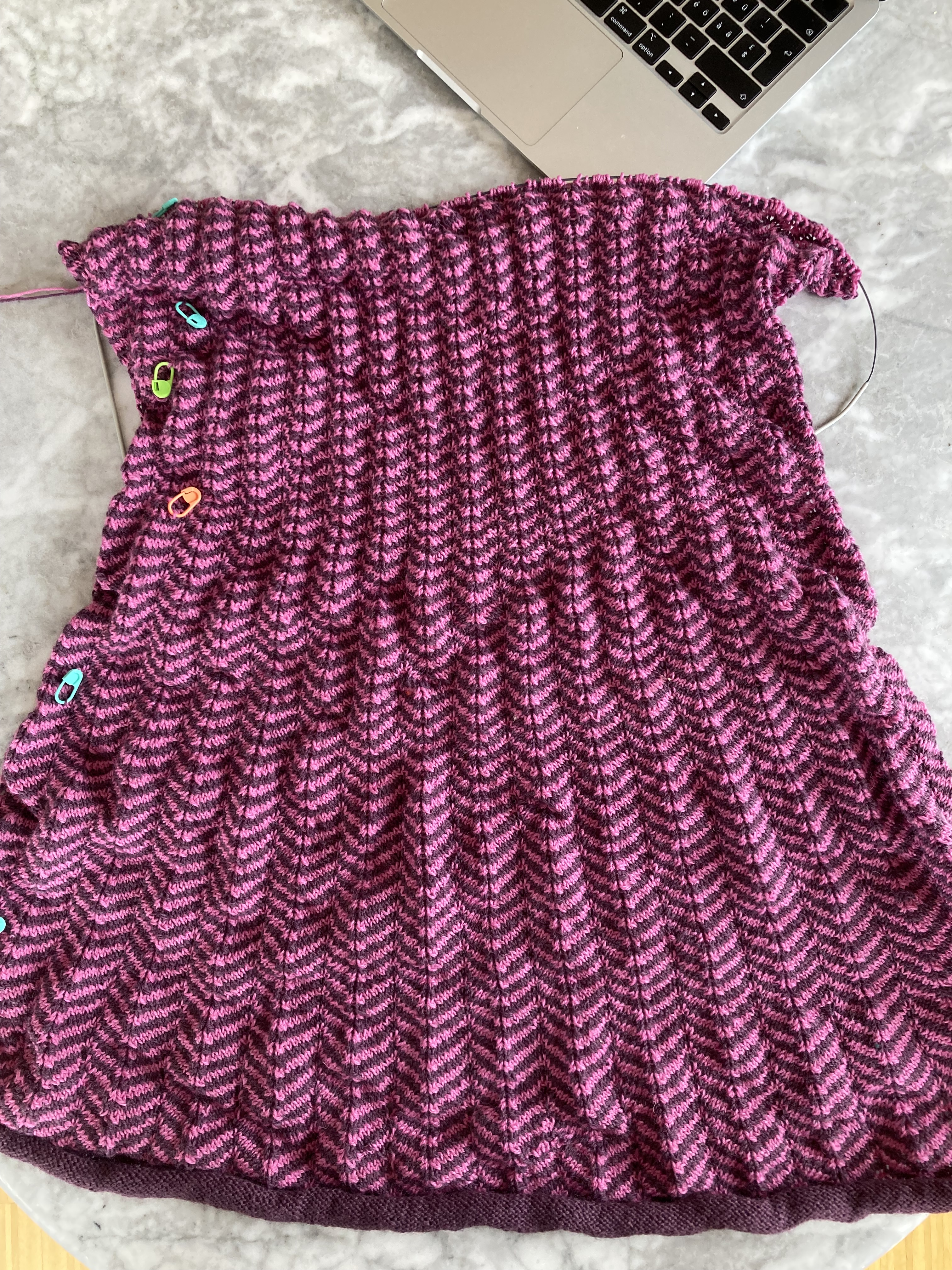
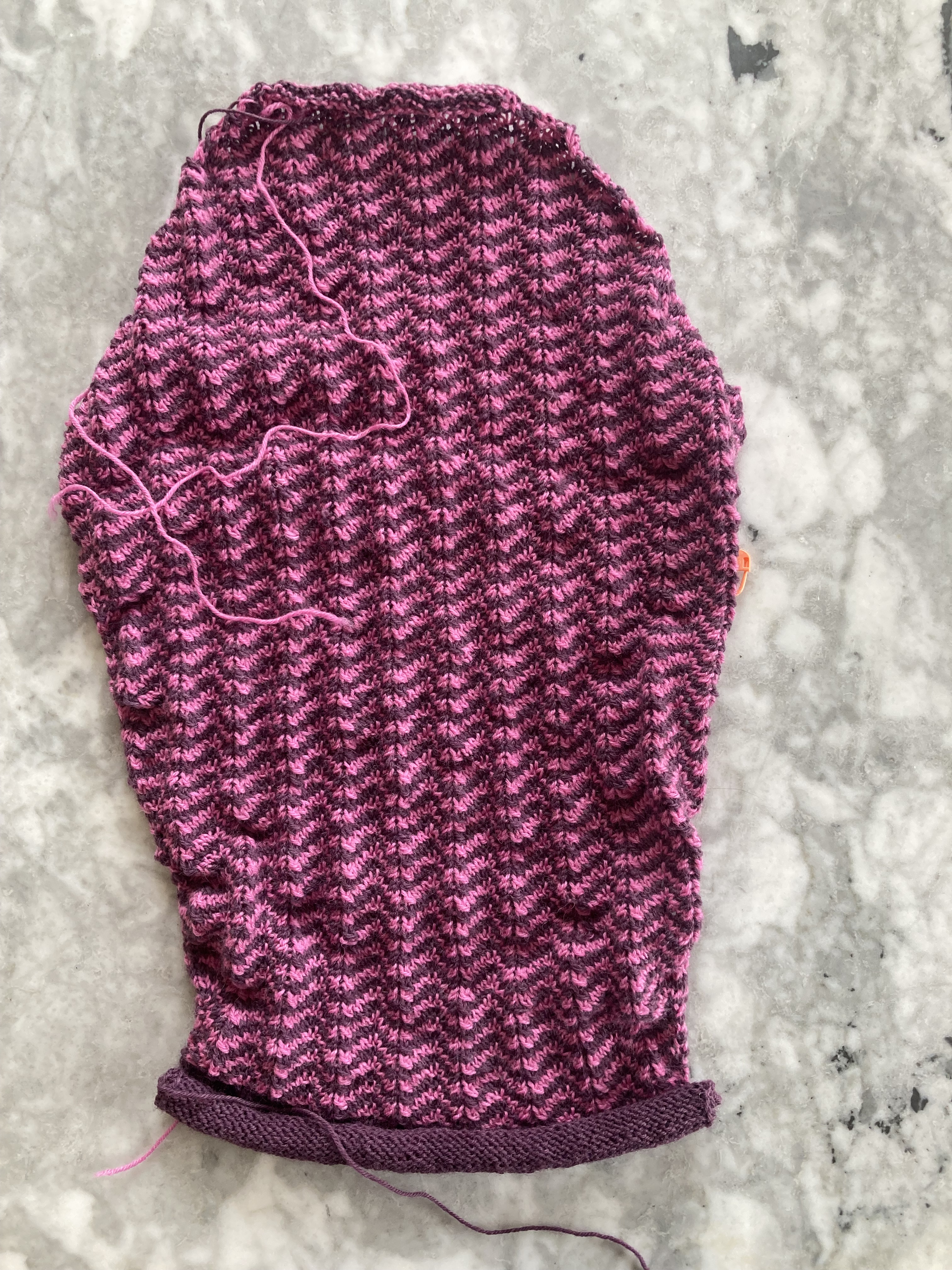
EDIT: Now with photos!

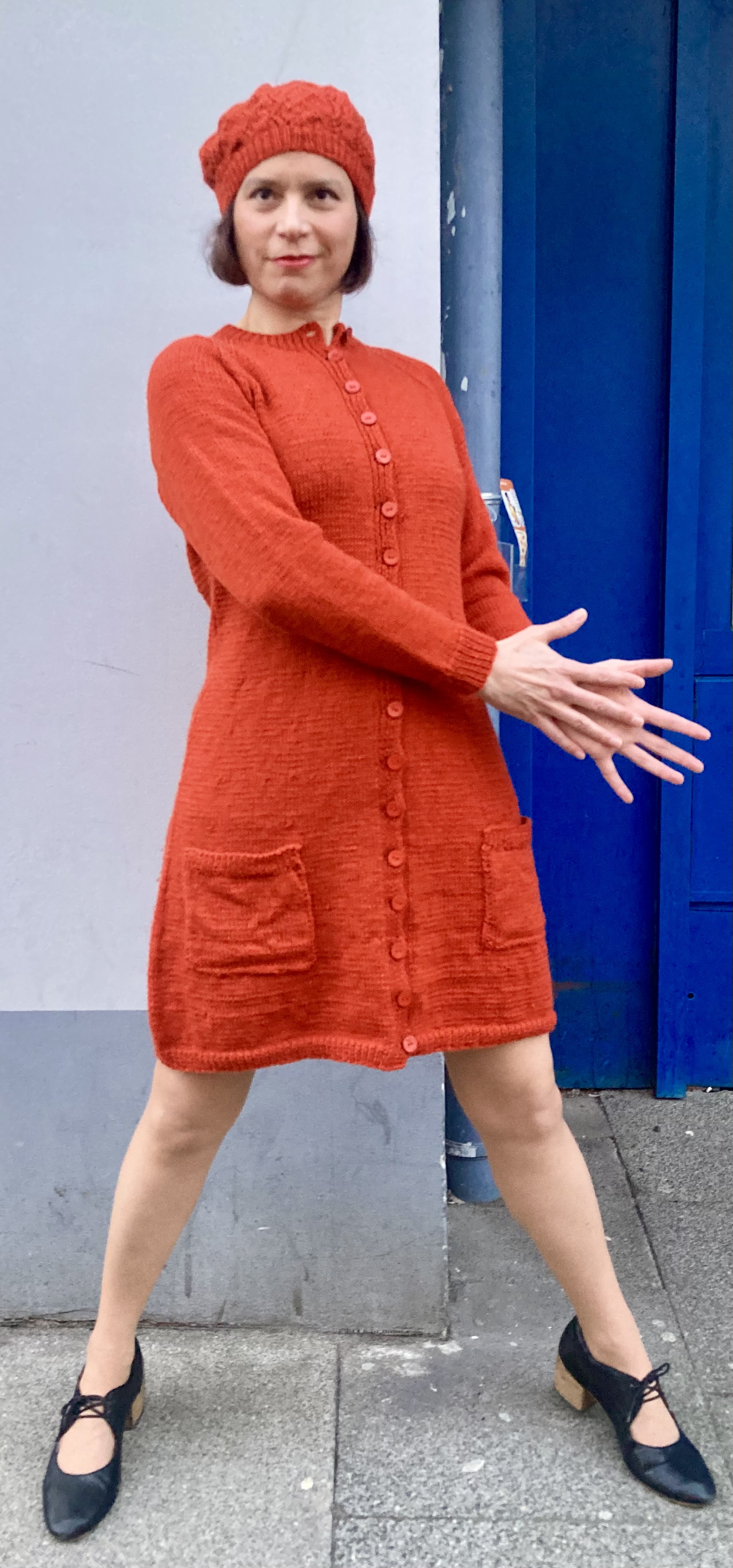
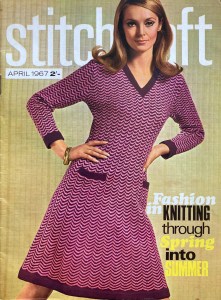
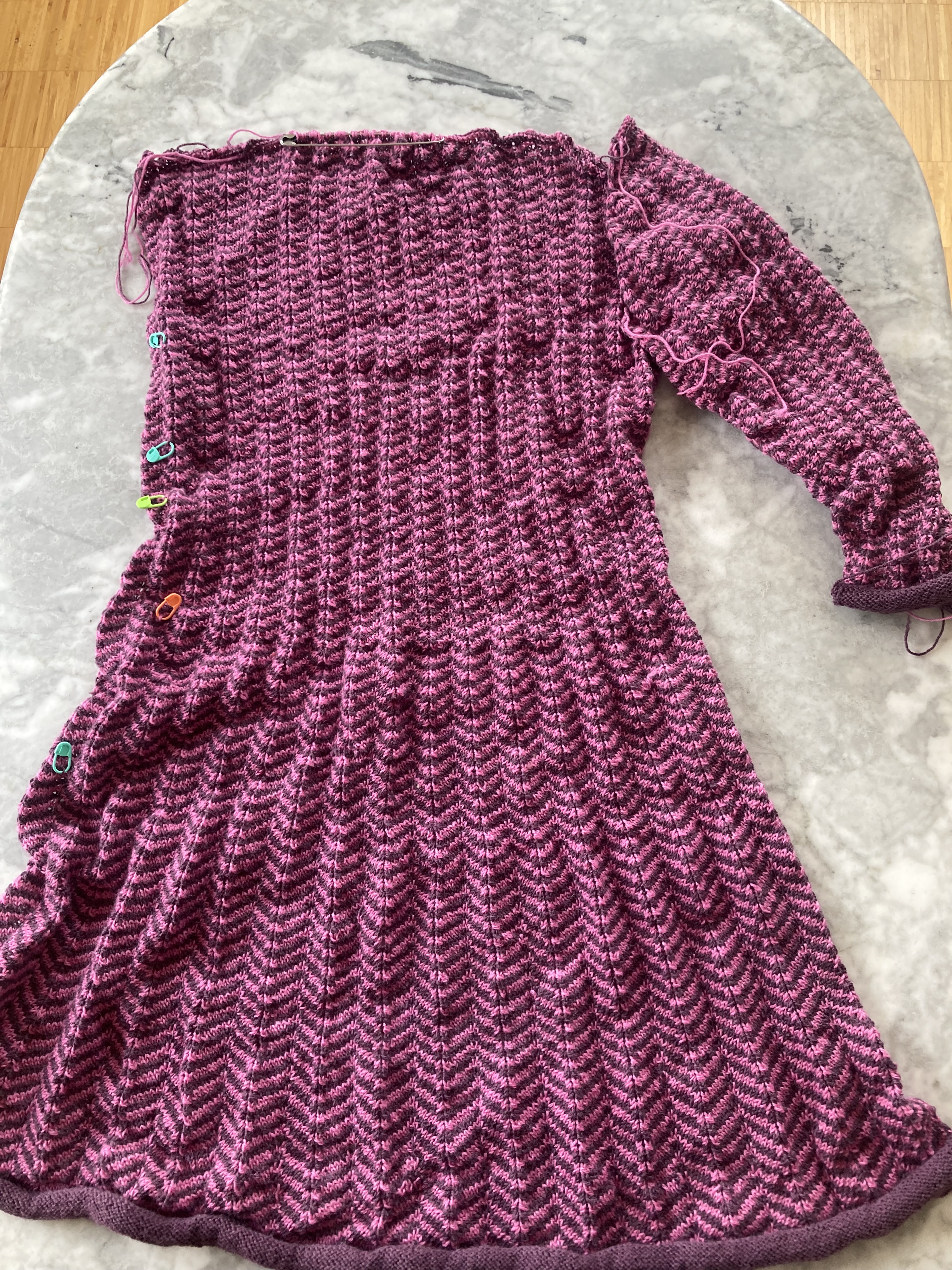
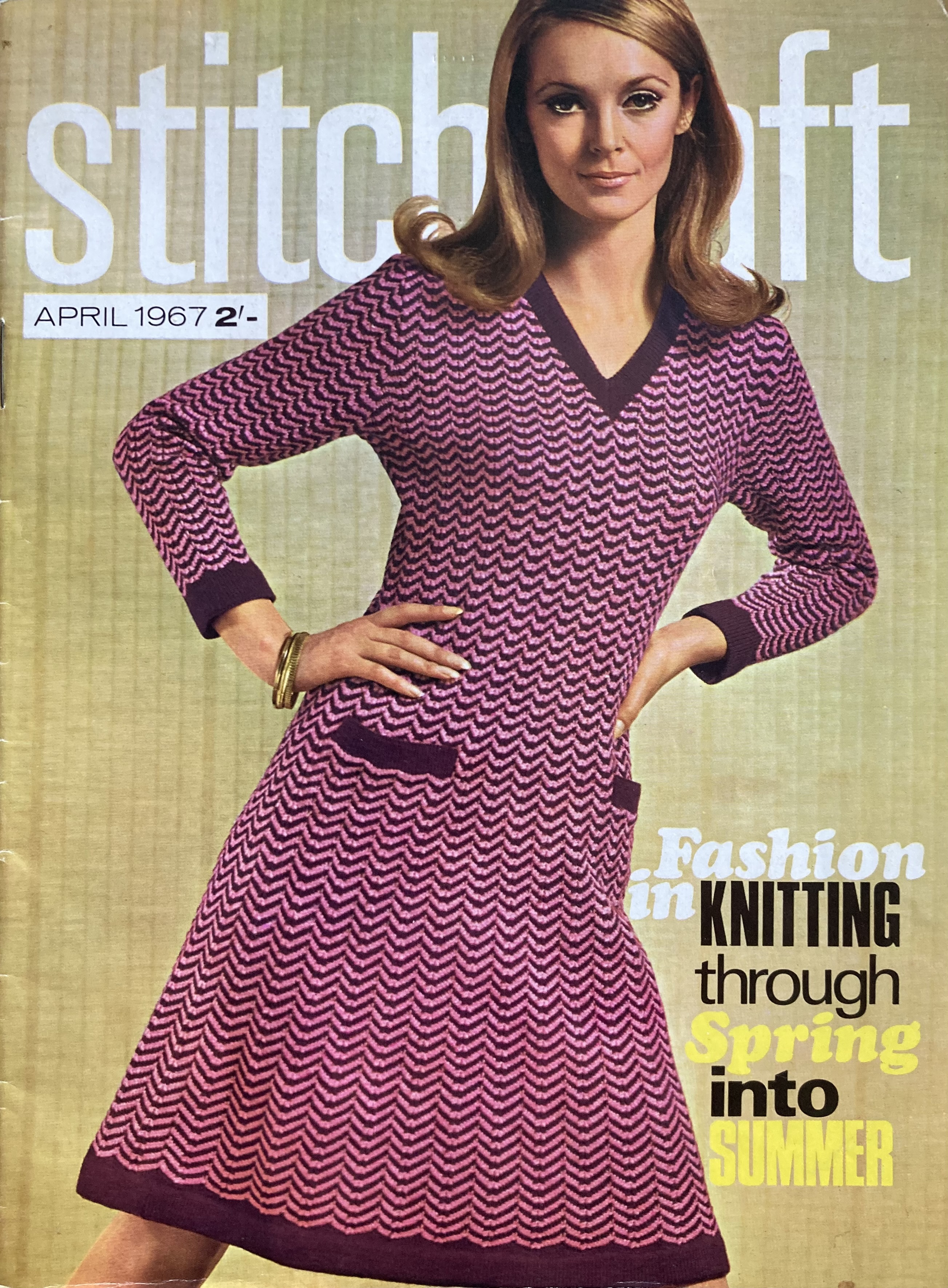
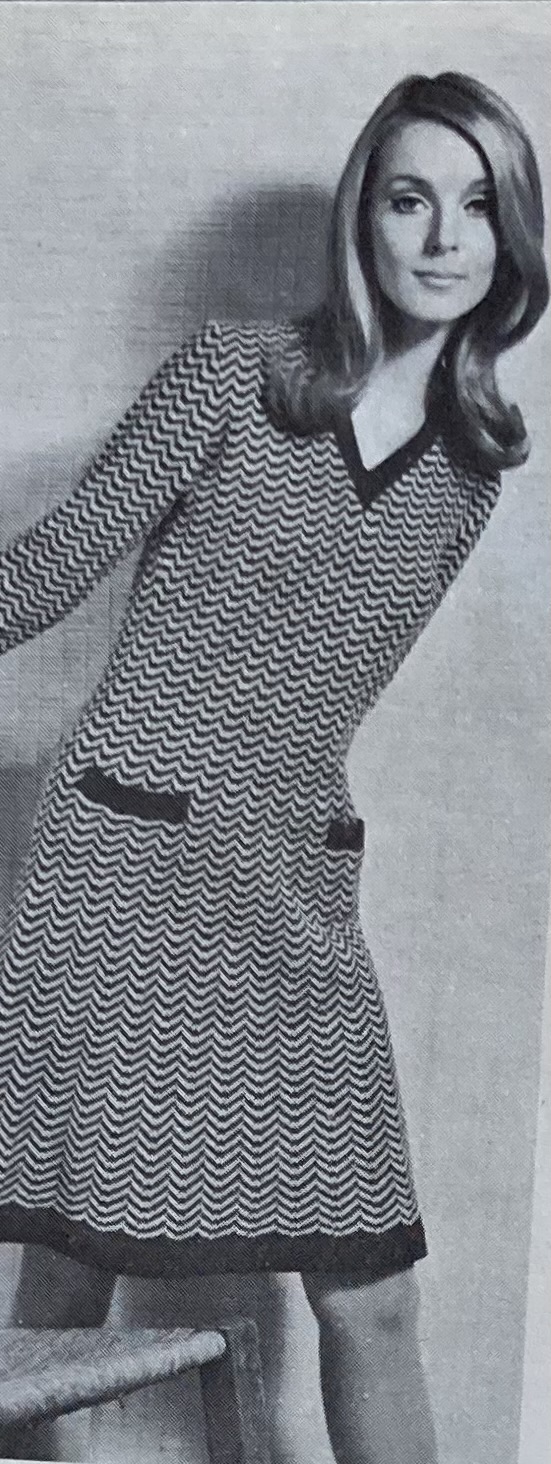
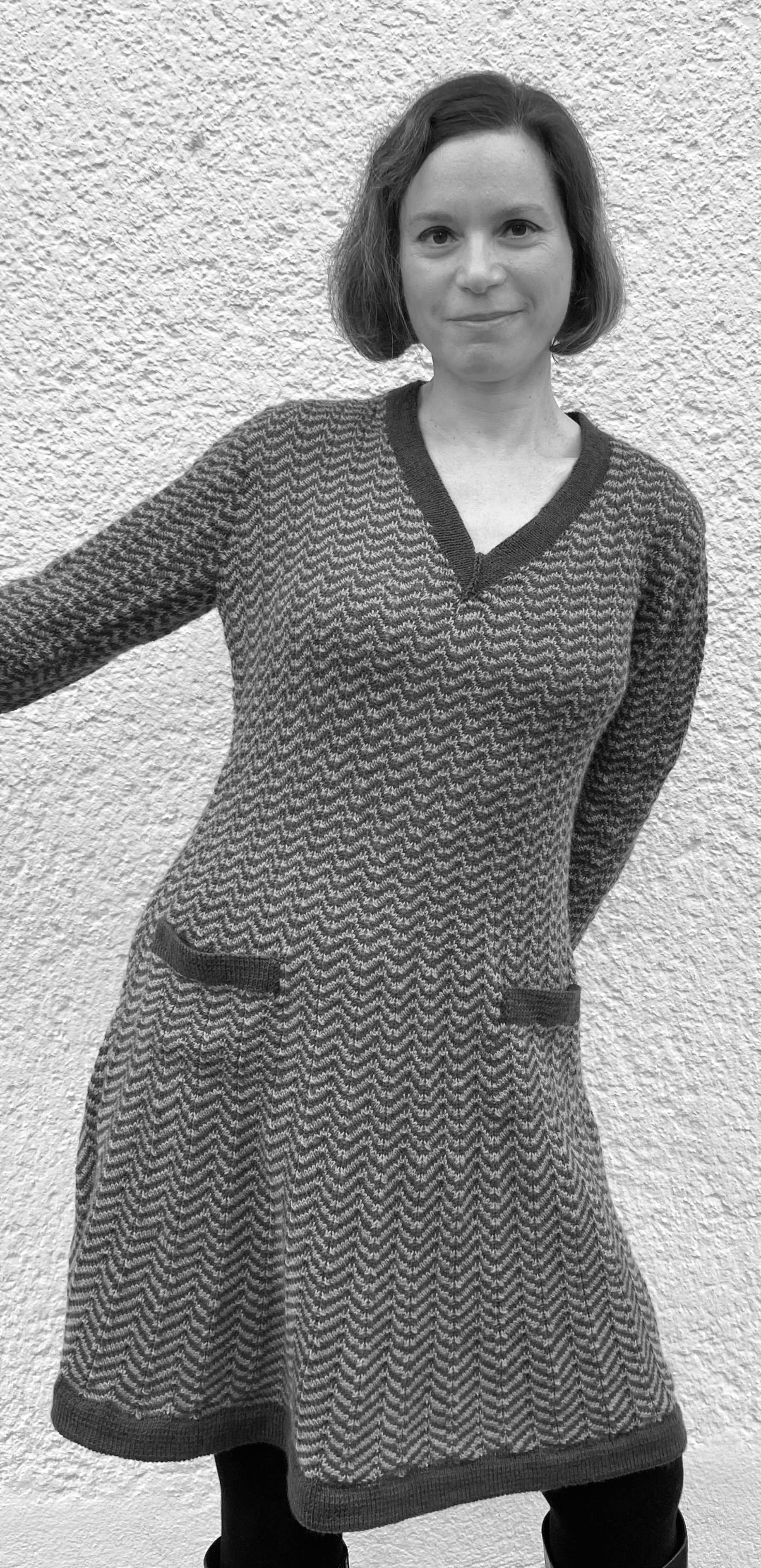
The April 1967 issue of Stitchcraft had many great designs in it and my favourite was this pink and purple chevron-striped dress on the front cover. And since the August 1967 issue didn’t have any projects that particularly inspired me, I worked on the chevron dress all summer and got it finished just in time for the August blog.

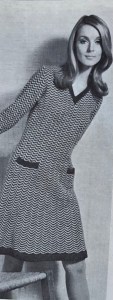
The “easy-line dress is fashion styling for all age groups” and claims to be in “the 30’s Look” — interesting, considering that dresses in the actual 1930s were still much longer, of course, and this dress, while not a mini-dress, falls at least a little bit above the knee. Also, this dress has a typical mid-60s A-line shape and not the typical long and willowy 1930’s silhouette. But the chevron pattern was very popular in the 1930s, as was the dropped waist and the flowy shape.

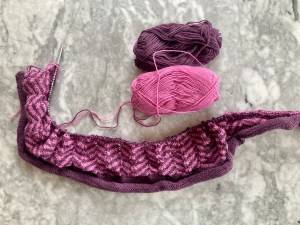
The pattern is written for plain Patons Beeehive 4-ply (fingering-weight) wool, but I decided to use sock yarn for easier washing and wearing. DROPS Fabel is easy to knit with, inexpensive, and available in a huge range of colours, including an almost-perfect match for the original “Wine” (purple) and “Radiant” (pink). I decided to make it a little bit shorter than in the pattern (third size should be 37 inches), as I expected it would stretch with weight and wearing. That was my only modification.

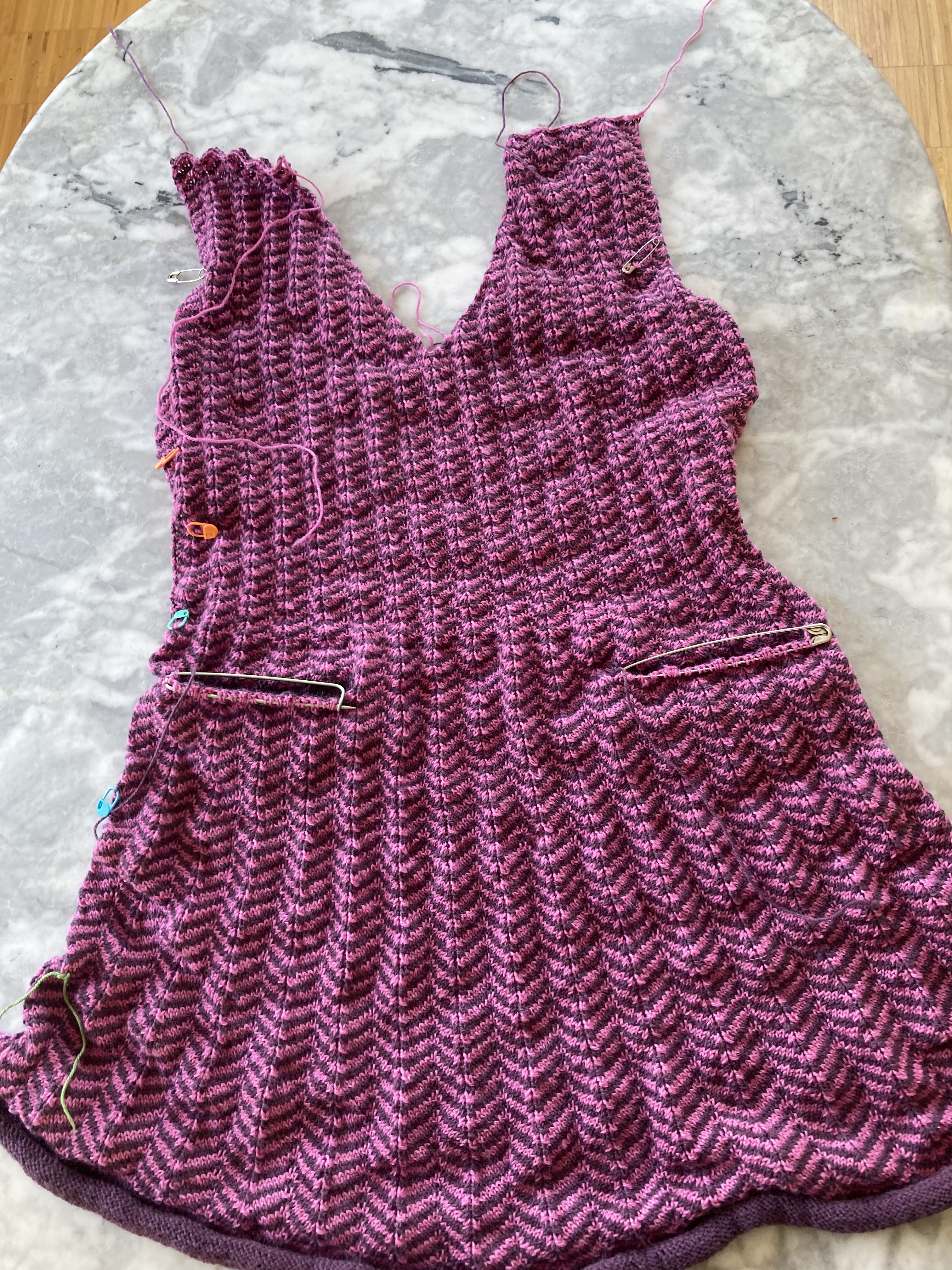
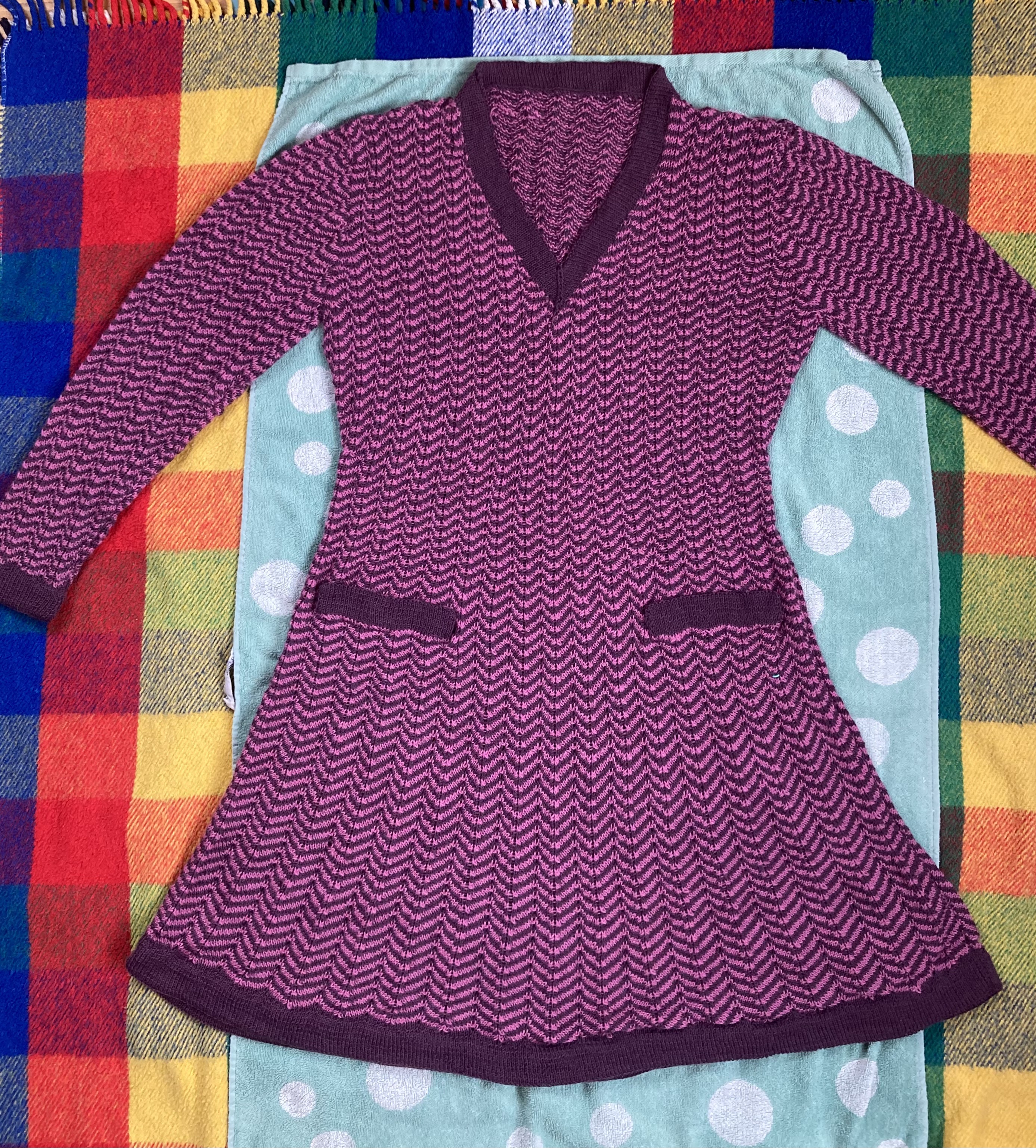
The shaping is mostly done in the chevron pattern itself — it starts off at the hem with 5 stitches in between the zig-zag increases and decreases, then reduces at intervals to only 2 stitches between at the waist. All further increases and decreases to the bust and after the armhole point are done by increasing and decreasing at the edges. (Contrary to my usual modifications, I knit the dress flat in pieces for more stability, as called for in the pattern.) The sleeves are made entirely in the 2-stitch chevron pattern. There are small knitted-in pockets with flaps on the right side. All the edgings, including the V neck, are made with folded-over and sewn-down stocking-stitch hems.

The chevron pattern makes the fabric quite nubbly, so it wasn’t clear exactly how long the dress would be before blocking. I was afraid I might have made it a little too short (I took 3 inches off the pattern length by adjusting the spacing between skirt decreases) because it fell quite a bit above the knee before blocking and the proportions seemed off. Also, the sleeves were a bit shorter than “bracelet” length and a bit tight at the hem. Blocking smoothed it out well, though — maybe even a bit too well! I didn’t pin it or anything, just hand-washed and laid it out flat as I usually do, and it is now actually 37 inches long and the sleeves are long sleeves. The fit in width is fine.

I’m guessing it stretched so much because the wool is superwash. The only solution I have ever found for the problem of superwash-stretch is to put the garment in the dryer (maybe a nice reader of this blog has a less dangerous idea?) I didn’t dare to do it with this dress at the very first blocking after putting so much work into it and being so happy with the final result, but I might cautiously try it next time I wash it. I’m happy with the fit the way it is, but it would look snappier and more authentic if it were just a bit shorter and if the sleeves were truly bracelet length.

As always, we had fun with the photos! I don’t know how the models were able to twist their backs up so severely and still look relaxed and pretty.

May 1966: Overview

It’s finally Spring!

We had a terribly cold April where I live, with rain and gloom and the sense that spring would never come. I had switched out my winter and summer clothing as part of spring cleaning last week and it all felt wrong. Then, all at once, two days ago, winter ended, the sun came out, and temperatures doubled. Perfect timing for the “Summer Plans” in the May 1966 issue of Stitchcraft!

The May to August issues always have lots of projects for travel and holidays: little summer tops, quick bulky jackets and sweaters for cooler weather or sailing holidays (aka normal summer in a temperate/maritime climate) and easy homewares to make in a deck chair while lounging about. The pullover on the cover is made in DK wool, so relatively warm, but with a lacy front to keep it airy. The photo is also almost an exact copy of the March 1966 cover photo! Apparently yellow is still trending.

Other women’s garments include a ribbed and a plain polo-neck jumper designed on “skinny lines” — the ribbed number is a special design for extra-slim Twiggy figures with a 30, 32 or 34 inch bust. For “figure-plus” sizes, there’s a summer blouse in bouclet wool with a wide, rolled collar and chequerboard lace pattern. There’s a plain DK cardigan in a range of average sizes to round out the tops, and an easy crochet dress with “practically no shapings”. High necks and clean lines are in, and stitch patterning is kept to a minimum in favour of little details of colour and finishing — see the smock-like embroidery on the “skinny” jumper, or the twists of colour on the collar and cuffs of the polo-neck. Colours are light but bold — light blue, white, green, yellow and pink.

The other members of the family are well served in this issue too. There’s a men’s “country pullover” in a zig-zag stitch pattern, as well as a bouclet “tennis shirt”, both in neutral colours of “Alabaster” and “Brandy” — even the names of the colours fit the image of 1960s masculinity. The “young fashion” set can have fun in a striped and belted mini-dress. Stitchcraft informs us that the “Young Colour Choice is mid grey and white”, which is interesting, considering that the adult women’s fashions are all quite a bit more colourful. Younger tots can make “Seaside Plans” in a t-shirt-and-trunks set for a boy or a little knitted dress and head scarf for a girl. (Why no trunks for the girl, whose dress is going to fly up over her as soon as she starts digging in the sand with that bucket?)

There are some nice child-appropriate homeware designs as well, starting with a thick, warm pram blanket in blue and yellow (to match the mother’s jumper!) The pattern is a herringbone tweed alternated with cable panels and the finished blanket is edged with satin ribbon. Then there are some wonderful decorations “for the nursery” featuring friendly animals and flowers. You can work them in felt appliqué on a wall panel, or in wool embroidery on a cushion. The animals are so cute! I love how the cat is both guarding its mouse and disdainfully looking away from the dog on the cushion. Whoever designed this obviously had a cat.

The normal homeware items are, well, normal: two different flower tapestries for a wall panel, the smaller of which can be used for a spectacles case; a tapestry chair seat, a stitched rug and waste-paper bin cover in an easy geometric pattern, a beach bag with beachy motifs (anchor, shell, beach grass) to embroider, or, for people who don’t like to relax on their holiday, a pair of intricately crocheted trolley cloths in a star design.

Saving the best for last, there are designs for two oversized, tall hats. The knitting itself is very easy, but the making-up is complicated, with lots of stiffening in the lining to make the hats stand up off of the head. It feels like Stitchcraft is finally getting into the “fashion fun” era of the 60s, albeit a little late and still pretty conservative.

In the back pages, there’s a teddy-bear motif to knit or embroider and instructions on how to make a pom-pom (two cardboard circles). Eustace the elephant from the children’s comic has eaten delicious buns for tea and helps a mother duck encourage her son to learn how to swim. Finally, “Slip Into Orbit” with these “deliciously private-eye-catching” undergarments from the Scotch Wool Shop! The space age has arrived and we are going to celebrate by wearing pretty underwear.

My project this month will probably be some variant on the animal/flower appliqué or embroidery. Enjoy the Spring!

October 1964: Totem Dress

EDIT November 20, 2022: Finished!

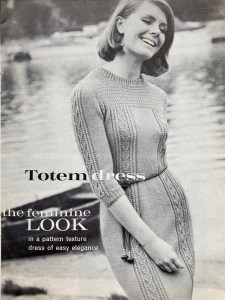
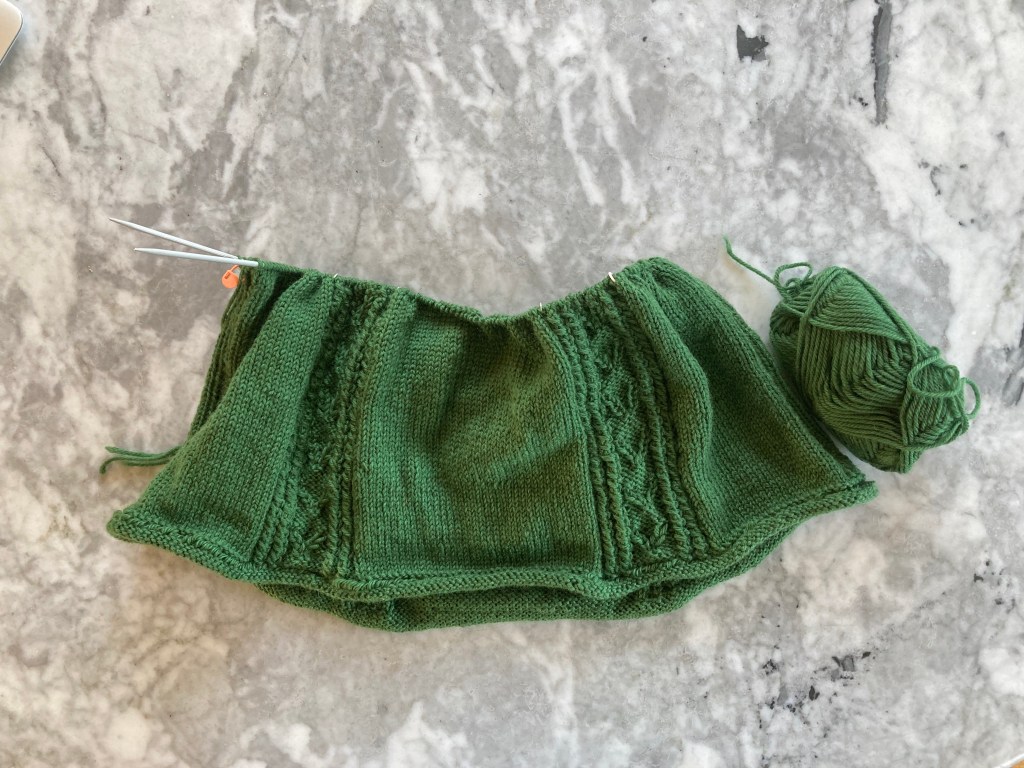
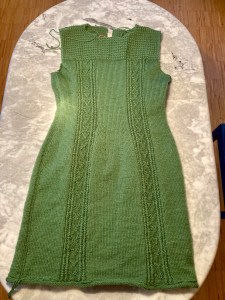
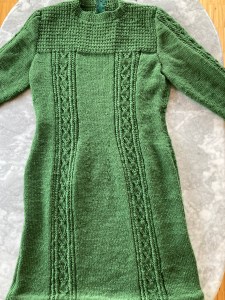
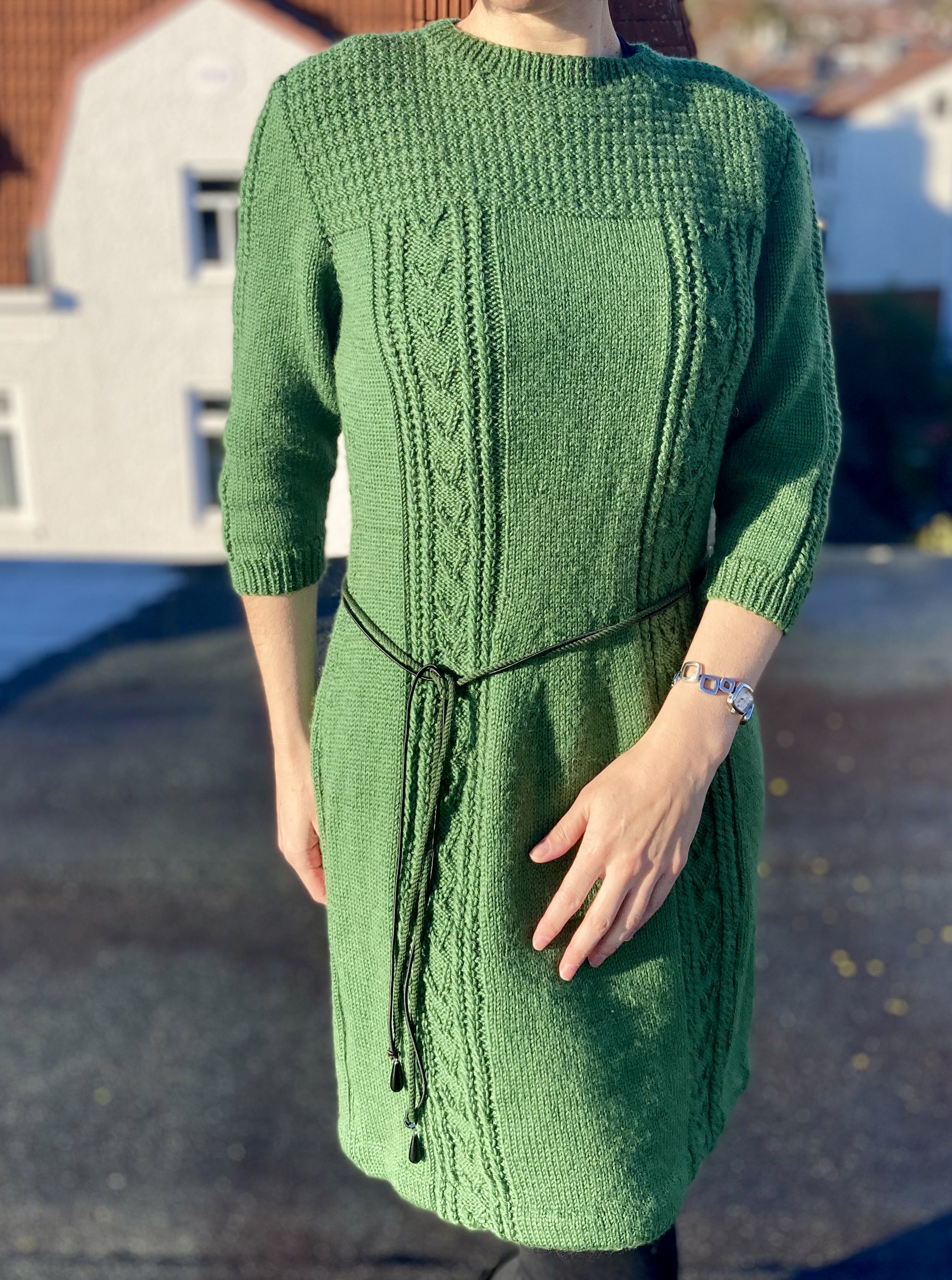
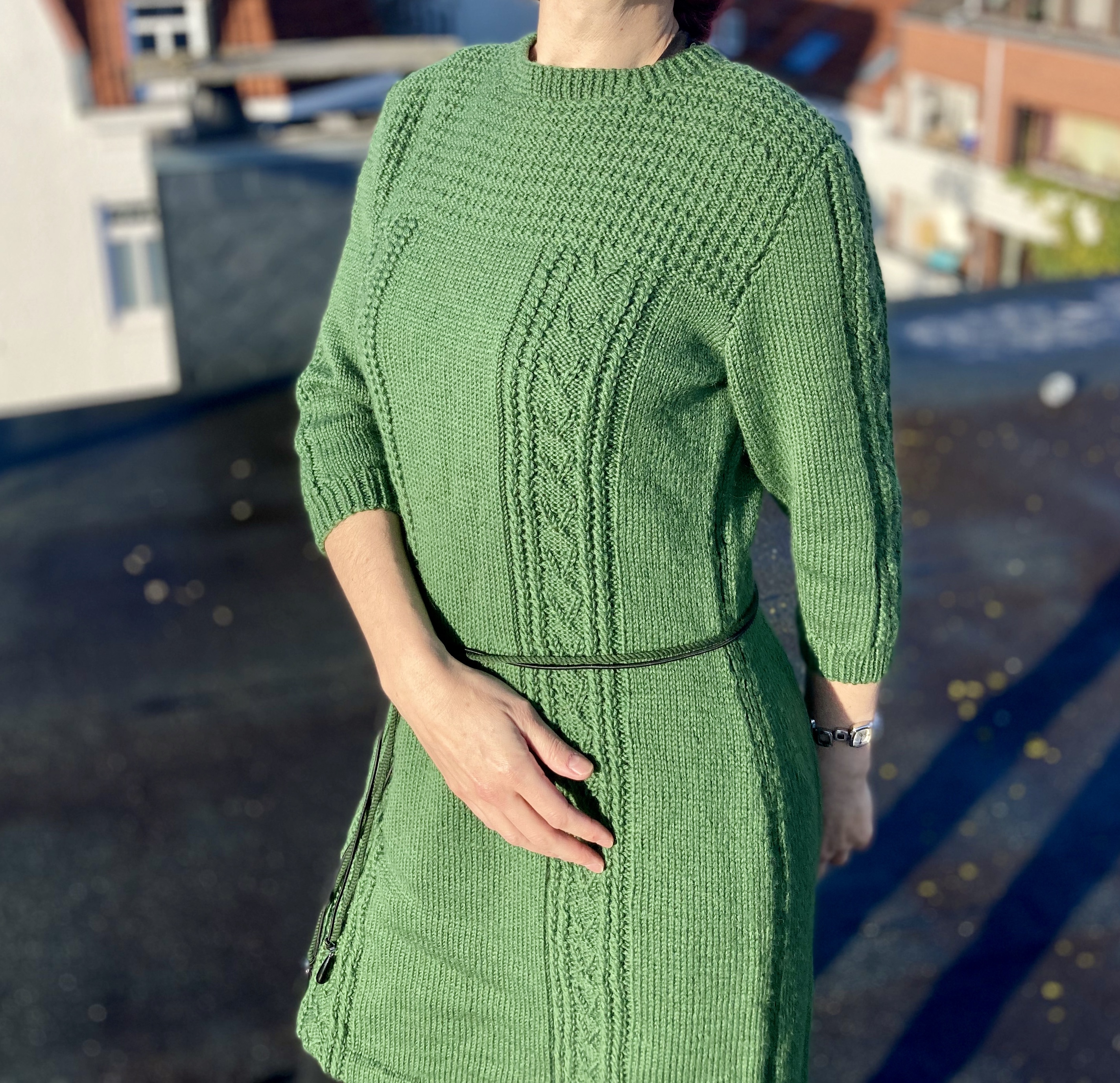
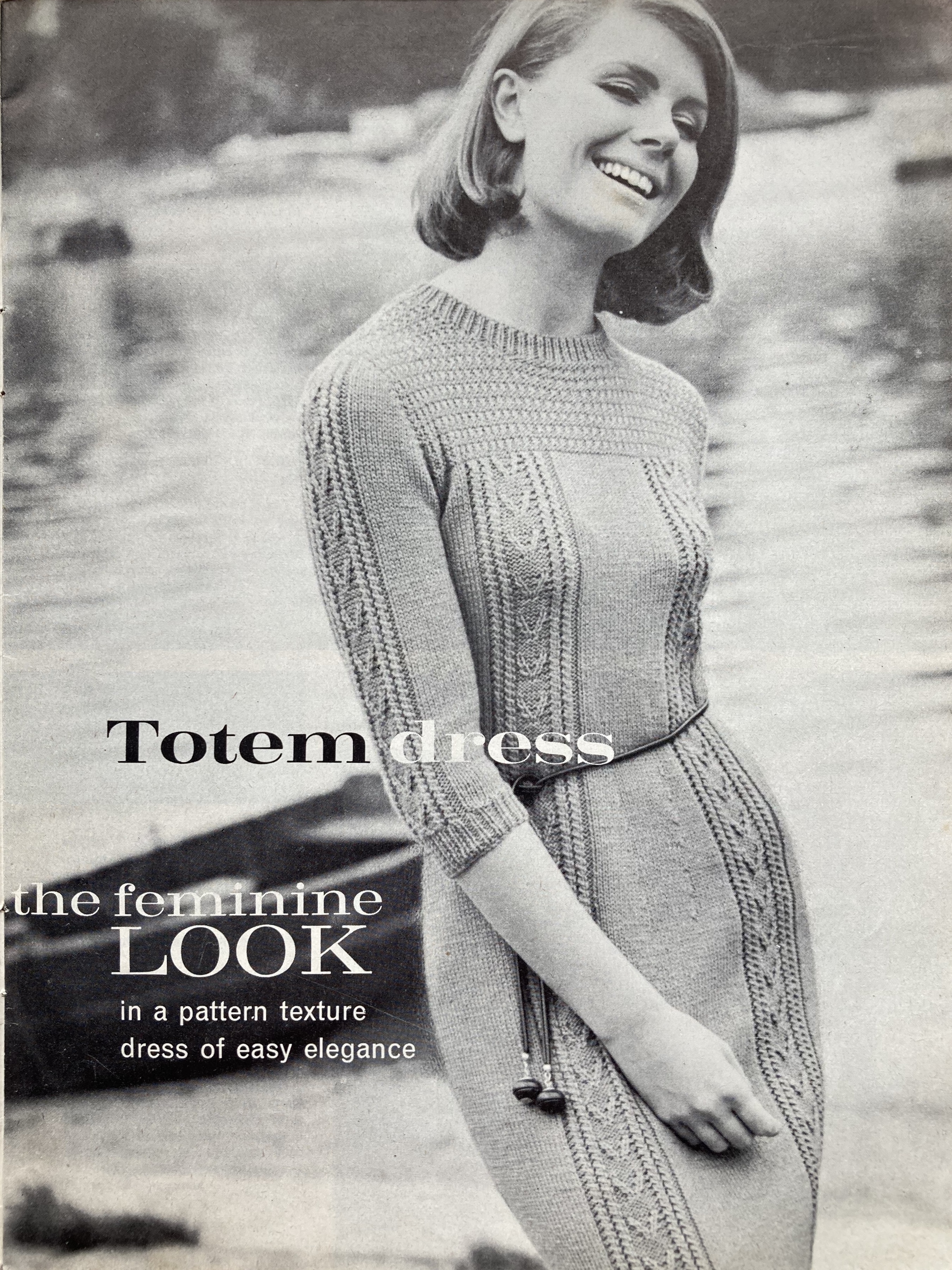
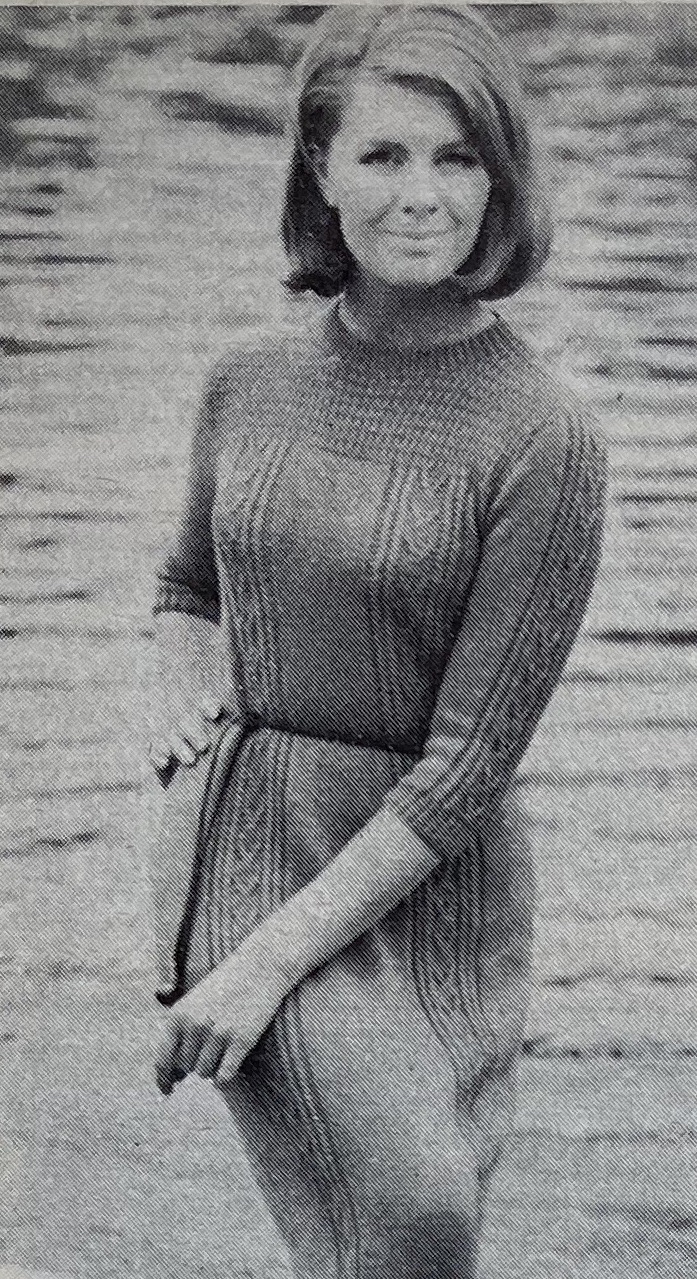
My October project was this fantastic “slim-line dress to flatter your figure”, designed in “a classic style with Aran panels and fancy rib yoke to give the fashionable textured look.” It’s written for Patons “Totem” Double Knitting, a very smooth, tightly plied crepe-twist wool suitable for the mock-cable pattern panels running up and down the dress body and sleeves.

Not having any Patons Totem on hand (of course, it has been discontinued for some time), I chose Drops Karisma, an easy-knit, easy-care DK wool. It’s also superwash — I don’t generally like superwash as it tends to stretch and sag after washing, but the advantage of not having to hand-wash a knee-length, DK-weight knitted dress won out. I chose to make it in brilliant grass green instead of “Spanish Rose” (medium pink, I assume), which is still quite appropriate for this month’s issue — it’s very close to the bright green of the men’s cardigan in the colour centrefold photo.

I made it in the second size with a few alterations: four inches shorter, to start. The finished length in the pattern is 40 inches, or just past knee-length, but this is a heavy garment and I am sure it will sag with wearing and washing. Also, I prefer skirts to be a bit shorter, so I aimed for 36 inches total length. To speed up the knitting, I made the dress in the round, with 3 stitches of ribbing at each side to make a stabilising “seam.” There’s a hem at the bottom edge, to which I added a purl-on-the-RS folding row. I wasn’t sure about the elbow-length sleeves and thought about making them long, but decided to stick with the pattern. (Ideally, I would have knitted them from the top down and just made them as long as I wanted, but the twisted-stitch pattern doesn’t really work upside down.)

Other than that, I stuck to the pattern. The pattern panels (2 on each of back and front, one on each sleeve) have traveling stitches in the middle, flanked by twisted stitches (k into the back of the second stitch, then the front of the 1st stitch on needle, then take both stitches off the needle together.) You are supposed to make the traveling stitches by twisting them as well:

Tw.2R = knit into front of 2nd st. on left needle, then purl into front of 1st st. and slip both stitches off needle together.

Tw.2.L = purl into back of 2nd st. on left needle, then knit into front of 1st st. and slip both stitches off needle together.

I could not make that work! I tried and tried. The stitch on the right side was usually twisted the wrong way, and the stitch on the left sat correctly, but was stretched out. I thought it might help to hold the wool in my right hand, “English” style (I generally knit “Continental” style with wool in the left hand and “pick up” the thread), but that was awkward and didn’t help. I tried ye olde “cable without a needle” trick where you basically drop the yarn and just hold it in your fingers, which worked but was no fun. Finally, I just used a cable needle, which was faster and neater. If anyone can tell my what was going wrong with the directions from the pattern, I’d be happy to hear it, though.

The knitting went quite quickly and by October 29 (date of this first post), I had finished the back and front, and one sleeve up to the sleeve-cap shaping. The total length before blocking was 34 inches, which, if my swatch is any indication, will stretch out to the desired 36 inches (and if not, that’s fine too.) The “fancy rib yoke”, by the way, is a simple rib/welt pattern: p1 row, k1 row, then k1, p1 for two rows. It makes a very pleasing, stretchy waffle effect.

I painstakingly calculated out the total amount of wool I would need, based on the yardage of the original Totem wool (from Ravelry, I didn’t have any of the real thing) and the meterage of the Drops Karisma, converting yards to metres and ounces to grams. Were my calculations successful?? We will see! Supposedly I will need about 730 grams, and I only bought 800, because I like to live dangerously. EDIT: The finished dress used exactly 737 grams of wool. Am I good at math or what?

I finished the dress mid-November, but had to travel for work right afterwards, so didn’t get around to blocking and photographing it until a week or two later. Finished measurements after blocking were about 37 inches bust, 32 inches waist, 40 inches hip and 34 inches long — perfect. The hem falls just above the knee and if it stretches a bit, that’s fine too. The wool is superwash, so I could always dry it in the dryer to make it snap back into shape.

I made a little belt out of green cord and pleather cord with baubles on the ends, to match the belt in the photos. We didn’t quite get the same poses as in the magazine, but we had fun.

The dress is warm and soft and fits perfectly. It is fun to wear and it is bright green. What more could I want? It’s glorious.

October 1964: Overview

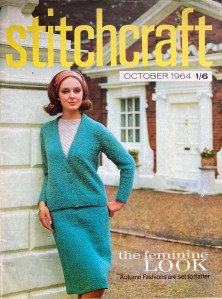
October is the start of the best season for knitting, and the October 1964 issue of Stitchcraft rose to the occasion with multiple themes and more colour pages than ever before (photographed in the villages of Great Waltham and Stebbing in Essex). There are knit designs for “him and her” as well as for different ages of babies and children, embroidery, tapestry, rugmaking and appliqué projects, “novelties” and even a few extra tidbits in the back “Readers’ Pages.” Shall we… fall in?

Our first Autumn theme is “The Feminine Look”, which cracks me up, for when has Stitchcraft or any handcraft magazine ever promoted the “masculine look” for women? It goes without saying that they would never advertise the feminine look for men… As far as I can see, the designs don’t look any more feminine than the designs from any other issue. Maybe it’s meant in contrast to the “partner-look” designs from previous fashion trends.

In any case, the cover-photo suit with coordinating jumper for underneath is simple and elegant, and probably quite comfortable to wear. It’s made in still-popular nubbly Rimple wool in DK weight and a slightly tweedy shade of light blue. The jumper is made in fingering weight and has a diagonal pattern.

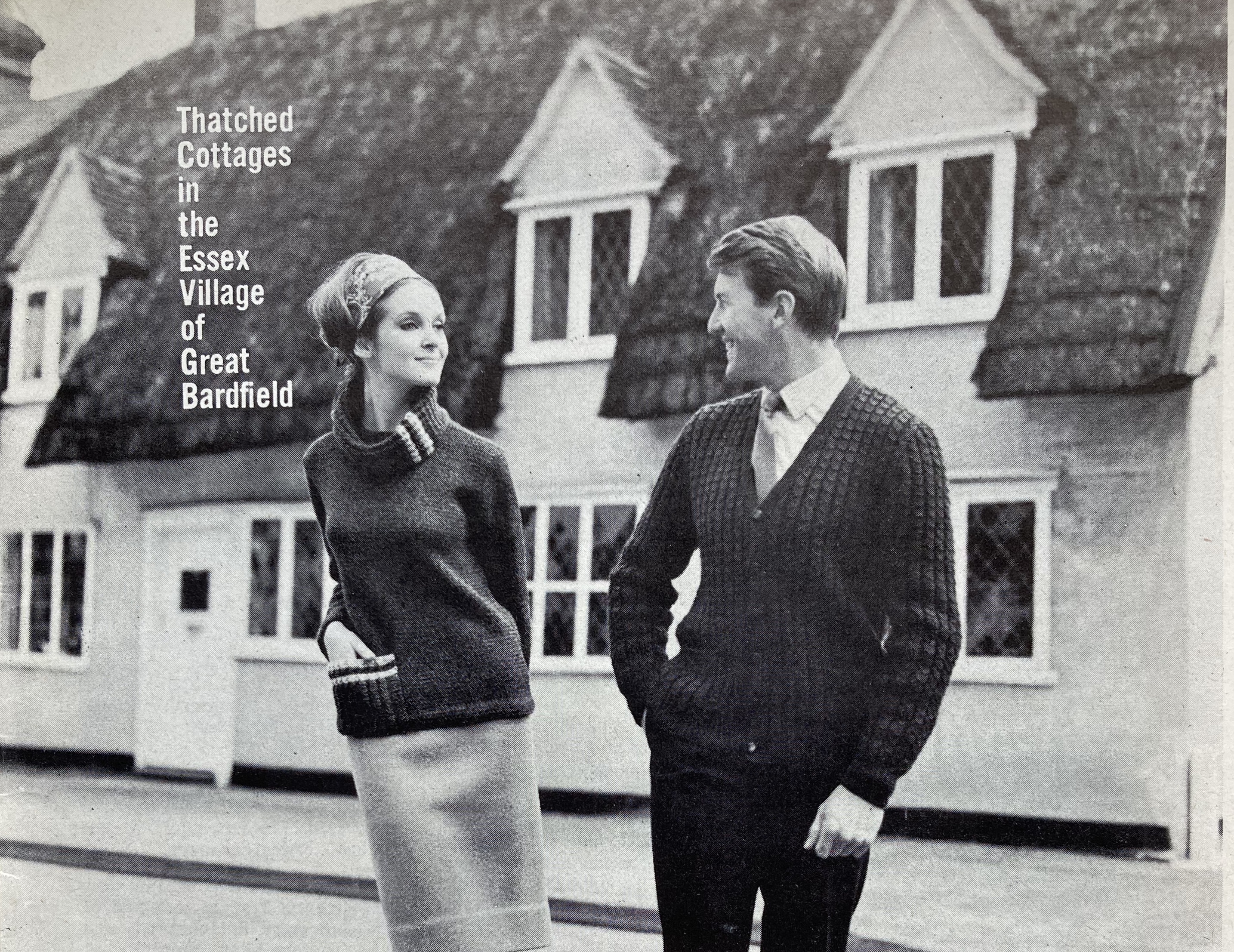
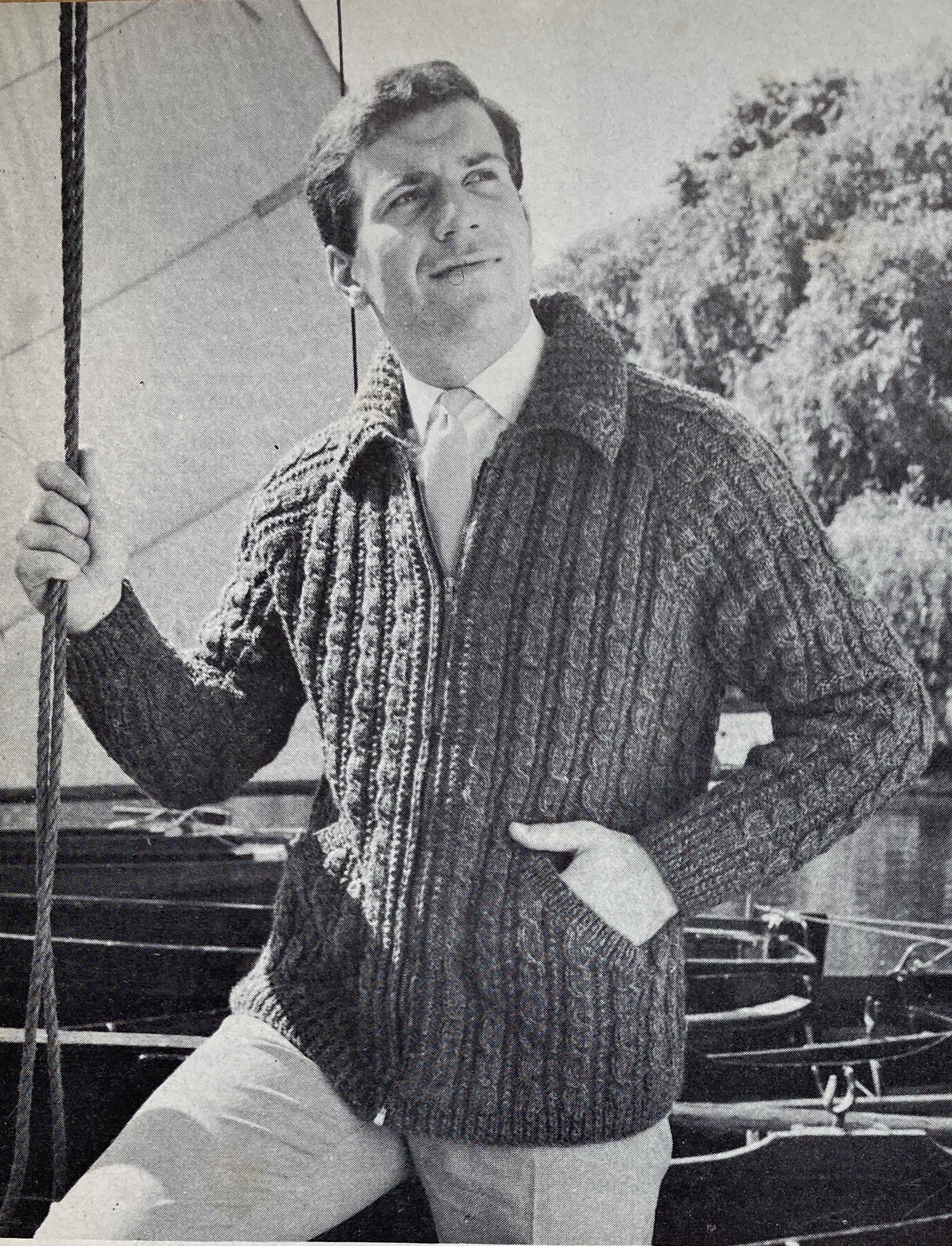
The women’s “feminine” fashions include a great cable-pattern dress as well, in smooth, DK weight Totem wool, and a less “feminine”, but probably very cosy, roll-collar pullover with an aysmmetrically-placed pocket. The mock-cable pattern on the pocket and collar is used as an all-over pattern on a man’s classic V-neck cardigan, and there’s another man’s cardigan as well in a very similar design, with “real” cables, a zip fastening and in bulky Ariel wool.

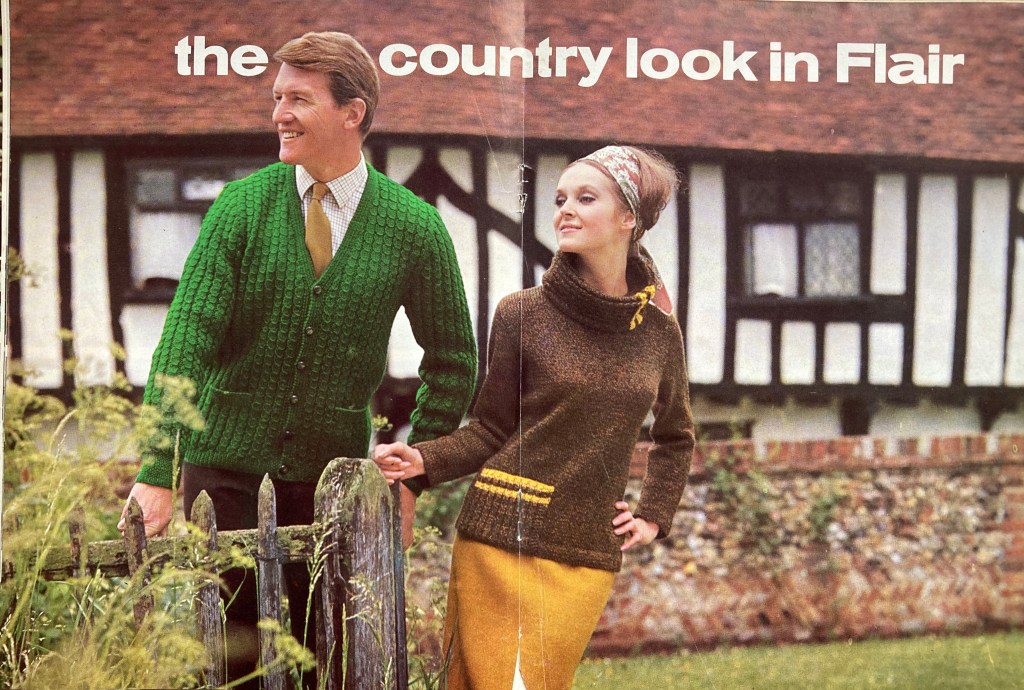
The cable cardigan and women’s pullover are shown off in a gorgeous full-colour centrefold photo where the green, yellow and brown of the knitwear harmonise perfectly with the country setting. As the caption says, both garments are made in “Flair”, a somewhat heavier wool-acrylic blend.

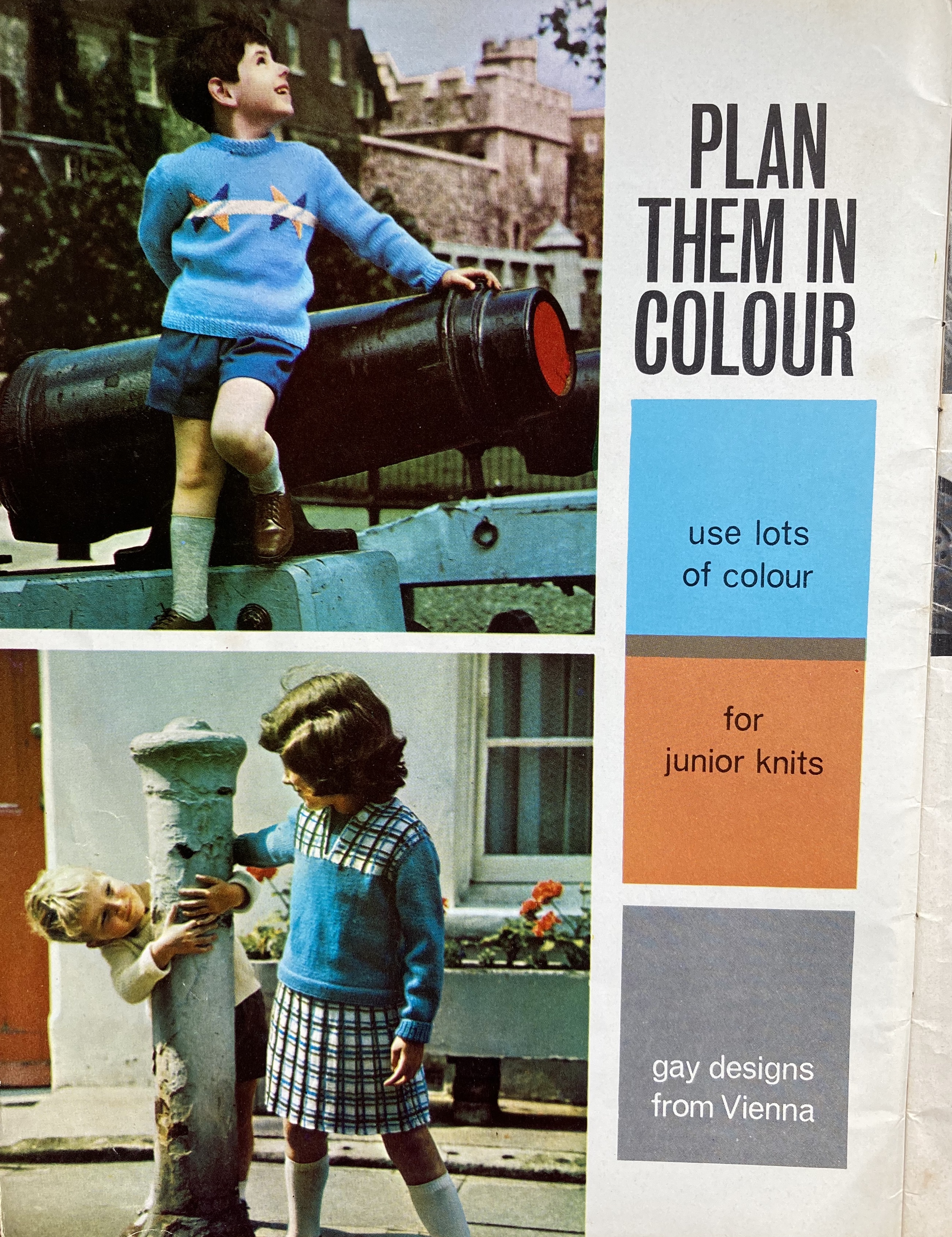
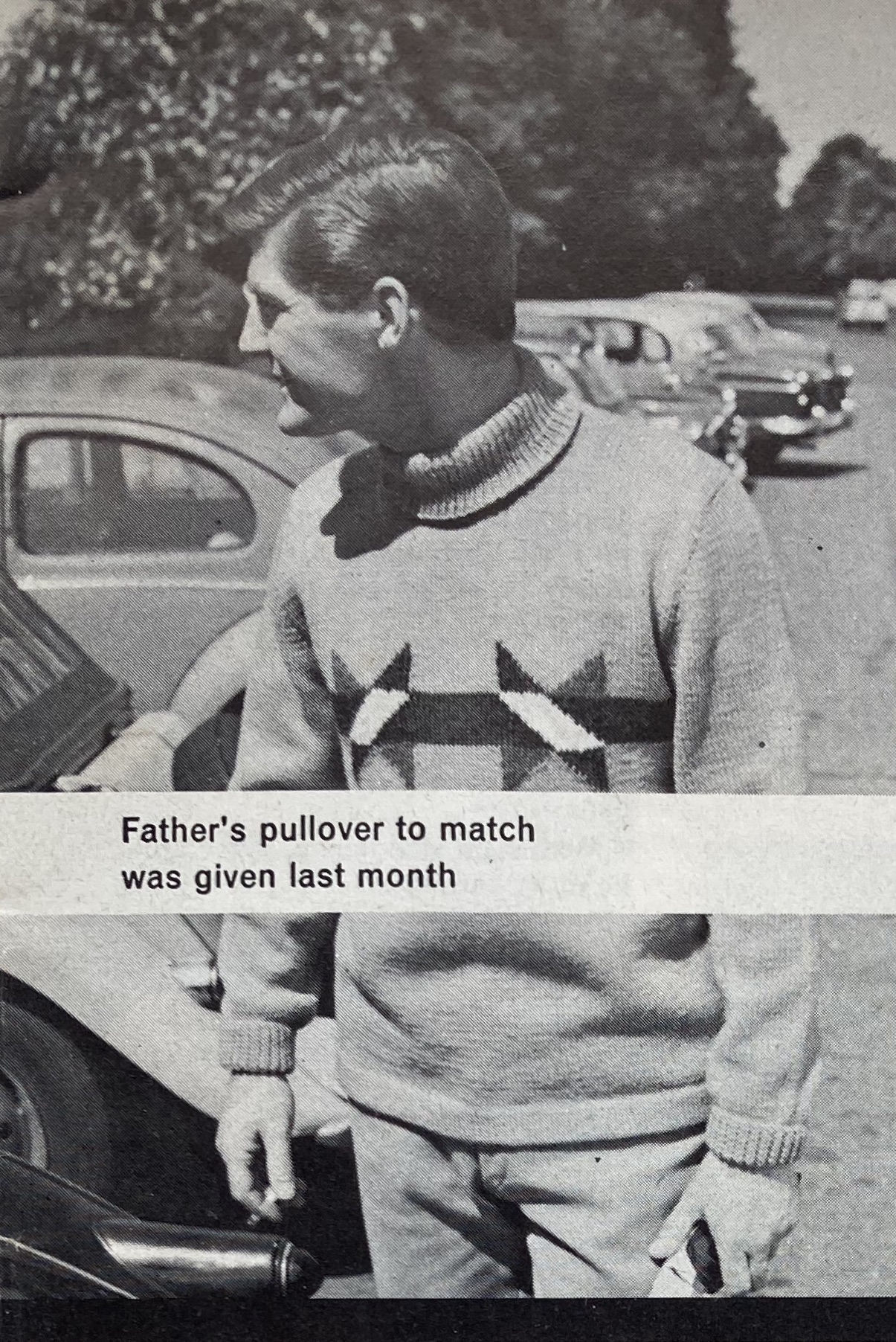
For the children, there’s a boys’ version of a men’s pullover from last month’s issue… the one that would not be a good choice for most women to wear. I personally think the placement of the star motifs is a bit odd even on a flat-chested body (they could have placed the band near the hem, or in a round yoke), but Stitchcraft liked it enough to offer a smaller-sized version in blue. Girls get a jumper suit in a plaid-trimmed “gay design from Vienna”. The colour palette for both the adult and children’s fashion is bright — blues, green, yellow, chocolate brown and “Flamenco” (I’m guessing red?), the patterns are bold and clear and collars and pockets are big and conspicuous.

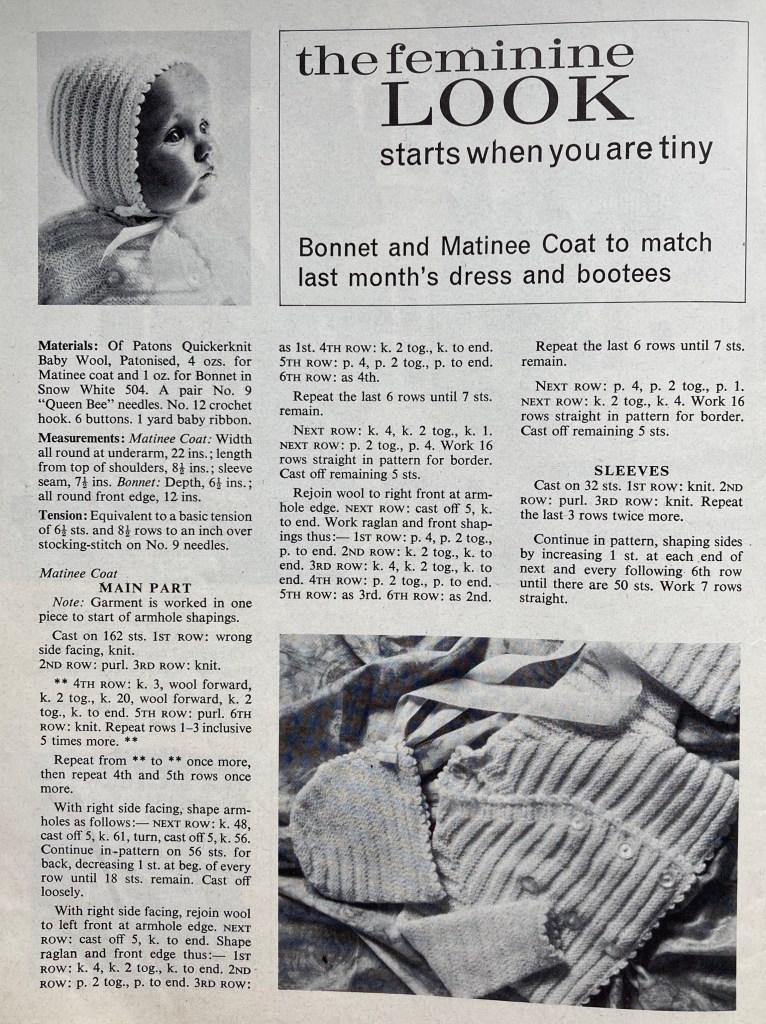
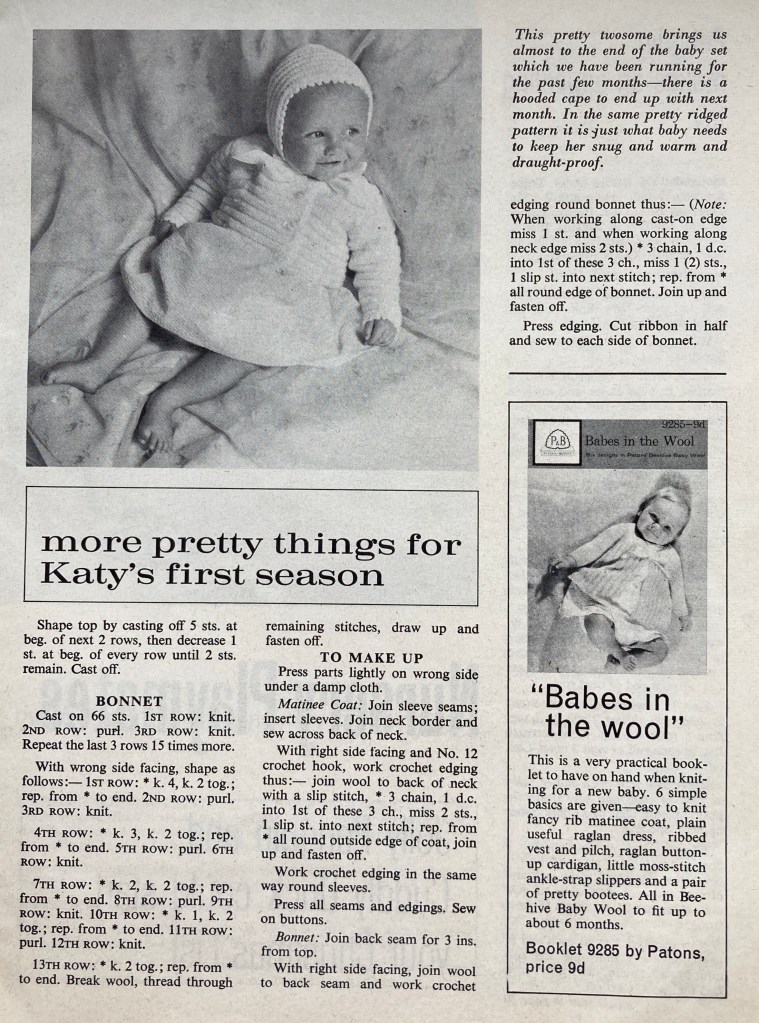
Continuing the baby-outfit series from the previous months’ issues, the (girl) baby of the family gets a bonnet and matinée coat. “The feminine LOOK starts when you are tiny” — i.e. get used to having cold legs now! The set is certainly pretty, and there’s a very practically placed ad for a Patons’ baby-pattern booklet, “Babes in the Wool” on the page as well.

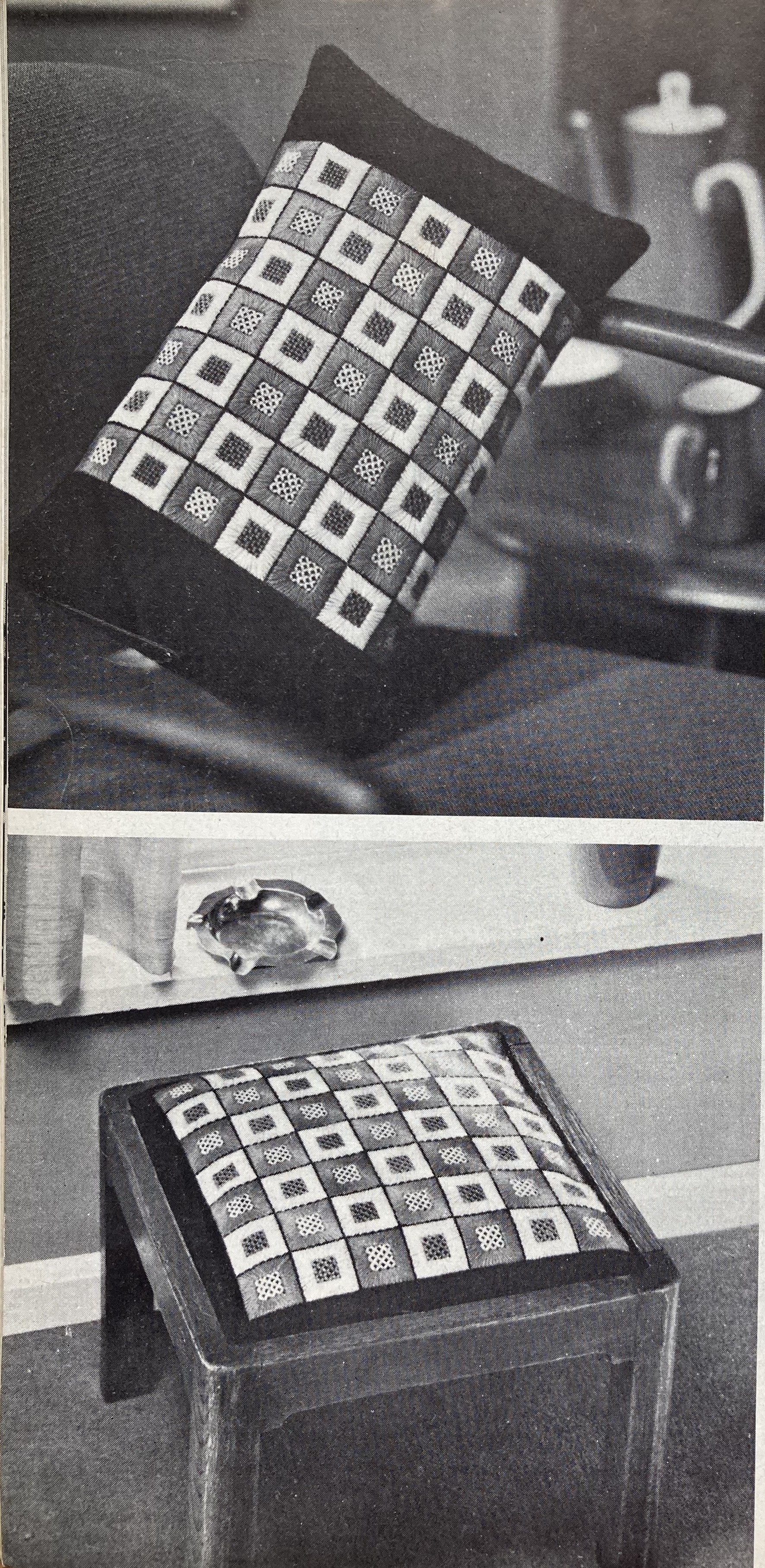
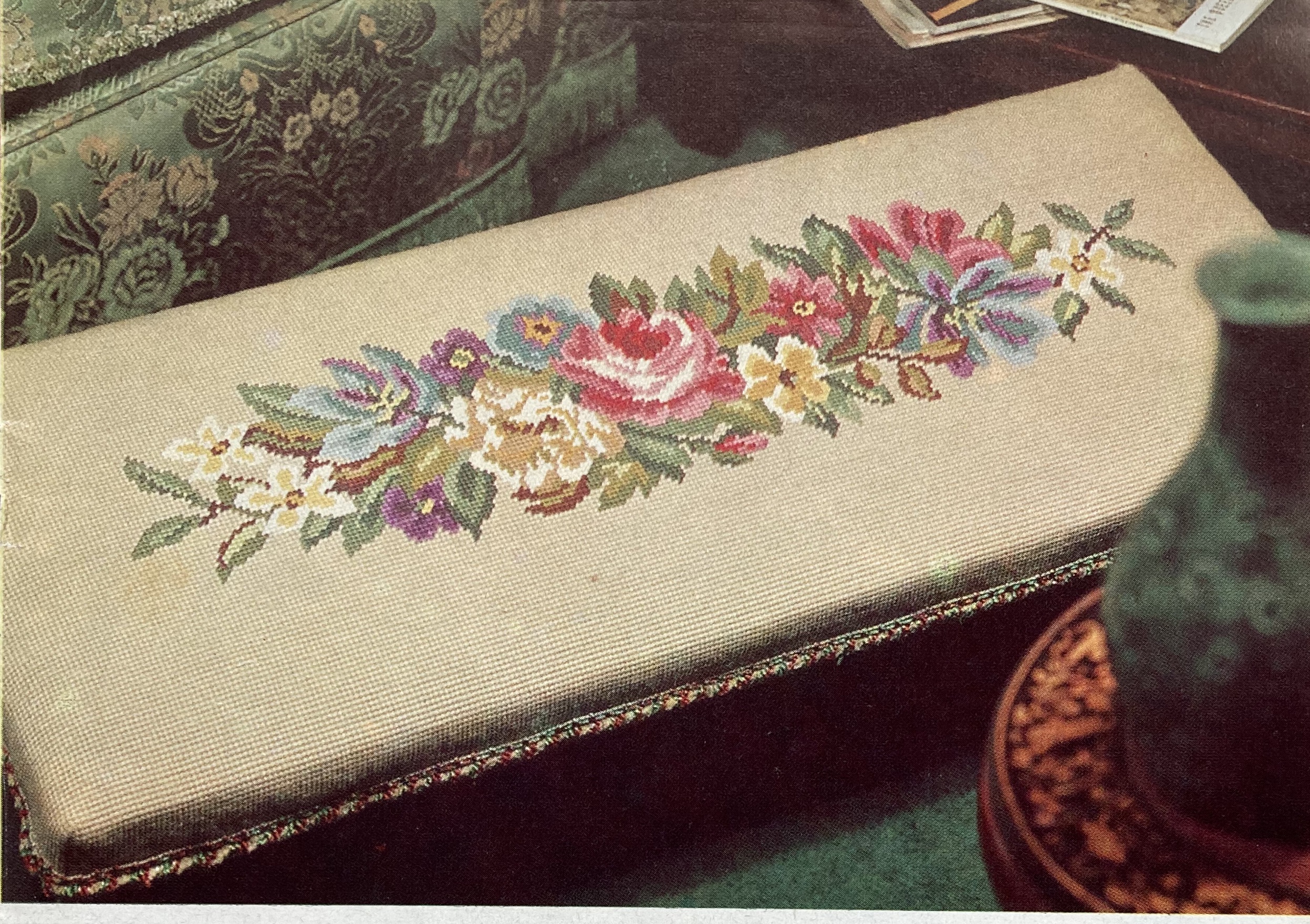
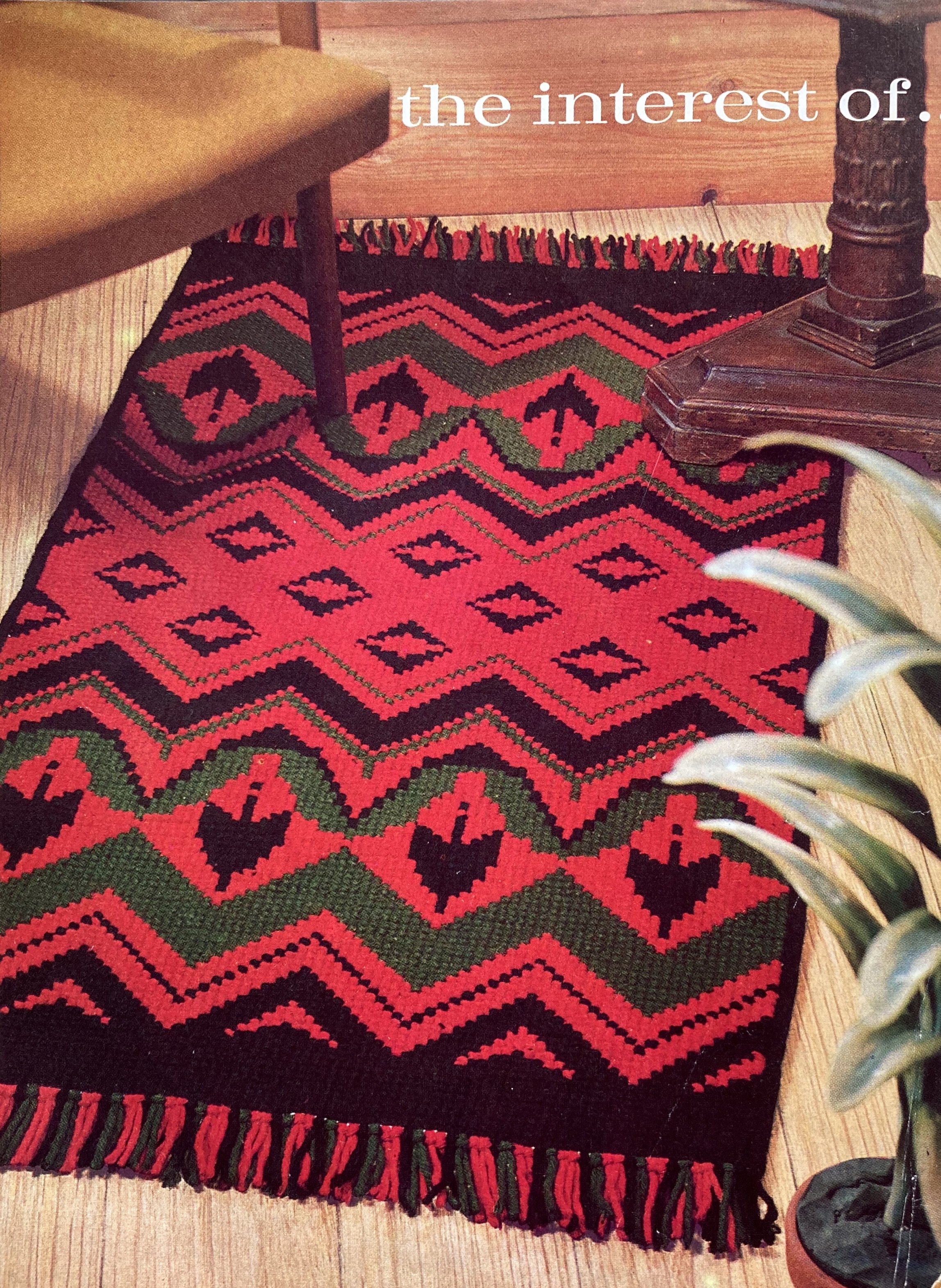
With all these great knitting designs, you’d think the homewares department would be skimpy, but they really went all-out on this issue: in addition to the usual cushions, stool-tops and chairbacks in huckaback work or tapestry, there’s a bold red-and-green “traditional Austrian” rug photographed in colour (notice how a traditional Austrian design is not called “peasant”, interesting…)

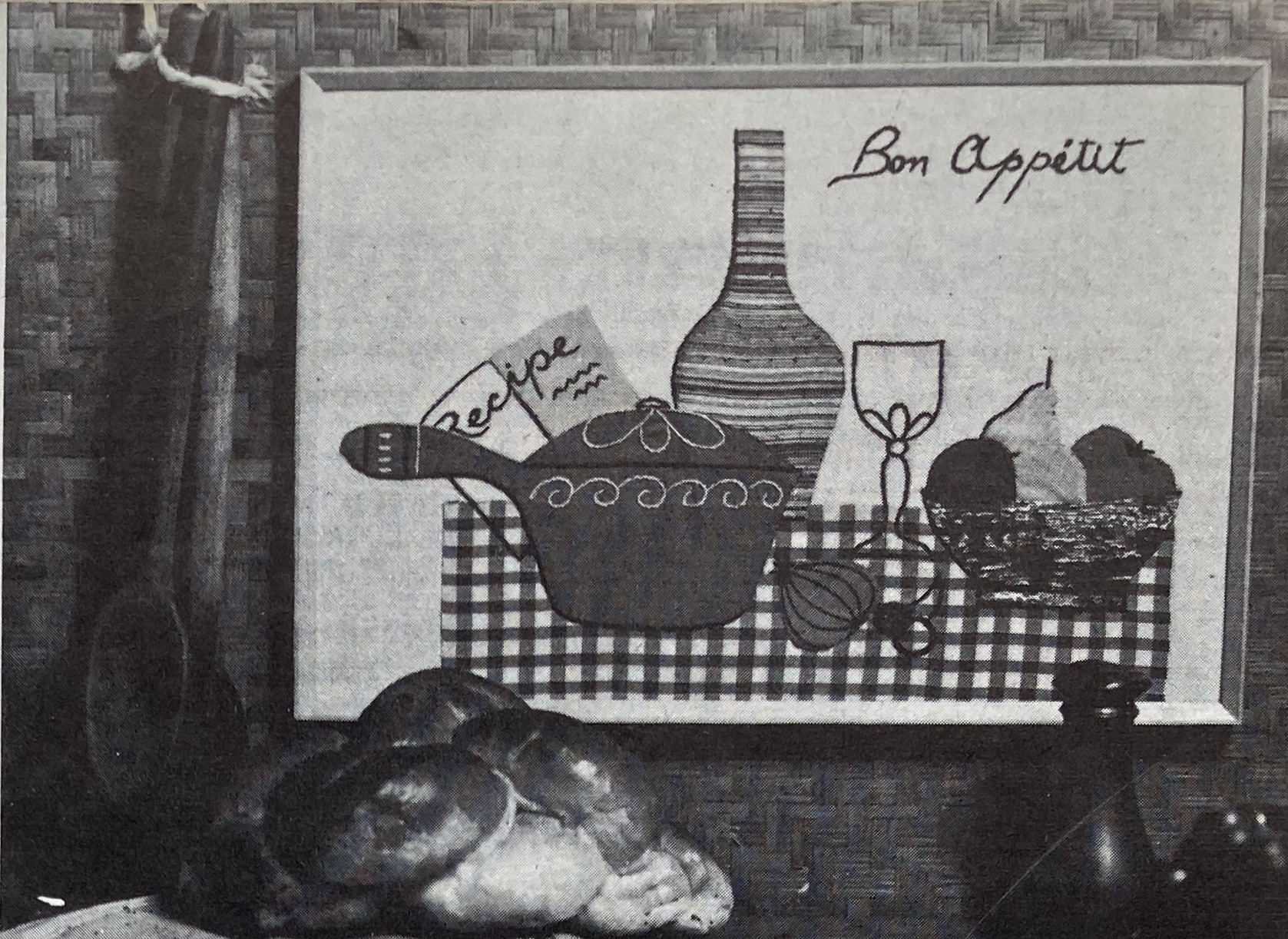
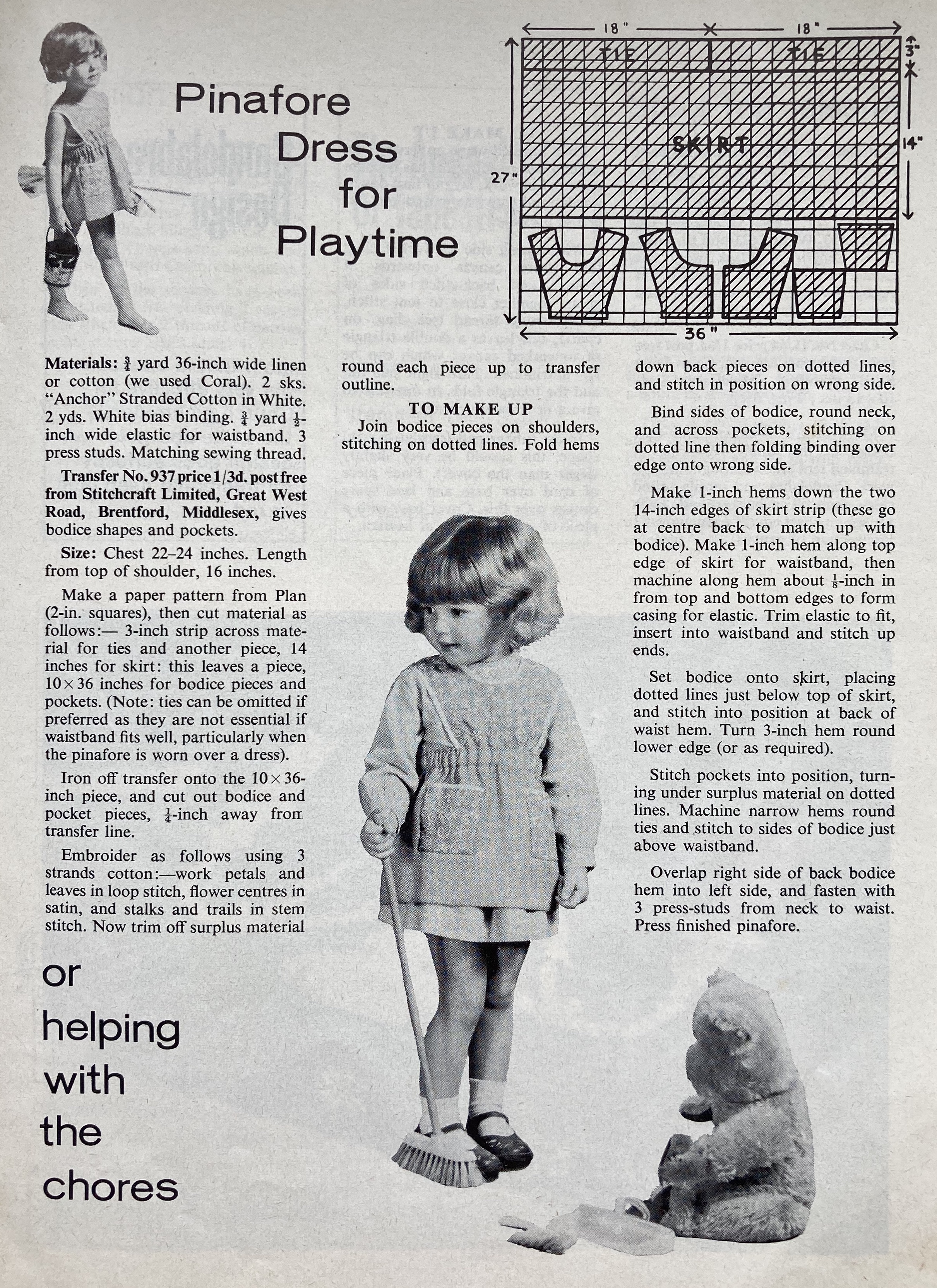
… and an appliquéd wall picture with a “kitchen”-themed design. Do I have terrible taste if I admit that I love this wall hanging? It’s utterly kitschy and very 1960s! There’s a little sewing design as well, for a child’s pinafore smock… “for playtime or helping with the chores.” Beware, little girl, that feminine look comes with its own designated activities.

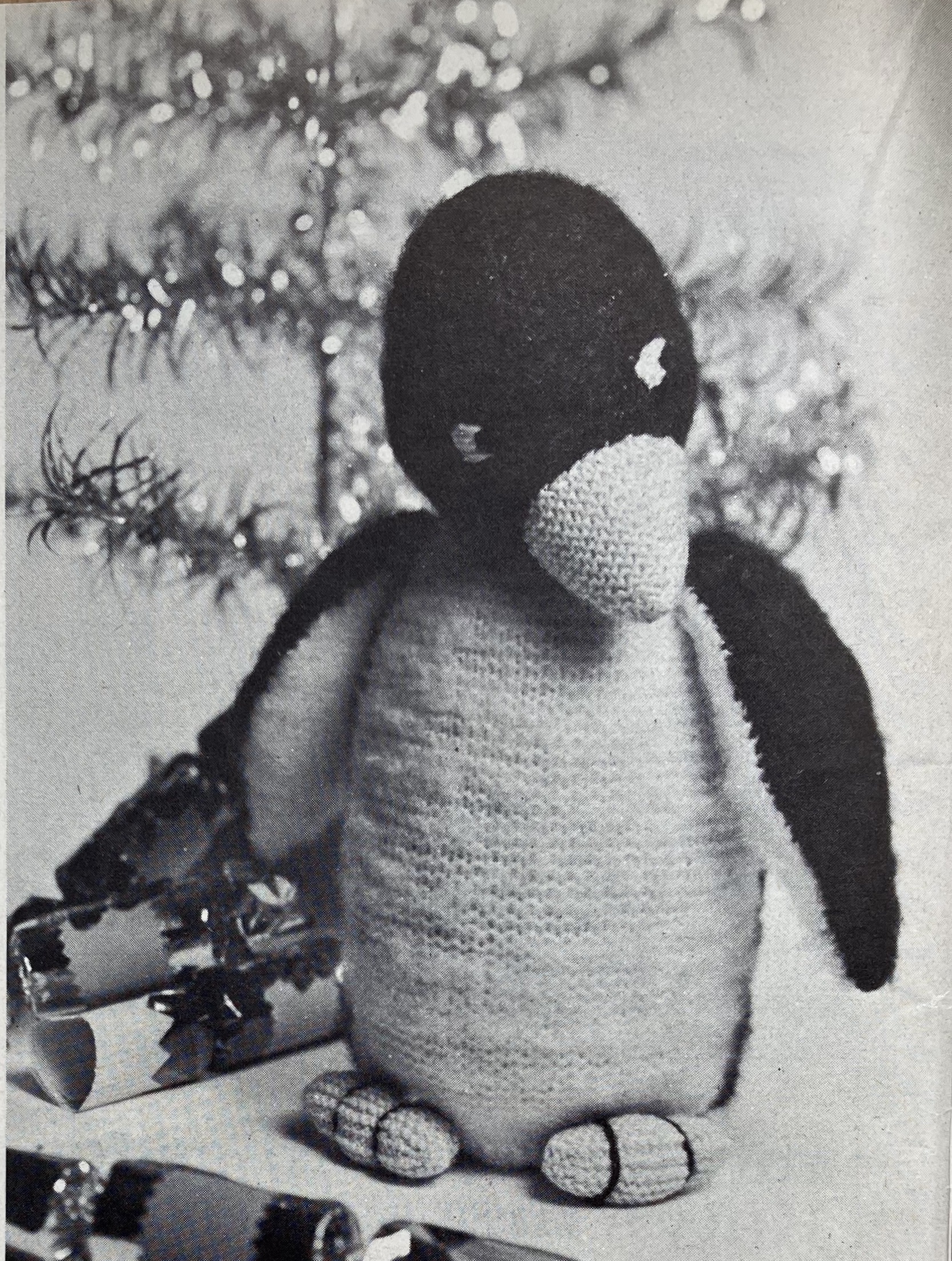
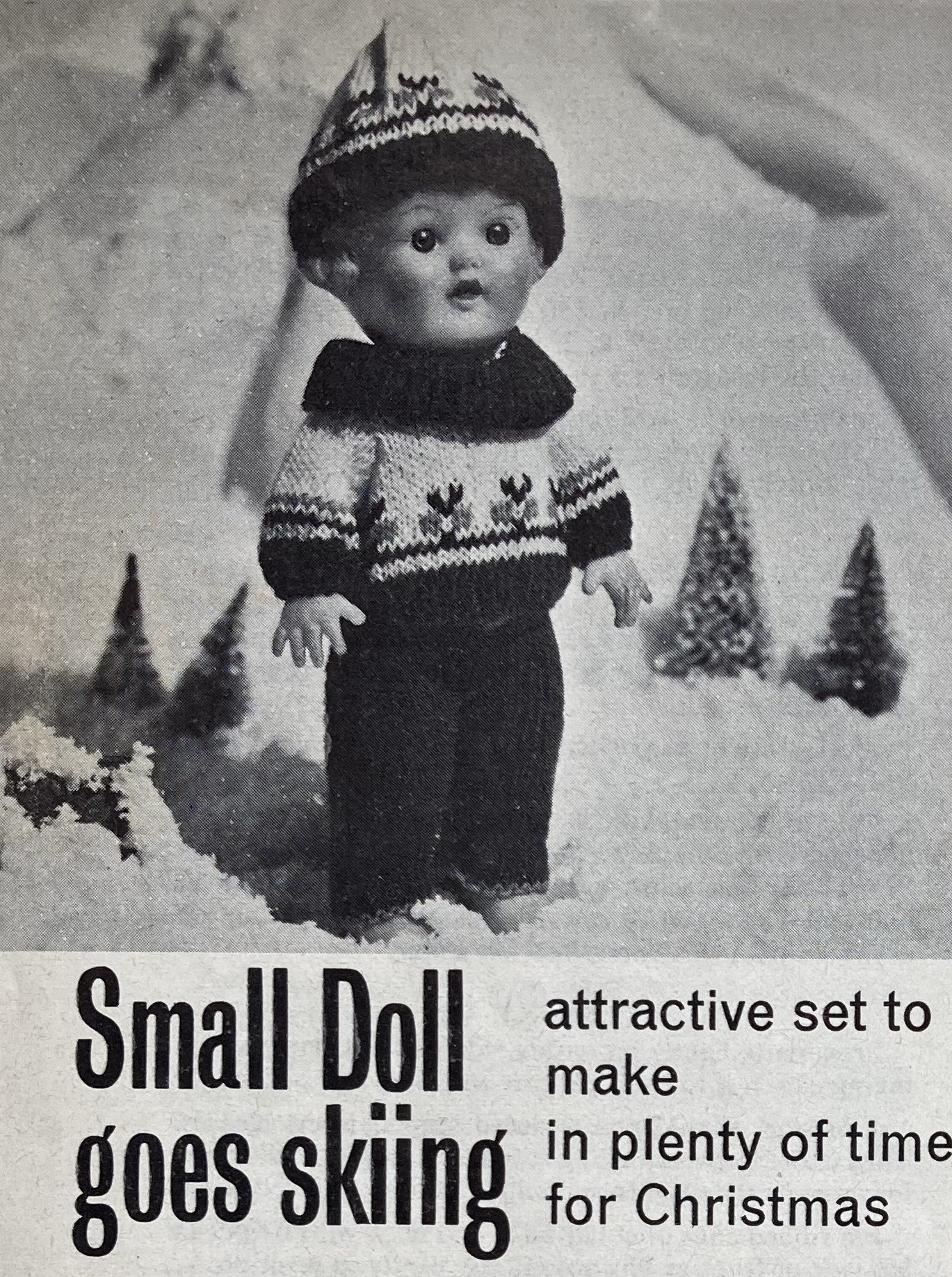
And don’t forget the “novelties”, which are not quite as weird in this month’s issue as we have seen in other issues. There’s a little stuffed penguin toy with very funny feet, and a night-case in the shape of a knitted duck. There’s also a winter ski set for a doll, with ski-pants and a warm stranded pullover and cap. (If the doll looks a little worried and not quite warm and comfortable, it’s probably because it’s standing barefoot in the snow.)

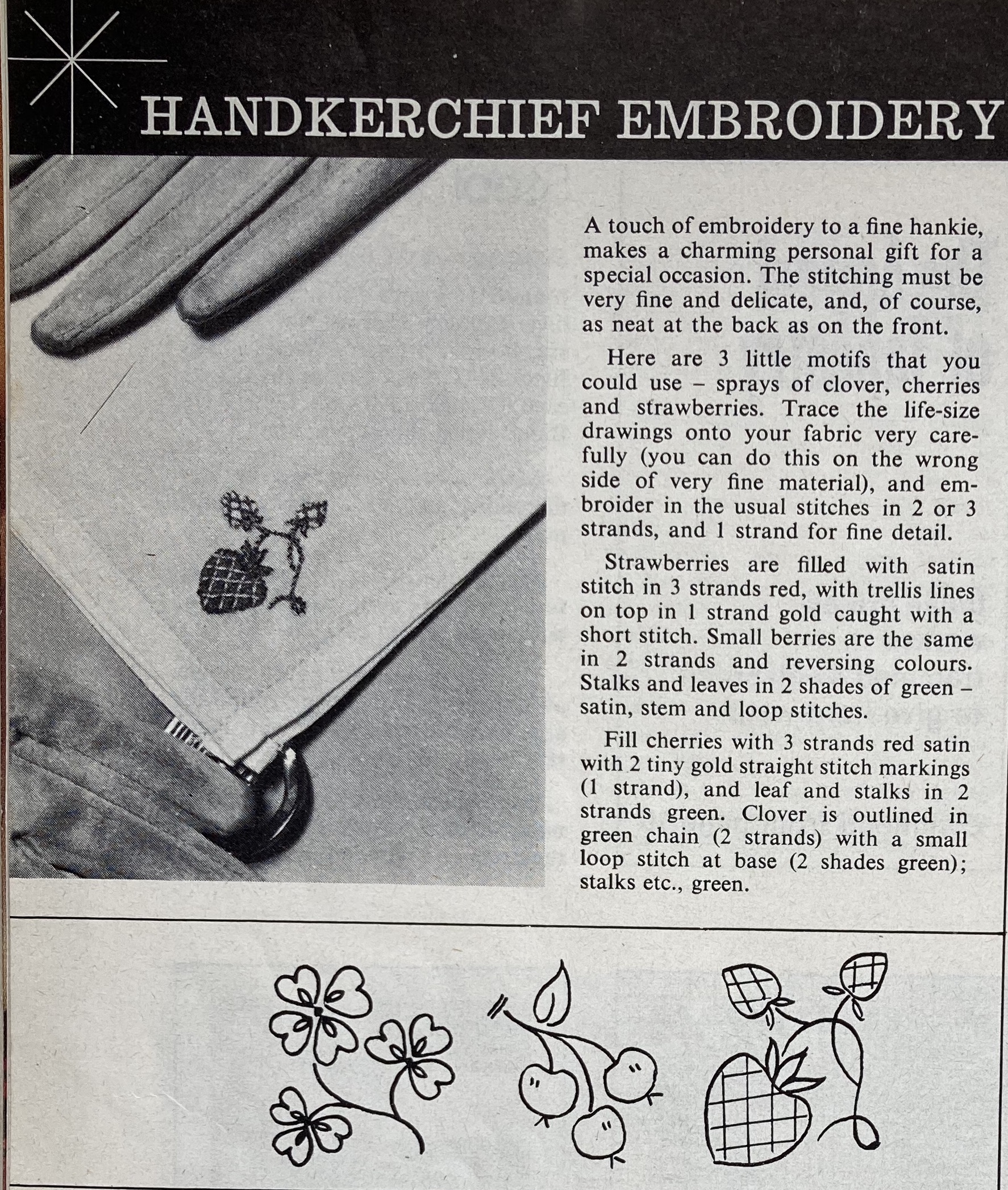
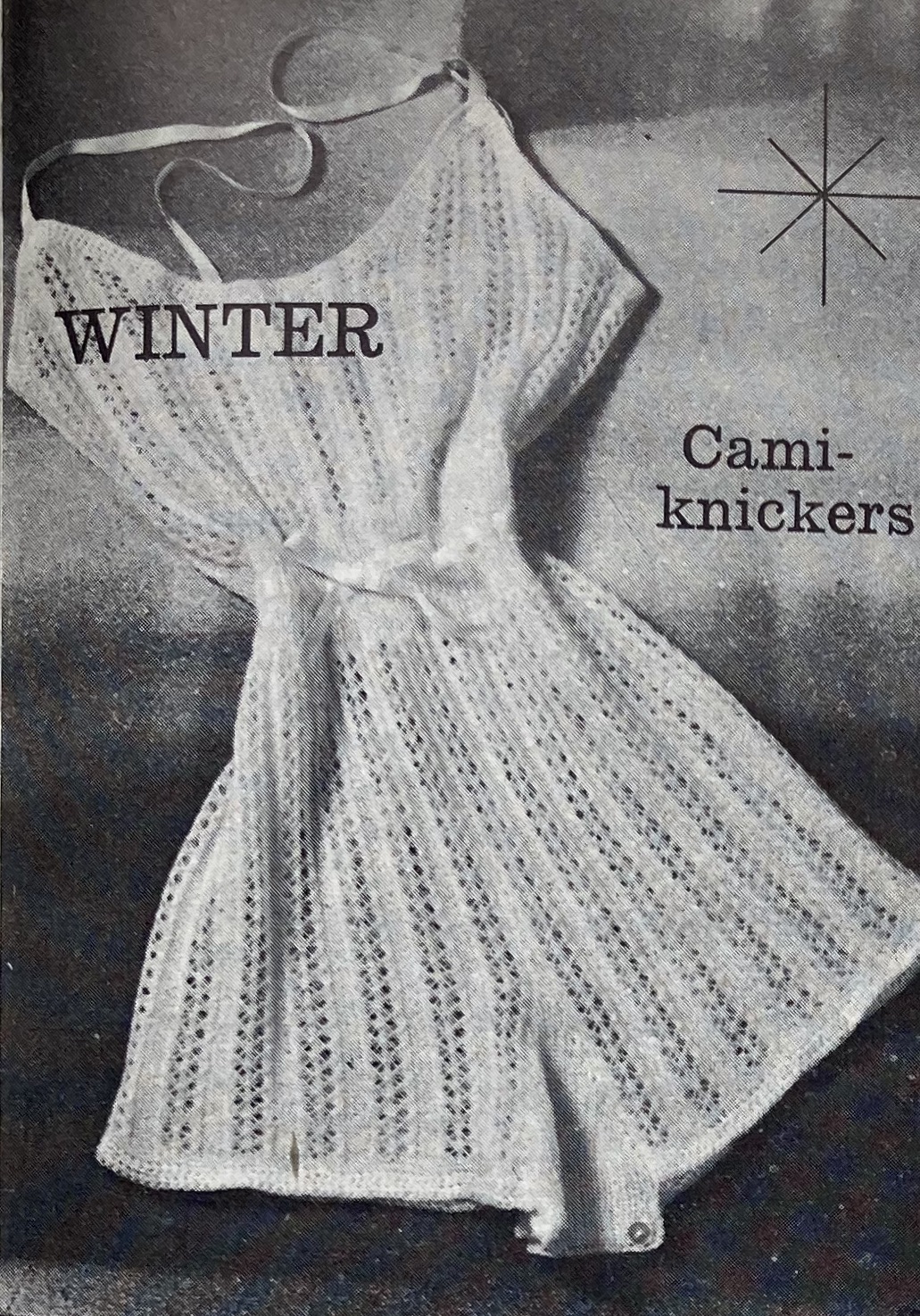
But that’s not all! In addition to the usual comic (Anne learns how to embroider an owl and a swallow using different embroidery stitches), the “Readers’ Pages” in the back of the magazine have a reprint of a 1944 knitting pattern for warm “cami-knickers” underwear, and some dainty stencils to embroider onto handkerchiefs. I love embroidered handkerchiefs, having inherited some beautiful ones from my grandmother and occasionally bought more on ebay. If I ever find any plain new ones to buy (shouldn’t be that difficult), I could try my hand at embroidering them myself.

The handkerchiefs, cami-knickers and even the cheesy appliqué picture all appeal to me, but I love the cabled knit dress most of all, so that will be my October project. I can’t imagine it will be done by the end of October, but I have already bought wool and made a swatch and am just starting casting on, so I’ll post about it soon when there’s something to see and write about.

Till then, happy Autumn!

March 1963: Sunday Best Dress

baby dress and coat, image from Stitchcraft magazine, March 1963

My March project featured sewing, for a change. I can sew, both by hand and with the machine, and I have sewn quite a few things in my time (even worked in the costume department of various community theatres as a teenager/young adult), but I do not enjoy sewing, nor am I particularly good at it, to be honest. (My costume shop work involved mostly either “pulling” outfits from storage, or doing fittings and alterations, or sewing things that someone else, i.e. the head designer had cut out. For that reason, I never learned to cut things to fit properly and am surprisingly bad at working from bought patterns.) Years of knitting have also made me very inexact about perfect measurements and straight lines, which is obviously sub-optimal for sewing. But I gave it another try to make this embroidered “Sunday best dress” for a baby from the March 1963 issue.

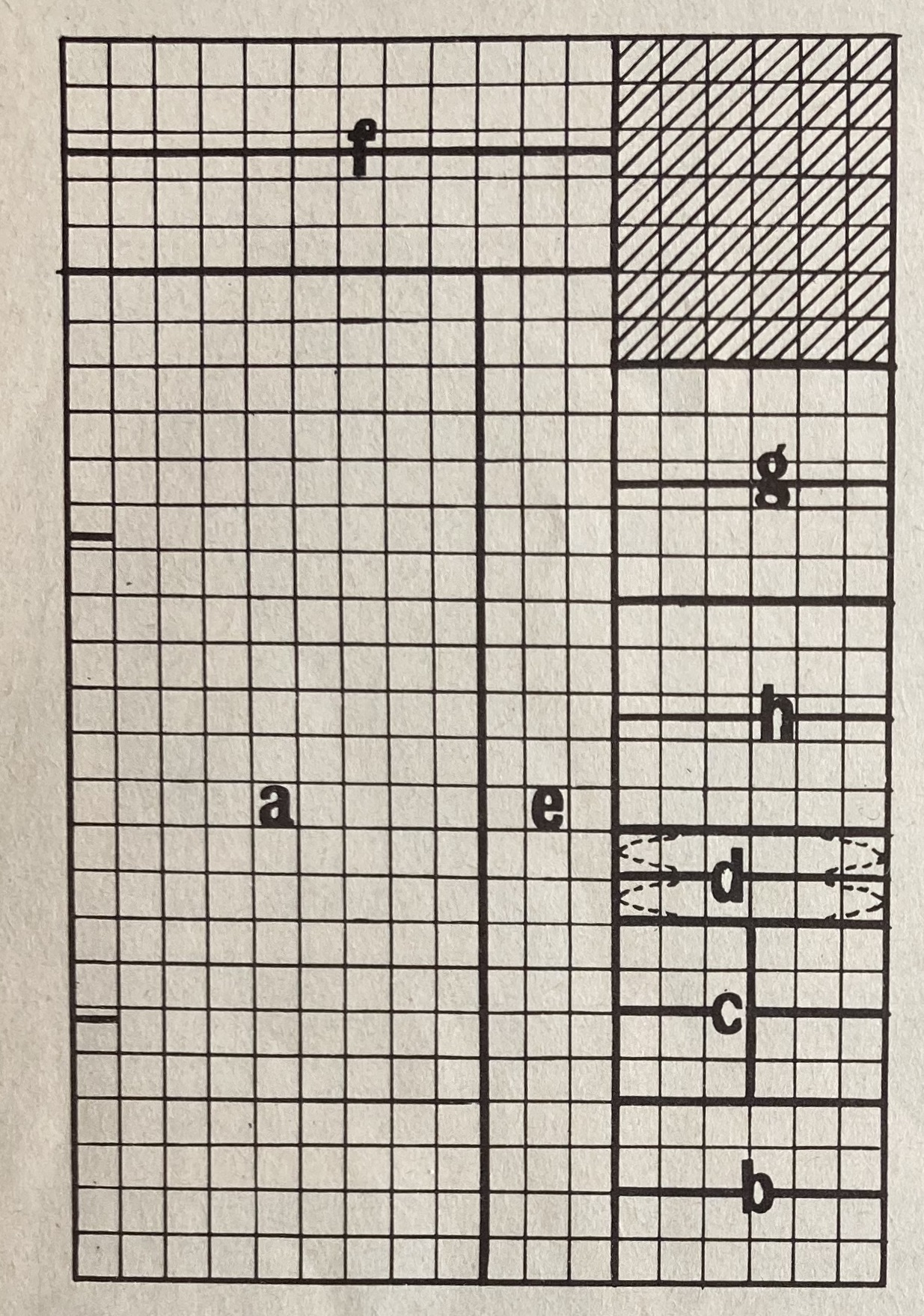
For once, you didn’t have to send away for the sewing pattern; since all the pieces were basically rectangles, they just printed a little scaled-down plan for cutting the material on a graph, with each square being equivalent to 2 inches. It was designed for silk or crepe fabric. I had bought a large remnant of beautiful light-grey viscose (rayon) some time ago, of which I used a small amount for the lining of February 1963’s needlepoint bag and had plenty left over. Rayon fabric has been around for more than a hundred years and was (and still is) used as “artificial silk” throughout the 20th century, so my fabric was quite period-accurate even though modern. I didn’t have silk floss to do the embroidery and just took the opportunity to use up some small scraps of normal cotton floss in pastel colours.

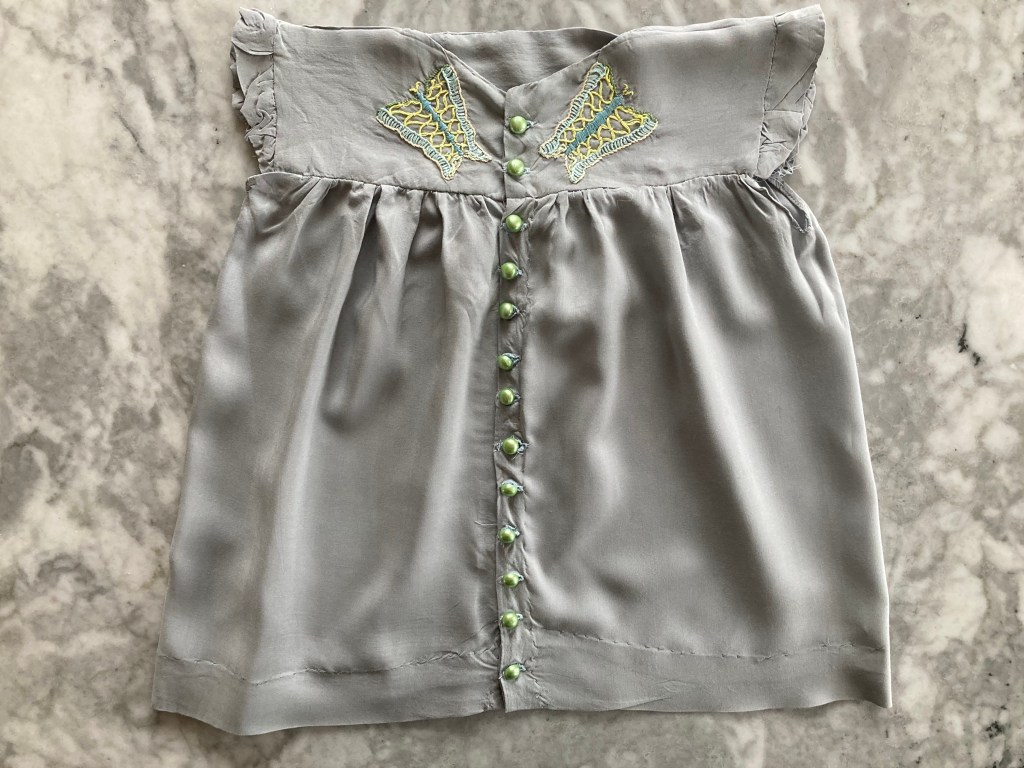
The dress was supposed have three embroidered butterflies on the front and close in the back with a couple of buttons. I didn’t have all that much embroidery thread and I did have quite a lot of lovely vintage buttons in a perfect pearly-green colour (thank you, kind seller on Ebay!), so I changed it around to fasten in the front, using the two-butterfly design from the coat (which I didn’t make).

The butterfly design was easy enough to copy without a transfer and features laid stitches on the wings — something new for me. My embroidery skills are still far from professional, but improving. The sewing work was interesting because I am not always in the same place as my sewing machine due to pandemic chaos — but also didn’t want to wait until I was — so I sewed everything except the buttonholes and waist strengthening zigzag at the end by hand. Including the gathers, buttonhole band, frilled sleevelets etc. Now I know why Marilla from the Anne of Green Gables books had to stop sewing in her later years to preserve her eyesight! Everything was tiny and took forever and my fingers, which are actually quite long and thin and nimble, felt like elephant feet.

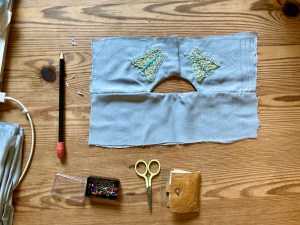
Photo of sewing work-in-progress with various sewing tools

I did the buttonholes on the machine when I could, because I was definitely not going to try to sew buttonhole stitch by hand on thirteen tiny buttonholes. My machine-sewed buttonholes look messy enough that they could pass for hand work, ha ha. I am surprised that it turned out even vaguely even (yes I know, the hem in the front is a mess.) But in spite of its obvious imperfections, I’m quite happy with the result and proud of myself for making it work. I know a one-year-old baby who would fit in it perfectly and the parents will be very happy to have it as an Easter dress for her, so in my mind, it’s a success.

Finished sewing project: embroidered dress for a baby

Meanwhile, the “naughty pile” of unfinished projects is slowly diminishing and I’m looking forward to getting back to knitting.

February 1962: Overview

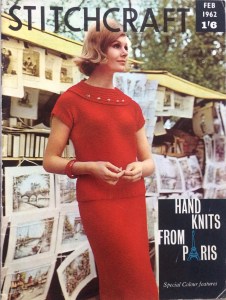
IMG_3048Put on your best traveling suit, pack your Aeros and have your Kodak Instamatic in hand, because it’s February 1962 and Stitchcraft is going to Paris! This month’s issue  features Paris-inspired designs (whatever that means) and extra pages in colour to show off the latest knitwear against a backdrop of Parisian tourist classics.

Travel from London to Paris in the early 1960s was, of course, not on the speedy Eurostar or even quicker cheap flight of our modern times. Commercial air travel was a luxury for the well-to-do and the only way to cross the Channel by train was on the Night Ferry, which ran from London Victoria to Paris Gare du Nord and back. The overnight journey took 11 hours, of which three were spent on the water;  the entire train was loaded onto a ferry for the Channel crossing. I really recommend clicking on the link, which leads to the Wikipedia article. There’s a lot more information about the Night Ferry there, and even a short list of books and films set on or inspired by it.

So what does Paris fashion 1962 have in store for us? Dresses, strong dark colours and smooth crepe wools are all “in”, with a special trend for fringes and bobbles. The two-piece dress on the cover is made in fine bouclet wool and photographed against one of the little bookselling stands that still line the roads along the Seine today. Fine, red crepe wool is the choice for the similar two-piece outfit with fringey bobbles on the front of the jumper, photographed in Montmartre. Are the bobbles supposed to suggest the legs of the painter’s tripod, or an upside-down Eiffel Tower? The dress on the facing page (Sacre-Coeur in the background) is also made in smooth crepe wool, this time in somewhat thicker Totem Double Knitting.

Fringe makes additional appearances in a lemon-yellow jumper with the newly fashionable high neckline and extra collar (Place de l’Opéra) and in the dark green and black plaid-effect longline jumper on the inside front cover (which appears to have been photographed in a Métro station, though I can’t immediately place which one.) Even without fringe, large collars are still going strong, as seen in the belted Rimple jacket. “Chunky” bulky wool makes an appearance in the beret and oversized handbag set (Capucines). The bag is reinforced with strips of cardboard along the top edges and a woven fabric lining to prevent otherwise inevitable sagging.

With all these lovely large projects and the special Parisian focus, it’s not surprising that the rest of the designs in the issue are unspectacular. There are some easy knitted classics for men and children, the usual “Victorian” and “Jacobean” tapestries for the home, and some fun little crafty projects like these “mats with hats” coasters. In the “Little Bobby” serial comic, John and Jane both have a cold. That’s February for you!

I have so many unfinished projects, including the January 1962 jumper, that my February project will be something small and easy. Maybe not the mats with hats, but probably a little embroidered lilac sprig (flower of the month) on a vegetable or project bag. In the meantime, watch for updates on the January project — it’s knitting along quite quickly — and a special 1950s “blast from the past” post.

Out of Order: Beach dress, June 1961

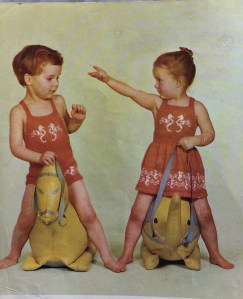
IMG_2566June 1961 was the issue with too many great projects in it and not enough time to make them all. My “official” project was this wonderful knitted blouse  which took up the whole month, but there was also a very intricate appliquéd and embroidered cushion that will probably become a long-term learning experience project, as well as a great beach dress for a small child. Summer is waning, but I got the beach dress done.
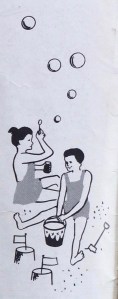
There’s so much I love about this design: the sea horses, the buttoned straps in the back, not to mention the ridiculous poses and strange inflated? stuffed? animals that the kids in the photos are riding. Also: illustrations in the magazine, done by hand, with bubbles.IMG_2566 2

The pattern is for a 23-24 inch chest, with an 8 1/2 inch long skirt. The child I knit it for is a little thinner, but taller, so I made the width from the pattern and added 1 1/2 inches to the skirt length and made longer straps with multiple buttonholes for different length options/growing room.

Version 2I decided to make it in cotton instead of Nylox (Patons wool-nylon mix from the 1960s) or a modern equivalent. It is always, always a problem to find non-mercerised cotton that is fine enough to give 7 stitches to the inch. Thick, mercerised dishcloth cotton is always available, mercerised crochet cotton is always available, but what passes as 4-ply or  fingering weight non-mercerised cotton is just too thick. I decided on Natura “Just Cotton” which is non-mercerised, soft, pretty and supposedly free of harmful substances (Oeko-Tex certification). The label says it gets 27 stitches in 4 inches but that is illusory. The yarn is 8-ply! I don’t know why they don’t use 4 strands, thus making it a true 4-ply fine cotton for soft, light garments. I got 6 1/2 stitches to the inch with some effort, but the resulting fabric is a bit stiffer than I would have liked.

On the first try, the first ball of turquoise ran out shortly after the bottom sea-horse band and I was worried that I wouldn’t have enough, so I started over and made the skirt less full. Of course, the skirt lost a lot of its swing and I ended up with a ball and a half left over at the end… I used some of the rest to make a little kerchief that the kid can wear on her head for extra sun protection and cuteness. Let’s just hope it stays warm enough for her to still wear it this year.

Inspired by Stitchcraft: Red and Blue Dress

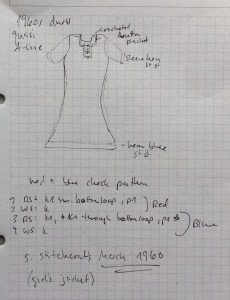
IMG_2498This month’s project was a little bit different than usual. Instead of making something from the April 1961 issue, which didn’t have any projects that really spoke to me, I decided to finally make something I’ve been dreaming of ever since I made this little girl’s jacket from the March 1960 issue. I loved the check pattern and the bright red and blue combination. “Wouldn’t that make a great 1960s-style minidress?” I asked myself, and the idea has been percolating in my mind since then.
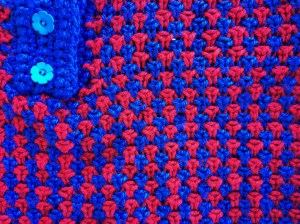
I chose the same yarn and colours from the child’s jacket: Schachenmayr Bravo, which is inexpensive, machine-washable and knits up quickly. It’s even historically correct for a 1960s design, which is a nice way of saying “100% acrylic.” (Though true 60s synthetic wools were more often Bri-Nylon or Orlon.)

IMG_2497I chose a typical basic construction with front, back and sleeves all made flat and separately from the bottom up and sewn together, and made a stockinette-stitch hem with the blue yarn. The dress shape is a modified A-line: flared at the hem and narrowed to the top waist, then increased slightly at the bust. I used another knit dress as a pattern, but had to deviate from it as the stitch pattern made the fabric behave differently. The sleeves are short, simple and set-in. The front piece is essentially the same as the back, but divided in half after the armhole cast-offs and rounded a bit at the neck. The button band is plain crochet.
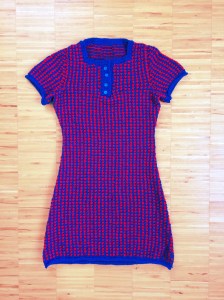
IMG_2494After it was all done, I realised that I liked the roll of the blue stockinette stitch hems, so I decided to just leave them as is. That means the bottom hem is a little bit narrow in the blue part where it should flare out. I may or may not fix that in time, depending on my laziness levels.

It’s soft and squishy and in spite of the synthetic yarn, doesn’t feel like plastic or make me sweat uncontrollably.  The only real disadvantage is the virtual weight it puts on. It’s got negative ease everywhere and is narrower than the very svelte-looking dress that I used as a pattern, but the sponginess and three-dimensionality of the stitch pattern makes me look much bulkier than I actually am. I thought a crocheted belt in blue would help define the waist area a bit more, but the belt is curly and not heavy enough. Maybe a 1960s metal ring-chain belt would do the trick? But it’s utterly comfortable and fun to wear, so I’m happy.

December 1960: Baby’s Special Outfit

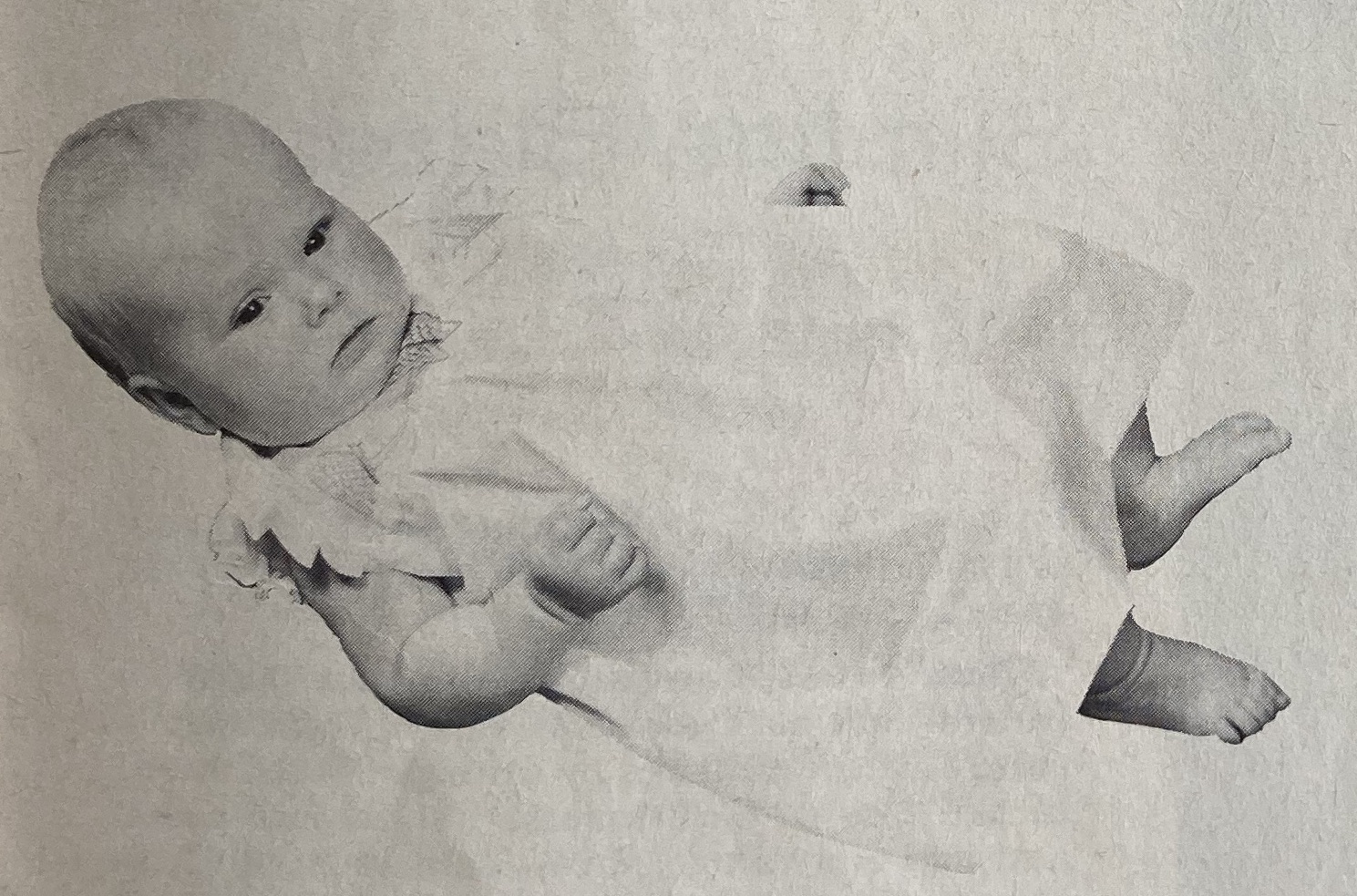
IMG_2217My December project was a warm winter dress for a baby, part of the “Baby’s Special Outfit” of dress, bootees and mittens that continued the baby set started in the November 1960 issue.

The dress has a smocked top, which I had never worked in knitting before. Of course, knit smocking is not like sewing smocking, where you gather the fabric up in regular pleats and embroider over it. Here, it’s pretty easy to do and involves taking out a long loop and knitting it back in a few stitches later — almost like cabling without a cable needle. The base pattern is 2×2 rib, which gives the same effect as gathered fabric.

dec60wipI used a lovely 100% wool that was hand-dyed by a fellow knitter in my local knitting group. She uses natural dyes from plants in her garden, or the bits of food items that are normally not eaten: walnut shells, onion skins, and so on. This green-melange wool was dyed with red onion skins! She did explain to me how that worked, but please don’t ask me, because I forgot the answer already. Anyway, it’s very nice. I was worried that it might be too scratchy for sensitive baby skin, but wash-blocking it and rinsing with hair conditioner softened it up quite a bit.

I only had 100 grams of the wool, so had to make the dress a bit smaller than in the pattern. The original pattern was for a baby up to one year or more, had a long, full skirt, measured 22 inches at the chest and had sleeves. The baby I made this for is 6 months old but still quite small, and my version of the dress measures 21 inches at the wide part of the chest, has a shorter and narrower skirt and no sleeves. In a way, that’s more practical, since it can be worn over a t-shirt and leggings and taken off if the baby gets too warm. It also won’t touch her skin, so scratchiness won’t be a problem. It buttons in the back.

And with that, I have completed one whole year of Stitchcraft projects! Goodbye 1960 and 2018, and hello 1961 and 2019. Stay tuned, and happy New Year!