November 1967: Overview

Autumn is officially here, winter is around the corner, and Stitchcraft‘s November 1967 issue presents “the GOLDEN LOOK for winter sparkle”, with warm garments, warm colours, fun textures, and matching his-and-hers outfits to chase away the cold, grey days of November.

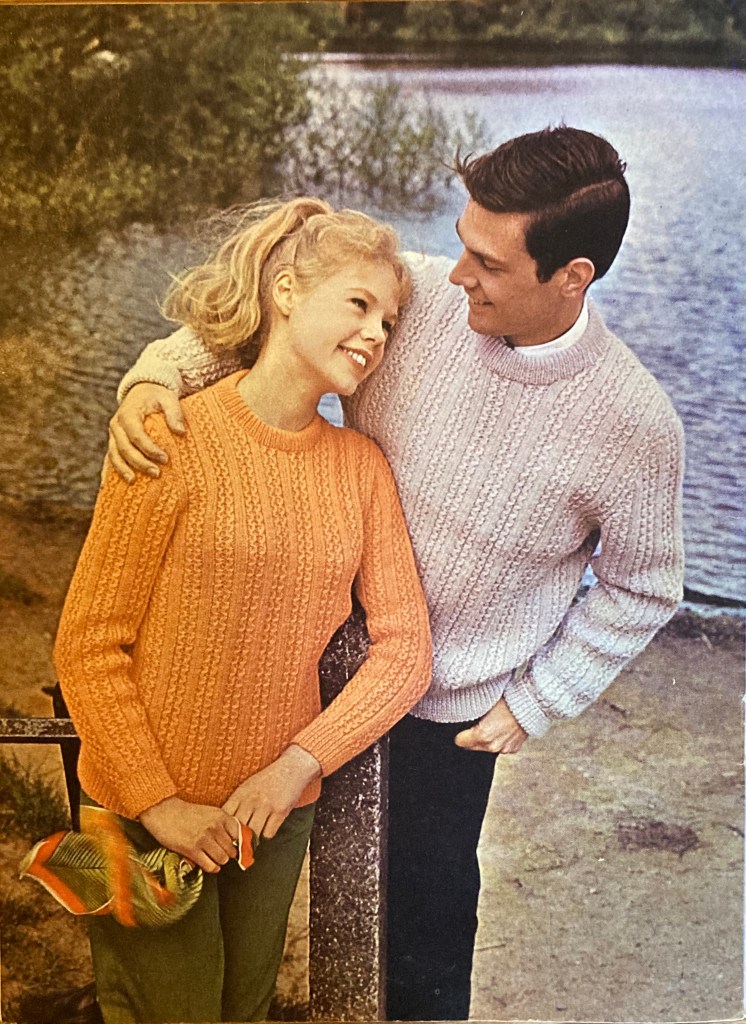
Our cover models sport matching polo- (aka turtle-) neck sweaters in “Flair” wool and a suitably golden colour called “Musk.” There are only two sizes given: 35-37 or 40-42 inch bust, so intended as a one-size-fits-most, basically unisex pattern. The textured pattern is made entirely with knit and purl stitches. Our other partner-look models wear polo-neck pullovers as well, with a simple stranded chevron border at the hem. They seem to be designed for somewhat younger and thinner folks, with three sizes from 32-33 to 38-39 inch bust. There’s one more design just for men: a “country cardigan” in blue wool and a fern-like textured pattern.

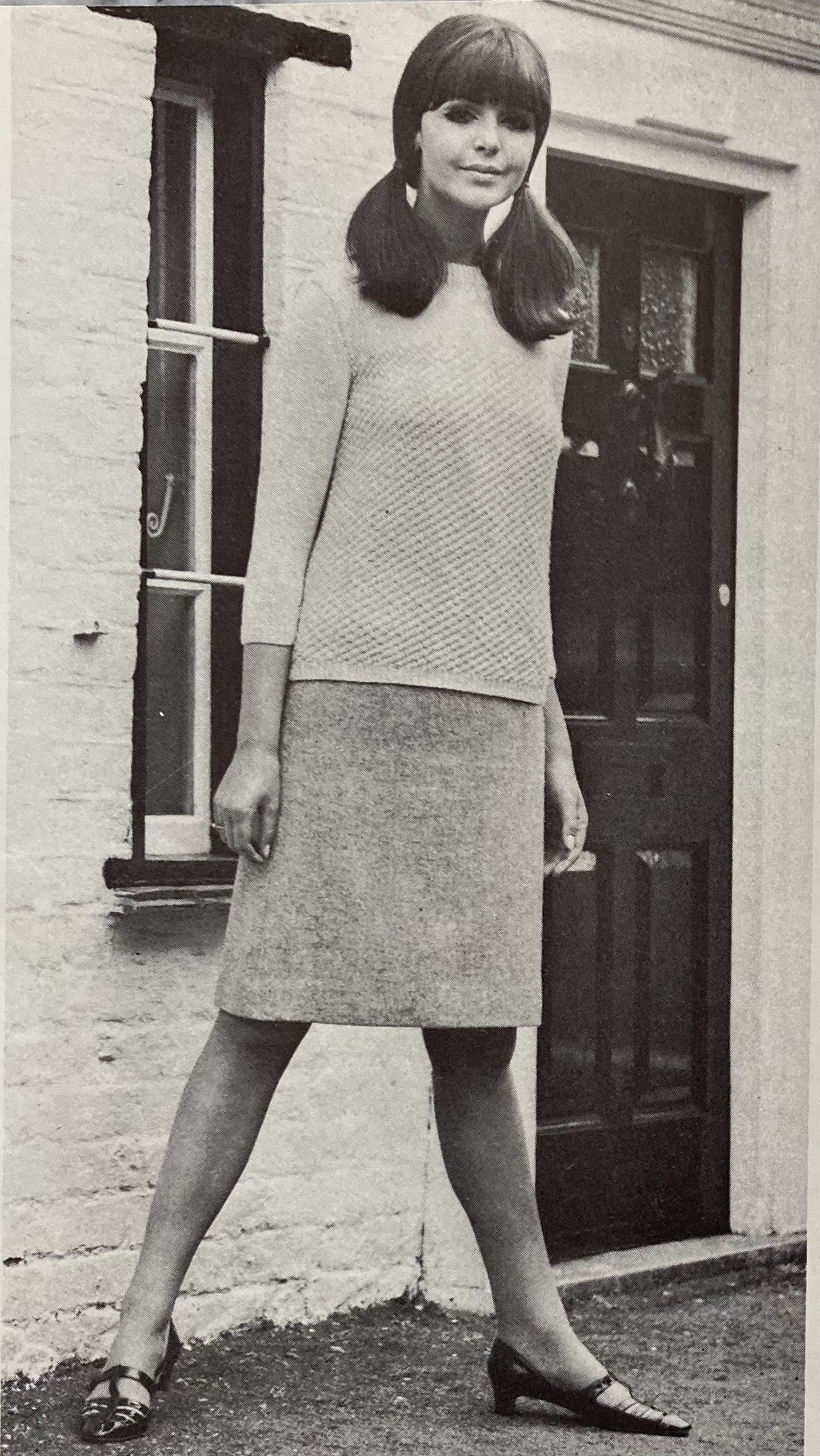
The women’s designs include a rich green jumper suit, with a buttoned pullover in low-contrast stranded diamond pattern and a plain olive-green skirt; a hooded jacket in a chunky bobble-like pattern made with twisted stitches; a delicate jumper in soft, fuzzy “Princess” wool with a contrasting colour yoke; a polo-neck pullover in colourful “rainbow” chevron pattern; and a bright blue cabled jumper for larger sizes (40-45 inch bust).

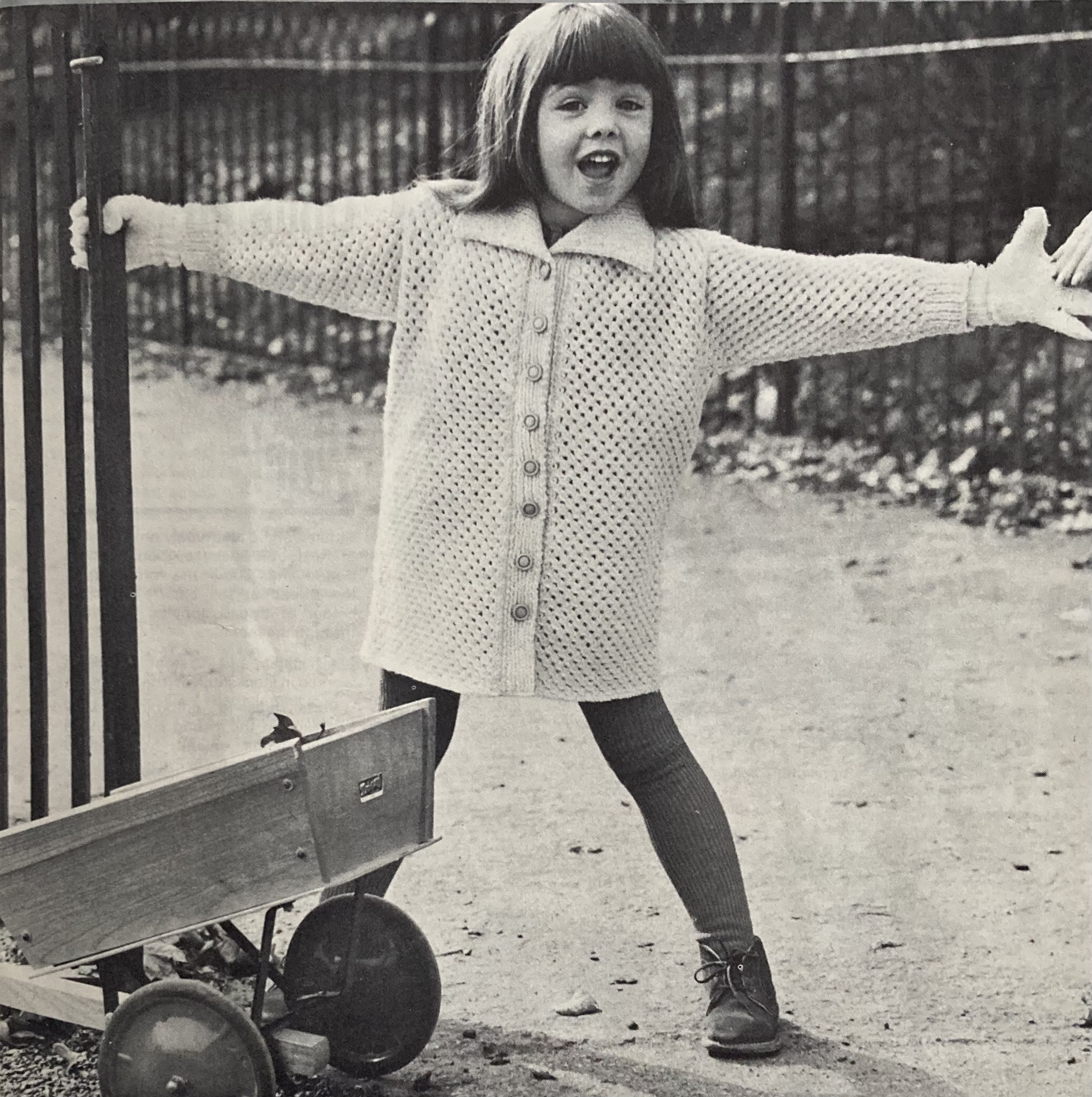
With all these great designs for adults, it’s not surprising that there’s only one children’s pattern in this issue, a tunic for girls age ca. 4 to 7. It’s knitted sideways in pieces, starting at the left side edge of the back, then the fronts separately, then the sleeves separately, which are also knit sideways. I’m glad to see the girl model wearing tights, for once! The children’s comic in the “Readers Pages”, titled “The Woodland Wool Shop”, tells the story of Daisy Lamb, who wants to learn cross-stitch, but doesn’t want to be cross about it.

The homewares and “novelties” are all designed with an eye towards December gift-giving, and most of them are featured in a single, big colour photograph. There are lots of things to make in felts: holiday-themed potholders and party mats, a night-case patterned after the nursery rhyme about the old woman who lived in a shoe, some racist “Golliwog” puppet mitts (unfortunately, still a thing), giraffes to appliqué onto an apron, coffee cosy or apron, and another truly terrifying clown intended for use as a string dispenser — yes, you put a roll of string in its head and pull the string out through its mouth. Stephen King was already 20 years old when this issue of Stitchcraft came out (and lived in another country), but if he grew up with things like this in the 50s, it’s not hard to see where he got the inspiration for It. Just saying.

You can also embroider sprays of holly on place mats or another apron, or make a cross-stitch rug or cushion in a Norwegian pattern, or a different cushion in a Florentine pattern. More advanced tapestry aficionados can make a tray-cloth or yet another cushion based on a design from a Chinese tapestry. On the simpler side, you can sew a little doll and dress her in traditional Dutch clothing, or knit a little stuffed toy set of a mother and baby fox. Many, many gift ideas in this issue. Oh, and another rug, in cross stitch!

The ideas keep coming, with two little cross-stitch pictures symbolising “Autumn” and “Winter” (to match the “Spring” and “Summer” pictures in the last issue). And how could I not mention the best gift idea of all: the bed-jacket in loop-stitch, modeled by my favourite model, who seems to have been hired by Stitchcraft exclusively to model bed-jackets with a sexy come-hither smile. I have to admit, the loop-pattern spoils the sexiness for me, but we all have our own preferences… Love the pink-on-pink photograph, though.

That’s all for this issue! My project will be the buttoned pullover from the jaquard jumper suit (just the jumper for now.) May your November be bright and golden.
October 1966: Overview

Autumn is here, and Stitchcraft‘s October 1966 issue celebrated it with warm, cosy sweaters in bold colours and textured stitches. Our cover pair sports not-quite-matching partnered pullovers in bright “Golden Willow” with a thick stripe in “Woodland Green.” The stripe on the man’s sweater is diagonal and made in intarsia. “Her” pullover has a broken-zigzag stitch pattern and the stripe running horizontally under the bust line and across the sleeve. Both are made in smooth Totem Double Crepe wool.

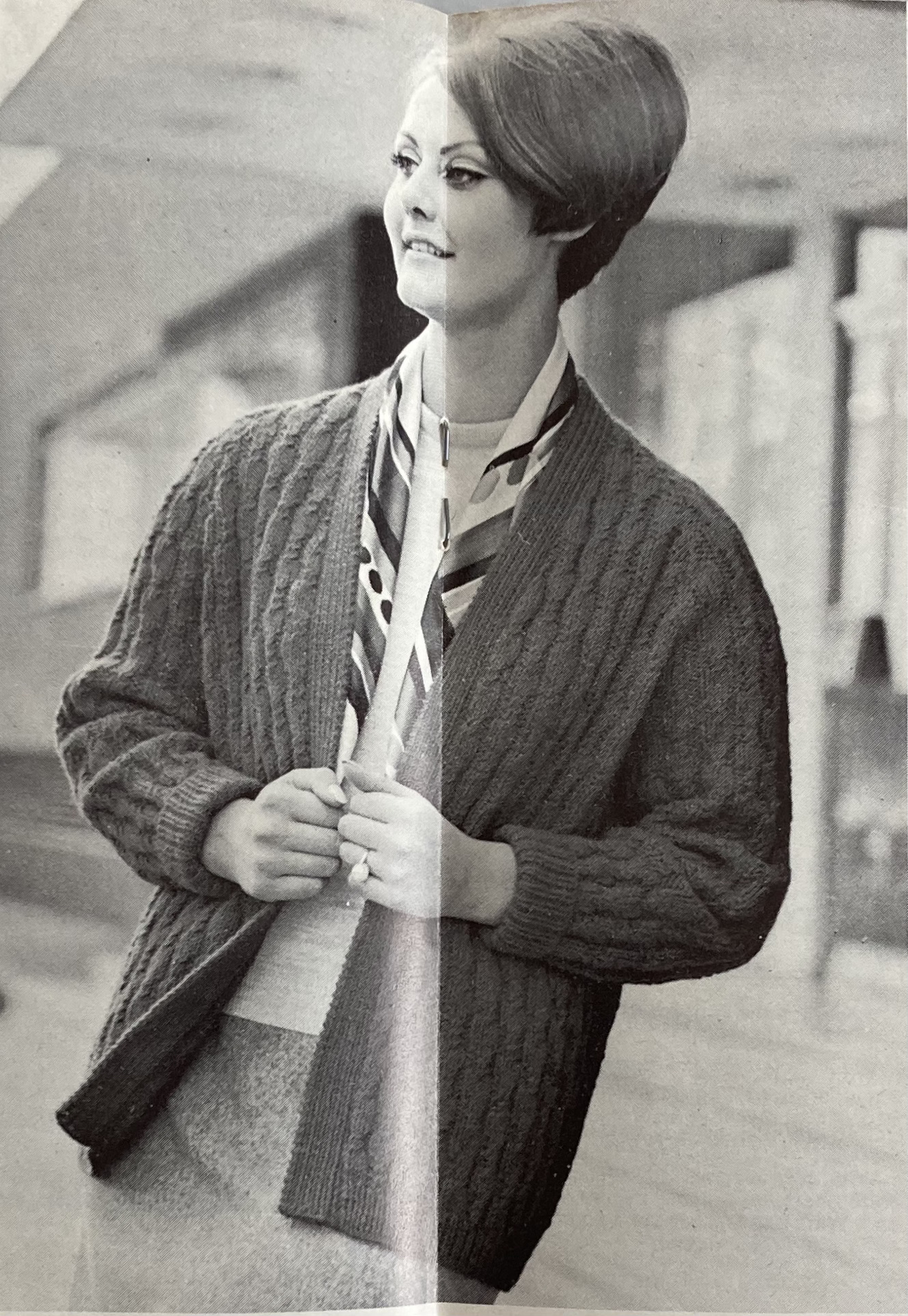
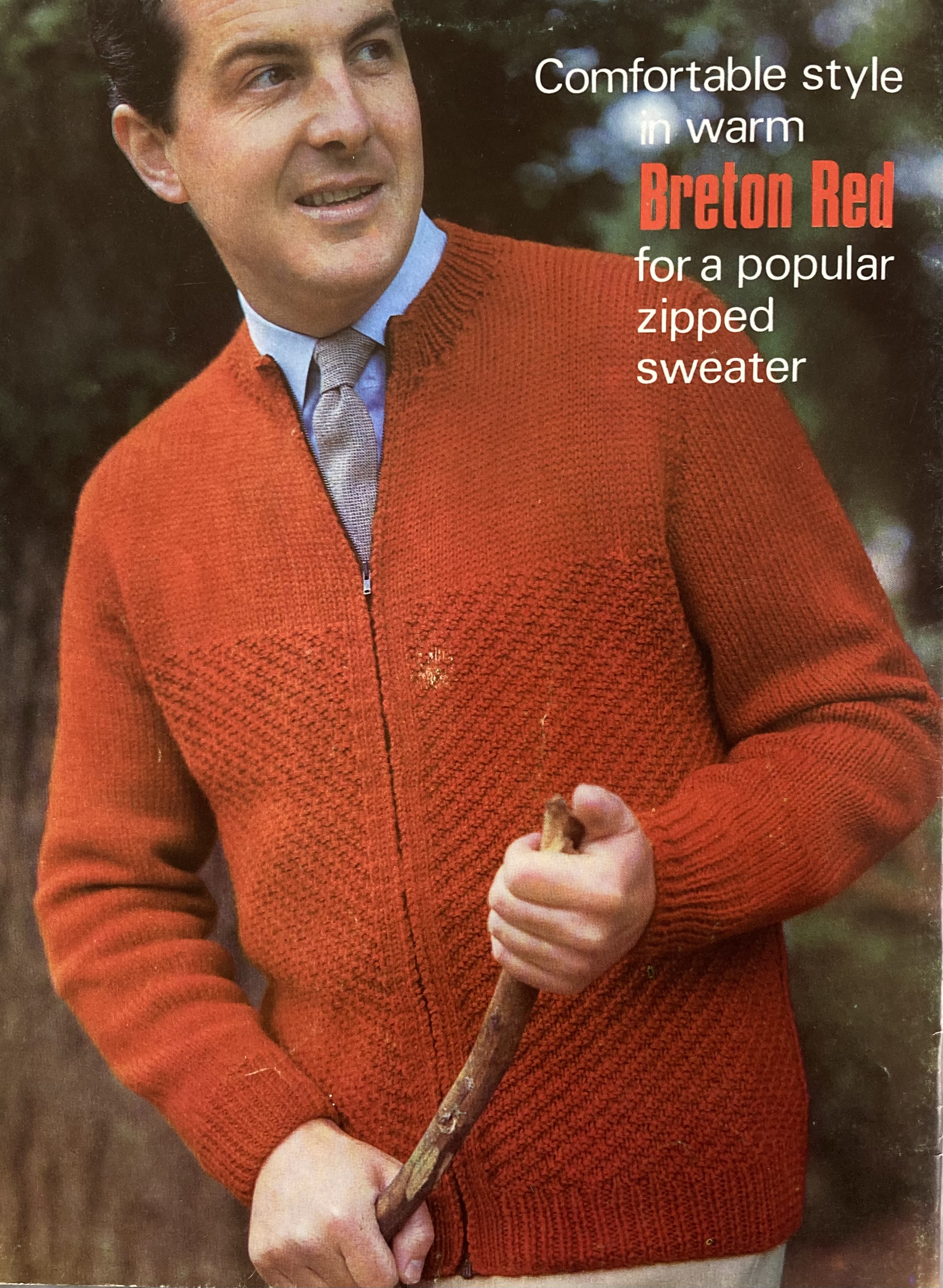
Bold colours, textures and diagonal stripes (whether made with colours or stitch pattern) are on trend for many of the other garments in this issue as well, for example, a ridge-pattern women’s pullover in “Gemini Turquoise” in Courtelle Double Crepe (like Totem, but 100% synthetic), or a “car coat” for larger sizes in bulky, bright red Capstan with a flattened cable pattern. There’s a rust-red zipped cardigan for men, too, in Patons Flair wool and diagonal herringbone stitch.

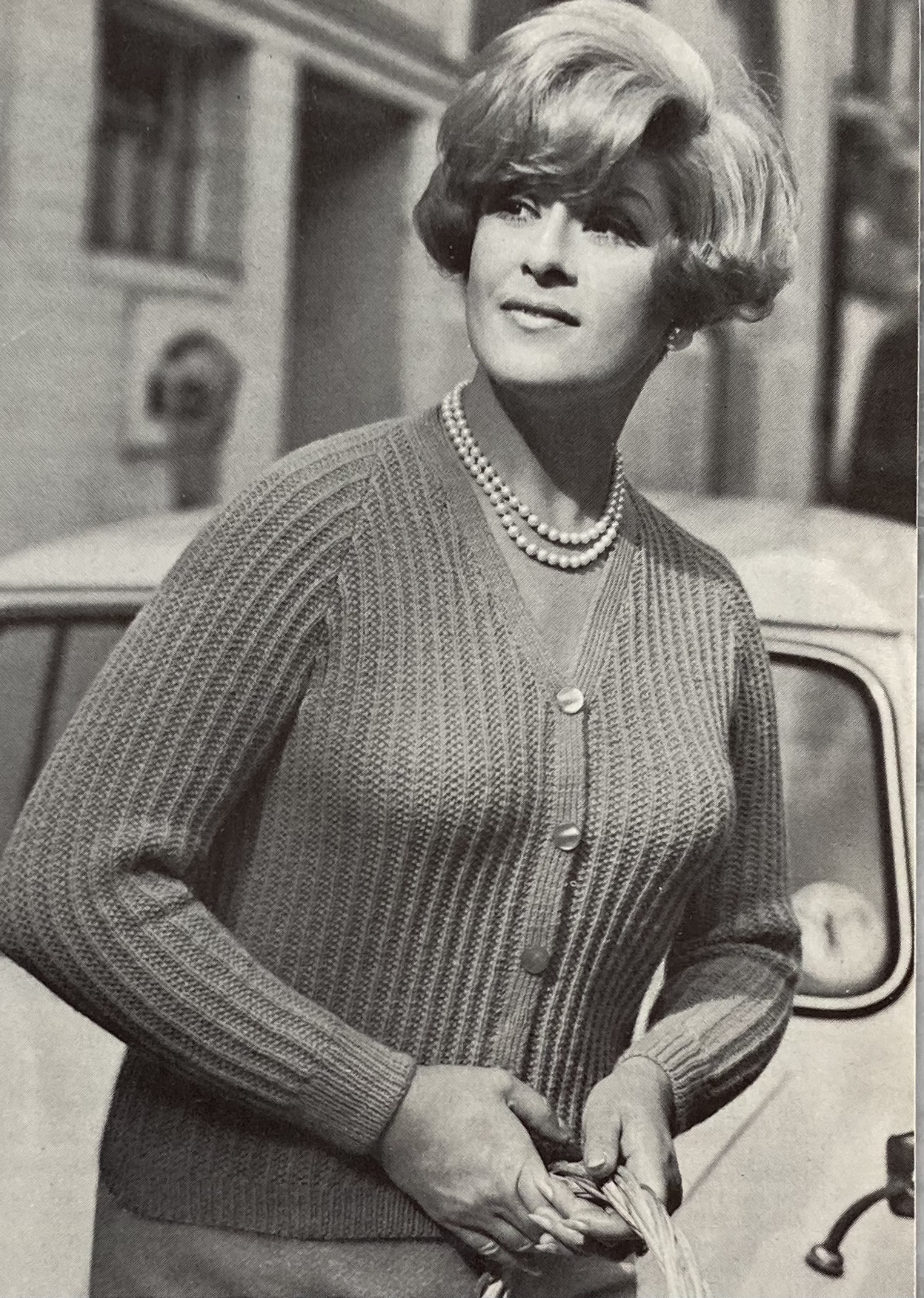
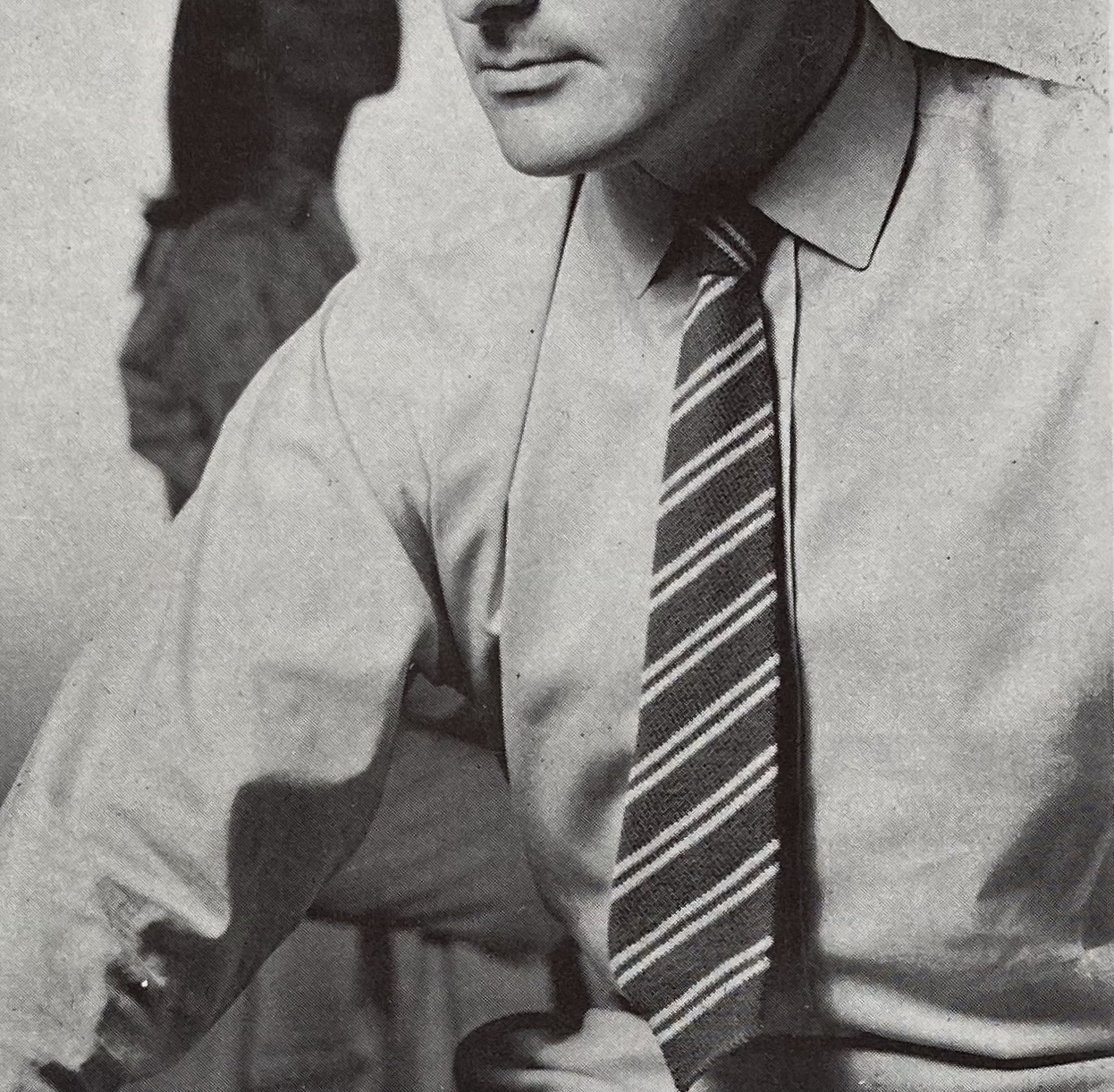
For a more elegant look, there are two garments in lighter, 4-ply wool: a dress in “French Green” with an intriguing “shadow check” pattern or a classic V-neck cardigan for larger sizes (colour: “Blue Streak”). I have never seen either of the stitch patterns before. The “shadow check” is particularly intriguing, as it seems quite simple, but makes a very cool sort of large waffle-check effect. The first two rows are stocking-stitch, to make the horizontal line, then the squares are made with 1 row of k1 tbl / p1 tbl “ribbing” separated by 2 purl stitches and one row of k2, p9, repeated to the end of the “block” (14 rows in all). The pattern on the cardigan is even simpler: Row 1: k3, p1; Row 2: k1, p1. If you have any wool left over, you can make a diagonally-striped (or plain) knitted tie.

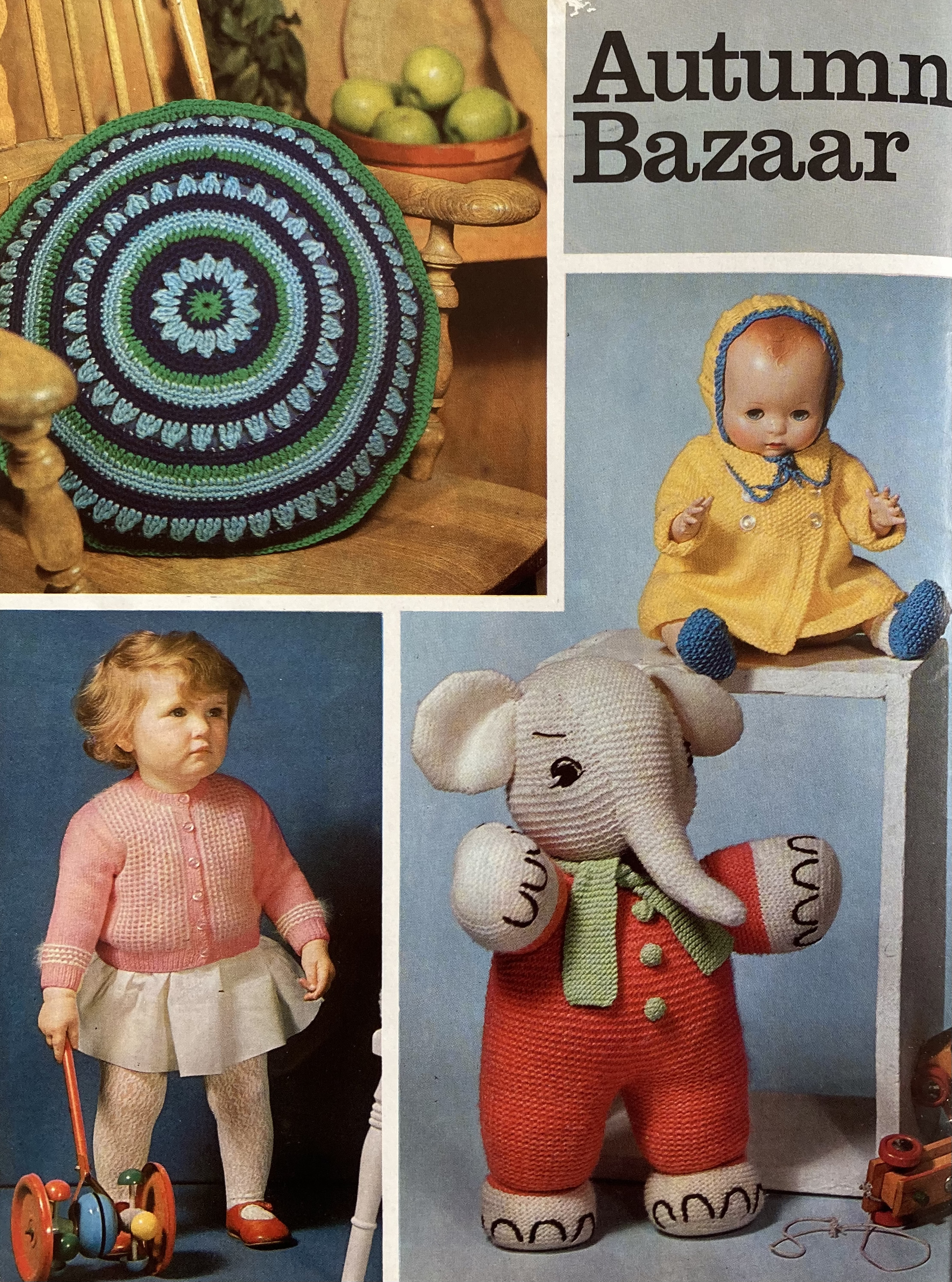
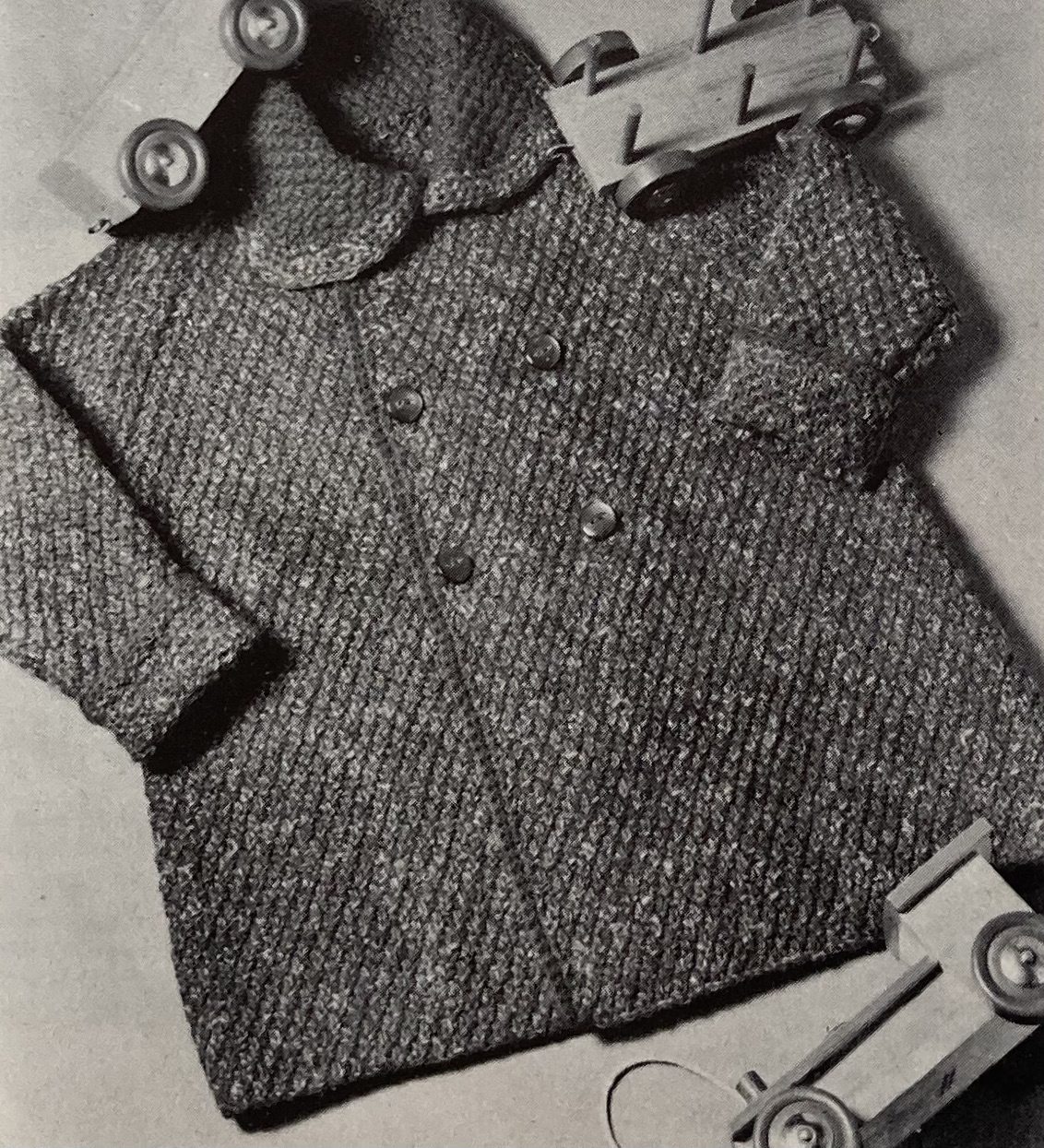
For the little ones, there’s a cardigan with checked front panels in “Fuzzy Wuzzy” angora wool that are knitted separately and sewn on to the front+back piece before adding the ribbed trim, and a nice warm tweed coat in “Moorland” wool. Well, at least the upper half of this poor tot’s body will be warm — if he goes out dressed as he is in the photo, I worry that he will literally freeze his arse off. (Doesn’t seem to bother him — I’m guessing it was warm enough in the studio). There’s a huggable stuffed elephant and a winter outfit for a doll to knit, as well.

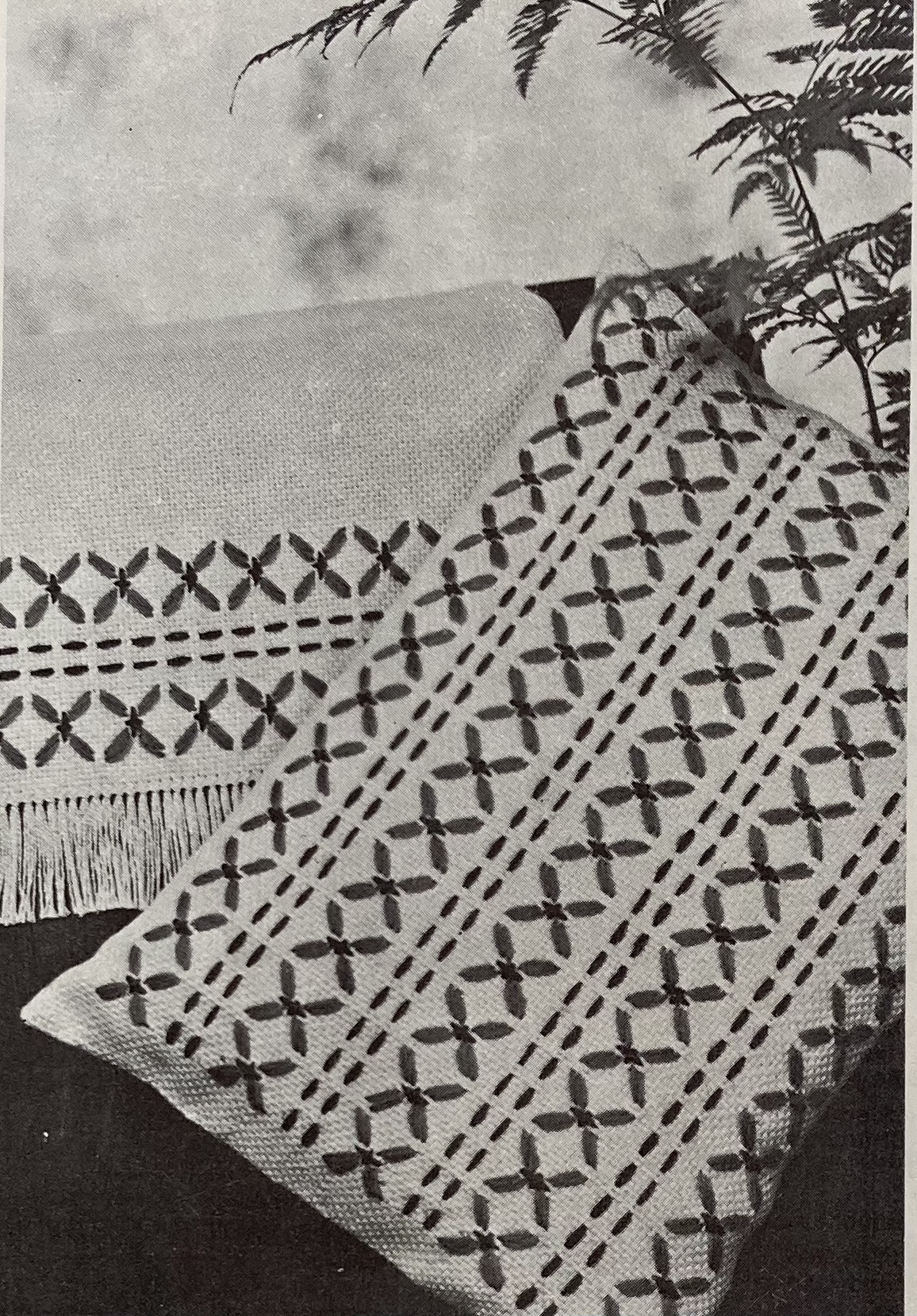
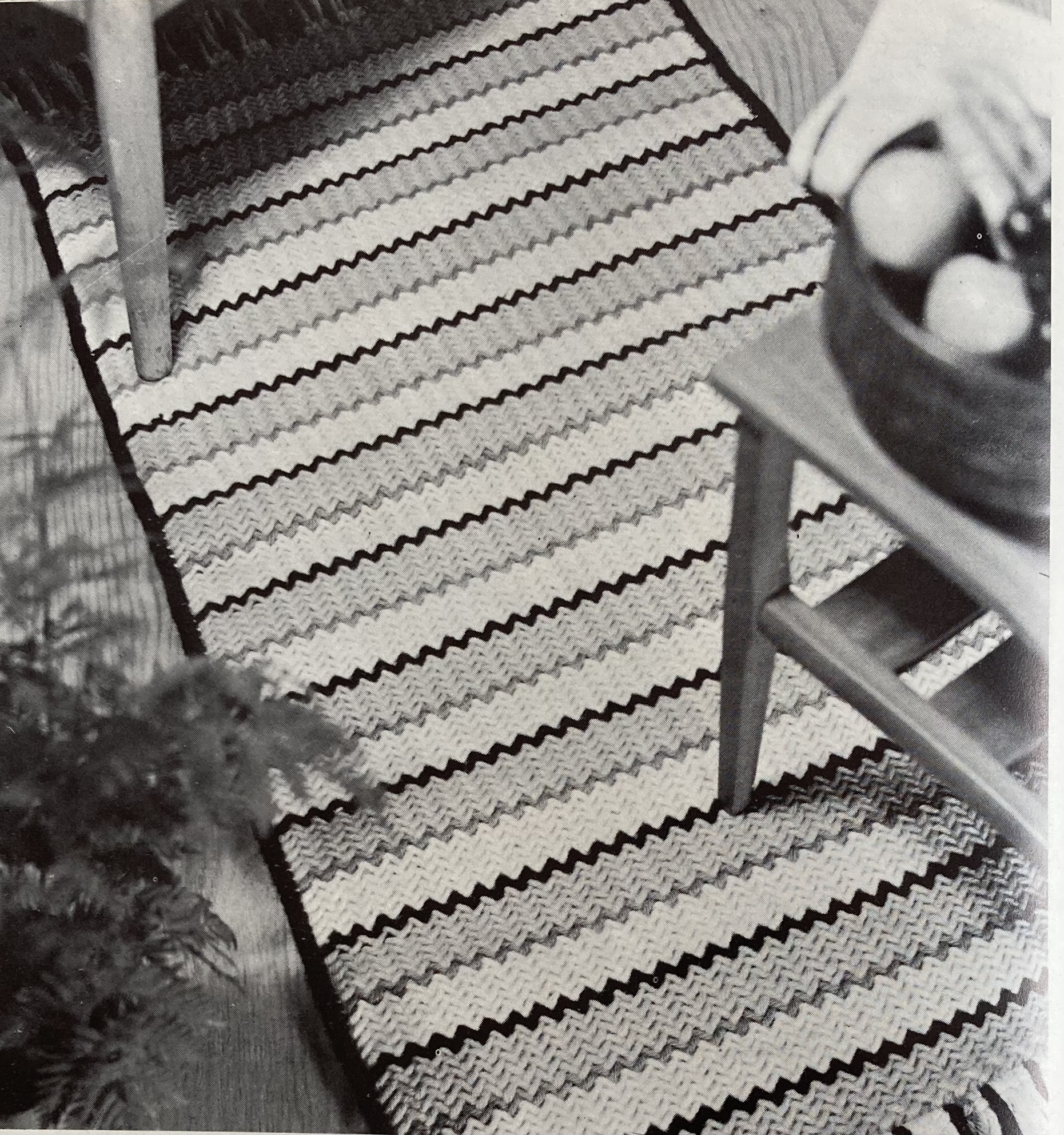
The homewares are pretty standard, but offer a range of different techniques: a crocheted cushion, a counted-stitch cushion and chairback, a practical stitched rug, or huckaback embroidery for various practical linens. Advanced embroideresses can make a stunning chairback set in Jacobean-style wool embroidery with plenty of intricate and multi-coloured stitches.

But wait, there’s more! Or not, sadly. This issue apparently had a supplement of nine designs “to knit for the family in Patons Brilliante qualities”. It must have been carefully removed from this particular issue at some point and separated from it, since there is no trace of it in my magazine, not even in the centre fold where it was presumably stapled in, and all the regular pages are intact. If you happen to have this supplement, please feel free to write in and let us know what’s in it!

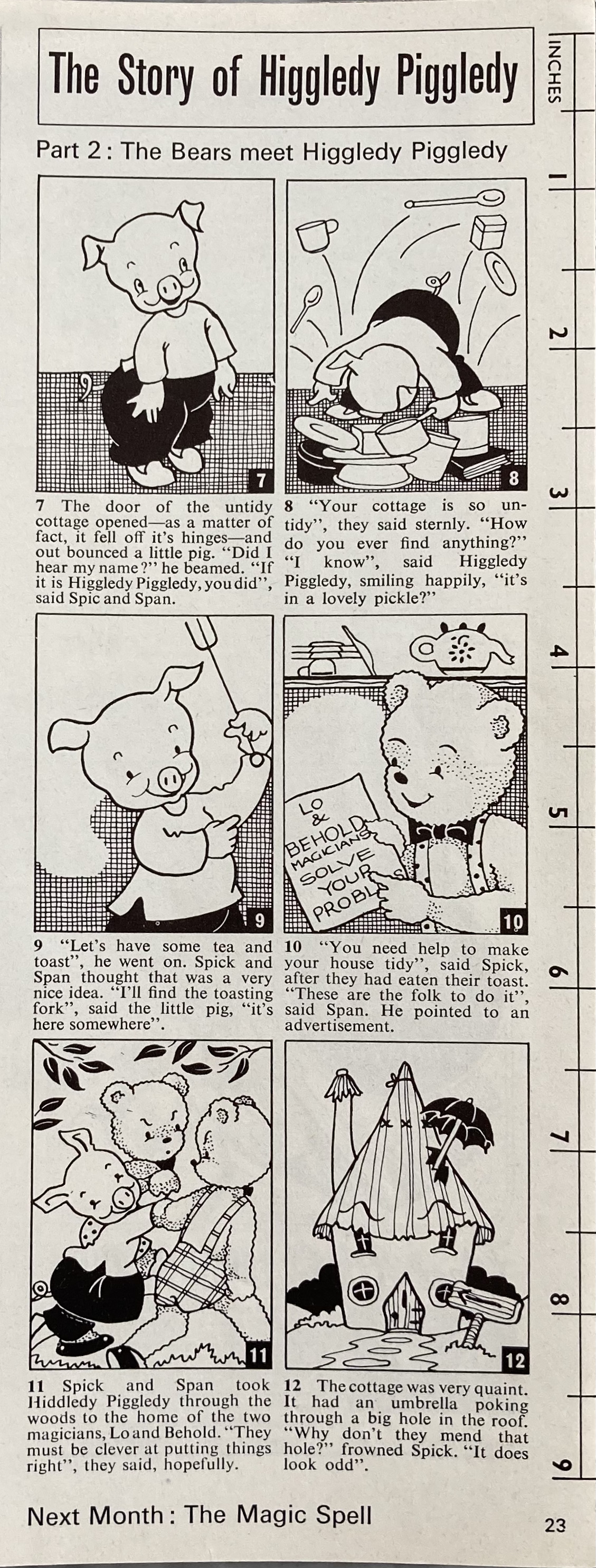
In the “Readers Pages”, there’s a reprint of a pattern for machine-knitted wool “slacks” (I guess we would call them leggings today) and Part 2 of the comic adventures of Spick and Span, the two very neat and tidy teddy bears. They meet a very untidy bear named Higgledy Piggledy and seek out the services of two magicians, “Lo” and “Behold”, to magically turn him into a tidy bear. I sense a certain pedagogical overtone in this story, which is perhaps why it is less fun and interesting than some of the other ones.

That’s all! I don’t know what to make from this issue. I offered to knit my father the red zippered cardigan, but he claimed to not need another cardigan, and nothing else really speaks to me except for the Jacobean embroidery. But what to embroider it on? I have so many cushions and I don’t need a chairback. New laptop case? Black felt skirt? We’ll see! I still have to finish my September 1966 project, anyway.

April 1966: Overview

The April 1966 issue of Stitchcraft has a “continental” flair, with “softer feminine styling from Paris” and this “Swiss” design pullover in a new “Banana Cream” shade of beige. The cover photo is classic mid-60s fashion photo shoot: layered shades of gold, brown and beige, the model with bobbed hair standing in a diagonal pose, sans-serif fonts and a relatively long, high-necked, unshaped pullover with geometric design in the stitch pattern.

The other women’s fashions have the same easy feel and generous fit, but allow more colour: turquoise and blue are trending this Spring. “PARIS keeps the Crochet Look” in a bright turquoise buttoned jacket, or you can knit a short-sleeved “easy-line sweater” in turquoise and pair it with an unbuttoned “casual jacket” in turquoise and navy for a twin-set effect. Both jumper and unbuttoned jacket are made in a simple slip-stitch pattern with a nubbly effect. The green “blister stitch” cardigan achieves the same effect with simple increases and decreases in garter stitch and rib.

The promised designs from Paris are a knitted dress in “The Granny Look”, “demure in lace with draw-string waist”, and a tweed beret (of course, Paris). The beret marks the start of the mid-late 60s fashion for oversized hats, knitted large and stiffened with “Staflex” lining. It is knitted in reverse stocking-stitch in four parts which are lined and stiffened separately and then sewn together. The model looks so sad! Does she not like her beret? (She didn’t seem to like the crocheted jacket either.) Rounding out the regional fashion parade are his-n-hers pullovers in black and white panels for the “London Look”. I love the vintage coffee set and judging from the photo, so do the models. Maybe the sad model just needs some of their coffee.

It’s a good issue for men and boys: in addition to the black-and-white “London” pullover, there’s a thick, warm knitted “car coat” for men, paired with a boy’s cabled lumber-jacket in the wonderful centrefold photo. A father, a son, a car and a boat! Everything colour-coordinated in those manly shades of red and royal blue! Diagonal poses for everyone!

(Side note: these diagonal poses are very uncomfortable. Sometimes the photographer just holds the camera diagonally, but otherwise it twists your spine all out of shape. I would be a sad model too, if I had to do that all day.)

For “younger folk”, there’s a pretty short-sleeved knitted blouse for a schoolgirl, and yes, a “deerstalker” hunters’ coat and hat for a (presumed male) toddler. It gives me a “so much wrong” feeling. Also, won’t somebody get this kid some clothing for the lower half of his body?

There’s more to come in the homewares department, though Stitchcraft seems to get less and less creative with homeware design as the 60s go on. There are little rugs, either stitched or crocheted in rug wool, as well as an unusually-shaped half-circle rug in Florentine stitch to put in front of a bookshelf. The Florentine design can also be stitched on tapestry canvas for a tea cosy.

A similarly versatile flower design can be made in cross-stitch for a chair set of cushion and back-cover or in tapestry on a church “kneeler” hassock. There’s an embroidered mat set for your dressing table and an intriguing embroidered wall panel of different gourd-type vegetables on a black linen background.

Finally, Easter was in April in 1966 and there are some cute Easter-themed gifts and “novelties”: an Easter egg kitchen bag (to hold clothespins) in felt appliqué and embroidery, a “nursery nightcase” (not Easter themed, but advertised as a good Easter gift) in the shape of a bedtime bus (Side note: when did people stop storing their pajamas or nightgowns in a special bag during the day?) or a knitted lamb toy, reprinted from the March 1957 issue.

To round it all off, there’s a great bathing-suit ad from the Scotch Wool Shop and for the first time, a partner promotional offer from Patons and the Kelloggs cereal company — knitting patterns featured on the backs of All-Bran and Bran Buds packets. The natural laxative foods! These types of promotions became more common in the later 1960s and especially the 1970s. Finally, in our children’s comic, Eustace the elephant and Mark the mouse get invited to tea in a house that Eustace can’t fit into very well.

My project from this issue is already finished… is that cheating? I started it last week to get a head start and it went very quickly. It was the knitted lamb, and though it didn’t turn out quite perfect, I had fun making it and it brings joy to anyone who looks at it. I will post about it soon, along with another destash project from a later issue of Stitchcraft. Happy Spring!

January 1966: Overview

Happy New Year! It’s January 2024 in real time and January 1966 here at the blog. Get ready for shorter skirts (…finally. Stitchcraft is slow to catch up), horn-rimmed glasses, tweed bouclé and adventurous headwear. The theme of the January 1966 issue is “Colour for a Cold Spell”, with bright greens, redd and turquoise to carry everyone through the greyest month.

Our cover cardigan can be made long to wear as a coat as in the cover photo, or in fashionable hip-length. The trellis pattern is made by winding extra loops around the needle on the first row, then slipping this stitch on the next RS row to create a long loop stitch that is carried up via slip-stitches and knitted back in on row 7. The coat uses a whopping 28-33 ounces (ca. 750-900 g) of heavier-than-DK (modern worsted weight) “Flair”, so I would be wary about knitting this as it would presumably end up quite a bit longer than the 38-39 inches it should measure when finished. Love the pattern, though. I could imagine making the shorter cardigan in brown and embroidering it to look like flowers and plants climbing up a trellis.

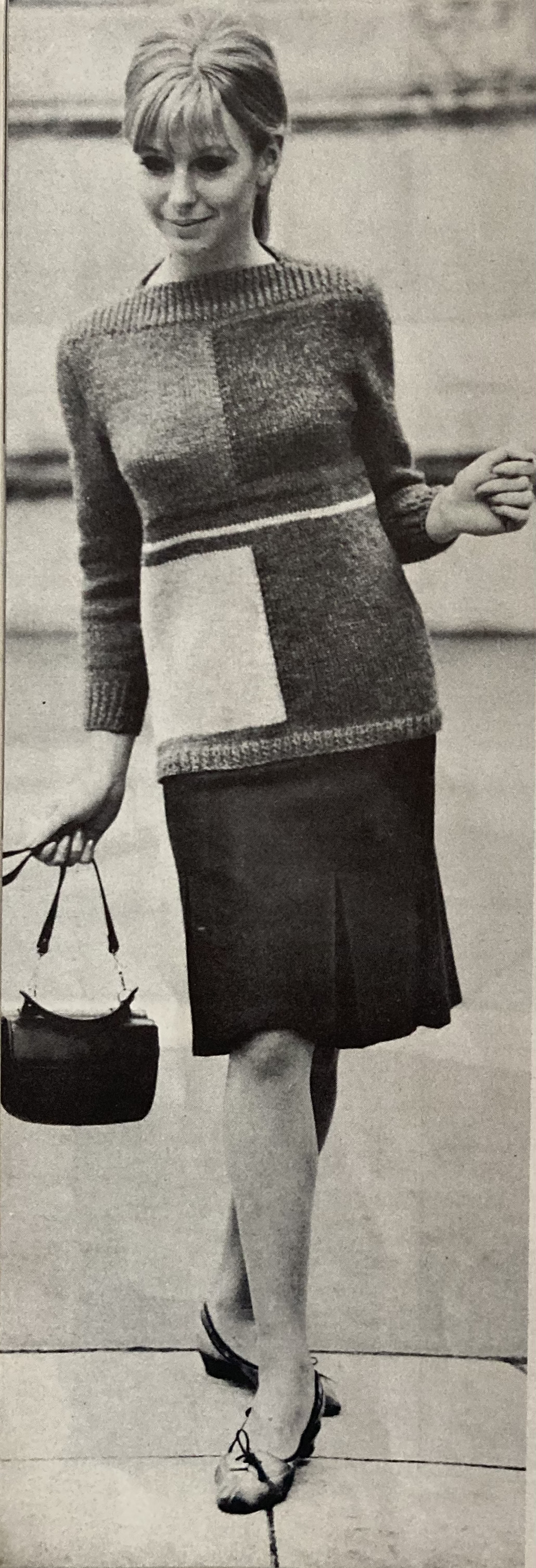
Other women’s fashions include a turquoise pullover with both a vertical pattern panel and a horizontal stranded border. The matching hat foreshadows the weird and wild and fun and goofy hat fashions of the next couple of years to come. The trend for bold colour blocks is mirrored in the long-line boatneck pullover with its matching “helmet”-style cap. There’s a plain white pullover in slip-stitch rib and a very cute bedjacket — look at that come-hither smile!

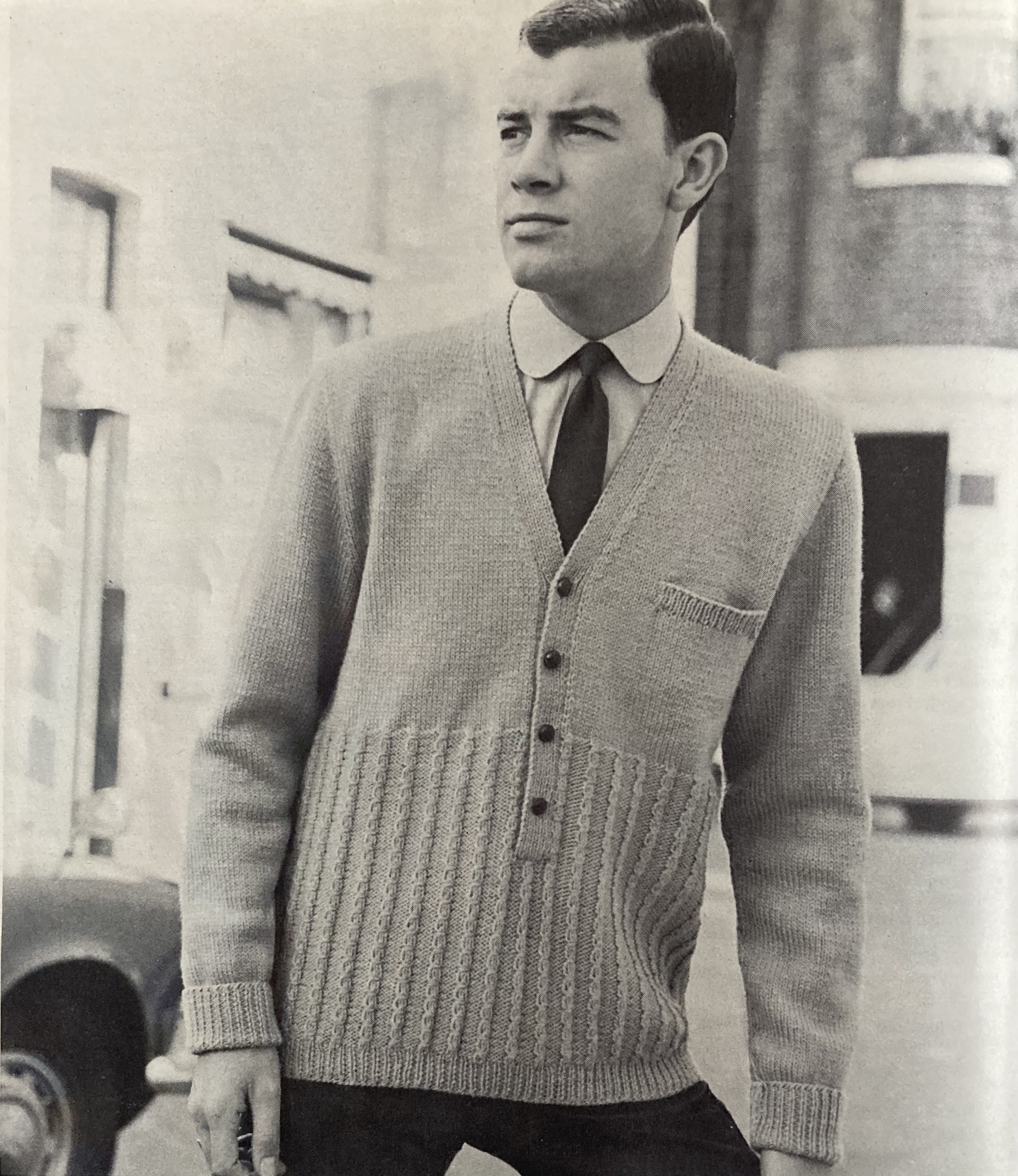
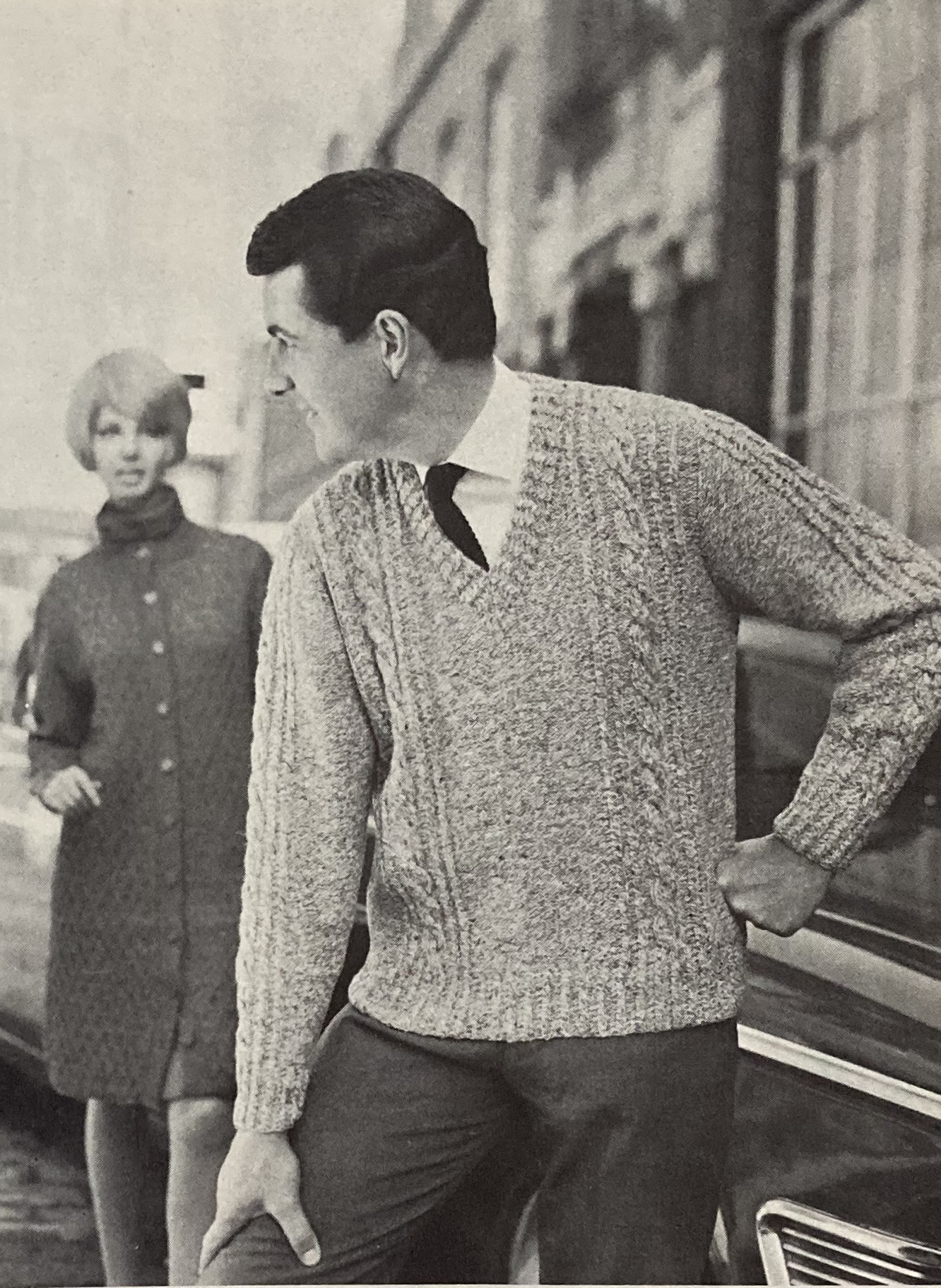
Men’s fashions are oversized and conservative, in spite of the “New Look” advertised for this V-neck half-cardigan. The classic V-neck pullover with cable stripes can be knit in tweedy marled or smooth, plain DK wool. I like that the magazine includes photos of both versions, so that you can see how much of a difference the colour and style of wool can make.

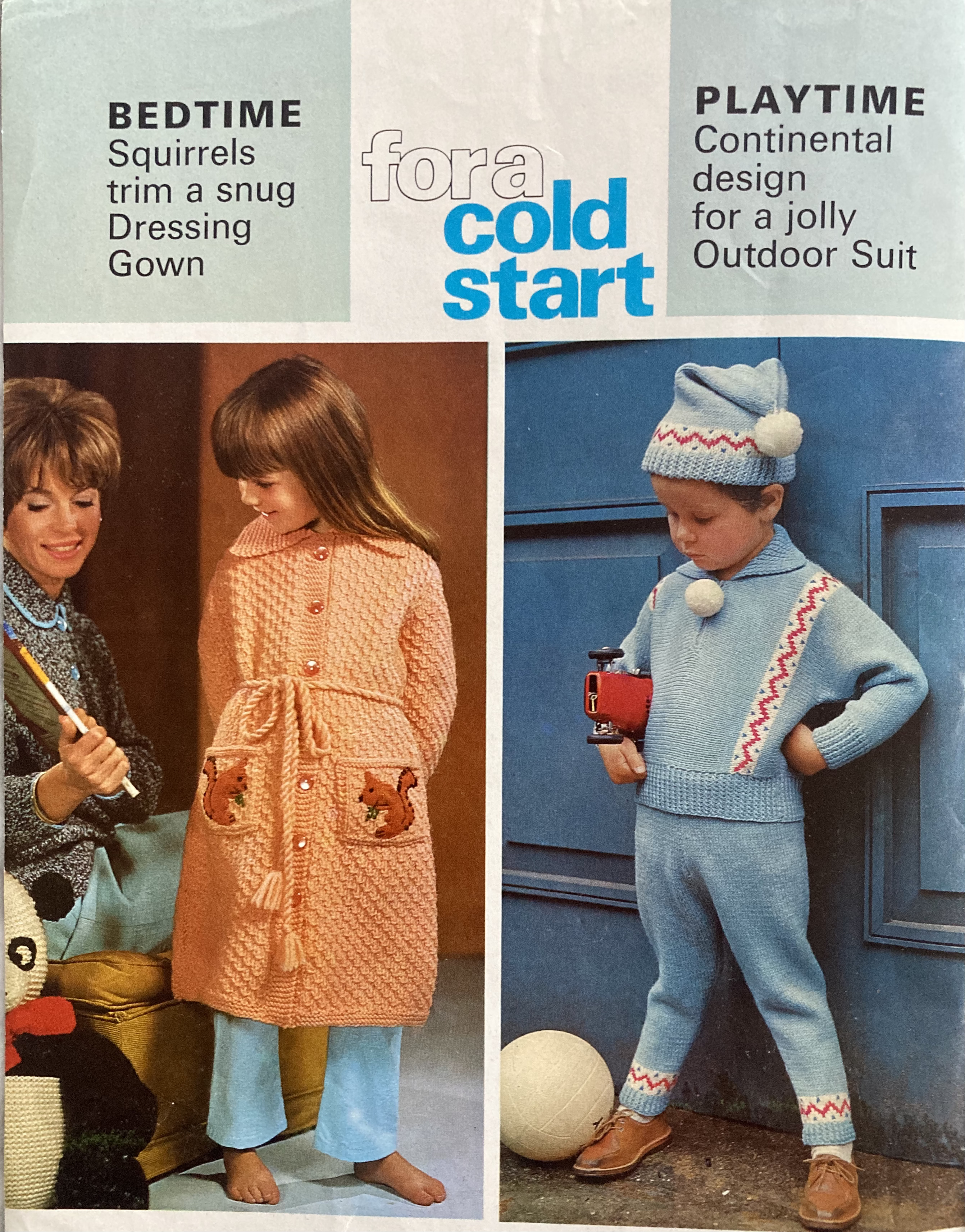
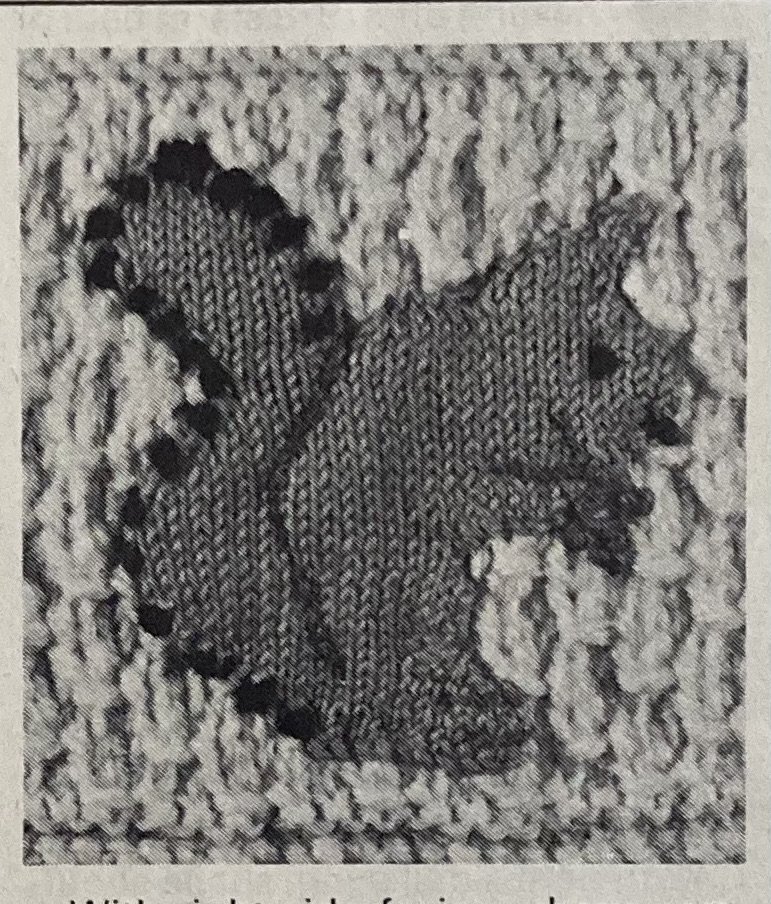
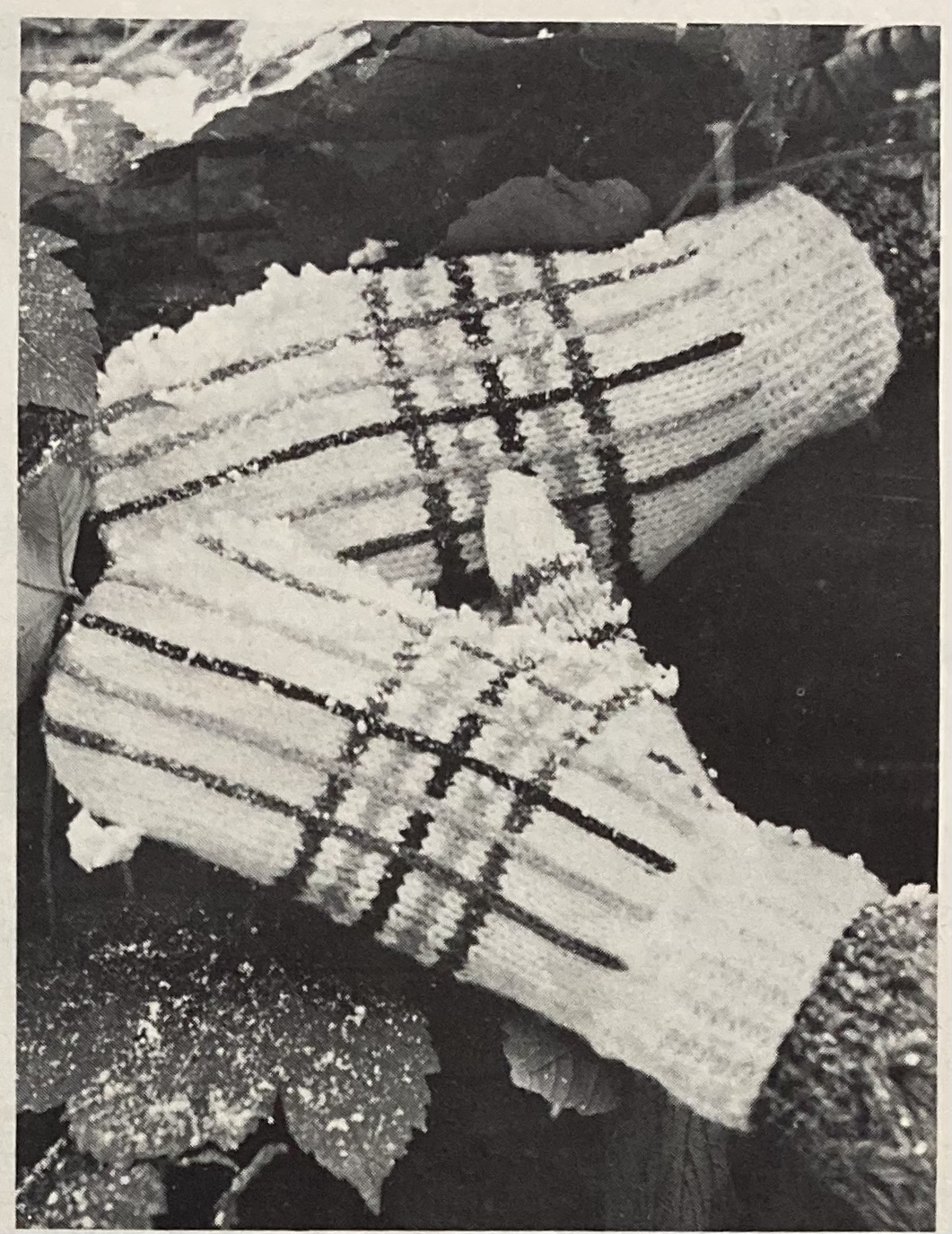
“Junior Fashions” include a wonderful warm dressing-gown with knitted squirrels appliquéd onto the pockets and embroidered — so cute — as well as a winter going-out set of leggings, pullover and hat and an oversized cardigan-jacket. The jacket claims to be windproof, which seems an odd claim to make about something knitted in an all-over eyelet pattern. In any case, all the children’s fashions are colourful and fun, and we will start to see the influence on adult women’s fashion as the 60s get swingier. Older children — or adults with small hands — can get a pair of warm mittens knitted flat and sewn together at the side. The plaid-like pattern is made by embroidering the vertical stripes in chain-stitch onto the finished mittens.

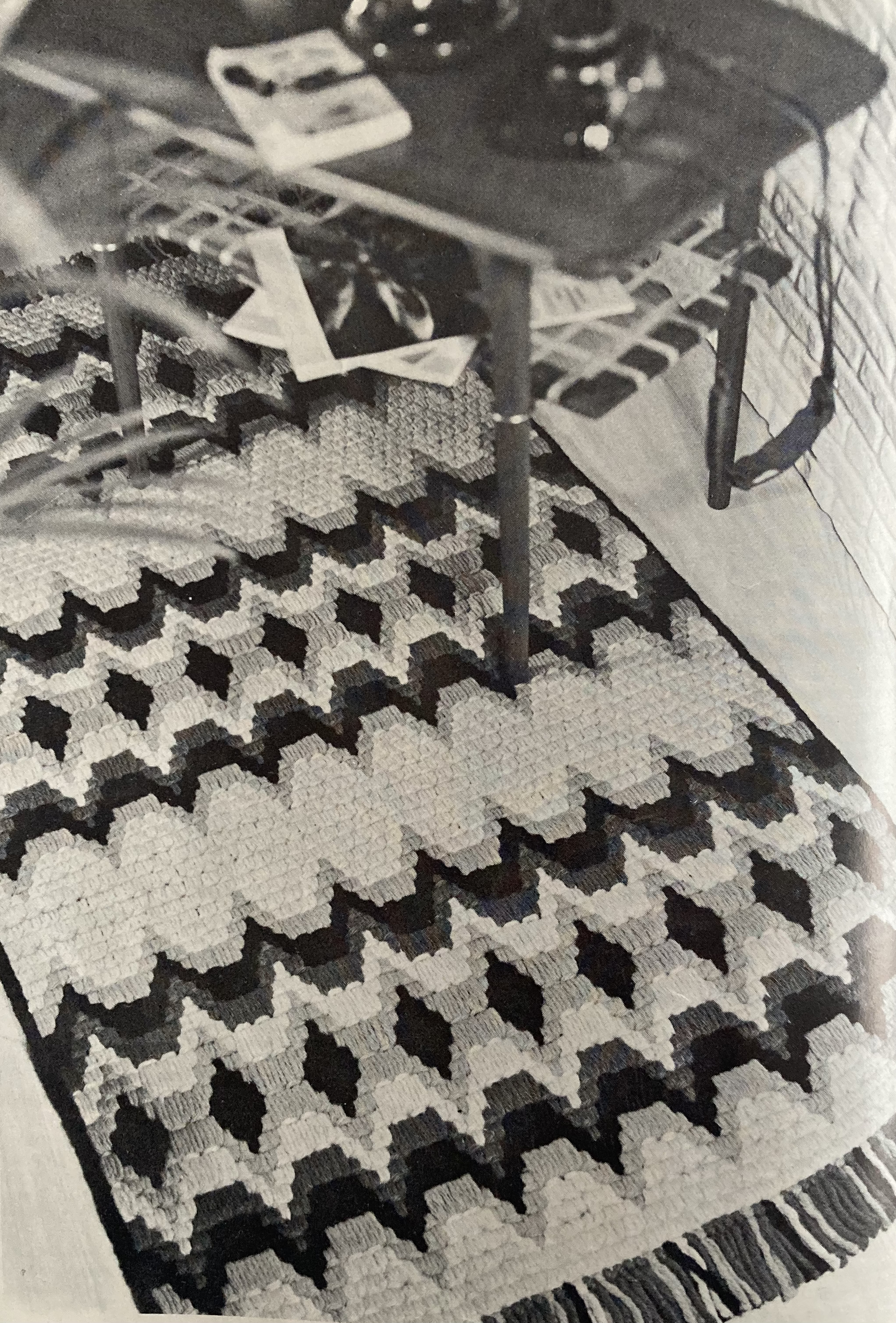
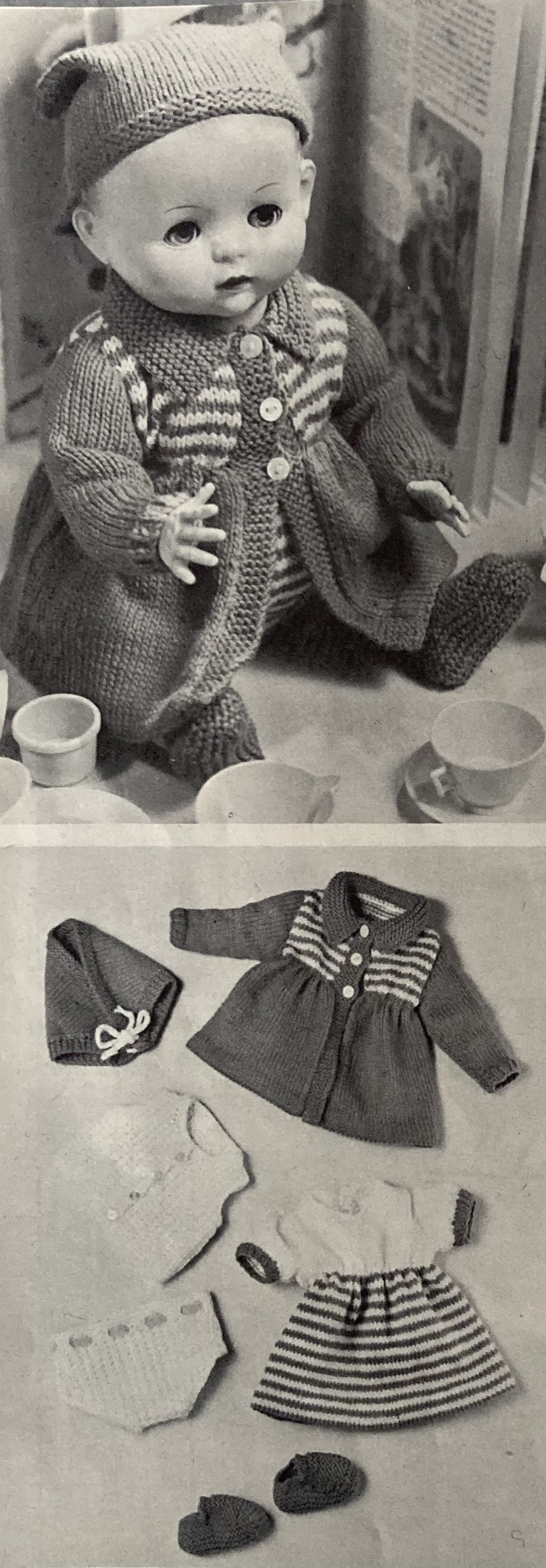
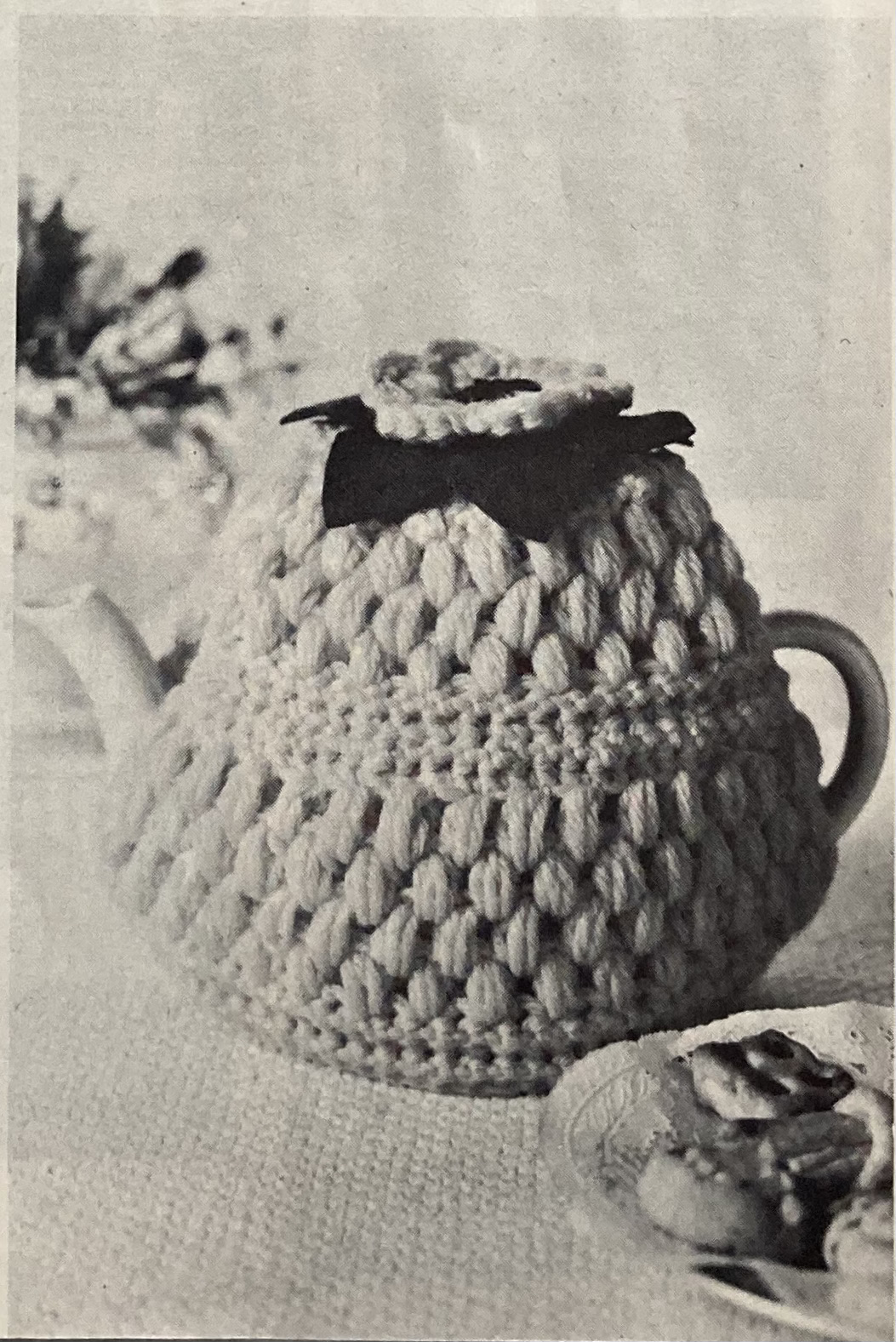
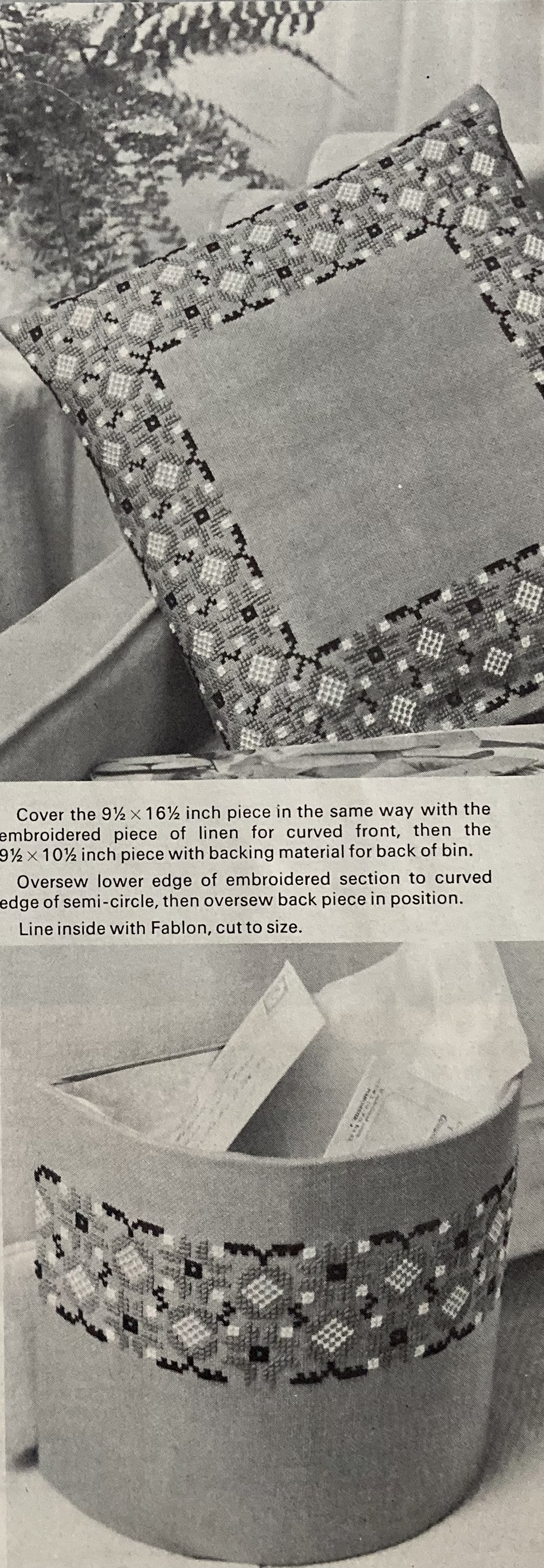
There are lots of homeware projects in this issue, January being a good month to stay inside and do needlework. The stitched rug is warm and sturdy, made in a Florentine stitch pattern that never really went out of fashion. You can knit a doll’s outfit complete with underwear and shoes, crochet a “tangerine” tea cosy with green felt for leaves, or make a cross-stitch border for a cushion or waste-paper basket.

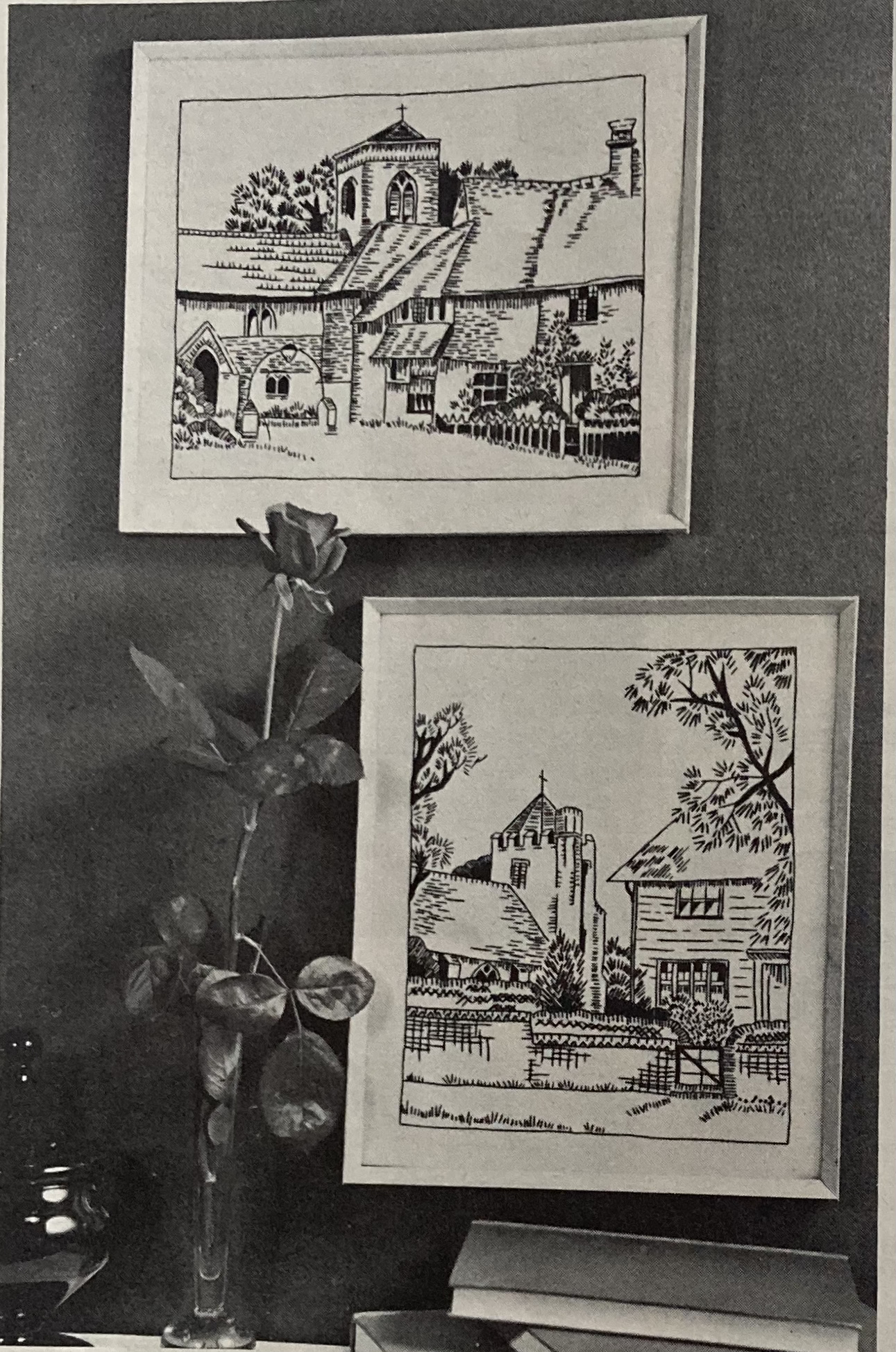
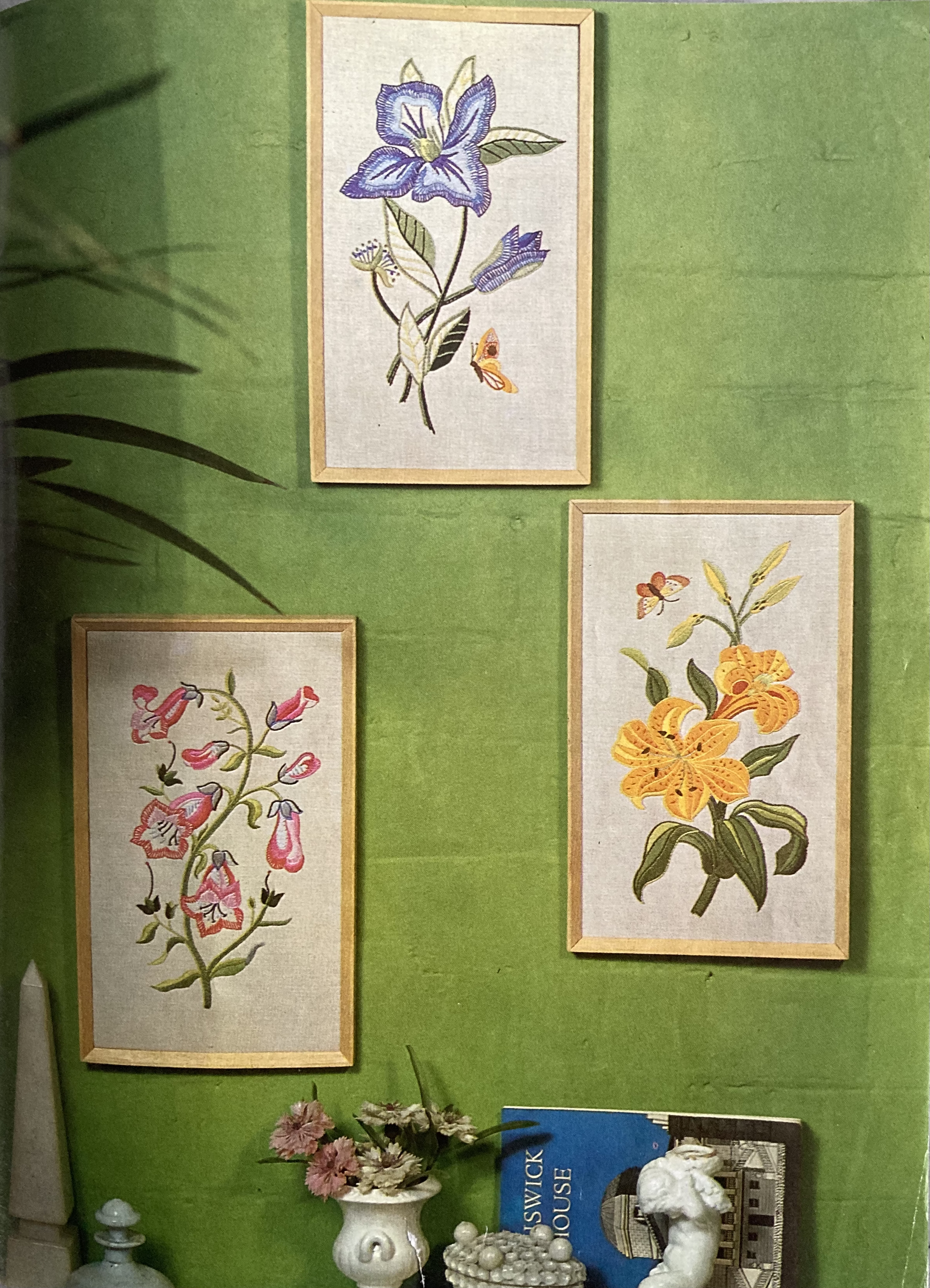
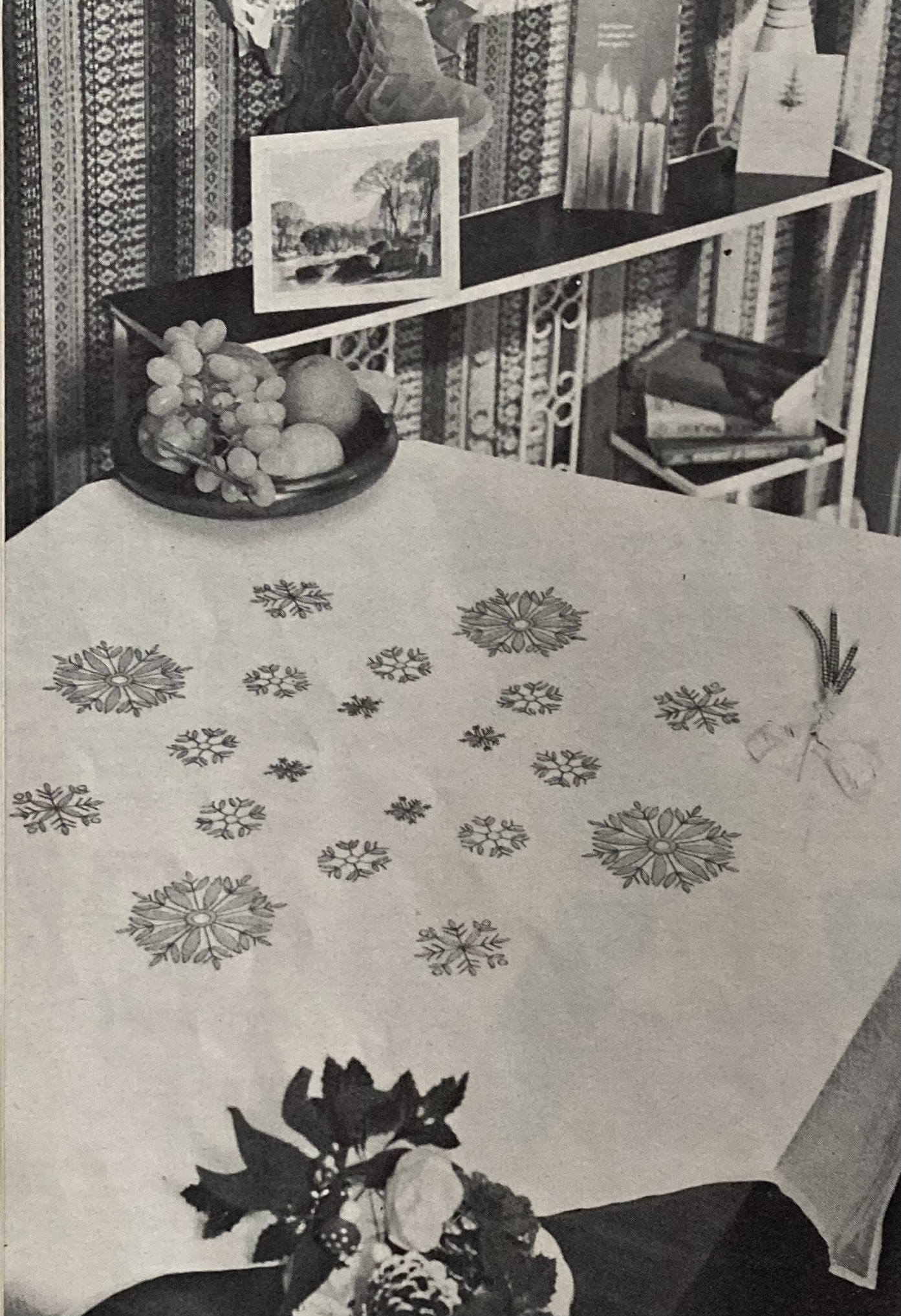
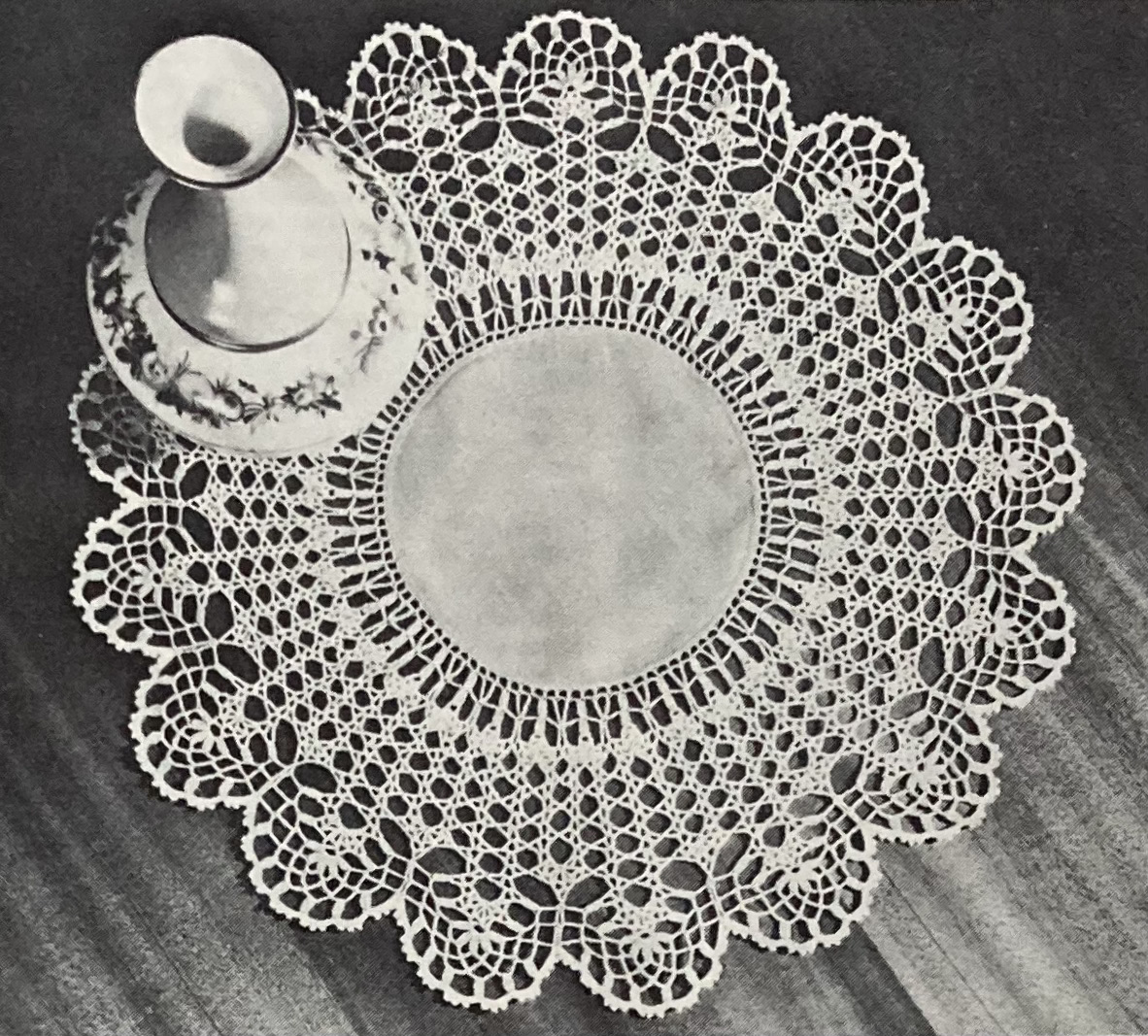
For advanced needleworkers, there are wall pictures of “needle etchings” (black-and-white pictures embroidered in stem-stitch to give the effect of a pen-and-ink drawing) of Sussex churches or colourful flower sprays, as well as a tablecloth in rare “shadow work”, where the thread carried on the back side deliberately shows through the filmy organdie backing fabric. (Personally, I dread the thought of the back side of my embroidery being visible, ever…). For expert crocheters, there’s a lovely lace doily with a linen centre.

On to our children’s comic! The two brave bunnies (both plush toys) are still in search of a real live rabbit. Not having found one at the carousel, cinema or department store, they try the seaside, because why not? They have fun at the beach and think they find a rabbit — alas, it is only an inflatable sea-water toy! Will they ever complete their quest?

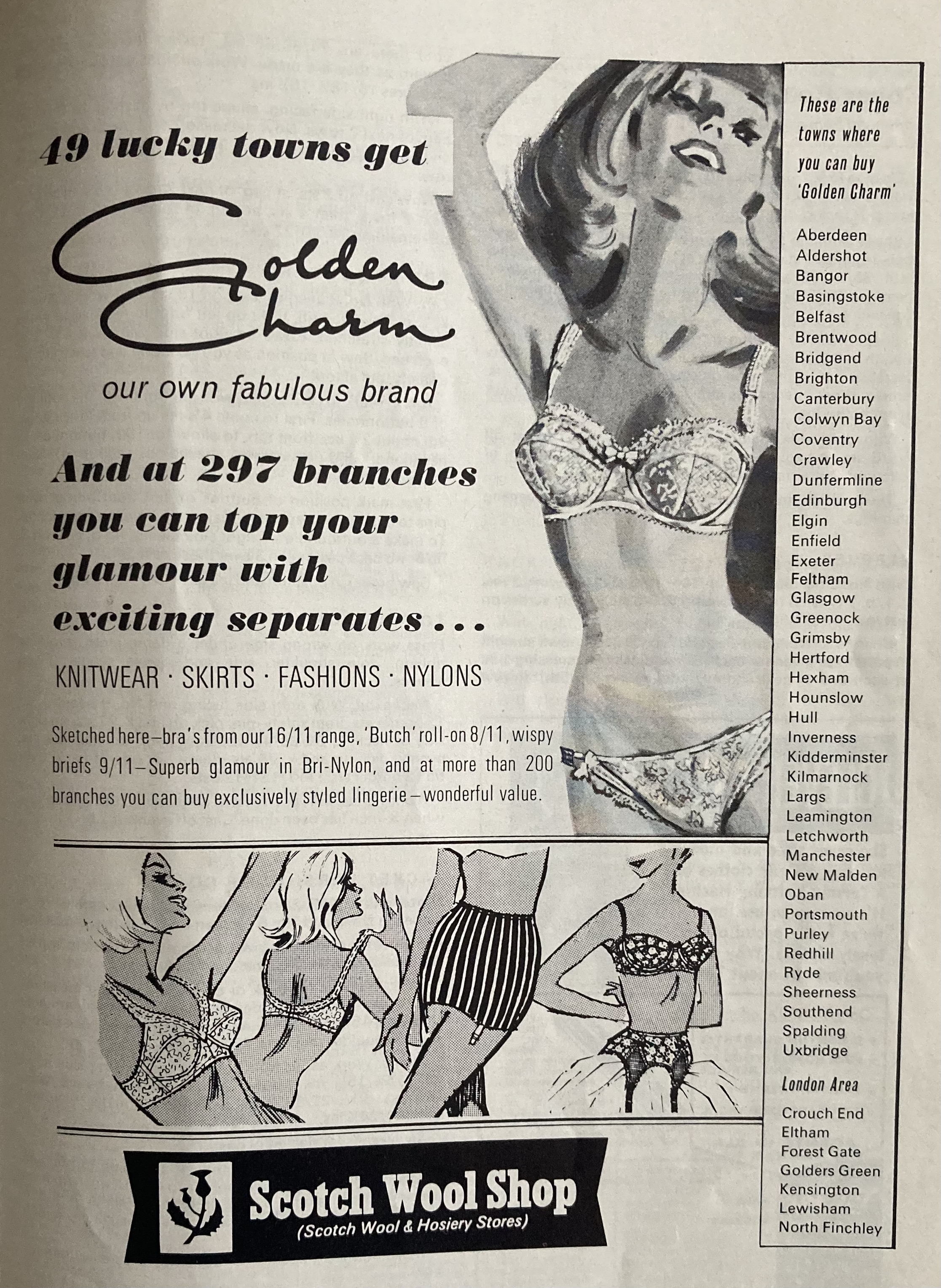
I will leave you with the latest wonderful ad from the Scotch Wool Shop, which had just launched its own line of very pretty underwear, “Golden Charm”. Available in 49 lucky towns! I hope your town and your 2024 are equally lucky. My project for this month will be the embroidered mittens.

November 1962: Overview

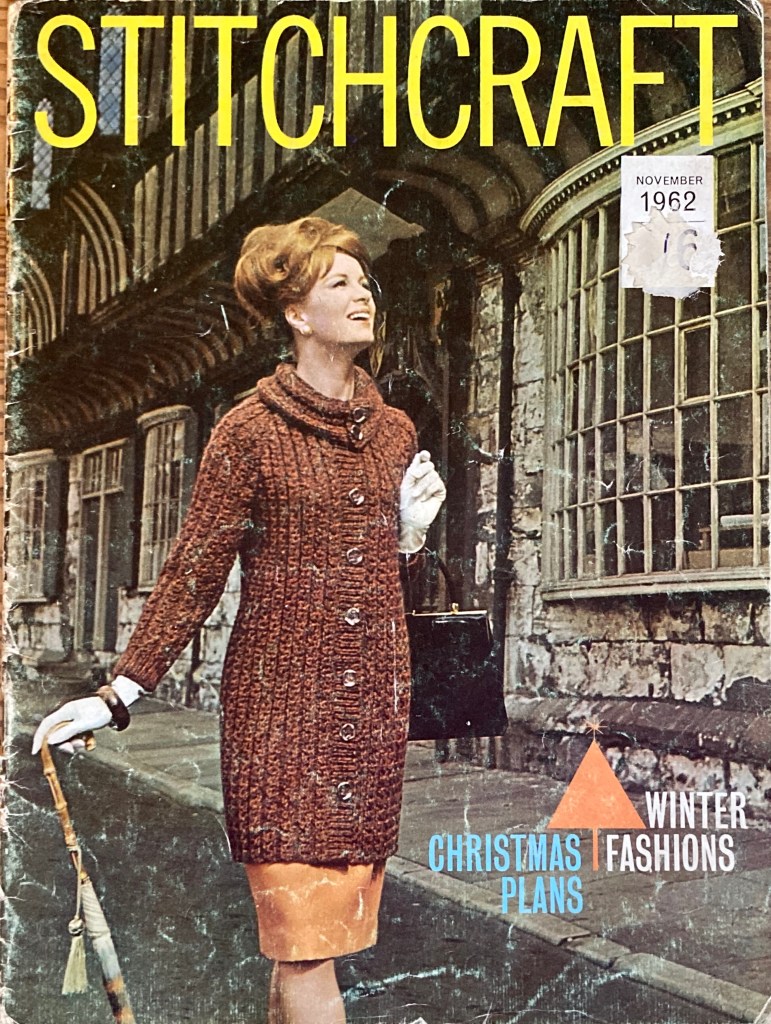
For 1960s Stitchcraft readers, November means holiday planning, so this month’s issue is full of quick homewares for decorating and small, easy projects for gift-giving. The garments are warm and bulky, featuring Patons’ new “Ariel” wool. Warm autumn tones of brown and orange as well as bright, cheerful holiday reds and blues are the colours of the season. Christmas Plans and Winter Fashions ahoy!

Our cover garment is a bulky, yet elegant coat in Big Ben wool, weighing in at a hefty 52-56 ounces (up to 3 1/2 pounds, or about 1500 grams). The mock cable/twisted rib pattern certainly won’t curl at the bottom edge, which is why I guess it’s designed without a hem or ribbing, but at that weight and in that pattern, I suspect the coat would grow ever longer and ever narrower (just in time for holiday weight gain). Still, it looks lovely! I especially like the buttoned collar. Also, I just might try to re-create the model’s hairdo with my long lockdown hair.

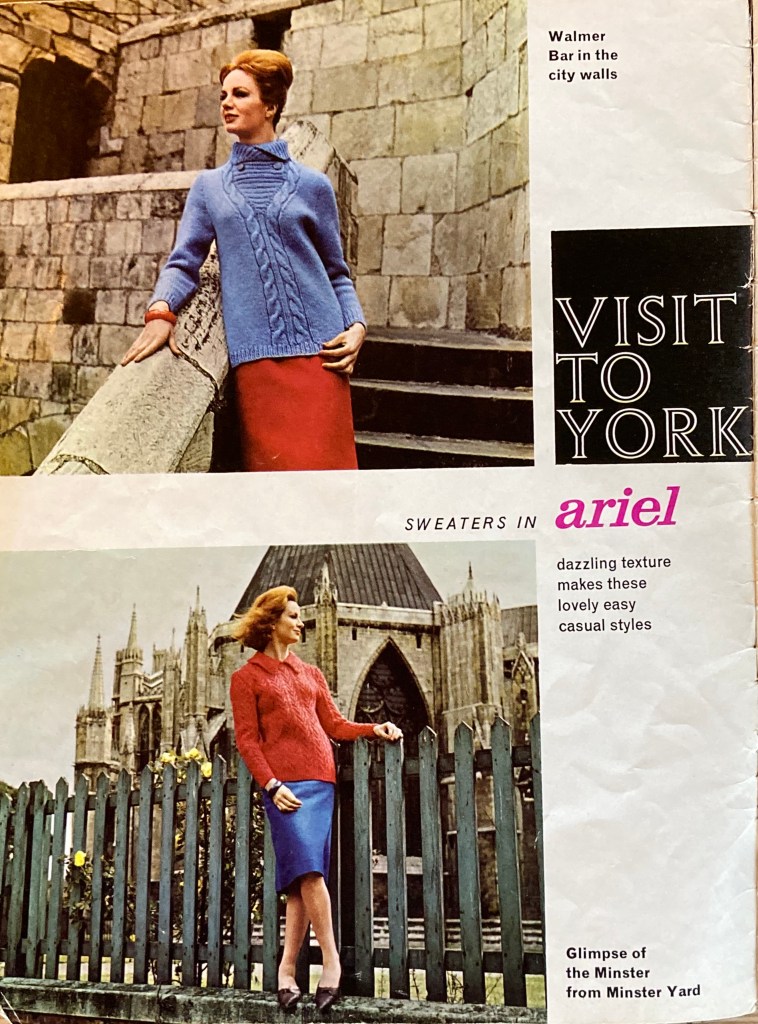
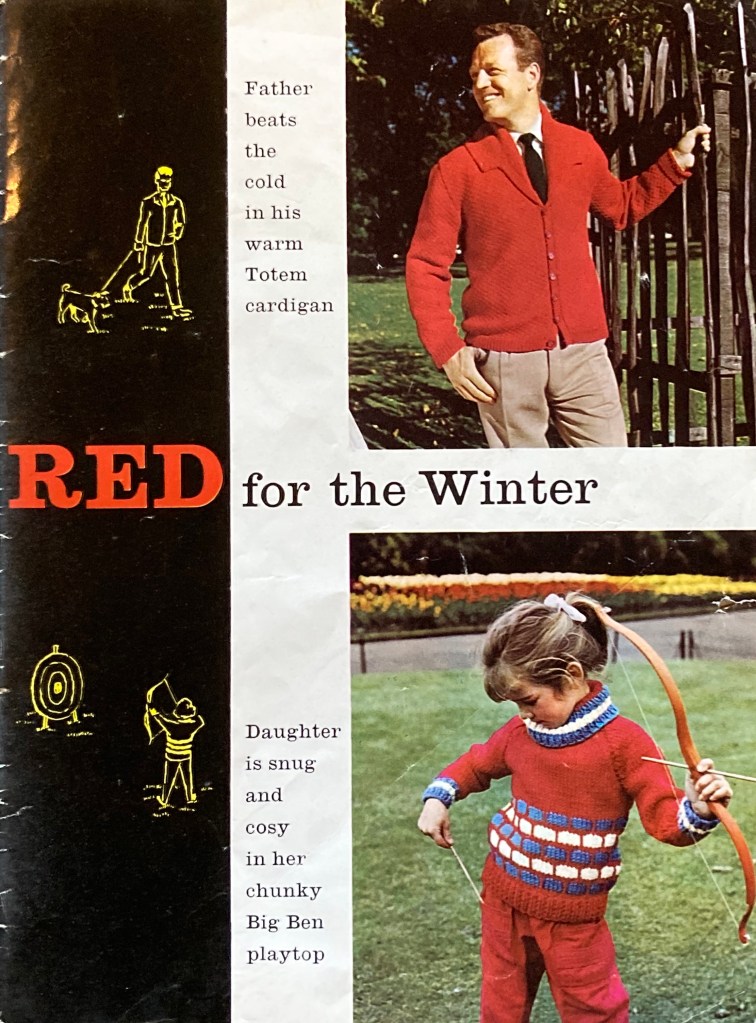
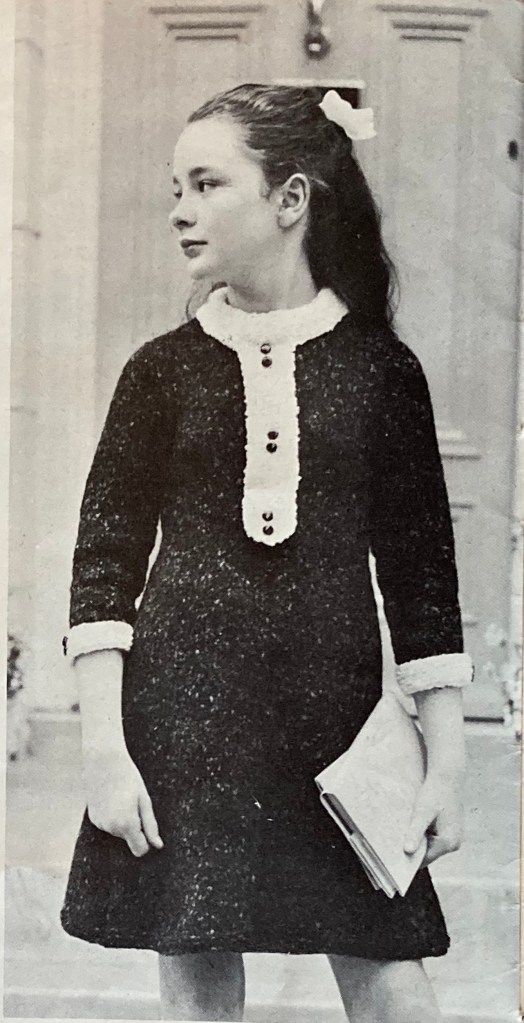
The outdoor photography was taken near historical buildings in York, whose grey-beige stone walls give a nice background to the bright red and blue sweaters made with “Ariel” a bulky, yet “feather-light” (well… 20-24 ounces for a sweater, so lighter than Big Ben, at least) wool-synthetic mix. I really like the red chevron sweater and it doesn’t look bulky at all to me, just fluffy and cosy. Father and daughter also get warm, cheerful garments, and look at this amazing mini-dress for a young miss! That is going on my list of patterns to adapt for myself.

Older teens and young lovers can make “the ‘sweater-match’ theme with girl-friend and boy-friend” – classic pullovers with cable ribs in double-knitting weight and identical except for slightly different shoulder width and back length proportions. That’s all for the knitted garments in this issue, since the real focus is on Christmas preparations with little gifts and housewares.

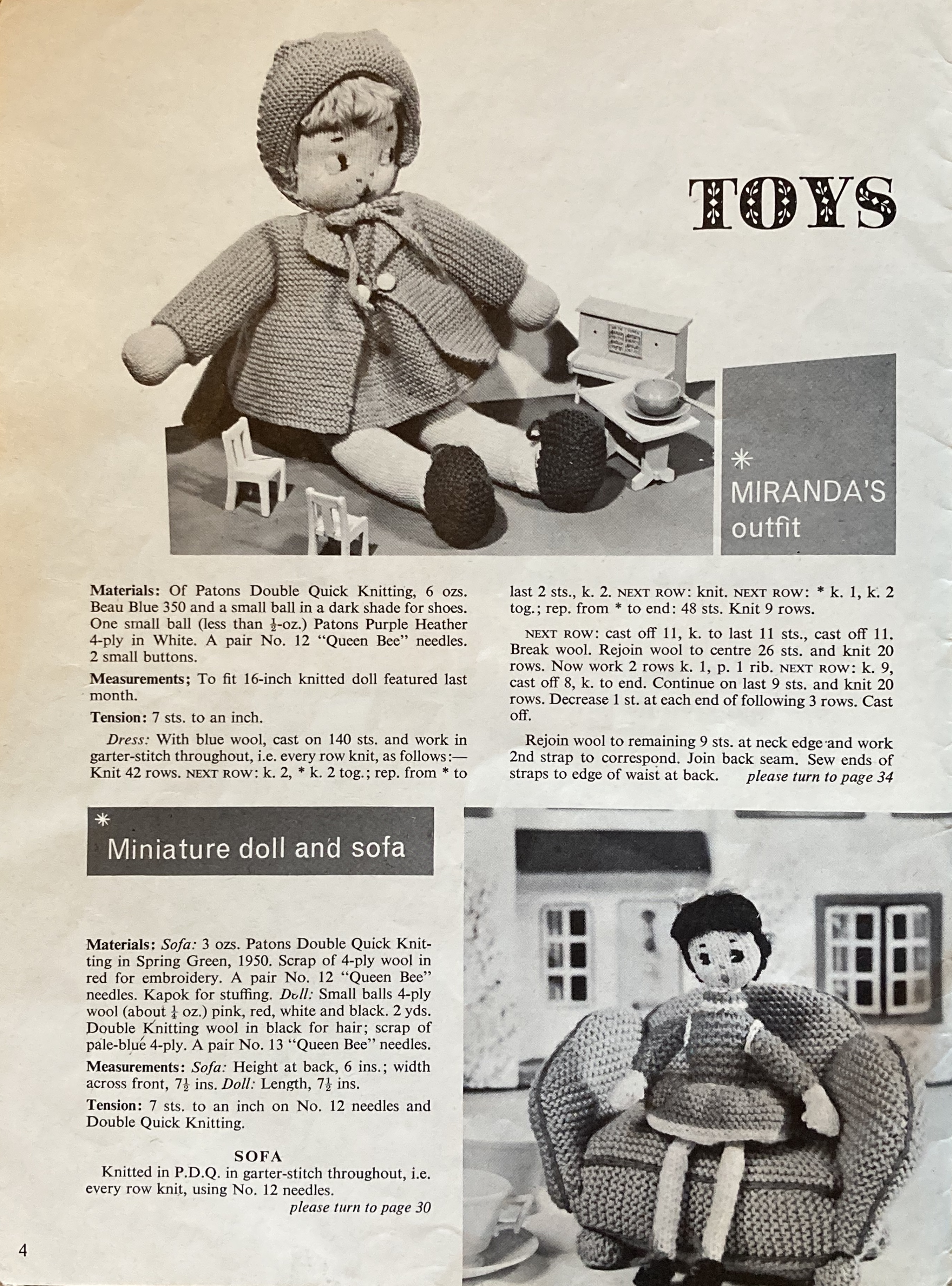
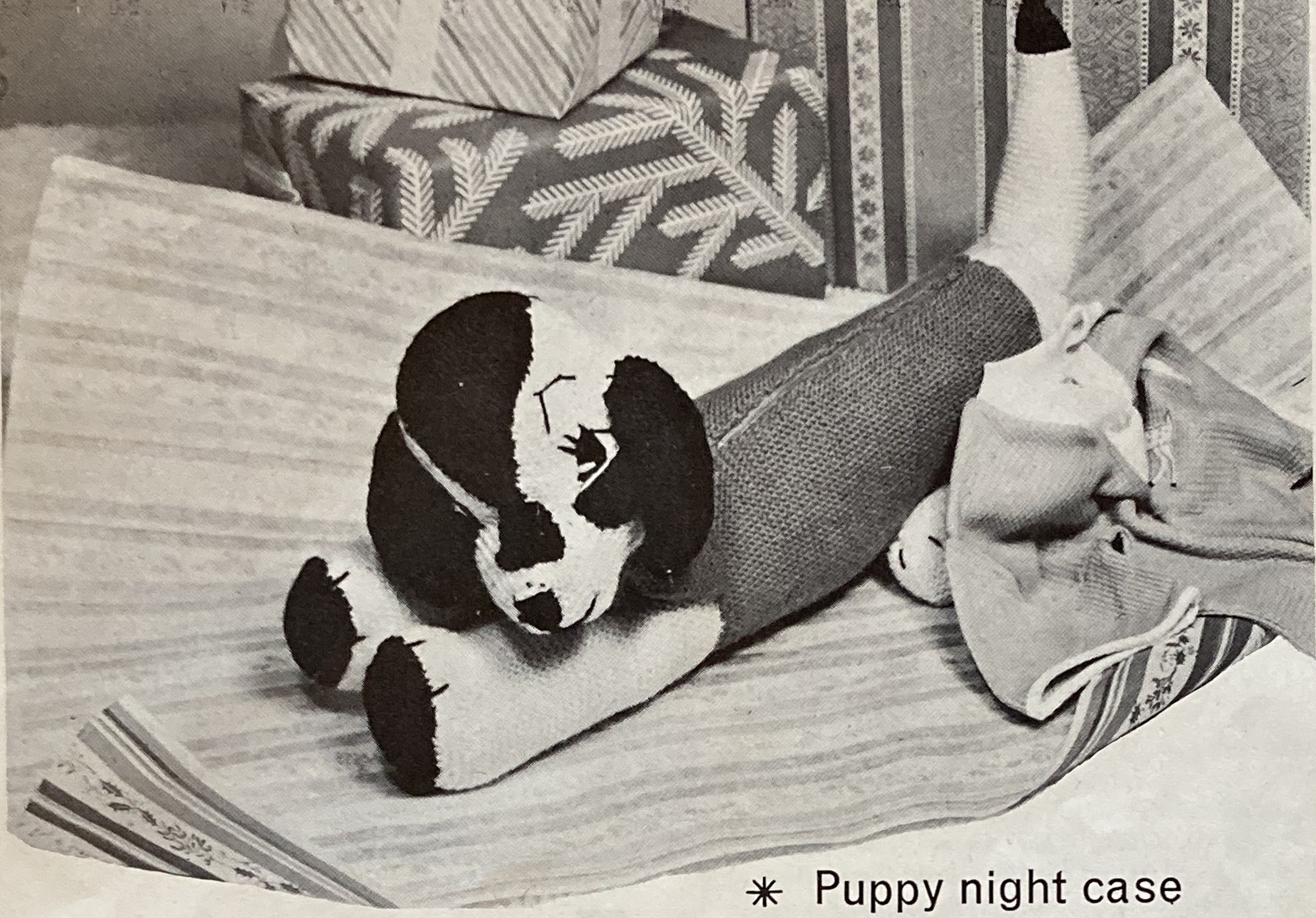
For children’s gifts, there’s a doll, clothes for another doll (pattern in last month’s issue), and a night case in the form of a puppy. This last was especially popular around the late 1950s and early 1960s – I have a different magazine with a poodle nightcase on the cover, and Stitchcraft also had some kind of poodle nightcase in the later 1950s. Poodle or puppy or not, I don’t know why a person would want to put their nightgown in a special case in or on the bed. If you don’t want other people who might be using the room to see your nightdress lying around, you could just… put it under the pillow?

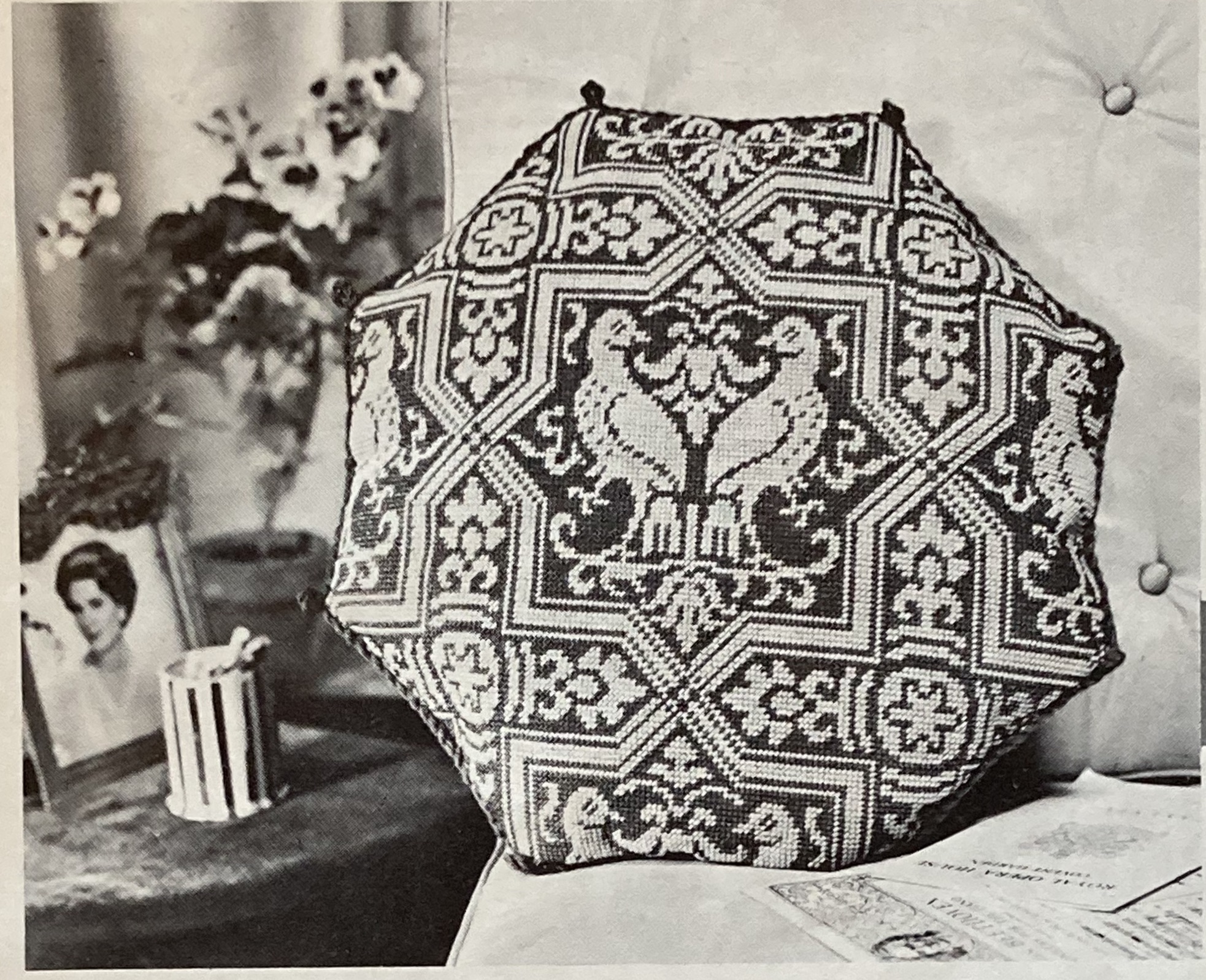
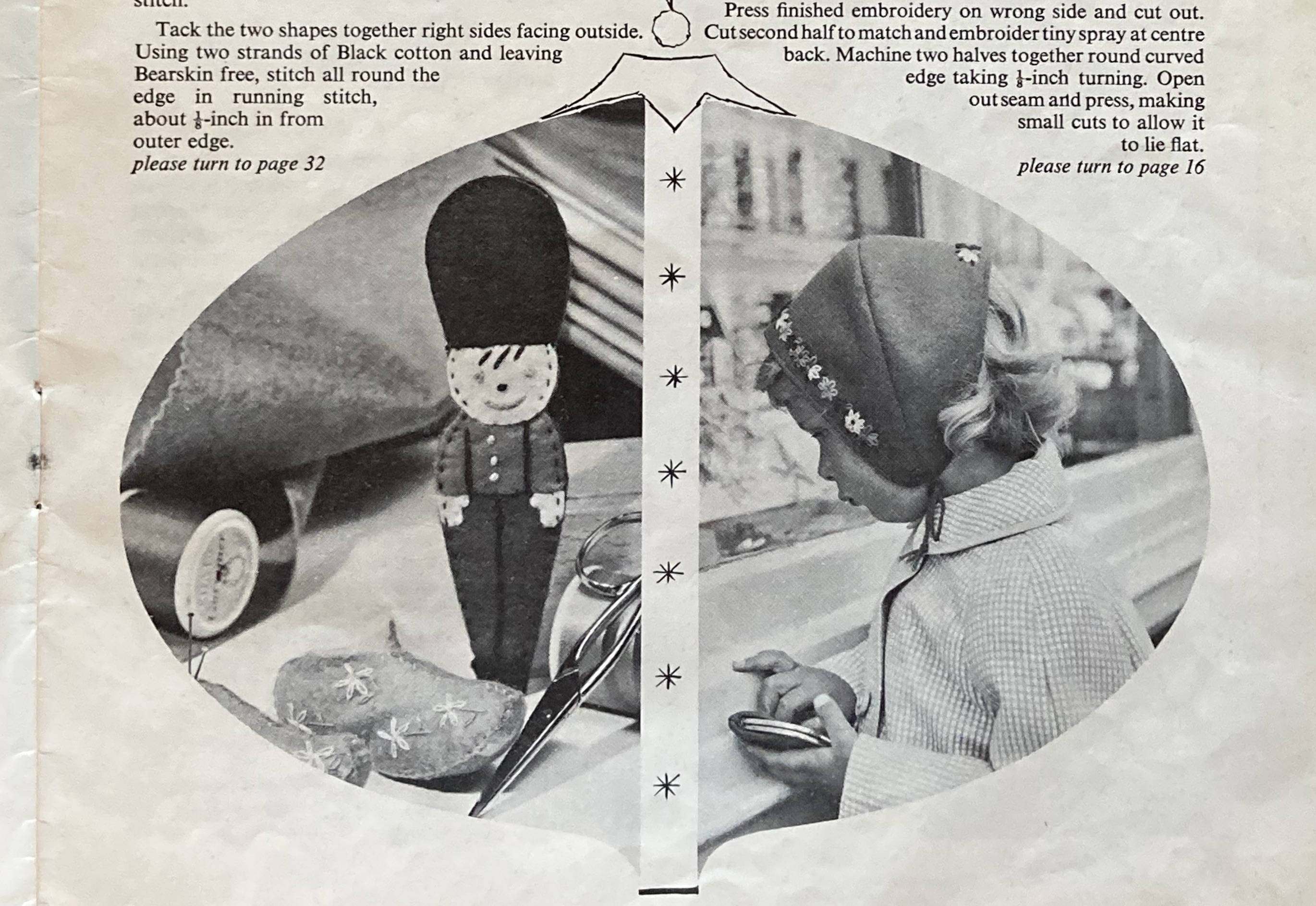
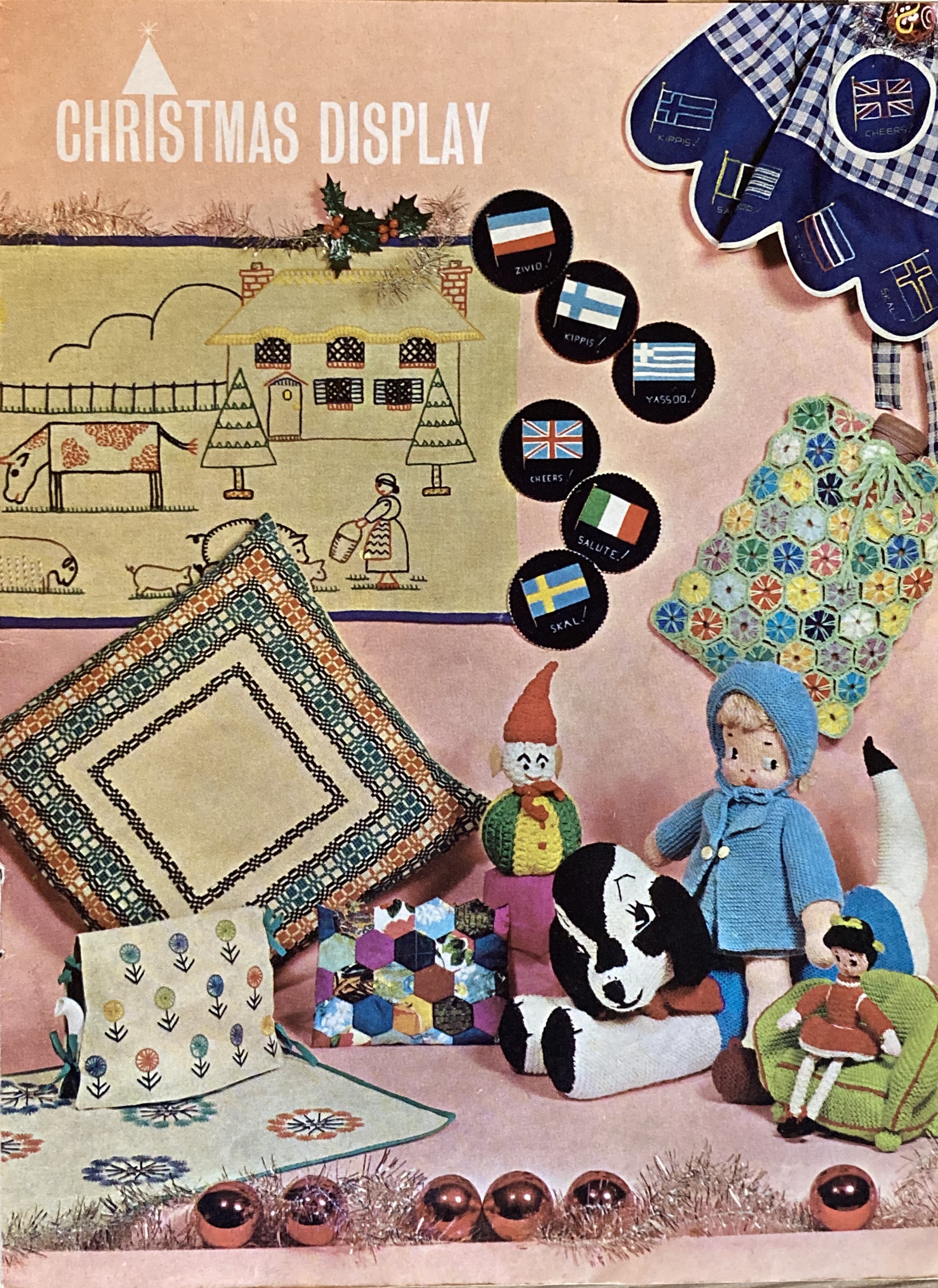
There’s an intriguing “Byzantine” cushion, a firescreen with this month’s embroidered flower (chrysanthemum) and some little gifts sewn in felt, but the more interesting projects are displayed nicely in the large colour photo in the middle of the issue. We’ve got an embroidered farm scene for the nursery wall, a “hostess set” of apron and coasters featuring international drinking mottos, the usual cross-stitch cushion, and a tray cloth/tea cosy design that I would love to adapt to an iPad/tablet cover. Crocheters can use up all their scraps with medallions or a … cute? eerie? not sure what to say about it? pixie doll and patchwork fans, generally ignored by Stitchcraft, finally have a little bag as a starter project.

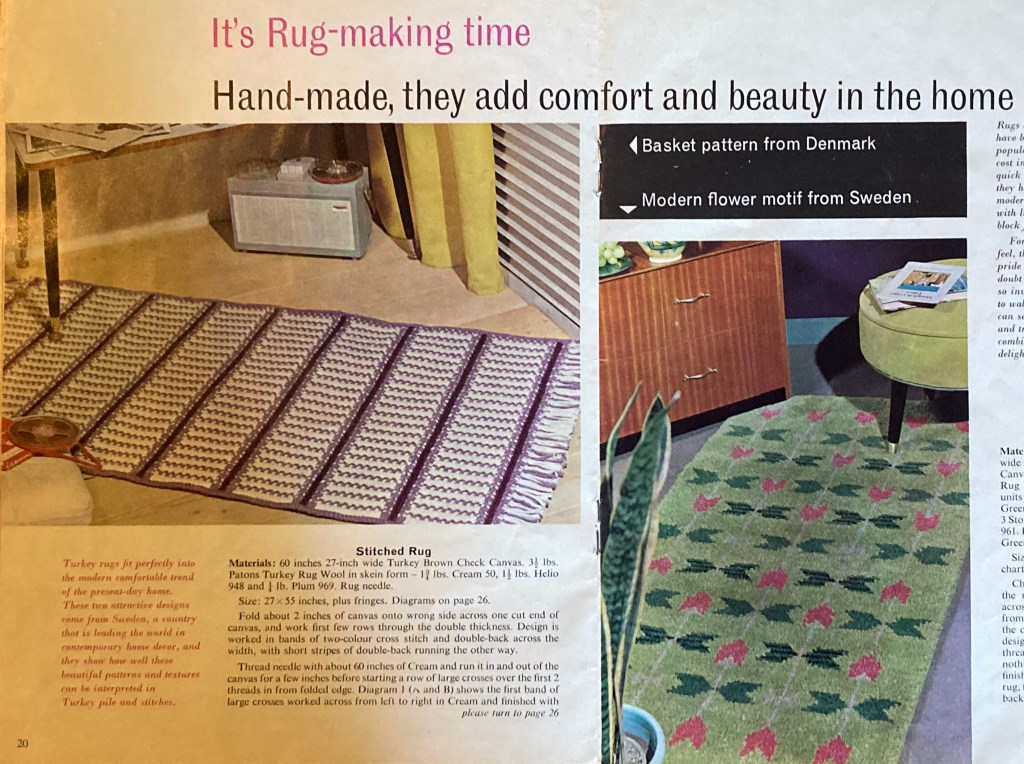
There are even rugs in Scandinavian designs (is that basket pattern from Denmark or from Sweden?), one stitched, the other done with a latch-hook.

What an issue! There are so many projects I would like to make from it: the girl’s dress in my size, an embroidered tea-cosy for the digitalised world, the little girl’s bulky red sweater, even the green latch-hook rug. Sadly, pandemic and lockdown have thrown a monkey wrench into my current knitting plans, it’s hard to get supplies, and I’m trying to finish or even start multiple other large projects that were planned or promised or have been lying in the WIP pile for ever. One of those WIPs was a (non-vintage) garment that I will have to frog anyway (ran out of wool and can’t make it work), so the plan is to frog that project and use the wool to make “Father’s cardigan” from this issue. Said project and I are geographically separated at the moment, though, so long story short: I do not know when I will be able to post a November project. Take heart, though: there will be some more Stitchcraft cooking fun in December as well as a special surprise next week.