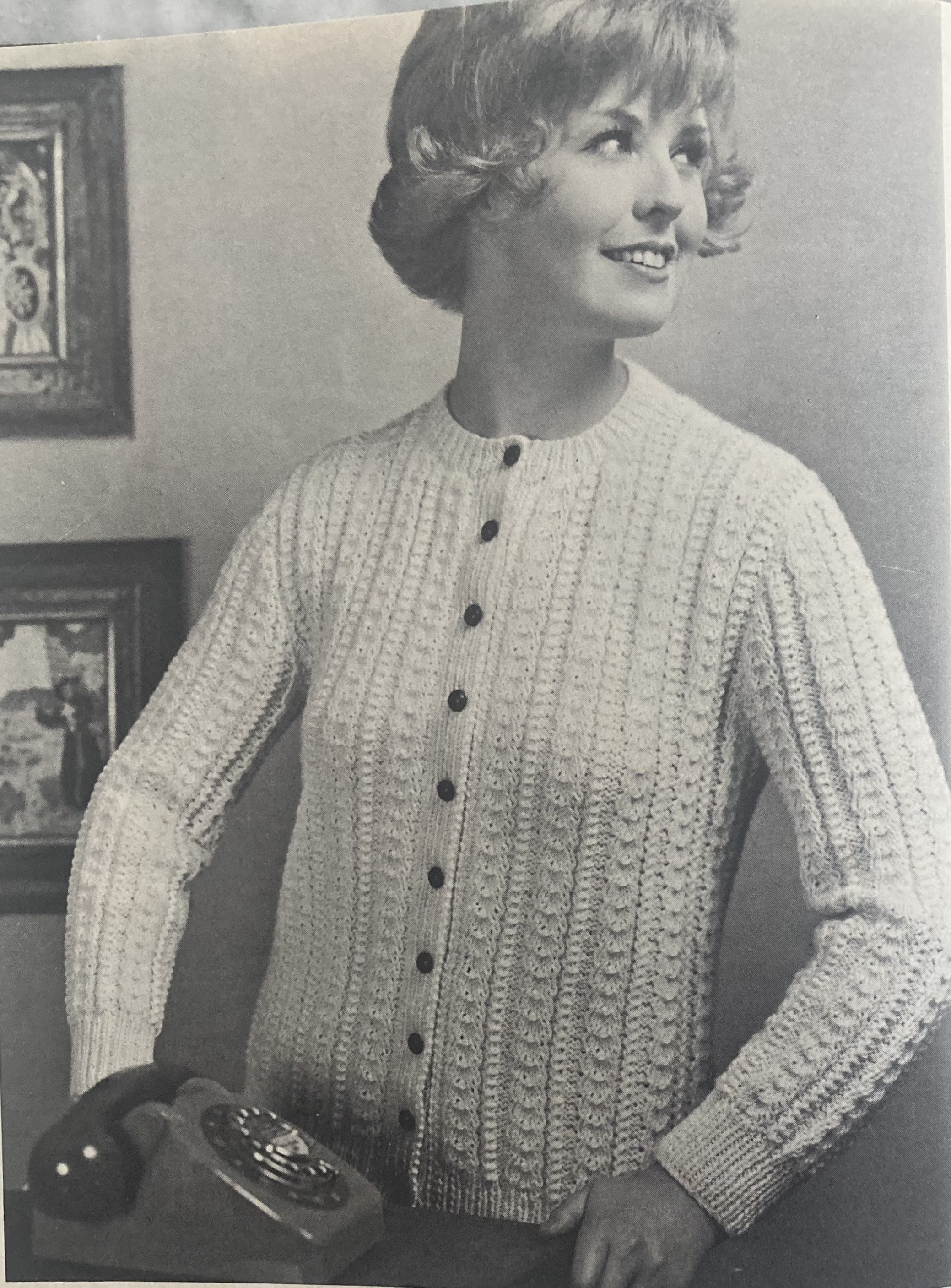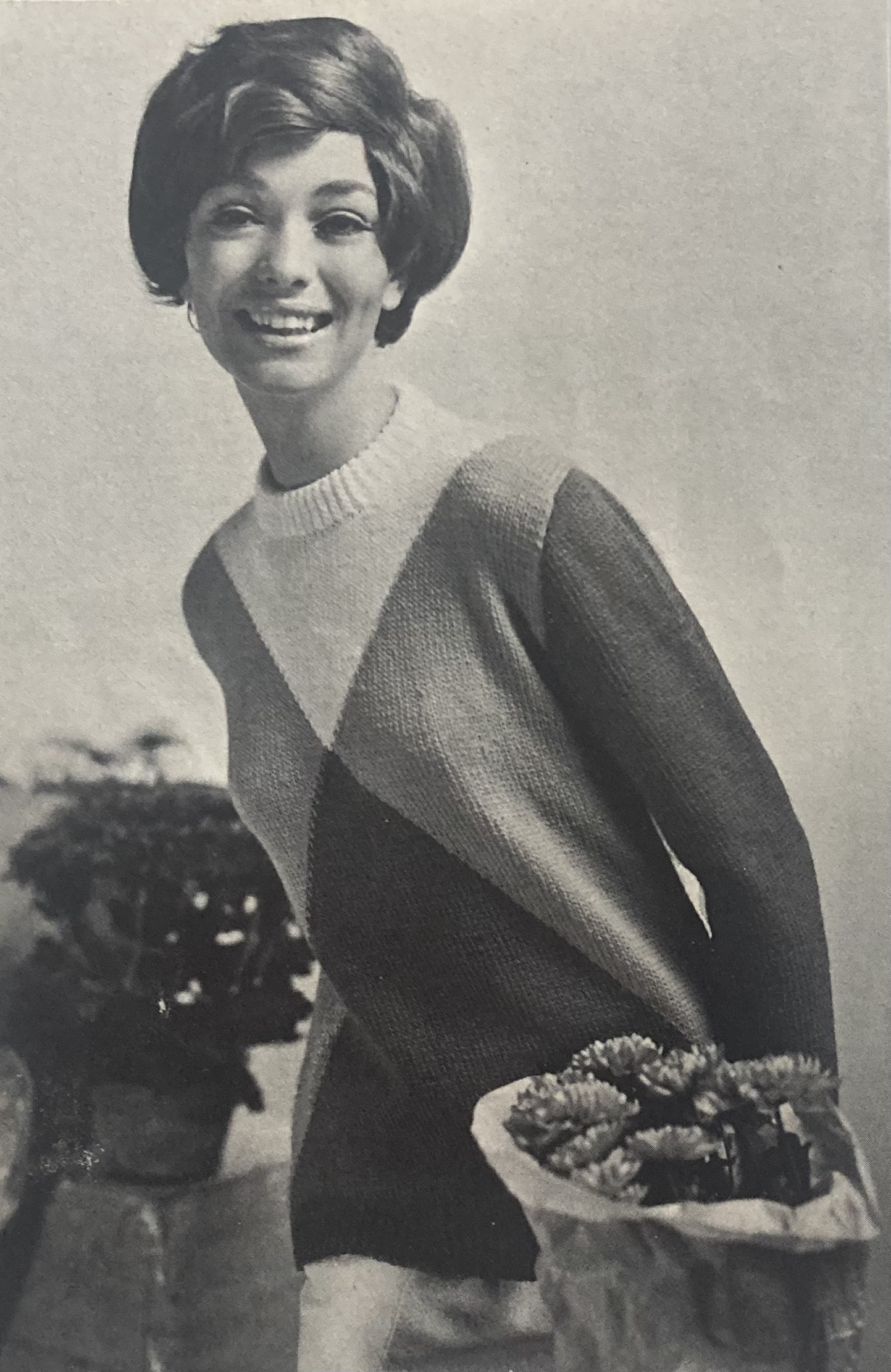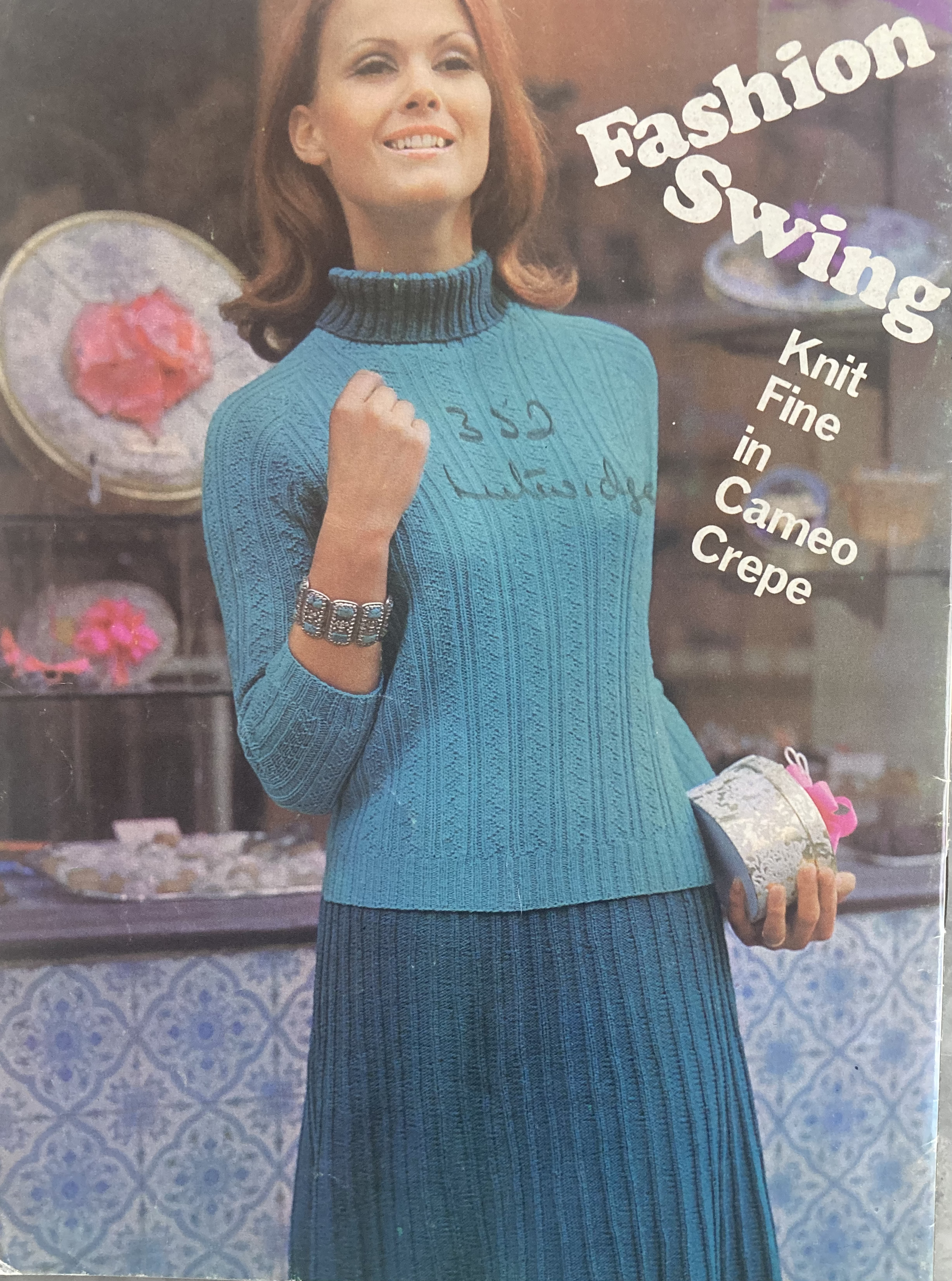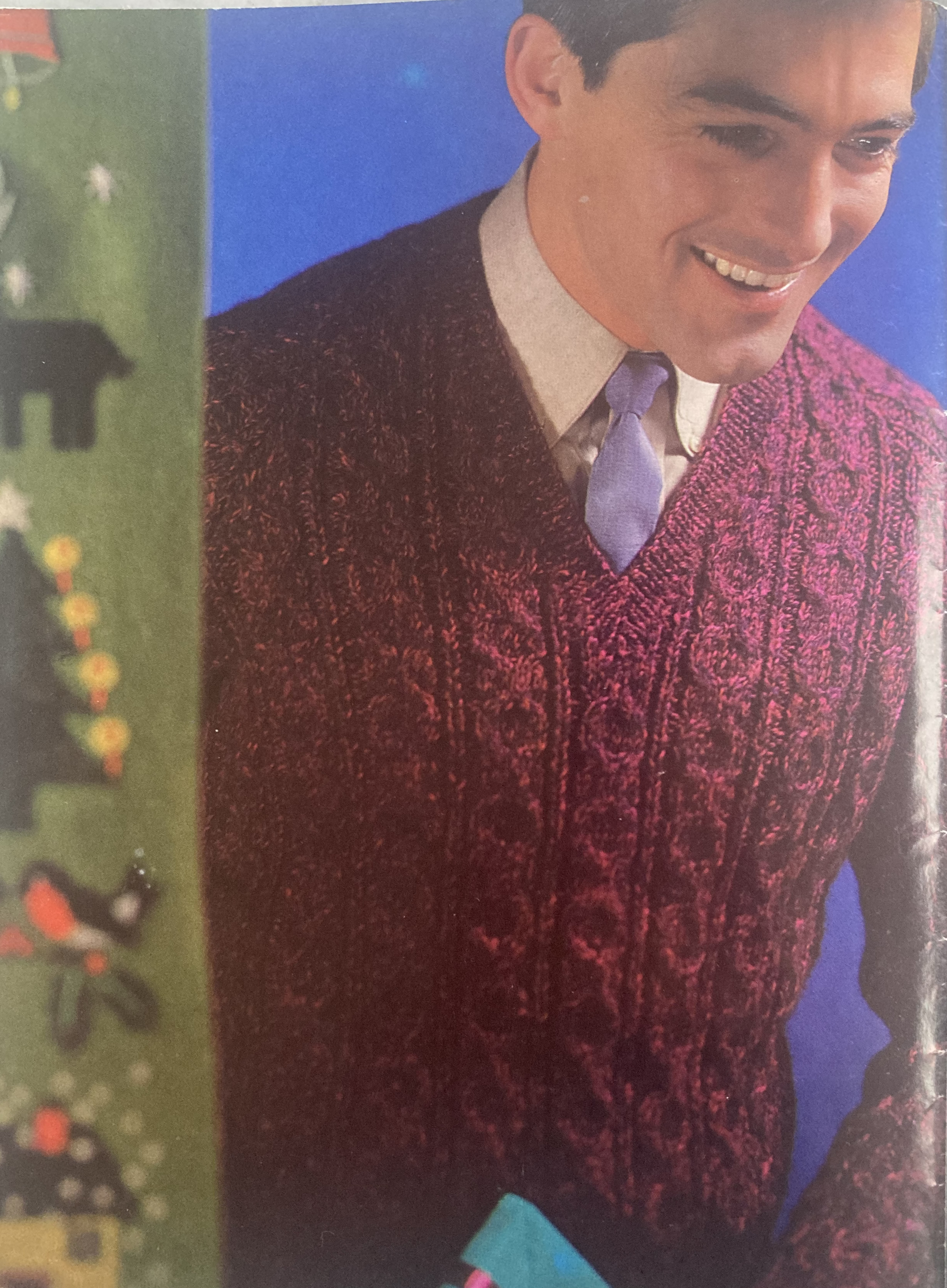
December 1967: Overview

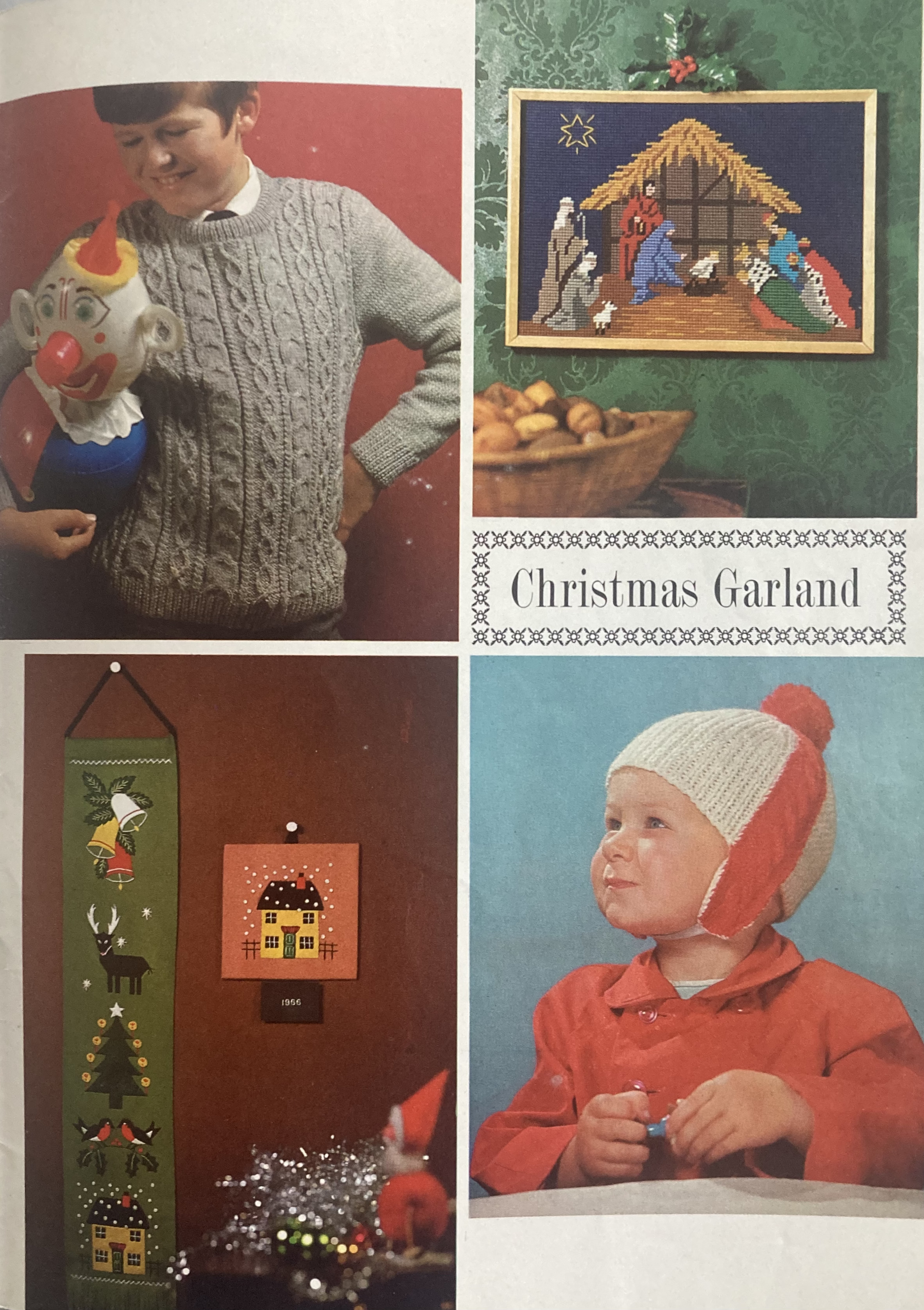
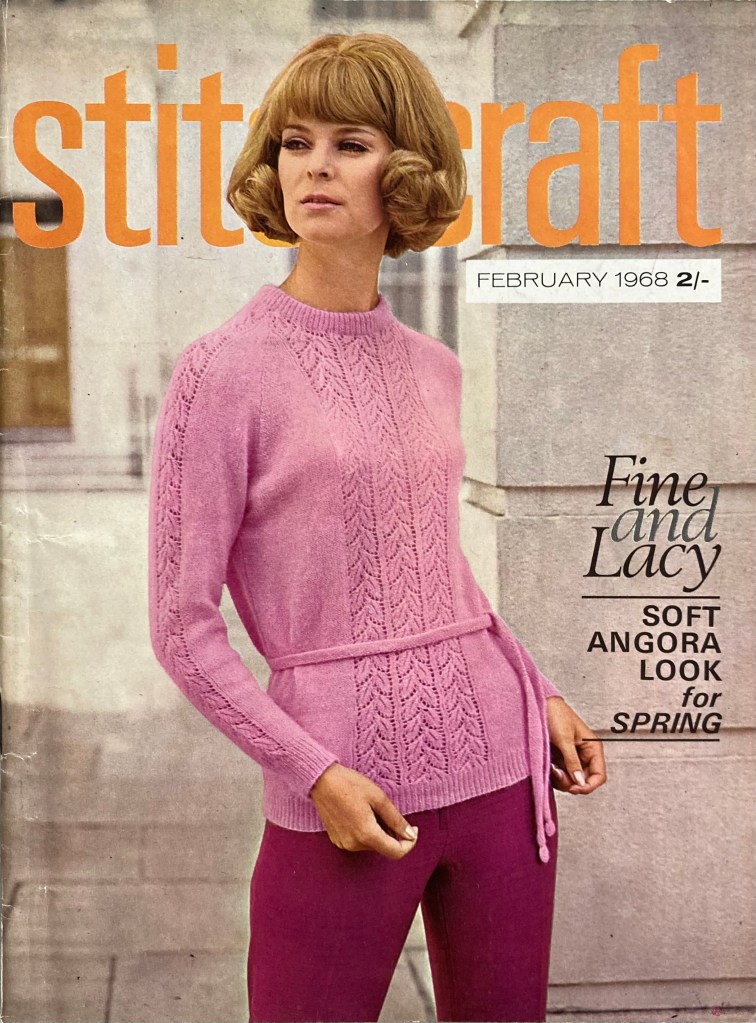
It’s here! The December 1967 Stitchcraft Christmas issue is a “bumper number to help with last-minute ideas for your Christmas giving, and suggestions for your winter handicrafts.”

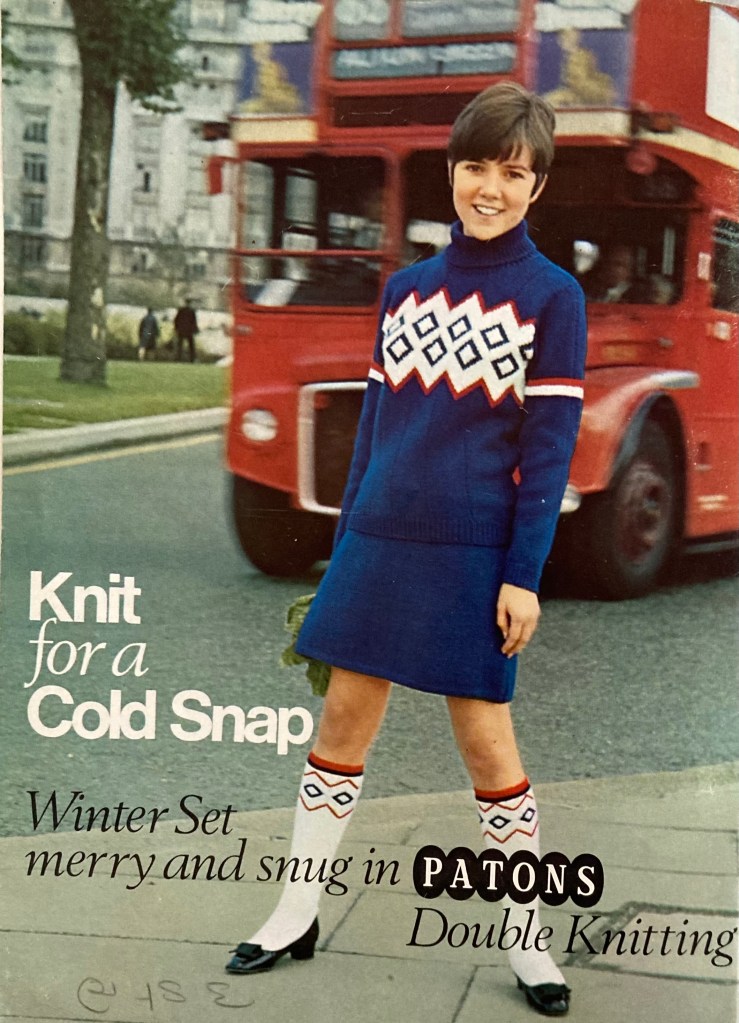
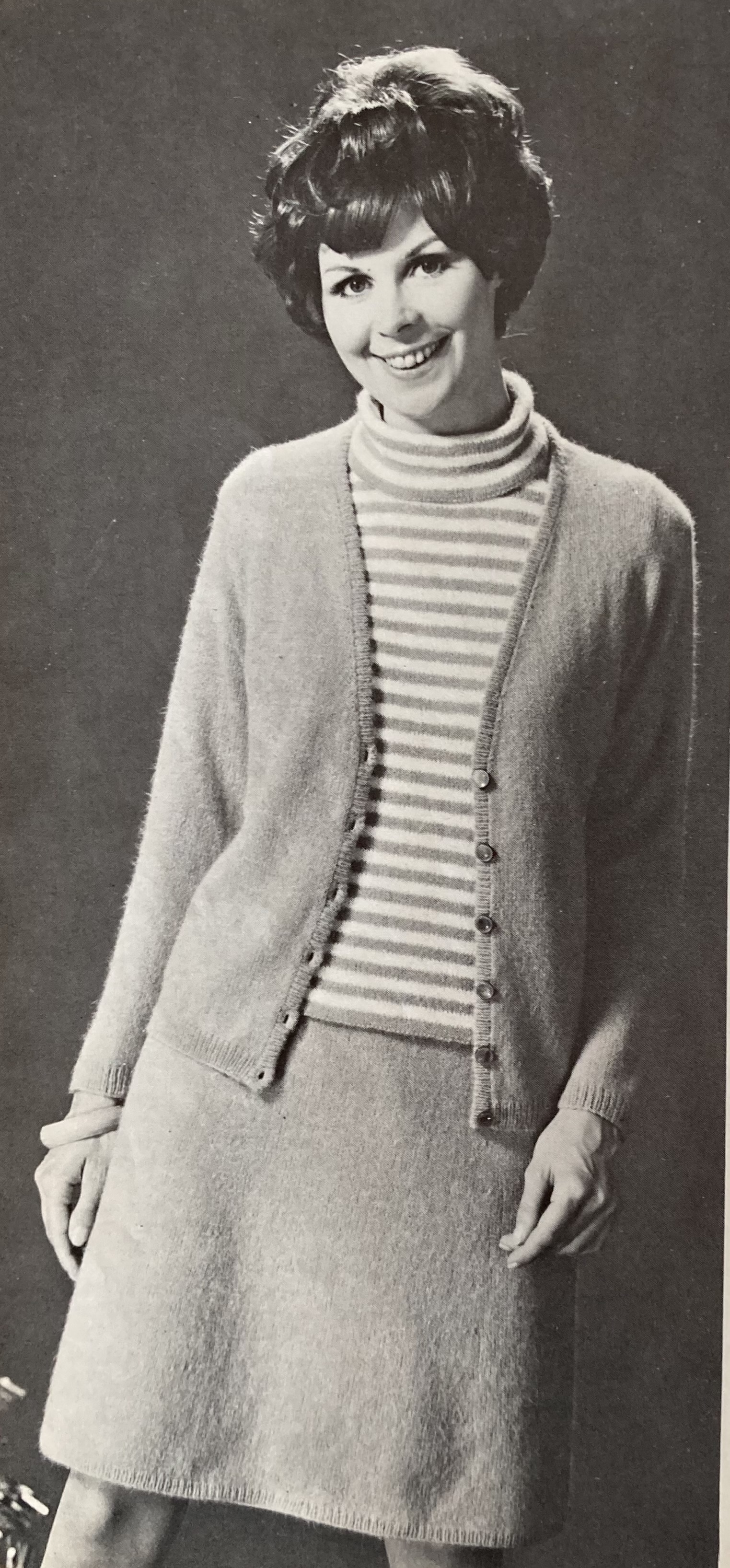
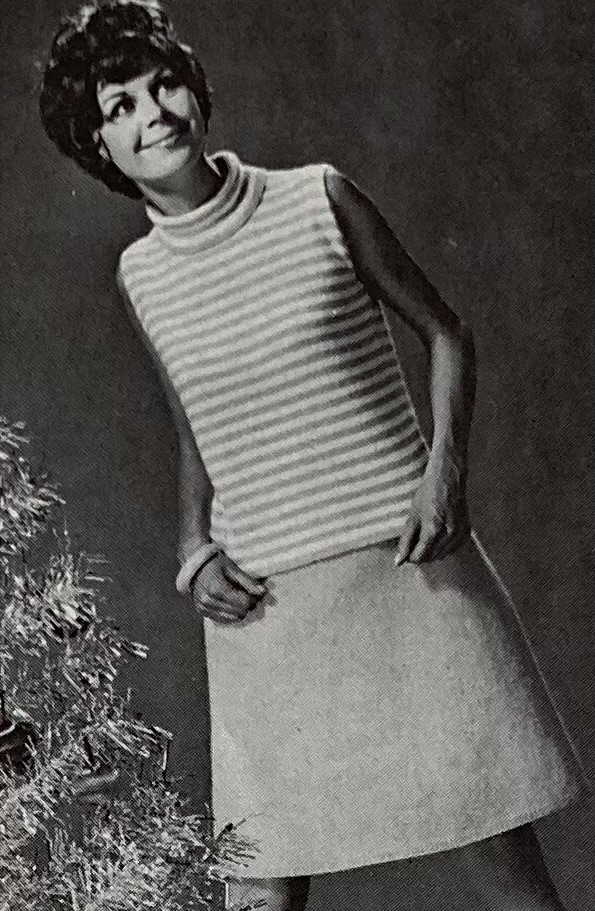
The cover photo went with a wintery blue, white and silver colour scheme to set off the featured 3-piece skirt suit. It’s knitted in Patons “Princess”, a light, fluffy yarn made of 80% wool and 20% angora. At 8 stitches to the inch on No 11 (3.0 mm) needles, I imagine it won’t get finished by Christmas. The striped top is sleeveless, and the skirt shorter than knee-length without being “mini”: this is an outfit intended for the respectable suburban mother of the family. A more fun-loving adult woman can make a party dress with or without sleeves, that combines knitting and crochet. Looking at the second picture, you can see why all the models pose with their spines in that corkscrew S-curve — it’s to hide the fact that the unshaped, unbelted dress will look like a sack on them otherwise. Must be hard to hold the pose for the whole party…

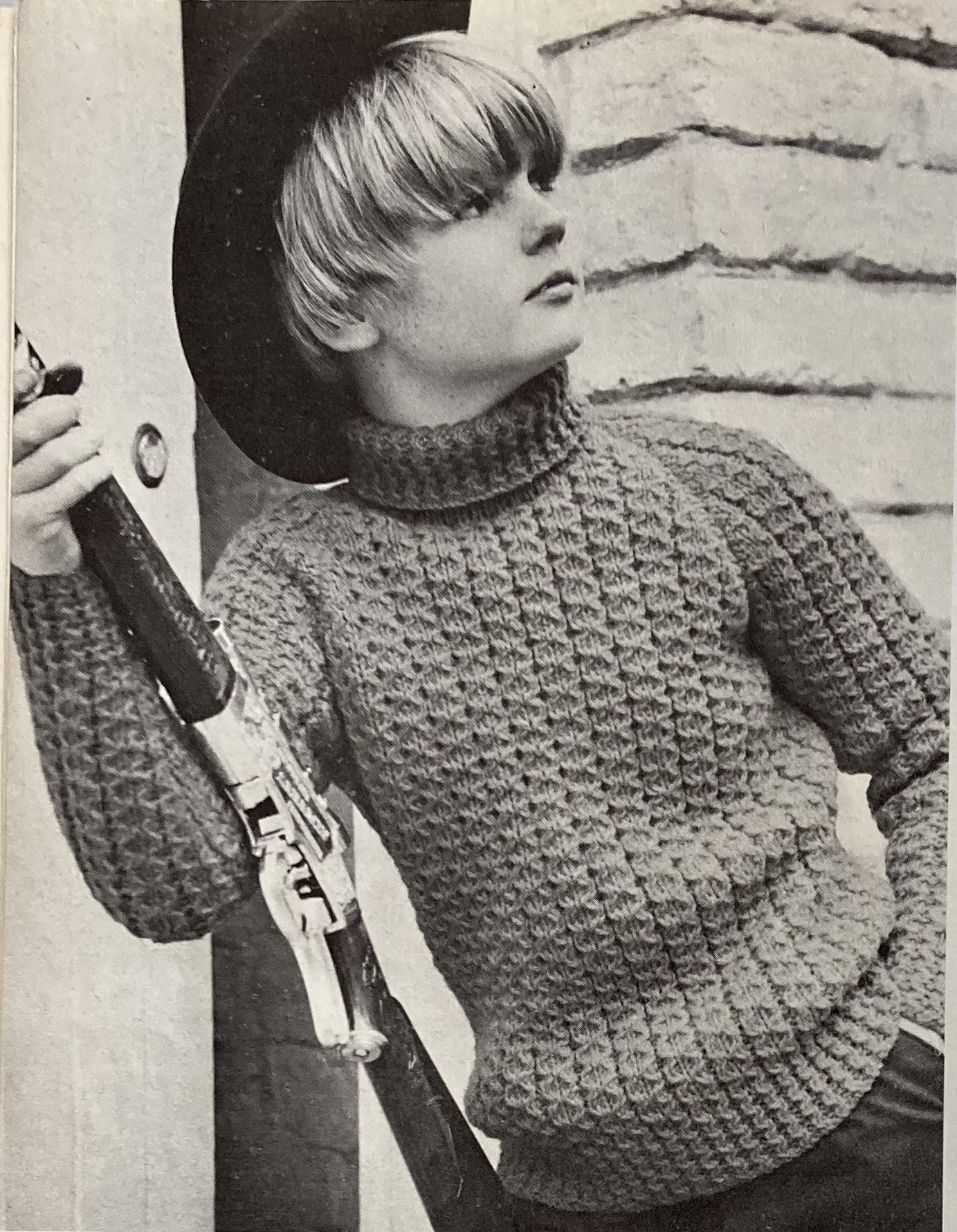
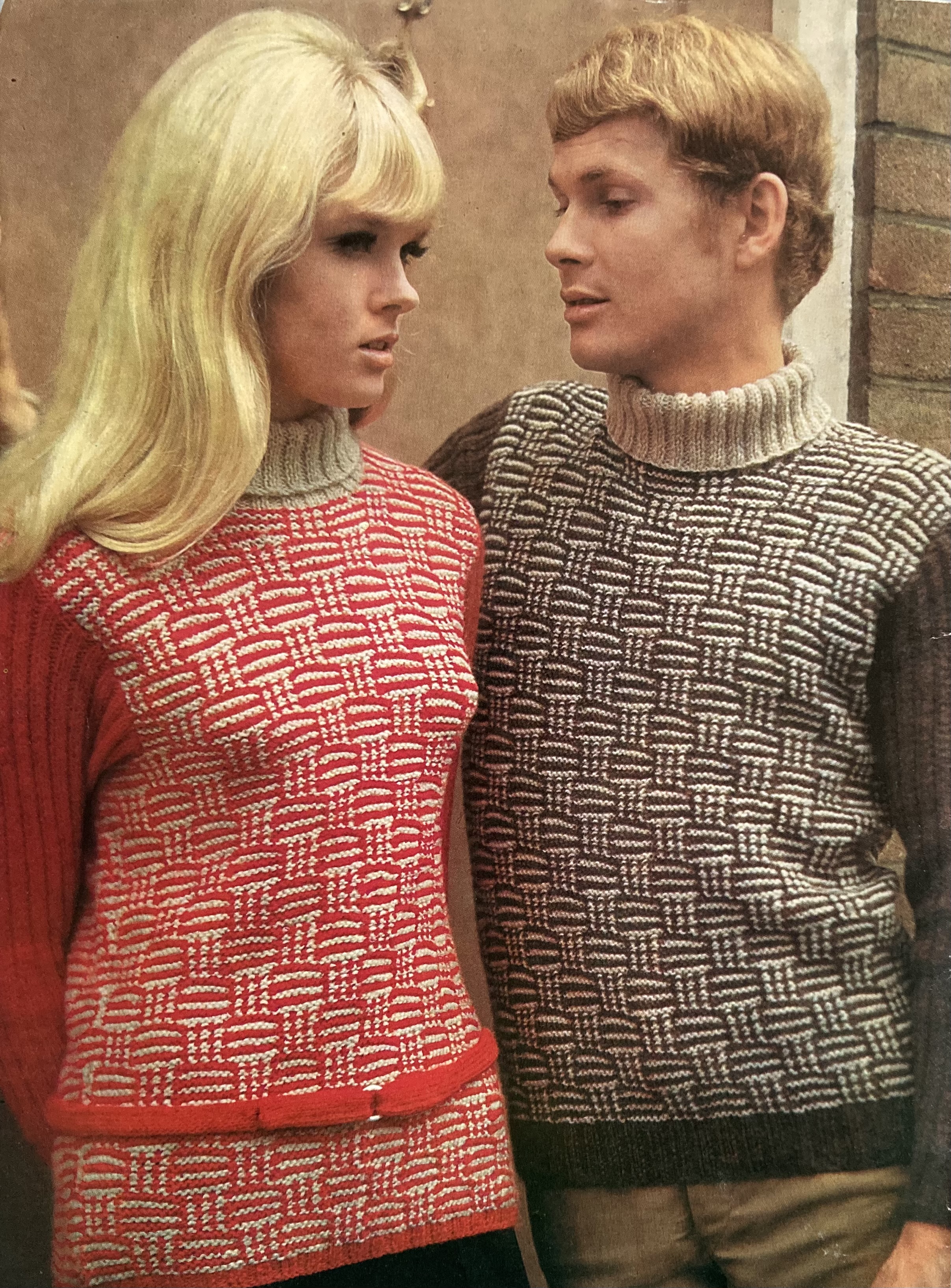
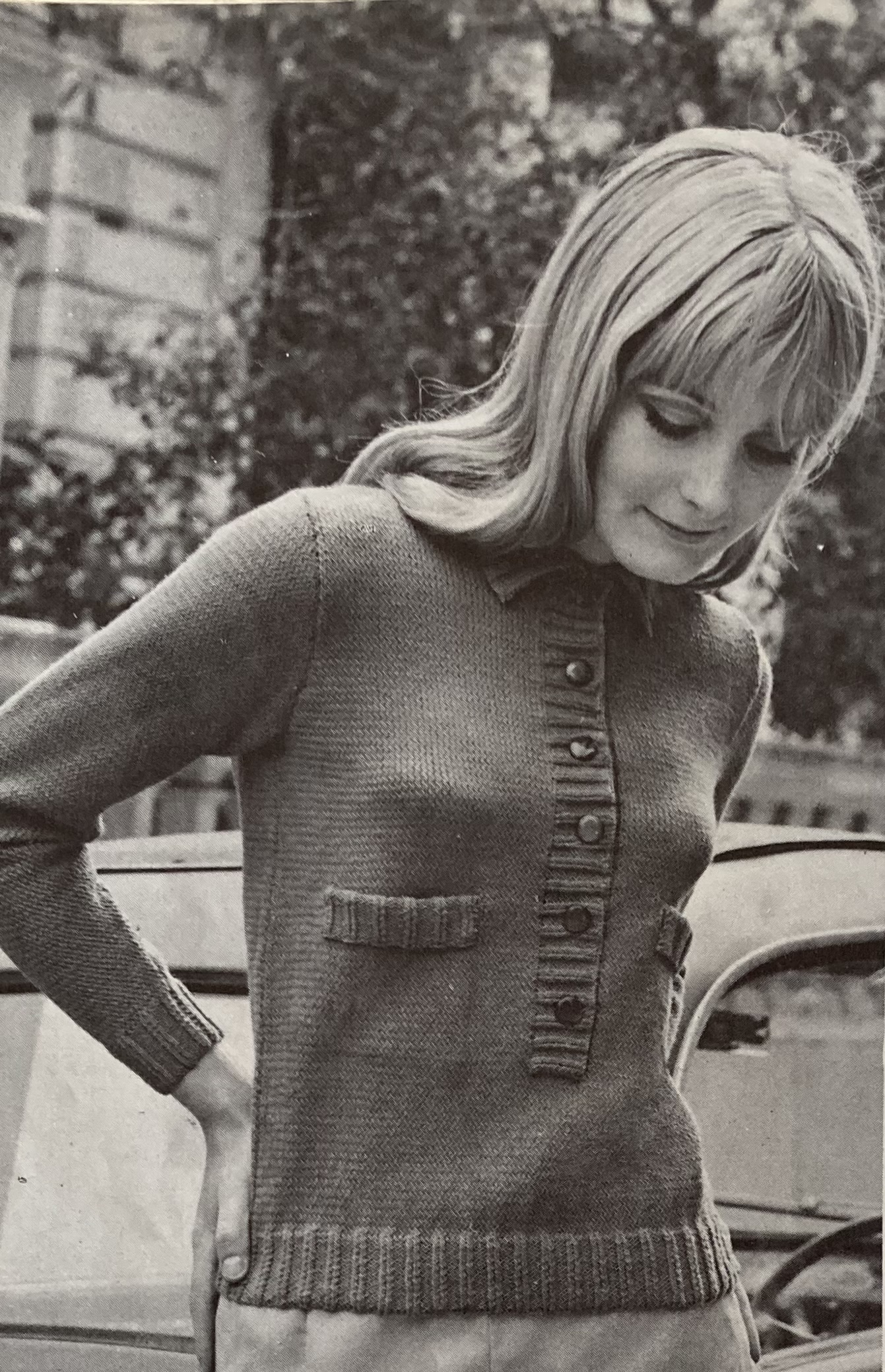
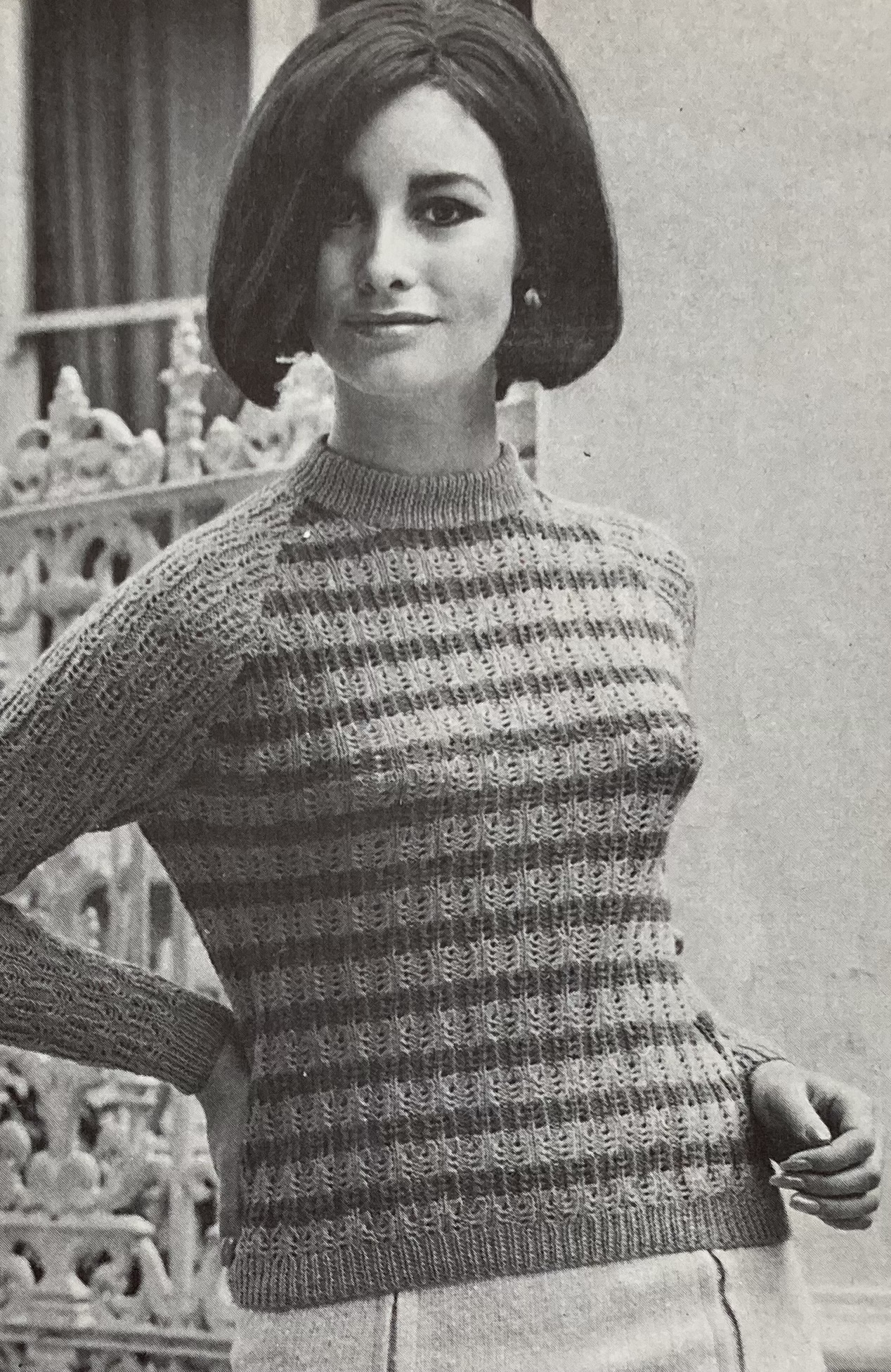
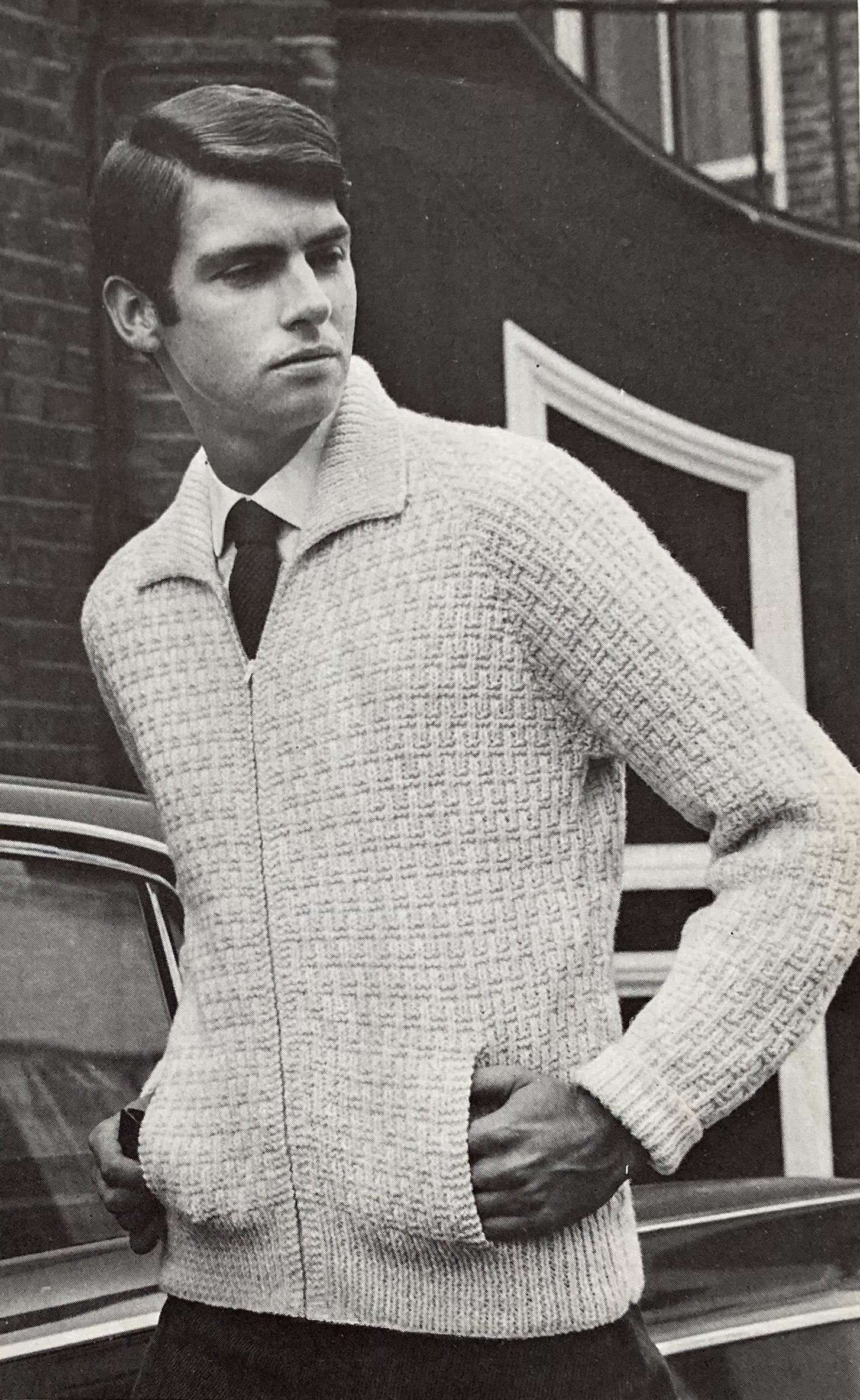
As for the “young team”, they “love to match”, according to Stitchcraft, and can knit themselves (who am I kidding, the girl will knit for both of them) some warm pullovers in a fun two-colour basketweave pattern with ribbed sleeves. The colour pattern is made with slip stitches. Other adult garments include a “lumber style” mens’ zipped cardigan, two practical jumper-blouses to “go with suits and skirts” and a classic cardigan for larger sizes.

Cables and basketweave textures are on trend, and the colours are not particularly Christmas-oriented — strong, cool colours and neutrals. The mens’ basketweave cardigan is made in cream-coloured, undyed “Capstan” wool and the two suit-skirt jumpers in “Planet Jade” and “Bracken Gold” with “Brandy Snap” contrast. Only the knit-crochet party dress is in holiday “Hawthorn Red”.

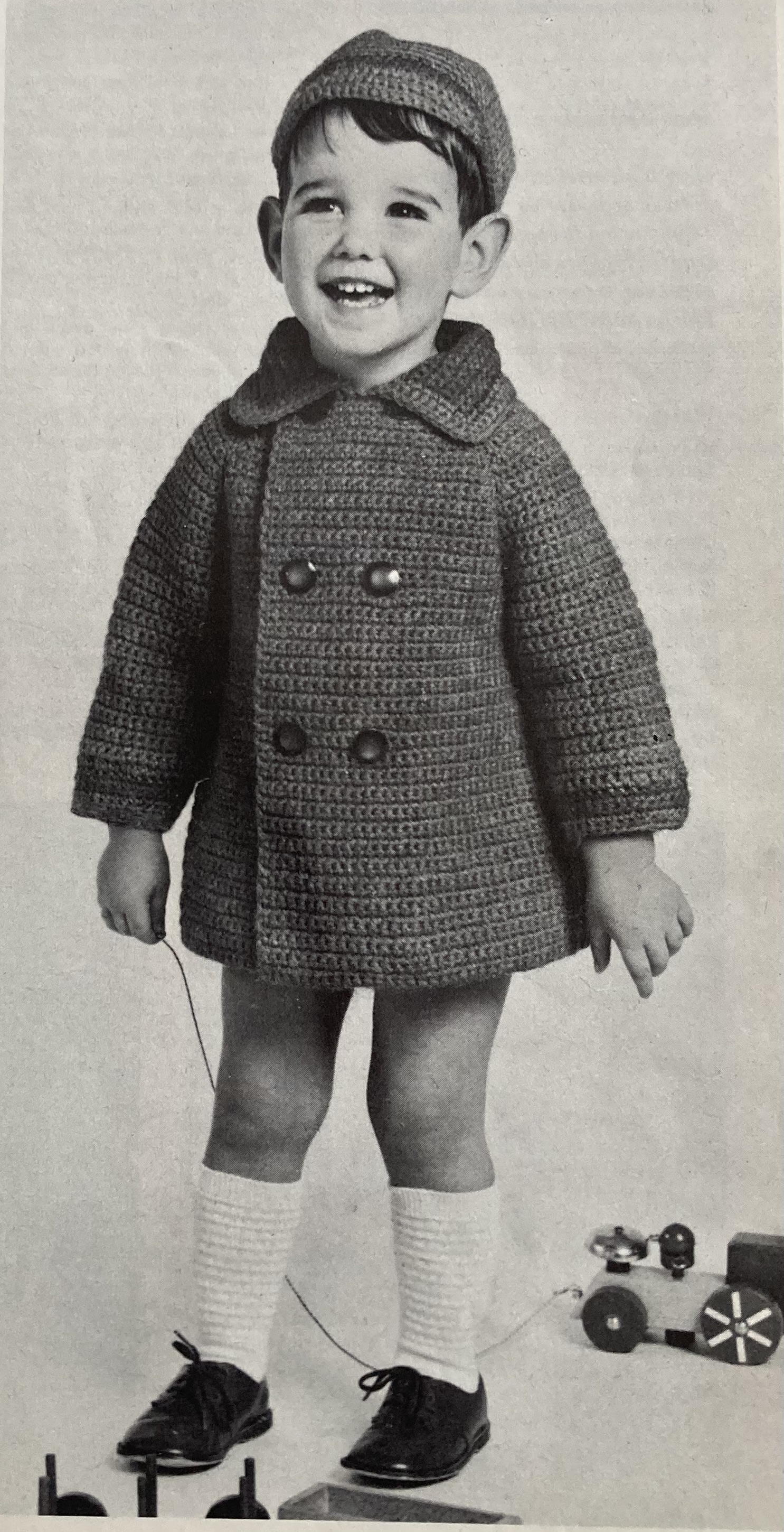
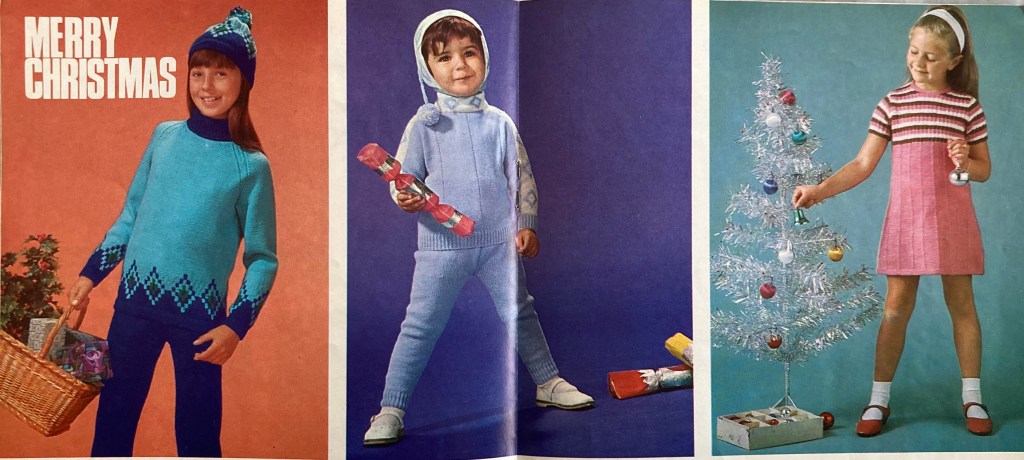
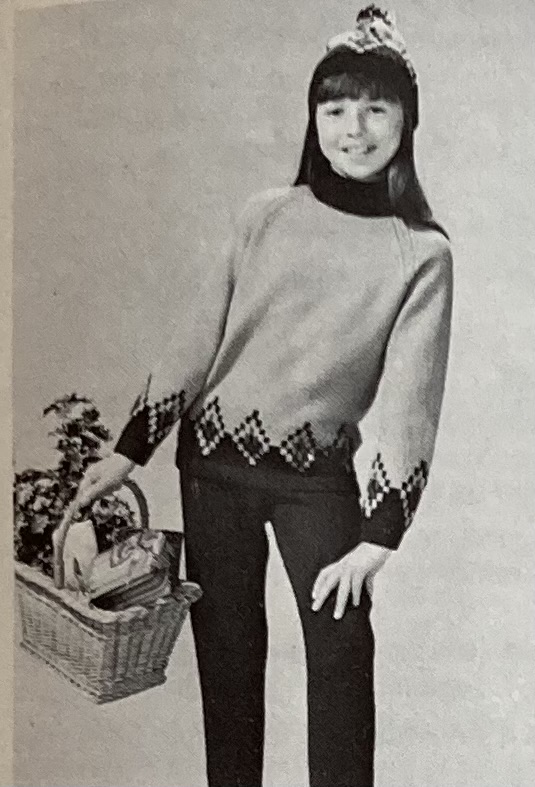
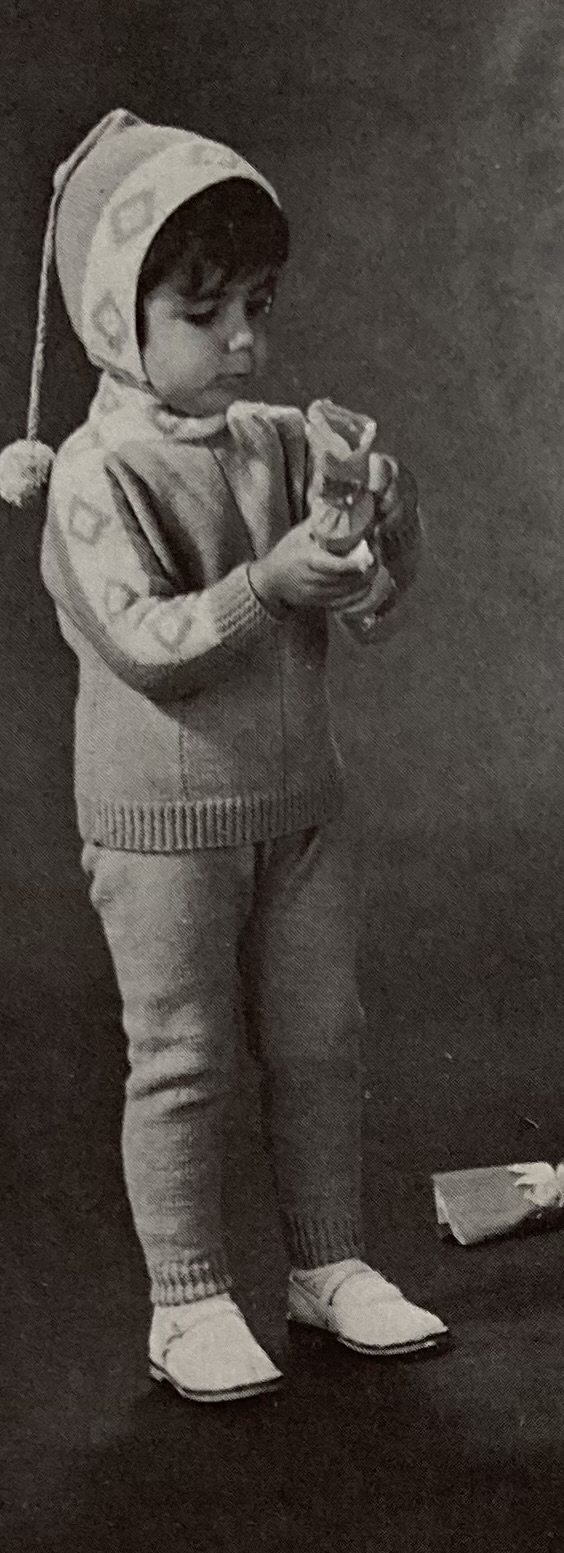
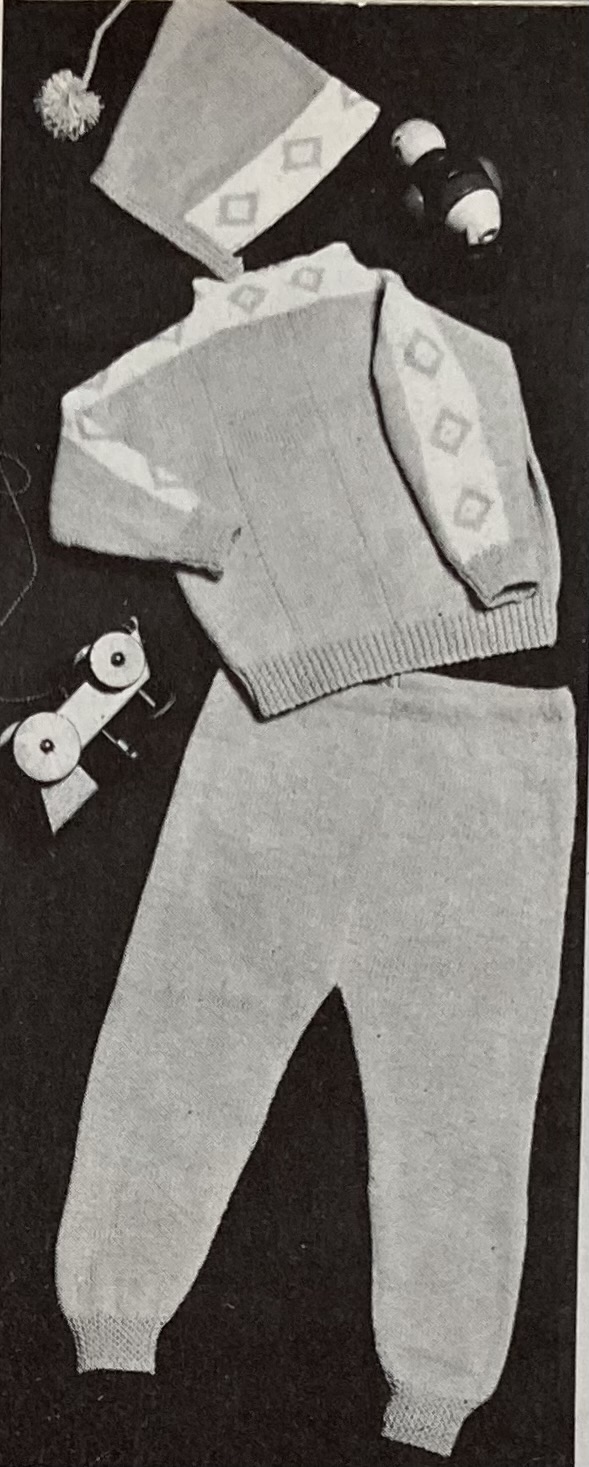
There are some great fashions for children in this issue that could theoretically be finished by Christmas morning: a warm set of jumper, leggings and hat for a little one, a dress-and-cardigan set for a school-age girl and another jumper, leggings and hat set for a pre-teen. On second thought, you would have to be an extremely fast knitter to get any of those sets finished in time… Here too, cool, bright colours prevail, and stripes, slip-stitch lines, and diamond patterns are trending.

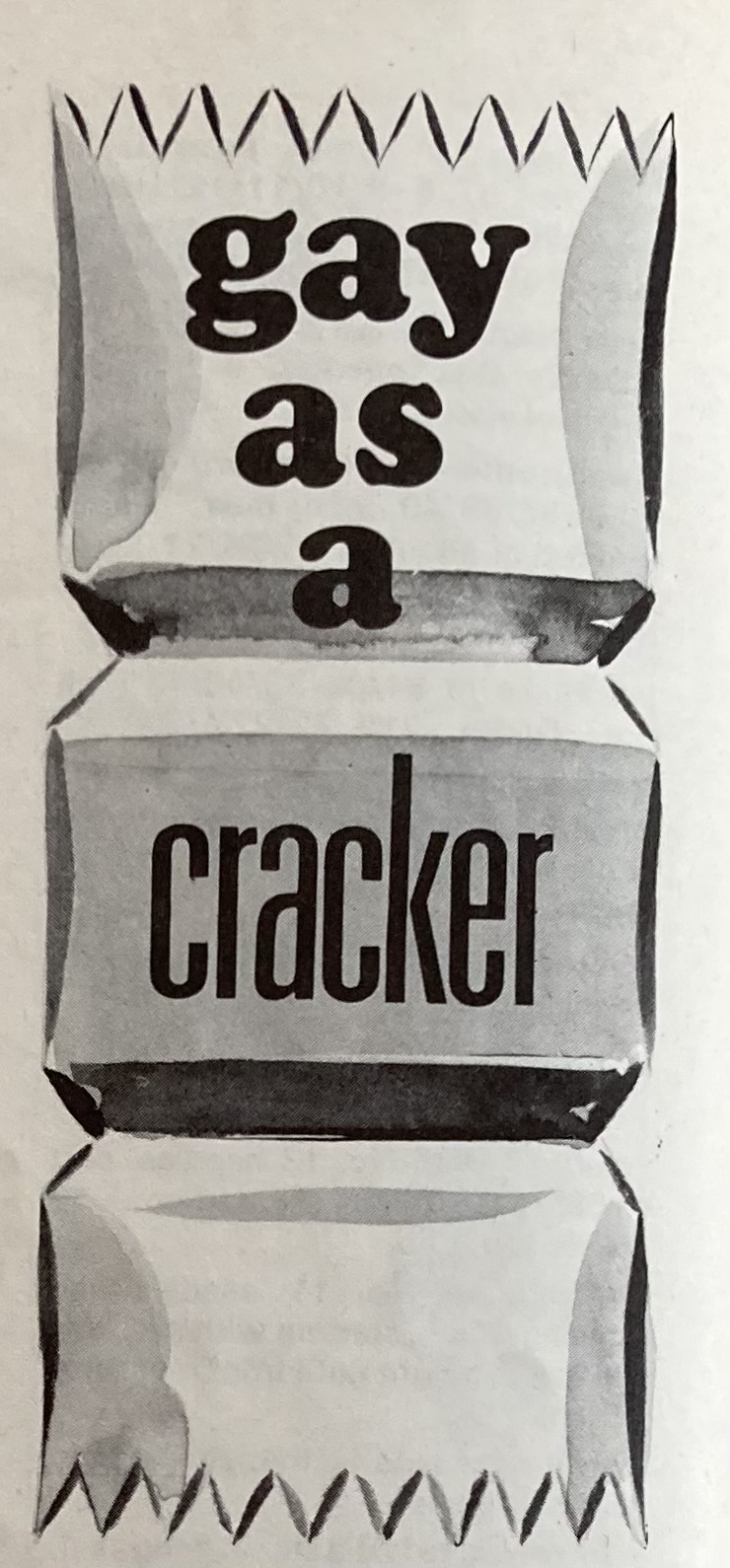
(On another note, the slogan that Stitchcraft chose to describe all of these children’s patterns is “Gay as a Cracker”. I do understand that they mean the outfits are as bright, fun and festive as a Christmas cracker that you pull across the table and get a little prize and a paper hat out of, but that did not age well.)

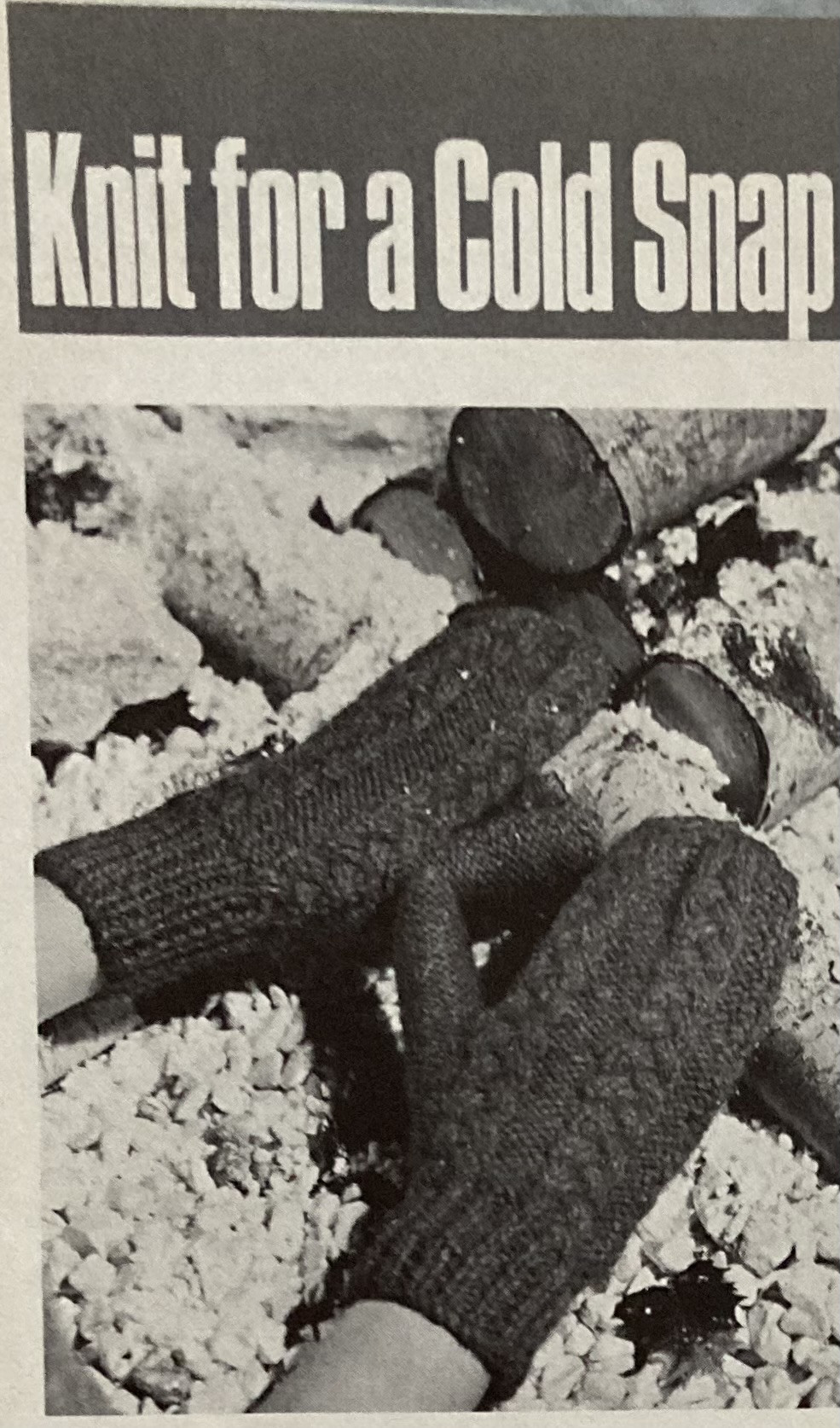
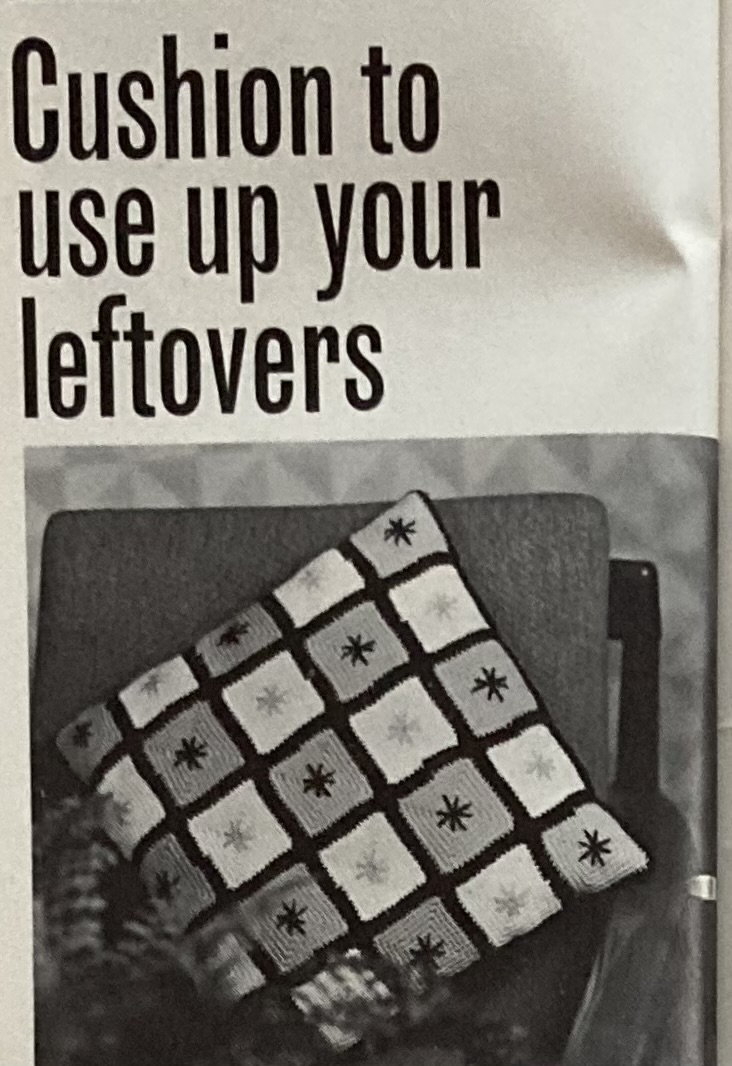
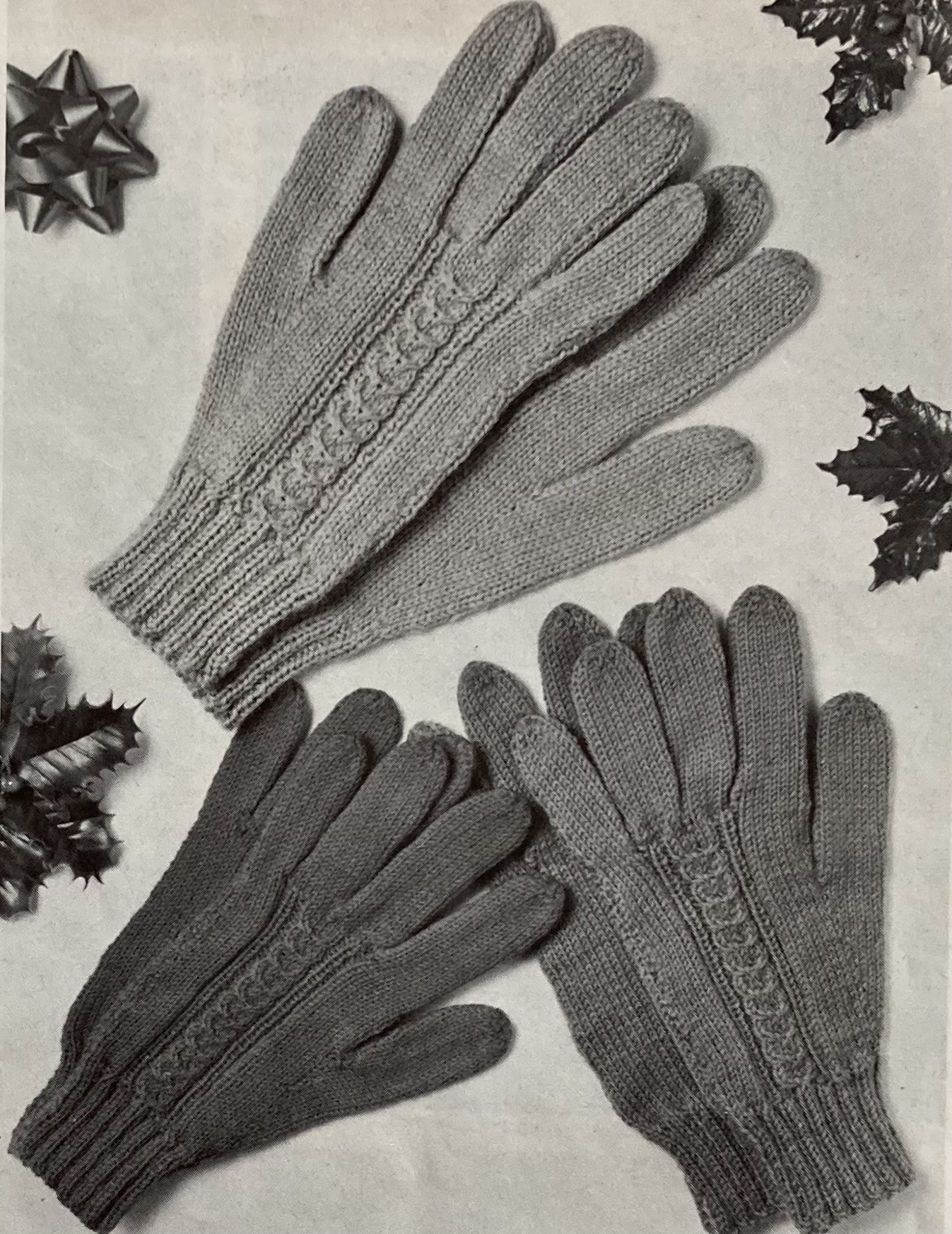
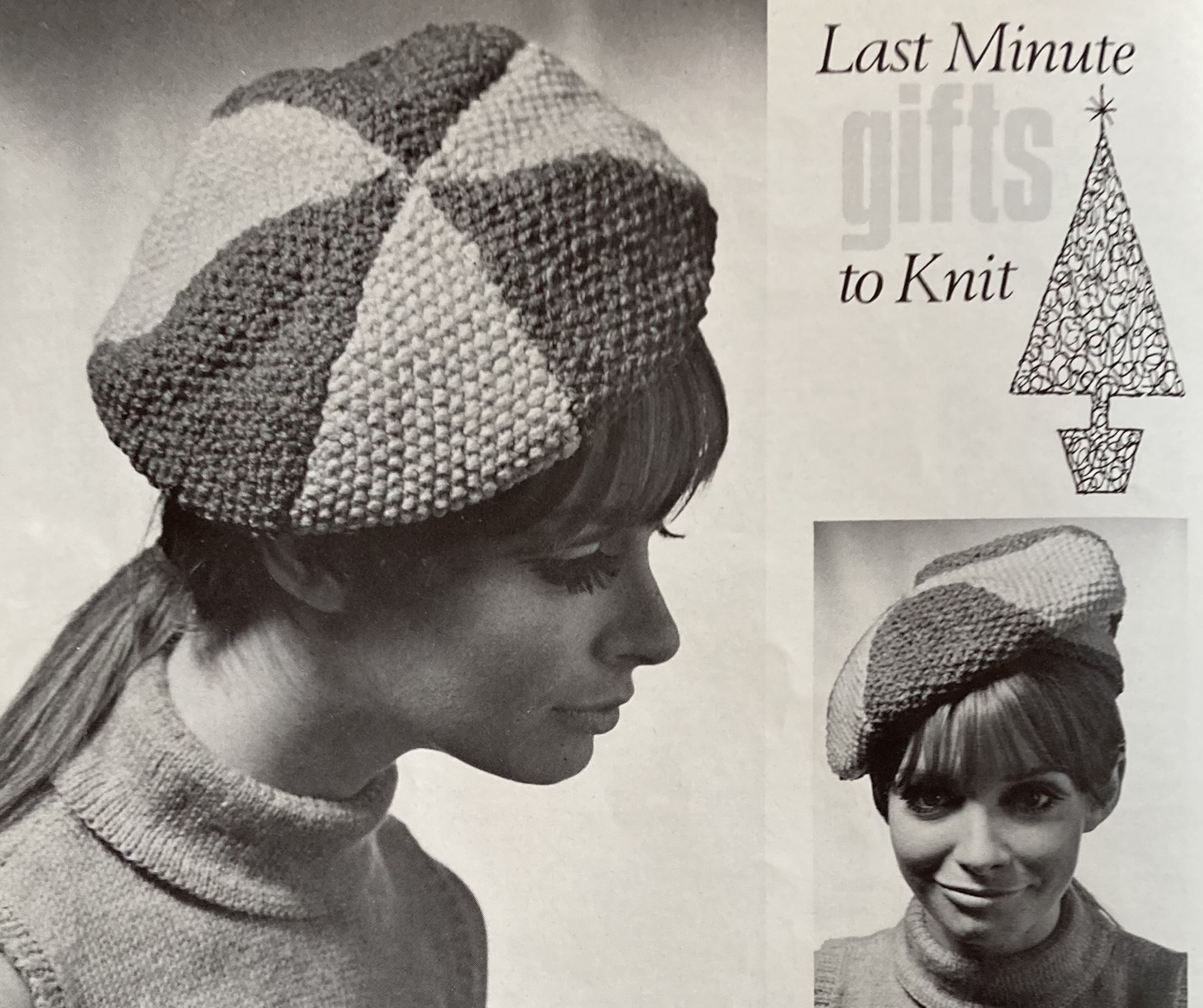
For quick gifts that have to be finished on time, you can make a “tweedy” (actually moss-stitch, but OK) beret or cleverly designed gloves for the whole family. The gloves are all made from the same pattern, using double knitting-weight wool for the large/men’s size, 4-ply for the medium/women’s size, or 3-ply for the small/child’s size. You can also make a very easy crochet cushion, and it even matches the hat!

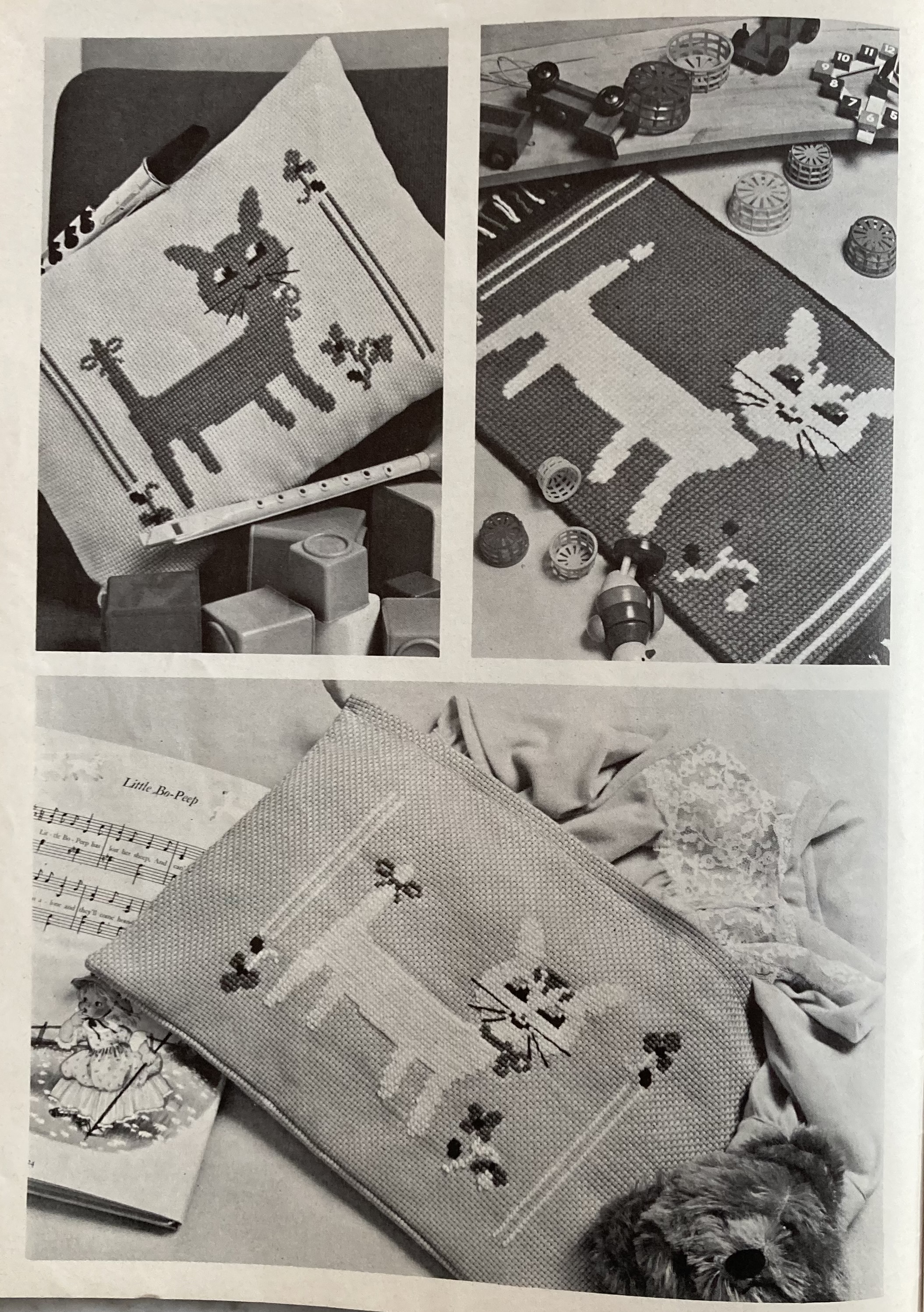
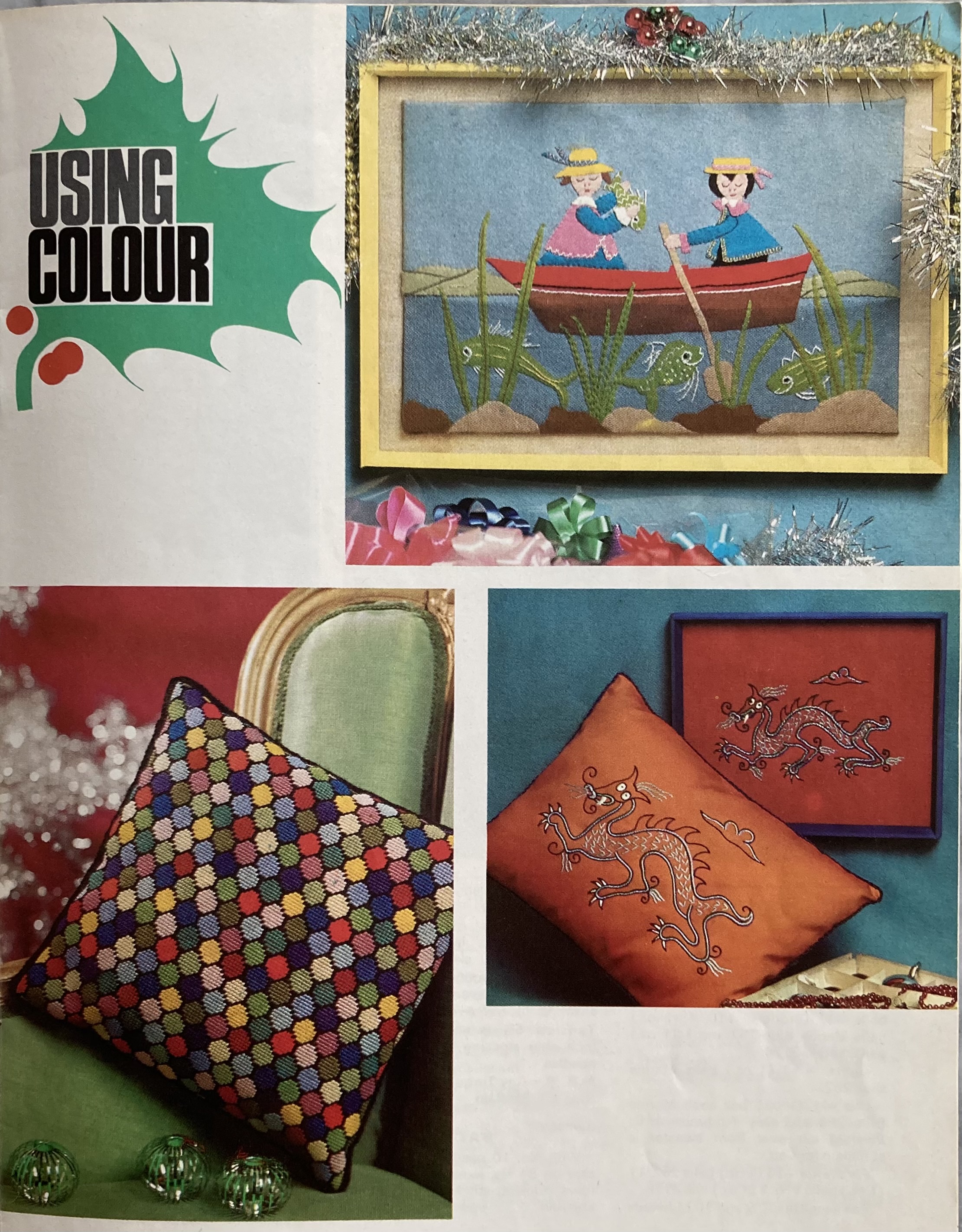
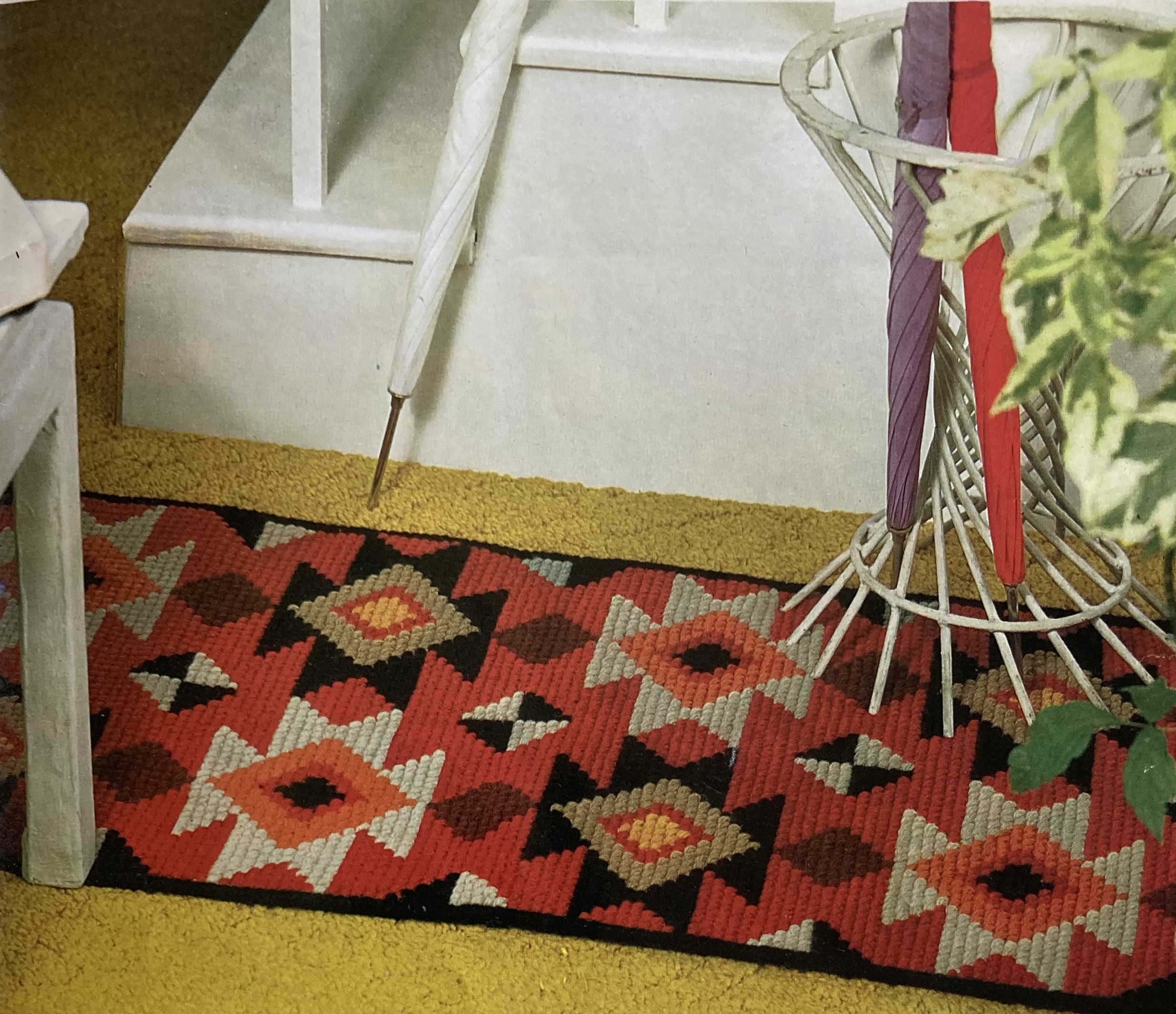
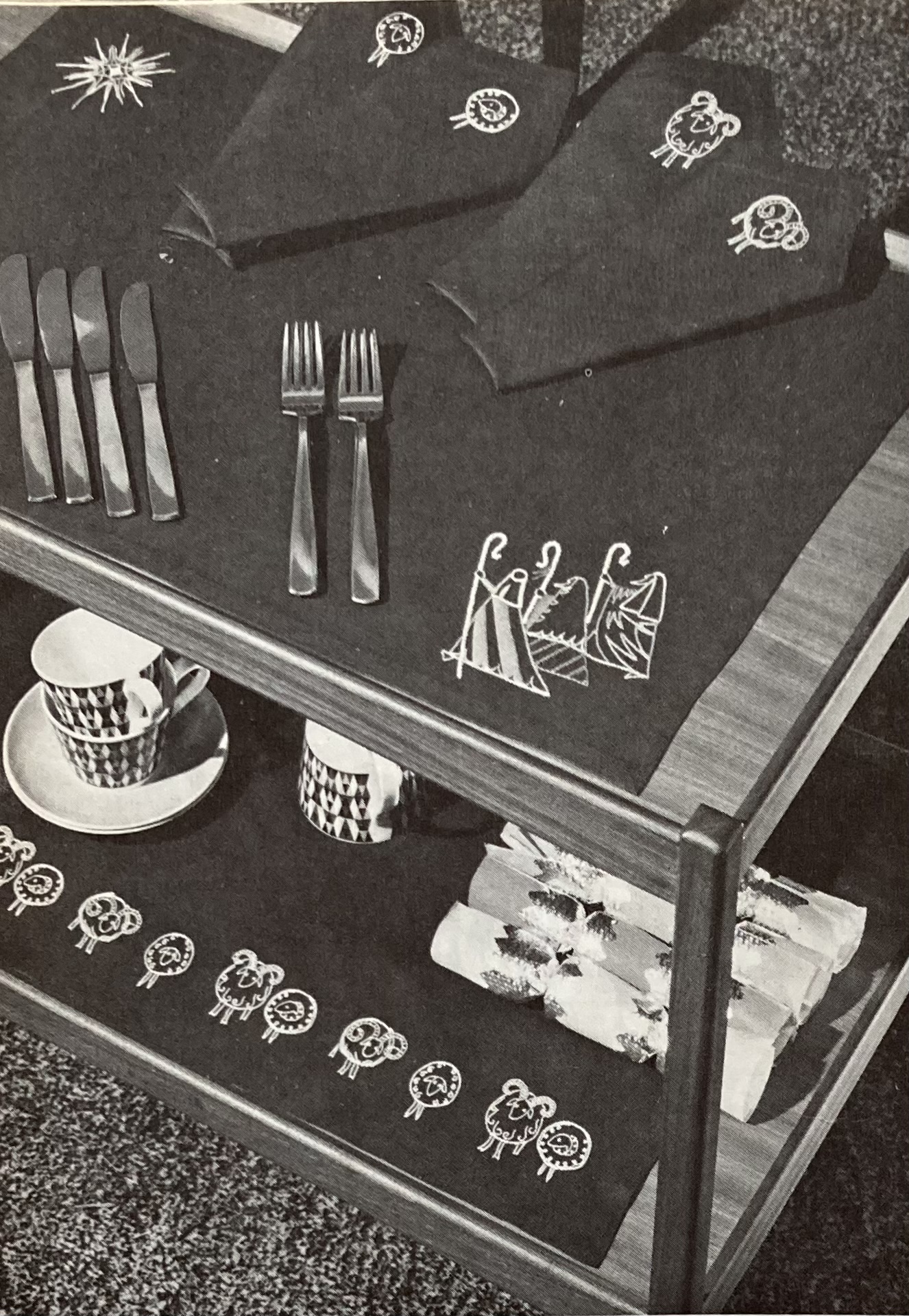
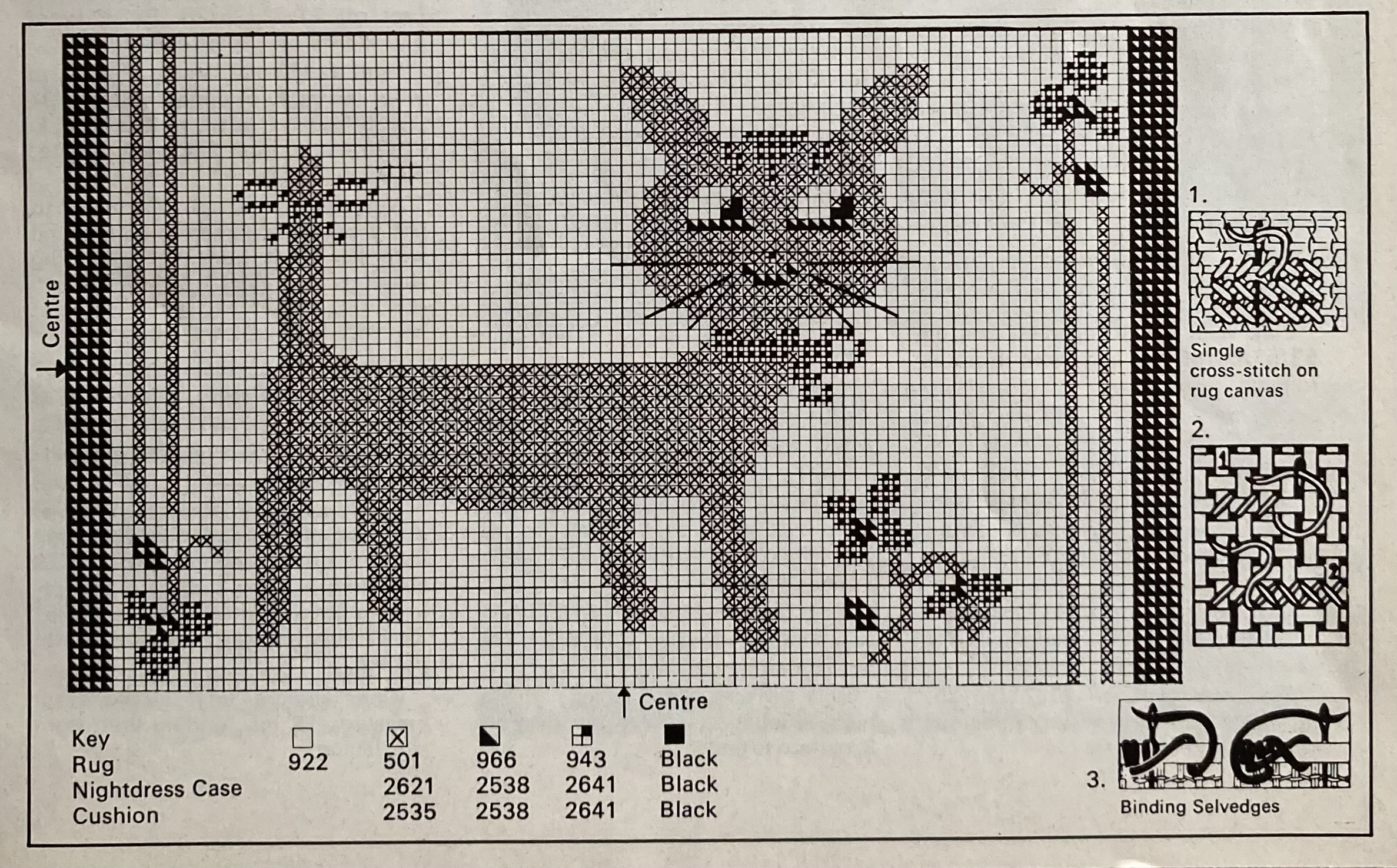
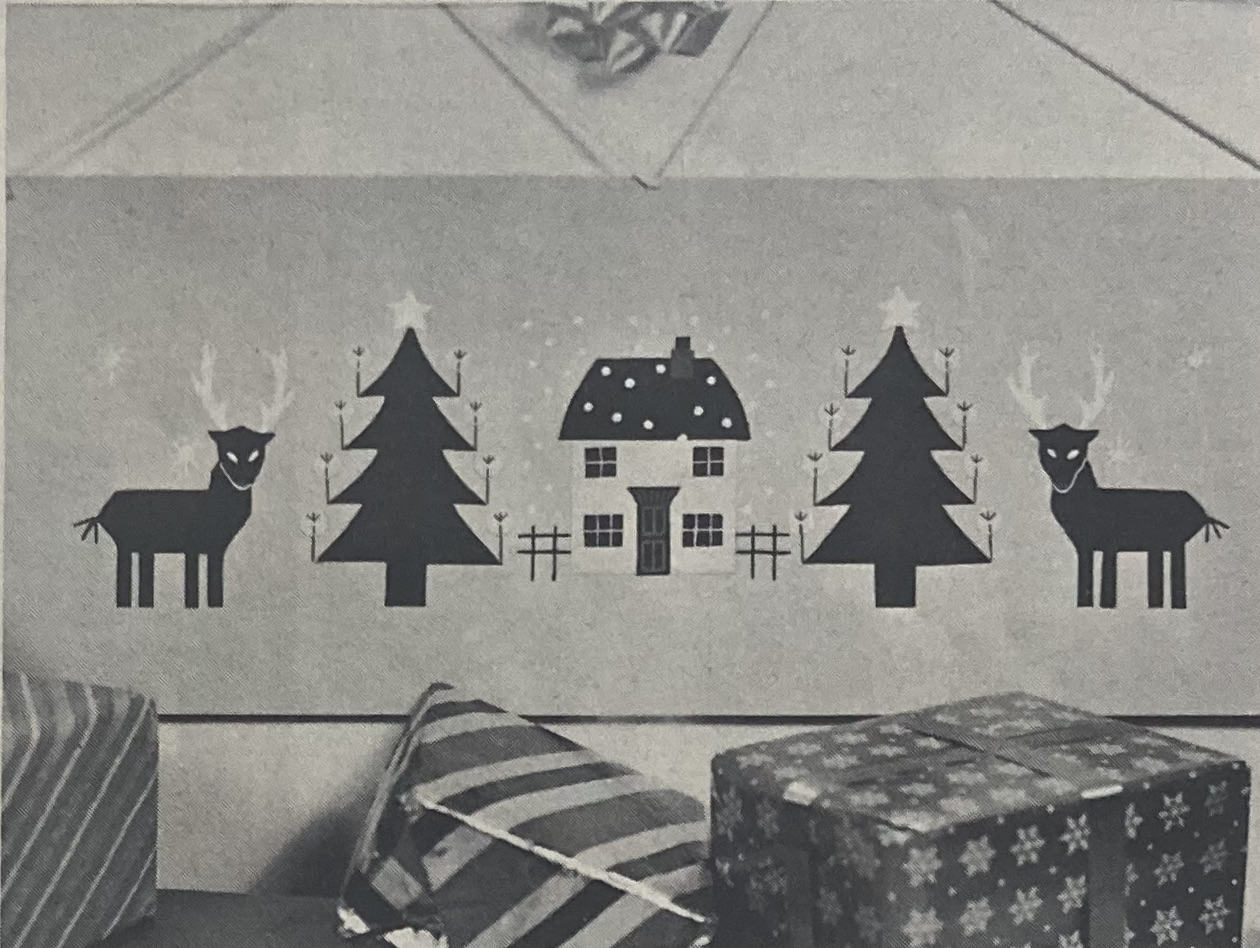
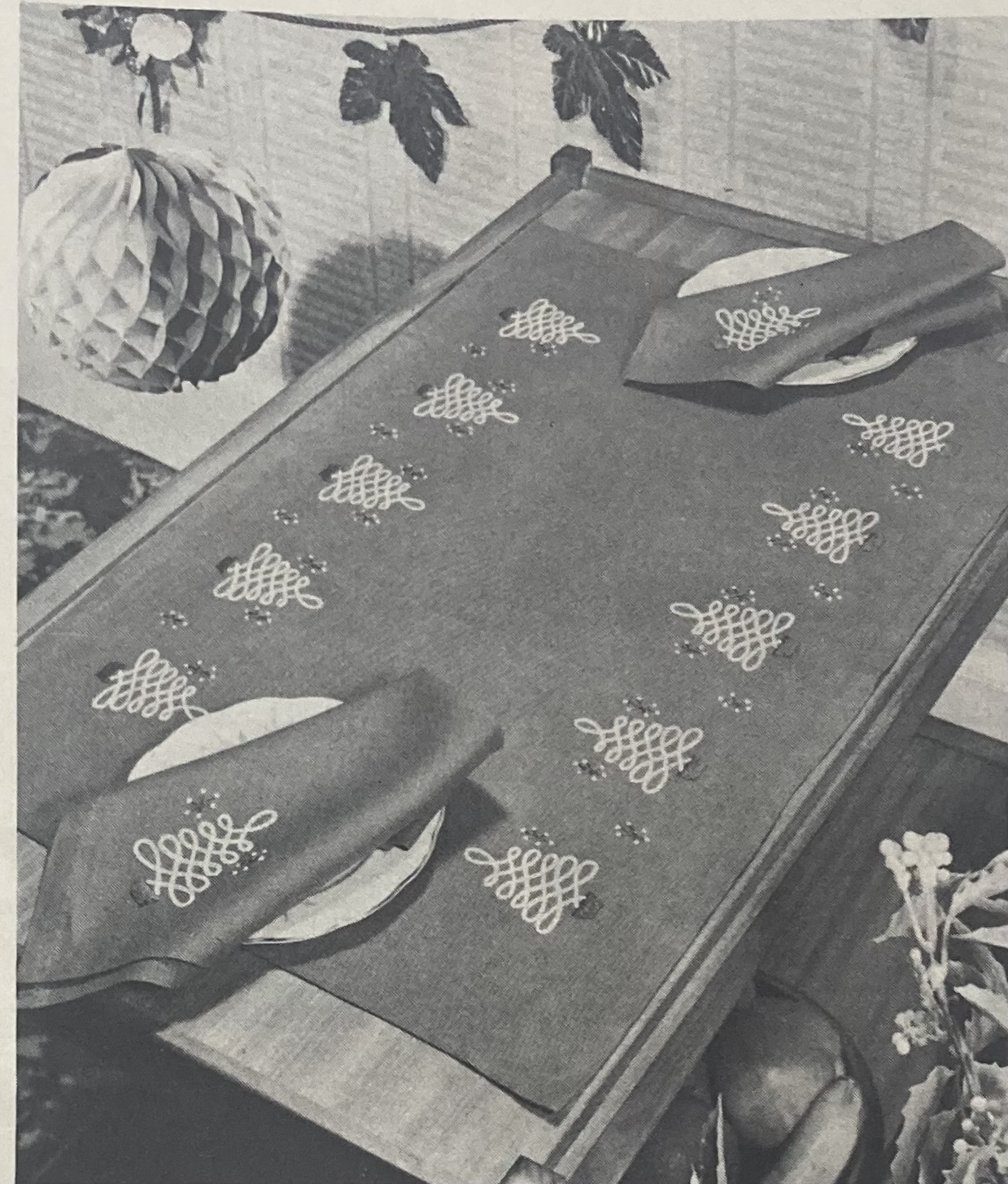
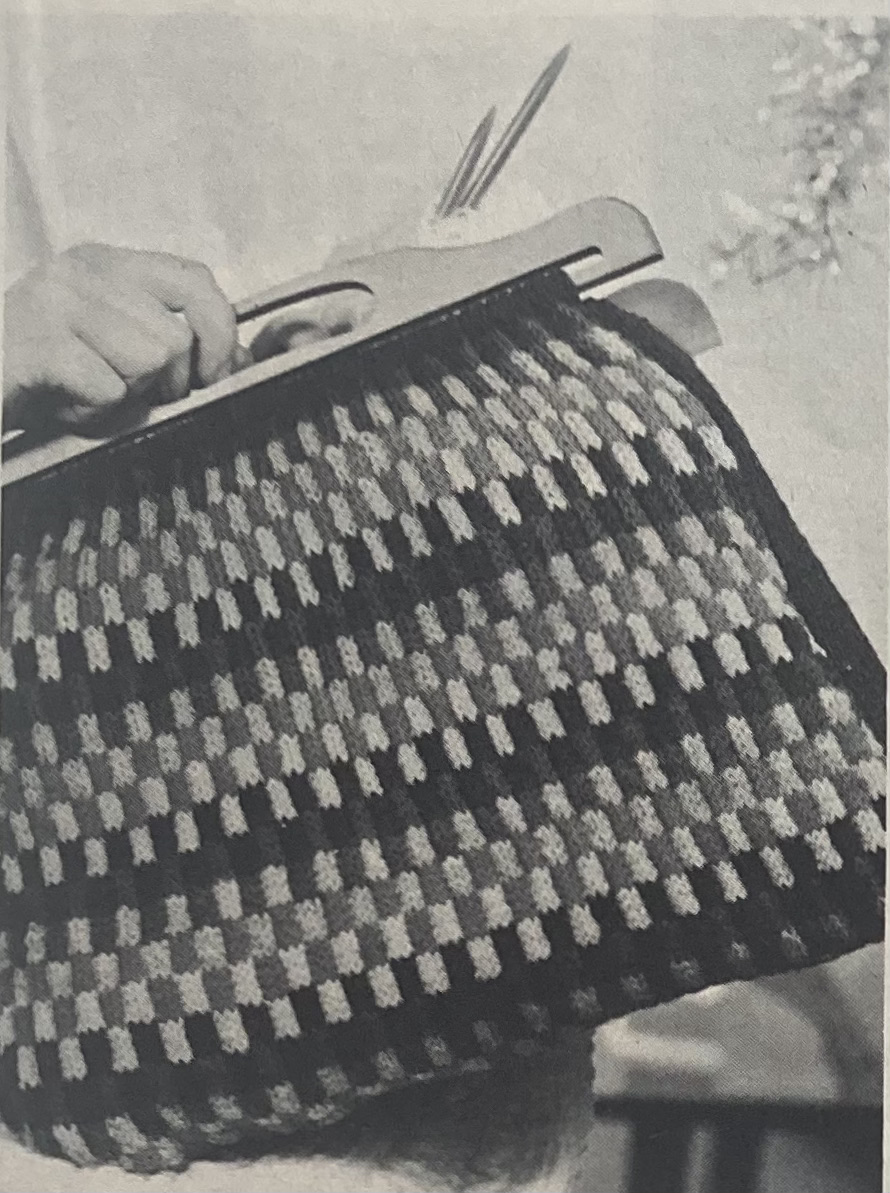
There are plenty of embroidery and tapestry projects for those long winter evenings. My favourite is the cross-stitch cat that can be made into a cushion, rug, and/or nightcase. (I have not yet understood the point of putting your pajamas or nightgown in a zippered case during the day. Were any of you readers children of the time and can tell me about it?) According to Stitchcraft, cross-stitch cats are lucky! I could use it. There’s also an appliqué picture of a boy and girl rowing, an embroidered dragon cushion or wall panel (that dragon is definitely high on something, cheers), an opportunity to turn leftover tapestry wool scraps into a tea-cosy or cushion, and a cross-stitch rug to use as a hall runner. The only specifically Christmas-themed project (in the entire issue, really) is an embroidered serving set of table cloth and/or trolley mats with somewhat abstract renditions of shepherds, sheep and a star.

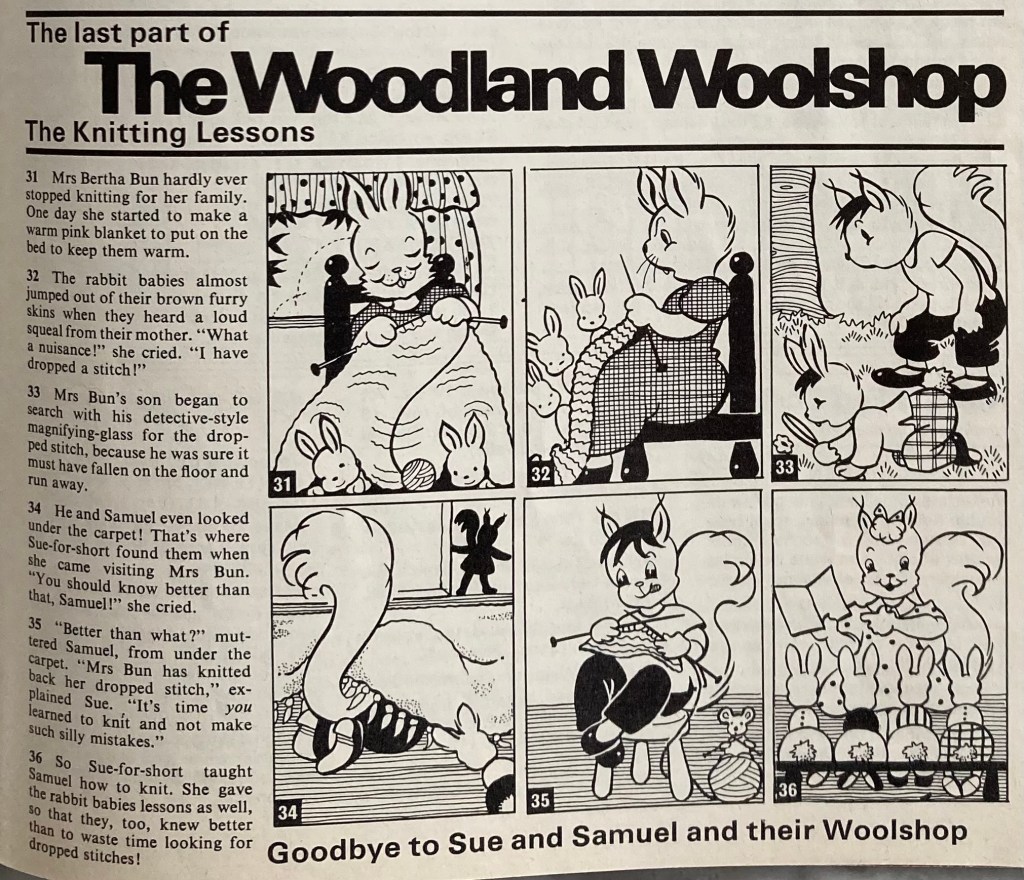
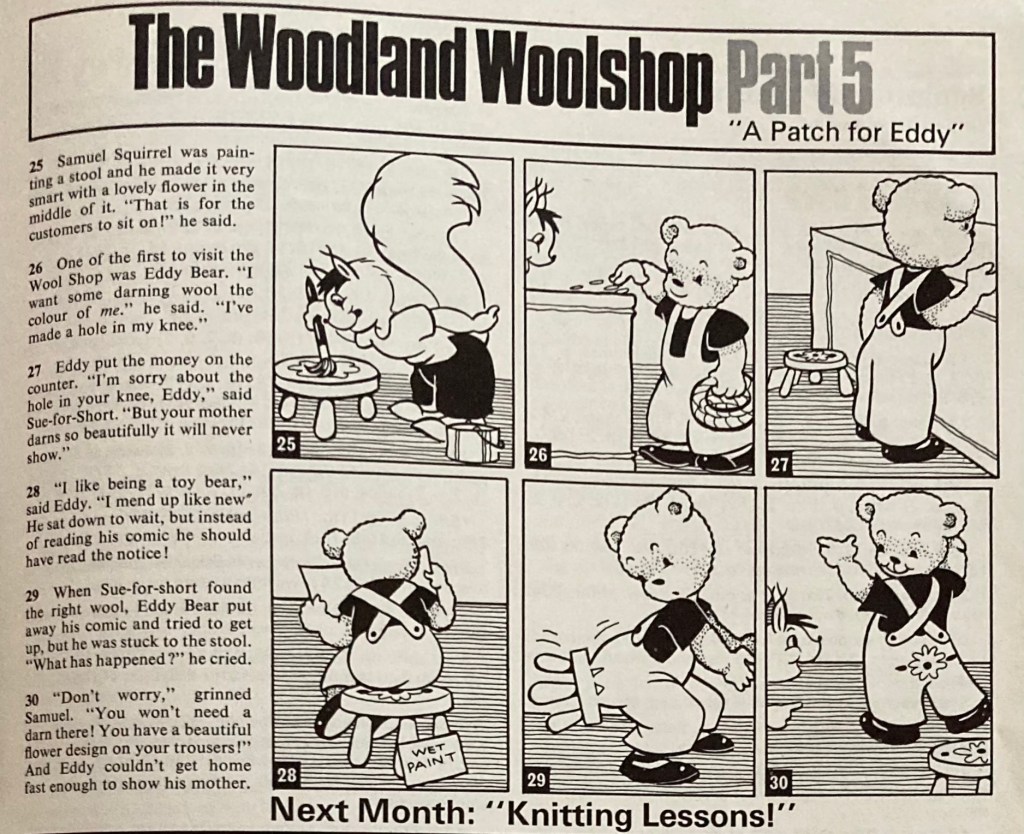
In the children’s comic, “The Woodland Wool Shop”, Mrs Olive Owl starts knitting a long strip of fabric with no plan about what to do with it (been there) and realises that it would make a great coat for Daniel Dachshund. Isn’t that nice? I hope all your projects turn out to be equally useful and make someone (including you) equally happy.

My project will be something small, probably the gloves. I do love the lucky cross-stitch cat, though. Merry Christmas to those of you who celebrate it, and happy December holidays to all.

November 1967: Overview

Autumn is officially here, winter is around the corner, and Stitchcraft‘s November 1967 issue presents “the GOLDEN LOOK for winter sparkle”, with warm garments, warm colours, fun textures, and matching his-and-hers outfits to chase away the cold, grey days of November.

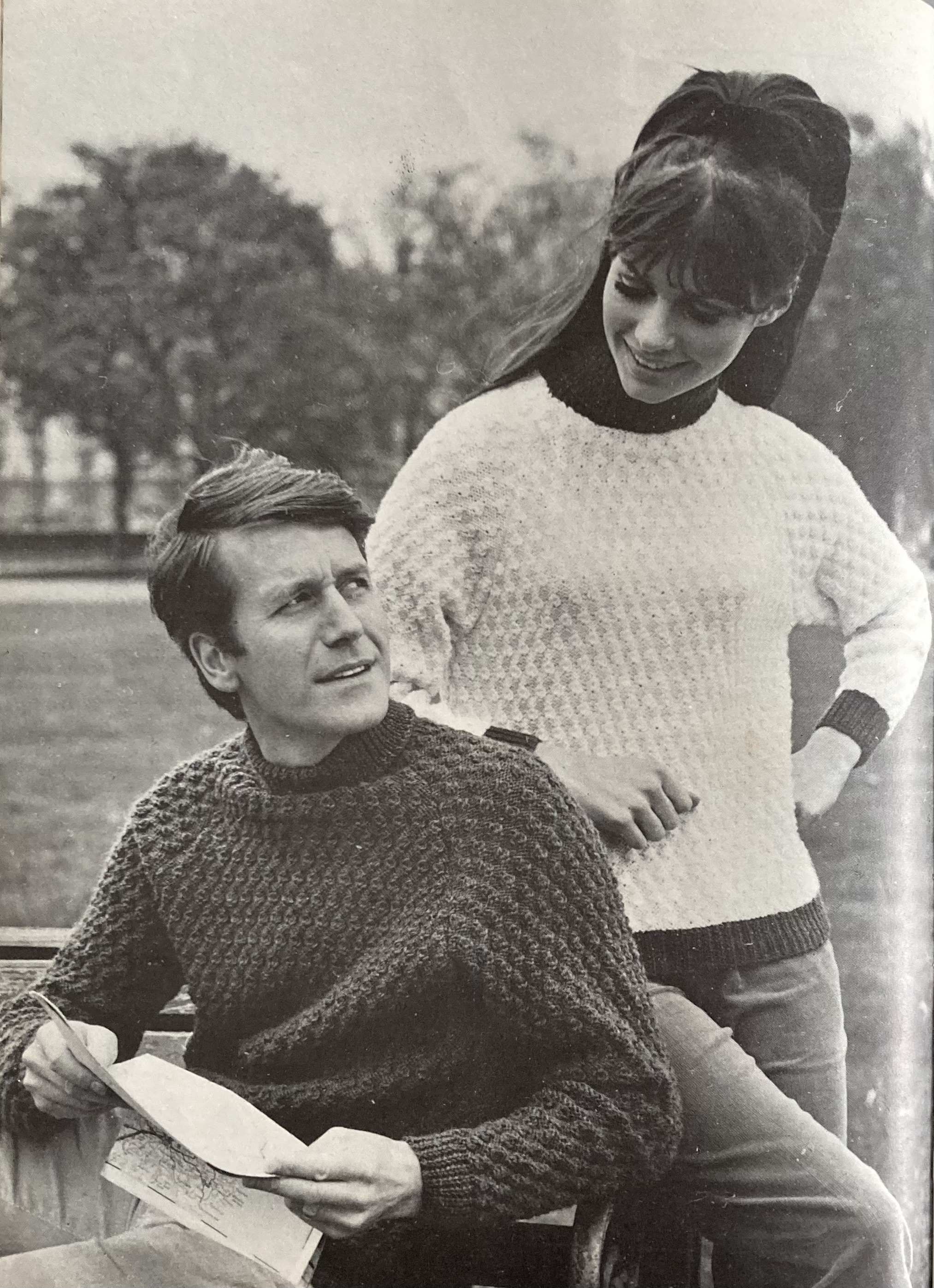
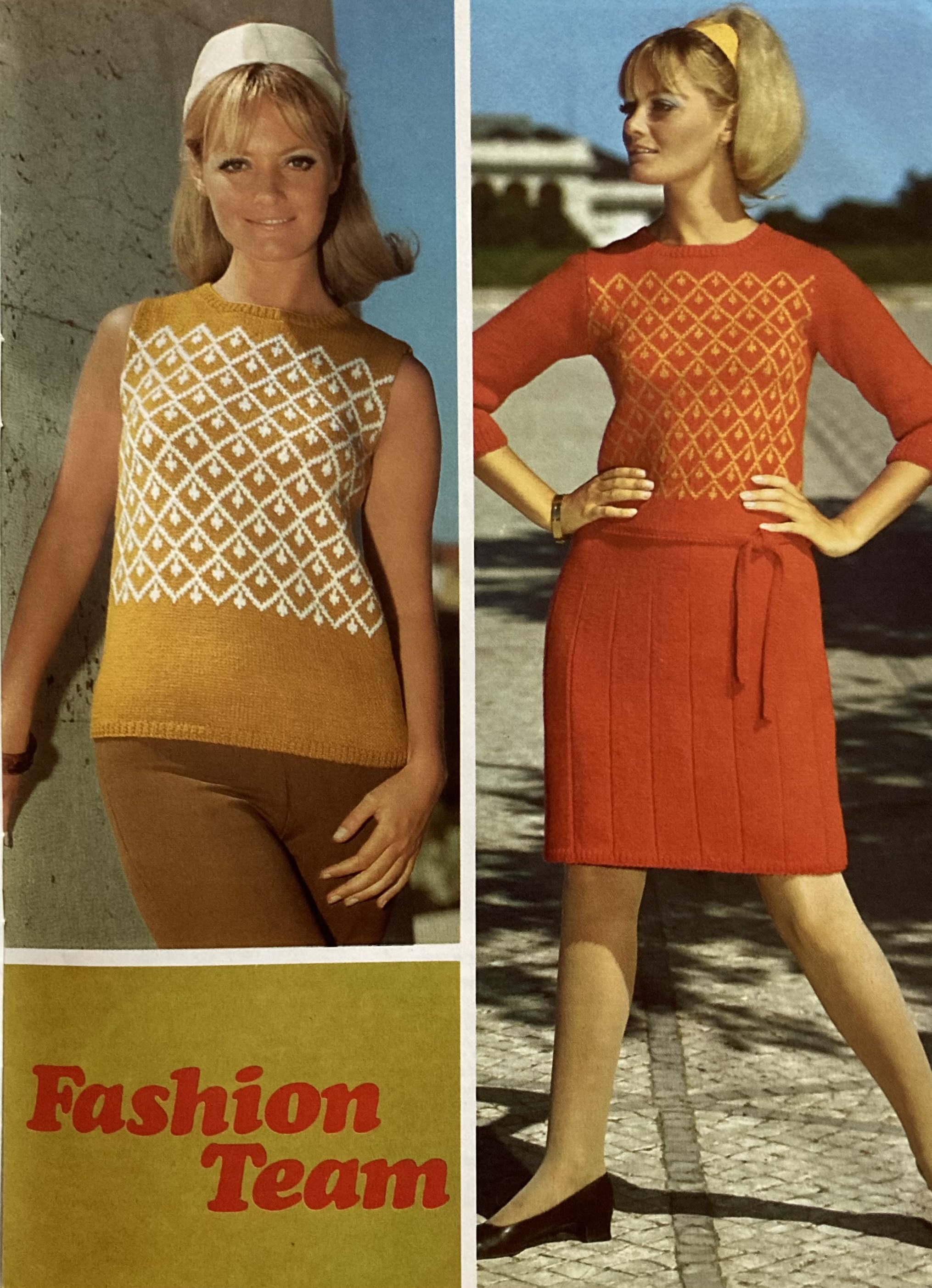
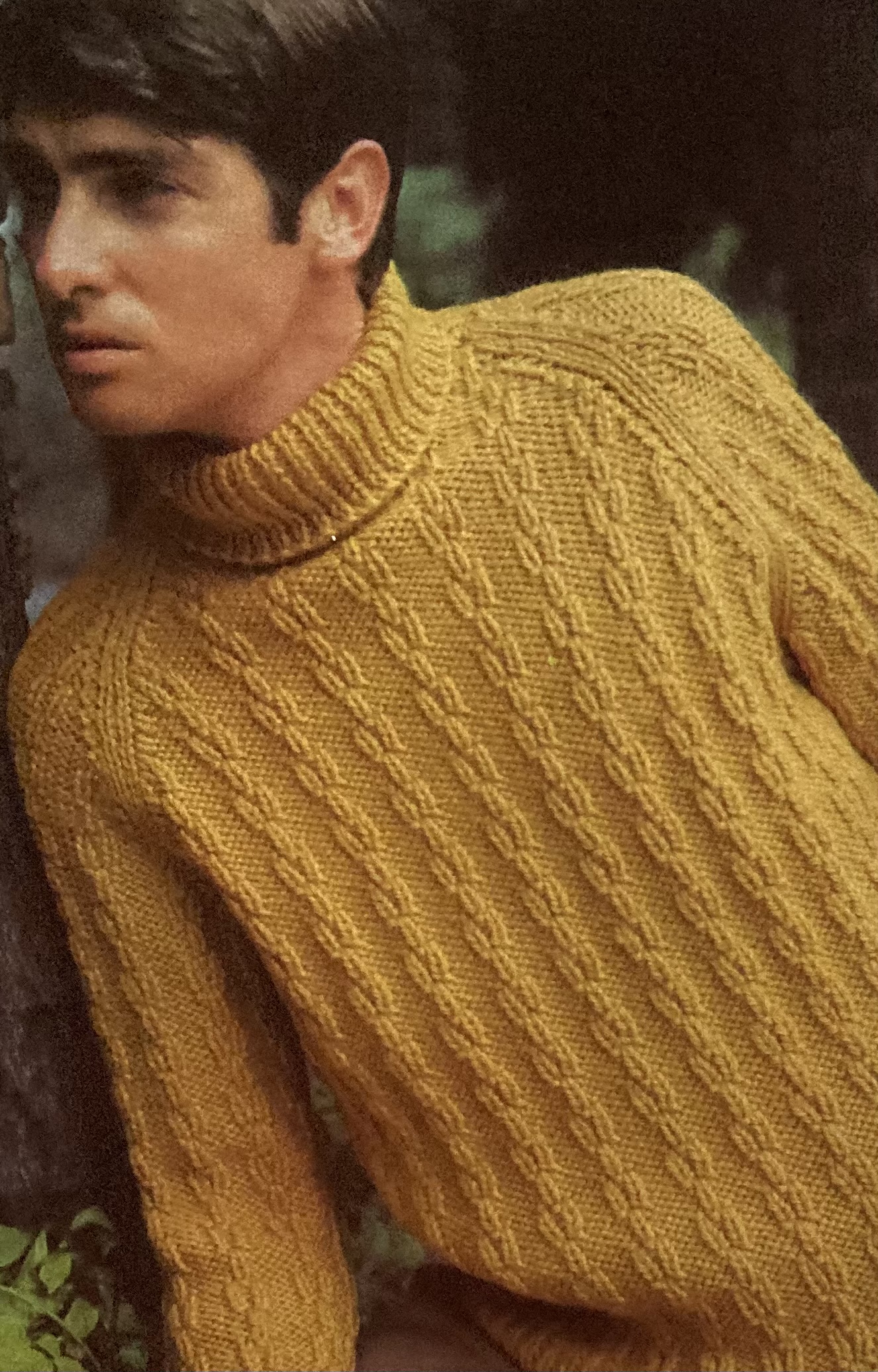
Our cover models sport matching polo- (aka turtle-) neck sweaters in “Flair” wool and a suitably golden colour called “Musk.” There are only two sizes given: 35-37 or 40-42 inch bust, so intended as a one-size-fits-most, basically unisex pattern. The textured pattern is made entirely with knit and purl stitches. Our other partner-look models wear polo-neck pullovers as well, with a simple stranded chevron border at the hem. They seem to be designed for somewhat younger and thinner folks, with three sizes from 32-33 to 38-39 inch bust. There’s one more design just for men: a “country cardigan” in blue wool and a fern-like textured pattern.

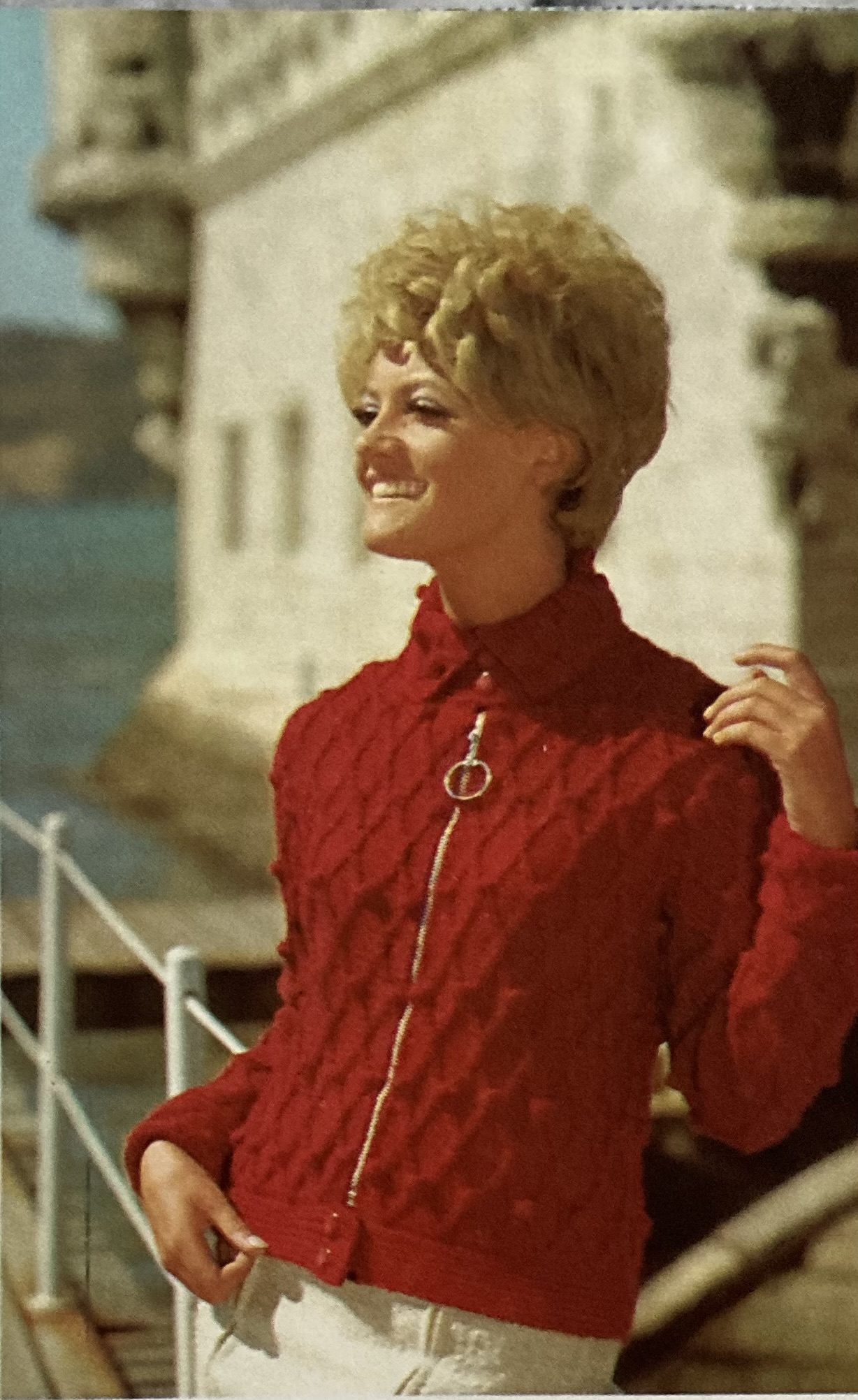
The women’s designs include a rich green jumper suit, with a buttoned pullover in low-contrast stranded diamond pattern and a plain olive-green skirt; a hooded jacket in a chunky bobble-like pattern made with twisted stitches; a delicate jumper in soft, fuzzy “Princess” wool with a contrasting colour yoke; a polo-neck pullover in colourful “rainbow” chevron pattern; and a bright blue cabled jumper for larger sizes (40-45 inch bust).

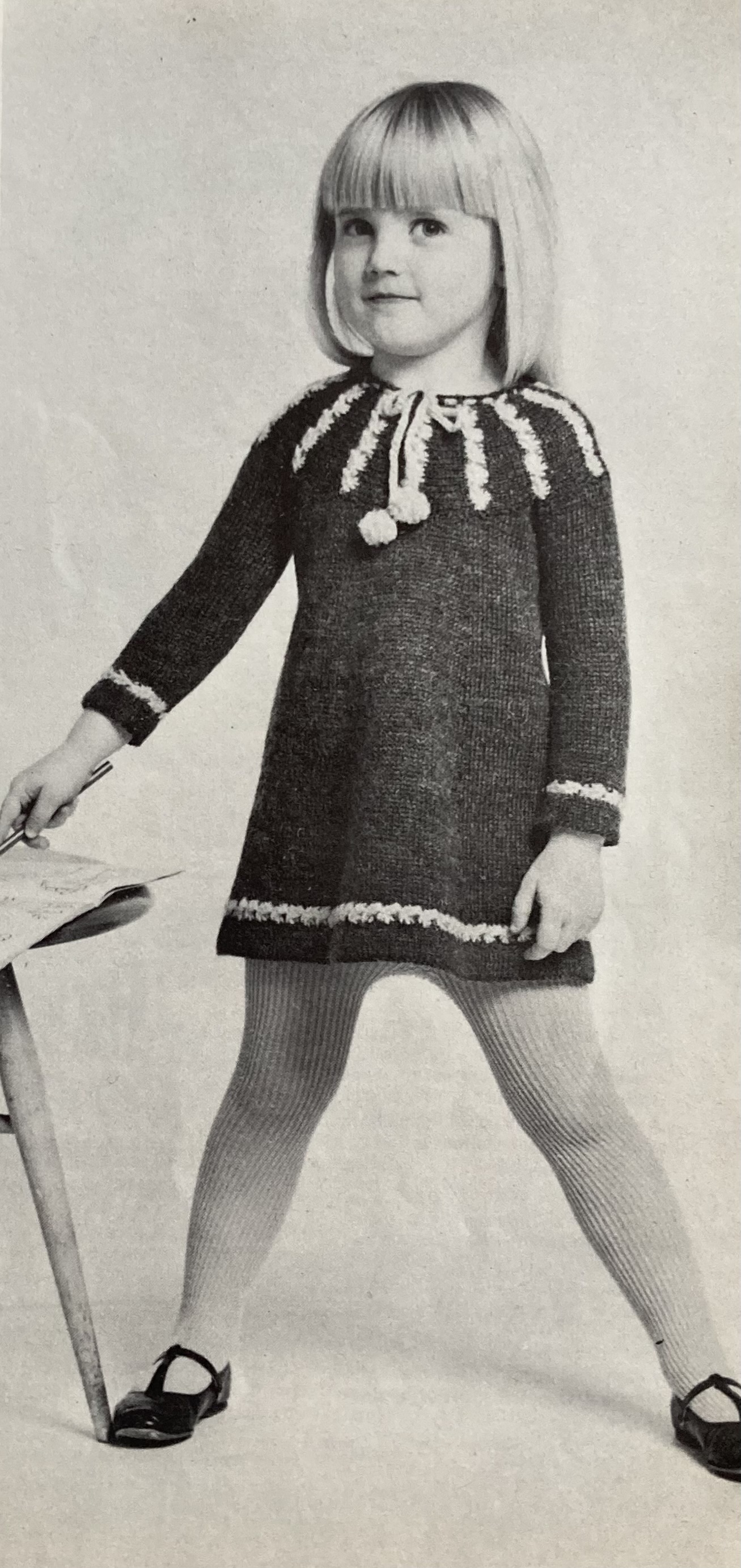
With all these great designs for adults, it’s not surprising that there’s only one children’s pattern in this issue, a tunic for girls age ca. 4 to 7. It’s knitted sideways in pieces, starting at the left side edge of the back, then the fronts separately, then the sleeves separately, which are also knit sideways. I’m glad to see the girl model wearing tights, for once! The children’s comic in the “Readers Pages”, titled “The Woodland Wool Shop”, tells the story of Daisy Lamb, who wants to learn cross-stitch, but doesn’t want to be cross about it.

The homewares and “novelties” are all designed with an eye towards December gift-giving, and most of them are featured in a single, big colour photograph. There are lots of things to make in felts: holiday-themed potholders and party mats, a night-case patterned after the nursery rhyme about the old woman who lived in a shoe, some racist “Golliwog” puppet mitts (unfortunately, still a thing), giraffes to appliqué onto an apron, coffee cosy or apron, and another truly terrifying clown intended for use as a string dispenser — yes, you put a roll of string in its head and pull the string out through its mouth. Stephen King was already 20 years old when this issue of Stitchcraft came out (and lived in another country), but if he grew up with things like this in the 50s, it’s not hard to see where he got the inspiration for It. Just saying.

You can also embroider sprays of holly on place mats or another apron, or make a cross-stitch rug or cushion in a Norwegian pattern, or a different cushion in a Florentine pattern. More advanced tapestry aficionados can make a tray-cloth or yet another cushion based on a design from a Chinese tapestry. On the simpler side, you can sew a little doll and dress her in traditional Dutch clothing, or knit a little stuffed toy set of a mother and baby fox. Many, many gift ideas in this issue. Oh, and another rug, in cross stitch!

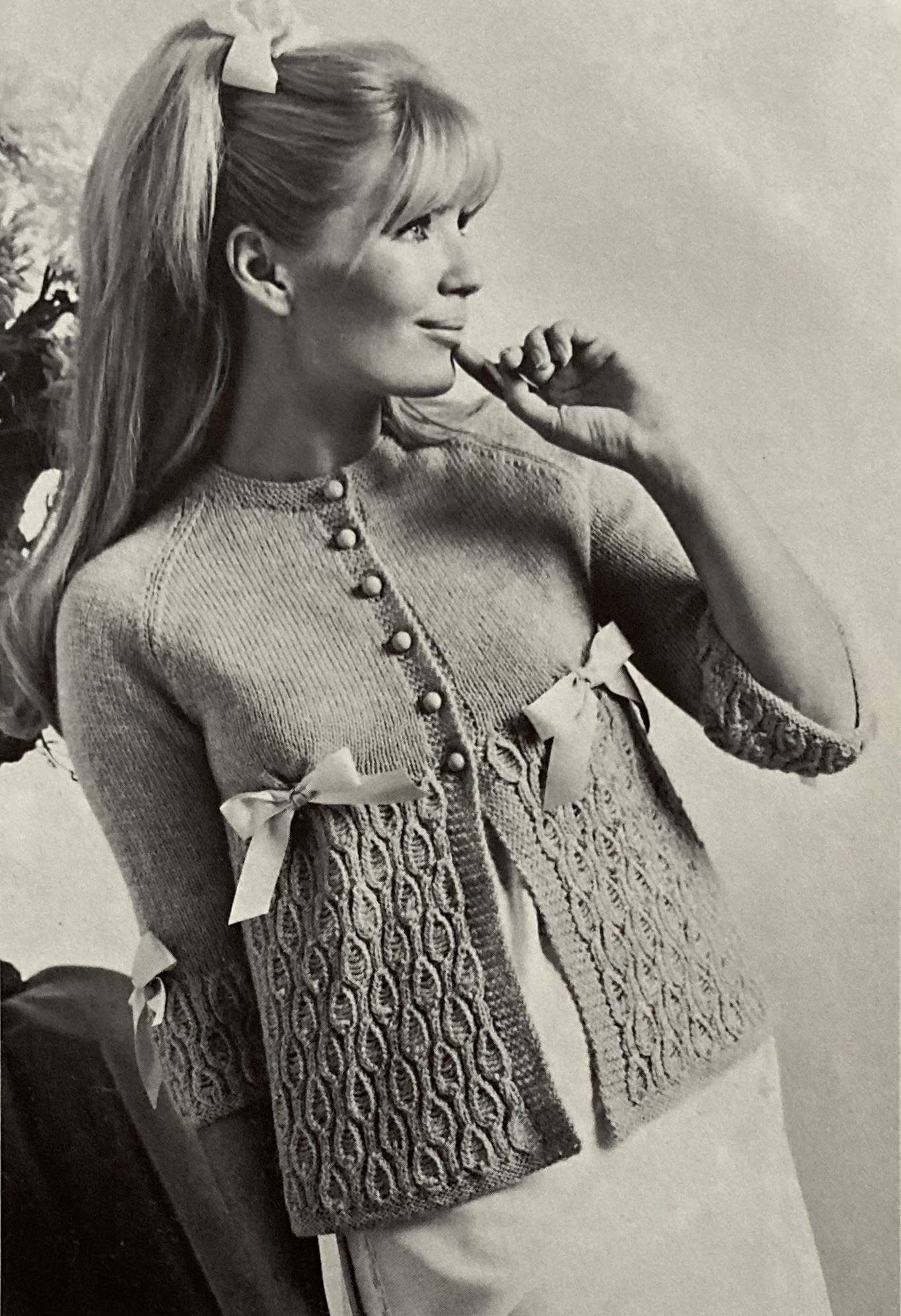
The ideas keep coming, with two little cross-stitch pictures symbolising “Autumn” and “Winter” (to match the “Spring” and “Summer” pictures in the last issue). And how could I not mention the best gift idea of all: the bed-jacket in loop-stitch, modeled by my favourite model, who seems to have been hired by Stitchcraft exclusively to model bed-jackets with a sexy come-hither smile. I have to admit, the loop-pattern spoils the sexiness for me, but we all have our own preferences… Love the pink-on-pink photograph, though.

That’s all for this issue! My project will be the buttoned pullover from the jaquard jumper suit (just the jumper for now.) May your November be bright and golden.

September 1967: Overview

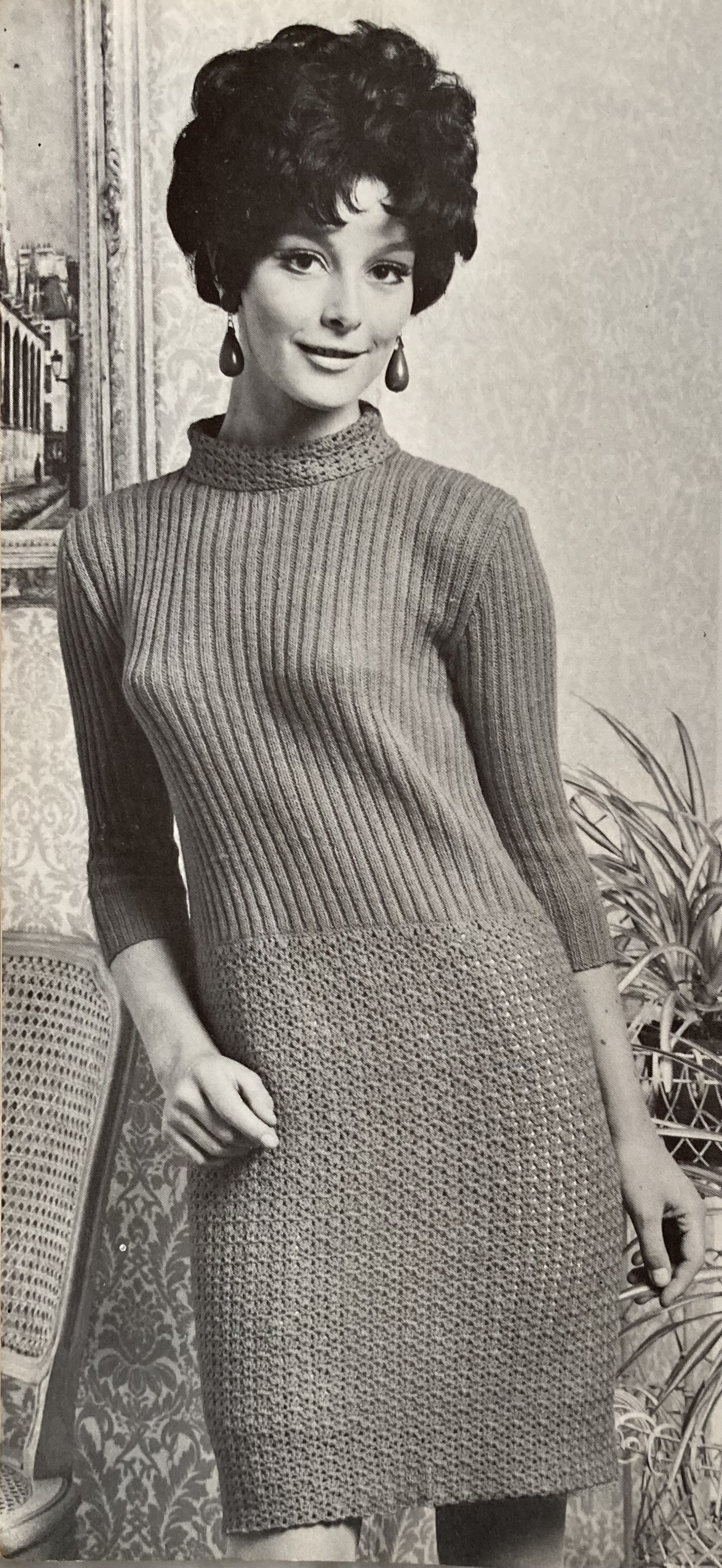
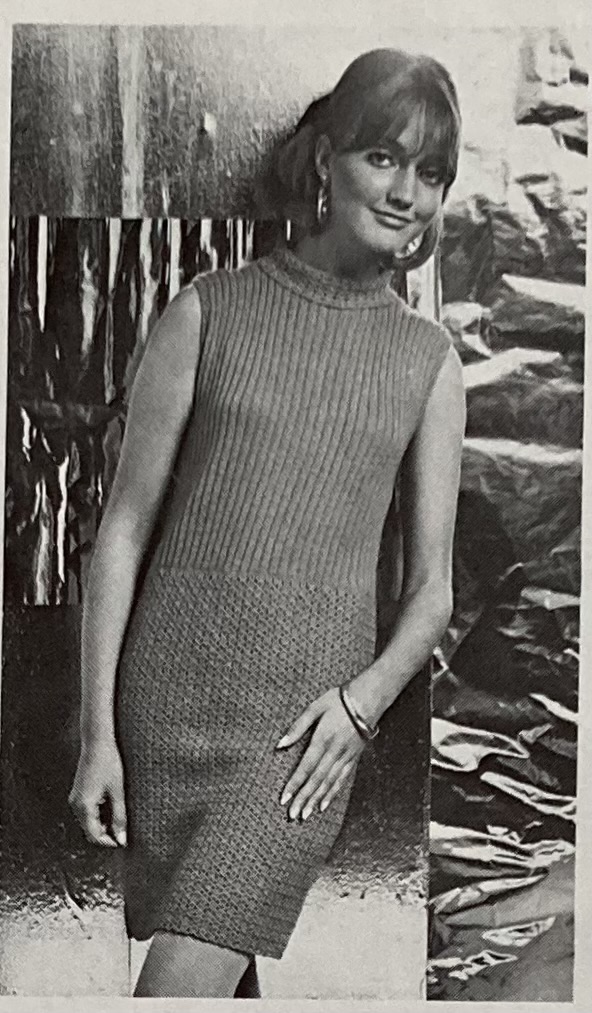
It’s time for a “Fashion Switch” over at Stitchcraft! 1967 is the year where knitted dresses really start to feature, and as far as I can tell, the “switch” part means you can either make a dress or a skirt combo and mix and match. The cover designs fit in well with the trend: high necks, short skirts, deep raglan armholes, A-line shaping and big patch pockets. Note, too, the huge hats — they will only get bigger in the months to come.

The centrefold photo shows a slinky variation on the theme with a dress and/or skirt combo featuring a pretty beaded and textured design. Like the chevron dress from April 1967, the designs pick up some elements of 1920s and 30s fashion, while keeping a distinctly late-60s shape.

Other women’s knits include a bouclet blouse for the fuller figure with a very neat and pretty “soft-roll” neckline, a casually elegant afternoon suit with cable trims, a striped skirt combo in “colour brilliance” (tangerine and violet!), and a “Golden Glow” bright yellow pullover.

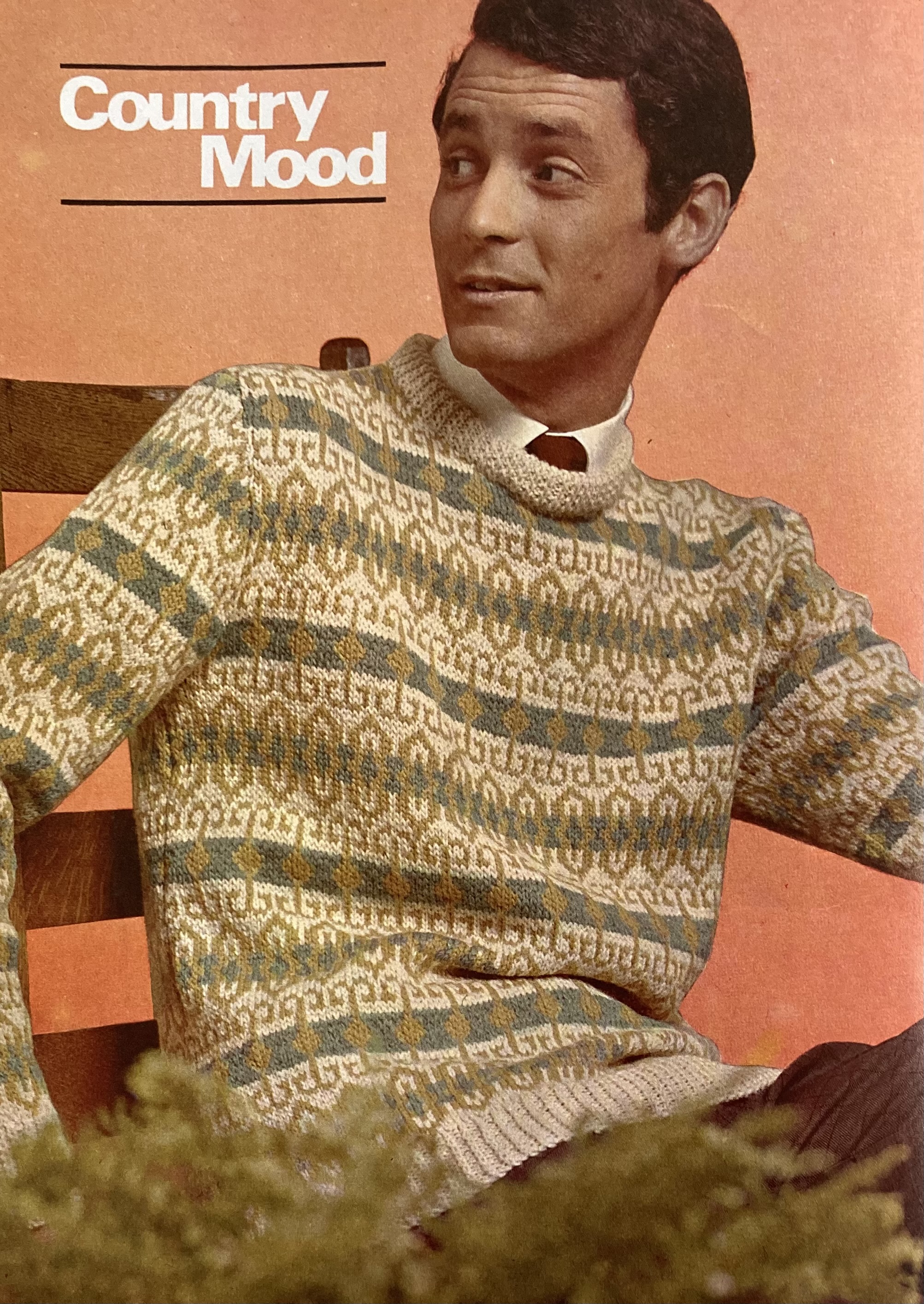
“Colour brilliance” applies to men’s fashions too, for once, and this green and yellow slip-stitch cardigan is a masterpiece. The model looks a bit like a colleague of mine — should I knit it for him? The other men’s garment, a chunky but streamlined pullover, echoes some of the design features of the women’s “fashion switch” combos. like the big patch pocket and contrasting-pattern sleeves. The photo is black-and-white, but the suggested colour is “Curry”, which I assume will be some kind of dark gold-brown-orange (so 60s). For children, there are two nice, sturdy, basic raglan pullovers in a more classic colour scheme — dark charcoal with red trim for the boy’s and “Cloud-dust Pink” with “Aztec Gold” trim for the girl’s.

There are some fun homewares for all styles and abilities, starting with some very easy sewn and embroidered aprons with whimsical kitchen designs. I’m not interested in the aprons, but I love the top that the “teatime” model is wearing! You can make a tapestry panel of an Irish homestead in Rosguill, Donegal or a cushion or chair-back in a gorgeous traditional-inspired design updated “for a modern setting”. Both are done in tapestry wool on furnishing linen.

It’s not too early to start on little gifts for Christmas, and here’s a little bag “for a friend” and a knitted tortoise toy “for a toddler.” Baby gets a thick, squishy pram cover in fluffy “Ariel” wool and a raised cable trellis design.

Or you can make a Florentine-pattern workbag or cushion for yourself. The colours — gold, green, and yellow — will match nicely with a lot of the knitted designs from this month.

In the “Readers Pages”, we finall have a new comic: Sue and Samuel Squirrel run the Woodland Wool Shop. Their adventures start when Sue finds a loose thread of yarn in the woods and winds it up — only to find that she has unraveled an elephant’s vest and needs to knit it all up again! Poor Sue. The only full-page advert is for Bri-Nylon. I imagine the dress in the photo is quite hot and impractical, especially if knitted in synthetic nylon wool, but what a lovely photo.

That’s it for this month! There are so many great projects that it’s hard to choose, especially since the ones that call to me are all big projects and I just finished the chevron dress from April 1967. I love the orange cover dress and the men’s slip-stitch cardigan, particularly, as well as the fancy embroidery design, which I think would look lovely going around the hem of a full black skirt. Or maybe even the Florentine needlepoint? I don’t have much time in September to knit, though, and even less to adapt an embroidery or tapestry pattern. We’ll see!

May 1967: Fish and Crab Cushions

Ahoy! It’s springtime at the Stitchcraft Sixties and what could be more appropriate than some accessories for the garden? I don’t have a garden, or even a balcony, but I do love appliqué and these May 1967 designs with “modern shapes in brilliant colours of felt on crash” that “make practical and gay deckchair cushions.”

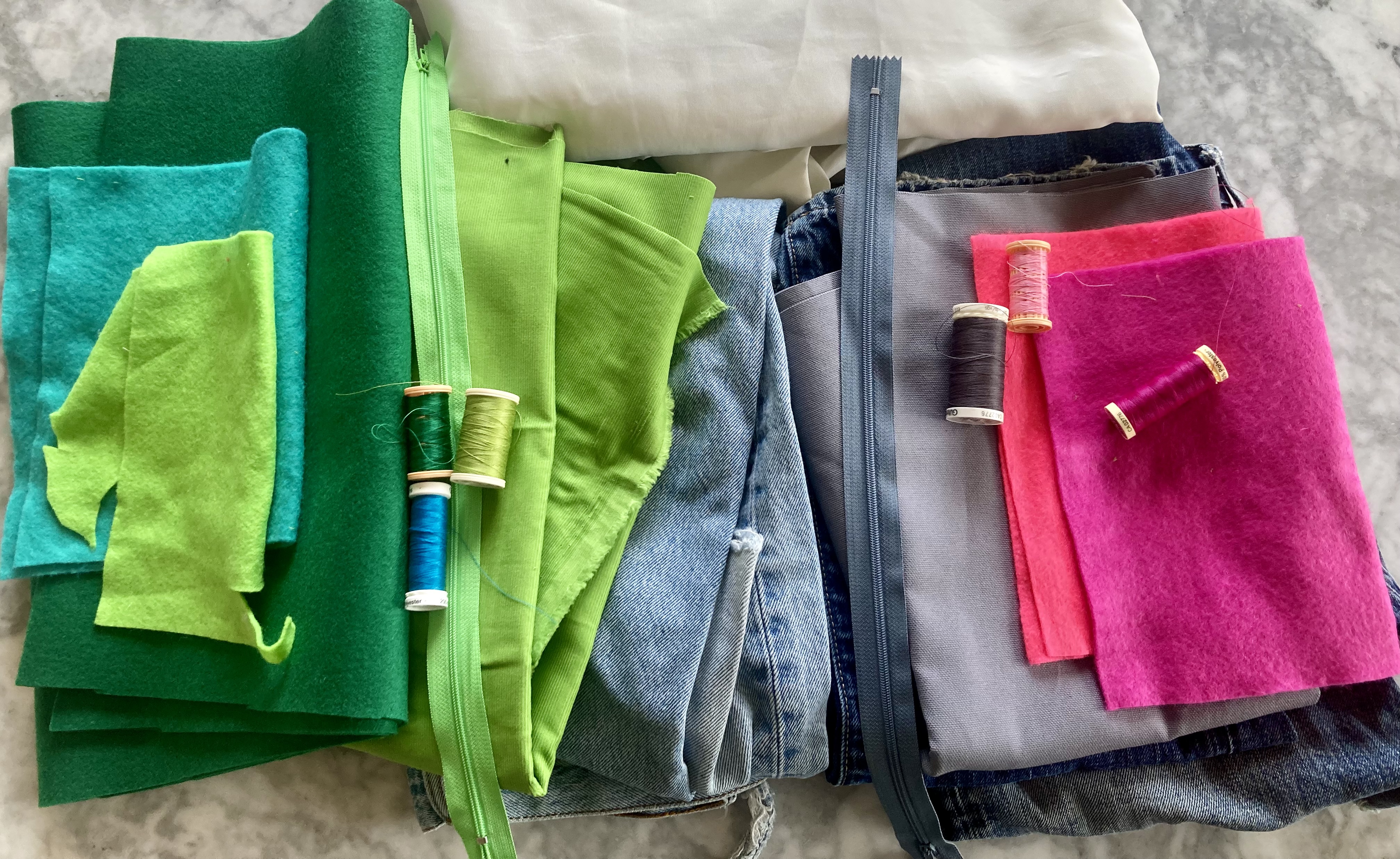
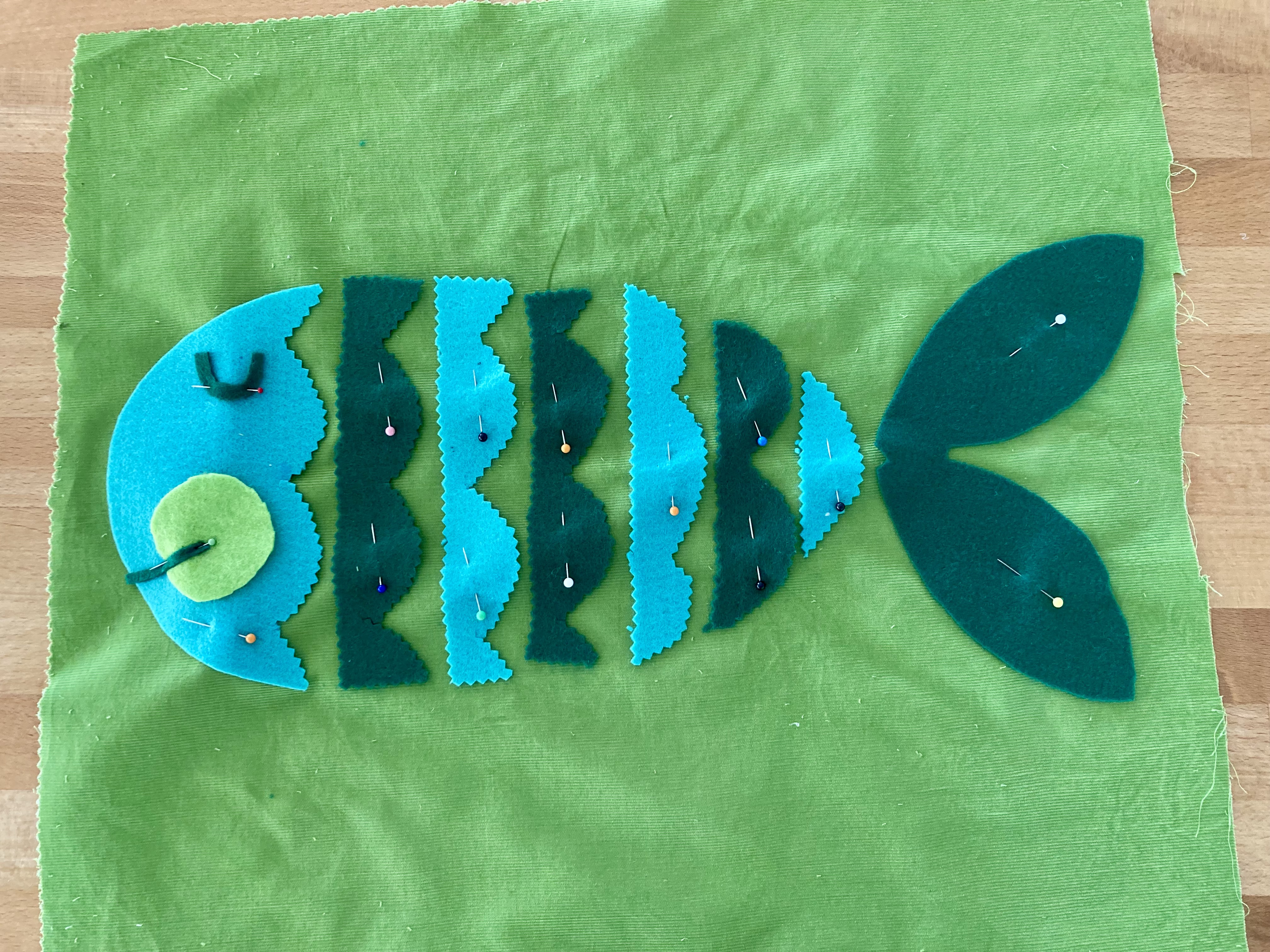
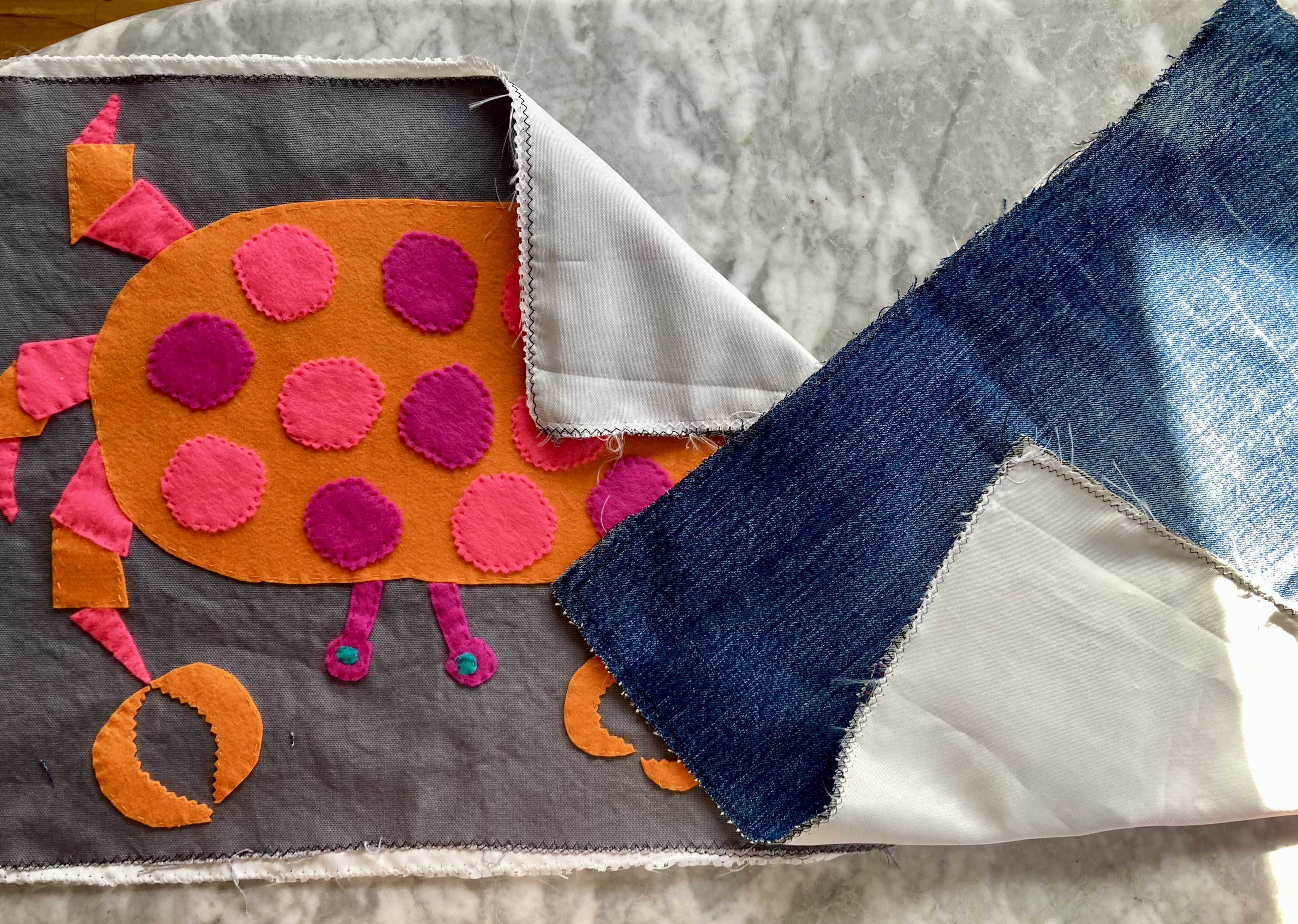
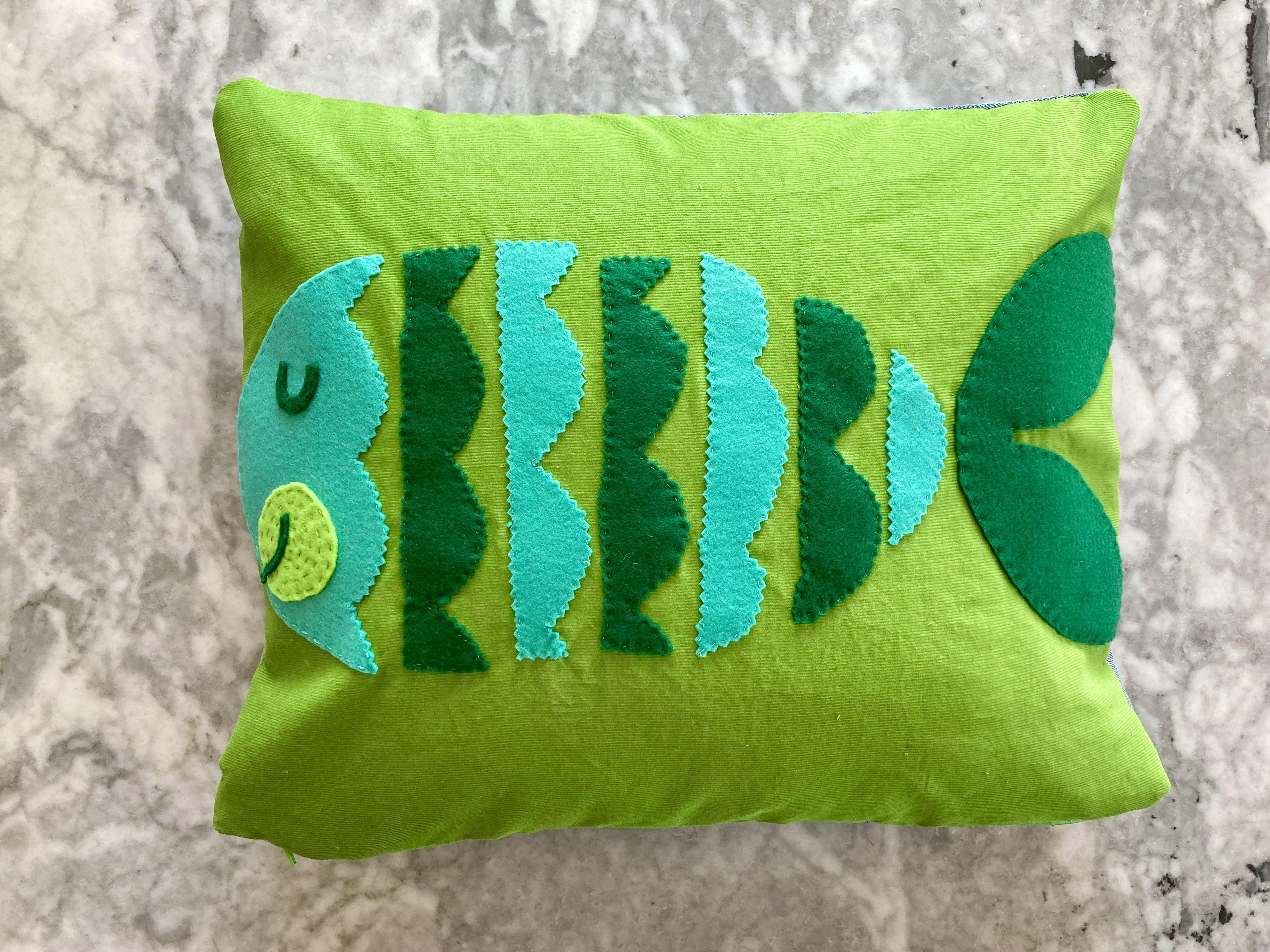
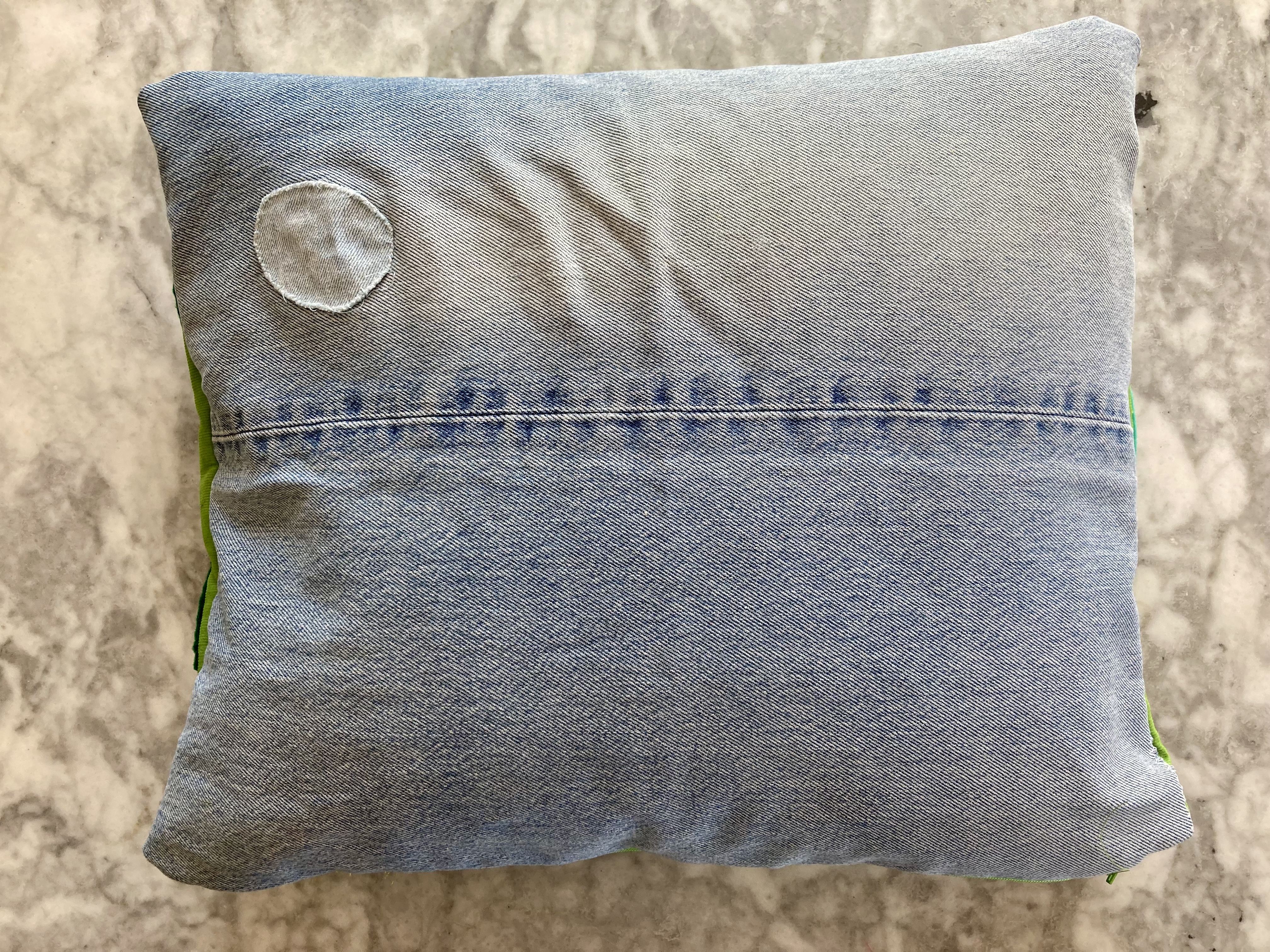
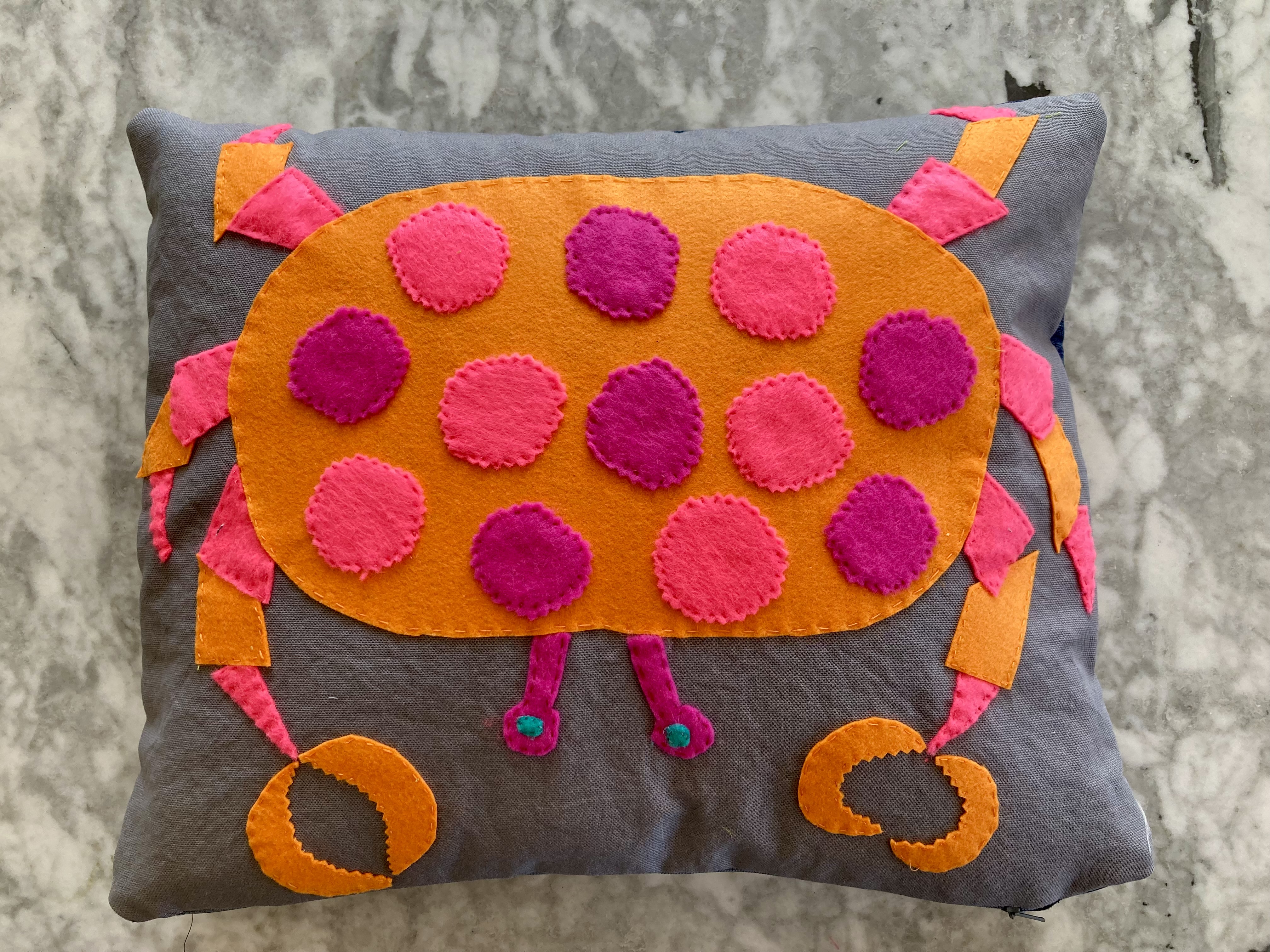
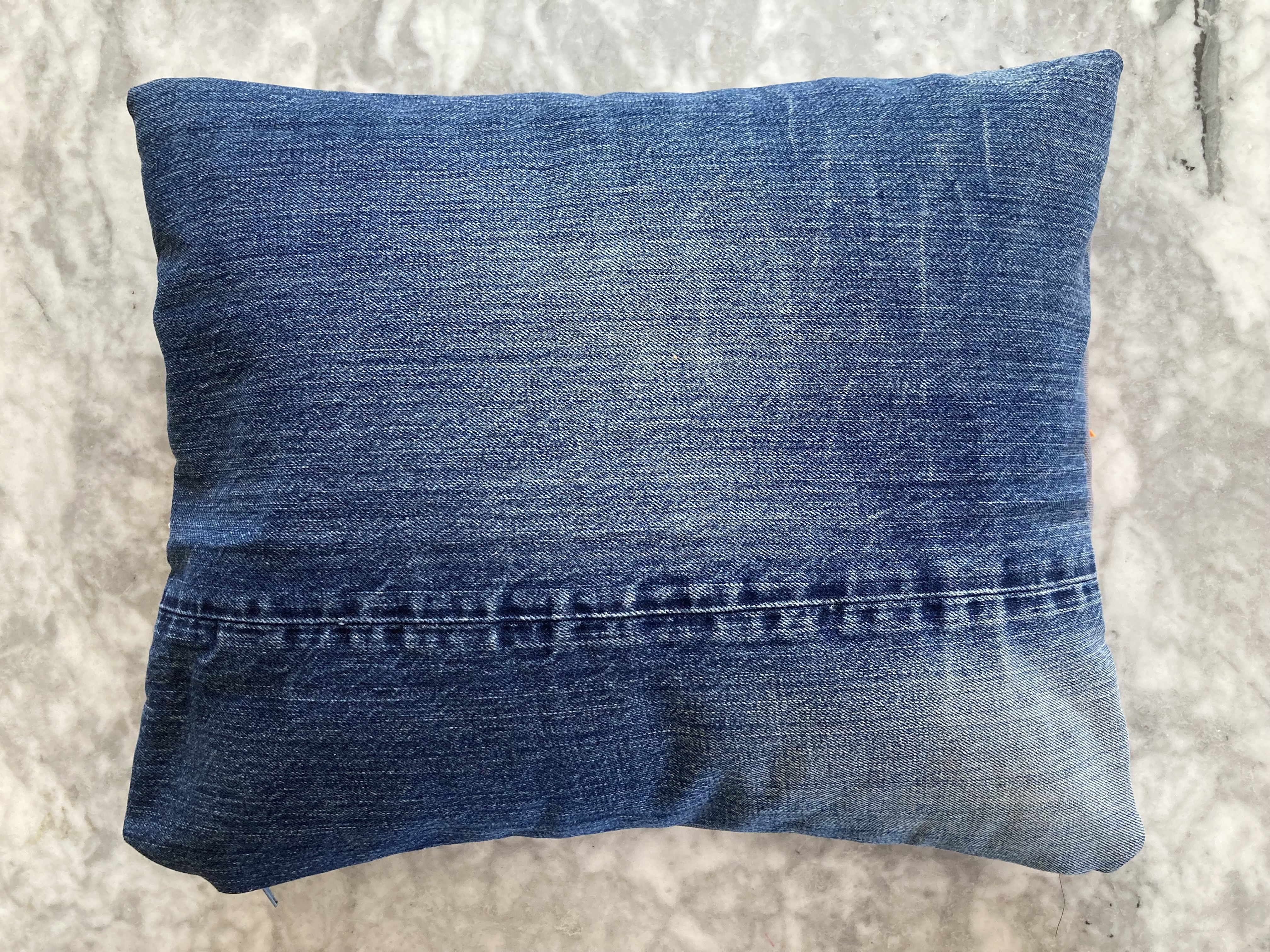
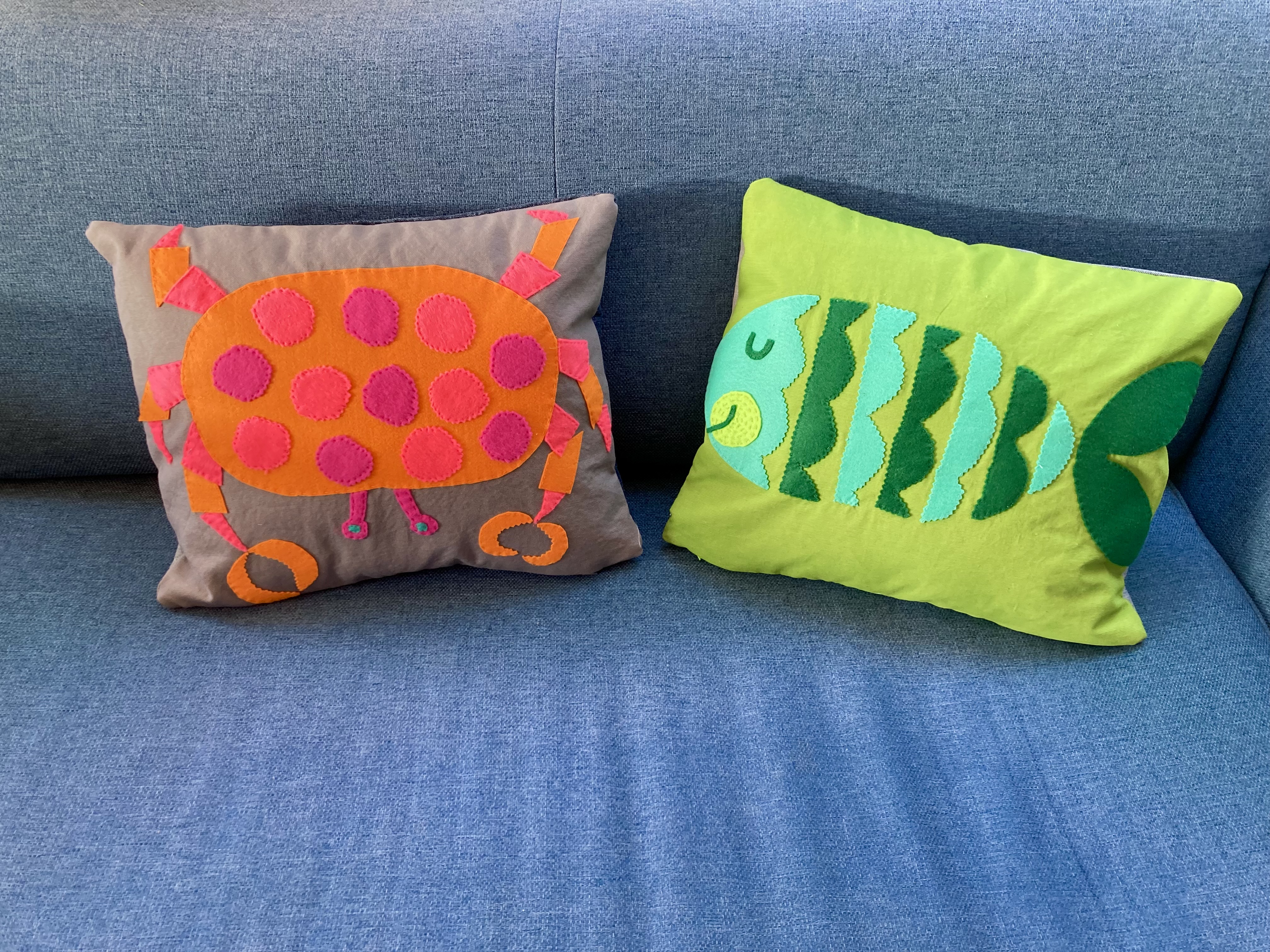
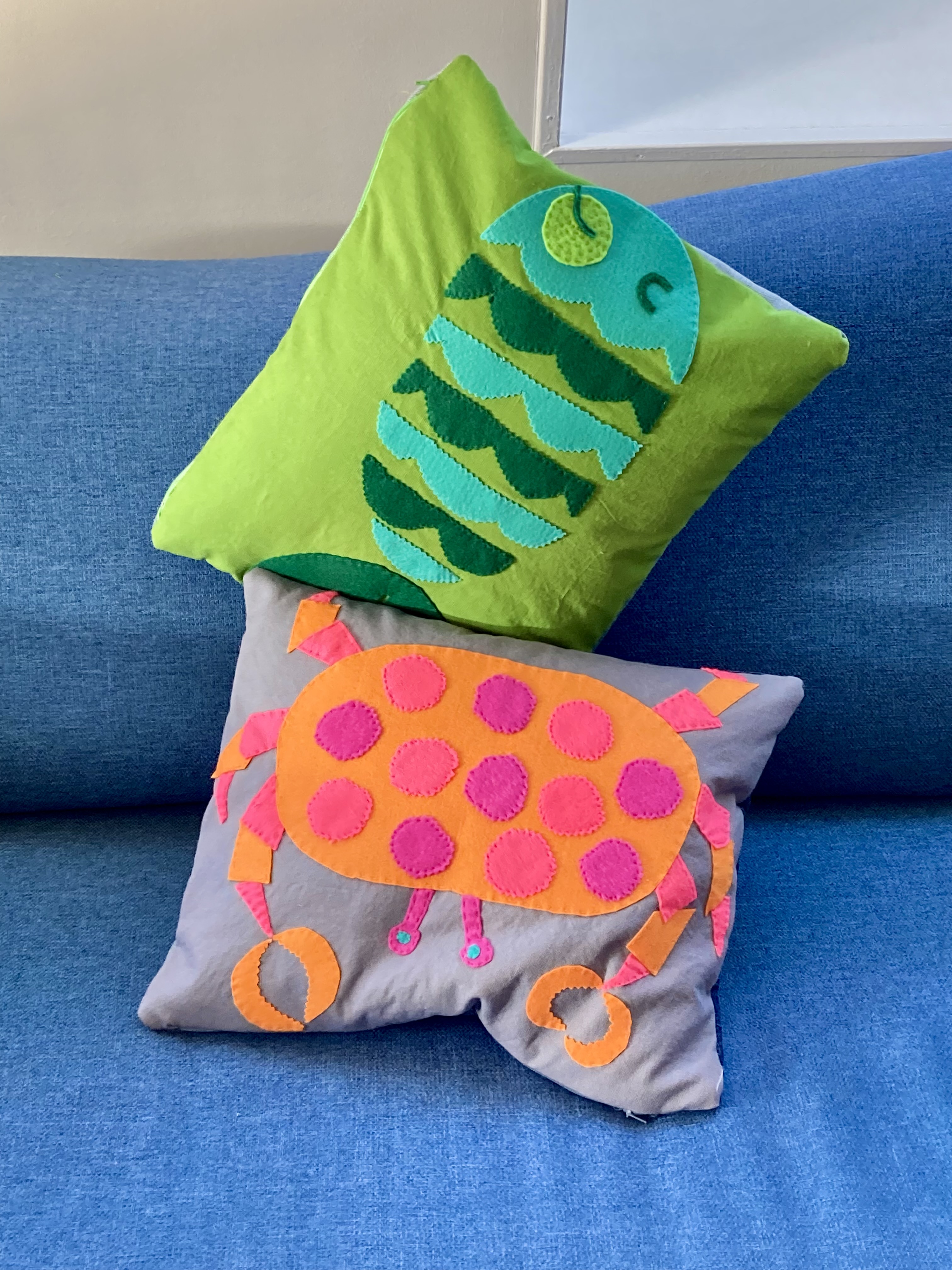
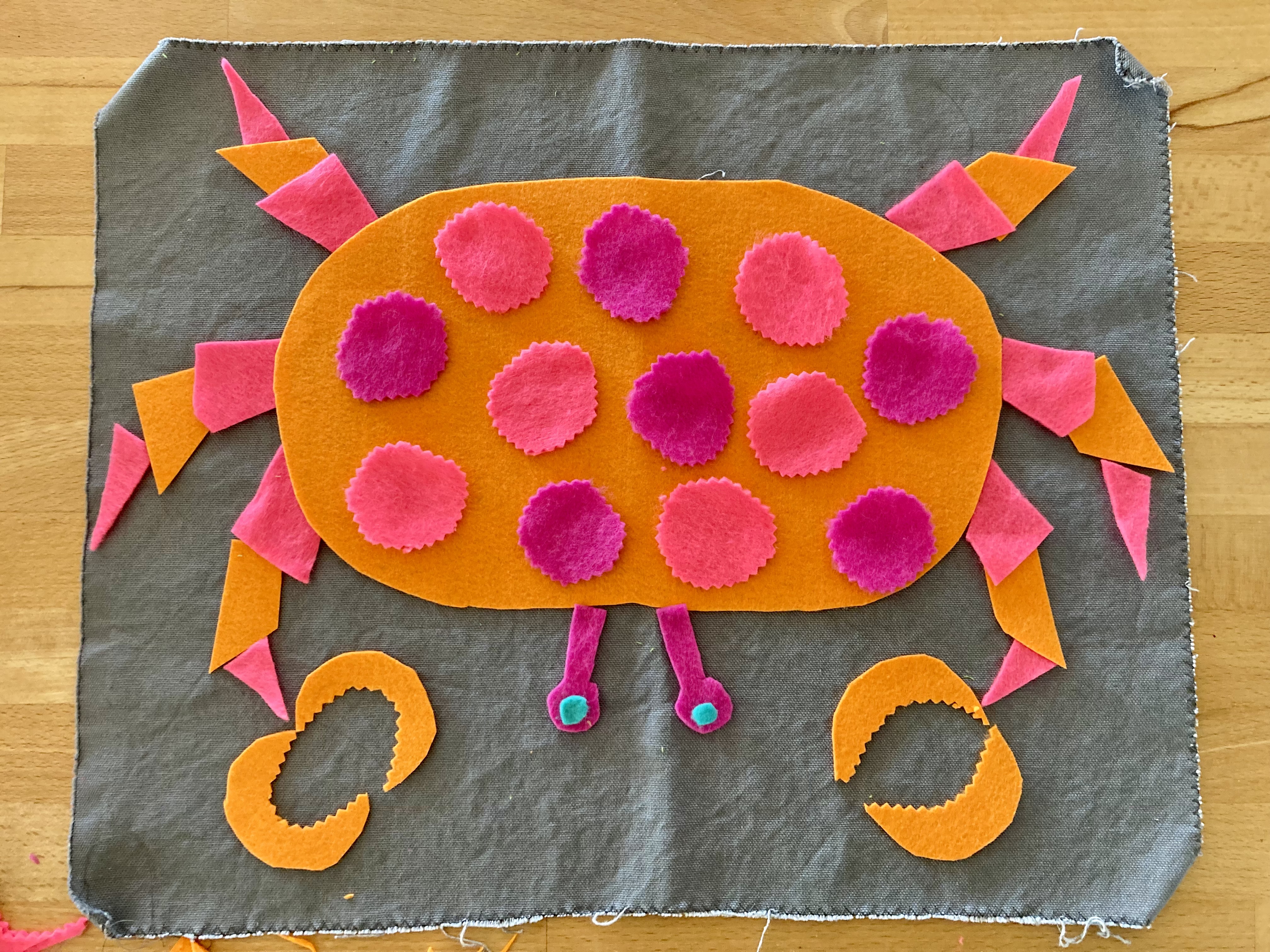
The shapes are a fish and a crab, and the “brilliant colours” unfortunately don’t show up in the black-and-white photo. The fish is turquoise, dark green and lime green felt on lime-coloured “crash” (heavy burlap-type linen) and the crab is orange, magenta and light coral on light grey crash. Both use black fabric for the backing. I used the colours from the pattern with the fish on a somewhat more lightweight almost-corduroy cotton, and the crab on a darker grey heavy upholstery/decorating cotton. For the backing, I used upcycled jeans in light blue (fish) and dark blue (crab), and I lined both cushions with upcycled shower curtain to better damp-proof them in the northern European summer.

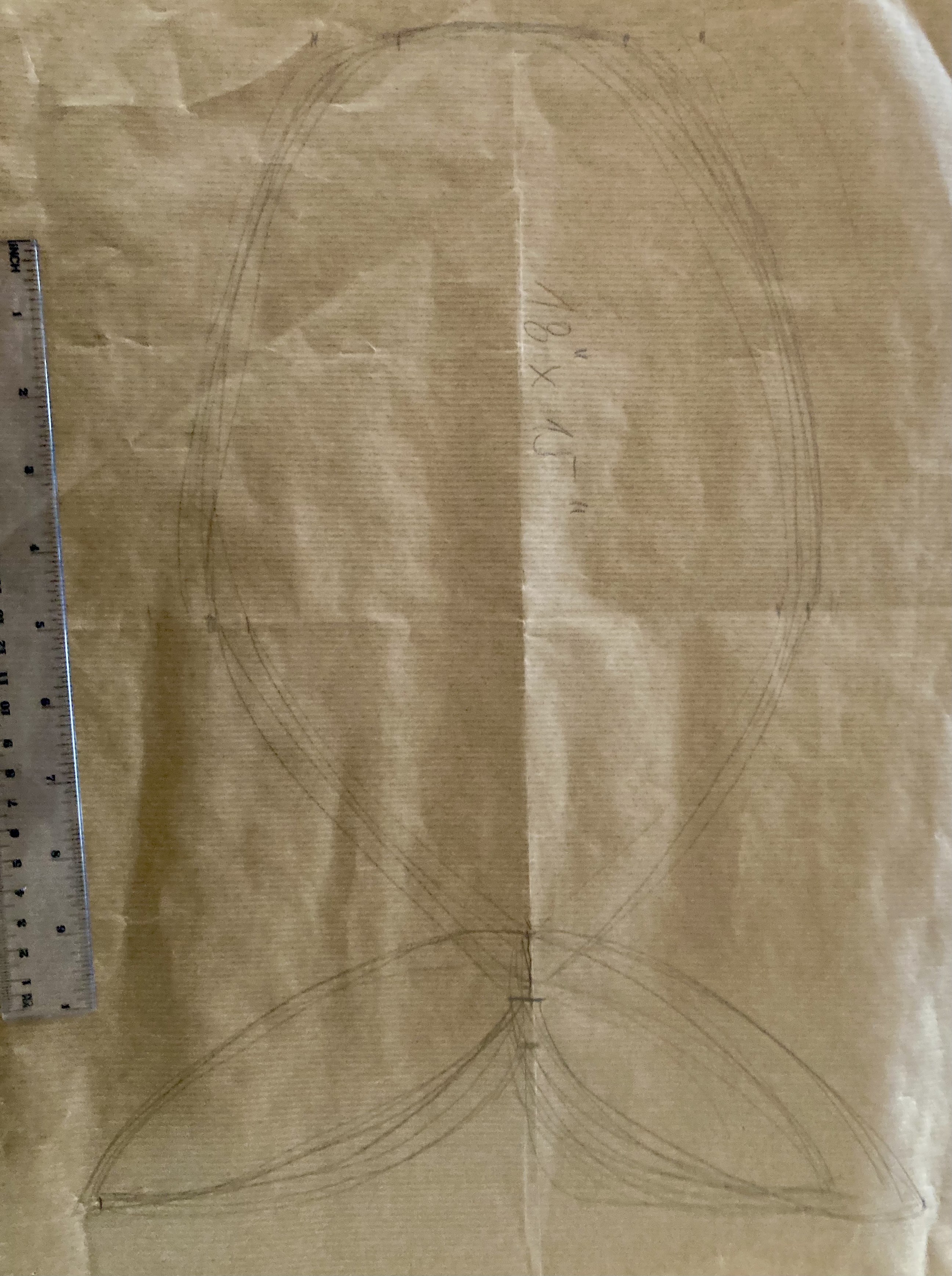
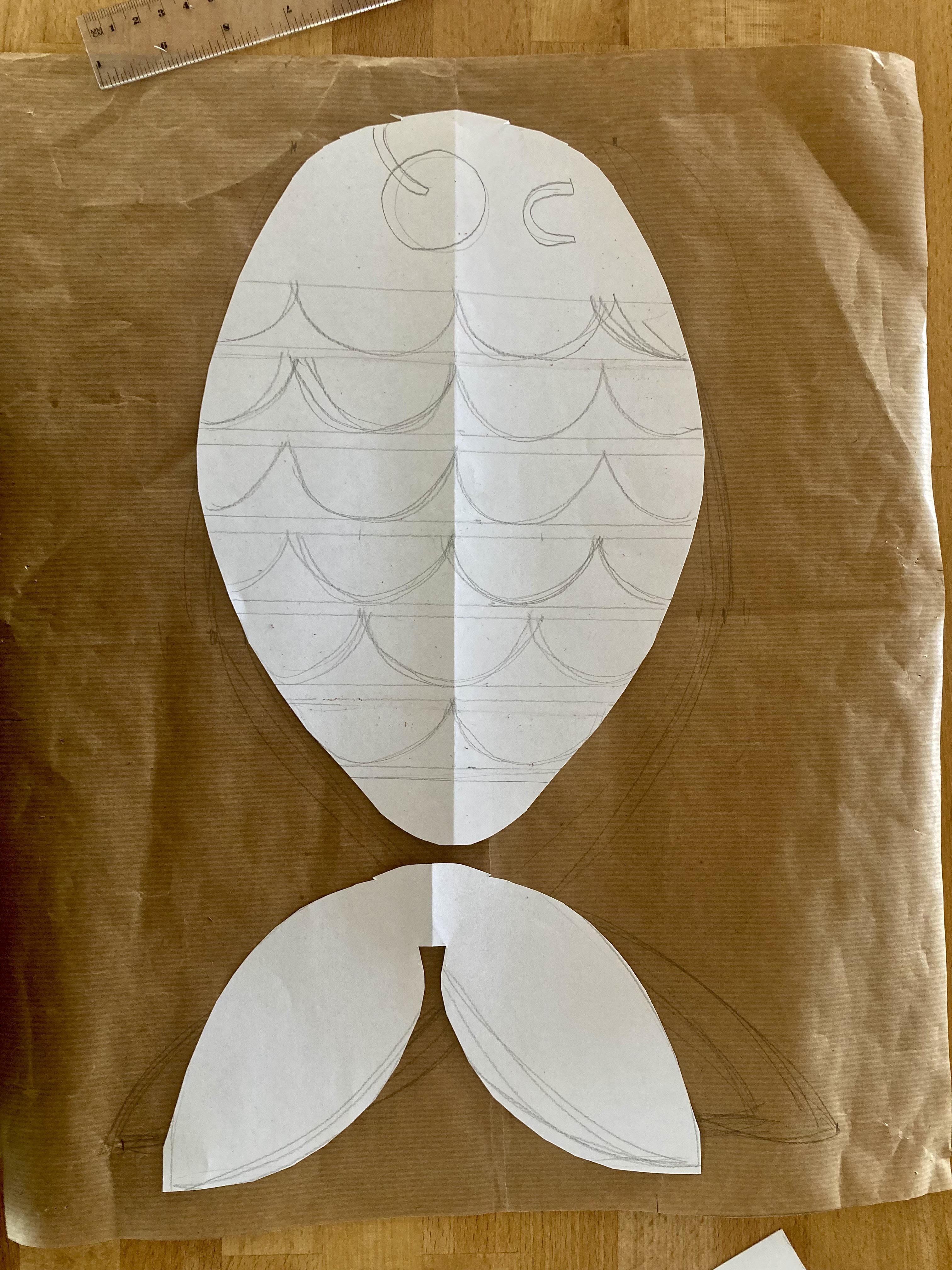
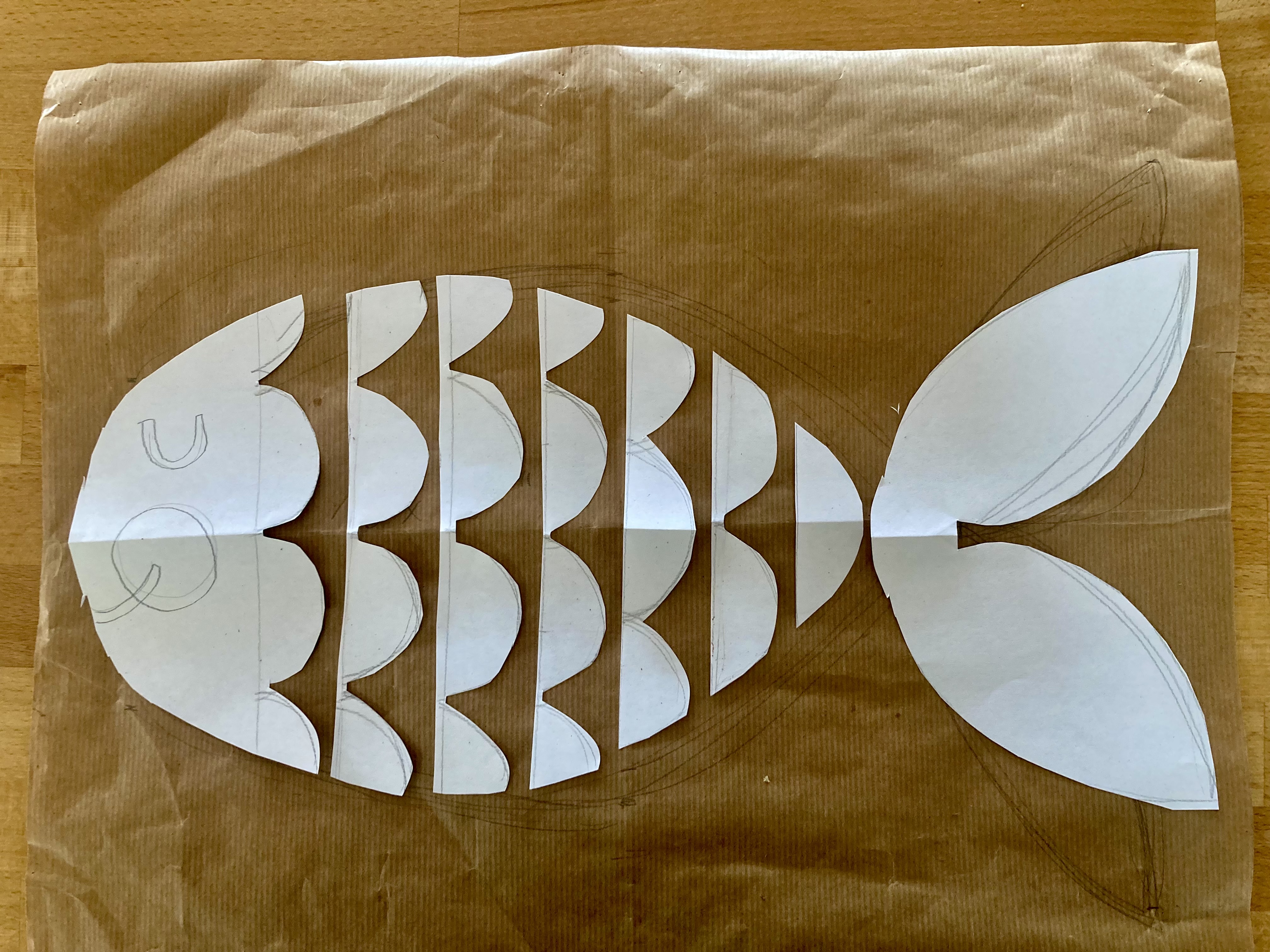
The shapes were suprisingly difficult to trace and cut out without a transfer — hard to get the fish pieces to line up perfectly, and the seemingly random-shaped crab leg segments to come together properly. I drew the fish outline on the backing-fabric paper pattern, then cut out the entire fish as a paper pattern based on that, then cut out the segments.

I love that some of the pieces on both cushions were cut out with pinking shears, but then I forgot to do it and had to buy more fabric and cut all the pinked pieces on the fish out again. Sigh.

The actual appliqué was very fast and easy. In the pattern, it says to do it on the machine, which of course would have been even faster, but I like working by hand. I used a small running stitch instead of and over-edge whipstitch, which I would normally use.

I flat-lined the finished appliqué and back pieces with the shower curtain material (I did use the machine for that) and made them up into cushion covers with zippers — not specified in the pattern, but I wanted the cushion covers to be removable for washing.

The finished size was about 17.5 x 14.5 inches, as in the pattern, which is about 45 x 37 cm. I didn’t want to make up cushions, so I bought two 45 x 45 cm ready-made cushions, which adapted themselves to the rectangular shape well enough.

It was an easy, fun project and I absolutely love the bright, 1960s colours and friendly, cartoon-like “modern” shapes. I also like sea animals, so perfect. Sadly, I have nowhere to put them and so cannot keep them for myself, but will give them away to friends for birthdays and/or housewarming gifts. Then I can visit the friends and the cushions.

Hope your Spring is going swimmingly!

May 1967: Overview

Ahoy! It’s May 1967 here at the Stitchcraft Sixties, where “Cruise Mates feature the fashion for Crepe”, and we are “Holiday Bound.”

What fashions come to mind when you think of spring and summer holidays? Light and lacy tops? Airy dresses? Halter tops and swimsuits? If so, you obviously don’t live in a Northern European maritime climate. Stitchcraft knows what British “cruise mates” need on their summer holidays: multiple layers of thick, damp-repellent wool! Our cover ensemble of nautical blazer and striped “shell” top to go underneath will keep even the foggiest cruise mates warm, dry and fashionable. The double-breasted blazer (“from Paris”, which is not particularly near any large body of water, and also quite a bit warmer than coastal areas, just saying) is made in Totem Cameo DK wool with metal buttons, knitting piping trim and big patch pockets. The sleeveless top is made in the finer version of the same wool, Cameo Crepe. The “crepe twist” (tightly worsted-spun) in the wool makes for smooth, even knitting and good wearablility. You can cover it all up with a gigantic traveling coat made in thick, undyed “Capstan” wool.

Onshore fashions include a sleeveless mini-dress in DK-weight wool (“perfect for holidays”), a short-sleeved jumper in a cables-and-lace pattern, two more sleeveless “shells” for warmer days or layering, and a “classic sporty sweater” in a simple, but effective striped slip-stitch rib pattern. The light green “shell” has a slip-stitch pattern, too, and horizontal texture lines appear more subtly in the easy ridge pattern on the yoke of the dress.

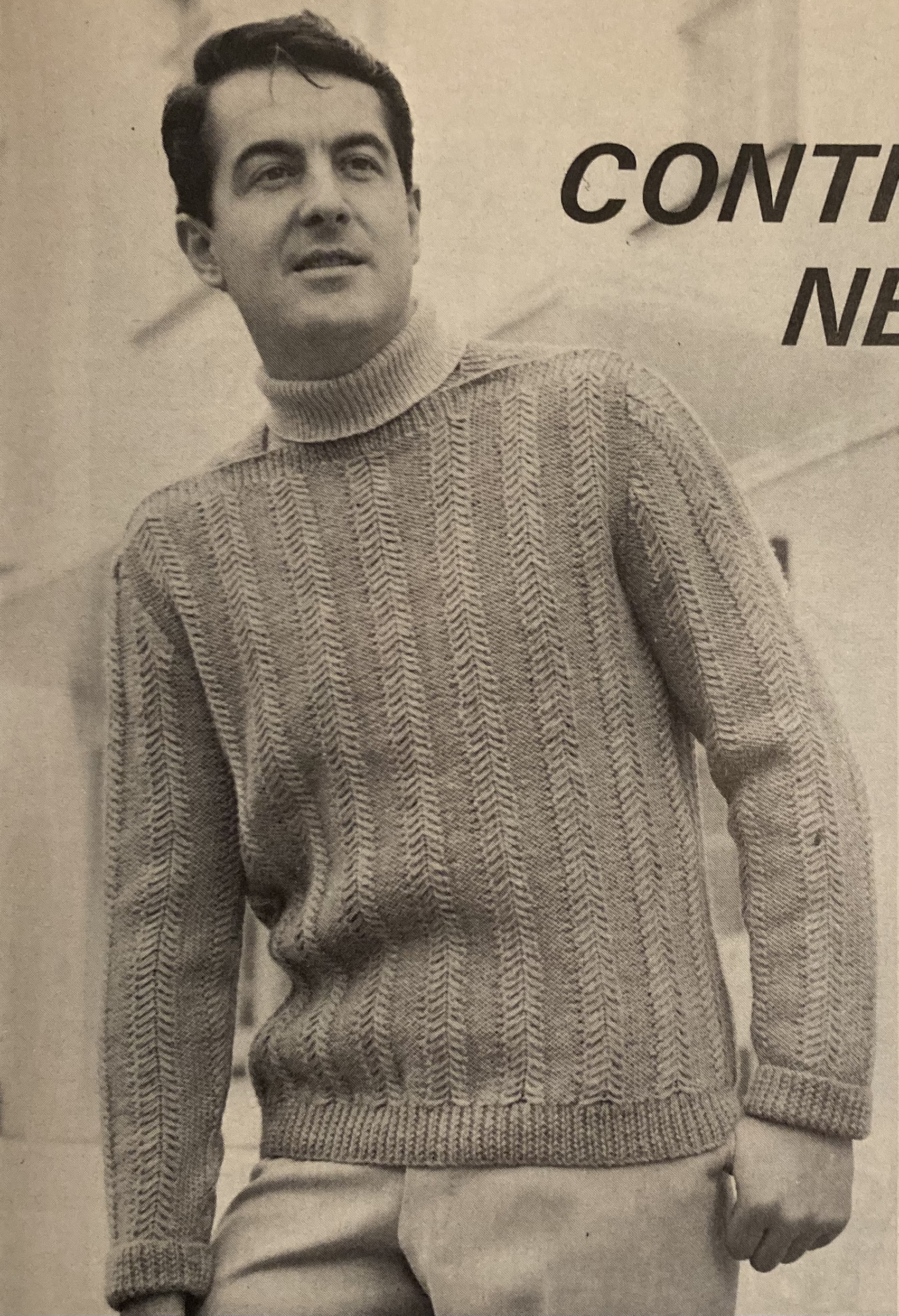
It’s a good issue for menswear too, with a lightweight slipover in a reversible (!) textured pattern. I thought the stitch pattern would be some sort of fisherman’s rib, but it is is utterly simple: knit 1 row, then k1b, p1 for one row. It looks like fairly normal 1×1 ribbing from the “right side” and a sort of starry waffleboard pattern from the “wrong side”. How lovely to never have to worry about putting something on inside-out! The “Continental pullover”, on the other hand, is too wide and the cables on the lower half give a strange “skirted” effect. Perhaps they knitted the wrong size, or should have put it on a larger-bellied model.

There are some wonderful garments for children of various ages in this issue, starting with a comfortable bobble-trimmed top for a school-age girl and a warm sweater for a boy (make sure he’s wearing a proper shirt and tie to go under it while sailing his wooden boats at the beach.) Here too, the stitch pattern looks more complicated than it is: k1, p3 for one row, then p1, k3 back makes a interesting offset rib with minimal effort. Little kids can “paddle and splash” in a tunic, t-shirt top and/or shorts for beach wear. The horizontal stripes are knitted in and the vertical stripes are crocheted on later with chain-stitch. A note in the tunic pattern says, “We have allowed 1-inch extra in length on back and front of dress as chain-stitching tends to contract the work.” Smart!

Rouding out this excellent issue are some wonderful homeware designs, starting with a set of garden cushions in a seaside “fish” and “crab” design. Love the use of pinking shears to illustrate the fish’s scales and the crab’s pincers! Way back in the “Readers Pages” is another, versatile appliqué design, this time with crocheted flowers instead of felt cut-outs.

For cross-stitch enthusiasts, there’s a coffee-tray set with matching deep-pocketed apron, or a tea cosy featuring wool stitching on tapestry canvas. Beginning rugmakers can make an easy runner in chain and soumak stitch.

The most magnificent design, though, is this Chippendale-inspired rug and piano-stool set, rightly featured in full colour over the two centrefold pages. The stool cover is worked in tapestry using tapisserie wool in trammed tent stitch and the 36×62 inch rug is worked in cross-stitch in Turkey Rug Wool.

Even the ads are great in this issue! The model wearing Patons Fiona is happy rain or shine and look at those amazing swimsuits from the Scotch Wool Shop! I would wear either of them today. And don’t you love the Singer sewing machine that can be folded down into its own practical storage cabinet when not in use? Did any of you have one of these? I think it’s brilliant and would have loved to have one.

My projects from this issue will be the garden cushions and the crochet appliqué on a useful-for-whatever little bag. I somehow have lived my entire adult life without a garden or even a balcony, but I know people who have those things and would love to have a fun cushion as a gift.

Happy Spring!

September 1966: Overview

The September 1966 issue of Stitchcraft doesn’t have an introductory paragraph by “editress” Patience Horne, but it does have a lot of looks: the “Crepe Look”, the “Country Look”, “Carefree Sweaters for a gay look” (you would think that by 1966, they would have noticed that the meaning was changing), and my personal favourite, a “Fuzzy Look for a Party Extra”. Let’s take a look!

The “Crepe Look” is the smooth finish and good stitch definition that you get when you knit with a tightly-plied and/or long-fibre yarn. In this case, the yarn in question is Patons 101 Courtelle Double Crepe, a 100% acrylic yarn in DK weight. It’s used to make the cover cardigan, which is part of a twin-set, as well as a men’s pullover, a men’s cardigan, and a women’s pullover. The twin-set and the men’s garments make use of the good stitch definition with twisted stitches, cables and ribs. The women’s pullover (pictured two paragraphs down) is knitted in plain stocking-stitch, but sideways for easy placement of the vertical stripes. Cool and neutral colours are back: beige, grey, and white, with blues and browns for the colour accents. The only exception is the bright red jumper of the twin-set.

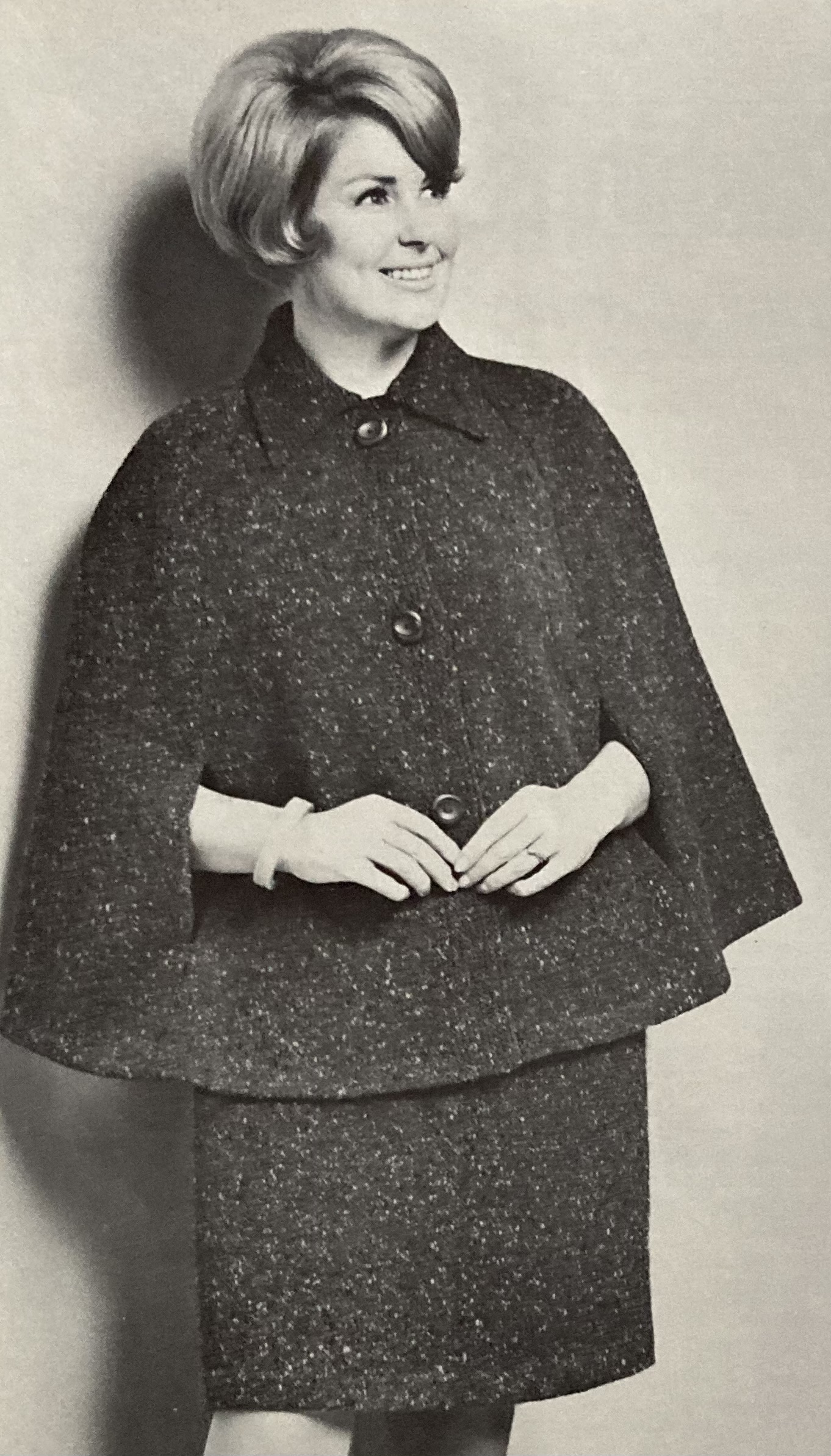
The “Country Look” features sturdy and tweedy garments for indoor and outdoor wear, with textures inspired by Aran and/or alpine knitting styles. The tweed suit on the inside cover is made in multicoloured “Glenora” wool and the Aran jacket in undyed “Capstan“. Capstan in the UK at this time was 100% wool; I’m not sure if Glenora was wool or a wool-synthetic mix. The boxy suit styling with collars and pockets shows the Chanel/Bernat influence, but dressed down a bit for “country living”. Those who want a little more fashion in their country life could make a trellis-and-rib pattern cardigan in Shetland-mix “Flair“.

Those who want even more fashion fun can knit one of the “Carefree Sweaters for a gay look” — like a fringed DK pullover in “Rose Petal” pink double knitting wool. Unlike many of the designs around this time, it’s shaped from the hem to the waist and the waist to the bust. The fringed edging is made by knitting a 9-stitch wide strip to go around the neckline, then casting off 7 stitches and frogging the remaining two stitches down the length of the long side, leaving loops. Then the strip is sewn into place to prevent further loss of stitches. That certainly sounds faster an easier than any other method I could think of! The other carefree, gay sweater is the sideways-knit pullover in “crepe look”. (Why limit yourself to just one look? The man’s twisted-stitch pullover is also both “crepe look” and “country look.”) Of course, your “Look” doesn’t have to fit in a category at all. It can just be a fun, nice design, like this “Charleston style” dress in emerald-green double knitting, or these absolutely wonderful children’s outfits in bright red with white bunny motifs.

The “Fuzzy Look for a Party Extra” design is also for a child — a fluffy vest made in “Fuzzy-Wuzzy” wool-angora mix. Best Patons yarn name ever! Speaking of party planning, how about a handmade hobby horse as a child’s birthday present? It’s made of felt stuffed with kapok, mounted on a broom handle and trimmed with ric-rac braid and fringe. The rings in the harness are curtain rings.

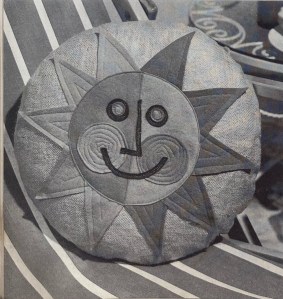
With that, we’ve moved on to the housewares, which are standard, but also showing a more modern flair. There are rugs in Soumak stitch or cross-stitch, or a somewhat abstract “sun” design for a cross-stitch cushion and chairback. The sun pattern doesn’t stand out much in a black-and-white photo, but I can imagine it would be very striking if made in the colours in the pattern: yellow, gold, olive, red, orange, black, scarlet and green. Even more striking (and continuing the yellow-orange-green colour scheme) is the felt appliqué wall panel commemorating the 900th anniversary of the Battle of Hastings. Love the photo styling — they really went all out finding the perfectly colour-coordinated wall and accessories.

The “Readers Pages” give us a reprint of a little tapestry handbag from May 1961. I tried to make this handbag. Spoiler: it was not a success, and made me realise that I don’t like doing tapestry as much as I think I should. We’ve also got a new comic, “The Story of Higgeldy-Piggeldy” in which we are introduced to two very neat and tidy teddy bears who are going to get the shock of their life in the next issue, when they meet an untidy bear in a house that is all higgeldy-piggeldy! Oh no! Whatever will they do?

The ads are fun — you can tell the Scotch Wool Shop has been working with a modern advertising agency lately, with that swinging singer-songwriter and the slightly goofy copywriting. The “Fabrics & Threads” book makes reference to those new synthetic fabrics, and the ad for Patons 101 Courtelle shows the “Crepe Look” in a well-styled photo.

This is a wonderful issue. There’s more than one project I would like to make — the bunny jumpers, the “Charleston” dress — but I would like a new cardigan most of all, so I’ll be making the one on the cover from the “Crepe Look” twin-set. Just the cardigan this time — I feel like I have enough short-sleeve jumpers at the moment, and I don’t see the point of a thick, warm DK jumper with short sleeves. I’ve already started (cheating, I know), so maybe it will be done by the end of the month? Who knows? Stay tuned and find out.

June (July) 1966: Garden Cushion

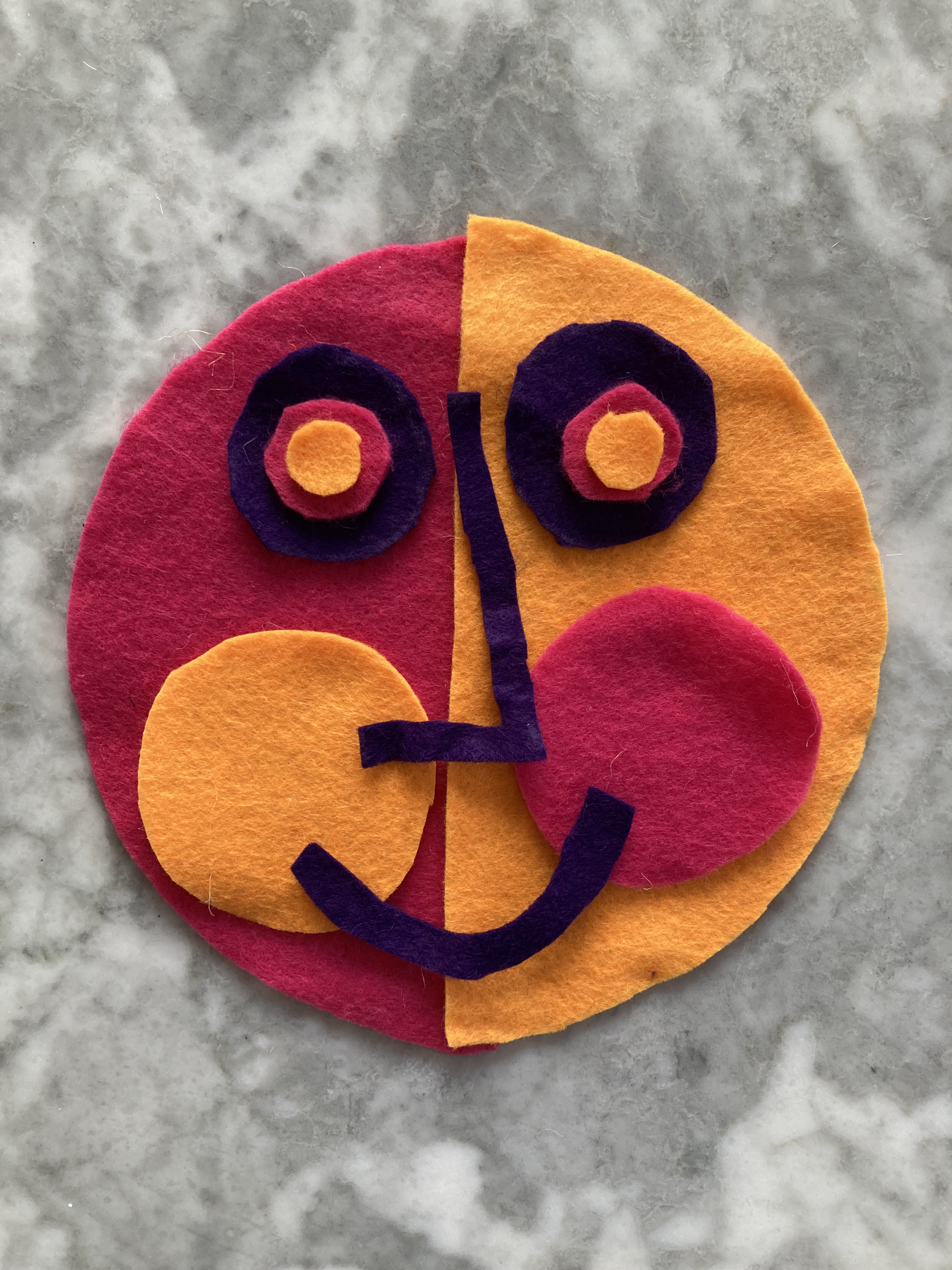
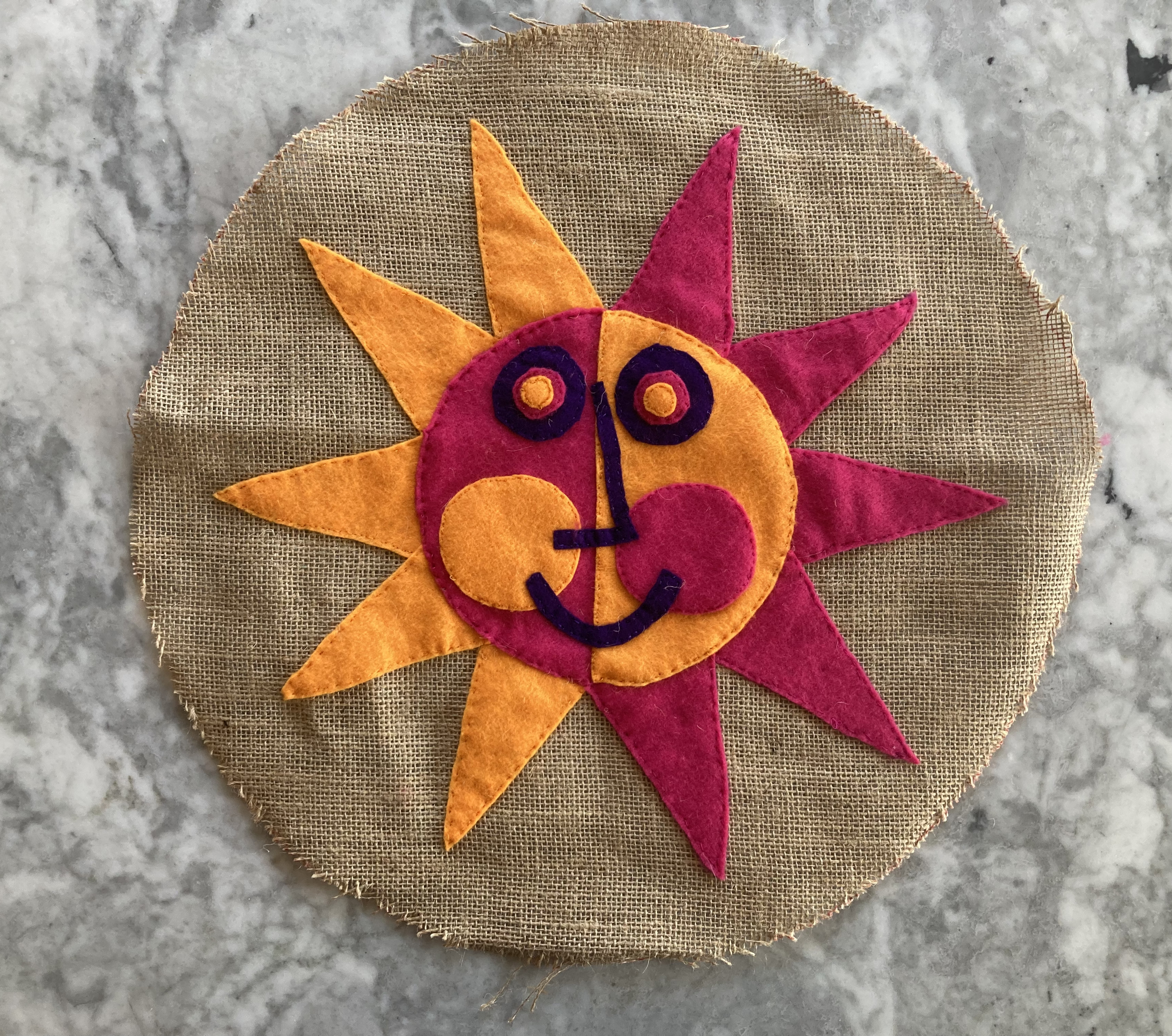
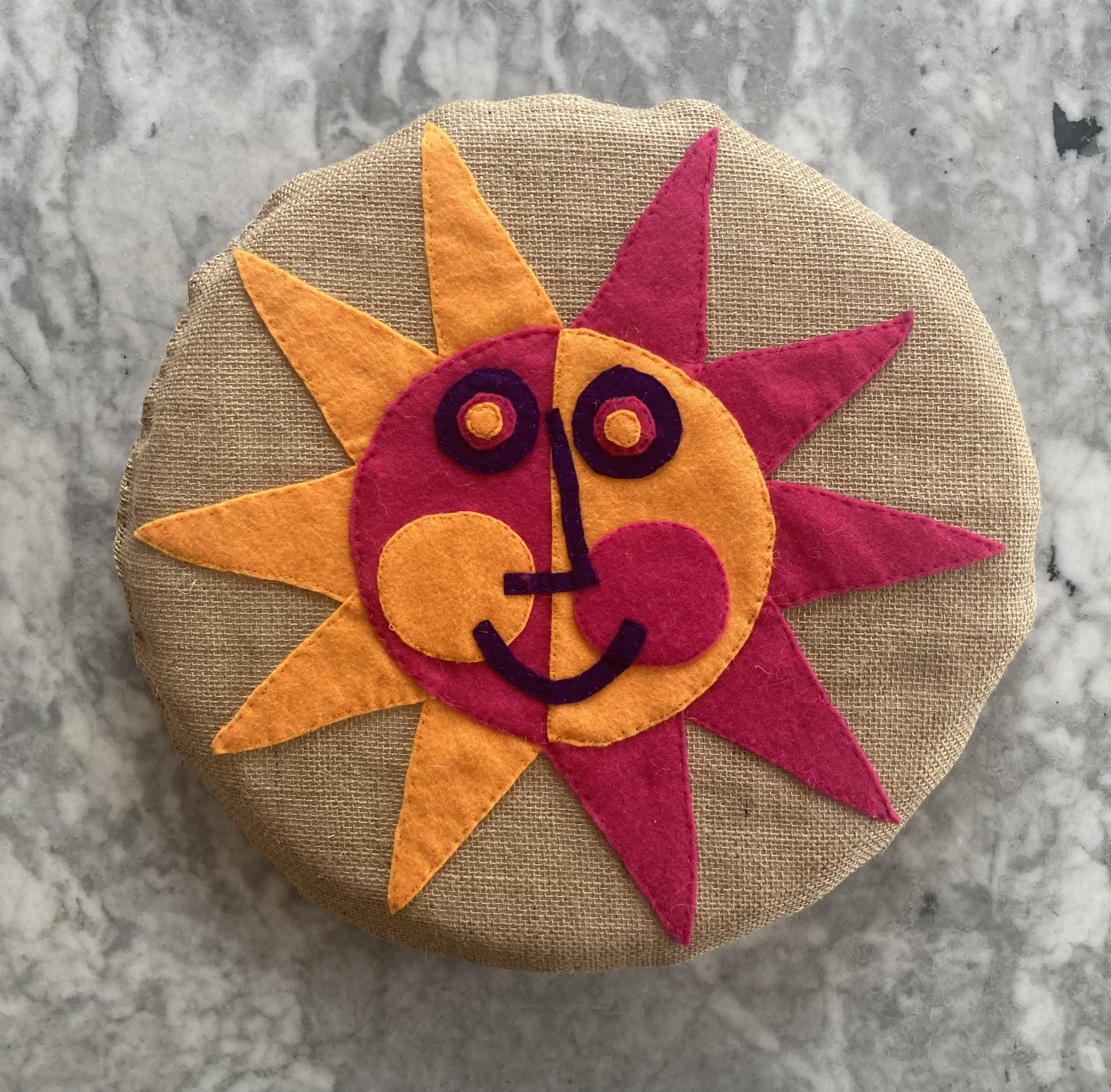
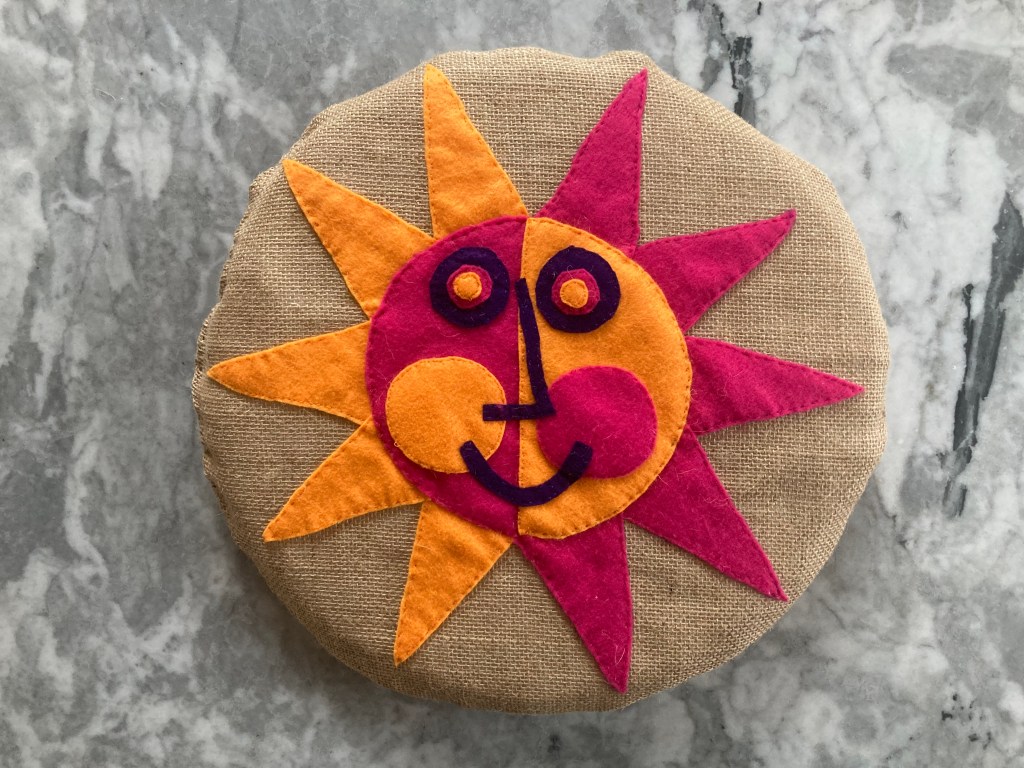
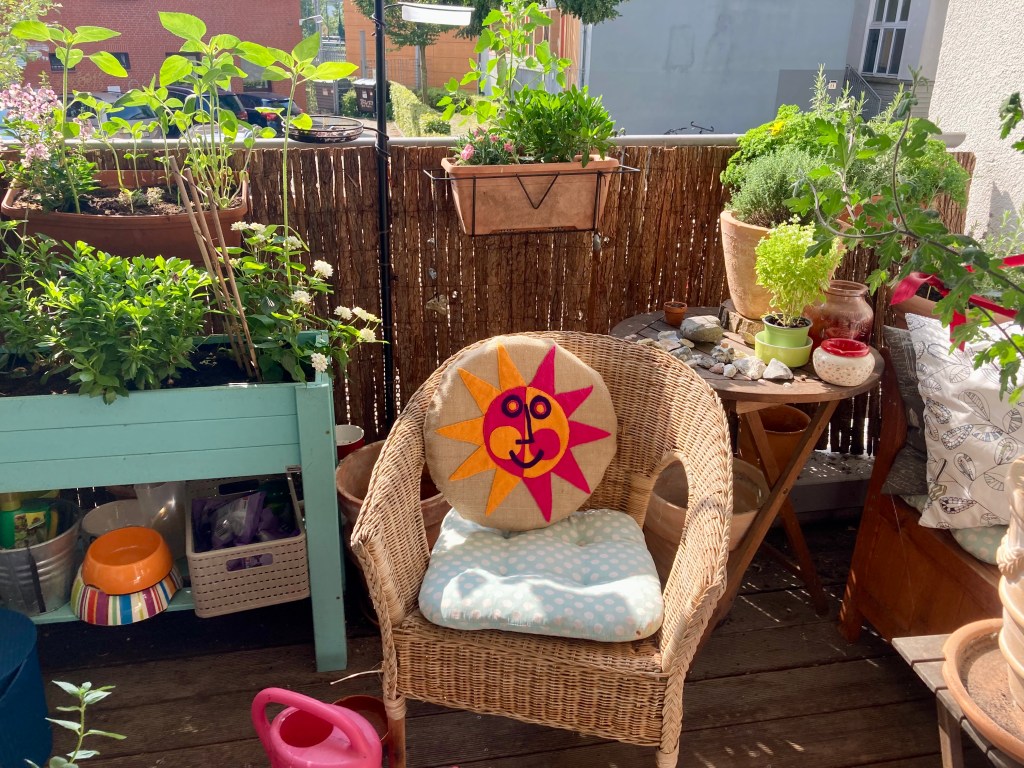
The June 1966 issue of Stitchcraft had multiple projects that interested me and the July 1966 issue not really any, so I made another project from the June issue this July. It was one of those designs that I have been looking forward to for a long time and was thrilled to finally make it — a cushion “for sunny days in the Garden”. Very bright, very psychedelic (is this what Stitchcraft meant when they wrote “Get ready for High Summer”?) and very, very 60s! I love it! Here’s some music to listen to while you read this post!

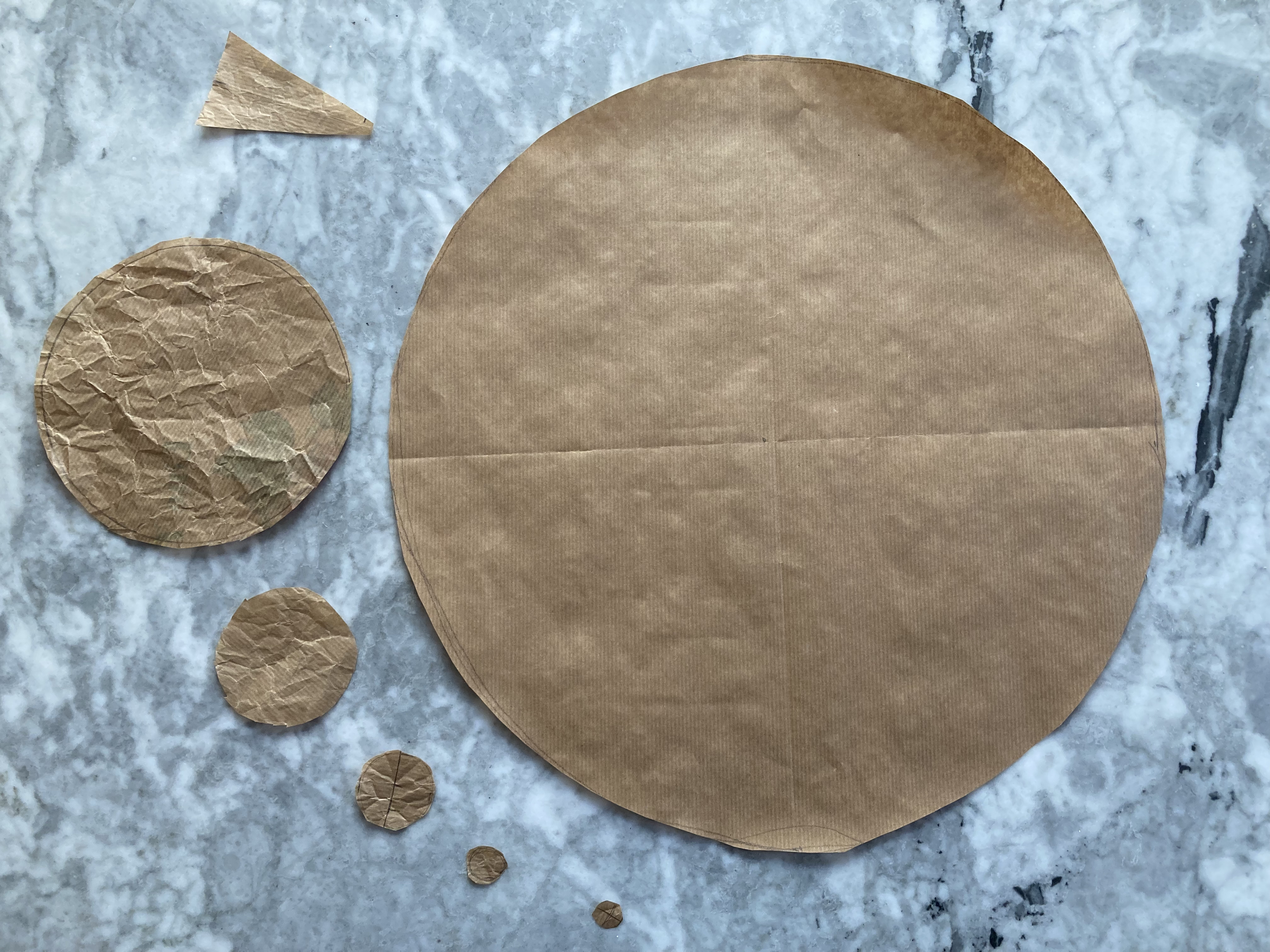
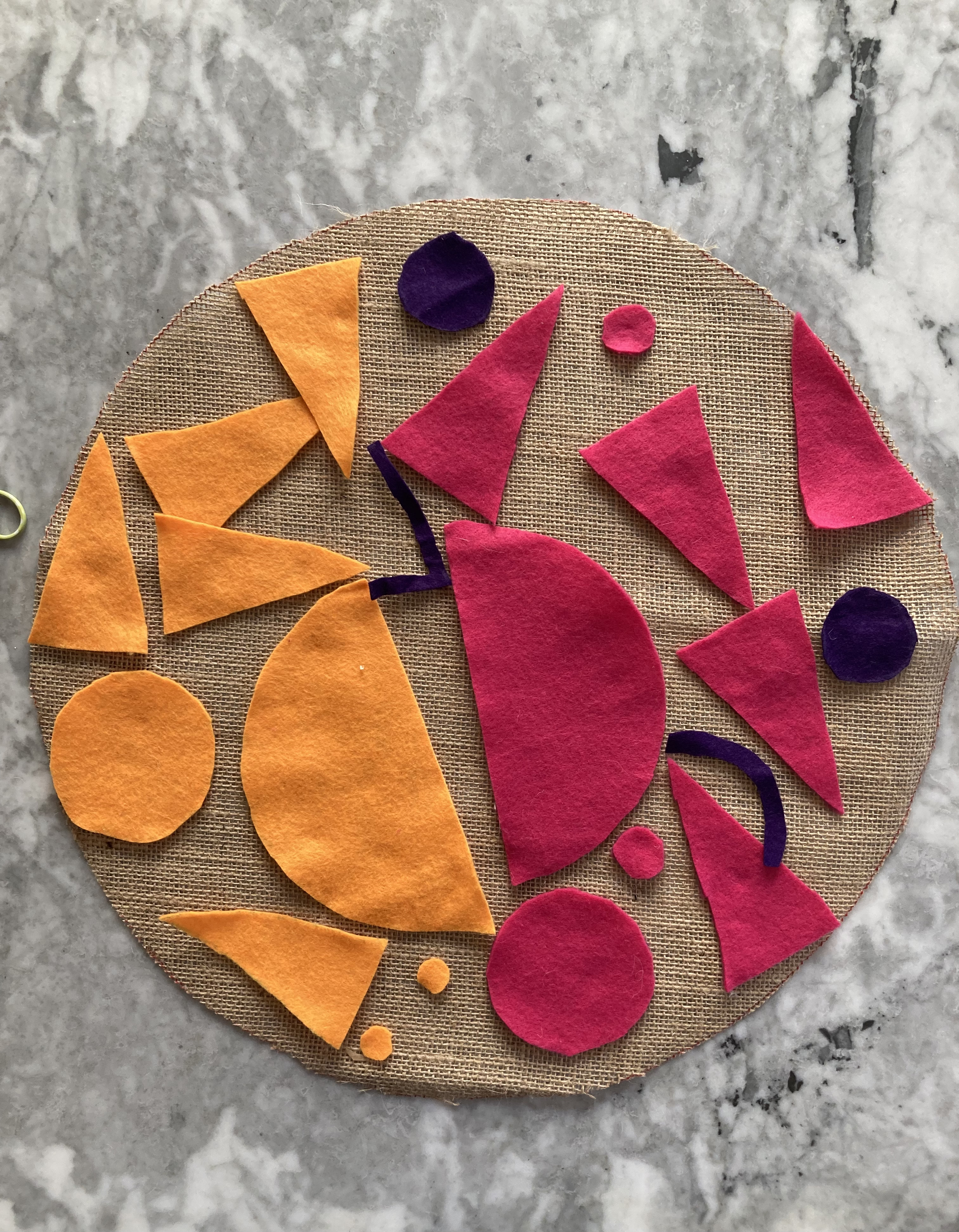
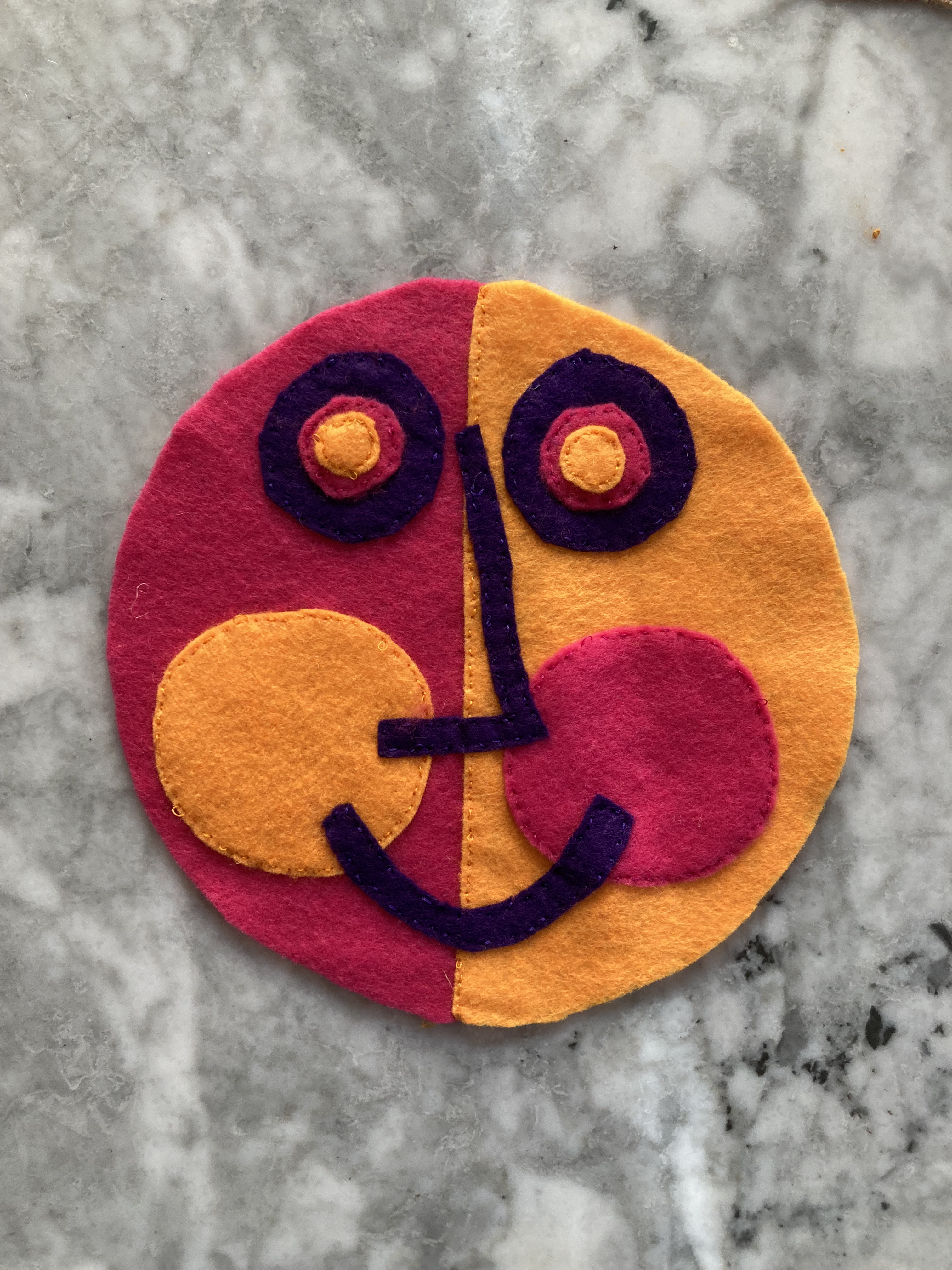
It’s made with felt appliqué on hessian fabric in orange and magenta with purple facial features. I really wish the magazine had a colour photograph. There was no need to send away for a transfer even at the time, as the dimensions of the cut-out circles and wedges are clearly described in the instructions and there’s a little schematic in the back pages to help. You simply cut paper patterns for circles in different diameters (7 cut in half, then 3, 1 1/4, 3/4 and 1/2 inches), plus a long triangle wedge pattern (3 1/2 inches long by2 1/2 inches wide at the base). The measurements of mouth and nose are described carefully as well, and there you have it. Here are my paper patterns, arranged to look like a spaceship entering a very well-organised solar system, and the cut-out felts, arranged to look like a 1980s new-wave pizza.

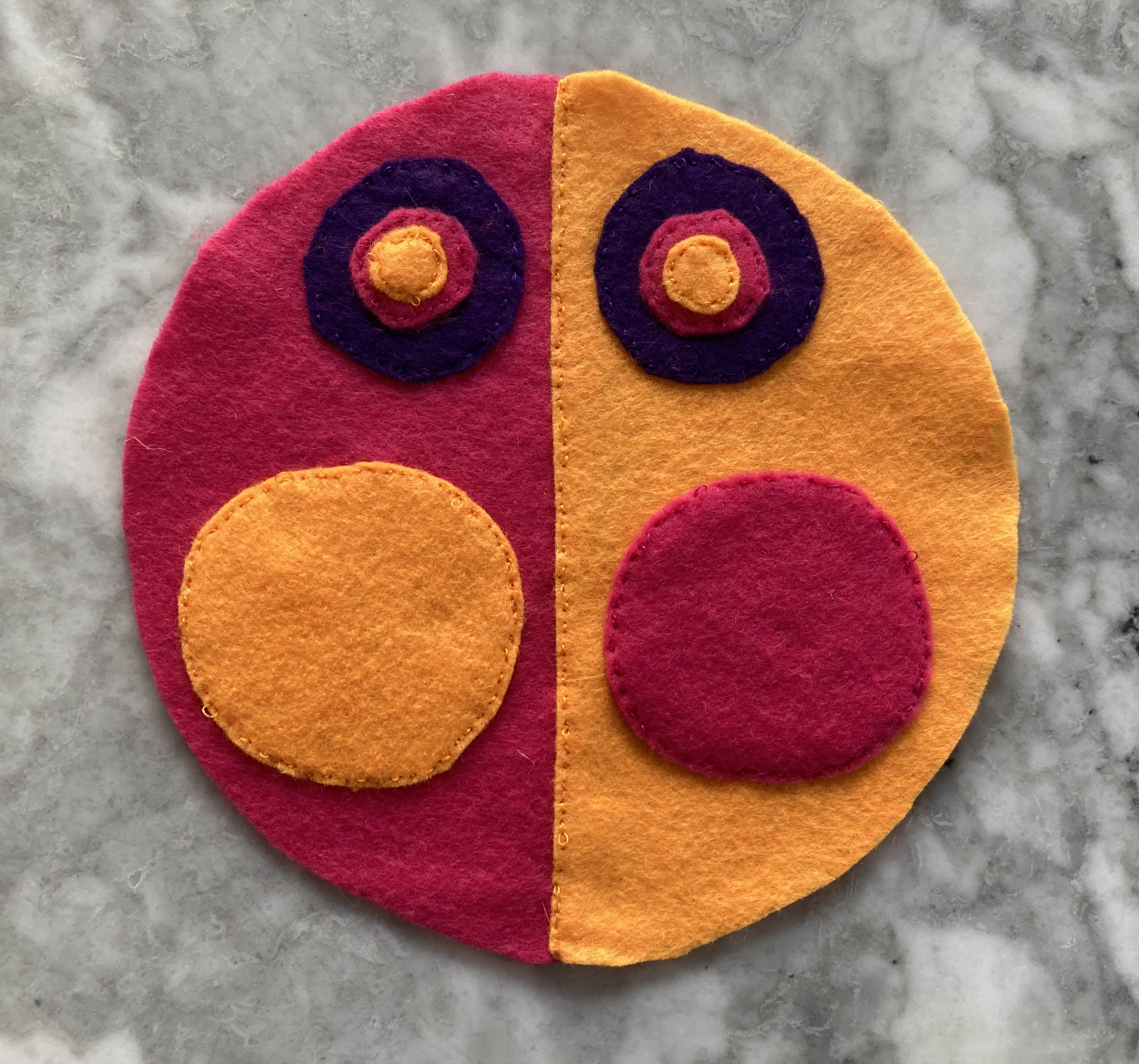
The appliqué is supposed to be done on the machine. I weighed the time factor of stitching by hand versus the bother factor of making bobbins in 3 colours that I would not otherwise use and switching them out constantly, and decided to stitch the felts on by hand with a small back-stitch. It was actually quite relaxing and probably didn’t take a whole lot longer than if I had dome it on the machine.

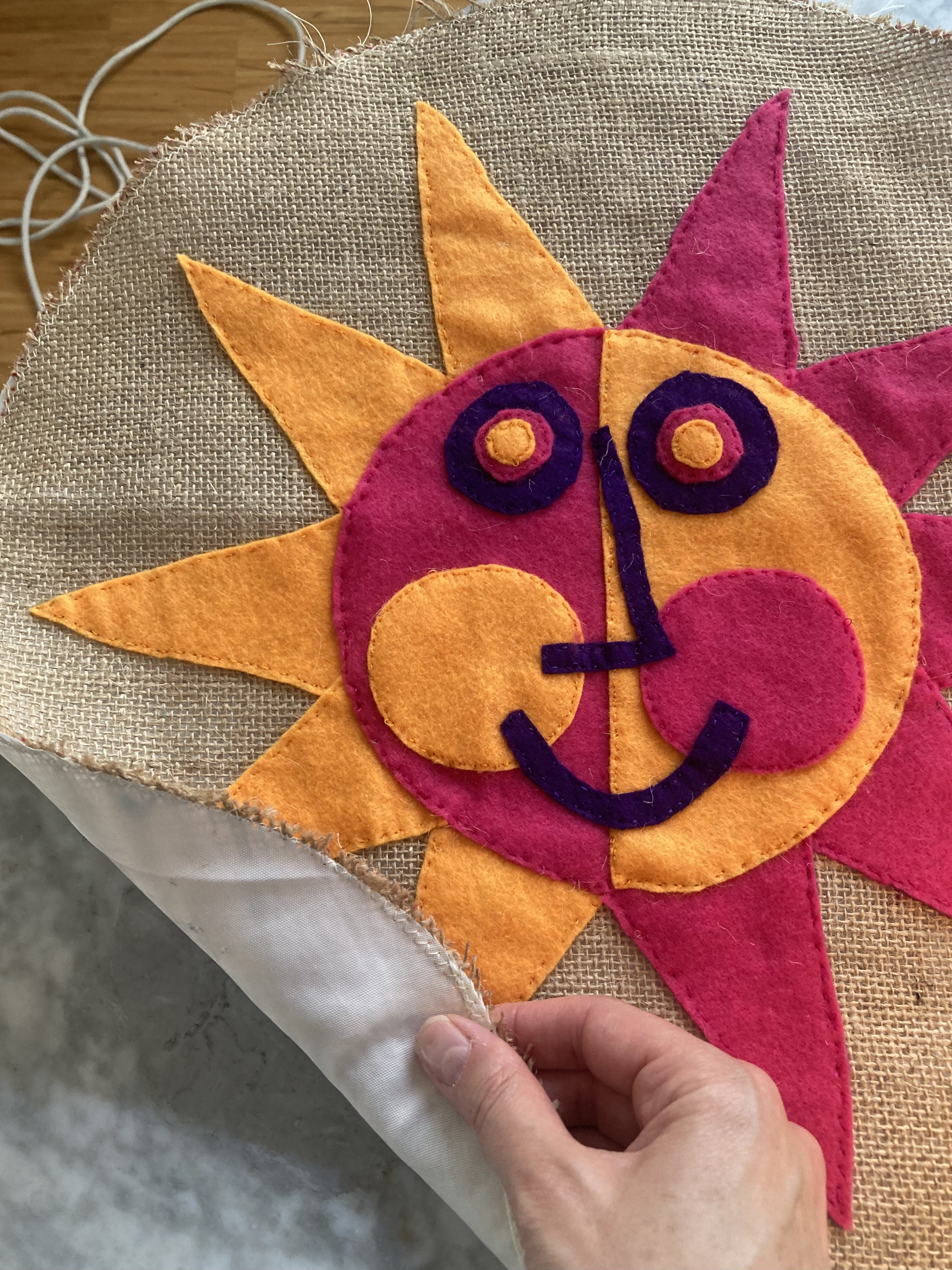
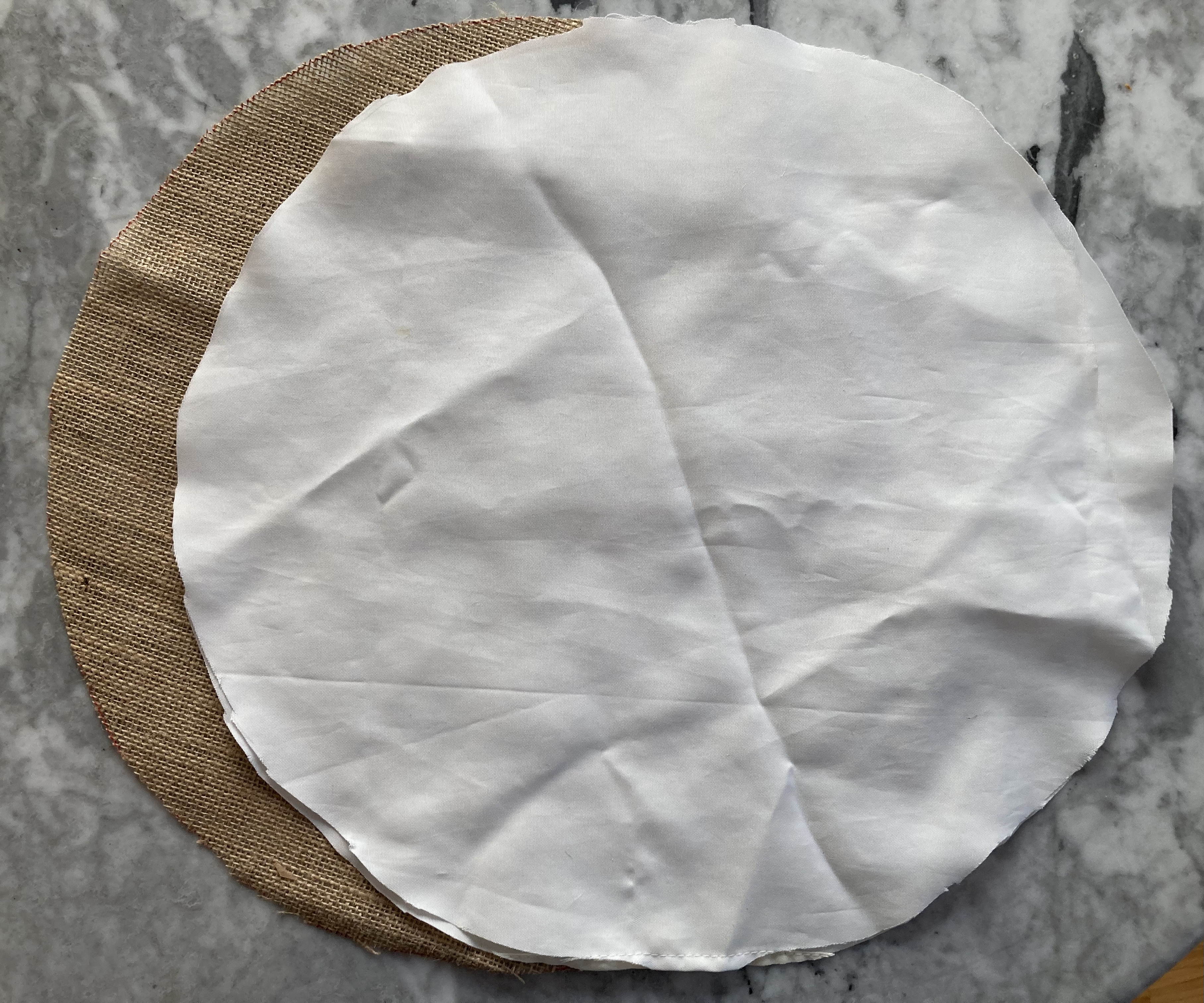
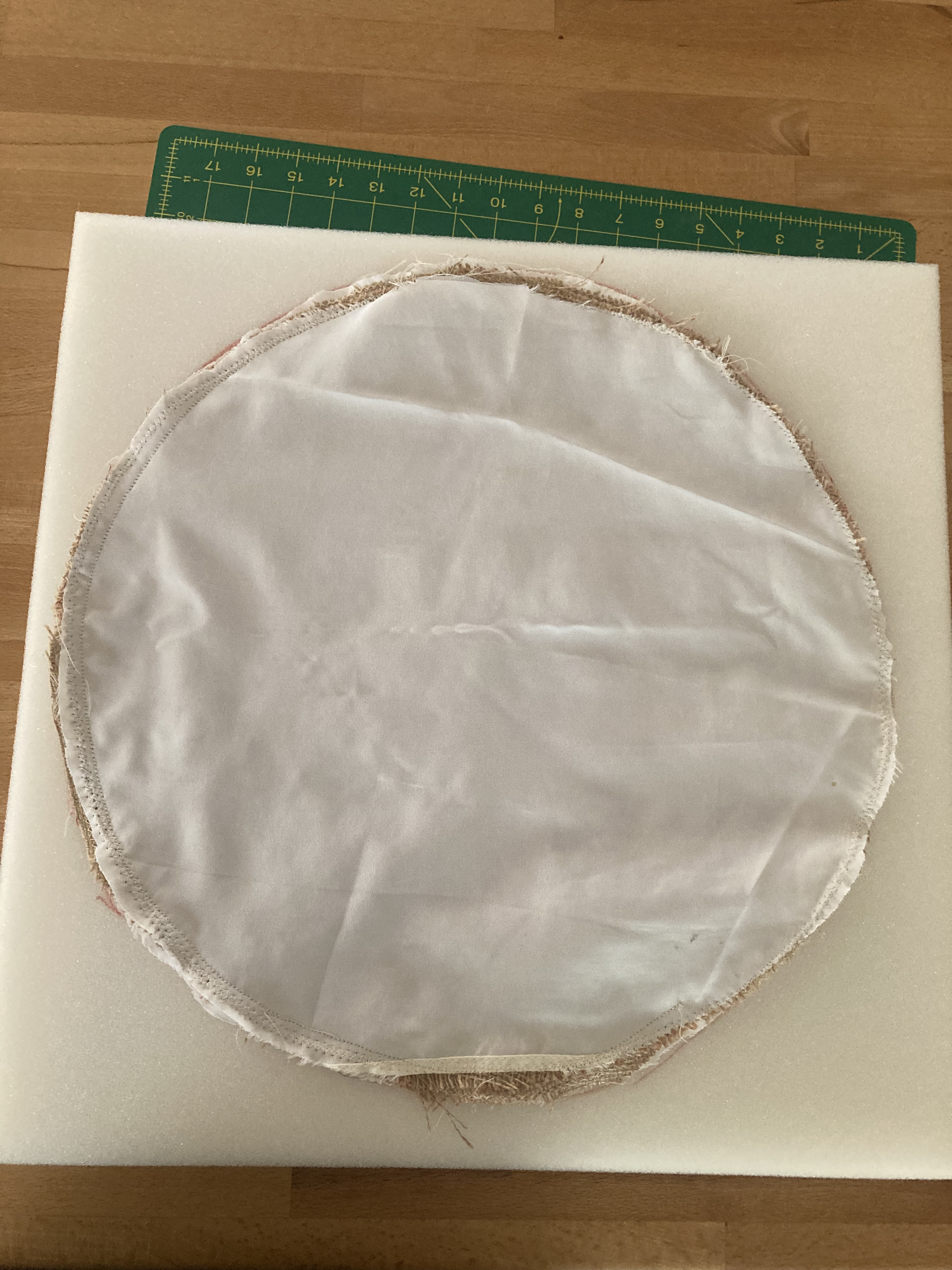
The hessian background is 17 inches in diameter. You were supposed to use a contrasting linen for the back piece, but I had plenty of hessian and no suitable backing linen, so I made both sides in hessian. Always the up-cycler, I also finally had a use for the old (well-cleaned) shower curtain in the craft drawer. I flat-lined the hessian with it, making the background fabric stronger and less see-through and, more importantly, protecting the inside of the cushion from getting damp in my rainy climate. Stitchcraft actually occasionally recommends lining “outdoor” projects with plastic in some other issues, and I had been looking forward to trying it out.

The inner pad is a piece of foam rubber that I ordered in a block and cut into a circle of the proper size with a carpet knife. It was not as easy to cut as I had imagined! I had to saw away at it quite a bit and the finished edge looked rather chewed, but it worked. As far as sewing it together… now, if I were really smart, of course I would have made the back circle in two pieces with an overlap in the middle, so the cushion would be removable. (It didn’t say to do that in the instructions, but it would have been smart!) Alas, I did not think of that option in time, so I kept the opening as small as possible and sewed it up by hand after putting the foam cushion in.
And it was done! WAIT, NO! After it was all finished, I took another look at the big photo in the magazine and saw that there was supposed to be a lot more decorative stitching on the “cheeks” and “rays”. Oh well! The cushion was finished and sewn up, so there it was. Note to self: if I make it again, I’ll stitch the appliqué on the machine with the decorative bits and organise the cushion back better. Still 100% happy with it, though.

I don’t have a garden, or even a balcony, so this will be a present for a friend.
P.S. Does it remind anybody of this classic anti-nuclear power sticker? (Though the logo design is later, from 1975.)
P.P.S. It was so cloudy and overcast the day after I finished the cushion that I had to wait another day to photograph it — there wasn’t enough light to get a good picture. As I write this blog, we’re having a thunderstorm. So much for sunny summer! At least the cushion gives me all the light and warmth I need.
Edit 15. August 2024: Here’s a photo of the cushion in its new home!

July 1966: Overview

It’s all about teamwork in Stitchcraft’s July 1966 issue: two-piece sets for casual, sport or city wear as well as matching designs for all members of the family. Appropriately for the theme and the season, the emphasis is on sports and leisure, with casual, loose-fitting designs.

Our cover ensemble pairs a checked, sleeveless top with a skirt whose pleated insets match the check pattern. The check pattern is stranded, and I hope the navy blue didn’t bleed into or show through the white at the first washing. It’s the dressiest of the designs in this issue, but still keeps a casual air with its loose, unshaped top and shorter skirt (hemlines are finally rising at Stitchcraft, long after the miniskirt became popular everywhere else) and the check pattern, which is reminiscent of a race-car flag. The “favourite continental look for casual wear” is a team of “overpull” (oversized pullover) and short-sleeved blouse with a polo (turtle) neck in matching colour.

For warmer days, there’s a trio of lightweight and/or sleeveless blouses: in a lacy striped pattern or textured rib in 4-ply, or a mini-top in eyelet rib. Pink, white and turquoise are fun ice-cream colours for summer and harmonise well with the maritime blue of the checked suit.

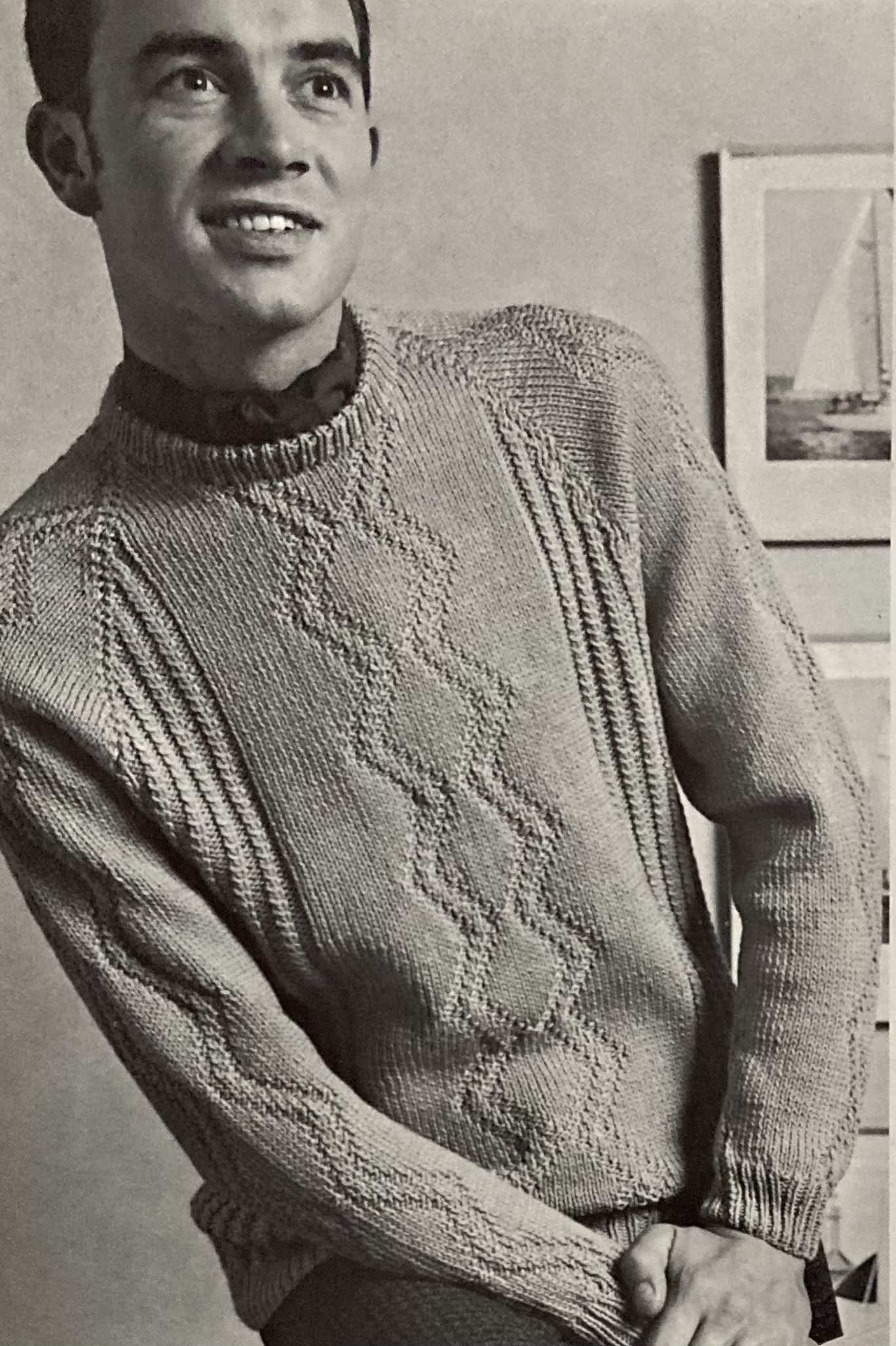
A high-buttoning cardigan in heavier DK is good for cooler weather. Twisted stitches are the summer knitting trend, seen in the cardigan as well as in the eyelet rib and the striped lace tops. Our male model teams up with a horse to show off his cleverly designed “Viennese sports pullover” in tan DK wool with white cable stripes going up and down the front and back as well as down the sleeves.

The ultimate 1960s team is, of course, the nuclear family, and this issue offers a design for (almost) everyone: a simple, casual pullover with a trellis pattern in three sizes. The trellis is formed by making a k2tog or sl-k-psso at the right point in the pattern with a yo right before it to keep the stitch count even. The purl stitches on the wrong side are worked into the back of the “made” stitches to close the yo holes even more and make the trellis stitches stand out. Here too, summery ice-cream pastels and neutrals are in: “Banana Cream” for him and light green “Linden” for her and the daughter.

I did say “almost” the whole family, right? The youngest members have their own designs. Junior’s play jersey in blue and white echoes the women’s check suit, but here the check pattern is made by slipping stitches and/or letting them drop and picking them up a few rows later. The baby gets its own “teamwork” set of matinee coat and bootees in pretty lace and moss stitch.

The homeware designs are pretty standard, but numerous and cover all the home bases. There are some easy floral cross-stitch and pulled-thread mats, a cushion and/or stool top in tapestry (a check design, once again) or a stitched rug in Florentine design. More ambitious tapestry fans can make a wall panel of boats at Norfolk Broads.

And for once, the “Summer Bazaar” designs are not weird! There’s a simple crochet tea cosy, crocheted lace coaster mats, or an apron and/or potholder set appliquéd and embroidered with cute images of vegetables. In the “Readers Pages”, there’s a reprint of a 1961 pattern for a knitted pram blanket, and Eustace the elephant gets very startled when he tries on a pair of spectacles and suddenly sees Mark the mouse in larger-than-life size.

That’s all for this issue! Since I didn’t get around to making the sun cushion last month, I’ll make it this month. (Technically, it’s sort of part of this issue as well, since it photo-bombed the picture of the ribbed polo blouse.) And nothing else from this issue really called to me. Sunny days ahead, and may your team always win.

June 1966: Overview

Colour for High Summer! The trending colour in Stitchcraft’s June 1966 issue is turquoise, and “High Summer” means casual, easy knitwear in washable synthetic yarns for holiday travel. Let’s dive in!

The knitted fashions are high-necked but loose-sleeved, knitted mostly without shaping in textured stitch patterns. Our cover cardigan is made in turquoise “Courtelle” synthetic wool with a pattern made by increasing and decreasing in the same stitch to create a sort of flattened bobble over multiple rows. There’s a white pullover with a bold intarsia turquoise flower, a his-and-hers white cabled rib for seafaring holidays, or sporty numbers for playing tennis in a dress shirt and tie. The colourwork pullover is also made in turquoise and white, and the sleeveless men’s tennis top in blue.

For warmer days, there’s a heavy-knit, but sleeveless and lacy, “jaunty beach top”, or a choice of two pretty T-shirt tops. The basketweave-patterned top is also blue, and the diamond-patterned top in “Banana Cream” beige — the colour trends are very clear. The last two tops are made in finer, 3- or 4-ply wool, but also make use of synthetic yarns like the wool-nylon “Nylox” three-ply used for the basketweave top. You can complete the outfit with one of two crocheted hats: pillbox style or with a corded brim, both in heavy “Capstan” wool.

Children can enjoy their holiday in a striped play-shirt with matching “overpull” or a bobbled cardigan and pleated skirt (though the skirt, like so many fashions for little girls, is quite impractical for any kind of actual playtime.) The cardigan features an interesting two-colour pattern made by dropping a yellow stitch down three rows and picking it back up together with three white loops. Interestingly, the children’s patterns feature neither turquoise nor blue of any kind, but are made in bright yellow and white or more subdued stripes of grey and light red.

Homewares are fun and easy, starting with a knitted “World Cup Willie” car rug. The 1966 FIFA World Cup football (soccer) tournament was held in England in July 1966, and “World Cup Willie” was its official mascot. England won the trophy that year, beating West Germany in the final match 4-2, so I guess Willie was indeed a bringer of good luck. Personally, I am much more interested in the Stitchcraft model’s dress, hat and shoes than Willie or the World Cup — I want that entire outfit! The rug is made in heavy “Big Ben” wool and a sturdy moss-stitch pattern, with the “Willie” motifs worked in intarsia technique from a chart included in the magazine issue.

Moving on, there’s an embroidered wall panel to commemorate the 900th (plus a year) anniversary of the consecration of Westminster Abbey — we haven’t had a commemorative wall panel for a while, so that’s a nice plus. As always, there are chair-accessories and cushions, this time with delicate embroidered satin-stitch poppies in wool on linen, or a very 1960s happy smiling sun worked in felt on Hessian/burlap fabric for tough use in the garden.

You can also make a beach bag from towelling material gathered with “Rufflette” curtain tape, or sew an easy sundress for a small child — basically a big rectangle of fabric gathered and sewn at the shoulders — and embroider a lucky fish on the pocket. Speaking of lucky fish, how about this masterpiece of 1960s advertising copywriting that accompanies a photo of a woman “caught” in a fish net? It’s all happening at your local Scotch Wool Shop.

That’s all for high summer! My project will be the sunny garden cushion, and possibly also the basketweave top.

May 1966: Cushion For the Nursery

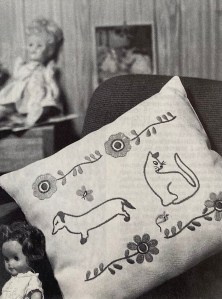
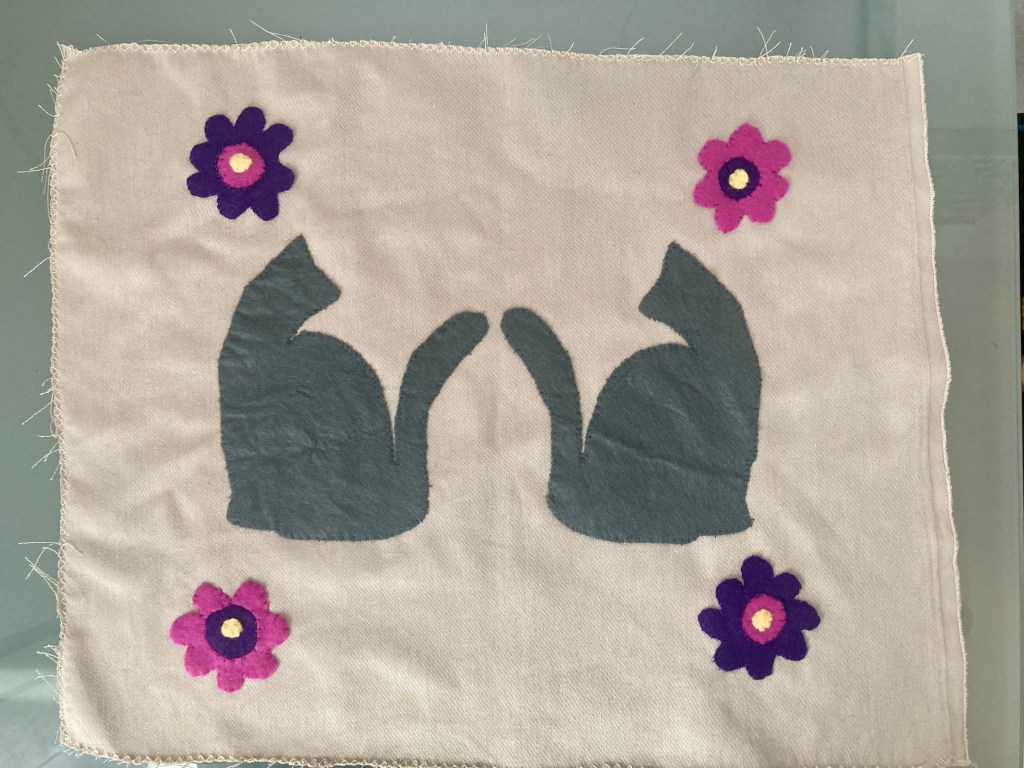
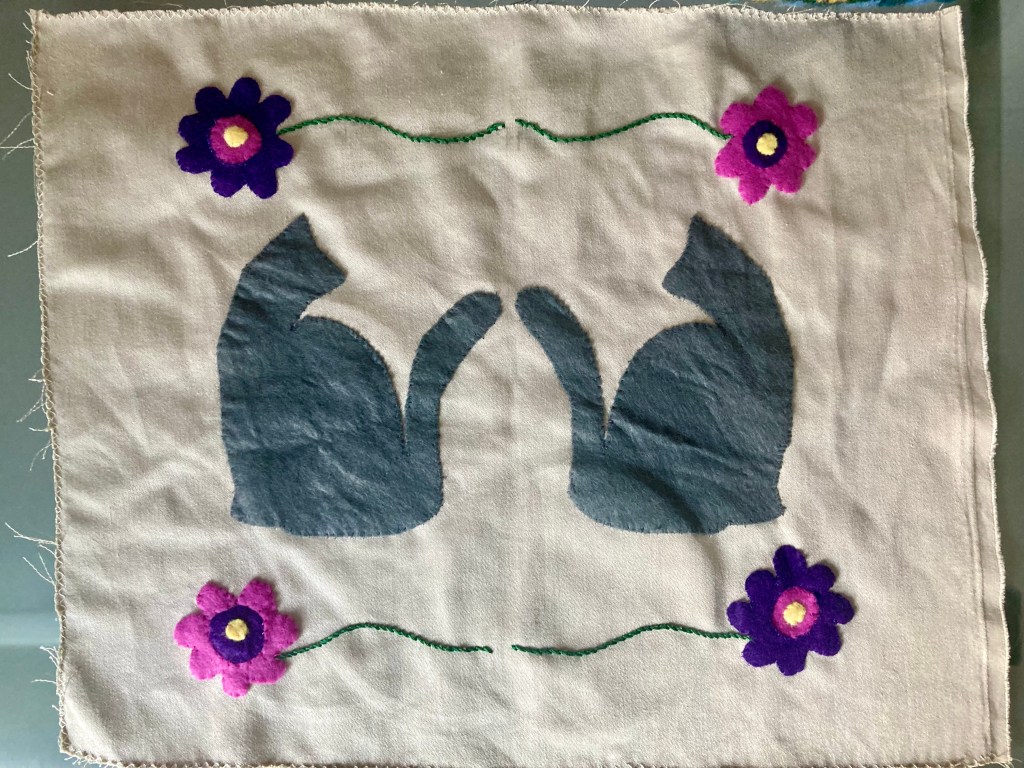
My May 1966/May 2024 project was based on an adaptable project “for the nursery” featuring cute little animals and flowers. The pattern as offered in the magazine could be used to make either a wall hanging in felt appliqué, or a cushion in wool embroidery. I chose to use elements of both designs and made a cushion in felt appliqué.

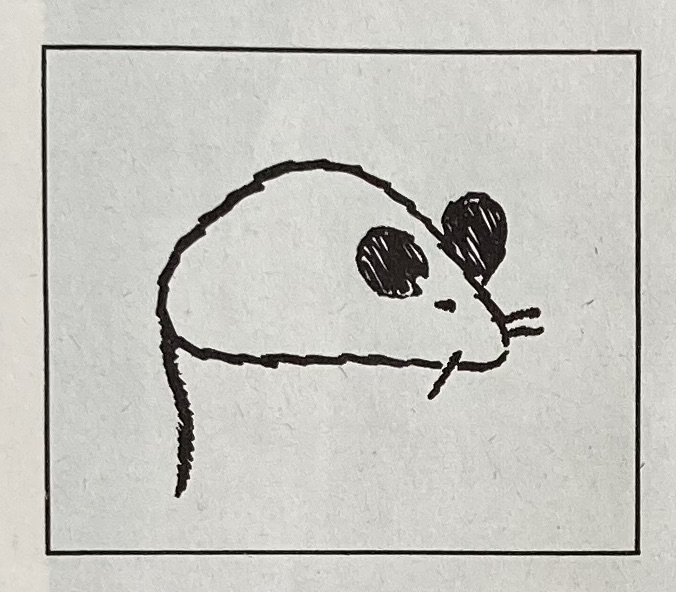
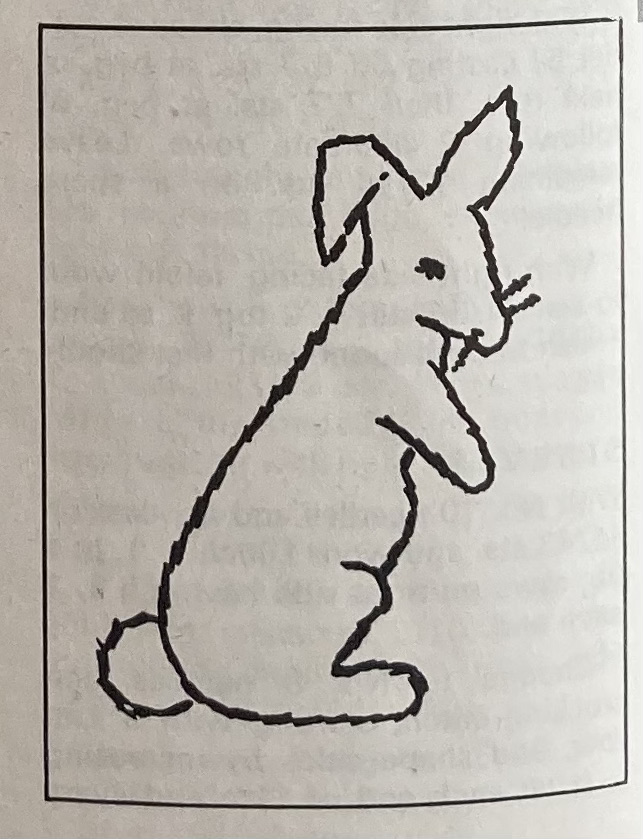
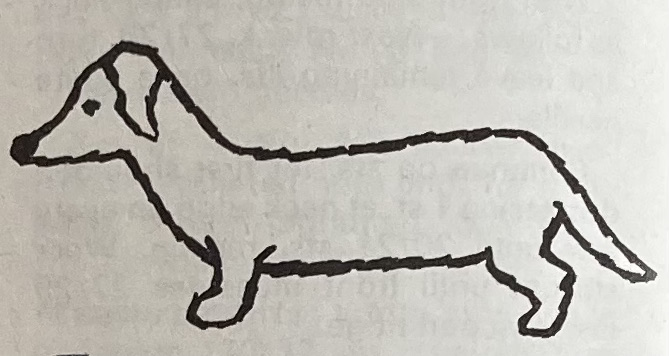
As always, the transfer was not included in the magazine — readers had to send 1/10d to Stitchcraft and received the transfer post free by mail. Obviously, that would not work now, as Stitchcraft is no longer published. Happily, the animal and flower shapes are quite easy to copy and individual illustrations of the dog, bunny and mouse are printed in the magazine.

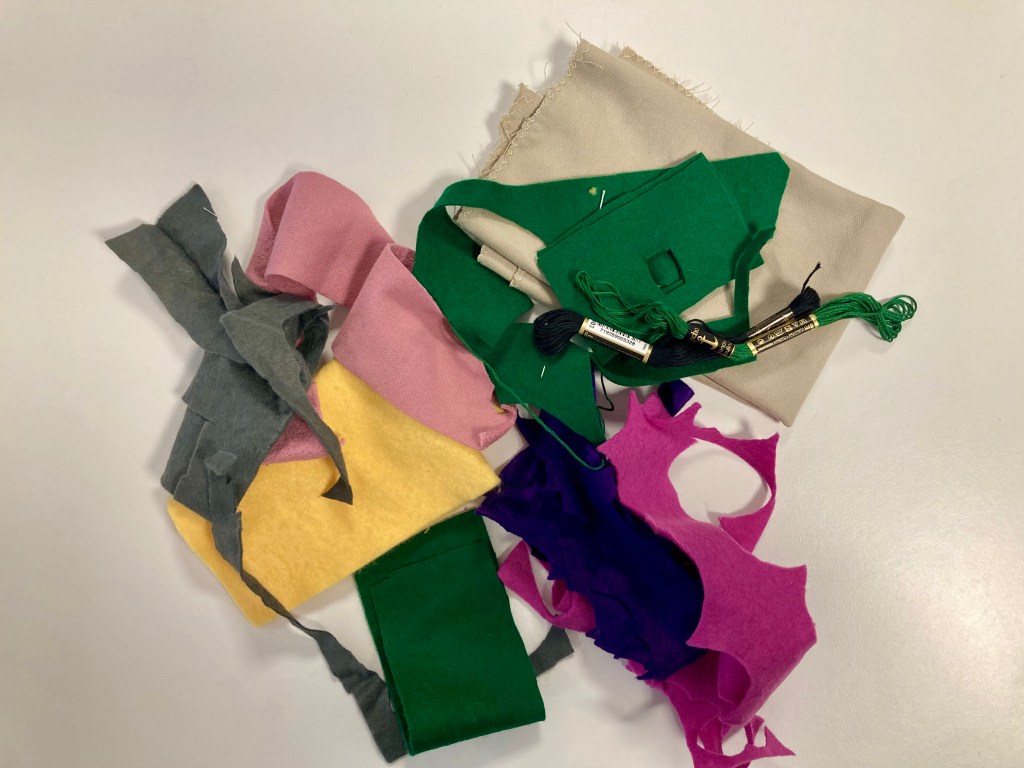
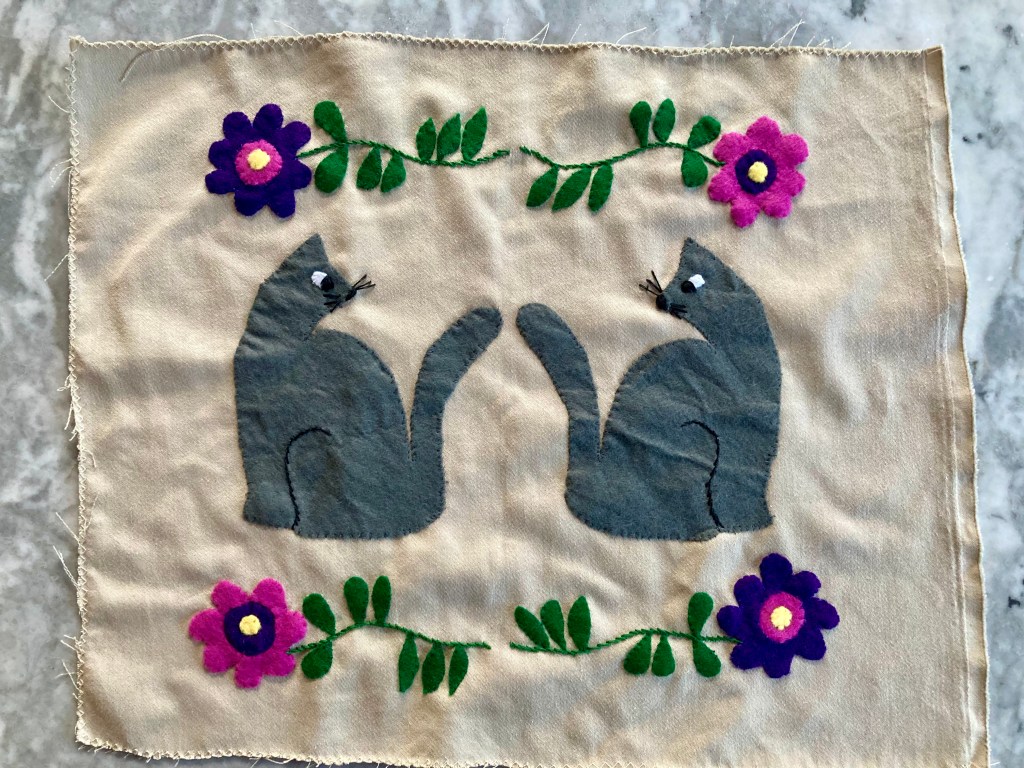
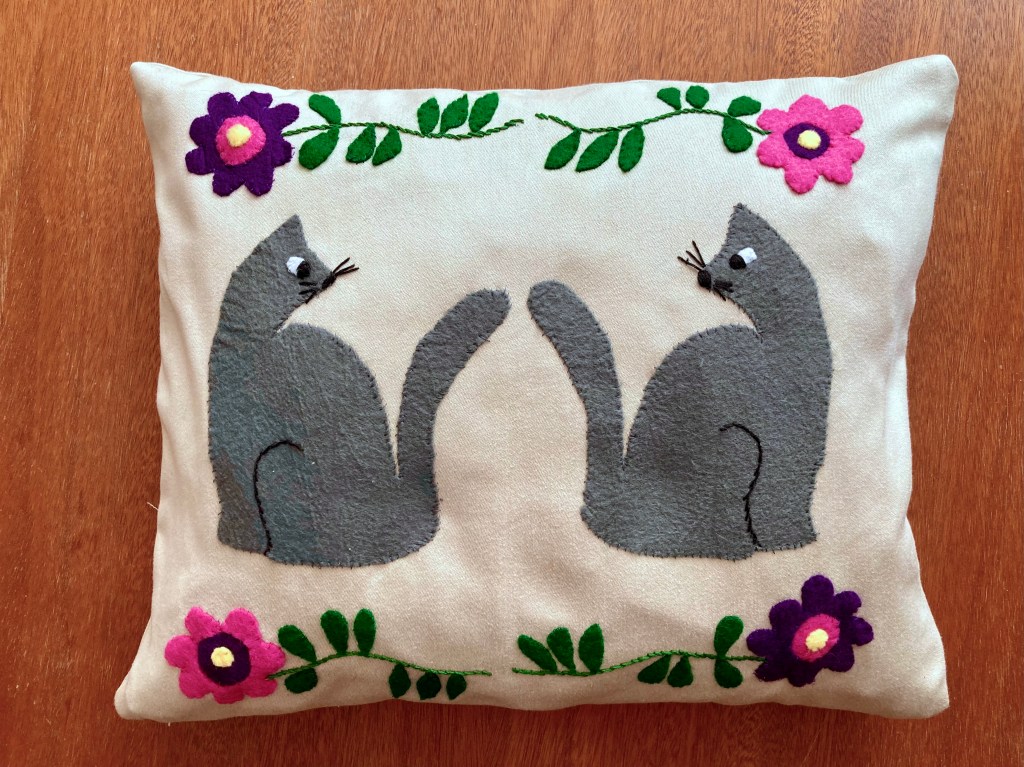
Both the appliquéd animals in the wall hanging and the embroidered outlines on the cushion are intended to be made with non-realistic colours (the rabbits are blue and magenta, the donkey gold, the cat jade green, the dachshund magenta, and the mouse bright pink). I chose more realistic colours based on what I had in my felt-scrap stash, and I like cats, so I made two grey cats looking at each other over their shoulders. I had enough purple, magenta and yellow felt left over from the last appliqué cushion I made to make the flowers. I made the cushion cover itself in a natural-coloured linen, as intended in the pattern, and the inner cushion in leftover white and beige fabric from other projects.

The appliqué work was quite easy and pleasant, even the tiny leaves of the flowers. The flower stems are embroidered in stem-stitch. I was nervous about making the cat’s eyes (white felt embroidered in black) as the expressions can be very tricky, but I think they turned out quite nicely. Since I was on the road for most of this project and didn’t always have access to my sewing machine, I put in the zipper by hand, which worked out fine.

And there it was! I love making cushions and would make more of them if I knew what to do with them after they were done. I have more cushions than space already for myself, and this particular design, although extremely cute, is a bit childish even for my playful decorating style. Luckily, I have friends with small children, and this cushion will go to one of them, who is currently decorating her three-year-old’s room. I hope he likes it! I am certainly quite happy with my happy cat cushion and I think he will be too.

May 1966: Overview

It’s finally Spring!

We had a terribly cold April where I live, with rain and gloom and the sense that spring would never come. I had switched out my winter and summer clothing as part of spring cleaning last week and it all felt wrong. Then, all at once, two days ago, winter ended, the sun came out, and temperatures doubled. Perfect timing for the “Summer Plans” in the May 1966 issue of Stitchcraft!

The May to August issues always have lots of projects for travel and holidays: little summer tops, quick bulky jackets and sweaters for cooler weather or sailing holidays (aka normal summer in a temperate/maritime climate) and easy homewares to make in a deck chair while lounging about. The pullover on the cover is made in DK wool, so relatively warm, but with a lacy front to keep it airy. The photo is also almost an exact copy of the March 1966 cover photo! Apparently yellow is still trending.

Other women’s garments include a ribbed and a plain polo-neck jumper designed on “skinny lines” — the ribbed number is a special design for extra-slim Twiggy figures with a 30, 32 or 34 inch bust. For “figure-plus” sizes, there’s a summer blouse in bouclet wool with a wide, rolled collar and chequerboard lace pattern. There’s a plain DK cardigan in a range of average sizes to round out the tops, and an easy crochet dress with “practically no shapings”. High necks and clean lines are in, and stitch patterning is kept to a minimum in favour of little details of colour and finishing — see the smock-like embroidery on the “skinny” jumper, or the twists of colour on the collar and cuffs of the polo-neck. Colours are light but bold — light blue, white, green, yellow and pink.

The other members of the family are well served in this issue too. There’s a men’s “country pullover” in a zig-zag stitch pattern, as well as a bouclet “tennis shirt”, both in neutral colours of “Alabaster” and “Brandy” — even the names of the colours fit the image of 1960s masculinity. The “young fashion” set can have fun in a striped and belted mini-dress. Stitchcraft informs us that the “Young Colour Choice is mid grey and white”, which is interesting, considering that the adult women’s fashions are all quite a bit more colourful. Younger tots can make “Seaside Plans” in a t-shirt-and-trunks set for a boy or a little knitted dress and head scarf for a girl. (Why no trunks for the girl, whose dress is going to fly up over her as soon as she starts digging in the sand with that bucket?)

There are some nice child-appropriate homeware designs as well, starting with a thick, warm pram blanket in blue and yellow (to match the mother’s jumper!) The pattern is a herringbone tweed alternated with cable panels and the finished blanket is edged with satin ribbon. Then there are some wonderful decorations “for the nursery” featuring friendly animals and flowers. You can work them in felt appliqué on a wall panel, or in wool embroidery on a cushion. The animals are so cute! I love how the cat is both guarding its mouse and disdainfully looking away from the dog on the cushion. Whoever designed this obviously had a cat.

The normal homeware items are, well, normal: two different flower tapestries for a wall panel, the smaller of which can be used for a spectacles case; a tapestry chair seat, a stitched rug and waste-paper bin cover in an easy geometric pattern, a beach bag with beachy motifs (anchor, shell, beach grass) to embroider, or, for people who don’t like to relax on their holiday, a pair of intricately crocheted trolley cloths in a star design.

Saving the best for last, there are designs for two oversized, tall hats. The knitting itself is very easy, but the making-up is complicated, with lots of stiffening in the lining to make the hats stand up off of the head. It feels like Stitchcraft is finally getting into the “fashion fun” era of the 60s, albeit a little late and still pretty conservative.

In the back pages, there’s a teddy-bear motif to knit or embroider and instructions on how to make a pom-pom (two cardboard circles). Eustace the elephant from the children’s comic has eaten delicious buns for tea and helps a mother duck encourage her son to learn how to swim. Finally, “Slip Into Orbit” with these “deliciously private-eye-catching” undergarments from the Scotch Wool Shop! The space age has arrived and we are going to celebrate by wearing pretty underwear.

My project this month will probably be some variant on the animal/flower appliqué or embroidery. Enjoy the Spring!

December 1965: Overview

Here it is — the 1965 “Christmas Number”! December at Stitchcraft is always a month of “quick” holiday trimmings and small gifts, mixed with warm winter clothing and party ideas.

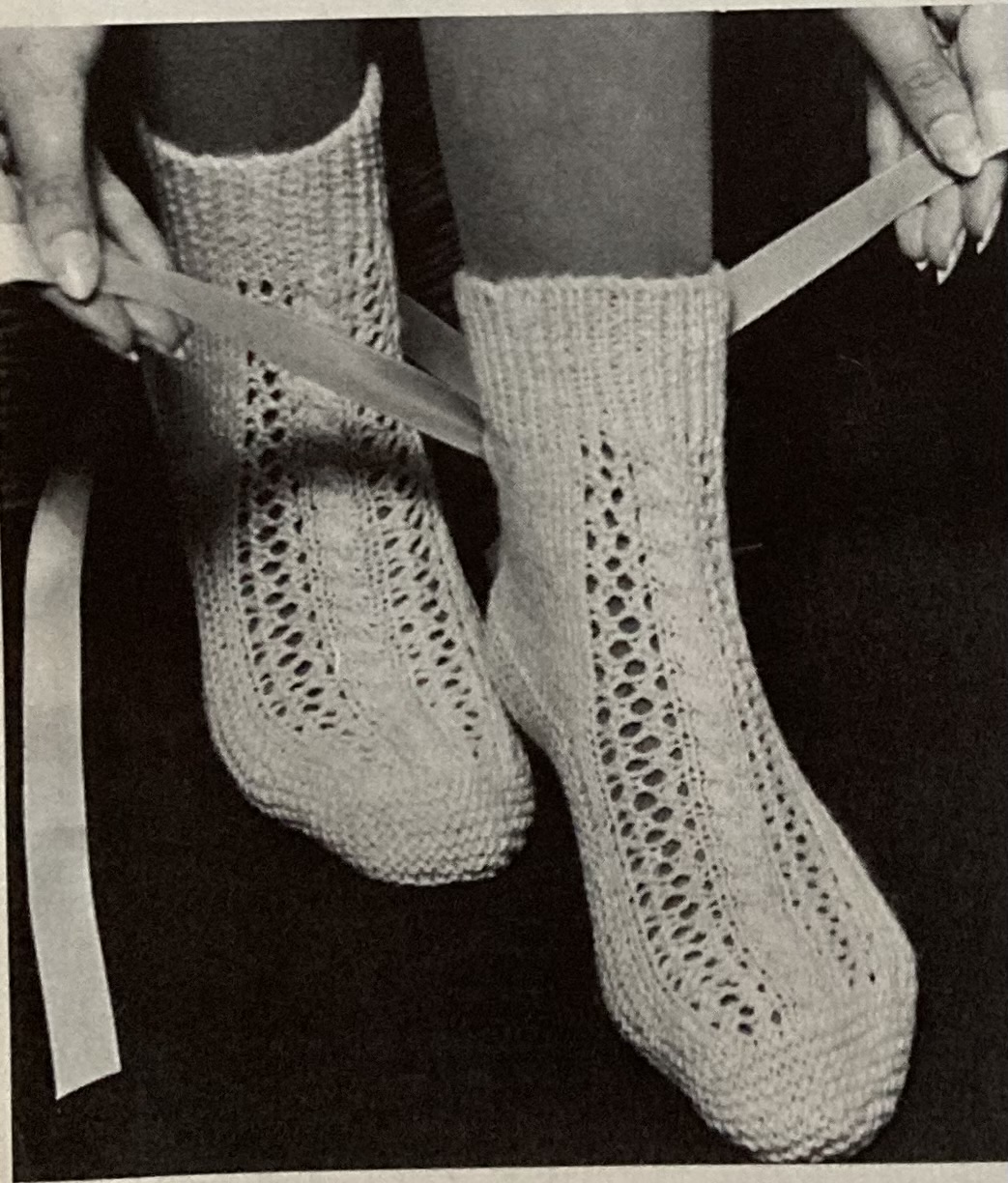
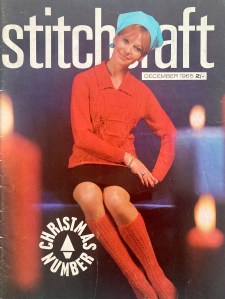
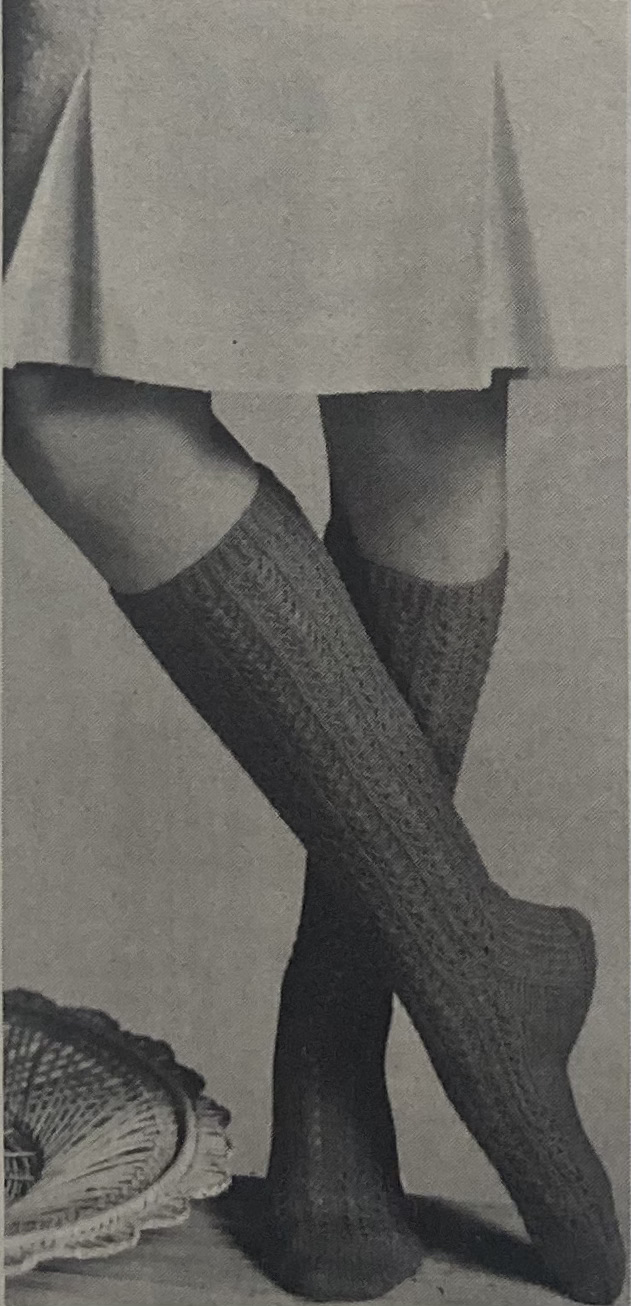
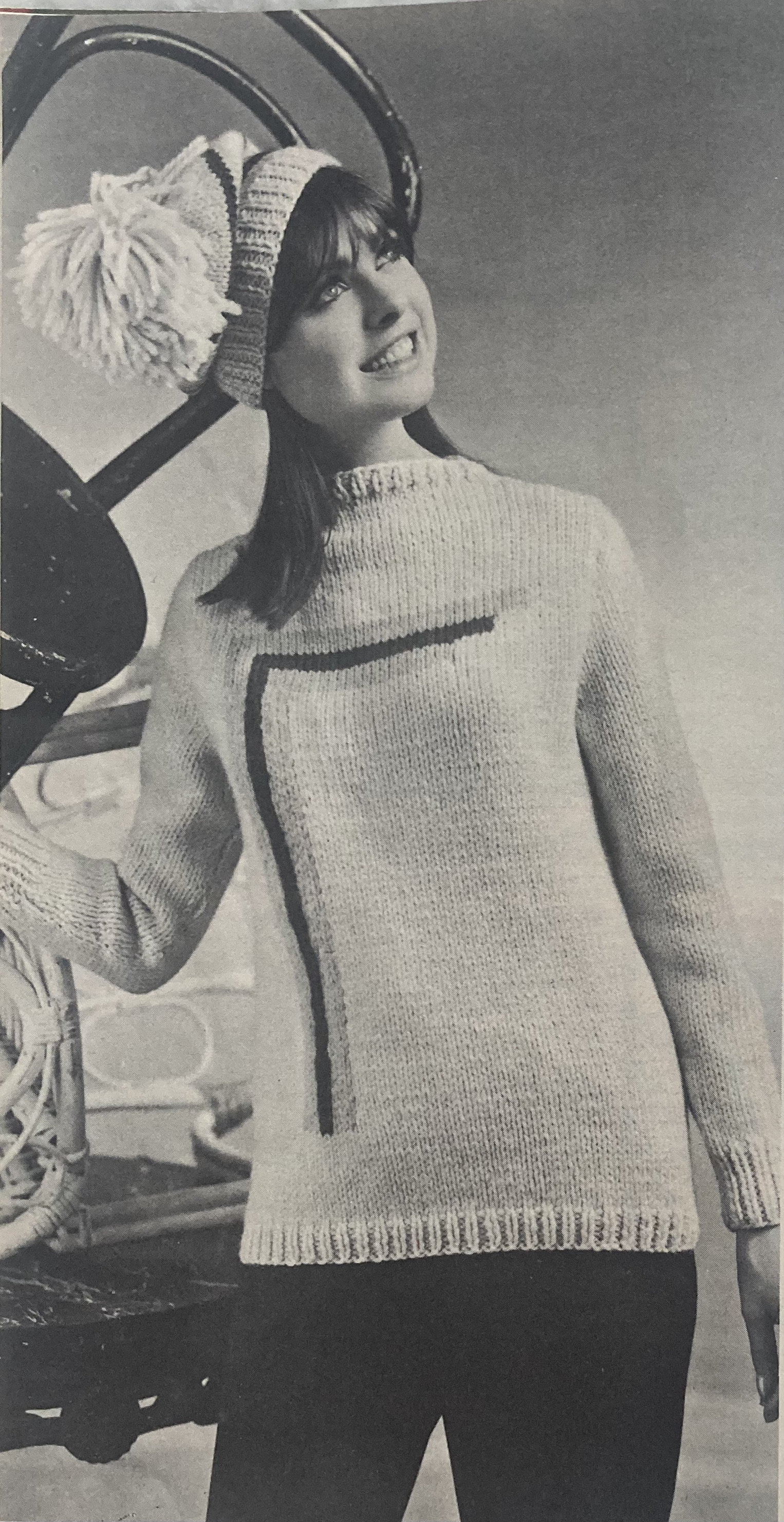
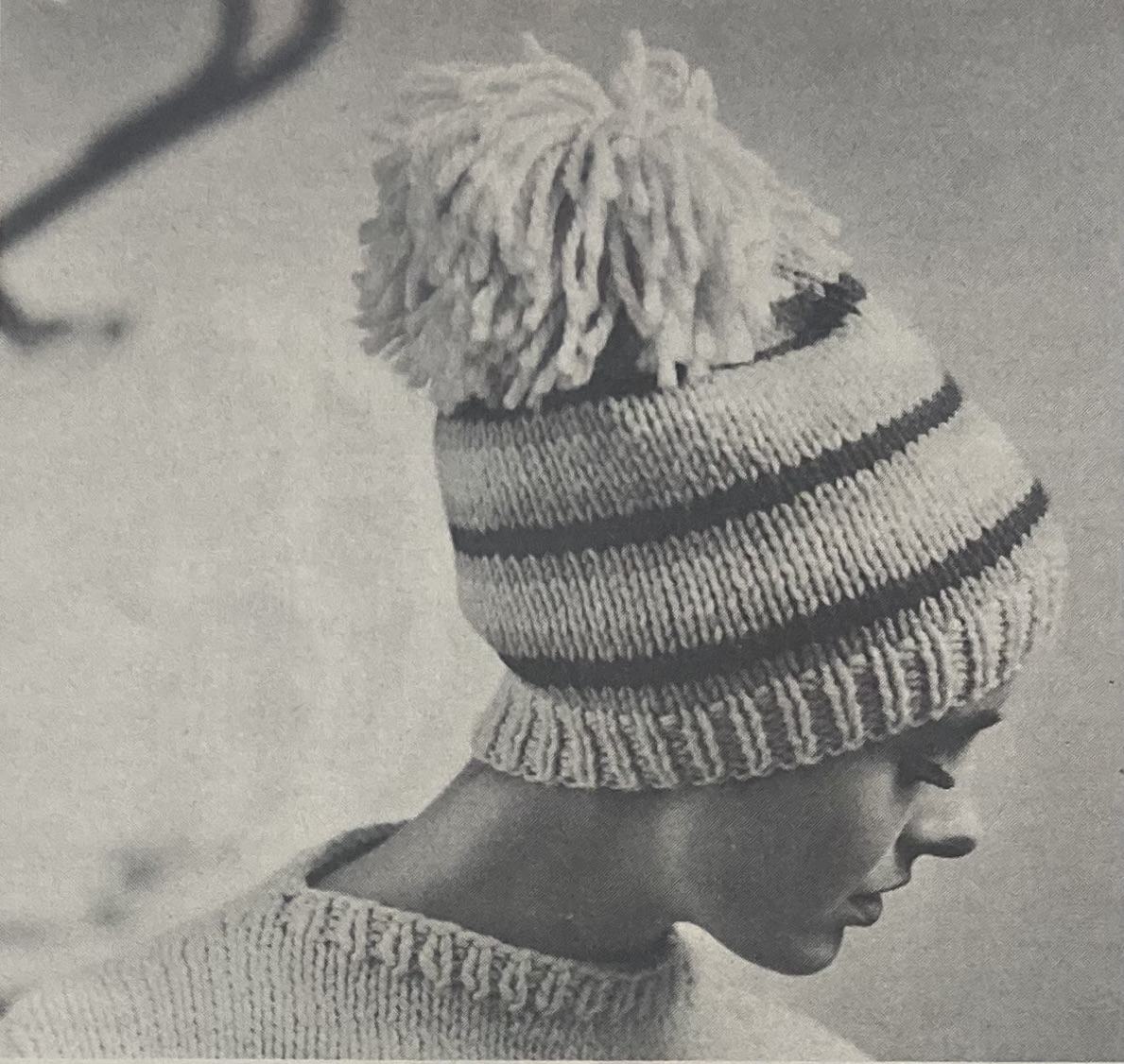
Our cover model is wearing a cable-block pullover (with non-crossing cables) in bright red double-knitting weight wool and matching knee-high socks in a lacy rib pattern. The caption on the pattern page is “Fashion feels Young” — Stitchcraft is finally getting into the children’s-fashions-for-adult-women idea that influenced so much of mid-60s fashion. Note the short skirt on the cover model, along with the knee-high socks, the playful kerchief and the big straw hat accessory in the black and white photo. It’s not quite Twiggy or Mary Quant (spoiler: Stitchcraft was never that fashion-forward), but it’s starting to show their influence. “Young Fashion” fun is reflected in the matching cap and pullover set as well. Look at the enormous pom-pom on the hat, outdone only by the model’s fake eyelashes!

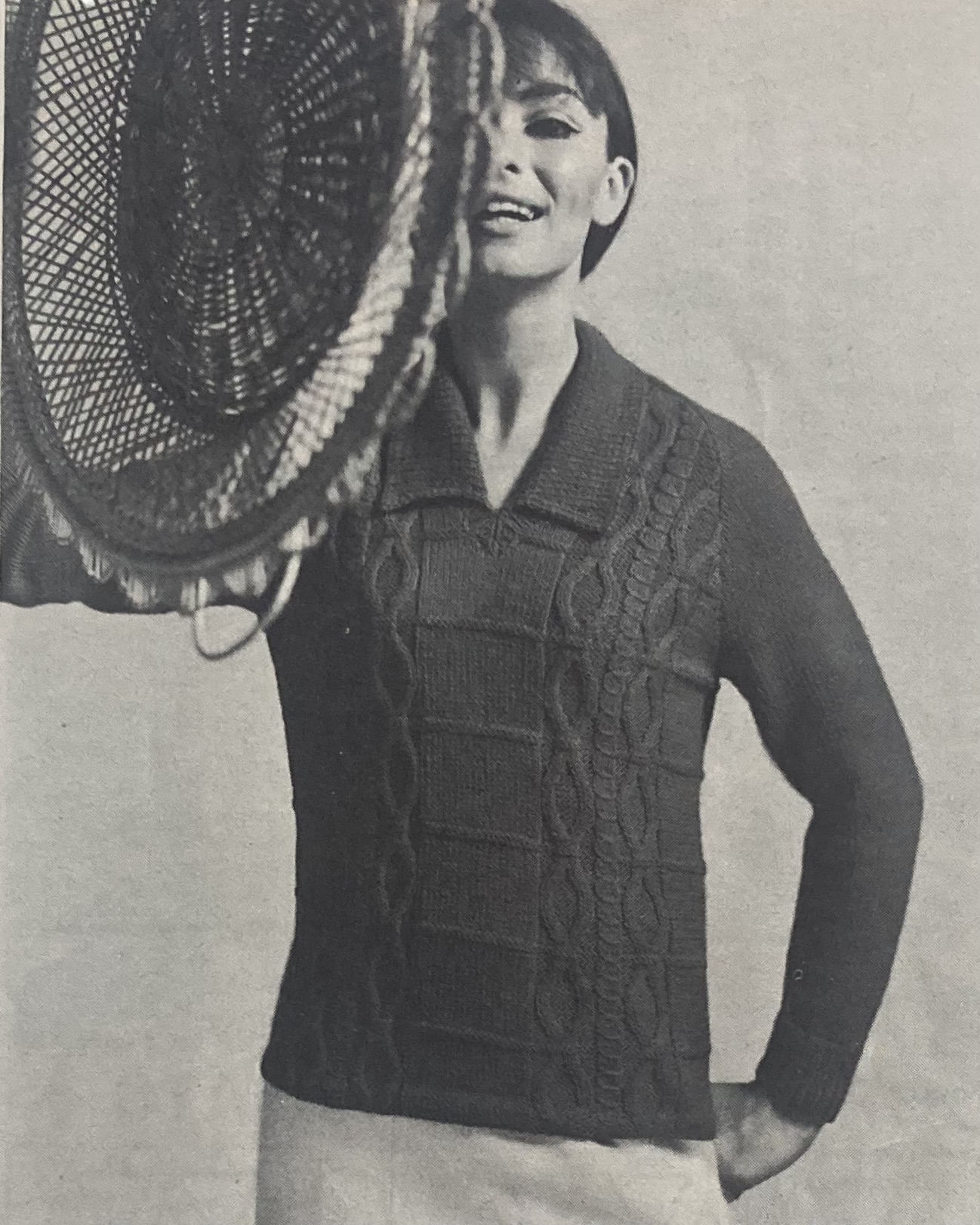
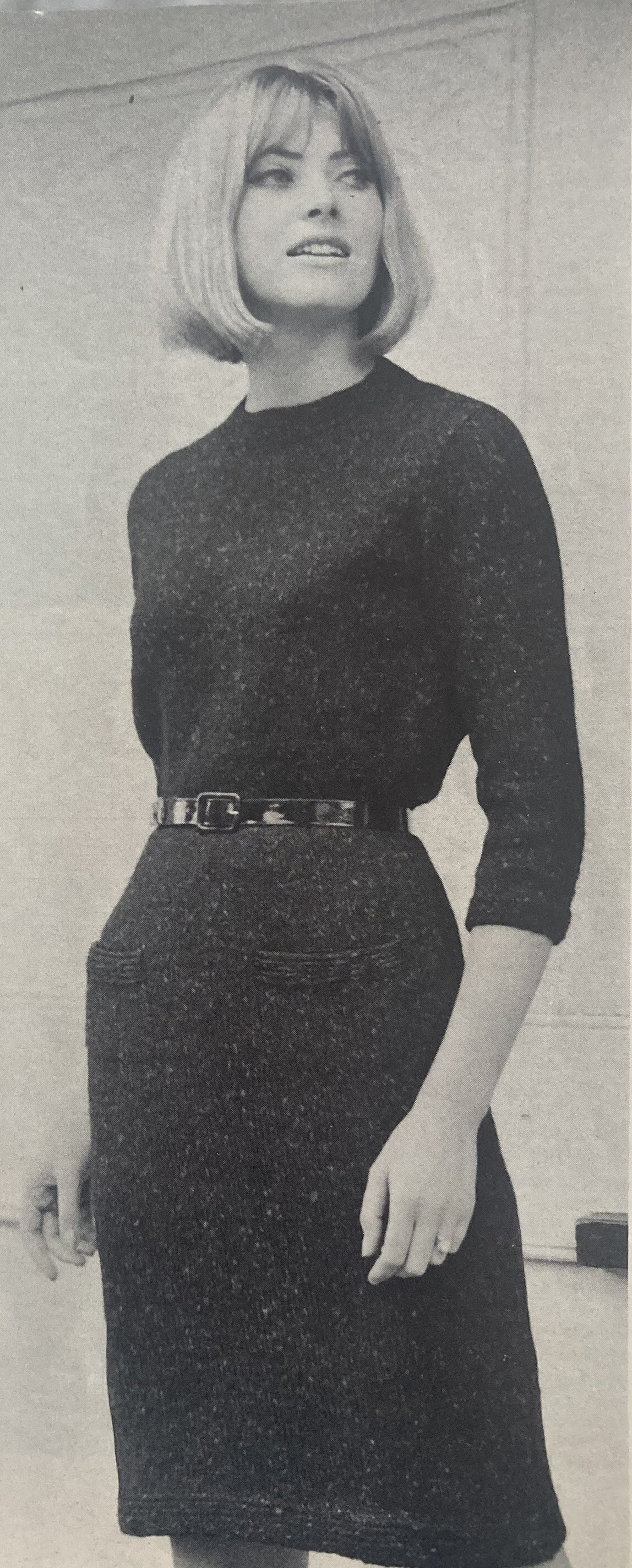
The other women’s fashions in this issue remain conservative: a warm tweed dress made in two parts sewn together at the waist (thus the obligatory belt), a cabled cardigan for larger sizes in thick, undyed “Capstan” wool, a lightweight wool jumper and swingy knee-length skirt in a “gay note” of blue or a “harlequin” pattern jumper in “bold” 1960s colours of white, gold and brown. I feel exactly the same way as the model in the colour photo when I finish a project and find that perfect gift on the same day.

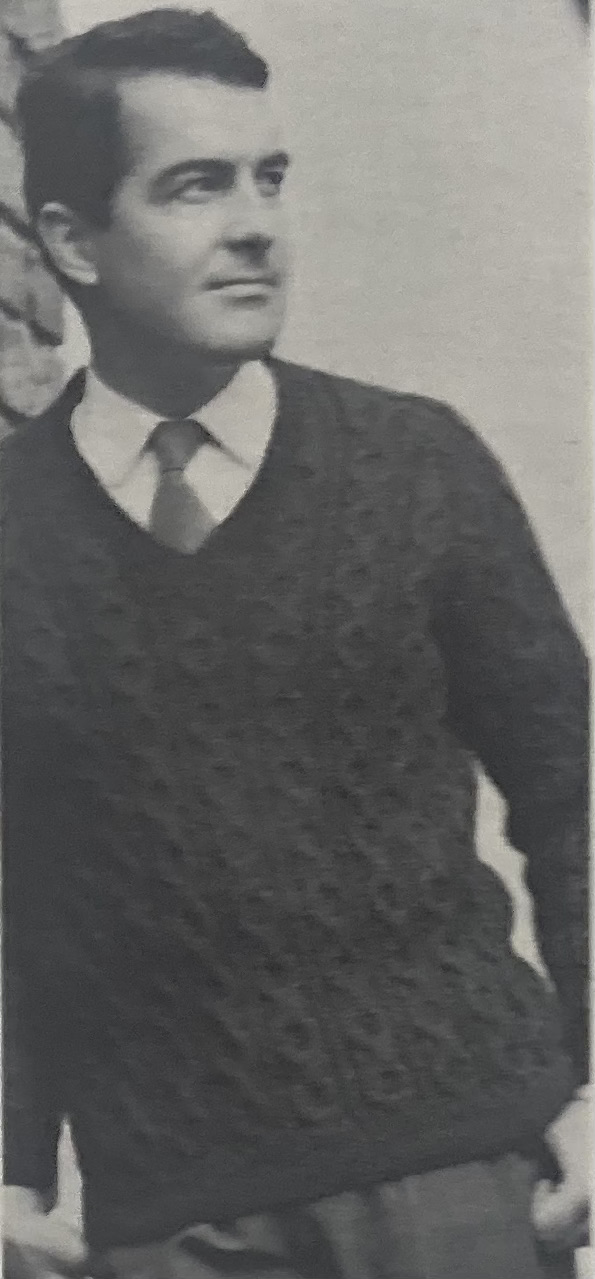
Men can get a cabled pullover in a glorious shade of purple tweed and the reassurance that cables are manly (like our model’s eyelashes, which are almost as impressive as his colleague’s with the pom-pom hat). There’s a boatneck pullover in herringbone stitch as well, meant to be worn over a simple polo- ( aka turtle-)neck jumper, for which a pattern was given in the previous issue.

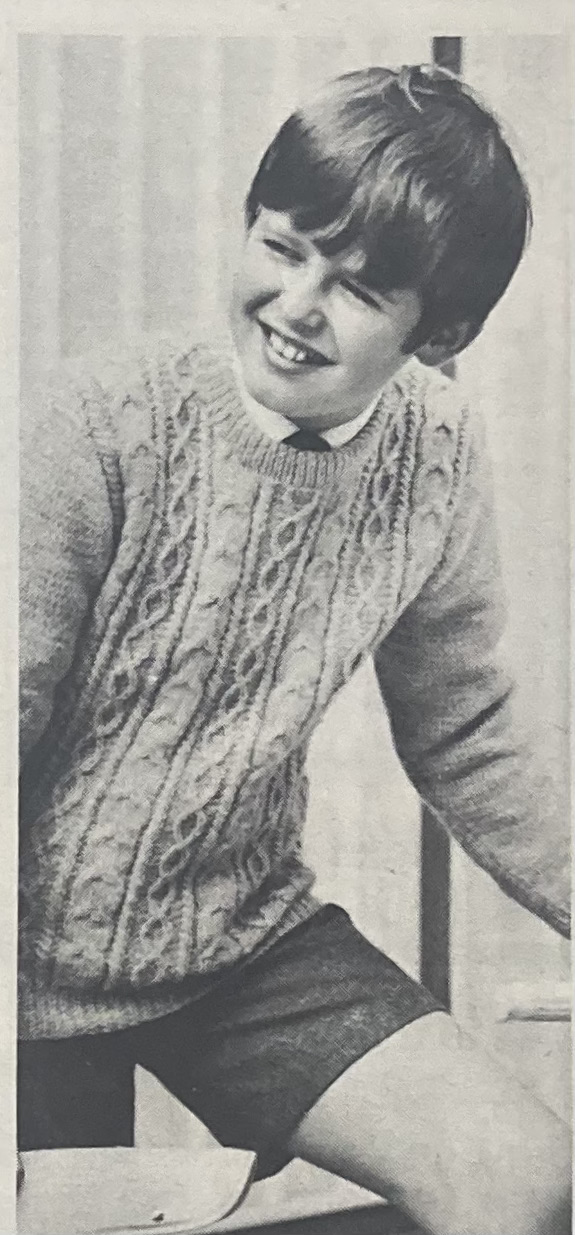
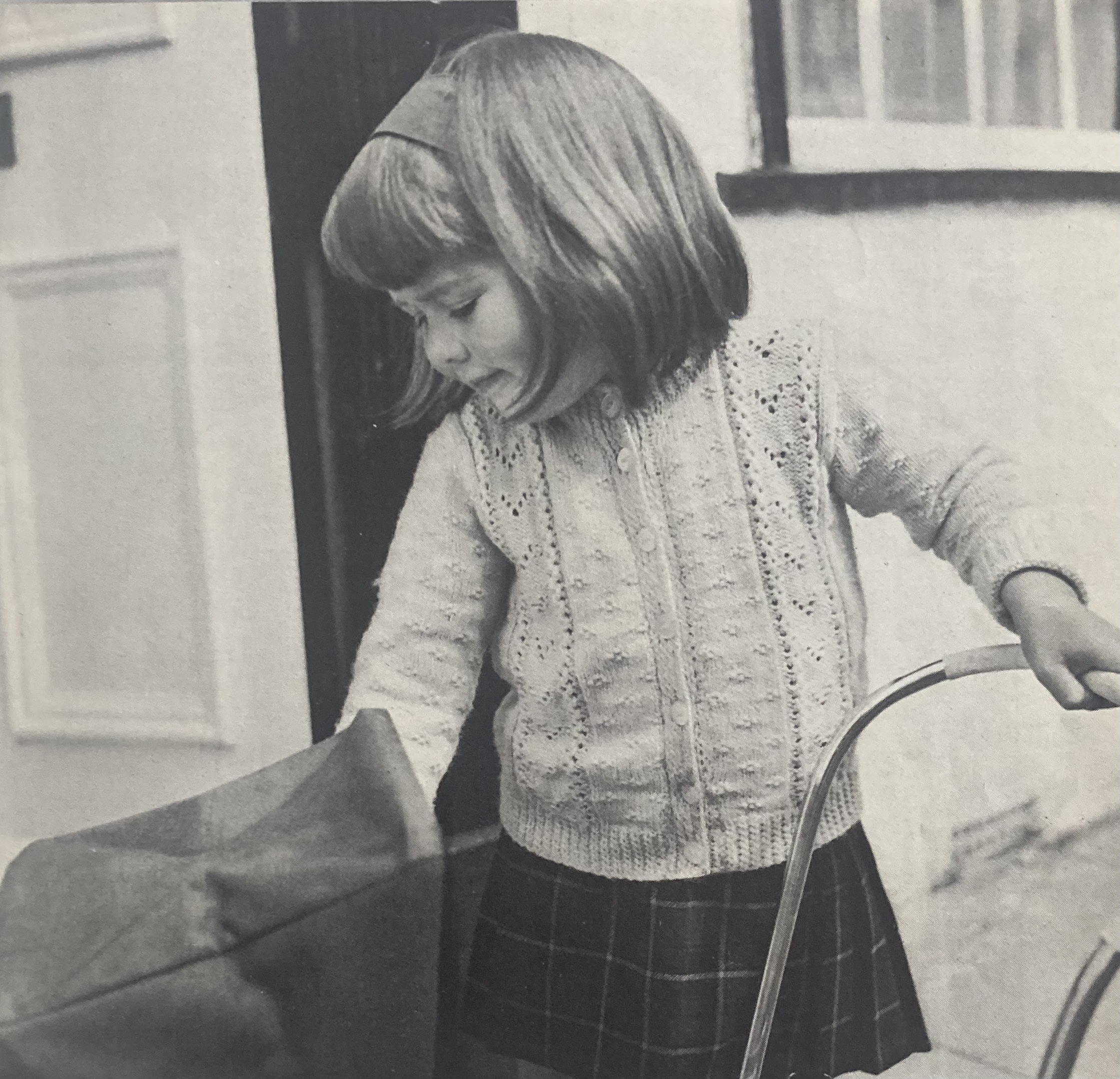
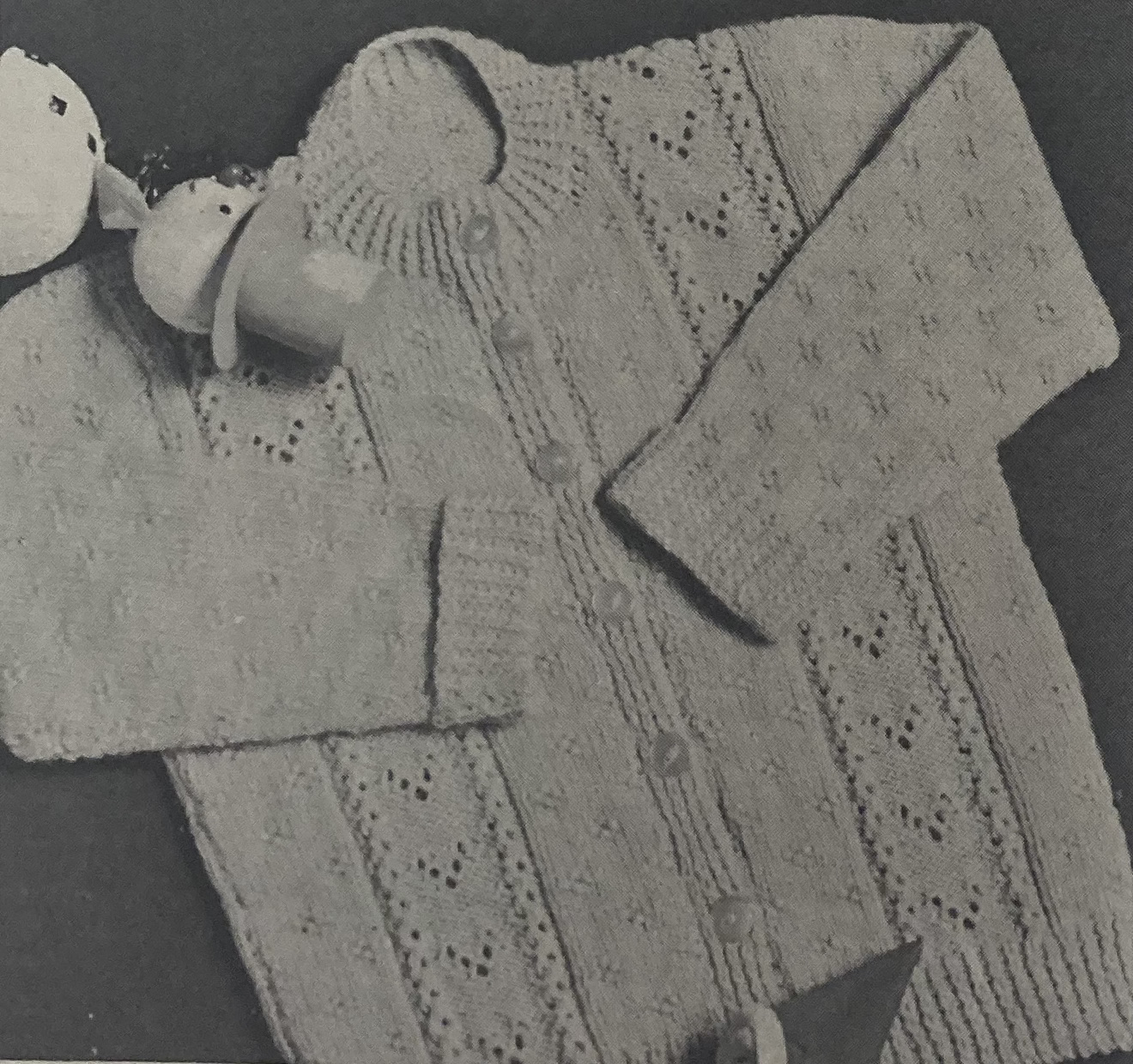
The manly-cable idea is continued on a lovely warm pullover for boys, and his younger sister can get a button-up cardigan in a frothy textured stitch pattern, made in synthetic-wool “Brilliante” for easy washing. Younger tots can enjoy warm ears with a chin-strap “helmet” hat that is guaranteed not to fall off or get lost.

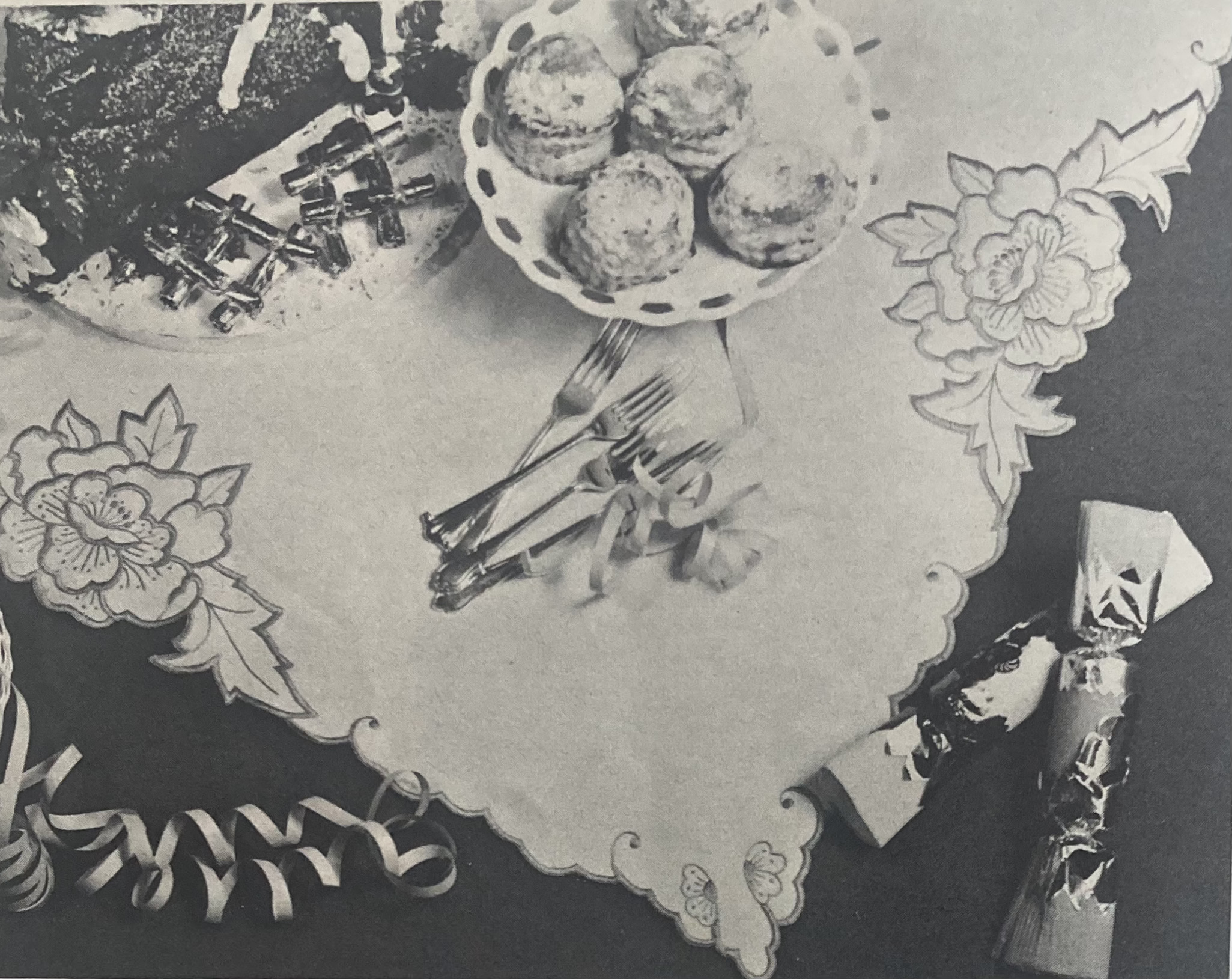
The real focus of the issue is of course, Christmas preparations. Felt appliqué makes a big appearance this year, with place mats and name cards for the holiday table as well a winter-scene wall hanging. The appliqués are quite simple and designed to be used with scraps, and the instructions give ideas on alternate uses such as glueing the felt pieces onto paper for home-made Christmas cards. The place markers have a butterfly motif, making them appropriate for any time of year. Cutwork and embroidery fans can make a tablecloth with peonies, or a Christmas-tree-themed trolley cloth and napkins embroidered in simple chain-stitch. More religiously-minded readers can make a tapestry wall hanging of a Nativity scene (colour photo on inside back cover).

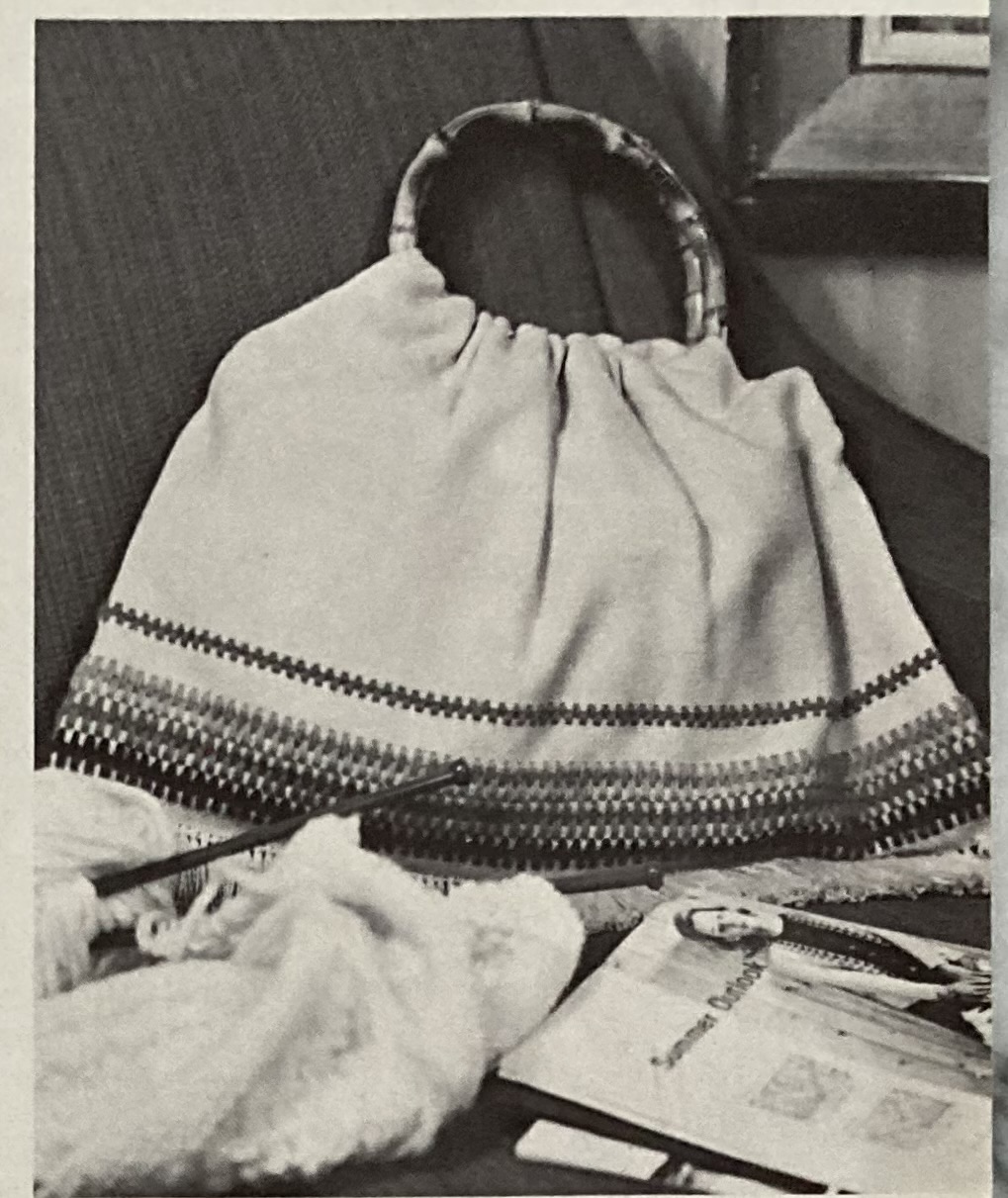
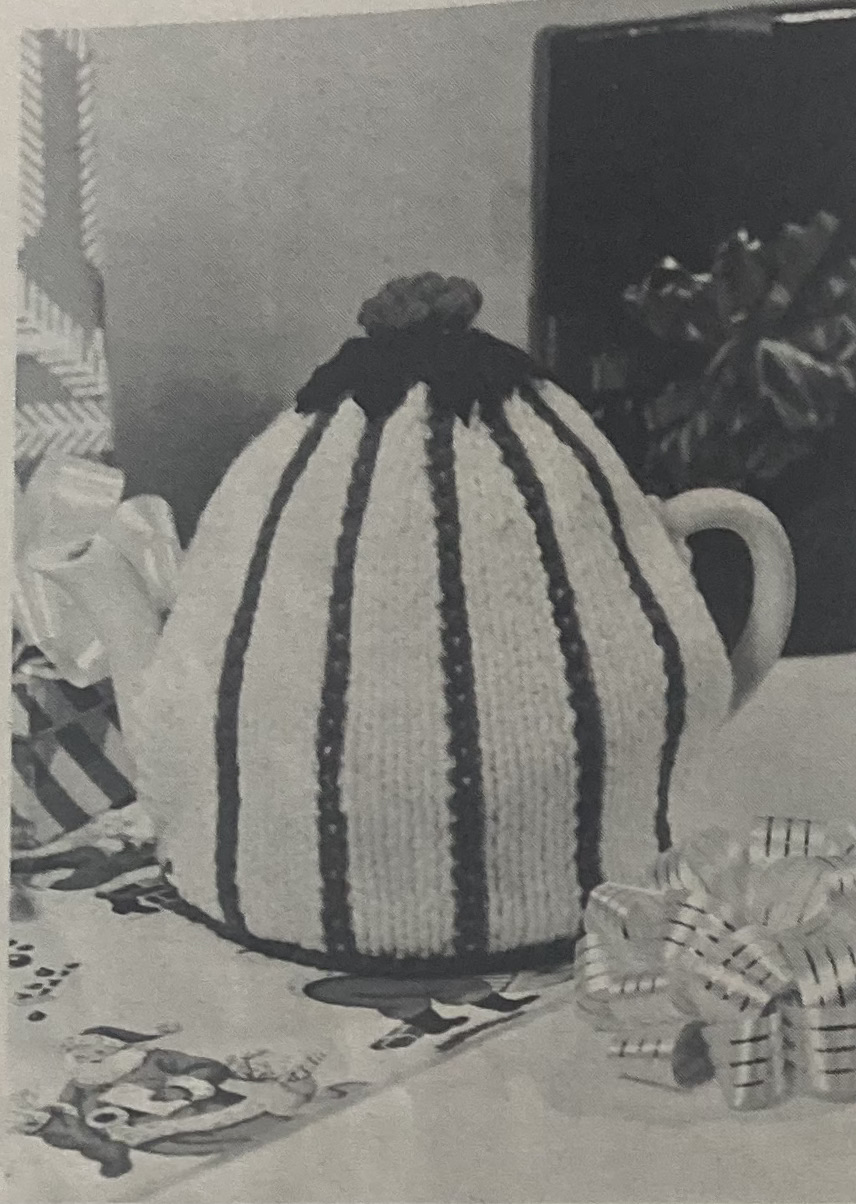
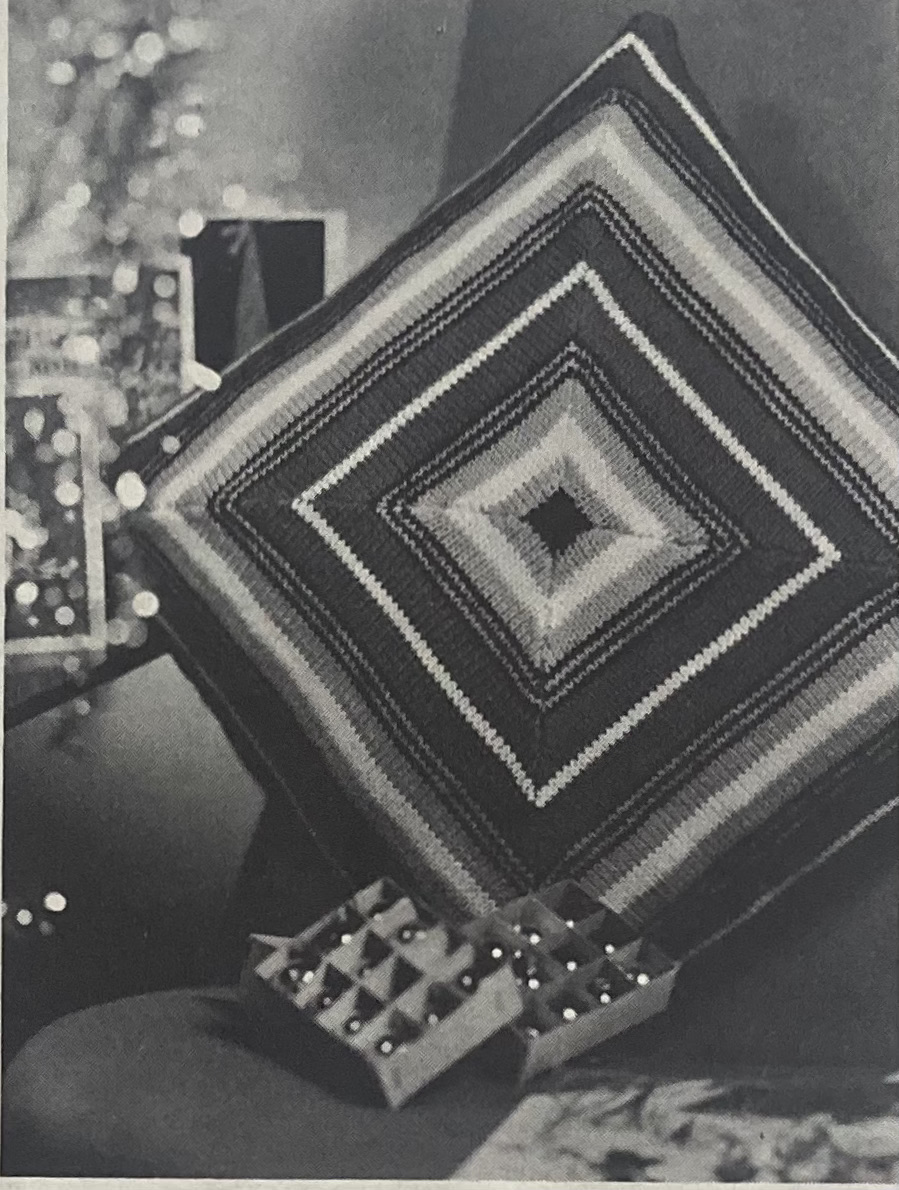
After dinner, it’s on to the gifts! The knitted tea cosy is supposed to represent a holly plant. The “workbag for a friend” is a fun way to use up leftover wool and I made one a couple of years ago. The “cushion for Granny” is a similar stash-buster. One would think it would be made in two squares either fron the center outwards or the edge inwards with raglan-type shaping, but no, you are supposed to make 4 identical triangle pieces for each side of the cushion and sew them together.

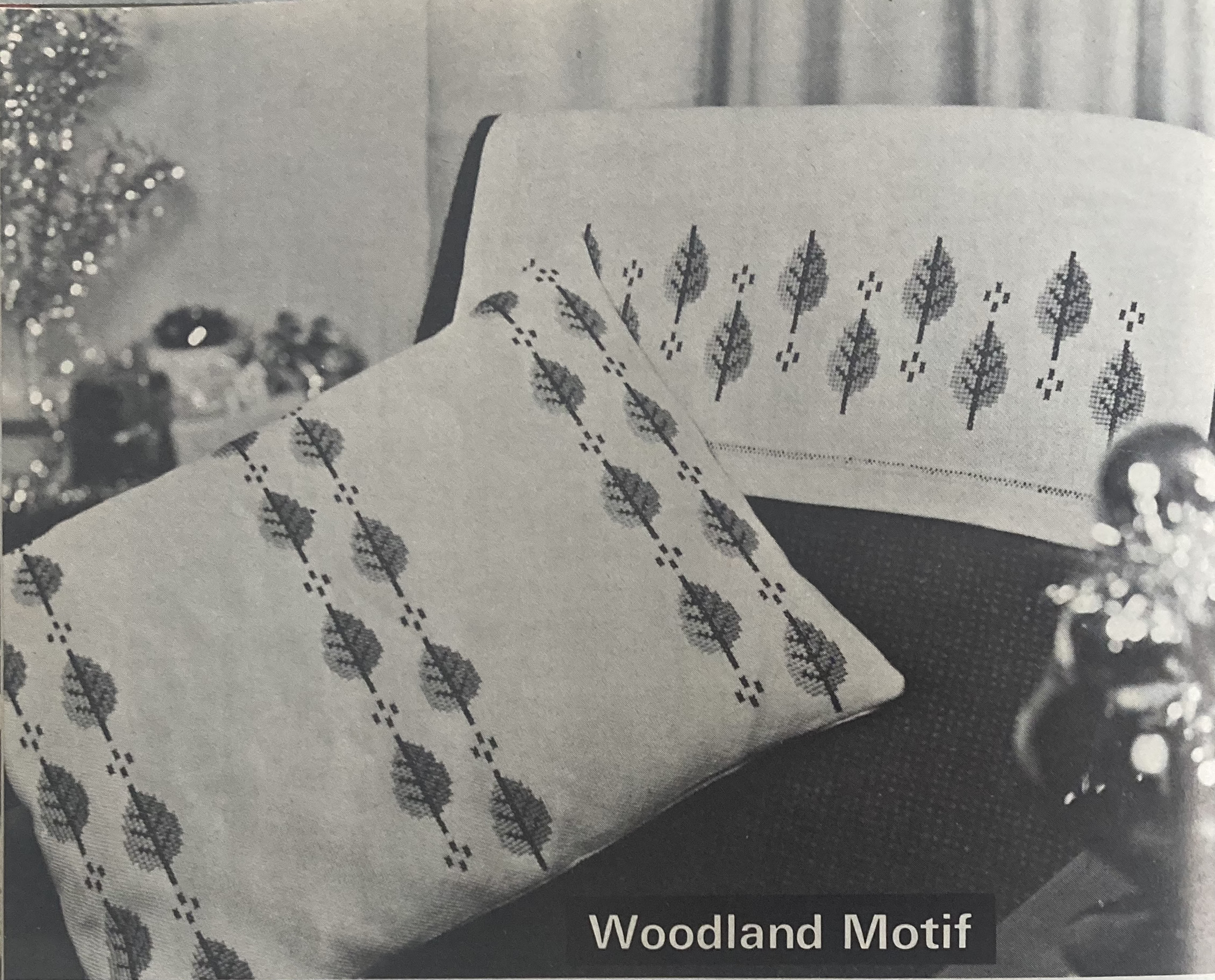
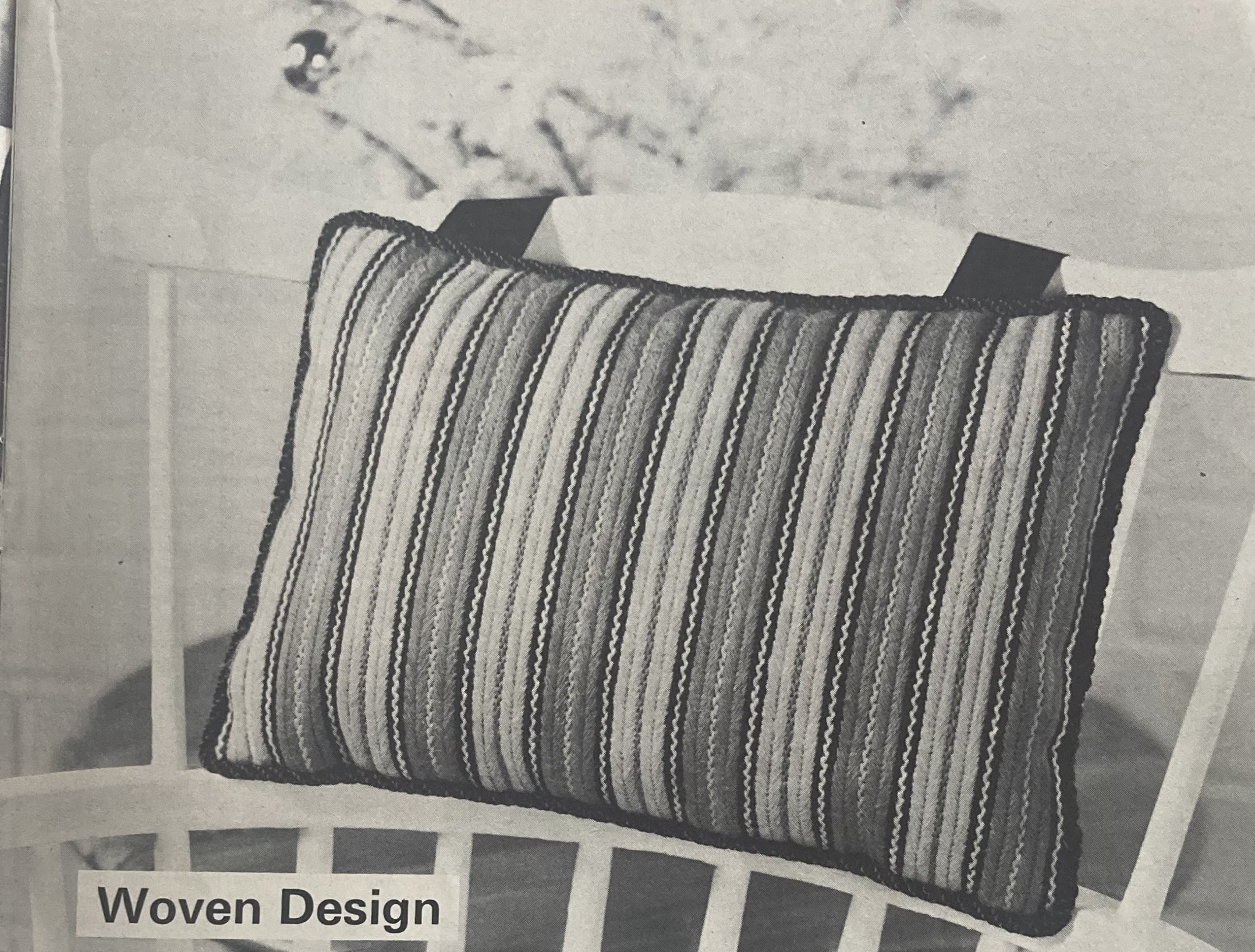
And let us not forget the other cushions: a simple cross-stitch number with a woodland design and a tough woven-tapestry chairback cushion in soumak and herringbone stitch. The colour scheme is brown with brown, with touches of orange and lime green for contrast. In the “just for fun” category, you can knit cosies for golf clubs.

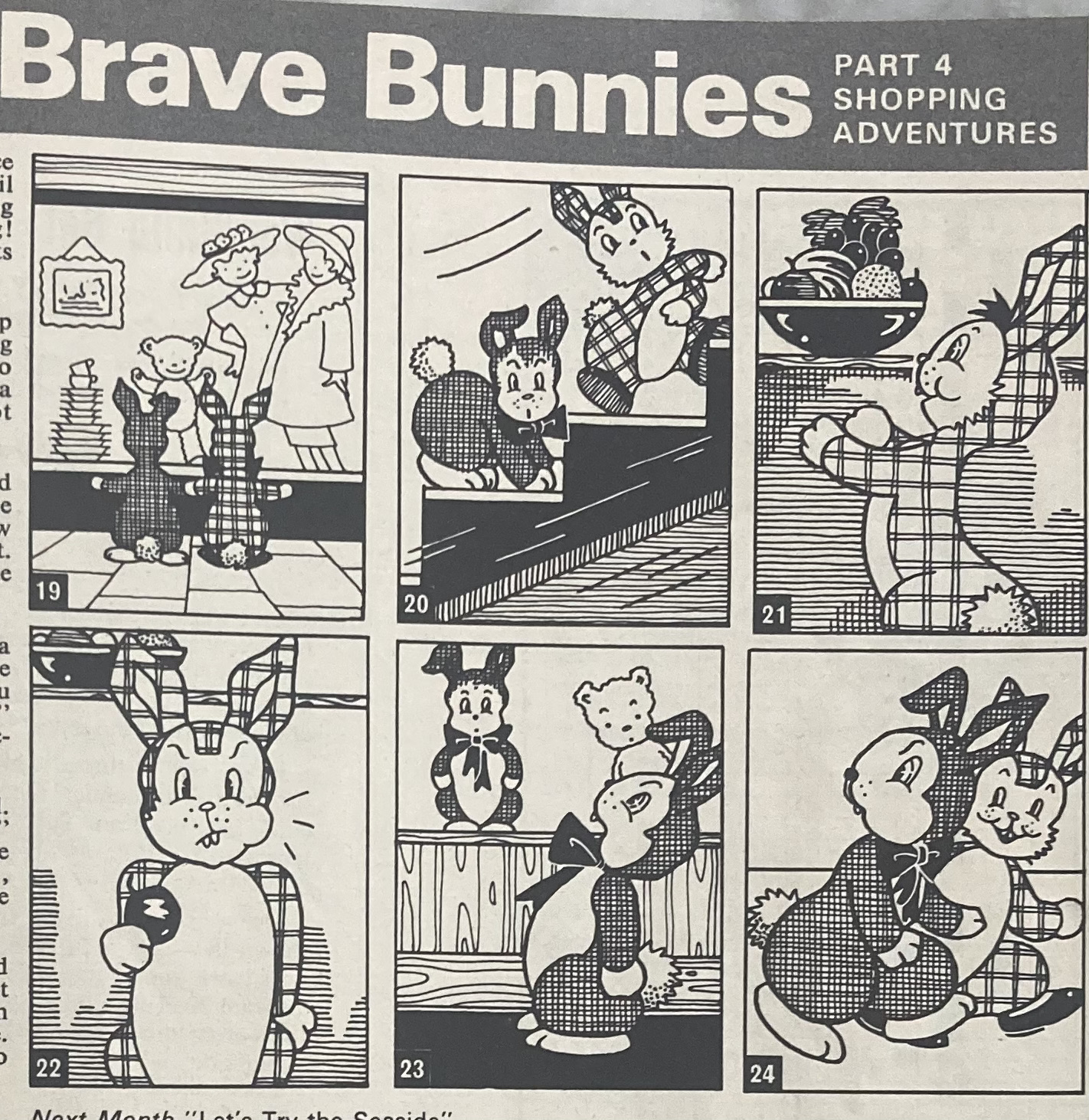
Our two brave bunnies from the Readers Pages are still on their quest to find a real live rabbit. Thinking they might find one in a department store (why not), they get stuck on a moving staircase, try to eat a plastic apple, and find a stuffed rabbit who, unlike our co-protagonist Sale Price (also a stuffed rabbit), sadly cannot talk. Next month, they will try the seaside, which is not known for being home to very many rabbits, but I suppose a better chance than a department store, a movie theatre or a merry-go-round. Of course, around Christmas time, one of the surest places to find a real rabbit would be on the dinner table, ha ha. I guess that storyline might be considered inappropriate for a light-hearted children’s comic. At least our two toy rabbit protagonists aren’t in danger of being eaten.

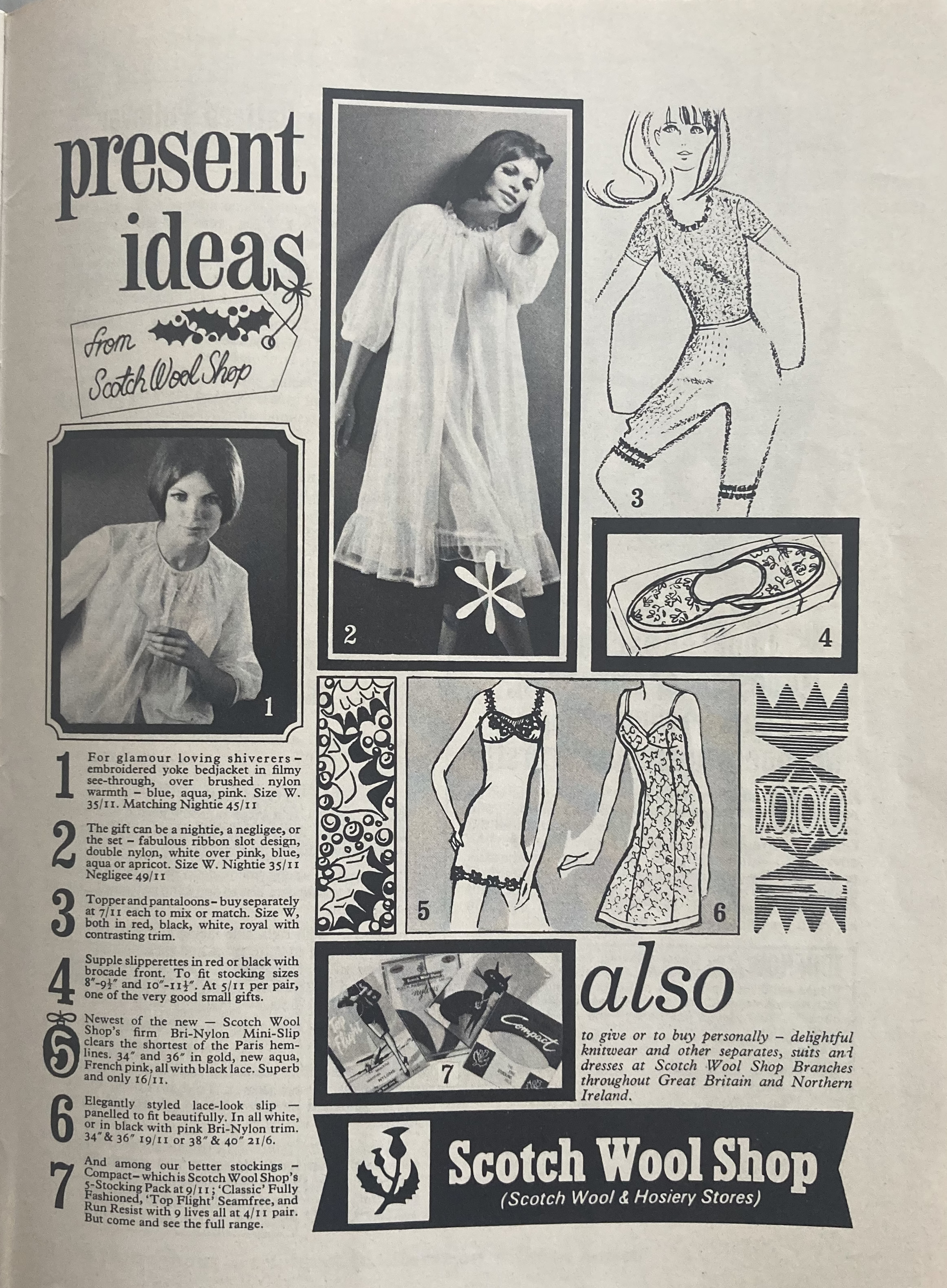
Finally, there’s another wonderful advertisement from my favourite Stitchcraft-ad store, the Scotch Wool Shop. Here is a nice little article about a knitting book produced by the Fleming, Reid company, proprietors of the chain of shops. The ads always make me want to go out and buy things from the stores… which, sadly, no longer exist. These little gift ideas are marvellous.

That’s all for this issue — and this year! I don’t know what I will make from this issue, or if I will just write a post about the knitted workbag that I already made a while ago. I quite like the ribbed skirt, and could use one, but one look at the gigantic WIP pile discourages me from starting any long and boring project. Hopefully I’ll get a couple of those WIPs finished and can write about that for a 1965 / 2023 wrap-up. Until then, I leave you with this graphic from the December 1965 issue. Happy Holidays!

September 1965: Comfortable Cushion

EDIT 2 October 7, 2023: Finished!

This month‘s project was another modern adaptation of a 1960s homeware object. In this case, the original design was for a knitted „comfortable cushion” in a use-up-your-scraps striped slip-stitch pattern. I had plenty of scraps to use up and a request to make a little wrist cushion for someone who works a lot on the computer and had been padding their wrists with a folded scarf. The yarns I used were some more of the lovely Slow Wool Lino from Lana Grossa with bits of leftover sock wool for the contrast colours.

The original cushion measures 15×12 inches using a cast-on of 83 stitches of DK wool. I wanted a 14×4 inch cushion in fingering weight and calculated that out at 79 stitches in width. The stripes are made in slip 1, knit 3 pattern in alternating colours.

Everything worked out out fine on the first cushion piece. The width was perfect and three rows of stripes with 6 plain rows at beginning and end were a good height. The pattern was so very, very 1960s! Especially in the brown and brown and grayish brown and blue colour scheme (by request from the intended recipient.)

It was, in fact, a bit too authentically 1960s for the recipient, who requested a different pattern to use on the other side of the cushion. How about Space Invaders monsters? (i.e. hipster 80s retro instead of grandpa‘s 60s retro.) Space Invaders it was! I adjusted the number of blank rows on the Space Invaders piece, since the slip-stitch pattern pulls the knitting together even more than stranded work.

Then I made two more smaller squares in the same design, to make a pad for when the recipient might want to hold their wrists farther apart. All of the pieces curl a lot, as you would expect from stranded and/or slip-stitch patterns worked flat, but when I uncurled them, they seemed to be just the right size.

I wash-blocked the pieces, which flattened out both patterns admirably, and realised that I had made the Space Invaders piece too narrow. Not wanting to knit it again, I made two little strips to sew onto the sides — not elegant, but it fit.

I sewed up three sides and tacked 2 layers of quilt wadding to each of the insides, then turned around and sewed up the fourth side.

It’s… OK, I guess? The slip-stitch side definitely looks like a brown-on-brown 1960s home-made pillow, so you could call it authentic. But it’s not really one of my more interesting or beautiful projects. It should be useful, at least.

September 1965: Overview

Autumn is here, and the September 1965 issue of Stitchcraft is, as promised by its editress, a “bumper” issue with more colour photos (to offset the price increase to 2s. per single issue) and a new yarn from Stitchcraft’s patron wool company, Patons. 

Called “Fiona”, it was DK-weight and made of 50% Shetland wool and 50% “Orlon” (one of the very first acrylic yarns). Shetland wool is beautifully warm and lightweight due to its being very lofty and “hairy”, and “Fiona” was marketed as combining these positive aspects with the easy-care, less scratchy and non-tangling qualities of synthetic yarn — a sort of “Shetland lite”, if you will. Real Shetland wool is excellent for traditional “Fair Isle” stranded colourwork patterns, since the hairs lock into each other in the stranding, but the “Fiona” designs in this issue employ smoother, textured stitch patterns. The cover cardigan-jacket has a bobbly lace pattern and the his-and-hers pullovers use a broken cable rib. 

The other two designs for adults are made in standard 100% wools: a “young-looking sweater” with really, really unfortunately placed bobbles (directly along the bustline) in Patons Double Knitting or Crepe, and an Aran-patterned jacket in bulkier “Capstan”. An older brother might get this “Husky polo style” pullover in Patons DK and a fun reversed stocking-stitch pattern with more (and better placed) bobbles. 

The trend for textured stitch patterns continues with garments for the younger set. The toddlers’ “walking-out set” of pullover, leggings and snug helmet-style cap (with more bobbles on the tie at the neck) is made in easy 2×2 ribbing in blue and white DK wool. Love the pre-Photoshop-era addition of a tree in the photo, to show you that he’s playing outside! His big brother gets a warm slipover in an easy zig-zag pattern, and tomboy sister, (with short hair and trousers) gets a set of cap and sweater in a fisherman’s rib pattern that is more complicated to do than it looks. You purl the RS rows and and on the WS rows, you *k1, purl into next st. but through loop of row below at the same time slipping st. above off left needle; rep from * to last st, k1. The vertical stripes are added later via Swiss darning aka duplicate stitch embroidery.

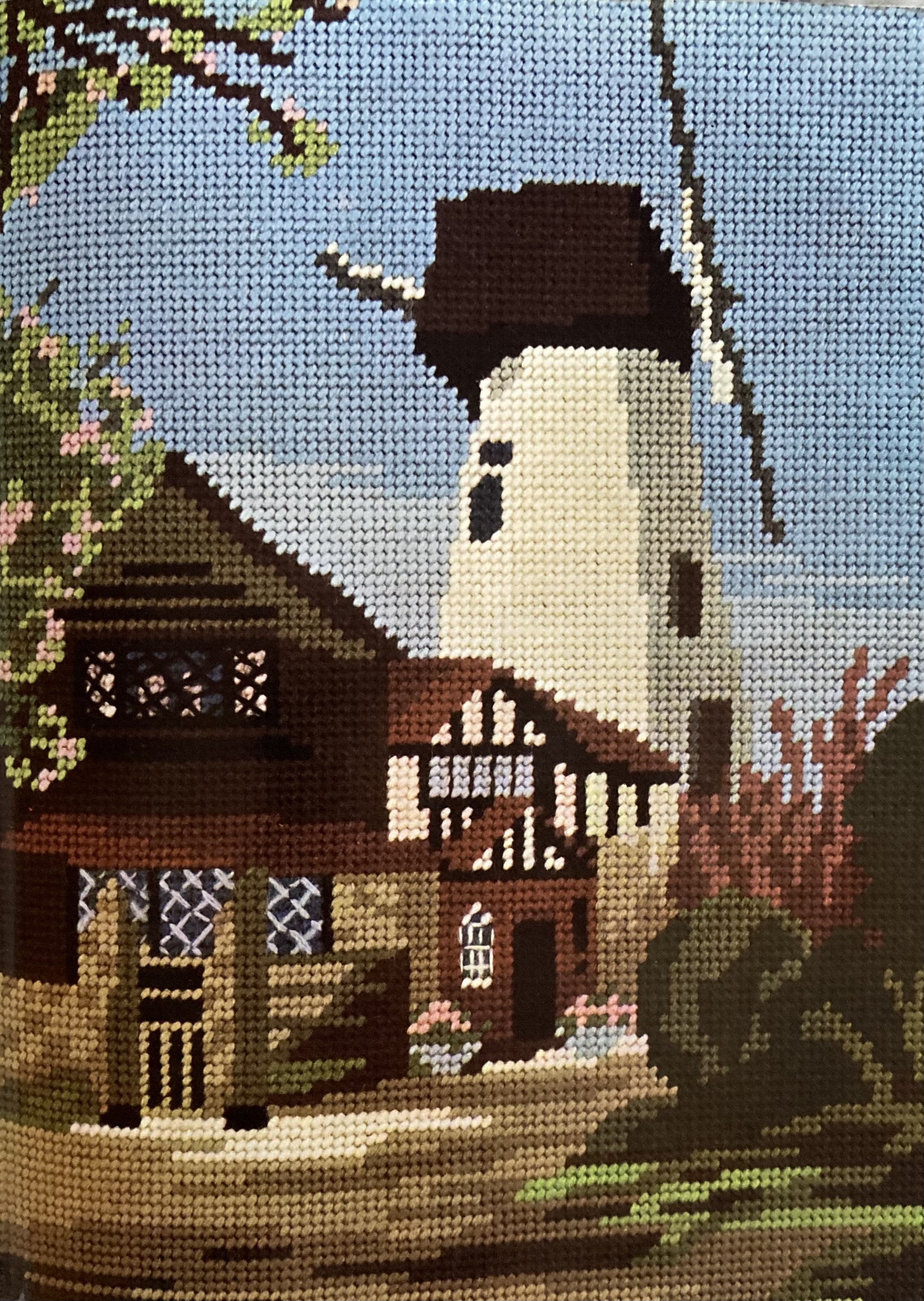
Above all, this is a bumper issue for homewares. There are multiple pages of easy projects for a “Sale of Work” stall at the church bazaar or what have you, including a “house” and “windmill”-themed apron, mat/cosy set and a “peg bag” for holding laundry pegs. Other quick novelties include a knitted scottie-dog toy and a cosy or cushion made out of odds and ends of wool. 

More ambitious needle-workers can decorate an entire room from top to bottom with designs from this issue, starting with a needle-etched picture of a steam engine — a throwback to the Victorian nostalgia of the late 1950s and early 1960s — or a tapestry picture of the seaside village of Clovelly to hang on the wall. 

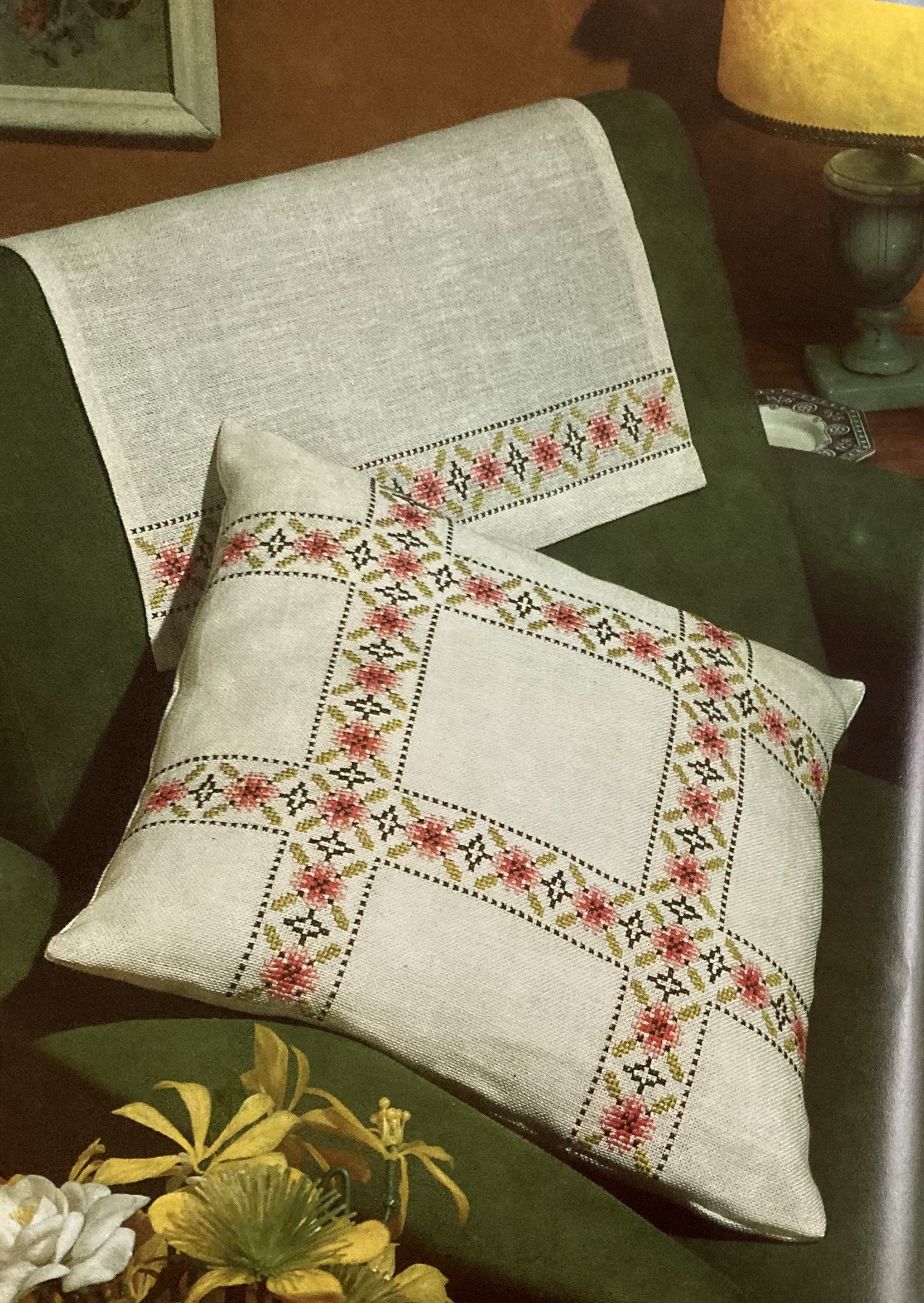
For the furniture, there’s a beautiful “peasant” (their word, not mine) design for a cushion and chairback, made in embroidery wool on linen, and for the floor, a hand-made “Tartan” rug. It uses a latch-hook and the “Turkey knot” to make a soft, three-dimensional pile. Finally, church-goers can make a tapestry “kneeler” cushion in a pattern inspired by Gothic stonework. 

And there’s a new children’s comic serial in the Readers Pages! This is a really cute and creative story about Homer the plush rabbit (so called because he was home-made) and Sale Price, the store-bought plush rabbit, who go out into the big wide world to try and find a real rabbit to befriend. Will they find one? Stay tuned! Oh, and I bought this issue on Ebay, so received a special… bonus? picture of an embroidered Christmas tree with no transfer or pattern instructions (and not from Stitchcraft.). If anyone can identify it, I will be very impressed!

My project from this issue will be the knitted cushion, by special request from someone who works on the computer a lot and would like a soft underlay to rest their wrists on.

July 1965: “Pansies” Garden Cushion

This month’s project was an appliquéd and embroidered cushion. Or, as the description in the magazine put it:

Attractive appliqué cushions in hardwearing hessian add a gay touch for garden lounging — ideal for deckchair comfort or to use on the lawn. Children will love them too, and they are tough enough to stand up to the rough-and-tumble of garden play.

Two cushion designs are given, one with autumn leaves and one with pink and purple pansies. I chose the pansies, which were bright and fun and very 1960s. As luck would have it, I had exactly the right amount of pink and purple felt in stash, and almost enough green embroidery thread for the stems and leaves, so I didn’t have to buy many materials and could use the project to de-stash. I did have to buy the backing fabric, and decided on a tough decorating/upholstery cotton instead of real Hessian fabric (aka burlap, jute, gunny-sack), since I don’t think this cushion will be subjected to any “rough-and-tumble of garden play” on my friend’s balcony.

Since I didn’t have a transfer, I made a little paper pattern for the felt petals, estimating the size based on the amount of felt and the size of the background fabric. One modern “standard size” piece of decorating felt made exactly 18 petals and I think it came very close to whatever size the original transfer pattern was. I overlapped the leaves in a sort of pinwheel layer (following the helpful illustration), using a little bit of stick glue to help keep them in place, and then secured them with pins. For placement, I simply folded the background fabric in quarters and used the fold lines for the two middle axes, then measured evenly from there for the corner flowers.

I sewed the flowers down with matching thread and added the yellow centres. The diagram shows them a bit above or below the actual centre of the petals, but I like symmetry, so I made the yellow pieces more round and put them right on the centre. (The layers of felt weren’t too heavy.)

All that was left to do after that was the leaf and stem embroidery, which was done in easy stem-stitch in green thread. The pattern didn’t say how many strands of thread to use, but seeing as it was a bold design, I used all six threads together and ran out of thread. (Up until this point, I had done all of the work in one day, but alas, I had to pause because it was Saturday late afternoon and the shops wouldn’t open again until Monday.)

Monday came, I bought more thread and finished the surface of the cushion. Sewing it up was easy enough. I had enough muslin in stash to make up one half of the inner cushion pad (pro tip: the inner cushion should always be a little bit larger than the outer cover, to prevent sagging) and enough of the beige cotton to make the other half. I did not, as suggested in the pattern, line the pad with plastic to make it waterproof “for use on the grass”. After making the pad, I had exactly enough beige fabric left to make strips for “piping”, so added that as well (not part of the original design). It was not “real” piping, which is made on a bias strip, and thus came out a bit uneven. Oh well. At least the zipper was no problem this time.

And that was that! I stuffed the inner cushion with fluff, sewed it up, zipped it into the cover and voilà. I have no garden, no balcony and too many cushions already, so this will be a gift for a friend.

July 1965: Overview

July is still “holiday” season over at Stitchcraft, but this summery issue is already looking towards cooler autumn temperatures and the return to post-holiday life. For women’s fashions, this means a “revival of the more feminine line” (as if there were ever a fashion for “the masculine line” in 1960s women’s fashions.) I guess they mean a slightly closer-fitting silhouette, or a little more shaping of upper-body garments between hem and bust. At the same time, “quick and easy yarns” or “easy-to-wear loose front styling” jackets are still in fashion, emphasising comfort and wearability.

Our cover model sports a white blouse made in 4-ply “Cameo Crepe” wool and twisted stocking-stitch for a little more texture. The navy blue accents on shoulder and pocket match the knitted skirt, which is just below-knee length. That may seem surprising if you associate mid-1960s fashions with miniskirts, but it took a while for the ideas of cutting-edge designers like Mary Quant or André Courrèges to trickle down to the general public, and hand-knitting magazines, even the more fashionable / aspirational ones, were oriented towards designs that “regular people” could wear in everyday life . The dresses and skirts in Vogue Knitting’s 1965 Spring/Summer issue, for example, all fall between just-barely-above and solidly-below knee-length — and Stitchcraft was a more conservative magazine than Vogue Knitting. We won’t be seeing miniskirts here for a while yet.

The upper-body fashions for women show, if not an extreme “revival of the feminine line”, a definite attention to cute colour and pattern details, particularly in the use of twisted stitches or ribbing variants. The pink raglan pullover on the inside front cover combines a sort of twisted rib on the sides with a “v” pattern, also made by twisting stitches, up the front and back midline and on the sleeves, and tops ot off with a black necktie bow. Nice touch to put it on a red-haired model! The combination of colour detail and ribbing variant (here: stranded panel and narrow slip-stitch rib) is also used on the warm blue-and-white cardigan. The “knitting that looks like crochet” trend continues in a short-sleeved blouse for larger sizes in 4-ply wool and a textured-lace pattern.

The men’s fashions use a predictably less dainty, but no less interesting use of colour and pattern: there’s a loose.fitting, sideways-knit and vertically-striped dolman-sleeve shirt for beach wear in “father and son” sizes for adults and children (though the “adult” model in the photo looks hardly older than a teenager himself) and a slipover in an Aran-style pattern of cables, ridges and zig-zags.

The kids’ designs utilise the same fashion features as the adults: the boys’ striped shirt is the exact same pattern as “Father’s”, and there’s a zip-neck pullover for girls with a stranded border reminiscent of the panel in the womens’ jacket. For younger girls, there’s a quick and easy, slightly striped pullover whose pattern details are embroidered on after knitting. Nautical white and blue, pretty pink and sunny yellow make up the summer colour palette.

There’s a good selection of easy homeware and embroidery projects: appliquéd garden cushions in “hardwearing hessian” fabric, single flowers cross-stitched on place mats “for an outdoor supper party”, embroidered “needle etchtings” of village scenes (Godshill and Shanklin Old Village on the Isle of Wight), or an easy stitched rug.

The Danish-design tapestry cushions look more complicated than they are, but are also more complicated than the usual tapestry cushions. Fans of finer work in cotton can make doilies or a traycloth, or pretty trims for bed pillows.

The ads are quite usual: Singer sewing machines, Patons yarns, and a swirly nightgown and negligée from the Scotch Wool Shop. Not to forget: the Turmix knitting machine, Stitchcraft binding cases to store a year’s worth of magazines, and order houses for wools, fabric remnants, etc. The children’s comic follows the adventures of Jill and James searching for a lost stitch and encountering interesting characters such as Spinning Jenny, who shows them how a spinning machine works.

That’s all for this issue! My project will be the appliquéd flower cushion.