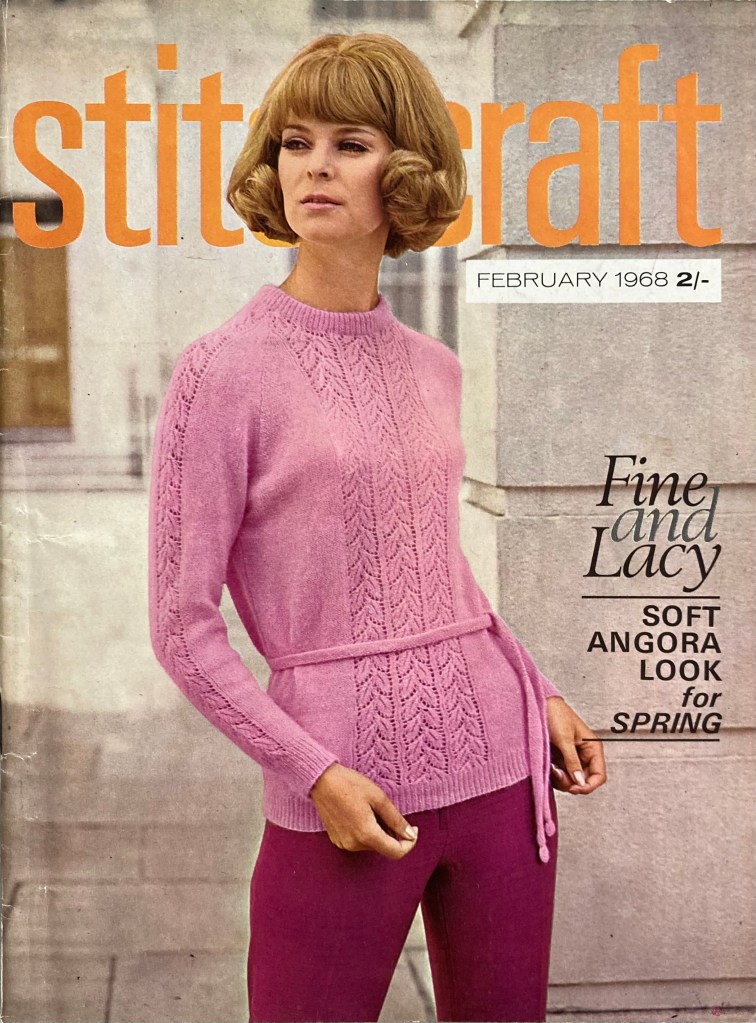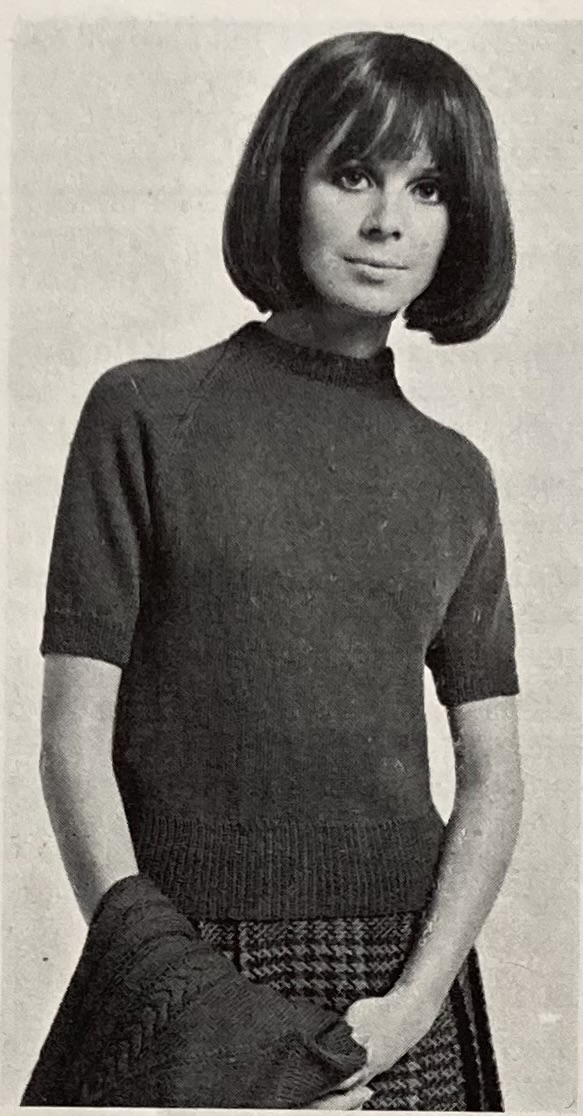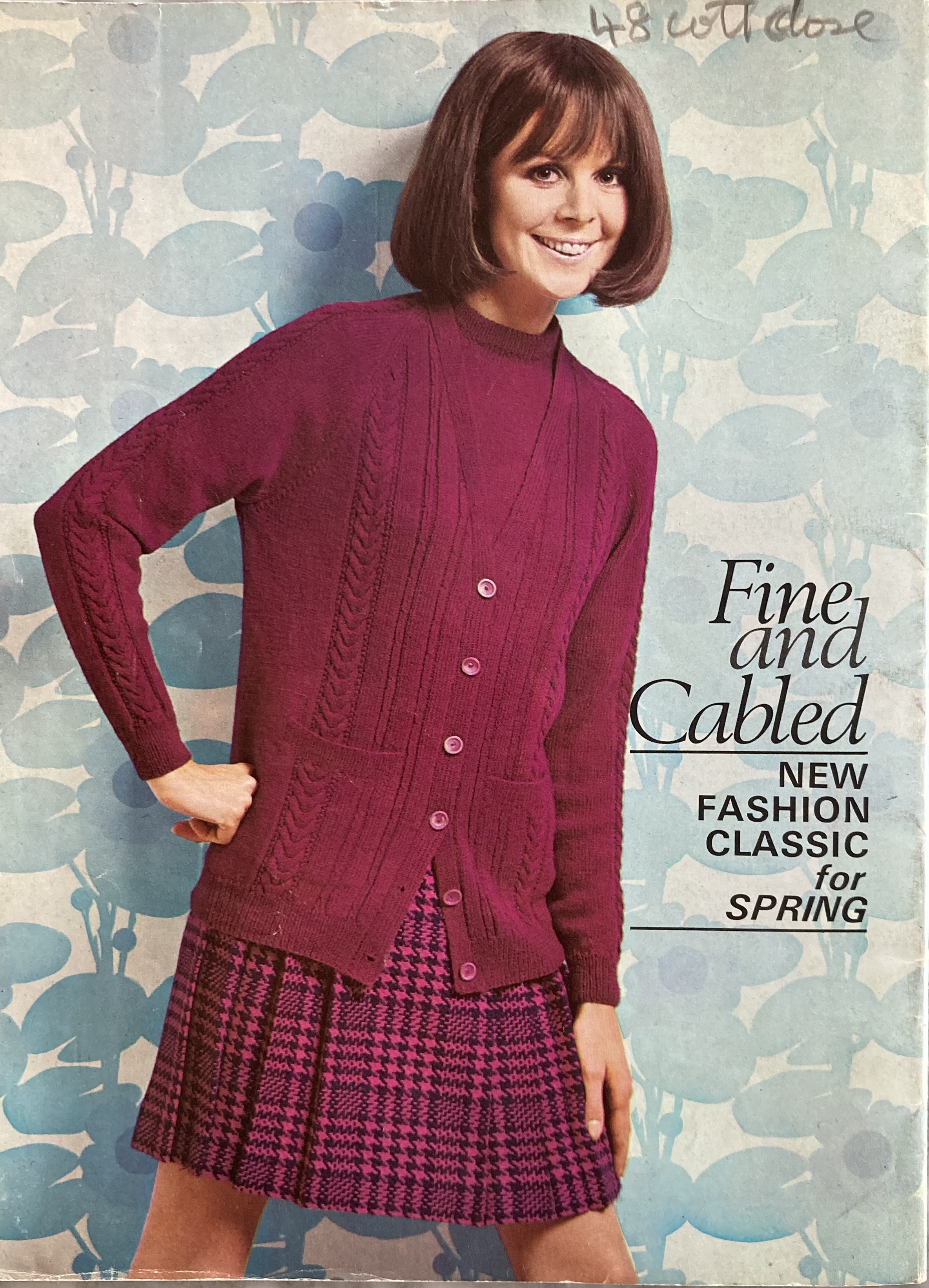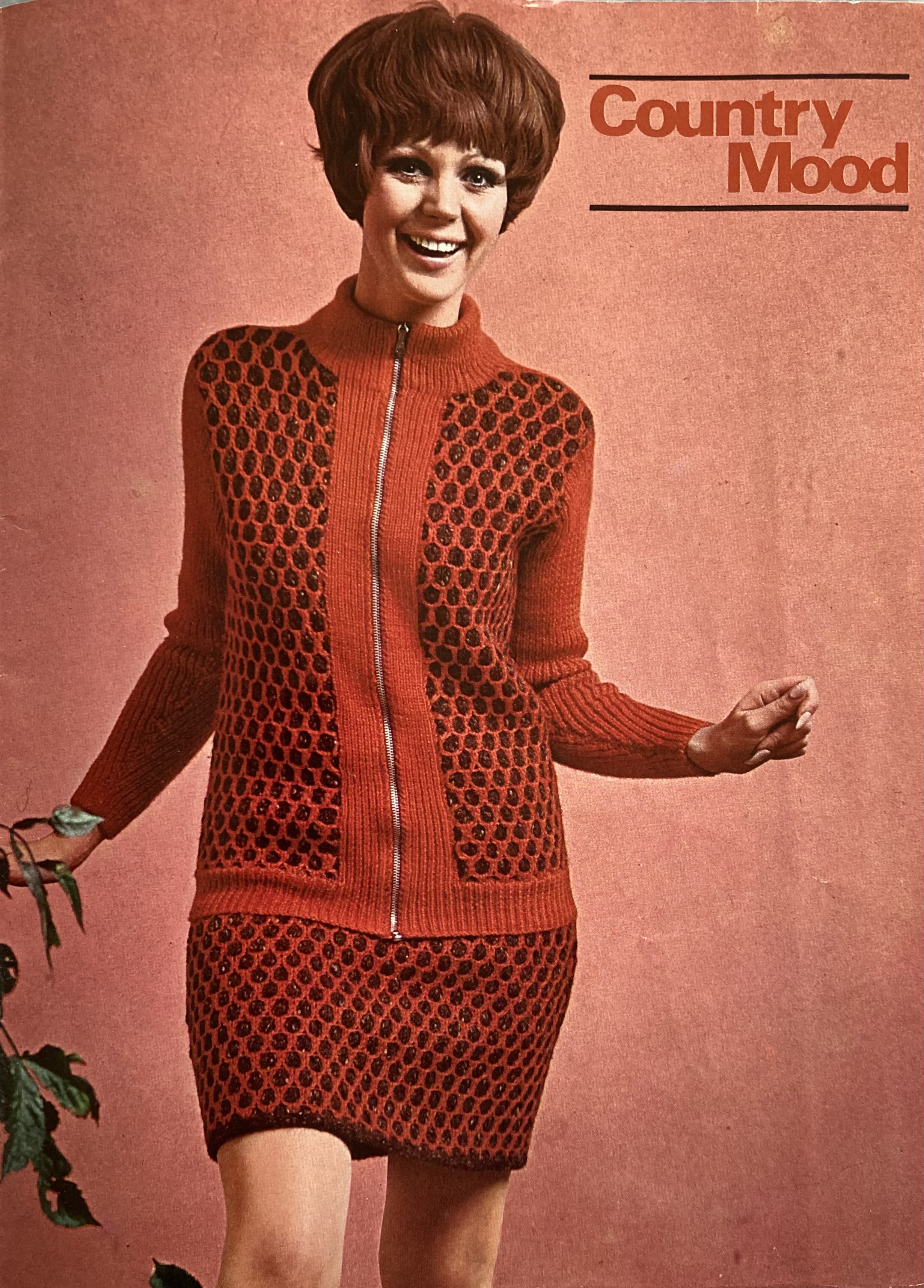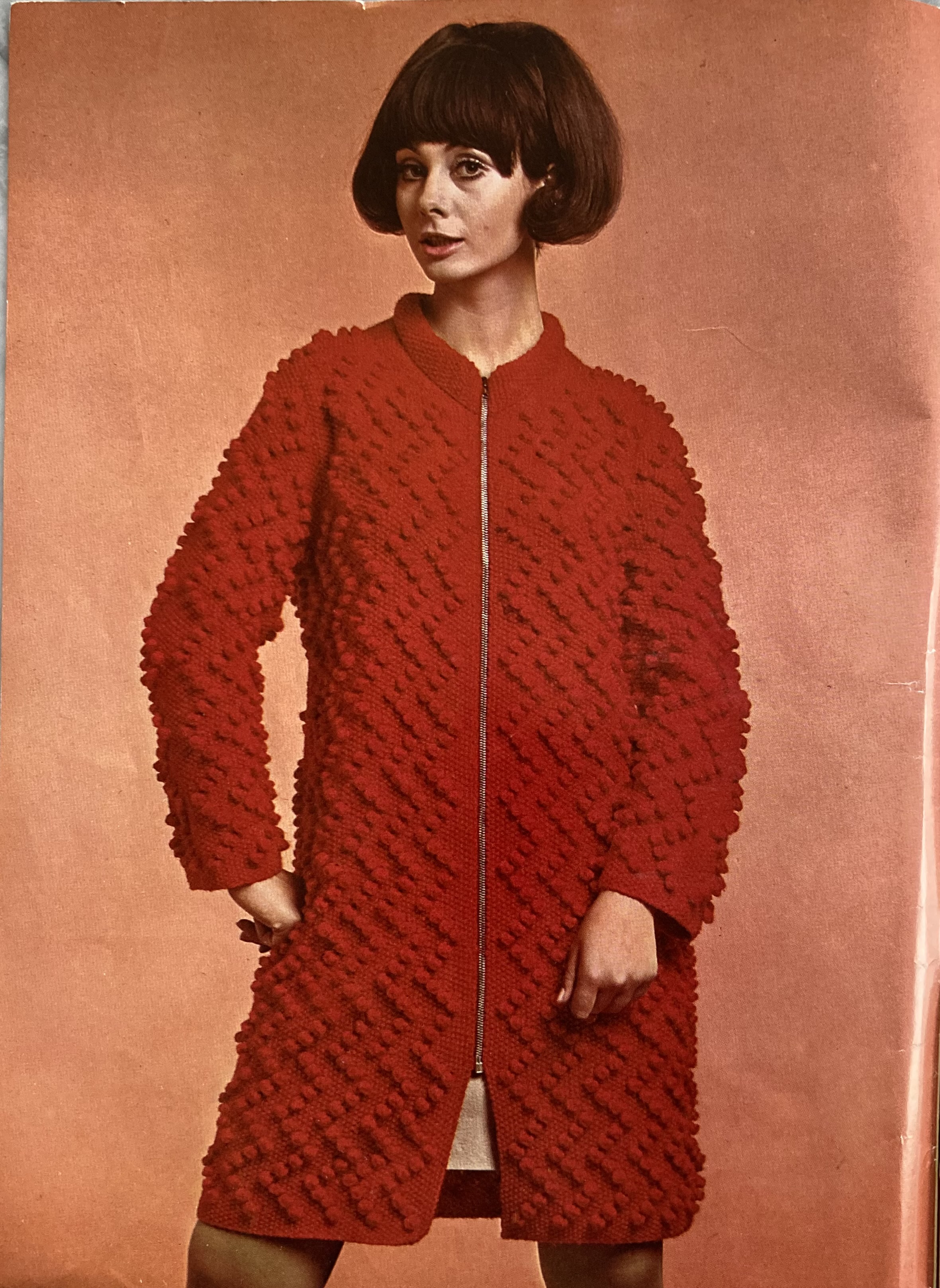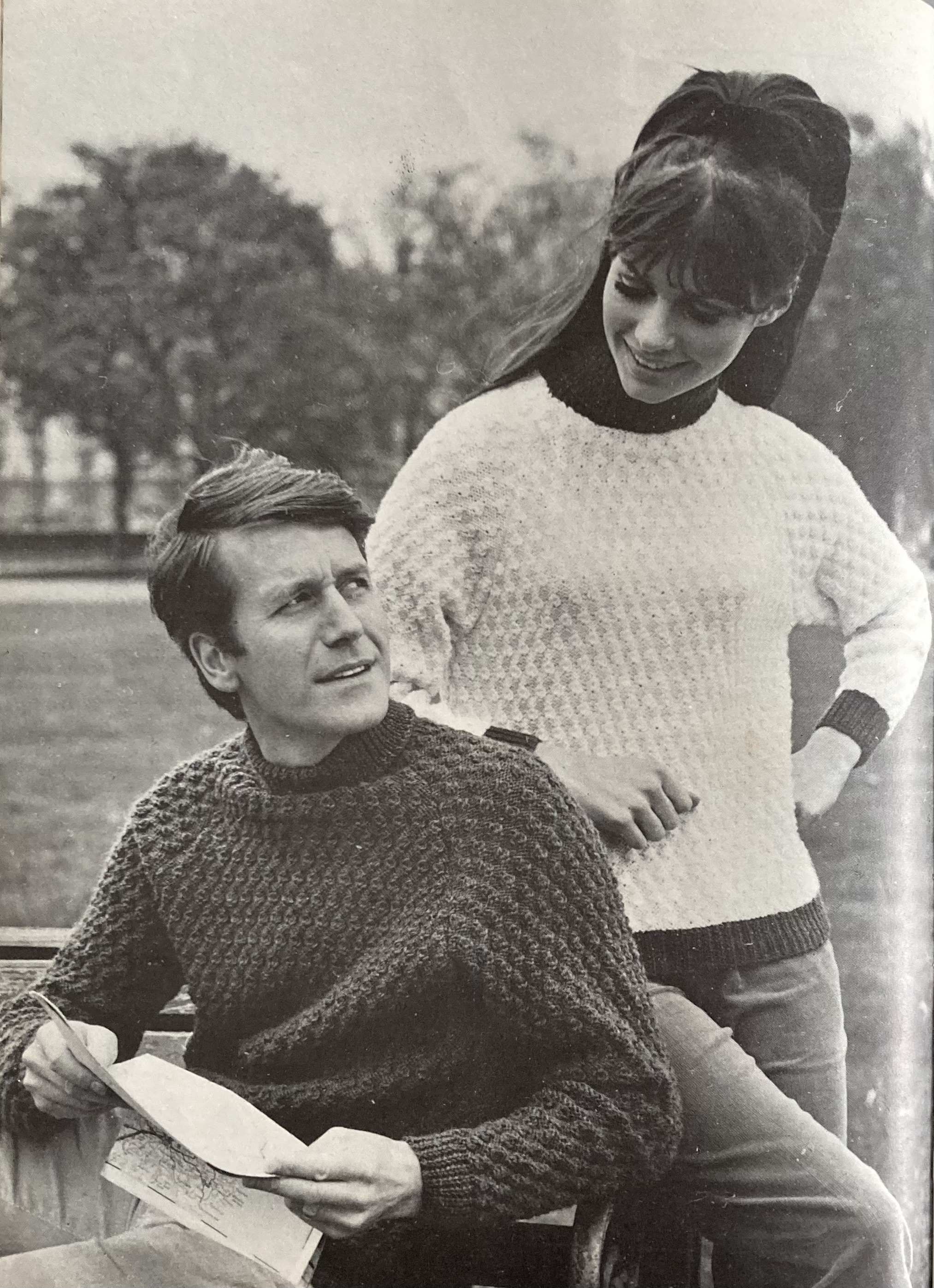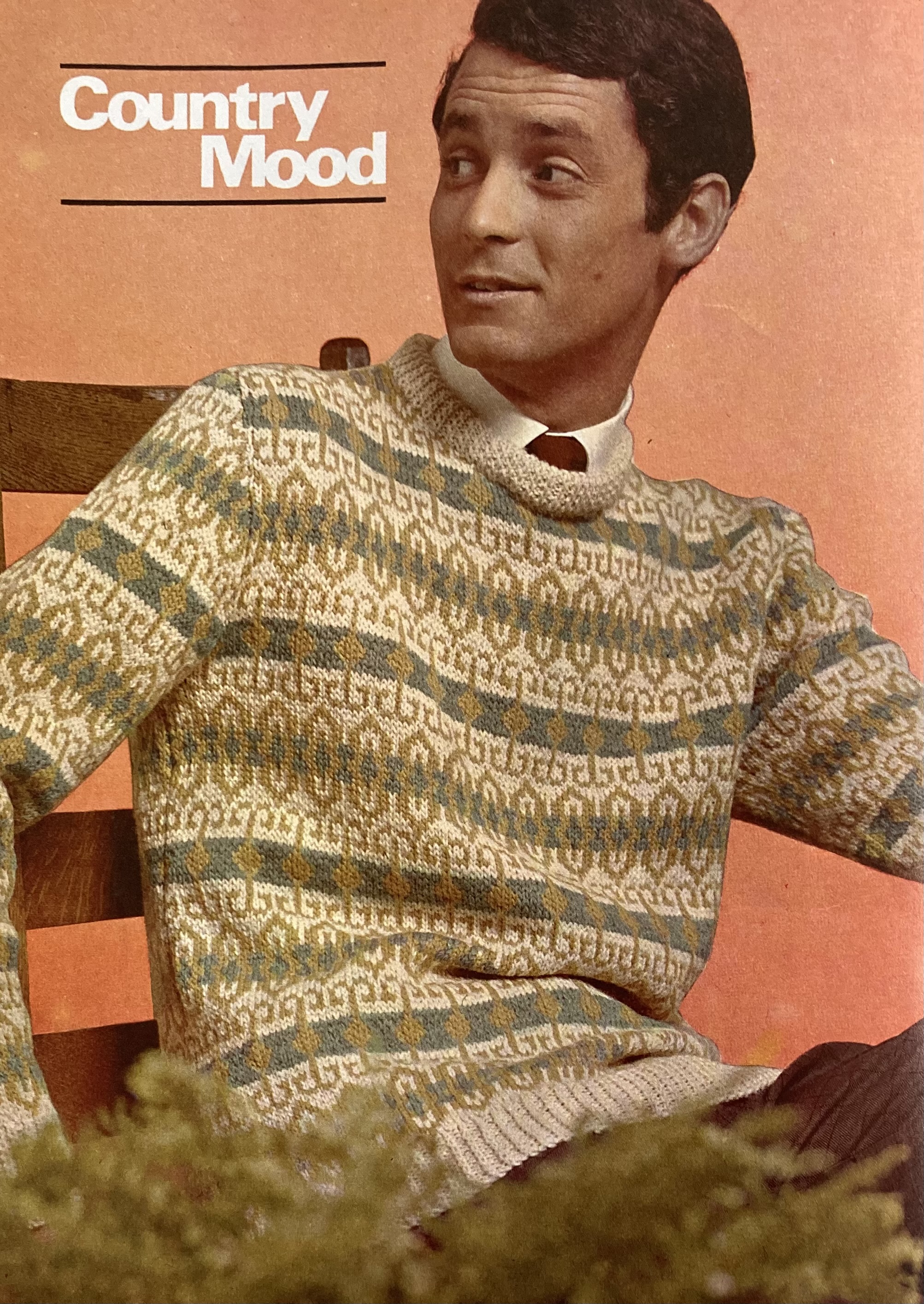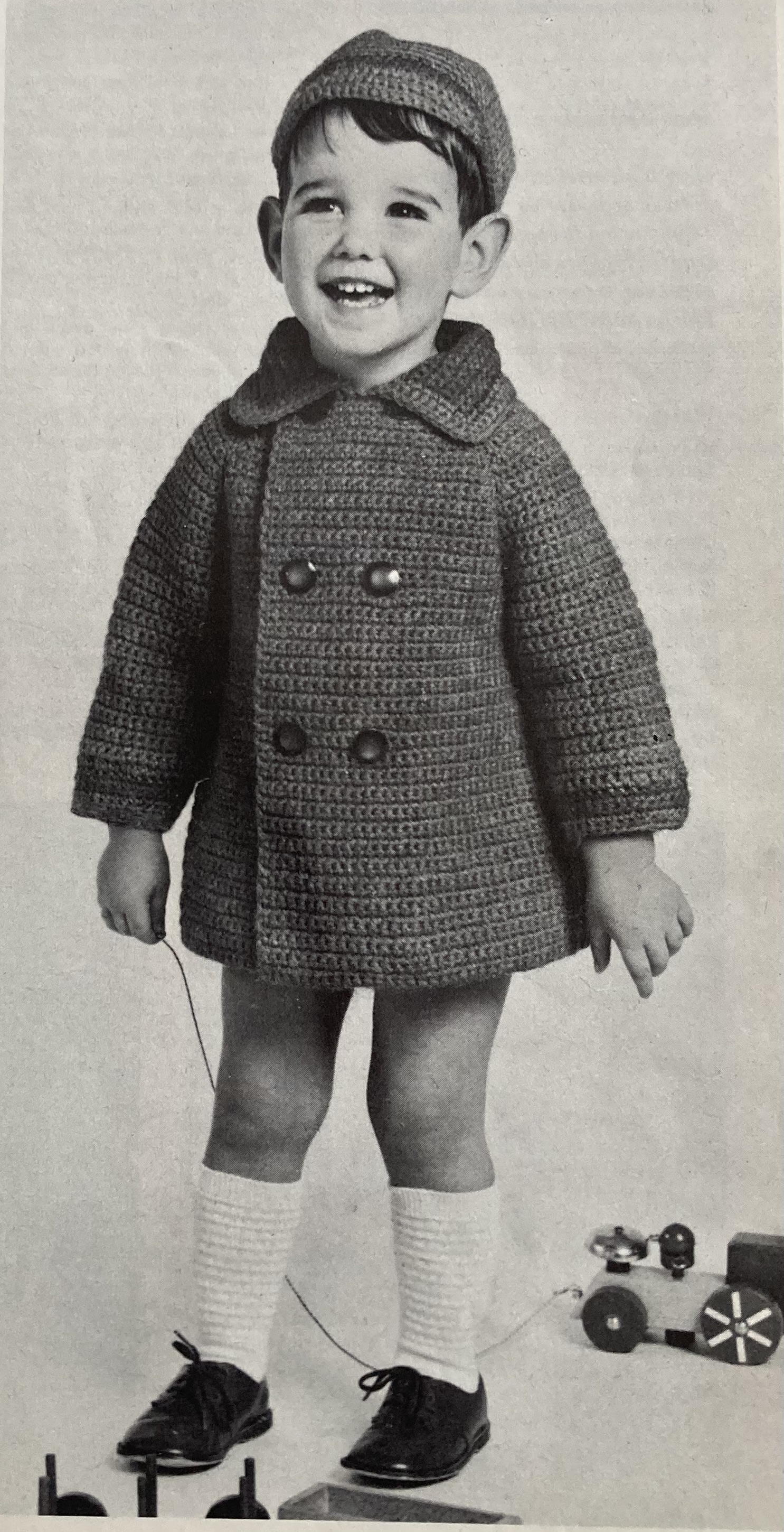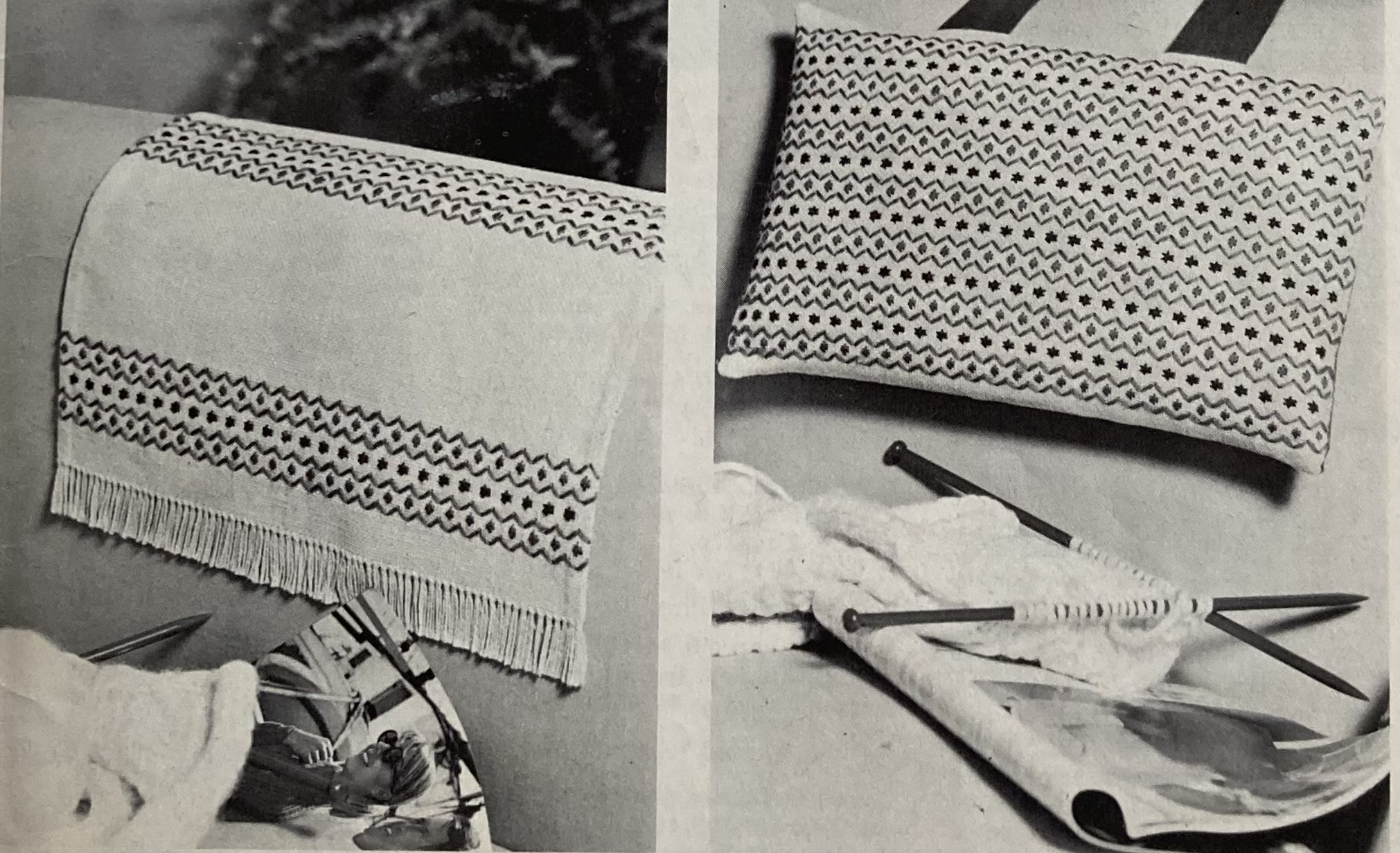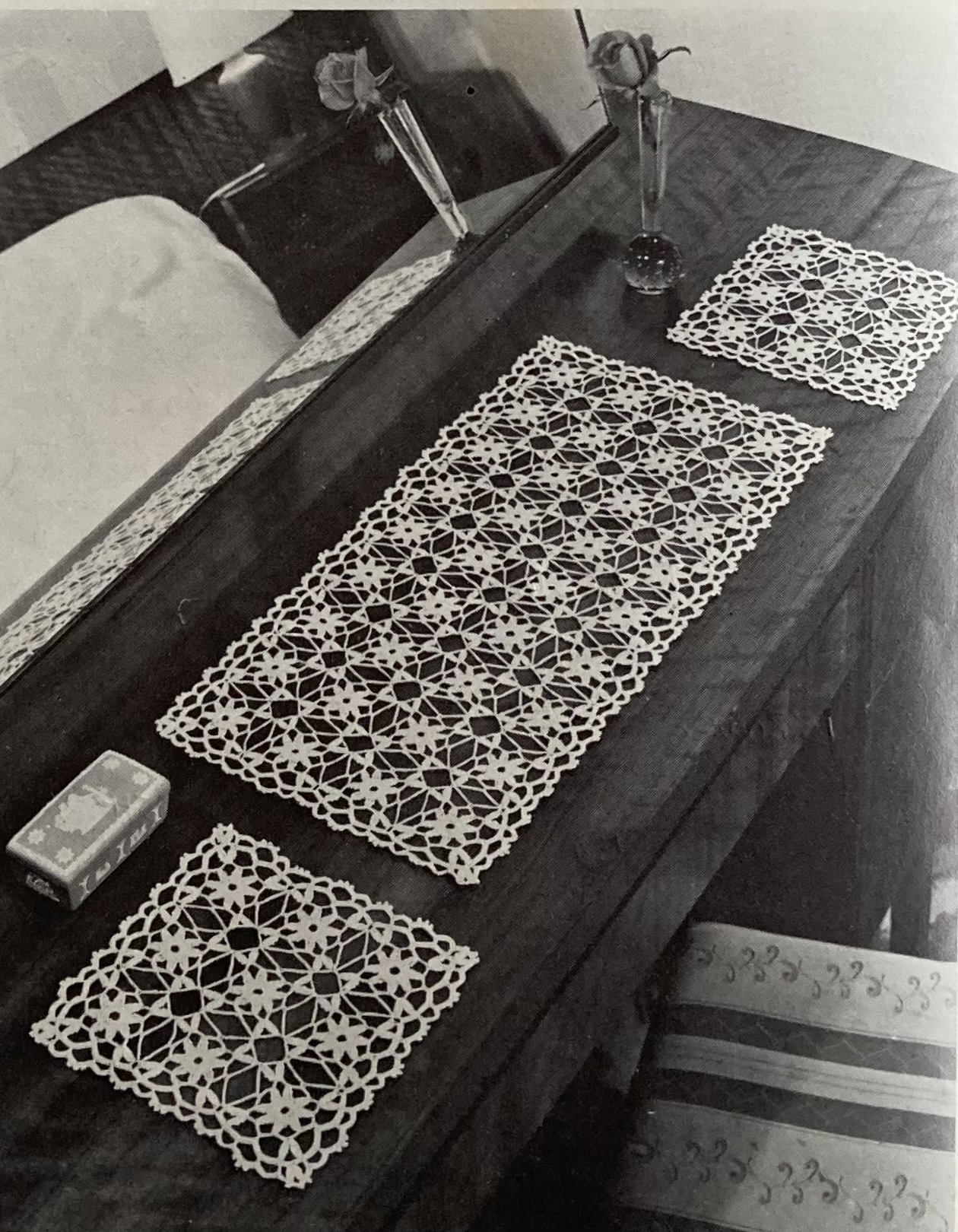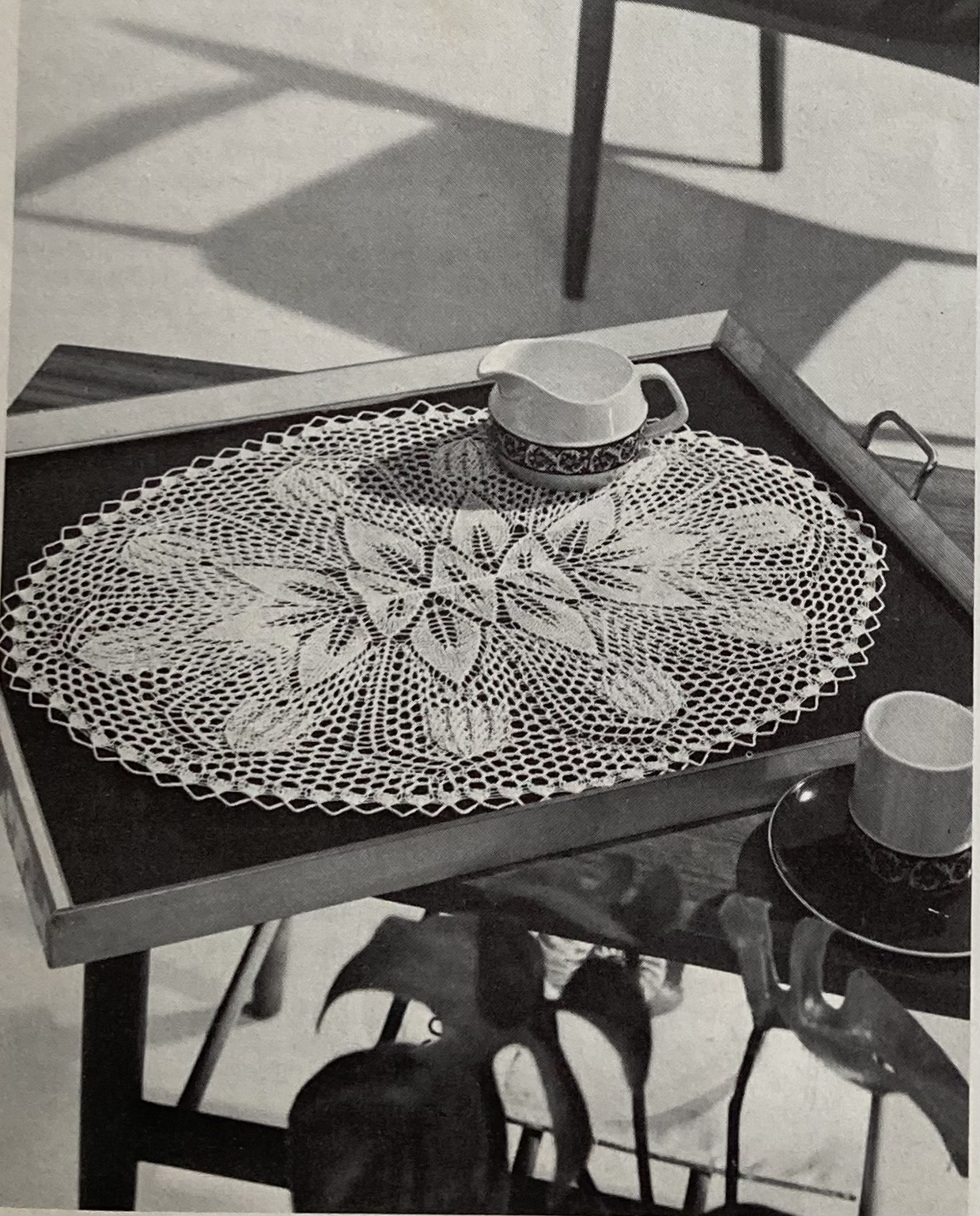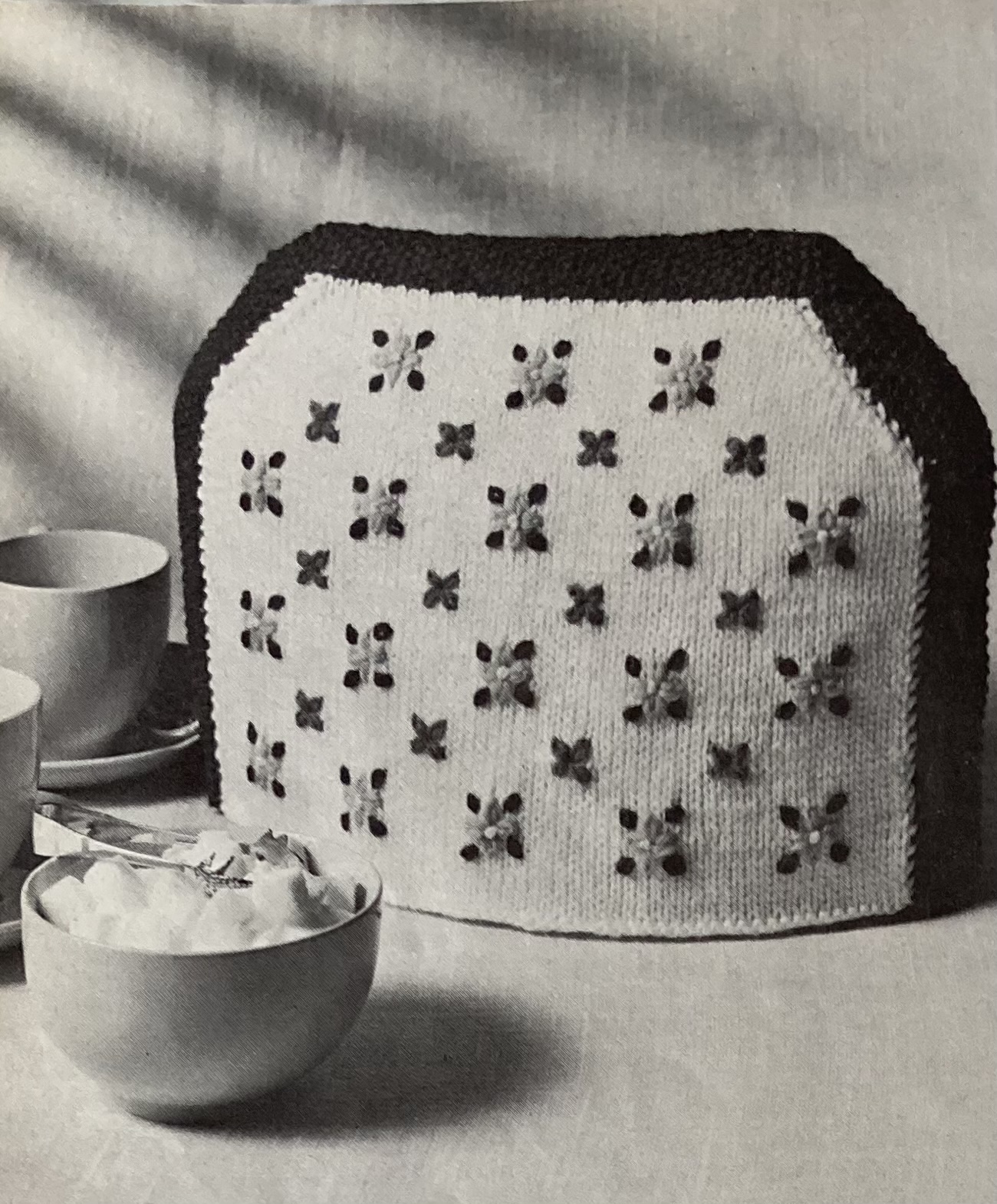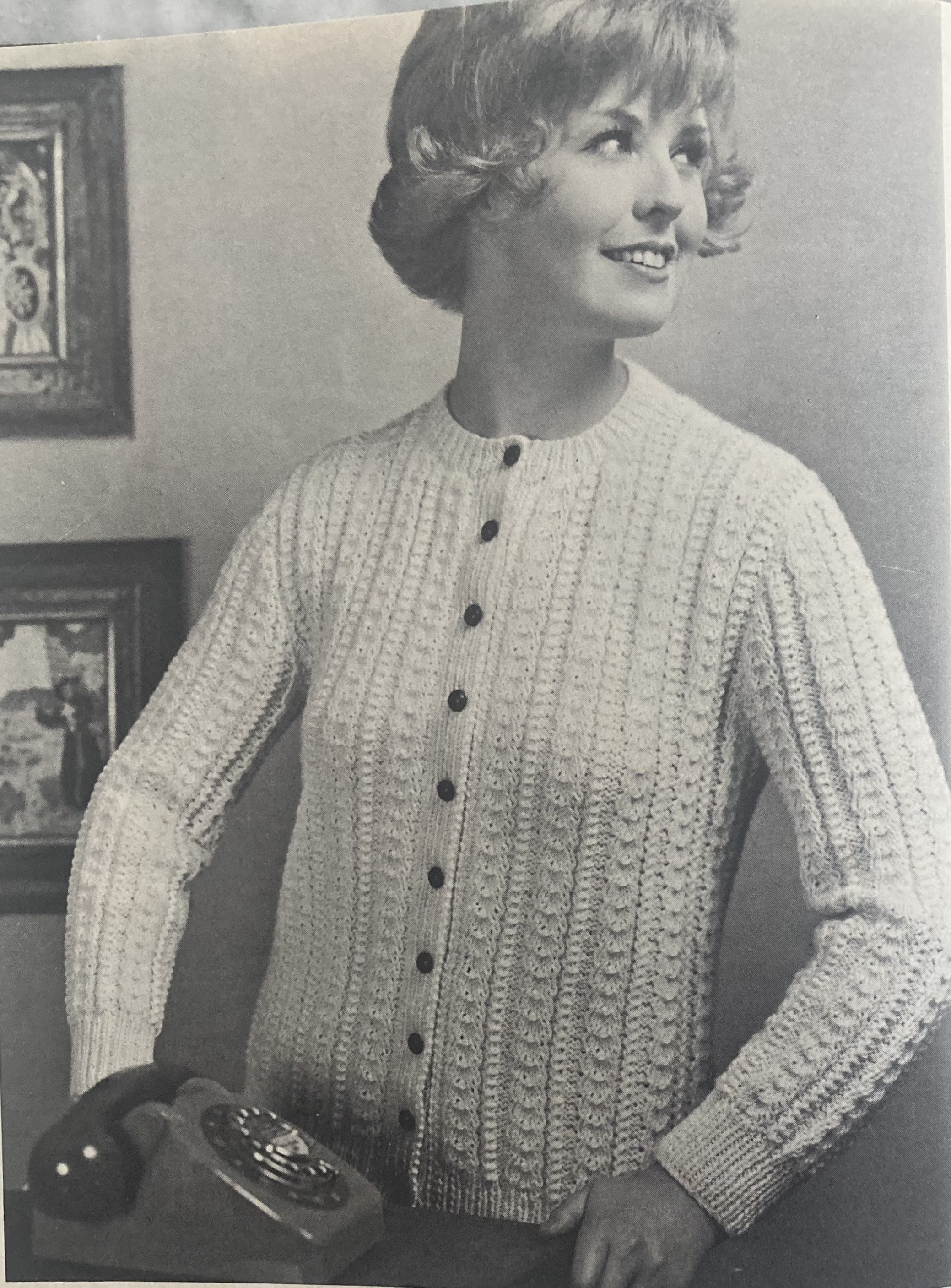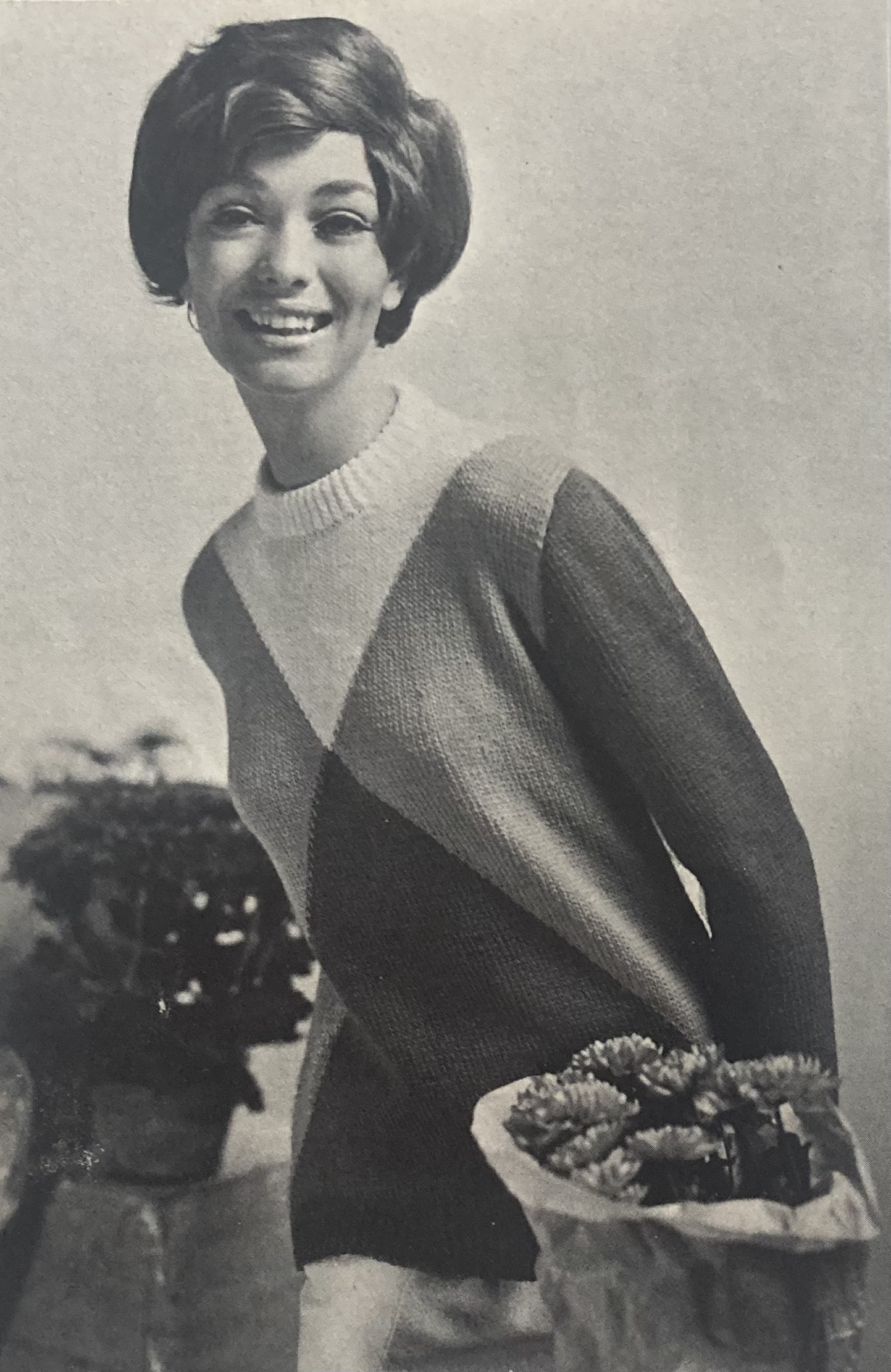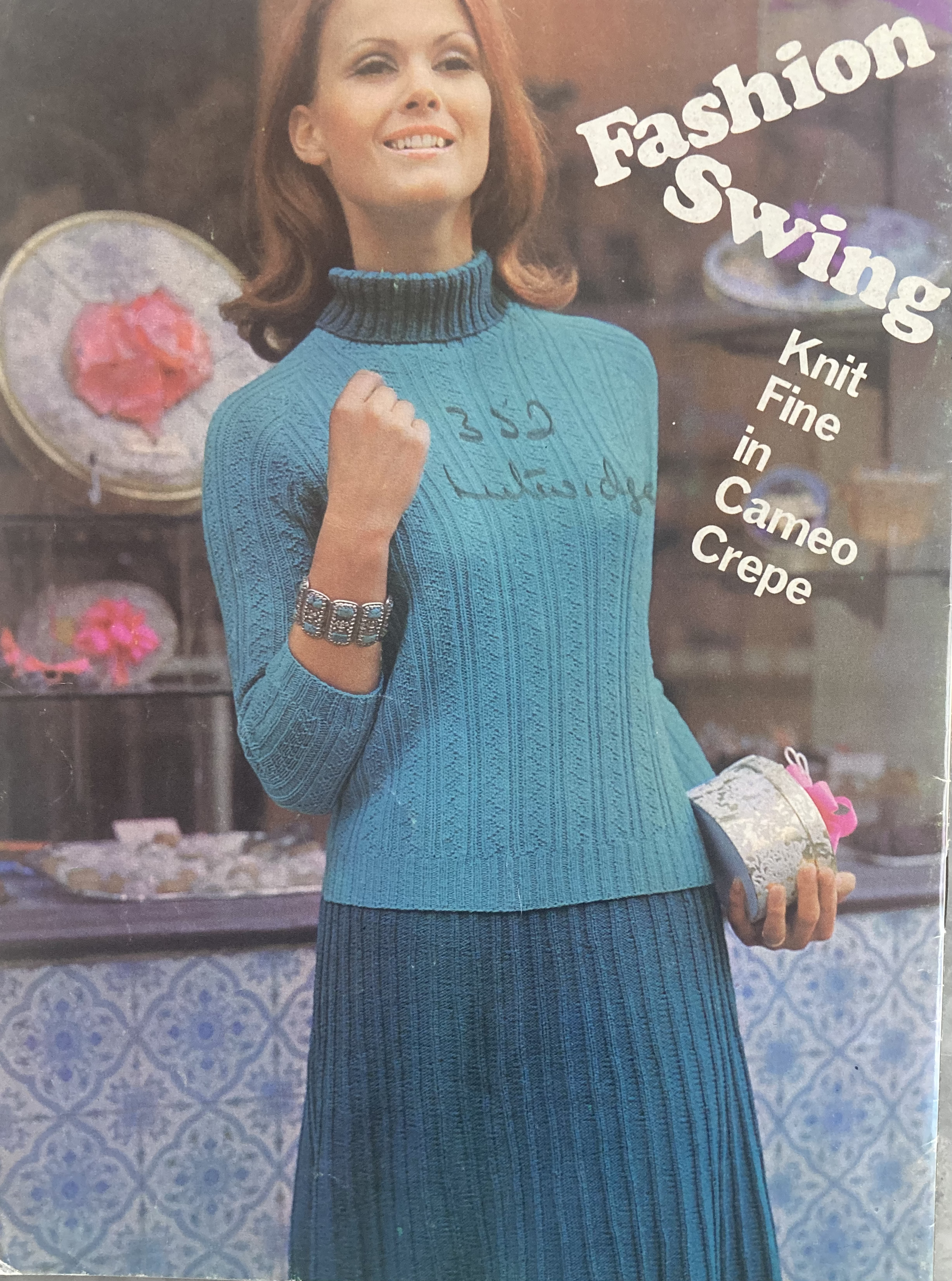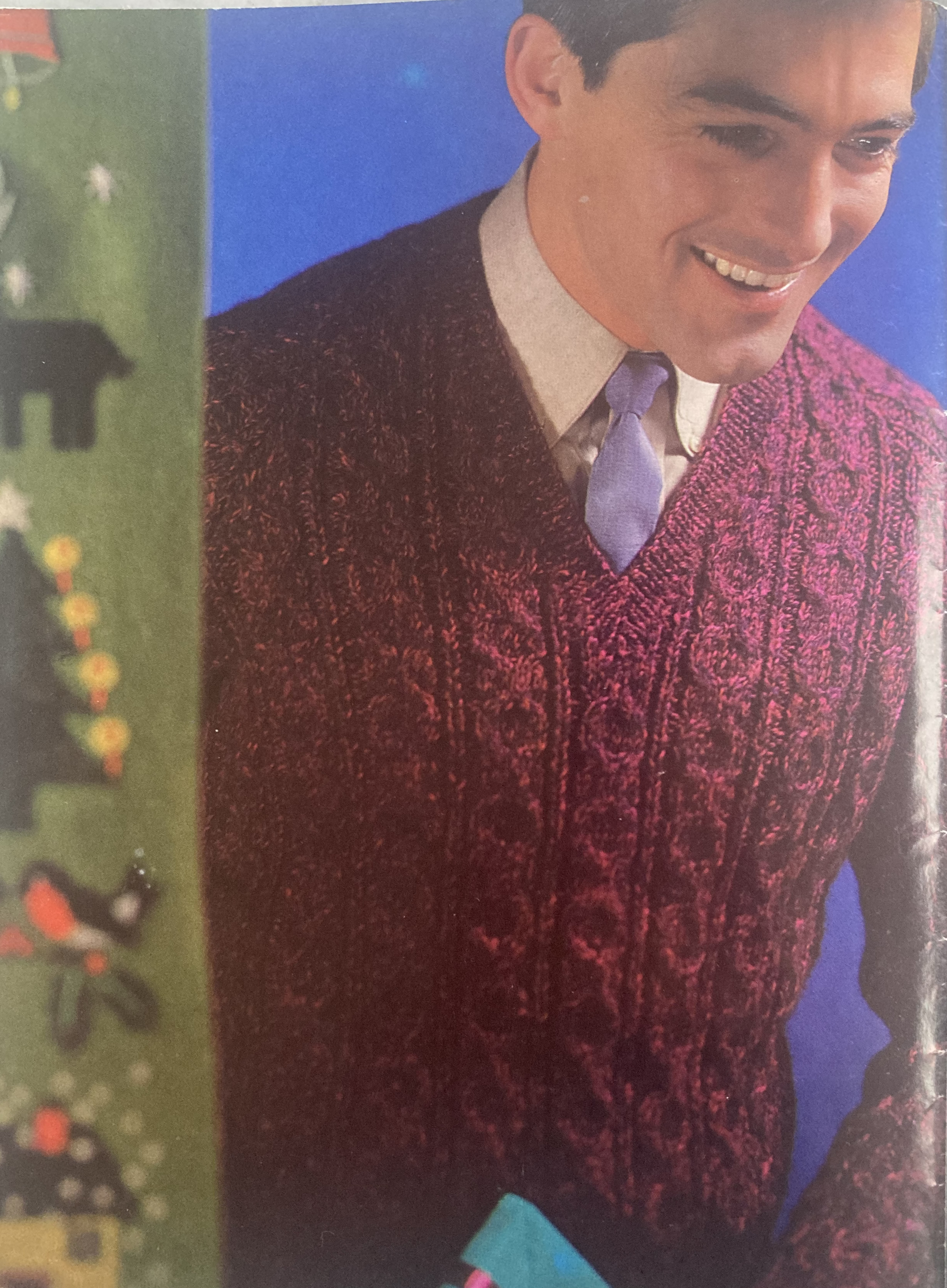
May 1967: Overview

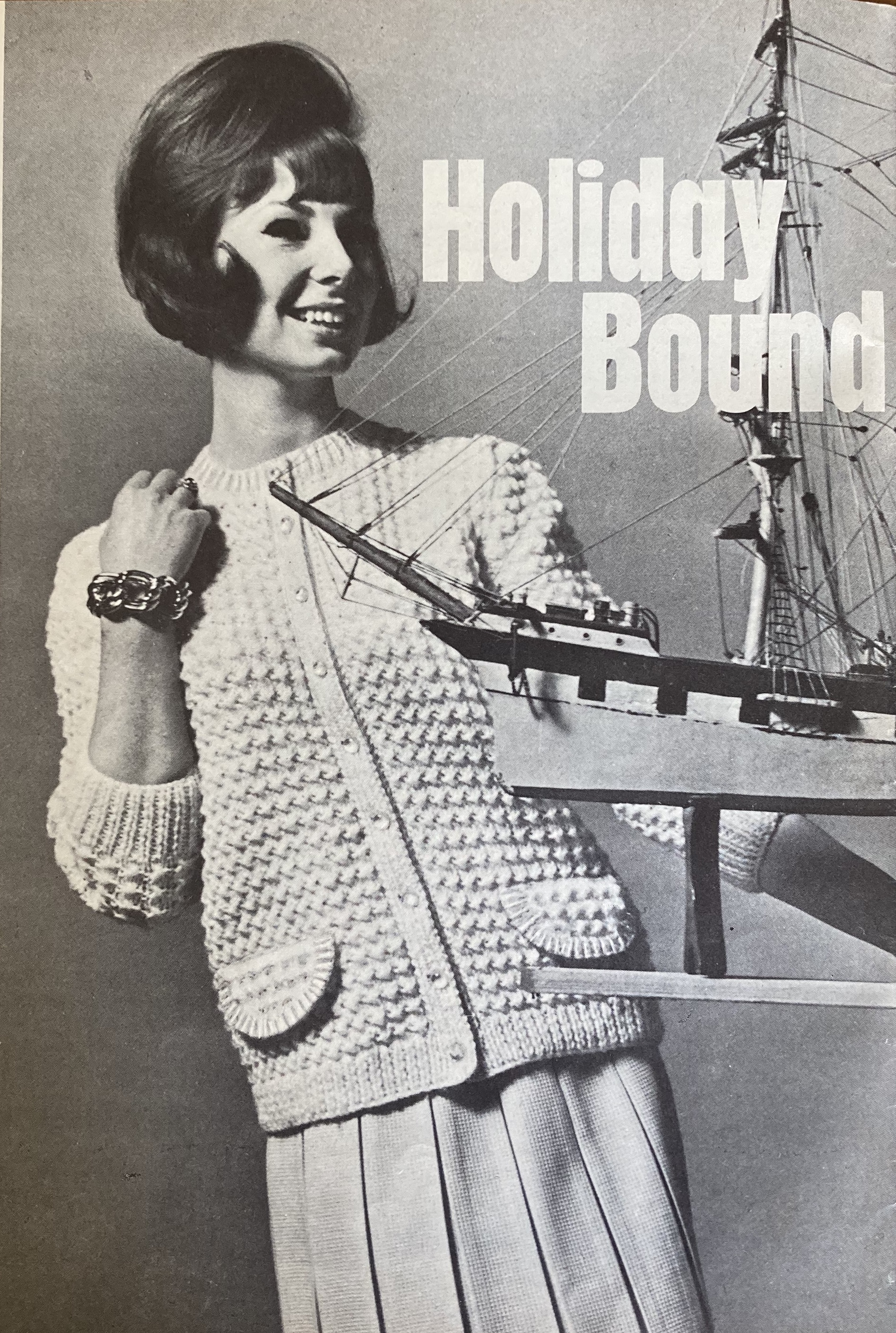
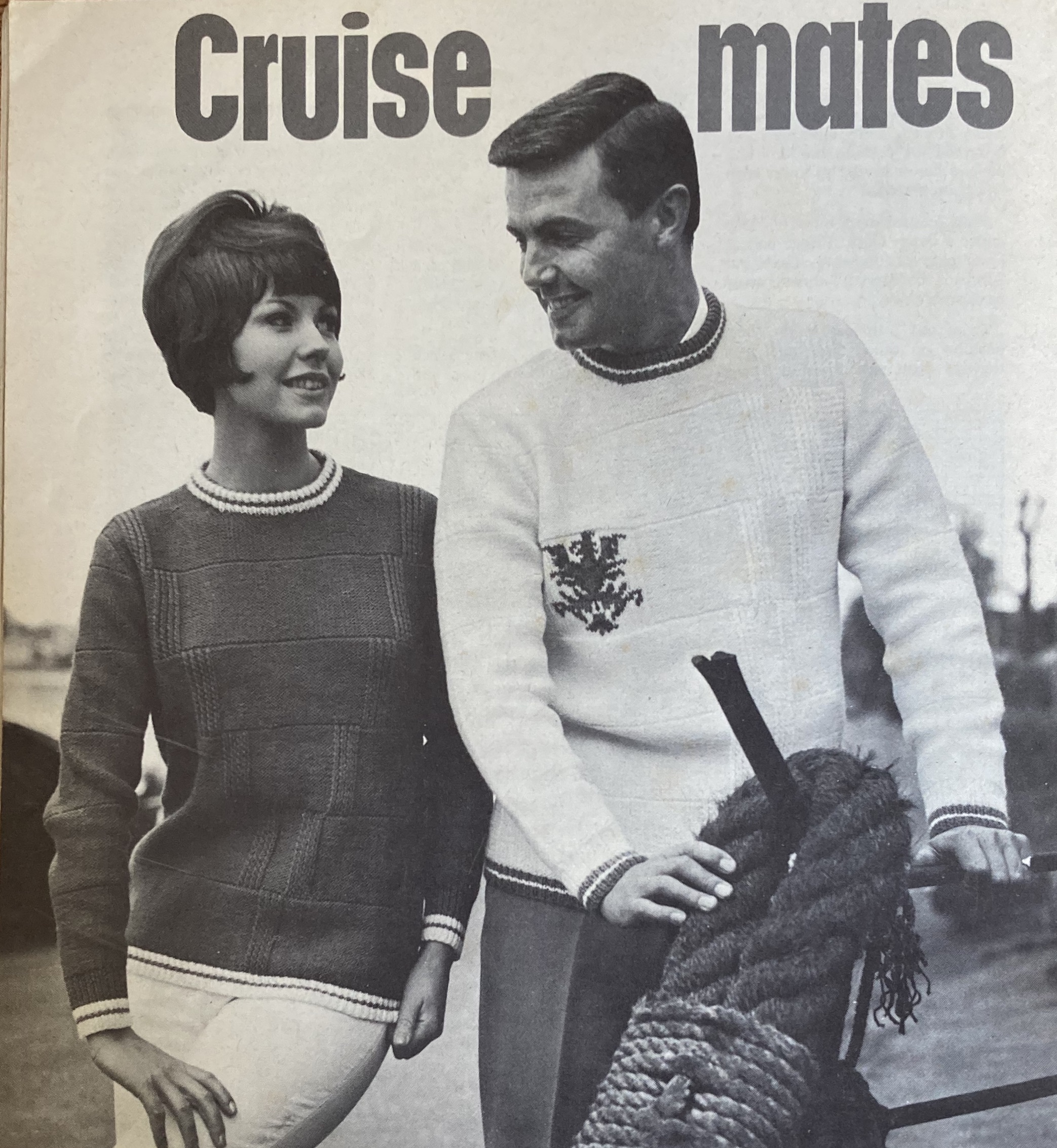
Ahoy! It’s May 1967 here at the Stitchcraft Sixties, where “Cruise Mates feature the fashion for Crepe”, and we are “Holiday Bound.”

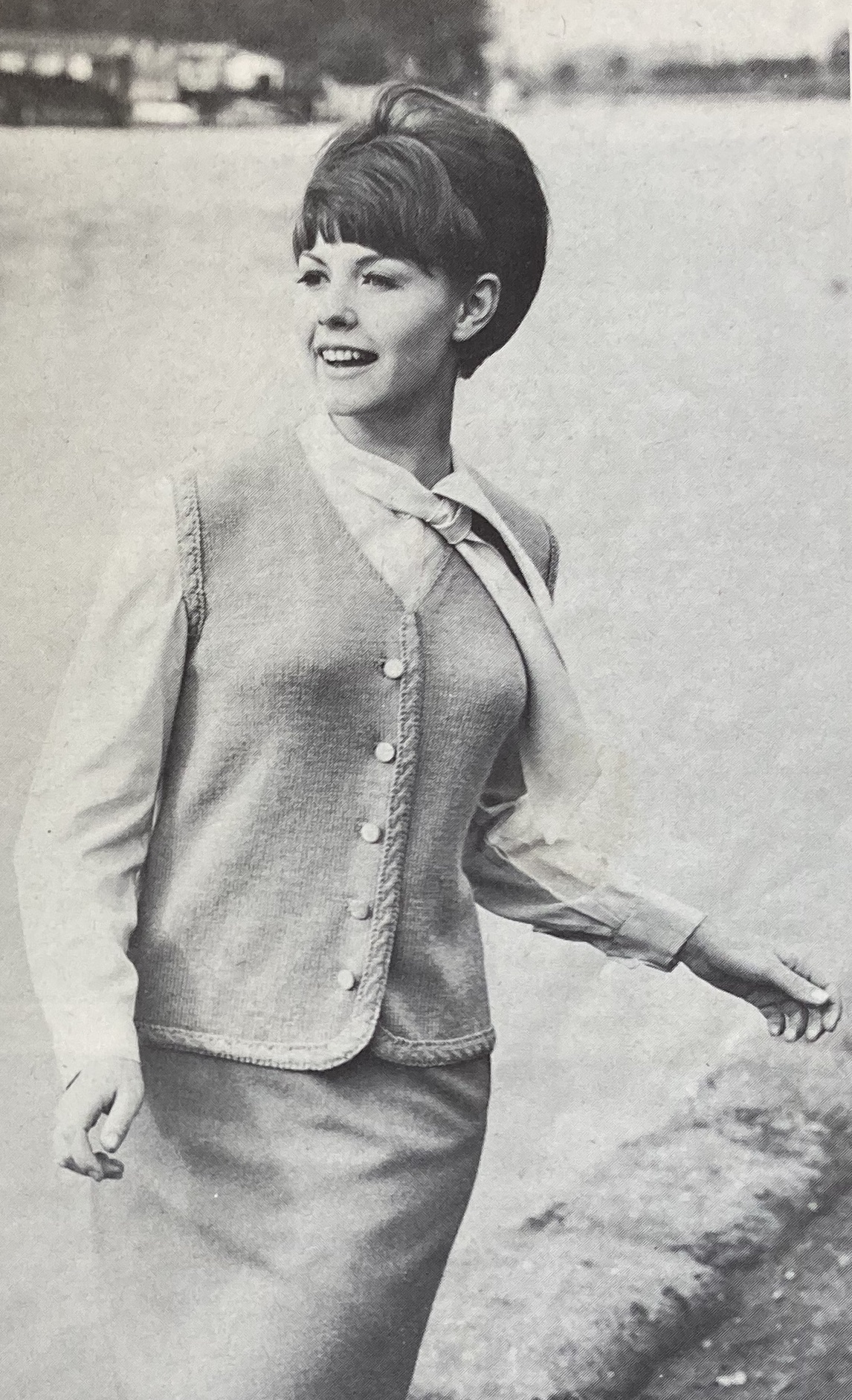
What fashions come to mind when you think of spring and summer holidays? Light and lacy tops? Airy dresses? Halter tops and swimsuits? If so, you obviously don’t live in a Northern European maritime climate. Stitchcraft knows what British “cruise mates” need on their summer holidays: multiple layers of thick, damp-repellent wool! Our cover ensemble of nautical blazer and striped “shell” top to go underneath will keep even the foggiest cruise mates warm, dry and fashionable. The double-breasted blazer (“from Paris”, which is not particularly near any large body of water, and also quite a bit warmer than coastal areas, just saying) is made in Totem Cameo DK wool with metal buttons, knitting piping trim and big patch pockets. The sleeveless top is made in the finer version of the same wool, Cameo Crepe. The “crepe twist” (tightly worsted-spun) in the wool makes for smooth, even knitting and good wearablility. You can cover it all up with a gigantic traveling coat made in thick, undyed “Capstan” wool.

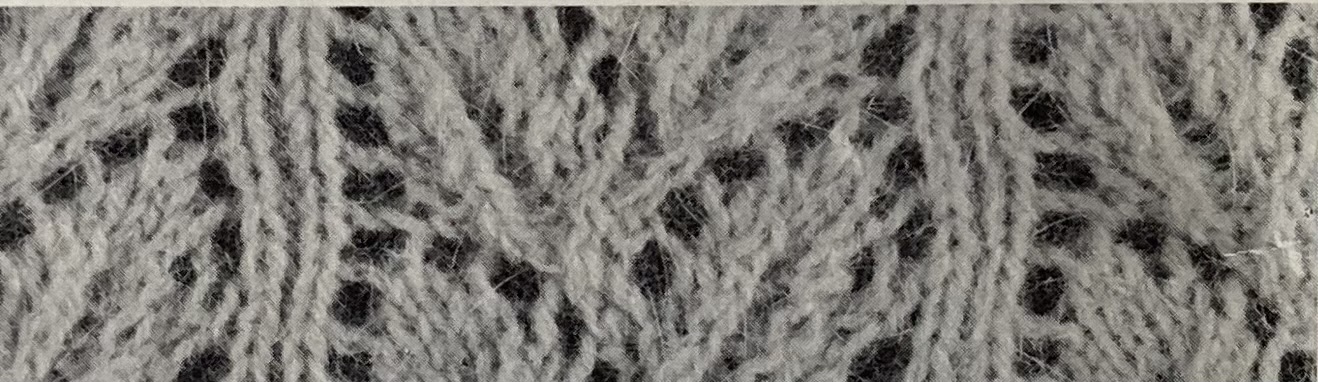
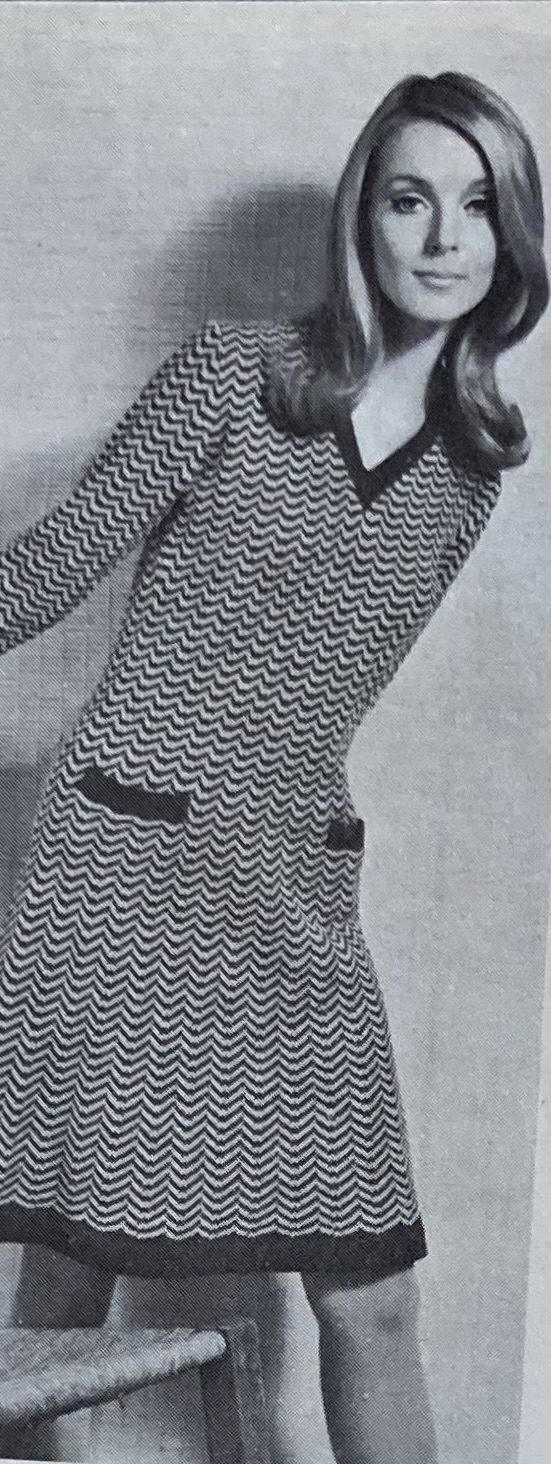
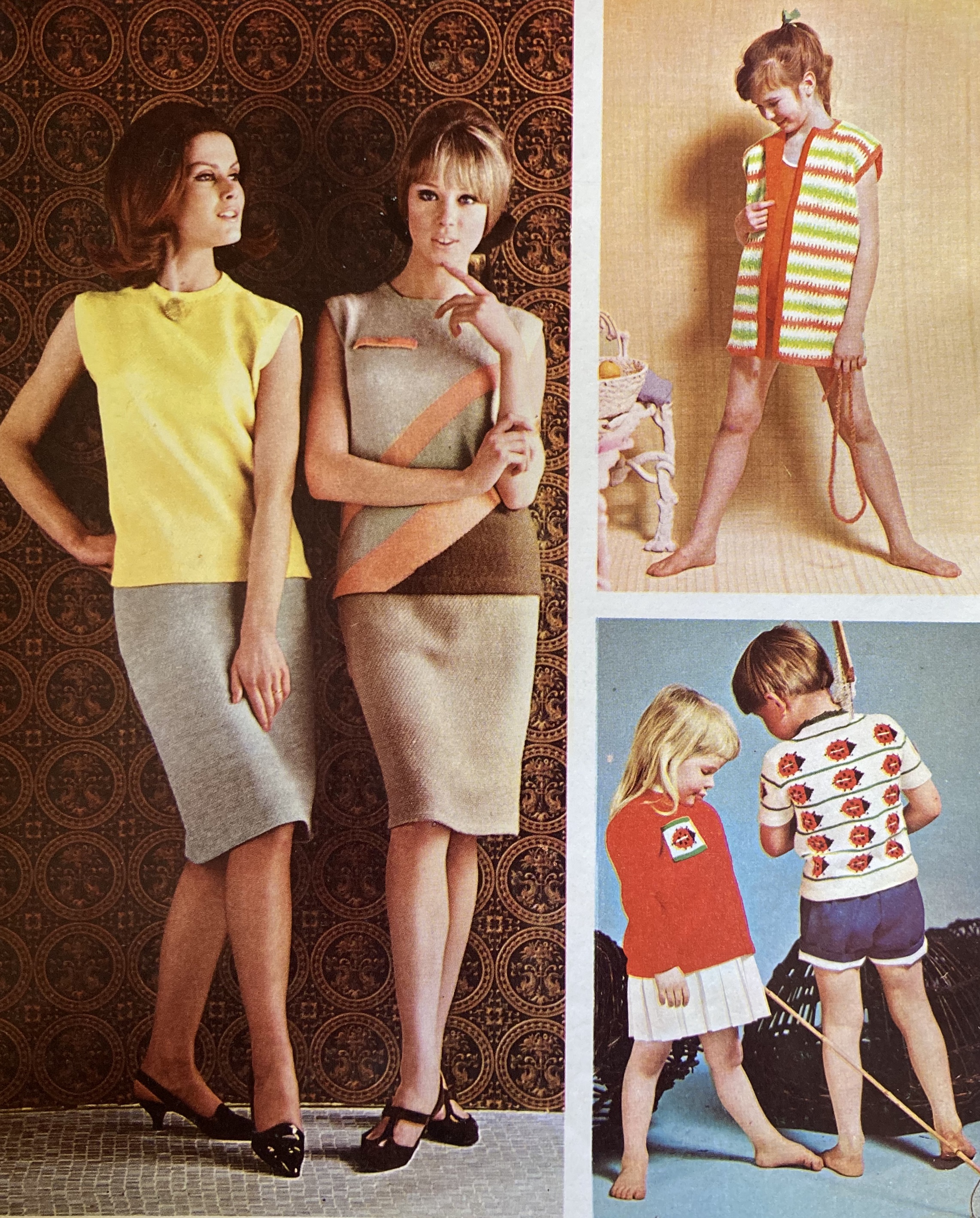
Onshore fashions include a sleeveless mini-dress in DK-weight wool (“perfect for holidays”), a short-sleeved jumper in a cables-and-lace pattern, two more sleeveless “shells” for warmer days or layering, and a “classic sporty sweater” in a simple, but effective striped slip-stitch rib pattern. The light green “shell” has a slip-stitch pattern, too, and horizontal texture lines appear more subtly in the easy ridge pattern on the yoke of the dress.

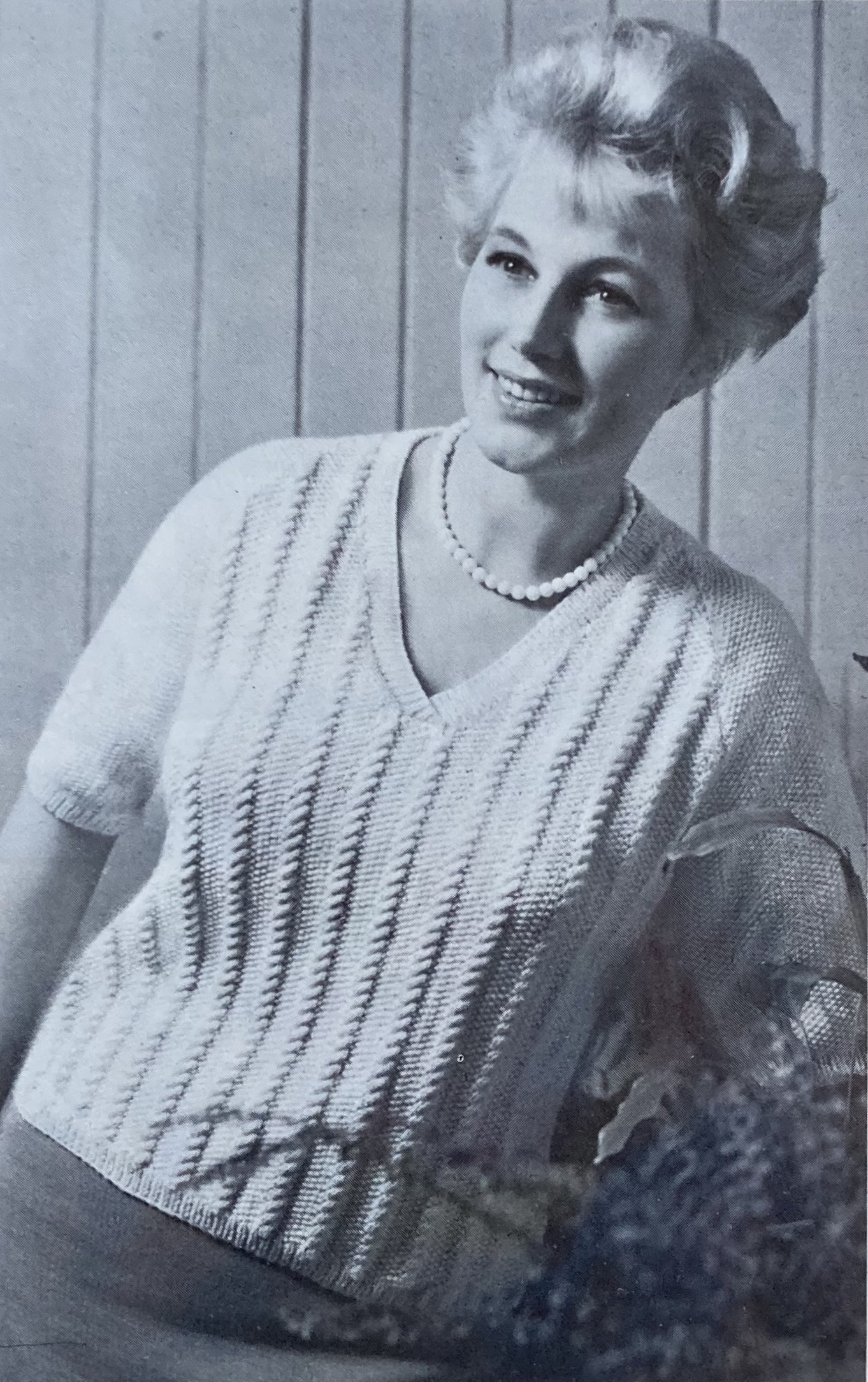
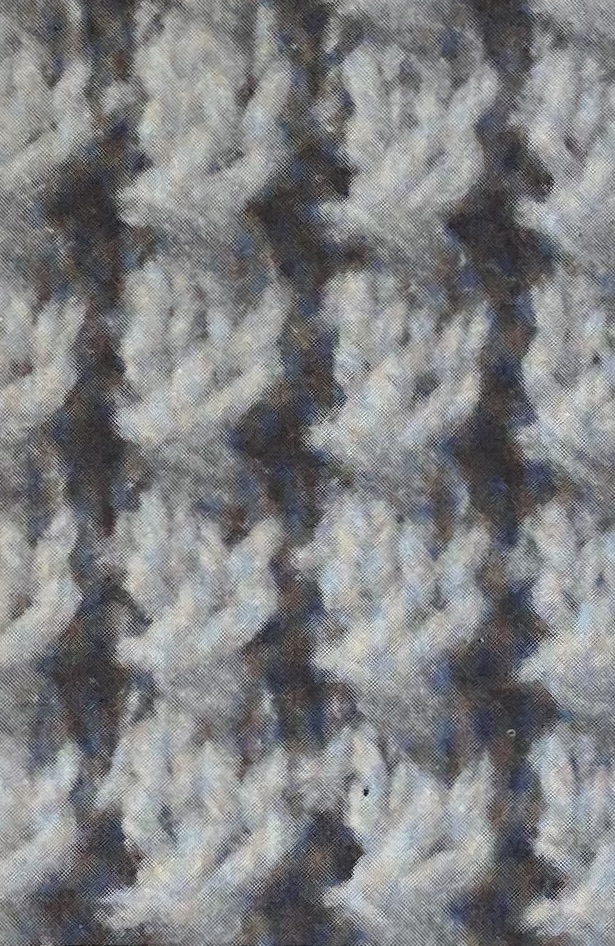
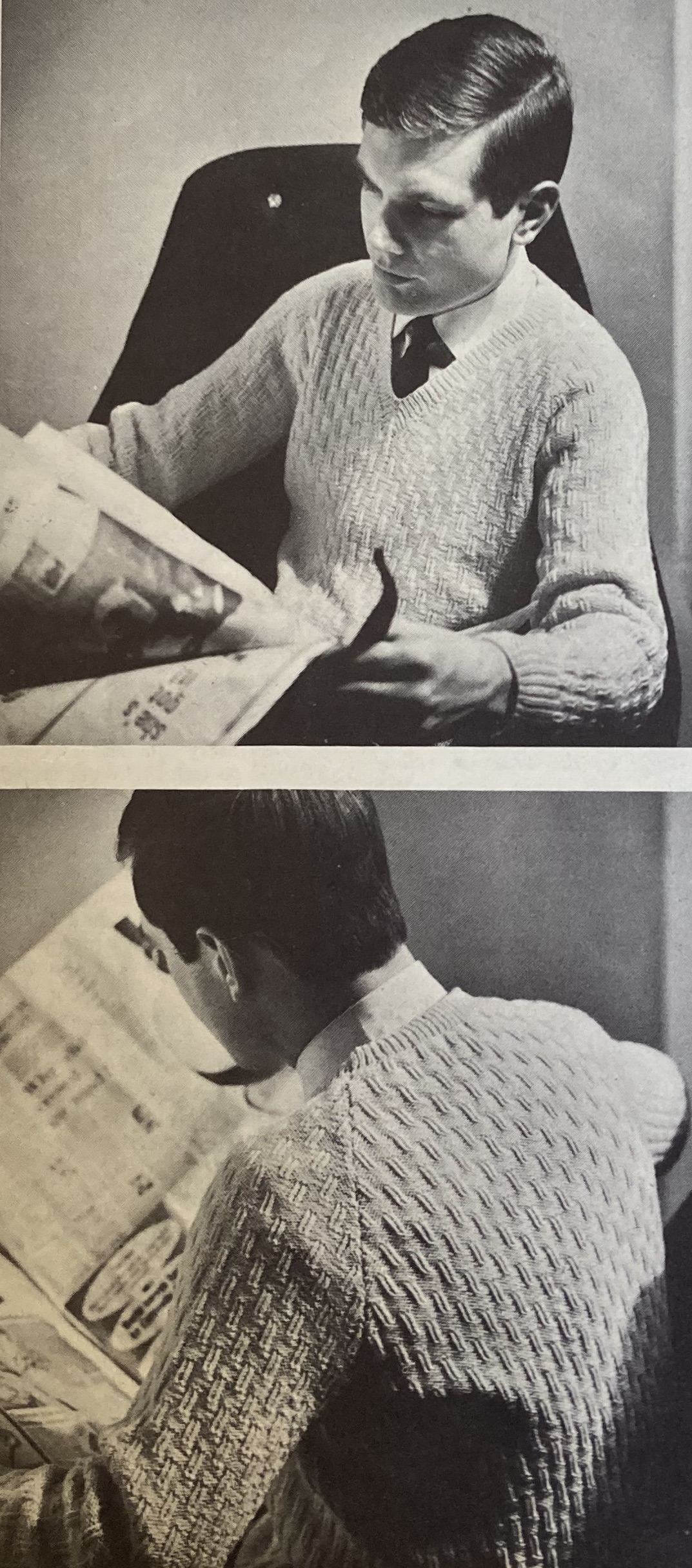
It’s a good issue for menswear too, with a lightweight slipover in a reversible (!) textured pattern. I thought the stitch pattern would be some sort of fisherman’s rib, but it is is utterly simple: knit 1 row, then k1b, p1 for one row. It looks like fairly normal 1×1 ribbing from the “right side” and a sort of starry waffleboard pattern from the “wrong side”. How lovely to never have to worry about putting something on inside-out! The “Continental pullover”, on the other hand, is too wide and the cables on the lower half give a strange “skirted” effect. Perhaps they knitted the wrong size, or should have put it on a larger-bellied model.

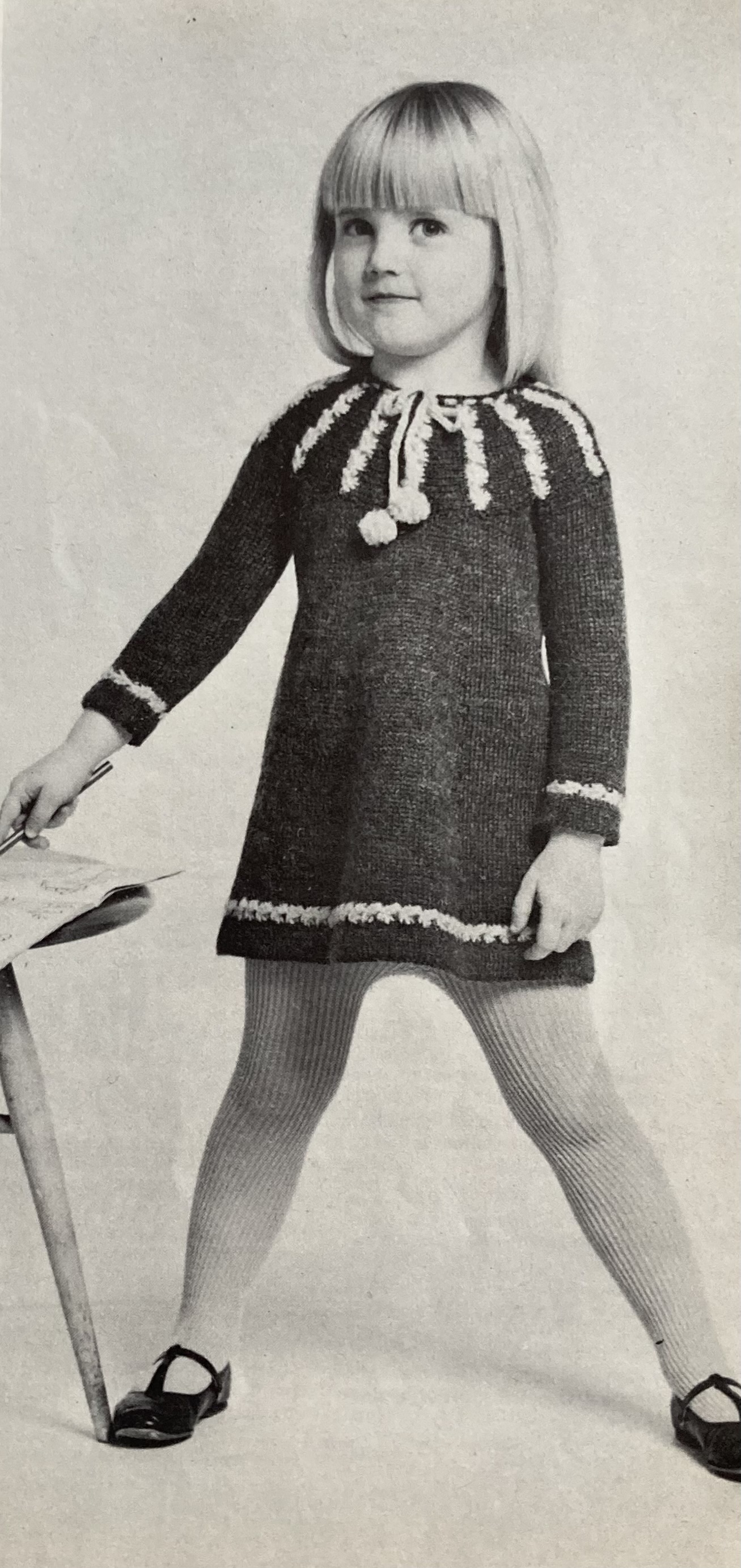
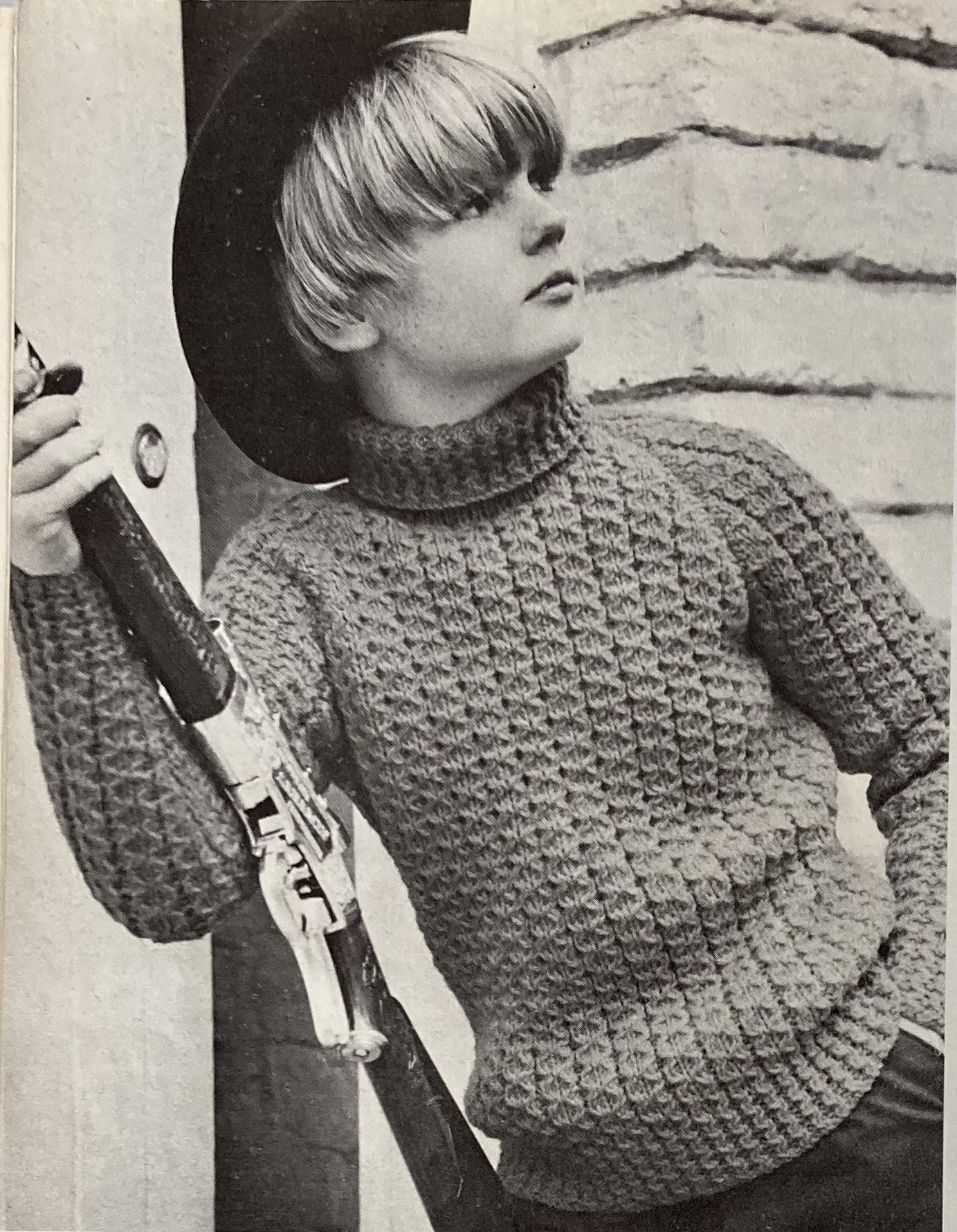
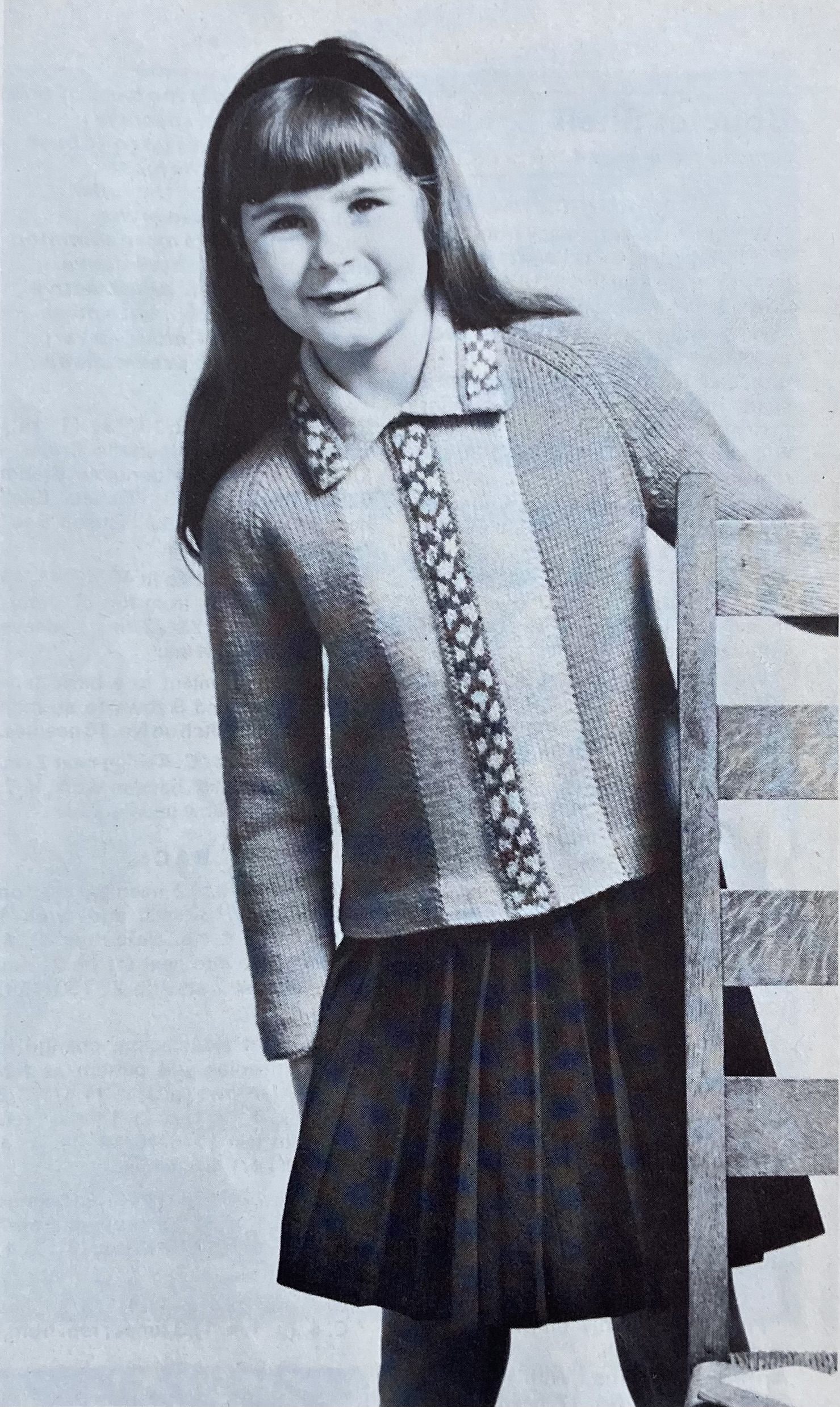
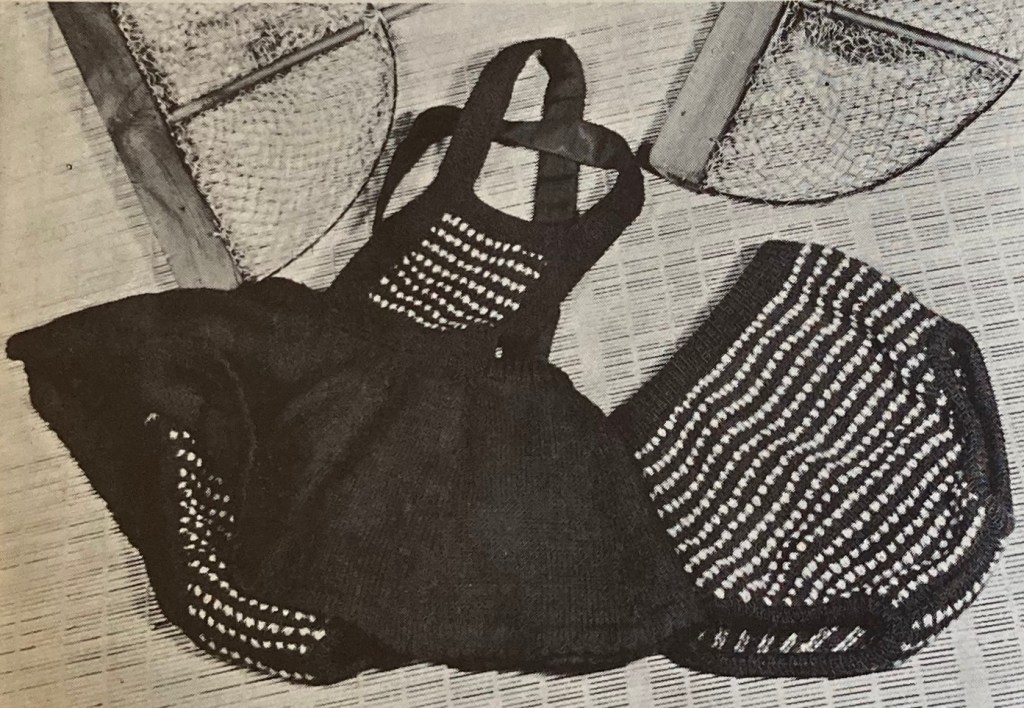
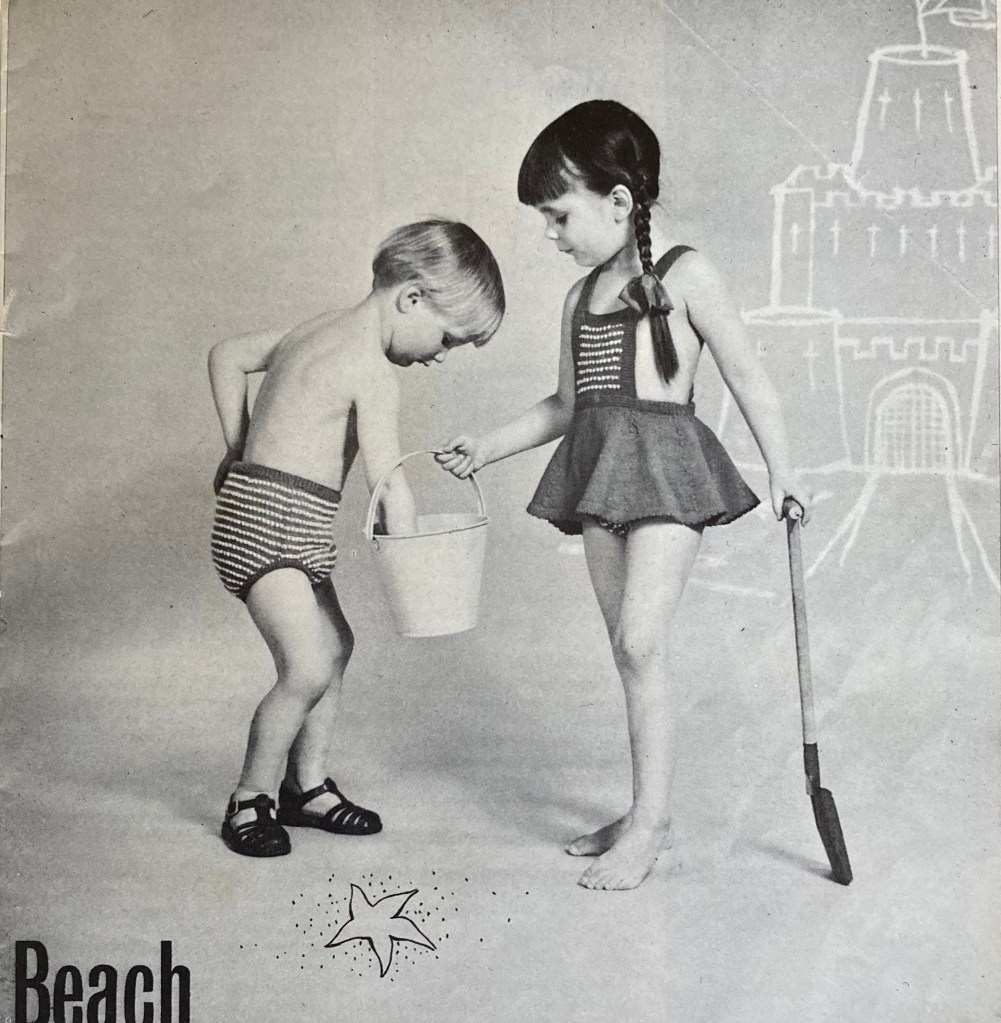
There are some wonderful garments for children of various ages in this issue, starting with a comfortable bobble-trimmed top for a school-age girl and a warm sweater for a boy (make sure he’s wearing a proper shirt and tie to go under it while sailing his wooden boats at the beach.) Here too, the stitch pattern looks more complicated than it is: k1, p3 for one row, then p1, k3 back makes a interesting offset rib with minimal effort. Little kids can “paddle and splash” in a tunic, t-shirt top and/or shorts for beach wear. The horizontal stripes are knitted in and the vertical stripes are crocheted on later with chain-stitch. A note in the tunic pattern says, “We have allowed 1-inch extra in length on back and front of dress as chain-stitching tends to contract the work.” Smart!

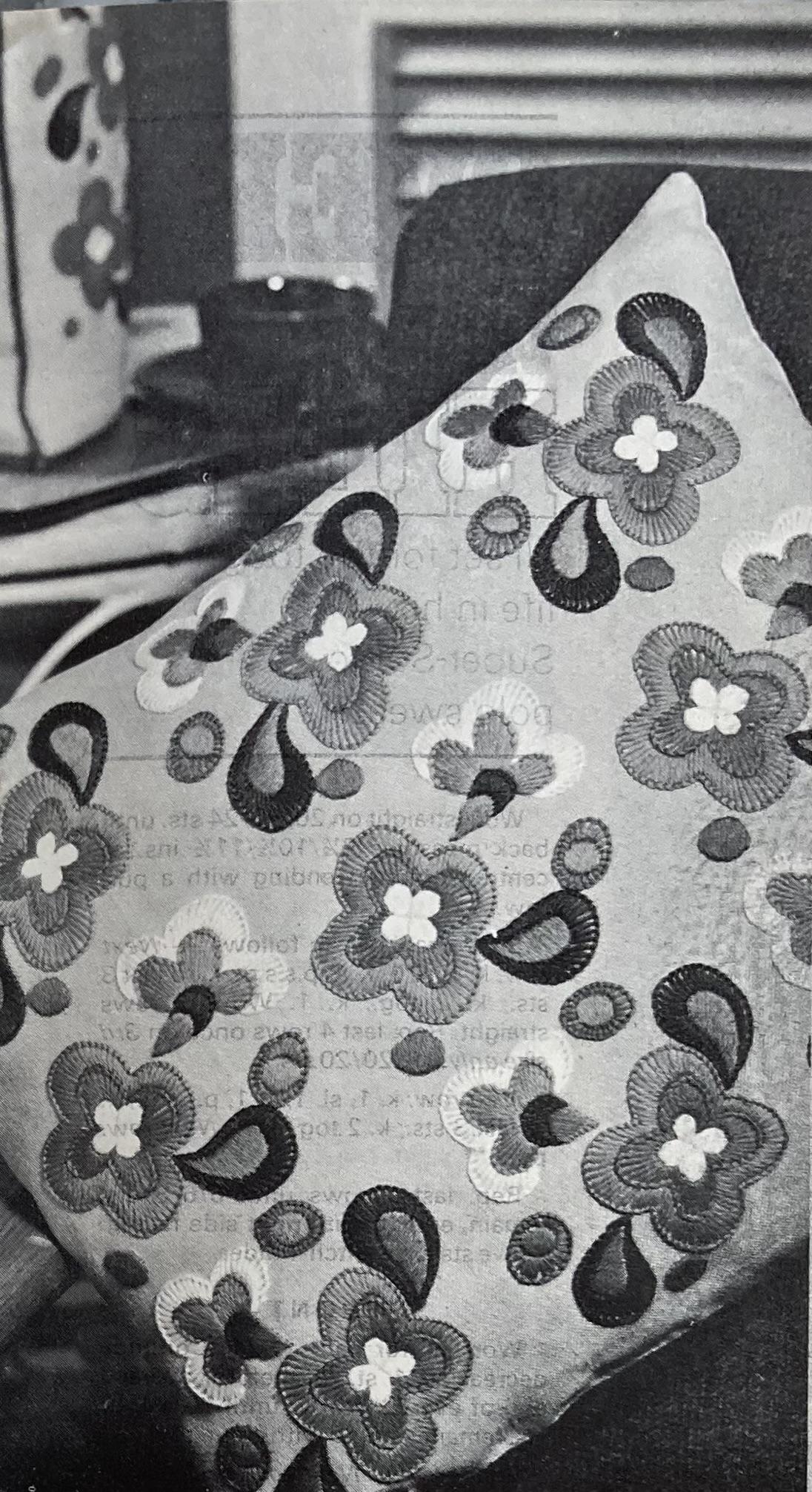
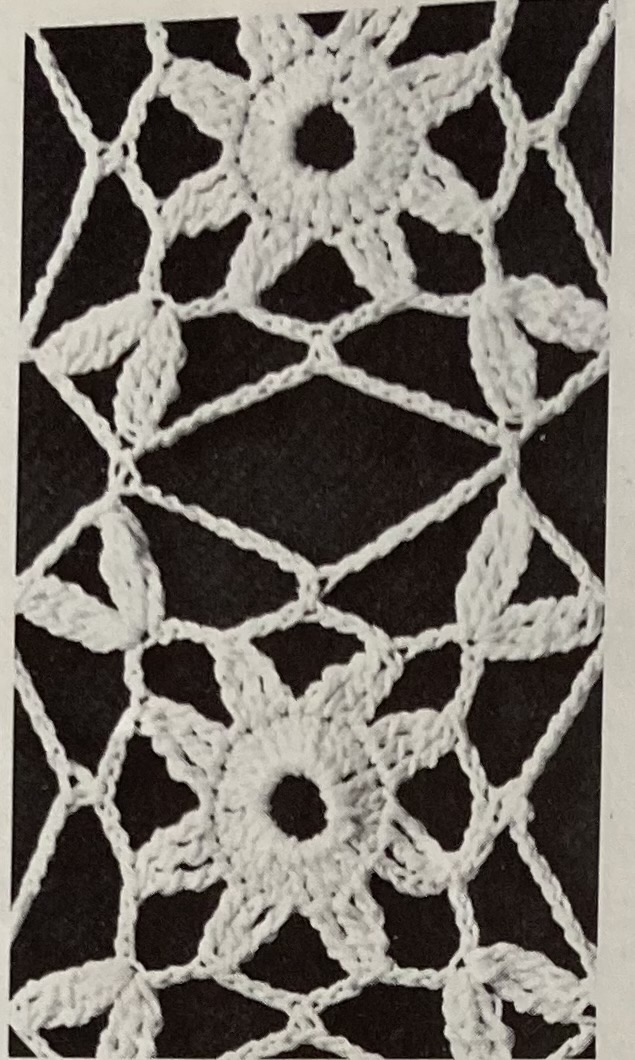
Rouding out this excellent issue are some wonderful homeware designs, starting with a set of garden cushions in a seaside “fish” and “crab” design. Love the use of pinking shears to illustrate the fish’s scales and the crab’s pincers! Way back in the “Readers Pages” is another, versatile appliqué design, this time with crocheted flowers instead of felt cut-outs.

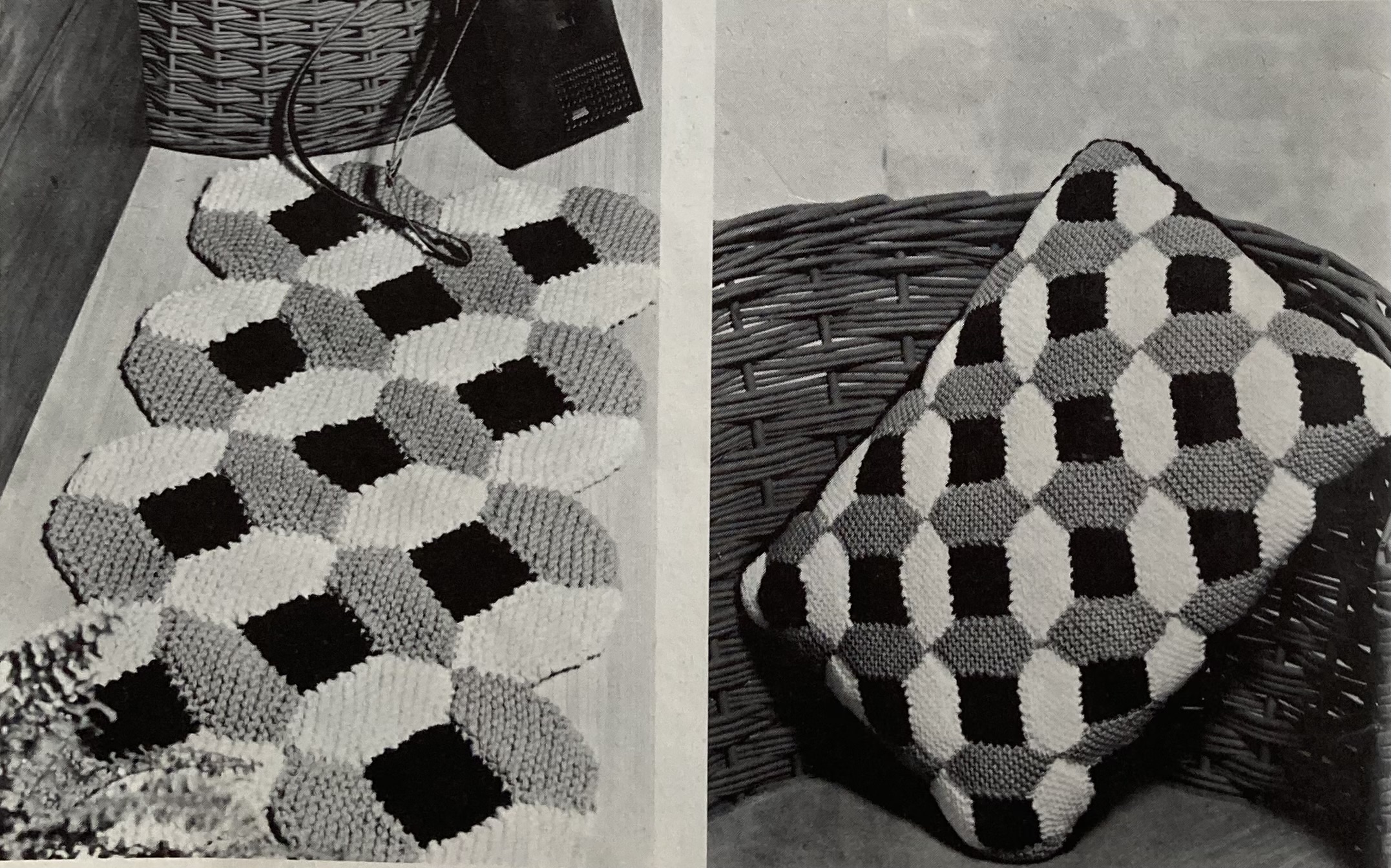
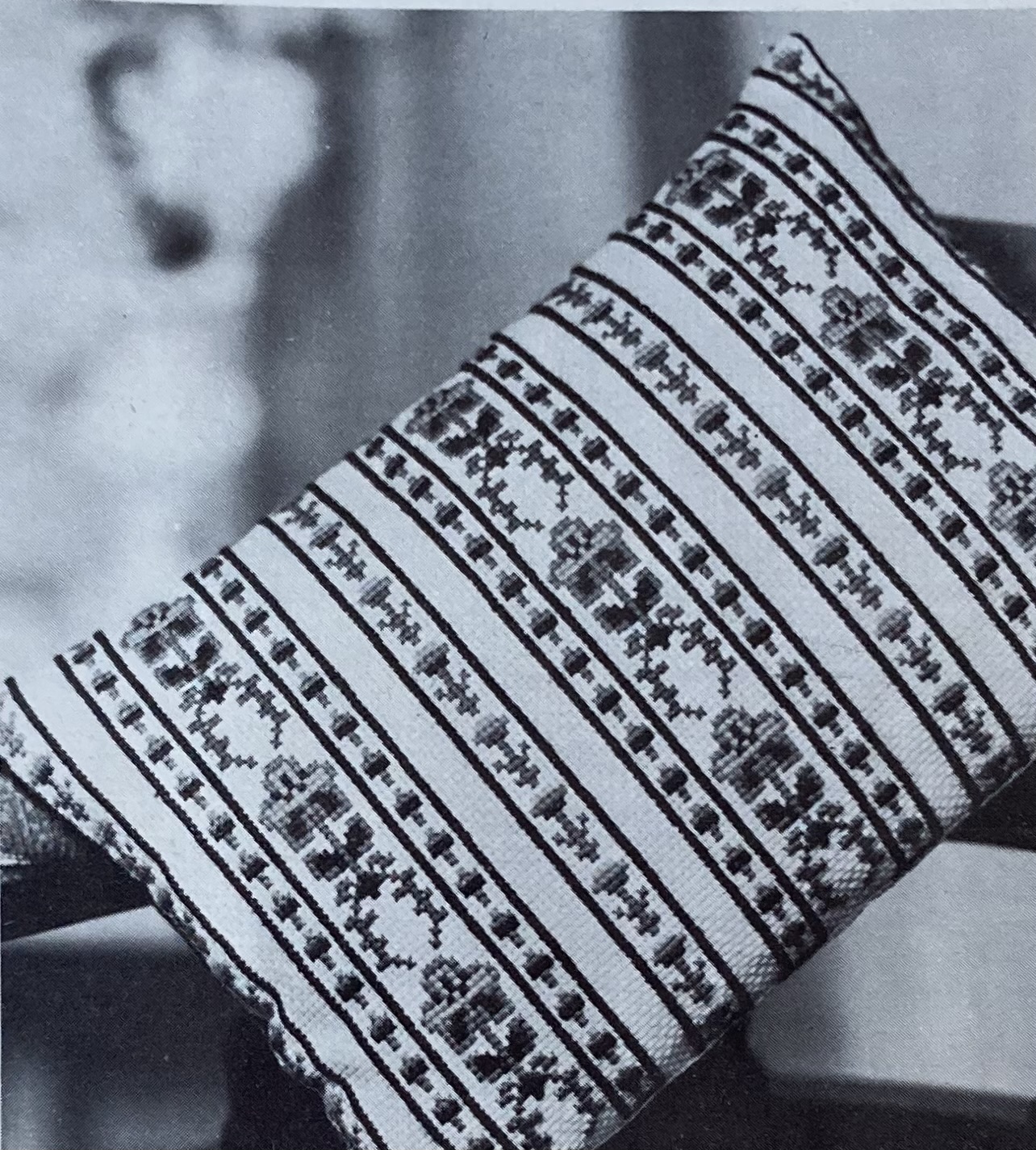
For cross-stitch enthusiasts, there’s a coffee-tray set with matching deep-pocketed apron, or a tea cosy featuring wool stitching on tapestry canvas. Beginning rugmakers can make an easy runner in chain and soumak stitch.

The most magnificent design, though, is this Chippendale-inspired rug and piano-stool set, rightly featured in full colour over the two centrefold pages. The stool cover is worked in tapestry using tapisserie wool in trammed tent stitch and the 36×62 inch rug is worked in cross-stitch in Turkey Rug Wool.

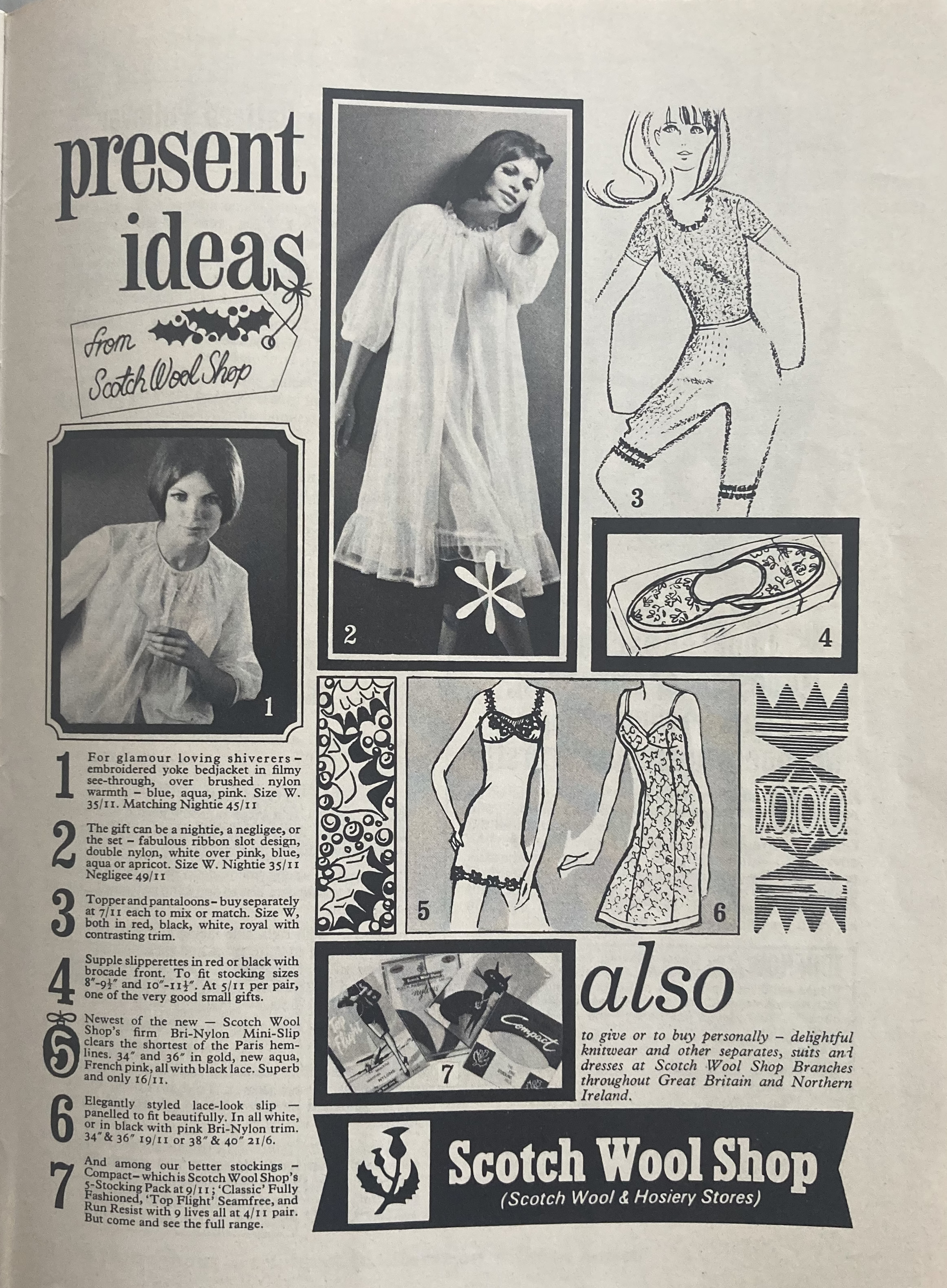
Even the ads are great in this issue! The model wearing Patons Fiona is happy rain or shine and look at those amazing swimsuits from the Scotch Wool Shop! I would wear either of them today. And don’t you love the Singer sewing machine that can be folded down into its own practical storage cabinet when not in use? Did any of you have one of these? I think it’s brilliant and would have loved to have one.

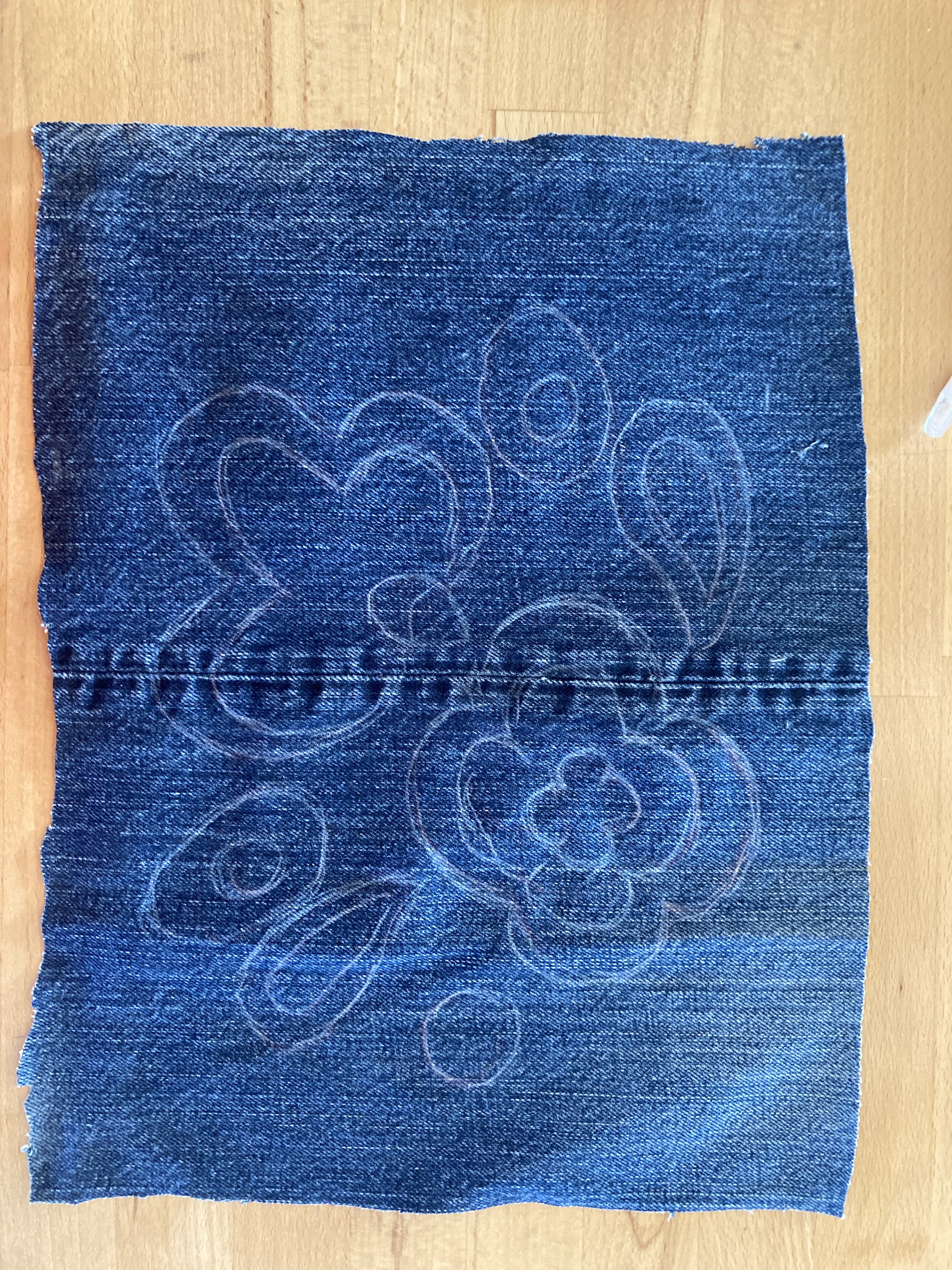
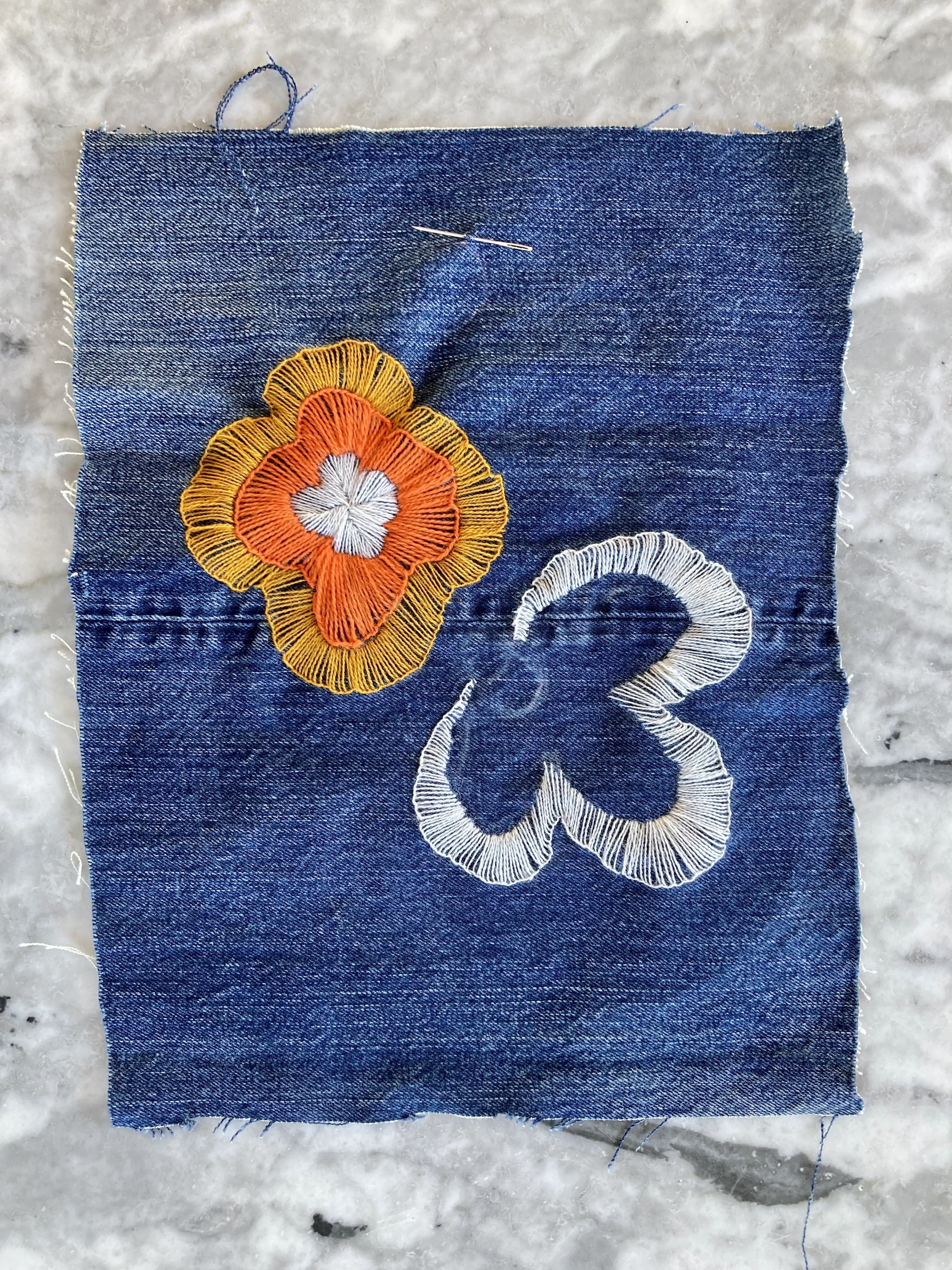
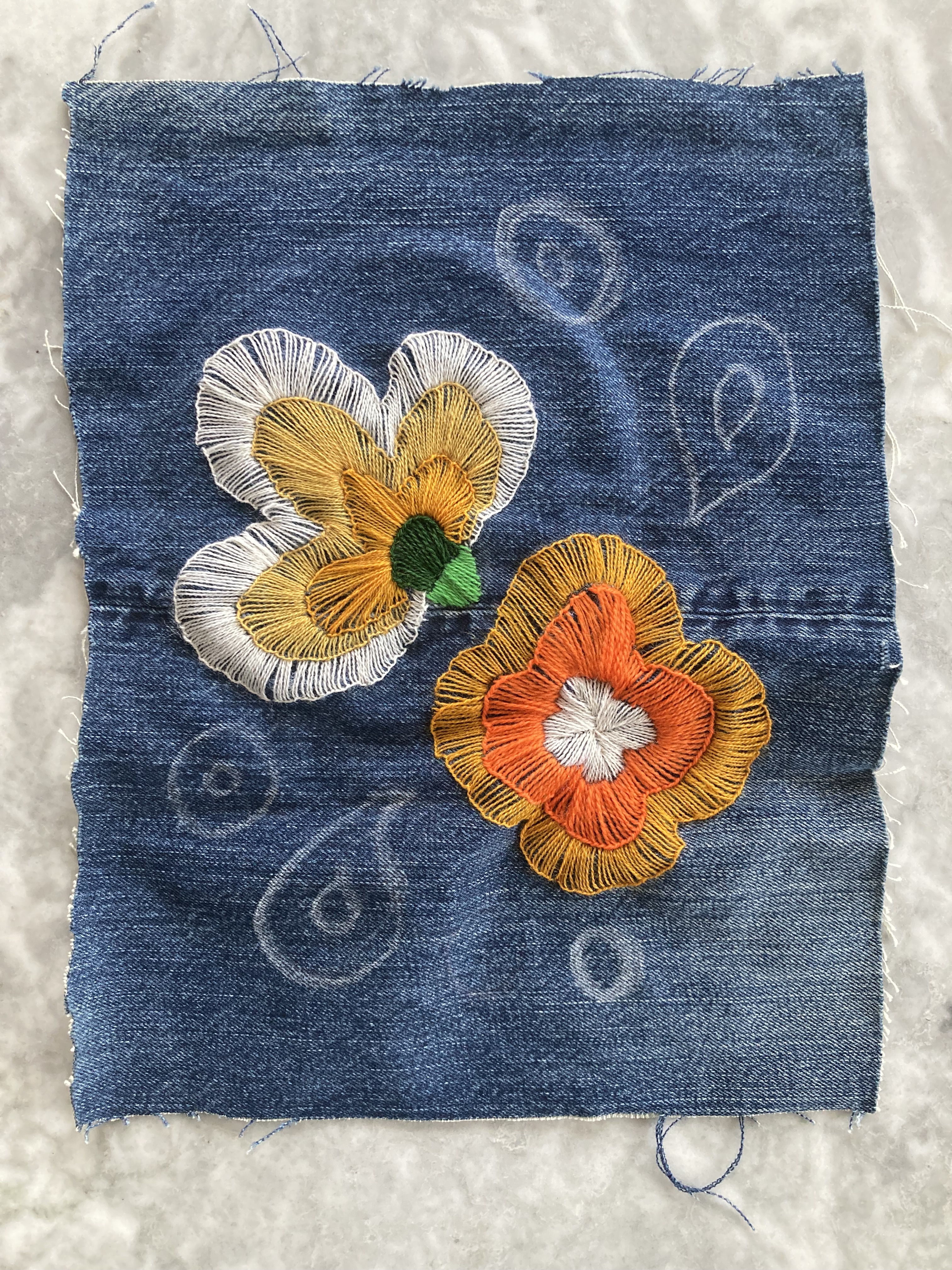
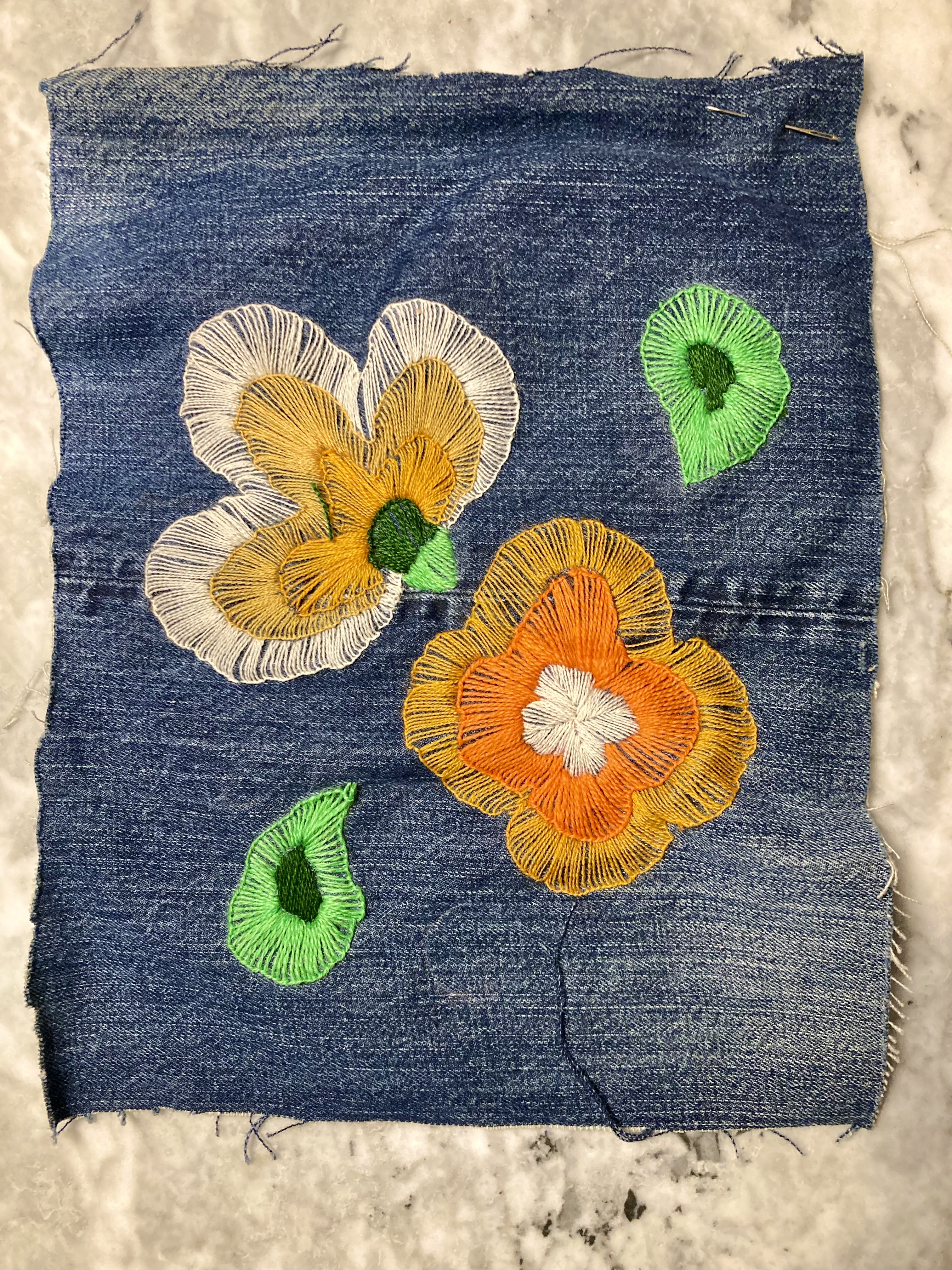
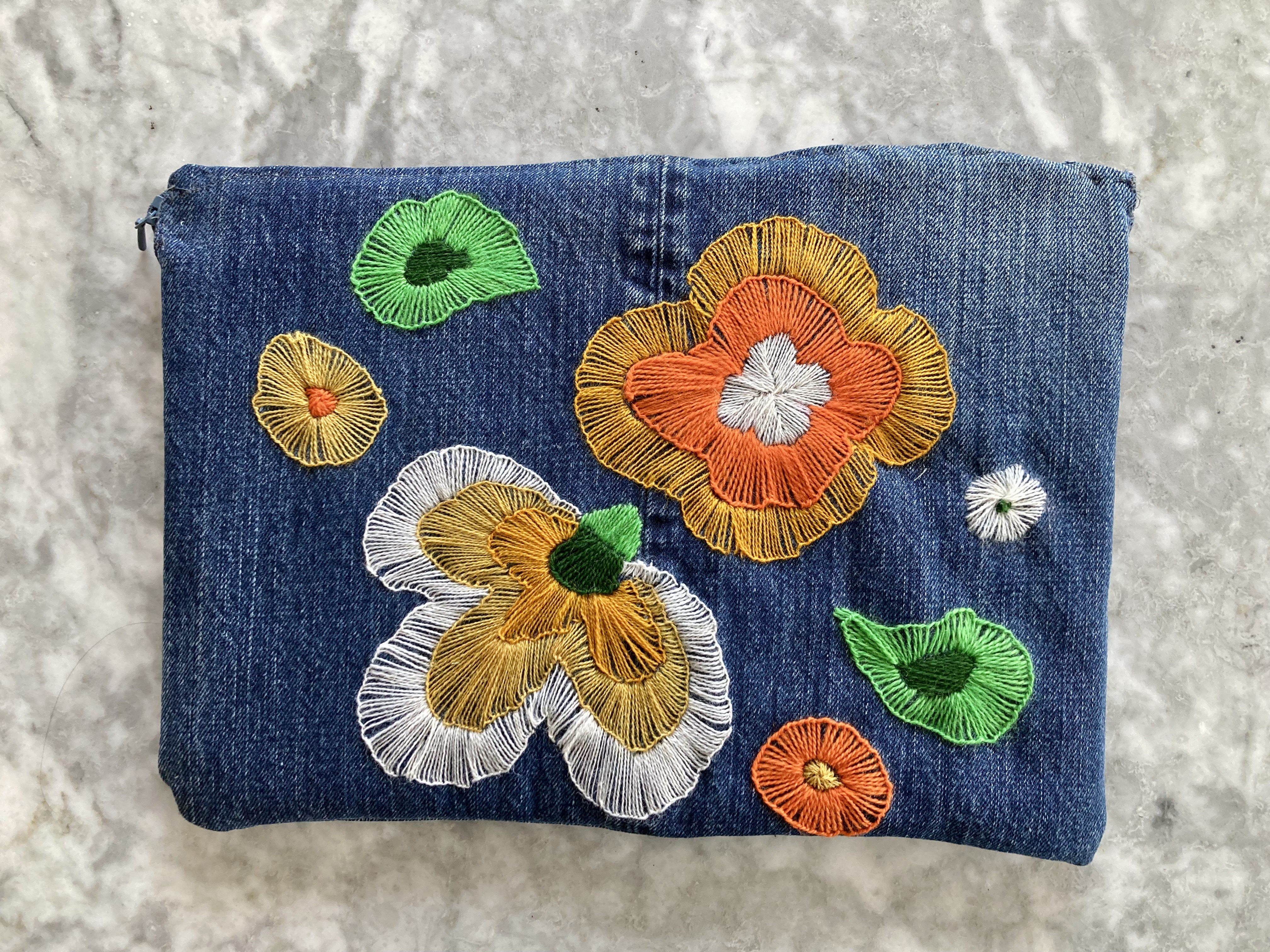
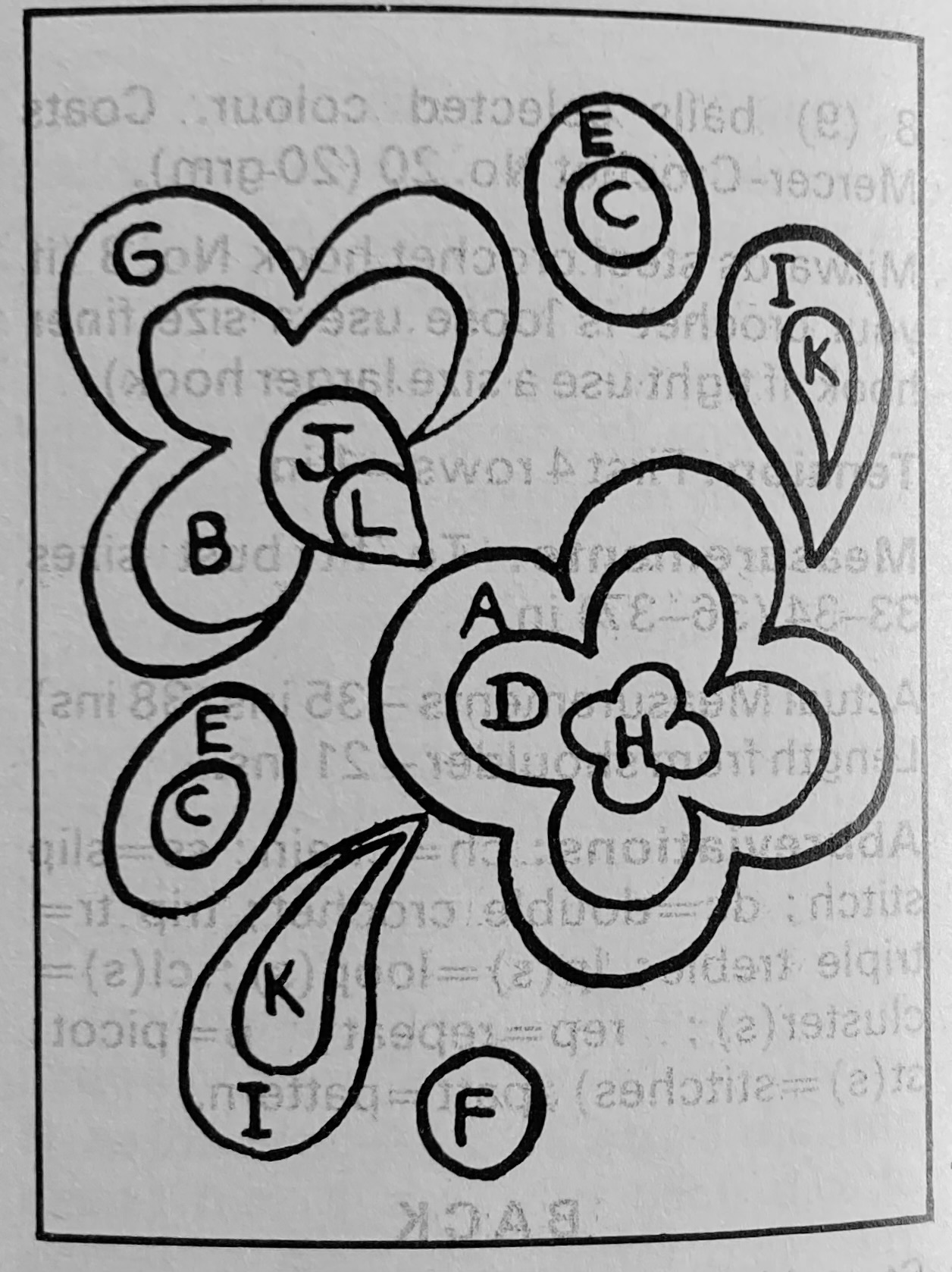
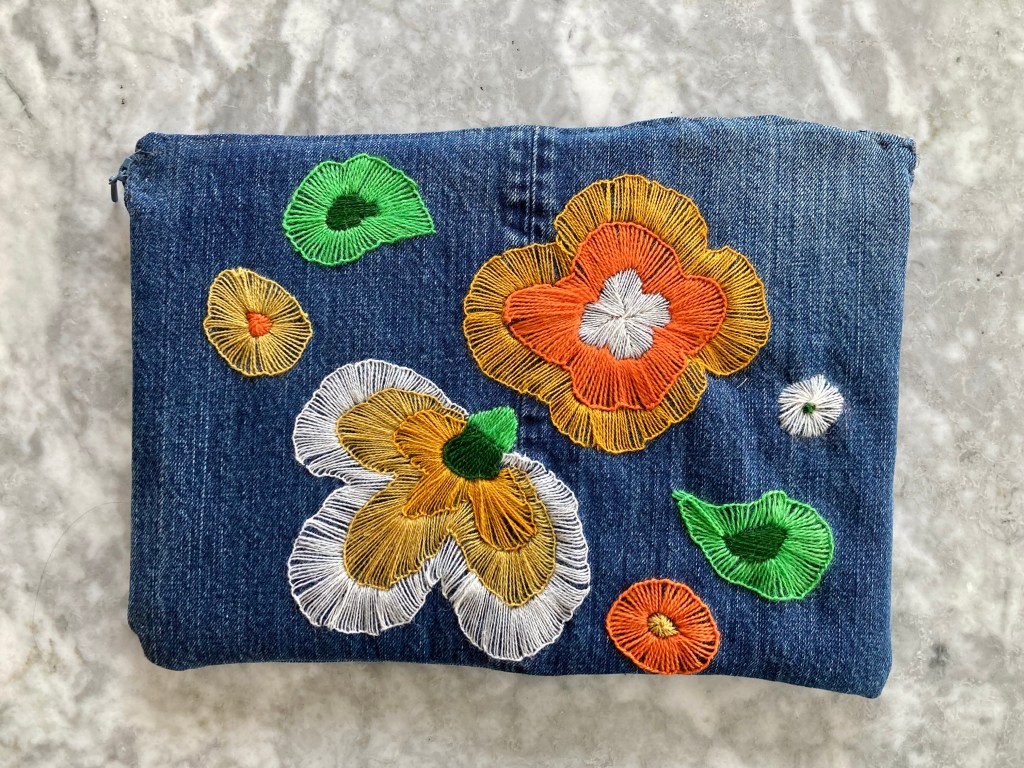
My projects from this issue will be the garden cushions and the crochet appliqué on a useful-for-whatever little bag. I somehow have lived my entire adult life without a garden or even a balcony, but I know people who have those things and would love to have a fun cushion as a gift.

Happy Spring!

April 1967: Overview

“Spring into Summer” with the April 1967 issue of Stitchcraft — one of my favourites. According to “editress” Patience Horne, the latest fashion trends include longer-bodied “skinny” sweaters (i.e. slightly less bulky than the previous oversized look), “still figure-fitting” (they aren’t, though) and “belts with everything” (none of the models in the photos are wearing belts.) Make what you will of that. “Fashion is very dashing — still young and gay in ideas — but slanted to a feminine look — pretty and flattering.” In other words, whatever you want it to be! Colours are definitely bright and fun, with interesting textured stitch patterns and colourwork.

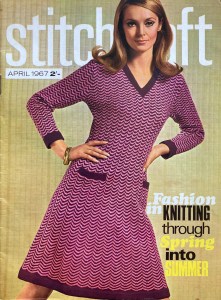
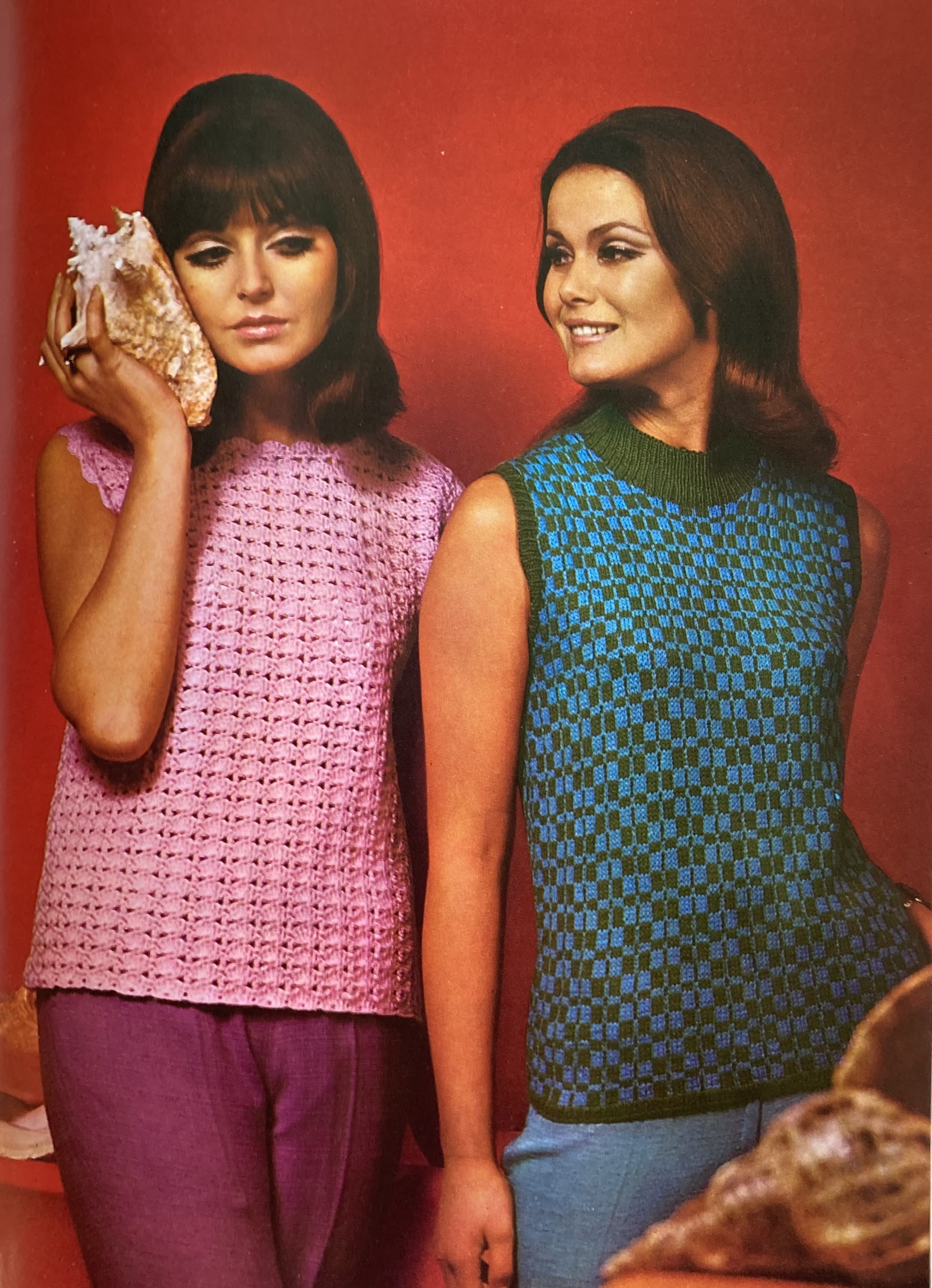
Our cover design picks up the trend for the retro-1930s look which will really take off around 1970 (could Stitchcraft actually be fashion-forward?) in bright, 1967 shades of pink and purple. The brilliantly orange pullover on the inside cover has an intriguing “pineapple” pattern. The summer “shells” (sleeveless tops) strike a nice balance between bold colour and crochet-lace patterning and more subtle, neutral bouclet. Love how they’re listening to shells in the photos! (Though sadly, the crochet model looks like she’s getting bad news.) Rounding out the adult women’s fashions is an understated and elegant fine-knit crepe blouse for larger sizes.

This issue has some great designs for school-aged children, starting with this “outdoor cardigan for rough-and-tumble wear” for a girl. Who is wearing leggings! That cover her legs and which she can actually move around in without flashing the neighbourhood! Finally! The model looks like she’s about to have a great time, too. Our more feminine model sports a pretty panelled pullover that looks like a buttoned-up cardigan. It’s just as practical as the more rustic design, but with elegant details. Her little sister gets a tunic top with a striped yoke and cuffs.

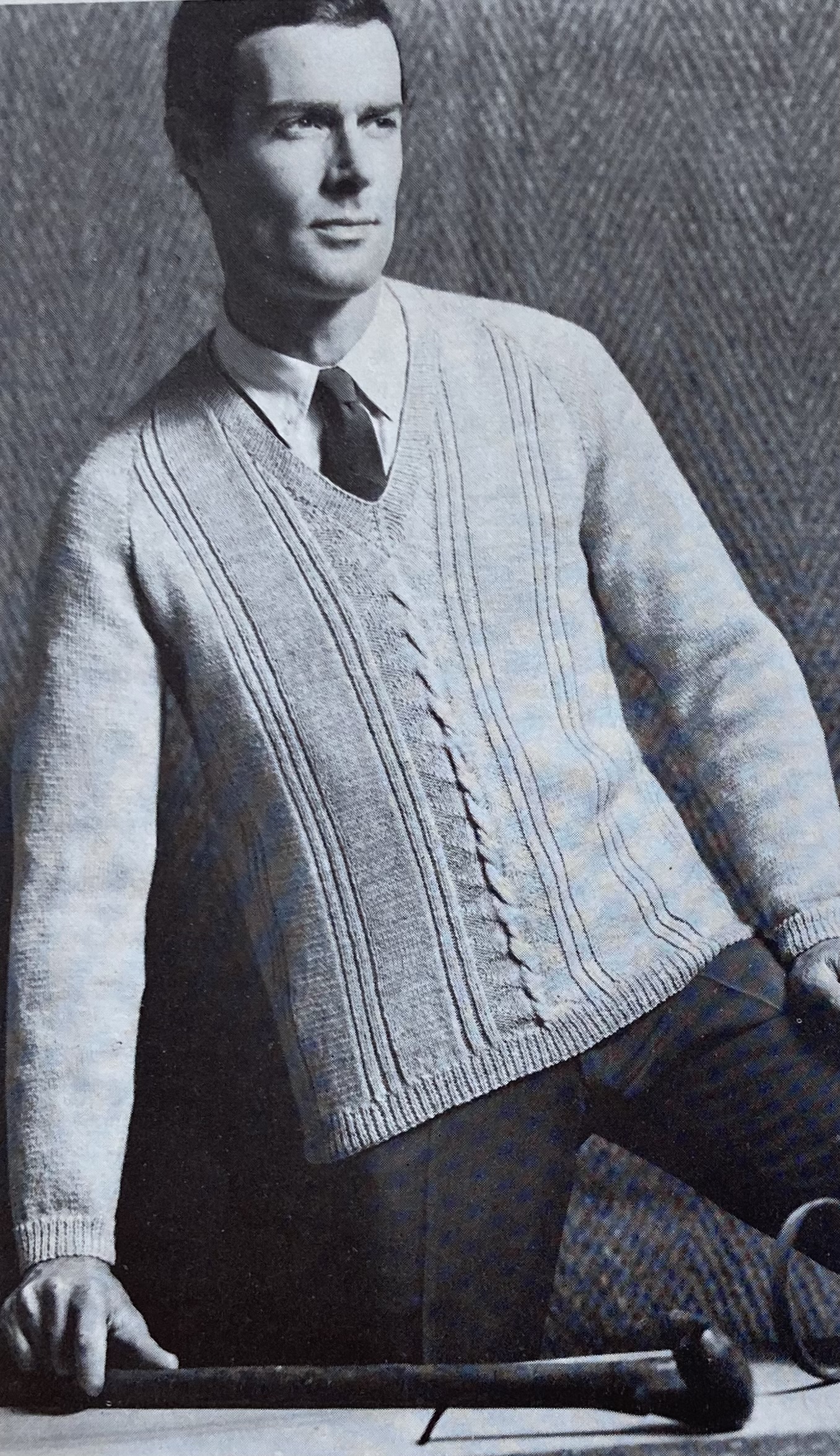
Oversized garments in neutral colours and vertical cablework patterns are still on trend for men’s fashions, represented here with a V-neck pullover in cable-and-rib pattern and a “country cardigan” in undyed “Capstan” wool with a crunchy Aran pattern on the fronts only.

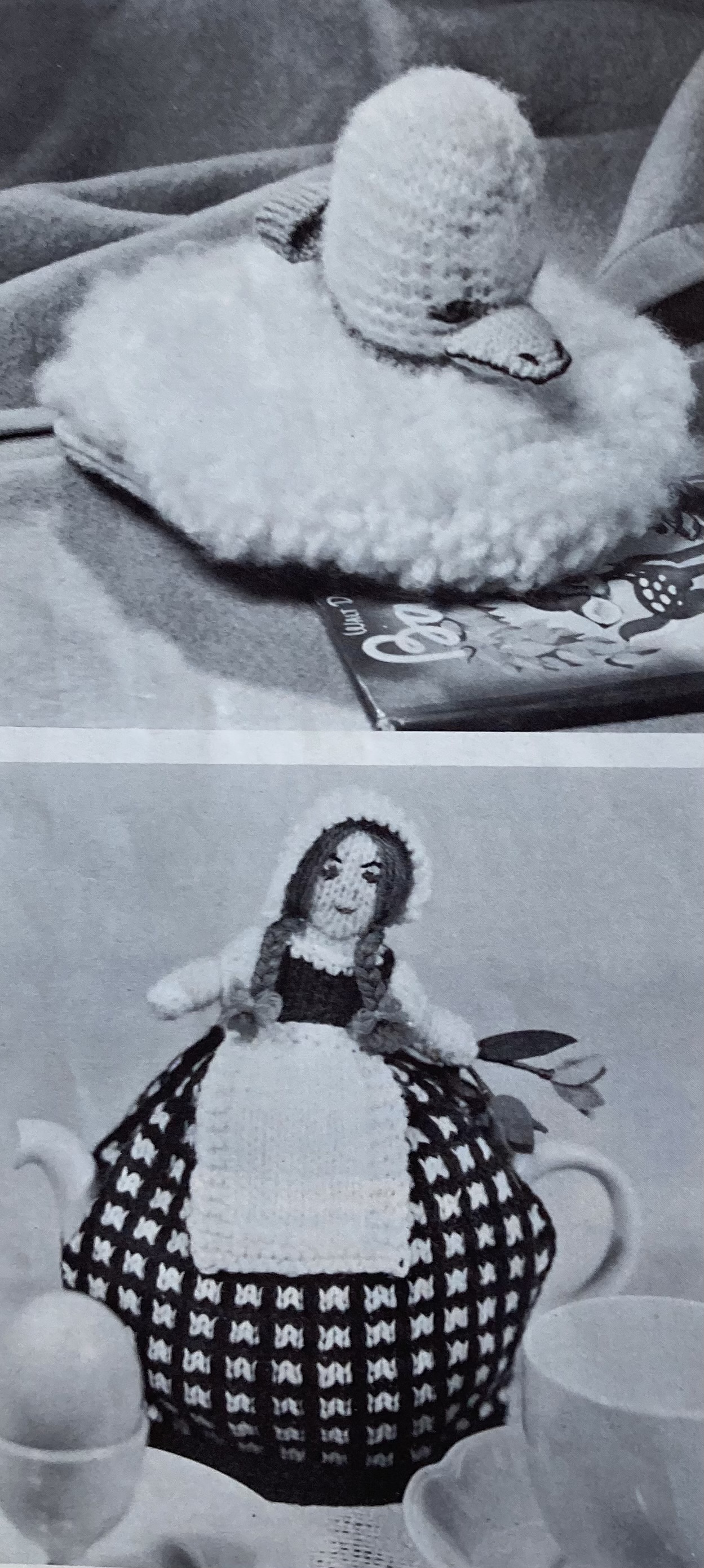
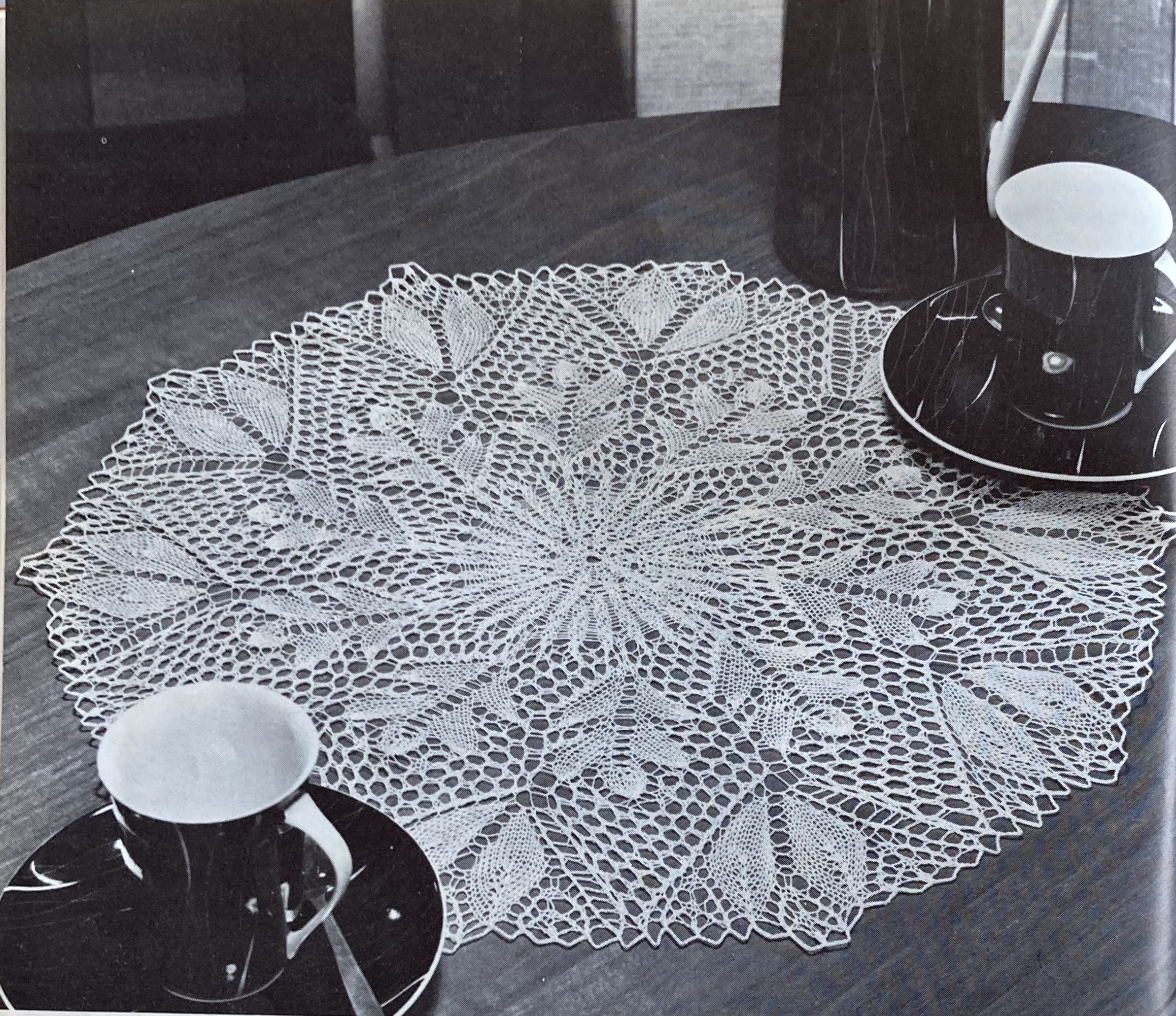
It wouldn’t be Stitchcraft without “Bazaar items”, and the ones in this issue are actually really cool. There’s a knitted nightcase that looks like a fluffy duck thanks to a loop-stitch pattern that is then brushed with a teasle brush to felt and fluff it up. The knitted doily is quite intricate and the “Dutch girl” tea cosy (holding a cluster of felted tulips!) is amazing.

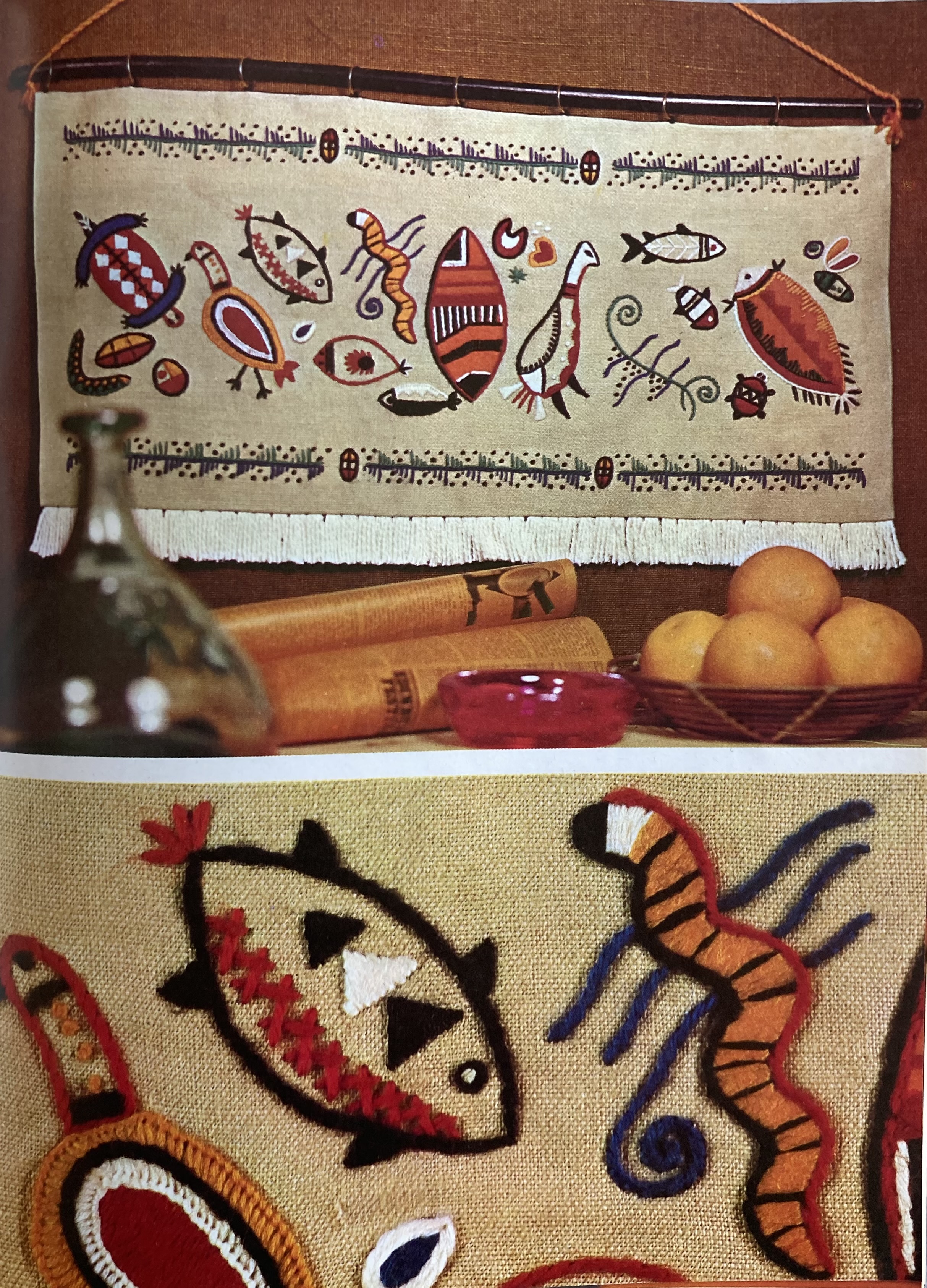
The regular homewares are also more creative than usual. Check out this embroidered “tropical fish” wall panel! (In non-tropical 1967 colours of brown, rust, and burnt orange.) I love it. The fantasy-animal theme continues with a tablecloth and/or table mats and/or cushion in Assisi design. The Victorian stool or cushion ribbon design is quite normal in comparison.

The back pages have the usual ads another nice one from the Scotch Wool shop, but not as dramatic as in the previous issues. in the “Children of other Lands” serial comic, Fifi the French girl takes a baguette home under her arm, only to have it eaten by birds on the way home. I told you this wasn’t the best comic of the Stitchcraft collection… Then there’s a nice extra pattern for a crocheted collar and cuffs in “bell” pattern to perk up your plain dresses.

I’ll be making two larger projects from this issue — the cover dress and the check-patterned “shell”. Neither of them will get done in April, but I’ll post something and update it with progress. Happy Spring!

July 1966: Overview

It’s all about teamwork in Stitchcraft’s July 1966 issue: two-piece sets for casual, sport or city wear as well as matching designs for all members of the family. Appropriately for the theme and the season, the emphasis is on sports and leisure, with casual, loose-fitting designs.

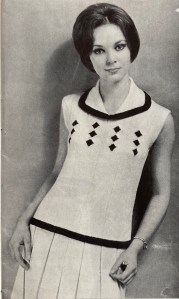
Our cover ensemble pairs a checked, sleeveless top with a skirt whose pleated insets match the check pattern. The check pattern is stranded, and I hope the navy blue didn’t bleed into or show through the white at the first washing. It’s the dressiest of the designs in this issue, but still keeps a casual air with its loose, unshaped top and shorter skirt (hemlines are finally rising at Stitchcraft, long after the miniskirt became popular everywhere else) and the check pattern, which is reminiscent of a race-car flag. The “favourite continental look for casual wear” is a team of “overpull” (oversized pullover) and short-sleeved blouse with a polo (turtle) neck in matching colour.

For warmer days, there’s a trio of lightweight and/or sleeveless blouses: in a lacy striped pattern or textured rib in 4-ply, or a mini-top in eyelet rib. Pink, white and turquoise are fun ice-cream colours for summer and harmonise well with the maritime blue of the checked suit.

A high-buttoning cardigan in heavier DK is good for cooler weather. Twisted stitches are the summer knitting trend, seen in the cardigan as well as in the eyelet rib and the striped lace tops. Our male model teams up with a horse to show off his cleverly designed “Viennese sports pullover” in tan DK wool with white cable stripes going up and down the front and back as well as down the sleeves.

The ultimate 1960s team is, of course, the nuclear family, and this issue offers a design for (almost) everyone: a simple, casual pullover with a trellis pattern in three sizes. The trellis is formed by making a k2tog or sl-k-psso at the right point in the pattern with a yo right before it to keep the stitch count even. The purl stitches on the wrong side are worked into the back of the “made” stitches to close the yo holes even more and make the trellis stitches stand out. Here too, summery ice-cream pastels and neutrals are in: “Banana Cream” for him and light green “Linden” for her and the daughter.

I did say “almost” the whole family, right? The youngest members have their own designs. Junior’s play jersey in blue and white echoes the women’s check suit, but here the check pattern is made by slipping stitches and/or letting them drop and picking them up a few rows later. The baby gets its own “teamwork” set of matinee coat and bootees in pretty lace and moss stitch.

The homeware designs are pretty standard, but numerous and cover all the home bases. There are some easy floral cross-stitch and pulled-thread mats, a cushion and/or stool top in tapestry (a check design, once again) or a stitched rug in Florentine design. More ambitious tapestry fans can make a wall panel of boats at Norfolk Broads.

And for once, the “Summer Bazaar” designs are not weird! There’s a simple crochet tea cosy, crocheted lace coaster mats, or an apron and/or potholder set appliquéd and embroidered with cute images of vegetables. In the “Readers Pages”, there’s a reprint of a 1961 pattern for a knitted pram blanket, and Eustace the elephant gets very startled when he tries on a pair of spectacles and suddenly sees Mark the mouse in larger-than-life size.

That’s all for this issue! Since I didn’t get around to making the sun cushion last month, I’ll make it this month. (Technically, it’s sort of part of this issue as well, since it photo-bombed the picture of the ribbed polo blouse.) And nothing else from this issue really called to me. Sunny days ahead, and may your team always win.

January 1966: Overview

Happy New Year! It’s January 2024 in real time and January 1966 here at the blog. Get ready for shorter skirts (…finally. Stitchcraft is slow to catch up), horn-rimmed glasses, tweed bouclé and adventurous headwear. The theme of the January 1966 issue is “Colour for a Cold Spell”, with bright greens, redd and turquoise to carry everyone through the greyest month.

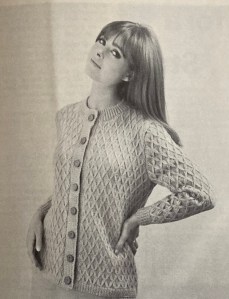
Our cover cardigan can be made long to wear as a coat as in the cover photo, or in fashionable hip-length. The trellis pattern is made by winding extra loops around the needle on the first row, then slipping this stitch on the next RS row to create a long loop stitch that is carried up via slip-stitches and knitted back in on row 7. The coat uses a whopping 28-33 ounces (ca. 750-900 g) of heavier-than-DK (modern worsted weight) “Flair”, so I would be wary about knitting this as it would presumably end up quite a bit longer than the 38-39 inches it should measure when finished. Love the pattern, though. I could imagine making the shorter cardigan in brown and embroidering it to look like flowers and plants climbing up a trellis.

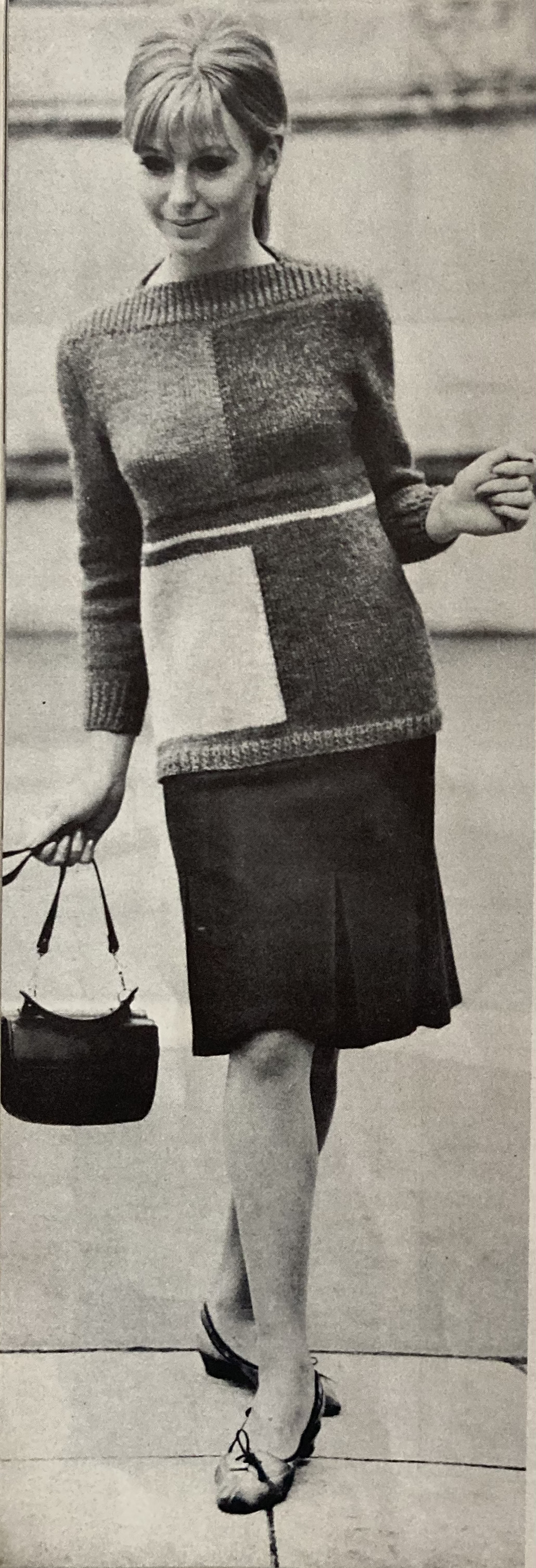
Other women’s fashions include a turquoise pullover with both a vertical pattern panel and a horizontal stranded border. The matching hat foreshadows the weird and wild and fun and goofy hat fashions of the next couple of years to come. The trend for bold colour blocks is mirrored in the long-line boatneck pullover with its matching “helmet”-style cap. There’s a plain white pullover in slip-stitch rib and a very cute bedjacket — look at that come-hither smile!

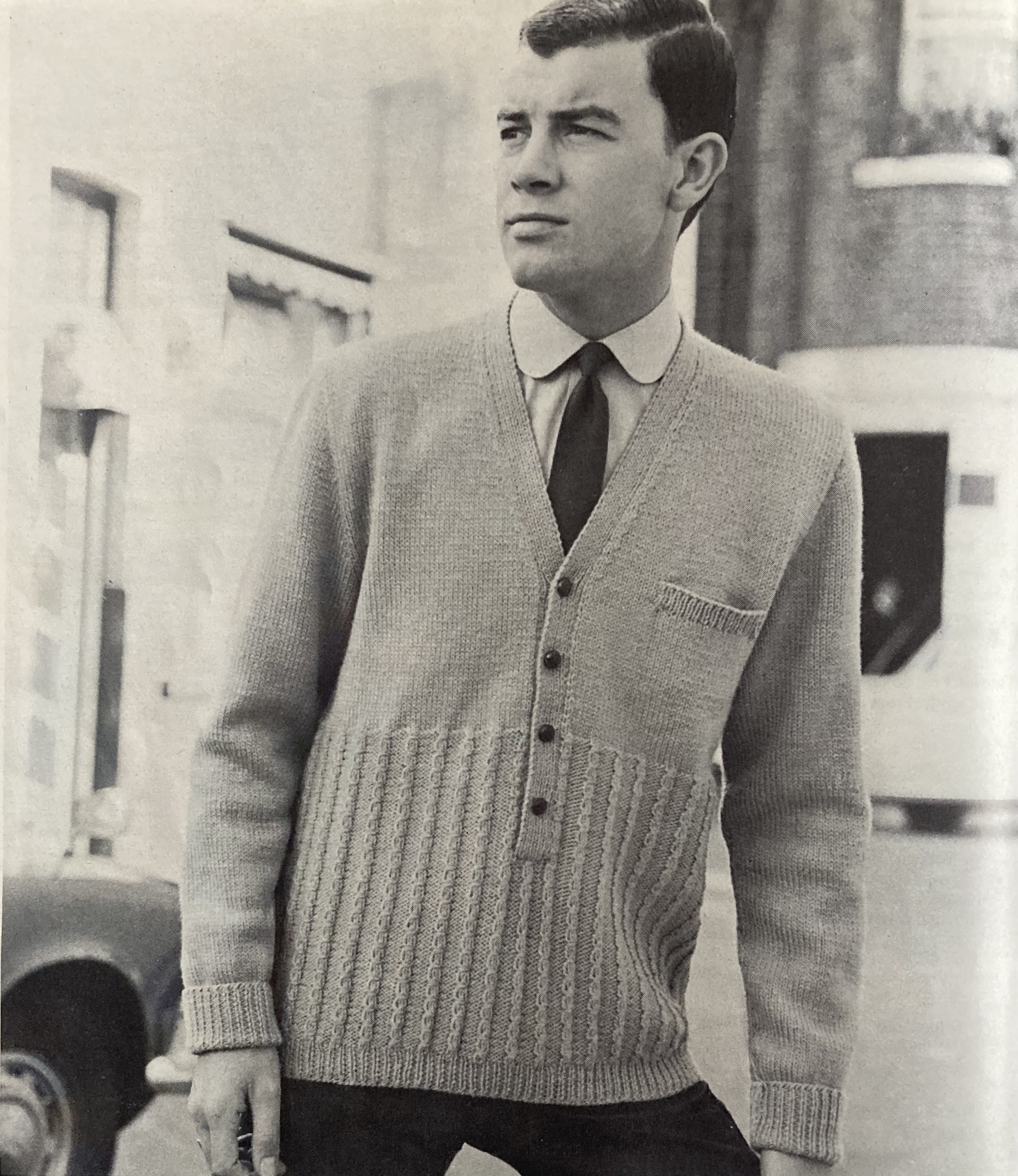
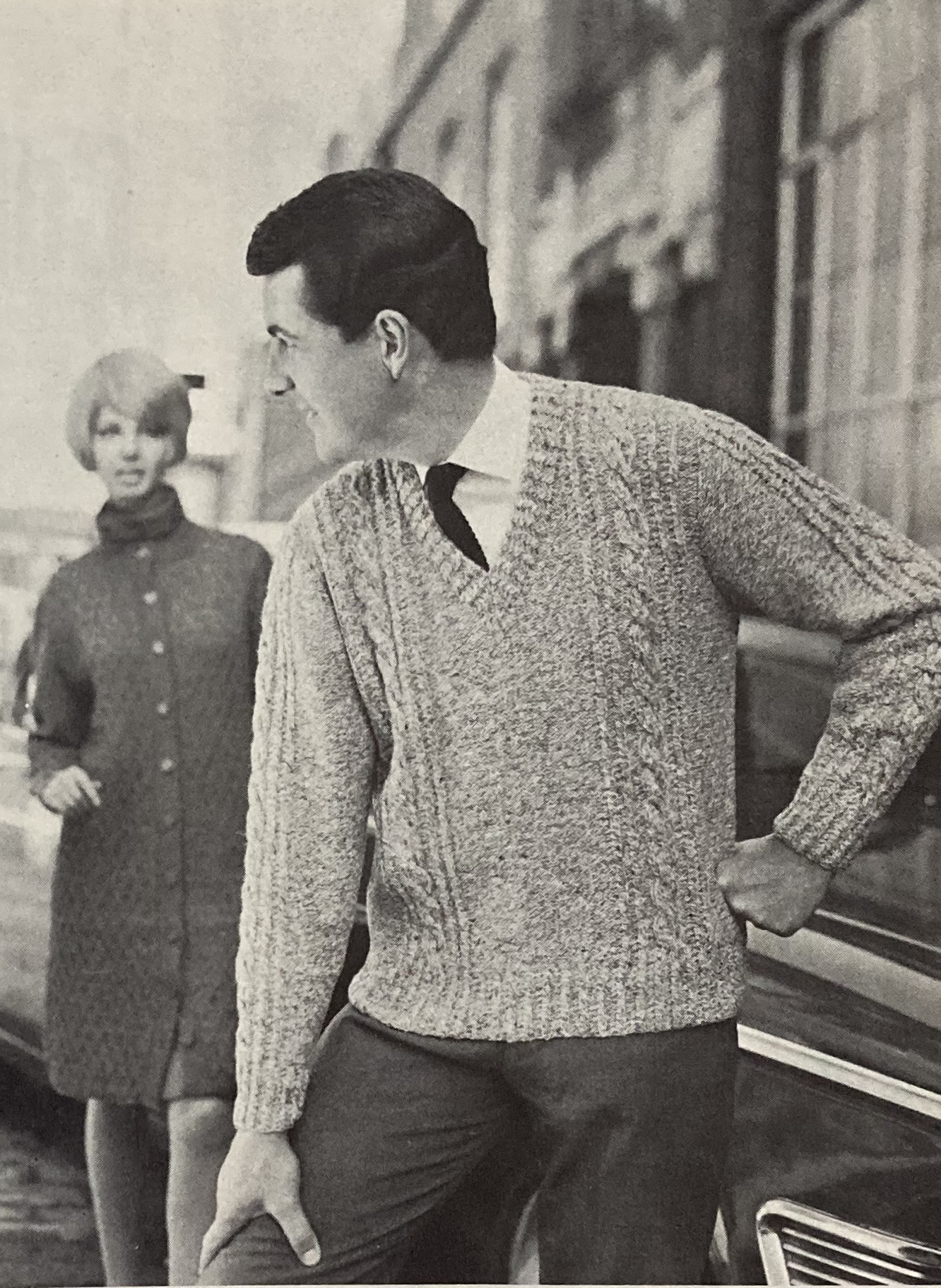
Men’s fashions are oversized and conservative, in spite of the “New Look” advertised for this V-neck half-cardigan. The classic V-neck pullover with cable stripes can be knit in tweedy marled or smooth, plain DK wool. I like that the magazine includes photos of both versions, so that you can see how much of a difference the colour and style of wool can make.

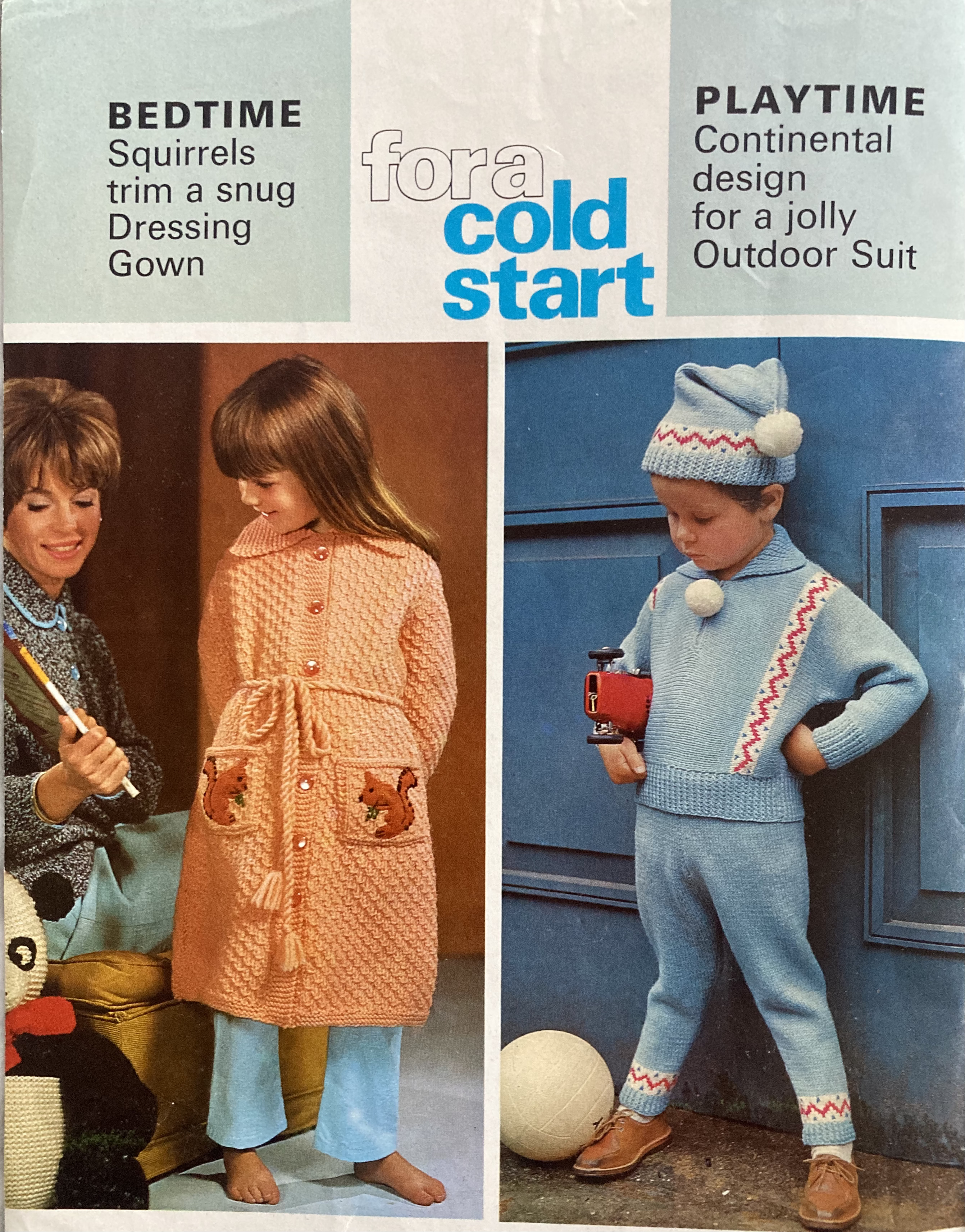
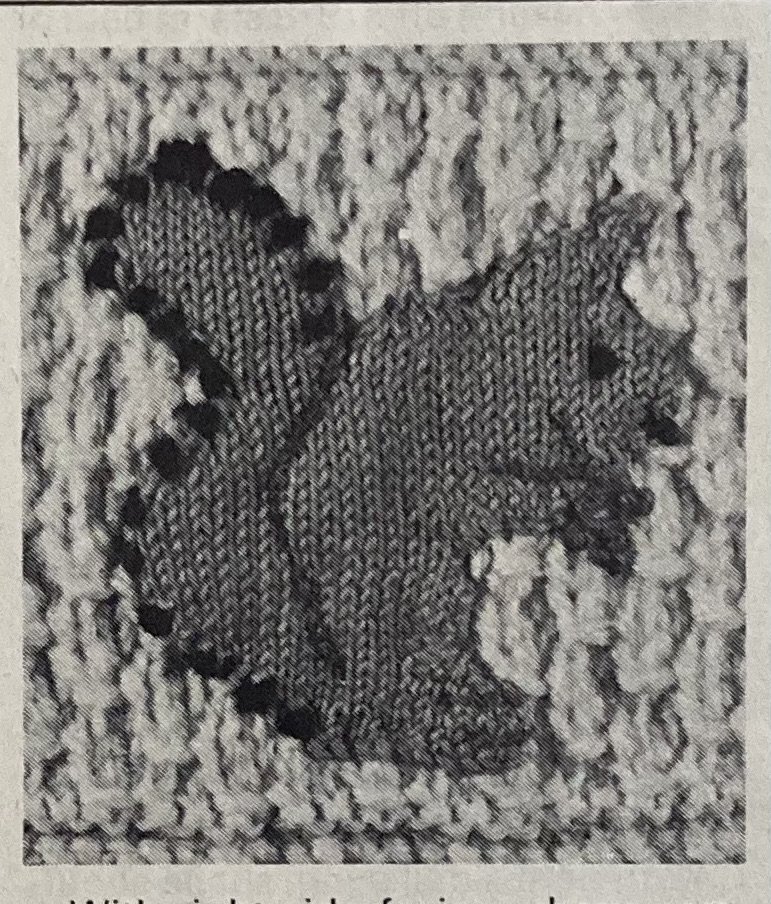
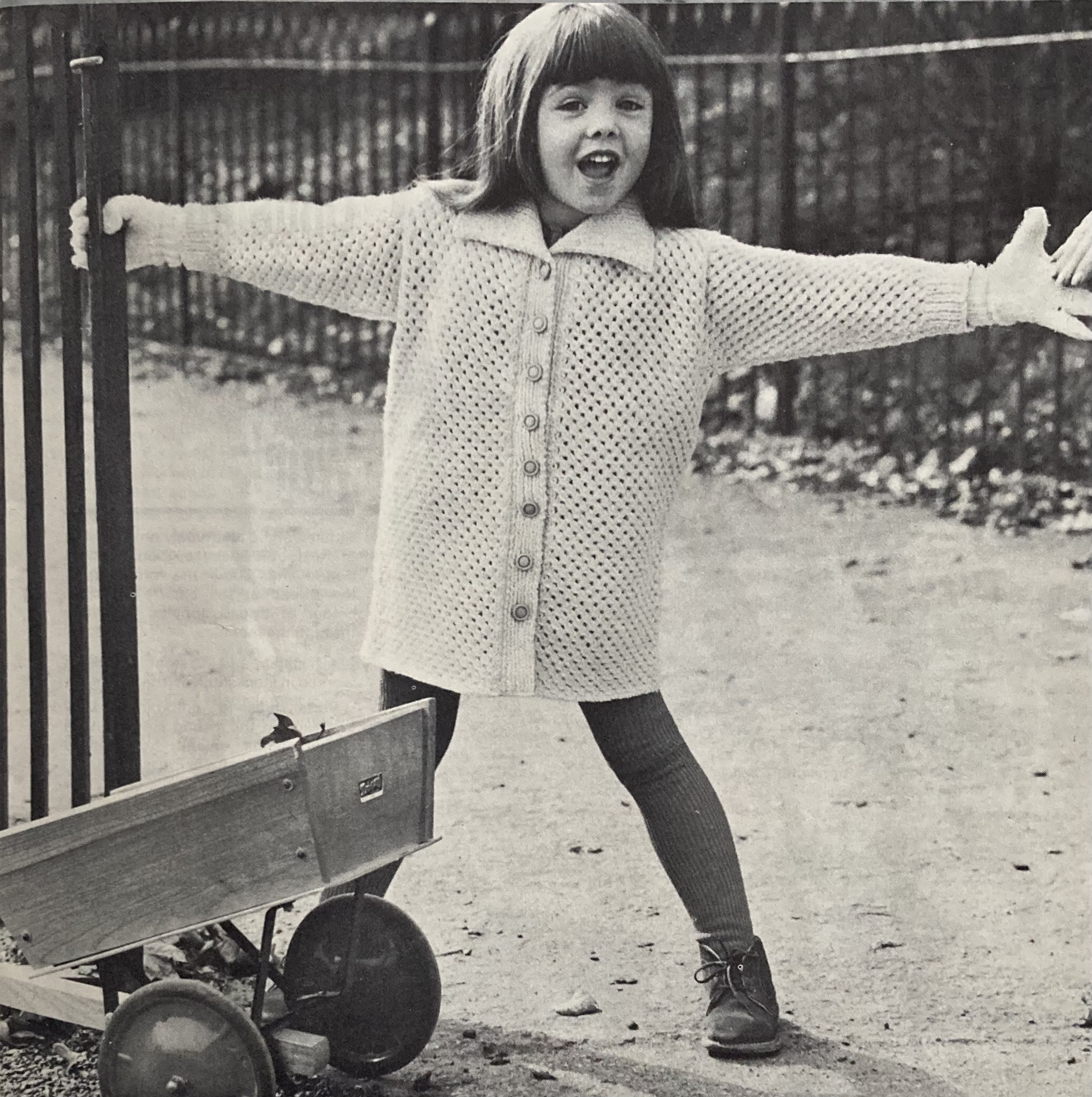
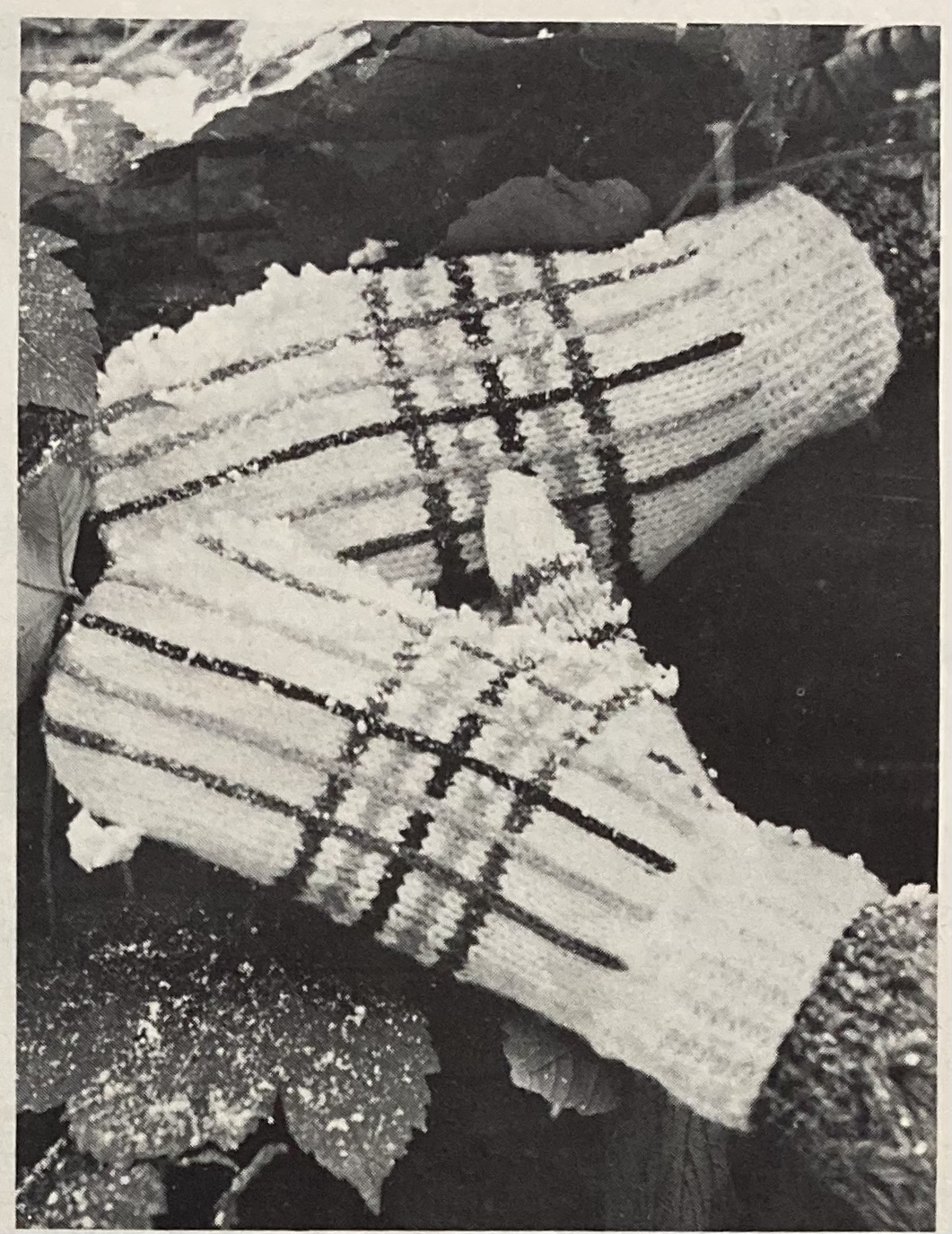
“Junior Fashions” include a wonderful warm dressing-gown with knitted squirrels appliquéd onto the pockets and embroidered — so cute — as well as a winter going-out set of leggings, pullover and hat and an oversized cardigan-jacket. The jacket claims to be windproof, which seems an odd claim to make about something knitted in an all-over eyelet pattern. In any case, all the children’s fashions are colourful and fun, and we will start to see the influence on adult women’s fashion as the 60s get swingier. Older children — or adults with small hands — can get a pair of warm mittens knitted flat and sewn together at the side. The plaid-like pattern is made by embroidering the vertical stripes in chain-stitch onto the finished mittens.

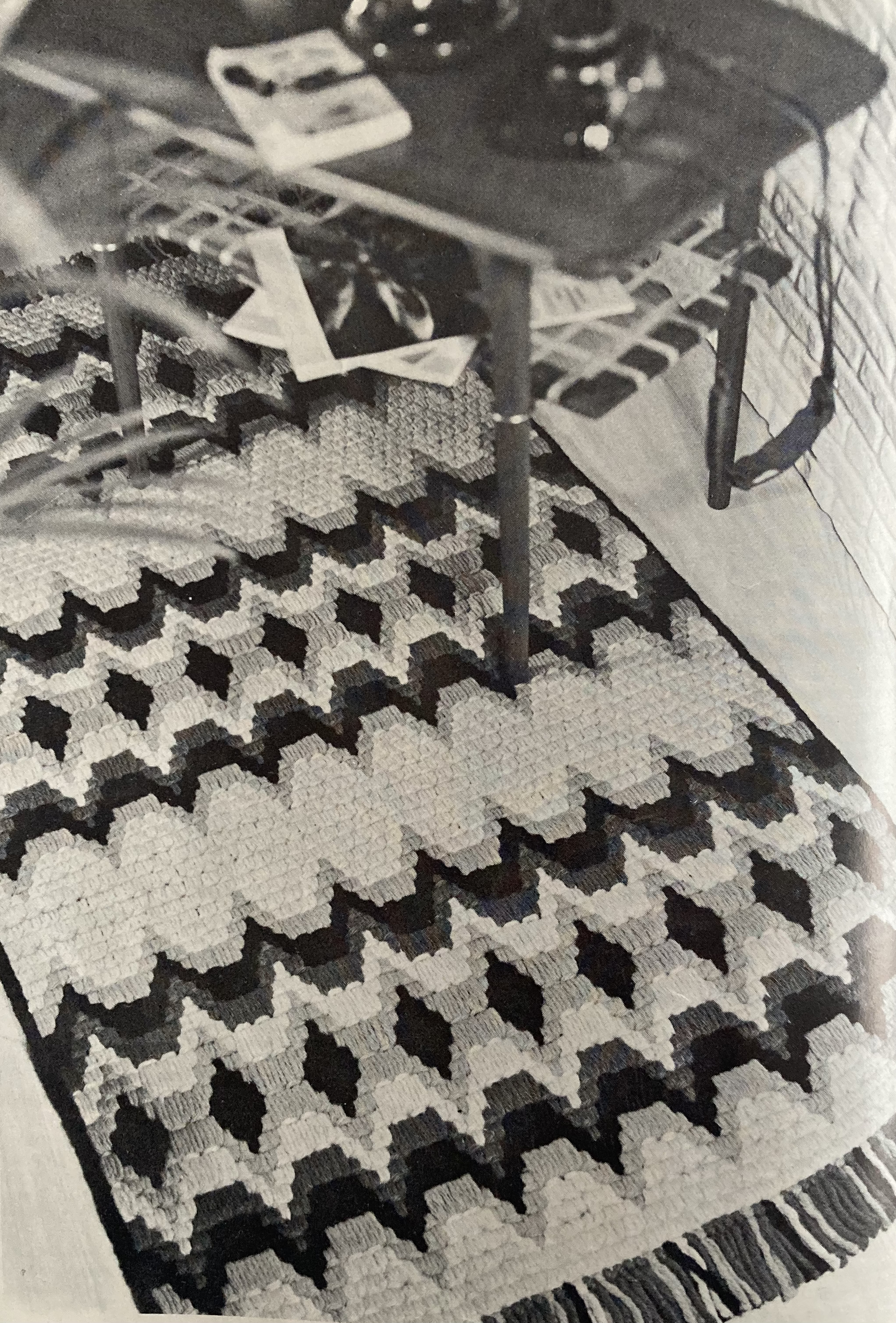
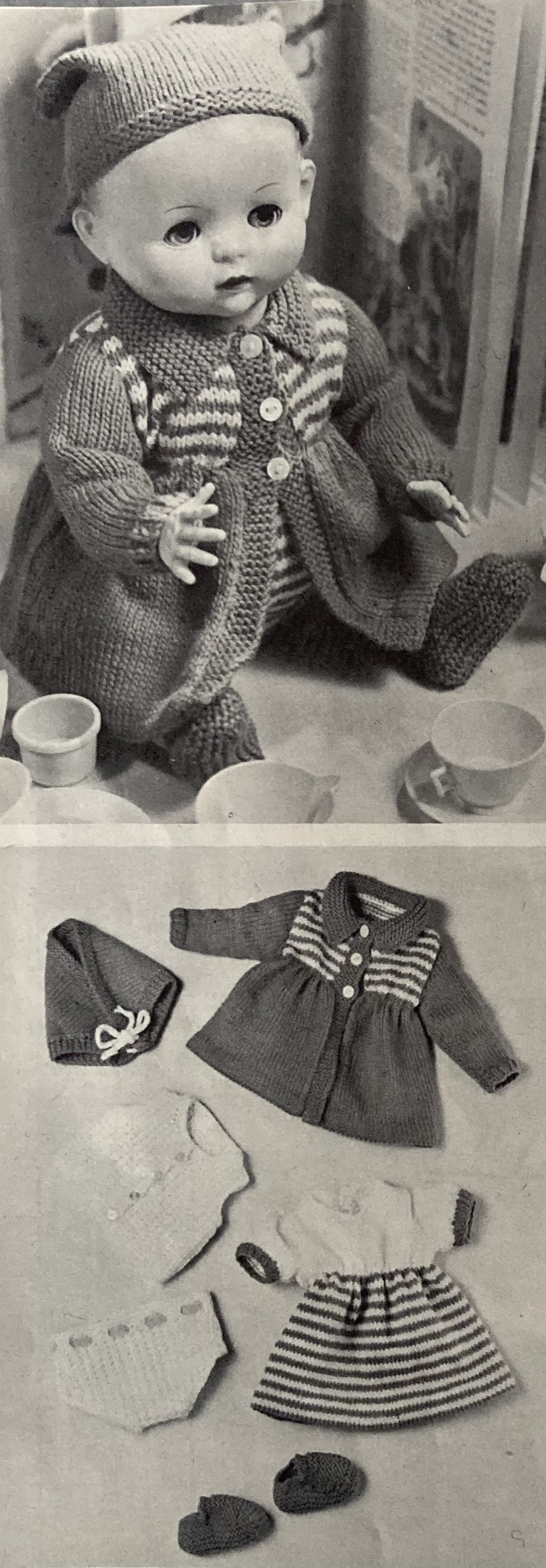
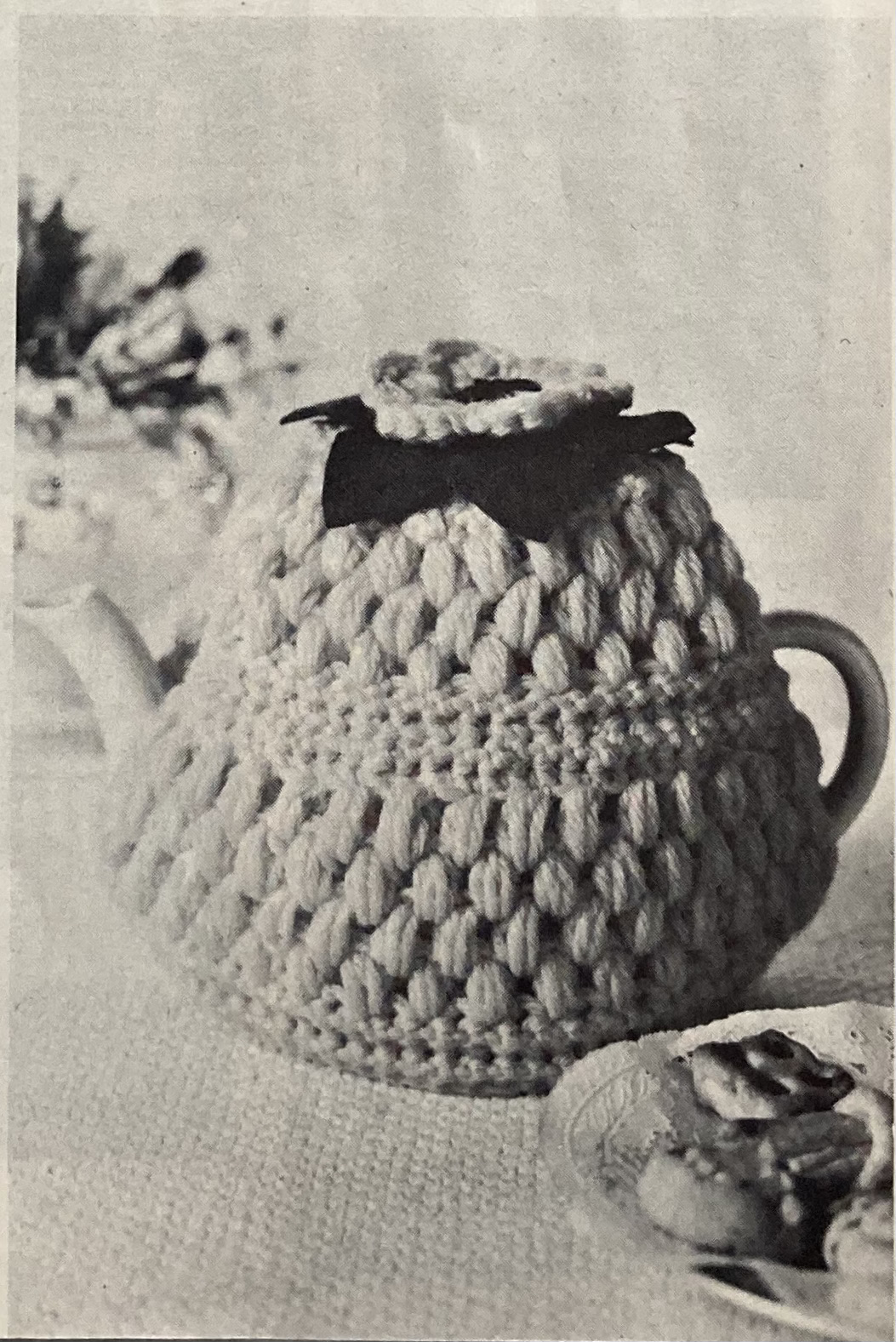
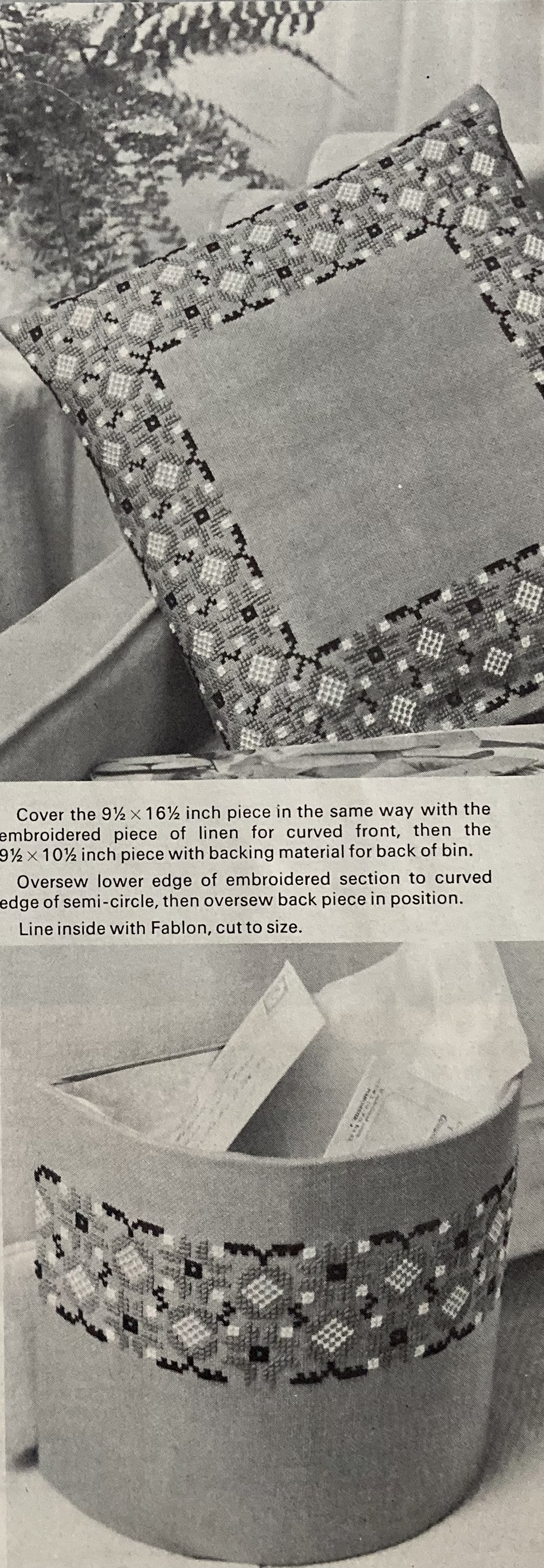
There are lots of homeware projects in this issue, January being a good month to stay inside and do needlework. The stitched rug is warm and sturdy, made in a Florentine stitch pattern that never really went out of fashion. You can knit a doll’s outfit complete with underwear and shoes, crochet a “tangerine” tea cosy with green felt for leaves, or make a cross-stitch border for a cushion or waste-paper basket.

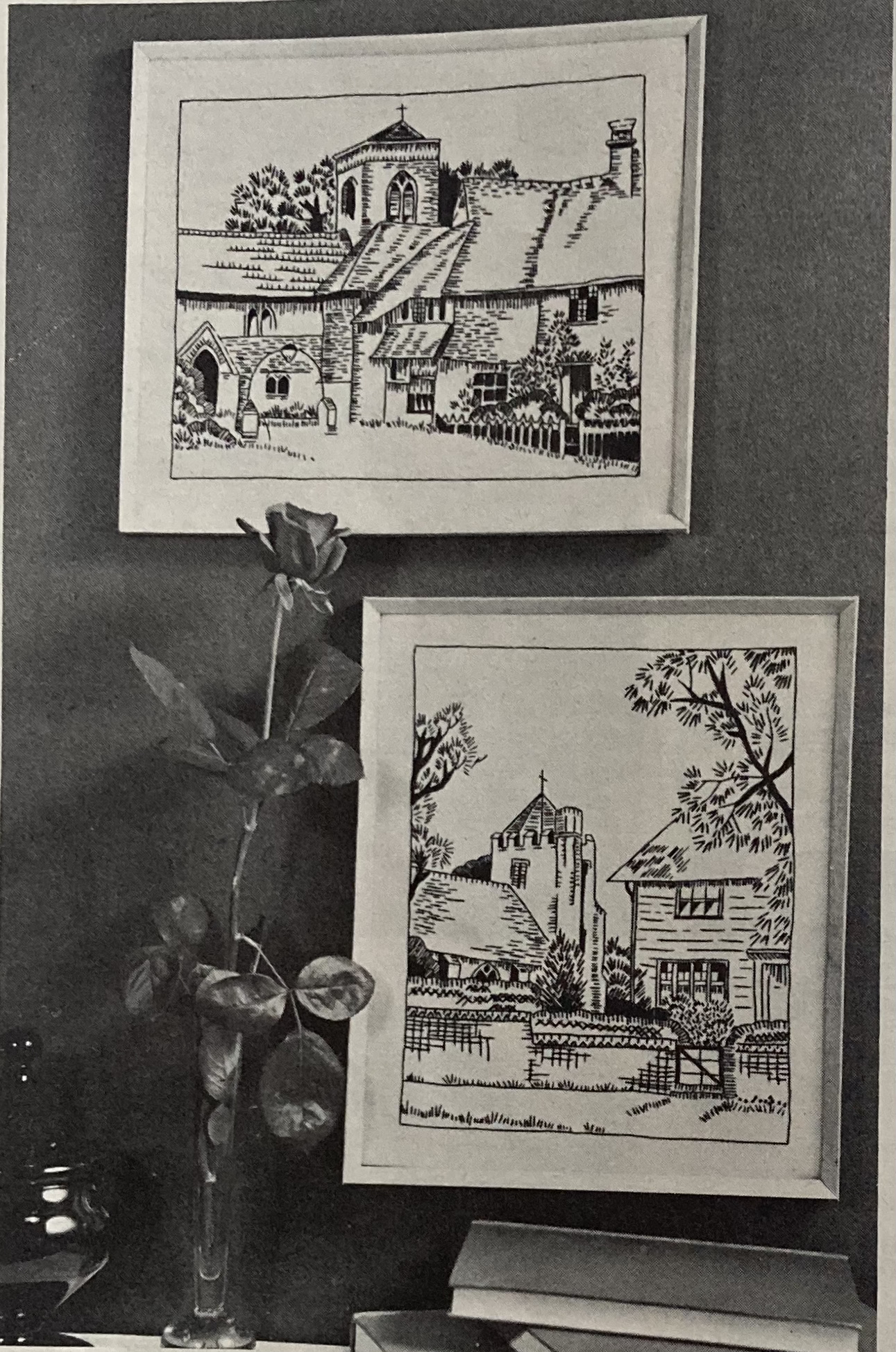
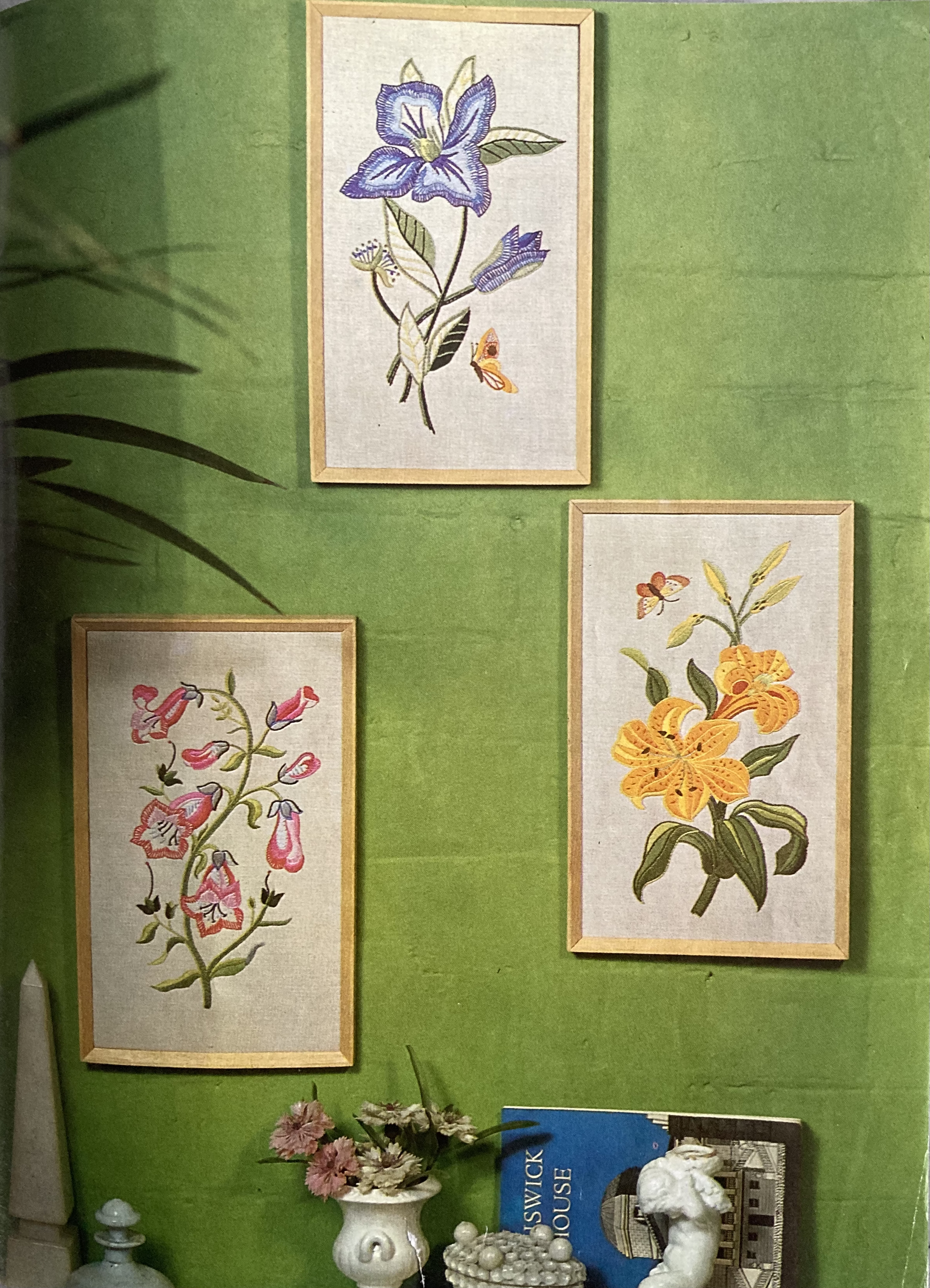
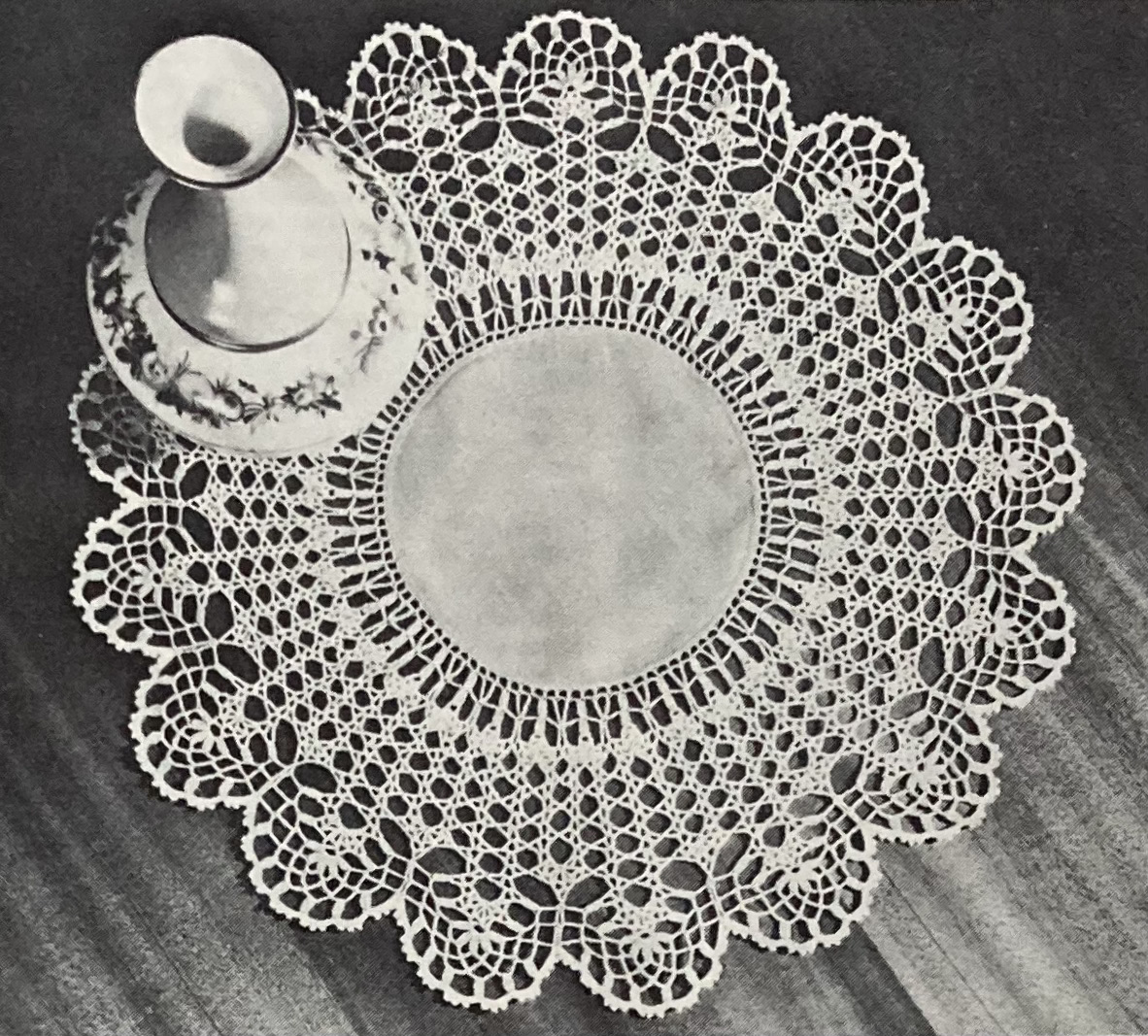
For advanced needleworkers, there are wall pictures of “needle etchings” (black-and-white pictures embroidered in stem-stitch to give the effect of a pen-and-ink drawing) of Sussex churches or colourful flower sprays, as well as a tablecloth in rare “shadow work”, where the thread carried on the back side deliberately shows through the filmy organdie backing fabric. (Personally, I dread the thought of the back side of my embroidery being visible, ever…). For expert crocheters, there’s a lovely lace doily with a linen centre.

On to our children’s comic! The two brave bunnies (both plush toys) are still in search of a real live rabbit. Not having found one at the carousel, cinema or department store, they try the seaside, because why not? They have fun at the beach and think they find a rabbit — alas, it is only an inflatable sea-water toy! Will they ever complete their quest?

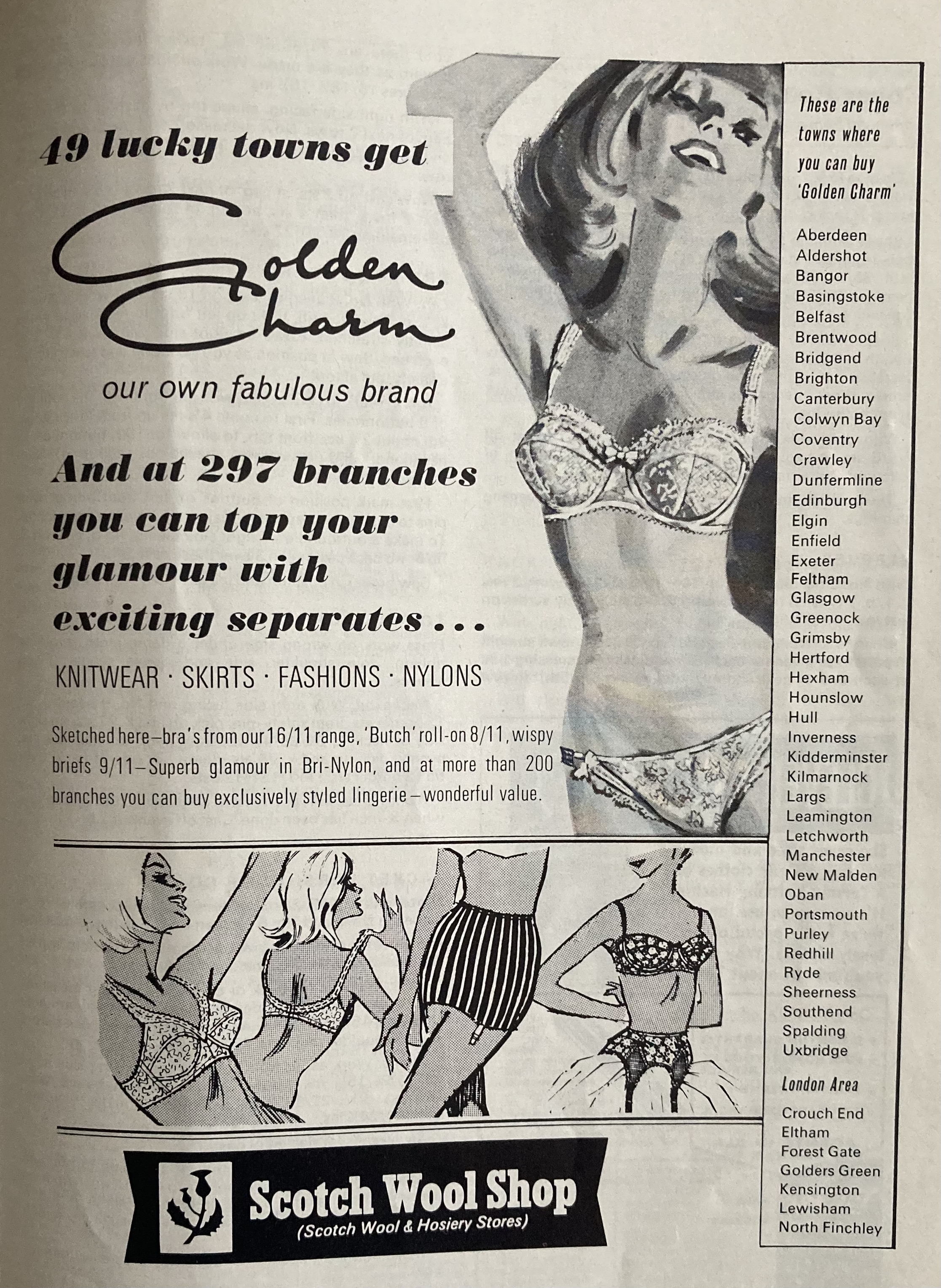
I will leave you with the latest wonderful ad from the Scotch Wool Shop, which had just launched its own line of very pretty underwear, “Golden Charm”. Available in 49 lucky towns! I hope your town and your 2024 are equally lucky. My project for this month will be the embroidered mittens.

December 1965: Overview

Here it is — the 1965 “Christmas Number”! December at Stitchcraft is always a month of “quick” holiday trimmings and small gifts, mixed with warm winter clothing and party ideas.

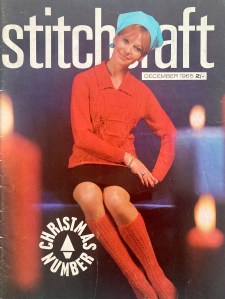
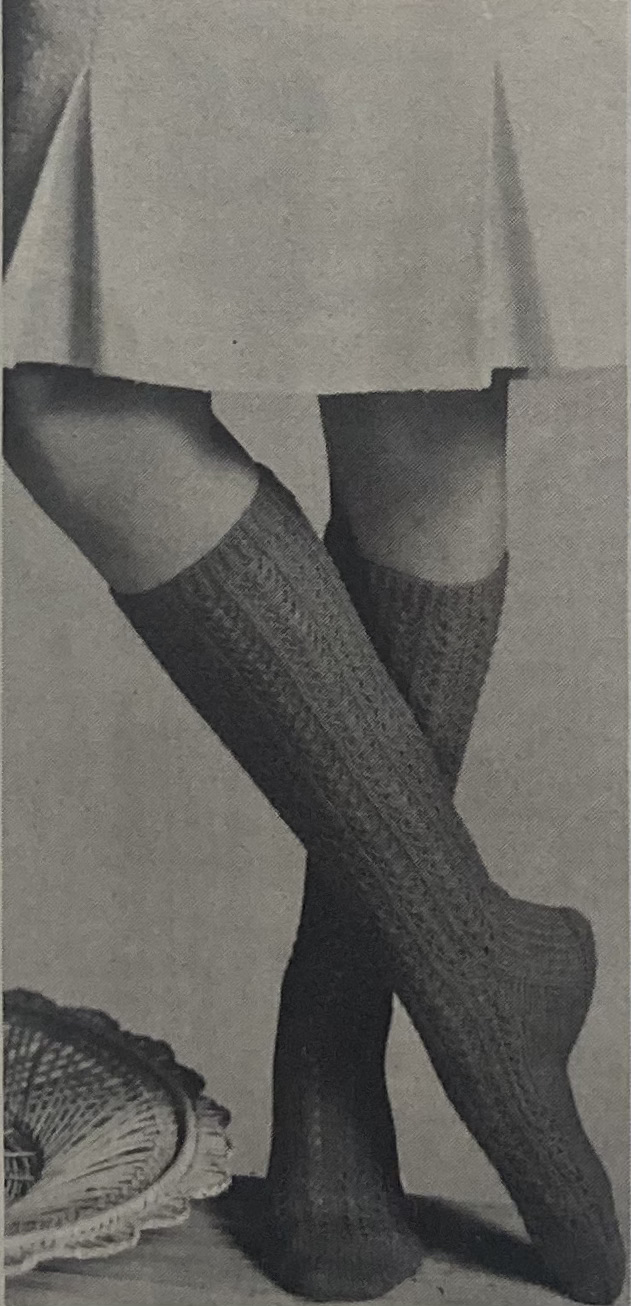
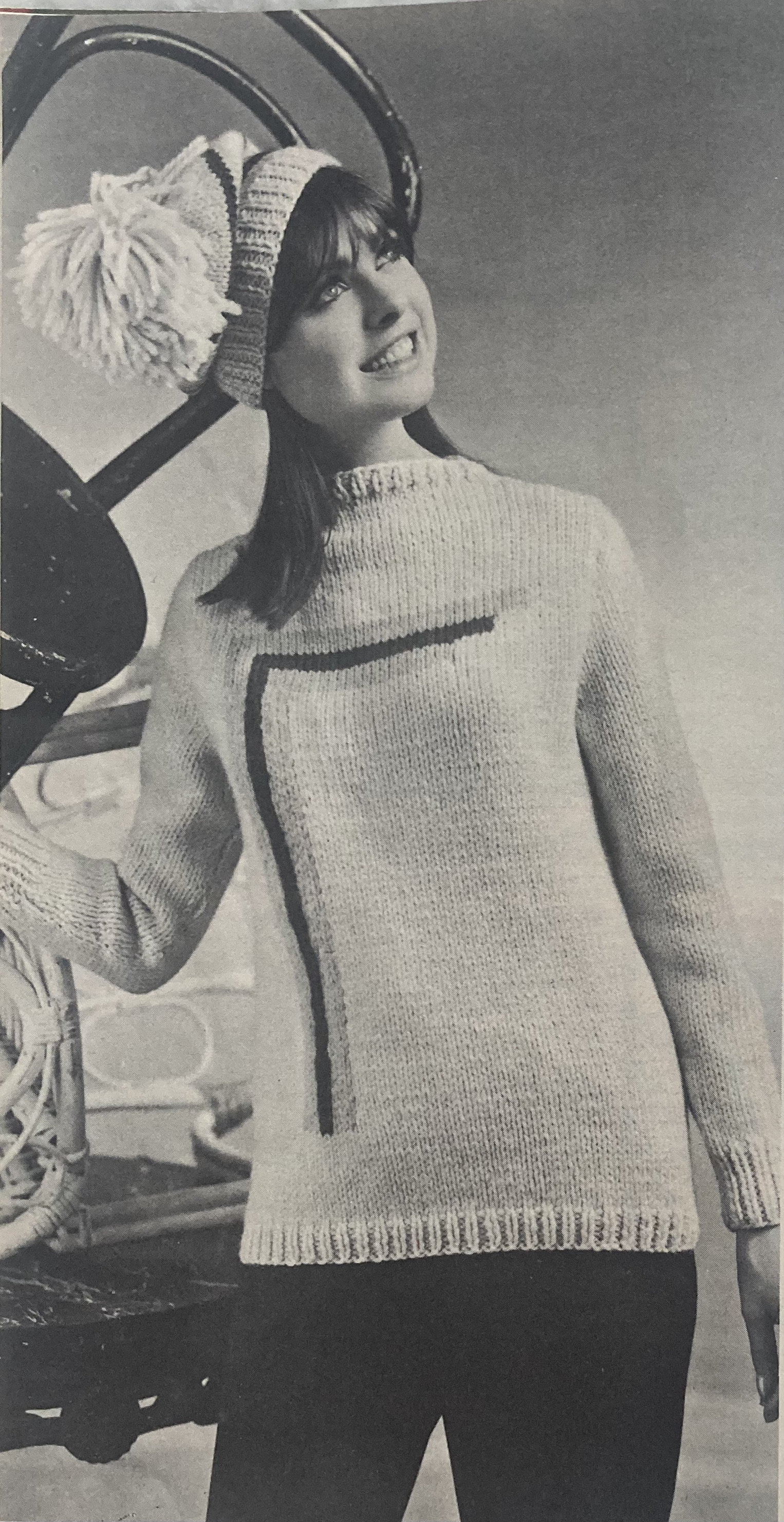
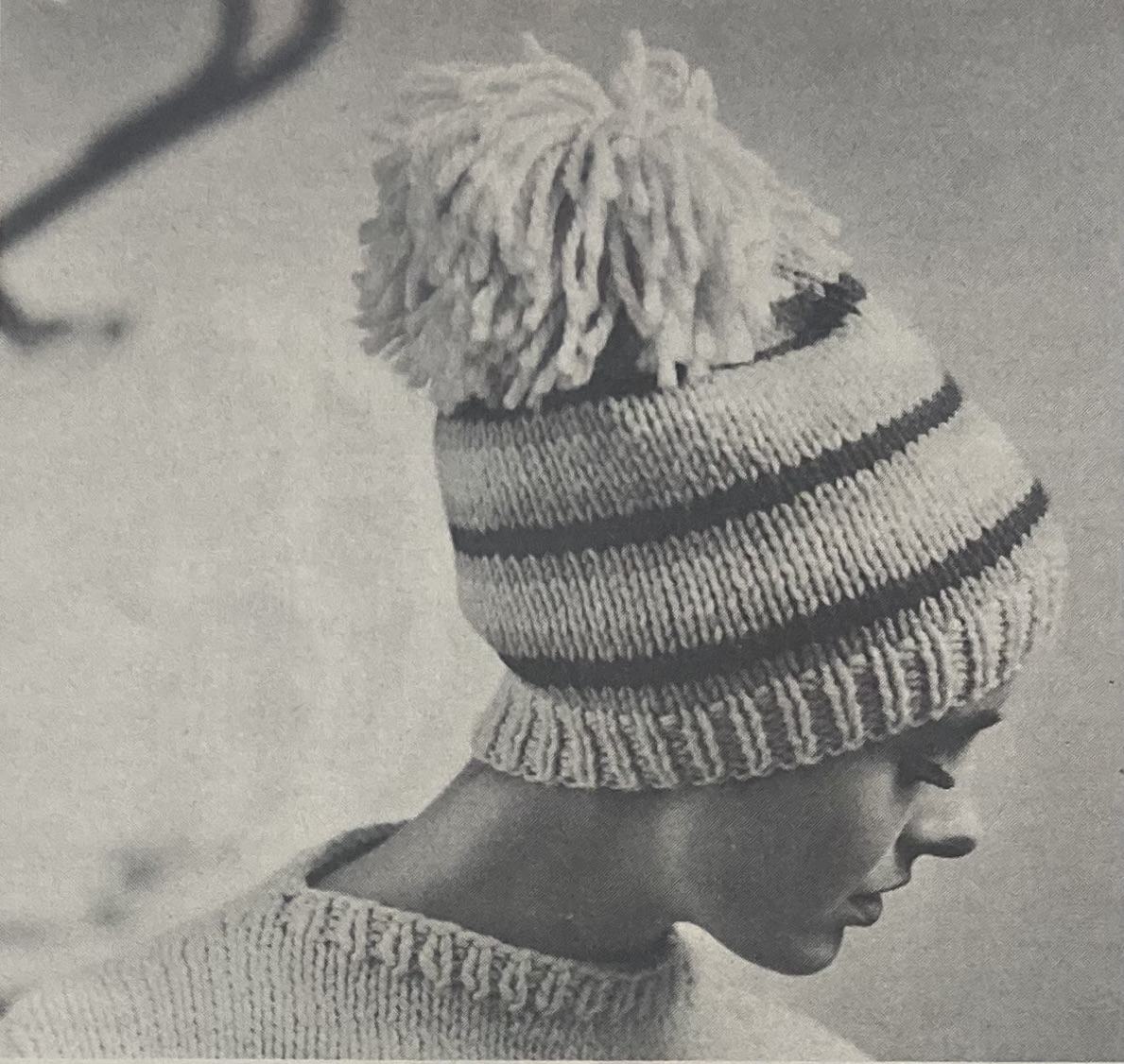
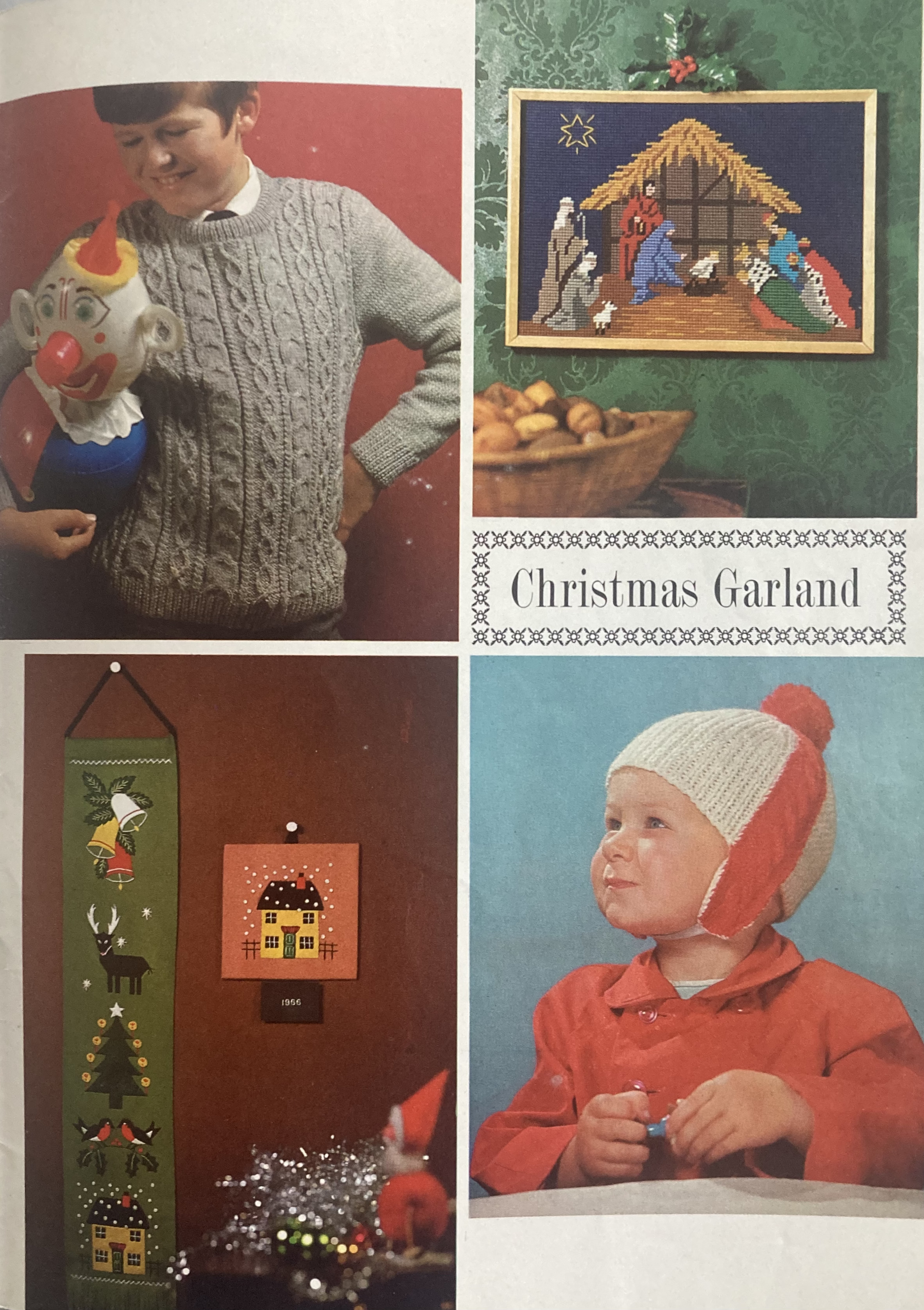
Our cover model is wearing a cable-block pullover (with non-crossing cables) in bright red double-knitting weight wool and matching knee-high socks in a lacy rib pattern. The caption on the pattern page is “Fashion feels Young” — Stitchcraft is finally getting into the children’s-fashions-for-adult-women idea that influenced so much of mid-60s fashion. Note the short skirt on the cover model, along with the knee-high socks, the playful kerchief and the big straw hat accessory in the black and white photo. It’s not quite Twiggy or Mary Quant (spoiler: Stitchcraft was never that fashion-forward), but it’s starting to show their influence. “Young Fashion” fun is reflected in the matching cap and pullover set as well. Look at the enormous pom-pom on the hat, outdone only by the model’s fake eyelashes!

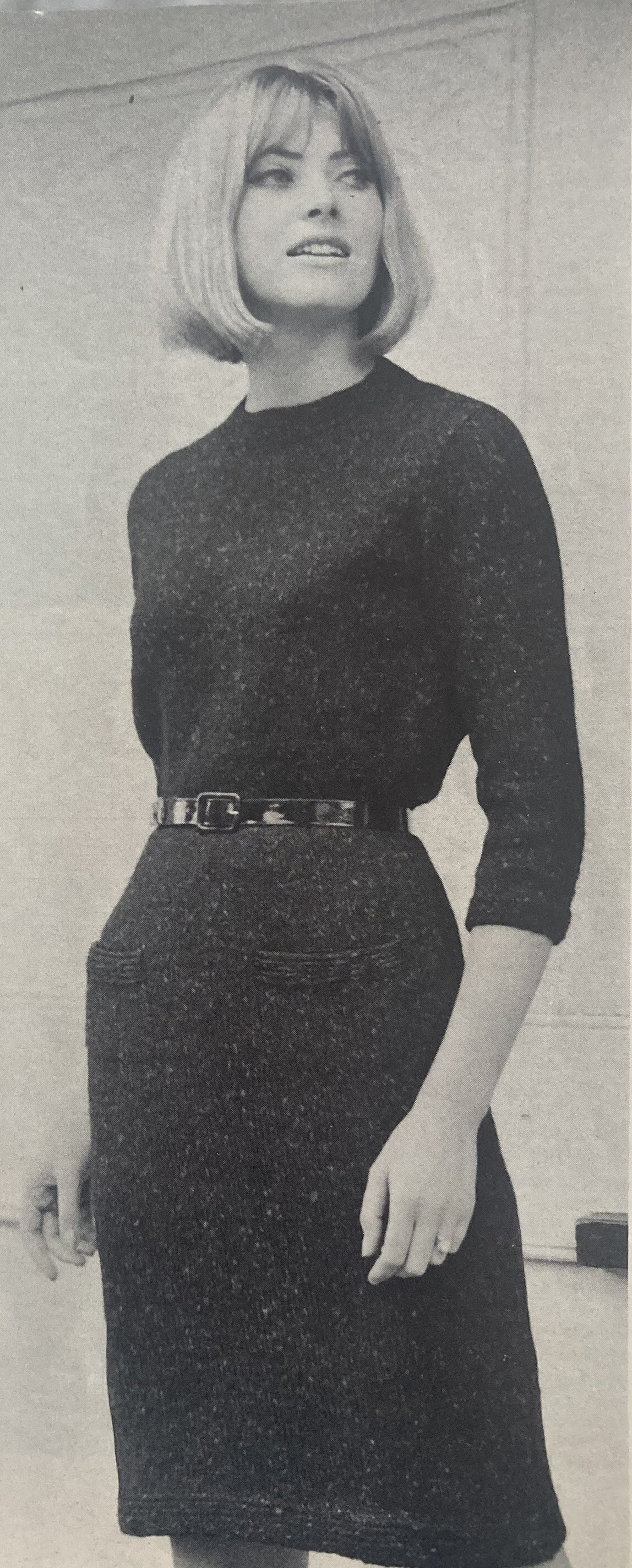
The other women’s fashions in this issue remain conservative: a warm tweed dress made in two parts sewn together at the waist (thus the obligatory belt), a cabled cardigan for larger sizes in thick, undyed “Capstan” wool, a lightweight wool jumper and swingy knee-length skirt in a “gay note” of blue or a “harlequin” pattern jumper in “bold” 1960s colours of white, gold and brown. I feel exactly the same way as the model in the colour photo when I finish a project and find that perfect gift on the same day.

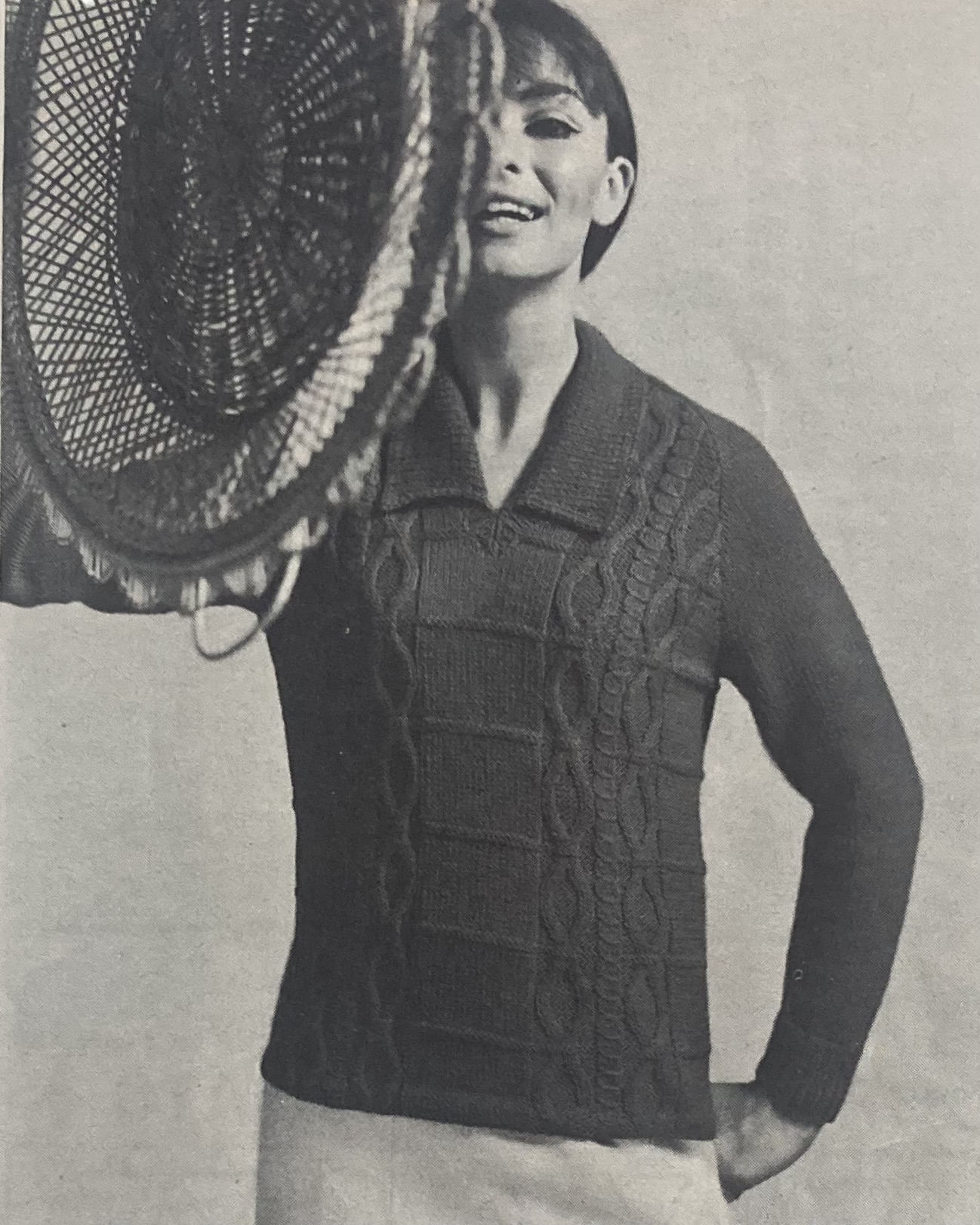
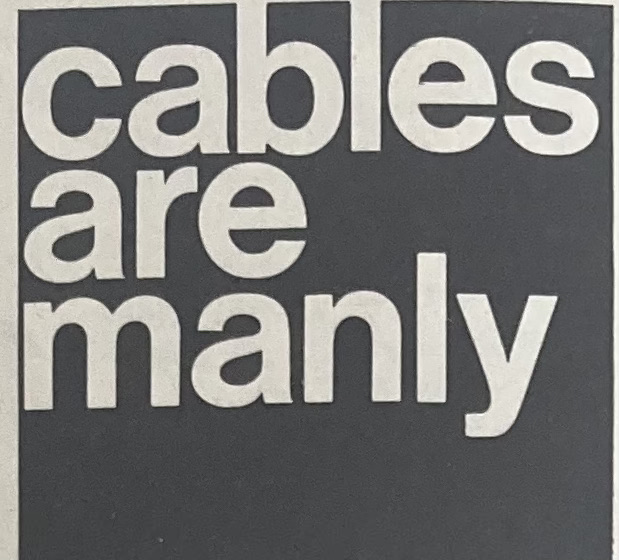
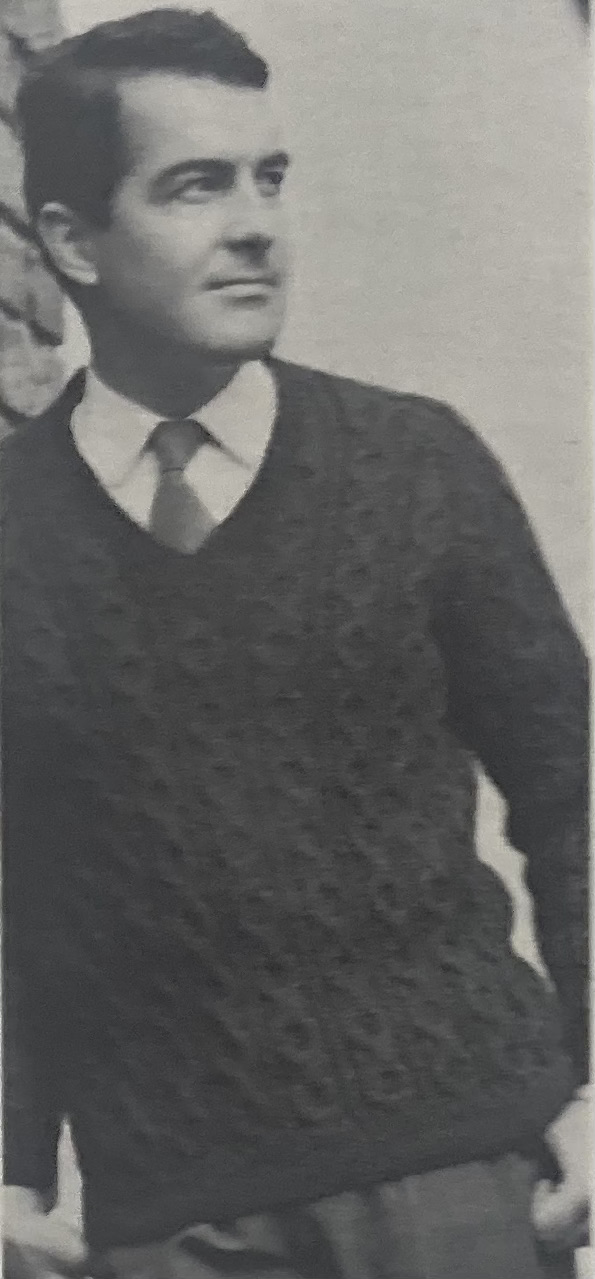
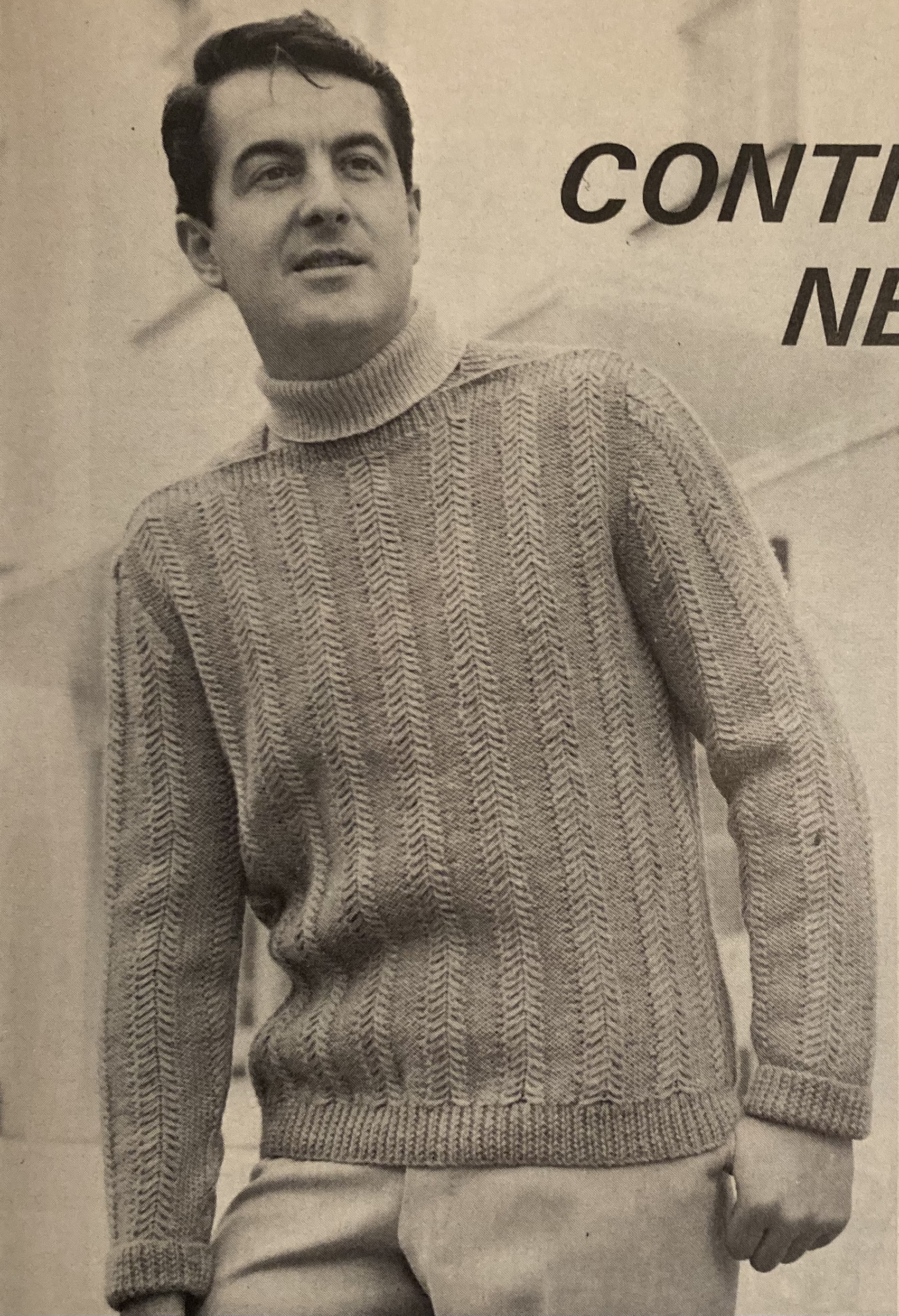
Men can get a cabled pullover in a glorious shade of purple tweed and the reassurance that cables are manly (like our model’s eyelashes, which are almost as impressive as his colleague’s with the pom-pom hat). There’s a boatneck pullover in herringbone stitch as well, meant to be worn over a simple polo- ( aka turtle-)neck jumper, for which a pattern was given in the previous issue.

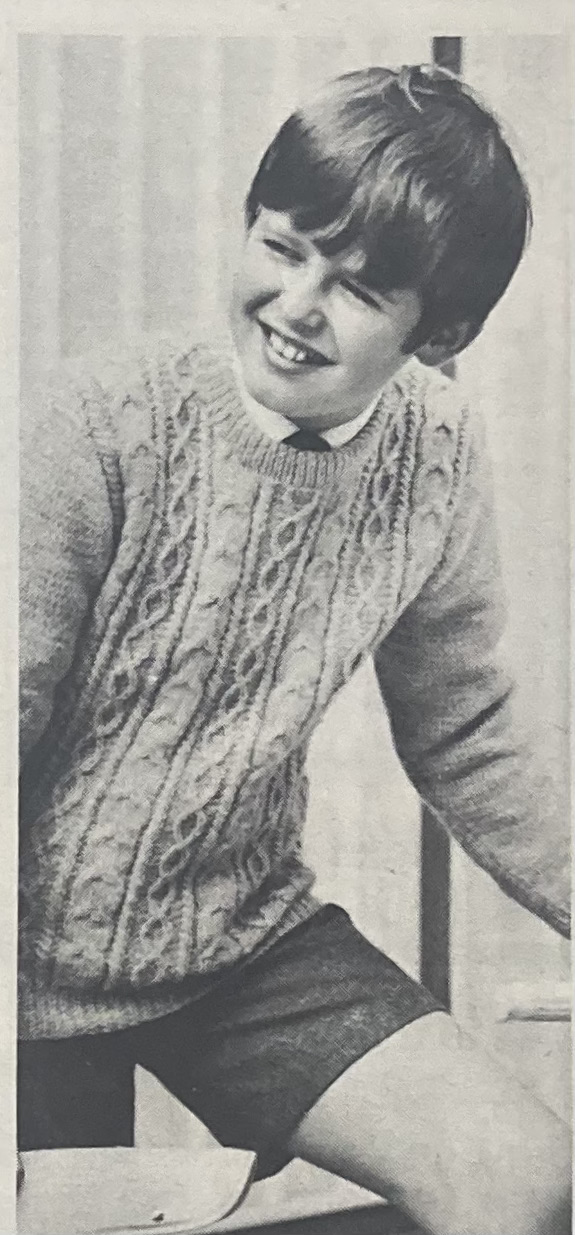
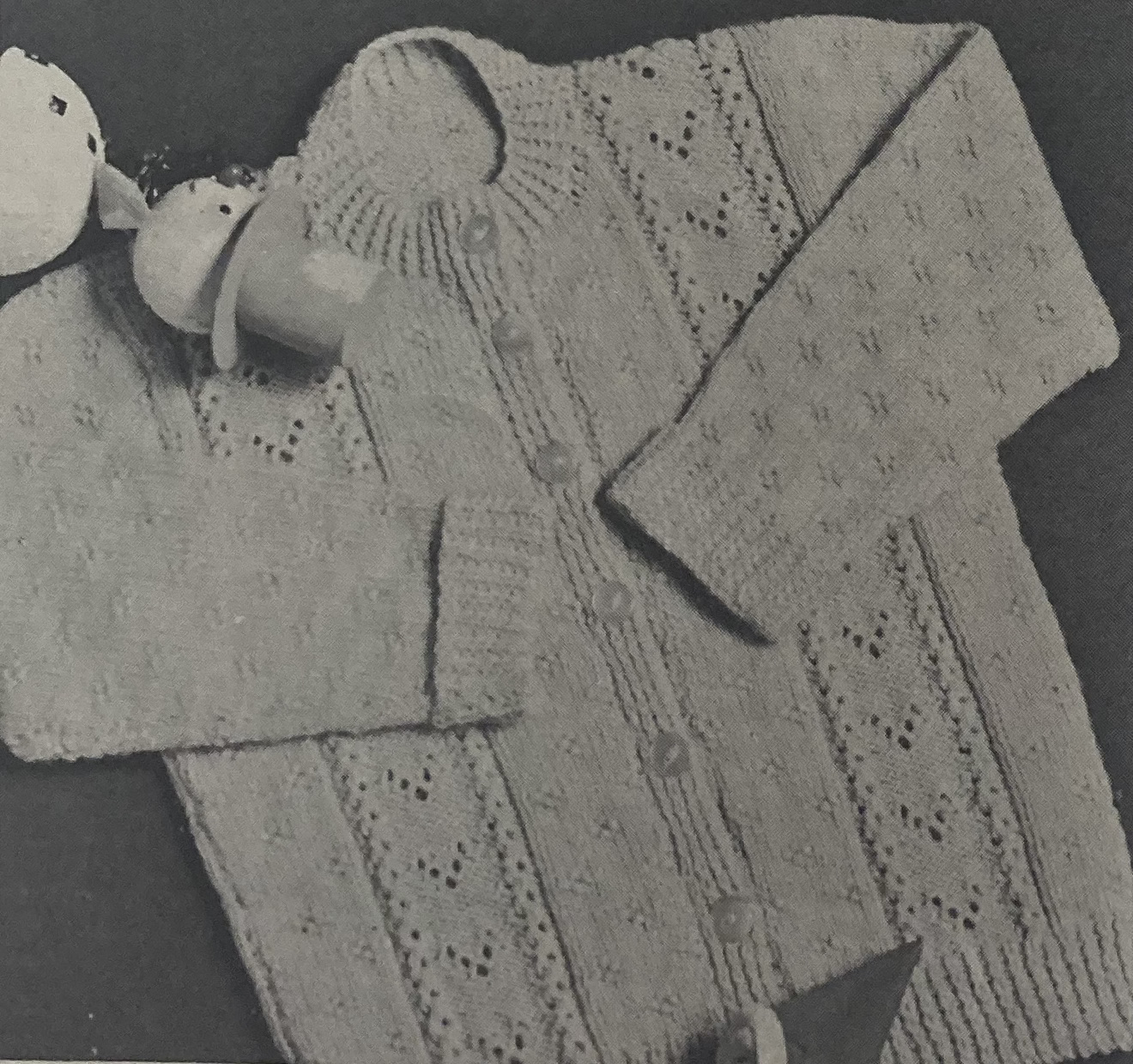
The manly-cable idea is continued on a lovely warm pullover for boys, and his younger sister can get a button-up cardigan in a frothy textured stitch pattern, made in synthetic-wool “Brilliante” for easy washing. Younger tots can enjoy warm ears with a chin-strap “helmet” hat that is guaranteed not to fall off or get lost.

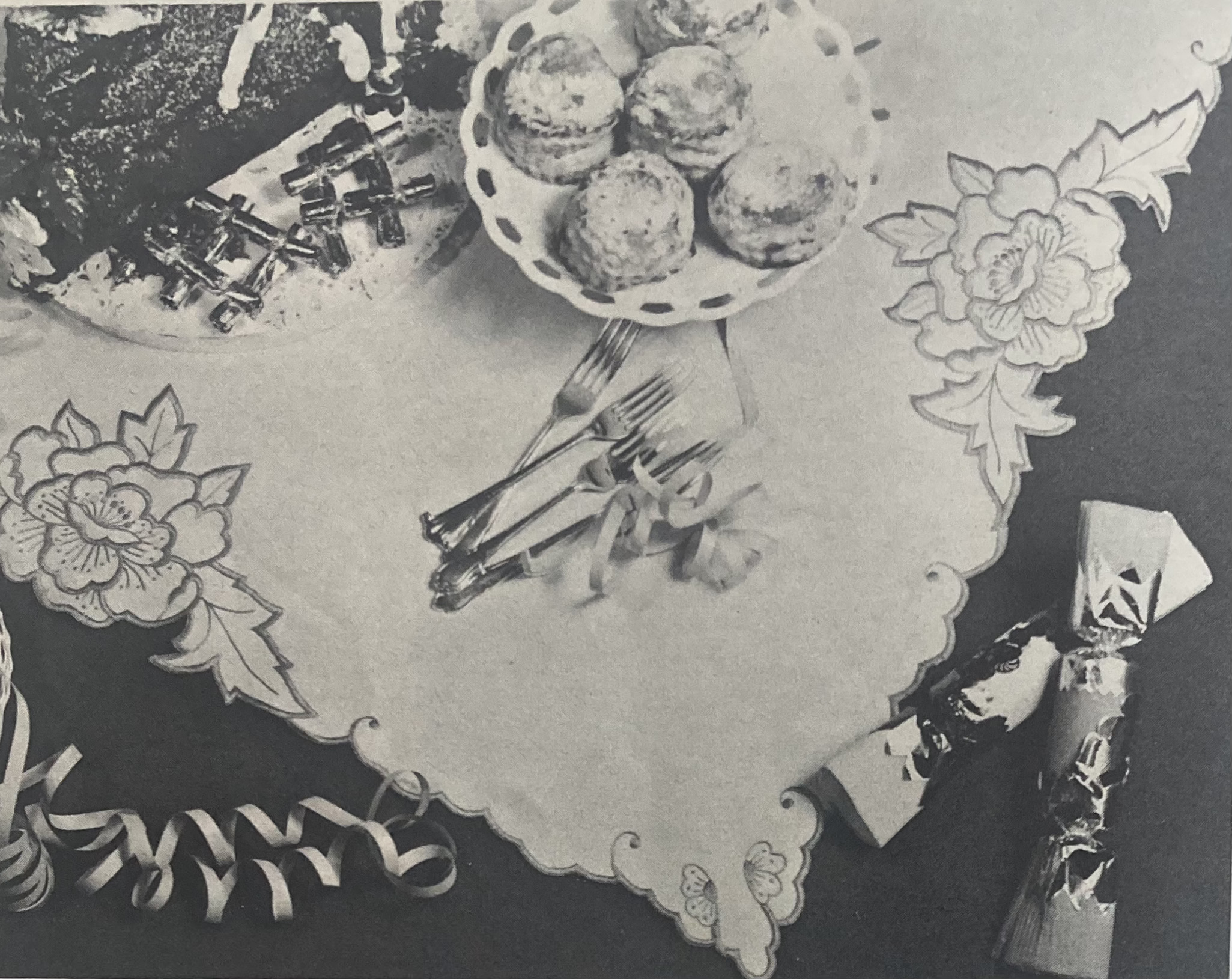
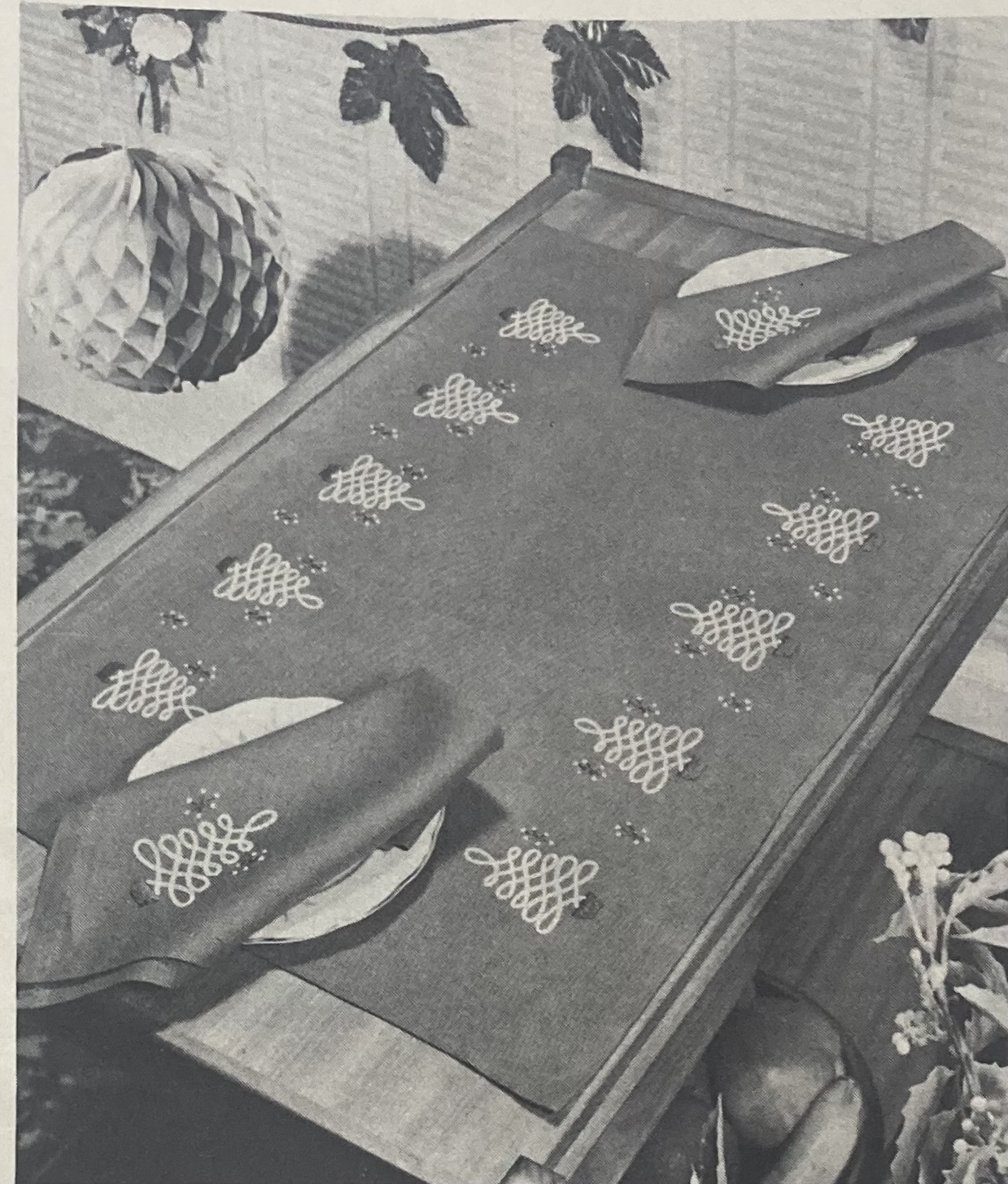
The real focus of the issue is of course, Christmas preparations. Felt appliqué makes a big appearance this year, with place mats and name cards for the holiday table as well a winter-scene wall hanging. The appliqués are quite simple and designed to be used with scraps, and the instructions give ideas on alternate uses such as glueing the felt pieces onto paper for home-made Christmas cards. The place markers have a butterfly motif, making them appropriate for any time of year. Cutwork and embroidery fans can make a tablecloth with peonies, or a Christmas-tree-themed trolley cloth and napkins embroidered in simple chain-stitch. More religiously-minded readers can make a tapestry wall hanging of a Nativity scene (colour photo on inside back cover).

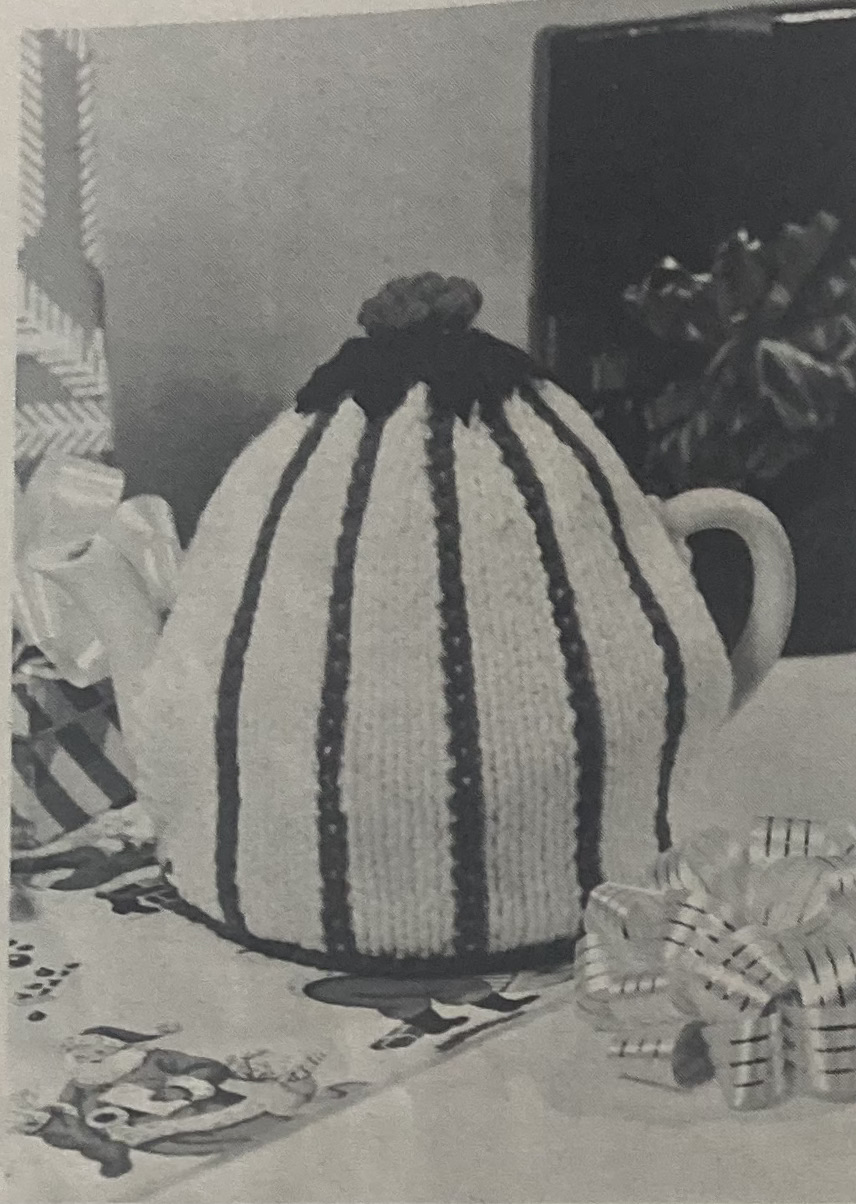
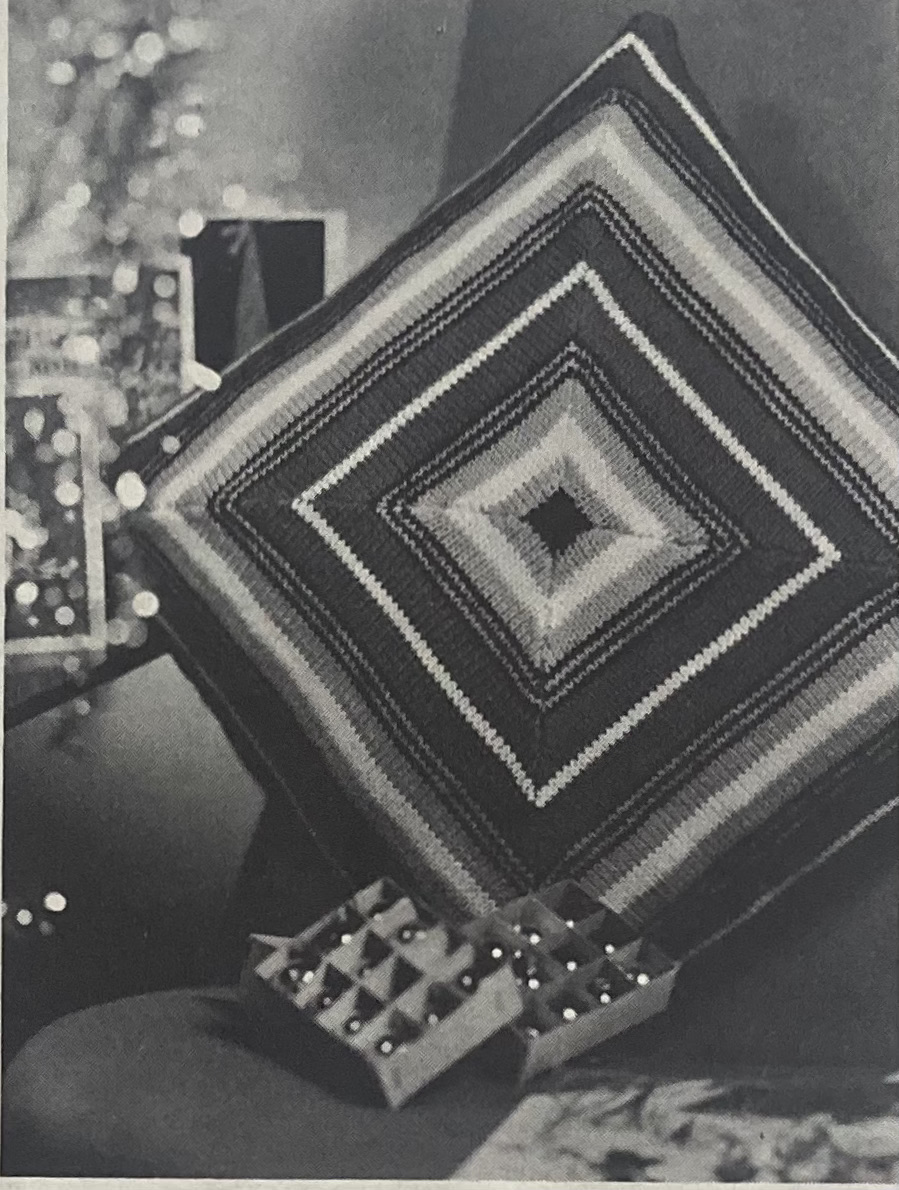
After dinner, it’s on to the gifts! The knitted tea cosy is supposed to represent a holly plant. The “workbag for a friend” is a fun way to use up leftover wool and I made one a couple of years ago. The “cushion for Granny” is a similar stash-buster. One would think it would be made in two squares either fron the center outwards or the edge inwards with raglan-type shaping, but no, you are supposed to make 4 identical triangle pieces for each side of the cushion and sew them together.

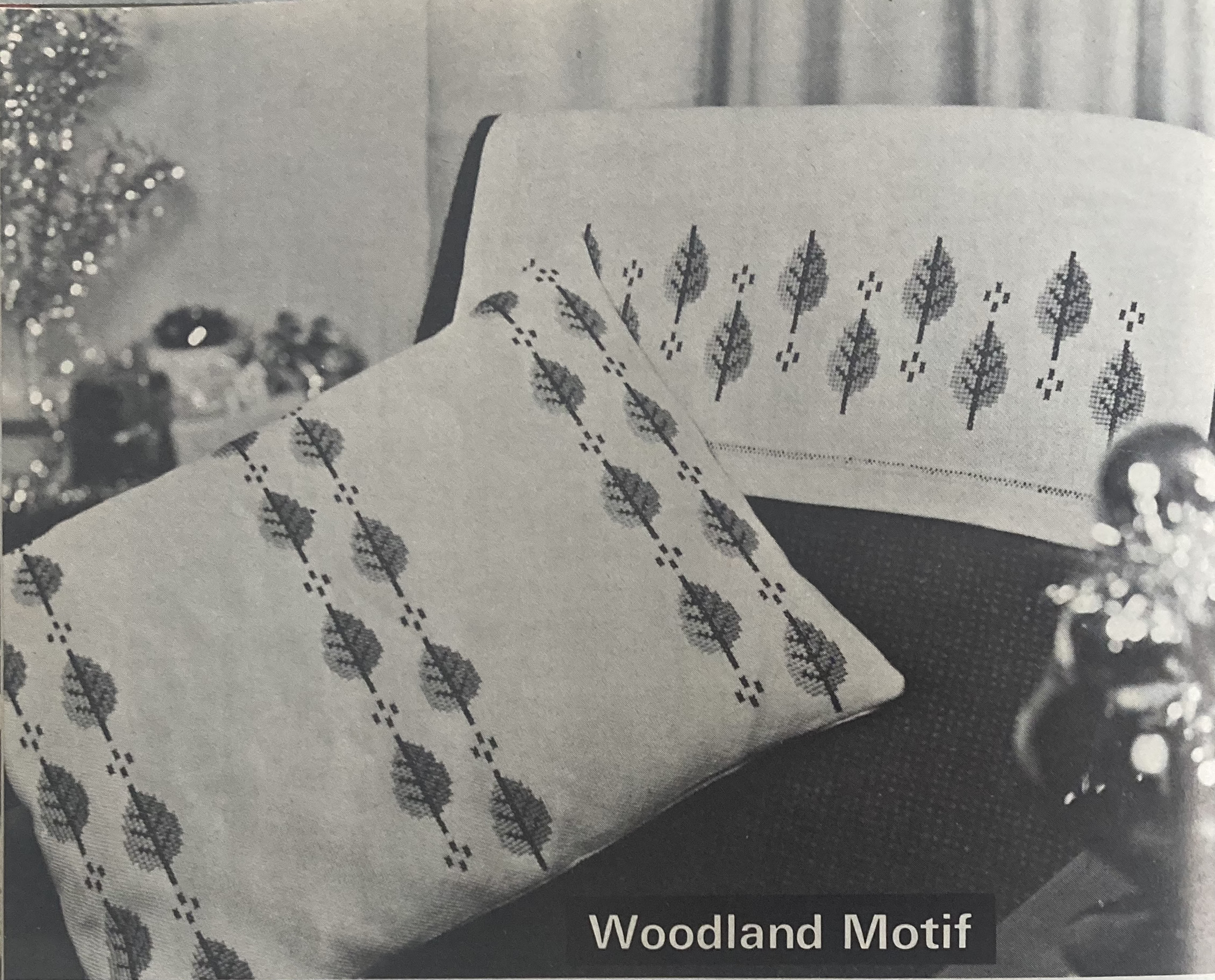
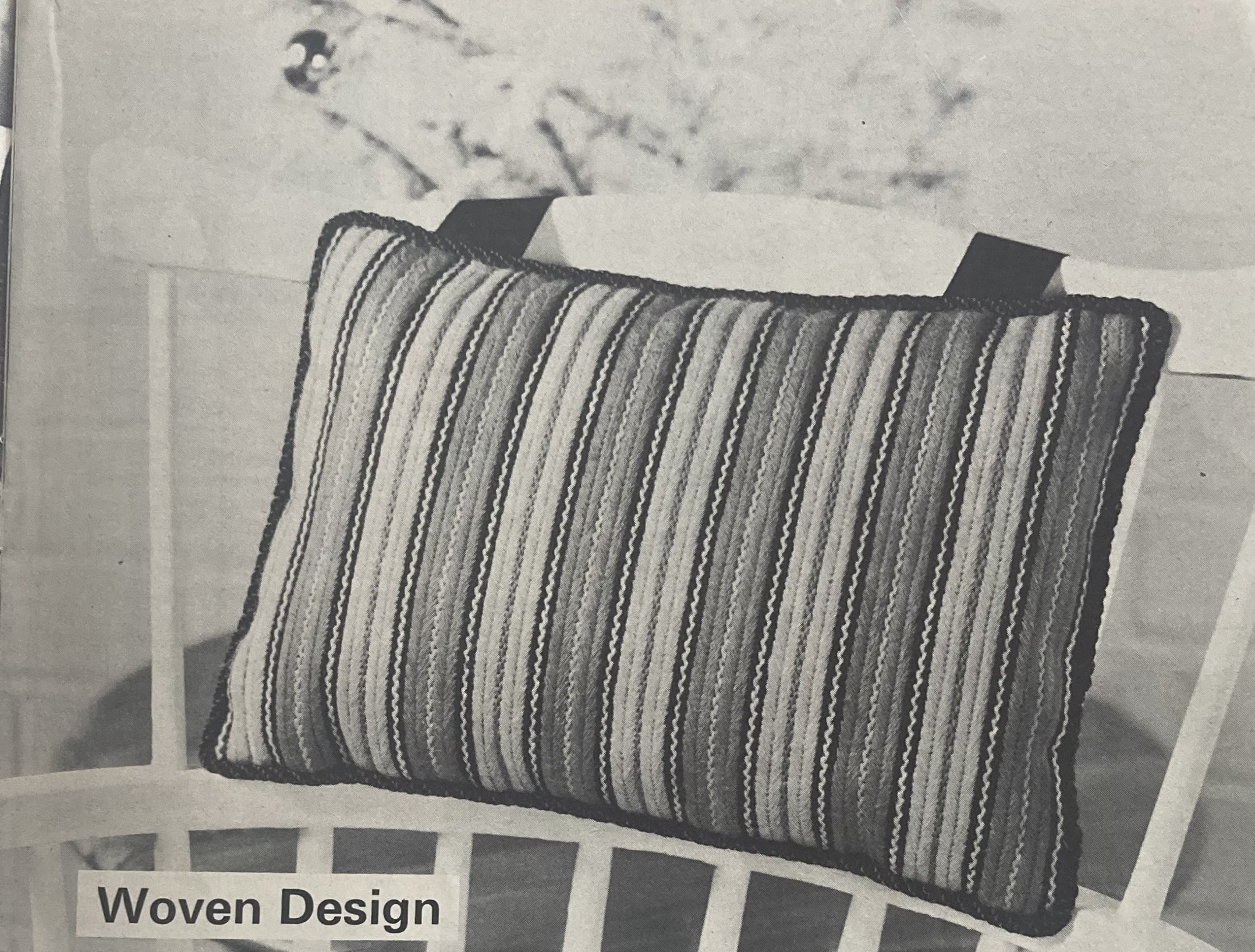
And let us not forget the other cushions: a simple cross-stitch number with a woodland design and a tough woven-tapestry chairback cushion in soumak and herringbone stitch. The colour scheme is brown with brown, with touches of orange and lime green for contrast. In the “just for fun” category, you can knit cosies for golf clubs.

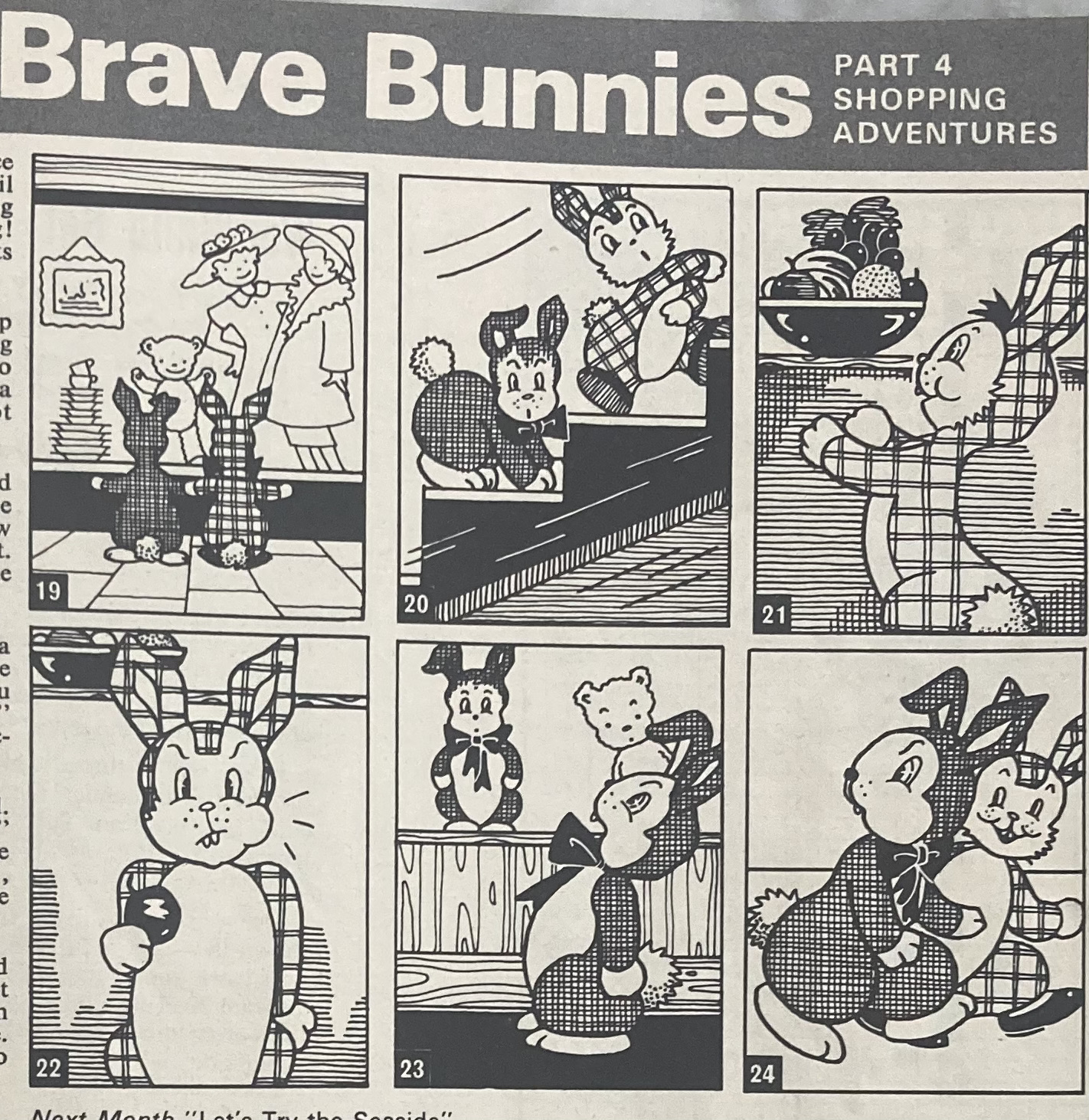
Our two brave bunnies from the Readers Pages are still on their quest to find a real live rabbit. Thinking they might find one in a department store (why not), they get stuck on a moving staircase, try to eat a plastic apple, and find a stuffed rabbit who, unlike our co-protagonist Sale Price (also a stuffed rabbit), sadly cannot talk. Next month, they will try the seaside, which is not known for being home to very many rabbits, but I suppose a better chance than a department store, a movie theatre or a merry-go-round. Of course, around Christmas time, one of the surest places to find a real rabbit would be on the dinner table, ha ha. I guess that storyline might be considered inappropriate for a light-hearted children’s comic. At least our two toy rabbit protagonists aren’t in danger of being eaten.

Finally, there’s another wonderful advertisement from my favourite Stitchcraft-ad store, the Scotch Wool Shop. Here is a nice little article about a knitting book produced by the Fleming, Reid company, proprietors of the chain of shops. The ads always make me want to go out and buy things from the stores… which, sadly, no longer exist. These little gift ideas are marvellous.

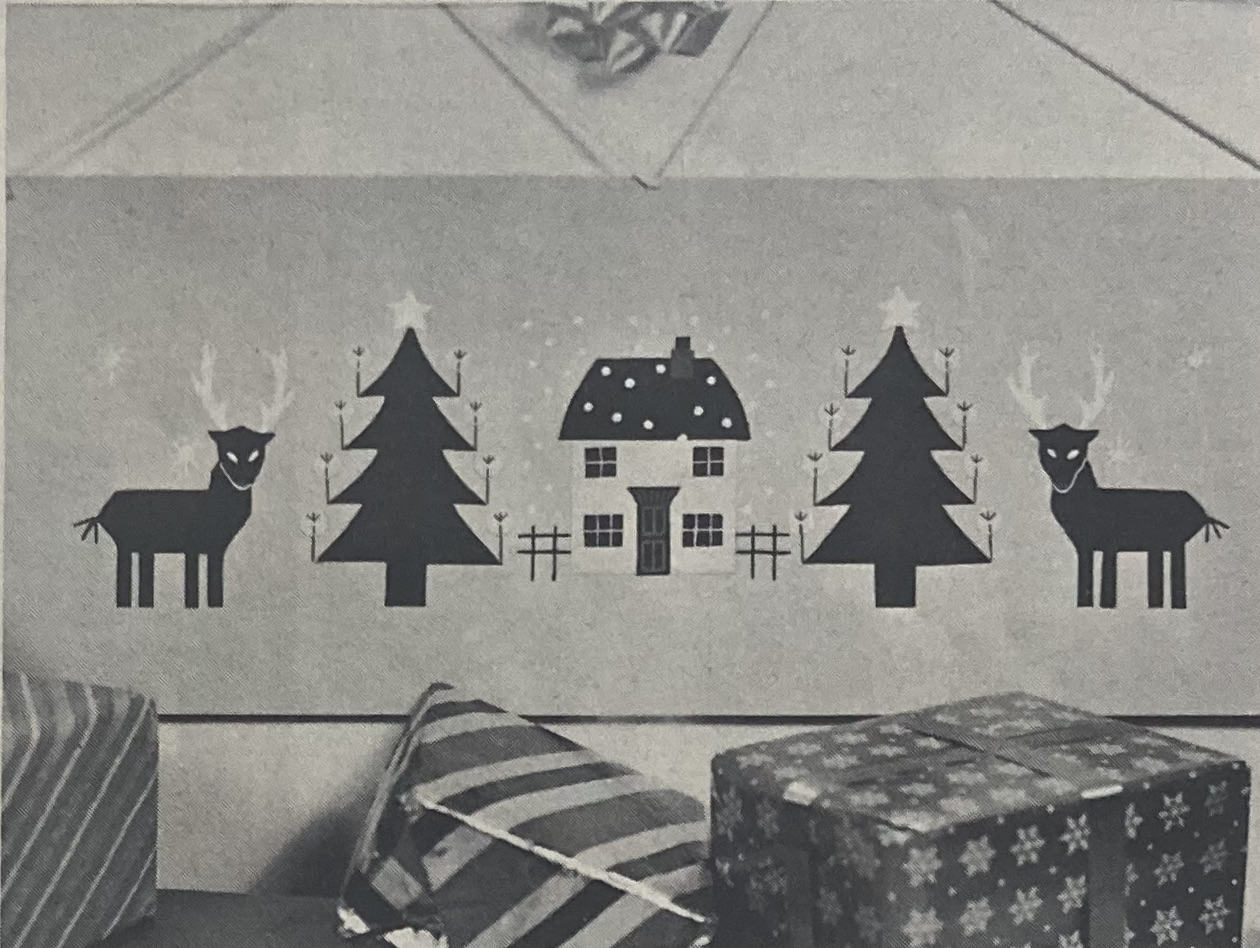
That’s all for this issue — and this year! I don’t know what I will make from this issue, or if I will just write a post about the knitted workbag that I already made a while ago. I quite like the ribbed skirt, and could use one, but one look at the gigantic WIP pile discourages me from starting any long and boring project. Hopefully I’ll get a couple of those WIPs finished and can write about that for a 1965 / 2023 wrap-up. Until then, I leave you with this graphic from the December 1965 issue. Happy Holidays!

May 1965: Overview

Spring and summer are always time for “holidays” at Stitchcraft, with a mixture of light, pretty blouses, warmer, casual jackets and sweaters for that holiday on a North Sea beach, and easy embroidery to pack in your luggage and work on while lounging in your deck chair. Our cover photo shows matching his-and-hers sweaters made in DK wool, and an intriguing photo begging to be captioned. “It’s for you!” “Not interested” “But it’s my mother!” “I am definitely not home” — Anyway, the sweaters are nice and good to “wear by the sea”, as it says in the caption. They are knitted in Patons “Flair”, a combination of Shetland wool and Courtelle nylon in a slightly thicker DK weight.

The remaining adult knitted “holiday” garments are pretty and practical: a men’s tweedy “country” cardigan, a heavy slip-on jacket for women in a sort of bubble pattern made by purling stitches together, wrapping them and purling them again on one row out of a 4-row rib pattern, a lightweight lacy top with a graded colour scheme, or a slipover in mohair blend “Fuzzy-Wuzzy” wool. There’s also a fashionable dress in bramble-stitch, made to look like crochet, but knitted. Colours are soft, cool pastels — white, natural, sky blue or light pink.

The “crochet look” in knitting, as exemplified by the dress, is the latest trend. If you can’t crochet, you can knit to make it look like crochet, and if you can, you can make a matching mother-daughter blouse set in wool-nylon blend “Nylox” yarn. There’s also a full-page “Learn to Crochet” illustration with clear and helpful instructions for the basic stitches. I keep it around for easy reference.

There’s nothing for very young babies in this issue, but toddlers can get a nice beach set of knitted pants and short-sleeved cardigan. The cable panels supposedly make it hold its shape, but it’s not intended to go in the water. The toddler’s tween sister gets a sunny and colourful “young style” blazer in DK wool and a “continental” design. I still don’t know what is meant by “continental” design — obviously referring to the European continent as opposed to the British isles, but I wouldn’t be able to say what design elements make something “continental.” If you know, do tell.

The summer housewares are fairly standard, with a floral cross-stitch design for either a cushion or tablecloth, and a knitting workbag featuring dancing “gay Tyrolean” figures. I know some gay Tyrolean dancers, but that’s a different story. There’s also an embroidery pattern for an easy tablecloth or “dressing-table set”.

And then there are some genuinely interesting place mats with figures of birds and fish adapted from Peruvian work. The “wingless bird” in the close-up photo looks like a rhea and the black and white one probably a guan. I don’t know about the third bird in the first photo, the squished-up one with a long neck, how about you?

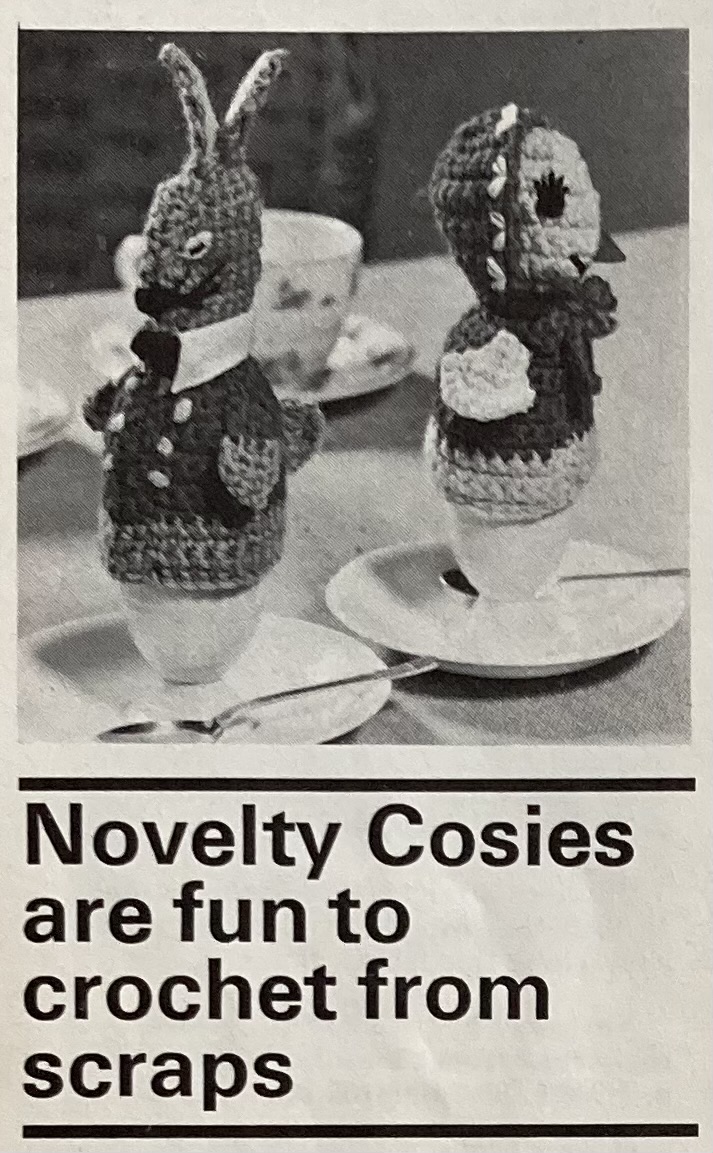
There’s also a rug, for not taking along on holiday, as well as a fancy knitted lace cloth “for a summer table” (It is knitted in cotton and therefore wash- and bleachable, but still, I would be afraid to spill something on it.) And of course, cosies! Both egg- and teapot-, to knit from scraps of tapestry wool held double (not knitting wool as one would expect).

That’s all for this issue. I’m going to close with this wonderful Scotch Wool Shop advertisement for Bri-Nylon swimsuits. I would wear either of these in a heartbeat. Enjoy the Spring!

November 1964: Useful Gift to knit from your Scraps

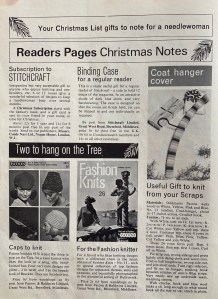
My November project was this gem from Stitchcraft’s November 1964 “Readers Pages”. Over the years, these back pages featured everything from recipes and household tips to mini-reprints of popular patterns, little “novelties” or “gift ideas” to make, advertisements for other Patons/Stitchcraft booklets or subscriptions, or quick “how-to” lessons for specific techniques or stitch patterns. There’s always a comic for children, often featuring some sort of needlecraft and/or friendly animal character that you can knit or sew or embroider in a future issue. In addition to the current comic (“ANNE and her embroidery”– in this segment, Anne learns how to make oven mitts embroidered with a fish in herringbone and cross-stitch) the November 1964 Readers Pages offered “Your Christmas List gifts to note for a needlewoman” — two Patons pattern leaflets, a subscription to Stitchcraft and/or a binding case to hold a one-year run of twelve Stitchcraft magazines, and a pattern for a knitted coat-hanger cover.

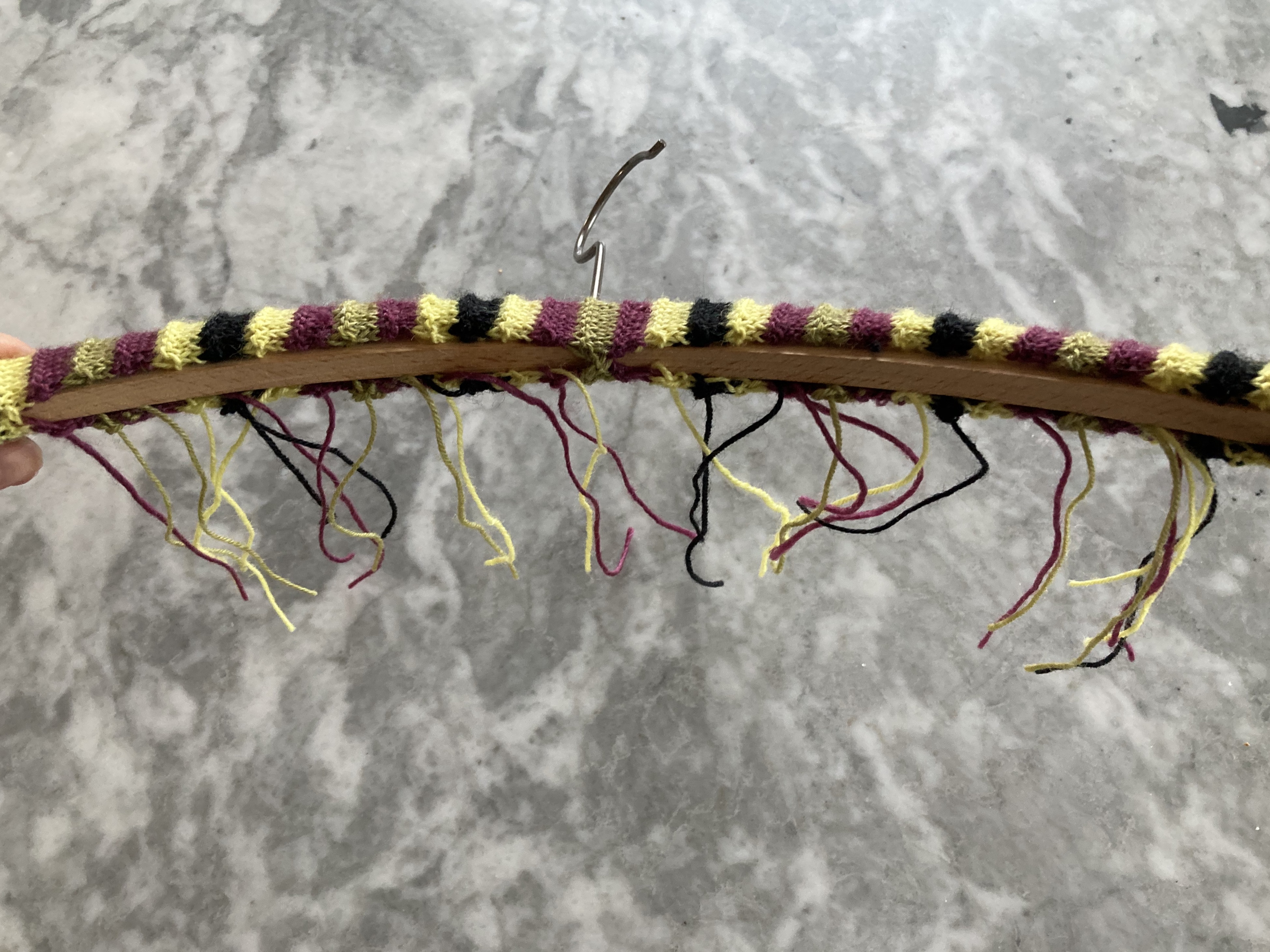
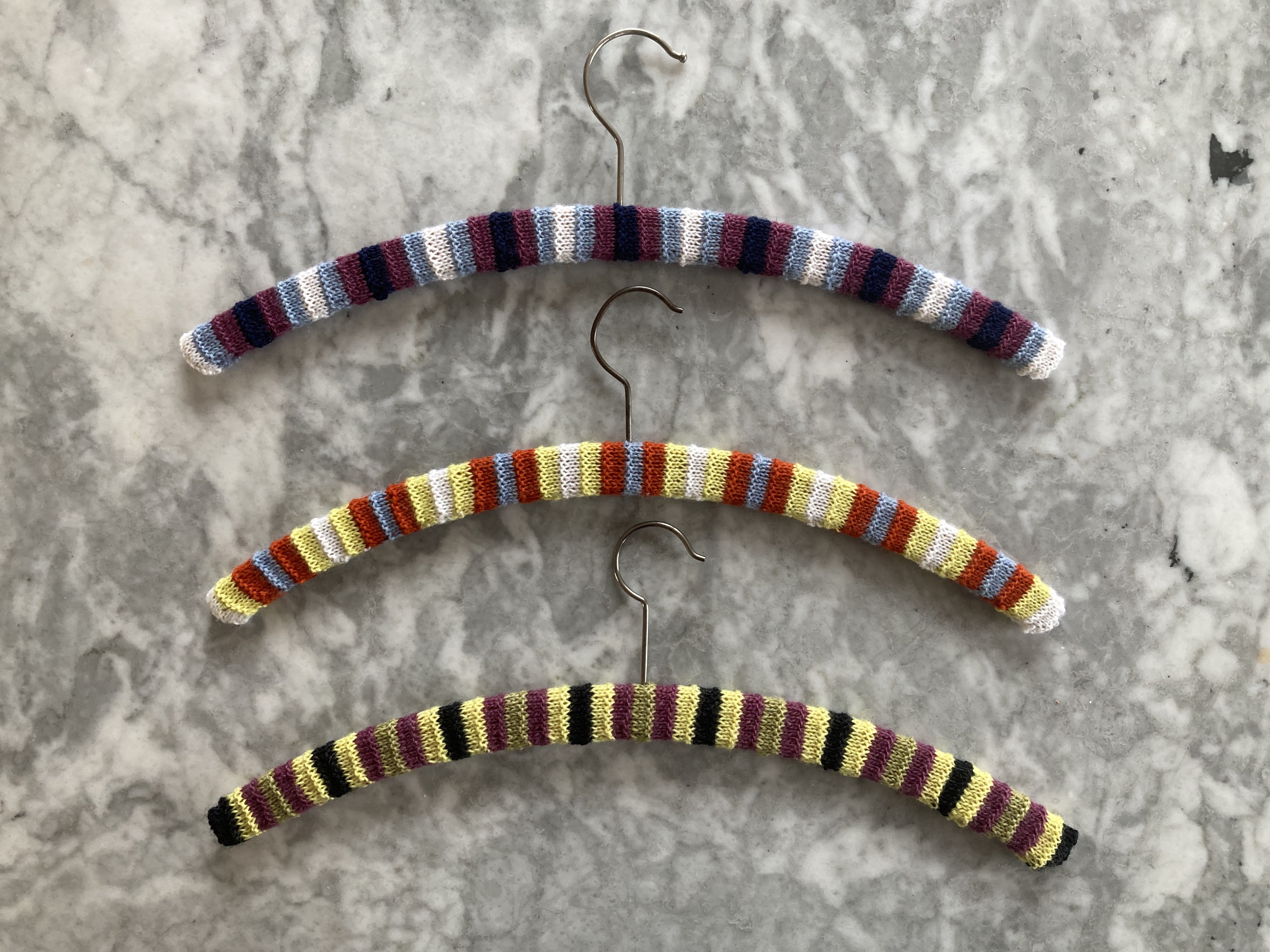
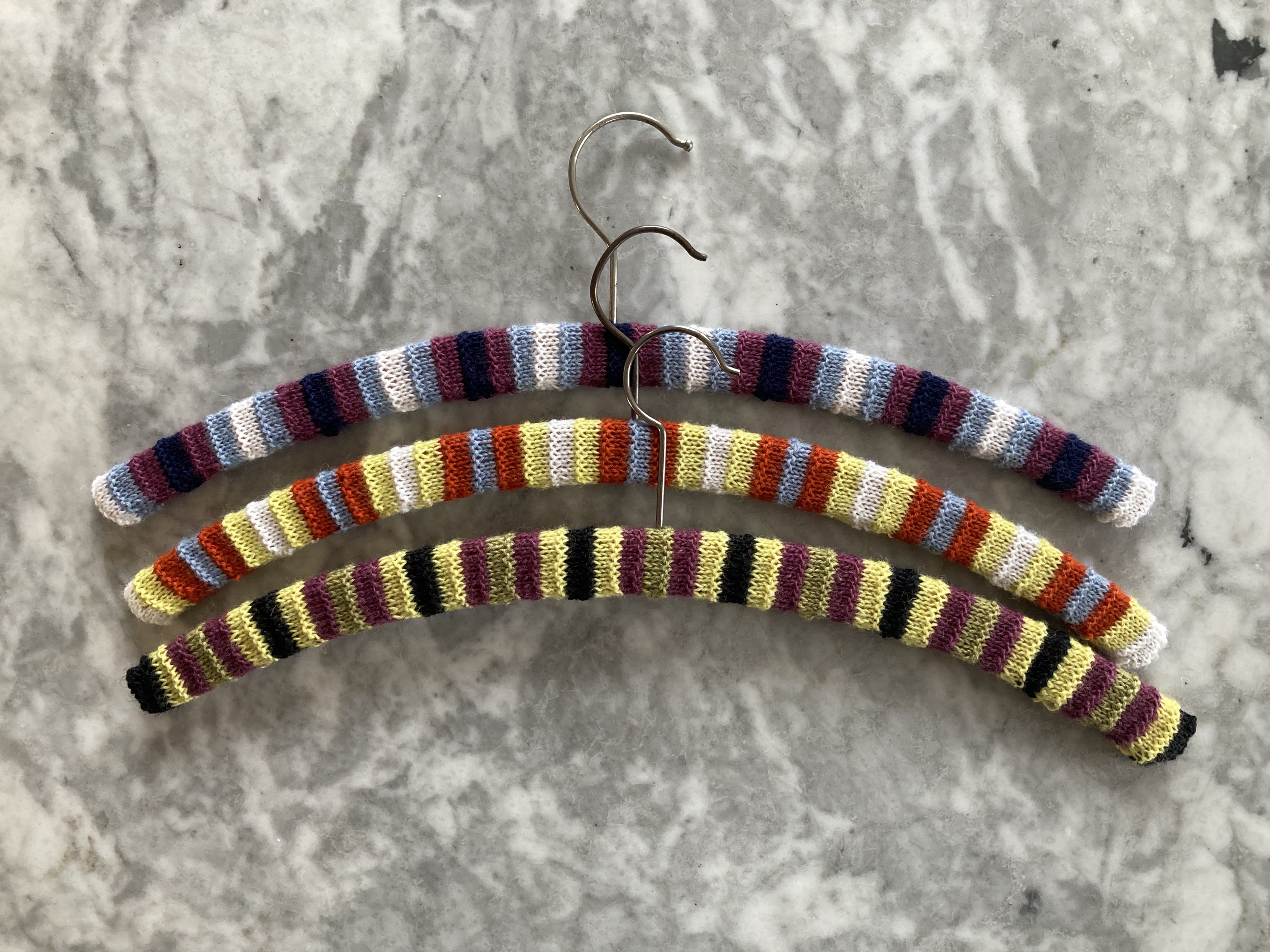
The knitted (or crocheted) coat-hanger cover was a staple in every grandmother’s and great-aunt’s house I knew growing up, so I have a pleasant nostalgic association with them. It is indeed a useful way to use of scraps of yarn, and I guess the padding helps garments not crease at the shoulders. Also, they’re cute and I think these days, they would be a very fun little holiday gift for people who like crafty items. I certainly had enough scraps of 4-ply / fingering-weight wool, so this was the perfect November project.

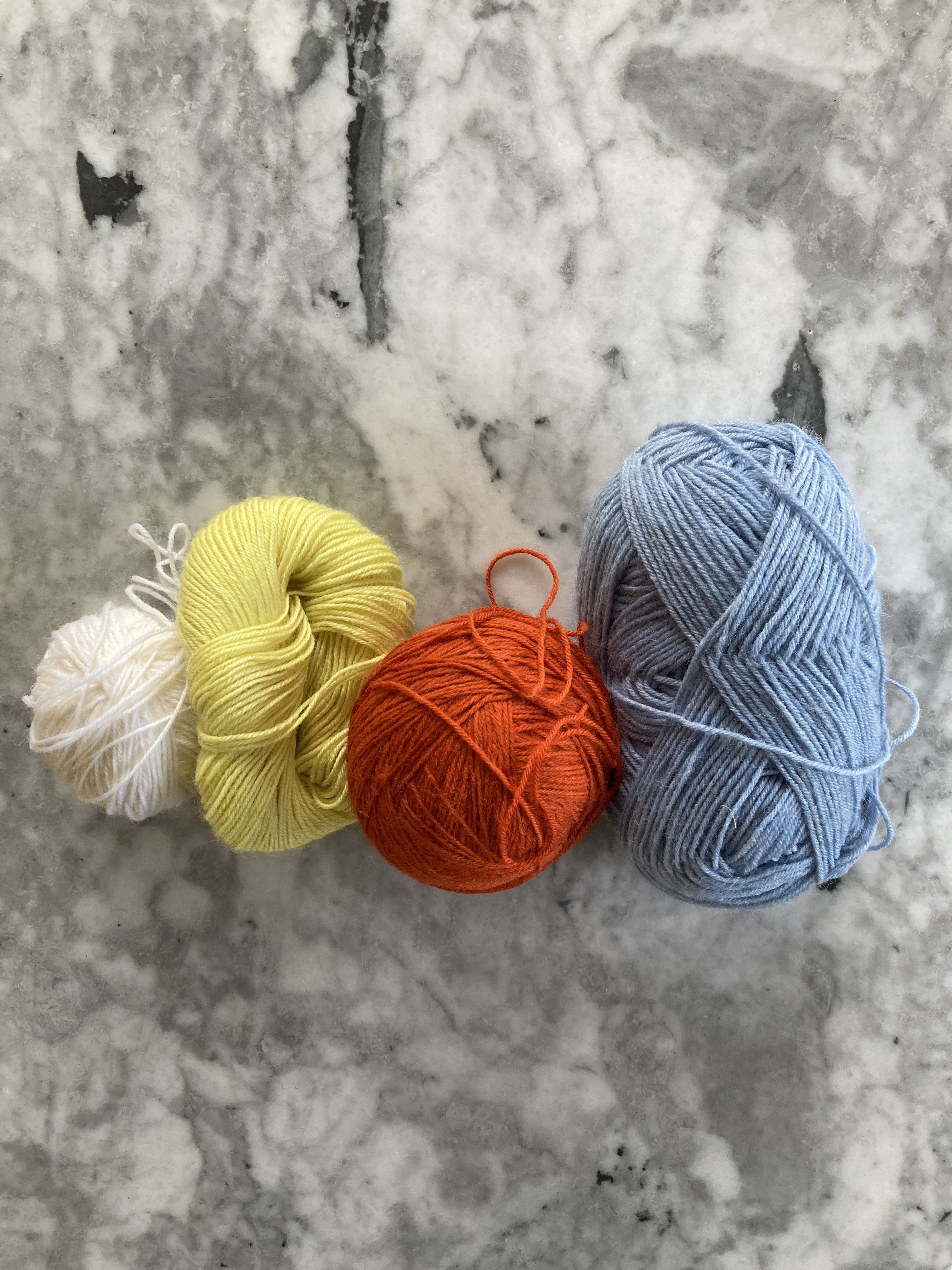
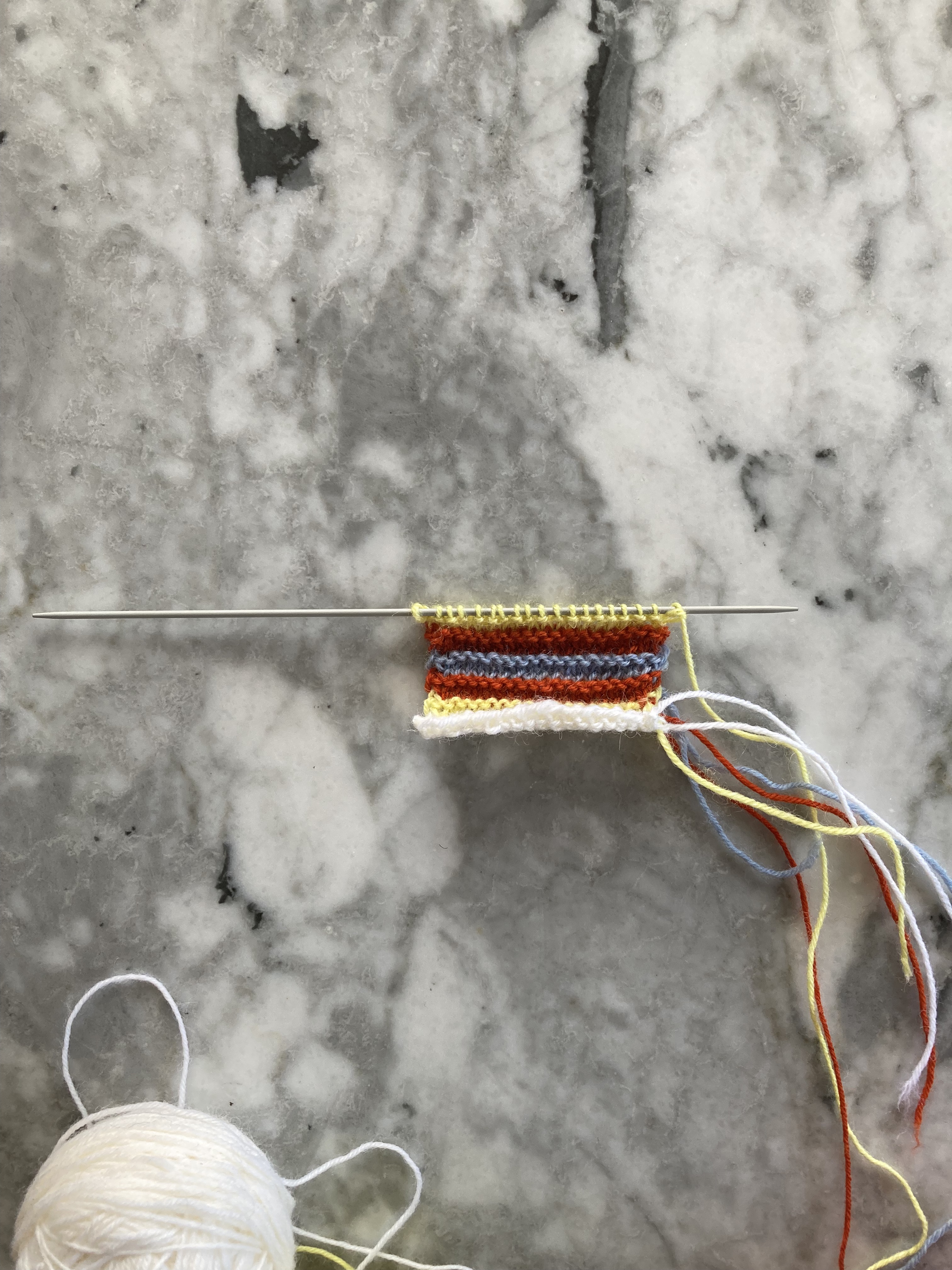
The pattern uses “oddments” of 4-ply wool in white, yellow, pink and blue (or whatever colours you have, of course) and is knitted at a tension of 7.5 stitches to the inch on No. 11 (2.75 mm) needles. It is simply a strip 19 stitches wide, started at the small end and worked in a symmetrical stripe pattern for a total of 42 4-row stripes. The pattern is k1 row, p 1 row, k 2 rows, so there’s a little purl ridge at one edge of each stripe. You sew the short ends in half, poke the hook part of the hanger through the middle of the center stripe, pull the short ends of the knitting over the ends of the hanger, sew up the stripes on the underside and voilà. Then you can make a little crochet chain to wrap the hook part of the hanger and stitch it in place.

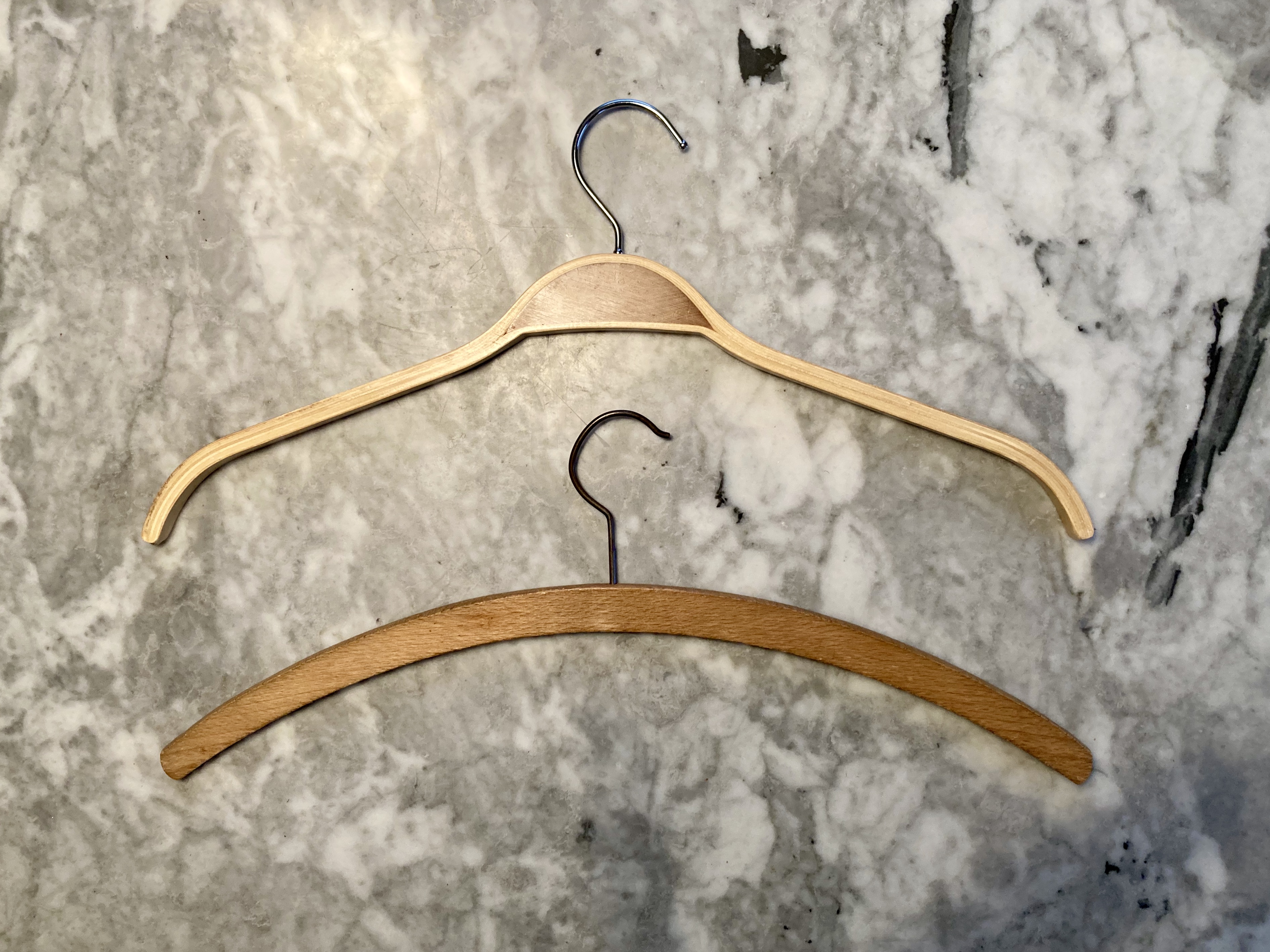
Of course, it only works on a certain size and shape of hanger… one that was apparently easier to find a few decades ago than now! All the new hangers I’ve seen or bought have a triangle shape with a bar underneath to hang things over. Admittedly, the triangle version is much more useful, because you can hang more than one thing on it (suits…) and fold things over the bar (trousers, long dresses if your closet space is short…). I only found two hangers in my closet that were the right shape for these covers! As well as a modern version that is similar, but too big at the top — as written, the knitted cover won’t stretch over the block-y part under the hook.

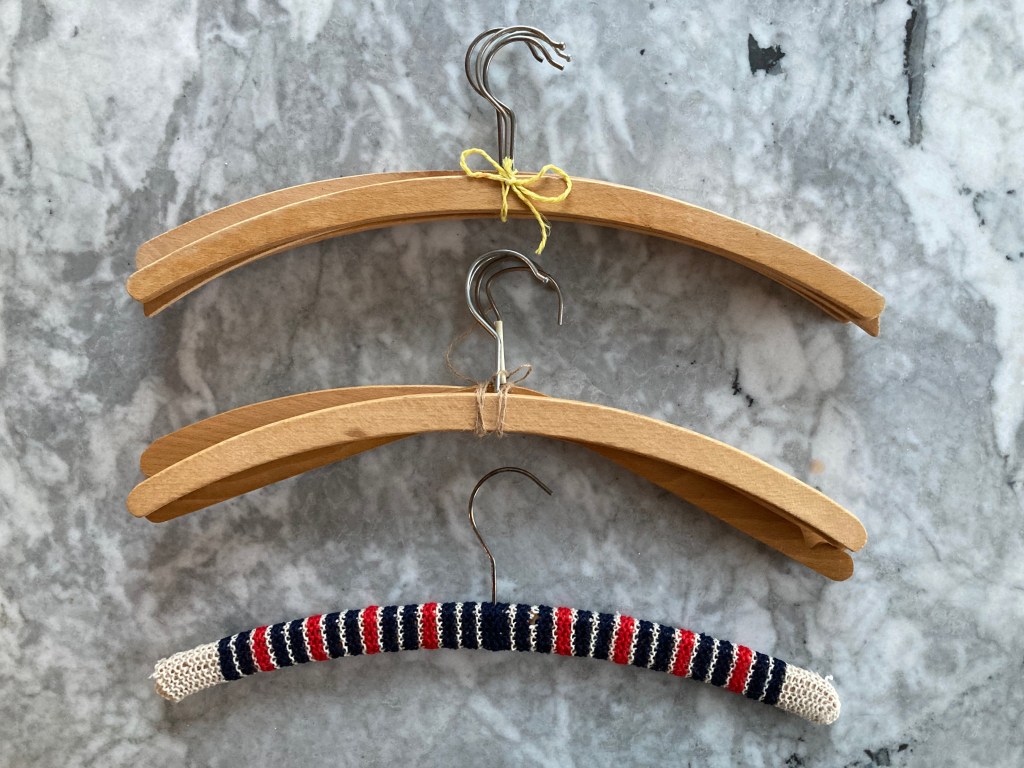
A quick look at ebay yielded a seller with a package of 8 vintage hangers for a few euros — including one that was already covered with a knitted cosy! Perfect. The covered hanger is knitted in a similar stripe pattern using three colours and garter stitch.

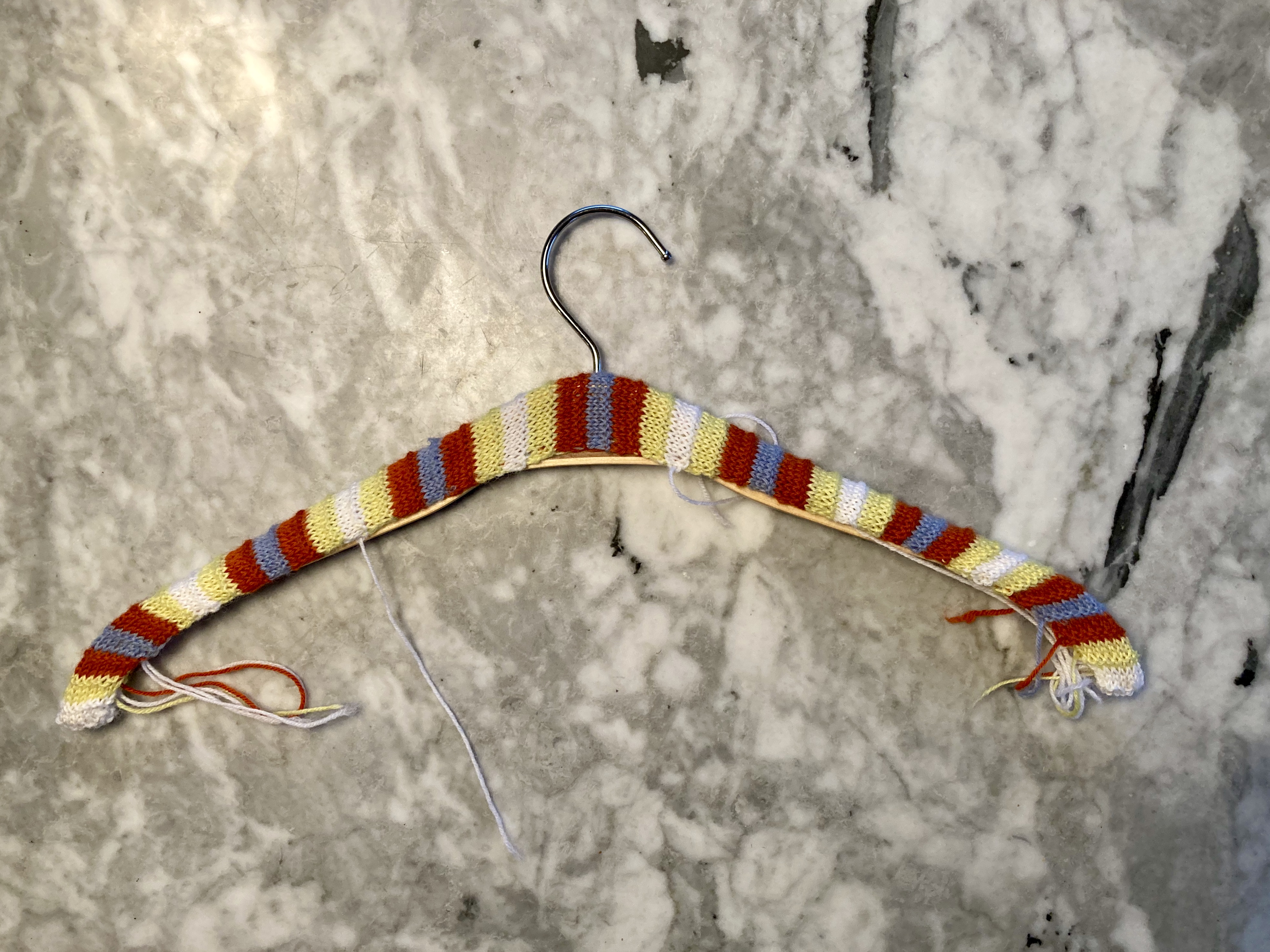
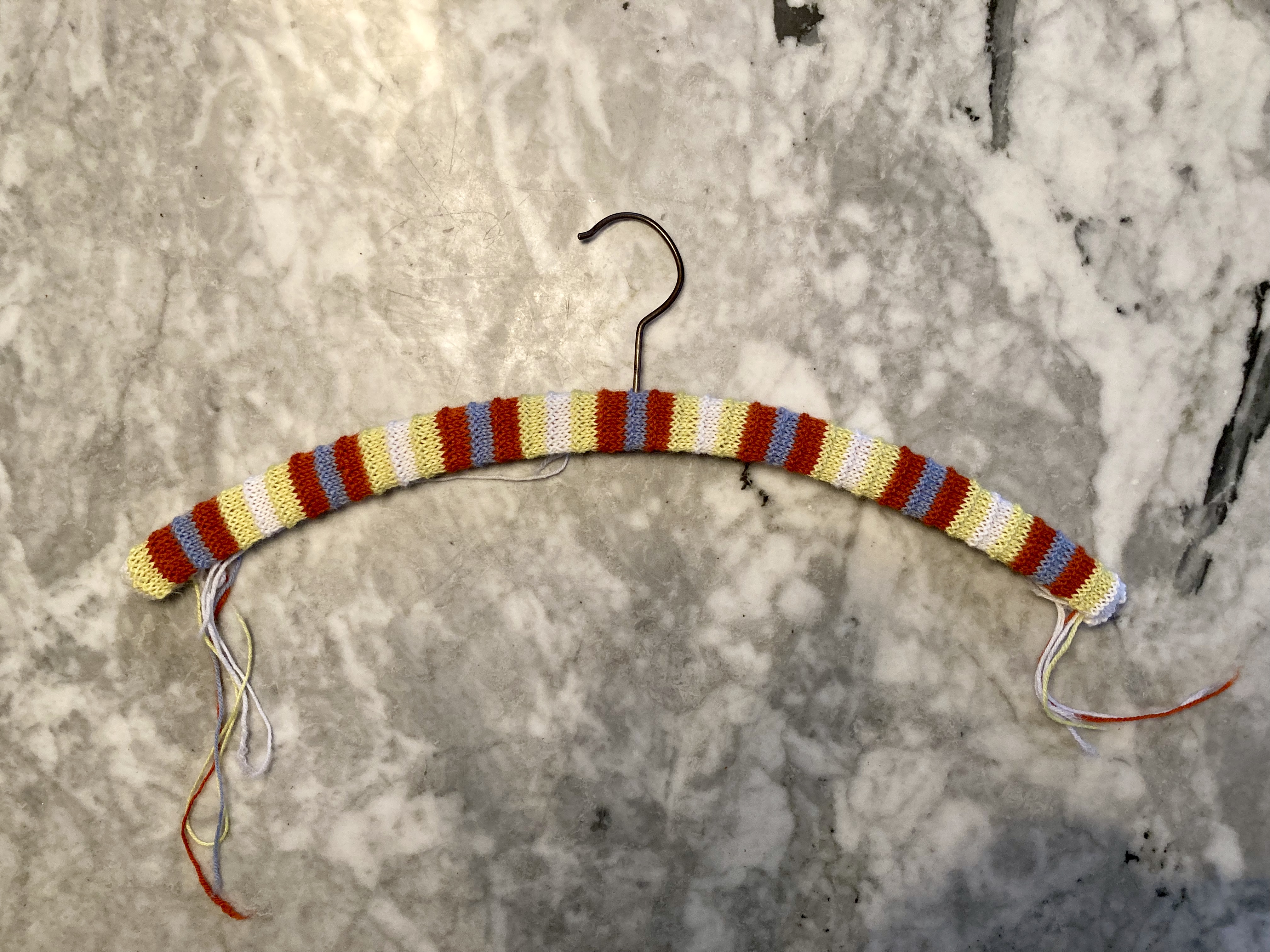
I made mine using the Stitchcraft pattern and more or less random colours from the “assorted 4-ply” bag. I used 2 mm needles and left the hook bare. The cover fit perfectly on the hangers (both mine and the ones from ebay, which were all the same size and type). The tedious part was stitching up the underside. When I made the first cover (blue, white, yellow and orange), I carried up the threads on the sides, thinking to save weaving in ends, but realised afterwards that the loose ends are useful for stitching up the cover on the underside of the hanger. So for the other two, I only carried up the threads within a two-colour, three-stripe block. Still… lots of ends.

I have other stuff to do and so many wips, so I’ve going to stop at three hangers for now, but maybe I can crank out a few more in December for presents. Loved this project and will surely come back to it to decorate more hangers, of which I now have plenty.

June 1964: Overview

Welcome to the official start of the Stitchcraft holiday season! The June 1964 issue gives us a mix of elegant 4-ply designs, casual bulky knits to wear as outerwear, beach clothes for the kiddies and easy homeware projects that can be packed up and worked from a deck chair.

Our cover models are just returning from the weekend market, where they have secured a basket of nectarines. They’re wearing an “easy-line sport pair” of “cruise mates” in complementary colours and the same basic block-and-rib pattern. The ribs are made with p1, k1tbl to give them a more textured look, and the men’s version has an eagle motif, because it is “manly for him.” I wonder if both versions were originally designed with a motif until the designer realised that it would fall in an awkward place on the women’s version?

Nautical navy blue and white with red accents never goes out of style for summer casuals, and we see it in this bulky, yet “featherweight” (18-20 ounces of Patons Ariel, so make of that what you will) white cardigan. I can believe Stitchcraft when they say that the wool is lightweight, considering its bulk, since the twisted-rib pattern eats up a lot of wool.

Ona different note, we see simple, yet elegant knitwear separates in 4-ply that are suitable for the office of a more dressy casual situation. The basic skirt and plain or diagonal-striped top are knit in muted pastel shades and meant to be interchangeable — “Basic skirt with a change of top” is the headline for this well-coordinated set. There’s also a waistcoat for her that would match the skirt when worn with a blouse, and a fine-knit raglan pullover for him. The waiscoat and pullover are both in this season’s trendy yellow tones of “Spun Gold” and “French Mustard”.

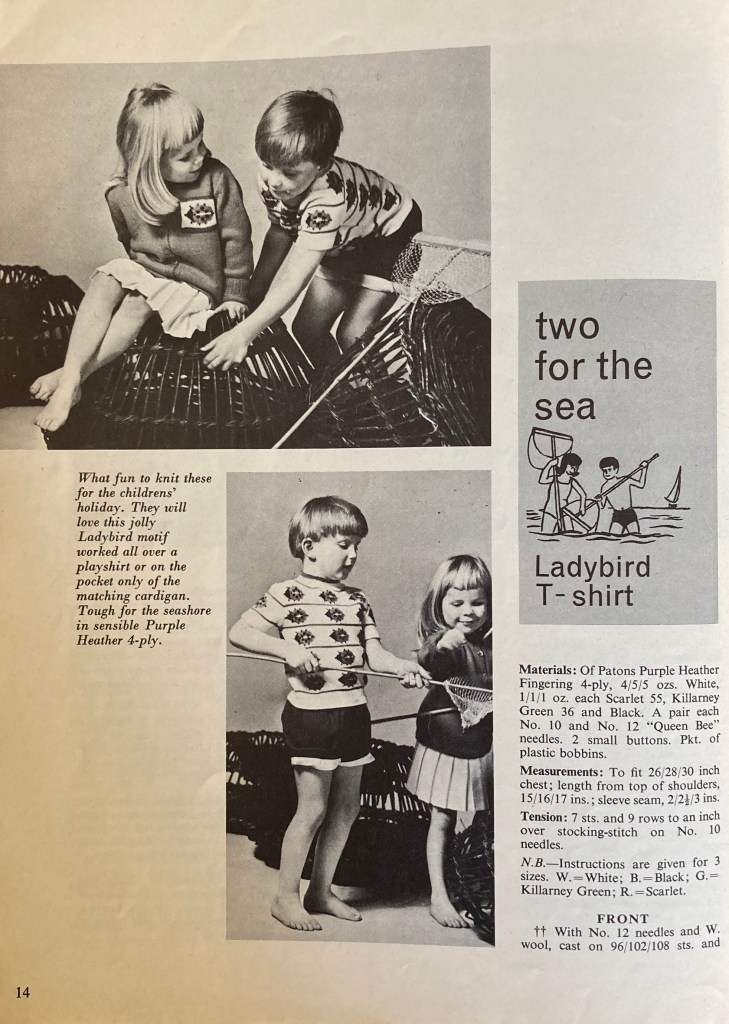
Children can enjoy splashing around at the beach in their trunks and sundress (the girl’s trunks are sewn into the sundress to prevent wardrobe malfunctions, definitely necessary with a micro-mini tunic skirt.) Here again, traditional red and white or navy blue and white are the chosen Somewhat older children have a choice of short-sleeved jumper and/or cardigan with a Ladybird motif (more about that in the next issue…!), continuing the red and white theme. On a completely different colour note, you can make a beach cover-up coat in crinkly “Rimple” wool lined with towelling — a brilliant idea for drying off and staying warm after a swim in cold northern waters. It’s quite easy to make, consisting of literally three rectangles for fronts and back, with garter-stitch borders and then lined with the towelling.

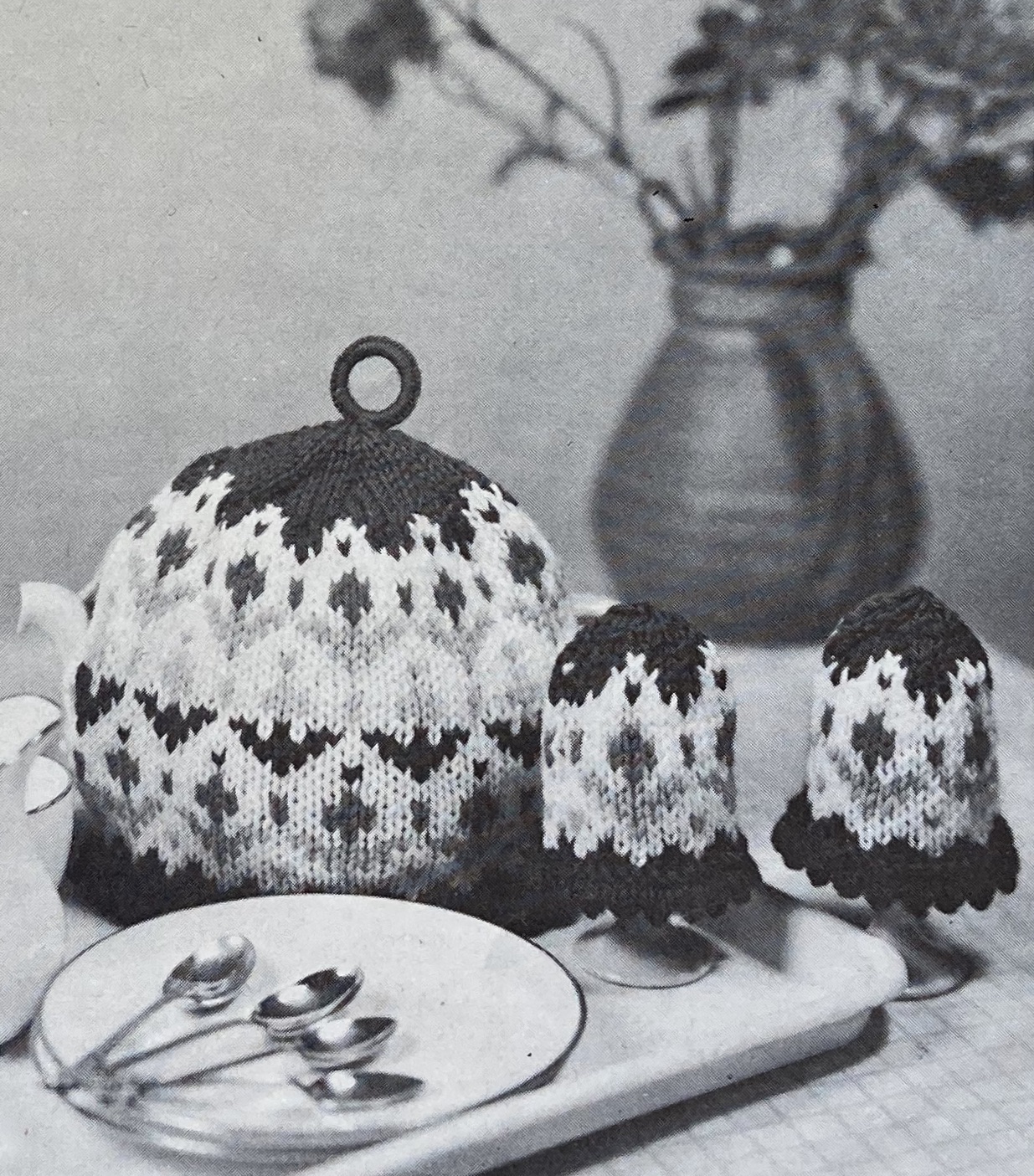
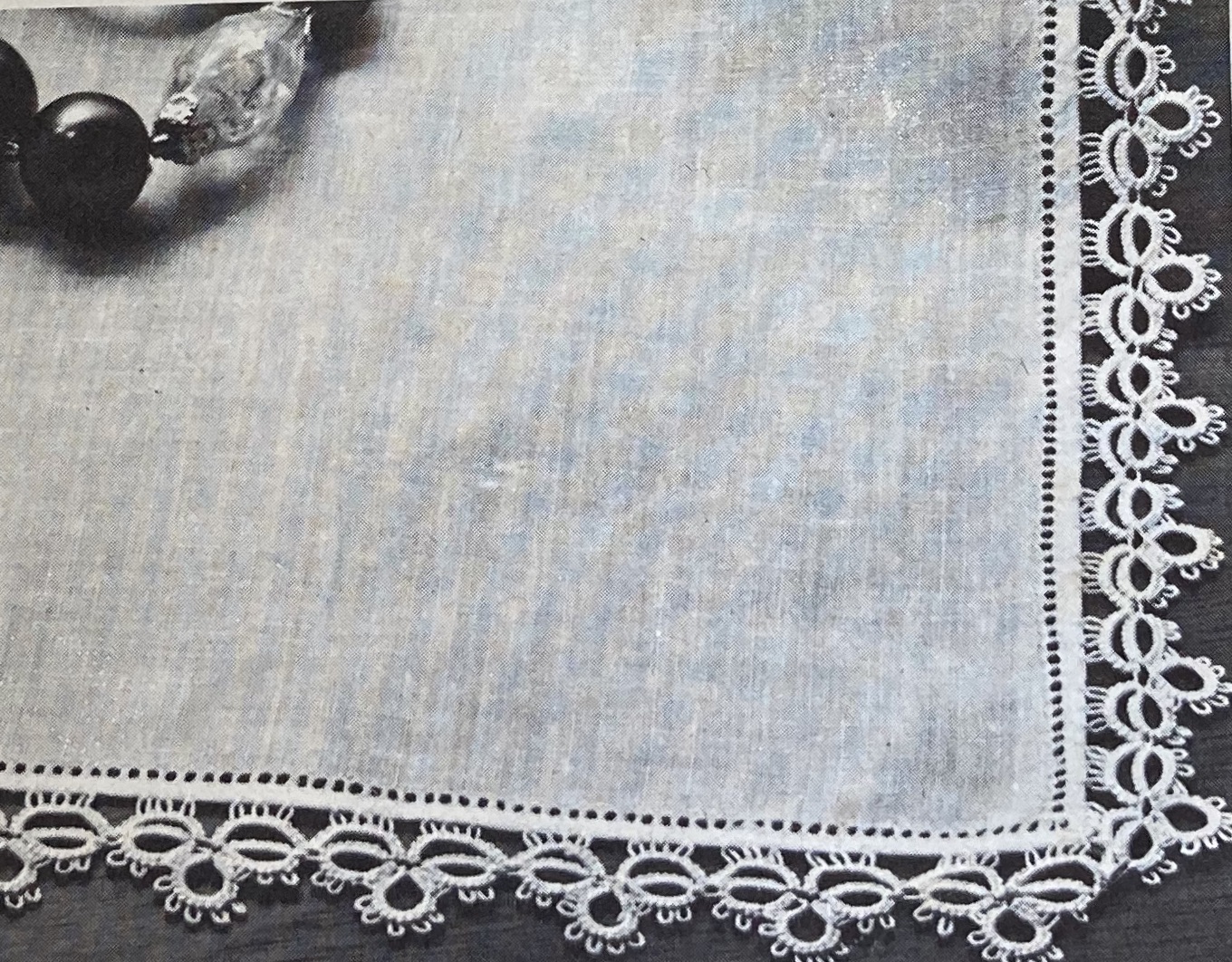
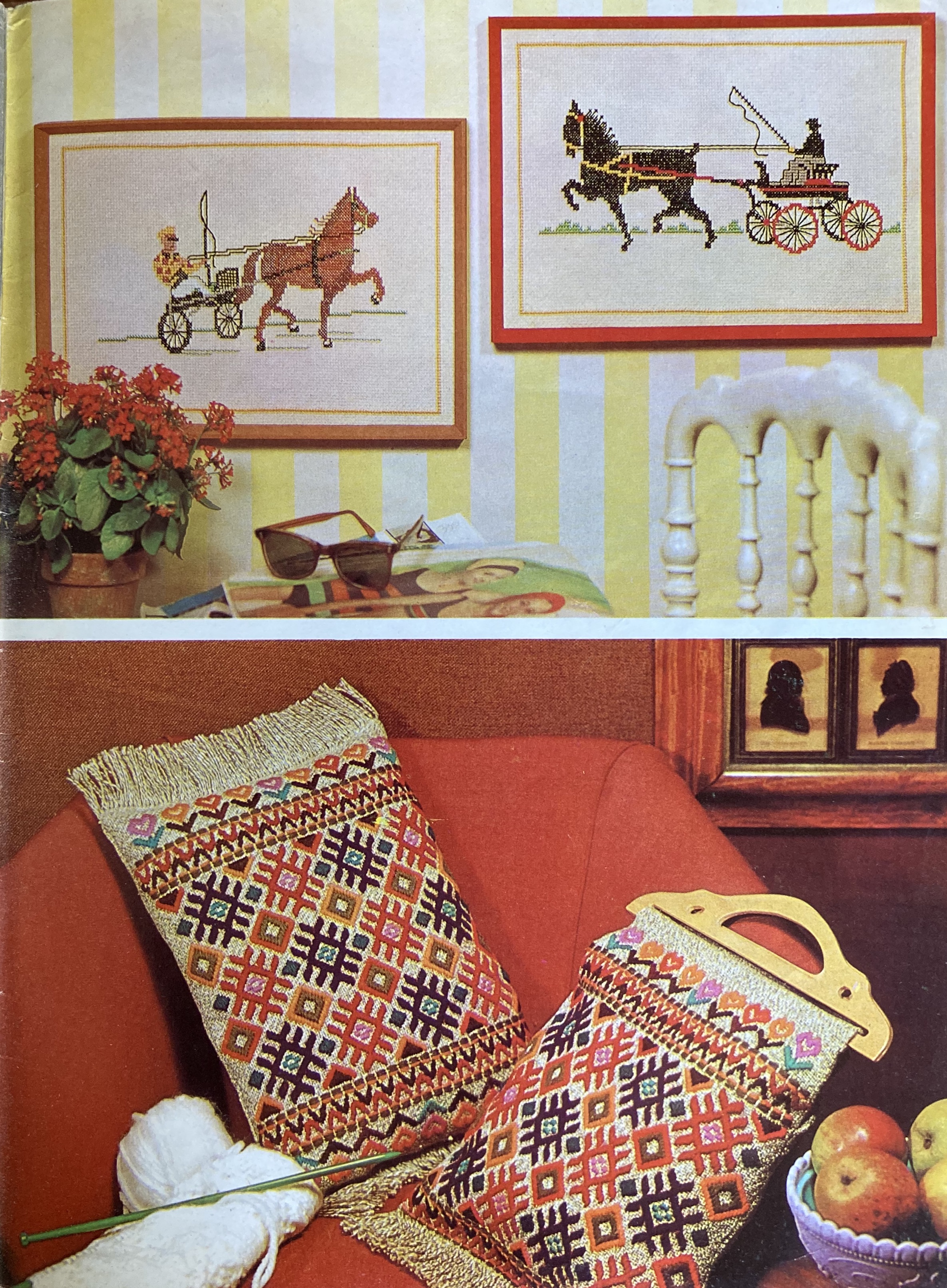
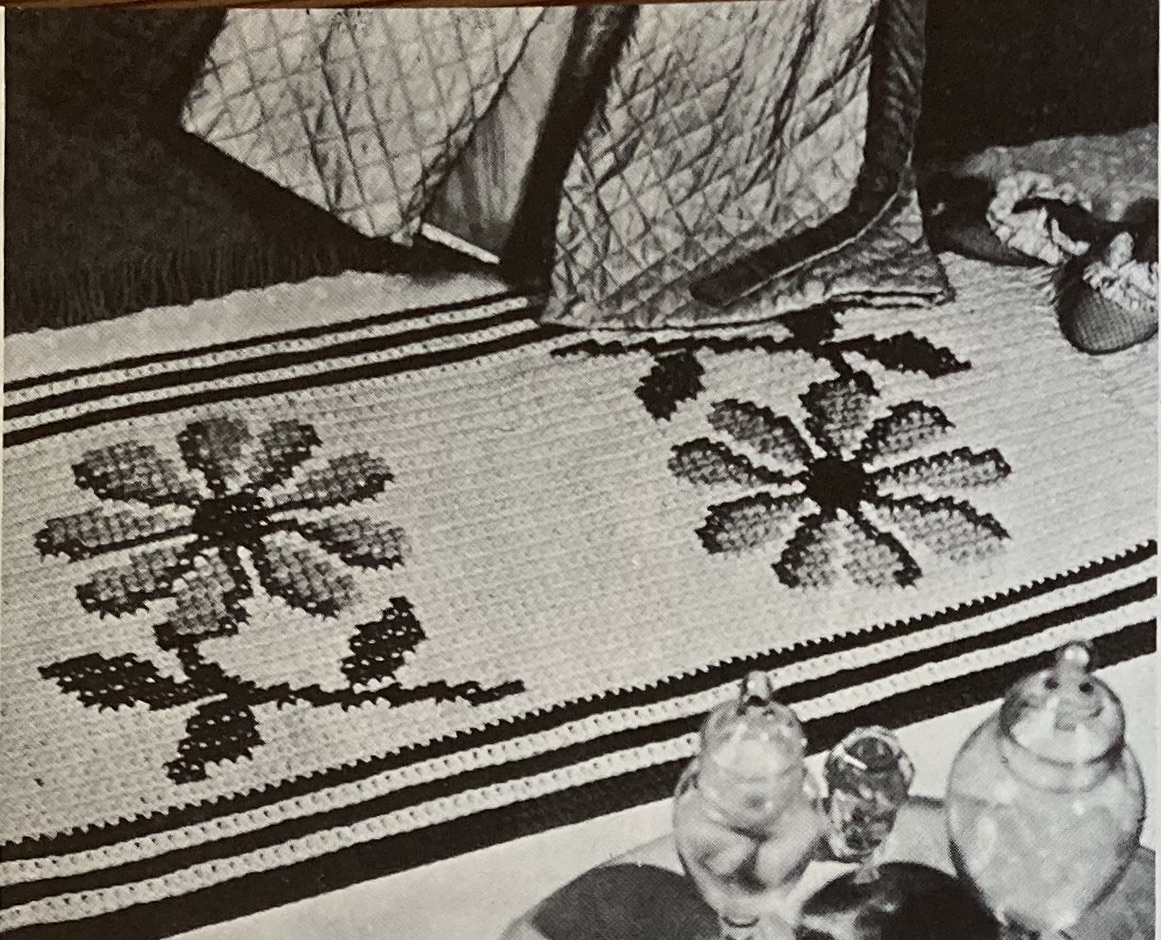
While sitting and sunning at the beach, you can work on an easy homeware project, such as a cross-stitch cushion, a knitted tea or egg cosy, or a tatted lace edging for handkerchiefs or pillowcases. Even the workbag in Turkish darning would be easy enough to work on while on holiday, though the Victorian-esque horse-and-buggy cross stitch picture, the needle etching, and the crocheted rug are presumably easier to work on at home.

That’s it! Summer issues are usually less exciting than autumn and winter, as many people (understandably) don’t like to hold wool in their hands in hot weather. As with many of the mid-1960s issues, there’s nothing in here that particularly speaks to me, so my June project will be another “excursion”, this time all the way back to the 1920s. The project is almost finished (unlike my April and May blog projects…) so I’ll be able to put out a finished project post in time for once, even if it’s neither from Stitchcraft nor from the 1960s. Think of it as a holiday from the usual blog theme.

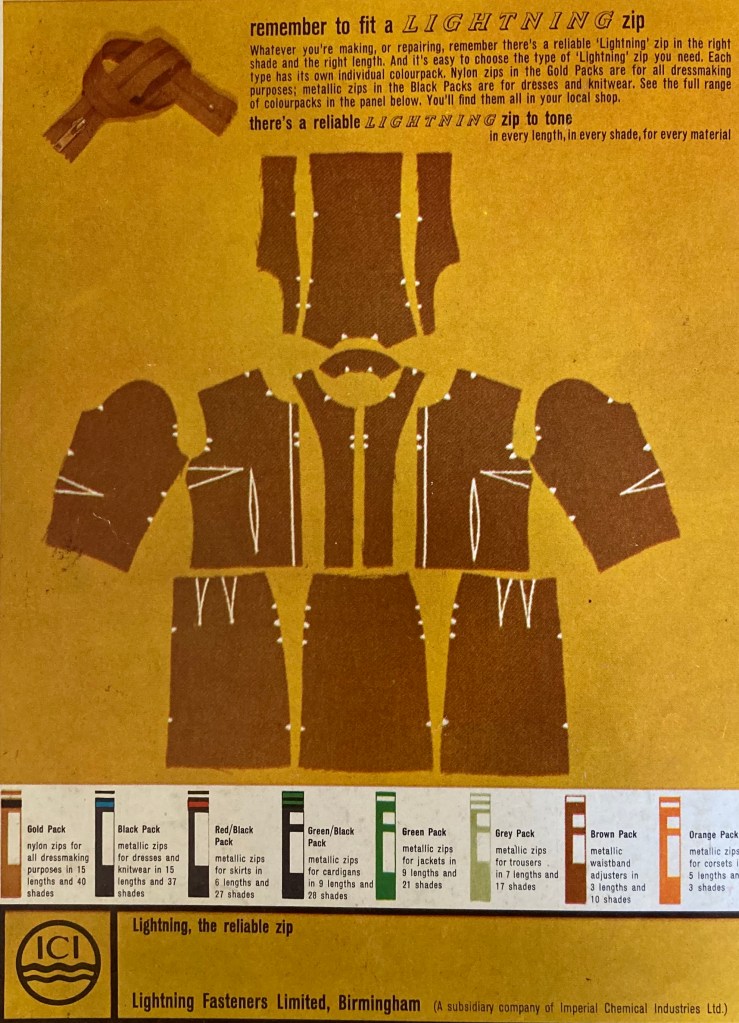
P.S. The back cover is a full-page ad for “Lightning” brand zips and and is illustrated with a very professional-looking pattern for a suit! I am tempted to size it up and sew it. Here it is for any readers who would like to try their hand at it.

December 1963: Appliquéd Archie

My December project was a bit of a detour: an adaptation of a little embroidery design from the “readers’ pages” of the December 1963 issue.

A lot of the embroidery and needlework projects in vintage Stitchcrafts have great designs, but are intended for items that I don’t personally need or use: tea cosies, finger plates, chair-back covers, fireplace screens and so on. I had already adapted some of the designs into decorations for useful modern things like this appliquéd tablet cosy, or this embroidered tablet cosy, or this other embroidered tablet cosy, or various vegetable bags like this one, this one, and this one. In this case, a dear person in my life had recently bought a pocket synthesizer and requested a soft case for it as a Christmas present. I aim to please, and adaptations are fun.

1960s Stitchcrafts always featured a children’s comic serial in the back pages, usually a fairy-tale-like story about a child or children (often, a brother and sister) who go on magical adventures. The adventures sometimes involve knitting or textile work, and there are often tie-ins with simple projects that a child could make and that relate to the story or the characters. The story that has been running in Stitchcraft since August 1963, “The Smuggler’s Sack”, stars children Joe and Jenny on a quest for the mysterious “Smuggler’s Sack” that is possibly hidden somewhere in the seaside town with a history of pirates (think Cornwall).

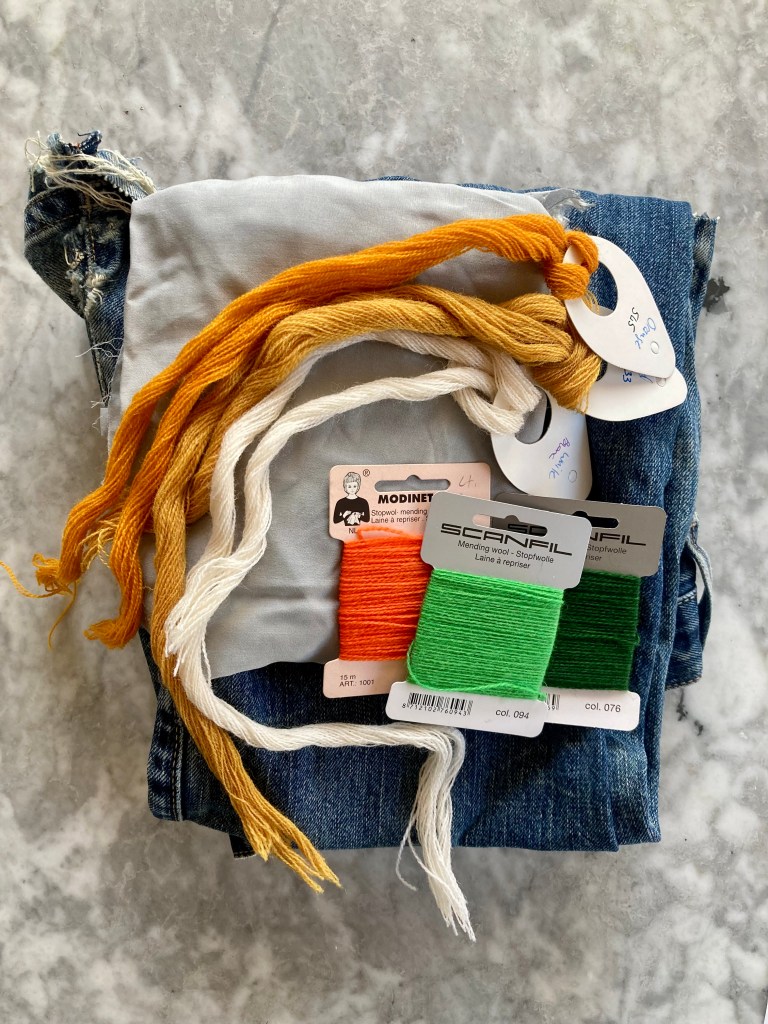
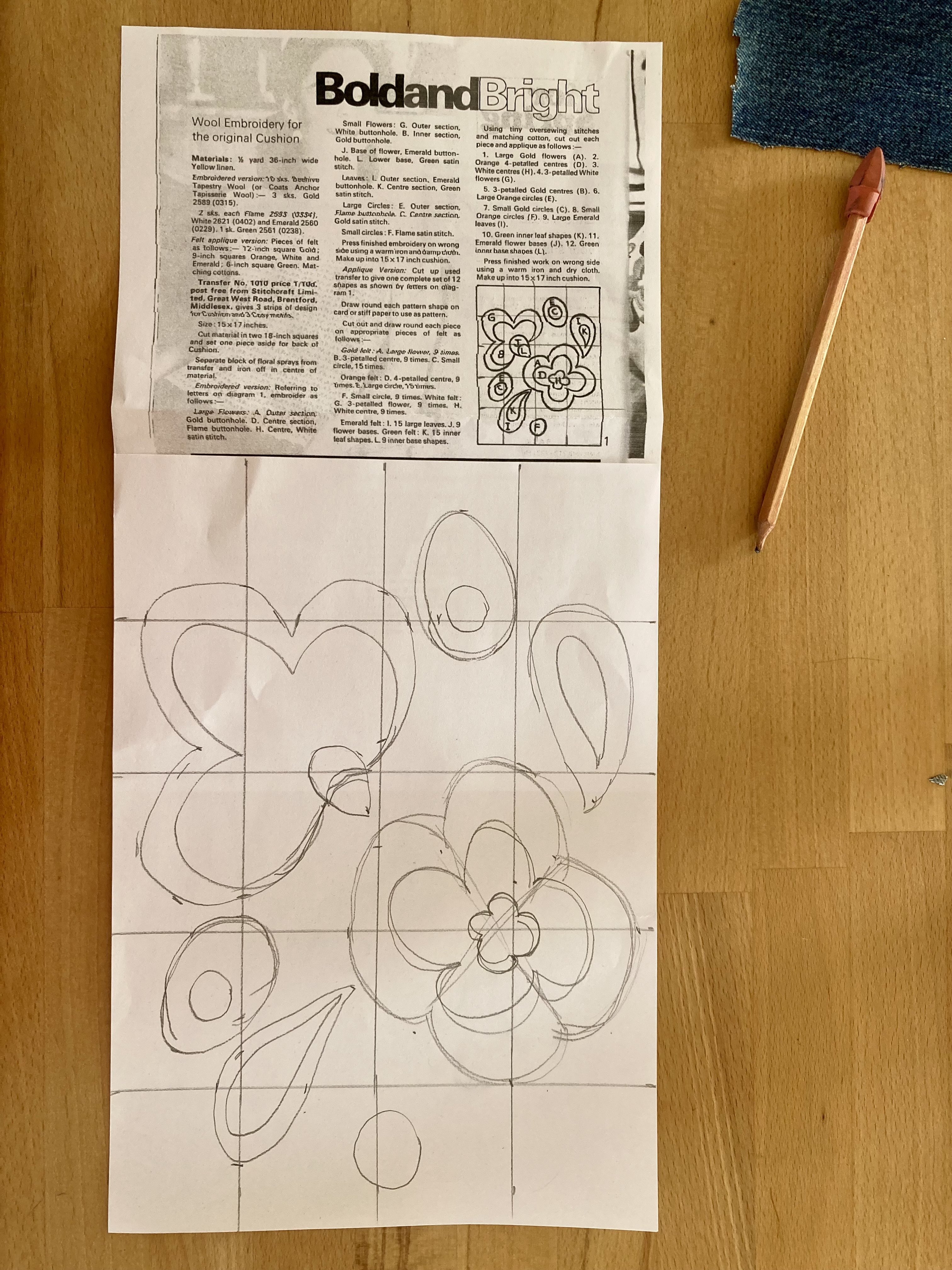
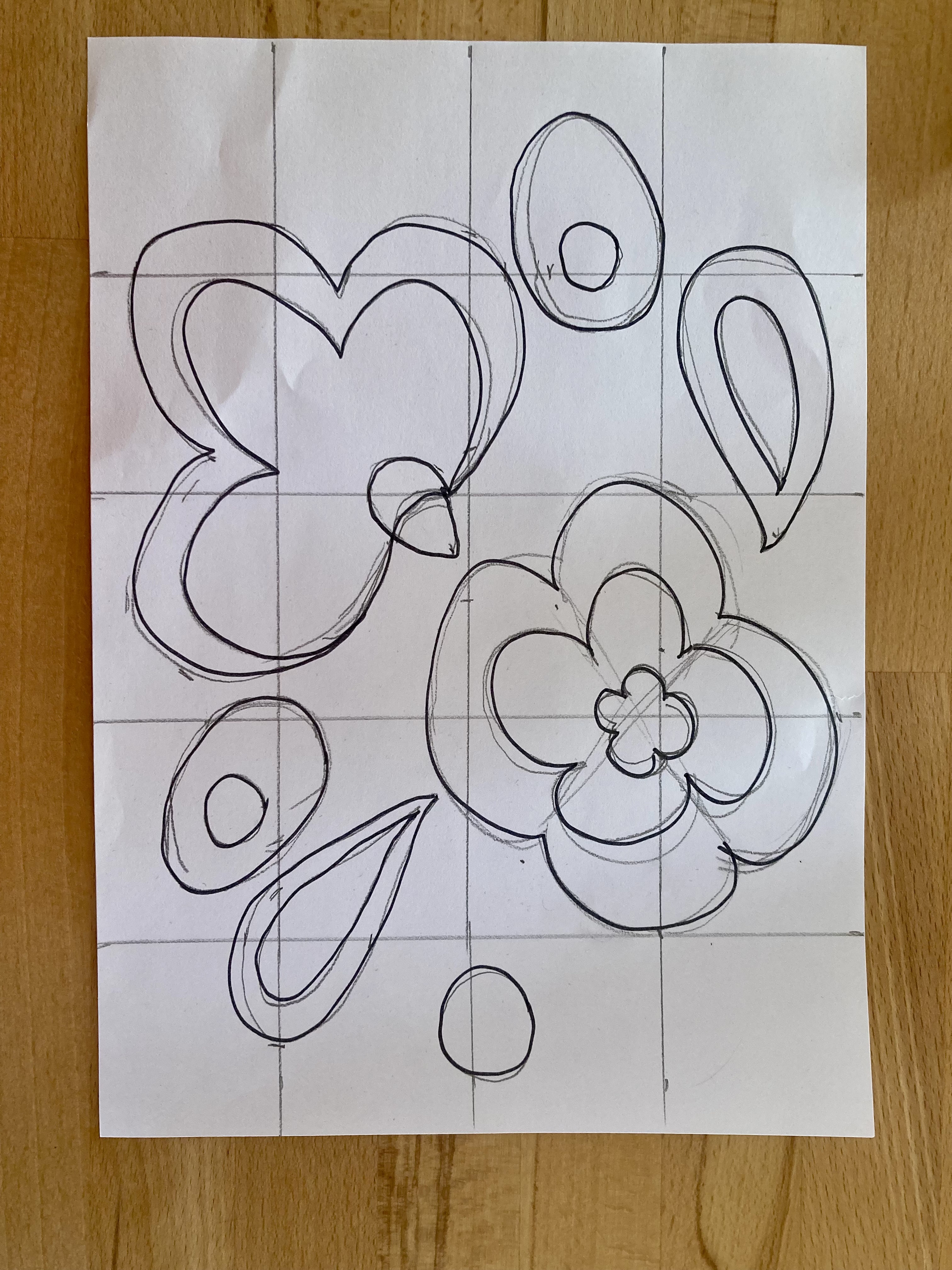
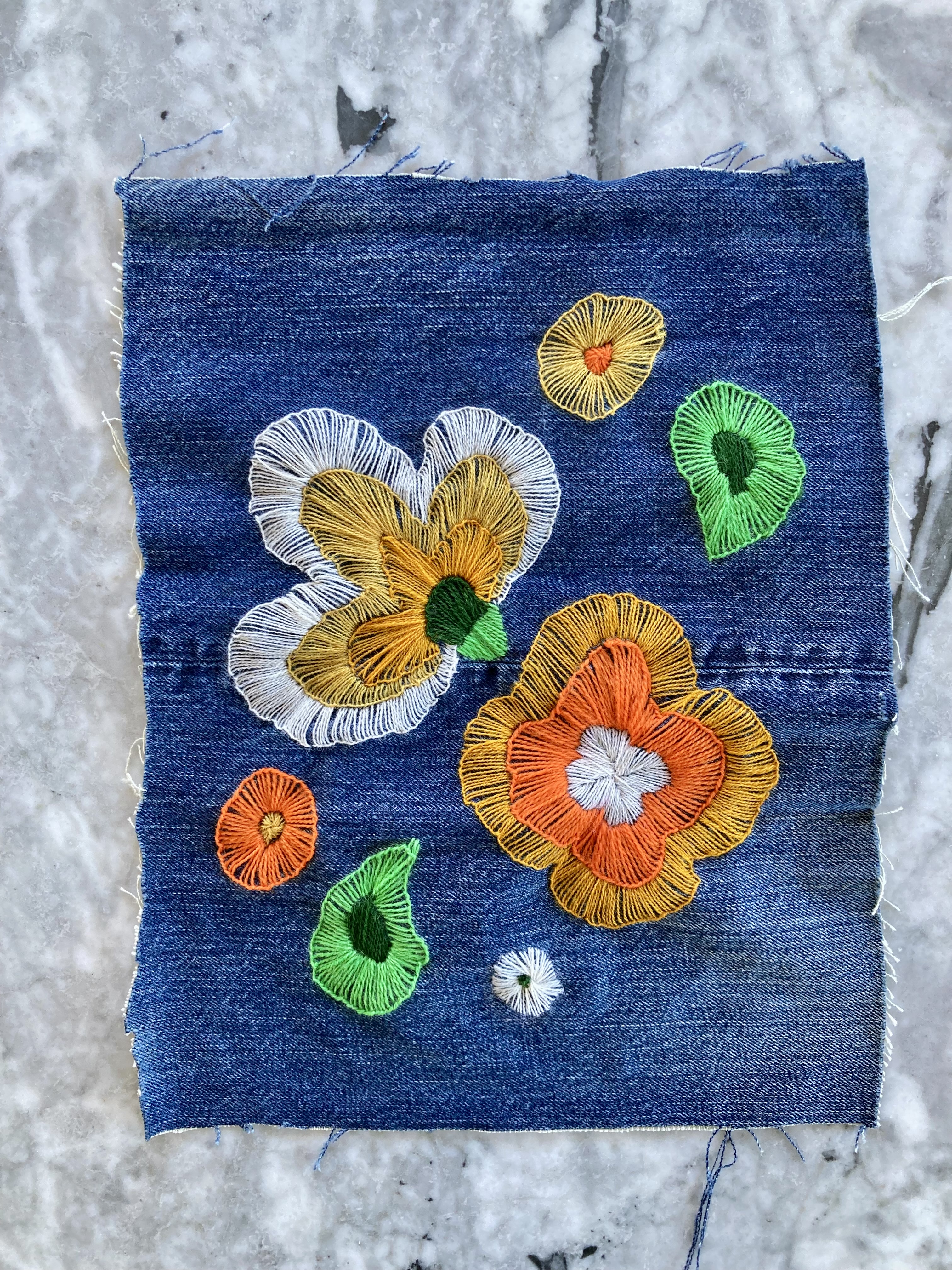
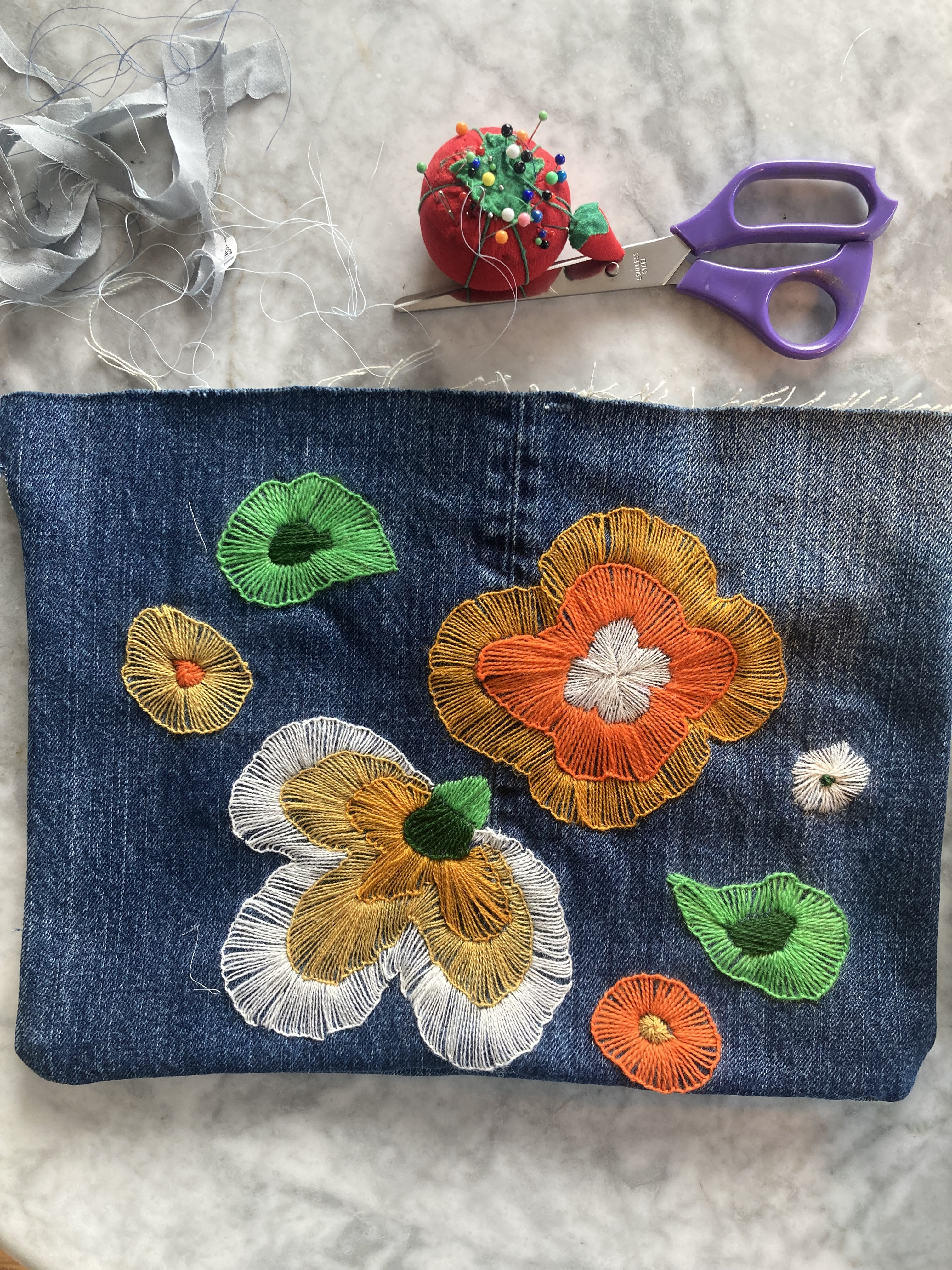
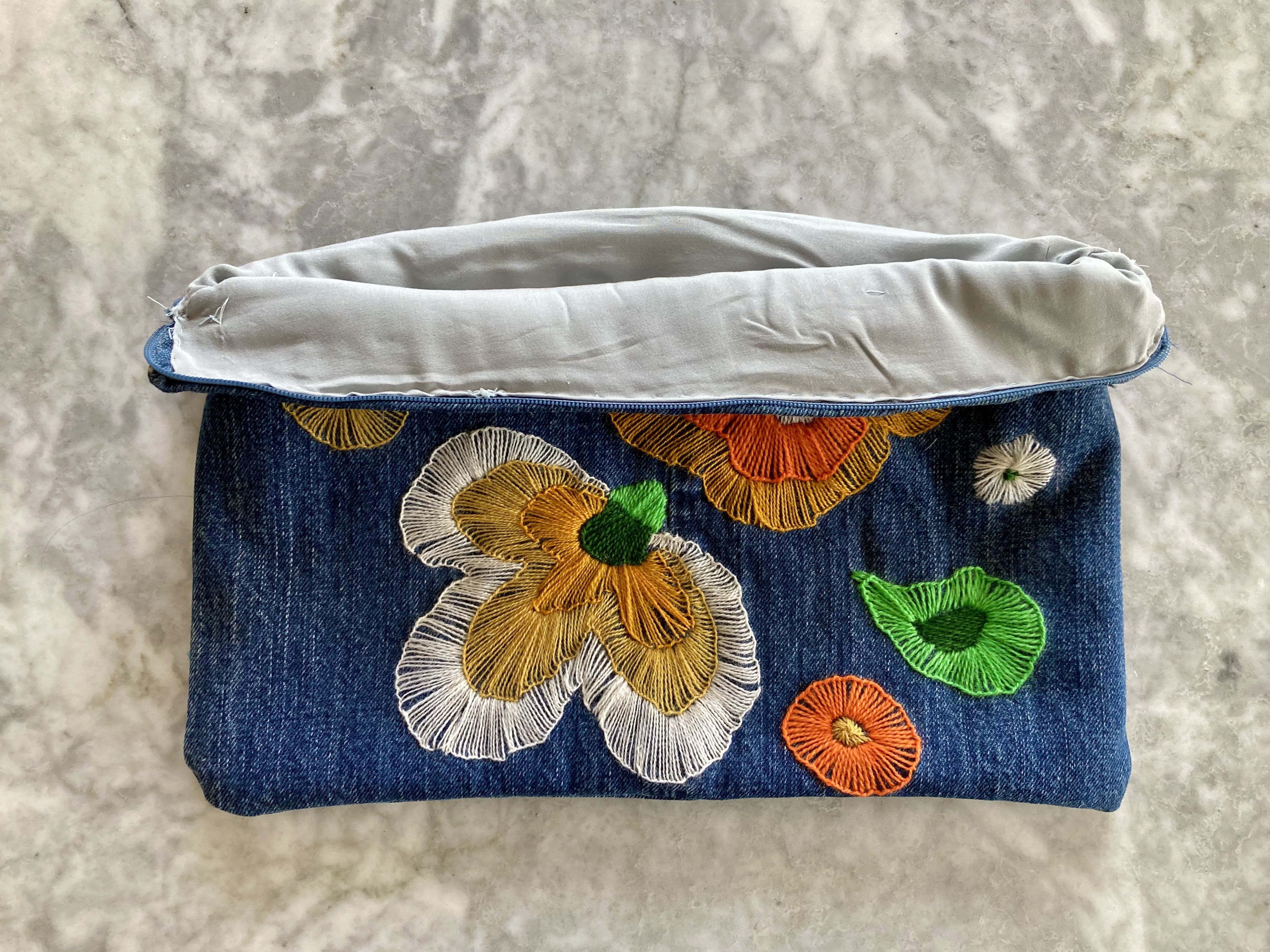
They are joined on their adventures by their horse, Archie, and the December issue offers a design for your very own “Smuggler’s Sack” bag to sew up easily from sailcloth and embroider with a cute portrait of Archie. The Archie picture was very cute and suitable for appliqué, I had an old pair of jeans that would make a great case as well as some fuzzy fleece that would look perfect as a horse’s head. The intended recipient even used to ride horses in their younger years, so it all fit perfectly.

What didn’t immediately fit perfectly was the design for the inside of the case. The pocket synthesizer is not flat: it has two knobs on the front that poke out about 2 centimetres, and two AAA batteries on the back that poke out about 1 centimetre. I had to decide whether to make a simple bag that didn’t conform to the shape, a closed case that let the knobs poke out, or a more complicated case with a made-to-fit inner lining. Of course, I chose the most complicated design…

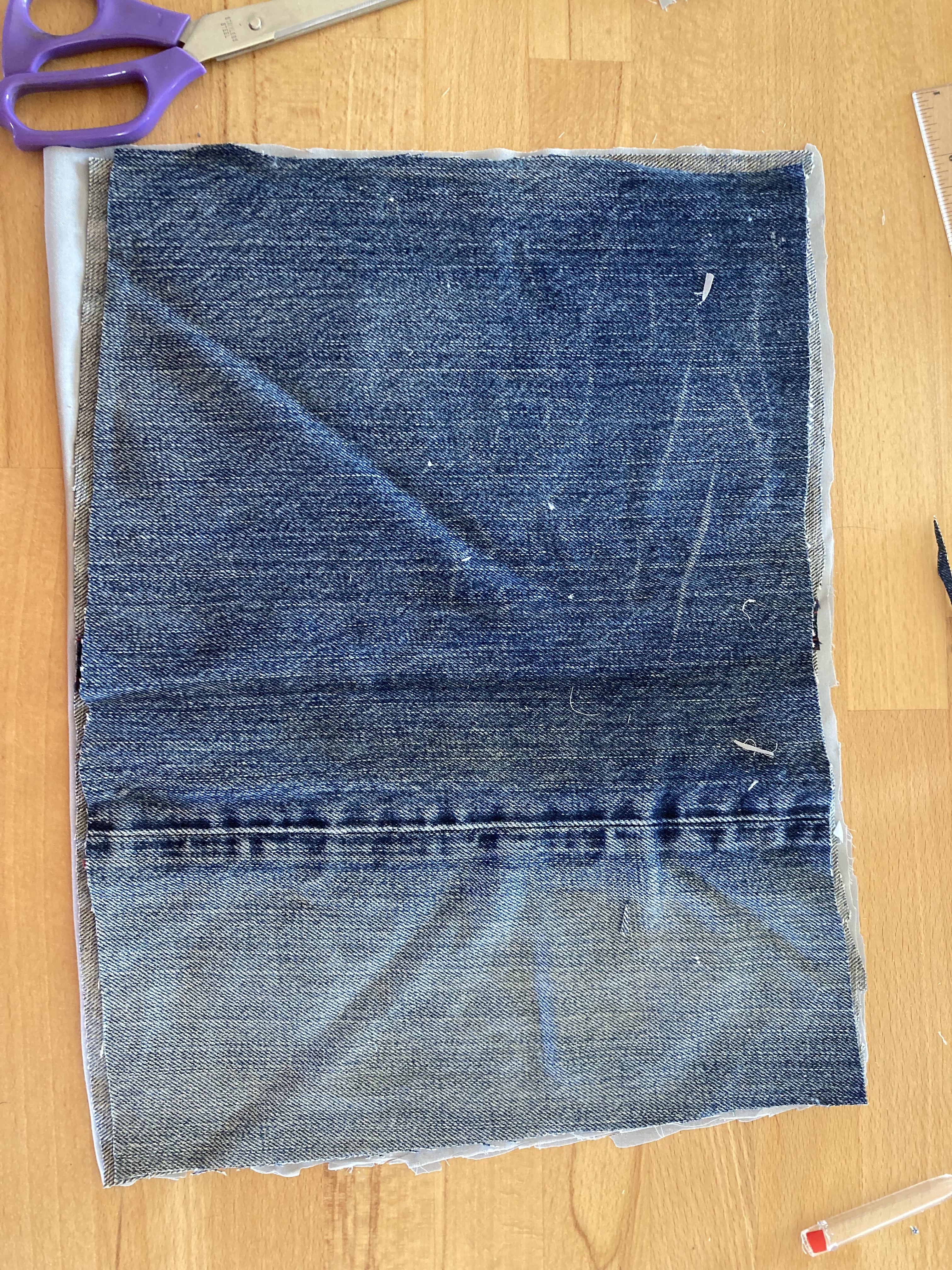
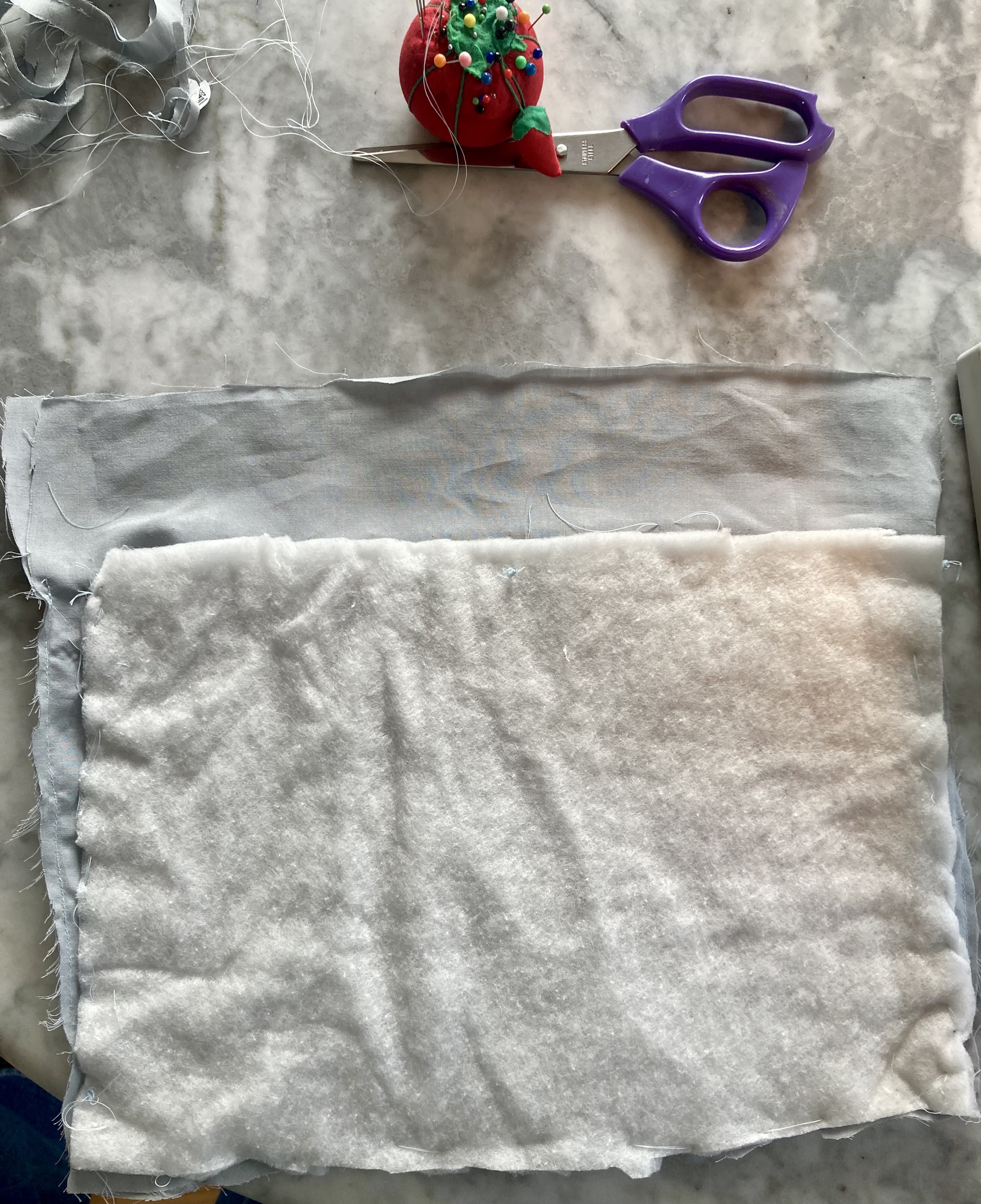
… meaning I had to first figure out the inner dimensions of the front and back pads, and make sides for the case as well. I am not great at measuring or making things come out straight and even, so this was a challenge. I have to say, I did a really good job with the pattern, though! I made the front pad in felt and stuffed it with a bit of pillow stuffing, and the back pad with some folded fleece, then sewed them to a felt lining. The outer case was made of denim and of course had to be measured to fit perfectly. How frightening! (This is why I like knitted things that stretch and so not have to be perfectly exact).

The appliqué and embroidery was the easiest part and the most fun. I decided to not give Archie a bridle, as in the picture. The “Whee” caption is a joke between the recipient and myself, but conveniently also what a horse says when it neighs happily (if you stretch your imagination a little.) I hate setting in zippers and this one was particularly awful because of the felt and padding, but it worked out OK in the end.

I am really happy with Archie the pocket synthesizer horse and I think he will be well used and appreciated!

Merry Christmas, if that’s your holiday, and Happy New Year to you all.

July 1963: Overview

Cover photo of Stitchcraft magazine, July 1963

“In the Holiday Limelight” is the theme of this month’s issue, covering sporty, casual garments for holiday wear, a few slightly more dressy options and — with one incredible exception — quick and easy homeware projects.

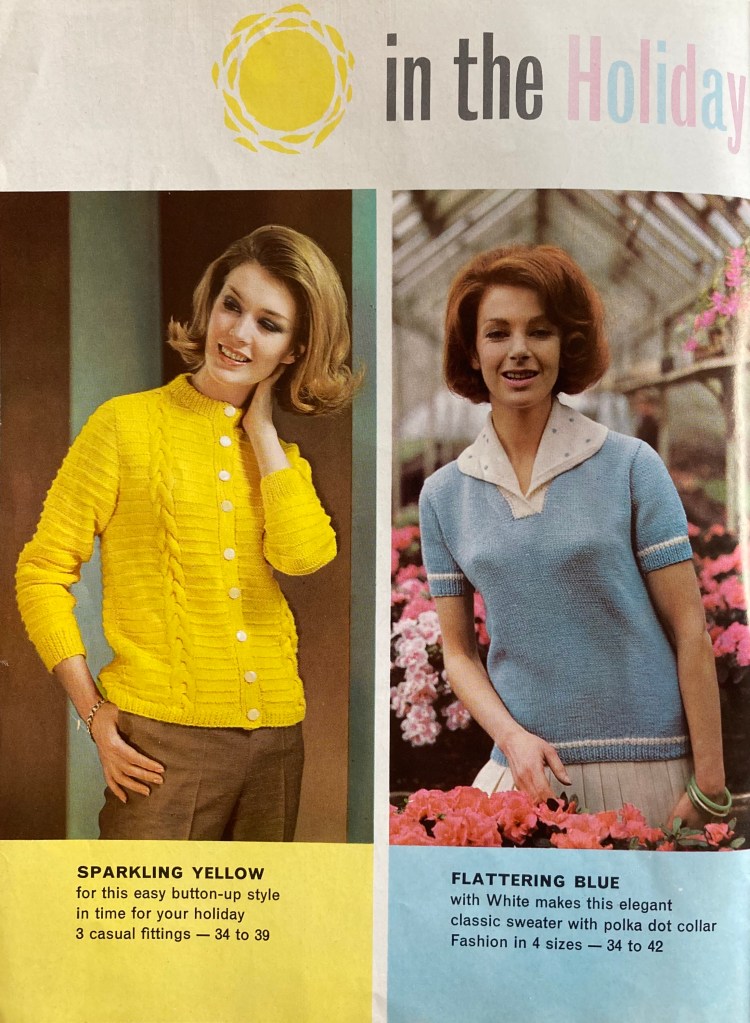
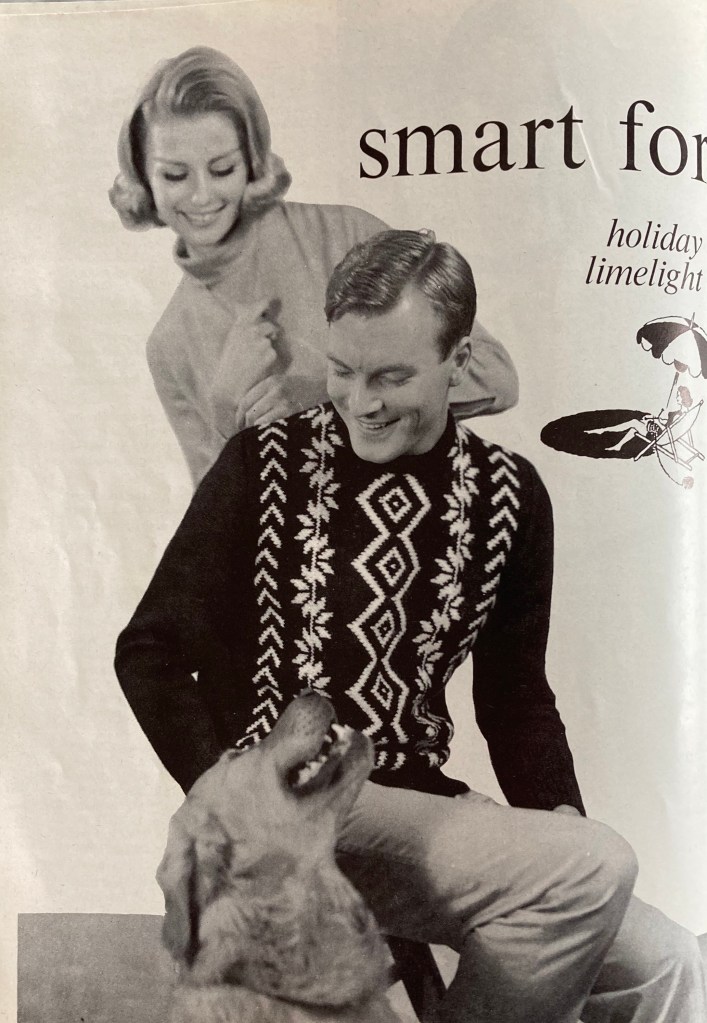
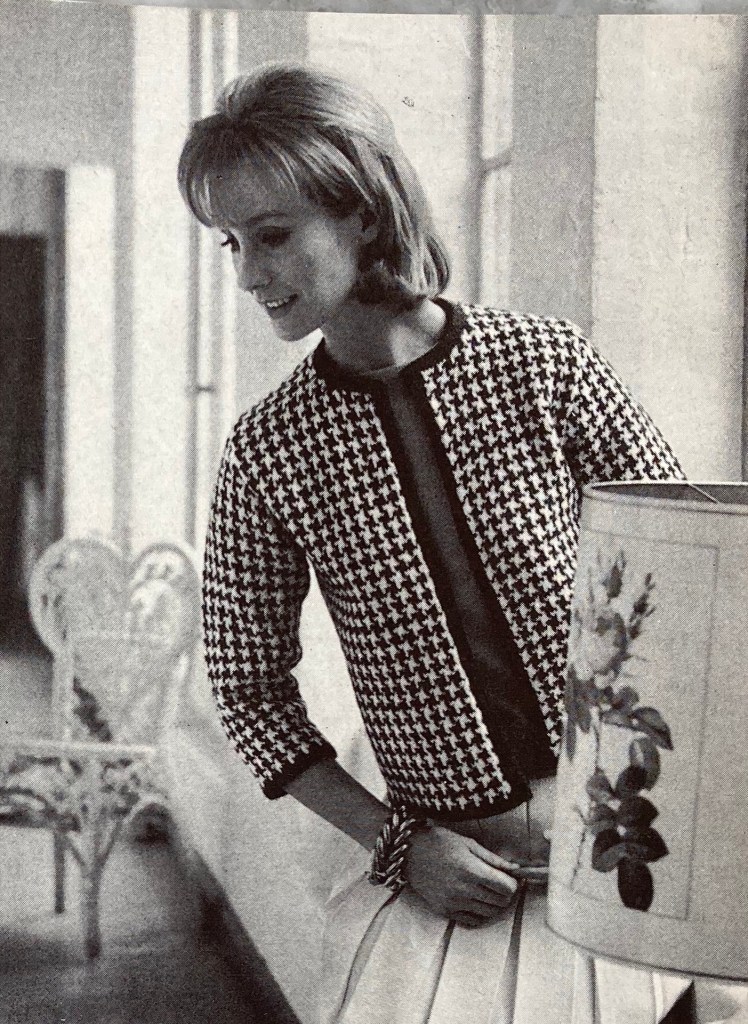
Most of the adult garments seem quite warm and heavy for summer wear, but most are meant to be worn as outerwear in an unpredictable northern-maritime climate. Our partner-look cover duo, for example weighs in at 22-24 (hers) or 28-30 ounces of heavily cabled DK wool and is expressly touted as “in colour for sailing” (hers) or “white for tennis” (his). I imagine it would be quite warm for tennis but probably very good for sailing, as the textured stitch pattern would ward off splashes and insulate from cold winds. Unusual cables are also featured on the bright yellow button-up cardigan, while the design (“from Vienna”) of the mens’ black-and-white pullover suggests a cable-like vertical movement in the sideways-knitted colourwork front piece. A short-sleeved collared jumper and houndstooth-pattern jacket round out the warmer, double-knitting-weight garments.

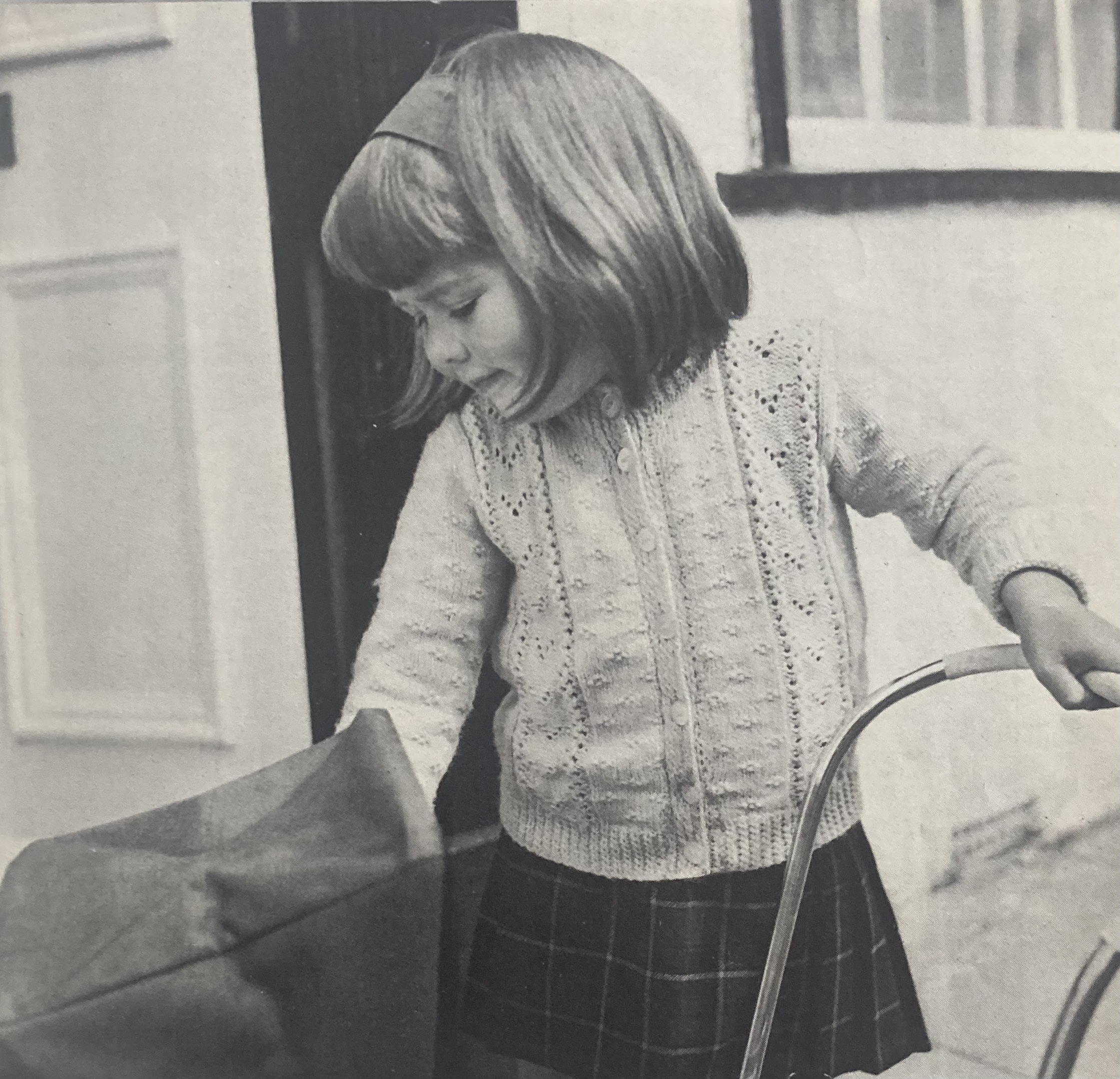
For more dressy occasions, there are two lightweight jumpers made of Patons Cameo Crepe (fingering-weight wool with a tight twist for a smooth texture in stocking stitch). Both have a slightly nautical theme, at least in the names and colour choices. The “sailor collar” jumper is excellently photographed with matching red hairband and telephone! The diamond-pattern jumper in white with marine blue has a similar round collar to the heavier short-sleeved jumper, as well as a similar idea of using little dots or diamonds as decoration. (I imagine the diamonds must be placed very carefully to fall above the bustline.)

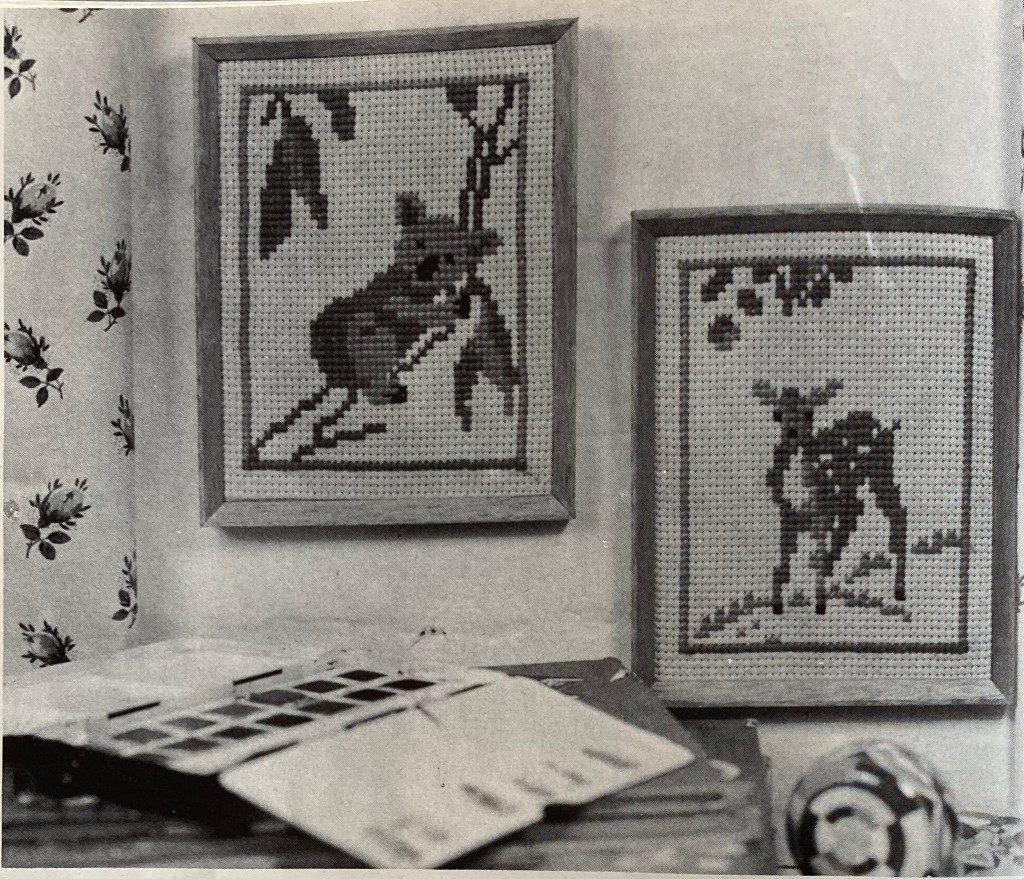
There’s a charming striped cardigan for a young girl, who could be encouraged to practice her budding handcraft skills on two miniature cross-stitch pictures — a deer and a koala bear. Embroidered on Bincarette mesh fabric (an older word for Binca fabric, roughly the same as Aida but slightly fewer threads per inch), the background is not filled in, so there are very few stitches to actually make and they could be easily done by a young child to hang in her room. More experienced “embroideresses” can make this densely-worked cushion, which combines cross-stitch with Holbein or double running stitch in a tessellated design.

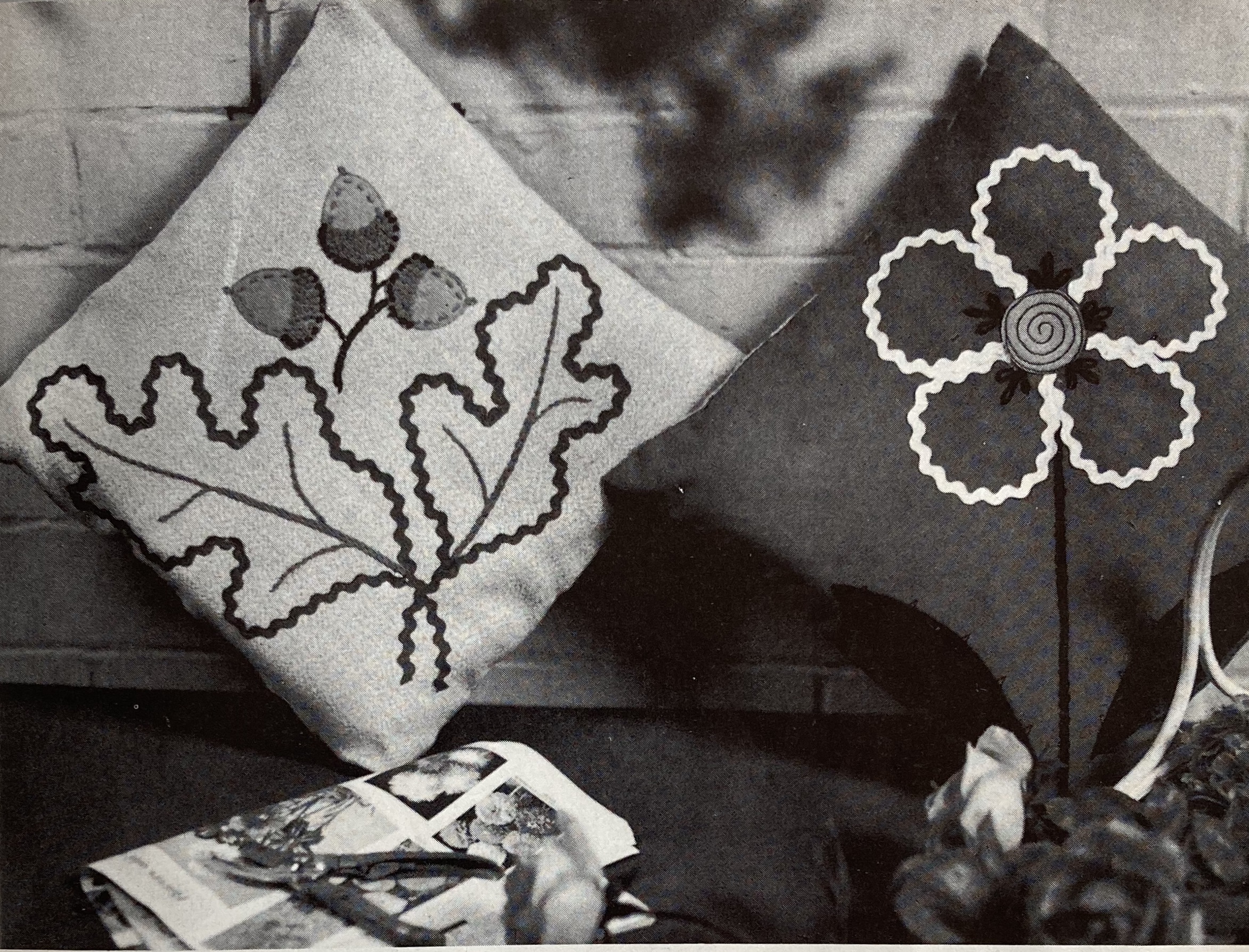
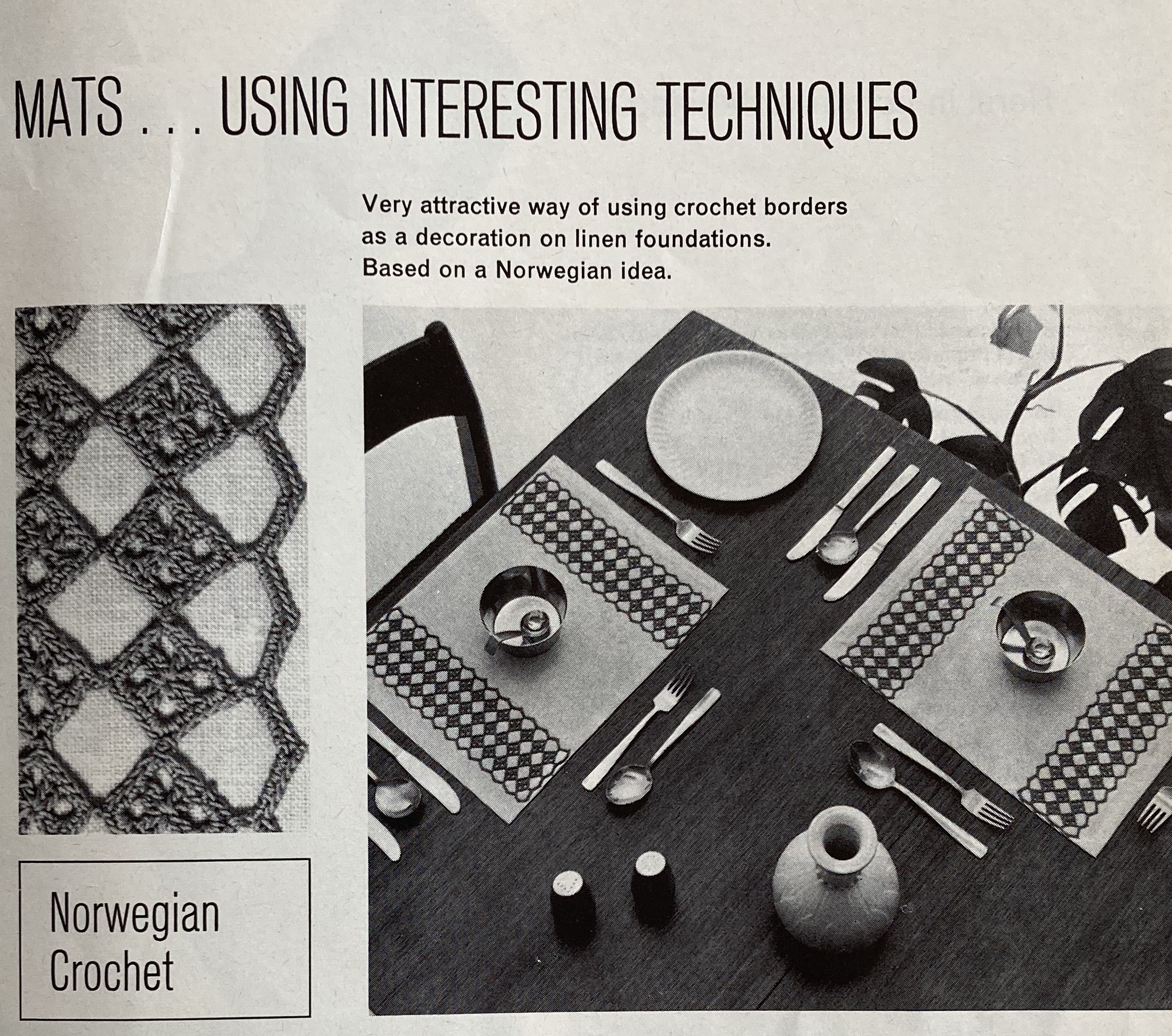
Continuing the homeware designs are two hard-wearing, but very easy to make, applique/embroidery cushions for the garden. Perfect for a staycation, they are made with strong sailcloth material and stuffed with foam clippings to repel moisture. Readers could set their garden table with interesting placemats made in blackwork or with appliquéd crocheted bands. Especially pious readers who prefer to spend their holiday doing church work can even make a kneeler, a Bible marker and/or a secular footstool cover in tapestry.

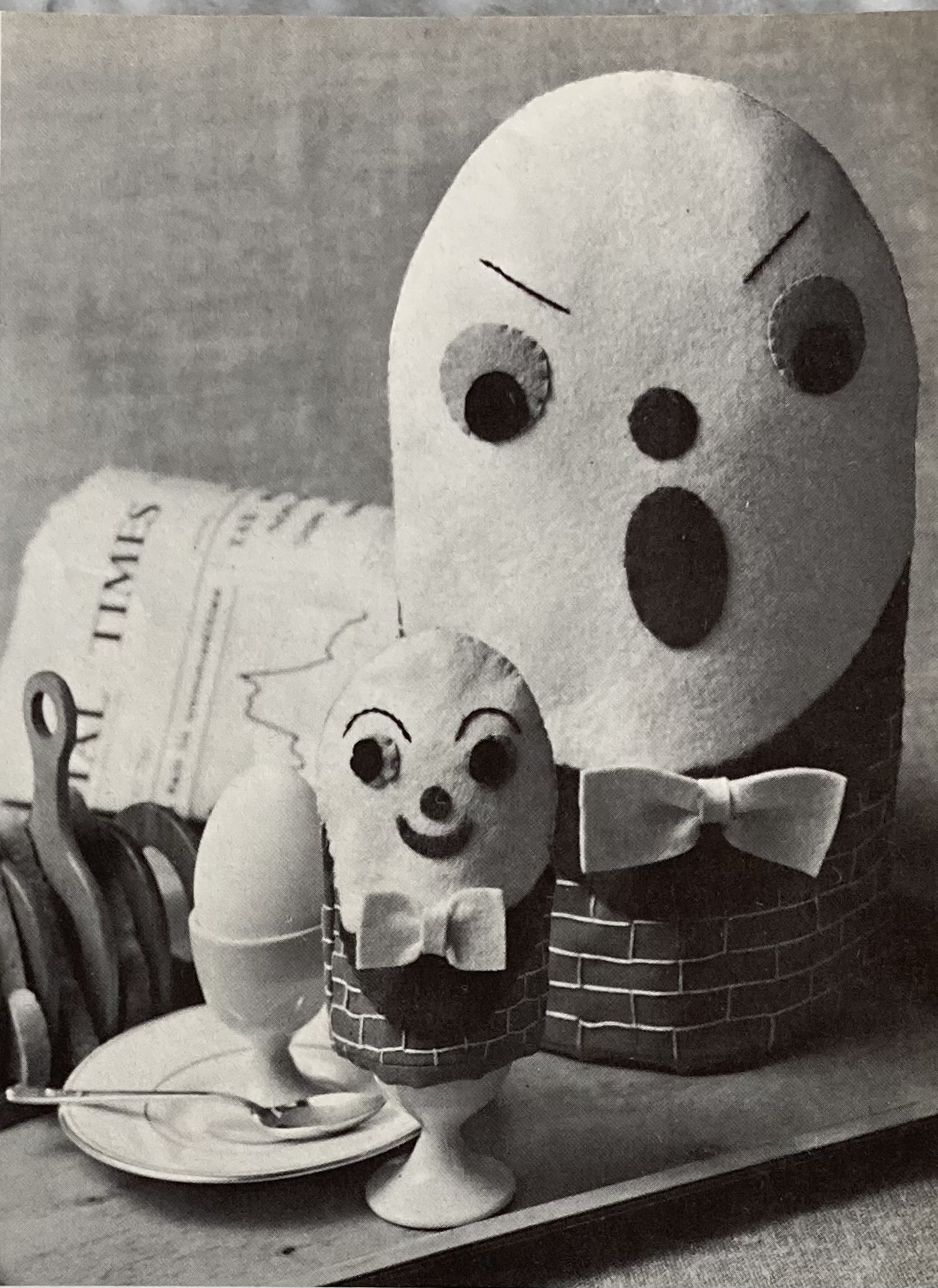
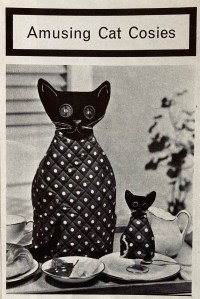
Oh yes, and in the is it-for-a-bazaar-or-is-it-just-bizarre category, here are some “amusing” coffee-pot and egg cosies in the form of sad, legless, eyes-follow-you-around-the room-quilted cats! Add them to your collection of murderous crocheted clowns, evil felt Father Christmases and disembodied-head egg cosies, or demand that your church sell them at their next bazaar in return for the lovely Bible marker you made for them.

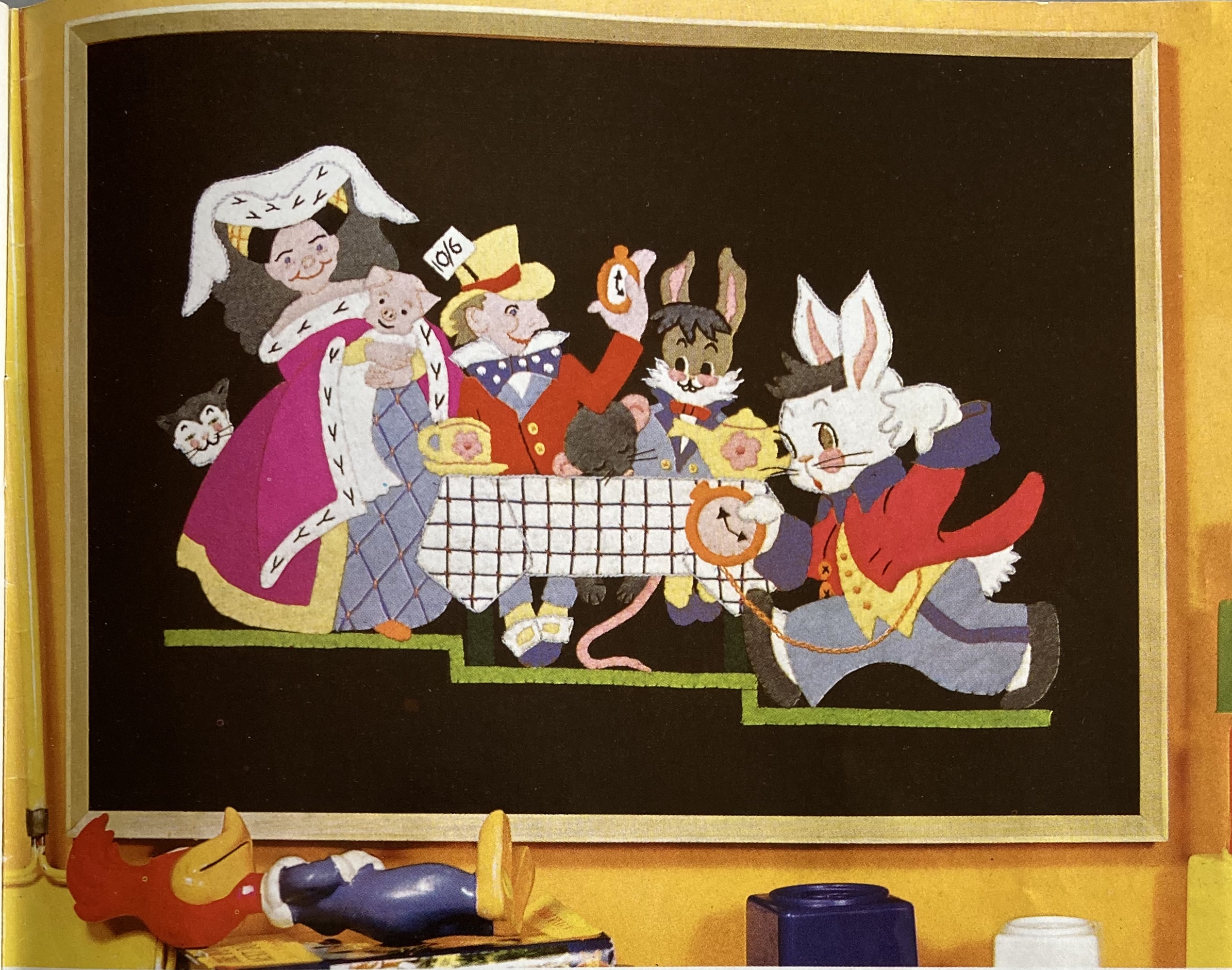
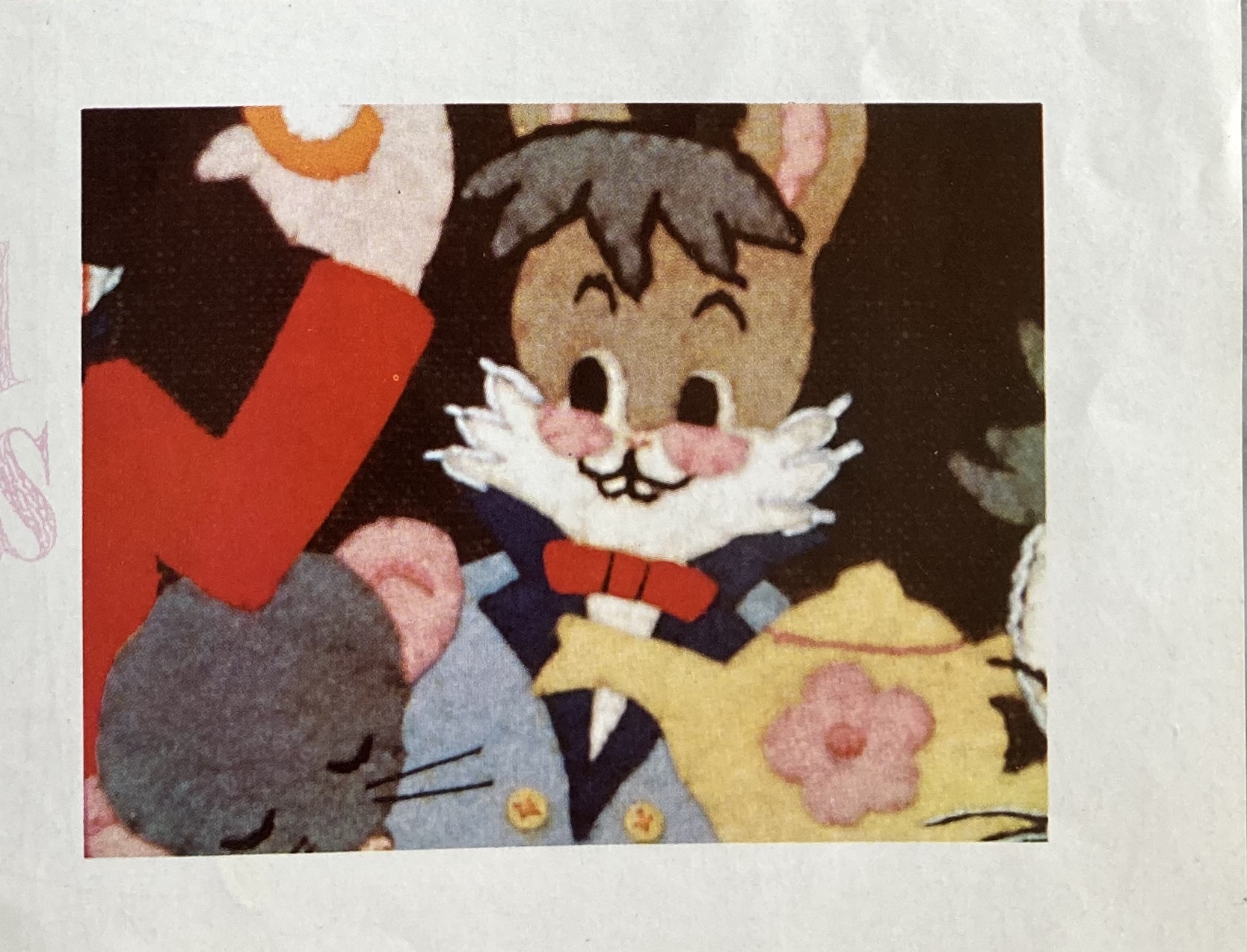
But wait, there’s more, and as always, the best comes last… Did I say that the homewares were easy, with one incredible exception? I am in awe of this large (16×22 inches) yet finely detailed appliqué wall hanging depicting the Mad Hatter’s Tea Party from Alice in Wonderland. It is the companion piece to the “Alice” wall hanging showing the Queen of Hearts and the gardeners from the August 1962 issue, and is designed so that both pictures can be fitted together to make a single panel. The stitch detail and precision required to make all those tiny felt pieces fit perfectly is amazing.

That wraps it up for our July 1963 issue! I will probably make the diamond-pattern jumper, since I have some more of the annoying un-plied cotton from the Hamburger Wollfabrik that I might as well use to make something with, and the long-line style will suit me well. I might, just might, also finish the blackwork butterfly cushion sometime soon. Happy Summer!

November 1962: Star Motif Embroidery

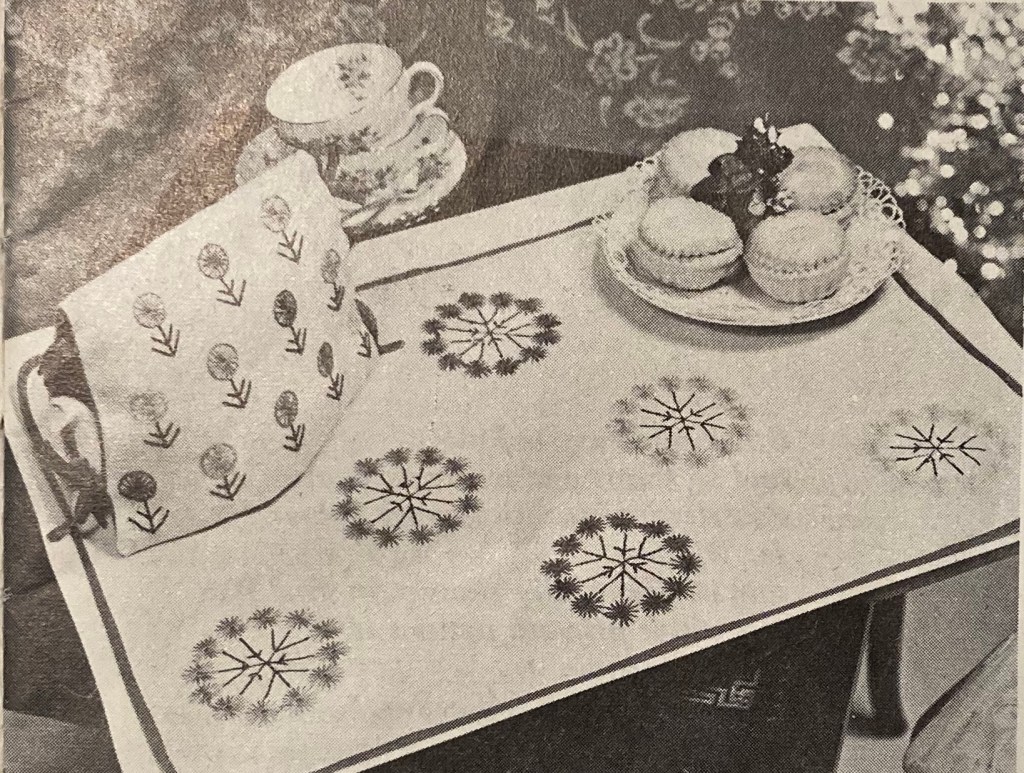
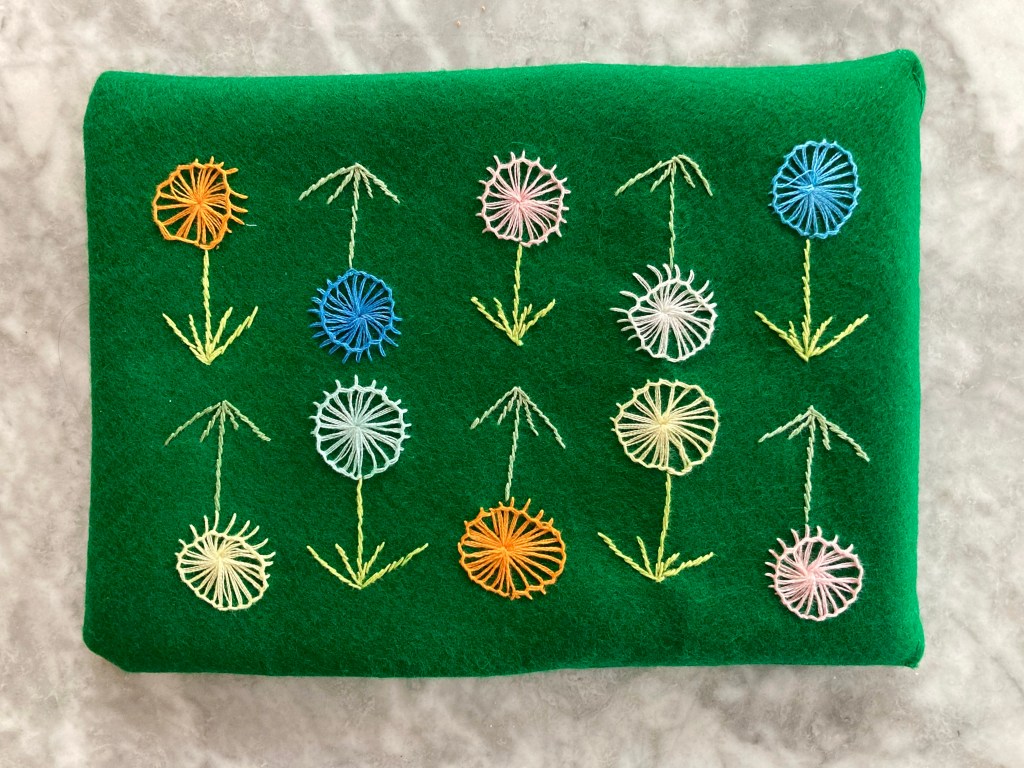
The November 1962 issue had so many exciting projects that I wanted to make, but as I am woefully behind on so many other projects, I settled for a modern version of the cute embroidered tea cosy from this “star motif” cosy-and-tray-cloth set. The star design only really comes out on the tray cloth, where flowers with spiky leaf bases are embroidered in circles. The tea cosy has the flowers arranged individually in lines.

Since I don’t use tea cosies, I adapted the design as an iPad / tablet cosy, like I did with the “Gay Goslings” design from April 1960 and the “Posies for Cosies” from March 1961. I had plenty of green felt left over from the not-so-successful October 1960 “No Fun Fuchsia” project and enough scraps of embroidery floss in fitting colours to make everything from stash.

Obviously I didn’t have a transfer, but luckily this design is so simple that I was able to just draw around a coin with chalk for the flower heads and add in the stems freehand. I say “simple” and “just”, but the felt material was of a nature that chalk does not stick to it for more than a minute and the colour is too dark to draw on with a pencil or embroidery marking pen. My continuing incompetence in drawing, cutting or embroidering straight lines came back to haunt me! Oh well, that’s how you know it’s handmade.

The tea cosy has three rows of flowers: three in the top row, four in the second and five in the third. Not sure exactly how to scale the design for a tablet cosy, I started by embroidering two rows of flowers with three flowers in the top row and two in the bottom row. I didn’t like the asymmetry, so I filled in the gaps with more flowers aligned upside down.

Making it up into a bag was straightforward enough (except for the not being able to cut in straight lines thing, even using a ruler and template) and I finished it off with a vintage fabric-covered button from the button box. I’m quite happy with the result, even if the design is not entirely even and the buttonhole stitch pulls to the center of some of the flowers (not sure how to correct that.) And it went so fast! I did the embroidery last night and made it up into a bag this afternoon.

It looks very 1960s!

Since I still use and love my “gay gosling” iPad cover, I will send this one to a friend as a birthday/Christmas present.

July 1961: Overview

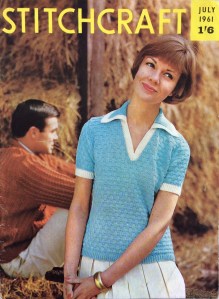
IMG_2650The motto of the July 1961 issue is “Sew through the Summer” and indeed, there are a lot more sewing projects than one would normally find in Stitchcraft, summer being a time when many people do not want to hold wool in their hands or think about colder weather to come. There’s more emphasis on homewares and small, fun projects to make and use on holiday. The farm photos were taken in Hertfordshire and the boating photos in “the heart of London’s Little Venice”. Doesn’t that sound like fun? Let’s dive in!

Our cover photo, taken at the Hertfordshire farm, featuresIMG_2654 a really pretty basketweave blouse with that V-neck-plus-collar design that we saw so much of in 1960 and the last years of the 1950s, not to mention just last month on the cover of the June 1961 issue. Personally, I love this style and I’m glad it stayed in fashion for so long. Except for the basketweave, this top is very similar to the blouse I made from the July 1960 issue, and probably not the last one of its kind that we’ll be seeing.

The other summer garments for adults are “cool in 3 and 4 ply” tops for women — one of them machine knit — and for boating or cooler outdoor nights, there’s a cardigan in double-knit Rimple, a little short-sleeved jacket in bulky Big Ben, or a man’s sweater in larger sizes in Totem double knitting. The cardigan “does duty as a sweater”.

On that note, a quick quiz:

  • What is the difference between a jumper and a sweater? (Hint: this is a British magazine that uses both terms, so “jumper is British and sweater is American” cannot be the only answer.)
  • If a jumper is a pullover in a lighter weight/more dressy style, and a sweater is bulkier/warmer/more casual, why is the elegant, fine-knit short-sleeved top on page 12 a jumper (top left photo above), the elegant, fine-knit short-sleeved top on page 13 a sweater and/or shirt (top right photo above), and many elegant, fine-knit short-sleeved tops from other issues considered to be blouses?
  • On that note: Why can a cardigan double as a sweater, but not a jumper?
  • Bonus question 1: What is the difference between a cardigan and a jacket? (Okay, this one is easier.)
  • Bonus question 2: Is the blue-and-white garment on the front cover a jumper, a sweater, or a blouse?

The answer to the first two questions is, as far as I can tell, that there is no answer. “Jumpers” per Stitchcraft tend to be long- or short-sleeved, fine-knit, elegant pullovers, while “sweaters” per Stitchcraft tend to be bulkier, more casual, long-sleeved and looser-fitting pullovers, but every time you think you’ve figured out the system, they use the word you wouldn’t expect. “Blouses” tend to be, logically enough, tops (either pullover or cardigan style) that one would wear with only undergarments underneath, and put a suit jacket or other overgarment over. Following that logic, I guess the cardigan on page 21 does duty as a sweater and not a jumper because it is warmer, heavier and meant to be worn outside without a coat and with a blouse or something underneath it. Still, there is no real consistency that I can see. I would love to be able to ask “editress” Patience Horne what system she used.

For the smaller members of the family, there’s this lovely baby’s dress, featuring the most absurd baby photo ever (previewed in the June 1961 issue). I still don’t understand just why I find this baby so goofy. She is utterly cute but somehow, her face is too old for her. That combination of lots of hair and the knowing, watchful look in her eyes makes her look like someone pasted a grandmother’s head on a baby’s body. Anyway, the dress is wonderful. Older girls get a striped jumper with a collar and “gay bobbles” to tie the neck. Let’s hear it for gay bobbles! I’m not sure what today’s 6-, 8- or 10-year-olds would think of the bobble ties, but I think it’s a cute jumper.

The emphasis of this issue is on easy-to-make, no-stress homewares, starting with felt place mats and coasters appliquéd and embroidered with traditional inn signs. Make them for your Pride celebration, for they are “as gay as possible”! Fans of easy embroidery on canvas can make a cushion with purple thistle flowers in cross-stitch or bathroom accessories featuring this month’s Zodiac sign, Cancer. I don’t know about you, but I don’t want to step on a crab, even if it’s only a cross-stitch picture of one on a bathmat.

More ambitious embroiderers (I guess Stitchcraft would call them embroideresses) can make a really pretty fire screen with a modern vase-and-flower motif. I wish they had a colour photo. Even more ambitious knitters can make some beautiful lacy doily mats, and those who prefer to “sew through the Summer” can make a little laundry bag for used dusting cloths, or some easy items to sell at the “needlework stall”, church bazaar, etc. There’s a tea cosy that looks like a cottage, a beach bag with penguins, or an apron with a teakettle pocket.

I am woefully behind on projects, having not even finished my supposedly quick and easy blouse from June 1961, and with two other projects from that issue (the child’s beach dress and the embroidered-appliqué bird picture) still “in the queue”. But someone is always having a baby and that little dress is really sweet and should knit up quickly, so I’ll probably make that and try to work on the remaining June projects at the same time.

  • Bonus Answer 1: A cardigan definitely has buttons/fastenings and a knitted jacket often doesn’t. Unless it’s a suit jacket, then it does. Or whatever.
  • Bonus Answer 2: The garment on the front cover is a “cool, casual shirt-sweater”.


March 1961: Posies for Cosies

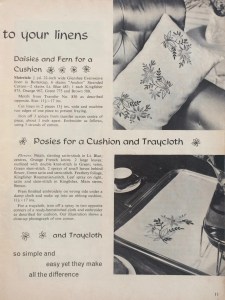
IMG_2412My Stitchcraft project this month was a simple embroidered spray of flowers, originally intended as a decoration for a cushion or traycloth. Having enough cushions and not using traycloths, I updated the design for an iPad cover similar to the one I made last year. The flowers are supposed to be daisies and fern, but the daisies have pointy, blue petals — which I set off against a bright pink background for maximum 60s effect. (The background fabric was left over from the embroidered blackwork cushion from last September.)

Of course, there was no available iron-off transfer, but this design was easy and non-geometric enough that I could copy it out onto paper freehand and then transfer it to the fabric with the “window method” and a washable embroidery marker. The stitching was easy — satin and stem-stitch for leaves and stems, slanting satin-stitch for the blue petals, Romanian stitch for the “feathery foliage” (what a lovely phrase!) and French knots for the centres of the flowers. The only (for me) unusual stitch was the double knot-stitch used to outline the large green leaves. It’s sort of like couching, except you tie a knot in the running thread with each stitch as you go along.


I made it up with an equally bright patterned cotton lining (peacock parade!) with an added layer of quilt batting and the same simple button-closure method I used for the “Gay Goslings”. I am not great at sewing, even or especially a really simple (!) rectangular (!) bag, so the lines are not 100% straight and the design is not perfectly centred. Still, I love the colours and the contrast of the very old-school, Grandma’s tea-cosy design with the modern technological device inside.


Since I don’t actually need this for myself, it will probably be given to whatever nice friend has a birthday and an iPad that needs a cosy. In the meantime, I can hold it up to a window when I want to see something that looks like Spring.
IMG_2429


May 1960: “Summer Song”

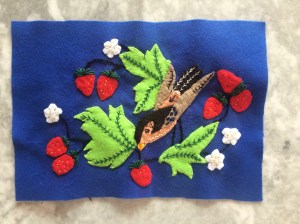
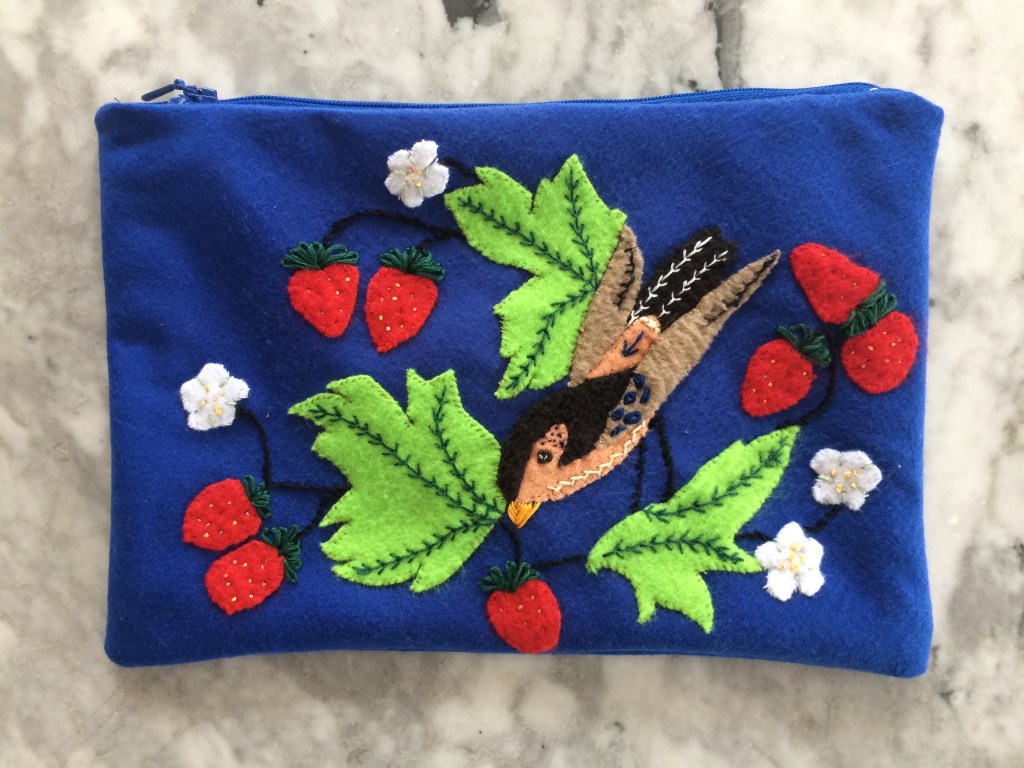
cosyThis is definitely a “cosy of unusual charm”! (Despite the ripped corner on the back cover photo.) It features appliqué and embroidery with different designs on each side and instructions to make it up into either a regular cosy to put over the teapot, or a “nest” to put the teapot into.

My version isn’t a teapot cosy of any kind, since I don’t use them or know anyone who does. Everyone needs a pretty little zippered bag or two, though, to put current projects in, or materials for crafting, or pencils or any kind of small “stuff”, so that is what this project is going to be.

I started with the “bird and strawberries” side. As always, the first question is “how to get the pattern onto the fabric and cut-out bits, since there is no existent transfer.” Remember, back in the day you had to write to Stitchcraft to get the iron-on transfer as a supplement! I used the same graph square technique previously used on the  leaf cushion  and the gay goslings. It was trickier in this case, since the only good photo was taken at an angle, but I got it to work somehow.


Then I copied the pencil sketch, cut out the individual shapes by pinning them to the felt bits, and pinned them out on the base fabric.


Stitchcraft gives pretty good instructions for the embroidery — which colours for what parts of the appliqué and how many strands. The embroidery work itself was not too difficult, using stem-stitch, Romanian stitch, loop stitches and French knots as well as a bird_straw_embbit of herringbone and the tiny straight stitches in the strawberries. Still, it was more ambitious than any embroidery I have tried up until now. It doesn’t look quite like the picture and I did take a little bit of licence, but on the whole I was pretty satisfied… except for the legs. Oh dear, oh my, oh no, the legs. I did them three times and they still look weird. Either the angle is wrong, or the thickness, or I don’t know what, but I figured doing it again would only chew up the fabric more, so it is what it is.


Creating the template for the second side, “Bird and Blossom” presented an extra challenge, as there was only a tiny black-and-white photograph in the magazine, where the tea cosy “nest” was open and made the design appear at an angle. I am definitely getting the hang of this copy-grid-paste-and-cut method though, because it went quite quickly and easily and I think I matched the design pretty well — or at least made a decent interpretation of it.

Again, I sewed the pieces down (noticing along the way that I had forgotten one leaf, and adding it) and then did the embroidery as outlined in the instructions. Well, that was the plan at least, but the picture was so tiny and “unreadable” that I ended up doing most of the embroidery freehand. Winging it, so to speak…

Making the finished embroidered panels up into little bags should have been the easiest step, but it was oddly frustrating and nothing worked properly the first time around. The zippers are a mess. The lining of the “Bird and Blossom” catches and the ends of both zippers are not properly sewn into the top seam. Also, the embroidery is not bad considering my level of (in)experience, but I’m not as happy with it as I could have been. So I’m still deciding whether to keep both of the bags for myself, or give one or both away. What do you think? Here are the finished objects!

BirdStrawFO

BlossomFO

April 1960: Gay Goslings

Version 2“Cheerful goslings make gay kitchen ideas” — who could resist? There are patterns for a serving glove and a felt tea cosy, neither of which I particularly needed, but the tea-cosy pattern is just about the right size for an iPad case. So this became the modern version.

As always, the pattern came from a transfer that is no longer commercially available, but since the appliqué was so simple, it wasn’t a problem. I used the good old pencil-grid-transfer method that had already worked so well with January’s leaf cushion, and it worked fine.


I had never done appliqué before, but it was really quite easy, especially with felt, so this was a great beginner project. The eyes, wings and feet are embroidered in simple satin stitch and blanket stitch. There were supposed to be yellow stem-stitch outlines around the eyes, but I tried it and it made my poor innocent gosling look kind of demonic, so I stuck with plain black dots. I made it up with a scrap of fun blue cotton print for lining (Geese… In… Space…!) and a simple closure made out of a bit of twisted yarn cord and a sparkly white button.


Everything worked great and the whole thing took only about 5 hours total to make, including sewing all the seams by hand, as I didn’t have my sewing machine on hand at the time.  Definitely a change from the never-ending John’s new pullover! Now I have the gayest, warmest, best-dressed, space-age spring fever iPad that anyone could wish for and am very happy.

goslingsfo1