 Brrrr! November 1960’s Special Bumper Issue” brings us “Colour for the Cold Days” and an extra 16-page pull-out booklet of baby woollies. Sadly, so sadly, the booklet from my copy of this issue has been pulled out long ago and is missing.
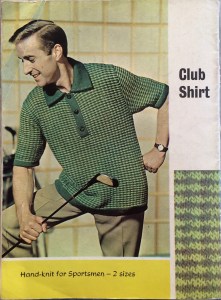
There are still plenty of lovely cold-weather fashions and interesting homewares to make, starting with the comfortable, matching “his and hers” sweaters from the front cover. Green checks continue to be in fashion, this time made with a complicated slip-drop-and-pick-up-later stitch pattern in two colours of Rimple. The idea of the “partner look” is just starting now, but will carry on throughout the 1960s into the androgynous 1970s and even the oversized-sweaters-for-everyone 1980s. Both fashion and gender roles were still quite rigidly stratified in 1960, but I see a parallel between the gradual softening of gender-based norms and the increased interest in gender-neutral “partner” garments that both started around this time. The two sweaters in this issue are both loosely-fitted, shaped (or not shaped, as is the case) the same, and available in overlapping sizes. The only proportional differences are in the shoulder width and sleeve/overall length, and the only cosmetic difference is the collar.


Women’s fashions without men’s versions include a “sports” sweater with coloured lines made from a bobbled two-colour stitch pattern and added embroidery, a “top-fashion” jacket with a wide collar, a belted jumper and a cute hat with a buckled brim. Waist-length and closely fitted is definitely out, and the long-line with minimal shaping and a collar is definitely in. Men’s fashions are similarly long and loose-fitting, with dolman sleeves and interesting yoke details, and there’s a fantastic twin-set for young girls aged 5-9.
 Homewares are still in a weird phase. The working woman or baby-boom mum (and those were overlapping categories, then as now) of 1960 didn’t have the time or patience to make too many elaborate Jacobean embroidery pieces or huge, detailed tapestries, especially not right before the great rush to get Christmas presents under the tree, so the focus is on quick, easy-to-make novelties for gifts. The aesthetic sense does seem to get lost a bit, though, if you ask me.
Of course, if you do have the time and leisure, you can go ahead and make a piano-stool and cushion set in Victorian-style tapestry, or a large room-divider screen with colourful parrots. Truly modern and up-to-date novelty lovers can continue the Zodiac series with a Scorpio motif for cushions, chairbacks or waste-paper baskets.


 (I notice that Word Press does not recognise the word “chairback”. They have been out of fashion for too many years, I guess, having fallen victim to cheaper furniture, more frequent hair-washings and less Brylcreem. Pity that no one likes them now, as they do seem kind of fun.)
In the back pages, Jill Browne is still happily endorsing Patons Big Ben wool, and a lovely new children’s serial, “Wendy and Wag in Wallpaper Land” has started. Note the printed ruler at the side of the page, included in each issue as an easy way to measure your tension swatch. Also, there’s a rug reprint, a toy pig made of pink felt, a panda-bear motif and gay pot holders. What more could you want? My project will be the cloche hat, and I’ll consider the belted jumper if I have more time.
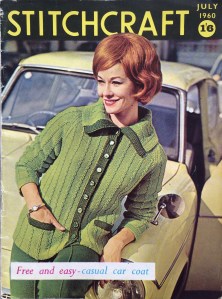 “Free and easy” is this month’s motto. Summer is here and nobody really feels like handling warm wool, so the emphasis is on “travel knits” (lightweight), “casual knits” (not too complicated) and “stroller styles” (loose and oversized). There is more embroidery and needlework than knitwear, and some easy sewing projects. Shall we relax and take a look?
 I have to take a moment here to quote one of my favourite Roald Dahl stories, “The Boy Who Talked With Animals.” It’s about a little boy who saves a giant tortoise from the soup kettle, and Dahl’s description of the tourists waiting on the beach for the caught tortoise to be hauled in has, for some reason, stayed with me through the years:


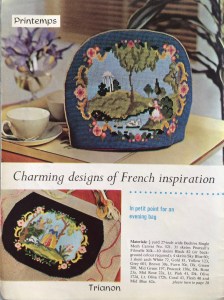 You can also embroider a tablecloth, make tea-towels in huckaback, or attempt this fabulous tea cosy and/or evening bag in faux eighteenth-century tapestry. I so, so want to make this evening bag! I would love it and use it all the time. But I am too overwhelmed by the idea of trying to make a chart based solely on the photos — the design is fairly intricate — and having never before attempted tapestry work, I fear it would just be too much for a rank beginner. I will definitely file it away for future days when I know how to approach it better.


 The Stitchcraft Sixties