February 1968: Overview

After the “cold snap” predicted in the January 1968 issue of Stitchcraft (and which actually happened throughout the icy, snowy month of January 2026), the February 1968 issue looks toward Spring. There are still plenty of warm things to knit, but the focus is on layering and knitwear as outerwear.

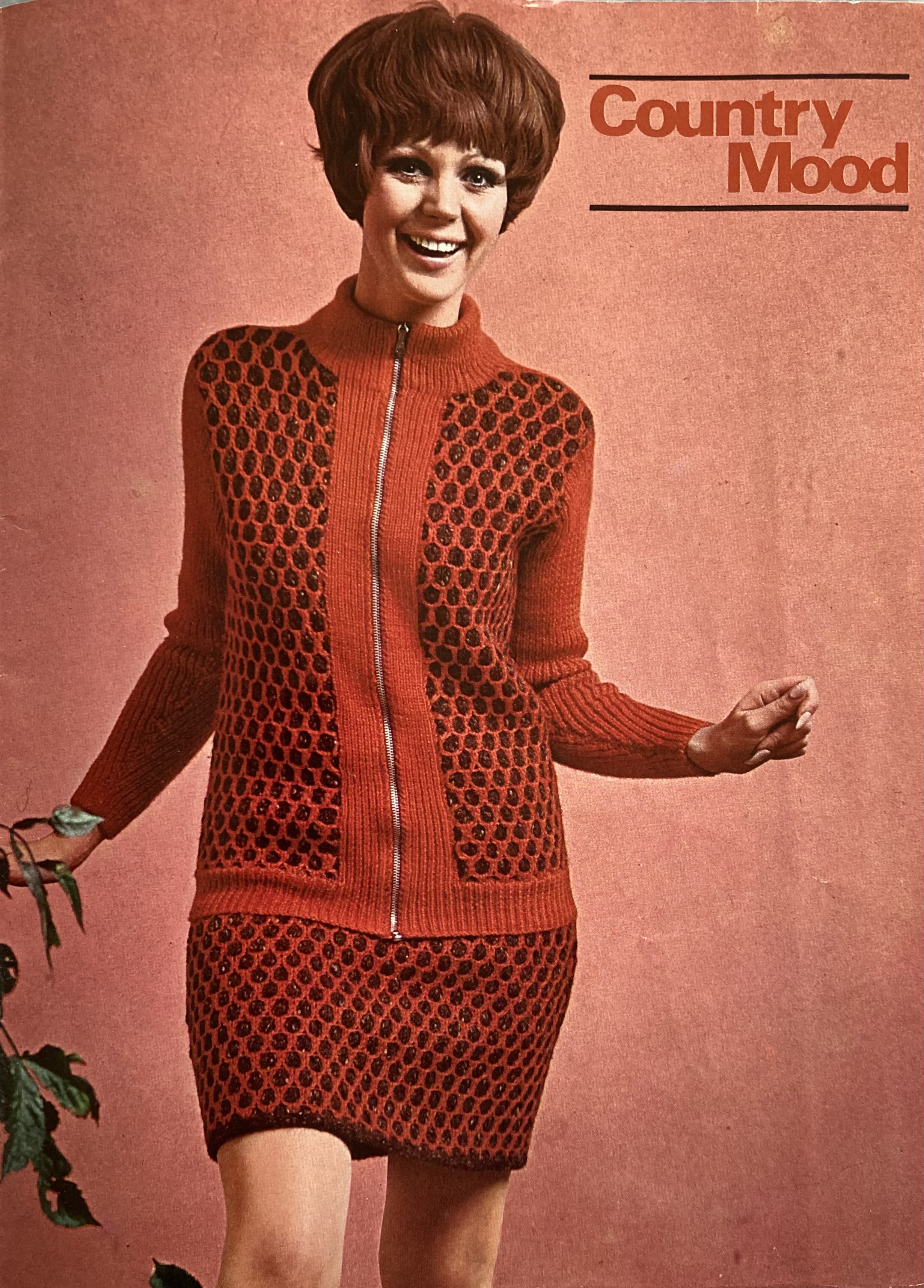
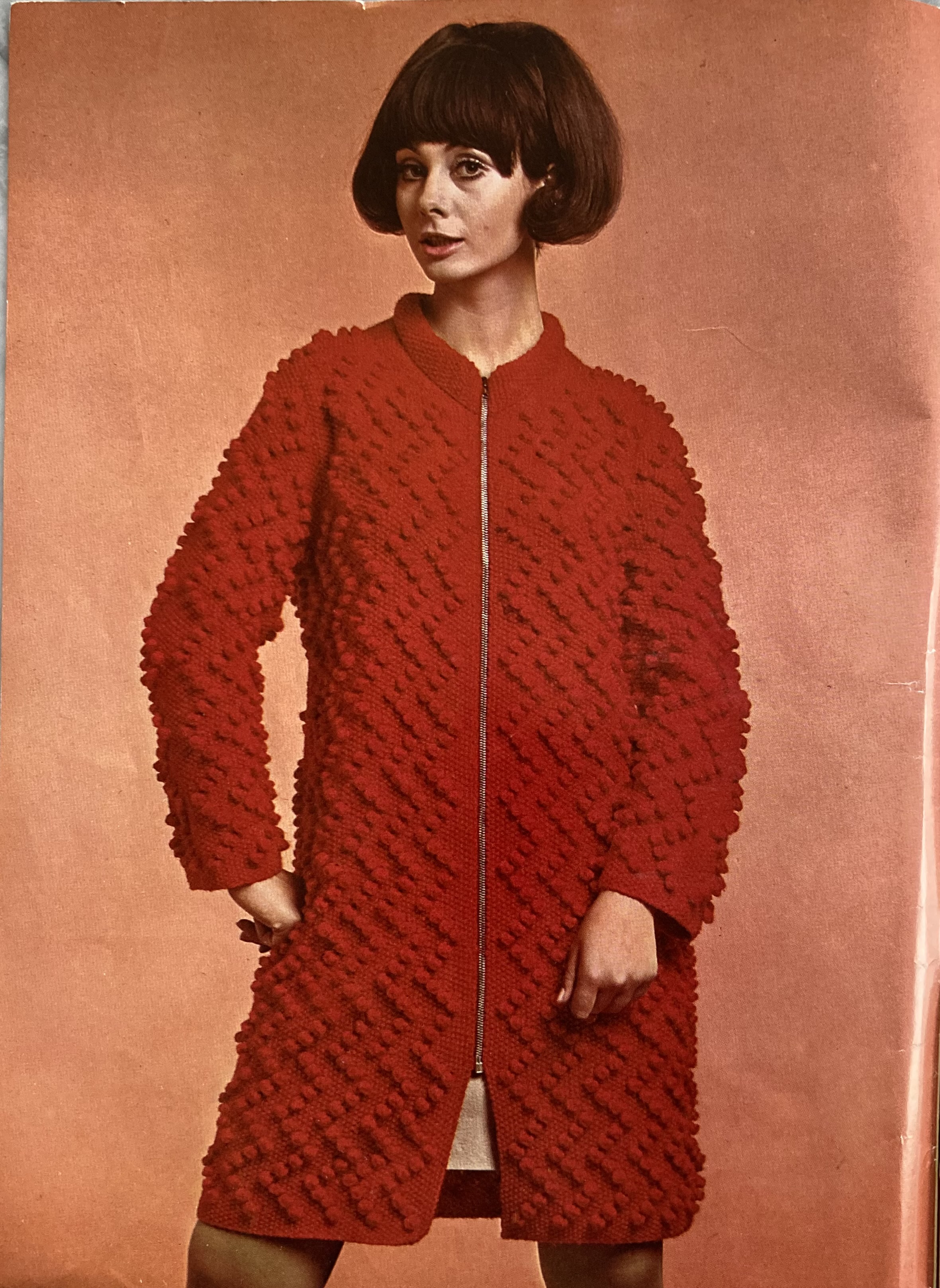
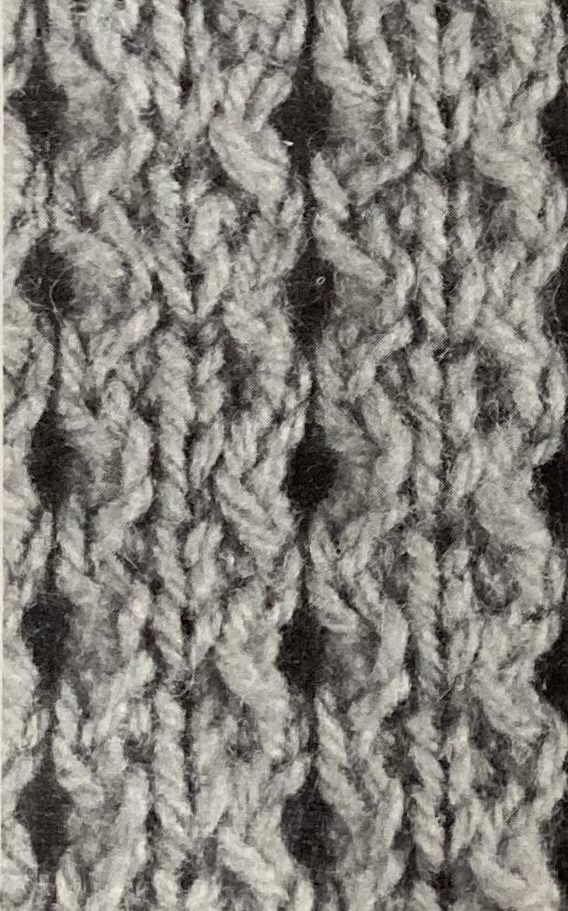
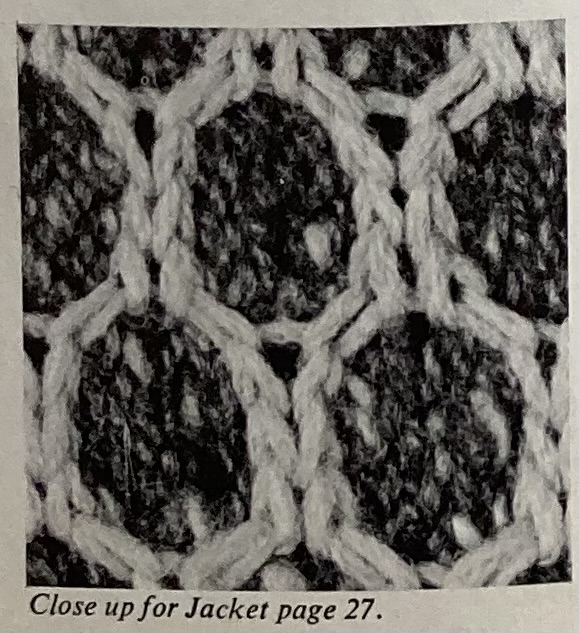
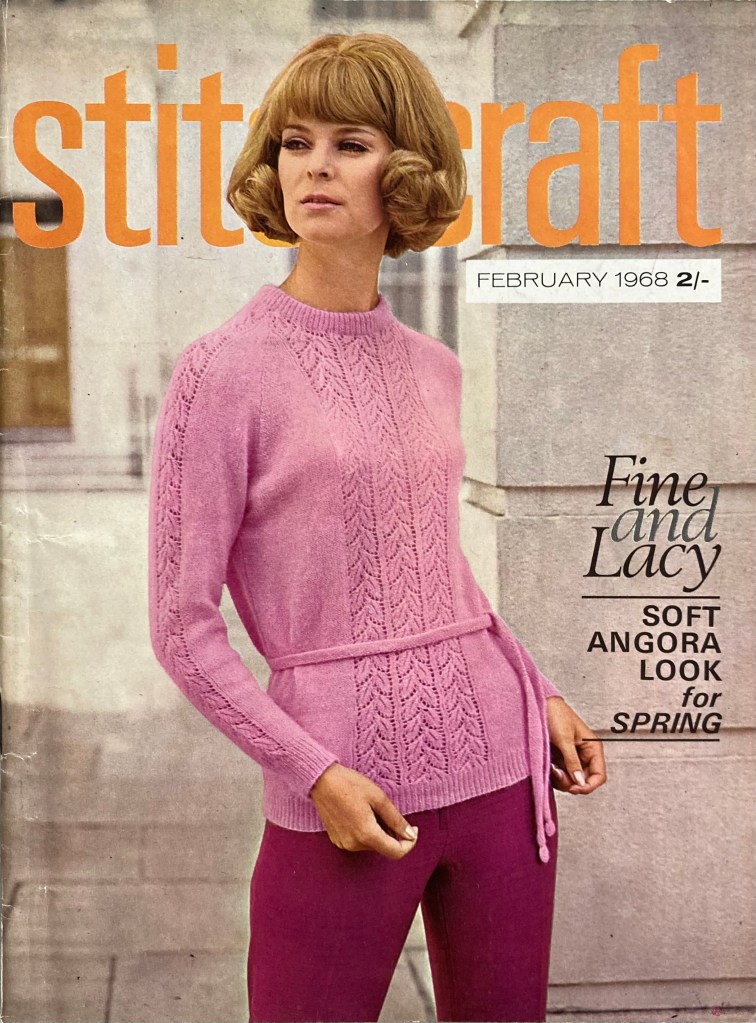
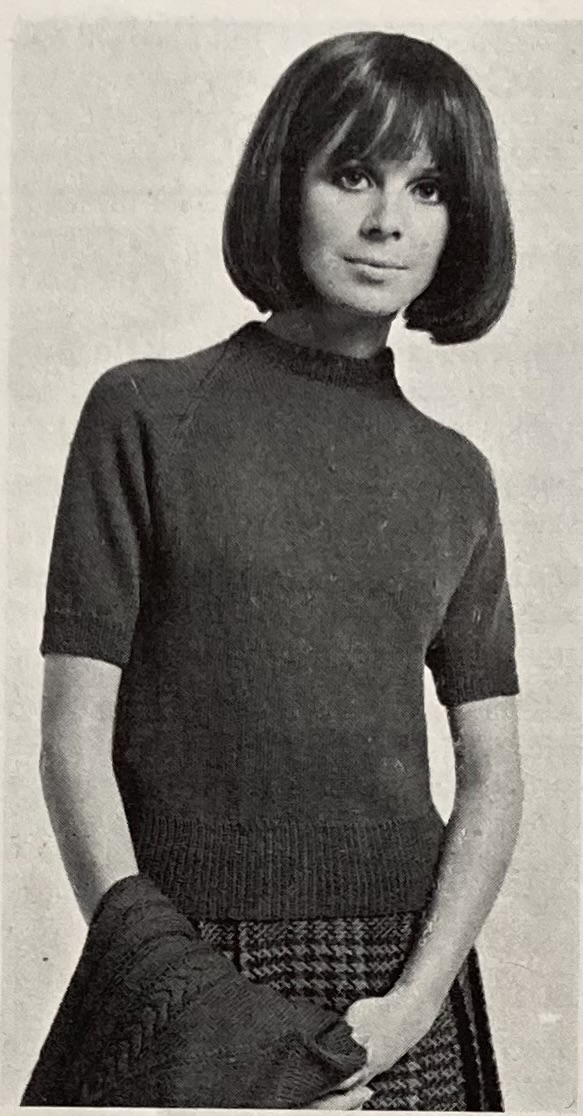
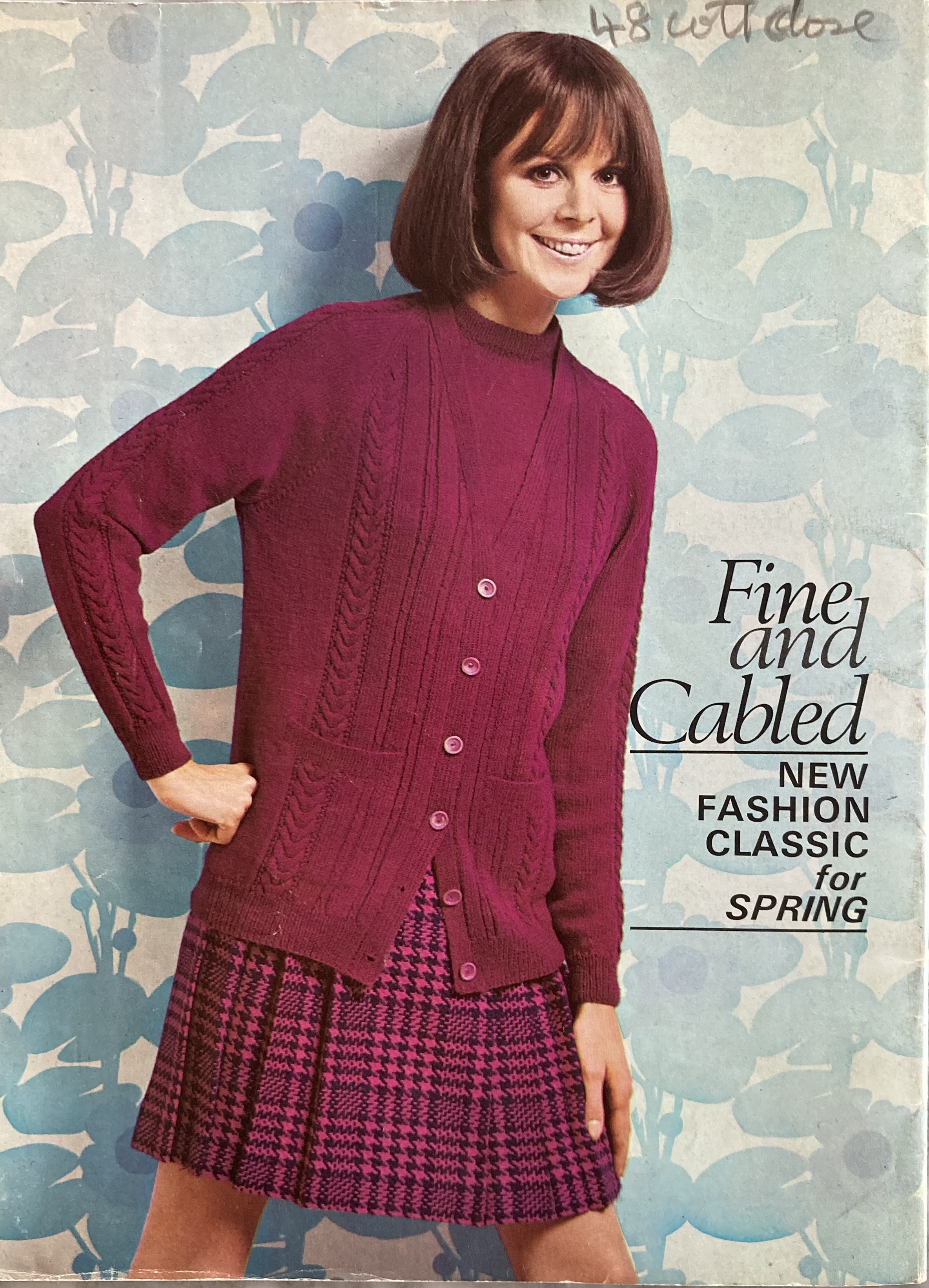
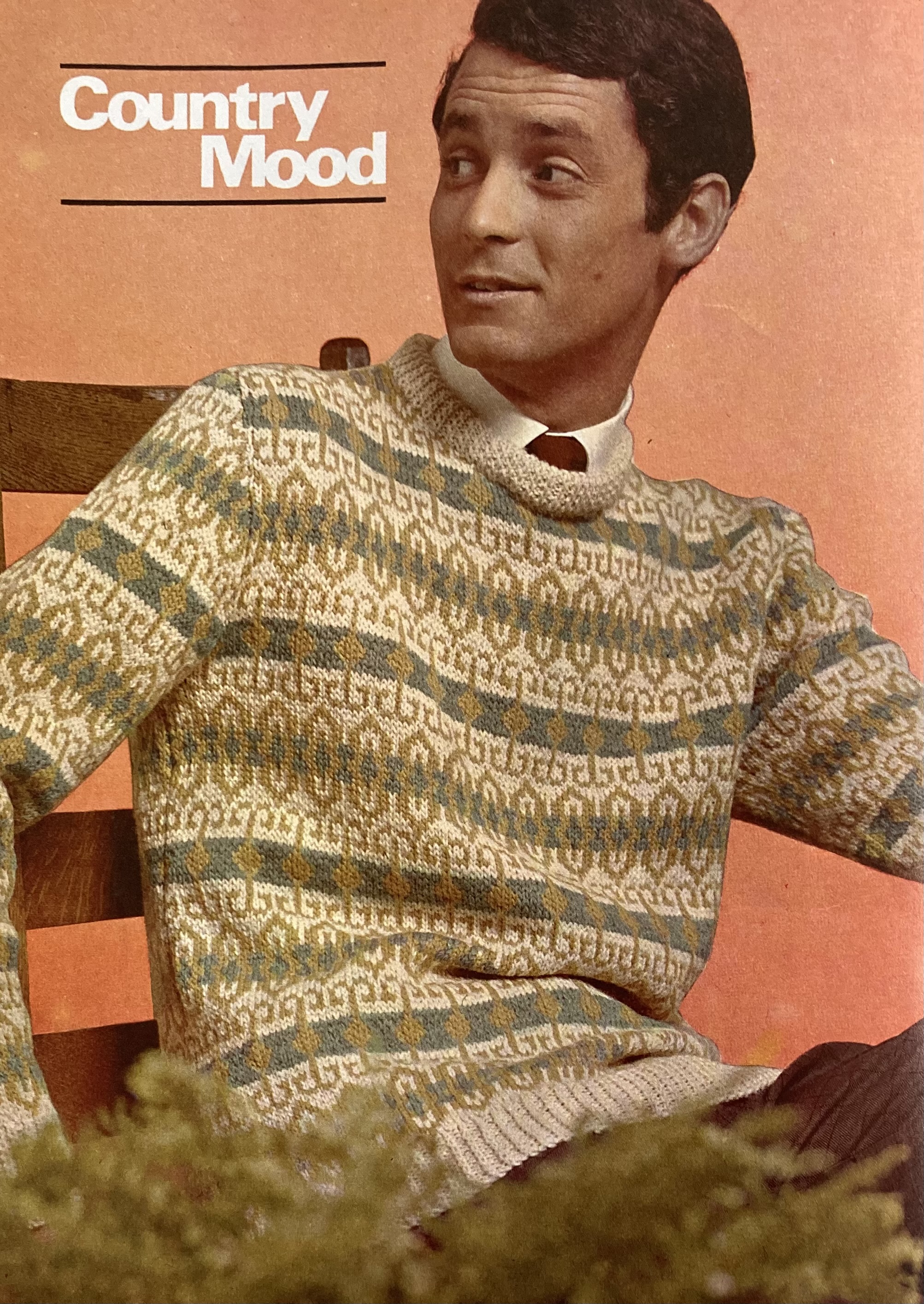
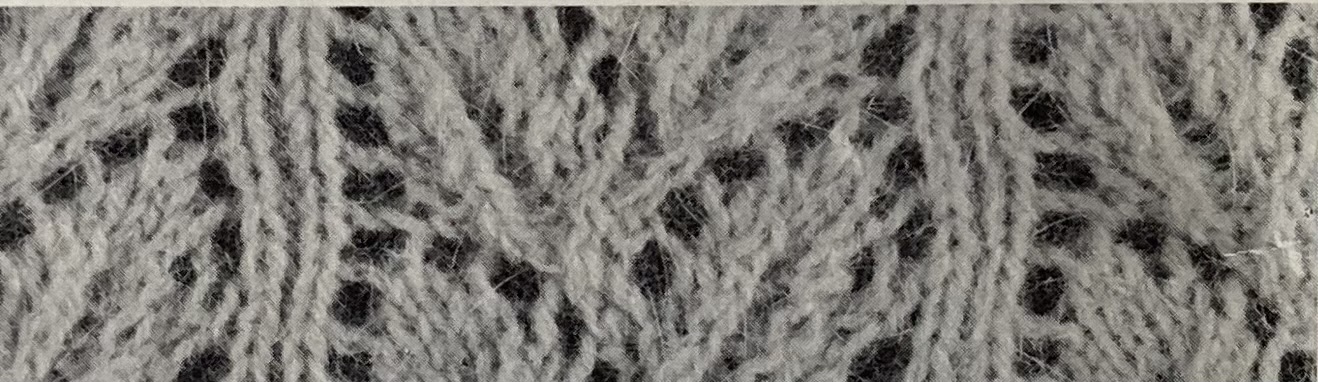
The cover design is a lightweight, but presumably warm pullover in a leafy lace-panel pattern and Patons “Princess” yarn (85% wool, 15% angora.) It’s slimmer, longer, high-necked, and belted — trends that will continue throughout the year. The back-cover design is a twin set in late 60s style, loose-fitting and worn with a kilt-like plaid skirt. It, too, is touted as a “long-liner” and the caption says it can be “belted if you like.” There’s a similar long-and-slim feeling to the “Country Mood” set on the inside back cover, which features a zipped cardigan over a mini-skirt, both in really interesting two-colour trellis pattern. The pattern looks like it would be made with slip-stitches, but is in fact stranded, with twisted stitches to give the trellis effect. Longest of all is the amazing bobble-stitch coat on the inside front cover, weighing in at a whopping 50-54 ounces and similarly zipped up the front.
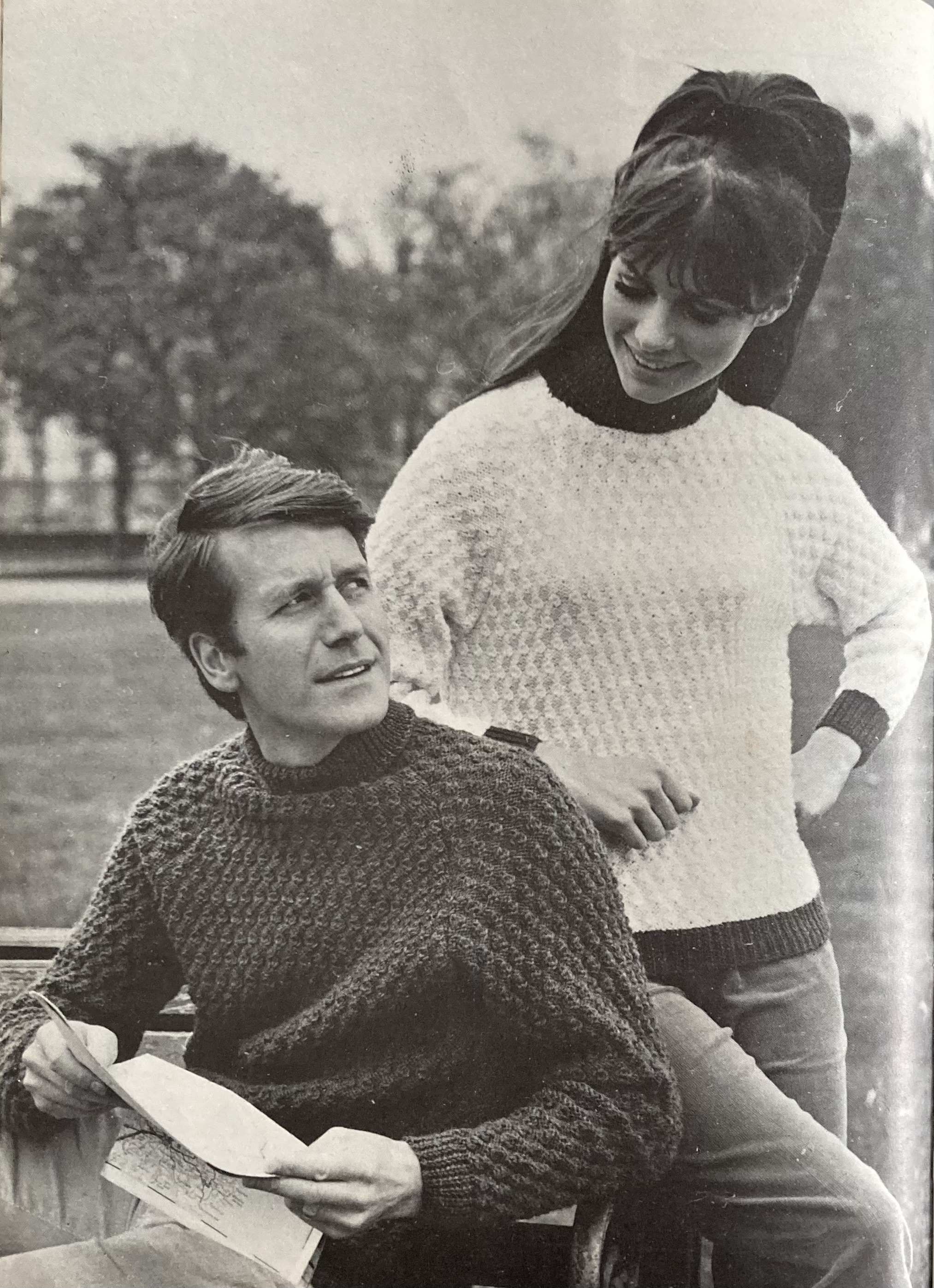
For men, there’s a his-and-hers “Two for the Country” bramble-stitch sweater to be worn indoors or out, and a softly-coloured stranded jumper in an interesting “key”-type pattern. It only uses three colours (“Banana Cream”, “French Mustard” and “Light Steel Grey”), but the pattern gives additional depth and richness.
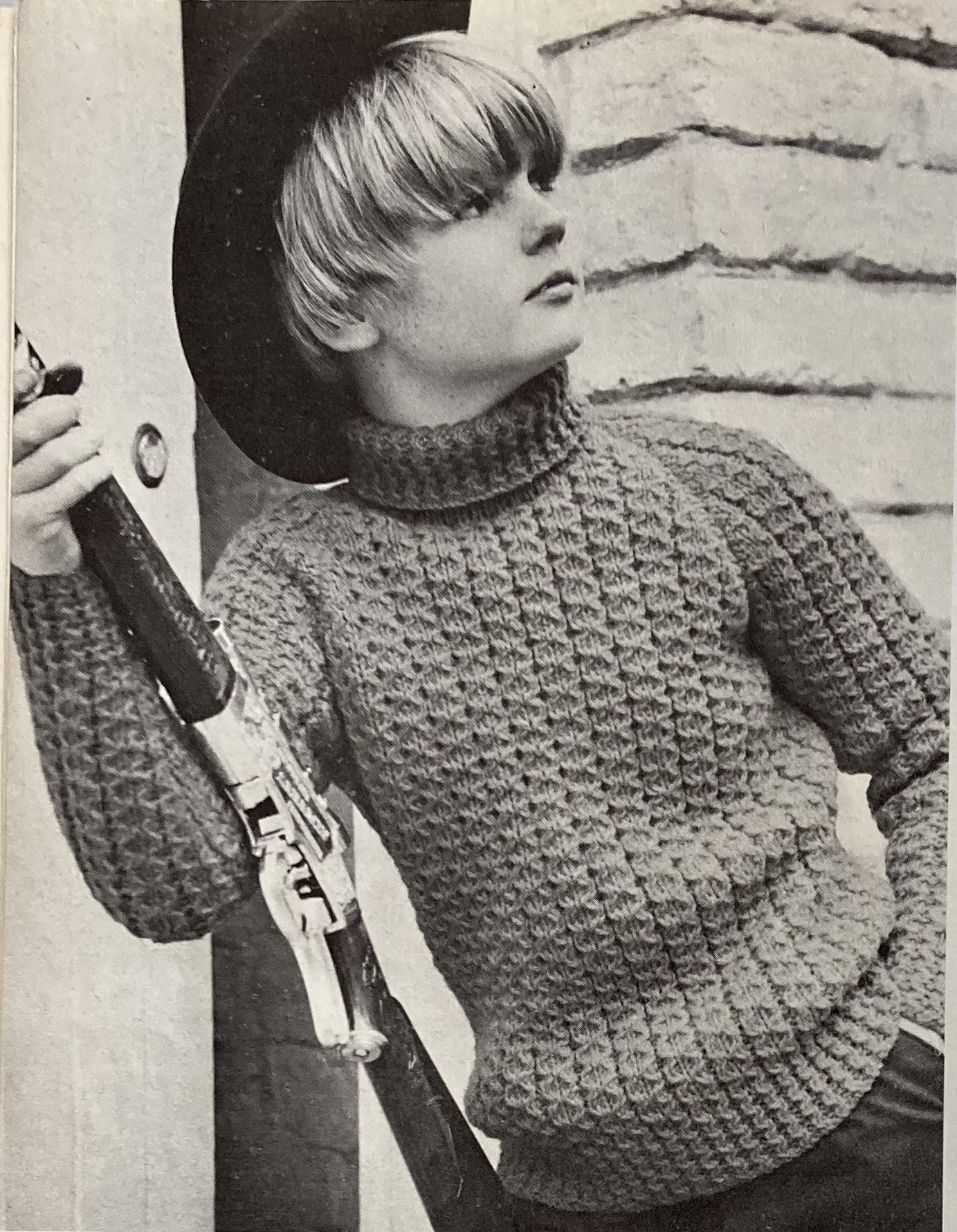
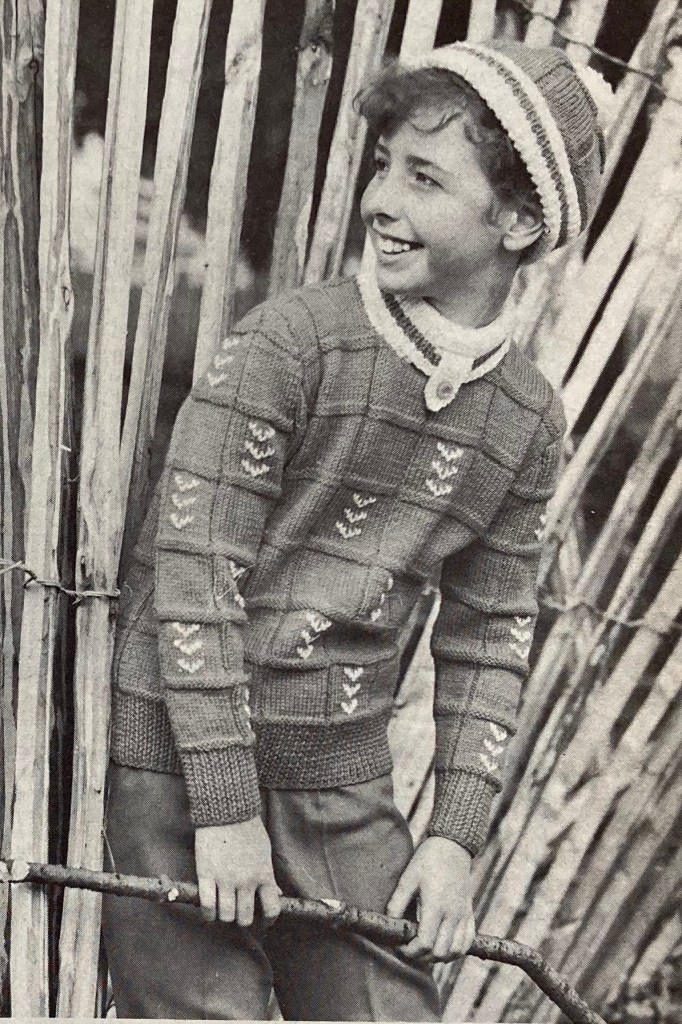
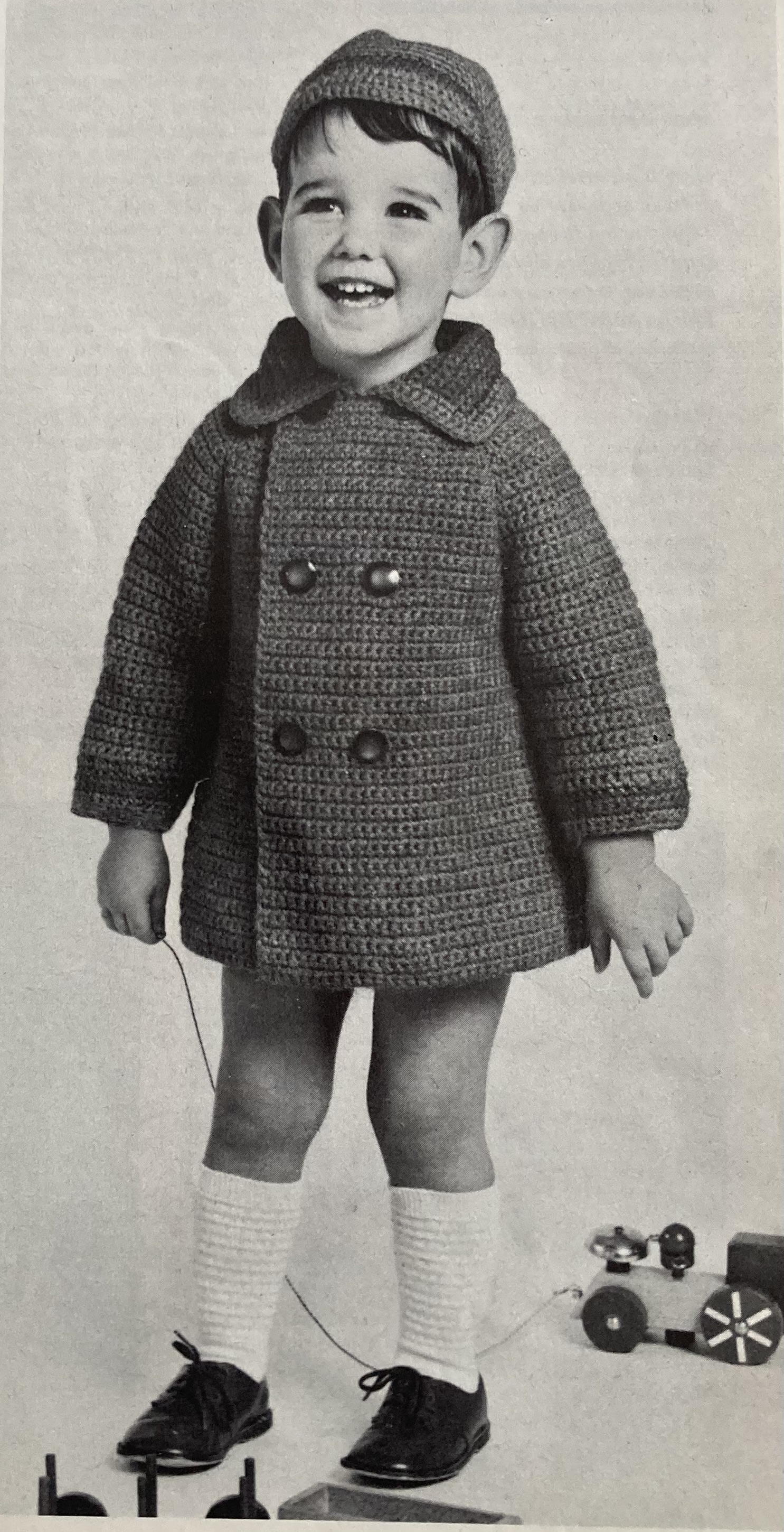
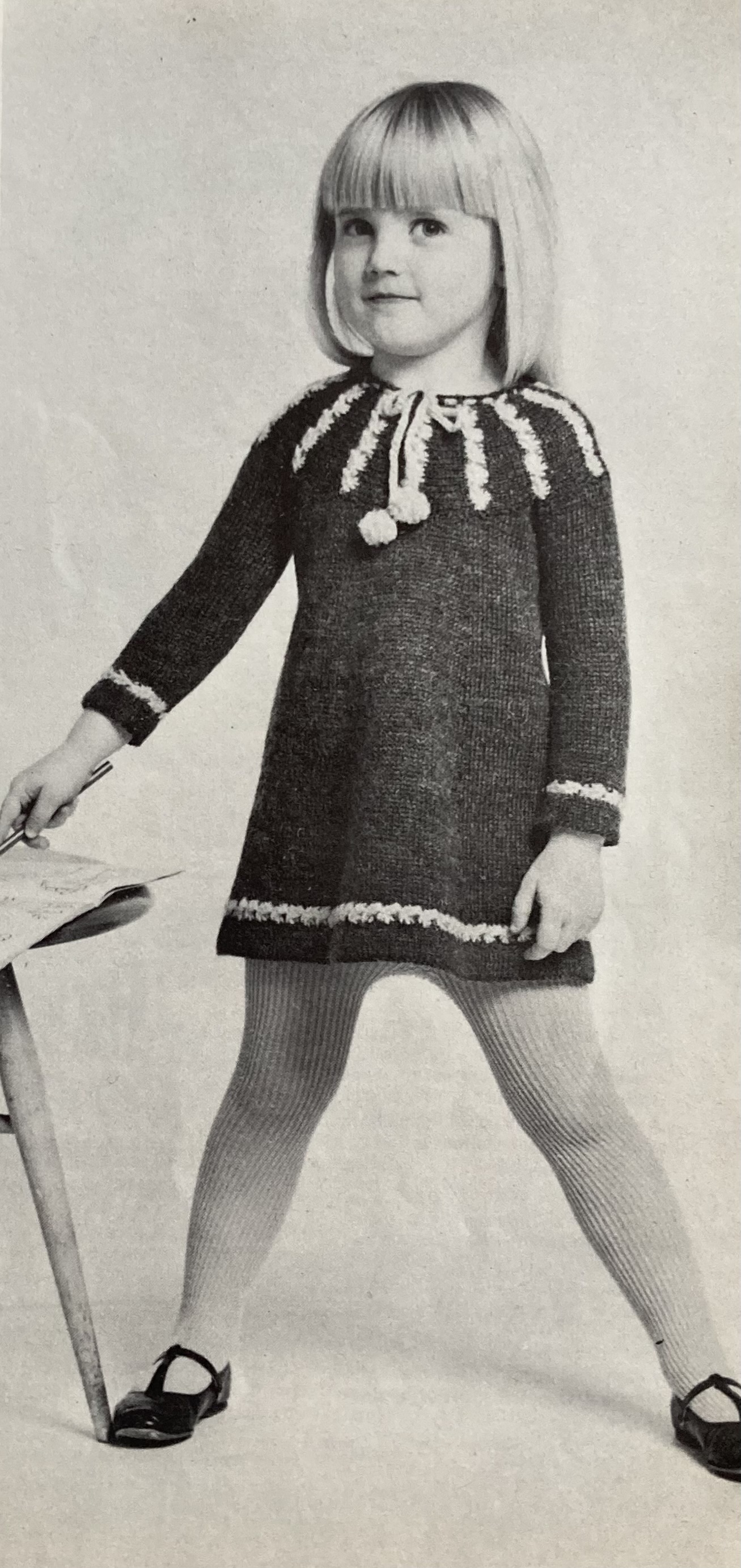
There are three patterns for children of different ages in this issue, starting with a coat-and-cap set for a little boy. I suspect he’s only looking so happy because he’s in a warm photo studio; if he ever actually went outside in that outfit, both his legs and his ears would freeze right off. I know if was customary to dress little boys in shorts at the time, but this poor kid doesn’t even seem to have those! How on earth is he supposed to play in the snow with a practically bare bum? At least the little girl gets to wear tights with her mini-dress/tunic this time, and since it is “for visiting”, I assume she will be wearing it inside. The circular yoke of the tunic is knitted horizontally and sewn on, and the white stripes are made by dropping stitches and picking them up later. The third design is a great indoor-outdoor sweater for a slightly older child, in thick “Capstan” wool and a twisted-stitch pattern that presumably acts as s sort of thermal blanket to keep warm.
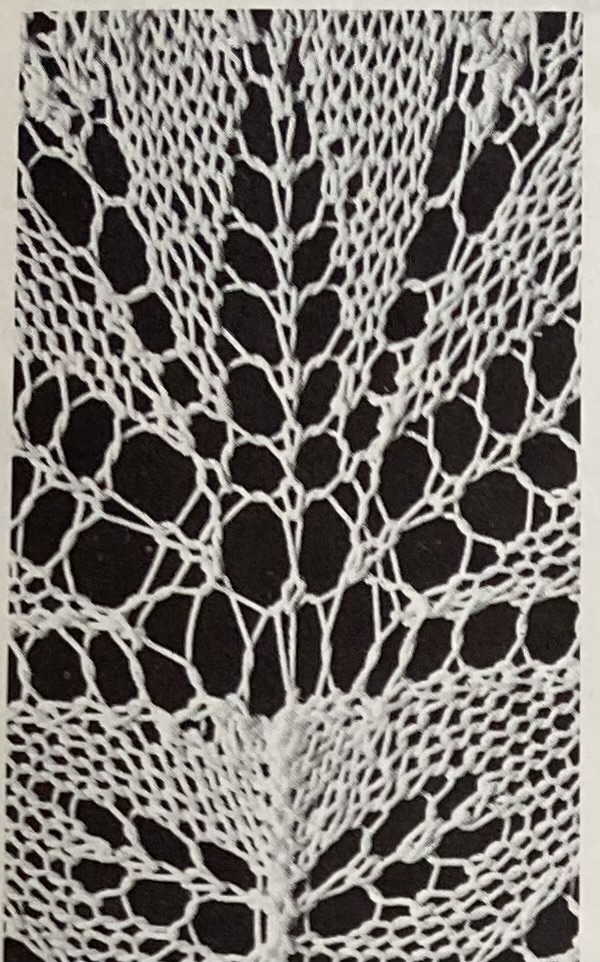
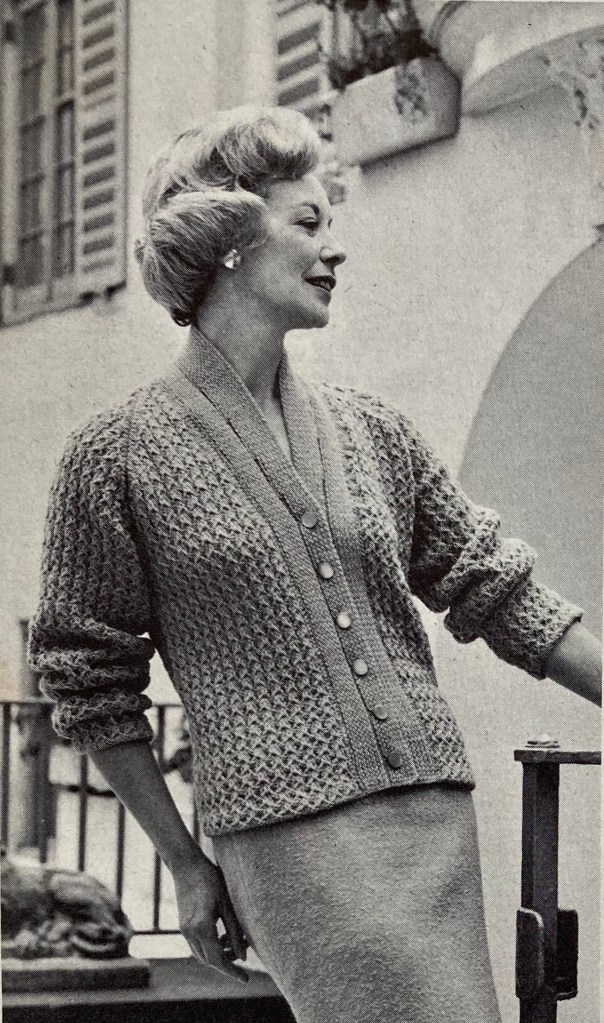
One nice thing about this issue is that there are extra close-up photos of the more interesting stitch patterns:
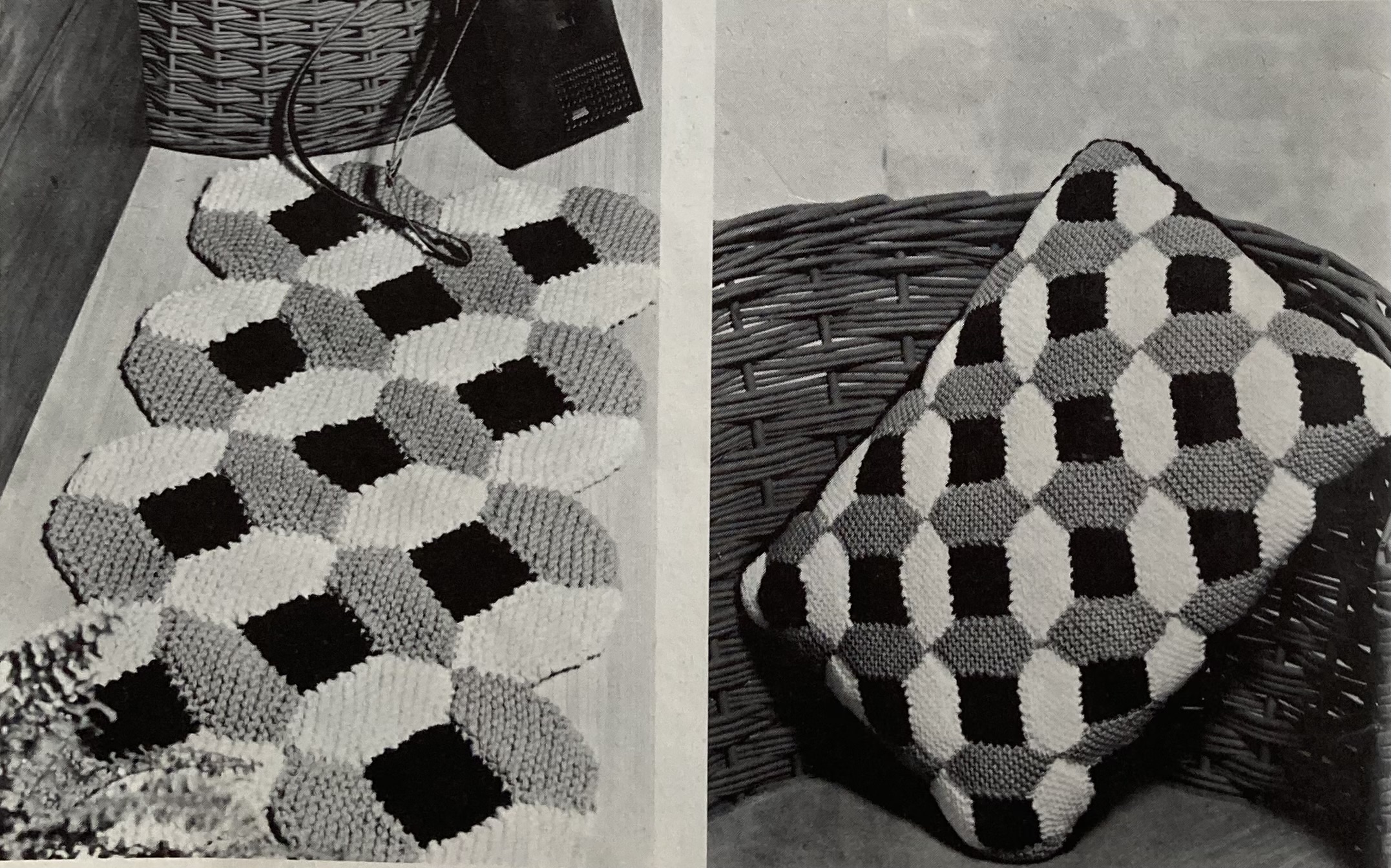
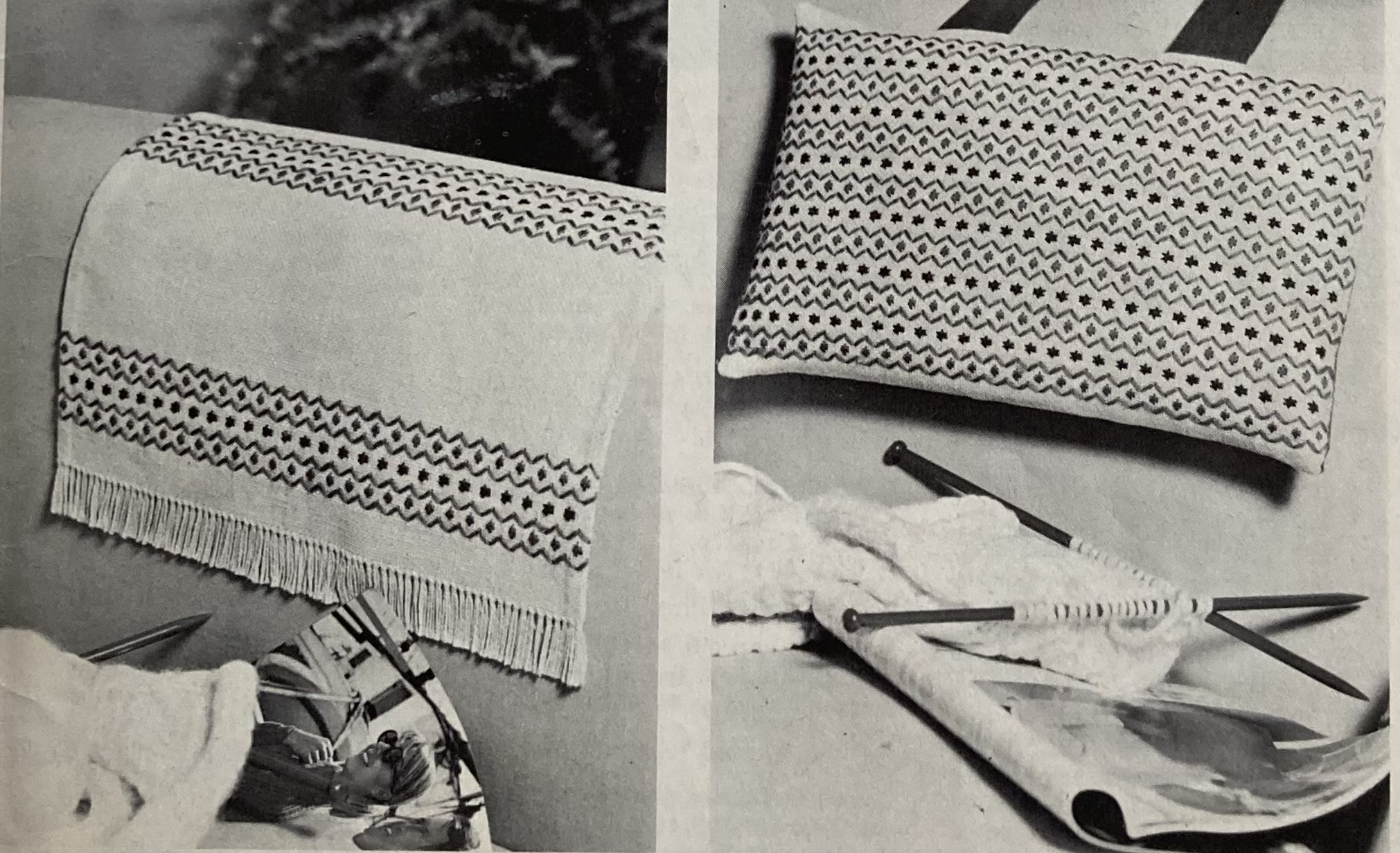
Most of the housewares in this issue are advertised as “Easter Gifts”, though I see no connection to the the patchwork rug and cushion, or the embroidered cushion and chairback.
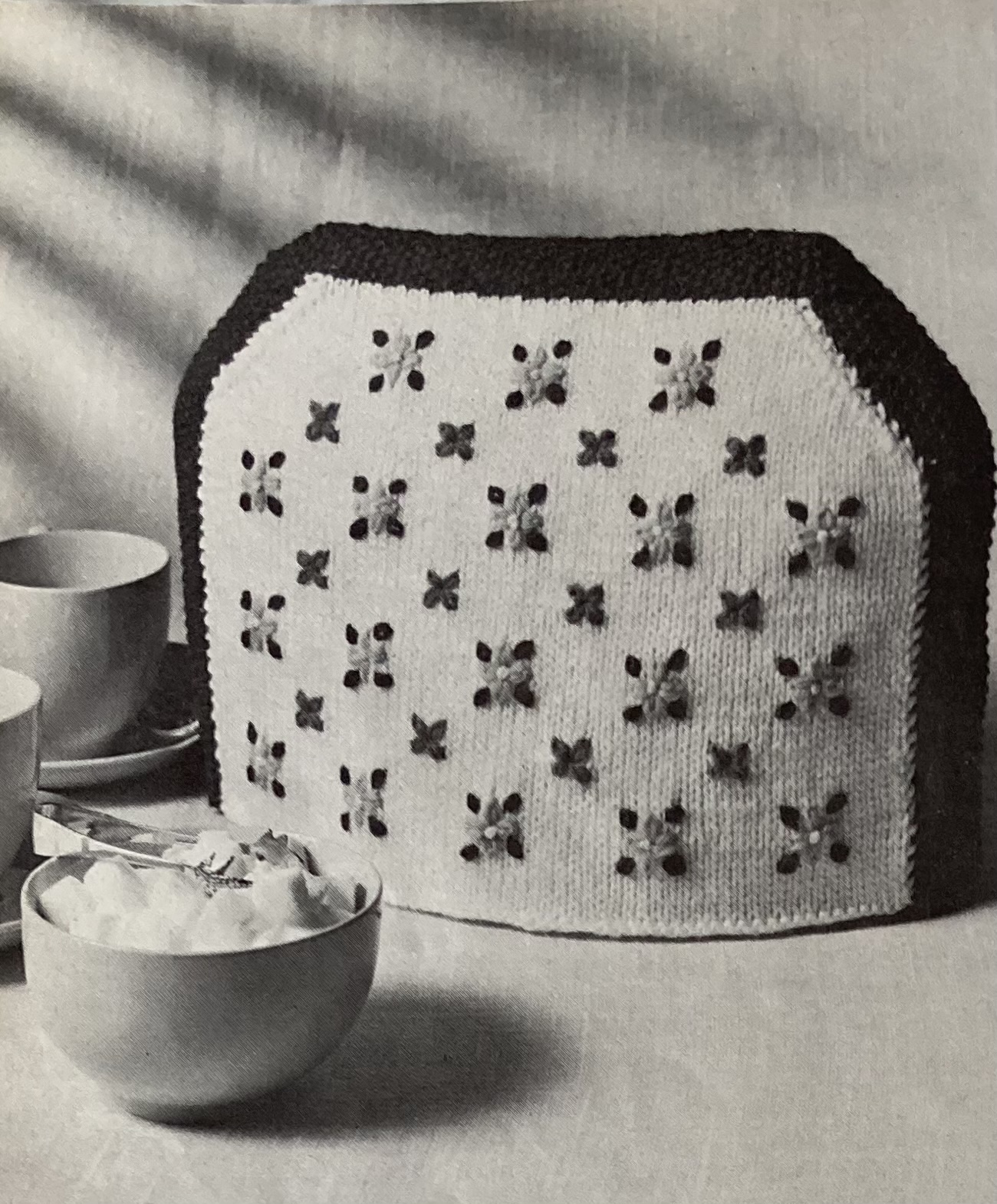
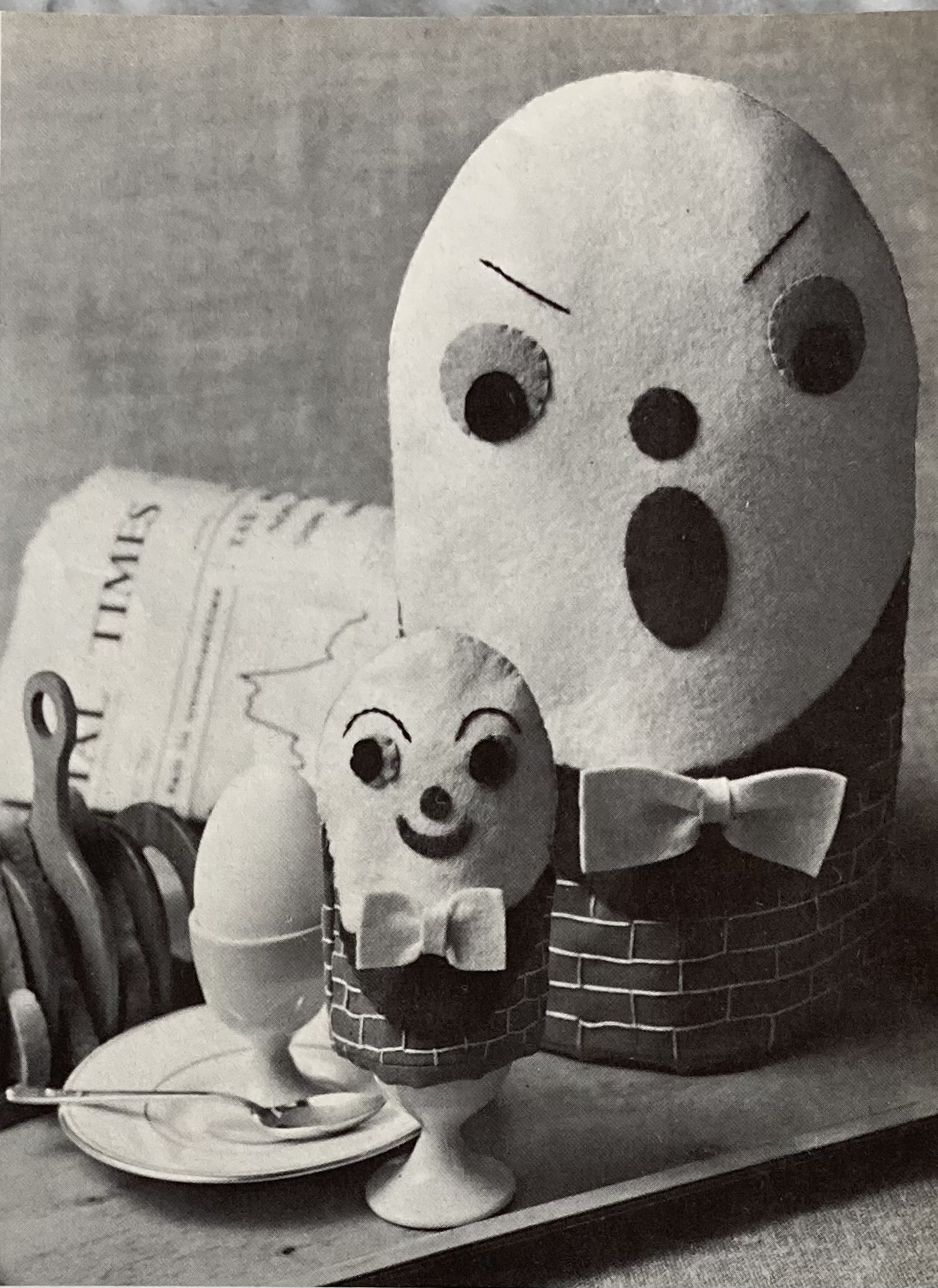
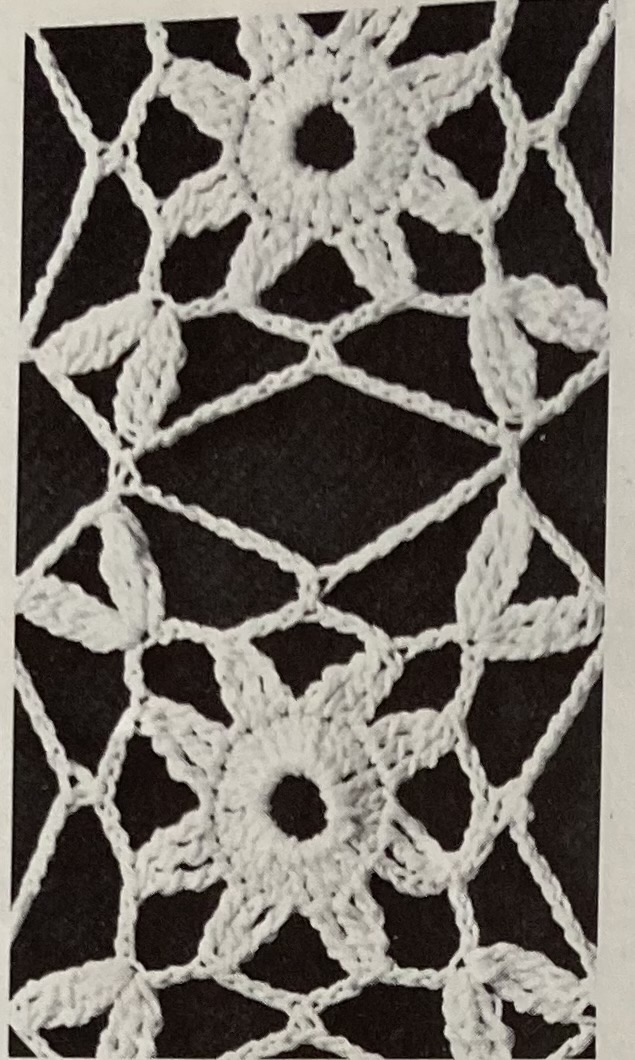
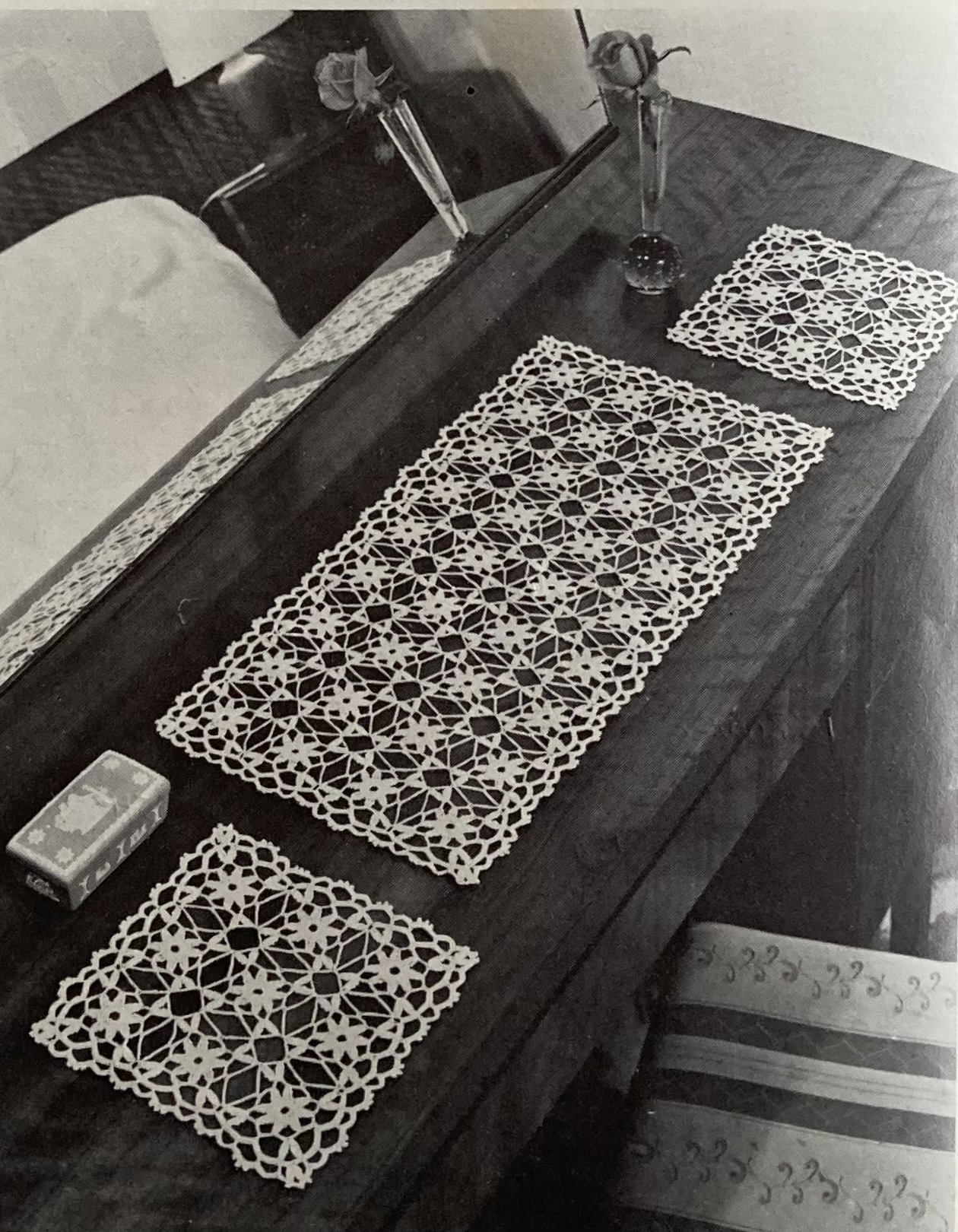
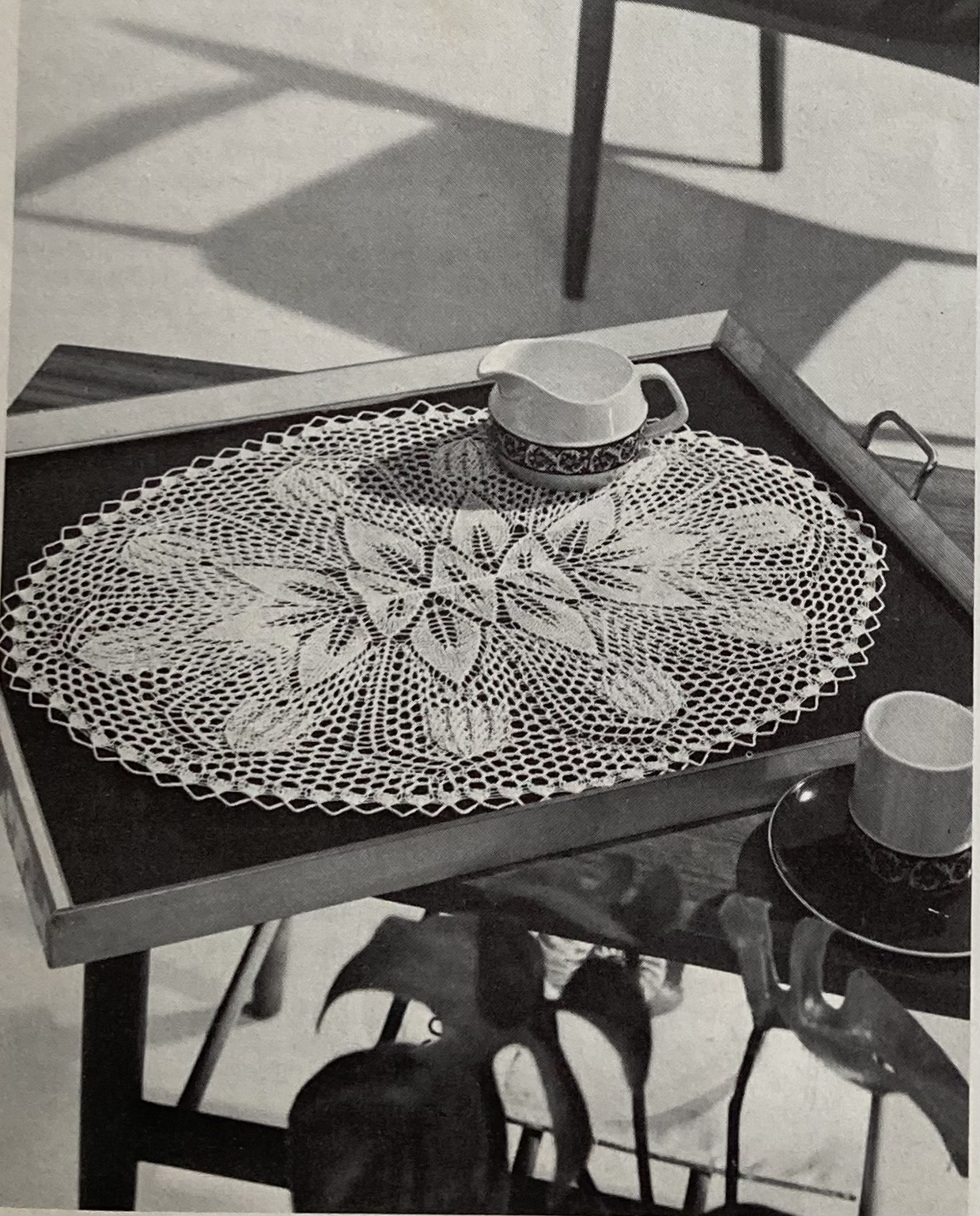
The elaborate crocheted or knitted doilies as well as the knitted tea cosy have floral patterns, but still no real connection to the holiday. I guess the “Humpty Dumpty” coffee-pot and egg cosies could accompany your Easter breakfast, if they don’t put you off it entirely! Stitchcraft is obsessed with Humpty Dumpty. Over the years, there have been egg cosies, stuffed toys, Christmas tree ornaments… I admire the creativity and the artistic commitment to a theme, but I do wonder. If you know why the egg cosy is happy and the coffee pot is angry, please tell me in the comments!
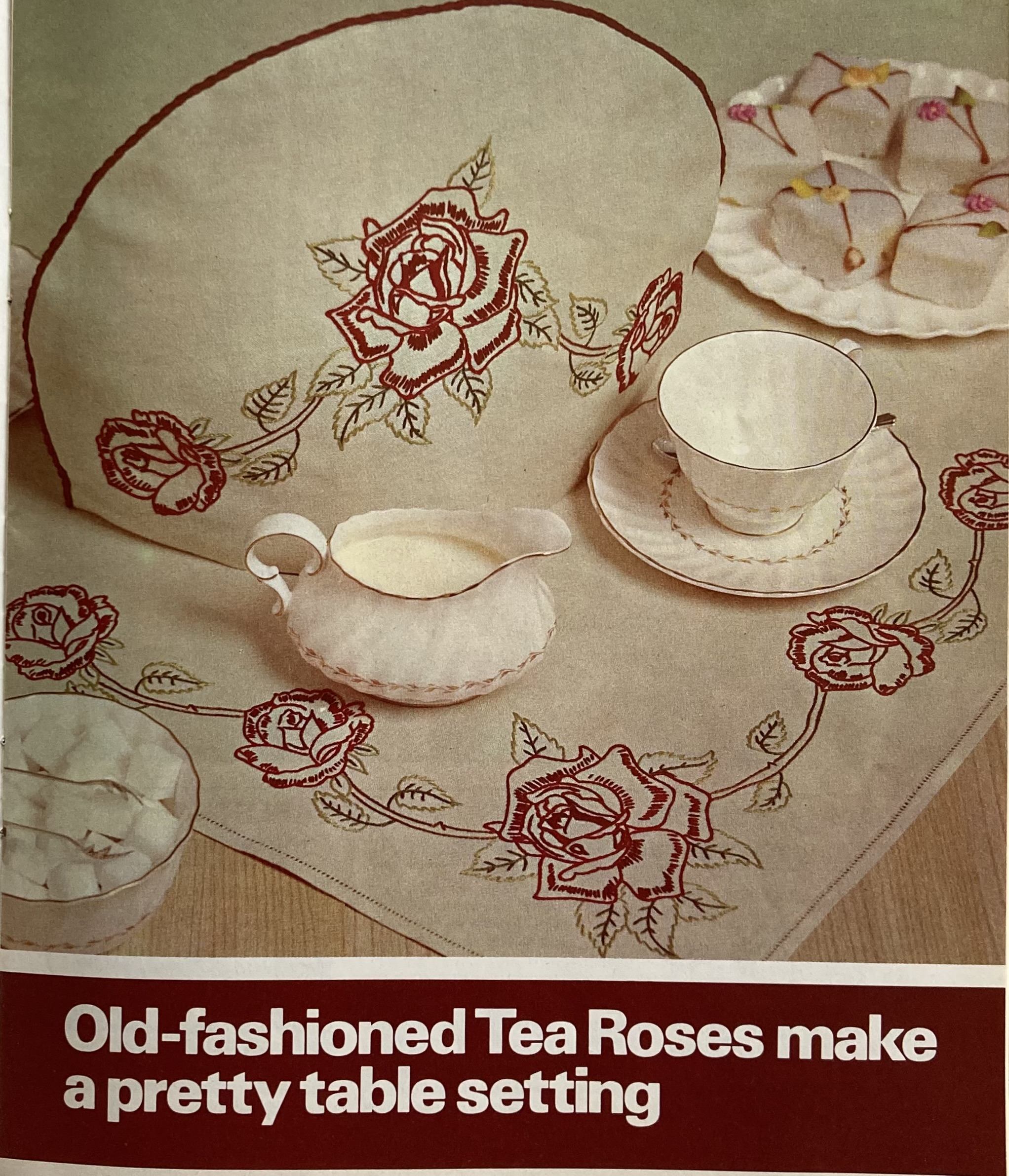
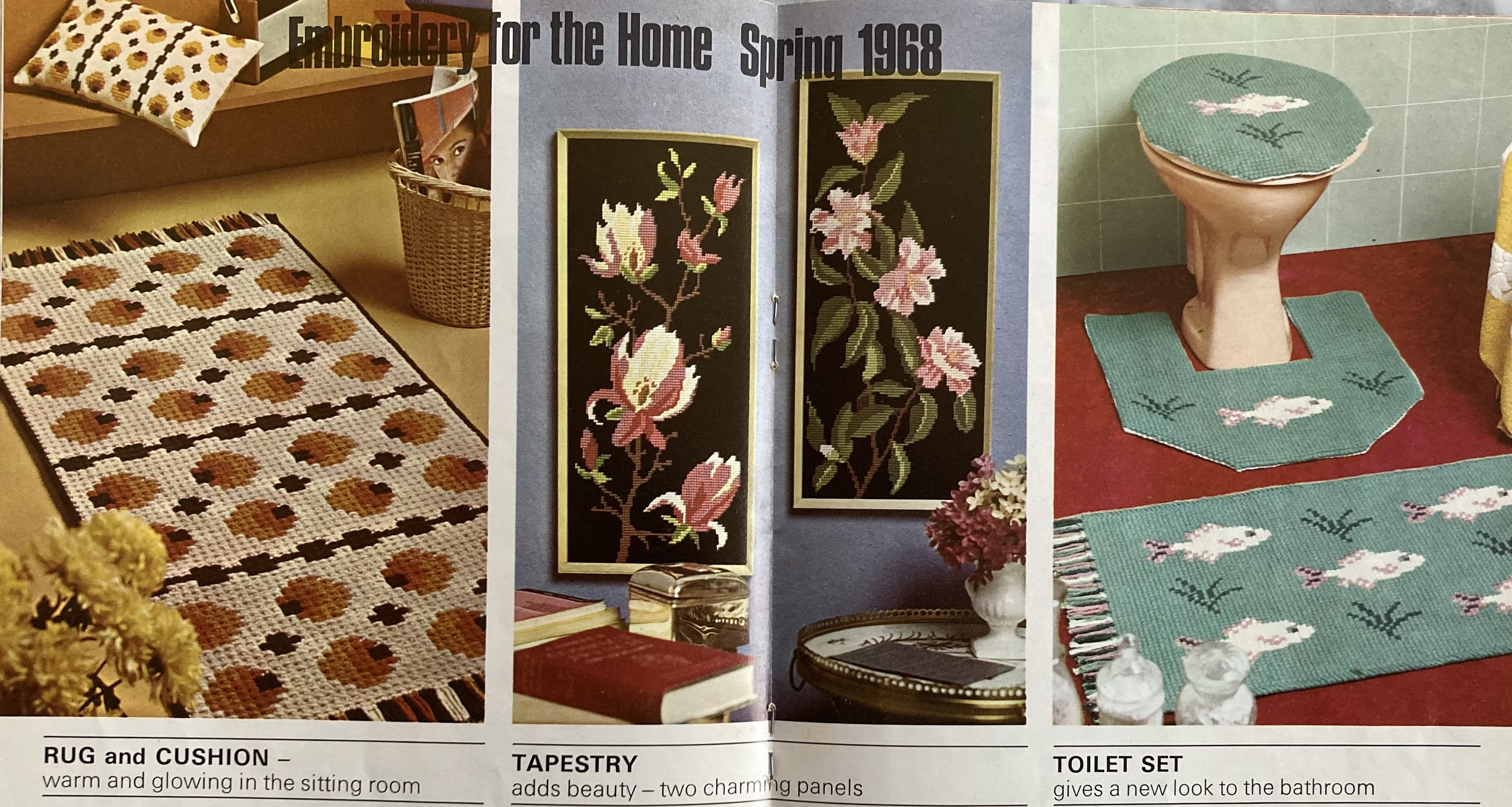
They apparently gave up on the Easter theme by the middle of the issue and just promise “4 pages of Rug-making, Tapestry and Embroidery for the Home”, which appear exactly as promised. There’s an elegant tea-table set of cosy and cloth in rose-pattern embroidery, a rug and cushion in best 1960s shades of brown, orange and gold, two floral tapestry wall panels, and a “Toilet Set” of toilet cosy and two mats. In previous issues, such items were called a “Pedestal Set”. I guess by 1968, there’s less need to be euphemistic. (But still a need to put a cosy on the toilet cover.)
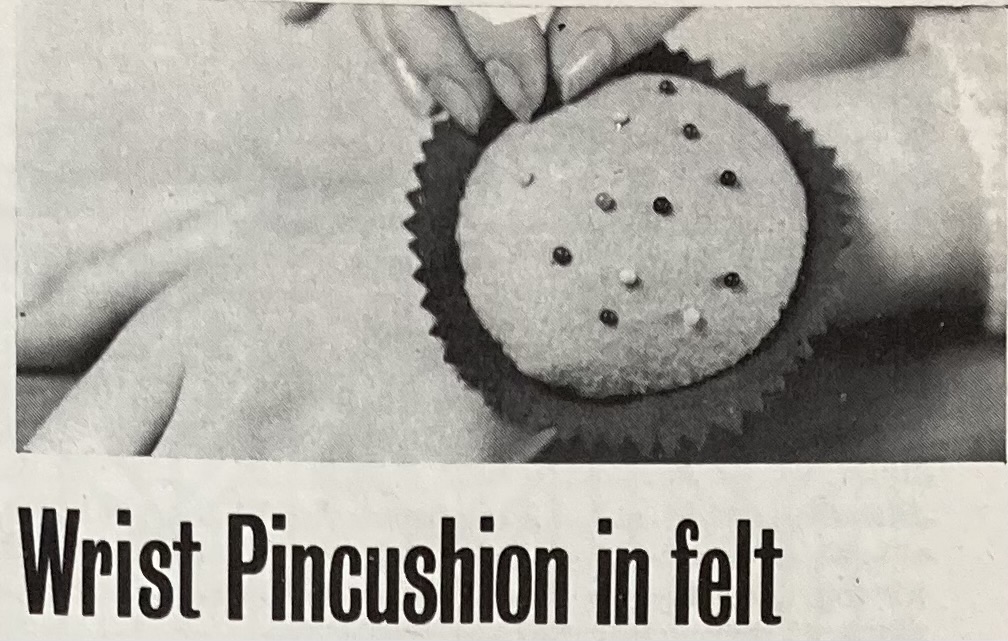
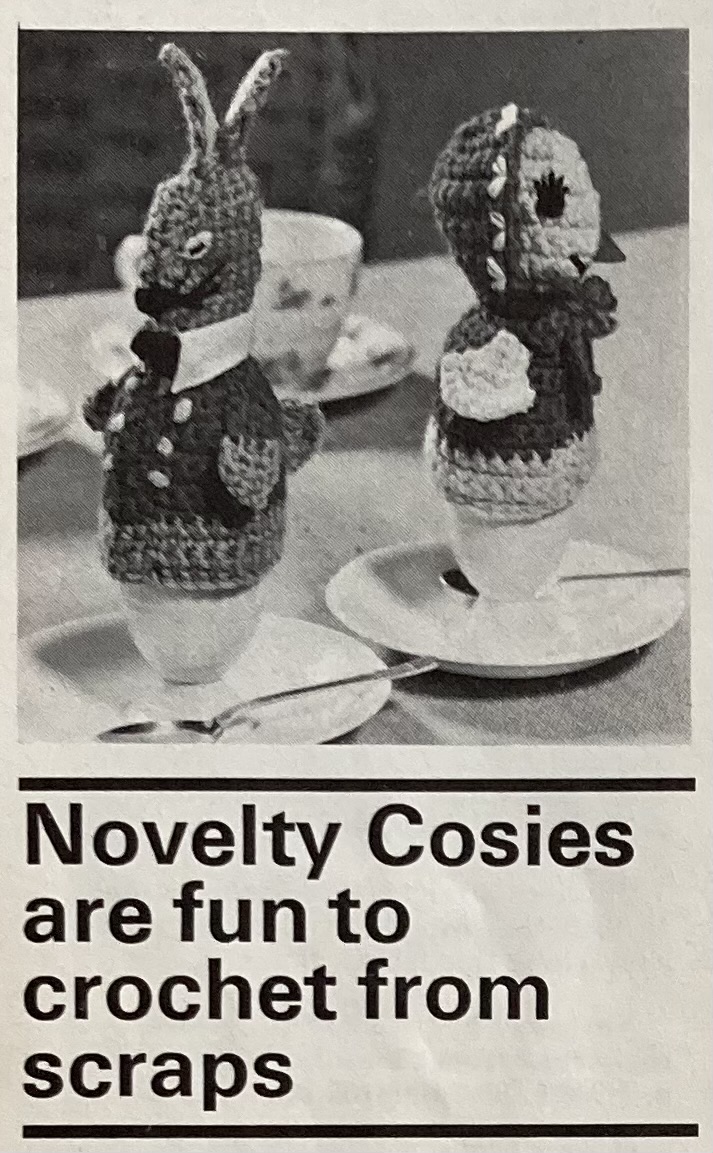
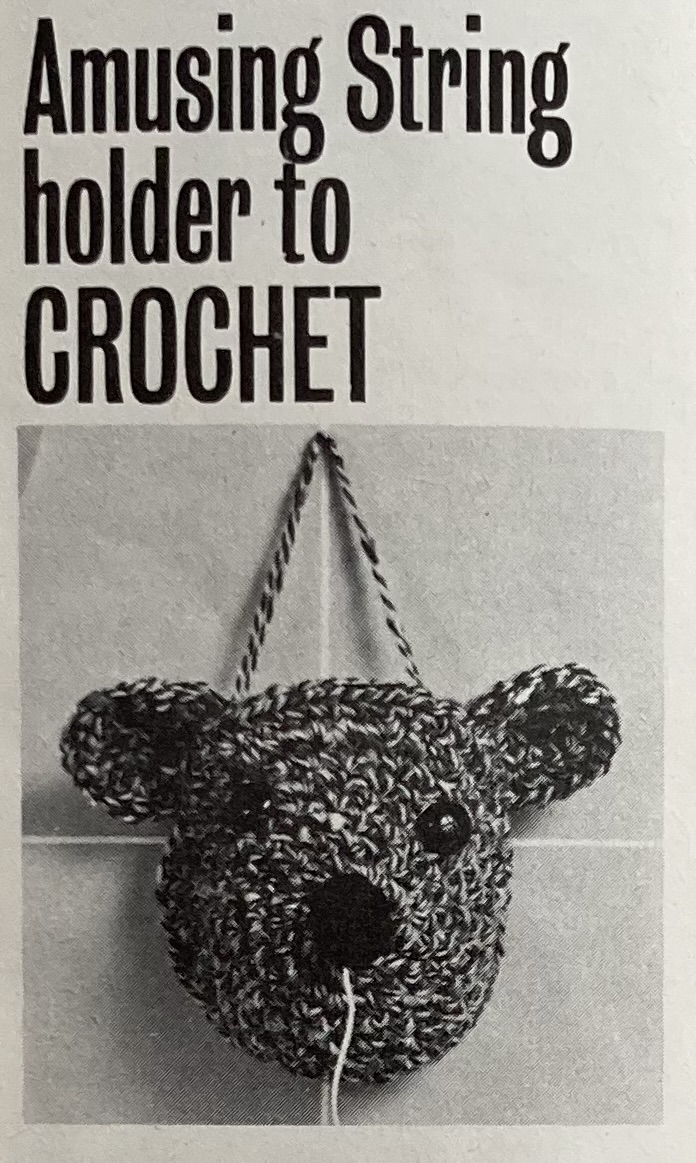
There are some great “novelty” and “bazaar” (…”bizarre” if you ask me) items in the Readers Pages: crocheted rabbit and chicken egg cosies and an “amusing” string holder. Like the Humpty Dumpty obsession, I don’t get the point of string holders. They always seem to involve pulling the end opf a ball of string through the mouth of some creature, in this case a koala. It’s better than the last one, which was a terrifying clown, but again, if you know why this was ever a thing, please enlighten me! The felt pincusion to wear on your wrist, on the other hand (heh), is practical and useful.
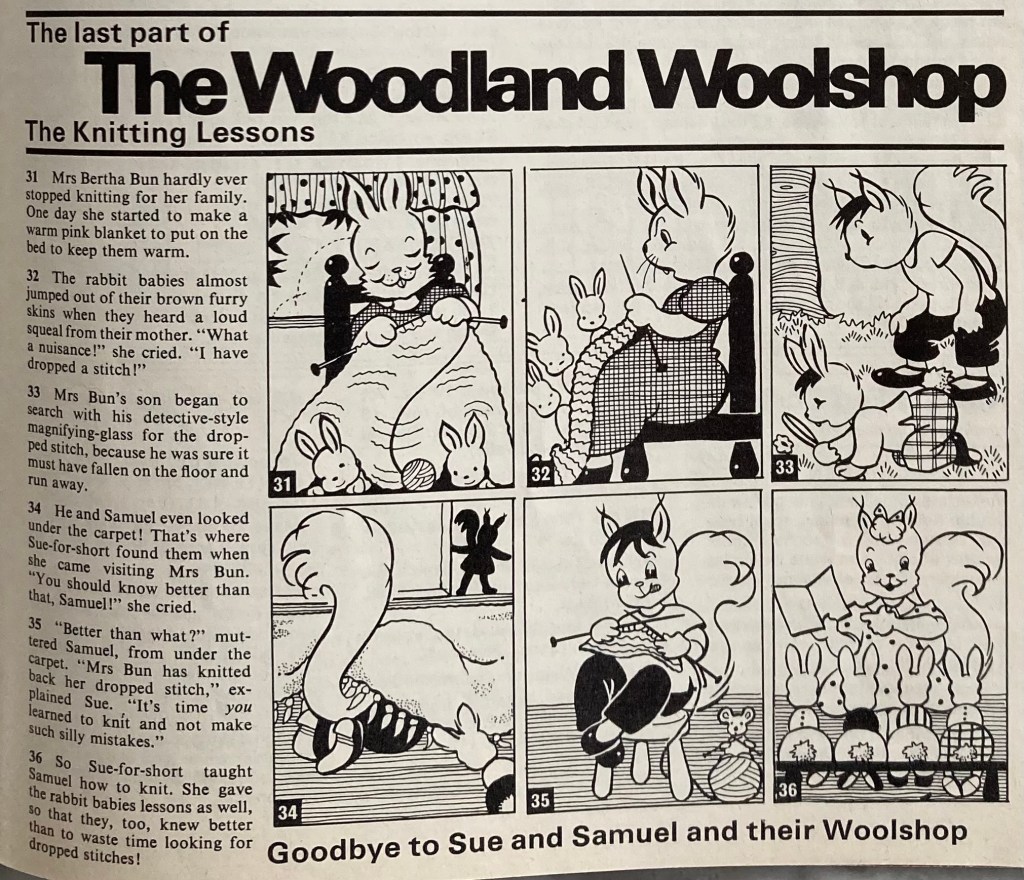
We have come to the end of our latest comic, “The Woodland Workshop”, in which various woodland animals learn that you cannot find a dropped stitch by looking for it on the floor! Words of wisdom, truly. I liked this comic.
I don’t know what to make from this issue. I love the little girl’s tunic-dress and the boy’s sweater, but don’t know any children of that age who might want one. I love the trellis stitch pattern from the “Country Mood” set, but don’t want to make a whole skirt or cardigan from it. Maybe I could adapt the pattern for mitts or something? Or I could work on the fabulous dress from the cover of the September 1967 issue, for which I bought the yarn and everything, but haven’t had time to start. We’ll see! I did finally finish the jaquard pullover from the November 1967 issue and will update that post on Tuesday, so stay tuned.
January 1968: Knit for a Cold Snap

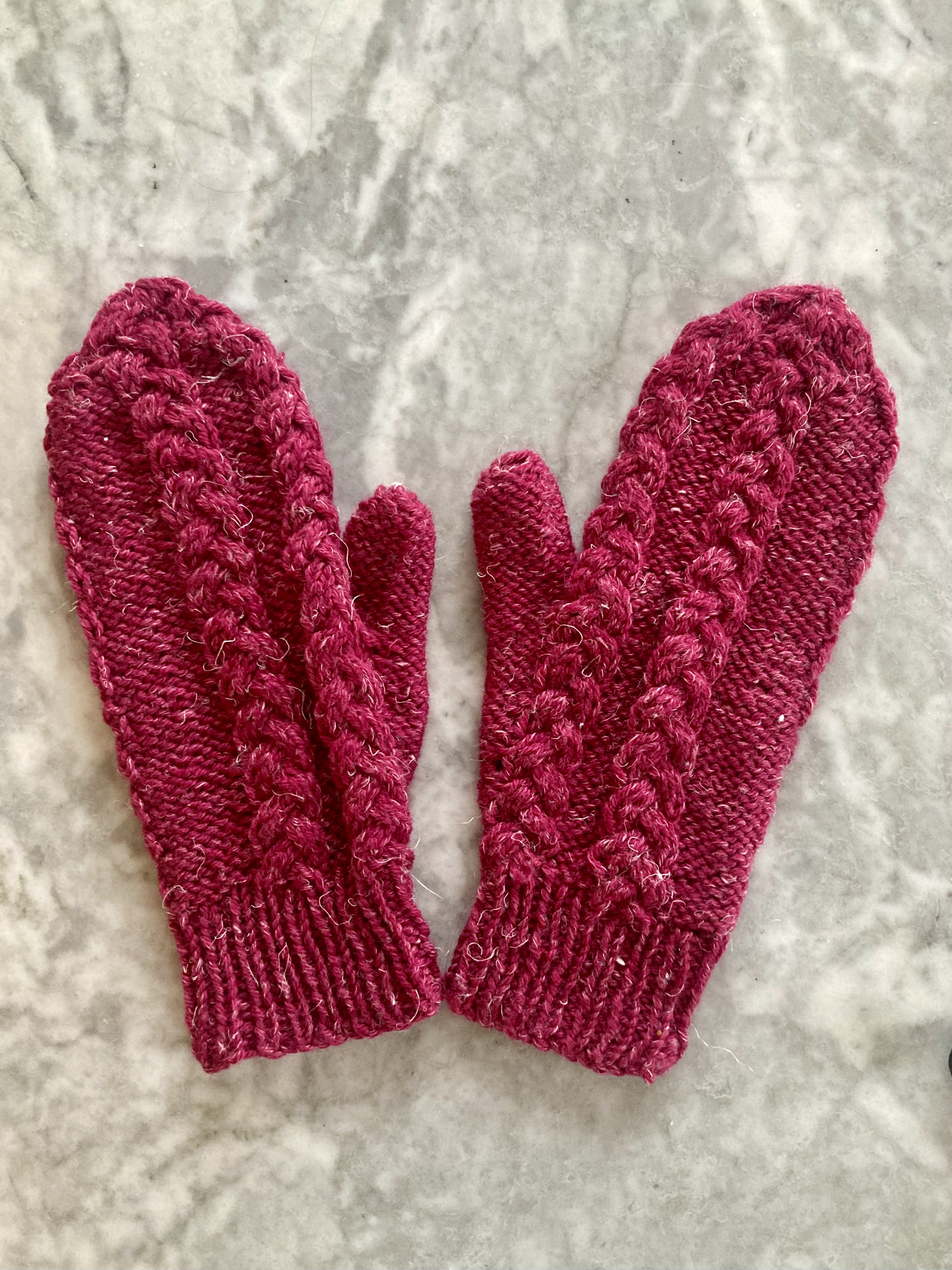
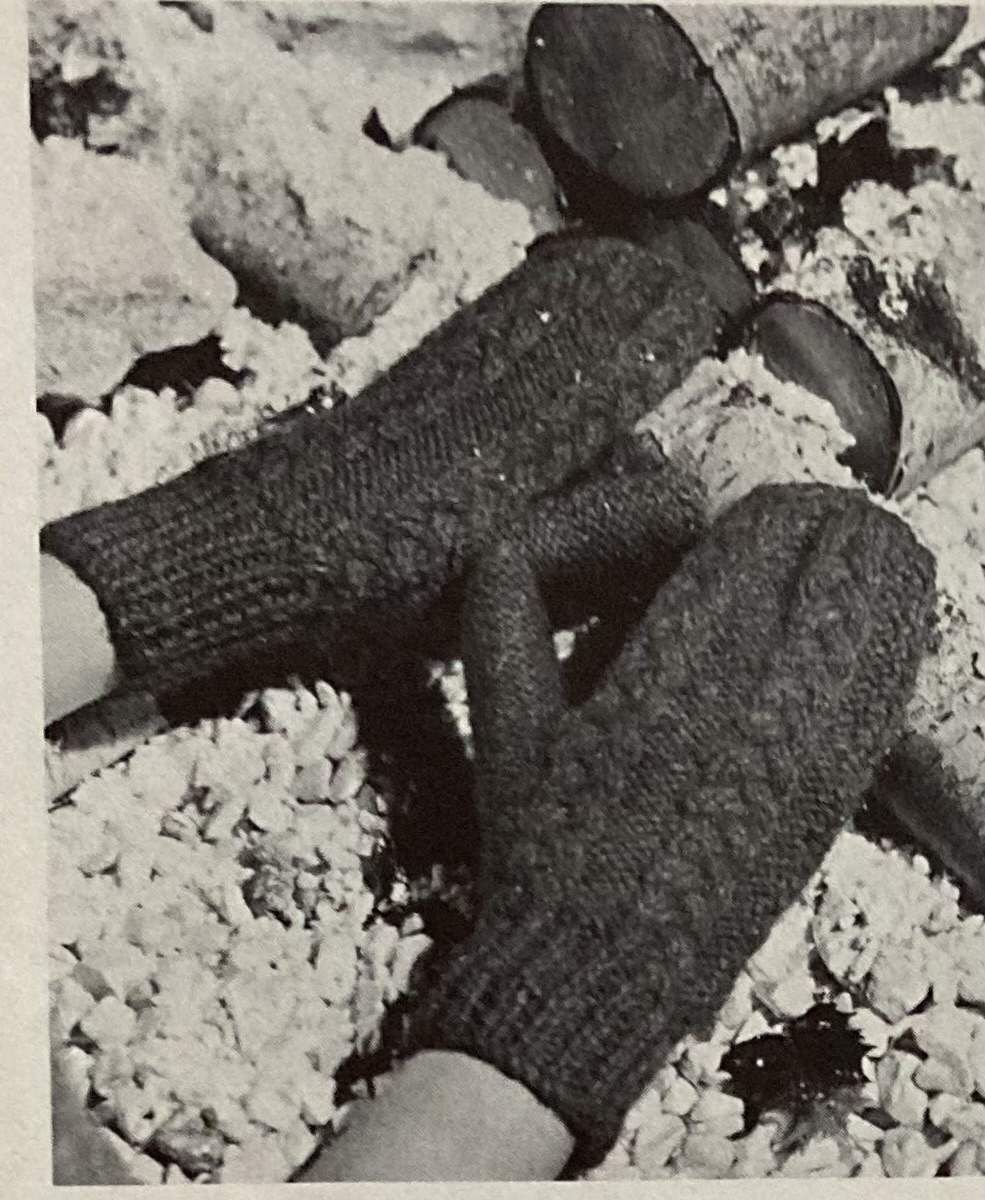
It is currently minus 13 degrees Celsius outside, so this caption from the January 1968 issue of Stitchcraft couldn’t have been timlier for this month’s project: cabled mittens (“mitts”) that promised me “Cosy fingers and thumbs”.

The pattern is written for Patons Ariel wool, which was marketed as being very airy (hence the name) and fluffy, so it would knit up quickly and be bulky, but not too heavy. It was made of 80% wool and 20% synthetic fibres. I used lovely Lana Grossa Slow Wool Canapa, bought a while ago from the “sale” bin, as it was sadly being discontinued. It is made of 90% wool and 10% hemp, which gives it tweedy white flecks.

The pattern is written to fit an “average hand” (women’s). I assumed my size 8 hands were larger than that, but also having never worked with Patons Ariel and being too lazy to make a swatch for such a small project, I went ahead and started with the suggested needle sizes and figured I could make any necessary adjustments while knitting.

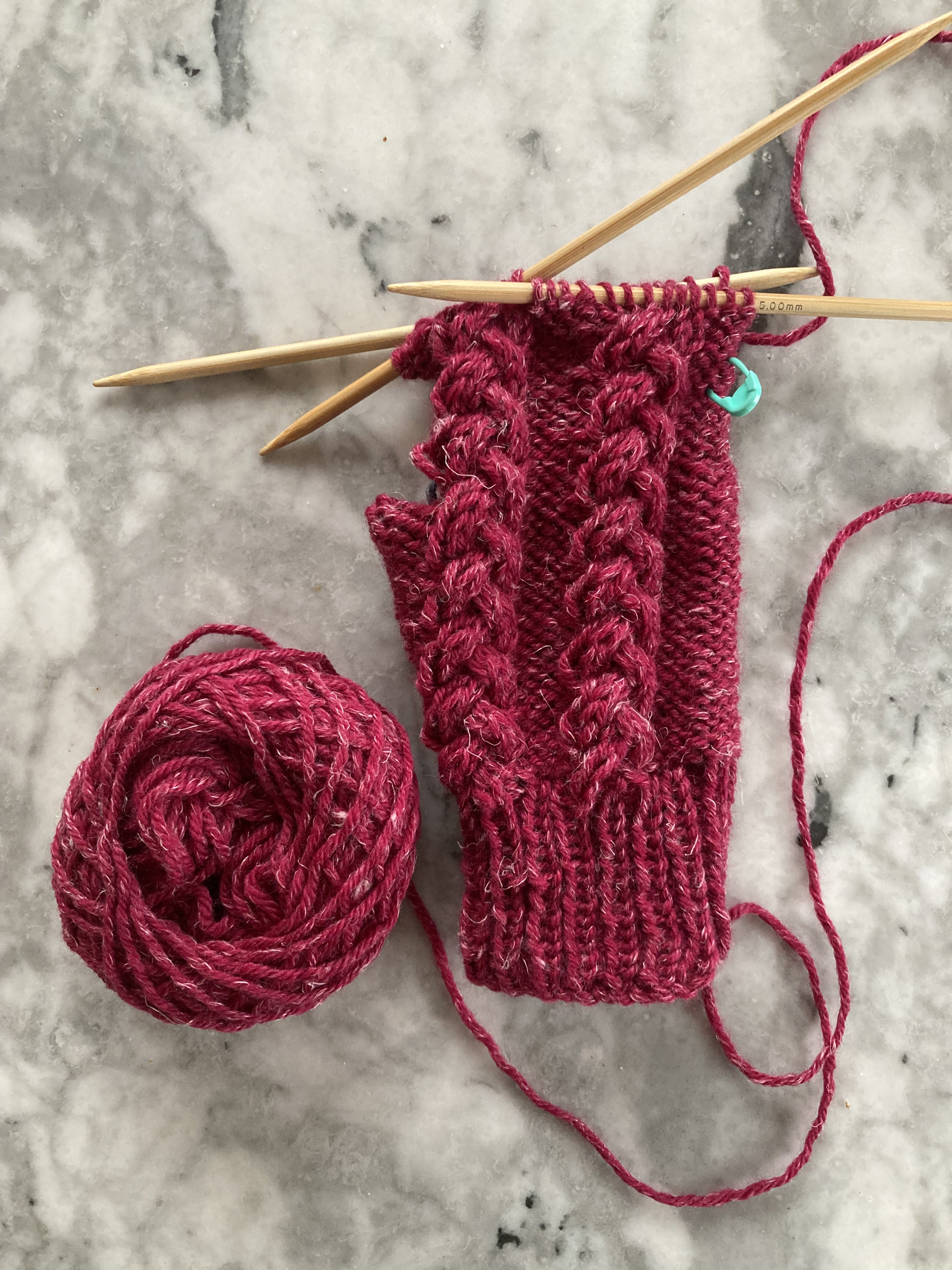
The pattern is intended to be knitted flat from the wrist ribbing to the fingertips and then seamed up on one side. There is a thumb gusset and you are supposed to knit the thumb (flat) at the point where the thumb starts, then go back and finish the hand, picking up stitches that were cast on on the left or right side of the gusset to shape for the right or left hand. I made everything in the round and finished the hand before knitting the thumb (also in the round.) That made the gloves basically identical, but I found a way to finesse the thumb pick-up stitches to make the thumbs lie slightly differently for the right and left mitten. The pattern itself is four regular 6-stitch cables on a background of reversed stocking-stitch.

They came out very nicely and the fit is perfect for me. The only problem is that I prefer to wear gloves with fingers, or “convertible” gloves with half-fingers and then a mitten top to fold over them. I also don’t have many if any clothes that match the colour (though they do match my hair!) So I don’t know if I will keep them for myself or give them to someone as a gift.

In any case, a success, and finished very quickly. I’m considering making the baby romper from this issue as well, or just using the “extra” time for finally finish my November project… and/or any of the many other winter WIPs. Stay warm!

January 1963: Overview

Happy New Year, everyone! It’s 2021 in the real world and 1963 in the Stitchcraft Sixties blog world. The real-life 1963 was a turbulent year: the Cold War escalated, as did the war in Vietnam; the civil rights movement in the US both gained ground and suffered violent setbacks; John F. Kennedy was assassinated; the Second Vatican council entered a new phase. In England, scandals abounded in the wake of the Profumo affair and the divorce of the Duke and Duchess of Argyll. On a happier note, the Beatles recorded their first album, Please Please Me, kicking off Beatlemania around the world, and women in Iran gained the right to vote. Also, the smiley-face symbol was invented. 🙂

Of course, none of this — not even the Beatles or the smiley face — had any direct influence on Stitchcraft (certainly not in the January issue, before any of it happened…). What we think of as “1960s fashion” — the miniskirt, the “space age” look, the shift dress, the Mod look, the hippie-bohemian styles of the later years of the decade — was just gearing up around 1963, and Stitchcraft was a fashion-conservative magazine. That said, holdover fashions from the 1950s like fitted, waist-length cardigans and wide, swingy skirts have disappeared completely by now; the female models often wear trousers or “slacks” and casual, bulky-knit sweaters are ubiquitous.

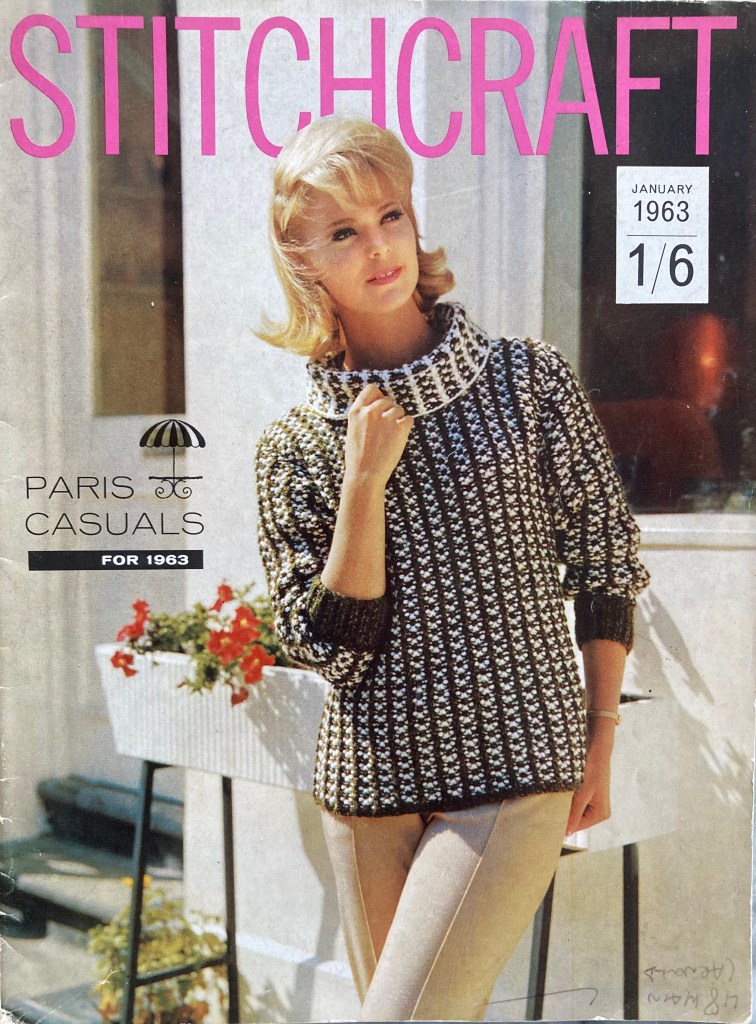
So what does January 1963 have in store for us? The theme of the January 1963 issue is “Paris Casuals” and resolves to start with “a bumper all-round family number.” For adults, that means warm, comfortable jumpers and cardigans in a range of wool weights with V-necks or interesting collars and textured stitch patterns. The cover garment epitomises all the trends: made in bulky Big Ben wool in a two-colour slip stitch pattern, it sports “this season’s Paris collar choice and longer line.” The textured raglan cardigan is a similar look, as is the man’s casual cardigan on the back cover. The bouclet cardigan gives a nod to earlier fashions with its choice of fine wool and classic shape, but here too it is longer and looser-fitting than previous classic bouclet garments. A simple collared jumper in double knitting with attractive fine details rounds out the adult garment selection.

There are great winter fashions for children, first and foremost the girl’s skating set of skirt and collared pullover. Unfortunately, I suspect something went wrong with the sample knit, as both pictures show the model turned 3/4 away from the camera and it’s not clear how it is supposed to look from the front. (Also, could someone please give her some warm tights to wear before she goes out onto the ice.) Toddlers get a cute “buster suit” with a design of cherries on the jumper, and older children get a wonderful hoodie (to use the modern term) and jumper-cap set to wear while playing in the snow. (Or in the photo studio — check out the snowman and snowball made of wool and/or cushion stuffing fluff!). Crisp, wintery colours of blue and red with white are trending. Notice also that the girl model is wearing trousers, the hooded sweater is unisex, and the model wearing the red outfit in the black and white photo is allowed to be active and tomboyish for once. I wouldn’t even have known she was a girl if the sweater weren’t (for whatever reason) considered specifically a girls’ garment. Slowly, very slowly, roles are changing.

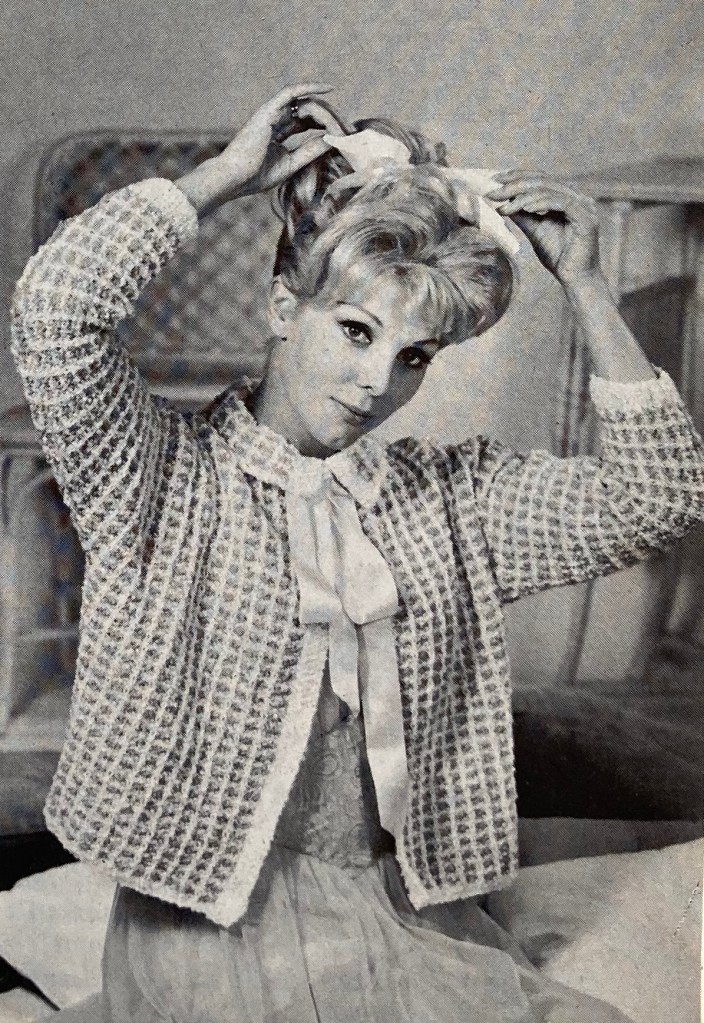
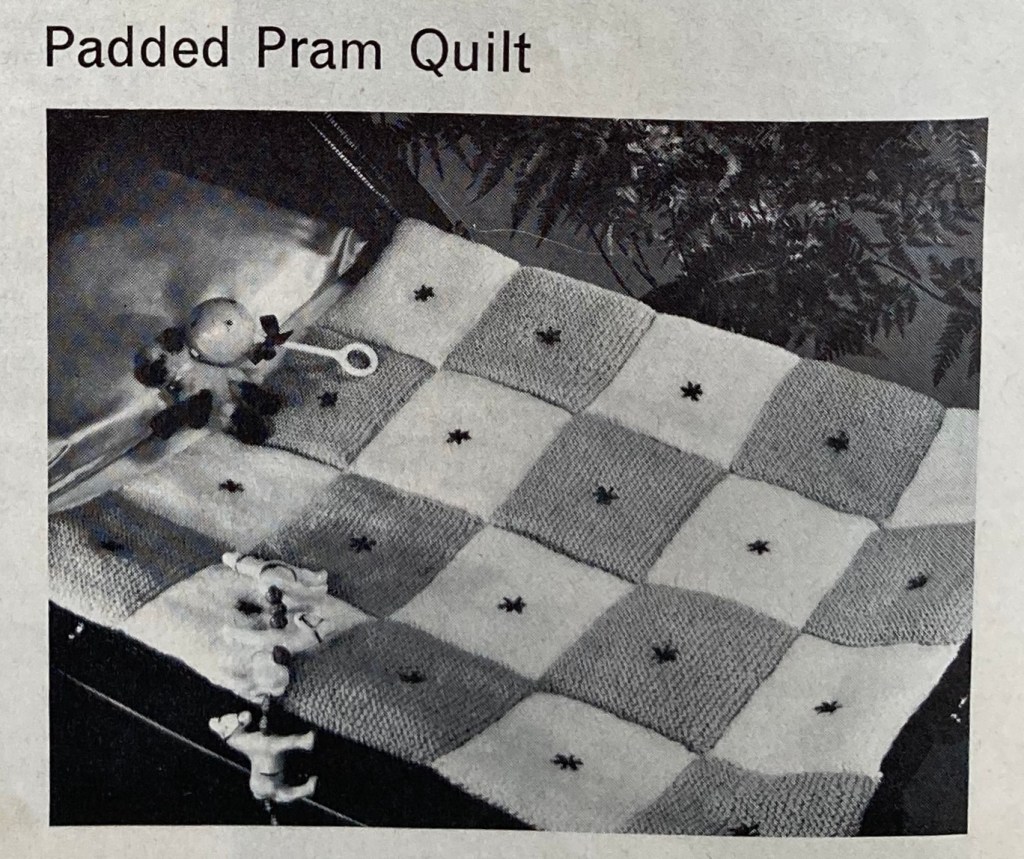
Babies get a pram cover instead of a garment this time — padded and quilted to be extra warm — and there’s a cute bedjacket and fantastic “tower” hat that is perfectly in fashion. (Side note: The caption, “PARIS HAT”, makes me think of that line “If a Harris pat means a Paris hat, Bébé… ooh la la!” in “Always True To You In My Fashion” from the musical Kiss Me, Kate. In true Cole Porter style, it’s an upbeat love song… in which the singer explains to her boyfriend that her dalliances with other men for gifts and money — basically sex work, though of course not explicitly described in those terms — shouldn’t count as infidelity, since she’s only doing it for the financial benefits and is true to him in her heart. Ah, romance! Anyway, the hat is great.)

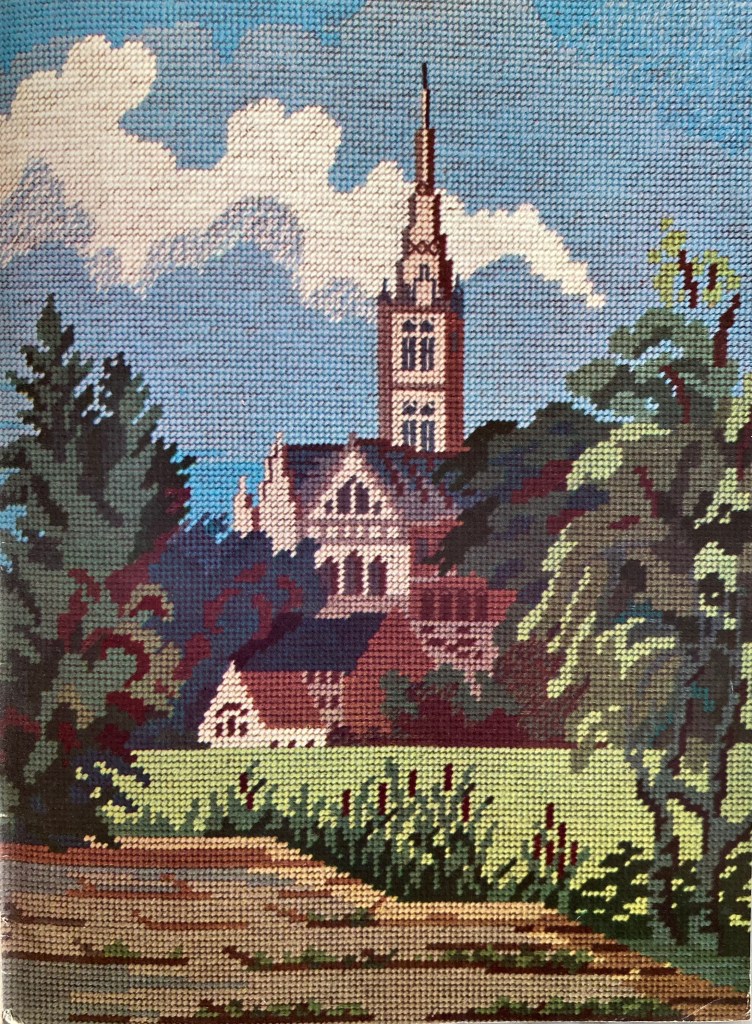
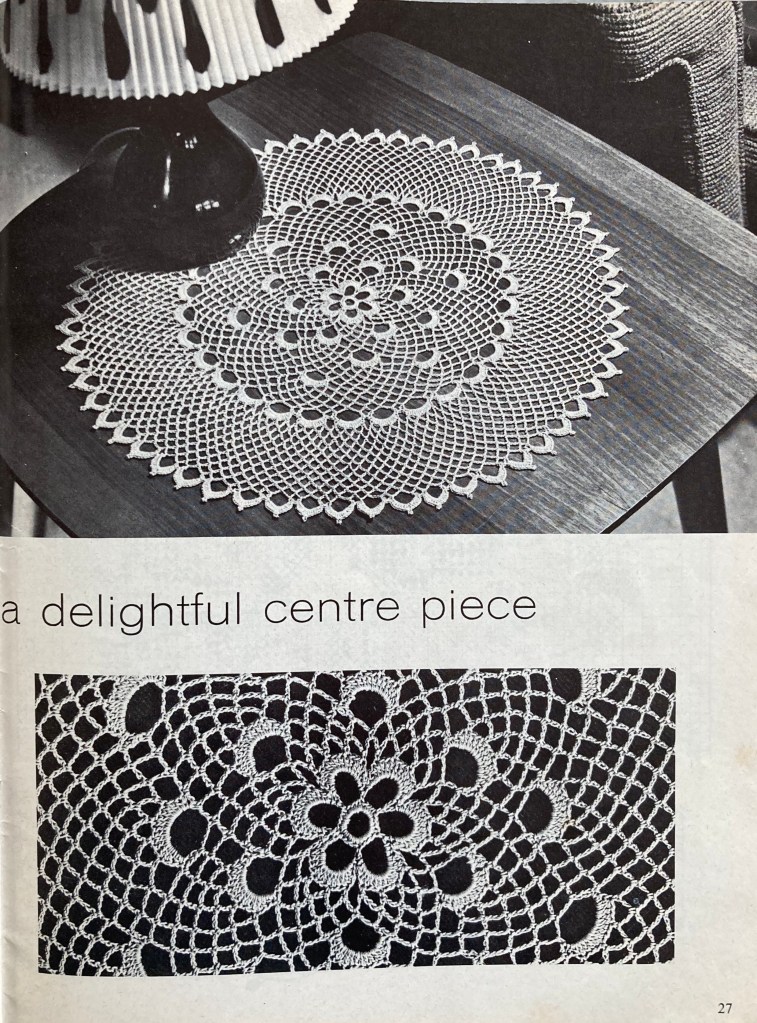
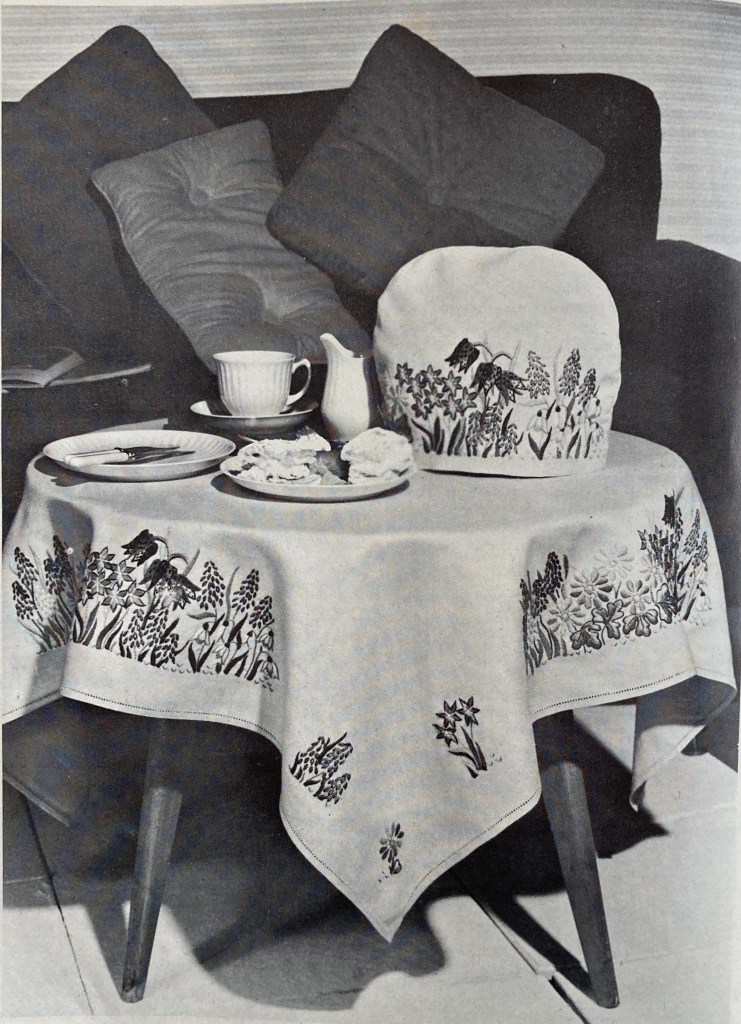
With all the great knitted items, home fashions are pretty standard this month. There are rugs and cushions, a lovely embroidered tablecloth and tea-cosy set, a tapestry picture, a cutwork table set, a very impressive crocheted doily and a hassock or kneeling cushion for church-goers.

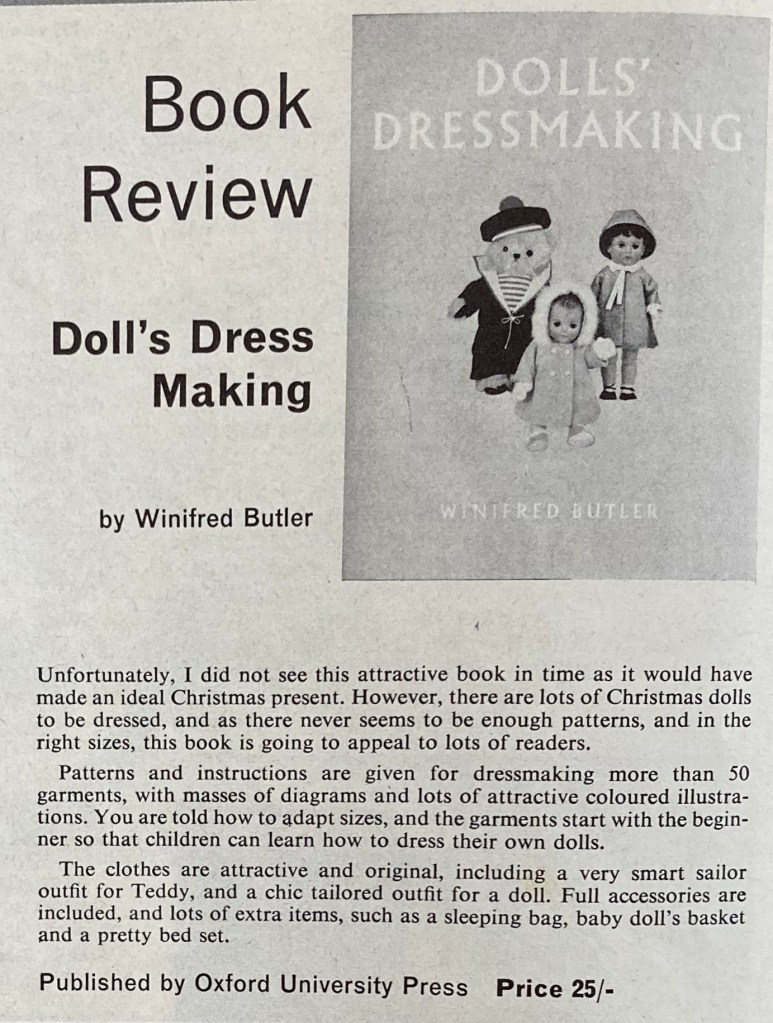
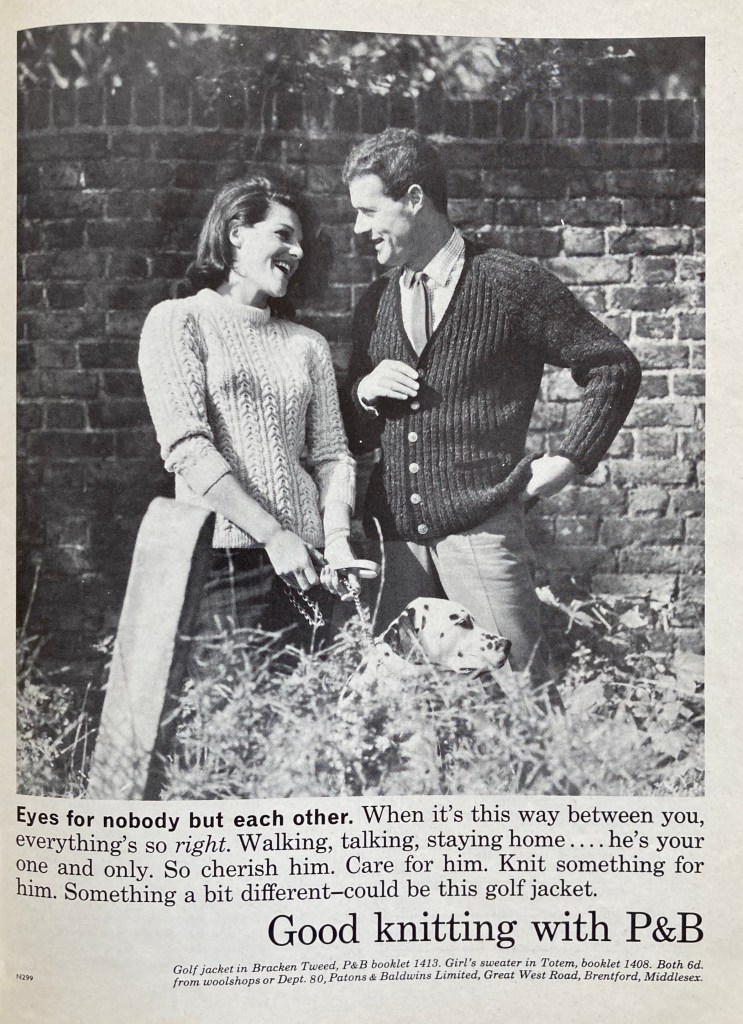
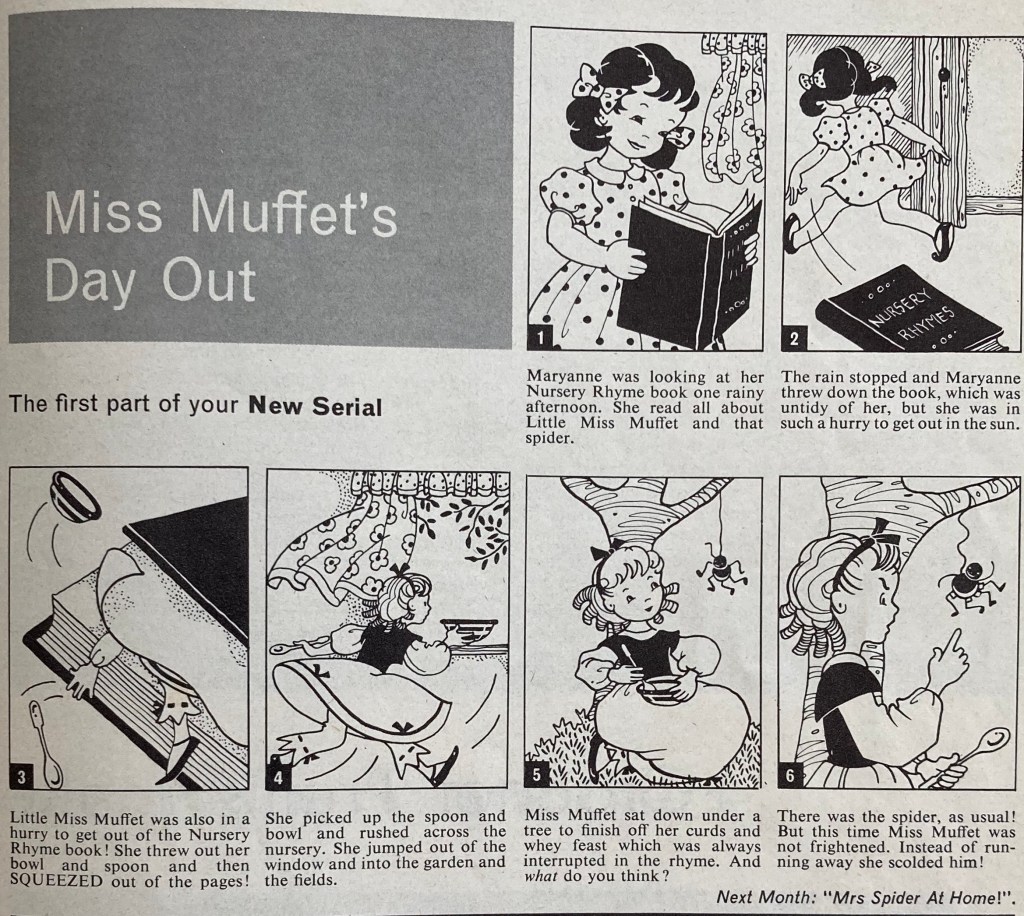
The “readers’ pages” have a review of what was probably a very interesting book on dressmaking for dolls, and –bucking the “single girl” trend of the early 1960s — we’ve got another “stand by your man and knit him something” ad for P&B wools (though this one is really quite sweet and romantic, unlike the “you only exist to be pretty for him” ad seen in other issues). There’s also a new cartoon serial for children: a re-telling of the “Little Miss Muffet” nursery rhyme, where Miss Muffet is not at all afraid of the spider. I’m sure, when she grows up, she will be not at all afraid to suggest to her man that he knit something for her for once.

My project from this issue will probably be a scaled-down version of one of the children’s sweaters for a smaller child. Stay tuned!

May 1962: Overview

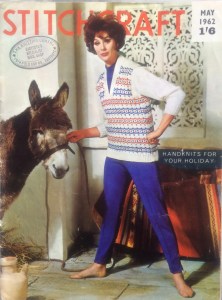
IMG_3237Handknits For Your Holiday! If you are planning on taking a holiday in 1962, that is. In that case, I would recommend going to the Algarve in southern Portugal, which, based on the pattern of the window shutters and blanket in the background, is where I am guessing this magnificent cover photo was taken. Sadly, my time machine is out of order and May 2020’s motto is (Lots Of ) Handknits For No Holidays This Year Or Probably Anytime Soon.

I bought my copy of this issue on Ebay, but apparently it originally came from “The Knitting Centre” on Field End Road in Eastcote near London. I actually checked to see if it still existed but sadly, it seems to not be there anymore, nor is there any other knitting or craft shop in the area as far as Ravelry and the digital map can tell me. It would have been fun to be able to trace a 50+-year-old knitting magazine issue back to its origin!

Like most of the late-spring or summer issues, this one has a mix of quick, warm, bulky sweaters for holidays in northern climes and some finer, dressier items for that special going-out evening. “The boy friend” can get wild in a colourful, oversized mid-weight sweater, while “you” enjoy your evening in a bobbled jumper. For casual outings, there’s a raglan polo-neck and the “latest look in twin sets” — a short-sleeved jumper in lighter-weight wool with a heavier V-neck top worn over it. (The donkey seems to like it.)

The “cooler trend for summer” includes a pretty short-sleeved blouse and a fine-knit jumper with a lacy yoke as well as a cute dress and cardigan for a small child, made in terry-cloth Rimple yarn with fluffy appliquéd chicks.

Older children get their own holiday hand knits and nothing says “1962” like this little girl sporting a spectacular up-do, thick warm cardigan, knee socks and basically nothing else on her body. How is she supposed to play badminton in a skirt that doesn’t even cover her bottom when she’s standing still? Her tomboy sister gets a much better deal in her knitted shirt and shorts. White and pale colours are always on point for summer and lemon yellow is the new colour trend.

The homewares department is quite boring this time, but there is a reason for that, as “editress” Patience Horne explains on the facing page:

After our end-of-the-year check through our embroidery and tapestry features, it is clear that designs of the more traditional type head the list — others in a modern style are way down and definitely have more limited appeal. I think this is because more traditional designs never date and seem to fit in well with most homes, whereas a completely contemporary design requires almost its own special setting.

Well, there you have it. Readers usually had to send away for the embroidery transfers, so it must have been easy enough to determine which designs were most popular, and the most popular embroidery designs of 1961 and the most popular embroidery design of 1960 were “peasant motifs” and two Jacobean cushions, so we can expect more of the same. The May 1962 Jacobean cushion is certainly very pretty and there’s also a cutwork tablecloth, other table linens and a “Chippendale” tapestry stool.

There’s also a “cushion for the car” with the cryptic motif “II3LMF” on it. I assume it must be a reference to some sort of gearstick / gearknob / automobile part code, but I can’t interpret it and Internet searches for vintage gearsticks led me nowhere. Are there any vintage car aficionados out there who can tell me what it means? EDIT: Gretchen aka Stashdragon solved the mystery for me in her comment below. The centre panel is a customisable area for the car’s registration/license plate number and the chart gives you all the letters and numbers you might need to personalise it. Guess I should have read the pattern text! Thanks, Gretchen!

That’s all for now. My May project will be the 3-ply jumper with the lacy yoke. Get well and stay well!

December 1961: Overview

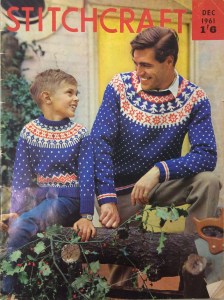
IMG_2973It’s that time of year again and December 1961’s issue has a lovely festive cover photo featuring matching father-son jumpers and a freshly-cut-down Christmas tree with holly branches. The jumpers are meant to be made in flat pieces with only the yoke worked in the round, but everything about them other than that is in the traditional Norwegian style, with a small snowflake pattern on the body and sleeves and a round yoke with tree and star patterns. I like that the jumpers’ pattern theme and colour choice are not so very specifically Christmas-y that they couldn’t be worn at any other time, or by people in our more diverse and modern times who don’t celebrate or don’t care much for Christmas and would just like a nice warm jumper with a wintery flair.

1961 Stitchcraft, of course, celebrates Christmas in a big way. Most of the projects are either glamorous party-wear for the ladies or gifts of all sizes and sorts for family and friends, while the fashionable housewife can do her Christmas shopping in a flecked-tweed cardigan suit similar to the ones in the November 1961 issue, or keep warm on casual days with bulkier sweaters. Tweed and contrasting polo-neck collars are in fashion all around.

For those fancy parties and evenings out, there’s a cocktail jumper in popcorn stitch, an angora stole, and an embroidered and sequinned evening bag. The jumper is knitted with wool and Lurex yarn held together, giving it a bit of sparkle. The stole is absolutely timeless and modern as well as easy to make (a rectangle in simple lace pattern with garter-stitch borders) and probably quite warm and cosy to wear over your strapless evening gown at the theatre. The bag is fancy, yet inexpensive to make, with a very 1960s “modern” look. Even after the party and the night out are over, you can still look glamorous in a knitted pink bedcape.

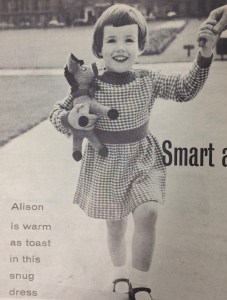
IMG_2982Children of all ages can look forward to practical, yet stylish winter garments — a knitted outdoor play-suit for toddlers in warm, bulky Big Ben, a smart fine-knit twin-set for girls of varying ages (sizes from 26-30 inch chest) and a wonderful knitted dress in a two-colour slip-stitch pattern that fits right into the tweed trend. The photo caption claims that Alison (the young model) is “warm as toast” but of course, her legs are going to be cold! She still seems pretty happy, though.IMG_2981
For me, the best, and sometimes goofiest, projects of every December Stitchcraft issue are the homewares and “novelty gifts”. This year, some are quite normal, like the snowflake-pattern table mats “for a supper party” pictured above, a cutwork tablecloth, or the tapestry stool cover in a diagonal Florentine pattern. Some are specifically winter- or Christmas-themed, such as the knitted cushion and a framed tapestry picture of angels. Two are very classic and beautiful and have nothing to do with “the season” — a typical Jacobean chairback and a very pretty tray cloth embroidered with anemones. They are all quite nice, if not particularly special.

And then there are the novelty gift ideas, or, as they are titled here, “gay mascots.”

The knitted teddy bear is nice enough, but looks quite stern with its unsmiling mouth and sharp, downward-pointing eyebrows. The snowman egg cosy… well, if you really feel the need to use an egg cosy, fine, it looks cheerful enough. Ivy-leaf pincushion, OK. The bear cub, though, looks like it’s about to attack! Something about its half-smile and the glint in its eye makes it look malicious. And the Father Christmas egg cosy… it’s hard for me to express exactly what’s wrong with it, but if I woke up on Christmas morning and found him on my breakfast place, I would expect to be getting coal in my stocking. Give me a gay mascot any day, but maybe not exactly these ones?!?

IMG_2980

I guess it shows just how difficult it is to embroider faces.

Our “Readers’ Pages” have the usual ads for fabric remnants and sewing machines as well as an extra pattern for a little knitted and embroidered scarf, some traditional Swedish pattern motifs and review of the exhibition of Swedish embroidery recently held at the Embroiderers’ Guild, and a comic in which Little Bobby gets a skiing lesson from a friendly snowman.

Merry Christmas to all of you who celebrate it and happy winter days to all! My December project will be to finish some of the many WIPs lying around (including the November blazer, I swear it is almost done) and use the evening-bag embroidery motifs on something fun and small like dinner napkins or a vegetable bag.


January 1961: Overview

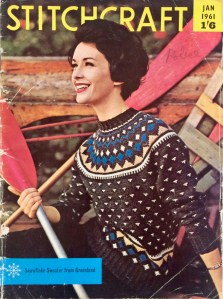
IMG_2256Happy New Year 2019! Or 1961, if you prefer. January 1961’s issue “starts with a swing” with “lots of colour” and “tip-top designs” like the gorgeous Greenlandic-style sweater on the cover.

Looking through the issue, I feel like this is the point in time where the 1960s started, fashion-wise. The closely-fitted, fine-knit, waist-length jumpers of the 1950s have made way for bulky, quick-to-knit garments, and nylon-mix wools like Rimple are more common.  Skirts are still long and hairstyles modest — we’re not in the “Swinging Sixties” yet — but colours are bolder and the whole look seems fresher, somehow.

The little girl’s outfit on the inside cover definitely embodies the new look. Yes, her legs are still going to freeze, poor child, but her little red Rimple outfit is swingy and fun. And look at that wonderful cap and muff! The decorations are made by cutting the bobbles out of a length of bobble fringe and sewing them onto a crochet chain made in contrasting green or red wool, then sewing the bobble chain onto the cap and muff. Mum and daughter can both sport the latest in “Paris Hat News”, which seems to be a sort of turret tower worn on top of your head. The loops on the bottom part of the adult hat are made by pulling loops through the knitting ridges with a bodkin or blunt tapestry needle and holding them in place with your thumb until they are all made and the wool fastened off.

Women’s and men’s fashions feature loose-fitting garments in bulky wools, either hip-length and unshaped like the Greenlandic sweater or the embroidered Viennese cardigan on the inside back cover, or “cropped and bulky” like the “slick jacket” made in thick Big Ben wool. For a more elegant look, you can knit a suit in double knitting weight and top it with a detachable fur collar.

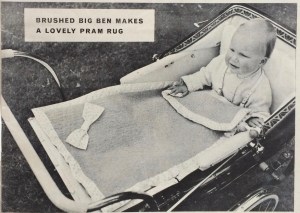
In addition to the little girl’s sets, babies and children can enjoy a warm cape or dressing gown in Rimple yarn, or a pram blanket in brushed, bulky Big Ben wool. The brushing felts the wool for a true blanket effect. It was done with a teasel, which is a metal brush that breaks up the fibres and lifts the nap of the fabric. Readers are instructed to send the finished blanket to Patons and Baldwins in Scotland, who will brush the blanket for you “at a very reasonable charge.”

IMG_2263

Jacobean embroidery, stitched hall rugs, and Victorian-style chair seat tapestry remain steadily in fashion, or you can embroider pictures of a kitten and puppy to hang on your wall. I don’t know about you, but to me they look kind of melancholic! This month’s Zodiac sign is Capricorn, and you can use it to decorate a pyjama case. In the children’s features, Wag and Wendy have tea with a toadstool fairy and kids can sew a simple tea-cosy set for their mother’s birthday.

My project will be the fabulous sweater from the front cover. I’ll be modifying the fit, though, as big and bulky is not my style. Thanks for joining me for the first year of this blog, and best wishes for 1961 — er, 2019!

March 1960: John’s new pullover

IMG_1550My second project for March — though it wasn’t finished by the end of the month — was a young boy’s pullover with a cute stripe-and-dot pattern.
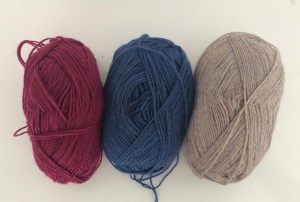
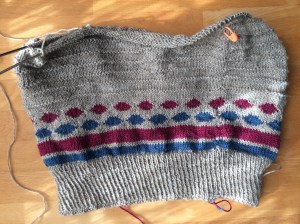
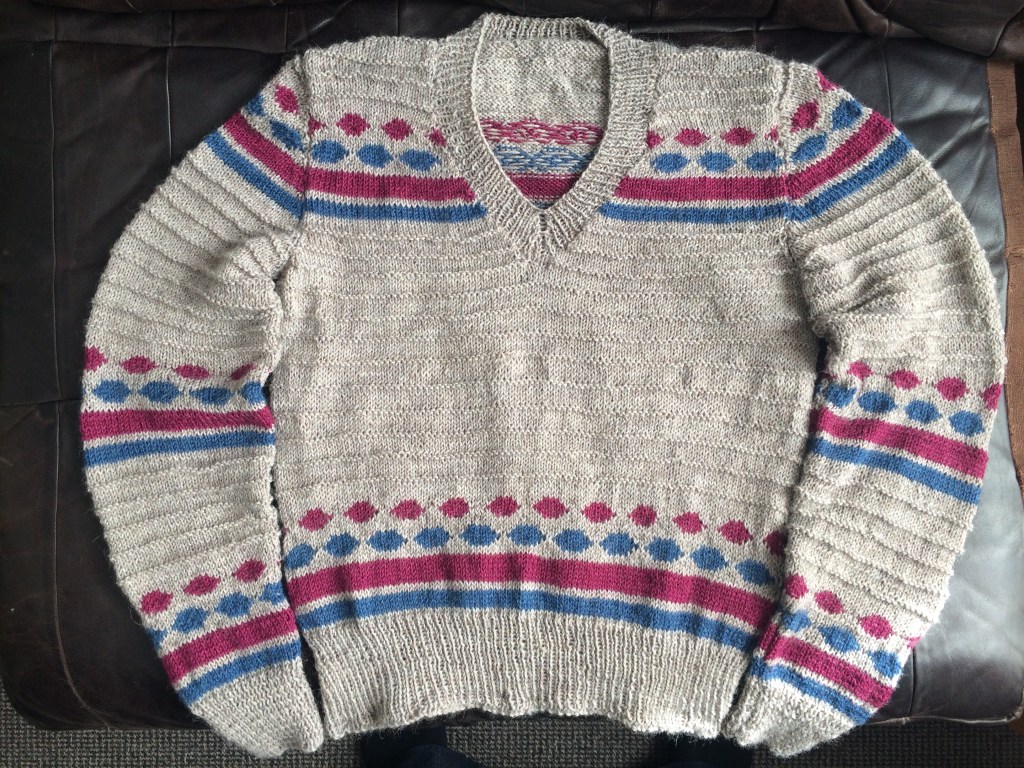
Sadly, there is no colour photo in the magazine, the two contrasting colours look very similar in the black-and-white photo, and the little chart for the dot pattern doesn’t mention which colour should be used for which row of dots, so it’s not entirely clear what order the dot stripes go in. The main colour is “Moonstone”, the bottom stripe is stripe is “Horizon Blue” and the second stripe “Camel”, so I figured the bottom row of dots is also blue and the second row camel.

In any case, my colour scheme was different, as very light-colored garments for young active children are bound to get grubby, so I picked a sort of heathery grey-beige for the main colour. Camel as a contrast to that didn’t look so great, so I picked a nice shade of plum and a heathery blue. The yarn is plain Regia sock yarn — superwash wool with a bit of nylon for support.

IMG_1588

I though the skeins looked great together but somehow, as I started to knit it up, the colour combination reminded me of jogging clothes from the 1980s. I don’t know why, exactly, but it’s something about that exact combination. I wholeheartedly hate 1980s fashion and am very disappointed to see it having come back in during the last few years, so I wish I had picked something different! On the other hand, nobody else is going to be bothered by it — a young kid won’t be prejudiced and the parents will probably think it amusing if they even make the connection.IMG_1591

The stranding is easy and the main pattern is just stockinette stitch with an extra purl ridge row (K on the right side) every 6th row.

At 7 stitches to the inch, it took a while, and I had to restart once as my gauge was too loose, but I do love the finished look and I hope the wearer will too. I reassured him that he doesn’t need to wear a button-up shirt, tie and shorts with it. Again, if anyone can explain to me why boys of bygone decades had to wear shorts until they were teenagers, no matter how cold outside or how warmly they were dressed on the top half of their bodies, I will be grateful!

pulli_fo

February 1960: Overview

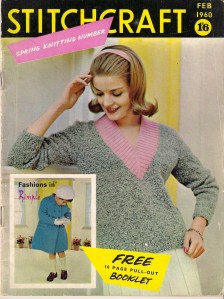
Feb1960_coverFebruary 1960, the “Spring Knitting Number”, features an extra 16-page pull-out booklet with garments in Patons Rimple, a nubbly wool-with-a-bit-of-nylon yarn that looks like terrycloth toweling when worked up. The Ravelry yarn database has more information with pictures and modern projects. The wool itself gives so much texture that it would be pointless to knit intricate patterns or multi-colour pieces with it, so the “zippy designs” in the supplement are made on very classic lines: V-neck pullovers, a plain cardigan, a child’s cap and mittens.
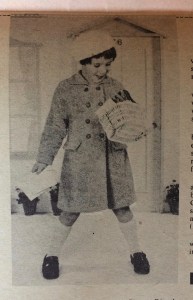
The only slightly more ambitious design is this double-breasted A-line coat for a child.IMG_1488 The model, like all children of the 1960’s and earlier, must have very cold legs. Why children of earlier times didn’t wear trousers or warm stockings or tights is a mystery that an older person will have to explain to me someday. It’s particularly strange to see in a knitting magazine, as often the child will be wearing a thick wool jumper or even a wool pullover under a wool sleeveless dress with a knitted wool coat over it, plus a hat and mittens if outside… but nothing on their poor bare legs.

The non-Rimple knitted garments are long, like this “Fashionable Dress” in 4-ply fingering at 7 stitches to the inch, or the long coat in a two-colour slip stitch pattern. Even the dolman cardigan is hip-length. The embroidery and needlepoint projects cover various traditional styles with a Victorian ribbon-band pattern for a stool top, a cushion with Tudor-inspired pears and acorns, and a very zig-zaggy “modern” Swedish rug and cushion set. The Swedish rug has a neat three-dimensional effect thanks to tufting.


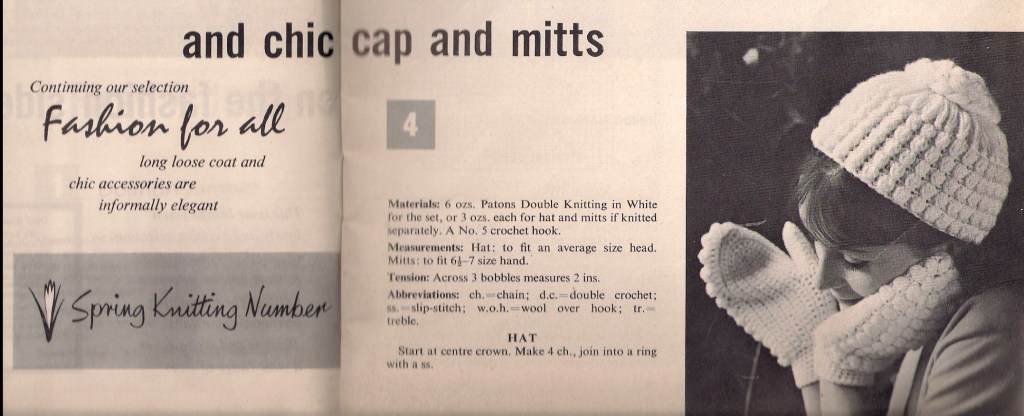
As the focus of the issue is the Rimple supplement, the other projects in the issue are fairly basic: cardigans for men and boys, a crocheted cap and mitts, an embroidered wall panel and counted-stitch cushions. The ads are for fabric, knitting and sewing machines, and “Cow and Gate” baby formula — all standards — and the two teddy bears in the comic are heading off on Magic Way in their enchanted toy village.

Rimple is not my style, so I’ll be making a small project this month: the crocheted cap and mitts with an intriguing bobble pattern and plaited crown.Feb1960_2