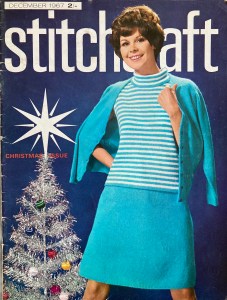
December 1967: Overview

It’s here! The December 1967 Stitchcraft Christmas issue is a “bumper number to help with last-minute ideas for your Christmas giving, and suggestions for your winter handicrafts.”

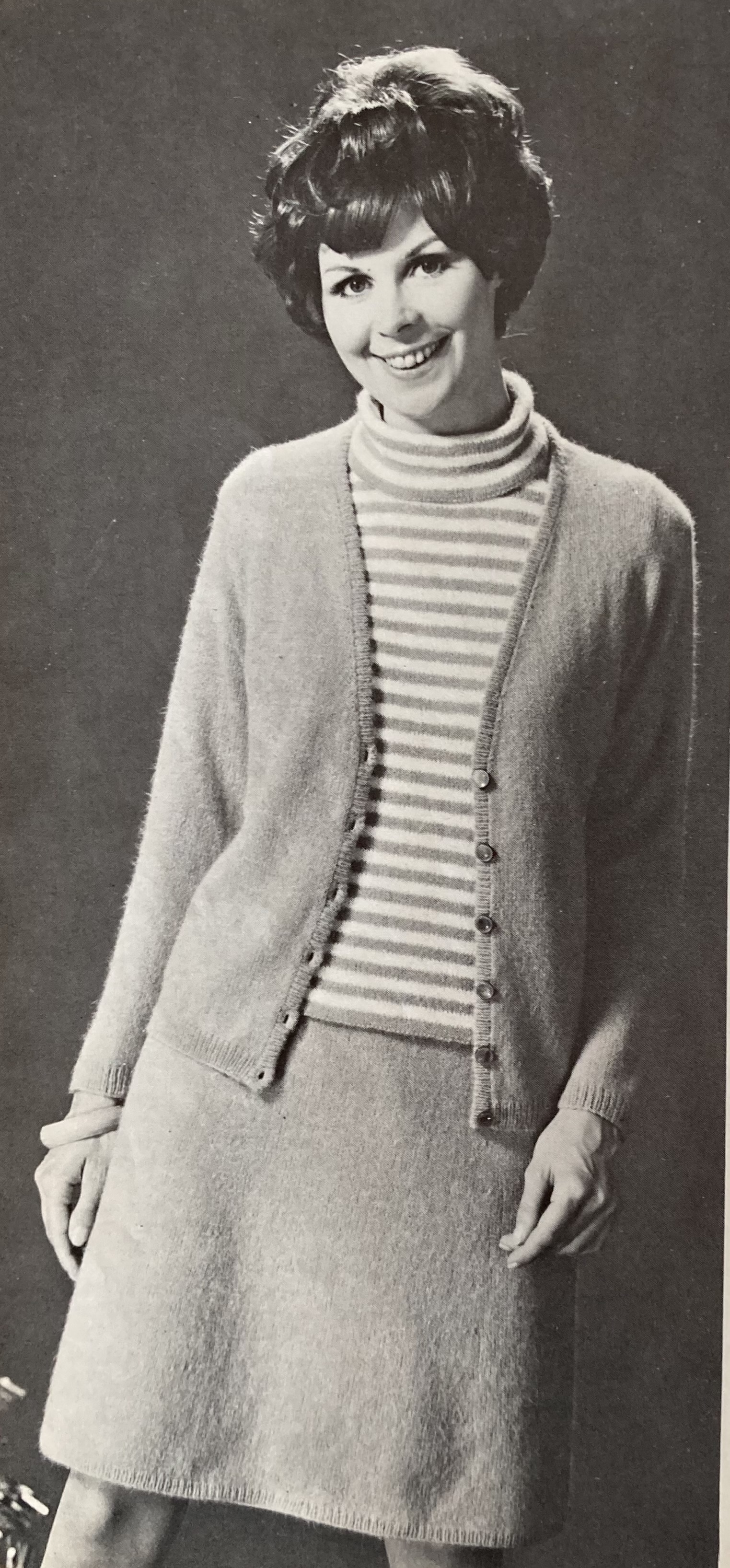
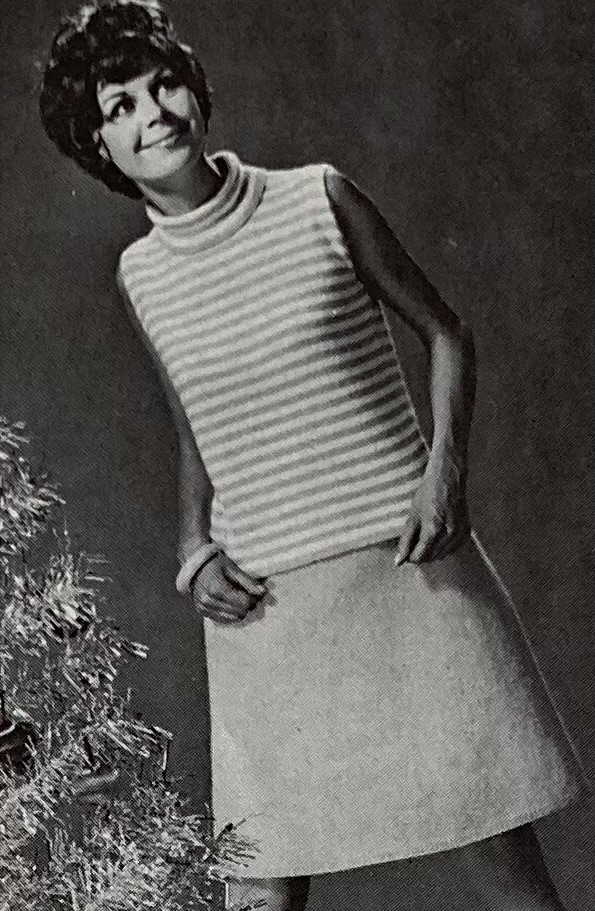
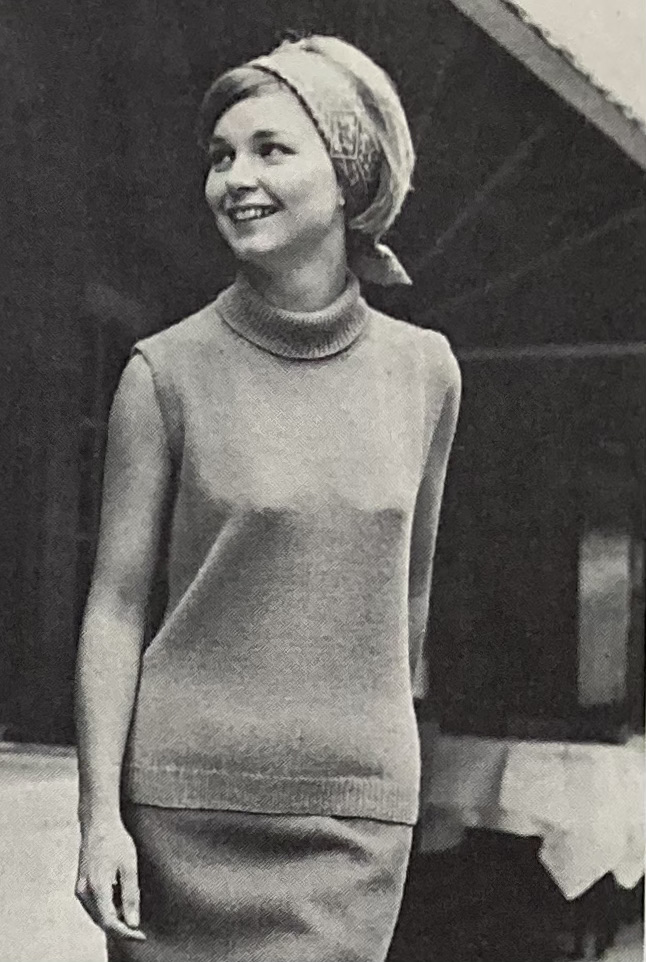
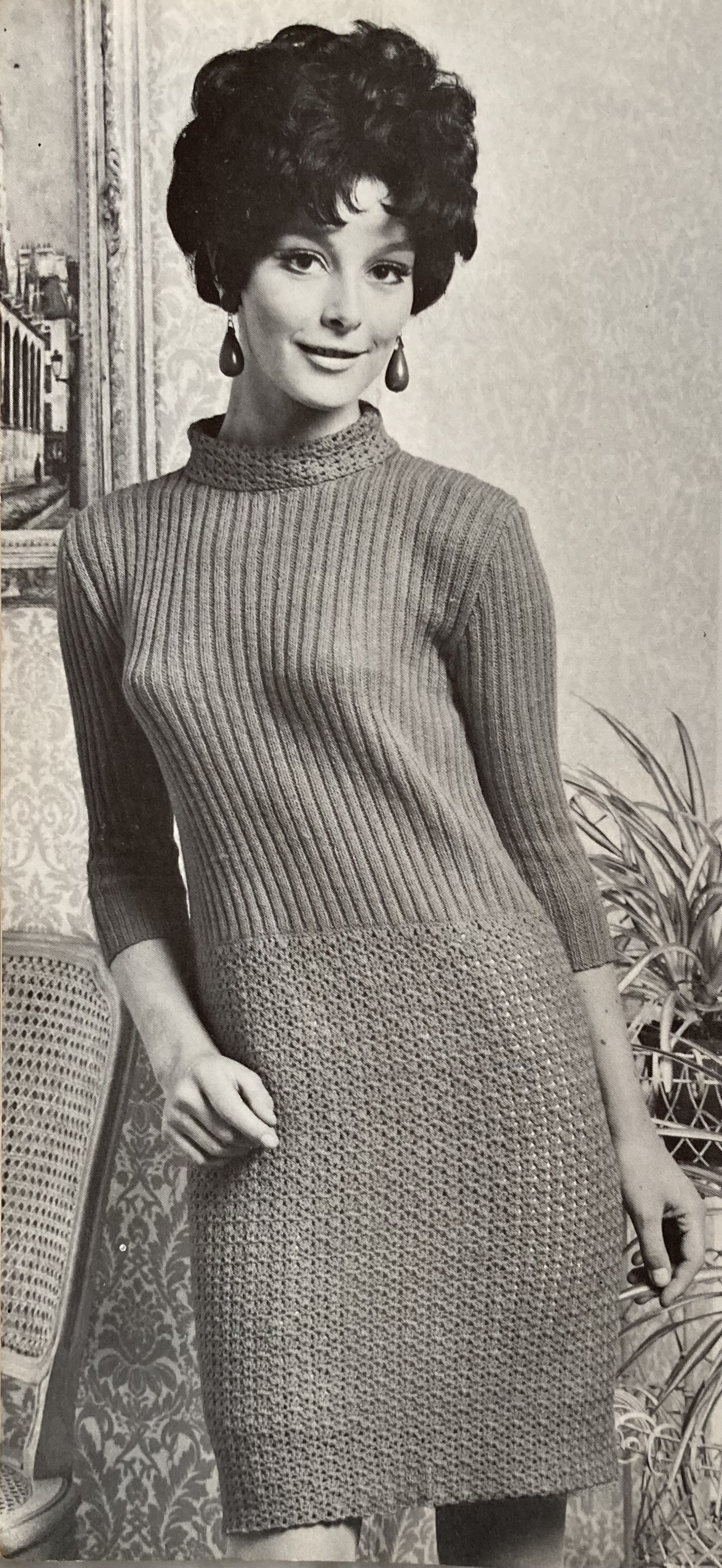
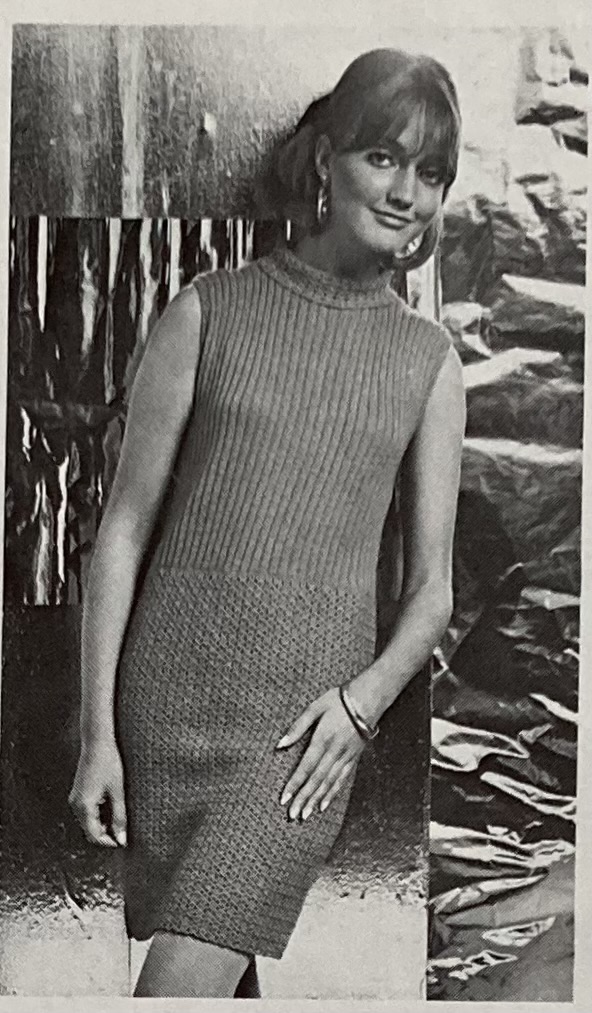
The cover photo went with a wintery blue, white and silver colour scheme to set off the featured 3-piece skirt suit. It’s knitted in Patons “Princess”, a light, fluffy yarn made of 80% wool and 20% angora. At 8 stitches to the inch on No 11 (3.0 mm) needles, I imagine it won’t get finished by Christmas. The striped top is sleeveless, and the skirt shorter than knee-length without being “mini”: this is an outfit intended for the respectable suburban mother of the family. A more fun-loving adult woman can make a party dress with or without sleeves, that combines knitting and crochet. Looking at the second picture, you can see why all the models pose with their spines in that corkscrew S-curve — it’s to hide the fact that the unshaped, unbelted dress will look like a sack on them otherwise. Must be hard to hold the pose for the whole party…
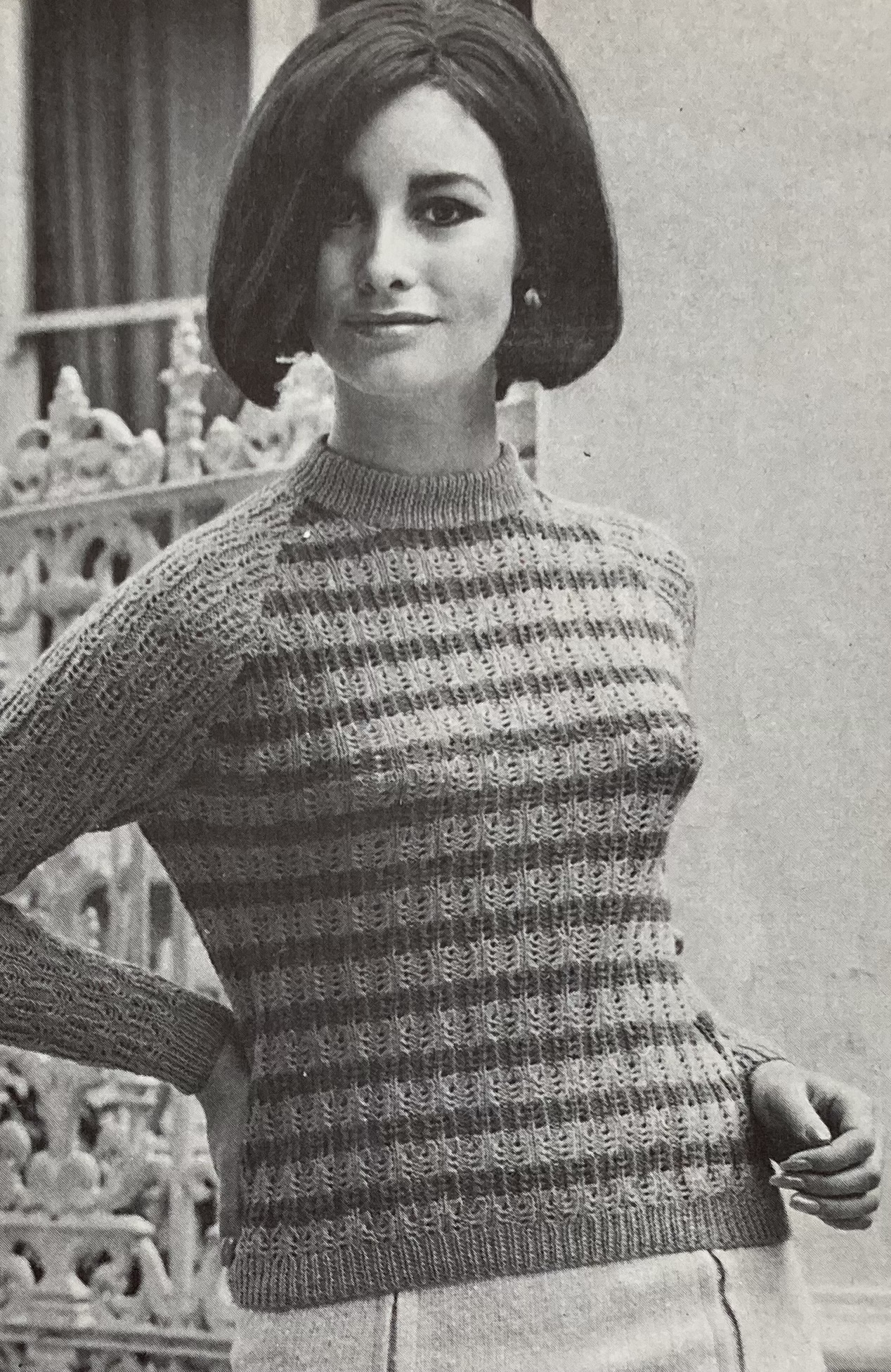
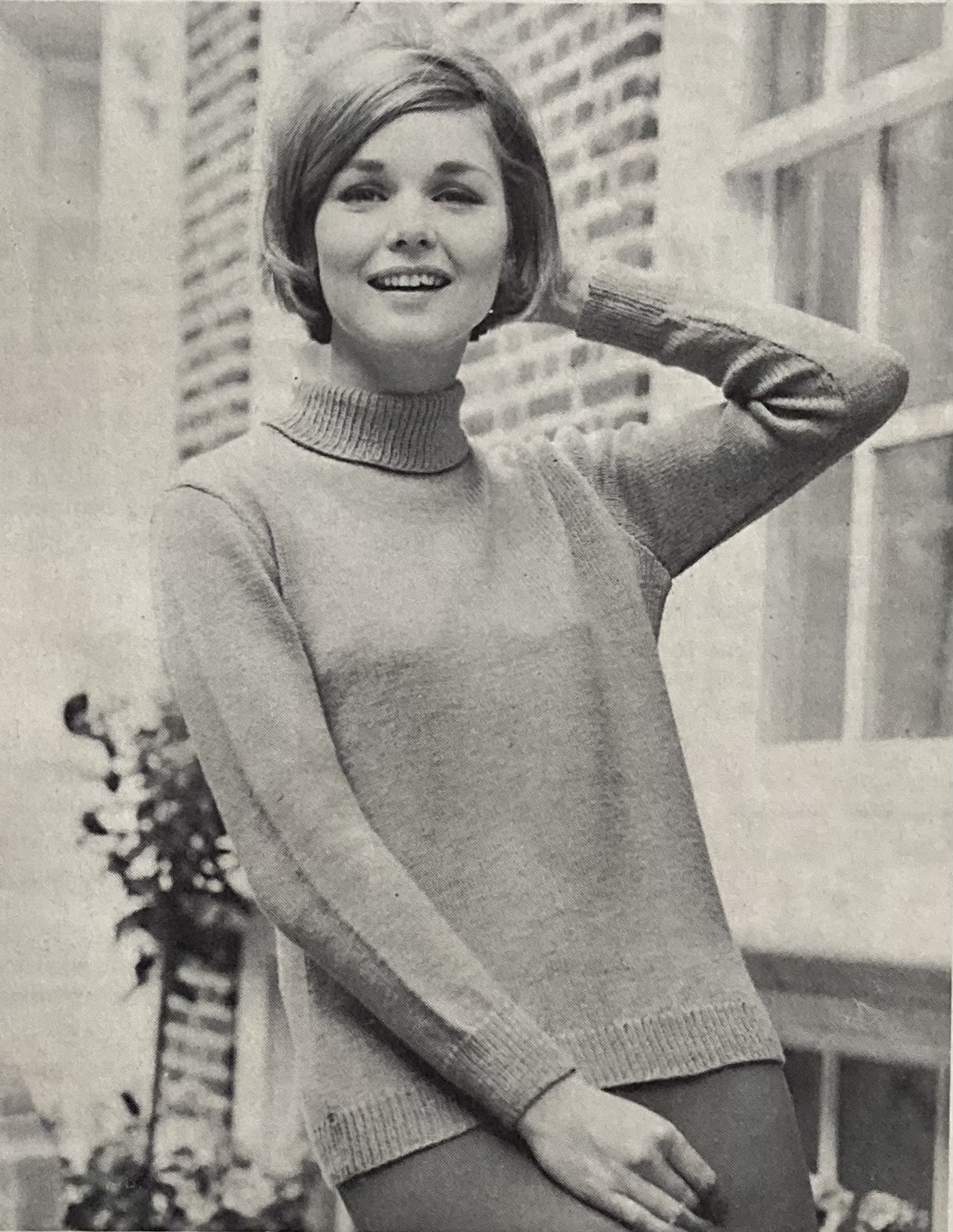
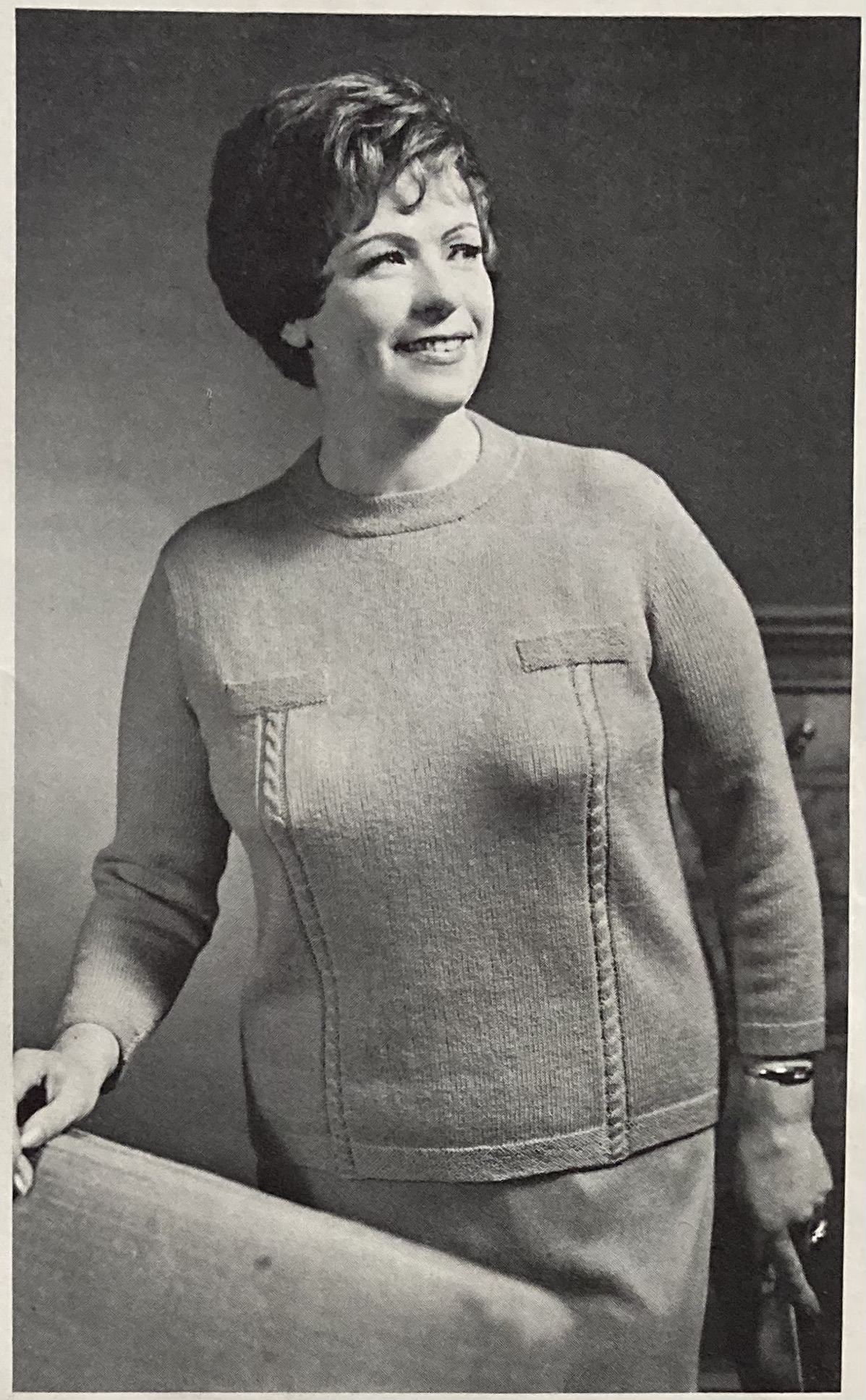
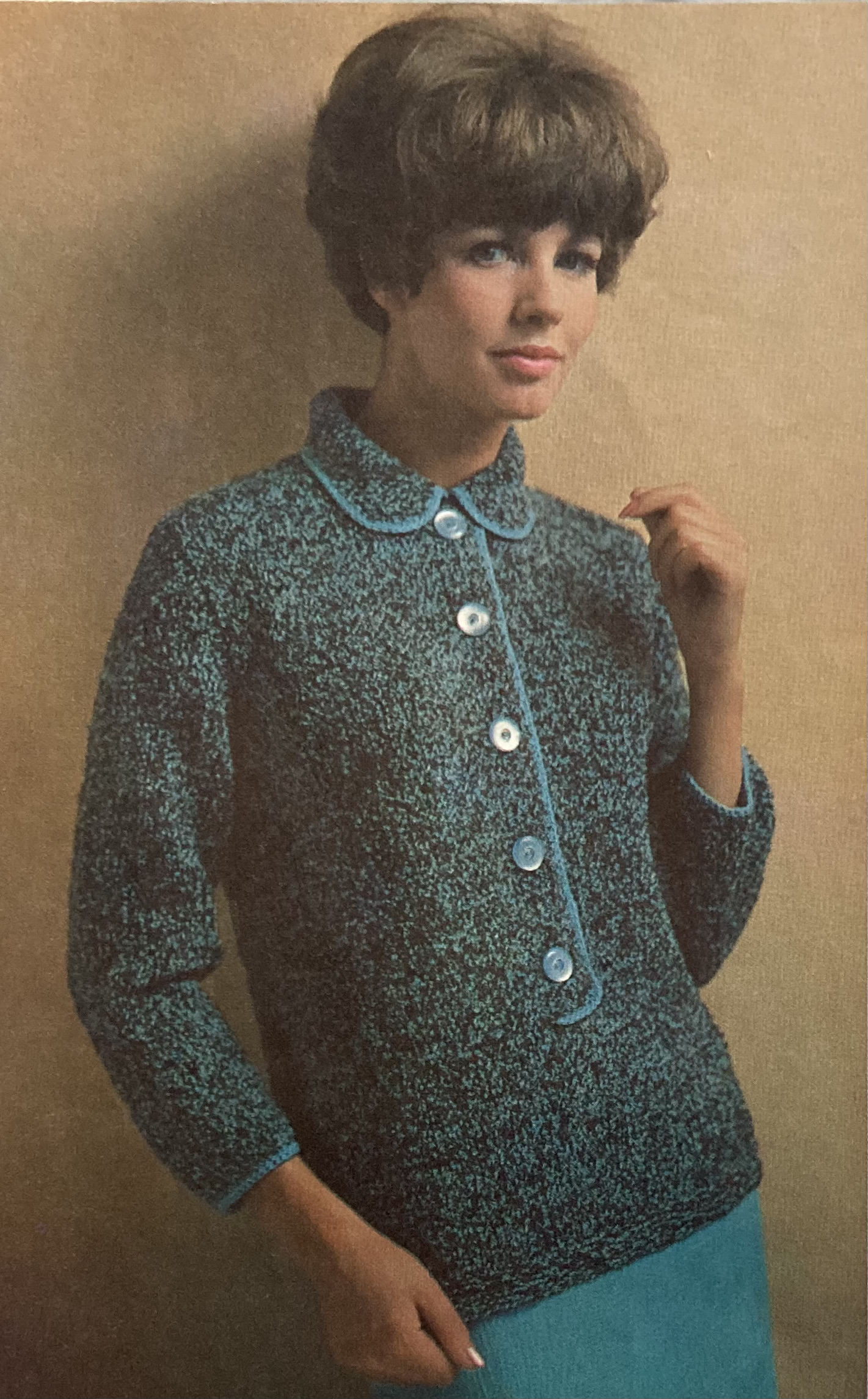
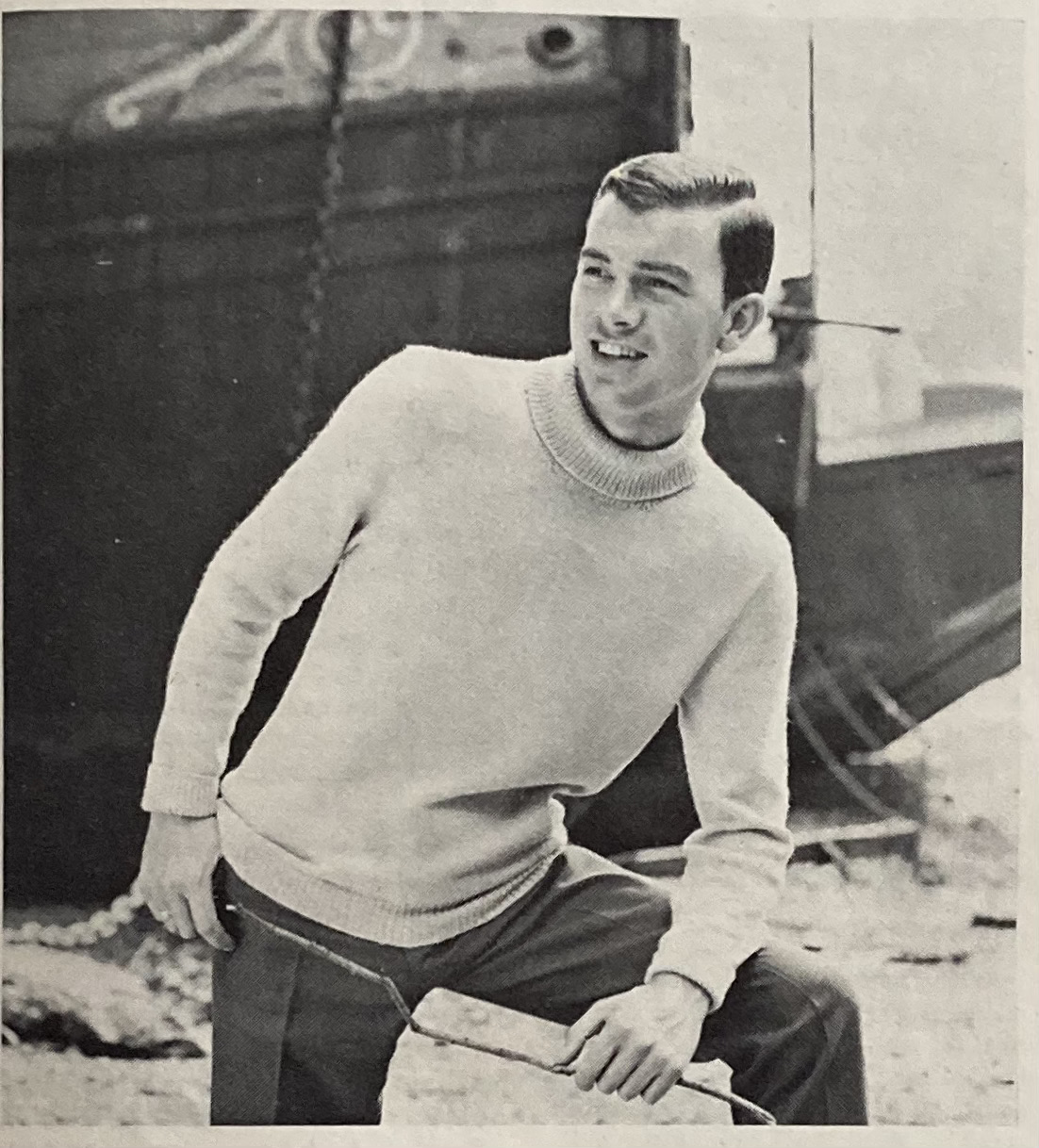
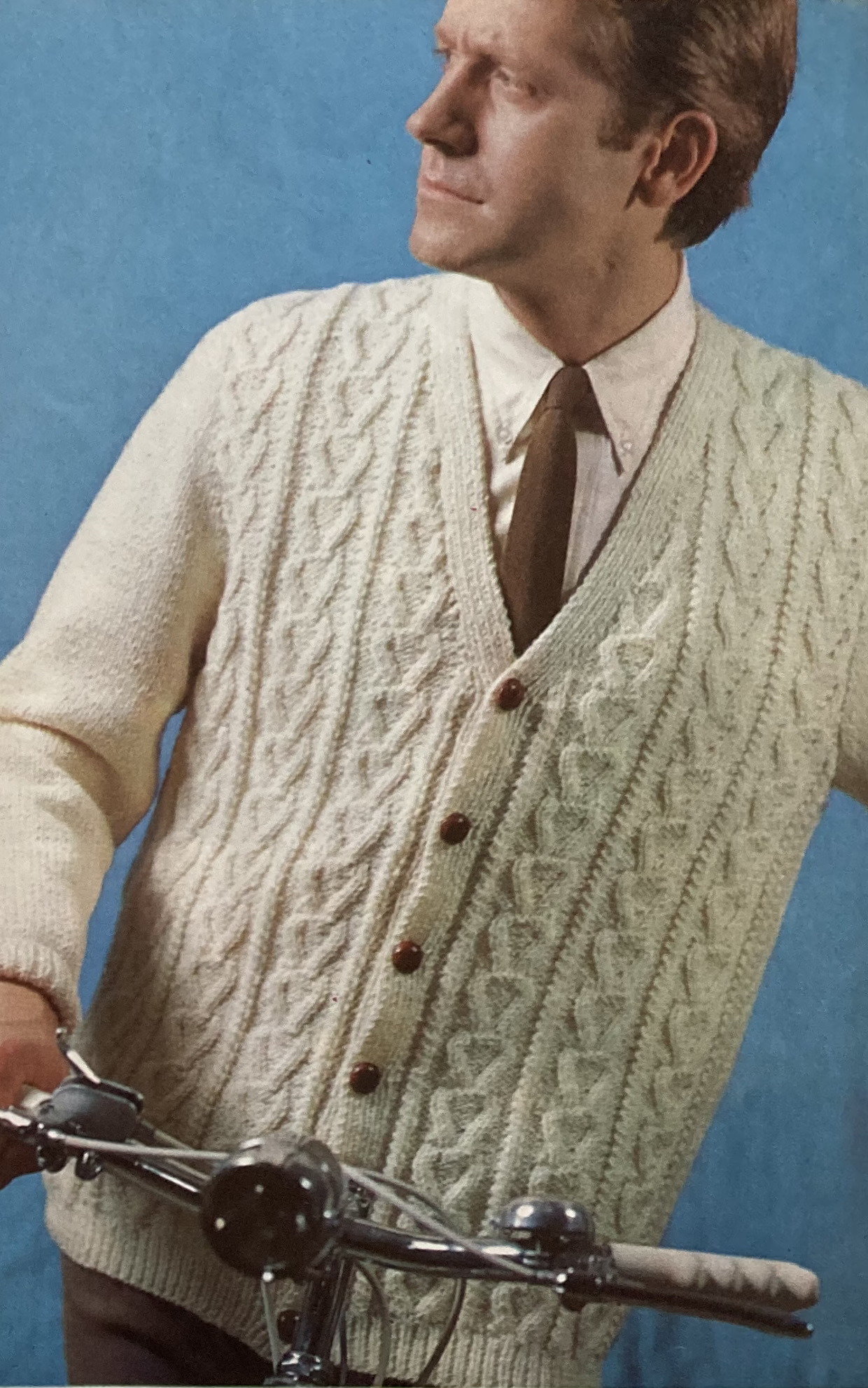
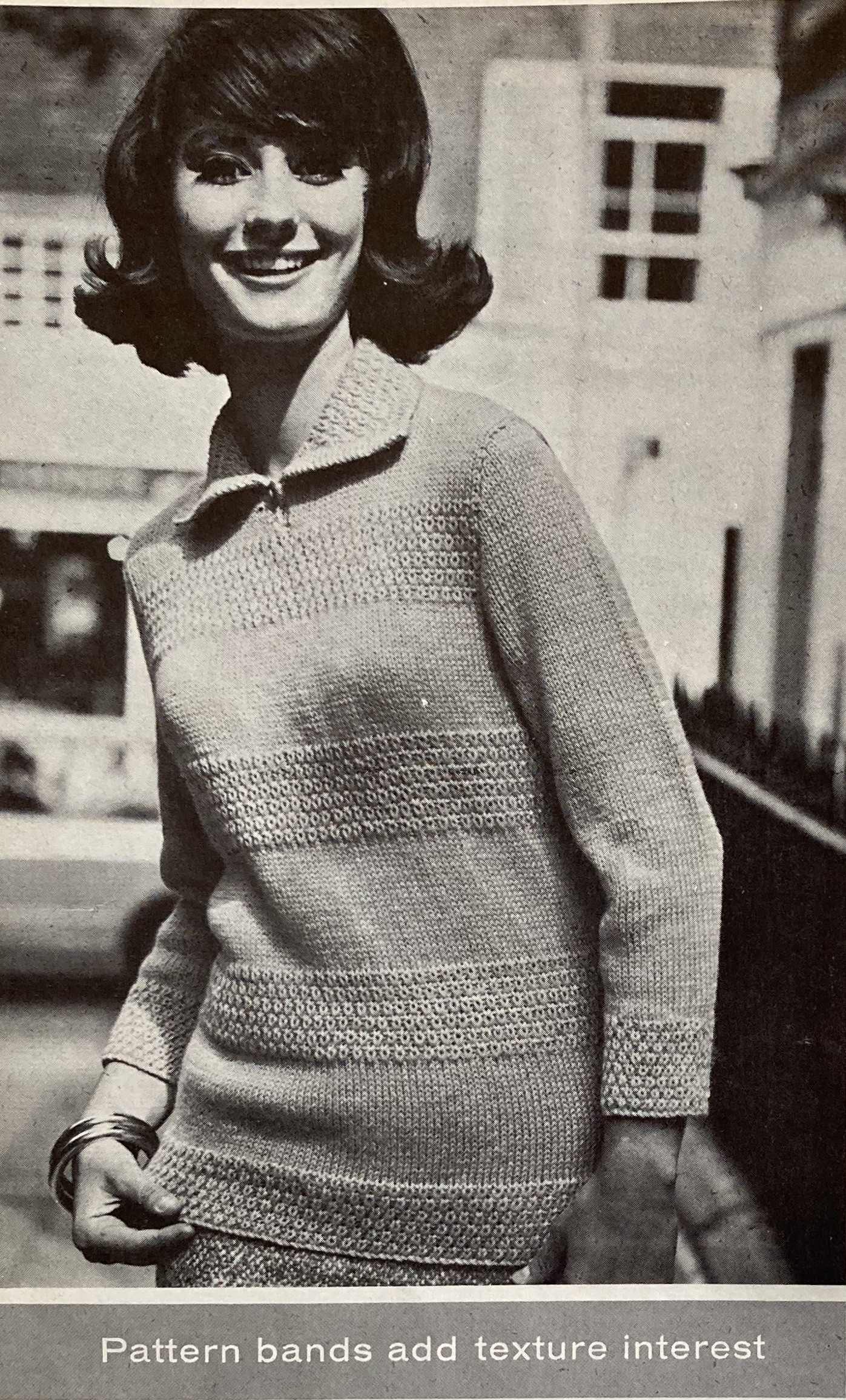
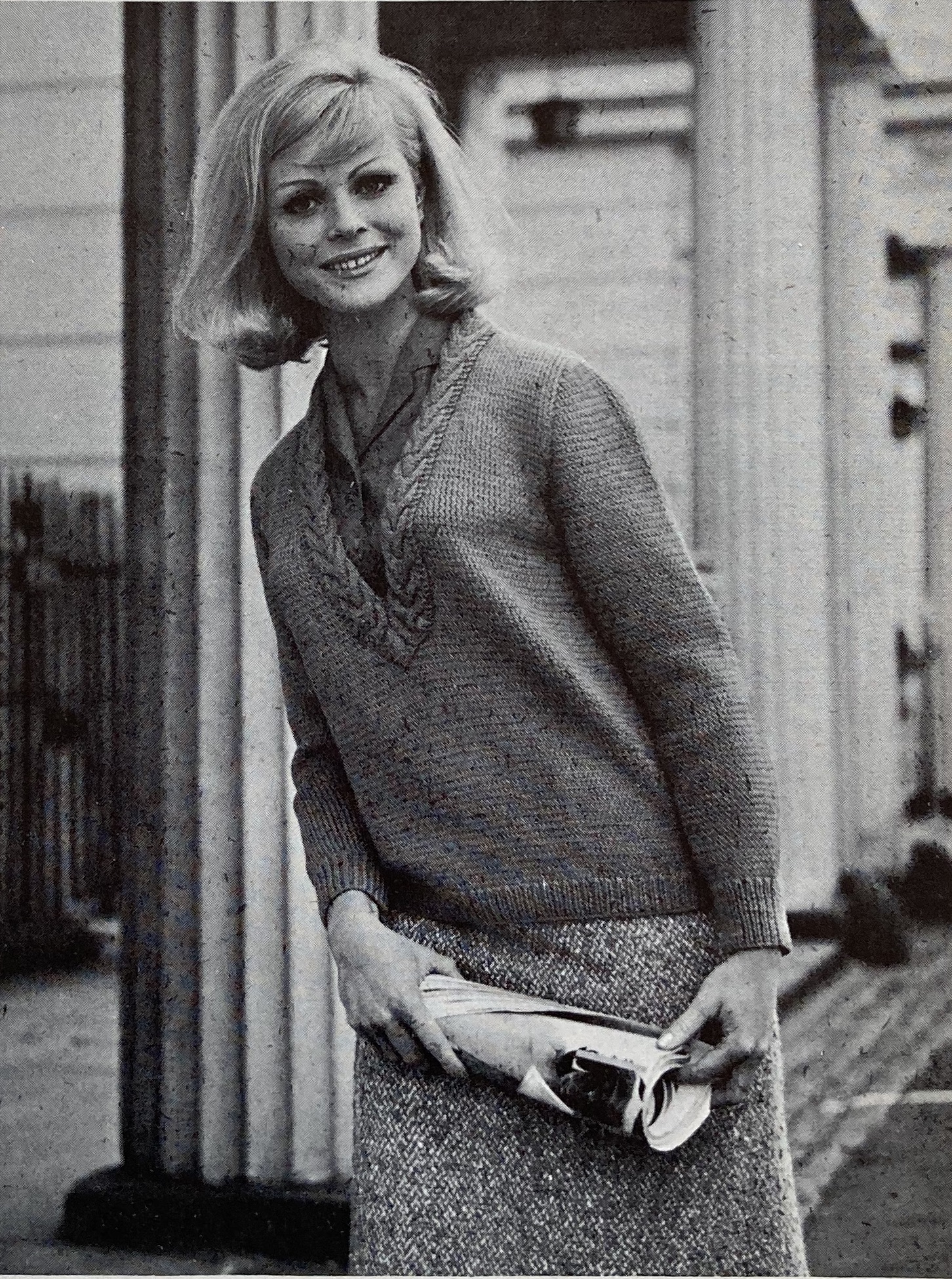
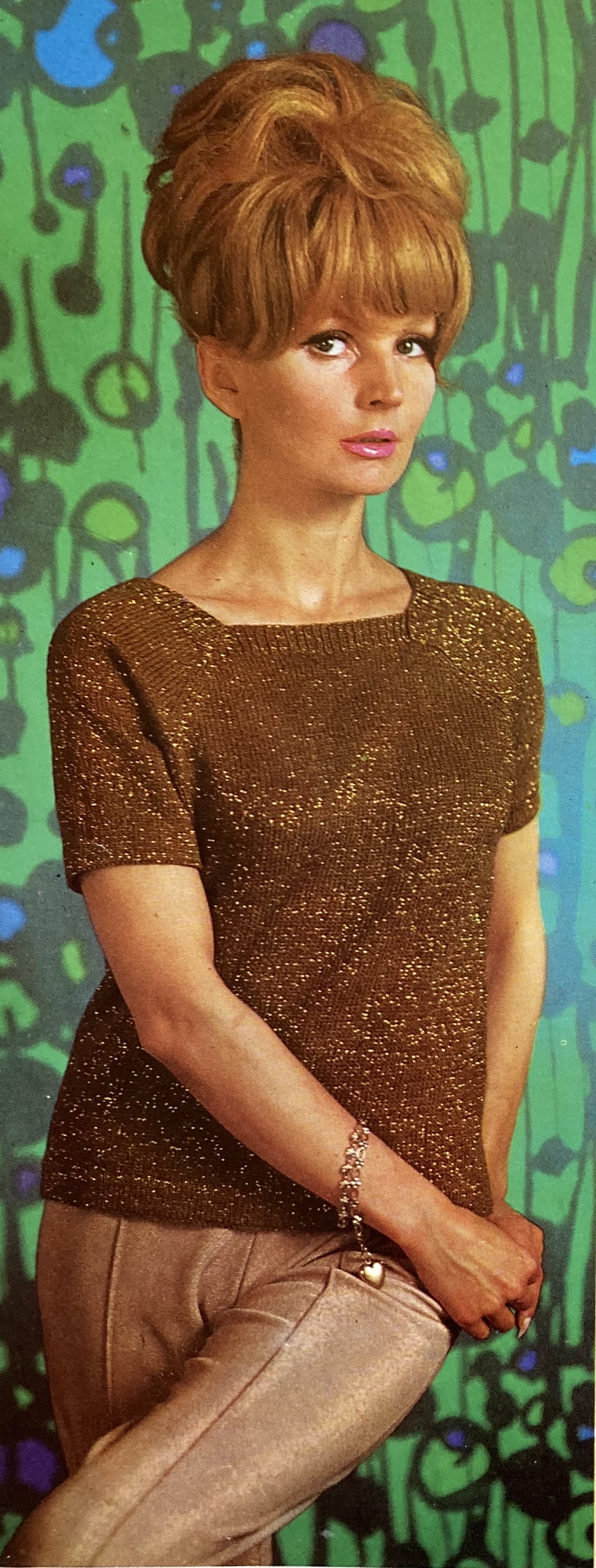
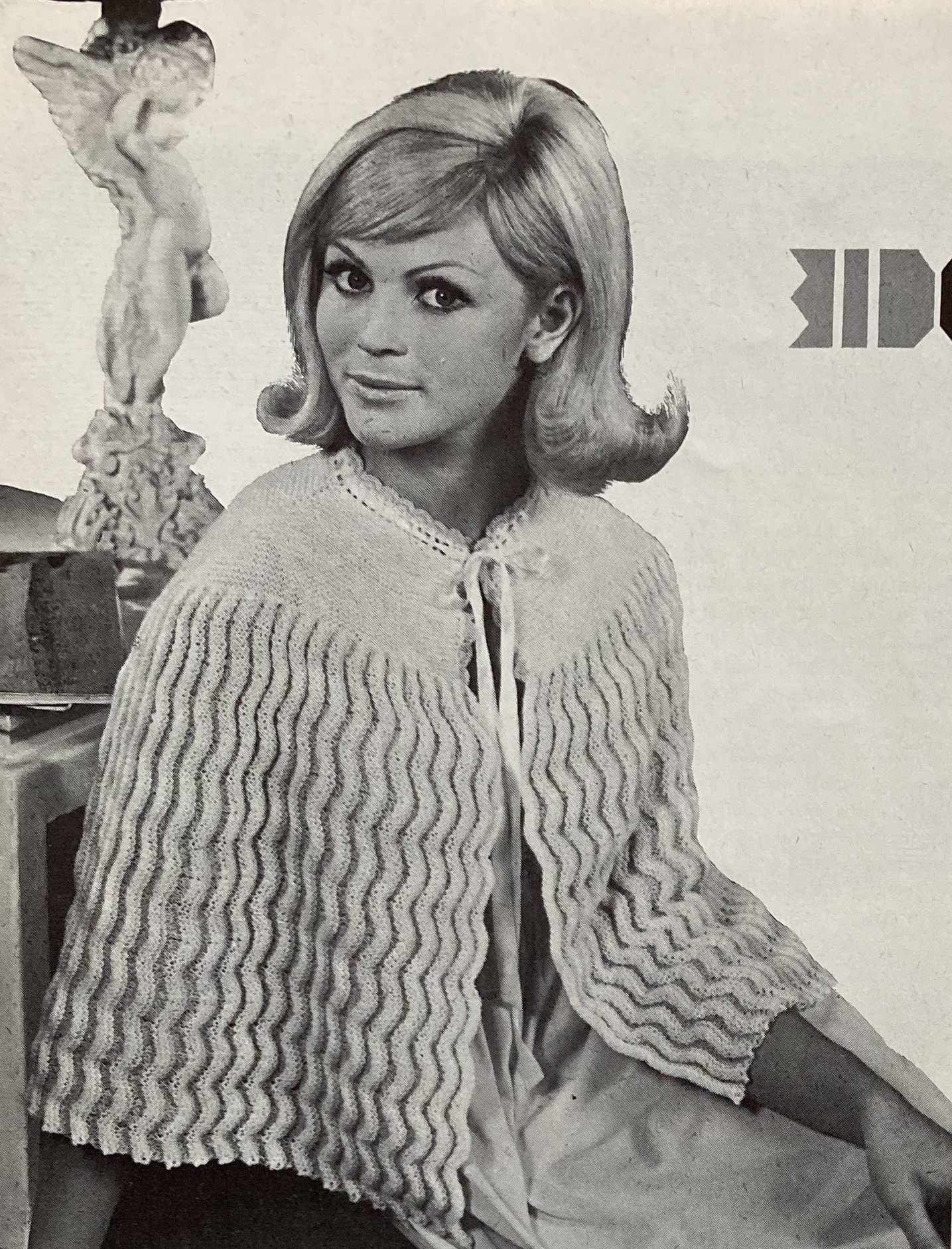
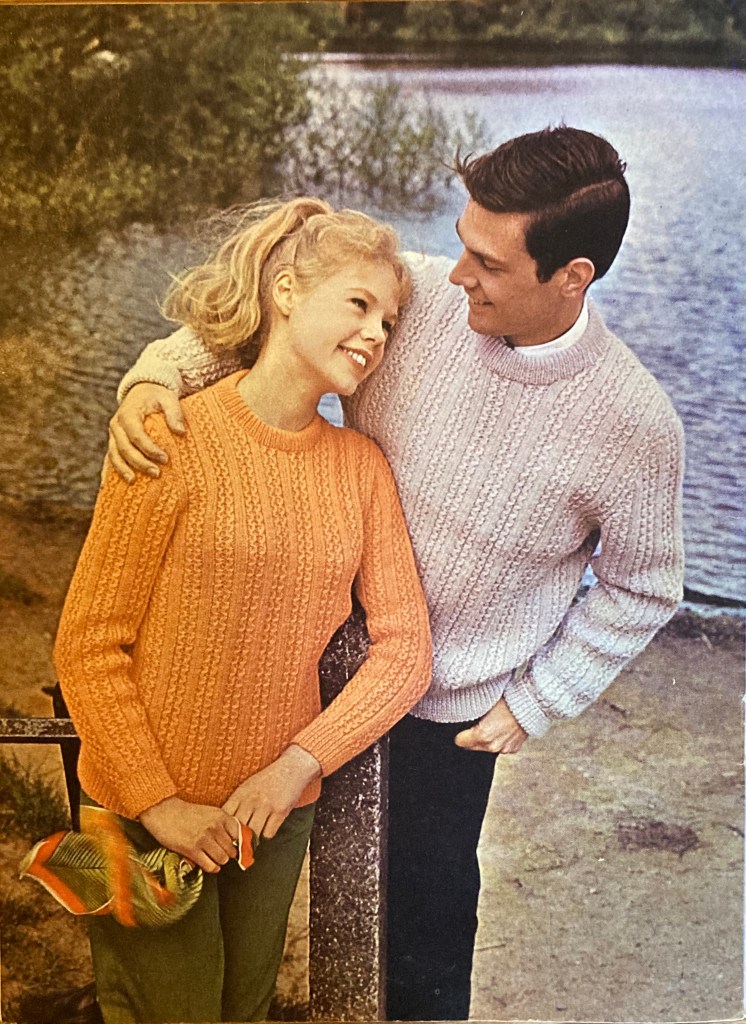
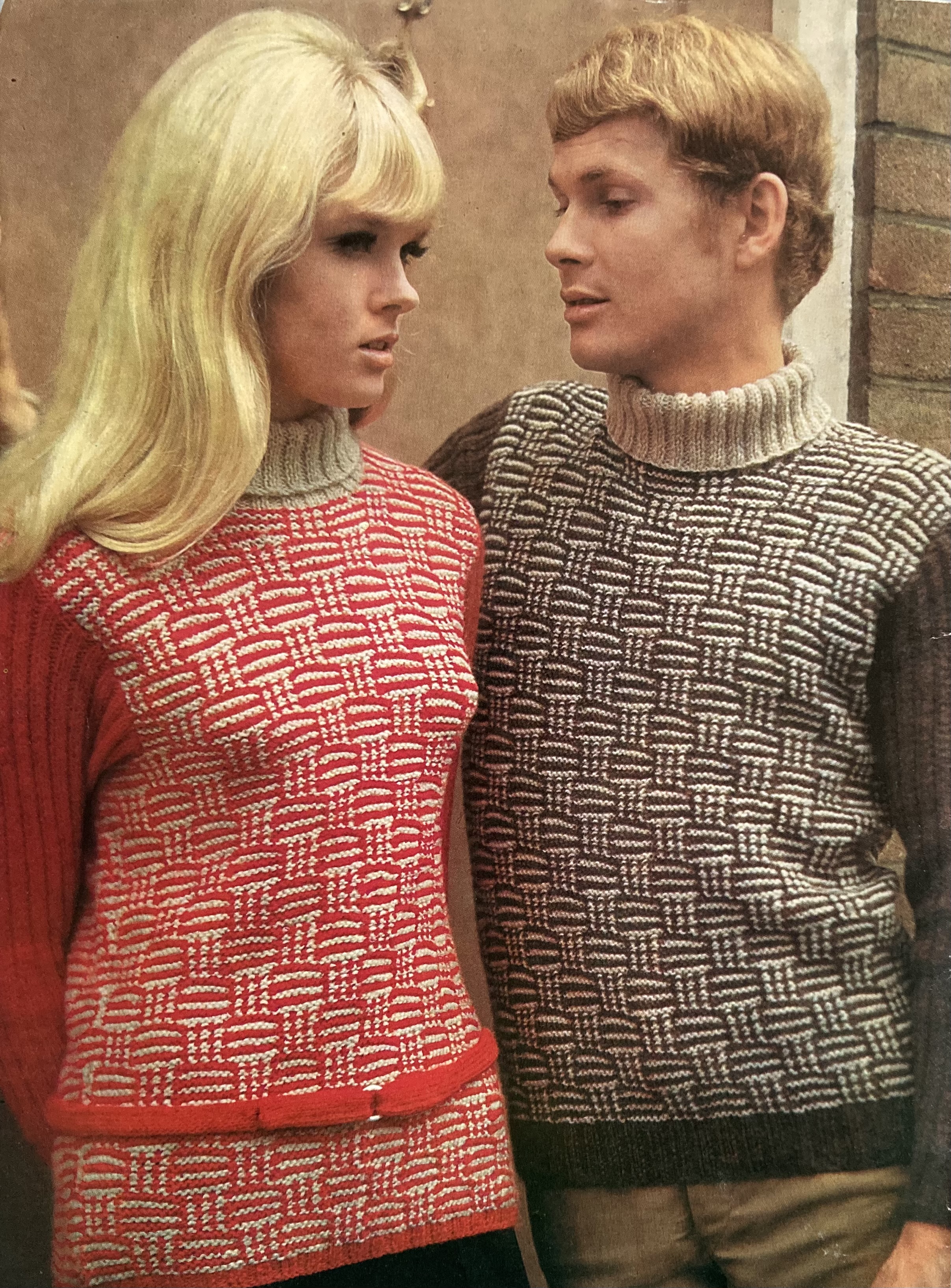
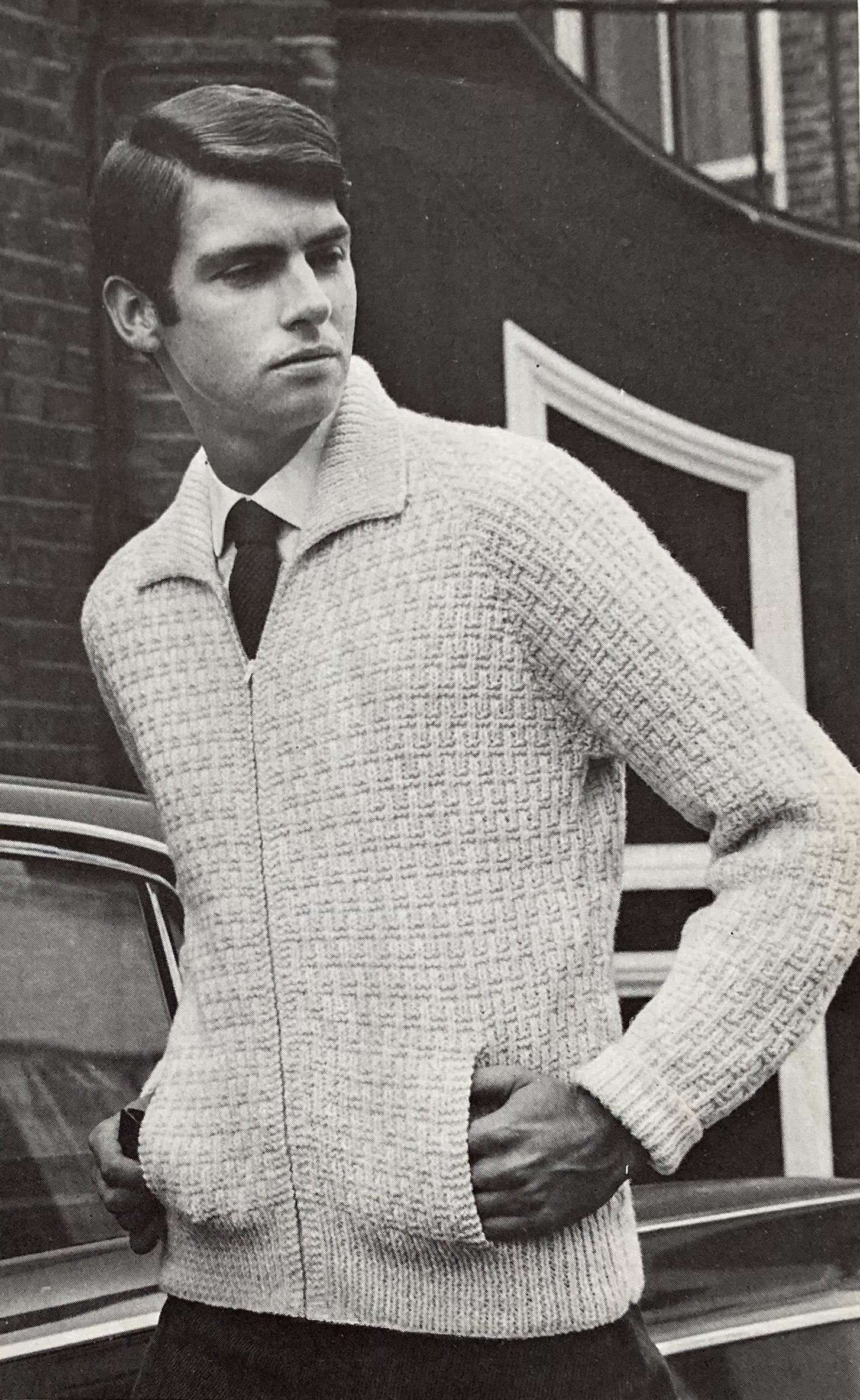
As for the “young team”, they “love to match”, according to Stitchcraft, and can knit themselves (who am I kidding, the girl will knit for both of them) some warm pullovers in a fun two-colour basketweave pattern with ribbed sleeves. The colour pattern is made with slip stitches. Other adult garments include a “lumber style” mens’ zipped cardigan, two practical jumper-blouses to “go with suits and skirts” and a classic cardigan for larger sizes.
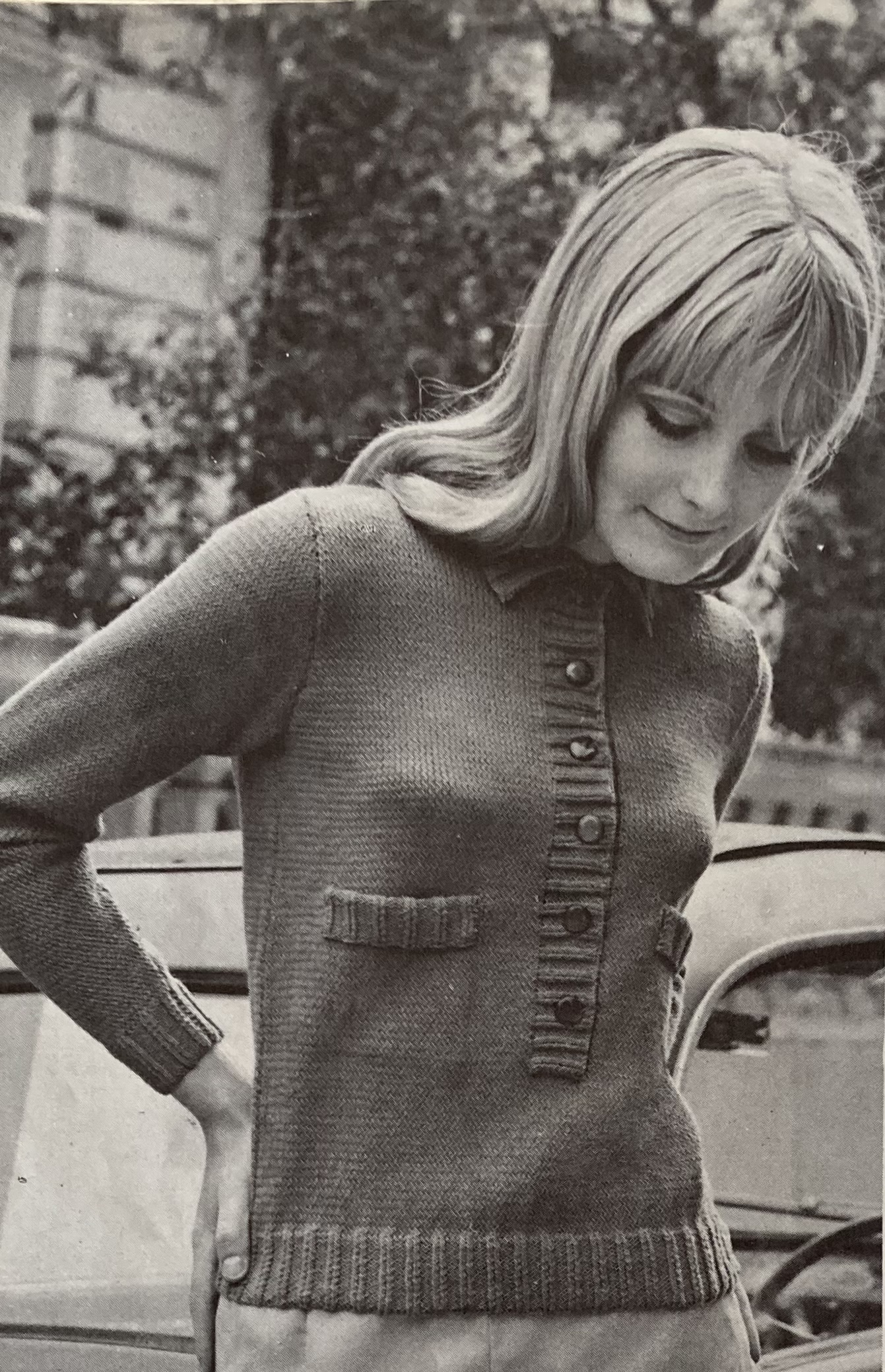
Cables and basketweave textures are on trend, and the colours are not particularly Christmas-oriented — strong, cool colours and neutrals. The mens’ basketweave cardigan is made in cream-coloured, undyed “Capstan” wool and the two suit-skirt jumpers in “Planet Jade” and “Bracken Gold” with “Brandy Snap” contrast. Only the knit-crochet party dress is in holiday “Hawthorn Red”.
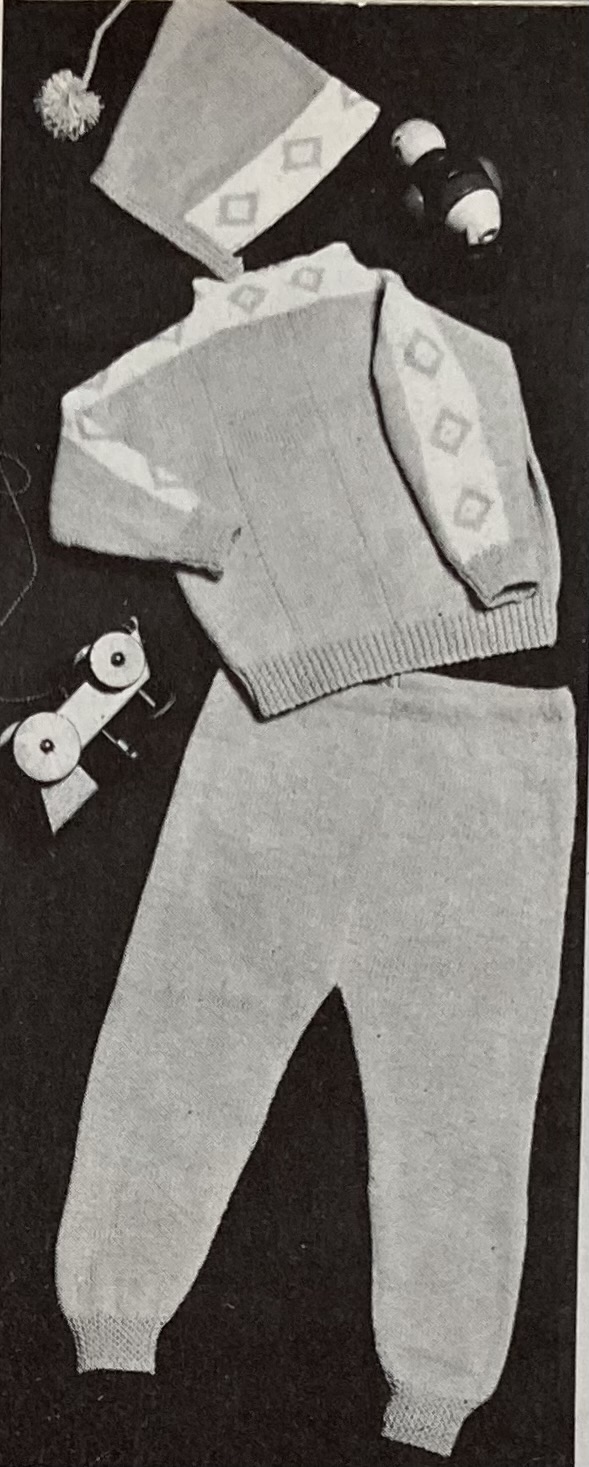
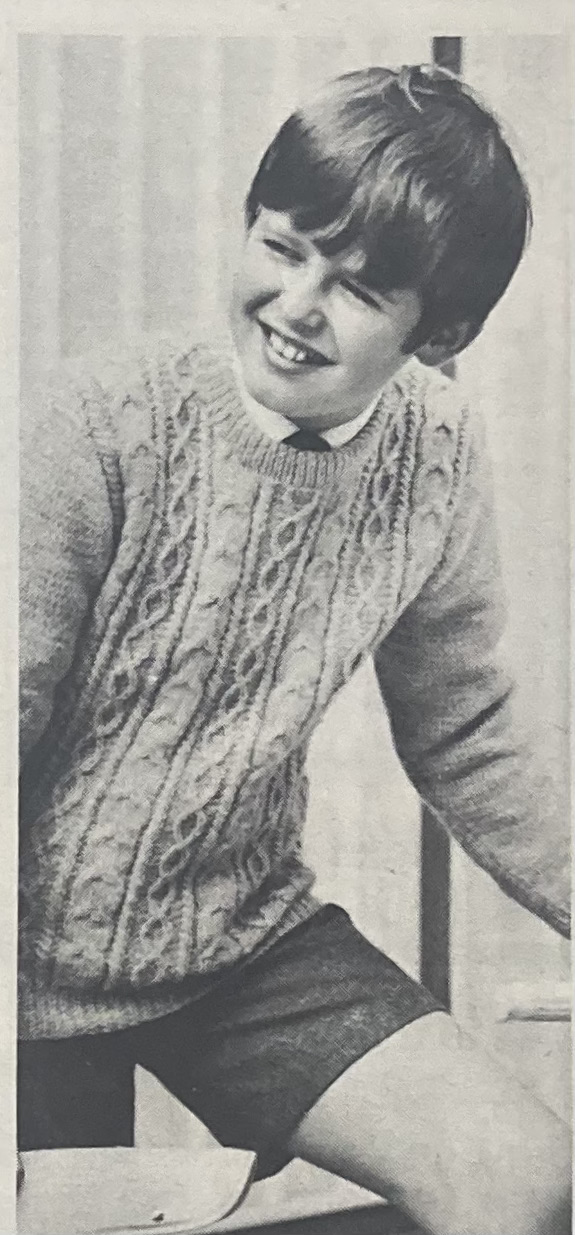
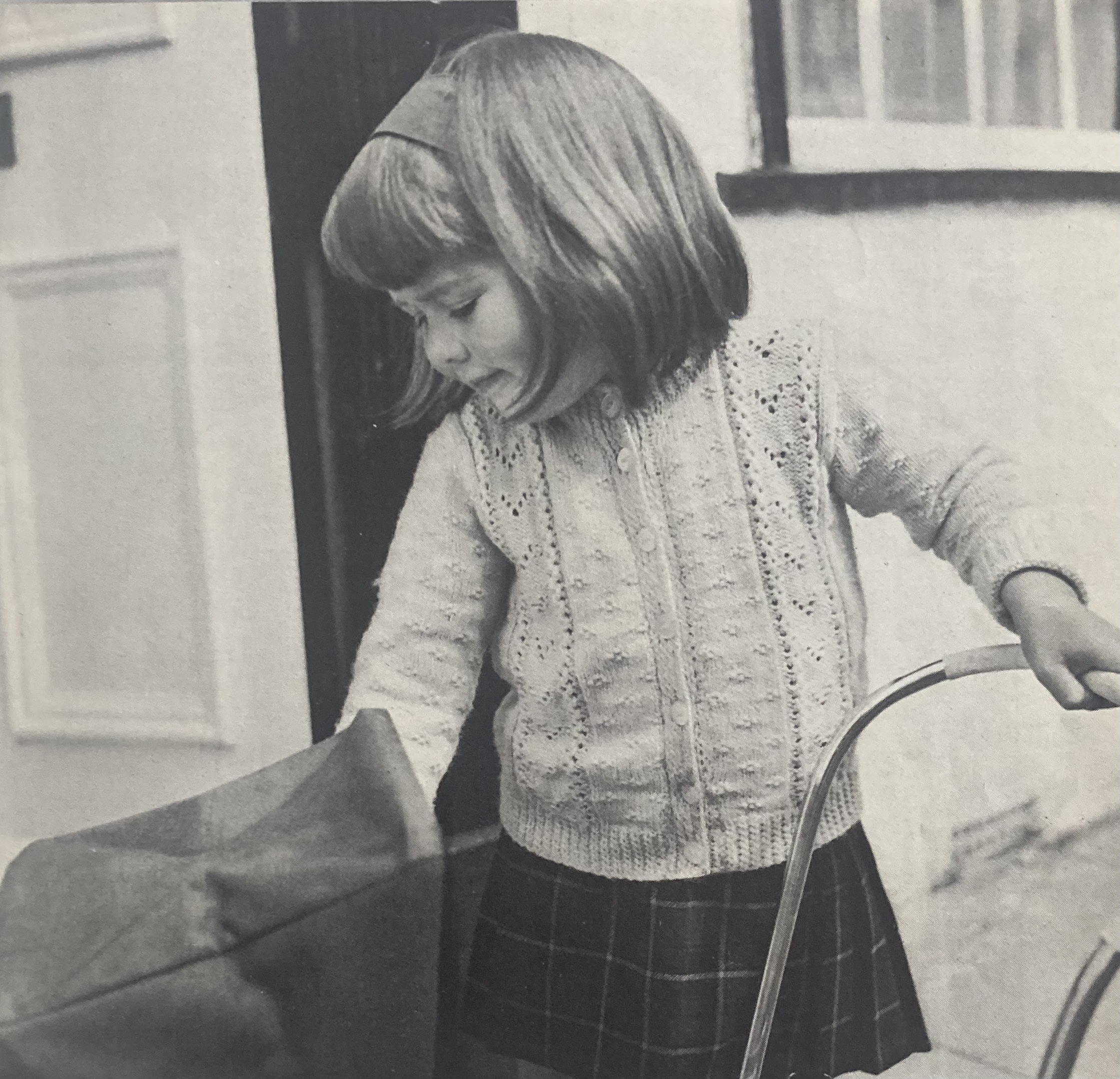
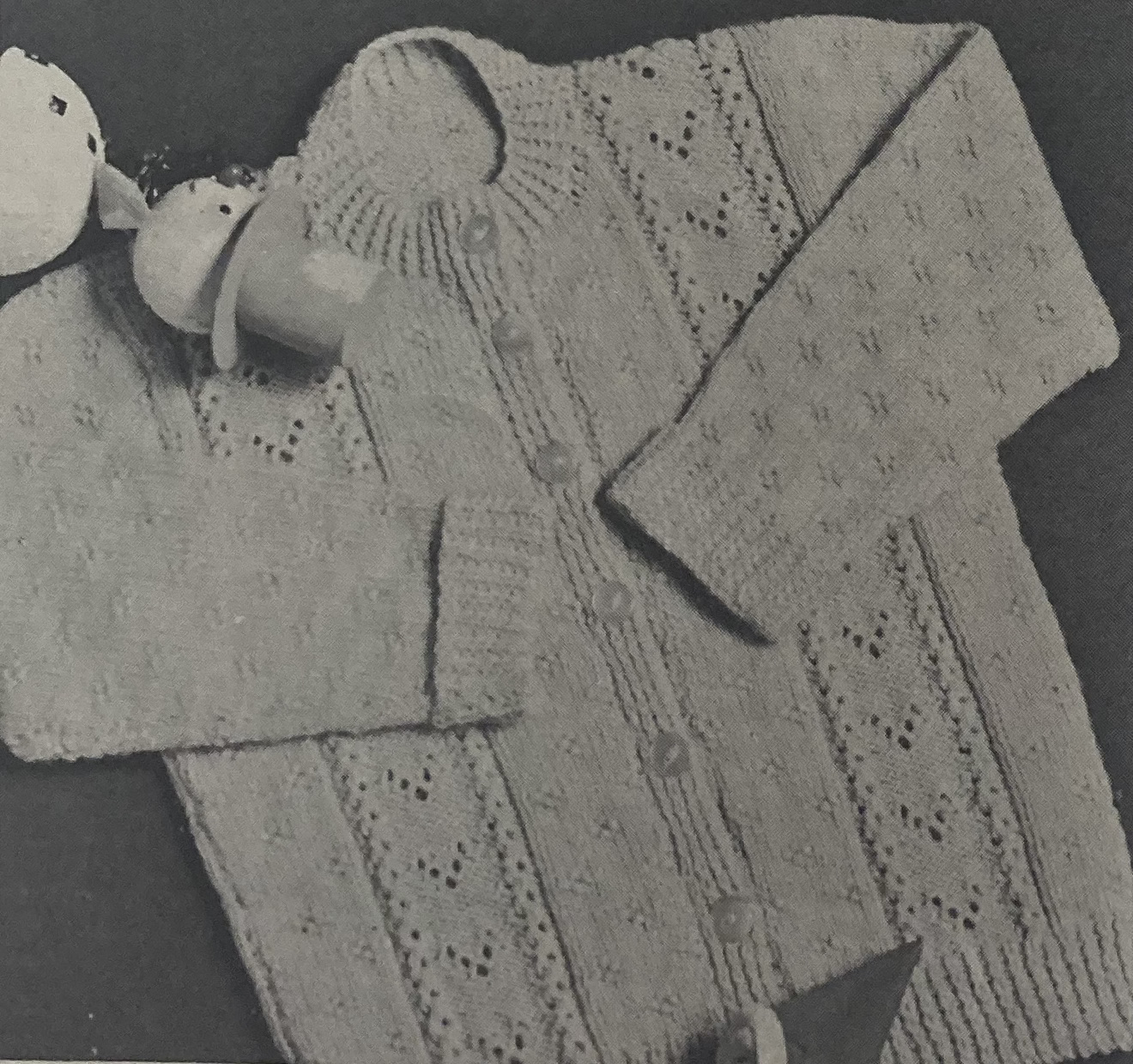
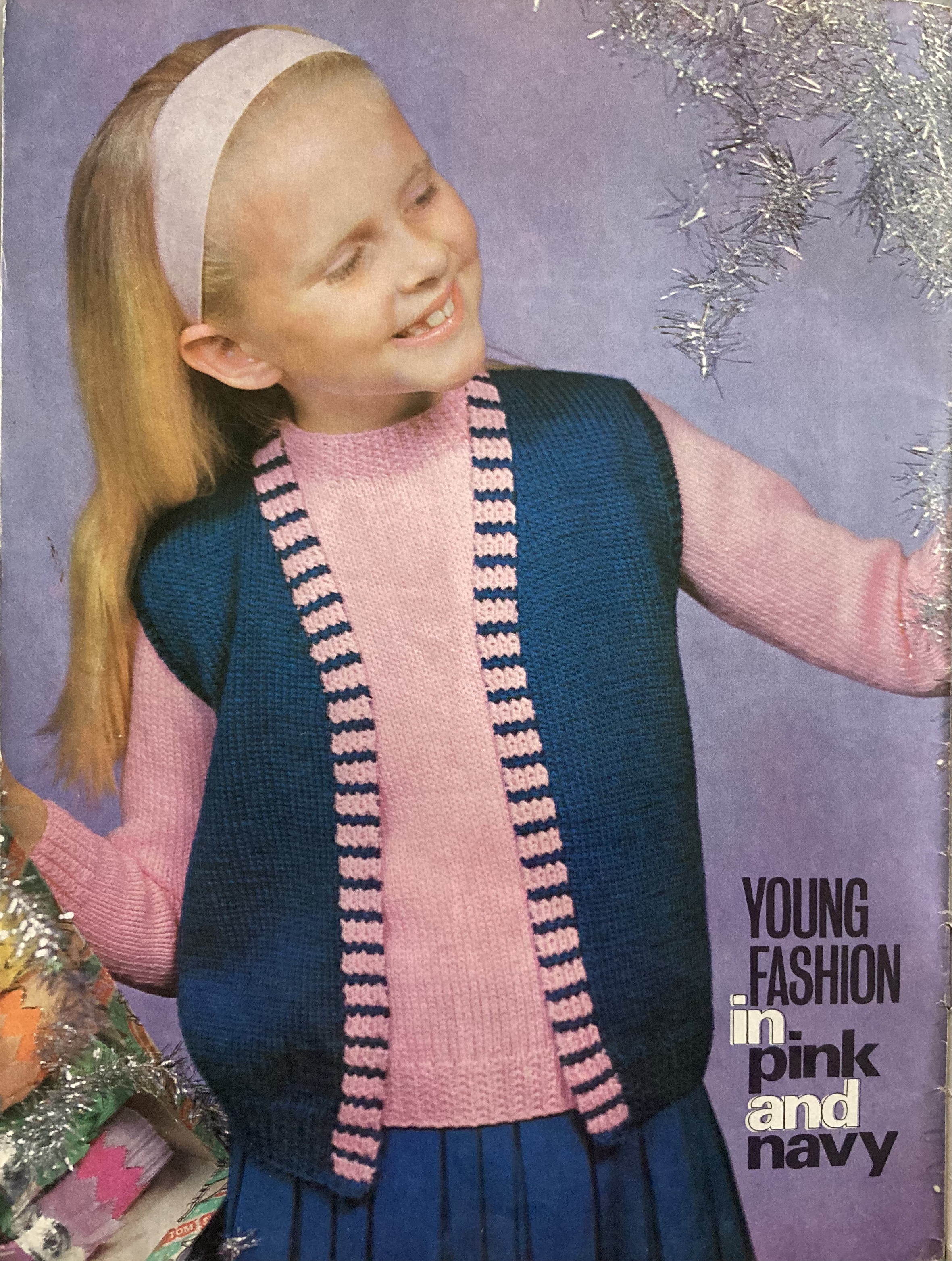
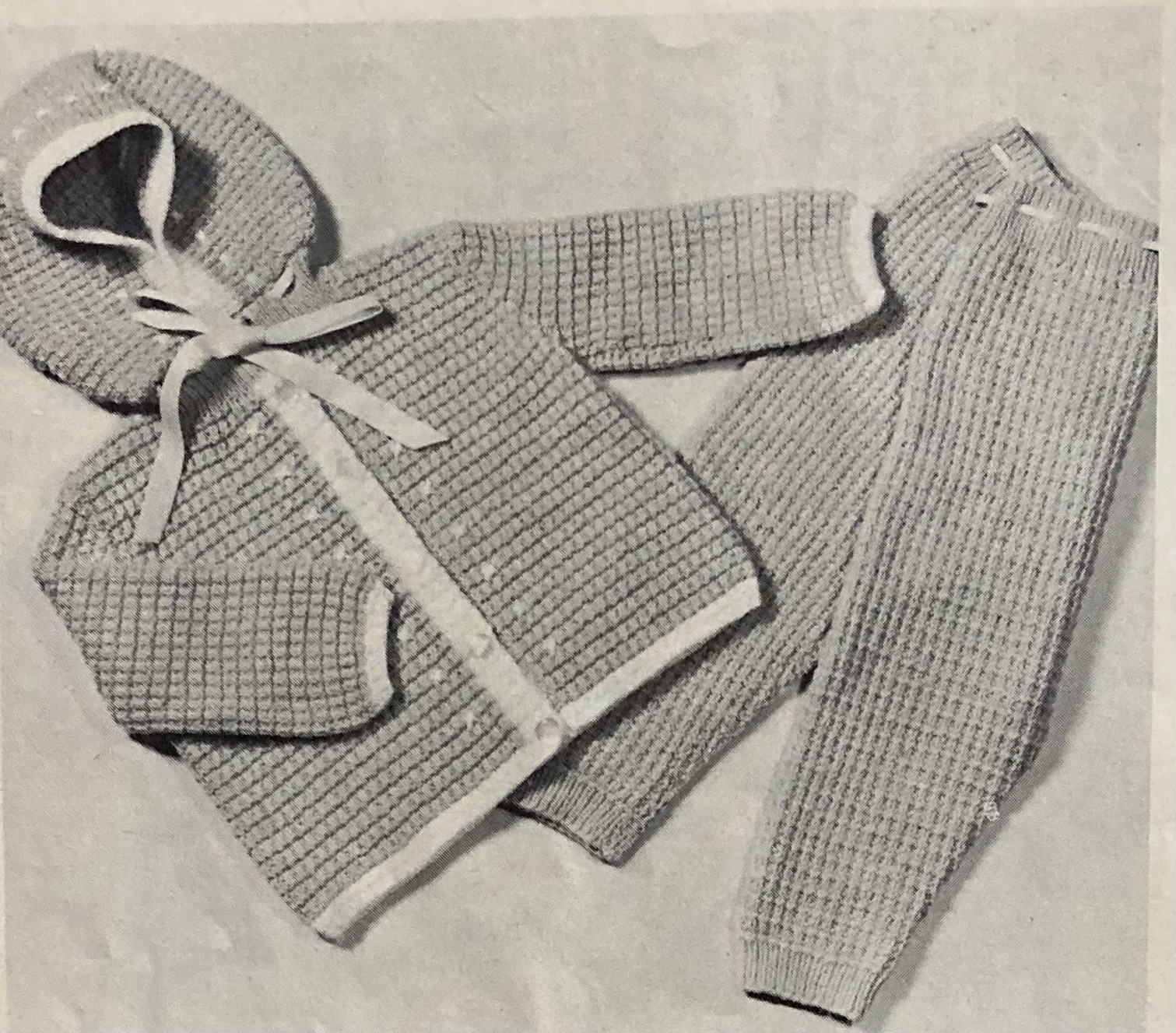
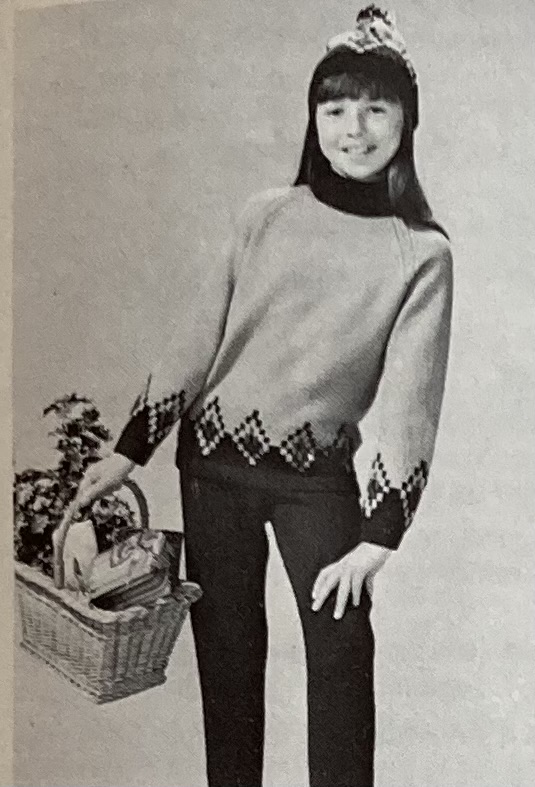
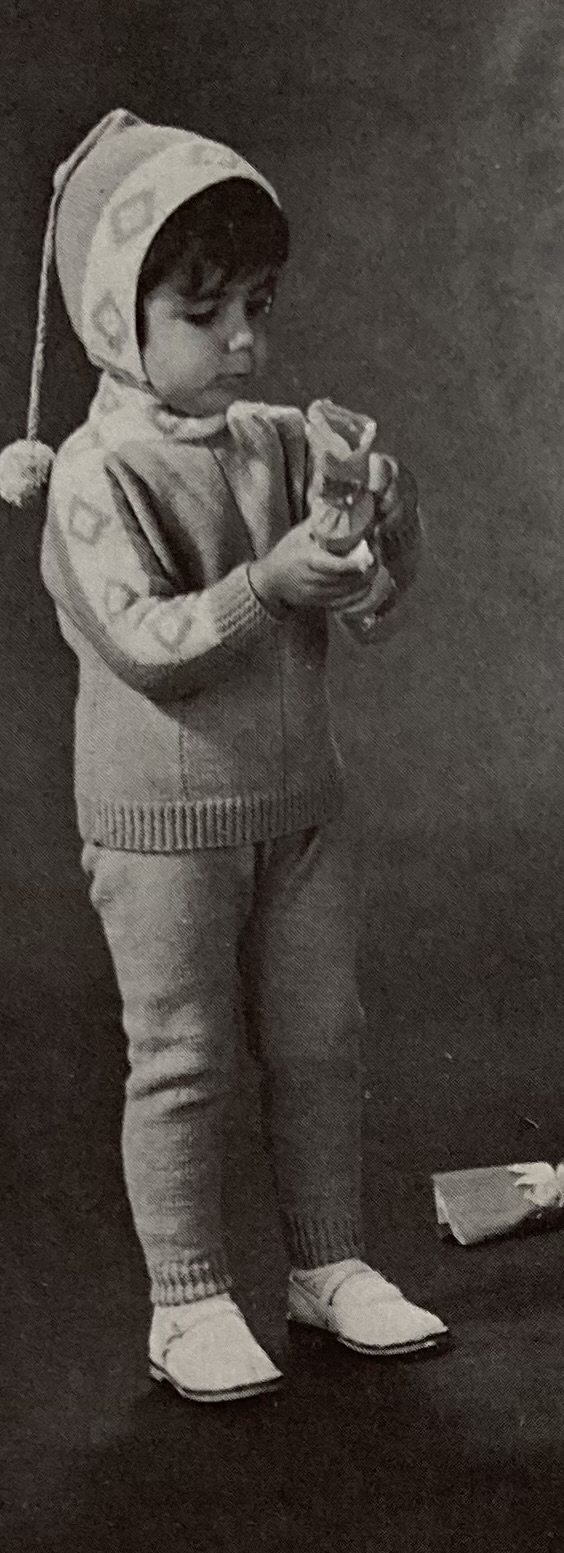
There are some great fashions for children in this issue that could theoretically be finished by Christmas morning: a warm set of jumper, leggings and hat for a little one, a dress-and-cardigan set for a school-age girl and another jumper, leggings and hat set for a pre-teen. On second thought, you would have to be an extremely fast knitter to get any of those sets finished in time… Here too, cool, bright colours prevail, and stripes, slip-stitch lines, and diamond patterns are trending.
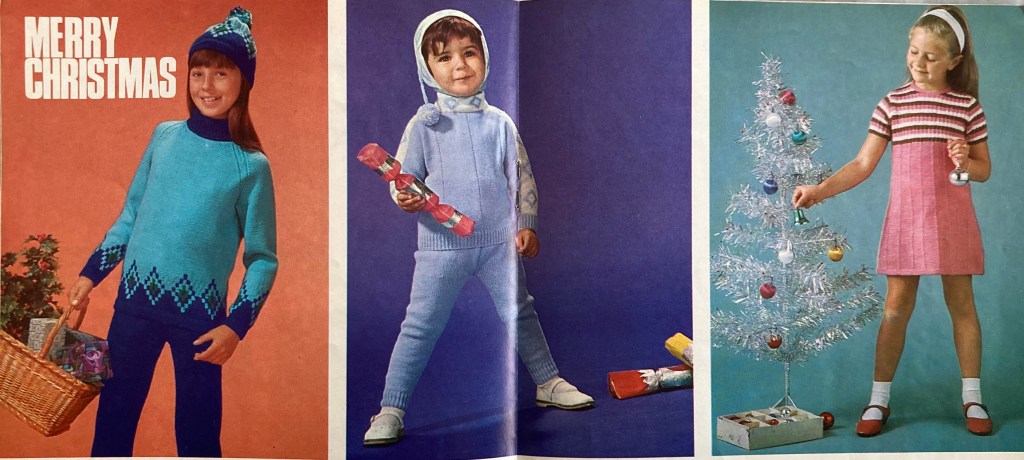
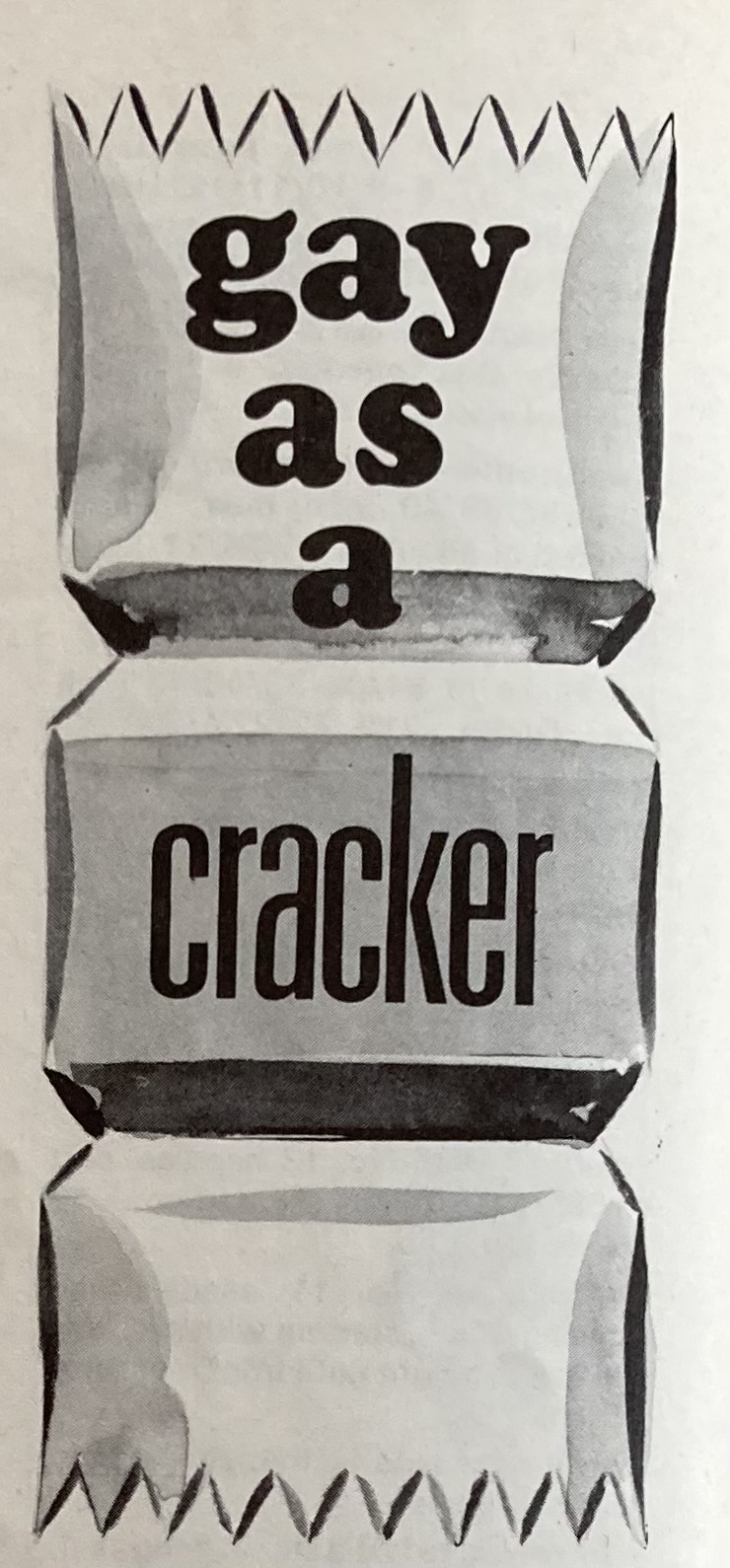
(On another note, the slogan that Stitchcraft chose to describe all of these children’s patterns is “Gay as a Cracker”. I do understand that they mean the outfits are as bright, fun and festive as a Christmas cracker that you pull across the table and get a little prize and a paper hat out of, but that did not age well.)
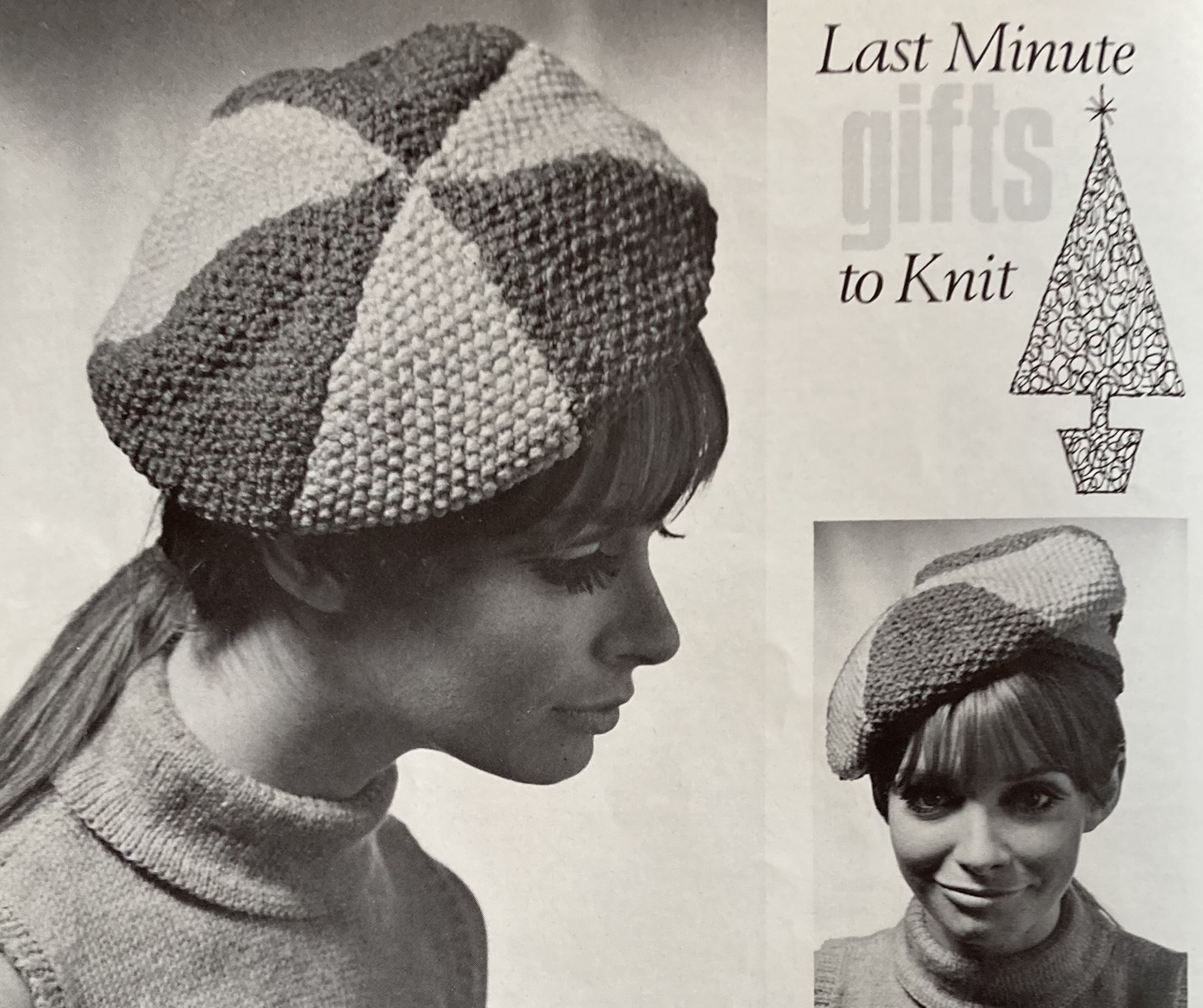
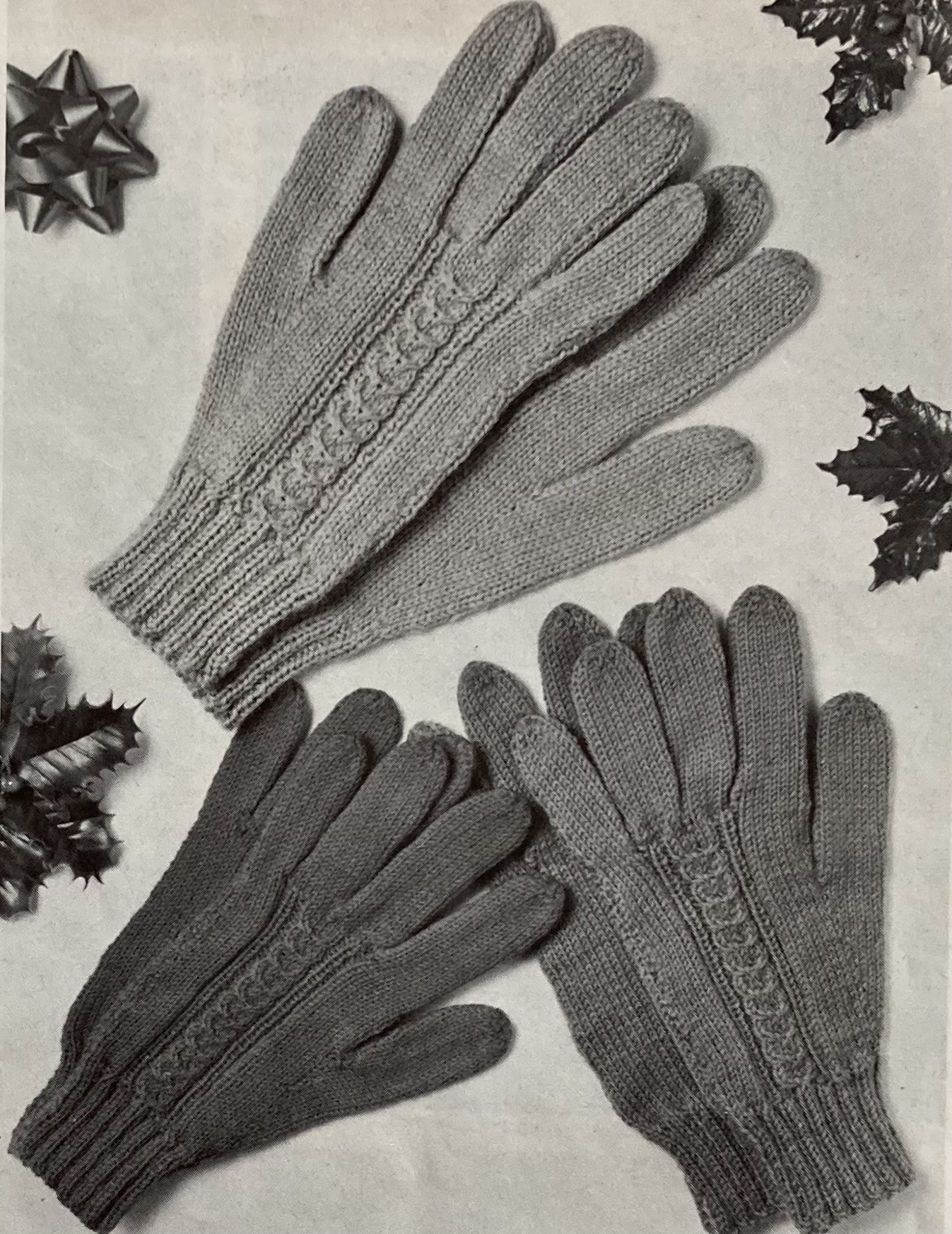
For quick gifts that have to be finished on time, you can make a “tweedy” (actually moss-stitch, but OK) beret or cleverly designed gloves for the whole family. The gloves are all made from the same pattern, using double knitting-weight wool for the large/men’s size, 4-ply for the medium/women’s size, or 3-ply for the small/child’s size. You can also make a very easy crochet cushion, and it even matches the hat!
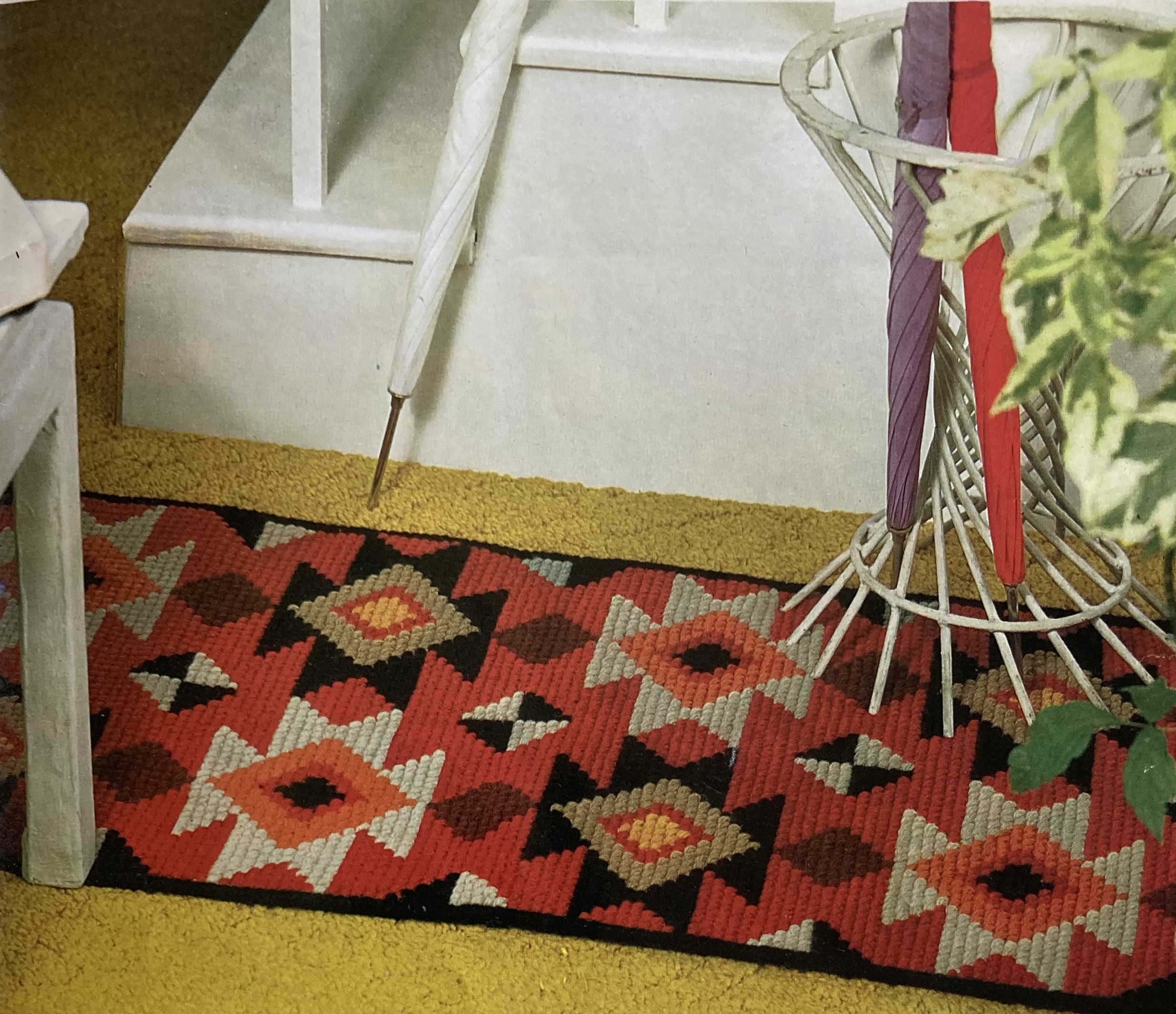
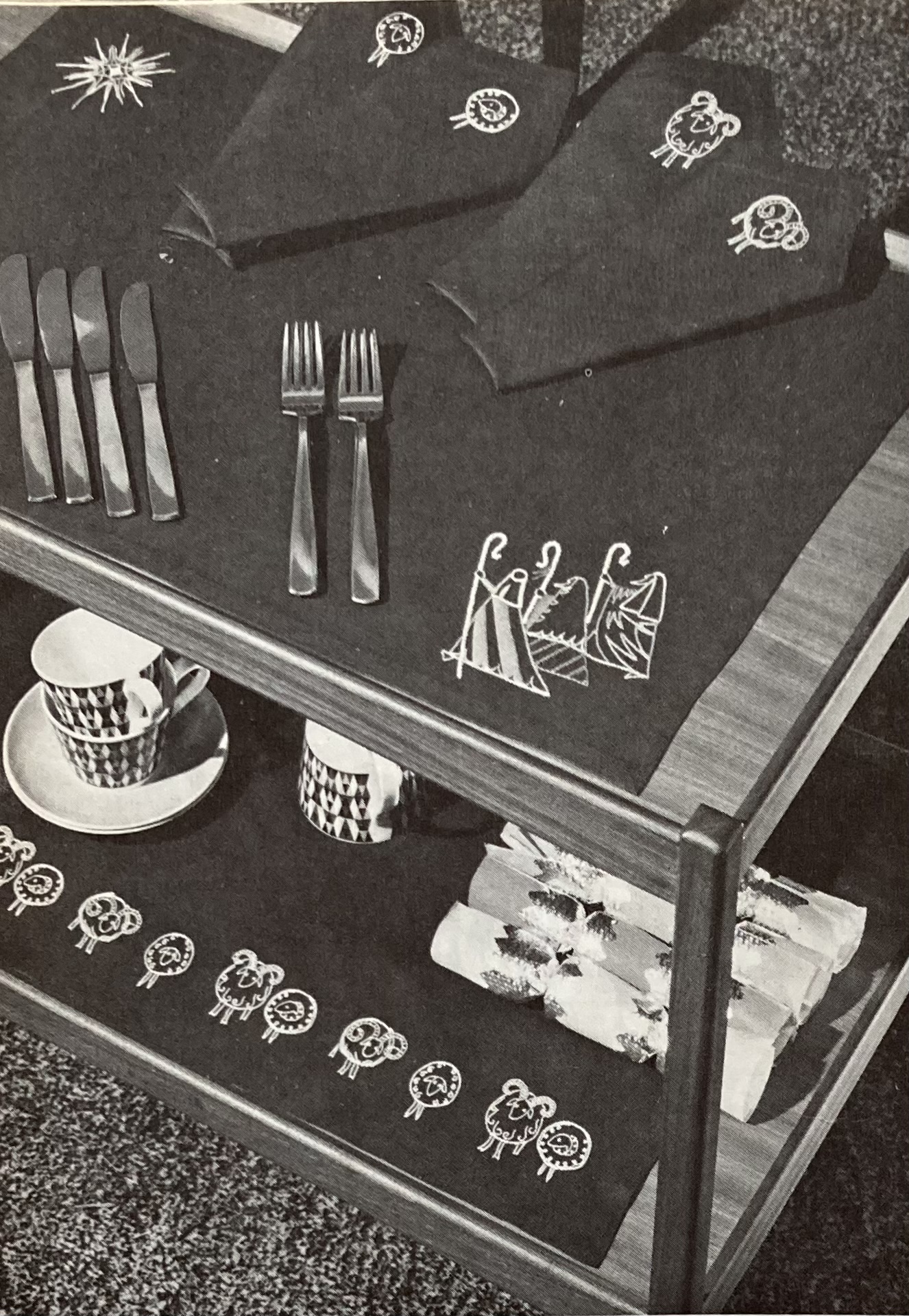
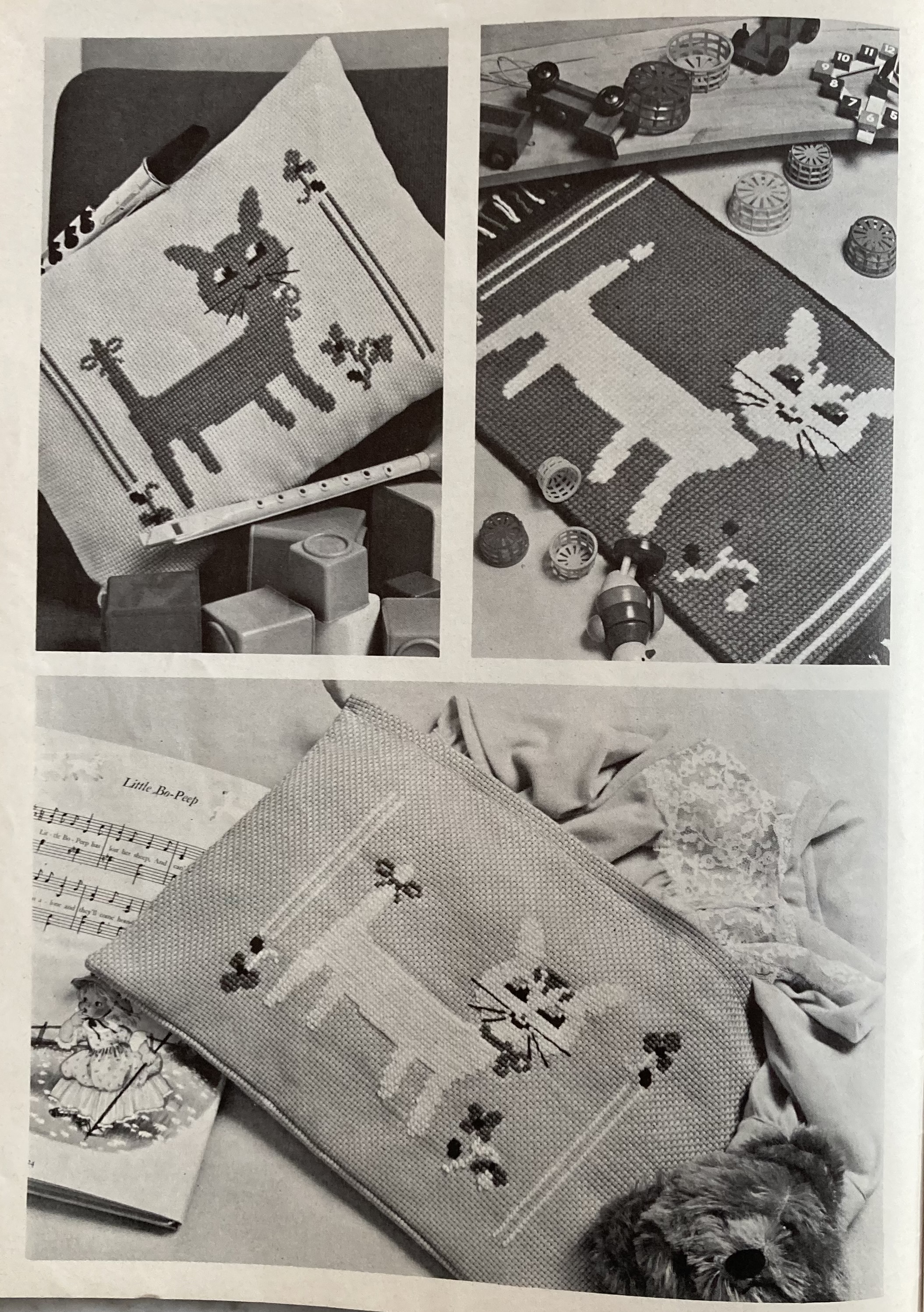
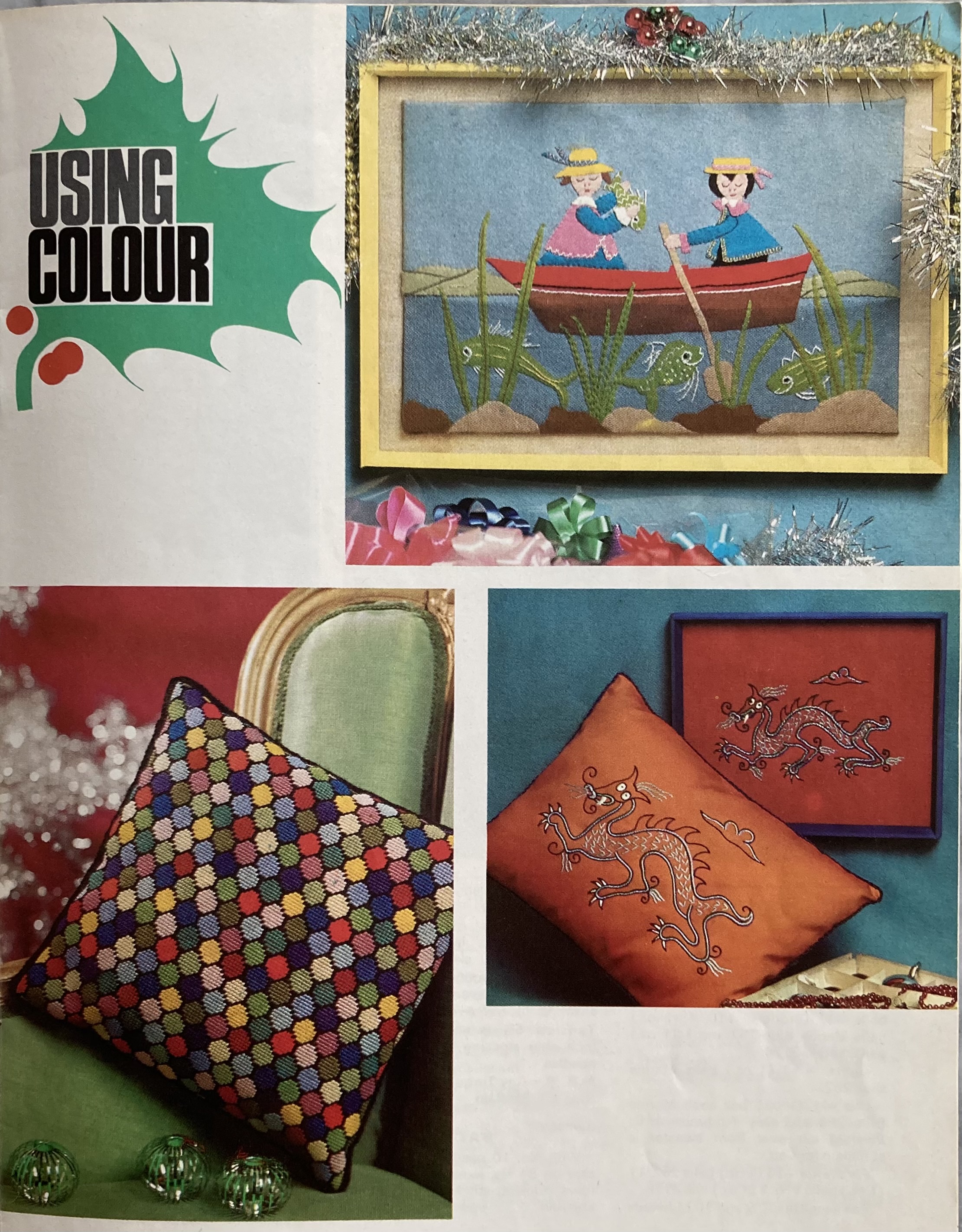
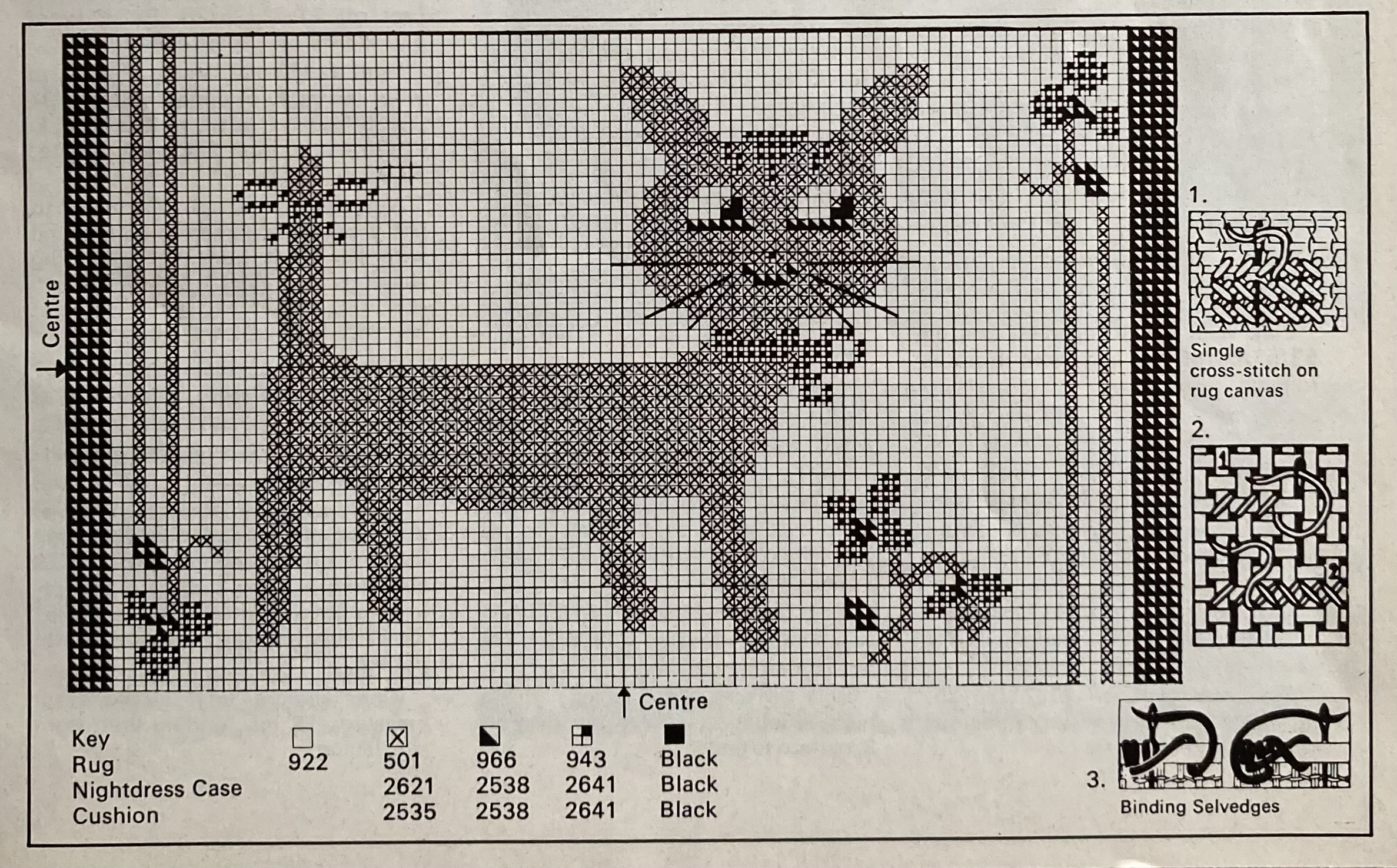
There are plenty of embroidery and tapestry projects for those long winter evenings. My favourite is the cross-stitch cat that can be made into a cushion, rug, and/or nightcase. (I have not yet understood the point of putting your pajamas or nightgown in a zippered case during the day. Were any of you readers children of the time and can tell me about it?) According to Stitchcraft, cross-stitch cats are lucky! I could use it. There’s also an appliqué picture of a boy and girl rowing, an embroidered dragon cushion or wall panel (that dragon is definitely high on something, cheers), an opportunity to turn leftover tapestry wool scraps into a tea-cosy or cushion, and a cross-stitch rug to use as a hall runner. The only specifically Christmas-themed project (in the entire issue, really) is an embroidered serving set of table cloth and/or trolley mats with somewhat abstract renditions of shepherds, sheep and a star.
In the children’s comic, “The Woodland Wool Shop”, Mrs Olive Owl starts knitting a long strip of fabric with no plan about what to do with it (been there) and realises that it would make a great coat for Daniel Dachshund. Isn’t that nice? I hope all your projects turn out to be equally useful and make someone (including you) equally happy.

My project will be something small, probably the gloves. I do love the lucky cross-stitch cat, though. Merry Christmas to those of you who celebrate it, and happy December holidays to all.
November 1967: Overview

Autumn is officially here, winter is around the corner, and Stitchcraft‘s November 1967 issue presents “the GOLDEN LOOK for winter sparkle”, with warm garments, warm colours, fun textures, and matching his-and-hers outfits to chase away the cold, grey days of November.

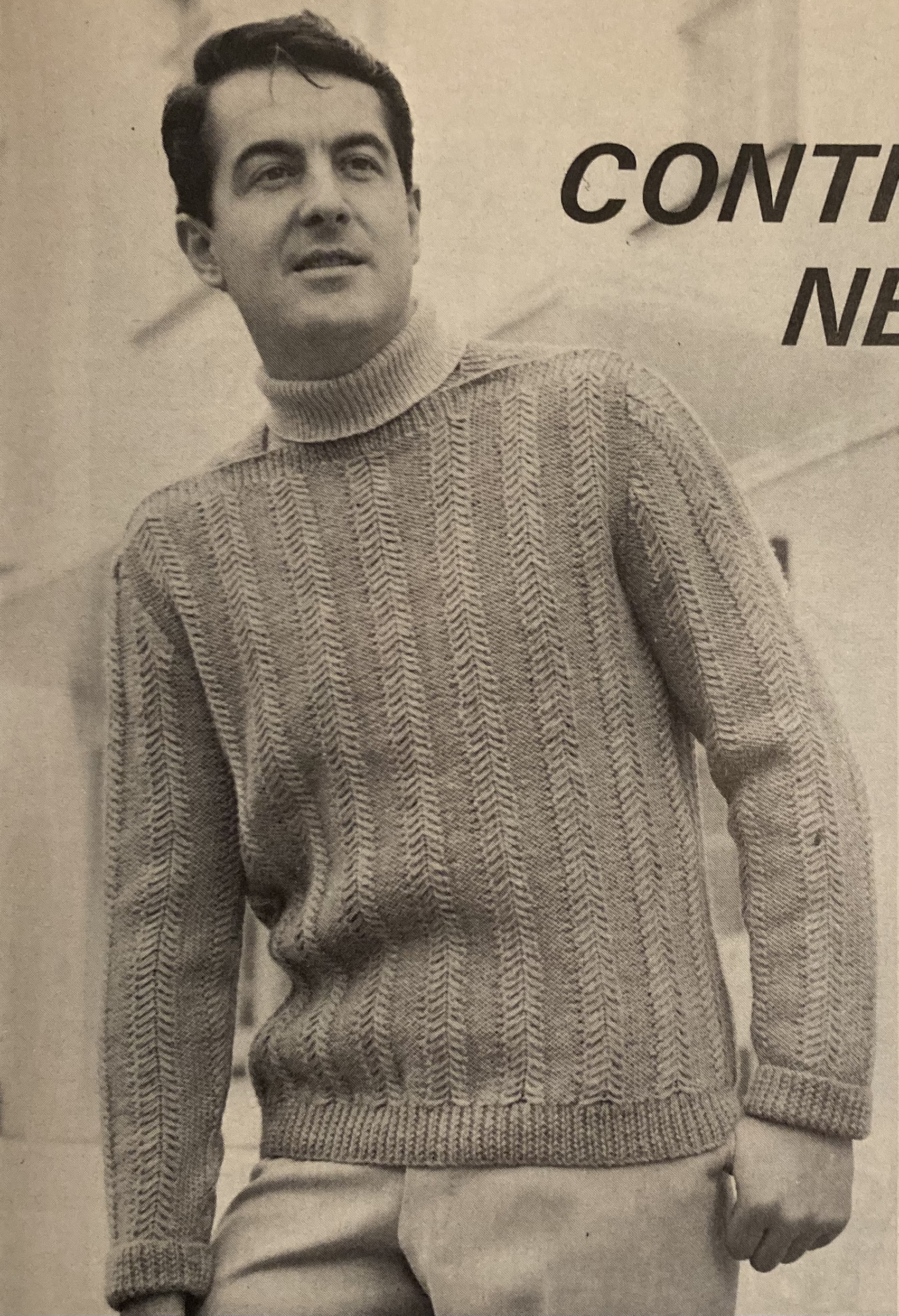
Our cover models sport matching polo- (aka turtle-) neck sweaters in “Flair” wool and a suitably golden colour called “Musk.” There are only two sizes given: 35-37 or 40-42 inch bust, so intended as a one-size-fits-most, basically unisex pattern. The textured pattern is made entirely with knit and purl stitches. Our other partner-look models wear polo-neck pullovers as well, with a simple stranded chevron border at the hem. They seem to be designed for somewhat younger and thinner folks, with three sizes from 32-33 to 38-39 inch bust. There’s one more design just for men: a “country cardigan” in blue wool and a fern-like textured pattern.

The women’s designs include a rich green jumper suit, with a buttoned pullover in low-contrast stranded diamond pattern and a plain olive-green skirt; a hooded jacket in a chunky bobble-like pattern made with twisted stitches; a delicate jumper in soft, fuzzy “Princess” wool with a contrasting colour yoke; a polo-neck pullover in colourful “rainbow” chevron pattern; and a bright blue cabled jumper for larger sizes (40-45 inch bust).

With all these great designs for adults, it’s not surprising that there’s only one children’s pattern in this issue, a tunic for girls age ca. 4 to 7. It’s knitted sideways in pieces, starting at the left side edge of the back, then the fronts separately, then the sleeves separately, which are also knit sideways. I’m glad to see the girl model wearing tights, for once! The children’s comic in the “Readers Pages”, titled “The Woodland Wool Shop”, tells the story of Daisy Lamb, who wants to learn cross-stitch, but doesn’t want to be cross about it.

The homewares and “novelties” are all designed with an eye towards December gift-giving, and most of them are featured in a single, big colour photograph. There are lots of things to make in felts: holiday-themed potholders and party mats, a night-case patterned after the nursery rhyme about the old woman who lived in a shoe, some racist “Golliwog” puppet mitts (unfortunately, still a thing), giraffes to appliqué onto an apron, coffee cosy or apron, and another truly terrifying clown intended for use as a string dispenser — yes, you put a roll of string in its head and pull the string out through its mouth. Stephen King was already 20 years old when this issue of Stitchcraft came out (and lived in another country), but if he grew up with things like this in the 50s, it’s not hard to see where he got the inspiration for It. Just saying.

You can also embroider sprays of holly on place mats or another apron, or make a cross-stitch rug or cushion in a Norwegian pattern, or a different cushion in a Florentine pattern. More advanced tapestry aficionados can make a tray-cloth or yet another cushion based on a design from a Chinese tapestry. On the simpler side, you can sew a little doll and dress her in traditional Dutch clothing, or knit a little stuffed toy set of a mother and baby fox. Many, many gift ideas in this issue. Oh, and another rug, in cross stitch!

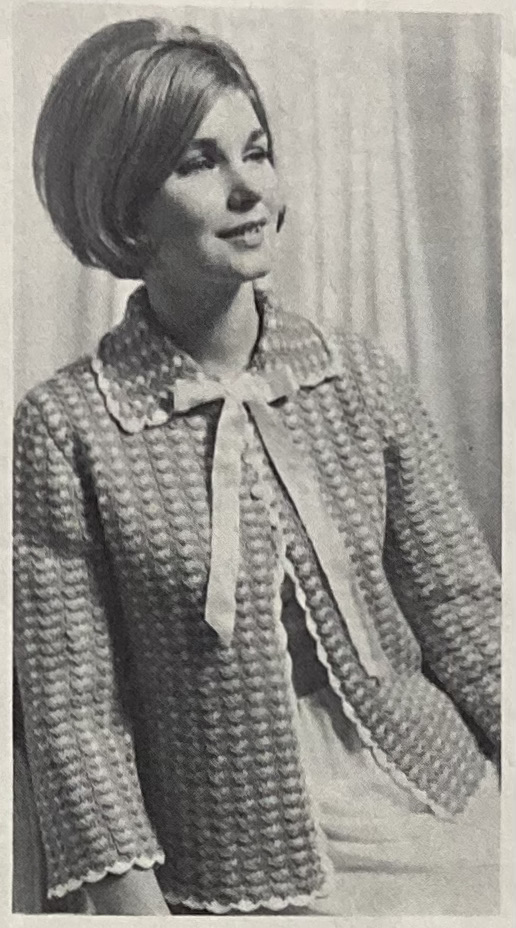
The ideas keep coming, with two little cross-stitch pictures symbolising “Autumn” and “Winter” (to match the “Spring” and “Summer” pictures in the last issue). And how could I not mention the best gift idea of all: the bed-jacket in loop-stitch, modeled by my favourite model, who seems to have been hired by Stitchcraft exclusively to model bed-jackets with a sexy come-hither smile. I have to admit, the loop-pattern spoils the sexiness for me, but we all have our own preferences… Love the pink-on-pink photograph, though.

That’s all for this issue! My project will be the buttoned pullover from the jaquard jumper suit (just the jumper for now.) May your November be bright and golden.

December 1966: Overview

Hooray, it’s the Christmas issue! Our cover model from the December 1966 issue of Stitchcraft sports a holiday-red knitted dress with a jaunty black velvet bow in her hair. Bright, cheerful colours, fun ideas for gifts and holiday parties, and the “Total Look” of a complete knitted outfit in one colour theme light up the pages.

The cover dress is made in Shetland-blend “Fiona” yarn and a diagonal criss-cross pattern that looks like cables, but is actually made entirely out of normal increases and decreases (yo, sl-k-psso, k2tog). The skirt is plain stocking-stitch and amazingly for 1966, still falls just above the knee. The two-colour suit with stranded “key” pattern in yoke and skirt hem is similarly demure. The two colours of lightweight “Cameo Crepe” wool are “Pearl Frost”, which I assume is the lighter one, and “Mastic” — I have no idea what colour “Mastic” is supposed to be. (I can only think of Mastix cosmetic glue, used for sticking on fake beards etc., which of course has no colour at all.) As an alternative, the magazine suggests to use Patons Beehive 4-ply in “Mink” and “Magnolia”, so I guess “Mastic” is a medium brown and the magnolia is white. Or the magnolia is dark pink and the mink has got its winter coat on. By the way, Stitchcraft‘s “editress” Patience Horne promises us in the notes to this issue that starting in January 1967, there will be more colour photos, so there may be less guesswork in the future.

The other patterns for adults include a lacy bedjacket, also in “Fiona”, that is pretty enough to wear as a cardigan, as well as a party jacket with Lurex metallic thread held together with the main crepe wool on the borders for extra holiday sparkle. There’s also practical heavy cardigan in reverse stocking-stitch with cable panels.

For the man in the family, an oversized shirt-sweater with angular pattern lines. Or you can make a his-and-hers set of “snow sweaters” in a typical all-over tiled Fair Isle pattern. Diagonal lines are a clear theme in this issue, whether made via texture, colour, or with angular cables.

For the kids, there’s a cute, warm 3-piece outfit of leggings, jumper and cardigan that is good for winter playtime (and finally, a girl can have warm legs and move around without worrying about where her skirt is flying. Look how happy she is!). The boys’ slipover features elements of the cable pattern and blocks of ribbing that we saw on the women’s cardigan. Finally, a bigger girl can enjoy the “Total Look” of tunic, tights and floppy pom-pom-trimmed hat, all coordinated in bright shades of “Lipstick Red” and “Strawberry Ice” double knitting. I’m glad they used a colour photo for this one!

The usual embroidery patterns for cross-stitch borders and easy cushions are supplemented by another big, fun appliqué wall panel: “Widdicombe Fair.” (Spelled with two “d”‘s in Stitchcraft.) I admit, I did not grow up in the UK and wasn’t familiar with it. For others who also weren’t in the know: it’s a traditional agricultural/livestock market fair that has developed into a more social gathering for traditional events, arts and crafts, and rural activities. Have any of you readers been there? Do they have knitting? Tell us about it in the comments! The wall panel shows a scene of happy (and presumably quite tipsy) fair-goers riding home on a pony after the fair. It is comic-like in style, but actually quite intricately worked, with close-fitted felt pieces embroidered and decorated after the appliqué is done.

And of course, it wouldn’t be Christmas without little handmade gifts and Christmas “novelties.” You can knit a hot-water-bottle cover and address it in embroidery to “Miss Miranda” in “Dreamland” (presumably other names and addresses would work as well) or knit some fireside slippers in an easy bobbly-lace pattern. While you’re knitting, make some cabled gloves with a contrasting-colour cable on palm and back of hand for “Father” and a kangaroo with baby for your littlest one. A crocheted hall runner is a “practical gift for the Home.”

The Christmas novelties run the gamut from elegant (an appliquéd panel of a poppy flower from which you can hang a tiny calendar), to cute and wintry (felt table mats with appliquéd stars, a “Father Christmas” sack to fill with gifts), to cute and silly (a knitting snowman made of cardboard, with the “snow” effect made by just pasting cotton wool onto the cardboard), to “what even is it” (little “mascots” made from the scraps of felt left over from the other projects. Apparently, they represent “amusing Bongle people”. I was very afraid to find out what that meant, but they seem to be a sort of fairytale gnome that have recently made a modern comeback in the video game Baldur’s Gate? Either that, or a slang term for copyright protection, lol. I’m guessing the Stitchcraft mascots are the fairytale gnome kind.)

The Readers’ Pages have a great little pattern for a potholder with a crocheted robin sitting on the handle of an embroidered spade. In the comic, schoolmarms Miss Prim and Miss Proper try to teach untidy piglet Higgledy Piggledy how to be neat and clean, but he is not having any of it. It’s the schoolmarms’ fault that he flies out the window, though, since they sat down too hard on the other end of the bench he was sitting on. To finish off the issue, there’s a thoroughly groovy ad for “Stop Red” and “So Dotty” lingerie from the Scotch Wool Shop.

That’s all for this issue! I have no idea what project I will make. Stay tuned, and happy holidays.

December 1965: Workbag & Pretty Idea

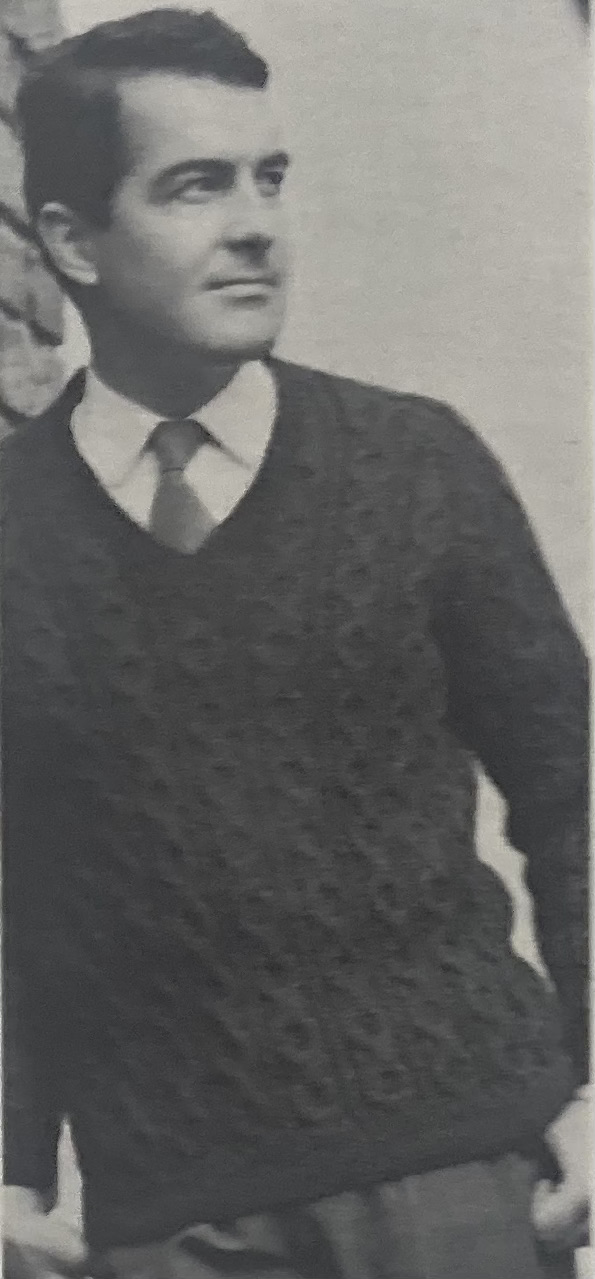
It was hard to choose a project from the December 1965 issue. There were lots of nice things in it — the red pullover on the cover, the men’s classic cable V-neck, the two-piece wool dress, the fun knee-high socks, the swingy ribbed skirt — but I was not feeling any of it. I have so many large, unfinished projects and so much wool in stash (of which none would be suitable and/or enough for any of the nice garments in the issue.) Also, I have way too many finished knitted projects! My closet is past full. I need to start knitting exclusively for other people.

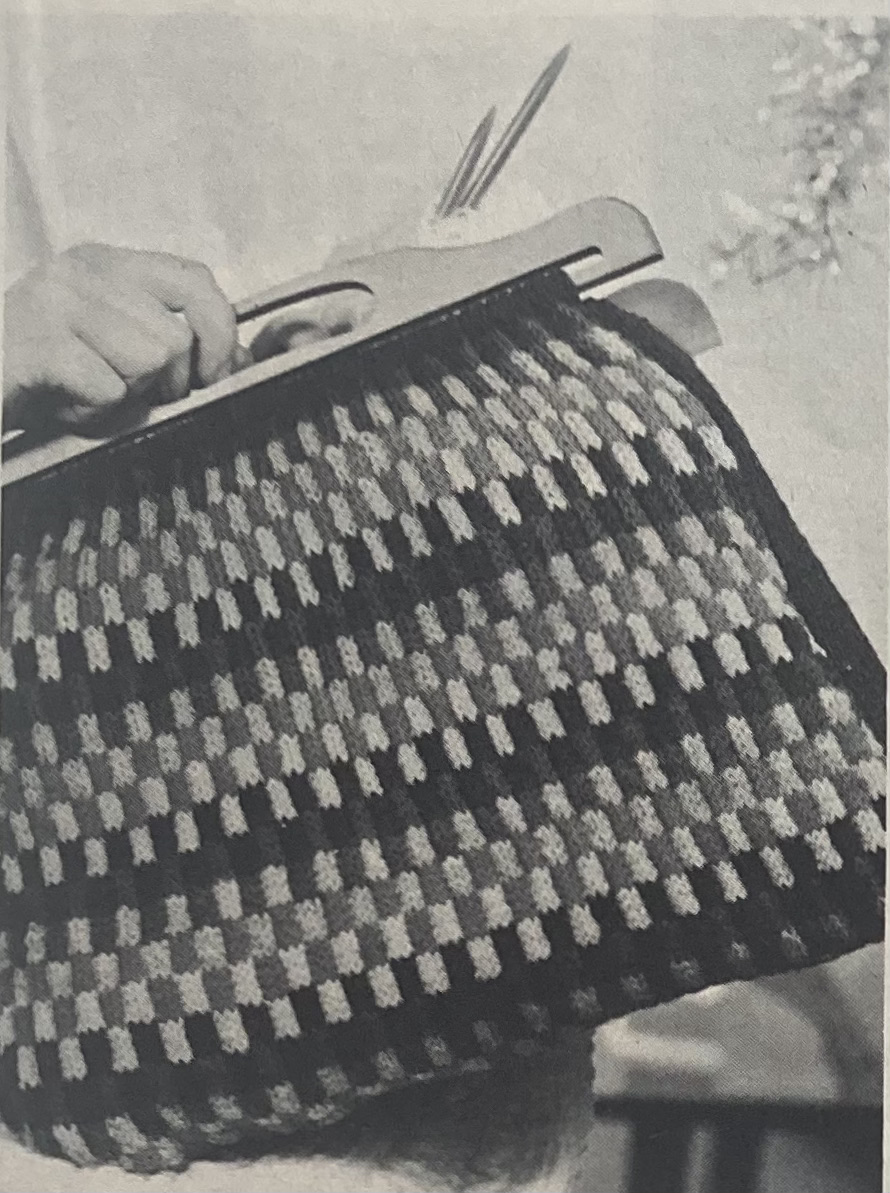
Though, as it turned out, I had also already made one of the projects from this issue, back before I started the blog. At the time, I had lots and lots of leftover Rauma 3-ply (which is double-knitting weight, not what you normally would expect “3-ply” to be) and Jamieson’s Double Knitting in stash from a tam and mitts combo that I had designed for Knit Now. And here in the December 1965 issue of Stitchcraft was this wonderful “Workbag for a friend” that was perfect for using up leftovers. The check pattern is easier than it looks — the colours are just staggered every four rows. I adapted the stitch counts to make it work with DK wool instead of the 4-ply called for in the pattern.

The bag is made in two pieces for front and back, with two separate gussets made in 1×1 ribbing, for the sides. This makes a nice, big bag. I bought non-vintage handles which were unfortunately not real wood, but accurate reproductions of the type in the magazine photo. They have a slot at the bottom through which you insert the ribbed top of the bag, fold it over to the inside and sew in place. Very easy. Although it’s not called for in the pattern, I lined the bag with non-stretchy, woven cotton material to keep it from stretching. It’s a great bag and I use it for large projects. (I apologise for having only a finished photo and no in-progress pictures. At the time, i didn’t know I was going to start writing a blog, and only took pictured of finished objects, if at all.)

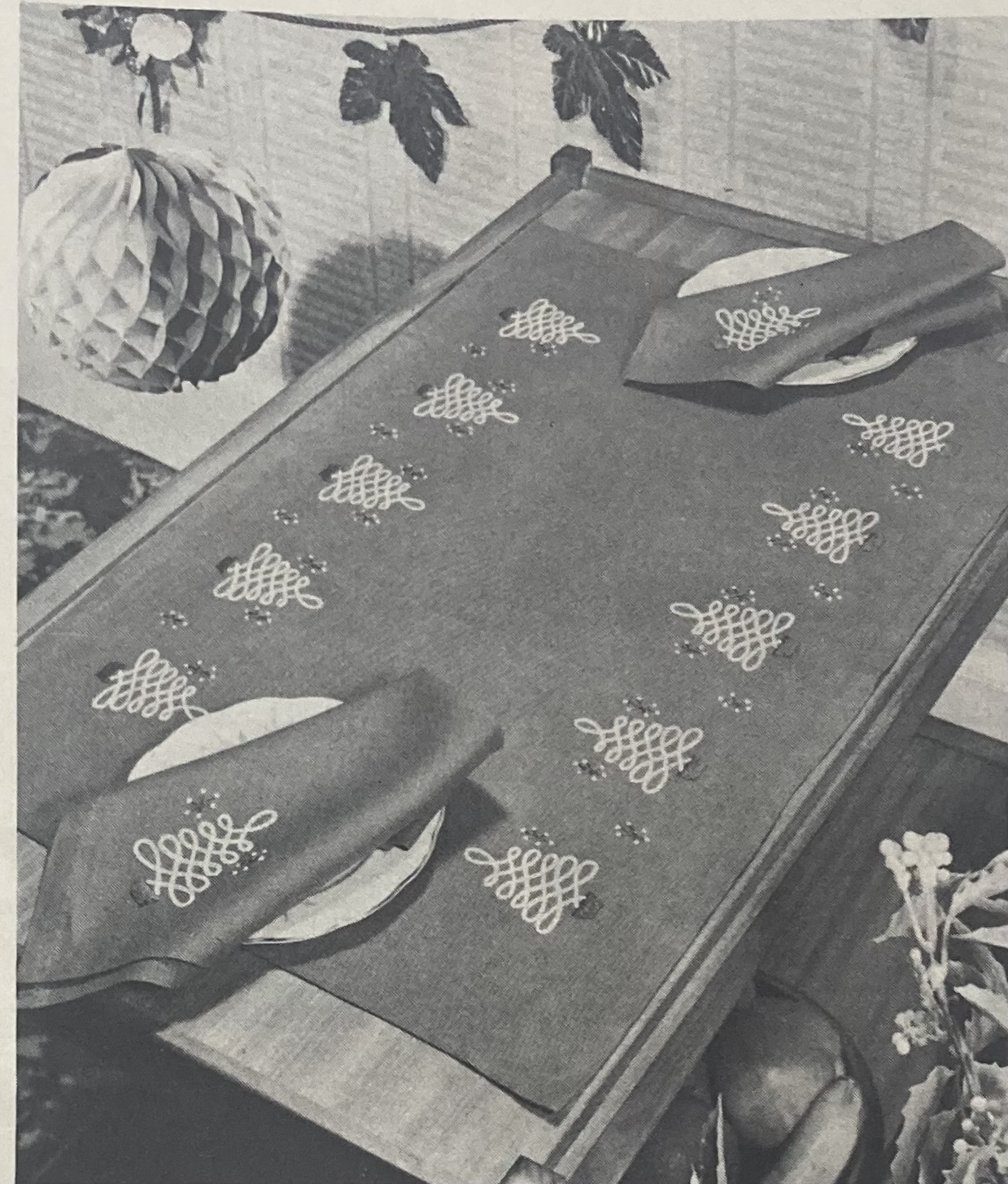
Still, I felt like I was “cheating” by not making at least something new from this issue. How about a “Pretty idea for a Buffet Party” i.e. a trolly cloth and napkins embroidered with Christmas trees? Too much work… but how about one little embroidered Christmas tree on green felt, made from stash and sewn into a little bag to use for a tiny present? Okay! I had plenty of green felt scraps from various other projects and plenty of white, brown and gold embroidery cotton.

The tree is cleverly “drawn” in one single swooping line and worked in easy chain stitch. The pot is brown long-and-short stitch and the stars, straight stitch with French knots. Since nothing writes or transfers onto dark green felt, I traced the pattern directly from the magazine page onto sewing-pattern paper, embroidered over the paper and dissolved the paper under running water.

Too lazy to set up the sewing machine, I sewed it into a little bag (approx. 4 x 4.5 inches or 10.5 x 12 cm) by hand (very badly, very crookedly. Sorry, it is the end of the year, and I am tired) and fastened it with a snap. The yellow cotton I used for lining seemed familiar… Oh right, it was left over from lining the workbag, six years ago! I guess that brought everything full circle.

On that full-circle note, I hope you all have a very happy New Year. See you in 1966!

December 1965: Overview

Here it is — the 1965 “Christmas Number”! December at Stitchcraft is always a month of “quick” holiday trimmings and small gifts, mixed with warm winter clothing and party ideas.

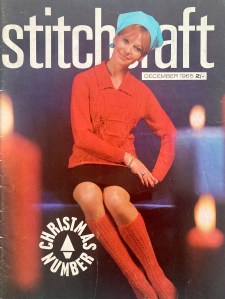
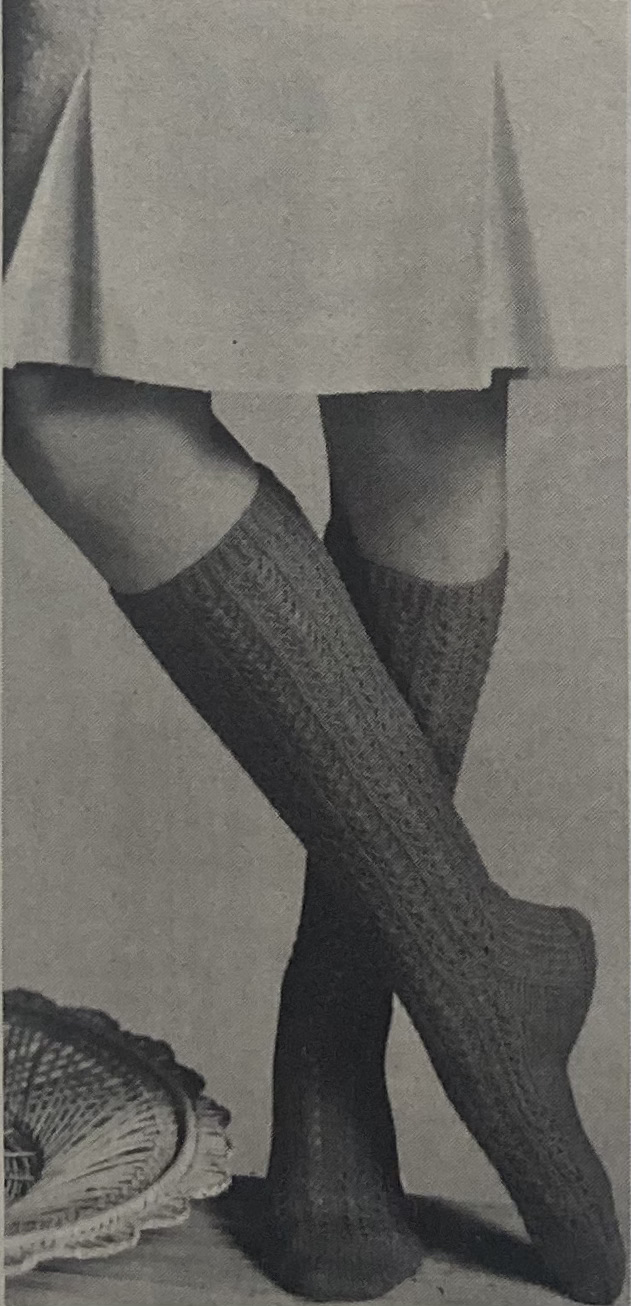
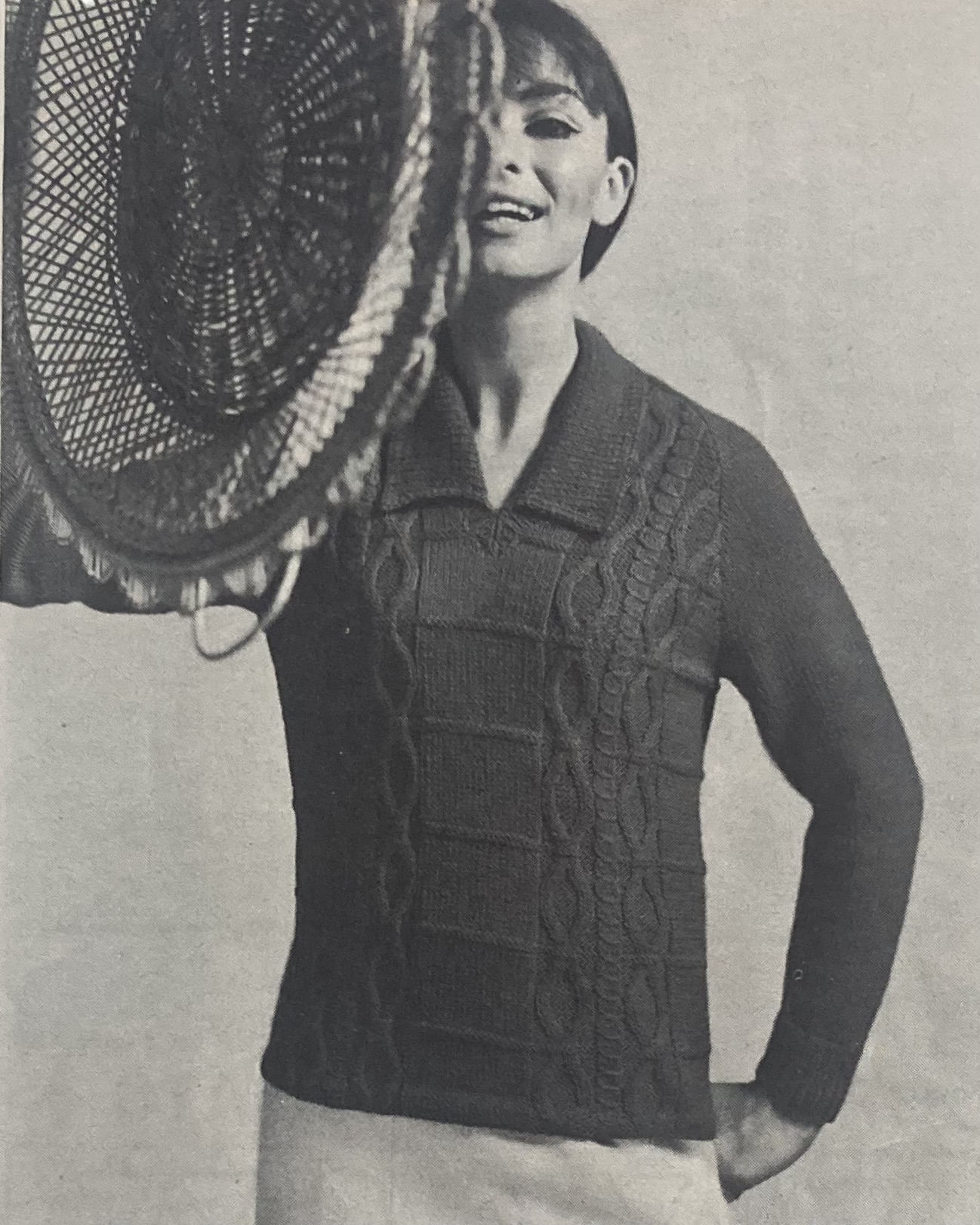
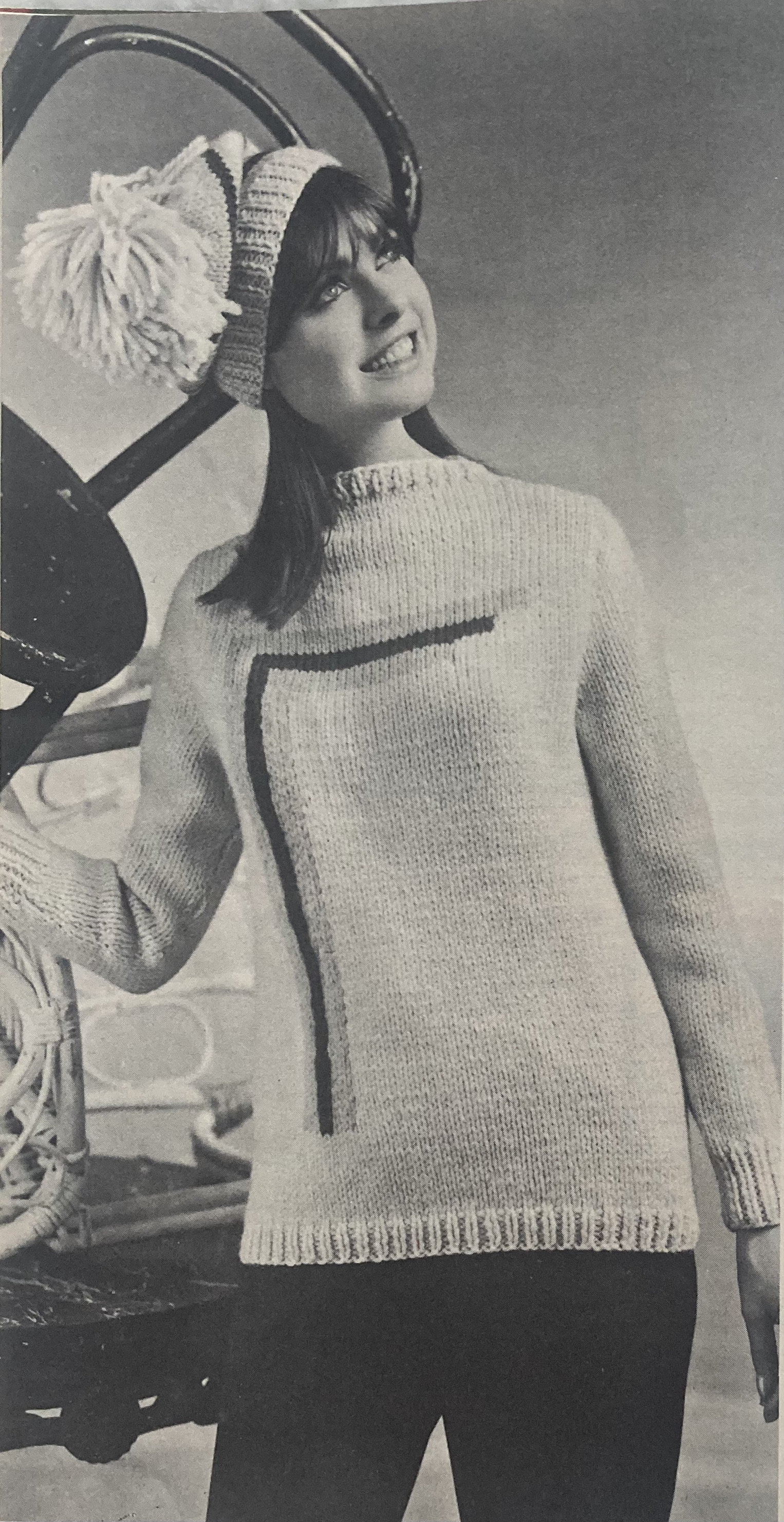
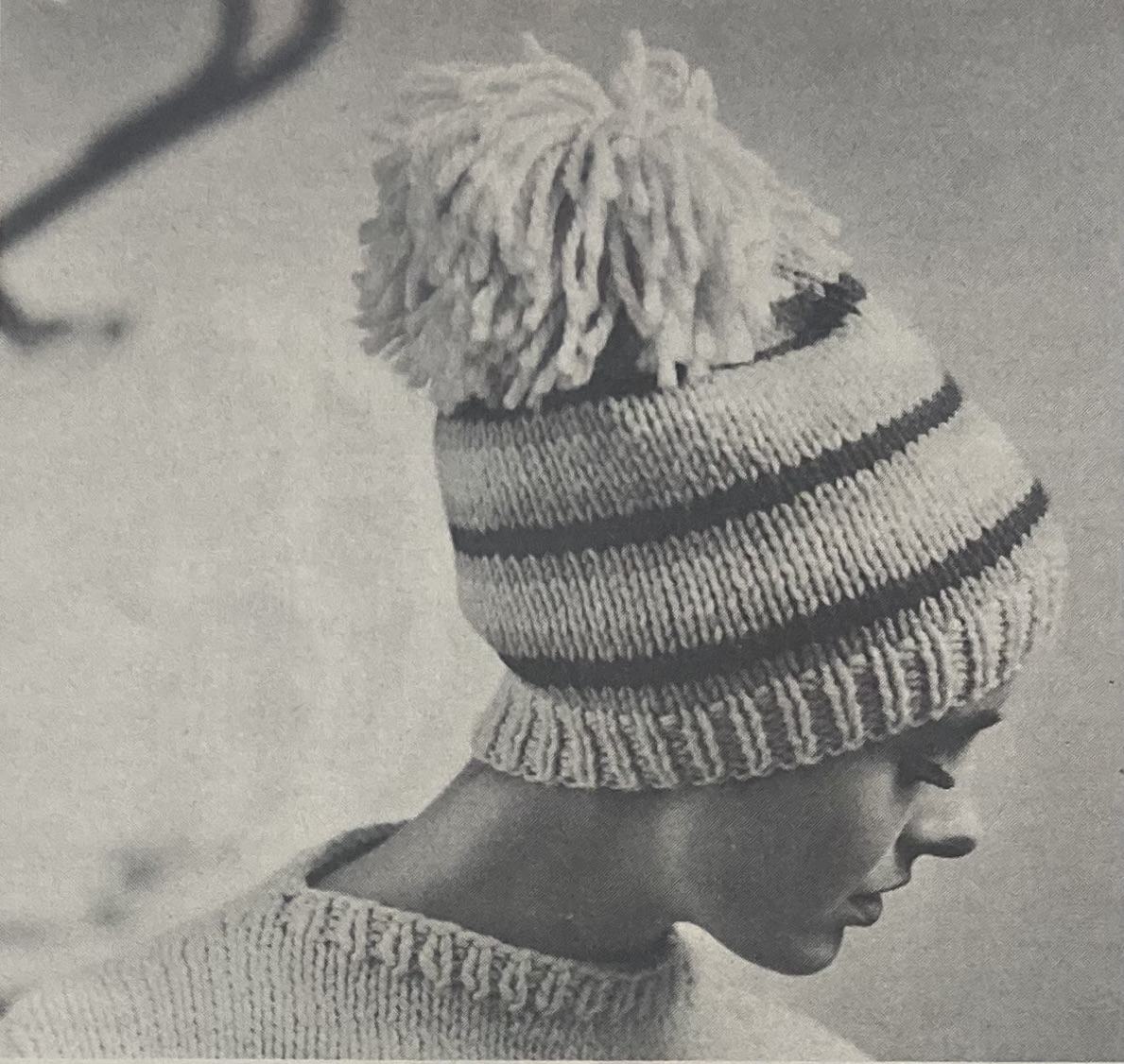
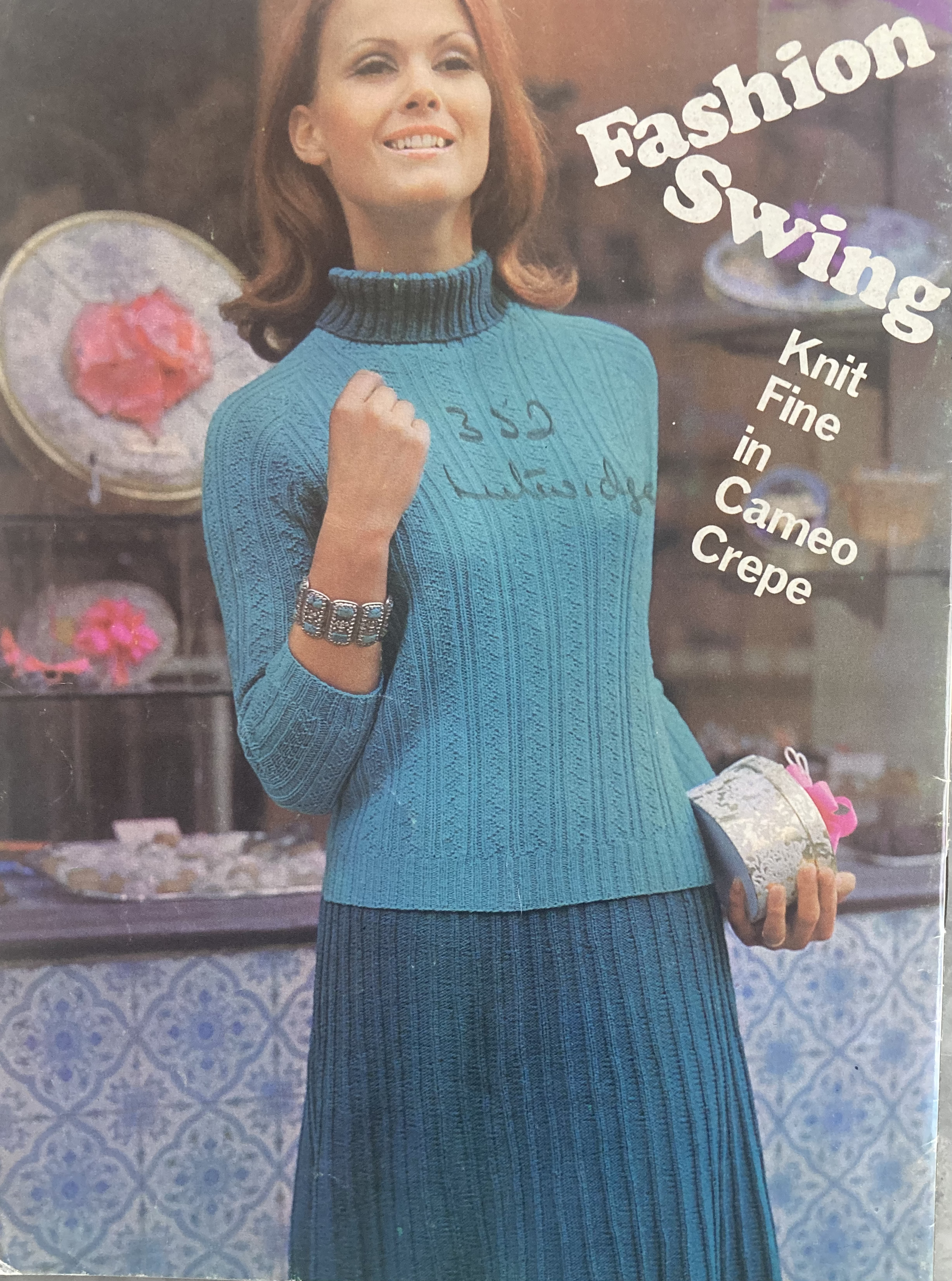
Our cover model is wearing a cable-block pullover (with non-crossing cables) in bright red double-knitting weight wool and matching knee-high socks in a lacy rib pattern. The caption on the pattern page is “Fashion feels Young” — Stitchcraft is finally getting into the children’s-fashions-for-adult-women idea that influenced so much of mid-60s fashion. Note the short skirt on the cover model, along with the knee-high socks, the playful kerchief and the big straw hat accessory in the black and white photo. It’s not quite Twiggy or Mary Quant (spoiler: Stitchcraft was never that fashion-forward), but it’s starting to show their influence. “Young Fashion” fun is reflected in the matching cap and pullover set as well. Look at the enormous pom-pom on the hat, outdone only by the model’s fake eyelashes!

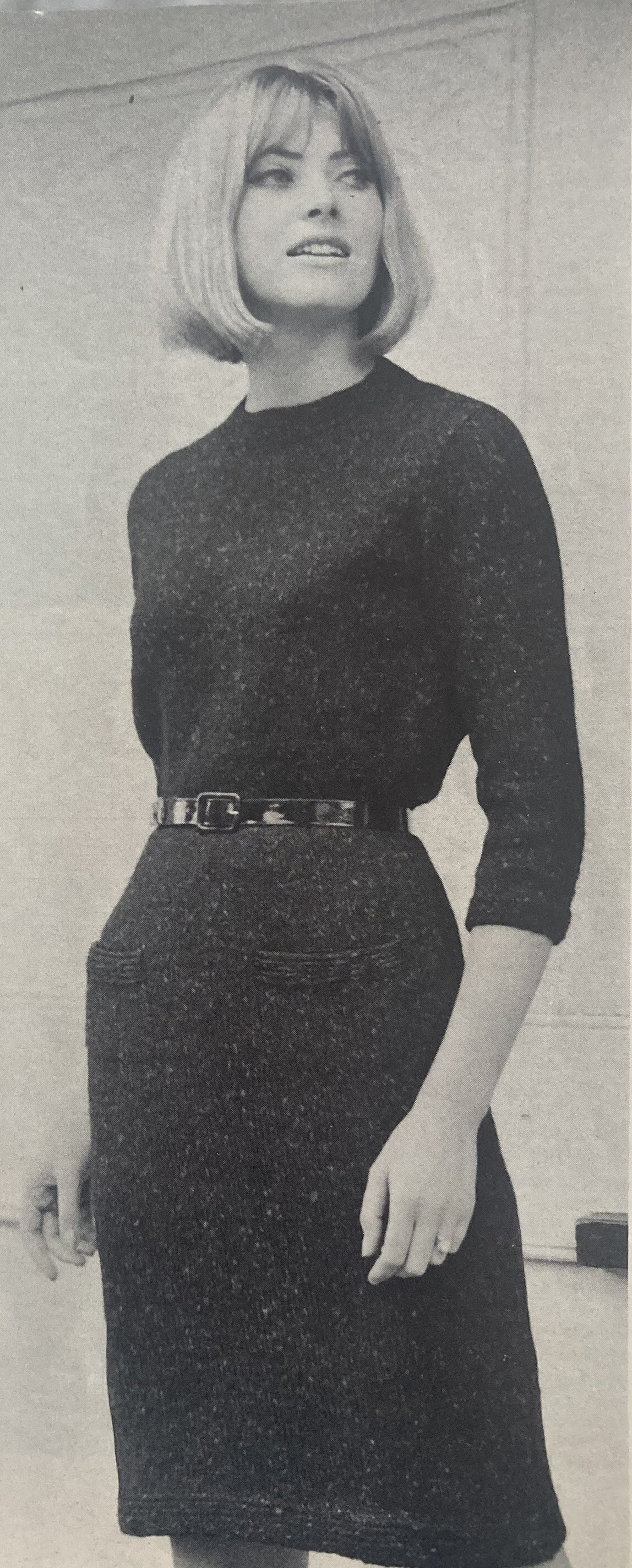
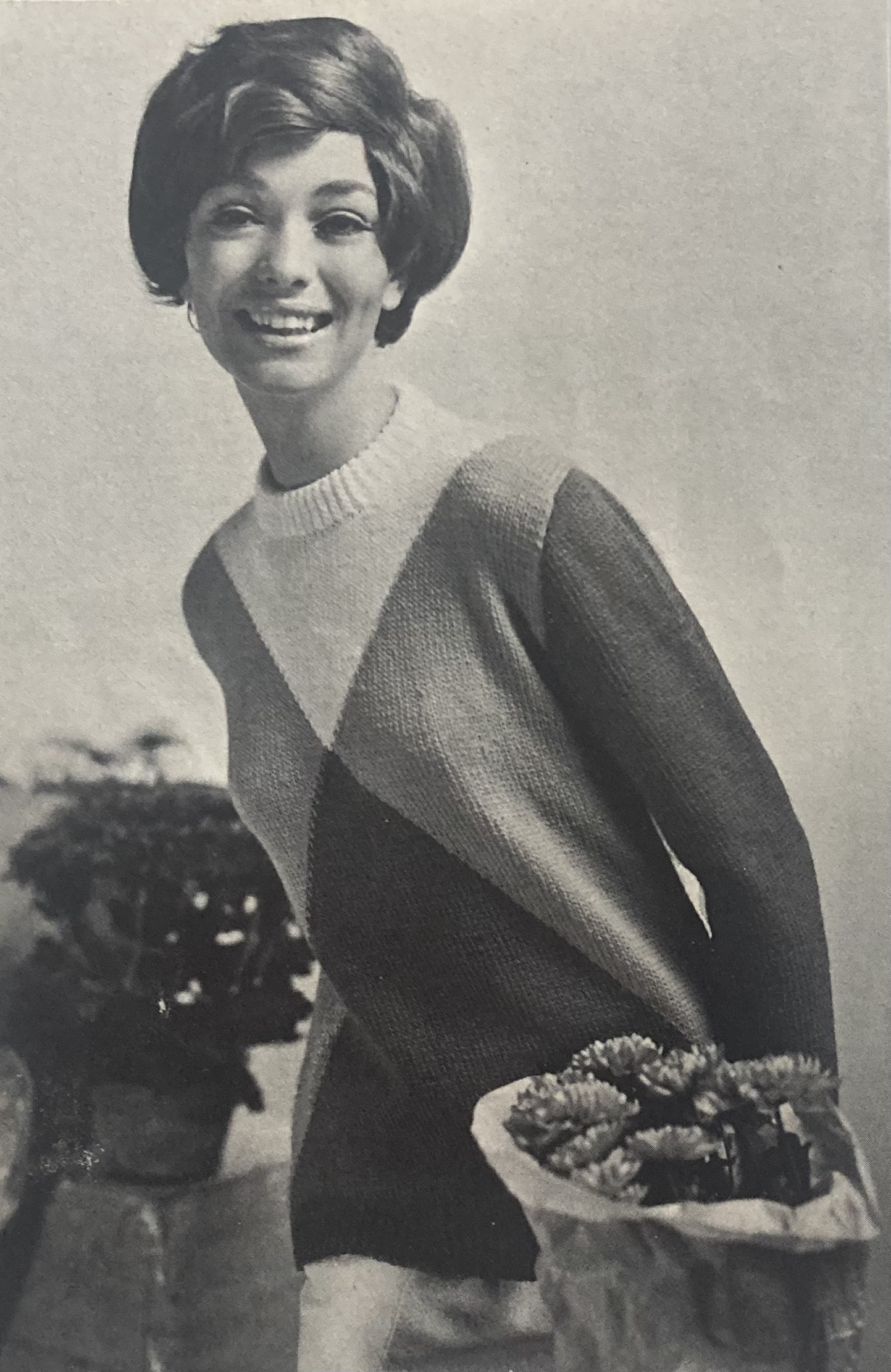
The other women’s fashions in this issue remain conservative: a warm tweed dress made in two parts sewn together at the waist (thus the obligatory belt), a cabled cardigan for larger sizes in thick, undyed “Capstan” wool, a lightweight wool jumper and swingy knee-length skirt in a “gay note” of blue or a “harlequin” pattern jumper in “bold” 1960s colours of white, gold and brown. I feel exactly the same way as the model in the colour photo when I finish a project and find that perfect gift on the same day.

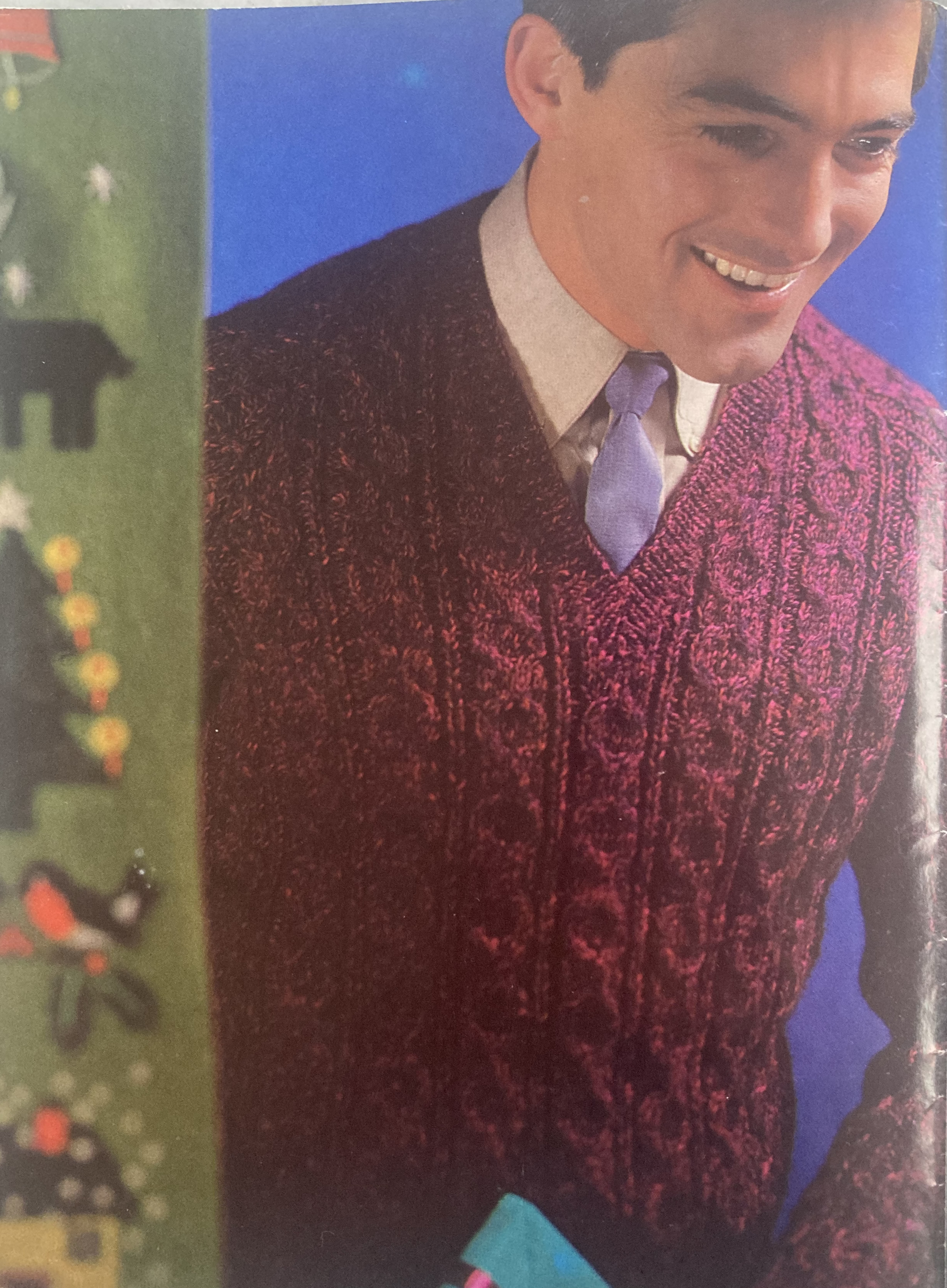
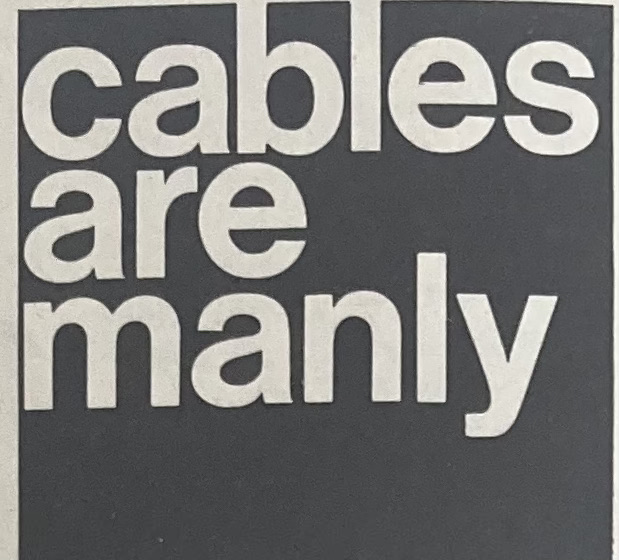
Men can get a cabled pullover in a glorious shade of purple tweed and the reassurance that cables are manly (like our model’s eyelashes, which are almost as impressive as his colleague’s with the pom-pom hat). There’s a boatneck pullover in herringbone stitch as well, meant to be worn over a simple polo- ( aka turtle-)neck jumper, for which a pattern was given in the previous issue.

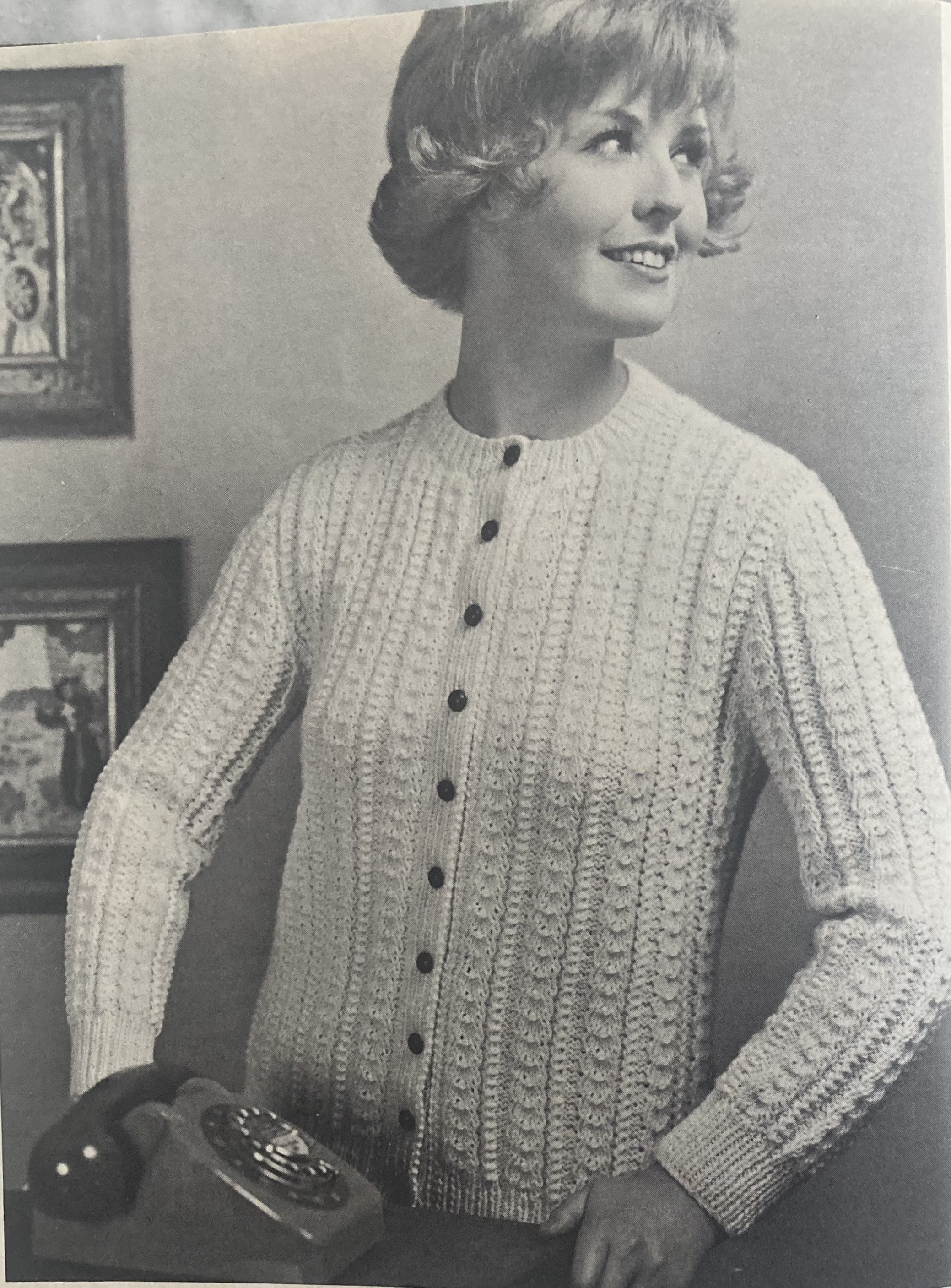
The manly-cable idea is continued on a lovely warm pullover for boys, and his younger sister can get a button-up cardigan in a frothy textured stitch pattern, made in synthetic-wool “Brilliante” for easy washing. Younger tots can enjoy warm ears with a chin-strap “helmet” hat that is guaranteed not to fall off or get lost.

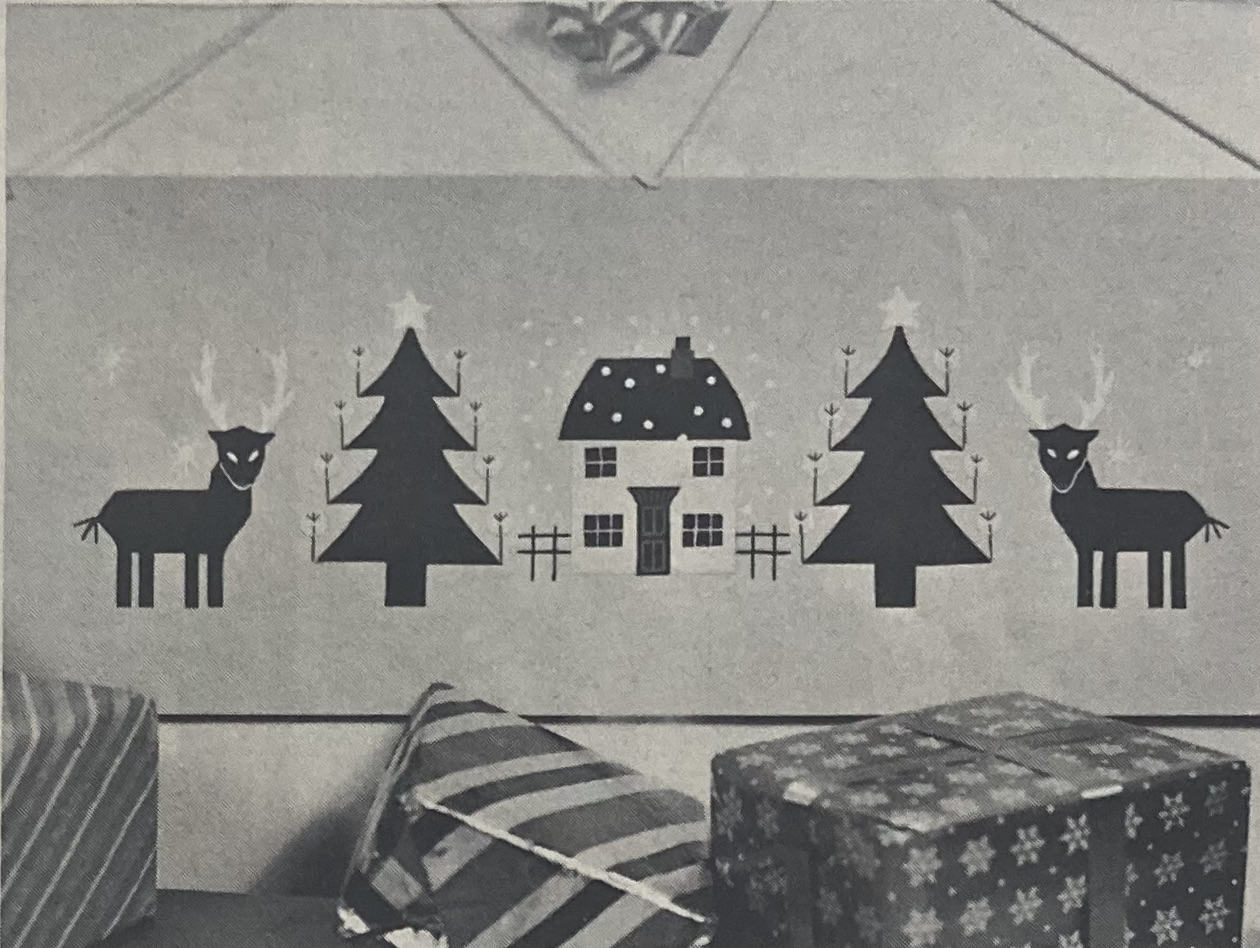
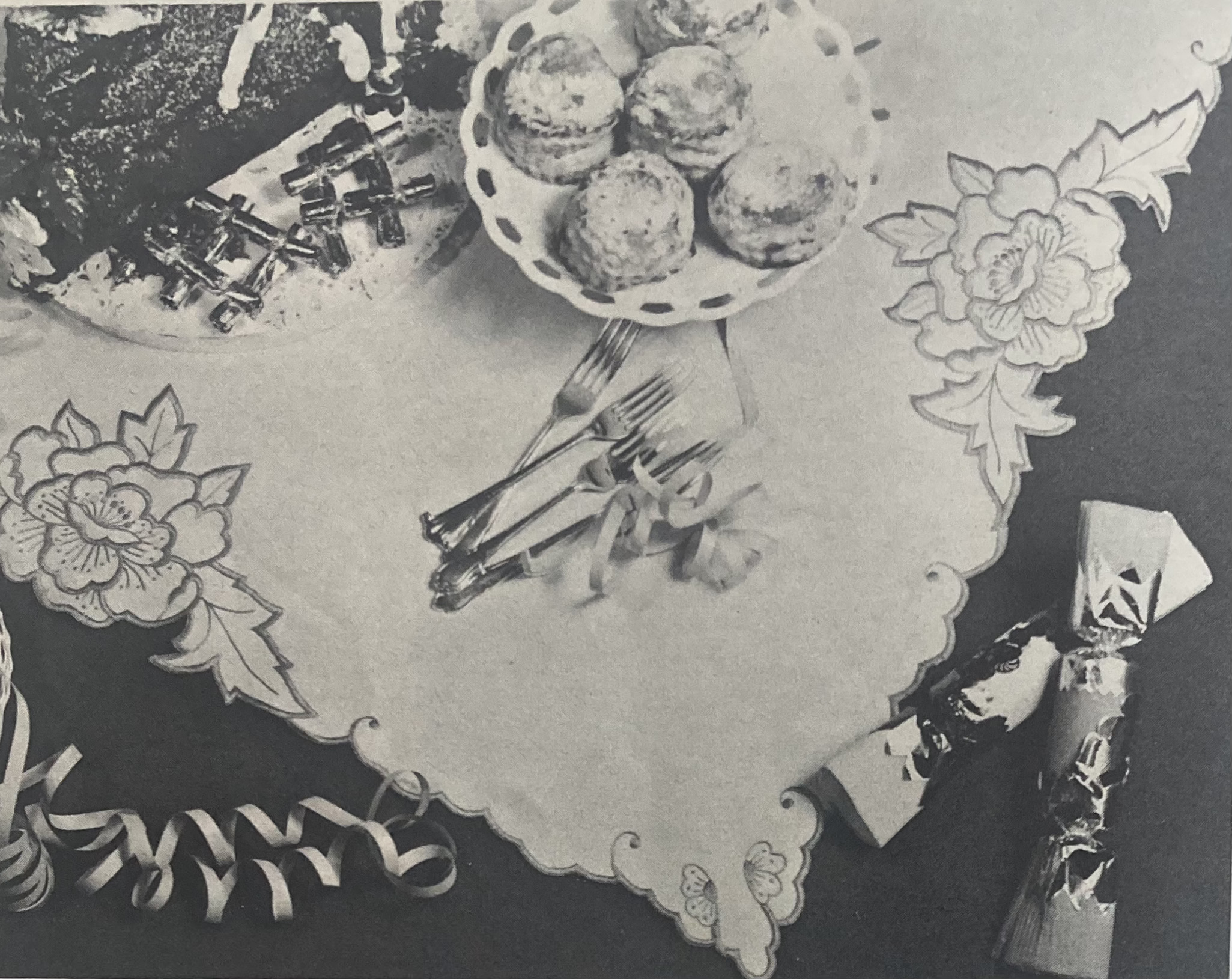
The real focus of the issue is of course, Christmas preparations. Felt appliqué makes a big appearance this year, with place mats and name cards for the holiday table as well a winter-scene wall hanging. The appliqués are quite simple and designed to be used with scraps, and the instructions give ideas on alternate uses such as glueing the felt pieces onto paper for home-made Christmas cards. The place markers have a butterfly motif, making them appropriate for any time of year. Cutwork and embroidery fans can make a tablecloth with peonies, or a Christmas-tree-themed trolley cloth and napkins embroidered in simple chain-stitch. More religiously-minded readers can make a tapestry wall hanging of a Nativity scene (colour photo on inside back cover).

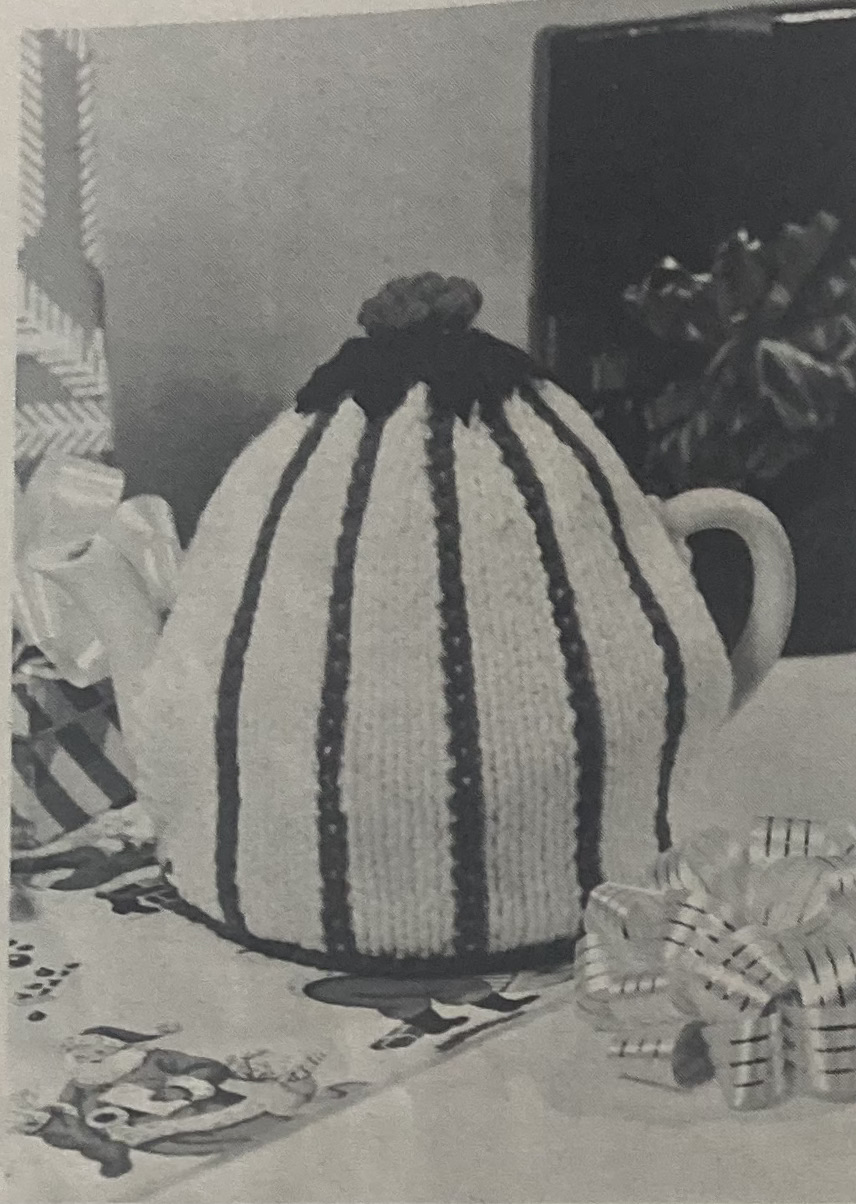
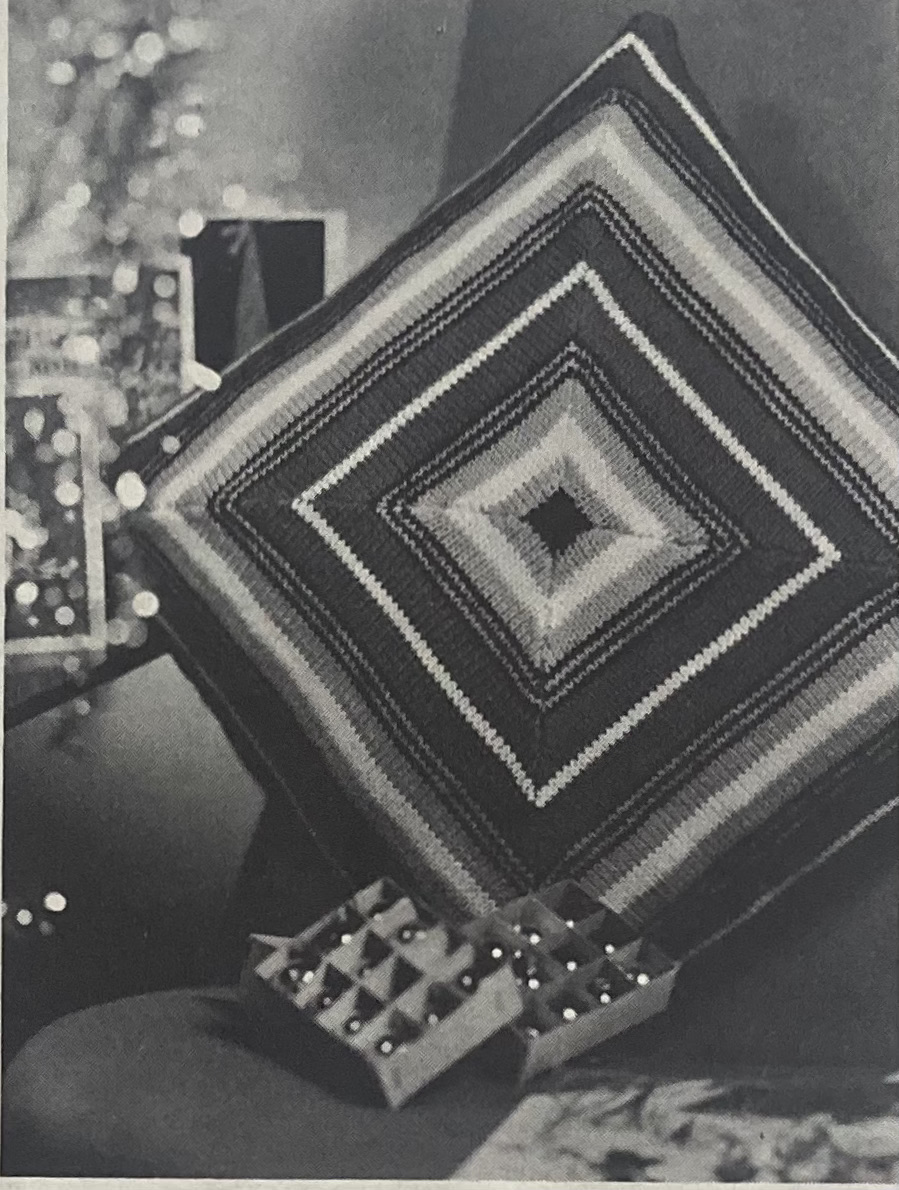
After dinner, it’s on to the gifts! The knitted tea cosy is supposed to represent a holly plant. The “workbag for a friend” is a fun way to use up leftover wool and I made one a couple of years ago. The “cushion for Granny” is a similar stash-buster. One would think it would be made in two squares either fron the center outwards or the edge inwards with raglan-type shaping, but no, you are supposed to make 4 identical triangle pieces for each side of the cushion and sew them together.

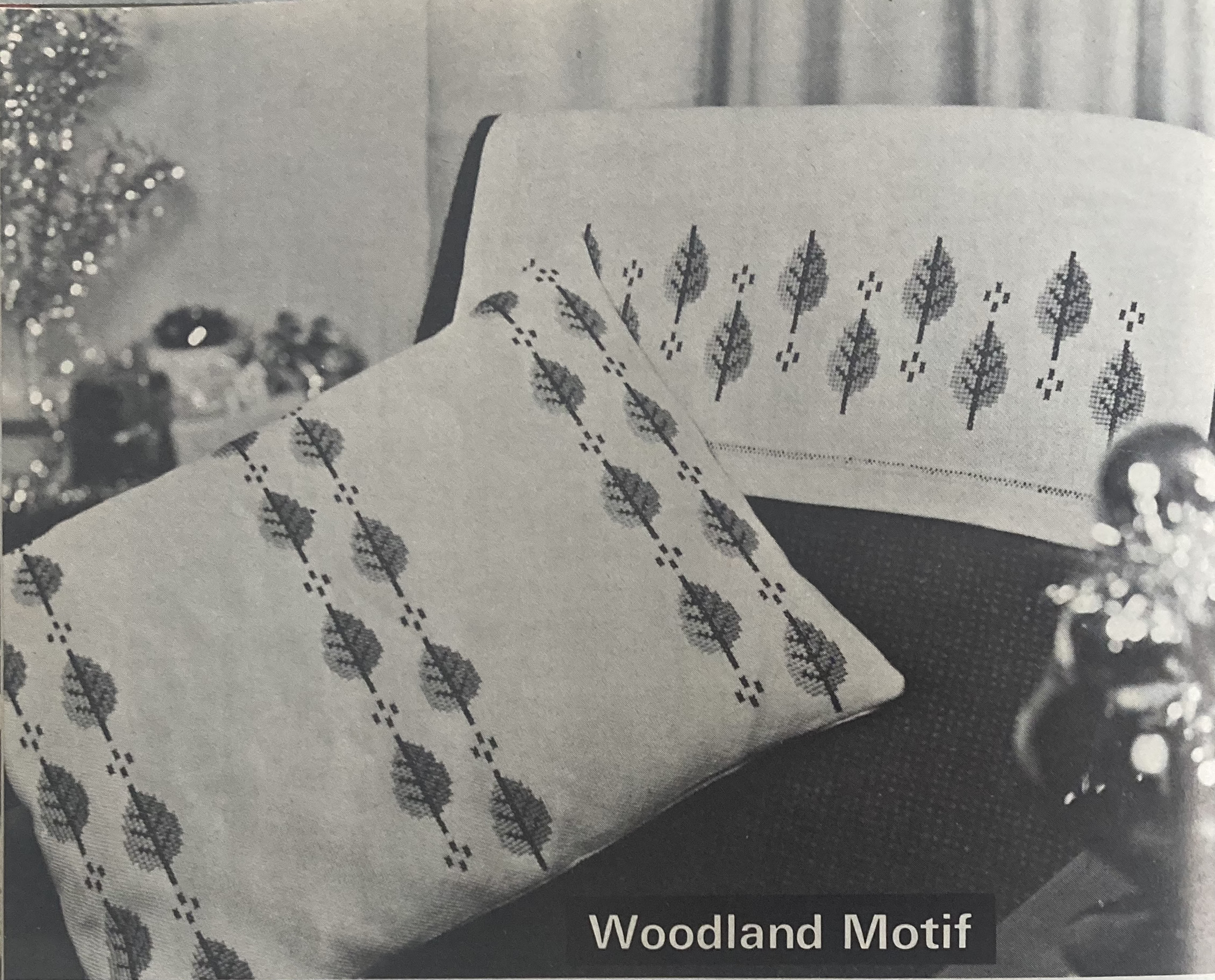
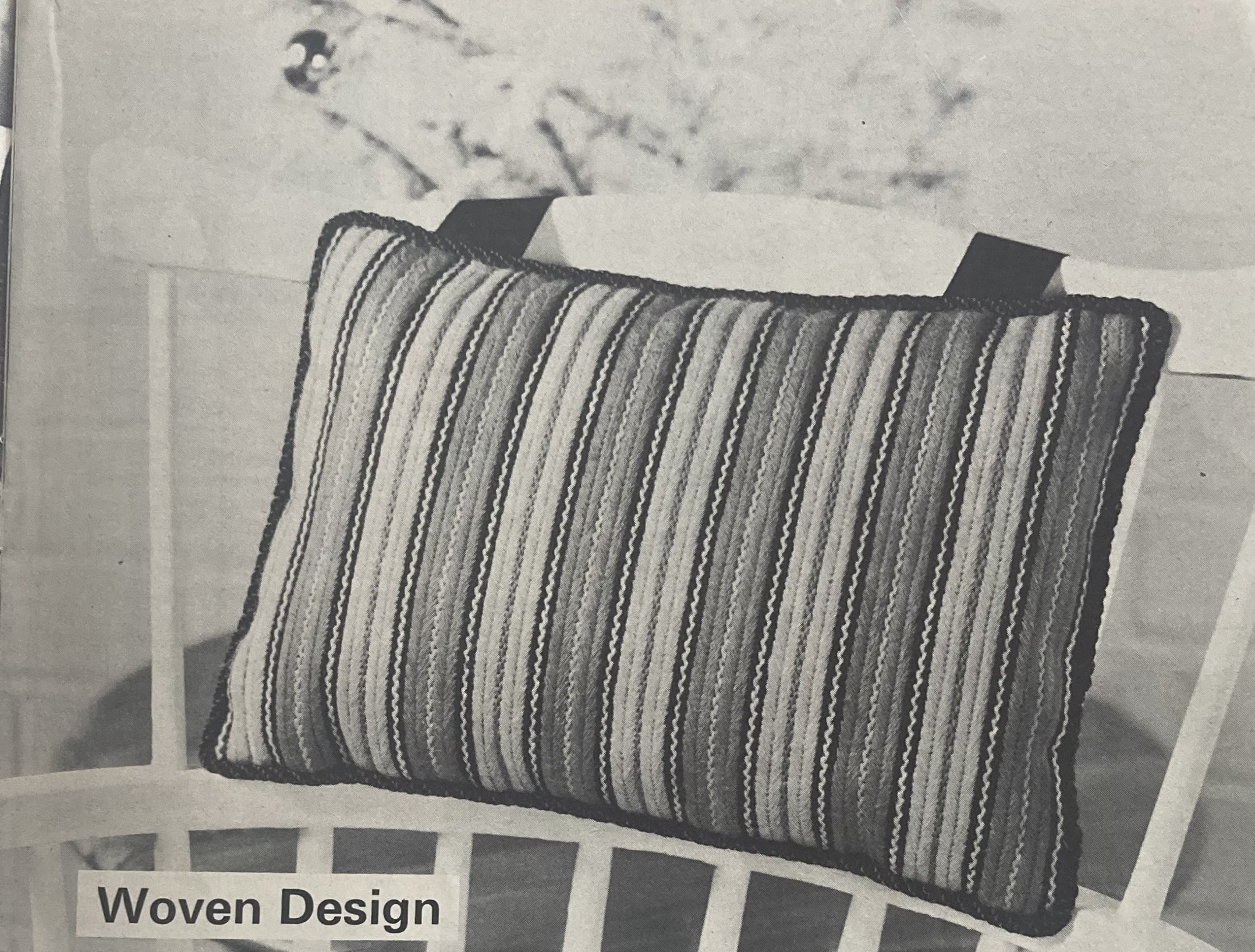
And let us not forget the other cushions: a simple cross-stitch number with a woodland design and a tough woven-tapestry chairback cushion in soumak and herringbone stitch. The colour scheme is brown with brown, with touches of orange and lime green for contrast. In the “just for fun” category, you can knit cosies for golf clubs.

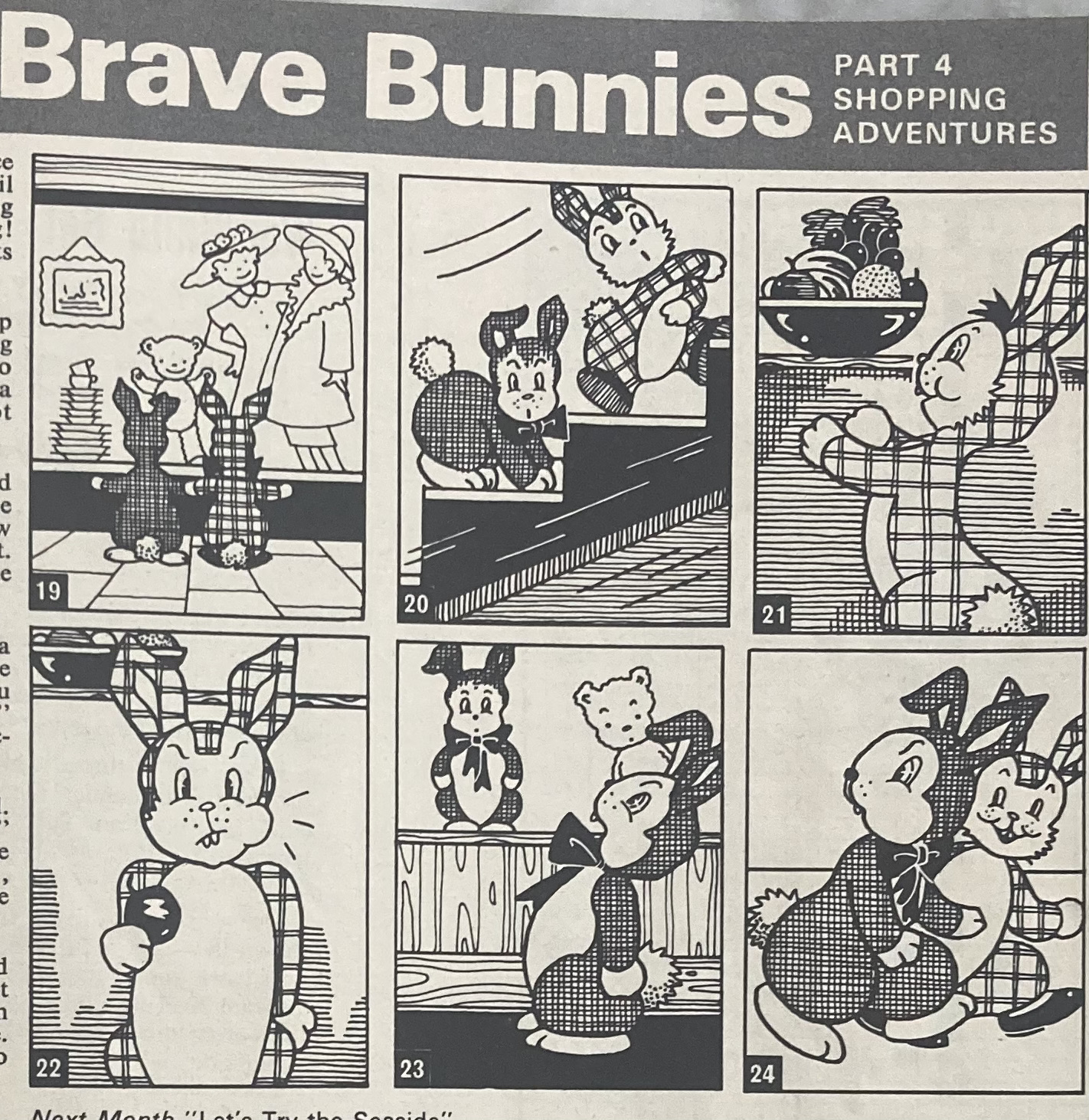
Our two brave bunnies from the Readers Pages are still on their quest to find a real live rabbit. Thinking they might find one in a department store (why not), they get stuck on a moving staircase, try to eat a plastic apple, and find a stuffed rabbit who, unlike our co-protagonist Sale Price (also a stuffed rabbit), sadly cannot talk. Next month, they will try the seaside, which is not known for being home to very many rabbits, but I suppose a better chance than a department store, a movie theatre or a merry-go-round. Of course, around Christmas time, one of the surest places to find a real rabbit would be on the dinner table, ha ha. I guess that storyline might be considered inappropriate for a light-hearted children’s comic. At least our two toy rabbit protagonists aren’t in danger of being eaten.

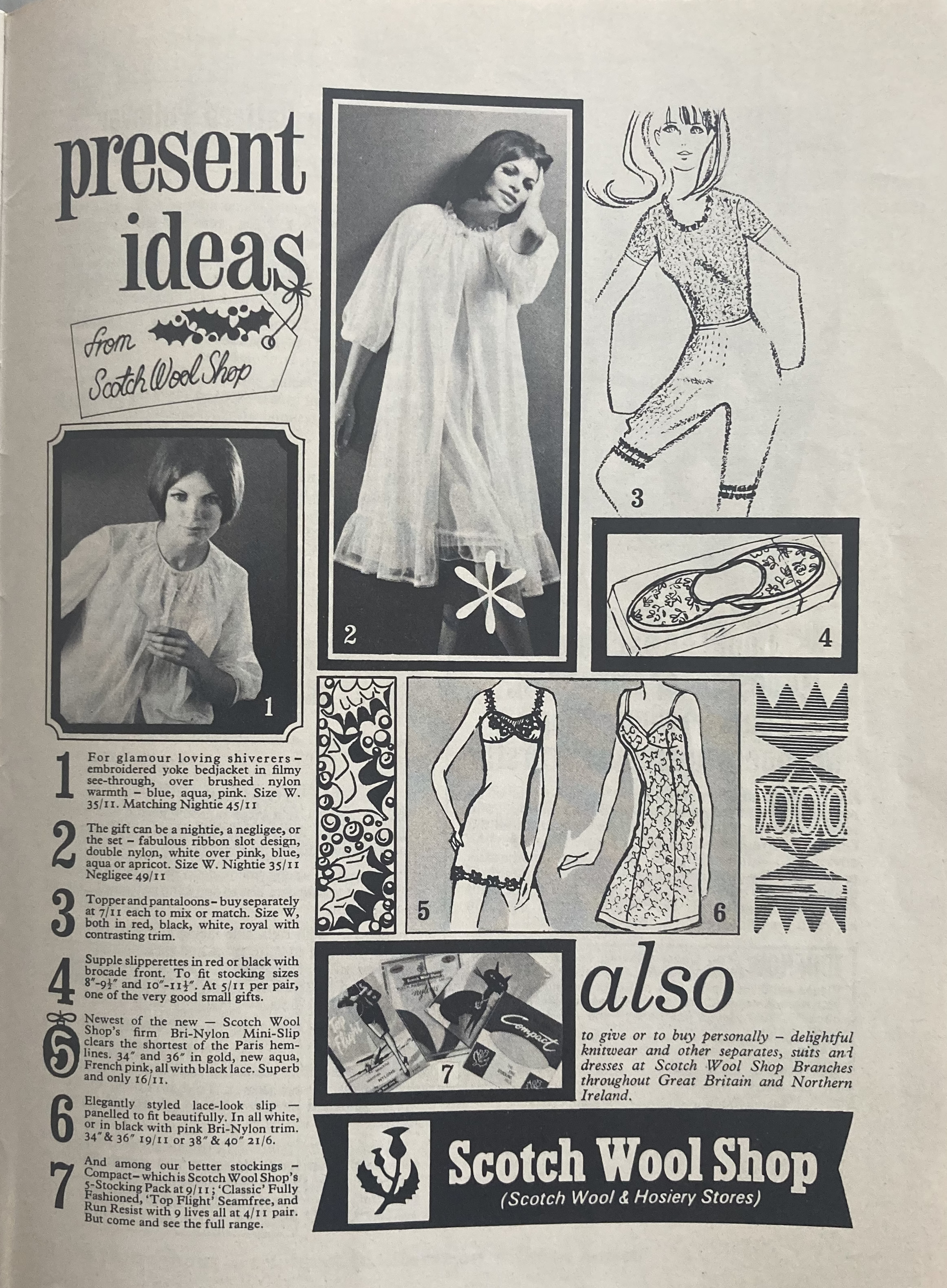
Finally, there’s another wonderful advertisement from my favourite Stitchcraft-ad store, the Scotch Wool Shop. Here is a nice little article about a knitting book produced by the Fleming, Reid company, proprietors of the chain of shops. The ads always make me want to go out and buy things from the stores… which, sadly, no longer exist. These little gift ideas are marvellous.

That’s all for this issue — and this year! I don’t know what I will make from this issue, or if I will just write a post about the knitted workbag that I already made a while ago. I quite like the ribbed skirt, and could use one, but one look at the gigantic WIP pile discourages me from starting any long and boring project. Hopefully I’ll get a couple of those WIPs finished and can write about that for a 1965 / 2023 wrap-up. Until then, I leave you with this graphic from the December 1965 issue. Happy Holidays!

November 1965: Overview

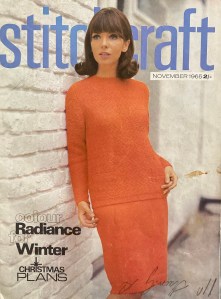
Colour Radiance for Winter and Christmas Plans! At Stitchcraft, it’s generally either preparing-for-Christmas time or spring-summer holidays. This month, they countered the cold, grey days of November with bright, cheerful colours and easy homewares. Let the festive preparation begin.

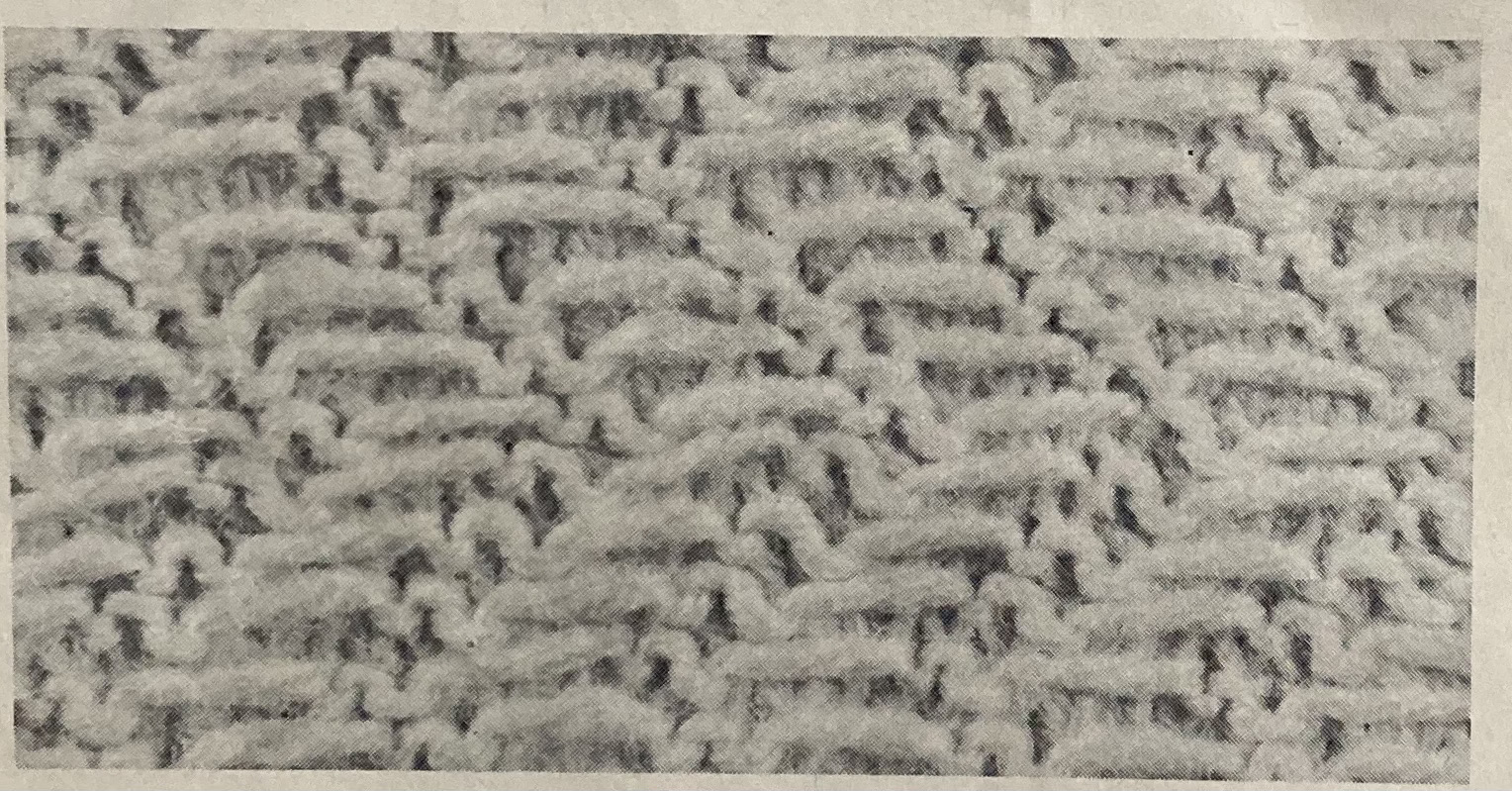
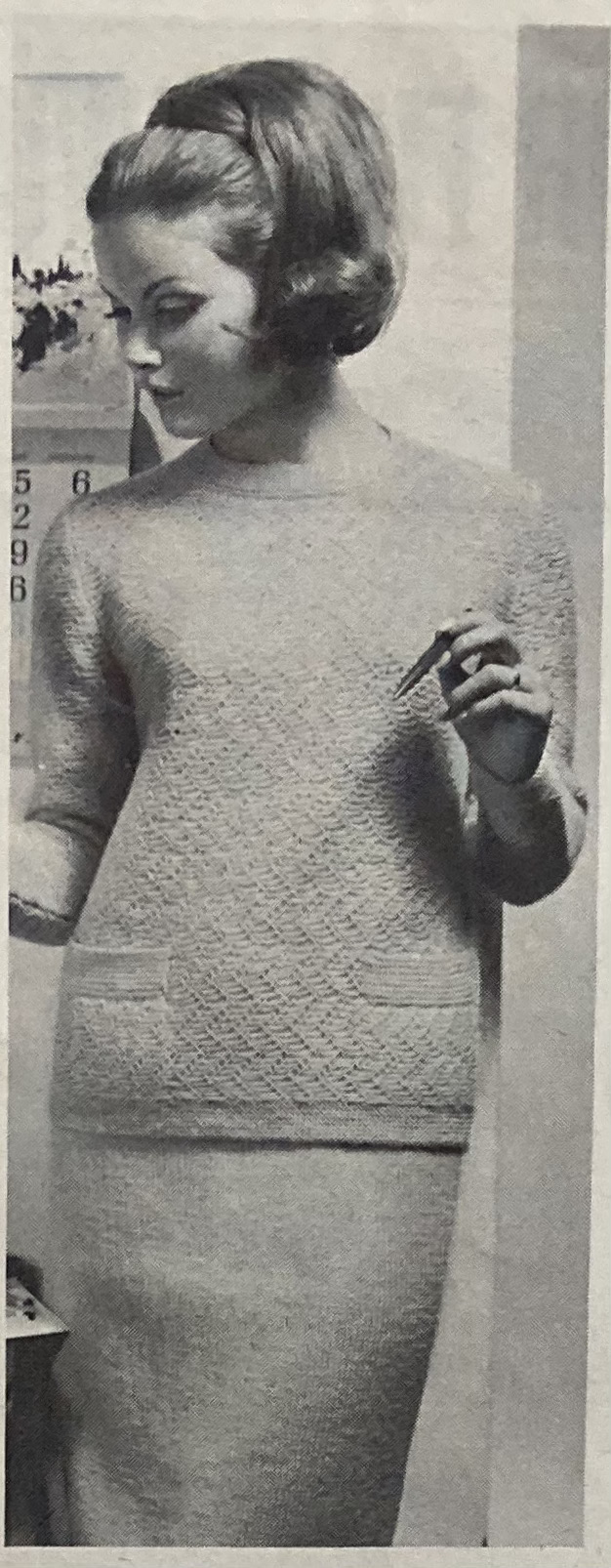
The knitted sweater suit on the cover is made in an intriguing pattern stitch designed to give “the look of woven texture.” There’s a helpful close-up photo of the stitch pattern as well. Essentially, it’s made by making a wool-forward (yarn over) on the right-side row and then slipping that stitch over a garter-stitch base to make a horizontal “line”. The placement of the slipped stitch is staggered, to make a diagonal herringbone-type effect. Made in DK wool, I’m guessing the finished result is quite warm. The matching skirt is made in plain stocking-stitch. Note that the mini-skirt, or even anything-above-knee-length skirt, still hasn’t caught on with Stitchcraft’s more conservative readership.

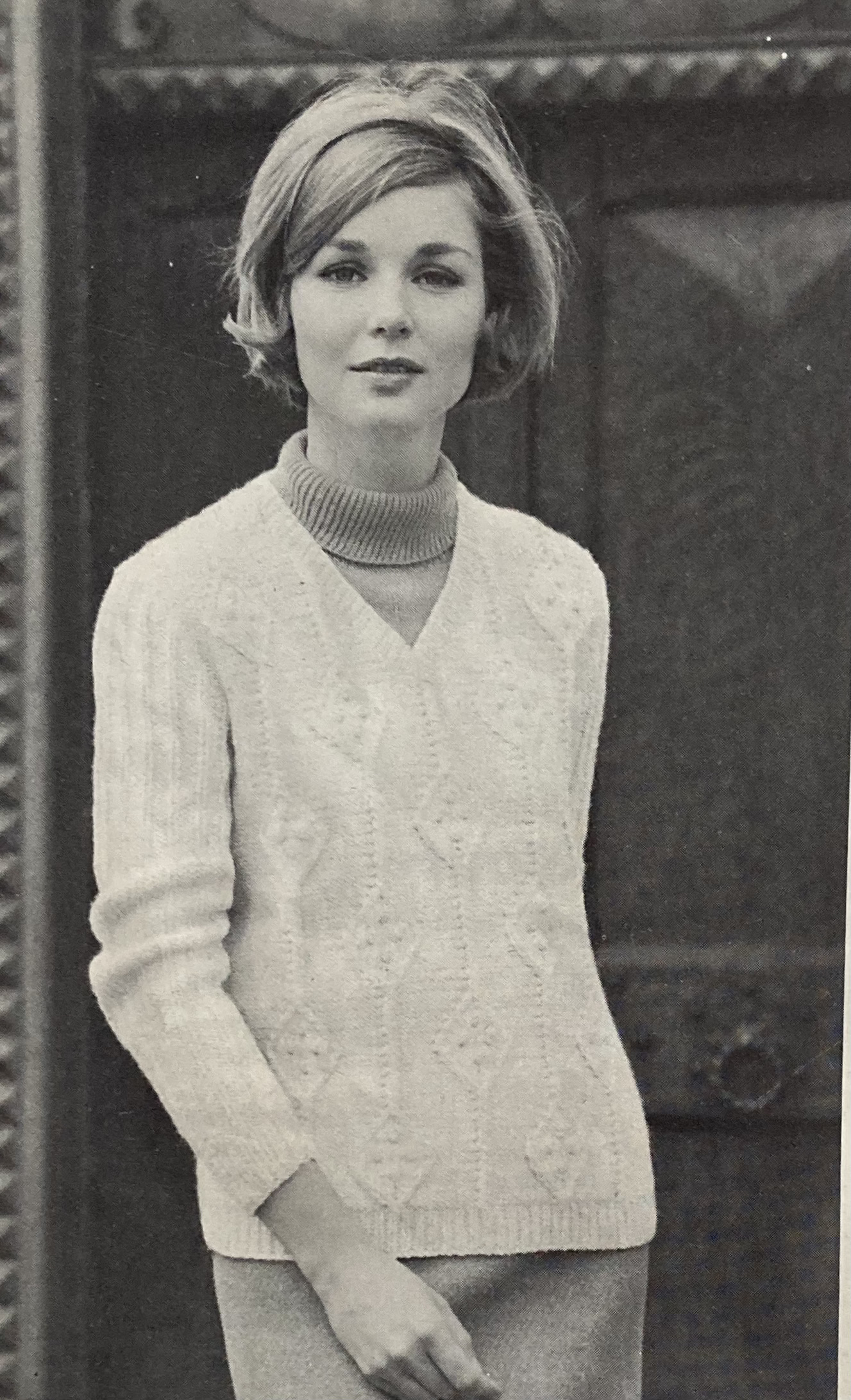
Other women’s fashions include a bobbly-cabley “overpull” in undyed “Capstan” wool, made to be worn over a roll-neck knitted underblouse with or without sleeves. The underblouse keeps up the warm colour trend with the suggested colour of “Old Gold”. I love the model’s hairstyle!

There’s also a jumper for larger sizes with very ill-thought-out decorations going right over the bust, and a collared almost-cardigan with a deep placket and Peter Pan collar. The collared number is made in tweedy “Glenora”, one of the multicolour wools gaining popularity at the time. Men get a corollary set to the women’s “overpull” and “underblouse” with a slightly oversized bobbly-cabley cardigan and a 4-ply polo-neck in the same “Nylox” wool as the ladies’ underblouse. The “colour radiance” theme apparently does not extend to the men’s garments, being made in undyed Capstan and “Oystershell” off-white, respectively. The photo backgrounds colours are nicely chosen, though, to set off the diagonal poses and camera angles.

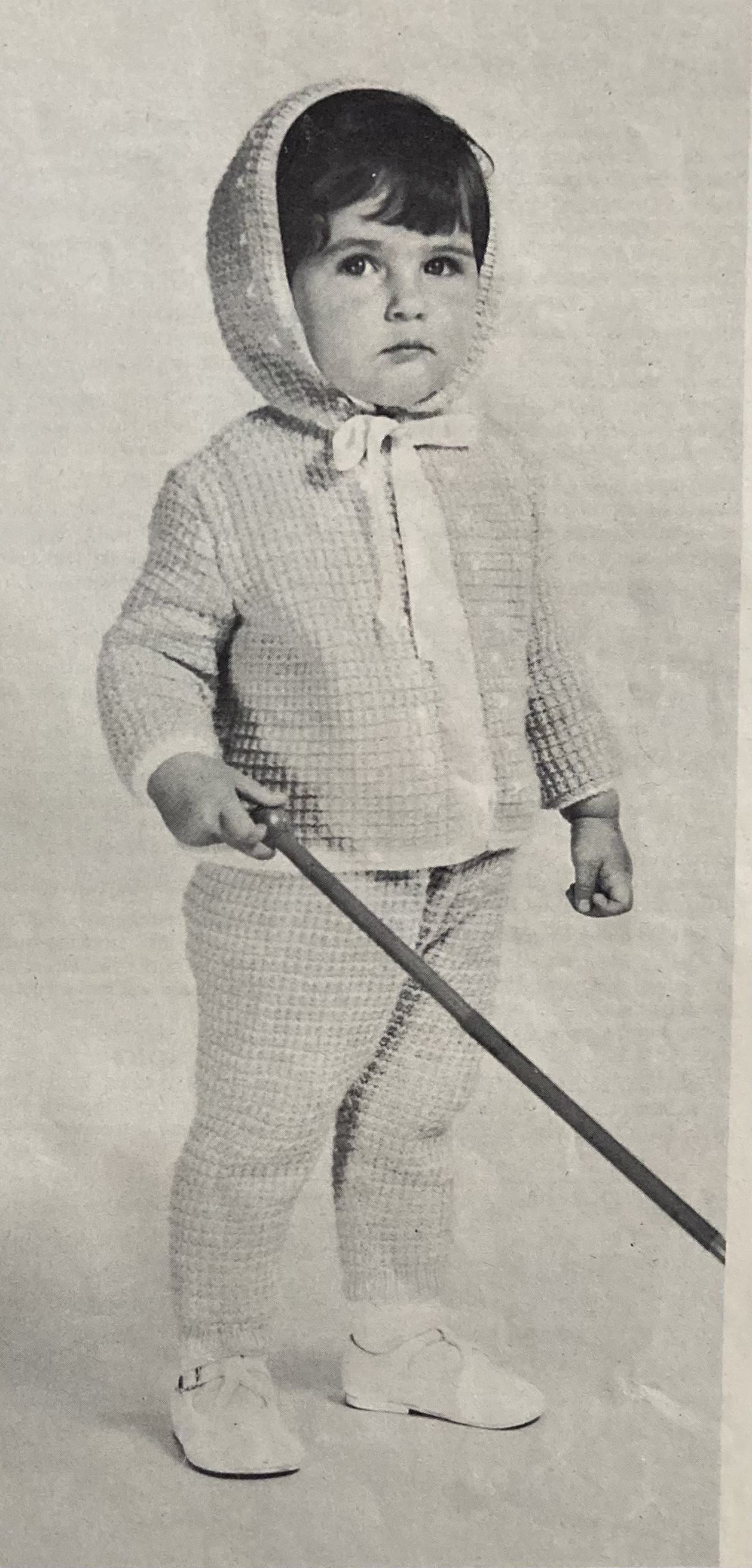
The photo of the girl’s twin set in the inside front cover photo also does a great job of harmonising the backdrop to the subject. Her set consists of a pullover with unbuttoned waistcoat in cheerful pink and blue. Her little brother or sister can go out in the pram or “toddling” in a warm set of hooded jacket and leggings. The child in the photo looks somewhat apprehensive, but the set looks quite snuggly.

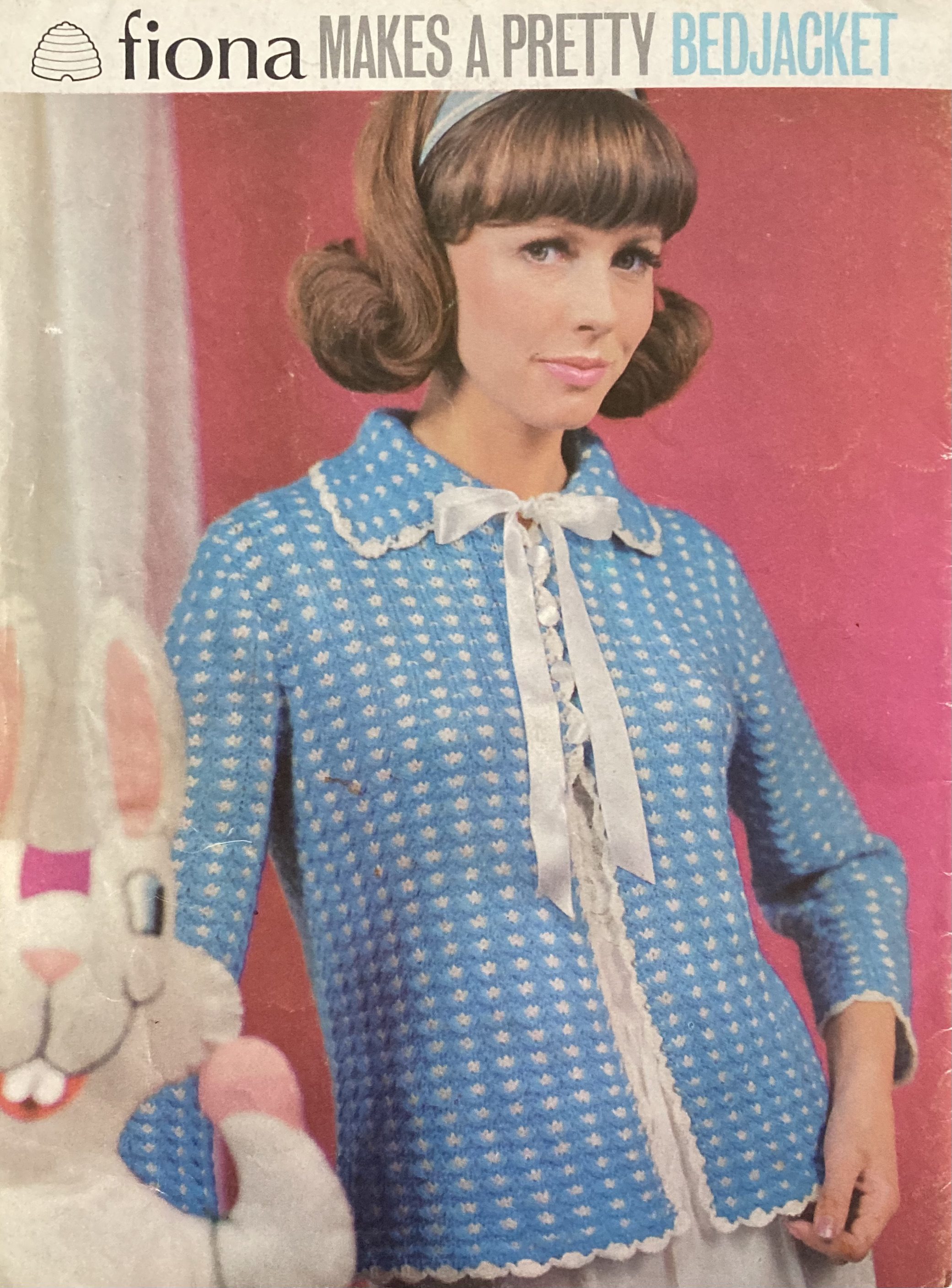
And can we have a moment of appreciation for this “special gift” of a bedjacket? I love it! I would make it without the ribbon at the neck and wear it as a normal cardigan. The two-colour pattern is made by working and then dropping yo’s to make a “long” stitch, which is then carried up through the slip-stitch background. I am guessing it is quite spongy and squishy, and was also nice and warm in those unheated 1960s bedrooms. Love the hairstyle in the colour photo, too!

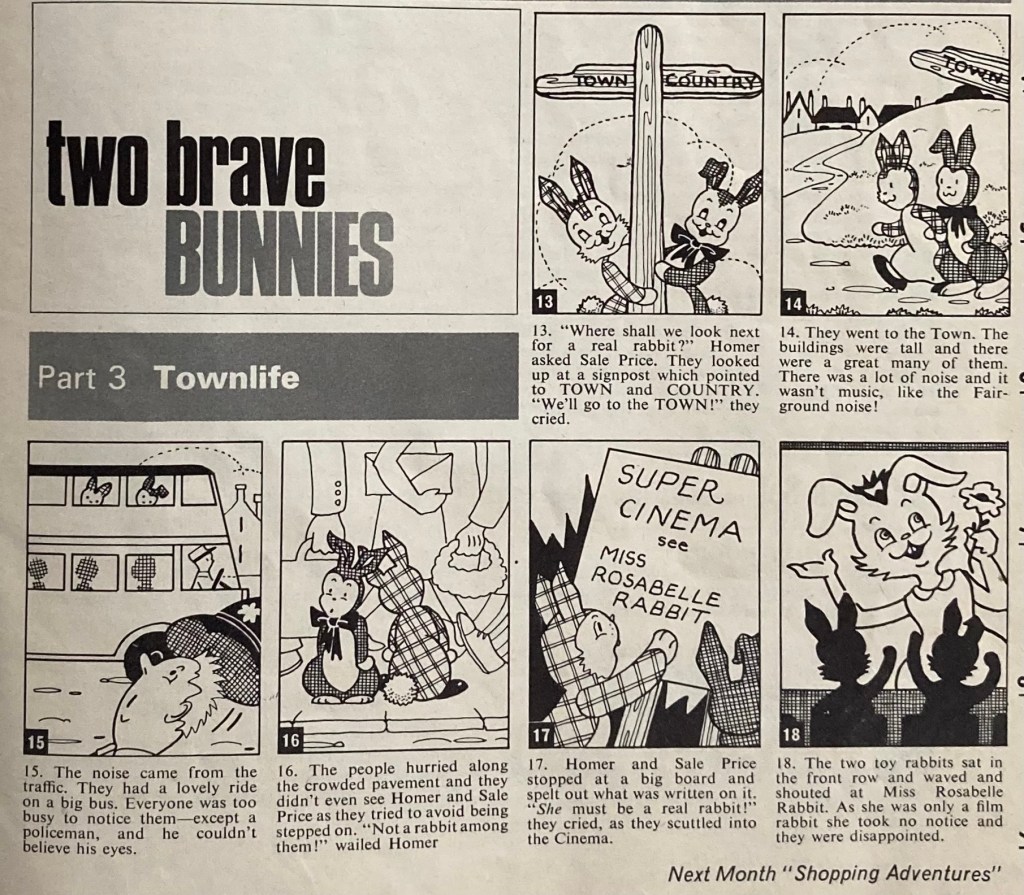
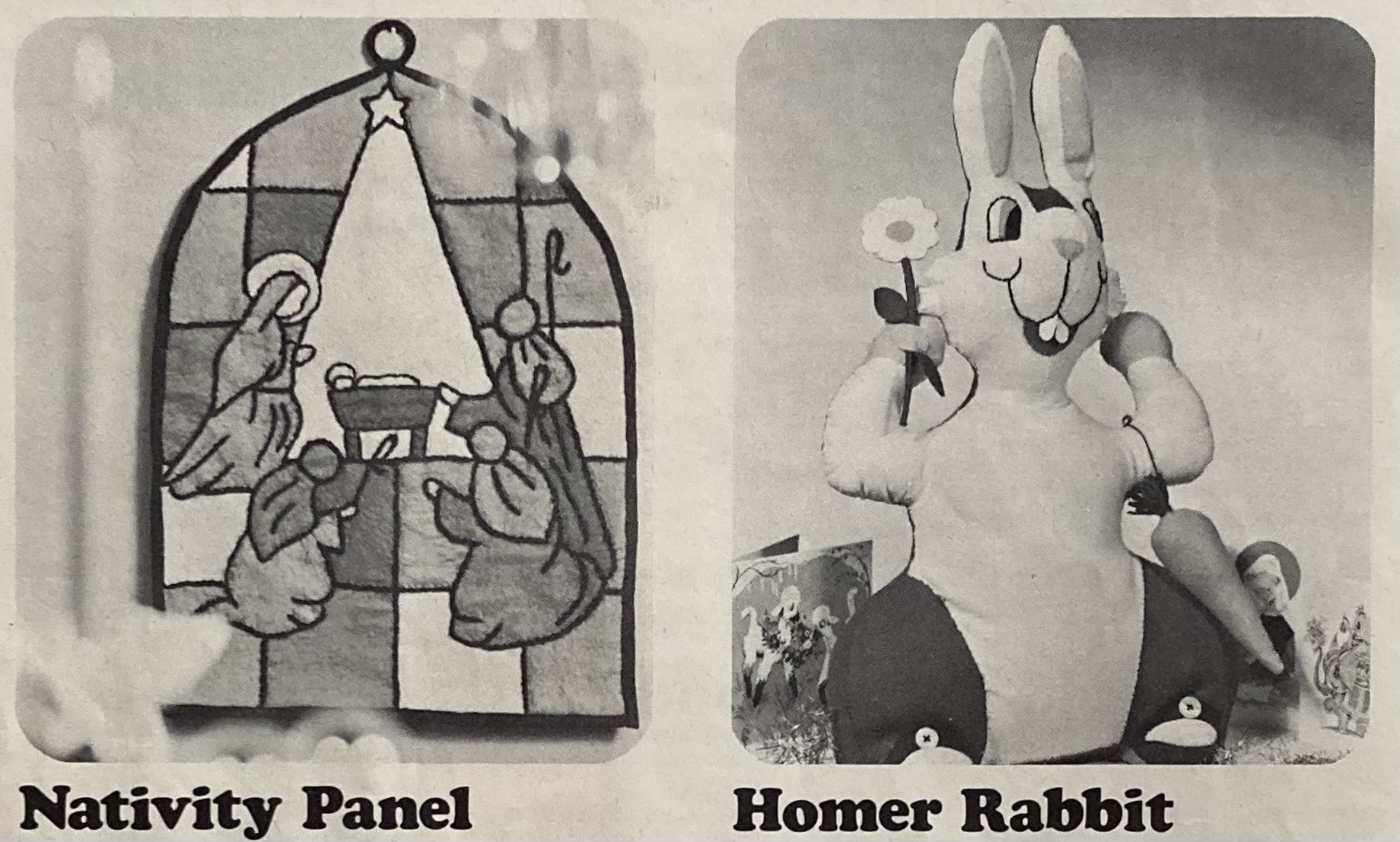
If the model on the left is looking a little suspicious, it’s probably because she was photo-bombed by Homer the Rabbit, star of our current children’s serial comic, “Two Brave Bunnies.” For the uninitiated: Homer (a home-made stuffed rabbit) and Sale Price (a store-bought stuffed rabbit) are on a quest to find a real live rabbit friend. So far, they have only met a merry-go-round rabbit, who assured them that he was not real, as he could carry children on his back. In this month’s episode, our two brave bunnies head to the Town, where they are eager to see “Miss Rosabelle Rabbit” on the cinema screen. Alas, she is only a film rabbit, so cannot communicate with our friends. No matter — they will persevere! Oh, right — and this month’s issue includes instructions on how to make your very own home-made Homer doll from felts.

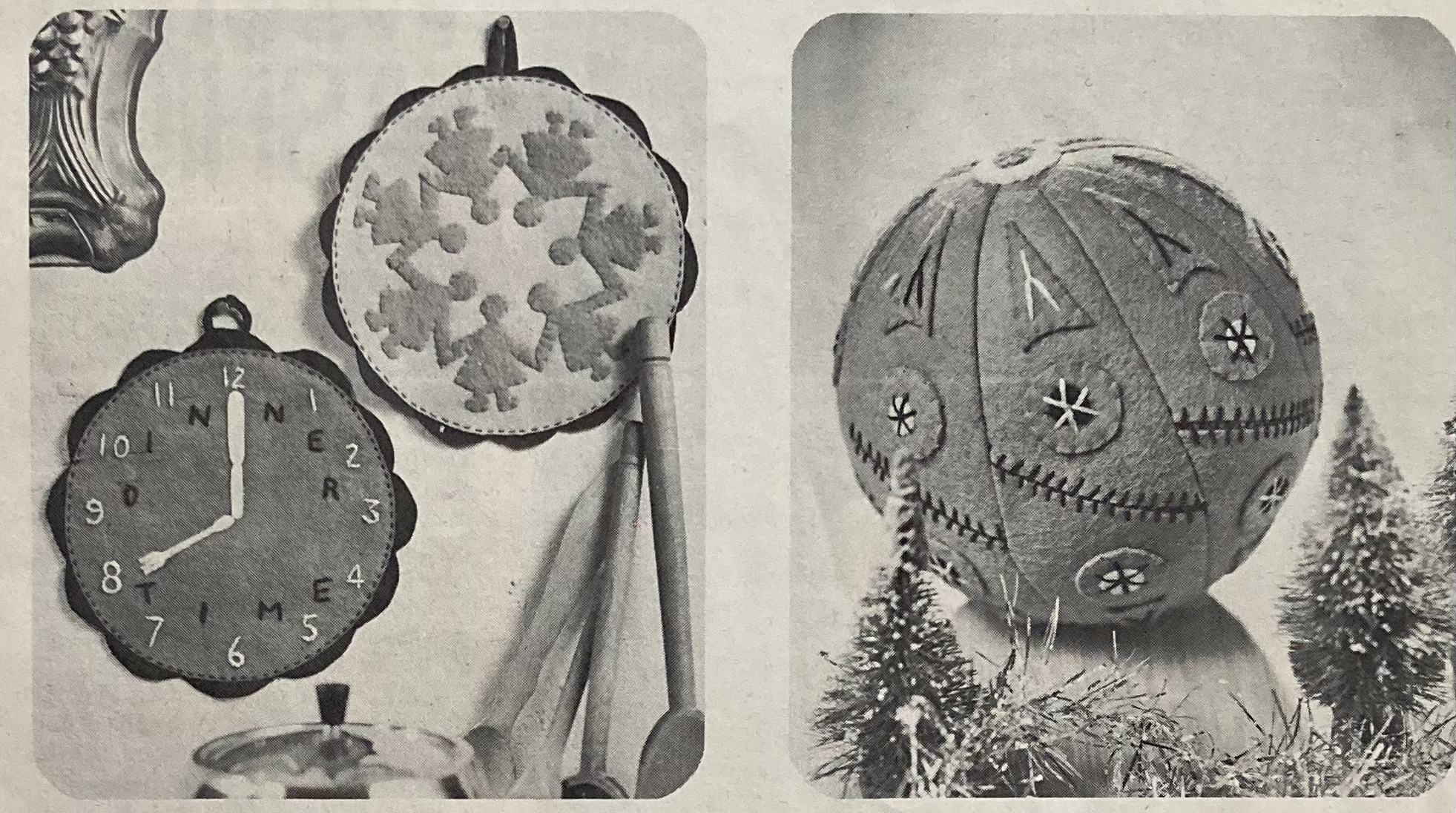
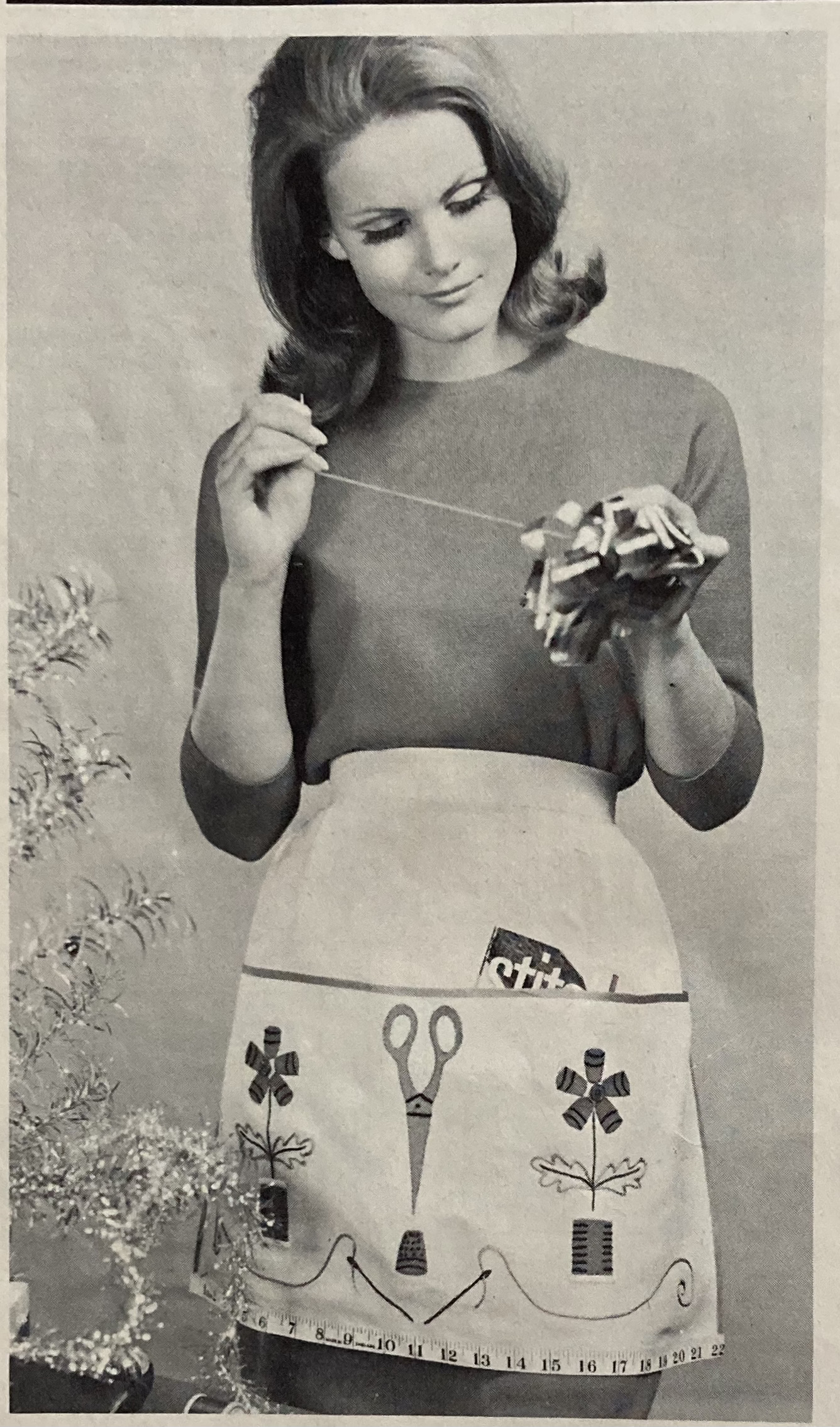
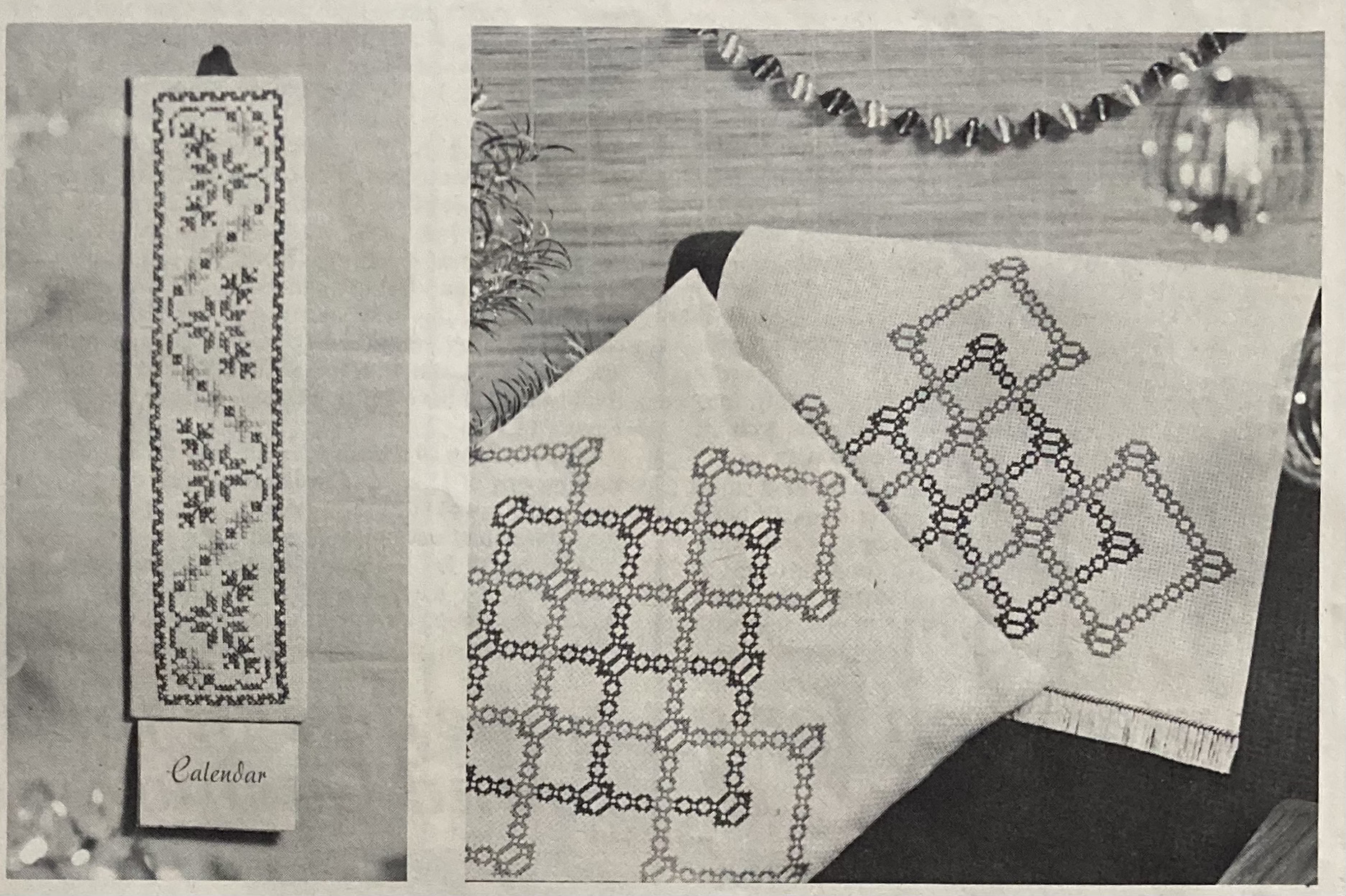
Home-made Homer is one of this issue’s many small, fun “colour novelty” gift and decoration ideas, along with a felt Nativity panel mimicking stained glass, a couple of pot holders and a colourful ball to use as decoration or a baby’s toy. Embroidered gift ideas include a whimsical sewing apron and a cross-stitch calendar and chairset. I don’t really understand the calendar — it seems to be just a vertical wall panel that you attach the (tear-off?) small calendar onto. OK, I guess, but maybe not necessary?

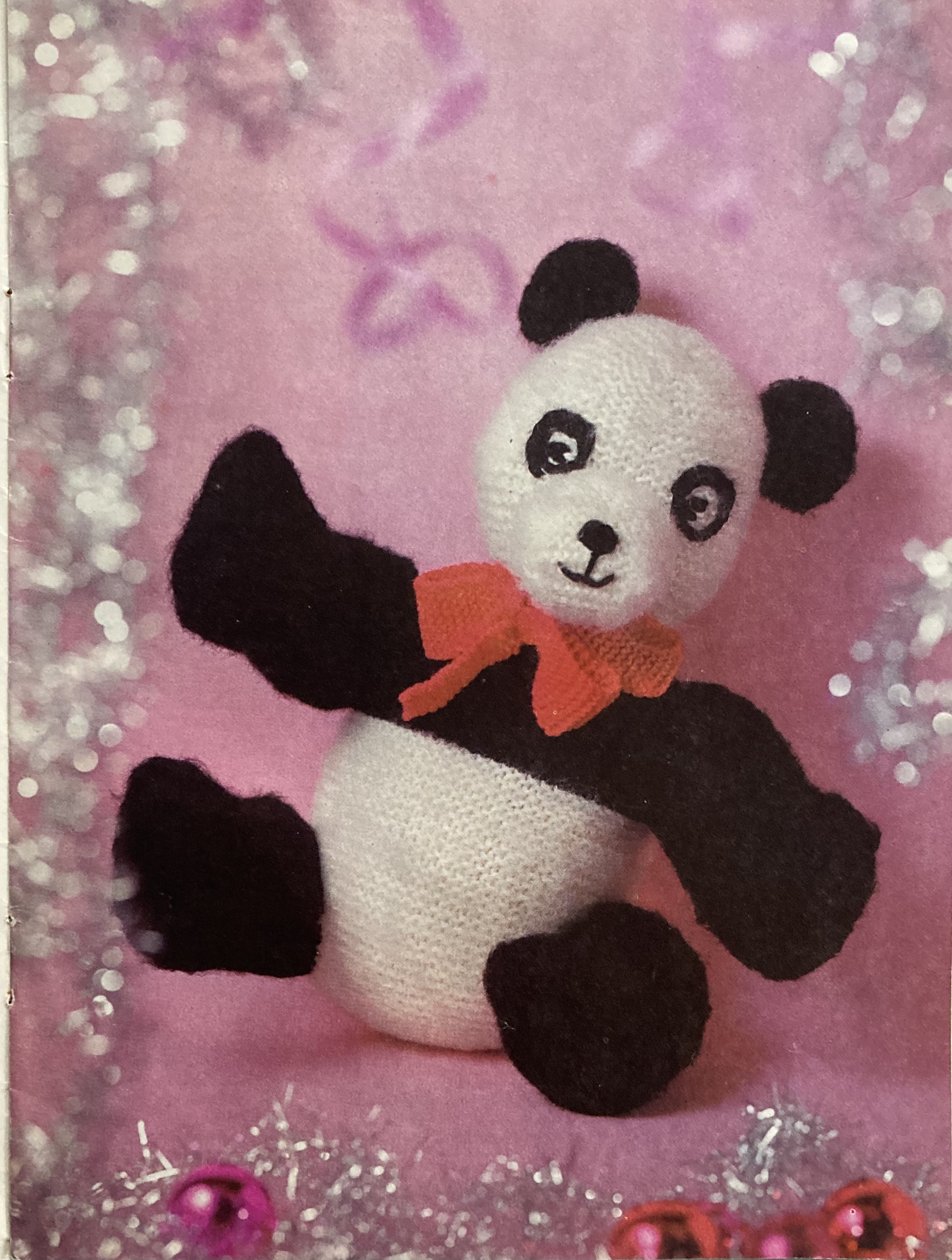
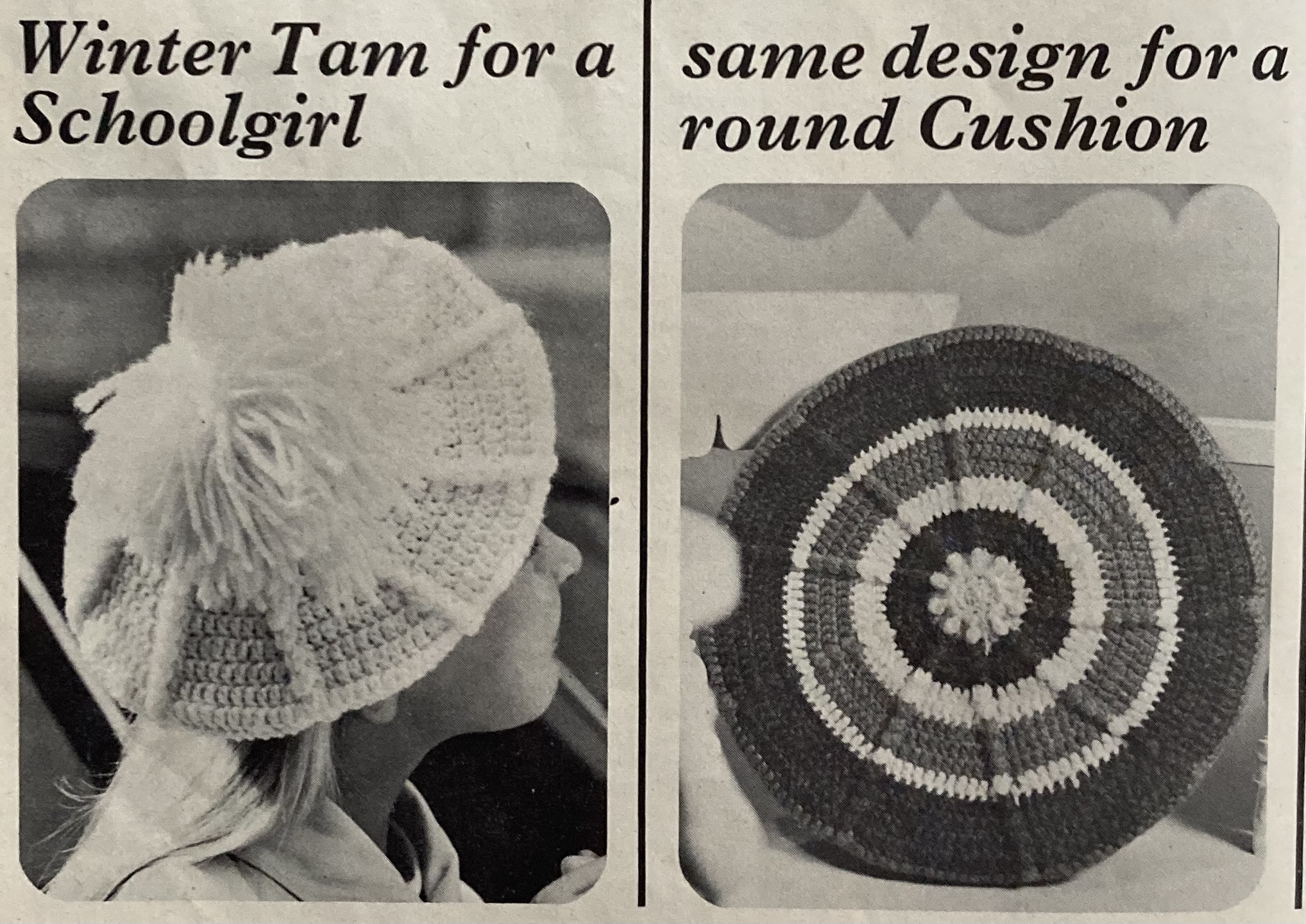
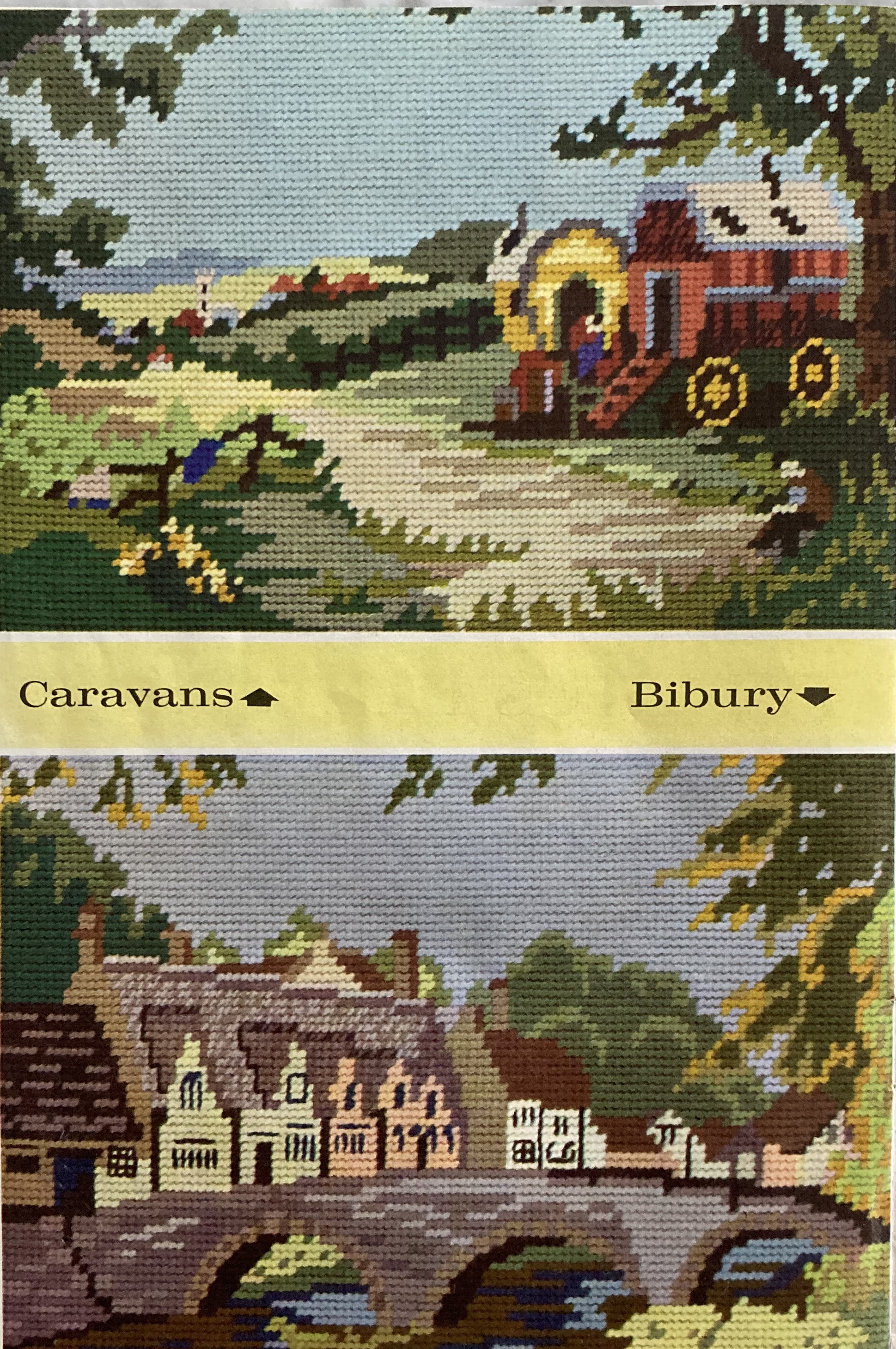
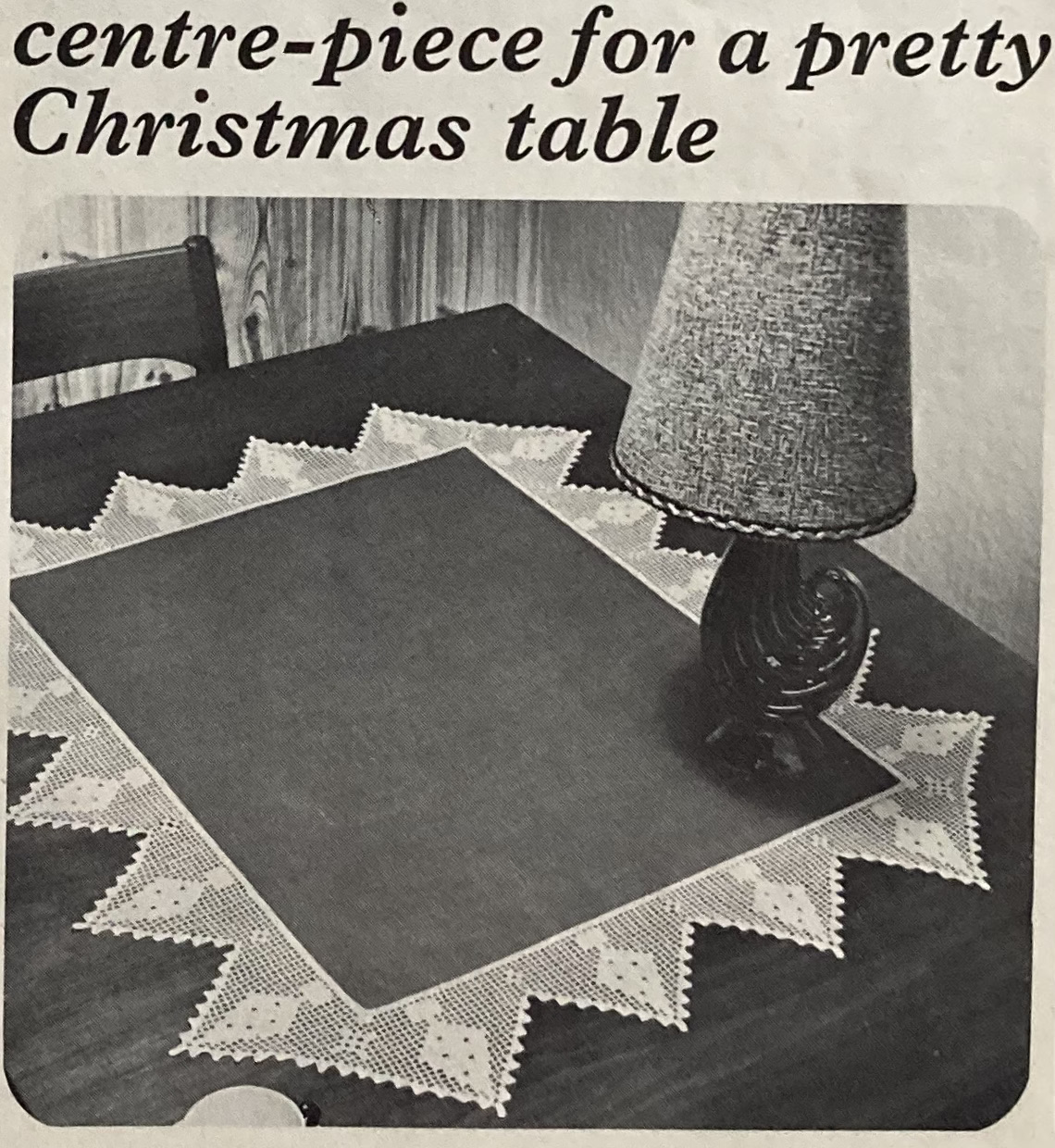
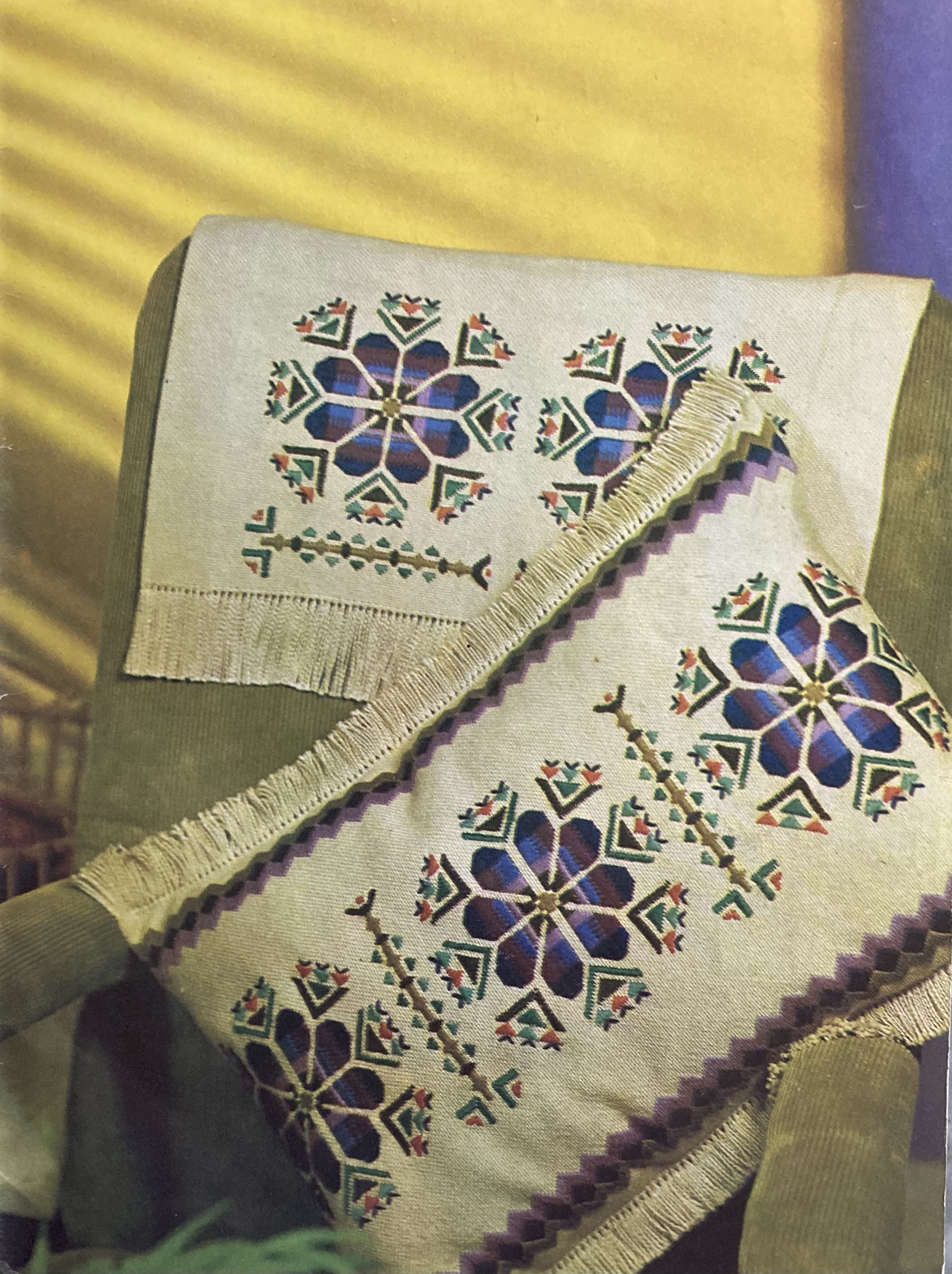
You can also knit a stuffed panda bear, a snowman, or a garter-stitch blanket rug, or crochet a round disc to be adapted into either a girl’s beret or a round cushion. There’s a filet crochet table centerpiece and tapestry wall pictures of caravans or Bibury. Last but not least, there’s a counted-embroidery cushion-and-chairback set with a vivid purple flower design.

I don’t know about you, but I feel cosier already. My design for this month will be the bedjacket! The October 1965 cardigan blouse is almost finished, too, and I’ll update that post soon.

December 1964: Overview

Stitchcraft sends good wishes for Christmas 1964! Yes, another year has gone by in a flash. Luckily, this issue is full of ideas for quick last-minute gifts, as well as warm clothing for the family.

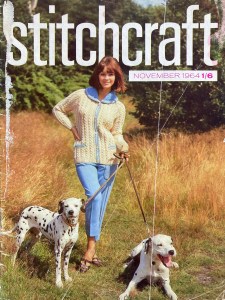
The bulky partner-look cardigans on the front cover are timeless and modern – apart from the 1960s styling and lighting, and the man wearing a shirt and tie, this could be a modern advertisement for ready-to-wear knitwear. The jackets are made in „Big Ben“ bulky wool at 3.5 stitches to the inch, so they might just be finished in time for a winter cold snap. Similarly bulky, but lighter-weight „Ariel“ wool is featured in a vertically-striped („adds to the slimming look“) cardigan for somewhat larger women‘s sizes up to 42 inch bust, and there‘s a warm cabled „Cardigan for Driving“ for him with practical pockets and a big collar.

The women‘s fashions are more sleek, with classic straight lines and unfussy crew necks. A simple ridge-welt pattern can be knit from the bottom up with dolman sleeves for a horizontal stripe, or as a cardigan knitted sideways edge-to-edge for a vertical stripe effect. There‘s also a classic jumper with a twisted-stitch rib panel and a lacy sheath dress for parties.

„Juniors and Tots“ will stay warm in a fun stranded half-cardigan (zip opening from neck to waist – this is called a „Troya“ style where I live but Stitchcraft just calls it a jersey) with matching cap. Therre‘s another cap with cables running around horizontally, as well. „Tots“ from ages 1-4 get a sewn pinafore romper with a cross-stitch squirrel motif or a knitted tunic to wear over a jumper and tights (thank goodness, our child model can have warm legs for once.) Colours are warm and earthy — orange, brown and „Inca Gold“ for the adult and children’s garments and emerald green for the toddler‘s tunic.

The most important, and sometimes most entertaining, part of the December issue is the gifts, of course, and this one is full of „Last minute ideas“ — you can allegedly „make them all in an evening or two.“ Well, evenings are longer in the winter… There‘s a startled- looking owl to sew from felt pieces, and felt table mars with appliquéd butterflies. Felt is used for the draught-stopping caterpillar snake (with pipe cleaner feelers) as well, and cotton embroidered baby bibs shaped like a kitten and bunny rabbit complete the craft menagerie.

Other quick gifts include a knitted ball for a baby, a knitted and a tapestry tea cosy, and a knitted cushion — all good ways to use up scraps of wool. The „Ping the Peke“ stuffed dog looks a bit more time-consuming, and it’s probably difficult to achieve a really professional look with it.

Experienced embroideresses who have efficiently provided all of their Christmas gifts already and are not scrambling to get last-minute gifts finished can make a beautiful and very Christmas-y blue and green cross-stitch tablecloth based on a Rumanian motif. (For once, they didn‘t call a design from Eastern Europe „peasant“ embroidery! Progress.) Those looking for a simpler project can make a pretty dressing table set with flower motifs, or for the whimsically minded, there‘s a cross-stitch cushion „gift for a motorist“ with a picture of a prototype automobile on it.

The Readers Pages are full of ideas of things to buy (Stitchcraft subscriptions et. al.) plus an entire knitting pattern for a child‘s hoodie (2nd time reprint from 1954 — this must have been a very popular pattern) and instructions for an easy appliquéd spectacle case that a child could make „for Granny.“

My project will be the classic jumper with the twisted-stitch panel, in the same fun orange colour as the photo. Happy Holidays!

November 1964: Overview

“Winter Fashions and Christmas Plans” is the theme of Stitchcraft‘s November 1964 issue, with practical clothing for the family as well as gift ideas and a couple of glamorous items for parties.

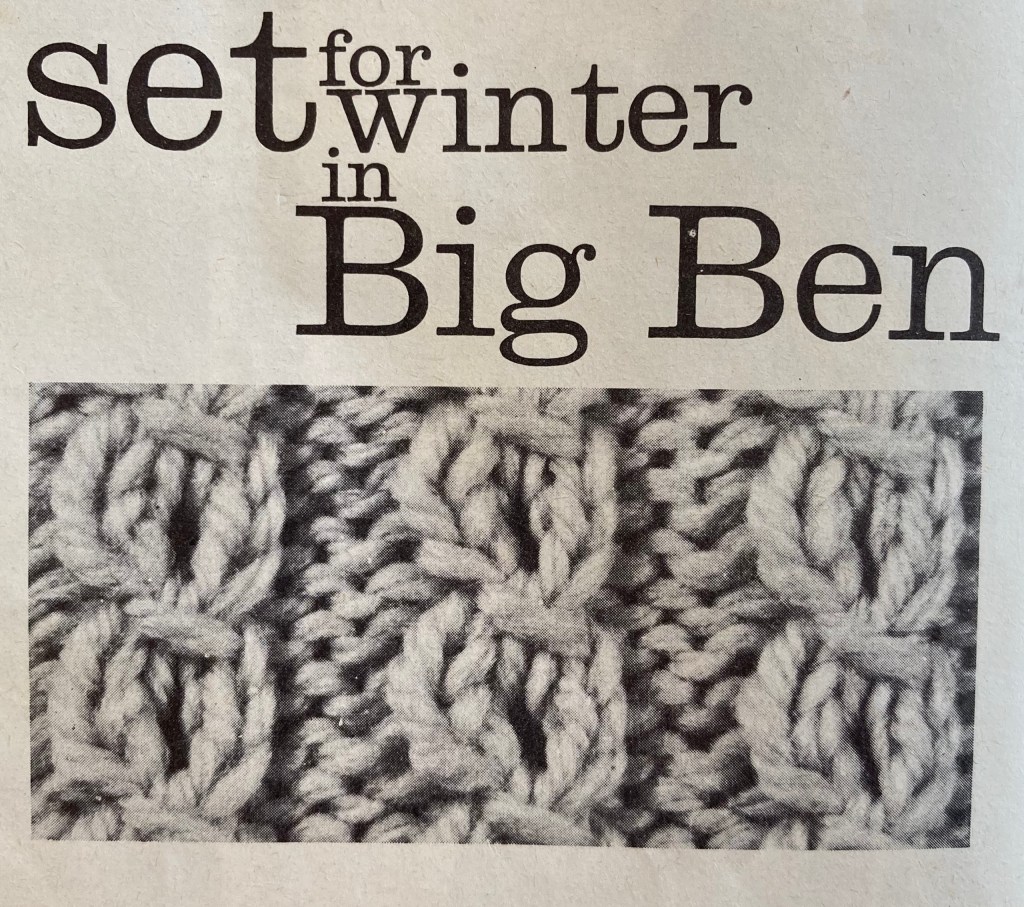
You will be “set for winter” in the cardigan on the cover, knitted in bulky “Big Ben” wool at 3 1/2 stitches to the inch, with all-over mock-cables, a warm collar and practical pockets. The mock-cable pattern involves “losing” a stitch in the 3rd row with a sl1-k2-psso, then getting it back with a yo on row 4, making a “bar” and then a little hole for the mock-cable effect. There’s a handy close-up photo of the stitch pattern, so you can make sure you did it right.

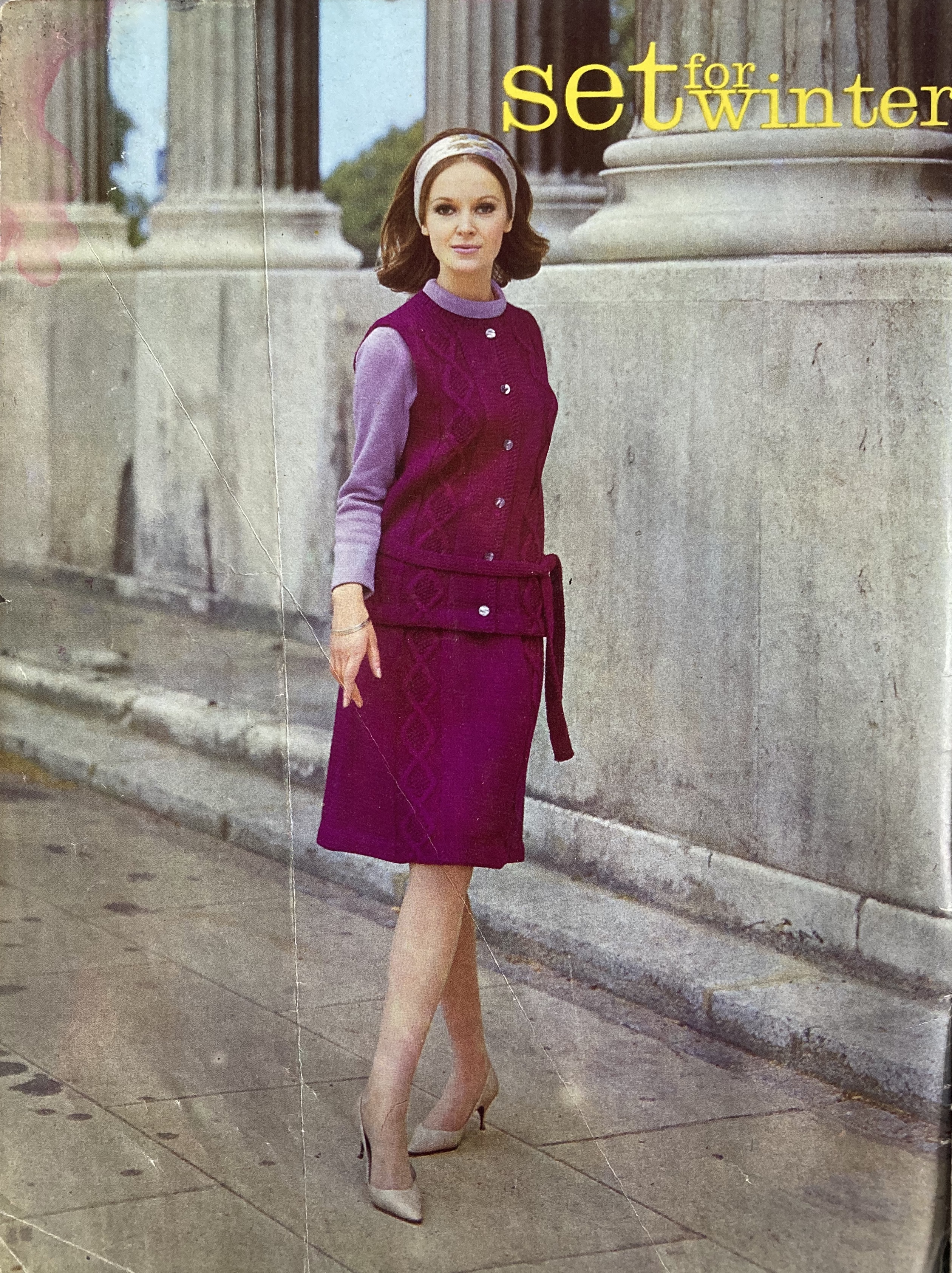
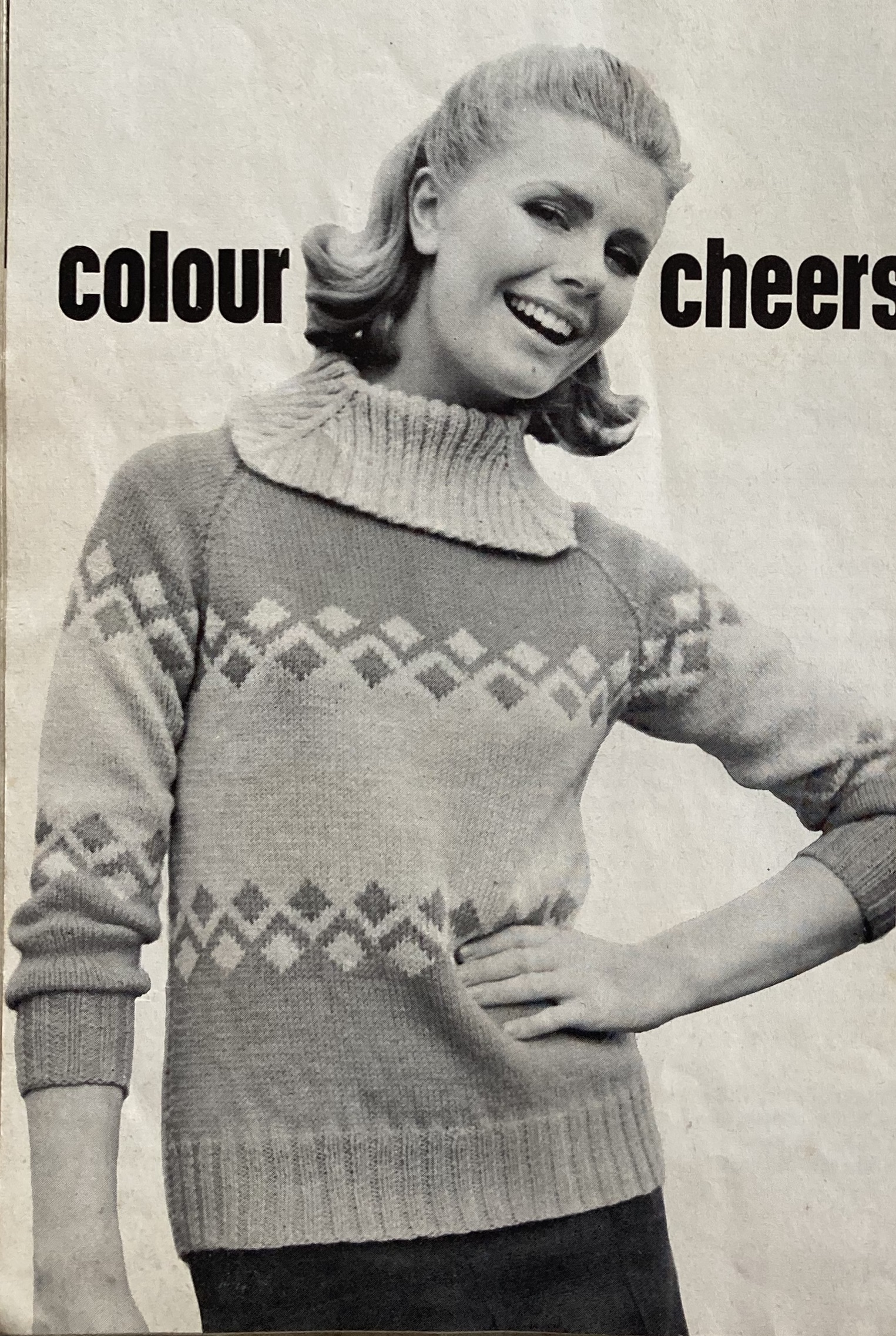
The caption continues the use of a bit of word-play on the word “set”, which we saw in the October 1964 issue. There, the theme was “set to flatter”, whereby some of the items were part of an actual set, and some weren’t. Some of the other garments in the November issue really are a set, in that sense: this waistcoat suit in glowing fuchsia, for example. Rounding out the everyday women’s garments are a plain 4-ply jumper, a bright colour-motif sweater and a comfortable tweed jacket for larger sizes. I love that brooch on the jumper — it looks like Star Trek insignia.

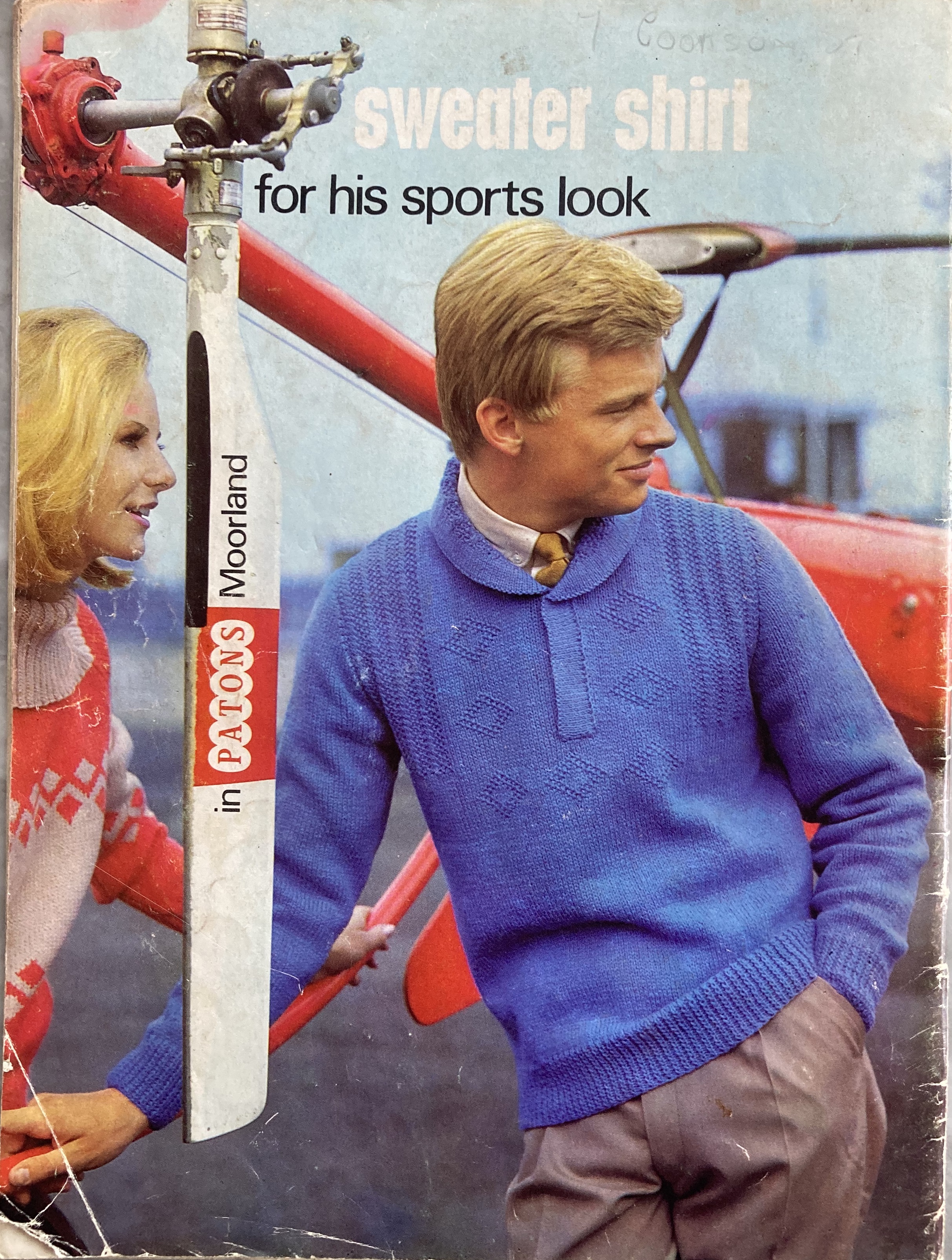
The trend for textured patterns, big collars, zig-zag designs and bold colours continues with the men’s garments: he too will be “set for winter” in a textured pullover for larger sizes or a sport-weight “sweater-shirt” (they didn’t use the word “henley” at the time) that utilises many fashionable features. You get a glimpse of the women’s colour-motif sweater in the back cover photo, as well.

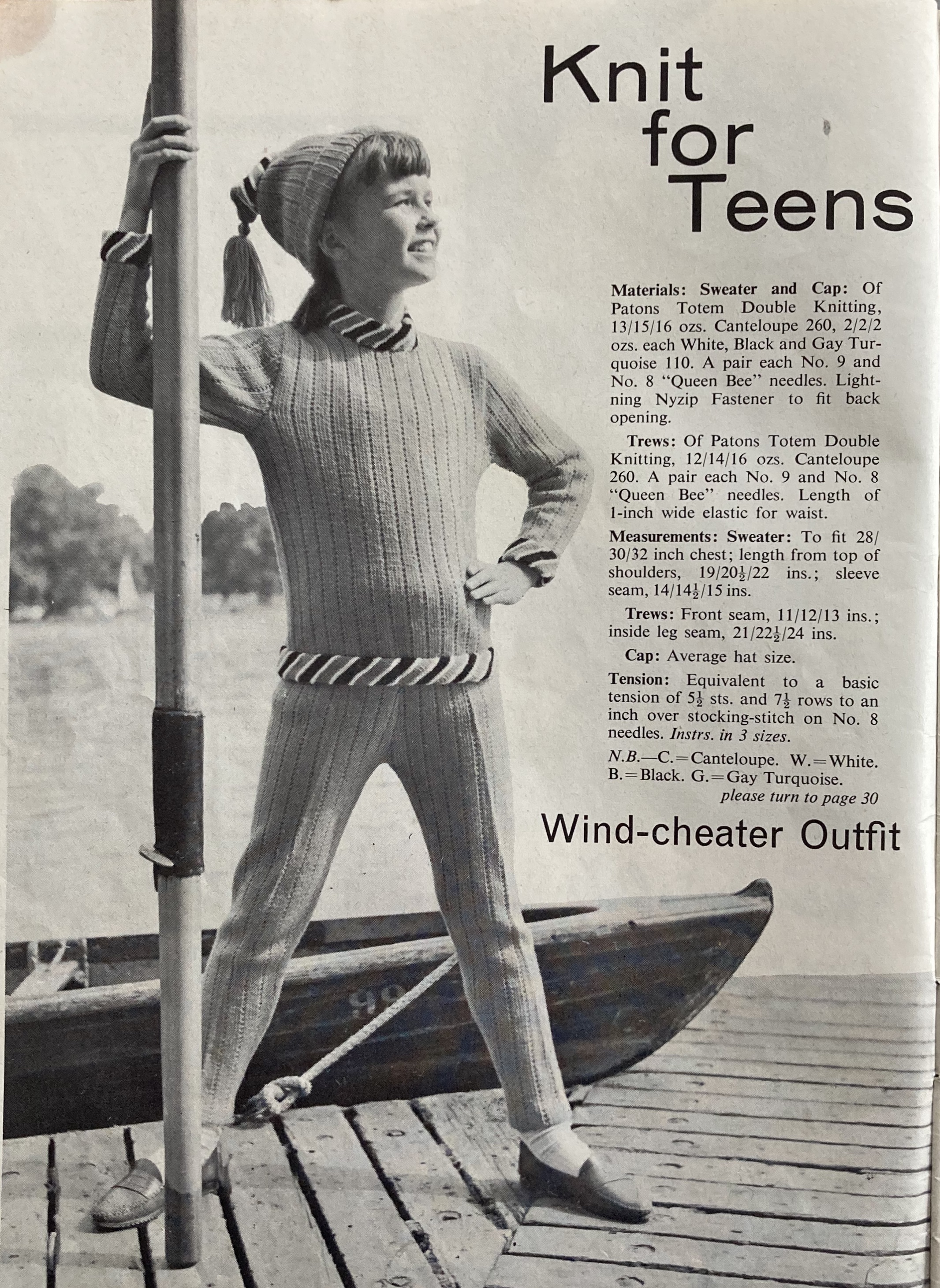
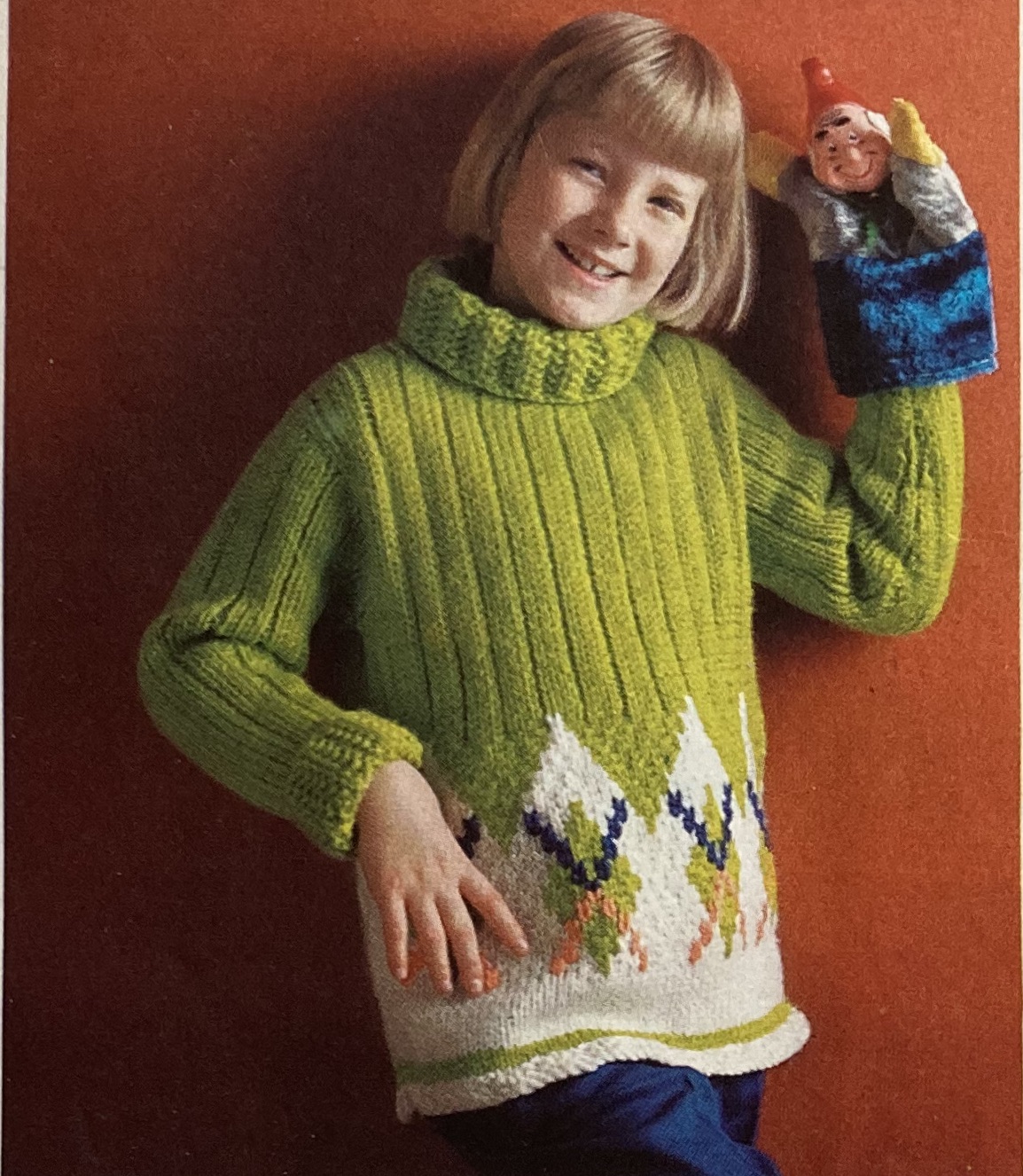
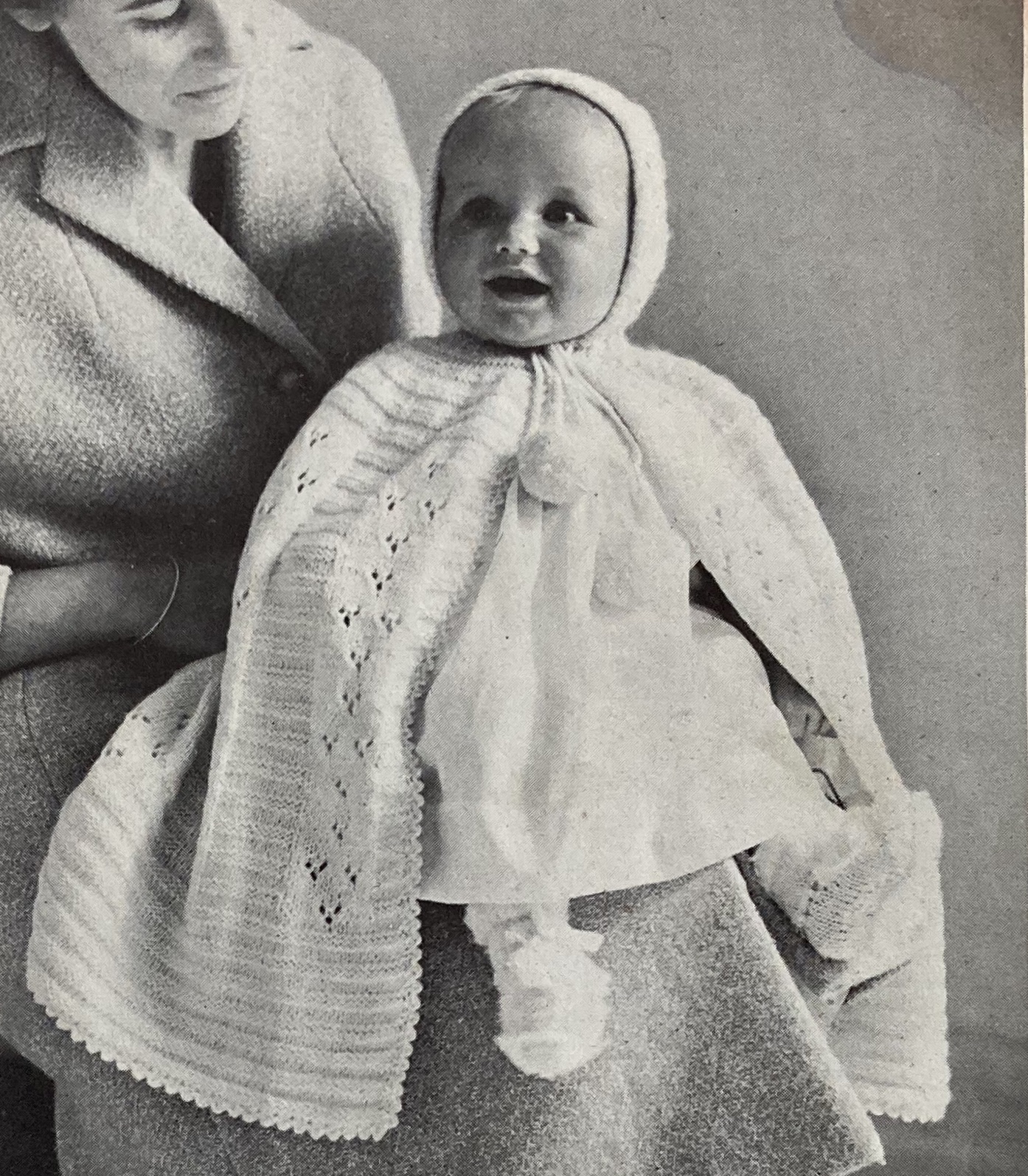
In the “Teens and Babies” department, there’s a wonderful winter “wind-cheater outfit” set (actually a set, this time) of sweater, leggings and hat, as well as a thick, warm jersey for a young girl (our model is quite possibly not a teenager yet, but the pattern is in three sizes up to 32 inch chest to fit older girls as well), and a continuation of the baby set (also an actual set) that was started a few issues ago with matinee coat, dress, etc.: this last instalment is a lacy one-size-fits-all hooded cape to go over all the other garments. I love the photo of the girl standing on the dock next to her boat, looking like a proud sailor! Last month’s issue, if we remember, touted “the Feminine Look”, meaning girls had to look pretty and not really do very much, so it’s nice to see our young sailor looking active and happy in her autumn sport set. The diagonally-striped hem and cuffs are knitted separately and sewn on later.

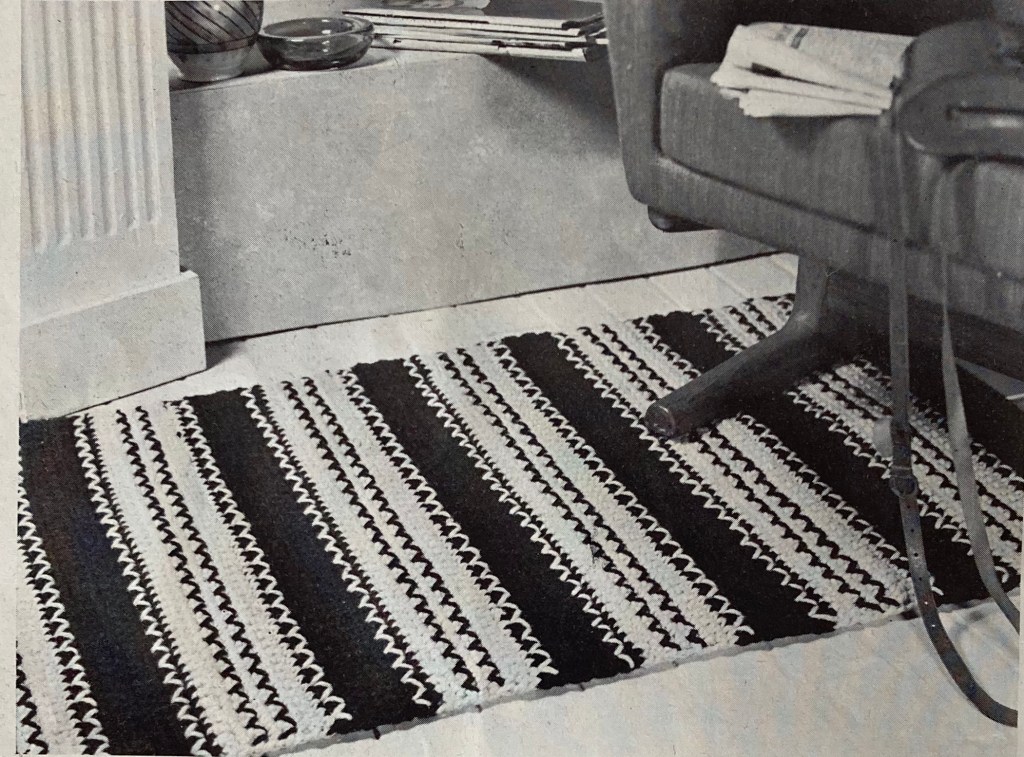
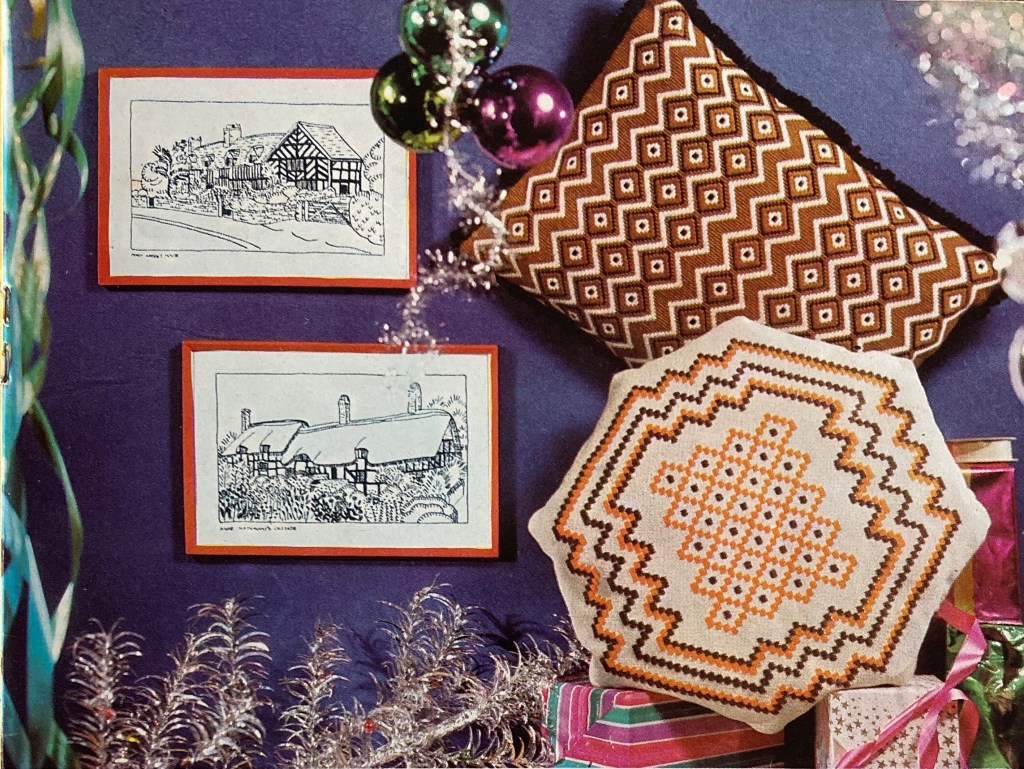
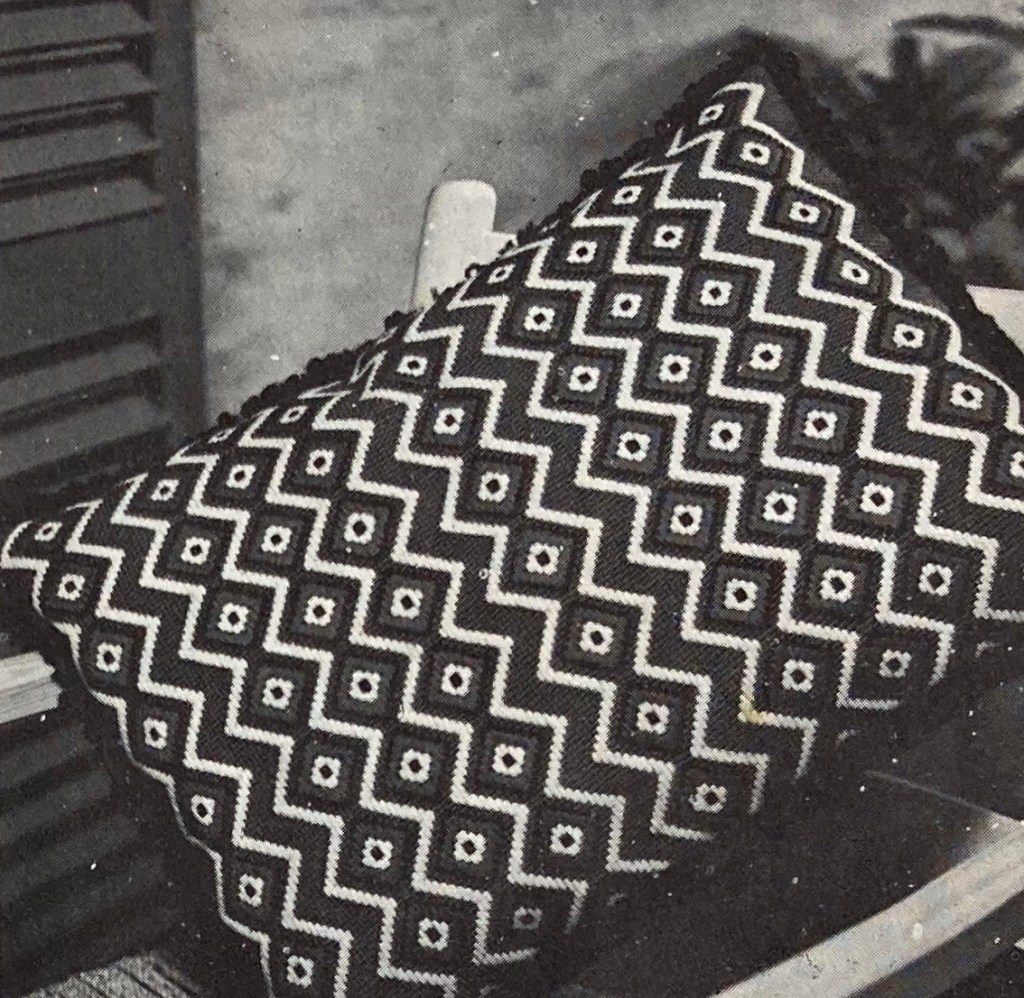
The non-Christmas-themed housewares continue the zig-zag / geometric trend with a crocheted rug, diamond-pattern cushion and wacky zig-zag chairback and cushion set (yay, another set).

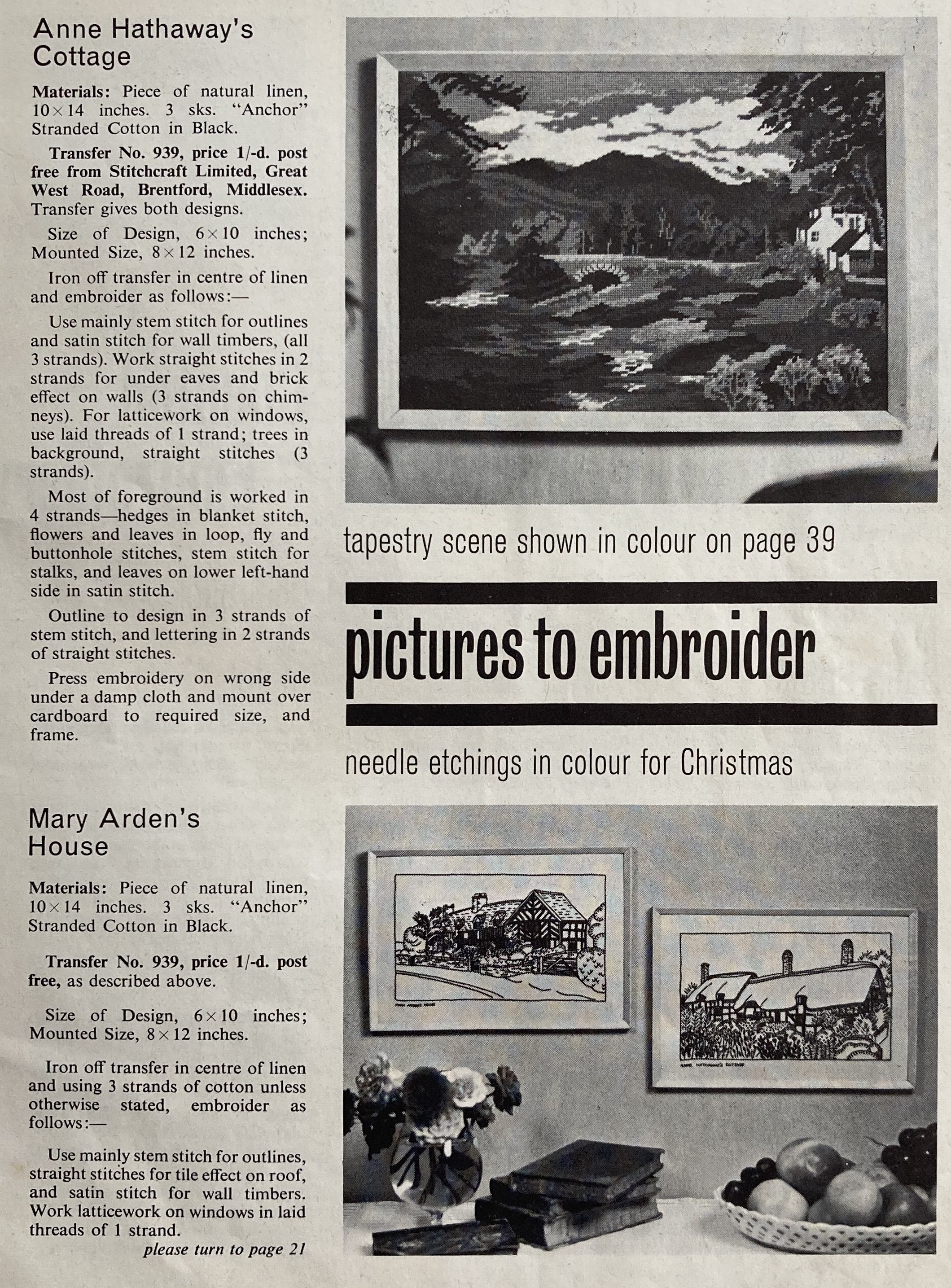
There are tapestry and “needle etching” embroidered pictures that draw inspiration from Shakespeare’s family: “Anne Hathaway’s cottage” (Shakespeare’s wife, not the modern actress…) and “Mary Arden’s House” (Shakespeare’s mother, not Lady Arden of Heswall.)

But finally… it’s time for the pre-Christmas decorations! The wacky “novelties” and bizarre-bazaar items! I know you have been waiting for this and I promise you will not be disappointed. You may, however be scared out of your wits, if you happen to have a clown phobia, in which case I caution you to skip over the next few photos.

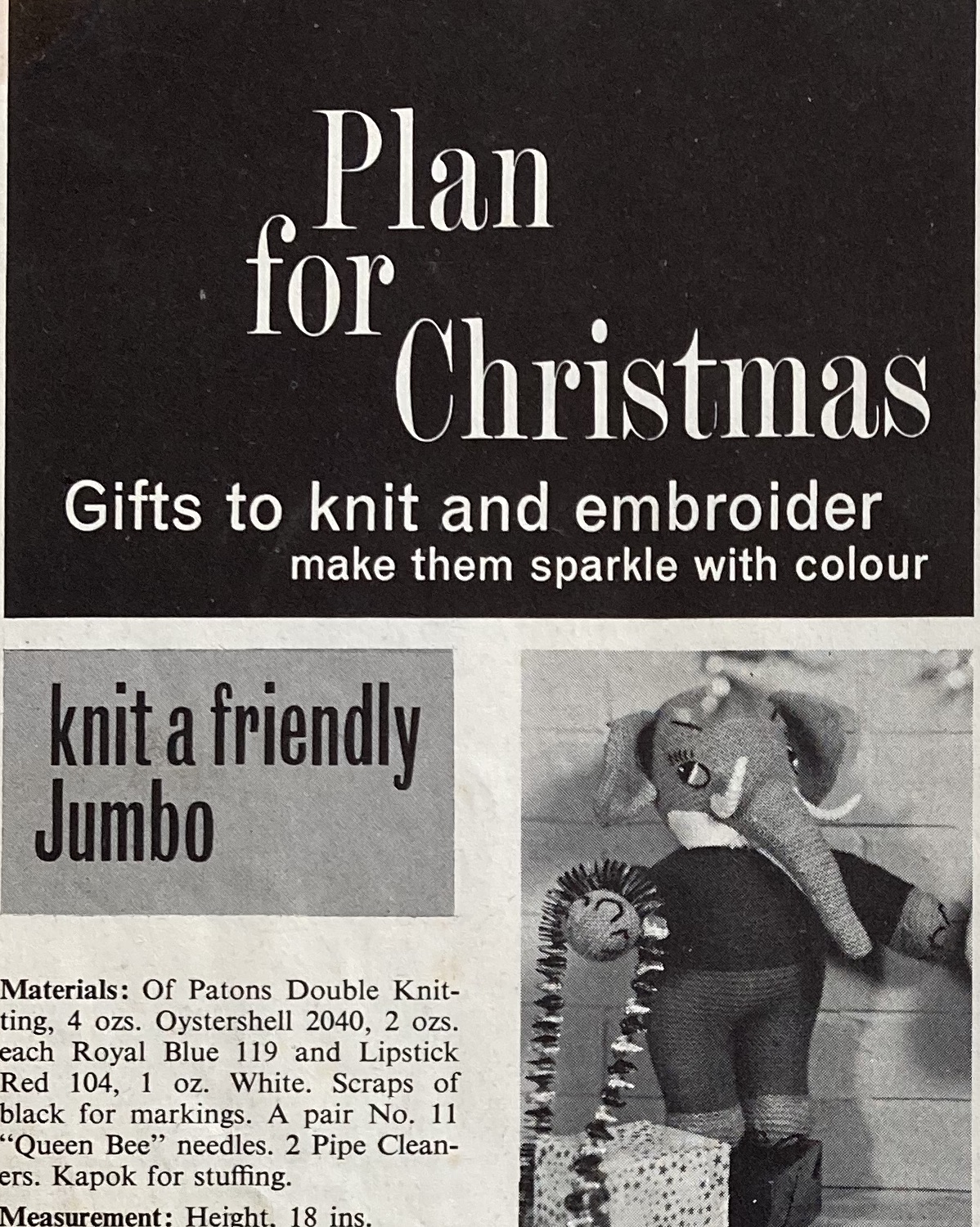
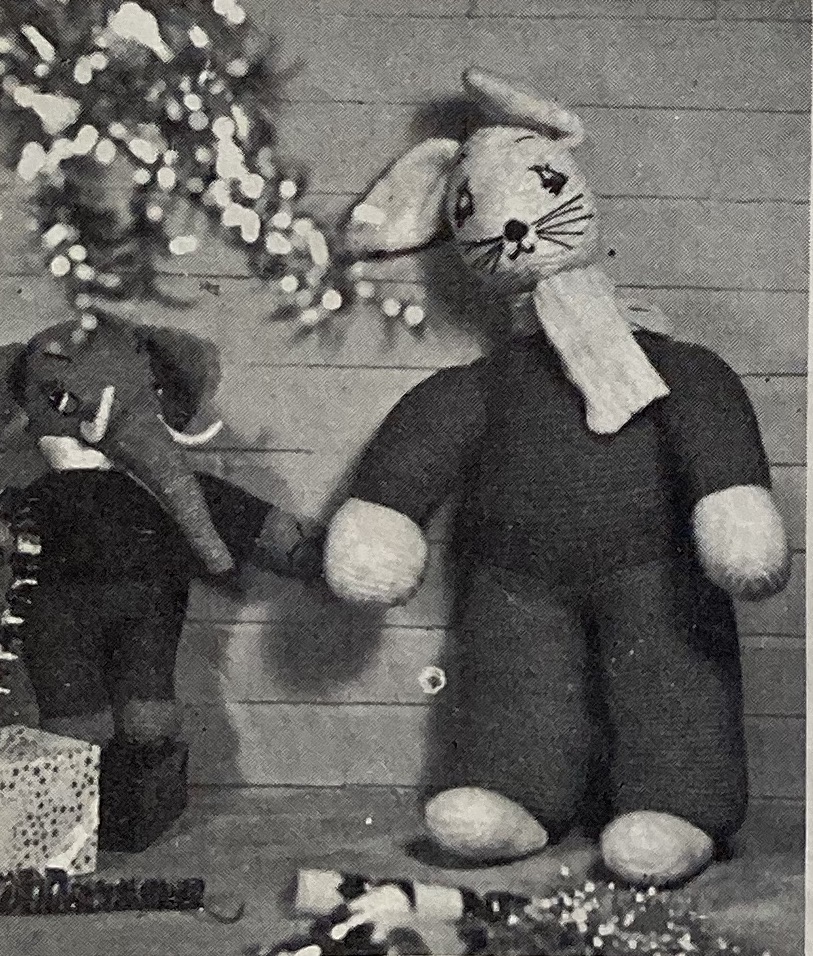
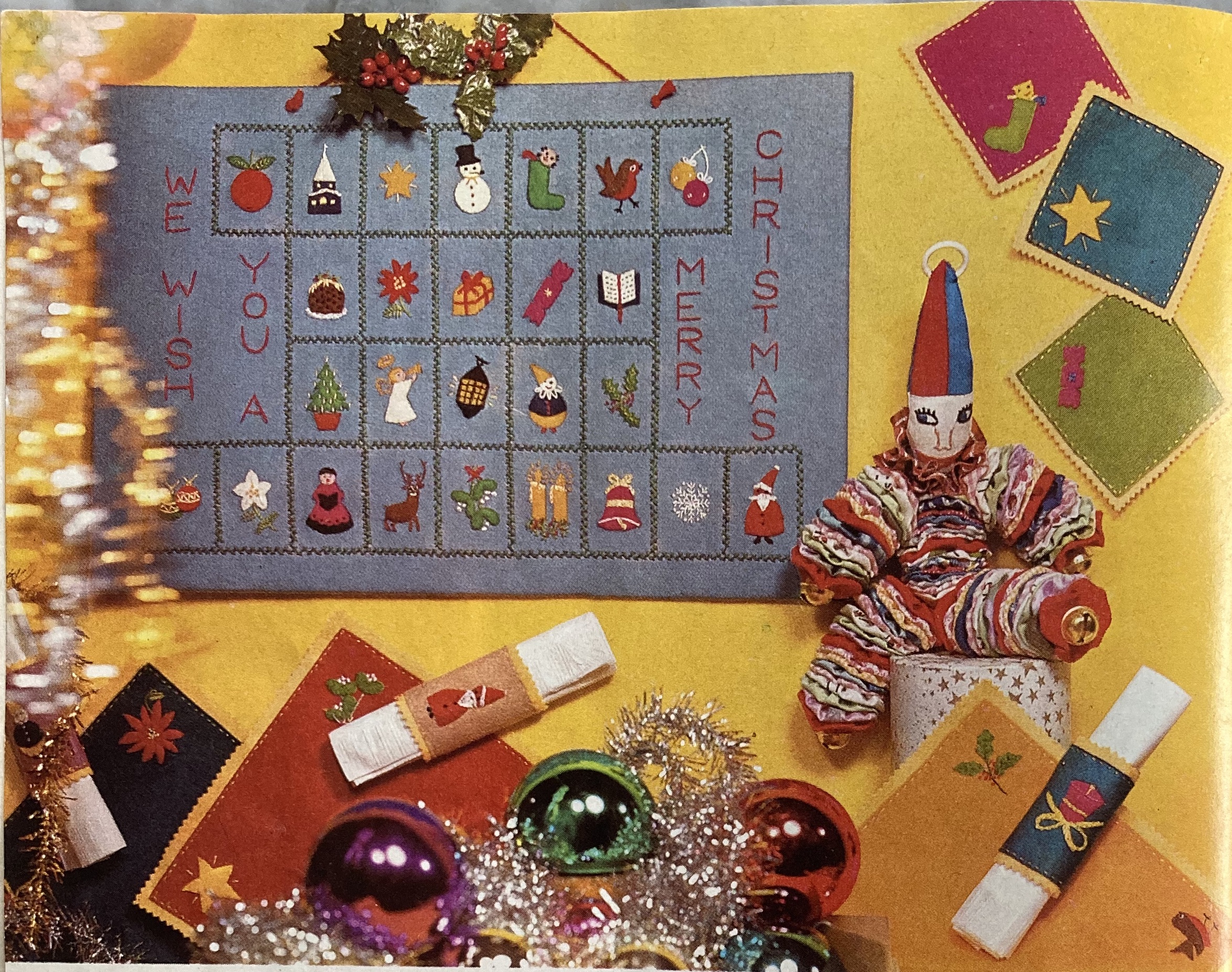
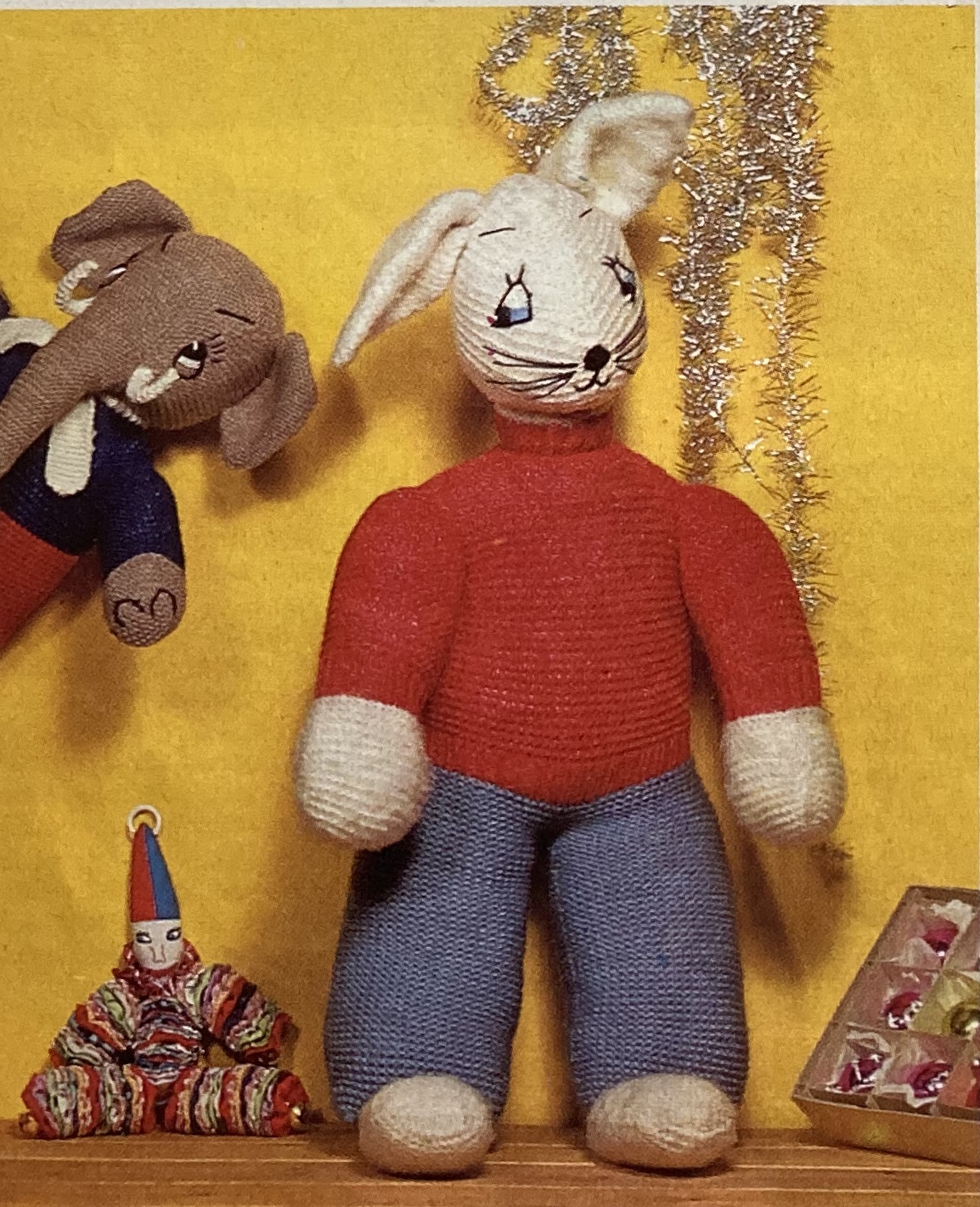
Starting with the melancholic stuffed animals, you can knit a “friendly” Jumbo the elephant, who seems to be rolling his eyes at the happy child who just pulled him out of their Christmas stocking, or a sad “bunny with a twinkle”. The table decorations are quite cute and easy to make: felt place-mats, napkin-holders and an Advent wall panel with wintery and Christmas-y appliqué motifs.

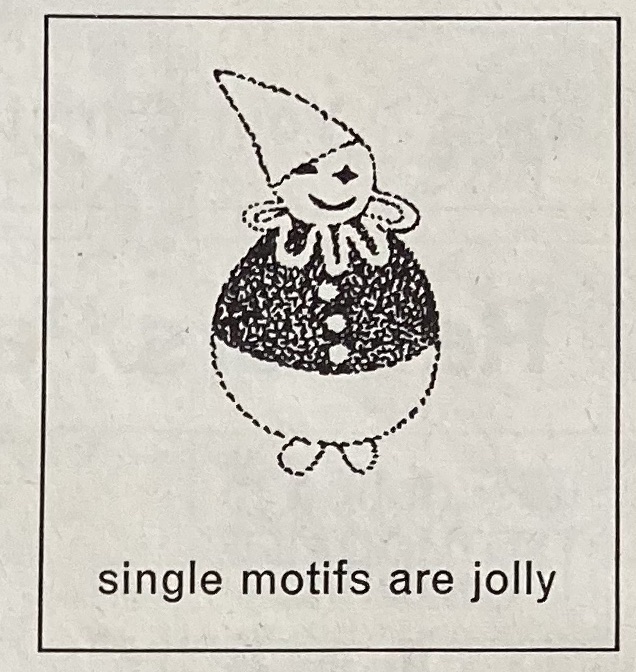
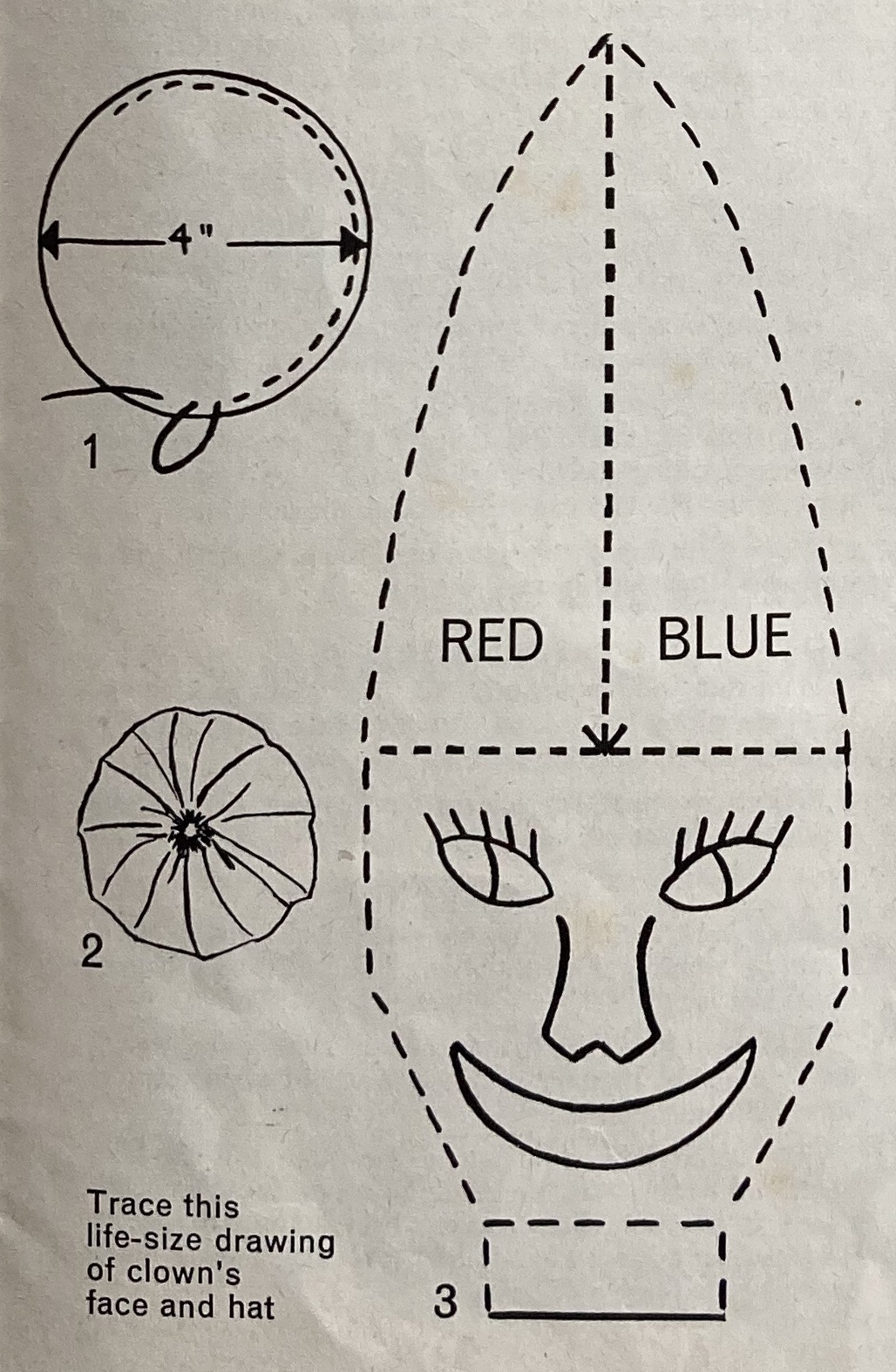
But that clown! The “Musical clown for a tot”! What in the world is going on with that clown? Even the bunny is giving it the side-eye. The construction is actually pretty interesting and a fun way to use up fabric scraps: you cut 4-inch diameter circles of fabric, gather them up with a gathering thread to make little poufs and then sew them on top of each other to make the arms, legs and body. Then all you need to do is sew and stuff a pointy head and cap and embroider a terrifying face onto it. Don’t worry, it has bells instead of hands and feet, so you can hear it coming.

EDIT November 12, 2022: I was browsing around on UK Ebay and someone is selling an FO of this clown! Unbelievable! I am not going to buy it but maybe one of you will

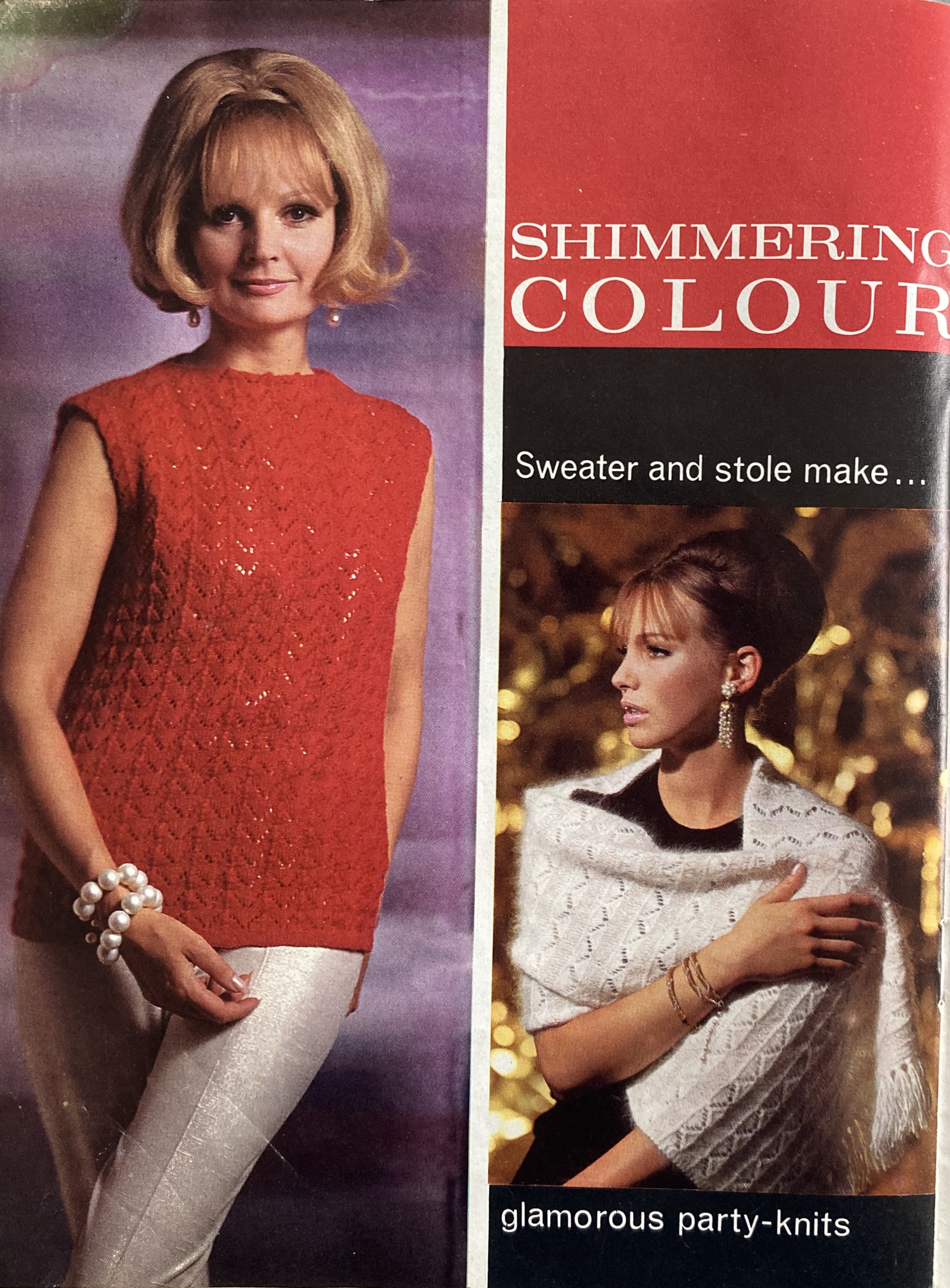
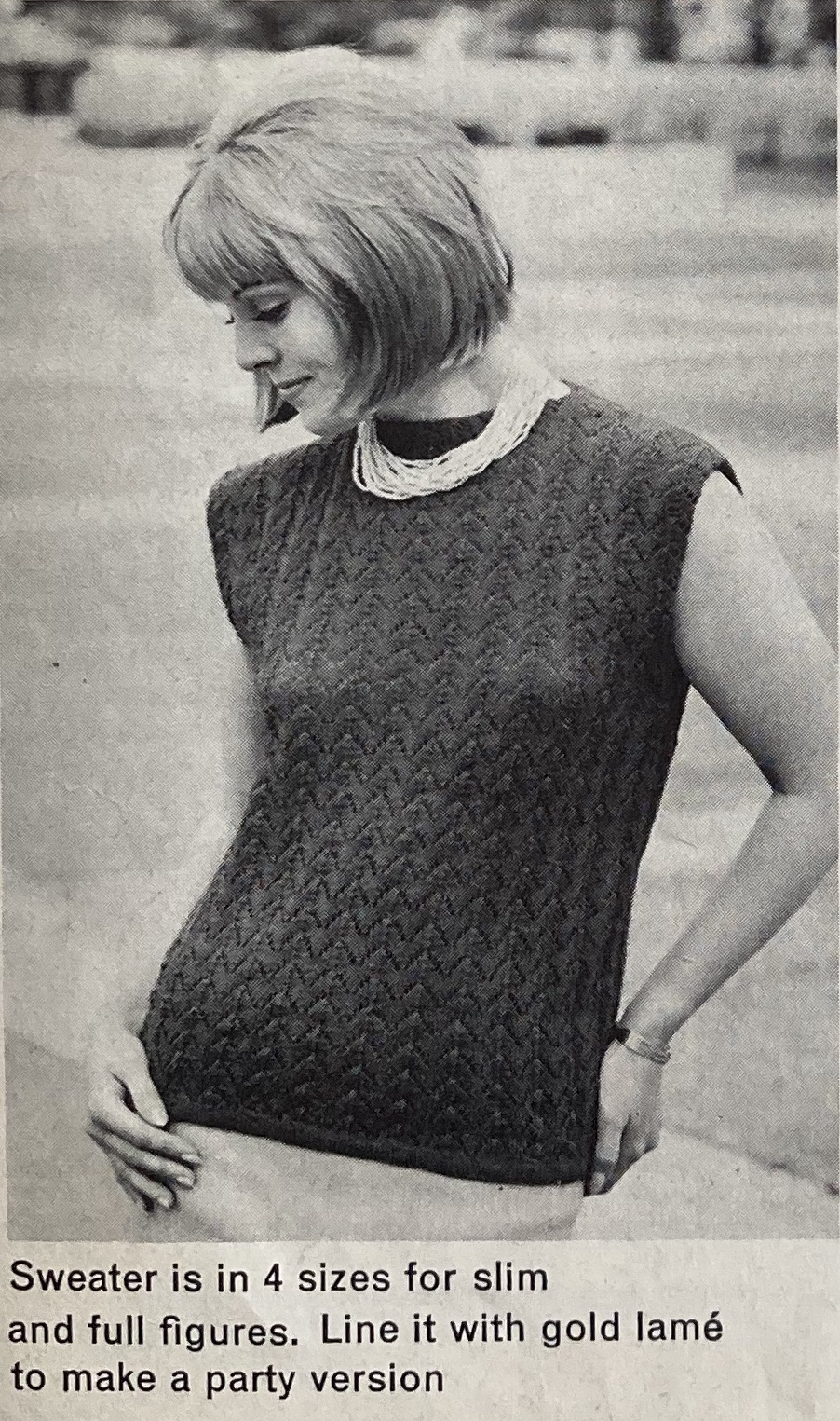
To clear your mind of those images, here is a lovely lacy party top and fluffy “luxury stole” knitted with Lurex for holiday party glamour. The top can be lined with gold lamé for extra sparkle.

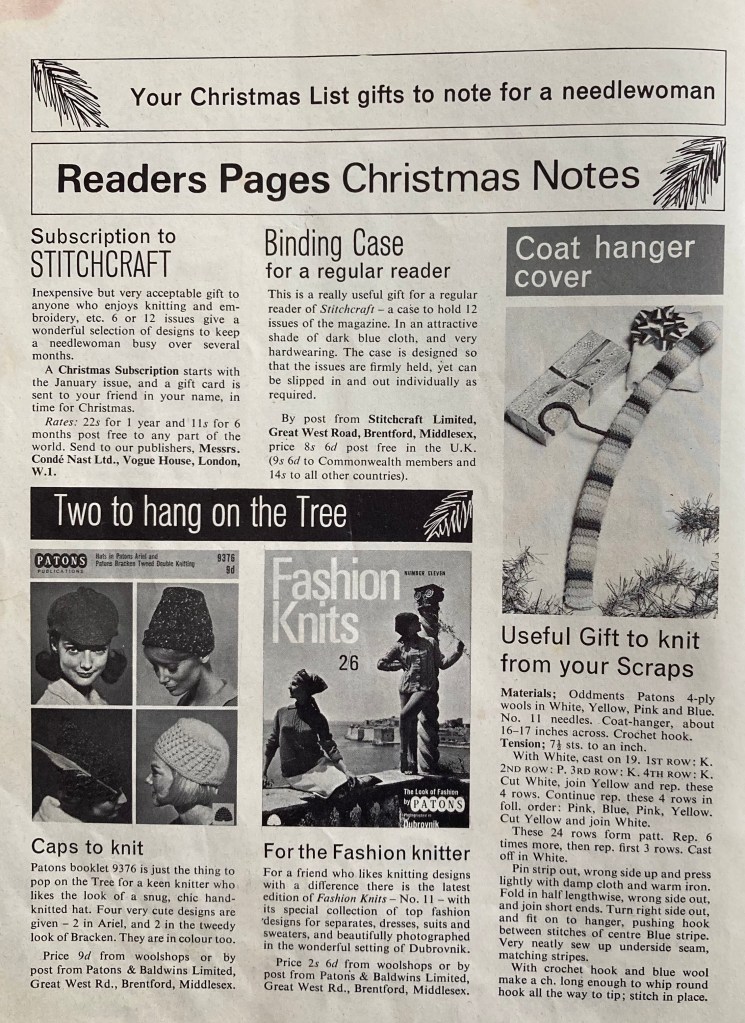
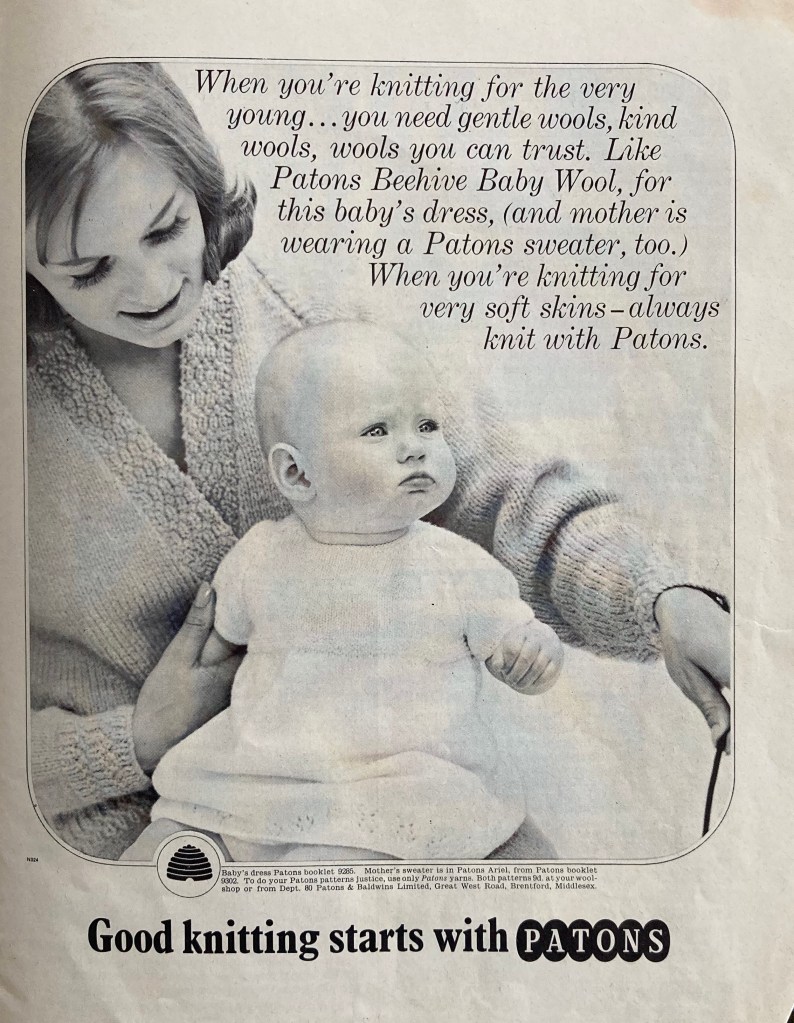
Rounding out this bumper issue are the “Readers Pages”, featuring Stitchcraft and Patons-inspred gift ideas (a yearly subscription, binding cases for past issues, knitting patterns…) and a fun way to use up wool scraps: a coat hanger cover to keep delicate items from creasing or stretching at the shoulders. The ads use babies to sell Lux soap flakes and Patons wool.

The only project that really called to me from this issue was (laugh if you want) the coat hanger cover, which could make a cute little gift for a friend or be useful in my own closet, as well as being quick and easy and a way to use up some of those mystery scraps in the stash drawer. The October 1964 dress is almost finished, so I’ll update that post soon as well.

December 1963: Overview

Cover photo from Stotchcraft magazine, number 360, December 1963

“Christmas is very nearly here” — where did the year go? As always, Stitchcraft‘s December issue is a mix of warm, bulky, quick-to-knit winter garments for the family and little handcrafts for presents and decorations.

Our cover model is wearing a hat in trendy “high-crowned” style with matching muffler. It uses “Glenora”, Patons new tweedy-multicolour wool. Unlike the “tufted” hat from last month’s issue, this one needs no millinery wire to keep it from flopping — the wool is relatively thick and is used double on the hat to make it really solid and windproof. The buttons are purely decorative and are made by covering button moulds with velvet cut from a strip of ribbon.

Other cold-weather accessories include these mitt(en)s, crocheted in a spiral to make the backs and fronts. Aside from the stripes on the fronts, they are almost identical to these mittens from February 1960. The full-size garments are all made of bulky wools for wamth and quicker knitting. There are pullovers for men and women in Big Ben or Ariel wools, a check-patterned pullover in double knitting weight and a cardigan “in larger sizes” (39-42 inch bust). Both of the bulky pullovers as well as the cardigan use variations on twisted or mock-cable stitch patterns, where you knit stitches in the “wrong order” in order to cross them. Big, pointy collars are still very much in fashion and the colours are bright and bold for winter: “Lipstick Red”, “Strawberry Ice” and “Royal Blue”.

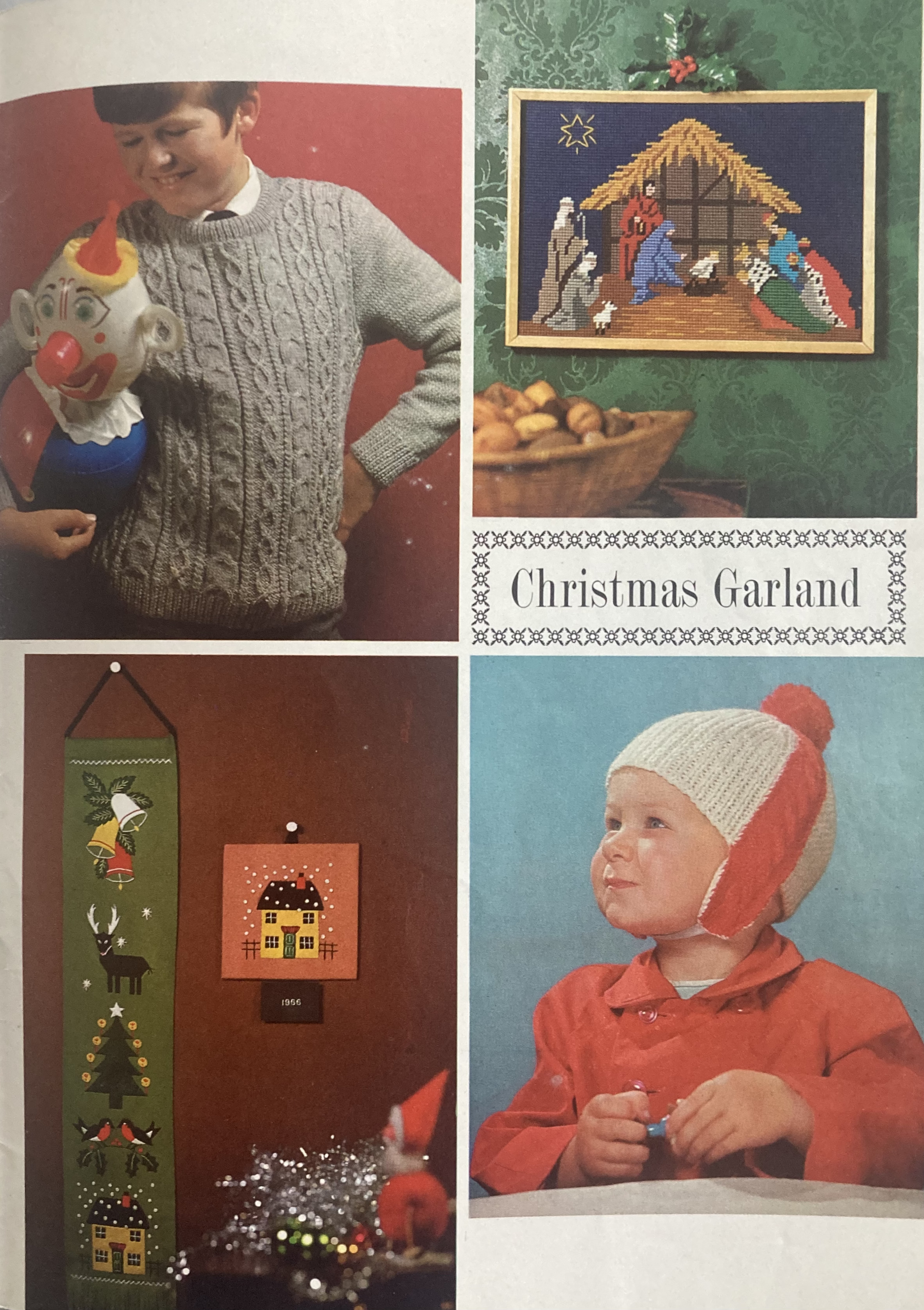
Children get “Christmas sweaters” in holiday colours of red, green, and white, with bold snowflake motifs in stranded patterning.There’s a frilly bed jacket in lightweight 3-ply and a waistcoat variation on the men’s pullover, as well. They’re photographed in colour on the inside back cover. Funny that, with all the brightly coloured garments in the issue, they chose the one beige garment for the colour photo! You do see the tweed flecks better, though. That amazing creation at the top of the page is the Royal Pavilion in Brighton, reproduced in fine embroidery in felt appliqué. This isn’t the first huge, complicated wall panel project we’ve seen and I can only assume that Stitchcraft had a really good appliqué designer.

The other homeware/decoration projects are small and easy, intended for little gifts, holiday bazaar sales or to brighten up the festive table. You can knit a little puppy doll complete with its own fully dressed bed, or make some silly but nonetheless cute egg cosies (the human-looking one is supposed to be Friar Tuck.) There’s a “pinny” apron to sew for a child, party table mats with a star motif, and these stuffed and embroidered felt stars to hang on the tree. I made one of these last year and will probably make some more this year — they are quick to make and just the thing for a mini-present.

If you have a little more time (but don’t want to tackle the Brighton panel), you can knit a knitting bag, crochet a floor mat, or make a hard-wearing cushion in a standard “ribbon” needlepoint design. If you’ve really got some time on those long winter nights, you can make a set of dining-room chair seats in tapestry, or a large pile rug in a “Byzantine” design. (Beautiful leather satchel in that photo as well! It’s a just a prop, though, of course — Stitchcraft‘s crafts didn’t extend to leather-work.)

Then there’s this design for a little sewn bag with an embroidered horse named Archie on it. Archie, since you asked, is the horse in the children’s comic “The Smuggler’s Sack”, which has been running on the back pages of Stitchcraft for the past few months. It features children Joe and Jenny, who live in a waterfront town whose mystery pirate/smuggler treasure has never before been discovered. Will they be the ones to find it at last? As of yet, they’ve found a mysterious box … which has a false bottom … which contains a map and a key .. which leads them to .. an inn called “The Smuggler’s Sack.” They’re disappointed, but could the inn hold the clue they’ve been looking for? Shades of Daphne du Maurier!

“Archie” will in fact feature in my December project, where I will be embroidering him onto a modern soft case / traveling bag for a pocket synthesizer.

Happy Holidays, everyone!

November 1963: Overview

The autumn months are always the best for knitting magazines, with a mixture of heavy garments for colder days, easy-to-make holiday gifts, warm accessories and a few glamorous items for parties. Stitchcraft‘s November 1963 issue puts the focus on “warm family fashions… with the emphasis on colour and attractive textures that are interesting to knit and very becoming to wear”. There’s something for family members of every age and “for the petite to the not-so-slim.” The homewares and little projects are quick and fun to be finished in time for holiday decorating and/or gift-giving.

The “country jacket” on the cover continues the tweedy, variegated colour effect in fashion this fall, using Bracken Tweed wool for the main body and Totem DK for the collar and cuffs. I finally know what colour Totem “Oakapple” is! The other women’s outdoor-wear fashions include a zip-neck sweater with textured pattern bands in turquoise, an “overpull” with cabled neckline in flecked “Cantaloupe” colour (sadly, no colour photo, I have no idea how it looked in real life) and a simple brown top made glamorous by knitting the wool (Cameo Crepe 4-ply) together with a strand of sparkly Lurex thread. There’s also a warm, soft cape for winter reading in bed, knitted sideways in an easy zig-zag pattern. Aside from the green and white bedcape, shades of autumn brown as well as bold blues and red are the season’s trendy colours. Stripes, zig-zags and textures complete the Autumn 1963 look.

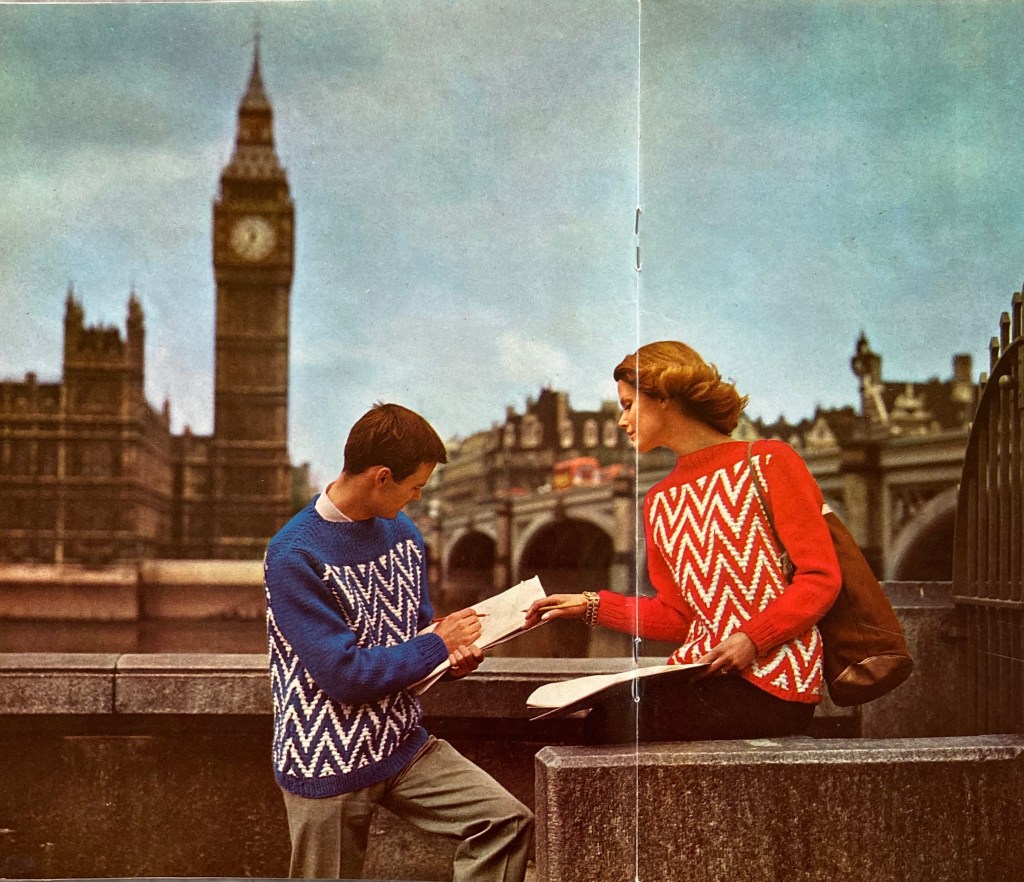
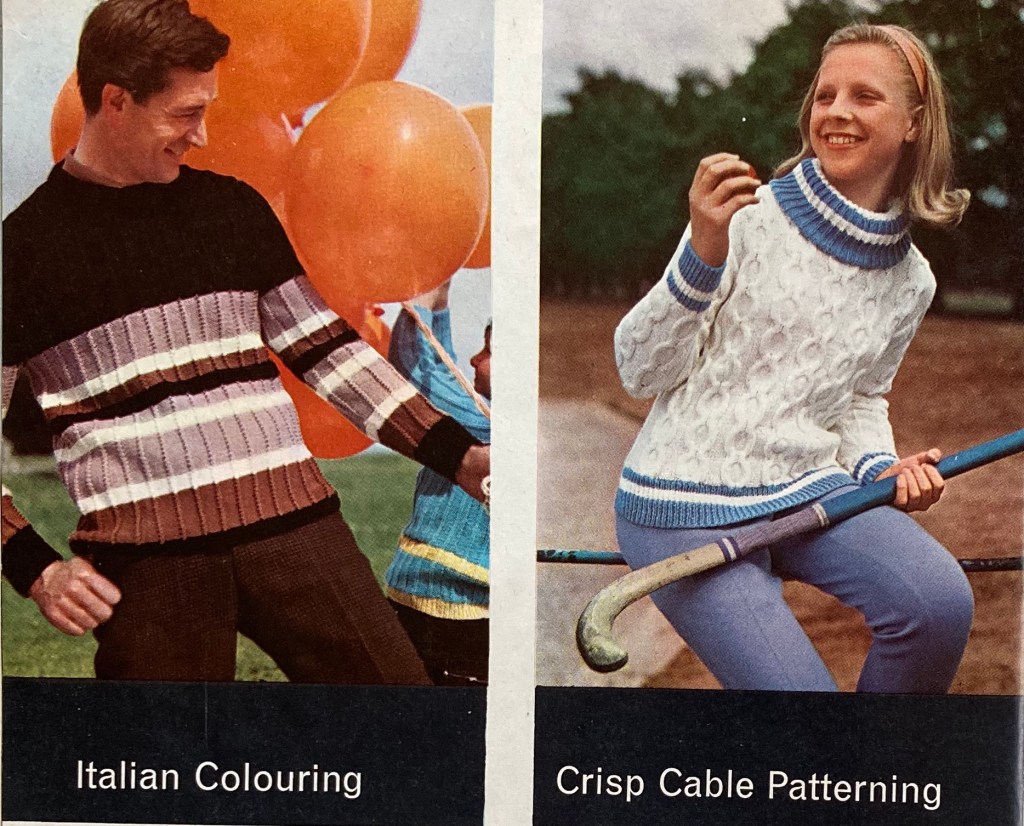
Men’s fashions are just as colourful as the women’s, or even more so (less use of plain brown…) and show more of the zig-zag trend. Here are some bold designs for “him and her” using bulky Big Ben wool (and photographed in front of…). The construction is the same for both, with the smaller design for bust sizes 33-35 inches and the larger for 39-41 inches, with the advice that “Plumper girls could follow his size”. The man’s pullover in “Italian colouring” uses stripes and textures, toned down by the use of more neutral colours. The blue-and-white cabled sweater in the photo next to it is for teenagers.

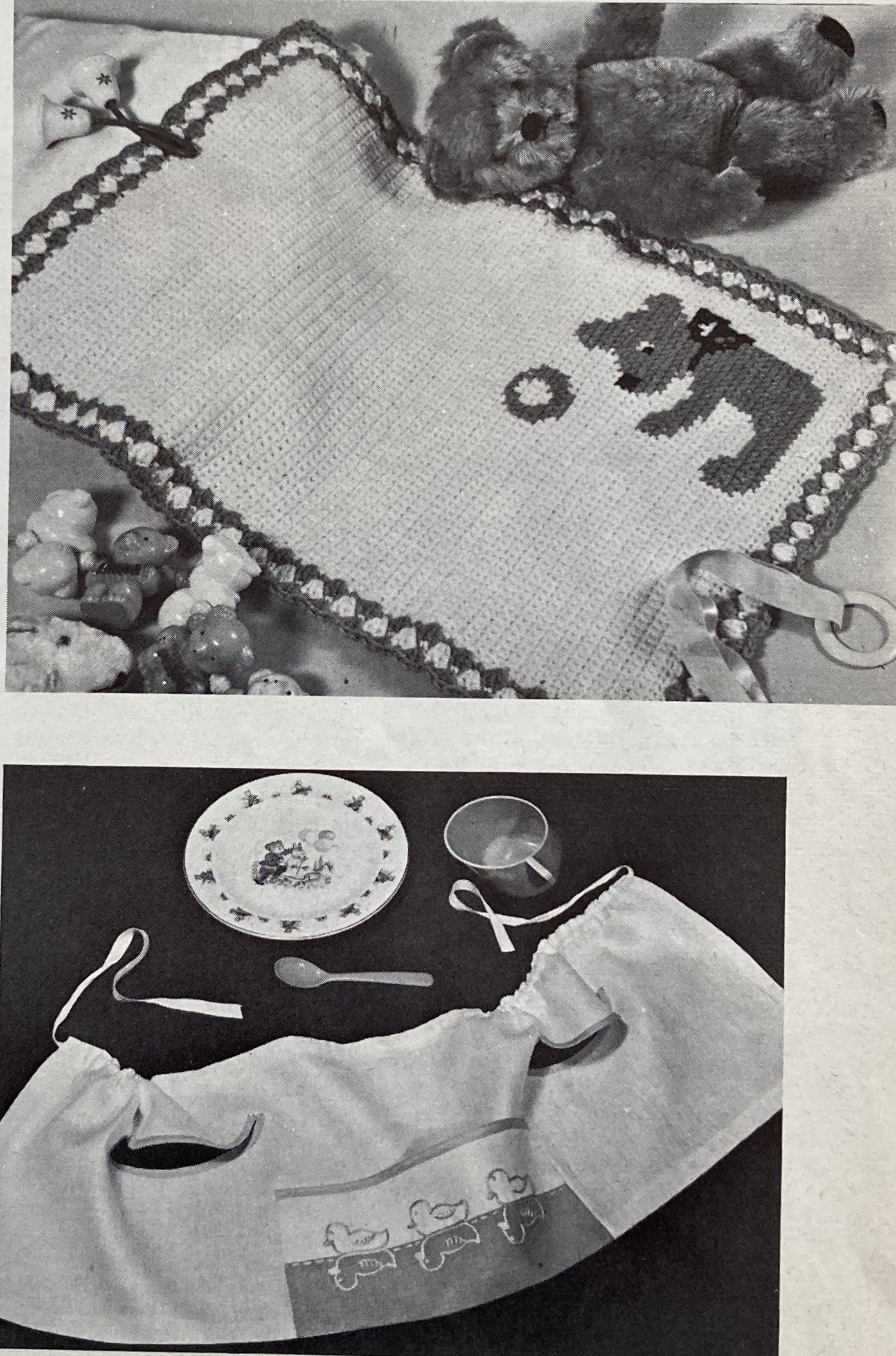
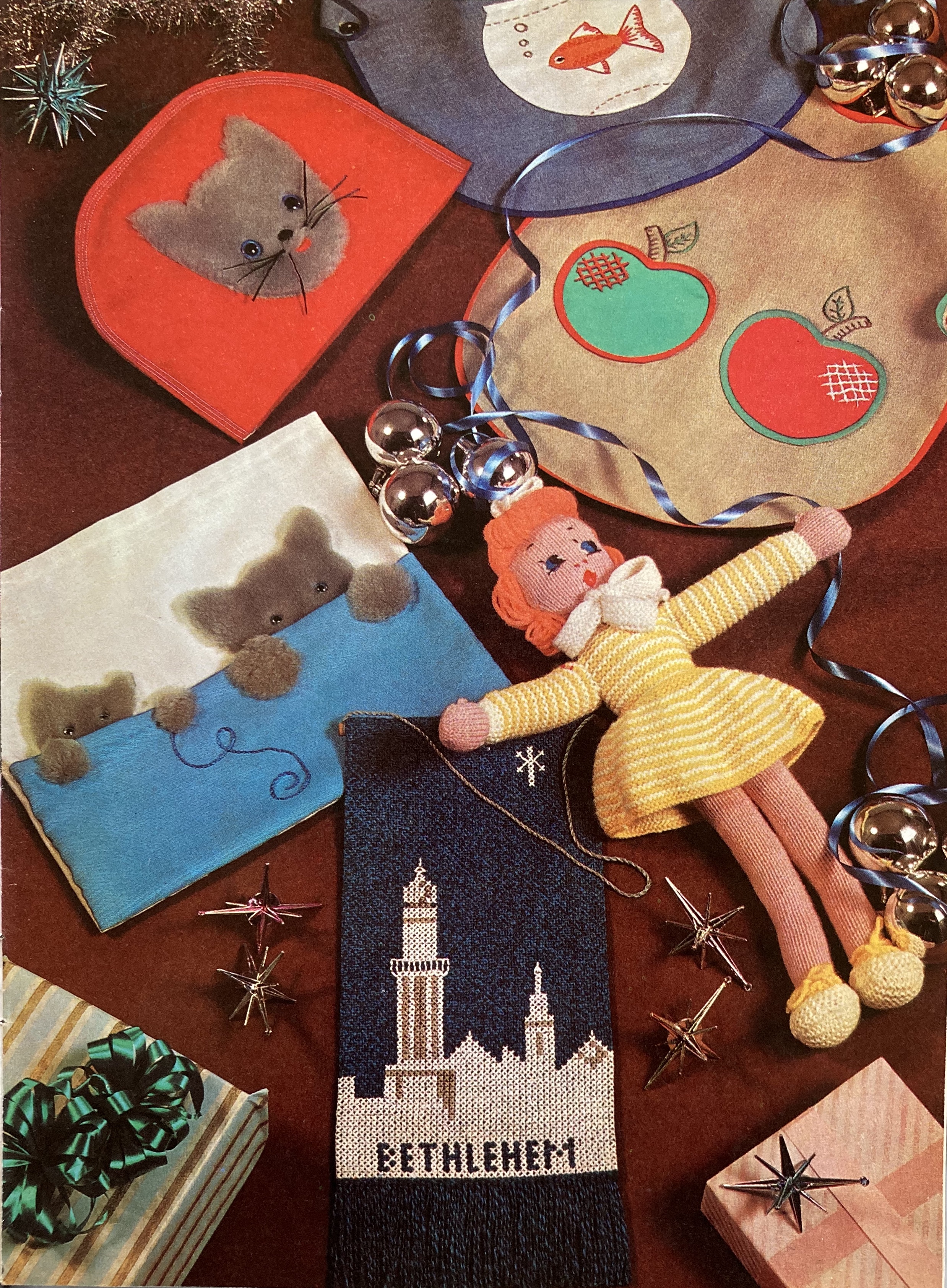
School-age children get their own “tough, tomboy sweaters” in Bracken Tweed wool. The suggested colours are “Black Olive” or “Gorse Heath”, which I assume is a sort of green-yellow tweed (no colour photo). Babies get a lovely shawl to match the layette from the September and October issues. It’s easy to knit, as the centre and borders are made separately. The other baby/nursery-age items are crocheted, sewn or stitched: a pram cover with a teddy-bear motif, a little nightcase with fluffy appliquéd kittens, a knitted doll, an embroidered “feeder”, sewn and appliquéd pinafore smocks…

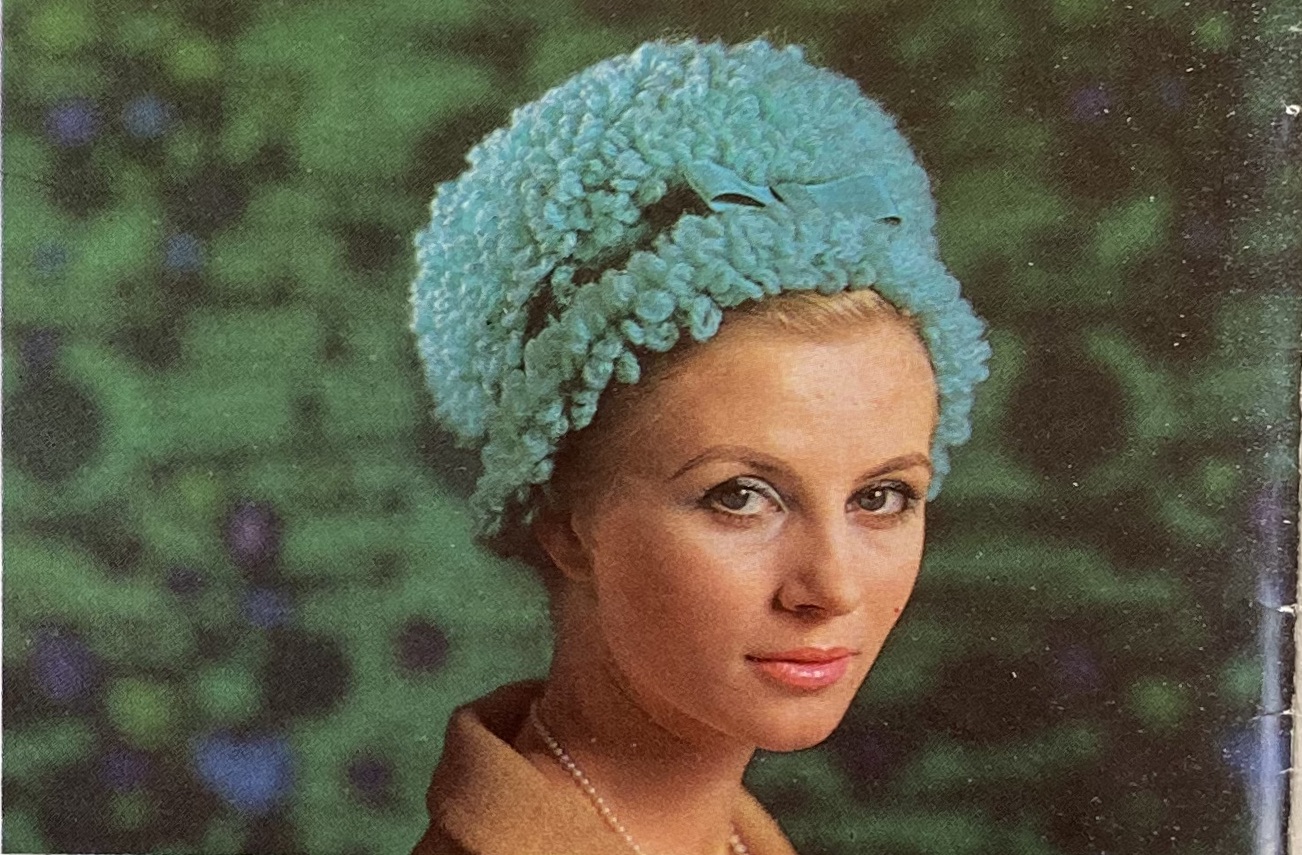
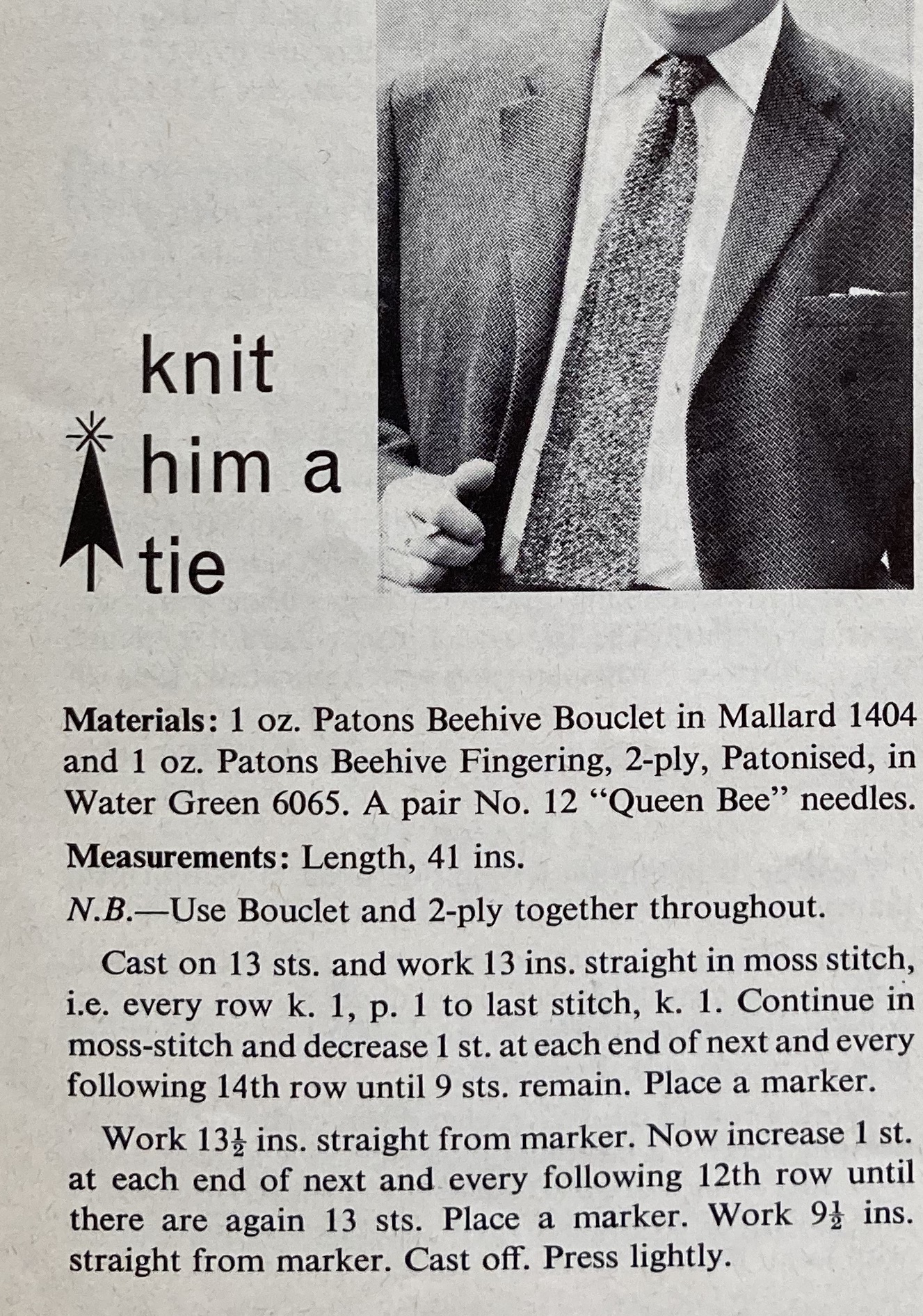
There are fewer designs for accessories, but the utter fabulousness of this loop-stitch crocheted hat makes up for anything else that could be missing. The model in the photo features in many issues from this time period and always looks either quite sad or has that alluring Mona Lisa smile that’s she’s sporting here. (Am I mean, or wrong, to assume that she probably had bad teeth?) I would smile widely if wearing that hat, and I hope everyone who saw me in it would too. Also, knit your man a tie!

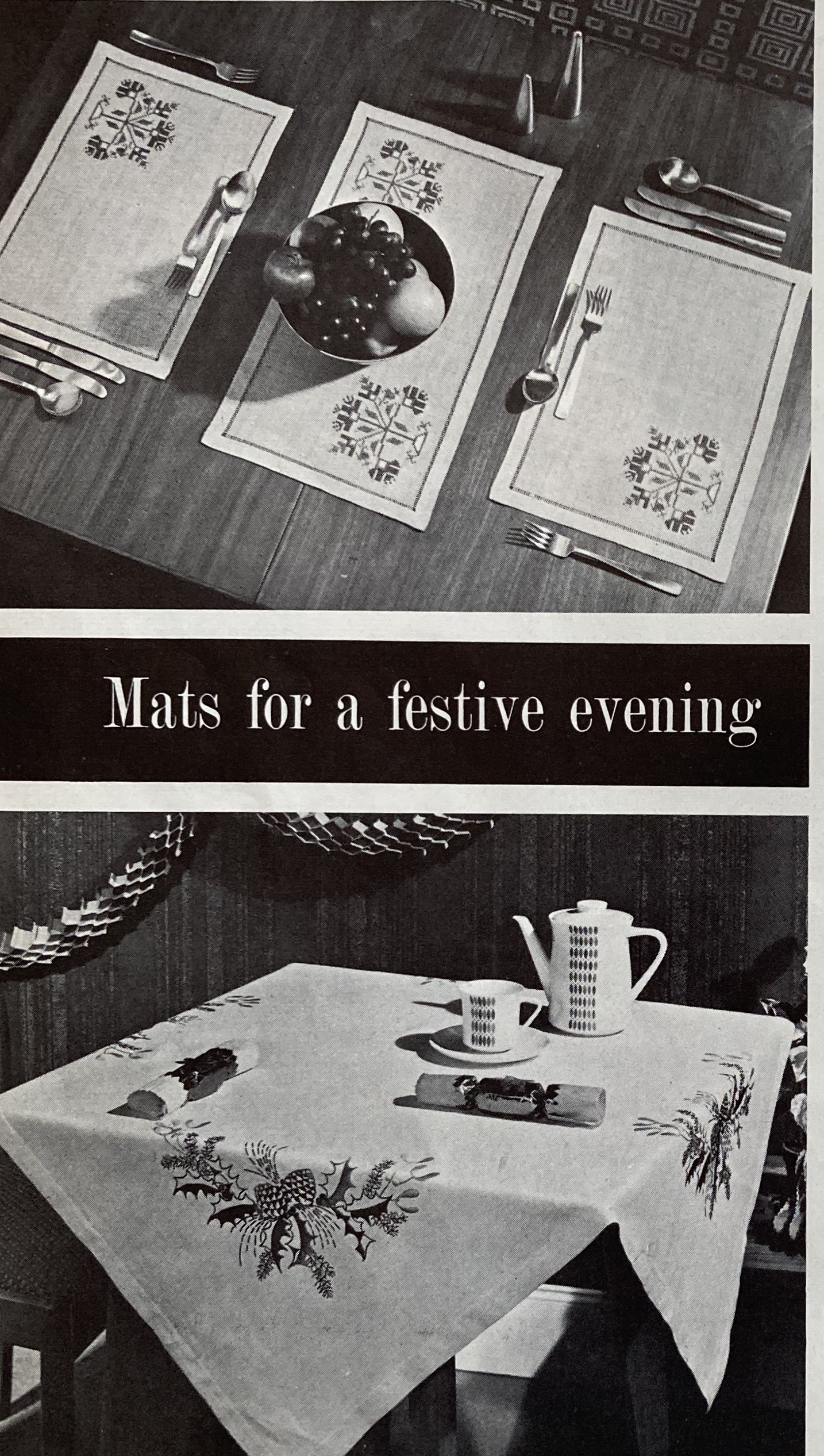
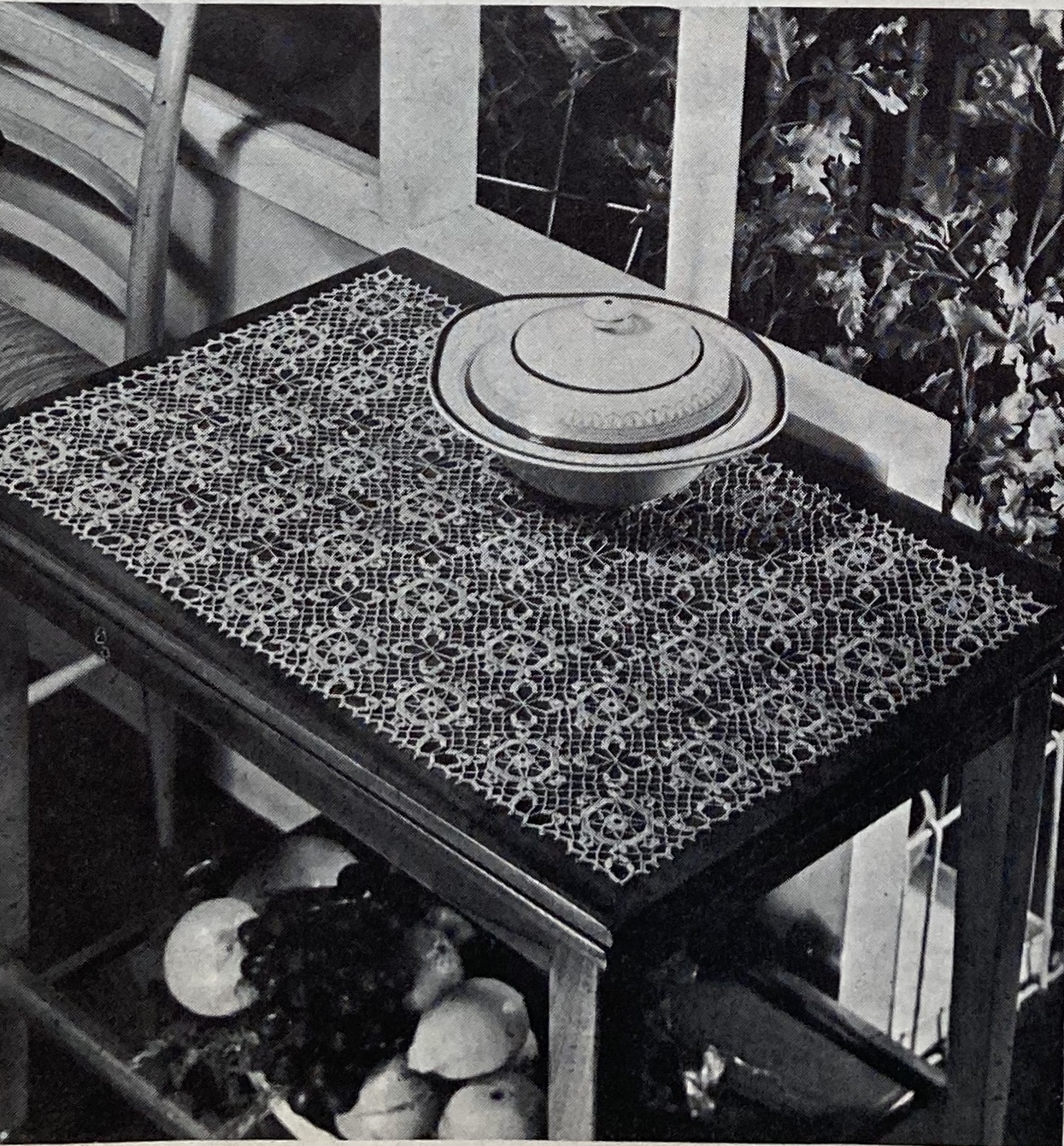
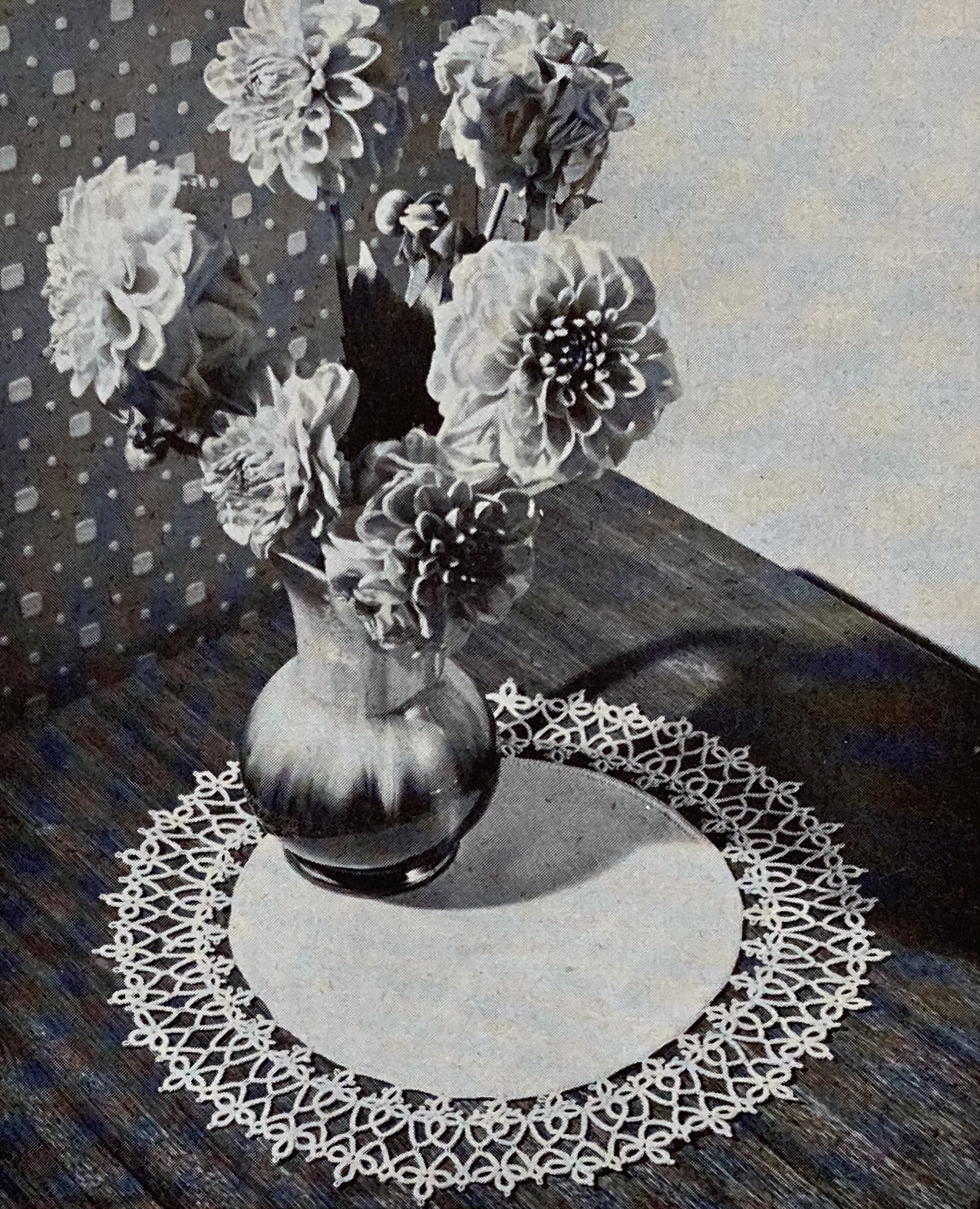
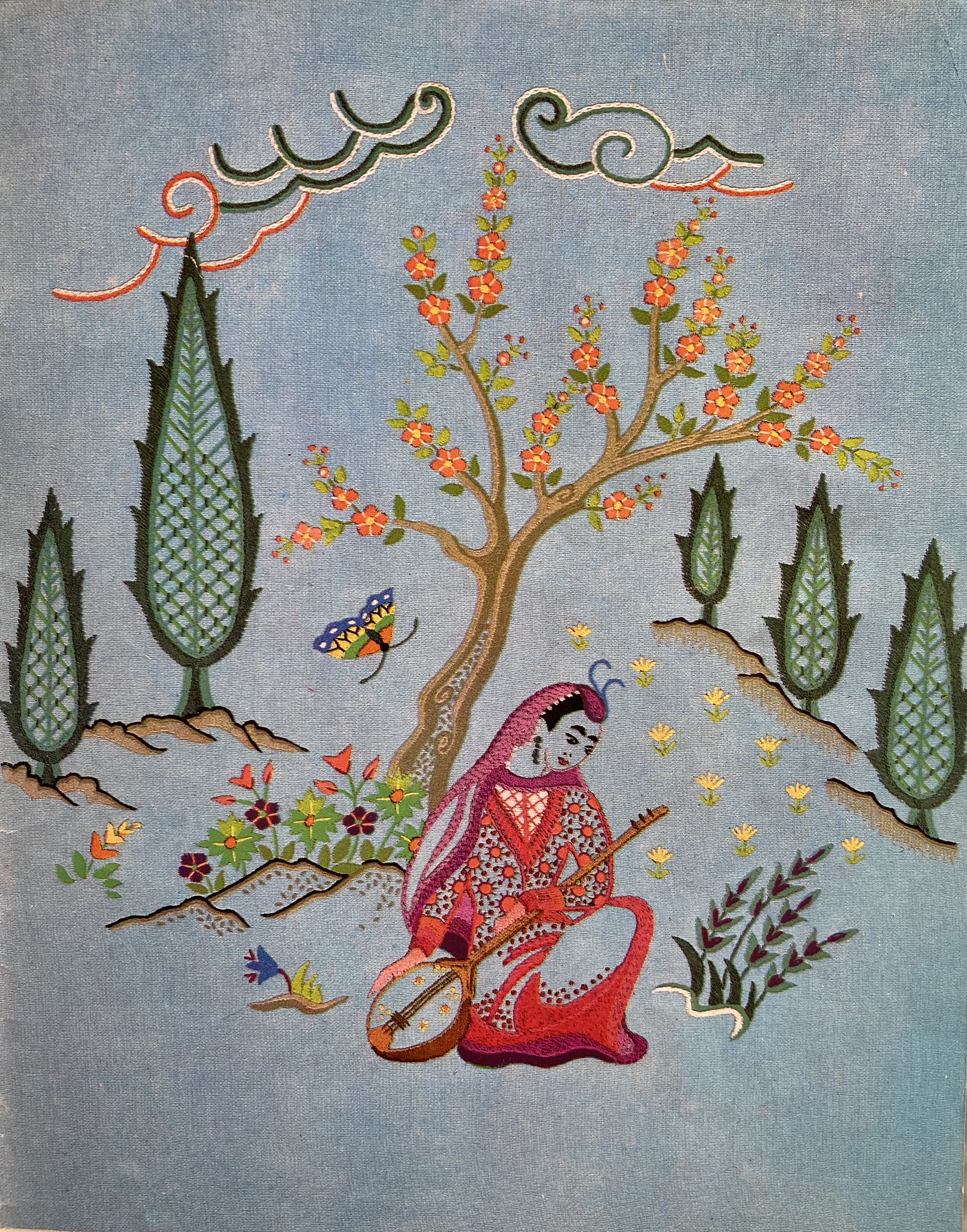
With all this bounty, the homewares are mostly standard: embroidered table mats and a Christmas-design tablecloth, a decorative panel with the Star of Bethlehem for more religiously-minded households, and a very impressive tatted doily and crocheted trolley-mat. The show-stopper is a lovely decorative panel “taken from a book of Oriental designs” embroidered in Filoselle silk on linen. (The design is allegedly of Persian origin, though of course neither Stitchcraft nor its typical readers of the time gave much thought to questions of authenticity, nomenclature, exoticism or any related issues that we would regard and discuss today.) It is a pretty picture in any case, and was probably not too difficult to embroider, consisting mostly of standard seed and straight stitches, French knots, and so on.

That’s all for this issue! I am going to make that wonderfully ridiculous hat.

Out of Order: Felt Stars, December 1963

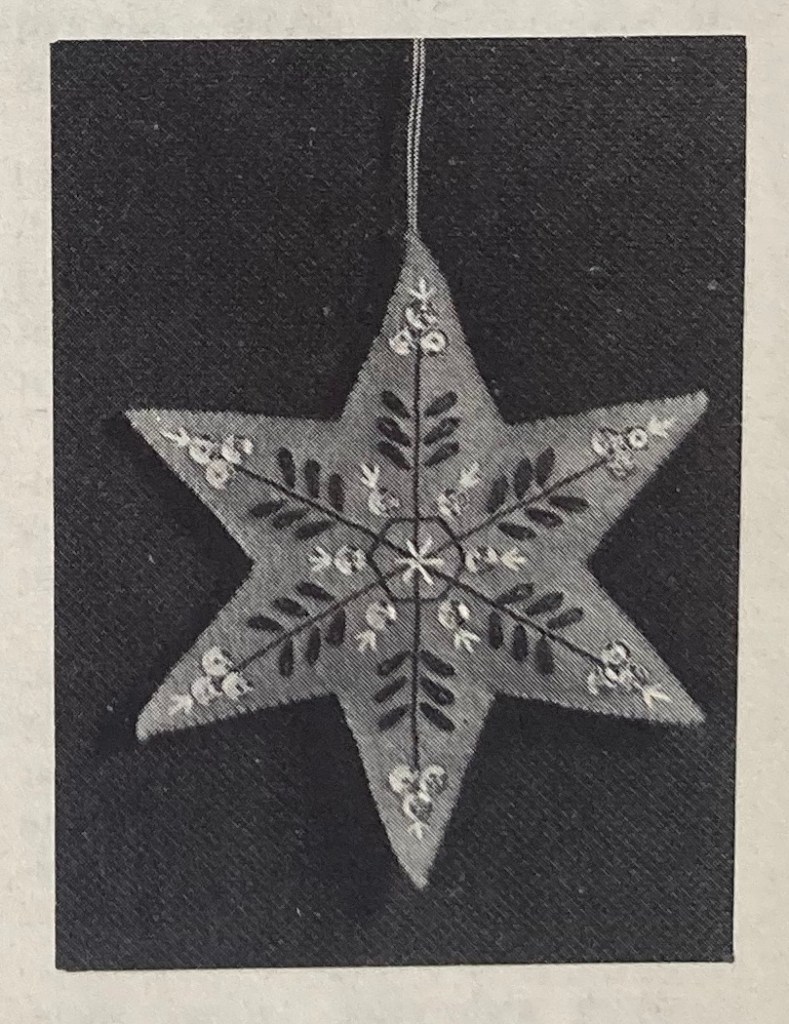
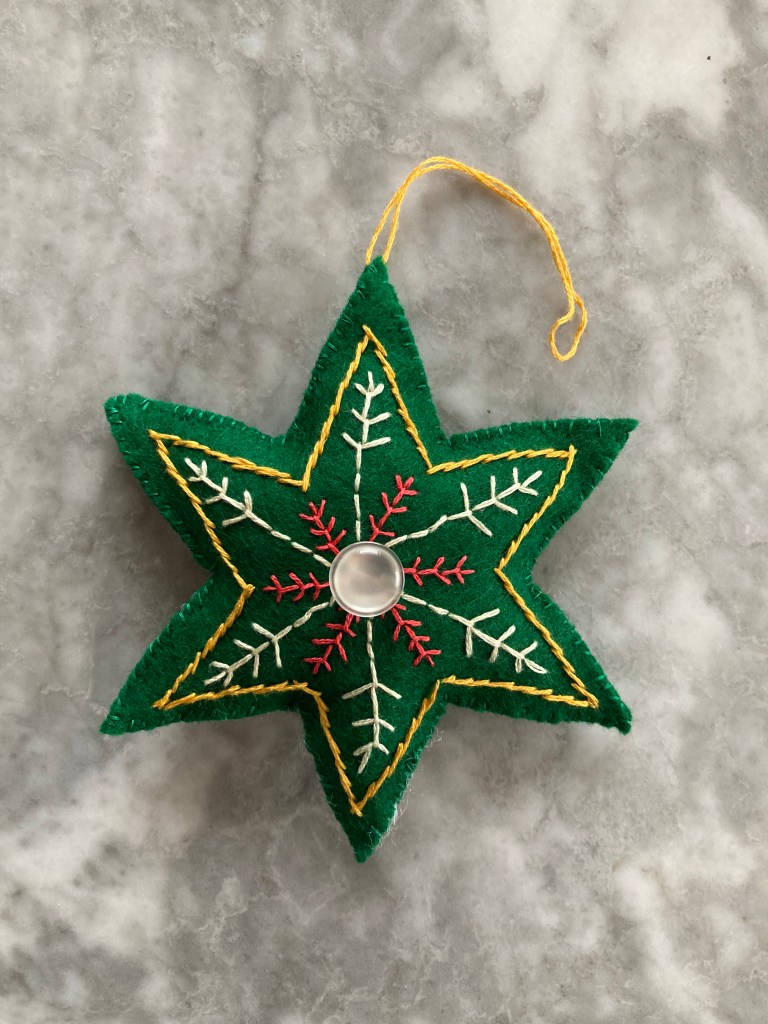
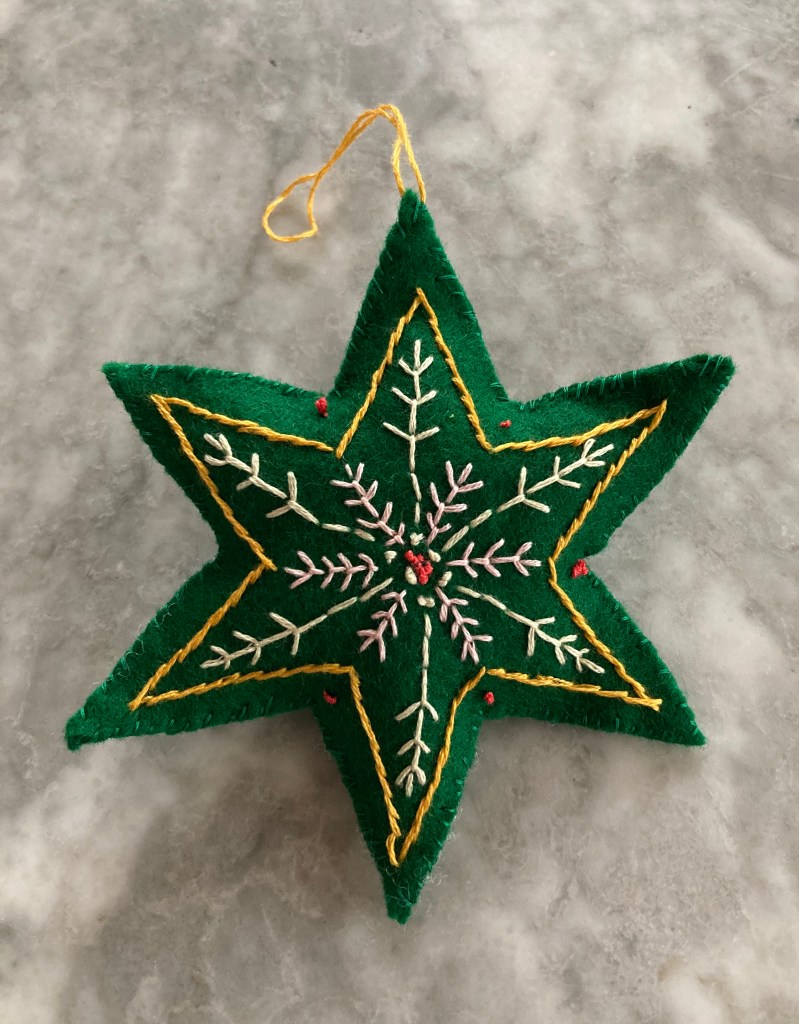
2020 has been a bad year for many things, but a good year for little home-made presents made from stash. I used a lot of cotton fabric for pandemic masks (with an added inner layer of fabric cut from an upcycled duvet cover made of special hypoallergenic tight-weave, dust-mite-proof fabric) and a big piece of green felt went to this iPad cosy, but I still had plenty of large scraps of all kinds of materials and the usual box full of odd buttons and leftover embroidery floss. Meanwhile, the holiday season was upon us, all the stores were closed and I wanted to be frugal with money but still be able to leave some mini-presents in friends’ mailboxes with a card and some cookies. These little felt stars from the December 1963 issue of Stitchcraft were the perfect choice.

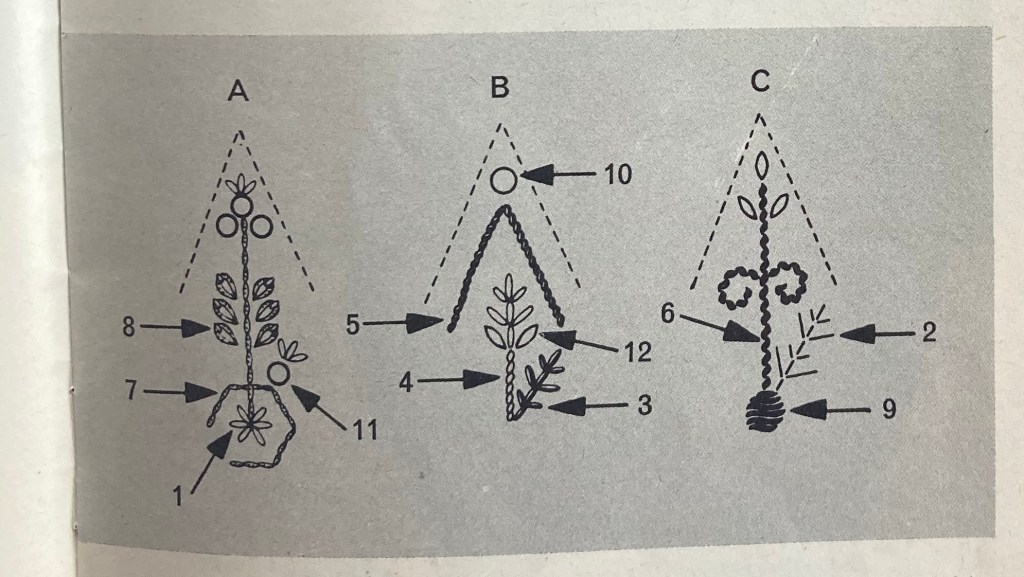
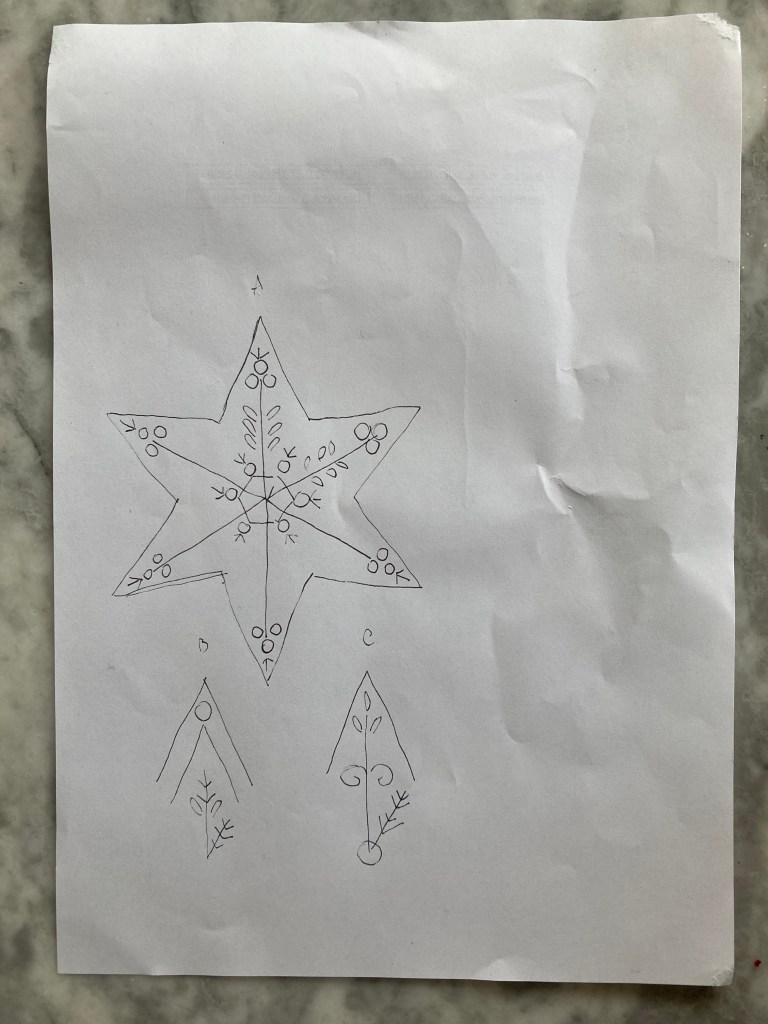
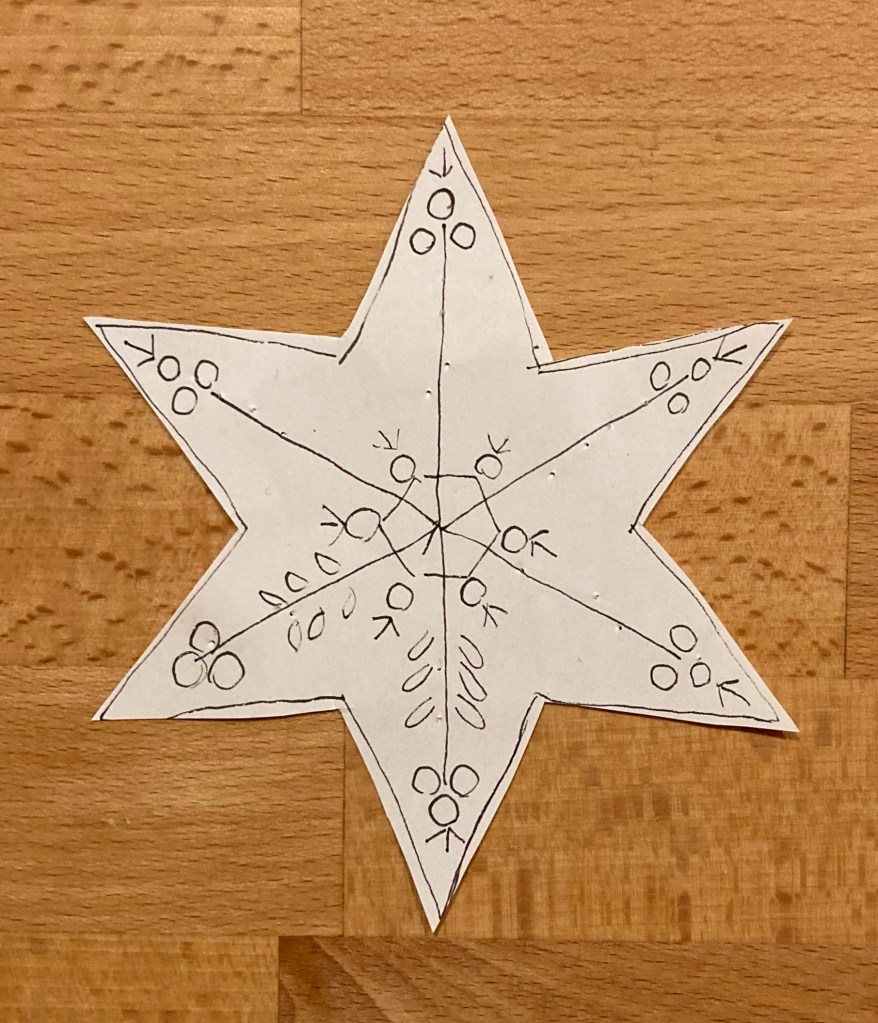
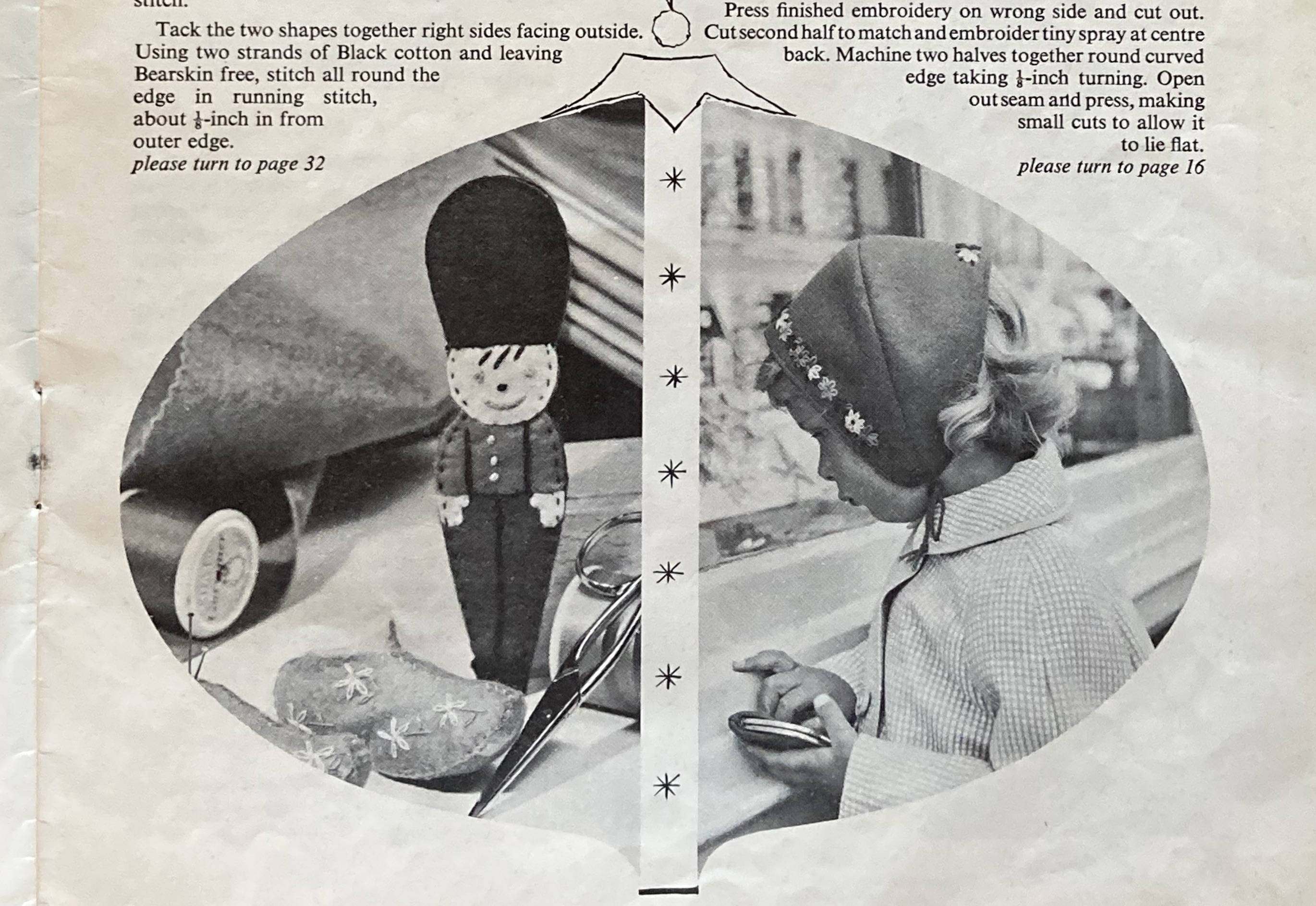
There was a life-size transfer in the magazine to trace (or photocopy and cut out — I’m lucky to have a printer at home that is also a scanner and single-page copier) with samples of the three star designs to copy onto the points of the star. I traced it onto the felt with chalk, cut out two stars, picked my favourite design, and embroidered away. (Technically I should have first traced the design onto the fabric, then embroidered it and then cut out the stars, but it worked anyway.)

I had neither sequins nor pearls, so I just did everything in embroidery and added a button for the center on one side. I overstitched the edges to make a little cushion, added a loop for hanging on a tree and stuffed it with polyester fluff. Wonderful! The first star went to a fellow knitter from my now-online knitting meetup — we did a Zoom version of our usual “secret Santa” wool gifting party — and by then I was so involved in getting people’s knitted gifts finished that I ended up not making any more this year. Now that I know how it works, and that it works, I can make more next time.

Merry Christmas, if that’s your holiday, and happy New Year to all of you.

December 1962: Overview

It’s that time of year again, and Stitchcraft is getting into the festive season with their annual Christmas issue — though if it weren’t for the wreath on the door behind our cover model and the other model in the window holding a metallic tree and box of ornaments, I wouldn’t know it was the Christmas issue at all.

The suit on the cover is “The Suit for Spring ’63”, made in Bracken Tweed double knitting (colour: “Green Witch”! Great name) and trimmed with black braid, like the November 1961 suit from which I made the blazer last year. The December 1962 jacket has no buttons and more of a boxy “swing-line” shape, like the classic Chanel suits that were especially popular in the early 1960s. The simple pink blouse worn with the suit was made from a Vogue pattern which could be ordered via Stitchcraft, thus completing the outfit.

The other larger knitting projects are either warm, bulky and practical for the cold, or fancy, pretty things to wear to parties. In the first category, there’s a wonderful hooded coat for a toddler which keeps out “all the draughts” — except, of course, the ones traveling up her bare legs! I still feel sympathetically sad every time I see pictures of cold-weather children from pre-1970s eras with five layers of wool on their upper bodies but basically nothing on the bottom half.

There’s a zig-zag patterned sweater in Big Ben wool for a larger child or young teen (who is luckily old enough to wear trousers, as seen in another photo) and a stranded design in double knitting that fits into the same “harlequin” diamond-pattern idea (though the adult version makes me think of spiky eyes looking out at me). Also in double knitting is the cabled turtleneck “for the extra slim” (30-31 or 32-33 inch bust). Rounding out the warmer designs are two partner-look sweaters in bulky Ariel and an “Italian stitch” (stranded knitting and purling — that’s going to be really warm and bulky.) The “Continental” trend can be seen in the spiky-eyes sweater as well, which is apparently of Viennese (as per page 20) and/or Tyrolean (as per back cover) design.

Then there are the party clothes: a fluffy cardigan for a young girl and a beaded 2-ply blous with minimal shaping and a beaded crochet finish on the neckline. Holly green is always a hit in the winter designs and other than that, the preferred colour is white with bright contrasts in red, orange or turquoise. The cabled turtleneck is made in “Lipstick Red”.

Surprisingly, this month’s homewares are not particularly special. Our year of embroidered flowers has come to an end with a design of “Christmas roses” (really, they’re just roses) and readers could back-order any transfers they might have missed over the course of the year to make a tablecloth with all of the 12 flower designs on it. There are quick, easy cushions in darning or crochet and a cutwork design for another tablecloth.

The Christmas issues of Stitchcraft usually have a lot of very creative and sometimes bizarre ideas for knick-knacks, small gifts and other “novelties”, but this year seems to put more focus back on knit designs. There are a few small sewing projects that could work as gifts any time of the year — little aprons, a pincushion doll and a sewing case. The winter-motif mats for the Christmas table, a small tapestry scene and a felt Father Christmas wall panel that you can pin cards to are more appropriate to the holiday theme, and the back pages give readers a few traditional cross-stitch motifs to adapt to their own use and ideas for table trimmings. The table-trimming “trees” are made of sequinned tissue-paper trees stuck on top of empty sewing-thread spools and the “Berries and Twigs” are twiggy branches from a real tree, painted white and decorated with red wool pom-pom “berries” and foil leaves.

Christmas and any other large family get-together holidays are obviously not happening this year, but — good news! — as the blog year 1962 draws to a close, so too does the real-life year 2020, which I’m pretty sure most of us can agree was awful. I hope you all continue to get through it with minimal damage and enjoy the holiday season as much as possible in a pandemic-safe way. My project for this month will be the easy crocheted cushion, and finishing up all the unfinished projects.

November 1962: Overview

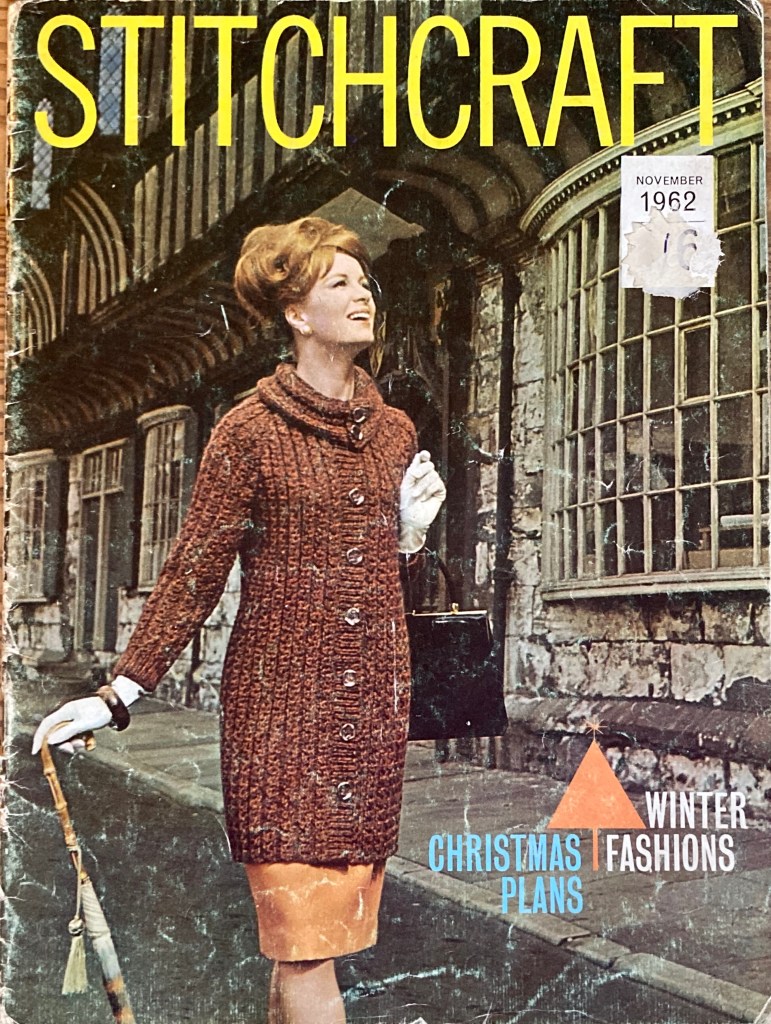
For 1960s Stitchcraft readers, November means holiday planning, so this month’s issue is full of quick homewares for decorating and small, easy projects for gift-giving. The garments are warm and bulky, featuring Patons’ new “Ariel” wool. Warm autumn tones of brown and orange as well as bright, cheerful holiday reds and blues are the colours of the season. Christmas Plans and Winter Fashions ahoy!

Our cover garment is a bulky, yet elegant coat in Big Ben wool, weighing in at a hefty 52-56 ounces (up to 3 1/2 pounds, or about 1500 grams). The mock cable/twisted rib pattern certainly won’t curl at the bottom edge, which is why I guess it’s designed without a hem or ribbing, but at that weight and in that pattern, I suspect the coat would grow ever longer and ever narrower (just in time for holiday weight gain). Still, it looks lovely! I especially like the buttoned collar. Also, I just might try to re-create the model’s hairdo with my long lockdown hair.

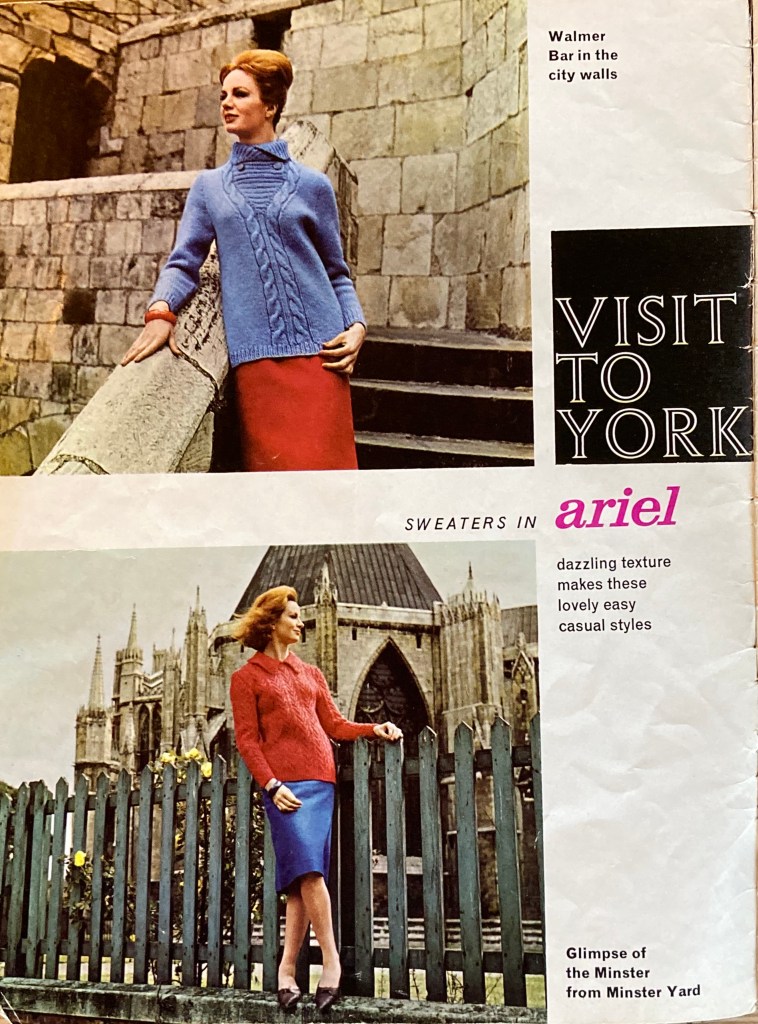
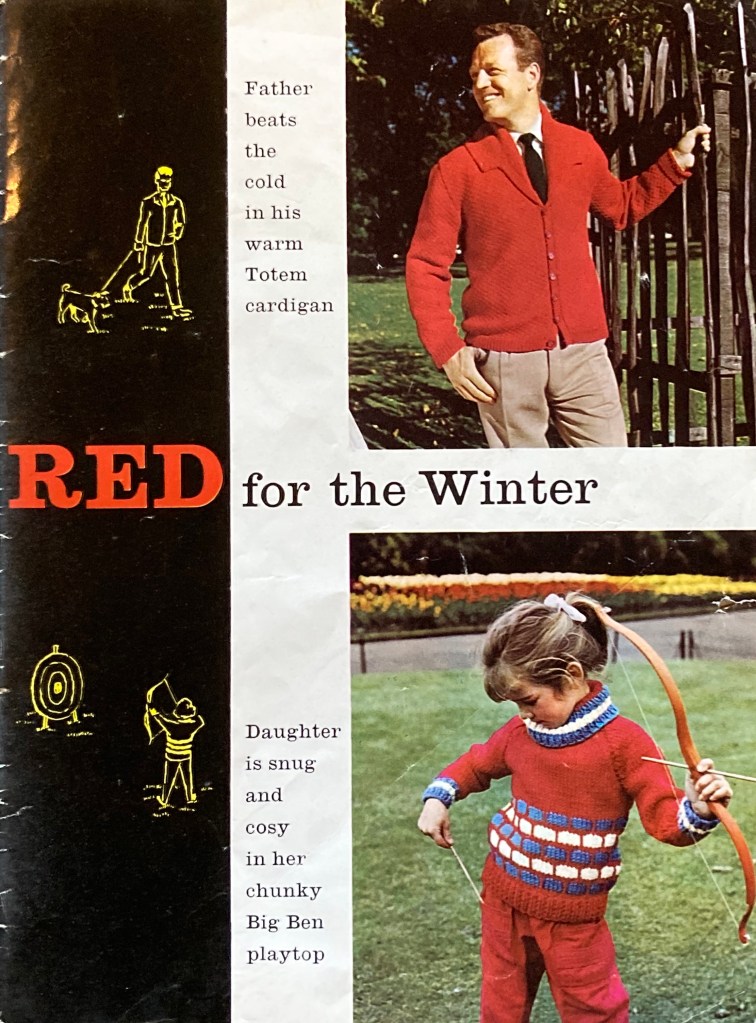
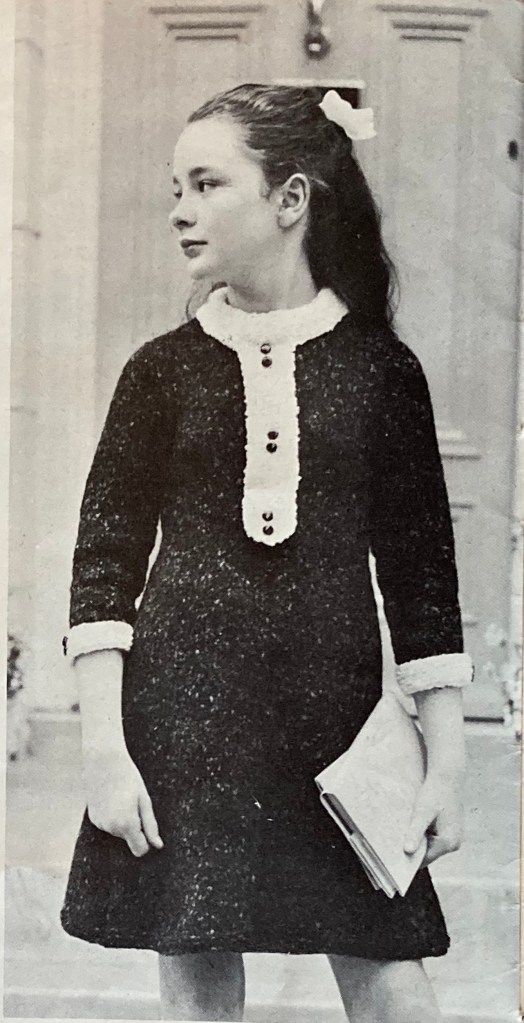
The outdoor photography was taken near historical buildings in York, whose grey-beige stone walls give a nice background to the bright red and blue sweaters made with “Ariel” a bulky, yet “feather-light” (well… 20-24 ounces for a sweater, so lighter than Big Ben, at least) wool-synthetic mix. I really like the red chevron sweater and it doesn’t look bulky at all to me, just fluffy and cosy. Father and daughter also get warm, cheerful garments, and look at this amazing mini-dress for a young miss! That is going on my list of patterns to adapt for myself.

Older teens and young lovers can make “the ‘sweater-match’ theme with girl-friend and boy-friend” – classic pullovers with cable ribs in double-knitting weight and identical except for slightly different shoulder width and back length proportions. That’s all for the knitted garments in this issue, since the real focus is on Christmas preparations with little gifts and housewares.

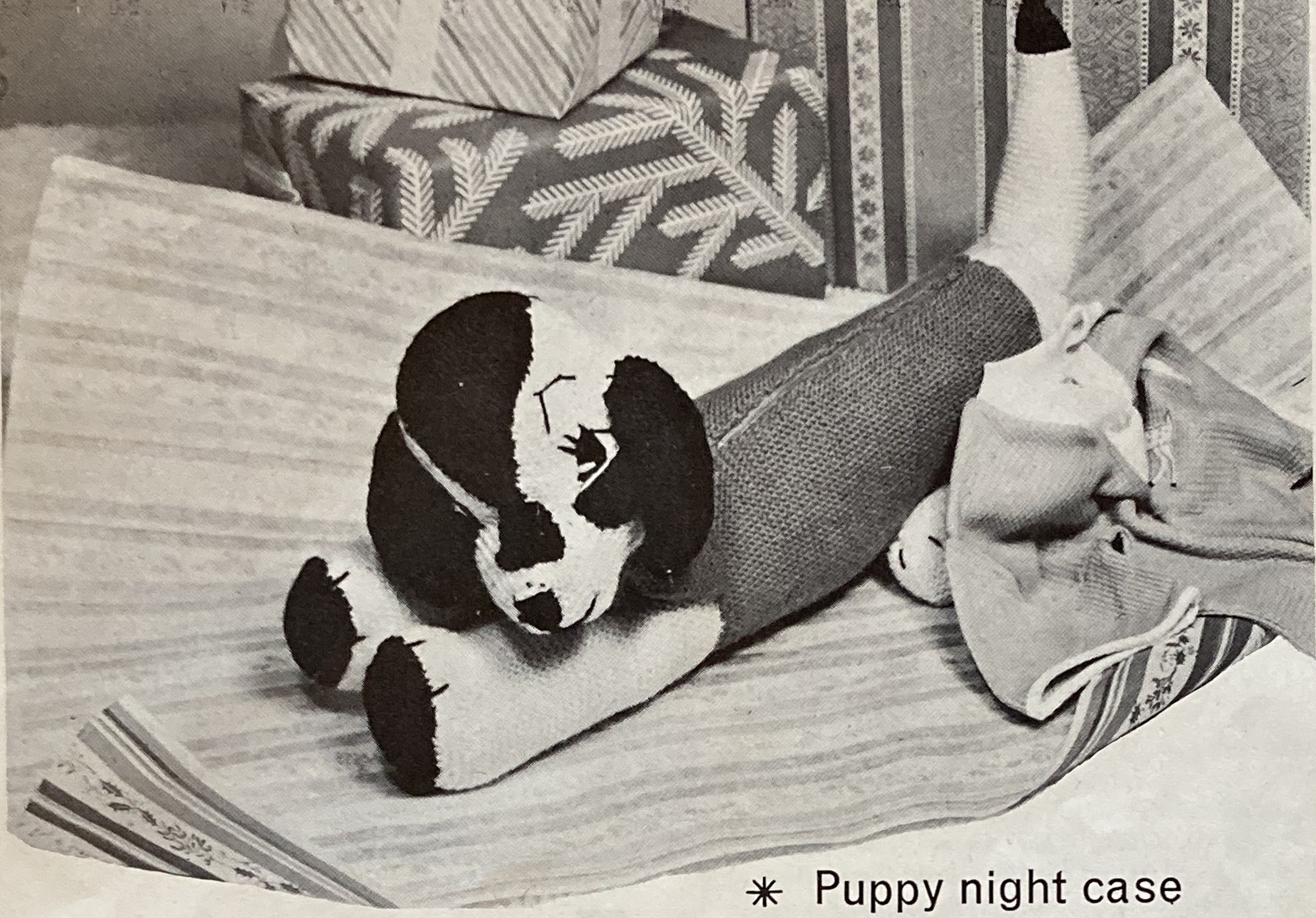
For children’s gifts, there’s a doll, clothes for another doll (pattern in last month’s issue), and a night case in the form of a puppy. This last was especially popular around the late 1950s and early 1960s – I have a different magazine with a poodle nightcase on the cover, and Stitchcraft also had some kind of poodle nightcase in the later 1950s. Poodle or puppy or not, I don’t know why a person would want to put their nightgown in a special case in or on the bed. If you don’t want other people who might be using the room to see your nightdress lying around, you could just… put it under the pillow?

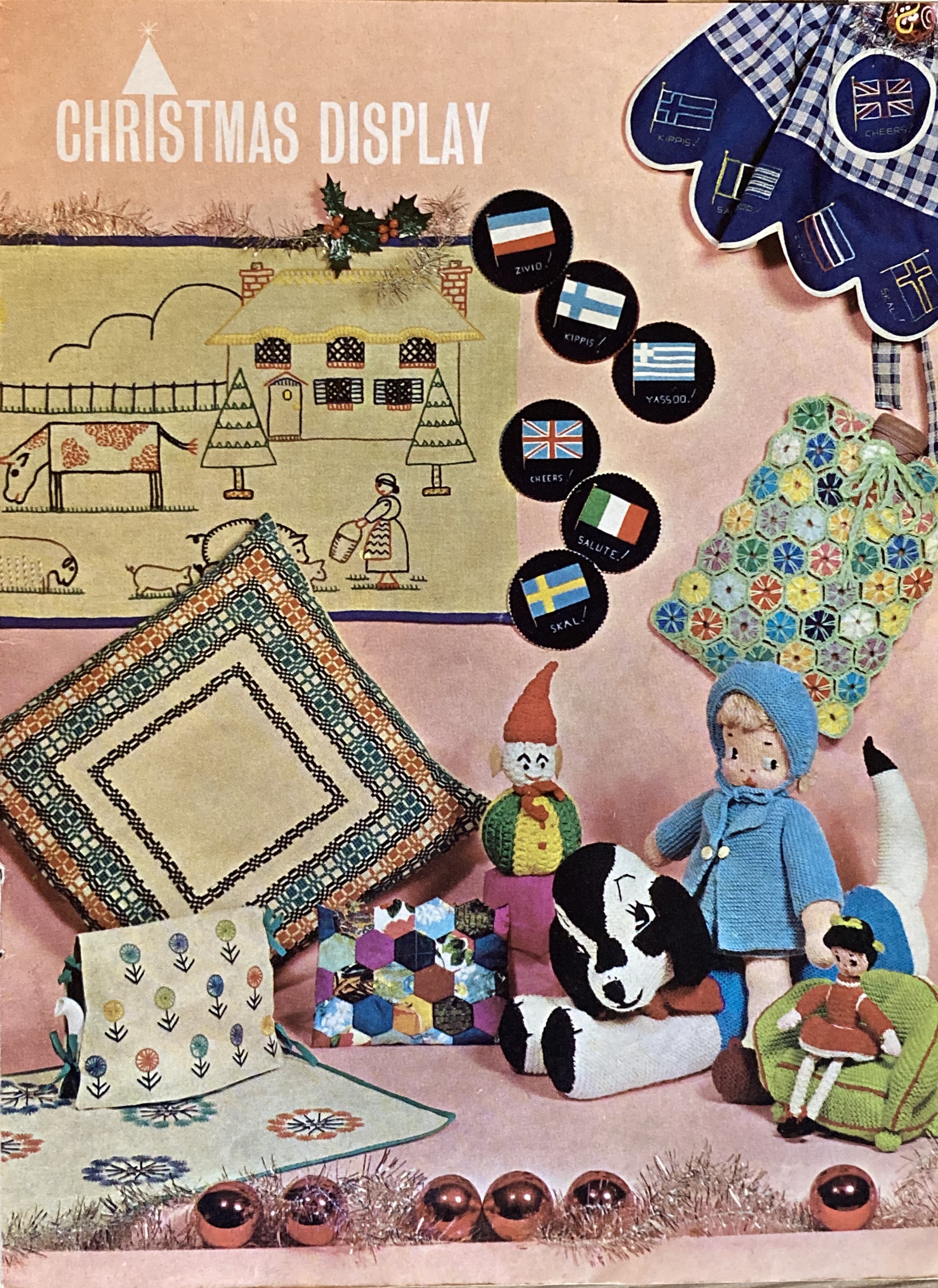
There’s an intriguing “Byzantine” cushion, a firescreen with this month’s embroidered flower (chrysanthemum) and some little gifts sewn in felt, but the more interesting projects are displayed nicely in the large colour photo in the middle of the issue. We’ve got an embroidered farm scene for the nursery wall, a “hostess set” of apron and coasters featuring international drinking mottos, the usual cross-stitch cushion, and a tray cloth/tea cosy design that I would love to adapt to an iPad/tablet cover. Crocheters can use up all their scraps with medallions or a … cute? eerie? not sure what to say about it? pixie doll and patchwork fans, generally ignored by Stitchcraft, finally have a little bag as a starter project.

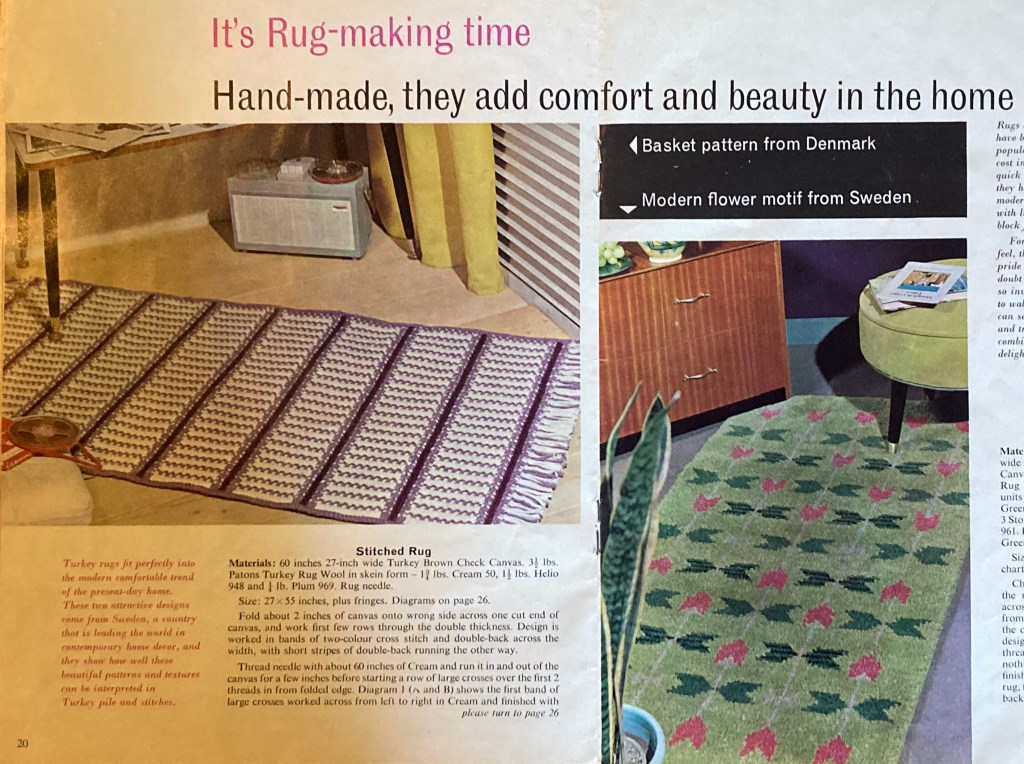
There are even rugs in Scandinavian designs (is that basket pattern from Denmark or from Sweden?), one stitched, the other done with a latch-hook.

What an issue! There are so many projects I would like to make from it: the girl’s dress in my size, an embroidered tea-cosy for the digitalised world, the little girl’s bulky red sweater, even the green latch-hook rug. Sadly, pandemic and lockdown have thrown a monkey wrench into my current knitting plans, it’s hard to get supplies, and I’m trying to finish or even start multiple other large projects that were planned or promised or have been lying in the WIP pile for ever. One of those WIPs was a (non-vintage) garment that I will have to frog anyway (ran out of wool and can’t make it work), so the plan is to frog that project and use the wool to make “Father’s cardigan” from this issue. Said project and I are geographically separated at the moment, though, so long story short: I do not know when I will be able to post a November project. Take heart, though: there will be some more Stitchcraft cooking fun in December as well as a special surprise next week.

December 1961: Overview

IMG_2973It’s that time of year again and December 1961’s issue has a lovely festive cover photo featuring matching father-son jumpers and a freshly-cut-down Christmas tree with holly branches. The jumpers are meant to be made in flat pieces with only the yoke worked in the round, but everything about them other than that is in the traditional Norwegian style, with a small snowflake pattern on the body and sleeves and a round yoke with tree and star patterns. I like that the jumpers’ pattern theme and colour choice are not so very specifically Christmas-y that they couldn’t be worn at any other time, or by people in our more diverse and modern times who don’t celebrate or don’t care much for Christmas and would just like a nice warm jumper with a wintery flair.

1961 Stitchcraft, of course, celebrates Christmas in a big way. Most of the projects are either glamorous party-wear for the ladies or gifts of all sizes and sorts for family and friends, while the fashionable housewife can do her Christmas shopping in a flecked-tweed cardigan suit similar to the ones in the November 1961 issue, or keep warm on casual days with bulkier sweaters. Tweed and contrasting polo-neck collars are in fashion all around.

For those fancy parties and evenings out, there’s a cocktail jumper in popcorn stitch, an angora stole, and an embroidered and sequinned evening bag. The jumper is knitted with wool and Lurex yarn held together, giving it a bit of sparkle. The stole is absolutely timeless and modern as well as easy to make (a rectangle in simple lace pattern with garter-stitch borders) and probably quite warm and cosy to wear over your strapless evening gown at the theatre. The bag is fancy, yet inexpensive to make, with a very 1960s “modern” look. Even after the party and the night out are over, you can still look glamorous in a knitted pink bedcape.

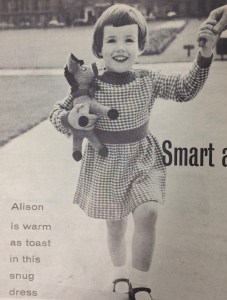
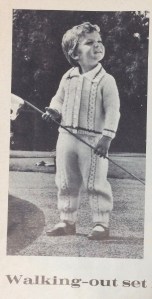
IMG_2982Children of all ages can look forward to practical, yet stylish winter garments — a knitted outdoor play-suit for toddlers in warm, bulky Big Ben, a smart fine-knit twin-set for girls of varying ages (sizes from 26-30 inch chest) and a wonderful knitted dress in a two-colour slip-stitch pattern that fits right into the tweed trend. The photo caption claims that Alison (the young model) is “warm as toast” but of course, her legs are going to be cold! She still seems pretty happy, though.IMG_2981

For me, the best, and sometimes goofiest, projects of every December Stitchcraft issue are the homewares and “novelty gifts”. This year, some are quite normal, like the snowflake-pattern table mats “for a supper party” pictured above, a cutwork tablecloth, or the tapestry stool cover in a diagonal Florentine pattern. Some are specifically winter- or Christmas-themed, such as the knitted cushion and a framed tapestry picture of angels. Two are very classic and beautiful and have nothing to do with “the season” — a typical Jacobean chairback and a very pretty tray cloth embroidered with anemones. They are all quite nice, if not particularly special.

And then there are the novelty gift ideas, or, as they are titled here, “gay mascots.”

The knitted teddy bear is nice enough, but looks quite stern with its unsmiling mouth and sharp, downward-pointing eyebrows. The snowman egg cosy… well, if you really feel the need to use an egg cosy, fine, it looks cheerful enough. Ivy-leaf pincushion, OK. The bear cub, though, looks like it’s about to attack! Something about its half-smile and the glint in its eye makes it look malicious. And the Father Christmas egg cosy… it’s hard for me to express exactly what’s wrong with it, but if I woke up on Christmas morning and found him on my breakfast place, I would expect to be getting coal in my stocking. Give me a gay mascot any day, but maybe not exactly these ones?!?

IMG_2980

I guess it shows just how difficult it is to embroider faces.

Our “Readers’ Pages” have the usual ads for fabric remnants and sewing machines as well as an extra pattern for a little knitted and embroidered scarf, some traditional Swedish pattern motifs and review of the exhibition of Swedish embroidery recently held at the Embroiderers’ Guild, and a comic in which Little Bobby gets a skiing lesson from a friendly snowman.

Merry Christmas to all of you who celebrate it and happy winter days to all! My December project will be to finish some of the many WIPs lying around (including the November blazer, I swear it is almost done) and use the evening-bag embroidery motifs on something fun and small like dinner napkins or a vegetable bag.


November 1961: Overview

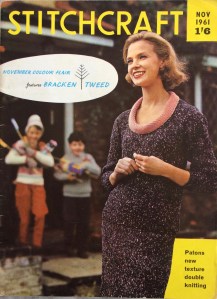
IMG_2927November is such a grey month, so it’s nice to see that Stitchcraft‘s November 1961 issue has the theme “Colour Flair”, featuring speckled yarns and a center page in colour. The issue showcases “Bracken Tweed”, Patons’ new double knitting wool. Bracken Tweed was one of the early multicolour yarns, mixing flecks of a lighter colour in with main strands of a darker colour to achieve a tweed effect. At its debut in 1961, it was 100% wool;  with the change from ounces to grams in the late 1960s, the fiber content was changed to 60% wool and 40% acrylic.

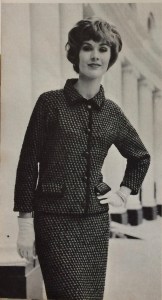
IMG_2931The Bracken two-piece dress on the cover is one of two ideas for “Separates with the BOUTIQUE LOOK”; the other is this wonderful suit, made with regular Patons Double Knitting and familiar nubbly Rimple. Note the deliberately too-short sleeves, designed to show off your gloves and bracelets! The slip-stitch pattern gives it a firm texture for more shape.


Then we’ve got “Colour Flair” from Vienna (a fancifully patterned pullover in brown and yellow) and Paris (a shirt-style pullover with front buttons). Large collars are still in, but are tending towards rounder shapes, as can be seen in the Vienna pullover and the rolled collar of the Bracken outfit. Bracken is also featured in the “young-style look” pullover with a cute bobble tie, while “his colour-panel pullover” is made in Moorland Double Knitting, also a tweedy-flecked wool.

Younger girls get their own “Continental Look” with a bright blue and red outfit of skirt, cardigan and stockings. Finally, warm legs! Tights would be better, of course, but at least her poor legs aren’t bare in the November cold. Babies get bootee slippers and a lovely lace shawl. With the exception of the baby shawl, all the garments in the issue are designed for double-knitting weight wool, so that everyone can be warm and get their Christmas presents on time.

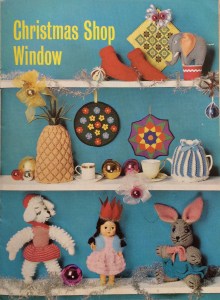
With that in mind, the colour page insert shows a “Display of Gifts to make yourself” — quick, easy-to-make toys and small household items for family and friends. The baby’s slippers are on the top shelf, along with a “Circus Jumbo” stuffed felt elephant and a cross-stitch pot holder (?) that I cannot find anywhere in this issue. There’s a crocheted tea cosy and a magnificent knitted coffee-pot cosy made to look like a pineapple, as well as two felt pot holders on the second shelf. The bottom shelf has knitted poodle and bunny toys and doll clothes (the bunny is also dress-able). Not pictured in the colour photo are a calendar cover and waste-paper bin cover in felts, with a Swedish design of trees and reindeer.

IMG_2942

With all of that, the regular homewares in this issue are not particularly exciting — standard chairsets in counted darning and cutwork. There is one impressive larger project: this cross-stitch rug and stool top in a Victorian design, also printed in colour.

IMG_2943

Finally, the back cover has a fabulous advertisement for “fabulous Pfaff” sewing machines — I love the expressions on the models’ faces! May all your homes be well-dressed.

IMG_2946

My project for this month will be the jacket from the checked suit.

December 1960: Overview

IMG_2214This year (1960 or 2018, take your pick) draws to a close with Stitchcraft’s “Christmas Issue”, which, as you may expect, is full of holiday-themed novelties to decorate and give.

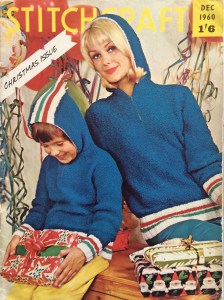
That said, the hoodies on the cover are surprisingly modern and not “Christmas sweaters” in the sense we usually think of them at all. If I just saw a photo of them without the festive vintage backdrop, or the “DEC 1960” in the cover corner, I would be hard-pressed to say from what decade they came from. You could sell them in a regular modern store today and nobody would think they were a vintage design! I love the little tuft on the kid’s hood, too. They are made in nubbly Rimple yarn, still a hit and always featured somewhere in each issue.
IMG_2216

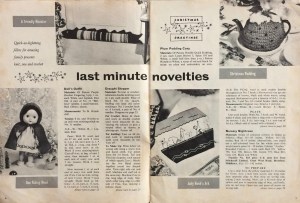
There are “gay ideas” for festive party table decorations of all types: a floral tablecloth for  a tea party, a merry-go-round tea cosy for the “Nursery Party” and table sets with playing cards as napkin holders for the grown-ups. “The last minute novelties” take on a fairy-tale theme, with a Red Riding Hood doll, a Noah’s Ark nightcase, a friendly draught-stopping snake and — for your holiday Dickens bedtime reading — a tea cosy that looks like a plum pudding, complete with attached crocheted plate! More pious readers can make an appliqué wall hanging of the Three Wise Men and heathens can make an embroidered wastebasket cosy with a Sagittarius theme (this month’s astrological sign).

Of course, one never has enough time in the holiday season to make everything perfectly,  so if you are “really stumped for time” you can make the wall hanging “in bright, shiny papers” (instead of felt), “cutting out the shapes and sticking them down, then adding cut-out strips, etc., for the finishing touches.”

For those who have the time, or don’t go all-out for holiday decorations, there are the usual assortment of knitting projects, starting with a lovely warm dress-booties-mittens set for a baby. I do admire her elegant mitts, but I’m guessing that in real life, they don’t stay on a baby any longer than it takes to take a photo. Older kids can get a striped jumper in a fantastic, very modern colour combination.

Teenagers haven’t been forgotten either, and can enjoy these Italian-inspired colour designs with added embroidery on the young woman’s jumper. I really like both of these designs! The young man’s jumper is fun without being too flashy, and with a little tweaking, would work well on a woman’s figure, with the dark colour band starting just under the bust line. There’s even a little extra “how-to” lesson on embroidering knits, which is still perennially in fashion at this time.

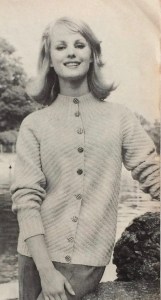
IMG_2219Adult women, having hopefully embraced the “new length” (long) and “new sleeve style” (3/4 or 7/8) from last issue, can get ready for Paris’ “new necklines” — a high turn-down-and-rib combination or a buttoned-up turtle (polo) neck. No turn-down collars this time — are they on the way out? There’s a new yarn to go with them, Cameo Crepe, which is smooth and less “hairy” than other wools, for good stitch definition.

All this new fashion detailing can be admired in the two-colour twin set from the inside back cover, and to go under it all, why not knit yourself a lovely warm woollen vest (camisole)? I don’t mean that sarcastically — they are really the best! I made a woollen lace under-dress (slip) last year and it is heaven in a cold, damp climate.

It’s hard to decide what to make from this issue. Lots of the items are cute and fun, but nothing jumps out at me that I absolutely have to make. The plum pudding cosy is so silly that it’s cool, but I don’t use tea cosies and it would be a lot of work for a gag. The snake is cute and useful, but I don’t have odds and ends of double knitting at the moment and I do  in fact already have a stuffed snake who occasionally gets put to work plugging a “leaky” window. I also have plenty of jumpers and even wollen underclothes (s. above), so don’t need more. I do have a hundred grams of very nice, hand-dyed green fingering wool in search of a project, so maybe I’ll make the baby dress.

In the meantime, Happy Holidays to all my readers! May everything you celebrate be jolly and festive.