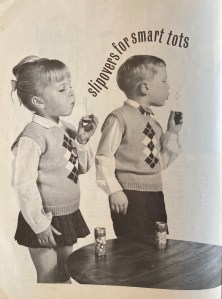
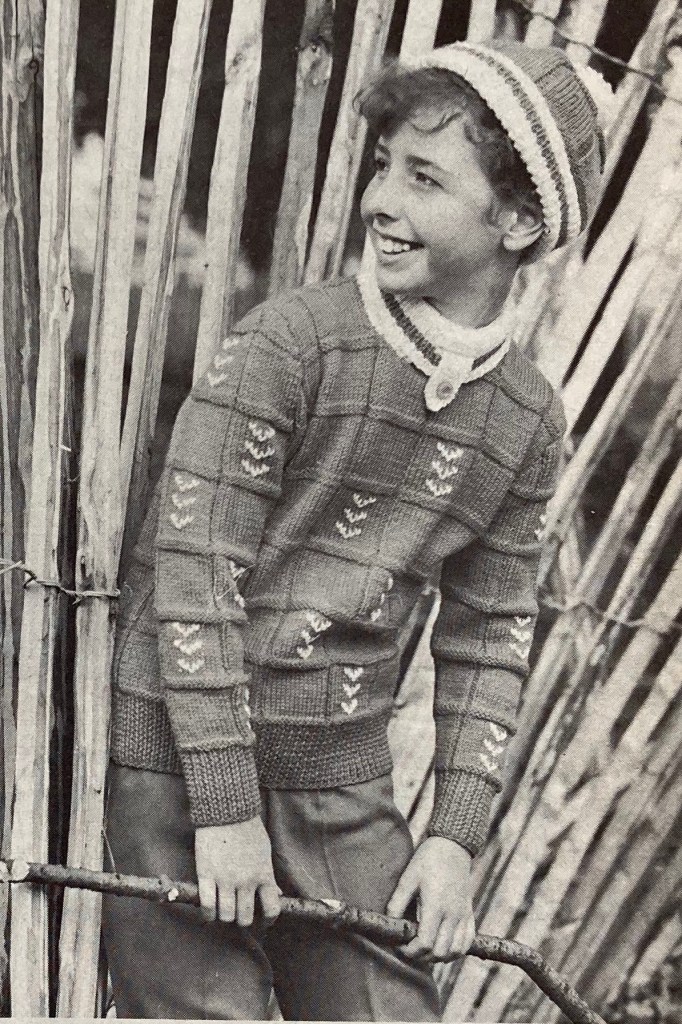
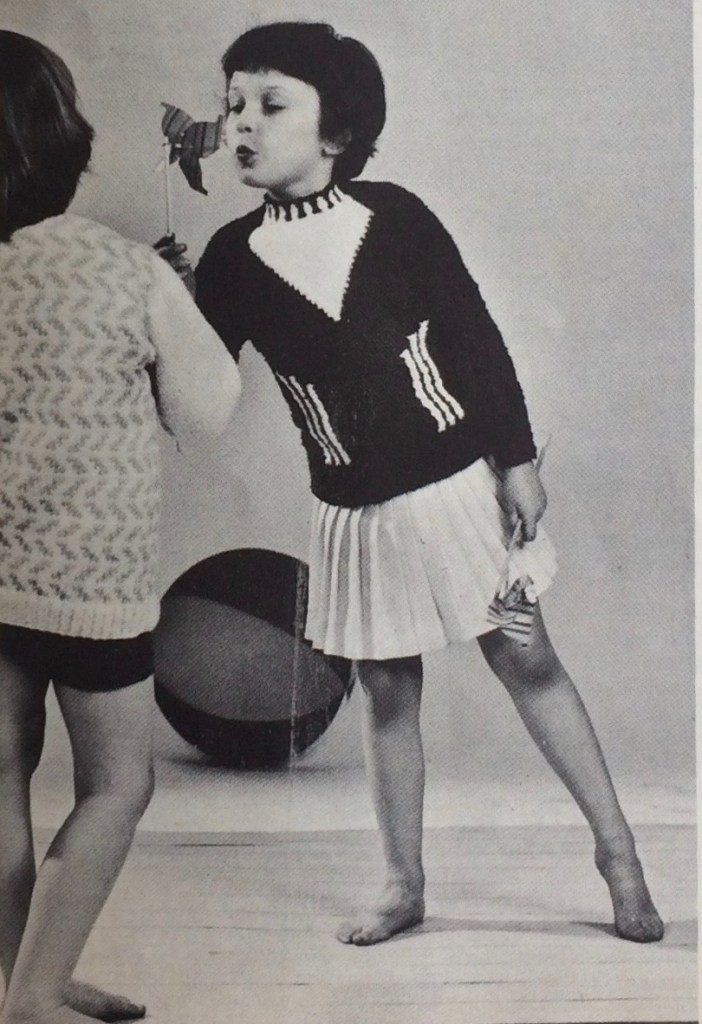
My March project was a cute slipover (vest, sweater-vest, tank top, pullover or whatever you call a knitted over-shirt garment with no sleeves and no front opening) for “tots with a fashion sense.” The tots in the photo definitely look very smart and very 1960s, with the little girl in her tiny micro-miniskirt and the boy sporting a bow tie.
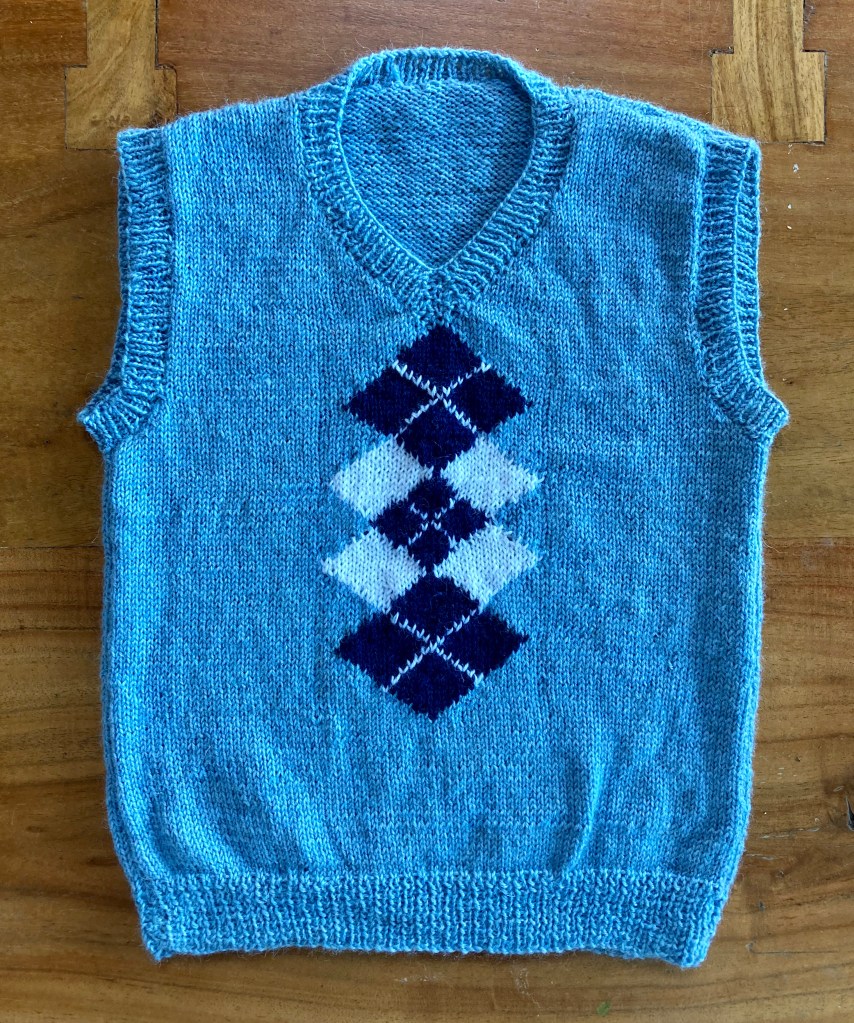
The design (“from Vienna”) features a high V-neck and a simple, but effective argyle-type diamond pattern on the front. It’s written for Patons Nylox Knitting in 4-ply (fingering) weight. Nylox was a wool-nylon blend, fairly new on the market at the time and marketed for hand-knit garments that needed to stand up to lots of washing and wearing, so especially suitable for children’s clothes.
I used modern sock yarn (Meilenweit by Lana Grossa), an 80% wool / 20% polyamide mix which comes pretty close to the original Nylox yarn, and kept the original colour scheme of light blue with the diamond motif in white and navy, so this project was quite authentic to the original. The only change I made was to lengthen the body somewhat to fit the intended wearer, who is on the taller side for his age.
I don’t often work with intarsia designs, so this was a fun change and something new. It went quite quickly, as the pattern is easy and clearly written, so there’s not too much to say about it! I do think it will be well appreciated by the smart tot it was knitted for, as well as his parents.
There are some great children’s designs coming up in the next few months’ issues, so stay tuned for more well-dressed kids.
Greetings from Kent from your March 1964 issue of Stitchcraft, featuring “Spring Into Summer Fashions” photographed in “some of your favourite spots around Canterbury and Tunbridge Wells” so that you can see the knitwear “in their own settings as you would wear them.” Shall we go?
“For our climate”, writes editress Patience Horne, the best outfit for the spring and early summer months is a sweater suit, quickly knitted in double knitting wool. Cool blues, salmon pink and yellow-green are the trendy colours, and pattern stitches are used sparingly as an accent on hems or collars, or as a single vertical stripe panel.
Our cover model is wearing a twin set with a trellis pattern accent on the cuffs, pockets and collar of the jacket and the hem of the short-sleeved jumper underneath. Here, again, we see how twin-set styles have changed since the 1940s — everything is long, loosely-fitting and unshaped. The “Golden Willow” sweater suit on the inside front cover is similarly unfitted, with a cable “V” pattern stripe. For “The Creamy Look”, there’s a a high-buttoning cardigan with a subtle diamond pattern on the fronts. All three models are made in “Double Quick” knitting.
“Double Quick” is also the featured wool for the men’s and women’s “sport sweaters” in the lovely full-color center photo. I’m not sure what makes those two garments more “sporty”, as they look equally as elegant as anything else in the issue. His sweater is worked in stranded technique from a chart included in the instructions, and hers is made in plain stripes with the diamond pattern embroidered on later in Swiss darning / duplicate stitch. If “Double Quick” is not bulky enough for you, there are matching sports sweaters for him and her made in bulky “Big Ben” at 3 1/2 stitches to the inch. The salmon-pink jumper (Stitchcraft calls is a “sweater blouse”), by contrast, is made in 4-ply wool in a classic shape, with pattern accent panels in an interesting mini-bobble stitch.
Babies get a wonderful pram set of footed leggings, coat and matching bonnet. It’s referred to in the index as a “four-piece” set, but I am at a loss to find a fourth piece anywhere in the instructions or photos. Maybe they planned to make matching mittens and then didn’t? Bigger children get a cute slipover with an argyle pattern on the front. The photo is very 1960s, with the girl freezing her legs off in a micro-mini skirt and the boy sporting a bow tie.
The homewares are fairly standard: a tea cosy, apron and tray set and a knitted kangaroo with baby for your bizarre/bazaar novelty needs (there’s also a reprint of a 1956 knitted ice-skating panda bear doll, if the kangaroo isn’t enough for you.) You can also cross-stitch a rug and pyjama case with square-headed dancing soldiers to haunt your small son’s dreams, or some flowered place mats, a cushion or wall hanging, or another cushion inspired from a traditional Greek star design.
In the “Readers Pages”, a new serial comic is starting: “Susan’s Sampler”, in which our heroine learns embroidery from a magic needle, and our back cover ad (for Patons Double Quick Knitting wool) shows yet another woman lovingly looking up at a man who has trapped her with her back to the wall in order to mansplain something to her. Feel free to give the photo some speech bubbles befitting a modern interpretation of this scenario!
That’s all for this issue. I’ll be making the child’s slipover and for once, I’m quite sure it will be done on time. Happy Spring!
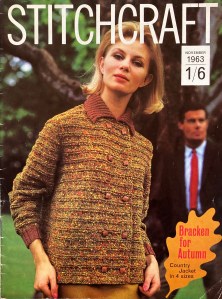
The autumn months are always the best for knitting magazines, with a mixture of heavy garments for colder days, easy-to-make holiday gifts, warm accessories and a few glamorous items for parties. Stitchcraft‘s November 1963 issue puts the focus on “warm family fashions… with the emphasis on colour and attractive textures that are interesting to knit and very becoming to wear”. There’s something for family members of every age and “for the petite to the not-so-slim.” The homewares and little projects are quick and fun to be finished in time for holiday decorating and/or gift-giving.
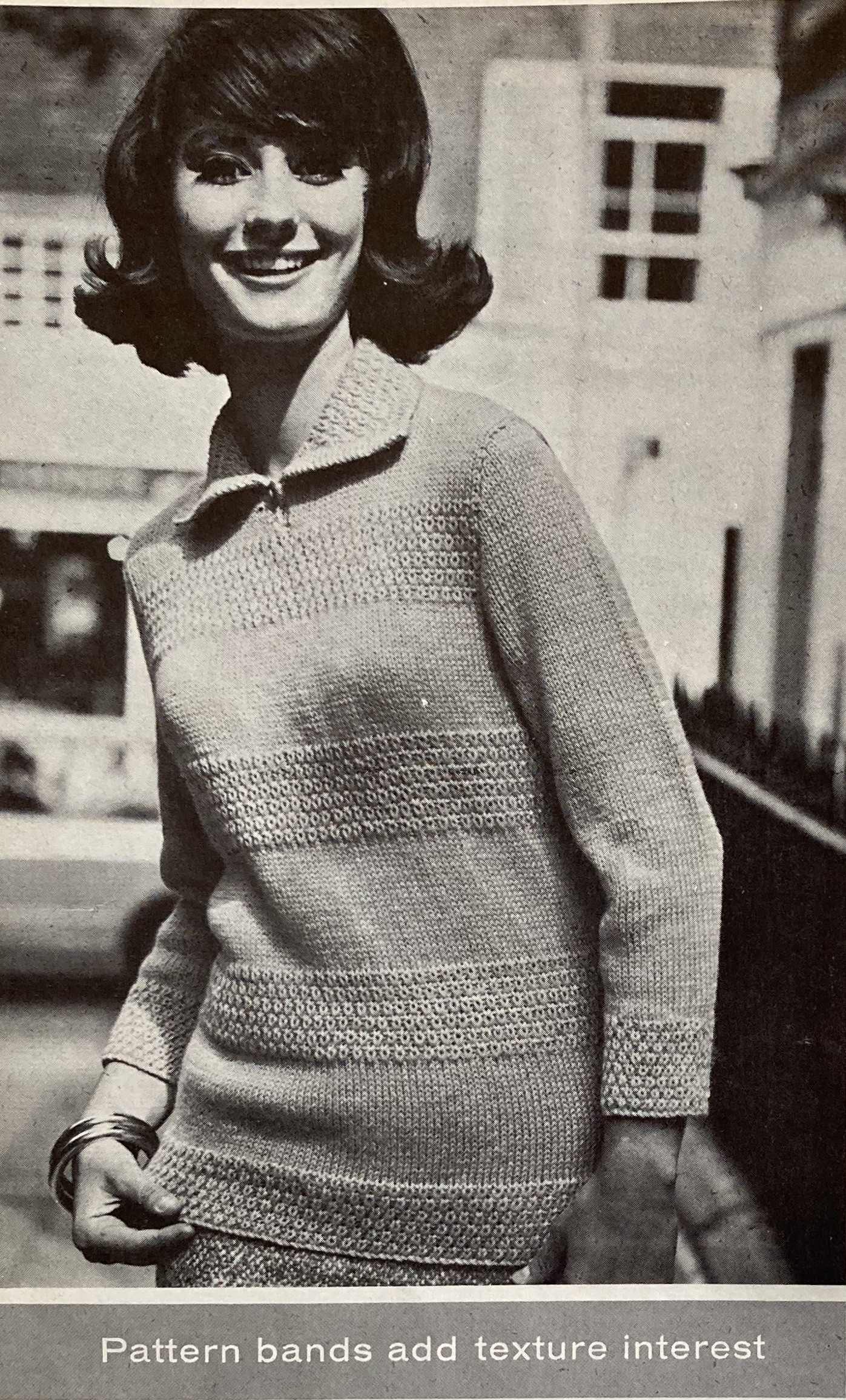
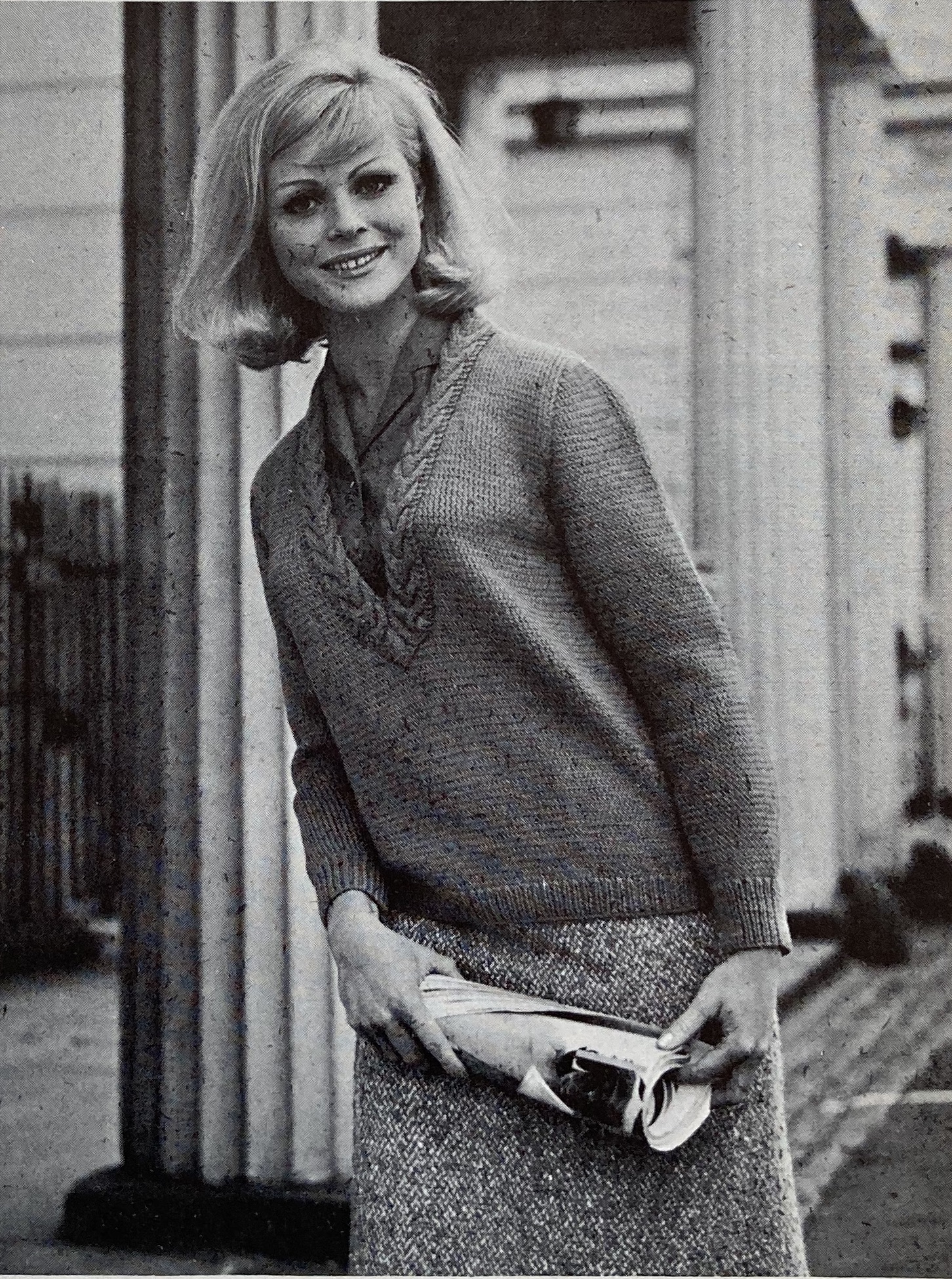
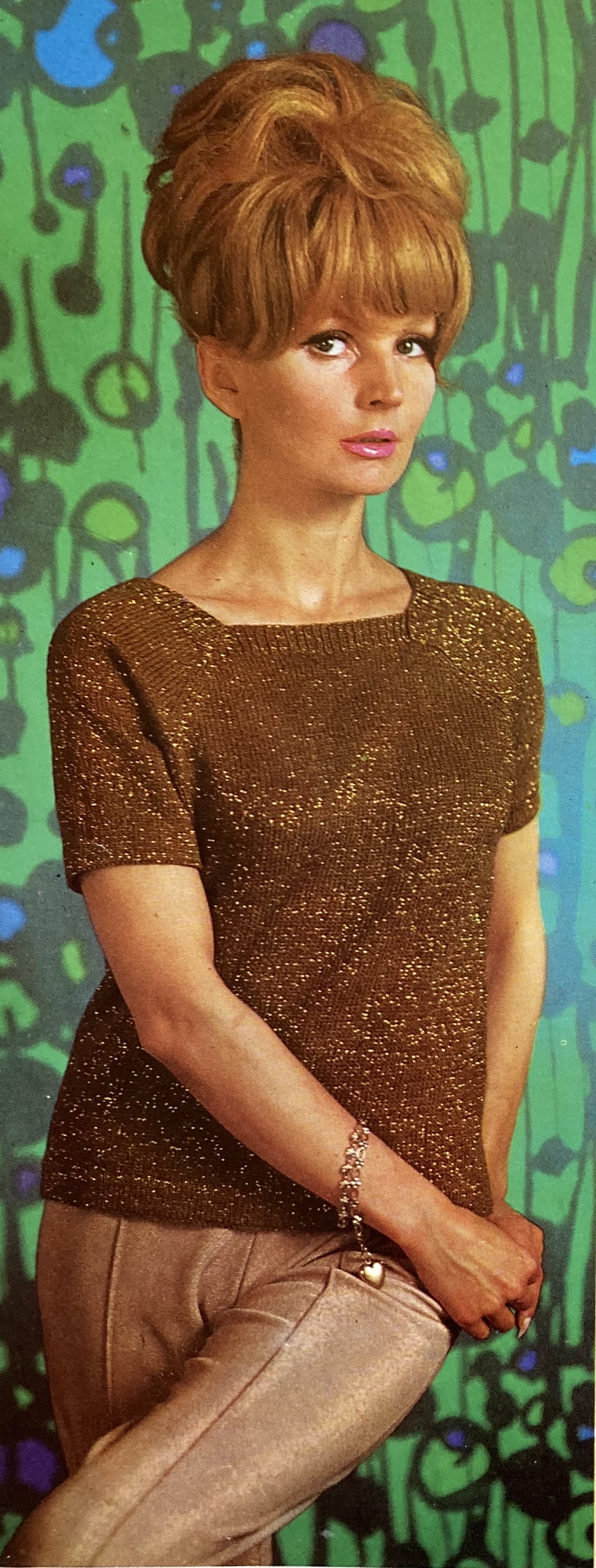
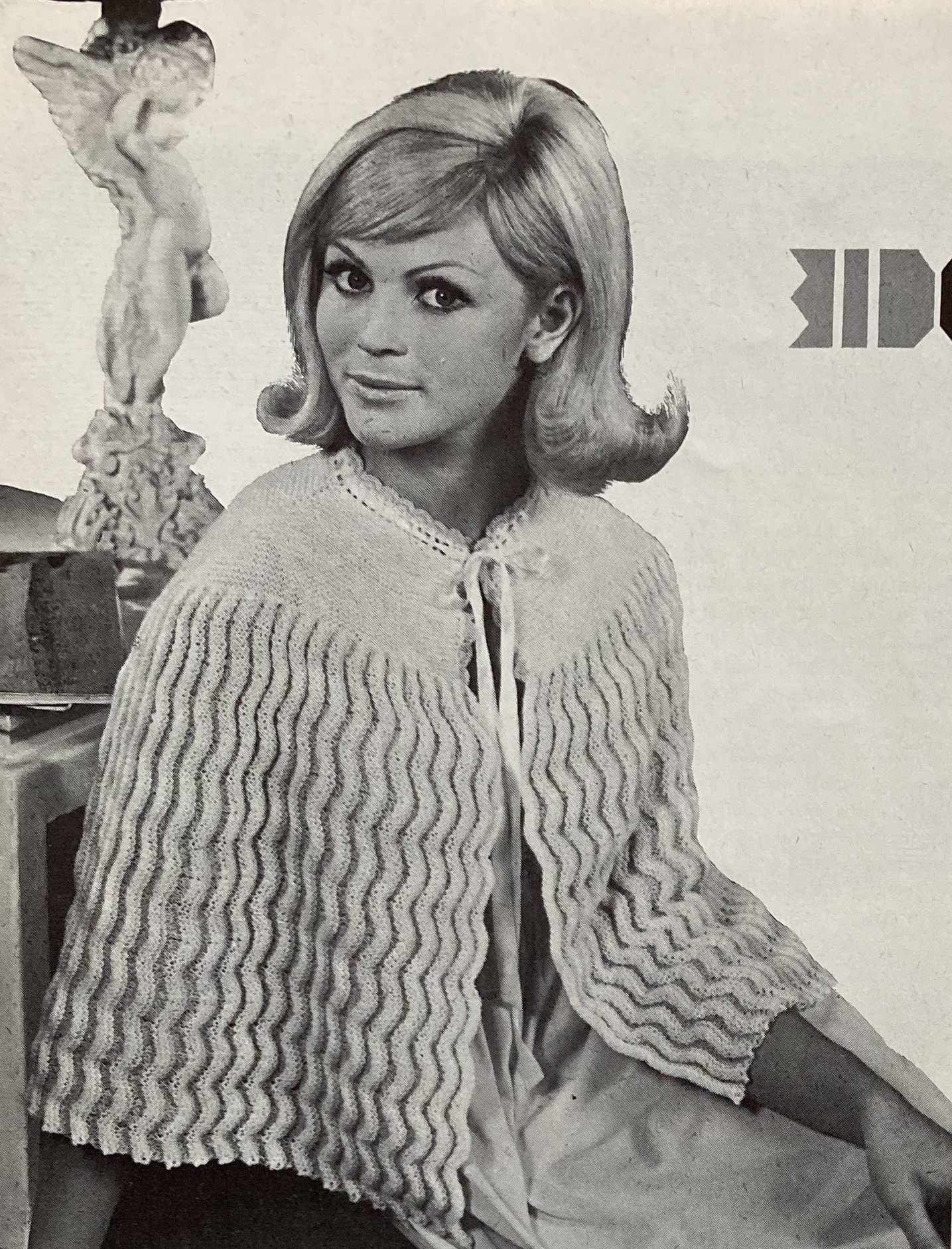
The “country jacket” on the cover continues the tweedy, variegated colour effect in fashion this fall, using Bracken Tweed wool for the main body and Totem DK for the collar and cuffs. I finally know what colour Totem “Oakapple” is! The other women’s outdoor-wear fashions include a zip-neck sweater with textured pattern bands in turquoise, an “overpull” with cabled neckline in flecked “Cantaloupe” colour (sadly, no colour photo, I have no idea how it looked in real life) and a simple brown top made glamorous by knitting the wool (Cameo Crepe 4-ply) together with a strand of sparkly Lurex thread. There’s also a warm, soft cape for winter reading in bed, knitted sideways in an easy zig-zag pattern. Aside from the green and white bedcape, shades of autumn brown as well as bold blues and red are the season’s trendy colours. Stripes, zig-zags and textures complete the Autumn 1963 look.
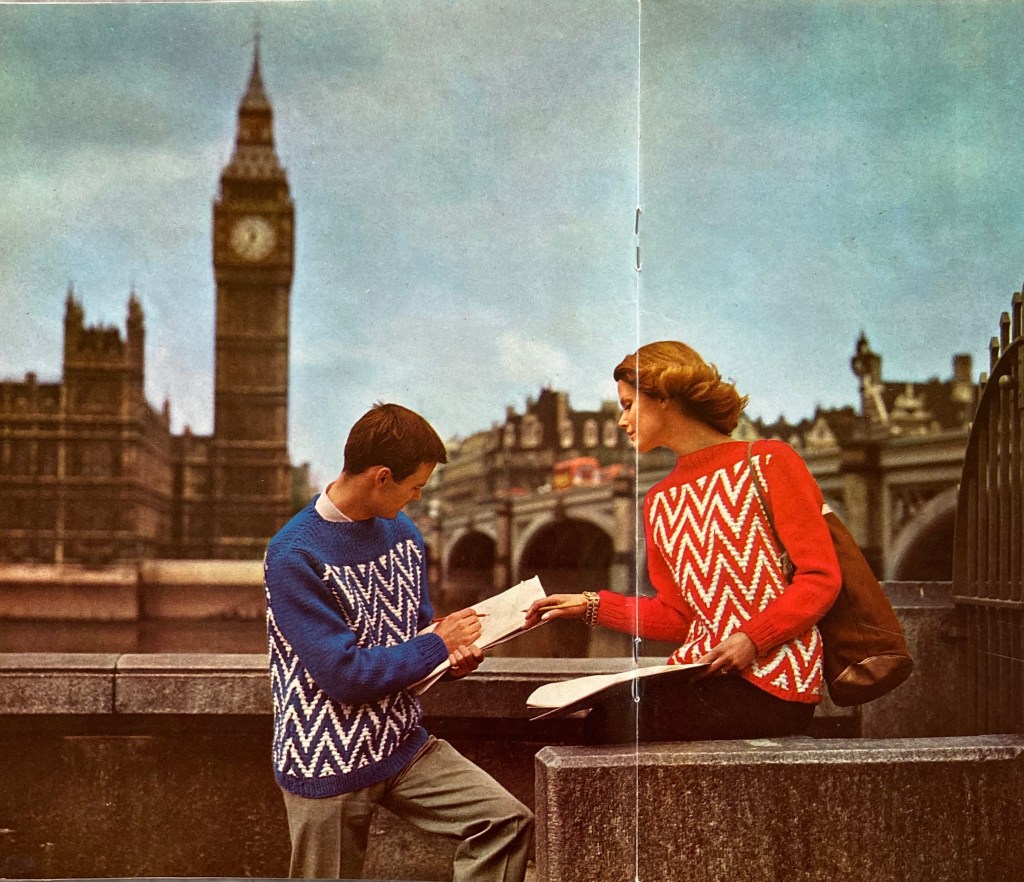
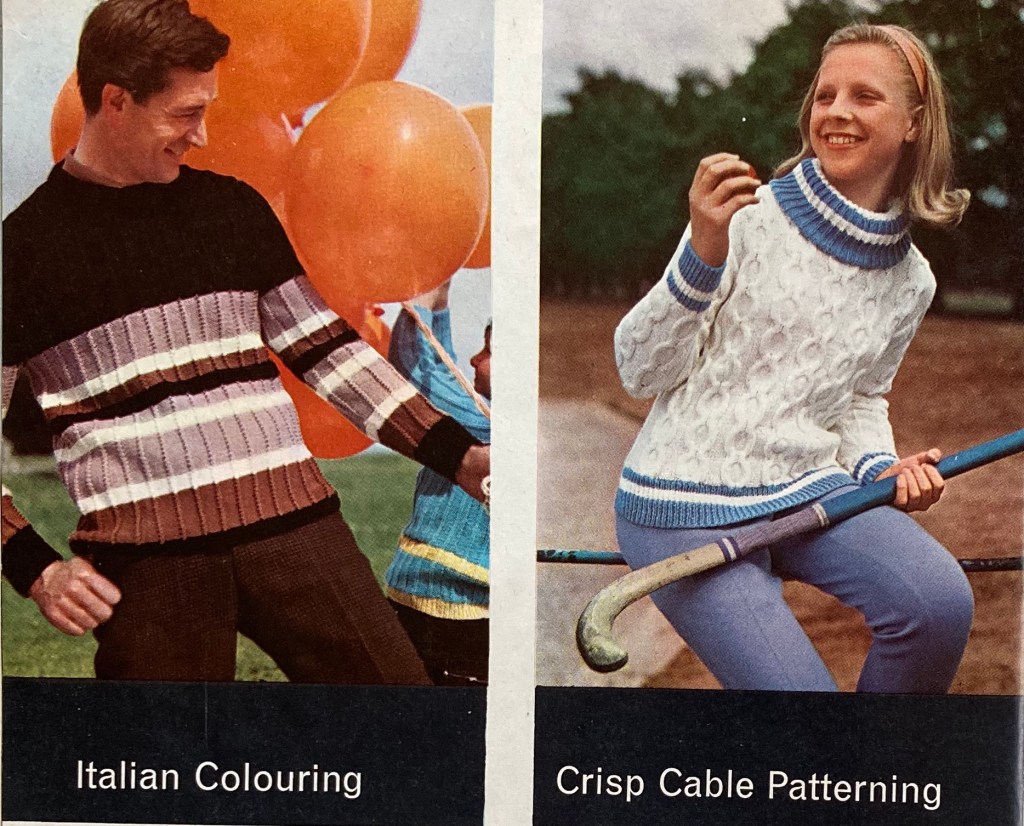
Men’s fashions are just as colourful as the women’s, or even more so (less use of plain brown…) and show more of the zig-zag trend. Here are some bold designs for “him and her” using bulky Big Ben wool (and photographed in front of…). The construction is the same for both, with the smaller design for bust sizes 33-35 inches and the larger for 39-41 inches, with the advice that “Plumper girls could follow his size”. The man’s pullover in “Italian colouring” uses stripes and textures, toned down by the use of more neutral colours. The blue-and-white cabled sweater in the photo next to it is for teenagers.
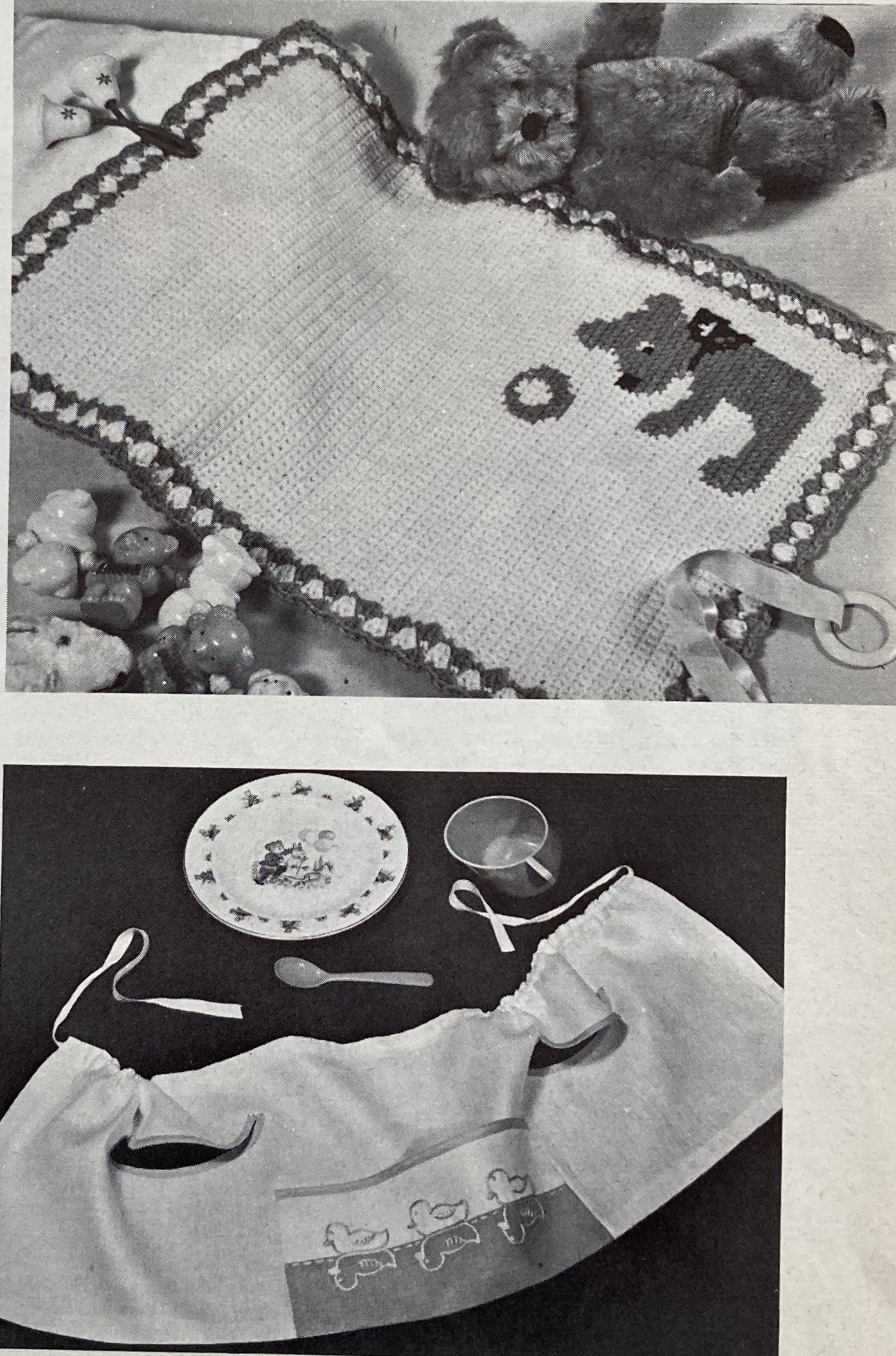
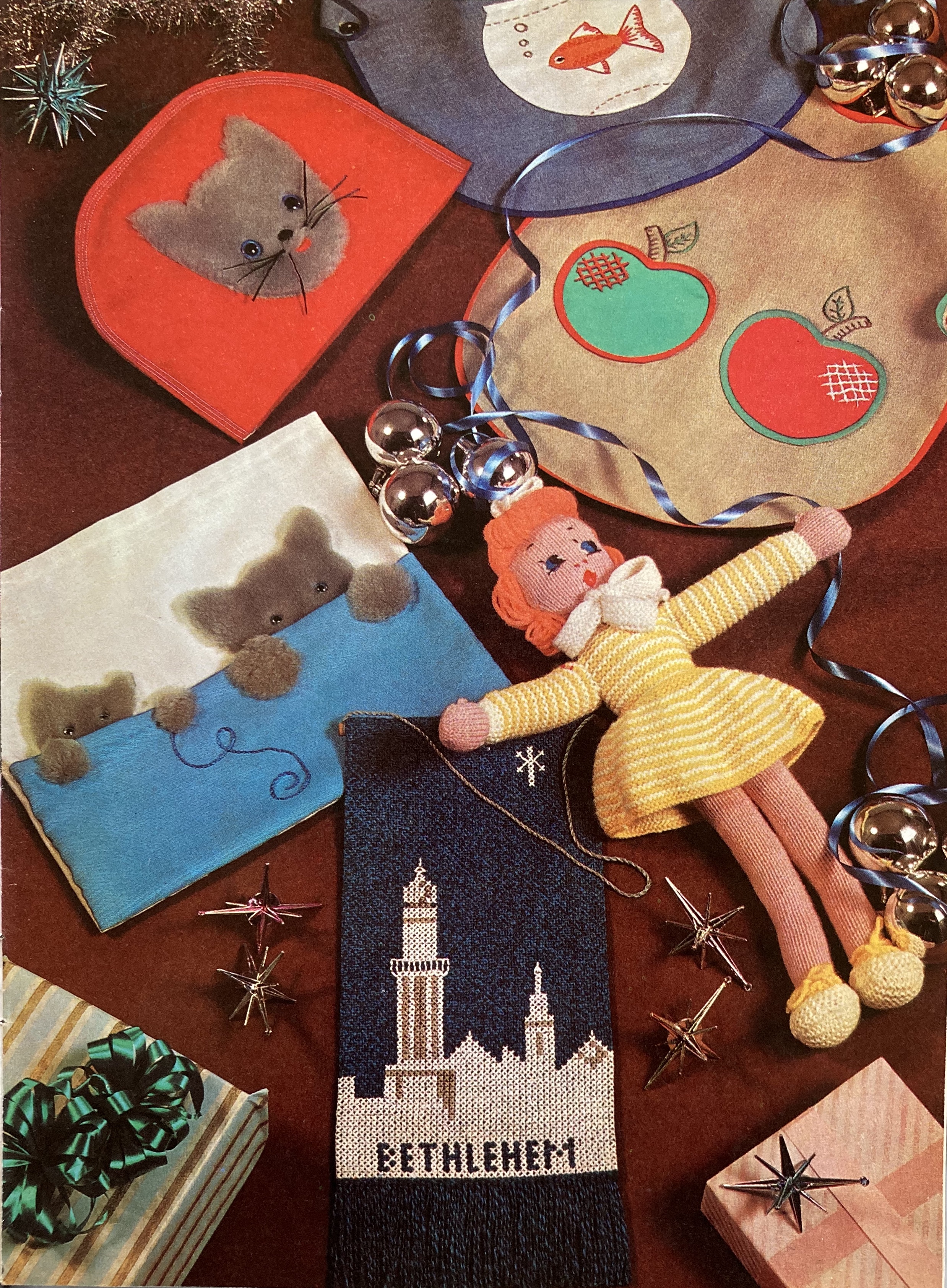
School-age children get their own “tough, tomboy sweaters” in Bracken Tweed wool. The suggested colours are “Black Olive” or “Gorse Heath”, which I assume is a sort of green-yellow tweed (no colour photo). Babies get a lovely shawl to match the layette from the September and October issues. It’s easy to knit, as the centre and borders are made separately. The other baby/nursery-age items are crocheted, sewn or stitched: a pram cover with a teddy-bear motif, a little nightcase with fluffy appliquéd kittens, a knitted doll, an embroidered “feeder”, sewn and appliquéd pinafore smocks…
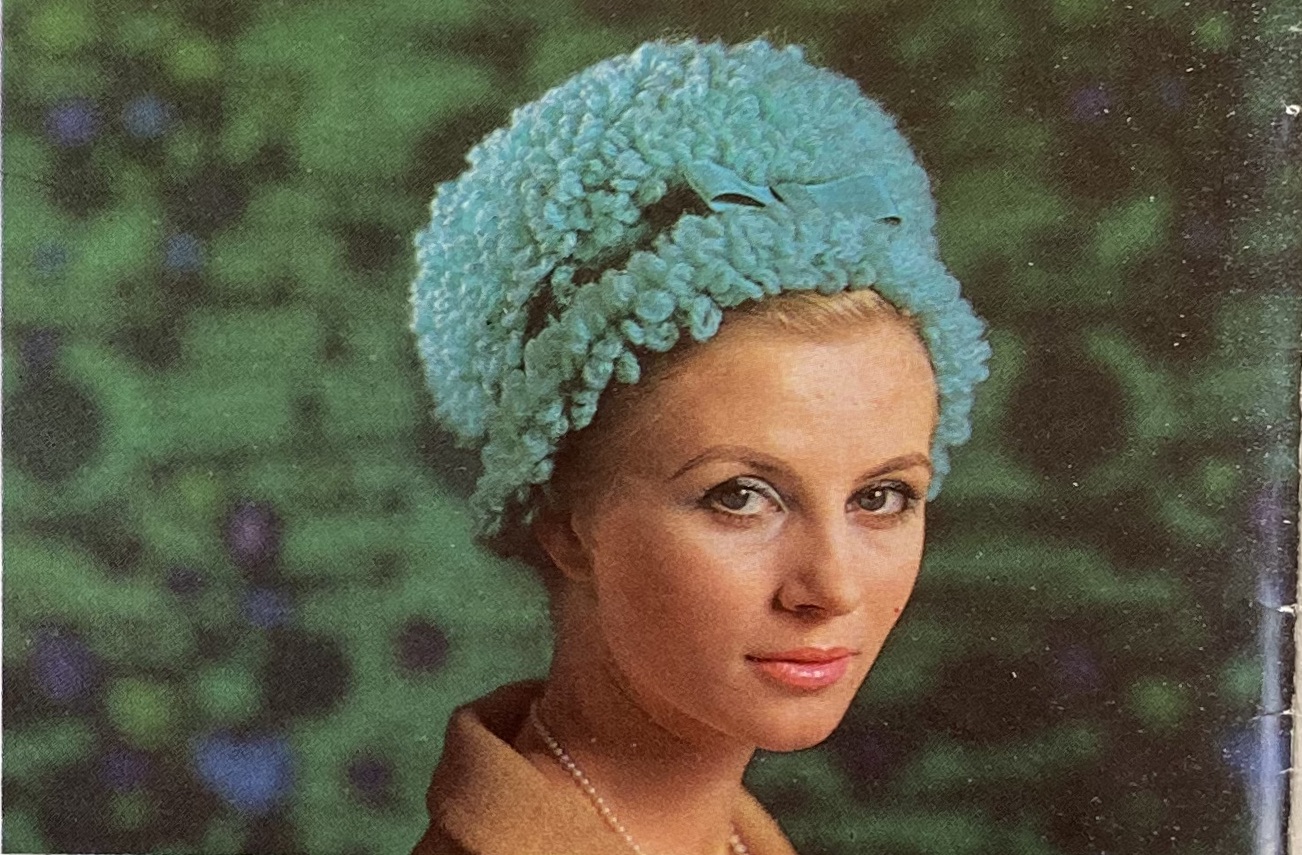
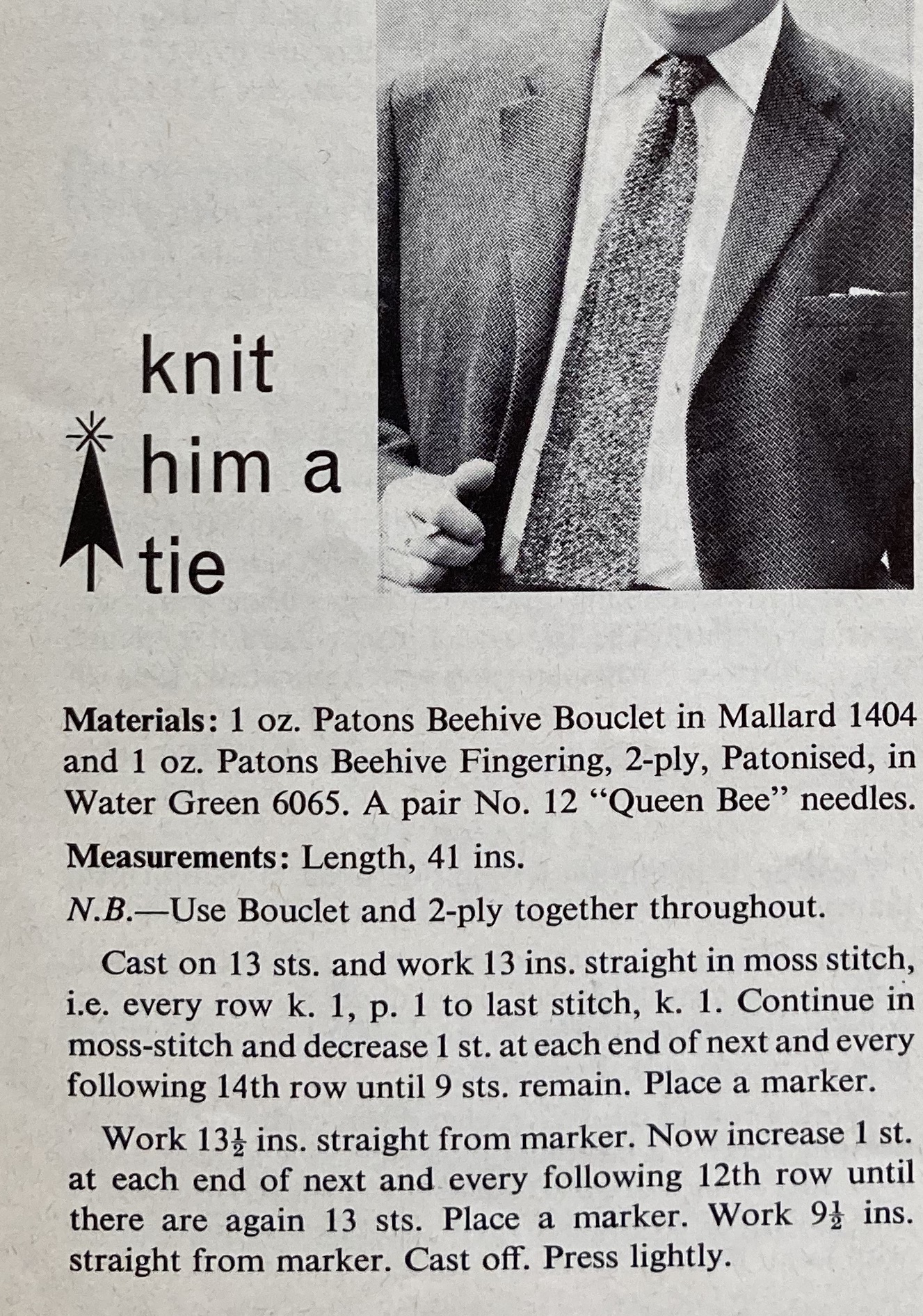
There are fewer designs for accessories, but the utter fabulousness of this loop-stitch crocheted hat makes up for anything else that could be missing. The model in the photo features in many issues from this time period and always looks either quite sad or has that alluring Mona Lisa smile that’s she’s sporting here. (Am I mean, or wrong, to assume that she probably had bad teeth?) I would smile widely if wearing that hat, and I hope everyone who saw me in it would too. Also, knit your man a tie!
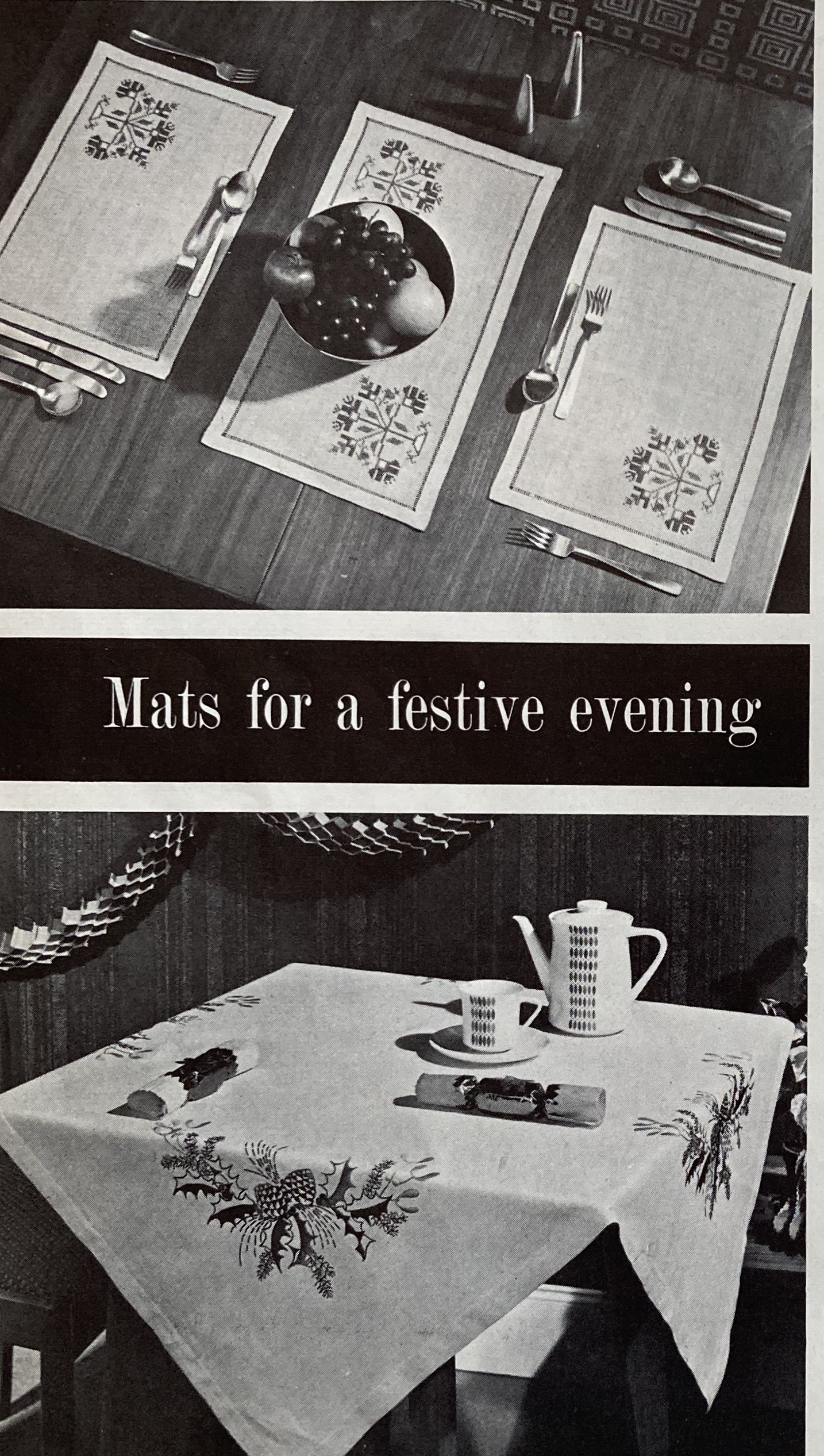
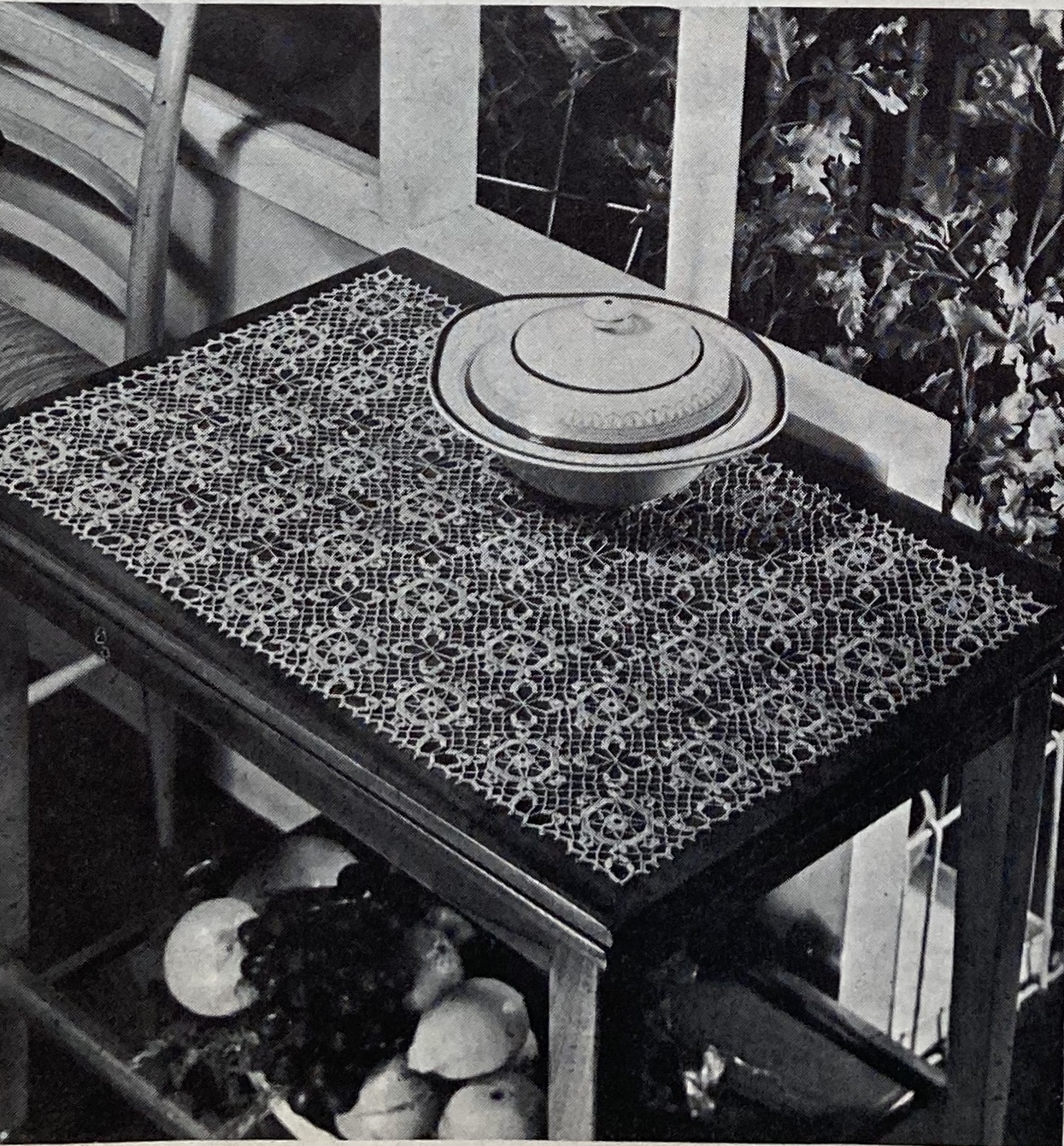
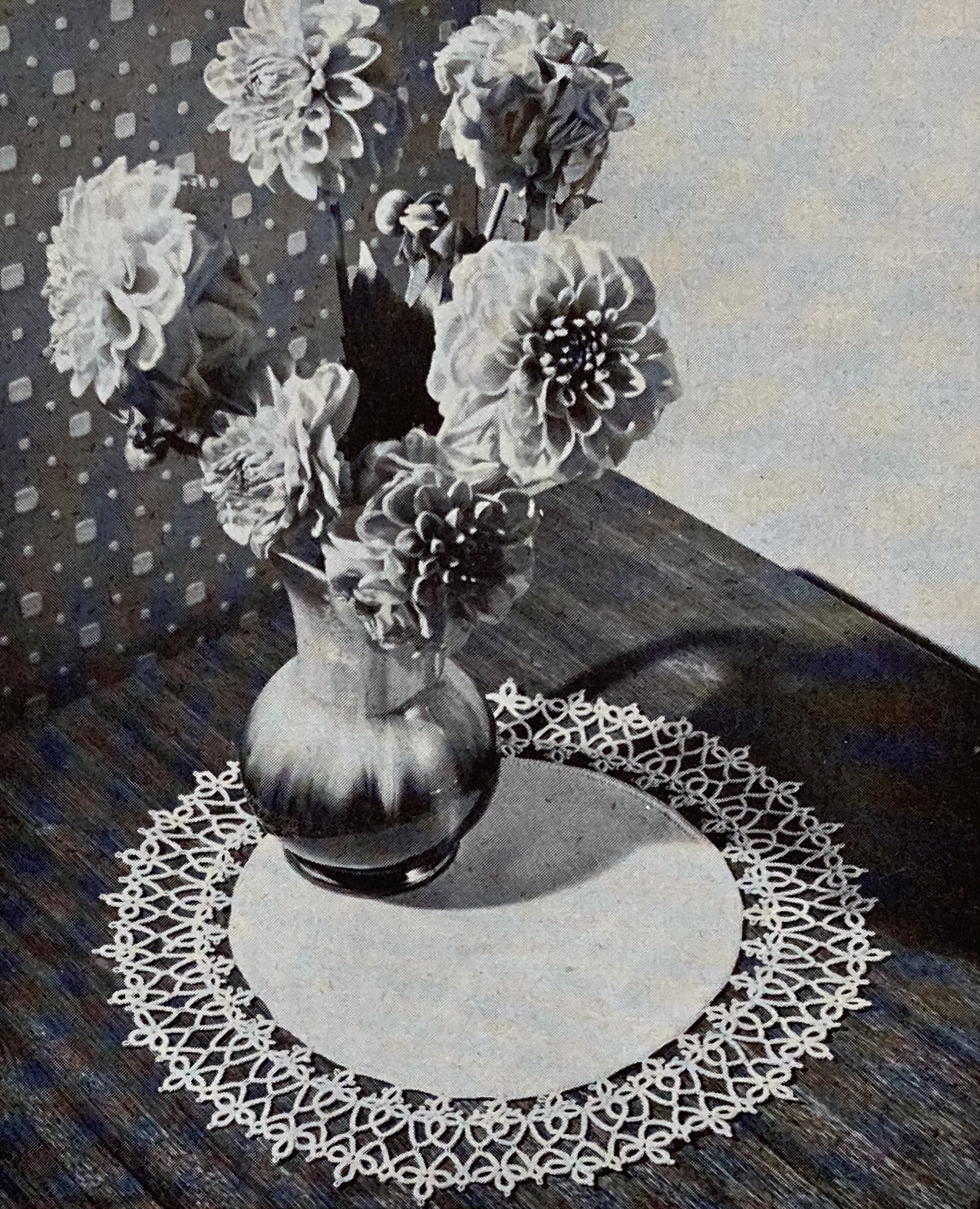
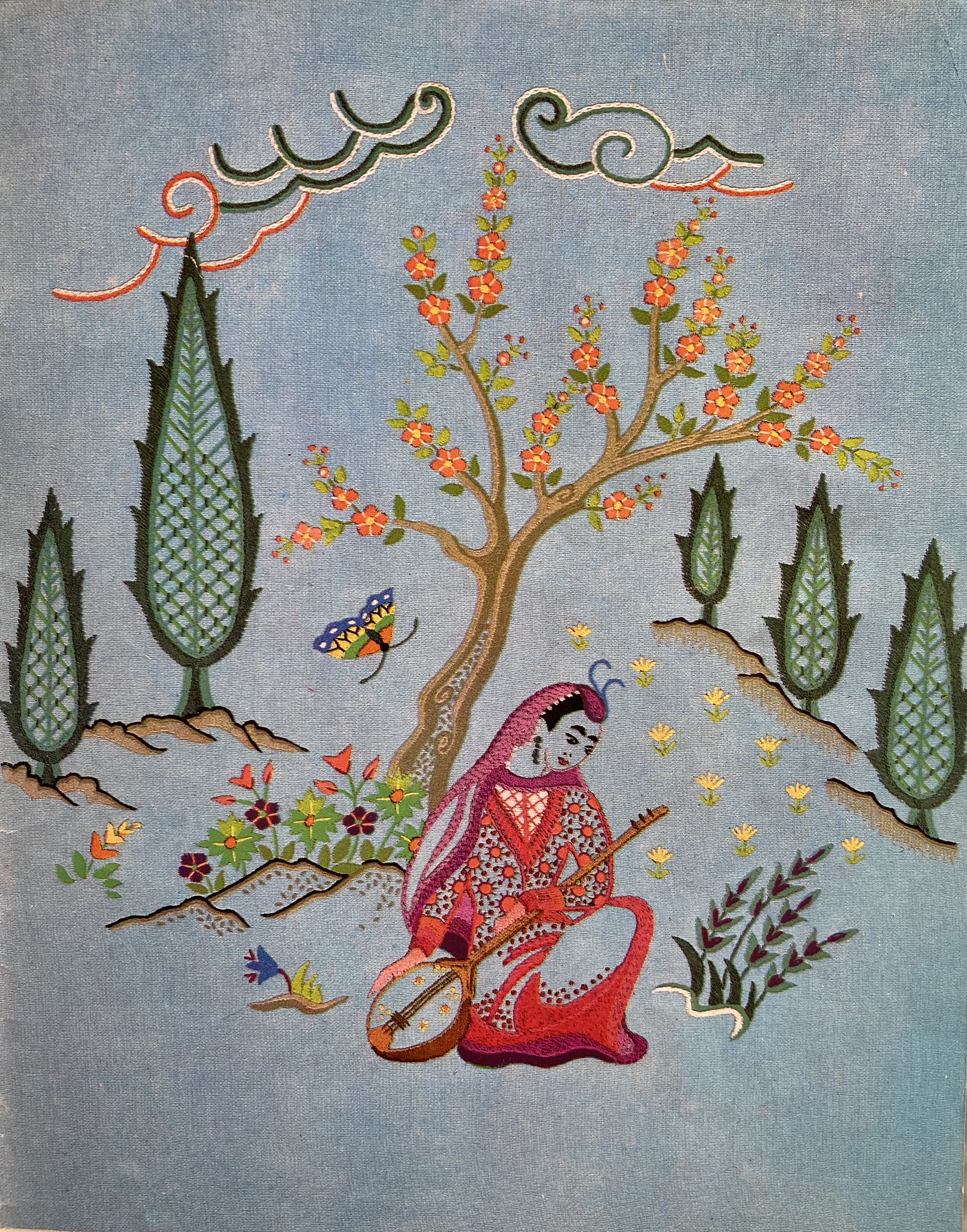
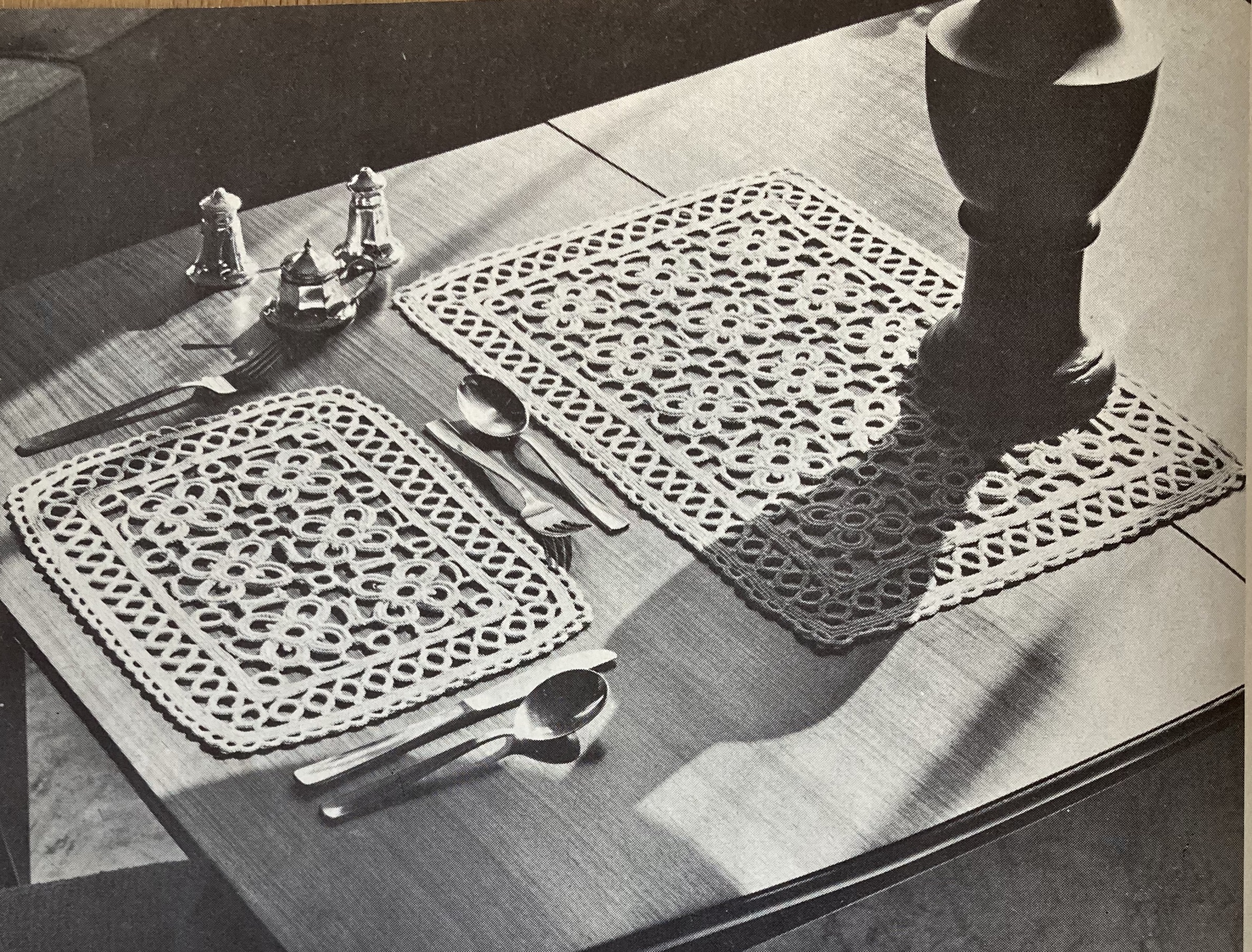
With all this bounty, the homewares are mostly standard: embroidered table mats and a Christmas-design tablecloth, a decorative panel with the Star of Bethlehem for more religiously-minded households, and a very impressive tatted doily and crocheted trolley-mat. The show-stopper is a lovely decorative panel “taken from a book of Oriental designs” embroidered in Filoselle silk on linen. (The design is allegedly of Persian origin, though of course neither Stitchcraft nor its typical readers of the time gave much thought to questions of authenticity, nomenclature, exoticism or any related issues that we would regard and discuss today.) It is a pretty picture in any case, and was probably not too difficult to embroider, consisting mostly of standard seed and straight stitches, French knots, and so on.
That’s all for this issue! I am going to make that wonderfully ridiculous hat.
Tweed! Remember last month’s post with the advertisement for variegated-colour yarn? This month’s issue presents Patons’ new variegated wool, “Glenora Tweed”, a slightly thicker DK-weight wool with dark tweedy flecks. It appears to have been made up of 80% wool and 20% synthetic fibre. The twelve colours were chosen to be as vibrant as tweed can be (and very 1960s…) with rich shades of red, green, orange and yellow.
As it knits up fast at about 4 stitches to the inch (but promises to still give a “beautifully firm crunchy texture” i.e. hopefully not sag too much under its own weight), it is showcased with larger garments — the “pinafore-style” over-dress and men’s cardigan shown on the cover and two two-piece suits for women. There’s also a pinafore-style overdress with pleated skirt for a older girl and a boatneck sweater for men, both in similar Bracken Tweed wool. In keeping with the newer, looser and more square-shaped style, the garments have minimal or no shaping (except the girl’s outfit) and the skirts come to just above the knee. To me, the women’s Glenora garments look so similar that I had to check twice to assure myself that the pinafore dress on the cover (with high scoop neck) and the two-piece set with skirt and “overblouse” (V-neck) were in fact different designs.
There is a matching 4-ply (women’s) or DK-weight (girl’s) jumper to go underneath the pinafore looks or the overblouse, which, combined with the thick over-garments, must have been suitably warm for outdoors or poorly heated rooms in October. (The girl, of course, is going to have cold legs all the same.) For those who resist the tweed craze, there’s also a bright, fun colour-block sweater in a three-colour slip stitch pattern. I love the matching orange head scarf!
There’s also a fun 4-ply jumper for a child with some easy stranded colourwork blocks at the waist and yoke. The accessories continue the bulky, easy-to-knit trend, with a cap and scarf in Big Ben wool and a big, cosy scarf for men in an intriguing reversible cable-moss pattern.
Rounding out the family’s fall wardrobe is a matinee coat and “helmet”-style cap for a baby, matching the dress from the September issue. The November issue promises a warm shawl to match again, thus rounding out the set. Judging from the photo, “dear little baby Alicia” seems to have realised that the purpose of a helmet-style cap is to prevent the baby from removing it and flinging it around the room, and is suitably disappointed. It’s a great design, though, with the sides and chin strap done in garter stitch to accommodate movement and growing heads.
The homewares are plentiful and here again, there are some larger projects to be tackled at home during the colder Autumn days. The bright red rug in Soumak stitch and traditional design is vivid and cheerful, as is the Jacobean cushion “for the skilled needlewoman” which I would love to make if I didn’t already have two unfinished embroidered cushions in the WIP pile. (Not to mention that I am not skilled enough to make that elaborate a design, especially without a transfer.) The Autumn-themed acorn cushion is definitely easier. There’s a Regency ribbon design for tapestry or cross-stitch, too.
For those who want a quicker, easier homeware project or are already getting started on the Christmas presents, there are more embroidered acorns on cutwork mats and some knitted and crocheted goodies: a “Scottie-dog” night-case, a crocheted bag, and… a hippo, yes, a friendly knitted hippo stuffed animal. Well, why not? It’s cute. An older child might embroider her own Little Miss Muffet picture in cross-stitch.
The very last project in the issue, tucked way back in the “Readers’ Pages”, is the one I will make. In fact, I have been waiting for this issue to come up specifically so that I can make it! It is a very simply constructed and embroidered “Apron-cum-Knitting-Bag” where the front panel and waist ties of the apron fold into the bag part along with your knitting. Pull the drawstrings closed and carry the bag around, then when it’s time to knit you can undo the strings, pull the apron part out of the bag and tie it around your waist, Presto, you are ready to knit in any situation, standing or sitting, and your ball of wool will not fall down and roll about the room. Stay tuned for a project that will actually get finished on time, as well as progress on those projects that didn’t.
“Knitting Time starts with a Sparkle” is Stitchcraft’s motto for the September 1963 issue, and the editress’ note assures us that “this is going to be a particularly interesting Autumn-Winter knitting season.” What does that mean for us? Lots of interesting use of bolder colours in traditional or not-so-traditional stranded and geometric patterns as well as subtler use of colour variation in tweeds and toning changes.
1963 was the year when variegated yarns, so beloved by modern knitters, first came into fashion (hence the “sparkle”), and although Patons doesn’t yet offer a truly colour-variegated yarn, here’s one from the competition: Bernat Klein No. 1, as featured in this stunning eight-page advertisement in Vogue Knitting Book No. 62 from 1963:
(The Lux and Opti-lon ads should look familiar to Stitchcraft enthusiasts as well.)
The tweedy look starts with the three-piece suit from the cover photo, consisting of a skirt, long-sleeved jumper and high-buttoning cardigan with stripe accents to bring out the lighter blue tweed flecks. Apropos “fleck”, that’s the name of the yarn: Totem Fleck. The jumper is made in the lighter, solid blue color with ribbing accents in the tweed shade. It seems to be a “switch-around” ensemble, i.e. you are not intended to wear the cardigan over the jumper as you would with a twin-set. Bracken Tweed, the somewhat bulkier tweed wool of the season (Totem Fleck is DK and Bracken is more like Aran-weight at 18 sts to the inch), is featured in this blazer “for young men who like comfortable clothes”. You know, the kind of clothes you can play ball sports in: a button-up shirt with tie, short wool trousers and a hand-knitted tweed blazer. Of course.
The other adult or teen garments feature bolder colours and interesting stranded or textured designs, like this intriguing dolman sweater with the stranded stripe running horizontally across the yoke and down the sleeves. I feel like this use of colour would look terrible on me (wide chest and long arms), but I love the idea! The man’s sweater uses a more traditional placement of the colour bands, but in contrasting green and orange tones and a spiky geometric diamond design (continuing the trend from summer 1963). The sweaters on the inside back cover have a more muted colour palette and subtle diamond texture pattern. Textured patterns make a showing in the other women’s garments as well: a bobbled raglan pullover, mock-cable cardigan and nubbly “Rimple” jumper. I want those glasses! The diamond-shape trend shows itself here in more subtle form via V-neck openings and pointy collars.
This issue also starts a new layette set for the youngest members of the family, starting with a warm dress, hat and bootees. Next month’s issue promises a matching matinee coat and cosy “helmet” cap. The caption for the modelled photo reads, “Jonathan is just 2 months” and reminds us that babies of both sexes wore lacy dresses with both pink and blue embroidery on them. 1963 was definitely a more sexist era, but also a more practical one in some ways.
There’s an interesting selection of Autumn-themed homewares as well, like a leafy fender-stool and chair-seat set, some blackwork finger-plates for the door (reminding me that I still have not finished my blackwork butterfly cushion from April…) a cushion and runner with Chinese motifs (I cannot vouch for any kind of authenticity — the motifs look very similar to the traditional European “Jacobean” designs to me, but what do I know), a pair of crochet-appliqué trolley cloths and a crochet-motif cushion.
And then there’s this “practical idea” — cover an old box (they used a wooden margarine box of about 16×12 inches and 8 inches deep, which sounds like a lot of margarine ha ha) with embroidered Binca canvas, cushion the lid with foam rubber under the embroidery and strengthen it with a piece of wood on the under-side and voilà: a “magazine tidy” which can also be used as a little stool to sit on. Very practical indeed and reduces clutter. I like it.
That’s all for this issue! I’ll be making the quick ! easy ! uses up leftovers ! crochet cushion. How quick and easy is it, you ask? I’ll tell you: it is so quick and easy that I started working on it last night, September 1st, and am already more than half finished: (Working on both halves of the cushion cover alternately so as to gauge how much wool I have of each colour.)
So there will definitely by a finished project in September, and hopefully this will give me some time to finish up the rest of the WIPs. I did also complete a retro-themed jumper of my own design which is not technically from Stitchcraft, but I’ll post about it anyway, because it was fun.
My May project was this jumper “from a Viennese design” for a young relative whose birthday was in May. Spoiler: unfortunately, the jumper was not ready in time for the birthday. May went by so quickly and I feel like I hardly made progress on any of my multiple unfinished projects. Let’s hope the kid doesn’t have a growth spurt before I finally get this done.
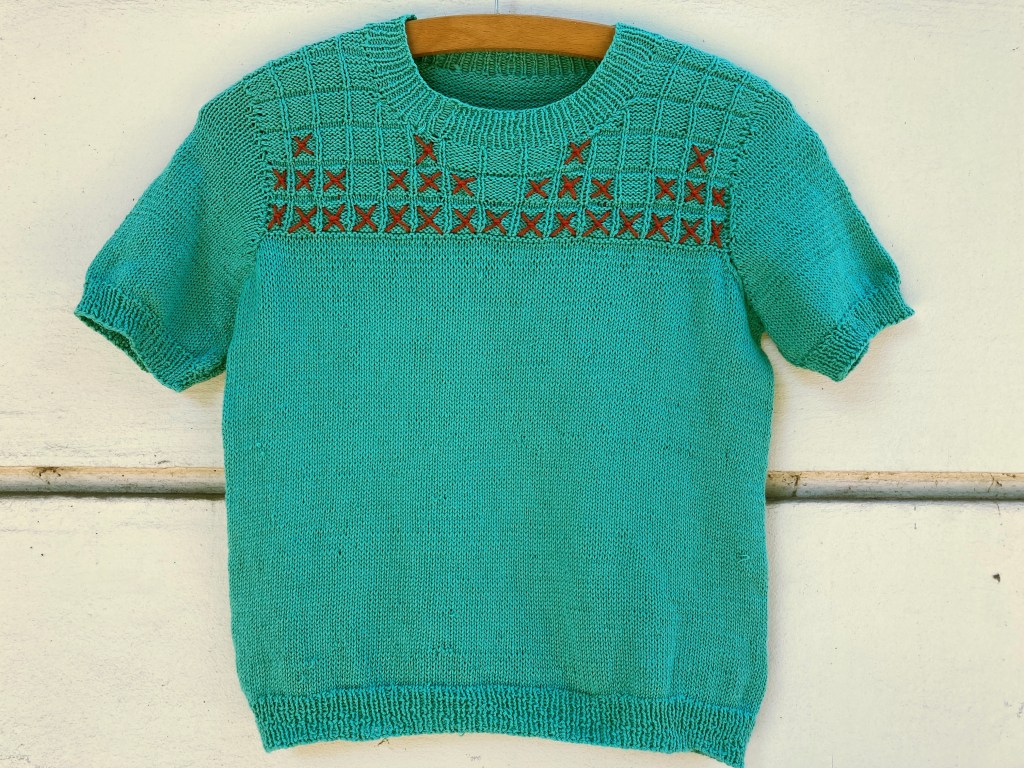
The jumper is written in a narrow reverse-rib pattern and the interesting stitch design on the yoke is embroidered on later. The recipient of this project was not opposed to the embroidery but very adamant about wanting the garment to have a “smooth texture”, i.e. stocking stitch. I aim to please, so stocking stitch it was, except for the yoke.
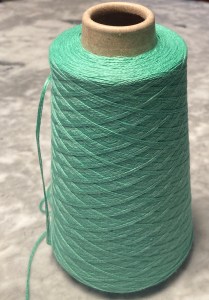
Said relative lives in a warm climate and is somewhat sensitive to wool at the moment, so I decided to make it in fine cotton. The tension according to pattern is 14 1/2 stitches in 2 inches, which is as much as I can ever accomplish even with very fine yarn and tiny needles, so finding cotton that works for me at that gauge is difficult — most cotton yarns are mercerised DK weight for making dishcloths, accessories, amigurumi, etc. Of course, there is always fine crochet cotton, but that is usually also mercerised (I don’t like the shininess of mercerised cotton.) Mayflower DK makes a lovely fine-gauge cotton that is hard to find in stores and can’t be ordered from their (Danish-language only) website. Yarn stores were still closed in my area in any case when I started this project and I didn’t have anything appropriate in stash. Luckily, the wonderful Hamburger Wollfabrik spinning mill company (as in, the German city of Hamburg, not the food! I realise that name sounds funny when you read it in English…), which was closed for a long time after a burst pipe caused severe water damage a while ago, is back up and running online with a brand new website and a beautiful selection of yarns of different fibres and weights. I chose the super-combed cotton in a 4-ply weight and a spearmint green colour.
I was happy with the weight and colour of the yarn but unpleasantly surprised to see that it was completely un-plied! Nowhere on the website does it say what kind of twist they use, nor is there an option to select what you want, but the yarn in the sample colour photos definitely looks plied and my yarn was utterly not. It is really, really hard to work with un-plied cotton, as it just splits everywhere. I guess I should call them next time I order from them and ask about that.
It is also very lightweight, which is lovely. I used that to my advantage by making the finished garment short-sleeved, making it a fancy knitted T-shirt and not a jumper. but the finished garment will be more like a T-shirt than a jumper. I tried a couple of combinations for the yoke and decided to make it in the pattern stitch with the large contrasting cross-stitch “pyramid” design in bright orange.
It blocked out kind of uneven, as I didn’t have a clothes dryer. Strange to have a knitted item that should not be dried flat! But I think this cotton needs the evening-out and fluffing-up effect of a dryer.
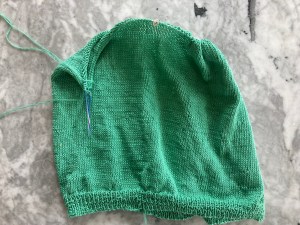
The combination of boring stocking stitch and un-plied yarn made progress very slow, but I got it finished by the middle of June, at least. Let’s hope the kid likes it!
“Fashion At Ease” is the motto of the May 1963 Stitchcraft issue, in keeping with both the beginning summer holiday season and the fashion for casual, loose-fitting, bulky-knit garments. Our cover model is getting the picnic chairs ready in a cardigan made of “Ariel” yarn — a synthetic mix that is bulky but somewhat lighter-weight. (It’s always described as “light-as-a-feather”, “feather-weight” and so on, but the cardigan uses 9 or 10 2-ounce balls, which comes out to 18/20 ounces or about 510/560 grams in the basket rib and slip stitch patterns. That may be a bit lighter than the same type of garment made in bulky-weight 100% wool, but “feather-light” it is not.)
Other than that, the women’s garments are very similar: hip-length, made in plain, smooth stocking-stitch with V-necks and somewhat smaller pointy collars. The pullover of the green suit on the inside cover photo looks so similar to the raglan-sleeved “overpull” a few pages later that I had to check twice to make sure they were two separate designs and not a continuation of one pattern on a different page with another picture. The 4-ply collared pullover is also very plain (it’s even listed in the contents as “Plain 4-ply sweater”) and has gentle raglan sleeves and a similar small collar. There will be no rocking of the boats on this holiday, fashion-wise!
There’s a little more design interest in the “Italian” boatneck pullover with a stranded colour stripe across the hips as well as the wonderful “Tyrolean” cardigan and “Viennese” pullover for children. The use of different countries’ names in the descriptions seems more a way to highlight the international “continental” travel-holiday theme than any reference to traditional or regional design elements. I certainly don’t associate the stranded knitting pattern with Italy, as it’s much closer to traditional Fair Isle/Scandinavian/Baltic/northern stranded patterns. The children’s garments claim to be a “design from the Tyrol” and “From a Viennese design”, but you can make of that what you will. They are definitely cute and probably fun to wear.
Rounding out the knitting designs are a “crunchy” men’s pullover in Bracken Tweed, one of the early multicolour/tweed-flecked wools that became popular with hand-knitters in the early- and mid-1960s as well as an interesting hybrid cardigan featuring “waistcoat styling” — the front and back are knitted in plain stocking-stitch and the sleeves in a slip-and-drop textured stitch pattern in a lighter shade of the same DK wool. I’m not sure the look is successful, but it is an interesting idea.
There are plenty of ideas for housewares, starting with a coordinated latch-hook rug and cross-stitched floor mat for a child’s room. The puppy and kitten are quite cute and (not coincidentally) look a lot like the characters in some of the children’s comics printed in the back pages of the magazine. They are intended to be easy enough to make that “your young daughter” (only the daughter, of course) could help make it and thus expand or improve her handwork techniques. For any children who don’t have to help with housework (guess that would mean the boys eh), our happy housewife can make a felt bag for dirty linen shaped like a postbox, complete with a helpful embroidered sign with collection times (9:30 am Monday to Friday, no collection on Saturday or Sunday). There’s also a purely decorative Punch and Judy wall hanging and a nightdress case shaped like a tortoise. (I will never understand the point of a nightdress case, but I love the tortoise design.)
Going with the international/holiday theme, there are embroidery patterns for a chairback and tablecloth inspired by traditional Scandinavian designs, a flowery cross-stitch cushion and table mats and a very interesting tapestry pattern for a stool top. There’s also a knitted doily and — unusual for Stitchcraft — a design for a patchwork cushion with some very well-written basic instructions for doing patchwork with the paper piecing method. For the unacquainted: you cut out pieces of paper from a cardboard template in the desired shape, stitch the pieces of fabric around these paper pieces, then stitch the fabric pieces together at the side to make the larger patches. The paper pieces are then removed and re-used. The advantage of this method is that you don’t have to cut the fabric to perfectly accurate shapes or pay too much attention to the seam allowance.
That wraps it up for May 1963! The ads are the usual and in the alternative-nursery-rhyme children’s comic, Miss Muffet has shrunk to insect size and made friends with the very nice spider, who helps her get out of a flower and gives her a ride on a floating leaf. That sounds like fun.
My project for this month will be the “Viennese” child’s pullover, made for a young relative. Said child was adamant about wanting a “smooth texture” on the pullover and not the reverse-stocking-stitch-rib in the pattern. I am also making it for summer wear in a very lightweight cotton, so the finished result may or may not look anything like the original design, but we’ll see. Also: many WIPs to finish. Happy Spring!
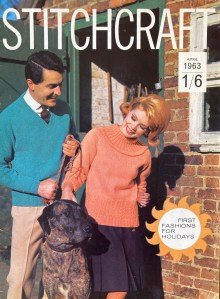
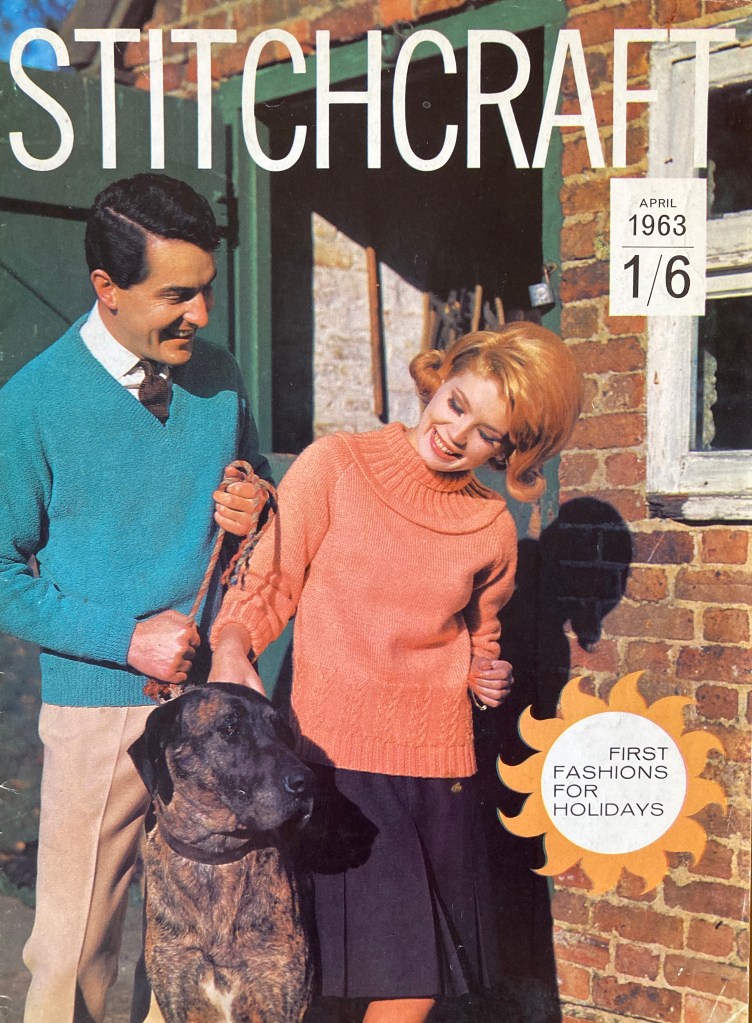
First Fashions for Holidays! It’s almost always some sort of holiday season in these vintage knitting magazines — in this case, Easter and preparations for the summer. As the British climate makes it possible to wear thick, warm wool sweaters pretty much any month of the year, “holiday / not holiday” is less a matter of warmth or season and more about casual, easy-care garments to wear while “strolling” and sight-seeing, or projects that are small and simple enough that you can work on them while lounging in your deck chair. Or, as the facing page title puts it, “Sweaters off-duty.”
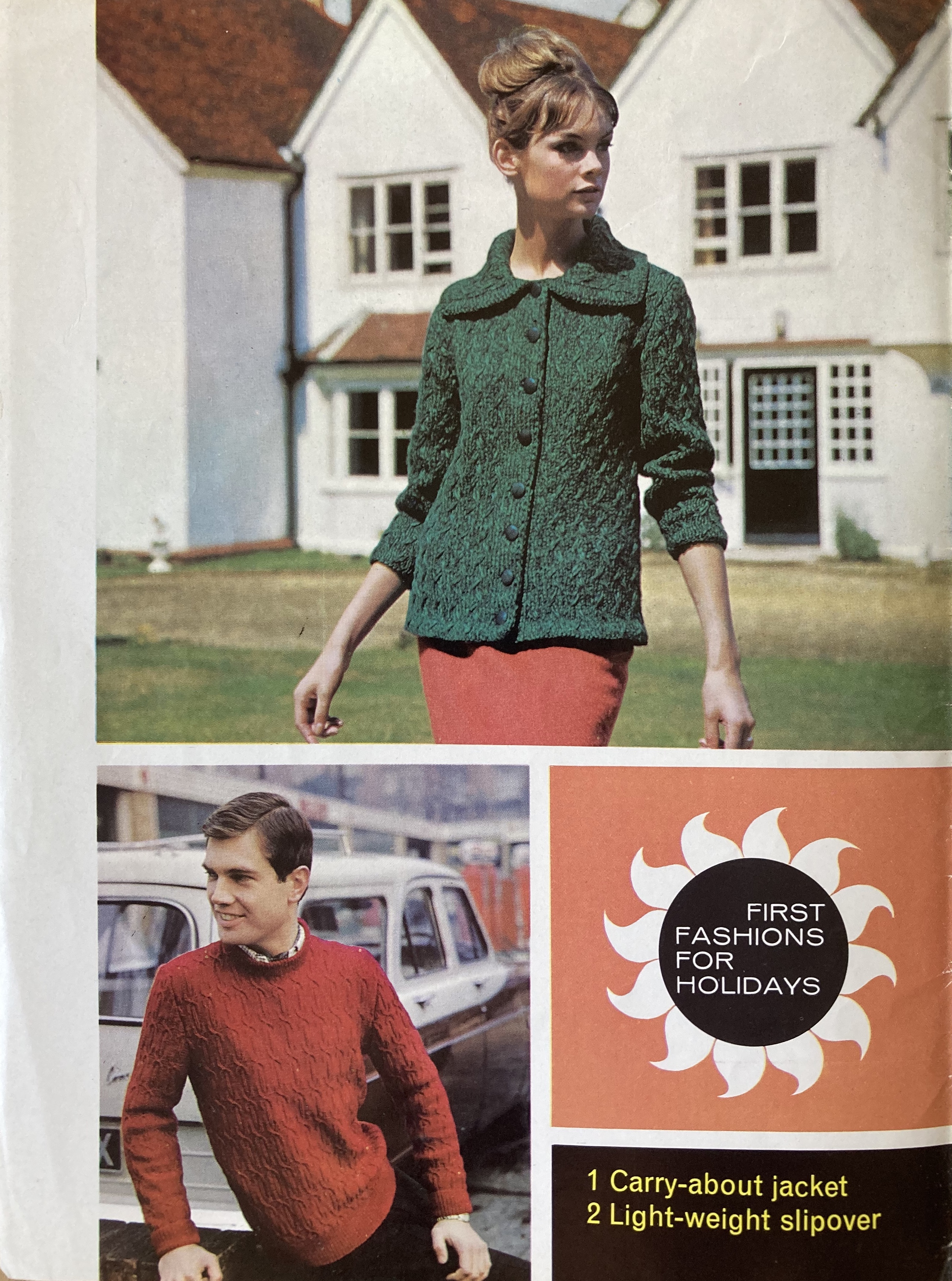
Thick, collared pullovers and cardigan jackets that can be worn as outerwear make up the bulk (-y) of the garments in the first category, many of them made in Patons Big Ben wool at 3 1/2 stitches to the inch. The tweedy, dark green jacket on the inner front cover is a good example of this and features an intriguing wavy slip-stitch pattern. The “Italian” tunic on the inner back cover has a knitted-in border pattern made of beads. DK-weight wool is used for the women’s round-yoke sweater on the front cover. Hip-length is the fashion for everyone, wide collars continue to be in style and decorative borders near the hem are the new spring trend.
There are fashions in finer-weight wool as well, “for elegant summer wear”. The red men’s pullover on the inside cover and the women’s Nylox pullover both have interesting stitch patterns, though I feel like the placement of the inserts on the women’s pullover could go horribly wrong a little too easily. If your man finds cables too exciting, you can knit him a plain V-neck pullover in bouclet wool and match it to your own fluffy mohair-mix jacket, made in Patons’ best-ever-named wool, “Fuzzy-Wuzzy.” Colours are strong and bright, including some very springlike salmon and turquoise.
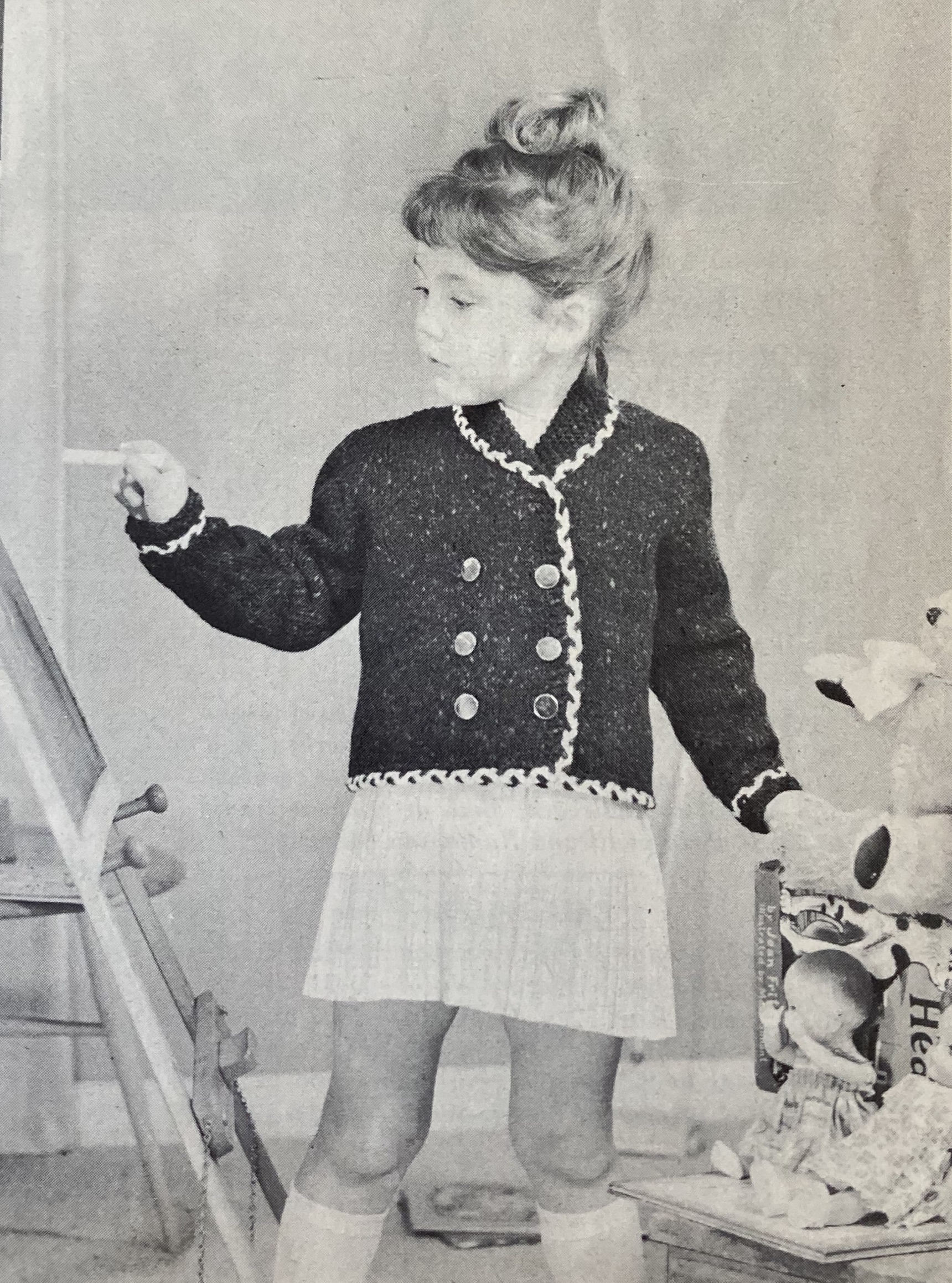
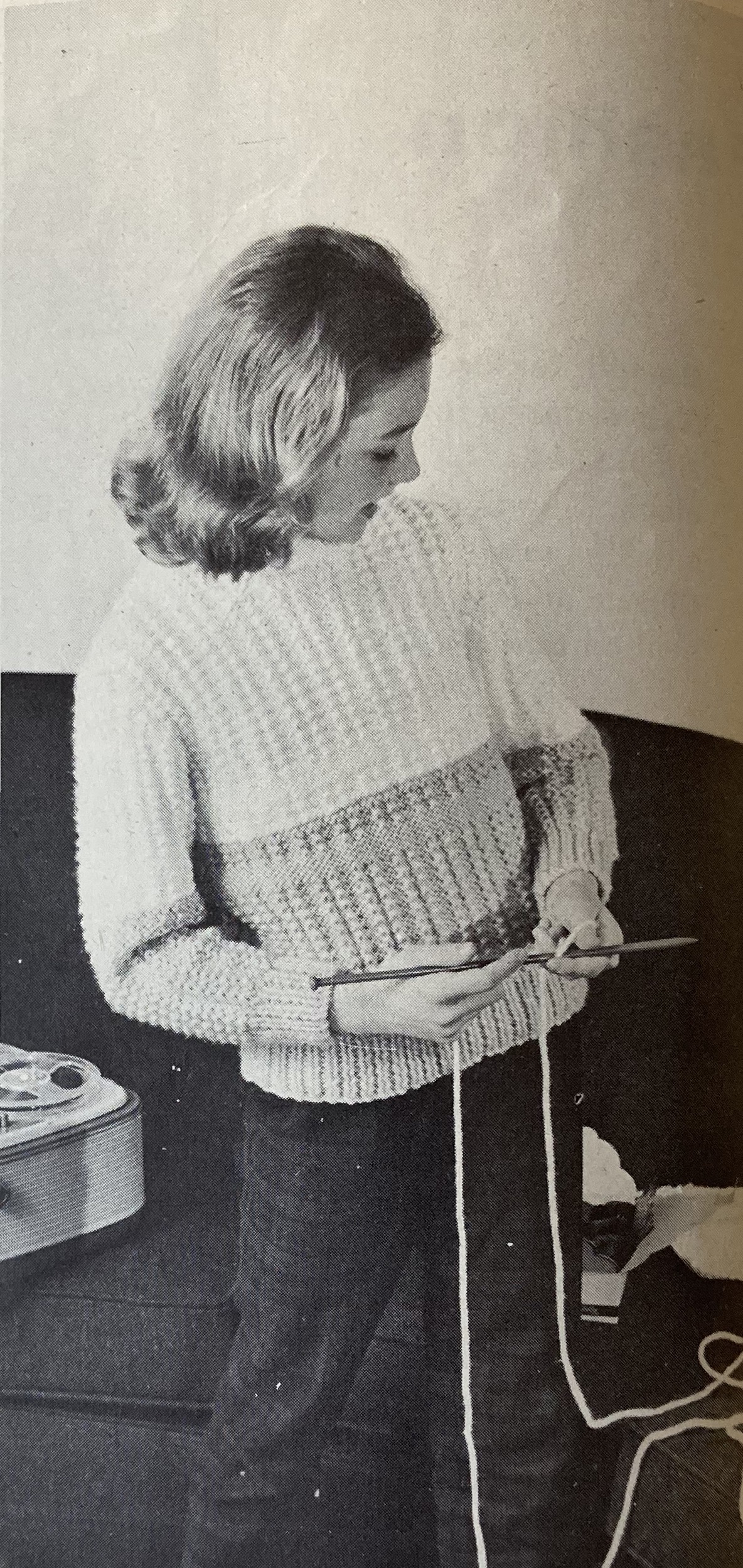
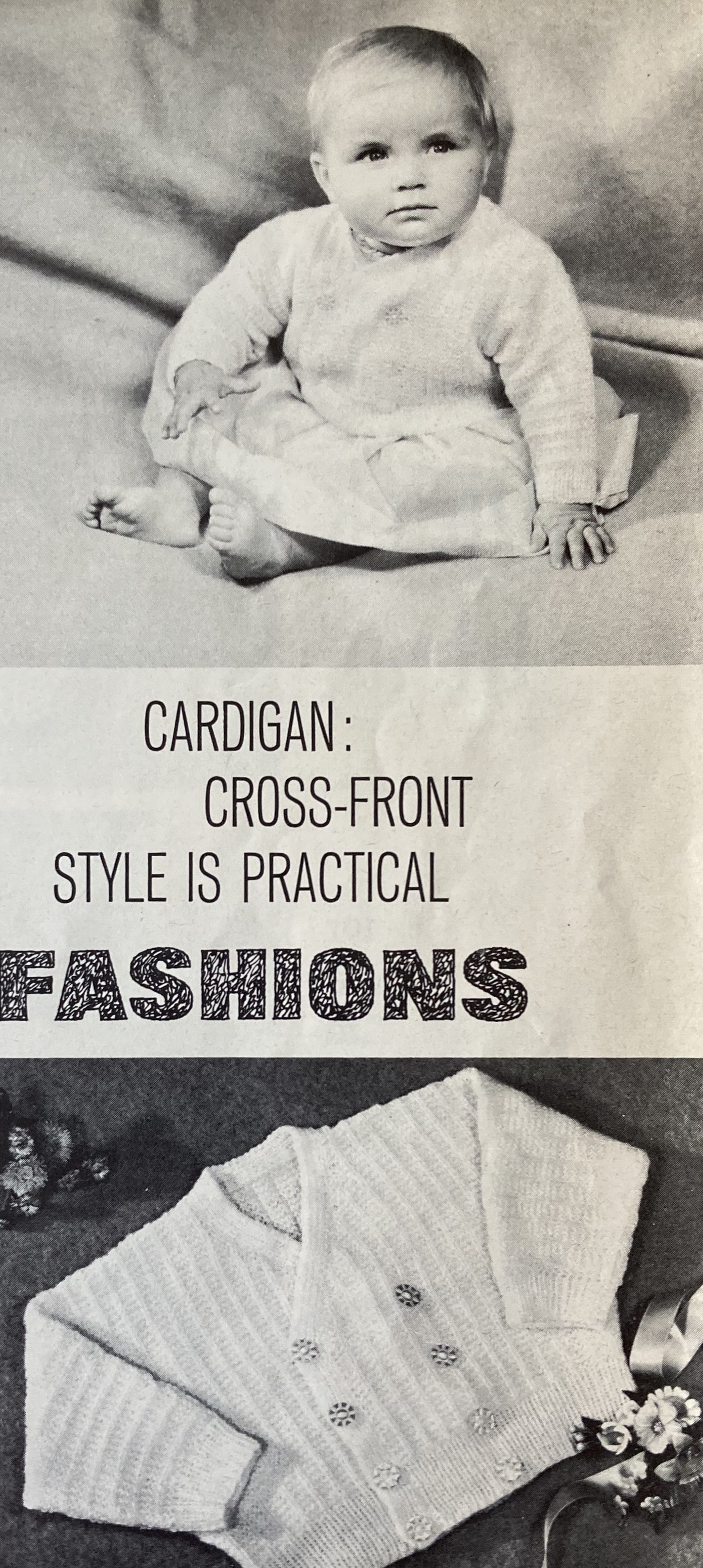
Fashions for the younger members of the family cover all age groups: a dolman cross-front cardigan for the baby, a play-set for the toddler, a “miniature Paris blazer” for small and medium-sized children (she’s painting a picture on a easel, so you know it’s Parisian!) and a quick-to-make “chunky” pullover for “sub-teens” which is easy enough for a bigger girl to make for herself. (I don’t think the young model in the photo actually knows how to knit, though.)
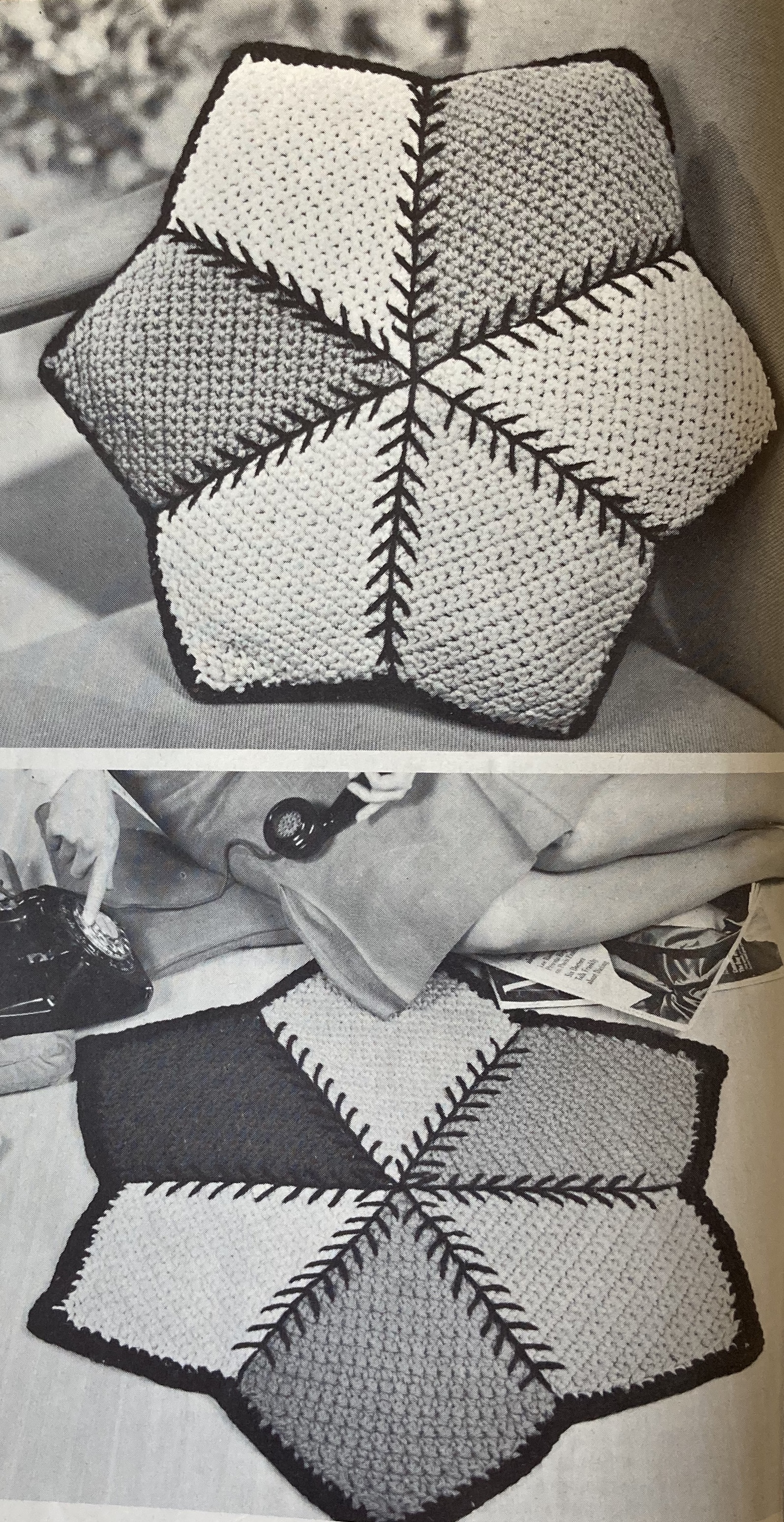
With all that pre-holiday prep knitting, the homewares in this issue are generally unspectacular. There are chair sets in counted cross-stitch, a crocheted cushion and rug for the older daughter to make for her room, and a tapestry tea-cosy. The two more interesting projects are these corded crochet mats and a wonderful cushion with a design of butterflies, made in blackwork embroidery. Unfortunately I’m not good enough at crocheting to really understand how the “corded” look on the mats is achieved, besides the fact that there are a lot of picots and crocheting many stitches into a ring. Oh, and there are embroidered table mats, too, featuring line drawings of famous parks. I like the white-on-black effect — something different.
That’s it for this issue! The ads are pretty normal and in the comic, Miss Muffet continues her adventures, getting magically shrunk down to the size of an insect in order to go flying with a nice beetle-lady. I’m afraid the dragonfly might have dropped her into the lake, though! Oh no! How will it end?
My project for this month will be the embroidered butterfly cushion. Happy Spring!
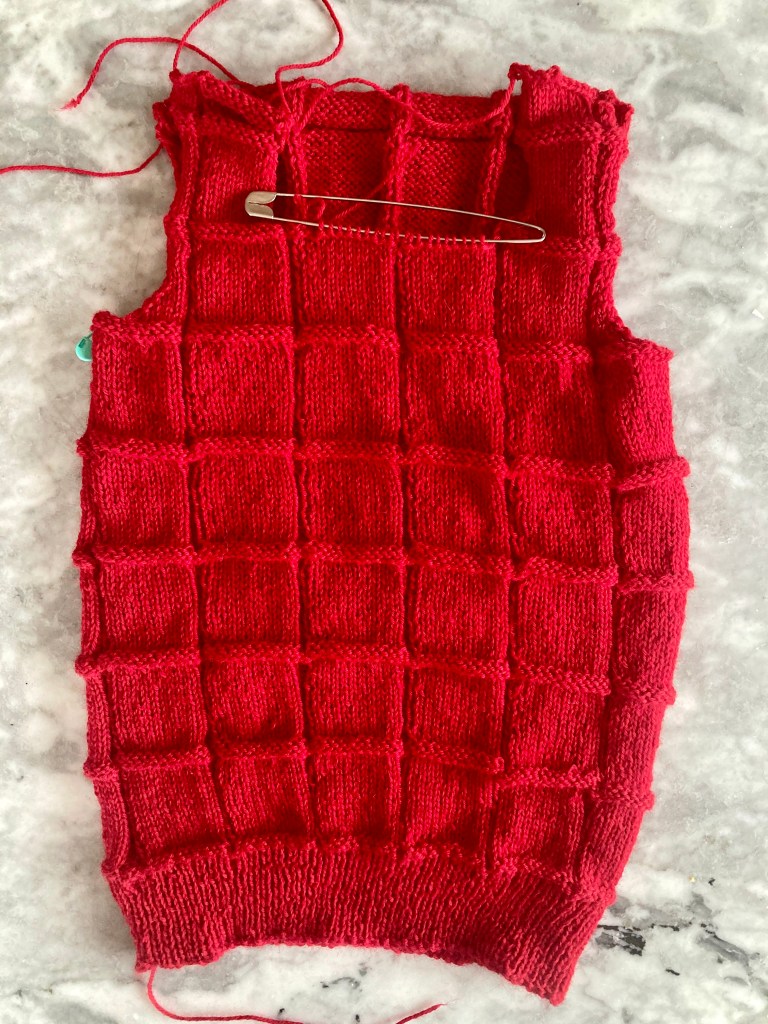
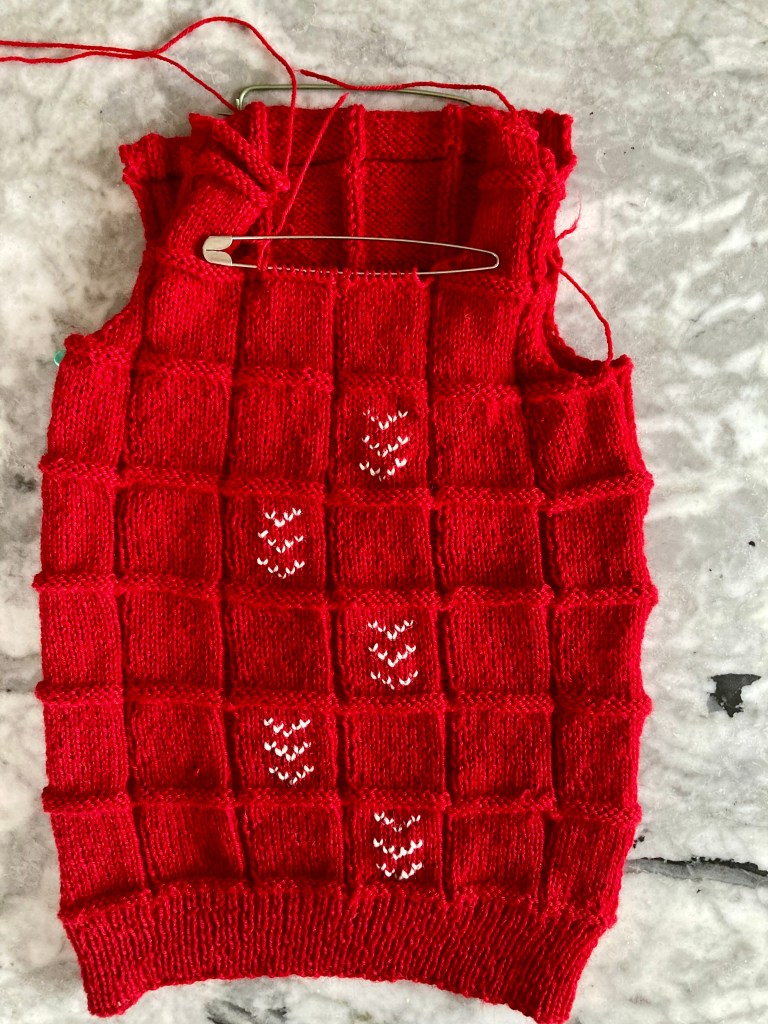
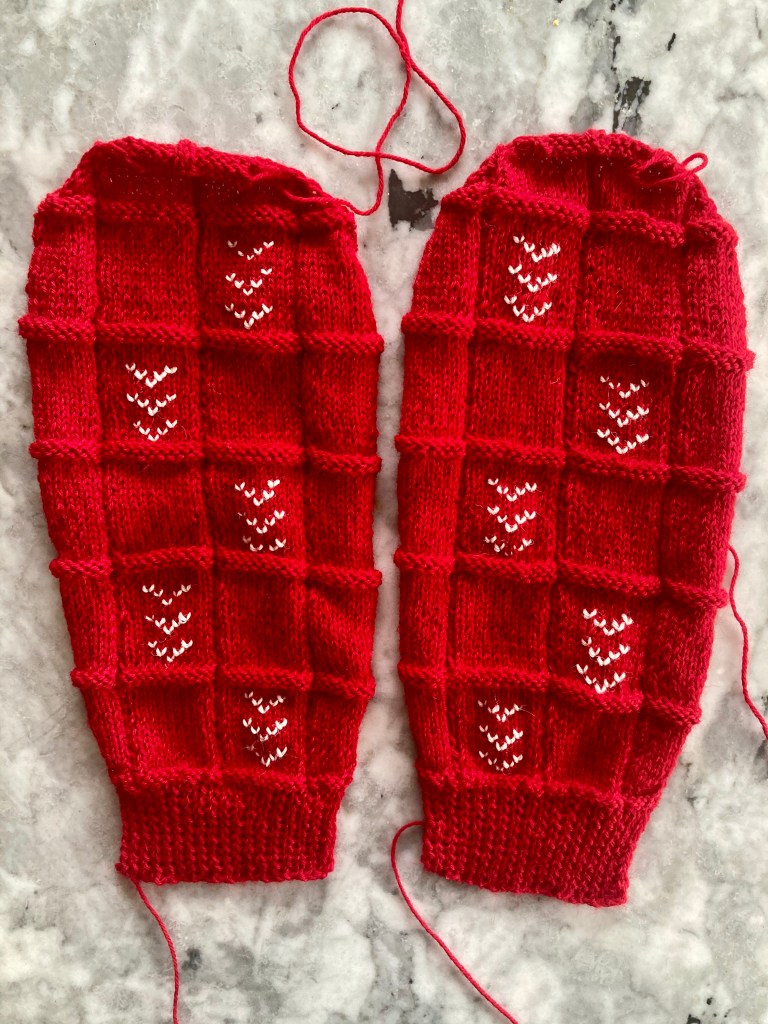
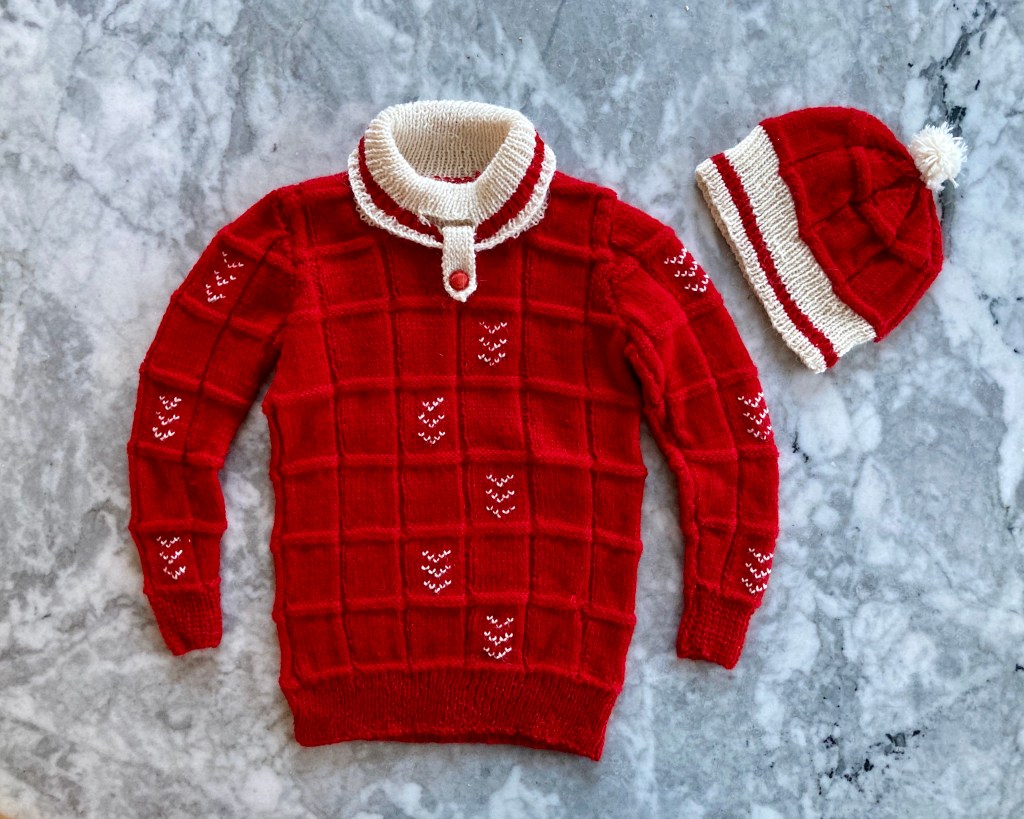
This month’s issue had a wonderful winter pullover for a larger child, featuring white “Swiss darning” (a.k.a. duplicate stitch embroidery) on a brilliant red background. I had also promised a friend to knit something for her toddler, whose favourite colour is red. Perfect!
Well, not quite perfect, since the toddler in question has a 22 inch chest and the pattern is written for children with 28, 30 or 32 inch chests. But it’s also written for DK weight wool and it was easy enough to find a lighter-weight wool to convert the pattern down into a smaller size. DROPS Garnstudio “Nord” (45% alpaca, 30% polyamide, 25% wool) gives 26-27 stitches in 4 inches and is soft and easy to care for. It’s also inexpensive and the red colour is beautiful. The white is just subtly off-white, which I like better than pure white for pairing with a really strong colour like the red.
The pattern uses stocking stitch and reverse stocking stitch to make square-ish pattern “blocks”, which are embroidered with white wool in duplicate stitch after everything is finished. Duplicate stitch or “Swiss darning” as it was often called in vintage magazines, is made by threading a length of contrasting colour yarn around stitches that have already been made. I had seen it on garments and in many vintage patterns (all kinds of embroidery on knitting was quite popular in the 1950s and early 1960s), but I had never tried it myself until now. It is pretty easy in principle, but tricky to get the stitches to look even — in this smooth yarn, any pulling of the thread made the embroidered stitches disappear. But it worked and it really peps up an otherwise simple pattern!
I made the body in the round to save time, but correctly guessed that it would be easier to embroider the sleeves if I made them flat.
This was fun and easy to make and I actually finished it on time for once! I have plenty of yarn left, so I think I’ll go ahead and make the hat before I give both to my friend. EDIT: I made the hat! Here is an updated photo.
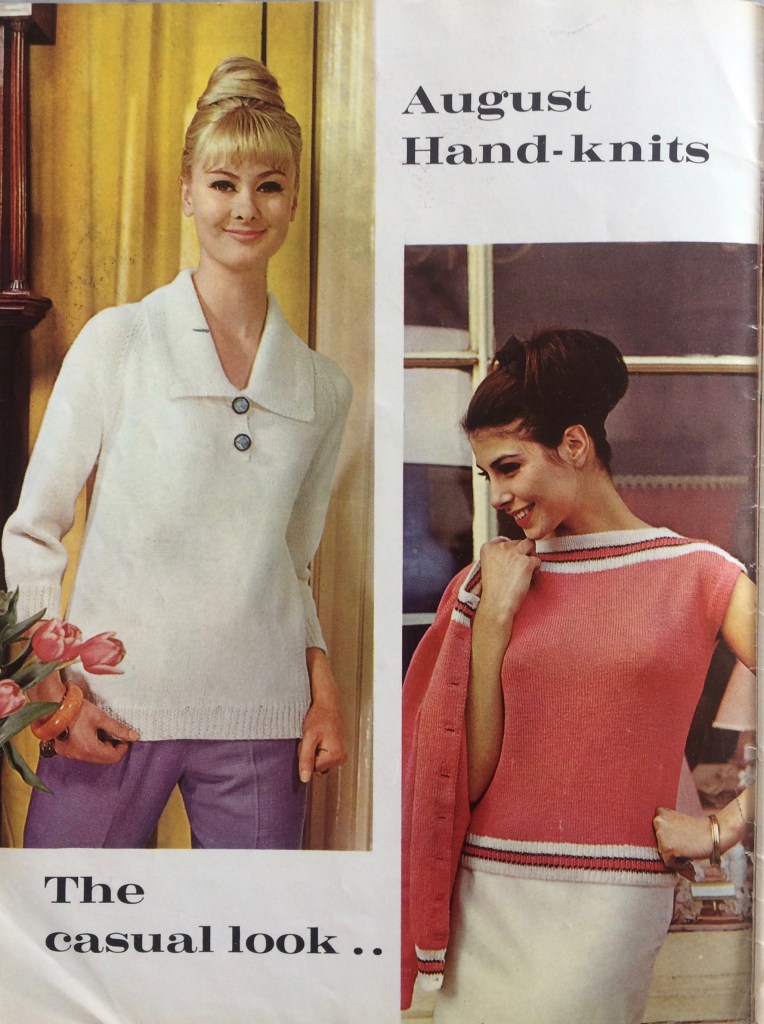
August is the end of the holiday season at Stitchcraft, featuring transitional styles for the cooler days of September as well as a few more small, easy projects that can be worked on from the deck chair or picnic table. The “Contents” column on the facing page divides the adult garment patterns into the categories “First Autumn Fashions” and “Continental Designs”.
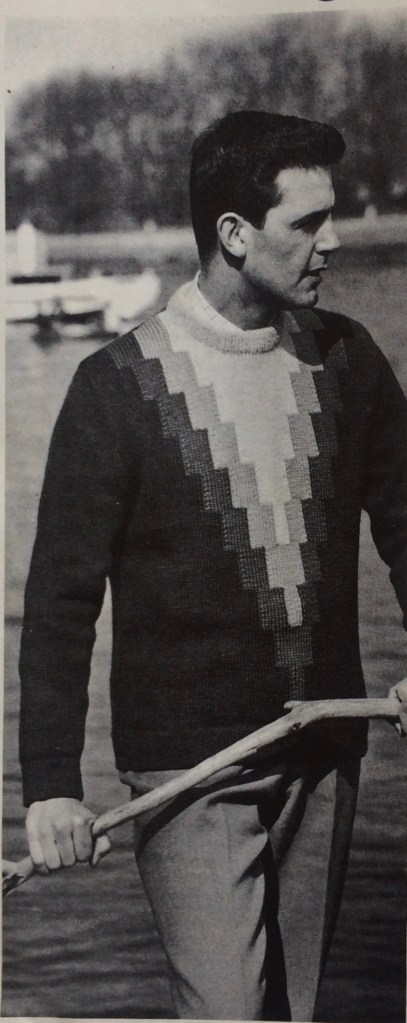
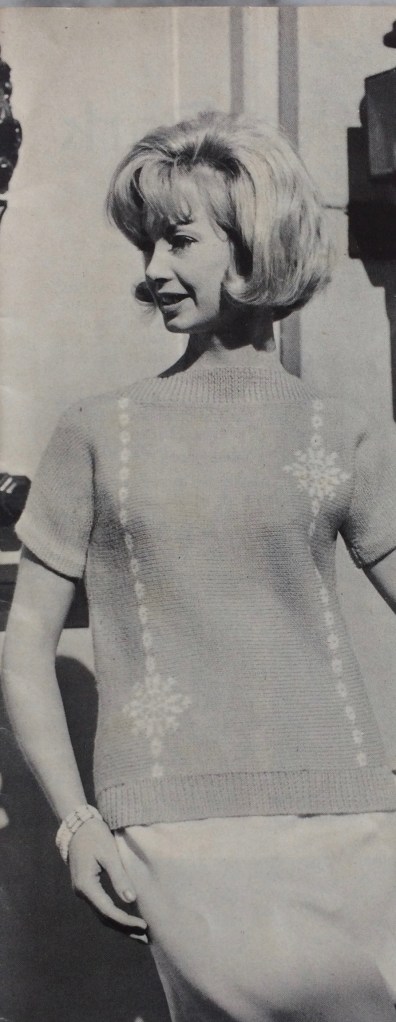
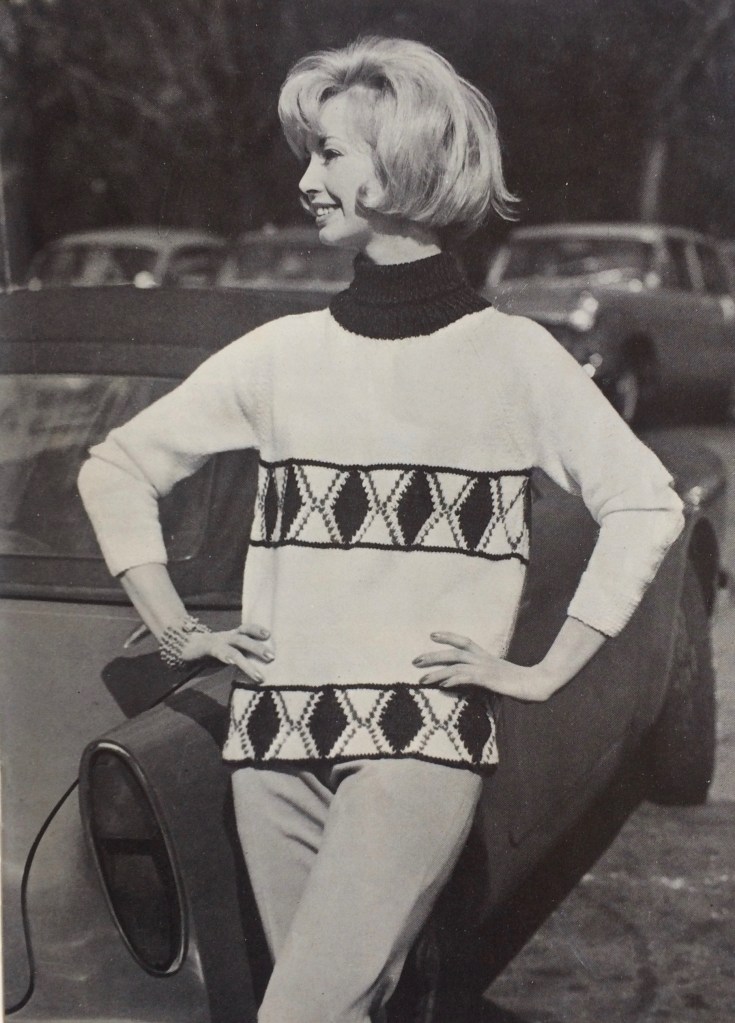
The “Continental Designs” comprise a colour-block pullover for men “from Vienna” in graded shades of green, a simple cap-sleeve, T-shirt-style jumper with a little Norwegian motif, and an “Italian design for late Summer” with bands of red and black intarsia in a diamond pattern. I wish they had used these for the colour photos instead of the bland white pullover on the inside front cover!
Loose-fitting, casual shapes and light, sunny colours dominate, exemplified by the apple-green cardigan, collared shirt-sweater and boatneck twin-set on the front and inside covers. Notice how much less fitted the August 1962 twin set is than, for example, this one from August 1960, not to mention earlier twin-sets from the 1940s and 1950s. The concept lives on, but the line has changed completely. Everything is hipbone-length with no or hardly any shaping.
Babies get a standard, but very pretty, lacy matinee coat and bootees, the “smart teenager” has a machine-knit pullover, and her little sister gets a “gay Rimple design” in the still-popular knitted terry-cloth look, so the whole family is taken care of.
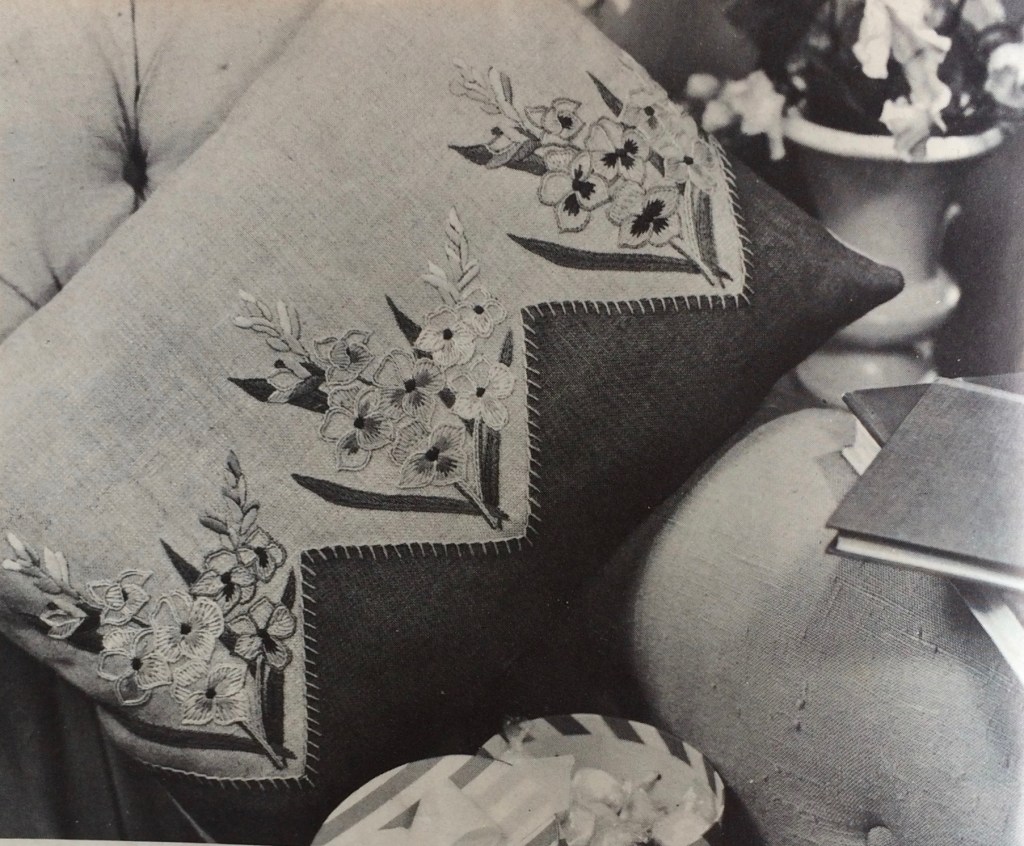
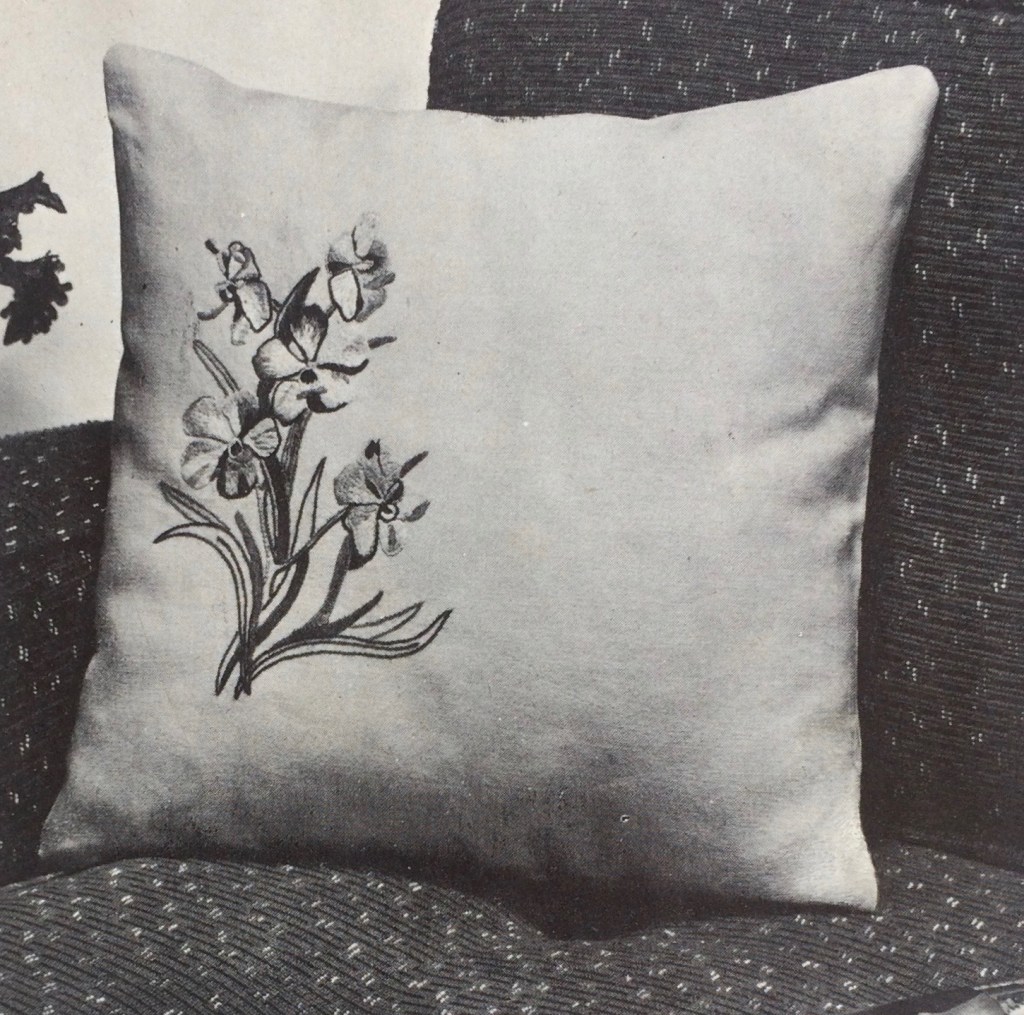
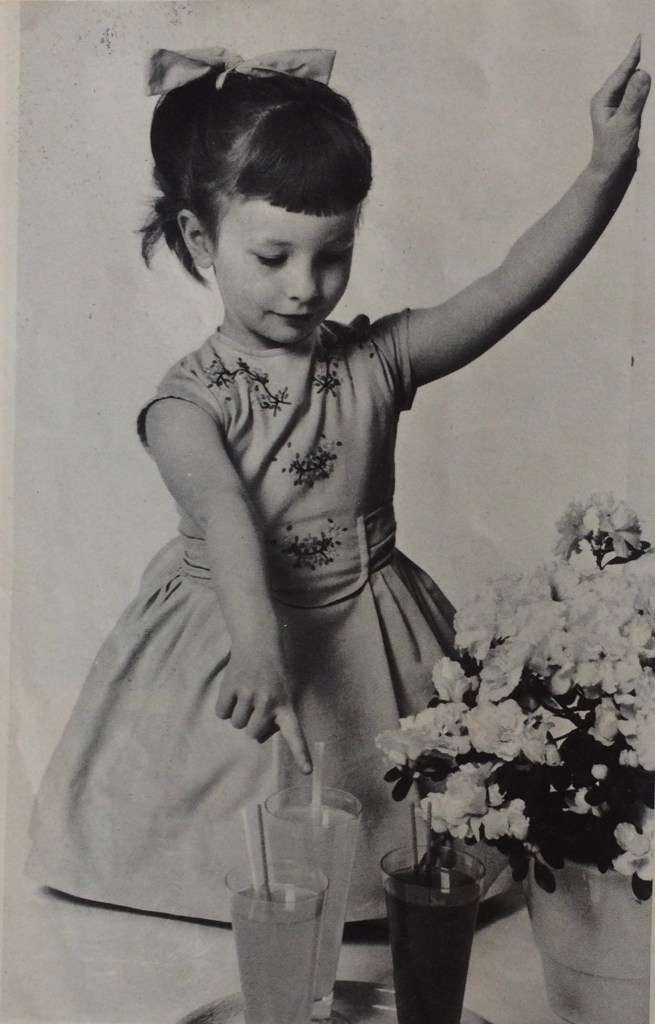
Homewares are always big in the summer months, when many readers understandably didn’t want to hold bulky warm wool in their hands in hot weather. The bedside rug is obviously an at-home project, but the smaller projects could easily be taken along on a holiday. This month’s flower in the gladiolus, but there’s also an orchid spray and some forget-me-nots, along with two sewing patterns to embroider them on: a round baby shawl or this wonderful little girl’s dress. For once, you don’t even have to send away for the patterns, as they are geometrically quite simple — the shawl is just a circle, drawn directly onto the fabric with a pencil held on a length of string, and the dress is made up of rectangles with measurements given. I would love to make the dress! I just don’t think it would get worn, since it would only be for “dress-up” occasions, of which there aren’t going to be any for a while.
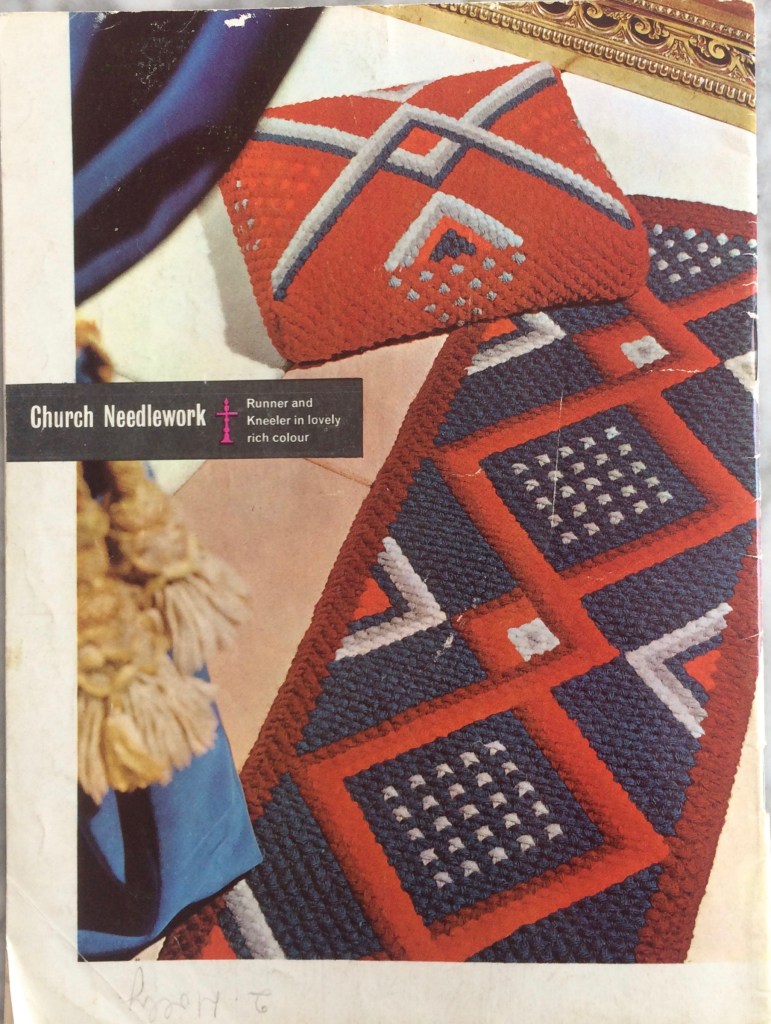
The back cover shows an interesting feature which took shape in the early 1960s issues: tapestry projects specifically for church use. In this case, there’s a runner and kneeler in shades of red and blue. If anyone happens to know why or if these colours or this pattern are significant in whatever type of Christian tradition, please feel free to tell me, as I don’t know anything about it. The rug, especially, does not say “church use” to me in any way that I can recognise and I could just as easily see it in a normal hallway.
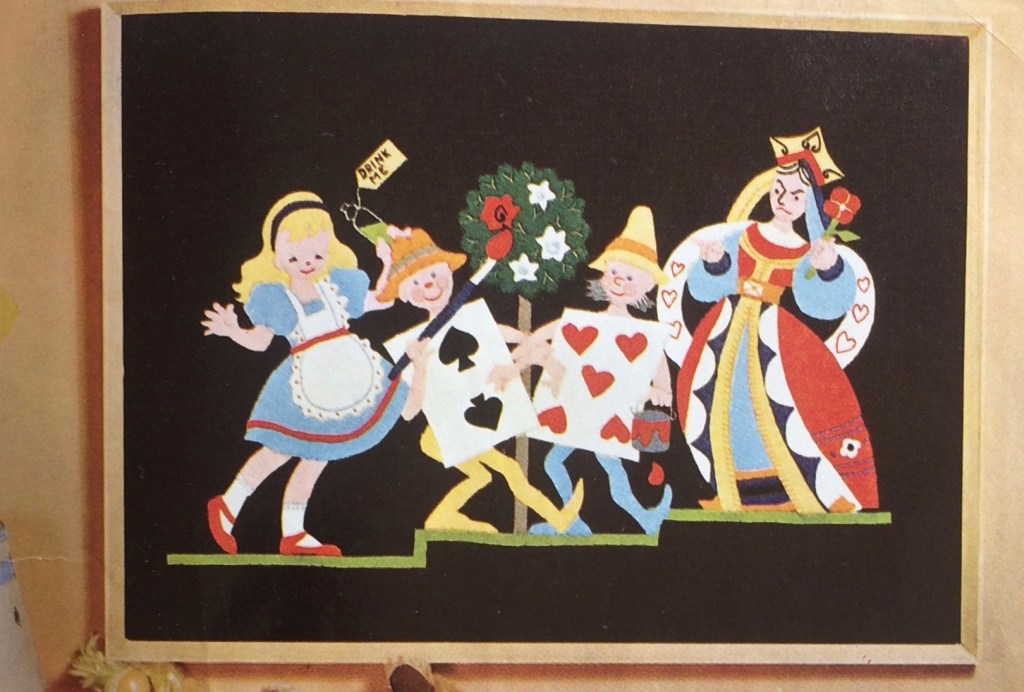
This issue doesn’t stop! The “Readers’ Pages” offer two more very simple projects: a reprint of a young man’s waistcoat from 1957 and a stash-busting baby blanket from double crochet hexagons. And just when you think you’ve come to the end of the issue, here’s this incredible Alice in Wonderland-themed wall hanging in felt appliqué and embroidery:
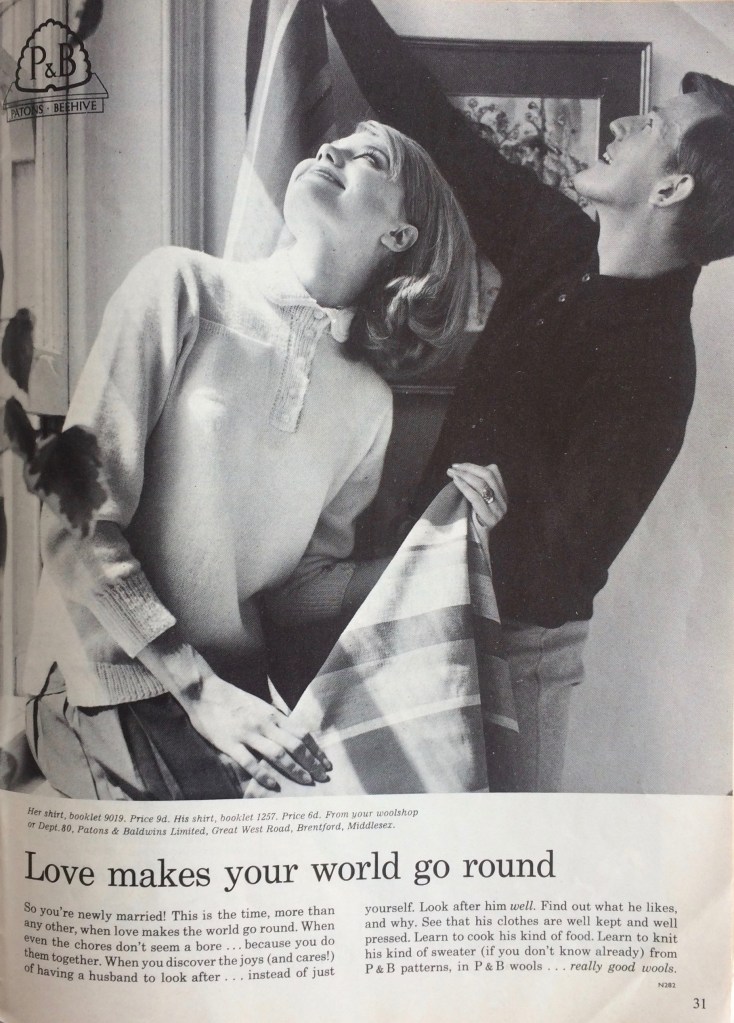
I’ll close with this full-page ad for Patons & Baldwins wools, showing a newly married couple decorating their home. The happy bride is instructed to
Look after him well. Find out what he likes, and why. See that his clothes are well kept and well pressed. Learn to cook his kind of food. Learn to knit his kind of sweater…
While I’m certainly not surprised that a 1962 advertisement would speak to women like that, I do find it interesting to compare the early and mid-1960s ads — which take on this type of “you exist to please your man” language more and more throughout the years — with those from the 1950s issues, with their much more independent picture of womanhood. Many of the knitting patterns in the earlier issues are explicitly designed “for the office” and most of the advertisements portray women living active, interesting lives in their comfortable shoes and unbreakable skirt zippers. In the wonderful tampon ads (that sadly disappear around the late 1950s), they don’t even let “problem days” stop them from doing anything! In contrast, the full-page P&B ads starting up around this time always feature a man or child with the woman in question and the text is inevitably some variation on “you must do this to please your man.” I had always thought of the 1950s as being a much more repressive time for women that the 1960s, when roles began to change, but judging from Stitchcraft (which, to be fair, is quite conservative both fashion- and otherwise), the earlier part of the decade is more of a backlash than a progression.
I don’t know what project to make from this issue and I still have so many WIPs, both for this blog and otherwise. Maybe a nice, easy flower embroidery on a vegetable bag?
Holiday and party seasons are both in full swing in Stitchcraft’s July 1962 issue and the more I look at this cover photo, the more I love it. Note how the foreground model is staring off into the distance while sitting on a table with a compass printed on it, as if fantasising about her faraway holiday (though, if she’s on holiday already, as the picture is implying, does that mean she can’t wait to get home?). Meanwhile, it’s a good thing that our flirty tuxedoed waiter’s drinks tray is empty, with that precarious balancing act. If anyone feels inspired to creatively augment this photo with speech- and thought-bubble captions, please do and share it with us!
In keeping with the easy-going, summer holiday theme, the knitting projects are simple and quick to make. The two illustrated on the cover have no sleeves, minimal shaping and patterning, and are made in quick double knitting wool. Although pictured as stand-alone tops, they could easily be layered over a blouse on cooler days. There’s also a simple blue blouse with loopy flower details on the collar and a striped, sleeveless tunic-blouse with matching skirt, all in 4-ply wool. Our waiter from the cover photo has found another holiday-goer to flirt with, and sports a “Casual Italian design sweater” in the same colour as her skirt: “Water Green.” (Holiday tip: if the water actually is that colour, don’t drink it.) Speaking of Italy, doesn’t that beautiful model in the collared blouse look like she just stepped out of a Fellini film?
For cooler days, there are cardigans in “golfer” or classic, slightly bobbled styles, both made in double knitting. The golfer takes her sport very seriously! Knitters who are really in a hurry to get packing can make some simple, bulky pullovers for the kids in the family (shown here building a lovely British castle out of cardboard and sand in the Patons photo studio — I am guessing everyone had a lot of fun on this issue’s photo shoots) or a fine-knit slipover in honeycomb pattern, written for a home knitting machine.
The embroidered homewares are mostly easy and predictable: a chairback with this month’s flower, the carnation; a quickly-made “gay garden cushion” (Happy Pride!), and place mats with heat-resistant cork inserts. There’s a tapestry stool and/or project bag in Florentine pattern, knitted or crocheted cushions, some fancy knitted doilies and a trolley cloth from crocheted motifs. I didn’t photograph all of them, since they’re pretty standard fare.
For those who like to immortalise their holiday paradise in tapestry, there’s a wall hanging of the village of St. Etienne de Bougary in the lovely French Pyrenées. For your outing to that very inviting-looking lake, you can sew you own beach bags and/or an appliquéd blanket-towel-baby’s-playmat for outdoor lounging. The beach bags feature adhesive plastic lining to keep wet bathing suits from leaking into the bag. Smart and easy, indeed.
I’m kind of ambivalent about making a project from this issue. The only thing I could really use is the bobbly cardigan, but it’s not exactly necessary, and the only design that I find exceptional is this crocheted blouse (worn by my favorite Stitchcraft model, who featured in a lot of the mid-and late 1950s issues). Model and blouse are both beautiful, but the blouse is way beyond my limited crochet skills. I wish I had the “Traditional Norwegian Designs” booklets from this ad! I think I’ll take the time to finish up another long-standing WIP instead.
Holiday season is in full swing in this month’s issue, with featured photos taken in pretty villages in and around Buckinghamshire and Kent. All the projects are easy and fairly quick to make, and even the fit is relaxed: the close-fitting, waist-length jumpers that were still more or less in fashion in 1960 and 1961 have now completely given way to loose-fitting, hip-length sweaters and blouses. I could use some relaxation, couldn’t you? Let’s dive in… gently.
The cover sweaters check all the 1962 trend boxes: loose, easy pullovers for “him and her” in sunny lemon yellow with interesting stitch textures and contrasting collar-and-cuff accents. Soft yellows, pastel shades and white show up again in the more glamorous “holiday sweaters” made with Patons’ Fuzzy-Wuzzy yarn (55% angora, 45% wool), as well as the women’s 4-ply “golfer style” cardigan (in “gay turquoise” and white 4-ply) and men’s “shirt-style” pullover in presumably light beige “Palomino” colour with contrasting collar.
The other garments are all photographed in black and white, but the yellow/pastel/white and contrasting accent trends are clear from the colour names of the yarns: the pretty “Junior Miss” cardigan is knitted in 4-ply Nylox “Sunglint” (the same colour as the cover sweaters), the “afternoon style” blouse is “Bois de Rose” pink and the bulky, textured Big Ben sweater is “Spring Green” with a white collar.
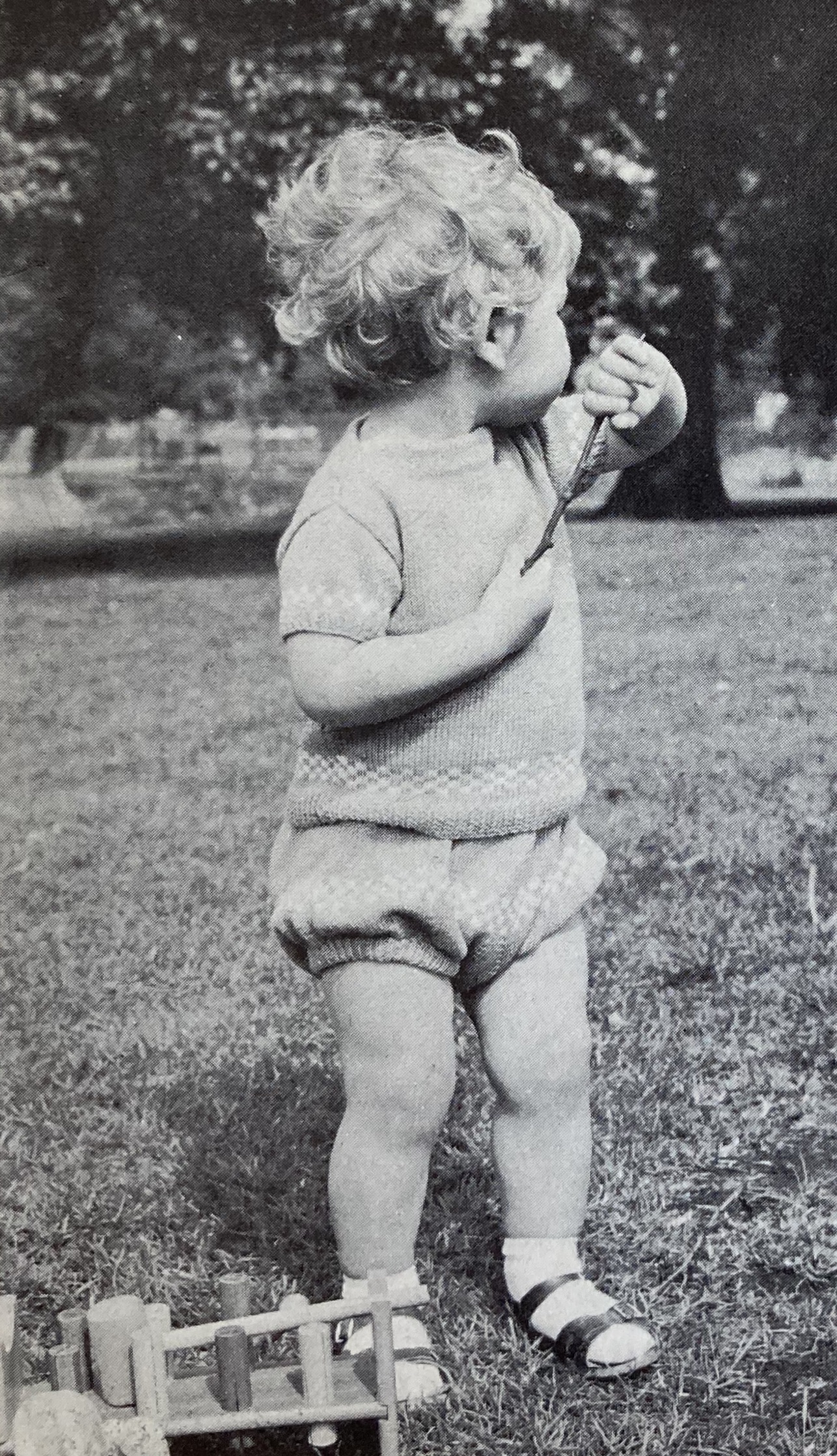
The smaller children of the family need something fun and easy for holidays too, of course, so here are some “seashore sets for toddlers in the swim.” They’re made in Nylox (80% wool, 20% nylon) and I don’t think they would be suitable for actual swimming, but definitely cute for playing around on the beach and splashing around.
With all these lovely things to knit, it’s not surprising that the homewares section is a little boring. Fittingly enough for June, this month’s flower is the rose, featured in a pattern for a “finger panel” to attach to a door. Readers, you have been so helpful in the past with solving mysteries for me, so i ask you: Why a finger panel? It seems to be used to keep the door clean from grubby handprints, which I can certainly understand in a family home, but I don’t see why it would be easier, or preferable, to wipe those grubby prints from an embroidery panel mounted under acrylic glass than to just wipe them off of the door. What do you think? Am I missing something here?
Otherwise, we’ve got some Scandinavian tapestry cushions, a “modern” (geometric and also Scandinavian design-inspired) hall runner rug, a more complex cross-stitch tablecloth (white and green on yellow linen, to match your yellow sweaters), some unspectacular oven mitts and some genuinely cute table mats in appliquéd and embroidered felt.
I feel more relaxed already, don’t you? There’s nothing from this issue that particularly inspires me and I have many WIPs to finish up, so my June project will be a “Blast from the Past” featuring a wonderful twin-set from a 1947 issue of Stitchcraft.
“Easter Greetings” from Stitchcraft, April 1962! According to “editress” Patience Horne, “everyone is getting that “out-of-doors” feeling”. I and my fellow compatriots from 2020 have had a very much in-doors feeling for the last few weeks, as we watch Spring unfold from our quarantine windows.
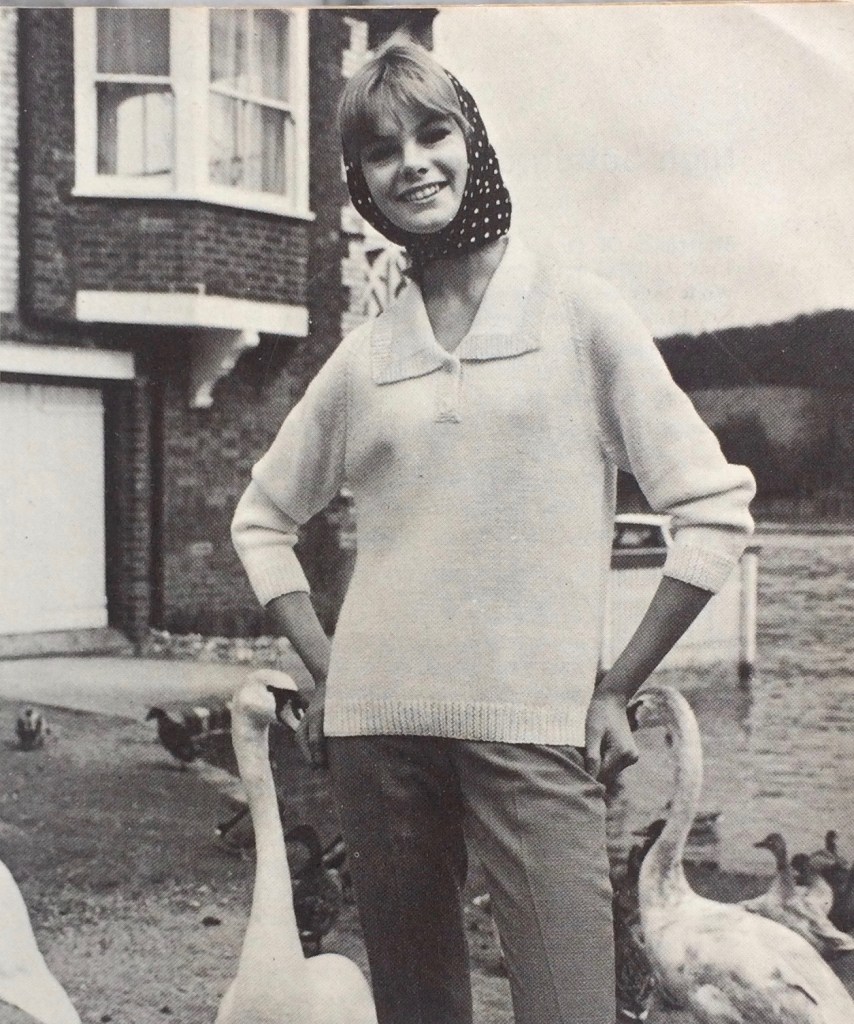
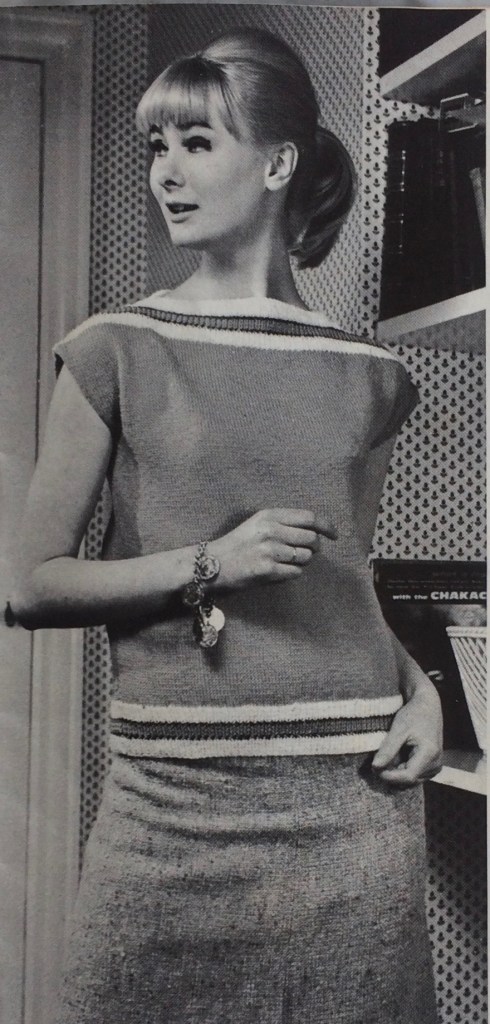
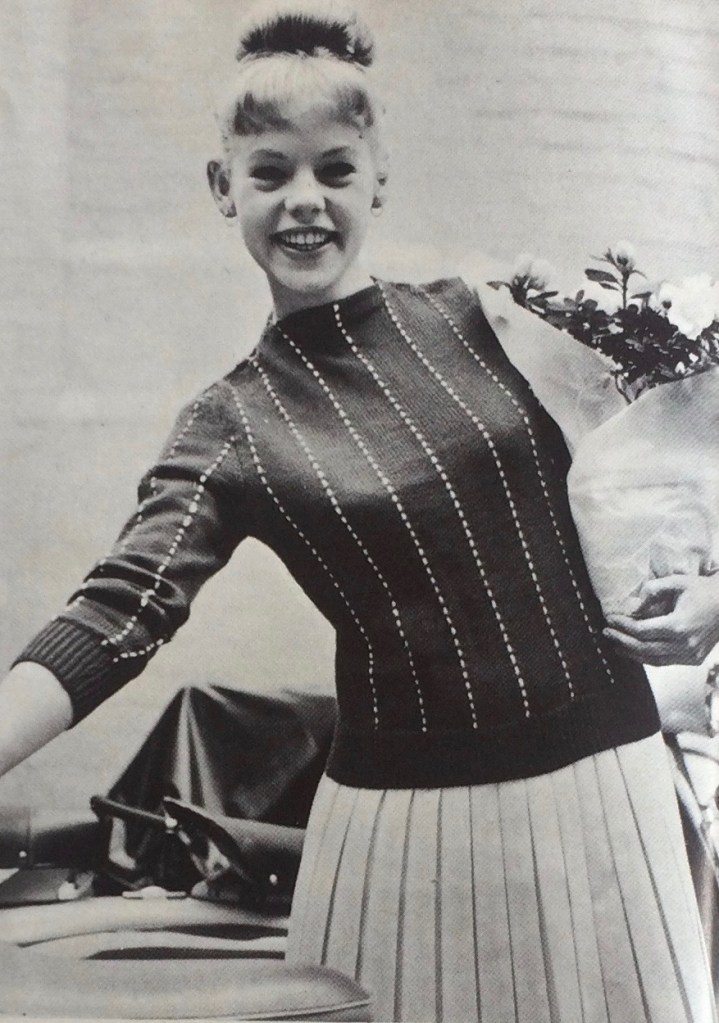
Back in 1962, the whole family can sport matching waffle-stitch pullovers and cardigan jackets for those inevitable country rambles. All three cover-photo designs are made in bulky Big Ben wool at 3 1/2 stitches to the inch. Those who prefer double-knitting weight wool can make a men’s pullover in “slip-on shirt style for sailing and tennis” (with sporty illustration!), a buttonless women’s jacket, or a “crunchy” cabled pullover. Roll-necks or rolled collars are gradually eclipsing the larger, pointier collars of the years before.
There’s also a “travel set” of jumper, cardigan and two skirts to take on your spring holiday, made in both plain green and a marled two-tone green that appears to be one of the early multi-colour yarns just starting to come onto the market around this time, but is actually made by holding one strand of each of the two colours together . The child’s striped V-neck pullover seems like a good way to use up all the leftover yarn.
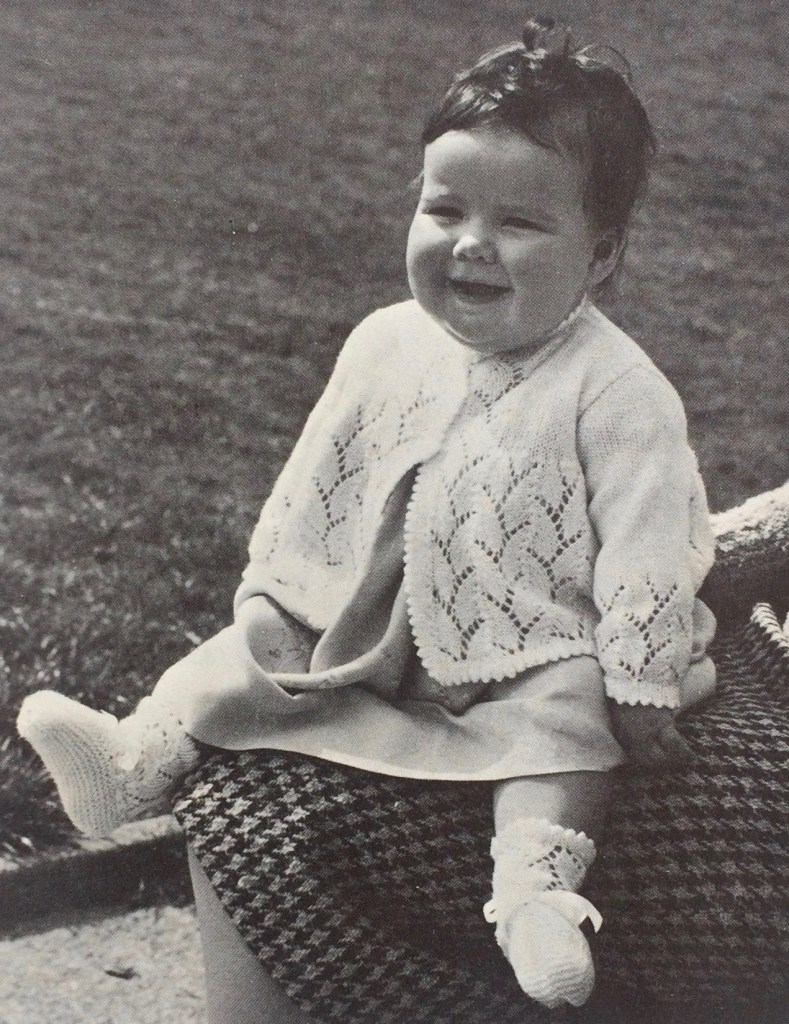
Even the baby of the family, or a baby-to-be, can expect a lovely Easter present in the form of a dress, bonnet, jacket, bootee and blanket set — plus a “pin tidy” to hold all the safety pins that will fasten our 1962 baby’s cloth nappy in place. The blanket is also made in Big Ben (ensuring it will be done in time for baby’s arrival), while the other garments are made in the usual 3- or 4-ply baby fingering wool.
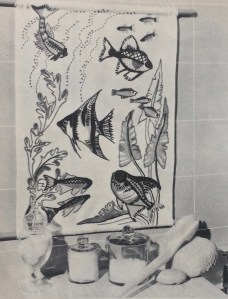
Springtime also means spring cleaning, and Easter means presents and bizarre sorry bazaar novelties (honestly, with some of the designs it’s hard to tell the difference.) Here’s an intriguing “splash panel” to hang on the bathroom wall. As with the elaborately embroidered “finger plates” for doors, its utility evades me. Why would anyone hang a hand-embroidered tapestry on the bathroom wall, for the express purpose of being splashed with soap and toothpaste and who knows what else, which would therefore need to be taken down and (hand!)-washed frequently, rather than just… wipe down the tile wall? I do like the fish design, though!
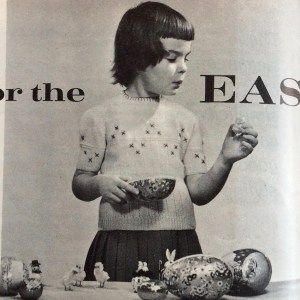
The pineapple (-ish) motif cushion, embroidered flower-of-the-month iris, latch-key and crocheted rugs are less interesting, but the Easter novelties — a stuffed polka-dot giraffe, a hedgehog pincushion (brilliant), a chicken egg cosy and a knitted lamb with mascara and eyebrows — do not disappoint. A crocheted altar cloth and a set of versatile cross-stitch animal motifs round out the homewares selection. Finally, there’s a great surprise on the inside back cover: a set of embroidered and appliquéd place mats and matching cushion with a chess-set motif! That’s actually quite a lot of fun.
I hope you are all staying sane and healthy in these unfortunate times. May you all have enough projects to keep you busy and enough non-physical-proximity games to keep you happy. Two friends of mine will be expecting babies in the summer, so my Stitchcraft project for April will be the jacket from the baby set. Hang in there, everyone!
Greetings from the Covid-19 lockdown! March 1962’s project sports the headline “Ready for the Easter Parade” in the magazine, but there are definitely not going to be any Easter parades in March 2020. I hope all of you, dear readers, are staying healthy and staying home.
I made the jumper from this lovely “best-dress” twin-set in an easy flattened-rib pattern with added cross-stitch embroidery. It’s written for 4-ply wool, but the child I knit it for can’t wear wool and the warmer months are coming, so I made it in cotton. And I finally found a cotton yarn that is non-mercerised and fine enough for me to get 7 stitches to the inch with it — Cotton 8/4 by the Danish brand Mayflower. It’s even organic! Sadly, there wasn’t enough yarn left in the shop to make the cardigan, said shop has decided not to re-order this yarn and Mayflower doesn’t seem to do direct sales via its website, so if I want to make the cardigan, I’ll have to see where else I can order some more.
The pattern was easy and my only modifications were to close the back neck opening with snaps and a button instead of a zipper and to forego the blanket-stitch embroidery around the neck, which I thought didn’t go well with the cross-stitch embroidery. It was a fun project and I hope the little girl for whom I made it will enjoy her birthday present.
Sorry for the very short post, but there’s really not much more I can say. Stay tuned for the year-long saga of the 1940s twin-set, which might actually be drawing to a close now that I have lots and lots of time at home to knit.
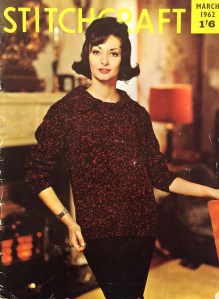
There are three seasons in the Stitchcraft year: autumn, Christmas and “holidays”, which start in March and continue until about September. Of course, most people take their holidays in the summer, but the beauty of knitting (or editing a knitting magazine) is that you can technically be knitting for them any time of the year, if you knit slowly enough. And so, the March 1962 issue of Stitchcraft, (motto: “Knit for Spring”) can already promise us “the fun of holidays to plan for.”
Spring is also “the time of year to wear smart two-piece suits and dresses, which you can now knit so quickly and easily” — a nod to the double-knitting and bulkier-weight wools now available and in fashion, relieving knitters of the earlier boredom of making dresses and long-skirted suits at 8 stitches to the inch. Here is a skirt set in nubbly Rimple DK. Top-fashion colours of dull green and beige-gold (or as Stitchcraft calls them, “mustard and pheasant” — sounds delicious!) are repeated in a finer-knit bouclet sweater.
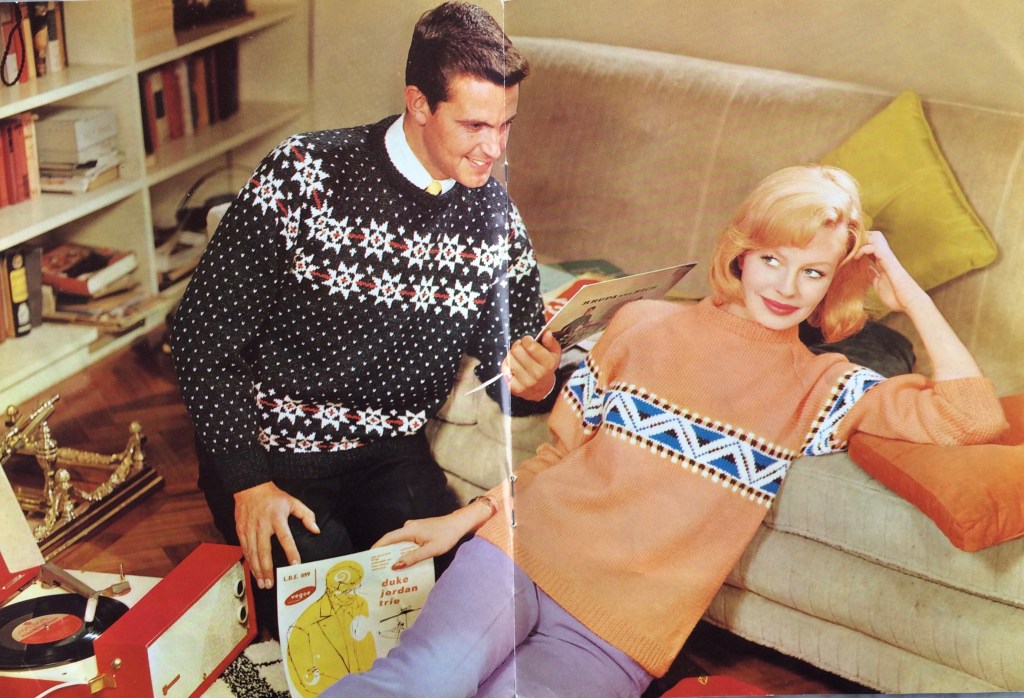
Interesting textures and colour blends are key: in addition to the Rimple and bouclet offerings, the cover jumper is made in Bracken Tweed, one of the newer marled/flecked wools. Stranded colourwork is featured in a Norwegian-style pullover for men and, in more subtle form, in a bright band across a warm women’s raglan sweater. Look at that perfect 1962 “lifestyle” photo of our knitter lounging in her beige-coloured living room and smiling seductively at her man while listening to jazz!
“Informal sweaters” that combine colour and texture elements, as well as a lovely little twin-set for a child and granny-square bonnet and mittens for a toddler round out the collection. The homewares are varied, but predictable: another tapestry town scene, a Florentine rug (pity they didn’t get a colour photo of that), traditional cross-stitch designs and a daffodial embroidery transfer for a coffee-pot cosy or night-dress case.
And of course it wouldn’t be Stitchcraft without “novelties”, in this case, matching “boy” and “girl” egg cosies made to look like nightcaps — I’m guessing somebody must have found the egg holders with painted-on faces and had an inspiration. The back cover is another fun, if slightly “uncanny valley”, advertisement for Escorto “Gold Seal” fabrics — “easy” due to being 100% synthetic material.
My March project will be the jumper from the girl’s twin-set as well as another “blast from the past” which I have been working on for literally years and will hopefully finally finish soon. Happy Spring!
Happy New Year, everyone! It’s 2020 in my real world and 1962 in my blog world. Where will Stitchcraft take us?
… Not very far, fashion-wise. The “Swinging Sixties” started later in the decade; 1962 was still definitely part of the “early” 1960s aesthetic, i.e. more of a continuation of 1950s styles. At the same time, new trends are pushing fashion in new directions, and Stitchcraft is (slowly) moving with the tide. Fine-knit wool blouses have become rare and the bulky look is definitely in. Knitted suits are loose-fitting and give a rectangular silhouette. Accessories are becoming more experimental and fun, with “turret” and loop-stitch hats and oversized knitted or crocheted bags.
So, what does January 1962 offer us? The cabled sweaters on the front (and yes, that is the word that this British magazine uses: for Stitchcraft, a “jumper” is generally more form-fitting and finely knit, while a “sweater” is bulkier and more casual) can be made in Big Ben wool for the truly bulky effect in a pullover, or in double knitting for a more streamlined cardigan. The casual “his and hers” sweaters with a diagonal “v” stitch pattern are made in double knitting wool, but oversized and loose-fitting. There’s a “big and bold” shortie dolman for teenage girls and you can knit matching, you guessed it, bulky, oversized pullovers for “the menfolk” of the family.
There’s a casual suit in Bracken Tweed wool, highlighting the new fashion for multicolour, heathery tweed yarns. It too is meant to hang loosely, and the collars, cuffs and borders are knitted in a complementary colour that picks up one of the tweed undertones. The only fine-knit garment in the issue is a lovely twin set in 4-ply Cameo crepe wool, and even it is mostly unshaped — quite unlike the twin sets of the 1950s. Children can get a nice warm play-suit in stranded colourwork.
In the early 1960s, Stitchcraft liked “year-round” embroidery themes, with a different versatile small design each month. At the end of the year, all the transfers were made available as a set to be used together on a tablecloth or larger project. 1962’s theme is “flowers” — more conservative and less original than the previous “Zodiac” theme. Still. the narcissus design is pretty and elegant. The bathroom mat, flowery “peasant design” tablecloth, Victorian tapestry and knitted doilies are pretty standard fare and the knitted clown with flags stuck in it like a voodoo doll is predictably terrifying — seriously, do not look at the photo if you have a clown phobia, it will give you nightmares.
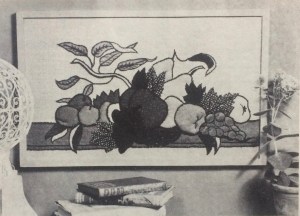
To clear your head of that image, you can make a wall hanging — a still life of fruits and vegetables done in padded appliqué for a three-dimensional effect.
All in all, Stitchcraft‘s 1962 starts with a whimper, not a bang. Still, there are enough nice designs that it’s hard to pick one. I love the twin set, but could also use a nice, normal cabled V-neck cardigan in double knitting, and the toddler’s playsuit is probably fun to knit. I’ll let my local yarn shop decide, i.e. see what they have in stock that says, “Use me for this project.”
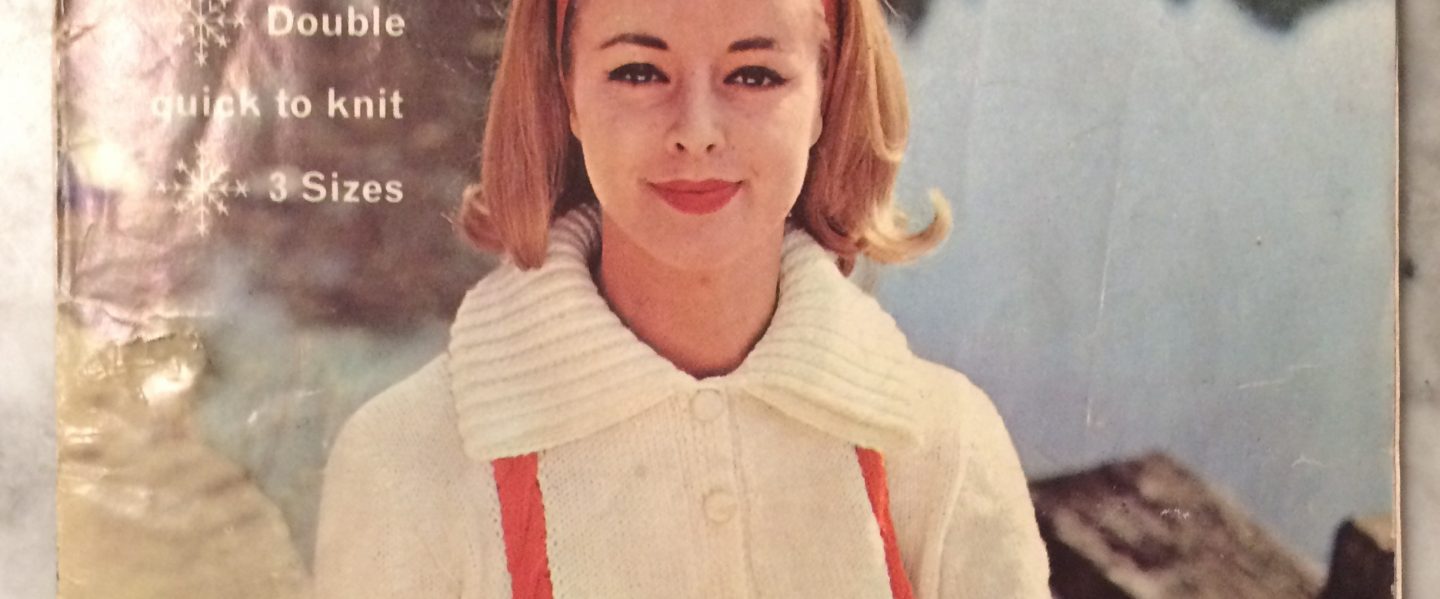












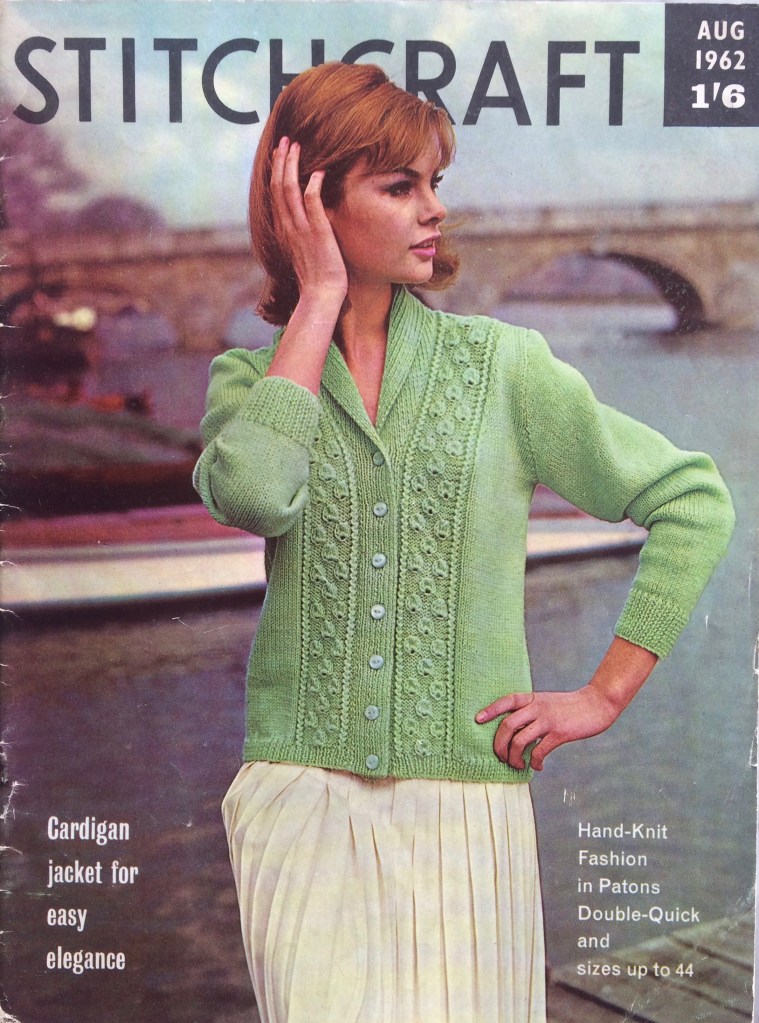


 “Easter Greetings” from Stitchcraft, April 1962! According to “editress” Patience Horne, “everyone is getting that “out-of-doors” feeling”. I and my fellow compatriots from 2020 have had a very much in-doors feeling for the last few weeks, as we watch Spring unfold from our quarantine windows.


 Springtime also means spring cleaning, and Easter means presents and


 Greetings from the Covid-19 lockdown! March 1962’s project sports the headline “Ready for the Easter Parade” in the magazine, but there are definitely not going to be any Easter parades in March 2020. I hope all of you, dear readers, are staying healthy and staying home.

 There are three seasons in the Stitchcraft year: autumn, Christmas and “holidays”, which start in March and continue until about September. Of course, most people take their holidays in the summer, but the beauty of knitting (or editing a knitting magazine) is that you can technically be knitting for them any time of the year, if you knit slowly enough. And so, the March 1962 issue of Stitchcraft, (motto: “Knit for Spring”) can already promise us “the fun of holidays to plan for.”




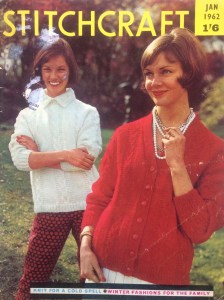 Happy New Year, everyone! It’s 2020 in my real world and 1962 in my blog world. Where will Stitchcraft take us?