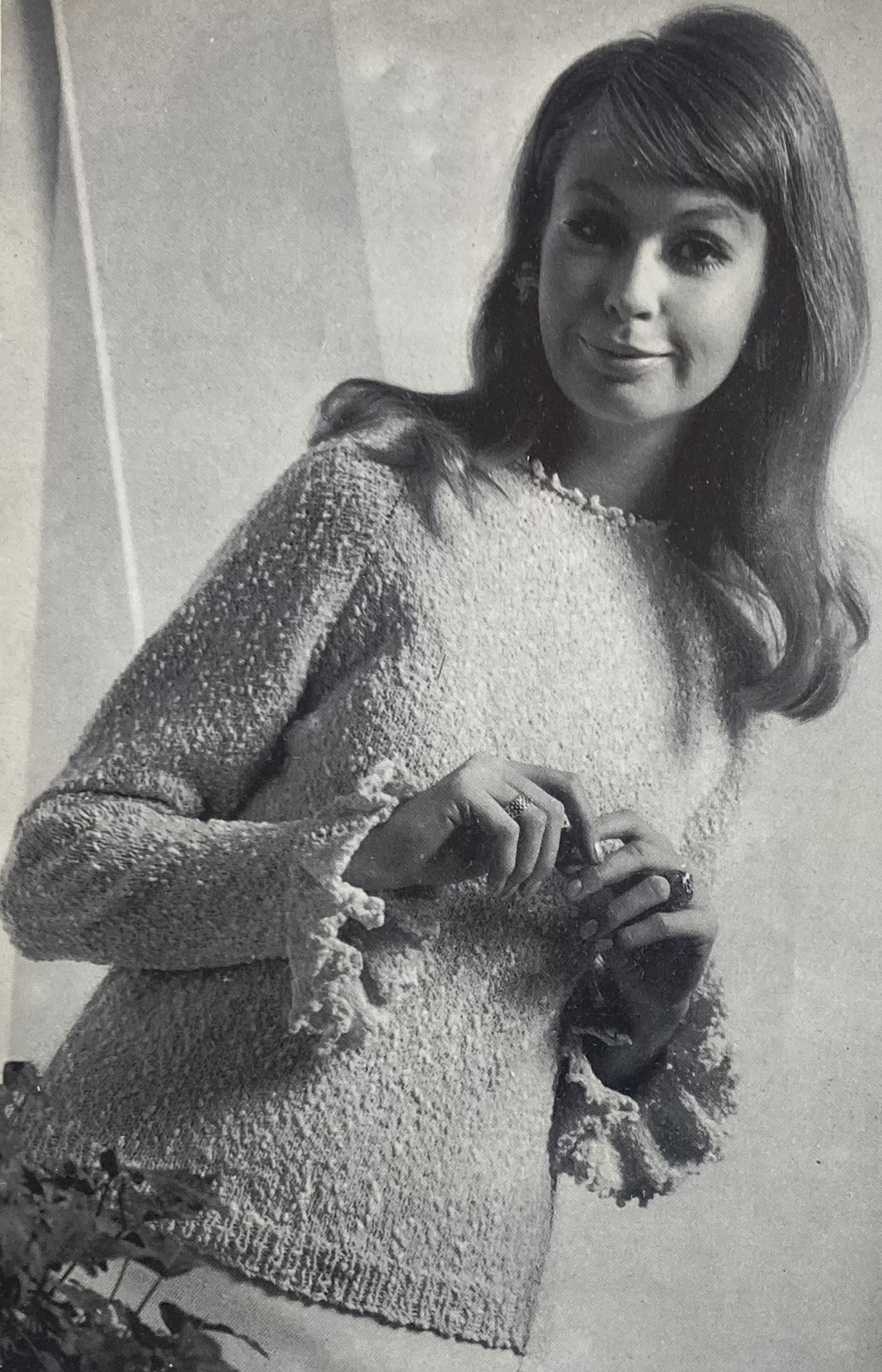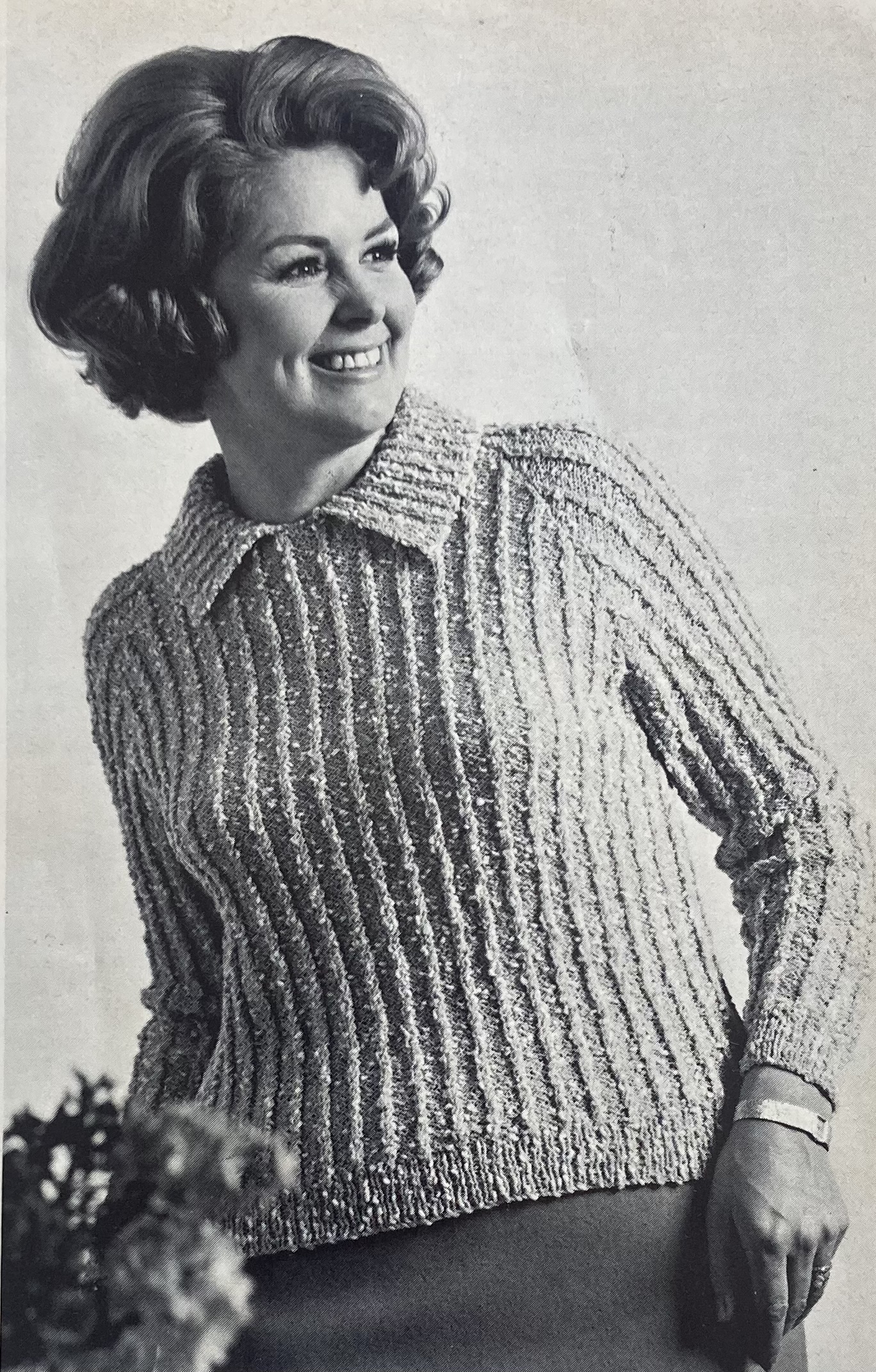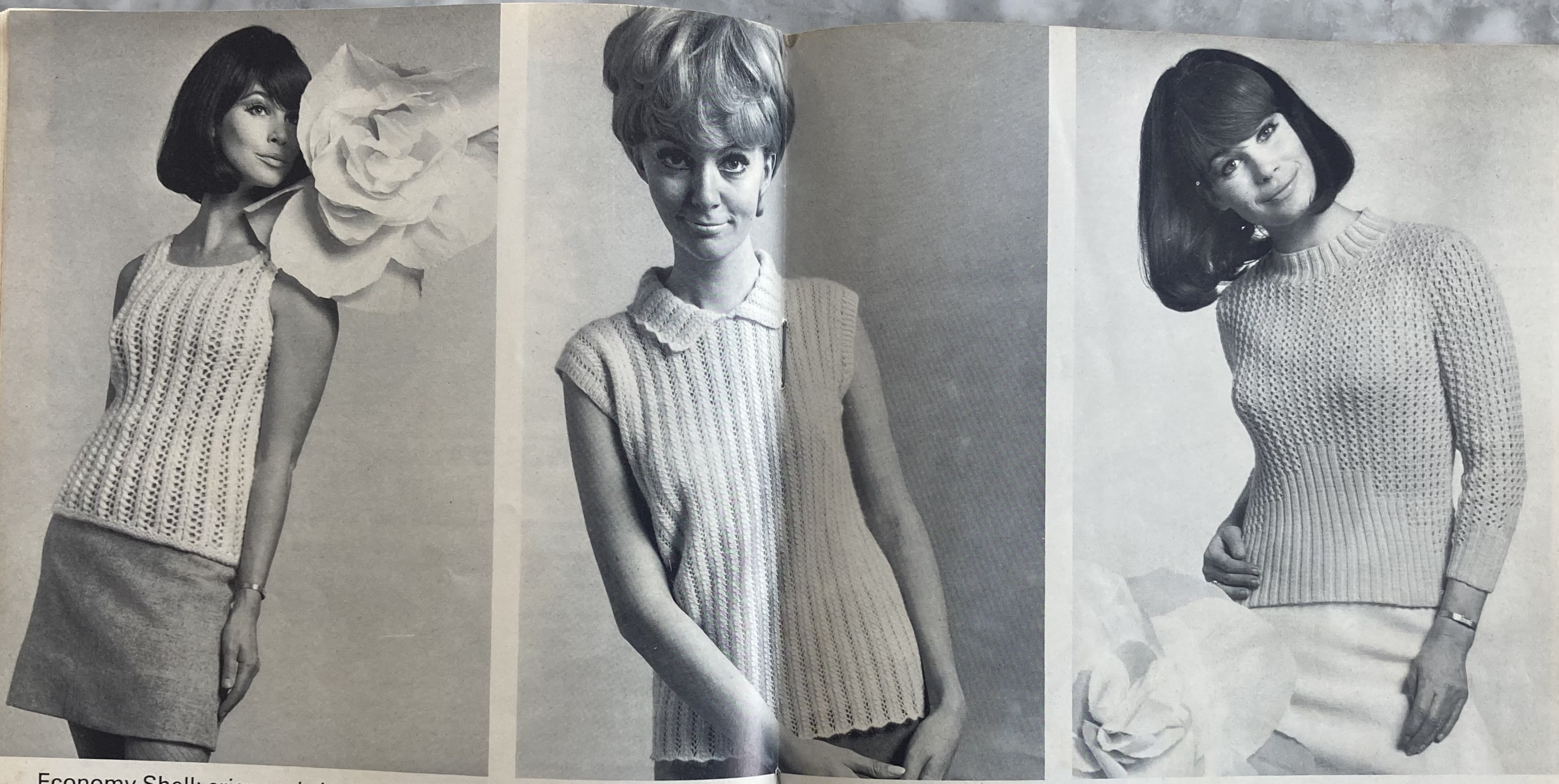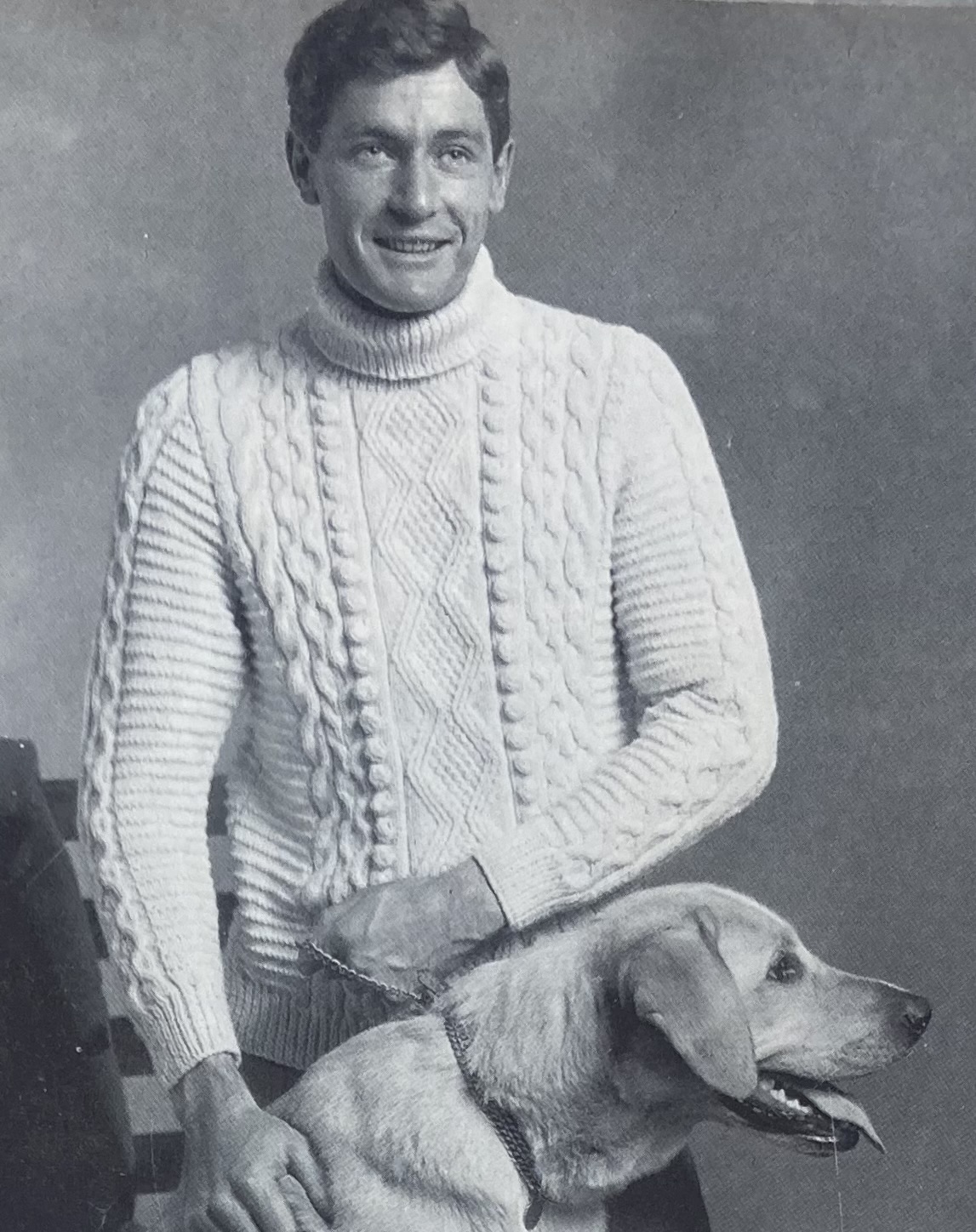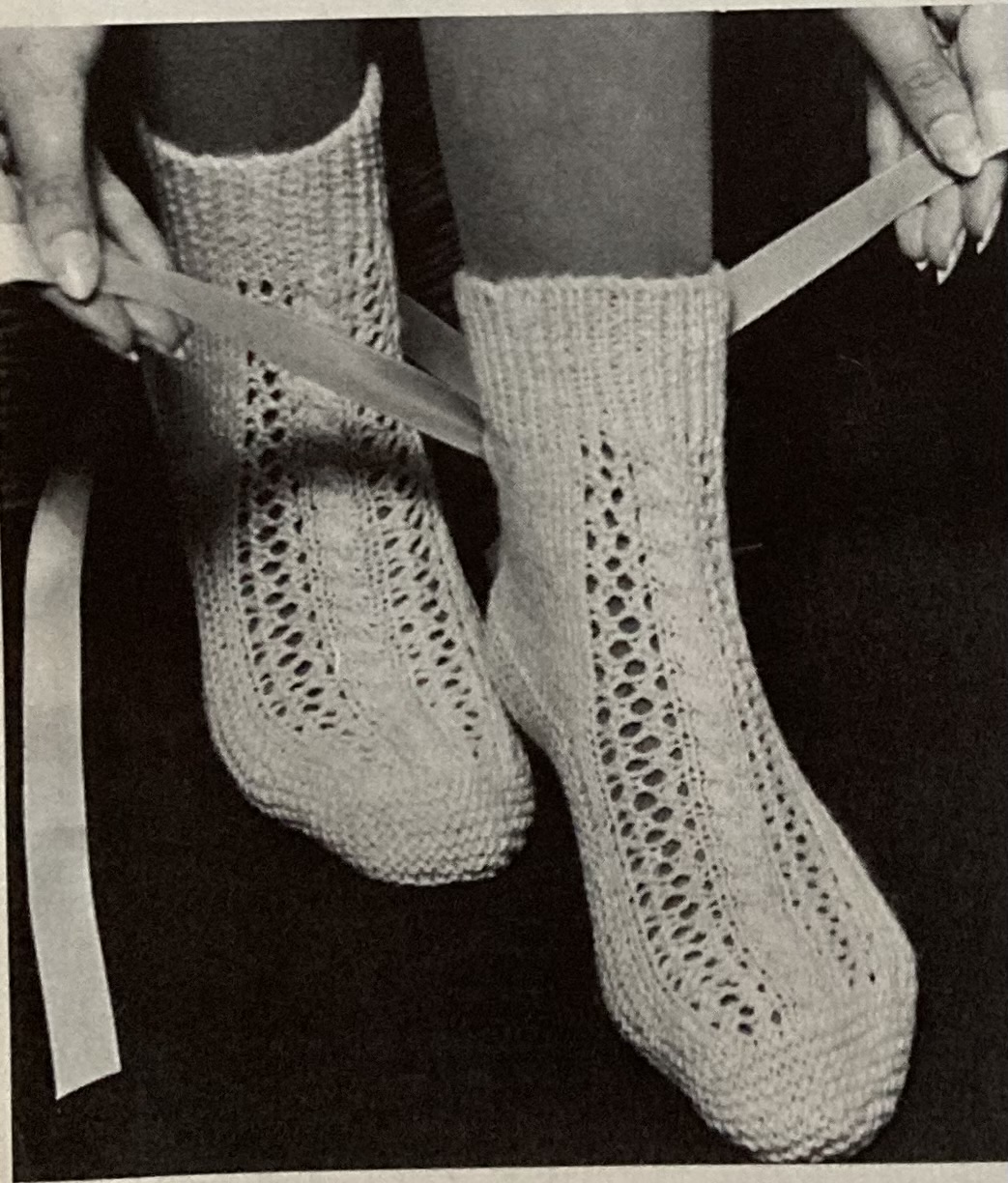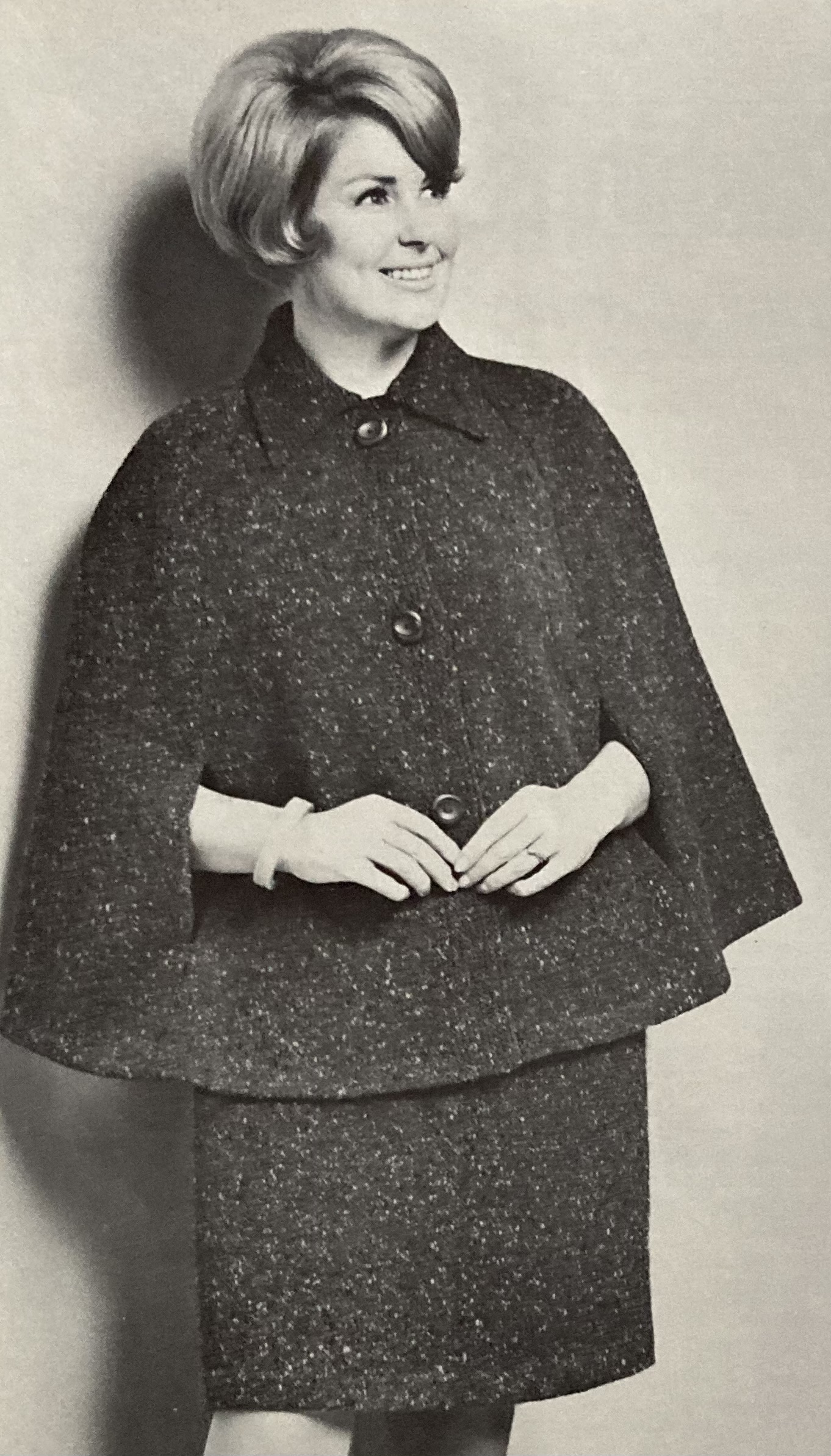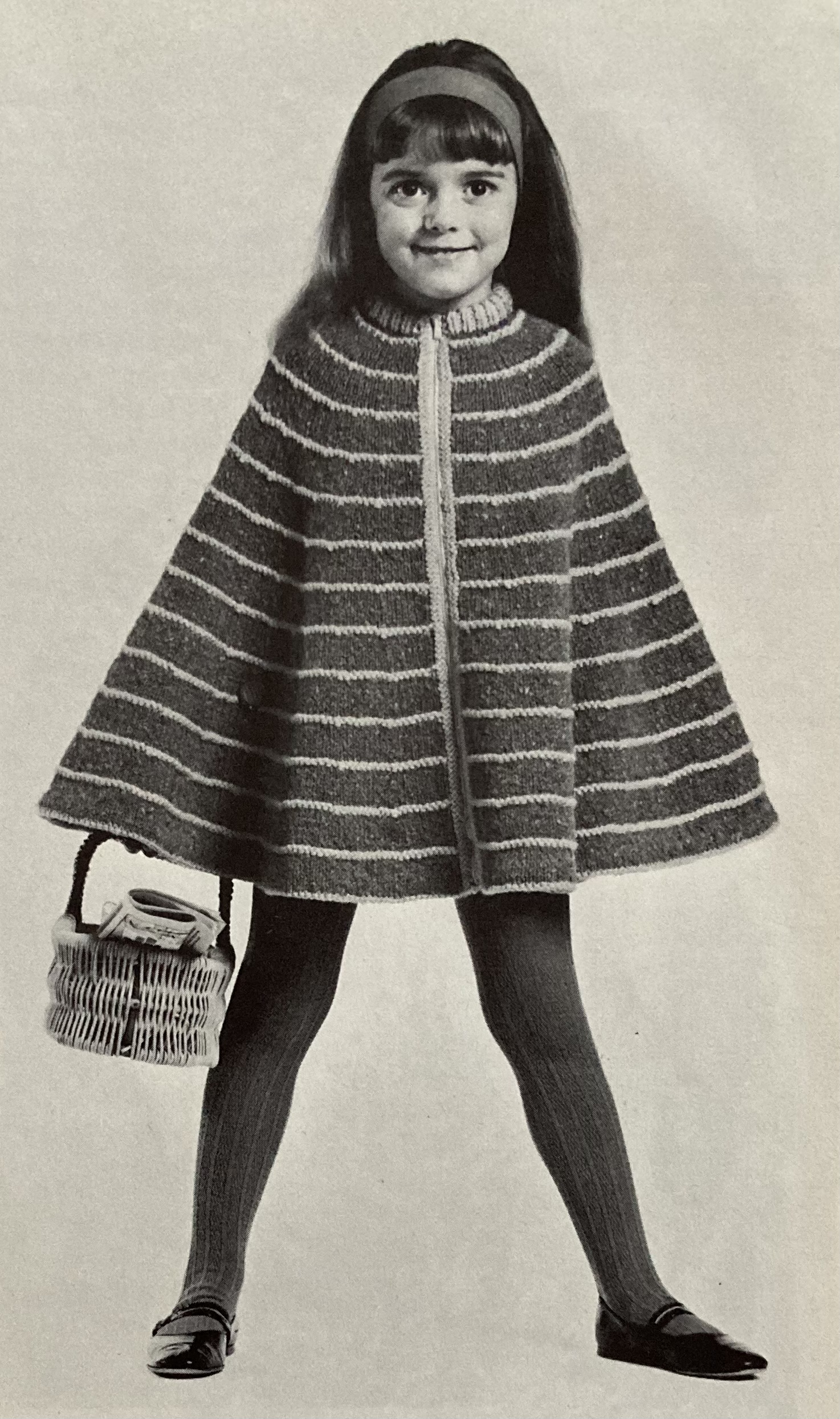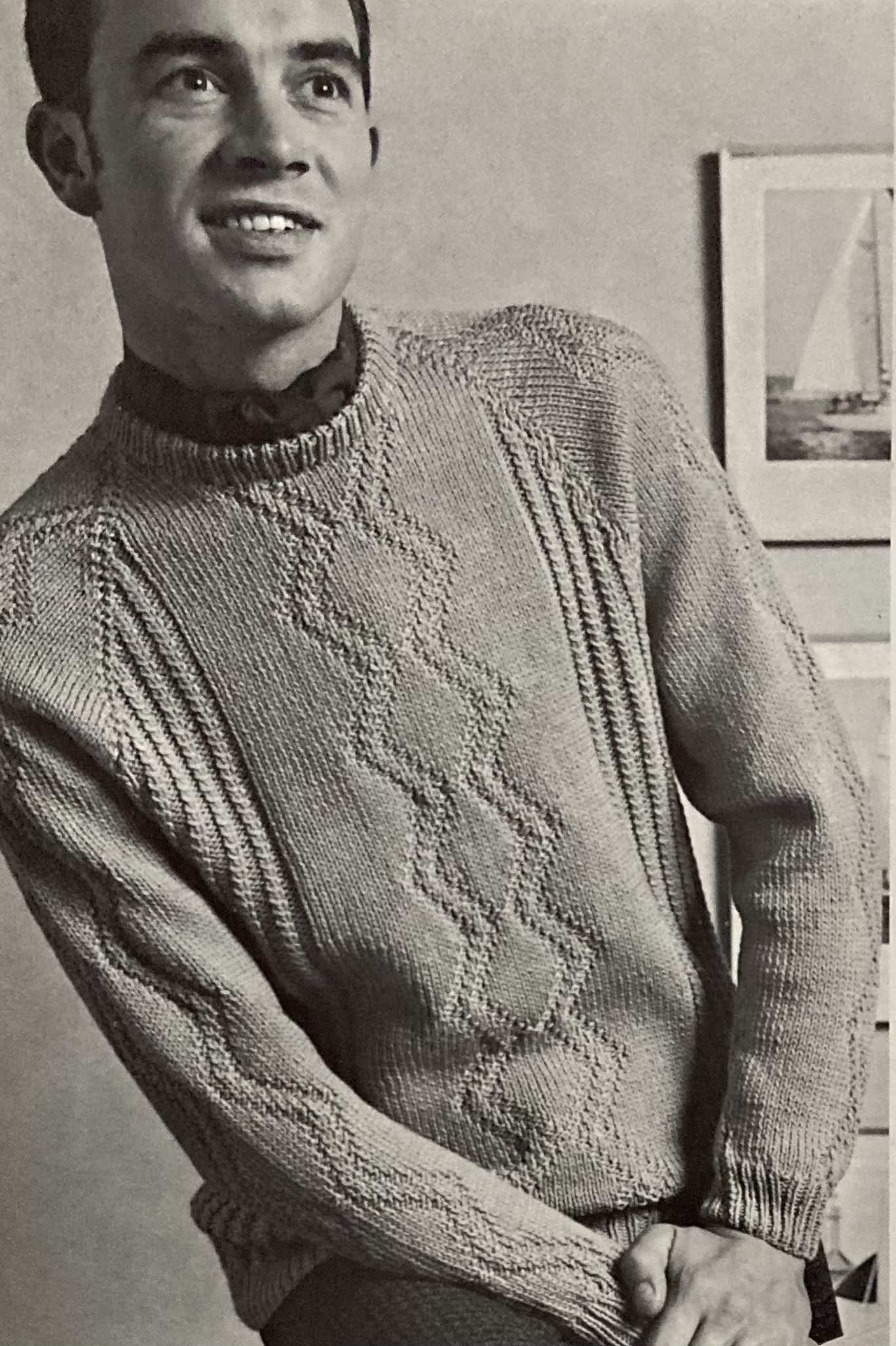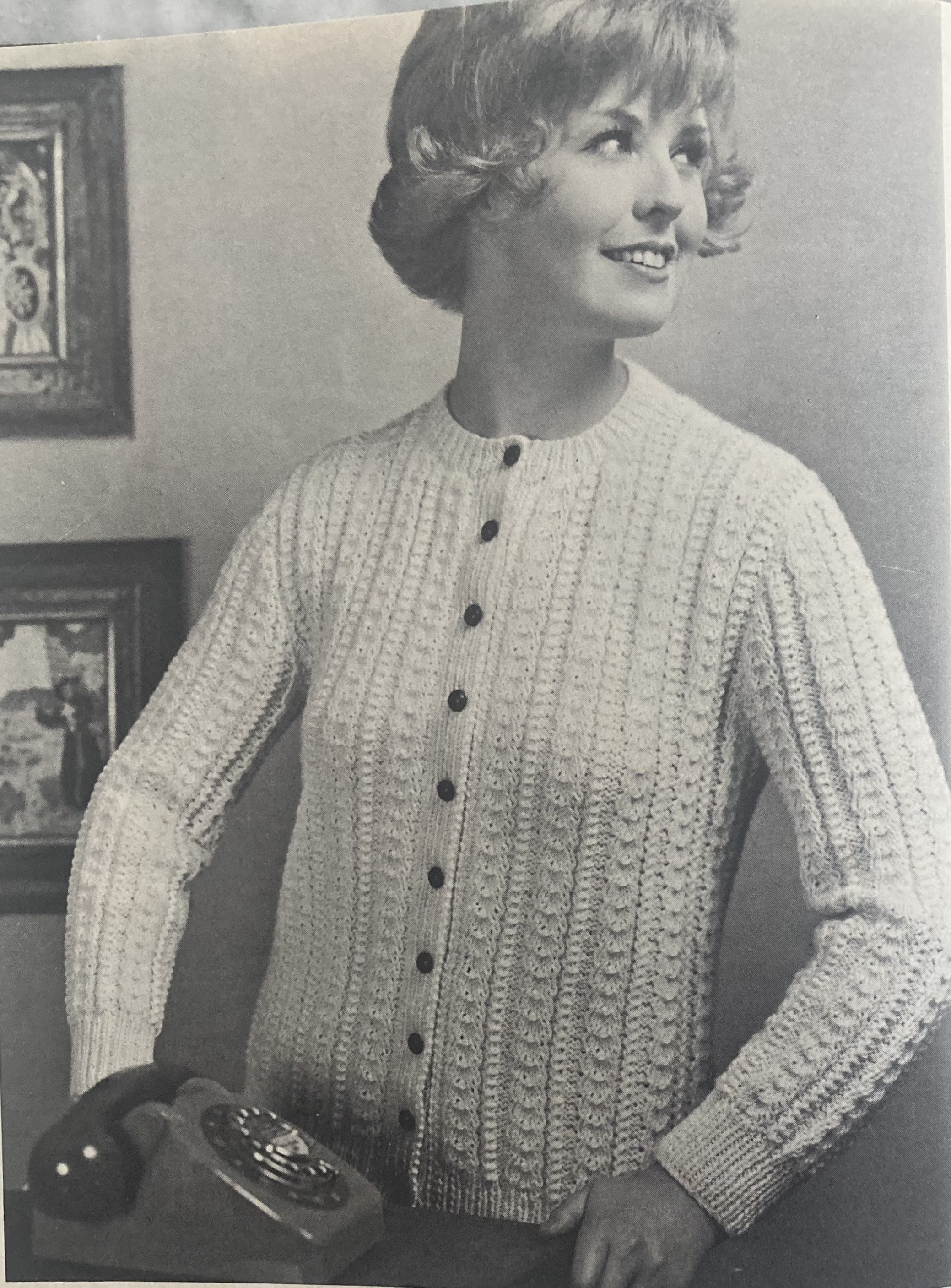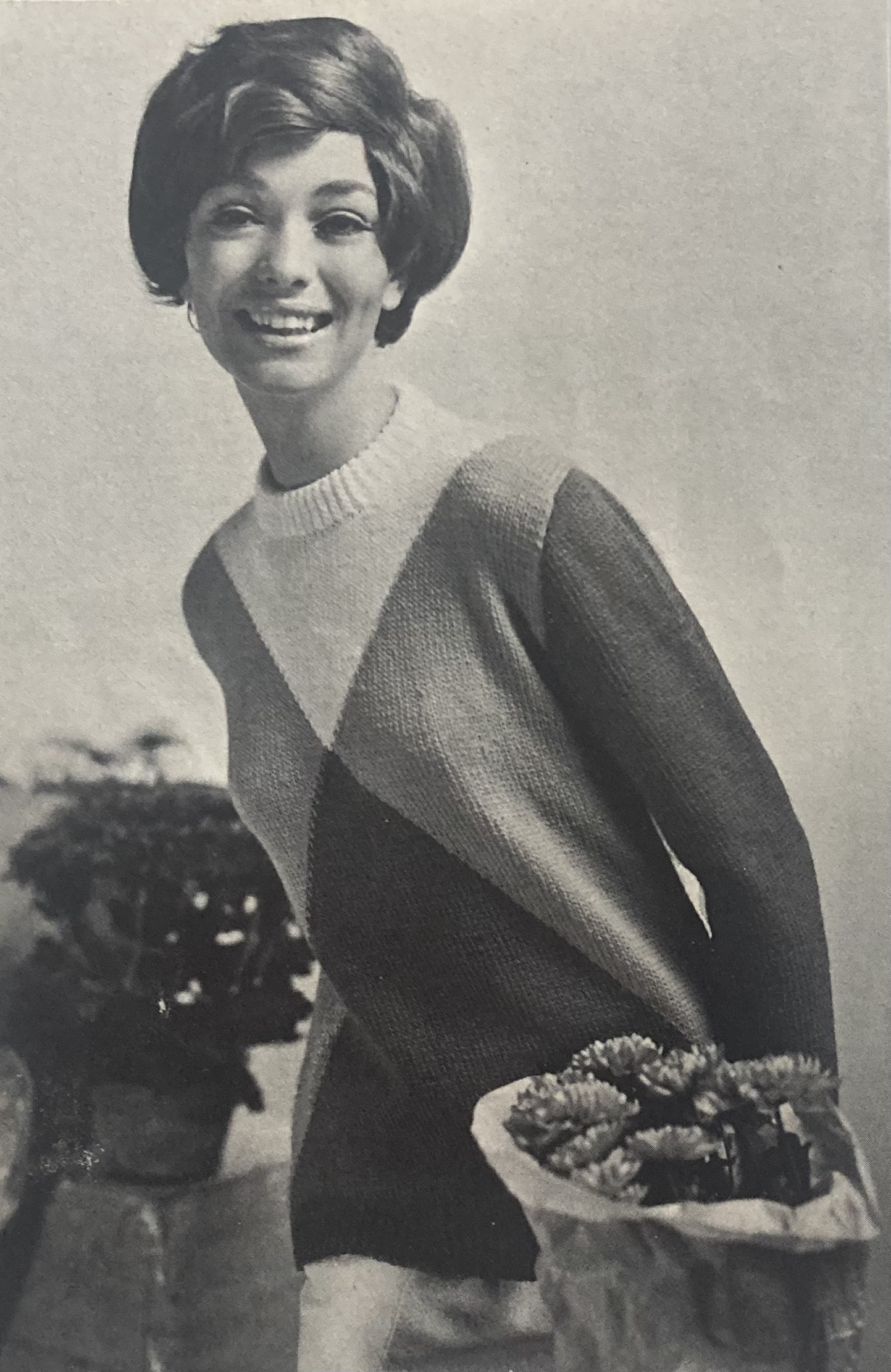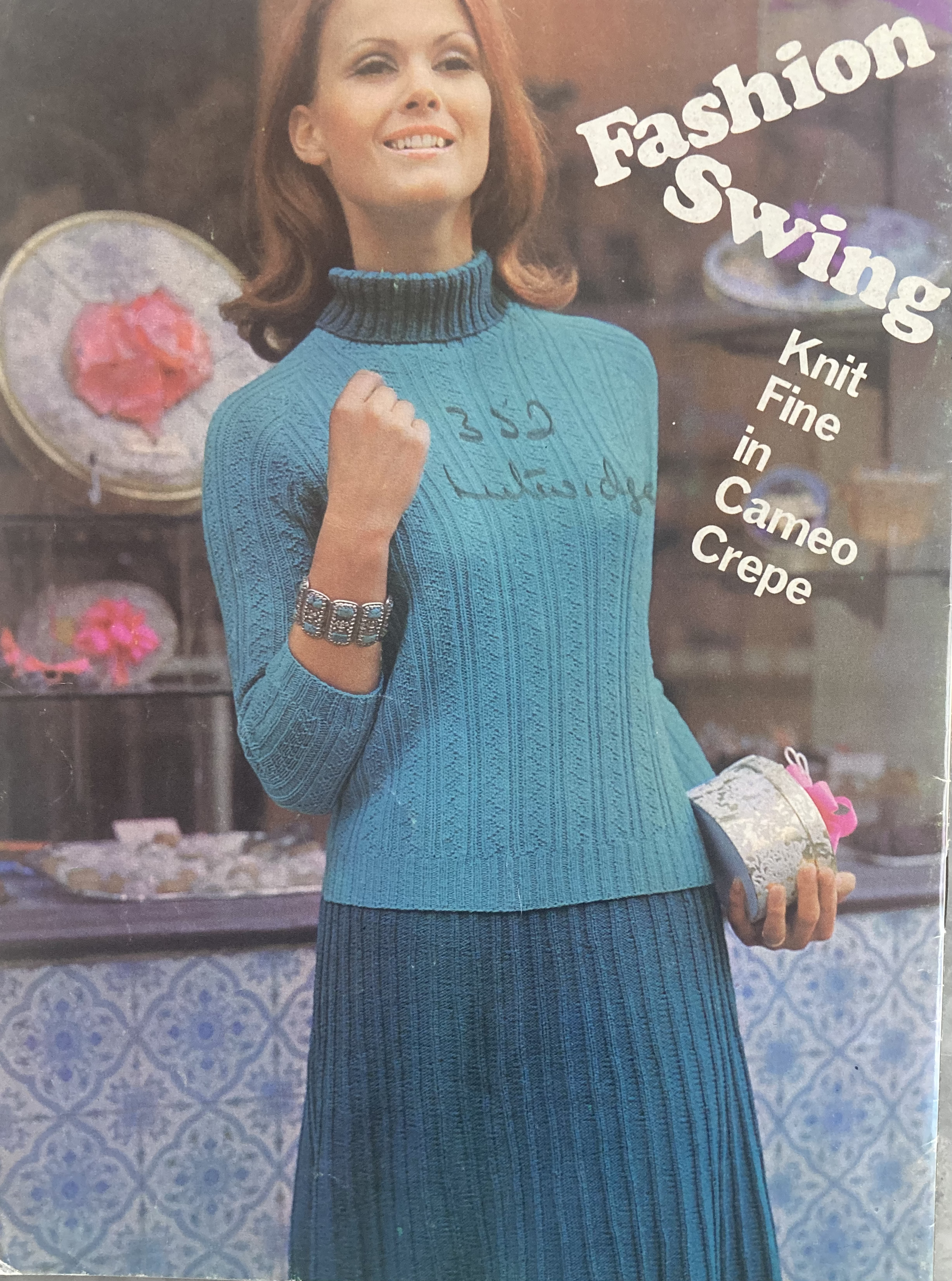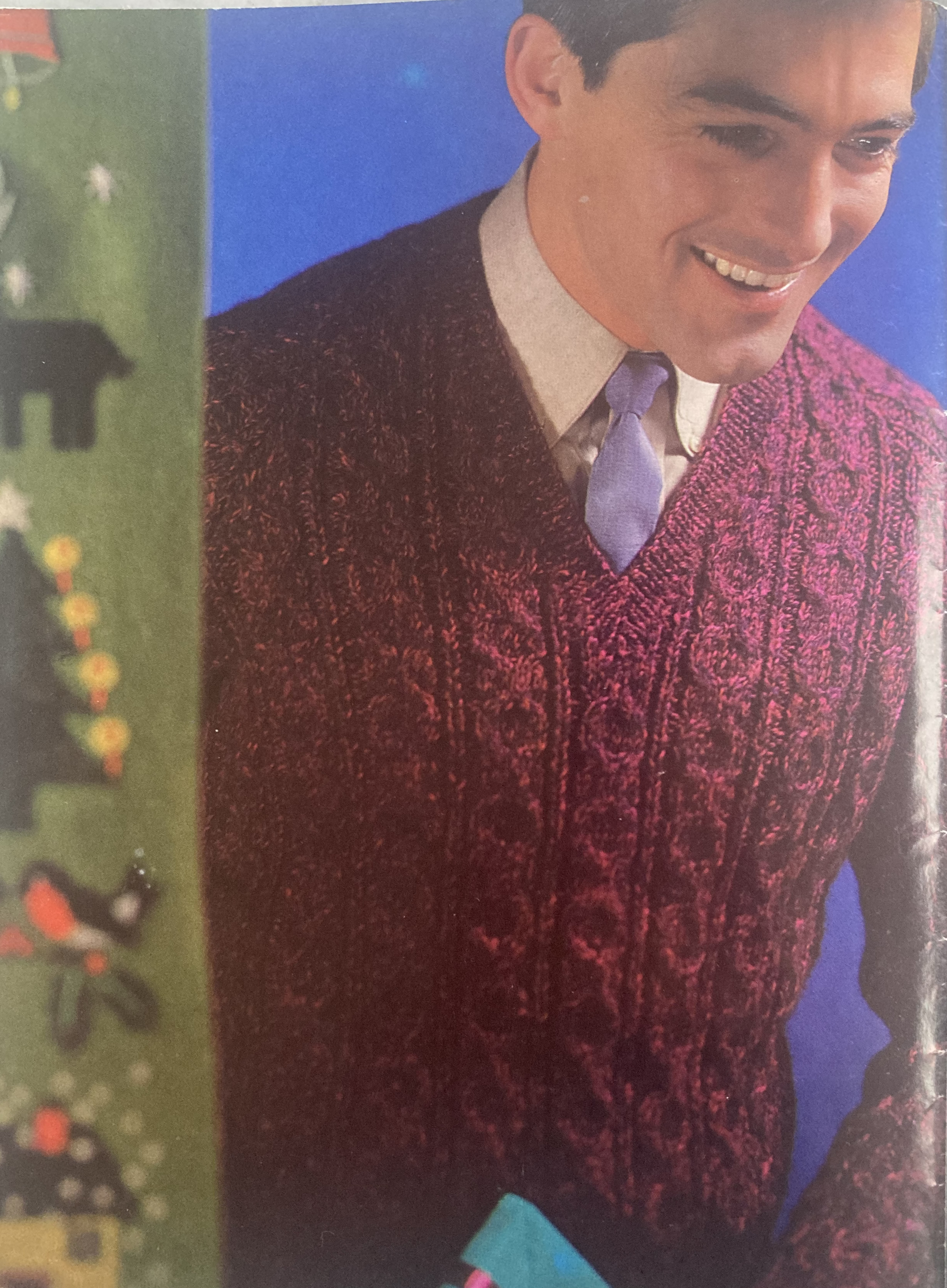
June 1967: Overview

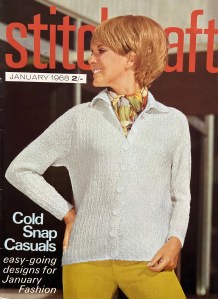
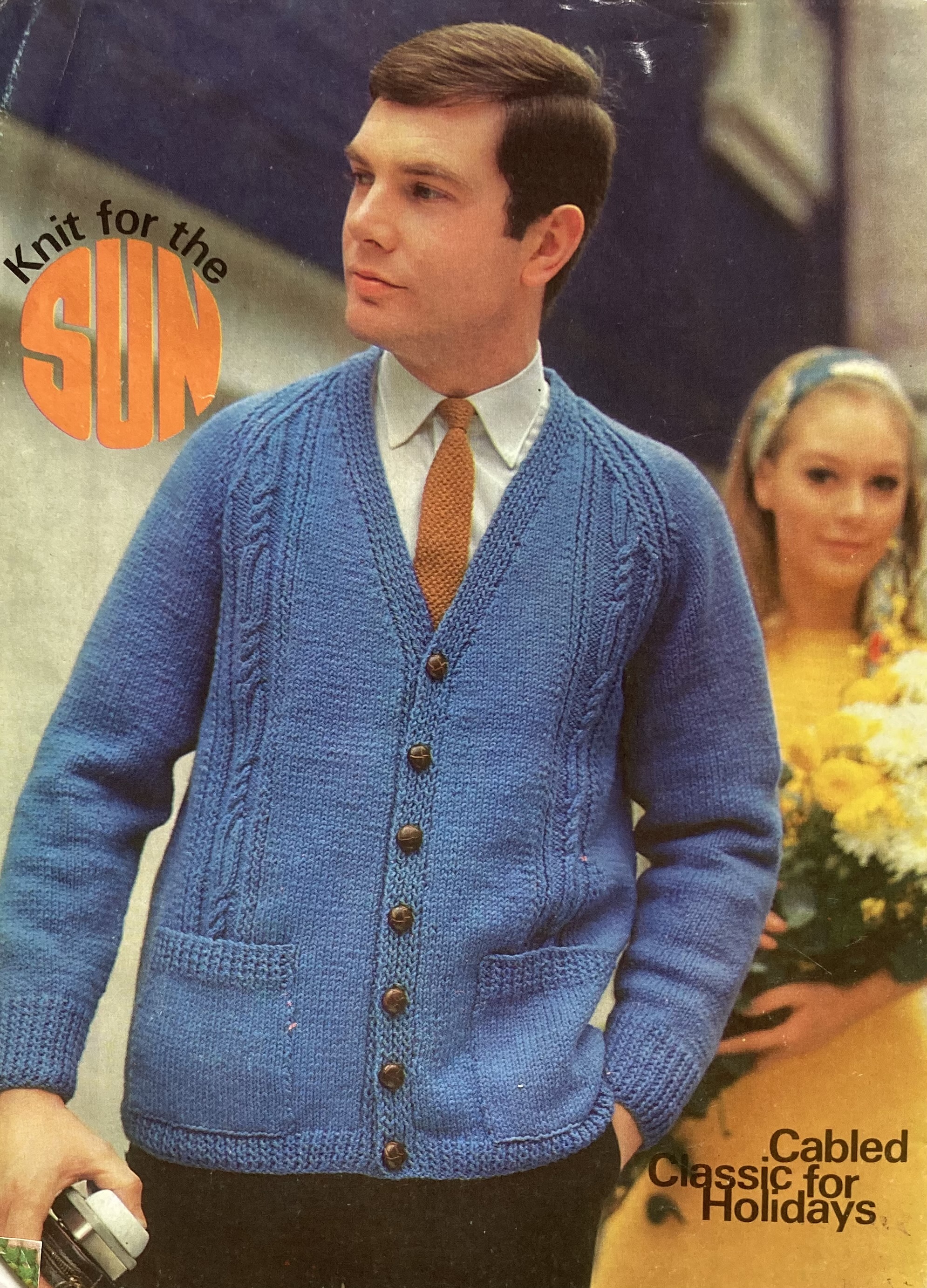
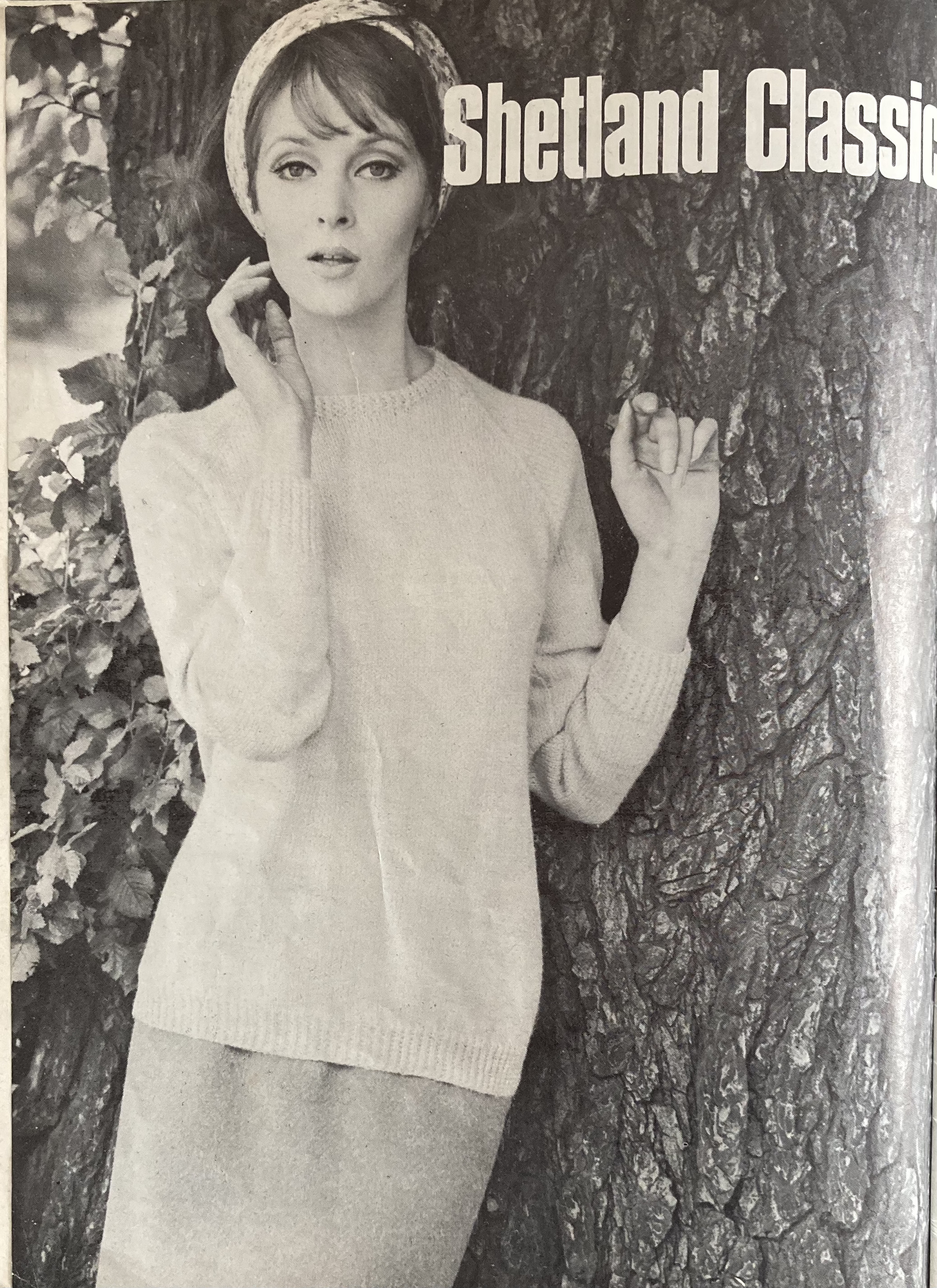
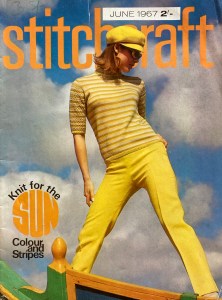
“Knit for the SUN” is the theme of the June 1967 issue of Stitchcraft, and our cover model gives us the best example of that in her striped and sunny yellow outfit.

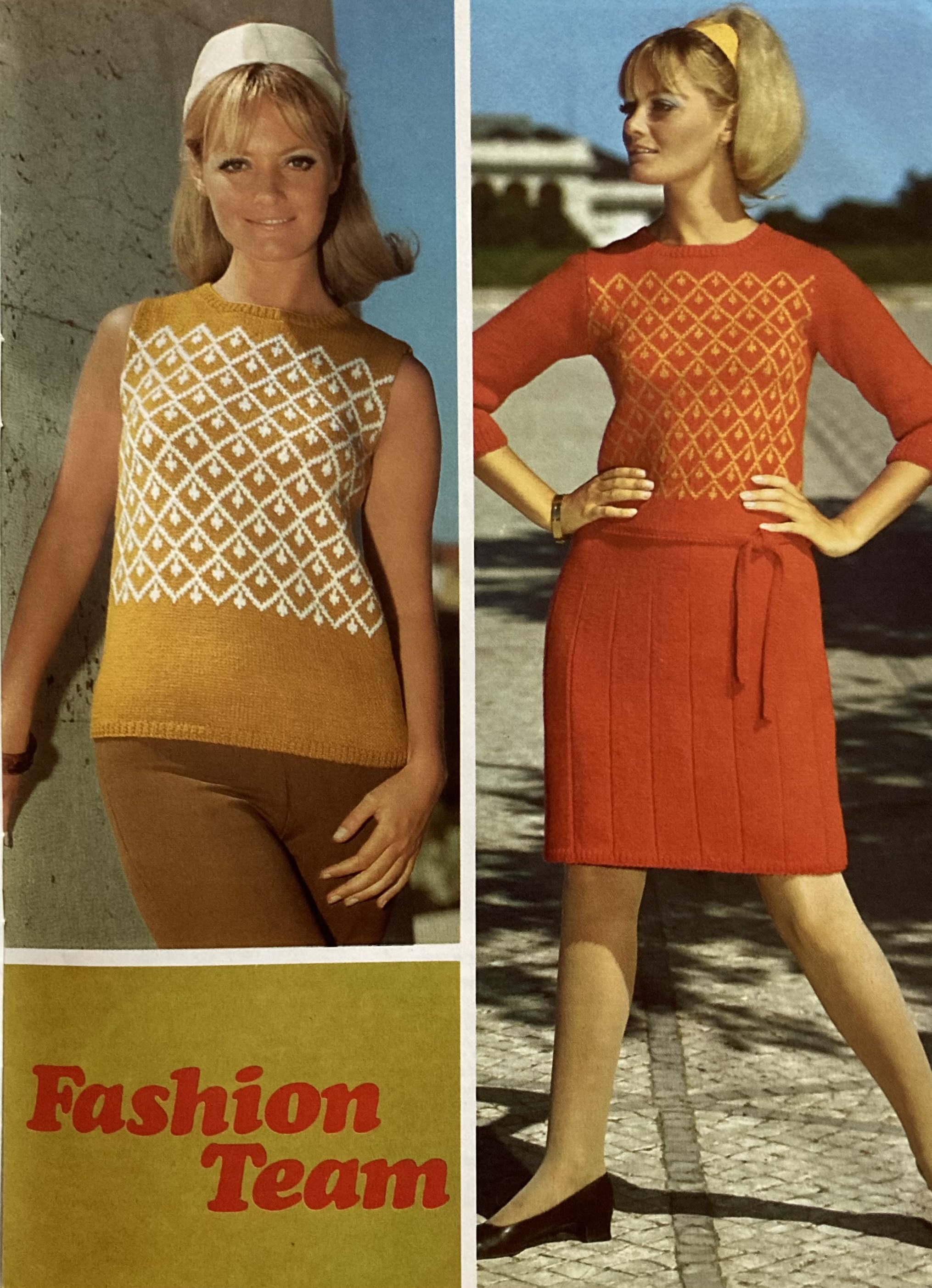
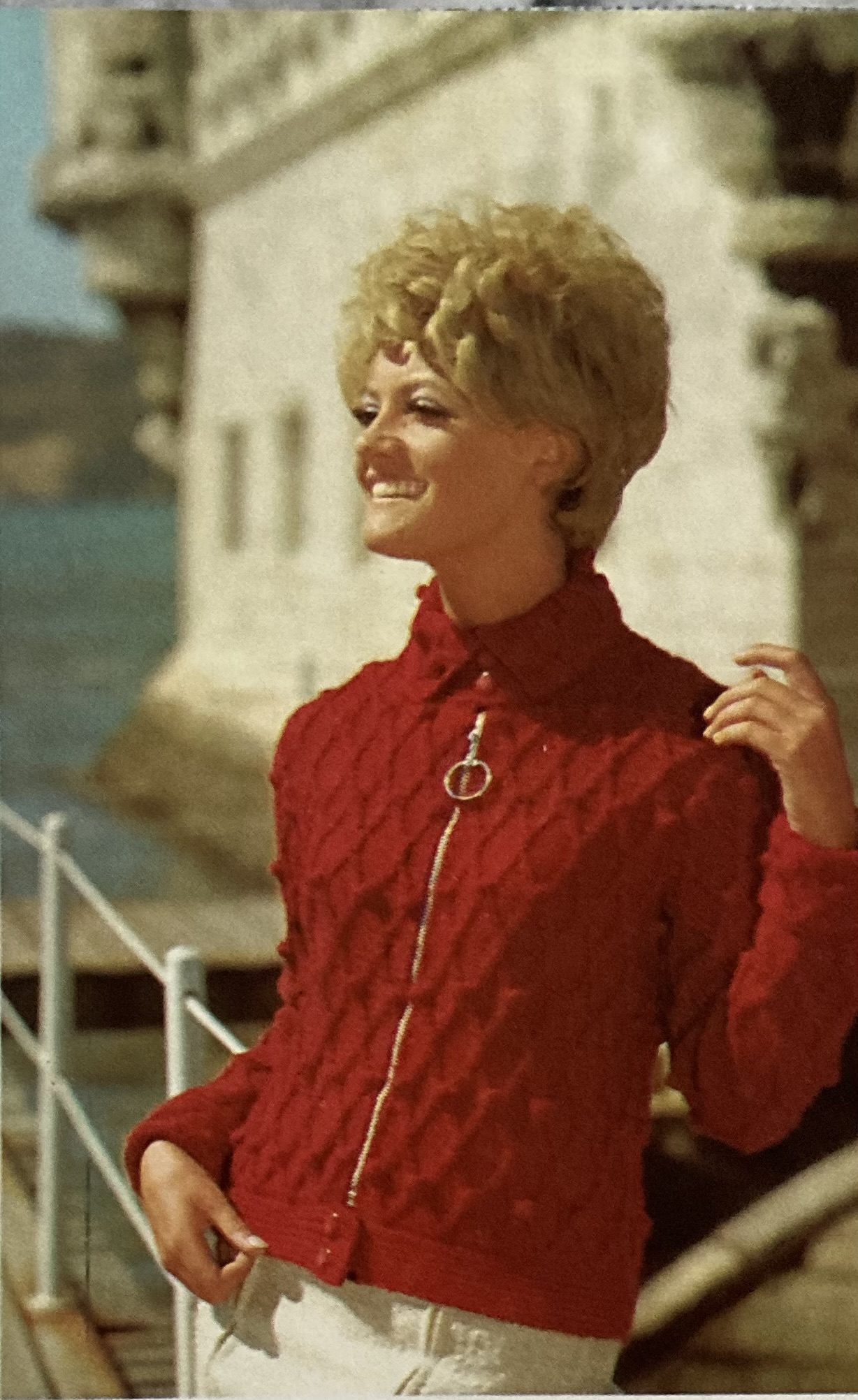
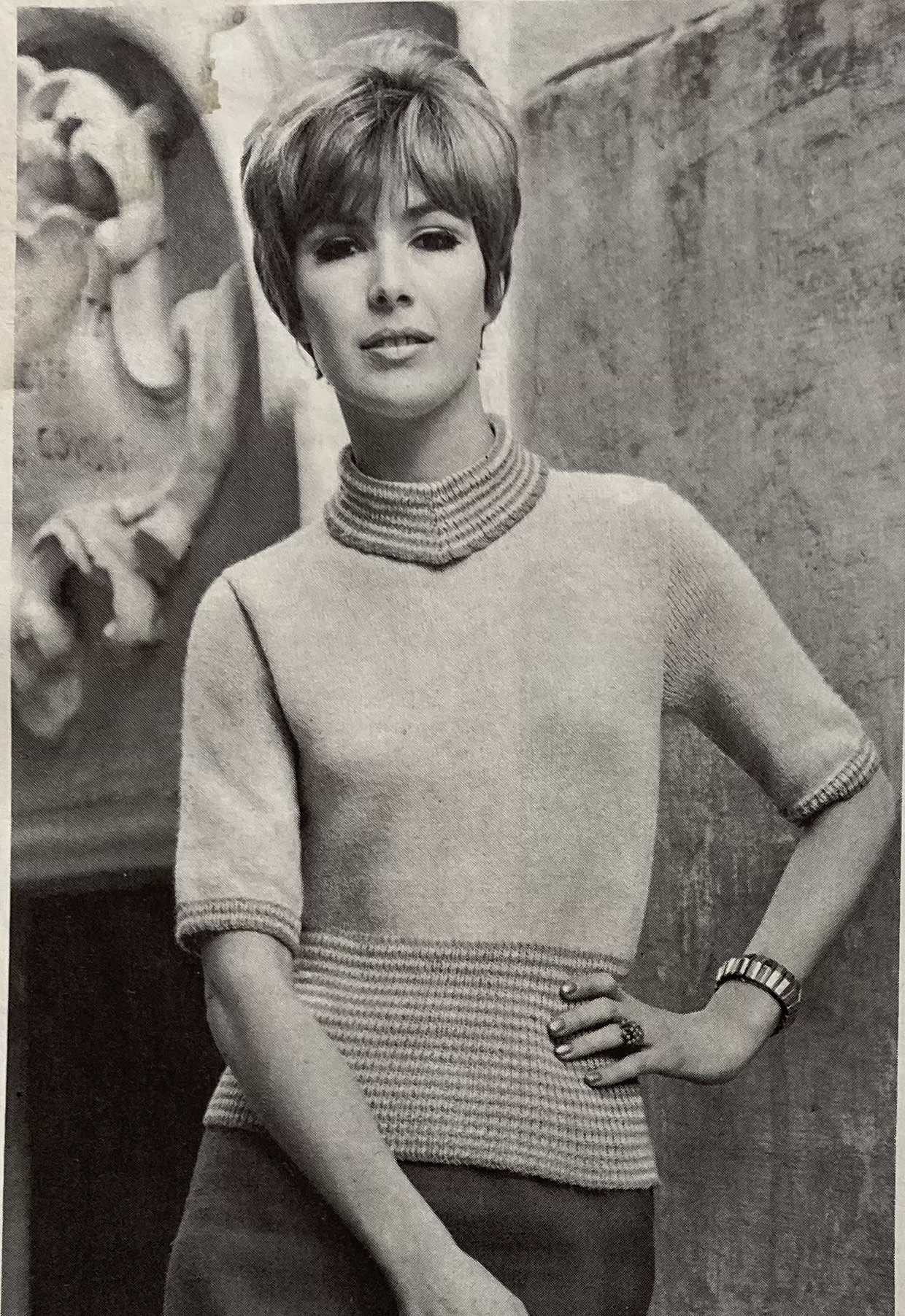
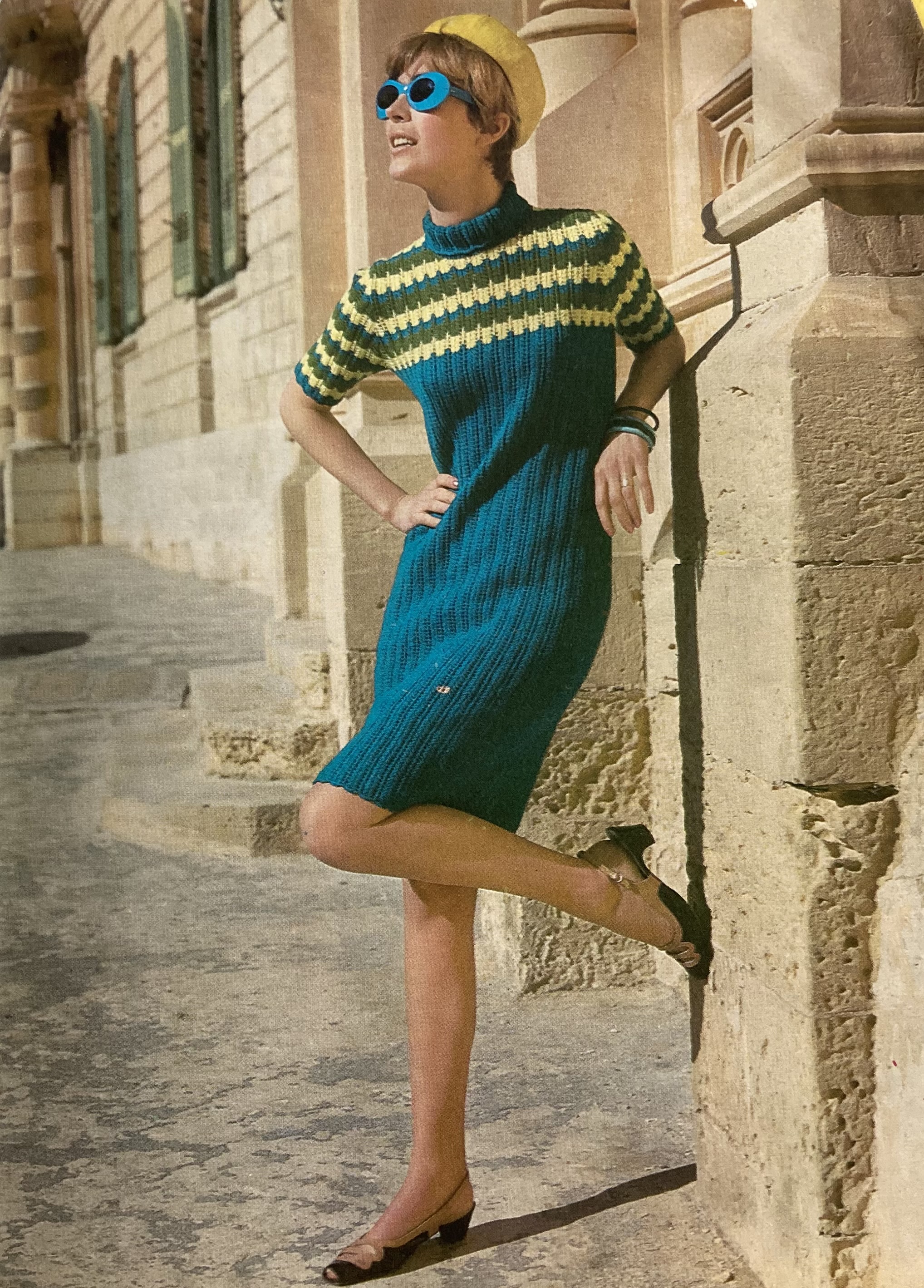
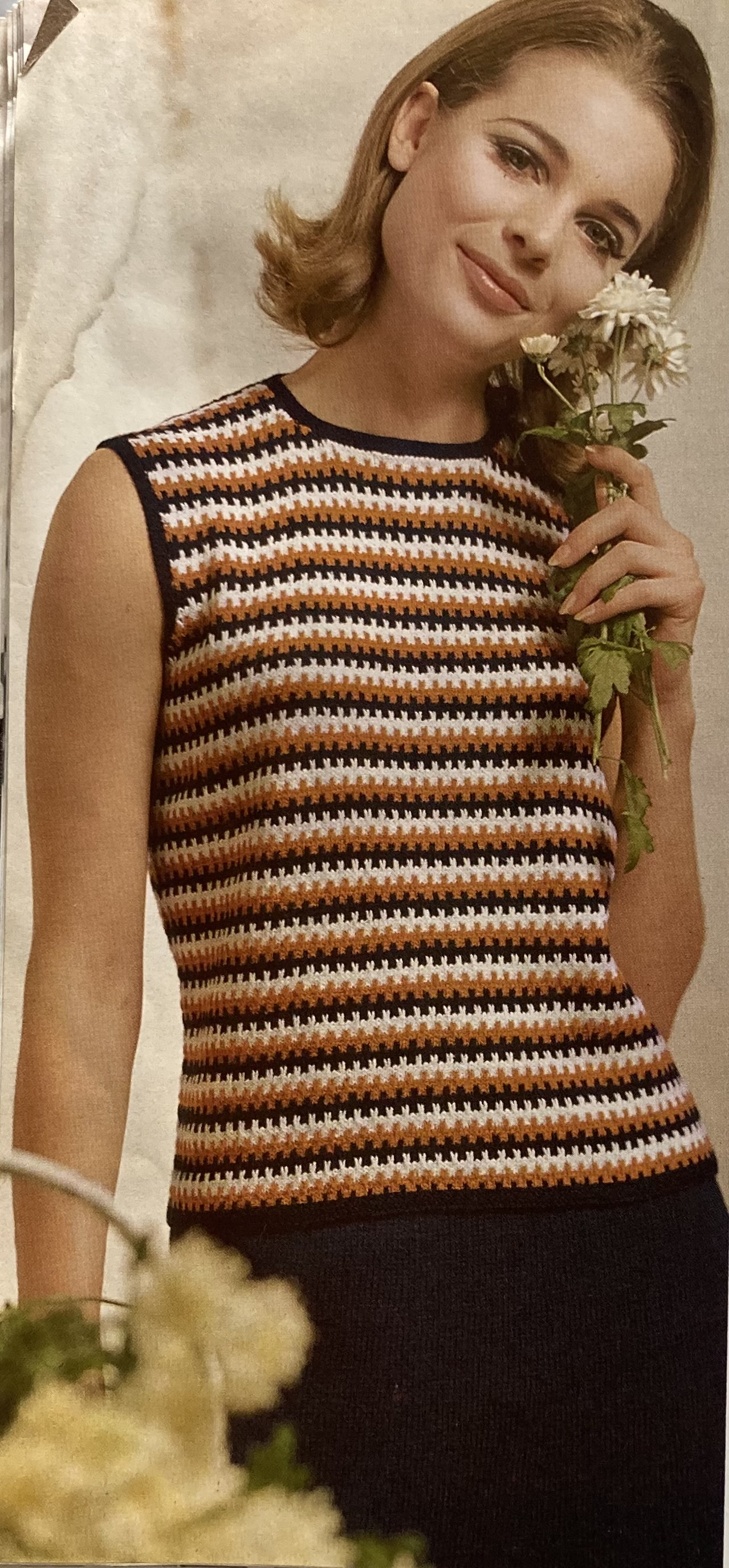
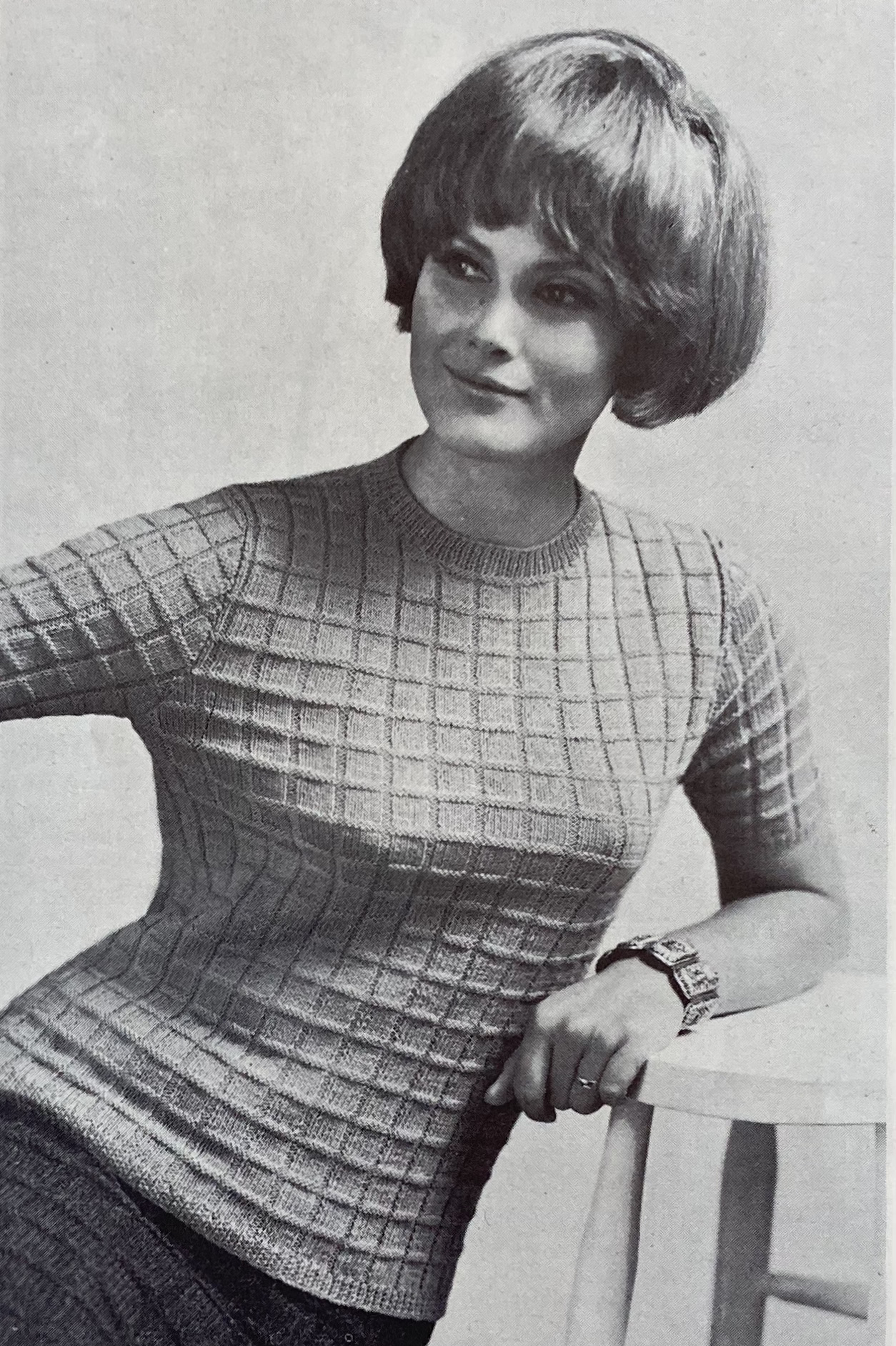
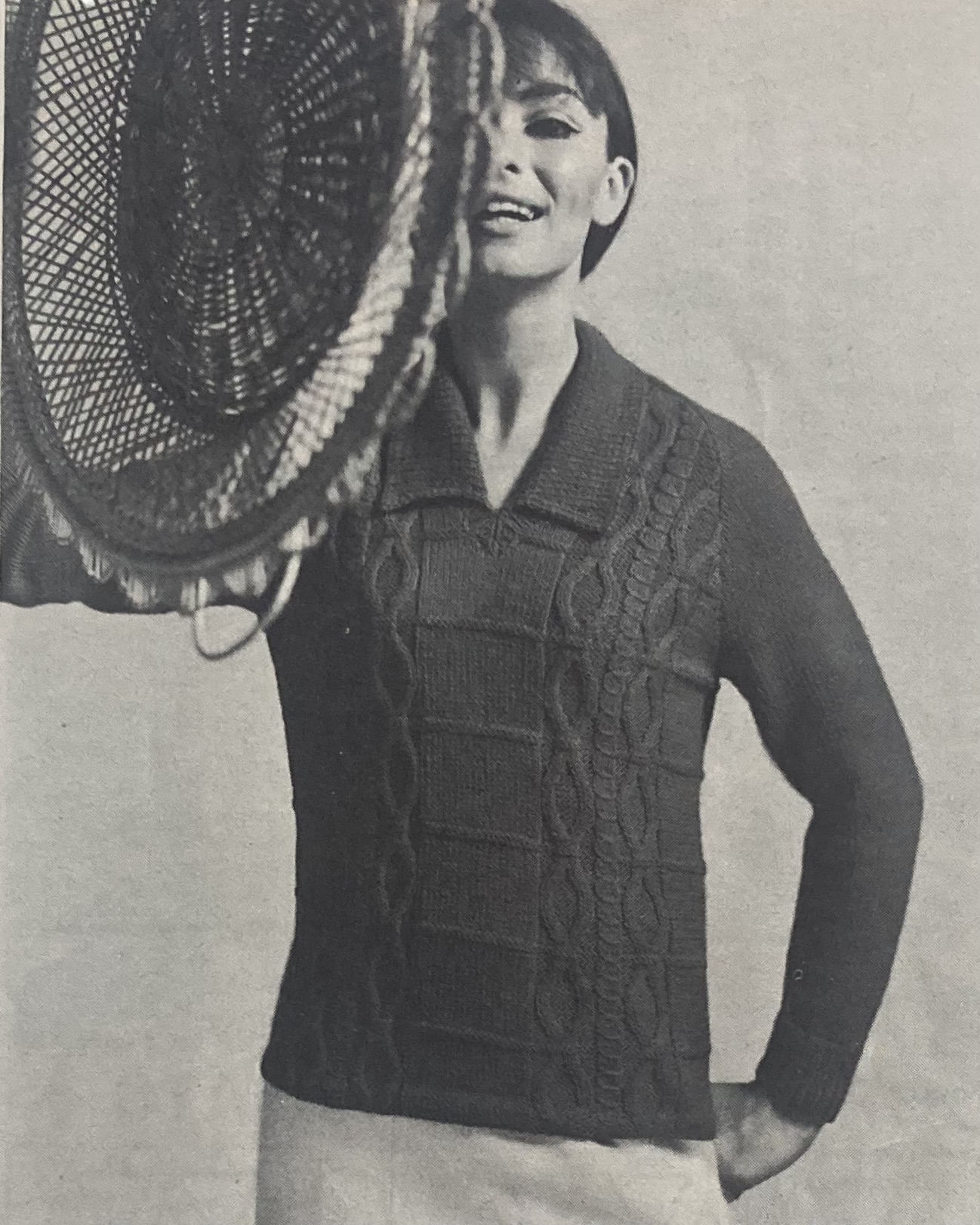
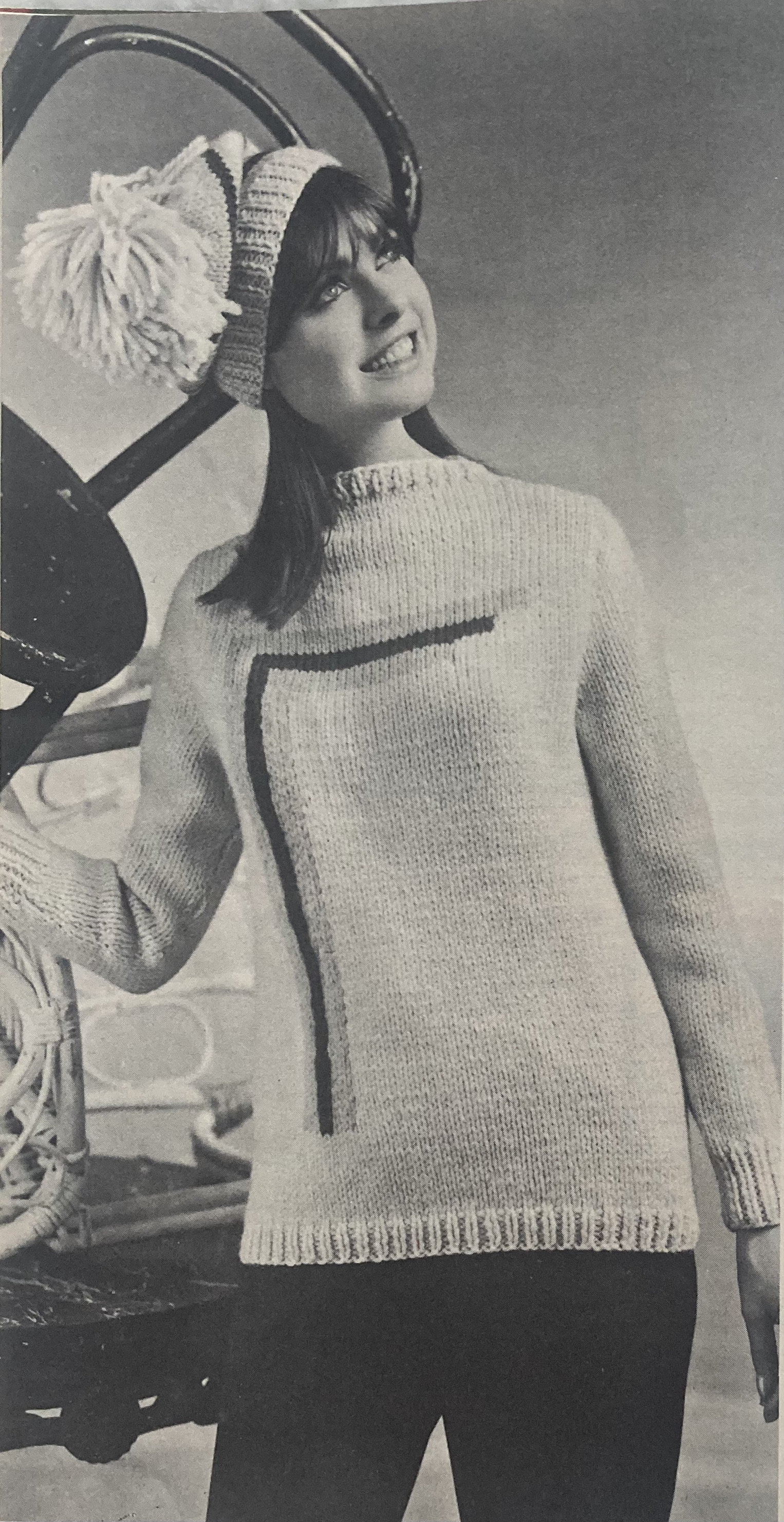
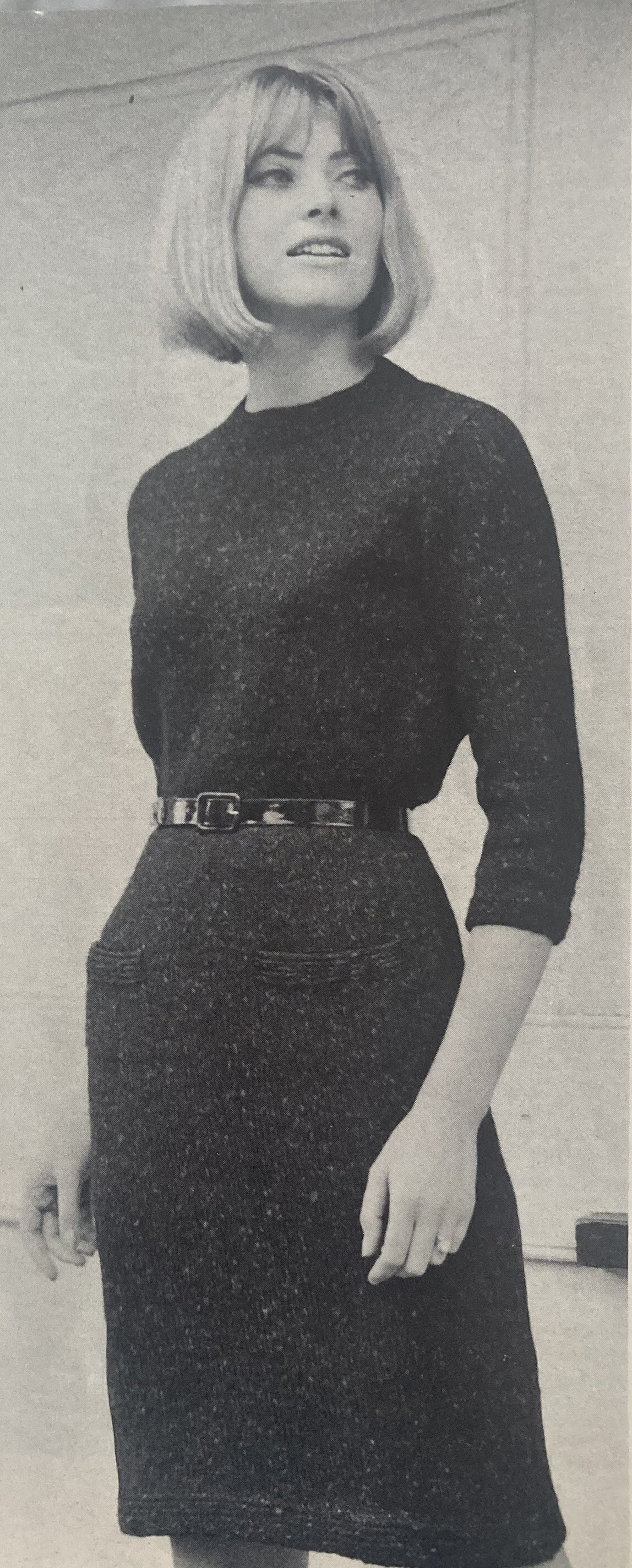
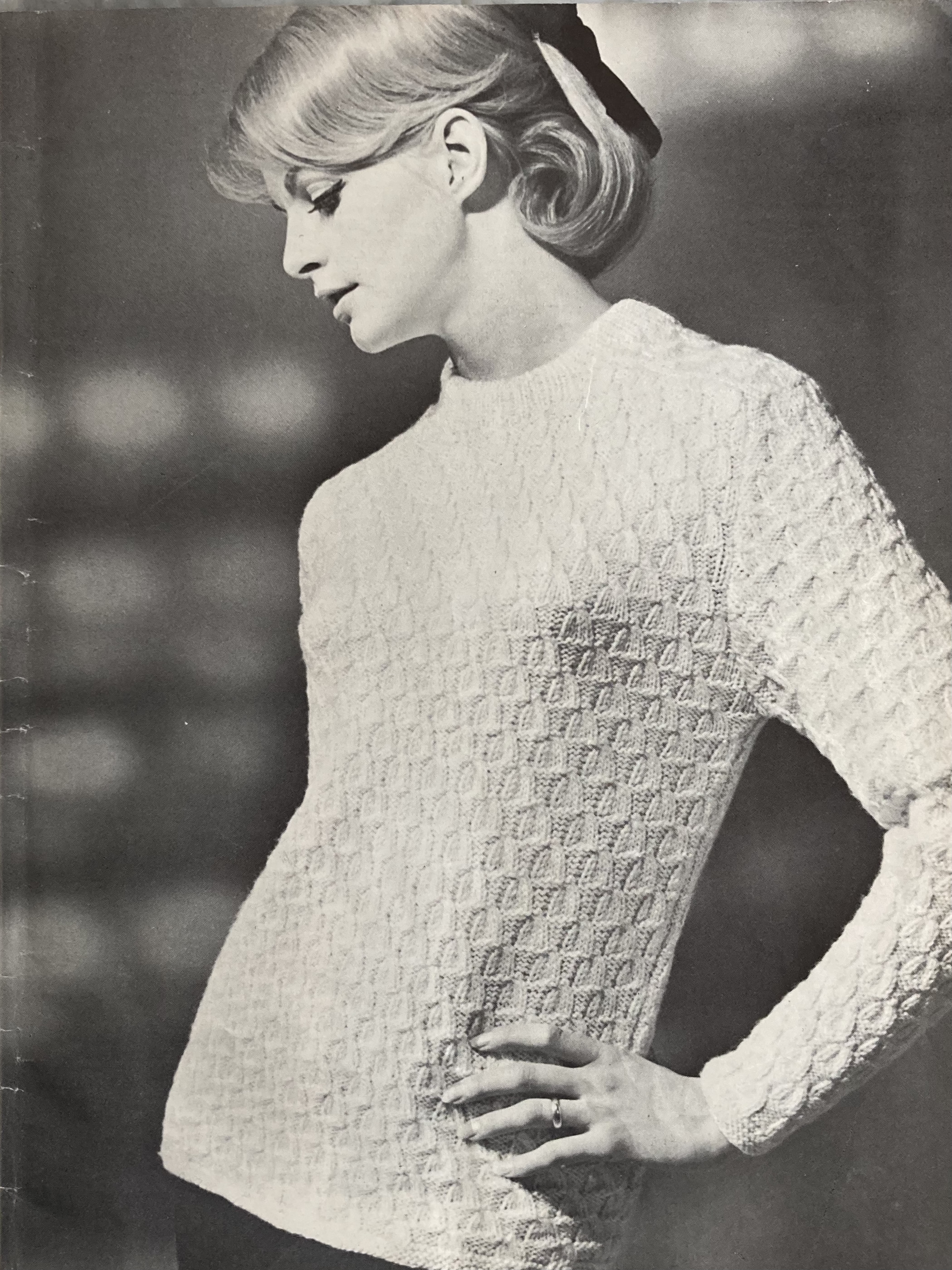
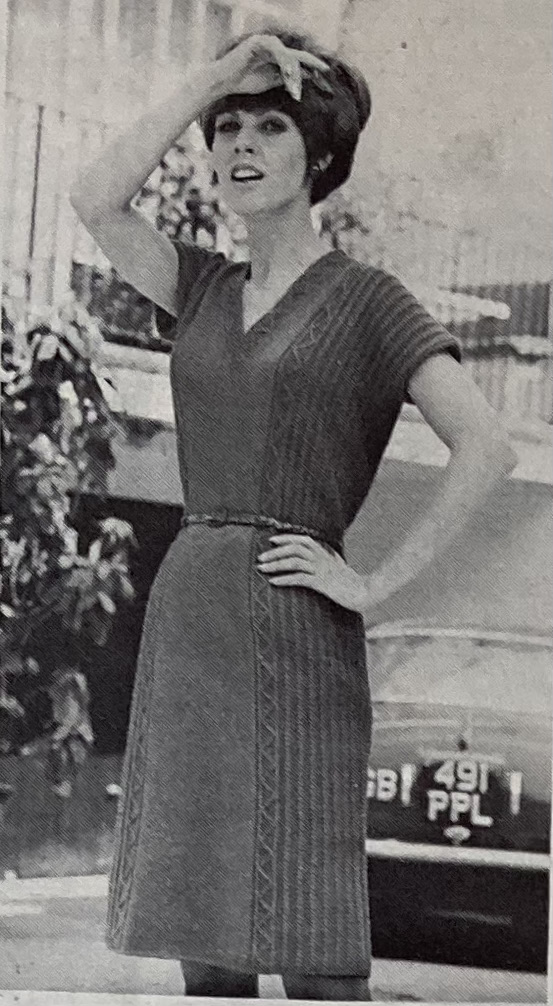
“Stripes and Colour” show up in different ways in this issue, combined with stitch patterns and stranded colourwork for novelty and texture. The pullover on the cover has normal stocking-stitch stripes on the front and back and a novel mini-cable pattern on the sleeves which mixes the four-row colour repetition with a two-stitch cable every four stitches on every fourth row, alternating left- and right- leaning cables for a zigzag effect. Another short-sleeved pullover has striped ribbing, but a plain body and sleeves. The “feathery lace” dress has vertical stripes implied by the ribbed lace pattern combined with plain horizontal colour stripes that look scalloped due to the stitch pattern. Love those sunglasses, too! And a sleeveless shell uses a slip-stitch pattern to make stripes with toothy ridges.

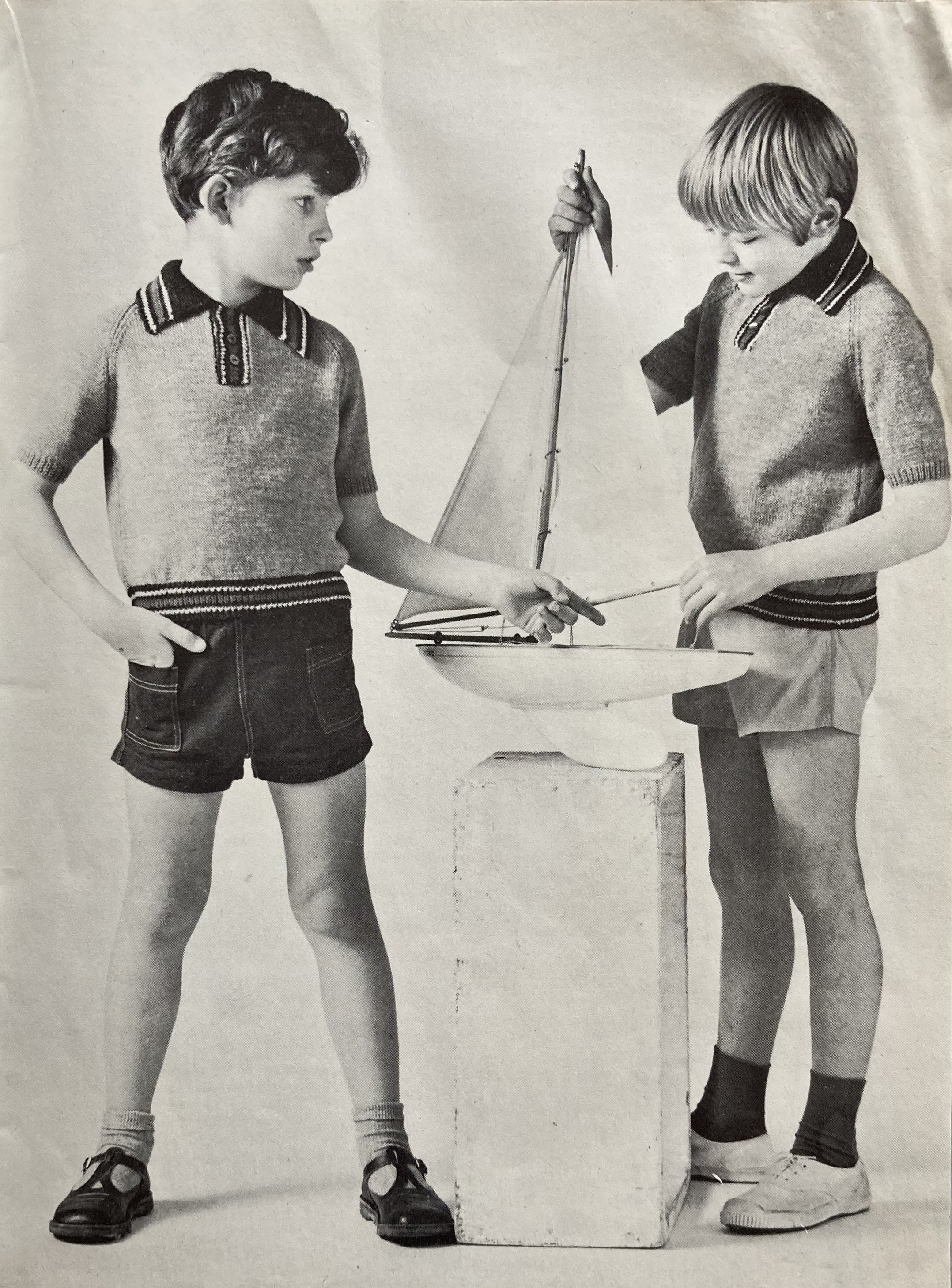
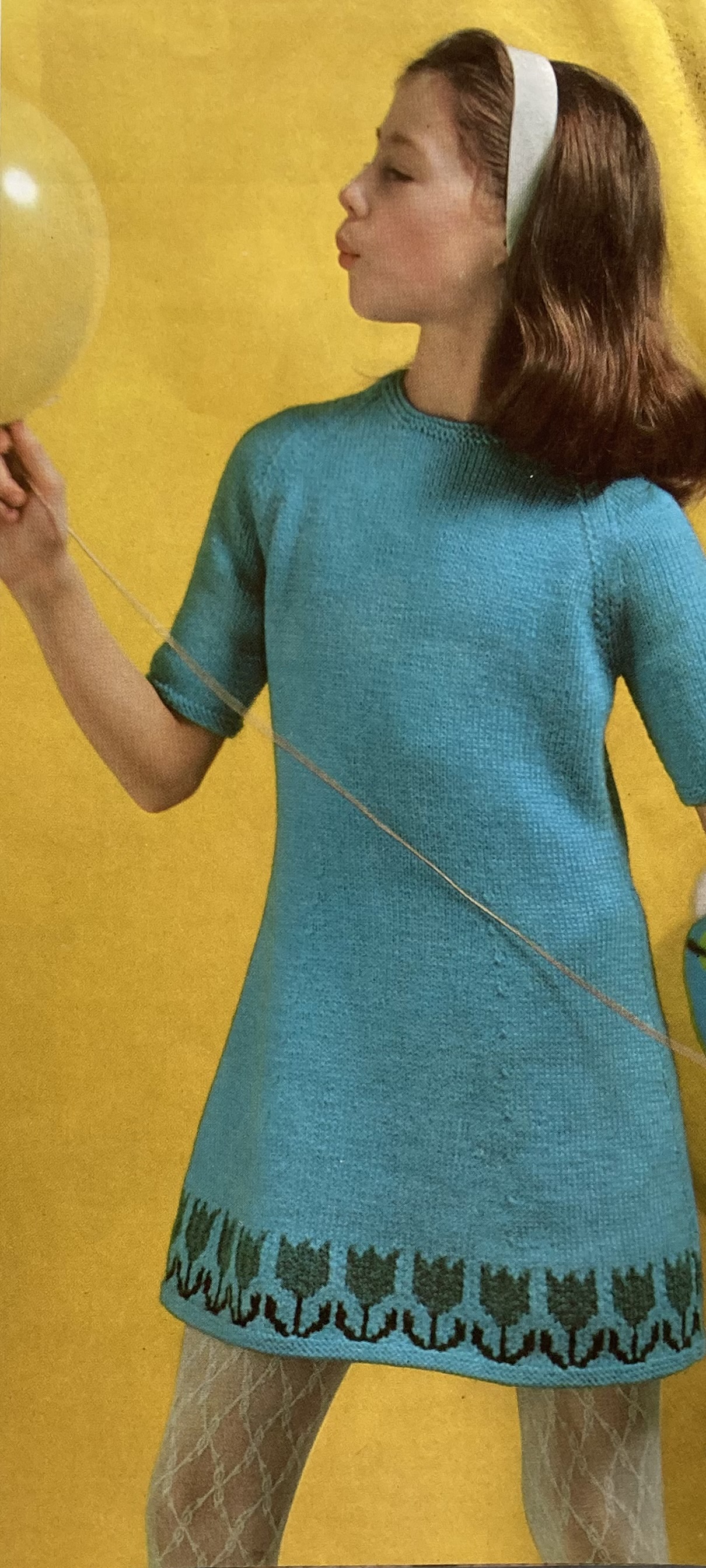
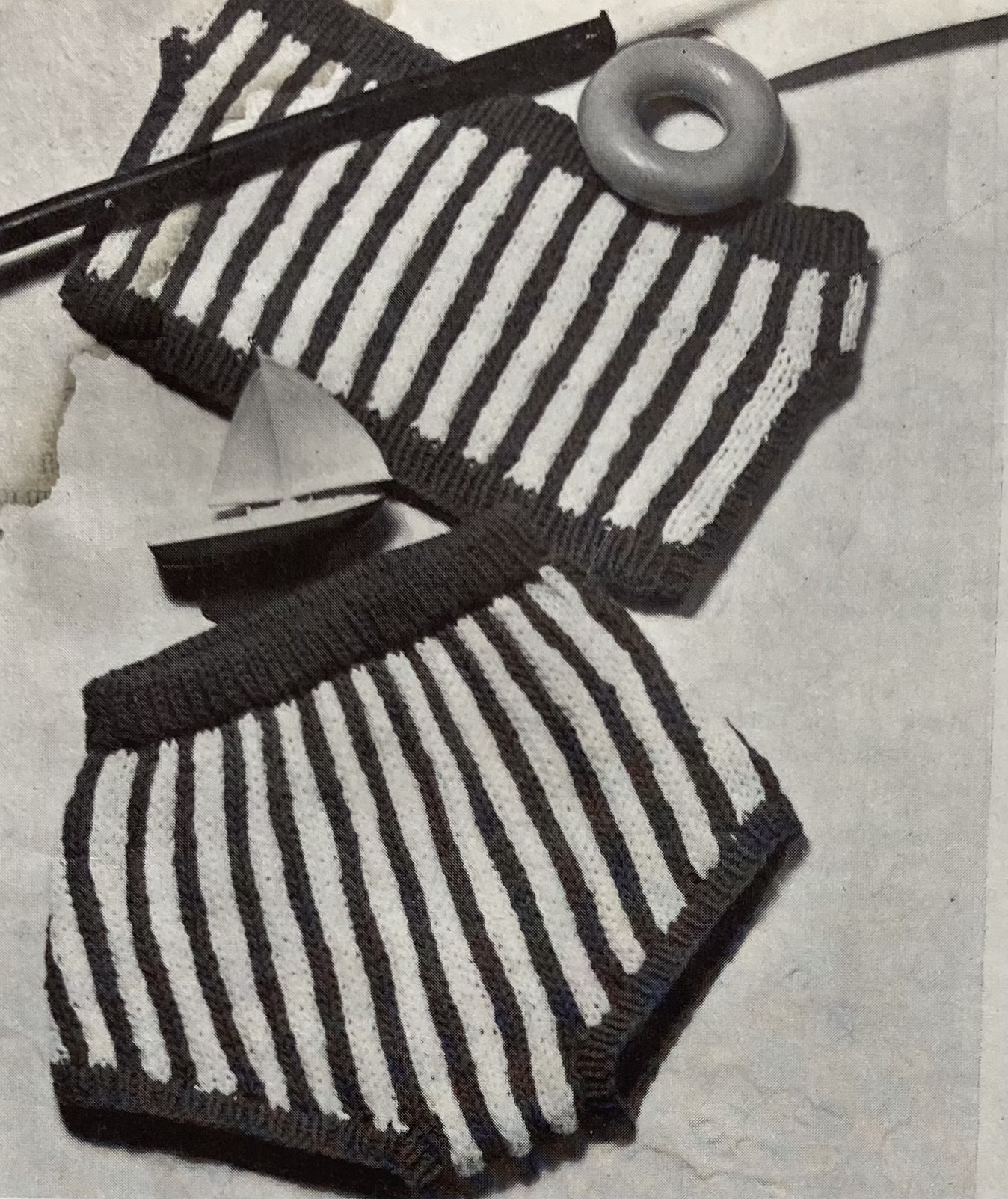
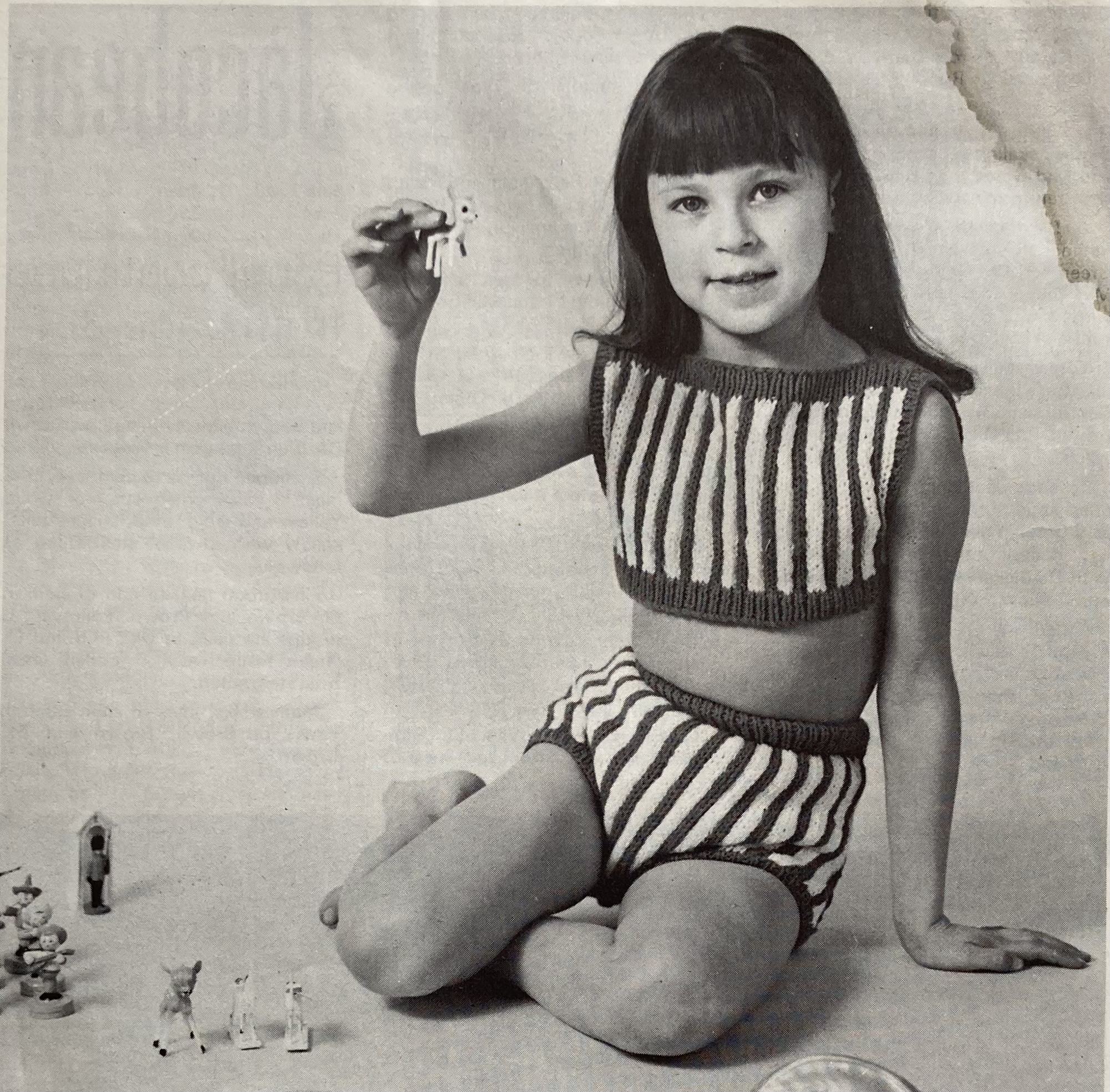
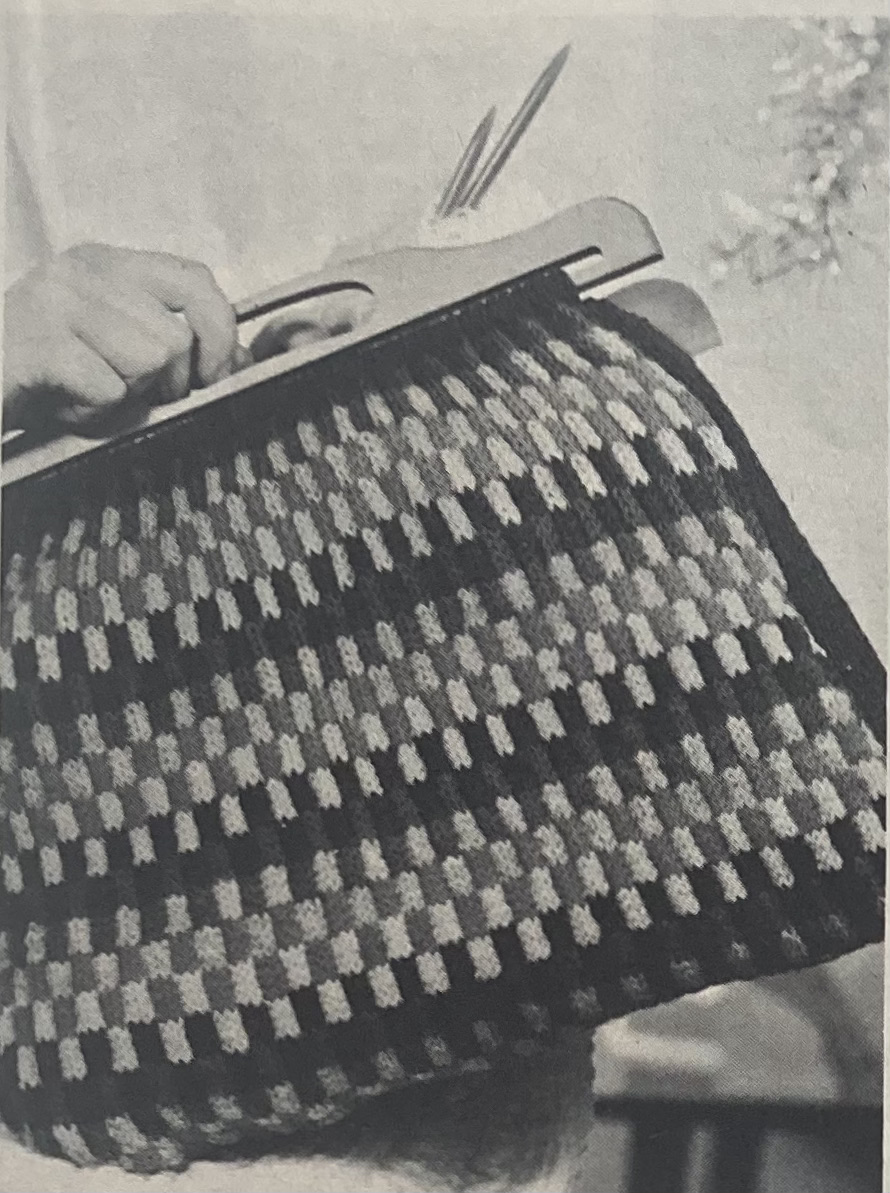
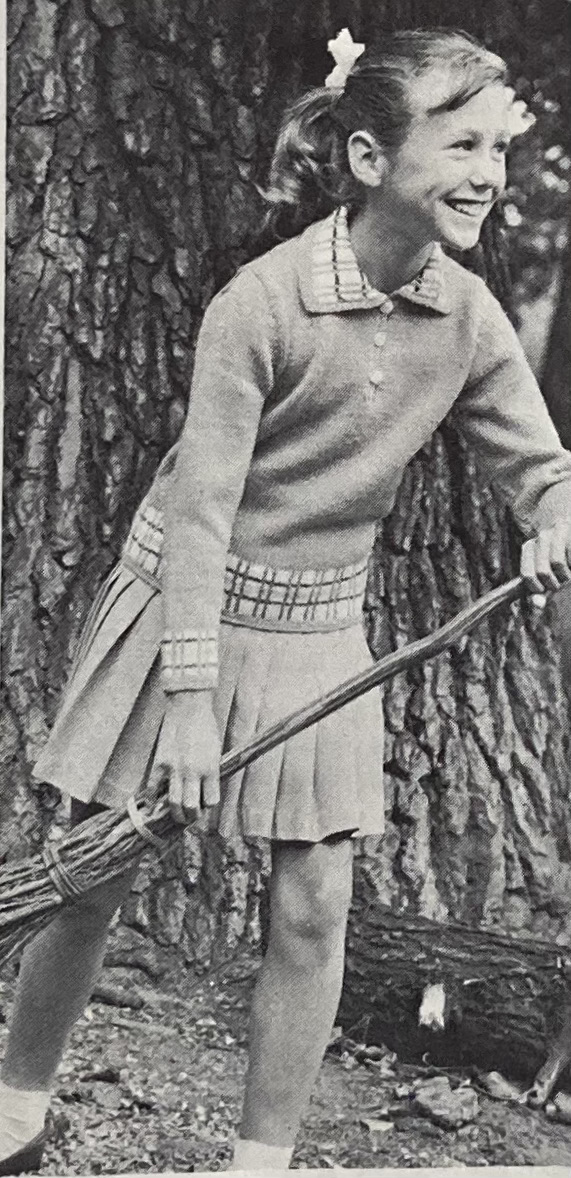
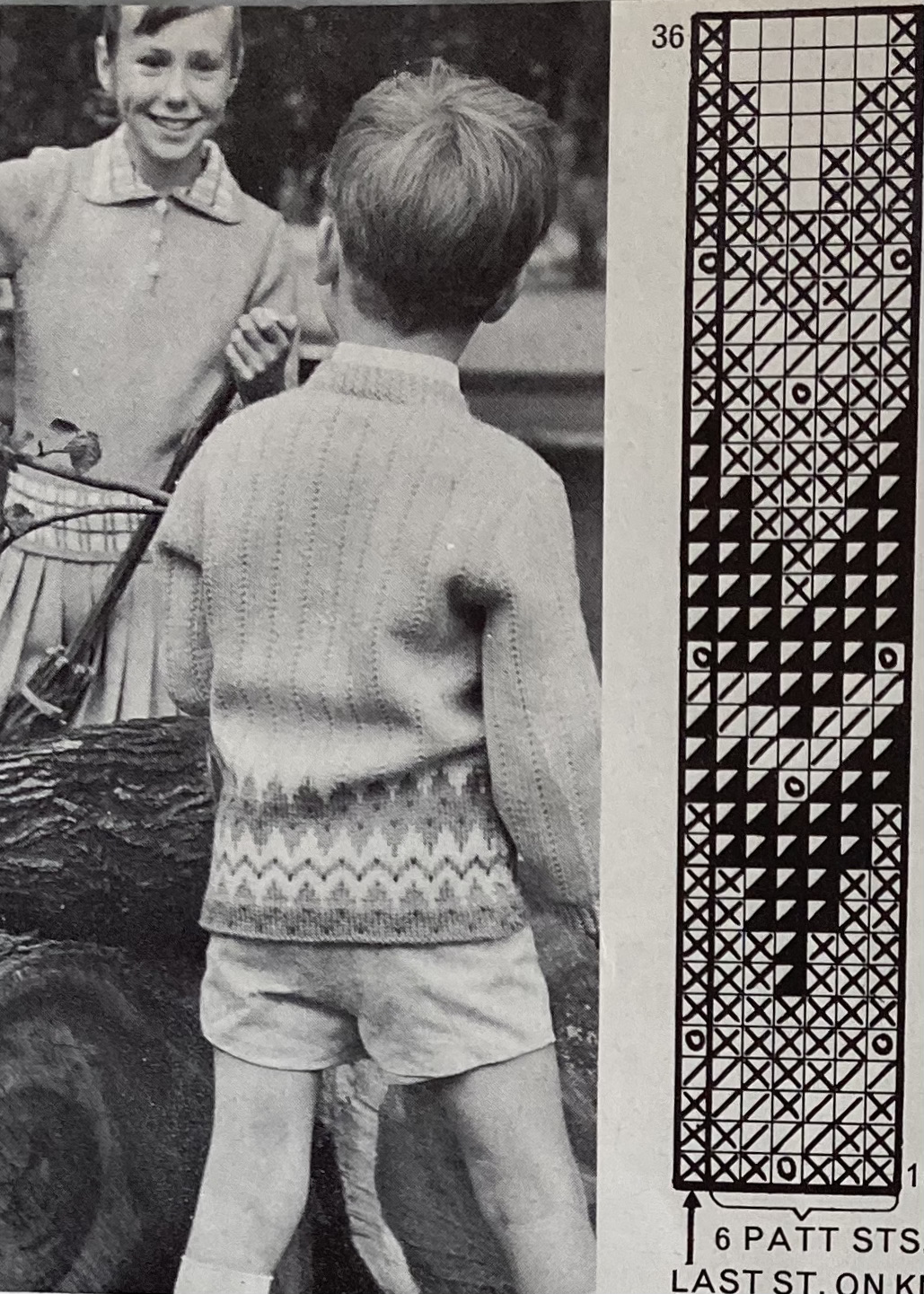
Fun stripes show up on the children’s garments too. There are shirts for boys with the same striped ribbing and collar, plain body and sleeves idea as the women’s top, and a dress for older girls with a stripe of colourwork flowers at the hem. “Junior” girls can “splash and paddle” (i.e. not really swim effectively) in a supposedly stretch-proof knitted bikini in vertical stripe stranded work — the strands should keep it from stretching too much horizontally in the water, but I’m not sure I’m convinced. The top is just two rectangles sewn together.

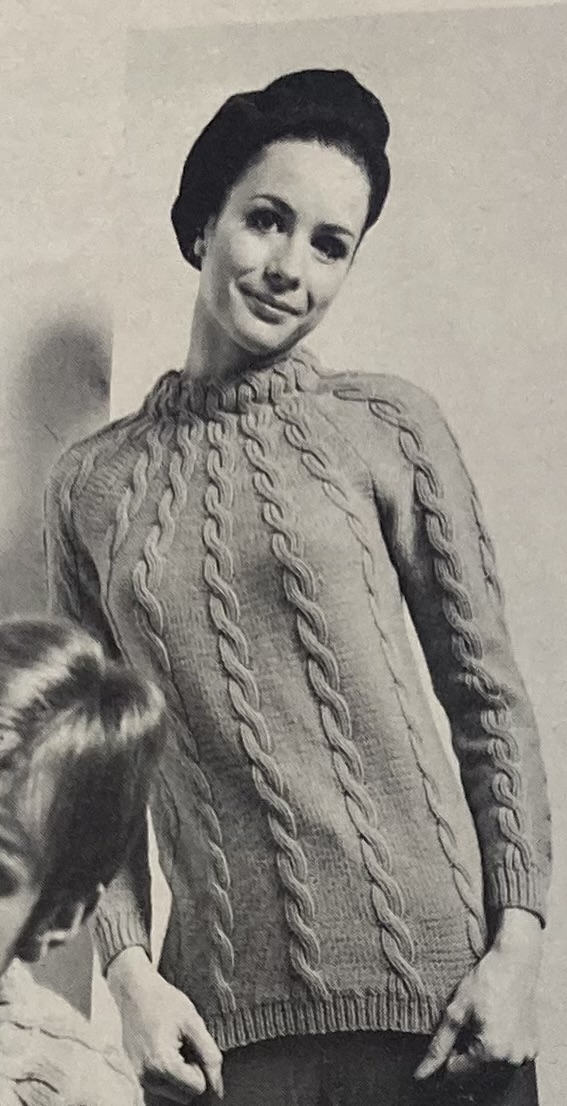
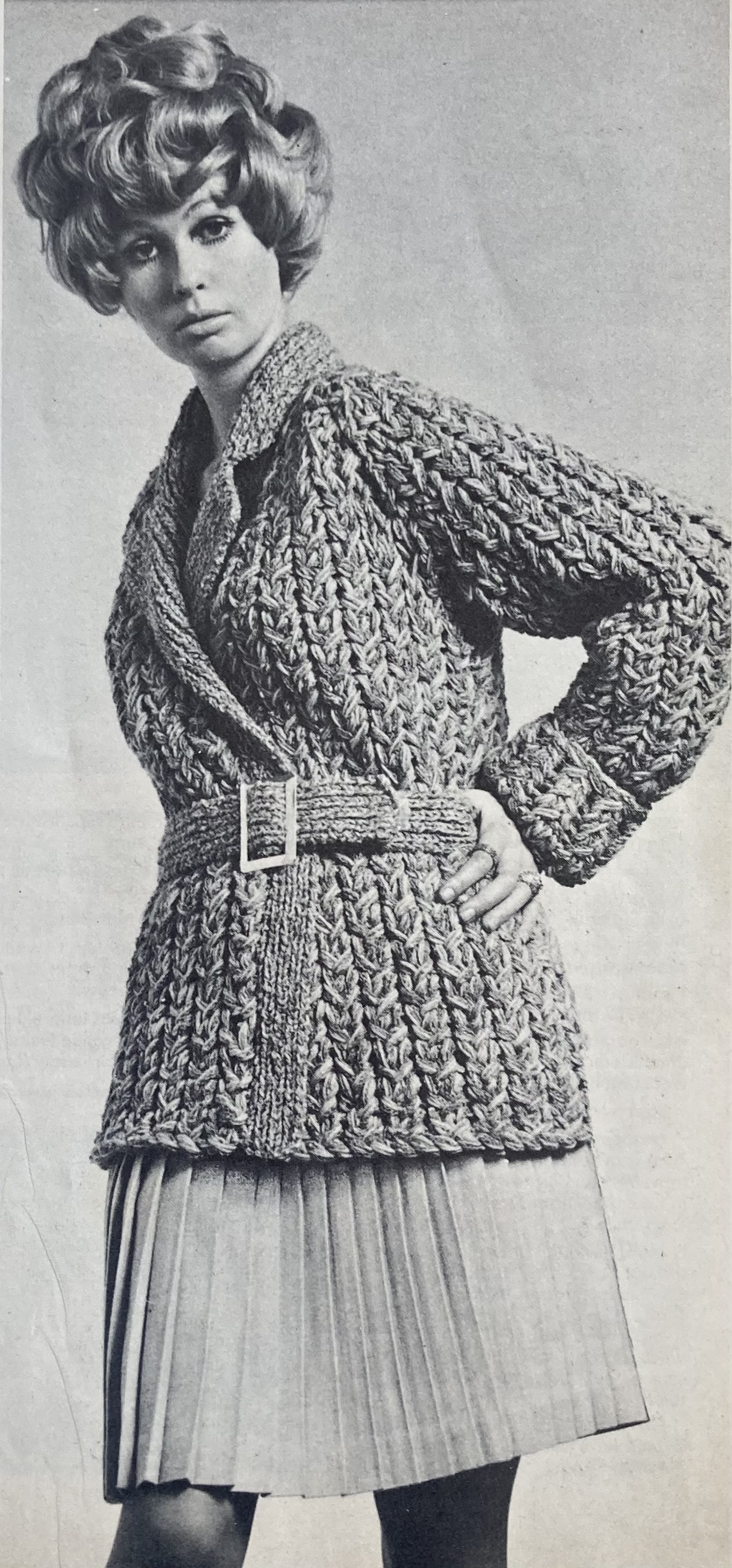
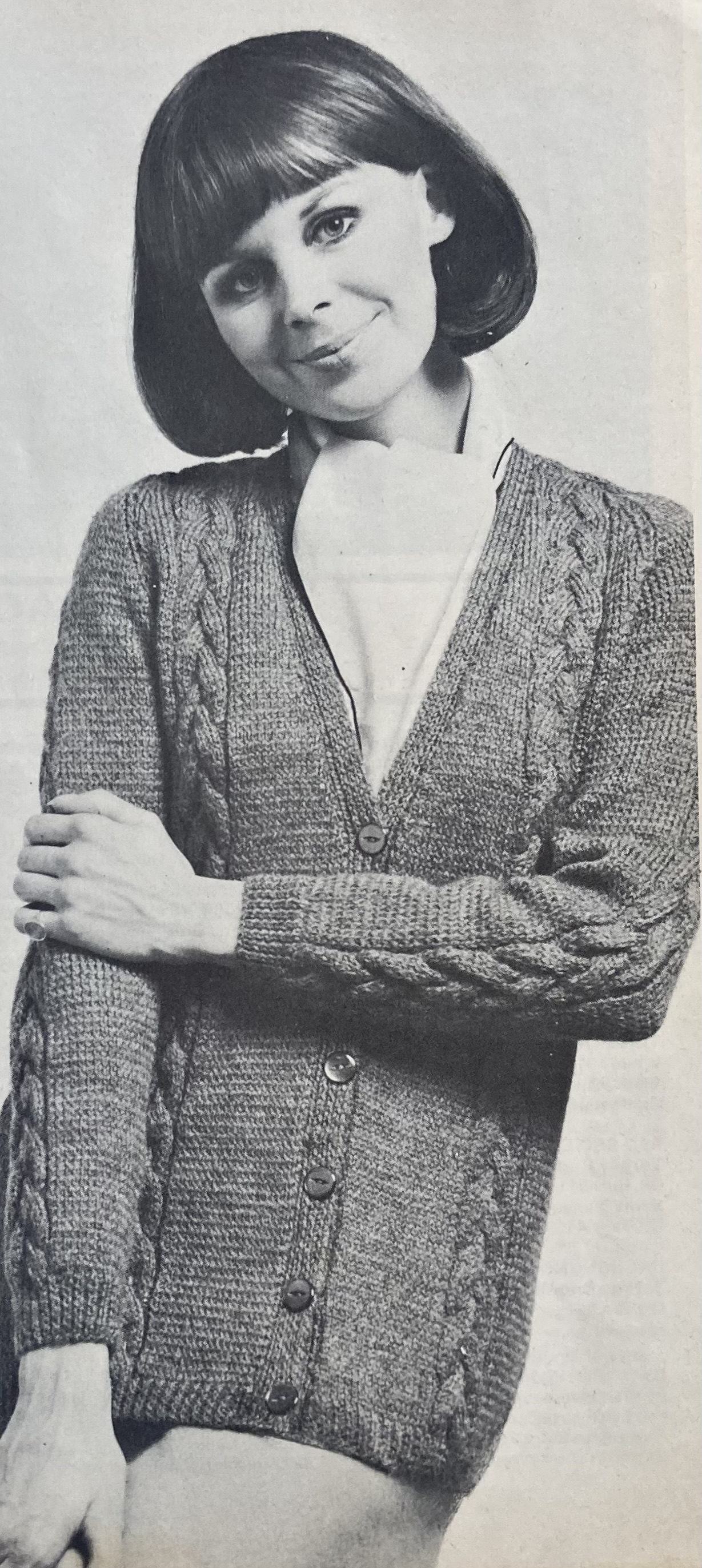
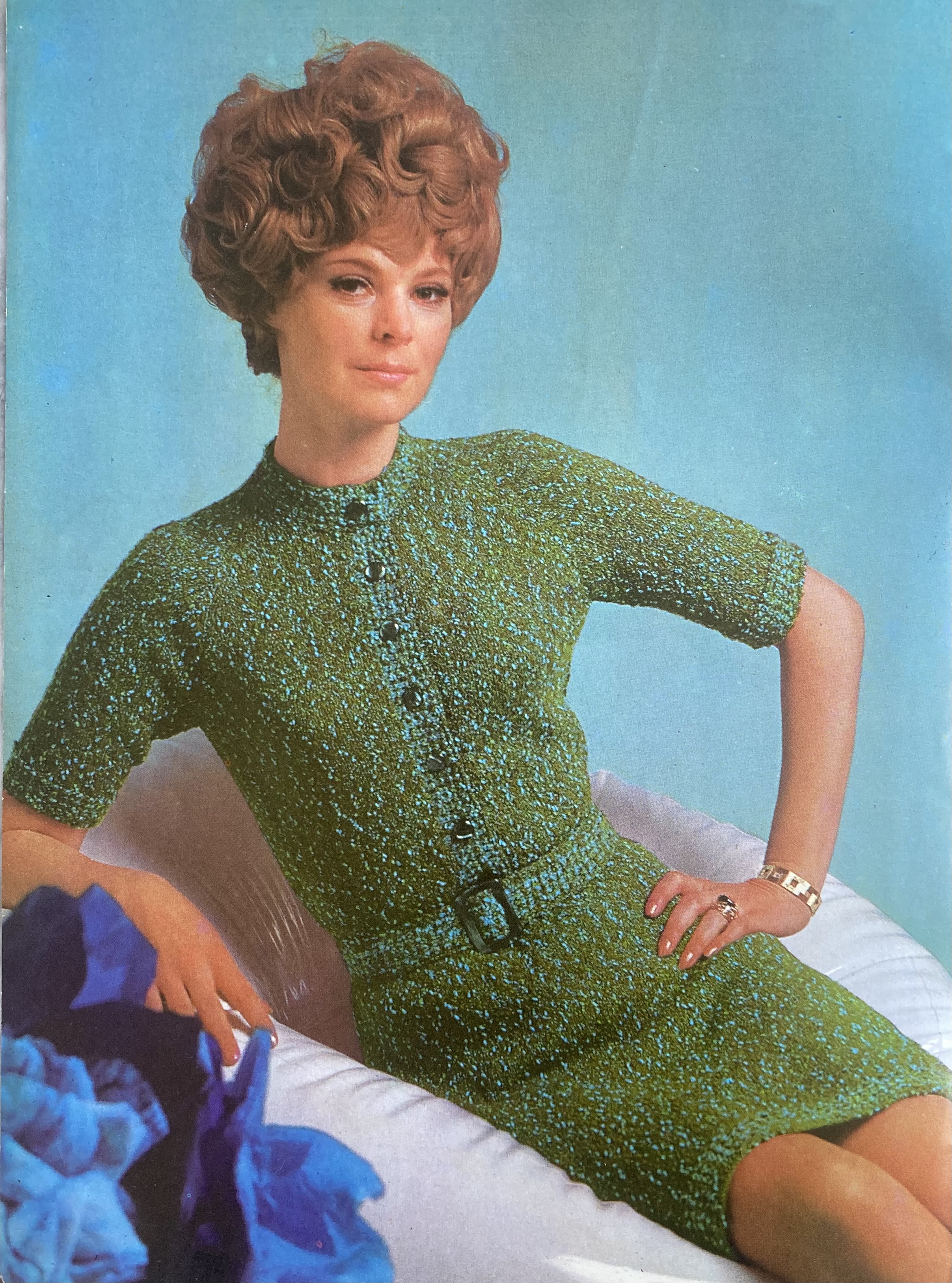
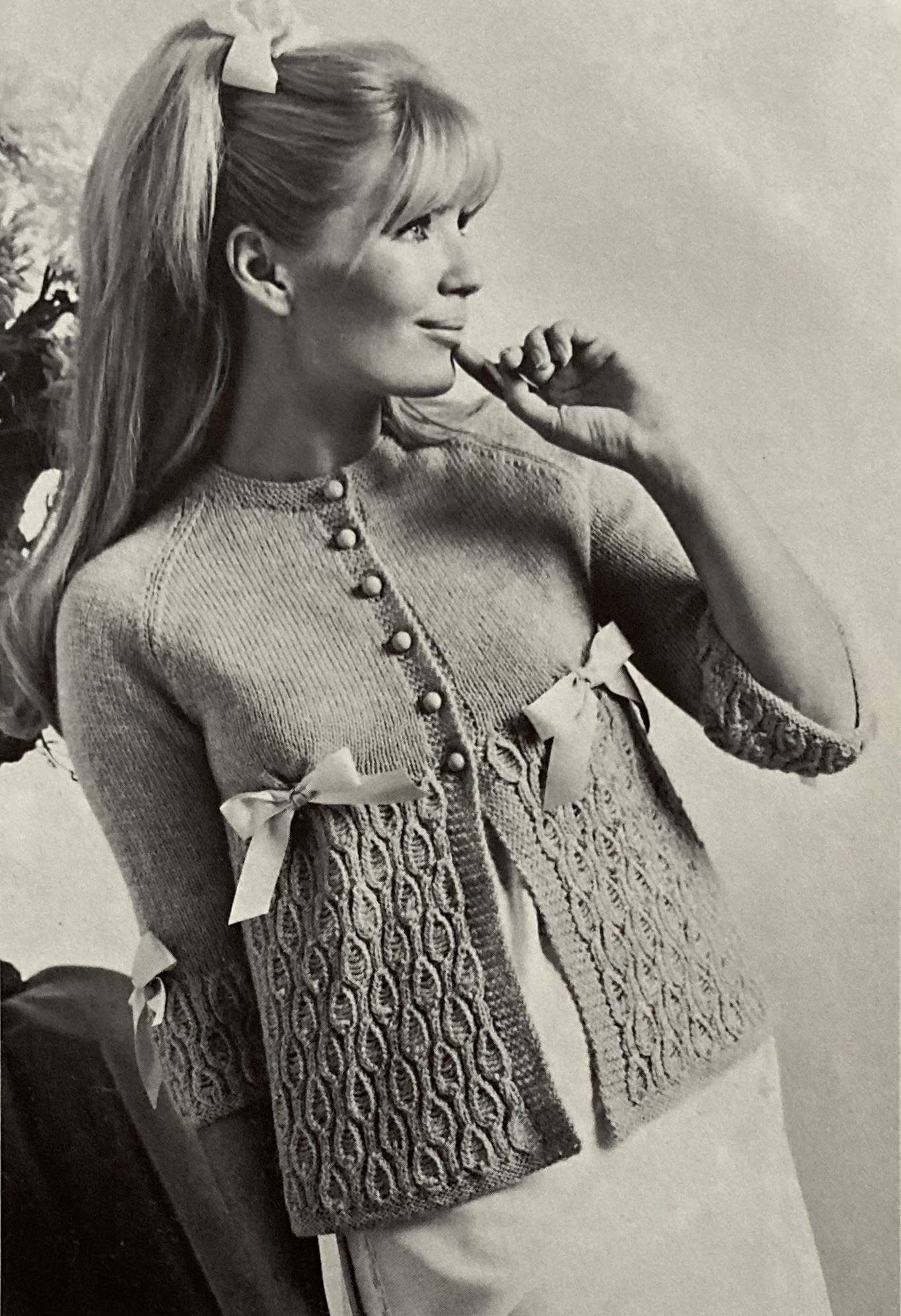
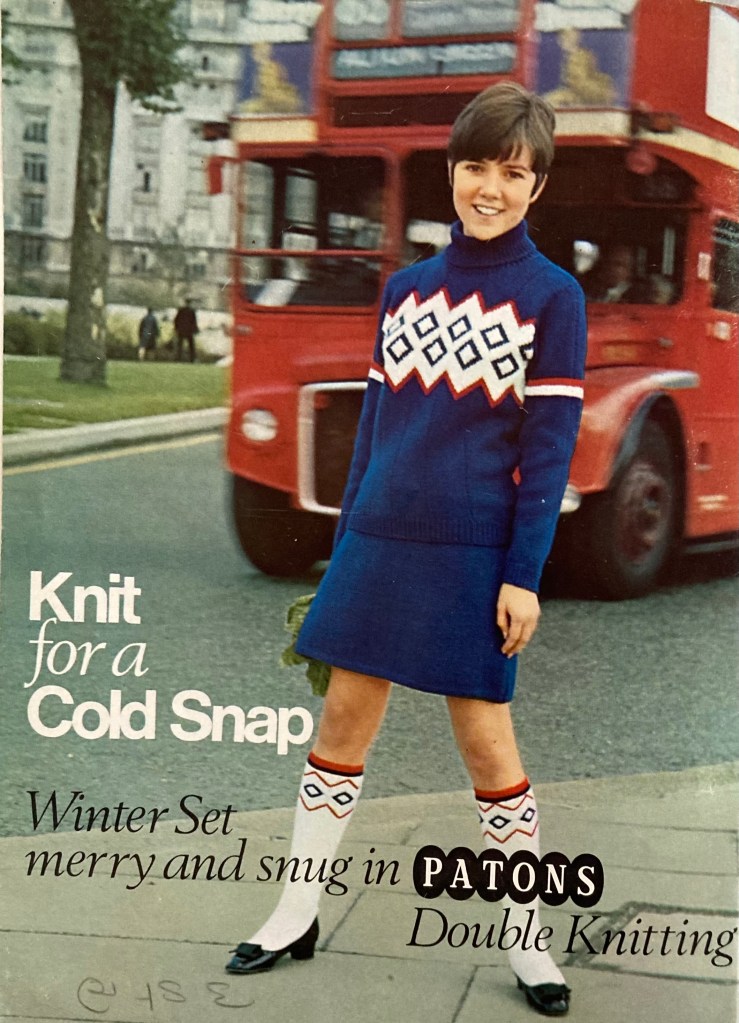
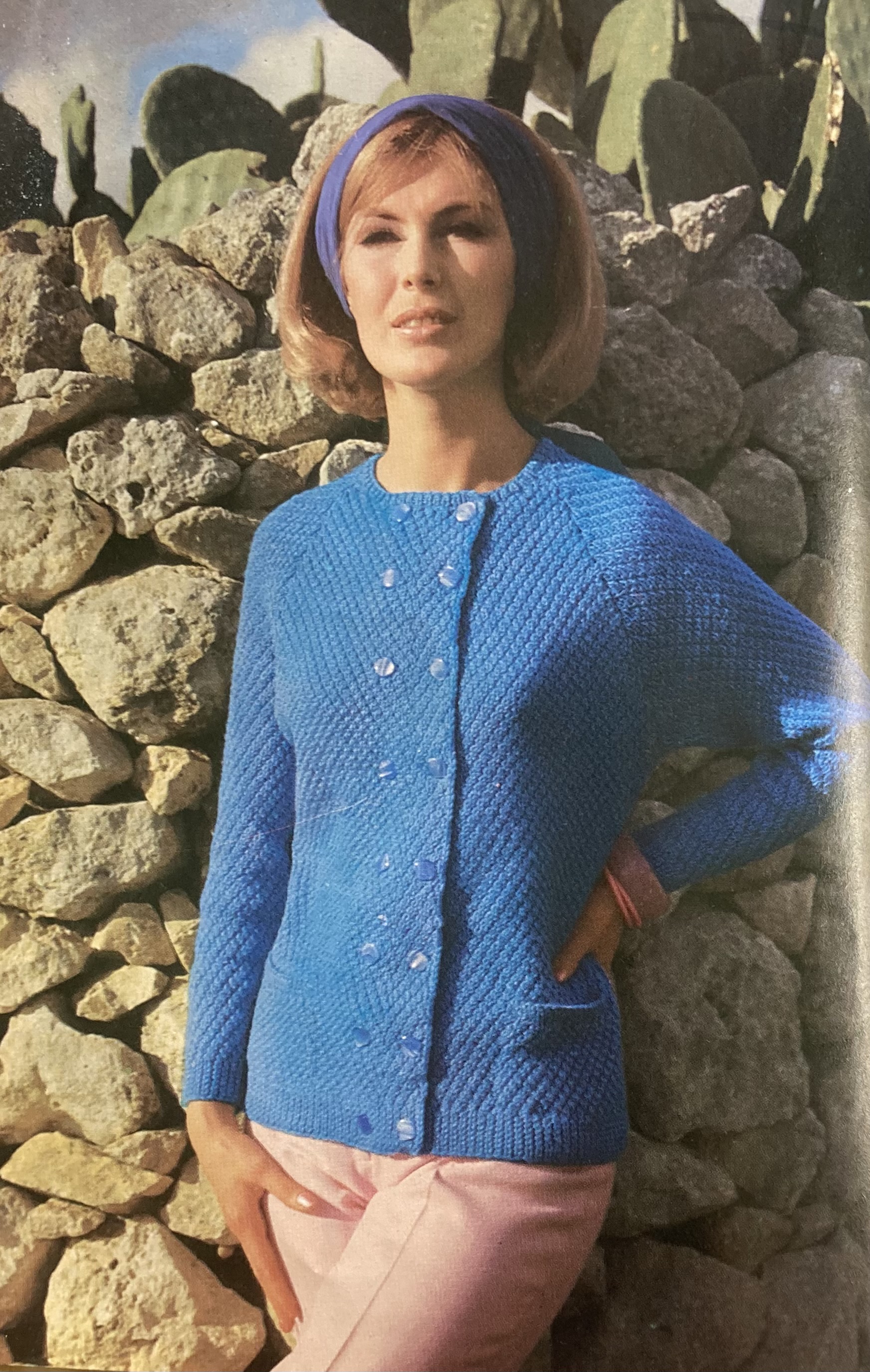
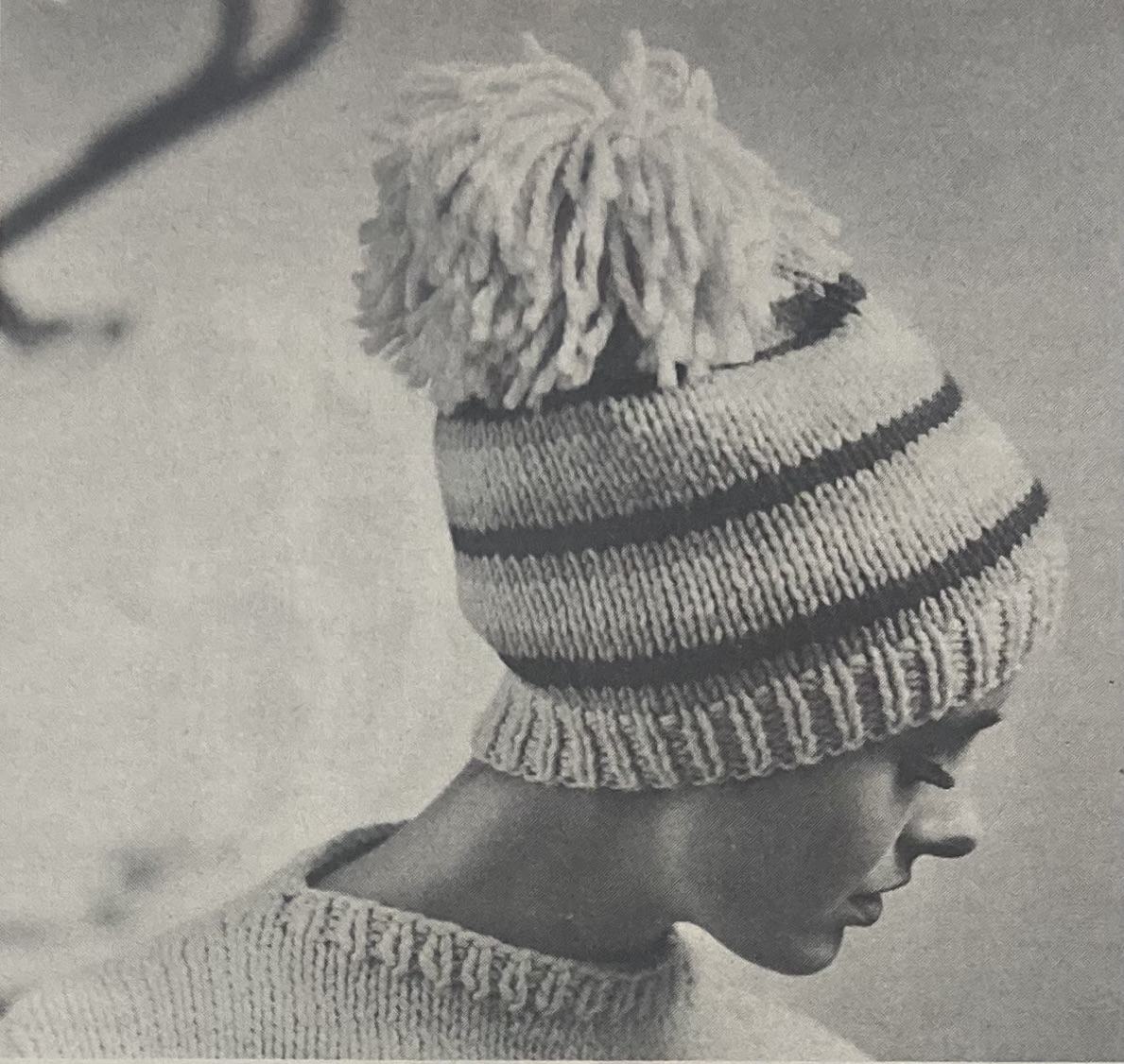
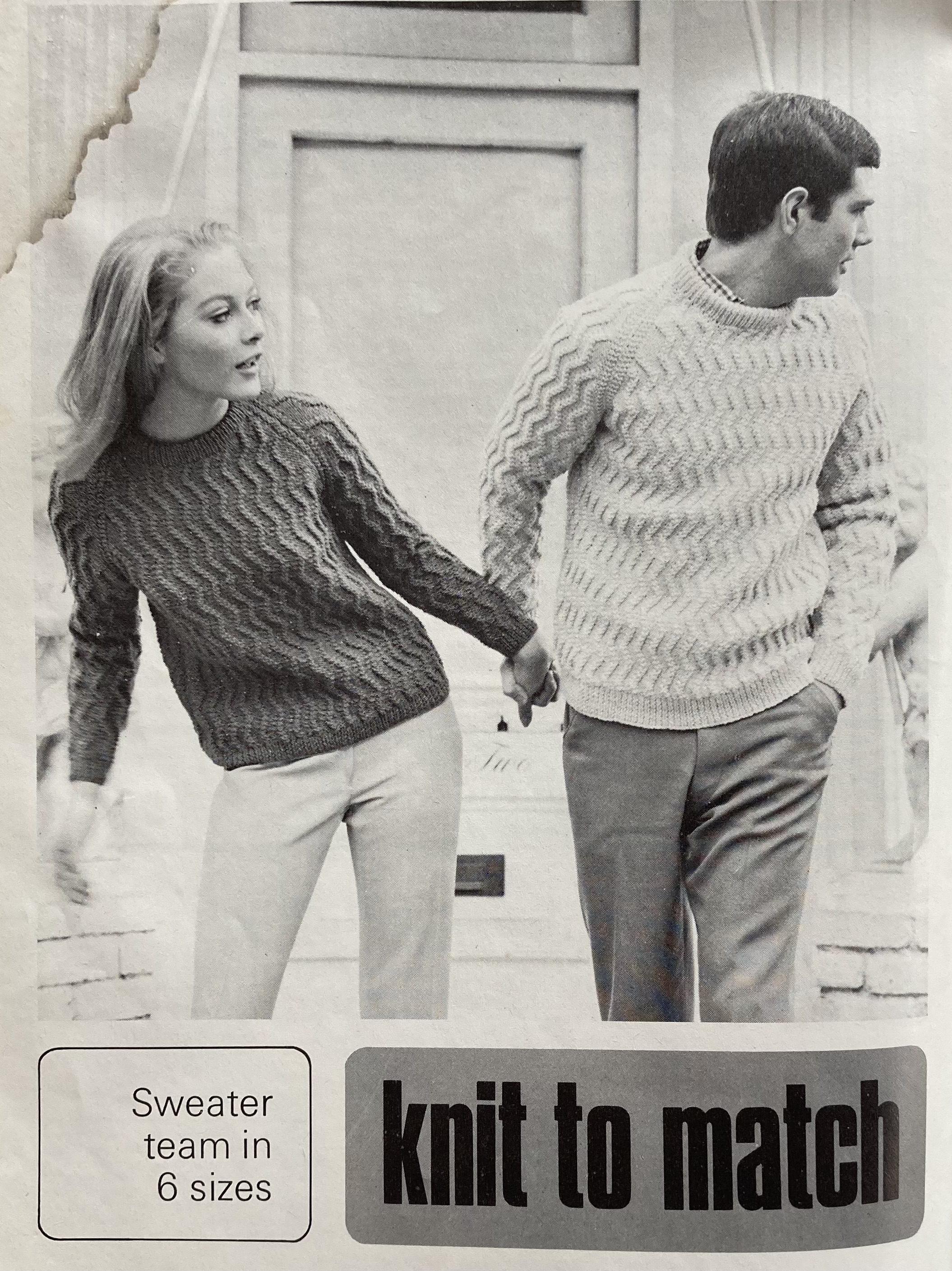
Stripes can be vertical or zig-zagged as well — either worked in colour as with the top on the cover, or in monochromatic stitch patterns. There are his-n-hers pullovers “knit to match” in a pattern similar to the sleeves on the cover design, but worked with 2-stitch twists instead of mini-cables, and a sleeveless polo in “Shetland mood” with a cable pattern on the front. (The caption says, “Janet sports her own jaunty beret, but Booklet 9775 is an easy one to knit — details on page 37.”) The two remaining garment designs, a cardigan and a blazer, have neither stripes nor zig-zags, but continue the theme of fun stitch patterns and this month’s trending colour of bright sky blue.

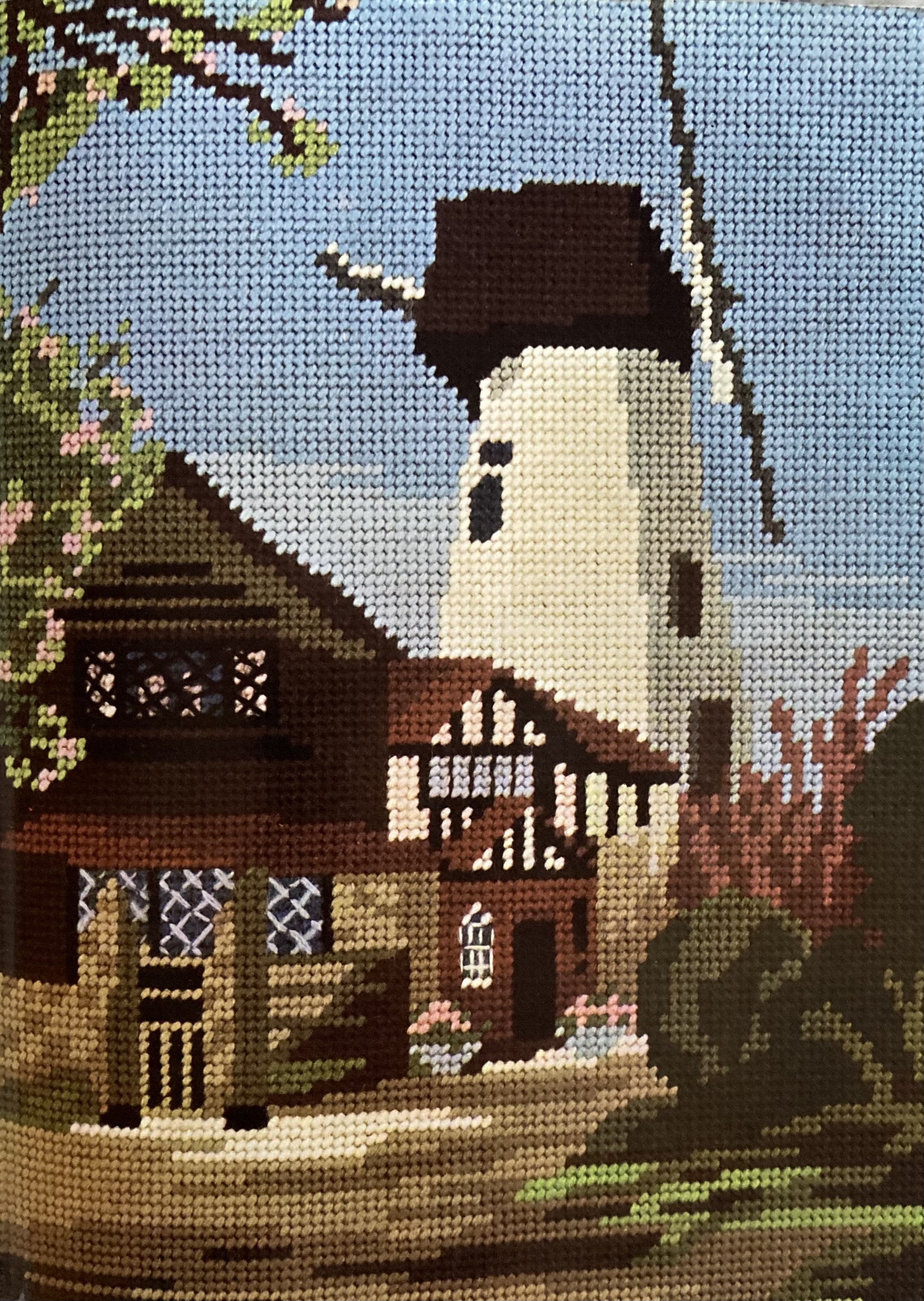
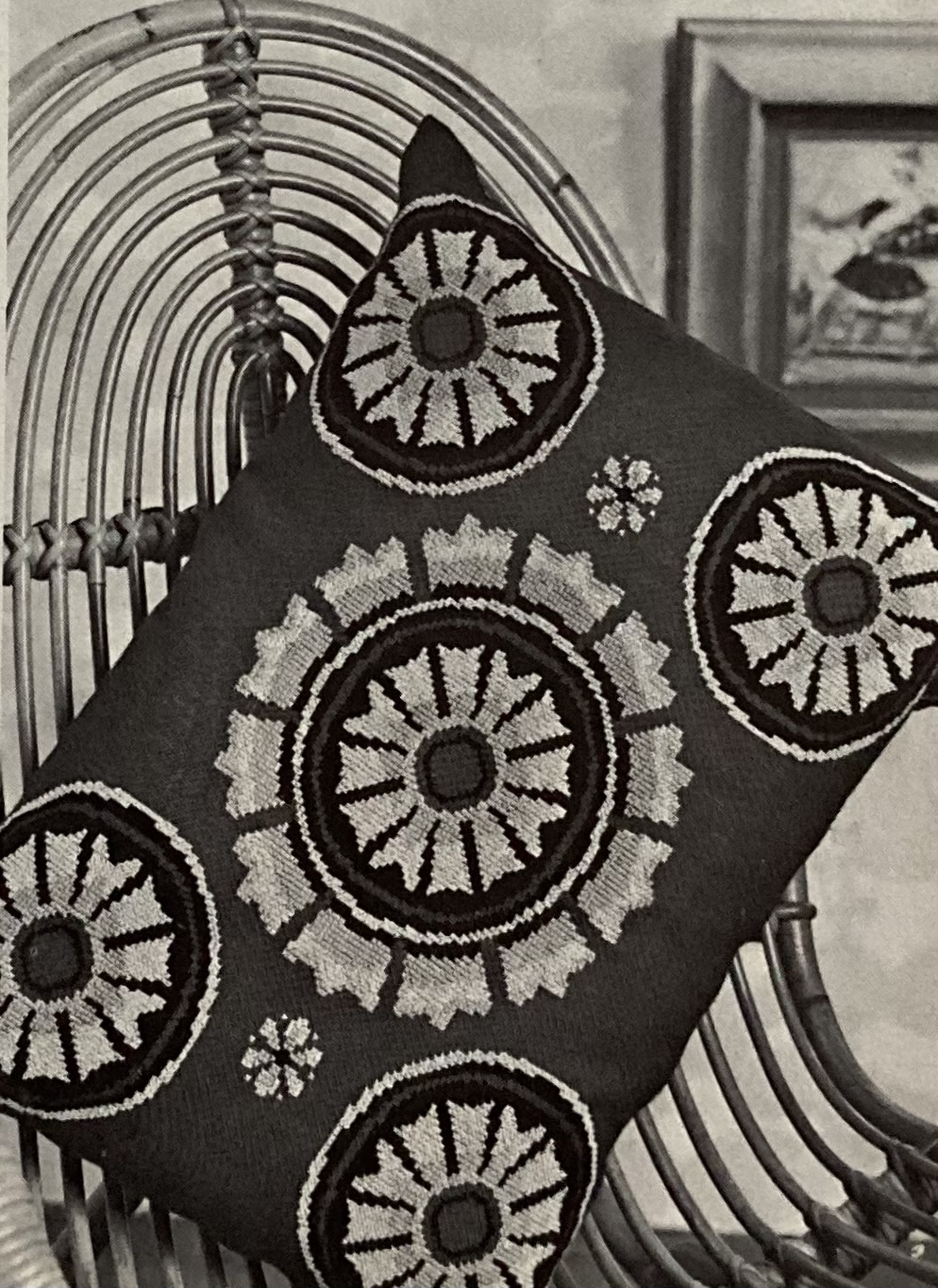
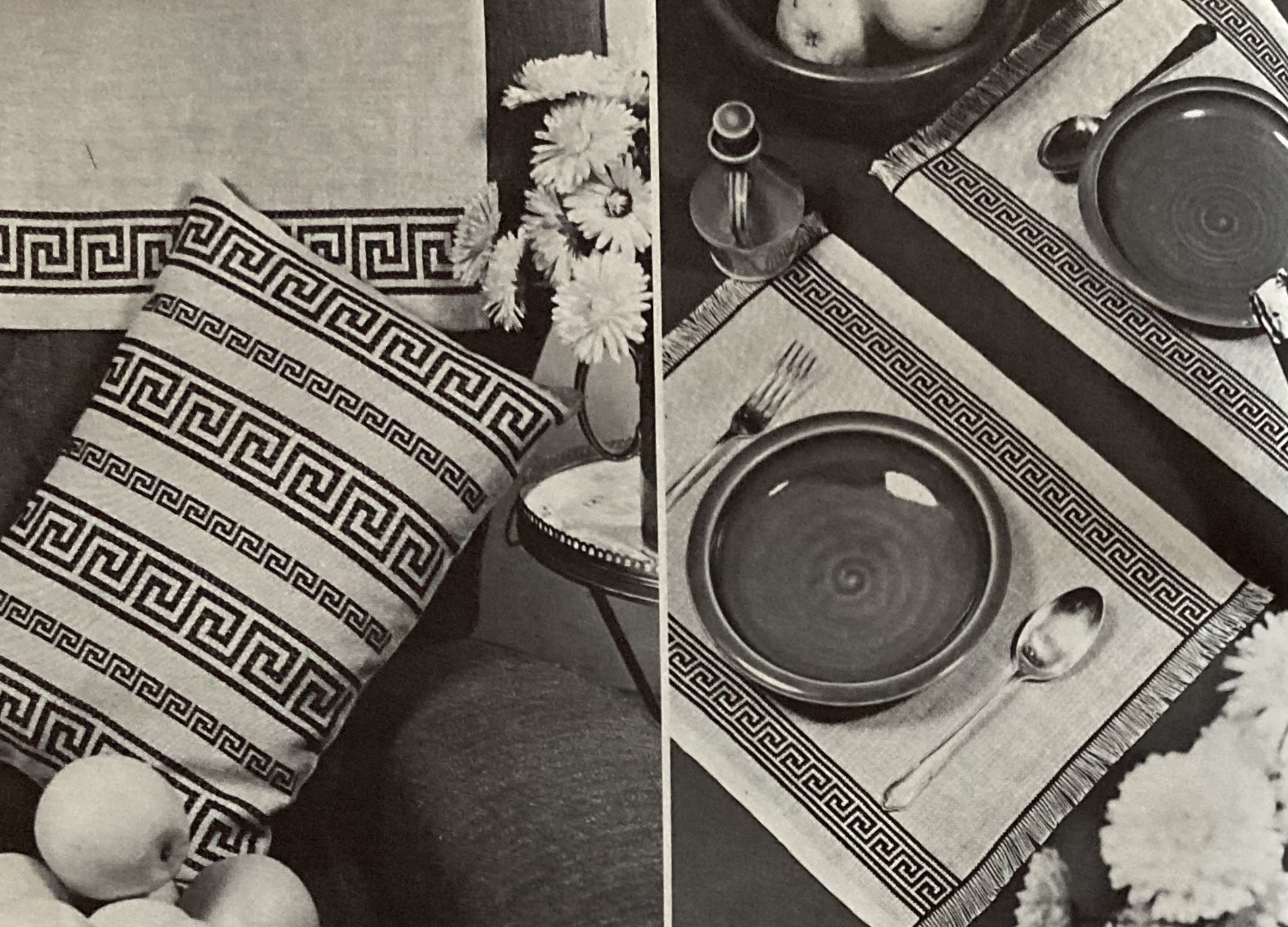
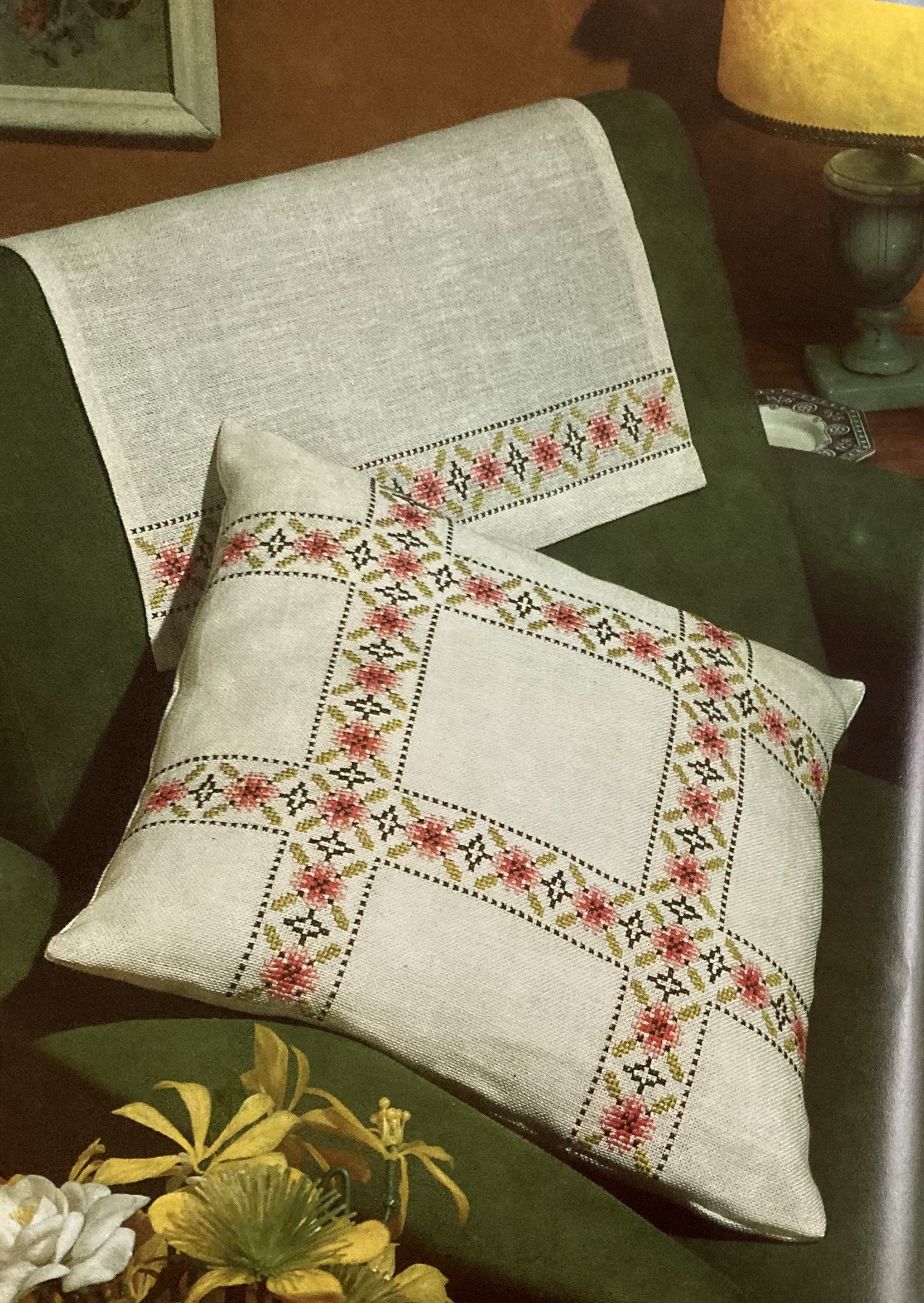
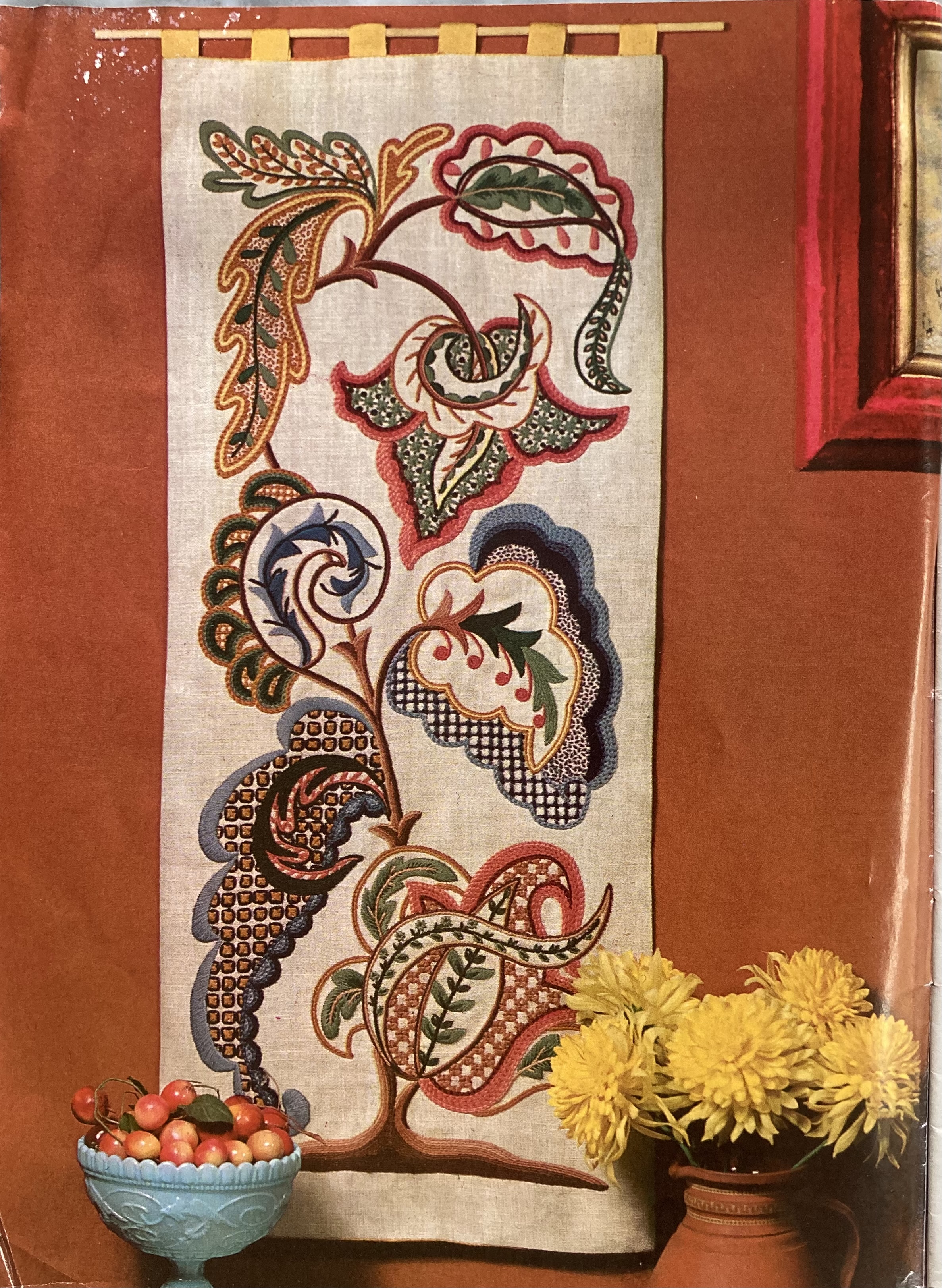
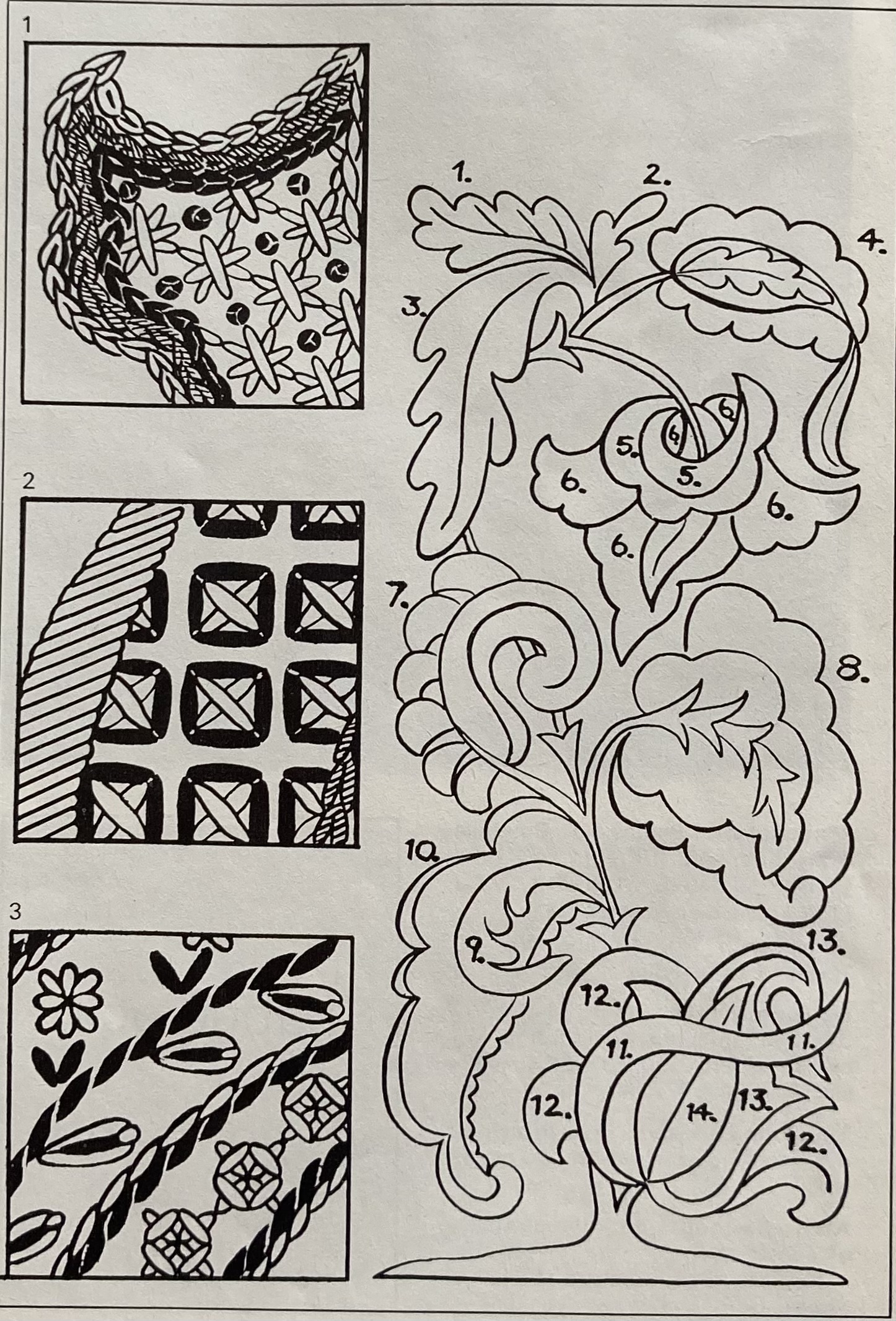
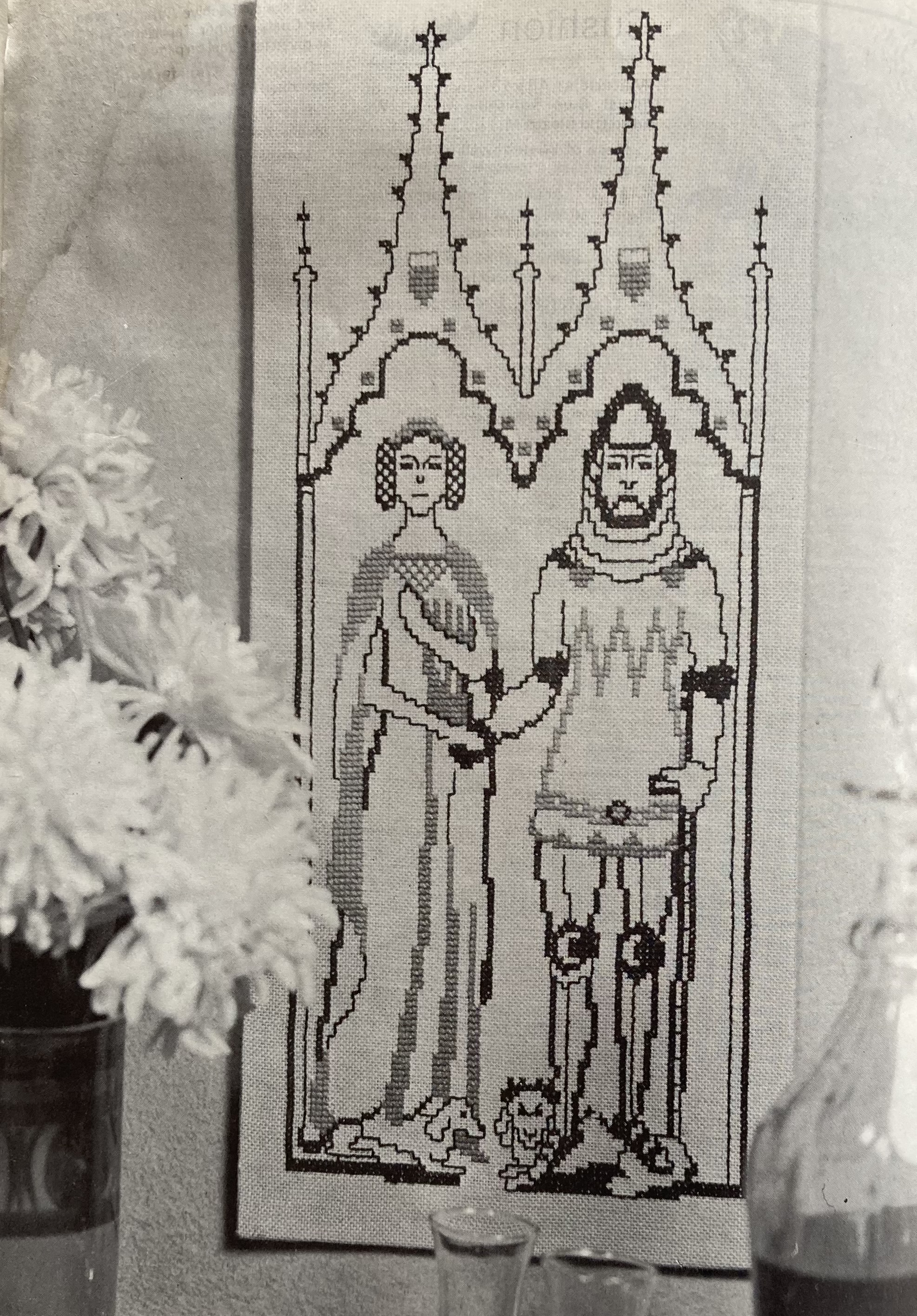
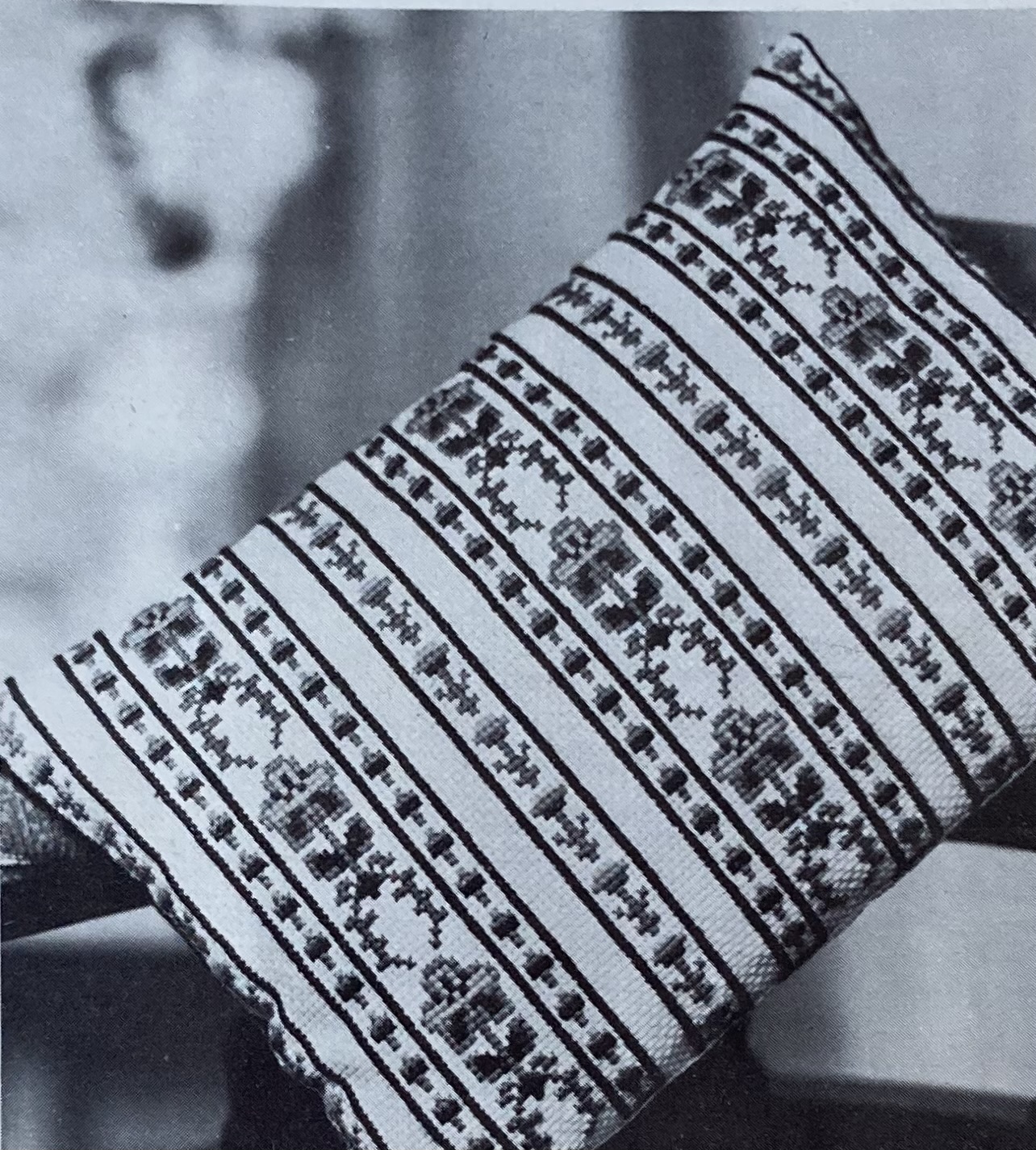
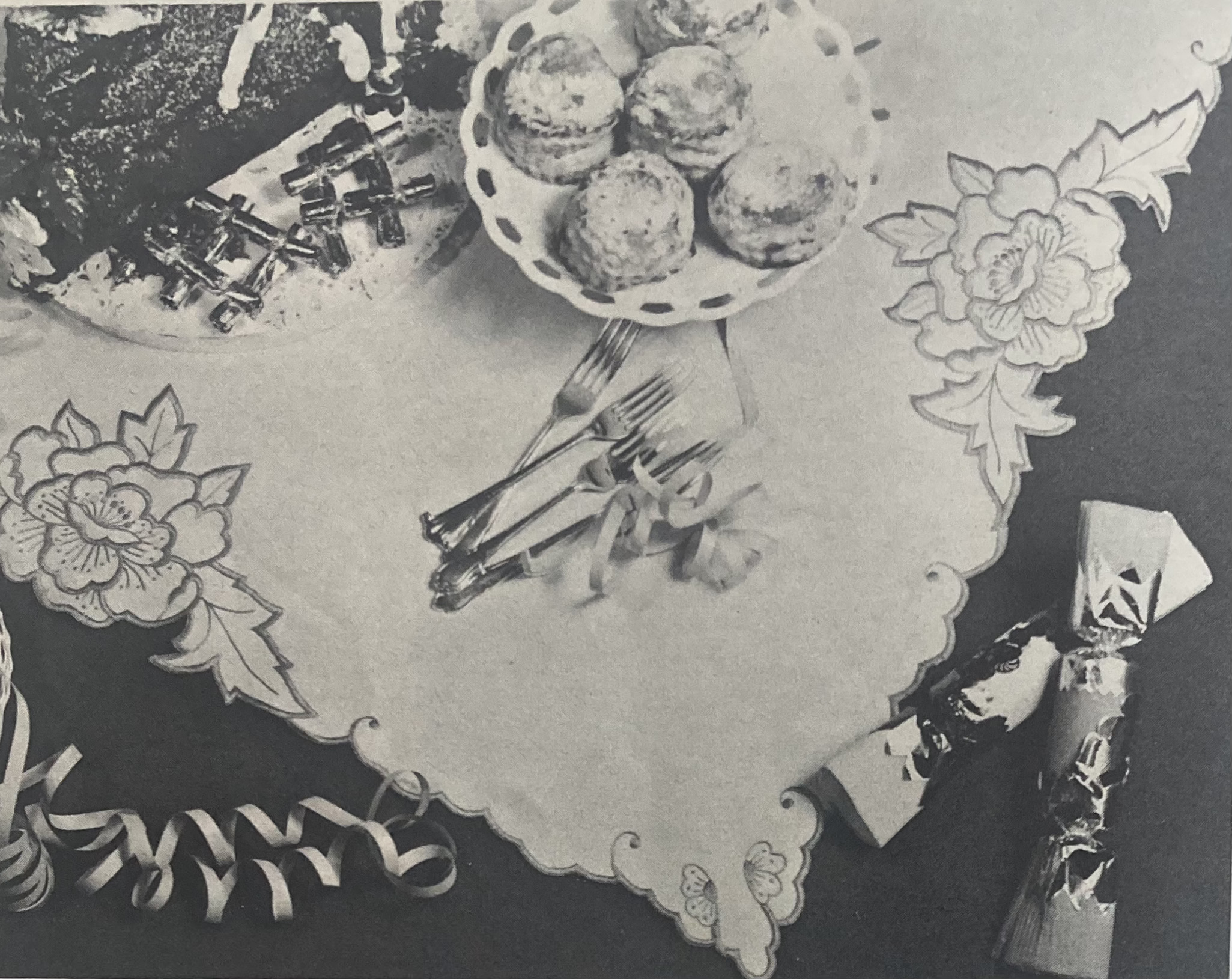
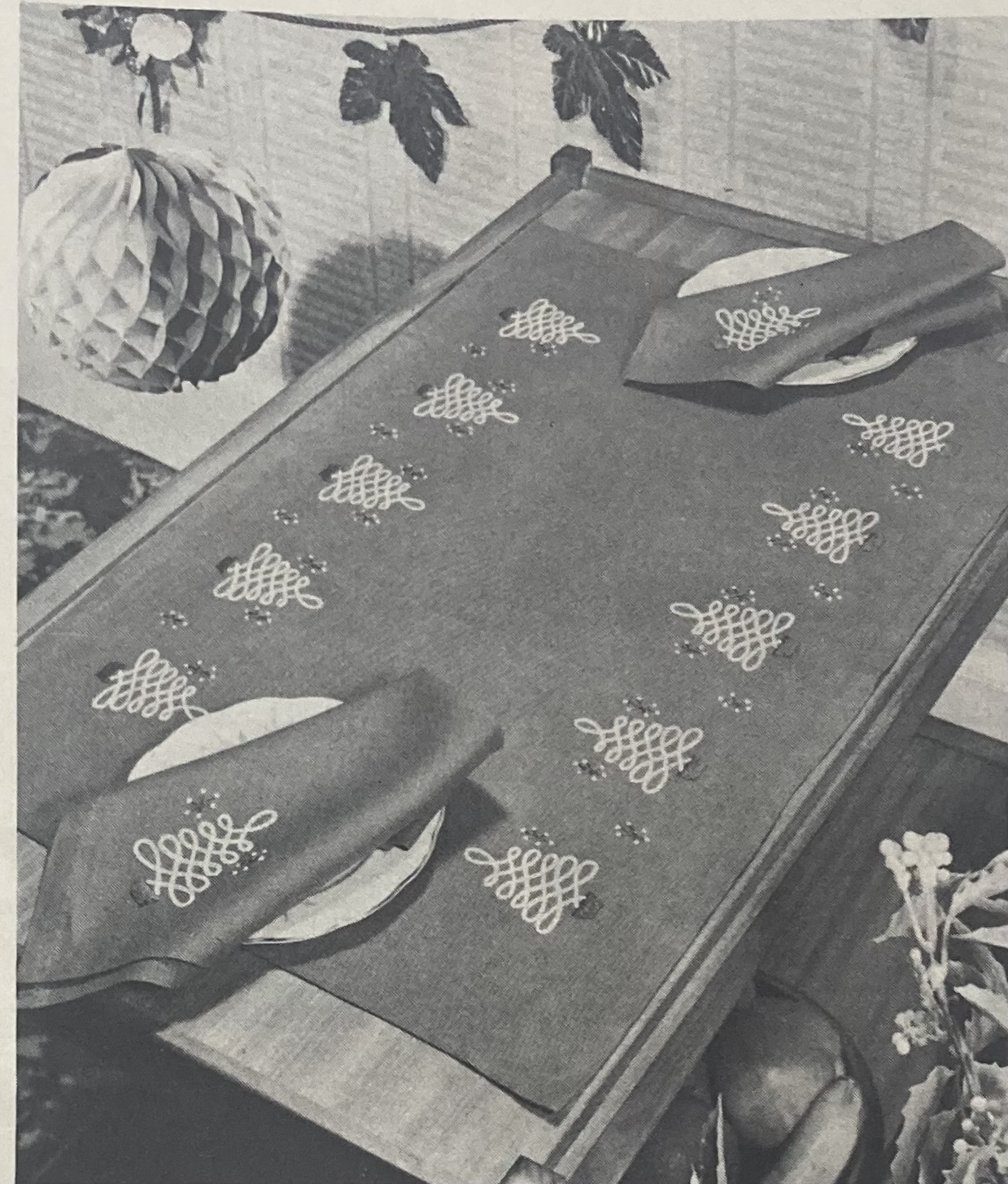
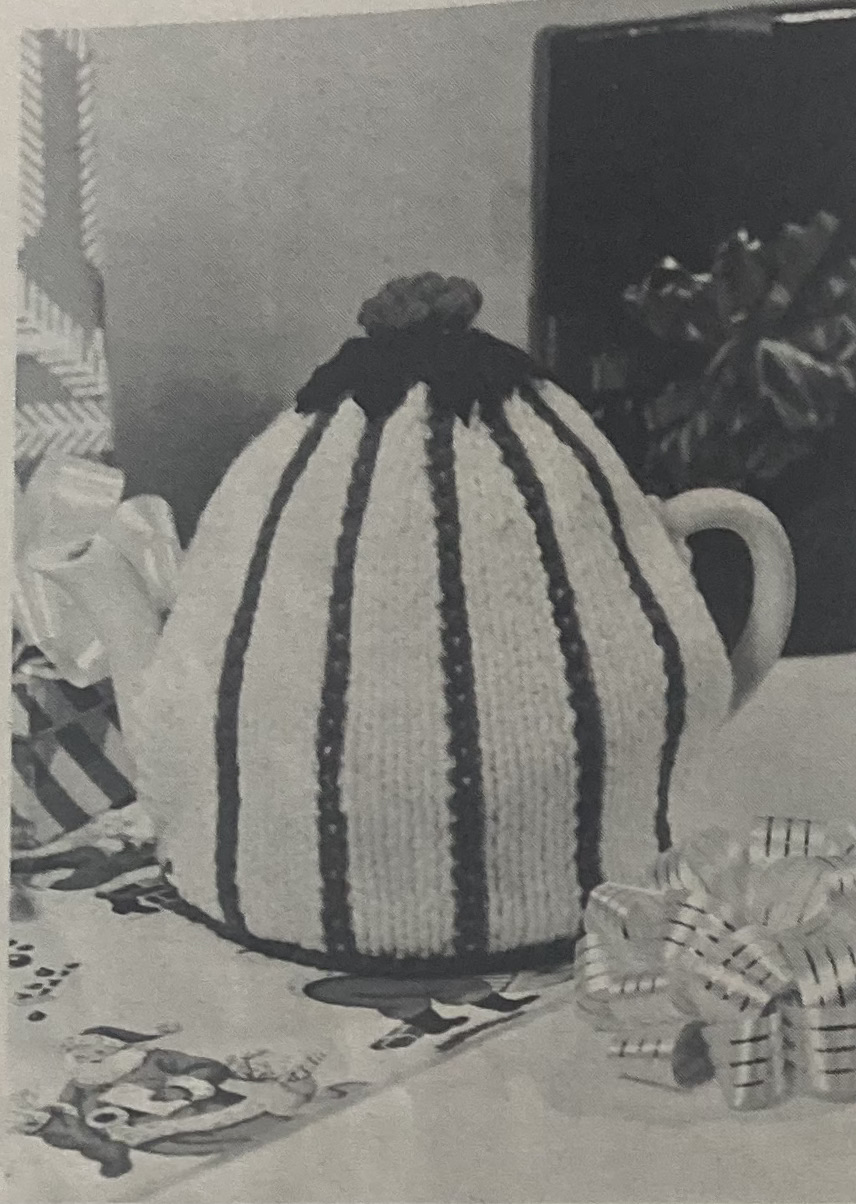
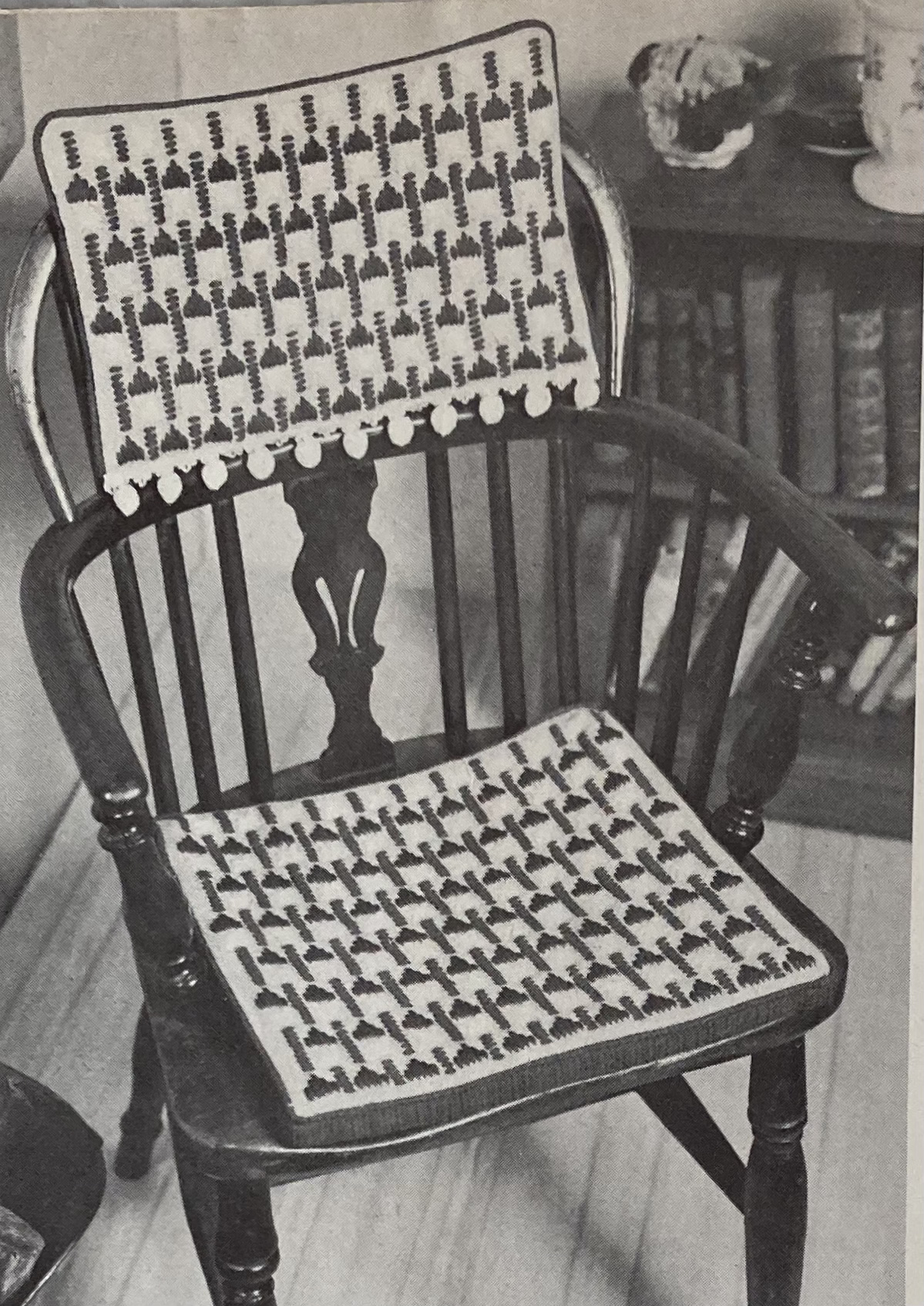
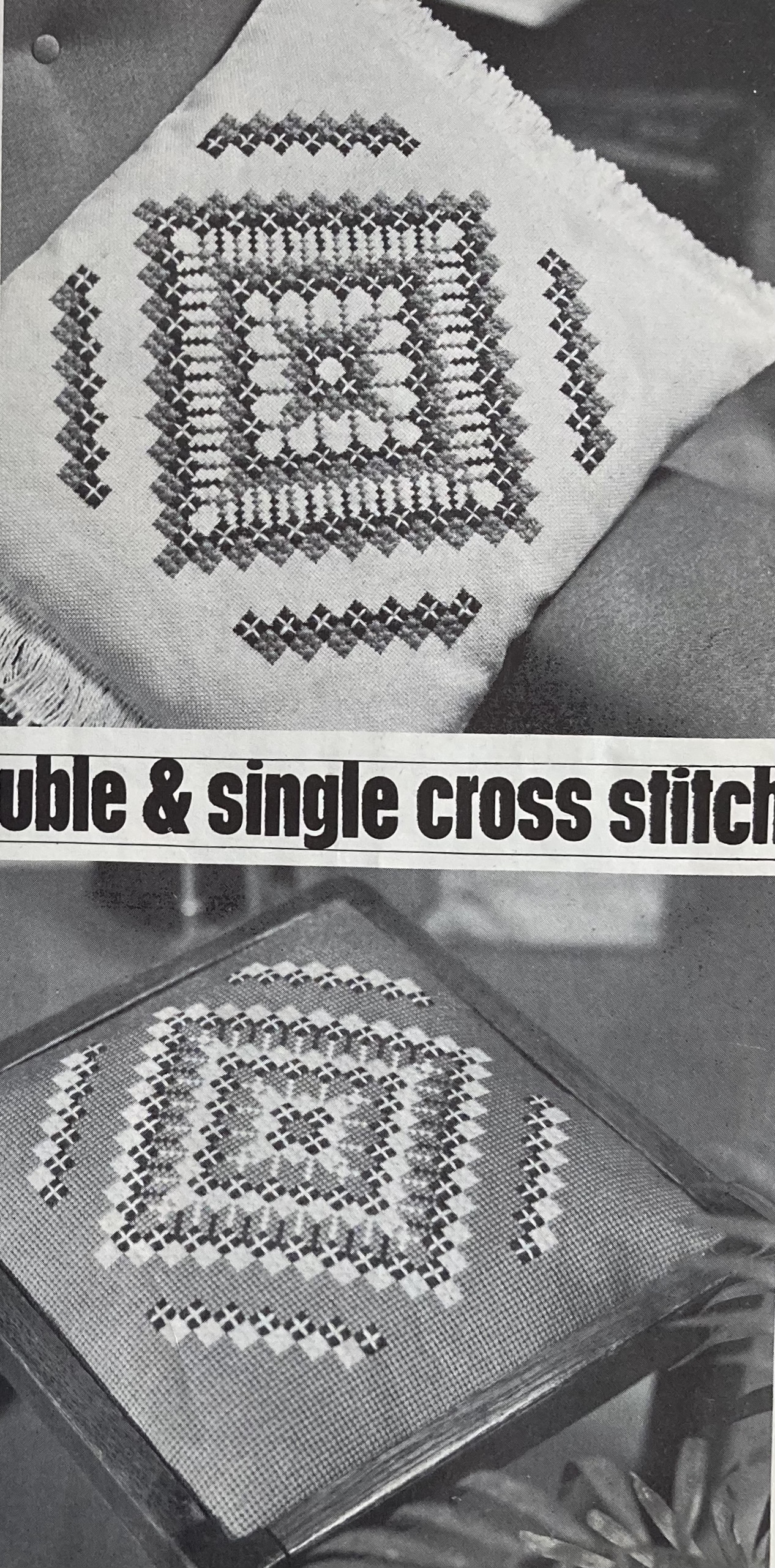
Homewares dive deeply into the Jacobean era, with an amazing wall panel that integrates complicated, historically-inspired stitch work and floral designs with a bold and oversized 60s aesthetic. Not Jacobean-inspired, but equally colourful and exotic, is the cross-stitch tropical bird. You can work it on a cushion or use it to cover a cake tin (appropriately, the name of the background colour is Biscuit.) For a real historical flair, you can make a cross-stitch wall panel adapted from a brass rubbing of Sir John Harsick, anno 1384, in Southacre, Norfolk. According to Stitchcraft, embroidery in the style of a brass rubbing “has become very popular over the last few years.” Interesting!

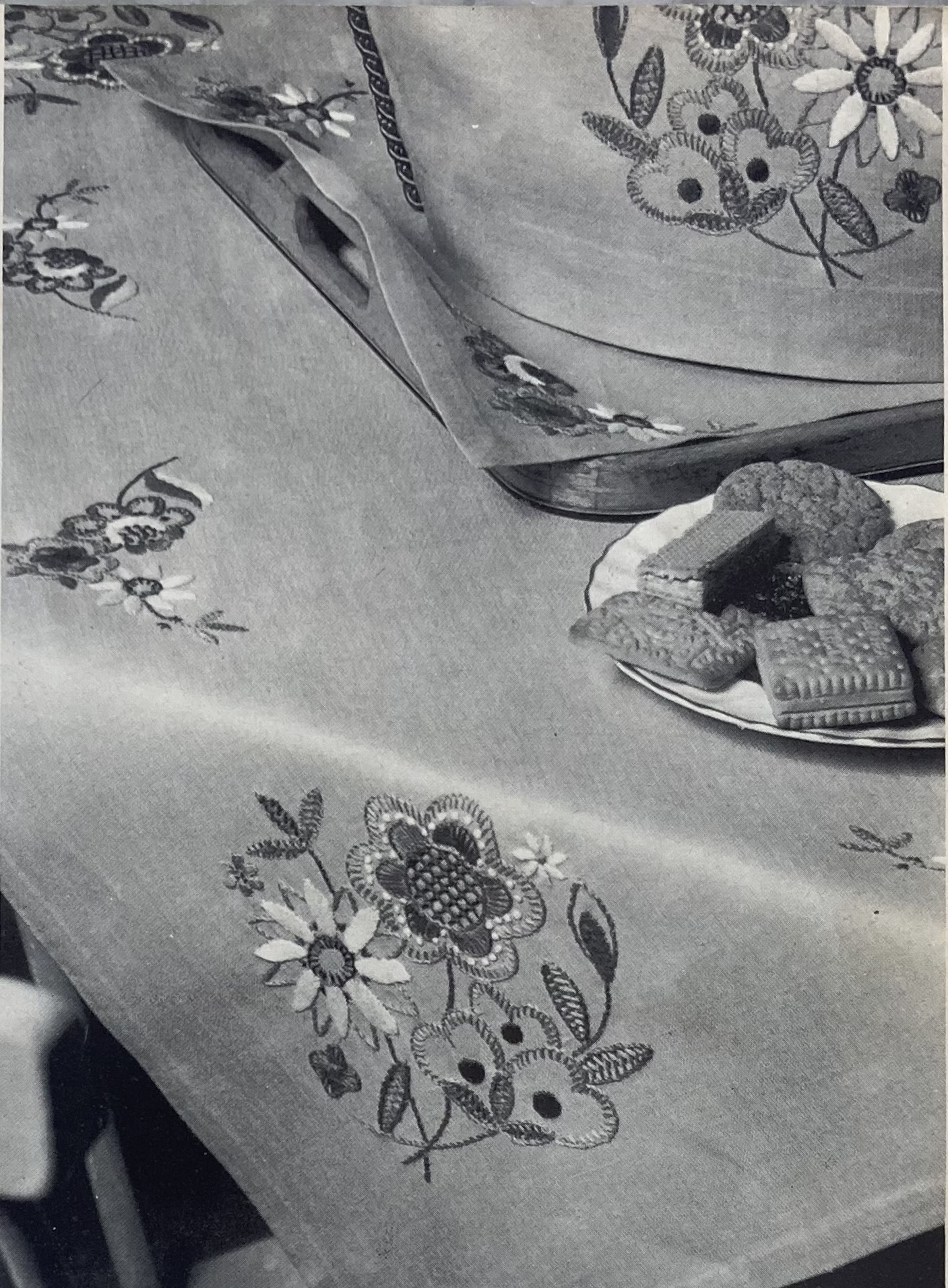
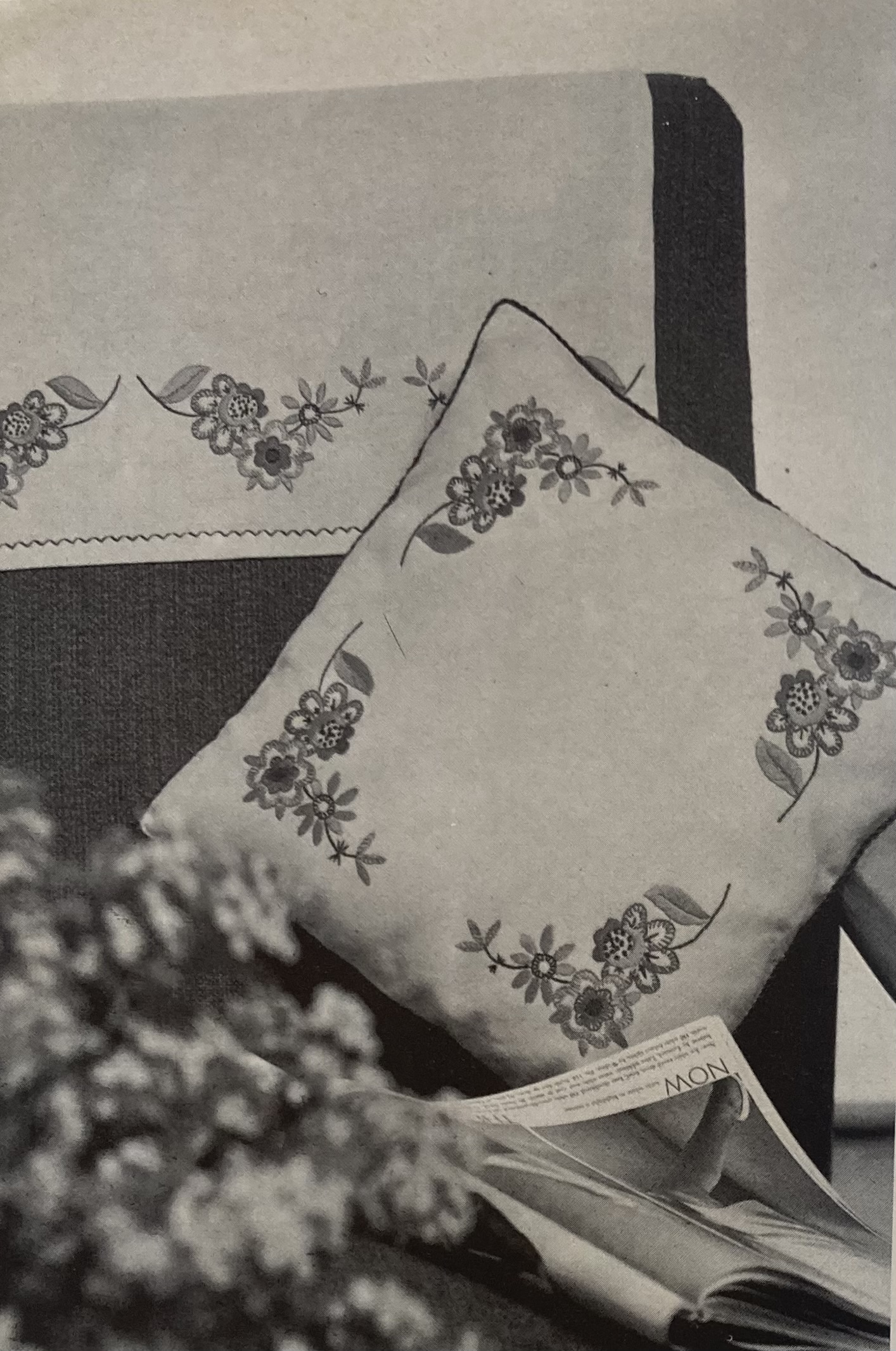
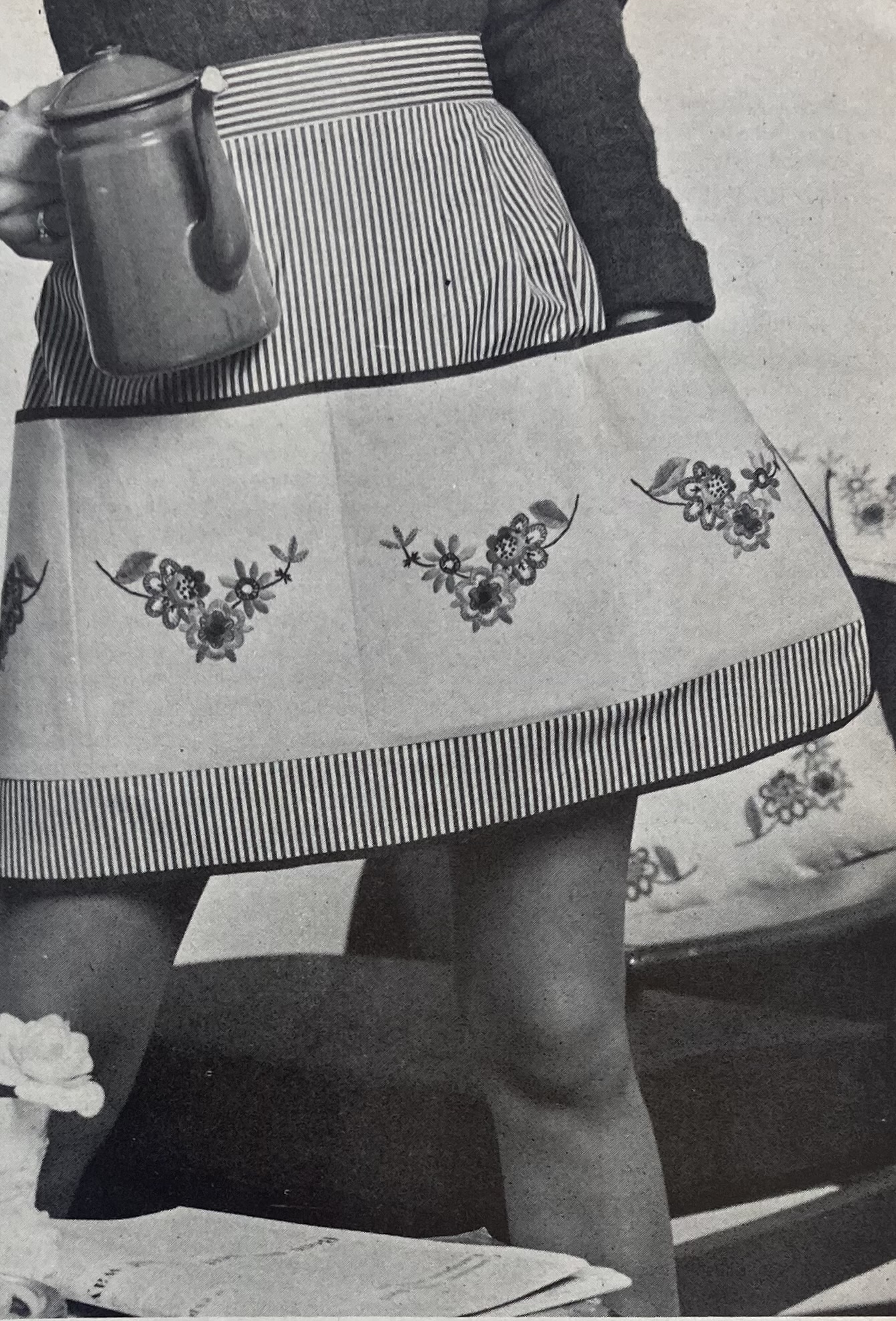
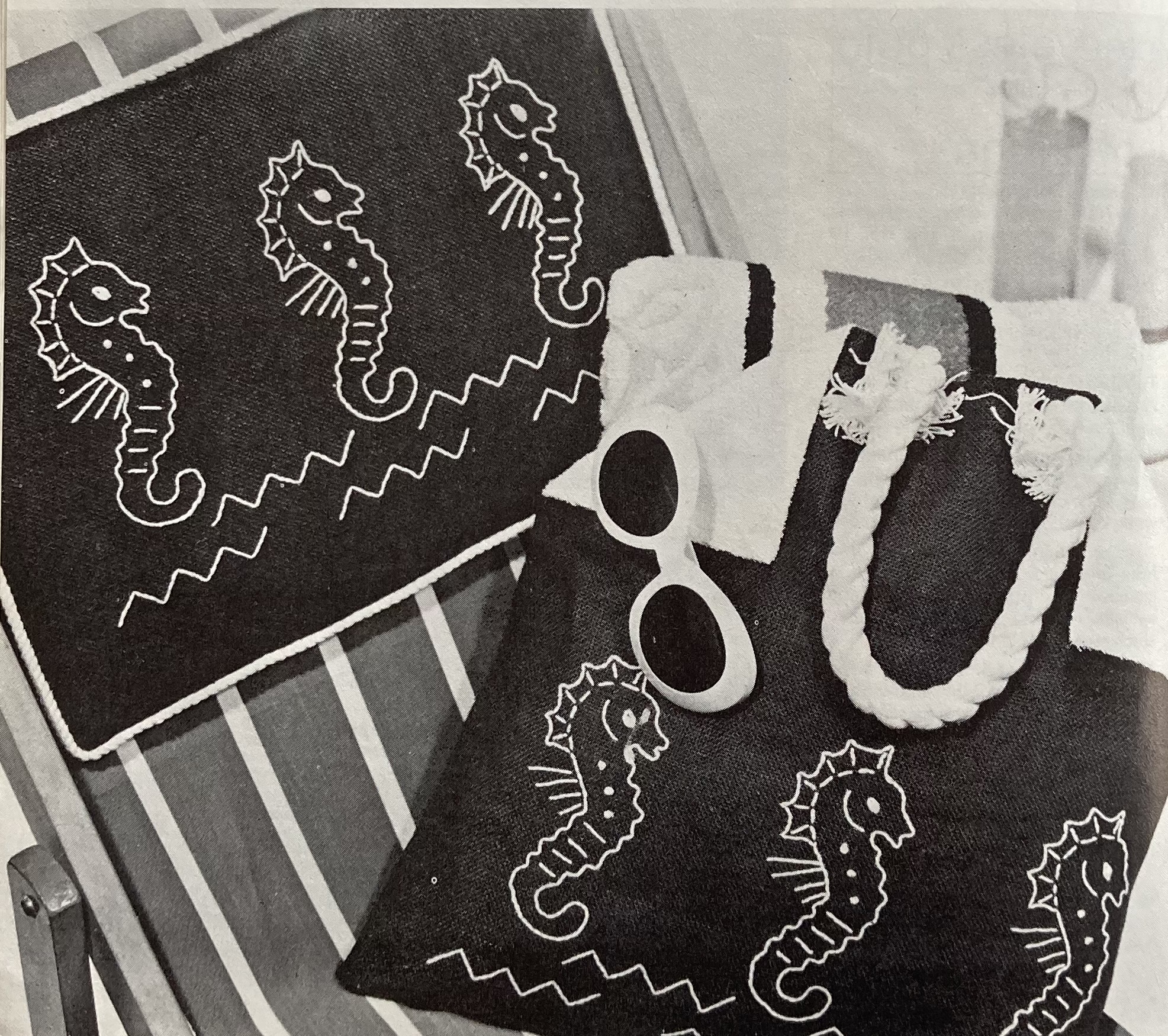
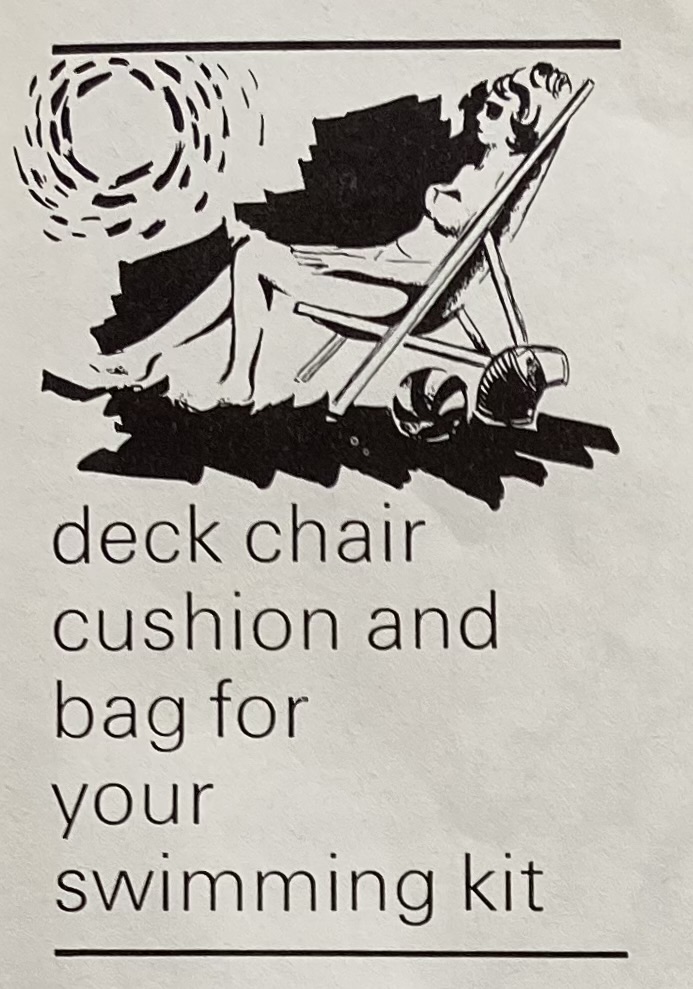
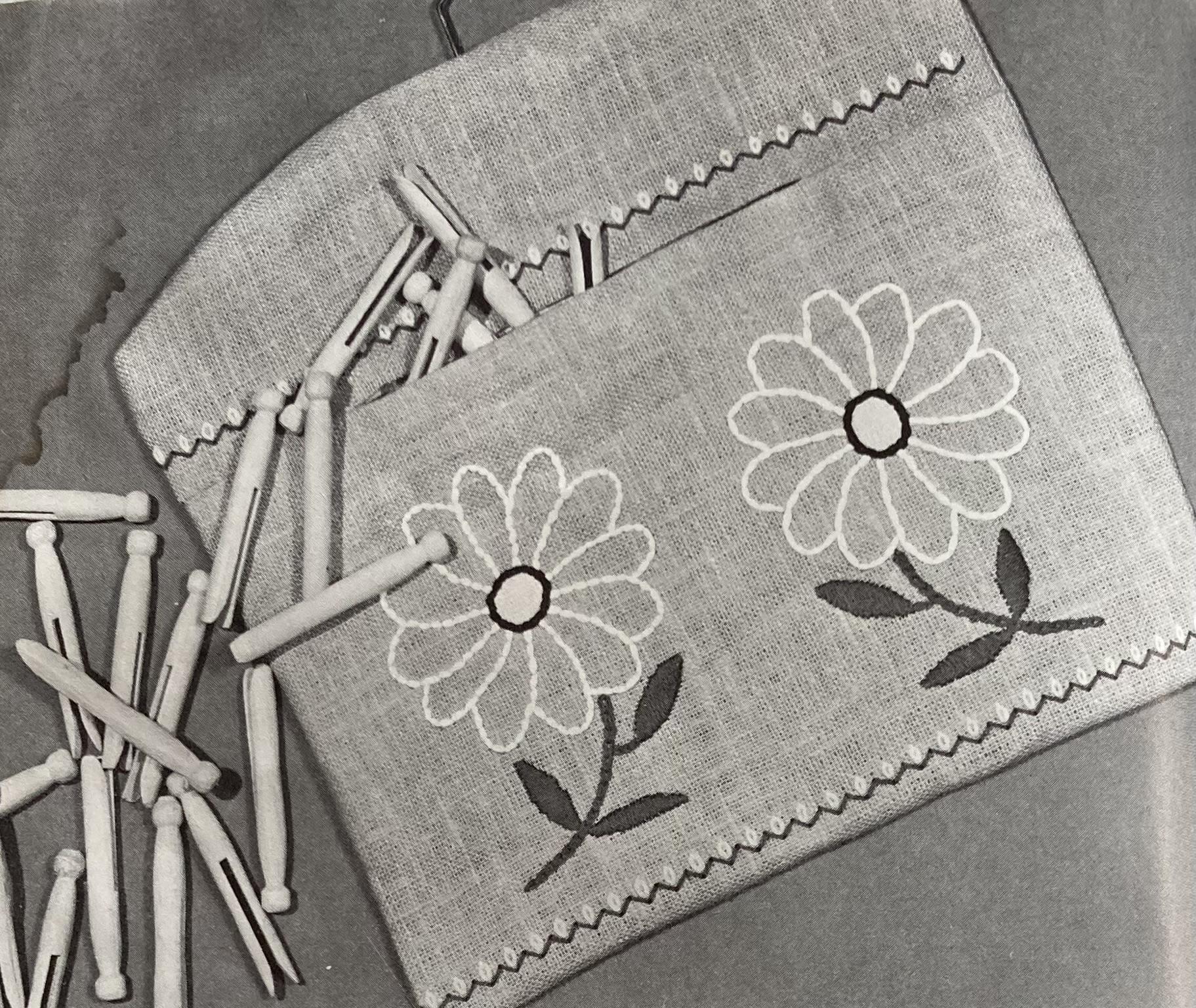
For an easier project, you can embroider sea-horses on a beach bag and matching deck-chair cushion (love the little aspirational illustration.) Or you can sew up a practical, and also cute and sunny, laundry-peg bag and matching apron and embroider them with big, cheerful daisies — “quick and gay to work on kitchen linens or for a bazaar.”

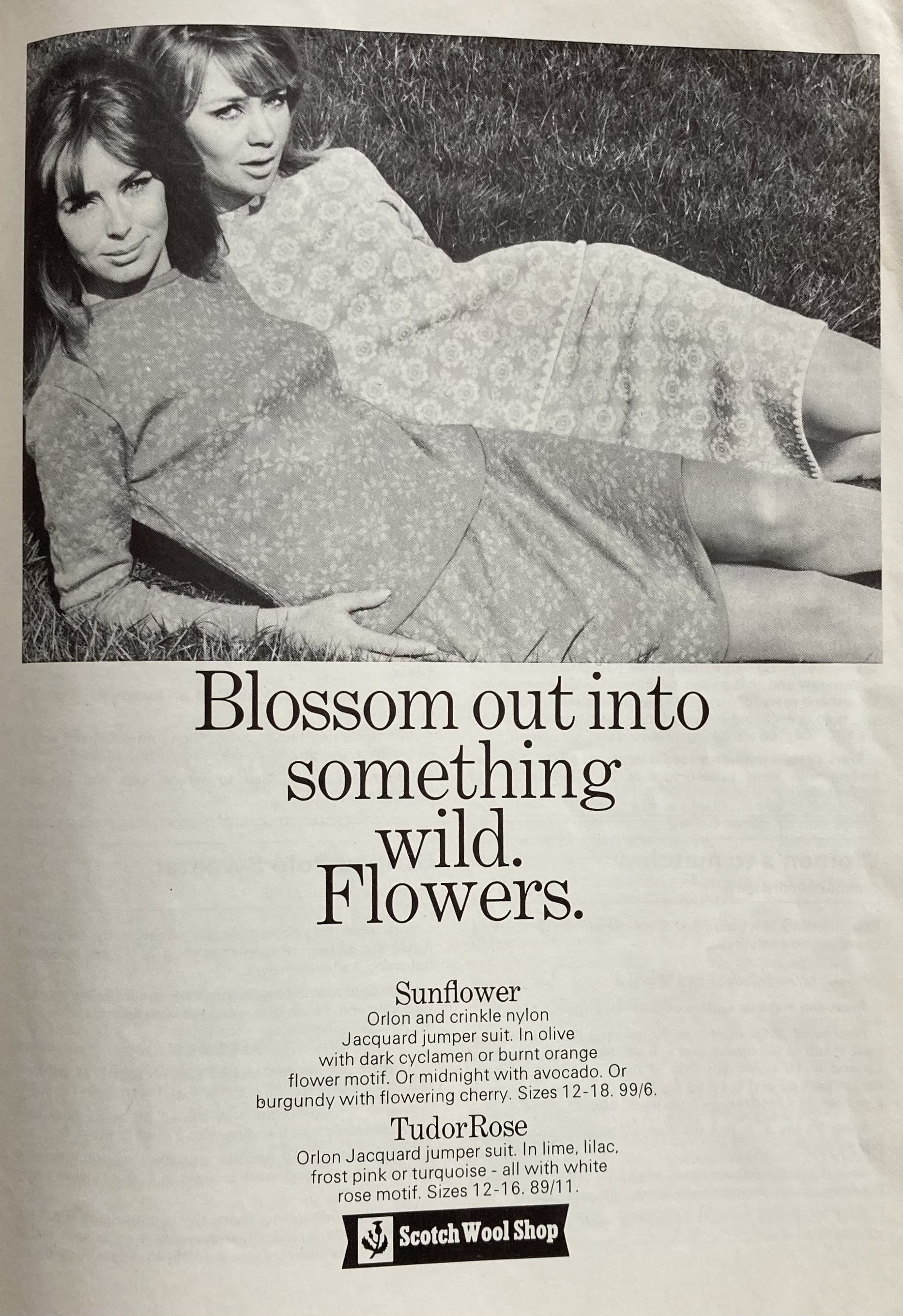
The Readers Pages reprint a striped knitted rug from the September 1964 issue, and the single full-page ad gives us another example of brilliant, yet meaningless, 1960s advertising copywriting and exceptionally 1960s colour combinations: the “Sunflower” Orlon-nylon jersey ensembles is available in olive/cyclamen, olive/burnt orange, midnight/avocado or burgundy/cherry. (A midnight avocado with olives, cherry and a nice Burgundy doesn’t sound half bad, if you took care not to burn the orange.)

I am tempted to make the brass-rubbing embroidery just for the weirdness of it, but realistically, my project will be the daisy-embroidered peg bag and apron. Have a sunny June!

May 1967: Overview

Ahoy! It’s May 1967 here at the Stitchcraft Sixties, where “Cruise Mates feature the fashion for Crepe”, and we are “Holiday Bound.”

What fashions come to mind when you think of spring and summer holidays? Light and lacy tops? Airy dresses? Halter tops and swimsuits? If so, you obviously don’t live in a Northern European maritime climate. Stitchcraft knows what British “cruise mates” need on their summer holidays: multiple layers of thick, damp-repellent wool! Our cover ensemble of nautical blazer and striped “shell” top to go underneath will keep even the foggiest cruise mates warm, dry and fashionable. The double-breasted blazer (“from Paris”, which is not particularly near any large body of water, and also quite a bit warmer than coastal areas, just saying) is made in Totem Cameo DK wool with metal buttons, knitting piping trim and big patch pockets. The sleeveless top is made in the finer version of the same wool, Cameo Crepe. The “crepe twist” (tightly worsted-spun) in the wool makes for smooth, even knitting and good wearablility. You can cover it all up with a gigantic traveling coat made in thick, undyed “Capstan” wool.

Onshore fashions include a sleeveless mini-dress in DK-weight wool (“perfect for holidays”), a short-sleeved jumper in a cables-and-lace pattern, two more sleeveless “shells” for warmer days or layering, and a “classic sporty sweater” in a simple, but effective striped slip-stitch rib pattern. The light green “shell” has a slip-stitch pattern, too, and horizontal texture lines appear more subtly in the easy ridge pattern on the yoke of the dress.

It’s a good issue for menswear too, with a lightweight slipover in a reversible (!) textured pattern. I thought the stitch pattern would be some sort of fisherman’s rib, but it is is utterly simple: knit 1 row, then k1b, p1 for one row. It looks like fairly normal 1×1 ribbing from the “right side” and a sort of starry waffleboard pattern from the “wrong side”. How lovely to never have to worry about putting something on inside-out! The “Continental pullover”, on the other hand, is too wide and the cables on the lower half give a strange “skirted” effect. Perhaps they knitted the wrong size, or should have put it on a larger-bellied model.

There are some wonderful garments for children of various ages in this issue, starting with a comfortable bobble-trimmed top for a school-age girl and a warm sweater for a boy (make sure he’s wearing a proper shirt and tie to go under it while sailing his wooden boats at the beach.) Here too, the stitch pattern looks more complicated than it is: k1, p3 for one row, then p1, k3 back makes a interesting offset rib with minimal effort. Little kids can “paddle and splash” in a tunic, t-shirt top and/or shorts for beach wear. The horizontal stripes are knitted in and the vertical stripes are crocheted on later with chain-stitch. A note in the tunic pattern says, “We have allowed 1-inch extra in length on back and front of dress as chain-stitching tends to contract the work.” Smart!

Rouding out this excellent issue are some wonderful homeware designs, starting with a set of garden cushions in a seaside “fish” and “crab” design. Love the use of pinking shears to illustrate the fish’s scales and the crab’s pincers! Way back in the “Readers Pages” is another, versatile appliqué design, this time with crocheted flowers instead of felt cut-outs.

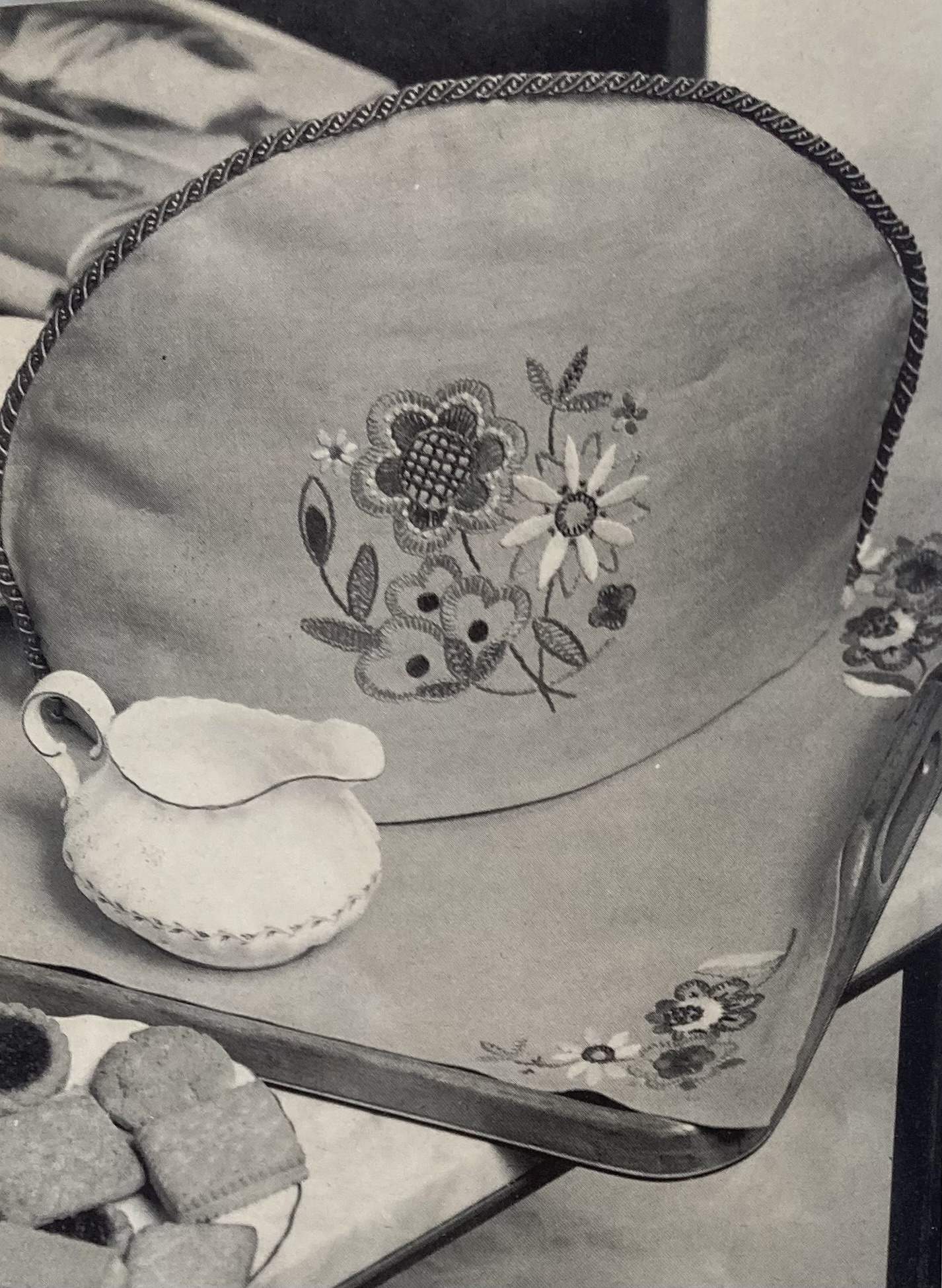
For cross-stitch enthusiasts, there’s a coffee-tray set with matching deep-pocketed apron, or a tea cosy featuring wool stitching on tapestry canvas. Beginning rugmakers can make an easy runner in chain and soumak stitch.

The most magnificent design, though, is this Chippendale-inspired rug and piano-stool set, rightly featured in full colour over the two centrefold pages. The stool cover is worked in tapestry using tapisserie wool in trammed tent stitch and the 36×62 inch rug is worked in cross-stitch in Turkey Rug Wool.

Even the ads are great in this issue! The model wearing Patons Fiona is happy rain or shine and look at those amazing swimsuits from the Scotch Wool Shop! I would wear either of them today. And don’t you love the Singer sewing machine that can be folded down into its own practical storage cabinet when not in use? Did any of you have one of these? I think it’s brilliant and would have loved to have one.

My projects from this issue will be the garden cushions and the crochet appliqué on a useful-for-whatever little bag. I somehow have lived my entire adult life without a garden or even a balcony, but I know people who have those things and would love to have a fun cushion as a gift.

Happy Spring!

April 1967: Overview

“Spring into Summer” with the April 1967 issue of Stitchcraft — one of my favourites. According to “editress” Patience Horne, the latest fashion trends include longer-bodied “skinny” sweaters (i.e. slightly less bulky than the previous oversized look), “still figure-fitting” (they aren’t, though) and “belts with everything” (none of the models in the photos are wearing belts.) Make what you will of that. “Fashion is very dashing — still young and gay in ideas — but slanted to a feminine look — pretty and flattering.” In other words, whatever you want it to be! Colours are definitely bright and fun, with interesting textured stitch patterns and colourwork.

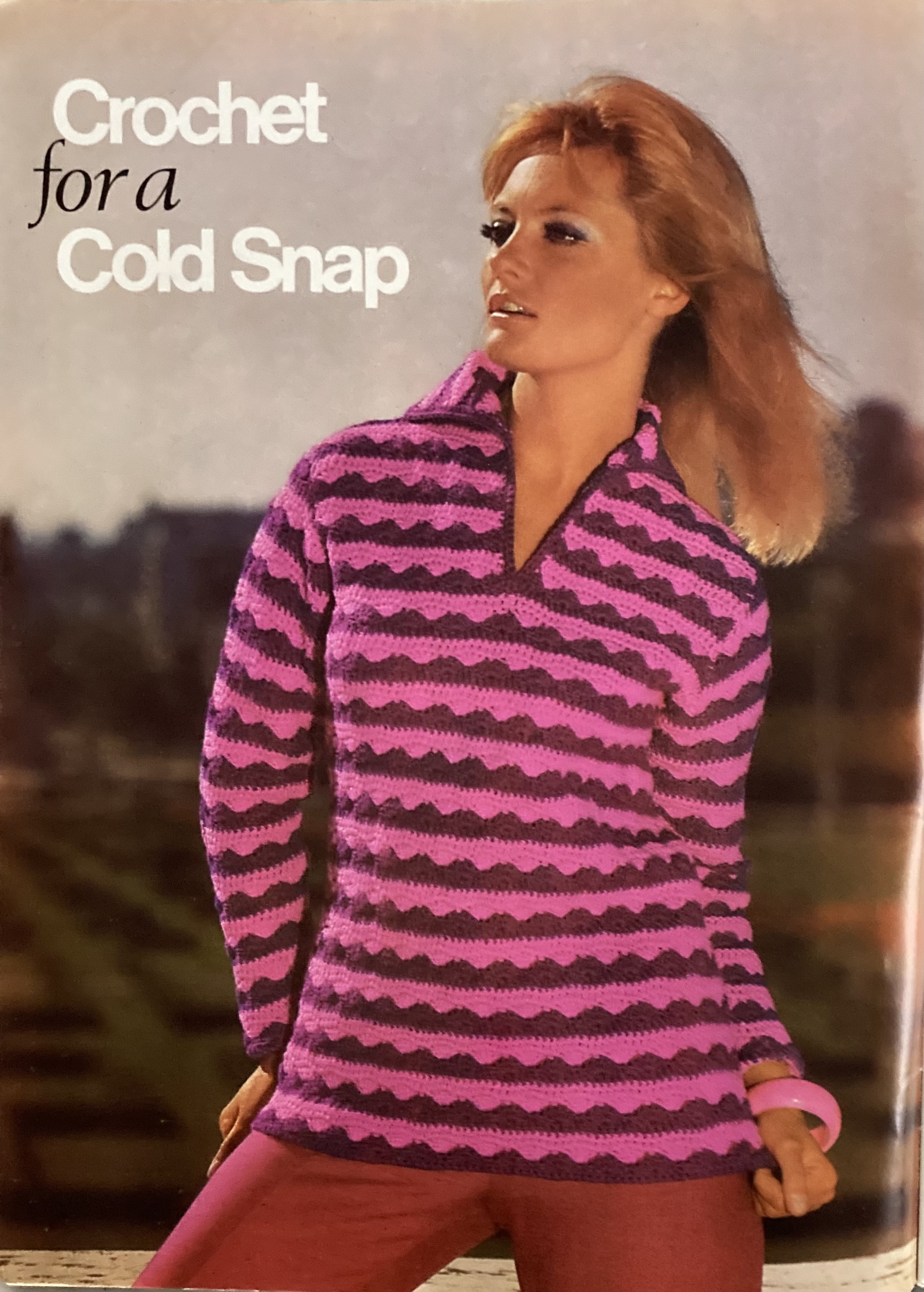
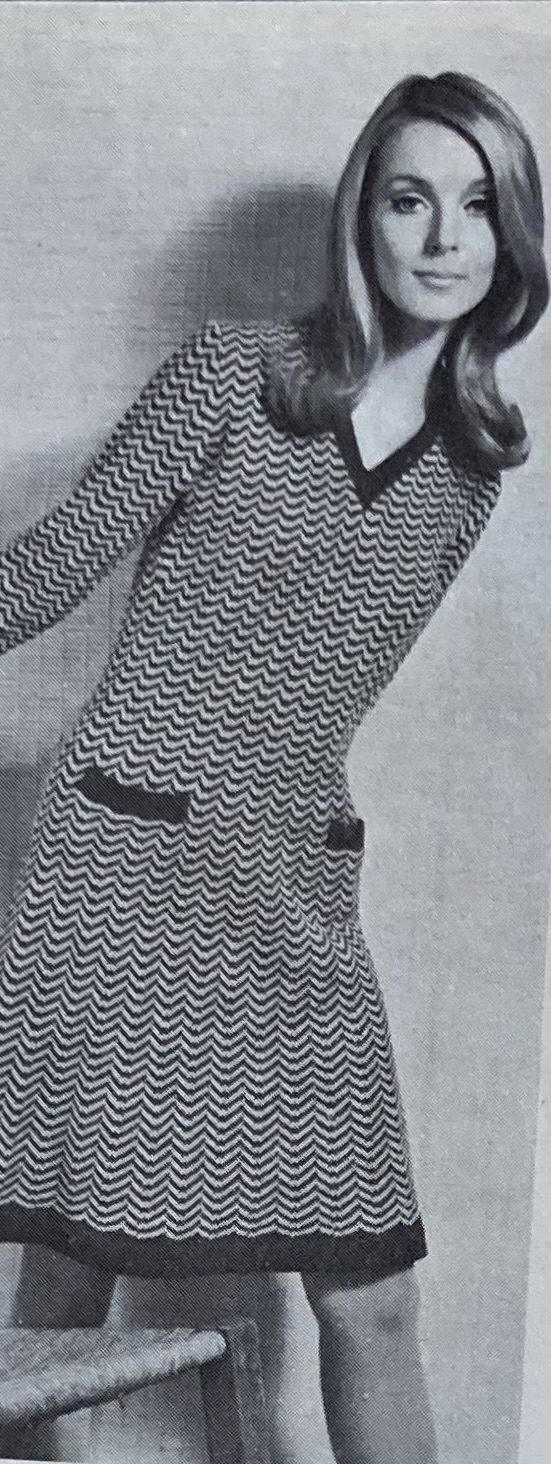
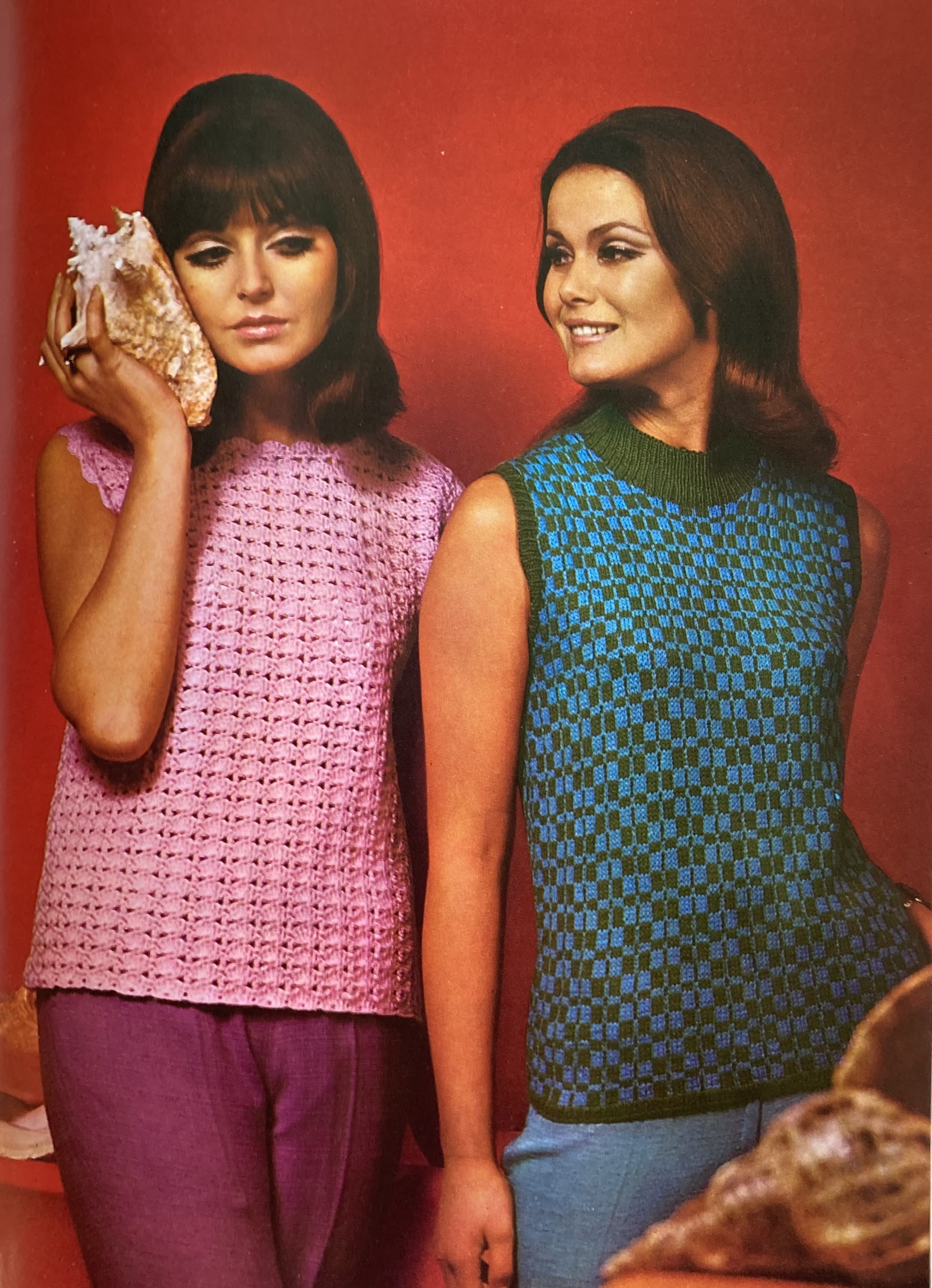
Our cover design picks up the trend for the retro-1930s look which will really take off around 1970 (could Stitchcraft actually be fashion-forward?) in bright, 1967 shades of pink and purple. The brilliantly orange pullover on the inside cover has an intriguing “pineapple” pattern. The summer “shells” (sleeveless tops) strike a nice balance between bold colour and crochet-lace patterning and more subtle, neutral bouclet. Love how they’re listening to shells in the photos! (Though sadly, the crochet model looks like she’s getting bad news.) Rounding out the adult women’s fashions is an understated and elegant fine-knit crepe blouse for larger sizes.

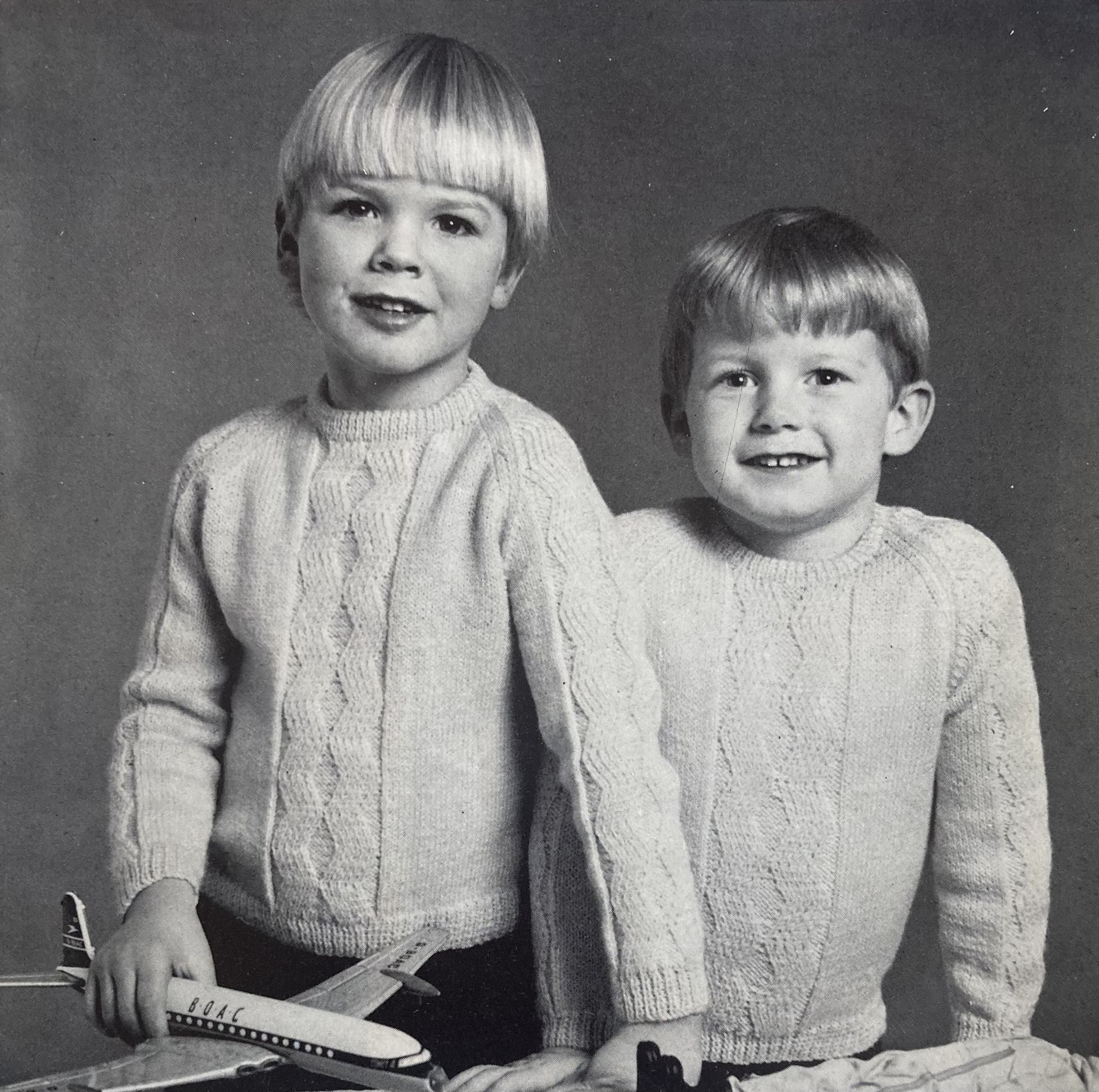
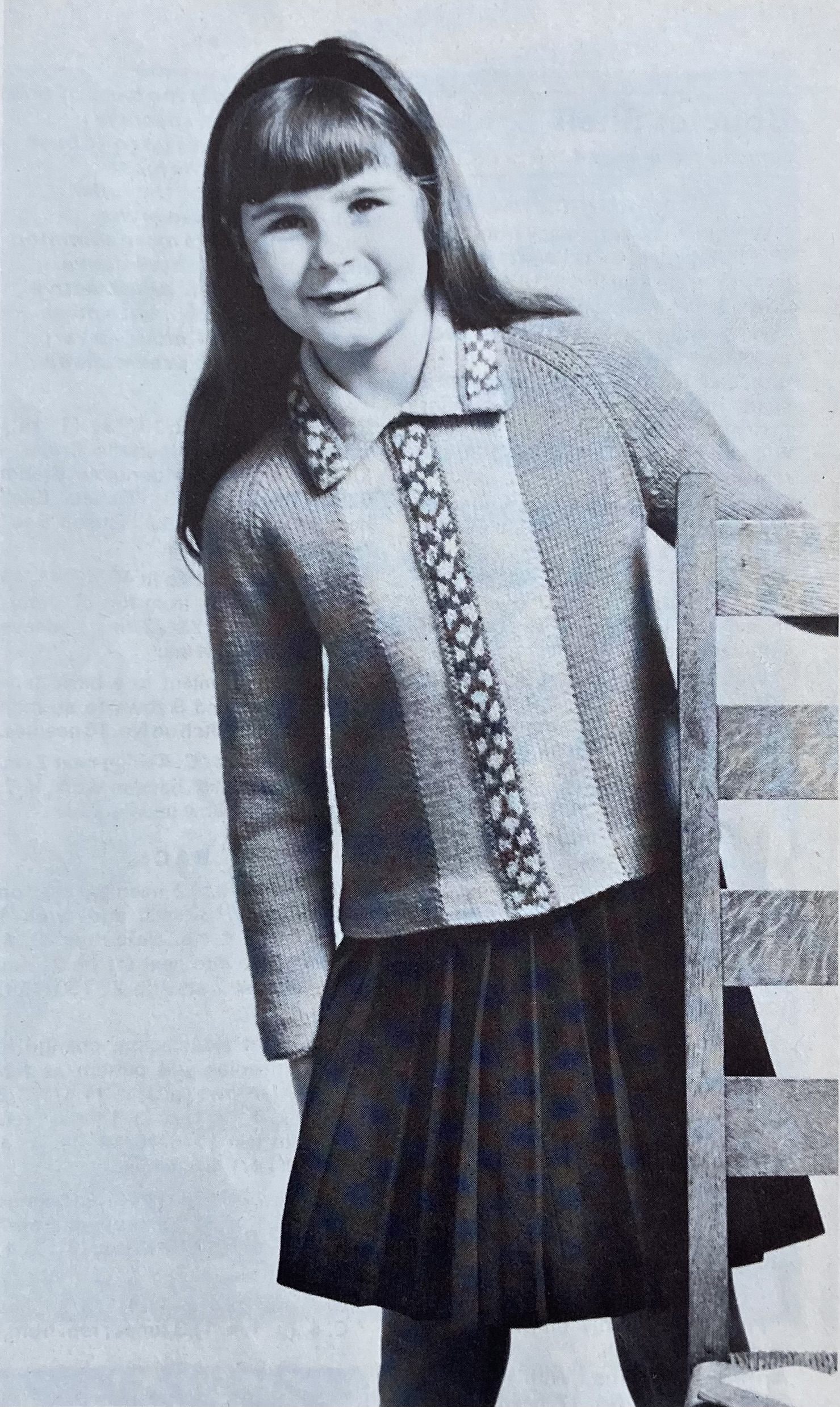
This issue has some great designs for school-aged children, starting with this “outdoor cardigan for rough-and-tumble wear” for a girl. Who is wearing leggings! That cover her legs and which she can actually move around in without flashing the neighbourhood! Finally! The model looks like she’s about to have a great time, too. Our more feminine model sports a pretty panelled pullover that looks like a buttoned-up cardigan. It’s just as practical as the more rustic design, but with elegant details. Her little sister gets a tunic top with a striped yoke and cuffs.
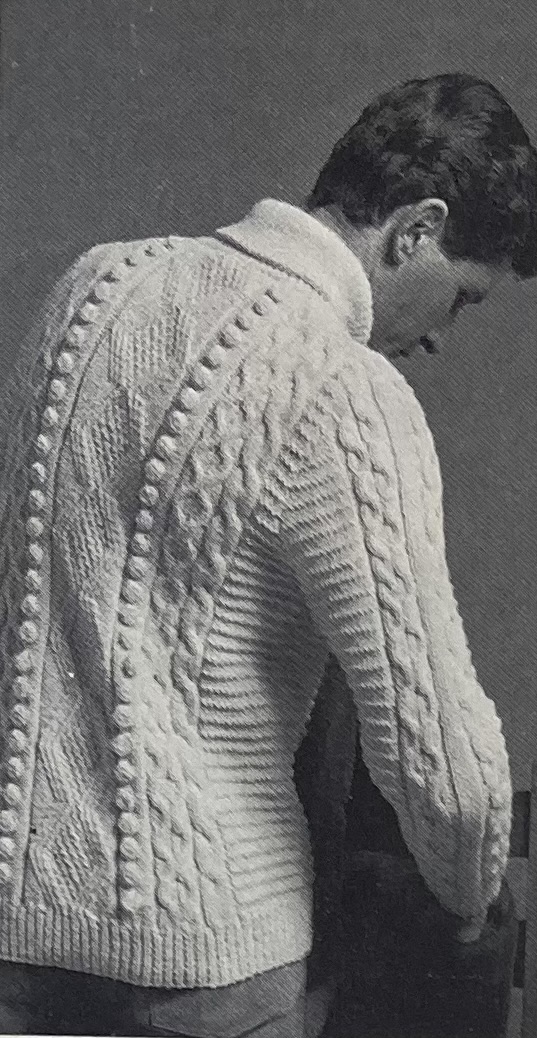
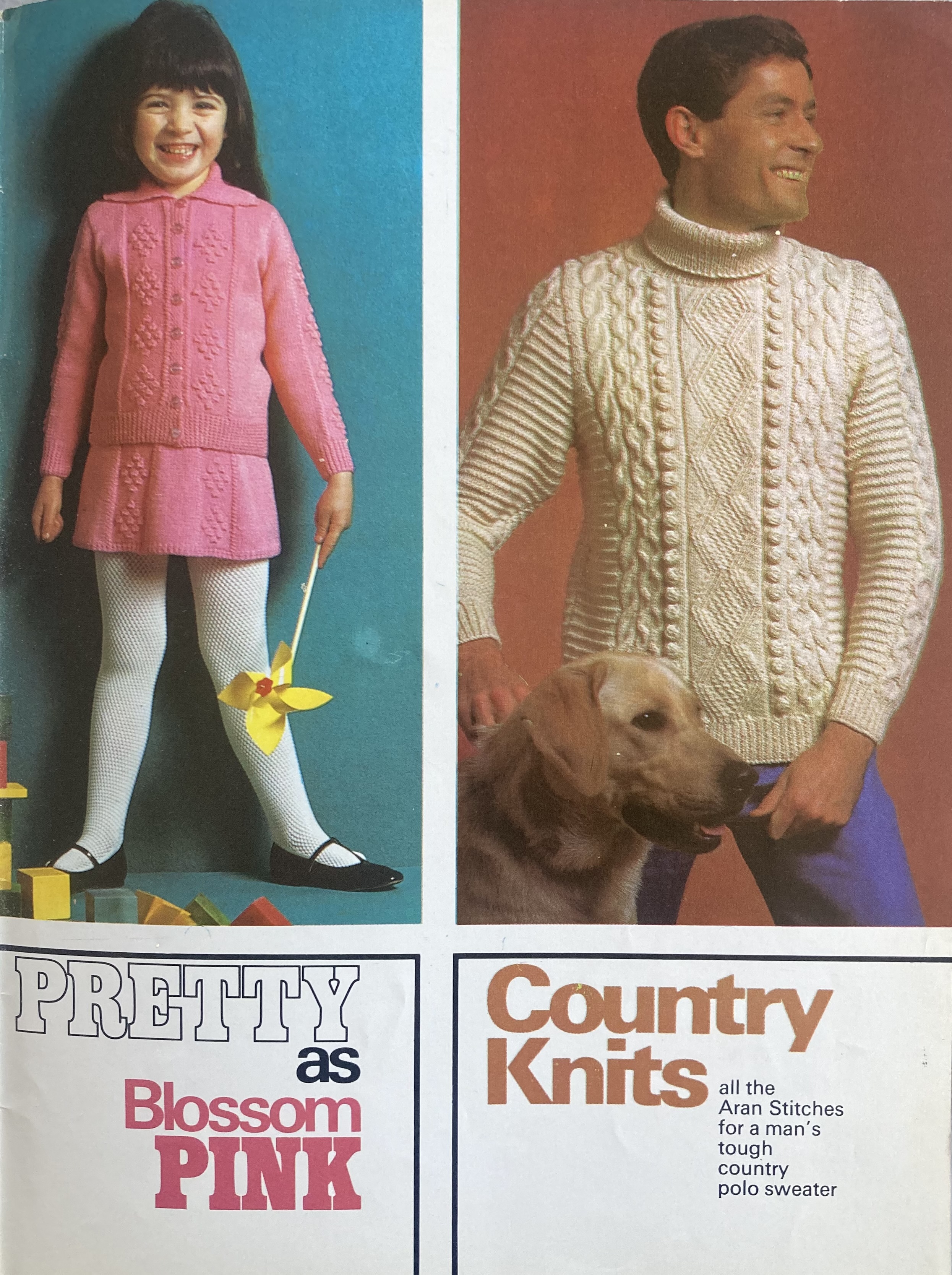
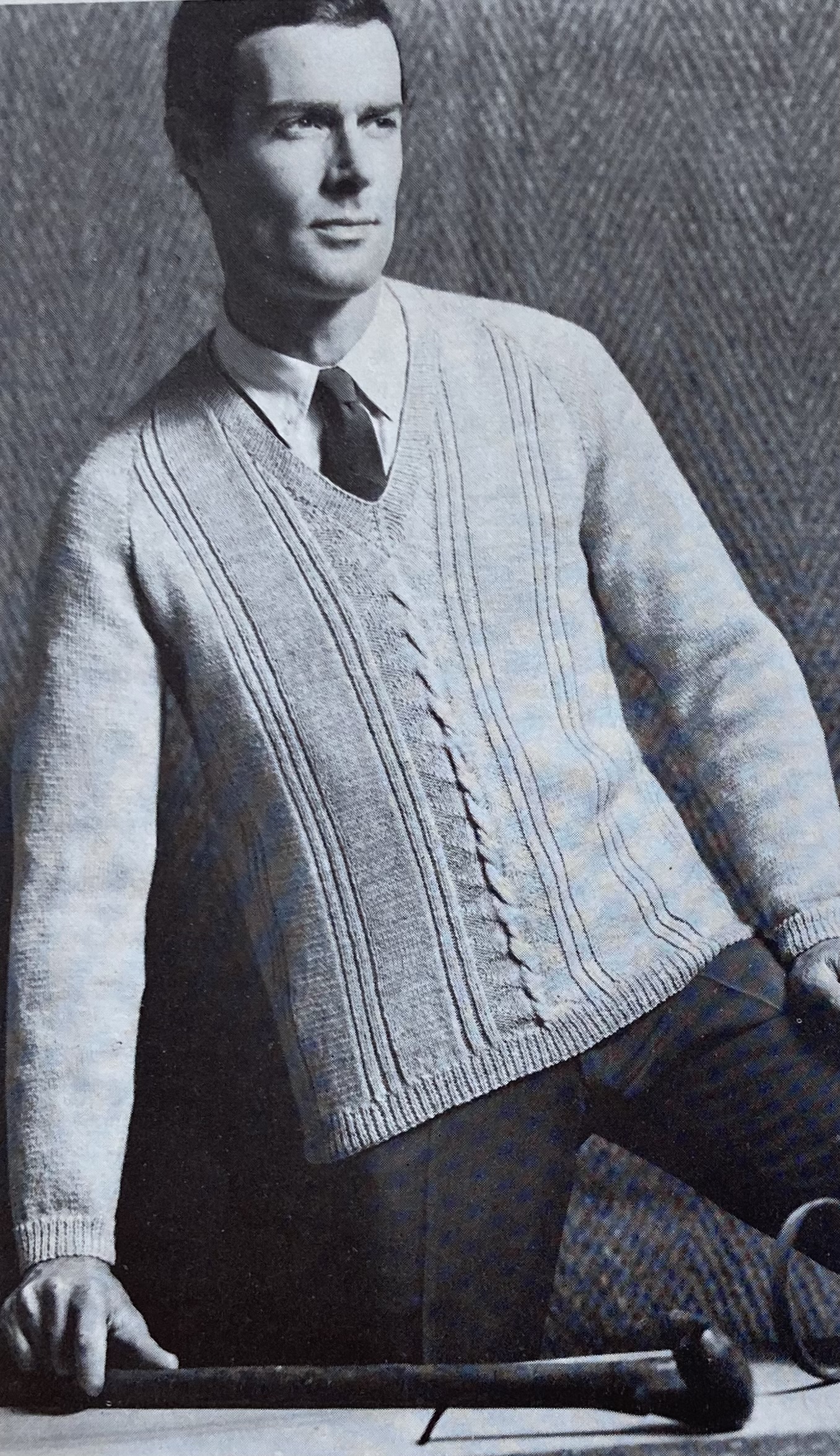
Oversized garments in neutral colours and vertical cablework patterns are still on trend for men’s fashions, represented here with a V-neck pullover in cable-and-rib pattern and a “country cardigan” in undyed “Capstan” wool with a crunchy Aran pattern on the fronts only.

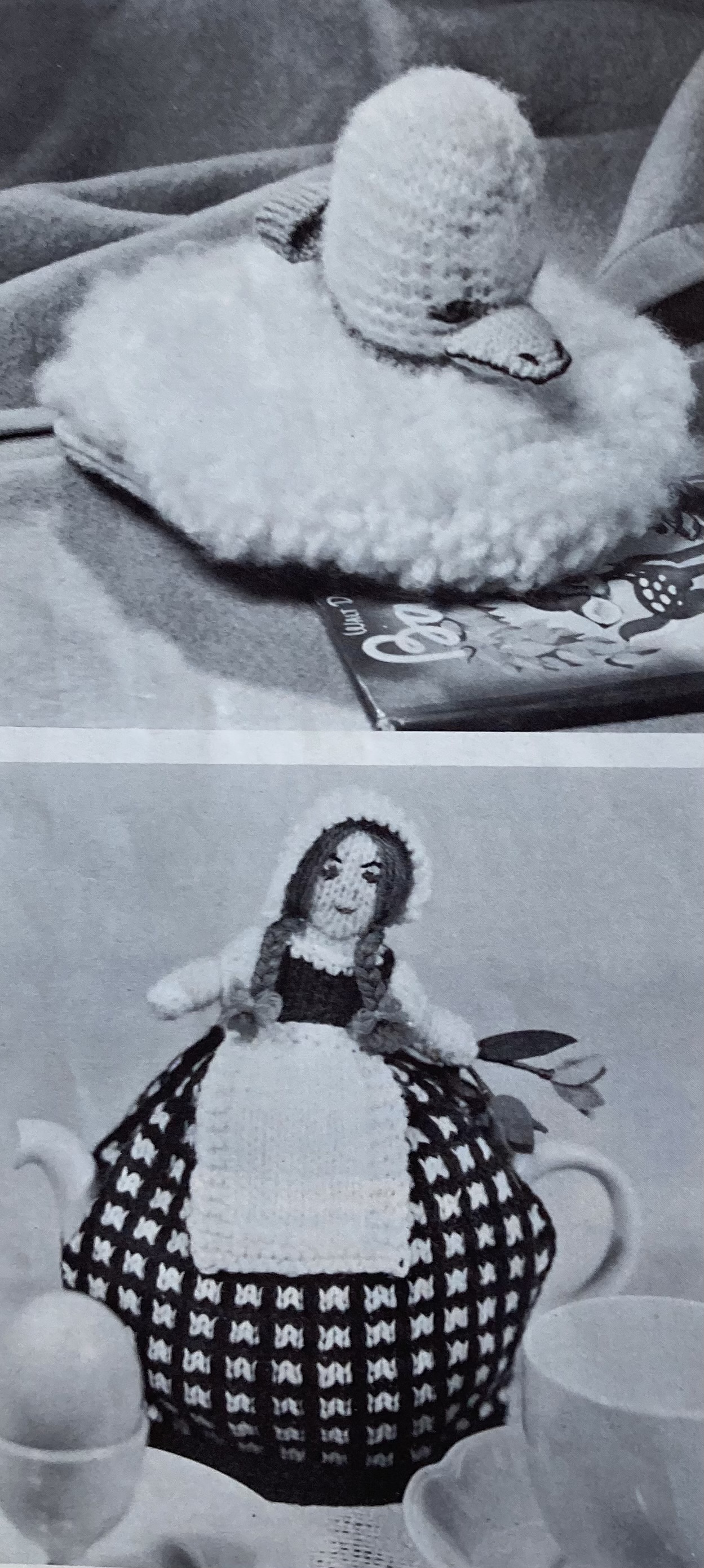
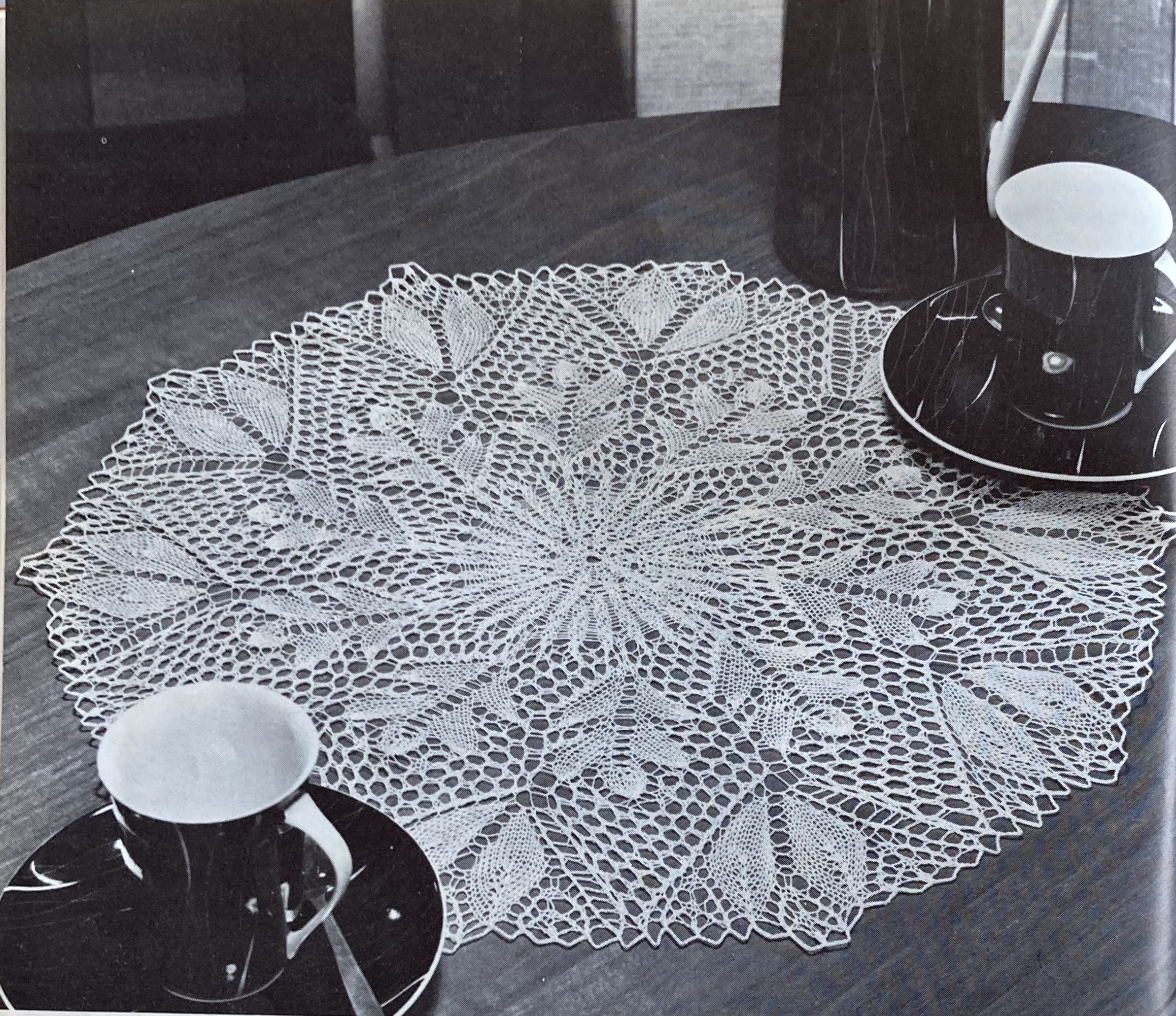
It wouldn’t be Stitchcraft without “Bazaar items”, and the ones in this issue are actually really cool. There’s a knitted nightcase that looks like a fluffy duck thanks to a loop-stitch pattern that is then brushed with a teasle brush to felt and fluff it up. The knitted doily is quite intricate and the “Dutch girl” tea cosy (holding a cluster of felted tulips!) is amazing.

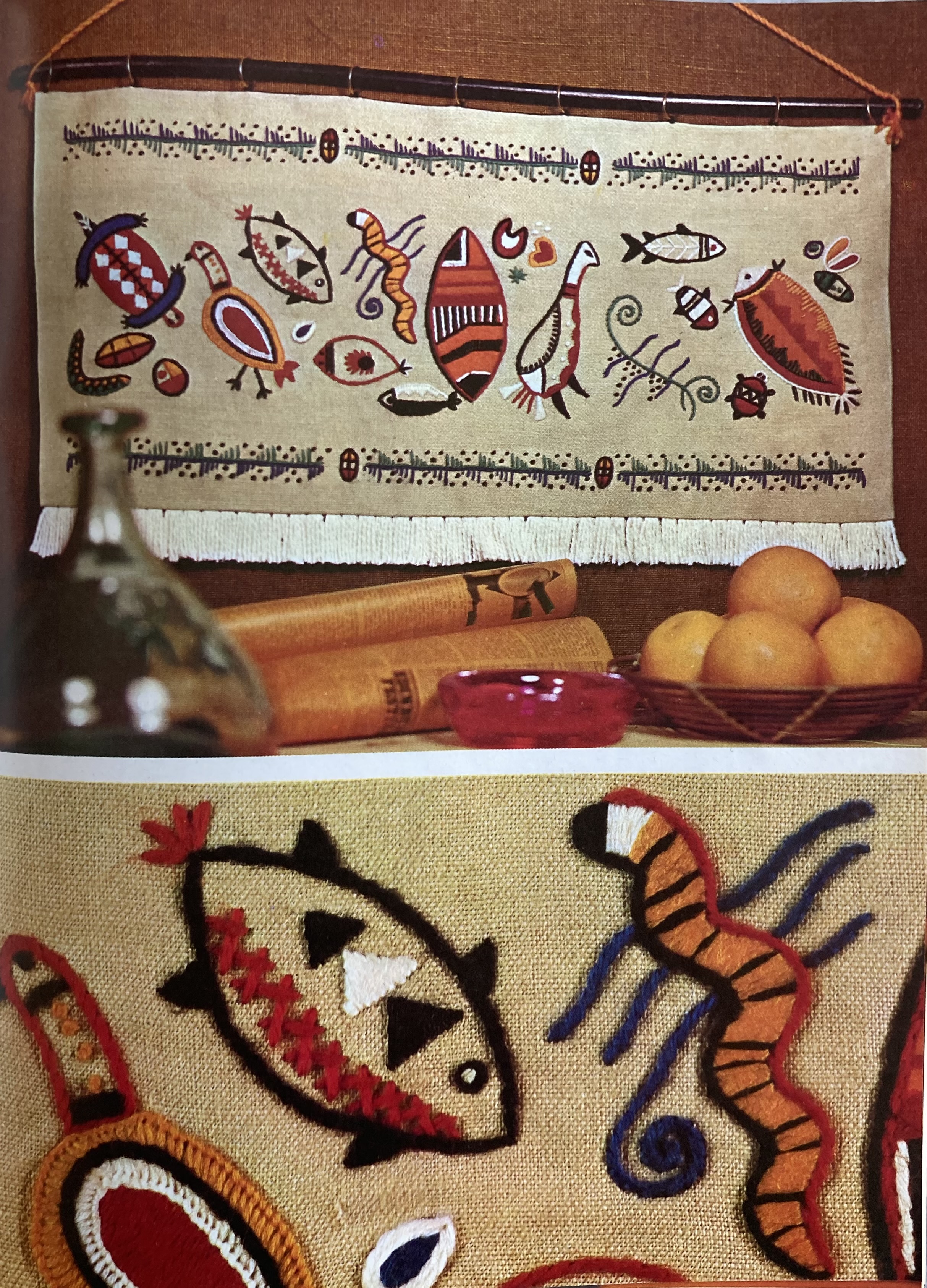
The regular homewares are also more creative than usual. Check out this embroidered “tropical fish” wall panel! (In non-tropical 1967 colours of brown, rust, and burnt orange.) I love it. The fantasy-animal theme continues with a tablecloth and/or table mats and/or cushion in Assisi design. The Victorian stool or cushion ribbon design is quite normal in comparison.
The back pages have the usual ads another nice one from the Scotch Wool shop, but not as dramatic as in the previous issues. in the “Children of other Lands” serial comic, Fifi the French girl takes a baguette home under her arm, only to have it eaten by birds on the way home. I told you this wasn’t the best comic of the Stitchcraft collection… Then there’s a nice extra pattern for a crocheted collar and cuffs in “bell” pattern to perk up your plain dresses.

I’ll be making two larger projects from this issue — the cover dress and the check-patterned “shell”. Neither of them will get done in April, but I’ll post something and update it with progress. Happy Spring!

March 1967: Overview

The March 1967 issue of Stitchcraft promises us „new fashion looks for Spring knitting“. March weather being notably unpredictable, there are warm, bulky knits for colder days (or to wear as sporty outerwear) and finer knits for Spring. The former are mostly made in „Big Ben“ to knit up quickly and warmly, but slightly less bulky in shape than before, the latter in smooth crepe wool with or without glittery accents. The „skinny“ „mini“ jumper makes an appearance as an alternative to the bulky look for young folks, and the crochet look in knitwear is still trending.

Our cover duo sports (heh) matching bulky V-necks in Big Ben wool, knitting up quickly at 3 1/2 stitches per inch. The cable panels down the front give it a little bit of vertical line to counteract the bulk. The cable-and-V-neck combination show up in a slightly less heavy-knit casual cardigan for larger sizes. The „Sweater with flower trims“ on the inside cover looks bulky, but is merely oversized and actually knitted in fine Cameo Crepe at 8 stitches to an inch. The flowers are made with intarsia with crocheted motif centres sewn on and the buttons are covered in fabric knitted from the same wool as the sweater — a cute extra touch. The crochet look in knitting continues with a high-buttoned cardigan in a sort of arrowhead-shaped slip-stitch pattern. It too is knitted in fine crepe wool, but looks bulky due to the oversized design and three-dimensional stitch pattern.

Teenage girls can knit themselves a „Little Shetland“ cardigan or pullover with an easy stranded pattern at the yoke or hem, or a fine-knit „skinny rib top“ which would be just as much in fashion nowadays as then. Whatever the girl behind the skinny rib top model is wearing is not part of this issue and will remain a mystery.

Finally, there‘s a glamourous sleeveless cocktail dress with matching jacket. The lacy pattern panels get a little extra glitz from knitting with the base wool (Cameo Crepe) and Lurex thread held together.

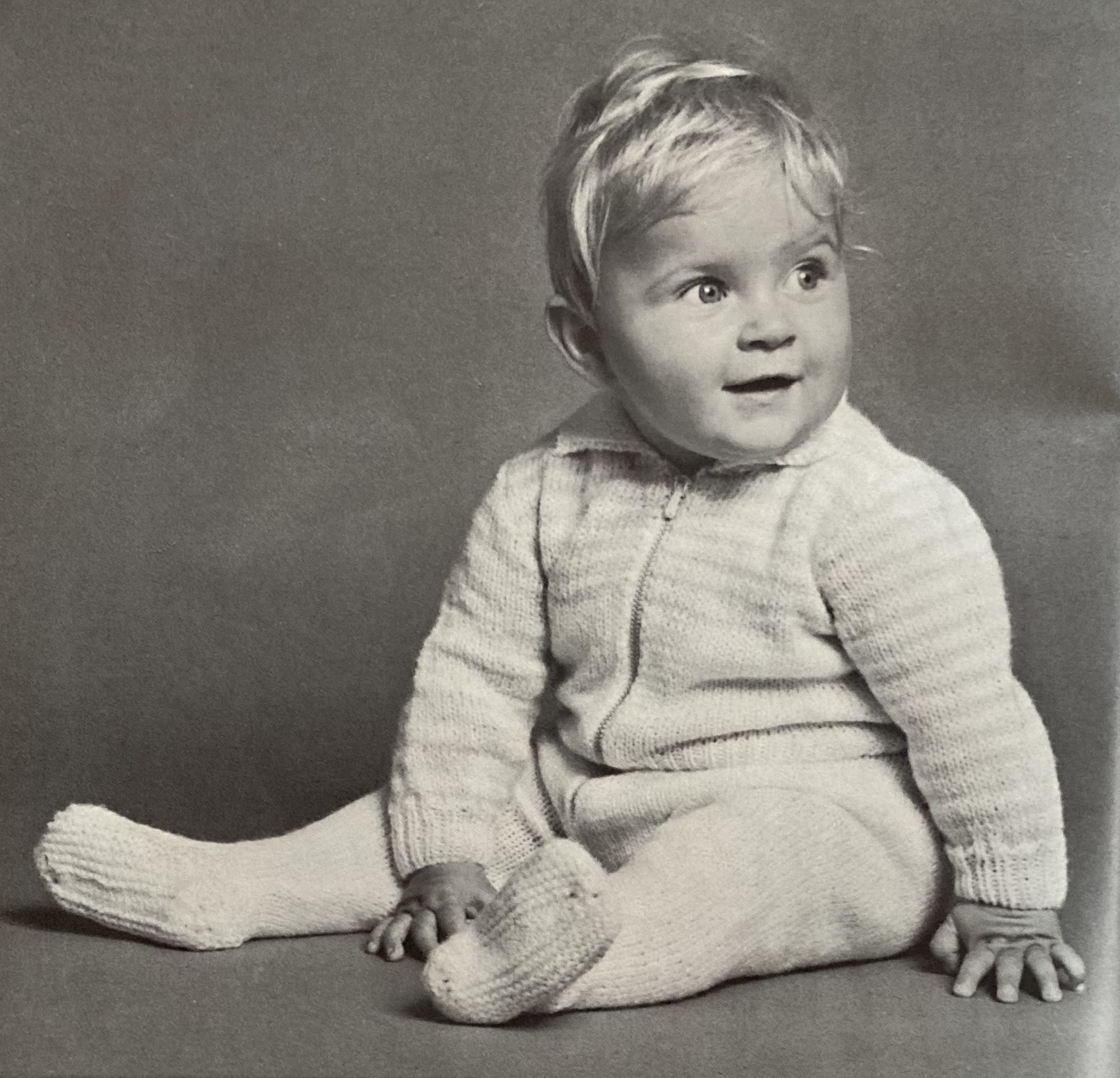
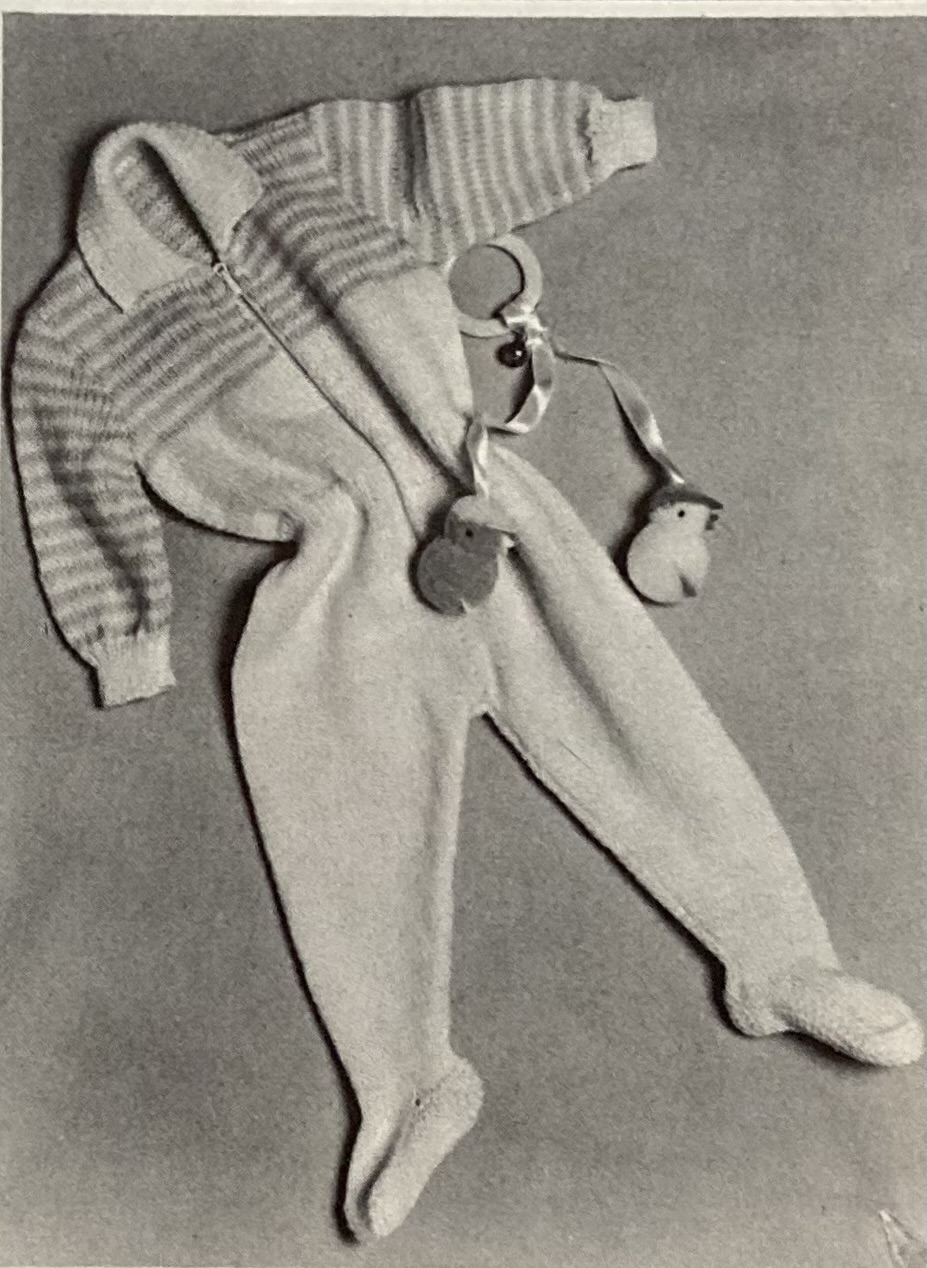
There are so many women‘s fashions in this issue that there apparently wasn‘t much room for men‘s or kid‘s designs. What there is is great, though: a three-piece baby set for spring outings in the pram and a hard-wearing cabled Aran pullover for a school-age boy.

The homewares in this issue are less interesting than usual and feature versatile designs that can be adapted to different furnishing needs: a woven design for a rug or cushion, grapes and leaves to embroider on an apron, mats or cushion, etc. Ambitious crafters could make an entire set for a room that way.

There‘s a cute breakfast set for a child‘s Easter morning and a crocheted mat for the adult‘s afternoon coffee table. Really ambitious embroideresses could make an elaborate and very pretty flowered tablecloth.

There‘s a new comic series in the Readers Pages which is cute and well-meant, but also fairly eyeroll-y for modern sensibilities: „Children of Other Lands“, featuring well-trodden clichés about cultural practices etc. in non-British countries. This month features Jan, a Dutch boy whose wooden shoes get stolen by mice, who use them as a boat on the canal. You get the idea. The ad for the Scotch Wool shop manages to be at least as much fun without any stereotypes.

That‘s all for this issue! I don‘t know what to make. I love the cocktail dress combo, but the ratio of time and effort in making / actual use I would get out of it doesn‘t add up. The larger-sizes cardigan is practical and nice, but I have multiple larger projects on the needles and don‘t want to start a warm cardigan in Spring. I might make another project from the January 1967 (the Fair Isle cardigan! Finally bought the wool for it!) or February 1967 (Lacy knee socks!) issue instead, or start ahead on the April project (chevron striped dress.) I promise to get something done sometime. Happy Spring!

January 1967: Headband and Mitts

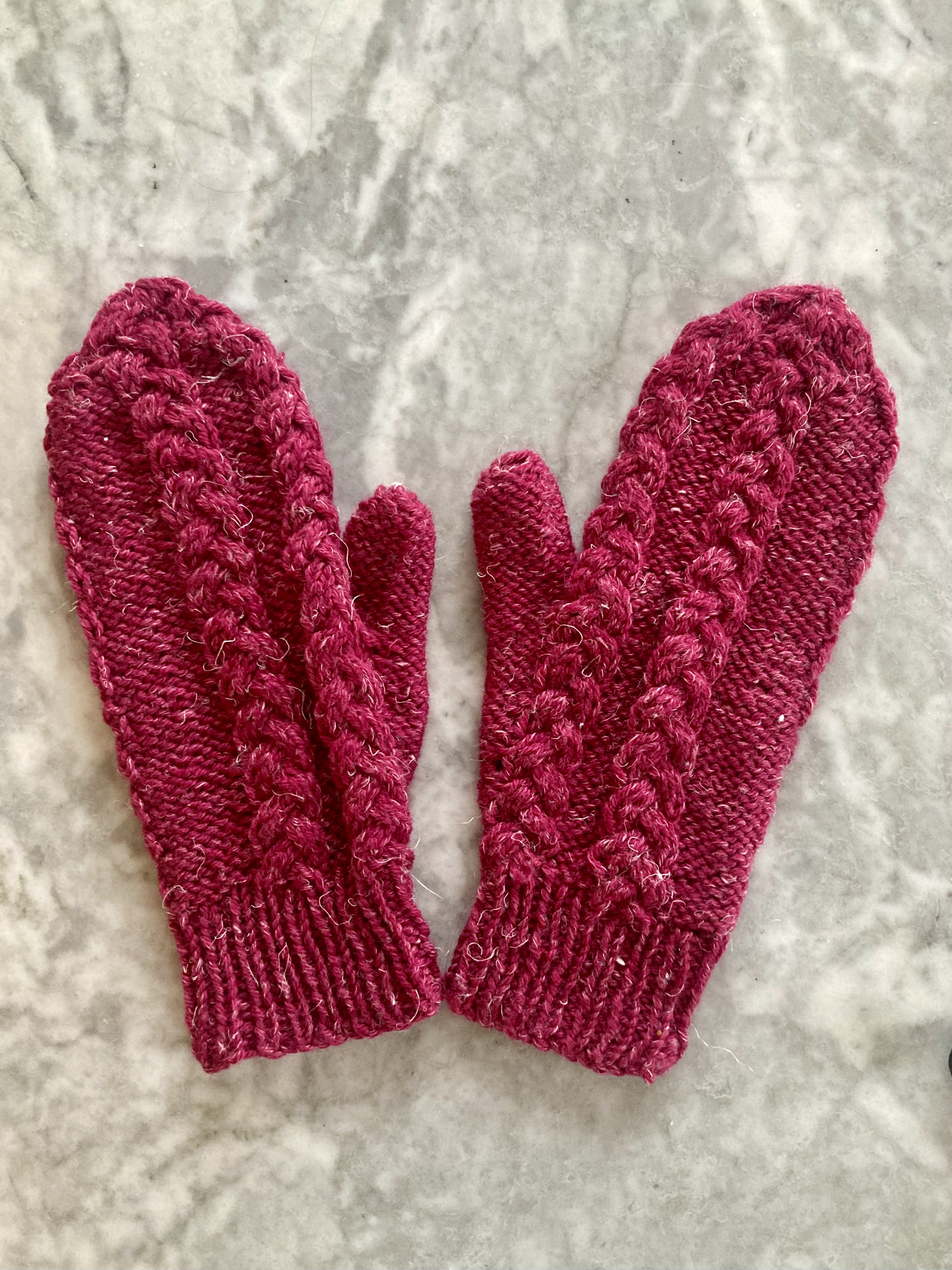
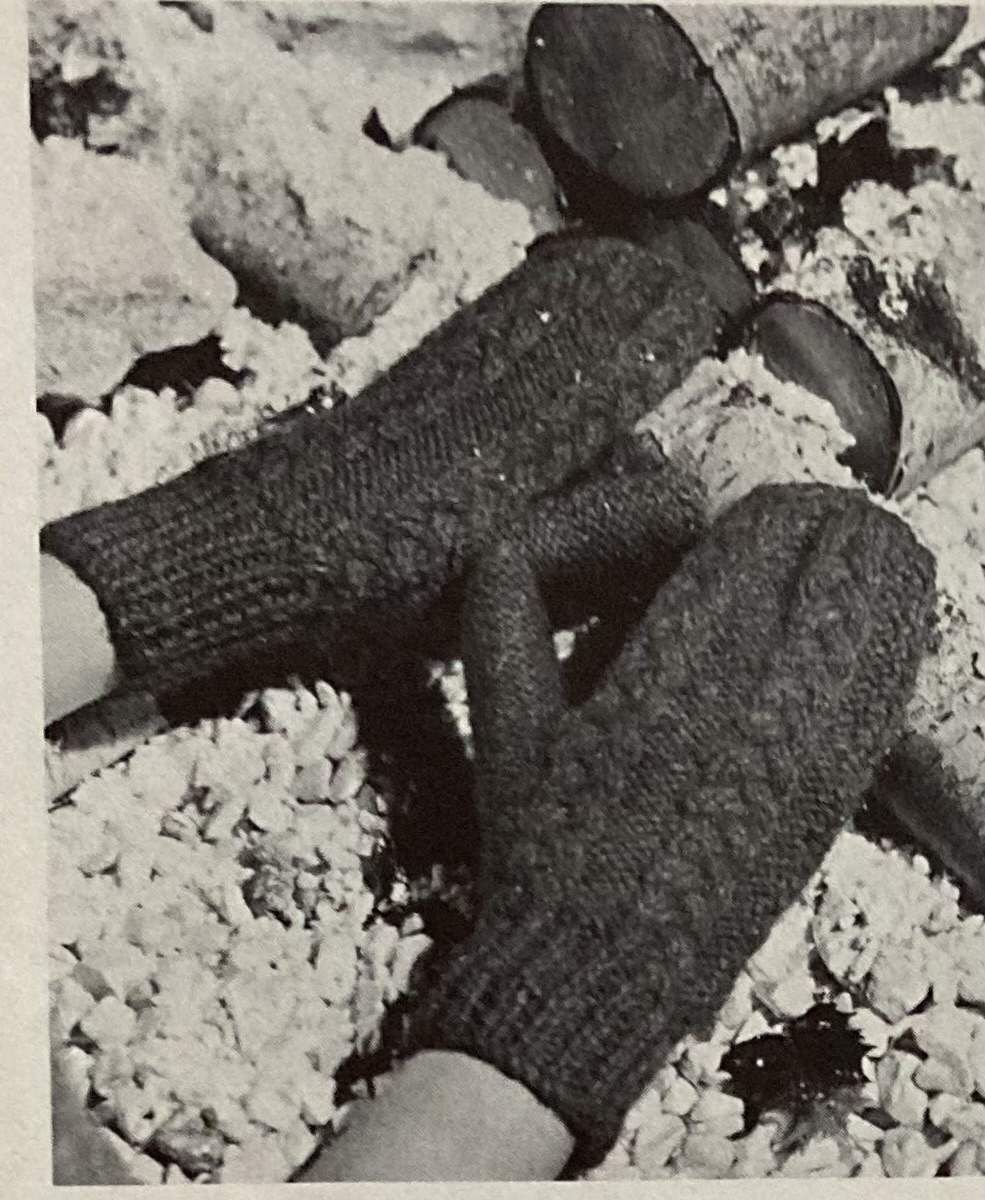
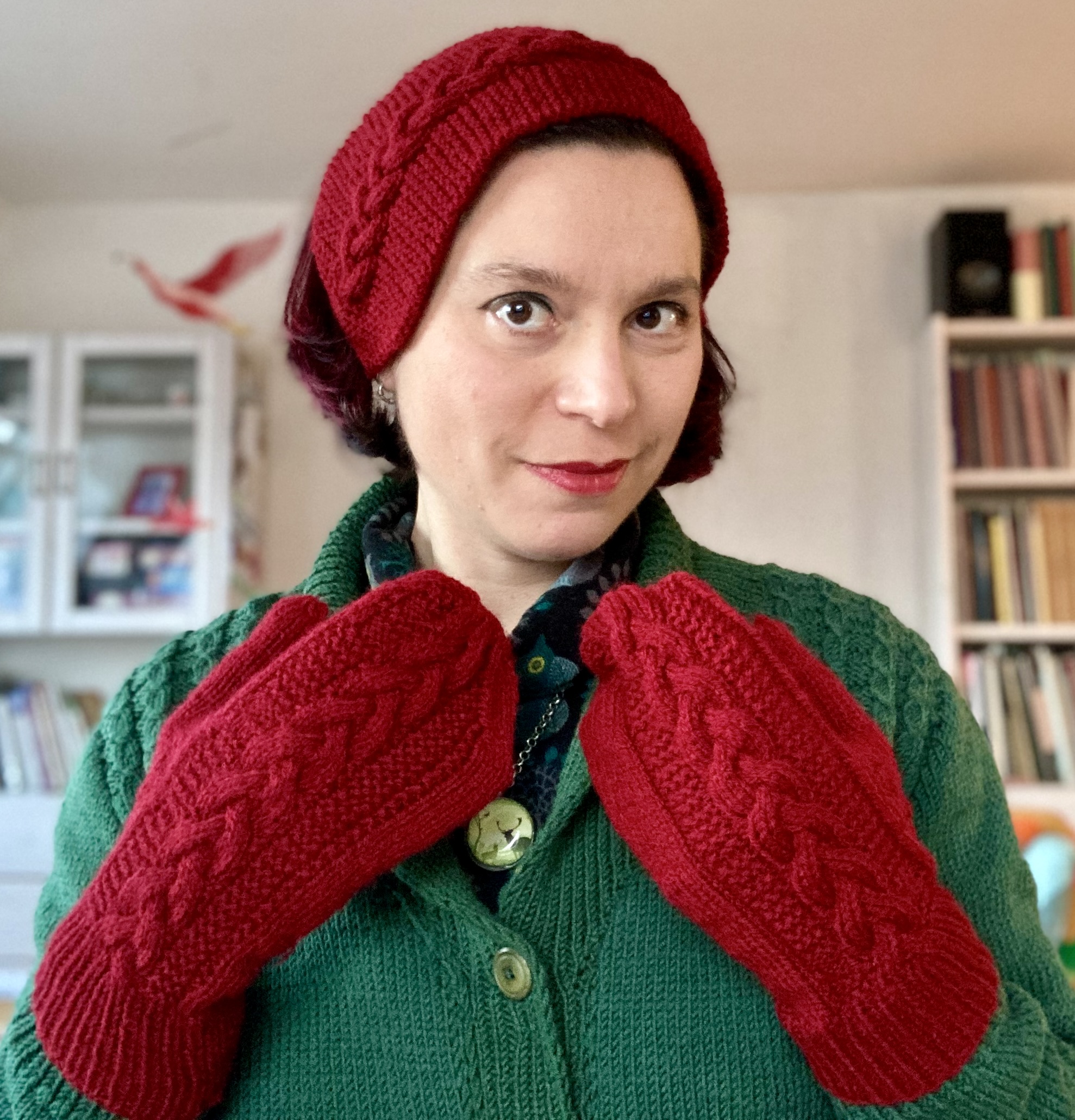
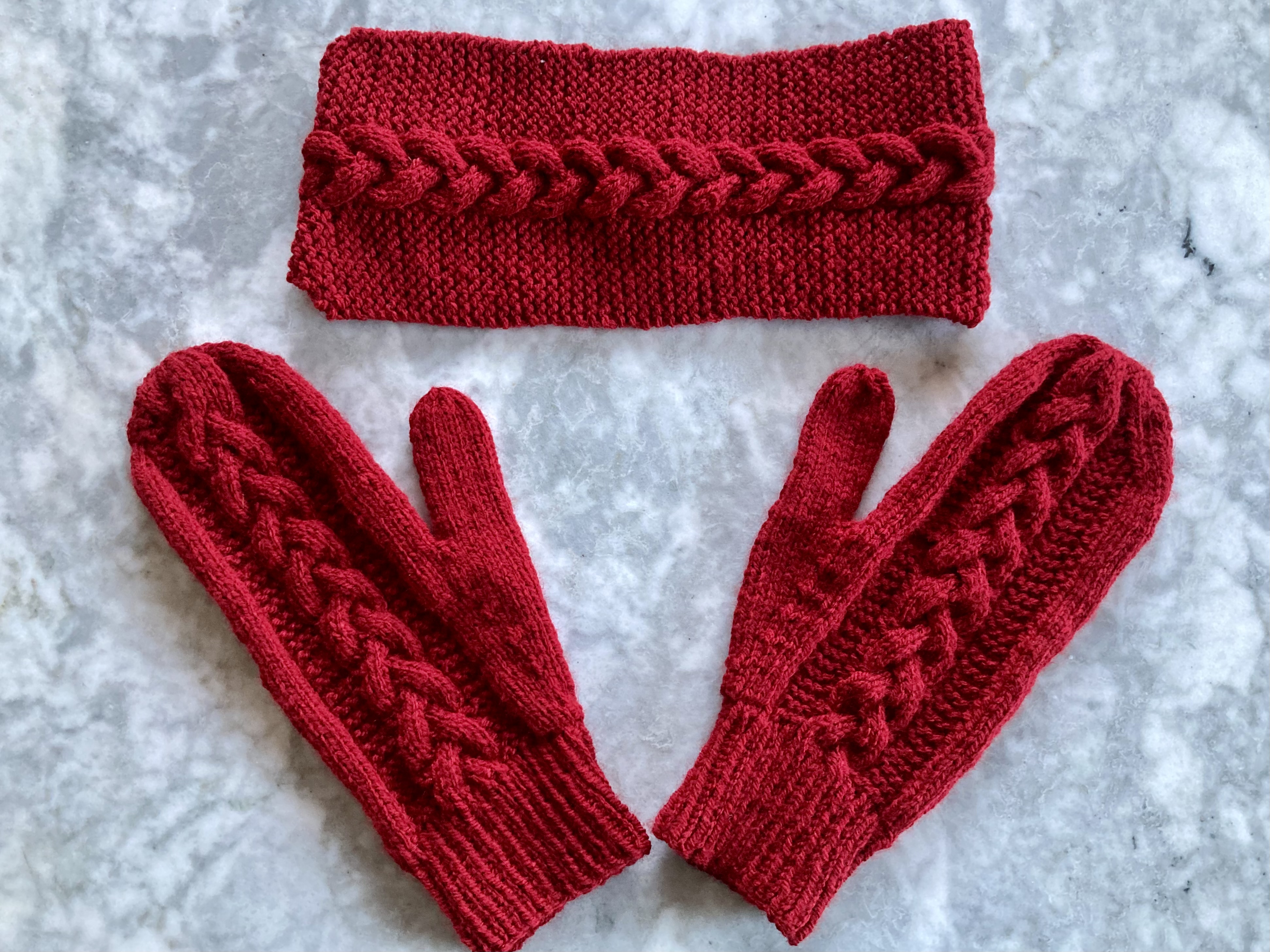
Welcome back to January 1967, one of my favourite 1960s issues of Stitchcraft. After making the failed “Pinafore Dress”, the successful “Lace and Ribs” pullover, and the the utterly cute “Fashion for Tots” jacket, I wanted very much to make the turquoise Fair isle cardigan on the back cover… but alas, it was not to be, as it is not possible to order wool from Scotland to continental Europe at the moment. But I won’t give up hope! While waiting for different wool to arrive, I made a simple headband-and-mitt(en)s set from the “Accessories for the Outdoor Life” page.

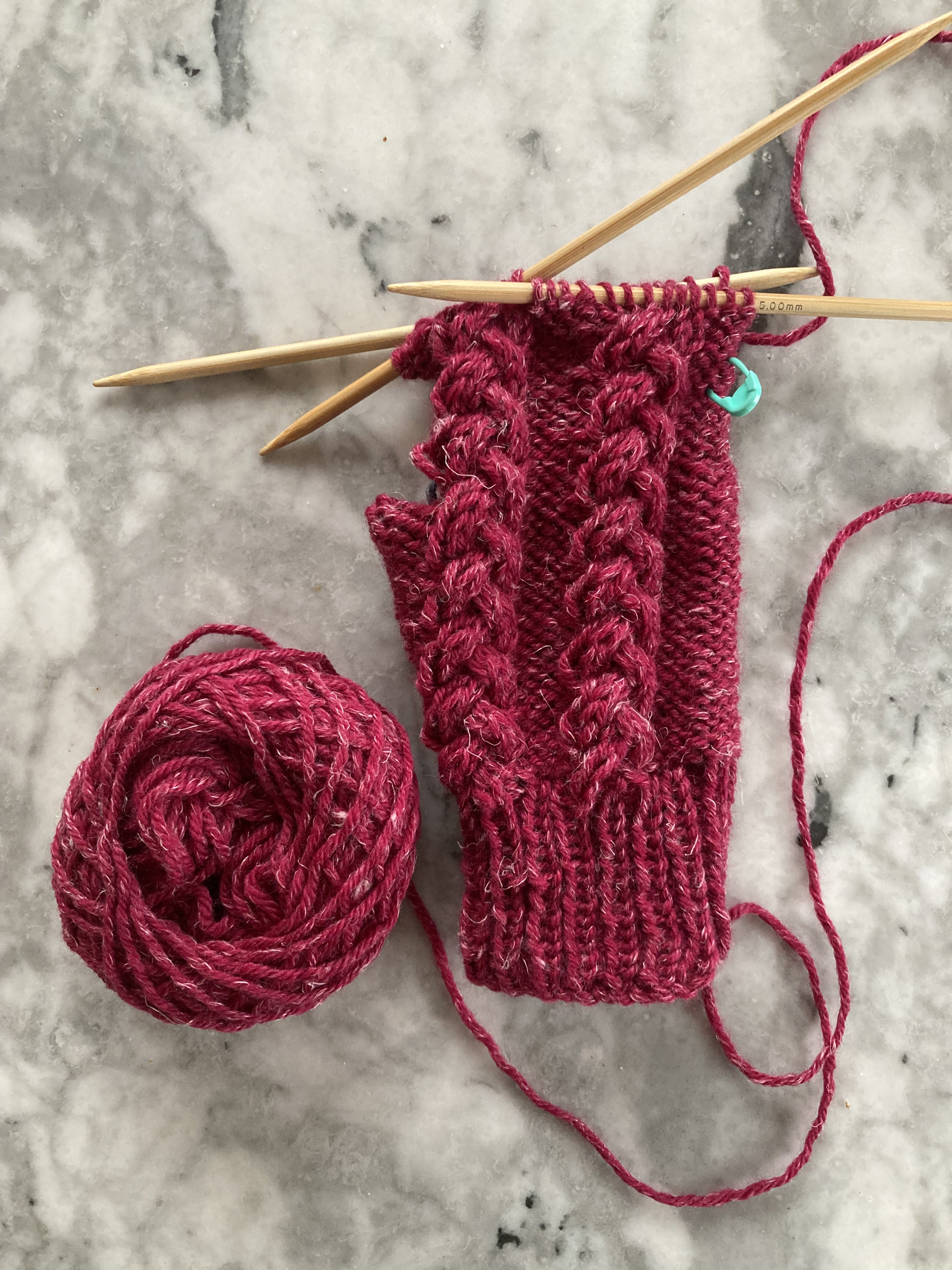
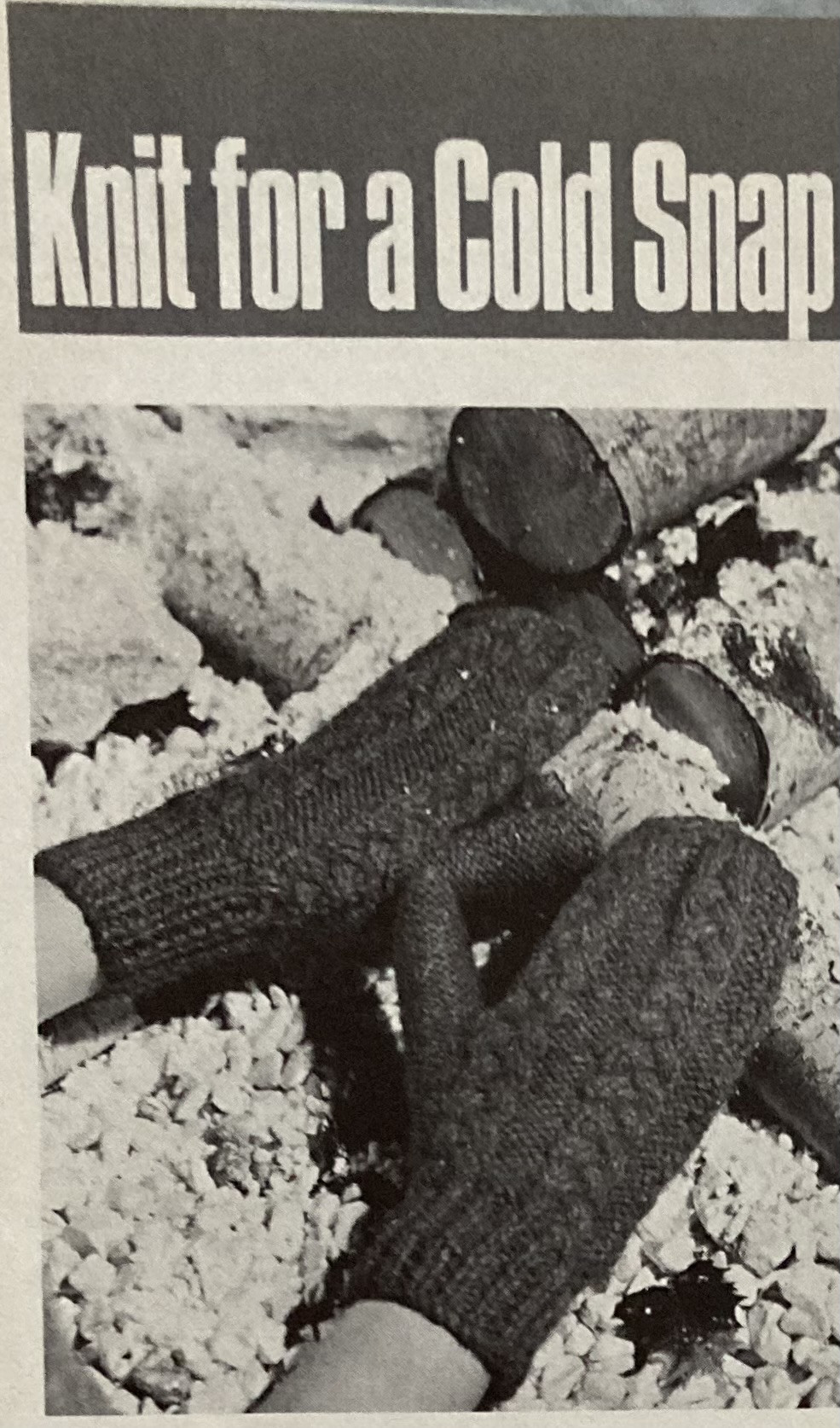
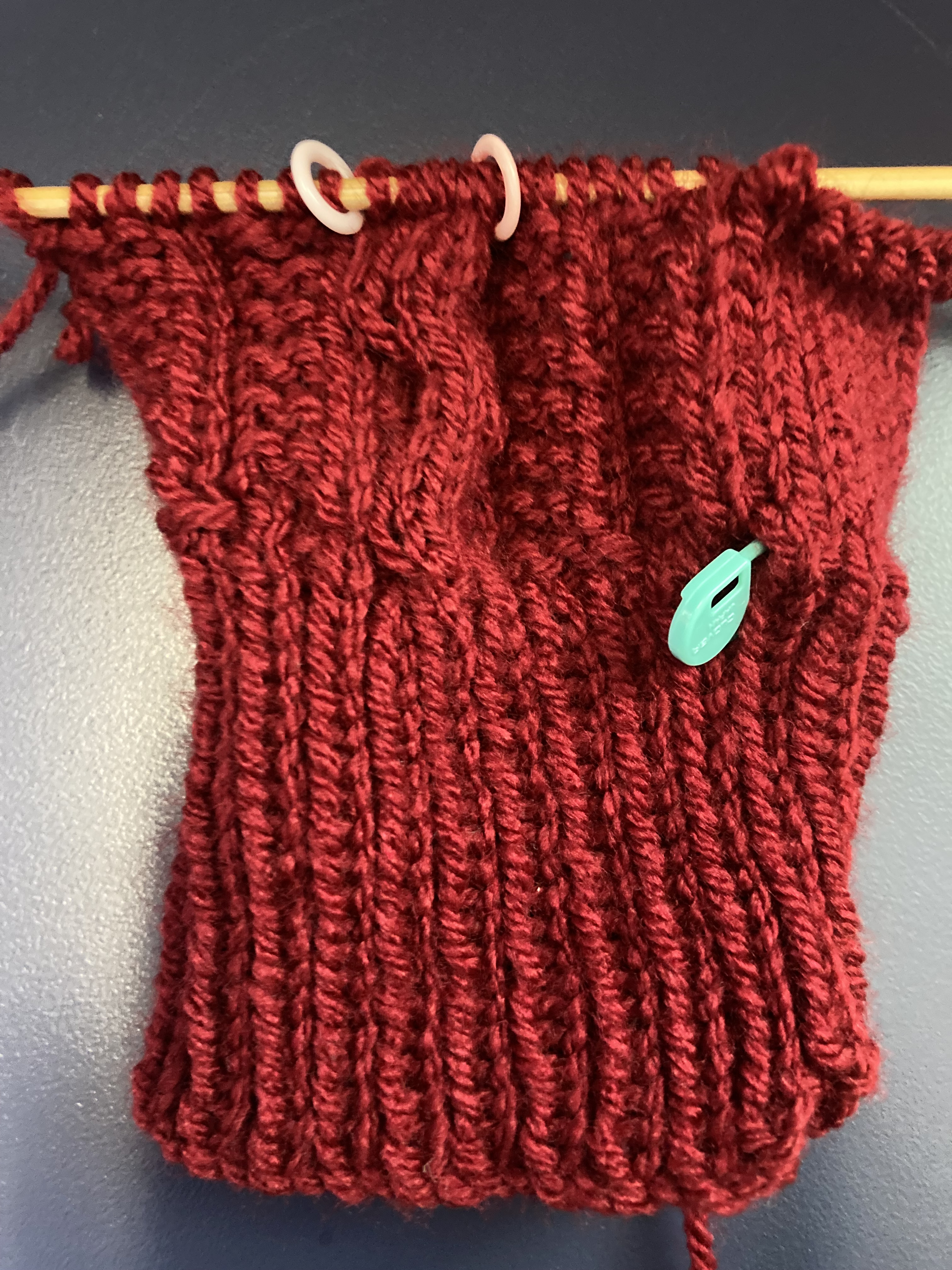
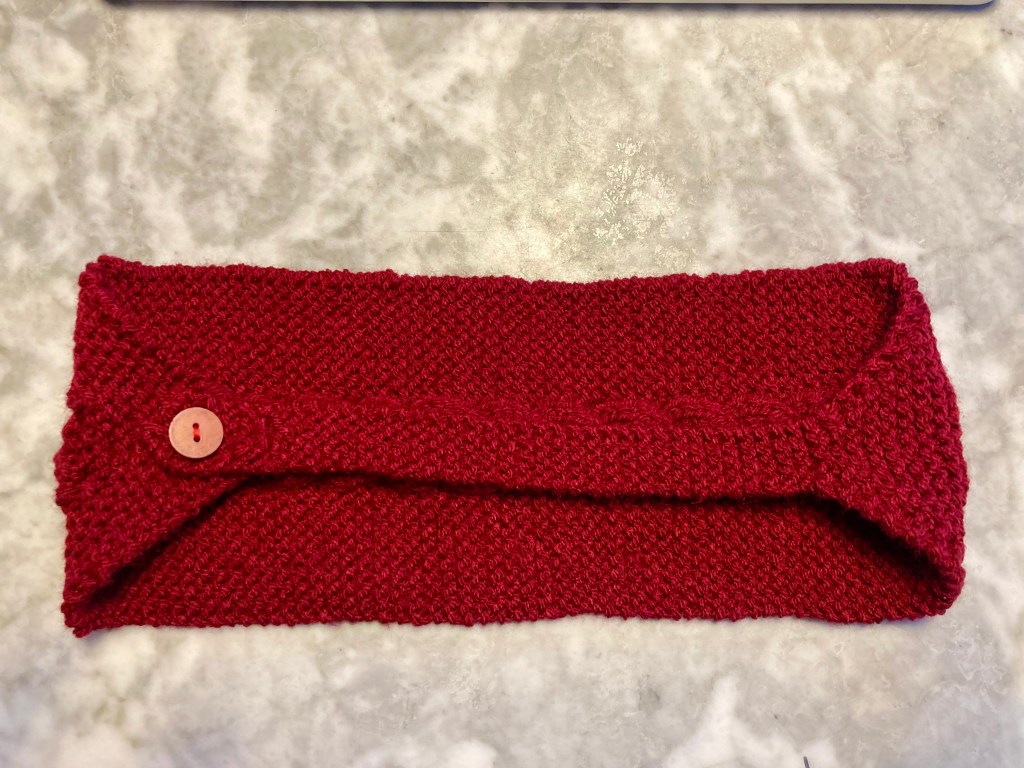
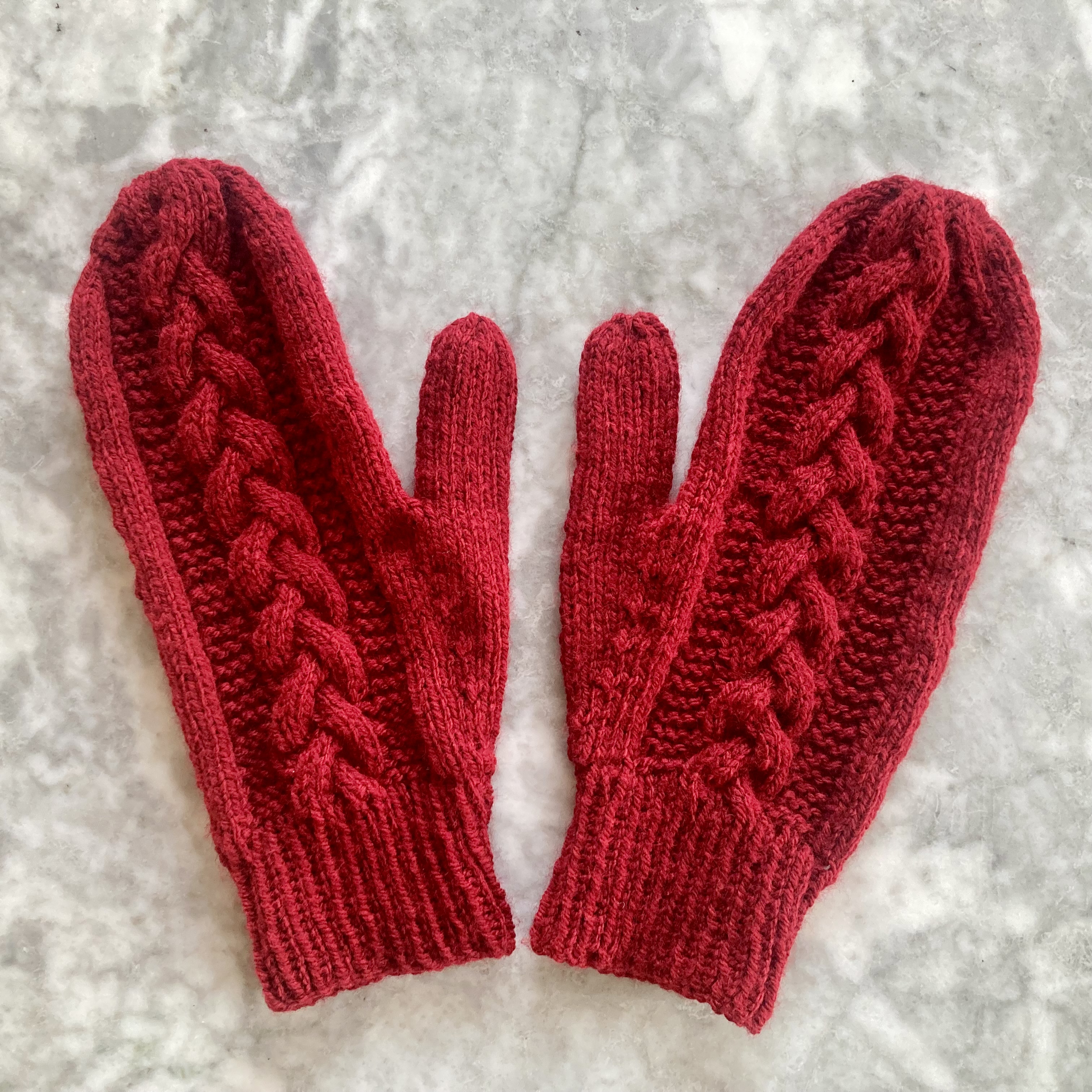
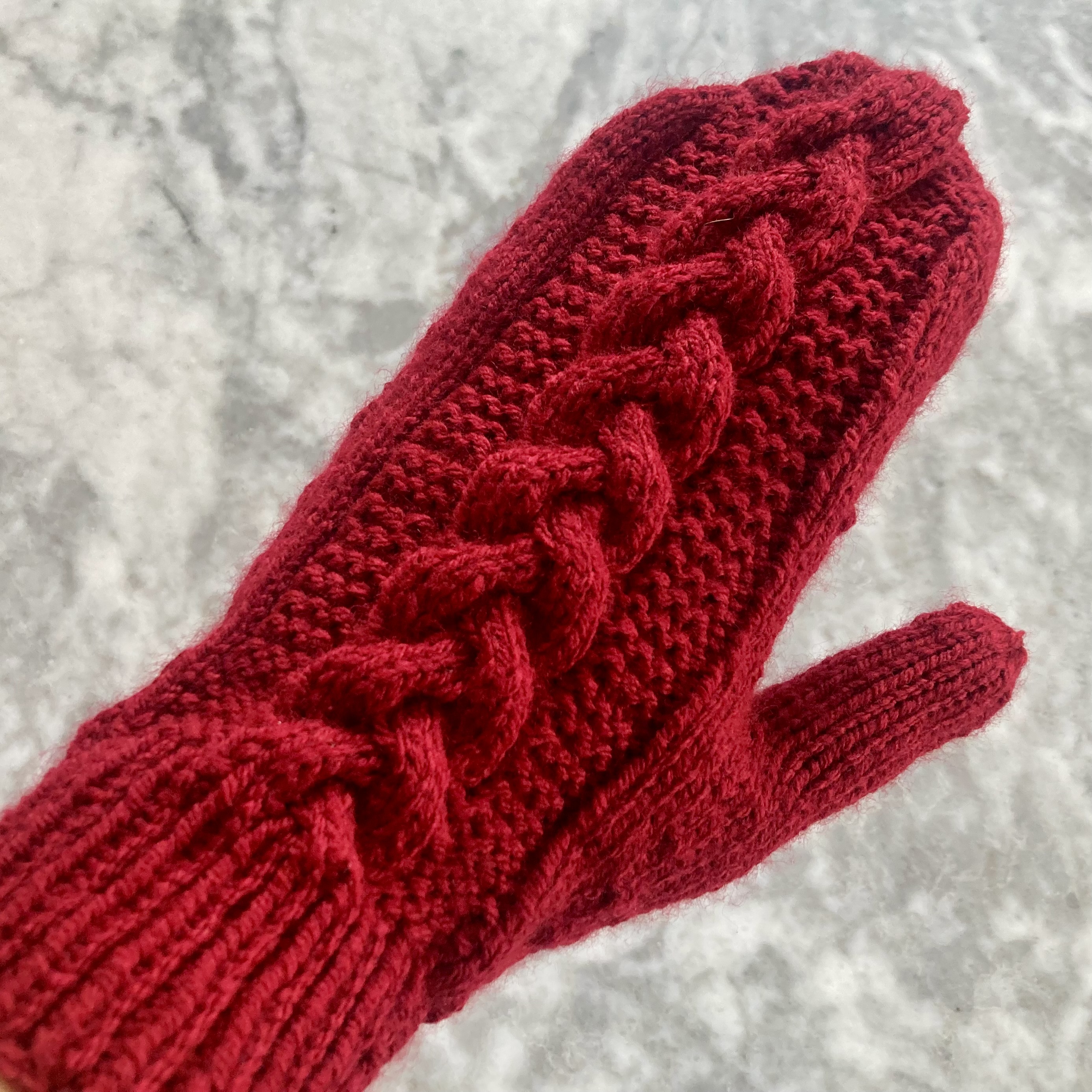
The mittens (Stitchcraft calls them “mitts”, but I’ll call them mittens to avoid confusion with fingerless mittens/gloves) and headband both feature a simple 9-stitch braided cable set in garter stitch (only 4 stitches on the mittens with the rest in stocking-stitch) with 1 stitch of reversed-stocking stitch on either side of the cable. The mittens are meant to be knit flat back-and-forth, but I wanted to make them in the round to save time and a seam.

Re-writing or re-thinking the pattern to accomplish that was… not easy. Of course the pattern doesn’t say, “Make a 9-stitch cable with 1 stitch of reversed stocking-stitch and 4 stitches of garter stitch on each side, and the rest in stocking-stitch”. It says things like “k3, (p1, k3) twice, C 6 B, (p1, k3) twice, k twice in next st., k to last 20 sts, k twice in next st, k 19” and then the wrong-side row is “purl to last 22 sts, k5, p9…” and so on. I tried to chart it out and was even more confused than before. The cable was all wrong and didn’t cover nine stitches. I finally figured it out, but the pattern wording didn’t help.

The headband was very easy and took two evenings. It fastens around the head with a buttoned strap, which I found very charming. The strap as given in the pattern (3 inches) was too short, so I made it to fit. It’s a little loose on me, but my friend has fluffy hair. Of course, she can always move the button if it doesn’t fit her properly.

Friend is wool-sensitive, so I made these in 1960s-appropriate 100% polyester yarn (Pro Lana Star). For a synthetic wool, it’s quite nice — soft and doesn’t feel too plastic-y. I chose a lovely cherry red colour to feel festive in winter.

That was it! I will return to this issue when the substitute wool I ordered for the Shetland cardigan (Rauma 3-trads Strikkegarn) arrives and make an extra post. I don’t mind that it didn’t work out to make the cardigan this month, as I probably would have overlooked the headband and mitts. They were fun to make and look really cute, so maybe I’ll make a set for myself sometime.

November 1966: Overview

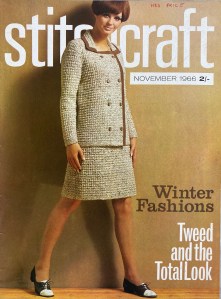
Tweed, Crepe and the Total Look! The November 1966 issue of Stitchcraft brings together contrasting styles of nubbly tweed and smooth crepe wool as well as an entirely coordinated knitted outfit including hand-knitted stockings.

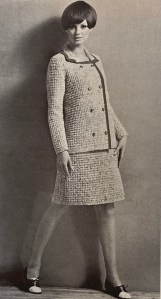
The cover design is not quite “total” (no stockings or accessories) but combines tweed “Bracken” wool with smooth “Cameo Crepe” for the edgings to make that boxy, double-breasted suit that everybody copied from Chanel. The pattern is very easy: k one row, single rib one row, purl one row, single rib one row. I imagine it gives a nice firm fabric that won’t sag too terribly in the skirt.

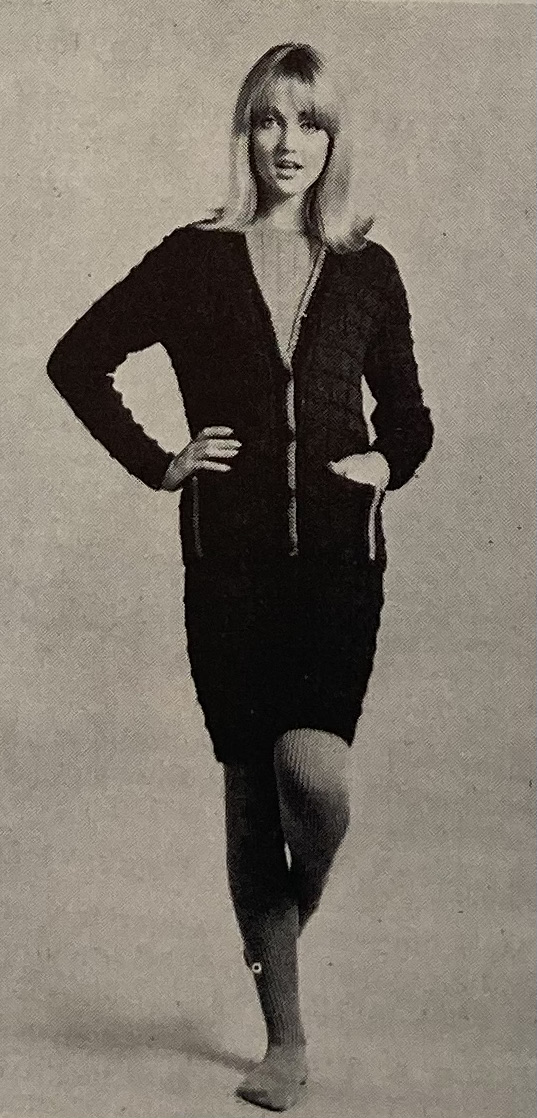
The “Total Look” is best exemplified by the other suit design: a square-patterned cardigan suit with jumper and stockings to match, in two shades of Double Knitting for the suit as well as lightweight Cameo Crepe for the jumper and stretchy, hard-wearing Nylox for the stockings.

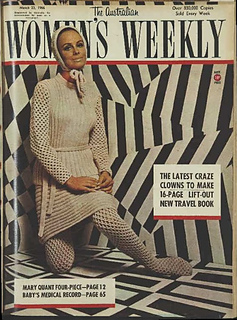
The idea of complete coordination came into handknit fashion around this time and continued into the early 1970s. Mary Quant, for example, designed a four-piece outfit (jumper, skirt, stockings and “bonnet” cap) for the Australian Women’s Weekly in March 1966, using Patons Courtelle wool. There was originally an entire supplement in this month’s issue of Stitchcraft with more “Total Look” fashions in the same 101 Courtelle, but sadly, it was no longer there when I acquired it. If anyone happens to have this supplement, please let me know and/or post about it here! I would love to know what was in it.

The other fashions for adult men and women feature textured stitches in heavier wools for winter and a round-yoke cardigan knit from the top down in one piece. Although quite common today, that was still a very unusual construction method in the 1960s and was captioned as an “interesting design for the knitter who likes something different.” The men’s cardigan has a “Continental Pattern” made quite easily by combining knit, purl and knit-through-the-back stitches, and the women’s pullover has a unique cable-and-bobble pattern that makes a pretty shell design.

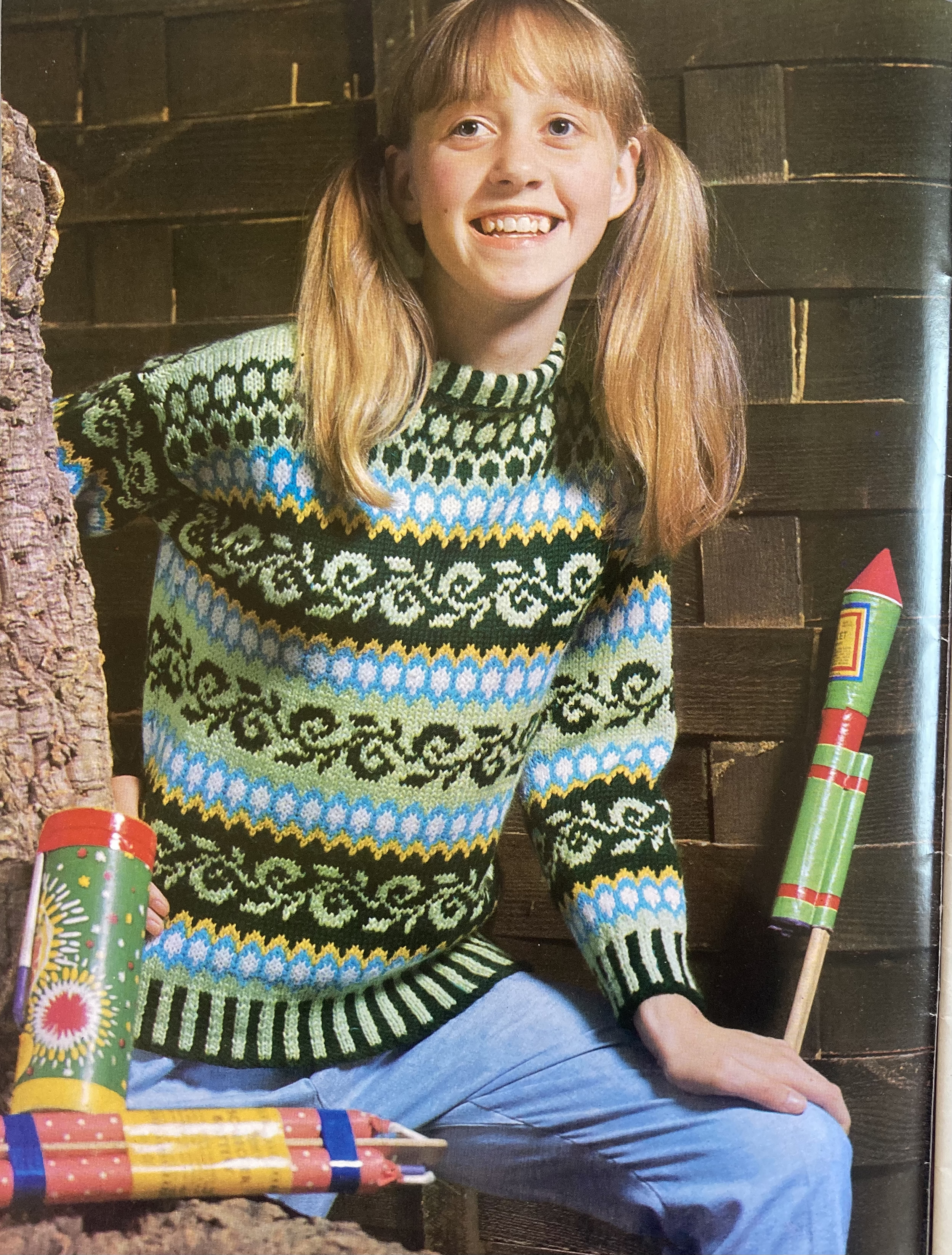
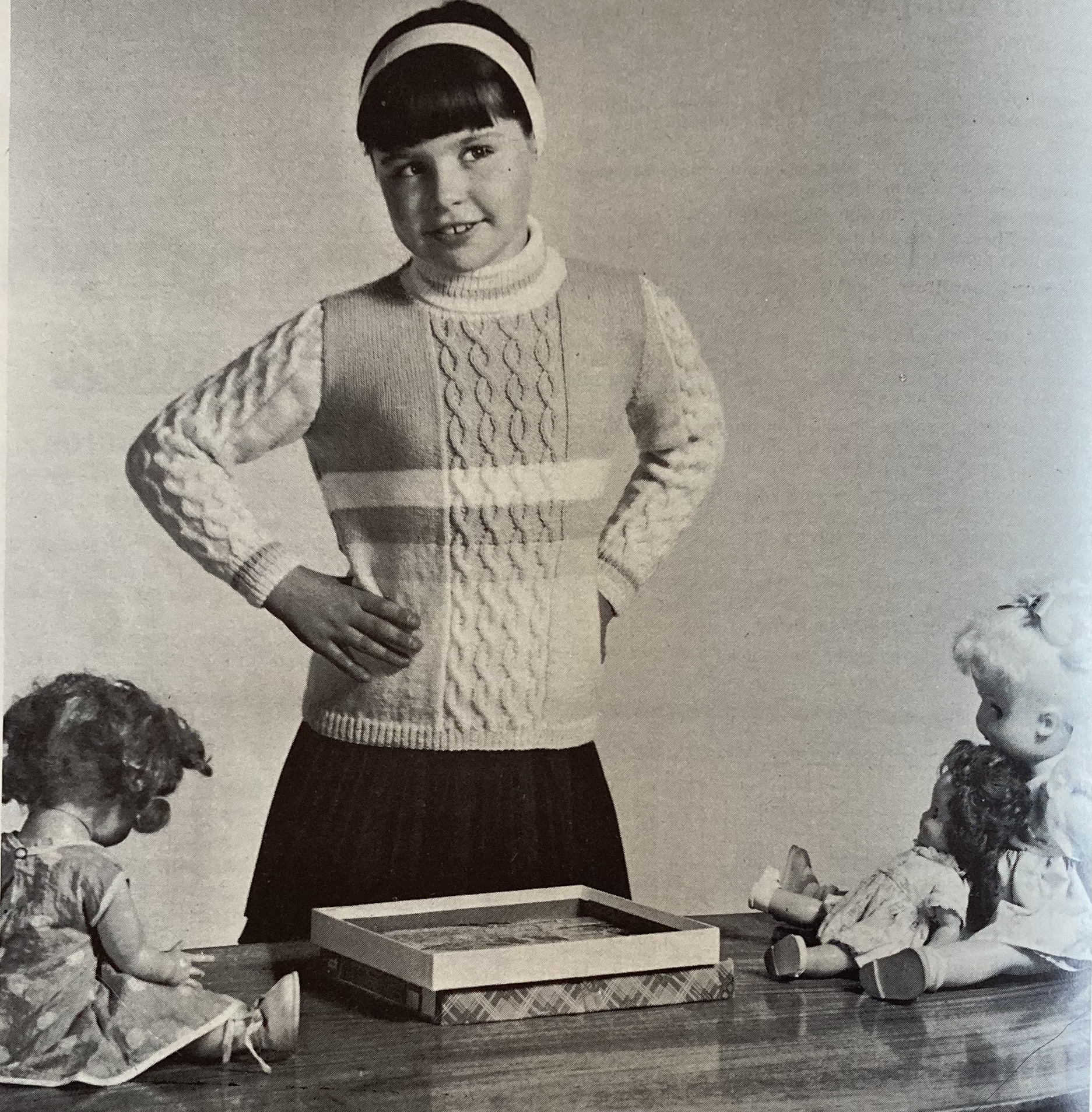
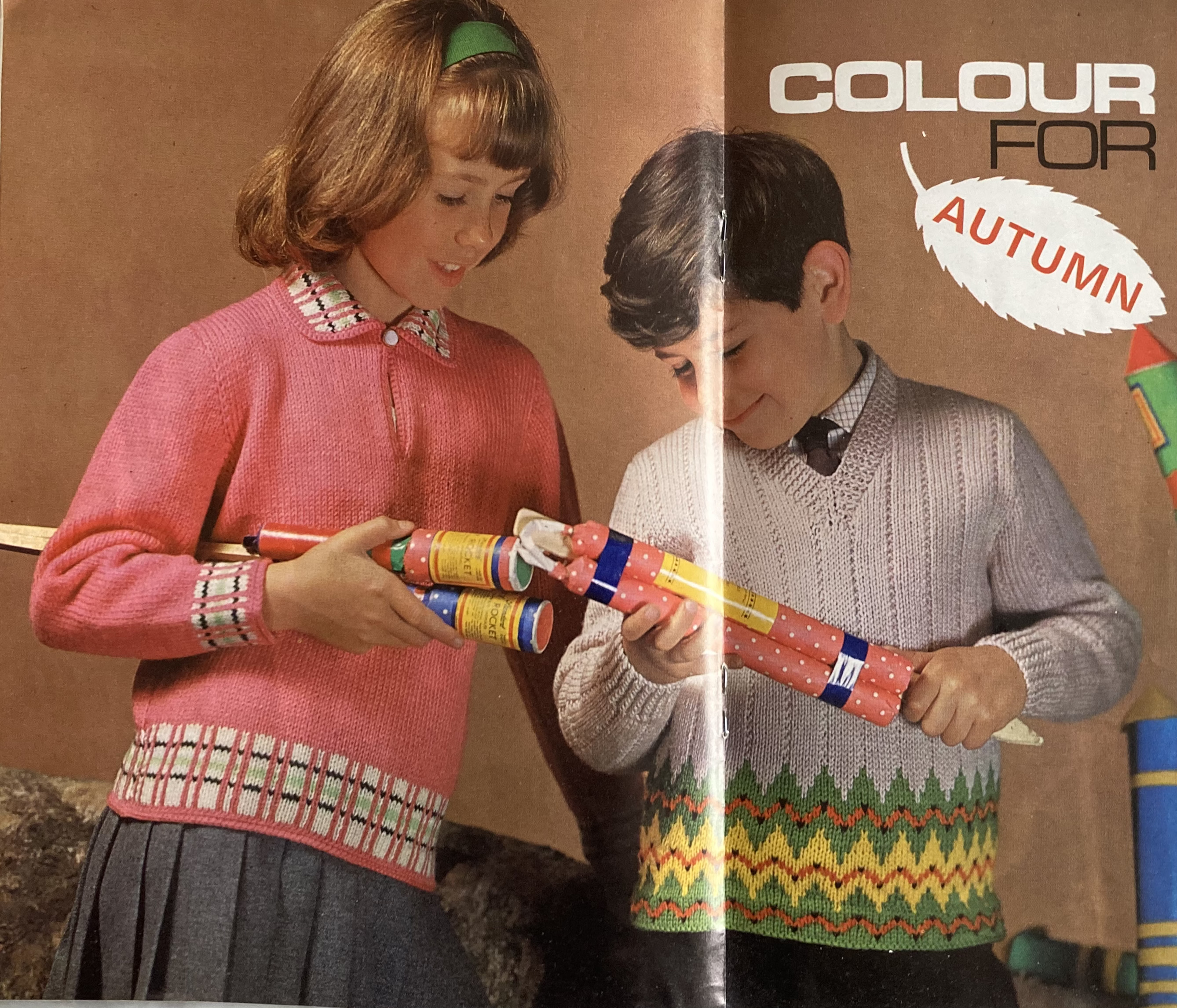
The “Junior Fashions” for girls consist of a bright, fun “Viennese Sports Sweater” in a bold Fair Isle pattern and a cabled and colour-blocked pullover in soft tones of white, blue and rose. The older girl has her fireworks ready, perhaps for Guy Fawkes Night on November 5th, while the younger one is content to play with her dolls.

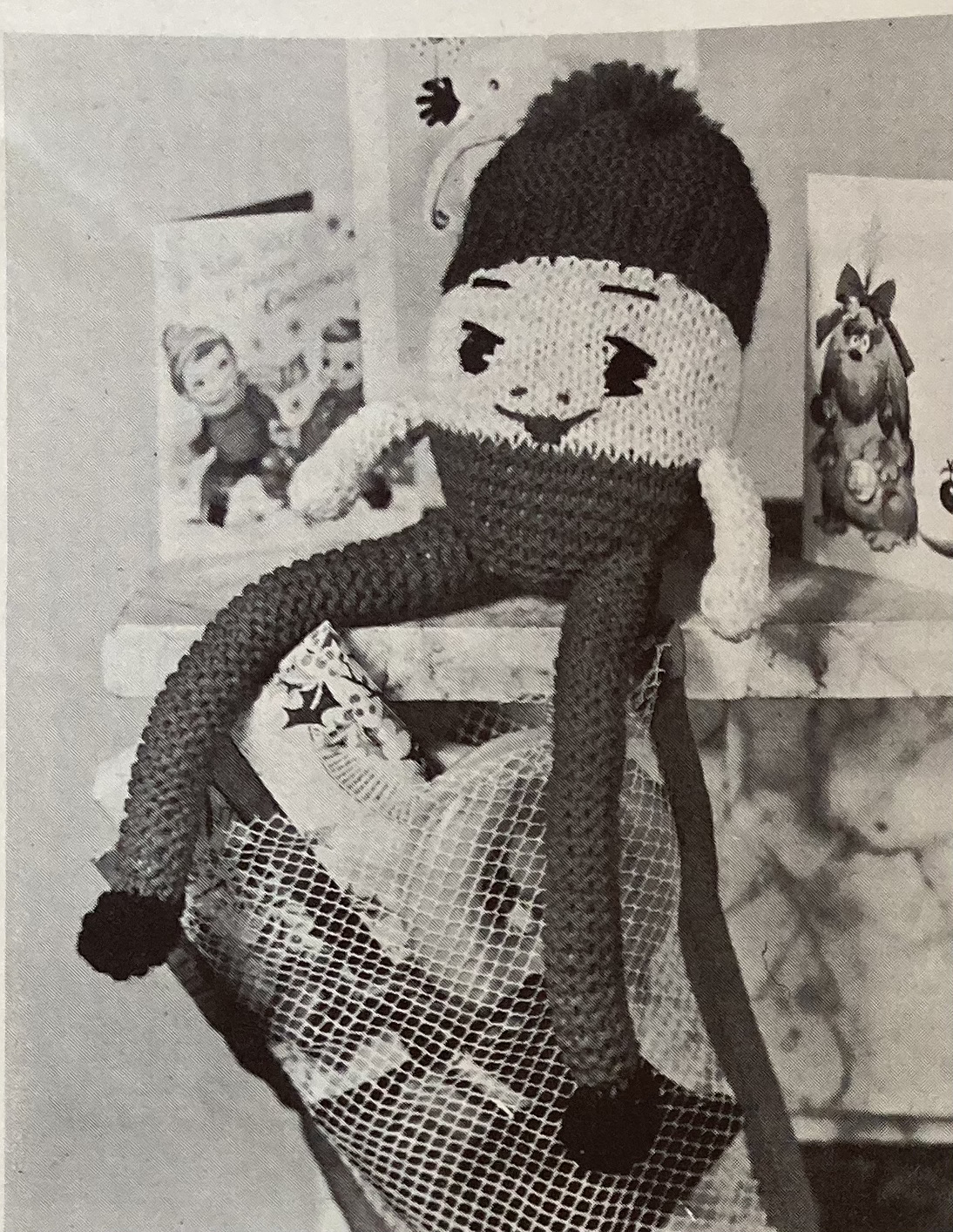
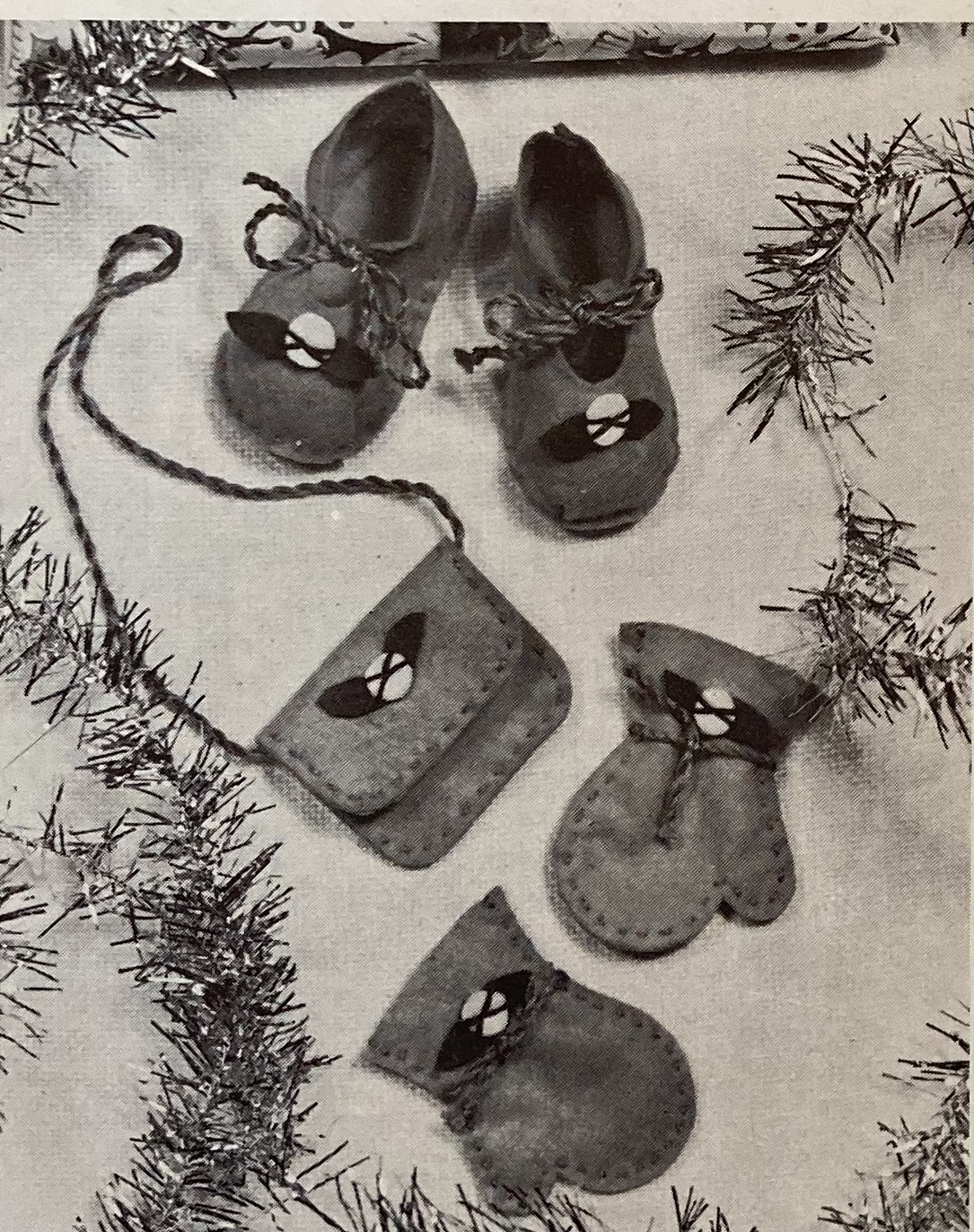
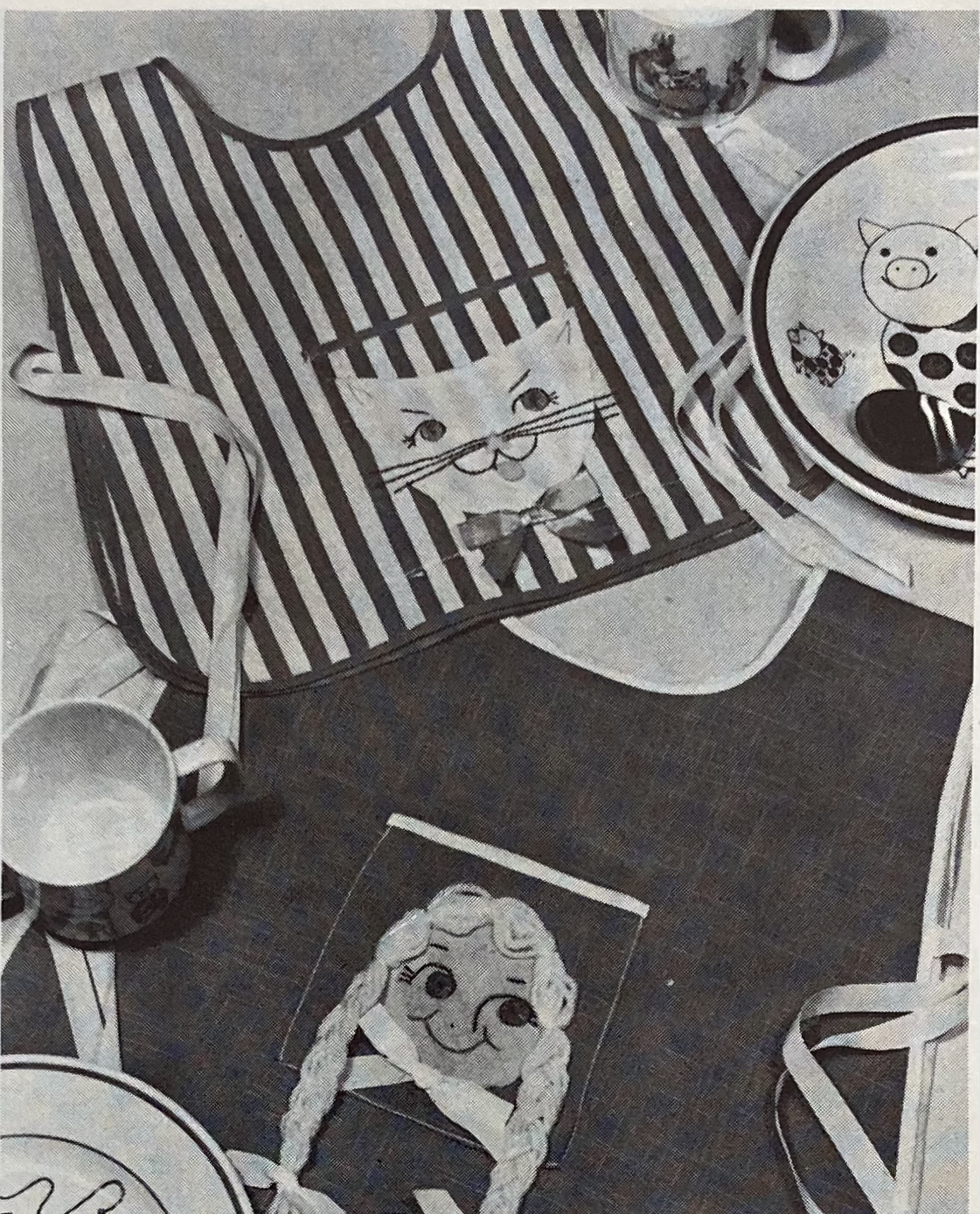
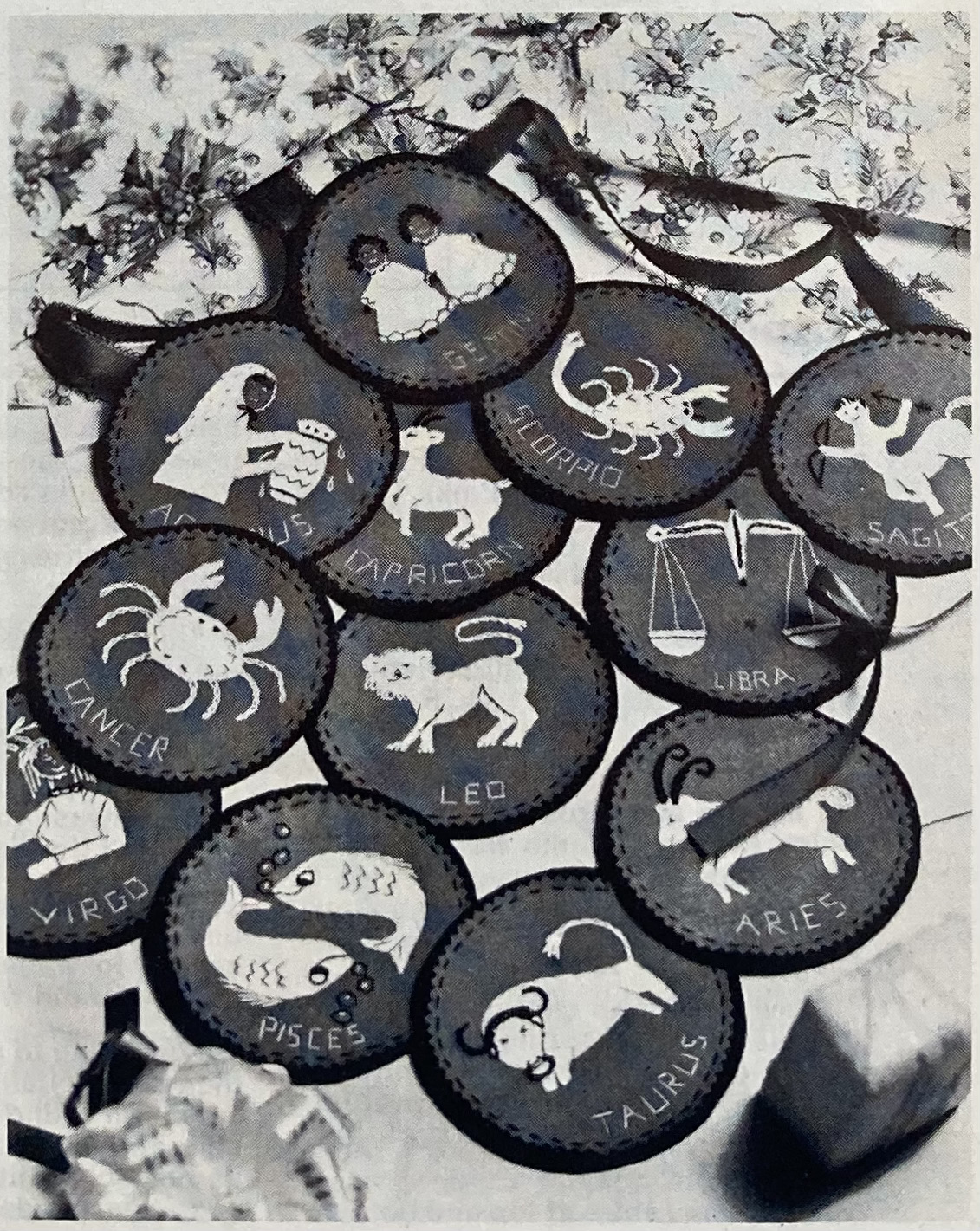
Gearing up for the Christmas season, we have a double page of weird and/or wonderful little gifts to knit, sew or embroider. For some reason, Stitchcraft really likes Humpty Dumpty, who appears in many forms as a toy, puppet, doll etc. over the years. Here, he “tops a stocking”. There are tiny felt accessories for a doll, sewn and decorated pinafore bibs for a baby or toddler, or coasters with the signs of the Zodiac in embroidered felt appliqué.

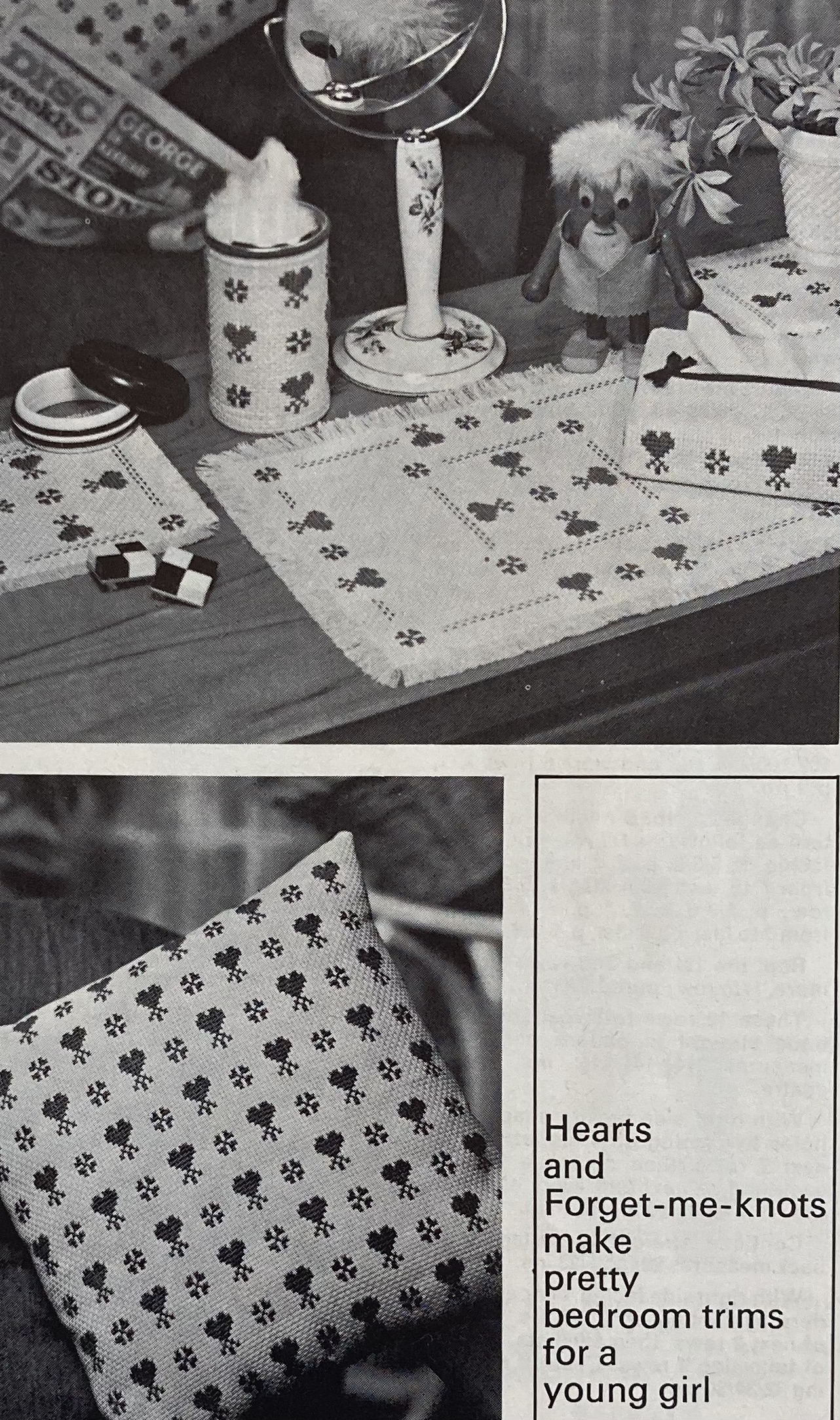
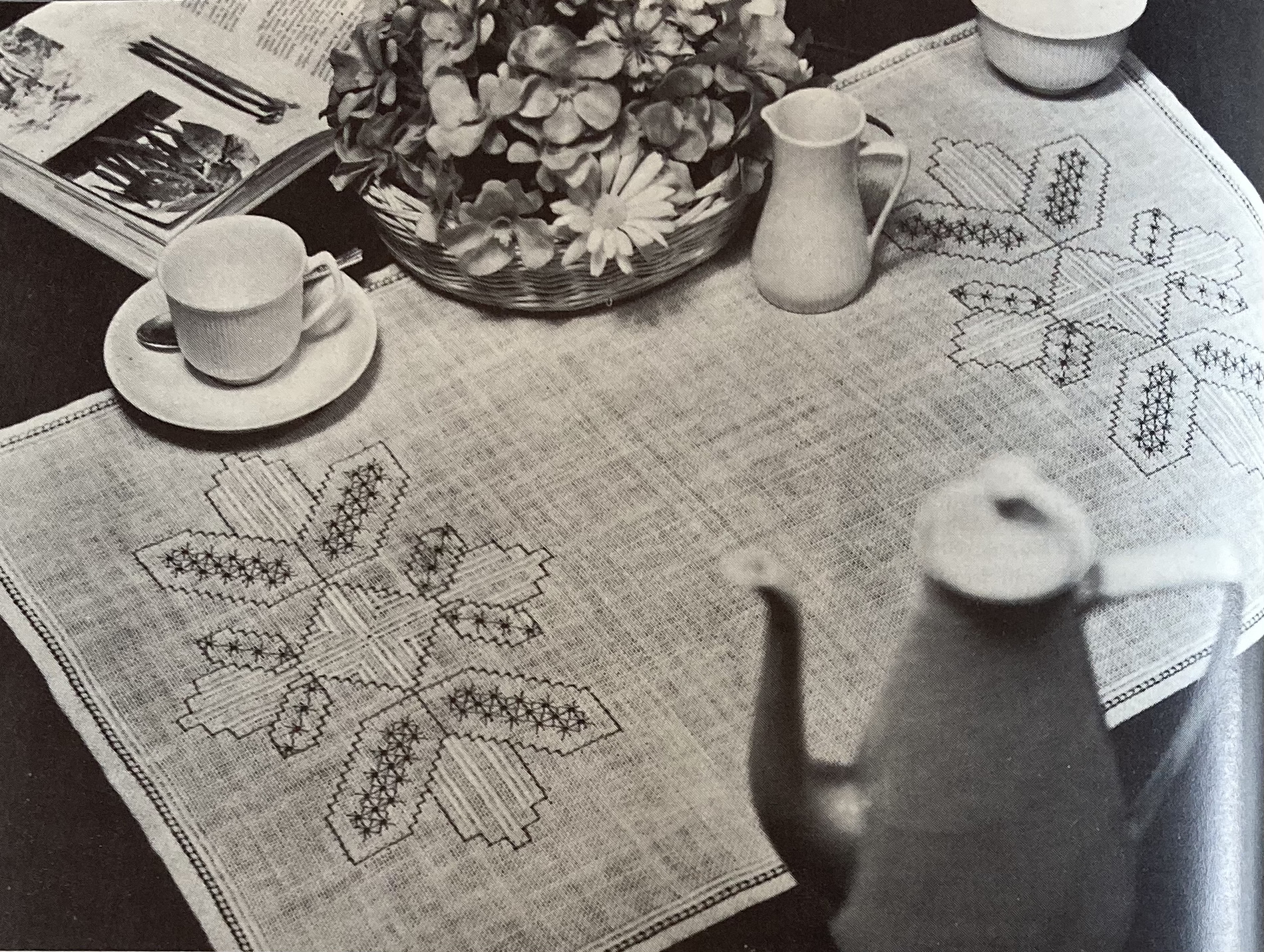
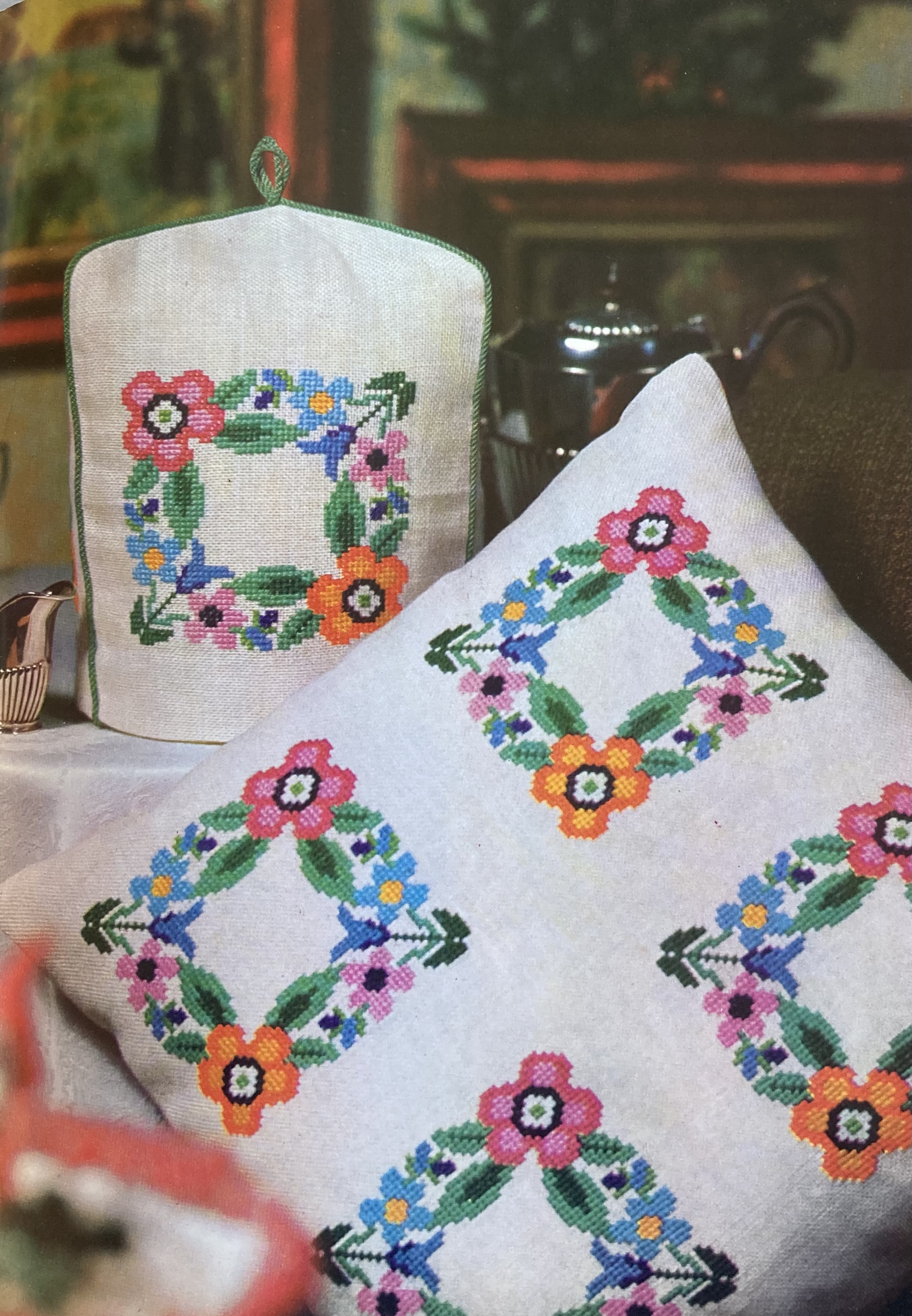
Larger tapestry and embroidery projects include a tapestry evening bag in rosebud pattern, mats and cushion in counted stitch for a girl’s bedroom, drawn-fabric table linens or a cushion and matching tea cosy in a bright floral cross-stitch pattern. I seem to remember the rosebud bag from an earlier project in 1961 that had a similar design. (That project didn’t work out and I don’t think I’ll be making another tapestry handbag anytime soon.)

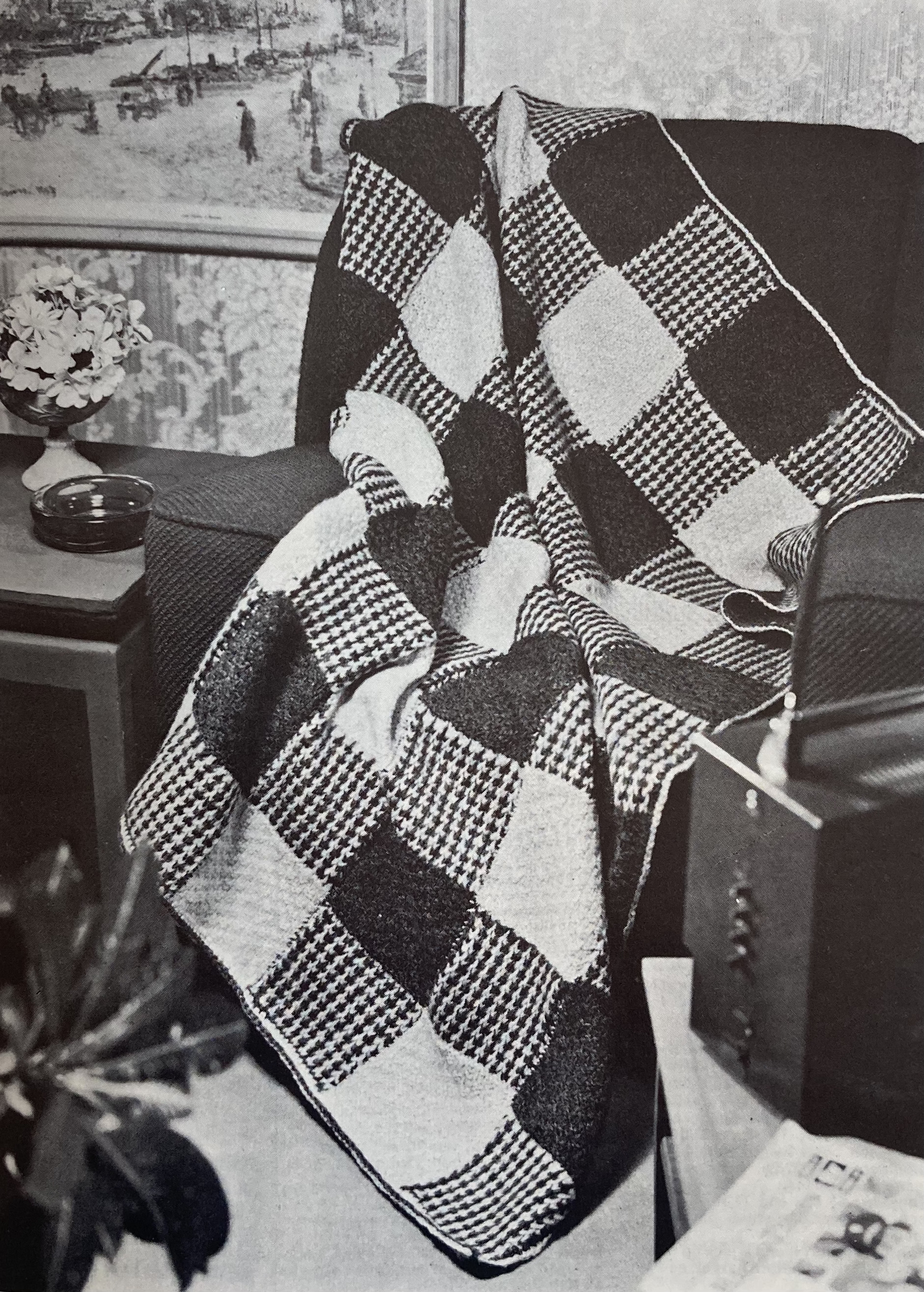
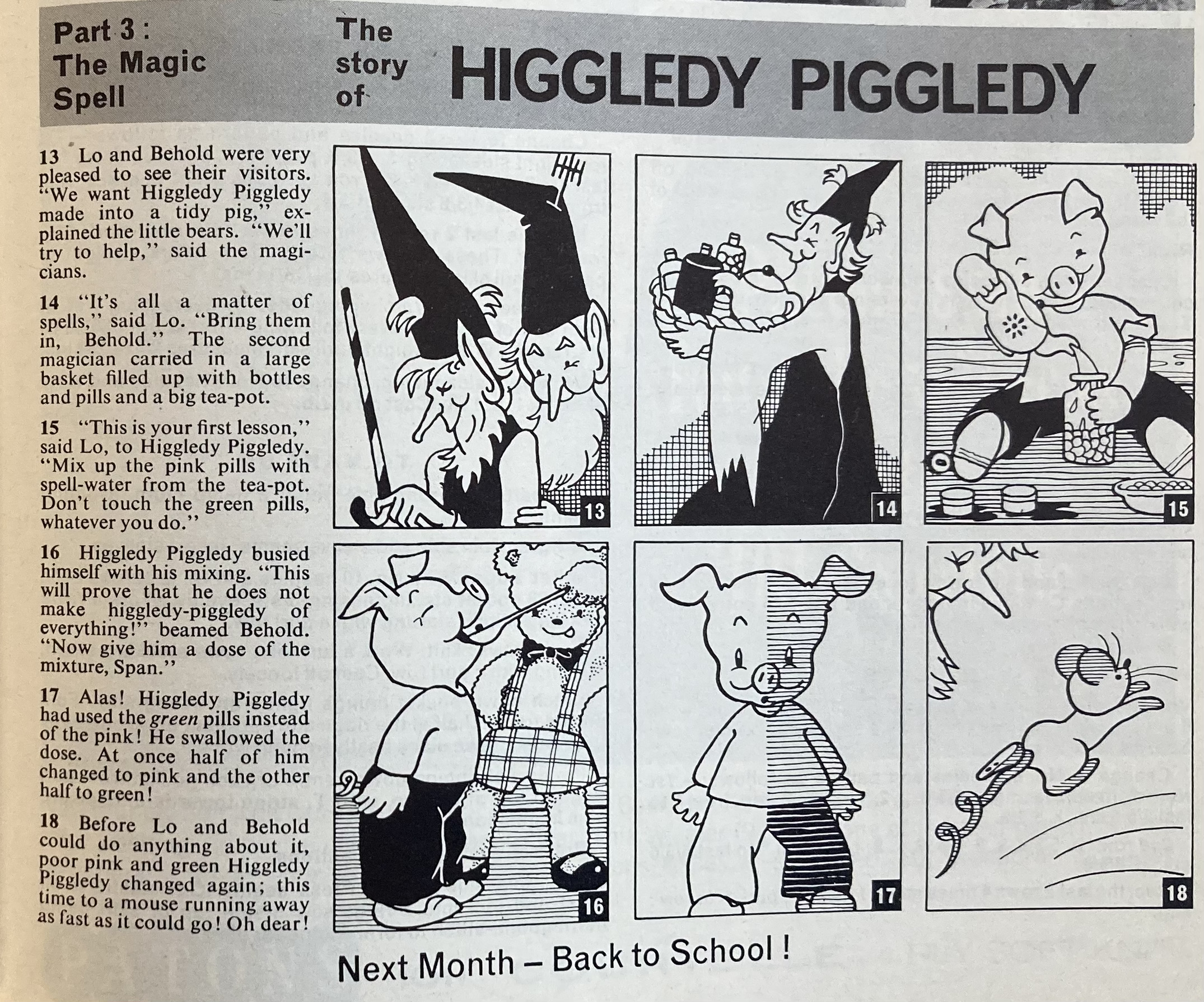
To finish it all off, you can knit a warm afghan for the coming winter evenings by the fireside, or crochet a practical potholder as many of us did in school. In the children’s comic, untidy piglet Higgledy Piggledy ignores the instructions given to him by the magicians who are supposed to change him into a tidy clean piglet, mixes the wrong potion and turns into a pink and green mouse. Good for him, I say! I am a neat and tidy person myself, but I have to admit I am rooting for Higgledy Piggledy in this comic. Will Higgledy Mouse escape the authoritarian rule of cleanliness? Tune in next time to find out!

December 1965: Overview

Here it is — the 1965 “Christmas Number”! December at Stitchcraft is always a month of “quick” holiday trimmings and small gifts, mixed with warm winter clothing and party ideas.

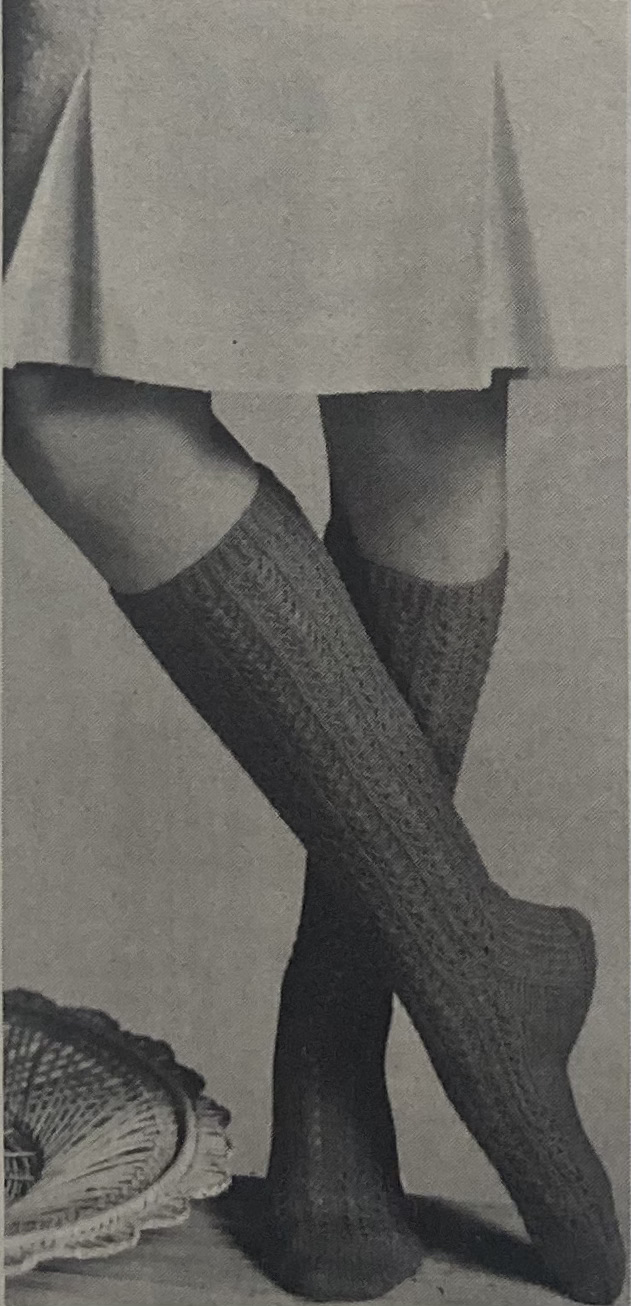
Our cover model is wearing a cable-block pullover (with non-crossing cables) in bright red double-knitting weight wool and matching knee-high socks in a lacy rib pattern. The caption on the pattern page is “Fashion feels Young” — Stitchcraft is finally getting into the children’s-fashions-for-adult-women idea that influenced so much of mid-60s fashion. Note the short skirt on the cover model, along with the knee-high socks, the playful kerchief and the big straw hat accessory in the black and white photo. It’s not quite Twiggy or Mary Quant (spoiler: Stitchcraft was never that fashion-forward), but it’s starting to show their influence. “Young Fashion” fun is reflected in the matching cap and pullover set as well. Look at the enormous pom-pom on the hat, outdone only by the model’s fake eyelashes!

The other women’s fashions in this issue remain conservative: a warm tweed dress made in two parts sewn together at the waist (thus the obligatory belt), a cabled cardigan for larger sizes in thick, undyed “Capstan” wool, a lightweight wool jumper and swingy knee-length skirt in a “gay note” of blue or a “harlequin” pattern jumper in “bold” 1960s colours of white, gold and brown. I feel exactly the same way as the model in the colour photo when I finish a project and find that perfect gift on the same day.

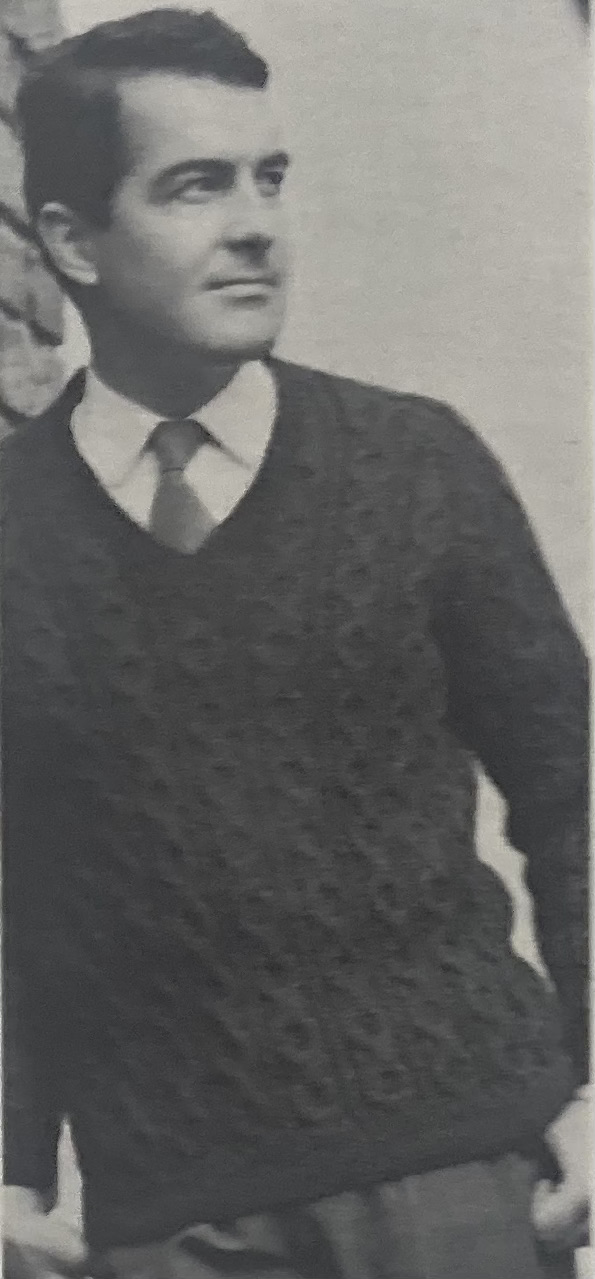
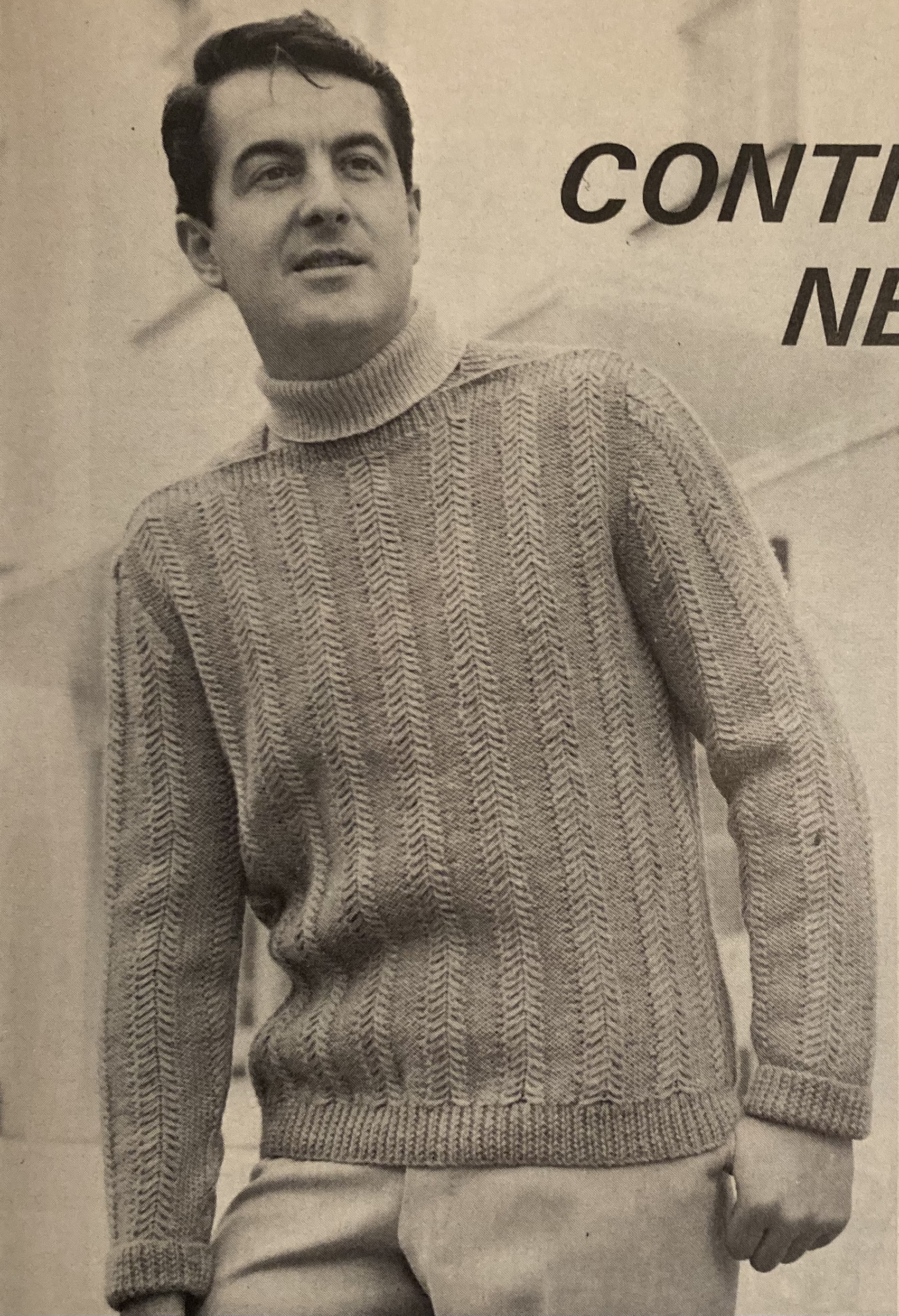
Men can get a cabled pullover in a glorious shade of purple tweed and the reassurance that cables are manly (like our model’s eyelashes, which are almost as impressive as his colleague’s with the pom-pom hat). There’s a boatneck pullover in herringbone stitch as well, meant to be worn over a simple polo- ( aka turtle-)neck jumper, for which a pattern was given in the previous issue.

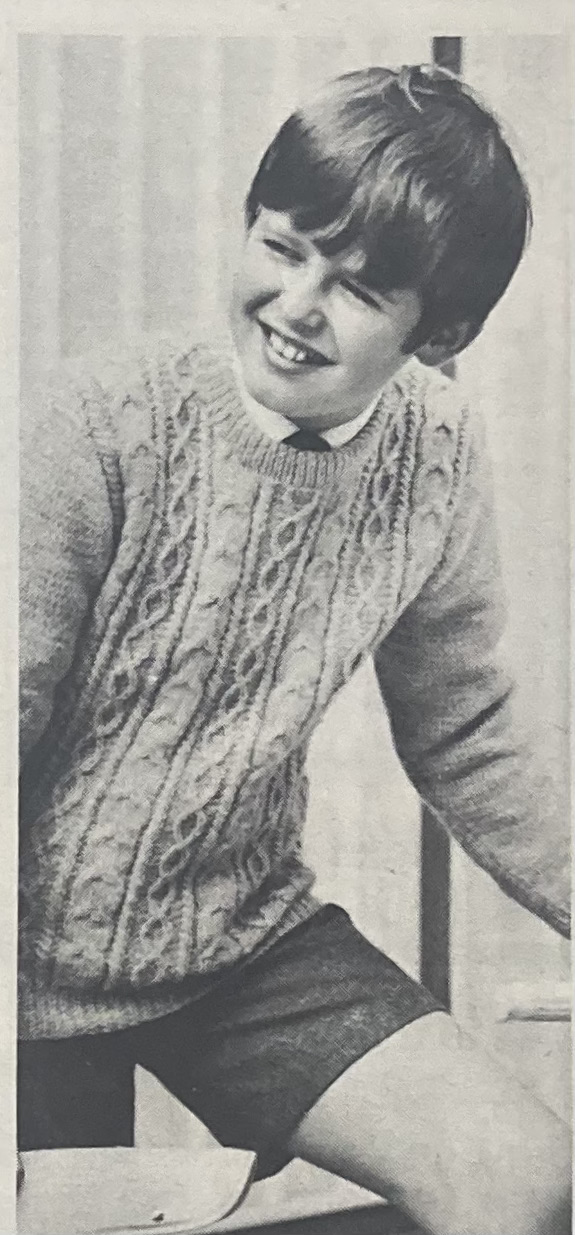
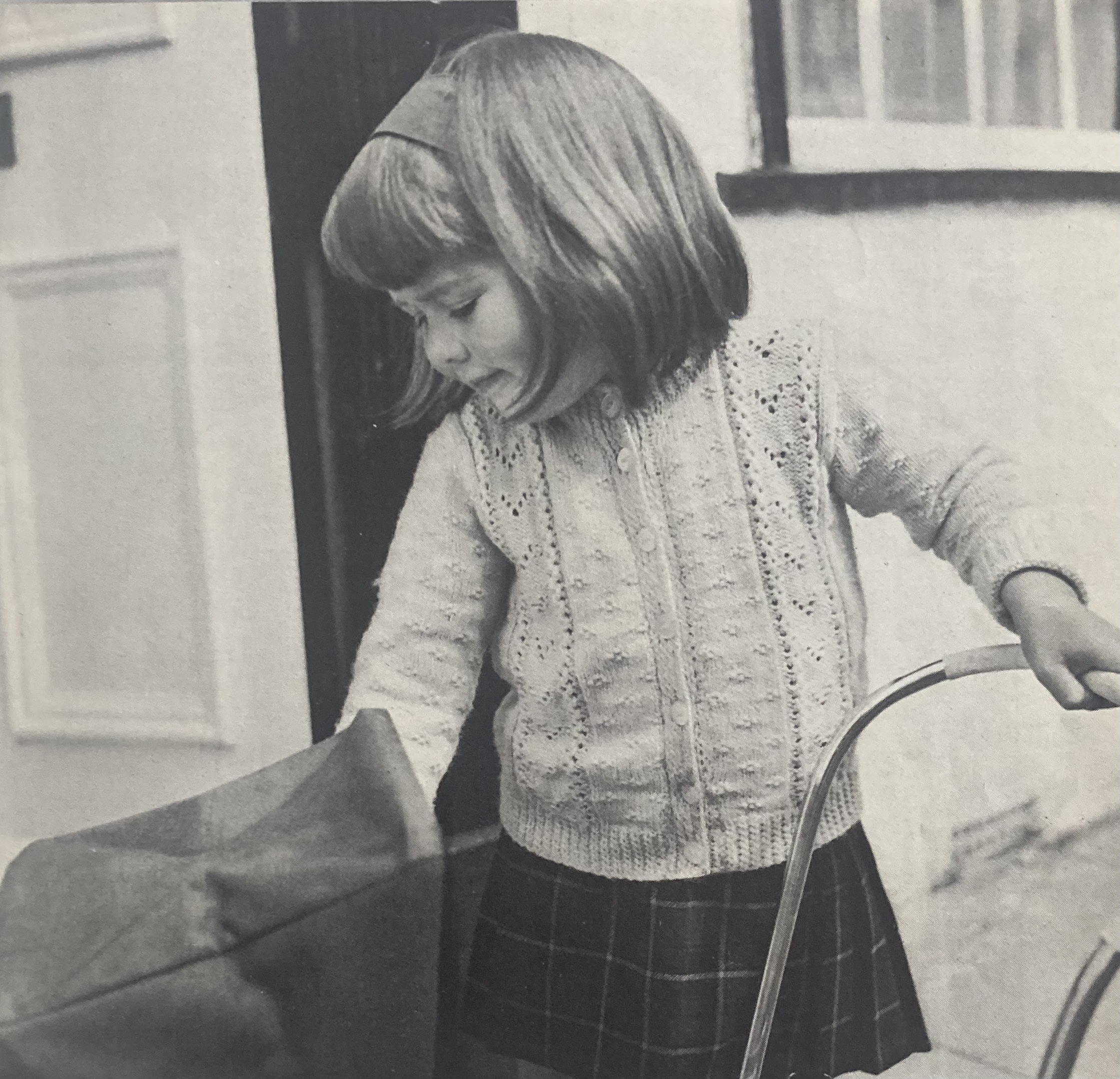
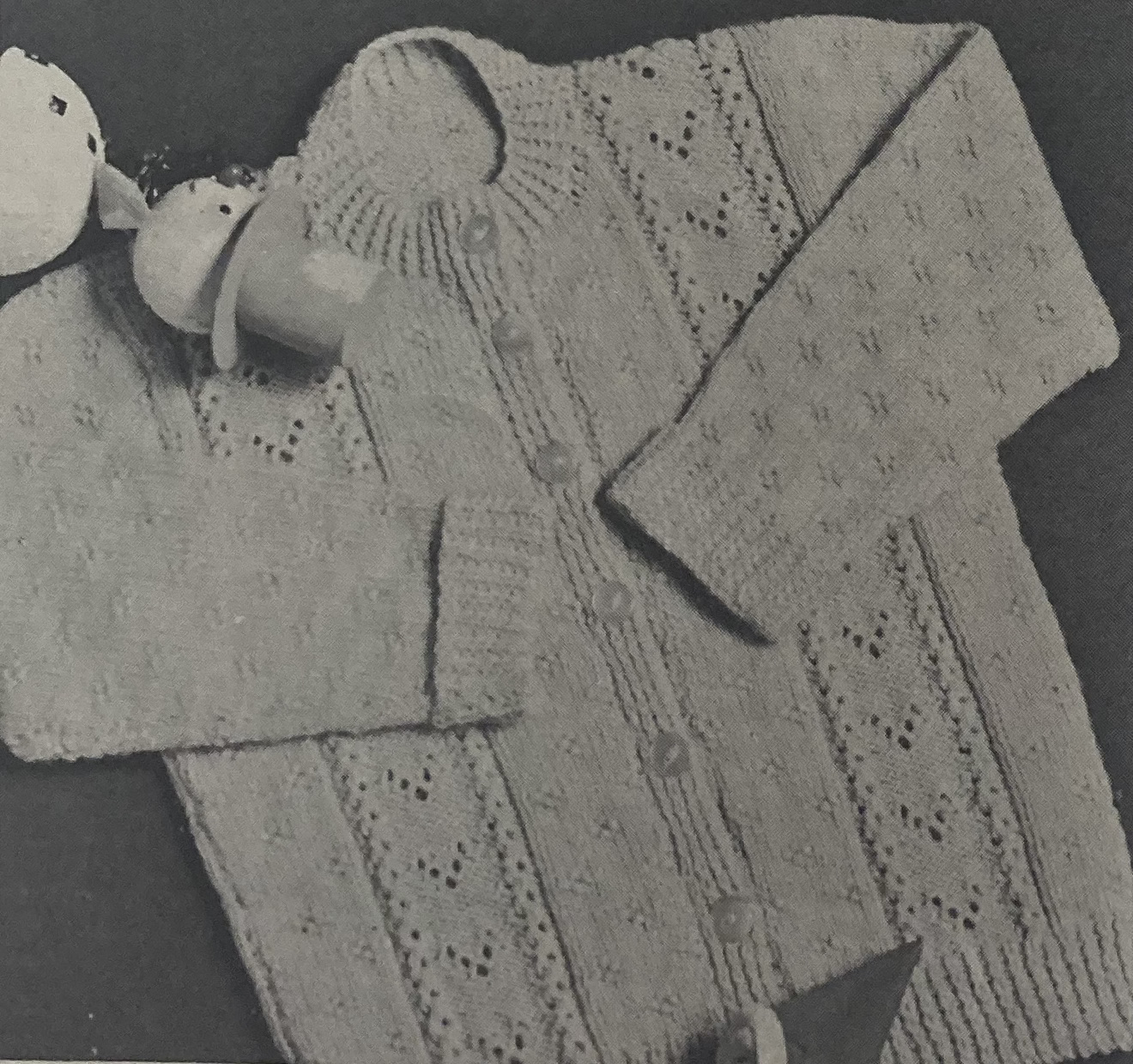
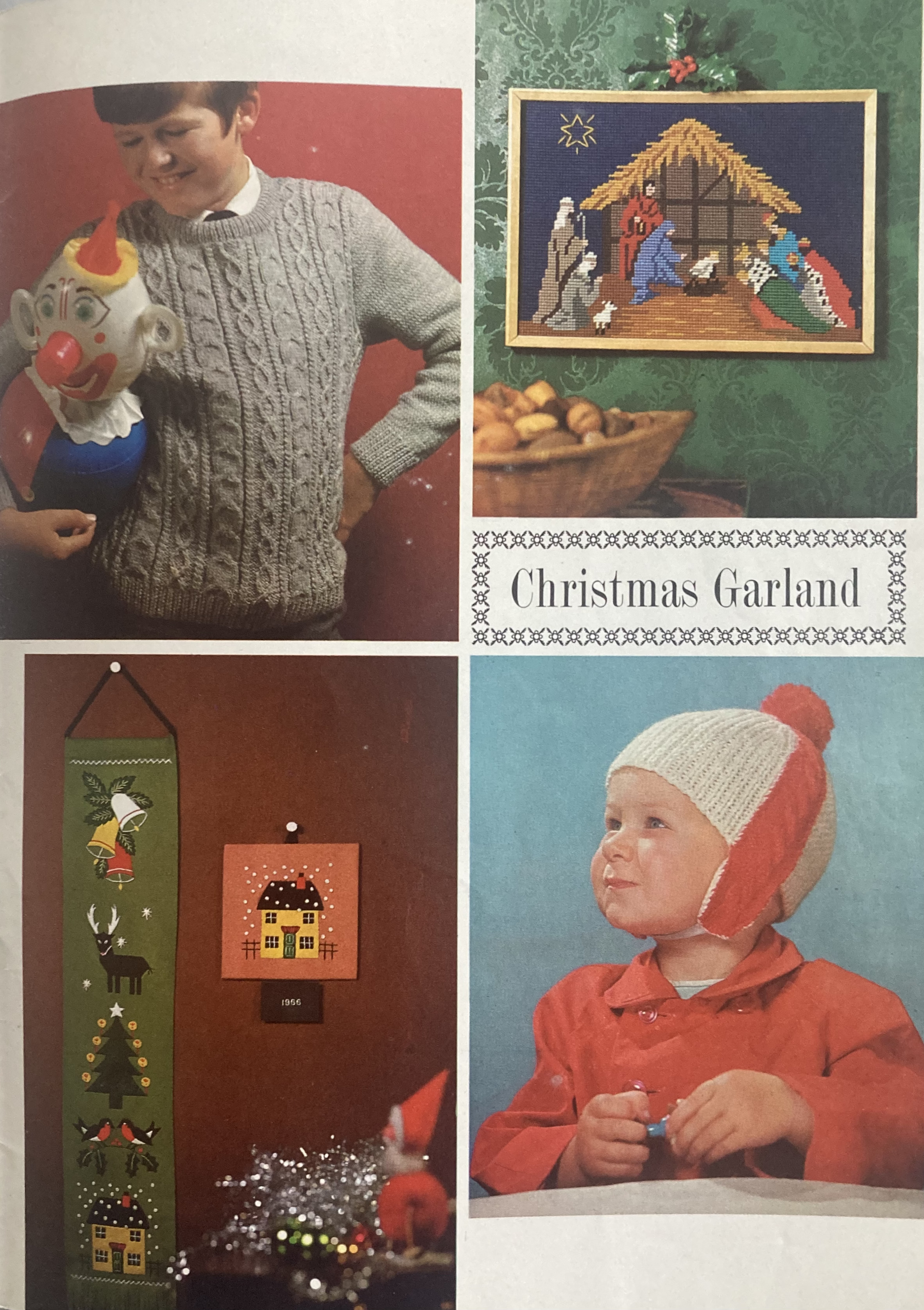
The manly-cable idea is continued on a lovely warm pullover for boys, and his younger sister can get a button-up cardigan in a frothy textured stitch pattern, made in synthetic-wool “Brilliante” for easy washing. Younger tots can enjoy warm ears with a chin-strap “helmet” hat that is guaranteed not to fall off or get lost.

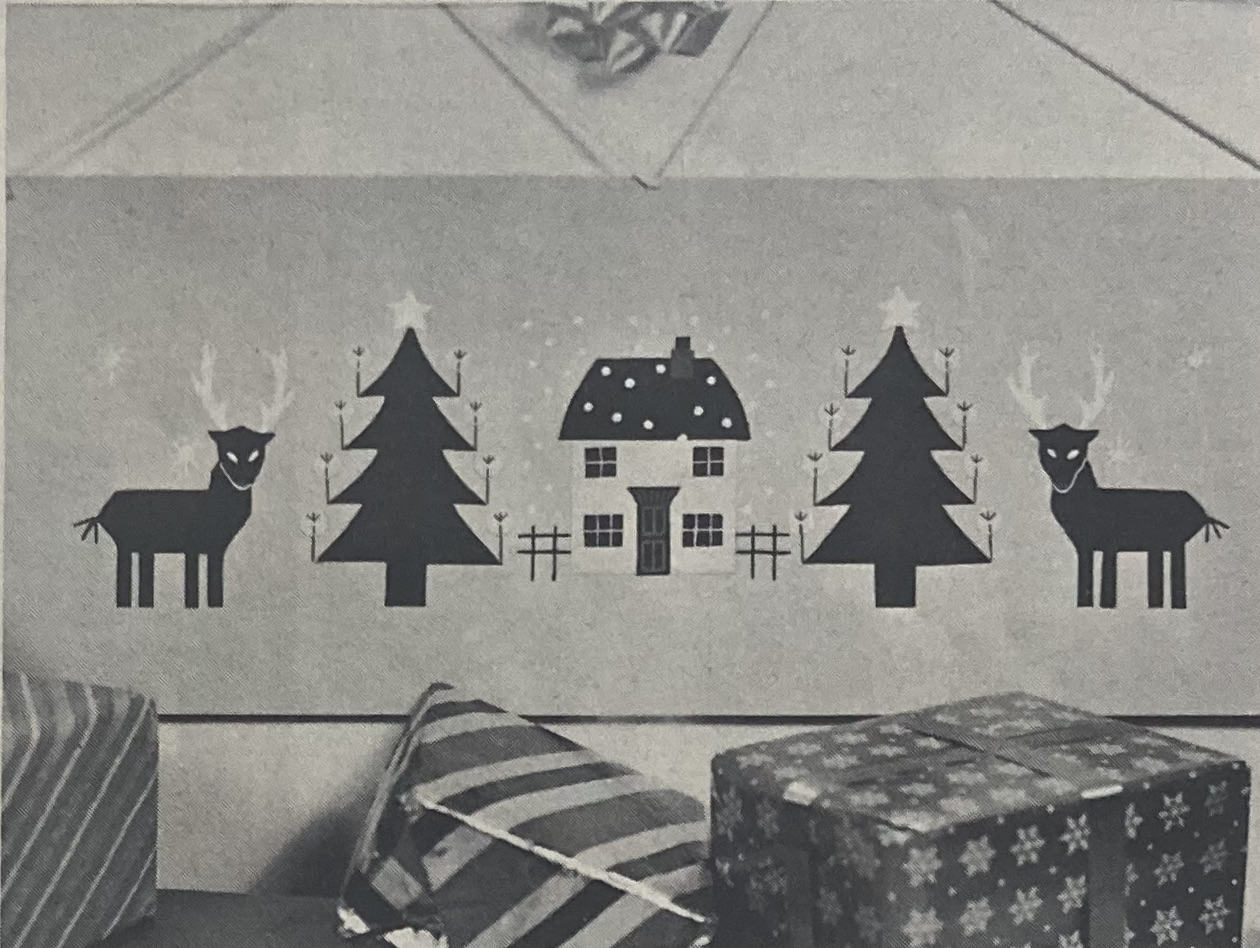
The real focus of the issue is of course, Christmas preparations. Felt appliqué makes a big appearance this year, with place mats and name cards for the holiday table as well a winter-scene wall hanging. The appliqués are quite simple and designed to be used with scraps, and the instructions give ideas on alternate uses such as glueing the felt pieces onto paper for home-made Christmas cards. The place markers have a butterfly motif, making them appropriate for any time of year. Cutwork and embroidery fans can make a tablecloth with peonies, or a Christmas-tree-themed trolley cloth and napkins embroidered in simple chain-stitch. More religiously-minded readers can make a tapestry wall hanging of a Nativity scene (colour photo on inside back cover).

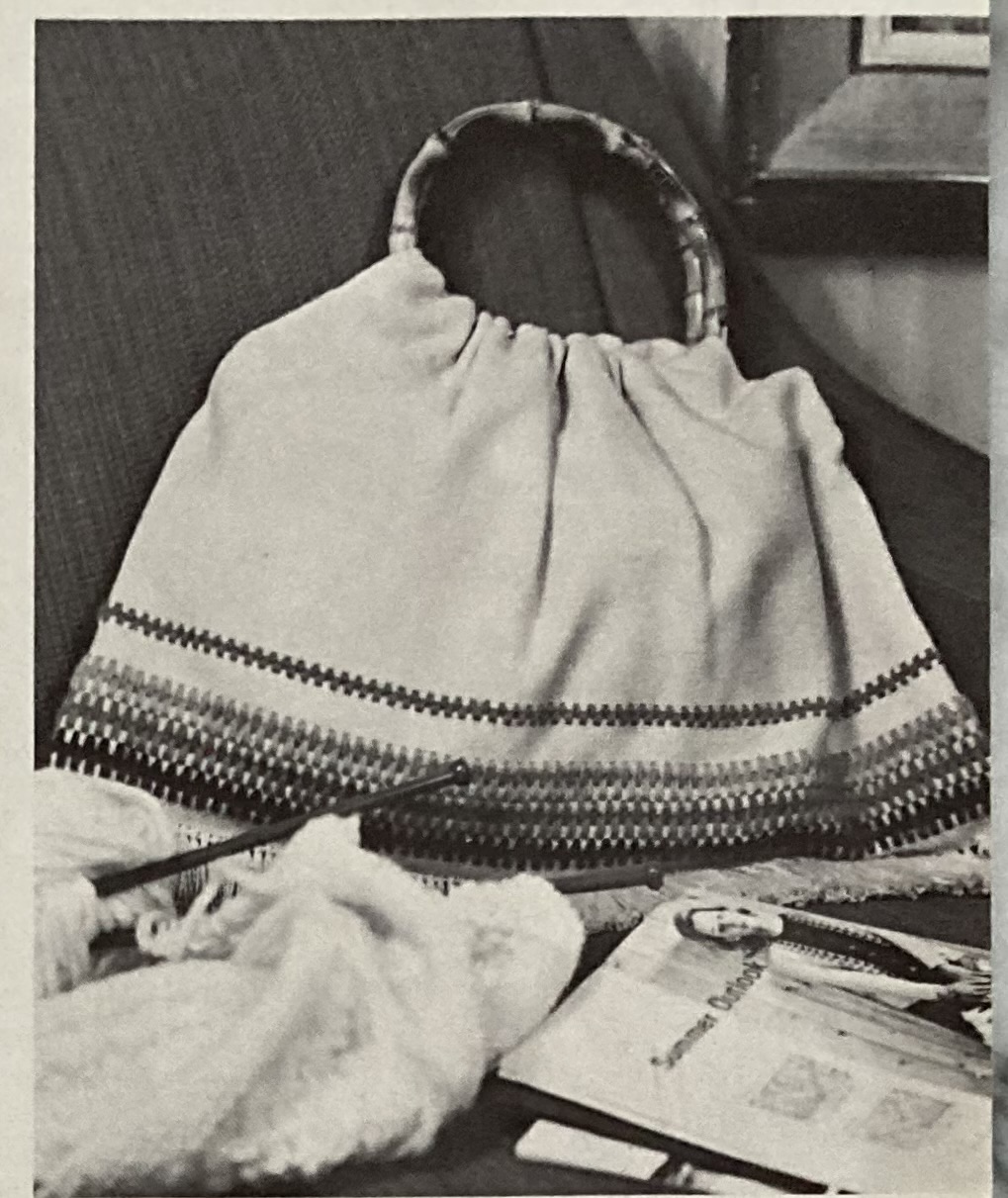
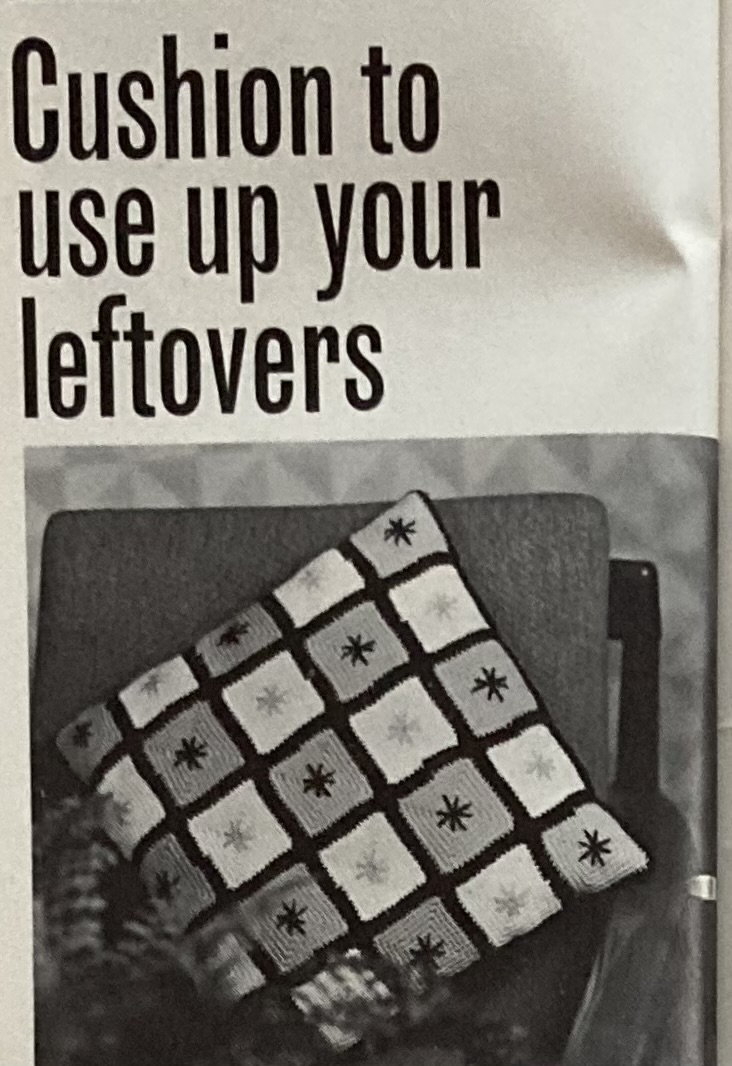
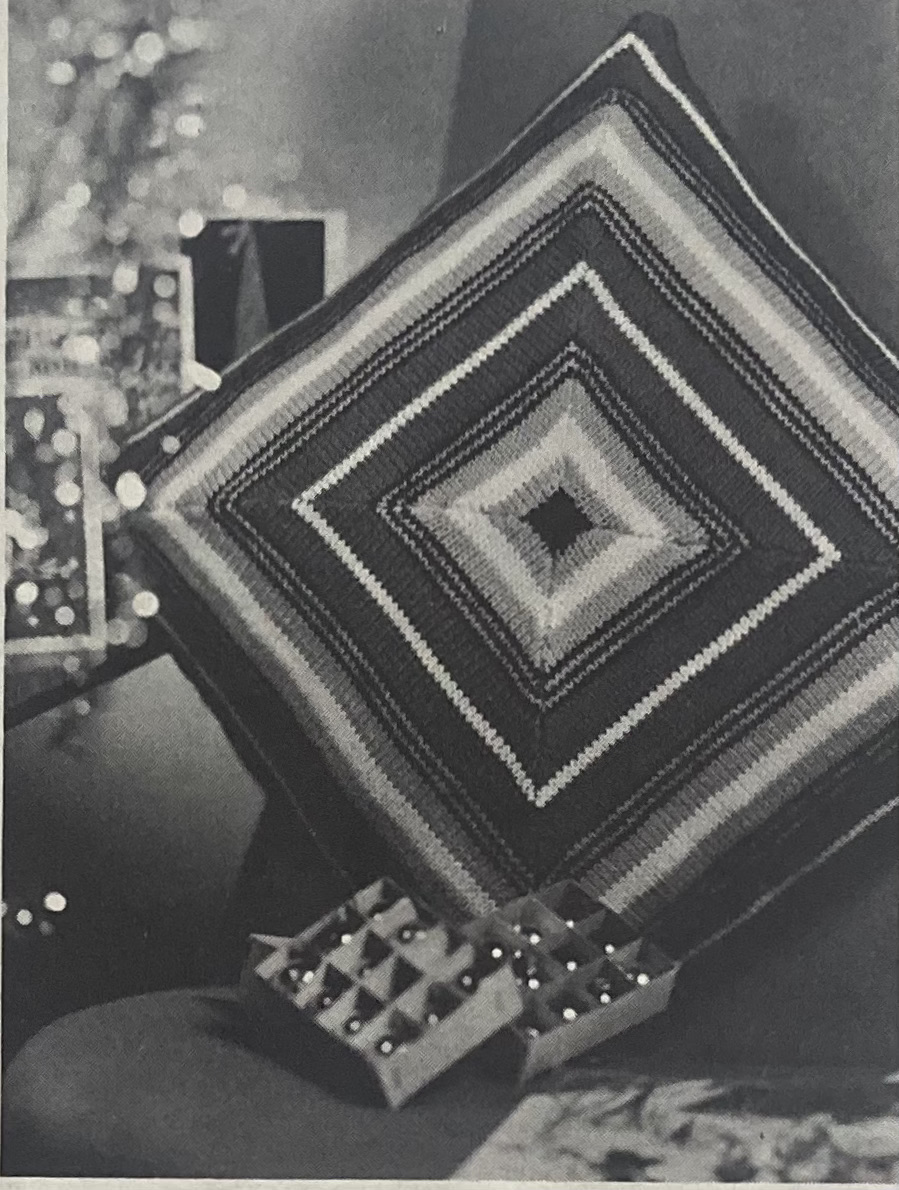
After dinner, it’s on to the gifts! The knitted tea cosy is supposed to represent a holly plant. The “workbag for a friend” is a fun way to use up leftover wool and I made one a couple of years ago. The “cushion for Granny” is a similar stash-buster. One would think it would be made in two squares either fron the center outwards or the edge inwards with raglan-type shaping, but no, you are supposed to make 4 identical triangle pieces for each side of the cushion and sew them together.

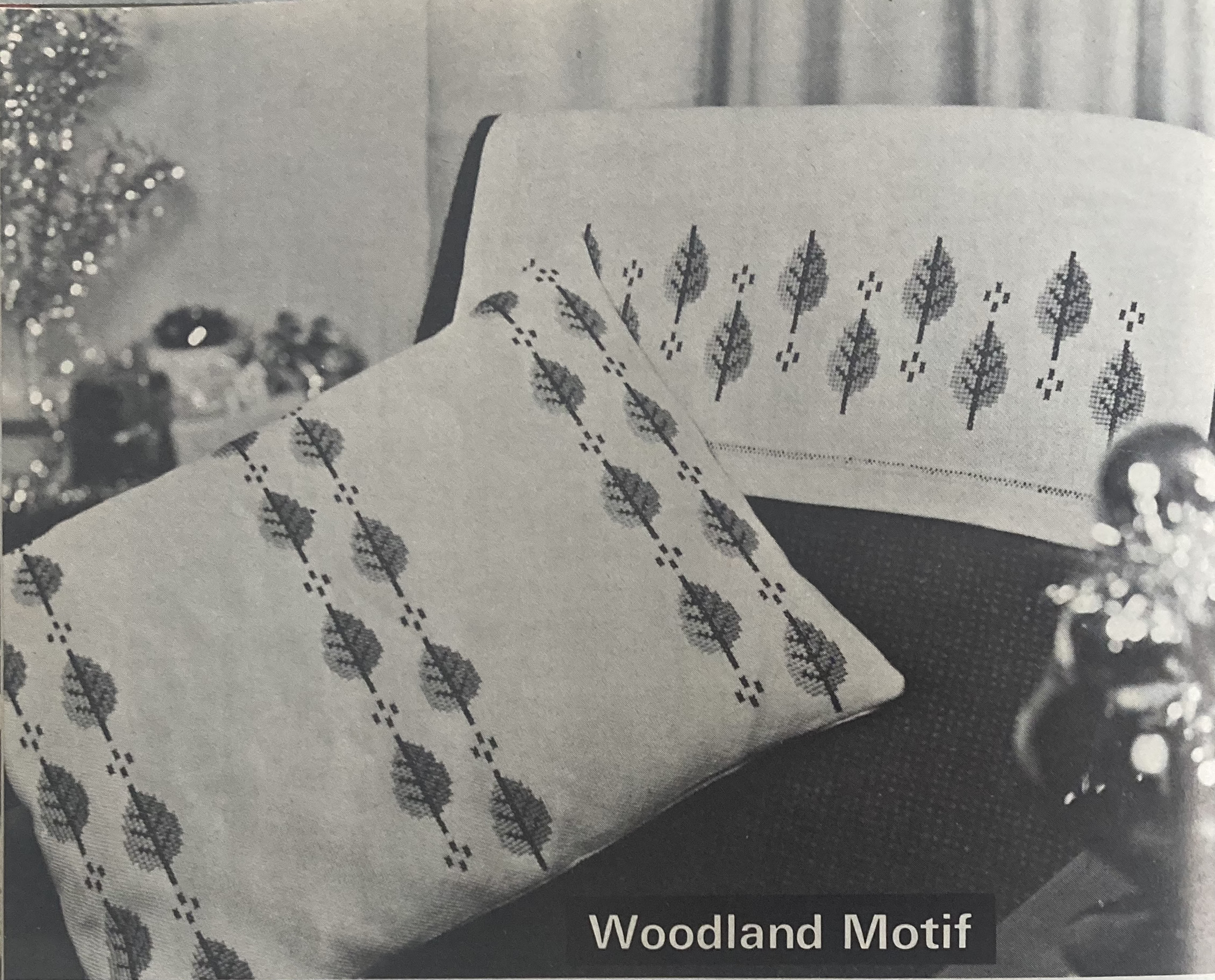
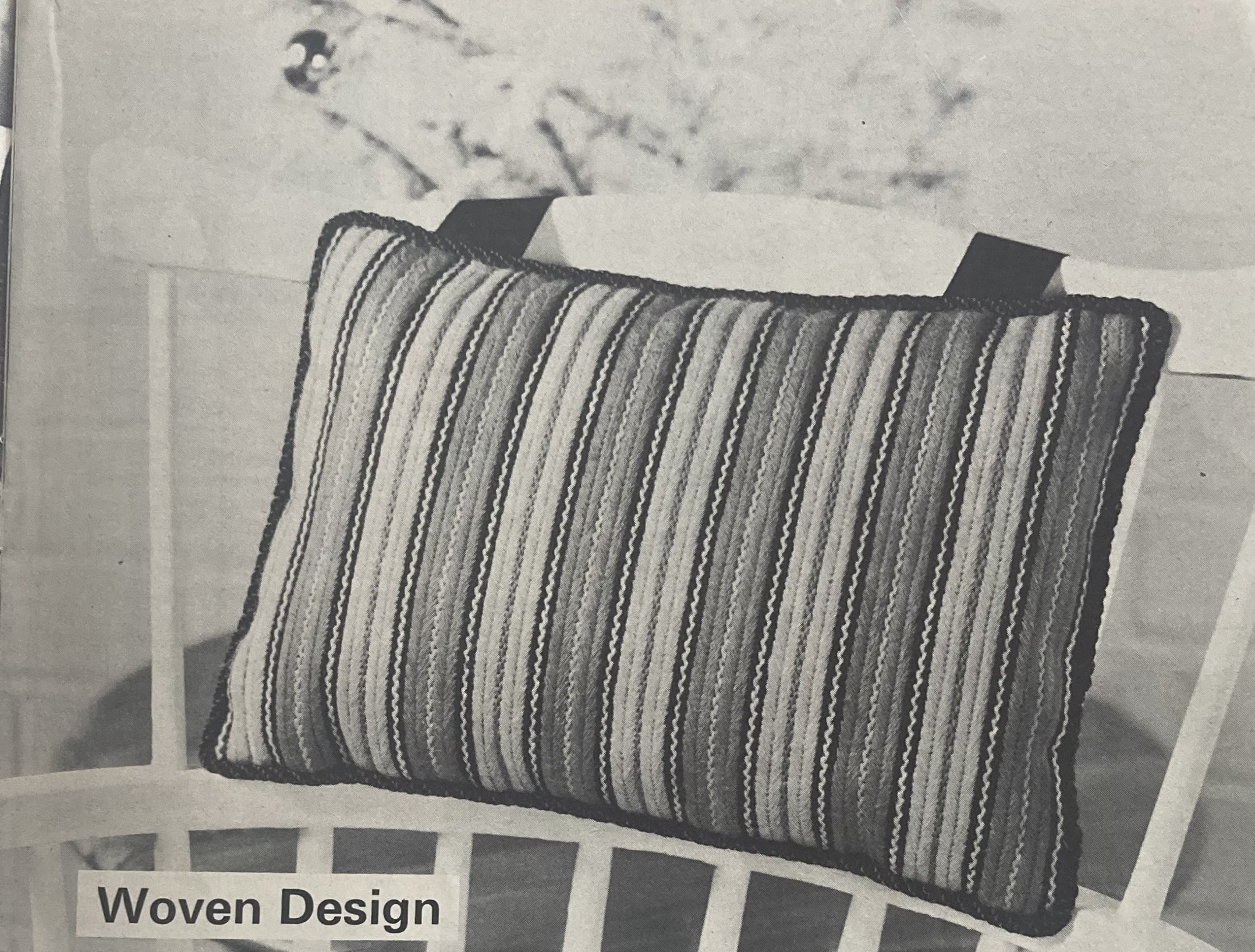
And let us not forget the other cushions: a simple cross-stitch number with a woodland design and a tough woven-tapestry chairback cushion in soumak and herringbone stitch. The colour scheme is brown with brown, with touches of orange and lime green for contrast. In the “just for fun” category, you can knit cosies for golf clubs.

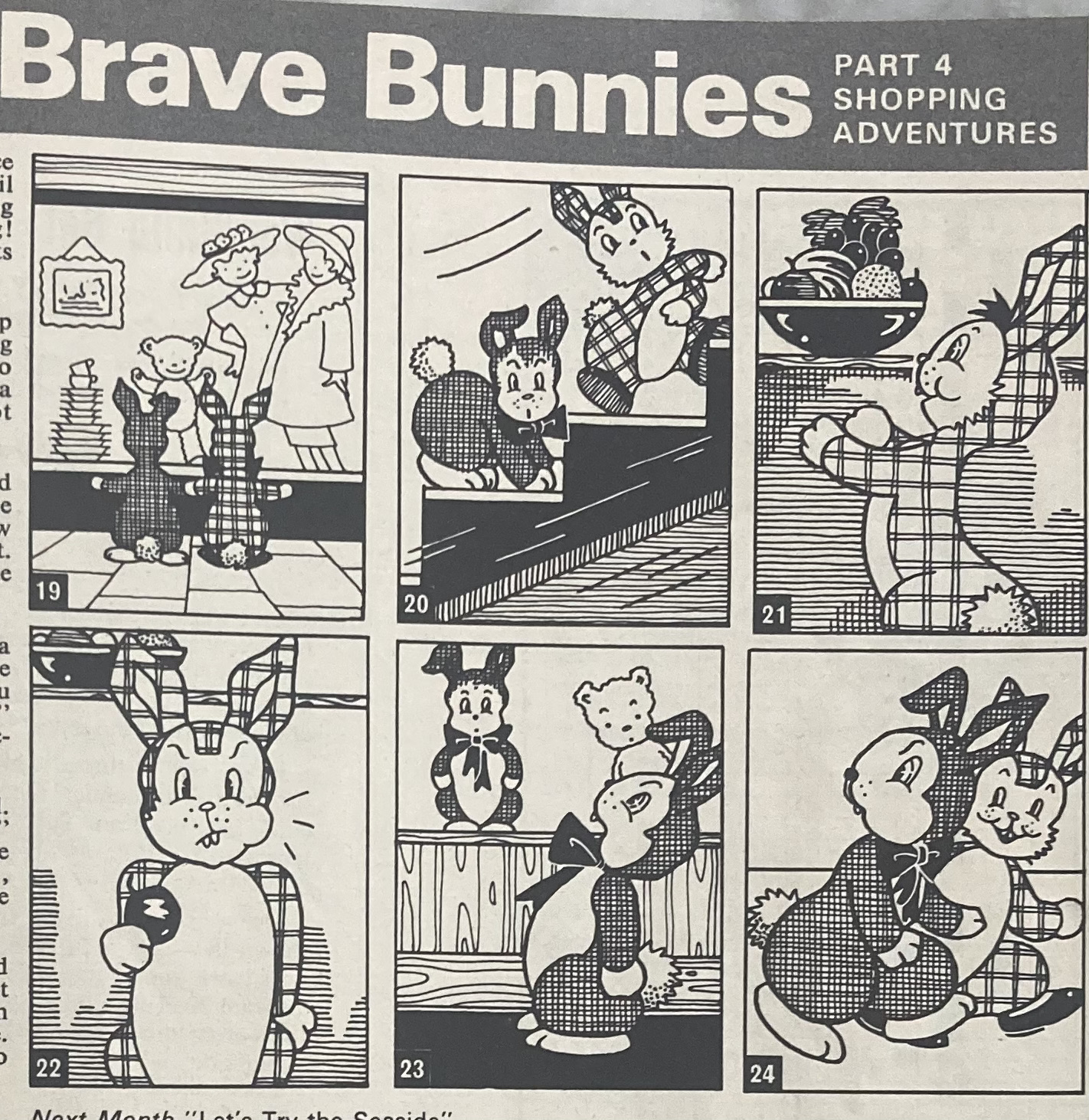
Our two brave bunnies from the Readers Pages are still on their quest to find a real live rabbit. Thinking they might find one in a department store (why not), they get stuck on a moving staircase, try to eat a plastic apple, and find a stuffed rabbit who, unlike our co-protagonist Sale Price (also a stuffed rabbit), sadly cannot talk. Next month, they will try the seaside, which is not known for being home to very many rabbits, but I suppose a better chance than a department store, a movie theatre or a merry-go-round. Of course, around Christmas time, one of the surest places to find a real rabbit would be on the dinner table, ha ha. I guess that storyline might be considered inappropriate for a light-hearted children’s comic. At least our two toy rabbit protagonists aren’t in danger of being eaten.

Finally, there’s another wonderful advertisement from my favourite Stitchcraft-ad store, the Scotch Wool Shop. Here is a nice little article about a knitting book produced by the Fleming, Reid company, proprietors of the chain of shops. The ads always make me want to go out and buy things from the stores… which, sadly, no longer exist. These little gift ideas are marvellous.

That’s all for this issue — and this year! I don’t know what I will make from this issue, or if I will just write a post about the knitted workbag that I already made a while ago. I quite like the ribbed skirt, and could use one, but one look at the gigantic WIP pile discourages me from starting any long and boring project. Hopefully I’ll get a couple of those WIPs finished and can write about that for a 1965 / 2023 wrap-up. Until then, I leave you with this graphic from the December 1965 issue. Happy Holidays!

October 1965: Overview

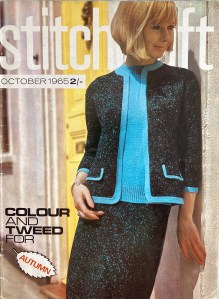
Colour and Tweed for Autumn! This is a “bumper” issue full of many beautiful designs for adults, children, homewares and “novelties”, all with an autumn theme. My apologies for the slightly late post — I was traveling last week with no computer.

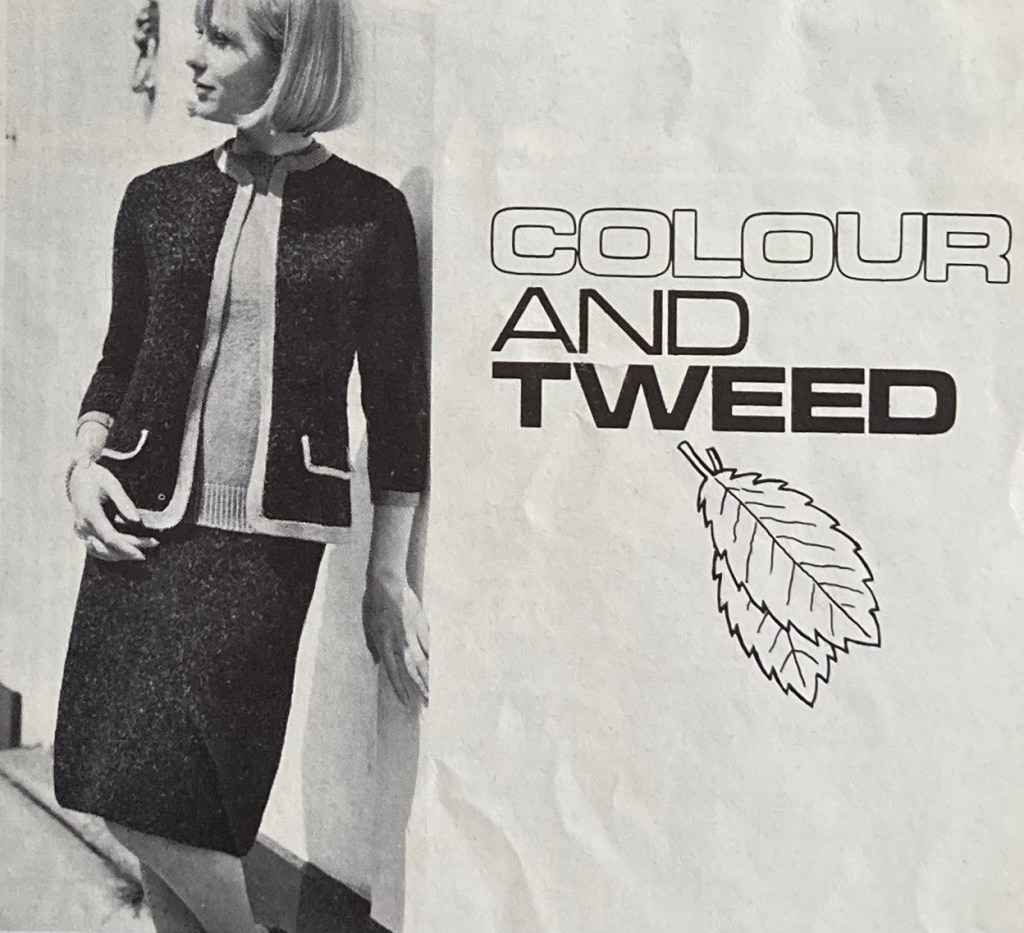
The cover photo is a “Chanel Style Suit” in Bracken Double Knitting tweed wool. 1965 was the heyday of Coco Chanel’s pioneer boxy, tweedy suit that was all the rage with celebrities and modern women. Her designs combined Scottish tweeds and multi-colour fabric patterns by Bernat Klein with her signature comfort, ease of movement and simple elegance to make a modern, essential wardrobe staple. Here is an excellent short introductory film about it (I’m sure readers of this blog will need no introduction; still, it’s great.) The knitted suit design in this issue of Stitchcraft is very true to the Chanel model, with its thick, tweedy wool, above-knee skirt and functional, square pockets in the jacket. There’s a short-sleeved knitted blouse in turquoise to match.

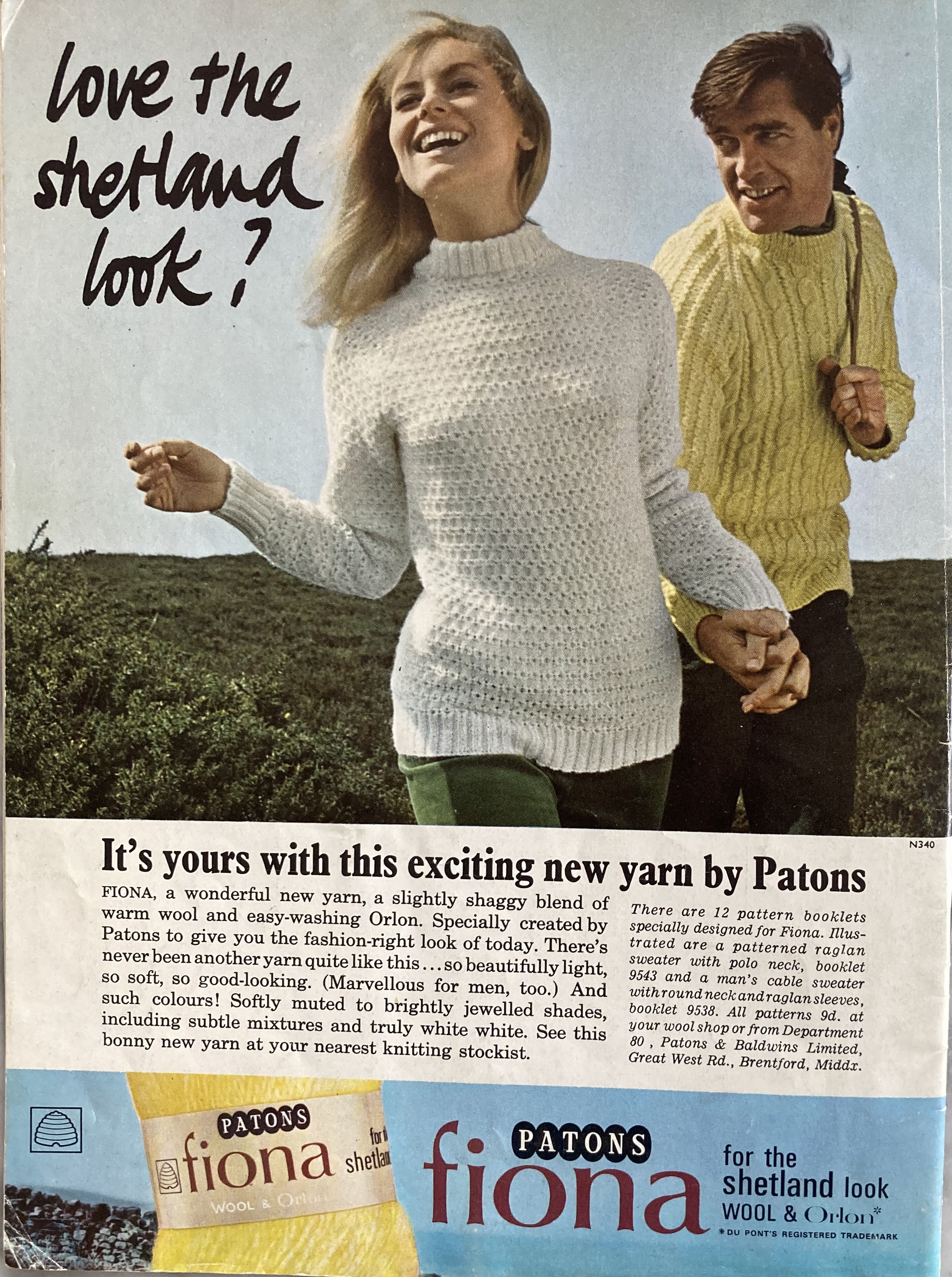
Other women’s garment designs include a brilliant red dress in Paton’s newest wool, Fiona; a “continental” pullover in a broken-cable design in regular Patons DK wool, a plain pullover with “new styling”, also in Fiona; and a fine-knit cardigan with crochet picot trim.

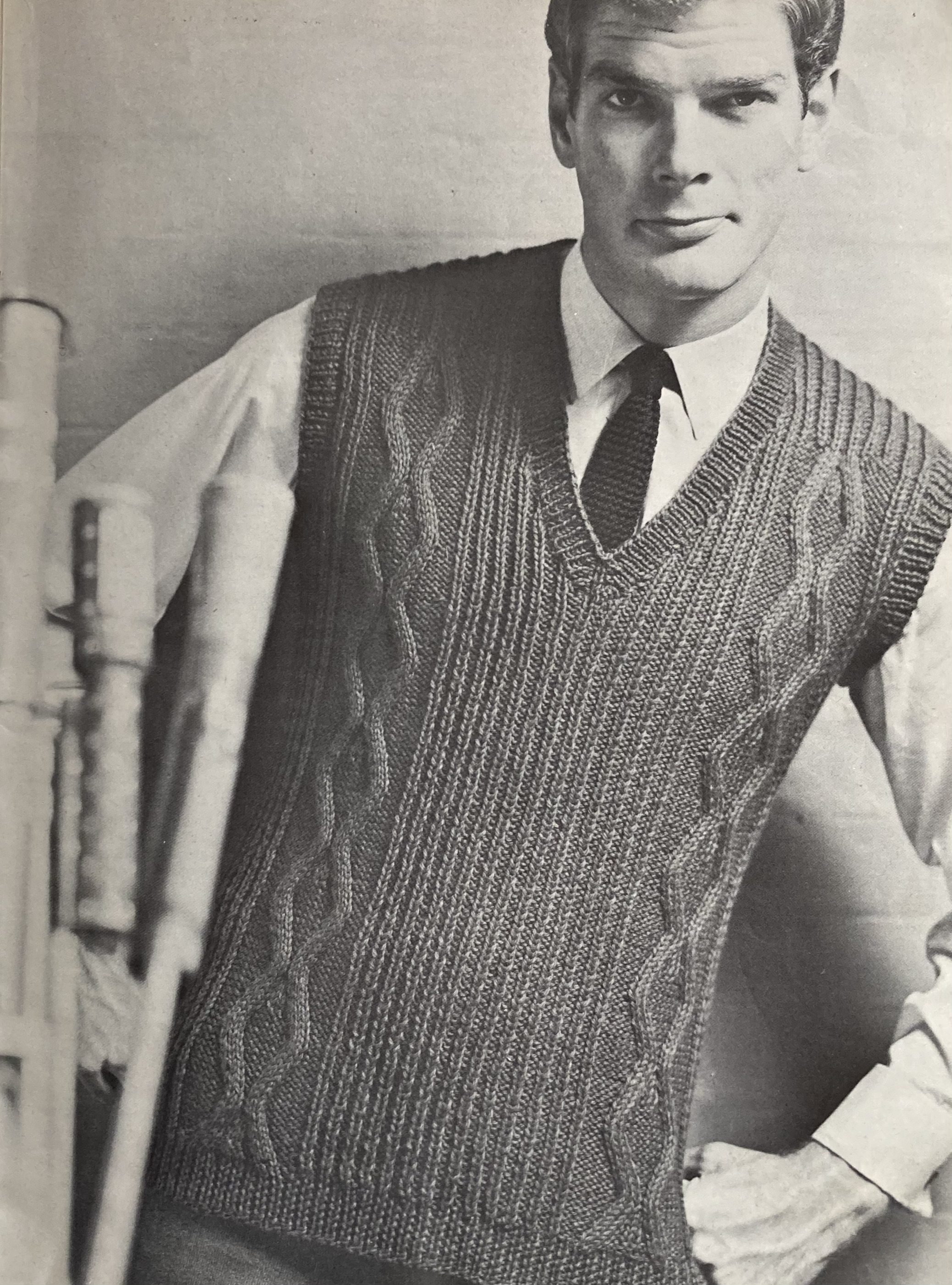
“Fiona” wool was a mix of Shetland wool and synthetic “Orlon”, made to combine the best qualities of both — warm, and lightweight like the wool, but easy-care and less scratchy. The “new styling” of the plain pullover means it is longer (23-24 inches) and looser-fitting than previous classic designs, and the raglan armholes are deeper, for an all-around casual fit. Colours are bright and snappy with yellows (“Maize”, “Celtic Gold” and “Inca Gold”) complementing the bright red of the dress. There’s a slipover for men as well, in bright “Peacock” shade and made in slightly thicker “Flair” — also a wool-synthetic mix. Cables of all sorts are popular, and the longer length can be seen in the Fiona advertisement as well as the garment photos.

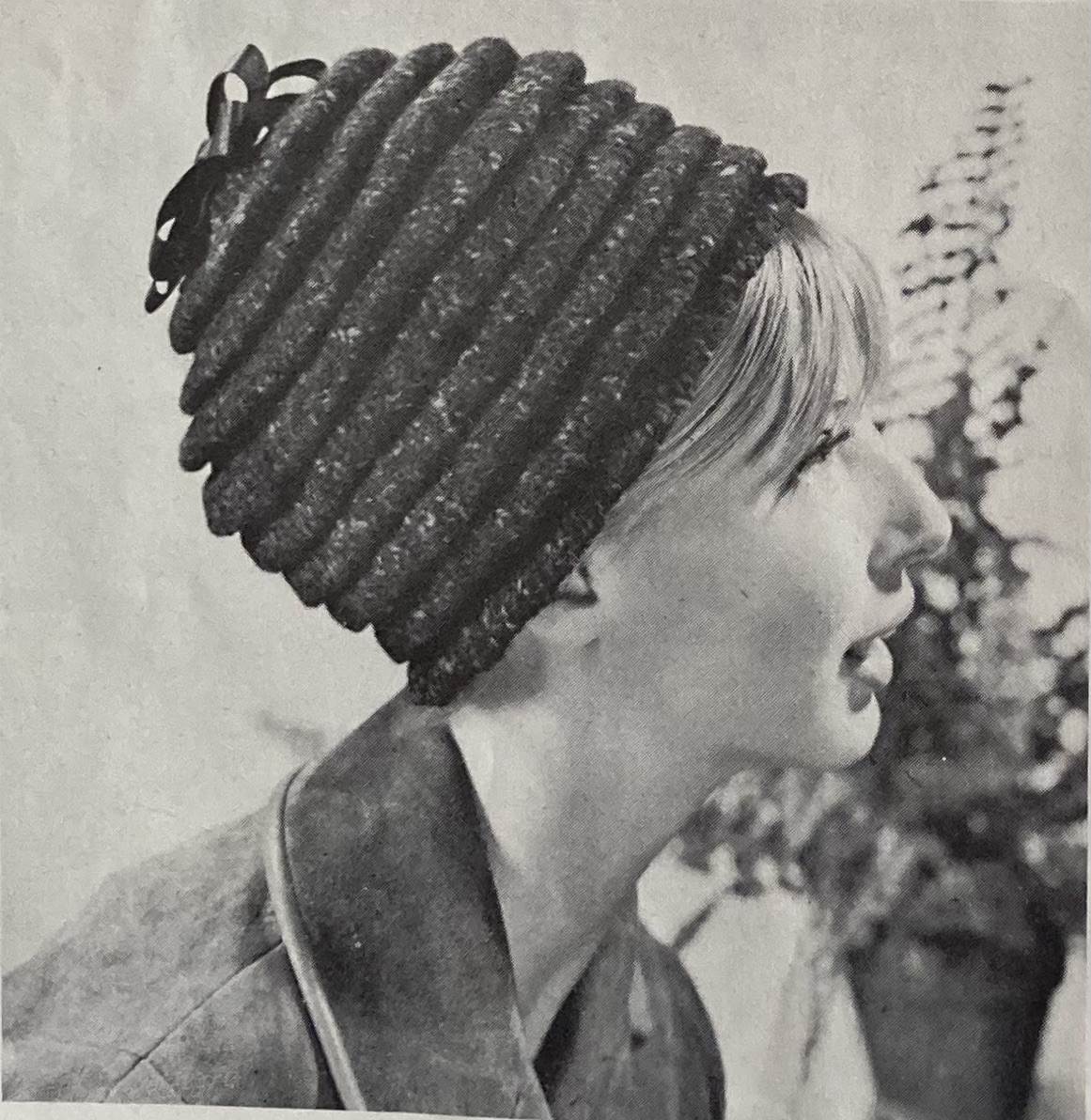
The accessories are limited to one hat — but what a hat! The “tucked” pattern is made by inserting a “life-line” type extra thread every 5 rows and then knitting those stitches together with the current row. I love it, though the model has an unfortunately ridiculous expression on her face in the photo. No designs for babies this issue, but two wonderful and colourful sweaters for children with stranded hem and yoke accents.

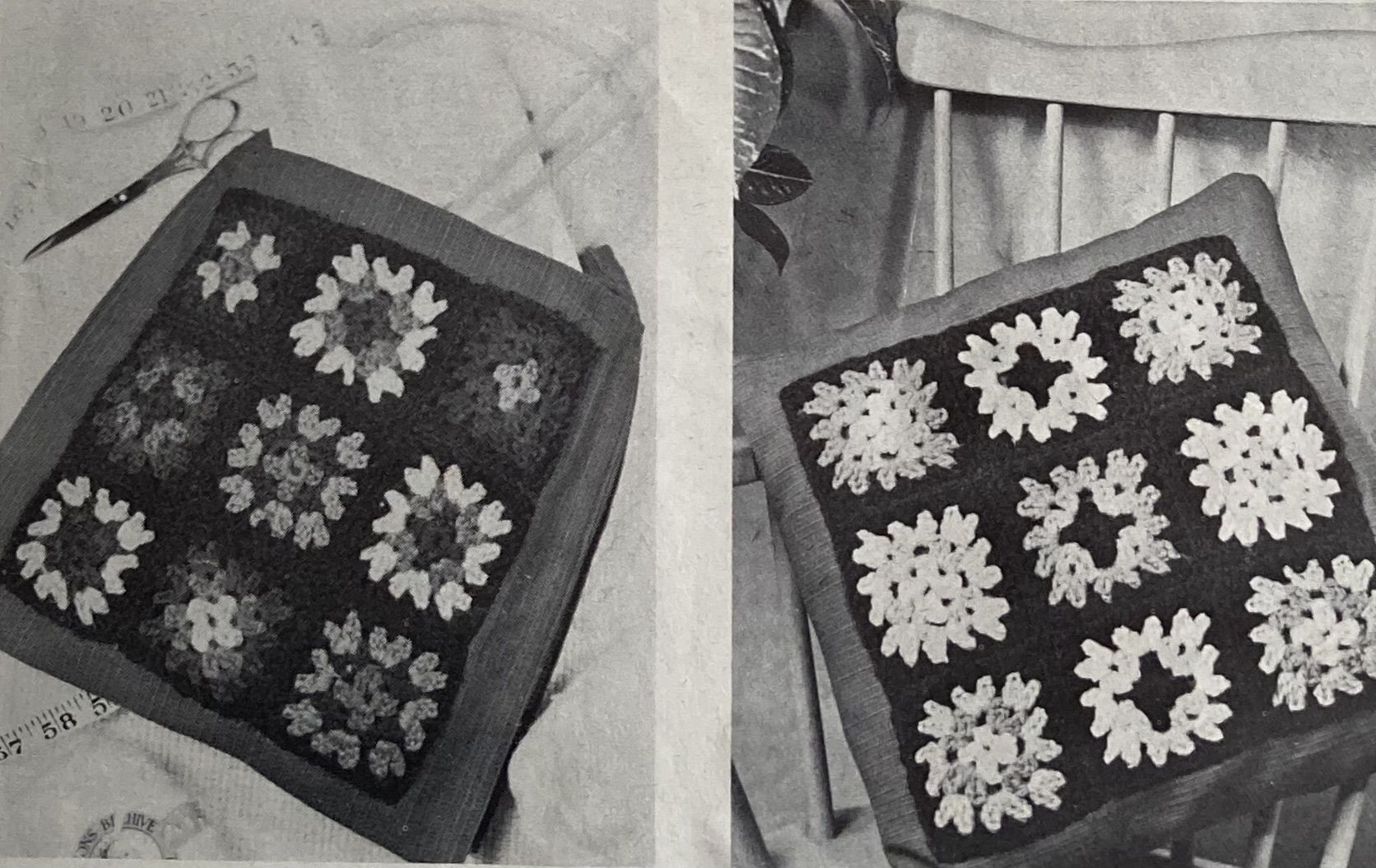
In the embroidery and homewares department, we have the usual designs for cushions, chair-backs and chair-seats, plus a granny-square crochet pattern to use up scrap wool that, backed with woven fabric, can be used to make a workbag or cushion. Like the garment designs, colours are bright and bold, with reds and blues prevailing, along with black and white.

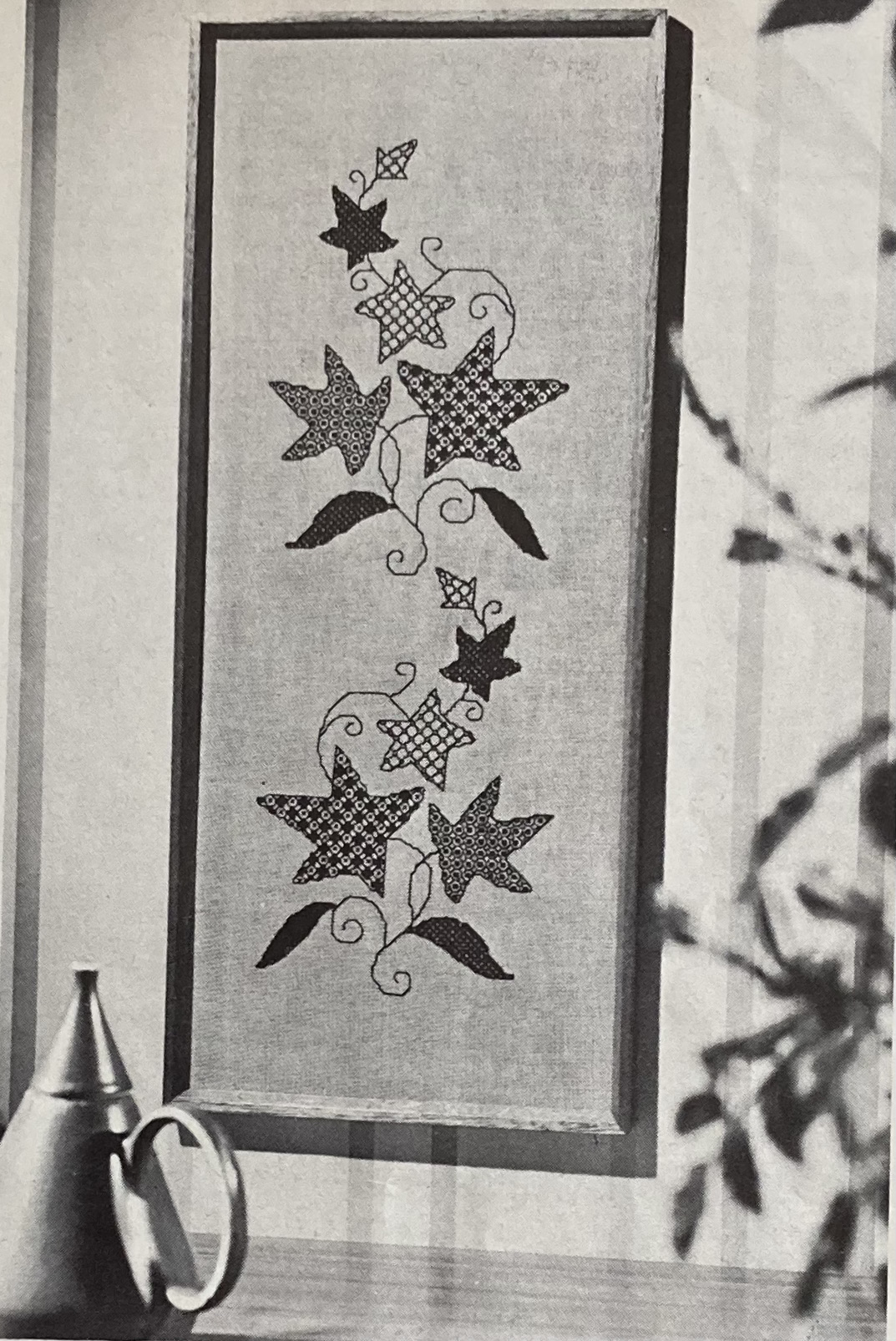
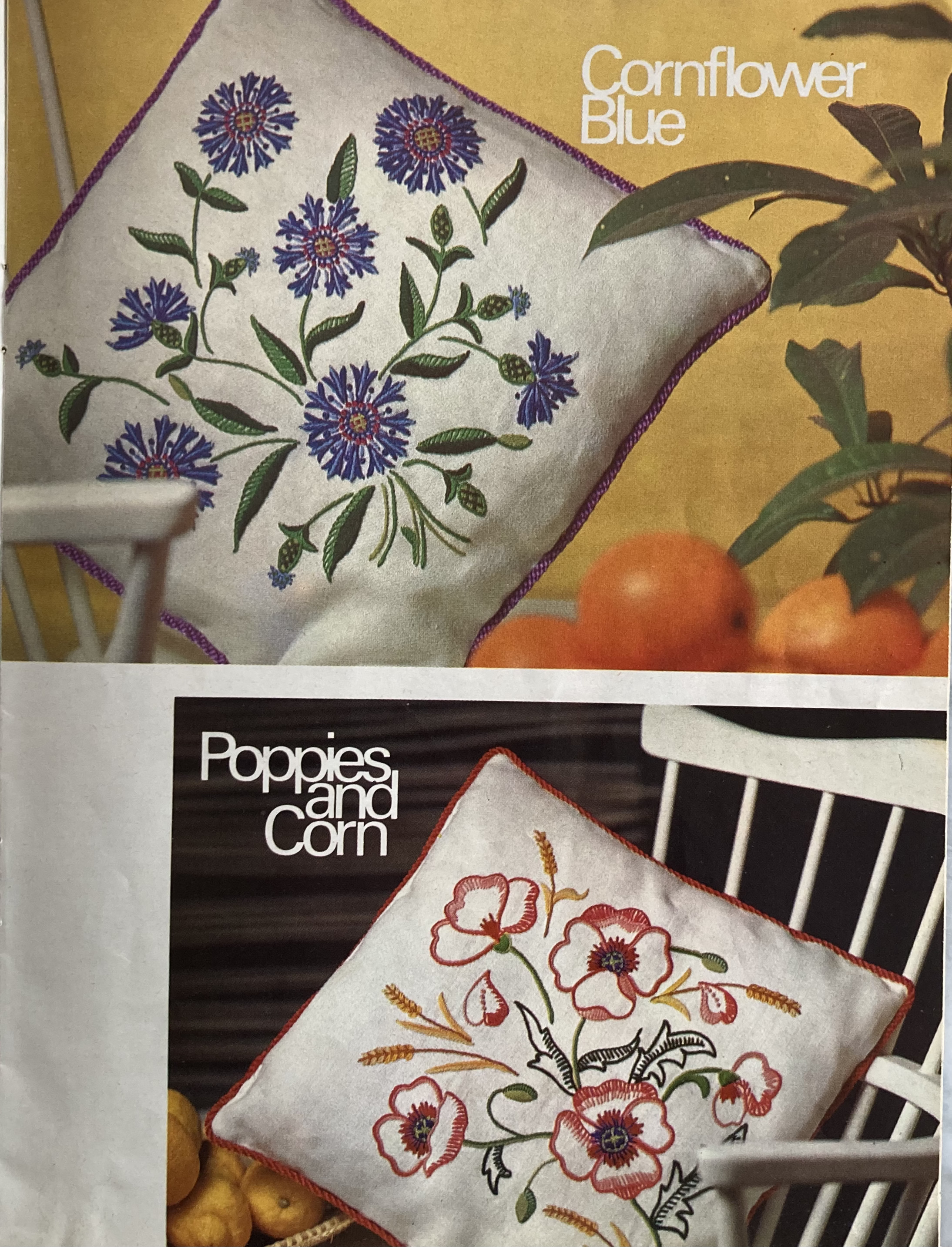
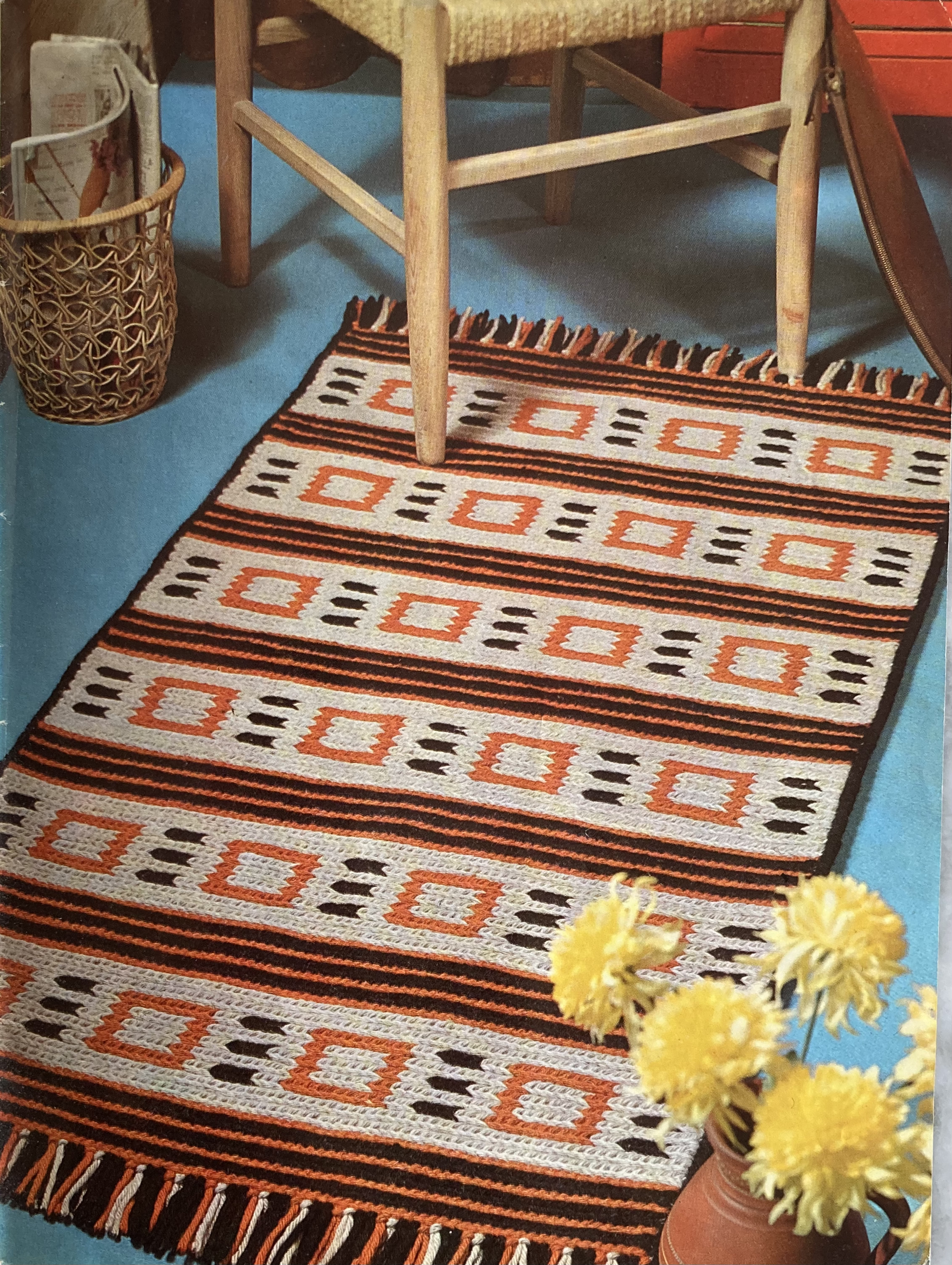
More advanced needleworkers can make a very pretty firescreen or a blackwork wall panel. Finally, there are embroidered cushions with flower designs — cornflower, corn not-flower-but-actual-corn, and red poppies. The loose, almost flowing style of the cushion designs looks ahead to later and even simpler patterns — complicated Jacobean work was on its way out. There’s a practical stitched rug in a geometric design as well.

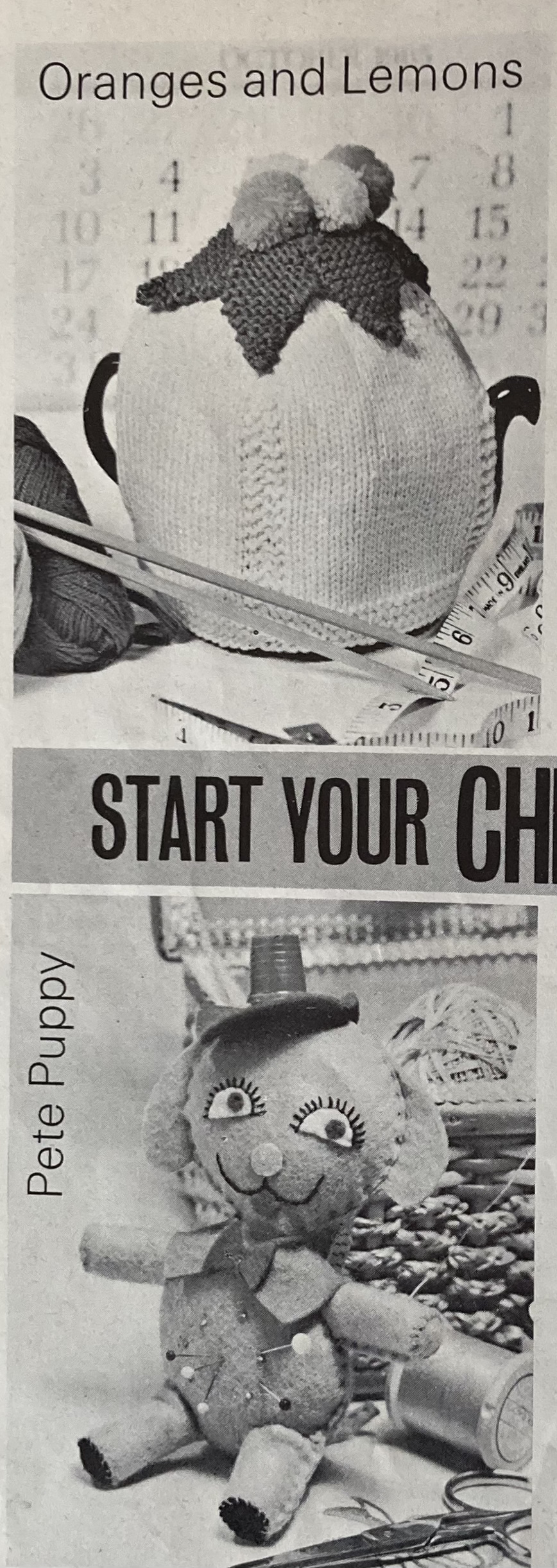
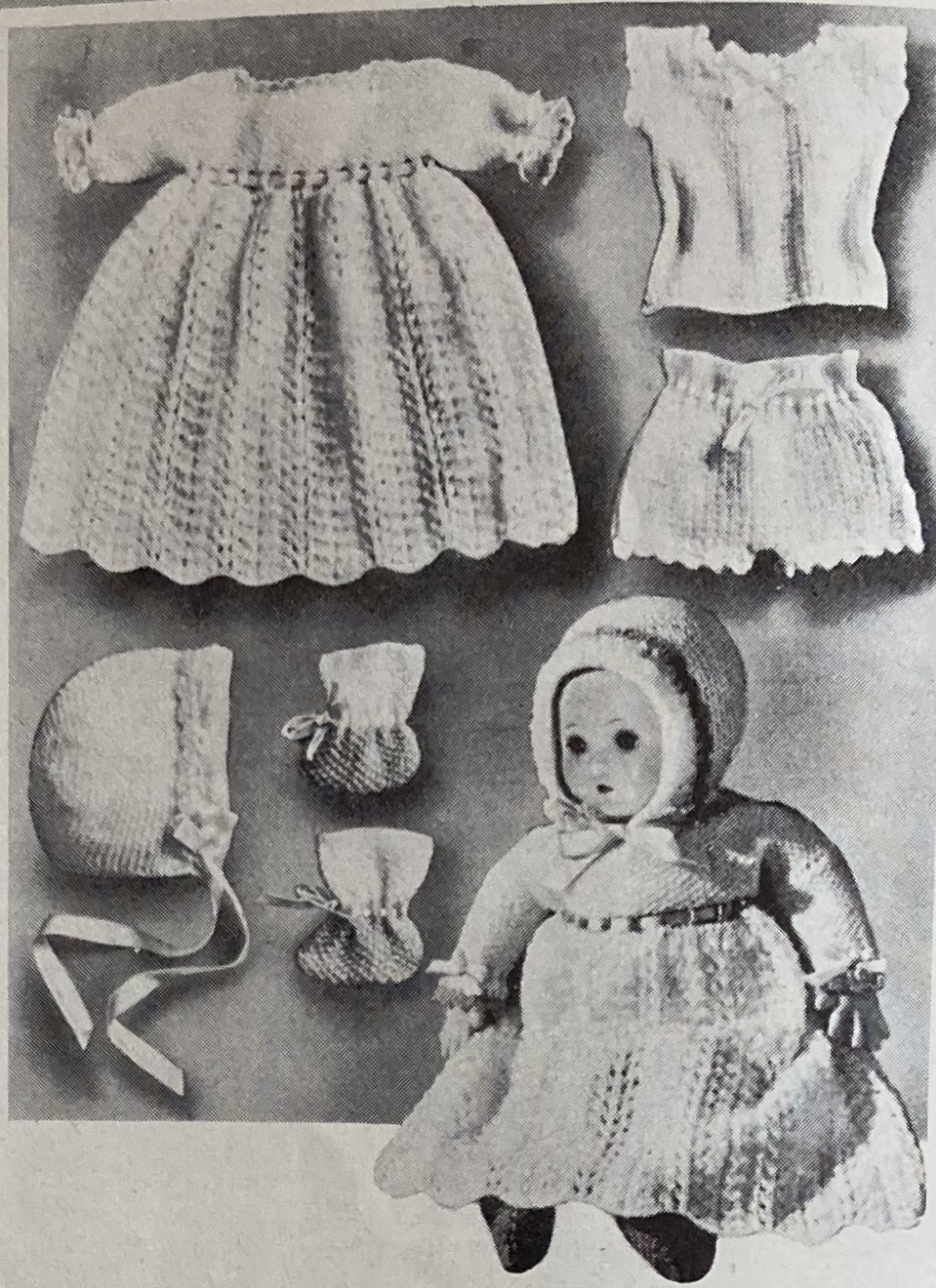
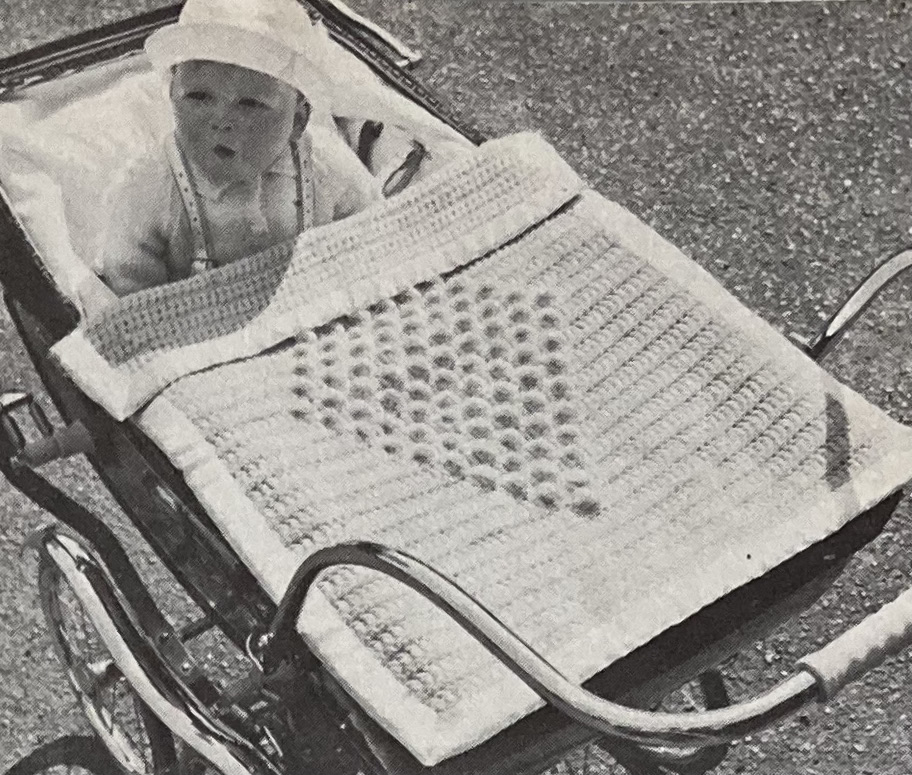
The bizarre-bazaar “novelties” never fail to amuse and wonder, and this month’s issue gives us a knitted tea cosy (festooned with pom-poms) that looks like a giant orange and/or lemon, and a crazy-eyed “Pete Puppy” doll in sewn and embroidered felt fabric that can be used for storing sewing implements — just poke those spare pins right into his belly like a voodoo doll. The “Readers Pages” offer some reprints of popular designs from earlier issues: a doll’s clothing set from November 1940 and a crocheted pram cover from … when was it exactly? It doesn’t say in the instructions and couldn’t find it in my previous posts, but I know I have seen it in another issue — possibly pre-1960.

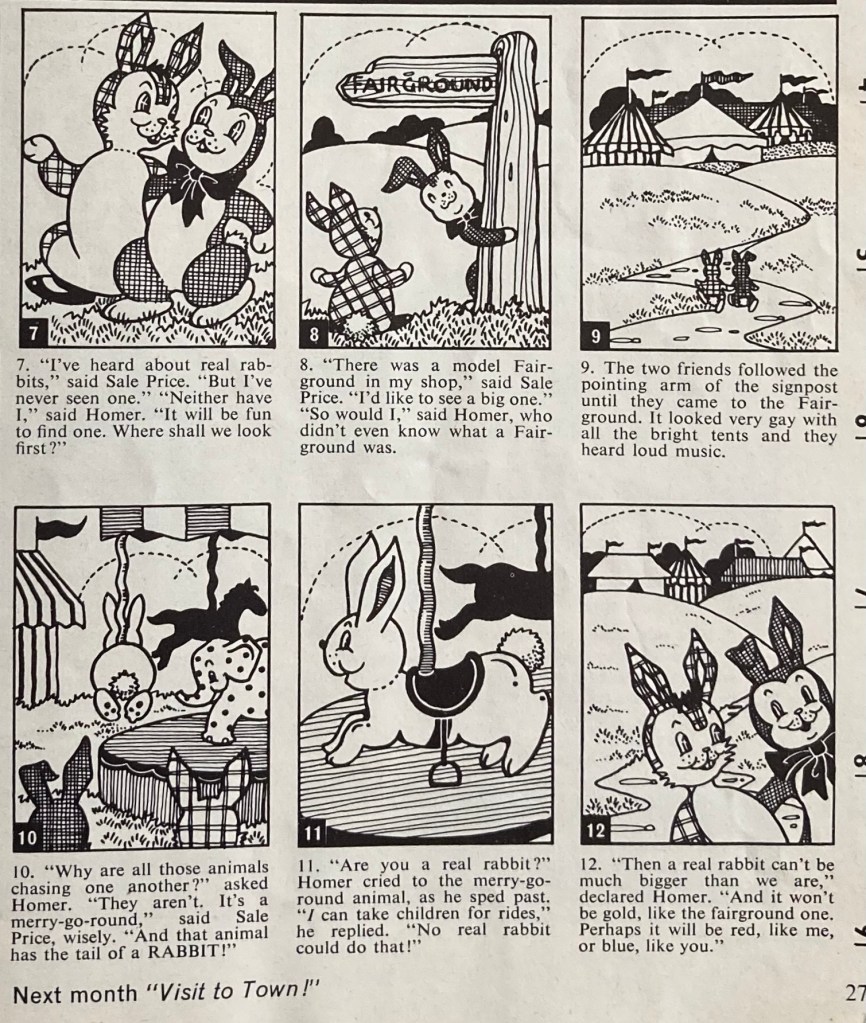
In the current comic (really, one of the best ones), homemade rabbit doll Homer (because he’s home-made, get it?) and his friend, the store-bought rabbit doll Sale Price (self-explanatory) go on a quest in search of a real, live rabbit. Here’s they find a rabbit on a merry-go-round, who explains to them (logically enough) that he cannot be a real rabbit, as he can take children for rides, which a real rabbit cannot. Pedagogical message for children: do not try to ride on a real rabbit! Alas, Homer and Sale price must look further, and will continue their adventures in next month’s issue.

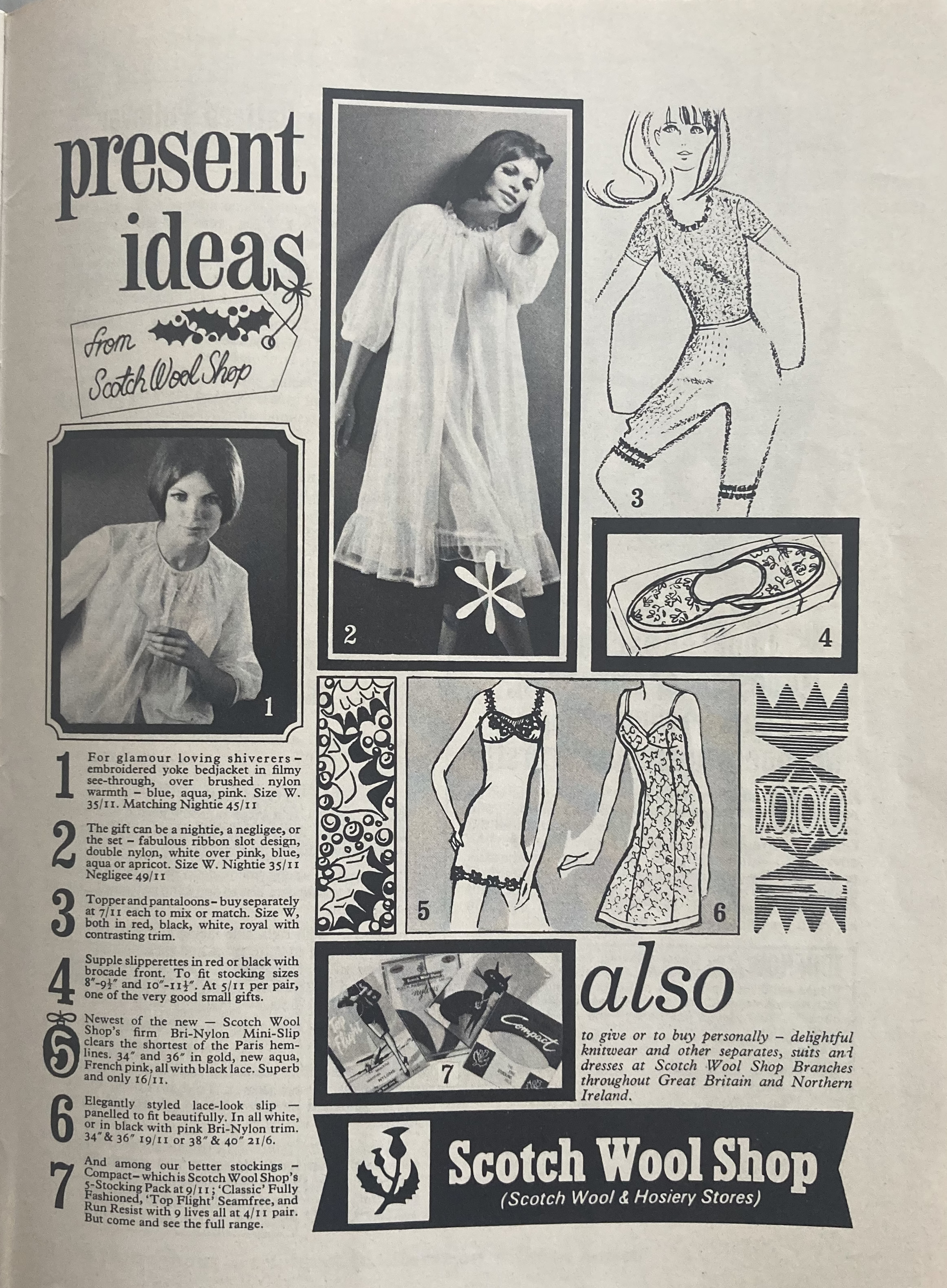
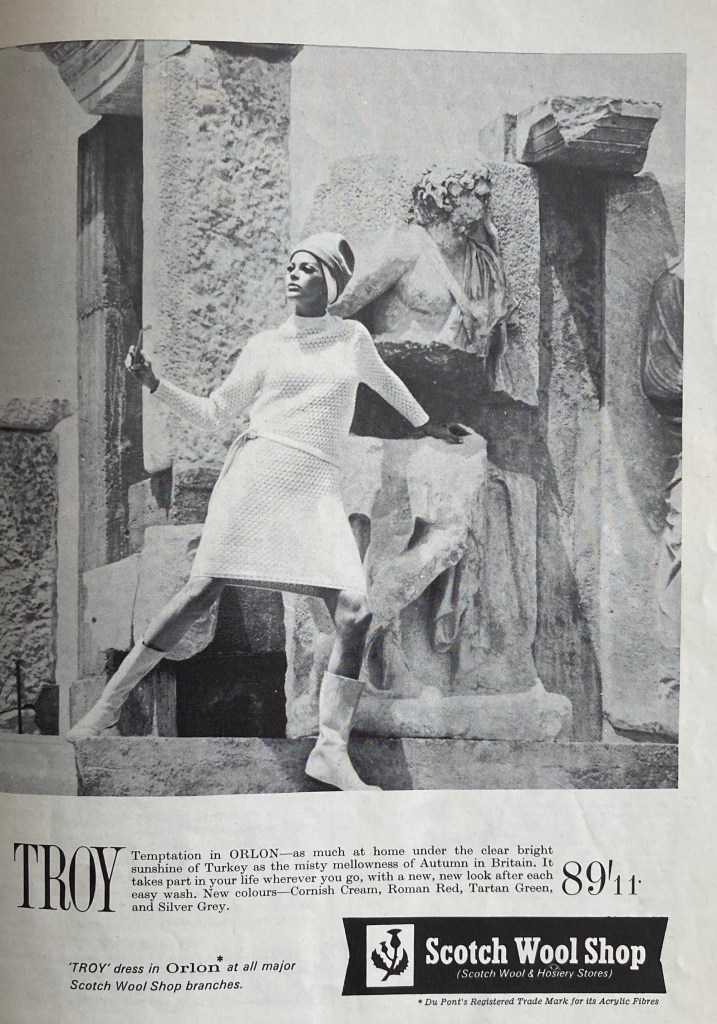
I will leave you with this ad for the Scotch Wool Shop, purveyors of knitting wool, stockings, underwear, and fashionable clothing for women. Always keeping up with the times, the ad shows a crocheted dress in Mary Quant style, named “Troy” and perfectly photographed for the Swinging Sixties.

That’s all for now! I have so, so many unfinished projects, but cannot resist the temptation to make the fine-knit cardigan blouse with picot crochet trim. It will definitely not be finished on time, but as always, I will update project posts when progress has been made.

November 1964: Overview

“Winter Fashions and Christmas Plans” is the theme of Stitchcraft‘s November 1964 issue, with practical clothing for the family as well as gift ideas and a couple of glamorous items for parties.

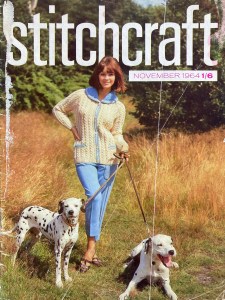
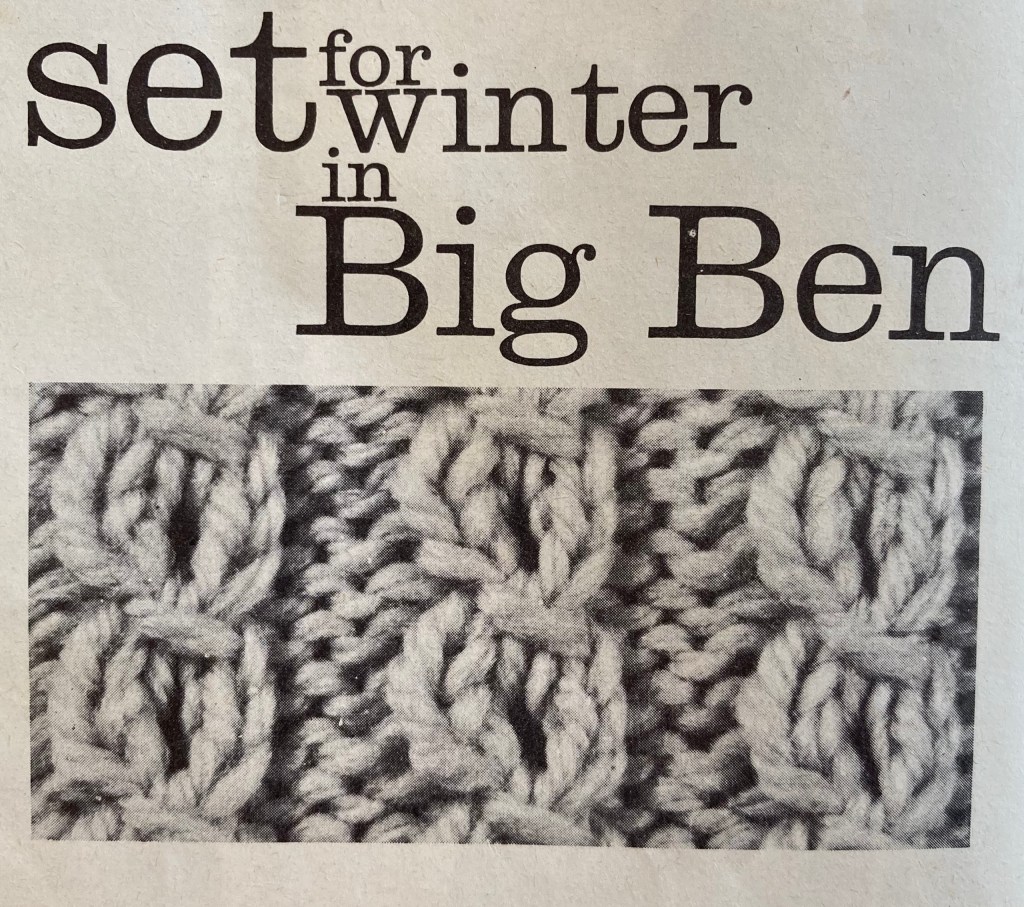
You will be “set for winter” in the cardigan on the cover, knitted in bulky “Big Ben” wool at 3 1/2 stitches to the inch, with all-over mock-cables, a warm collar and practical pockets. The mock-cable pattern involves “losing” a stitch in the 3rd row with a sl1-k2-psso, then getting it back with a yo on row 4, making a “bar” and then a little hole for the mock-cable effect. There’s a handy close-up photo of the stitch pattern, so you can make sure you did it right.

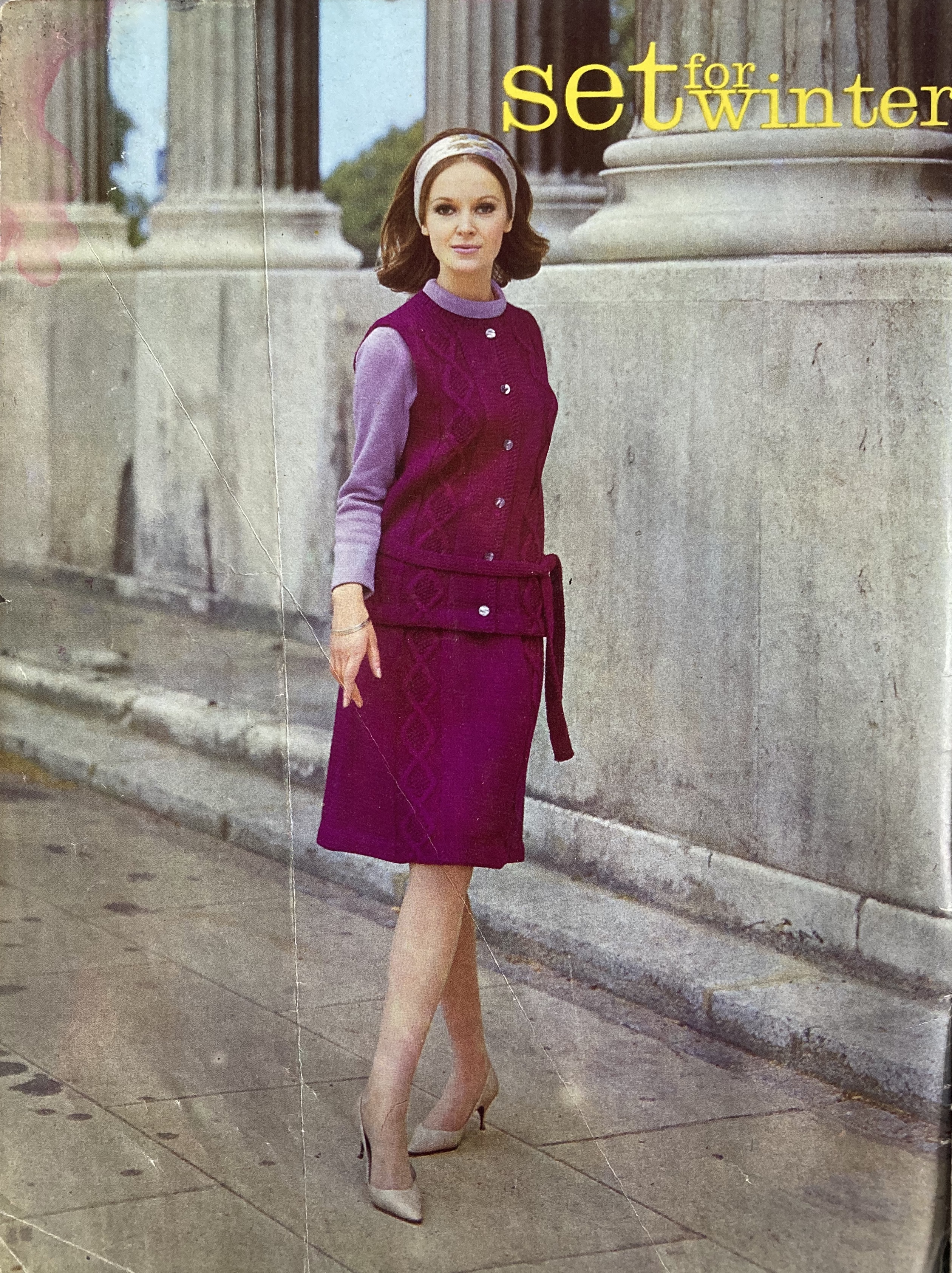
The caption continues the use of a bit of word-play on the word “set”, which we saw in the October 1964 issue. There, the theme was “set to flatter”, whereby some of the items were part of an actual set, and some weren’t. Some of the other garments in the November issue really are a set, in that sense: this waistcoat suit in glowing fuchsia, for example. Rounding out the everyday women’s garments are a plain 4-ply jumper, a bright colour-motif sweater and a comfortable tweed jacket for larger sizes. I love that brooch on the jumper — it looks like Star Trek insignia.

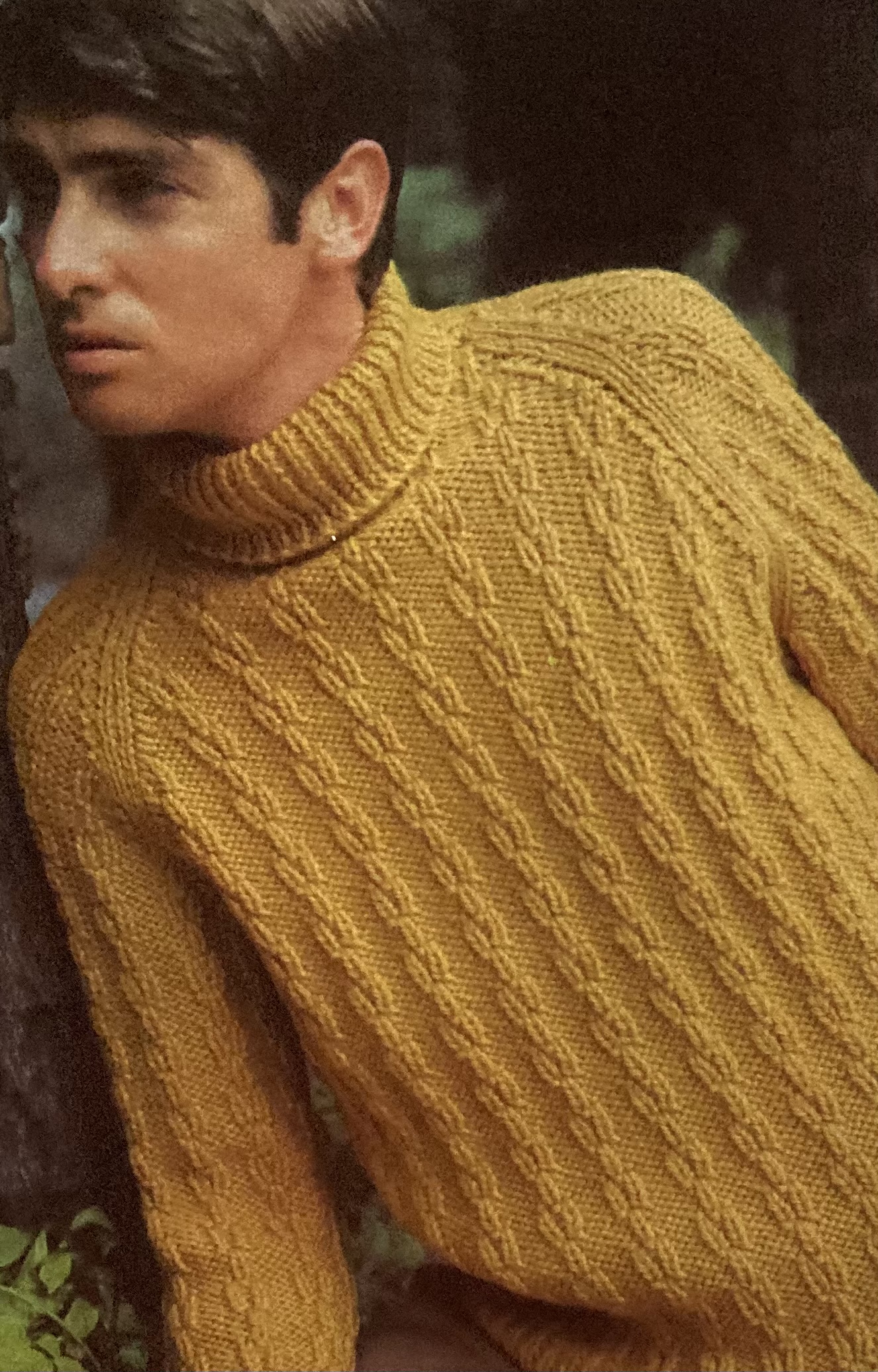
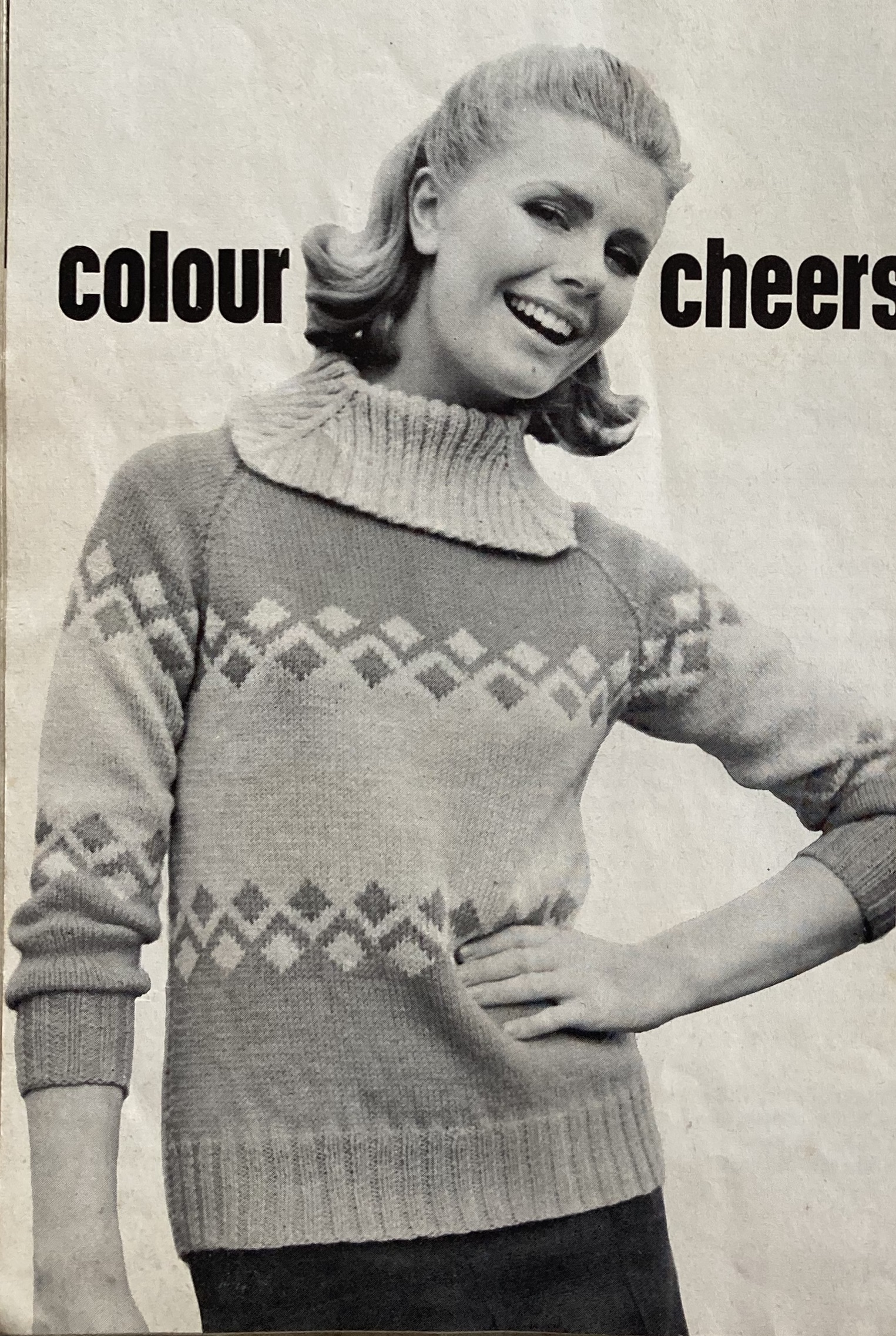
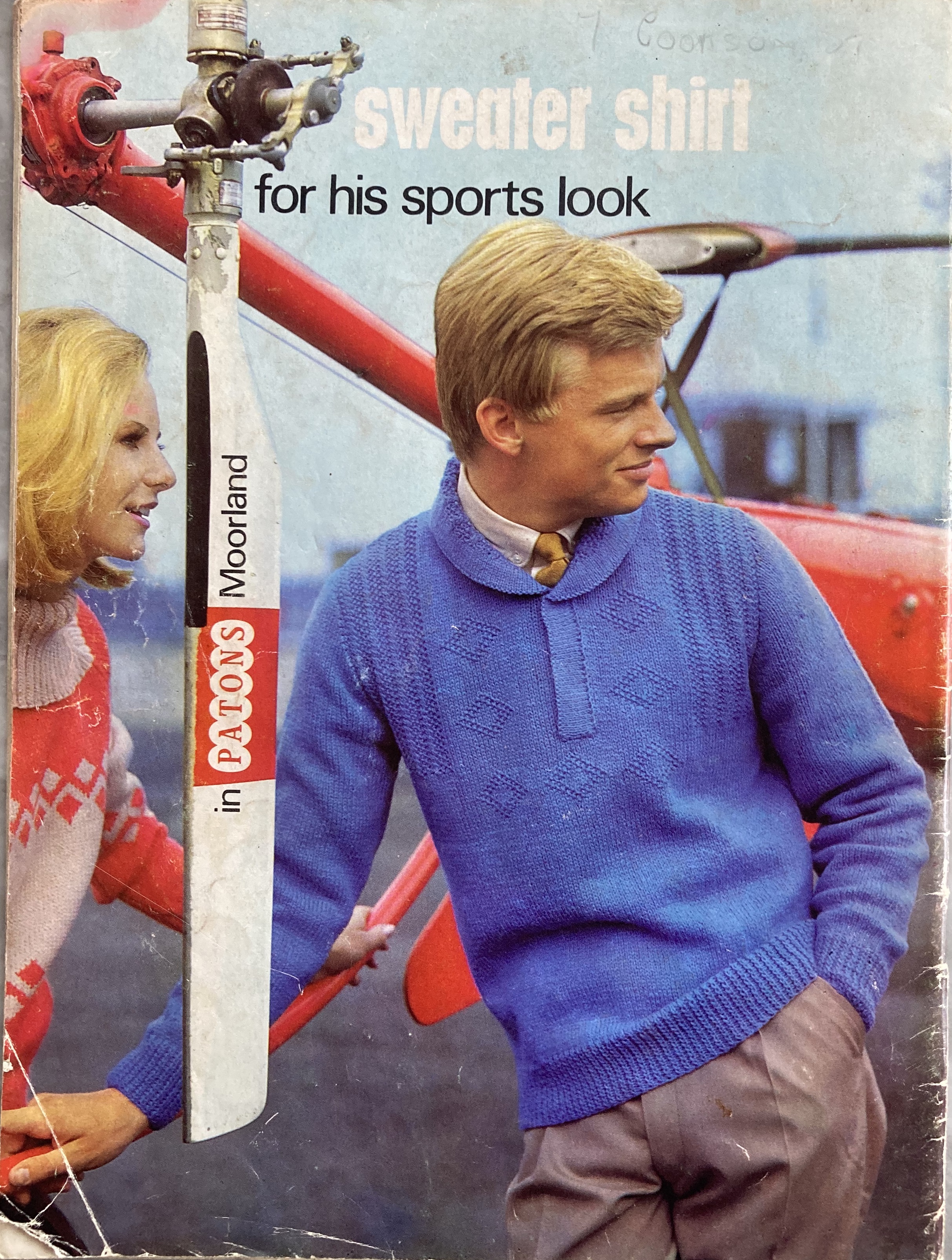
The trend for textured patterns, big collars, zig-zag designs and bold colours continues with the men’s garments: he too will be “set for winter” in a textured pullover for larger sizes or a sport-weight “sweater-shirt” (they didn’t use the word “henley” at the time) that utilises many fashionable features. You get a glimpse of the women’s colour-motif sweater in the back cover photo, as well.

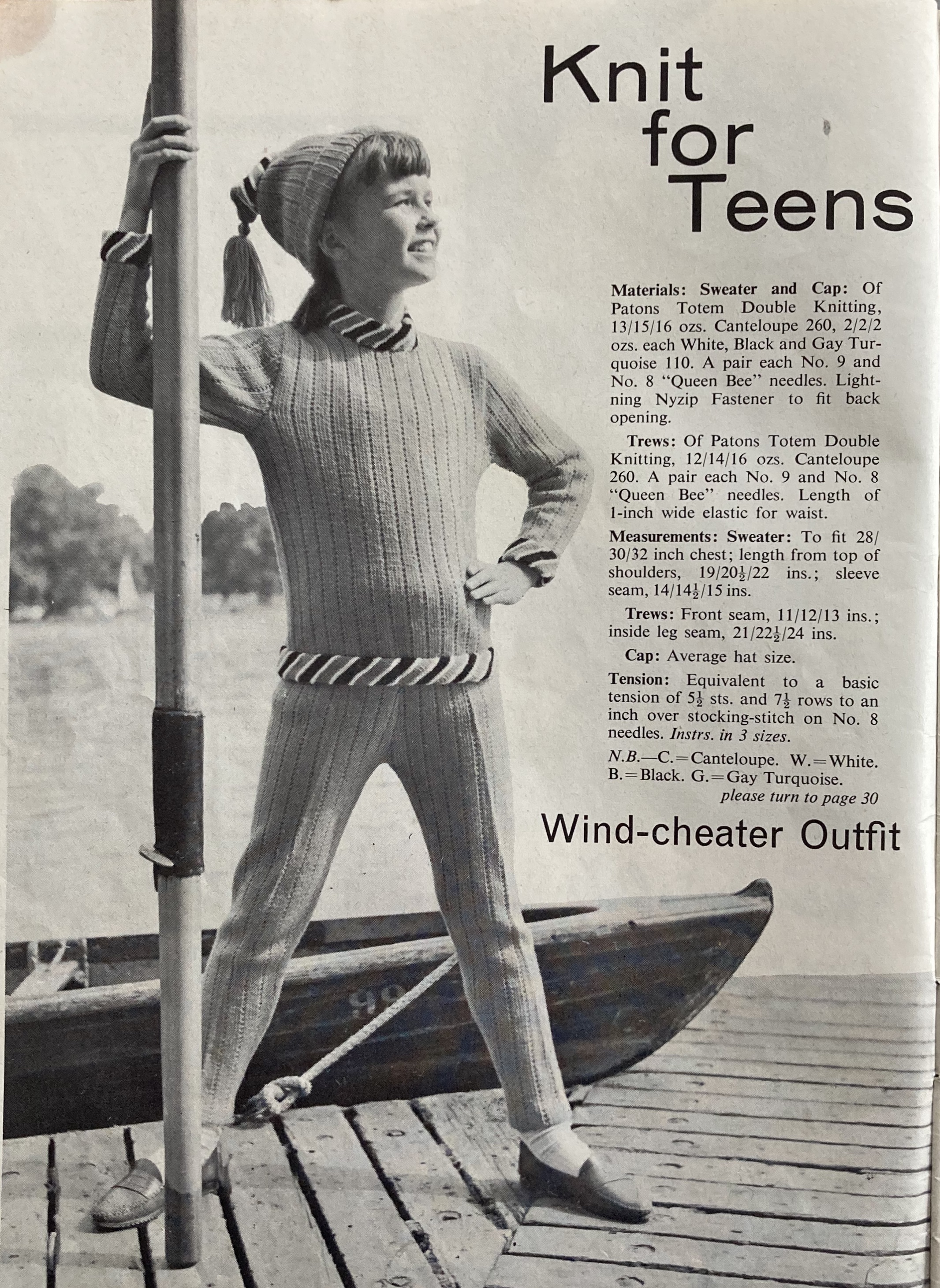
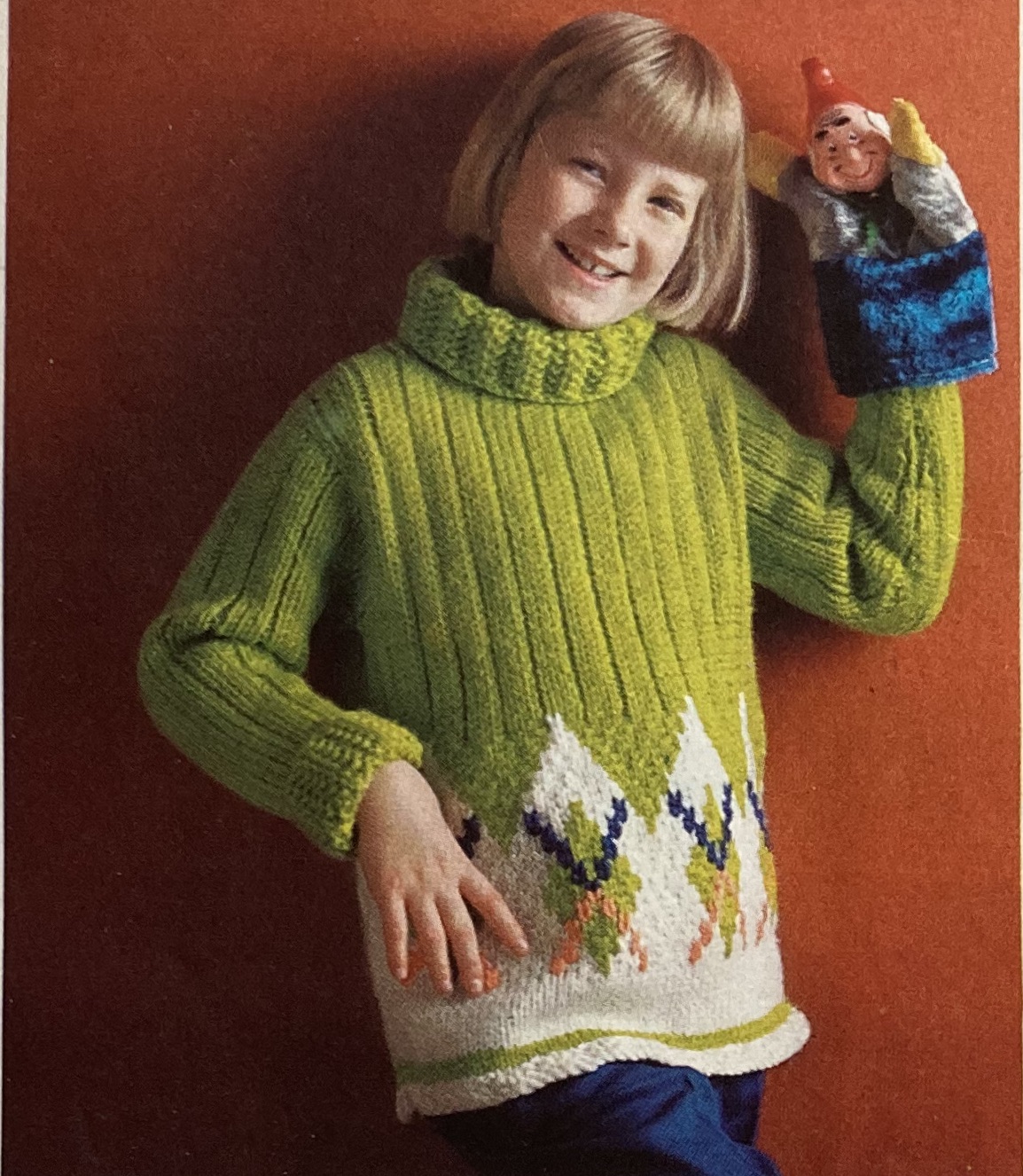
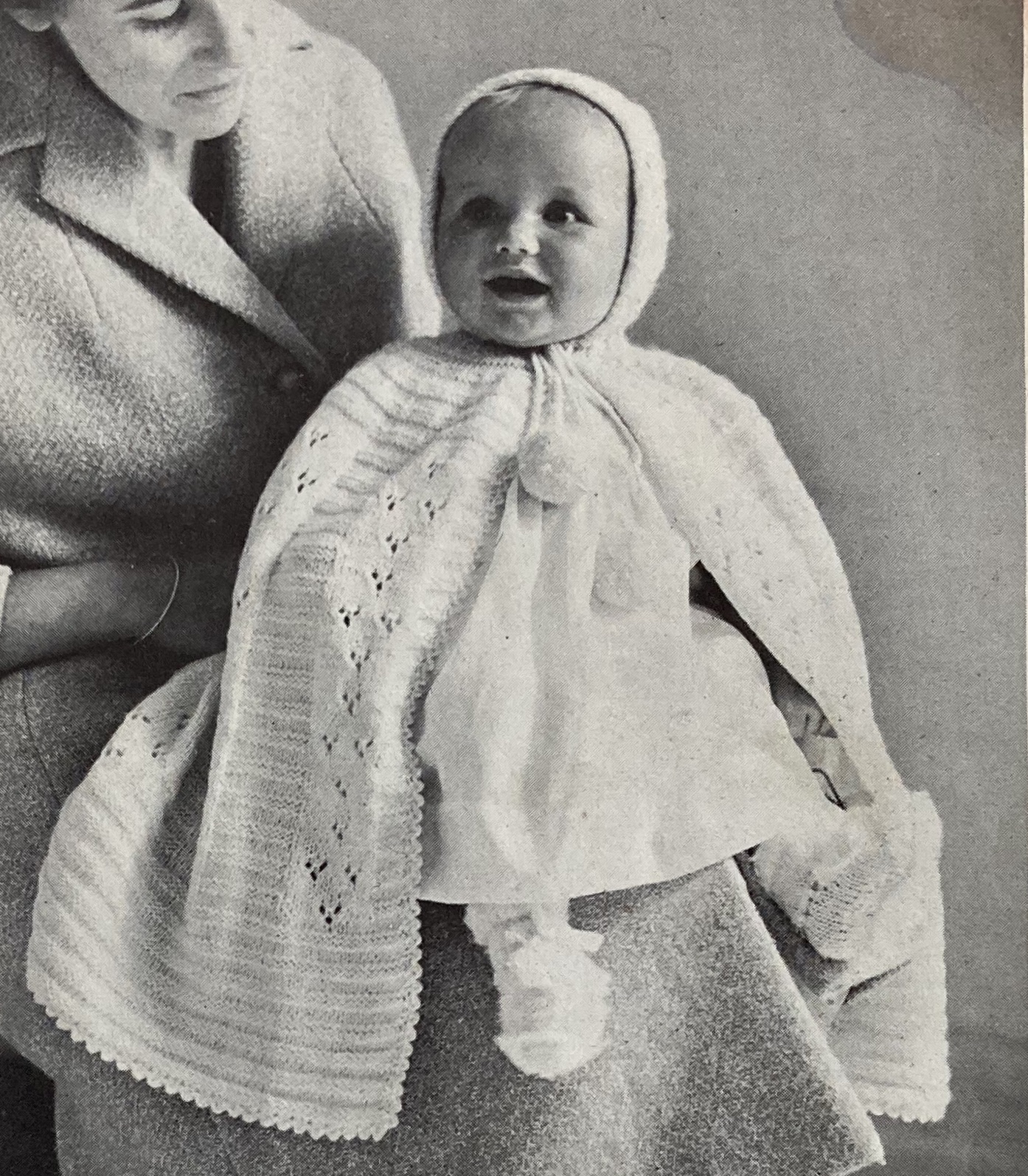
In the “Teens and Babies” department, there’s a wonderful winter “wind-cheater outfit” set (actually a set, this time) of sweater, leggings and hat, as well as a thick, warm jersey for a young girl (our model is quite possibly not a teenager yet, but the pattern is in three sizes up to 32 inch chest to fit older girls as well), and a continuation of the baby set (also an actual set) that was started a few issues ago with matinee coat, dress, etc.: this last instalment is a lacy one-size-fits-all hooded cape to go over all the other garments. I love the photo of the girl standing on the dock next to her boat, looking like a proud sailor! Last month’s issue, if we remember, touted “the Feminine Look”, meaning girls had to look pretty and not really do very much, so it’s nice to see our young sailor looking active and happy in her autumn sport set. The diagonally-striped hem and cuffs are knitted separately and sewn on later.

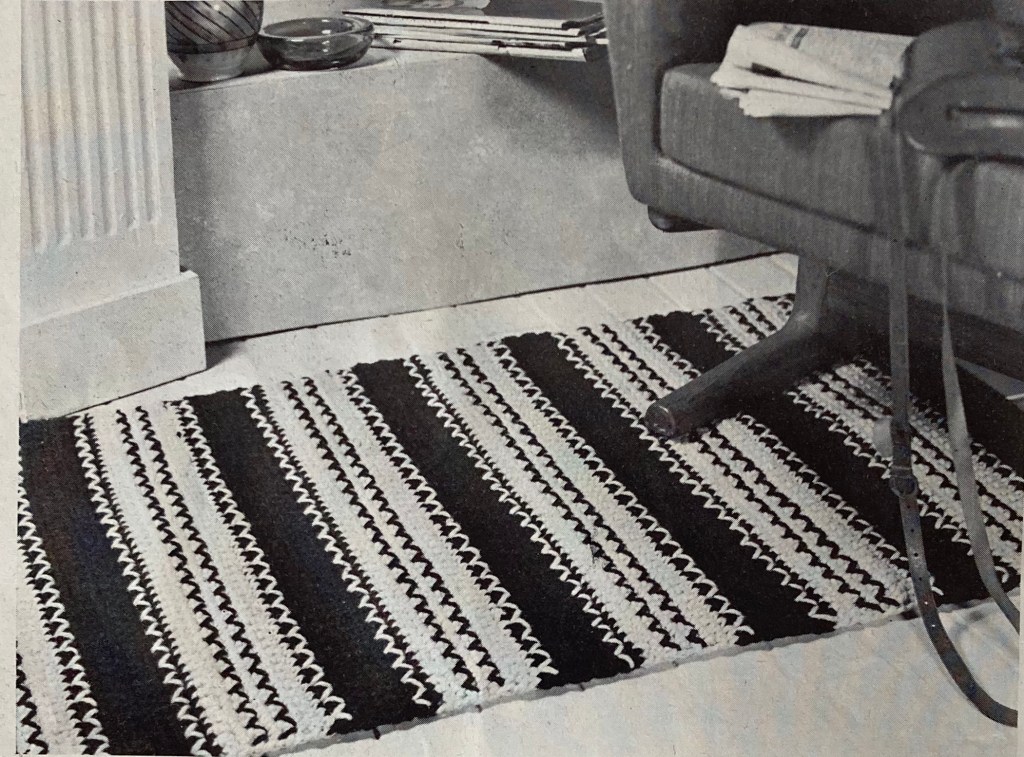
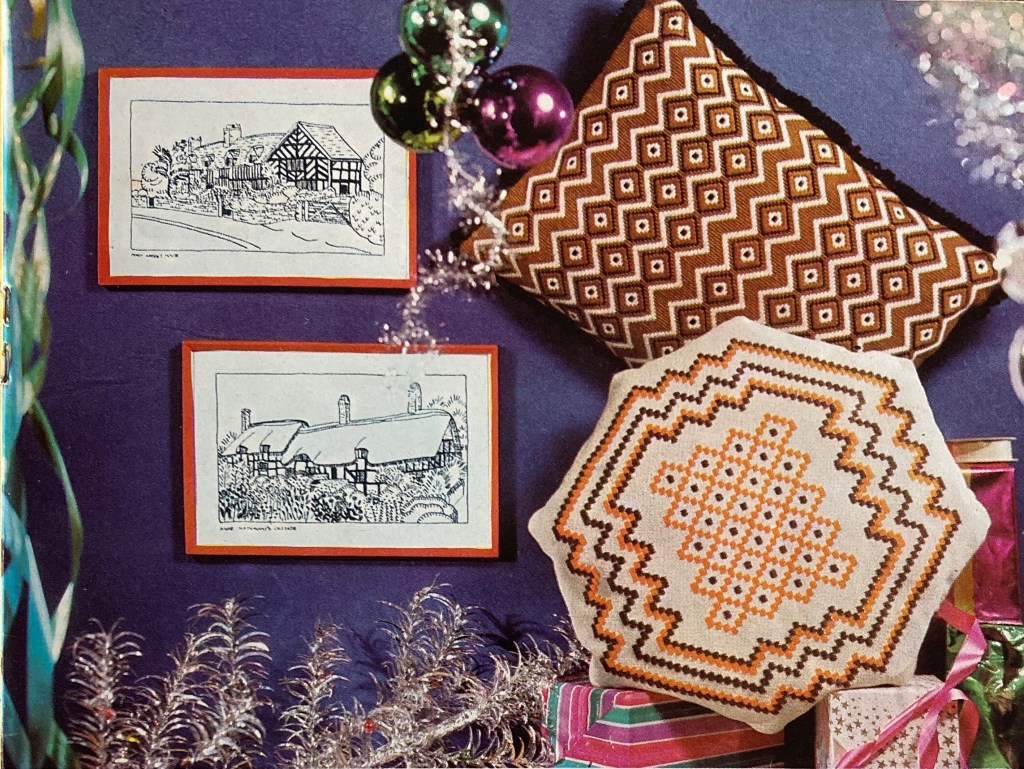
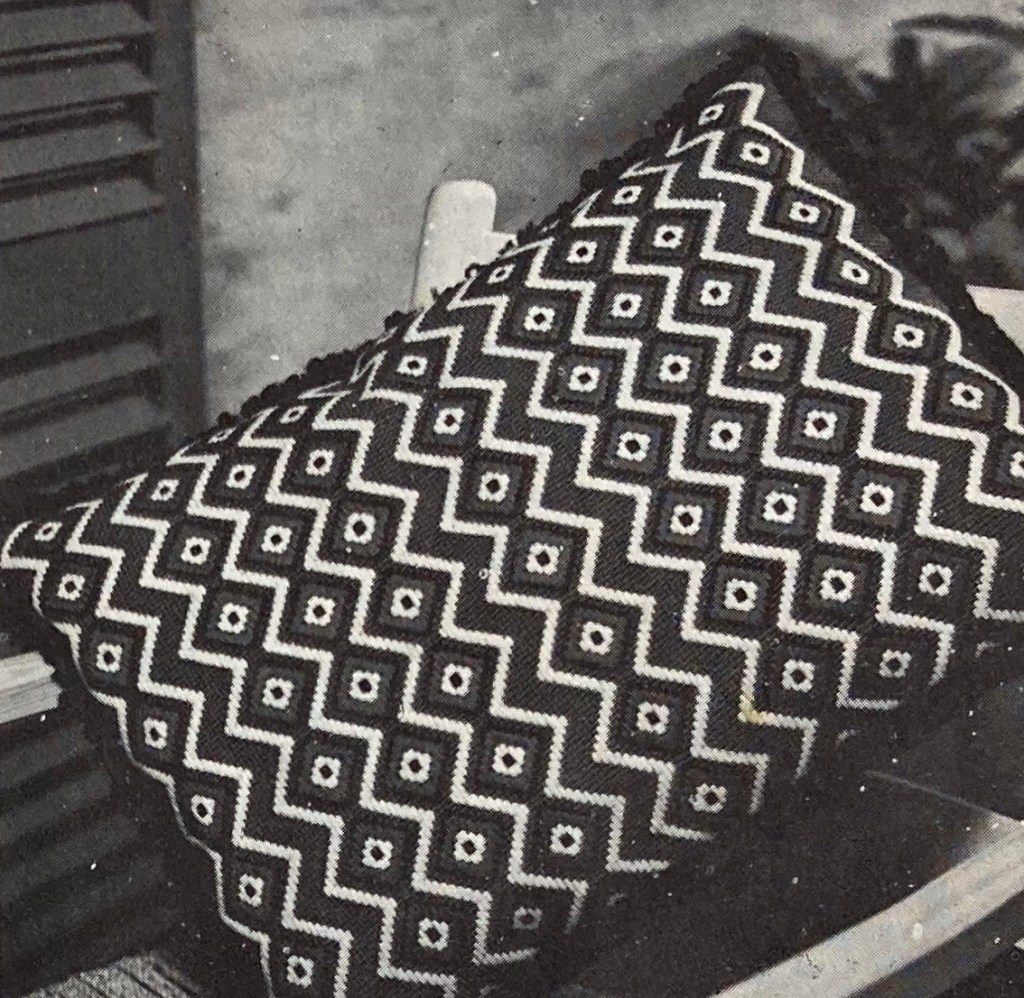
The non-Christmas-themed housewares continue the zig-zag / geometric trend with a crocheted rug, diamond-pattern cushion and wacky zig-zag chairback and cushion set (yay, another set).

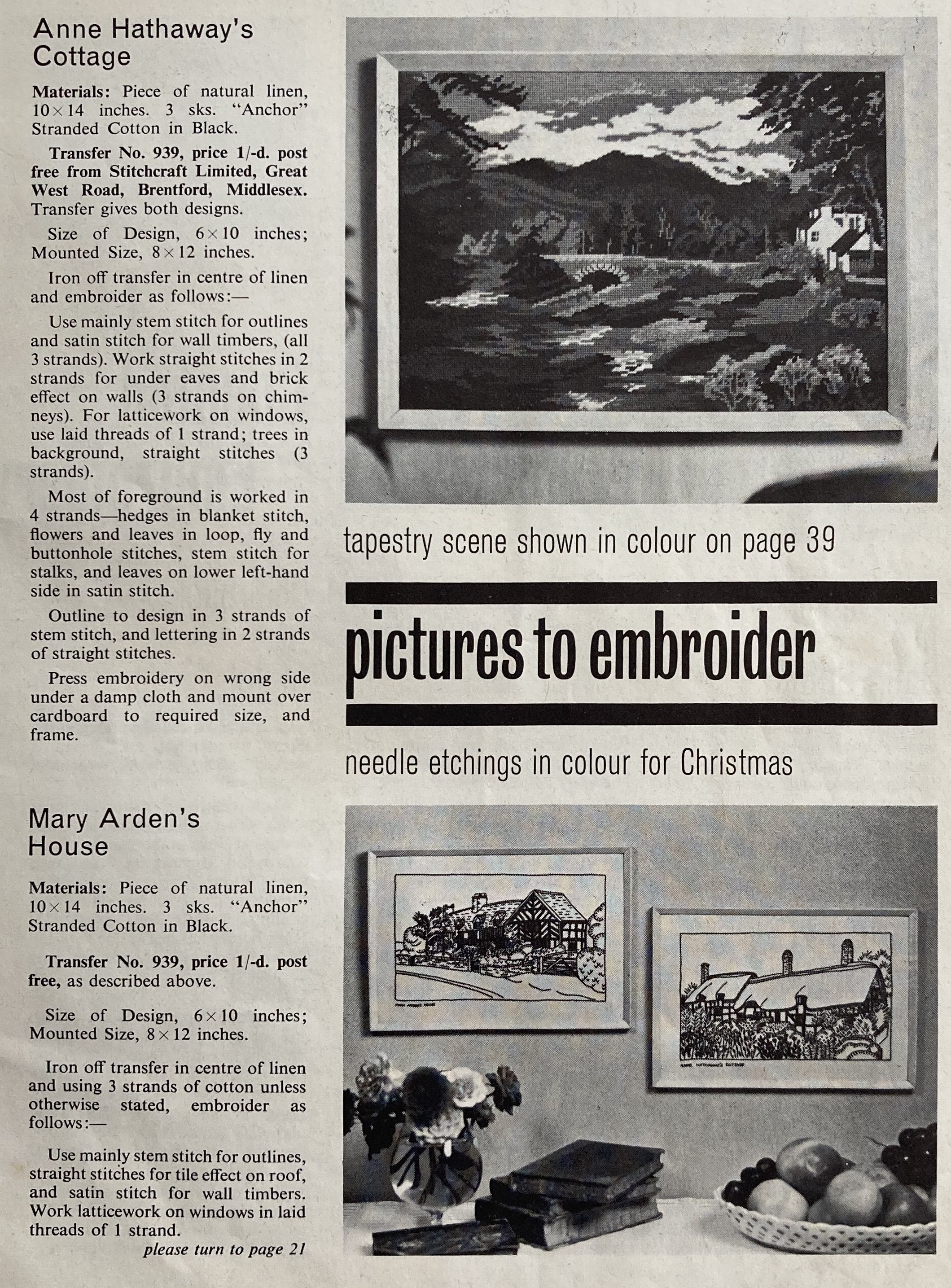
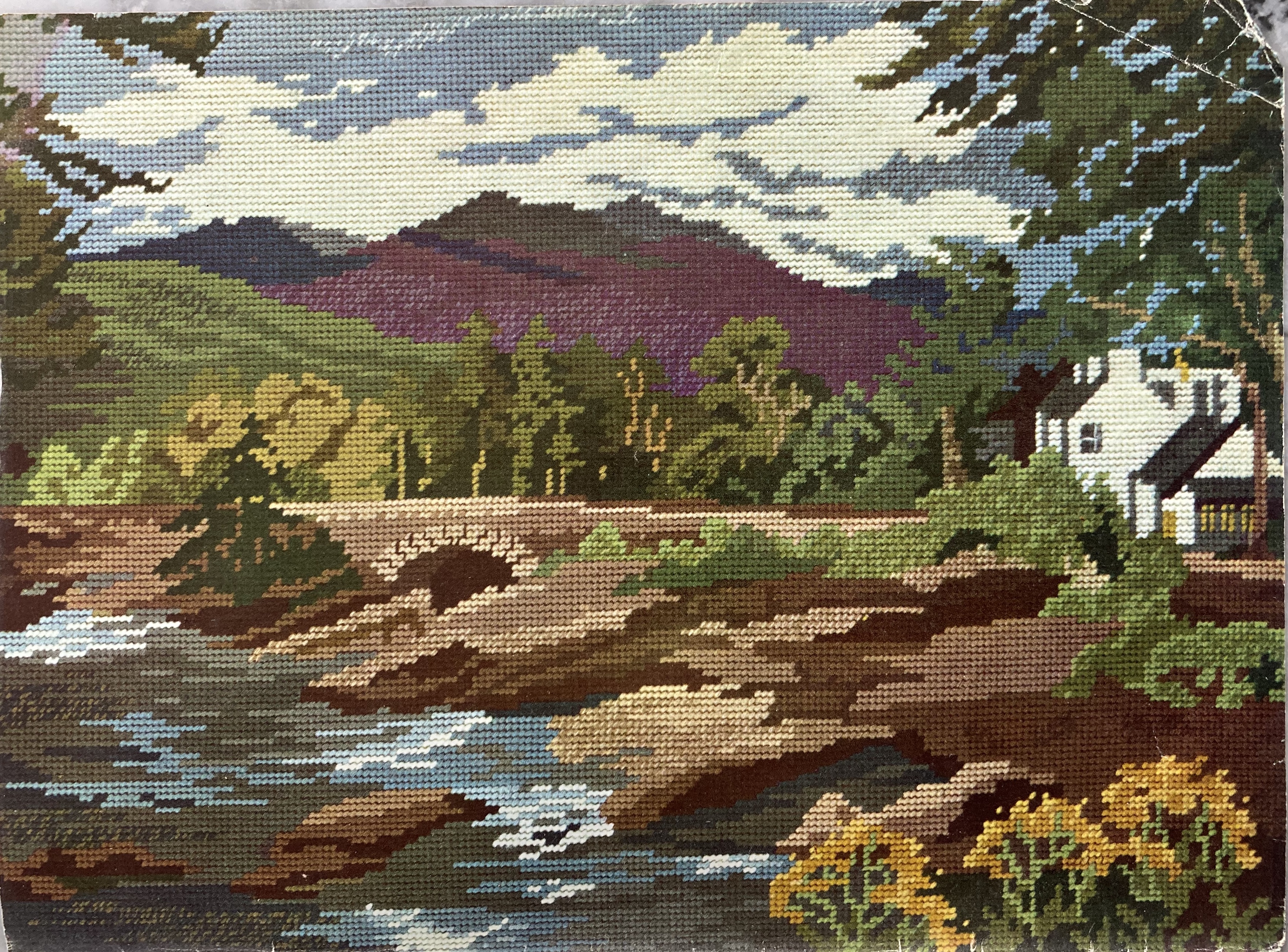
There are tapestry and “needle etching” embroidered pictures that draw inspiration from Shakespeare’s family: “Anne Hathaway’s cottage” (Shakespeare’s wife, not the modern actress…) and “Mary Arden’s House” (Shakespeare’s mother, not Lady Arden of Heswall.)

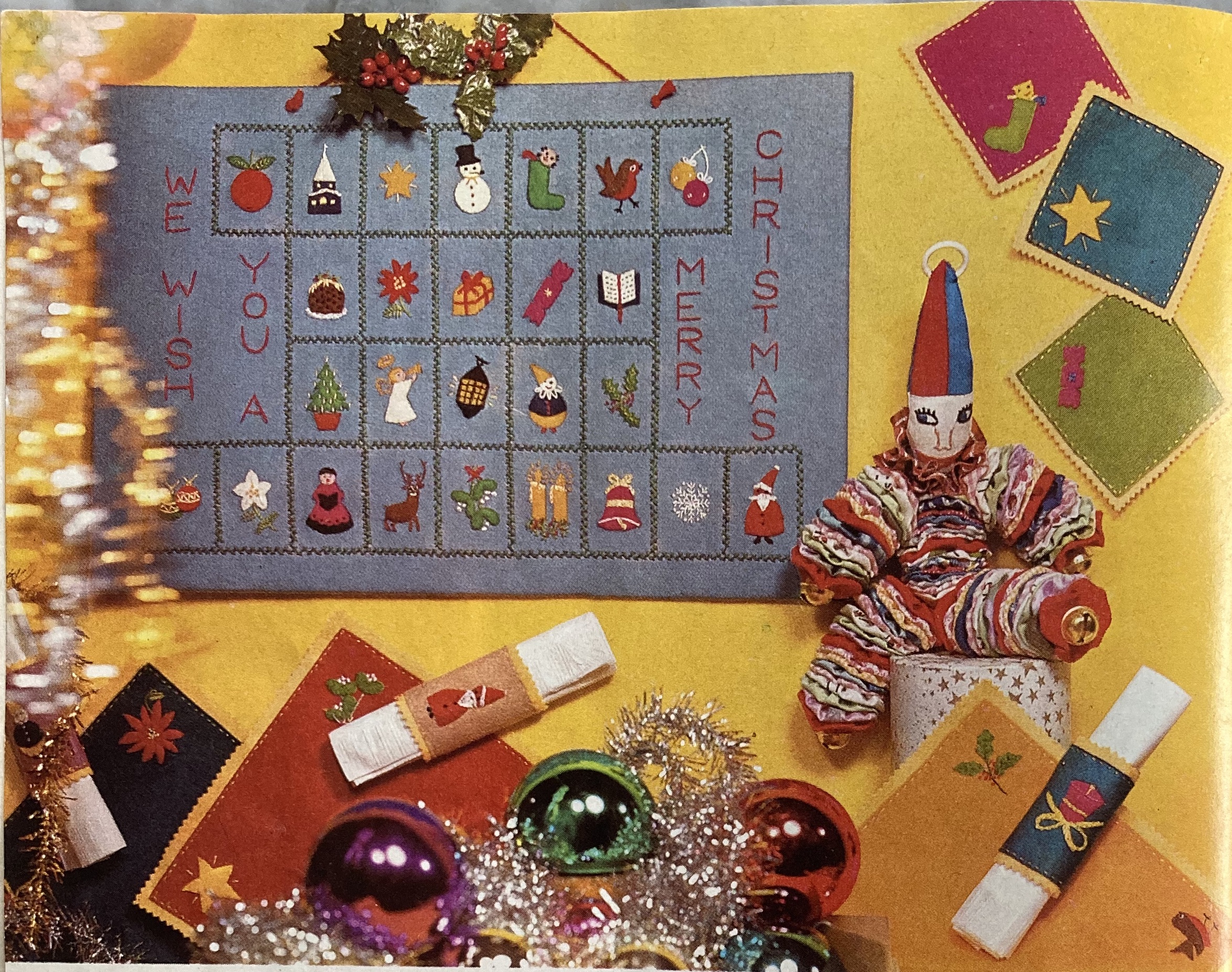
But finally… it’s time for the pre-Christmas decorations! The wacky “novelties” and bizarre-bazaar items! I know you have been waiting for this and I promise you will not be disappointed. You may, however be scared out of your wits, if you happen to have a clown phobia, in which case I caution you to skip over the next few photos.

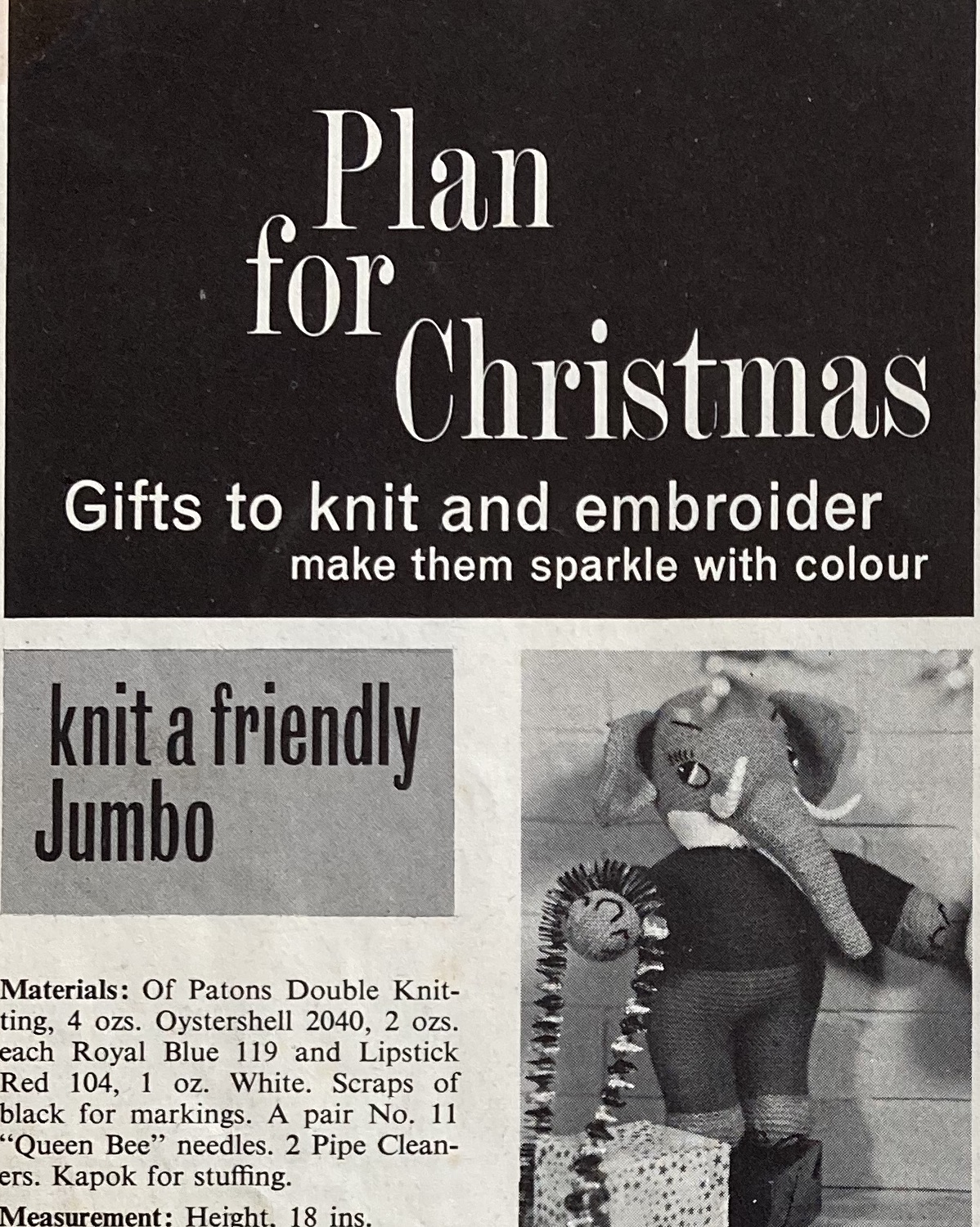
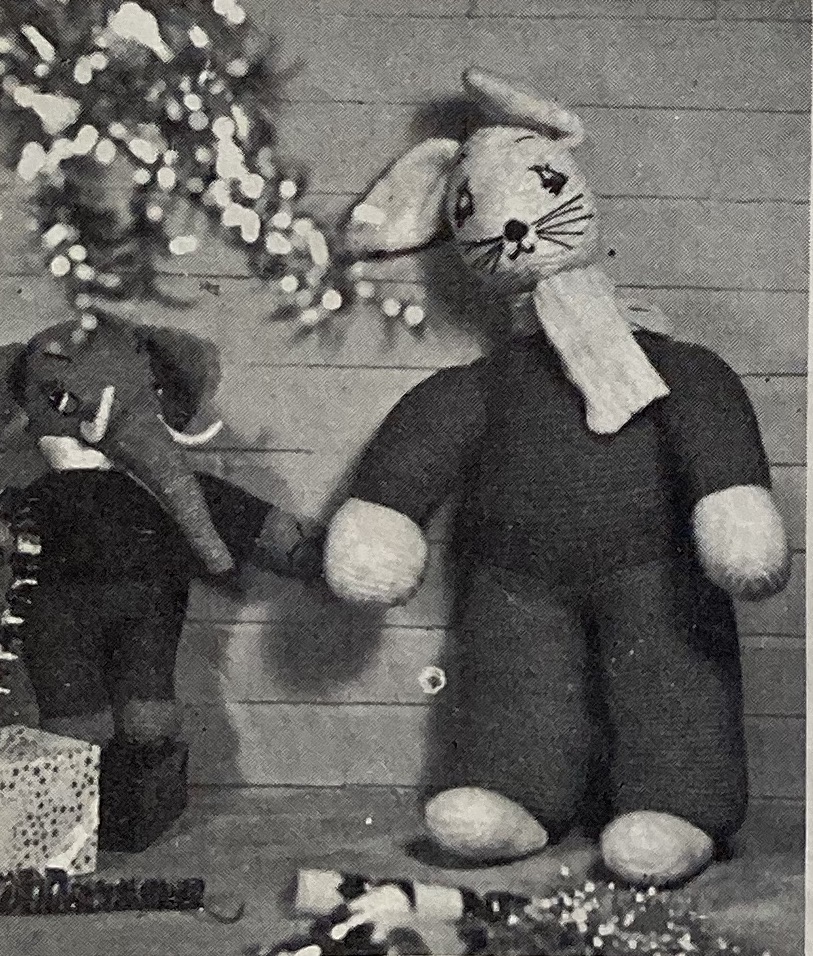
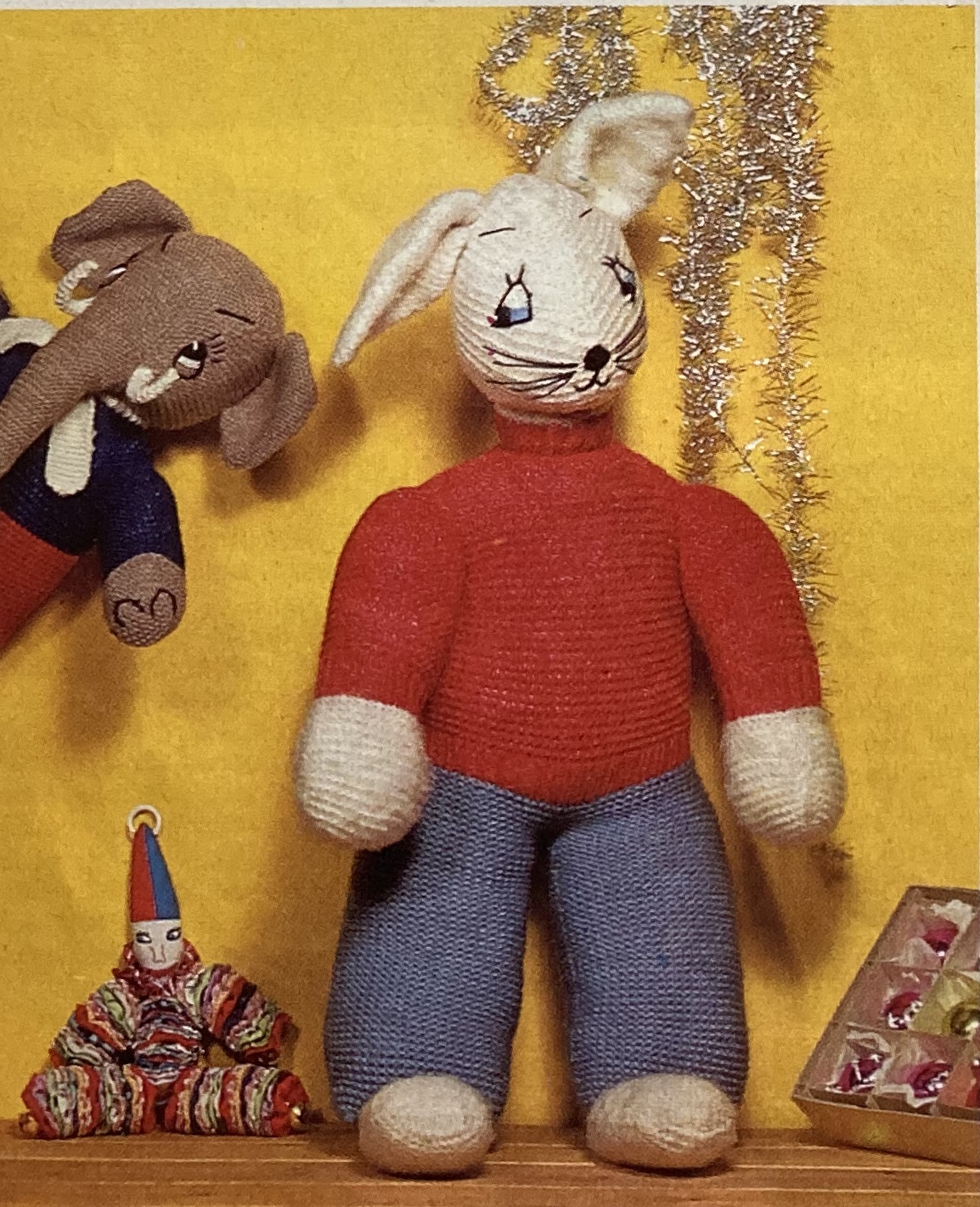
Starting with the melancholic stuffed animals, you can knit a “friendly” Jumbo the elephant, who seems to be rolling his eyes at the happy child who just pulled him out of their Christmas stocking, or a sad “bunny with a twinkle”. The table decorations are quite cute and easy to make: felt place-mats, napkin-holders and an Advent wall panel with wintery and Christmas-y appliqué motifs.

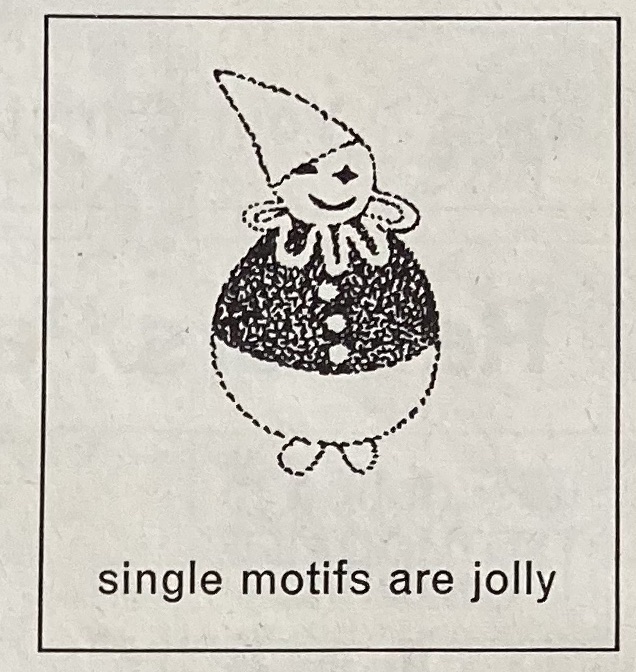
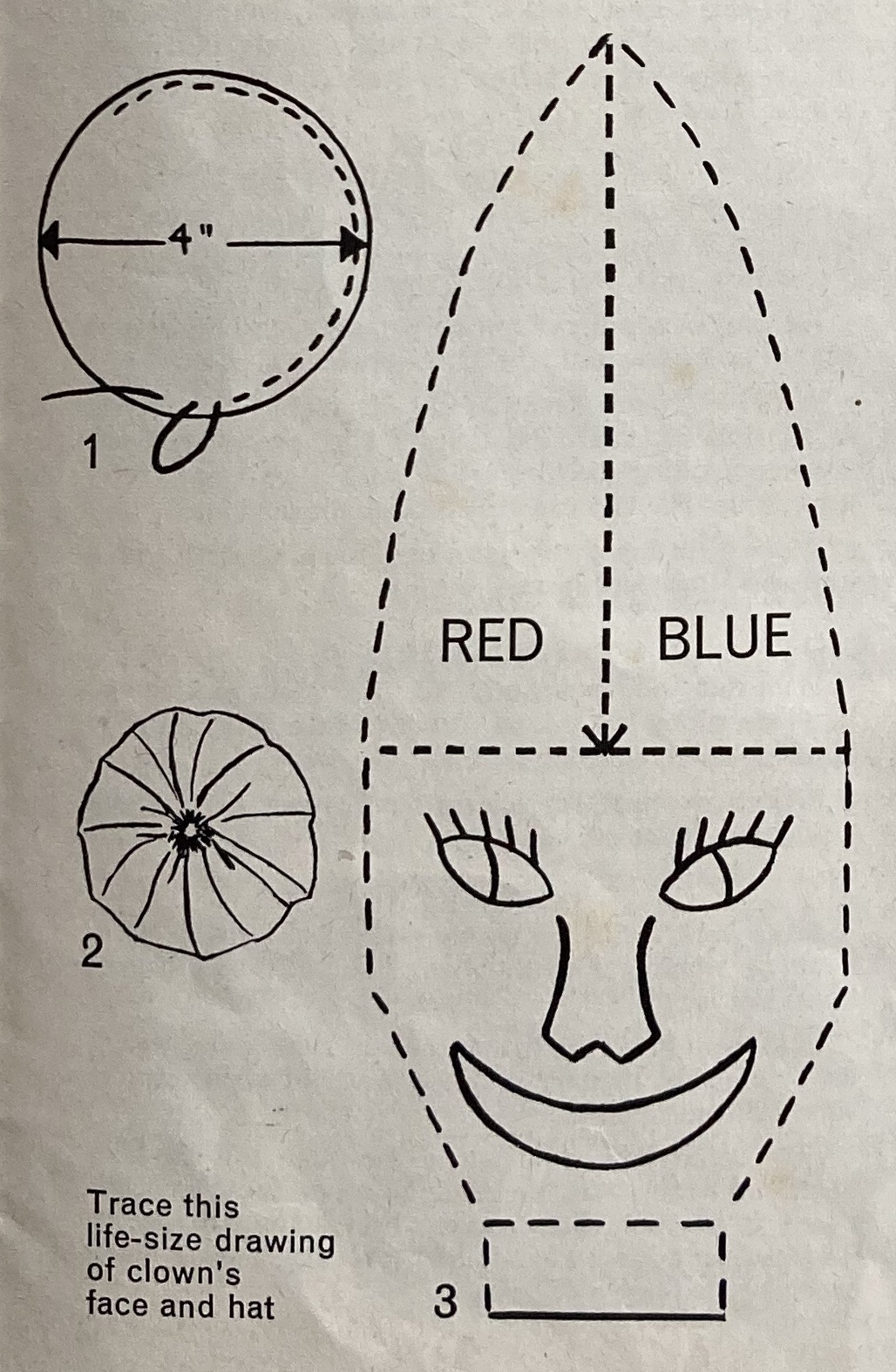
But that clown! The “Musical clown for a tot”! What in the world is going on with that clown? Even the bunny is giving it the side-eye. The construction is actually pretty interesting and a fun way to use up fabric scraps: you cut 4-inch diameter circles of fabric, gather them up with a gathering thread to make little poufs and then sew them on top of each other to make the arms, legs and body. Then all you need to do is sew and stuff a pointy head and cap and embroider a terrifying face onto it. Don’t worry, it has bells instead of hands and feet, so you can hear it coming.

EDIT November 12, 2022: I was browsing around on UK Ebay and someone is selling an FO of this clown! Unbelievable! I am not going to buy it but maybe one of you will

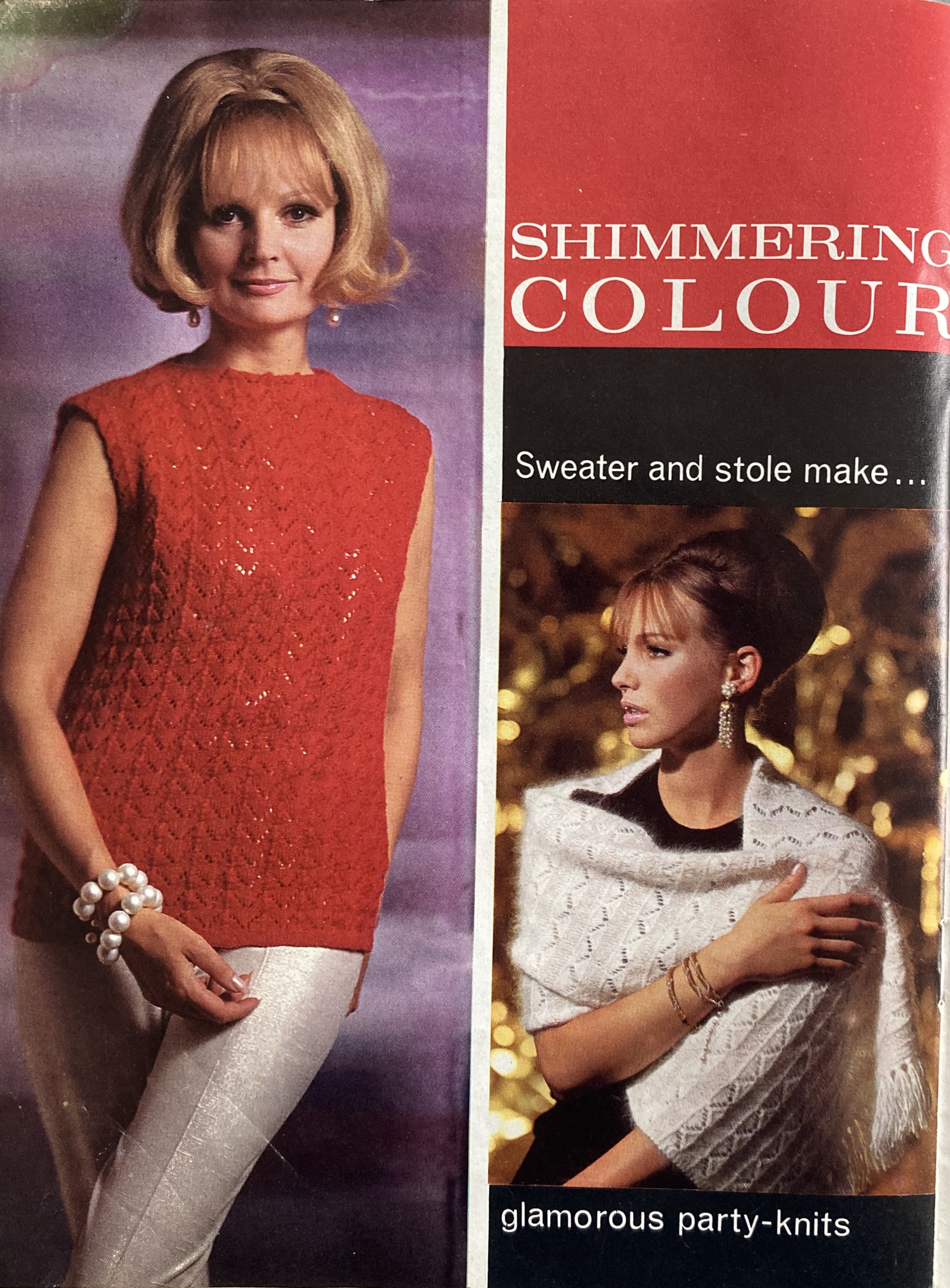
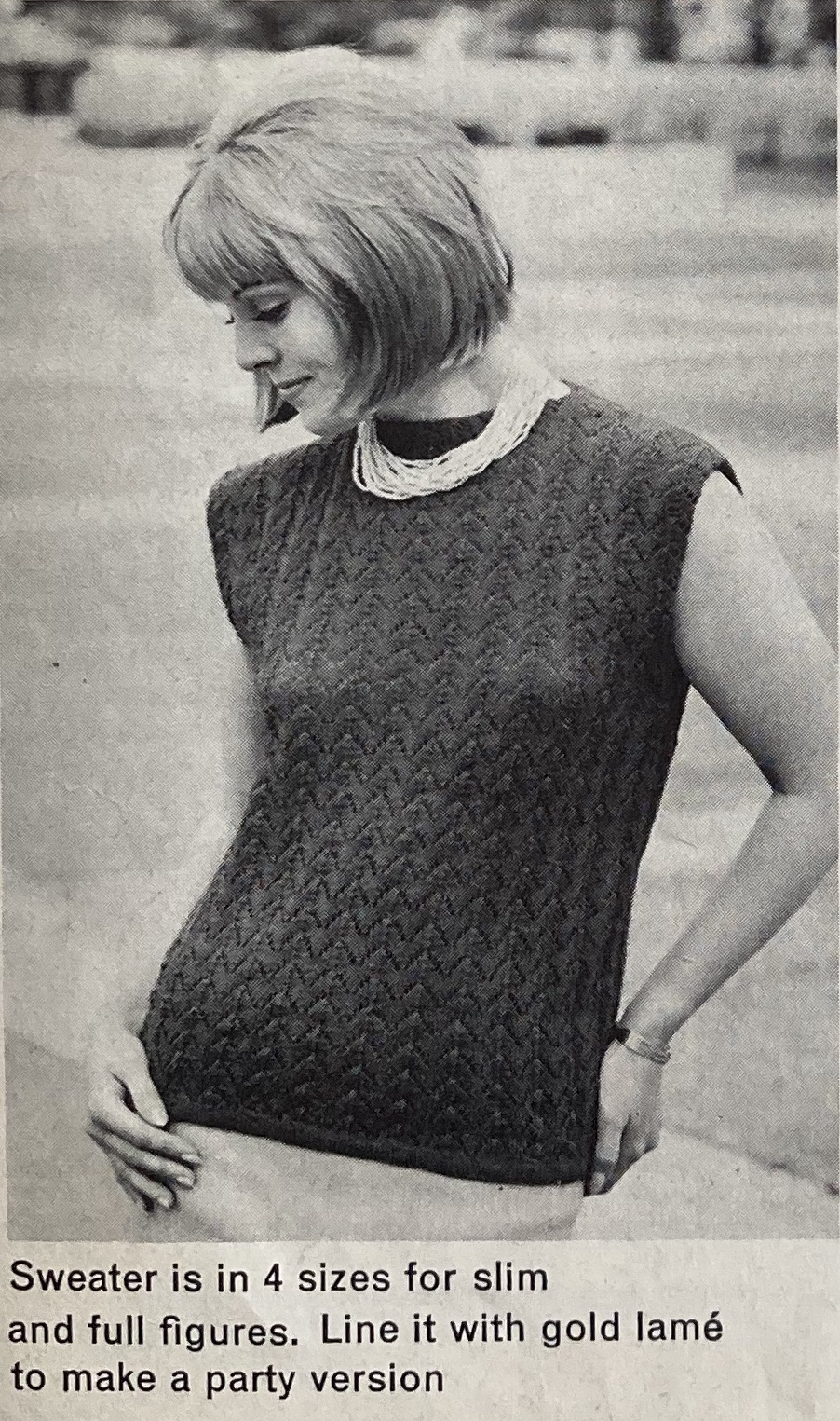
To clear your mind of those images, here is a lovely lacy party top and fluffy “luxury stole” knitted with Lurex for holiday party glamour. The top can be lined with gold lamé for extra sparkle.

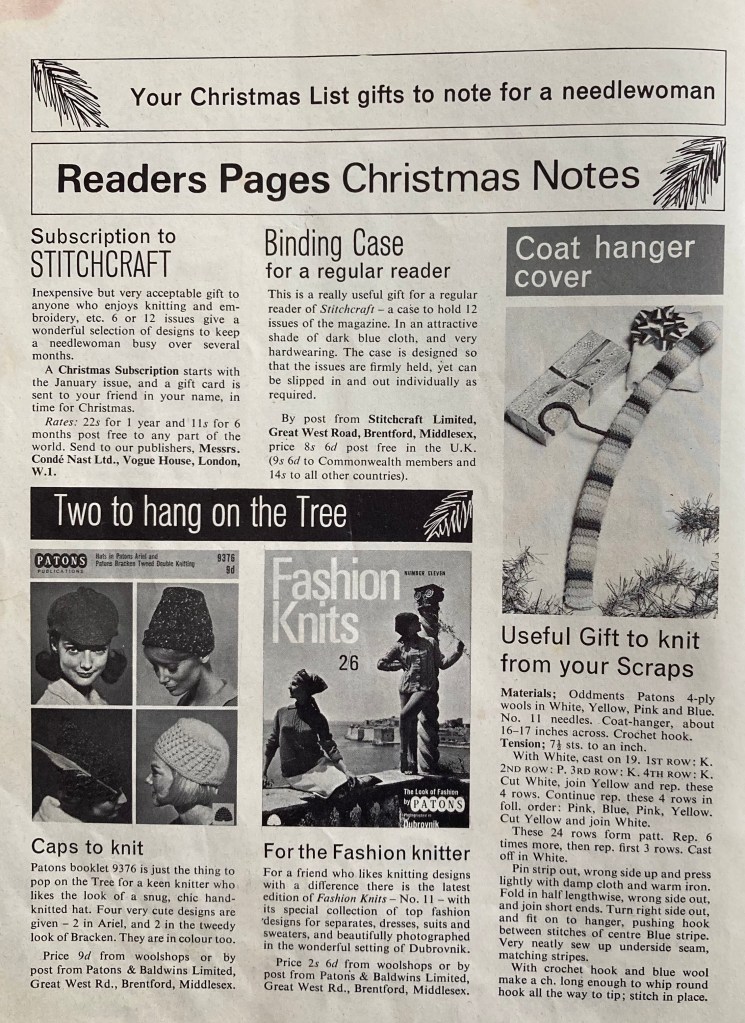
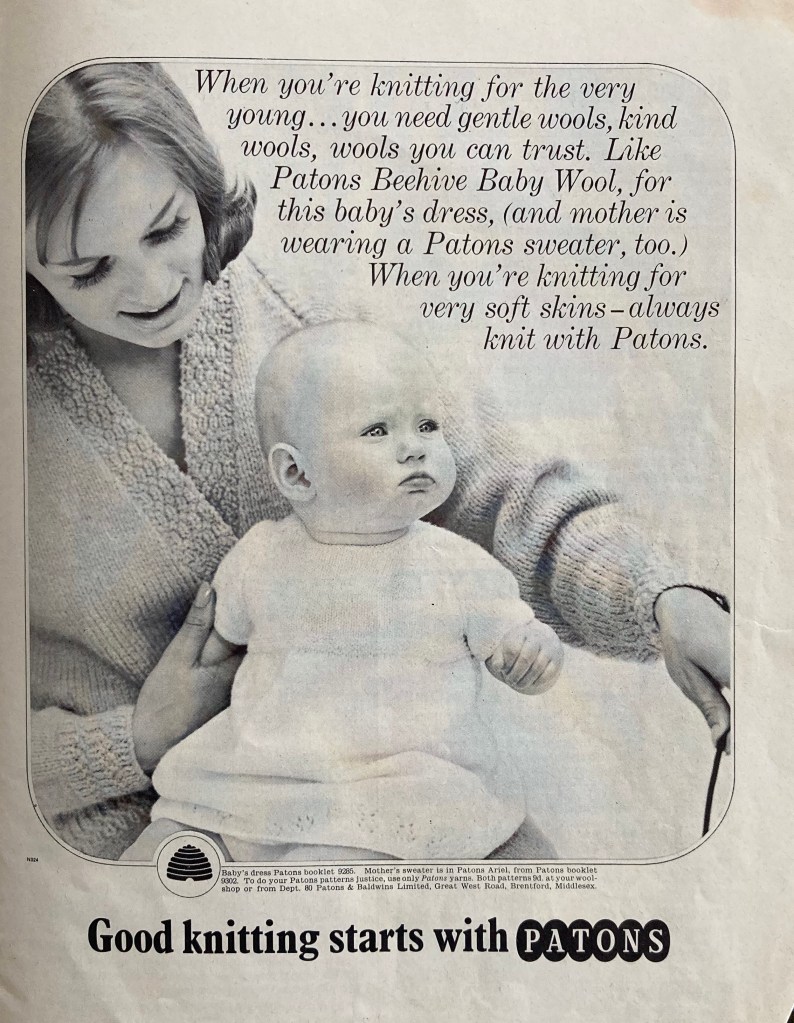
Rounding out this bumper issue are the “Readers Pages”, featuring Stitchcraft and Patons-inspred gift ideas (a yearly subscription, binding cases for past issues, knitting patterns…) and a fun way to use up wool scraps: a coat hanger cover to keep delicate items from creasing or stretching at the shoulders. The ads use babies to sell Lux soap flakes and Patons wool.

The only project that really called to me from this issue was (laugh if you want) the coat hanger cover, which could make a cute little gift for a friend or be useful in my own closet, as well as being quick and easy and a way to use up some of those mystery scraps in the stash drawer. The October 1964 dress is almost finished, so I’ll update that post soon as well.

October 1964: Totem Dress

EDIT November 20, 2022: Finished!

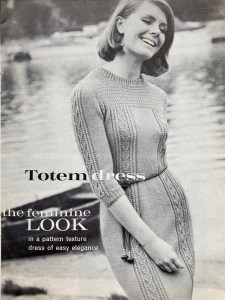
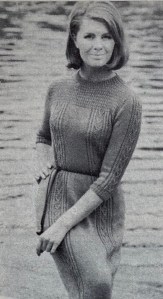
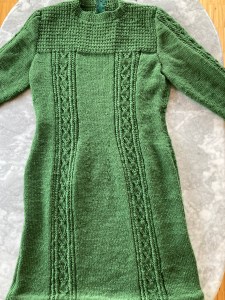
My October project was this fantastic “slim-line dress to flatter your figure”, designed in “a classic style with Aran panels and fancy rib yoke to give the fashionable textured look.” It’s written for Patons “Totem” Double Knitting, a very smooth, tightly plied crepe-twist wool suitable for the mock-cable pattern panels running up and down the dress body and sleeves.

Not having any Patons Totem on hand (of course, it has been discontinued for some time), I chose Drops Karisma, an easy-knit, easy-care DK wool. It’s also superwash — I don’t generally like superwash as it tends to stretch and sag after washing, but the advantage of not having to hand-wash a knee-length, DK-weight knitted dress won out. I chose to make it in brilliant grass green instead of “Spanish Rose” (medium pink, I assume), which is still quite appropriate for this month’s issue — it’s very close to the bright green of the men’s cardigan in the colour centrefold photo.

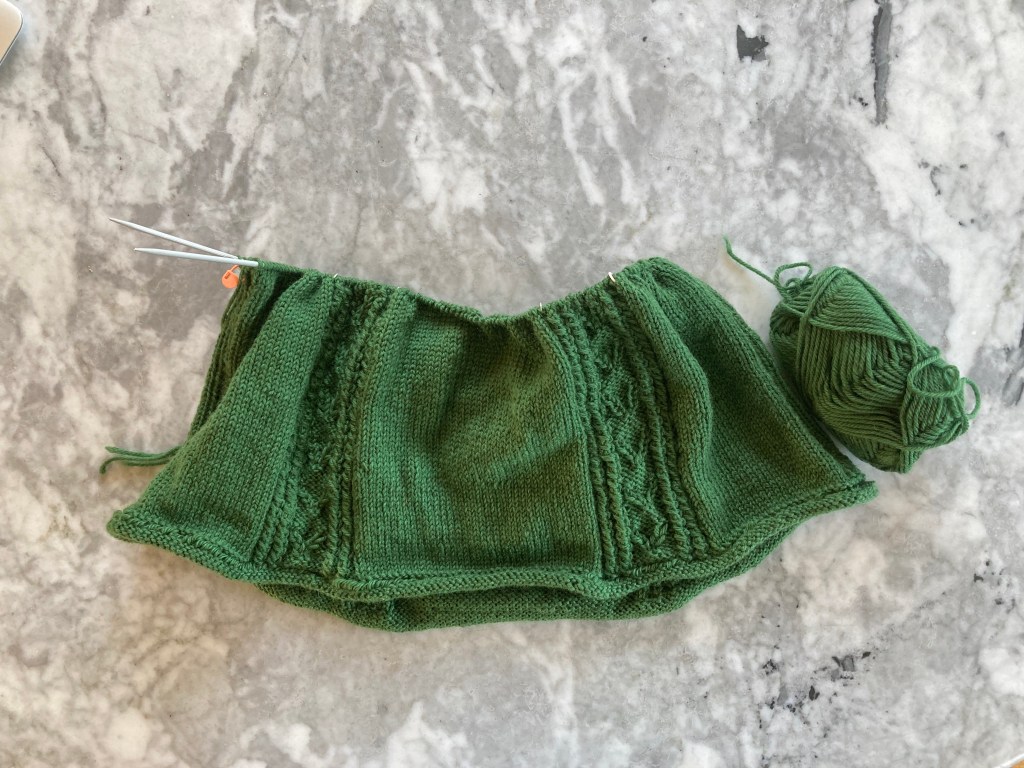
I made it in the second size with a few alterations: four inches shorter, to start. The finished length in the pattern is 40 inches, or just past knee-length, but this is a heavy garment and I am sure it will sag with wearing and washing. Also, I prefer skirts to be a bit shorter, so I aimed for 36 inches total length. To speed up the knitting, I made the dress in the round, with 3 stitches of ribbing at each side to make a stabilising “seam.” There’s a hem at the bottom edge, to which I added a purl-on-the-RS folding row. I wasn’t sure about the elbow-length sleeves and thought about making them long, but decided to stick with the pattern. (Ideally, I would have knitted them from the top down and just made them as long as I wanted, but the twisted-stitch pattern doesn’t really work upside down.)

Other than that, I stuck to the pattern. The pattern panels (2 on each of back and front, one on each sleeve) have traveling stitches in the middle, flanked by twisted stitches (k into the back of the second stitch, then the front of the 1st stitch on needle, then take both stitches off the needle together.) You are supposed to make the traveling stitches by twisting them as well:

Tw.2R = knit into front of 2nd st. on left needle, then purl into front of 1st st. and slip both stitches off needle together.

Tw.2.L = purl into back of 2nd st. on left needle, then knit into front of 1st st. and slip both stitches off needle together.

I could not make that work! I tried and tried. The stitch on the right side was usually twisted the wrong way, and the stitch on the left sat correctly, but was stretched out. I thought it might help to hold the wool in my right hand, “English” style (I generally knit “Continental” style with wool in the left hand and “pick up” the thread), but that was awkward and didn’t help. I tried ye olde “cable without a needle” trick where you basically drop the yarn and just hold it in your fingers, which worked but was no fun. Finally, I just used a cable needle, which was faster and neater. If anyone can tell my what was going wrong with the directions from the pattern, I’d be happy to hear it, though.

The knitting went quite quickly and by October 29 (date of this first post), I had finished the back and front, and one sleeve up to the sleeve-cap shaping. The total length before blocking was 34 inches, which, if my swatch is any indication, will stretch out to the desired 36 inches (and if not, that’s fine too.) The “fancy rib yoke”, by the way, is a simple rib/welt pattern: p1 row, k1 row, then k1, p1 for two rows. It makes a very pleasing, stretchy waffle effect.

I painstakingly calculated out the total amount of wool I would need, based on the yardage of the original Totem wool (from Ravelry, I didn’t have any of the real thing) and the meterage of the Drops Karisma, converting yards to metres and ounces to grams. Were my calculations successful?? We will see! Supposedly I will need about 730 grams, and I only bought 800, because I like to live dangerously. EDIT: The finished dress used exactly 737 grams of wool. Am I good at math or what?

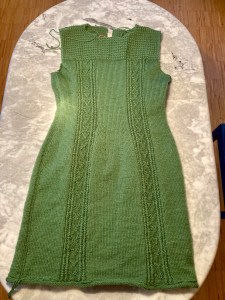
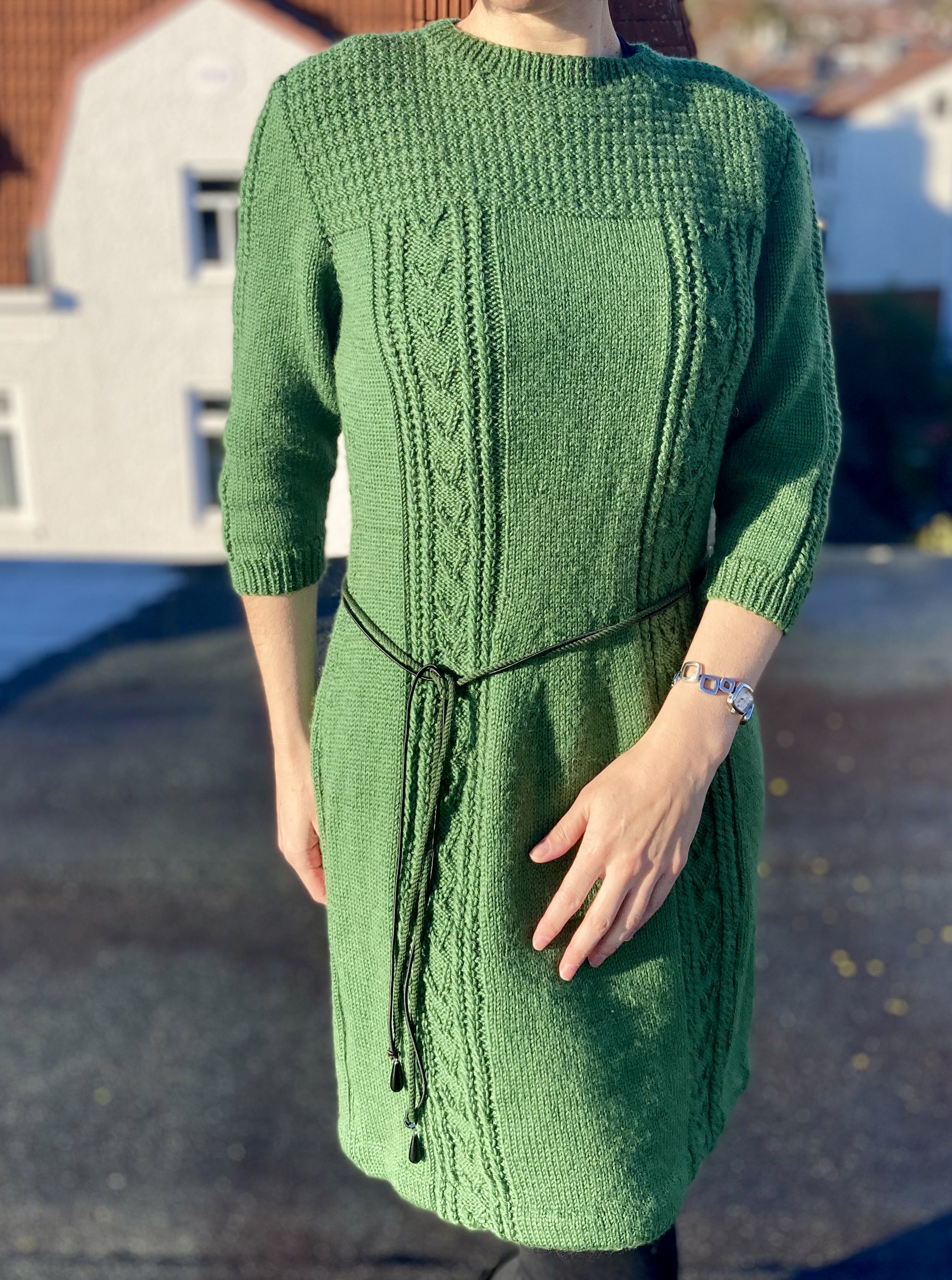
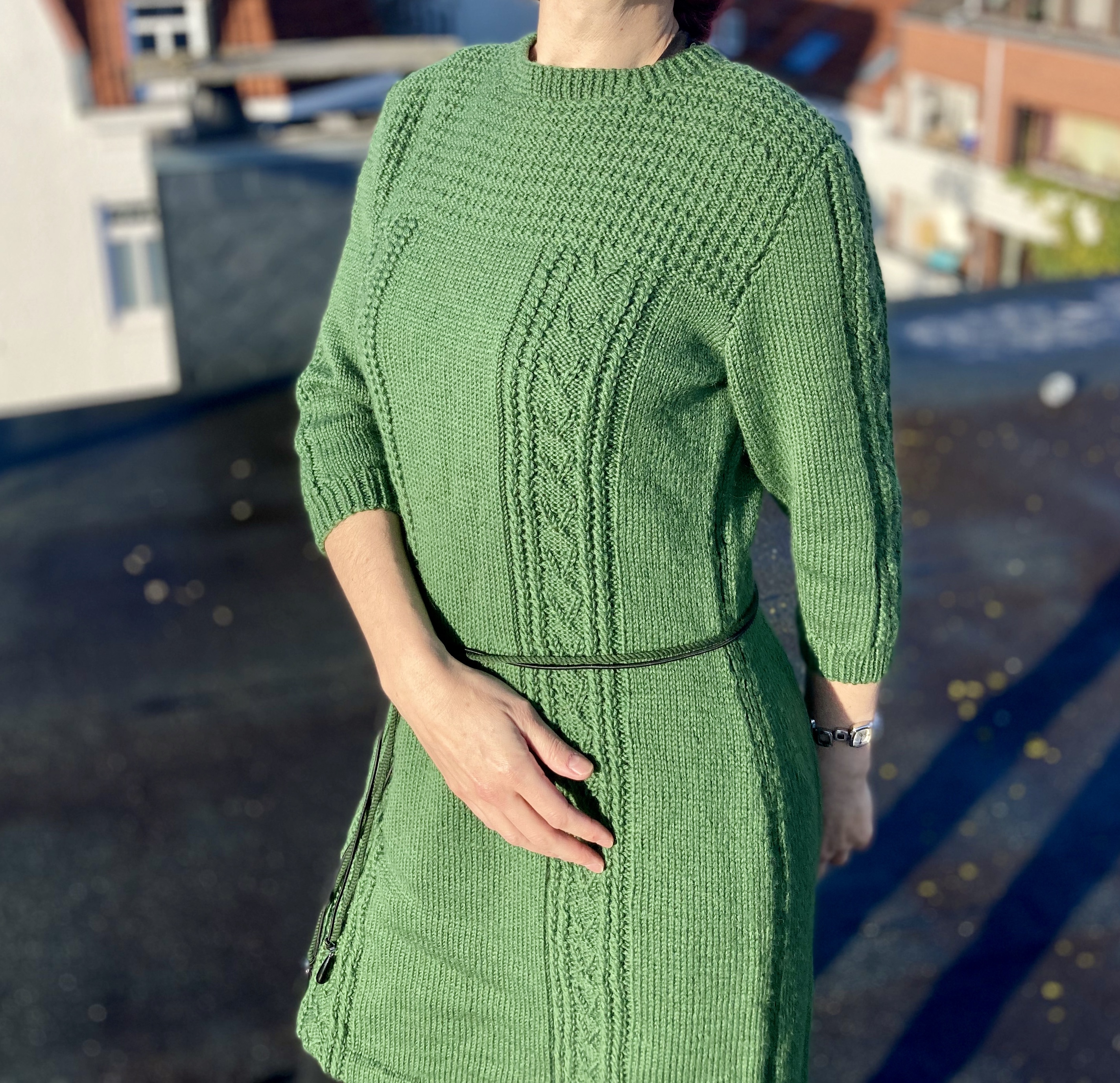
I finished the dress mid-November, but had to travel for work right afterwards, so didn’t get around to blocking and photographing it until a week or two later. Finished measurements after blocking were about 37 inches bust, 32 inches waist, 40 inches hip and 34 inches long — perfect. The hem falls just above the knee and if it stretches a bit, that’s fine too. The wool is superwash, so I could always dry it in the dryer to make it snap back into shape.

I made a little belt out of green cord and pleather cord with baubles on the ends, to match the belt in the photos. We didn’t quite get the same poses as in the magazine, but we had fun.

The dress is warm and soft and fits perfectly. It is fun to wear and it is bright green. What more could I want? It’s glorious.

September 1964: Overview

It’s the start of the autumn knitting season, and this issue’s slogan is “Knitting in Full Swing”. There are practical garments for adults and various ages of children, as well as a new yarn: Patons Flair.

Flair” is somewhat heavier than DK weight — what is now often called “worsted” — and made of 60% wool and 40% “Courtelle“, a synthetic fibre pioneered in the late 1950s by the Courtaulds company. It features in the green cardigan and the yellow star-motif pullover on the cover. I love the cardigan, with its bright green colour and use of simple garter-stitch ribs and bobbles to decorate the fronts. The placement of the motifs on the yellow pullover is… interesting. I guess it works OK on a male figure, but I would not recommend it for a partner look! There’s also a plain, classic V-neck pullover for him and a “blister stitch” sweater for her on the back cover. Bright, cheerful colours are in fashion. (The men’s V-neck pullover colour name is “Sorrento” — anyone know what colour it is?)

The non-Flair adult garments are all made in DK weight yarn: a “country sweater” in a twisted-rib pattern with an oversized Vandyke collar, a complicated cable-and-stripe men’s shirt-style pullover, an elegant set of slim skirt and “overblouse” and a long, skinny sweater “for teens”. All of them feature interesting stitch textures, particularly twisted-rib patterns and bobbles, and interesting details like the fake “pocket” decorations on the front of the overblouse. The cable-and-stripe pattern is especially complex and uses separate lengths of wool for the vertical twisted ribs while stranding the stripe colours behind. Aside from the teen sweater in “Flamingo”, the colours are slightly subtler, with light “Cream Whip” and dark “Loganberry” for the base colours (sounds delicious) and accents of light blue, olive green and melon-orange.

For the younger members of the family, there’s a fun and cheerful five-piece set “for twins”, consisting of a skirt, shorts with braces, a short-sleeved jumper, cardigan and beret. They’re all made in DK wool in a similar bright, sunny yellow to the man’s pullover on the cover. Continuing the matching-set-for-babies look, this month’s issue has a dress and bootees for a six-month-old, to be followed by a matching matinee coat and bonnet in next month’s issue.

With all these lovely things to knit, it’s amazing that there are any homeware projects in the issue at all, but there are always a few utilitarian projects: here, an easy cushion / tray cloth or a thick rug or mat for kitchen or bathroom. For more ambitious embroideresses, there’s a tablecloth or cushion in bright “peasant” design (Stitchcraft‘s choice of word for traditional or folk designs from certain countries and not from others; I do wish they would just call them all “traditional designs” and leave it at that). The design, like the knitted garments, is big and bold and fun and colourful on the cushion, and slightly more subdued in red and blue for the tablecloth.

Though embroidery doesn’t feature big in the issue’s projects, it does have a place in the back pages: in the new children’s comic, “Anne and her Embroidery”, little Anne is bored on a rainy day and passes the time by learning to embroider pictures of the flowers in her window-box. Two pages later, there’s a full-page advertisement for a new tapisserie wool suitable for both tapestry and embroidery. Coincidence? I think not! The other interesting ad is for the new Patons Flair yarn, highlighting its easy care and washability.

That’s all for this issue! My project will be the embroidered cushion.

August 1964: Overview

The August issues of Stitchcraft are always a mix of styles and seasons. The summer holidays are winding down, and knitters will want to start work on warmer garments for the autumn. At the same time, it’s still summer, and it may well be too hot to want to hold wool in your hands, not to mention wear that bulky wool pullover. Stitchcraft’s solution is to offer a range of casual “country” knits that can be worn as outer garments on cooler summer days and be useful for indoor-outdoor wear as autumn approaches.

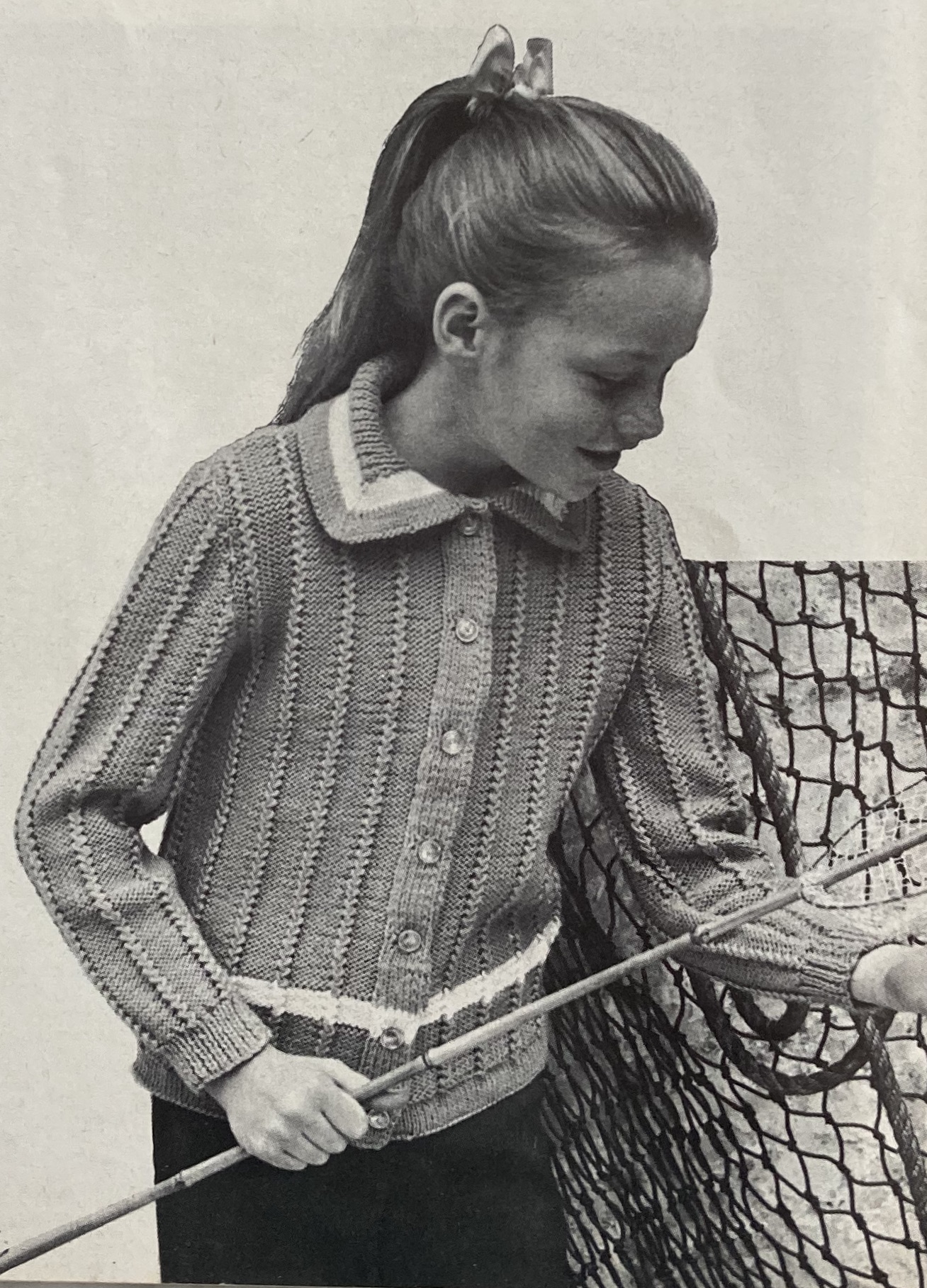
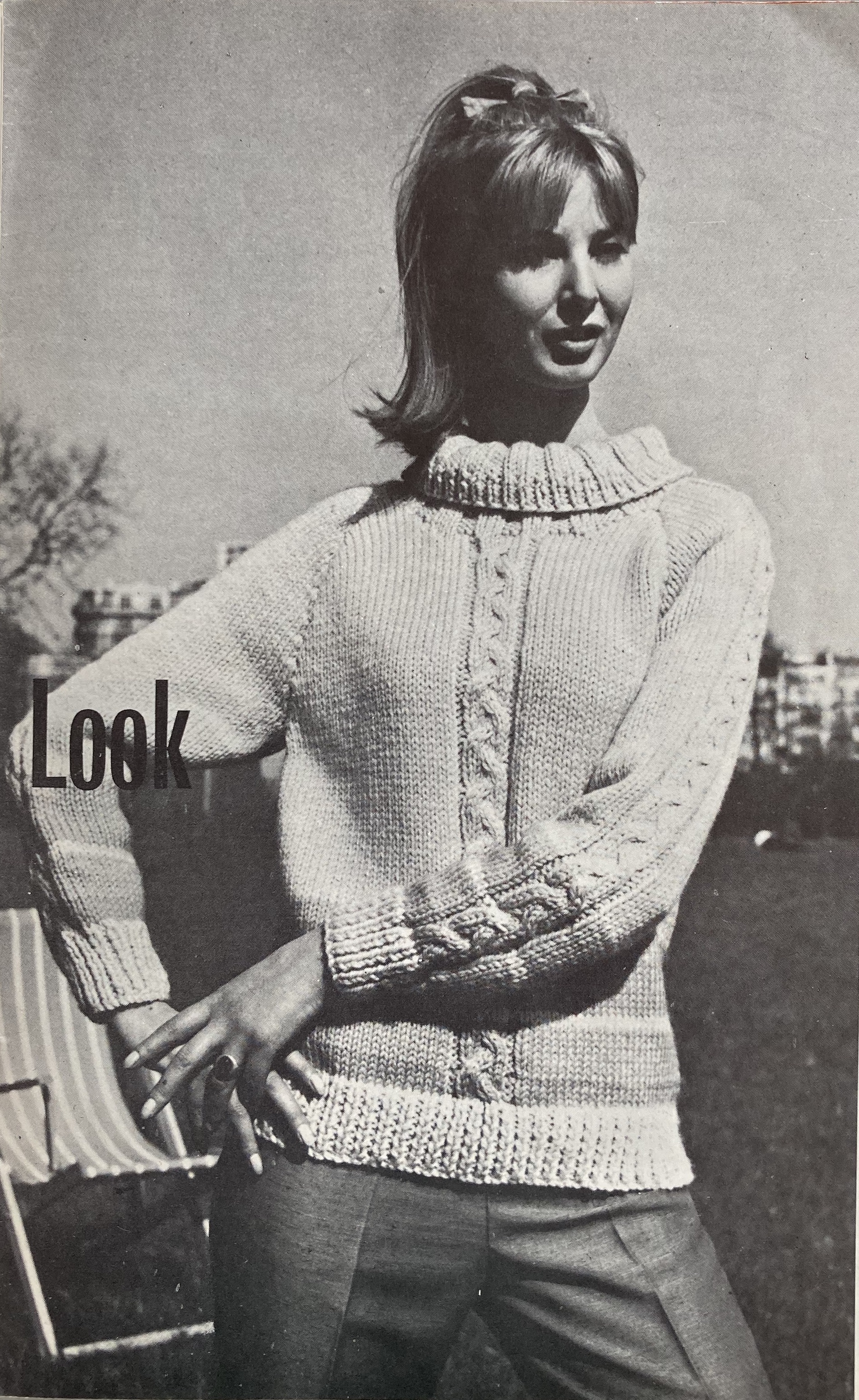
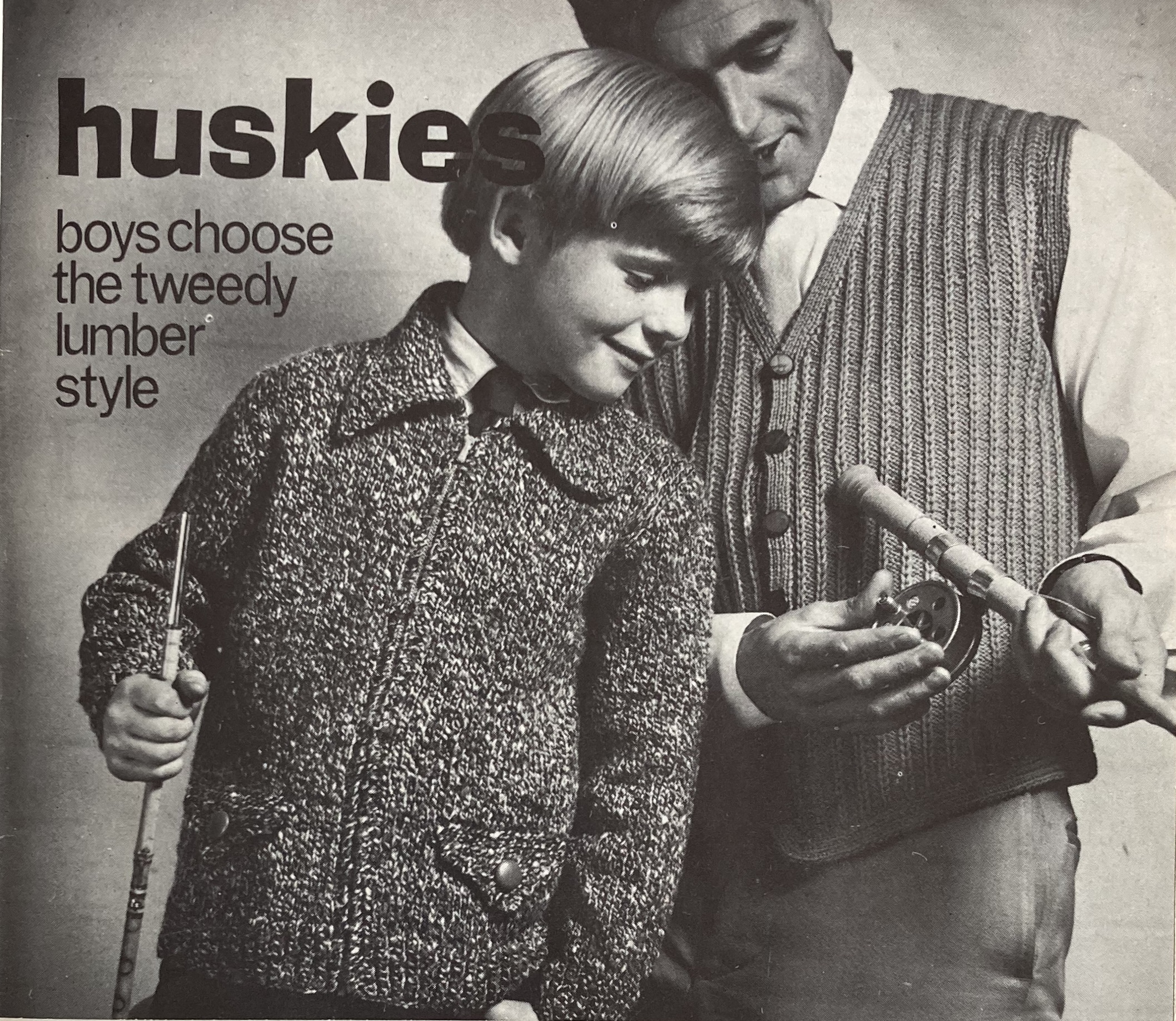
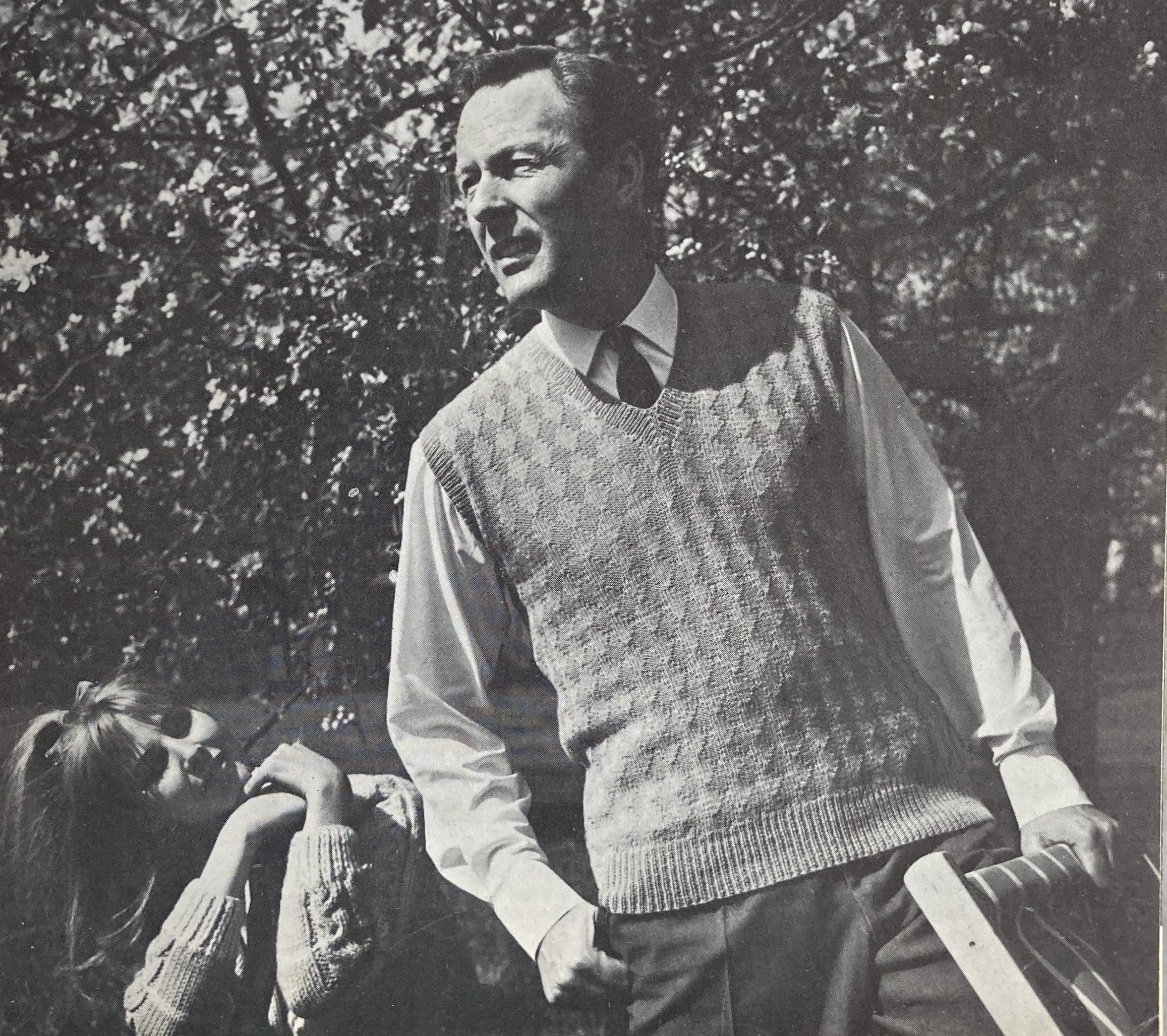
“Junior Knits” have a special prominence in this issue: heavier, loose-fitting pullovers and cardigans for older schoolchildren or teenagers (or smaller-size adult women) that are versatile enough to be worn on holiday, back to school, under a coat in later months etc. They are casual, but stylish, with interesting stitch-pattern details, and a mix of cheerful and neutral colours. The girl’s cardigan is made in DK wool with a twisted-stitch rib pattern and the pullover in bulky “Big Ben” wool can be made up to 34-35 inch bust size. The boys’ “lumber jacket” zipped cardigan is also made in a bulkier, quick-knitting wool: Bracken Tweed. The colour is “Marble”, perhaps a darkish grey? (The “father” in the photo is wearing the waistcoat from the July 1964 issue.)

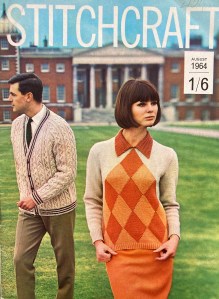
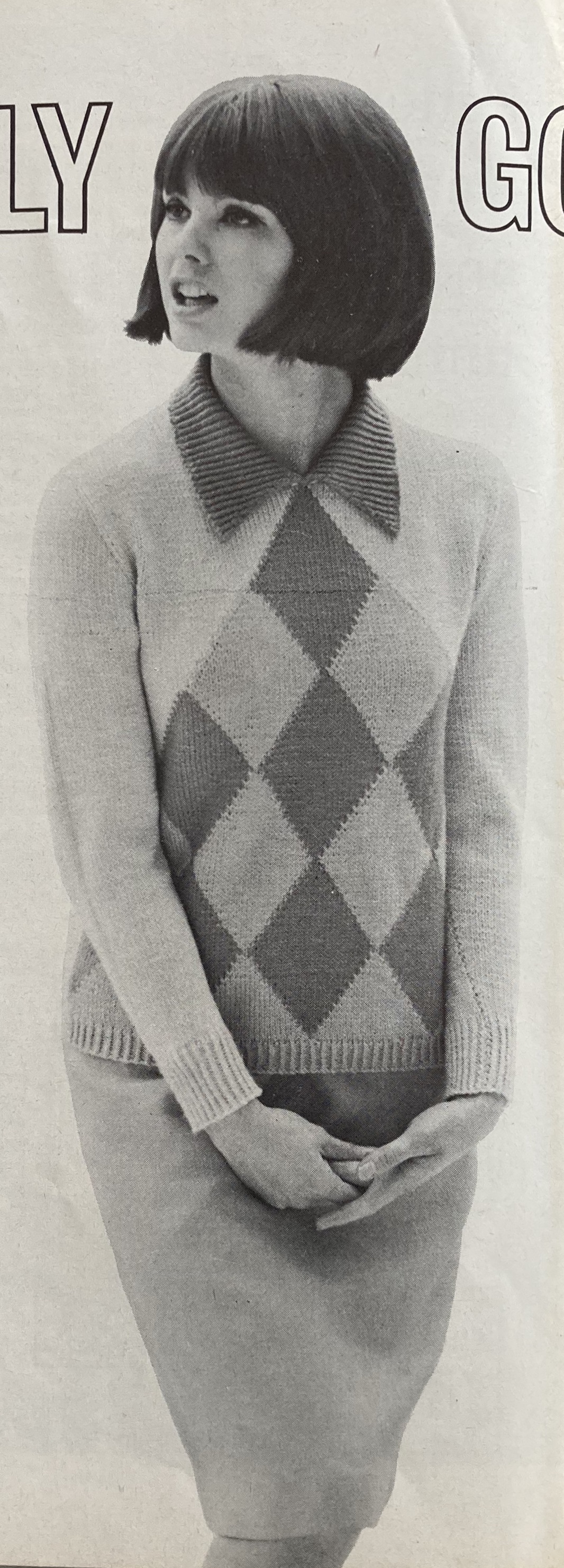
The adult-size garments are a mix of casual, bulky holiday outerwear and more refined garments for a dressy holiday outing or the return to work and daily life in September. For women, there’s a striped, sleeveless top, knitted sideways and belted and made in DK wool to be warm under a jacket or cardigan, or the wonderful “harlequin” diamond-pattern pullover in the cover, or a sleek 4-ply sweater suit with pleated skirt for autumn wear. Men get a thick zigzag-cable cardigan for “driving and all-casual wear” as well as an elegant 4-ply slipover in a diamond pattern. With the exception of the skirt suit, neutral cream colours with ice-cream peach and orange contrasts prevail. Cables, zigzag and diamond patterns are still on trend, as are large , pointy or polo/turtle-neck collars.

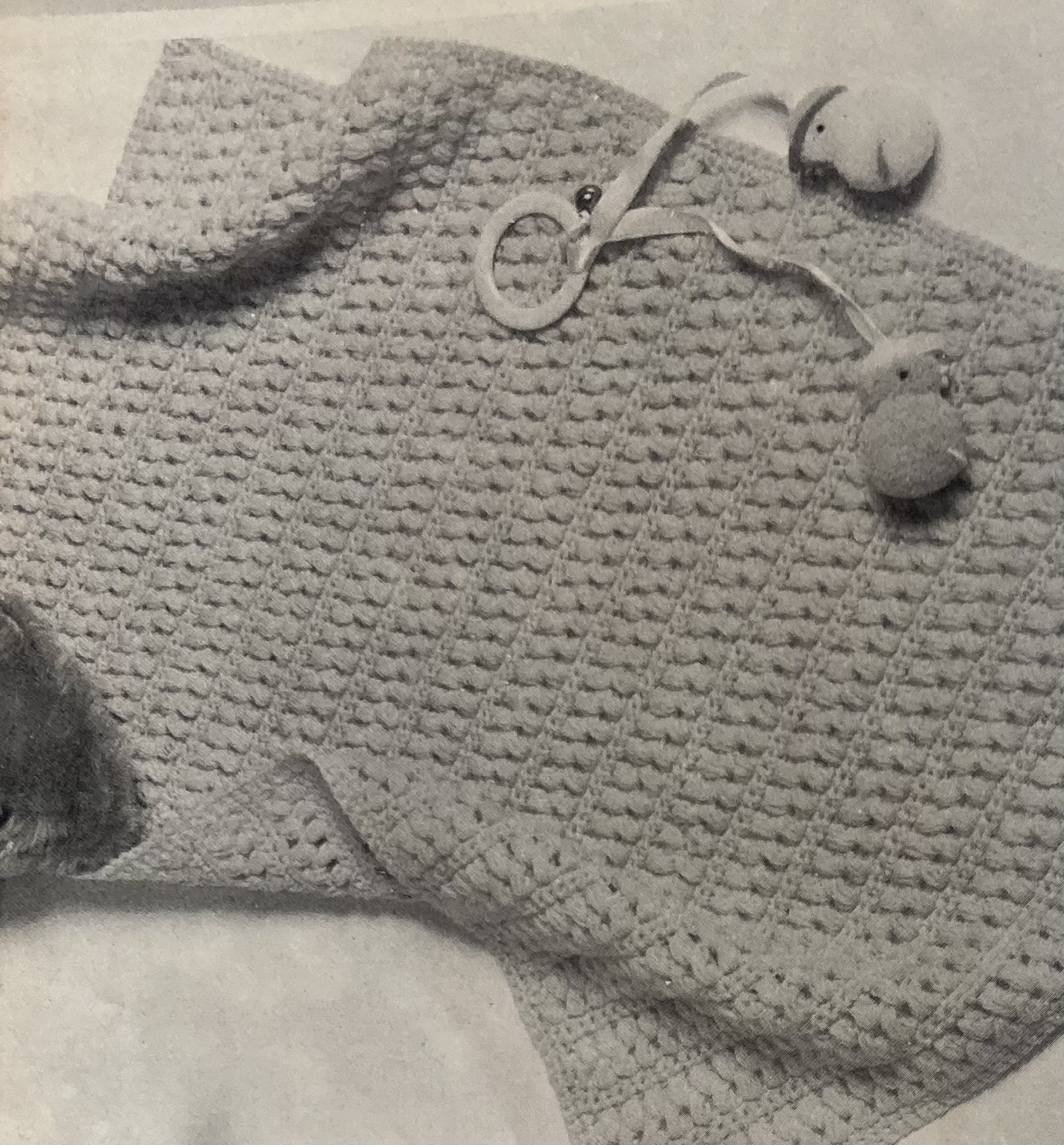
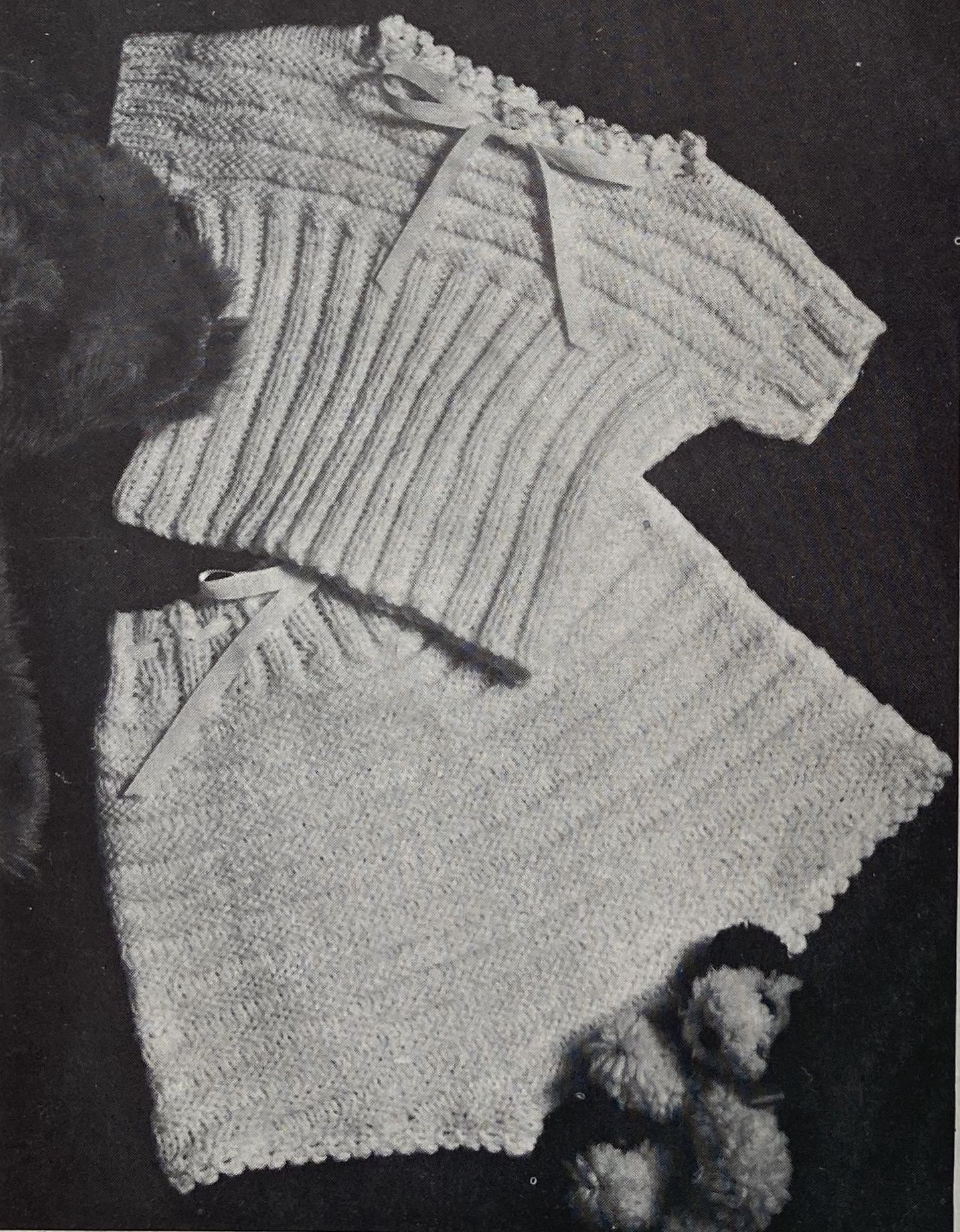
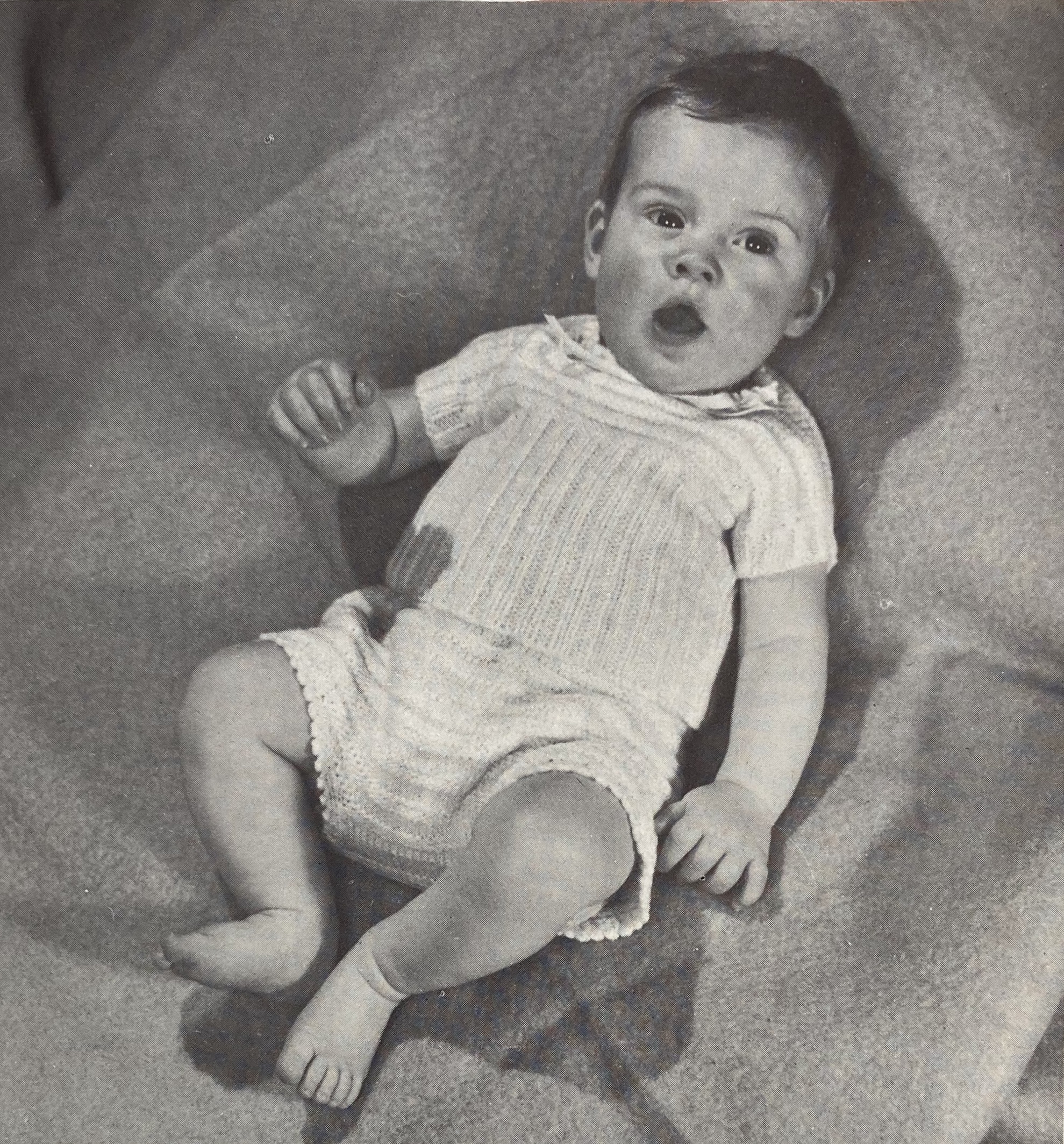
The baby layette series continues with a second-size (ca. 6 months) “pilch” (shorts) and vest in an easy vertical and horizontal rib pattern. The vest is made in a simple T-shape. There’s also a reprint of a baby blanket pattern from 1958 in the back pages. Sitchcraft apparently got many requests for reprints of popular patterns and many of them appear in issues from the mid- and late 1960s.

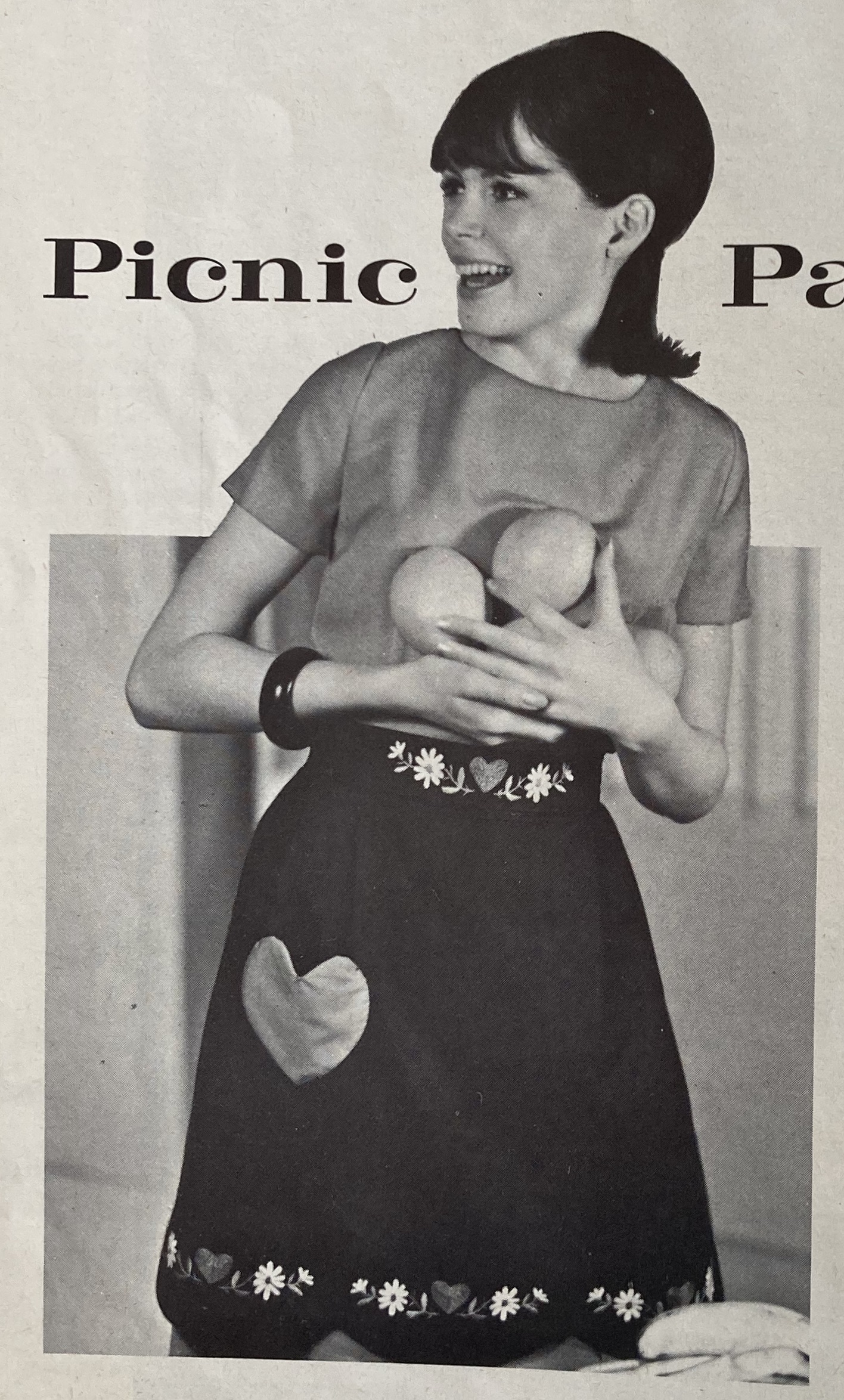
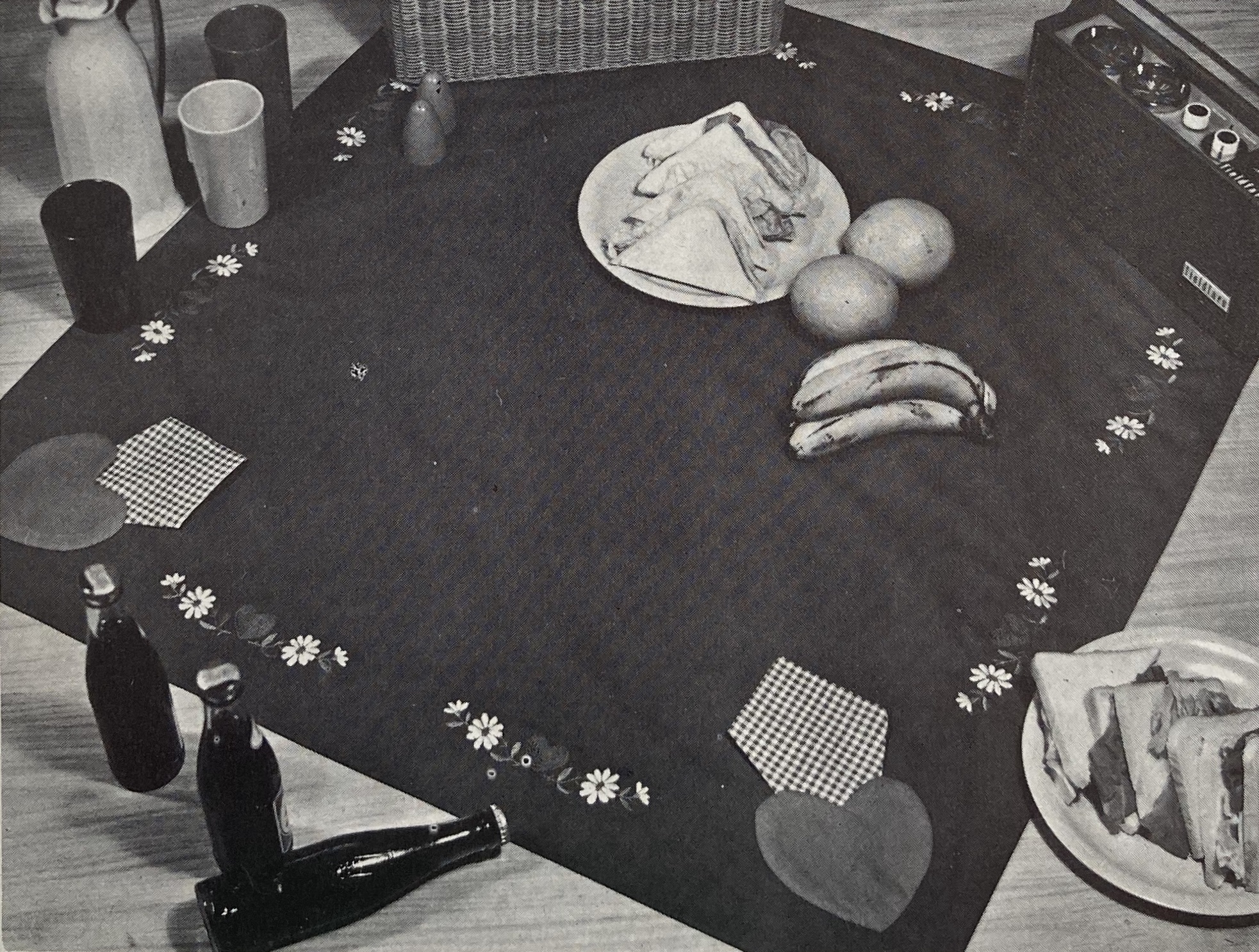
Homewares are a mix of smaller, easy projects that one could take along or use on a late August holiday, and larger at-home projects to work on for the autumn. In the first category, there’s a charming, easy embroidered apron and cloth set for a summer picnic, with appliquéd hearts as pockets in both the apron and (for napkins, how cute!) picnic cloth, an easy cushion embroidered on Bincarette and simple woven table mats suitable for patio use.

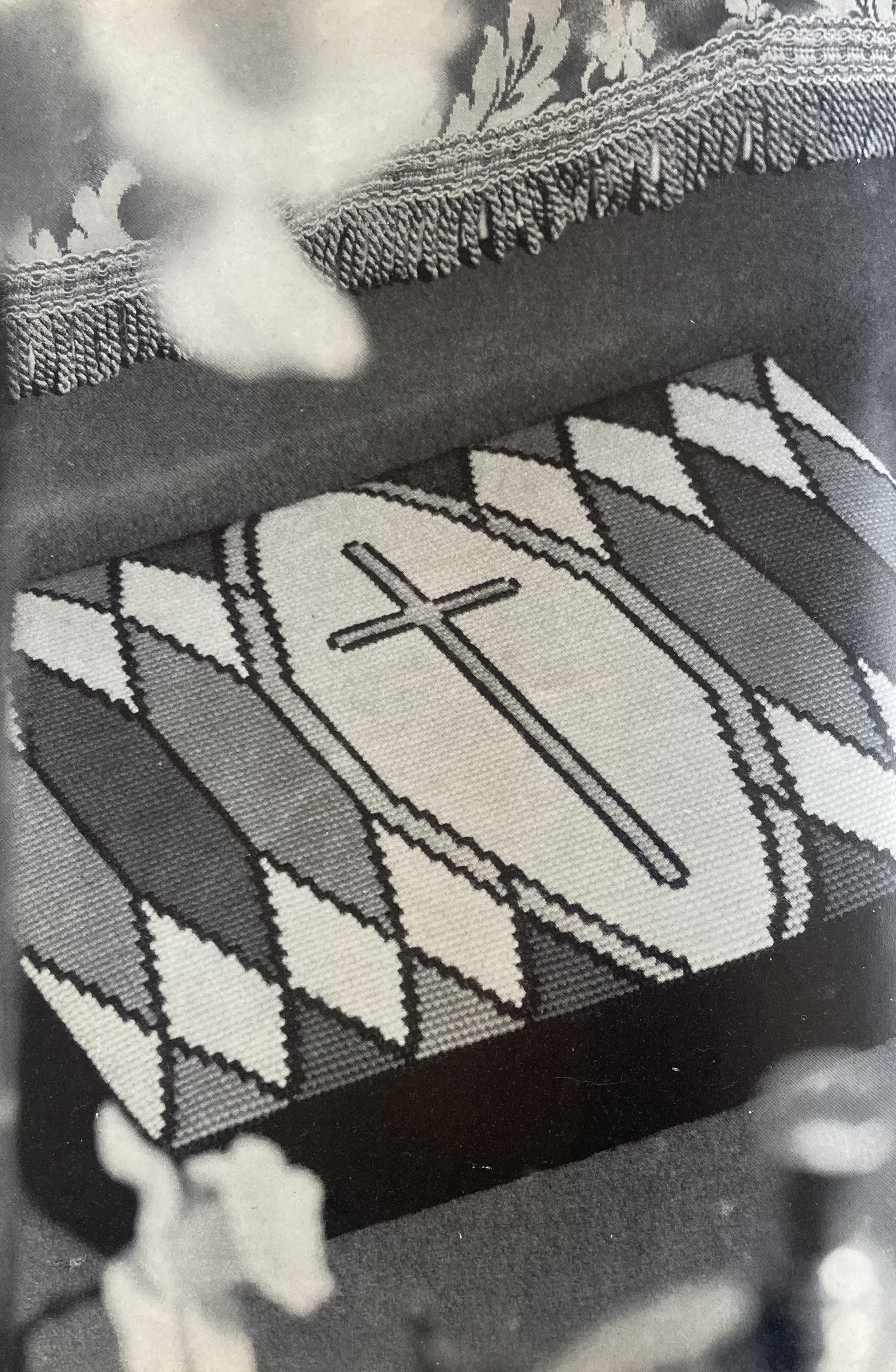
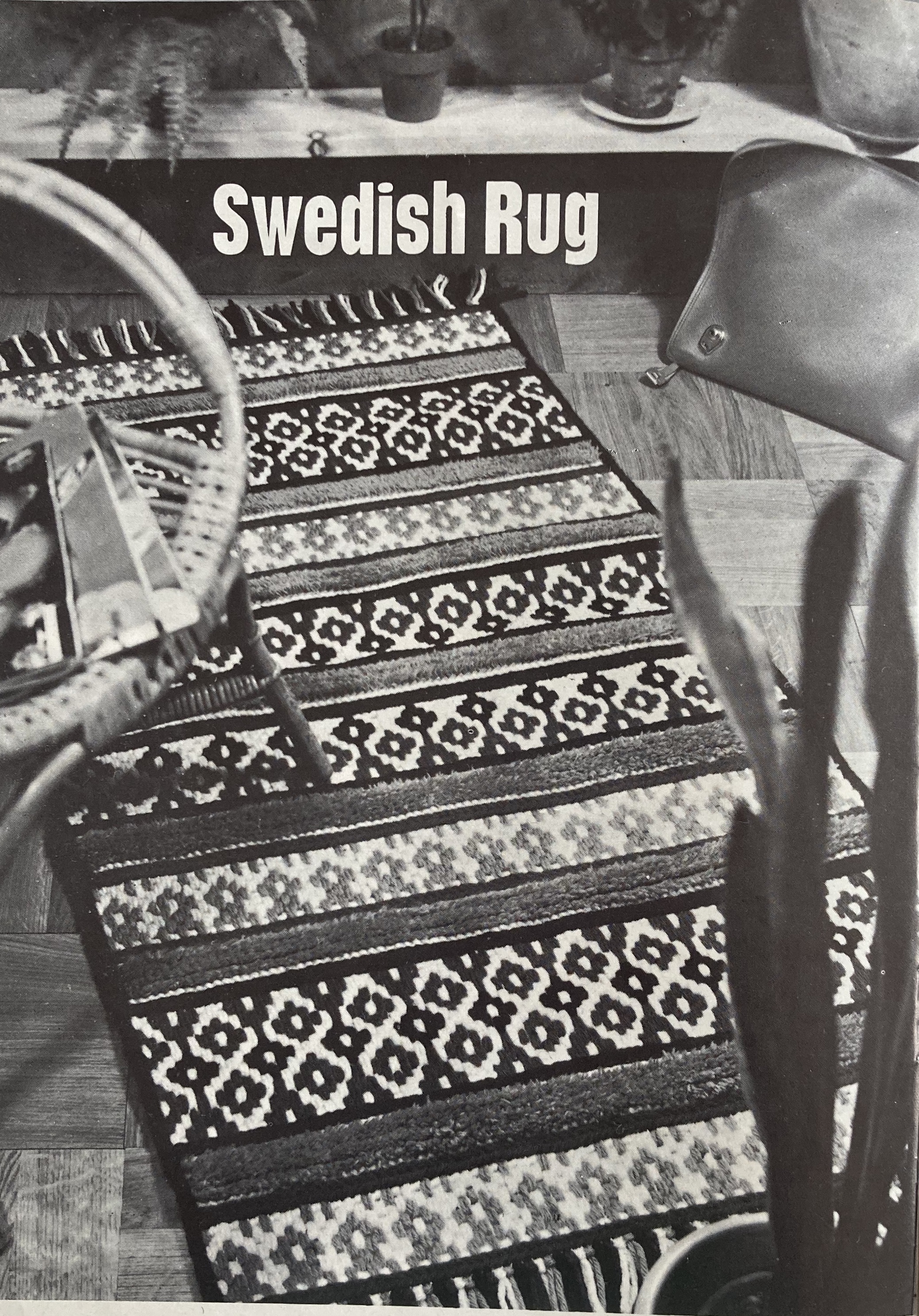
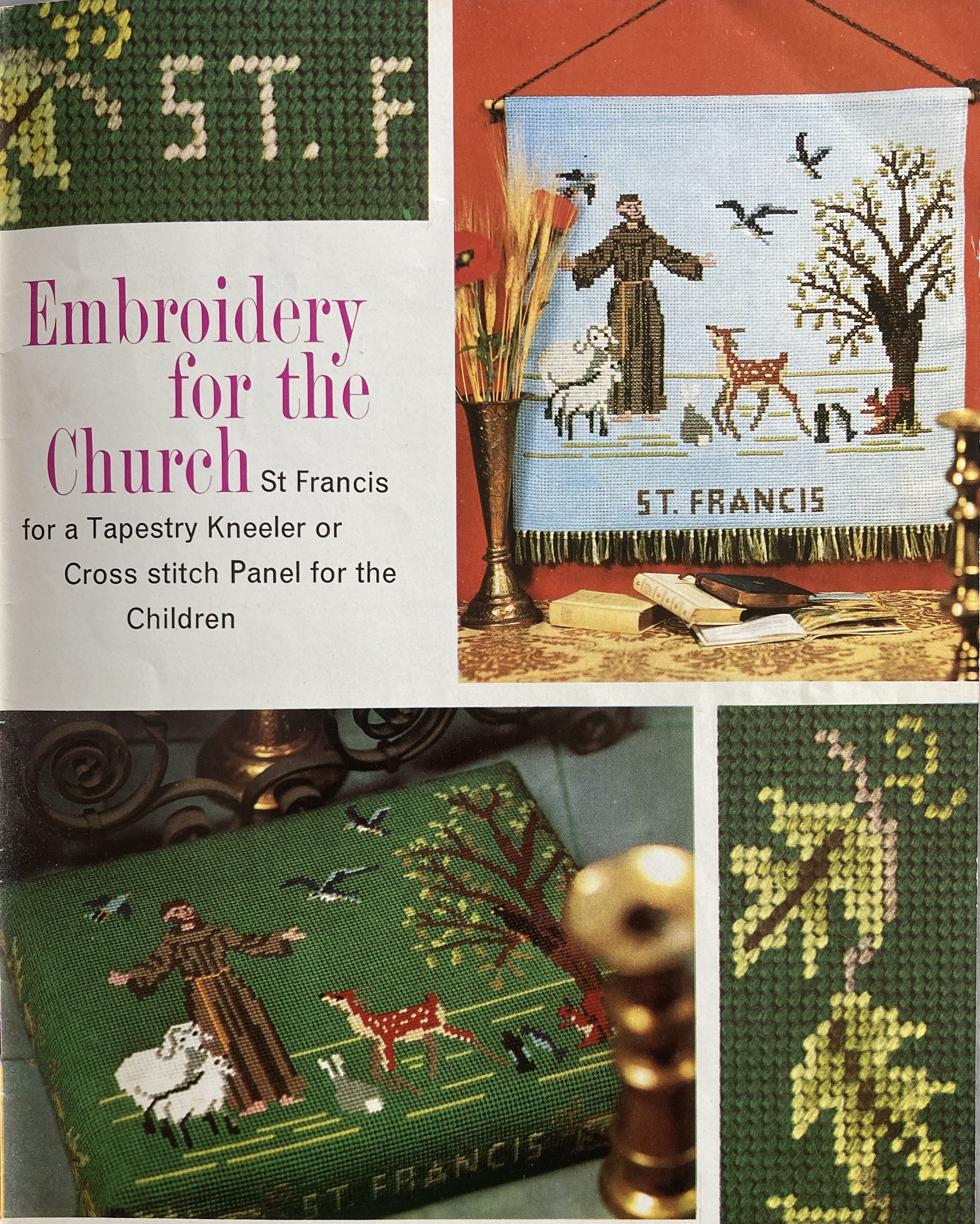
In the second category, there’s a complicated “Swedish” rug with both pattern weaving and tufting and for churchgoers, a cross stitch panel or kneeler featuring a scene of St. Francis with various animals.

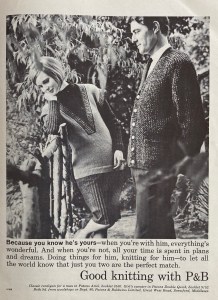
The Patons wool ad is weird and sexist, as usual. When you’re not with your man, naturally all your time is spent doing things for him and knitting for him — but if the photo is any indication, you’re not even happy about it? Here is the beloved man smugly lording it over his wife, who looks sad and embarrassed in spite of having knitted a lovely comfortable cardigan for him as well as a gorgeous outfit for herself. Be proud of yourself, skilled knitter, and remind your man that he would die of starvation and cold if you didn’t cook for him three times a day and knit him warm things!

As nice as many of the projects in this issue are, there’s nothing that catches my fancy enough to want to make it except perhaps the baby items (but I don’t know any babies that age at the moment, or anyone who’s expecting one right now.) I have so many WIPs and one of them is from a 1967 issue of Stitchcraft, so I’ll try to finish that up and make another “Fast Forward” post about it. My July ersatz project should get finished this week, so I’ll update that post soon as well.

May 1964: Overview

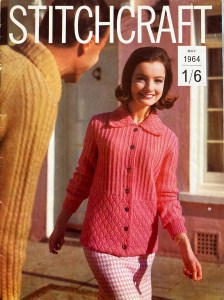
Cover photo from Stitchcraft magazine, May 1964, showing a woman in a pink knitted cardigan

Stitchcraft‘s May 1964 issue promises a “May Merry-Go-Round” of “a wide choice of Summer Knits for leisure, holidays, travel and all the warmer weather activities.” Time flies so fast that I feel like I’m on a merry-go-round even without knitting — but let’s see what this issue has in store for us.

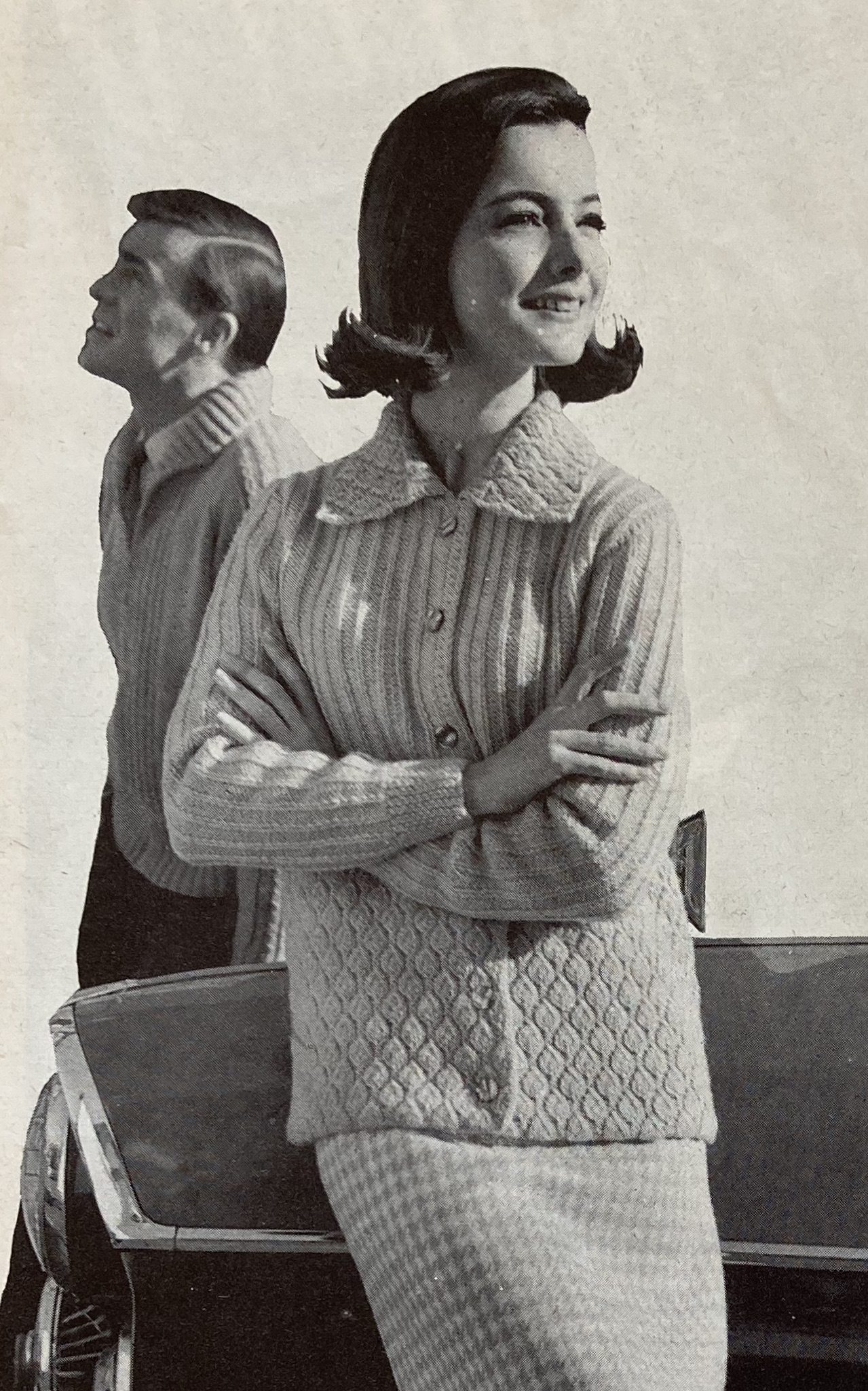
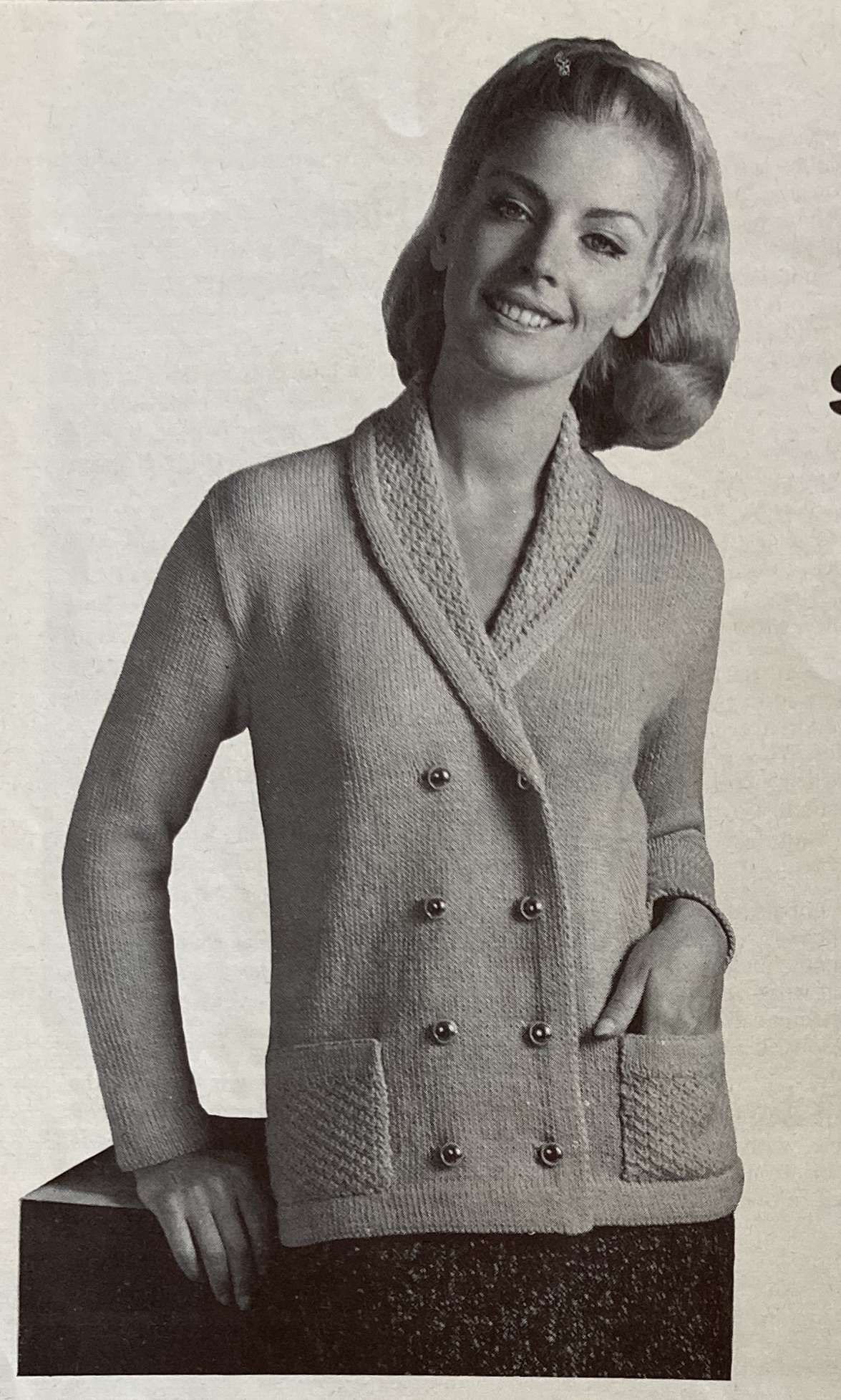
Our cover feature is a high-buttoned cardigan with a deep “pineapple stitch” hem and collar. It’s made in DK weight wool, but the pineapple stitch and slip-stitch rib make it quite heavy (20 oz.) and presumably warm and sturdy. There’s a less bulky design in DK wool on the facing page; no collar and a plain twisted stocking-stitch make it require only 12-14 ounces of wool. Patterns that utilise texture and lines, especially diagonal lines, are still very much in fashion, as are high necklines and collars.

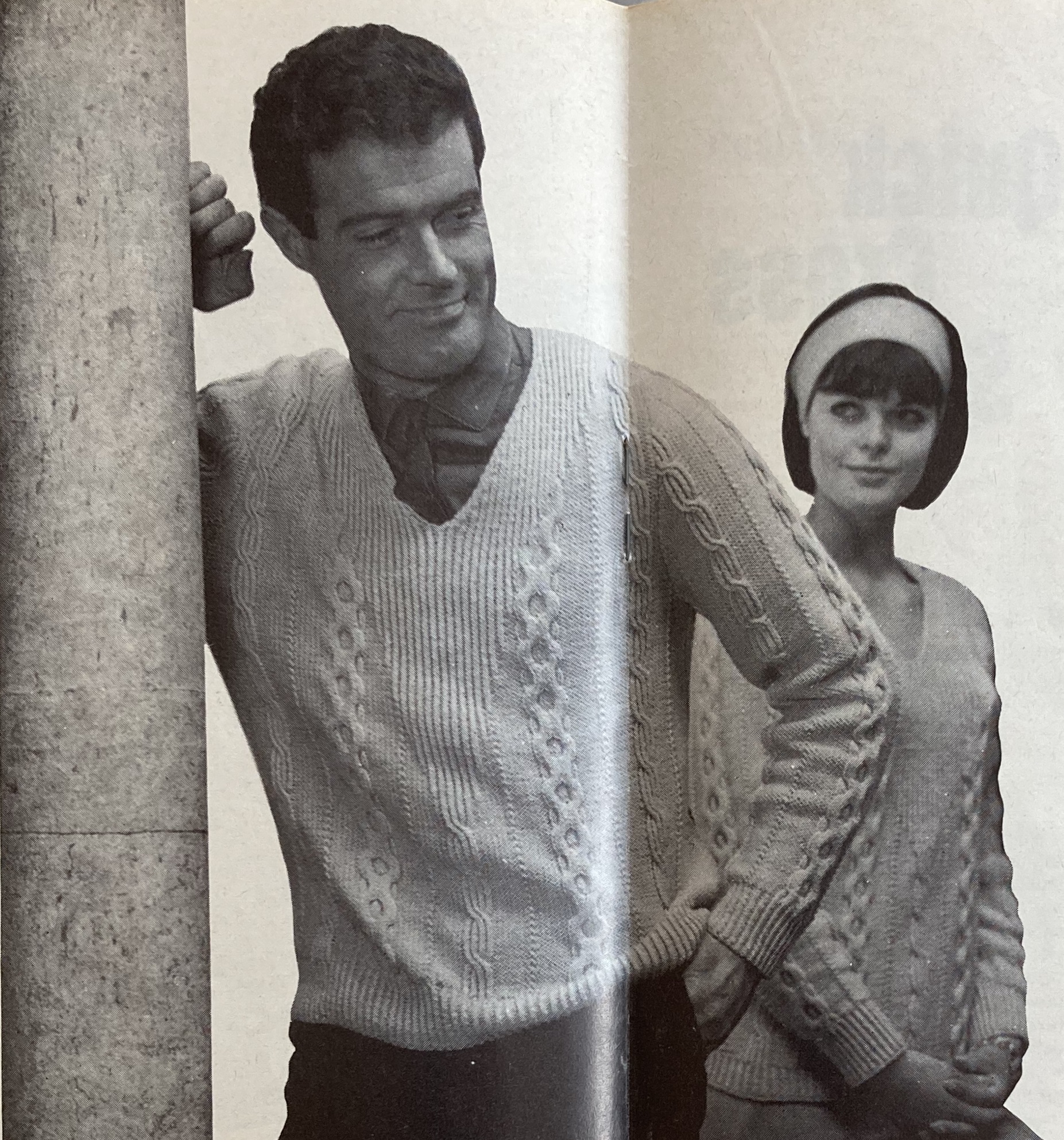
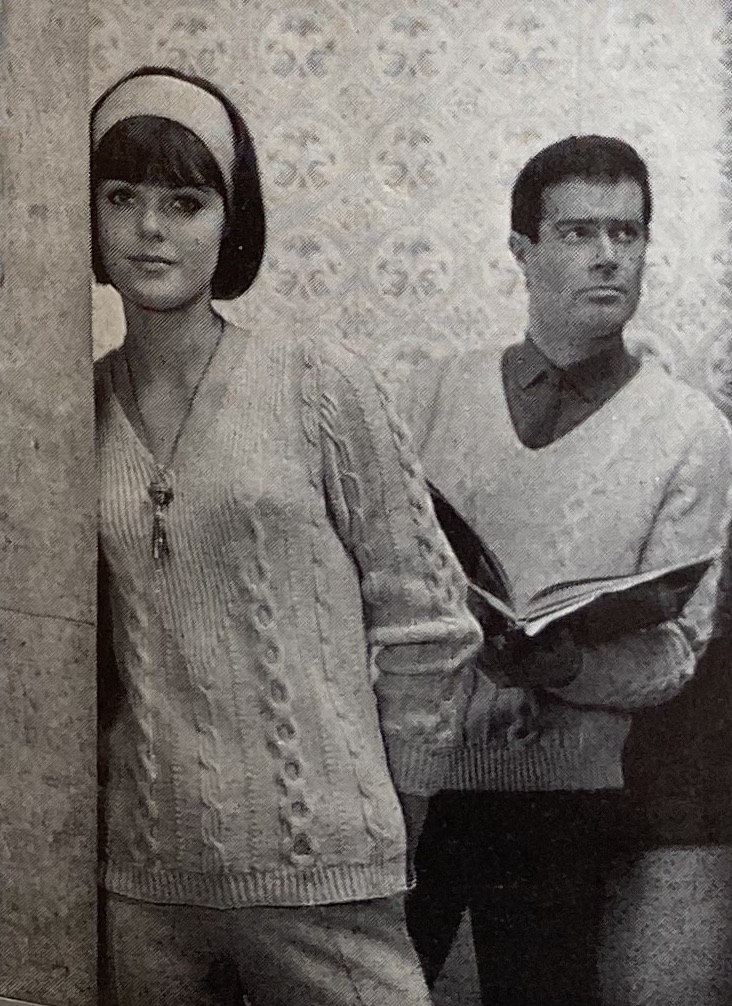
The back cover shows off the latest in partner-look sweaters, this time with a V-neck. It’s not what you would call a traditional Aran-pattern design, but it combines some of the typical cable elements with textured ribbing for a sleek, modern twist on the traditional look. The sweaters are made in light colours with Patons Totem Double Crepe, a very smooth yarn with a tight (“crepe”) twist, to make the pattern stand out.

(Side note: This issue is visually one of the most fun I have encountered, thanks to multiple photographs of the same garments and models in different poses, and the liberal use of illustrations. I particularly like the one with our male model looking up out of his book (travel atlas?), apparently quite concerned, while the female model looks calmly into the distance. Feel free to suggest captions!)

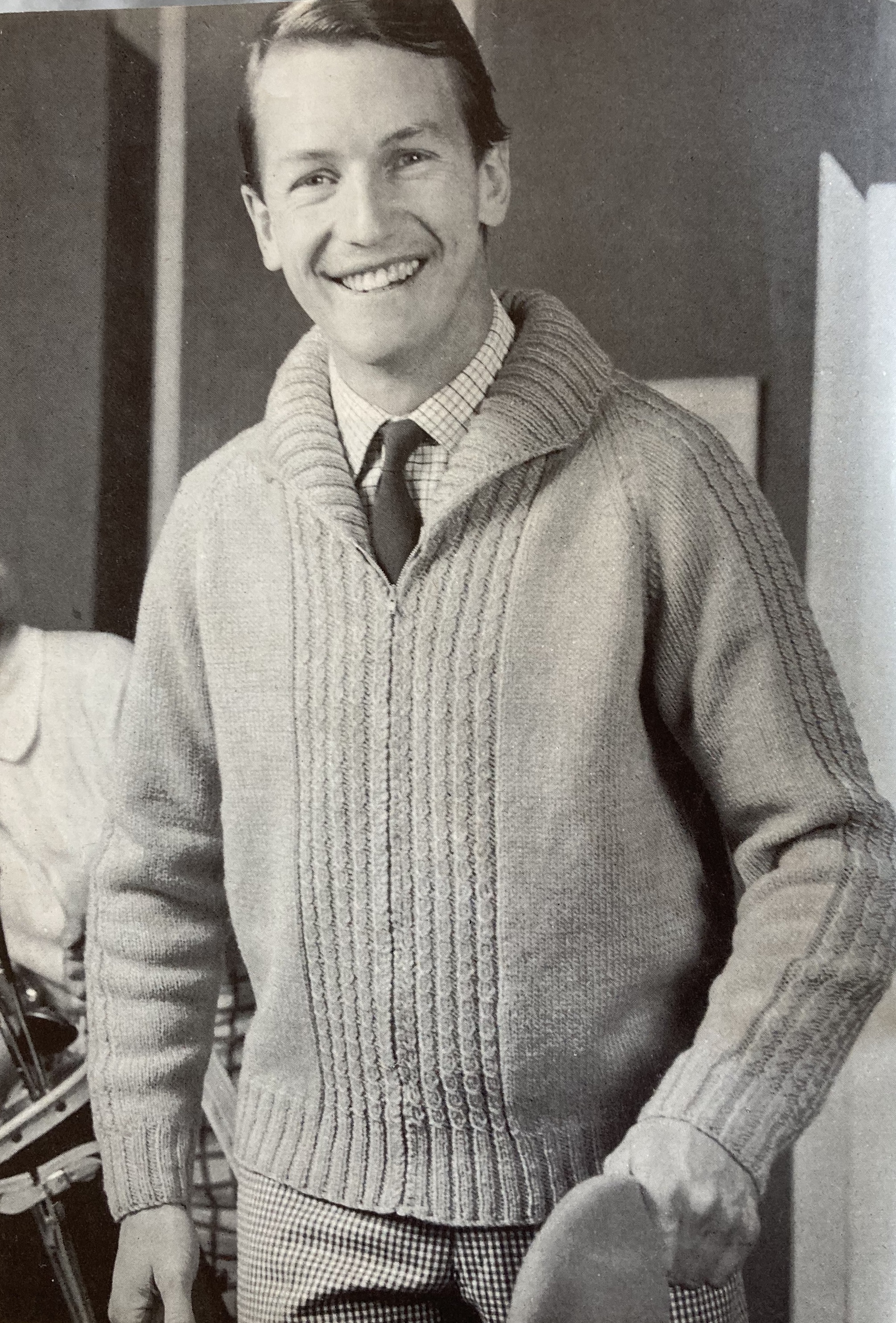
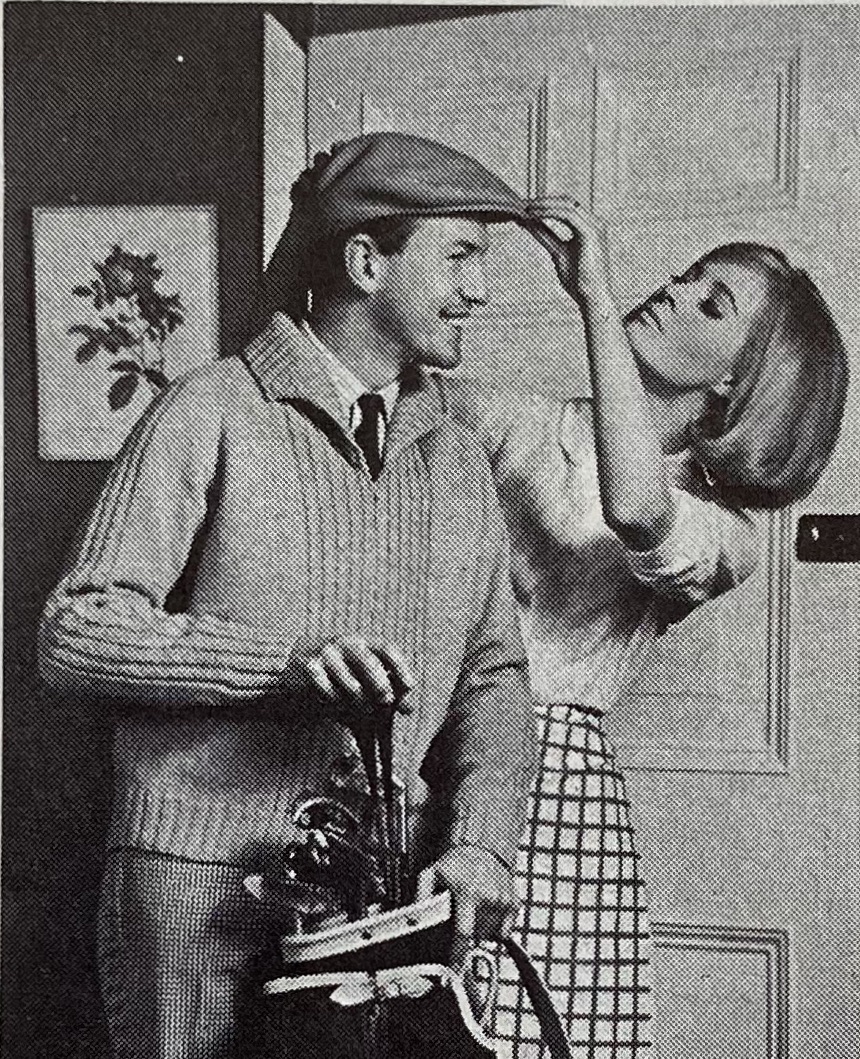
“Finer-knit fans need not feel neglected” by all these bulky, loose-fitting overgarments, promises our “editress” in the facing-page notes: here’s a cute blouse-cardigan in 4-ply wool with the same use of vertical lines, textured pattern and collar, but all in a more refined and elegant look. It’s made in Nylox, a wool-synthetic blend much like modern 4-ply sock wool, and promises to be “very pretty and feminine worn with a pastel skirt.” The man of the family sticks with DK-weight wool, though, and gets a “best of all golfer style” zipped cardigan with classic shawl collar and mock cable detail. I’m only sorry that they chose the normal pose for the full-page photo and relegated the fun one to the facing page.

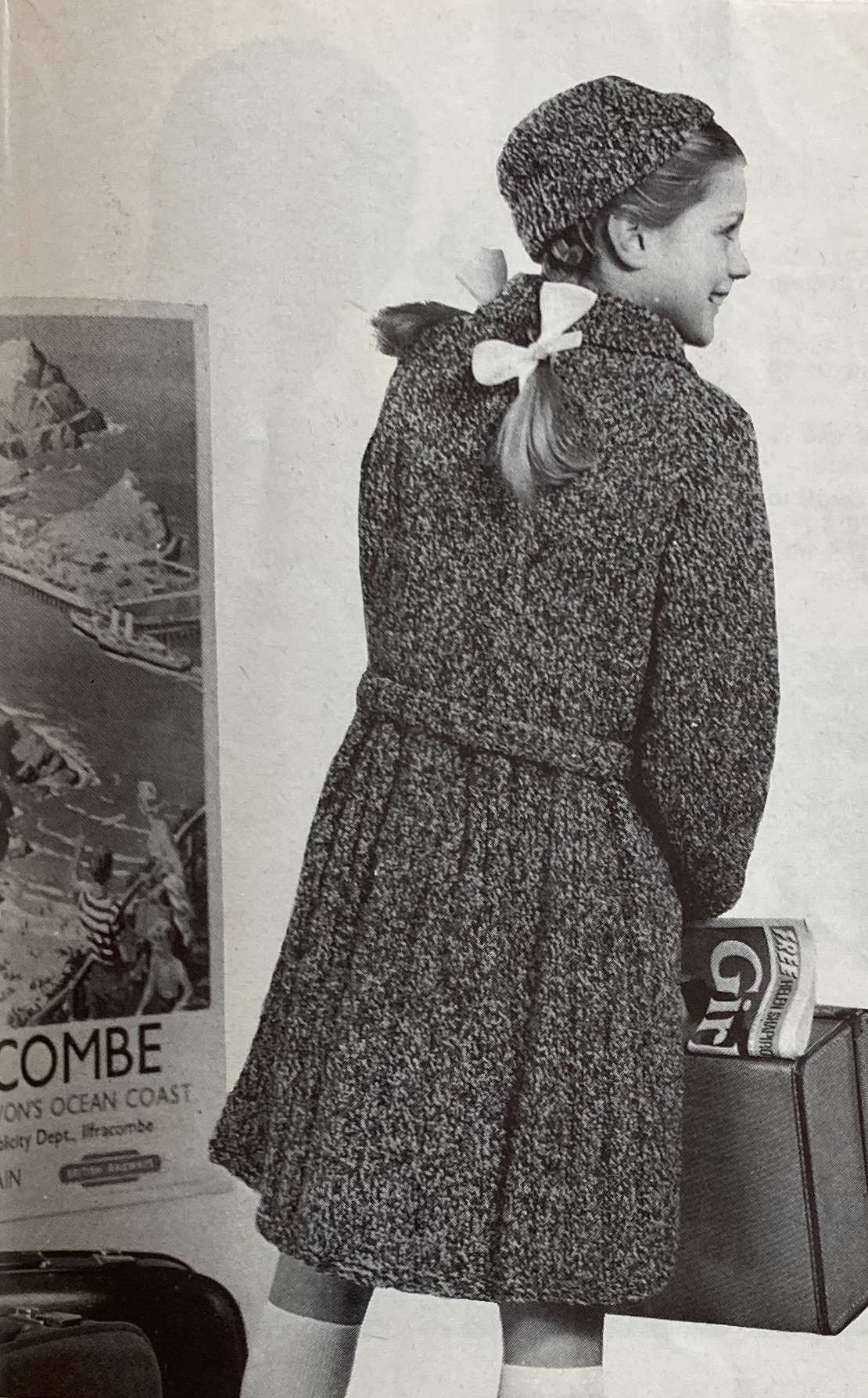
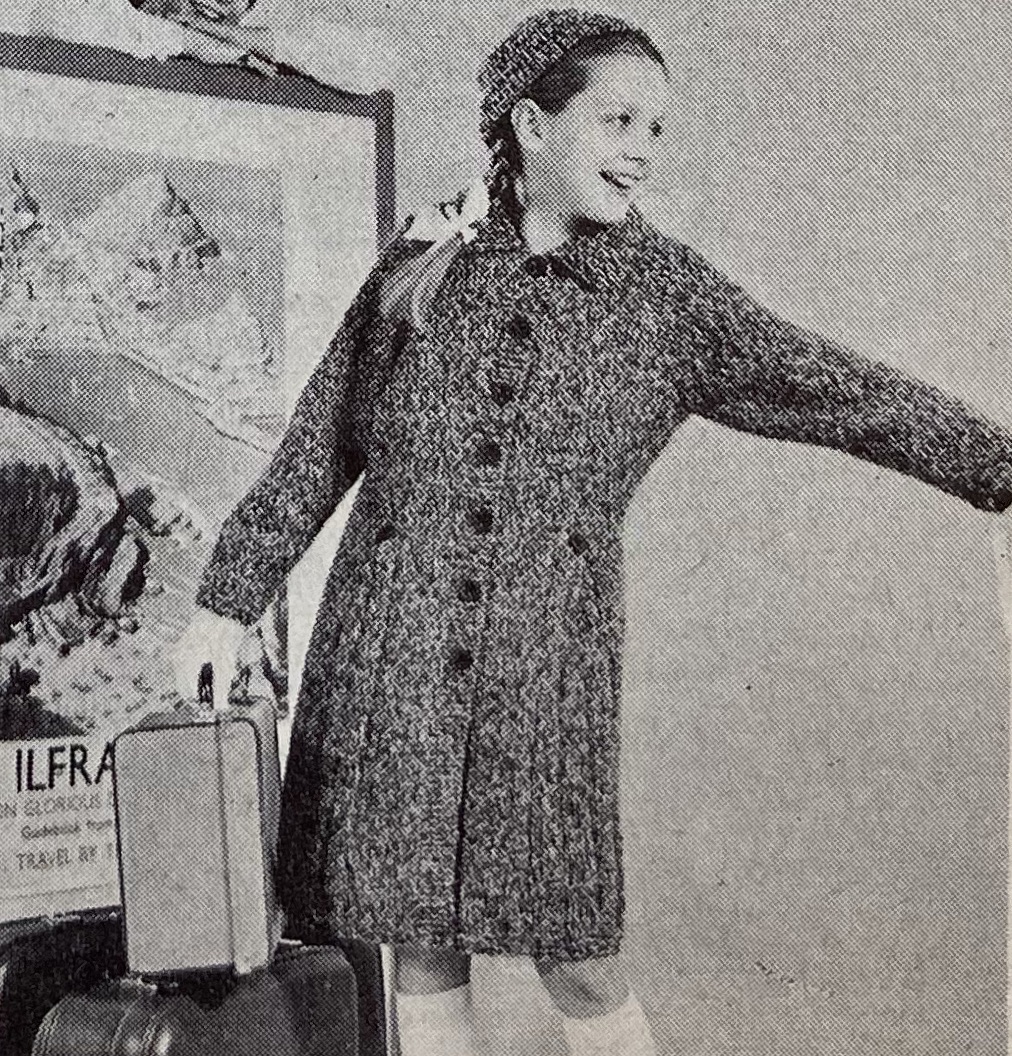
A cardigan jacket for indoor-outer wear is practical for summer travelling, so this month’s issue offers us a structured, yet comfortable “Blazer for Globe-Trotting” in DK weight as well as a belted coat with pleated swing back for the teenage daughter. The coat has a matching cap, as well, and is made in tweedy, bulkier “Glenora” wool. Here, again, there are multiple photos, so you can get a sense of the coat in its entirety.

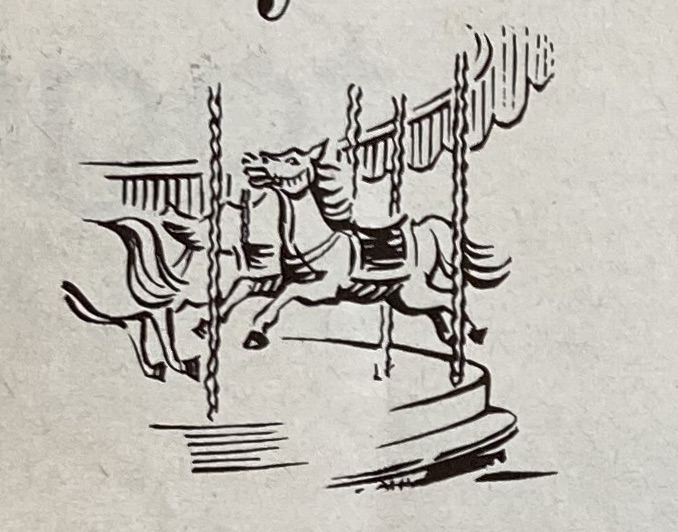
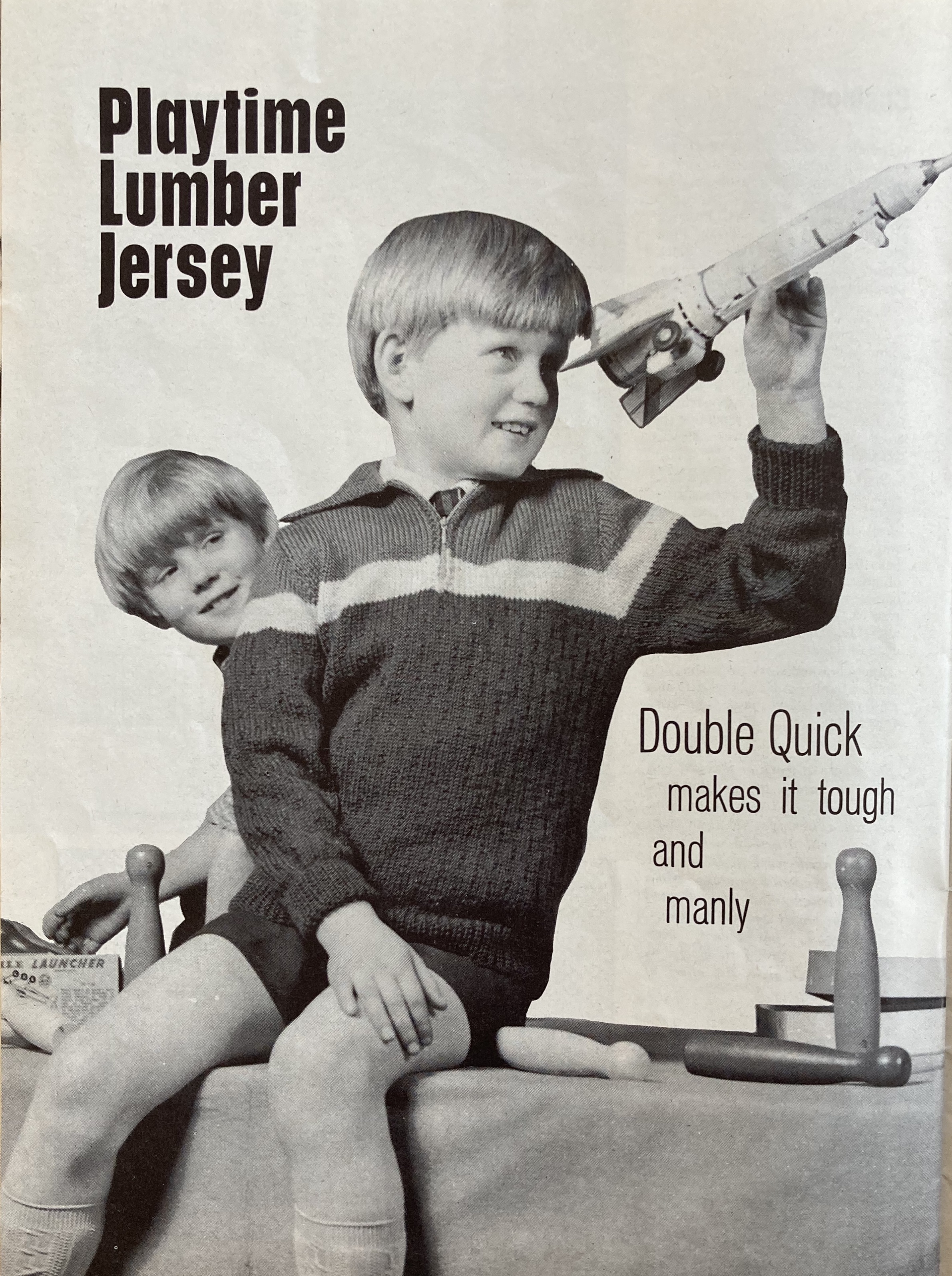
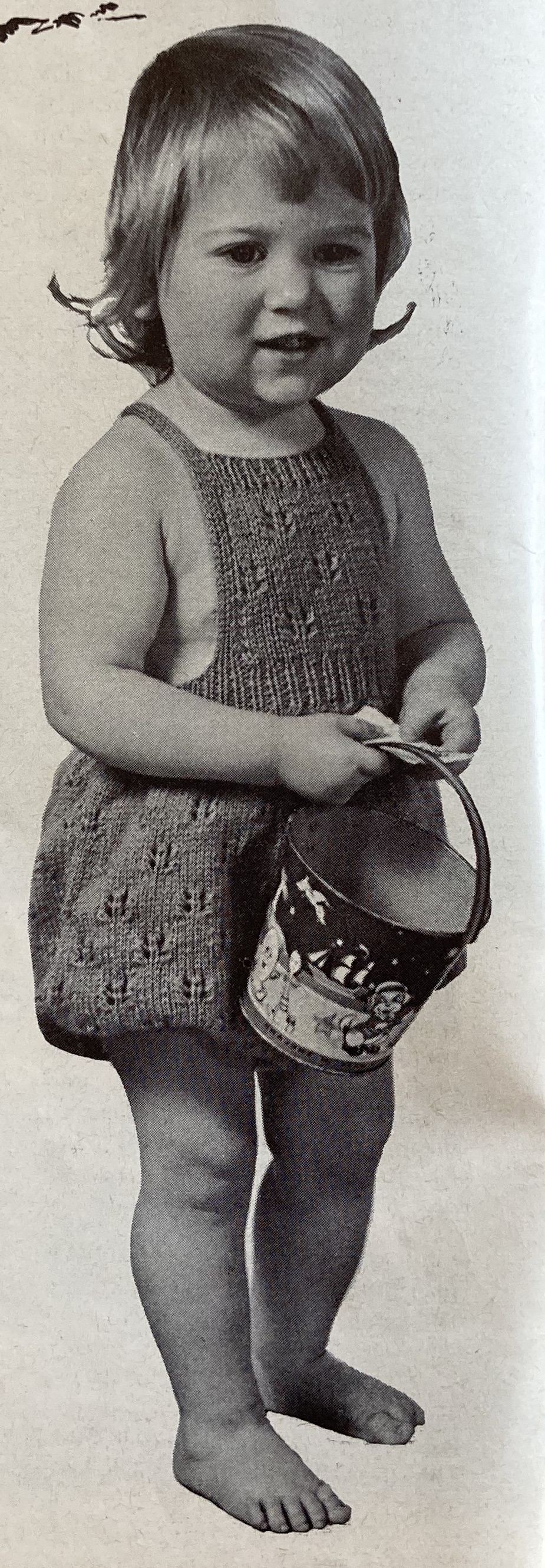
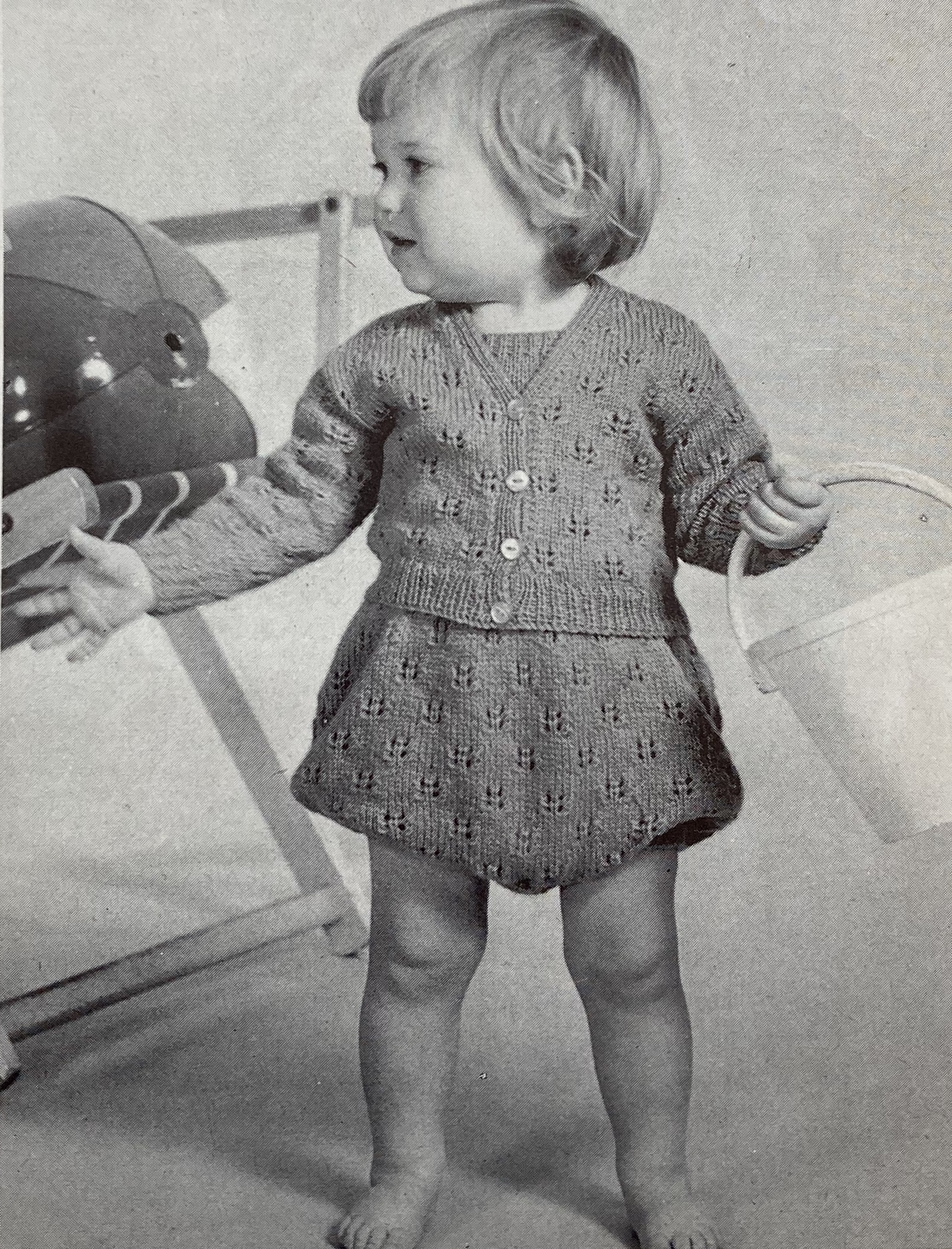
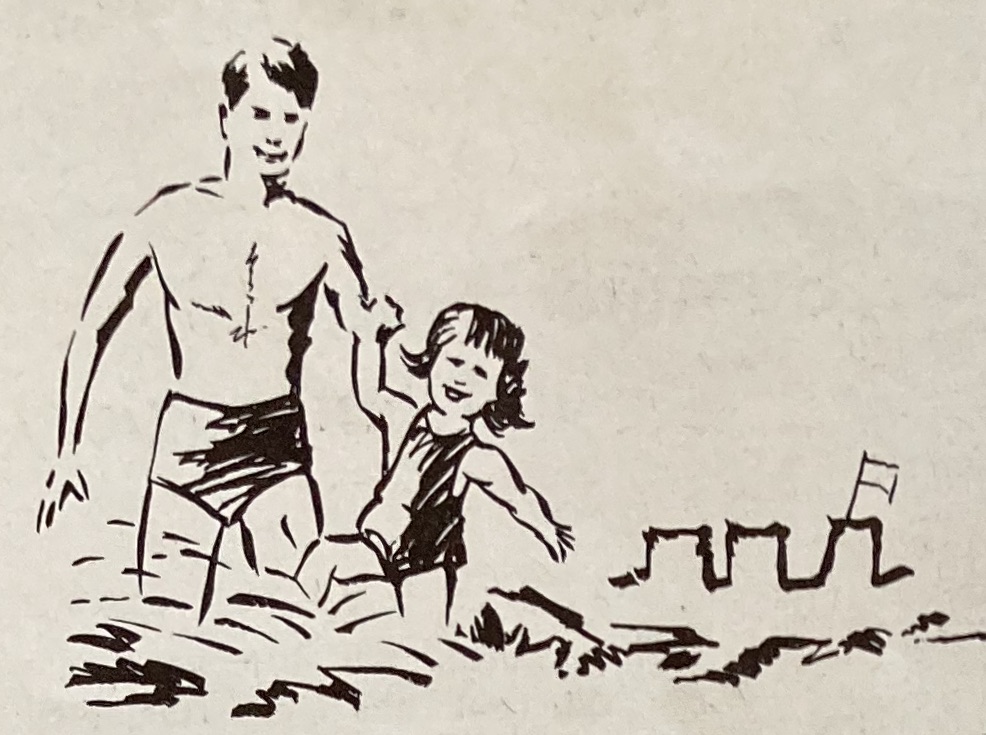
Younger children can enjoy their holidays in hand-knits as well: the boy’s zip-neck jersey promises to be “tough and manly” for the future rocket scientist of the family and makes nice use of stripes and a more subtle textured pattern. (The colours, from neck to waist, are “Breton Red”, “Magnolia” and “Woodland Green”.) Toddlers can go “splashing and paddling” at the beach in a cute romper with a matching cardigan to cover up when it gets chilly. And here’s another great illustration, showing our little model splashing and paddling with her father, sand castle in the background.

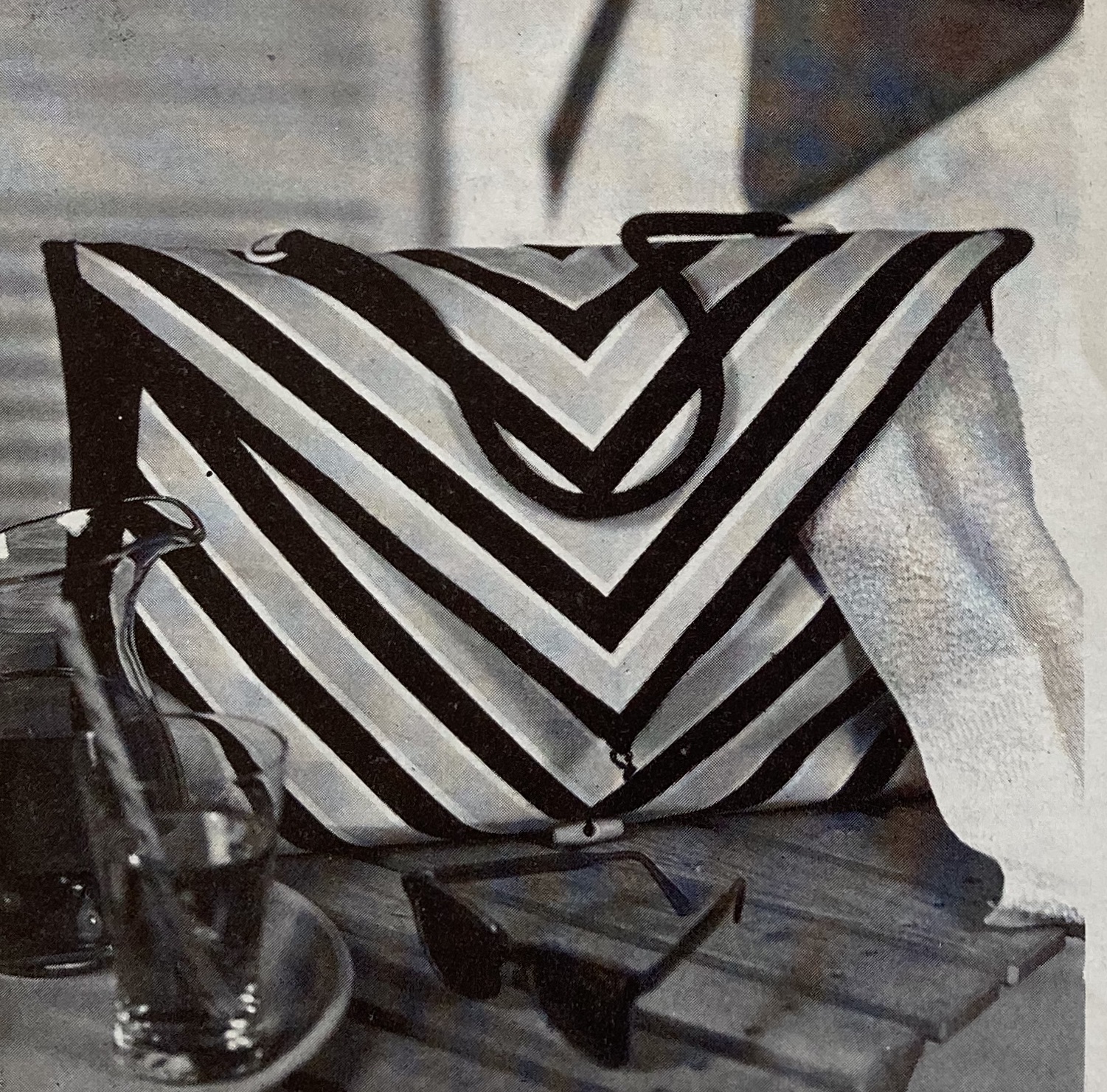
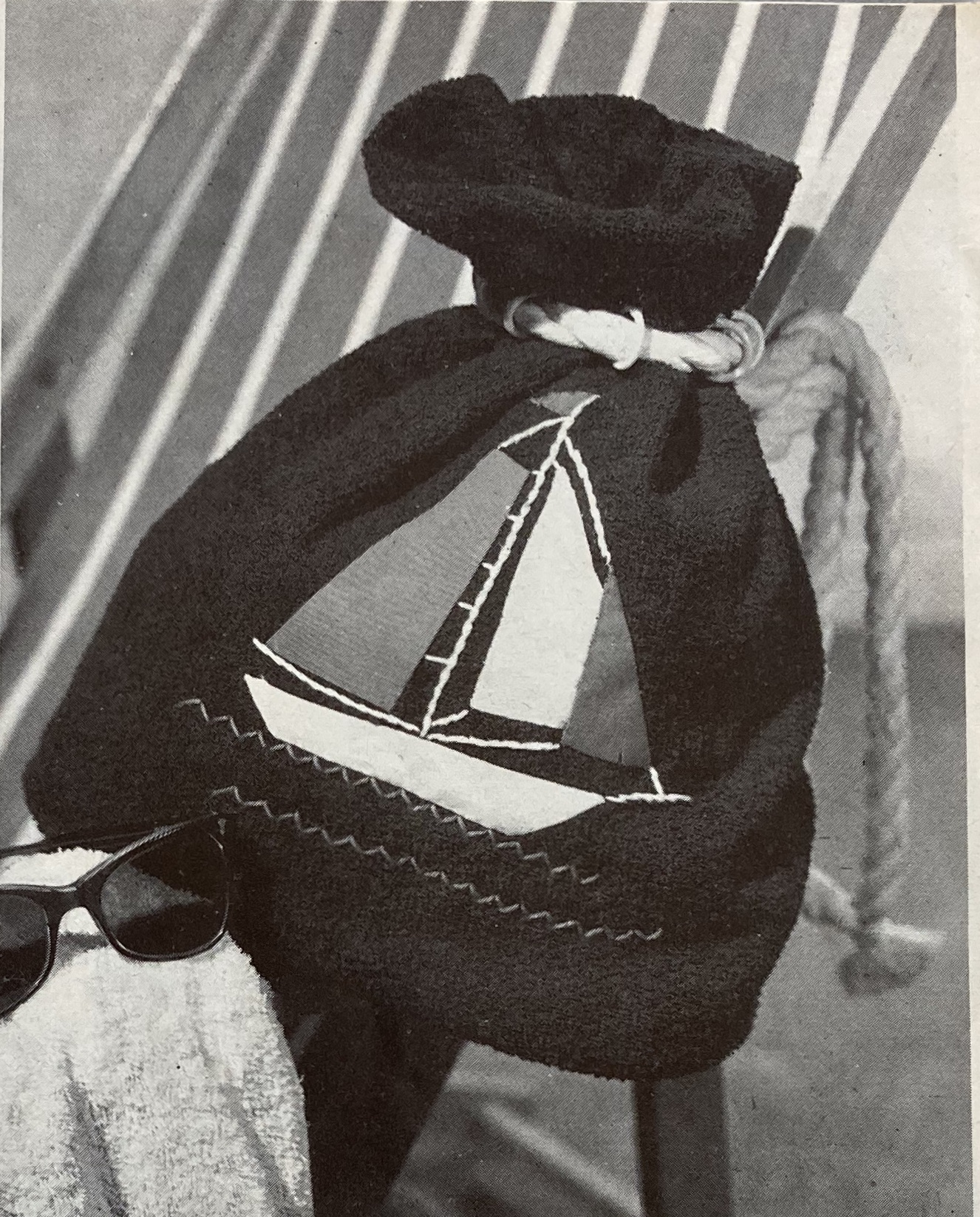
Speaking of beach holidays, how are you going to transport your (possibly wet) swimsuit, sunglasses, towel and whatever else you need back and forth? In a chic, yet practical home-made kit bag, of course. Here are two designs to sew yourself: an “envelope type” made out of tough deck-chair canvas, or a drawstring bag made out of towelling material lined with plastic and decorated with a sailboat motif in appliqué and embroidery.

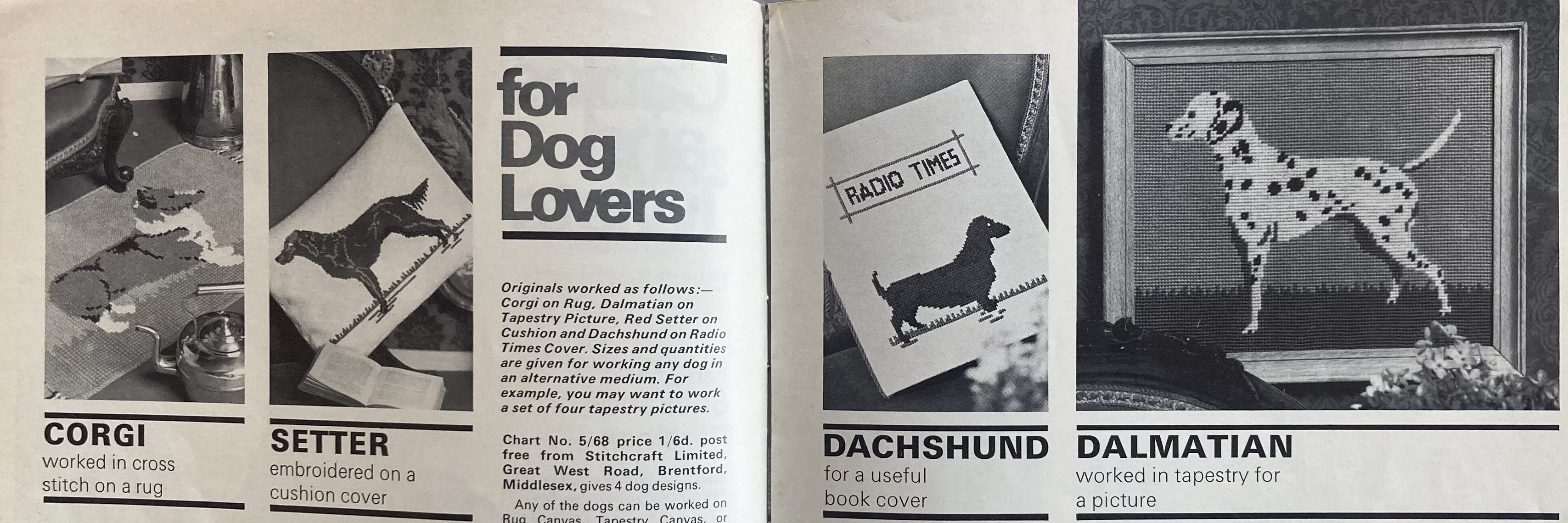
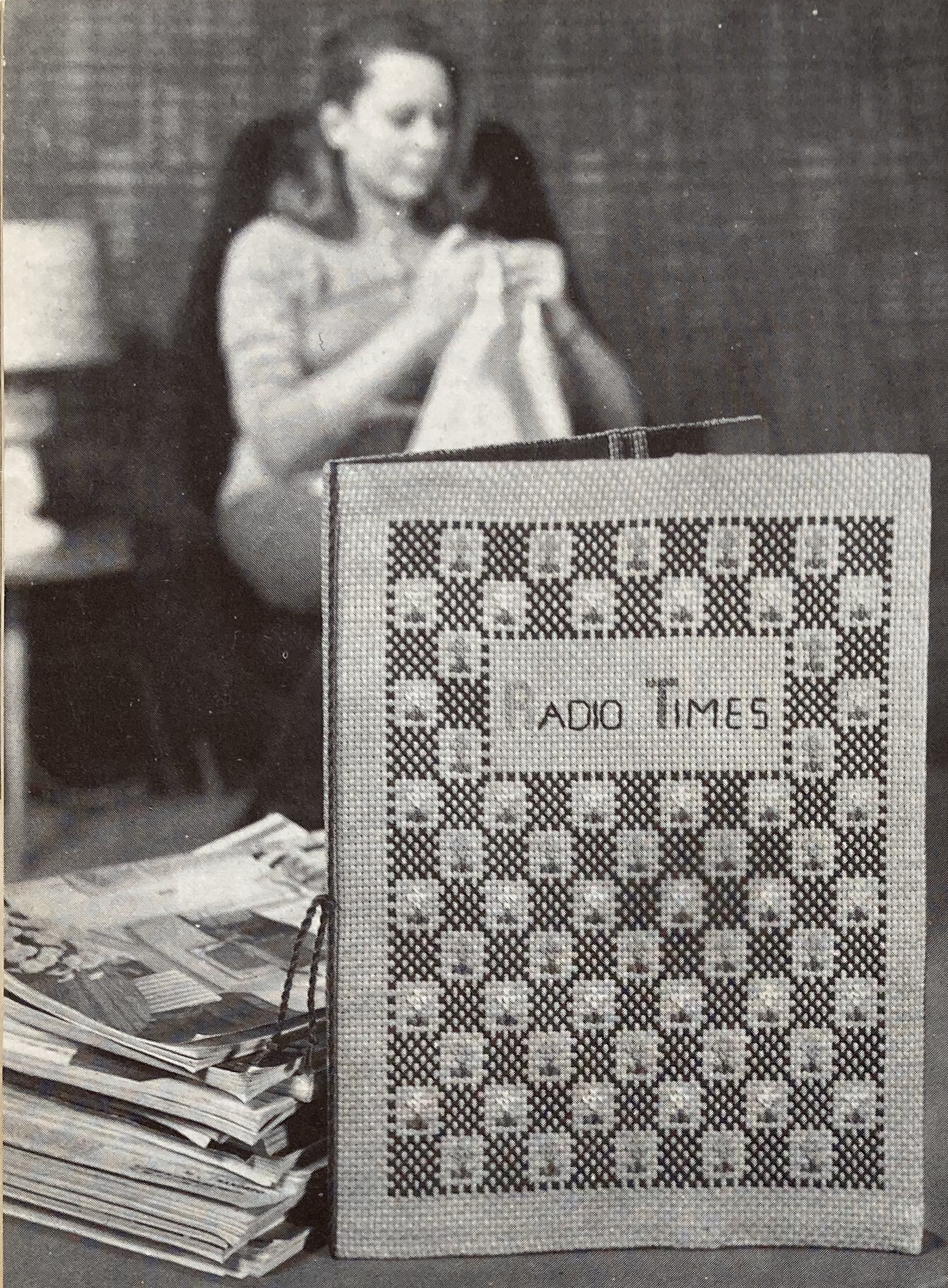
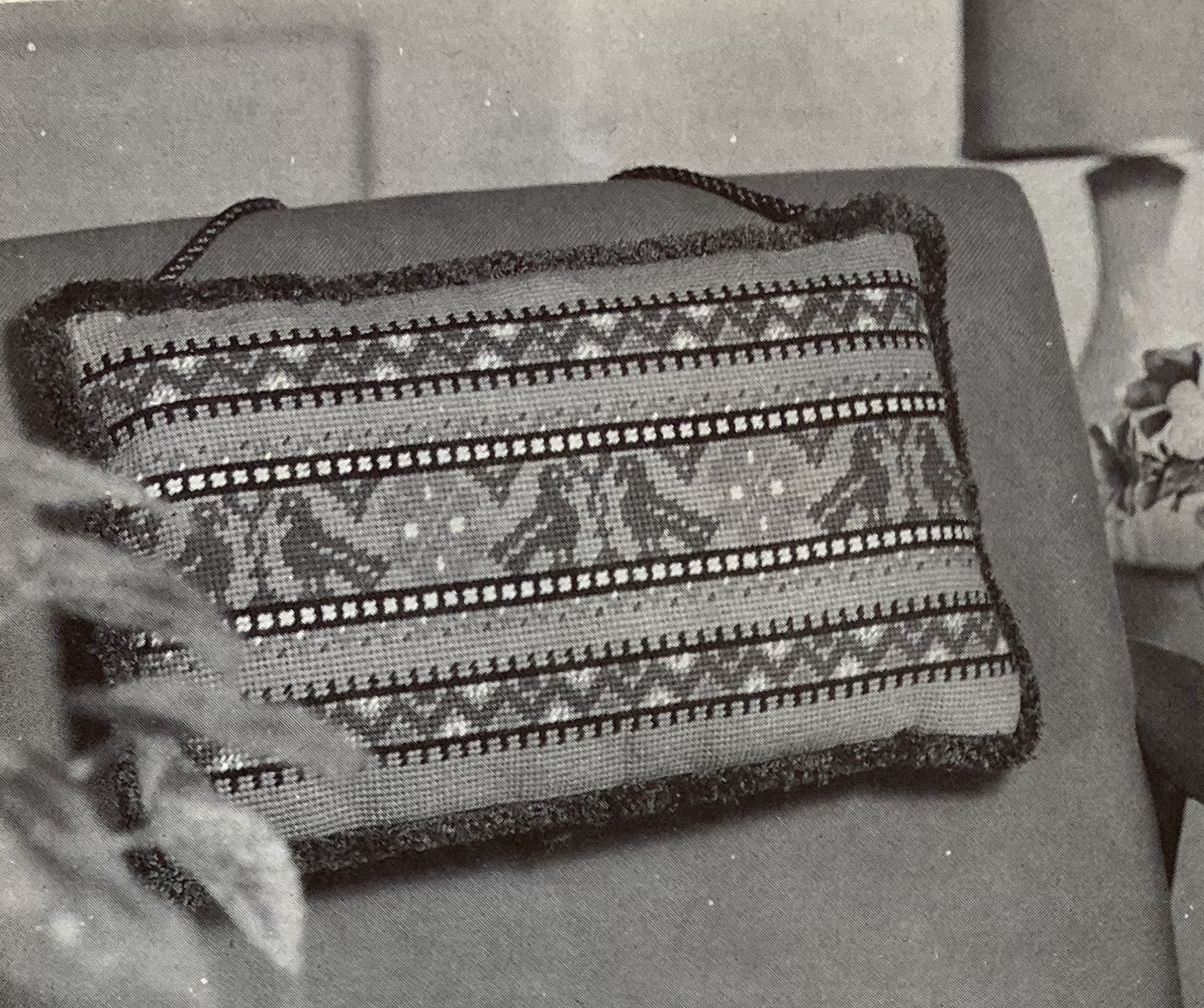
There’s regular embroidery for the home, too (to work on which sunning in your deck-cair, perhaps): an easy cross-stitch book jacket for the Radio Times, another traditional chair-back/cushion design, and some more intricate wall panels with colourful wildflowers.

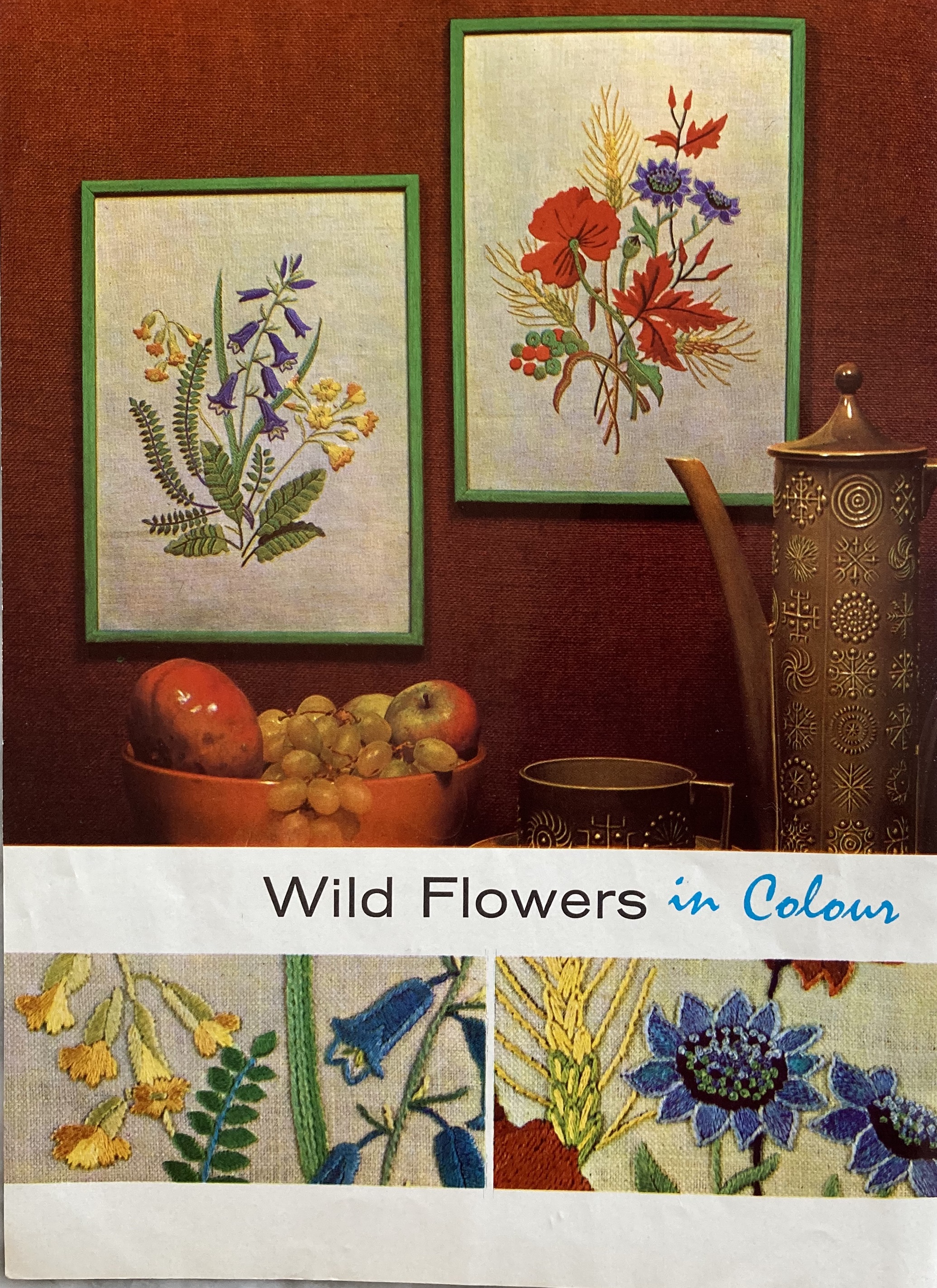
Speaking of intricate wall panels: if all that weren’t enough, there’s another amazing felt appliqué wall panel, this one featuring characters from “favourite books.” That is, if your favourite author is Charles Dickens, which, why not, I suppose? There’s Barnaby Rudge and Oliver Twist from their namesake novels, Peggoty, Little Emily and David Copperfield from his namesake novel, Mr Pickwick from his namesake novel (‘s papers) and Grandfather and Little Nell from… (OK, I admit I had to resort to Wikipedia for this one) The Old Curiosity Shop, one of Dickens’ books which I have heard of, but never read. Anyway, the appliqué is fantastic — just look at the detail photo on Mr Pickwick’s face.

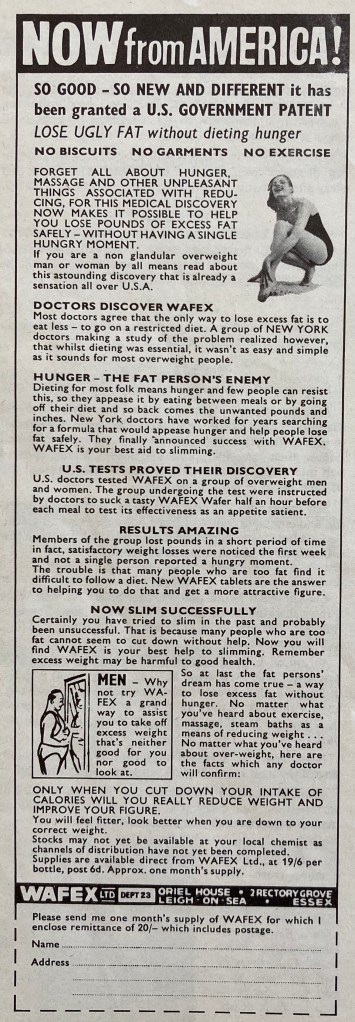
That brings us to the end of our issue, and by the way, if you suffer from unwanted weight gain as a result of all your holiday leisure, why not try sucking on a tasty “WAFEX” wafer half an hour before each meal? I’m suuuuuure it’s not only extremely effective, but also perfectly safe. After all, it’s “SO GOOD — SO NEW AND DIFFERENT that it has been granted a U.S. GOVERNMENT PATENT” ! (Note: I do not actually know what was in these appetite suppressant wafers, but seeing as it was 1964, they could contain anything from sugar to amphetamines to absolutely nothing. Please do not take medical advice from me, or from 1960s knitting-magazine advertisements.)

I would love to make the 4-ply cardigan blouse, but it will take a while, as I have so many unfinished larger projects on the needles at the moment. Until then, enjoy your Spring, Summer, holidays, travel or whatever else May has in store for you.

March 1964: Overview

Greetings from Kent from your March 1964 issue of Stitchcraft, featuring “Spring Into Summer Fashions” photographed in “some of your favourite spots around Canterbury and Tunbridge Wells” so that you can see the knitwear “in their own settings as you would wear them.” Shall we go?

“For our climate”, writes editress Patience Horne, the best outfit for the spring and early summer months is a sweater suit, quickly knitted in double knitting wool. Cool blues, salmon pink and yellow-green are the trendy colours, and pattern stitches are used sparingly as an accent on hems or collars, or as a single vertical stripe panel.

Our cover model is wearing a twin set with a trellis pattern accent on the cuffs, pockets and collar of the jacket and the hem of the short-sleeved jumper underneath. Here, again, we see how twin-set styles have changed since the 1940s — everything is long, loosely-fitting and unshaped. The “Golden Willow” sweater suit on the inside front cover is similarly unfitted, with a cable “V” pattern stripe. For “The Creamy Look”, there’s a a high-buttoning cardigan with a subtle diamond pattern on the fronts. All three models are made in “Double Quick” knitting.

“Double Quick” is also the featured wool for the men’s and women’s “sport sweaters” in the lovely full-color center photo. I’m not sure what makes those two garments more “sporty”, as they look equally as elegant as anything else in the issue. His sweater is worked in stranded technique from a chart included in the instructions, and hers is made in plain stripes with the diamond pattern embroidered on later in Swiss darning / duplicate stitch. If “Double Quick” is not bulky enough for you, there are matching sports sweaters for him and her made in bulky “Big Ben” at 3 1/2 stitches to the inch. The salmon-pink jumper (Stitchcraft calls is a “sweater blouse”), by contrast, is made in 4-ply wool in a classic shape, with pattern accent panels in an interesting mini-bobble stitch.

Babies get a wonderful pram set of footed leggings, coat and matching bonnet. It’s referred to in the index as a “four-piece” set, but I am at a loss to find a fourth piece anywhere in the instructions or photos. Maybe they planned to make matching mittens and then didn’t? Bigger children get a cute slipover with an argyle pattern on the front. The photo is very 1960s, with the girl freezing her legs off in a micro-mini skirt and the boy sporting a bow tie.

The homewares are fairly standard: a tea cosy, apron and tray set and a knitted kangaroo with baby for your bizarre/bazaar novelty needs (there’s also a reprint of a 1956 knitted ice-skating panda bear doll, if the kangaroo isn’t enough for you.) You can also cross-stitch a rug and pyjama case with square-headed dancing soldiers to haunt your small son’s dreams, or some flowered place mats, a cushion or wall hanging, or another cushion inspired from a traditional Greek star design.

In the “Readers Pages”, a new serial comic is starting: “Susan’s Sampler”, in which our heroine learns embroidery from a magic needle, and our back cover ad (for Patons Double Quick Knitting wool) shows yet another woman lovingly looking up at a man who has trapped her with her back to the wall in order to mansplain something to her. Feel free to give the photo some speech bubbles befitting a modern interpretation of this scenario!

That’s all for this issue. I’ll be making the child’s slipover and for once, I’m quite sure it will be done on time. Happy Spring!

January Excursion: Clarel

This month’s project (finished just on time!) is somewhat different from usual, as it is neither from Stitchcraft, nor from the 1960s. It’s a sleek little knitted blouse from 1937, from a pattern originally published by the Spool Cotton Company and now available on the wonderful Free Vintage Knitting website.

Unlike Stitchcraft, which I have been collecting in paper form for some time now, this was my first acquaintance with the Spool Cotton Company, and I have to admit that I hadn’t heard of it before. A Wikipedia search turned up the Clark Athletic Association, an American soccer team from New Jersey that was sponsored by the Clark Mile End Spool Cotton Company. I don’t know if this was the same Spool Cotton Company that published the pattern, but I suspect it could be. In any case, the Clark name and company are of course well known in the knitting/crochet world, having existed for centuries in various forms and mergers (Clark Thread Company –> Coats and Clark –> Coats Patons, which in a roundabout way even leads us back to Stitchcraft…).

From what I can see in the Ravelry database, Spool Cotton Company patterns were primarily for accessories and homewares crocheted in cotton (as one might expect with a brand named “cotton”). The leaflet which contained “Clarel” was entitled “New Knitted Fashions”, with coats, dresses and suits as well as knitted blouses, and was inspired by British fashion of the time (though “fun to knit because of their easy-to-follow American instructions”.) Apparently they were written to be used with Red Heart yarn.

If anyone knows more about this company or publication, or if my guesswork in the last two paragraphs was incorrect, please let me know!

“Clarel” is written for fingering-weight wool at 7 stitches to the inch, and I had some lovely (why oh why was it discontinued?) Lana Grossa Slow Wool Lino on hand, which was perfect for it. The 15% linen makes a very smooth yarn that hold cables well, but the overall texture is quite soft and stretchy.

As most patterns of this era, there is only one size given, for 34 inch bust. I calculated out a somewhat larger size using a percentage multiplier (no. of sts x 1.05) and just added the extra stitches onto the reverse stocking-stitch base that extends on the sides. I also added 2 patterns to the length and 2 patterns to the sleeve length.

I particularly love the little design details of this pattern: the mini-rib lines (just ktbl on a reverse st st background) dividing the cables, the funny tabs at the neck and the double buttons (attached together with a crochet chain.) I could make the chains a little shorter to make the placket line up straight.

All in all, I am very, very happy with this project. It fits perfectly, is lightweight, warm and soft, and makes me look like I have much more of a figure than I actually have. It even matches a tam I just knitted, as well as my fading dyed-pink hair. What more could a person want?

Next month will be a return to Stitchcraft and the 60s!

November 1963: Overview

The autumn months are always the best for knitting magazines, with a mixture of heavy garments for colder days, easy-to-make holiday gifts, warm accessories and a few glamorous items for parties. Stitchcraft‘s November 1963 issue puts the focus on “warm family fashions… with the emphasis on colour and attractive textures that are interesting to knit and very becoming to wear”. There’s something for family members of every age and “for the petite to the not-so-slim.” The homewares and little projects are quick and fun to be finished in time for holiday decorating and/or gift-giving.

The “country jacket” on the cover continues the tweedy, variegated colour effect in fashion this fall, using Bracken Tweed wool for the main body and Totem DK for the collar and cuffs. I finally know what colour Totem “Oakapple” is! The other women’s outdoor-wear fashions include a zip-neck sweater with textured pattern bands in turquoise, an “overpull” with cabled neckline in flecked “Cantaloupe” colour (sadly, no colour photo, I have no idea how it looked in real life) and a simple brown top made glamorous by knitting the wool (Cameo Crepe 4-ply) together with a strand of sparkly Lurex thread. There’s also a warm, soft cape for winter reading in bed, knitted sideways in an easy zig-zag pattern. Aside from the green and white bedcape, shades of autumn brown as well as bold blues and red are the season’s trendy colours. Stripes, zig-zags and textures complete the Autumn 1963 look.

Men’s fashions are just as colourful as the women’s, or even more so (less use of plain brown…) and show more of the zig-zag trend. Here are some bold designs for “him and her” using bulky Big Ben wool (and photographed in front of…). The construction is the same for both, with the smaller design for bust sizes 33-35 inches and the larger for 39-41 inches, with the advice that “Plumper girls could follow his size”. The man’s pullover in “Italian colouring” uses stripes and textures, toned down by the use of more neutral colours. The blue-and-white cabled sweater in the photo next to it is for teenagers.

School-age children get their own “tough, tomboy sweaters” in Bracken Tweed wool. The suggested colours are “Black Olive” or “Gorse Heath”, which I assume is a sort of green-yellow tweed (no colour photo). Babies get a lovely shawl to match the layette from the September and October issues. It’s easy to knit, as the centre and borders are made separately. The other baby/nursery-age items are crocheted, sewn or stitched: a pram cover with a teddy-bear motif, a little nightcase with fluffy appliquéd kittens, a knitted doll, an embroidered “feeder”, sewn and appliquéd pinafore smocks…

There are fewer designs for accessories, but the utter fabulousness of this loop-stitch crocheted hat makes up for anything else that could be missing. The model in the photo features in many issues from this time period and always looks either quite sad or has that alluring Mona Lisa smile that’s she’s sporting here. (Am I mean, or wrong, to assume that she probably had bad teeth?) I would smile widely if wearing that hat, and I hope everyone who saw me in it would too. Also, knit your man a tie!

With all this bounty, the homewares are mostly standard: embroidered table mats and a Christmas-design tablecloth, a decorative panel with the Star of Bethlehem for more religiously-minded households, and a very impressive tatted doily and crocheted trolley-mat. The show-stopper is a lovely decorative panel “taken from a book of Oriental designs” embroidered in Filoselle silk on linen. (The design is allegedly of Persian origin, though of course neither Stitchcraft nor its typical readers of the time gave much thought to questions of authenticity, nomenclature, exoticism or any related issues that we would regard and discuss today.) It is a pretty picture in any case, and was probably not too difficult to embroider, consisting mostly of standard seed and straight stitches, French knots, and so on.

That’s all for this issue! I am going to make that wonderfully ridiculous hat.