December 1964: Overview

Stitchcraft sends good wishes for Christmas 1964! Yes, another year has gone by in a flash. Luckily, this issue is full of ideas for quick last-minute gifts, as well as warm clothing for the family.

The bulky partner-look cardigans on the front cover are timeless and modern – apart from the 1960s styling and lighting, and the man wearing a shirt and tie, this could be a modern advertisement for ready-to-wear knitwear. The jackets are made in „Big Ben“ bulky wool at 3.5 stitches to the inch, so they might just be finished in time for a winter cold snap. Similarly bulky, but lighter-weight „Ariel“ wool is featured in a vertically-striped („adds to the slimming look“) cardigan for somewhat larger women‘s sizes up to 42 inch bust, and there‘s a warm cabled „Cardigan for Driving“ for him with practical pockets and a big collar.

The women‘s fashions are more sleek, with classic straight lines and unfussy crew necks. A simple ridge-welt pattern can be knit from the bottom up with dolman sleeves for a horizontal stripe, or as a cardigan knitted sideways edge-to-edge for a vertical stripe effect. There‘s also a classic jumper with a twisted-stitch rib panel and a lacy sheath dress for parties.

„Juniors and Tots“ will stay warm in a fun stranded half-cardigan (zip opening from neck to waist – this is called a „Troya“ style where I live but Stitchcraft just calls it a jersey) with matching cap. Therre‘s another cap with cables running around horizontally, as well. „Tots“ from ages 1-4 get a sewn pinafore romper with a cross-stitch squirrel motif or a knitted tunic to wear over a jumper and tights (thank goodness, our child model can have warm legs for once.) Colours are warm and earthy — orange, brown and „Inca Gold“ for the adult and children’s garments and emerald green for the toddler‘s tunic.

The most important, and sometimes most entertaining, part of the December issue is the gifts, of course, and this one is full of „Last minute ideas“ — you can allegedly „make them all in an evening or two.“ Well, evenings are longer in the winter… There‘s a startled- looking owl to sew from felt pieces, and felt table mars with appliquéd butterflies. Felt is used for the draught-stopping caterpillar snake (with pipe cleaner feelers) as well, and cotton embroidered baby bibs shaped like a kitten and bunny rabbit complete the craft menagerie.

Other quick gifts include a knitted ball for a baby, a knitted and a tapestry tea cosy, and a knitted cushion — all good ways to use up scraps of wool. The „Ping the Peke“ stuffed dog looks a bit more time-consuming, and it’s probably difficult to achieve a really professional look with it.

Experienced embroideresses who have efficiently provided all of their Christmas gifts already and are not scrambling to get last-minute gifts finished can make a beautiful and very Christmas-y blue and green cross-stitch tablecloth based on a Rumanian motif. (For once, they didn‘t call a design from Eastern Europe „peasant“ embroidery! Progress.) Those looking for a simpler project can make a pretty dressing table set with flower motifs, or for the whimsically minded, there‘s a cross-stitch cushion „gift for a motorist“ with a picture of a prototype automobile on it.

The Readers Pages are full of ideas of things to buy (Stitchcraft subscriptions et. al.) plus an entire knitting pattern for a child‘s hoodie (2nd time reprint from 1954 — this must have been a very popular pattern) and instructions for an easy appliquéd spectacle case that a child could make „for Granny.“

My project will be the classic jumper with the twisted-stitch panel, in the same fun orange colour as the photo. Happy Holidays!
April 1963: Overview

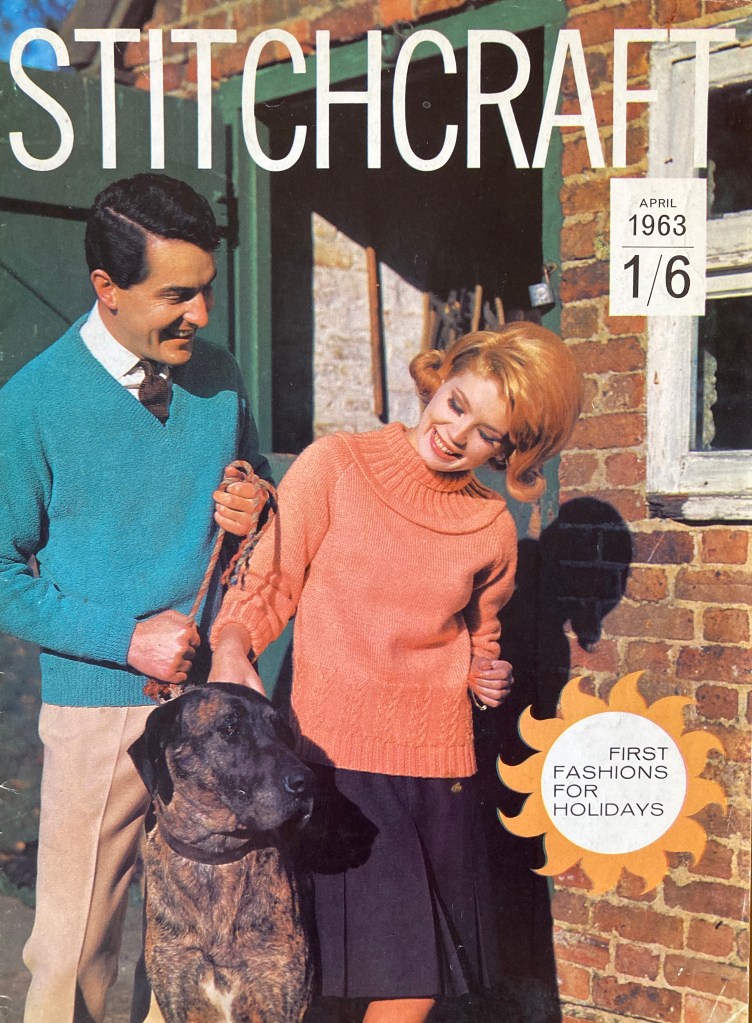
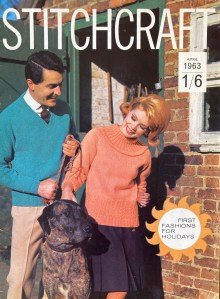
Cover photo, Stitchcraft magazine, April 1963

First Fashions for Holidays! It’s almost always some sort of holiday season in these vintage knitting magazines — in this case, Easter and preparations for the summer. As the British climate makes it possible to wear thick, warm wool sweaters pretty much any month of the year, “holiday / not holiday” is less a matter of warmth or season and more about casual, easy-care garments to wear while “strolling” and sight-seeing, or projects that are small and simple enough that you can work on them while lounging in your deck chair. Or, as the facing page title puts it, “Sweaters off-duty.”

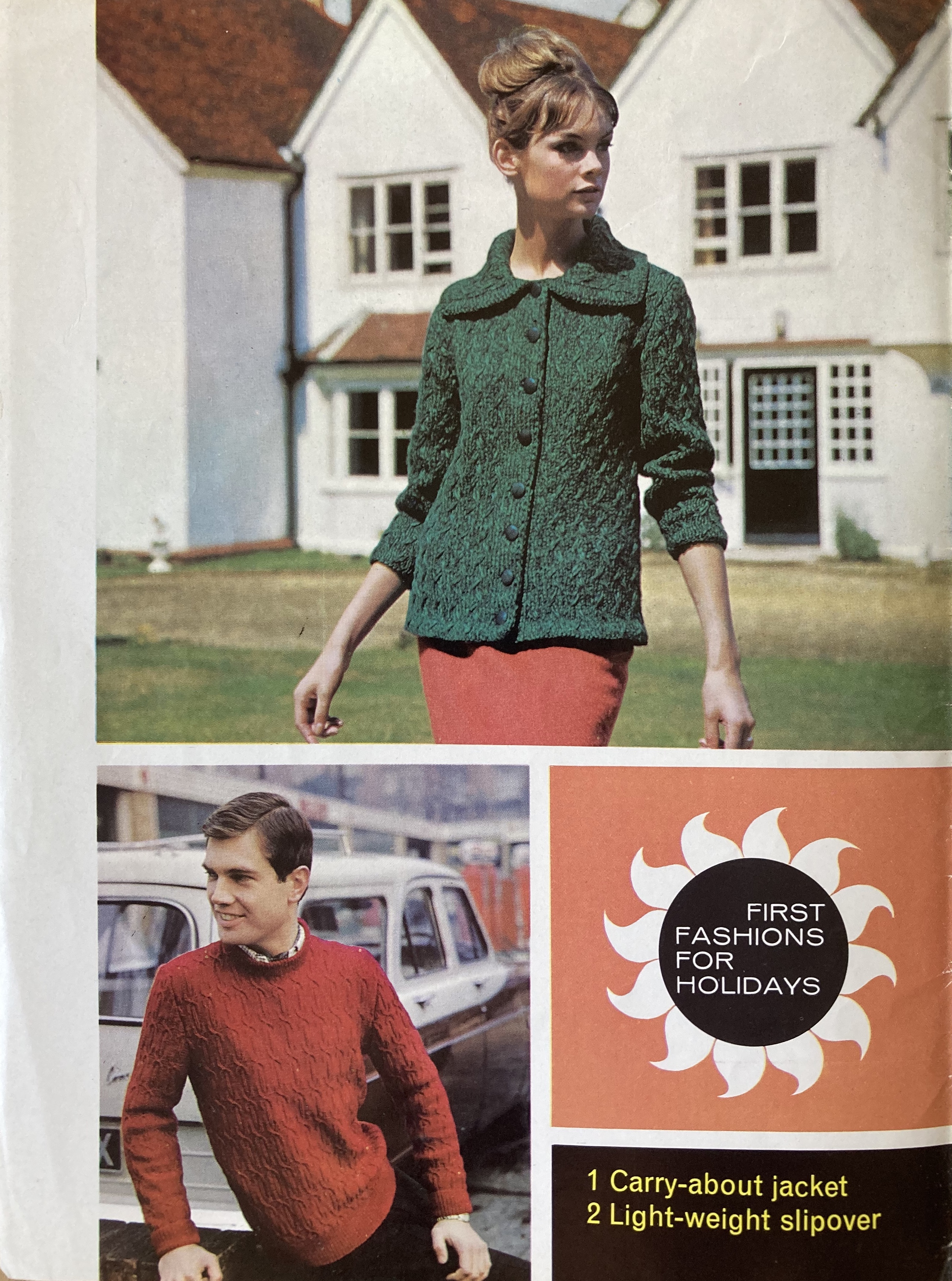
Thick, collared pullovers and cardigan jackets that can be worn as outerwear make up the bulk (-y) of the garments in the first category, many of them made in Patons Big Ben wool at 3 1/2 stitches to the inch. The tweedy, dark green jacket on the inner front cover is a good example of this and features an intriguing wavy slip-stitch pattern. The “Italian” tunic on the inner back cover has a knitted-in border pattern made of beads. DK-weight wool is used for the women’s round-yoke sweater on the front cover. Hip-length is the fashion for everyone, wide collars continue to be in style and decorative borders near the hem are the new spring trend.

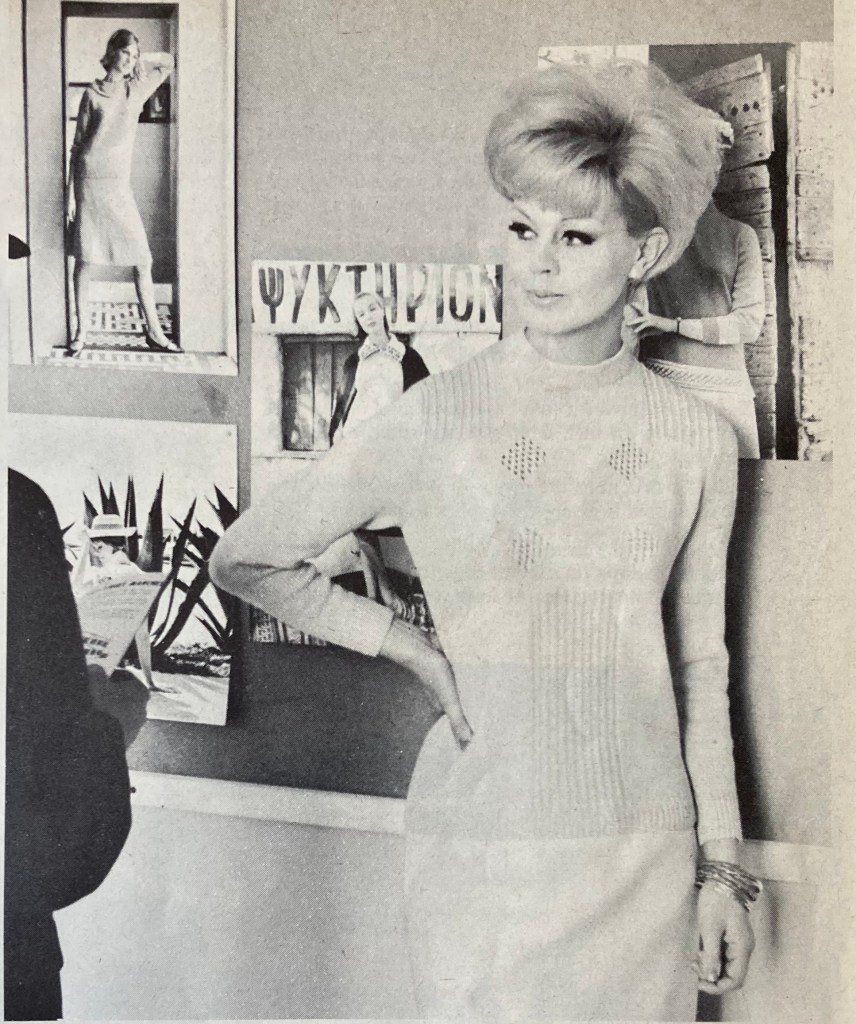
There are fashions in finer-weight wool as well, “for elegant summer wear”. The red men’s pullover on the inside cover and the women’s Nylox pullover both have interesting stitch patterns, though I feel like the placement of the inserts on the women’s pullover could go horribly wrong a little too easily. If your man finds cables too exciting, you can knit him a plain V-neck pullover in bouclet wool and match it to your own fluffy mohair-mix jacket, made in Patons’ best-ever-named wool, “Fuzzy-Wuzzy.” Colours are strong and bright, including some very springlike salmon and turquoise.

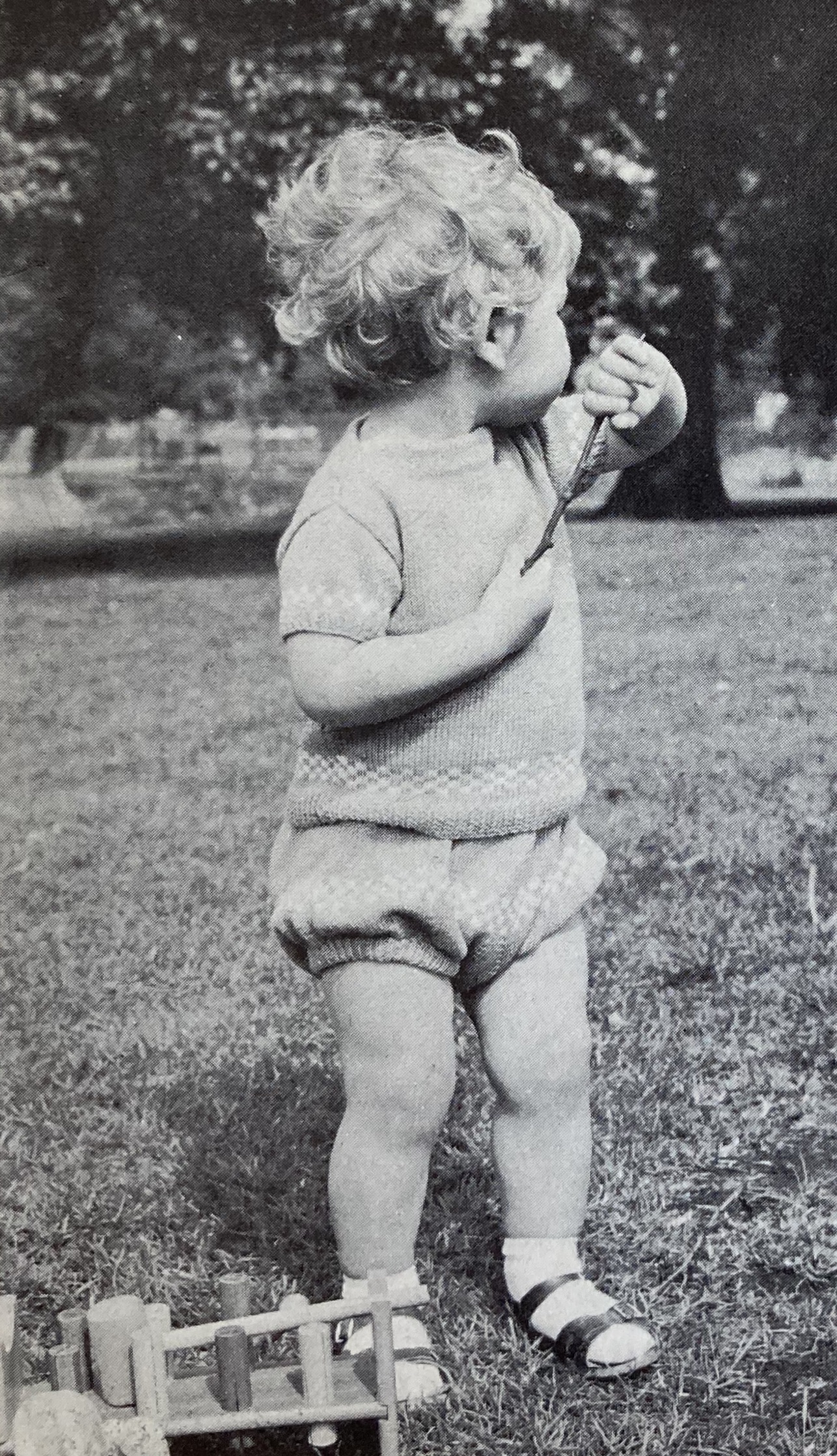
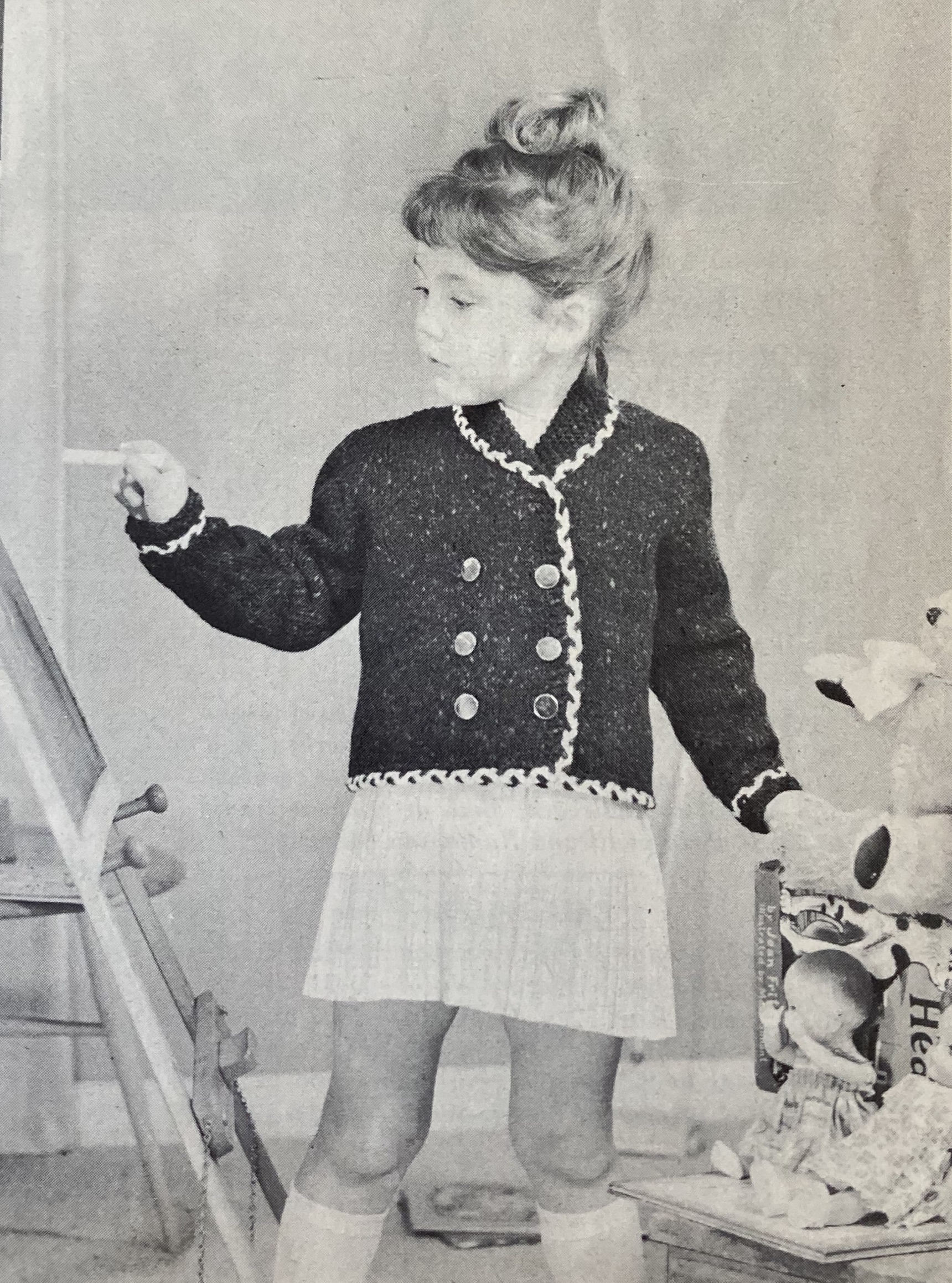
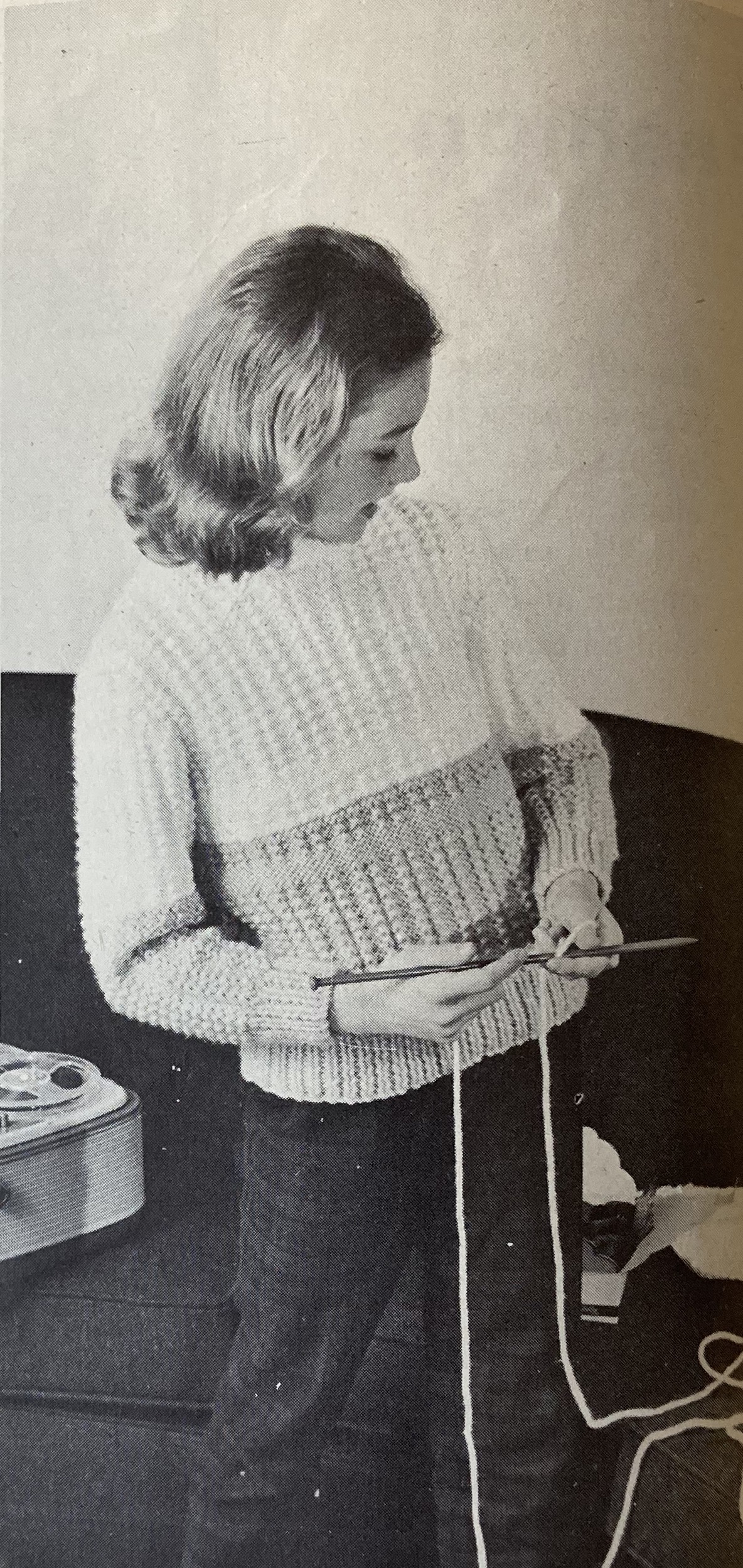
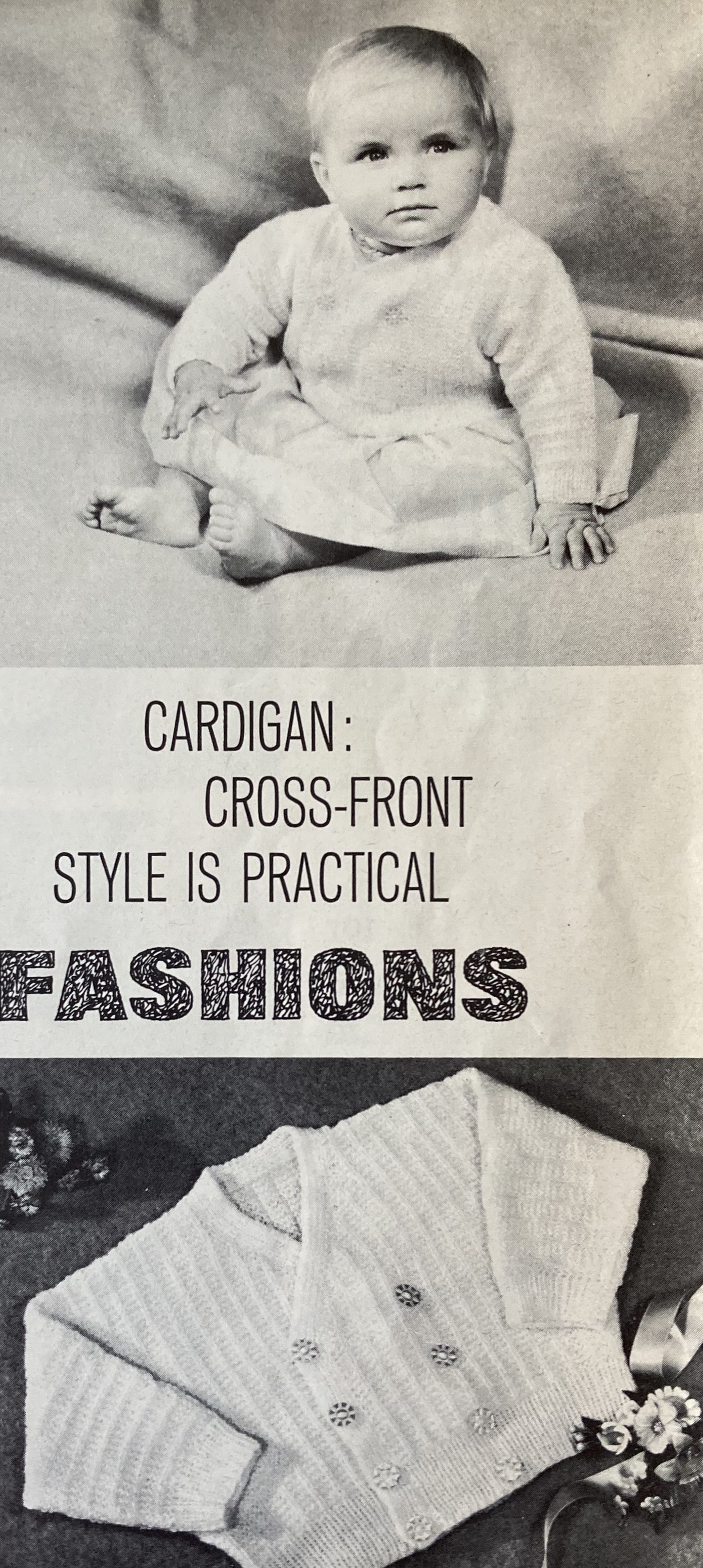
Fashions for the younger members of the family cover all age groups: a dolman cross-front cardigan for the baby, a play-set for the toddler, a “miniature Paris blazer” for small and medium-sized children (she’s painting a picture on a easel, so you know it’s Parisian!) and a quick-to-make “chunky” pullover for “sub-teens” which is easy enough for a bigger girl to make for herself. (I don’t think the young model in the photo actually knows how to knit, though.)

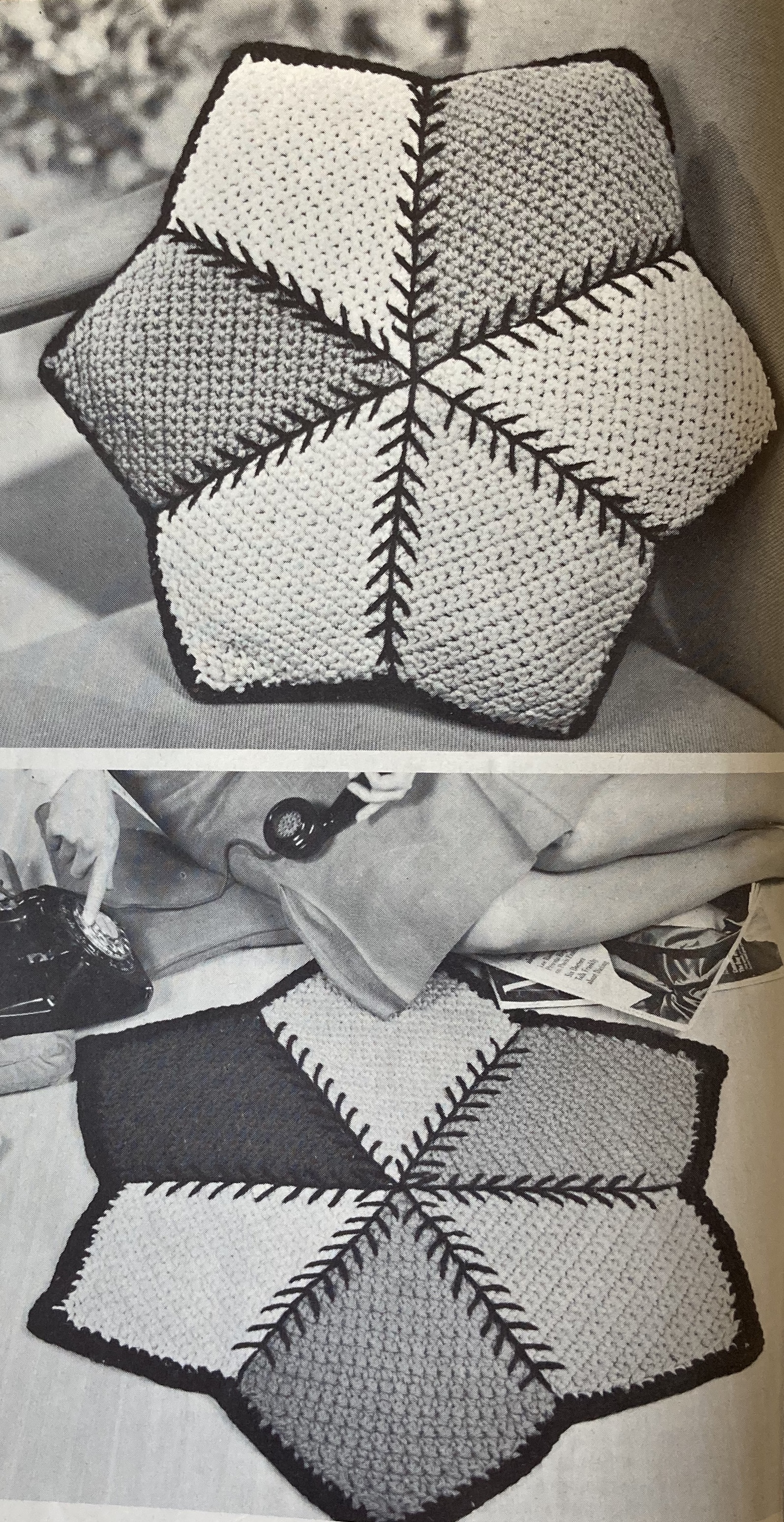
With all that pre-holiday prep knitting, the homewares in this issue are generally unspectacular. There are chair sets in counted cross-stitch, a crocheted cushion and rug for the older daughter to make for her room, and a tapestry tea-cosy. The two more interesting projects are these corded crochet mats and a wonderful cushion with a design of butterflies, made in blackwork embroidery. Unfortunately I’m not good enough at crocheting to really understand how the “corded” look on the mats is achieved, besides the fact that there are a lot of picots and crocheting many stitches into a ring. Oh, and there are embroidered table mats, too, featuring line drawings of famous parks. I like the white-on-black effect — something different.

That’s it for this issue! The ads are pretty normal and in the comic, Miss Muffet continues her adventures, getting magically shrunk down to the size of an insect in order to go flying with a nice beetle-lady. I’m afraid the dragonfly might have dropped her into the lake, though! Oh no! How will it end?

My project for this month will be the embroidered butterfly cushion. Happy Spring!

February 1963: Overview

This month’s issue brings us on another lovely photographic journey, with “elegant settings for Spring Fashions” in and around historic Bath. Looking closer at the photos, it’s clear that some thought went into the combinations of outfit and setting. The “city” photos show models in elegant knitted dresses or suit-like separates, whilst the “country” photos highlight the continuing trend for casual, bulky garments that could theoretically be worn as outer garments instead of a coat in spring weather.

Our cover model starts off the “city” look with a fur-trimmed dress in “Ariel“, a bulky, yet airy triple-knit wool-acrylic blend. It’s advertised as being “light as thistledown” — the whole dress uses 14, 15 or 16 2-ounce balls of wool, which comes out to about 550 grams for the middle size stitch pattern. I’m guessing the diagonal slip-stitch herringbone pattern and ribbed, belted waistline also help control any sagging. The same yarn and same stitch pattern are used for a jumper-and-skirt set in a dramatic yellow and black colour combination. Look at that model’s hair! I always thought people with red hair should never wear yellow, but she looks amazing. Bobbles on ties feature in both the belt of the dress and the neckline of the jumper and skirts are still just below the knee.

Rounding out the elegant city category is a classic skirt set whose rectangular, unshaped form is made more elegant by the use of vertical lines on the cardigan. Bouclet wool in fingering weight keeps the effect sleek and light.

For casual country wear (a.k.a. “The Open-Air Look”), bulky Big Ben wool is still the first choice, or double knitting weight for a somewhat lighter look. Both the men’s and women’s garments are hip-length and unshaped and cardigans are mean to be worn buttoned. At the same time, interesting stitch patterns, textured wools and details like collars and pockets break up some of the shapeless-bulky effect. Even toddlers can join in on the fashion fun with a knitted bathrobe, which showcases many of the current trends (bulky “Ariel”, textured stitch pattern, contrasting collar and cuffs, and a bobble-tie belt) as well as being practical for chilly homes in February.

The homewares in this issue are mostly standard fare — cutwork or embroidered aprons, tablecloths or finger plates — but a couple of more creative ideas stand out. There’s a pile rug with a “modern” design, which I would have loved to have seen in a colour photo (note guitar and records — I did mention that the Beatles’ first album came out in 1963, right?) and a crocheted and cross-stitched bathmat that makes it very clear in which room it belongs (though I can’t help laughing when I think that this issue was also photographed in Bath — they could have had some absurd fun with the bath mat in front of the cathedral or one of the historic buildings…)

For tapestry fans, there’s a prayer book cover and kneeler “for an Easter bride” with a flowery cross pattern, using gold Lurex thread together with wool (kneeler) or silk (book cover) for extra luxury. There’s also a footstool made up of old tins! They used old stockings to pad and wrap the clean, empty tins, then stitched fabric around the bottom and sides and covered the top with the tapestry. The result is a bit oddly shaped, but I suppose it would be quite useful — strong and able to support a bit of weight, but still quite light — and I admire the creativity and the upcycling spirit.

There are no particularly interesting advertisements in this issue, but in the ongoing children’s retelling-of-fairy-tales comic series, Miss Muffet gets invited to the spider’s home, where Mrs. Spider shows her the lace curtains and tablecloths she has spun out of spider-silk and teaches her to spin a shawl. How sweet! Next month: “The Beetle-lady.” (Also: Note the ruler printed on the side of the page, to make it easy to check your knitting tension. It’s in every issue.)

I’m a bit at a loss as to what project to make from this issue. I love the “Ariel” cover dress and yellow sweater, but I have serious stash overflow and so, so many unfinished projects, so I would prefer to make something small and easy. I am not religious and would probably not have much use for a prayer-book cover or kneeling pad even if I were, but the flower tapestry design without the cross would be pretty and versatile, and I still have tapestry wool and backing fabric from an earlier failed project. The question is, what should I make out of it? A clutch purse? Coin purse? Cell phone cosy?? I already have so many little zippered bags for knitting tools and sewing notions and general “stuff”. I’ll give it some thought and let you know. If it’s easy enough, I will hopefully be able to finish up and edit some of the WIPs lying dormant in the blog. Stay tuned!

September 1962: Overview

Autumn is the nicest season for knitting, and 1960s Stitchcraft usually gave it a little push with extra pull-out supplements, extra colour photo pages, or “bumper issues” full of the latest developments in home-knitting fashion. The September 1962 issue doesn’t have any of these extra features, but it does have a wide variety of designs in mid-weight and warmer wools, starting with the chunky twisted-bobble sweater on the cover. Made in bulky Big Ben wool, it weighs in at a whopping 38 (for the smallest of three sizes, 35-36 inch bust), 40 or 42 ounces (the largest size, for 39-40 inch bust), i.e. about two and a half pounds or 1190 grams. I am guessing the model is quite slender and even she looks bulky in it!

The dresses and separates, made with the same loose fit but in double knitting wool, show a smoother look with minimal patterning. The orange dress in the colour photo and the charcoal-grey dress with the colour-pattern border (“for those who like something really eye-catching”) are the same design, but the pattern-border version is only available in one size, “for the younger girl.” I guess that pattern was just too exciting for doddering middle-aged matrons! The blue and white ensemble, also made in double knitting weight, has three pieces: a simple sleeveless blouse in white k2, p2 rib, a plain blue skirt and a back-fastening cardigan with white vertical stripes on the front. Tops continue to be hipbone-length and hemlines are firmly anchored just below the knee.

Other garments feature interesting colour and texture effects: the man’s “smart weekend sweater” has been treated with a teasel brush to achieve a fuzzy, felted effect. The knitter was not expected to do the brushing herself, but was instructed to “take all pieces at this stage [after knitting all the separate pieces, but before making the garment up] to your usual wool shop who can arrange to quote a price and send them away to be brushed for you.”

There’s also a striped jumper for “young and carefree” women with a fringed collar and hem, similar to the one in the February 1962 issue (yes, it is more or less the same pattern in different colours and with a split collar) and a pullover in an intriguing striped and dotted slip-stitch pattern. Stripes and/or slip-stitches also feature in the three-colour pullover for older children and the toddlers’ dungarees. Colours are navy blue or charcoal grey contrasted with white and neutral pastels, as we saw with the patterned-hem dress and three-piece ensemble.

There is the usual variety of homeware designs, mostly with floral patterns: this month’s flower is the dahlia, or you can sew and embroider and apron with lilac sprays. The leftover gingham fabric from “your” workaday apron can be used for cute animal appliqués on aprons for the children (unsurprisingly, Father seems to be exempted from the washing-up.) There’s also the usual floral cutwork tablecloth and tray cloth and a coffeepot set made in Hardanger embroidery.

Needlepoint fans can make a stool top or a whimsical cross-stitch rug and/or wall panel for the nursery, featuring characters from nursery rhymes. The motifs are separate and interchangeable and can be adapted for different sizes and purposes.

In the children’s serial comic, Peter the puppet has been freed from his marionette strings and is traveling throughout the countryside writing a play about his adventures. Cyril the squirrel helps out by painting illustrations, using his tail as a brush. (But how will Peter get home?) There’s the usual advertisement for Lux washing soap, guaranteed to leave your woollies soft and fluffy, and the latest instalment of the Patons and Baldwins’ “knit to please your man” series of ads, junior version: a teenage girl knits a “nice, husky sweater” for her boyfriend with her own loving hands to show everyone that he’s the “special one.” The young woman on the back cover ad is presumably also trying to catch a man, but she looks more polished in her snappy red dress and white gloves. You can really see 1960s style coming into its own in the straight or A-line sleeveless dress with low contrasting belt, the bobbed and fringed hairstyle and the edgy, off-angle mirror pose. Compared to the designs in this issue, it also shows how fashion-conservative Stitchcraft is.

I’m not sure what I want to make from this issue. I imagine the embroidered dahlias would make a great design for a laptop or tablet sleeve, but I already have a fine home-made laptop cover, not to mention this wonderful gay-geese-in-space tablet cosy. Also, I have probably done enough embroidery for the time being and still haven’t made much progress on this appliqué masterpiece that I started in July. The knit projects are all so bulky and loose-fitting, which is not my style, and I’m not sure I know an appropriately-aged child for the interesting slip-stitch pullover. There was also a perfectly nice, if not exciting baby cardigan (not pictured) in the issue which I could make quickly from stash, which would be useful enough (somebody’s always having a baby) and maybe the best choice for my uninspired mood. Stay tuned and find out!

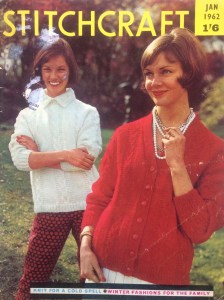
January 1962: Overview

IMG_3019Happy New Year, everyone! It’s 2020 in my real world and 1962 in my blog world. Where will Stitchcraft take us?

… Not very far, fashion-wise. The “Swinging Sixties” started later in the decade; 1962 was still definitely part of the “early” 1960s aesthetic, i.e. more of a continuation of 1950s styles. At the same time, new trends are pushing fashion in new directions, and Stitchcraft is (slowly) moving with the tide.  Fine-knit wool blouses have become rare and the bulky look is definitely in. Knitted suits are loose-fitting and give a rectangular silhouette. Accessories are becoming more experimental and fun, with “turret” and loop-stitch hats and oversized knitted or crocheted bags.

So, what does January 1962 offer us? The cabled sweaters on the front (and yes, that is the word that this British magazine uses: for Stitchcraft, a “jumper” is generally more form-fitting and finely knit, while a “sweater” is bulkier and more casual) can be made in Big Ben wool for the truly bulky effect in a pullover, or in double knitting for a more streamlined cardigan. The casual “his and hers” sweaters with a diagonal “v” stitch pattern are made in double knitting wool, but oversized and loose-fitting. There’s a “big and bold” shortie dolman for teenage girls and you can knit matching, you guessed it, bulky, oversized pullovers for “the menfolk” of the family.

There’s a casual suit in Bracken Tweed wool, highlighting the new fashion for multicolour, heathery tweed yarns. It too is meant to hang loosely, and the collars, cuffs and borders are knitted in a complementary colour that picks up one of the tweed undertones. The only fine-knit garment in the issue is a lovely twin set in 4-ply Cameo crepe wool, and even it is mostly unshaped — quite unlike the twin sets of the 1950s. Children can get a nice warm play-suit in stranded colourwork.

In the early 1960s, Stitchcraft liked “year-round” embroidery themes, with a different versatile small design each month. At the end of the year, all the transfers were made available as a set to be used together on a tablecloth or larger project. 1962’s theme is “flowers” — more conservative and less original than the previous “Zodiac” theme. Still. the narcissus design is pretty and elegant. The bathroom mat, flowery “peasant design” tablecloth, Victorian tapestry and knitted doilies are pretty standard fare and the knitted clown with flags stuck in it like a voodoo doll is predictably terrifying — seriously, do not look at the photo if you have a clown phobia, it will give you nightmares.

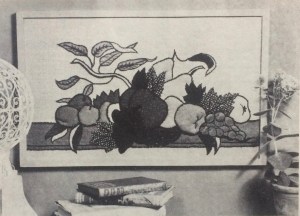
To clear your head of that image, you can make a wall hanging — a still life of fruits and vegetables done in padded appliqué for a three-dimensional effect.

IMG_3027

All in all, Stitchcraft‘s 1962 starts with a whimper, not a bang. Still, there are enough nice designs that it’s hard to pick one. I love the twin set, but could also use a nice, normal cabled V-neck cardigan in double knitting, and the toddler’s playsuit is probably fun to knit. I’ll let my local yarn shop decide, i.e. see what they have in stock that says, “Use me for this project.”


February 1961: Overview

fullsizeoutput_943-1

Around Christmas time, I was looking through my Stitchcraft collection to see what the new year had in store for me, and realised that the February 1961 issue was missing! Not that I had lost it, but it was one of the very few issues from the 1960s that I had not managed to find before starting this project. I buy the magazines on ebay and it is fascinating to see how some issues pop up again and again in multiple auctions, and others just never appear. But I was in luck – after searching so many times, there was February 1961, just when I needed it! Thank you, nice seller on ebay, who got this issue to me quickly and in beautiful condition.

fullsizeoutput_933

There’s a “Special Colour Feature” of extra colour-print pages in the middle of the issue, promising “Fashion Harmony” for “You and the Home.” With that in mind, it’s kind of a pity that they chose a neutral gray-beige melange for the three-piece outfit on the cover.

Thicker, bulky wools and quicker knits continue to dominate the knitting patterns, with Big Ben playing a prominent role. There’s a little waist-length jacket in an interesting pull-up-a-slipped-stitch-some-rows-later stitch pattern, a bulky cardigan or DK- weight pullover in diamond or rib pattern, and a his-n-hers Aran pullover set. Neutral colours of brown, beige and tweedy gray prevail.

The his-n-hers, unisex design idea shows up in the children’s patterns as well (how nice, for once!) with some warm, lightly colour-patterned pullovers. It’s nice to see a girl wearing trousers and doing something active in her sweater.

(Side note: As I was typing that sentence and got to “it’s nice to see a girl wearing”, the auto-suggest on my tablet offered me “makeup.” So yes, as nice as it is to see one single non-sexist knitting pattern in 1961, don’t be fooled — things haven’t changed nearly as much as they should. Also, spoiler: the rest of Stitchcraft has plenty of “boys need to be active! girls like to be pretty!” patterns and photo layouts in store for us.)

On that note, there are patterns for a complete set of doll clothes, as well, in case readers worried that their girl child playing with a ball once in her life might, I don’t know, make her grow up to direct a bank someday, or something.

But back to this month’s issue! Babies get a fluffly cardigan with the same twisted ribbing as January’s snowflake sweater as well as a lovely lace shawl. Fine-knitting fans can make an elegant, classic jumper at 8 1/2 stitches to the inch or a lace-panel blouse for larger sizes up to a 45 inch bust.

Embroidery experts can make a floral fireplace panel or a tablecloth with a “peasant” motif (not the most flattering wording, I know), a rug or a crocheted handbag. The Zodiac handcraft theme has entered the month, if not the Age, or Aquarius. Also, the turret tower look is still all the rage for hats.

And that about wraps it up! Seeing as there was so little actual colour in the designs from the special colour feature, here’s the back cover advertisement for Escorto Gold Seal striped and checked fabrics. My project will be the baby cardigan. Have a colourful February!

fullsizeoutput_93d

January 1961: Overview

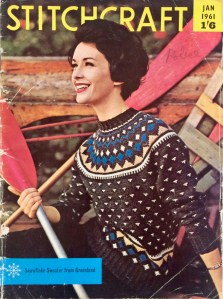
IMG_2256Happy New Year 2019! Or 1961, if you prefer. January 1961’s issue “starts with a swing” with “lots of colour” and “tip-top designs” like the gorgeous Greenlandic-style sweater on the cover.

Looking through the issue, I feel like this is the point in time where the 1960s started, fashion-wise. The closely-fitted, fine-knit, waist-length jumpers of the 1950s have made way for bulky, quick-to-knit garments, and nylon-mix wools like Rimple are more common.  Skirts are still long and hairstyles modest — we’re not in the “Swinging Sixties” yet — but colours are bolder and the whole look seems fresher, somehow.

The little girl’s outfit on the inside cover definitely embodies the new look. Yes, her legs are still going to freeze, poor child, but her little red Rimple outfit is swingy and fun. And look at that wonderful cap and muff! The decorations are made by cutting the bobbles out of a length of bobble fringe and sewing them onto a crochet chain made in contrasting green or red wool, then sewing the bobble chain onto the cap and muff. Mum and daughter can both sport the latest in “Paris Hat News”, which seems to be a sort of turret tower worn on top of your head. The loops on the bottom part of the adult hat are made by pulling loops through the knitting ridges with a bodkin or blunt tapestry needle and holding them in place with your thumb until they are all made and the wool fastened off.

Women’s and men’s fashions feature loose-fitting garments in bulky wools, either hip-length and unshaped like the Greenlandic sweater or the embroidered Viennese cardigan on the inside back cover, or “cropped and bulky” like the “slick jacket” made in thick Big Ben wool. For a more elegant look, you can knit a suit in double knitting weight and top it with a detachable fur collar.

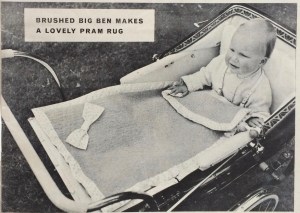
In addition to the little girl’s sets, babies and children can enjoy a warm cape or dressing gown in Rimple yarn, or a pram blanket in brushed, bulky Big Ben wool. The brushing felts the wool for a true blanket effect. It was done with a teasel, which is a metal brush that breaks up the fibres and lifts the nap of the fabric. Readers are instructed to send the finished blanket to Patons and Baldwins in Scotland, who will brush the blanket for you “at a very reasonable charge.”

IMG_2263

Jacobean embroidery, stitched hall rugs, and Victorian-style chair seat tapestry remain steadily in fashion, or you can embroider pictures of a kitten and puppy to hang on your wall. I don’t know about you, but to me they look kind of melancholic! This month’s Zodiac sign is Capricorn, and you can use it to decorate a pyjama case. In the children’s features, Wag and Wendy have tea with a toadstool fairy and kids can sew a simple tea-cosy set for their mother’s birthday.

My project will be the fabulous sweater from the front cover. I’ll be modifying the fit, though, as big and bulky is not my style. Thanks for joining me for the first year of this blog, and best wishes for 1961 — er, 2019!