October 1963: Overview

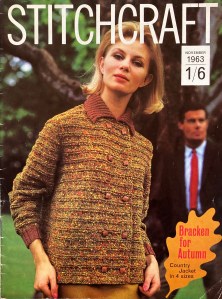
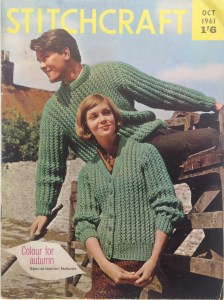
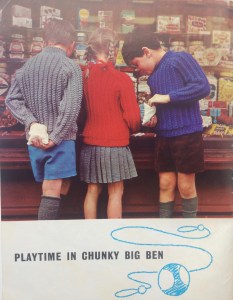
Cover photo, Stitchcraft magazine, October 1963

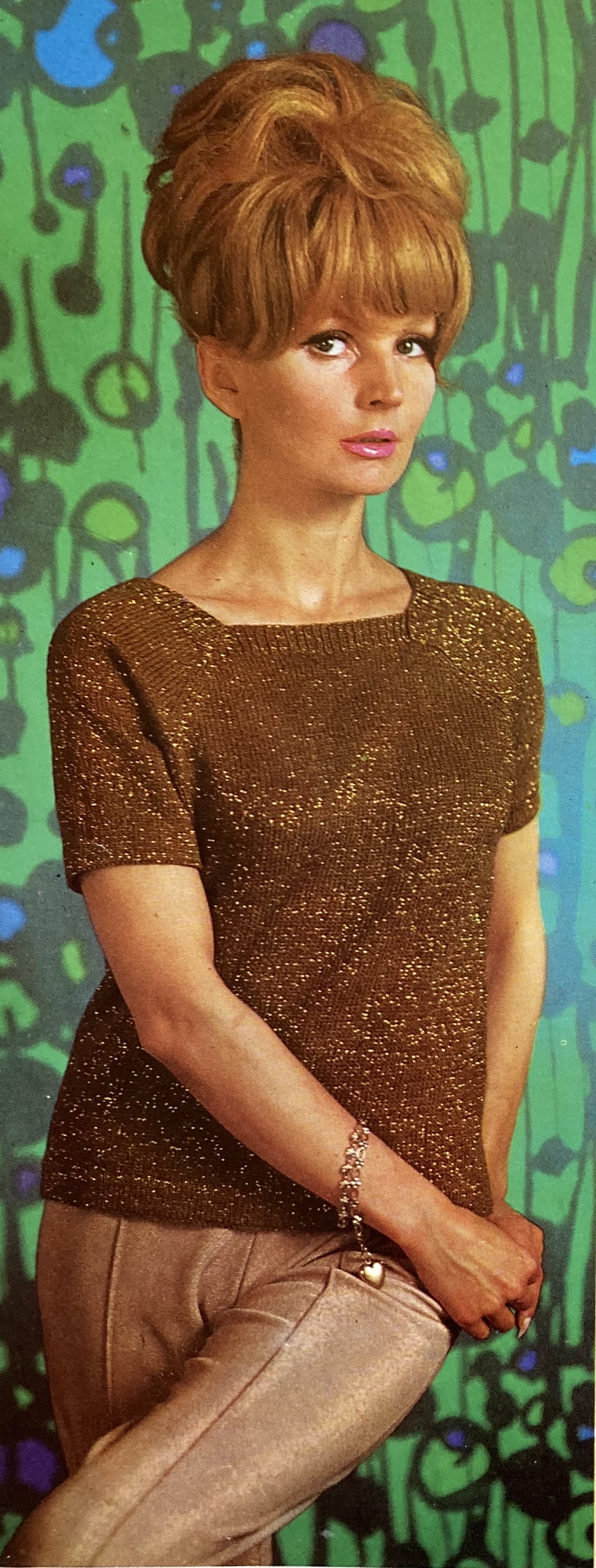
Tweed! Remember last month’s post with the advertisement for variegated-colour yarn? This month’s issue presents Patons’ new variegated wool, “Glenora Tweed”, a slightly thicker DK-weight wool with dark tweedy flecks. It appears to have been made up of 80% wool and 20% synthetic fibre. The twelve colours were chosen to be as vibrant as tweed can be (and very 1960s…) with rich shades of red, green, orange and yellow.

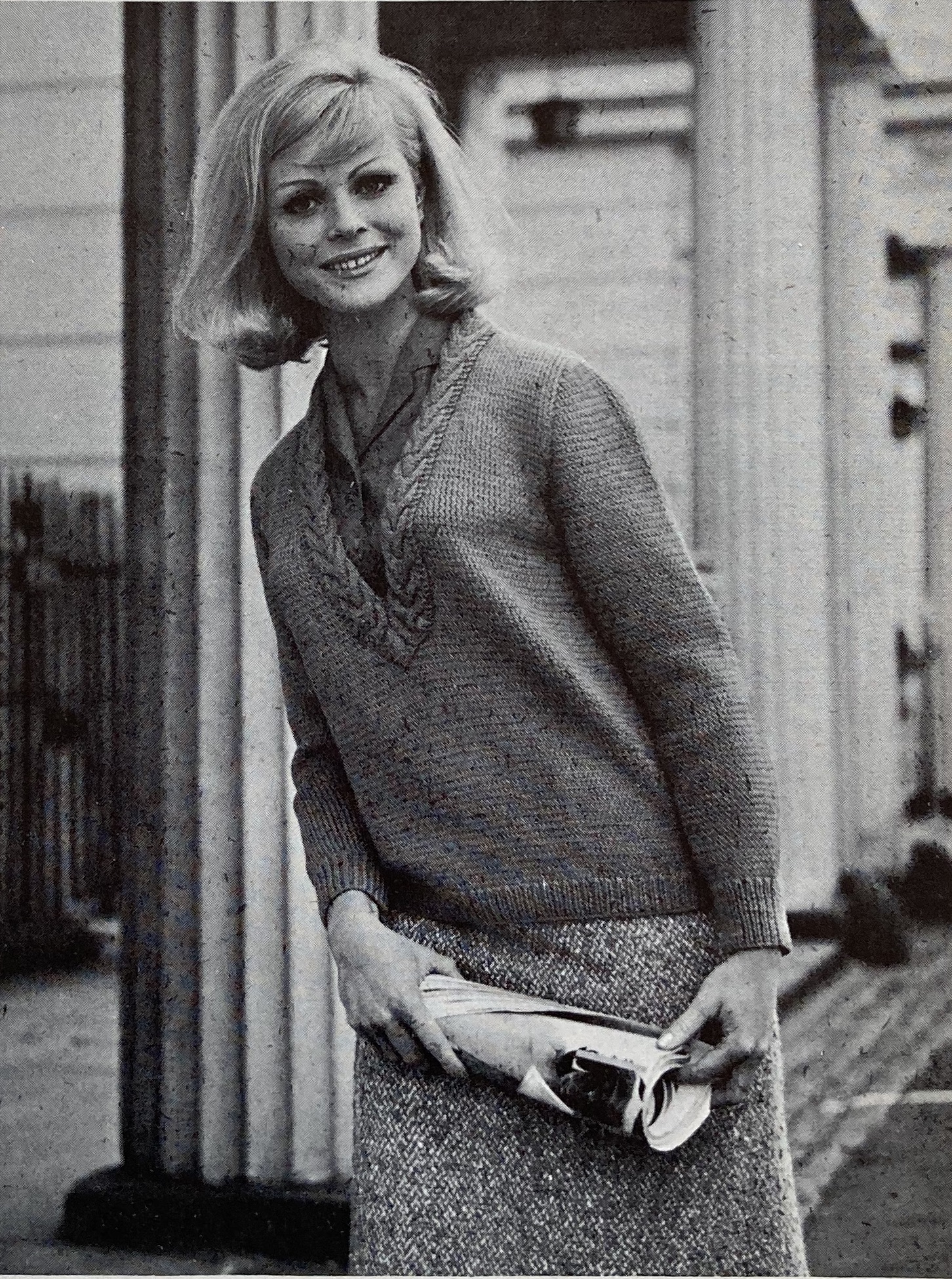
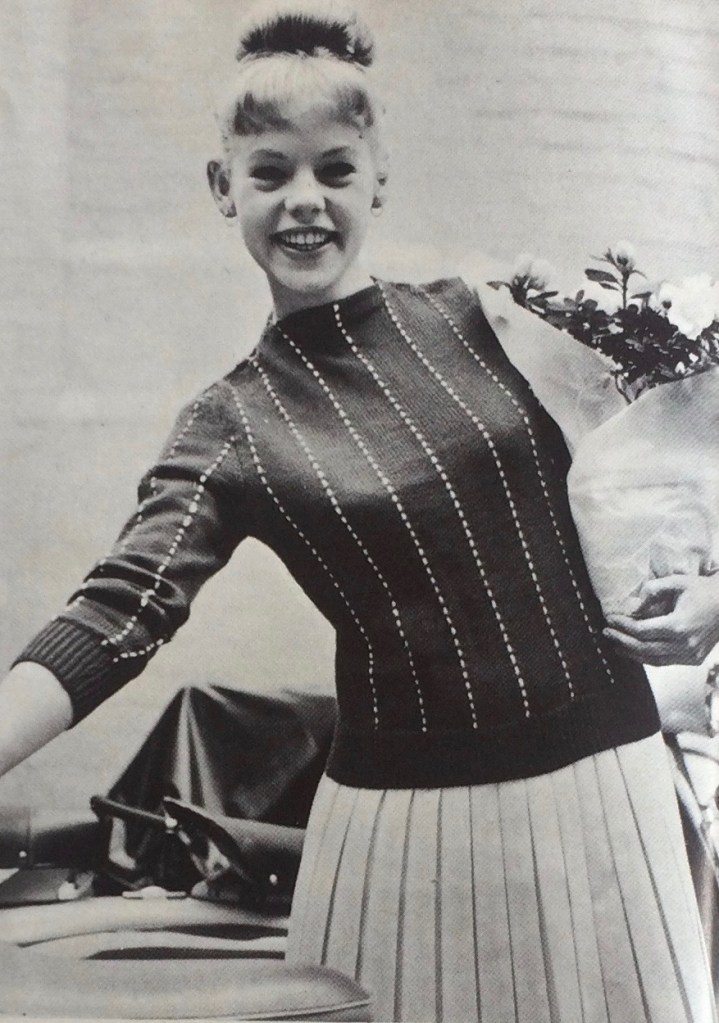
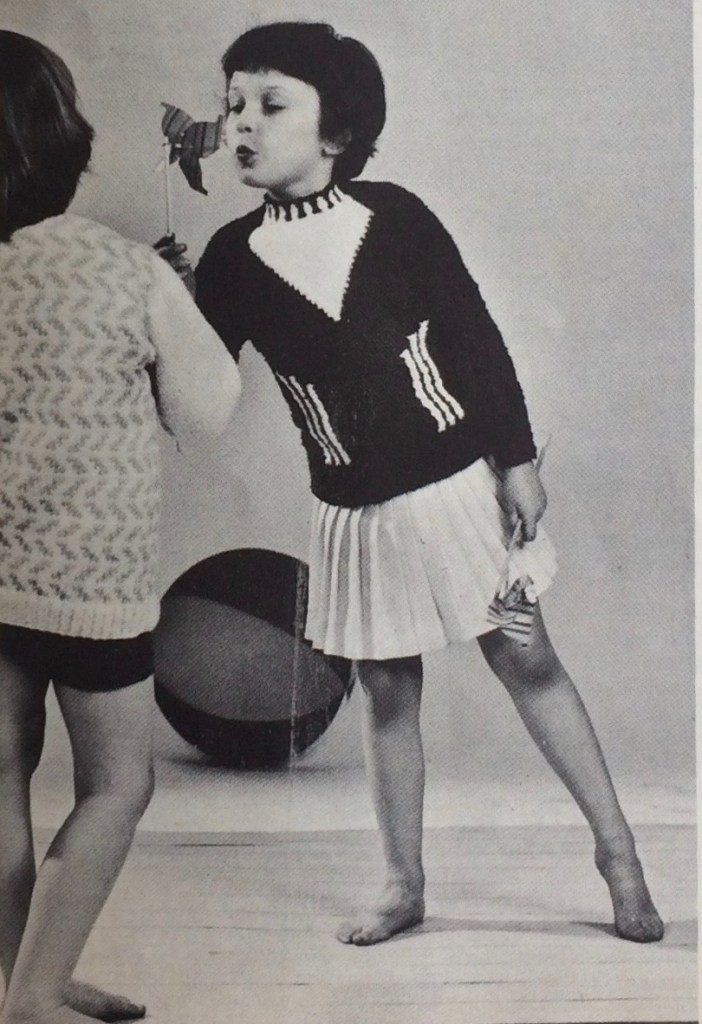
As it knits up fast at about 4 stitches to the inch (but promises to still give a “beautifully firm crunchy texture” i.e. hopefully not sag too much under its own weight), it is showcased with larger garments — the “pinafore-style” over-dress and men’s cardigan shown on the cover and two two-piece suits for women. There’s also a pinafore-style overdress with pleated skirt for a older girl and a boatneck sweater for men, both in similar Bracken Tweed wool. In keeping with the newer, looser and more square-shaped style, the garments have minimal or no shaping (except the girl’s outfit) and the skirts come to just above the knee. To me, the women’s Glenora garments look so similar that I had to check twice to assure myself that the pinafore dress on the cover (with high scoop neck) and the two-piece set with skirt and “overblouse” (V-neck) were in fact different designs.

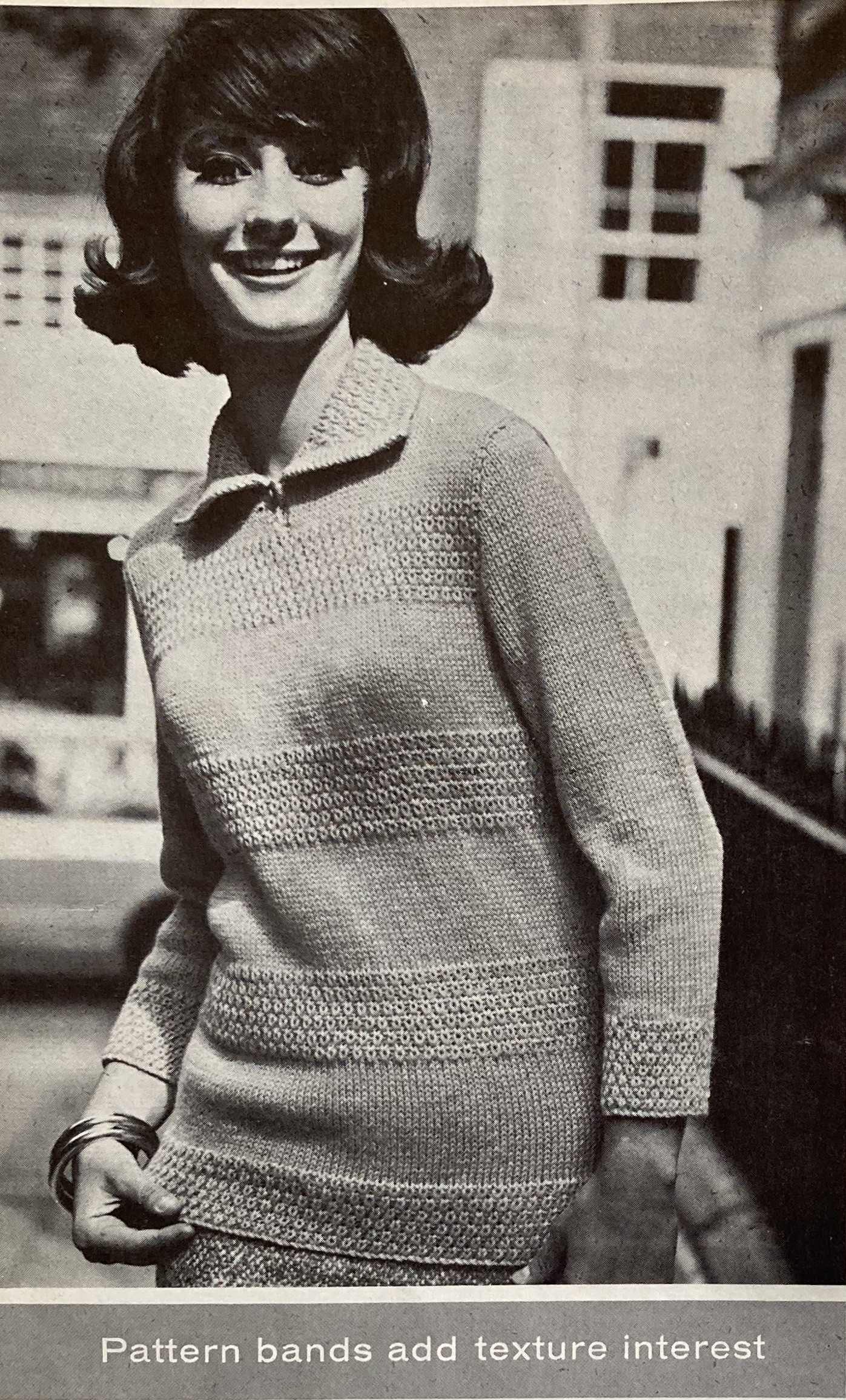
There is a matching 4-ply (women’s) or DK-weight (girl’s) jumper to go underneath the pinafore looks or the overblouse, which, combined with the thick over-garments, must have been suitably warm for outdoors or poorly heated rooms in October. (The girl, of course, is going to have cold legs all the same.) For those who resist the tweed craze, there’s also a bright, fun colour-block sweater in a three-colour slip stitch pattern. I love the matching orange head scarf!

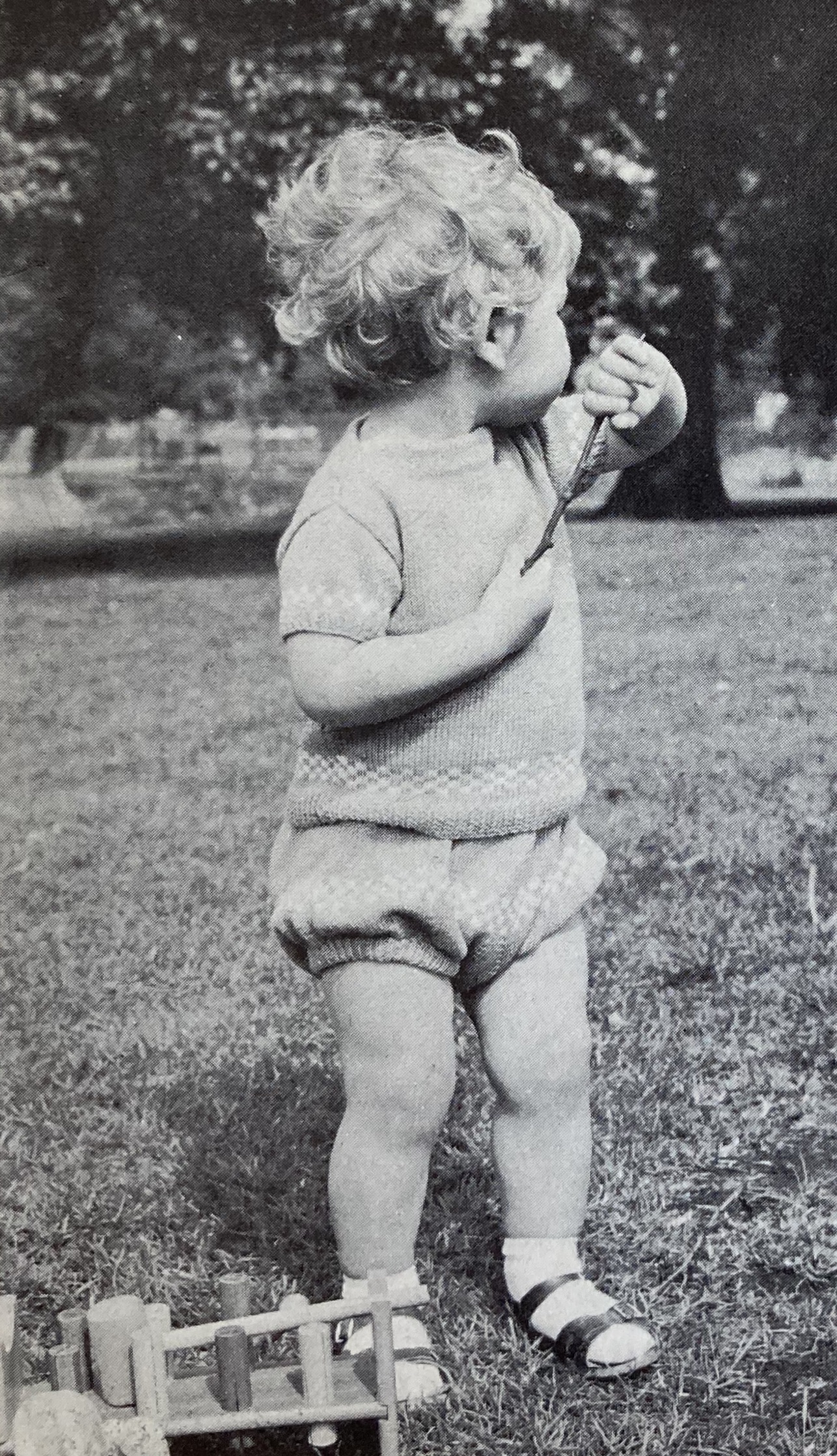
There’s also a fun 4-ply jumper for a child with some easy stranded colourwork blocks at the waist and yoke. The accessories continue the bulky, easy-to-knit trend, with a cap and scarf in Big Ben wool and a big, cosy scarf for men in an intriguing reversible cable-moss pattern.

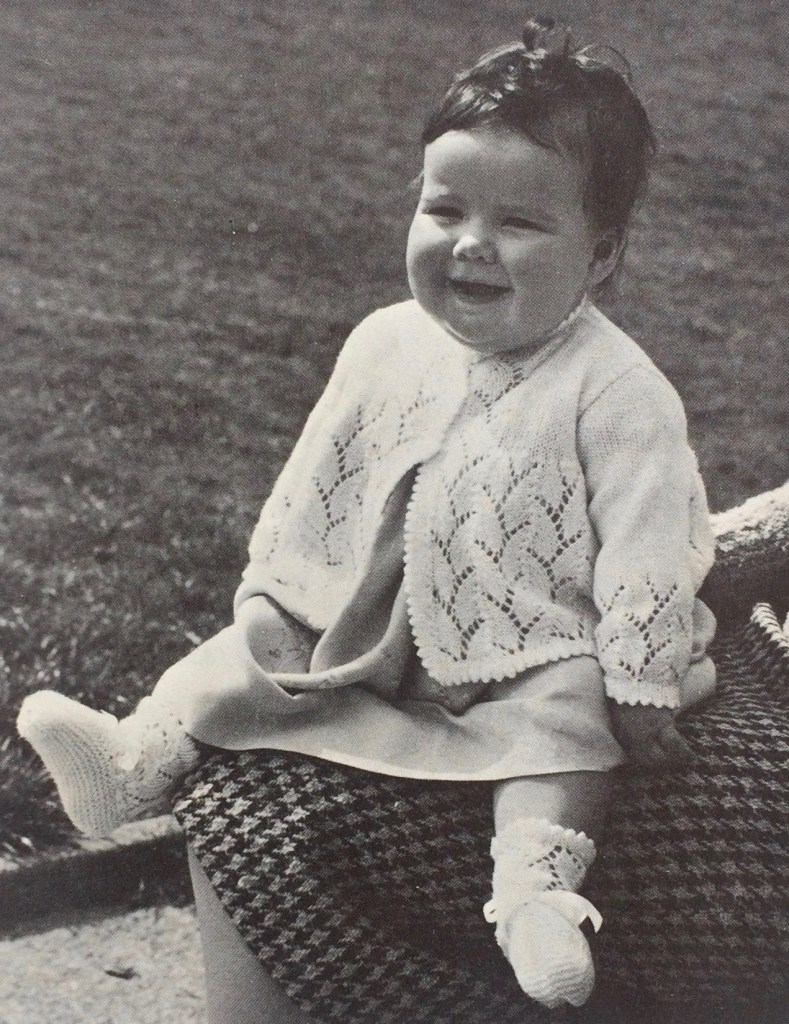
Rounding out the family’s fall wardrobe is a matinee coat and “helmet”-style cap for a baby, matching the dress from the September issue. The November issue promises a warm shawl to match again, thus rounding out the set. Judging from the photo, “dear little baby Alicia” seems to have realised that the purpose of a helmet-style cap is to prevent the baby from removing it and flinging it around the room, and is suitably disappointed. It’s a great design, though, with the sides and chin strap done in garter stitch to accommodate movement and growing heads.

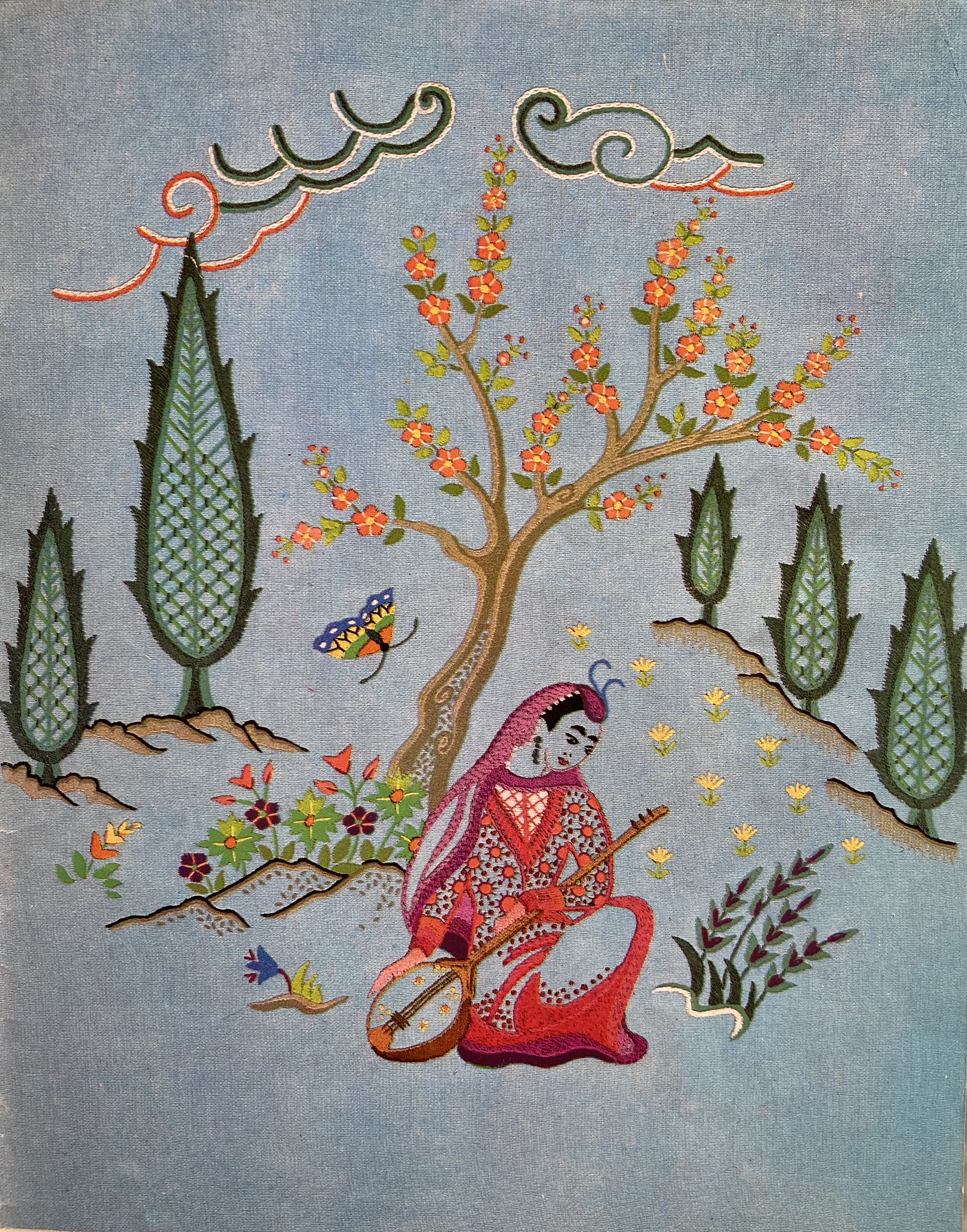
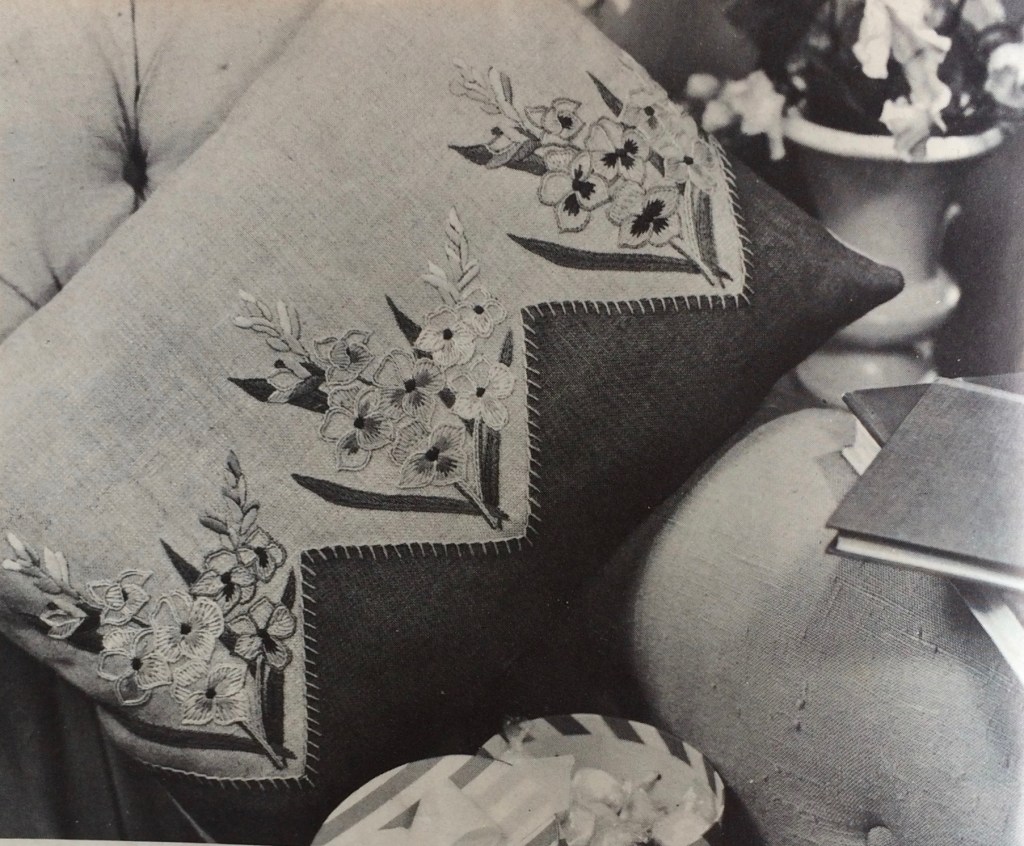
The homewares are plentiful and here again, there are some larger projects to be tackled at home during the colder Autumn days. The bright red rug in Soumak stitch and traditional design is vivid and cheerful, as is the Jacobean cushion “for the skilled needlewoman” which I would love to make if I didn’t already have two unfinished embroidered cushions in the WIP pile. (Not to mention that I am not skilled enough to make that elaborate a design, especially without a transfer.) The Autumn-themed acorn cushion is definitely easier. There’s a Regency ribbon design for tapestry or cross-stitch, too.

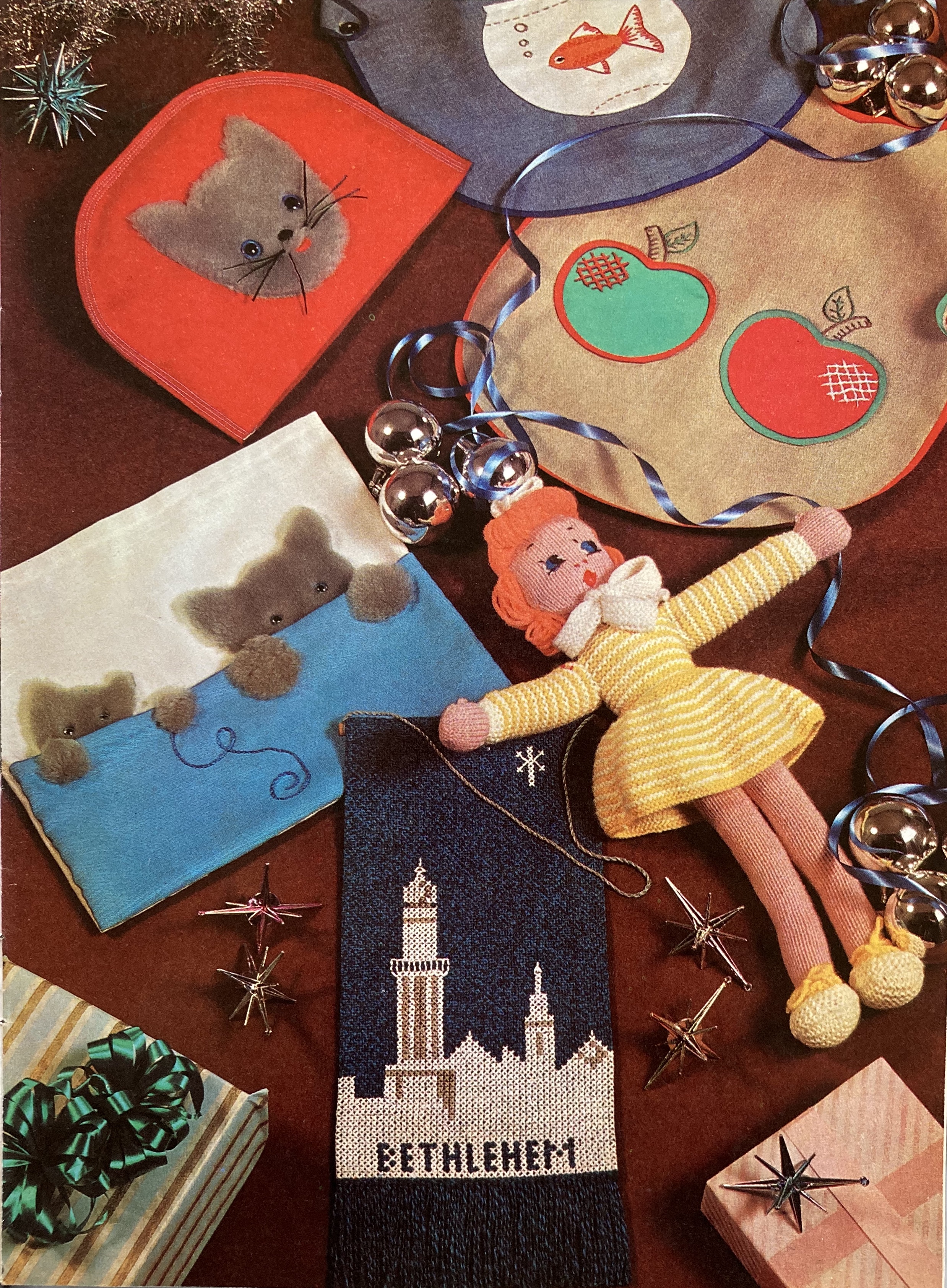
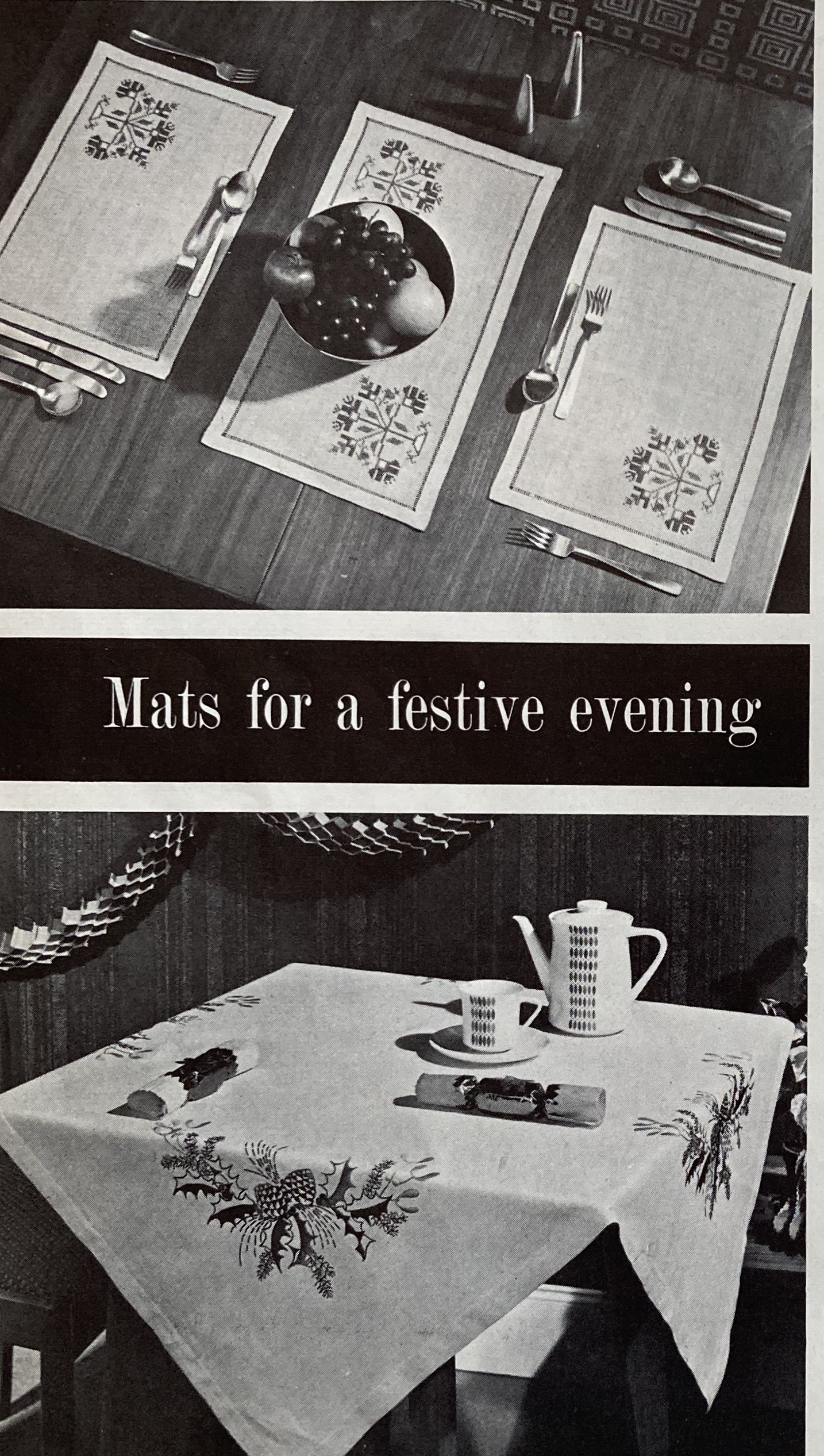
For those who want a quicker, easier homeware project or are already getting started on the Christmas presents, there are more embroidered acorns on cutwork mats and some knitted and crocheted goodies: a “Scottie-dog” night-case, a crocheted bag, and… a hippo, yes, a friendly knitted hippo stuffed animal. Well, why not? It’s cute. An older child might embroider her own Little Miss Muffet picture in cross-stitch.

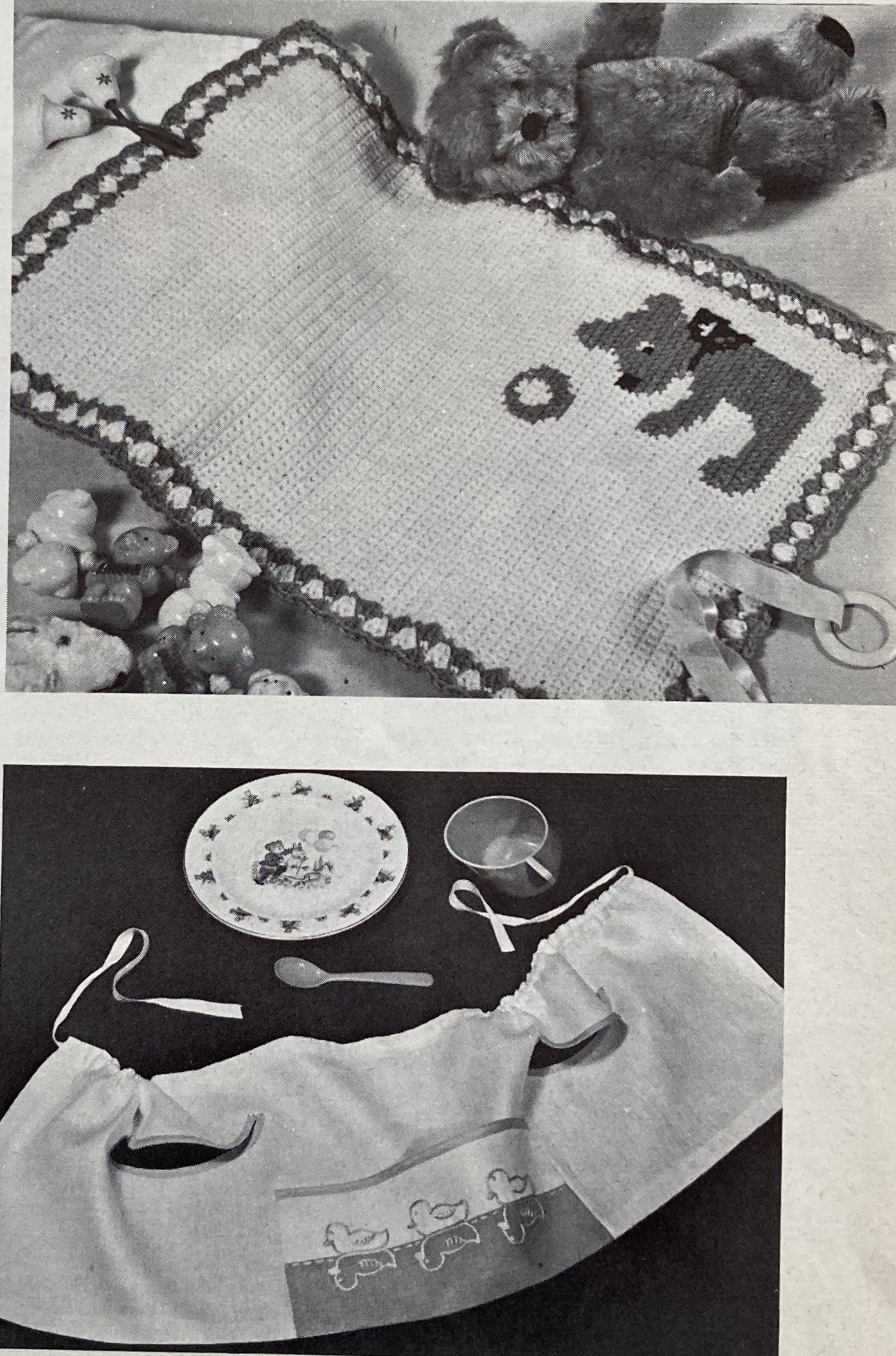
The very last project in the issue, tucked way back in the “Readers’ Pages”, is the one I will make. In fact, I have been waiting for this issue to come up specifically so that I can make it! It is a very simply constructed and embroidered “Apron-cum-Knitting-Bag” where the front panel and waist ties of the apron fold into the bag part along with your knitting. Pull the drawstrings closed and carry the bag around, then when it’s time to knit you can undo the strings, pull the apron part out of the bag and tie it around your waist, Presto, you are ready to knit in any situation, standing or sitting, and your ball of wool will not fall down and roll about the room. Stay tuned for a project that will actually get finished on time, as well as progress on those projects that didn’t.

September 1963: Overview

Cover photo from Stitchcraft magazine, September 1963

“Knitting Time starts with a Sparkle” is Stitchcraft’s motto for the September 1963 issue, and the editress’ note assures us that “this is going to be a particularly interesting Autumn-Winter knitting season.” What does that mean for us? Lots of interesting use of bolder colours in traditional or not-so-traditional stranded and geometric patterns as well as subtler use of colour variation in tweeds and toning changes.

1963 was the year when variegated yarns, so beloved by modern knitters, first came into fashion (hence the “sparkle”), and although Patons doesn’t yet offer a truly colour-variegated yarn, here’s one from the competition: Bernat Klein No. 1, as featured in this stunning eight-page advertisement in Vogue Knitting Book No. 62 from 1963:

(The Lux and Opti-lon ads should look familiar to Stitchcraft enthusiasts as well.)

The tweedy look starts with the three-piece suit from the cover photo, consisting of a skirt, long-sleeved jumper and high-buttoning cardigan with stripe accents to bring out the lighter blue tweed flecks. Apropos “fleck”, that’s the name of the yarn: Totem Fleck. The jumper is made in the lighter, solid blue color with ribbing accents in the tweed shade. It seems to be a “switch-around” ensemble, i.e. you are not intended to wear the cardigan over the jumper as you would with a twin-set. Bracken Tweed, the somewhat bulkier tweed wool of the season (Totem Fleck is DK and Bracken is more like Aran-weight at 18 sts to the inch), is featured in this blazer “for young men who like comfortable clothes”. You know, the kind of clothes you can play ball sports in: a button-up shirt with tie, short wool trousers and a hand-knitted tweed blazer. Of course.

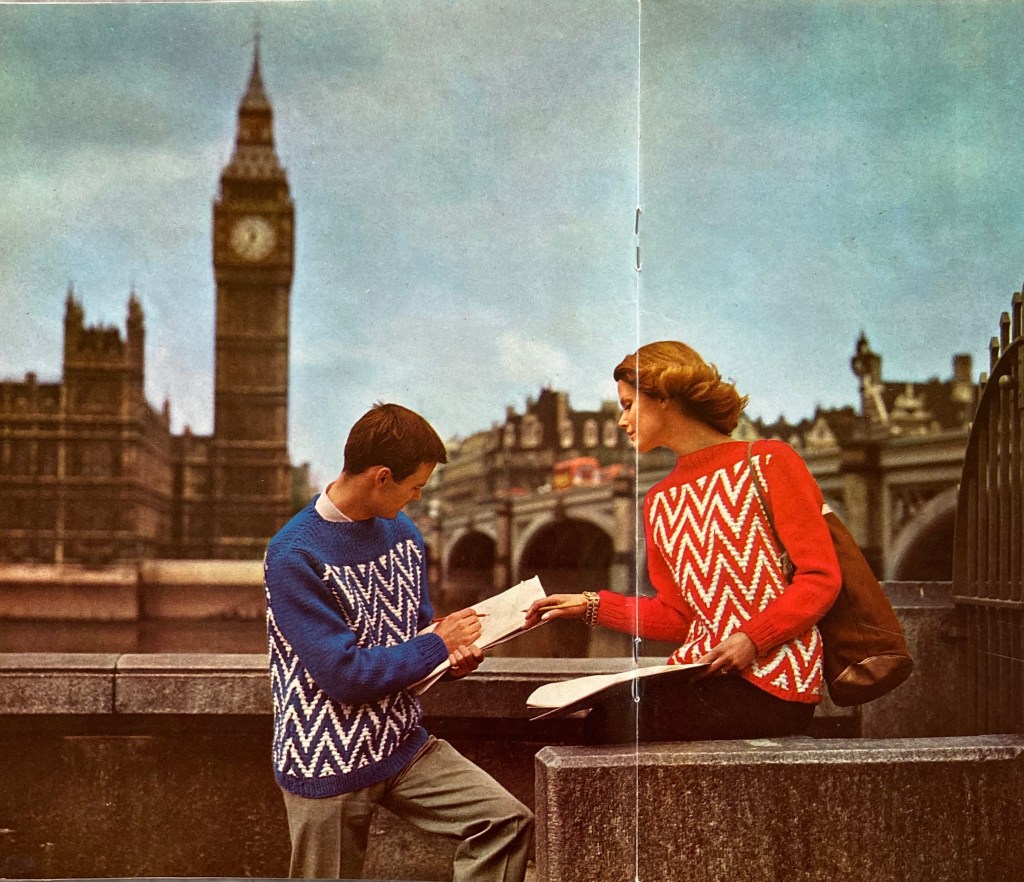
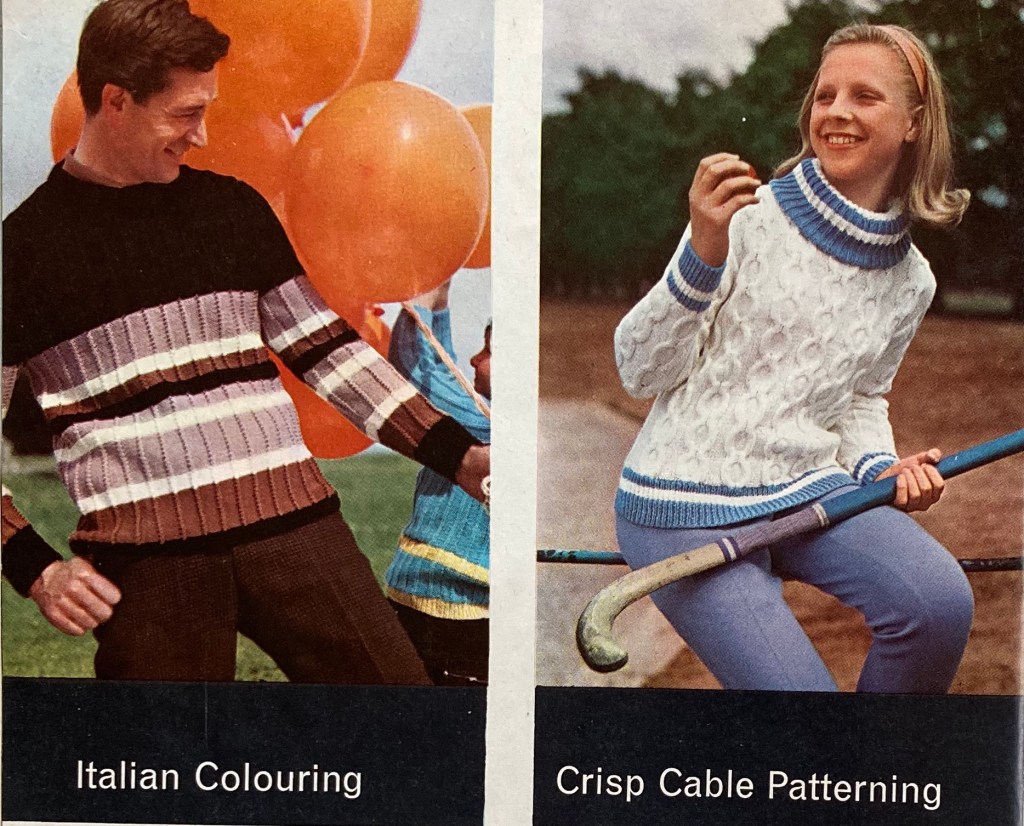
The other adult or teen garments feature bolder colours and interesting stranded or textured designs, like this intriguing dolman sweater with the stranded stripe running horizontally across the yoke and down the sleeves. I feel like this use of colour would look terrible on me (wide chest and long arms), but I love the idea! The man’s sweater uses a more traditional placement of the colour bands, but in contrasting green and orange tones and a spiky geometric diamond design (continuing the trend from summer 1963). The sweaters on the inside back cover have a more muted colour palette and subtle diamond texture pattern. Textured patterns make a showing in the other women’s garments as well: a bobbled raglan pullover, mock-cable cardigan and nubbly “Rimple” jumper. I want those glasses! The diamond-shape trend shows itself here in more subtle form via V-neck openings and pointy collars.

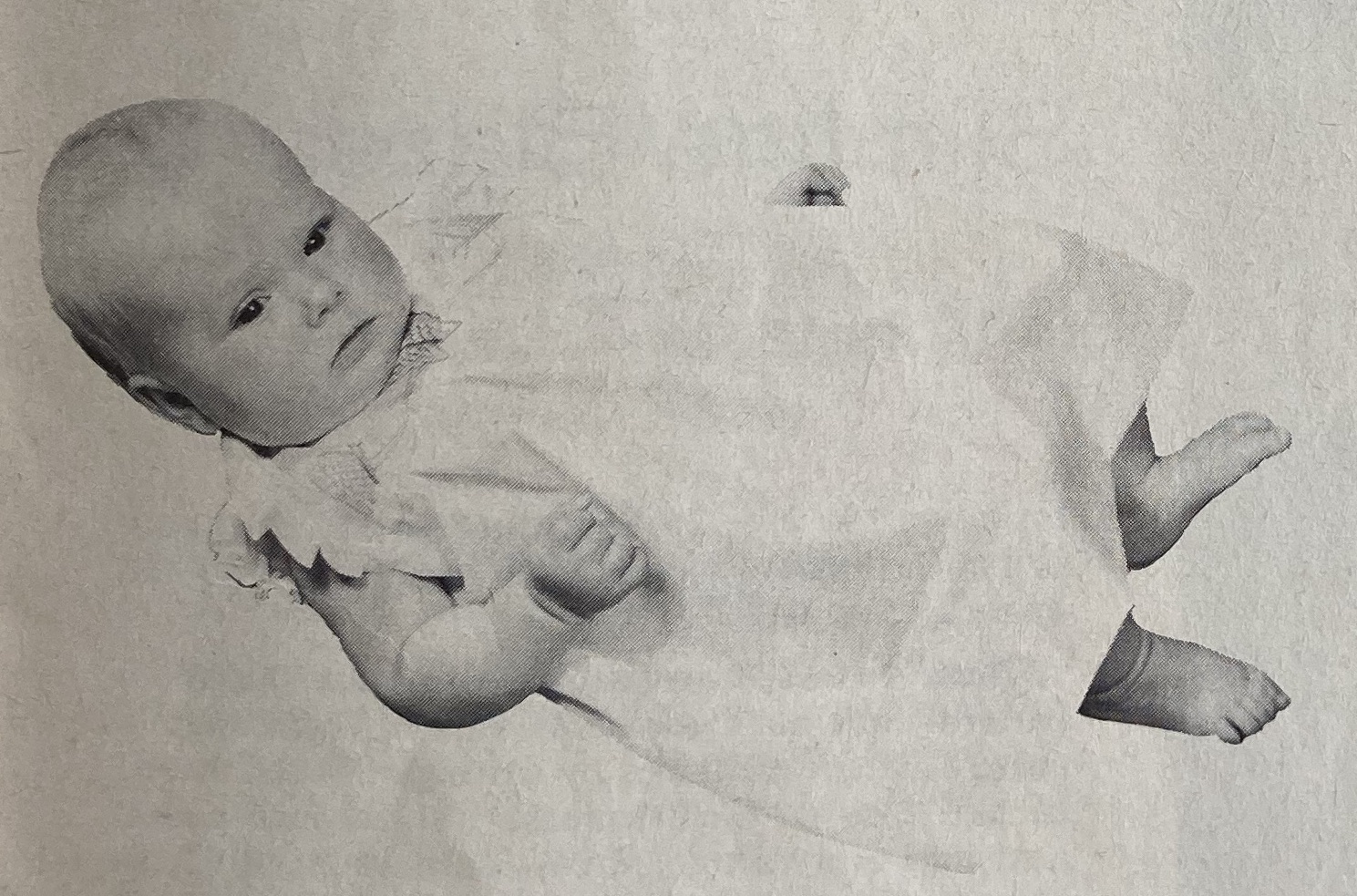
This issue also starts a new layette set for the youngest members of the family, starting with a warm dress, hat and bootees. Next month’s issue promises a matching matinee coat and cosy “helmet” cap. The caption for the modelled photo reads, “Jonathan is just 2 months” and reminds us that babies of both sexes wore lacy dresses with both pink and blue embroidery on them. 1963 was definitely a more sexist era, but also a more practical one in some ways.

There’s an interesting selection of Autumn-themed homewares as well, like a leafy fender-stool and chair-seat set, some blackwork finger-plates for the door (reminding me that I still have not finished my blackwork butterfly cushion from April…) a cushion and runner with Chinese motifs (I cannot vouch for any kind of authenticity — the motifs look very similar to the traditional European “Jacobean” designs to me, but what do I know), a pair of crochet-appliqué trolley cloths and a crochet-motif cushion.

And then there’s this “practical idea” — cover an old box (they used a wooden margarine box of about 16×12 inches and 8 inches deep, which sounds like a lot of margarine ha ha) with embroidered Binca canvas, cushion the lid with foam rubber under the embroidery and strengthen it with a piece of wood on the under-side and voilà: a “magazine tidy” which can also be used as a little stool to sit on. Very practical indeed and reduces clutter. I like it.

That’s all for this issue! I’ll be making the quick ! easy ! uses up leftovers ! crochet cushion. How quick and easy is it, you ask? I’ll tell you: it is so quick and easy that I started working on it last night, September 1st, and am already more than half finished: (Working on both halves of the cushion cover alternately so as to gauge how much wool I have of each colour.)

So there will definitely by a finished project in September, and hopefully this will give me some time to finish up the rest of the WIPs. I did also complete a retro-themed jumper of my own design which is not technically from Stitchcraft, but I’ll post about it anyway, because it was fun.

June 1963: Practical Coat

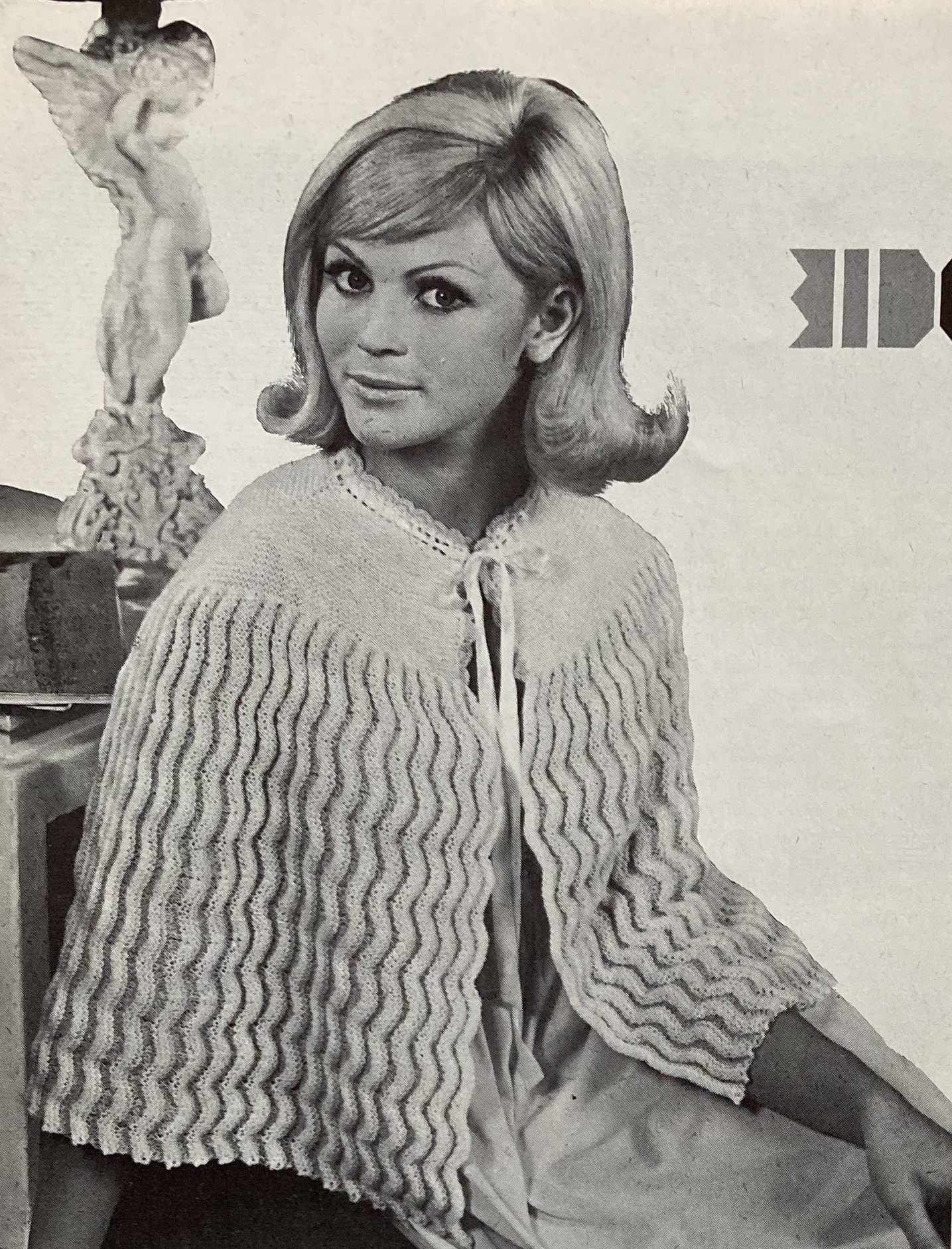
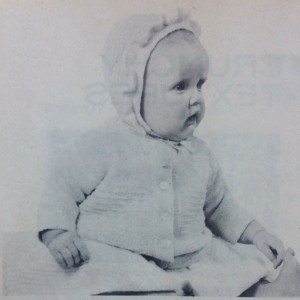
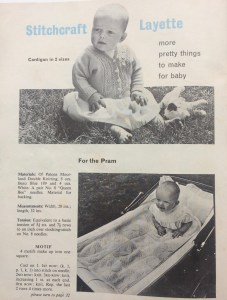
Baby in a knitted cardigan, pattern photo from Stitchcraft magazine, June 1963

My June 1963 project was a lovely (if not quite as practical as the title suggests) “matinee coat” for a baby. Two styles are given in the pattern, “for a girl” (long coat with ribbing at the waistline, flared skirt and collar) or “for a boy” (straight up and down, basic cardigan styling.) Both styles have dainty flower embroidery as decorative accents. Not wanting to inflict 1960s gender roles on a modern baby and also not having a personal preference, I asked one of the child’s parents which style they liked more, and the answer was “the long coat”, so the long coat it was.

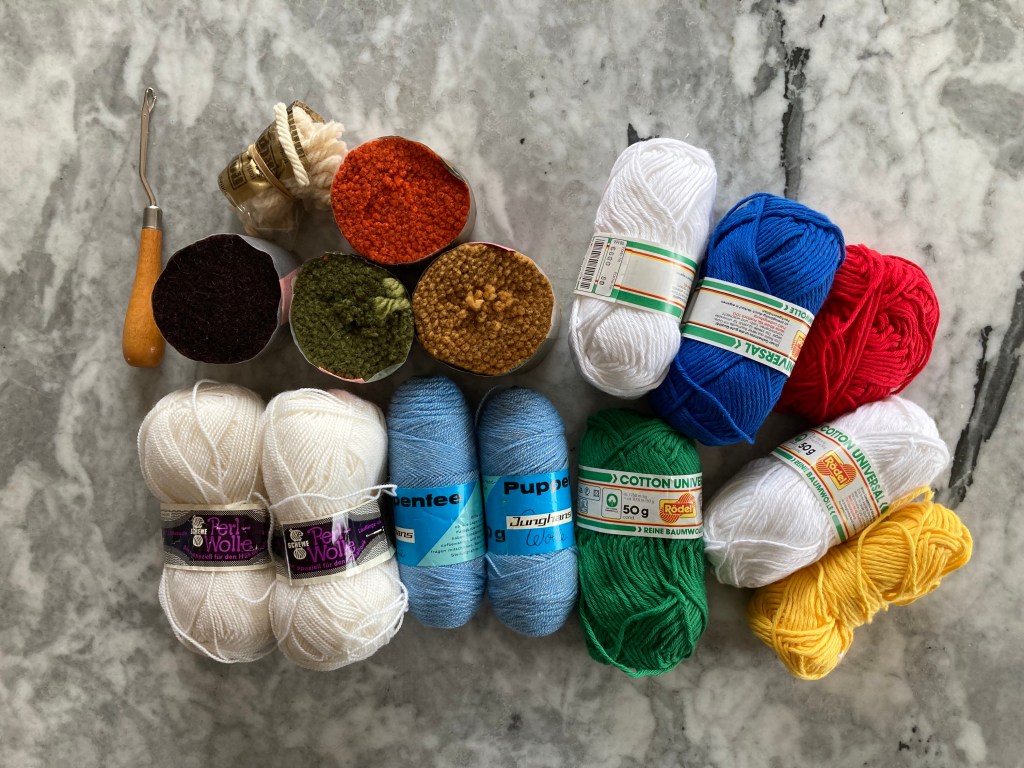
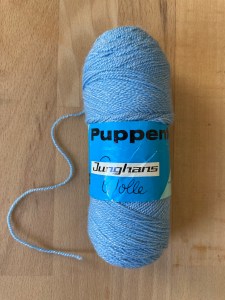
As for the wool, last year another colleague of mine, who knows that I like to knit from vintage patterns, came into a rather large stash of yarn when an elderly relative moved into a care home. Apparently, she (the relative) had liked to crochet and make latch-hook rugs, and when the younger generation of non-crafters cleared out her house, my colleague knew who would give the yarn a good home. There was some great stuff! In addition to a latch hook and some cut rug yarn in very 1960s shades of brown, tan, rust, beige and olive green, there was enough bright cotton to make a crocheted baby blanket, some nice, soft, plain white wool that would be great for baby clothes, and 400 grams of light blue “Puppenfee”, a yarn made by the German Junghans Wolle company in the 1960s? 1970s? which combines light 4-ply wool with a shimmery, presumably nylon or Lurex “Effektfaden”.

Just a selection — there was a lot more of each type of yarn!

The base colour is light blue, and the nylon strand makes the knitting softly sparkly and also very elastic — perfect for a baby cardigan. Happily, light blue was also the parents’ preferred colour, I had plenty of it and the tension and size in the pattern were perfect for this one-year old infant.

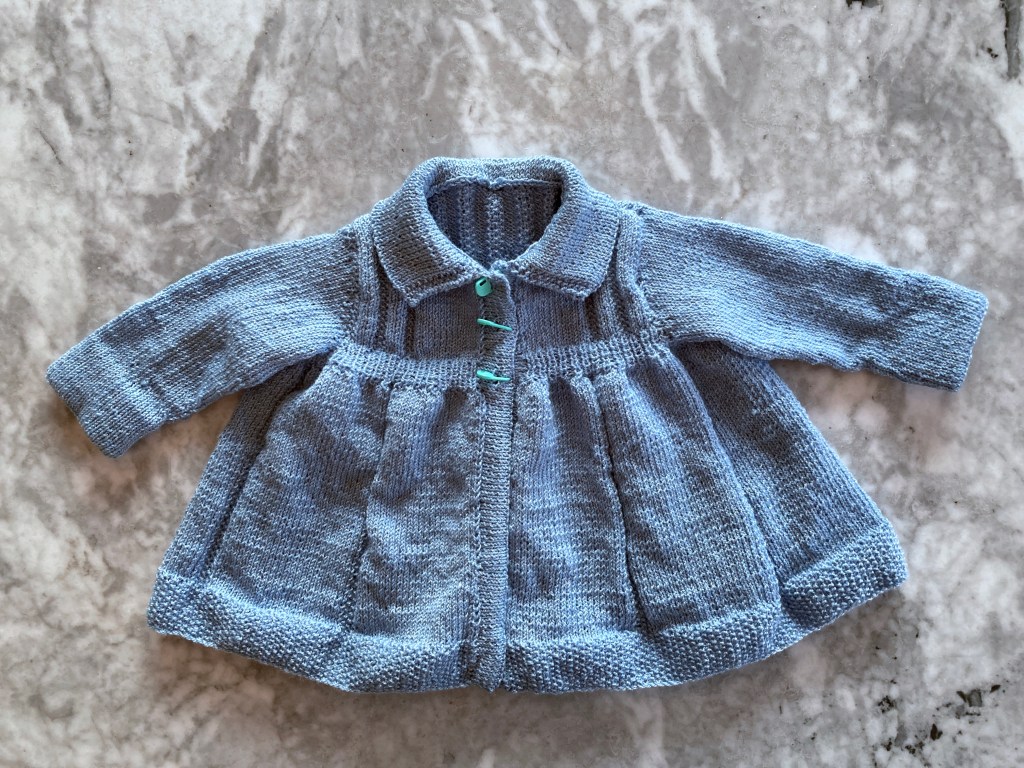
The coat is made in one piece from the moss-stitch lower border to the armholes, and the moss-stitch is carried up throughout the stocking-stitch skirt part in narrow vertical bands that make the skirt pleat prettily after the waist is gathered in with decreases and ribbing. Then the fronts and back are continued separately. I made the sleeves in the round from the top down, since that was faster, and made them a little longer than the pattern called for, as the baby is on the tall and thin side and will presumably get longer in the arms before it gets wider in the middle. (Though you never know with babies, but the cardigan is big enough to hopefully fit for a while in any case.)

Both the sleeve edges and interestingly, the collar are hemmed — in the case of the collar, that means stitches are picked up around the neckline as usual, then the collar is knitted in stocking stitch the “wrong way out” i.e. the inner side would be facing once the collar was opened down, then you make a purl ridge for the fold line and knit stocking-stitch for the depth of the collar back again and then sew it together. The result is very neat and crisp. There’s a narrow band of moss stitch (just 3 stitches) at the front corners of the collar to tie it together with the bands in the skirt.

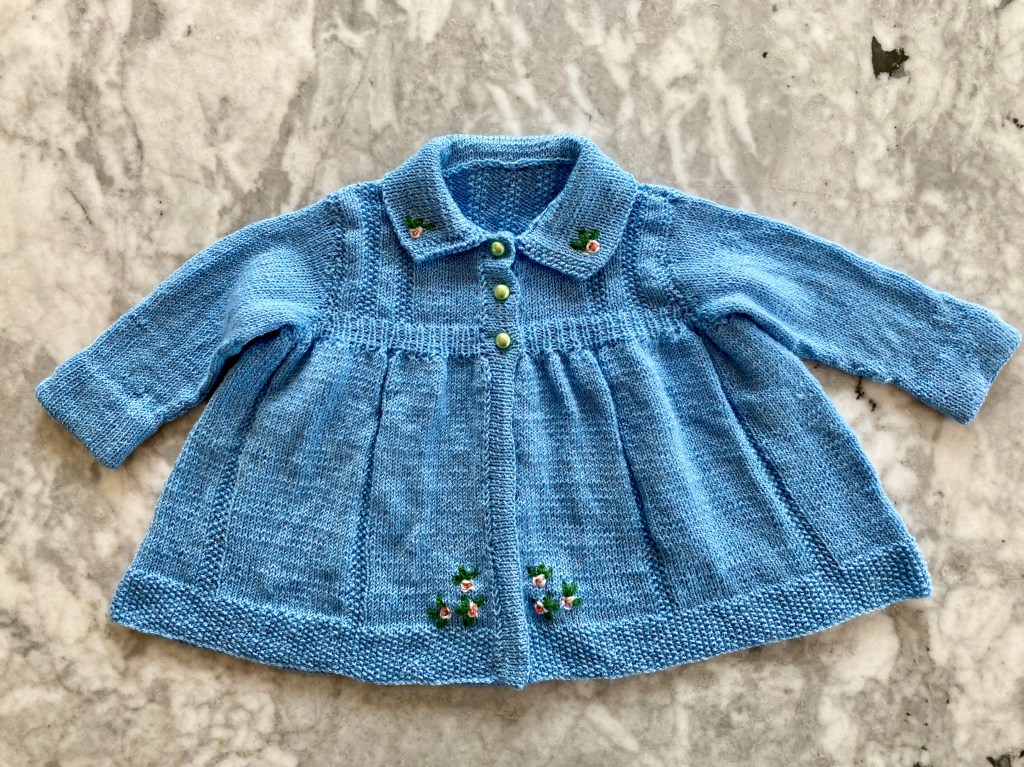
The rosebud embroidery was very easy, no transfers, just a sketch in the pattern and colour choice suggestion. I used bits of leftover Jamieson & Smith Shetland wool in pink, white and green as suggested and finished everything off with three little buttons from stash. Do the buttons look familiar? They are the same ones I used on this “Sunday Best Dress” project from March 1963 / March 2021. And yes, it is even for the same lucky baby! Maybe, with the parents’ permission, we can even re-create the pattern photo. Until then, here it is without the baby — I actually got a project done on time for once!

I am very happy with the finished coat and I hope the baby and parents are as well.

June 1963: Overview

Cover photo from Stitchcraft magazine, June 1963

“Light & Airy” is the theme of the June 1963 issue, with short-sleeved 4-ply knits as well as bulky items made in fluffy, lighter wool/synthetic blends. June is also the beginning of the holiday season, “where the emphasis to-day is so much on the active side and casual look — sailing, rambling and of course, so much travelling” (Patience Horne, “Editress”). Accordingly, many of the projects are easy, quick and/or small, to be finished before the travelling starts or suitable for working from your deck-chair.

In her introduction to this issue, Editress Horne also has a “special word for older readers”:

Remember that top models all come in the young age groups, but many of our designs, though often photographed on young models, are very suitable for older women, and often, a sweater with a long line, can be shortened without difficulty, for the more mature figure.

Graphic of a dandelion with the words "Light & Airy"

The 1940s and 1950s issues of Stitchcraft did have older models from time to time, usually modelling the designs intended for those “mature figures”. The 1960s issues often have plus-size designs and models, but they are indeed all on the younger side. I assume this had to do with the target demographic slowly moving from young working women and older matrons after the war, to young(ish) mothers of future Baby Boomers in the later 1950s and 1960s.

Anyway, on to the designs! The happy holidaying couple can make matching cardigan jackets in lightweight-but-bulky “Ariel” yarn when they play tennis or go “strolling and sight-seeing.” Diamond and zig-zag patterns make a showing in stranded colourwork patterns (the cover blouse), textured stitch patterns (the panelled 4-ply jumper and short-sleeved cardigan blouse) or Swiss darning (the colourblock “playtime sweater” worn by our young drummer.) The same Swiss darning (a.k.a. duplicate stitch) embroidery is used for tiny accents on a casual, collared cardigan.

The youngest of the family get a cute “matinee coat” and/or jacket decorated with regular embroidery, or a sun-suit with matching short-sleeved cover-up. Embroidery is definitely a trend! Collars and neckline finishings can be subtle, non-existent or big and bold, as seen on the woman’s cardigan and this men’s casual, tweedy shawl-collar number.

The homeware projects are all fairly simple and versatile, one design being suitable for different types of project, but some are too large to want to take along on holiday. There’s a tablecloth and/or chairback with cutwork ivy design, a rose motif apron and/or cushion, and a Victorian-inspired cushion and/or stool seat in tapestry and/or cross-stitch. Pick your combination!

The outdoor cushions with sea motifs are a good summer-themed project, or you can preserve your holiday memories in a needlepoint picture of Lynmouth. There’s also a cross-stitch rug for a larger, at-home project.

With so many interesting ideas to choose from, I’m sure nobody’s holiday will be too relaxing, ha ha. I am undecided about what project to make. I am so far behind and have so many unfinished projects! At the same time, there are too many projects from this issue that I would like to make. I could genuinely use a new cardigan and the embroidered one with the big collar is just my style… but where will I find the time to make another full-size adult garment? The same goes for the short-sleeved cardigan blouse and the panelled diamond-stitch jumper. The baby coat or cardigan would be practical for using up stash and might actually be done quickly enough, so that might be the best choice. Stay tuned!

April 1963: Overview

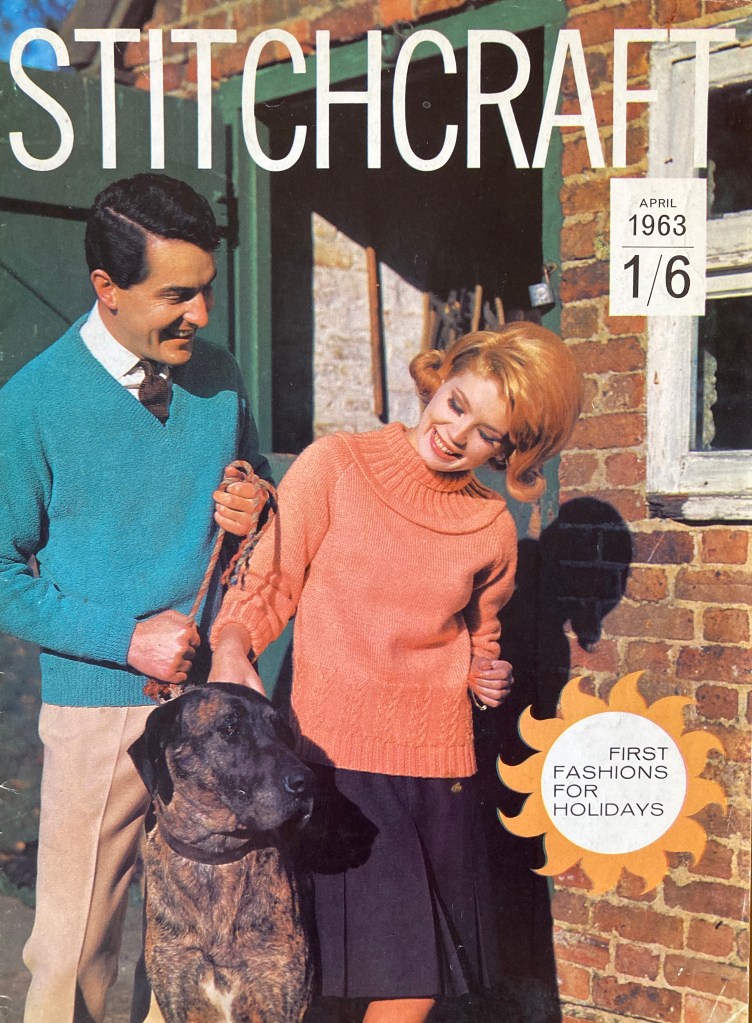
Cover photo, Stitchcraft magazine, April 1963

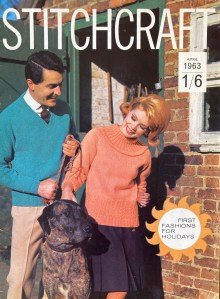
First Fashions for Holidays! It’s almost always some sort of holiday season in these vintage knitting magazines — in this case, Easter and preparations for the summer. As the British climate makes it possible to wear thick, warm wool sweaters pretty much any month of the year, “holiday / not holiday” is less a matter of warmth or season and more about casual, easy-care garments to wear while “strolling” and sight-seeing, or projects that are small and simple enough that you can work on them while lounging in your deck chair. Or, as the facing page title puts it, “Sweaters off-duty.”

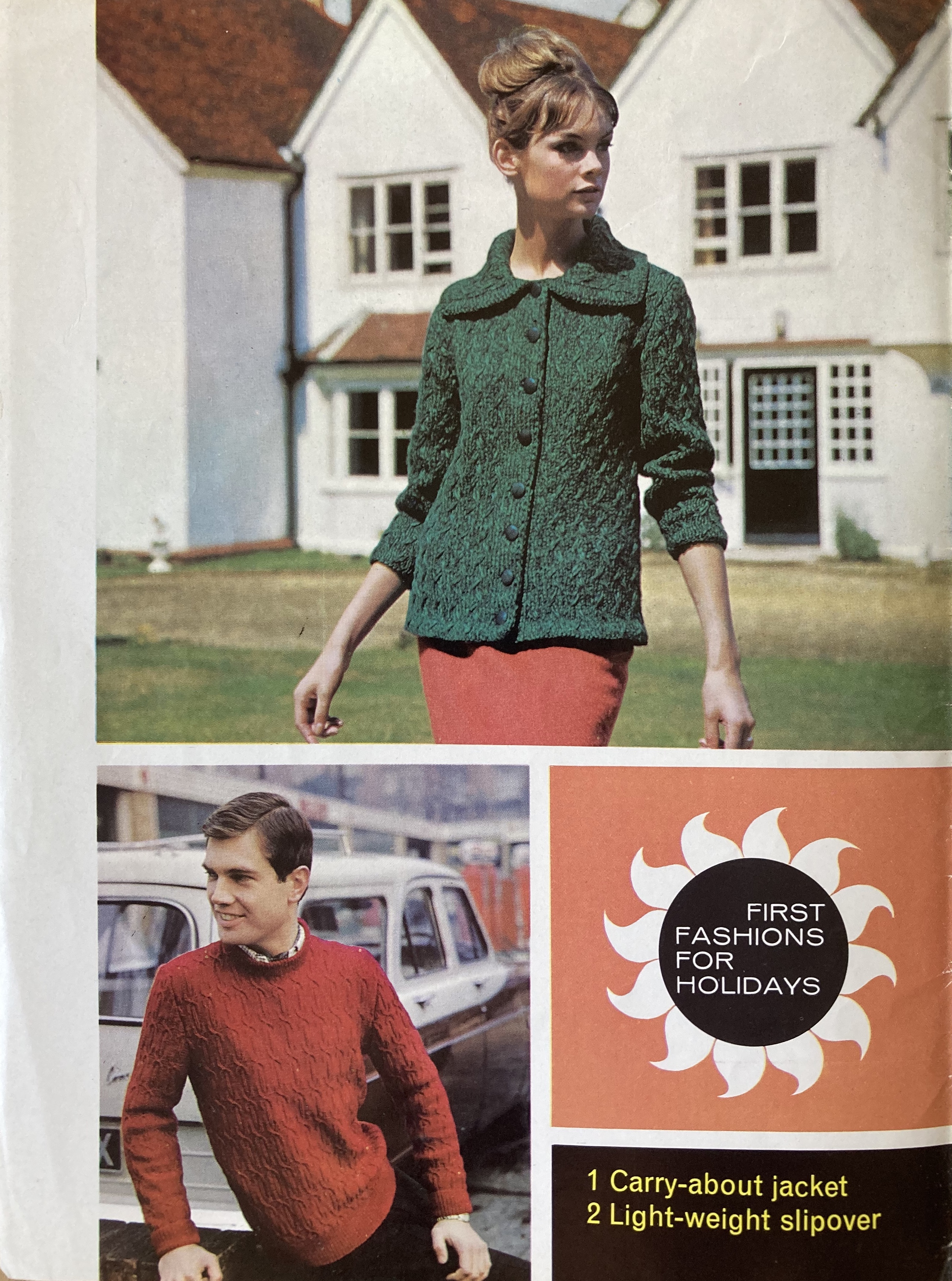
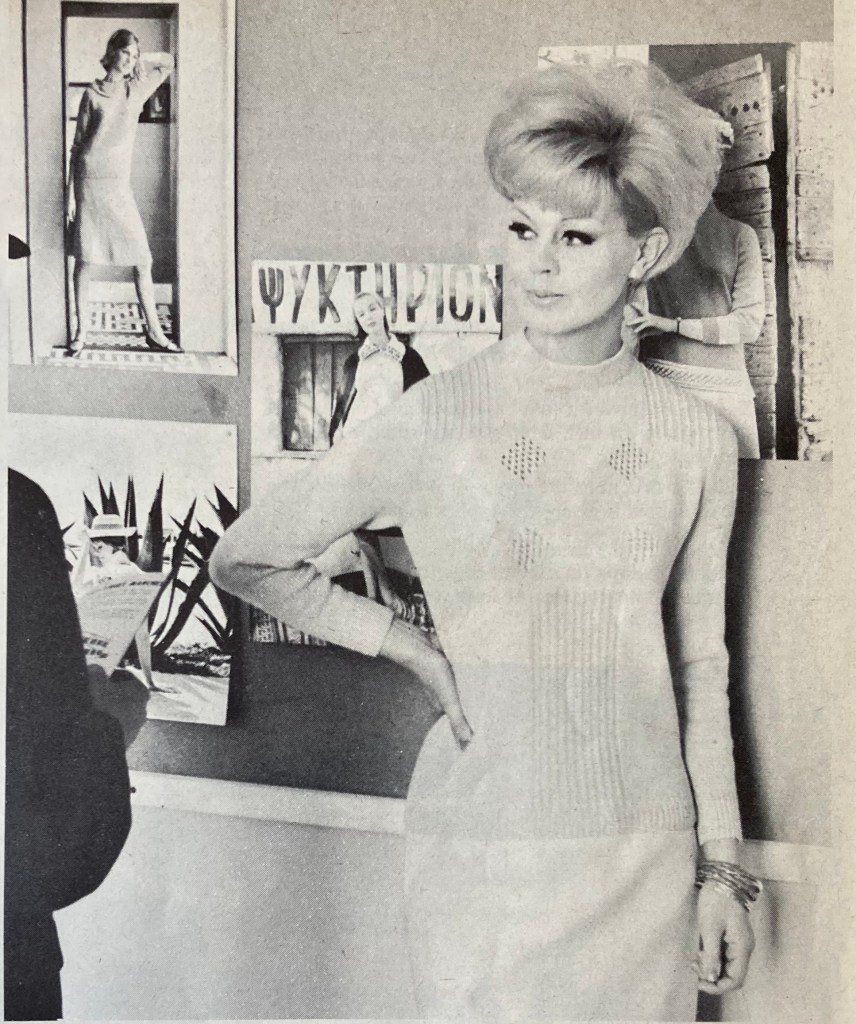
Thick, collared pullovers and cardigan jackets that can be worn as outerwear make up the bulk (-y) of the garments in the first category, many of them made in Patons Big Ben wool at 3 1/2 stitches to the inch. The tweedy, dark green jacket on the inner front cover is a good example of this and features an intriguing wavy slip-stitch pattern. The “Italian” tunic on the inner back cover has a knitted-in border pattern made of beads. DK-weight wool is used for the women’s round-yoke sweater on the front cover. Hip-length is the fashion for everyone, wide collars continue to be in style and decorative borders near the hem are the new spring trend.

There are fashions in finer-weight wool as well, “for elegant summer wear”. The red men’s pullover on the inside cover and the women’s Nylox pullover both have interesting stitch patterns, though I feel like the placement of the inserts on the women’s pullover could go horribly wrong a little too easily. If your man finds cables too exciting, you can knit him a plain V-neck pullover in bouclet wool and match it to your own fluffy mohair-mix jacket, made in Patons’ best-ever-named wool, “Fuzzy-Wuzzy.” Colours are strong and bright, including some very springlike salmon and turquoise.

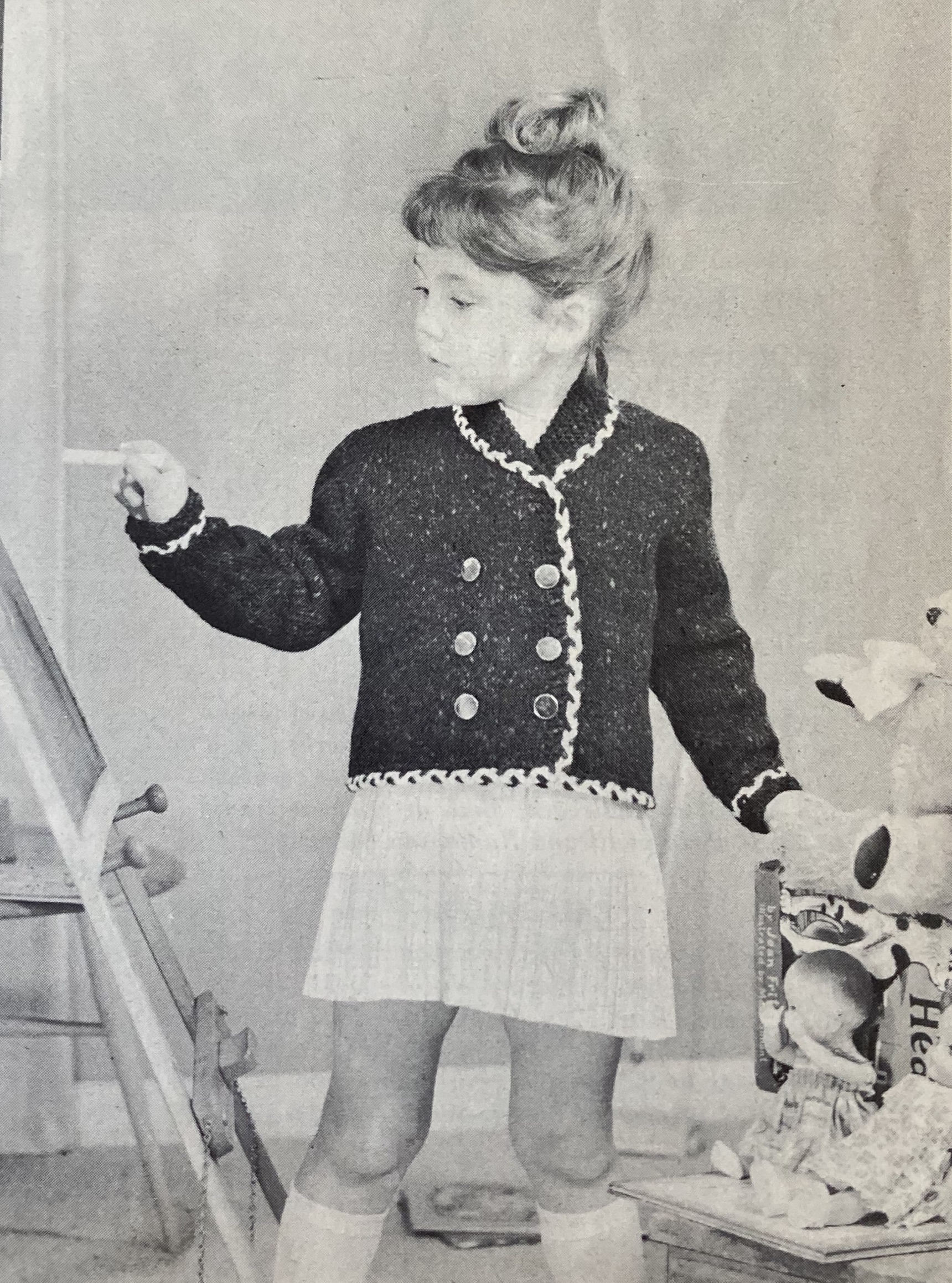
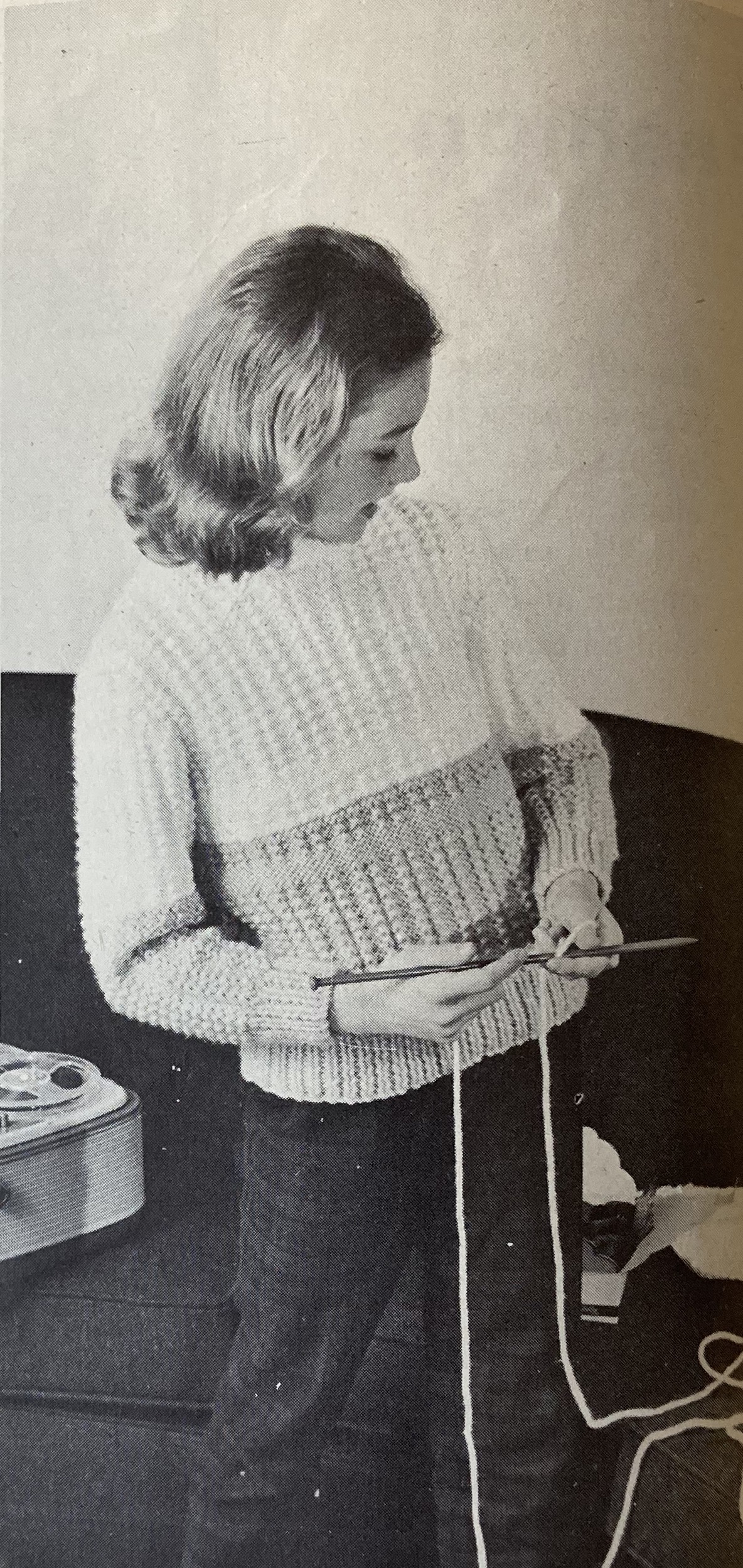
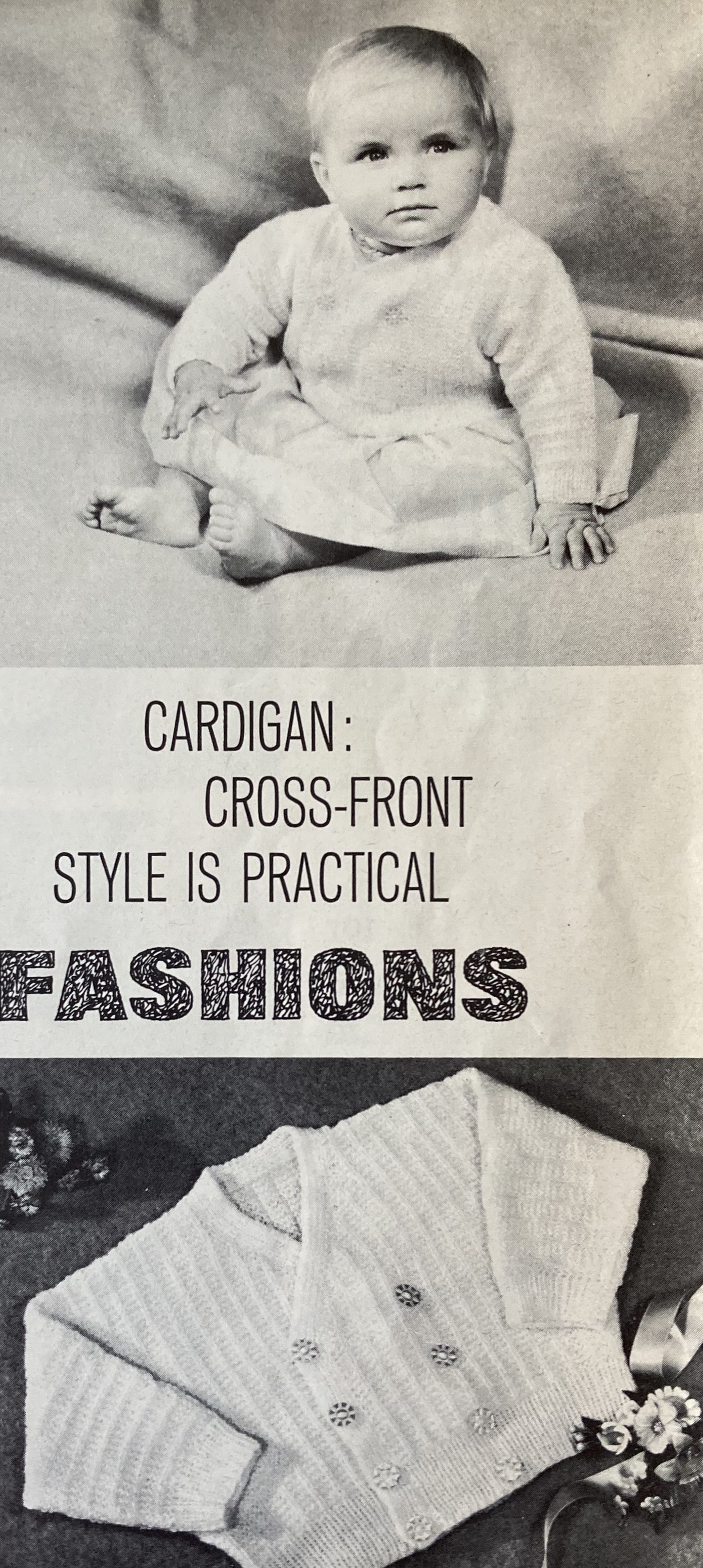
Fashions for the younger members of the family cover all age groups: a dolman cross-front cardigan for the baby, a play-set for the toddler, a “miniature Paris blazer” for small and medium-sized children (she’s painting a picture on a easel, so you know it’s Parisian!) and a quick-to-make “chunky” pullover for “sub-teens” which is easy enough for a bigger girl to make for herself. (I don’t think the young model in the photo actually knows how to knit, though.)

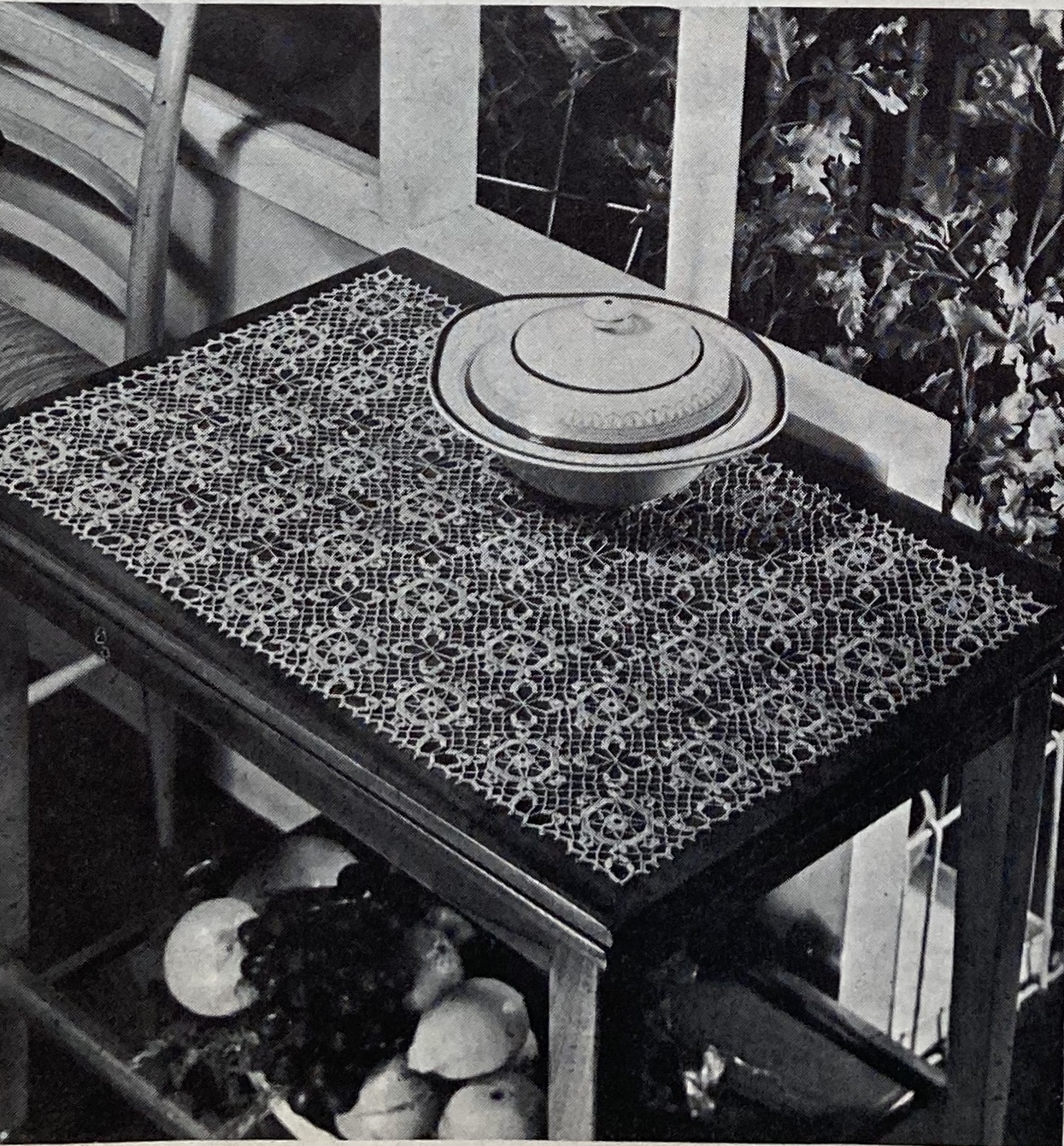
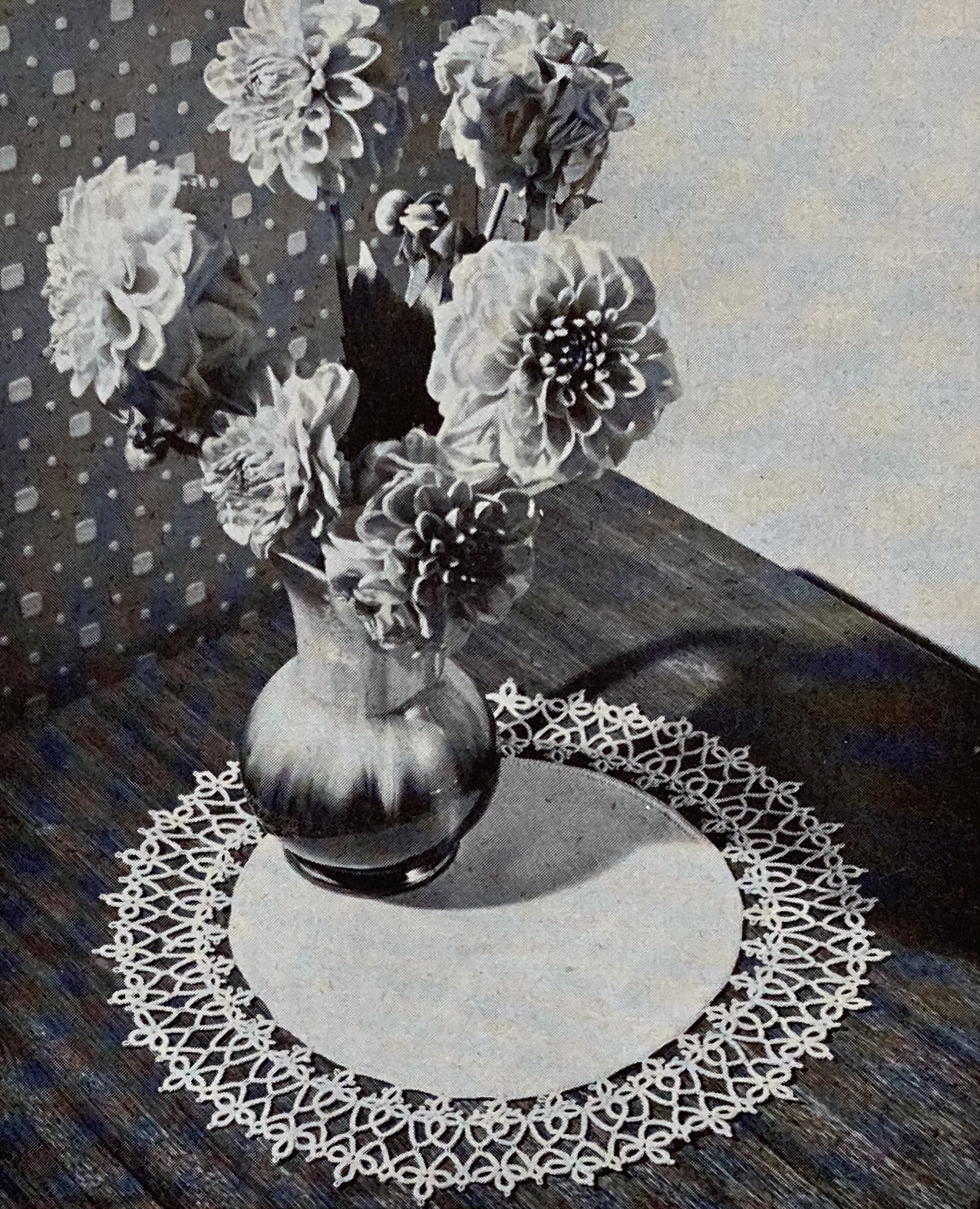
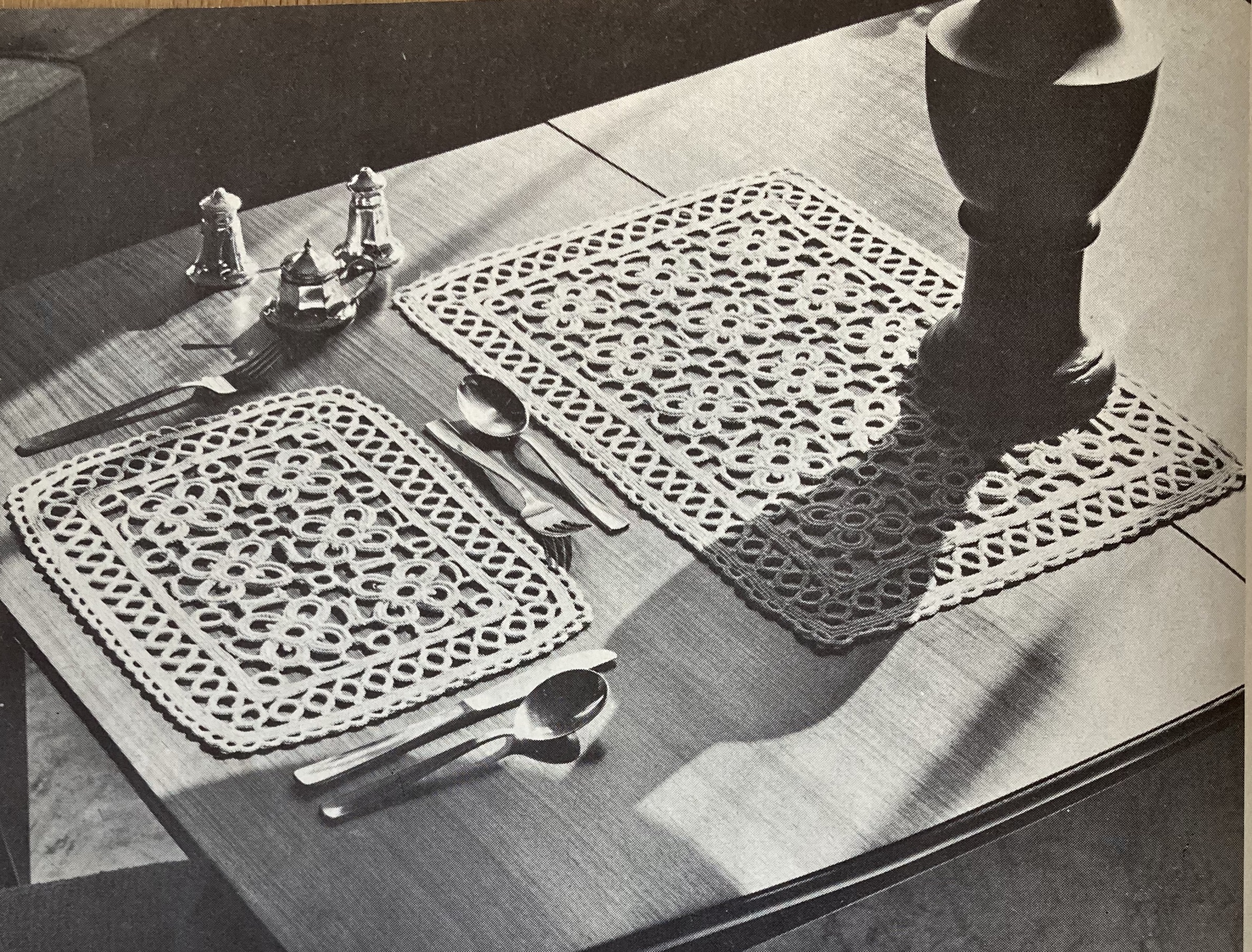
With all that pre-holiday prep knitting, the homewares in this issue are generally unspectacular. There are chair sets in counted cross-stitch, a crocheted cushion and rug for the older daughter to make for her room, and a tapestry tea-cosy. The two more interesting projects are these corded crochet mats and a wonderful cushion with a design of butterflies, made in blackwork embroidery. Unfortunately I’m not good enough at crocheting to really understand how the “corded” look on the mats is achieved, besides the fact that there are a lot of picots and crocheting many stitches into a ring. Oh, and there are embroidered table mats, too, featuring line drawings of famous parks. I like the white-on-black effect — something different.

That’s it for this issue! The ads are pretty normal and in the comic, Miss Muffet continues her adventures, getting magically shrunk down to the size of an insect in order to go flying with a nice beetle-lady. I’m afraid the dragonfly might have dropped her into the lake, though! Oh no! How will it end?

My project for this month will be the embroidered butterfly cushion. Happy Spring!

March 1963: Sunday Best Dress

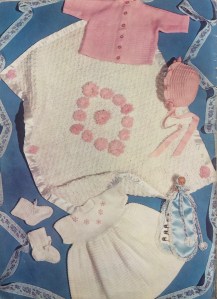
baby dress and coat, image from Stitchcraft magazine, March 1963

My March project featured sewing, for a change. I can sew, both by hand and with the machine, and I have sewn quite a few things in my time (even worked in the costume department of various community theatres as a teenager/young adult), but I do not enjoy sewing, nor am I particularly good at it, to be honest. (My costume shop work involved mostly either “pulling” outfits from storage, or doing fittings and alterations, or sewing things that someone else, i.e. the head designer had cut out. For that reason, I never learned to cut things to fit properly and am surprisingly bad at working from bought patterns.) Years of knitting have also made me very inexact about perfect measurements and straight lines, which is obviously sub-optimal for sewing. But I gave it another try to make this embroidered “Sunday best dress” for a baby from the March 1963 issue.

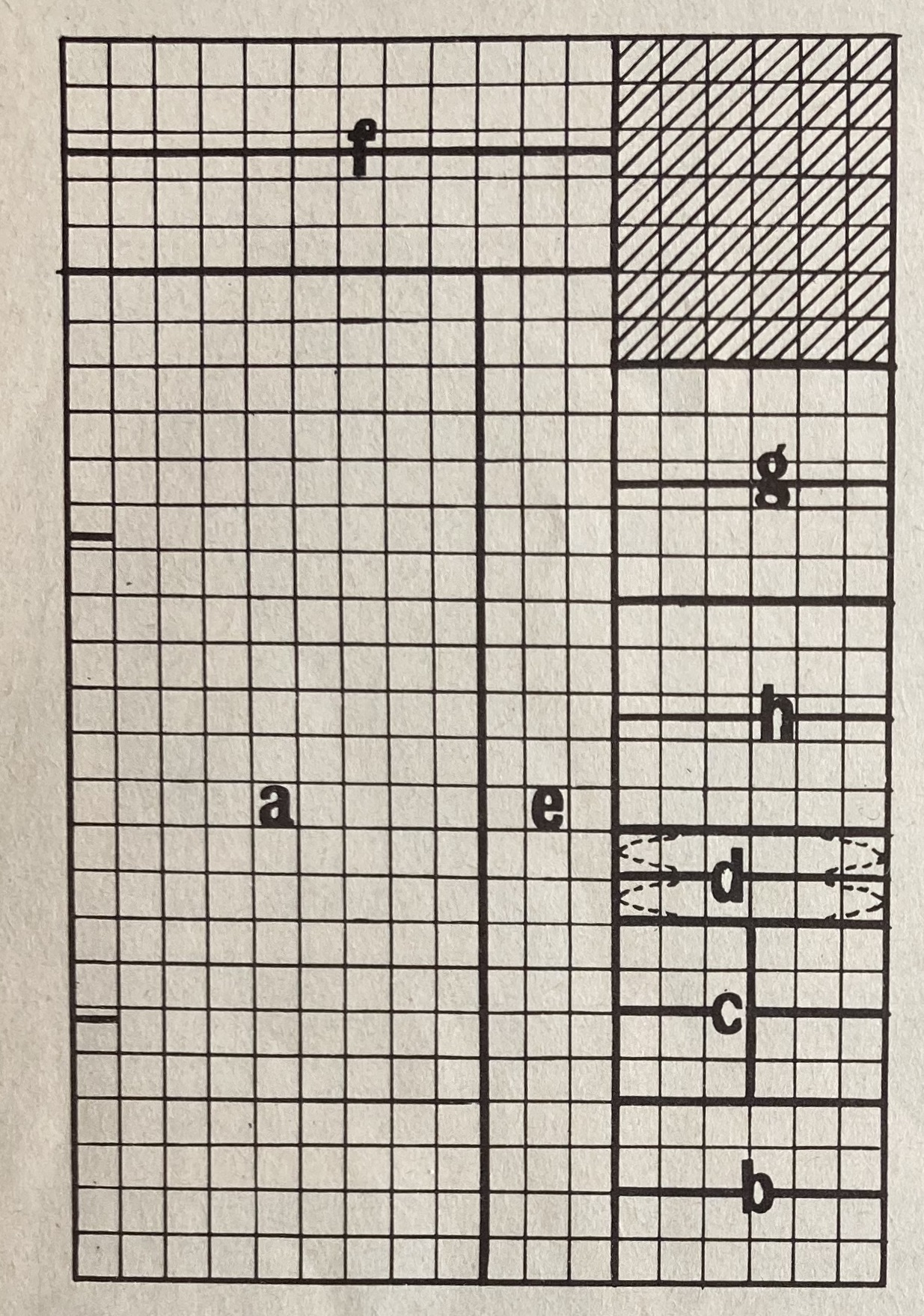
For once, you didn’t have to send away for the sewing pattern; since all the pieces were basically rectangles, they just printed a little scaled-down plan for cutting the material on a graph, with each square being equivalent to 2 inches. It was designed for silk or crepe fabric. I had bought a large remnant of beautiful light-grey viscose (rayon) some time ago, of which I used a small amount for the lining of February 1963’s needlepoint bag and had plenty left over. Rayon fabric has been around for more than a hundred years and was (and still is) used as “artificial silk” throughout the 20th century, so my fabric was quite period-accurate even though modern. I didn’t have silk floss to do the embroidery and just took the opportunity to use up some small scraps of normal cotton floss in pastel colours.

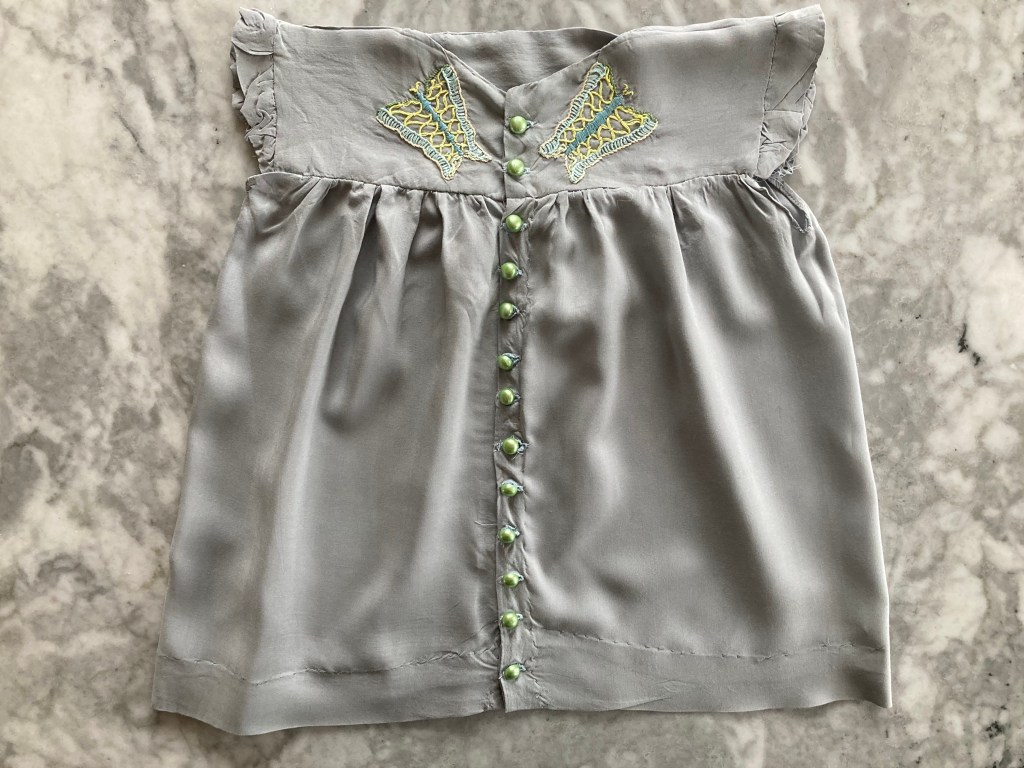
The dress was supposed have three embroidered butterflies on the front and close in the back with a couple of buttons. I didn’t have all that much embroidery thread and I did have quite a lot of lovely vintage buttons in a perfect pearly-green colour (thank you, kind seller on Ebay!), so I changed it around to fasten in the front, using the two-butterfly design from the coat (which I didn’t make).

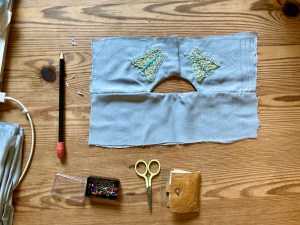
The butterfly design was easy enough to copy without a transfer and features laid stitches on the wings — something new for me. My embroidery skills are still far from professional, but improving. The sewing work was interesting because I am not always in the same place as my sewing machine due to pandemic chaos — but also didn’t want to wait until I was — so I sewed everything except the buttonholes and waist strengthening zigzag at the end by hand. Including the gathers, buttonhole band, frilled sleevelets etc. Now I know why Marilla from the Anne of Green Gables books had to stop sewing in her later years to preserve her eyesight! Everything was tiny and took forever and my fingers, which are actually quite long and thin and nimble, felt like elephant feet.

Photo of sewing work-in-progress with various sewing tools

I did the buttonholes on the machine when I could, because I was definitely not going to try to sew buttonhole stitch by hand on thirteen tiny buttonholes. My machine-sewed buttonholes look messy enough that they could pass for hand work, ha ha. I am surprised that it turned out even vaguely even (yes I know, the hem in the front is a mess.) But in spite of its obvious imperfections, I’m quite happy with the result and proud of myself for making it work. I know a one-year-old baby who would fit in it perfectly and the parents will be very happy to have it as an Easter dress for her, so in my mind, it’s a success.

Finished sewing project: embroidered dress for a baby

Meanwhile, the “naughty pile” of unfinished projects is slowly diminishing and I’m looking forward to getting back to knitting.

December 1962: Quick and Easy Cushion

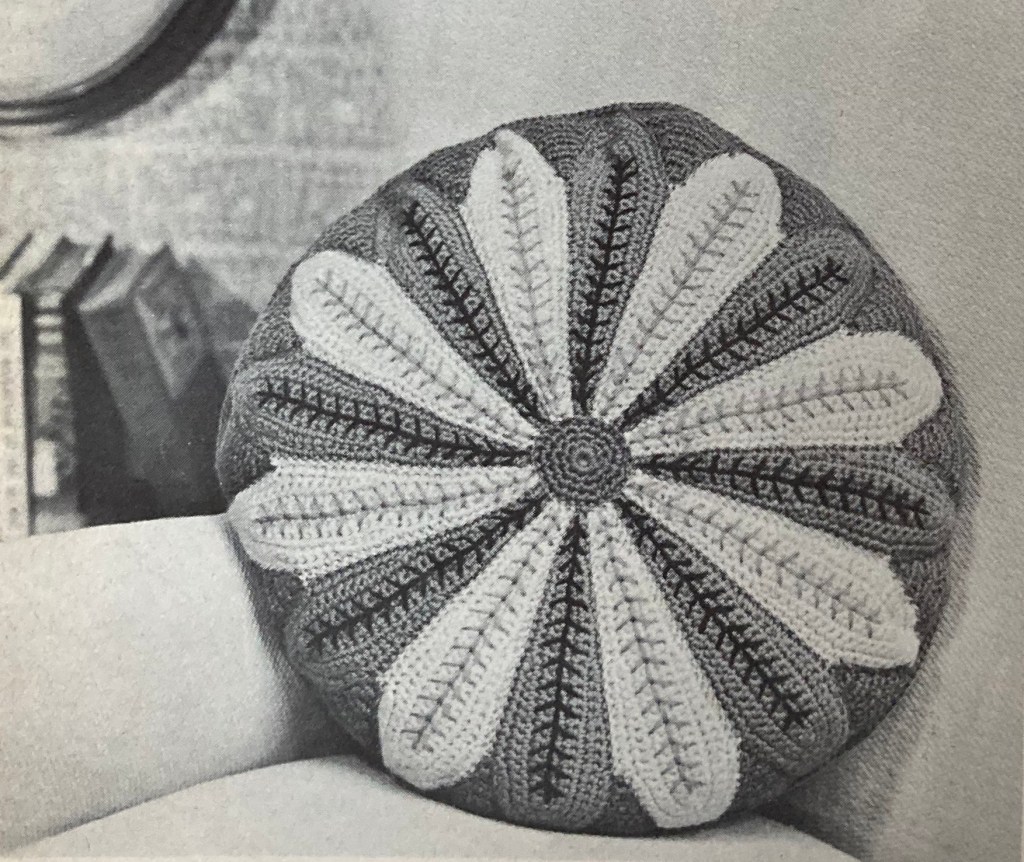
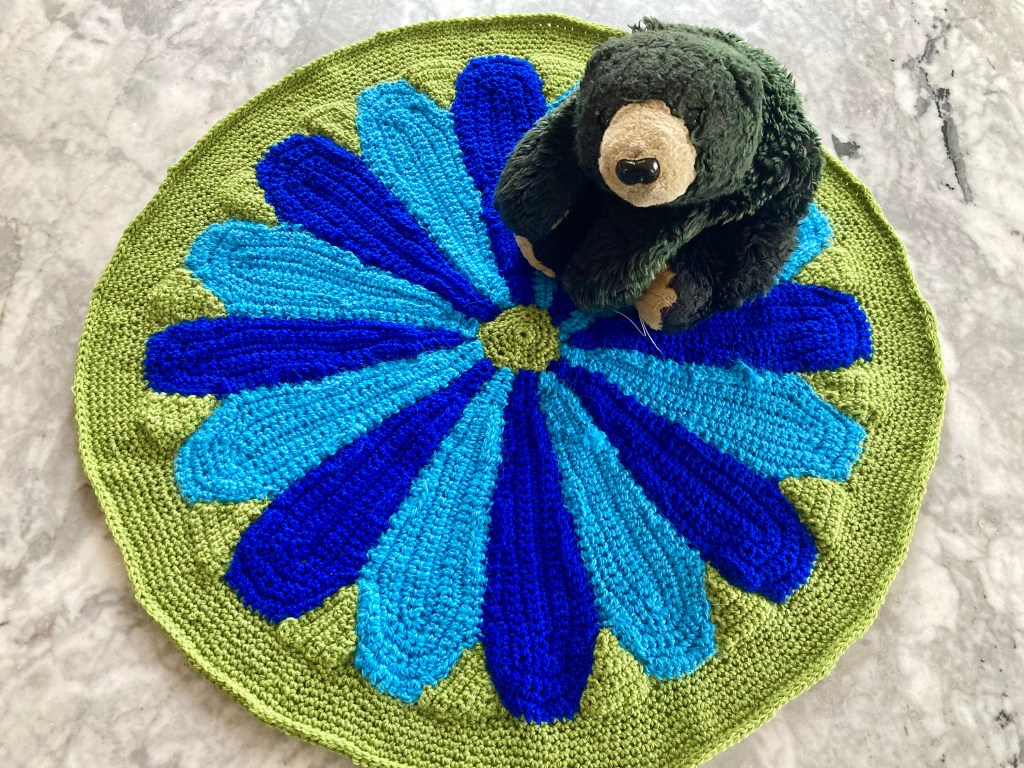
I have a huge backlog of unfinished projects and recently even got a commission to write a pattern for a new knitting and sewing magazine, so I needed the December project to be something quick and easy that I could make from stash. Behold, a very 1960s crocheted flower-petal cushion from this month’s issue! I love cheerful crocheted cushions and afghans — they have that fun, old-fashioned charm.

This one is made in double knitting, and I had two colours of blue and one of green to make a big, blue flower. I guess it’s a cornflower? Whatever, it’s cute and the colours looked good together. The dark blue is 100% acrylic (left over from this project and this project, which was patterned after this project — yes, I bought plenty of yarn), the light blue is 90% alpaca / 10% sheep wool (a gift from a very nice friend who brought it over from Chile!) and the green is a wool-acrylic blend last seen in this project from January 1960, so I was concerned that the finished item might behave inconsistently when washed or blocked, but I had no problems with that.

The size and scale, on the other hand… There was no tension given in the instructions, only a finished size of “approximately 17 inches diameter” and instructions to use double knitting wool and a No. 8 (5 mm) hook. The cushion is made in pieces — first the petals, then the triangular inserts at the top of the petals, then the center, then it gets sewn together, then you crochet the border and sew it onto fabric for the back side of the cushion — so it was hard to tell how big it was going to be. Also, the instructions very clearly say to make 12 petals and 12 insertions, but the accompanying photo very clearly shows a cushion with 16 petals and insertions. Patience Horne, you need a tech editor and a proofreader!

The result — once I had finished all 16 petals and 16 insertions, which was in fact the correct number to get the petals to form a circle, and sewn all the fiddly bits and pieces together — was huge. Granted, 17 inches in diameter is a fairly large cushion, but mine was 19 inches in diameter before I had even started crocheting the border, and the triangular insertions were also too big, making them pucker and wave a bit. I made a snap decision to just crochet the border larger and larger until all of the green wool was used up and have it be a baby blanket instead of a cushion, which would also spare me the trouble of figuring out how to make the back of the cushion, whether or not to make an inner cushion pad and have the crocheted part be a removable cover, etc. etc.

The border in the instructions only being a few rounds and me not being the world’s best crocheter, I searched for a formula to crochet something in rounds of double crochet that would have the right amount of increase per round to keep the circle flat. Though I found many amazing doily patterns and not-quite-fitting formulas, I didn’t find what I was looking for, so I just increased one stitch per petal each round and did a plain round in between every so often. There was much ripping back and doing over, but in the end it worked out fine. As for the still-puckery triangle inserts, I declared them a “design feature” and left it at that.

I wash-blocked the blanket, which evened it out some more, and only then realised that I had forgotten to embroider the lines down the center of each petal. In the end, I decided against it. The dark blue and green yarns were all used up, I didn’t have any other colour that looked right and I honestly thought it was fine the way it was. The finished size is 23 1/2 inches or 60 cm in diameter, which will fit a baby’s pram nicely. Not having a baby on hand, here it is with a teddy bear for scale:

It’s not perfect and it definitely has that “home-made charm”, but I think it will make any parents and baby happy.

September 1962: First Size Raglan

EDIT October 9th, 2020: Finished!

“The most welcome present you can give to a mother-to-be is something warm and hand-knitted for the layette,” wrote Stitchcraft’s “editress”, Patience Horne, in the September 1962 issue, and it’s still true! If I can’t decide on a project, if I don’t feel like making a full-size adult garment, if I have bits of wool that want to be used up in a useful way, I make a baby jacket. Someone, somewhere is having a baby soon, and I always have a couple of finished objects on hand in case I didn’t know that a colleague or acquaintance was “expecting”.

That was the case this month, funnily enough in my own weekly knitting group. We have been “meeting” via Zoom since March due to the pandemic, and I dropped out for a while due to being ill myself, so by the time I came back I had apparently missed some happy news — one of my fellow knitters will be having a baby this winter. What better time to make this cute and easy first size raglan cardigan?

I had 3-ply wool left over from this jumper, so I was even able to achieve the tiny gauge of 8 stitches to the inch. Only… it turned out I did not have enough of this wool, so the raglan yoke part is leftover mystery purple 4-ply. I’m not quite convinced that it’s going to work; the harsh colour line seems weird at the moment.

I don’t know the name of the stitch pattern, but it’s a lovely easy sort of herringbone:

  • Row 1: knit
  • Row 2: k1, p3
  • Row 3: knit
  • Row 4: p2, *k1, p3*

Except… I decided to make the yoke in one piece, because I didn’t want to sew raglan seams, and the raglan decreases change the pattern at the armholes. I knew that would happen, but was too lazy to work out mathematically exactly what the decreases would do. It turned out that the fronts and back stay in the proper pattern and both sleeves end up in k3, p1 rib. OK, it’s symmetrical and doesn’t looks terrible, so I decided to live with it.

But… then I ran out of the mystery purple wool as well! And had to make the last bit of collar ribbing in another mystery purple-ish wool that was also thicker. Well, at least the colours didn’t clash too much? And I had cute, matching, vintage buttons in the button box!

… except that I somehow utterly failed to sew them on evenly spaced? I could add one more in the gap near the top — there’s a buttonhole there — but somehow the buttonhole in the lower gap got sewn shut while I was weaving in ends or sewing on the front bands. I have enough buttons, but can’t decide whether to cut a new lower buttonhole and add two more buttons or just give up and leave it as it is. At least the gaps are vertically symmetric.

Not my best work, but it will keep a baby warm and clothed. Perhaps I’ll make something else for my knitting friend’s baby — a fellow knitter deserves a more successful project!

August 1962: Overview

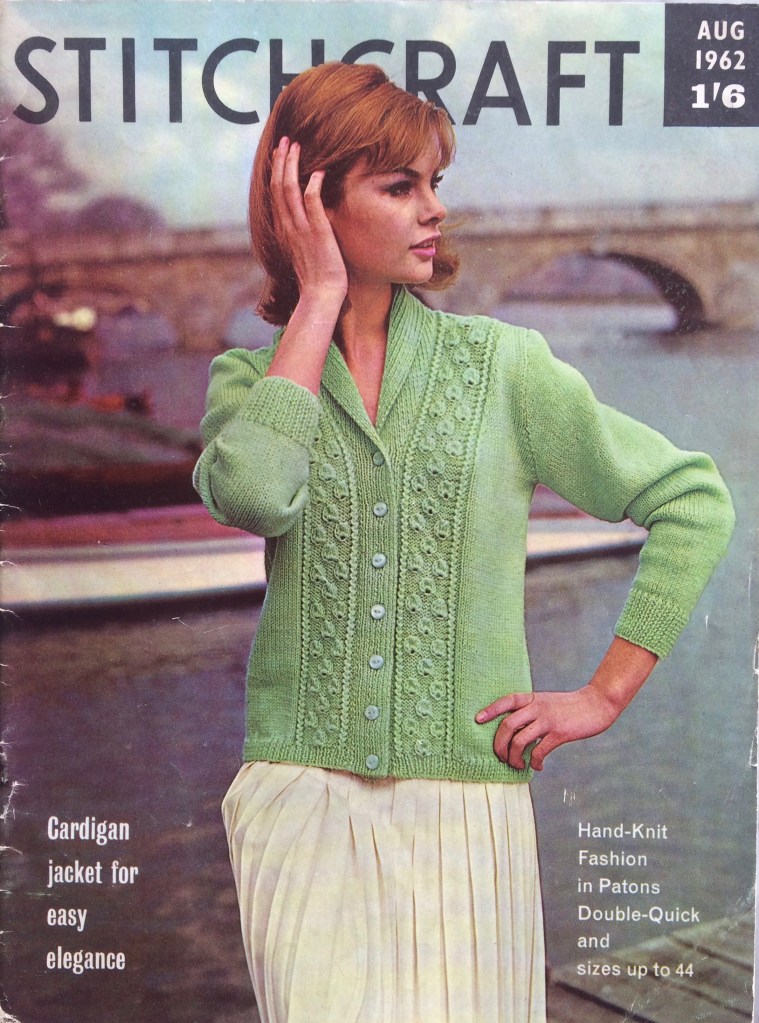
August is the end of the holiday season at Stitchcraft, featuring transitional styles for the cooler days of September as well as a few more small, easy projects that can be worked on from the deck chair or picnic table. The “Contents” column on the facing page divides the adult garment patterns into the categories “First Autumn Fashions” and “Continental Designs”.

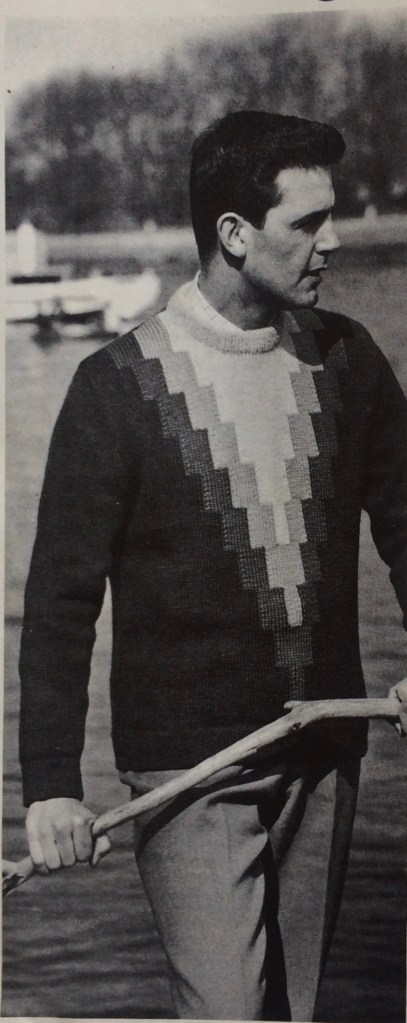
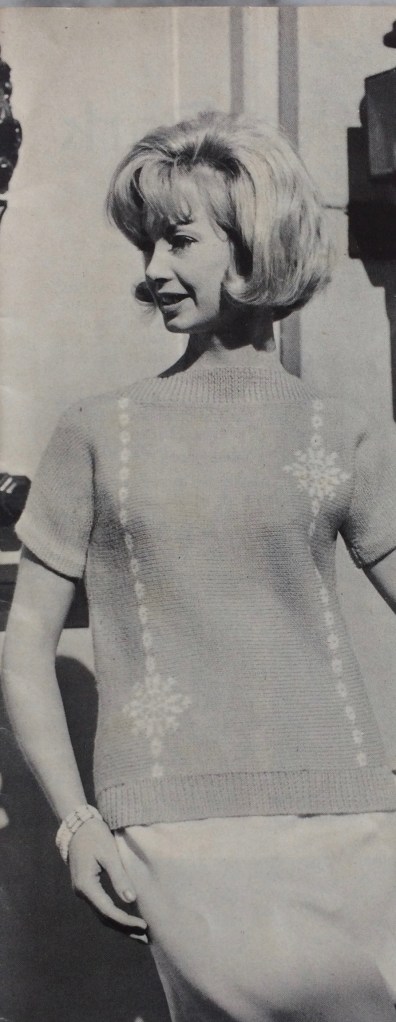
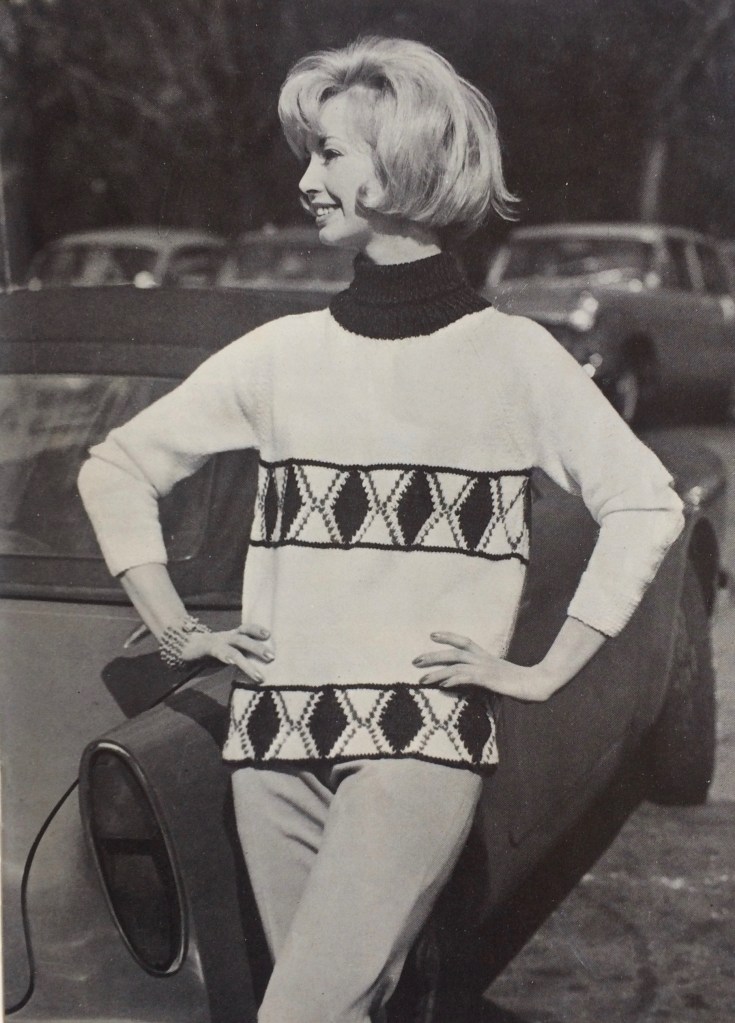
The “Continental Designs” comprise a colour-block pullover for men “from Vienna” in graded shades of green, a simple cap-sleeve, T-shirt-style jumper with a little Norwegian motif, and an “Italian design for late Summer” with bands of red and black intarsia in a diamond pattern. I wish they had used these for the colour photos instead of the bland white pullover on the inside front cover!

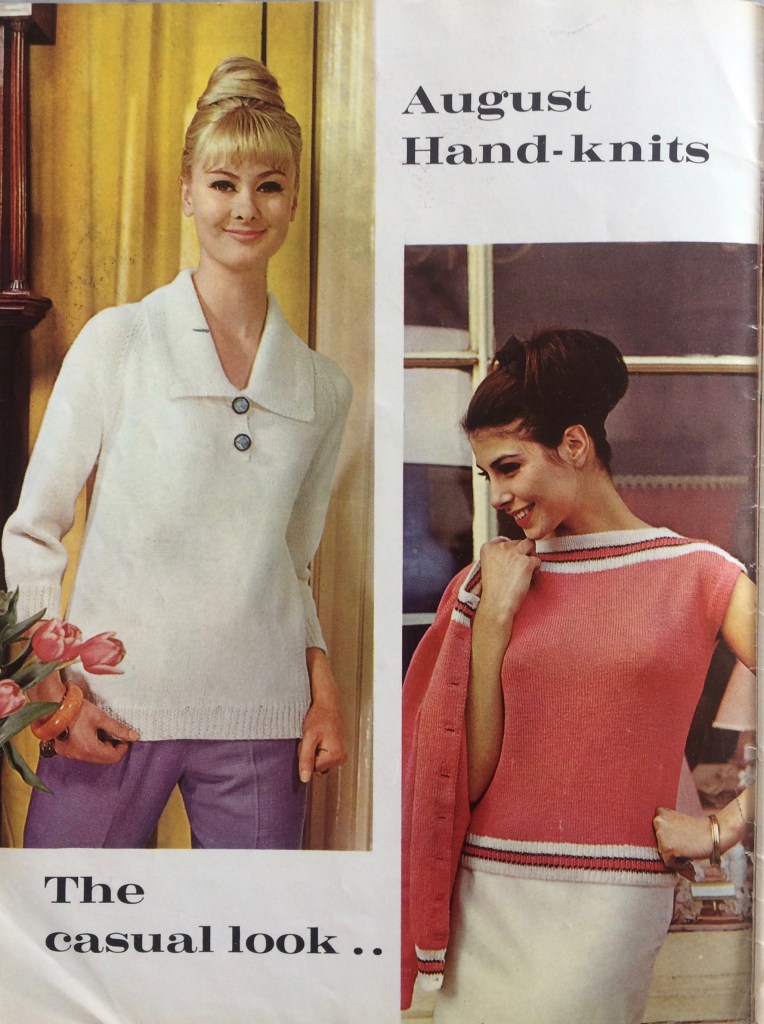
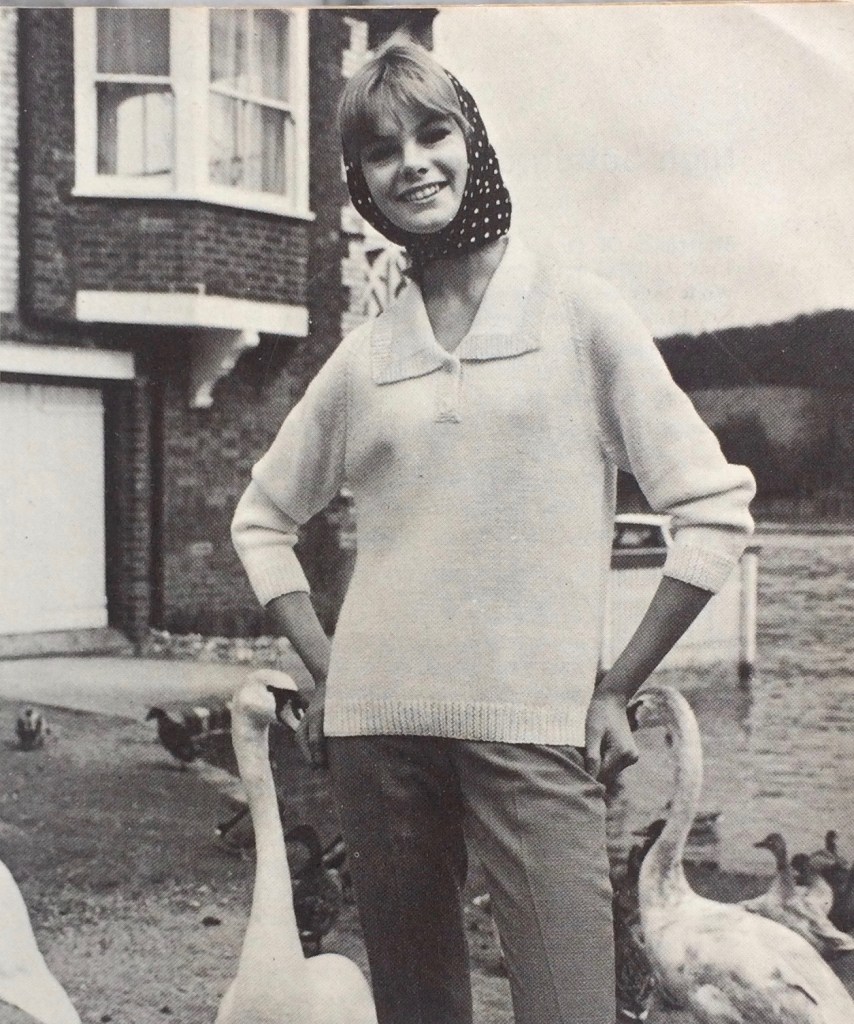
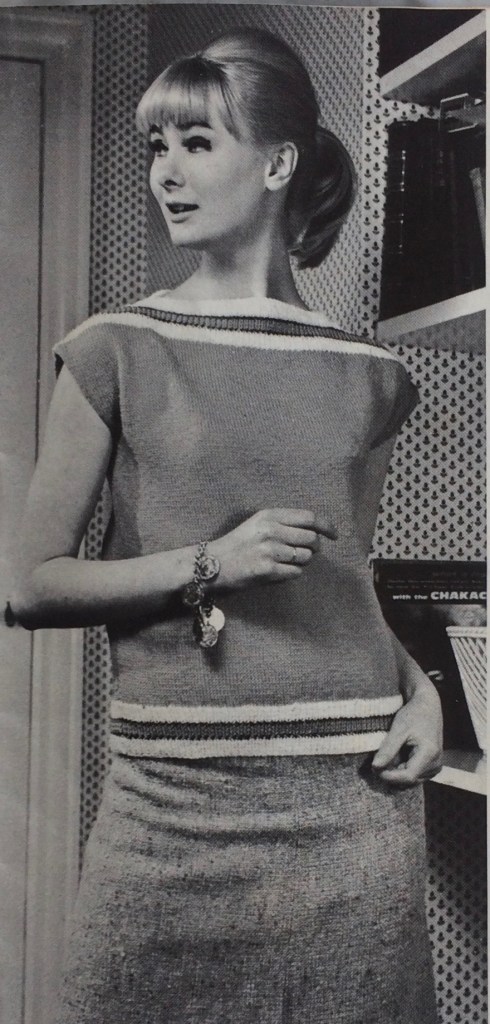
Loose-fitting, casual shapes and light, sunny colours dominate, exemplified by the apple-green cardigan, collared shirt-sweater and boatneck twin-set on the front and inside covers. Notice how much less fitted the August 1962 twin set is than, for example, this one from August 1960, not to mention earlier twin-sets from the 1940s and 1950s. The concept lives on, but the line has changed completely. Everything is hipbone-length with no or hardly any shaping.

Babies get a standard, but very pretty, lacy matinee coat and bootees, the “smart teenager” has a machine-knit pullover, and her little sister gets a “gay Rimple design” in the still-popular knitted terry-cloth look, so the whole family is taken care of.

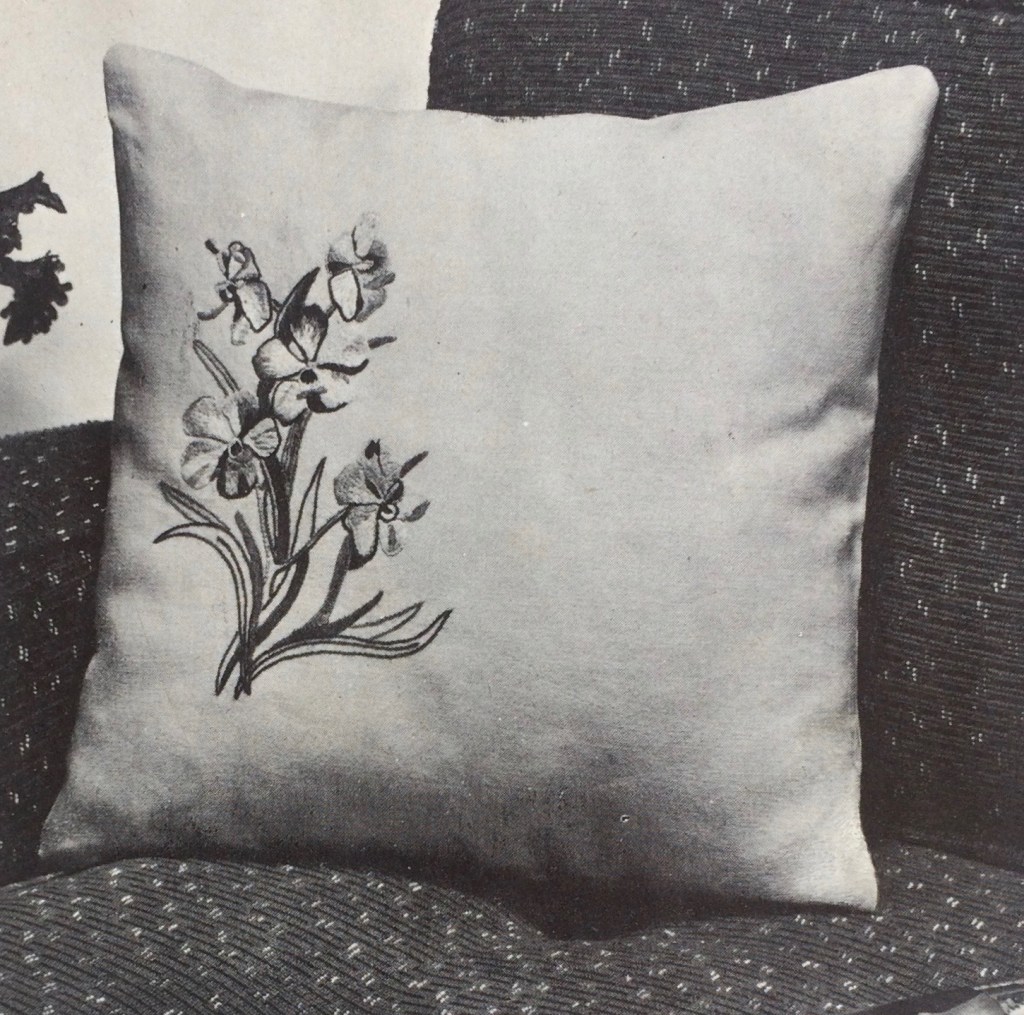
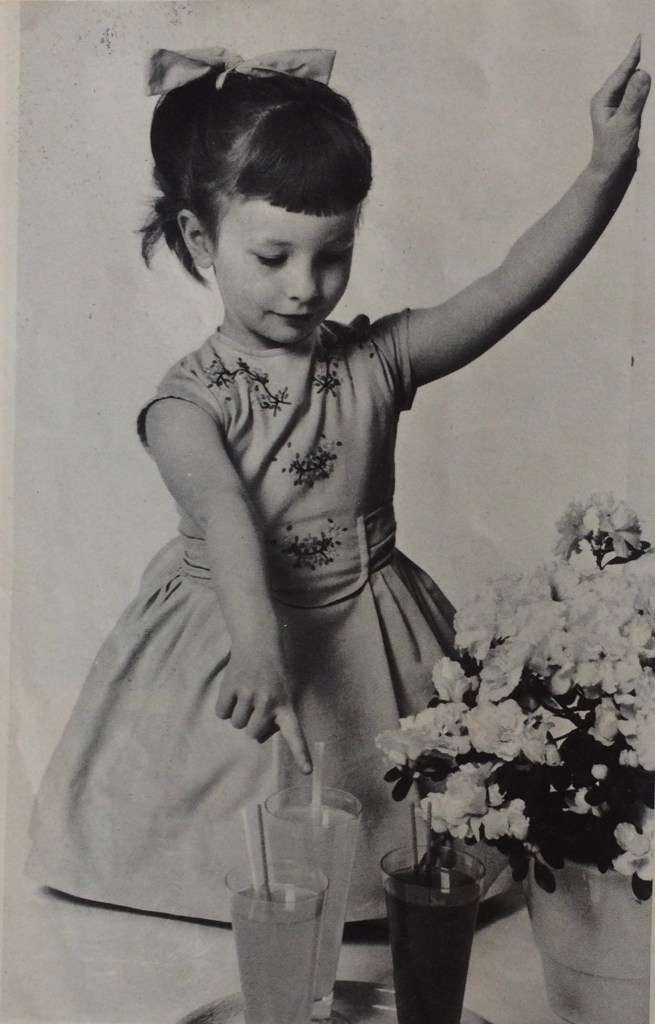
Homewares are always big in the summer months, when many readers understandably didn’t want to hold bulky warm wool in their hands in hot weather. The bedside rug is obviously an at-home project, but the smaller projects could easily be taken along on a holiday. This month’s flower in the gladiolus, but there’s also an orchid spray and some forget-me-nots, along with two sewing patterns to embroider them on: a round baby shawl or this wonderful little girl’s dress. For once, you don’t even have to send away for the patterns, as they are geometrically quite simple — the shawl is just a circle, drawn directly onto the fabric with a pencil held on a length of string, and the dress is made up of rectangles with measurements given. I would love to make the dress! I just don’t think it would get worn, since it would only be for “dress-up” occasions, of which there aren’t going to be any for a while.

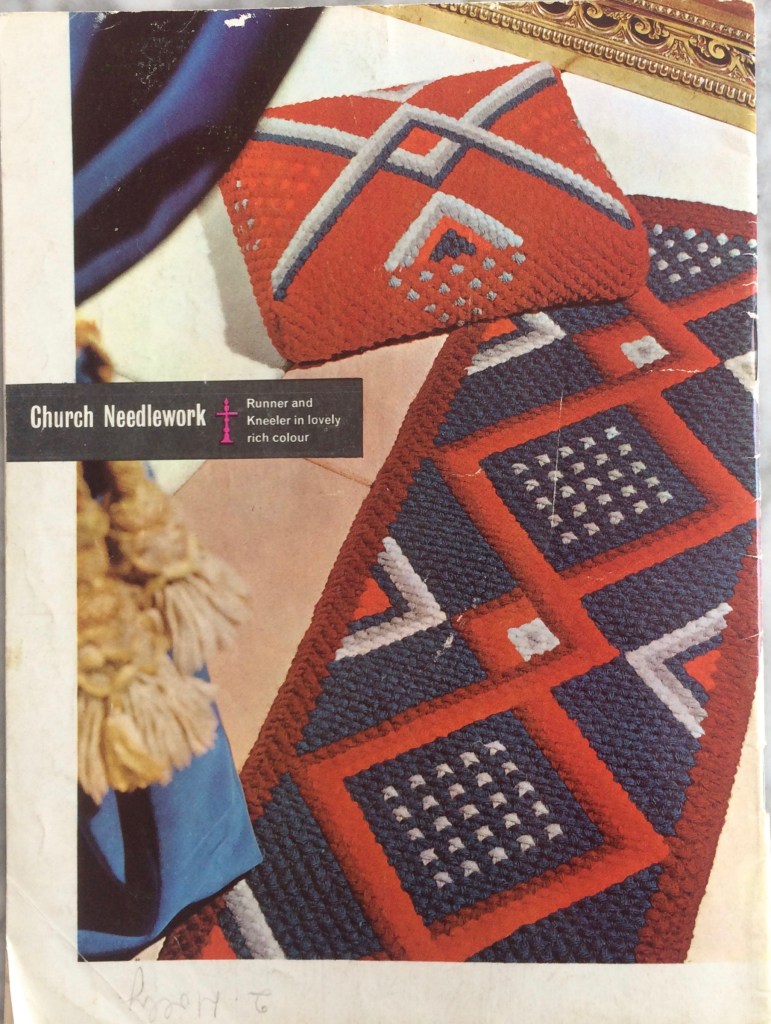
The back cover shows an interesting feature which took shape in the early 1960s issues: tapestry projects specifically for church use. In this case, there’s a runner and kneeler in shades of red and blue. If anyone happens to know why or if these colours or this pattern are significant in whatever type of Christian tradition, please feel free to tell me, as I don’t know anything about it. The rug, especially, does not say “church use” to me in any way that I can recognise and I could just as easily see it in a normal hallway.

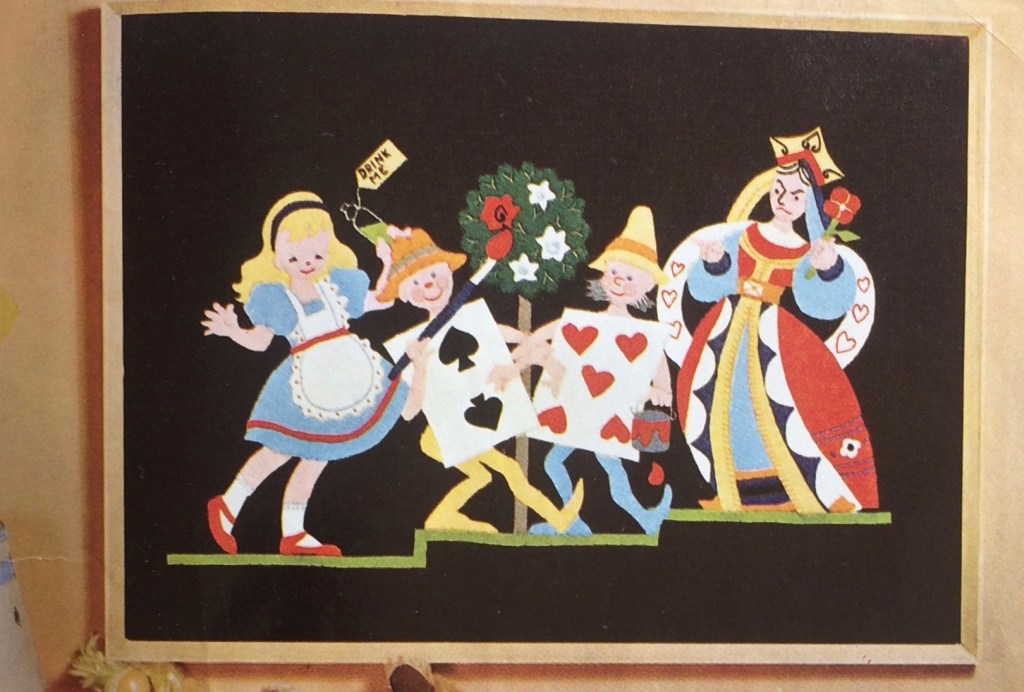
This issue doesn’t stop! The “Readers’ Pages” offer two more very simple projects: a reprint of a young man’s waistcoat from 1957 and a stash-busting baby blanket from double crochet hexagons. And just when you think you’ve come to the end of the issue, here’s this incredible Alice in Wonderland-themed wall hanging in felt appliqué and embroidery:

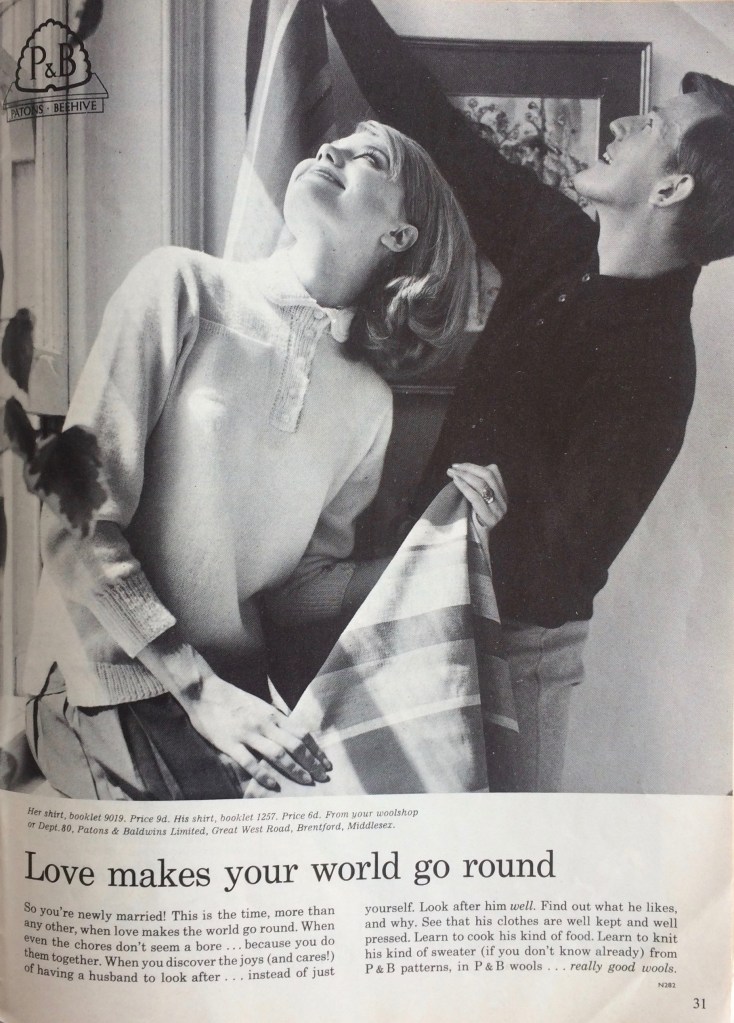
I’ll close with this full-page ad for Patons & Baldwins wools, showing a newly married couple decorating their home. The happy bride is instructed to

Look after him well. Find out what he likes, and why. See that his clothes are well kept and well pressed. Learn to cook his kind of food. Learn to knit his kind of sweater…

While I’m certainly not surprised that a 1962 advertisement would speak to women like that, I do find it interesting to compare the early and mid-1960s ads — which take on this type of “you exist to please your man” language more and more throughout the years — with those from the 1950s issues, with their much more independent picture of womanhood. Many of the knitting patterns in the earlier issues are explicitly designed “for the office” and most of the advertisements portray women living active, interesting lives in their comfortable shoes and unbreakable skirt zippers. In the wonderful tampon ads (that sadly disappear around the late 1950s), they don’t even let “problem days” stop them from doing anything! In contrast, the full-page P&B ads starting up around this time always feature a man or child with the woman in question and the text is inevitably some variation on “you must do this to please your man.” I had always thought of the 1950s as being a much more repressive time for women that the 1960s, when roles began to change, but judging from Stitchcraft (which, to be fair, is quite conservative both fashion- and otherwise), the earlier part of the decade is more of a backlash than a progression.

I don’t know what project to make from this issue and I still have so many WIPs, both for this blog and otherwise. Maybe a nice, easy flower embroidery on a vegetable bag?

April 1962: For an Easter Baby

IMG_3225My April project was the cardigan jacket, a.k.a. “matinee coat” from Stitchcraft’s April 1962 layette set “for an Easter baby.” The set included a dress, the jacket, bootees, a bonnet and a blanket to use as a pram cover, plus a  sewn “pin-tidy” made out of a tiny baby doll with flannel and satin “skirts” to hold the safety pins for baby’s cloth nappies. The pin-tidy is a bit “uncanny valley” for my taste, but the knitted items are all lovely.

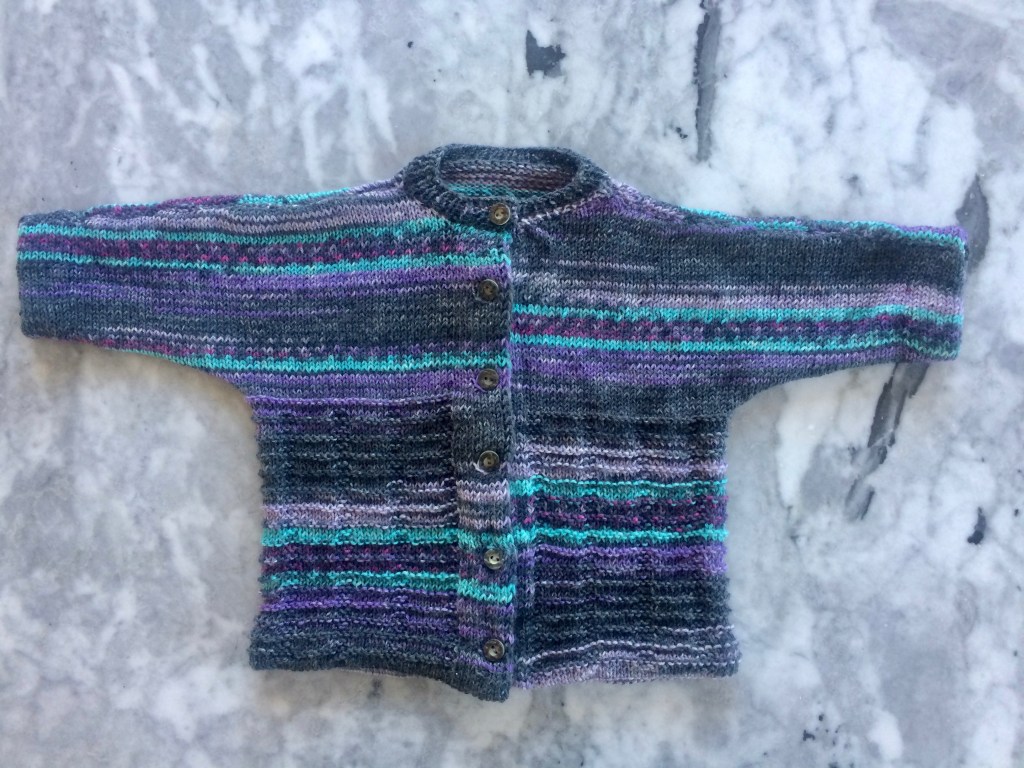
My knitting group has a gift exchange game every December and my prize this last year was 100 grams of Opal “Beautiful World” 4-ply sock yarn, 75% wool, 25% polyamide, multicoloured. I don’t like multicoloured yarns, but hey, a gift is a gift and I knew I would find a use for it! Sock yarn works well for baby things, being washable and non-felting, and 100 grams was the perfect amount for the jacket. IMG_3169The colour is unusually dark for a baby garment, but I don’t this the friend whose baby-to-be I knit it for will mind — they wear a lot of black themselves. (Side note: I did make an all-black baby cardigan for a black-clothed metal fan father-to-be friend once, and he was thrilled, because he knew he would never find one in a store. Take note, baby clothing designers — there is a market out there!)

The construction is a simple dolman, made in pieces from the bottom up with cast-on sleeves. The button band is made with a slip-stitch hem and the stitch pattern in the lower part is an easy broken welt:

  • Row 1: (RS) knit
  • Row 2: *k2, p 6* to last 2 sts, k2
  • Rows 3 and 4: knit

I even found seven buttons — one extra! — in my stash that fit the buttonholes and the style really well (my local stores are still closed).

My only worry is that the neck is too tight. It looks awfully small. Of course, they can just leave the top button open if they have to.

The baby will arrive in June and I will “see” my friend next week (i.e. non-contact delivery of present, perhaps we will literally see each other through a window or something). I hope everything works out for them as well as this project did for me!

IMG_3222

April 1962: Overview

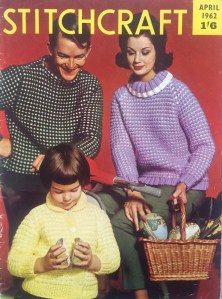
IMG_3168“Easter Greetings” from Stitchcraft, April 1962! According to “editress” Patience Horne, “everyone is getting that “out-of-doors” feeling”. I and my fellow compatriots from 2020 have had a very much in-doors feeling for the last few weeks, as we watch Spring unfold from our quarantine windows.

Back in 1962, the whole family can sport matching waffle-stitch pullovers and cardigan jackets for those inevitable country rambles. All three cover-photo designs are made in bulky Big Ben wool at 3 1/2 stitches to the inch. Those who prefer double-knitting weight wool can make a men’s pullover in “slip-on shirt style for sailing and tennis” (with sporty illustration!), a buttonless women’s jacket, or a “crunchy” cabled pullover. Roll-necks or rolled collars are gradually eclipsing the larger, pointier collars of the years before.

There’s also a “travel set” of jumper, cardigan and two skirts to take on your spring holiday, made in both plain green and a marled two-tone green that appears to be one of the early multi-colour yarns just starting to come onto the market around this time, but is actually made by holding one strand of each of the two colours together . The child’s striped V-neck pullover seems like a good way to use up all the leftover yarn.

Even the baby of the family, or a baby-to-be, can expect a lovely Easter present in the form of a dress, bonnet, jacket, bootee and blanket set — plus a “pin tidy” to hold all the safety pins that will fasten our 1962 baby’s cloth nappy in place. The blanket is also made in Big Ben (ensuring it will be done in time for baby’s arrival), while the other garments are made in the usual 3- or 4-ply baby fingering wool.

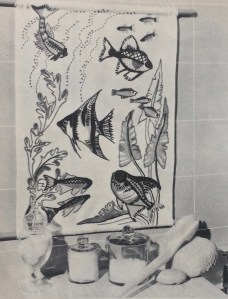
IMG_3173Springtime also means spring cleaning, and Easter means presents and bizarre sorry bazaar novelties (honestly, with some of the designs it’s hard to tell the difference.) Here’s an intriguing “splash panel” to hang on the bathroom wall. As with the elaborately embroidered “finger plates” for doors, its utility evades me. Why would anyone hang a hand-embroidered tapestry on the bathroom wall, for the express purpose of being splashed with soap and toothpaste and who knows what else, which would therefore need to be taken down and (hand!)-washed frequently, rather than just… wipe down the tile wall? I do like the fish design, though!

The pineapple (-ish) motif cushion, embroidered flower-of-the-month iris, latch-key and crocheted rugs are less interesting, but the Easter novelties — a stuffed polka-dot giraffe, a hedgehog pincushion (brilliant), a chicken egg cosy and a knitted lamb with mascara and eyebrows — do not disappoint. A crocheted altar cloth and a set of versatile cross-stitch animal motifs round out the homewares selection. Finally, there’s a great surprise on the inside back cover: a set of embroidered and appliquéd place mats and matching cushion with a chess-set motif! That’s actually quite a lot of fun.

I hope you are all staying sane and healthy in these unfortunate times. May you all have enough projects to keep you busy and enough non-physical-proximity games to keep you happy. Two friends of mine will be expecting babies in the summer, so my Stitchcraft project for April will be the jacket from the baby set. Hang in there, everyone!

March 1962: Overview

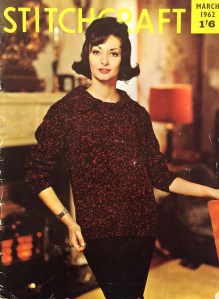
IMG_3126There are three seasons in the Stitchcraft year: autumn, Christmas and “holidays”, which start in March and continue until about September. Of course, most people take their holidays in the summer, but the beauty of knitting (or editing a knitting magazine) is that you can technically be knitting for them any time of the year, if you knit slowly enough. And so, the March 1962 issue of Stitchcraft, (motto: “Knit for Spring”) can already promise us “the fun of holidays to plan for.”

Spring is also “the time of year to wear smart two-piece suits and dresses, which you can now knit so quickly and easily” — a nod to the double-knitting and bulkier-weight wools now available and in fashion, relieving knitters of the earlier boredom of making dresses and long-skirted suits at 8 stitches to the inch. Here is a skirt set in nubbly Rimple DK. Top-fashion colours of dull green and beige-gold (or as Stitchcraft calls them, “mustard and pheasant” — sounds delicious!) are repeated in a finer-knit bouclet sweater.

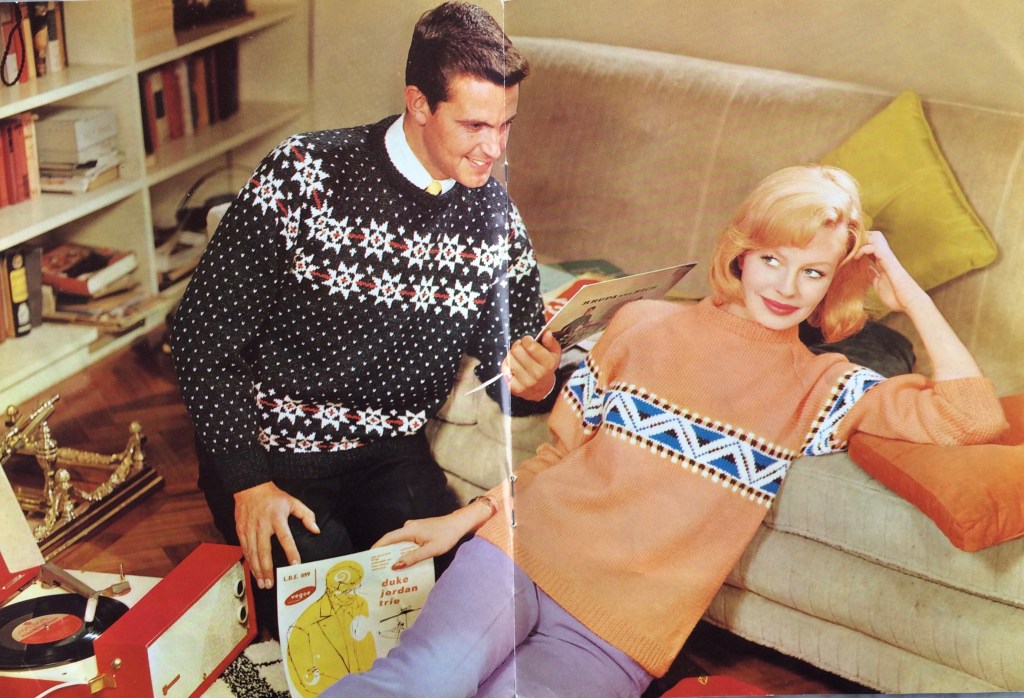
Interesting textures and colour blends are key: in addition to the Rimple and bouclet offerings, the cover jumper is made in Bracken Tweed, one of the newer marled/flecked wools. Stranded colourwork is featured in a Norwegian-style pullover for men and, in more subtle form, in a bright band across a warm women’s raglan sweater. Look at that perfect 1962 “lifestyle” photo of our knitter lounging in her beige-coloured living room and smiling seductively at her man while listening to jazz!

IMG_3136

“Informal sweaters” that combine colour and texture elements, as well as a lovely little twin-set for a child and granny-square bonnet and mittens for a toddler round out the collection. The homewares are varied, but predictable: another tapestry town scene, a Florentine rug (pity they didn’t get a colour photo of that), traditional cross-stitch designs and a daffodial embroidery transfer for a coffee-pot cosy or night-dress case.

And of course it wouldn’t be Stitchcraft without “novelties”, in this case, matching “boy” and “girl” egg cosies made to look like nightcaps — I’m guessing somebody must have found the egg holders with painted-on faces and had an inspiration. The back cover is another fun, if slightly “uncanny valley”, advertisement for Escorto “Gold Seal” fabrics — “easy” due to being 100% synthetic material.

My March project will be the jumper from the girl’s twin-set as well as another “blast from the past” which I have been working on for literally years and will hopefully finally finish soon. Happy Spring!

October 1961: Baby’s cardigan

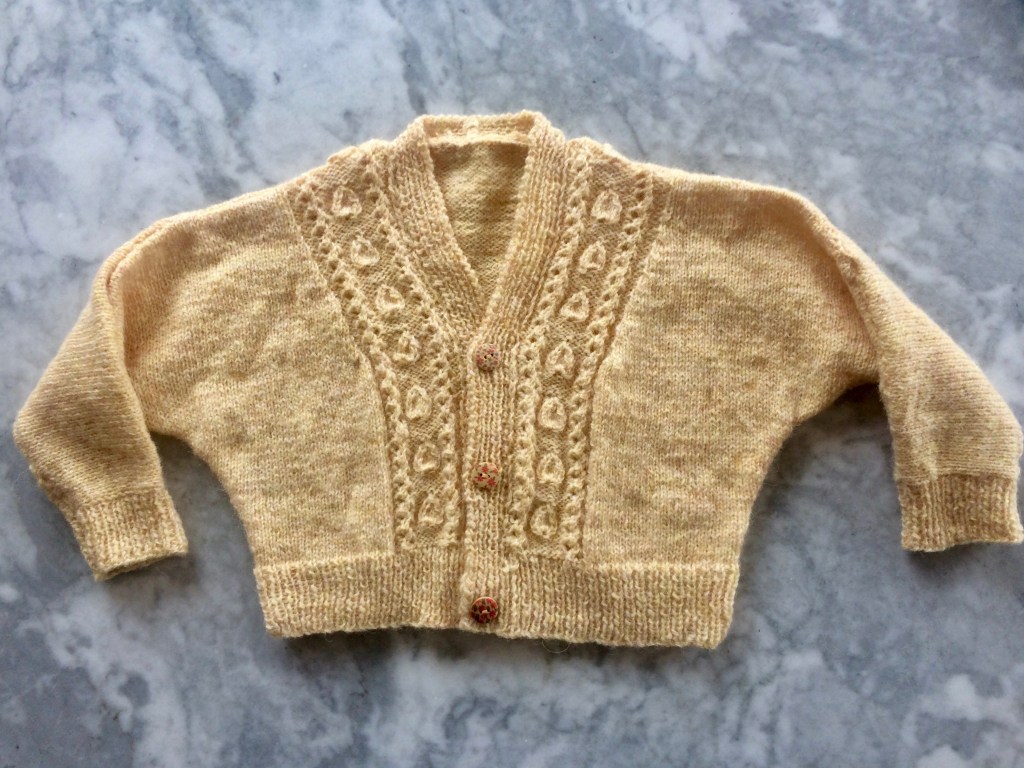
IMG_2837There’s always somebody having a baby, and I do try to make something nice for all my friends’ and colleagues’ newborns. Sometimes I don’t manage to finish something until they are out of the newborn stage, which is why it’s nice to have patterns for larger babies! This dolman-sleeve cardigan, made in the smaller size, should fit a 22 inch chest, which should be fine for this particular eight- or nine-month old.

I wasn’t and am not convinced that dolman sleeves are good for babies or anyone else (so much fabric flappage) and originally I thought about converting the pattern to set-in sleeves, but in the end I was just too lazy, so dolman sleeves it was. I guess it does have the advantage of being wide enough no matter what, and easy to get the baby’s arms into the sleeves. Given that, I’m surprised it’s so short! If it were made longer, it would fit longer without the baby getting a cold belly.

IMG_2918The little leaf motifs up the front sides are quite easy and don’t require any cabling or special fuss. You just work into one stitch 5 times on one row, then work those 5 stitches in stockinette (on the reverse-stockinette background) for a few rows before closing off the leaf with decreases. The lace strips on the sides are plain yo, k2tog alternating with k2tog tbl, yo, worked on the right-side rows.

IMG_2834I used Jamieson’s wonderful Shetland Spindrift from a multicoloured stash that I had bought from a nice person on Ravelry. Some may say that Shetland wool is too tough for babies, but it does get softer with washing and since it won’t be worn against the skin, I think it will be fine. The colour — Buttermilk — is really beautiful, a pale yellow ever-so-slightly marled with shades of pink and winter white.

If I remember correctly, the buttons came from a Christmas fair somewhere some years ago and hadn’t found the right garment yet. I only had three and the pattern calls for five, but I preferred the buttons I had to any new ones I might find.

All in all, a quick and easy project that will hopefully keep the baby warm and make its parents happy.

IMG_2921


October 1961: Overview

IMG_2820October 1961 gives us “Colour for autumn” with “special fashion features” and a great center spread with colour photos. “I always think October is a nice friendly month,” writes “editress” Patience Horne on the facing page, and I have to agree.

Bulky Big Ben wool and different kinds of textured ribIMG_2821 stitches play a prominent role in this month’s issue, starting with the partner-look pullover and cardigan on the front cover. Both are made in the same drop-stitch rib pattern — basically 2×2 ribbing, but you drop a stitch down 3 rows every 4th row and pick it up again in the next row to make a long vertical rib. Children get twisted-rib raglan pullovers to keep their upper bodies nice and warm while their legs freeze in tiny shorts and mini-skirts, typical for the era.

Nubbly Rimple wool may be easing out of fashion, as there’s only one pattern for it in this issue: a simple, yet elegant dress with “the new horseshoe neckline.” Other women’s garments include a cabled cardigan with colour accents and matching cap, a long-line pullover with a wide collar (still in fashion) and saddle-stitching detail, and a cardigan jacket in a wonderfully ornate Florentine stitch that involves a lot of slipping, dropping and pulling stitches up and around in two colours. The finished effect is a lot like a trellis, accentuated here by posing the model in a green skirt and holding on to a plant. Autumn colours of gold, orange, and beige prevail.

There are some additions to the “Stitchcraft Layette” for the smallest member of the family, but we’ve moved on from the bramble-stitch pattern in the last few issues to a mix of cables and flower motifs. Both cardigan and blanket are  pretty and useful, but I don’t like the huge dolman sleeves on the cardigan —  I can see a baby getting their arm stuck inside it. The bottle cover with a fuzzy knitted kitten on it is great, though! If it were made somewhat smaller or larger, I could imagine it as a phone or tablet cover.

In the homewares and accessories department, we’ve got the usual teapot cosies (how many can one household have??), a knitted donkey named “Ned”, and a pair of “mitts for a scooter fan” — with separate thumb and first finger. There are tapestry patterns for a piano stool and a chair seat, and did you honestly think we were finished with the Zodiac theme, just because all the months had had their patterns already? Of course not! Now you can order the complete chart and embroider them all one more time on a tablecloth.

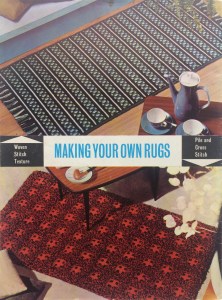
The back cover illustration shows two hand-made rugs using different techniques: flat crossed stitches for a woven effect, or stitching combined with pile knotting (latch hook), which was apparently the latest thing in Sweden at the time.

IMG_2838


The highlight of the home art section, for me, is this sequinned, glittered appliqué wall hanging of some of Great Britain’s famous kings and queens. I don’t think I would hang it in my own home, but what a wild idea and the appliqué and embroidery work is certainly stunning. Look the detail on Queen Elizabeth (I)’s face! And they definitely found a wall with the perfect wallpaper to hang the sample piece on.

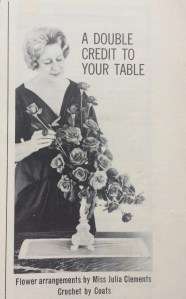
The “Readers Pages” have the usual ads, kiddy comic (Sally in Sampler Land), a preview of the next issue, and some easy counted-stitch ideas for borders on towels, pillowcases, etc. I love this ad for the latest Coats crochet booklet — it has flower-arranging lessons in addition to the crochet patterns.

IMG_2836


That’s all for now! My October project will be the baby cardigan (with modified sleeves) and maybe some kind of phone-cover version of the kitten bottle cover.


September 1961: Overview

IMG_2772“Knitting with an Autumn Theme” is the motto of this month’s Stitchcraft from September, 1961. Knowing that September is the month where many knitters take up their needles again after not wanting to handle wool in the hot summer, I would have expected a “bumper issue” with extra ideas, new fashions from Paris, more colour photographs and so on. Not the case! It has more or less the same mix of “chunky”, bulky garments and easy homewares that we saw in the summer issues.

Not that that’s bad, of course (though bulky is not andIMG_2773 probably will never be my style). The kid’s coat looks cosy and fun to wear, and the “gay sweaters for him and her” in a Norwegian-style pattern are warm, practical and unisex. I imagine the boatneck collar on an unshaped front must scratch horribly across the neck, though.

There are more men’s garments than usual: a wide-collared “sports sweater” and an elegant crossed-front pullover with twisted-rib details on the pockets and borders. The former is meant to be worn for “golf, country walks and all the week-end jobs in the garden”. I’m guessing the plants in the garden will grow better if you wear a shirt and tie under your sweater while working on those week-end jobs, as it will make them feel important and worth dressing up for. Maybe I should try it — I’m terrible with plants.

IMG_2775 2


Collars, V-necks and checked patterns are still in fashion, as seen on the comfortable, yet elegant cardigan suit and the cardigan in a familiar three-colour slip stitch pattern. Terry-towel-like Rimple is still going strong, featured here in a cardigan for larger sizes.

Babies get a bonnet and jacket in the same bramble stitch pattern as last month’s coat and July’s dress (“Part 3 of our Layette”) as well as a vest and pilch (underpants/diaper cover) and small children get machine-knit slacks to match the blazer. Hooray for warm legs, finally!

If all of that sounds underwhelming, we haven’t even gotten to the housewares… The knitting and crochet projects focus on using up scraps and “leftovers” to make either a cushion, a stuffed puppy toy or some utterly goofy egg cosies. Needlewomen (sadly, they don’t write “embroideresses”, which would be more entertaining) can make floral cutwork mats or a cushion, or a “Vintage Parade” of early-20th-century automobiles. There’s a tapestry hassock for church-goers and the last of the Zodiac-themed projects — this month’s sign is Virgo.

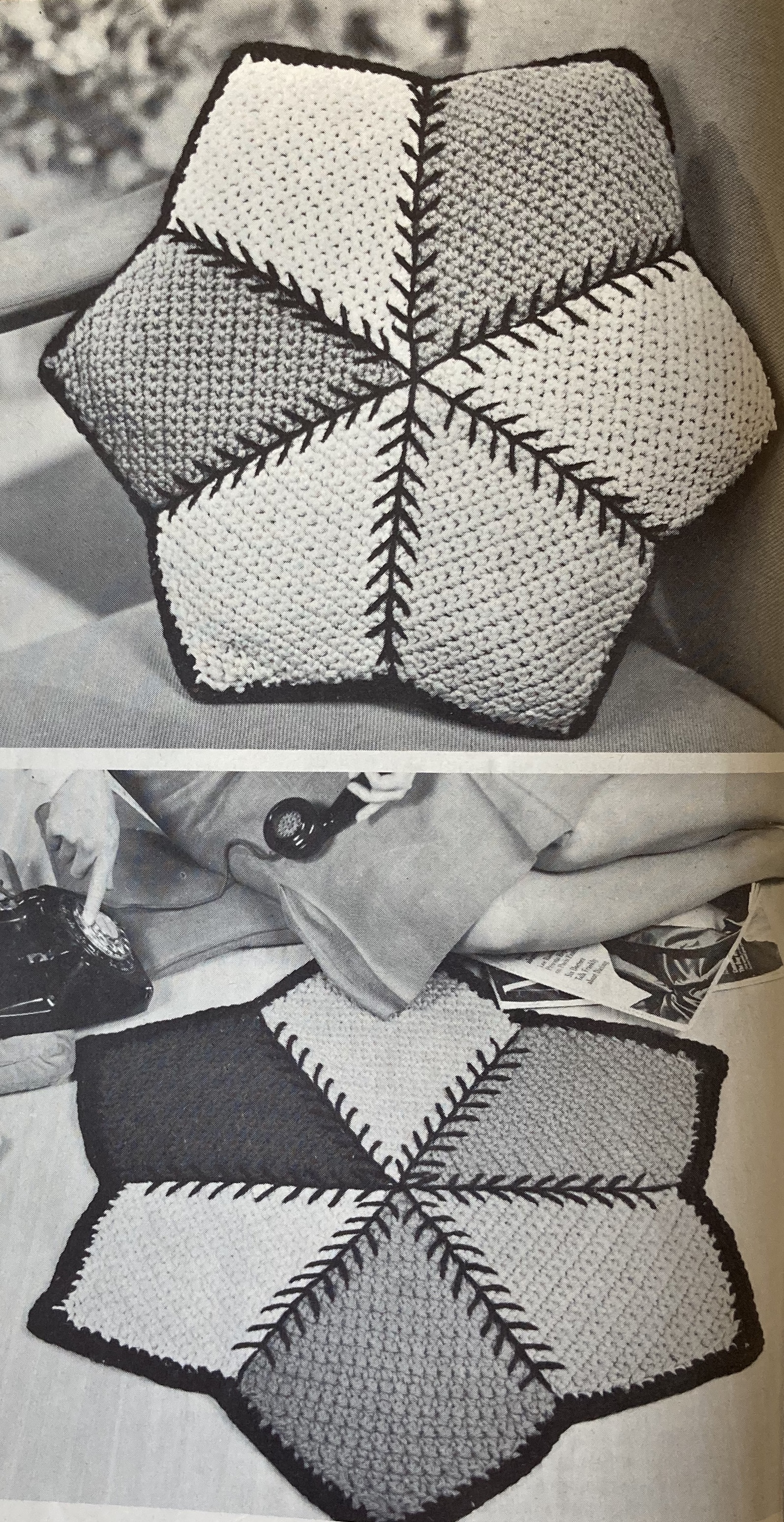
I almost gave up on this issue, as there just wasn’t anything that inspired me… but then there was this rug! This utterly 1960s, easy enough for me to crochet, fringed and polka-dotted rug that would look marvellous underneath my vintage, Danish Modern coffee table and, if made in the right colour, would perfectly match my embroidered cushion from the January 1960 issue. I love it! Rug wool in skeins isn’t really sold anywhere these days, but I’ve got a solution for that that I think will work.

IMG_2785

Stay tuned for the result… and the “special bumper issues” with “extra features in colour” that are promised for October and November.

August 1961: Overview

IMG_2709“August is an issue that needs special thought and planning” writes Stitchcraft‘s “editress”, Patience Horne, in the introduction to the August issue, pointing out that it is “rather an “in-between” month for needleworkers” — often too hot to want to wear or make heavy sweaters and too late in the year for fine-knits. At the same time, reminding people that “Autumn is around the corner” can be “a little depressing” to people enjoying their late-summer holiday.

I get this! It’s one of the … hazards? “joys”? features? of living in a temperate/oceanic climate zone like the UK: August, and in fact the entire summer, can be so hot that you can’t even imagine holding wool in your hands or performing any excess movement (thus the small, easy embroidery projects in cotton thread on linen), or 10 degrees Celsius with unending rain (just ask Edinburgh, or the Bretagne), or anywhere in between.
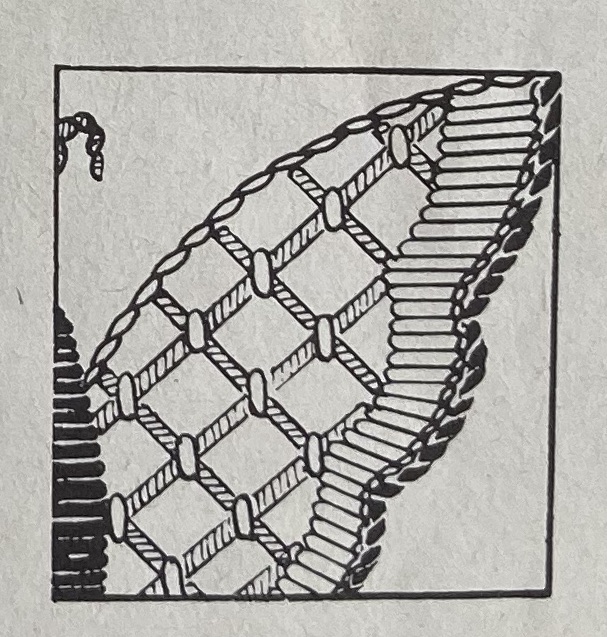
Stitchcraft‘s answer is to offer casual, “all-year-round” knit styles that could work either on a (cold, wet…) holiday or back home in the autumn and lots of little needlepoint and embroidery projects that fit in a suitcase and can be done easily in the heat. The adult garments are thick and warm and serve as outerwear on a summer evening or Atlantic boat trip: the cardigan on the cover, “chunky” pullovers for women (one knitted, one crocheted), and a man’s pullover in “that typical man-appeal style which will make it a winner.” All are made in double knitting-weight or bulky Big Ben wool and both the knitted pullover and cover cardigan feature slip-stitch patterns which make the finished garment that much thicker and warmer. Golden or orange tones and white continue to be popular colours.


There are sleeker, finer-knit short-sleeve tops for girls in their “early teens” (the models seem to be young, slender adults, but OK) with high necklines and an interesting mitred collar on one. Smaller girls (or boys, I guess? this garment doesn’t seem to be heavily socially gendered, but the instructions only have options for buttons on the “girl’s side”) get a fine-knit cardigan with a border of “Scotties chatting to a friendly Cockerel.” Babies get the newest addition to their “Stitchcraft Layette” with a matinee coat and bootees in bramble-stitch to match last month’s dress.


The real fun is in the homewares, where there is a huge selection of projects and needlecrafts to choose from: embroidered ivy borders for tablecloths, traycloths or cushions, a tapestry footstool or “needle etching” picture of a “typical Cornish quayside”, a crocheted rug, blue rose sprigs to embroider on a cushion or a fringed lampshade, a weird crocheted and embroidered tea cosy in Turabast (which I can’t imagine would have good insulating properties), or “Fluff”, a somewhat psychotic-looking, yet endearing knitted kitten. Also, I thought the Zodiac year theme had to be finished by now but no, it’s Leo the lion’s month.


IMG_2723My favourite, though, is this sewing project: a head cushion that lets you recline charmingly in bed with your hair and makeup perfectly done, your satin nightie on, a book on your lap and your telephone on your ear. It’s glamorous  leisure and lifestyle advertising personified, and though they say it’s an “idea for your bazaar”, I would bet the Stitchcraft readers who made this in 1961 did not make it to sell.

IMG_2725Apropos lifestyle advertising, the early 1960s Stitchcrafts show a rise in full-page ads for Patons and Baldwins wools. That’s obviously not surprising considering the magazine was published for the Patons wool company, but the full-page ads that “tell a story” are a new trend: the late 1950s and 1960s issues up to now had little celebrity testimonials. This one caters to grandmothers and the message is clear: Knitting is not only a rewarding pastime on its own, but earns you the love and affection of the grandchildren for whom you knit. (But only if the kid likes it, and that’s only guaranteed if you use P&B wools, of course.) The 1950s and 1960s saw a huge shift in advertising methods towards a psychologically-based system, which is a huge topic that I won’t start with here, but suffice to say there will be more of these ads, and that they are representative of changing advertising styles.

That’s it for today! I have lots of unfinished projects lying around, so my August project will be something small, definitely not the Turabast tea cosy, but very probably the blue rose sprigs on a little bag, or tablet cosy, or something.