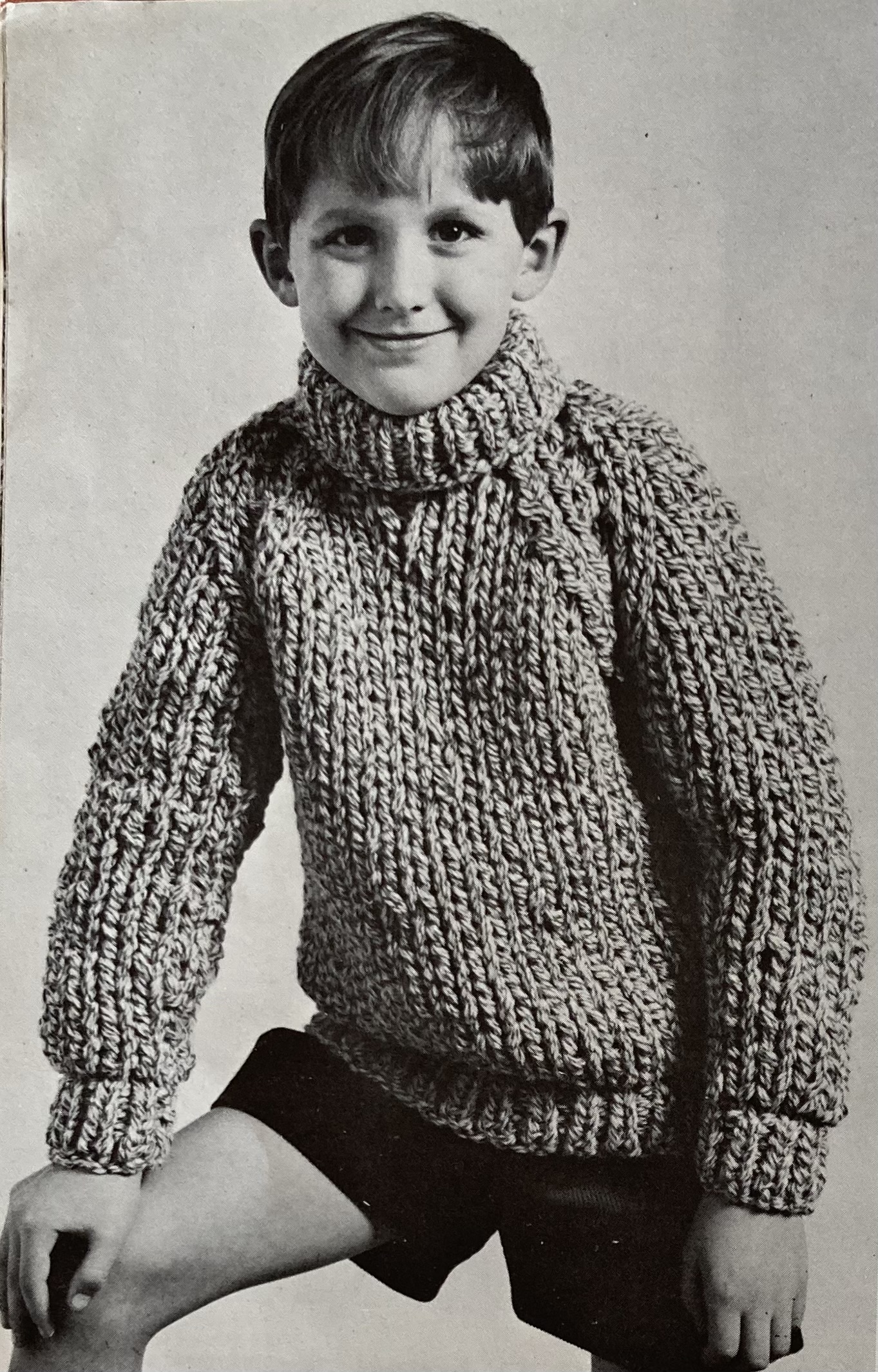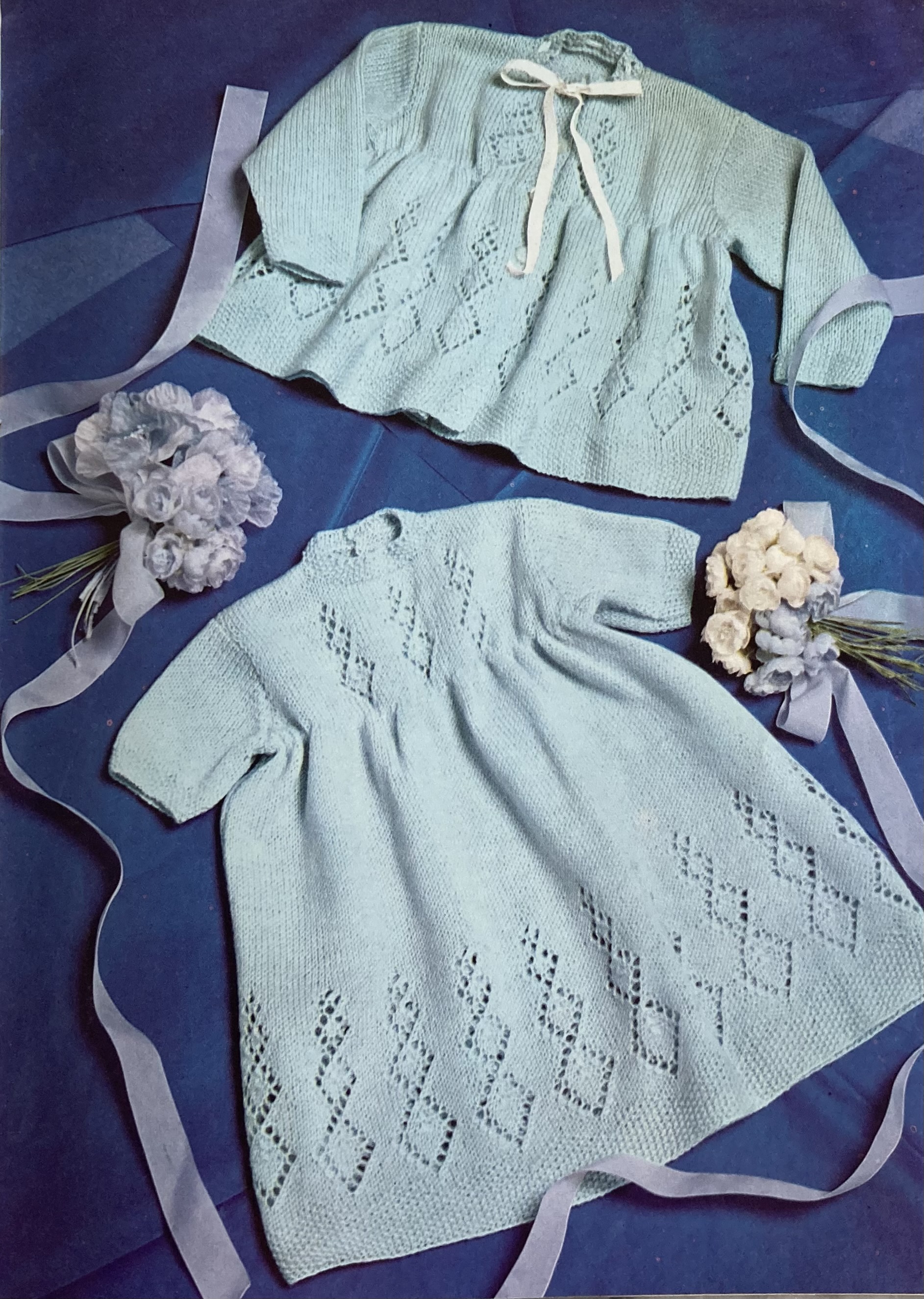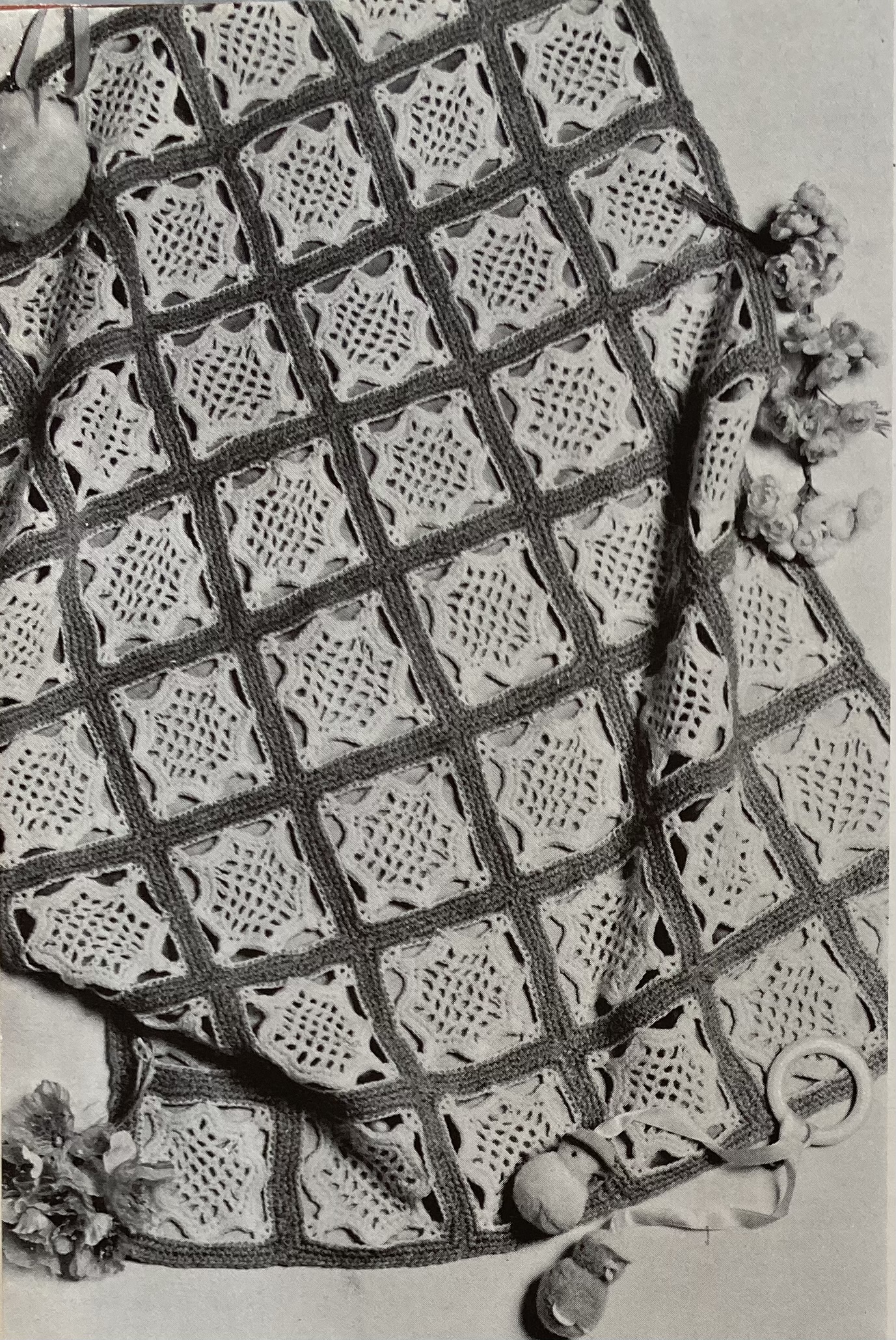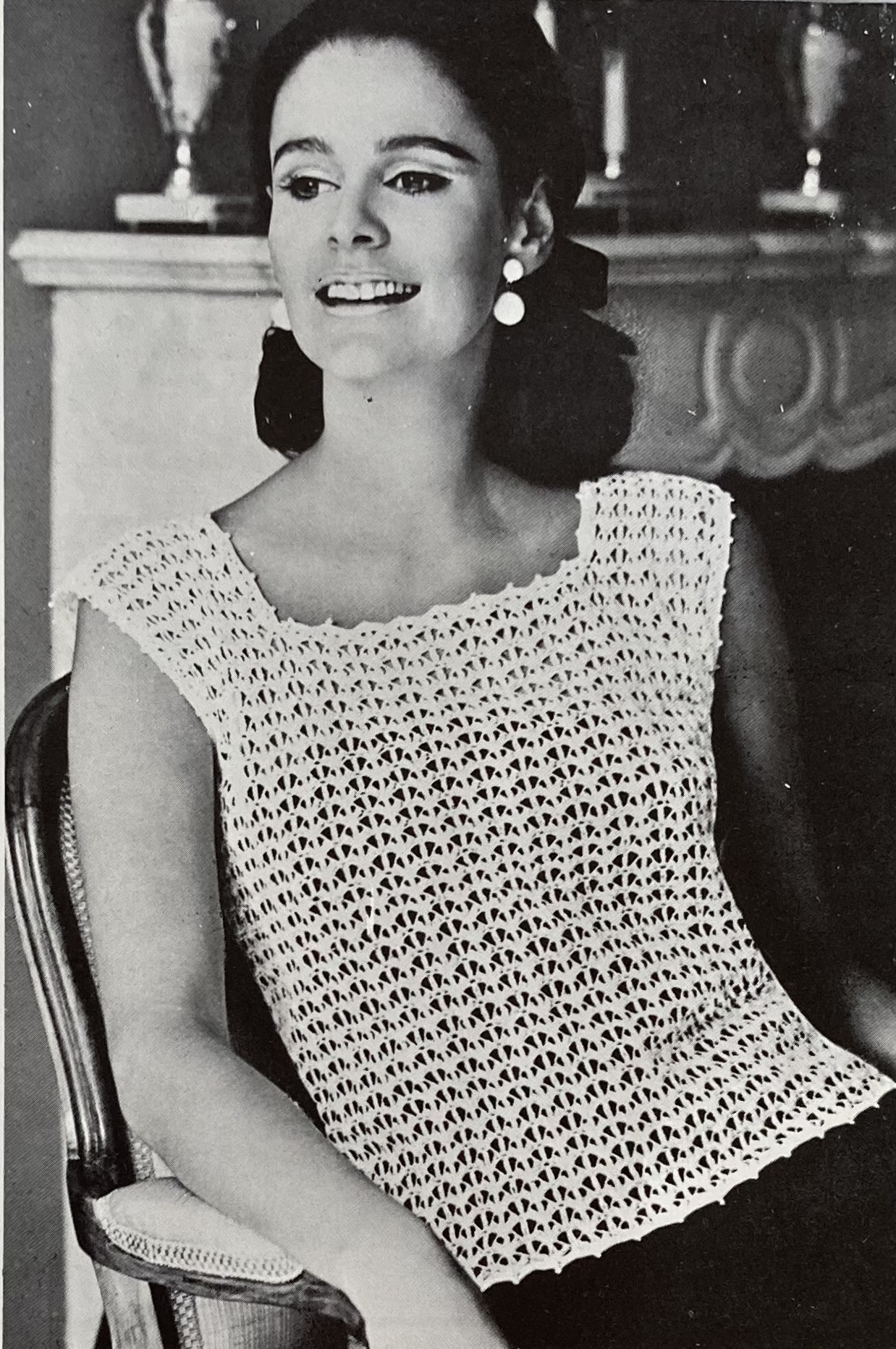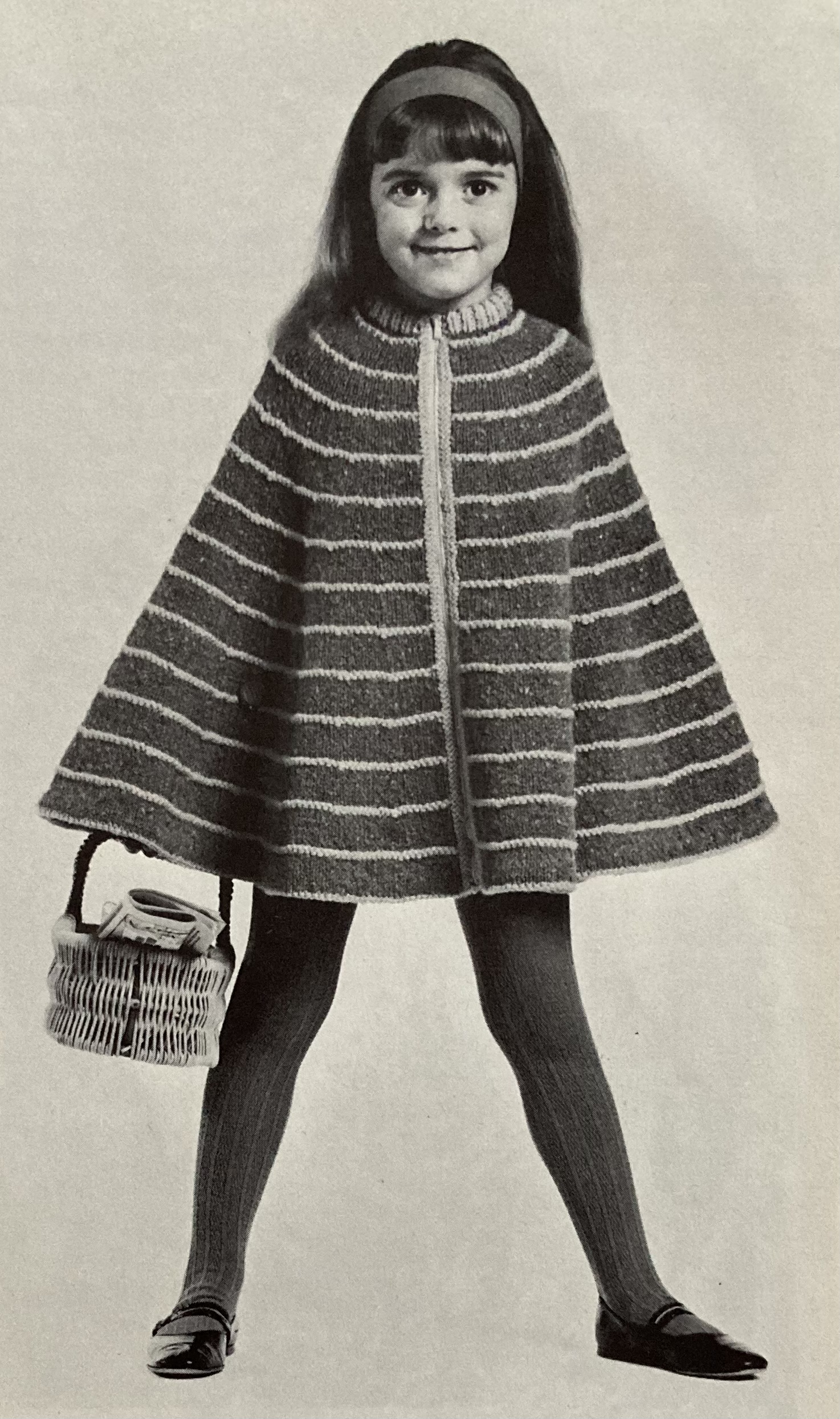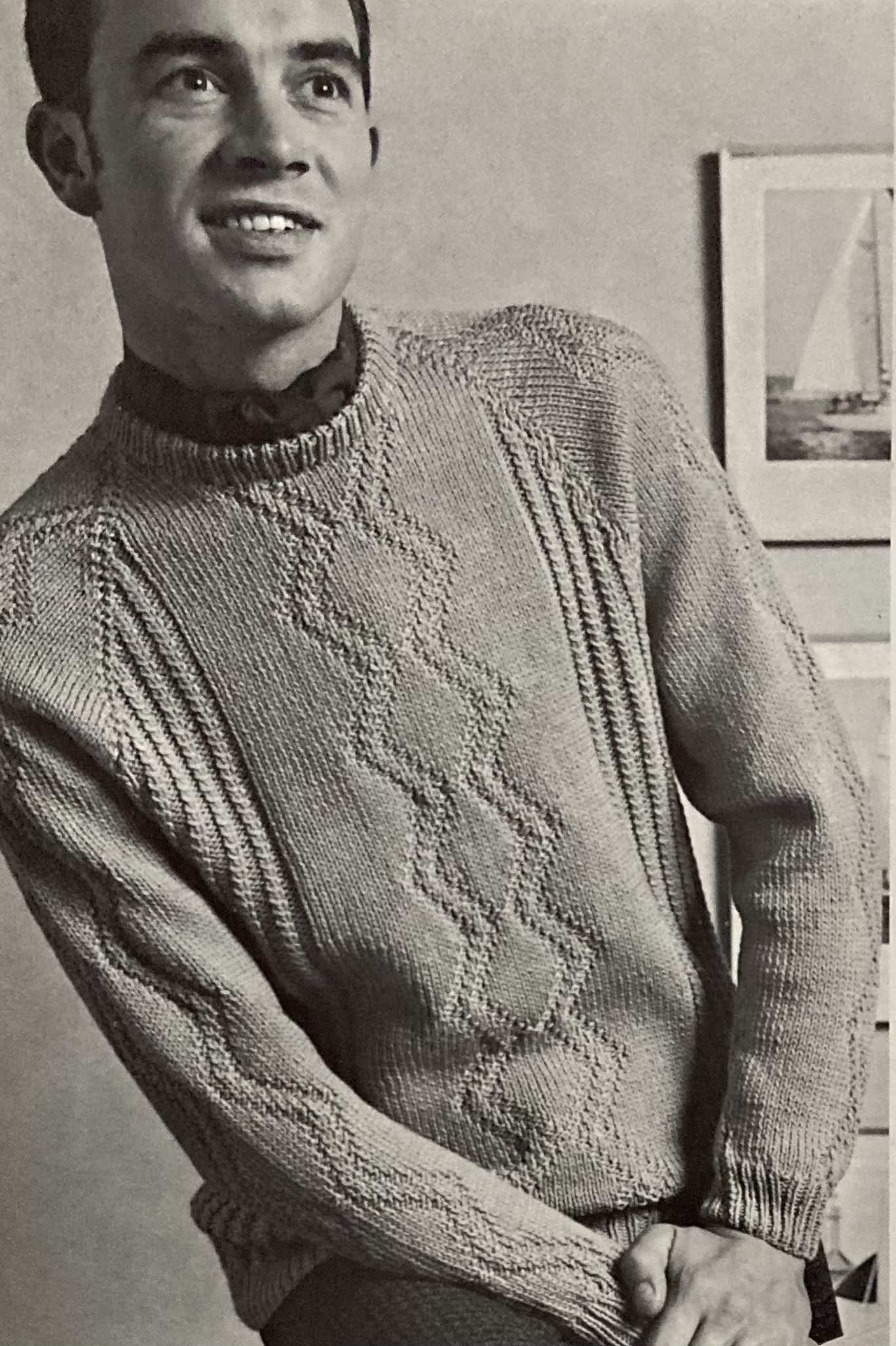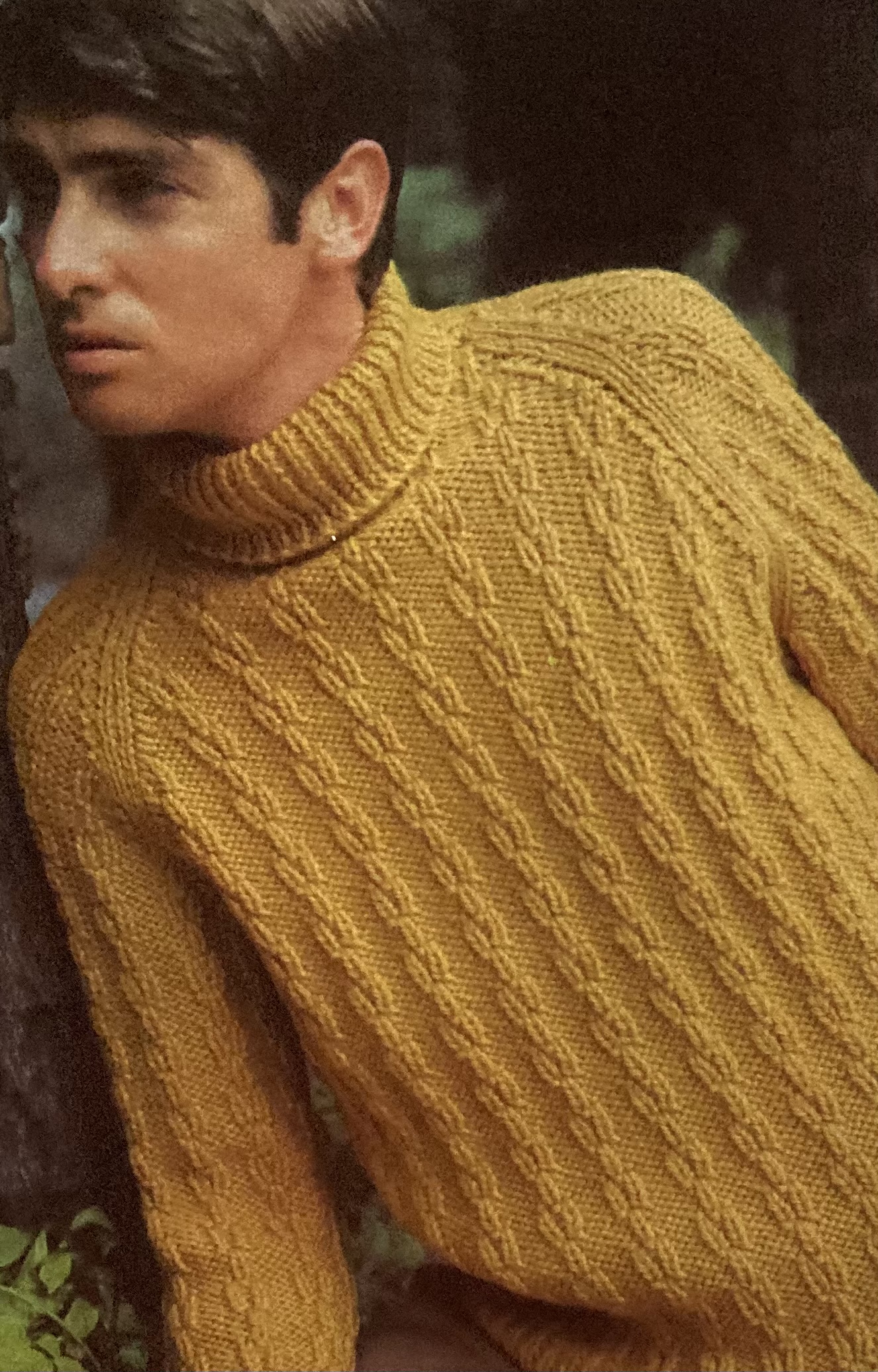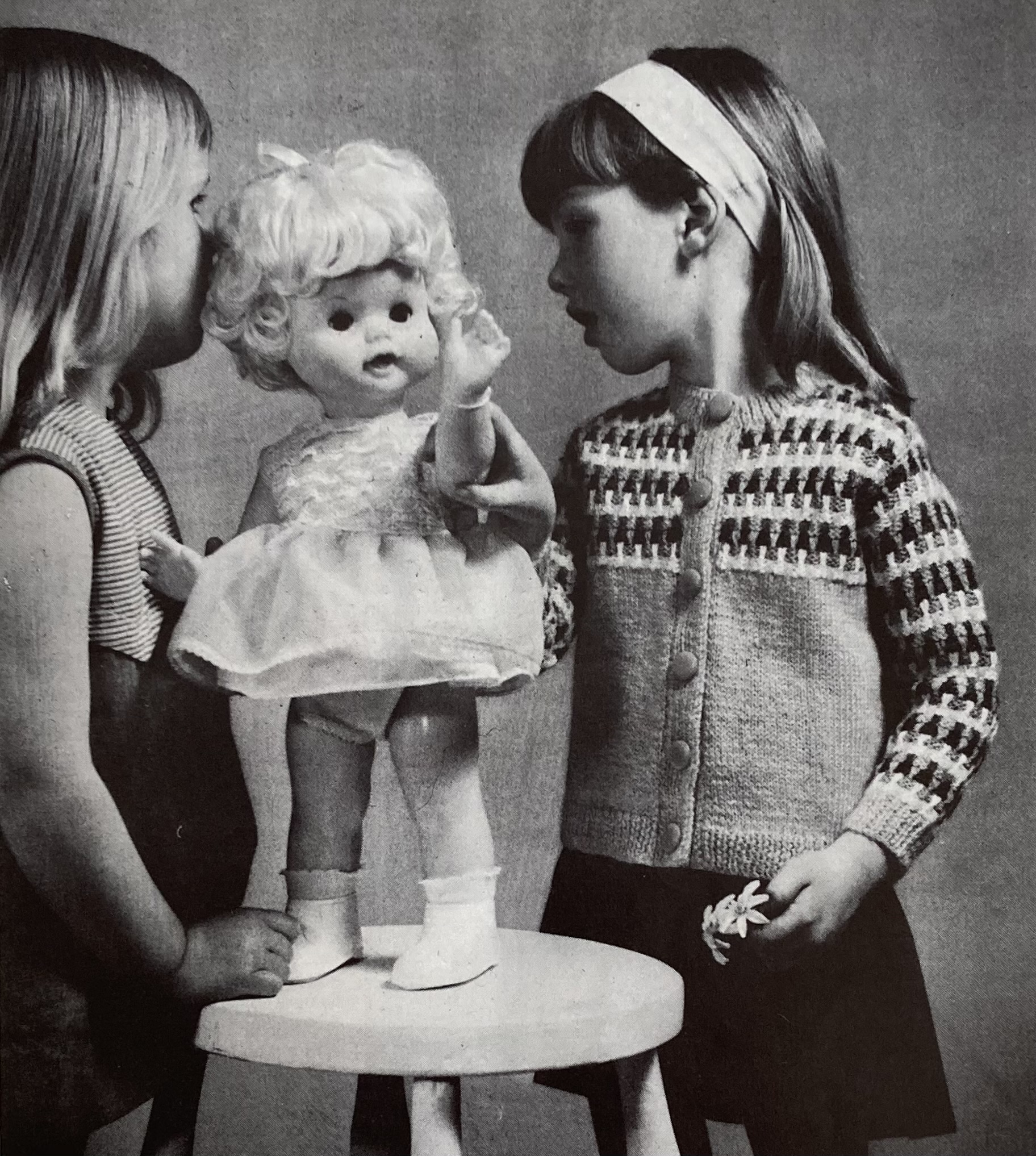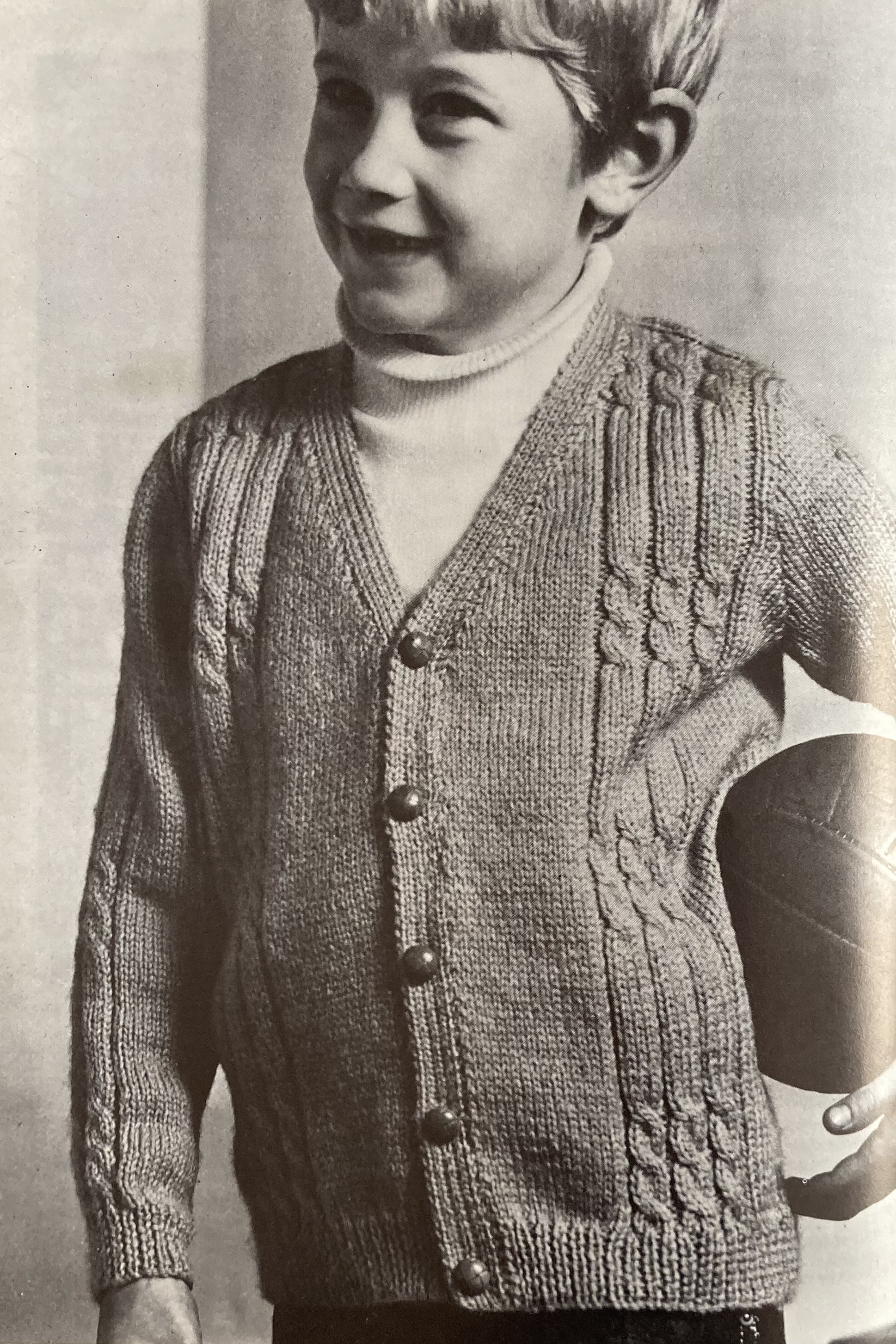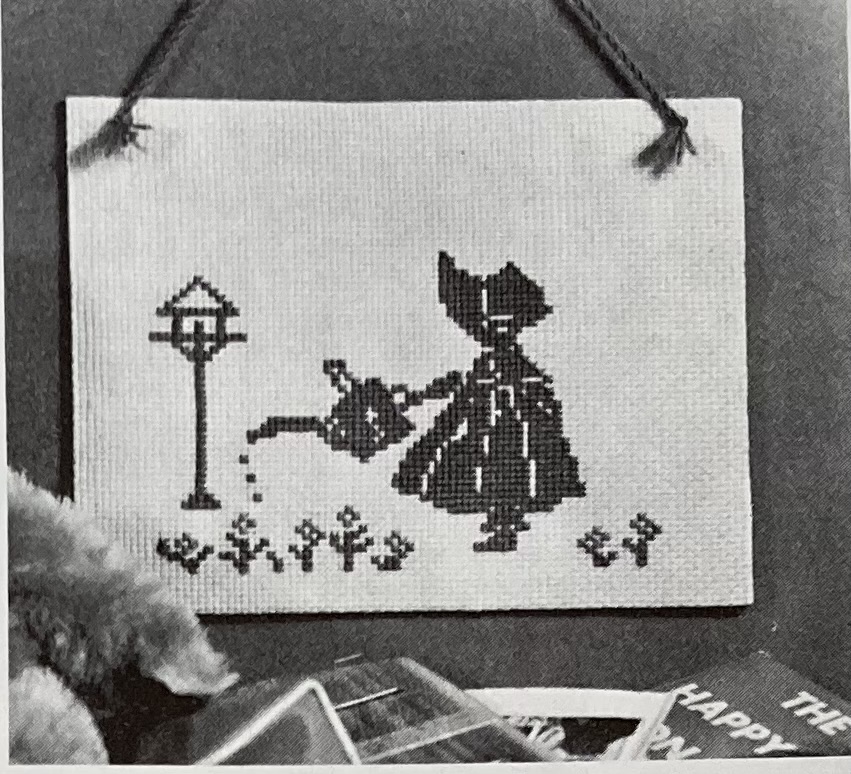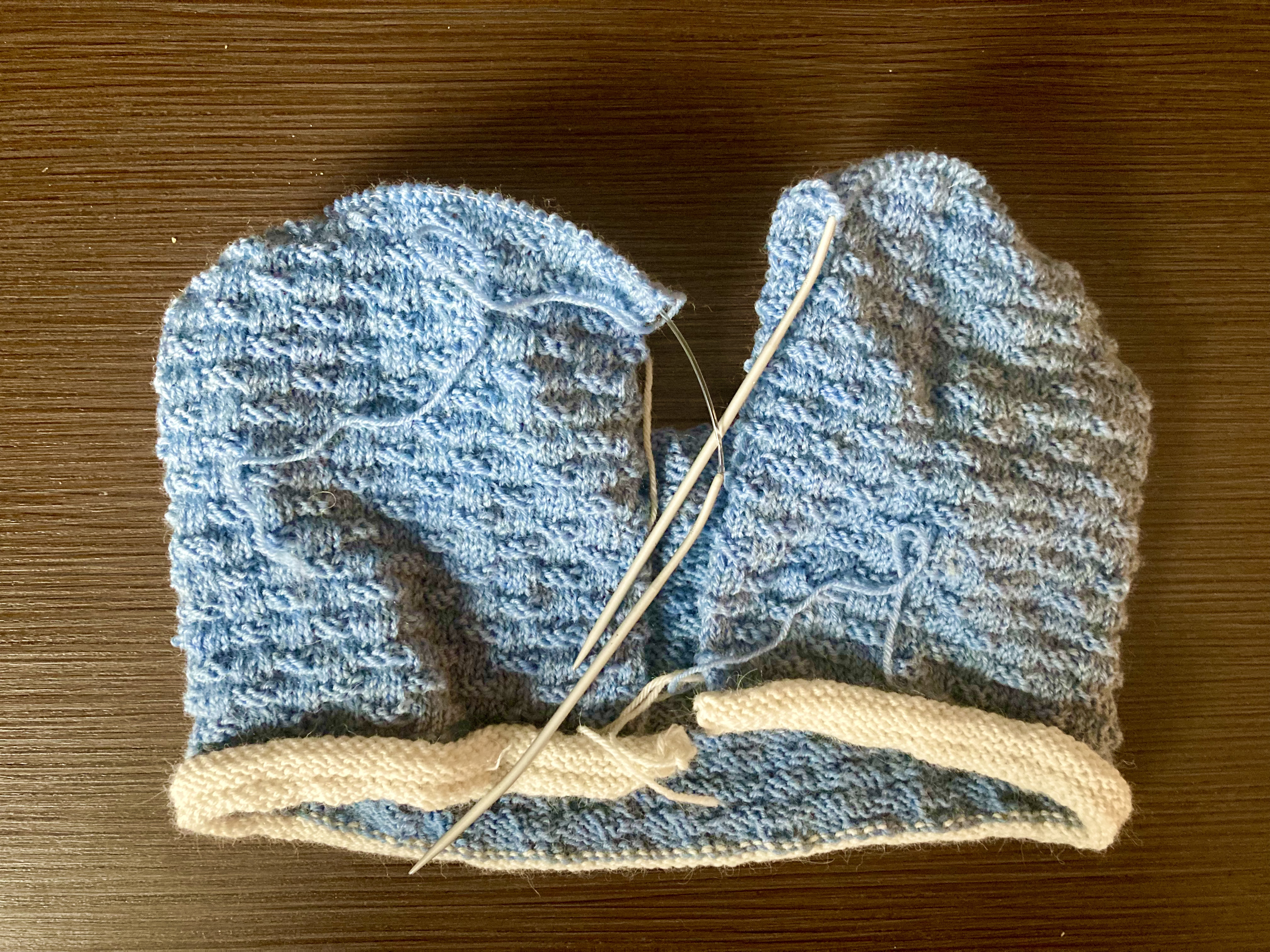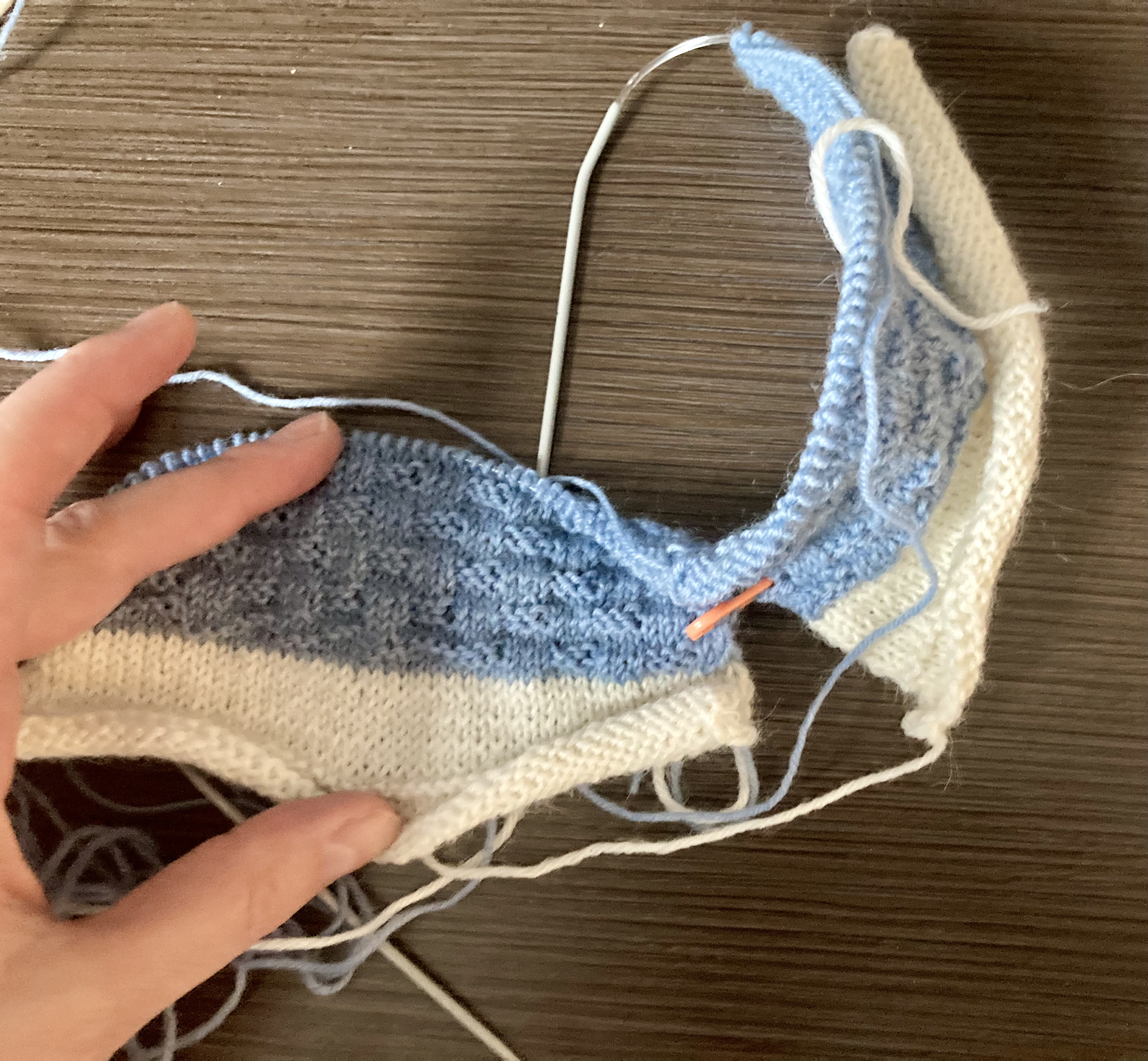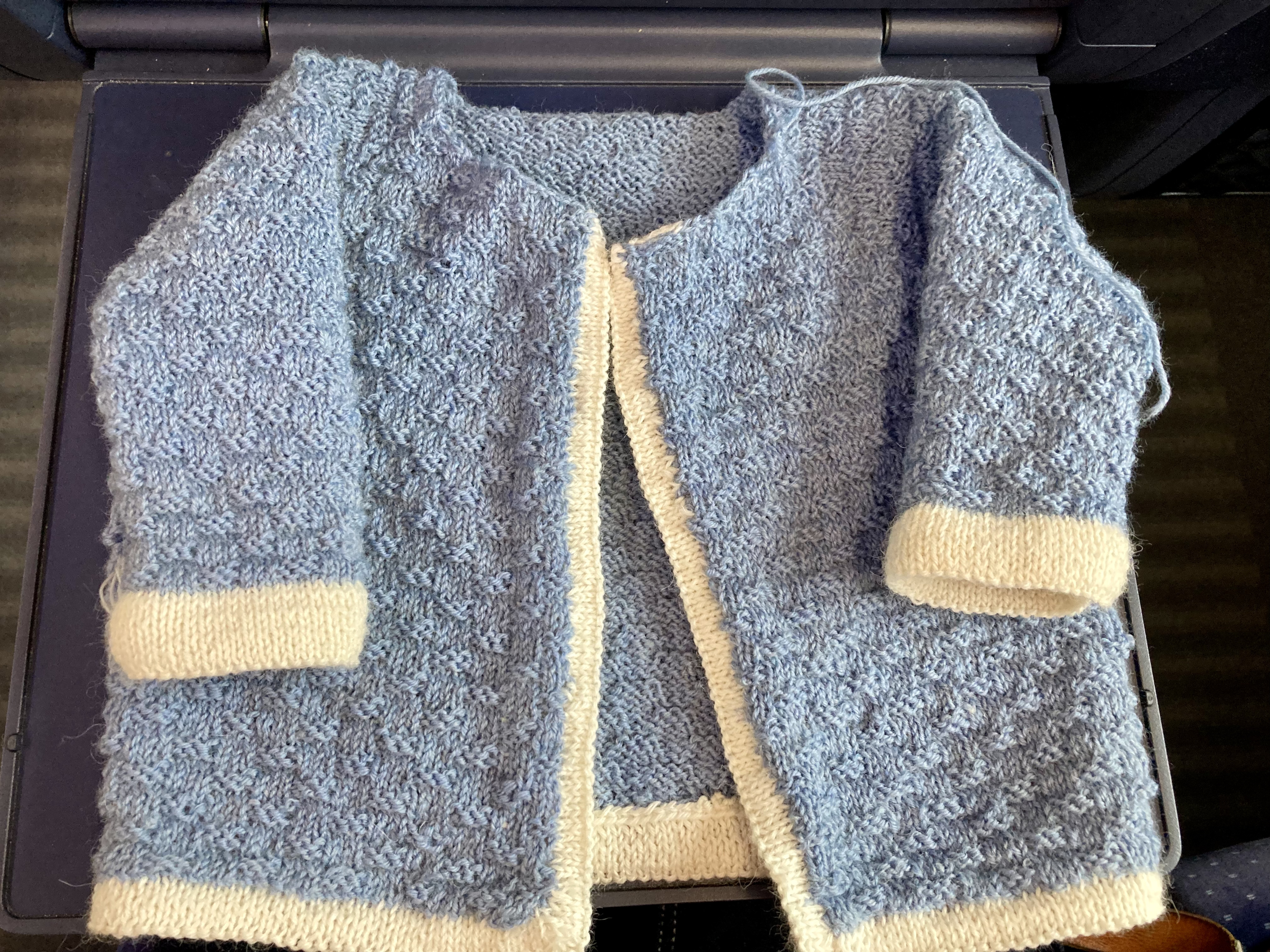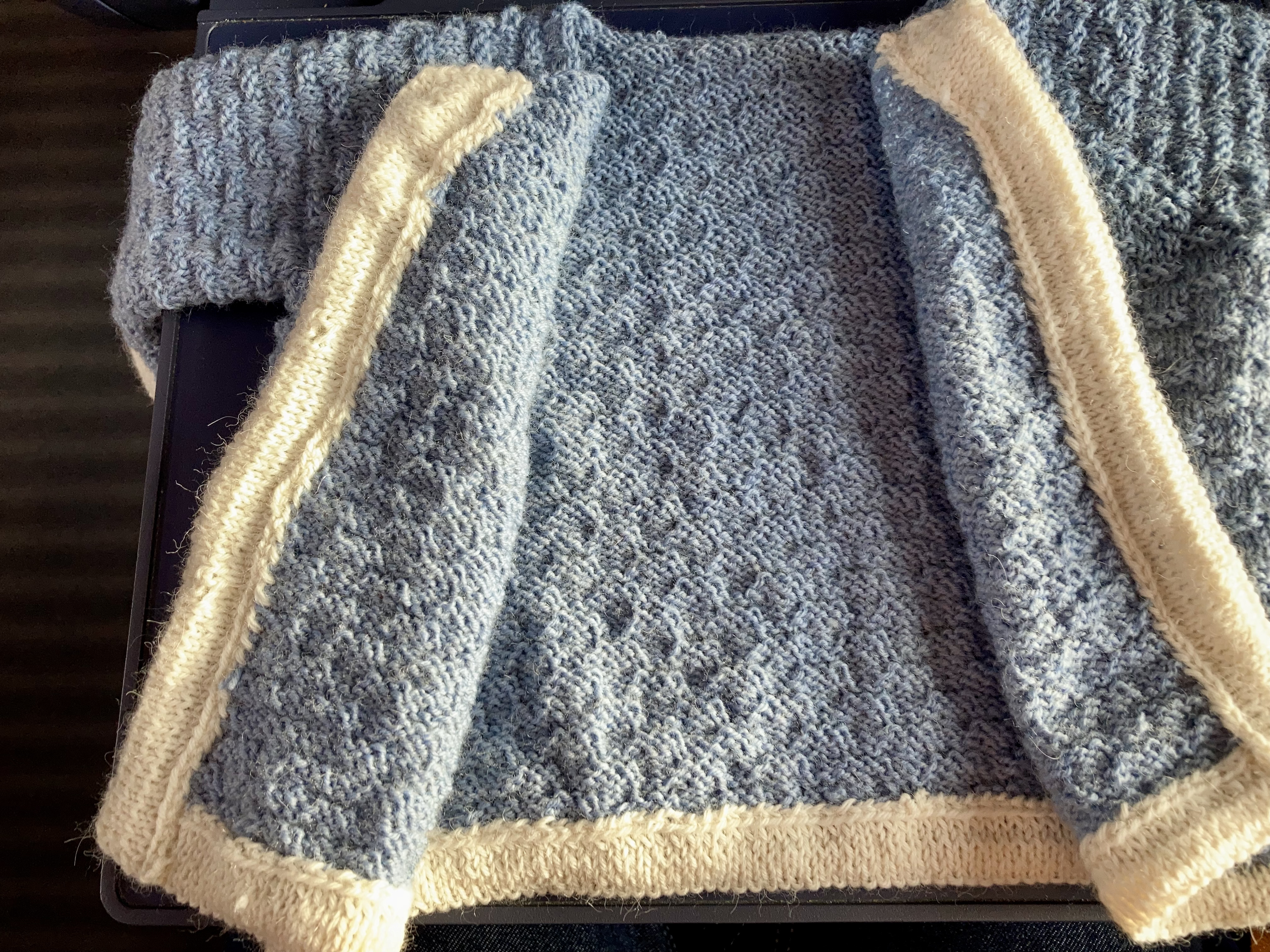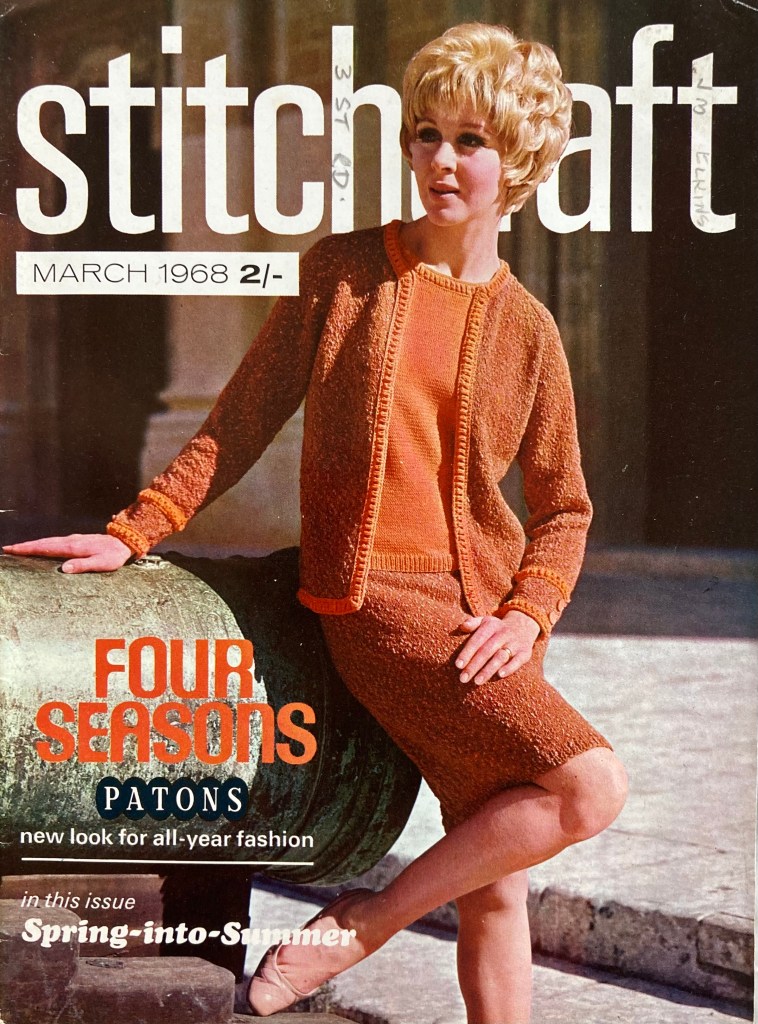
October 1967: Babies Button-ups

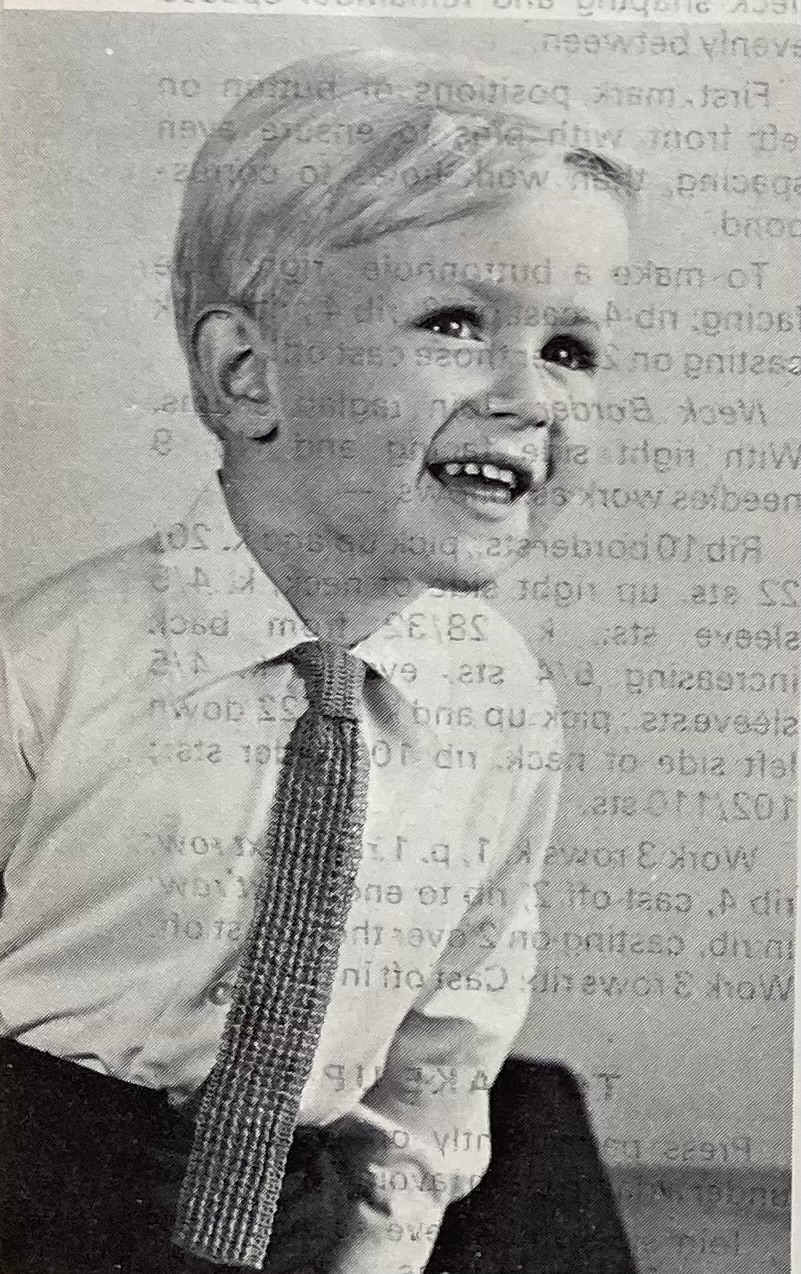
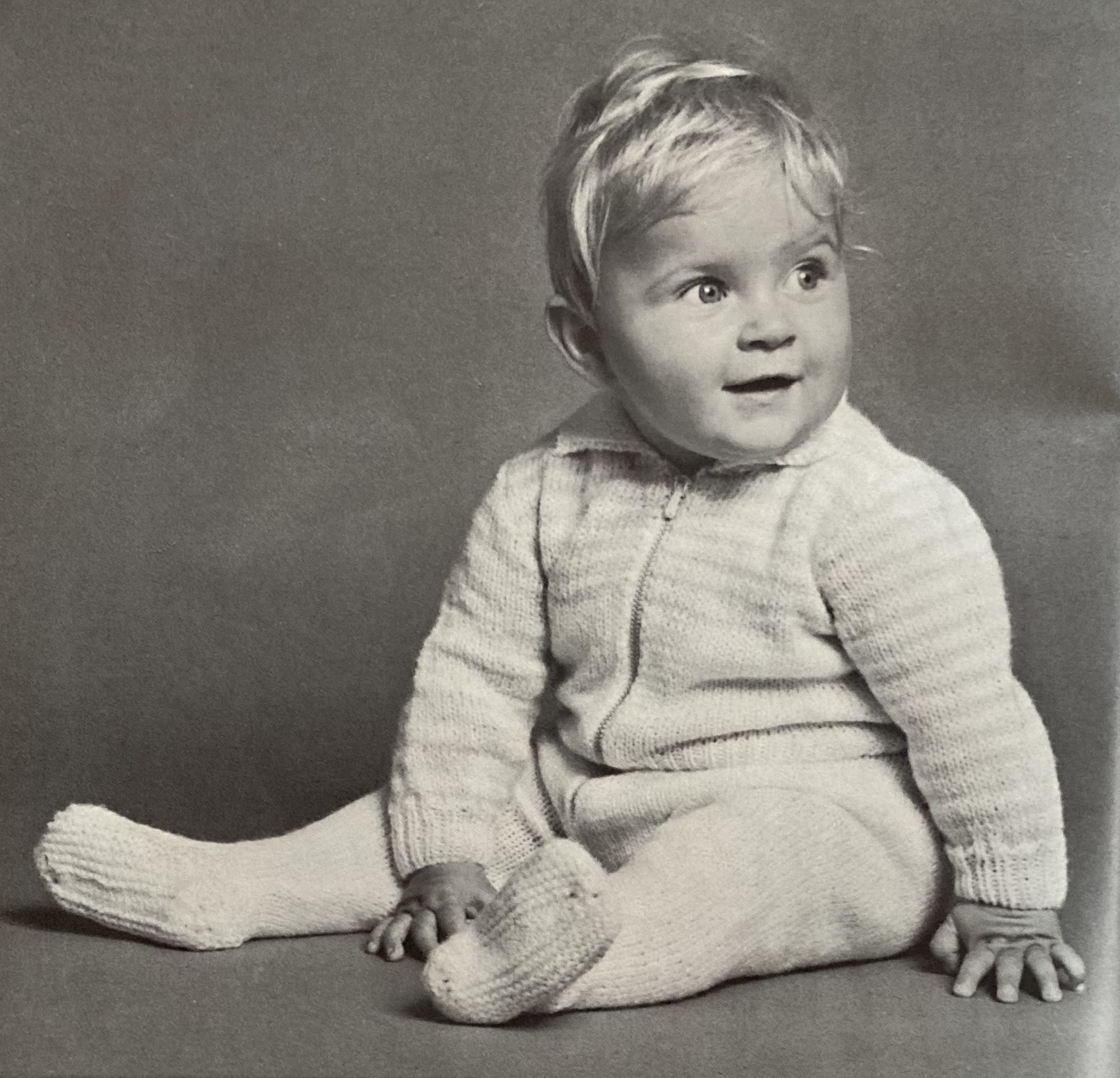
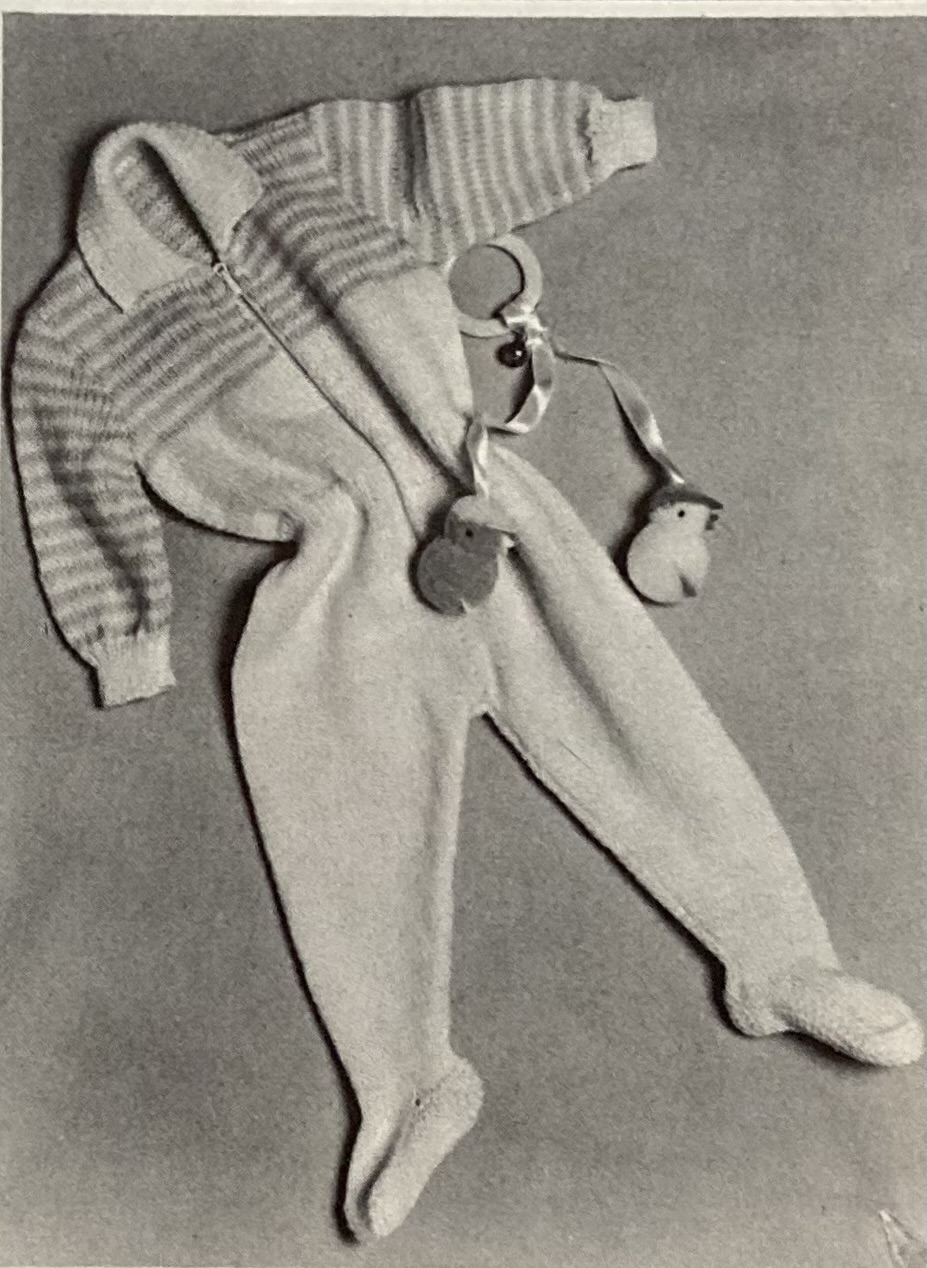
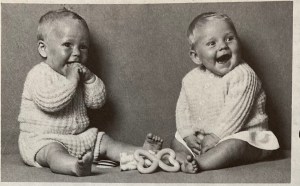
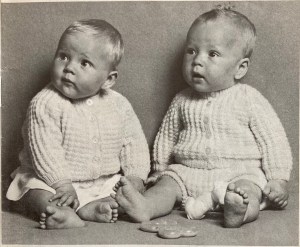
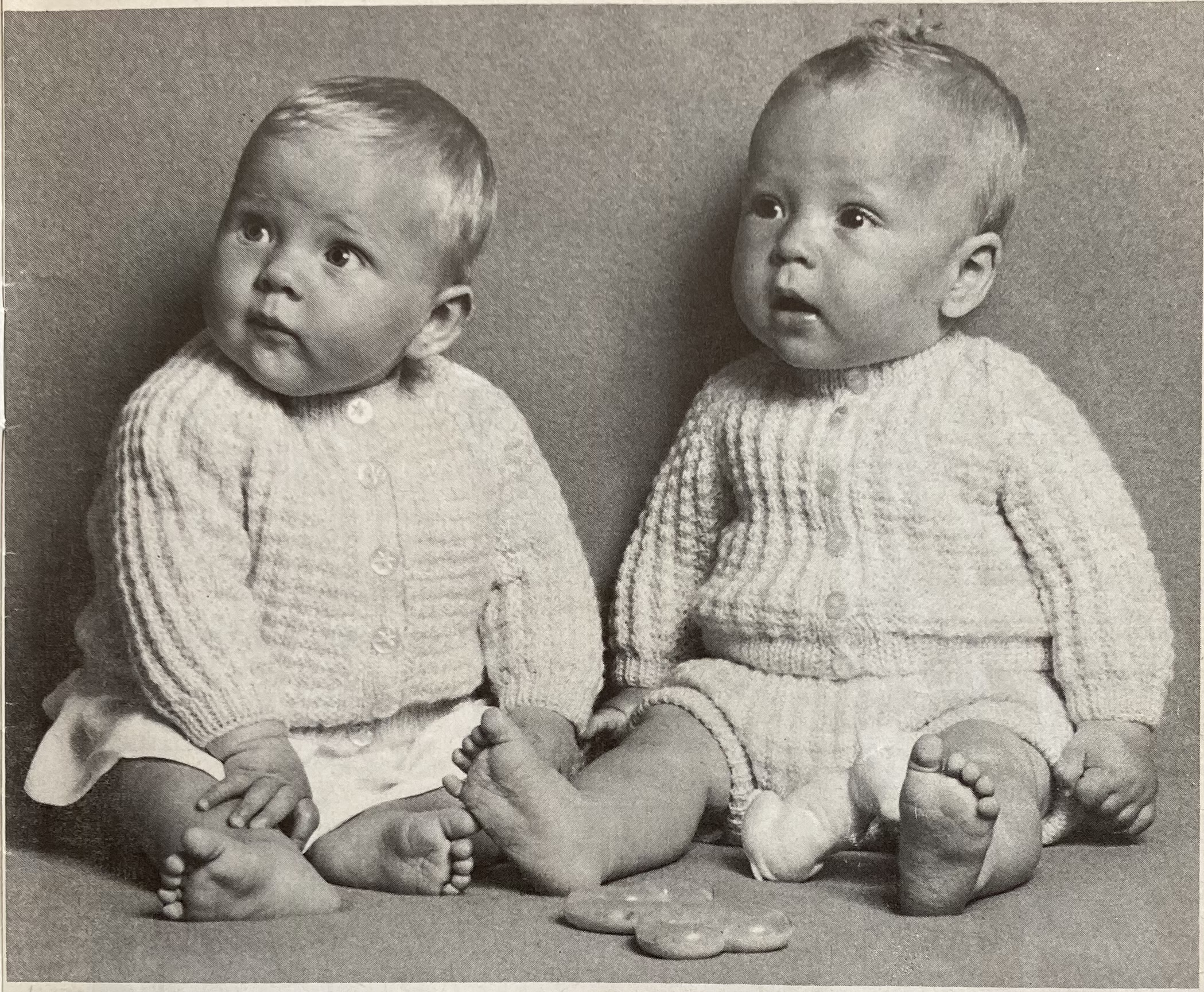
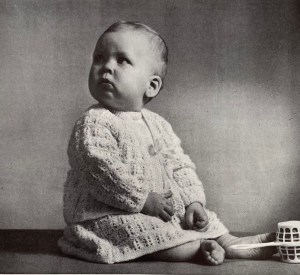
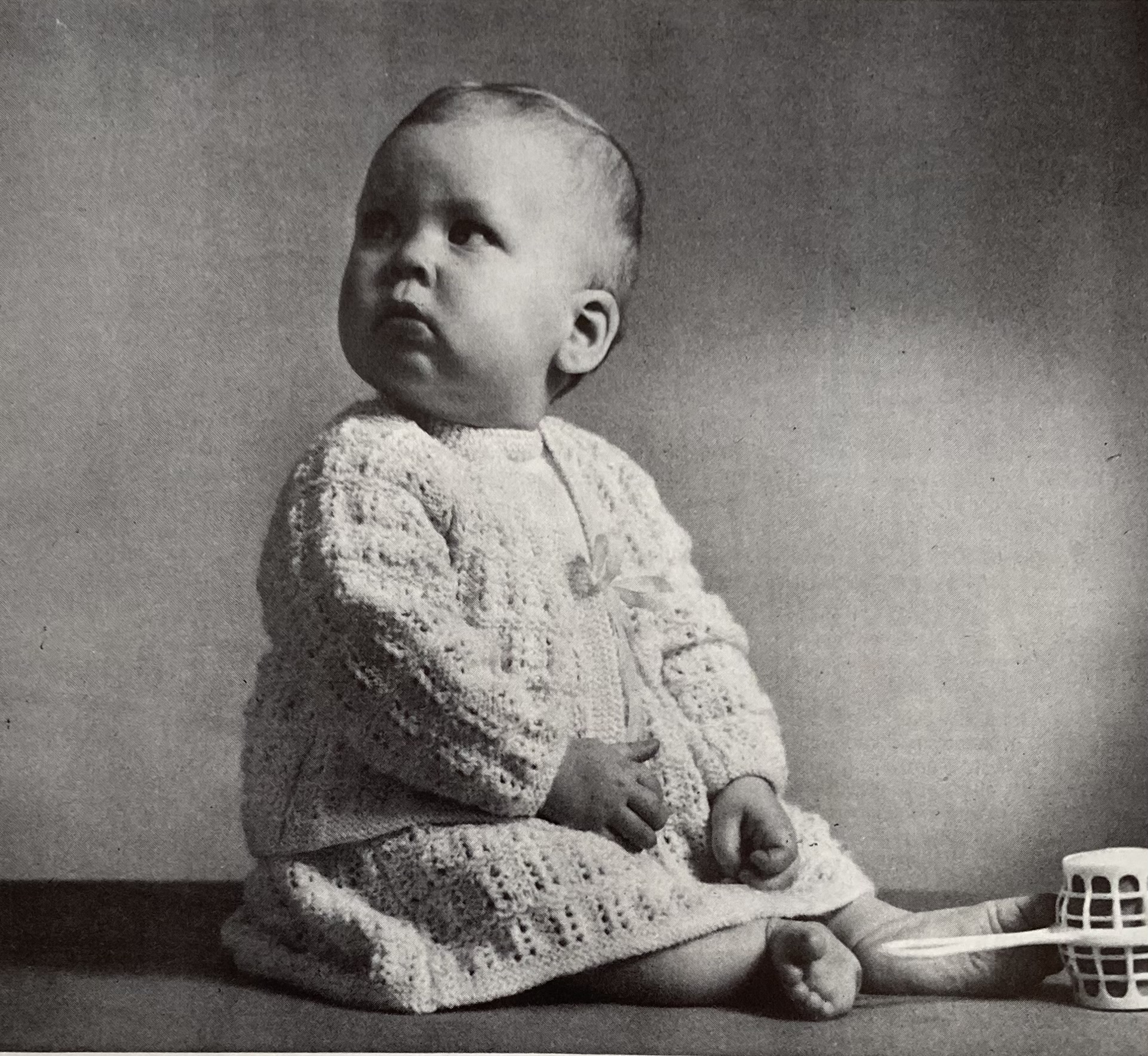
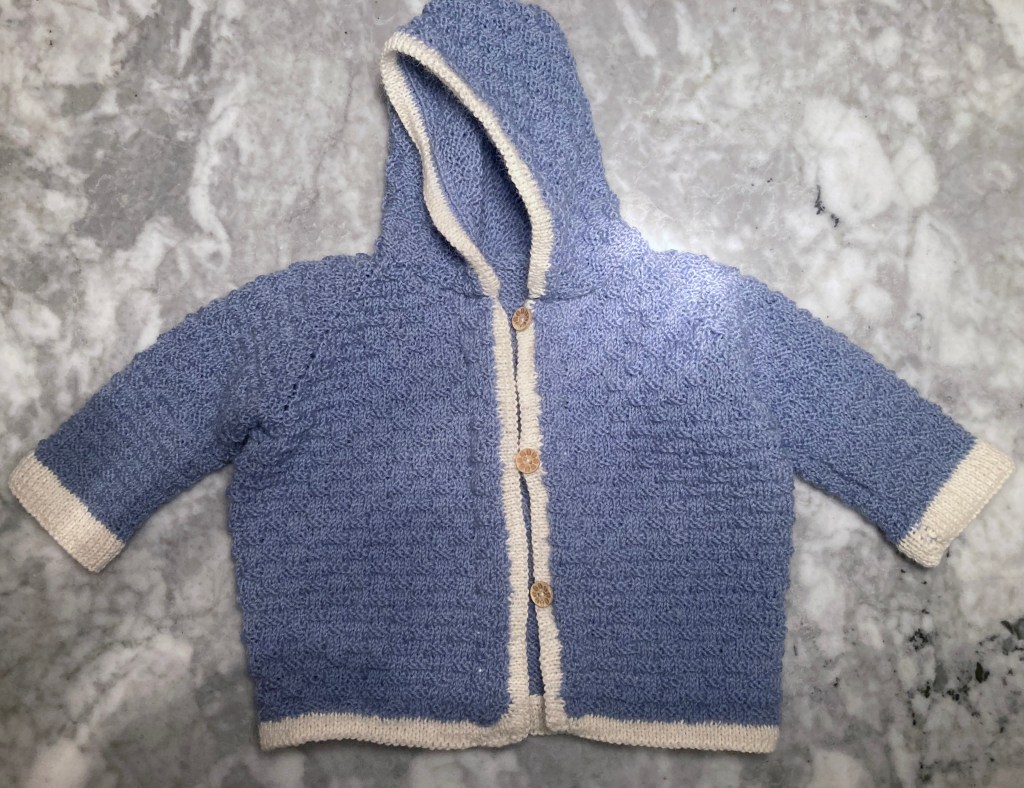
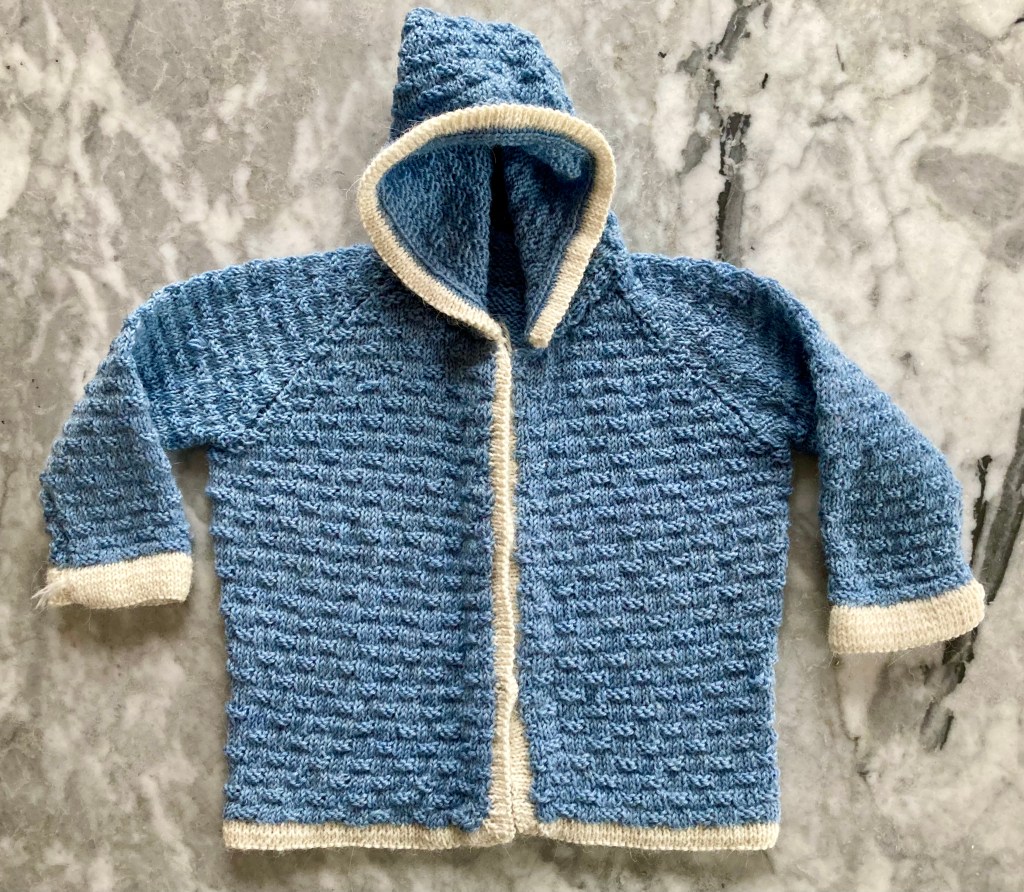
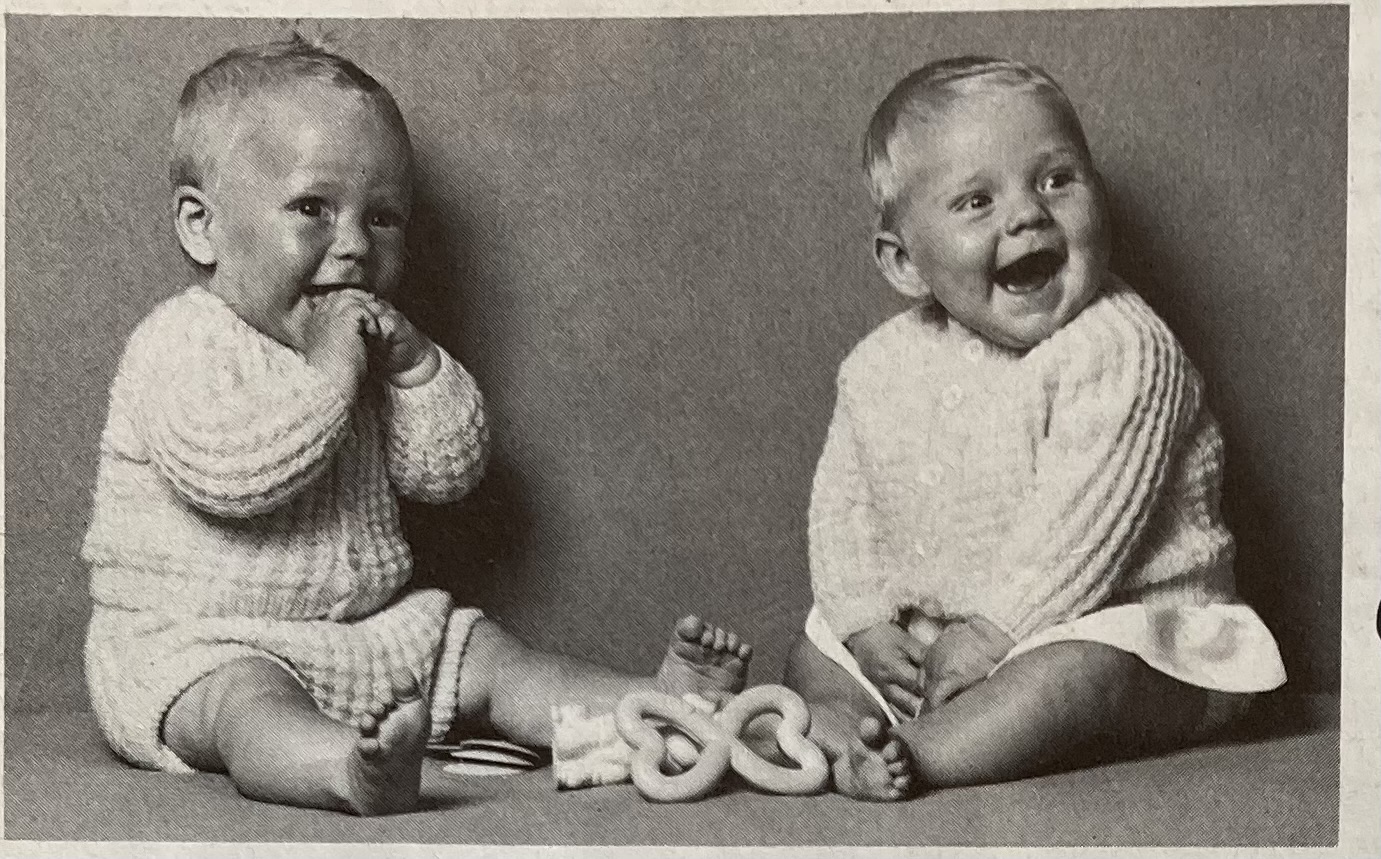
“Something to laugh about” is Stitchcraft’s caption for the photo of this month’s project: a baby’s cardigan (“button-up”) from October 1967. For once, the babies in the photo are actually happy!

The cardigan can be made “for a boy” or “for a girl” (buttonholes on one or the other side) and you can knit matching trunks “for a boy” — I guess girls need to get used to having a cold bum early, to prepare them for a lifetime of miniskirts with knee socks. In any case, the cardigan and/or set is offered in three sizes, to fit newborns up to ca. 1 year (18-22 inch chest).

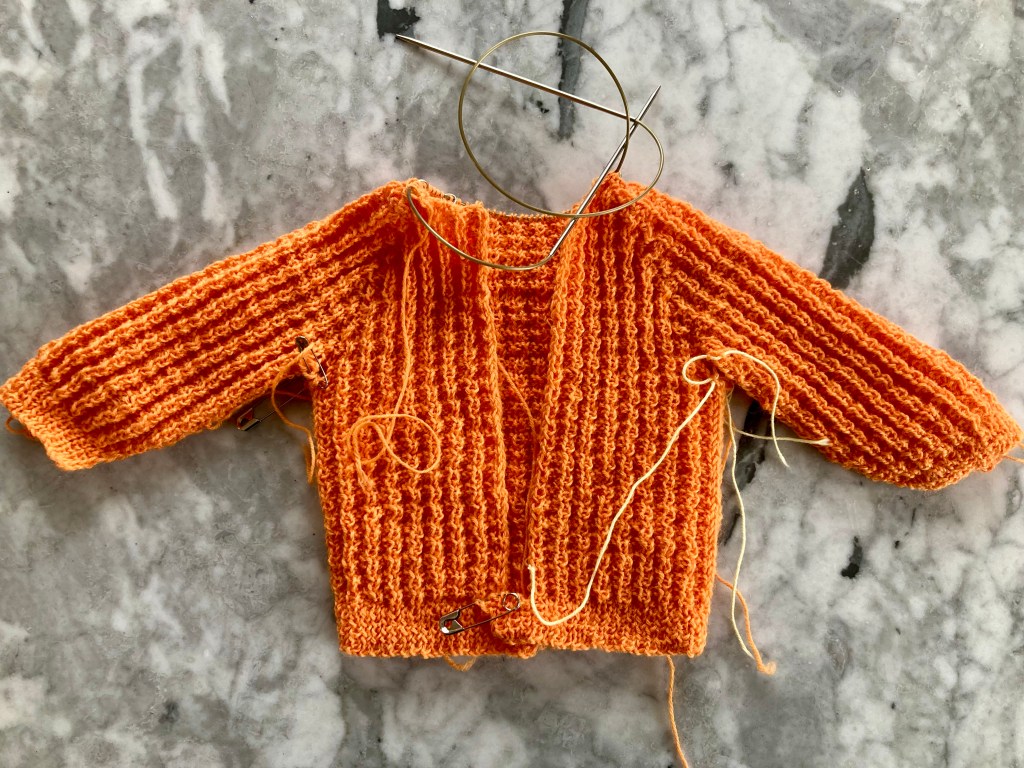
The suggested wool is Patons Quickerknit Baby Wool (fuzzy, hairy, 100% wool) or Patons Brilliante (smooth, synthetic). I used DROPS Fabel (sock wool, 25% polyamide) in a shade of bright orange which I had originally bought to make the red-striped dress from September 1967, but which didn’t match with the other colours. It is quite fine and smooth, so for once I actually achieved the tension called for in the pattern: 8 sts and 10.5 rows to the inch.

I made the first size, for whatever baby a friend or colleague has next (always good to have a baby garment in reserve…). The pattern is interesting and one that I had never encountered before:

  • Row 1: sl1, k2, *p1, k3*
  • Row 2: sl1, p2, *k1, p3*
  • Row 3: sl1, *k1, p3* to last 2 sts, k2
  • Row 4: sl1, *p1, k3* to last 2 sts, p2

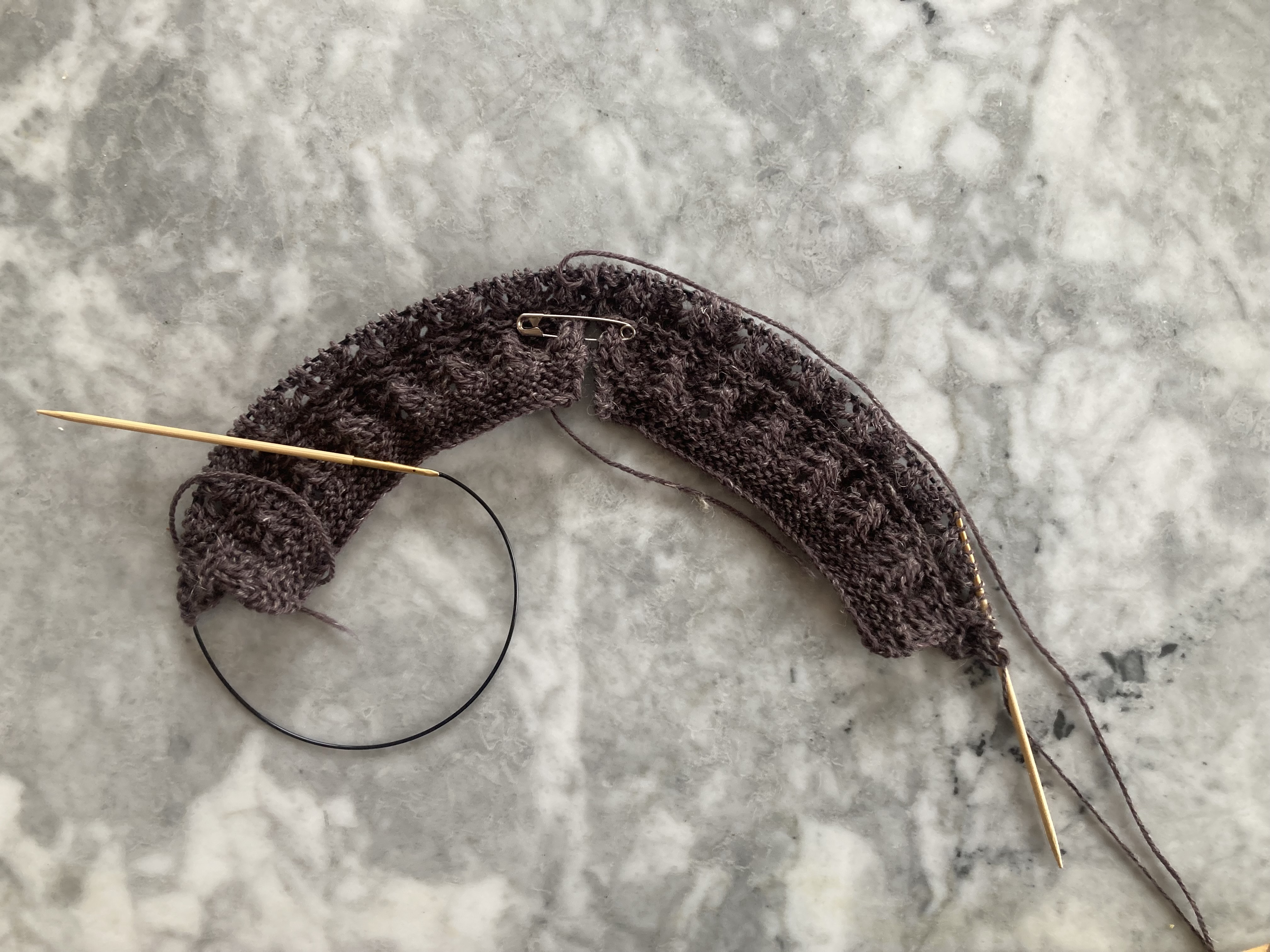
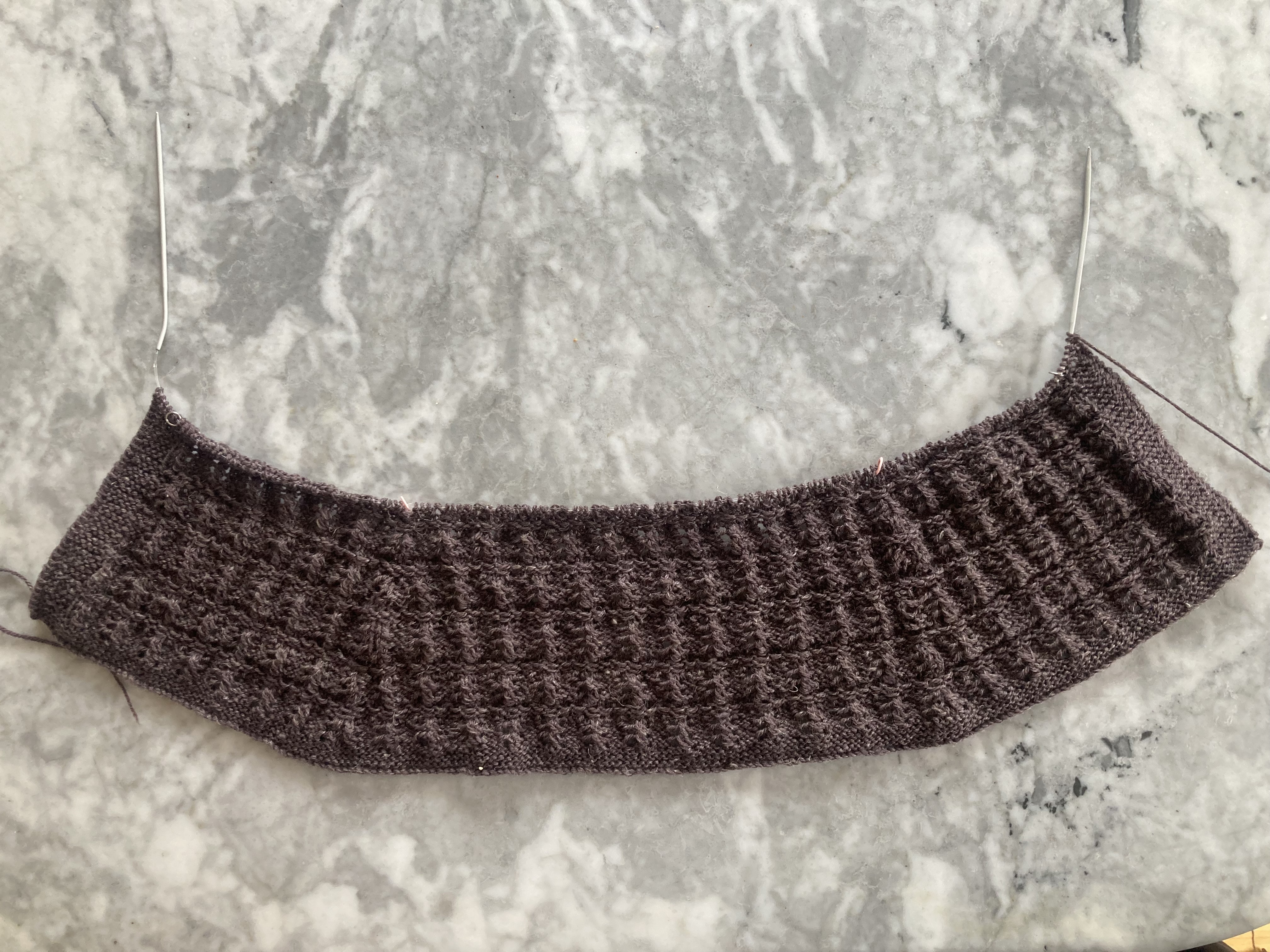
In other words, a broken 1/3 rib. You would think it would be easy to notice and memorise, but it was surprisingly frustrating and difficult to “read” the knitting. I kept the instructions next to me the whole time.

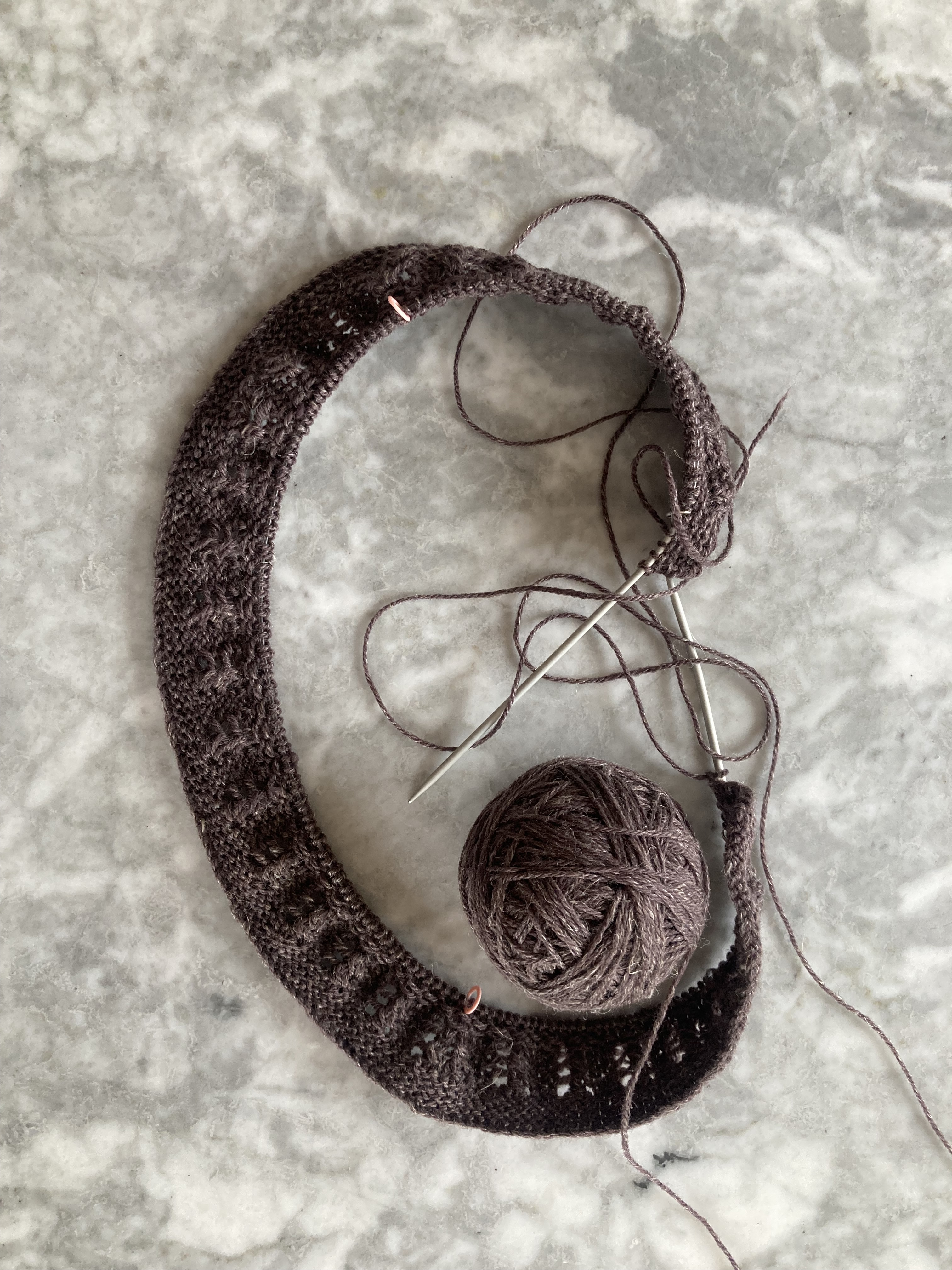
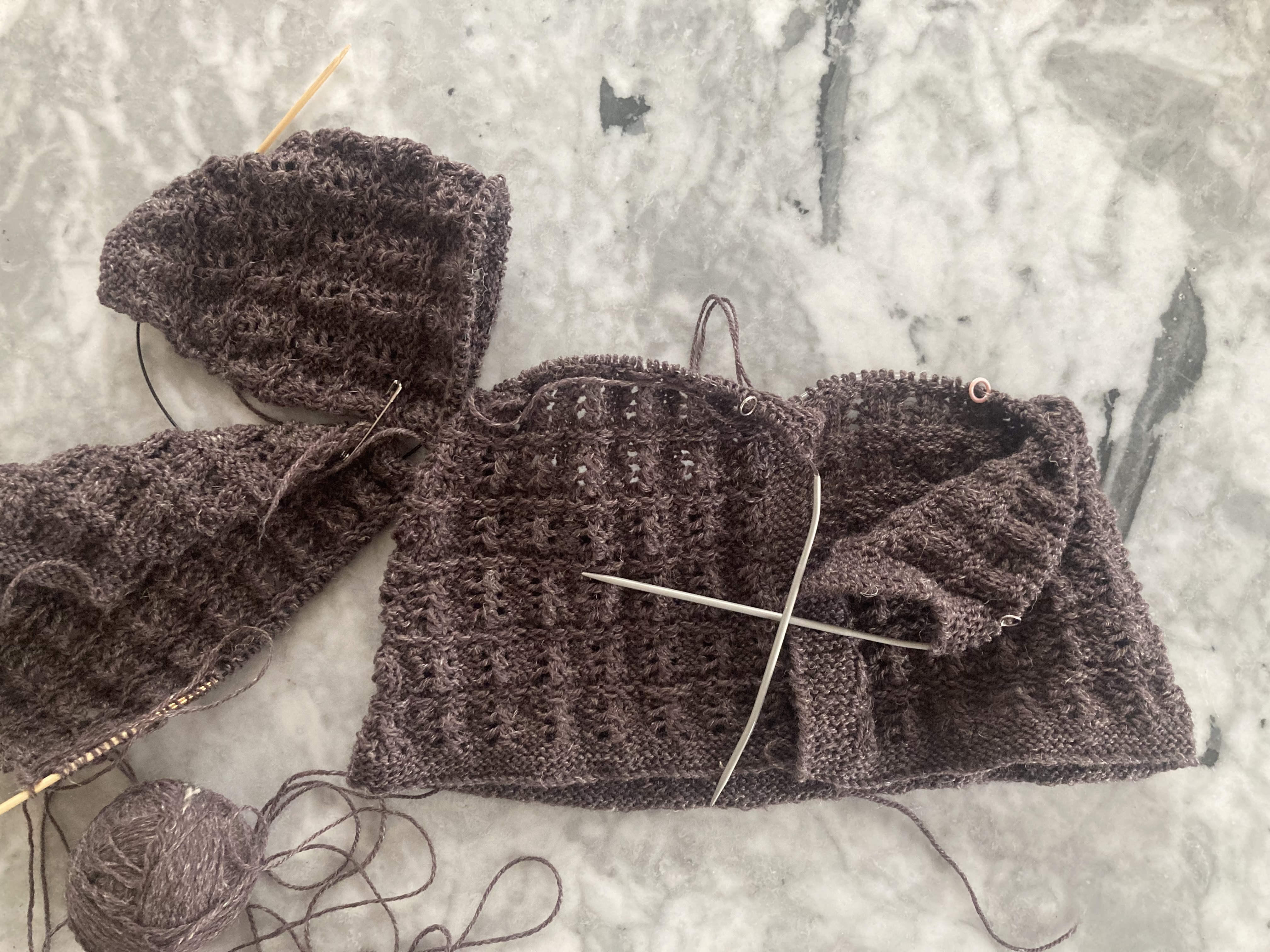
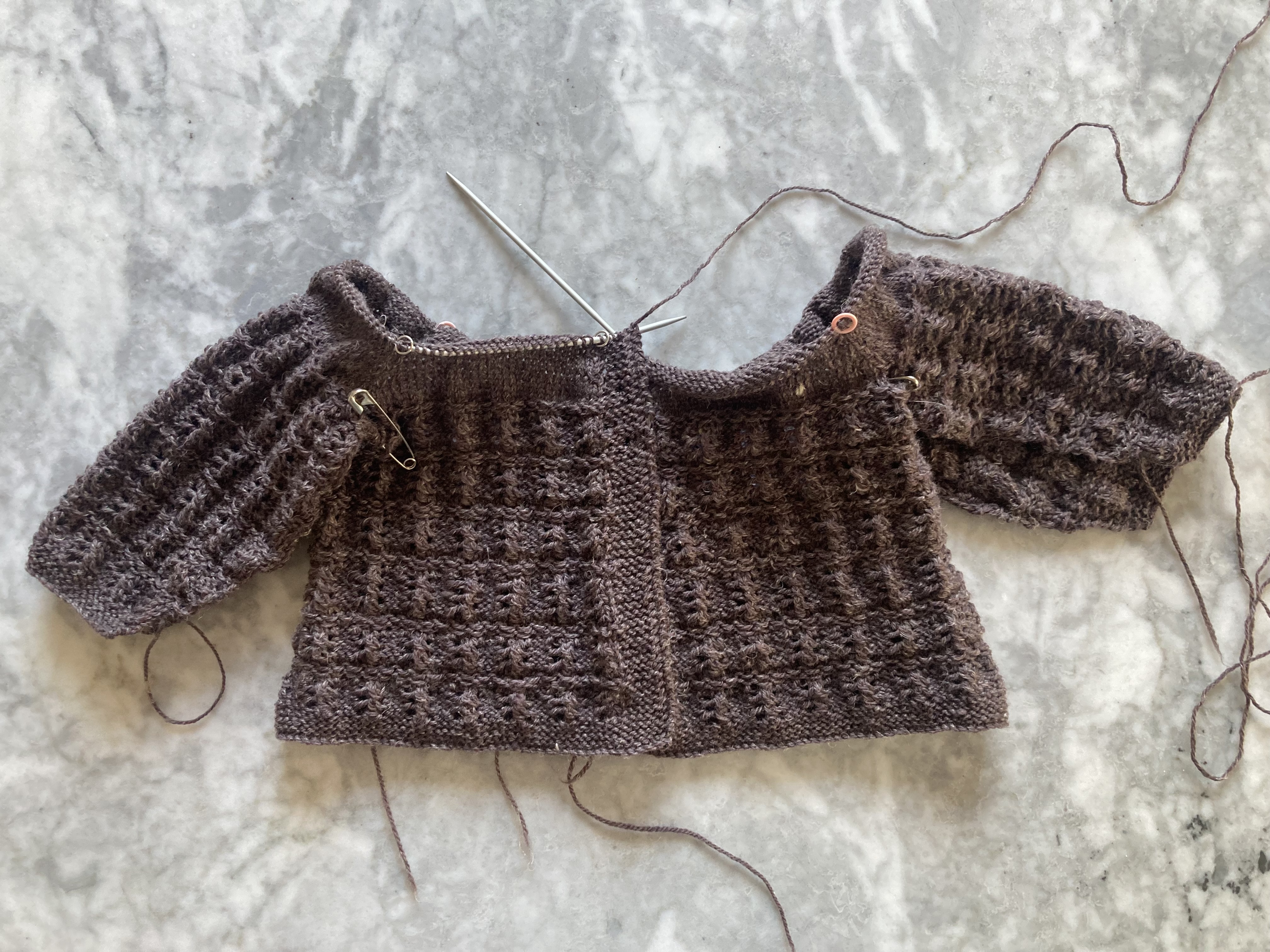
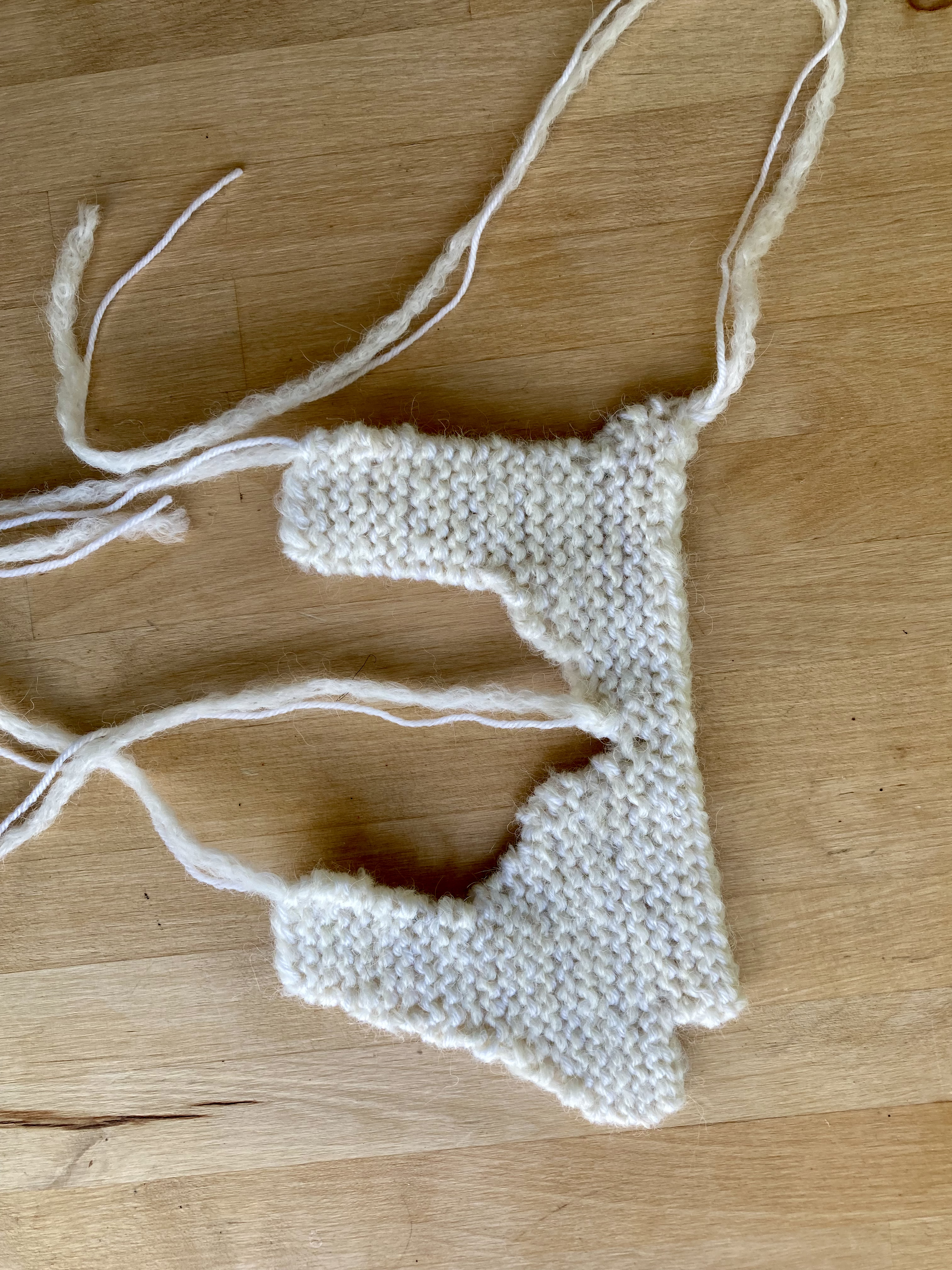
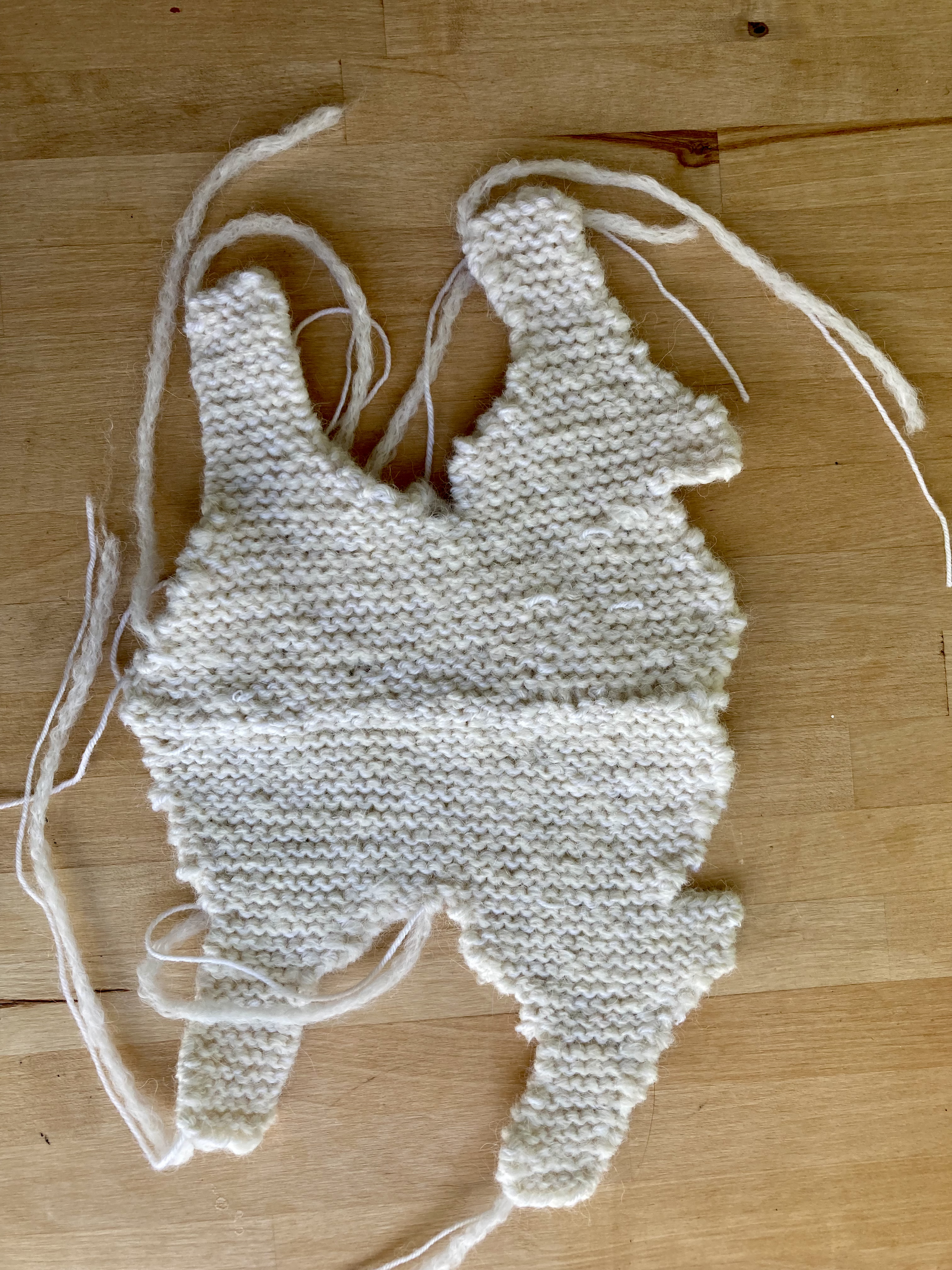
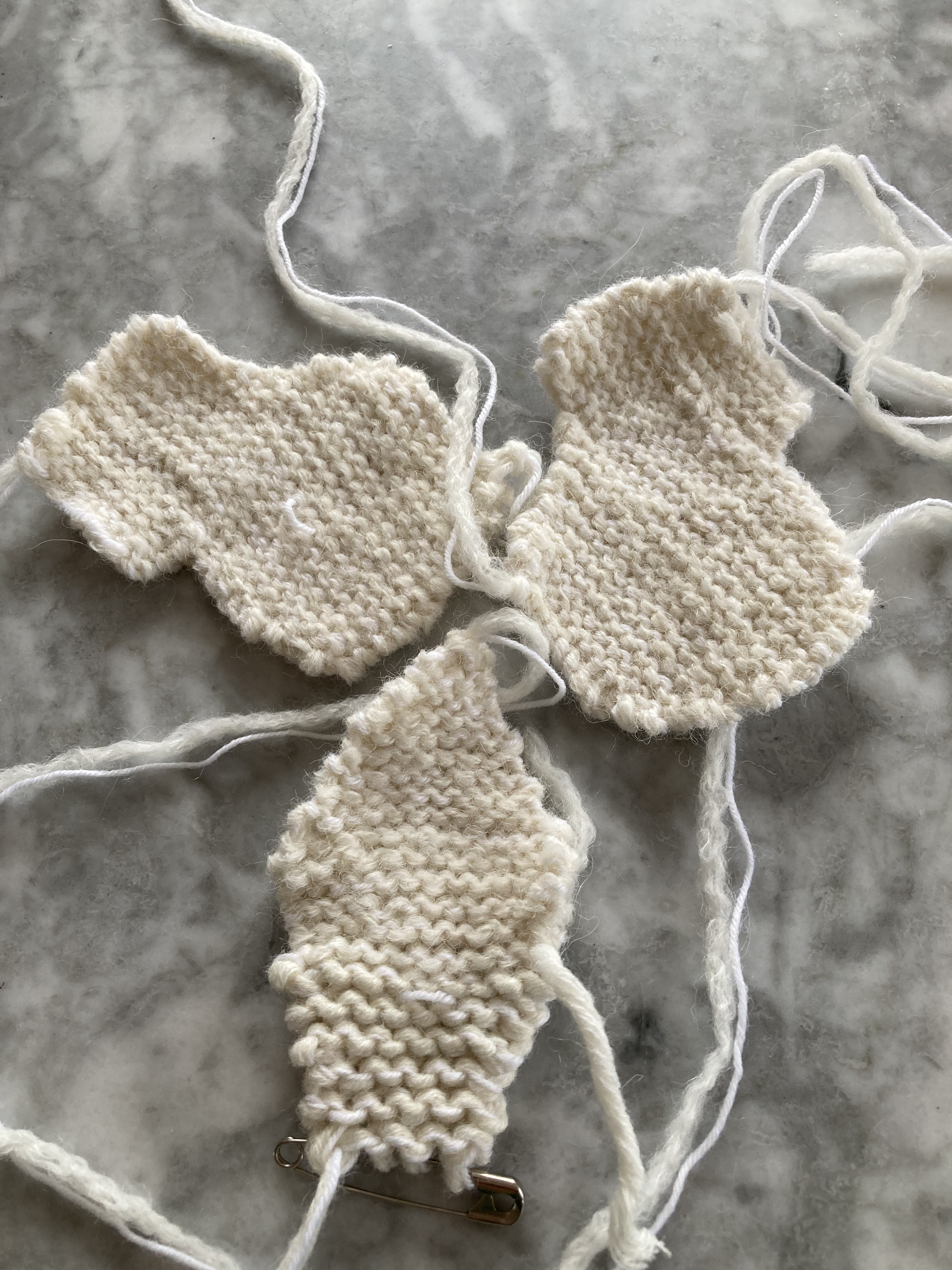
I made the fronts and back in one up to the armholes, the sleeves separate and flat (the pattern messed with my head enough and I did not want to try to convert it to knitting in the round), and then joined it all together for the raglan decreases. Increasing and decreasing in this pattern was not fun. Even though it is really not a complicated pattern! It just wouldn’t go into my head. It worked out fine in the end, though.

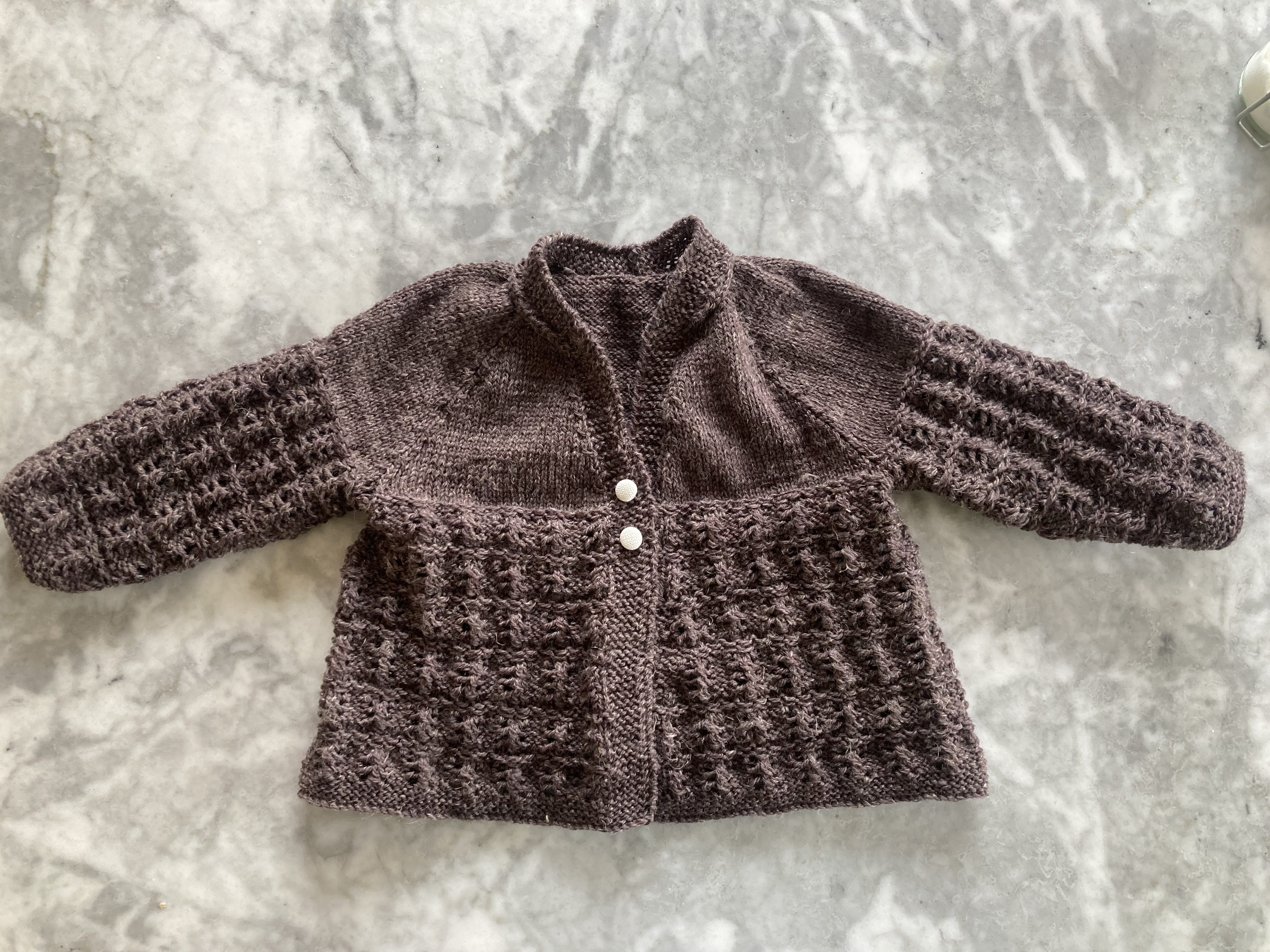
The finished fabric is very three-dimensional and waffle-y and probably quite warm. It also pulls together quite a lot horizontally. I was barely able to stretch it out to an 18 inch chest with blocking, so this will be for a small/newborn baby. On the other hand, the stretchiness means the cardigan will probably grow along with the baby and fit it for a while. I added little white vintage-looking buttons and that was that. I didn’t make the trunks.

All in all, turned out fine and will brighten up some baby’s wardrobe. And it even got done in October! Next month’s project will be a stranded pullover for myself.

October 1967: Overview

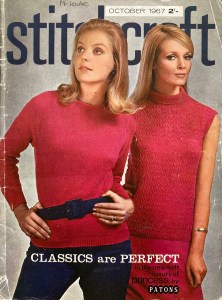
The October 1967 issue of Stitchcraft brings “special news for knitters”: a new wool, Patons Princess. A lightweight yarn made up of 85% lambswool and 15% angora, it was presumably soft and fluffy, and promised to be “smooth and easy to knit”. The classic raglan pullover and lacy “shell” on the cover both use it, in bright pink “Camellia” colour.

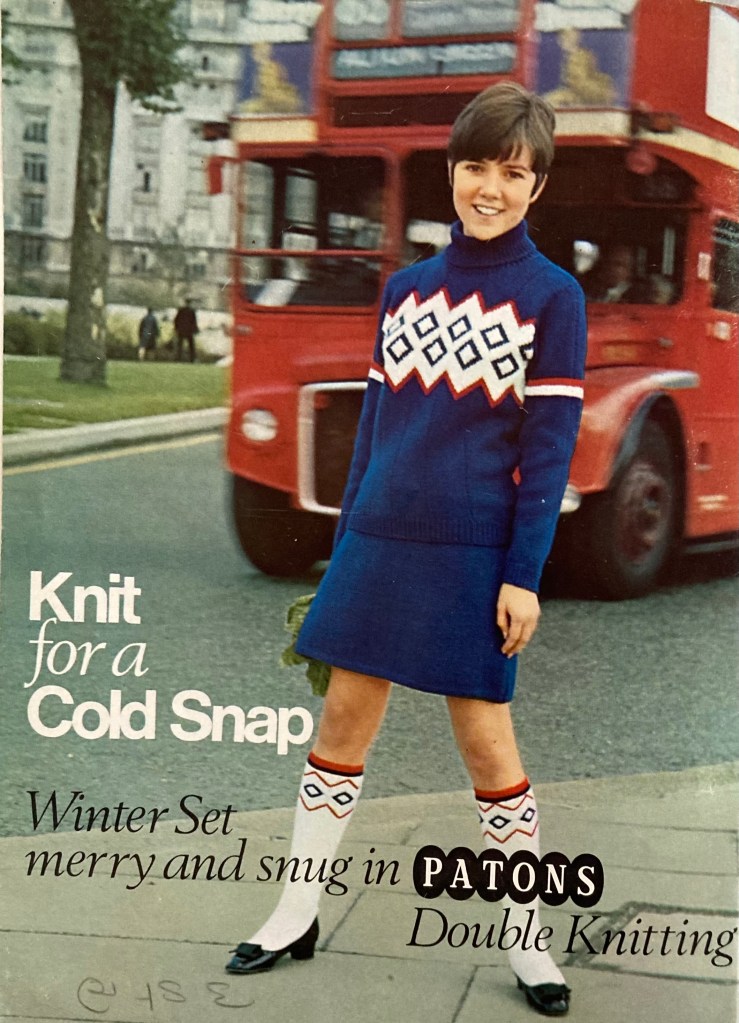
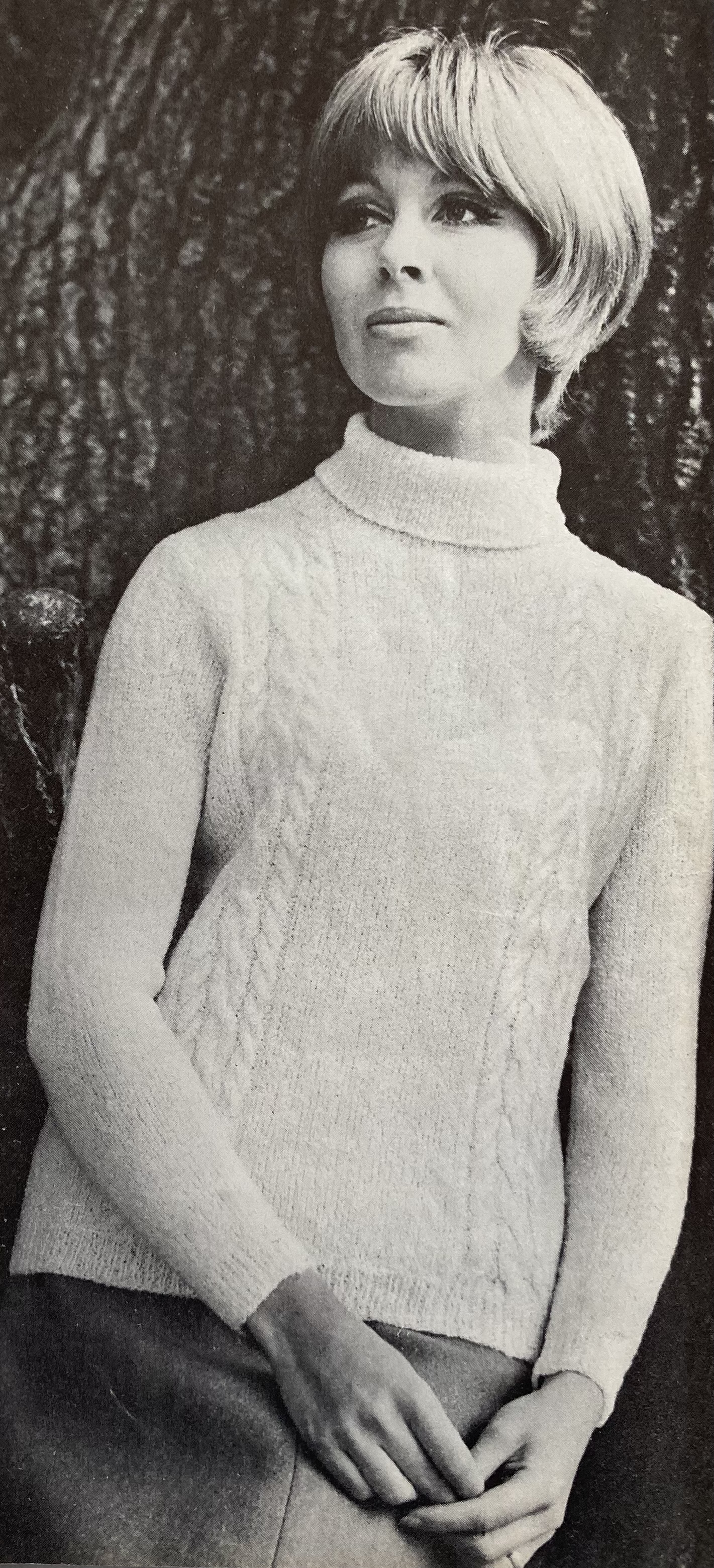
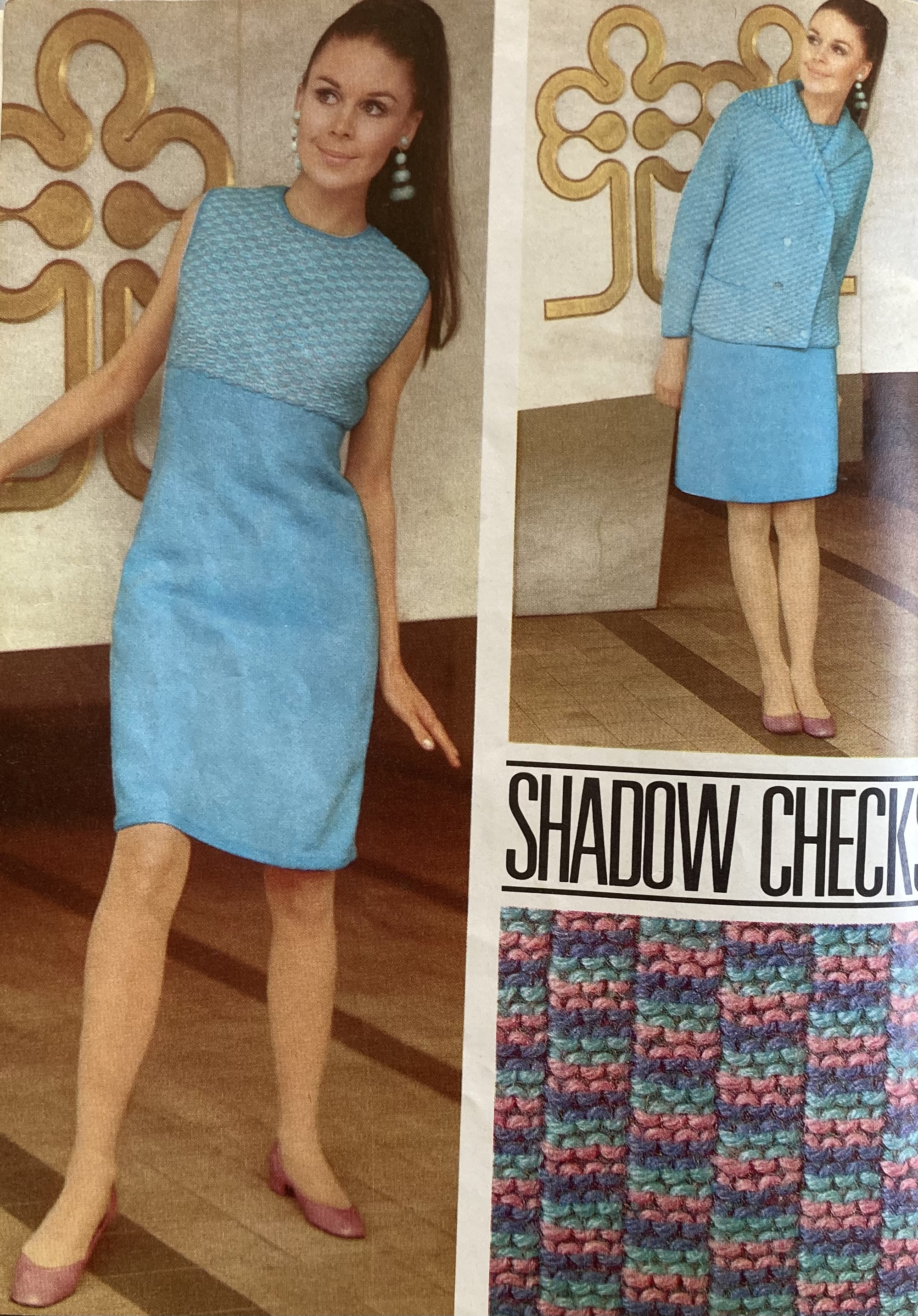
Sleeveless shell notwithstanding, the issue looks towards cooler autumn days and the pre-Christmas holiday craft rush. “Winter Plans include the Polo Classic” is the caption for a bouclet pullover with double-strips of cables on the front. Other women’s fashions bridge the changing season with layered separates: a sleeveless dress in DK weight with “shadow check” patterned yoke and matching blazer, or a three-piece set of plain, sleeveless polo shell with pleated skirt and stranded cardigan in Shetland-mix “Fiona” wool. Polo neck(aka turtleneck) collars are in fashion, in shades of green, pink and red or in classic white and winter white.. For the coldest days, there’s a thick, warm coat-dress in brilliant marled green.

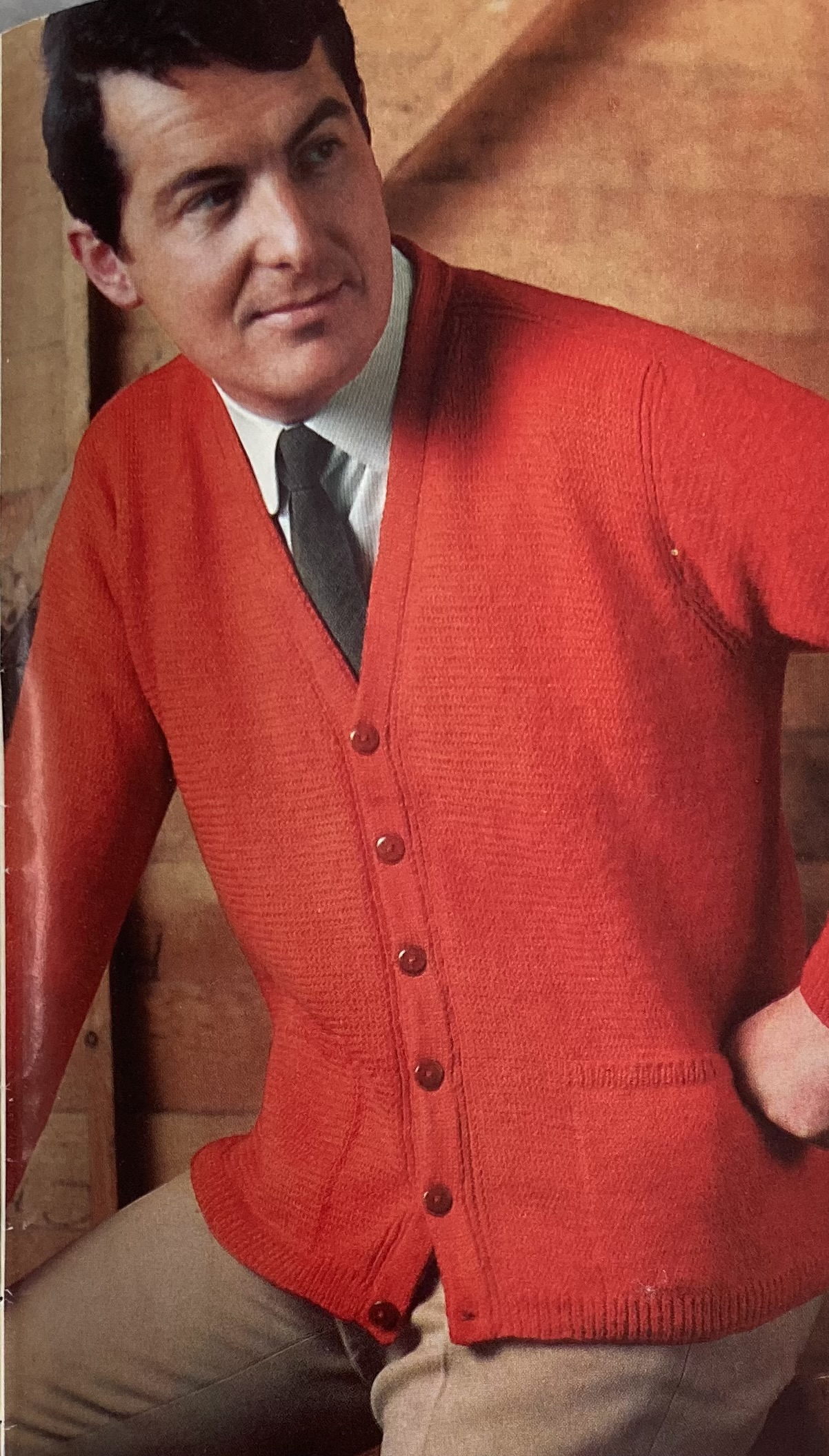
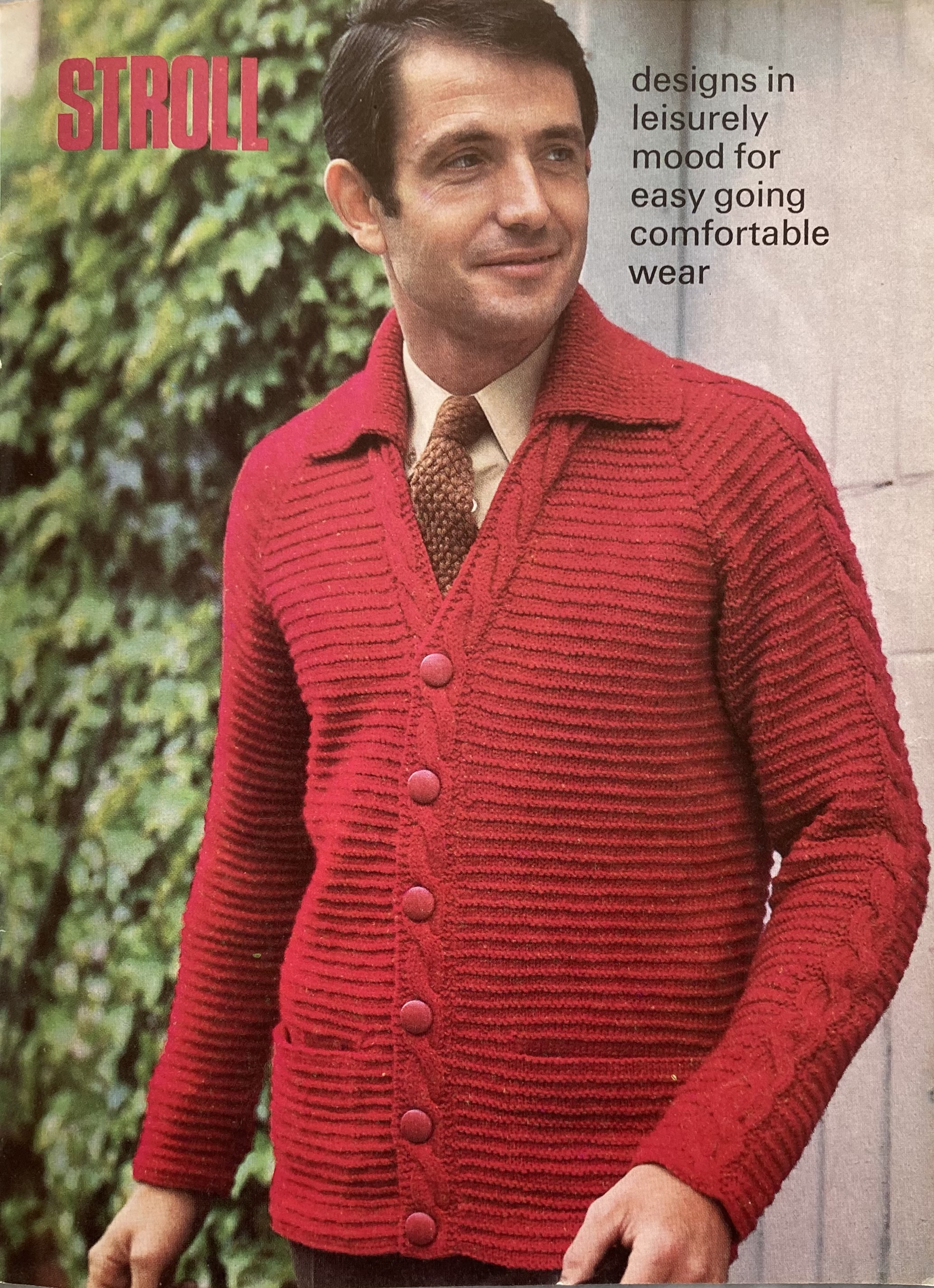
The two designs for men have a similar aesthetic to the women’s, but without the polo necks: a winter-white pullover with a simple cable pattern over reversed stocking stitch and a berry-red “stroller jacket” in a horizontal welt patttern with a nice use of cables on the saddle sleeves and button band. Note the knitted tie!

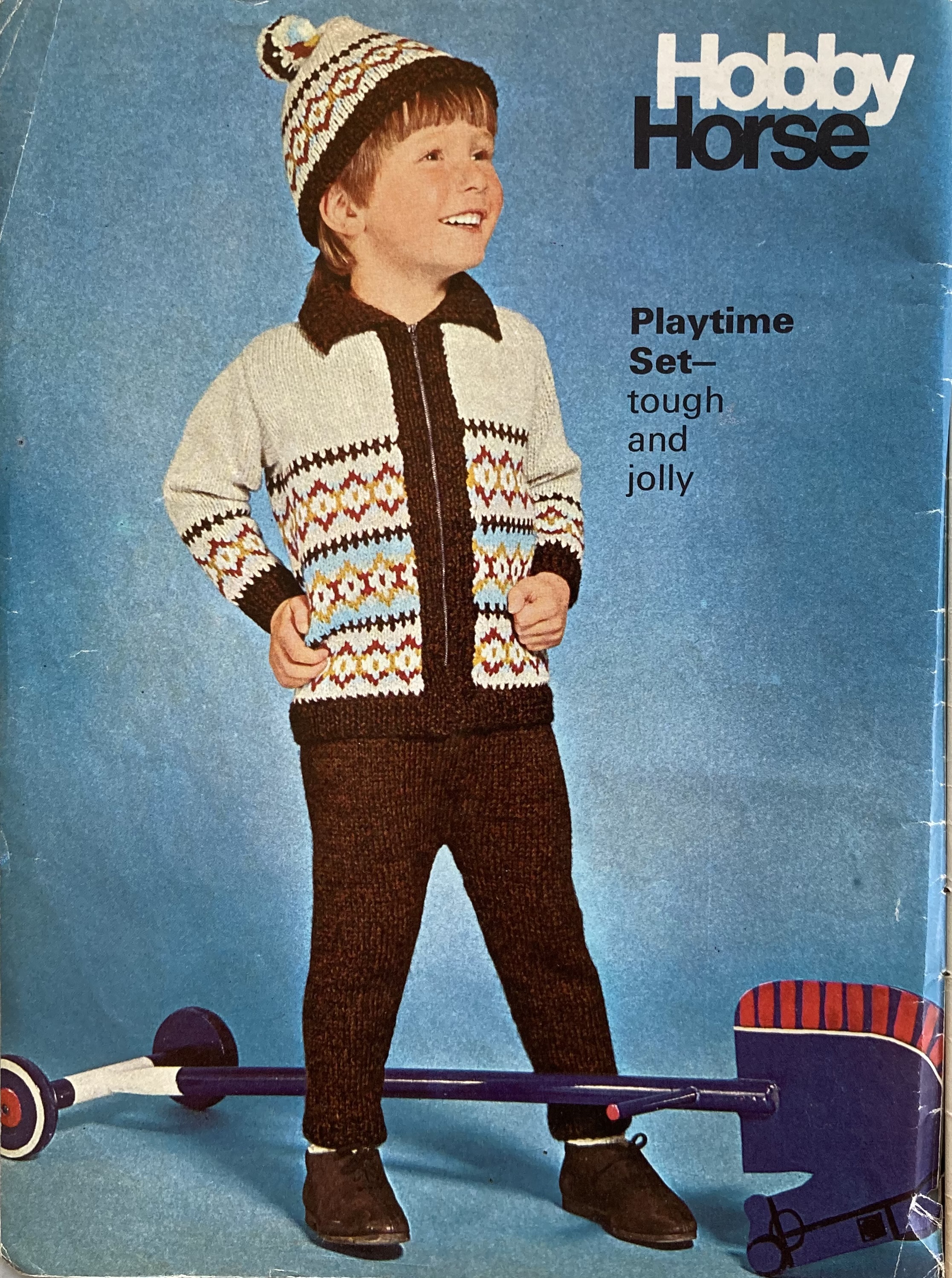
For the youngest in the family, there’s a babies’ cardigan and matching trunks (for boys — girls have to get used to a cold behind early in the age of bare-legged miniskirts and tunics). “For boys”, as well, there’s a “playtime set” of warm leggings, zipped cardigan and bobbled hat in a stranded colour pattern. Rebellious mothers could knit it for a girl, I suppose.

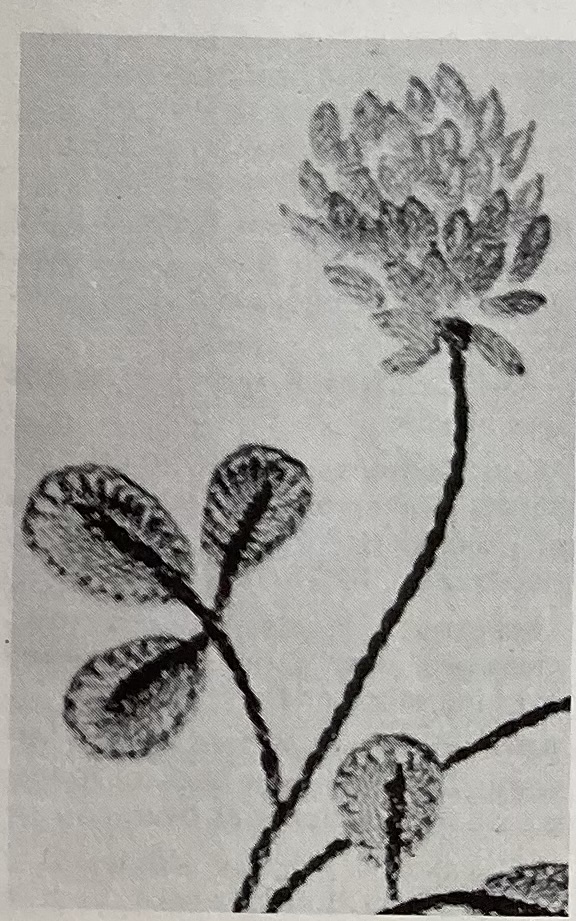
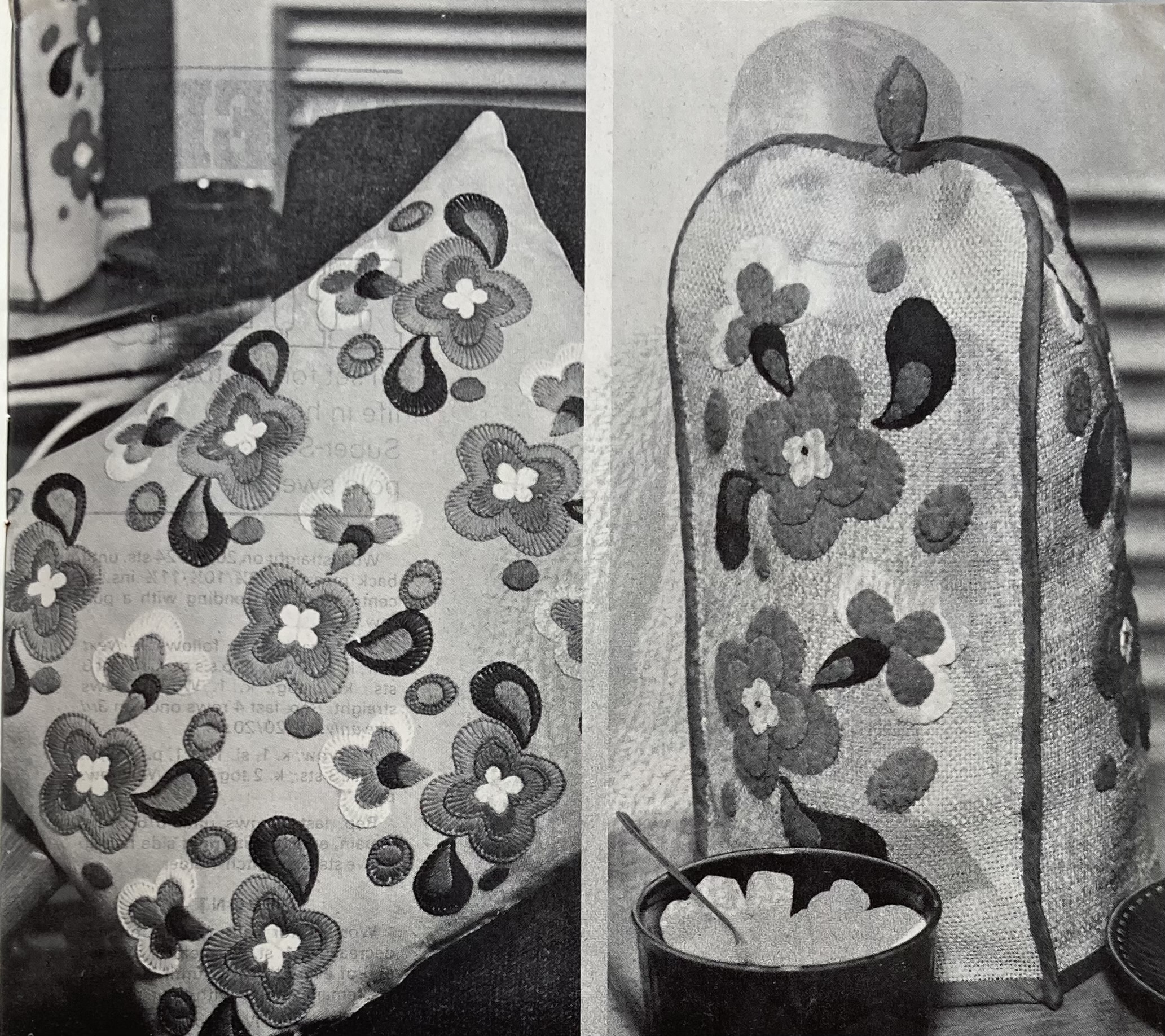
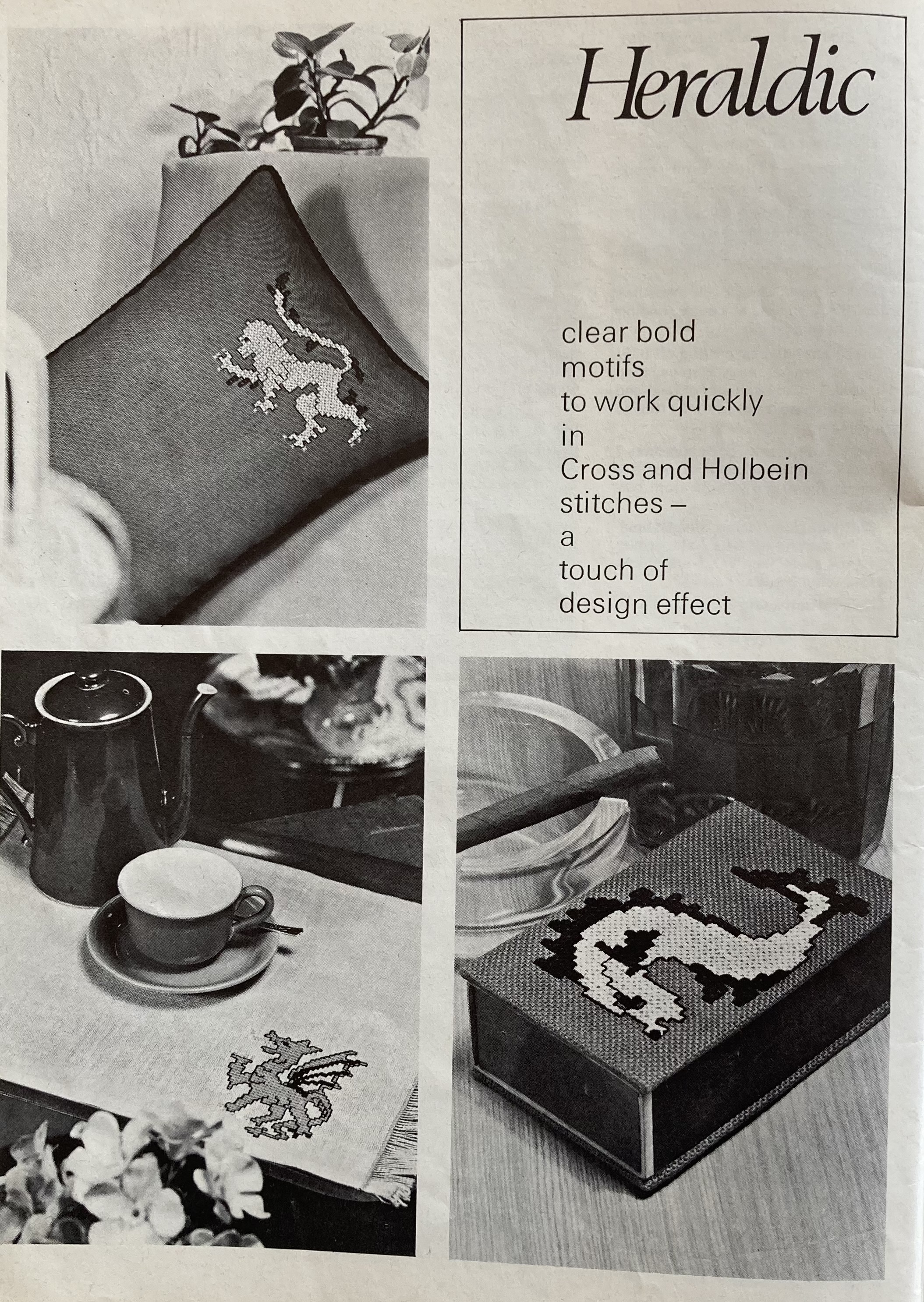
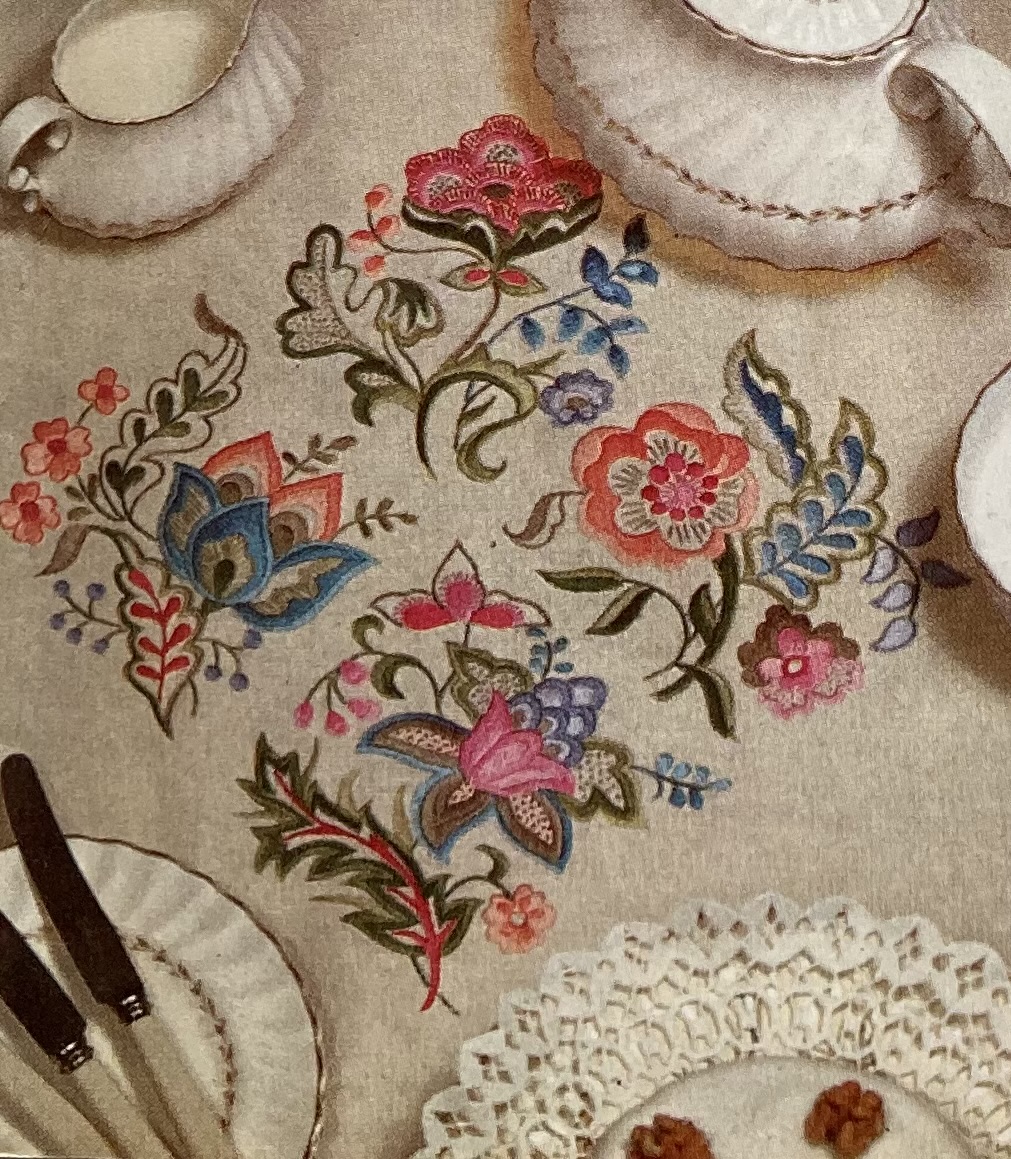
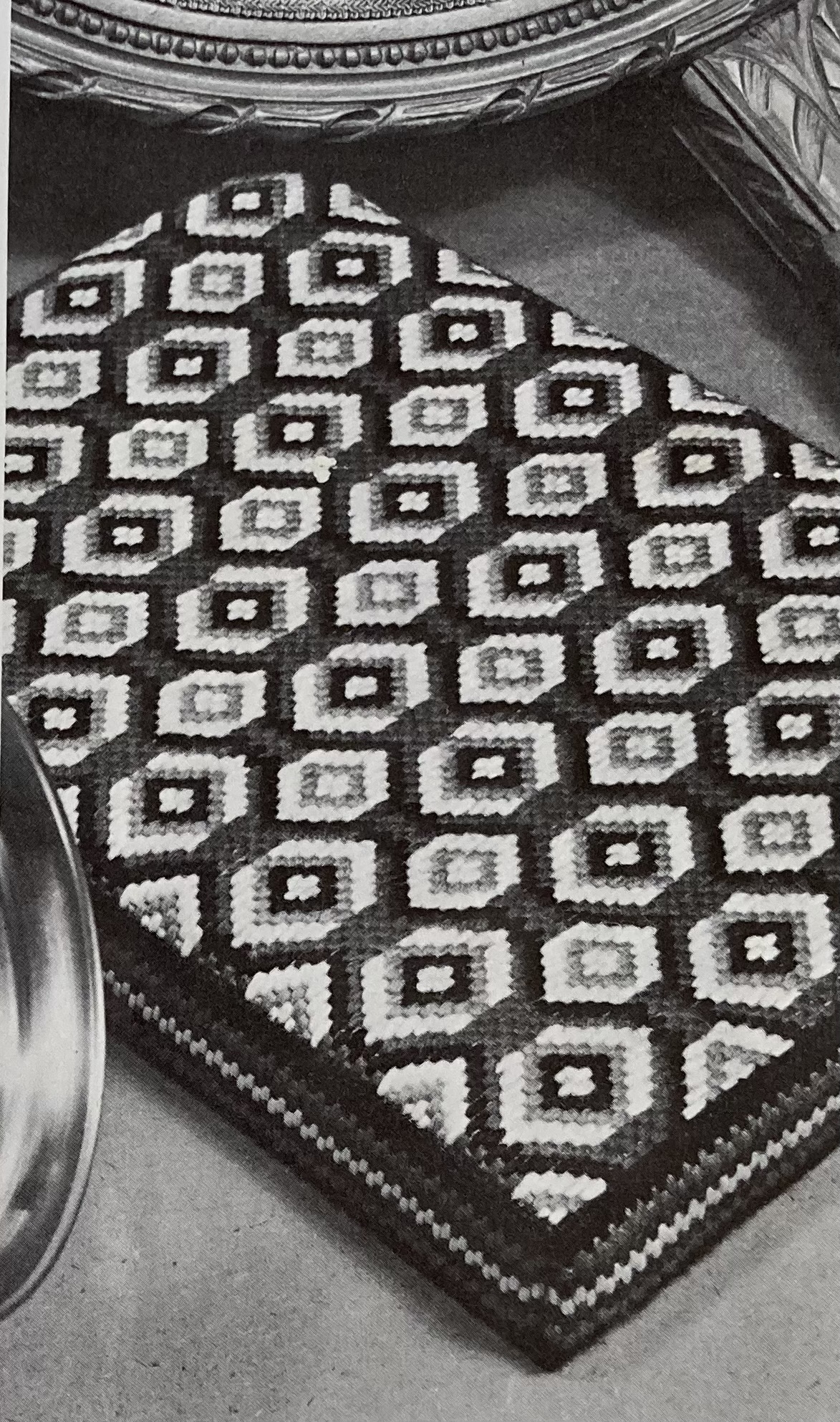
In the housewares department, there are multi-use heraldic designs of a unicorn, dragon, and fish to be worked in cross-stitch and Holbein stitch on a cushion cover, place mat, tray cloth or, interestingly, a matchbox cover. You embroider the cloth (two pieces), mount them on two pieces of cardboard and then glue them to the top and base of an existing matchbox of the larger sort that holds kitchen or fireplace matches. I actually really like the idea. There’s also a Jacobean crewel design that looks stunning on a black cushion or dainty and fancy on a white tablecloth.

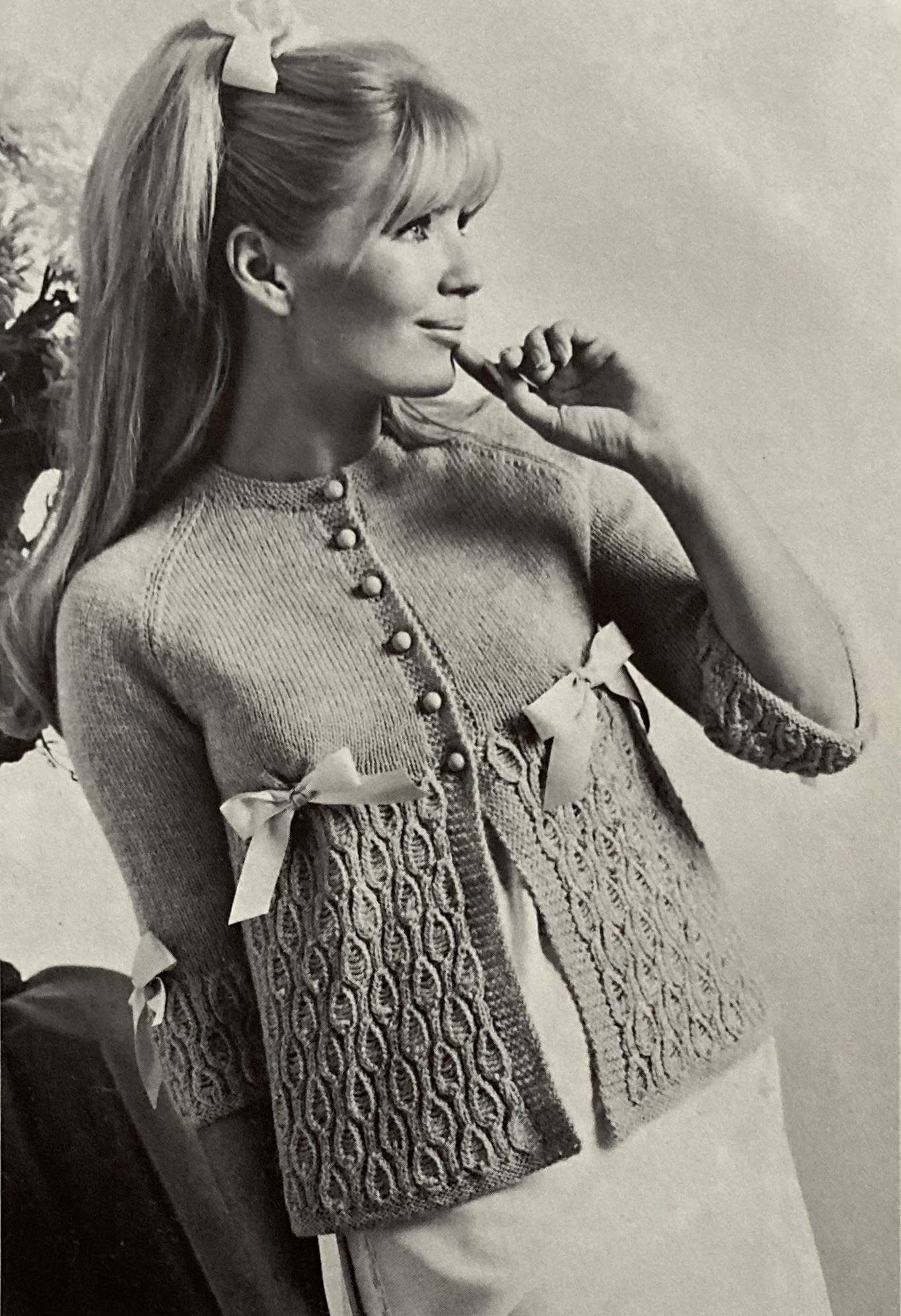
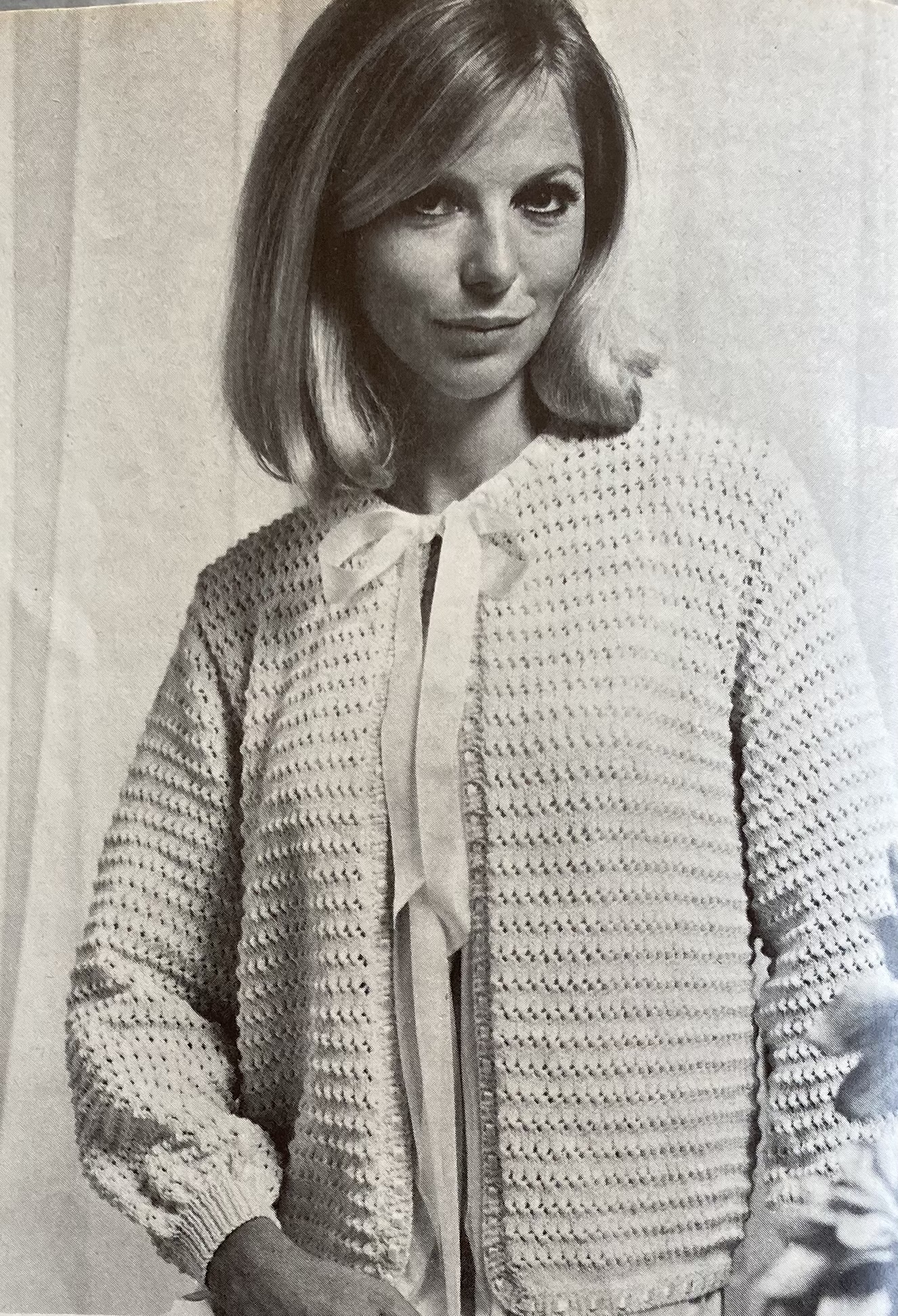
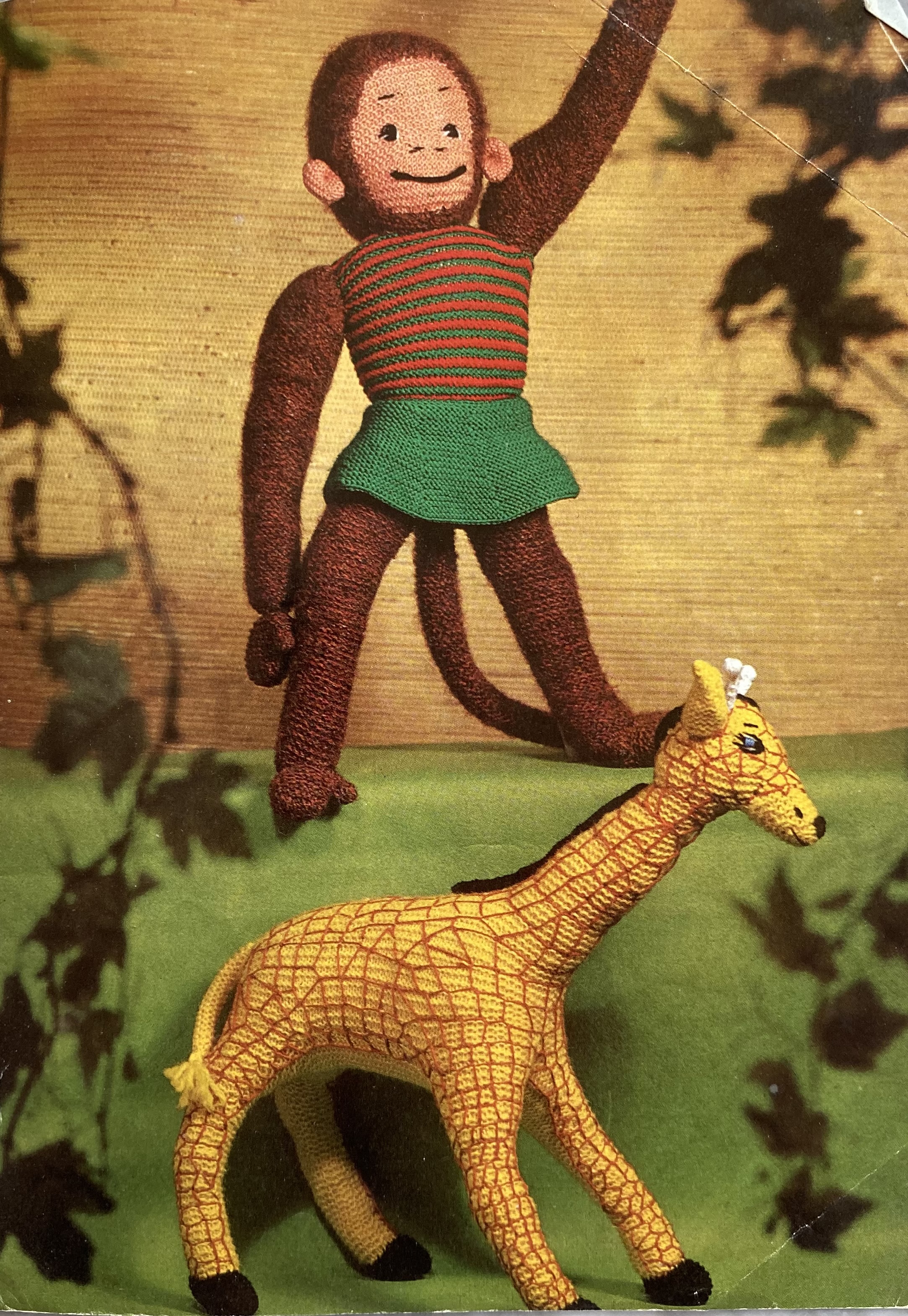
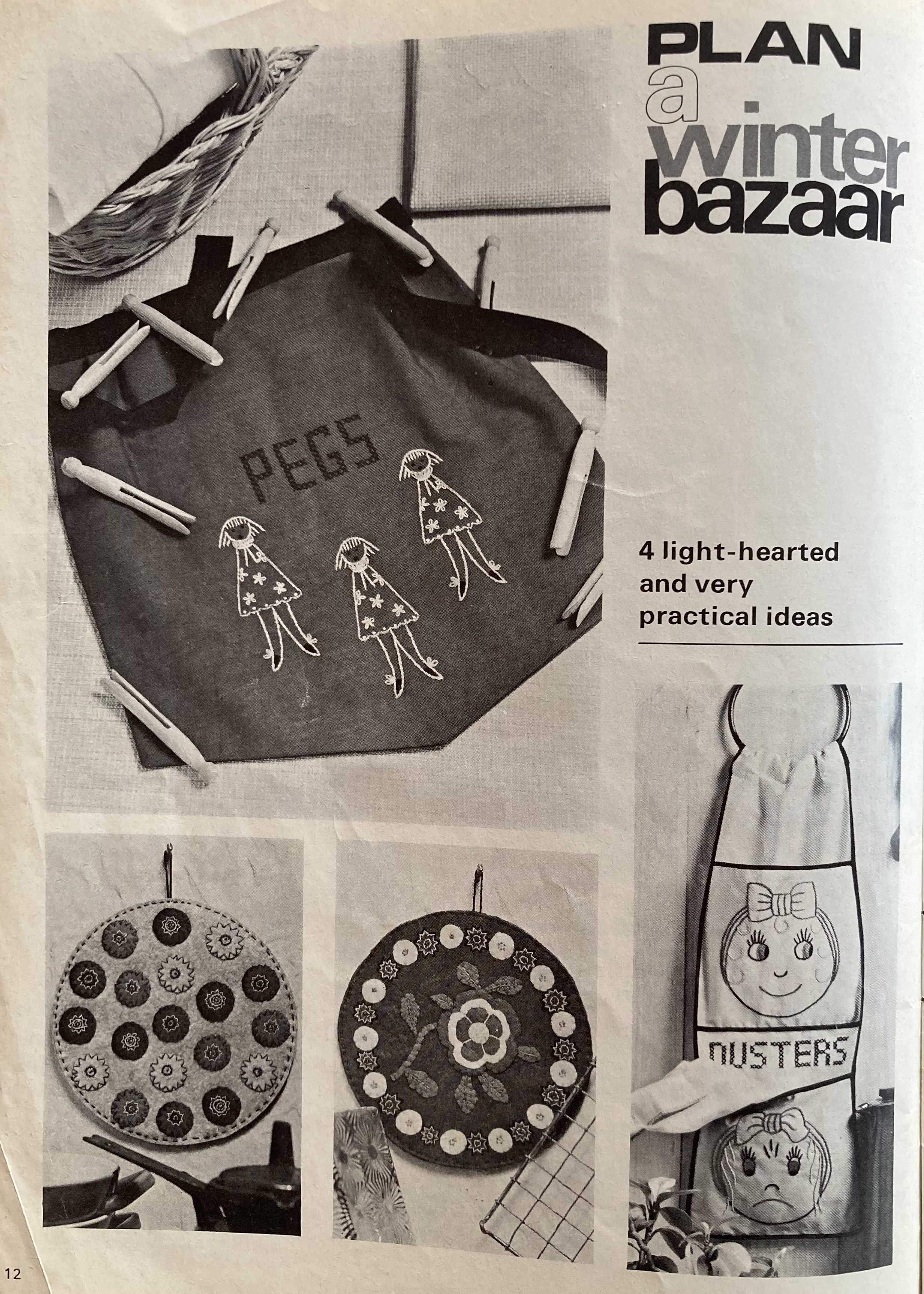
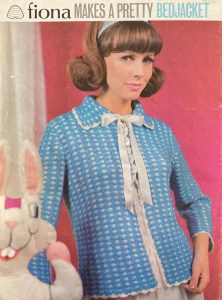
Other home and personal accessories fall under the categories of “Knitted Gifts” or the ever-present “Bazaar Items”, starting with a pretty bed-jacket worn by the Stitchcraft model who models all the bed-jackets. And if you look at any of her photos, you will know why! No other model perfects the come-hither look like she does. The resulting offspring will appreciate a cute stuffed monkey or giraffe toy. I like how the giraffe’s pattern is embroidered on, even if it doesn’t look quite accurate to a real giraffe. Finally, you can make a simple and cheerful sewn and embroidered laundry peg bag, dusting cloth bag with pockets for “clean” (happy!) and “dirty” (sad!) or a set of felt-appliqué pot holders.

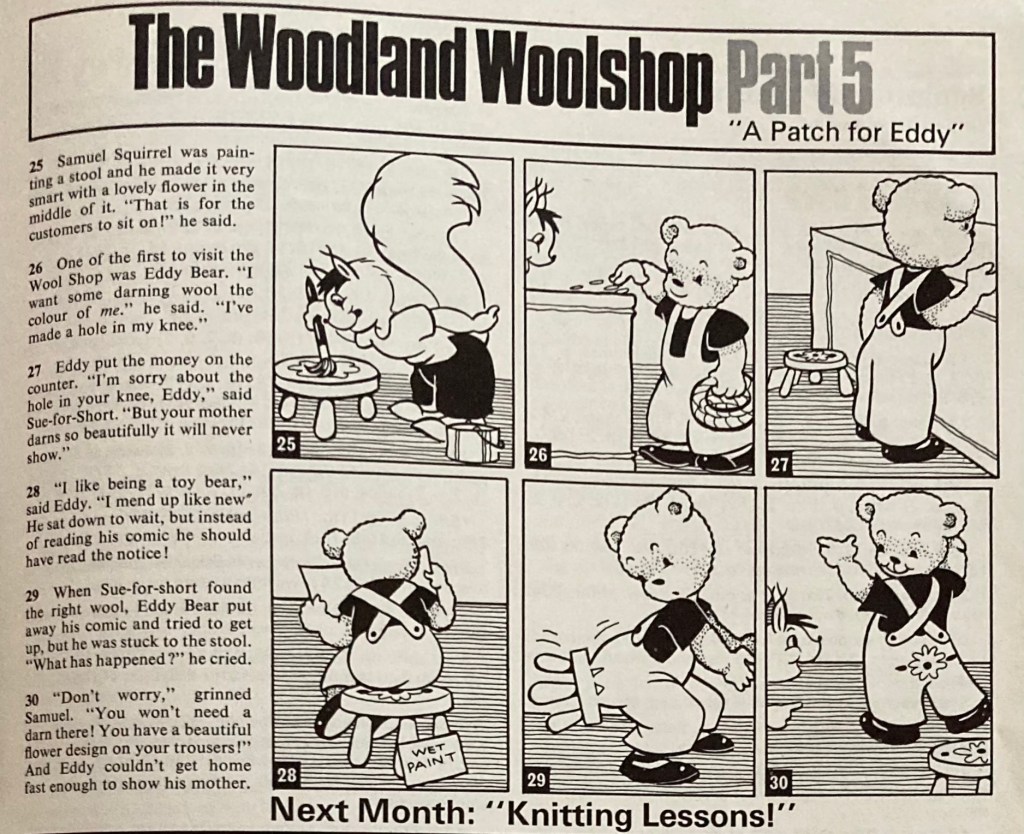
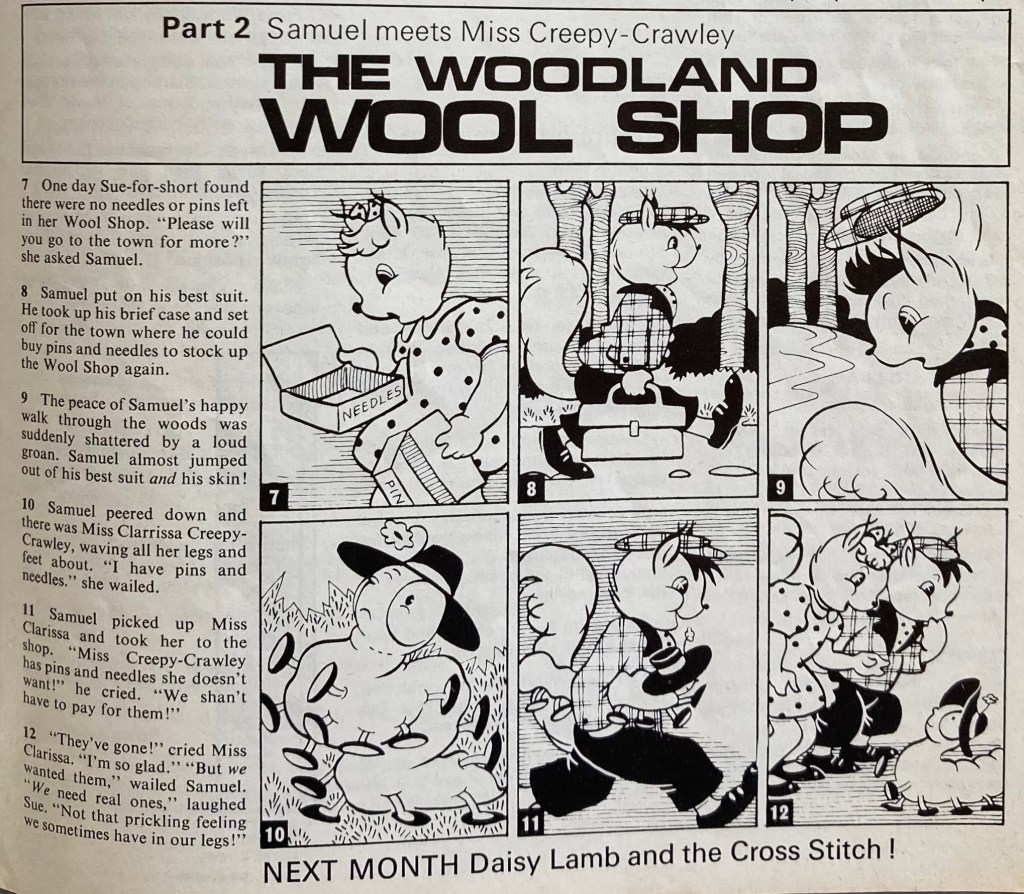
The ads are the usual ones for a sewing machine, Patons knitting books or “liver pills” to cure constipation, and the Readers Pages offer two reprints of popular items: little cross-stitch pictures of “Autumn” and “Winter” scenes for the nursery, or a cabled and bobbled ski hat that looks too small for any adult person’s head and would surely fly off if actually worn while skiing. In Part 2 of the children’s comic “The Woodland Wool Shop”, employee Samuel meets “Miss Clarissa Creepy-Crawley” (I’m sure there’s a Downton Abbey joke in there somewhere), a caterpillar with “pins and needles” — but not the kind Samuel has to buy! No fear, there’s a happy ending for all involved.

My project will be the little baby cardigan, for my colleague who is expecting a baby in November. I also ordered wool for the fabulous “Fashion Switch” knitted dress from the cover of the September 1967 issue, which will take a while to make, but maybe I can get a post about it up in October. Till then!

September 1967: Overview

It’s time for a “Fashion Switch” over at Stitchcraft! 1967 is the year where knitted dresses really start to feature, and as far as I can tell, the “switch” part means you can either make a dress or a skirt combo and mix and match. The cover designs fit in well with the trend: high necks, short skirts, deep raglan armholes, A-line shaping and big patch pockets. Note, too, the huge hats — they will only get bigger in the months to come.

The centrefold photo shows a slinky variation on the theme with a dress and/or skirt combo featuring a pretty beaded and textured design. Like the chevron dress from April 1967, the designs pick up some elements of 1920s and 30s fashion, while keeping a distinctly late-60s shape.

Other women’s knits include a bouclet blouse for the fuller figure with a very neat and pretty “soft-roll” neckline, a casually elegant afternoon suit with cable trims, a striped skirt combo in “colour brilliance” (tangerine and violet!), and a “Golden Glow” bright yellow pullover.

“Colour brilliance” applies to men’s fashions too, for once, and this green and yellow slip-stitch cardigan is a masterpiece. The model looks a bit like a colleague of mine — should I knit it for him? The other men’s garment, a chunky but streamlined pullover, echoes some of the design features of the women’s “fashion switch” combos. like the big patch pocket and contrasting-pattern sleeves. The photo is black-and-white, but the suggested colour is “Curry”, which I assume will be some kind of dark gold-brown-orange (so 60s). For children, there are two nice, sturdy, basic raglan pullovers in a more classic colour scheme — dark charcoal with red trim for the boy’s and “Cloud-dust Pink” with “Aztec Gold” trim for the girl’s.

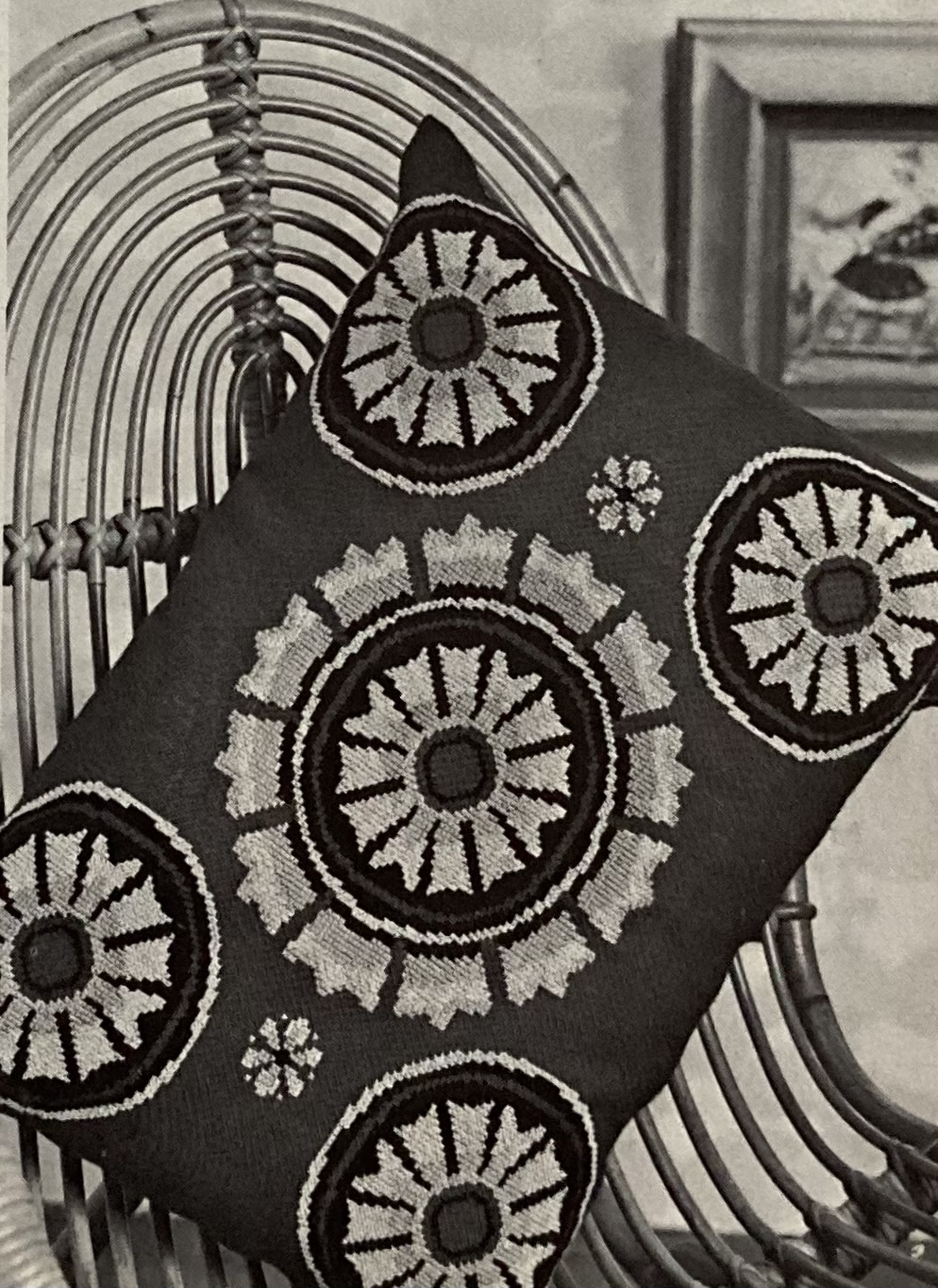
There are some fun homewares for all styles and abilities, starting with some very easy sewn and embroidered aprons with whimsical kitchen designs. I’m not interested in the aprons, but I love the top that the “teatime” model is wearing! You can make a tapestry panel of an Irish homestead in Rosguill, Donegal or a cushion or chair-back in a gorgeous traditional-inspired design updated “for a modern setting”. Both are done in tapestry wool on furnishing linen.

It’s not too early to start on little gifts for Christmas, and here’s a little bag “for a friend” and a knitted tortoise toy “for a toddler.” Baby gets a thick, squishy pram cover in fluffy “Ariel” wool and a raised cable trellis design.

Or you can make a Florentine-pattern workbag or cushion for yourself. The colours — gold, green, and yellow — will match nicely with a lot of the knitted designs from this month.

In the “Readers Pages”, we finall have a new comic: Sue and Samuel Squirrel run the Woodland Wool Shop. Their adventures start when Sue finds a loose thread of yarn in the woods and winds it up — only to find that she has unraveled an elephant’s vest and needs to knit it all up again! Poor Sue. The only full-page advert is for Bri-Nylon. I imagine the dress in the photo is quite hot and impractical, especially if knitted in synthetic nylon wool, but what a lovely photo.

That’s it for this month! There are so many great projects that it’s hard to choose, especially since the ones that call to me are all big projects and I just finished the chevron dress from April 1967. I love the orange cover dress and the men’s slip-stitch cardigan, particularly, as well as the fancy embroidery design, which I think would look lovely going around the hem of a full black skirt. Or maybe even the Florentine needlepoint? I don’t have much time in September to knit, though, and even less to adapt an embroidery or tapestry pattern. We’ll see!

July 1967: Baby Talk

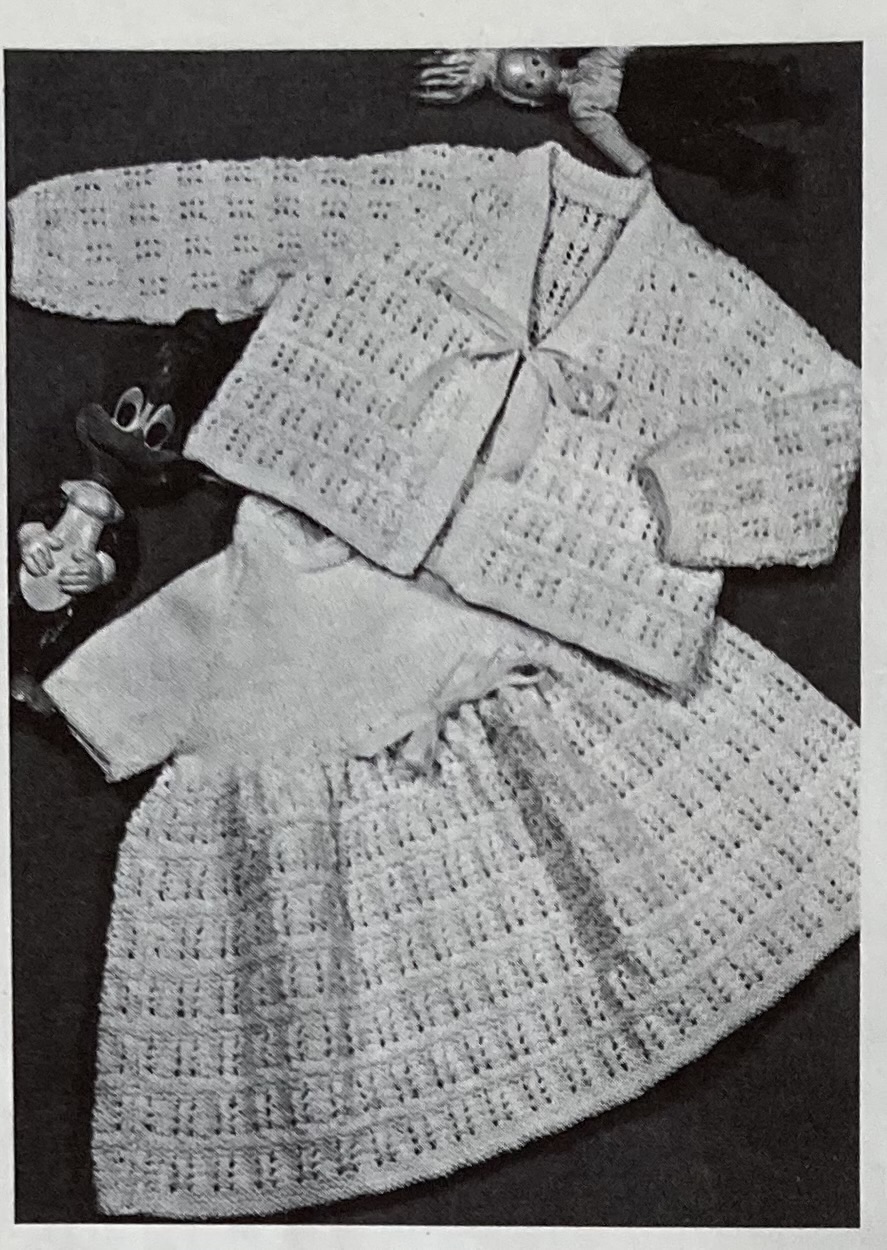
My project from the July 1967 issue of Stitchcraft was the “matinee jacket” from this jacket-and-dress set for a baby.

I had some nice Slow Wool Lino (sadly discontinued but alive and well in my stash drawer) that worked well for it — fine and soft, all-natural and machine-washable. I was a bit ambivalent about making baby clothes in such a drab shade of greyish-brown, but I hear that parents these days prefer neutral colours for babies? It will certainly match with everything.

The tension is supposedly 9 3/4 stitches to an inch over pattern (!) which is supposed to correspond to 7 sts/inch in plain stocking-stitch. I can get 7 sts/inch in stocking-stitch with Slow Wool Lino but the stitch pattern stretches. It is not difficult in itself — basically an eyelet rib on a reversed stocking-stitch background — but was unusually tricky to work increases and decreases in, even though it keeps the same number of stitches in each row, and it was clear that the tension would be completely off even before blocking, so I reduced the number of stitches.

I was so frustrated with the comparatively easy decreases on the “skirt” part and increases on the sleeves (which also ballooned out in an annoying way) that I decided to make the yoke in plain stocking-stitch, similar to the dress from the same pattern. I considered making a round neck like on the dress, or possibly embroidering the yoke afterwards with some little flowers in a contrasting colour to offset the drabness of the brown.

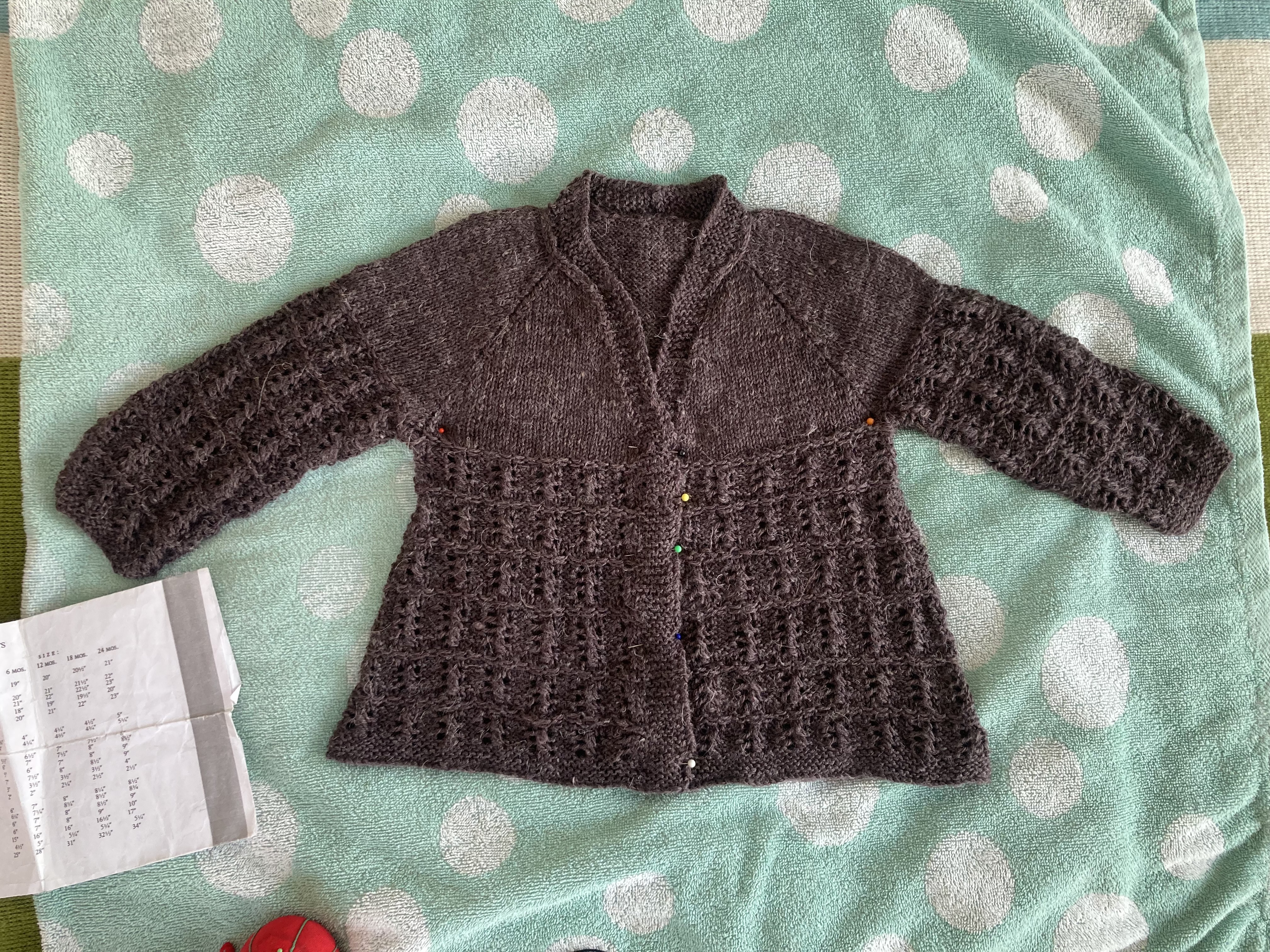
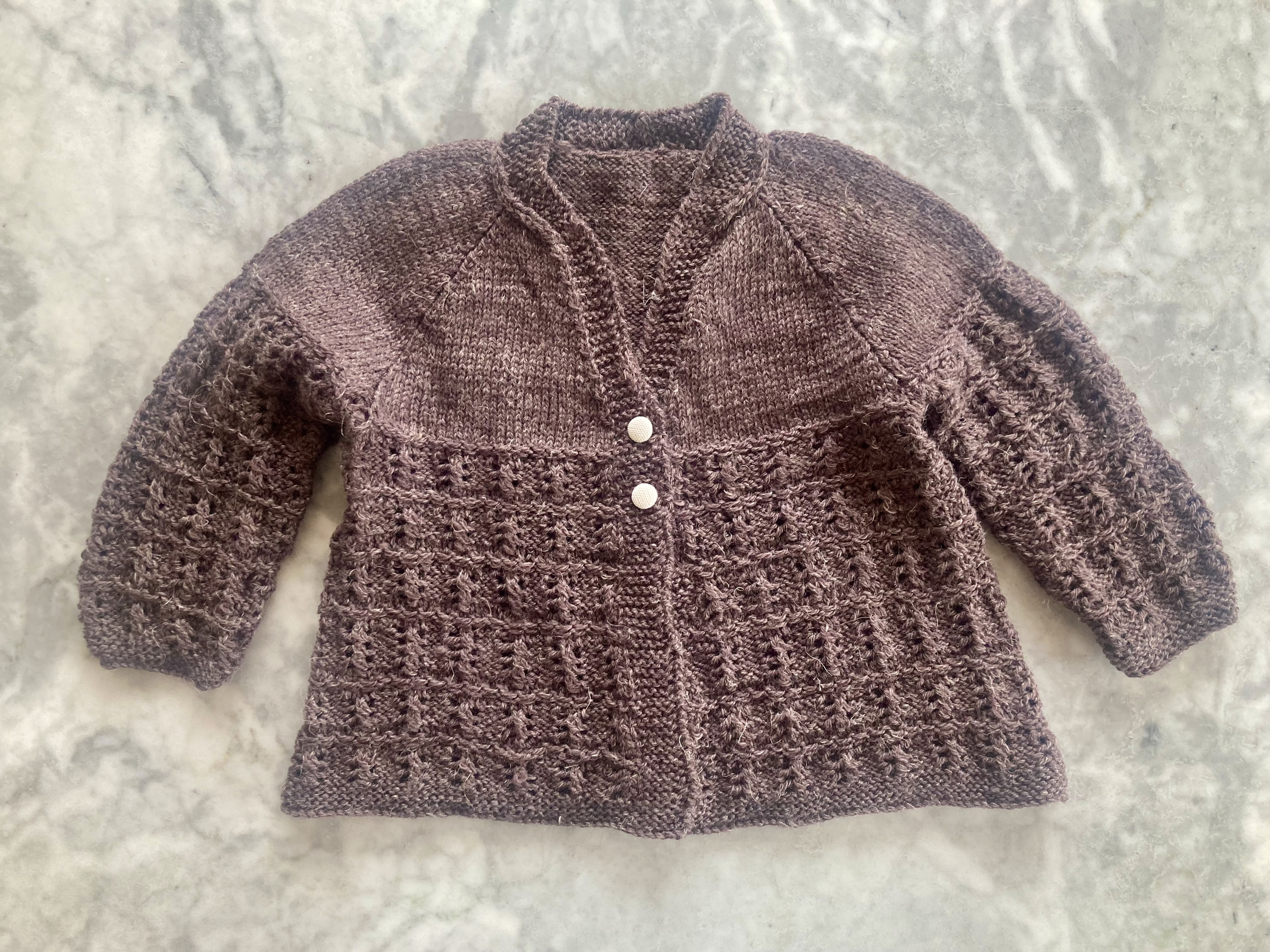
After consulting with the good people on the All Things Vintage forum on Ravelry, I kept the v neck, and when it was done, I didn’t think embroidery was necessary. I had already decided to add a couple of buttonholes at waist/armhole level instead of the unpractical ribbon tie from the pattern, and I found some little white fabric-covered buttons (possibly vintage? maybe just look like it?) in the button box, which perked up the colour with a bit of contrast and looked very sweet and old-fashioned. Here are some photos from before and during blocking:
I was not so impressed by this pattern and ended up making a lot of changes. But the finished product is soft, warm, practical, will match with everything, can be worn in all seasons and will “grow along with” a baby, so I think everyone, including the baby, will be quite pleased with this gift. The recipient is a colleague whose baby should arrive in November, so it was finished well on time for that, as well as on time for the blog. So all in all, a satisfactory project.

In other July 1967 news, I still want to make this dress from the same issue and even bought wool for it! If I ever make it through the “naughty pile” of WIPs, I might be able to start it sometime…

July 1967: Overview

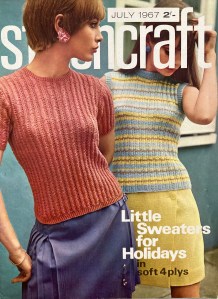
Welcome to Summer! Is it hot where you live? It is supposed to be 35 degrees C today here and I already feel like a delicate wilting flower. Luckily, Stitchcraft‘s July 1967 issue brings us “Colour for Holidays” “in a gay easy-going mood with simple designs that are pretty and young looking, in lively colours to mix and match as you choose.” Here we go!

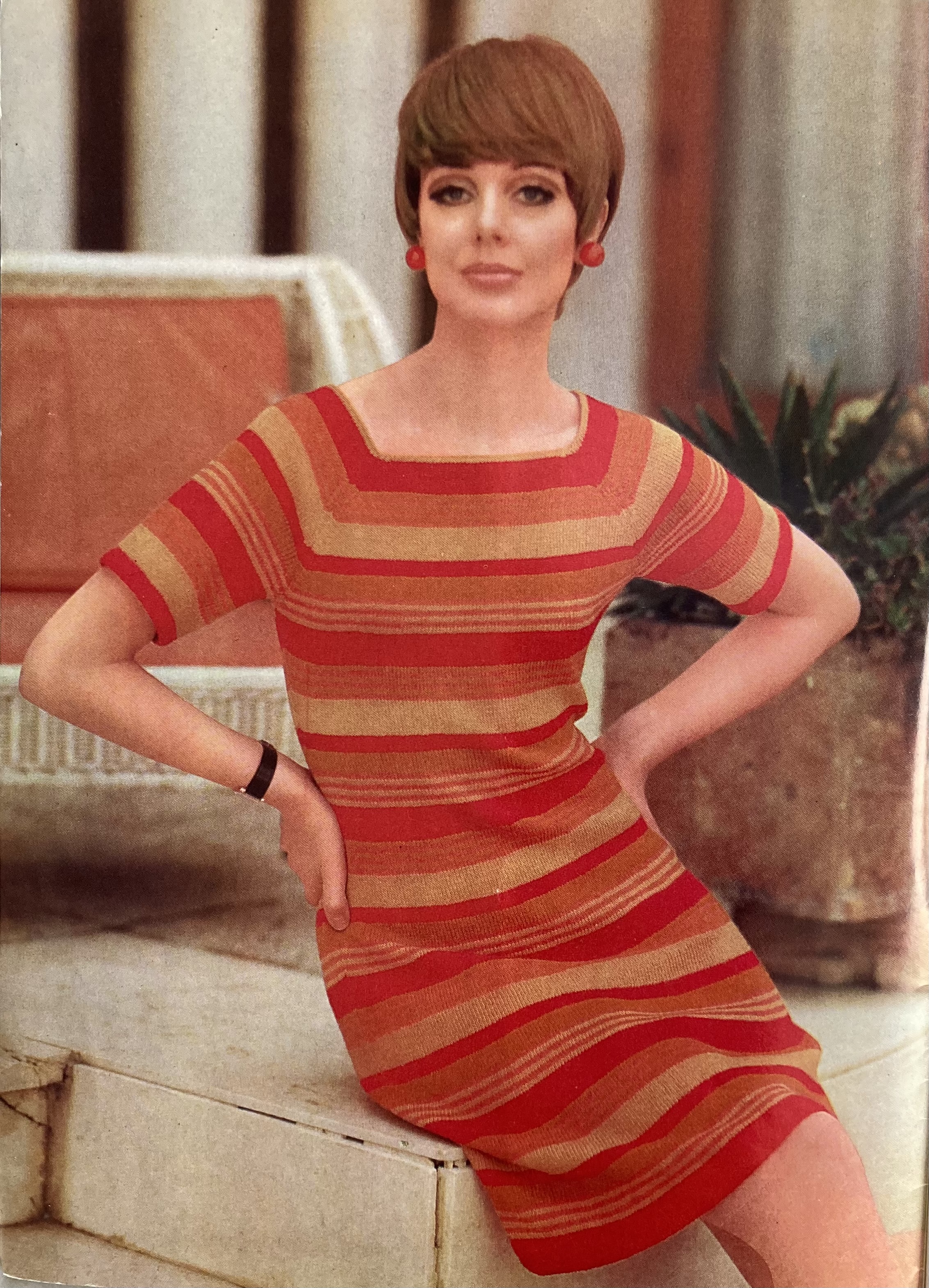
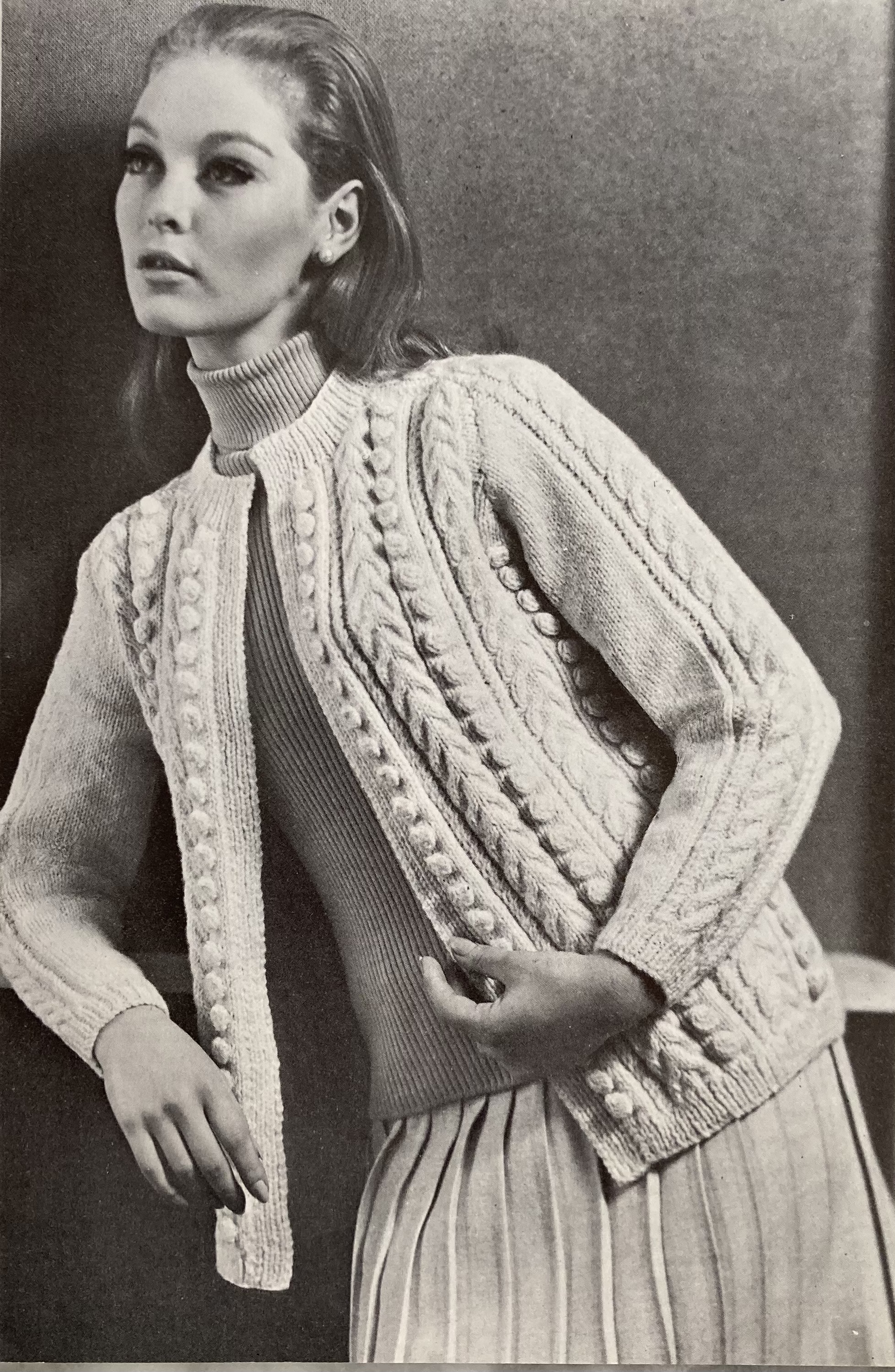
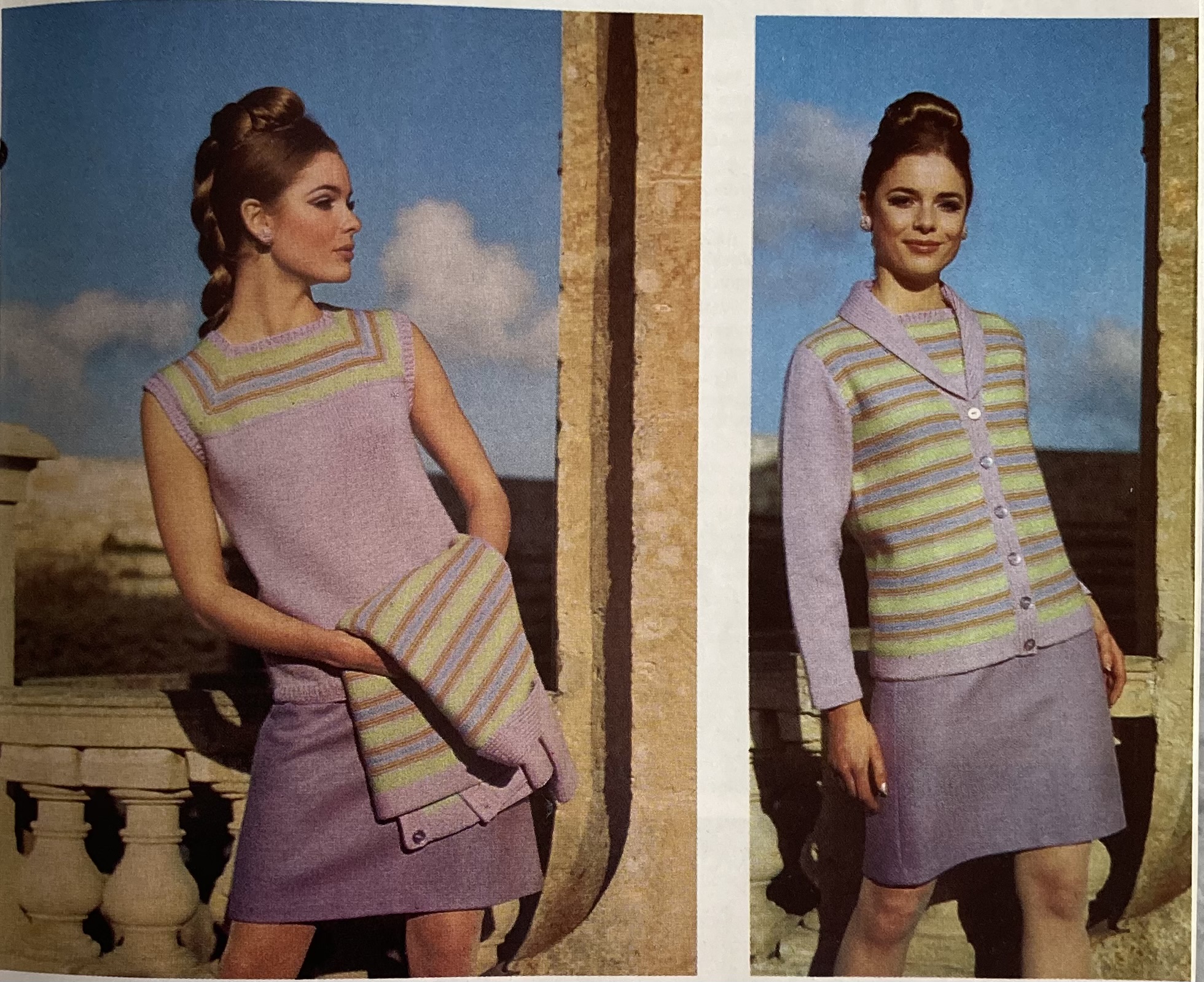
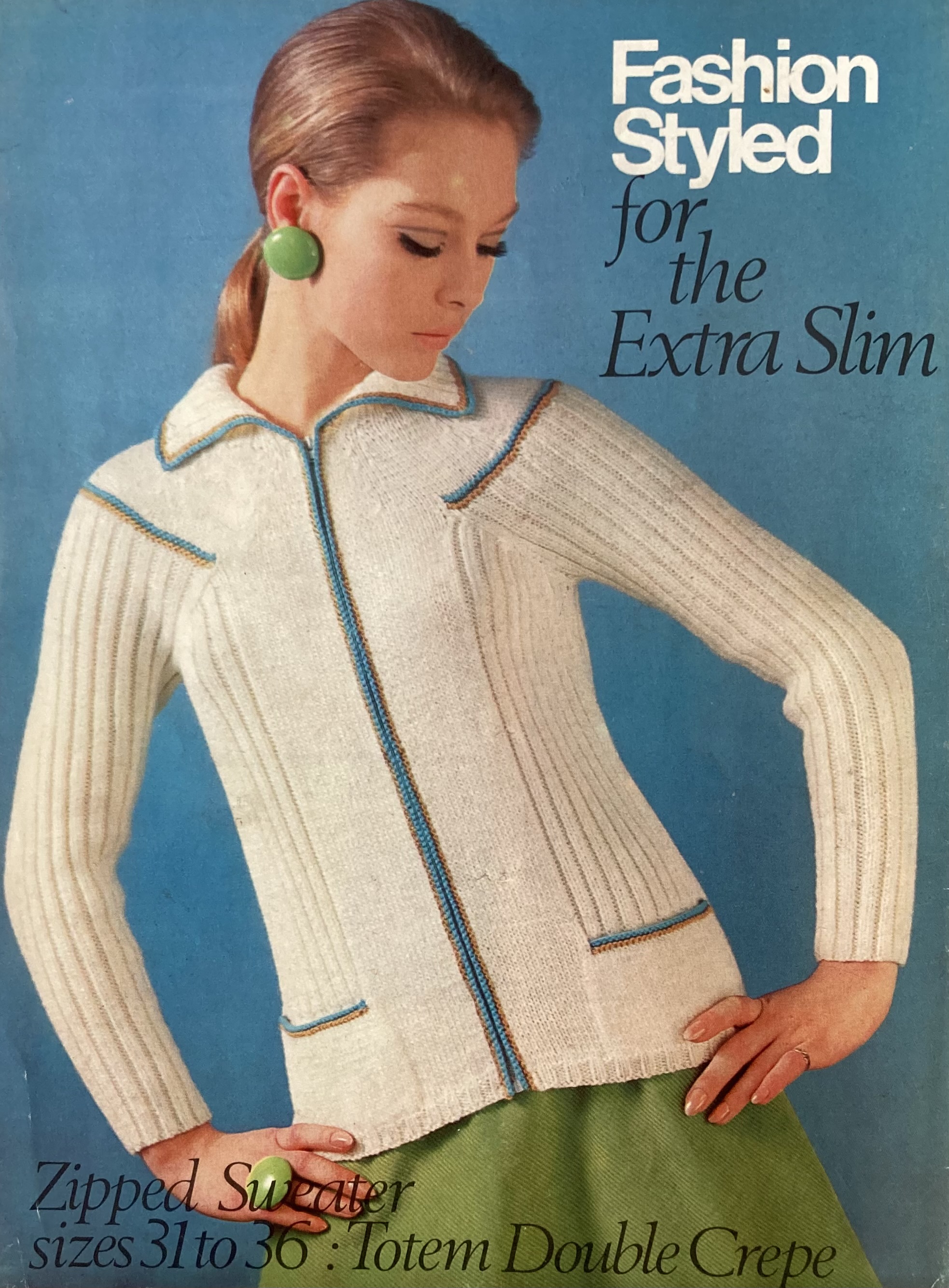
Our cover photo shows two “Little Sweaters for Holidays”: a mock-cable-and-lace jumper in synthetic “Nylox” yarn and a striped-and-ribbed “shell” in lightweight “Purple Heather” wool. Stripes are big in this issue, either via typical colour bands or the use of stitch pattern elements to create vertical lines. The dress on the inside cover uses coloured stripes in a dramatic way, with bold horizontal bands of red, gold and orange, while the thick “Capstan” wool jacket uses narrow bobble and cable panels to create a textured vertical-stripe effect. Horizontal colour stripes are contrasted with plain-knit sleeves or body on the shell and cardigan twin-set. Finally, rib panels and colour accents highlight the narrow silhouette of a zipped cardigan “for the extra slim.”

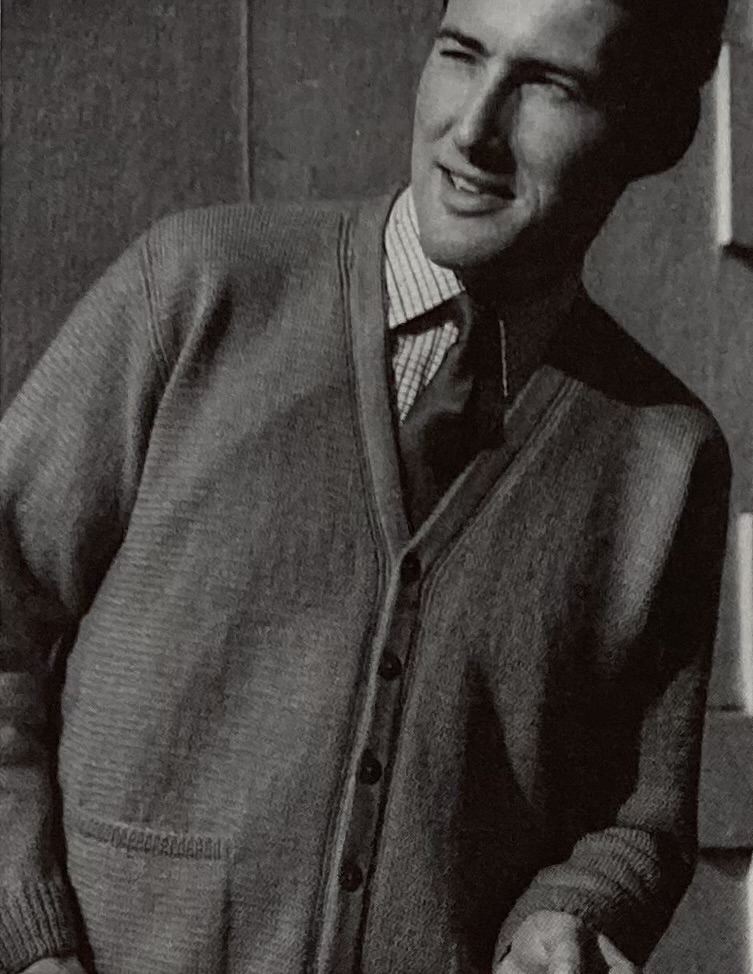
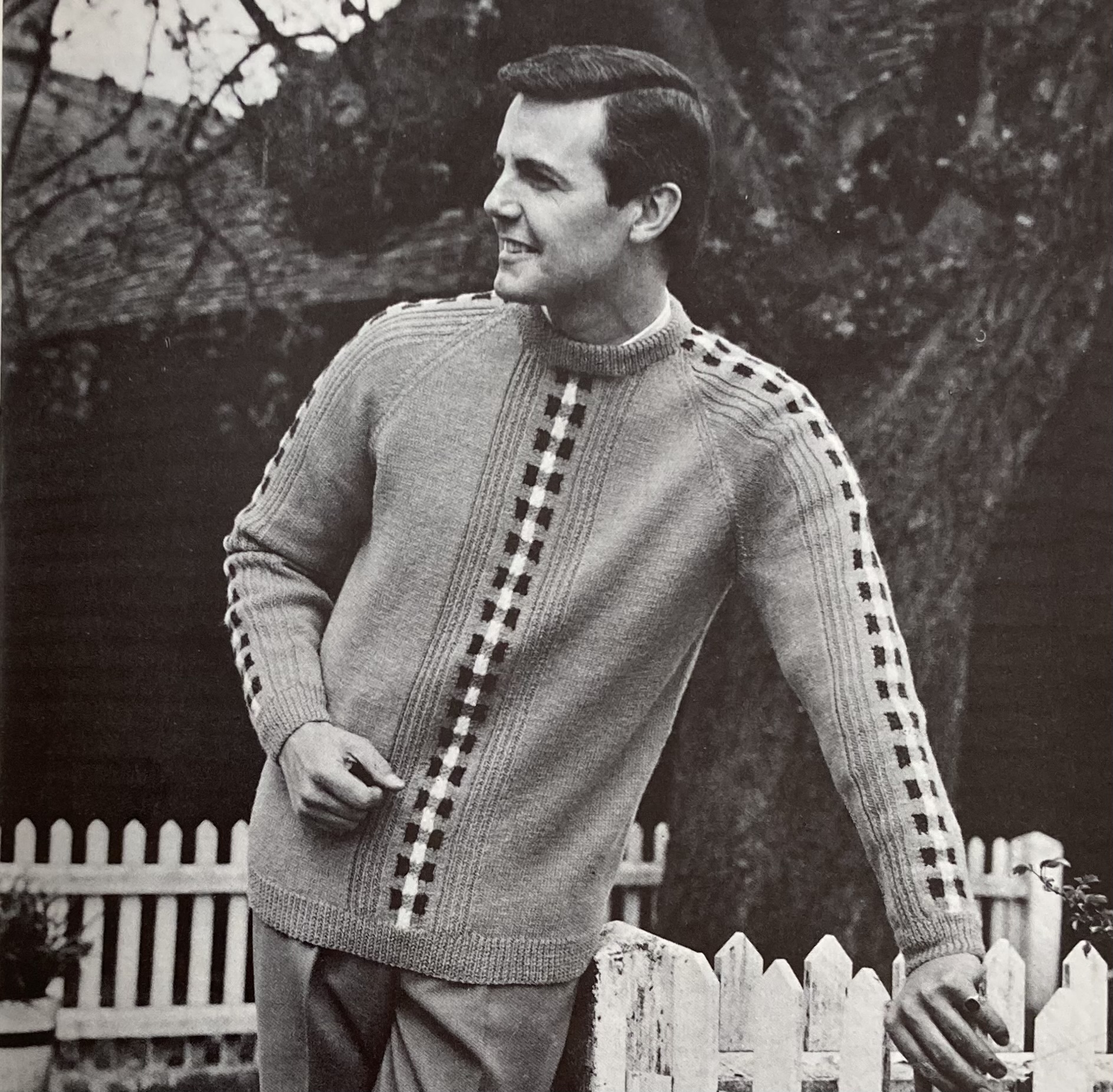
The men’s cardigan “in Classic Mood” is quite plain, but the “Viennese design” saddle-shoulder sweater incorporates some of the fun design elements that we see in the women’s garments: narrow rib panels to create vertical lines and plaid stripes for a splash of colour. The colours, by the way, are “French Mustard” with charcoal grey and white in the plaid stripes. (All in all, there are more colour photos in the 1967 issues than previous ones where only the covers and possibly the centrefold were in colour, but of course many designs are still only photographed in black and white.)

There’s a cute matinee set of dress and jacket for a baby and a cardigan for little girls with a slip-stitch colour pattern on the yoke. Of course, the little girl is pictured playing with her doll indoors, whilst the boy model gets to “play it rough in a shetland cardigan” out of doors (though the photo was obviously taken in the studio…) At least he’s not wearing a shirt and tie, only a turtle-neck shirt and a warm-knit cabled cardigan — which he might well have needed to stay warm on the day of the photo shoot, since according to the daily weather reports of the UK Meteorological Office, it was probably quite cold for summer, assuming the photo was taken in June!

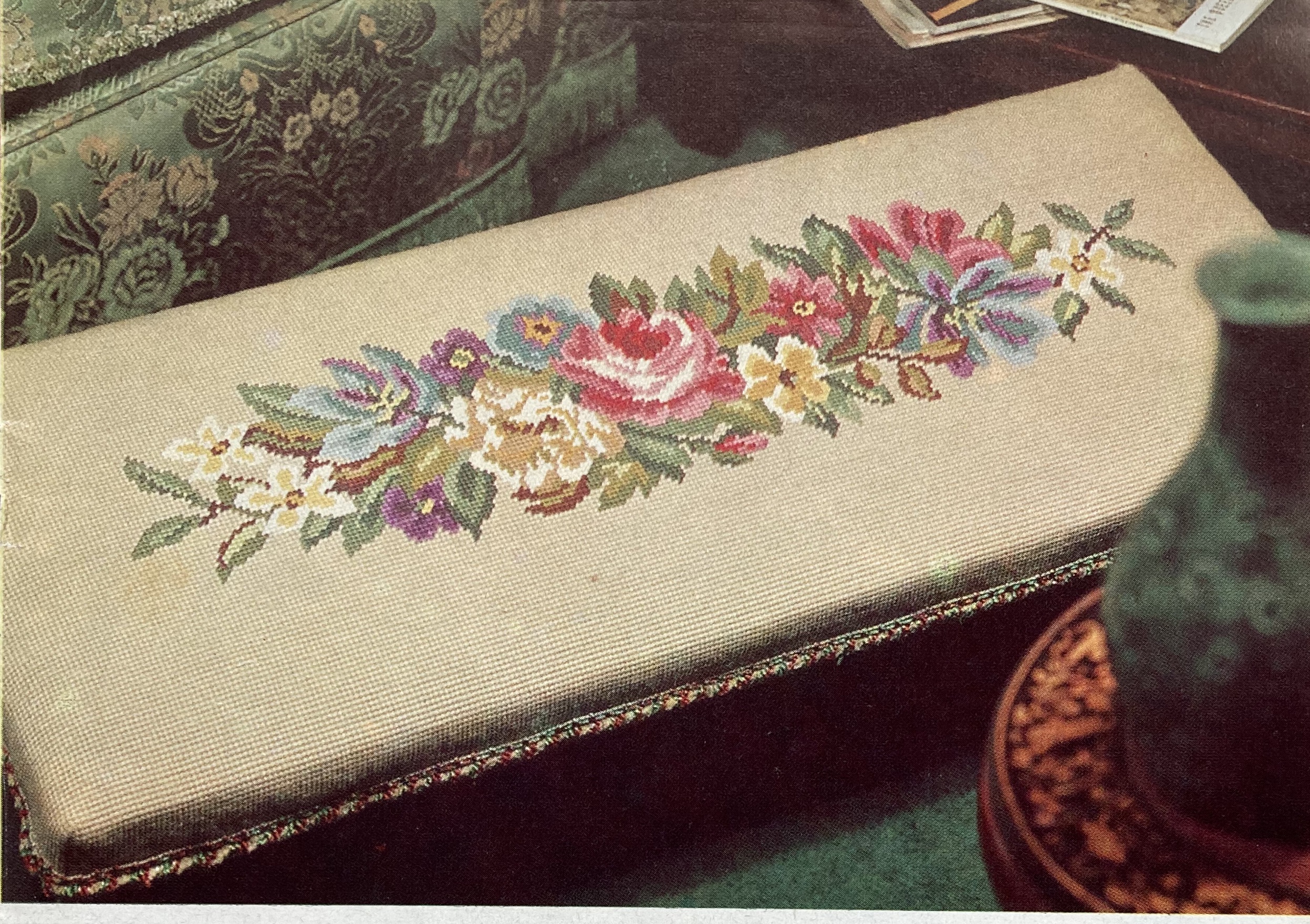
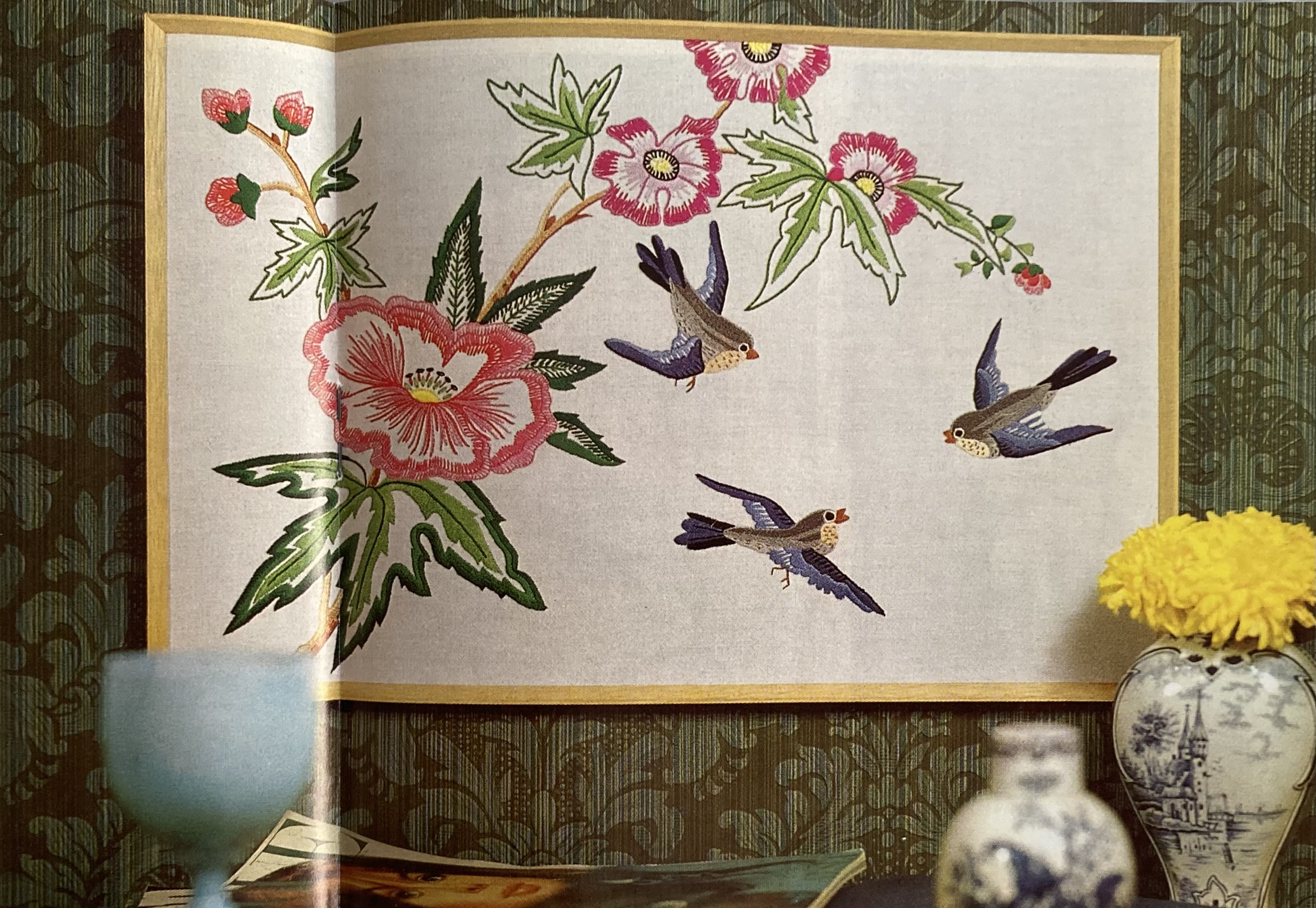
The homeware projects are fun, with an impressive embroidered wall panel inspired by Chinese designs and a tapestry design adaptable for either a little pincushion or a church kneeler.

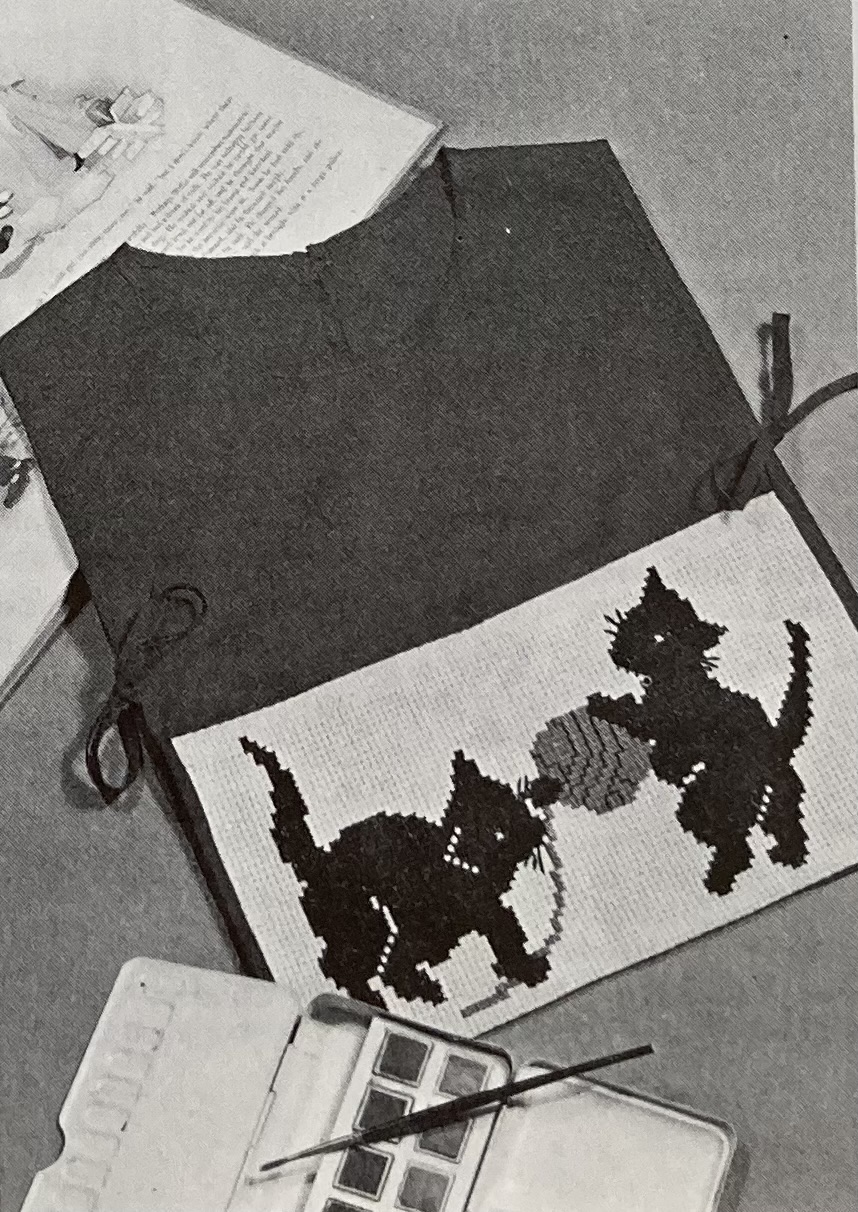
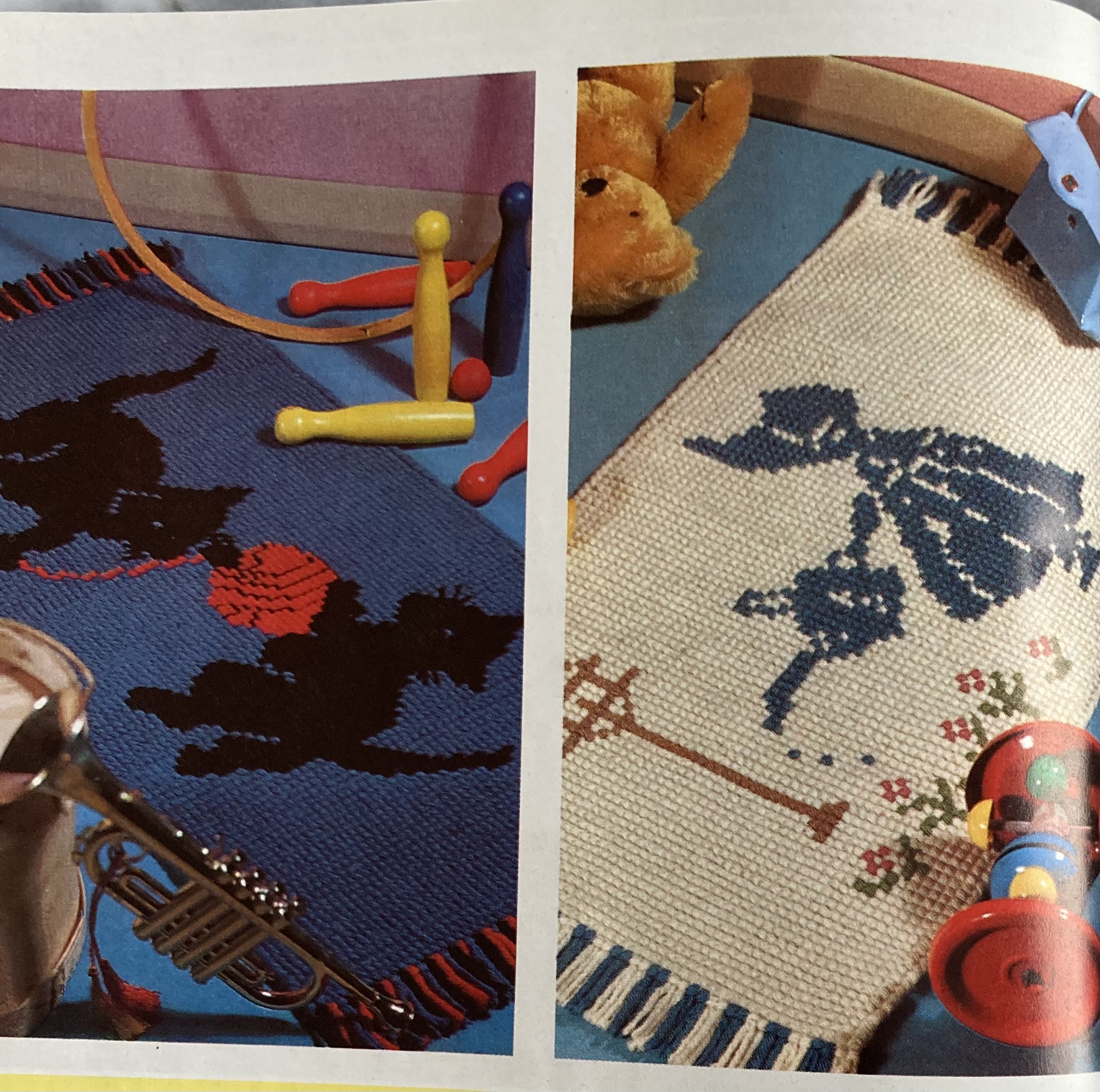
Adaptabiity is a key feature of the children’s homeware designs as well: the playful kittens or picture of “Mary, Mary” making her garden grow can be stitched into a rug, stitched as a picture or a panel on a toddler’s pinafore, or, in Mary’s case, worked as a little decorative picture in filet crochet.

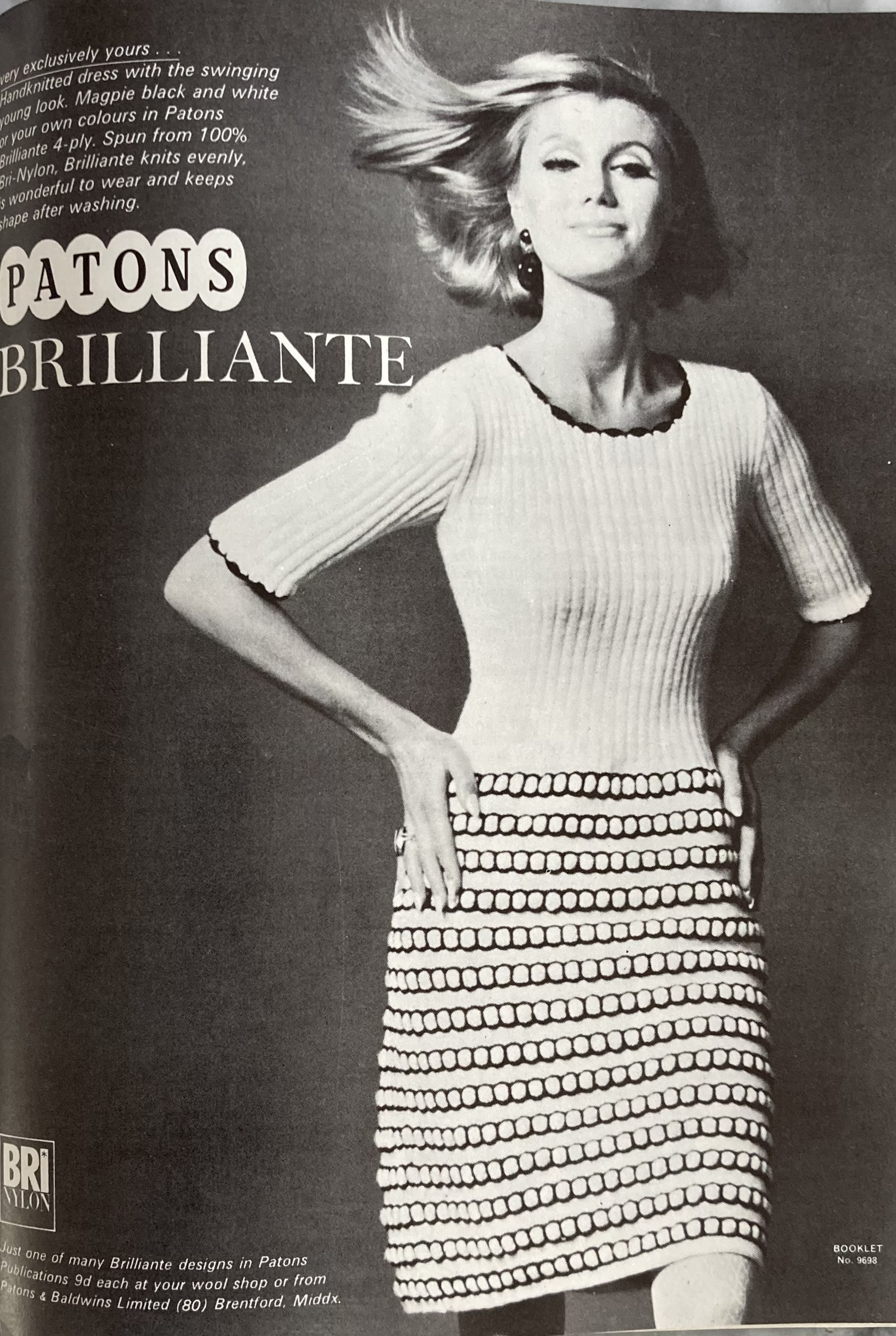
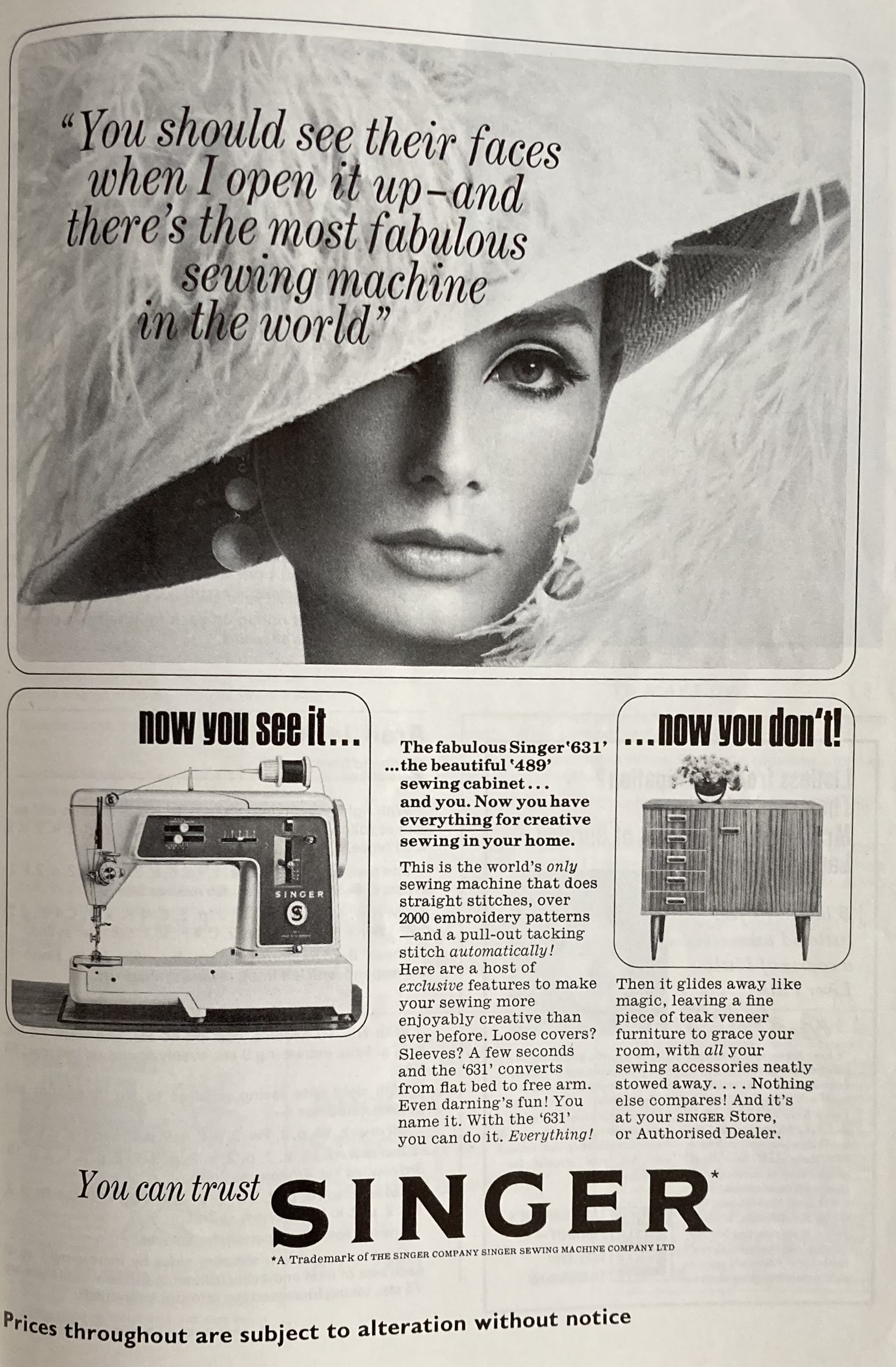
The Readers Pages don’t disappoint, with a simple pattern for a crocheted belt and ads for a book of handmade tie patterns, crochet “snowflake” designs, and crochet for brides. The 70s are on the horizon! The children’s comic continues the “Children of Other Lands” series, which is cute and well-meant but of course, heavily stereotyped and not the right tone for the twenty-first century. The full-page ads feature Patons Brilliante yarn and another ad for that fabulous sewing maching that folds down into its own chest of drawers.

That’s it! My July project will be the jacket from the baby set. Stay cool!

March 1967: Overview

The March 1967 issue of Stitchcraft promises us „new fashion looks for Spring knitting“. March weather being notably unpredictable, there are warm, bulky knits for colder days (or to wear as sporty outerwear) and finer knits for Spring. The former are mostly made in „Big Ben“ to knit up quickly and warmly, but slightly less bulky in shape than before, the latter in smooth crepe wool with or without glittery accents. The „skinny“ „mini“ jumper makes an appearance as an alternative to the bulky look for young folks, and the crochet look in knitwear is still trending.

Our cover duo sports (heh) matching bulky V-necks in Big Ben wool, knitting up quickly at 3 1/2 stitches per inch. The cable panels down the front give it a little bit of vertical line to counteract the bulk. The cable-and-V-neck combination show up in a slightly less heavy-knit casual cardigan for larger sizes. The „Sweater with flower trims“ on the inside cover looks bulky, but is merely oversized and actually knitted in fine Cameo Crepe at 8 stitches to an inch. The flowers are made with intarsia with crocheted motif centres sewn on and the buttons are covered in fabric knitted from the same wool as the sweater — a cute extra touch. The crochet look in knitting continues with a high-buttoned cardigan in a sort of arrowhead-shaped slip-stitch pattern. It too is knitted in fine crepe wool, but looks bulky due to the oversized design and three-dimensional stitch pattern.

Teenage girls can knit themselves a „Little Shetland“ cardigan or pullover with an easy stranded pattern at the yoke or hem, or a fine-knit „skinny rib top“ which would be just as much in fashion nowadays as then. Whatever the girl behind the skinny rib top model is wearing is not part of this issue and will remain a mystery.

Finally, there‘s a glamourous sleeveless cocktail dress with matching jacket. The lacy pattern panels get a little extra glitz from knitting with the base wool (Cameo Crepe) and Lurex thread held together.

There are so many women‘s fashions in this issue that there apparently wasn‘t much room for men‘s or kid‘s designs. What there is is great, though: a three-piece baby set for spring outings in the pram and a hard-wearing cabled Aran pullover for a school-age boy.

The homewares in this issue are less interesting than usual and feature versatile designs that can be adapted to different furnishing needs: a woven design for a rug or cushion, grapes and leaves to embroider on an apron, mats or cushion, etc. Ambitious crafters could make an entire set for a room that way.

There‘s a cute breakfast set for a child‘s Easter morning and a crocheted mat for the adult‘s afternoon coffee table. Really ambitious embroideresses could make an elaborate and very pretty flowered tablecloth.

There‘s a new comic series in the Readers Pages which is cute and well-meant, but also fairly eyeroll-y for modern sensibilities: „Children of Other Lands“, featuring well-trodden clichés about cultural practices etc. in non-British countries. This month features Jan, a Dutch boy whose wooden shoes get stolen by mice, who use them as a boat on the canal. You get the idea. The ad for the Scotch Wool shop manages to be at least as much fun without any stereotypes.

That‘s all for this issue! I don‘t know what to make. I love the cocktail dress combo, but the ratio of time and effort in making / actual use I would get out of it doesn‘t add up. The larger-sizes cardigan is practical and nice, but I have multiple larger projects on the needles and don‘t want to start a warm cardigan in Spring. I might make another project from the January 1967 (the Fair Isle cardigan! Finally bought the wool for it!) or February 1967 (Lacy knee socks!) issue instead, or start ahead on the April project (chevron striped dress.) I promise to get something done sometime. Happy Spring!

February 1967: Overview

Spring Fashion is ready for take-off in the February 1967 issue of Stitchcraft, with its theme of “colour and pattern”. Fair-isle/stranded garments continue to “hold the scene”, along with a fun mix of non-stranded colour and texture designs. Colour and pattern of household items are influenced by spring and Easter (March 26th in 1967), with pastel florals and “novelties” for church bazaars.

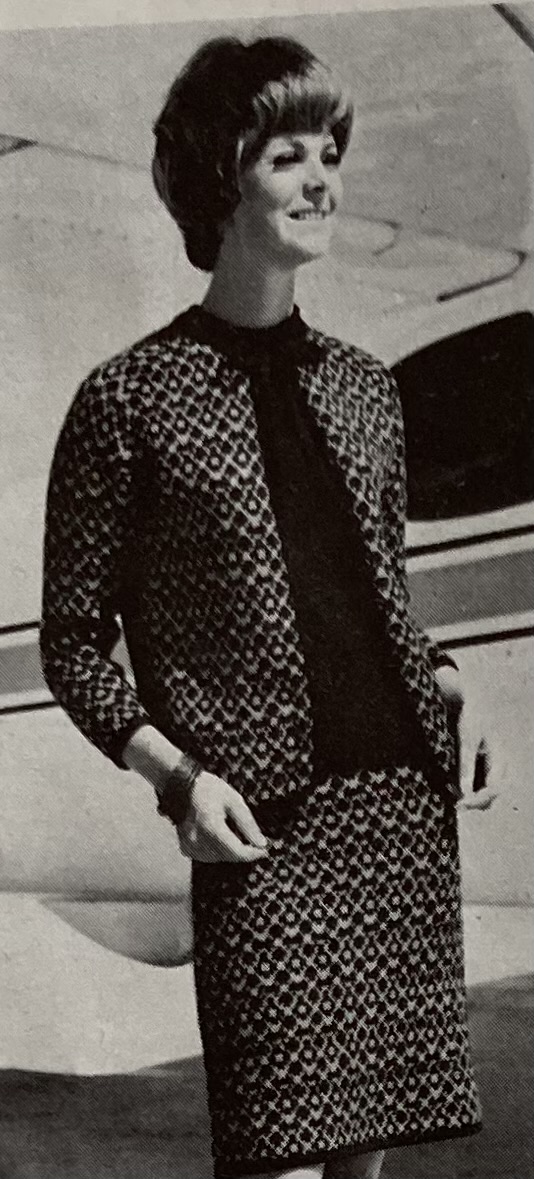
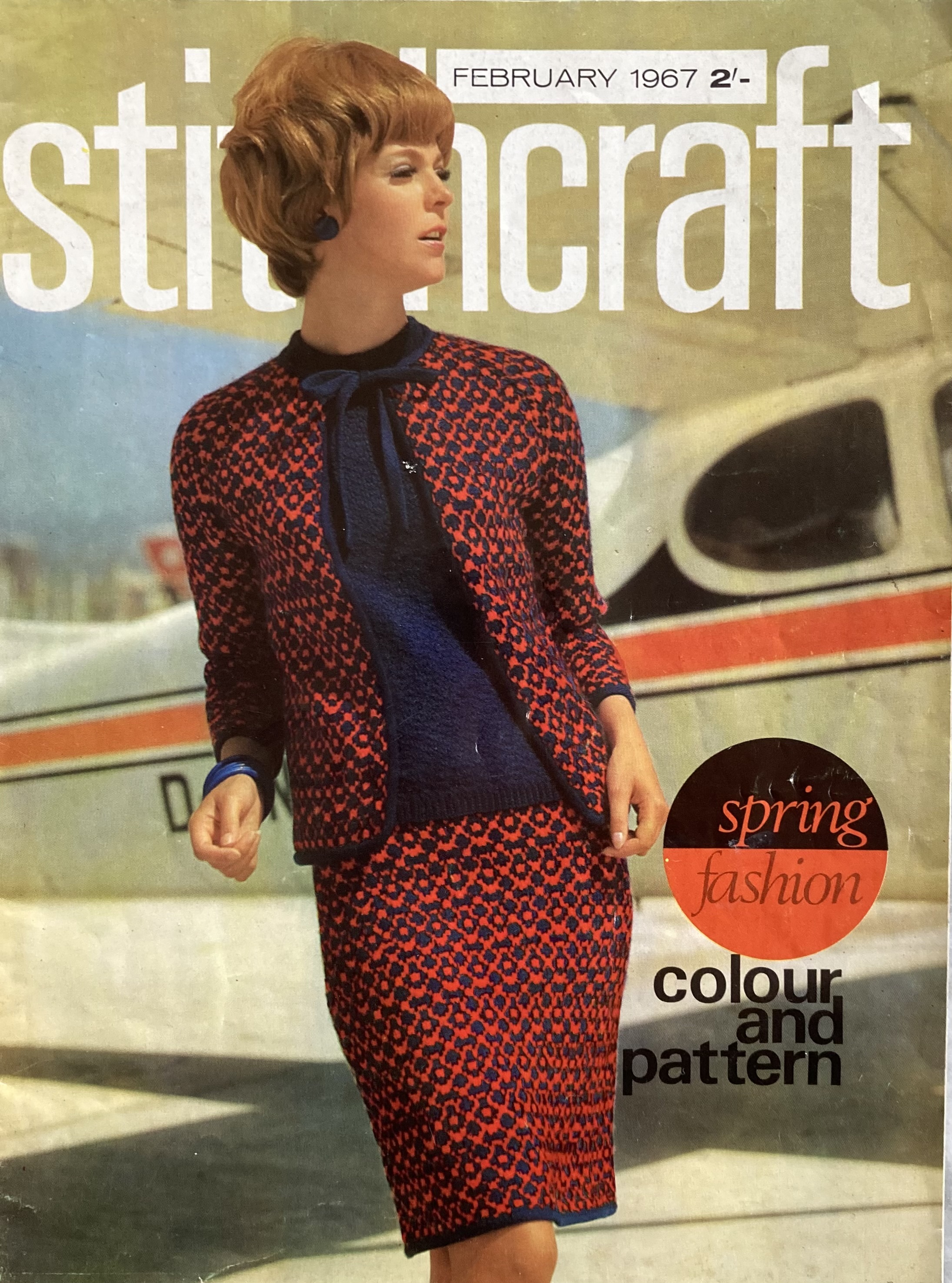
Our cover model sports an elegant “traveling suit” (don’t think it’s quite appropriate for flying in the tiny 2-seater plane in the background, but great photo) with an all-over stranded design in red and blue, paired with a short-sleeved knitted blouse. The suit is made in double-knitting weight wool with knitted bias binding in 4-ply Nylox (wool-nylon blend). The same Nylox wool is then used to make the blouse, which cleverly translates the stranded colour pattern into a single-shade textured pattern using knit and purl stitches. It’s a lovely and very well-coordinated ensemble.

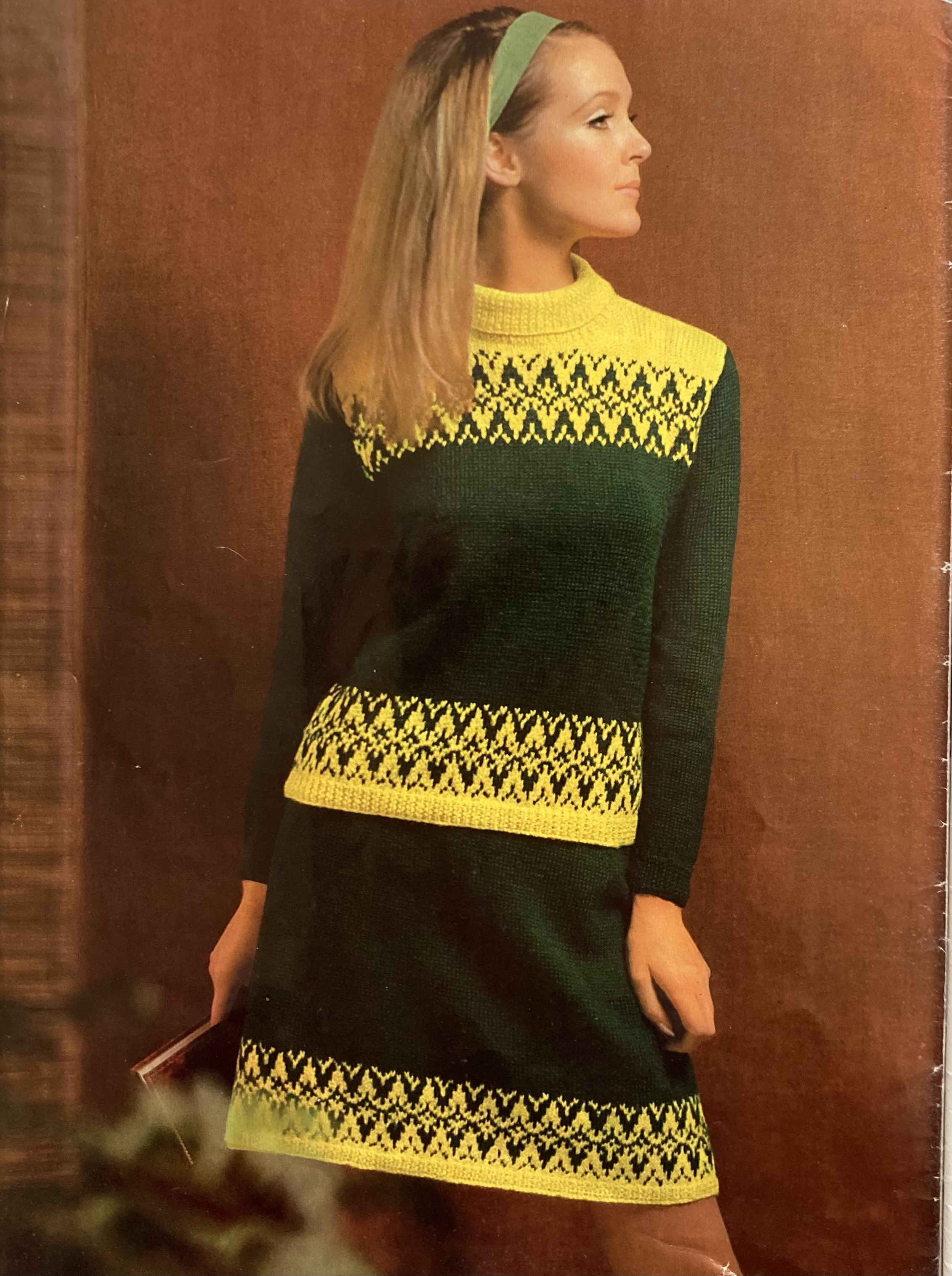
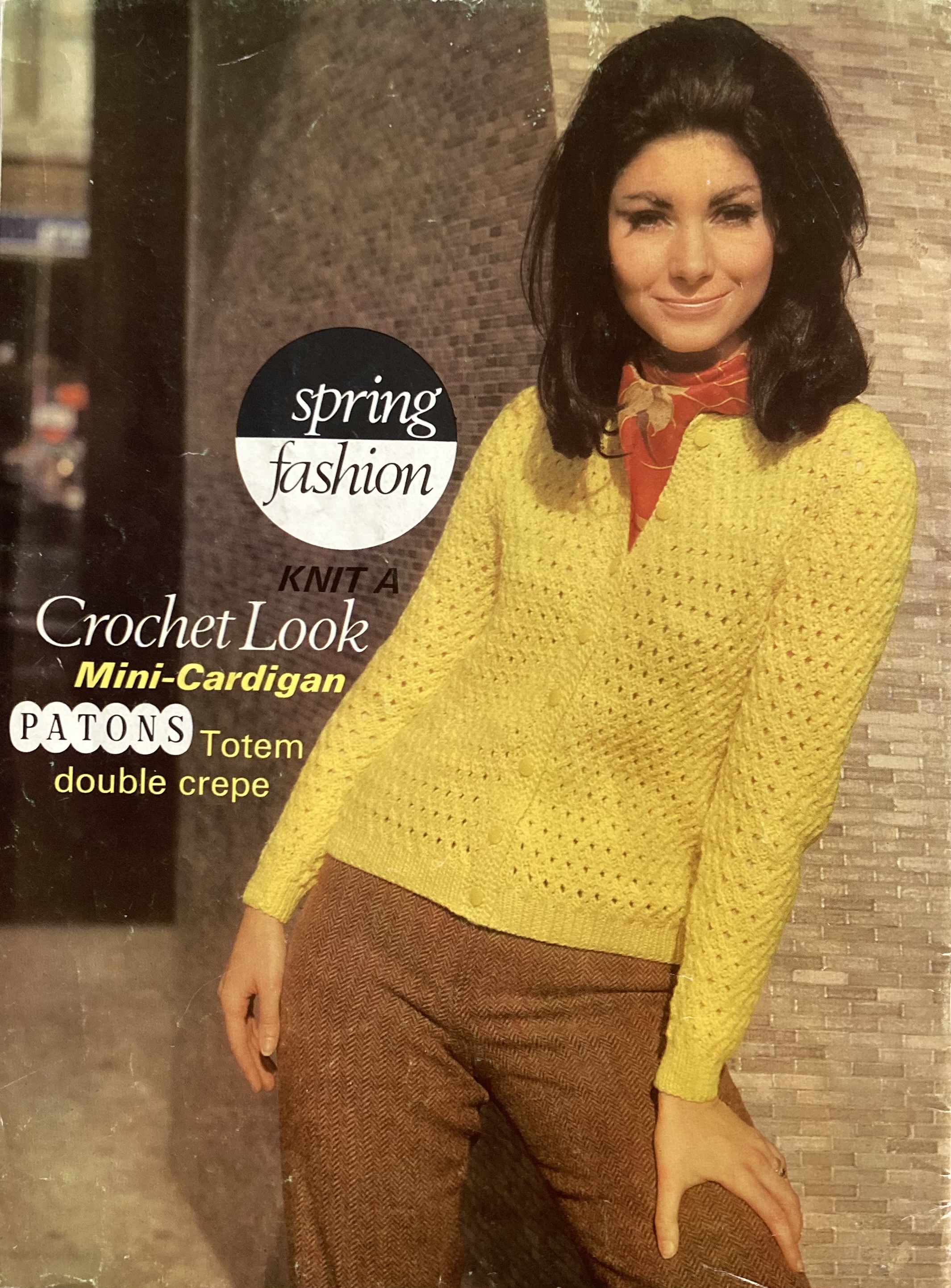
Fair Isle knitting (I know the Fair isle purists will remind us that not all stranded knitting uses traditional Shetland/Fair Isle designs or techniques, but Stitchcraft is not that picky, so I won’t be either…) features in the inside-cover sweater-suit design as well, with patterned borders on both skirt and sweater. Whereas the cover suit falls to just barely above the knee, this outfit is not afraid to go mini. More variations on colour and pattern can be seen in the striped and ribbed “country sweater” or the knitted mini-cardigan in “crochet look” — a nubbly twisted-stitch pattern. Larger ladies can make a very pretty blouse in a delicate feather-check pattern. The checked part is simple block ribbing with rows of garter stitch and the feather stitches are made by dropping a stitch down 5 rows and then working it together with the 5 stitches above it. Bright colours are trending (the blouse is turquoise) with yellow and green at the top of the list.

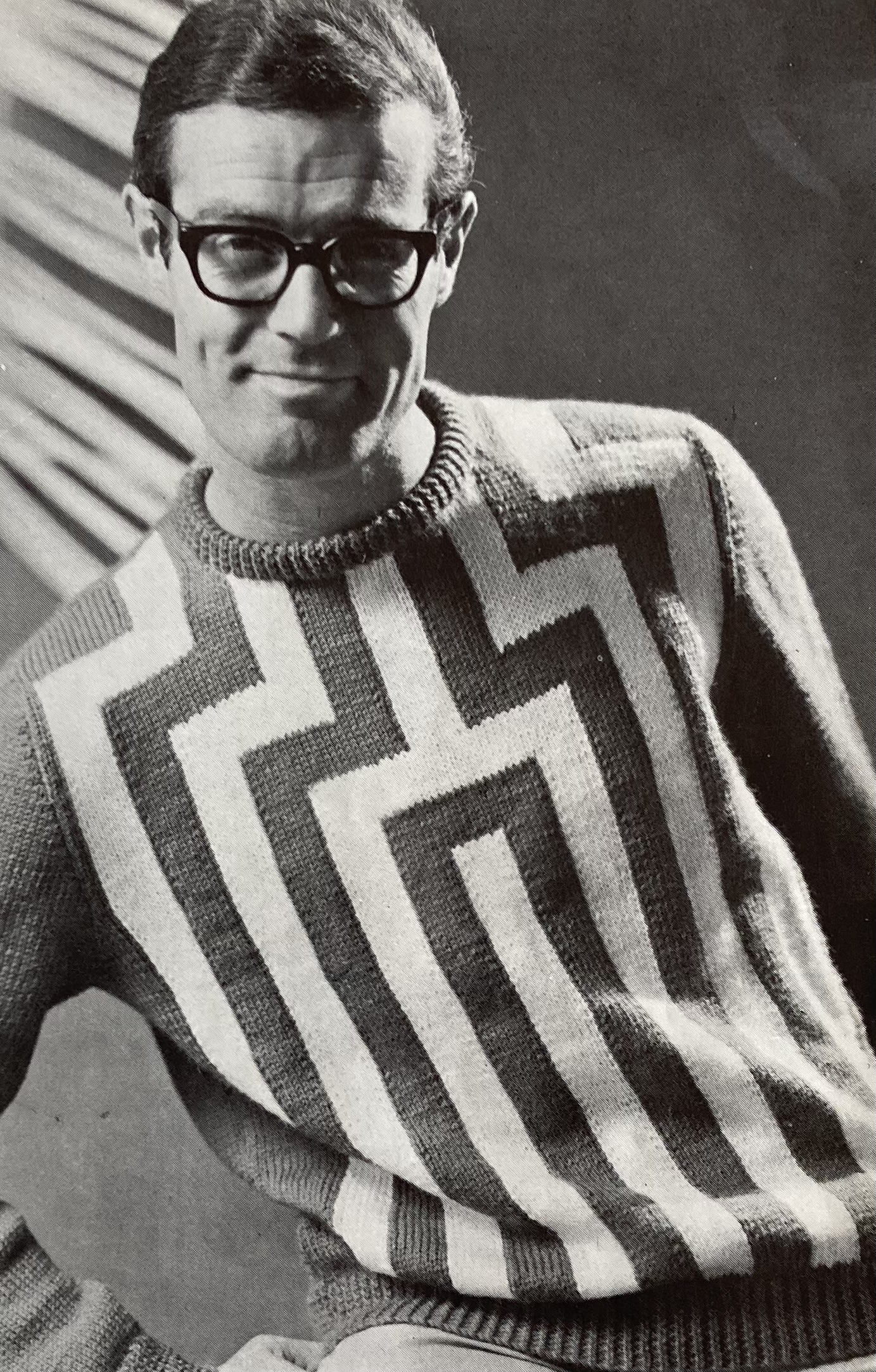
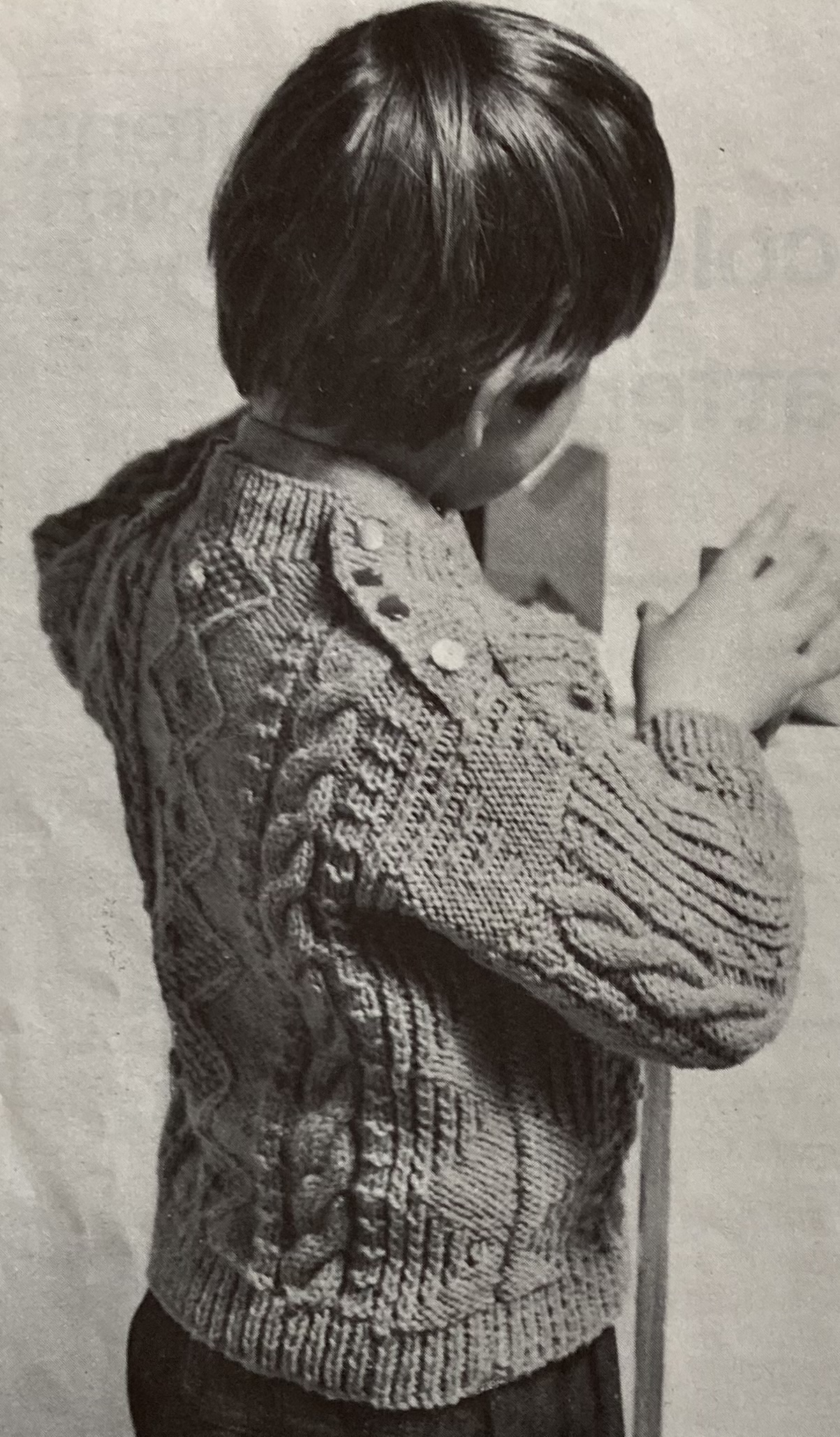
There are great patterns for the rest of the family, too: the man’s “Italian design” sweater is quintessentially 60s, and it’s not Stitchcraft‘s fault that the pattern looks like the glyph from the “White Bear” episode of Black Mirror. Little boys get a fun Aran-patterned sweater with practical buttons on the shoulder. Daughter “Melanie” gets a much less practical pinafore dress with polo sweater to go underneath, and the baby of the family can get dressed up for a special occasion in a shell-patterned dress and matinee coat ensemble.

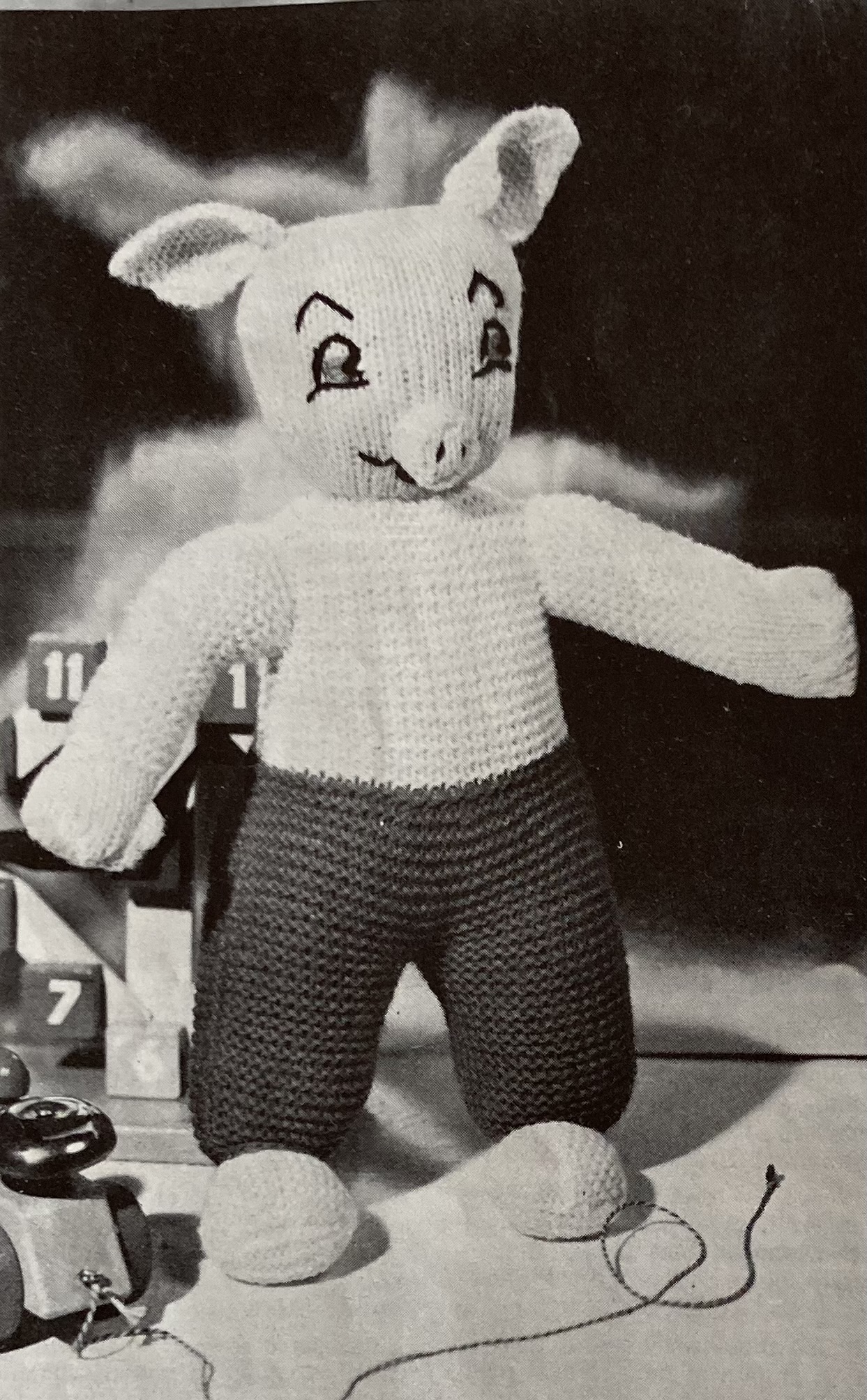
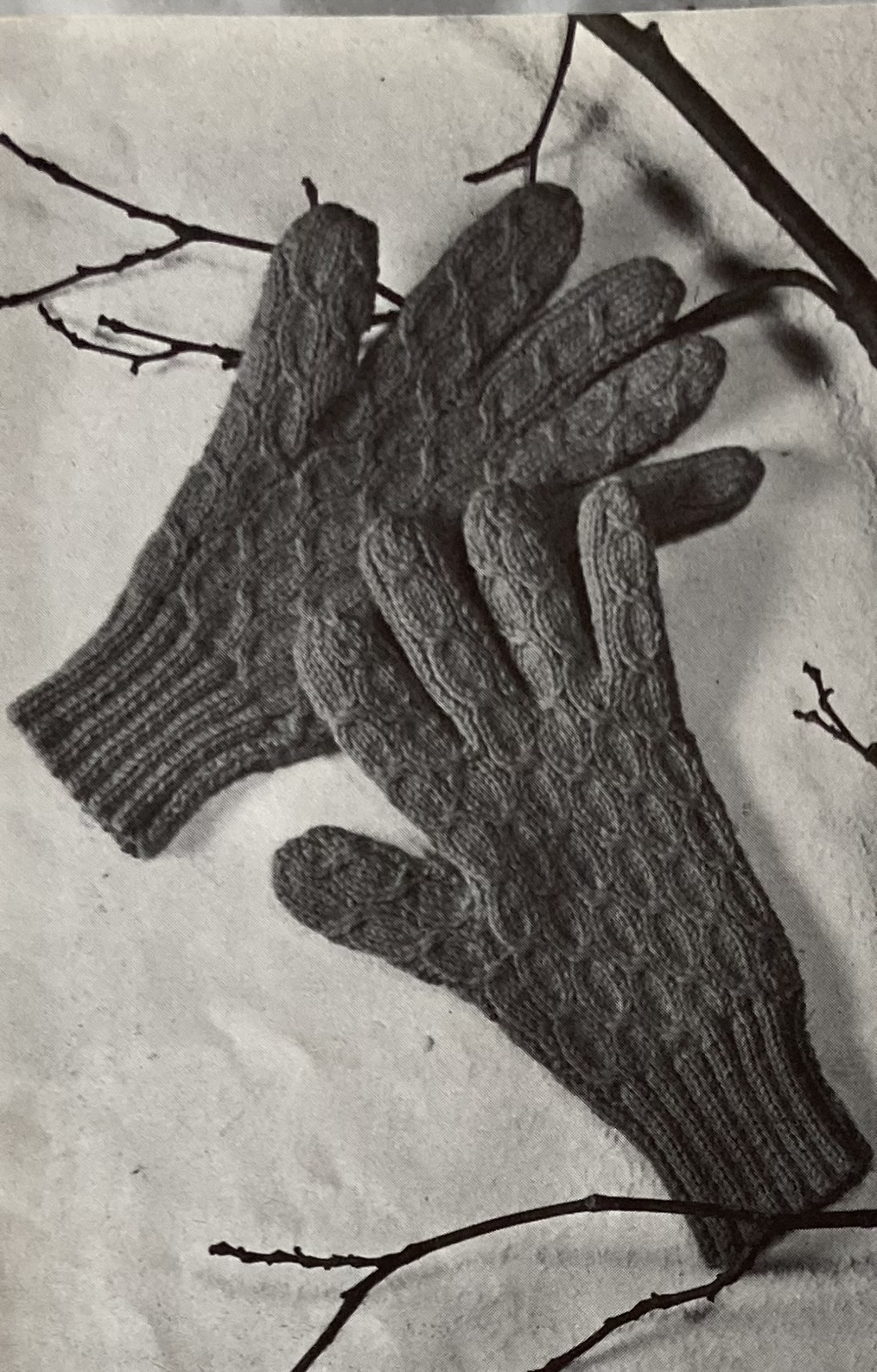
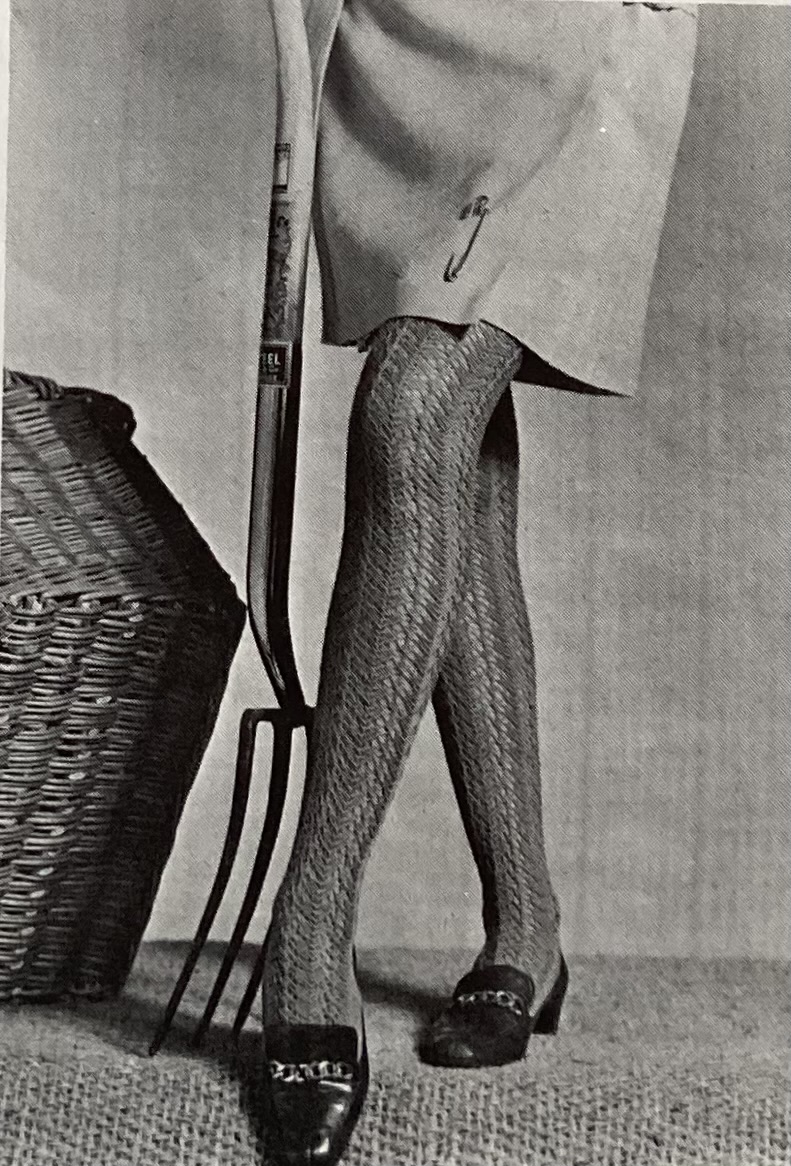
There are toys for the children as well: a knitted “Higgledy Piggledy” stuffed animal to go with the comic in the Readers Pages, and “Tracy the Knitted Doll”, interestingly not a “dress-up” doll like most of the dolls in Stitchcraft — her cap and scarf are knitted separately and removable, but shirt and leggings are integral to her body. “Country” accessories for adults round out the list of smaller items: warm cabled gloves for him and feather-pattern knee socks or stockings for her.

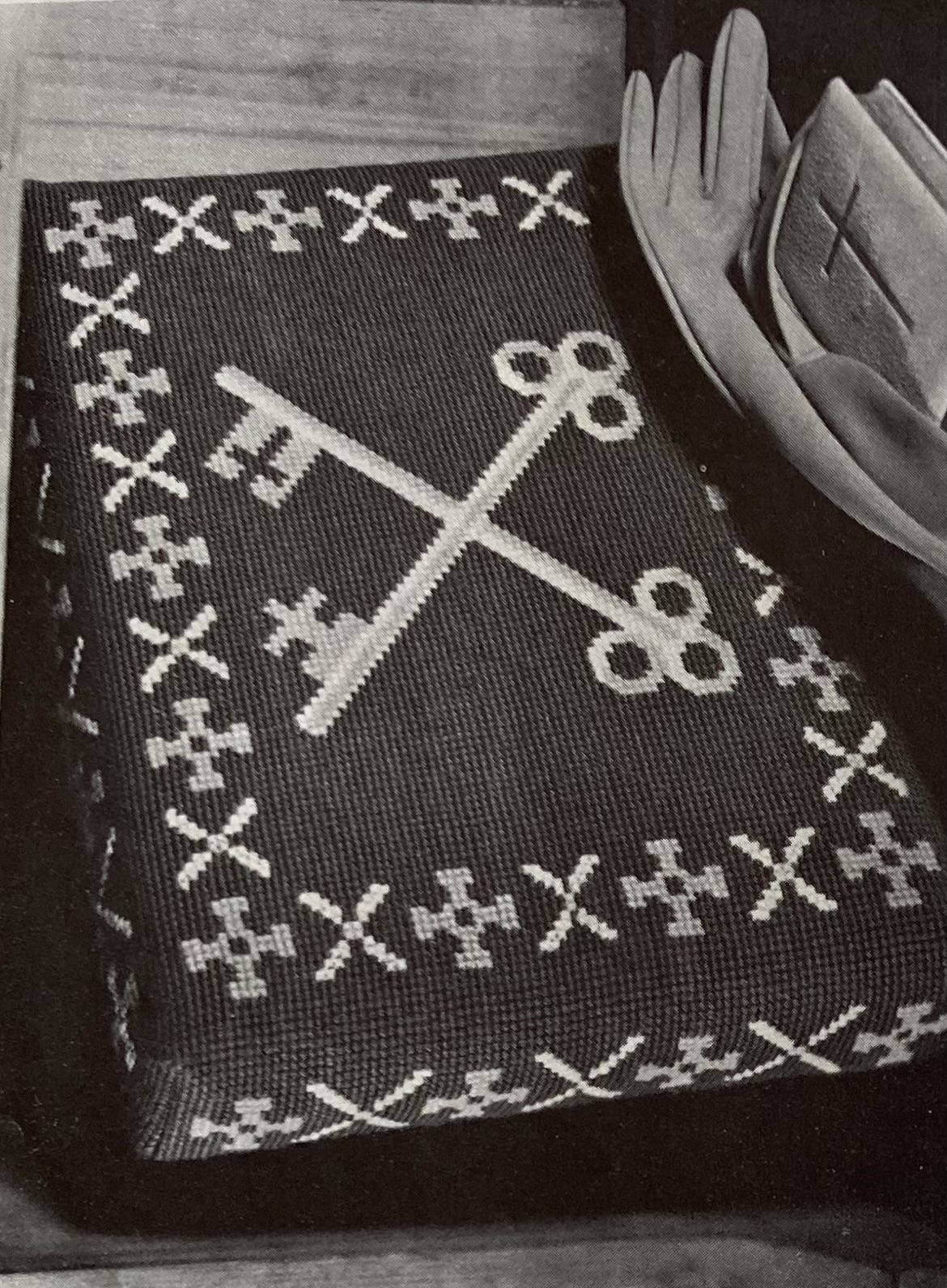
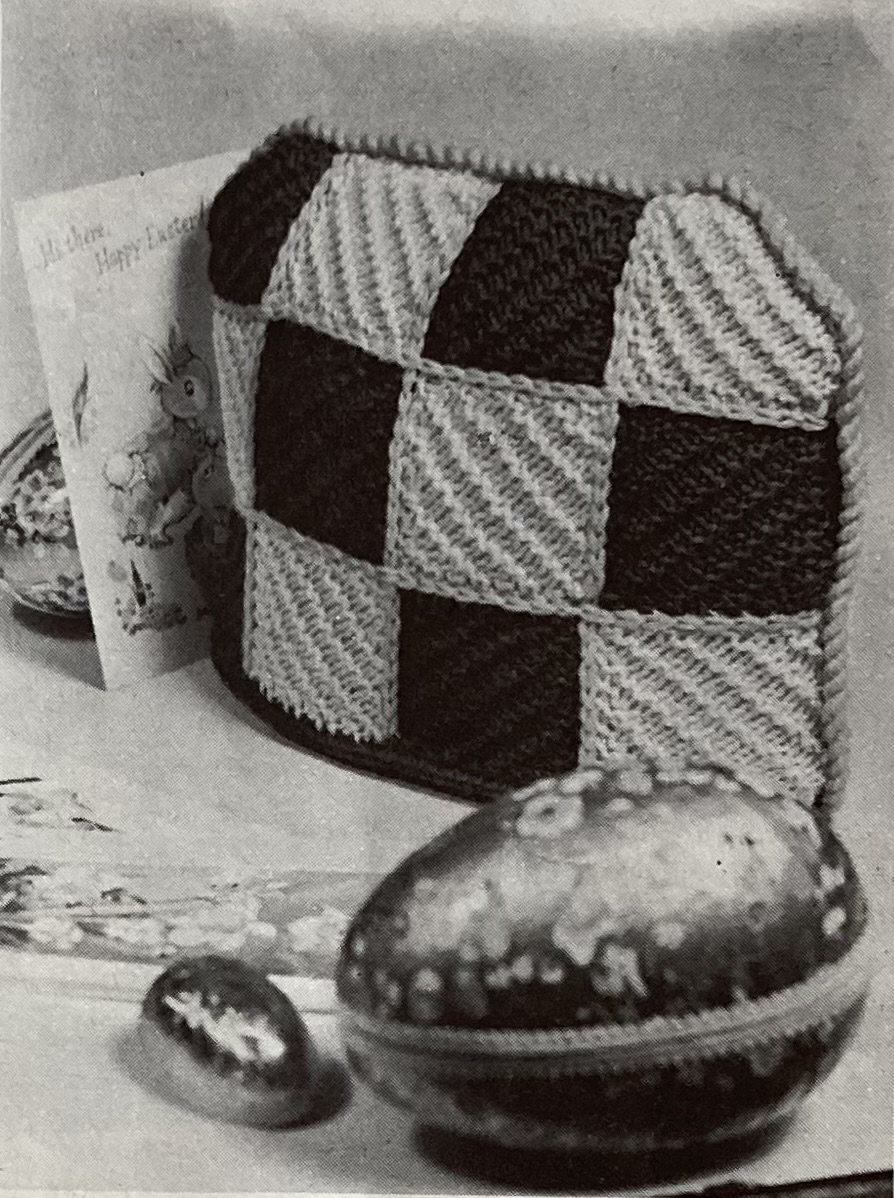
Homewares and “novelties” are themed for spring and Easter, starting with a tapestry church kneeler with church-key design. There’s a cushion and/or tea cosy in knitted patchwork, which is not particularly Easter-themed but would fit with an Easter brunch or church bazaar.

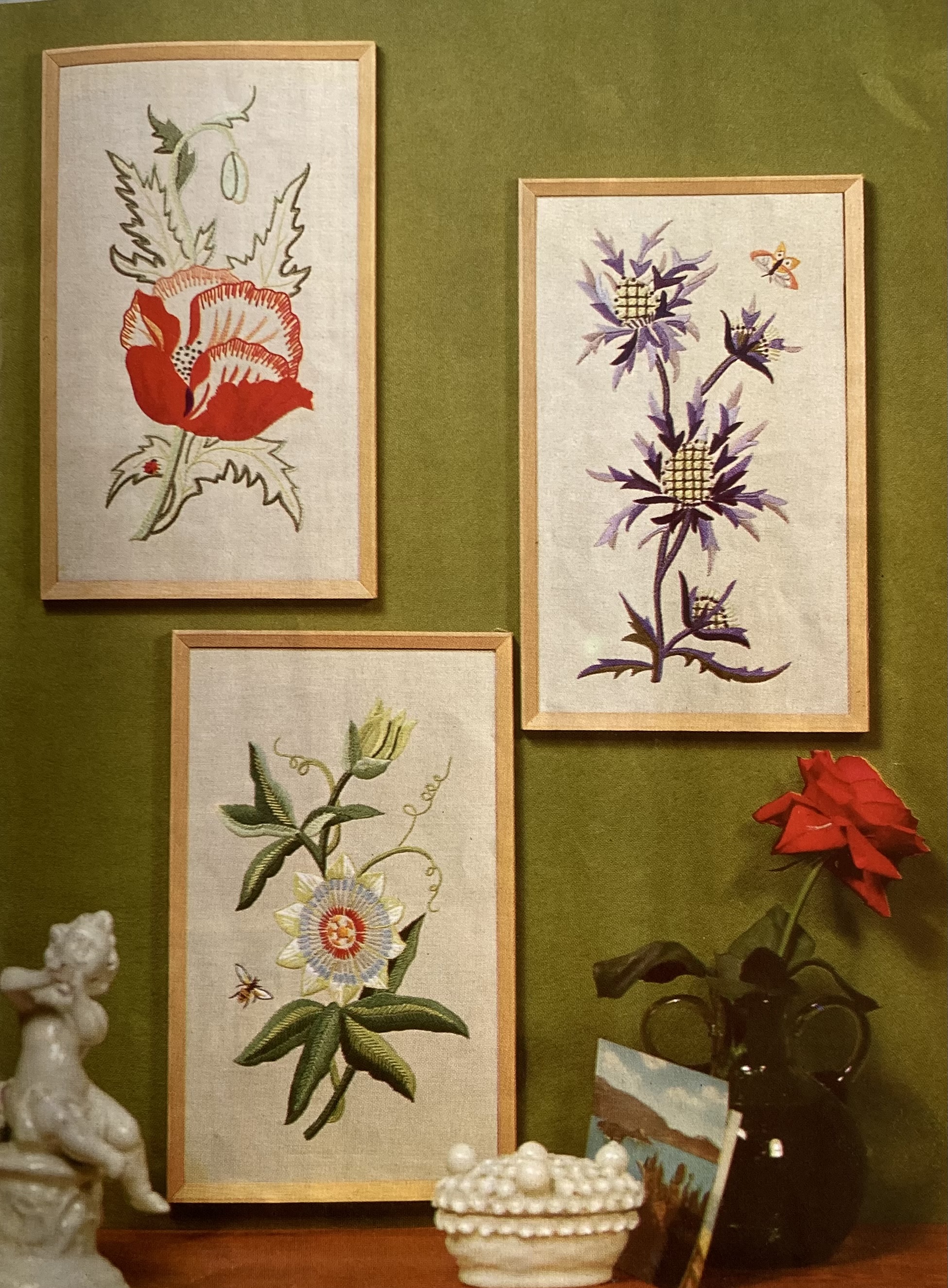
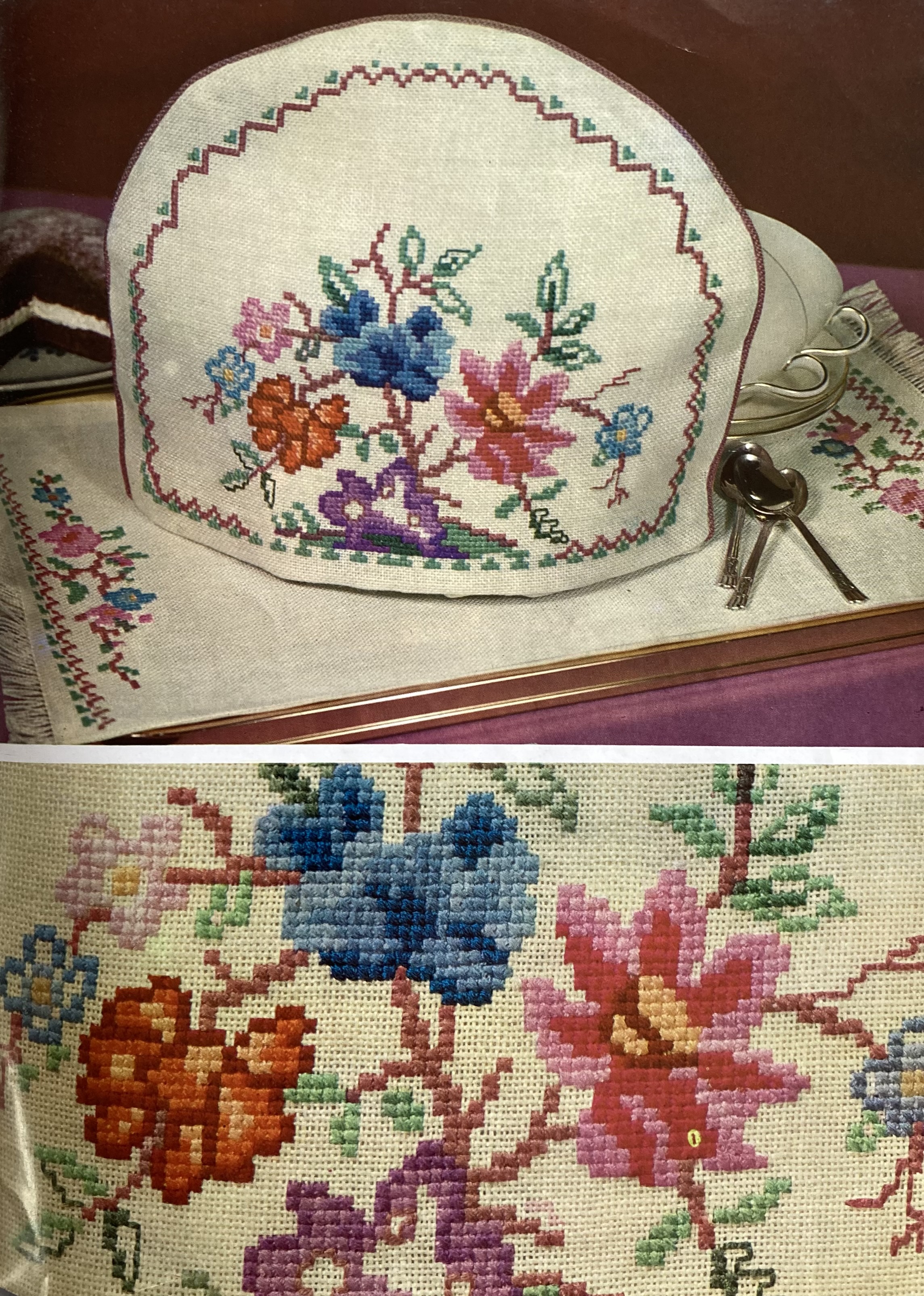
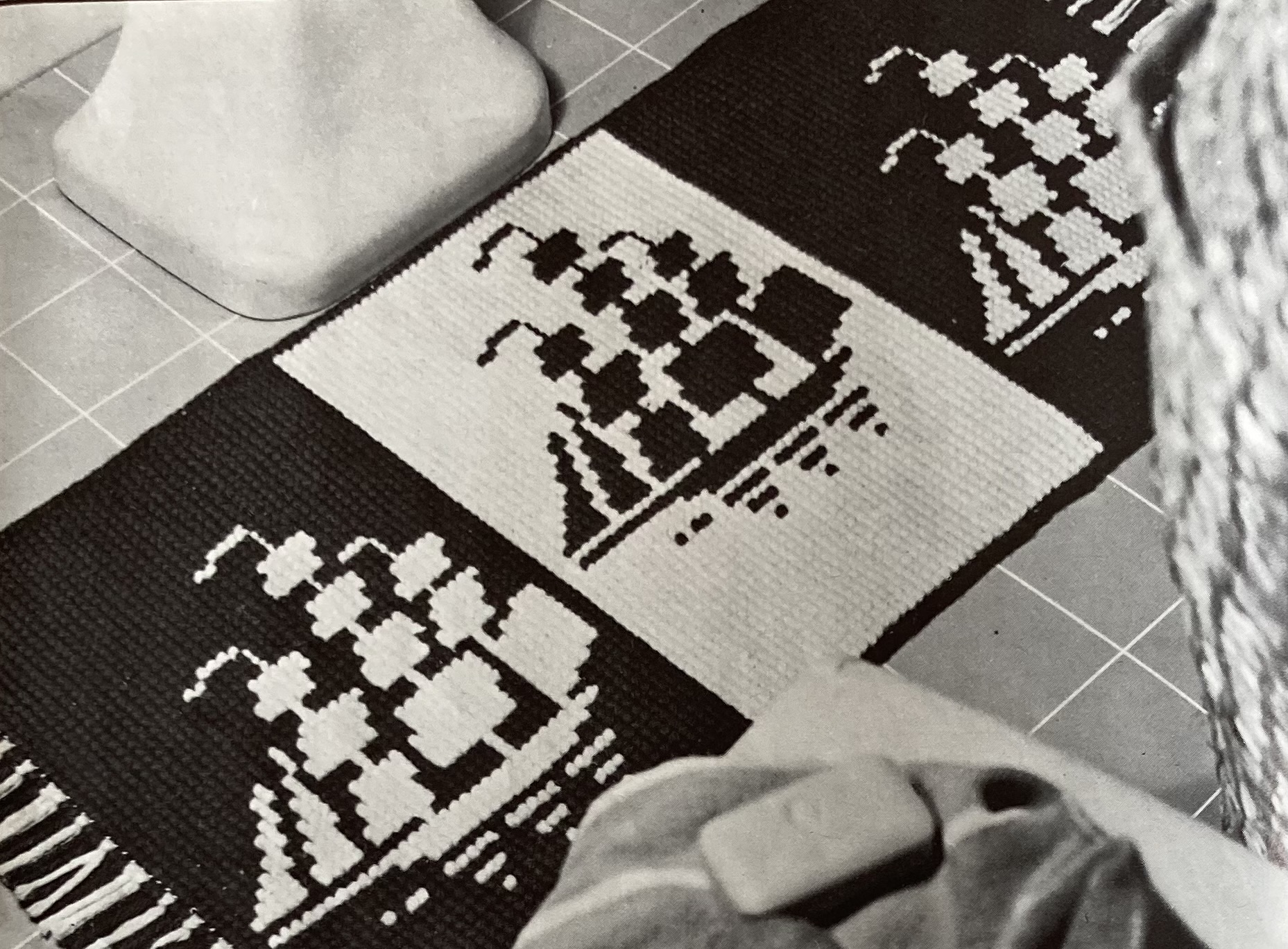
Spring flowers make an appearance in both a set of embroidered framed pictures and a cross-stitch traycloth and cosy. Finally, three cheerful sailing boats decorate a panelled rug for the bathroom.

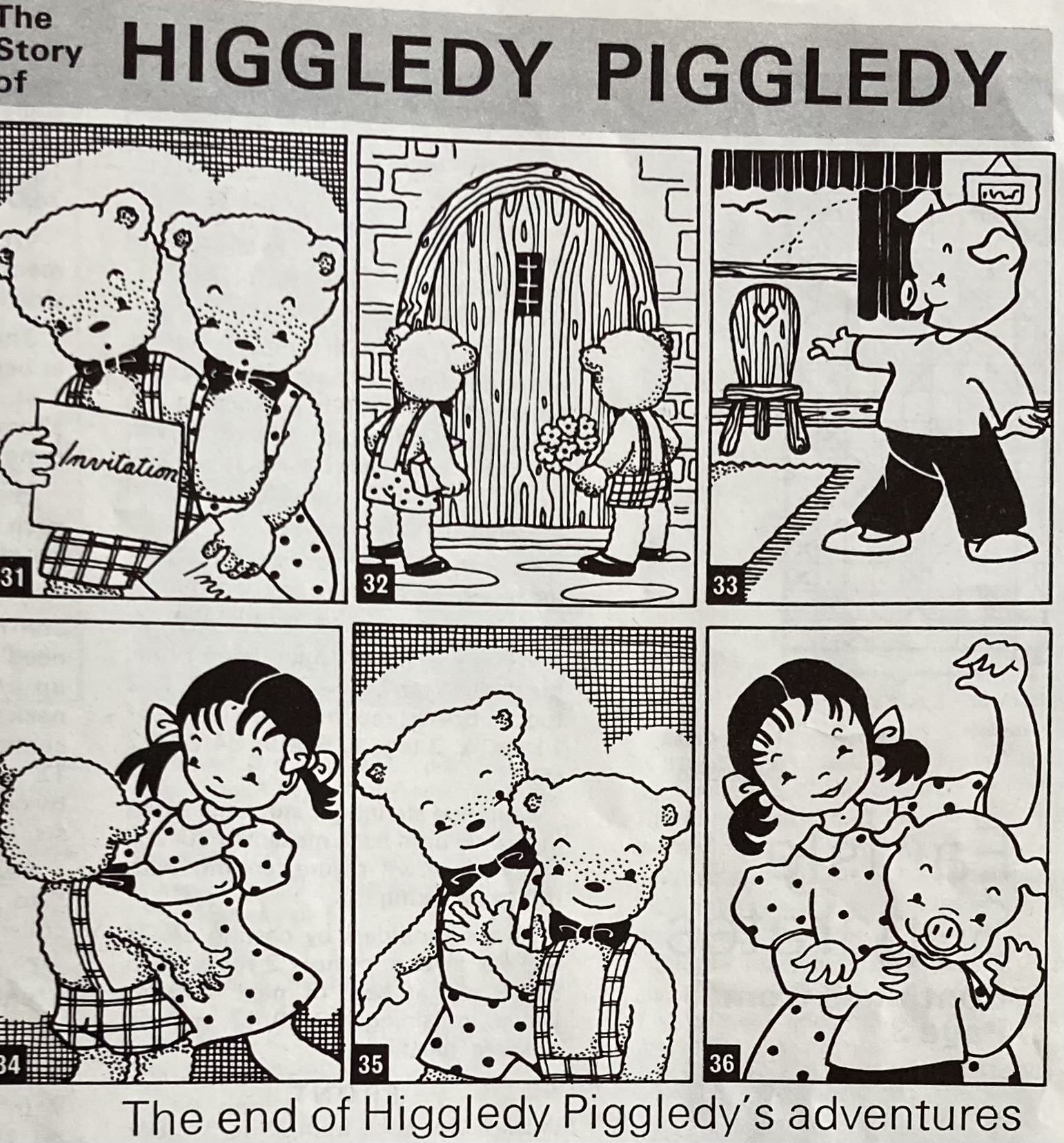
In the children’s comic, untidy piglet Higgledy Piggledy’s adventures come to an end when he moves in with Topsy Turvy, who likes to put right-side-up things upside-down and vice versa. So Higgledy Piggledy makes everything untidy and she tidies it up. Isn’t that grand? Doesn’t she just love constantly picking up after a messy male? Of course she does, it’s 1967. The End! Any girls who are too busy having fun on their own to be picking up after a husband (yet) can treat themselves to sexy underwear, courtesy of the Scotch Wool Shop. I love everything about this ad — the underwear, the art design and the copywriting.

My project for this month will be the mini-cardigan in “crochet look” and possibly at a future point, the knitted socks/stockings (over-knee socks in my version.) Plus the cardigan I was going to make from the January 1967 issue… plus another non-Stitchcraft cardigan that’s been a WIP for a while… all in the shortest month of the year, so we’ll see what actually gets finished. In any case, it’s going to be a well-knitted Spring.
July 1966: Overview

It’s all about teamwork in Stitchcraft’s July 1966 issue: two-piece sets for casual, sport or city wear as well as matching designs for all members of the family. Appropriately for the theme and the season, the emphasis is on sports and leisure, with casual, loose-fitting designs.

Our cover ensemble pairs a checked, sleeveless top with a skirt whose pleated insets match the check pattern. The check pattern is stranded, and I hope the navy blue didn’t bleed into or show through the white at the first washing. It’s the dressiest of the designs in this issue, but still keeps a casual air with its loose, unshaped top and shorter skirt (hemlines are finally rising at Stitchcraft, long after the miniskirt became popular everywhere else) and the check pattern, which is reminiscent of a race-car flag. The “favourite continental look for casual wear” is a team of “overpull” (oversized pullover) and short-sleeved blouse with a polo (turtle) neck in matching colour.

For warmer days, there’s a trio of lightweight and/or sleeveless blouses: in a lacy striped pattern or textured rib in 4-ply, or a mini-top in eyelet rib. Pink, white and turquoise are fun ice-cream colours for summer and harmonise well with the maritime blue of the checked suit.

A high-buttoning cardigan in heavier DK is good for cooler weather. Twisted stitches are the summer knitting trend, seen in the cardigan as well as in the eyelet rib and the striped lace tops. Our male model teams up with a horse to show off his cleverly designed “Viennese sports pullover” in tan DK wool with white cable stripes going up and down the front and back as well as down the sleeves.

The ultimate 1960s team is, of course, the nuclear family, and this issue offers a design for (almost) everyone: a simple, casual pullover with a trellis pattern in three sizes. The trellis is formed by making a k2tog or sl-k-psso at the right point in the pattern with a yo right before it to keep the stitch count even. The purl stitches on the wrong side are worked into the back of the “made” stitches to close the yo holes even more and make the trellis stitches stand out. Here too, summery ice-cream pastels and neutrals are in: “Banana Cream” for him and light green “Linden” for her and the daughter.

I did say “almost” the whole family, right? The youngest members have their own designs. Junior’s play jersey in blue and white echoes the women’s check suit, but here the check pattern is made by slipping stitches and/or letting them drop and picking them up a few rows later. The baby gets its own “teamwork” set of matinee coat and bootees in pretty lace and moss stitch.

The homeware designs are pretty standard, but numerous and cover all the home bases. There are some easy floral cross-stitch and pulled-thread mats, a cushion and/or stool top in tapestry (a check design, once again) or a stitched rug in Florentine design. More ambitious tapestry fans can make a wall panel of boats at Norfolk Broads.

And for once, the “Summer Bazaar” designs are not weird! There’s a simple crochet tea cosy, crocheted lace coaster mats, or an apron and/or potholder set appliquéd and embroidered with cute images of vegetables. In the “Readers Pages”, there’s a reprint of a 1961 pattern for a knitted pram blanket, and Eustace the elephant gets very startled when he tries on a pair of spectacles and suddenly sees Mark the mouse in larger-than-life size.

That’s all for this issue! Since I didn’t get around to making the sun cushion last month, I’ll make it this month. (Technically, it’s sort of part of this issue as well, since it photo-bombed the picture of the ribbed polo blouse.) And nothing else from this issue really called to me. Sunny days ahead, and may your team always win.

April 1966: Knitted Lamb

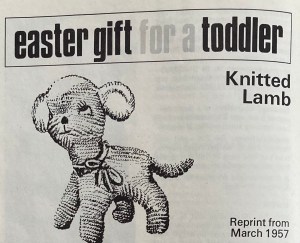
My Stitchcraft project from the April 1966 issue was actually a reprint from the March 1957 issue: a knitted lamb as an “Easter gift for a toddler.” Knit a little lamb for your knitting friend who is about to have a baby, they said. It will be fun and cute and use up leftover bits of wool, they said…
My first clue should have been the fact that there is no accompanying photo of the finished lamb in the 1966 issue. Either the original issue didn’t have a photograph (I don’t have the 1957 issue in my collection) or they just didn’t reprint it along with the pattern, since the latter version only has a drawn illustration. Why would the editors not want to show a lovely photograph of the lovely finished knitted lamb? Why indeed?

I admit the next step was “my fault”. Since the pattern called for 4-ply yarn held single, and I mostly had fluffy DK-or-thicker alpaca left over from the tot’s coat in February, I chose to adjust the stitch counts for a stitch-per-inch gauge and try to make the lamb turn out the same size as in the pattern. I did the math correctly, but I suspect something may have been off in the row gauge . The pattern starts with the legs and the main body (top part) in multiple pieces (1/2 each of back and front leg) and involves a complicated series of increases and decreases for the shaping. The “corner” on the back legs seemed odd to me, but I know I followed the pattern. Surely it will all come out right when sewn together, I told myself. After all, I successfully grafted the top back “spine” instead of sewing it! Obviously I was good at this! And it did pretty much look like a sheep’s pelt when laid out flat.

The next piece in sequence is the under-body, which is almost the same as the top, just shorter/narrower. I sewed it to the main body as instructed and stuffed it well, as instructed. The back legs were longer than the front ones, and what was with those weird “hocks” now? Shouldn’t they be sort of… attached to the rear end of the animal instead of just hanging off into space?

No matter, I made hooves. I guess the hooves were fine. Then the head, which was made in three parts: two sides and the “head gusset” for the “chin” and neck. I sewed them together as instructed, and it looked like Frankenstein’s lamb. The head was … not as round as in the illustration, and the neck strangely proportioned. Had I done the math wrong? Was it supposed to fit onto the opening of main and under-body? It didn’t really, but I persevered.
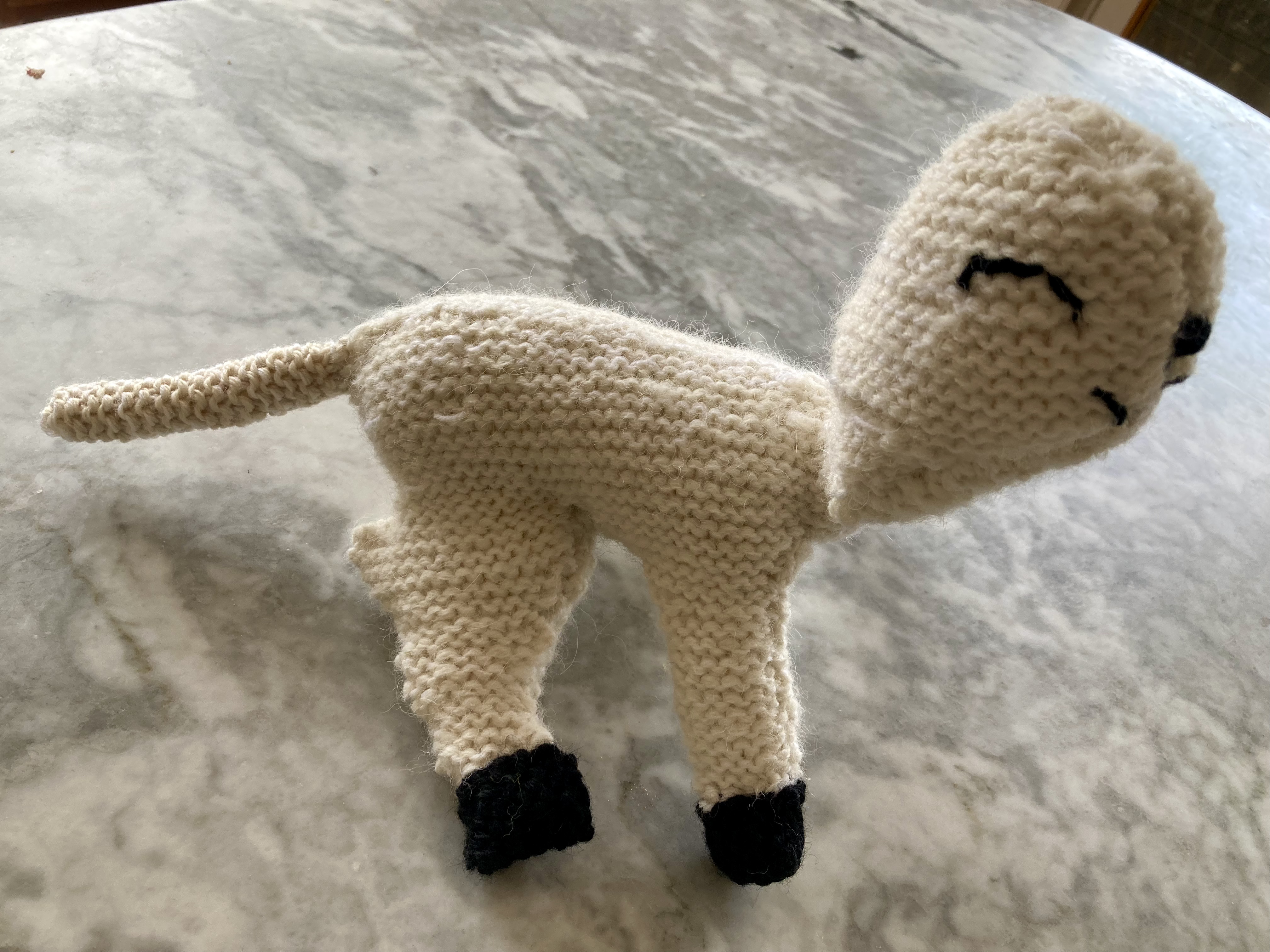
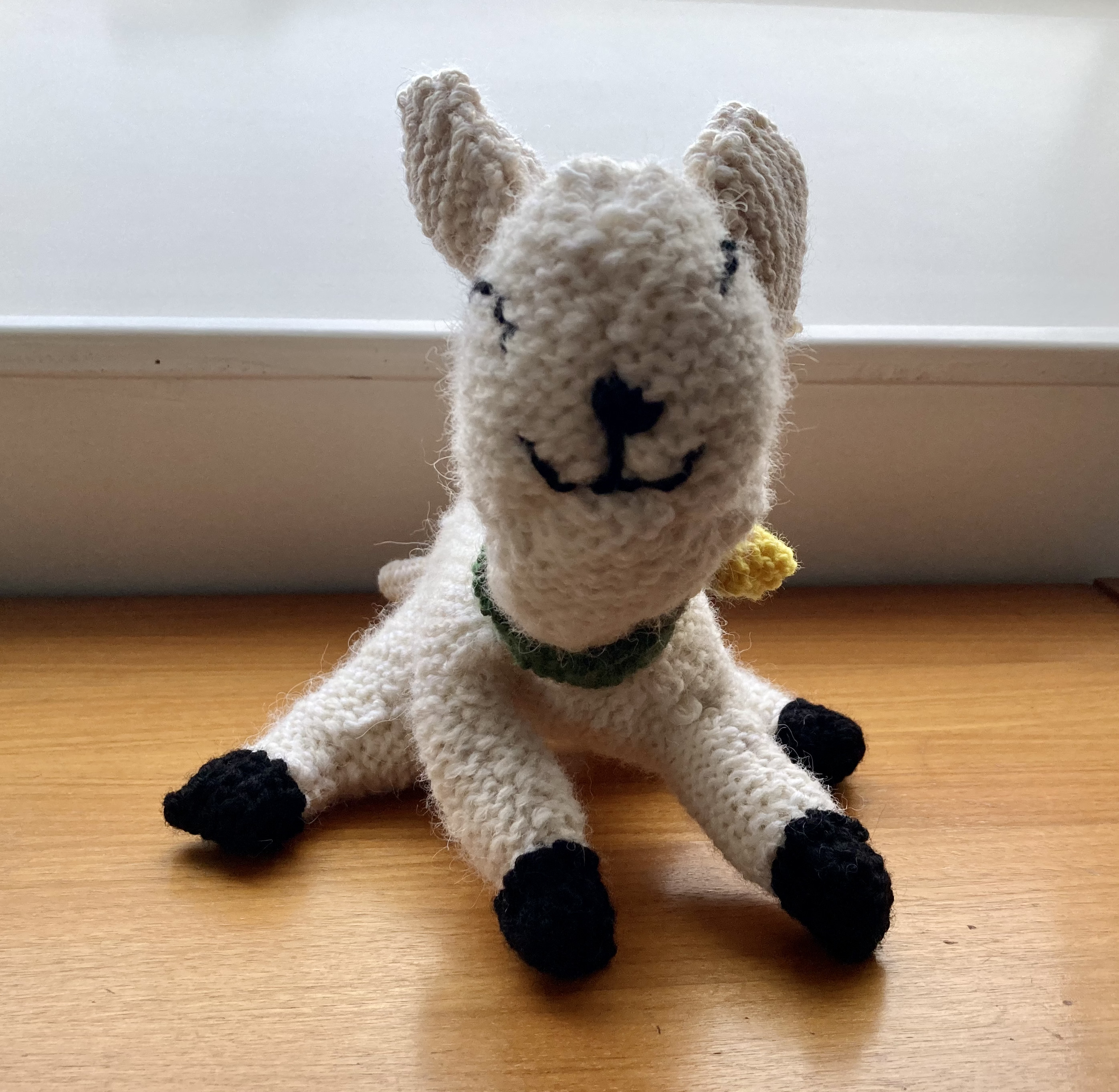
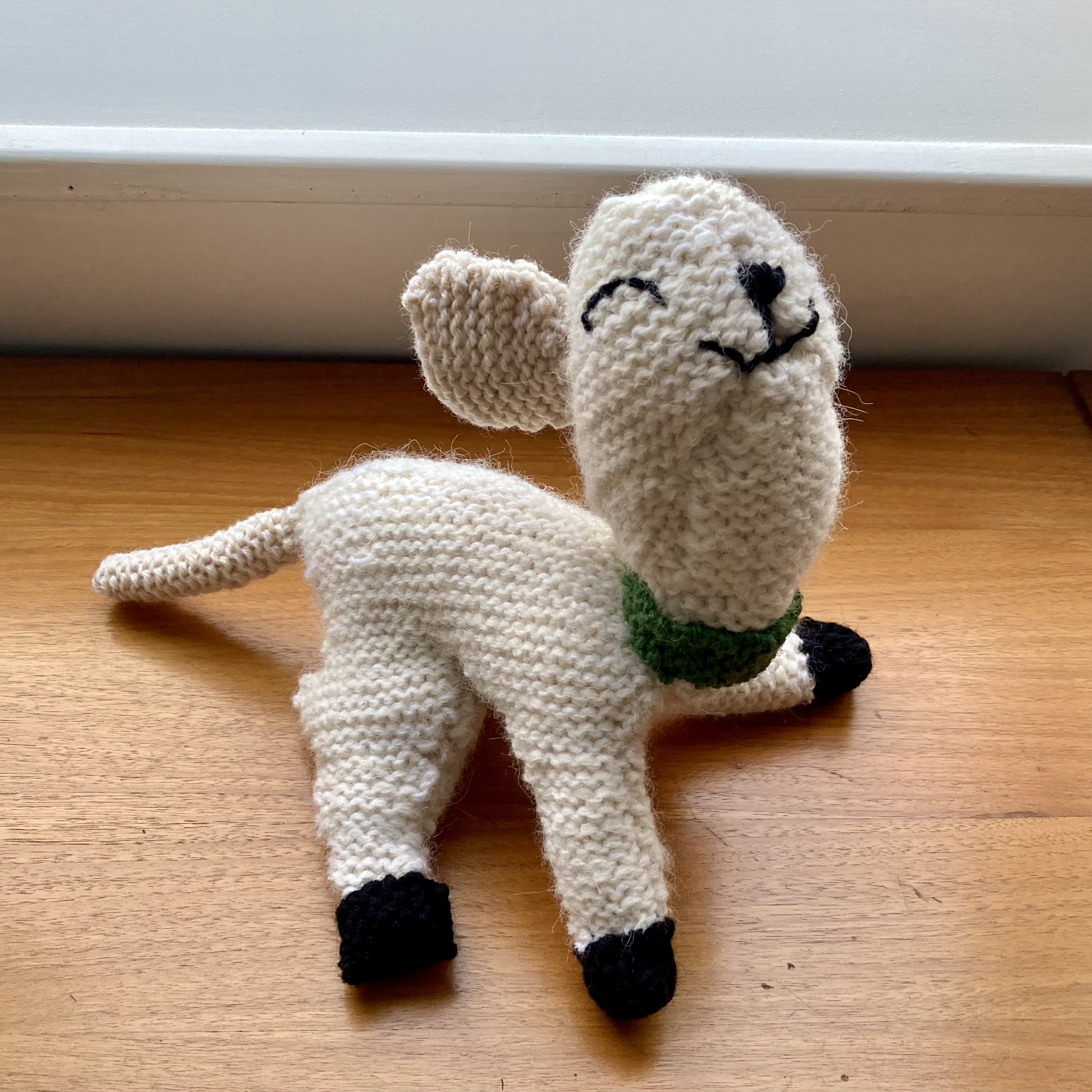
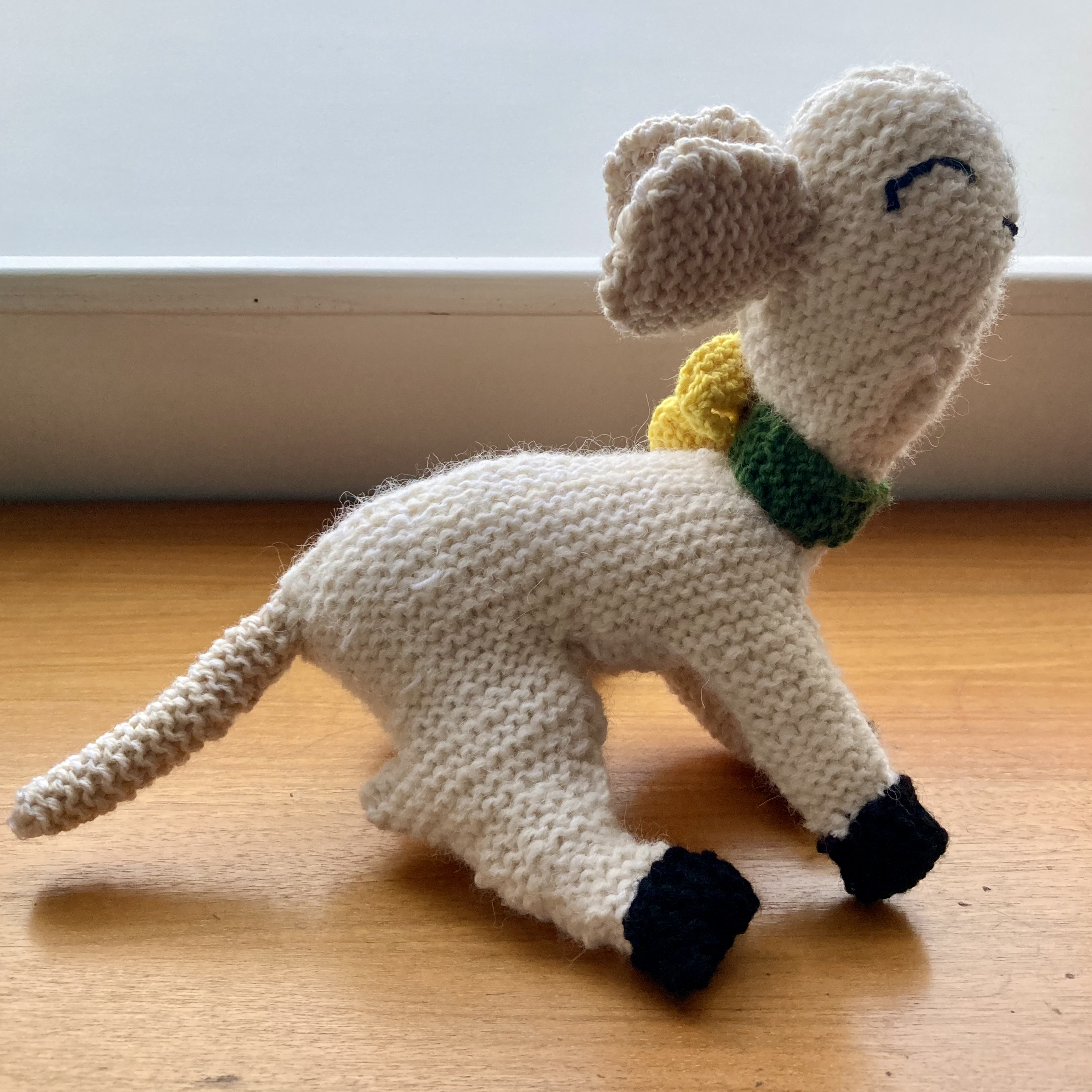
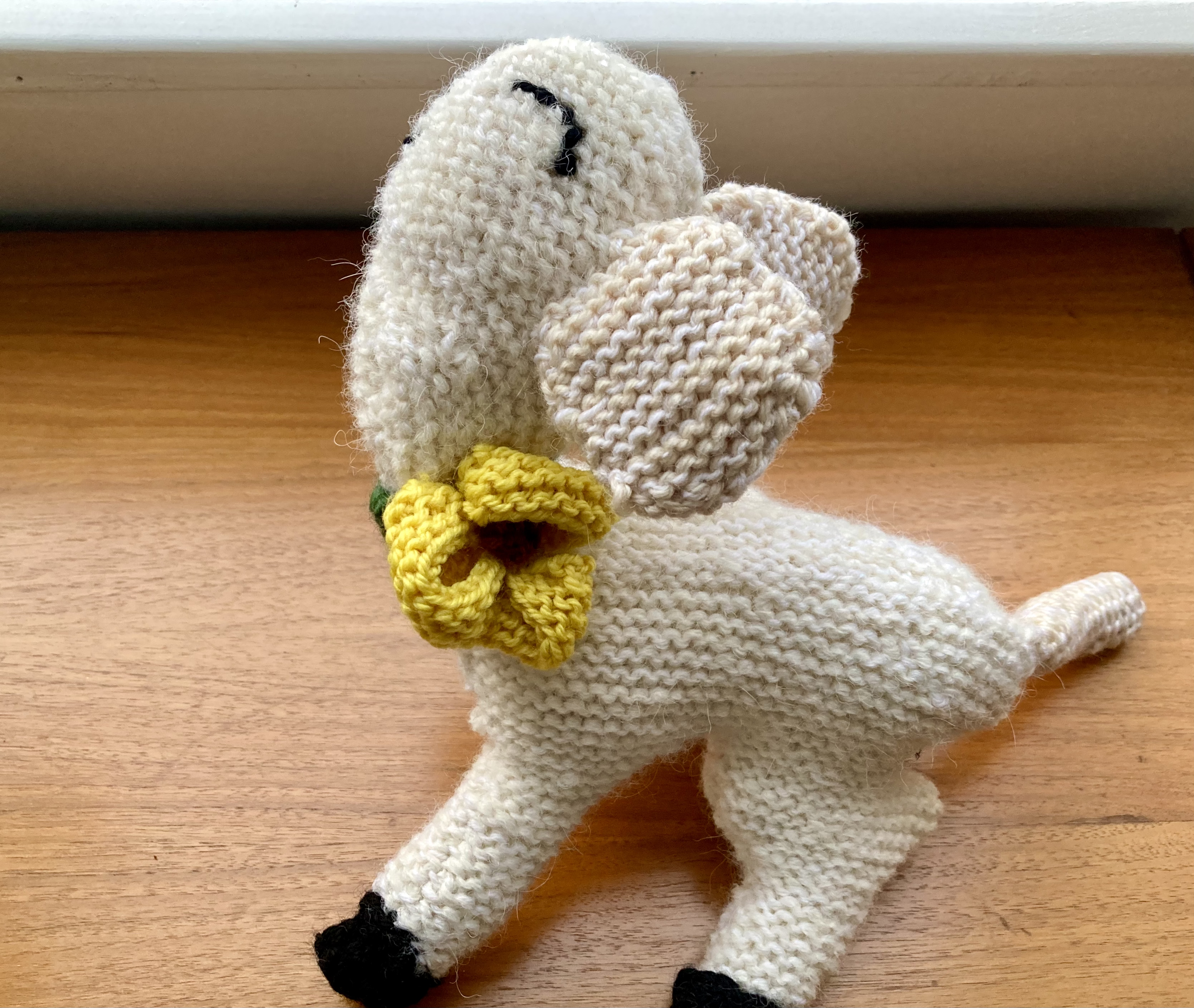
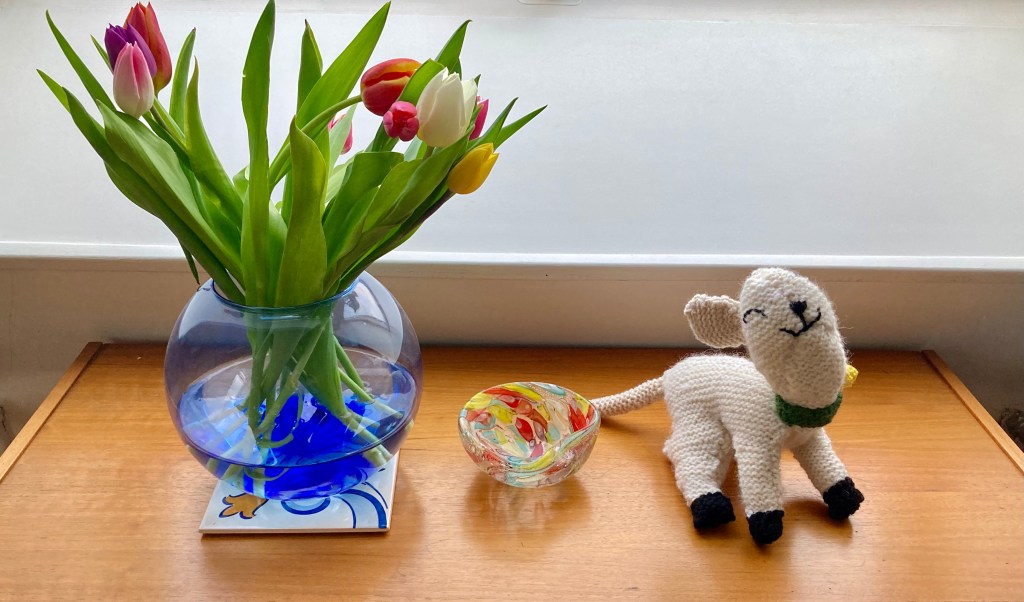
Eyes. The lamb needed to have eyes, as well as a symbolic nose and mouth. This was the part I had been dreading. Ever since I tried to knit some decorative stuffed birds that ended up looking sad, psychotic and/or dead (see photo), I have been afraid to embroider eyes on a toy. The eyes in the illustration look like the lamb is rolling its eyes in high annoyance (at all the knitters who fail at embroidering faces, no doubt.) Not wanting to even attempt that, I had the brilliant idea to make “closed” eyes. Just a little upside-down “u” and a smiling mouth! Hurrah, it worked! Little Lamb is so happy not to have been eaten for Easter supper!

Side note, marijuana was legalised in Germany on Easter Monday, one day after I finished this lamb. Perhaps the lamb was celebrating early. In any case, it’s really, really happy.

At this point I was torn between giving up entirely or just seeing it through. Oh, and I had also run out of the alpaca yarn, so when I decided to just roll with it and finish the project, I switched to some mystery something that was also sort of off-white for the ears and tail. The ears looked nothing like the ears in the illustration, but I was getting used to that by now.

I sewed all the bits together and strangely, the head stayed up by itself. And the lamb could almost stand on its own, depending on what position you bent it into and how widely the legs were splayed out. (I do feel like that’s kind of accurate as to how real lambs look when they learn to walk, says the person who has never lived anywhere near the countryside or raised sheep.) The lamb’s “necklace” as given in the pattern was a complicated bit of braiding, knotting and embroidery, to which I said “nope” and made a little green collar with an easy yellow flower instead. (Thank you, Frankie Brown, for writing and publishing a great pattern for the flower. I donated to the Children’s Liver Disease Foundation and can promise you that I am not going to try to sell this lamb!) Luckily, the collar conveniently hid the awkward seams at the neck. Otherwise I would have had to go full Frankenstein and put in some screw-bolts.
And there it was! Behold the finished lamb, in all his / her / its glory. It is so wonky. The more you look at it, the more weirdness you see. But also, the more you look at it, the happier you feel. I love this lamb so much and challenge all of you to look at it and not feel happy with me. I almost want to keep it for myself instead of giving it to the baby… Maybe it can stay with me just a little while longer?

May all your imperfect projects bring you such joy.

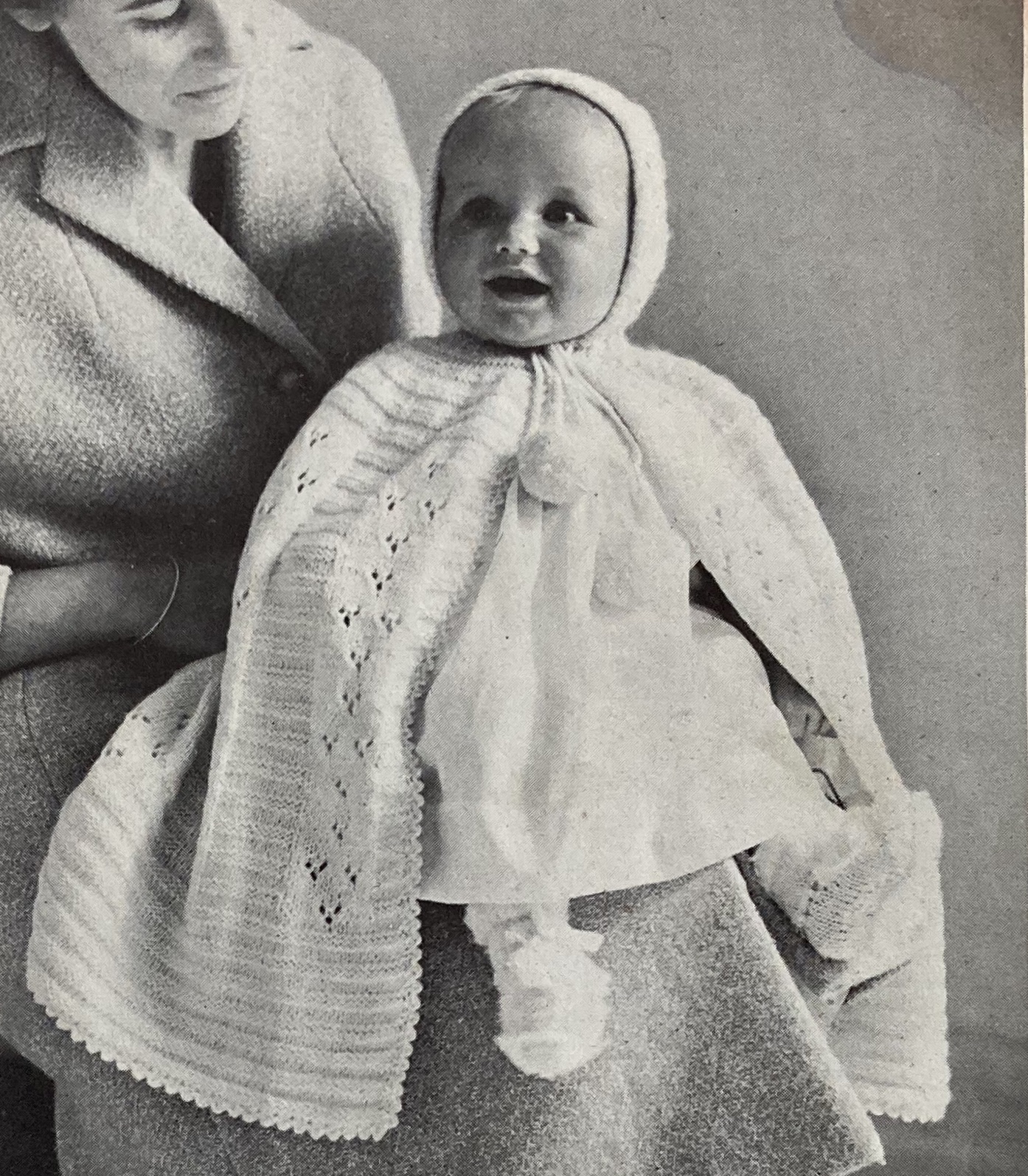
Blast from the Past: Hooded Pram-Coat

Photo of baby in knitted jacket, Stitchcraft, October 1965.

EDIT December 19th, 2023: Finished!

It’s been another month of much knitting and comparatively little to show for it. There was a wonderful bed-jacket in a cute, spongy slip-stitch pattern in the November 1965 issue that I very much wanted to make. I thought I had the perfect yarn (DROPS Lima) and chose green and black for the colours — very much my taste — and started on a swatch to better understand the stitch pattern. I made it correctly, but it didn’t look good. I tried with different wool and different colours. Still didn’t like it. The way the two colours played with each other didn’t harmonise and didn’t give the effect I wanted. I couldn’t make it work with the wools I had and didn’t want to make it in baby blue and white (I don’t wear white). On top of it all, I had a pile of endless WIPs at home and two pregnant colleagues, one whose baby was probably being born just in time for this blog post at the end of November, and another due in January. So I decided to put the bed jacket plans on ice and make some baby things instead.

For the November colleague, I made a simple baby blanket in thick cotton yarn of the “dishcloth” variety. The pattern wasn’t vintage — just the traditional crochet “American square” motif with white edge and different colour centres — but the yarn actually was! A couple of years ago, another colleague (not the pregnant one) had to clear out her mother-in-law’s flat after the elderly lady moved to a nursing home, and gave me a huge bag of yarns that had been left behind. In that sense, the blanket does have a vintage connection, though this type of craft cotton honestly hasn’t changed much in fifty years. Here’s the finished product:

For the January baby, I looked through a few earlier Stitchcrafts from the 1950s, which often had the best baby patterns, and found an intriguing hooded “pram-coat” jacket from the October 1956 issue. I say “intriguing” because it had some unusual design aspects, like the front hem facings that fold under to make a hidden button band, the wide-edge hood and the turned-back-and-crocheted-on sleeve cuffs. I still had some light blue and white-ish Lana Grossa Meilenweit from the March 1964 Slipover for a Smart Tot — probably not enough for the whole jacket with hood, but I thought I might make the sleeves in dark blue (left over from the same project).

The stitch pattern is a nice basket-weave over 3+3 stitches, with 2 rows of stocking-stitch interspersed to even it out a bit. There isn’t supposed to be a hem at the bottom, but it curled so badly, even in the basket-weave pattern, that I picked up stitches from the cast-on and made one with a purl row for turning. Similarly, the sleeve cuffs were supposed to be knit separately, sewn on later, turned back and then crocheted over, but why so much effort? I made a hem the same way. Continuing in the spirit of saving time and energy, I made the fronts and back in one piece up to the armholes, the sleeves flat and two at a time on one needle, and the raglan yoke in one piece back and forth. There wasn’t enough light blue to even make the whole fronts and back, so I bought more to the whole thing in light blue, as in the pattern.

Of course it occurred to me, when halfway finished, that I could have made the bed-jacket pattern after all, just adjusted the size and yarn to fit a baby... and then it would have had the same colour scheme as the original, too. Too late! What can I say. My brain had been occupied with too many “real-life” things.

Part of those real-life things included a lot of work-related travel on trains, which has the advantage of giving me lots of time to knit — and the disadvantage of not being able to take good in-progress photos. Here are some of the jacket after completing the body and knitting the front bands, with a lovely background of train floor. The front bands are picked up and knitted horizontally in the usual way and folded under, so double thickness, and the buttonholes are only on the inside part of the fold, so that they are hidden when the jacket is buttoned. There are increases at the neck edge to make a sort of top facing in the front “corners” where the hood join ends.

The hood is made in a separate piece from the brim to the neck, with short rows to round out the top part. Here again, the instructions said to make the hood in blue first and pick up for the facing later. I could have just cast on with white and made the facing first to avoid having to pick up along the cast-on edge later, but I was happy not to, since I had limited white wool — I ran out and had to switch to blue for the under-facing part (after the fold). That wasn’t a problem and the white wool remnant has now been successfully de-stashed.

I added lightweight wooden buttons. The covered-button design didn’t really convince me, in the end, since I imagine it will be unnecessarily difficult to button up if the baby is squirming around, and the doubled facings are a little bulky even in 4-ply, fingering-weight wool. That said, the facings will put up with a good amount of wear and tear. The finished jacket is really cute and should fit a larger baby in the first few months as an “outdoor” pram jacket, or maybe a six-month old as a cover-up on cooler summer days.

I hope the my colleagues will be happy with this baby jacket! The mother is herself an expert knitter and seamstress, so the bar was set high. But I’m quite satisfied and I think they (and the baby, of course) will be too.

November 1964: Overview

“Winter Fashions and Christmas Plans” is the theme of Stitchcraft‘s November 1964 issue, with practical clothing for the family as well as gift ideas and a couple of glamorous items for parties.

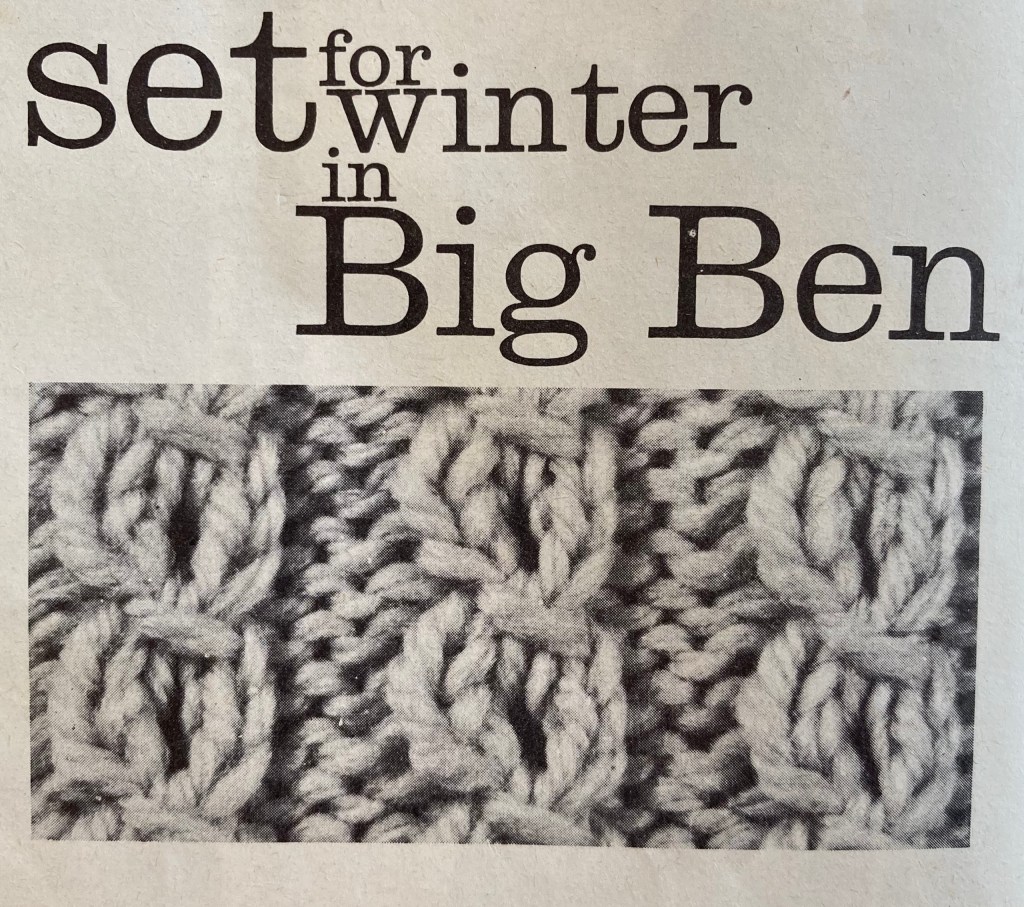
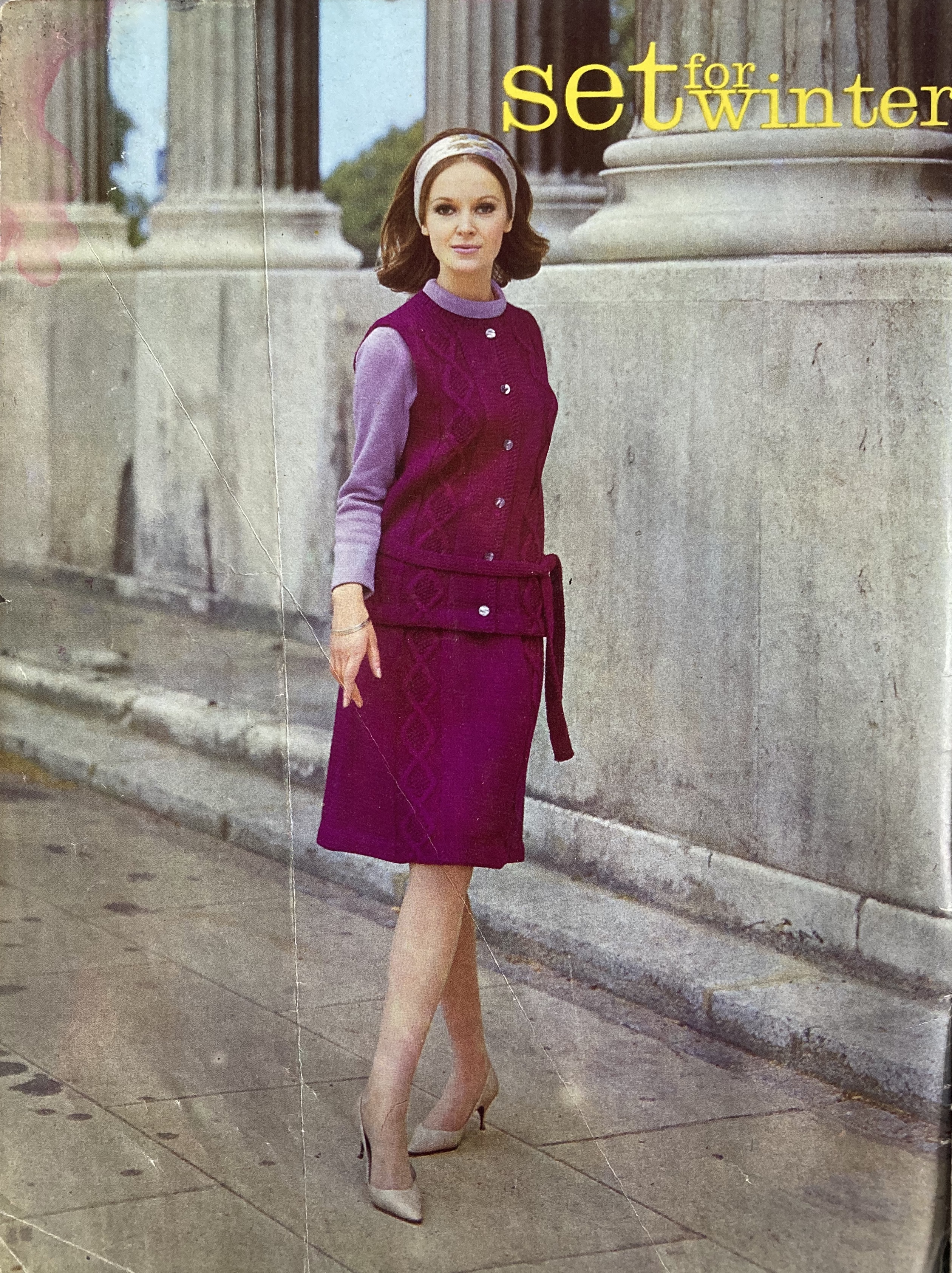
You will be “set for winter” in the cardigan on the cover, knitted in bulky “Big Ben” wool at 3 1/2 stitches to the inch, with all-over mock-cables, a warm collar and practical pockets. The mock-cable pattern involves “losing” a stitch in the 3rd row with a sl1-k2-psso, then getting it back with a yo on row 4, making a “bar” and then a little hole for the mock-cable effect. There’s a handy close-up photo of the stitch pattern, so you can make sure you did it right.

The caption continues the use of a bit of word-play on the word “set”, which we saw in the October 1964 issue. There, the theme was “set to flatter”, whereby some of the items were part of an actual set, and some weren’t. Some of the other garments in the November issue really are a set, in that sense: this waistcoat suit in glowing fuchsia, for example. Rounding out the everyday women’s garments are a plain 4-ply jumper, a bright colour-motif sweater and a comfortable tweed jacket for larger sizes. I love that brooch on the jumper — it looks like Star Trek insignia.

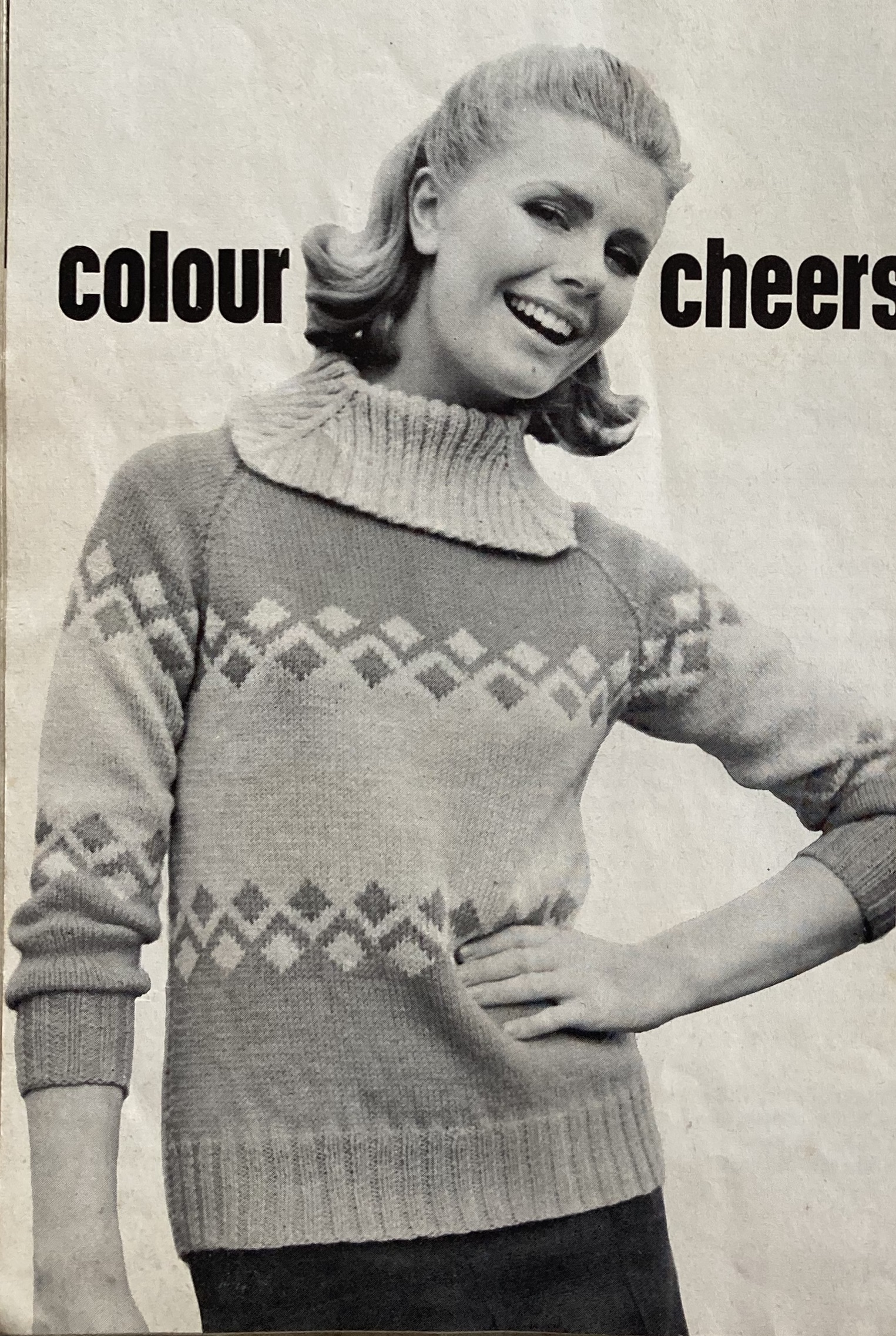
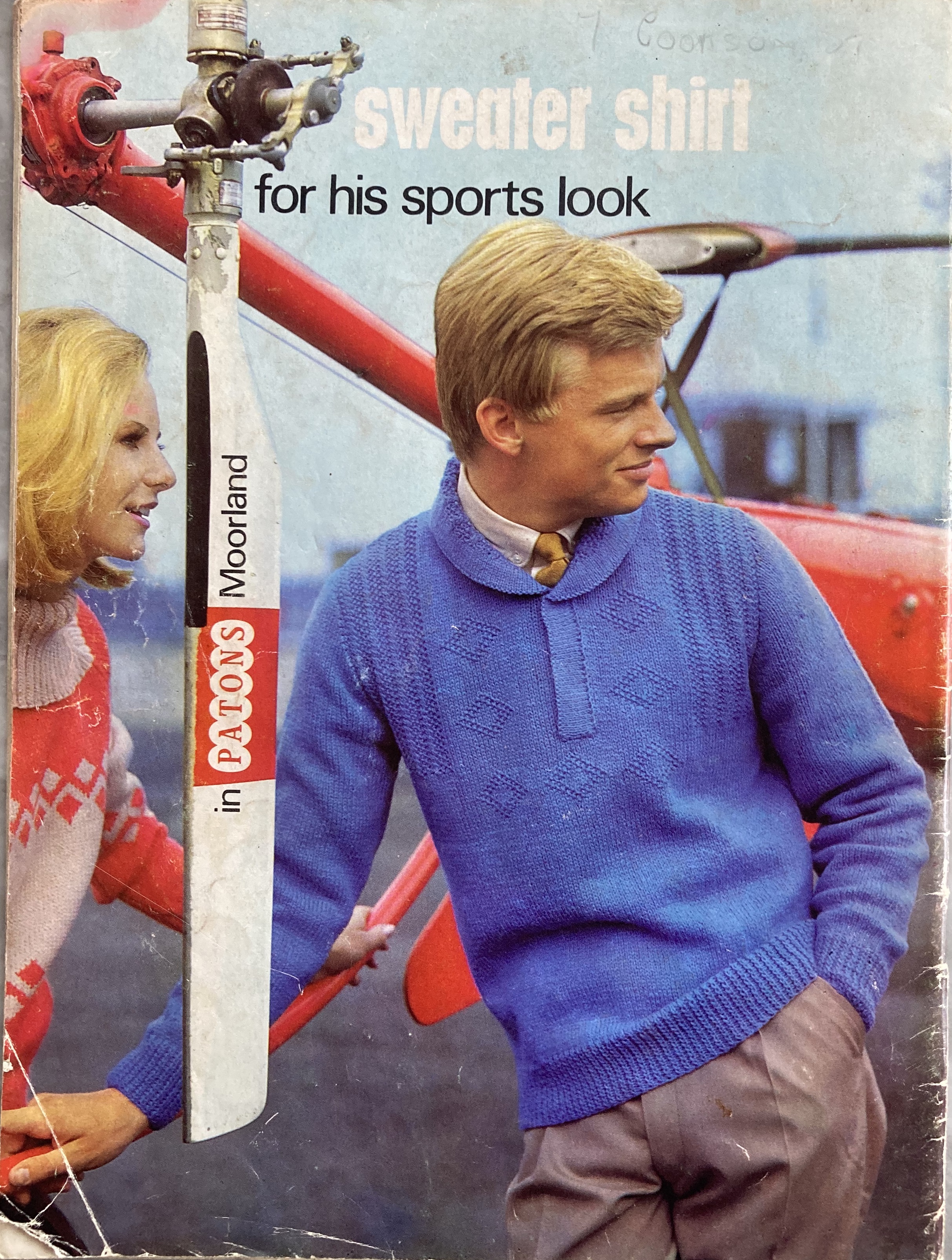
The trend for textured patterns, big collars, zig-zag designs and bold colours continues with the men’s garments: he too will be “set for winter” in a textured pullover for larger sizes or a sport-weight “sweater-shirt” (they didn’t use the word “henley” at the time) that utilises many fashionable features. You get a glimpse of the women’s colour-motif sweater in the back cover photo, as well.

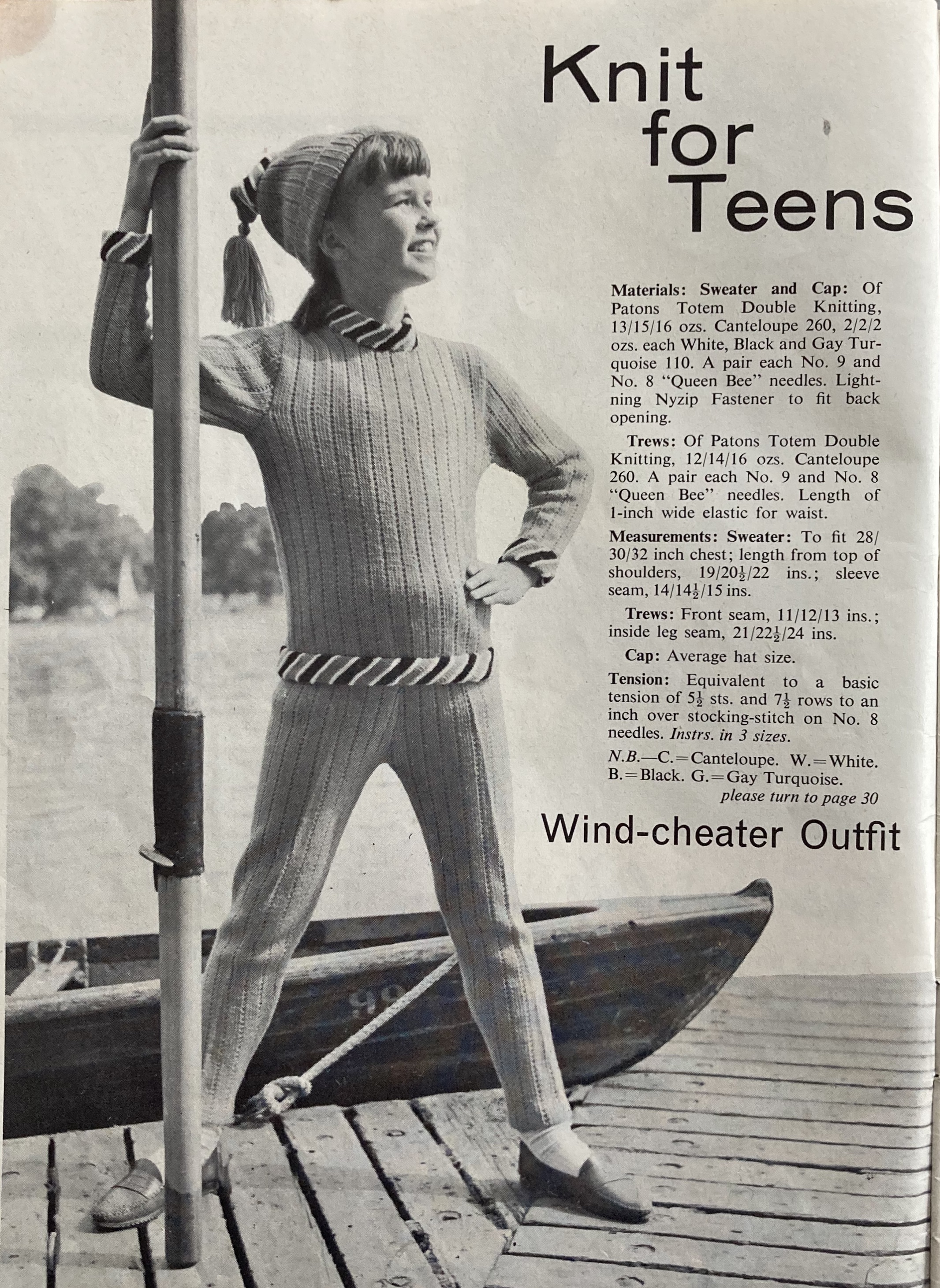
In the “Teens and Babies” department, there’s a wonderful winter “wind-cheater outfit” set (actually a set, this time) of sweater, leggings and hat, as well as a thick, warm jersey for a young girl (our model is quite possibly not a teenager yet, but the pattern is in three sizes up to 32 inch chest to fit older girls as well), and a continuation of the baby set (also an actual set) that was started a few issues ago with matinee coat, dress, etc.: this last instalment is a lacy one-size-fits-all hooded cape to go over all the other garments. I love the photo of the girl standing on the dock next to her boat, looking like a proud sailor! Last month’s issue, if we remember, touted “the Feminine Look”, meaning girls had to look pretty and not really do very much, so it’s nice to see our young sailor looking active and happy in her autumn sport set. The diagonally-striped hem and cuffs are knitted separately and sewn on later.

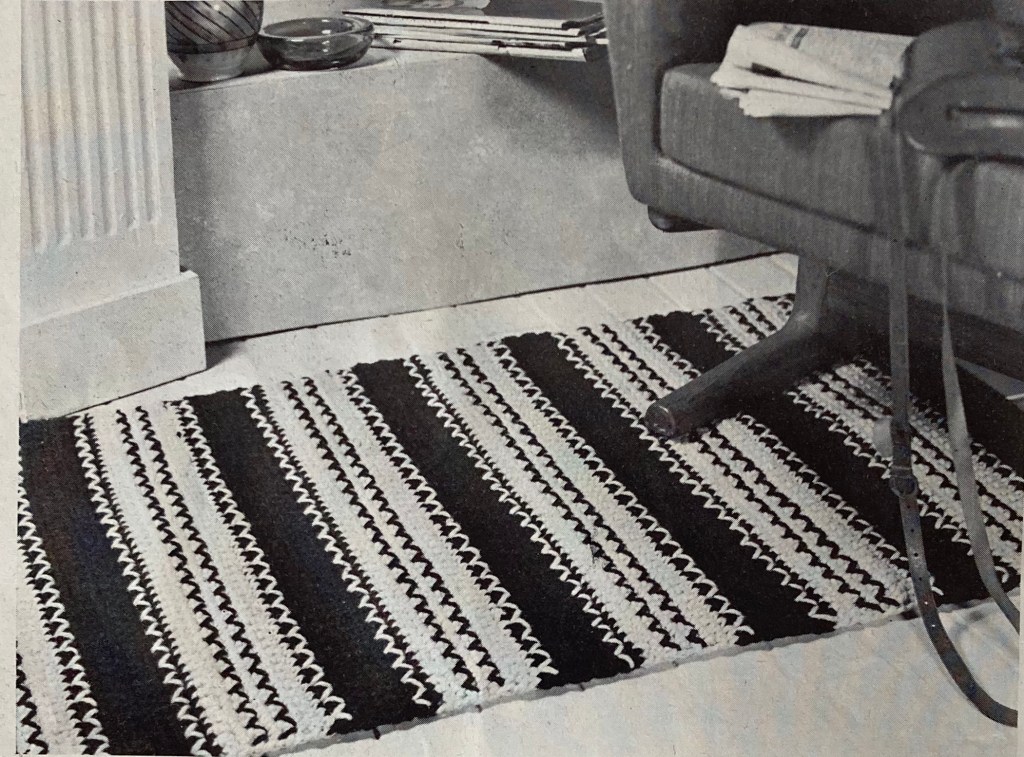
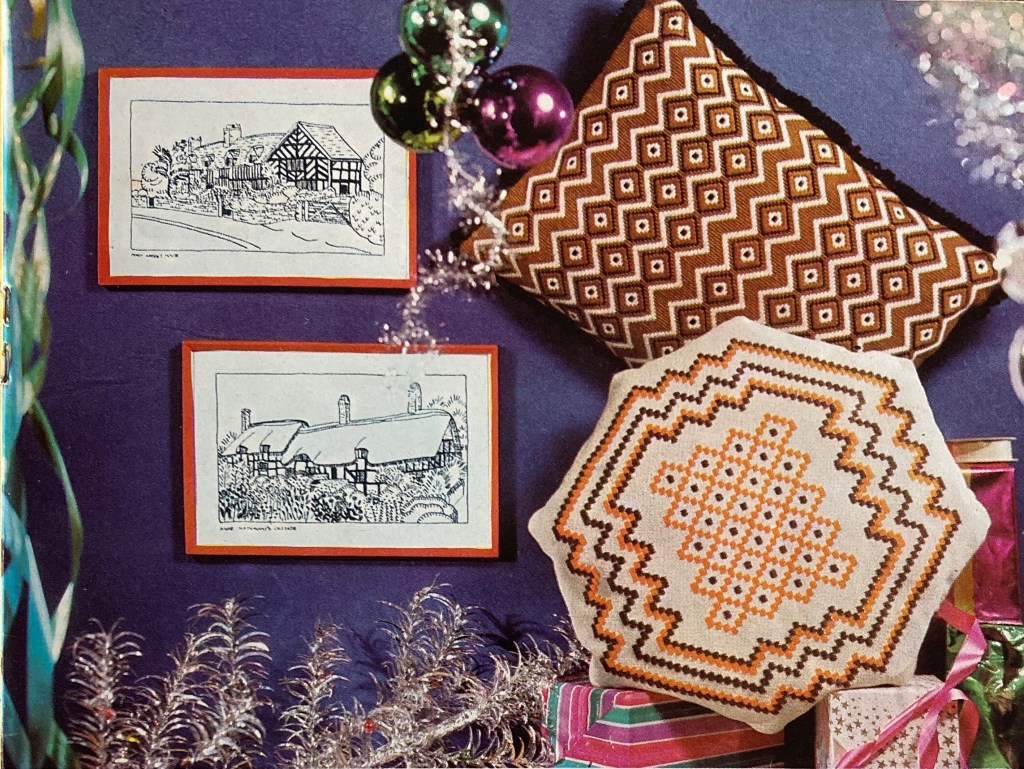
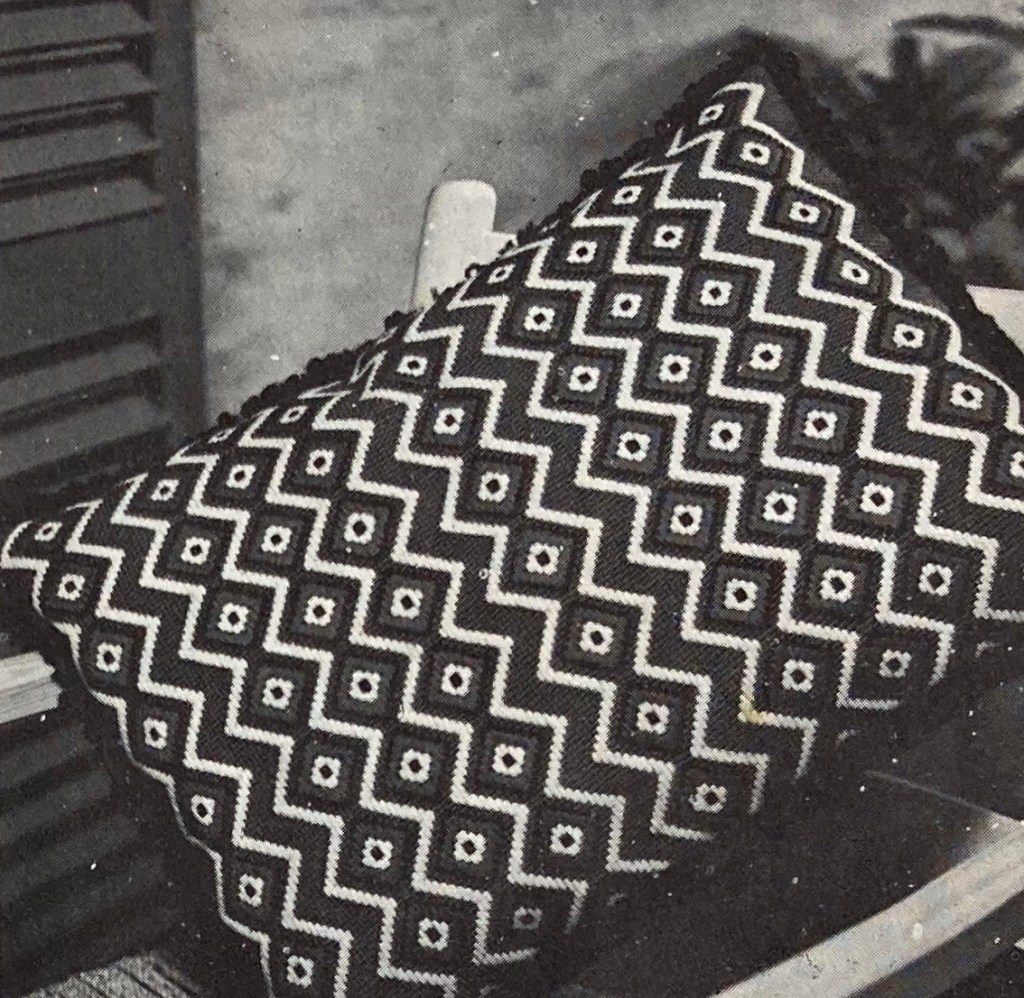
The non-Christmas-themed housewares continue the zig-zag / geometric trend with a crocheted rug, diamond-pattern cushion and wacky zig-zag chairback and cushion set (yay, another set).

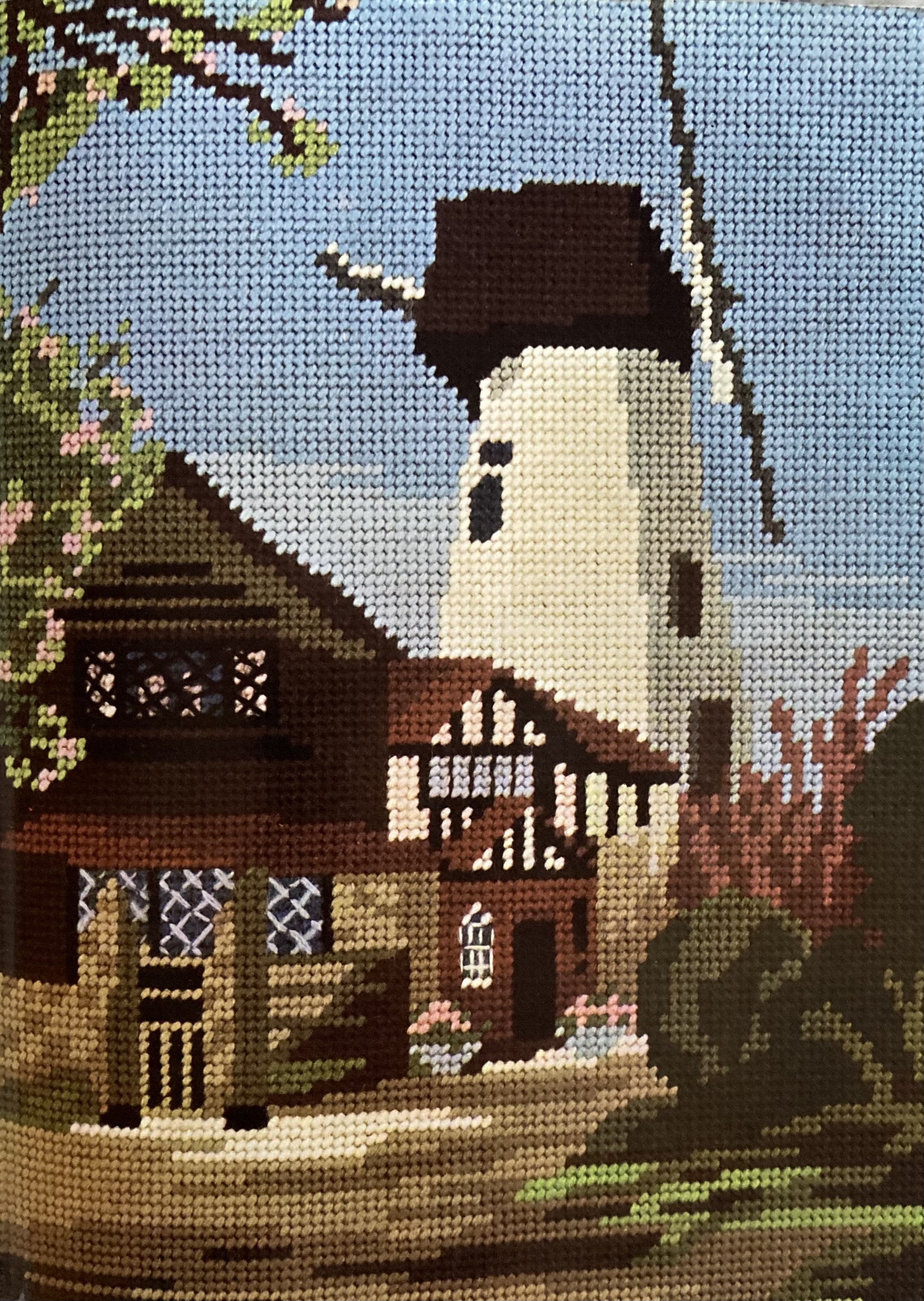
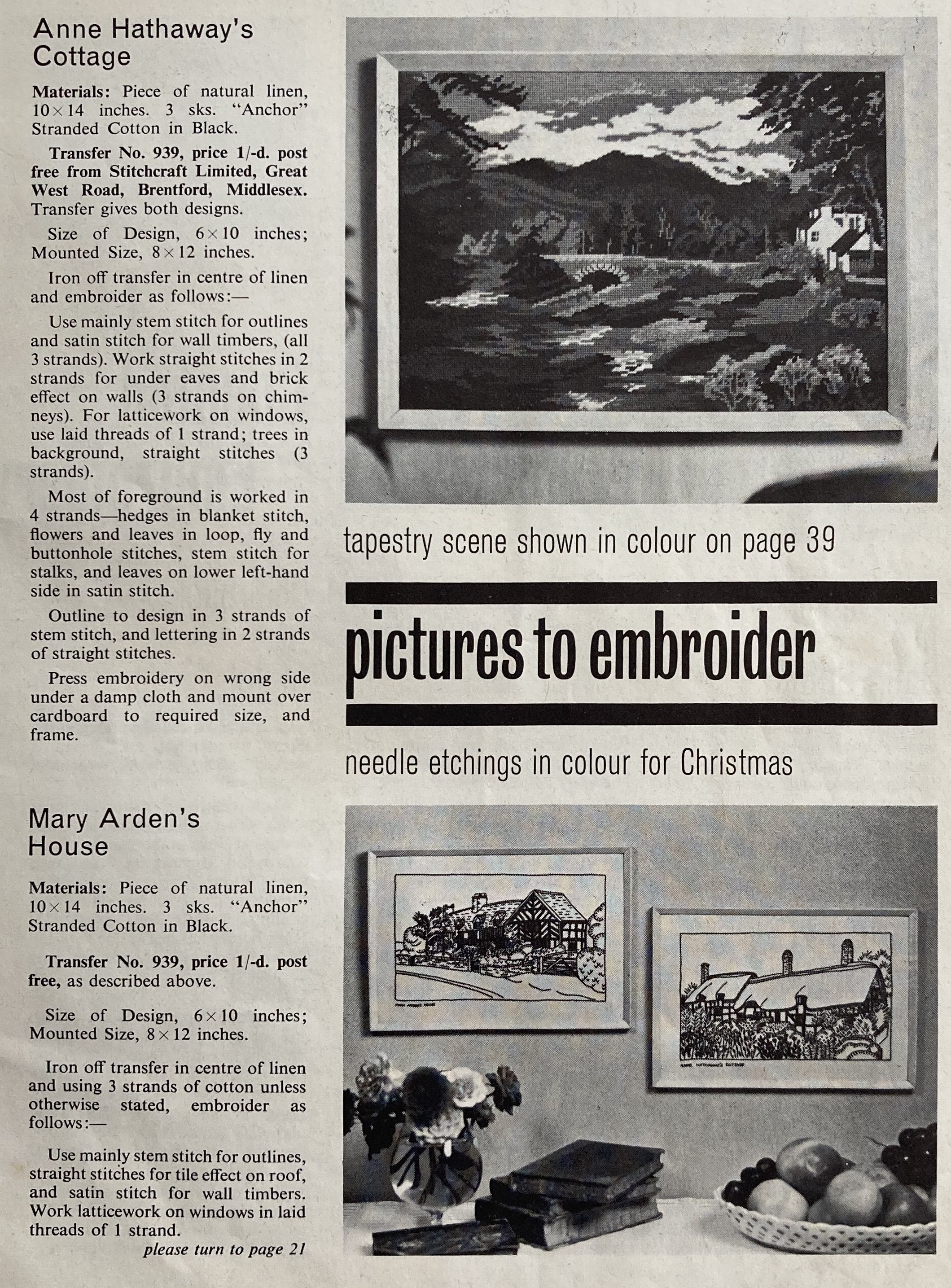
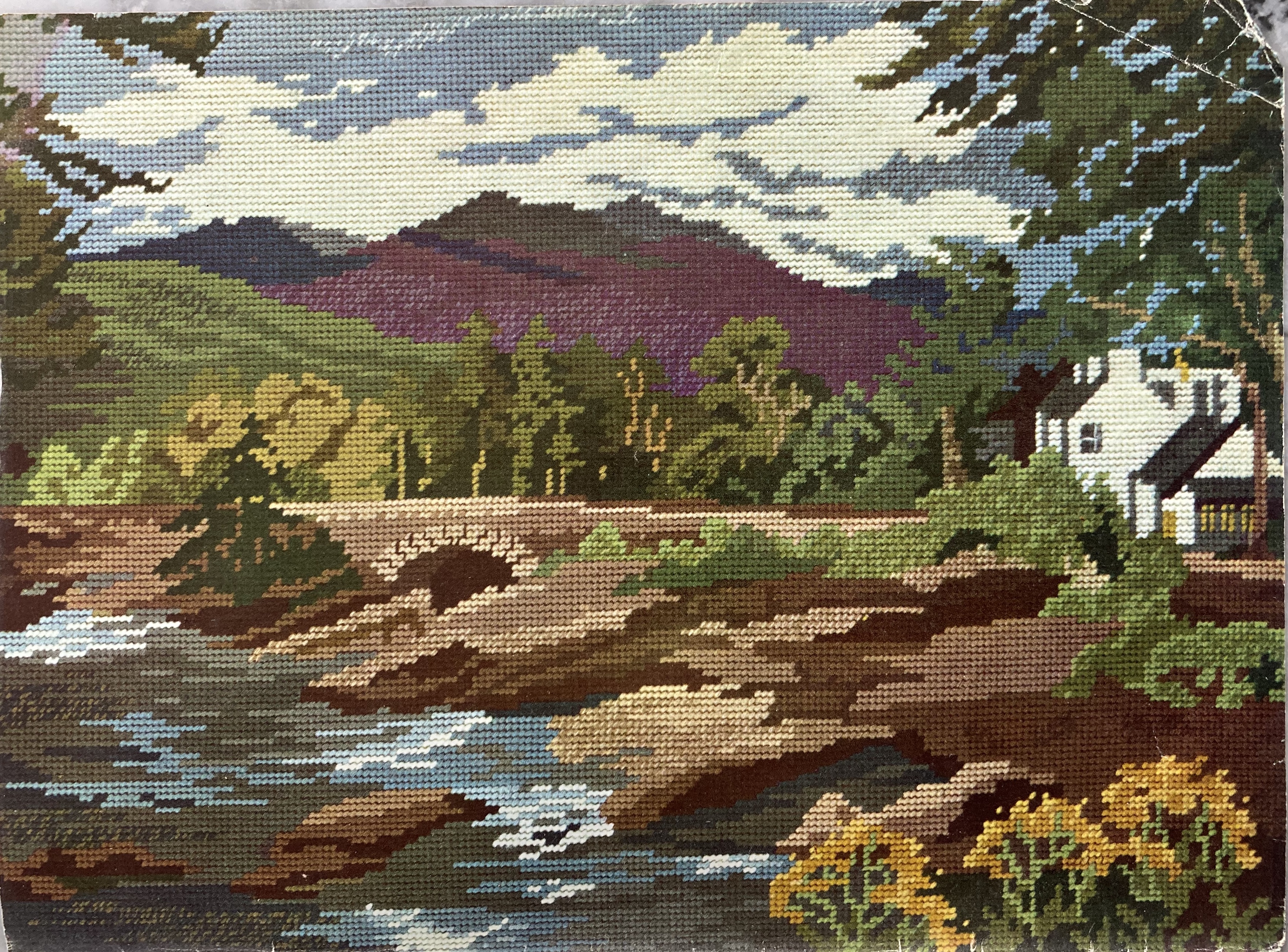
There are tapestry and “needle etching” embroidered pictures that draw inspiration from Shakespeare’s family: “Anne Hathaway’s cottage” (Shakespeare’s wife, not the modern actress…) and “Mary Arden’s House” (Shakespeare’s mother, not Lady Arden of Heswall.)

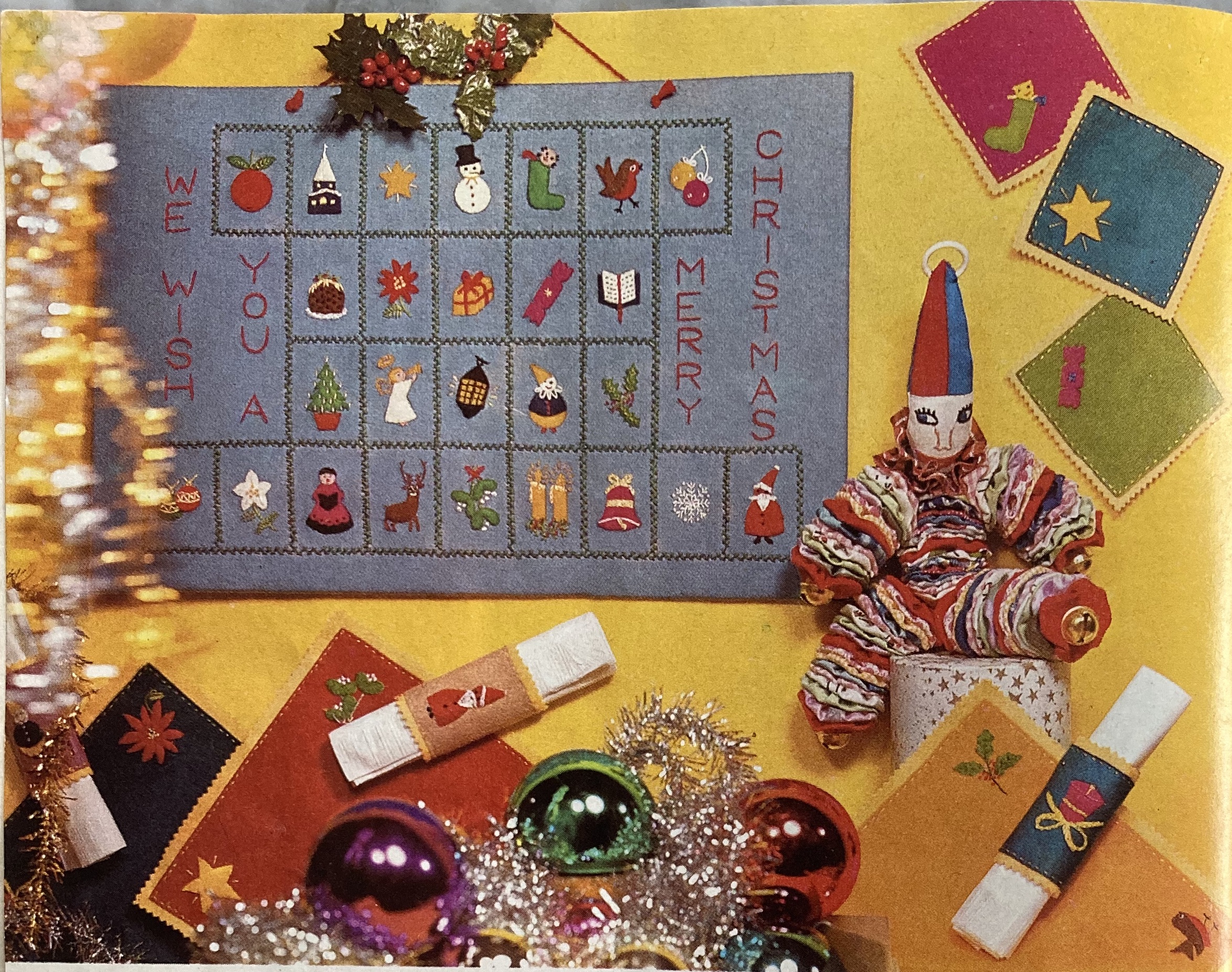
But finally… it’s time for the pre-Christmas decorations! The wacky “novelties” and bizarre-bazaar items! I know you have been waiting for this and I promise you will not be disappointed. You may, however be scared out of your wits, if you happen to have a clown phobia, in which case I caution you to skip over the next few photos.

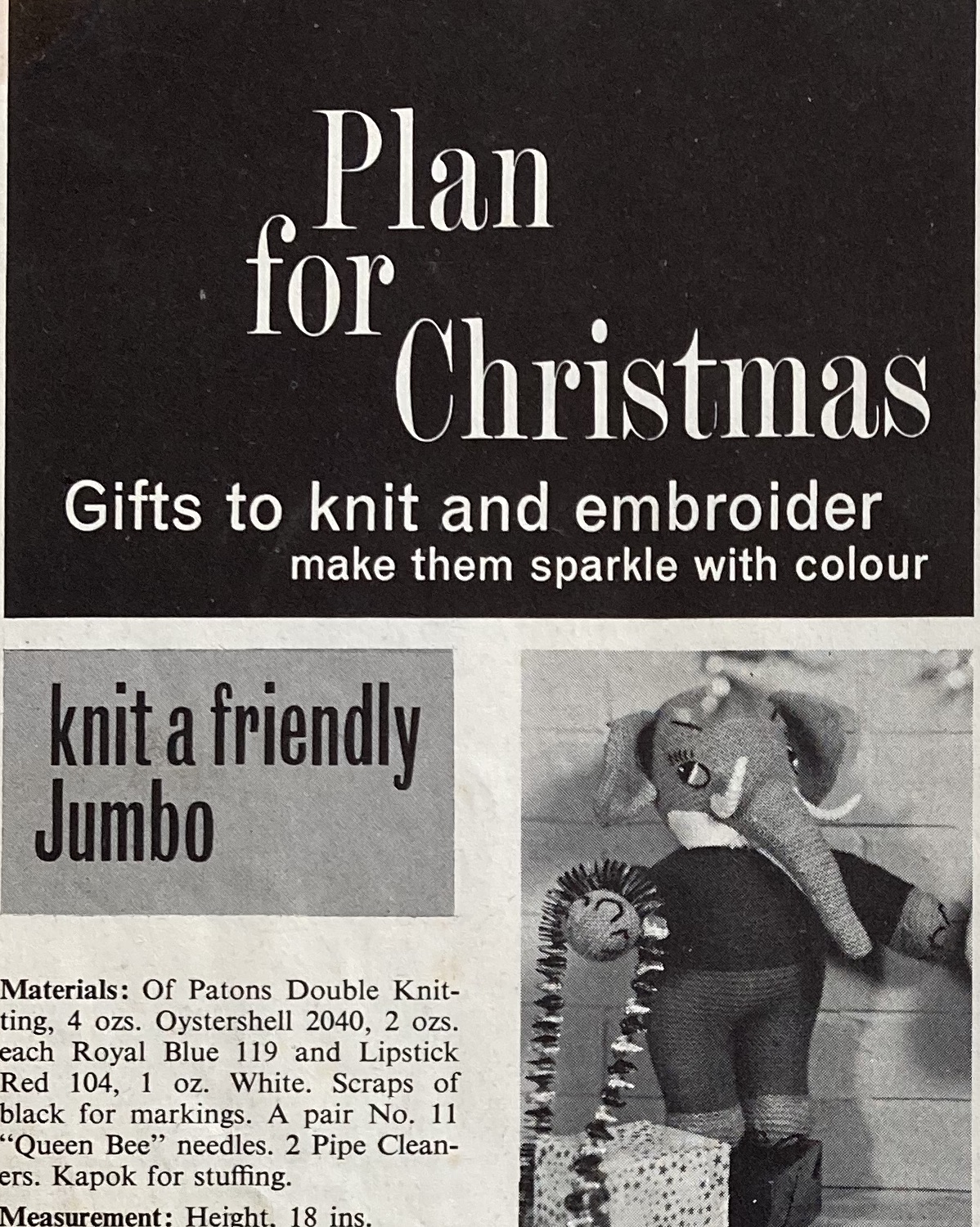
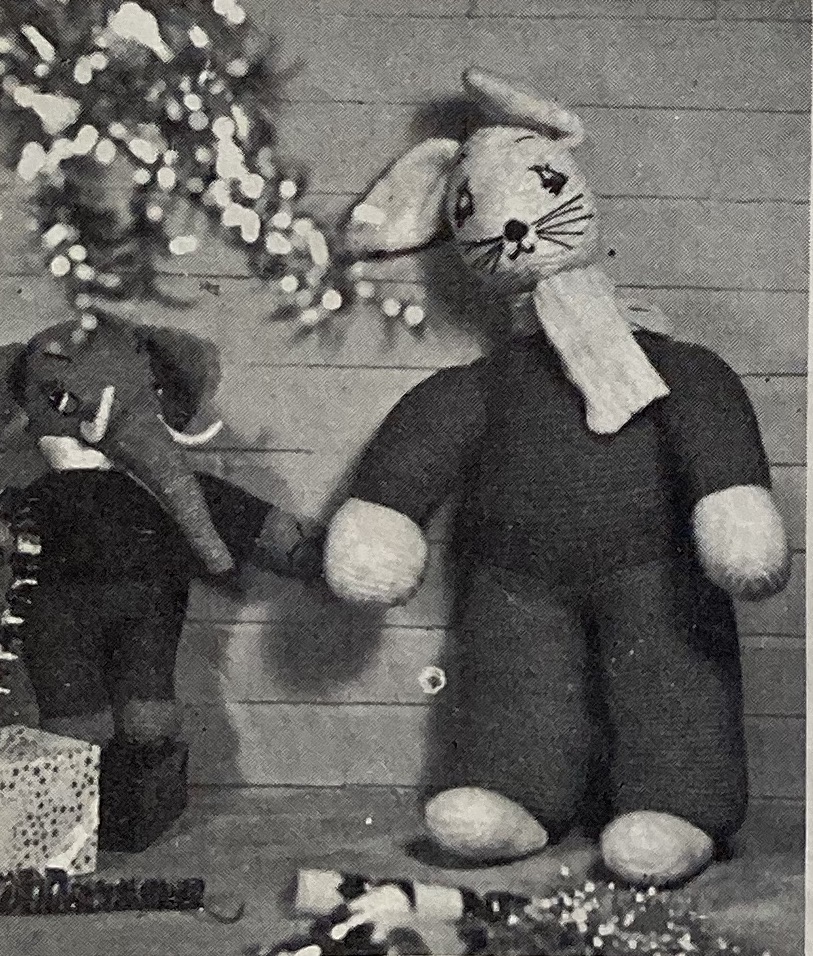
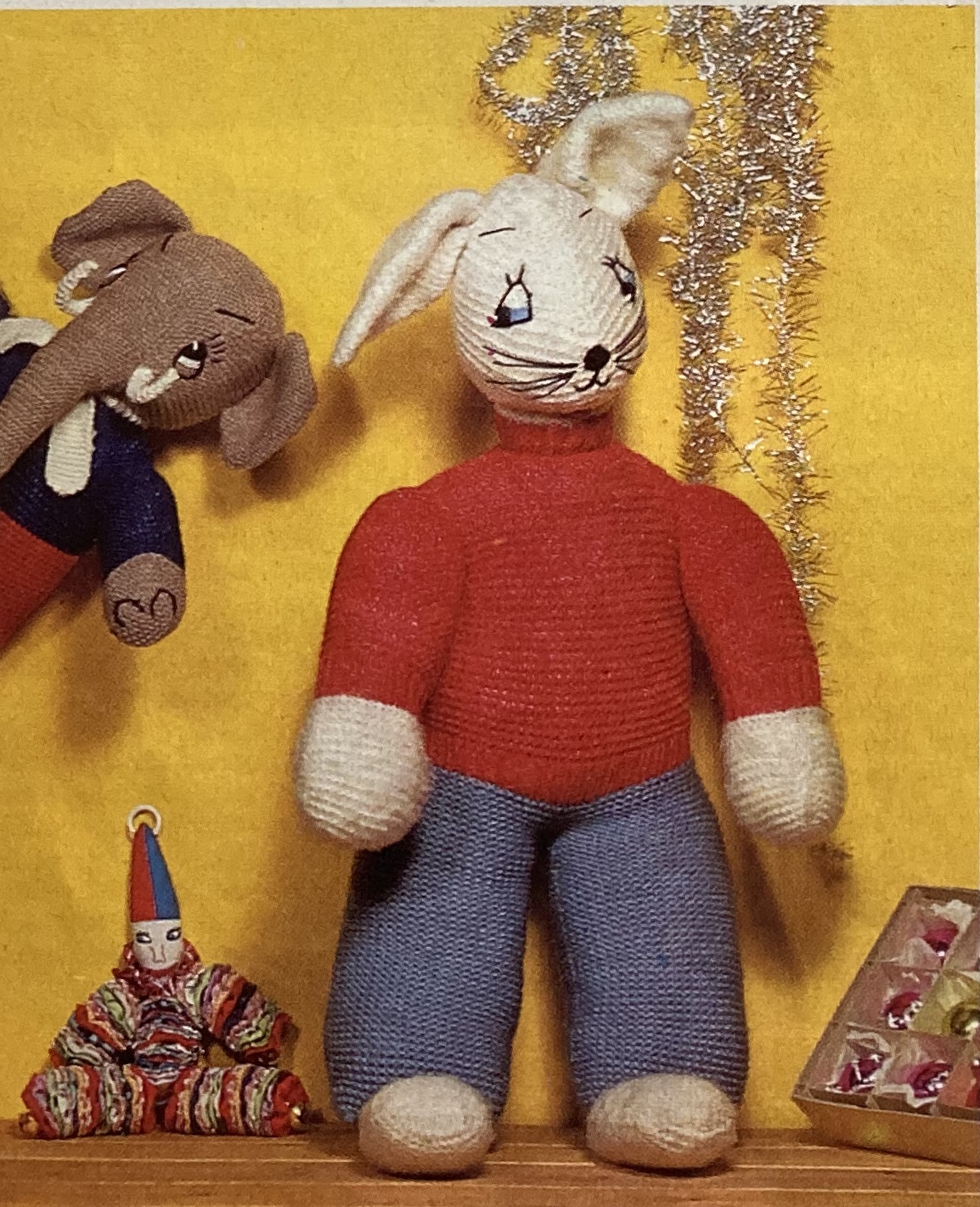
Starting with the melancholic stuffed animals, you can knit a “friendly” Jumbo the elephant, who seems to be rolling his eyes at the happy child who just pulled him out of their Christmas stocking, or a sad “bunny with a twinkle”. The table decorations are quite cute and easy to make: felt place-mats, napkin-holders and an Advent wall panel with wintery and Christmas-y appliqué motifs.

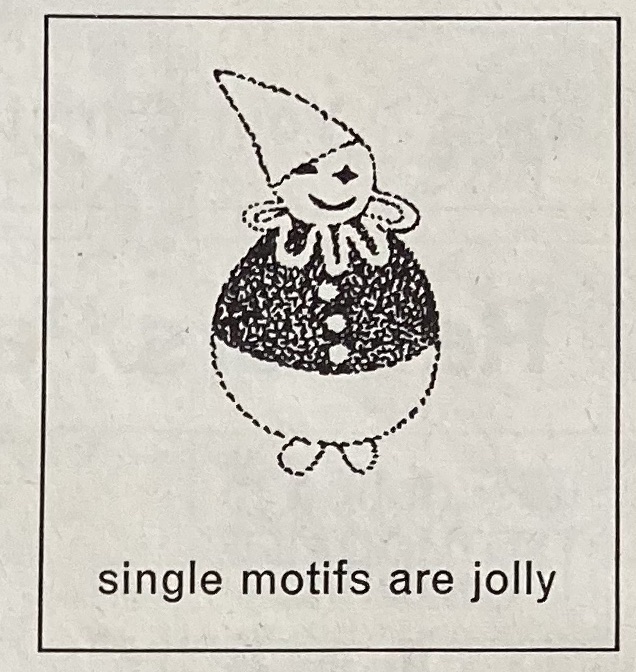
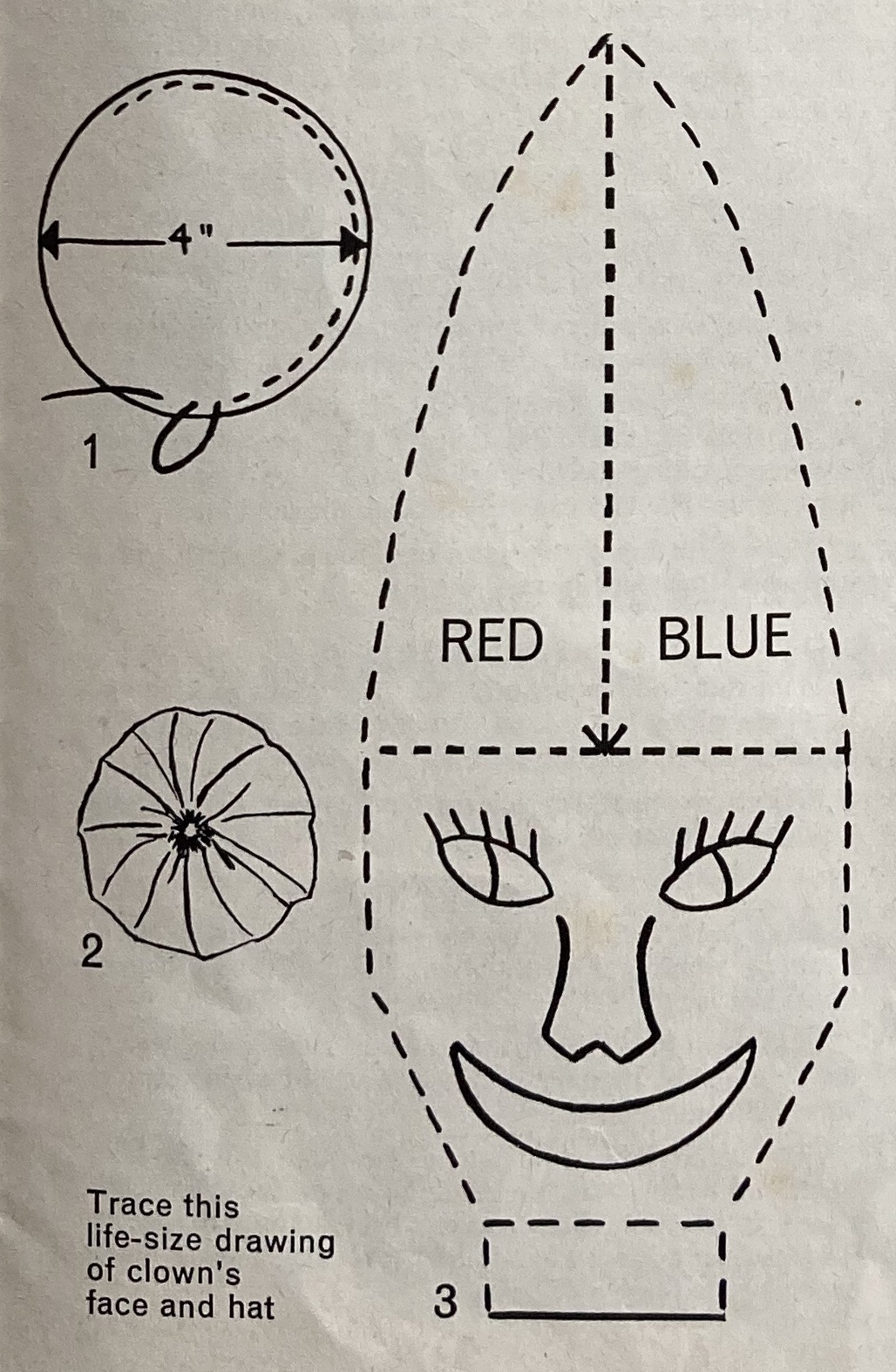
But that clown! The “Musical clown for a tot”! What in the world is going on with that clown? Even the bunny is giving it the side-eye. The construction is actually pretty interesting and a fun way to use up fabric scraps: you cut 4-inch diameter circles of fabric, gather them up with a gathering thread to make little poufs and then sew them on top of each other to make the arms, legs and body. Then all you need to do is sew and stuff a pointy head and cap and embroider a terrifying face onto it. Don’t worry, it has bells instead of hands and feet, so you can hear it coming.

EDIT November 12, 2022: I was browsing around on UK Ebay and someone is selling an FO of this clown! Unbelievable! I am not going to buy it but maybe one of you will

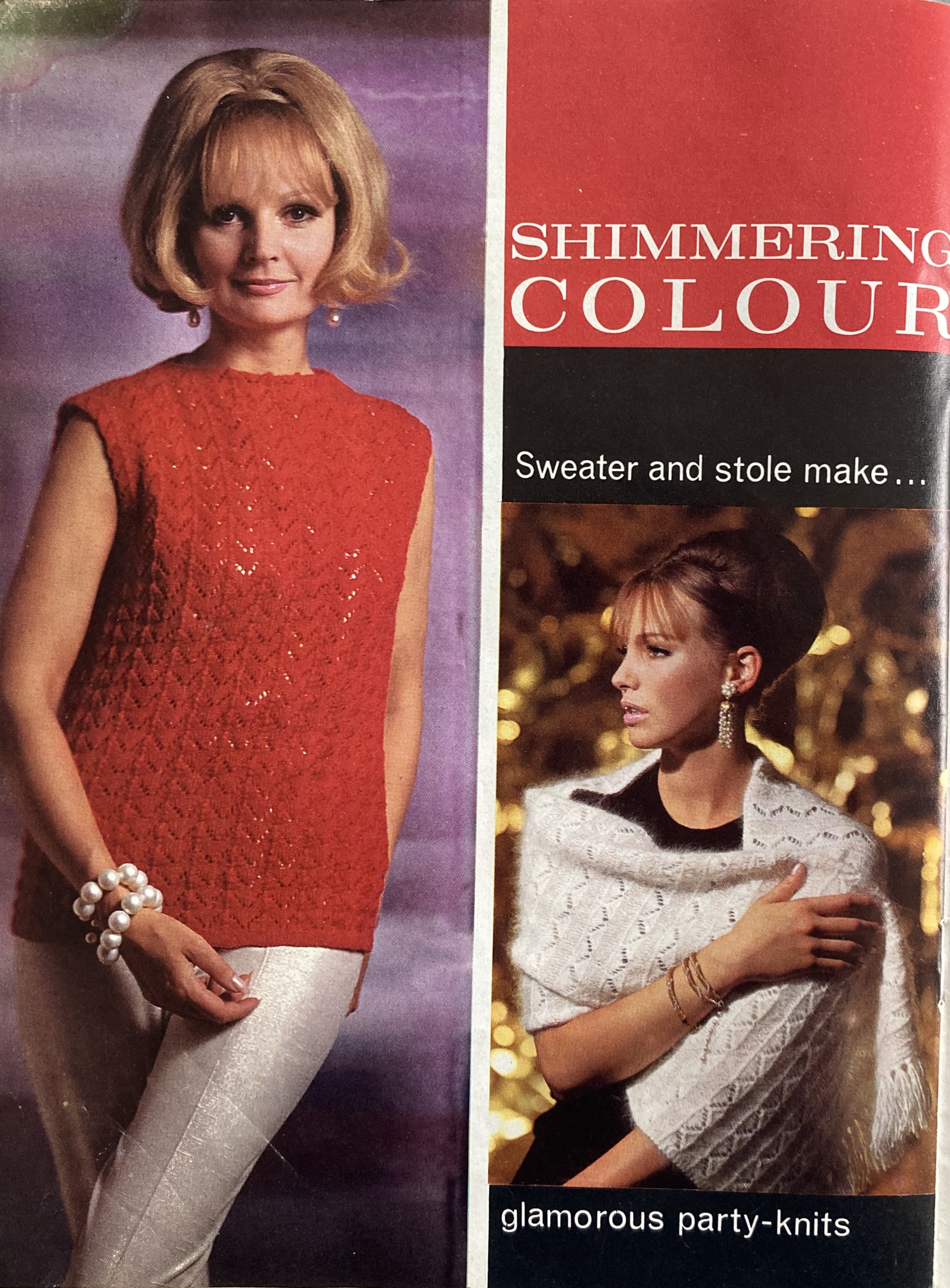
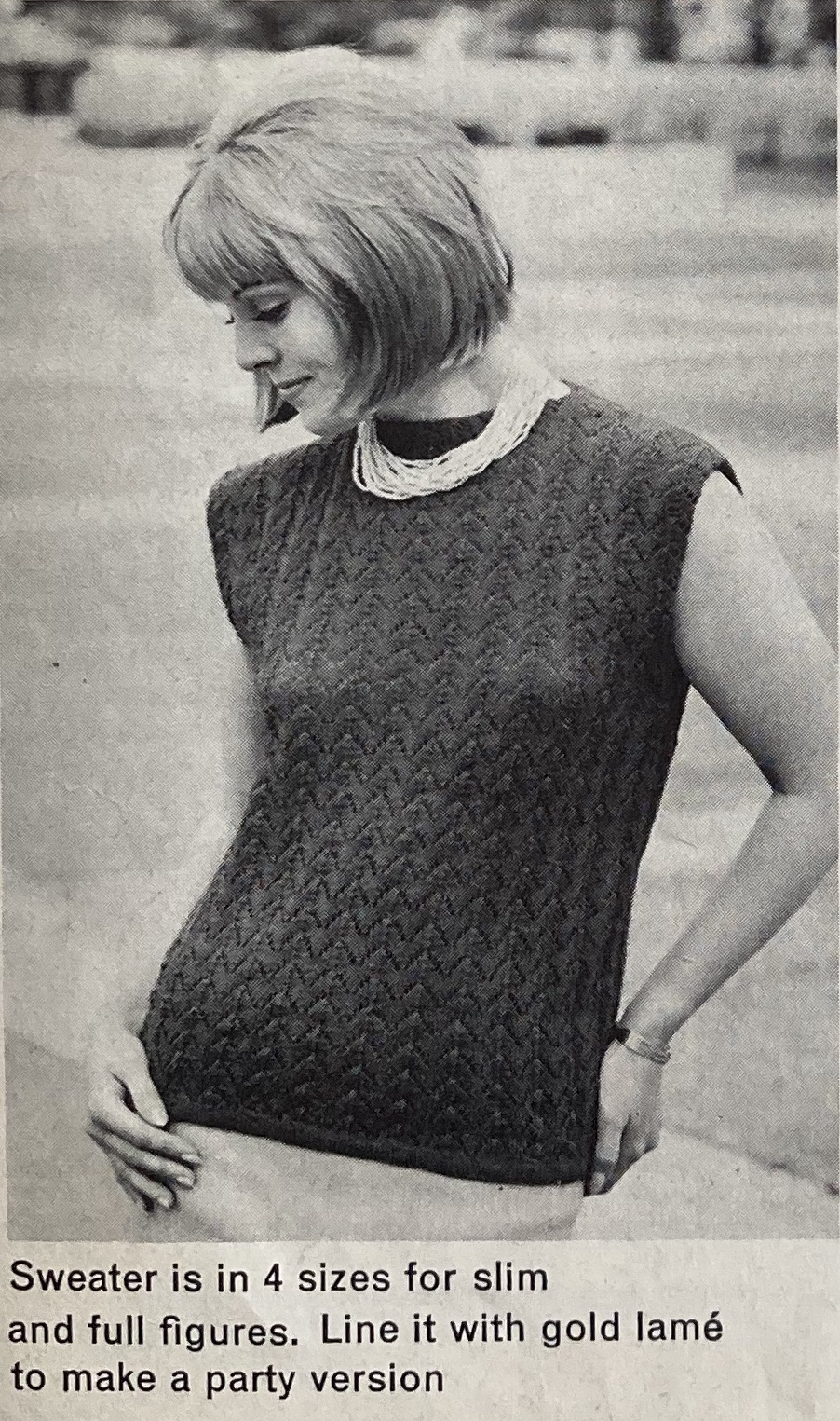
To clear your mind of those images, here is a lovely lacy party top and fluffy “luxury stole” knitted with Lurex for holiday party glamour. The top can be lined with gold lamé for extra sparkle.

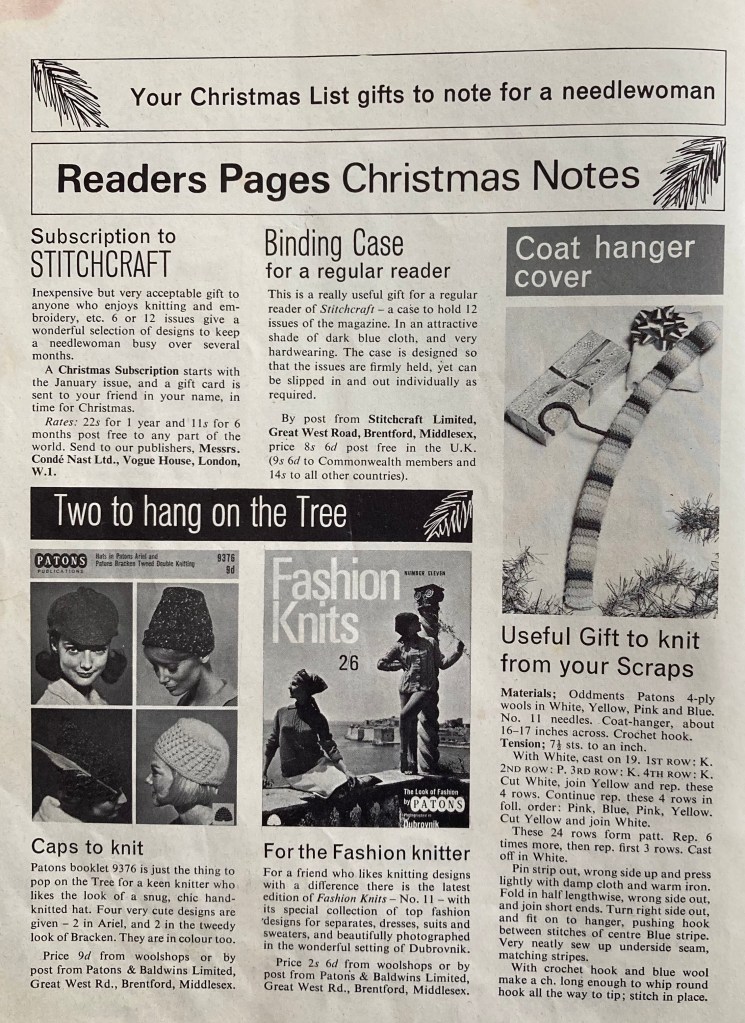
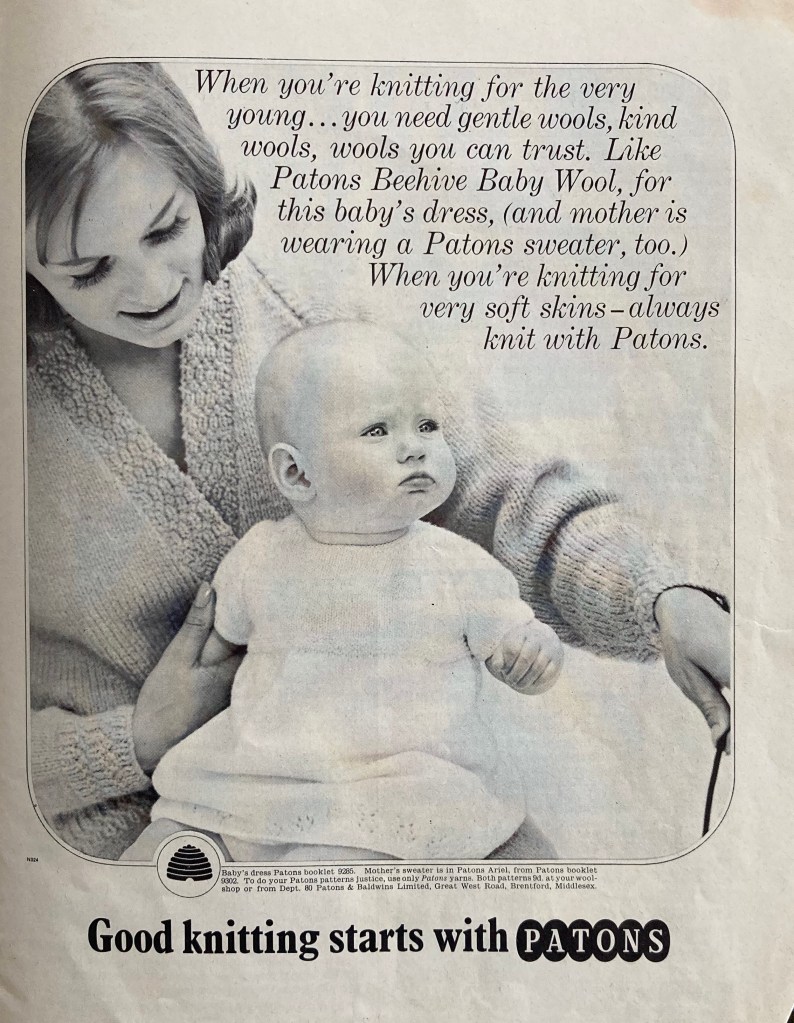
Rounding out this bumper issue are the “Readers Pages”, featuring Stitchcraft and Patons-inspred gift ideas (a yearly subscription, binding cases for past issues, knitting patterns…) and a fun way to use up wool scraps: a coat hanger cover to keep delicate items from creasing or stretching at the shoulders. The ads use babies to sell Lux soap flakes and Patons wool.

The only project that really called to me from this issue was (laugh if you want) the coat hanger cover, which could make a cute little gift for a friend or be useful in my own closet, as well as being quick and easy and a way to use up some of those mystery scraps in the stash drawer. The October 1964 dress is almost finished, so I’ll update that post soon as well.

October 1964: Overview

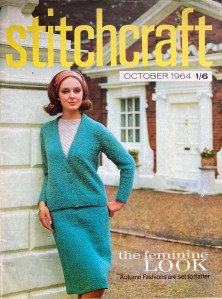
October is the start of the best season for knitting, and the October 1964 issue of Stitchcraft rose to the occasion with multiple themes and more colour pages than ever before (photographed in the villages of Great Waltham and Stebbing in Essex). There are knit designs for “him and her” as well as for different ages of babies and children, embroidery, tapestry, rugmaking and appliqué projects, “novelties” and even a few extra tidbits in the back “Readers’ Pages.” Shall we… fall in?

Our first Autumn theme is “The Feminine Look”, which cracks me up, for when has Stitchcraft or any handcraft magazine ever promoted the “masculine look” for women? It goes without saying that they would never advertise the feminine look for men… As far as I can see, the designs don’t look any more feminine than the designs from any other issue. Maybe it’s meant in contrast to the “partner-look” designs from previous fashion trends.

In any case, the cover-photo suit with coordinating jumper for underneath is simple and elegant, and probably quite comfortable to wear. It’s made in still-popular nubbly Rimple wool in DK weight and a slightly tweedy shade of light blue. The jumper is made in fingering weight and has a diagonal pattern.

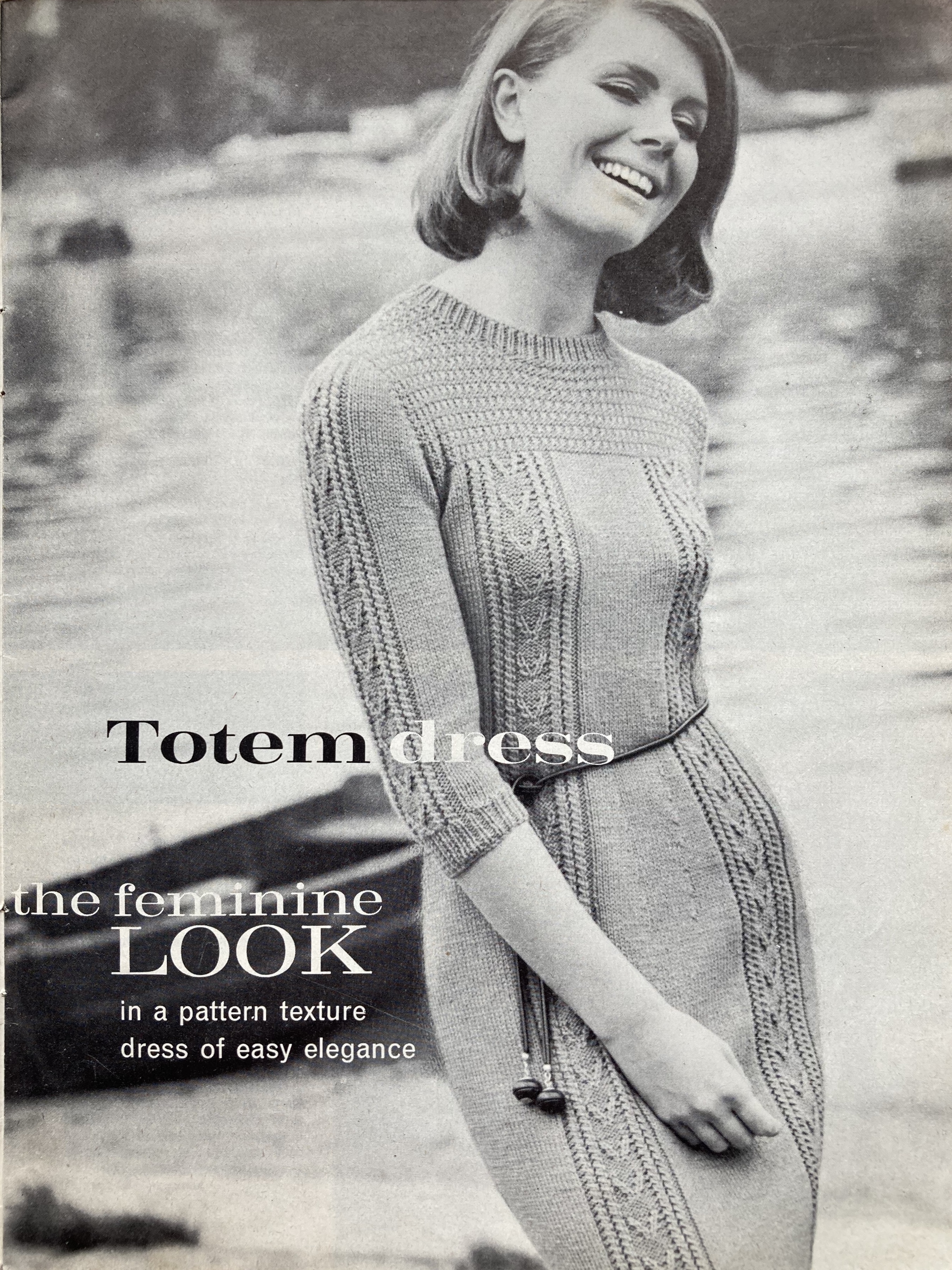
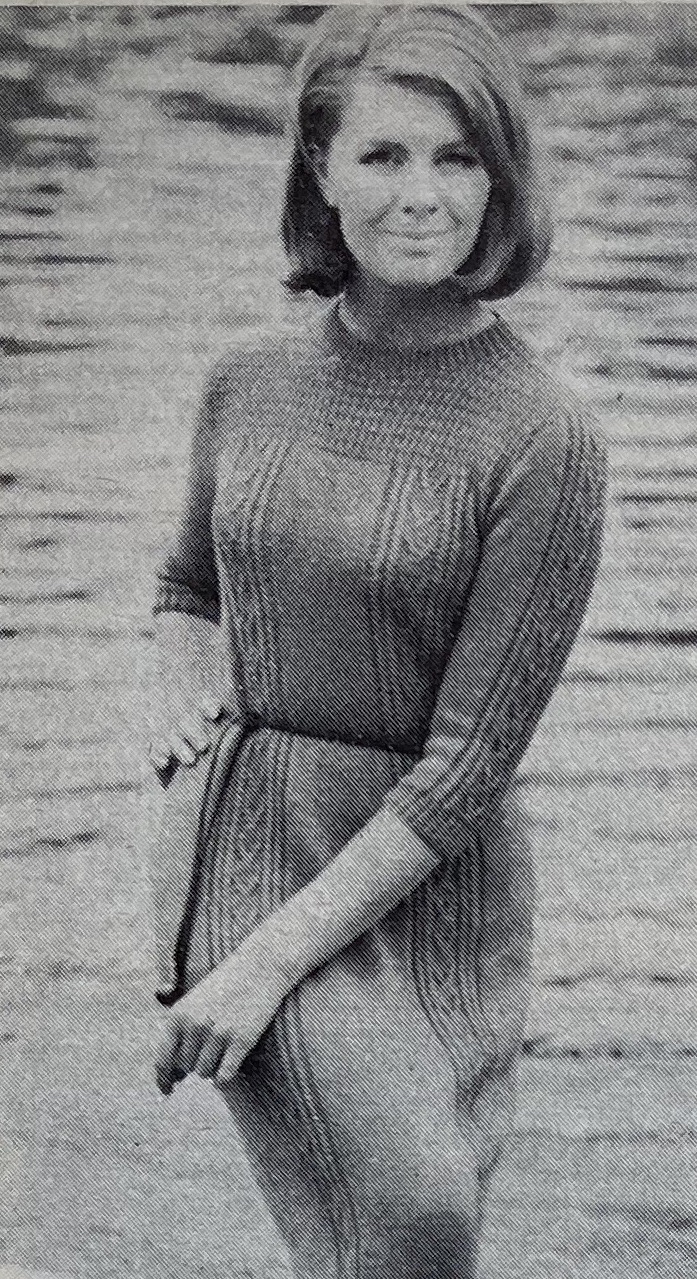
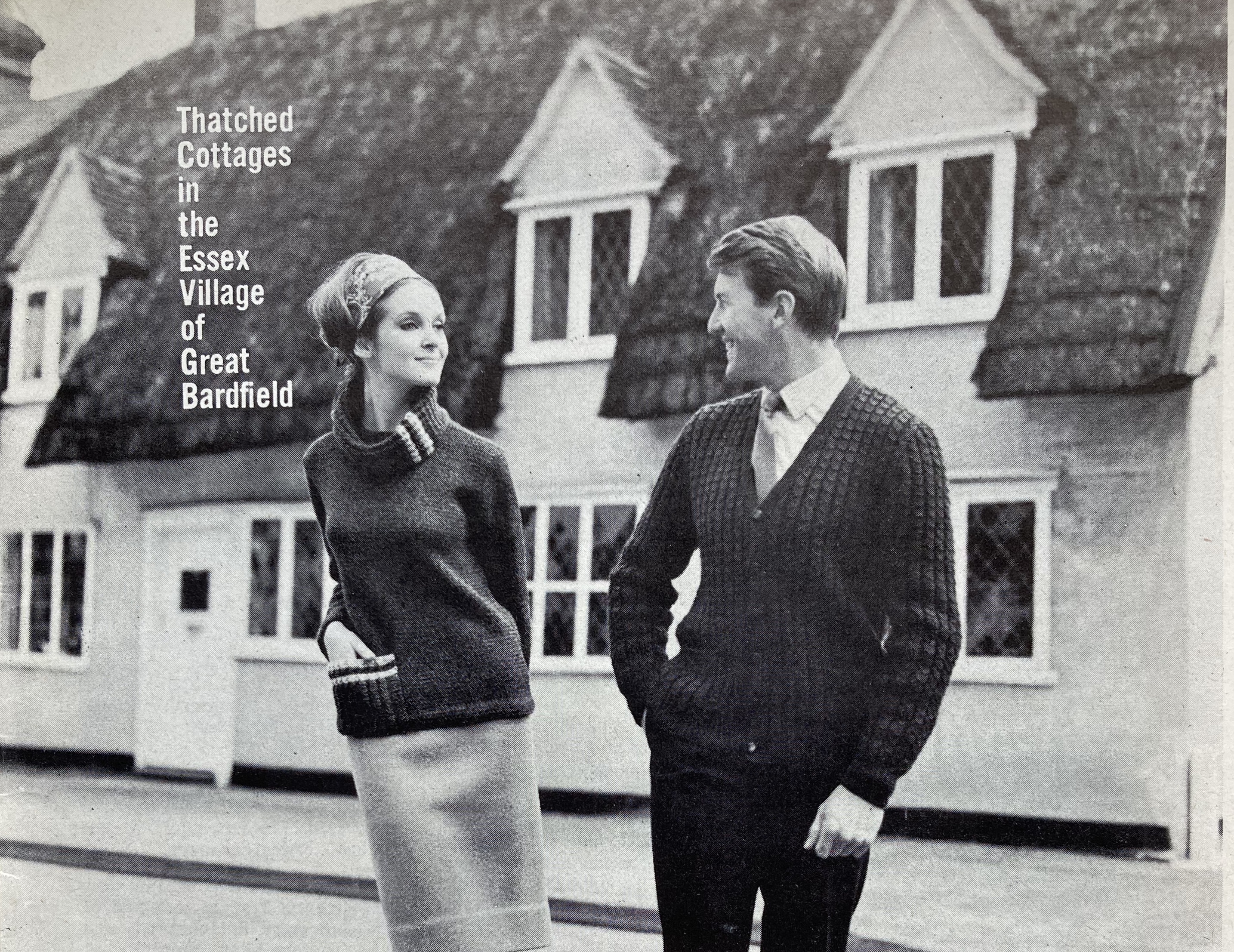
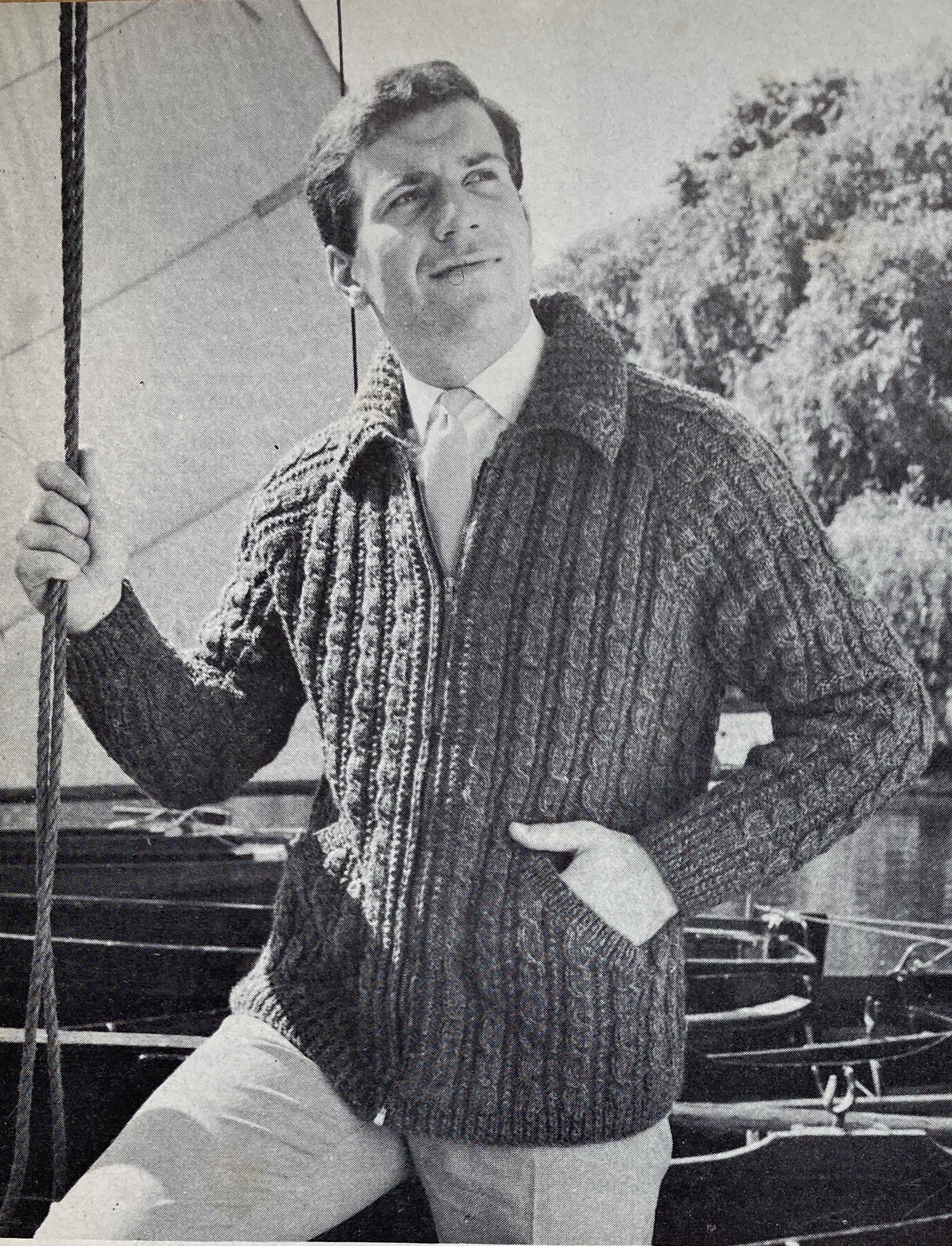
The women’s “feminine” fashions include a great cable-pattern dress as well, in smooth, DK weight Totem wool, and a less “feminine”, but probably very cosy, roll-collar pullover with an aysmmetrically-placed pocket. The mock-cable pattern on the pocket and collar is used as an all-over pattern on a man’s classic V-neck cardigan, and there’s another man’s cardigan as well in a very similar design, with “real” cables, a zip fastening and in bulky Ariel wool.

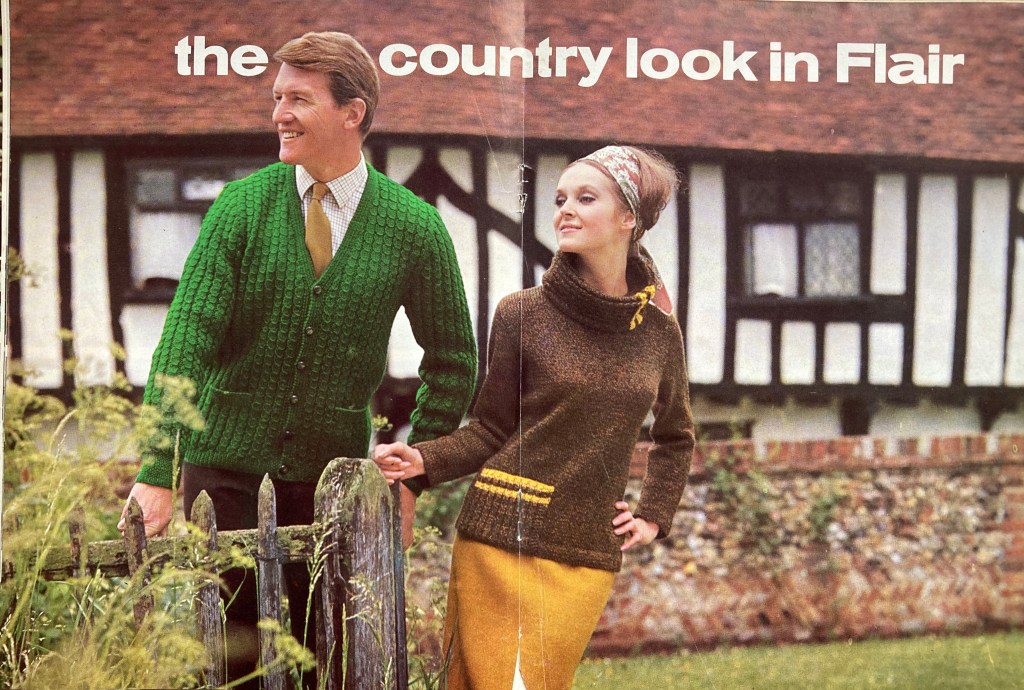
The cable cardigan and women’s pullover are shown off in a gorgeous full-colour centrefold photo where the green, yellow and brown of the knitwear harmonise perfectly with the country setting. As the caption says, both garments are made in “Flair”, a somewhat heavier wool-acrylic blend.

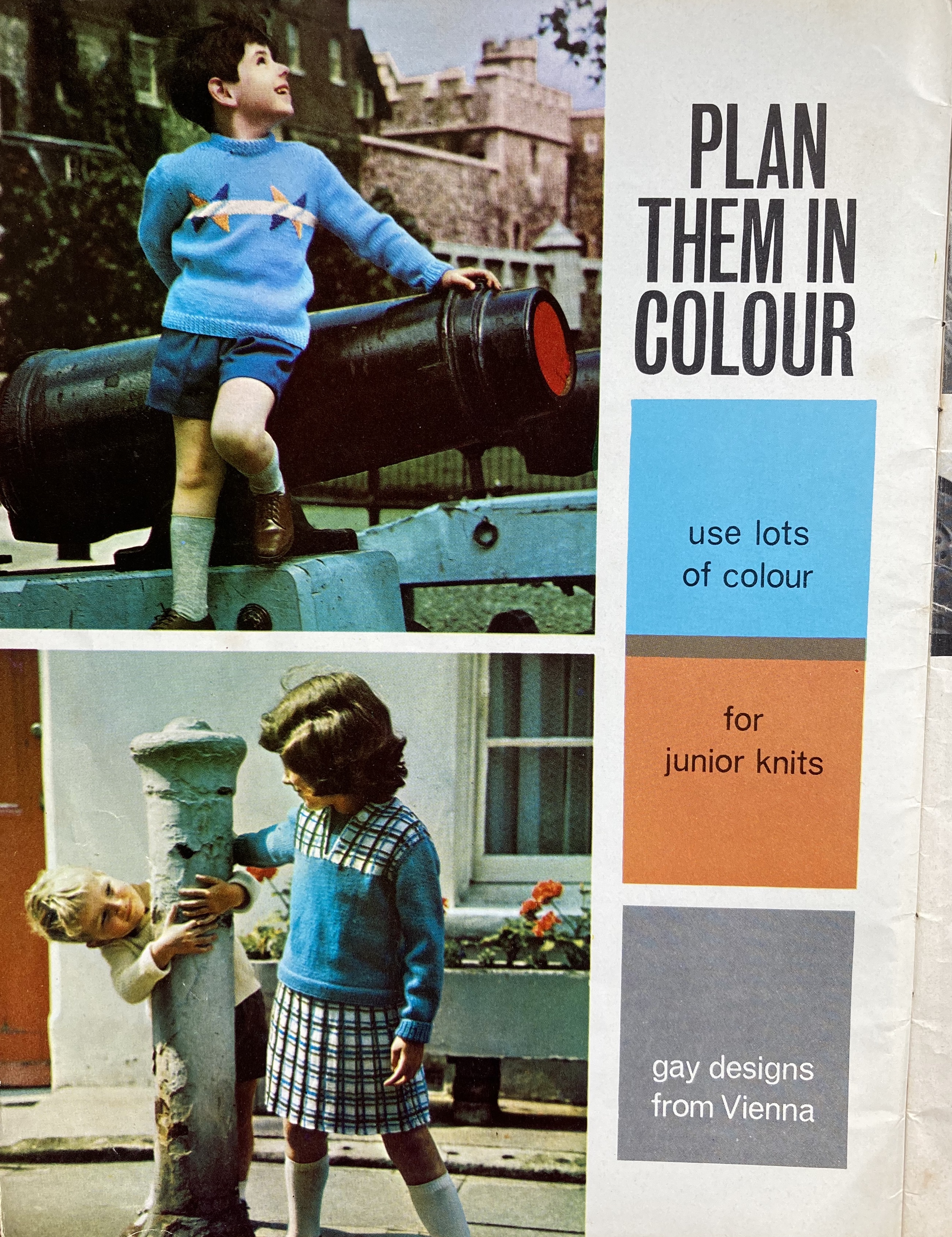
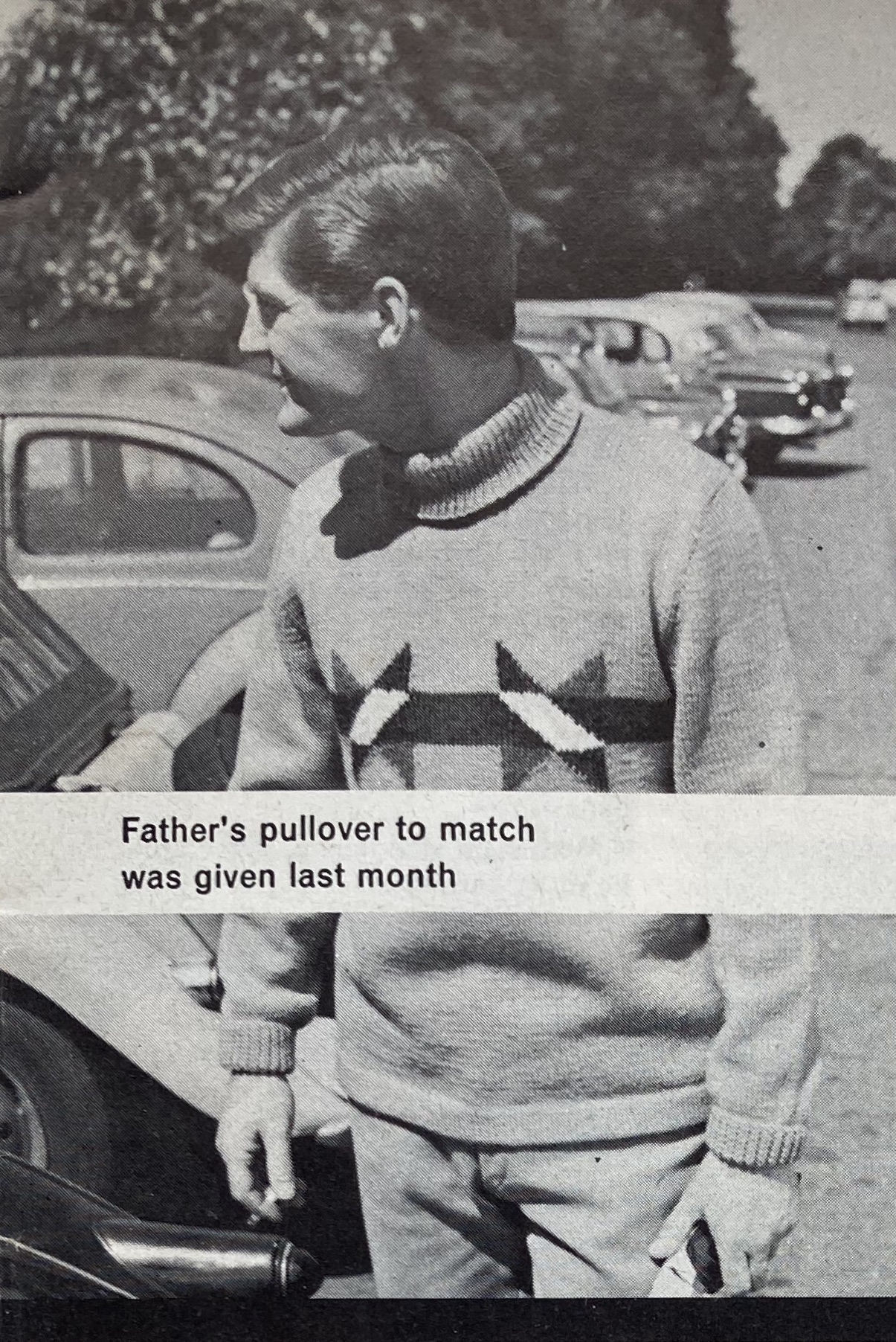
For the children, there’s a boys’ version of a men’s pullover from last month’s issue… the one that would not be a good choice for most women to wear. I personally think the placement of the star motifs is a bit odd even on a flat-chested body (they could have placed the band near the hem, or in a round yoke), but Stitchcraft liked it enough to offer a smaller-sized version in blue. Girls get a jumper suit in a plaid-trimmed “gay design from Vienna”. The colour palette for both the adult and children’s fashion is bright — blues, green, yellow, chocolate brown and “Flamenco” (I’m guessing red?), the patterns are bold and clear and collars and pockets are big and conspicuous.

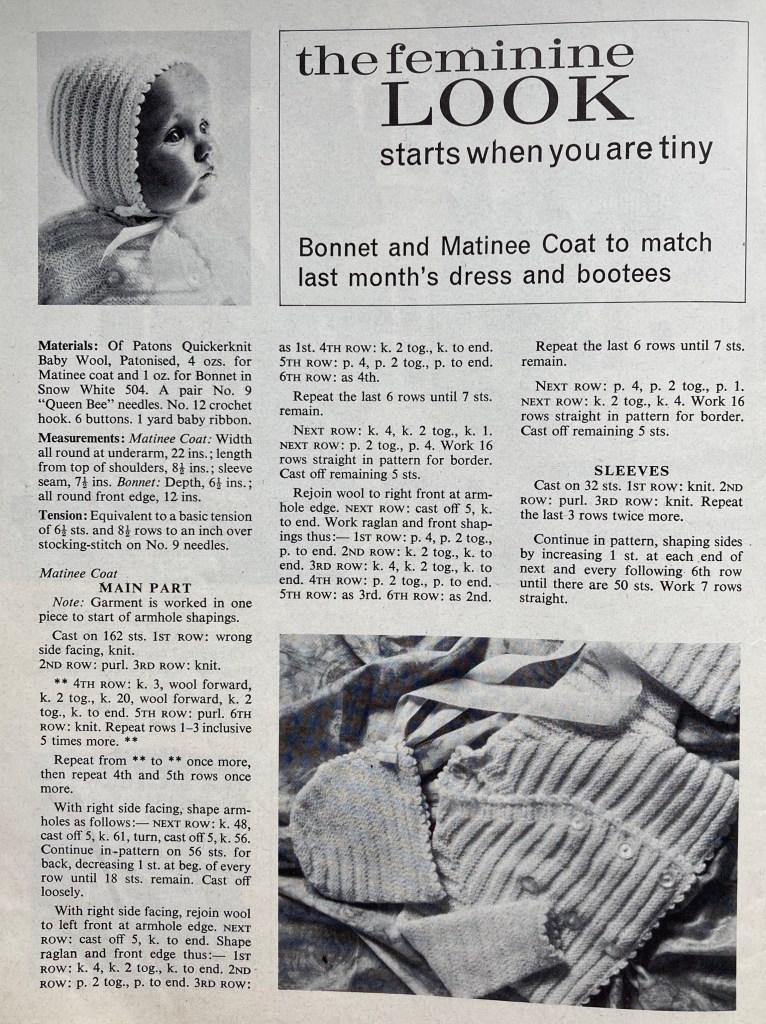
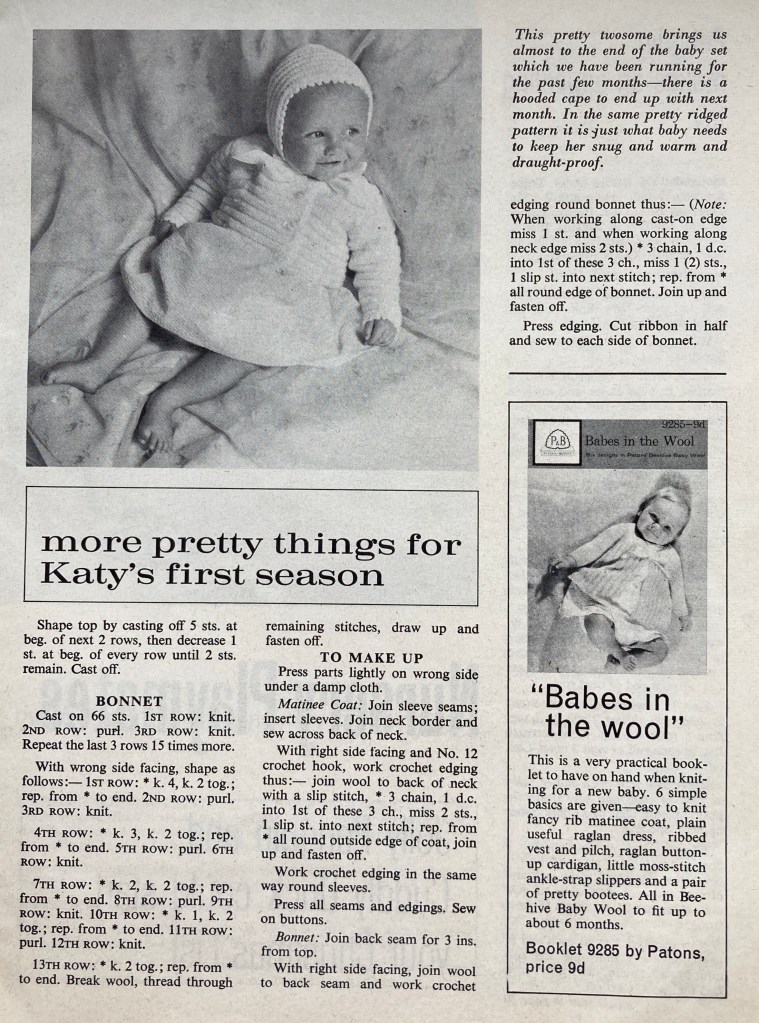
Continuing the baby-outfit series from the previous months’ issues, the (girl) baby of the family gets a bonnet and matinée coat. “The feminine LOOK starts when you are tiny” — i.e. get used to having cold legs now! The set is certainly pretty, and there’s a very practically placed ad for a Patons’ baby-pattern booklet, “Babes in the Wool” on the page as well.

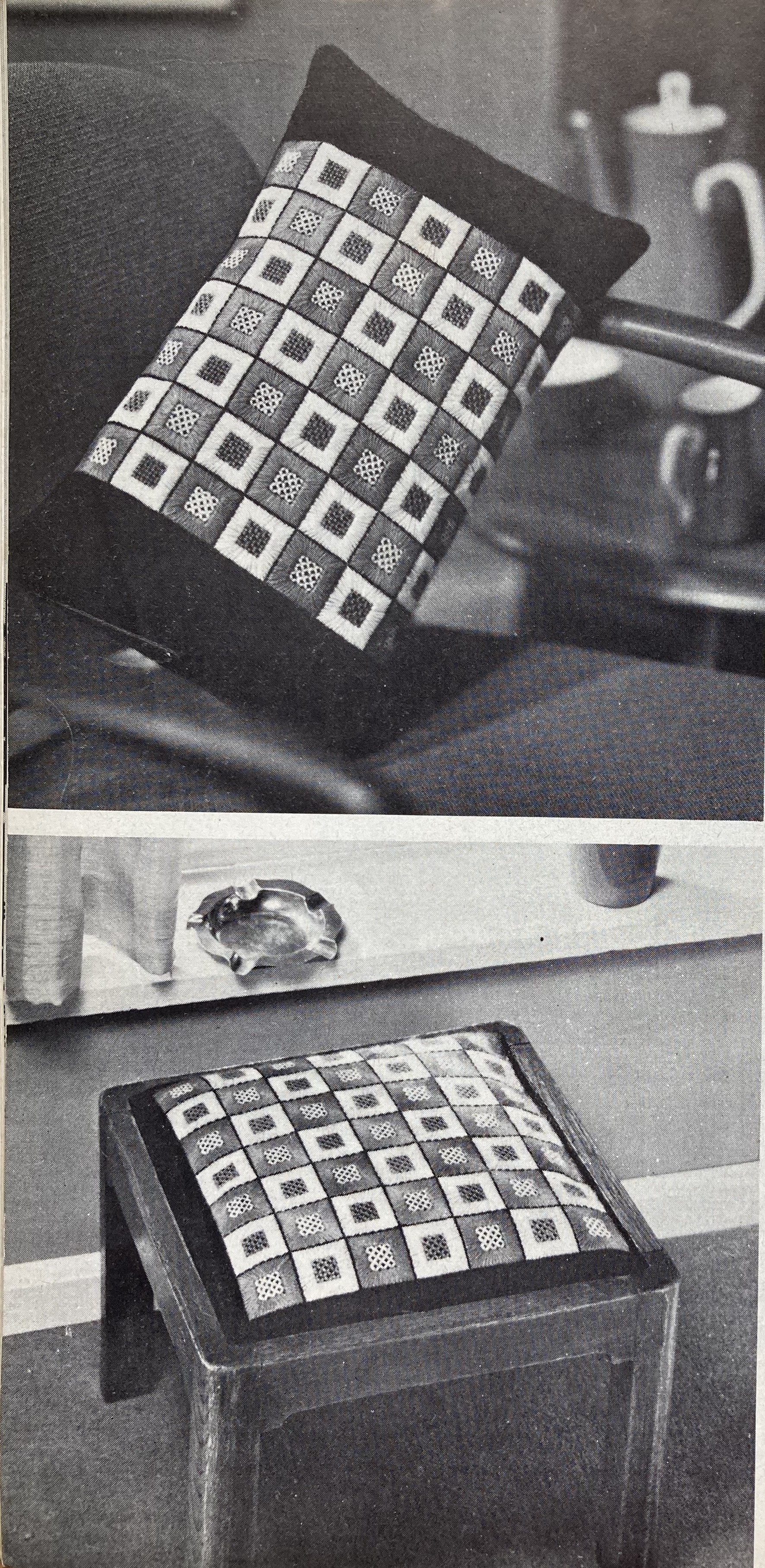
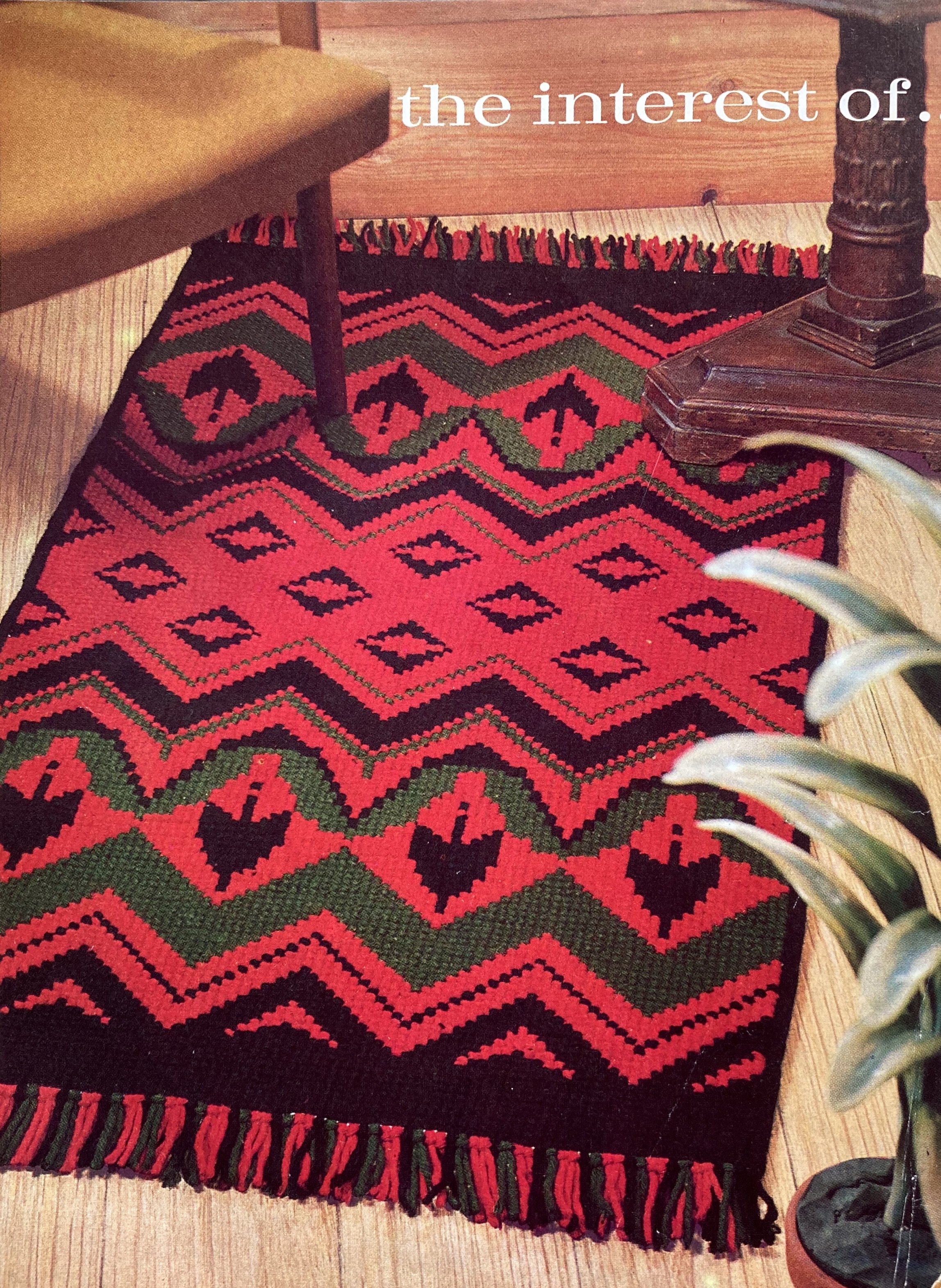
With all these great knitting designs, you’d think the homewares department would be skimpy, but they really went all-out on this issue: in addition to the usual cushions, stool-tops and chairbacks in huckaback work or tapestry, there’s a bold red-and-green “traditional Austrian” rug photographed in colour (notice how a traditional Austrian design is not called “peasant”, interesting…)

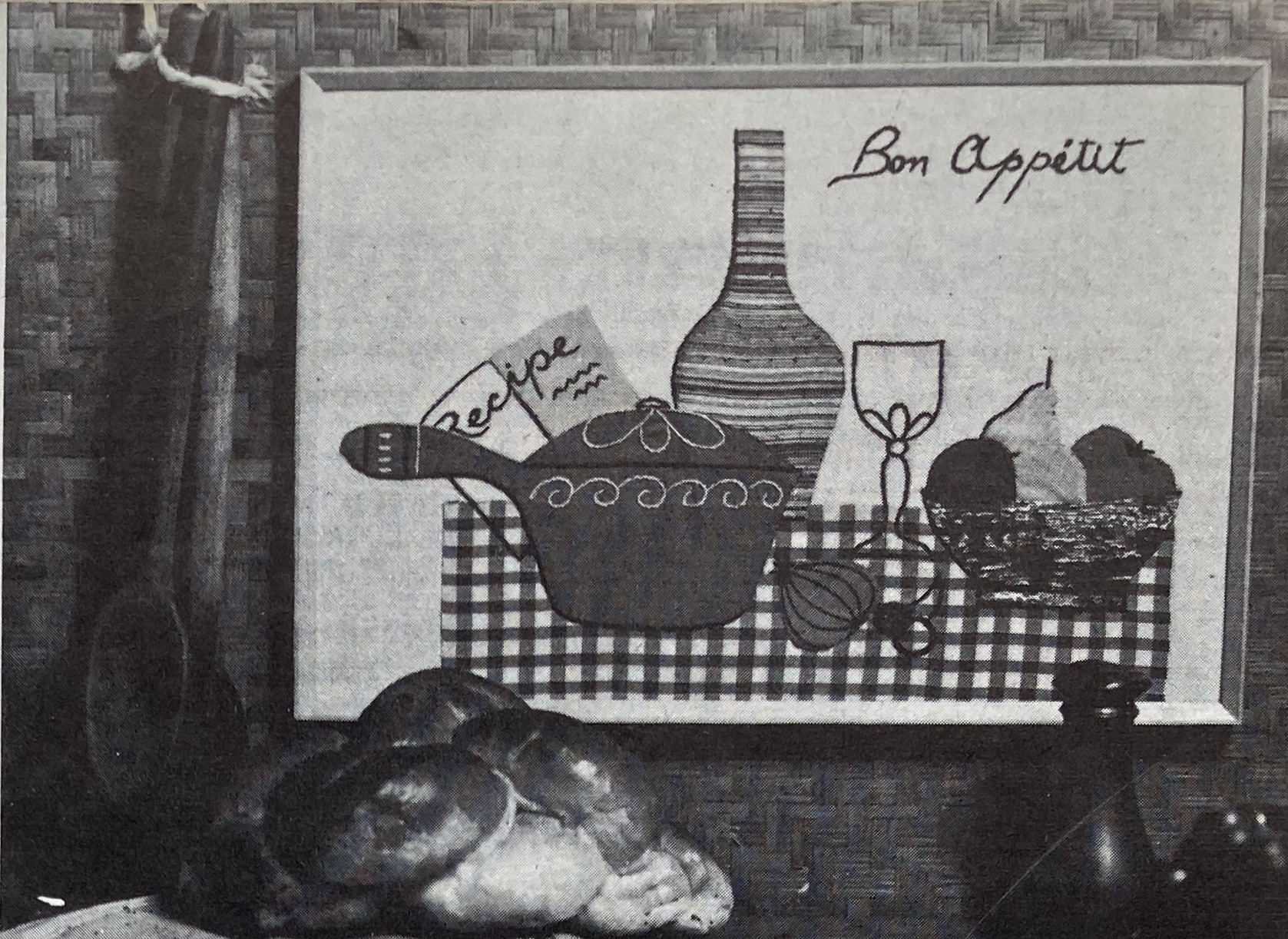
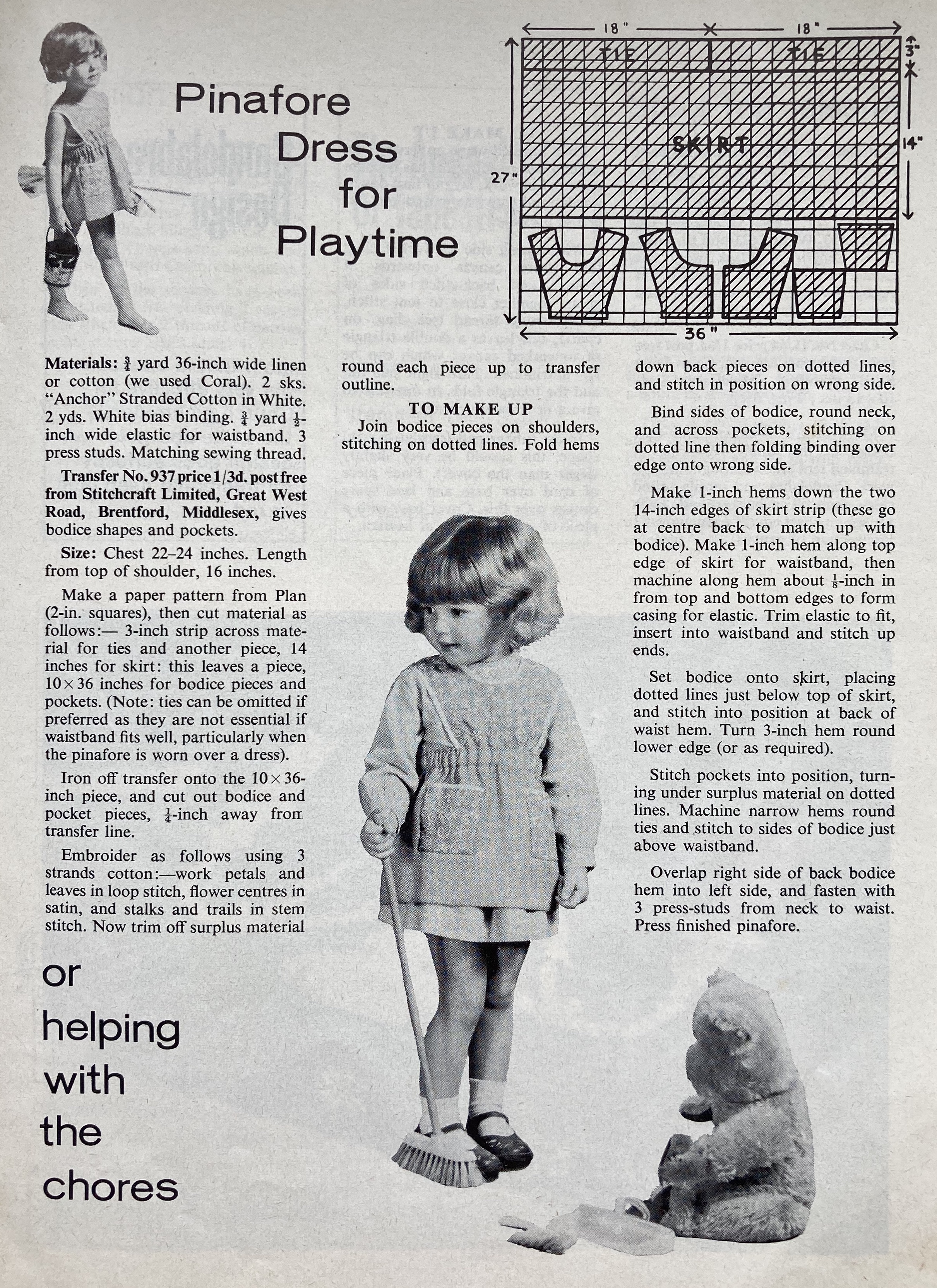
… and an appliquéd wall picture with a “kitchen”-themed design. Do I have terrible taste if I admit that I love this wall hanging? It’s utterly kitschy and very 1960s! There’s a little sewing design as well, for a child’s pinafore smock… “for playtime or helping with the chores.” Beware, little girl, that feminine look comes with its own designated activities.

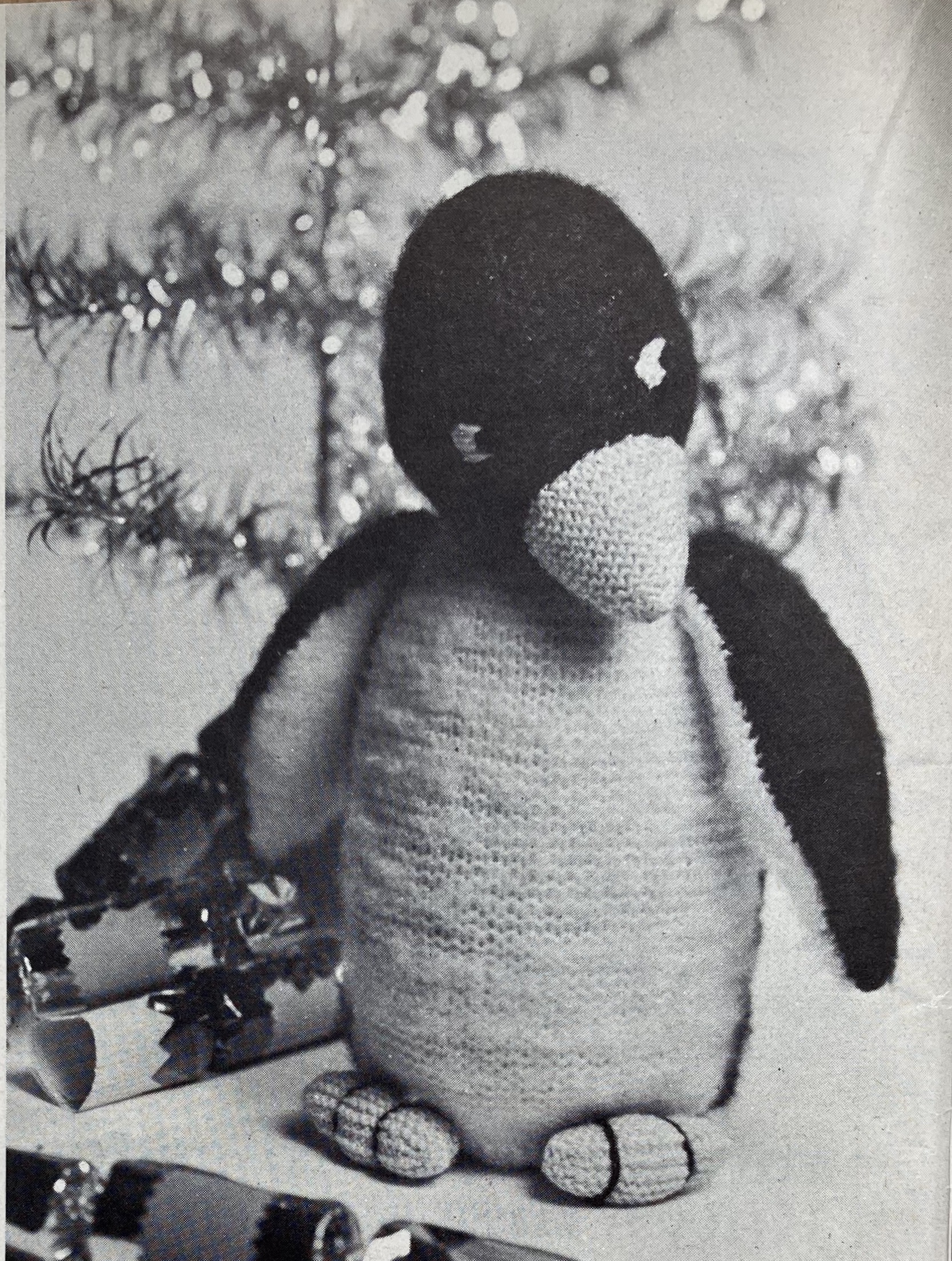
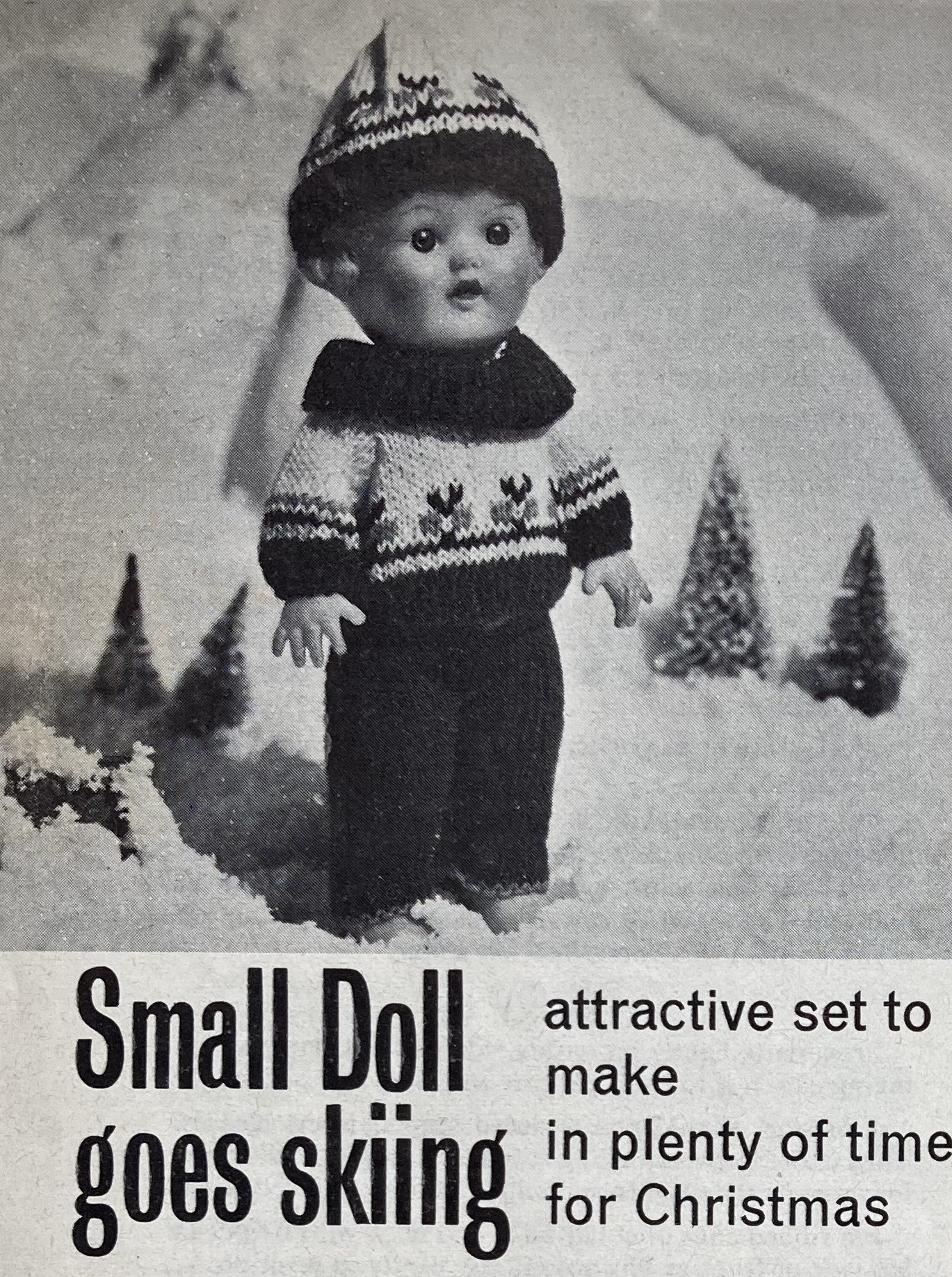
And don’t forget the “novelties”, which are not quite as weird in this month’s issue as we have seen in other issues. There’s a little stuffed penguin toy with very funny feet, and a night-case in the shape of a knitted duck. There’s also a winter ski set for a doll, with ski-pants and a warm stranded pullover and cap. (If the doll looks a little worried and not quite warm and comfortable, it’s probably because it’s standing barefoot in the snow.)

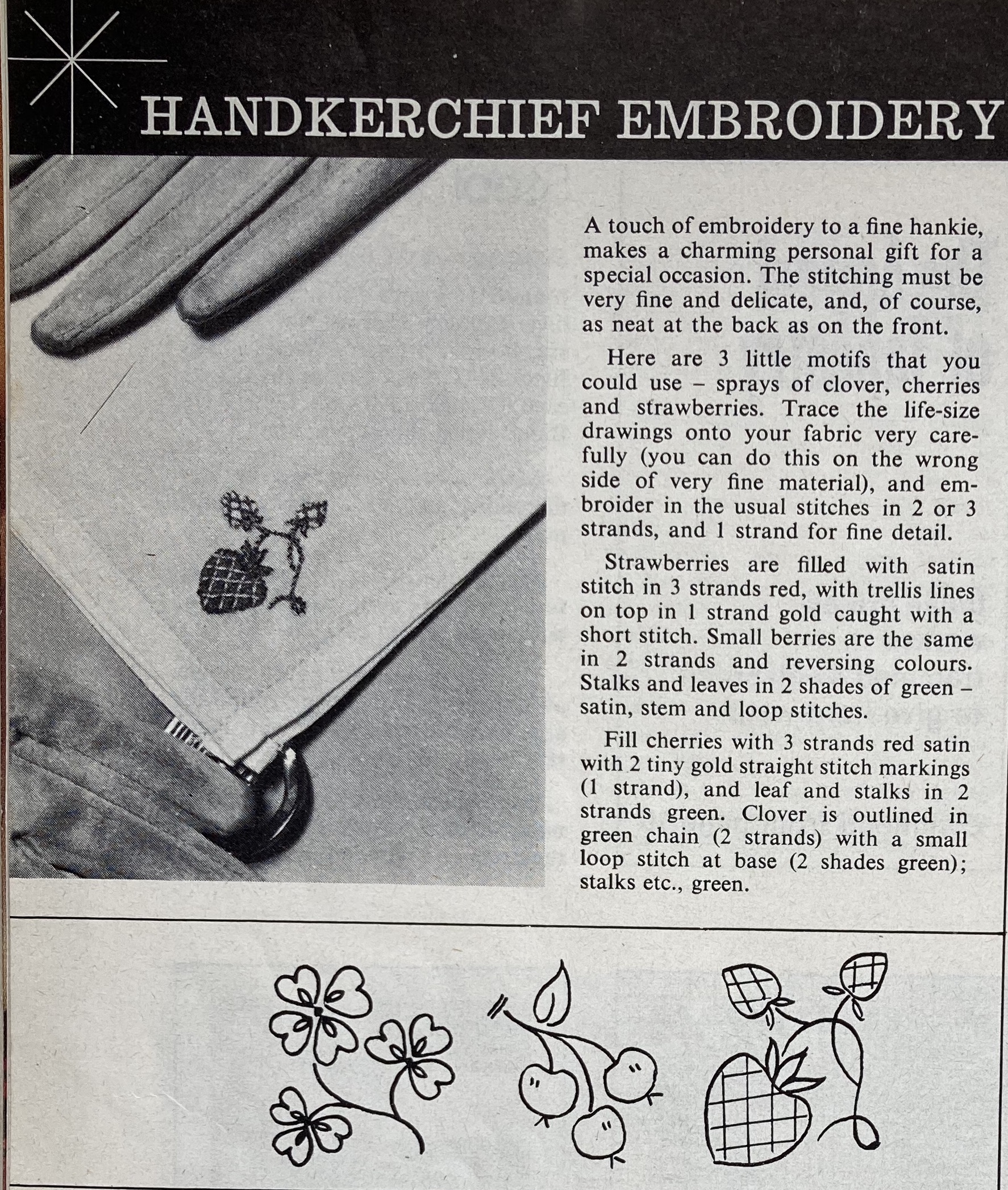
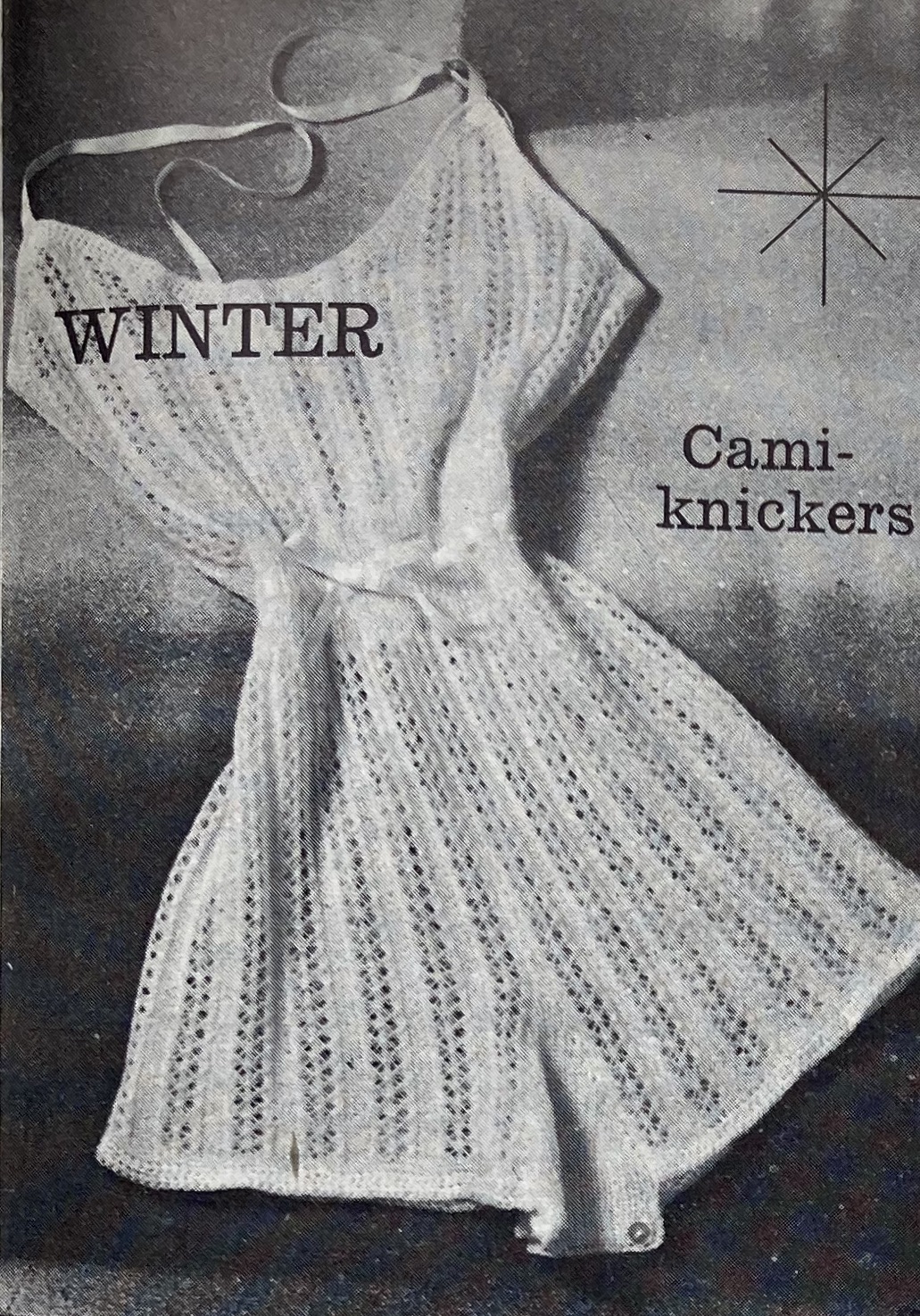
But that’s not all! In addition to the usual comic (Anne learns how to embroider an owl and a swallow using different embroidery stitches), the “Readers’ Pages” in the back of the magazine have a reprint of a 1944 knitting pattern for warm “cami-knickers” underwear, and some dainty stencils to embroider onto handkerchiefs. I love embroidered handkerchiefs, having inherited some beautiful ones from my grandmother and occasionally bought more on ebay. If I ever find any plain new ones to buy (shouldn’t be that difficult), I could try my hand at embroidering them myself.

The handkerchiefs, cami-knickers and even the cheesy appliqué picture all appeal to me, but I love the cabled knit dress most of all, so that will be my October project. I can’t imagine it will be done by the end of October, but I have already bought wool and made a swatch and am just starting casting on, so I’ll post about it soon when there’s something to see and write about.

Till then, happy Autumn!

September 1964: Overview

It’s the start of the autumn knitting season, and this issue’s slogan is “Knitting in Full Swing”. There are practical garments for adults and various ages of children, as well as a new yarn: Patons Flair.

Flair” is somewhat heavier than DK weight — what is now often called “worsted” — and made of 60% wool and 40% “Courtelle“, a synthetic fibre pioneered in the late 1950s by the Courtaulds company. It features in the green cardigan and the yellow star-motif pullover on the cover. I love the cardigan, with its bright green colour and use of simple garter-stitch ribs and bobbles to decorate the fronts. The placement of the motifs on the yellow pullover is… interesting. I guess it works OK on a male figure, but I would not recommend it for a partner look! There’s also a plain, classic V-neck pullover for him and a “blister stitch” sweater for her on the back cover. Bright, cheerful colours are in fashion. (The men’s V-neck pullover colour name is “Sorrento” — anyone know what colour it is?)

The non-Flair adult garments are all made in DK weight yarn: a “country sweater” in a twisted-rib pattern with an oversized Vandyke collar, a complicated cable-and-stripe men’s shirt-style pullover, an elegant set of slim skirt and “overblouse” and a long, skinny sweater “for teens”. All of them feature interesting stitch textures, particularly twisted-rib patterns and bobbles, and interesting details like the fake “pocket” decorations on the front of the overblouse. The cable-and-stripe pattern is especially complex and uses separate lengths of wool for the vertical twisted ribs while stranding the stripe colours behind. Aside from the teen sweater in “Flamingo”, the colours are slightly subtler, with light “Cream Whip” and dark “Loganberry” for the base colours (sounds delicious) and accents of light blue, olive green and melon-orange.

For the younger members of the family, there’s a fun and cheerful five-piece set “for twins”, consisting of a skirt, shorts with braces, a short-sleeved jumper, cardigan and beret. They’re all made in DK wool in a similar bright, sunny yellow to the man’s pullover on the cover. Continuing the matching-set-for-babies look, this month’s issue has a dress and bootees for a six-month-old, to be followed by a matching matinee coat and bonnet in next month’s issue.

With all these lovely things to knit, it’s amazing that there are any homeware projects in the issue at all, but there are always a few utilitarian projects: here, an easy cushion / tray cloth or a thick rug or mat for kitchen or bathroom. For more ambitious embroideresses, there’s a tablecloth or cushion in bright “peasant” design (Stitchcraft‘s choice of word for traditional or folk designs from certain countries and not from others; I do wish they would just call them all “traditional designs” and leave it at that). The design, like the knitted garments, is big and bold and fun and colourful on the cushion, and slightly more subdued in red and blue for the tablecloth.

Though embroidery doesn’t feature big in the issue’s projects, it does have a place in the back pages: in the new children’s comic, “Anne and her Embroidery”, little Anne is bored on a rainy day and passes the time by learning to embroider pictures of the flowers in her window-box. Two pages later, there’s a full-page advertisement for a new tapisserie wool suitable for both tapestry and embroidery. Coincidence? I think not! The other interesting ad is for the new Patons Flair yarn, highlighting its easy care and washability.

That’s all for this issue! My project will be the embroidered cushion.

Blast from the Past: October 1956

This month’s blog project was a bit different than planned. The August 1964 issue didn’t have any projects that particularly called to me. There was a nice baby set of “vest and pilch”, but I didn’t know anyone who was having a baby soon… or did I? In fact, I did know that a friend of mine was expecting twins, but we hadn’t seen each other for a while and unfortunately that fact slipped my mind until the babies were almost due! At which point I could have made two vest-and-pilch sets, but I wanted to get the project done quickly and also destash some yarn that was more suitable for a top/middle layer than to be worn right next to delicate baby skin.

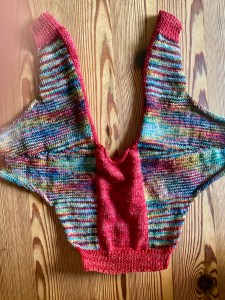
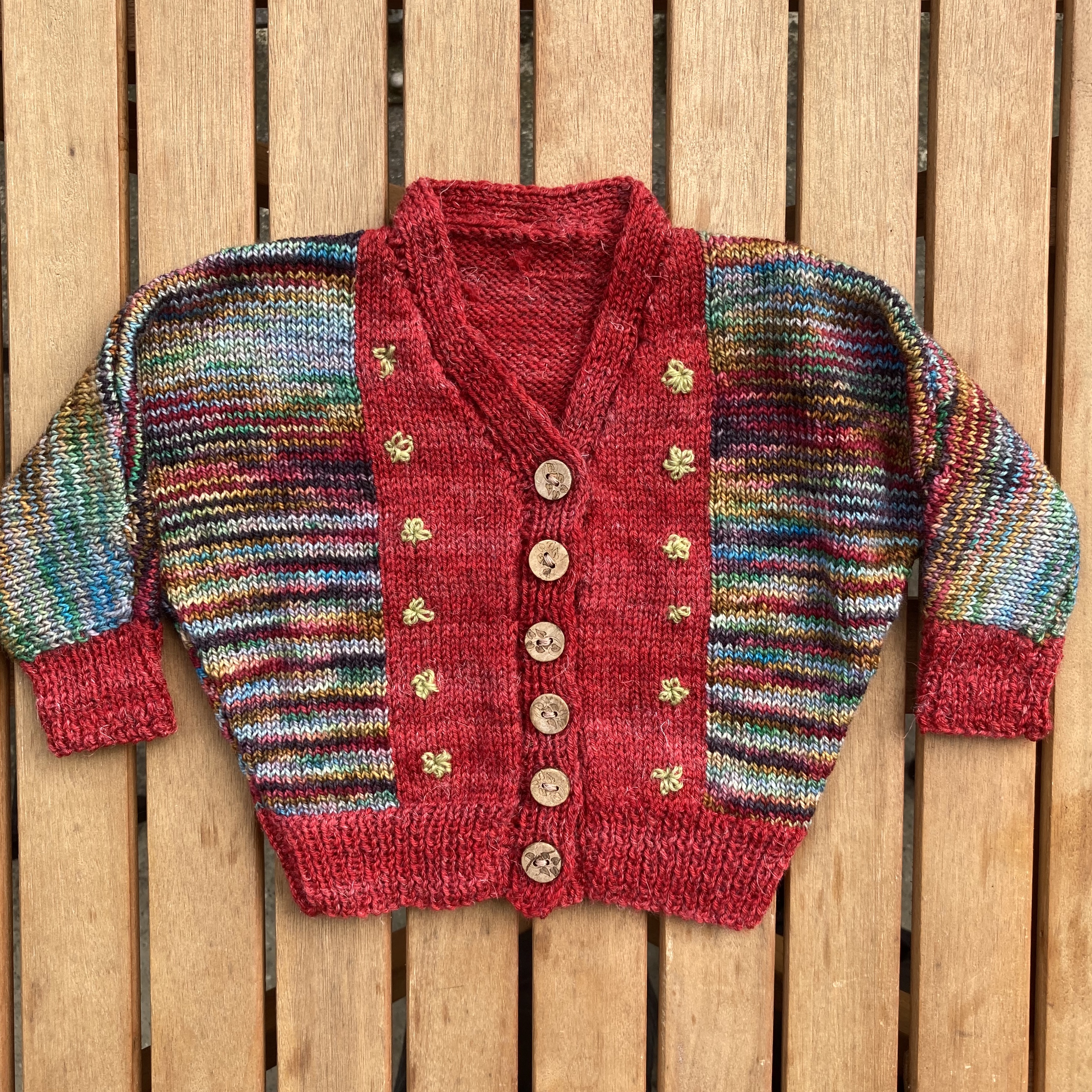
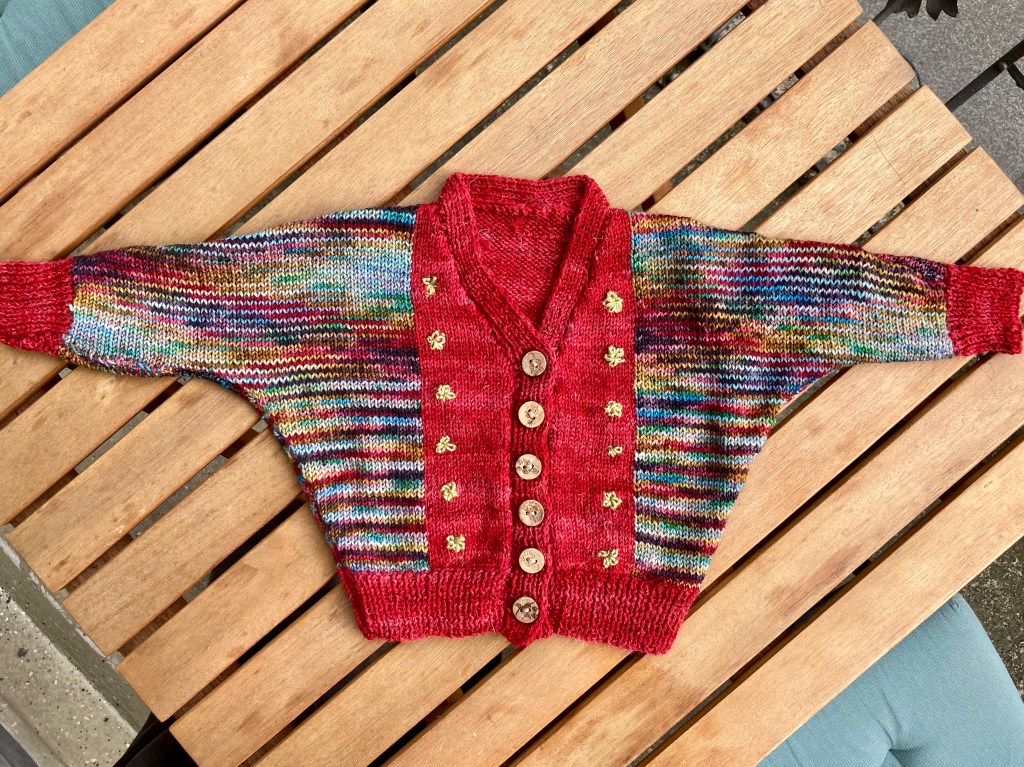
I decided to make two similar, but non-identical cardigans and opted to make one without a pattern and one from this pattern for a dolman-sleeve cardigan from Stitchcraft‘s October 1956 issue. The use of two block colours made it a good choice for the two yarns I wanted to use, and the embroidery was a cute touch.

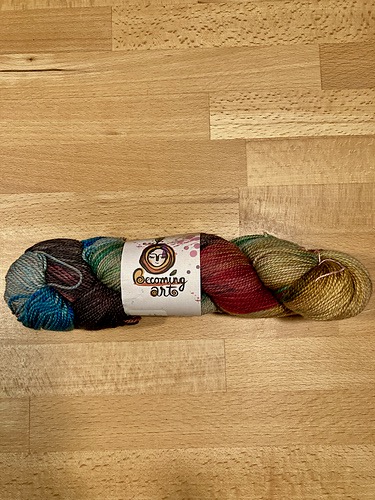
The pattern calls for Patons Beehive 3-ply Baby Wool at a tension of 8 stitches to the inch for a cardigan that is 19 inches around the underarms. My wools were Becoming Art Cielo fingering in the colour combination “Carousel” (multi) and Schöppel Admiral Hanf in red — admittedly not a very vintage colour combination or standard baby-pastel, but I like knitting bright colours for babies, and the mother’s favourite colour to wear is red, so I loved it.

Both wools were gifts — the Admiral Hanf from my knitting group’s holiday “secret Santa” and the Cielo Carousel a prize from the last KAL at the All Things Vintage forum on Ravelry. “Hanf” is German for hemp, which makes up 10% of the red yarn and gives it strength and durability. It’s not scratchy, but also not super-soft. The Cielo fingering is delightfully springy and squishy. I got 6.5 stitches to the inch with each of them on 3 mm needles, but saw no need to change the pattern, as a larger cardigan would be more practical for autumn/winter wear, when the babies will be bigger and wear more clothing underneath.

The cardigan is knit from the bottom up in three pieces — back and two fronts, with the sleeves cast on horizontally. The colour-block effect is made by using separate balls of wool and twisting them together at the colour change, intarsia-style. I made both the fronts together with separate balls of yarn on one needle to insure symmetry. The cuff ribbing is picked up and knit in rib after the main pieces are done and the front button bands are knitted separately and vertically in rib and sewn on. (I’m not a fan of this type of button band and would just as soon have knitted the bands together with the fronts, even if technically they’re supposed to be made on a smaller needle.)

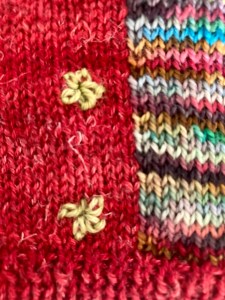
The little flowers on the fronts are embroidered on in loop stitch after everything else is finished. It was surprisingly difficult to get all the “petals” to be the same size and distributed evenly around the centre. Perhaps I should have made them larger. I’m always happy to practice embroidery on knitting, since I think it looks really cool, but it continues to be a challenge. The wool is a bit of leftover Onion Nettle Sock yarn.

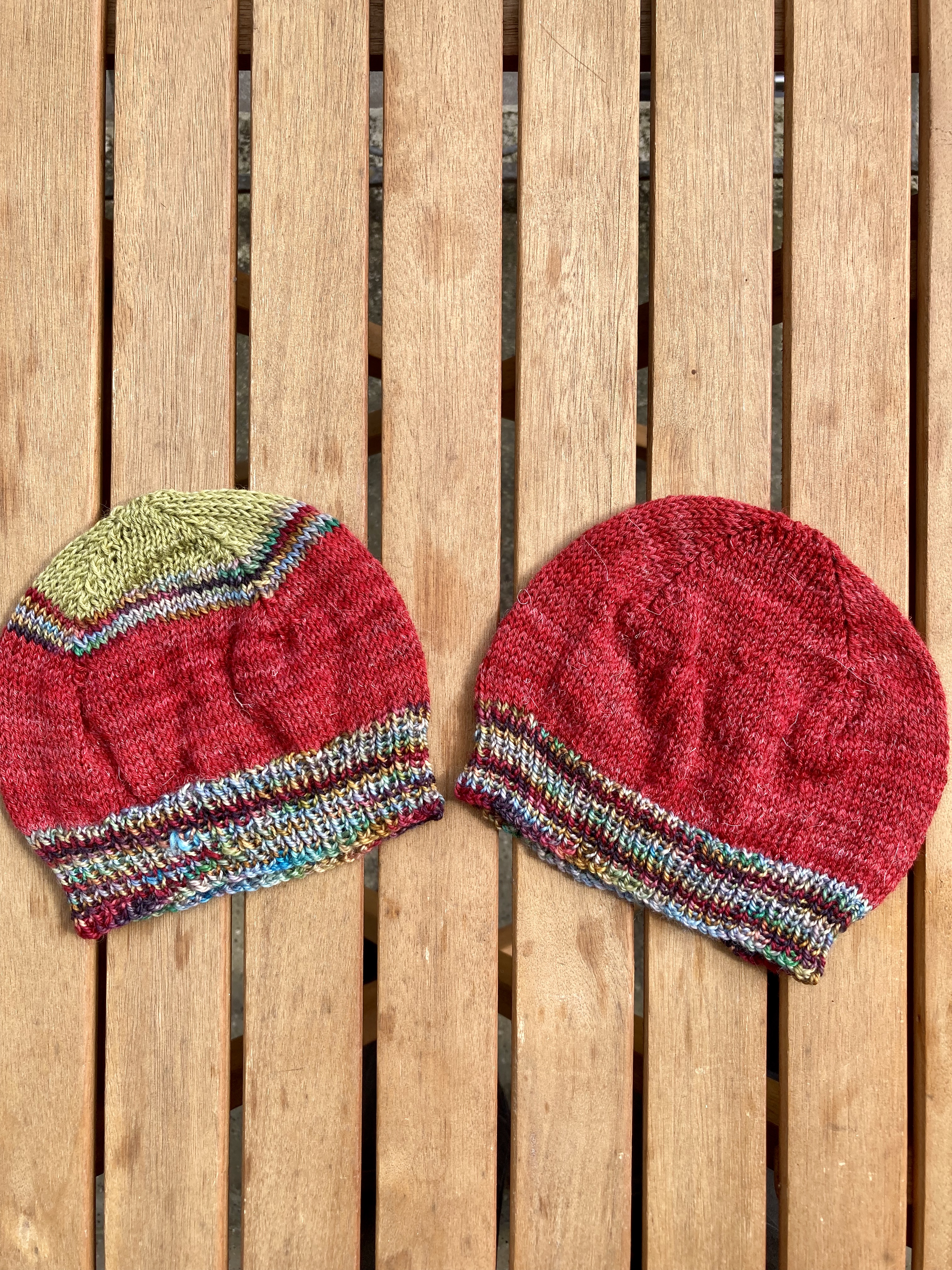
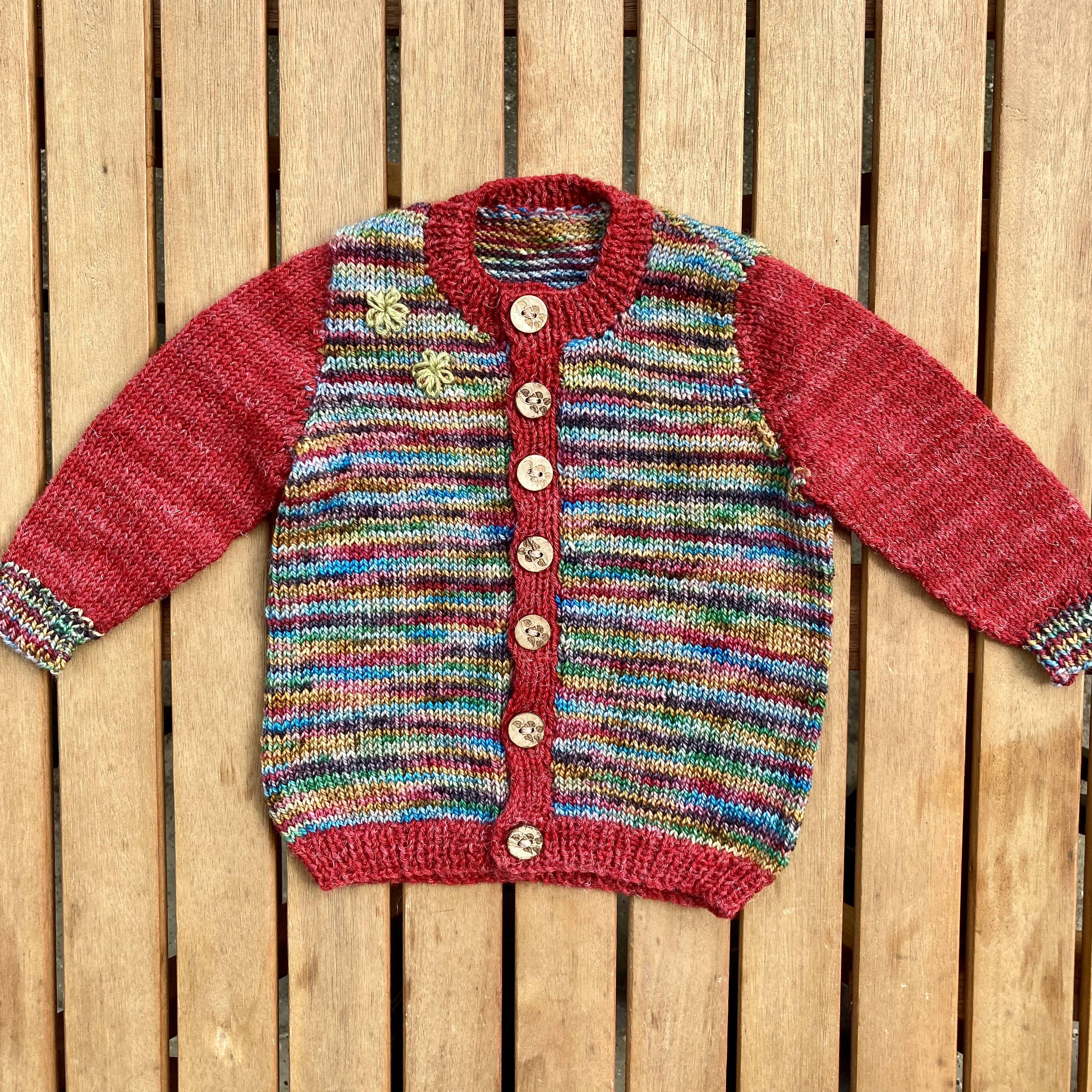
One 100 gram skein of the multi-colour wool and one 50 g ball of the red were enough to make this cardigan, another “fraternal” cardigan (plain crew-neck with set-in sleeves) made without pattern using the multi-colour yarn for the body and the red for the sleeves and ribbing, and almost two hats with multi-colour ribbing and a red body. The crown of one hat was finished in the green Onion sock, which I also used to embroider two larger flowers near one shoulder of the no-pattern cardigan.

I loved the dolman pattern and will surely use it again for another baby. I love the similar, but not identical cardigans for (fraternal) twins. I love matching hats and cardigans. I love the bright colours! And I think these sets will be very useful for the twins and make the parents happy.

March 1964: Overview

Greetings from Kent from your March 1964 issue of Stitchcraft, featuring “Spring Into Summer Fashions” photographed in “some of your favourite spots around Canterbury and Tunbridge Wells” so that you can see the knitwear “in their own settings as you would wear them.” Shall we go?

“For our climate”, writes editress Patience Horne, the best outfit for the spring and early summer months is a sweater suit, quickly knitted in double knitting wool. Cool blues, salmon pink and yellow-green are the trendy colours, and pattern stitches are used sparingly as an accent on hems or collars, or as a single vertical stripe panel.

Our cover model is wearing a twin set with a trellis pattern accent on the cuffs, pockets and collar of the jacket and the hem of the short-sleeved jumper underneath. Here, again, we see how twin-set styles have changed since the 1940s — everything is long, loosely-fitting and unshaped. The “Golden Willow” sweater suit on the inside front cover is similarly unfitted, with a cable “V” pattern stripe. For “The Creamy Look”, there’s a a high-buttoning cardigan with a subtle diamond pattern on the fronts. All three models are made in “Double Quick” knitting.

“Double Quick” is also the featured wool for the men’s and women’s “sport sweaters” in the lovely full-color center photo. I’m not sure what makes those two garments more “sporty”, as they look equally as elegant as anything else in the issue. His sweater is worked in stranded technique from a chart included in the instructions, and hers is made in plain stripes with the diamond pattern embroidered on later in Swiss darning / duplicate stitch. If “Double Quick” is not bulky enough for you, there are matching sports sweaters for him and her made in bulky “Big Ben” at 3 1/2 stitches to the inch. The salmon-pink jumper (Stitchcraft calls is a “sweater blouse”), by contrast, is made in 4-ply wool in a classic shape, with pattern accent panels in an interesting mini-bobble stitch.

Babies get a wonderful pram set of footed leggings, coat and matching bonnet. It’s referred to in the index as a “four-piece” set, but I am at a loss to find a fourth piece anywhere in the instructions or photos. Maybe they planned to make matching mittens and then didn’t? Bigger children get a cute slipover with an argyle pattern on the front. The photo is very 1960s, with the girl freezing her legs off in a micro-mini skirt and the boy sporting a bow tie.

The homewares are fairly standard: a tea cosy, apron and tray set and a knitted kangaroo with baby for your bizarre/bazaar novelty needs (there’s also a reprint of a 1956 knitted ice-skating panda bear doll, if the kangaroo isn’t enough for you.) You can also cross-stitch a rug and pyjama case with square-headed dancing soldiers to haunt your small son’s dreams, or some flowered place mats, a cushion or wall hanging, or another cushion inspired from a traditional Greek star design.

In the “Readers Pages”, a new serial comic is starting: “Susan’s Sampler”, in which our heroine learns embroidery from a magic needle, and our back cover ad (for Patons Double Quick Knitting wool) shows yet another woman lovingly looking up at a man who has trapped her with her back to the wall in order to mansplain something to her. Feel free to give the photo some speech bubbles befitting a modern interpretation of this scenario!

That’s all for this issue. I’ll be making the child’s slipover and for once, I’m quite sure it will be done on time. Happy Spring!

November 1963: Overview

The autumn months are always the best for knitting magazines, with a mixture of heavy garments for colder days, easy-to-make holiday gifts, warm accessories and a few glamorous items for parties. Stitchcraft‘s November 1963 issue puts the focus on “warm family fashions… with the emphasis on colour and attractive textures that are interesting to knit and very becoming to wear”. There’s something for family members of every age and “for the petite to the not-so-slim.” The homewares and little projects are quick and fun to be finished in time for holiday decorating and/or gift-giving.

The “country jacket” on the cover continues the tweedy, variegated colour effect in fashion this fall, using Bracken Tweed wool for the main body and Totem DK for the collar and cuffs. I finally know what colour Totem “Oakapple” is! The other women’s outdoor-wear fashions include a zip-neck sweater with textured pattern bands in turquoise, an “overpull” with cabled neckline in flecked “Cantaloupe” colour (sadly, no colour photo, I have no idea how it looked in real life) and a simple brown top made glamorous by knitting the wool (Cameo Crepe 4-ply) together with a strand of sparkly Lurex thread. There’s also a warm, soft cape for winter reading in bed, knitted sideways in an easy zig-zag pattern. Aside from the green and white bedcape, shades of autumn brown as well as bold blues and red are the season’s trendy colours. Stripes, zig-zags and textures complete the Autumn 1963 look.

Men’s fashions are just as colourful as the women’s, or even more so (less use of plain brown…) and show more of the zig-zag trend. Here are some bold designs for “him and her” using bulky Big Ben wool (and photographed in front of…). The construction is the same for both, with the smaller design for bust sizes 33-35 inches and the larger for 39-41 inches, with the advice that “Plumper girls could follow his size”. The man’s pullover in “Italian colouring” uses stripes and textures, toned down by the use of more neutral colours. The blue-and-white cabled sweater in the photo next to it is for teenagers.

School-age children get their own “tough, tomboy sweaters” in Bracken Tweed wool. The suggested colours are “Black Olive” or “Gorse Heath”, which I assume is a sort of green-yellow tweed (no colour photo). Babies get a lovely shawl to match the layette from the September and October issues. It’s easy to knit, as the centre and borders are made separately. The other baby/nursery-age items are crocheted, sewn or stitched: a pram cover with a teddy-bear motif, a little nightcase with fluffy appliquéd kittens, a knitted doll, an embroidered “feeder”, sewn and appliquéd pinafore smocks…

There are fewer designs for accessories, but the utter fabulousness of this loop-stitch crocheted hat makes up for anything else that could be missing. The model in the photo features in many issues from this time period and always looks either quite sad or has that alluring Mona Lisa smile that’s she’s sporting here. (Am I mean, or wrong, to assume that she probably had bad teeth?) I would smile widely if wearing that hat, and I hope everyone who saw me in it would too. Also, knit your man a tie!

With all this bounty, the homewares are mostly standard: embroidered table mats and a Christmas-design tablecloth, a decorative panel with the Star of Bethlehem for more religiously-minded households, and a very impressive tatted doily and crocheted trolley-mat. The show-stopper is a lovely decorative panel “taken from a book of Oriental designs” embroidered in Filoselle silk on linen. (The design is allegedly of Persian origin, though of course neither Stitchcraft nor its typical readers of the time gave much thought to questions of authenticity, nomenclature, exoticism or any related issues that we would regard and discuss today.) It is a pretty picture in any case, and was probably not too difficult to embroider, consisting mostly of standard seed and straight stitches, French knots, and so on.

That’s all for this issue! I am going to make that wonderfully ridiculous hat.