EDIT December 19th, 2023: Finished!
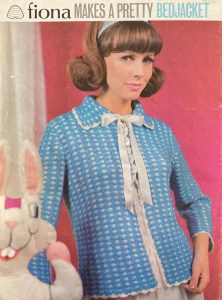
It’s been another month of much knitting and comparatively little to show for it. There was a wonderful bed-jacket in a cute, spongy slip-stitch pattern in the November 1965 issue that I very much wanted to make. I thought I had the perfect yarn (DROPS Lima) and chose green and black for the colours — very much my taste — and started on a swatch to better understand the stitch pattern. I made it correctly, but it didn’t look good. I tried with different wool and different colours. Still didn’t like it. The way the two colours played with each other didn’t harmonise and didn’t give the effect I wanted. I couldn’t make it work with the wools I had and didn’t want to make it in baby blue and white (I don’t wear white). On top of it all, I had a pile of endless WIPs at home and two pregnant colleagues, one whose baby was probably being born just in time for this blog post at the end of November, and another due in January. So I decided to put the bed jacket plans on ice and make some baby things instead.
For the November colleague, I made a simple baby blanket in thick cotton yarn of the “dishcloth” variety. The pattern wasn’t vintage — just the traditional crochet “American square” motif with white edge and different colour centres — but the yarn actually was! A couple of years ago, another colleague (not the pregnant one) had to clear out her mother-in-law’s flat after the elderly lady moved to a nursing home, and gave me a huge bag of yarns that had been left behind. In that sense, the blanket does have a vintage connection, though this type of craft cotton honestly hasn’t changed much in fifty years. Here’s the finished product:

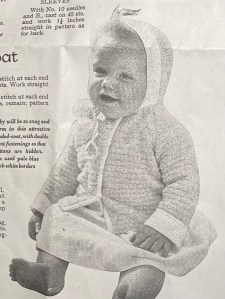
For the January baby, I looked through a few earlier Stitchcrafts from the 1950s, which often had the best baby patterns, and found an intriguing hooded “pram-coat” jacket from the October 1956 issue. I say “intriguing” because it had some unusual design aspects, like the front hem facings that fold under to make a hidden button band, the wide-edge hood and the turned-back-and-crocheted-on sleeve cuffs. I still had some light blue and white-ish Lana Grossa Meilenweit from the March 1964 Slipover for a Smart Tot — probably not enough for the whole jacket with hood, but I thought I might make the sleeves in dark blue (left over from the same project).

The stitch pattern is a nice basket-weave over 3+3 stitches, with 2 rows of stocking-stitch interspersed to even it out a bit. There isn’t supposed to be a hem at the bottom, but it curled so badly, even in the basket-weave pattern, that I picked up stitches from the cast-on and made one with a purl row for turning. Similarly, the sleeve cuffs were supposed to be knit separately, sewn on later, turned back and then crocheted over, but why so much effort? I made a hem the same way. Continuing in the spirit of saving time and energy, I made the fronts and back in one piece up to the armholes, the sleeves flat and two at a time on one needle, and the raglan yoke in one piece back and forth. There wasn’t enough light blue to even make the whole fronts and back, so I bought more to the whole thing in light blue, as in the pattern.
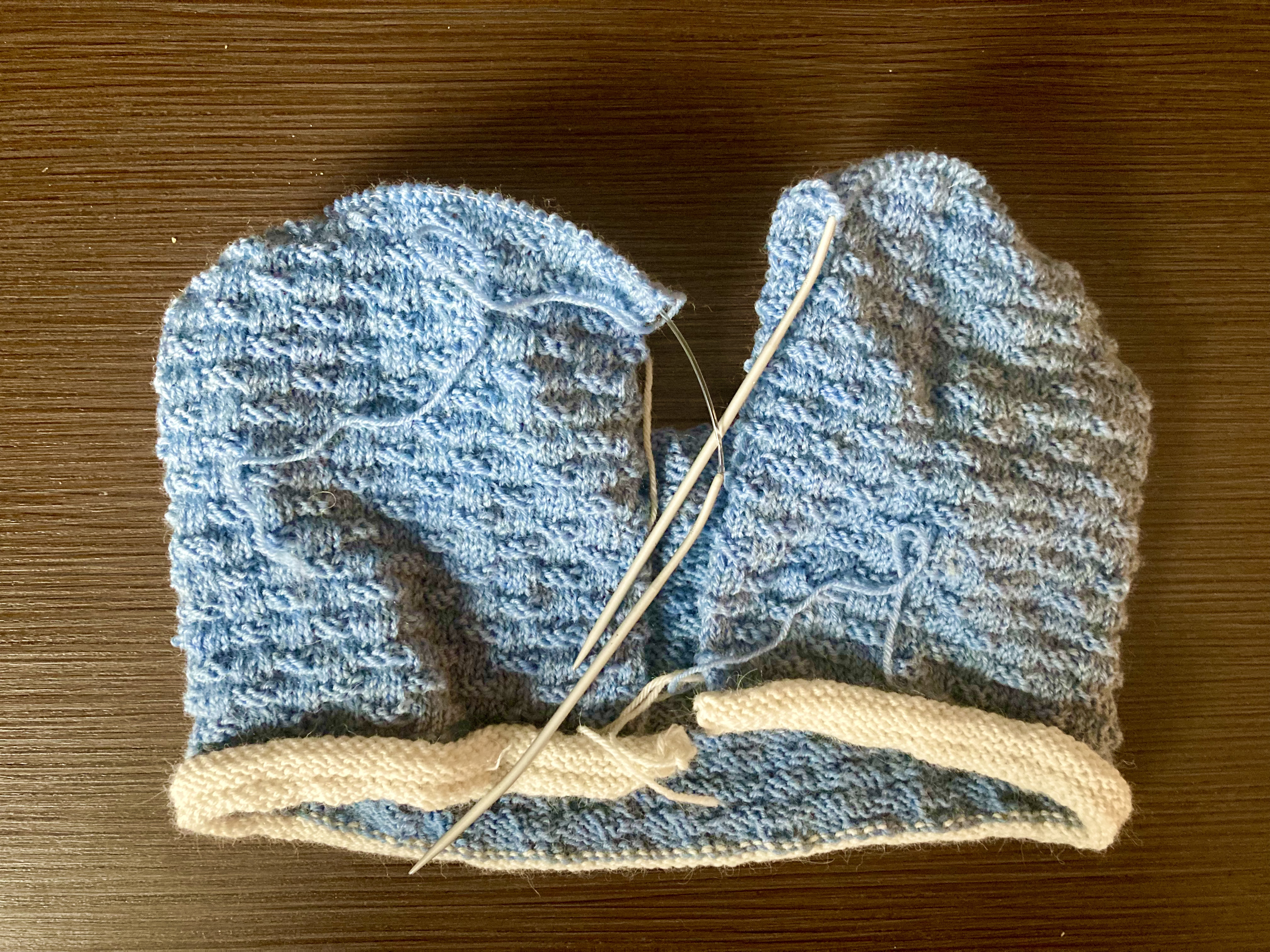
Of course it occurred to me, when halfway finished, that I could have made the bed-jacket pattern after all, just adjusted the size and yarn to fit a baby... and then it would have had the same colour scheme as the original, too. Too late! What can I say. My brain had been occupied with too many “real-life” things.
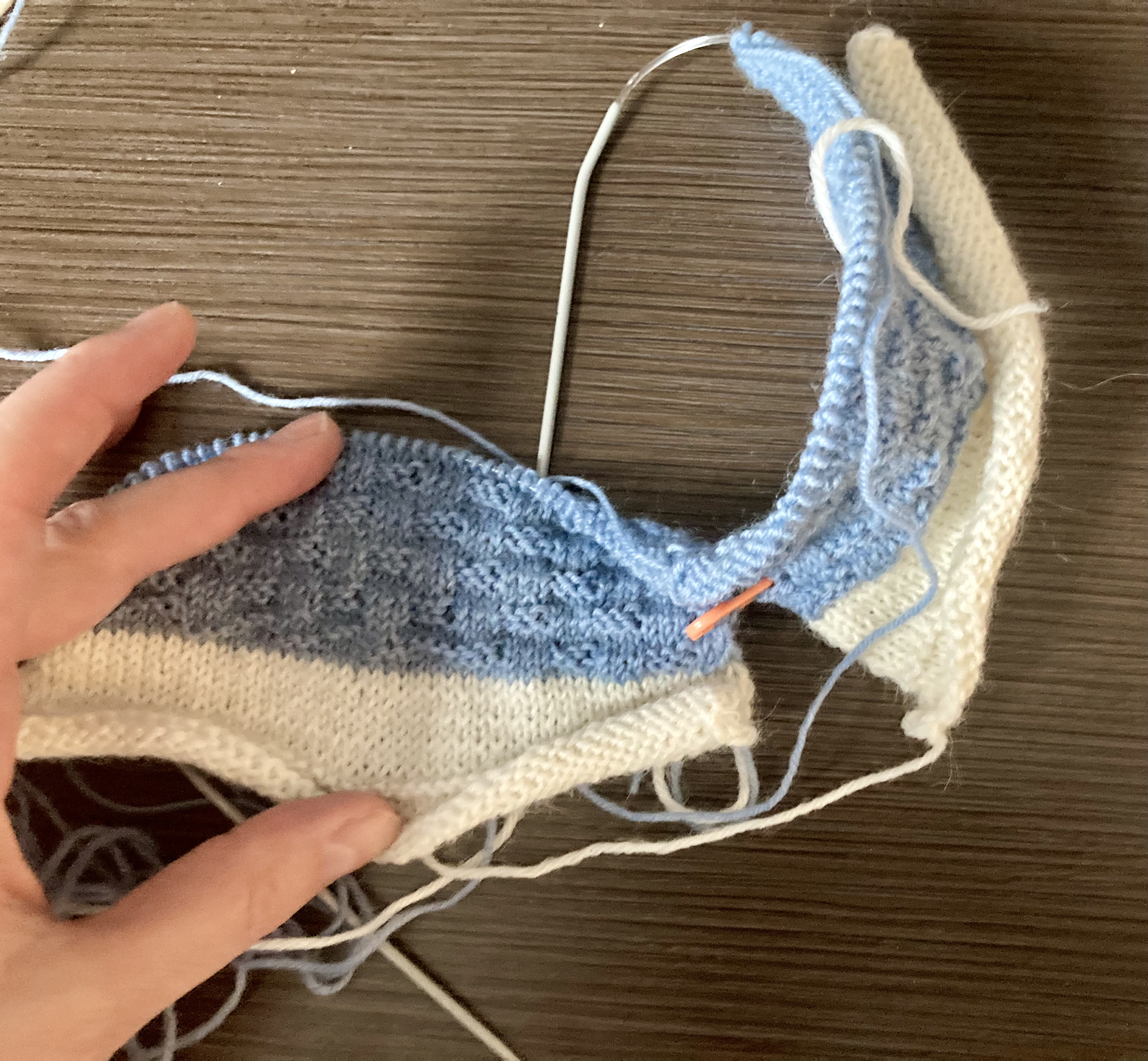
Part of those real-life things included a lot of work-related travel on trains, which has the advantage of giving me lots of time to knit — and the disadvantage of not being able to take good in-progress photos. Here are some of the jacket after completing the body and knitting the front bands, with a lovely background of train floor. The front bands are picked up and knitted horizontally in the usual way and folded under, so double thickness, and the buttonholes are only on the inside part of the fold, so that they are hidden when the jacket is buttoned. There are increases at the neck edge to make a sort of top facing in the front “corners” where the hood join ends.
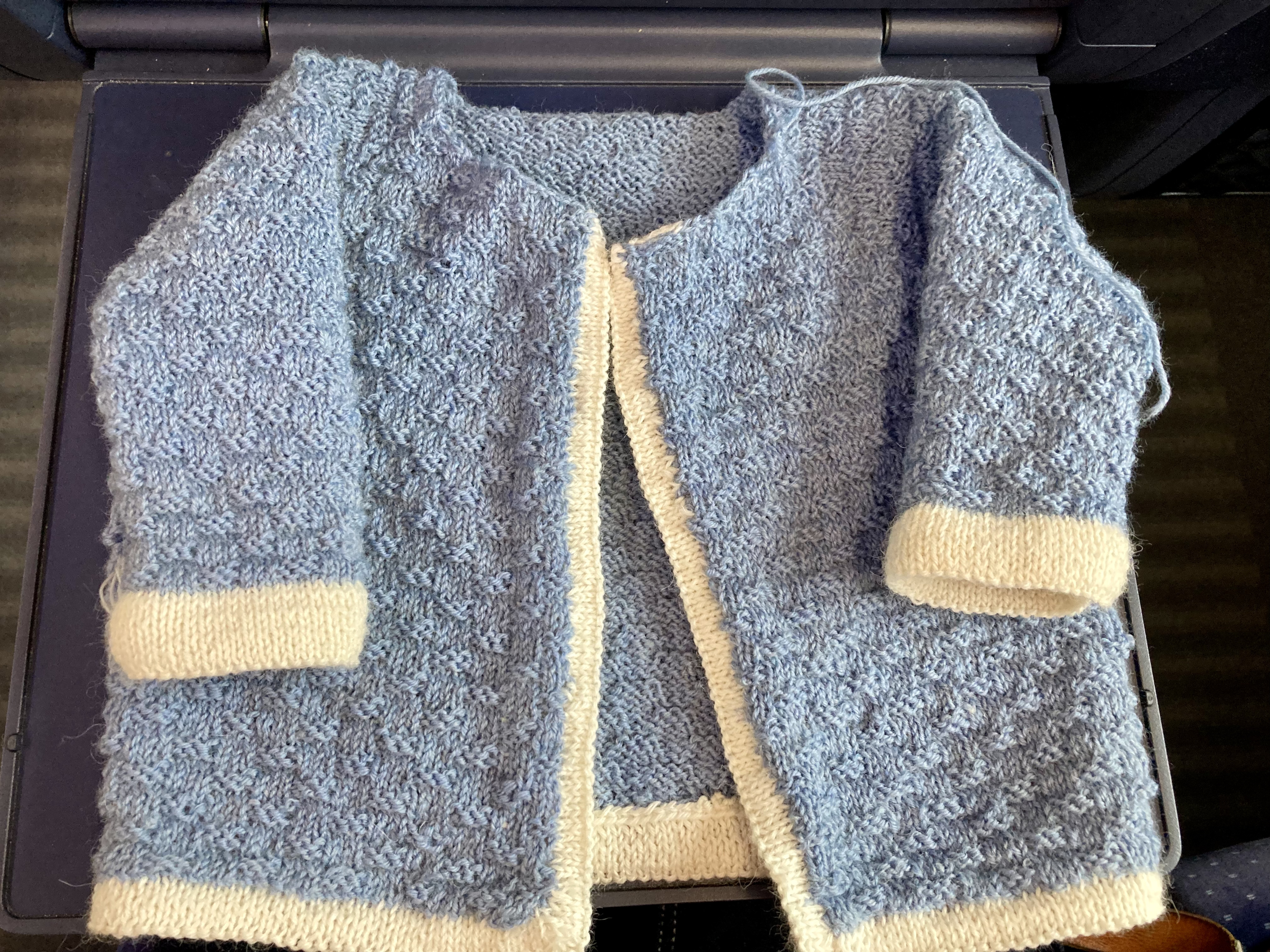
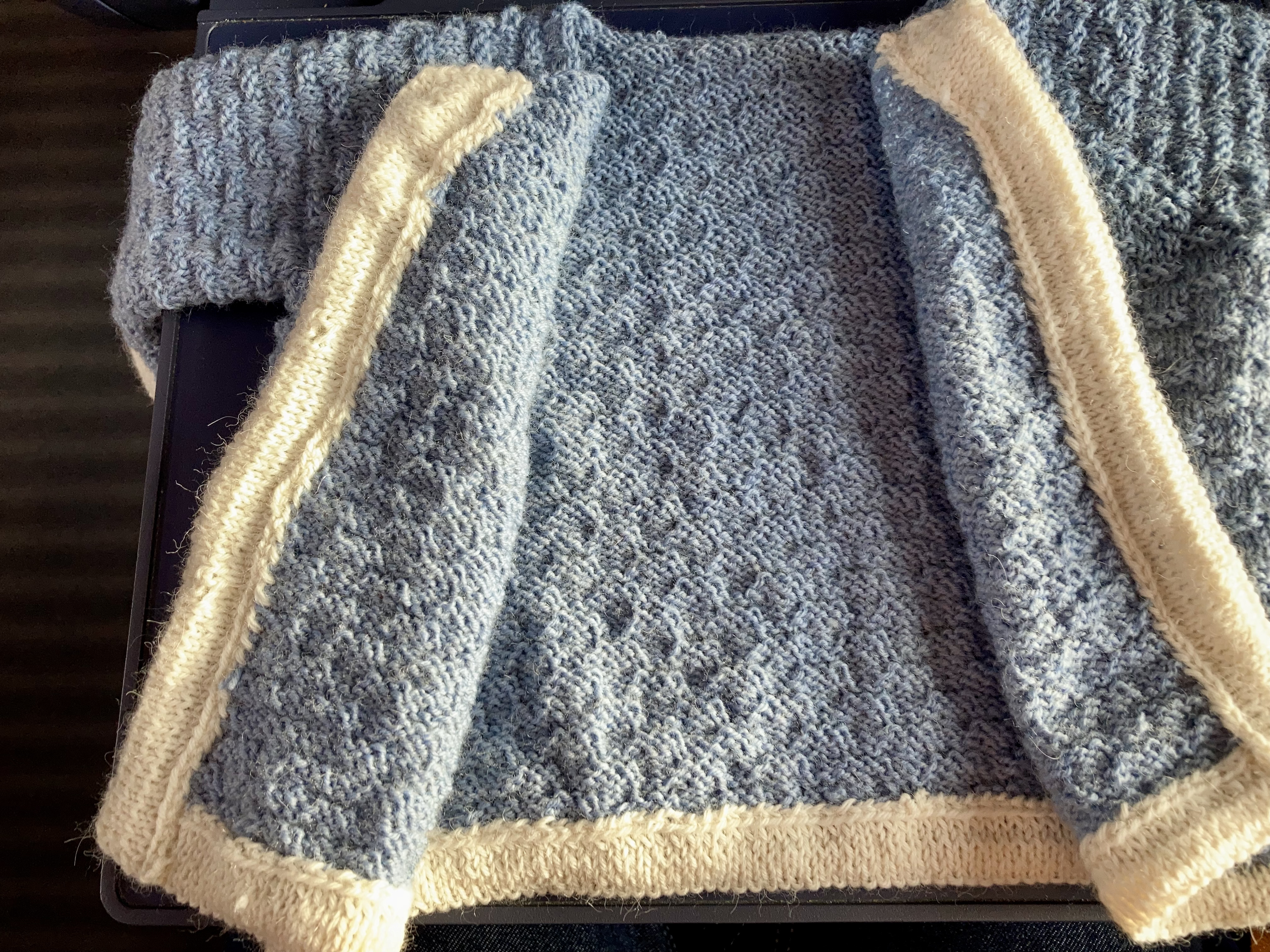
The hood is made in a separate piece from the brim to the neck, with short rows to round out the top part. Here again, the instructions said to make the hood in blue first and pick up for the facing later. I could have just cast on with white and made the facing first to avoid having to pick up along the cast-on edge later, but I was happy not to, since I had limited white wool — I ran out and had to switch to blue for the under-facing part (after the fold). That wasn’t a problem and the white wool remnant has now been successfully de-stashed.
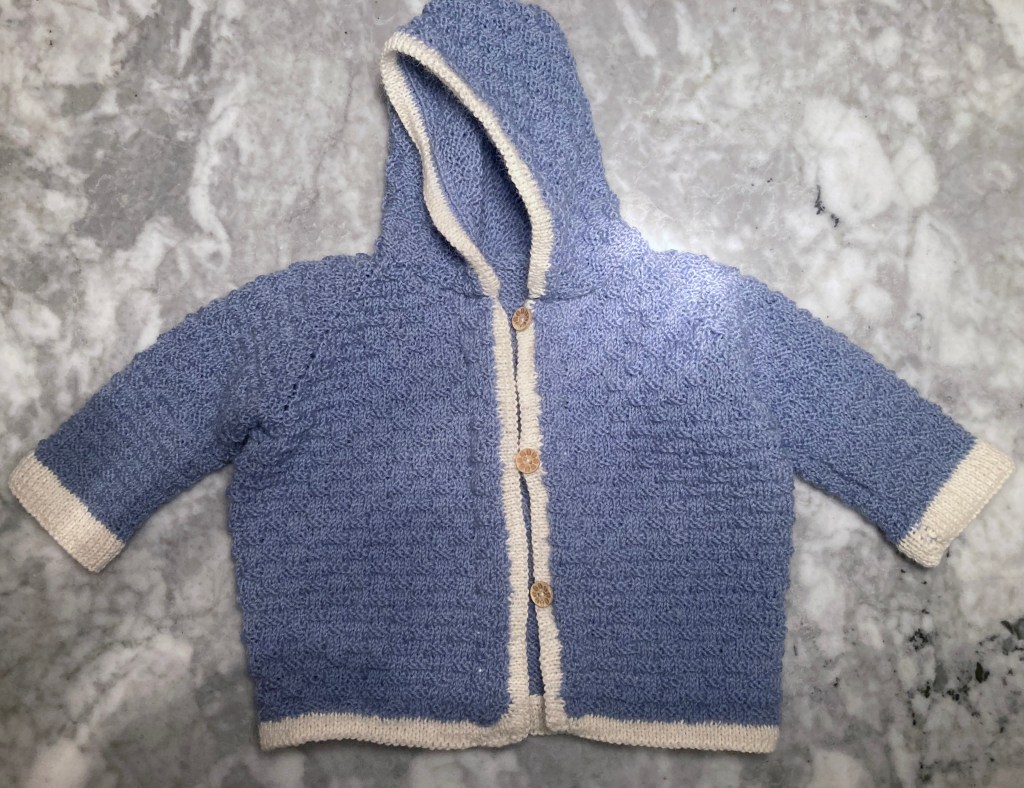
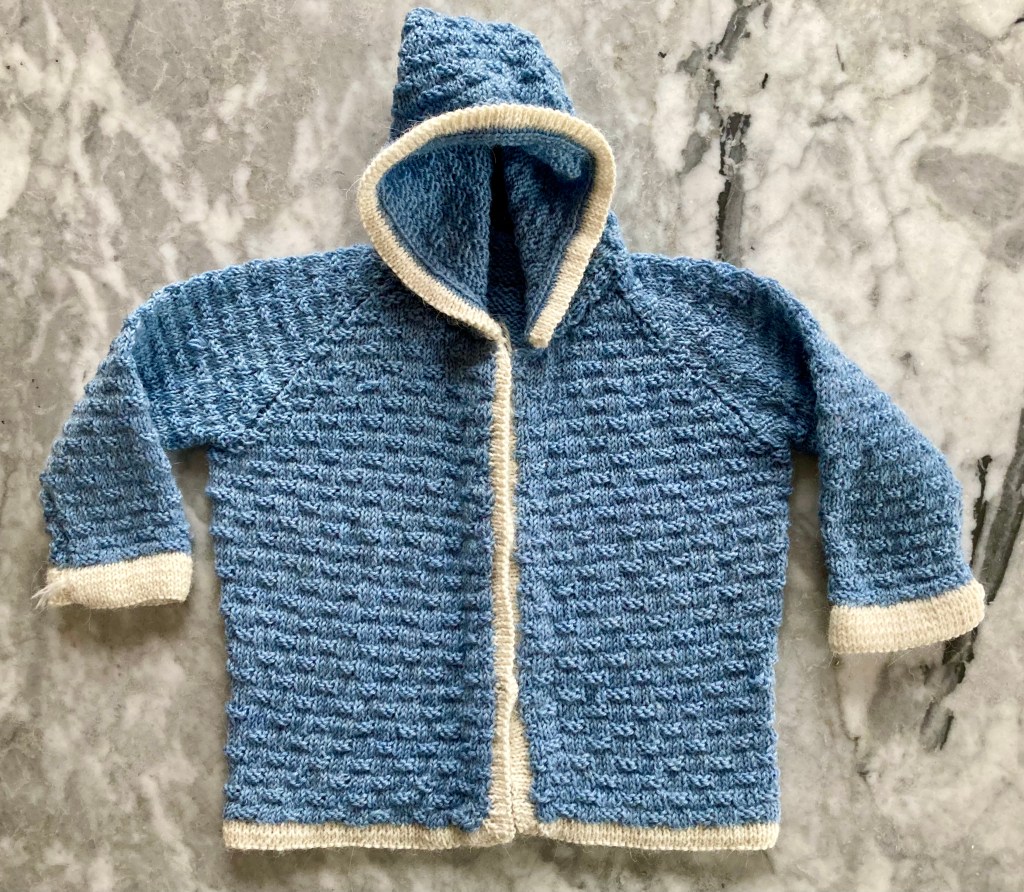
I added lightweight wooden buttons. The covered-button design didn’t really convince me, in the end, since I imagine it will be unnecessarily difficult to button up if the baby is squirming around, and the doubled facings are a little bulky even in 4-ply, fingering-weight wool. That said, the facings will put up with a good amount of wear and tear. The finished jacket is really cute and should fit a larger baby in the first few months as an “outdoor” pram jacket, or maybe a six-month old as a cover-up on cooler summer days.
I hope the my colleagues will be happy with this baby jacket! The mother is herself an expert knitter and seamstress, so the bar was set high. But I’m quite satisfied and I think they (and the baby, of course) will be too.

 I hang out a lot in the “All Things Vintage” forum on
 Adding to the frustration: as always, no matter how small the needles or how thin the wool, I could not knit tightly enough to get the minuscule gauge, which itself was only given as a “life-size” photograph in the pattern. Of course, I am also larger than the 34-35 inch bust given in the pattern, but how much larger the garment, calibrated for how much larger the gauge? Right, lots of calculations, estimations, measurements upon measurements, and just plain guesswork. Plus the thing pulled together either more or less, horizontally or vertically, as it got larger — my gauge swatch (a pocket lining) was utterly useless. I had to start three times.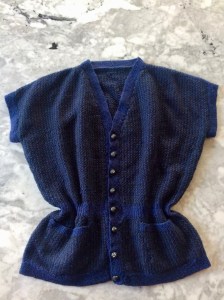

 The Stitchcraft Sixties