March 1960: Overview

IMG_1544

March 1960 promises “Spring Magic” and a special pull-out supplement with designs in “Big Ben”, Patons’ new Aran-weight wool that promises to knit up especially quickly, so you can have your thick, warm woolies finished in time for the summer holidays. (Anyone who lives in Northern Europe or who has taken a holiday on the northern Atlantic or North Sea coast will understand perfectly.) Fine-gauge knitting is right out: the designs not written for Big Ben, like the excellent yellow pullover and sleeveless waistcoat for men, the “Young Style Designs” for teenage girls, or the fabulous checkered coat for a toddler, are all in DK-weight wool. The only exception is “John’s new pullover” in 4-ply.


The embroidery and homecraft projects focus on springtime and Easter, with a floral tablecloth and a cushion and chairback in traditional Hungarian design. It’s a pity nobody uses chairbacks these days, as they are a nice decoration and certainly prolong the life and cleanliness of a chair or sofa. The stitched rug is a “quick and easy modern design” and there are tapestry and needle-etching pictures of quaint-looking English town streets.


In comic land, Good Ted and Naughty Ted (two teddy bears) and their human friends Beth and Bill take a balloon ride to Magic Way, where a fairy turns Beth and Bill into animals in order for them to visit Noah’s Ark. As usual, the ads are for Lux soap, Opti-Lon zippers, Cow & Gate baby formula and various sewing and knitting machines.


One older style of ad is the Patons and Baldwin’s testimonial, in which a famous personage shows off their favorite hand-knit garment made from P&B wool. Here we have Russ Conway, the popular music pianist, at the peak of his career and wearing a lumber jacket in “man-weight wool”. Russ Conway was a multi-talented, self-taught piano player and composer who enjoyed enormous success, producing multiple No.1 hits and playing in a distinctive “honky-tonk” style. Though plagued by serious health conditions, he continued to compose, produce, and fund-raise for charity until his death in 2000 at the age of 75. You can read more about his life and career and hear some of his music on his tribute website .

IMG_1560I will be making two children’s designs: the fabulous checkered coat for a toddler, and “John’s new pullover” for a soon-to-be six-year-old.

February 1960: Overview

Feb1960_coverFebruary 1960, the “Spring Knitting Number”, features an extra 16-page pull-out booklet with garments in Patons Rimple, a nubbly wool-with-a-bit-of-nylon yarn that looks like terrycloth toweling when worked up. The Ravelry yarn database has more information with pictures and modern projects. The wool itself gives so much texture that it would be pointless to knit intricate patterns or multi-colour pieces with it, so the “zippy designs” in the supplement are made on very classic lines: V-neck pullovers, a plain cardigan, a child’s cap and mittens.

The only slightly more ambitious design is this double-breasted A-line coat for a child.IMG_1488 The model, like all children of the 1960’s and earlier, must have very cold legs. Why children of earlier times didn’t wear trousers or warm stockings or tights is a mystery that an older person will have to explain to me someday. It’s particularly strange to see in a knitting magazine, as often the child will be wearing a thick wool jumper or even a wool pullover under a wool sleeveless dress with a knitted wool coat over it, plus a hat and mittens if outside… but nothing on their poor bare legs.

The non-Rimple knitted garments are long, like this “Fashionable Dress” in 4-ply fingering at 7 stitches to the inch, or the long coat in a two-colour slip stitch pattern. Even the dolman cardigan is hip-length. The embroidery and needlepoint projects cover various traditional styles with a Victorian ribbon-band pattern for a stool top, a cushion with Tudor-inspired pears and acorns, and a very zig-zaggy “modern” Swedish rug and cushion set. The Swedish rug has a neat three-dimensional effect thanks to tufting.


As the focus of the issue is the Rimple supplement, the other projects in the issue are fairly basic: cardigans for men and boys, a crocheted cap and mitts, an embroidered wall panel and counted-stitch cushions. The ads are for fabric, knitting and sewing machines, and “Cow and Gate” baby formula — all standards — and the two teddy bears in the comic are heading off on Magic Way in their enchanted toy village.

Rimple is not my style, so I’ll be making a small project this month: the crocheted cap and mitts with an intriguing bobble pattern and plaited crown.Feb1960_2


January 1960: Overview

jan1960cover

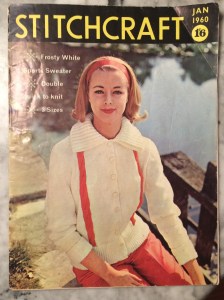
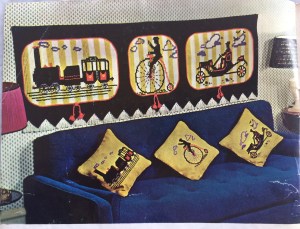
January 1960 wishes us a Happy New Year with designs for “fashion” and “casual” knitting, a machine-knitted jumper, children’s and baby clothing to knit, a matching rug and cushion, and “something completely different in embroidery” — cushions and wall hangings with Victorian-era train, carriage and bicycle motifs.  I find it strangely appropriate that Stitchcraft started a new and, one would expect, exciting decade with a look to an even more conservative past — the magazine was not exactly innovative, and its readership enjoyed patterns that give a nod to current styles without being all too forward-thinking.

victorian
Dashing away!

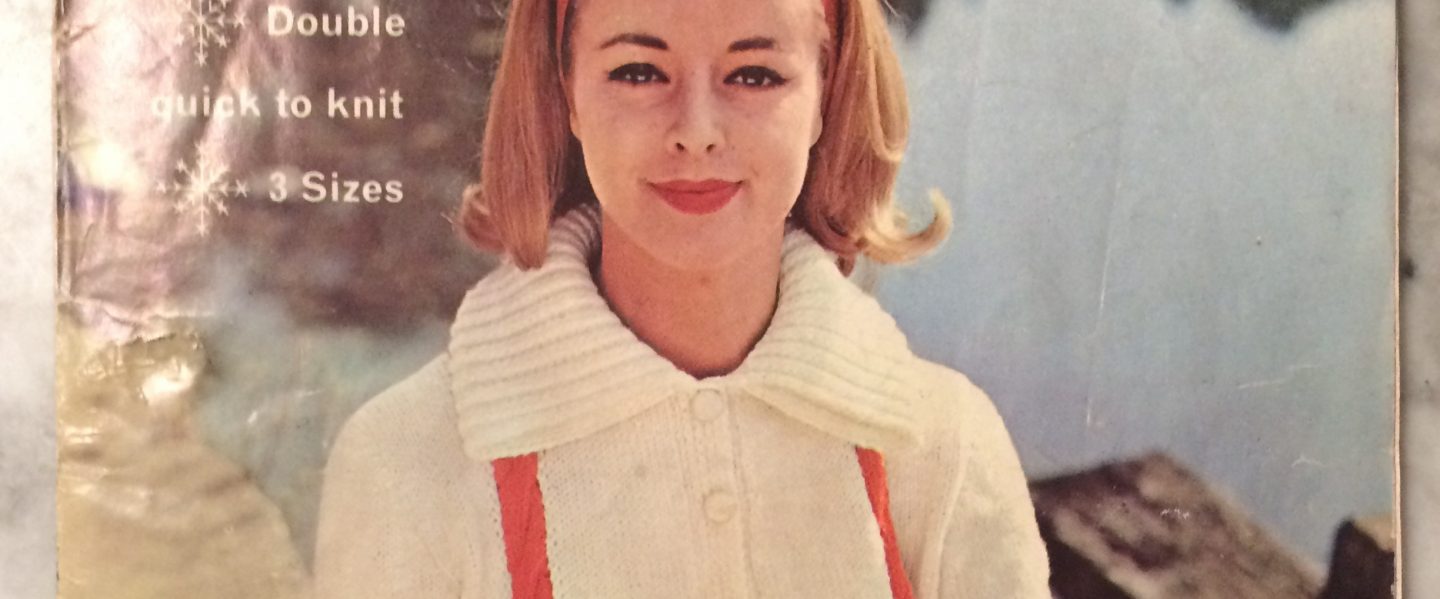
The jumpers (or sweaters: Stitchcraft appears to use the two words interchangeably) continue the trend for somewhat thicker yarn — as Patience Horne writes in the introduction to this issue, “we all seem to get busier and busier these days” and the 9-stitches-to-an-inch creations of the 40s and 50s were slowly getting rarer. Five of the eight adult garments in this issue use double knitting yarn.

coldweatherlineup


On the embroidery front, there is a lovely design for a glass-topped coffee table, an adaptable Jacobean design in colour on the back cover, and a simple “leaf” cushion.


The Victorian cushions are “gay”, as are the children’s gloves. One of Stitchcraft‘s endearing qualities is its use of the word “gay” to mean charming, colourful, sprightly et. al. long after the word’s more modern meaning eclipsed its original one. It’s not yet quite so funny in 1960, but the word still appears in post-Stonewall issues up into the early 1970s. Yet another sign that Stitchcraft did not move with the times! I love all things gay no matter what sense of the word, so will be sure to point out this charming feature whenever it appears.

The ads feature Lux soap flakes, Wearwell facing ribbon and a Tru-Matic knitting machine  — all repeat customers.  There is always a little comic for the kiddies, and we’re already at part 3 of this one, “A Tale of Two Bears.”

I will be making the leaf cushion and the “green check jumper”, shown in colour on the inside back cover.