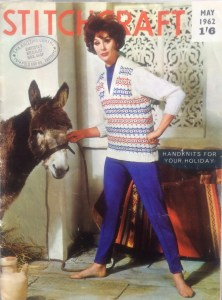
 Handknits For Your Holiday! If you are planning on taking a holiday in 1962, that is. In that case, I would recommend going to the Algarve in southern Portugal, which, based on the pattern of the window shutters and blanket in the background, is where I am guessing this magnificent cover photo was taken. Sadly, my time machine is out of order and May 2020’s motto is (Lots Of ) Handknits For No Holidays This Year Or Probably Anytime Soon.
I bought my copy of this issue on Ebay, but apparently it originally came from “The Knitting Centre” on Field End Road in Eastcote near London. I actually checked to see if it still existed but sadly, it seems to not be there anymore, nor is there any other knitting or craft shop in the area as far as Ravelry and the digital map can tell me. It would have been fun to be able to trace a 50+-year-old knitting magazine issue back to its origin!
Like most of the late-spring or summer issues, this one has a mix of quick, warm, bulky sweaters for holidays in northern climes and some finer, dressier items for that special going-out evening. “The boy friend” can get wild in a colourful, oversized mid-weight sweater, while “you” enjoy your evening in a bobbled jumper. For casual outings, there’s a raglan polo-neck and the “latest look in twin sets” — a short-sleeved jumper in lighter-weight wool with a heavier V-neck top worn over it. (The donkey seems to like it.)


The “cooler trend for summer” includes a pretty short-sleeved blouse and a fine-knit jumper with a lacy yoke as well as a cute dress and cardigan for a small child, made in terry-cloth Rimple yarn with fluffy appliquéd chicks.


Older children get their own holiday hand knits and nothing says “1962” like this little girl sporting a spectacular up-do, thick warm cardigan, knee socks and basically nothing else on her body. How is she supposed to play badminton in a skirt that doesn’t even cover her bottom when she’s standing still? Her tomboy sister gets a much better deal in her knitted shirt and shorts. White and pale colours are always on point for summer and lemon yellow is the new colour trend.


The homewares department is quite boring this time, but there is a reason for that, as “editress” Patience Horne explains on the facing page:
After our end-of-the-year check through our embroidery and tapestry features, it is clear that designs of the more traditional type head the list — others in a modern style are way down and definitely have more limited appeal. I think this is because more traditional designs never date and seem to fit in well with most homes, whereas a completely contemporary design requires almost its own special setting.
Well, there you have it. Readers usually had to send away for the embroidery transfers, so it must have been easy enough to determine which designs were most popular, and the most popular embroidery designs of 1961 and the most popular embroidery design of 1960 were “peasant motifs” and two Jacobean cushions, so we can expect more of the same. The May 1962 Jacobean cushion is certainly very pretty and there’s also a cutwork tablecloth, other table linens and a “Chippendale” tapestry stool.


There’s also a “cushion for the car” with the cryptic motif “II3LMF” on it. I assume it must be a reference to some sort of gearstick / gearknob / automobile part code, but I can’t interpret it and Internet searches for vintage gearsticks led me nowhere. Are there any vintage car aficionados out there who can tell me what it means? EDIT: Gretchen aka Stashdragon solved the mystery for me in her comment below. The centre panel is a customisable area for the car’s registration/license plate number and the chart gives you all the letters and numbers you might need to personalise it. Guess I should have read the pattern text! Thanks, Gretchen!
That’s all for now. My May project will be the 3-ply jumper with the lacy yoke. Get well and stay well!
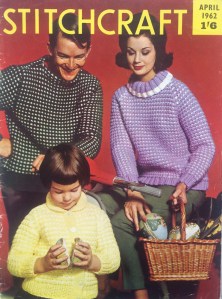 “Easter Greetings” from Stitchcraft, April 1962! According to “editress” Patience Horne, “everyone is getting that “out-of-doors” feeling”. I and my fellow compatriots from 2020 have had a very much in-doors feeling for the last few weeks, as we watch Spring unfold from our quarantine windows.


 Springtime also means spring cleaning, and Easter means presents and


 There are three seasons in the Stitchcraft year: autumn, Christmas and “holidays”, which start in March and continue until about September. Of course, most people take their holidays in the summer, but the beauty of knitting (or editing a knitting magazine) is that you can technically be knitting for them any time of the year, if you knit slowly enough. And so, the March 1962 issue of Stitchcraft, (motto: “Knit for Spring”) can already promise us “the fun of holidays to plan for.”


 Put on your best traveling suit, pack your Aeros and have your Kodak Instamatic in hand, because it’s February 1962 and Stitchcraft is going to Paris! This month’s issue features Paris-inspired designs (whatever that means) and extra pages in colour to show off the latest knitwear against a backdrop of Parisian tourist classics.


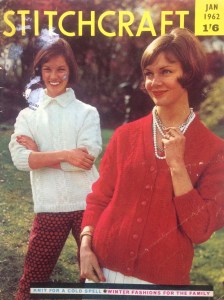 Happy New Year, everyone! It’s 2020 in my real world and 1962 in my blog world. Where will Stitchcraft take us?


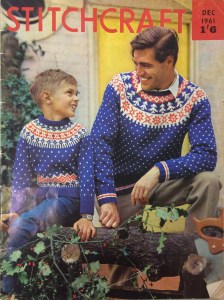 It’s that time of year again and December 1961’s issue has a lovely festive cover photo featuring matching father-son jumpers and a freshly-cut-down Christmas tree with holly branches. The jumpers are meant to be made in flat pieces with only the yoke worked in the round, but everything about them other than that is in the traditional Norwegian style, with a small snowflake pattern on the body and sleeves and a round yoke with tree and star patterns. I like that the jumpers’ pattern theme and colour choice are not so very specifically Christmas-y that they couldn’t be worn at any other time, or by people in our more diverse and modern times who don’t celebrate or don’t care much for Christmas and would just like a nice warm jumper with a wintery flair.


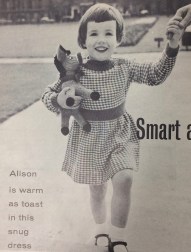 Children of all ages can look forward to practical, yet stylish winter garments — a knitted outdoor play-suit for toddlers in warm, bulky Big Ben, a smart fine-knit twin-set for girls of varying ages (sizes from 26-30 inch chest) and a wonderful knitted dress in a two-colour slip-stitch pattern that fits right into the tweed trend. The photo caption claims that Alison (the young model) is “warm as toast” but of course, her legs are going to be cold! She still seems pretty happy, though.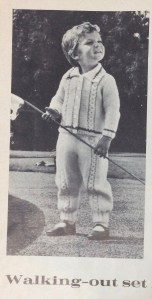


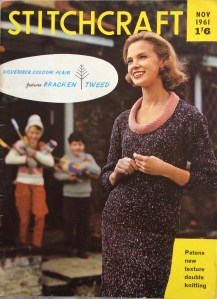 November is such a grey month, so it’s nice to see that Stitchcraft‘s November 1961 issue has the theme “Colour Flair”, featuring speckled yarns and a center page in colour. The issue showcases “Bracken Tweed”, Patons’ new double knitting wool. Bracken Tweed was one of the early multicolour yarns, mixing flecks of a lighter colour in with main strands of a darker colour to achieve a tweed effect. At its debut in 1961, it was 100% wool; with the change from ounces to grams in the late 1960s, the fiber content was changed to 60% wool and 40% acrylic.
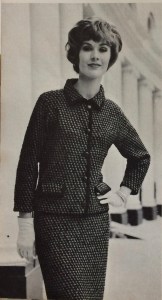 The Bracken two-piece dress on the cover is one of two ideas for “Separates with the BOUTIQUE LOOK”; the other is this wonderful suit, made with regular Patons Double Knitting and familiar nubbly Rimple. Note the deliberately too-short sleeves, designed to show off your gloves and bracelets! The slip-stitch pattern gives it a firm texture for more shape.


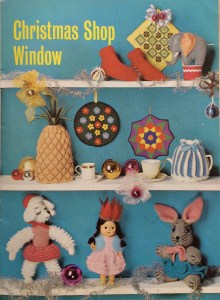

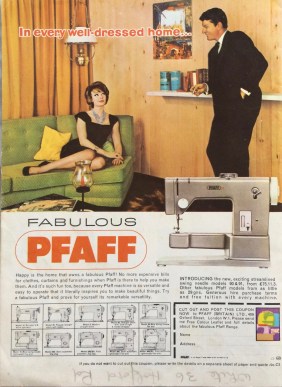
 October 1961 gives us “Colour for autumn” with “special fashion features” and a great center spread with colour photos. “I always think October is a nice friendly month,” writes “editress” Patience Horne on the facing page, and I have to agree.
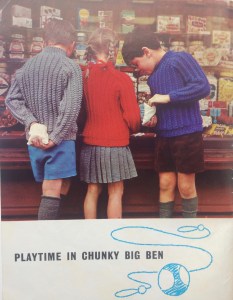 stitches play a prominent role in this month’s issue, starting with the partner-look pullover and cardigan on the front cover. Both are made in the same drop-stitch rib pattern — basically 2×2 ribbing, but you drop a stitch down 3 rows every 4th row and pick it up again in the next row to make a long vertical rib. Children get twisted-rib raglan pullovers to keep their upper bodies nice and warm while their legs freeze in tiny shorts and mini-skirts, typical for the era.


 “Knitting with an Autumn Theme” is the motto of this month’s Stitchcraft from September, 1961. Knowing that September is the month where many knitters take up their needles again after not wanting to handle wool in the hot summer, I would have expected a “bumper issue” with extra ideas, new fashions from Paris, more colour photographs and so on. Not the case! It has more or less the same mix of “chunky”, bulky garments and easy homewares that we saw in the summer issues.
 probably will never be my style). The kid’s coat looks cosy and fun to wear, and the “gay sweaters for him and her” in a Norwegian-style pattern are warm, practical and unisex. I imagine the boatneck collar on an unshaped front must scratch horribly across the neck, though.


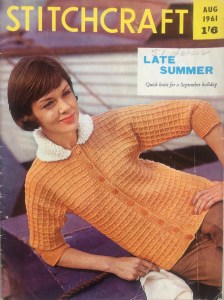 “August is an issue that needs special thought and planning” writes Stitchcraft‘s “editress”, Patience Horne, in the introduction to the August issue, pointing out that it is “rather an “in-between” month for needleworkers” — often too hot to want to wear or make heavy sweaters and too late in the year for fine-knits. At the same time, reminding people that “Autumn is around the corner” can be “a little depressing” to people enjoying their late-summer holiday.


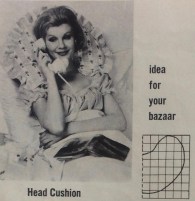 My favourite, though, is this sewing project: a head cushion that lets you recline charmingly in bed with your hair and makeup perfectly done, your satin nightie on, a book on your lap and your telephone on your ear. It’s glamorous leisure and lifestyle advertising personified, and though they say it’s an “idea for your bazaar”, I would bet the Stitchcraft readers who made this in 1961 did not make it to sell.
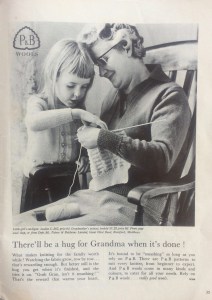 Apropos lifestyle advertising, the early 1960s Stitchcrafts show a rise in full-page ads for Patons and Baldwins wools. That’s obviously not surprising considering the magazine was published for the Patons wool company, but the full-page ads that “tell a story” are a new trend: the late 1950s and 1960s issues up to now had little celebrity testimonials. This one caters to grandmothers and the message is clear: Knitting is not only a rewarding pastime on its own, but earns you the love and affection of the grandchildren for whom you knit. (But only if the kid likes it, and that’s only guaranteed if you use P&B wools, of course.) The 1950s and 1960s saw a huge shift in advertising methods towards a psychologically-based system, which is a huge topic that I won’t start with here, but suffice to say there will be more of these ads, and that they are representative of changing advertising styles.
 The motto of the July 1961 issue is “Sew through the Summer” and indeed, there are a lot more sewing projects than one would normally find in Stitchcraft, summer being a time when many people do not want to hold wool in their hands or think about colder weather to come. There’s more emphasis on homewares and small, fun projects to make and use on holiday. The farm photos were taken in Hertfordshire and the boating photos in “the heart of London’s Little Venice”. Doesn’t that sound like fun? Let’s dive in!
 a really pretty basketweave blouse with that V-neck-plus-collar design that we saw so much of in 1960 and the last years of the 1950s, not to mention just last month on the cover of the


 I love this cover. The yellow stripes on the hats, the yellow trim on the sweaters and the yellow sans-serif lettering all harmonise perfectly with the off-white garments in the center focus. Even the models’ hair colour looks like it was chosen to match the wooden wall. And we can see that typical 1960s hairdo coming into fashion, with more volume on the top and curled ends.
 elephant! The dress is totally cute and definitely on my project list for this month, for my friend’s kid who just turned three. Those are seahorses, in case that wasn’t clear (the ones on the front panel of the dress and matching sunsuit look weird to me — I think I’ll fill in the bodies to make the shape more clear.) The sunsuit and dress are made in wool-nylon blend
  (Speaking of tiny children in goofy poses, am I the only one who finds this advertisement for next month’s Stitchcraft strangely funny? What is it about this baby that comes off looking so weird? Too much hair? The quasi-adult-looking face? The indescribable expression?)


 And then there’s this incredible birds-in-a-tree number, to be worked either in wool on linen for a firescreen or in felt appliqué with wool embroidery on linen for a picture. I’m normally not so crazy about 1950s and 1960s neo-Jacobean designs, but I love this one and definitely want to make the felt appliqué version as a cushion (with a more greeny green for the tree and not quite so much brown-orange-yellow in the appliqué work.) I imagine it might be tough without a transfer, but they gave us two very clear photographs including one in full colour, so what could go wrong?
 Last but not least, there’s a lovely, elegant two-piece suit in nubbly Rimple double knitting wool, featured in the most magnificent photo I have ever seen in any magazine, ever. If I remember correctly, I saw it in one of those Internet lists of “best/worst/weirdest knitting pattern photos” long before I started collecting vintage patterns. It’s definitely at the top of my list and if you haven’t seen it yet, you saw it here first!
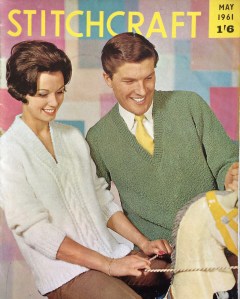 Time for the Summer Forecast! “Editress” Patience Horne writes that it is “a lovely sunny day in March” as they go to press for the May issue. It’s freezing cold and pouring rain where I am on May 2nd, so my summer forecast feelings have been literally dampened.


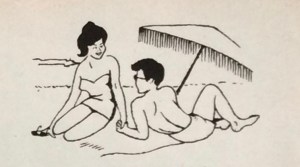
 April showers bring May flowers, or so they say. I’ll just say that, after the last couple of weeks of March, that umbrella on the cover of this month’s issue looks really familiar. As does the model on the right — she was featured (with a more flattering haircut) in many issues throughout the 1950s.
 to spend your holiday in April or May on the British isles or the North Sea coast, you will definitely want to wear one of the warm, bulky wool garments from this issue. “Jenny”‘s thick, double-knit Norwegian-style jumper and hat, described as “dazzling designs to cut a dash on the beach this summer”, tells you everything you need to know about that.


 Are you ready to “Rendez-vous with Spring”? I sure am! This month’s issue has a lovely extra “centerfold” spread in colour, showing off Spring 1961’s latest fashions.


 The ads are for the usual knitting machines and sewing fabrics… except for this one, for “Cooper’s moth proofer” spray, presumably made of


 The Stitchcraft Sixties
