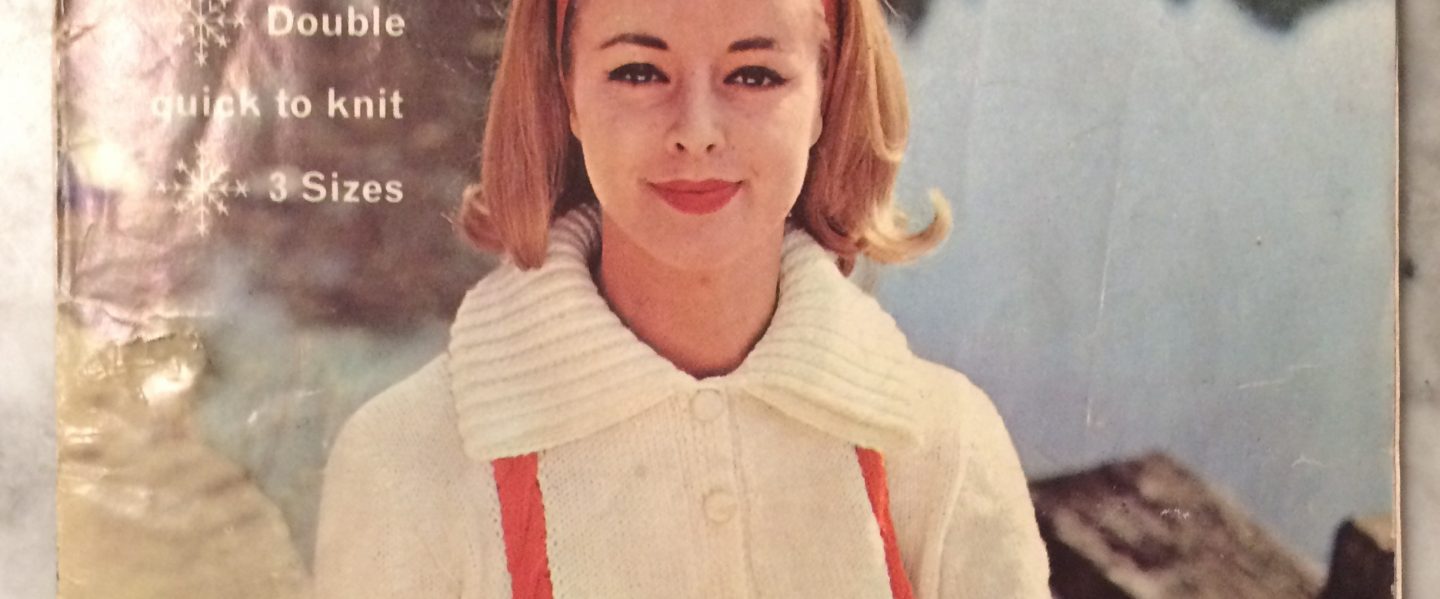
 My first project for May was a “matinee coat” for a 6-month old baby. The baby I knit it for hadn’t been born yet, but I always like to make a six-month size for a newborn. Of course it will be too big at first, but eventually the coat will fit.
Don’t you love the positioning of the baby in the photo? “I’m 6 months and almost sitting up!” means it was probably pretty difficult to get any sort of picture of the baby wearing the coat in a way that you could see it, not to mention without crying, flailing around, spitting up, etc. I have a real respect for anyone who can get a decent photograph of a small baby, especially one where you want to see what it is wearing. Sadly, there is no colour photo.
The coat is made in one piece from the top down with raglan armholes. This kind of construction was pretty rare in mid-century knitting patterns — most baby clothes, like almost all adult clothes, were meant to be made in pieces and seamed. This garment does have seams, though — after the division for the fronts/sleeves/back at the underarm, you are supposed to work each bit flat and then sew the side and sleeve seams.
 I actually did just that, because the written pattern was very difficult to follow on the first few rows after the underarm divide. The raglan increases at the top are done with eyelets and make-1 increases on a each side of a bit of moss stitch, and after the underarm divide, the same type of increase is done on the fronts and back to make a flared skirt. That all makes perfect sense, but the way the pattern was written made it difficult to find the placement of the increases if making the fronts and back all in one. So I just went ahead and followed the pattern exactly. Except for the sleeves, which are supposed to be long, but I ran out of yarn.
As with many early baby things, the tension/gauge was 8 stitches to the inch — on No. 11 (3 mm) needles — much smaller than I can ever manage to get no matter how small the needles or how thin the yarn. I used Lang Merino 200 Bébé, which is wonderful, but my gauge was too big even on 2 1/2 mm needles. No matter, the coat will be a little bit bigger and hopefully fit a little while longer.
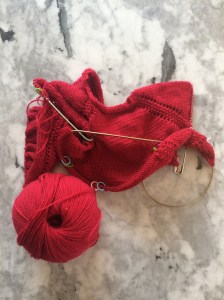
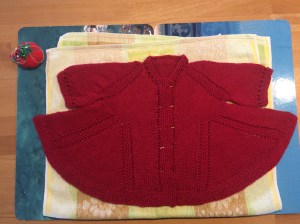 If you are looking at the first picture and wondering what went wrong, let me assure you that it was NOT a tangled mess! As long as the sleeve stitches were on holders, there was no way to make the thing sit down flat for a photo. Kind of the same problem with the baby, if you think about it… Here’s a picture during blocking (at left) and here’s a picture of the finished garment. I am very happy with it!
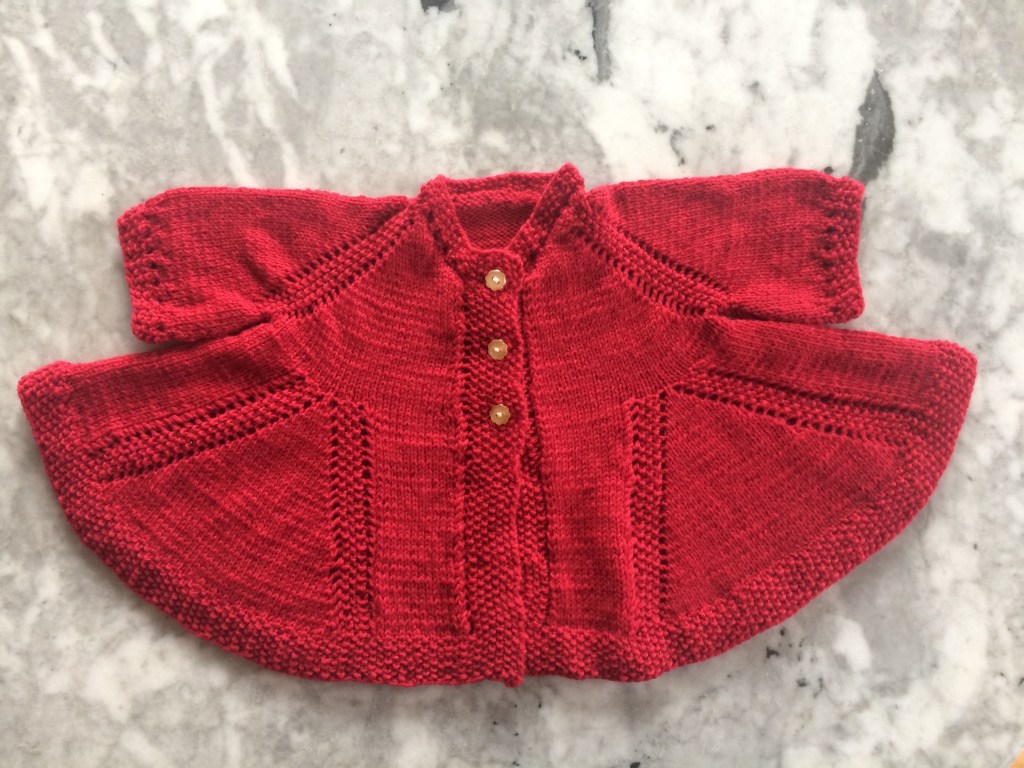
P.S. Yes, it is supposed to have long sleeves. I ran out of yarn.
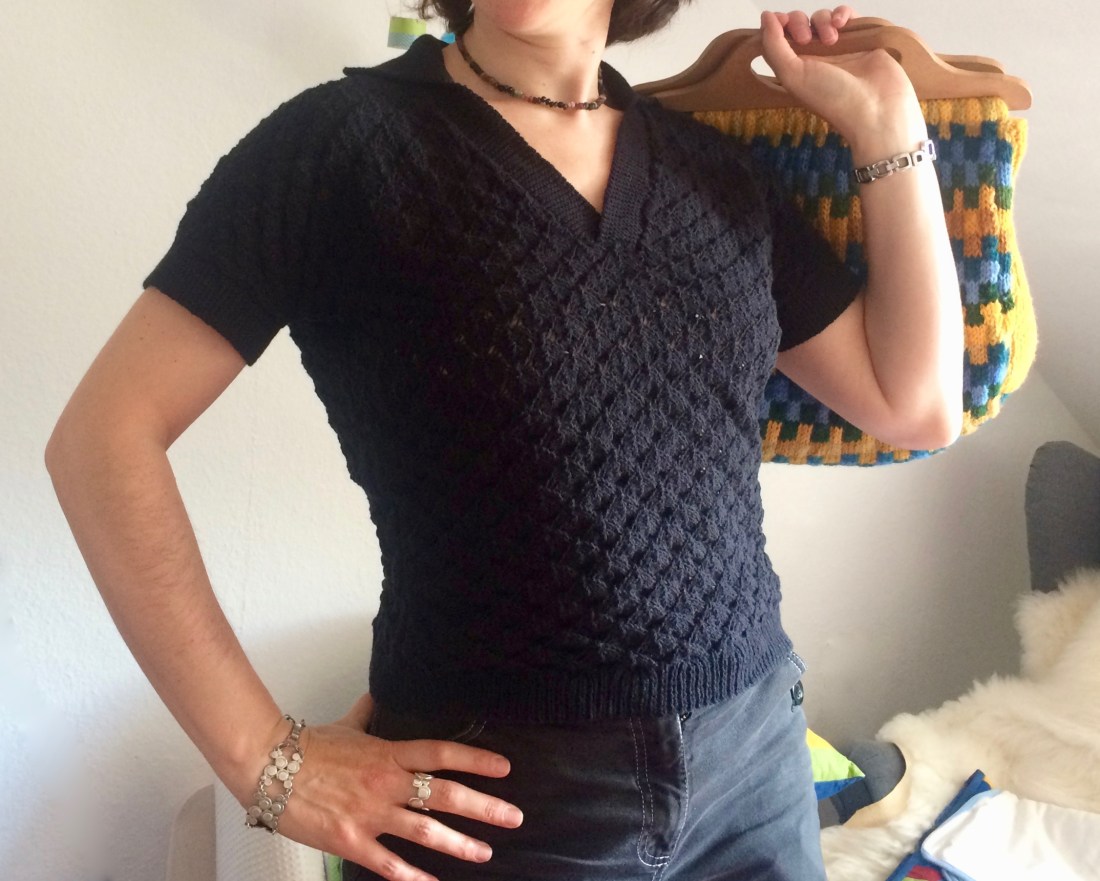
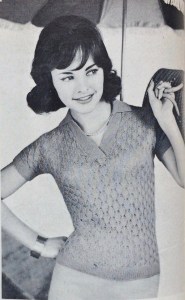 My second project for April (obviously not finished before the end of the month, seeing that I started it two days before) was this cute lace blouse with a “Popular neckline.” I do love the neckline, and the leaf pattern.
 The biggest problem was making the side-seam increases. The lace pattern has a repeat of 12 stitches, but a sort of varying number of edge stitches. I honestly had no idea where to fit in the extra stitches, or how to keep them in pattern when the increases and decreases within the pattern are broadly spaced. Time to hit the


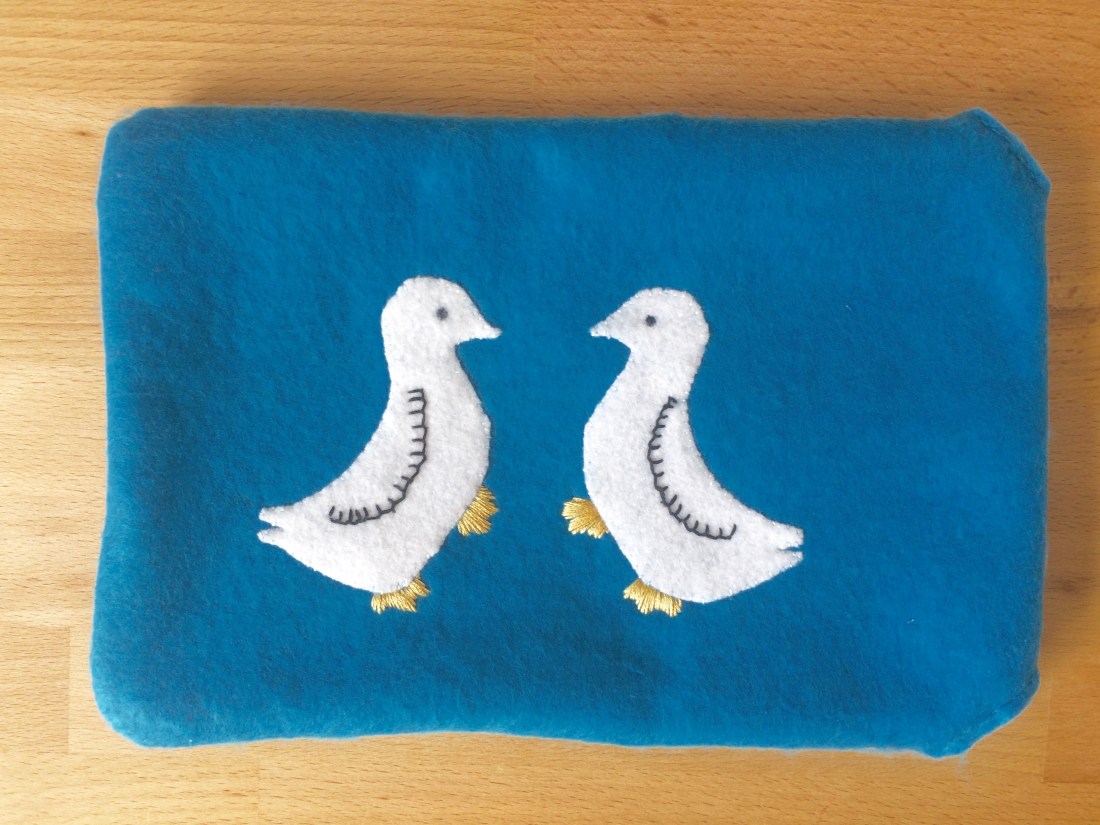
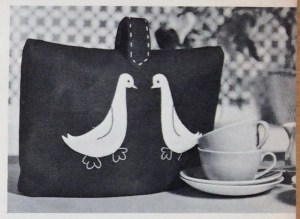 “Cheerful goslings make gay kitchen ideas” — who could resist? There are patterns for a serving glove and a felt tea cosy, neither of which I particularly needed, but the tea-cosy pattern is just about the right size for an iPad case. So this became the modern version.


 My second project for March — though it wasn’t finished by the end of the month — was a young boy’s pullover with a cute stripe-and-dot pattern.


 First project for March: this charming jacket from the jacket-and-skirt set titled “Spring Magic in Judy’s trim Outfit”. What a great title! And what a great photo in the booklet. I’m glad today’s girls don’t generally get their hair tortured into curls like litte Judy’s in the picture, but she certainly looks happy enough holding hands with her gigantic teddy bear.

 February’s project was pretty simple: a crocheted cap and “mitts” with a cute bobble pattern. I couldn’t decide on the colour (lavender or purple) and didn’t have quite enough of either to make both cap and mitts, so I ended up making the cap twice and using up leftovers of both colours plus a little extra of a different purple yarn to finish the mittens.


 My second project from January 1960 was a sewn and embroidered cushion featuring “black and white leaves on bright red fabric”. One is encouraged to “keep to the black and white embroidery but choose background linen to match your room” and I chose a medium green. (The fact that it matches the houndstooth jumper is just a happy coincidence.)


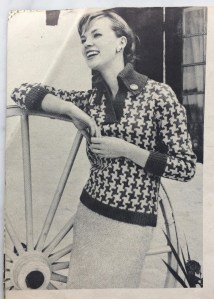
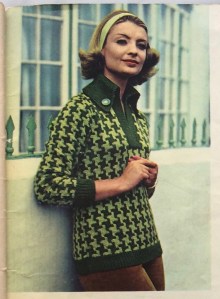 My knitting project from this issue was a houndstooth-check jumper, made in double knitting wool in two shades of green. Large checked patterns of this type were popular this year, which is presumably why Stitchcraft categorized this jumper as “fashion knitting” rather than “casual knitting”.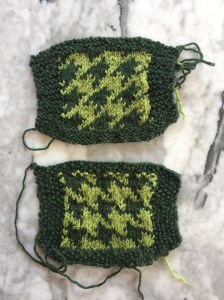


 The Stitchcraft Sixties